EP2311807A1 - Compounds and composition as protein kinase inhibitors - Google Patents
Compounds and composition as protein kinase inhibitors Download PDFInfo
- Publication number
- EP2311807A1 EP2311807A1 EP20100007914 EP10007914A EP2311807A1 EP 2311807 A1 EP2311807 A1 EP 2311807A1 EP 20100007914 EP20100007914 EP 20100007914 EP 10007914 A EP10007914 A EP 10007914A EP 2311807 A1 EP2311807 A1 EP 2311807A1
- Authority
- EP
- European Patent Office
- Prior art keywords
- phenyl
- isopropoxy
- isopropylsulfonyl
- methyl
- diamine
- Prior art date
- Legal status (The legal status is an assumption and is not a legal conclusion. Google has not performed a legal analysis and makes no representation as to the accuracy of the status listed.)
- Granted
Links
- 0 C*(C)Cc1cccc(Nc2nc(Nc3c(*)cc(***4)c4c3)nc(*)c2*)c1* Chemical compound C*(C)Cc1cccc(Nc2nc(Nc3c(*)cc(***4)c4c3)nc(*)c2*)c1* 0.000 description 15
- KAPCMKRYVNOMQW-UHFFFAOYSA-N CC(C)Oc(cc(C1CCN(C)CC1)c(C)c1)c1Nc1nc(Nc(cccc2)c2S(C(C)C)(=O)=O)c(cc(cc2)OC)c2n1 Chemical compound CC(C)Oc(cc(C1CCN(C)CC1)c(C)c1)c1Nc1nc(Nc(cccc2)c2S(C(C)C)(=O)=O)c(cc(cc2)OC)c2n1 KAPCMKRYVNOMQW-UHFFFAOYSA-N 0.000 description 2
- MEQVJEKIEKXQLB-UHFFFAOYSA-N CC(C)C(C1)[S]1(c(cccc1)c1NC1=C(C)CN(C)C(Nc(cc(C)c(C2CCN(C)CC2)c2)c2OC(C)C)=N1)(=O)=O Chemical compound CC(C)C(C1)[S]1(c(cccc1)c1NC1=C(C)CN(C)C(Nc(cc(C)c(C2CCN(C)CC2)c2)c2OC(C)C)=N1)(=O)=O MEQVJEKIEKXQLB-UHFFFAOYSA-N 0.000 description 1
- MWKRWYXGPLOHOH-UHFFFAOYSA-N CC(C)CCc1ccccc1Nc1c(C)cnc(Nc(cc(c(C2)c3)-c4c2c(CO)n[nH]4)c3OC(C)C)n1 Chemical compound CC(C)CCc1ccccc1Nc1c(C)cnc(Nc(cc(c(C2)c3)-c4c2c(CO)n[nH]4)c3OC(C)C)n1 MWKRWYXGPLOHOH-UHFFFAOYSA-N 0.000 description 1
- ZDNMPPCVMDYUEG-UHFFFAOYSA-N CC(C)NC(c(cccc1)c1Nc1nc(Nc(cc(c(C)c2)C#C)c2OC(C)C)ncc1C)=O Chemical compound CC(C)NC(c(cccc1)c1Nc1nc(Nc(cc(c(C)c2)C#C)c2OC(C)C)ncc1C)=O ZDNMPPCVMDYUEG-UHFFFAOYSA-N 0.000 description 1
- IVXNXRBCDQFEAD-UHFFFAOYSA-N CC(C)OC(CC(C1CCN(C)CC1)C(C)=C1)=C1Nc(nc1Nc(cccc2)c2S(N(C)C)(=O)=O)ncc1Cl Chemical compound CC(C)OC(CC(C1CCN(C)CC1)C(C)=C1)=C1Nc(nc1Nc(cccc2)c2S(N(C)C)(=O)=O)ncc1Cl IVXNXRBCDQFEAD-UHFFFAOYSA-N 0.000 description 1
- BCQOLWZHMMZXOT-UHFFFAOYSA-N CC(C)Oc(c(Nc(nc1)nc(Nc(cccc2)c2S(C(C)C)(=O)=O)c1Cl)c1)cc(C(N2C3CCN(CC(N)=O)CC3)=O)c1C2=O Chemical compound CC(C)Oc(c(Nc(nc1)nc(Nc(cccc2)c2S(C(C)C)(=O)=O)c1Cl)c1)cc(C(N2C3CCN(CC(N)=O)CC3)=O)c1C2=O BCQOLWZHMMZXOT-UHFFFAOYSA-N 0.000 description 1
- CYDPNDFJNXWAPQ-UHFFFAOYSA-N CC(C)Oc(c(Nc(nc1)nc(Nc(cccc2)c2S(C(C)C)(=O)=O)c1Cl)c1)cc(C(N2C3CN(C)CC3)=O)c1C2=O Chemical compound CC(C)Oc(c(Nc(nc1)nc(Nc(cccc2)c2S(C(C)C)(=O)=O)c1Cl)c1)cc(C(N2C3CN(C)CC3)=O)c1C2=O CYDPNDFJNXWAPQ-UHFFFAOYSA-N 0.000 description 1
- CTBFCXOMTAUPSB-QFIPXVFZSA-N CC(C)Oc(c(Nc(nc1)nc(Nc(cccc2)c2S(C(C)C)(=O)=O)c1Cl)c1)cc(CN2[C@@H]3CN(CCO)CCC3)c1C2=O Chemical compound CC(C)Oc(c(Nc(nc1)nc(Nc(cccc2)c2S(C(C)C)(=O)=O)c1Cl)c1)cc(CN2[C@@H]3CN(CCO)CCC3)c1C2=O CTBFCXOMTAUPSB-QFIPXVFZSA-N 0.000 description 1
- BNRSSDFOFFHCTN-RUZDIDTESA-N CC(C)Oc(c(Nc(nc1)nc(Nc2ccccc2S(C(C)C)(=O)=O)c1Cl)c1)cc(C(CC2)=CC[C@H]2N2CCN(C)CC2)c1C(NC)=O Chemical compound CC(C)Oc(c(Nc(nc1)nc(Nc2ccccc2S(C(C)C)(=O)=O)c1Cl)c1)cc(C(CC2)=CC[C@H]2N2CCN(C)CC2)c1C(NC)=O BNRSSDFOFFHCTN-RUZDIDTESA-N 0.000 description 1
- BBXVGFFTJQTOKP-UHFFFAOYSA-N CC(C)Oc(c(Nc1nc([nH]cc2)c2c(Nc(cccc2)c2S(C(C)C)(=O)=O)n1)c1)cc(C)c1-c1cc(C)n[o]1 Chemical compound CC(C)Oc(c(Nc1nc([nH]cc2)c2c(Nc(cccc2)c2S(C(C)C)(=O)=O)n1)c1)cc(C)c1-c1cc(C)n[o]1 BBXVGFFTJQTOKP-UHFFFAOYSA-N 0.000 description 1
- AXKUFDXTCRGCAS-UHFFFAOYSA-N CC(C)Oc(c(Nc1nc([nH]nc2)c2c(NCc(cc(C)cc2)c2S(C(C)C)(=O)=O)n1)c1)cc(CN2C3CCN(CCOC)CC3)c1C2=O Chemical compound CC(C)Oc(c(Nc1nc([nH]nc2)c2c(NCc(cc(C)cc2)c2S(C(C)C)(=O)=O)n1)c1)cc(CN2C3CCN(CCOC)CC3)c1C2=O AXKUFDXTCRGCAS-UHFFFAOYSA-N 0.000 description 1
- BNRSSDFOFFHCTN-UHFFFAOYSA-N CC(C)Oc(cc(C(CC1)=CCC1N1CCN(C)CC1)c(C(NC)=O)c1)c1Nc(nc1)nc(Nc2ccccc2S(C(C)C)(=O)=O)c1Cl Chemical compound CC(C)Oc(cc(C(CC1)=CCC1N1CCN(C)CC1)c(C(NC)=O)c1)c1Nc(nc1)nc(Nc2ccccc2S(C(C)C)(=O)=O)c1Cl BNRSSDFOFFHCTN-UHFFFAOYSA-N 0.000 description 1
- VFKQAWRSKHIWPO-UHFFFAOYSA-N CC(C)Oc(cc(C(CC1)CCC1N(C)C)c(C)c1)c1Nc(nc1Nc2ccccc2S(C(C)C)(=O)=O)ncc1Cl Chemical compound CC(C)Oc(cc(C(CC1)CCC1N(C)C)c(C)c1)c1Nc(nc1Nc2ccccc2S(C(C)C)(=O)=O)ncc1Cl VFKQAWRSKHIWPO-UHFFFAOYSA-N 0.000 description 1
- OXQPKZUBJMIMGG-UHFFFAOYSA-N CC(C)Oc(cc(C(CC1)CCC1N1CCN(C)CC1)c(C)c1)c1Nc(nc1)nc(Nc2ccccc2S(C(C)C)(=O)=O)c1Cl Chemical compound CC(C)Oc(cc(C(CC1)CCC1N1CCN(C)CC1)c(C)c1)c1Nc(nc1)nc(Nc2ccccc2S(C(C)C)(=O)=O)c1Cl OXQPKZUBJMIMGG-UHFFFAOYSA-N 0.000 description 1
- JYLYGRURBJKYKT-UHFFFAOYSA-N CC(C)Oc(cc(C(CC1)CCC1NCCN(C)C)c(C)c1)c1Nc(nc1)nc(Nc(cccc2)c2S(C(C)C)(=O)=O)c1Cl Chemical compound CC(C)Oc(cc(C(CC1)CCC1NCCN(C)C)c(C)c1)c1Nc(nc1)nc(Nc(cccc2)c2S(C(C)C)(=O)=O)c1Cl JYLYGRURBJKYKT-UHFFFAOYSA-N 0.000 description 1
- IUQAUINCRKLSAM-UHFFFAOYSA-N CC(C)Oc(cc(C(CC1)CCN1C(C)CO)c(C)c1)c1Nc1nc(Nc2ccccc2S(C(C)C)(=O)=O)c(cc[nH]2)c2n1 Chemical compound CC(C)Oc(cc(C(CC1)CCN1C(C)CO)c(C)c1)c1Nc1nc(Nc2ccccc2S(C(C)C)(=O)=O)c(cc[nH]2)c2n1 IUQAUINCRKLSAM-UHFFFAOYSA-N 0.000 description 1
- KACUZFUALFIMHK-UHFFFAOYSA-N CC(C)Oc(cc(C)c(-c1c[nH]c(C)n1)c1)c1Nc(nc1Nc(cccc2)c2S(N(C)C)(=O)=O)ncc1Cl Chemical compound CC(C)Oc(cc(C)c(-c1c[nH]c(C)n1)c1)c1Nc(nc1Nc(cccc2)c2S(N(C)C)(=O)=O)ncc1Cl KACUZFUALFIMHK-UHFFFAOYSA-N 0.000 description 1
- GFYZCULKXWEQOW-UHFFFAOYSA-N CC(C)Oc(cc(C)c(-c1c[nH]c(C)n1)c1)c1Nc1nc(Nc2ccccc2S(C(C)C)(=O)=O)c(C)cn1 Chemical compound CC(C)Oc(cc(C)c(-c1c[nH]c(C)n1)c1)c1Nc1nc(Nc2ccccc2S(C(C)C)(=O)=O)c(C)cn1 GFYZCULKXWEQOW-UHFFFAOYSA-N 0.000 description 1
- NOPIKLKBIWJTGA-UHFFFAOYSA-N CC(C)Oc(cc(C)c(-c1c[n](CCN2CCOCC2)nc1)c1)c1Nc1nc(Nc(cccc2)c2S(C(C)C)(=O)=O)c(C)cn1 Chemical compound CC(C)Oc(cc(C)c(-c1c[n](CCN2CCOCC2)nc1)c1)c1Nc1nc(Nc(cccc2)c2S(C(C)C)(=O)=O)c(C)cn1 NOPIKLKBIWJTGA-UHFFFAOYSA-N 0.000 description 1
- UQVHQWUFDHAVAA-UHFFFAOYSA-N CC(C)Oc(cc(C1CCN(C)CC1)c(C)c1)c1Nc(nc1Nc(cccc2)c2C(N(C)C)=O)ncc1Cl Chemical compound CC(C)Oc(cc(C1CCN(C)CC1)c(C)c1)c1Nc(nc1Nc(cccc2)c2C(N(C)C)=O)ncc1Cl UQVHQWUFDHAVAA-UHFFFAOYSA-N 0.000 description 1
- BACCVJJEDQUIBP-UHFFFAOYSA-N CC(C)Oc(cc(C1CCN(C)CC1)c(C)c1)c1Nc(nc1Nc(cccc2)c2C(NC2CC2)=O)ncc1Cl Chemical compound CC(C)Oc(cc(C1CCN(C)CC1)c(C)c1)c1Nc(nc1Nc(cccc2)c2C(NC2CC2)=O)ncc1Cl BACCVJJEDQUIBP-UHFFFAOYSA-N 0.000 description 1
- MMCLOIRPDNFMRP-UHFFFAOYSA-N CC(C)Oc(cc(C1CCN(C)CC1)c(C)c1)c1Nc1nc(Nc(cccc2)c2S(C(C)C)(=O)=O)c2nc[nH]c2n1 Chemical compound CC(C)Oc(cc(C1CCN(C)CC1)c(C)c1)c1Nc1nc(Nc(cccc2)c2S(C(C)C)(=O)=O)c2nc[nH]c2n1 MMCLOIRPDNFMRP-UHFFFAOYSA-N 0.000 description 1
- BORDBONLQBVDRO-UHFFFAOYSA-N CC(C)Oc(cc(C1CCN(C)CC1)cc1)c1Nc(nc1)nc(Nc2c(CS(C)(=O)=O)cccc2)c1Cl Chemical compound CC(C)Oc(cc(C1CCN(C)CC1)cc1)c1Nc(nc1)nc(Nc2c(CS(C)(=O)=O)cccc2)c1Cl BORDBONLQBVDRO-UHFFFAOYSA-N 0.000 description 1
- GDJBFMDYZDJUOG-UHFFFAOYSA-N CC(C)Oc(cc(C1CCN(C)CC1)cc1)c1Nc(nc1Nc(cccc2)c2C(N(C)C)=O)ncc1Cl Chemical compound CC(C)Oc(cc(C1CCN(C)CC1)cc1)c1Nc(nc1Nc(cccc2)c2C(N(C)C)=O)ncc1Cl GDJBFMDYZDJUOG-UHFFFAOYSA-N 0.000 description 1
- QAKZGNFLKGJEGO-UHFFFAOYSA-N CC(C)Oc(cc(C1CCN(C)CC1)cc1)c1Nc1nc(Nc(cccc2)c2S(C(C)C)(=O)=O)c2nc[nH]c2n1 Chemical compound CC(C)Oc(cc(C1CCN(C)CC1)cc1)c1Nc1nc(Nc(cccc2)c2S(C(C)C)(=O)=O)c2nc[nH]c2n1 QAKZGNFLKGJEGO-UHFFFAOYSA-N 0.000 description 1
- MQBNWSRDYHMGDQ-UHFFFAOYSA-N CC(C)Oc(cc(C1CCN(CCO)CC1)c(C)c1)c1Nc1nc(Nc(cccc2)c2S(C(C)C)(=O)=O)c(cc[nH]2)c2n1 Chemical compound CC(C)Oc(cc(C1CCN(CCO)CC1)c(C)c1)c1Nc1nc(Nc(cccc2)c2S(C(C)C)(=O)=O)c(cc[nH]2)c2n1 MQBNWSRDYHMGDQ-UHFFFAOYSA-N 0.000 description 1
- PRRAEXPNKHBIPS-UHFFFAOYSA-N CC(C)Oc(cc(C1CCN(CCO)CC1)cc1)c1Nc1nc(Nc(cccc2)c2S(C(C)C)(=O)=O)c2nc[nH]c2n1 Chemical compound CC(C)Oc(cc(C1CCN(CCO)CC1)cc1)c1Nc1nc(Nc(cccc2)c2S(C(C)C)(=O)=O)c2nc[nH]c2n1 PRRAEXPNKHBIPS-UHFFFAOYSA-N 0.000 description 1
- BAKZMTKZYBKMQO-UHFFFAOYSA-N CC(C)Oc(cc(CCC1O)c1c1)c1Nc1ncc(C)c(Nc(cccc2)c2S(C(C)C)(=O)=O)n1 Chemical compound CC(C)Oc(cc(CCC1O)c1c1)c1Nc1ncc(C)c(Nc(cccc2)c2S(C(C)C)(=O)=O)n1 BAKZMTKZYBKMQO-UHFFFAOYSA-N 0.000 description 1
- AQRQRFLWPKUMJX-FEAHVSNWSA-N CC(C)Oc(cc(CCCN1CCN(C)CC1)c(C(NC)=O)c1)c1N/C(/CCC/C=C1)=N/C(/Nc(cccc2)c2S(C(C)C)(=O)=O)=C1/Cl Chemical compound CC(C)Oc(cc(CCCN1CCN(C)CC1)c(C(NC)=O)c1)c1N/C(/CCC/C=C1)=N/C(/Nc(cccc2)c2S(C(C)C)(=O)=O)=C1/Cl AQRQRFLWPKUMJX-FEAHVSNWSA-N 0.000 description 1
- YNLNJRDJOLSGKZ-UHFFFAOYSA-N CC(C)Oc(cc(CCN1CCN(C)CC1)c(C(NC)=O)c1)c1Nc(nc1)nc(Nc2ccccc2S(C(C)C)(=O)=O)c1O Chemical compound CC(C)Oc(cc(CCN1CCN(C)CC1)c(C(NC)=O)c1)c1Nc(nc1)nc(Nc2ccccc2S(C(C)C)(=O)=O)c1O YNLNJRDJOLSGKZ-UHFFFAOYSA-N 0.000 description 1
- MLIYHPDJCHYLEY-WIIYFNMSSA-N CC(C)Oc(cc(CN(C(C1)CN[C@@H]1C(NC)=O)C1=O)c1c1)c1Nc(nc1)nc(Nc(cccc2)c2S(C(C)C)(=O)=O)c1Cl Chemical compound CC(C)Oc(cc(CN(C(C1)CN[C@@H]1C(NC)=O)C1=O)c1c1)c1Nc(nc1)nc(Nc(cccc2)c2S(C(C)C)(=O)=O)c1Cl MLIYHPDJCHYLEY-WIIYFNMSSA-N 0.000 description 1
- VCYYFJOXHAGPSW-UHFFFAOYSA-N CC(C)Oc(cc(CN(C(CC1)CCN1C(N(C)C)=O)C1=O)c1c1)c1Nc(nc1Nc(cccc2)c2S(C(C)C)(=O)=O)ncc1Cl Chemical compound CC(C)Oc(cc(CN(C(CC1)CCN1C(N(C)C)=O)C1=O)c1c1)c1Nc(nc1Nc(cccc2)c2S(C(C)C)(=O)=O)ncc1Cl VCYYFJOXHAGPSW-UHFFFAOYSA-N 0.000 description 1
- HLRREOZYPDVWIV-FQEVSTJZSA-N CC(C)Oc(cc(CN([C@@H]1CNCCC1)C1=O)c1c1)c1Nc(nc1Nc2ccccc2S(C(C)C)(=O)=O)ncc1Cl Chemical compound CC(C)Oc(cc(CN([C@@H]1CNCCC1)C1=O)c1c1)c1Nc(nc1Nc2ccccc2S(C(C)C)(=O)=O)ncc1Cl HLRREOZYPDVWIV-FQEVSTJZSA-N 0.000 description 1
- RZFRVLIYSGJDRZ-LVBKAMOWSA-N CC(C)Oc(cc(CN([C@H]1CNCC1)C1=O)c1c1)c1N/C(/[I]=C)=N/C(/Nc(cccc1)c1S(C(C)C)(=O)=O)=C(\C)/Cl Chemical compound CC(C)Oc(cc(CN([C@H]1CNCC1)C1=O)c1c1)c1N/C(/[I]=C)=N/C(/Nc(cccc1)c1S(C(C)C)(=O)=O)=C(\C)/Cl RZFRVLIYSGJDRZ-LVBKAMOWSA-N 0.000 description 1
- WATWHIDPCGCPFY-UHFFFAOYSA-N CC(C)Oc(cc(c(C(N1C2CCN(C)CC2)=O)c2)C1=O)c2Nc(nc1Nc(cccc2)c2S(C(C)C)(=O)=O)ncc1Cl Chemical compound CC(C)Oc(cc(c(C(N1C2CCN(C)CC2)=O)c2)C1=O)c2Nc(nc1Nc(cccc2)c2S(C(C)C)(=O)=O)ncc1Cl WATWHIDPCGCPFY-UHFFFAOYSA-N 0.000 description 1
- ZSJXGTDCSAYJHE-UHFFFAOYSA-N CC(C)Oc(cc(c(C(N1C2CCN(C)CC2)=O)c2)C1=O)c2[N+]([O-])=O Chemical compound CC(C)Oc(cc(c(C(N1C2CCN(C)CC2)=O)c2)C1=O)c2[N+]([O-])=O ZSJXGTDCSAYJHE-UHFFFAOYSA-N 0.000 description 1
- KFDMMSNMFKQCNY-UHFFFAOYSA-N CC(C)Oc(cc(c(C(N1C2CCN(CCC#N)CC2)=O)c2)C1=O)c2Nc(nc1)nc(Nc(cccc2)c2S(C(C)C)(=O)=O)c1Cl Chemical compound CC(C)Oc(cc(c(C(N1C2CCN(CCC#N)CC2)=O)c2)C1=O)c2Nc(nc1)nc(Nc(cccc2)c2S(C(C)C)(=O)=O)c1Cl KFDMMSNMFKQCNY-UHFFFAOYSA-N 0.000 description 1
- NTJCGBIVWNNDBD-UHFFFAOYSA-N CC(C)Oc(cc(c(C)c1)C(CC2)=CCC2=O)c1[N+]([O-])=O Chemical compound CC(C)Oc(cc(c(C)c1)C(CC2)=CCC2=O)c1[N+]([O-])=O NTJCGBIVWNNDBD-UHFFFAOYSA-N 0.000 description 1
- UAVBPSVJXCTZOC-UHFFFAOYSA-N CC(C)Oc(nc(C1CCNCC1)nc1)c1Nc(nc1)nc(Nc2ccccc2S(C(C)C)(=O)=O)c1Cl Chemical compound CC(C)Oc(nc(C1CCNCC1)nc1)c1Nc(nc1)nc(Nc2ccccc2S(C(C)C)(=O)=O)c1Cl UAVBPSVJXCTZOC-UHFFFAOYSA-N 0.000 description 1
- YOAHJWIHADHMOO-UHFFFAOYSA-N CC(C)Oc1cc(C(C)(CO)CO)ccc1Nc(nc1Nc2ccccc2S(C(C)C)(=O)=O)ncc1Cl Chemical compound CC(C)Oc1cc(C(C)(CO)CO)ccc1Nc(nc1Nc2ccccc2S(C(C)C)(=O)=O)ncc1Cl YOAHJWIHADHMOO-UHFFFAOYSA-N 0.000 description 1
- OTKQFCKFSQSOKL-UHFFFAOYSA-N CC(C)Oc1cc(C(C)CCO)ccc1Nc(nc1)nc(Nc2ccccc2S(C(C)C)(=O)=O)c1Cl Chemical compound CC(C)Oc1cc(C(C)CCO)ccc1Nc(nc1)nc(Nc2ccccc2S(C(C)C)(=O)=O)c1Cl OTKQFCKFSQSOKL-UHFFFAOYSA-N 0.000 description 1
- WMFWFNSIUSLRRX-UHFFFAOYSA-N CC(C)Oc1cc(C(CC2)CCC2N(C)C)c(C)cc1Nc1nc([nH]nc2)c2c(Nc(cccc2)c2S(C(C)C)(=O)=O)n1 Chemical compound CC(C)Oc1cc(C(CC2)CCC2N(C)C)c(C)cc1Nc1nc([nH]nc2)c2c(Nc(cccc2)c2S(C(C)C)(=O)=O)n1 WMFWFNSIUSLRRX-UHFFFAOYSA-N 0.000 description 1
- LQCPBDCQSAEIPX-UHFFFAOYSA-N CC(C)Oc1cc(C(CC2)CCN2C(N(C)C)=O)c(C)cc1Nc1nc([nH]cc2)c2c(Nc(cccc2)c2S(C(C)C)(=O)=O)n1 Chemical compound CC(C)Oc1cc(C(CC2)CCN2C(N(C)C)=O)c(C)cc1Nc1nc([nH]cc2)c2c(Nc(cccc2)c2S(C(C)C)(=O)=O)n1 LQCPBDCQSAEIPX-UHFFFAOYSA-N 0.000 description 1
- RBCQGQCWFFOXTH-UHFFFAOYSA-N CC(C)Oc1cc(C)c(C2CCNCC2)cc1Nc(nc1)nc(Nc2ccccc2S(C(C)C)(O)=O)c1Cl Chemical compound CC(C)Oc1cc(C)c(C2CCNCC2)cc1Nc(nc1)nc(Nc2ccccc2S(C(C)C)(O)=O)c1Cl RBCQGQCWFFOXTH-UHFFFAOYSA-N 0.000 description 1
- KJWUUYNDKYIGIV-UHFFFAOYSA-N CC(C)Oc1cc(C2CCN(CC(O)=O)CC2)c(C)cc1Nc1nc([nH]cc2)c2c(Nc2ccccc2S(C(C)C)(=O)=O)n1 Chemical compound CC(C)Oc1cc(C2CCN(CC(O)=O)CC2)c(C)cc1Nc1nc([nH]cc2)c2c(Nc2ccccc2S(C(C)C)(=O)=O)n1 KJWUUYNDKYIGIV-UHFFFAOYSA-N 0.000 description 1
- ZRIIXKRIVMPJDW-UHFFFAOYSA-N CC(C)Oc1cc(C2CCN(CCOC)CC2)c(C)cc1Nc1nc([nH]nc2)c2c(Nc2ccccc2S(C(C)C)(=O)=O)n1 Chemical compound CC(C)Oc1cc(C2CCN(CCOC)CC2)c(C)cc1Nc1nc([nH]nc2)c2c(Nc2ccccc2S(C(C)C)(=O)=O)n1 ZRIIXKRIVMPJDW-UHFFFAOYSA-N 0.000 description 1
- XJKVPKPXYHLAKR-UHFFFAOYSA-N CC(C)Oc1cc(C2CCNCC2)c(C)cc1Nc1nc([nH]nc2)c2c(Nc(cccc2)c2S(C(C)C)(=O)=O)n1 Chemical compound CC(C)Oc1cc(C2CCNCC2)c(C)cc1Nc1nc([nH]nc2)c2c(Nc(cccc2)c2S(C(C)C)(=O)=O)n1 XJKVPKPXYHLAKR-UHFFFAOYSA-N 0.000 description 1
- ACTXWMJMBXXHOI-UHFFFAOYSA-N CC(C)Oc1cc(C2CN(CCOC)CCC2)c(C)cc1Nc1nc([nH]cc2)c2c(Nc(cccc2)c2S(C(C)C)(=O)=O)n1 Chemical compound CC(C)Oc1cc(C2CN(CCOC)CCC2)c(C)cc1Nc1nc([nH]cc2)c2c(Nc(cccc2)c2S(C(C)C)(=O)=O)n1 ACTXWMJMBXXHOI-UHFFFAOYSA-N 0.000 description 1
- QBLNSZXDTMIXRX-UHFFFAOYSA-N CC(C)Oc1cc(C2CNCCC2)c(C)cc1Nc(nc1)nc(Nc2ccccc2S(C(C)C)(C=O)=O)c1Cl Chemical compound CC(C)Oc1cc(C2CNCCC2)c(C)cc1Nc(nc1)nc(Nc2ccccc2S(C(C)C)(C=O)=O)c1Cl QBLNSZXDTMIXRX-UHFFFAOYSA-N 0.000 description 1
- QOXRIAKFKCZANJ-UHFFFAOYSA-N CC(C)Oc1cc(C2NCCCC2)c(C)cc1Nc1nc([nH]cc2)c2c(Nc(cccc2)c2S(C(C)C)(=O)=O)n1 Chemical compound CC(C)Oc1cc(C2NCCCC2)c(C)cc1Nc1nc([nH]cc2)c2c(Nc(cccc2)c2S(C(C)C)(=O)=O)n1 QOXRIAKFKCZANJ-UHFFFAOYSA-N 0.000 description 1
- VEEORICNLBXVEA-UHFFFAOYSA-N CC(C)S(c(cccc1)c1Nc(nc(Nc1cc(C(NC2CCNCC2)=O)nc2c1cccc2)nc1)c1Cl)(=O)=O Chemical compound CC(C)S(c(cccc1)c1Nc(nc(Nc1cc(C(NC2CCNCC2)=O)nc2c1cccc2)nc1)c1Cl)(=O)=O VEEORICNLBXVEA-UHFFFAOYSA-N 0.000 description 1
- GKEJCTDFNNYUDN-UHFFFAOYSA-N CC(C)S(c(cccc1)c1Nc(nc(Nc1cc(C(NCCN2CCN(C)CC2)=O)nc2c1cccc2)nc1)c1Cl)(=O)=O Chemical compound CC(C)S(c(cccc1)c1Nc(nc(Nc1cc(C(NCCN2CCN(C)CC2)=O)nc2c1cccc2)nc1)c1Cl)(=O)=O GKEJCTDFNNYUDN-UHFFFAOYSA-N 0.000 description 1
- IPUXYBMPIWLGMD-UHFFFAOYSA-N CC(C)S(c(cccc1)c1Nc1nc(Nc(cc(C)cc2)c2OC)nc2c1cc[nH]2)(=O)=O Chemical compound CC(C)S(c(cccc1)c1Nc1nc(Nc(cc(C)cc2)c2OC)nc2c1cc[nH]2)(=O)=O IPUXYBMPIWLGMD-UHFFFAOYSA-N 0.000 description 1
- YIMWJZGAAYVXJO-UHFFFAOYSA-N CC(C)S(c(cccc1)c1Nc1nc(Nc2cc(C(NC3)=O)c3cc2F)ncc1C)(=O)=O Chemical compound CC(C)S(c(cccc1)c1Nc1nc(Nc2cc(C(NC3)=O)c3cc2F)ncc1C)(=O)=O YIMWJZGAAYVXJO-UHFFFAOYSA-N 0.000 description 1
- IUVPXSAIVSHCGI-BTQBYBRASA-N CC(C)[N+](c(cccc1)c1N/C(/N=C(\CCC/C=C1)/Nc(cc(c(CN2CCO)c3)C2=O)c3OC(C)C)=C1\Cl)([O-])O Chemical compound CC(C)[N+](c(cccc1)c1N/C(/N=C(\CCC/C=C1)/Nc(cc(c(CN2CCO)c3)C2=O)c3OC(C)C)=C1\Cl)([O-])O IUVPXSAIVSHCGI-BTQBYBRASA-N 0.000 description 1
- HJISWFHTWNRBTL-UHFFFAOYSA-N CC(CCNC)Oc(cc(C(CC1)CCC1N(C)C)c(C)c1)c1Nc1nc(Nc(cccc2)c2S(=O)=O)c(C)cn1 Chemical compound CC(CCNC)Oc(cc(C(CC1)CCC1N(C)C)c(C)c1)c1Nc1nc(Nc(cccc2)c2S(=O)=O)c(C)cn1 HJISWFHTWNRBTL-UHFFFAOYSA-N 0.000 description 1
- JOLCPPDOOCGPFB-UHFFFAOYSA-N CCN(CC)Cc1n[o]c(-c(cc2Nc3nc(Nc4ccccc4S(C(C)C)(=O)=O)c(C)cn3)c(C)cc2OC(C)C)c1 Chemical compound CCN(CC)Cc1n[o]c(-c(cc2Nc3nc(Nc4ccccc4S(C(C)C)(=O)=O)c(C)cn3)c(C)cc2OC(C)C)c1 JOLCPPDOOCGPFB-UHFFFAOYSA-N 0.000 description 1
- NQLOTNZBMLFDEM-UHFFFAOYSA-N CCN(CC1)CCC1c(cc1OC(C)C)c(C)cc1Nc1nc([nH]nc2)c2c(Nc(cccc2)c2S(C(C)C)(=O)=O)n1 Chemical compound CCN(CC1)CCC1c(cc1OC(C)C)c(C)cc1Nc1nc([nH]nc2)c2c(Nc(cccc2)c2S(C(C)C)(=O)=O)n1 NQLOTNZBMLFDEM-UHFFFAOYSA-N 0.000 description 1
- YTBDXKMFNCPJSX-UHFFFAOYSA-N CCOC(N(Cc(cc1OC(C)C)c2cc1Nc(nc1)nc(Nc(cccc3)c3S(C(C)C)(=O)=O)c1Cl)C2=O)=O Chemical compound CCOC(N(Cc(cc1OC(C)C)c2cc1Nc(nc1)nc(Nc(cccc3)c3S(C(C)C)(=O)=O)c1Cl)C2=O)=O YTBDXKMFNCPJSX-UHFFFAOYSA-N 0.000 description 1
- NDTHDCKARDUOSK-UHFFFAOYSA-N CN(C)S(c(cccc1)c1Nc(nc(Nc(ccc(-c1ccccc1)n1)c1OC)nc1)c1Cl)(=O)=O Chemical compound CN(C)S(c(cccc1)c1Nc(nc(Nc(ccc(-c1ccccc1)n1)c1OC)nc1)c1Cl)(=O)=O NDTHDCKARDUOSK-UHFFFAOYSA-N 0.000 description 1
- LPHMLYOKHOLZGO-UHFFFAOYSA-N Cc(c(C1CCN(C)CC1)c1)cc(Nc(nc2)nc(Nc3ccccc3S(N)(=O)=O)c2Cl)c1F Chemical compound Cc(c(C1CCN(C)CC1)c1)cc(Nc(nc2)nc(Nc3ccccc3S(N)(=O)=O)c2Cl)c1F LPHMLYOKHOLZGO-UHFFFAOYSA-N 0.000 description 1
- JIDCQTZXVDJAMT-UHFFFAOYSA-N Cc(cc(c(OC)c1)Nc(nc2)nc(Nc3ccccc3C#N)c2Cl)c1-c1ccccc1 Chemical compound Cc(cc(c(OC)c1)Nc(nc2)nc(Nc3ccccc3C#N)c2Cl)c1-c1ccccc1 JIDCQTZXVDJAMT-UHFFFAOYSA-N 0.000 description 1
Classifications
-
- A—HUMAN NECESSITIES
- A61—MEDICAL OR VETERINARY SCIENCE; HYGIENE
- A61K—PREPARATIONS FOR MEDICAL, DENTAL OR TOILETRY PURPOSES
- A61K31/00—Medicinal preparations containing organic active ingredients
- A61K31/33—Heterocyclic compounds
- A61K31/395—Heterocyclic compounds having nitrogen as a ring hetero atom, e.g. guanethidine or rifamycins
- A61K31/495—Heterocyclic compounds having nitrogen as a ring hetero atom, e.g. guanethidine or rifamycins having six-membered rings with two or more nitrogen atoms as the only ring heteroatoms, e.g. piperazine or tetrazines
- A61K31/505—Pyrimidines; Hydrogenated pyrimidines, e.g. trimethoprim
- A61K31/506—Pyrimidines; Hydrogenated pyrimidines, e.g. trimethoprim not condensed and containing further heterocyclic rings
-
- A—HUMAN NECESSITIES
- A61—MEDICAL OR VETERINARY SCIENCE; HYGIENE
- A61K—PREPARATIONS FOR MEDICAL, DENTAL OR TOILETRY PURPOSES
- A61K31/00—Medicinal preparations containing organic active ingredients
- A61K31/33—Heterocyclic compounds
- A61K31/395—Heterocyclic compounds having nitrogen as a ring hetero atom, e.g. guanethidine or rifamycins
- A61K31/535—Heterocyclic compounds having nitrogen as a ring hetero atom, e.g. guanethidine or rifamycins having six-membered rings with at least one nitrogen and one oxygen as the ring hetero atoms, e.g. 1,2-oxazines
- A61K31/5375—1,4-Oxazines, e.g. morpholine
- A61K31/5377—1,4-Oxazines, e.g. morpholine not condensed and containing further heterocyclic rings, e.g. timolol
-
- A—HUMAN NECESSITIES
- A61—MEDICAL OR VETERINARY SCIENCE; HYGIENE
- A61K—PREPARATIONS FOR MEDICAL, DENTAL OR TOILETRY PURPOSES
- A61K45/00—Medicinal preparations containing active ingredients not provided for in groups A61K31/00 - A61K41/00
- A61K45/06—Mixtures of active ingredients without chemical characterisation, e.g. antiphlogistics and cardiaca
-
- A—HUMAN NECESSITIES
- A61—MEDICAL OR VETERINARY SCIENCE; HYGIENE
- A61P—SPECIFIC THERAPEUTIC ACTIVITY OF CHEMICAL COMPOUNDS OR MEDICINAL PREPARATIONS
- A61P25/00—Drugs for disorders of the nervous system
-
- A—HUMAN NECESSITIES
- A61—MEDICAL OR VETERINARY SCIENCE; HYGIENE
- A61P—SPECIFIC THERAPEUTIC ACTIVITY OF CHEMICAL COMPOUNDS OR MEDICINAL PREPARATIONS
- A61P31/00—Antiinfectives, i.e. antibiotics, antiseptics, chemotherapeutics
-
- A—HUMAN NECESSITIES
- A61—MEDICAL OR VETERINARY SCIENCE; HYGIENE
- A61P—SPECIFIC THERAPEUTIC ACTIVITY OF CHEMICAL COMPOUNDS OR MEDICINAL PREPARATIONS
- A61P35/00—Antineoplastic agents
-
- A—HUMAN NECESSITIES
- A61—MEDICAL OR VETERINARY SCIENCE; HYGIENE
- A61P—SPECIFIC THERAPEUTIC ACTIVITY OF CHEMICAL COMPOUNDS OR MEDICINAL PREPARATIONS
- A61P35/00—Antineoplastic agents
- A61P35/04—Antineoplastic agents specific for metastasis
-
- A—HUMAN NECESSITIES
- A61—MEDICAL OR VETERINARY SCIENCE; HYGIENE
- A61P—SPECIFIC THERAPEUTIC ACTIVITY OF CHEMICAL COMPOUNDS OR MEDICINAL PREPARATIONS
- A61P37/00—Drugs for immunological or allergic disorders
-
- A—HUMAN NECESSITIES
- A61—MEDICAL OR VETERINARY SCIENCE; HYGIENE
- A61P—SPECIFIC THERAPEUTIC ACTIVITY OF CHEMICAL COMPOUNDS OR MEDICINAL PREPARATIONS
- A61P37/00—Drugs for immunological or allergic disorders
- A61P37/02—Immunomodulators
- A61P37/06—Immunosuppressants, e.g. drugs for graft rejection
-
- C—CHEMISTRY; METALLURGY
- C07—ORGANIC CHEMISTRY
- C07D—HETEROCYCLIC COMPOUNDS
- C07D213/00—Heterocyclic compounds containing six-membered rings, not condensed with other rings, with one nitrogen atom as the only ring hetero atom and three or more double bonds between ring members or between ring members and non-ring members
- C07D213/02—Heterocyclic compounds containing six-membered rings, not condensed with other rings, with one nitrogen atom as the only ring hetero atom and three or more double bonds between ring members or between ring members and non-ring members having three double bonds between ring members or between ring members and non-ring members
- C07D213/04—Heterocyclic compounds containing six-membered rings, not condensed with other rings, with one nitrogen atom as the only ring hetero atom and three or more double bonds between ring members or between ring members and non-ring members having three double bonds between ring members or between ring members and non-ring members having no bond between the ring nitrogen atom and a non-ring member or having only hydrogen or carbon atoms directly attached to the ring nitrogen atom
- C07D213/60—Heterocyclic compounds containing six-membered rings, not condensed with other rings, with one nitrogen atom as the only ring hetero atom and three or more double bonds between ring members or between ring members and non-ring members having three double bonds between ring members or between ring members and non-ring members having no bond between the ring nitrogen atom and a non-ring member or having only hydrogen or carbon atoms directly attached to the ring nitrogen atom with hetero atoms or with carbon atoms having three bonds to hetero atoms with at the most one bond to halogen, e.g. ester or nitrile radicals, directly attached to ring carbon atoms
- C07D213/72—Nitrogen atoms
- C07D213/74—Amino or imino radicals substituted by hydrocarbon or substituted hydrocarbon radicals
-
- C—CHEMISTRY; METALLURGY
- C07—ORGANIC CHEMISTRY
- C07D—HETEROCYCLIC COMPOUNDS
- C07D239/00—Heterocyclic compounds containing 1,3-diazine or hydrogenated 1,3-diazine rings
- C07D239/02—Heterocyclic compounds containing 1,3-diazine or hydrogenated 1,3-diazine rings not condensed with other rings
- C07D239/24—Heterocyclic compounds containing 1,3-diazine or hydrogenated 1,3-diazine rings not condensed with other rings having three or more double bonds between ring members or between ring members and non-ring members
- C07D239/28—Heterocyclic compounds containing 1,3-diazine or hydrogenated 1,3-diazine rings not condensed with other rings having three or more double bonds between ring members or between ring members and non-ring members with hetero atoms or with carbon atoms having three bonds to hetero atoms with at the most one bond to halogen, directly attached to ring carbon atoms
- C07D239/46—Two or more oxygen, sulphur or nitrogen atoms
- C07D239/48—Two nitrogen atoms
-
- C—CHEMISTRY; METALLURGY
- C07—ORGANIC CHEMISTRY
- C07D—HETEROCYCLIC COMPOUNDS
- C07D239/00—Heterocyclic compounds containing 1,3-diazine or hydrogenated 1,3-diazine rings
- C07D239/70—Heterocyclic compounds containing 1,3-diazine or hydrogenated 1,3-diazine rings condensed with carbocyclic rings or ring systems
- C07D239/72—Quinazolines; Hydrogenated quinazolines
- C07D239/95—Quinazolines; Hydrogenated quinazolines with hetero atoms directly attached in positions 2 and 4
-
- C—CHEMISTRY; METALLURGY
- C07—ORGANIC CHEMISTRY
- C07D—HETEROCYCLIC COMPOUNDS
- C07D401/00—Heterocyclic compounds containing two or more hetero rings, having nitrogen atoms as the only ring hetero atoms, at least one ring being a six-membered ring with only one nitrogen atom
- C07D401/02—Heterocyclic compounds containing two or more hetero rings, having nitrogen atoms as the only ring hetero atoms, at least one ring being a six-membered ring with only one nitrogen atom containing two hetero rings
- C07D401/12—Heterocyclic compounds containing two or more hetero rings, having nitrogen atoms as the only ring hetero atoms, at least one ring being a six-membered ring with only one nitrogen atom containing two hetero rings linked by a chain containing hetero atoms as chain links
-
- C—CHEMISTRY; METALLURGY
- C07—ORGANIC CHEMISTRY
- C07D—HETEROCYCLIC COMPOUNDS
- C07D401/00—Heterocyclic compounds containing two or more hetero rings, having nitrogen atoms as the only ring hetero atoms, at least one ring being a six-membered ring with only one nitrogen atom
- C07D401/14—Heterocyclic compounds containing two or more hetero rings, having nitrogen atoms as the only ring hetero atoms, at least one ring being a six-membered ring with only one nitrogen atom containing three or more hetero rings
-
- C—CHEMISTRY; METALLURGY
- C07—ORGANIC CHEMISTRY
- C07D—HETEROCYCLIC COMPOUNDS
- C07D403/00—Heterocyclic compounds containing two or more hetero rings, having nitrogen atoms as the only ring hetero atoms, not provided for by group C07D401/00
- C07D403/02—Heterocyclic compounds containing two or more hetero rings, having nitrogen atoms as the only ring hetero atoms, not provided for by group C07D401/00 containing two hetero rings
- C07D403/12—Heterocyclic compounds containing two or more hetero rings, having nitrogen atoms as the only ring hetero atoms, not provided for by group C07D401/00 containing two hetero rings linked by a chain containing hetero atoms as chain links
-
- C—CHEMISTRY; METALLURGY
- C07—ORGANIC CHEMISTRY
- C07D—HETEROCYCLIC COMPOUNDS
- C07D403/00—Heterocyclic compounds containing two or more hetero rings, having nitrogen atoms as the only ring hetero atoms, not provided for by group C07D401/00
- C07D403/14—Heterocyclic compounds containing two or more hetero rings, having nitrogen atoms as the only ring hetero atoms, not provided for by group C07D401/00 containing three or more hetero rings
-
- C—CHEMISTRY; METALLURGY
- C07—ORGANIC CHEMISTRY
- C07D—HETEROCYCLIC COMPOUNDS
- C07D405/00—Heterocyclic compounds containing both one or more hetero rings having oxygen atoms as the only ring hetero atoms, and one or more rings having nitrogen as the only ring hetero atom
- C07D405/14—Heterocyclic compounds containing both one or more hetero rings having oxygen atoms as the only ring hetero atoms, and one or more rings having nitrogen as the only ring hetero atom containing three or more hetero rings
-
- C—CHEMISTRY; METALLURGY
- C07—ORGANIC CHEMISTRY
- C07D—HETEROCYCLIC COMPOUNDS
- C07D413/00—Heterocyclic compounds containing two or more hetero rings, at least one ring having nitrogen and oxygen atoms as the only ring hetero atoms
- C07D413/02—Heterocyclic compounds containing two or more hetero rings, at least one ring having nitrogen and oxygen atoms as the only ring hetero atoms containing two hetero rings
- C07D413/12—Heterocyclic compounds containing two or more hetero rings, at least one ring having nitrogen and oxygen atoms as the only ring hetero atoms containing two hetero rings linked by a chain containing hetero atoms as chain links
-
- C—CHEMISTRY; METALLURGY
- C07—ORGANIC CHEMISTRY
- C07D—HETEROCYCLIC COMPOUNDS
- C07D417/00—Heterocyclic compounds containing two or more hetero rings, at least one ring having nitrogen and sulfur atoms as the only ring hetero atoms, not provided for by group C07D415/00
- C07D417/02—Heterocyclic compounds containing two or more hetero rings, at least one ring having nitrogen and sulfur atoms as the only ring hetero atoms, not provided for by group C07D415/00 containing two hetero rings
- C07D417/12—Heterocyclic compounds containing two or more hetero rings, at least one ring having nitrogen and sulfur atoms as the only ring hetero atoms, not provided for by group C07D415/00 containing two hetero rings linked by a chain containing hetero atoms as chain links
-
- C—CHEMISTRY; METALLURGY
- C07—ORGANIC CHEMISTRY
- C07D—HETEROCYCLIC COMPOUNDS
- C07D451/00—Heterocyclic compounds containing 8-azabicyclo [3.2.1] octane, 9-azabicyclo [3.3.1] nonane, or 3-oxa-9-azatricyclo [3.3.1.0<2,4>] nonane ring systems, e.g. tropane or granatane alkaloids, scopolamine; Cyclic acetals thereof
- C07D451/02—Heterocyclic compounds containing 8-azabicyclo [3.2.1] octane, 9-azabicyclo [3.3.1] nonane, or 3-oxa-9-azatricyclo [3.3.1.0<2,4>] nonane ring systems, e.g. tropane or granatane alkaloids, scopolamine; Cyclic acetals thereof containing not further condensed 8-azabicyclo [3.2.1] octane or 3-oxa-9-azatricyclo [3.3.1.0<2,4>] nonane ring systems, e.g. tropane; Cyclic acetals thereof
-
- C—CHEMISTRY; METALLURGY
- C07—ORGANIC CHEMISTRY
- C07D—HETEROCYCLIC COMPOUNDS
- C07D453/00—Heterocyclic compounds containing quinuclidine or iso-quinuclidine ring systems, e.g. quinine alkaloids
- C07D453/02—Heterocyclic compounds containing quinuclidine or iso-quinuclidine ring systems, e.g. quinine alkaloids containing not further condensed quinuclidine ring systems
-
- C—CHEMISTRY; METALLURGY
- C07—ORGANIC CHEMISTRY
- C07D—HETEROCYCLIC COMPOUNDS
- C07D471/00—Heterocyclic compounds containing nitrogen atoms as the only ring hetero atoms in the condensed system, at least one ring being a six-membered ring with one nitrogen atom, not provided for by groups C07D451/00 - C07D463/00
- C07D471/02—Heterocyclic compounds containing nitrogen atoms as the only ring hetero atoms in the condensed system, at least one ring being a six-membered ring with one nitrogen atom, not provided for by groups C07D451/00 - C07D463/00 in which the condensed system contains two hetero rings
- C07D471/04—Ortho-condensed systems
-
- C—CHEMISTRY; METALLURGY
- C07—ORGANIC CHEMISTRY
- C07D—HETEROCYCLIC COMPOUNDS
- C07D473/00—Heterocyclic compounds containing purine ring systems
- C07D473/02—Heterocyclic compounds containing purine ring systems with oxygen, sulphur, or nitrogen atoms directly attached in positions 2 and 6
- C07D473/16—Heterocyclic compounds containing purine ring systems with oxygen, sulphur, or nitrogen atoms directly attached in positions 2 and 6 two nitrogen atoms
-
- C—CHEMISTRY; METALLURGY
- C07—ORGANIC CHEMISTRY
- C07D—HETEROCYCLIC COMPOUNDS
- C07D487/00—Heterocyclic compounds containing nitrogen atoms as the only ring hetero atoms in the condensed system, not provided for by groups C07D451/00 - C07D477/00
- C07D487/02—Heterocyclic compounds containing nitrogen atoms as the only ring hetero atoms in the condensed system, not provided for by groups C07D451/00 - C07D477/00 in which the condensed system contains two hetero rings
- C07D487/04—Ortho-condensed systems
-
- C—CHEMISTRY; METALLURGY
- C07—ORGANIC CHEMISTRY
- C07D—HETEROCYCLIC COMPOUNDS
- C07D487/00—Heterocyclic compounds containing nitrogen atoms as the only ring hetero atoms in the condensed system, not provided for by groups C07D451/00 - C07D477/00
- C07D487/02—Heterocyclic compounds containing nitrogen atoms as the only ring hetero atoms in the condensed system, not provided for by groups C07D451/00 - C07D477/00 in which the condensed system contains two hetero rings
- C07D487/08—Bridged systems
Definitions
- the invention relates to protein kinase inhibitors, more particularly novel pyrimidine and pyridine derivatives and pharmaceutical compositions thereof, and their use as pharmaceuticals.
- Anaplastic I ymphoma kinase (ALK), a member of the insulin receptor superfamily of receptor tyrosine kinases, has been implicated in oncogenesis in hematopoietic and non-hematopoietic tumors.
- ALK Anaplastic I ymphoma kinase
- the aberrant expression of full-length ALK receptor proteins has been reported in neuroblastomas and glioblastomas; and ALK fusion proteins have occurred in anaplastic large cell lymphoma.
- the study of ALK fusion proteins has also raised the possibility of new therapeutic treatments for patients with ALK-positive malignancies. ( Pulford et al., Cell. Mol. Life Sci. 61:2939-2953 (2004 )).
- Focal Adh esion Kinase is a key enzyme in the integrin-mediated outside-in signal cascade ( D. Schlaepfer et al., Prog Biophys Mol Biol 1999, 71, 43578 ).
- the trigger in the signal transduction cascade is the autophosphorylation of Y397.
- Phosphorylated Y397 is a SH2 docking site for Src family tyrosine kinases; the bound c-Src kinase phosphorylates other tyrosine residues in FAK.
- phsophorylated Y925 becomes a binding site for the SH2 site of Grb2 small adaptor protein. This direct binding of Grb2 to FAK is one of the key steps for the activation of down stream targets such as the Ras-ERK2/MAP kinase cascade.
- ZAP-70 Zet a-chain-associated protein kinase 70 (ZAP-70), a member of the protein tyrosine kinase family, is of potential prognostic importance in chronic lymphocytic leukemia (CLL).
- ZAP-70 known to be of importance in T and NK cell signaling but absent in normal peripheral B cells, is expressed in the majority of the poorer prognosis unmutated CLL and absent in most cases with mutated IgVH genes. ZAP-70 is also expressed in a minority of other B cell tumors. ( Orchard et al., Leuk. Lymphoma 46:1689-98 (2005 )).
- IGF-1 receptor IGF-1 receptor
- the invention relates to novel pyrimidine and pyridine derivatives and pharmaceutical compositions thereof, and their use as pharmaceuticals.
- R 1 may be halo or C 1-6 alkyl
- R 2 is H or NH 2
- R 1 and R 2 together form an optionally substituted 5-6 membered aryl, or heteroaryl or heterocyclic ring comprising 1-3 nitrogen atoms.
- R 3 in Formula (1) may be SO 2 R 12 , SO 2 NH 2 SO 2 NRR 12 , CO 2 NH 2 CONRR 12 , CO 1-2 R 12 , or cyano; and R 12 is C 1-6 alkyl, an optionally substituted C 3-7 cycloalkyl, C 3-7 cycloalkenyl, pyrrolidinyl, piperazinyl, piperidinyl, morpholinyl or azetidinyl.
- R 5 , R 5' , R 7 and R 10 in Formula (1) are independently H, and n is 0.
- R 6 in Formula (1) may be halo or OR 12 , and R 12 is C 1-6 alkyl.
- the invention provides compounds having Formula (2): wherein R 1 is halo or C 1-6 alkyl; R 2 is H; or R 1 and R 2 together form an optionally substituted 5-6 membered heteroaryl or heterocyclic ring comprising one or two nitrogen atoms; R 6 is isopropoxy or methoxy; one of R 8 and R 9 is (CR 2 ) q Y and the other is C 1-6 alkyl, cyano, CO 1-2 R 12 , CONR(R 12 ) or CONR(CR 2 ) p NR(R 12 ); Y is an optionally substituted C 3-7 cycloalkyl, C 3-7 cycloalkenyl, or phenyl; or Y is pyridyl, pyrazolyl, isoxazolyl, imidazolyl, thiazolyl, benzimidazolyl, pyrrolidinyl, piperazinyl, piperidinyl, morpholinyl, azeti
- one of R 8 and R 9 may be (CR 2 )qY and the other is C 1-6 alkyl; and n and q are independently 0.
- Y is pyrrolidinyl, piperidinyl, azetidinyl.
- R 1 is halo or C 1-6 alkyl; and R 2 is H.
- the invention provides compounds having Formula (3A) or (3B): wherein B and C together form Z 1 , Z 2 and Z 3 together form or tautomers thereof; R 1 is halo or C 1-6 alkyl; R 2 is H; or R 1 and R 2 together form an optionally substituted 5-7 membered carbocyclic ring, aryl, or heteroaryl or heterocyclic ring comprising N, O and/or S; and R 6 is isopropoxy or methoxy.
- each R 11 may be (CR 2 ) p CO 1-2 R, (CR 2 ) p OR, (CR 2 ) p R 13 , (CR 2 ) p NRR 12 or (CR 2 ) p CONRR 12 ;
- R and R 12 are independently H or C 1-6 alkyl; and
- R 13 is an optionally substituted piperidinyl, azetidiyl, tetrahydropyranyl, cyclohexyl, morpholinyl, pyrrolidinyl, heptamethyleneimine, octamethyleneimine, a bicyclic amine or diamine derivative, quinuclidin-3-yl, 8-methyl-8-aza-bicyclo[3.2.1]oct-6-yl], or 9-methyl-9-aza-bicyclo[4.2.1]nonan-7-yl.
- the invention provides compounds having Formula (4A) or Formula (4B): wherein R 1 is halo or C 1-6 alkyl; R 2 is H; or R 1 and R 2 together form an optionally substituted 5-7 membered carbocyclic ring, aryl, or heteroaryl or heterocyclic ring comprising N, O and/or S; R 6 is isopropoxy or methoxy; and B 2 and B 3 are independently an optionally substituted 5-6 membered aryl or heteroaryl containing N, O or S.
- R 1 is halo or C 1-6 alkyl
- R 2 is H
- R 1 and R 2 together form an optionally substituted 5-7 membered carbocyclic ring, aryl, or heteroaryl or heterocyclic ring comprising N, O and/or S
- R 6 is isopropoxy or methoxy
- B 2 and B 3 are independently an optionally substituted 5-6 membered aryl or heteroaryl containing N, O or S.
- the present invention provides pharmaceutical compositions comprising a compound having Formula (1), (2), (3A), (3B), (4A), (4B) or (5), and a pharmaceutically acceptable excipient.
- the invention provides methods for modulating ALK, FAK, ZAP-70 and/or IGF-1R, comprising administering to a system or a subject in need thereof, a therapeutically effective amount of a compound having Formula (1), (2), (3A), (3B), (4A), (4B) or (5), or pharmaceutically acceptable salts or pharmaceutical compositions thereof, thereby modulating said ALK, FAK, ZAP-70 and/or IGF-1R.
- the invention also provides methods to treat, ameliorate or prevent a condition which responds to inhibition of ALK, FAK, ZAP-70 and/or IGF-1R, comprising administering to a system or subject in need of such treatment an effective amount of a compound having Formula (1), (2), (3A), (3B), (4A), (4B) or (5), or pharmaceutically acceptable salts or pharmaceutical compositions thereof, and optionally in combination with a second therapeutic agent, thereby treating said condition.
- the present invention provides the use of a compound having Formula (1), (2), (3A), (3B), (4A), (4B) or (5) in the manufacture of a medicament for treating a condition mediated by ALK, FAK, ZAP-70 and/or IGF-1R.
- the compounds of the invention may be used alone or in combination with a second therapeutic agent to treat a condition mediated by ALK, wherein said condition is an autoimmune disease, a transplantation disease, an infectious disease or a cell proliferative disorder.
- the invention provides methods for treating a cell proliferative disorder, comprising administering to a system or subject in need of such treatment an effective amount of a compound having Formula (1), (2), (3A), (3B), (4A), (4B) or (5), or pharmaceutically acceptable salts or pharmaceutical compositions thereof, and optionally in combination with a second therapeutic agent, thereby treating said condition.
- the present invention provides the use of a compound having Formula (1), (2), (3A), (3B), (4A), (4B) or (5) in the manufacture of a medicament for treating a cell-proliferative disorder.
- the compounds of the invention may be used alone or in combination with a chemotherapeutic agent to treat a cell proliferative disorder, including but not limited to, lymphoma, osteosarcoma, melanoma, or a tumor of breast, renal, prostate, colorectal, thyroid, ovarian, pancreatic, neuronal, lung, uterine or gastrointestinal tumor.
- a chemotherapeutic agent to treat a cell proliferative disorder, including but not limited to, lymphoma, osteosarcoma, melanoma, or a tumor of breast, renal, prostate, colorectal, thyroid, ovarian, pancreatic, neuronal, lung, uterine or gastrointestinal tumor.
- a compound having Formula (1), (2), (3A), (3B), (4A), (4B) or (5) may be administered to a system comprising cells or tissues, or to a mammalian subject such as a human or animal subject.
- Alk yl refers to a moiety and as a structural element of other groups, for example halo-substituted-alkyl and alkoxy, and may be straight-chained or branched.
- An optionally substituted alkyl, alkenyl or alkynyl as used herein may be optionally halogenated (e.g., CF 3 ), or may have one or more carbons that is substituted or replaced with a heteroatom, such as NR, 0 or S (e.g., -OCH 2 CH 2 O-, alkylthiols, thioalkoxy, alkylamines, etc).
- Ar yl refers to a monocyclic or fused bicyclic aromatic ring containing carbon atoms.
- Arylene means a divalent radical derived from an aryl group.
- an aryl group may be phenyl, indenyl, indanyl, naphthyl, or 1,2,3,4-tetrahydronaphthalenyl, which may be optionally substituted in the ortho, meta or para position.
- Hetero aryl as used herein is as defined for aryl above, where one or more of the ring members is a heteroatom.
- heteroaryls include but are not limited to pyridyl, pyrazinyl, indolyl, indazolyl, quinoxalinyl, quinolinyl, benzofuranyl, benzopyranyl, benzothiopyranyl, benzo[1,3]dioxole, imidazolyl, benzo-imidazolyl, pyrimidinyl, furanyl, oxazolyl, isoxazolyl, triazolyl, benzotriazolyl, tetrazolyl, pyrazolyl, thienyl, pyrrolyl, isoquinolinyl, purinyl, thiazolyl, tetrazinyl, benzothiazolyl, oxadiazolyl, benzoxadiazolyl, etc.
- Examples of carbocyclic rings include but are not limited to cyclopropyl, cyclobutyl, cyclopentyl, cyclohexyl, cyclopropylene, cyclohexanone, etc.
- hetero cyclic ring as used herein is as defined for a carbocyclic ring above, wherein one or more ring carbons is a heteroatom.
- heterocyclic rings include but are not limited to morpholino, pyrrolidinyl, pyrrolidinyl-2-one, piperazinyl, piperidinyl, piperidinylone, 1,4-dioxa-8-aza-spiro[4.5]dec-8-yl, 1,2,3,4-tetrahydroquinolinyl, etc.
- Heterocyclic rings as used herein may encompass bicyclic amines and bicyclic diamines.
- co -administration or “combined administration” or the like as used herein are meant to encompass administration of the selected therapeutic agents to a single patient, and are intended to include treatment regimens in which the agents are not necessarily administered by the same route of administration or at the same time.
- the term "ph armaceutical combination” as used herein refers to a product obtained from mixing or combining active ingredients, and includes both fixed and non-fixed combinations of the active ingredients.
- the term "fixed combination” means that the active ingredients, e.g. a compound of Formula (1) and a co-agent, are both administered to a patient simultaneously in the form of a single entity or dosage.
- the term “non-fixed combination” means that the active ingredients, e.g. a compound of Formula (1) and a co-agent, are both administered to a patient as separate entities either simultaneously, concurrently or sequentially with no specific time limits, wherein such administration provides therapeutically effective levels of the active ingredients in the body of the patient.
- cocktail therapy e.g. the administration of three or more active ingredients.
- terapéuticaally effective amount means the amount of the subject compound that will elicit a biological or medical response in a cell, tissue, organ, system, animal or human that is being sought by the researcher, veterinarian, medical doctor or other clinician.
- administration means providing a compound of the invention and prodrugs thereof to a subject in need of treatment.
- the invention provides n ovel pyrimidine and pyridine derivatives and pharmaceutical compositions thereof, and methods for using such compounds.
- the invention provides compounds having Formula (2): wherein R 1 is halo or C 1-6 alkyl; R 2 is H; or R 1 and R 2 together form an optionally substituted 5-6 membered heteroaryl or heterocyclic ring comprising one or two nitrogen atoms; R 6 is isopropoxy or methoxy; one of R 8 and R 9 is (CR 2 ) q Y and the other is C 1-6 alkyl, cyano, CO 1-2 R 12 , CONR(R 12 ) or CONR(CR 2 )pNR(R 12 ); Y is an optionally substituted C 3-7 cycloalkyl, C 3-7 cycloalkenyl, or phenyl; or Y is pyridyl, pyrazolyl, isoxazolyl, imidazolyl, thiazolyl, benzimidazolyl, pyrrolidinyl, piperazinyl, piperidinyl, morpholinyl, azetidiny
- the invention provides compounds having Formula (3A) or (3B): wherein B and C together form Z 1 , Z 2 and Z 3 together form or tautomers thereof; R 1 is halo or C 1-6 alkyl; R 2 is H; or R 1 and R 2 together form an optionally substituted 5-7 membered carbocyclic ring, aryl, or heteroaryl or heterocyclic ring comprising N, O and/or S; and R 6 is isopropoxy or methoxy.
- the invention provides compounds having Formula (4A) or Formula (4B): wherein R 1 is halo or C 1-6 alkyl; R 2 is H; or R 1 and R 2 together form an optionally substituted 5-7 membered carbocyclic ring, aryl, or heteroaryl or heterocyclic ring comprising N, O and/or S; R 6 is isopropoxy or methoxy; and B 2 and B 3 are independently an optionally substituted 5-6 membered aryl or heteroaryl containing N, O or S.
- R 1 is halo or C 1-6 alkyl
- R 2 is H
- R 1 and R 2 together form an optionally substituted 5-7 membered carbocyclic ring, aryl, or heteroaryl or heterocyclic ring comprising N, O and/or S
- R 6 is isopropoxy or methoxy
- B 2 and B 3 are independently an optionally substituted 5-6 membered aryl or heteroaryl containing N, O or S.
- Y or R 13 may independently be heterocyclic rings, which may be a bicyclic amine or bicyclic diamine.
- bicyclic amine and bicyclic diamines include but are not limited to an optionally substituted hexanemethyleneimine; heptamethyleneimine; quinuclidine; 3-azabicyclo(3,3,0)octane; 3,8-diazabicyclo[3,2,1]octane; octahydro-1H-pyrido[3,4-C]azepine; octahydropyrrolizine; 6-azabicyclo[3,2,1]octane; 3-azabicyclo[3,2,1]octane; 2,5-diazabicyclo[2,2,1]heptane; I-azabicyclo[2,2,1]heptane; 2-azabicyclo[2,2,1]heptane; 1,4-diazabicyclo[4,4,0
- any asymmetric carbon atoms may be present in the (R)-, (S)-or (R,S)-configuration.
- the compounds may thus be present as mixtures of isomers or as pure isomers, for example, as pure enantiomers or diastereomers.
- the invention further encompasses possible tautomers of the inventive compounds.
- each optionally substituted moiety may be substituted with C 1-6 alkyl, C 2-6 alkenyl or C 3-6 alkynyl, each of which may be optionally halogenated or optionally having a carbon that may be replaced or substituted with N, S, O, or a combination thereof (for example, hydroxylC 1 -C 8 alkyl, C 1 -C 8 alkoxyC 1 -C 8 alkyl); halo, amino, amidino, C 1-6 alkoxy; hydroxyl, methylenedioxy, carboxy; C 1-8 alkylcarbonyl, C 1-8 alkoxycarbonyl, carbamoyl, C 1-8 alkylcarbamoyl, sulfamoyl, cyano, oxo, nitro, or an optionally substituted carbocyclic ring, heterocyclic ring, aryl or heteroaryl as previously described.
- the compounds of the invention and their pharmaceutically acceptable salts exhibit valuable pharmacological properties when tested in vitro in cell-free kinase assays and in cellular assays, and are therefore useful as pharmaceuticals.
- compounds of Formula (1), (2), (3A), (3B), (4A), (4B) or (5) may inhibit the tyrosine kinase activity of anaplastic lymphoma kinase (ALK) and the fusion protein of NPM-ALK.
- ALK anaplastic lymphoma kinase
- NPM-ALK fusion protein of NPM-ALK
- NPM-ALK plays a key role in signal transmission in a number of hematopoetic and other human cells leading to hematological and neoplastic diseases, for example in anaplastic large-cell lymphoma (ALCL) and non-Hodgkin's lymphomas (NHL), specifically in ALK+NHL or Alkomas, in inflammatory myofibroblastic tumors (IMT) and neuroblastomas.
- ACL anaplastic large-cell lymphoma
- NHL non-Hodgkin's lymphomas
- IMT myofibroblastic tumors
- neuroblastomas Duyster et al. 2001 Oncogene 20, 5623-5637 .
- TPM3-ALK a fusion of nonmuscle tropomyosin with ALK
- ALK tyrosine kinase activity may be demonstrated using known methods, for example using the recombinant kinase domain of the ALK in analogy to the VEGF-R kinase assay described in J. Wood et al. Cancer Res. 60, 2178-2189 (2000 ).
- Reactions are terminated by adding 50 ⁇ l of 125 mM EDTA, and the reaction mixture is transferred onto a MAIP Multiscreen plate (Millipore, Bedford, MA, USA), previously wet with methanol, and rehydrated for 5 min with H 2 O. Following washing (0.5 % H 3 PO 4 ), plates are counted in a liquid scintillation counter. IC 50 values are calculated by linear regression analysis of the percentage inhibition.
- Compounds of Formula (1), (2), (3A), (3B), (4A), (4B) or (5) may potently inhibit the growth of human NPM-ALK overexpressing murine BaF3 cells (DSMZ Deutsche Sammiung von Mikroorganismen und Zelikulturen GmbH, Germany).
- the expression of NPM-ALK may be achieved by transfecting the BaF3 cell line with an expression vector pClneo TM (Promega Corp., Madison WI, USA) coding for NPM-ALK and subsequent selection of G418 resistant cells.
- Non-transfected BaF3 cells depend on IL-3 for cell survival.
- NPM-ALK expressing BaF3 cells can proliferate in the absence of IL-3 because they obtain proliferative signal through NPM-ALK kinase.
- Putative inhibitors of the NPM-ALK kinase therefore abolish the growth signal and may result in antiproliferative activity.
- the antiproliferative activity of putative inhibitors of the NPM-ALK kinase can however be overcome by addition of IL-3, which provides growth signals through an NPM-ALK independent mechanism.
- An analogous cell system using FLT3 kinase has also been described (see, E Weisberg et al. Cancer Cell; 1, 433-443 (2002 )).
- the inhibitor y activity of the compounds of the invention may be determined as follows.
- BaF3-NPM-ALK cells (15,000/microtitre plate well) are transferred to 96-well microtitre plates.
- Test compounds dissolved in dimethyl sulfoxide (DMSO) are added in a series of concentrations (dilution series) in such a manner that the final concentration of DMSO is not greater than 1 % (v/v).
- DMSO dimethyl sulfoxide
- the plates are incubated for two days during which the control cultures without test compound are able to undergo two cell-division cycles.
- the growth of the BaF3-NPM-ALK cells is measured by means of YOPRO TM staining [ T Idziorek et al. J. Immunol.
- a ⁇ B ⁇ S a ⁇ b ⁇ s ⁇ o ⁇ r ⁇ p ⁇ t ⁇ i ⁇ o ⁇ n
- IC 50 value in those experiments is given as that concentration of the test compound in question that results in a cell count that is 50 % lower than that obtained using the control without inhibitor.
- the compounds of the invention in free form or in pharmaceutically acceptable salt form may exhibit valuable pharmacological properties, for example, as indicated by the in vitro tests described in this application.
- compounds of the invention have IC 50 values from 1 nM to 10 ⁇ M.
- compounds of the invention have IC 50 values from 0.01 ⁇ M to 5 ⁇ M.
- compounds of the invention have IC 50 values from 0.01 ⁇ M to 1 ⁇ M, or more particularly from 1 nM to 1 ⁇ M.
- compounds of the invention have IC 50 values of less than 1 nM or more than 10 ⁇ M.
- the compounds of the invention may exhibit a percentage inhibition of greater than 50%, or in other embodiments, may exhibit a percentage inhibition greater than about 70%, against ALK at 10 ⁇ M.
- the antiprolifer ative action of the inventive compounds may also be determined in the human KARPAS-299 lymphoma cell line (DSMZ Manual Sammiung von Mikroorganismen und Zelikulturen GmbH, Braunschweig, Germany, described in WG Dirks et al. Int. J. Cancer 100, 49-56 (2002 )) using the same methodology described above for the BaF3-NPM-ALK cell line.
- compounds of the invention may exhibit inhibitory activity with an IC 50 in the range from approximately 0.01 to 1 ⁇ M.
- the action of the inventive compounds on autophosphorylation of the ALK may be determined in the human KARPAS-299 lymphoma cell line by means of an immunoblot as described in WG Dirks et al. Int. J. Cancer 100, 49-56 (2002 ).
- the compounds of the invention may inhibit Focal Adhesion Kinase (FAK), and may be useful as pharmaceuticals to treat conditions caused by a malfunction of signal cascades connected with FAK, such as in the treatment of particular tumors.
- FAK Focal Adhesion Kinase
- the inhibition of endogenous FAK signaling results in reduced motility, and in some cases induces cell death.
- enhancing FAK signaling by exogenous expression increases cell motility.
- FAK is overexpressed in invasive and metastatic epithelial, mesenchymal, thyroid and prostate cancers. Consequently, an inhibitor of FAK is likely to be a drug for antitumor growth and metastasis.
- the compounds of the invention may thus be useful to prevent and/or treat a vertebrate and more particularly a mammal, affected by a neoplastic disease, in particular breast tumor, cancer of the bowel (colon and rectum), stomach cancer and cancer of the ovary and prostate, non-small cell lung cancer, small cell lung cancer, cancer of liver, melanoma, bladder tumor and cancer of head and neck.
- a neoplastic disease in particular breast tumor, cancer of the bowel (colon and rectum), stomach cancer and cancer of the ovary and prostate
- non-small cell lung cancer small cell lung cancer
- cancer of liver melanoma
- bladder tumor cancer of head and neck.
- the compounds of the invention are, for example, useful to prevent and/or treat a vertebrate and more particularly a mammal, affected by immune system disorders, diseases or disorders mediated by T lymphocytes, B lymphocytes, mast cells and/or eosinophils e.g.
- vascular occlusion due to vascular injury such as angioplasty, restenosis, hypertension, heart failure, chronic obstructive pulmonary disease, CNS disease such as Alzheimer disease or amyotrophic lateral sclerosis; cancer; infectious disease such as AIDS; septic shock or adult respiratory distress syndrome, ischemia/reperfusion injury e.g. myocardial infarction, stroke, gut ischemia, renal failure or hemorrhage shock, or traumatic shock.
- the compounds of the invention may inhibit zeta chain-associate protein 70 (ZAP-70).
- ZAP-70 protein tyrosine kinase interaction of the agents of the invention may be demonstrated, for example, by their ability to prevent phosphorylation of LAT-11 (linker for activation of T cell) by human ZAP-70 protein tyrosine kinase in aqueous solution. Therefore, the compounds of the invention may be useful for the prevention or treatment of disorders or diseases where ZAP-70 inhibition plays a role.
- the compounds of the in vention may also inhibit insulin like growth-factor receptor 1 (IGF-1R), and may be useful in the treatment of IGF-1 R mediated diseases.
- IGF-1R mediated diseases include but are not limited to proliferative diseases, such as tumors, for example breast, renal, prostate, colorectal, thyroid, ovarian, pancreas, neuronal, lung, uterine and gastro intestinal tumors, as well as osteosarcomas and melanomas.
- the efficacy of the compounds of the invention as inhibitors of IGF-1R tyrosine kinase activity may be demonstrated using a cellular capture ELISA. In this assay, the activity of the compounds of the invention against (IGF-1)-induced autophosphorylation of the IGF-1R is determined.
- the compounds of the in vention may also be useful in the treatment and/or prevention of acute or chronic inflammatory diseases or disorders or autoimmune diseases e.g. rheumatoid arthritis, osteoarthritis, systemic lupus erythematosus, Hashimoto's thyroiditis, multiple sclerosis, myasthenia gravis, diabetes (type I and II) and the disorders associated therewith, respiratory diseases such as asthma or inflammatory liver injury, inflammatory glomerular injury, cutaneous manifestations of immunologically-mediated disorders or illnesses, inflammatory and hyperproliferative skin diseases (such as psoriasis, atopic dermatitis, allergic contact dermatitis, irritant contact dermatitis and further eczematous dermatitis, seborrhoeic dermatitis), s inflammatory eye diseases, e.g. Sjoegren's syndrome, keratoconjunctivitis or uveitis, inflammatory bowel disease, Crohn's disease or ulcerative co
- compounds of the invention will be administered in therapeutically effective amounts via any of the usual and acceptable modes known in the art, either singly or in combination with one or more therapeutic agents.
- a therapeutically effective amount may vary widely depending on the severity of the disease, the age and relative health of the subject, the potency of the compound used and other factors known to those of ordinary skill in the art.
- the required dosage will also vary depending on the mode of administration, the particular condition to be treated and the effect desired.
- an indicated daily dosage in the larger mammal may be in the range from about 0.5 mg to about 2000 mg, or more particularly, from about 0.5 mg to about 100 mg, conveniently administered, for example, in divided doses up to four times a day or in retard form.
- Suitable unit dosage forms for oral administration comprise from ca. 1 to 50 mg active ingredient.
- Compounds of the invention ma y be administered as pharmaceutical compositions by any conventional route; for example, enterally, e.g., orally, e.g., in the form of tablets or capsules; parenterally, e.g., in the form of injectable solutions or suspensions; or topically, e.g., in the form of lotions, gels, ointments or creams, or in a nasal or suppository form.
- compositions comprising a compound of the present invention in free form or in a pharmaceutically acceptable salt form in association with at least one pharmaceutically acceptable carrier or diluent may be manufactured in a conventional manner by mixing, granulating, coating, dissolving or lyophilizing processes.
- pharmaceutical compositions comprising a compound of the invention in association with at least one pharmaceutical acceptable carrier or diluent may be manufactured in conventional manner by mixing with a pharmaceutically acceptable carrier or diluent.
- Unit dosage forms for oral administration contain, for example, from about 0.1 mg to about 500 mg of active substance.
- the pharmaceutical compositions are solutions of the active ingredient, including suspensions or dispersions, such as isotonic aqueous solutions.
- suspensions or dispersions such as isotonic aqueous solutions.
- dispersions or suspensions can be made up before use.
- the pharmaceutical compositions may be sterilized and/or contain adjuvants, such as preserving, stabilizing, wetting or emulsifying agents, solution promoters, salts for regulating the osmotic pressure and/or buffers.
- Suitable preservatives include but are not limited to antioxidants such as ascorbic acid, or microbicides, such as sorbic acid or benzoic acid.
- solutions or suspensions may further comprise viscosity-increasing agents, including but not limited to, sodium carboxymethylcellulose, carboxymethylcellulose, dextran, polyvinylpyrrolidone, gelatins, or solubilizers, e.g. Tween 80 (polyoxyethylene(20)sorbitan mono-oleate).
- viscosity-increasing agents including but not limited to, sodium carboxymethylcellulose, carboxymethylcellulose, dextran, polyvinylpyrrolidone, gelatins, or solubilizers, e.g. Tween 80 (polyoxyethylene(20)sorbitan mono-oleate).
- Suspensions in oil ma y comprise as the oil component the vegetable, synthetic, or semi-synthetic oils customary for injection purposes.
- oils customary for injection purposes.
- Examples include liquid fatty acid esters that contain as the acid component a long-chained fatty acid having from 8 to 22 carbon atoms, or in some embodiments, from 12 to 22 carbon atoms.
- Suitable liquid fatty acid esters include but are not limited to lauric acid, tridecylic acid, myristic acid, pentadecylic acid, palmitic acid, margaric acid, stearic acid, arachidic acid, behenic acid or corresponding unsaturated acids, for example oleic acid, elaidic acid, erucic acid, brassidic acid and linoleic acid, and if desired, may contain antioxidants, for example vitamin E, 3-carotene or 3,5-di-tert-butyl-hydroxytoluene.
- the alcohol component of these fatty acid esters may have six carbon atoms and may be monovalent or polyvalent, for example a mono-, di- or trivalent, alcohol. Suitable alcohol components include but are not limited to methanol, ethanol, propanol, butanol or pentanol or isomers thereof; glycol and glycerol.
- Suitable fatt y acid esters include but are not limited ethyl-oleate, isopropyl myristate, isopropyl palmitate, LABRAFIL® M 2375, (polyoxyethylene glycerol), LABRAFIL® M 1944 CS (unsaturated polyglycolized glycerides prepared by alcoholysis of apricot kernel oil and comprising glycerides and polyethylene glycol ester), LABRASOL TM (saturated polyglycolized glycerides prepared by alcoholysis of TCM and comprising glycerides and polyethylene glycol ester; all available from GaKefosse, France), and/or MIGLYOL TM 812 (triglyceride of saturated fatty acids of chain length C 8 to C 12 from Hüls AG, Germany), and vegetable oils such as cottonseed oil, almond oil, olive oil, castor oil, sesame oil, soybean oil, or groundnut oil.
- vegetable oils such as cottonseed oil, almond
- Pharmaceutic al compositions for oral administration may be obtained, for example, by combining the active ingredient with one or more solid carriers, and if desired, granulating a resulting mixture, and processing the mixture or granules by the inclusion of additional excipients, to form tablets or tablet cores.
- Suitable carrie rs include but are not limited to fillers, such as sugars, for example lactose, saccharose, mannitol or sorbitol, cellulose preparations, and/or calcium phosphates, for example tricalcium phosphate or calcium hydrogen phosphate, and also binders, such as starches, for example corn, wheat, rice or potato starch, methylcellulose, hydroxypropyl methylcellulose, sodium carboxymethylcellulose, and/or polyvinylpyrrolidone, and/or, if desired, disintegrators, such as the above-mentioned starches, carboxymethyl starch, crosslinked polyvinylpyrrolidone, alginic acid or a salt thereof, such as sodium alginate.
- Additional excipients include flow conditioners and lubricants, for example silicic acid, talc, stearic acid or salts thereof, such as magnesium or calcium stearate, and/or polyethylene glycol, or derivatives thereof.
- Tablet cor es may be provided with suitable, optionally enteric, coatings through the use of, inter alia, concentrated sugar solutions which may comprise gum arable, talc, polyvinylpyrrolidone, polyethylene glycol and/or titanium dioxide, or coating solutions in suitable organic solvents or solvent mixtures, or, for the preparation of enteric coatings, solutions of suitable cellulose preparations, such as acetylcellulose phthalate or hydroxypropylmethylcellulose phthalate. Dyes or pigments may be added to the tablets or tablet coatings, for example for identification purposes or to indicate different doses of active ingredient.
- concentrated sugar solutions which may comprise gum arable, talc, polyvinylpyrrolidone, polyethylene glycol and/or titanium dioxide, or coating solutions in suitable organic solvents or solvent mixtures, or, for the preparation of enteric coatings, solutions of suitable cellulose preparations, such as acetylcellulose phthalate or hydroxypropylmethylcellulose phthalate.
- Dyes or pigments may be added to the tablets or tablet coating
- Pharmaceutic al compositions for oral administration may also include hard capsules comprising gelatin or soft-sealed capsules comprising gelatin and a plasticizer, such as glycerol or sorbitol.
- the hard capsules may contain the active ingredient in the form of granules, for example in admixture with fillers, such as corn starch, binders, and/or glidants, such as talc or magnesium stearate, and optionally stabilizers.
- the active ingredient may be dissolved or suspended in suitable liquid excipients, such as fatty oils, paraffin oil or liquid polyethylene glycols or fatty acid esters of ethylene or propylene glycol, to which stabilizers and detergents, for example of the polyoxyethylene sorbitan fatty acid ester type, may also be added.
- suitable liquid excipients such as fatty oils, paraffin oil or liquid polyethylene glycols or fatty acid esters of ethylene or propylene glycol, to which stabilizers and detergents, for example of the polyoxyethylene sorbitan fatty acid ester type, may also be added.
- Pharmaceutic al compositions suitable for rectal administration are, for example, suppositories comprising a combination of the active ingredient and a suppository base.
- Suitable suppository bases are, for example, natural or synthetic triglycerides, paraffin hydrocarbons, polyethylene glycols or higher alkanols.
- compositions suitable for parenteral administration may comprise aqueous solutions of an active ingredient in water-soluble form, for example of a water-soluble salt, or aqueous injection suspensions that contain viscosity-increasing substances, for example sodium carboxymethylcellulose, sorbitol and/or dextran, and, if desired, stabilizers.
- the active ingredient optionally together with excipients, can also be in the form of a lyophilizate and can be made into a solution before parenteral administration by the addition of suitable solvents. Solutions such as are used, for example, for parenteral administration can also be employed as infusion solutions.
- the manufacture of injectable preparations is usually carried out under sterile conditions, as is the filling, for example, into ampoules or vials, and the sealing of the containers.
- the compounds of the in vention may be administered as the sole active ingredient, or together with other drugs useful against neoplastic diseases or useful in immunomodulating regimens.
- the compounds of the invention may be used in accordance with the invention in combination with pharmaceutical compositions effective in various diseases as described above, e.g.
- cyclophosphamide 5-fluorouracil, fludarabine, gemcitabine, cisplatinum, carboplatin, vincristine, vinblastine, etoposide, irinotecan, paclitaxel, docetaxel, rituxan, doxorubicine, gefitinib, or imatinib; or also with cyclosporins, rapamycins, ascomycins or their immunosuppressive analogs, e.g. cyclosporin A, cyclosporin G, FK-506, sirolimus or everolimus, corticosteroids, e.g.
- prednisone cyclophosphamide, azathioprene, methotrexate, gold salts, sulfasalazine, antimalarials, brequinar, leflunomide, mizoribine, mycophenolic acid, mycophenolate, mofetil, 15-deoxyspergualine, immuno-suppressive monoclonal antibodies, e.g. monoclonal antibodies to leukocyte receptors, e.g.
- the invention also provides for a ph armaceutical combinations, e.g. a kit, comprising a) a first agent which is a compound of the invention as disclosed herein, in free form or in pharmaceutically acceptable salt form, and b) at least one co-agent.
- a kit comprising a) a first agent which is a compound of the invention as disclosed herein, in free form or in pharmaceutically acceptable salt form, and b) at least one co-agent.
- the kit can comprise instructions for its administration.
- a compound of Fo rmula (1) may be synthesized by reacting a compound of formula (6) with a compound of formula (7) in the presence of palladium catalyst (for example palladium acetate and the like), ligand (for example xantphos and the like) and base (for example cesium carbonate and the like) in a suitable solvent (for example, THF, and the like).
- palladium catalyst for example palladium acetate and the like
- ligand for example xantphos and the like
- base for example cesium carbonate and the like
- THF a suitable solvent
- a compound of Formula (1) may be synthesized by reacting a compound of formula (6) with a compound of formula (7) in the presence of acid (for example HCl, TsOH and the like), in a suitable solvent (for example, 2-propanol, and the like).
- acid for example HCl, TsOH and the like
- suitable solvent for example, 2-propanol, and the like.
- the compounds of the invention are also obtainable in the form of hydrates, or their crystals may include for example the solvent used for crystallization (present as solvates).
- Salts can usually be converted to compounds in free form, e.g., by treating with suitable basic agents, for example with alkali metal carbonates, alkali metal hydrogen carbonates, or alkali metal hydroxides, such as potassium carbonate or sodium hydroxide.
- suitable basic agents for example with alkali metal carbonates, alkali metal hydrogen carbonates, or alkali metal hydroxides, such as potassium carbonate or sodium hydroxide.
- Salts of the inventive co mpounds with a salt-forming group may be prepared in a manner known per se. Acid addition salts of compounds of Formula (1), (2), (3A), (3B), (4A), (4B) or (5) may thus be obtained by treatment with an acid or with a suitable anion exchange reagent. Pharmaceutically acceptable salts of the compounds of the invention may be formed, for example, as acid addition salts, with organic or inorganic acids, from compounds of Formula (1), (2), (3A), (3B), (4A), (4B) or (5) with a basic nitrogen atom.
- Suitable inorganic acids include, but are not limited to, halogen acids, such as hydrochloric acid, sulfuric acid, or phosphoric acid.
- Suitable organic acids include, but are not limited to, carboxylic, phosphoric, sulfonic or sulfamic acids, for example acetic acid, propionic acid, octanoic acid, decanoic acid, dodecanoic acid, glycolic acid, lactic acid, fumaric acid, succinic acid, adipic acid, pimelic acid, suberic acid, azelaic acid,-malic acid, tartaric acid, citric acid, amino acids, such as glutamic acid or aspartic acid, maleic acid, hydroxymaleic acid, methylmaleic acid, cyclohexanecarboxylic acid, adamantanecarboxylic acid, benzoic acid, salicylic acid, 4 aminosalicylic acid, phthalic acid, phenylacetic acid, mandelic acid,
- Compounds of the invention in unoxidized form may be prepared from N-oxides of compounds of the invention by treating with a reducing agent (e.g., sulfur, sulfur dioxide, triphenyl phosphine, lithium borohydride, sodium borohydride, phosphorus trichloride, tribromide, or the like) in a suitable inert organic solvent (e.g. acetonitrile, ethanol, aqueous dioxane, or the like) at 0 to 80°C.
- a reducing agent e.g., sulfur, sulfur dioxide, triphenyl phosphine, lithium borohydride, sodium borohydride, phosphorus trichloride, tribromide, or the like
- a suitable inert organic solvent e.g. acetonitrile, ethanol, aqueous dioxane, or the like
- Prodrug derivatives of the compounds of the invention may be prepared by methods known to those of ordinary skill in the art (e.g., for further details see Saulnier et al., (1994), Bioorganic and Medicinal Chemistry Letters, Vol. 4, p. 1985 ).
- appropriate prodrugs may be prepared by reacting a non-derivatized compound of the invention with a suitable carbamylating agent (e.g., 1,1-acyloxyalkylcarbanochloridate, para-nitrophenyl carbonate, or the like).
- Protected deriv atives of the compounds of the invention may be made by means known to those of ordinary skill in the art. A detailed description of techniques applicable to the creation of protecting groups and their removal may be found in T. W. Greene, "Protecting Groups in Organic Chemistry", 3rd edition, John Wiley and Sons, Inc., 1999 .
- Compounds of the invention may be prepared as their individual stereoisomers by reacting a racemic mixture of the compound with an optically active resolving agent to form a pair of diastereoisomeric compounds, separating the diastereomers and recovering the optically pure enantiomers.
- Resolution of enantiomers may be carried out using covalent diastereomeric derivatives of the compounds of the invention, or by using dissociable complexes (e.g., crystalline diastereomeric salts).
- Diastereomers have distinct physical properties (e.g., melting points, boiling points, solubilities, reactivity, etc.) and may be readily separated by taking advantage of these dissimilarities.
- the diastereomers may be separated by fractionated crystallization, chromatography, or by separation/resolution techniques based upon differences in solubility.
- the optically pure enantiomer is then recovered, along with the resolving agent, by any practical means that would not result in racemization.
- a more detailed description of the techniques applicable to the resolution of stereoisomers of compounds from their racemic mixture may be found in Jean Jacques, Andre Collet, Samuel H. Wilen, "Enantiomers, Racemates and Resolutions", John Wiley And Sons, Inc., 1981 .
- the compounds of the invention may be made by a process, which involves:
- the compounds are known or can be prepared analogously to methods known in the art or as disclosed in the Examples hereinafter.
- One of skill in the art will appreciate that the above transformations are only representative of methods for preparation of the compounds of the present invention, and that other well known methods can similarly be used.
- the present invention is further exemplified, but not limited, by the following and Examples that illustrate the preparation of the compounds of the invention.
- the reaction is quenched at 0 °C with 100 mL of saturated aqueous NH 4 Cl and filtered through Celite. The filtrate is added to 100 mL of EtOAc and the layers are separated. The organic layer is washed with H 2 O, dried over MgSO 4 and concentrated.
- the crude product is purified by silica flash column chromatography (0-30% EtOAc in Hexanes as eluent and checked by TLC stained with 2% of KMnO 4 in EtOH) to afford 4-Trifluoromethanesulfonyloxy-3,6-dihydro-2H-pyridine-1-carboxylic acid tert-butyl ester as a yellow oil.
- Steps 1 and 2 4-(2-Chloro-4-isopropoxy-5-nitro-benzoylamino)-piperidine-1-carboxylic acid tert-butyl ester
- Step 3 4-(4-Isopropoxy-5-nitro-2-vinyl-benzoylamino)-piperidine-1-carboxylic acid tert-butyl ester
- the mixture is cooled to room temperature and poured into saturated aqueous ammonia chloride solution.
- the mixture is extracted with ethyl acetate (3 x 100 mL).
- the organic extracts are combined, washed with brine and concentrated.
- the crude product is purified with silica gel column chromatography (40% ethyl acetate in hexanes) to afford 4-(4-isopropoxy-5-nitro-2-vinyl-benzoylamino)-piperidine-1-carboxylic acid tert-butyl ester as white solid.
- Steps 4, 5 and 6 4-(5-Isopropoxy-6-nitro-1-oxo-1,3-dihydro-isoindol-2-yl)-piperidine-1-carboxylic acid tert-butyl ester
- Step 1 5-Isopropoxy-2-(1-methyl-piperidin-4-yl)-6-nitro-indan-1-one
- Step 1 4-(4-Chloro-5-methyl-2-nitro-phenoxy)-piperidine-1-carboxylic acid tert-butyl ester
- Step 2 4-[5-Methyl-4-(1-methyl-1H-pyrazol-4-yl)-2-nitro-phenoxy]-piperidine-1-carboxylic acid tert-butyl ester
- Step 4 N2-(5-Bromo-2-isopropoxy-4-methyl-phenyl)-5-methyl-N4-[2-(propane-2-sulfonyl)-phenyl]-pyrimidine-2,4-diamine
- the crude reaction mixture is extracted with ethyl acetate (3 x 100 mL). The organic extracts are combined, washed with brine and concentrated.
- the crude product is purified with silica gel column chromatography (10% ethyl acetate in hexanes) to afford 1-methyl-5-nitro-4-propoxy-2-vinyl-benzene as a yellow solid.
- 1-Methyl-5-nitro-4-propoxy-2-vinyl-benzene obtained from the previous step (360 mg, 1.63mmol) is dissolved in DCM (20 mL) and is cooled to -78 °C. O 3 (g) is bubbled into the solution until the solution's color turns blue/gray.
- 4-Pyridineboronic acid (147 mg, 1.20 mmol, 1.1 equiv.) is dissolved in a 2:1 v/v mixture of dioxane and H 2 O (15 mL) and N 2 is bubbled through for 5 minutes.
- Tris(dibenzylidene acetone)dipalladium (0) (100 mg, 0.109 mmol, 0.1 equiv.), 2-dicyclohexylphosphine-2'-6'-dimethoxy biphenyl (112 mg, 0.272 mmol, 0.25 equiv.), 1-chloro-5-isopropoxy-2-methyl-4-nitro-benzene ( Intermediate 4 , 250 mg, 1.09 mmol, 1.0 equiv.) and K 3 PO 4 (462 mg, 2.18 mmol, 2.0 equiv.) are added under a N 2 blanket. The reaction vessel is sealed and heated with microwave irradiation to 150 °C for 20 min.
- Steps 2 and 3 4-(4-Amino-5-isopropoxy-2-methyl-phenyl)-piperidine-1-carboxylic acid tert-butyl ester
- TEA TEA
- Boc 2 O 344 mg, 1.57 equiv, 1 equiv.
- the reaction is stirred at room temperature for 30 min.
- the reaction is concentrated under vacuum.
- the resulting residue is purified by silica gel chromatography (gradient from hexanes to 30% ethyl acetate in hexanes) to give 4-(4-amino-5-isopropoxy-2-methyl-phenyl)-piperidine-1-carboxylic acid tert-butyl ester as a sticky foam: ESMS m / z 293.1 (M-tBu+H) + .
- Step 1 4-(5-Isopropoxy-2-methyl-4-nitro-phenyl)-1-methyl-pyridinium iodide
- Step 1 N2-(2-Isopropoxy-4-methyl-5-trimethylsilanylethynyl-phenyl)-5-methyl-N4-[2-(propane-2-sulfonyl)-phenyl]-pyrimidine-2,4-diamine
- reaction mixture is filtered through a small Celite plug and concentrated.
- residue is purified over a 4 g SiO 2 column (ISCO) using a gradient of 0 to 20% ethyl acetate in hexanes as eluent, affording N2-(2-Isopropoxy-4-methyl-5-trimethylsilanylethynyl-phenyl)-5-methyl-N4-[2-(propane-2-sulfonyl)-phenyl]-pyrimidine-2,4-diamine as a yellow viscous oil.
- ISCO SiO 2 column
- Step 1 4-(1-Hydroxy-6-isopropoxy-5-nitro-3-oxo-1,3-dihydro-isoindol-2-yl)-piperidine-1-carboxylic acid tert-butyl ester
- Step 1 (2S, 4S) -4-(6- ⁇ 5-Chloro-4-[2-(propane-2-sulfonyl)-phenylamino]-pyrimidin-2-ylamino ⁇ -5-isopropoxy-1-oxo-1,3-dihydro-isoindol-2-yl)-pyrrolidine-2-carboxylic acid methyl ester
- Step 4 4-(5-isopropoxy-2-methyl-4-nitrophenyl)-N,N-dimethylcyclohex-3-enamine
- Step 5 4-(4-(dimethylamino)cyclohexyl)-2-isopropoxy-5-methylaniline
- Table 1 shows exemplary compounds of Formula (1A).
- Table 1 Structure Physical Data 1 H NMR 400 MHz (DMSO-d6) and/or MS (m/z) 1 MS (ES + ): 563.1 (M+1) + . (2-(5-chloro-2-(2-isopropoxy-5-methyl-4-(1-methylpiperidin-4-yl)phenylamino)pyrimidin-4-ylamino)phenyl)(pyrrolidin-1-yl)methanone 2 MS (ES + ): 577.2 (M+1) + .
- Table 2 shows exemplary compounds of Formula (1C).
- Table 2 Structure Physical Data 1 H NMR 400 MHz (DMSO-d6) and/or MS (m/z) MS (ES + ): 534.6 (M+1) + 203 N2-(2-isopropoxy-5-methyl-4-(piperidin-4-yl)phenyl)-N4-(2-(methylsulfonyl)phenyl)-7H-pyrrolo[2,3-d]pyrimidine-2,4-diamine 204 MS (ES + ): 590.8 (M+1) + .
- Methyl 4'-amino-5'-methoxy-2'-methylbiphenyl-4-carboxylate may be synthesized following the procedures previously described (Example 7, Steps 1 and 2) using appropriate reagents.
- Step 2 Methyl 4'-(4-bromo-5-chloropyridin-2-ylamino)-5'-methoxy-2'-methylbiphenyl-4-carboxylate
- Methyl 4'-amino-5'-methoxy-2'-methylbiphenyl-4-carboxylate generated in Step 1 200 mg, 0.75 mmol
- 2,4-dibromo-5-chloropyridine 222 mg, 0.82 mmol, 1.1 equiv
- Pd 2 (dba) 3 (17 mg, 0.02 mmol, 0.025 equiv.
- xantphos 22 mg, 0.04 mmol, 0.05 equiv.
- Cs 2 CO 3 365 mg, 1.1 mmol, 1.5 equiv.
- Step 3 Methyl 4'-(5-chloro-4-(2-(isopropylsulfonyl)phenylamino)pyridin-2-ylamino)-5'-methoxy-2'-methylbiphenyl-4-carboxylate (254)
- Methyl 4'-(4-bromo-5-chloropyridin-2-ylamino)-5'-methoxy-2'-methylbiphenyl-4-carboxylate generated in Step 2 (9 mg, 0.022 mmol), 2-(isopropylsulfonyl)aniline (4 mg, 0.022 mmol, 1 equiv), Pd 2 (dba) 3 (1.7 mg, 0.002 mmol, 0.1 equiv.), 2-(Dicyclohexylphosphino)-2',4',6'-tri-i-propyl-1,1'-biphenyl (1.8 mg, 0.004 mmol, 0.2 equiv.), and Sodium tert-butoxide (2.7 mg, 0.028 mmol, 1.3 equiv.) are added to THF (1 mL).
- Table 3 shows exemplary compounds of Formula (5).
- Table 3 Structure Physical Data 1 H NMR 400 MHz (DMSO-d6) and/or MS (m/z) 247 MS (ES + ): 544.2 (M+1) + .
- Table 4 shows other compounds which may be useful treating, ameliorating or preventing a condition which responds to inhibition of anaplastic lymphoma kinase (ALK) activity, focal adhesion kinase (FAK), zeta-chain-associated protein kinase 70 (ZAP-70), insulin-like growth factor (IGF-1R).
- ALK anaplastic lymphoma kinase
- FAK focal adhesion kinase
- ZAP-70 zeta-chain-associated protein kinase 70
- IGF-1R insulin-like growth factor
- Compounds of the present invention may be assessed for their ability to inhibit ALK using assays described below, as well as other assays known in the art.
- Ba/F3 is a murine IL-3-dependent pro-B lymphoma cell line.
- Parental Ba/F3 cells are used to generate a panel of sublines whose proliferation and survival is rendered IL-3-independent by stable transduction with individual tyrosine kinases activated by fusion with the amino-terminal portion of TEL (amino acid 1-375) or BCR.
- TEL amino acid 1-375
- BCR BCR.
- TK Tel-Tyrosine Kinase
- Each transformed Ba/F3 cells are cultured in RPMI-1640 media (Gibco Cat #11875093, Carlsbad, CA) supplemented with 10% FBS (Hyclone Cat #SV30014.03, Logan, UT), 4.5 g/L glucose (Sigma #G5400, St.Louis, MO), 1.5 g/L sodium bicarbonate (Biowhittaker #17-613E, Walkersville, MD) and Pen/Strep (Gibco #10378-016, Carlsbad, CA). Cells are splitted twice weekly.
- the potency of test compounds against various Tel-TK transformed Ba/F3 lines is determined as follows. Exponentially growing BaF3 Tel-TK cells are diluted in fresh medium to 75,000 cells/mL and seeded into 384-well plates (3750 cells/well) at 50 ⁇ L/well using a ⁇ Fill liquid dispenser (BioTek, Winooski, VT, USA). Duplicate plates are run for each cell line. Test and control compounds are serially diluted with DMSO and arrayed in a polypropylene 384-well plate. 50 nL of compound is transferred into the assay plates using a pin-transfer device, and the plates are incubated at 37 °C (5% CO2) for 48 hours.
- Luciferized Karpas 299 (Karpas299-Luc) is generated by infecting retrovirus encoding luciferase gene, and cultured in RPMI-1649 medium supplemented with 10% FBS, 1% P/S/L-Glu.
- cells are harvested and resuspended at density of 150,000 cells/ml (cell number is measured using ViCell (BD).
- Cells are dispensed from a diluted suspension into a 384-well assay plate in 50 ⁇ l volume using ⁇ Fill (Bio-TEK).
- Serially diluted compounds (in DMSO) are transferred into plate using 50 nL pinhead. Assay plates are incubated at 37 °C for 48 hours.
- 25 ⁇ l/well of Bright-Glo reagent Promega
- ⁇ Fill Bio-TEK
- a luciferase signal is measured using Analyst GT in default setting for luminescence detection.
- ALK enzyme and IGF1R and INSR are purchased from Upstate. Following reagents are prepared in-house; 10 x kinas buffer (KB) (200 mM Tris (pH 7.0), 100 mM MgCl 2 , 30 mM MnCl 2 , 50 nM NaVO 4 ), 10 mM ATP, 100 mg/ml BSA, 0.5 M EDTA, 4 M KF. Proxiplate-384 from Perkin-Elmer is used for set up assay.
- HTRF reagents including substrate (Biotin-poly-GT (61GTOBLB), Mab PT66-K, (6 1 T66KLB), Streptavidin-XL ent (611 SAXLB)) are purchased from CIS-US, Inc.
- the substrate/ATP mix is prepared by adding ATP (final concentration, 3 ⁇ M) and biotinylated poly-GT (final concentration, 10 ng/ ⁇ l) into 1x KB, and dispensed into Proxiplate-384 at 5 ⁇ l/well using ⁇ Fill (Bio-TEK). Serially diluted compounds (in DMSO) are transferred into plate using 50 nL pinhead. 5 ⁇ L of prepared Enzyme mix (enzyme (final concentration, 5 ng/ ⁇ l), mixed with BSA and DTT in 1x KB) is added to initiate kinase reaction using ⁇ Fill (Bio-TEK). Assay plate is incubated at room temperature for 2 hours.
- Detection mix is prepared by adding both Mab PT66-K and Streptavidin-XL ent into 0.5 x KB solution containing KF (final concentration, 125 mM), EDTA (final concentration, 50 mM) and BSA (final concentration, 100 ⁇ g/ml) in. At the end of reaction, 10 ⁇ L of detection mix is added and incubated for 30 minutes at room temperature before measurement. HTRF signal is detected using Analyst-GT (molecular dynamic).
- R 1 is halo or C 1-6 alkyl
- R 2 is H or NH 2
- R 1 and R 2 together form an optionally substituted 5-6 membered aryl, or heteroaryl or heterocyclic ring comprising 1-3 nitrogen atoms.
- R 3 is SO 2 R 12 , SO 2 NH 2 , SO 2 NRR 12 , CO 2 NH 2 , CONRR 12 , CO 1-2 R 12 , or cyano; and R 12 is C 1-6 alkyl, an optionally substituted C 3-7 cycloalkyl, C 3-7 cycloalkenyl, pyrrolidinyl, piperazinyl, piperidinyl, morpholinyl or azetidinyl. 4.
- R 5 , R 5' , R 7 and R 10 are independently H, and n is 0. 5.
- R 6 is OR 12
- R 12 is C 1-6 alkyl.
- said compound is of Formula (2): wherein R 1 is halo or C 1-6 alkyl; R 2 is H; or R 1 and R 2 together form an optionally substituted 5-6 membered heteroaryl or heterocyclic ring comprising one or two nitrogen atoms; R 6 is isopropoxy or methoxy; one of R 8 and R 9 is (CR 2 ) q Y and the other is C 1-6 alkyl, cyano, CO 1-2 R 12 , CONR(R 12 ) or CONR(CR 2 ) p NR(R 12 ); Y is an optionally substituted C 3-7 cycloalkyl, C 3-7 cycloalkenyl, or phenyl; or Y is pyridyl, pyrazolyl, isoxazolyl, imidazolyl, thiazolyl
- each R 11 is (CR 2 ) p CO 1-2 R, (CR 2 ) p OR, (CR 2 ) p R 13 , (CR 2 ) p NRR 12 or (CR 2 ) p CONRR 12 ;
- R and R 12 are independently H or C 1-6 alkyl; and
- R 13 is an optionally substituted piperidinyl, azetidiyl, tetrahydropyranyl, cyclohexyl, morpholinyl, pyrrolidinyl, heptamethyleneimine, octamethyleneimine, a bicyclic amine or diamine derivative, quinuclidin-3-yl, 8-methyl-8-aza-bicyclo[3.2.1]oct-6-yl], or 9-methyl-9-aza-bicyclo[4.2.1]nonan-7-yl.
- a pharmaceutical composition comprising a therapeutically effective amount of a compound of any one of clauses 1-15 and a pharmaceutically acceptable carrier. 17.
- a method for inhibiting anaplastic lymphoma kinase comprising administering to a cell or tissue system or to a mammalian subject, a therapeutically effective amount of a compound of any one of clauses 1-15, or pharmaceutically acceptable salts thereof, thereby inhibiting said kinase. 18.
Landscapes
- Chemical & Material Sciences (AREA)
- Organic Chemistry (AREA)
- Health & Medical Sciences (AREA)
- Veterinary Medicine (AREA)
- Medicinal Chemistry (AREA)
- Pharmacology & Pharmacy (AREA)
- Life Sciences & Earth Sciences (AREA)
- Animal Behavior & Ethology (AREA)
- General Health & Medical Sciences (AREA)
- Public Health (AREA)
- Epidemiology (AREA)
- Nuclear Medicine, Radiotherapy & Molecular Imaging (AREA)
- General Chemical & Material Sciences (AREA)
- Chemical Kinetics & Catalysis (AREA)
- Engineering & Computer Science (AREA)
- Bioinformatics & Cheminformatics (AREA)
- Immunology (AREA)
- Oncology (AREA)
- Transplantation (AREA)
- Communicable Diseases (AREA)
- Biomedical Technology (AREA)
- Neurology (AREA)
- Neurosurgery (AREA)
- Pharmaceuticals Containing Other Organic And Inorganic Compounds (AREA)
- Plural Heterocyclic Compounds (AREA)
- Nitrogen Condensed Heterocyclic Rings (AREA)
Abstract
Description
- This application claims the benefit of
U.S. provisional application serial no. 60/869,299, filed December 8, 2006 - The invention relates to protein kinase inhibitors, more particularly novel pyrimidine and pyridine derivatives and pharmaceutical compositions thereof, and their use as pharmaceuticals.
- Anaplastic I ymphoma kinase (ALK), a member of the insulin receptor superfamily of receptor tyrosine kinases, has been implicated in oncogenesis in hematopoietic and non-hematopoietic tumors. The aberrant expression of full-length ALK receptor proteins has been reported in neuroblastomas and glioblastomas; and ALK fusion proteins have occurred in anaplastic large cell lymphoma. The study of ALK fusion proteins has also raised the possibility of new therapeutic treatments for patients with ALK-positive malignancies. (Pulford et al., Cell. Mol. Life Sci. 61:2939-2953 (2004)).
- Focal Adh esion Kinase (FAK) is a key enzyme in the integrin-mediated outside-in signal cascade (D. Schlaepfer et al., Prog Biophys Mol Biol 1999, 71, 43578). The trigger in the signal transduction cascade is the autophosphorylation of Y397. Phosphorylated Y397 is a SH2 docking site for Src family tyrosine kinases; the bound c-Src kinase phosphorylates other tyrosine residues in FAK. Among them, phsophorylated Y925 becomes a binding site for the SH2 site of Grb2 small adaptor protein. This direct binding of Grb2 to FAK is one of the key steps for the activation of down stream targets such as the Ras-ERK2/MAP kinase cascade.
- Zet a-chain-associated protein kinase 70 (ZAP-70), a member of the protein tyrosine kinase family, is of potential prognostic importance in chronic lymphocytic leukemia (CLL). ZAP-70, known to be of importance in T and NK cell signaling but absent in normal peripheral B cells, is expressed in the majority of the poorer prognosis unmutated CLL and absent in most cases with mutated IgVH genes. ZAP-70 is also expressed in a minority of other B cell tumors. (Orchard et al., Leuk. Lymphoma 46:1689-98 (2005)).
- I nsulin-like growth factor (IGF-1) signaling is highly implicated in cancer, with the IGF-1 receptor (IGF-1R) as the predominating factor. IGR-1R is important for tumor transformation and survival of malignant cells, but is only partially involved in normal cell growth. Targeting of IGF-1R has been suggested to be a promising option for cancer therapy. (Larsson et al., Br. J. Cancer 92:2097-2101 (2005)).
- Bec ause of the emerging disease-related roles of ALK, FAK, ZAP-70 and IGF-1R, there is a continuing need for compounds which may be useful for treating and preventing a disease which responds to inhibition of ALK, FAK, ZAP-70 and/or IGF-1R.
- The invention relates to novel pyrimidine and pyridine derivatives and pharmaceutical compositions thereof, and their use as pharmaceuticals.
- In one aspect, the invention provides a having Formula (1):
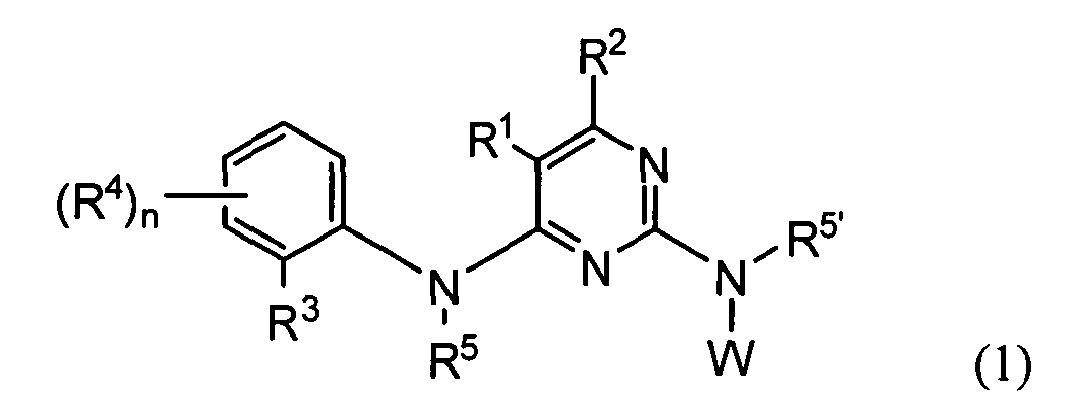
W is
each A2 and A3 is C, or one of A2 and A3 is N when R6 and R7 form a ring;
B and C are independently an optionally substituted 5-7 membered carbocyclic ring, aryl, heteroaryl or heterocyclic ring containing N, O or S;
Z1, Z2 and Z3 are independently NR11, C=O, CR-OR, (CR2)1-2 or =C-R12;
R1 and R2 are independently halo, OR12, NR(R12), SR12, or an optionally substituted C1-6 alkyl, C2-6 alkenyl or C2-6 alkynyl; or one of R1 and R2 is H;
R3 is (CR2)0-SO2R12, (CR2)0-2SO2NRR12, (CR2)0-2CO1-2R12, (CR2)0-2CONRR12 or cyano;
R4, R6, R7 and R10 are independently an optionally substituted C1-6alkyl, C2-6 alkenyl or C2-6 alkynyl; OR12, NR(R12), halo, nitro, SO2R12, (CR2)pR13 or X; or R4, R7 and R10 are independently H;
R, R5 and R5' are independently H or C1-6 alkyl;
R8 and R9 are independently C1-6 alkyl, C2-6 alkenyl, C2-6 alkynyl, halo or X, or one of R8 and R9 is H when R1 and R2 form a ring; and provided one of R8 and R9 is X;
alternatively, R1 and R2, or R6 and R7, R7 and R8, or R9 and R10, when attached to a carbon atom may form an optionally substituted 5-7 membered monocyclic or fused carbocyclic ring, aryl, or heteroaryl or heterocyclic ring comprising N, O and/or S; or R7, R8, R9 and R10 are absent when attached to N;
R11 is H, C1-6 alkyl, C2-6 alkenyl, (CR2)pCO1-2R, (CR2)pOR, (CR2)pR13, (CR2)pNRR12, (CR2)pCONRR12 or (CR2)pSO1-2R12;
R12 and R13 are independently an optionally substituted 3-7 membered saturated or partially unsaturated carbocyclic ring, or a 5-7 membered heterocyclic ring comprising N, O and/or S; aryl or heteroaryl; or R12 is H, C1-6 alkyl;
X is (CR2)qY, cyano, CO1-2R12, CONR(R12), CONR(CR2)pNR(R12), CONR(CR2)pOR12, CONR(CR2)pSR12, CONR(CR2)pS(O)1-2R12 or (CR2)1-6NR(CR2)pOR12;
Y is an optionally substituted 3-12 membered carbocyclic ring, a 5-12 membered aryl, or a 5-12 membered heteroaryl or heterocyclic ring comprising N, O and/or S and attached to A2 or A3 or both via a carbon atom of said heteroaryl or heterocyclic ring when q in (CR2)qY is 0; and
n, p and q are independently 0-4. - In the above Formula (1), R1 may be halo or C1-6 alkyl; R2 is H or NH2; or R1 and R2 together form an optionally substituted 5-6 membered aryl, or heteroaryl or heterocyclic ring comprising 1-3 nitrogen atoms. In other examples, R3 in Formula (1) may be SO2R12, SO2NH2 SO2NRR12, CO2NH2 CONRR12, CO1-2R12, or cyano; and R12 is C1-6alkyl, an optionally substituted C3-7 cycloalkyl, C3-7 cycloalkenyl, pyrrolidinyl, piperazinyl, piperidinyl, morpholinyl or azetidinyl. In yet other examples, R5, R5', R7 and R10 in Formula (1) are independently H, and n is 0. In other examples, R6 in Formula (1) may be halo or OR12, and R12 is C1-6 alkyl.
- In one embodiment, the invention provides compounds having Formula (2):

R2 is H; or
R1 and R2 together form an optionally substituted 5-6 membered heteroaryl or heterocyclic ring comprising one or two nitrogen atoms;
R6 is isopropoxy or methoxy;
one of R8 and R9 is (CR2)qY and the other is C1-6 alkyl, cyano, CO1-2R12, CONR(R12) or CONR(CR2)pNR(R12);
Y is an optionally substituted C3-7 cycloalkyl, C3-7 cycloalkenyl, or phenyl; or Y is pyridyl, pyrazolyl, isoxazolyl, imidazolyl, thiazolyl, benzimidazolyl, pyrrolidinyl, piperazinyl, piperidinyl, morpholinyl, azetidinyl, heptamethyleneimine or octamethyleneimine, each of which is attached to the phenyl ring via a carbon atom when q in (CR2)qY is 0;
n is 0-1; and
q is 0-4. - In the above Formula (2), one of R8 and R9 may be (CR2)qY and the other is C1-6 alkyl; and n and q are independently 0. In some examples, Y is pyrrolidinyl, piperidinyl, azetidinyl. In other examples, R1 is halo or C1-6 alkyl; and R2 is H.
- In another embodiment, the invention provides compounds having Formula (3A) or (3B):


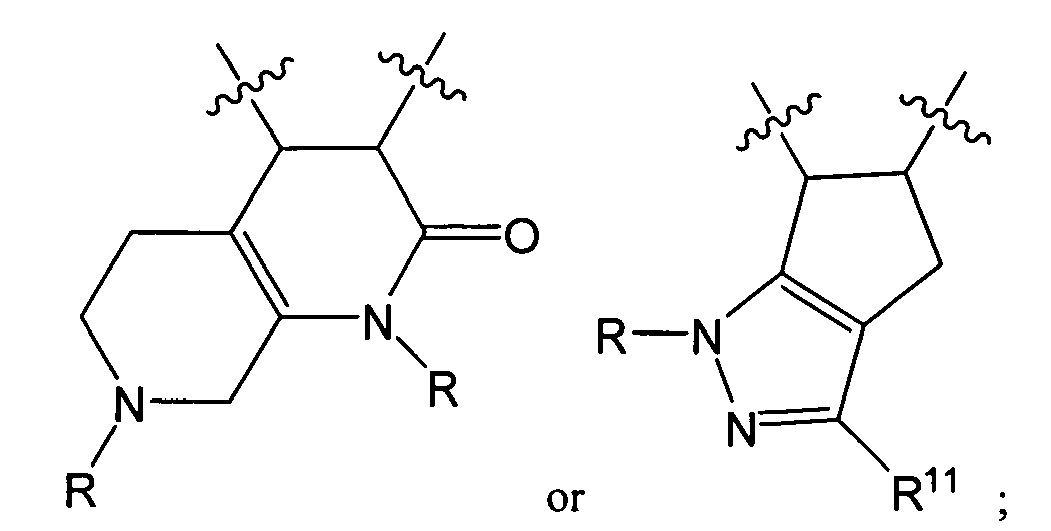


R1 is halo or C1-6 alkyl;
R2 is H; or
R1 and R2 together form an optionally substituted 5-7 membered carbocyclic ring, aryl, or heteroaryl or heterocyclic ring comprising N, O and/or S; and
R6 is isopropoxy or methoxy. - In the above Formula (3A) or (3B), each R11 may be (CR2)pCO1-2R, (CR2)pOR, (CR2)pR13, (CR2)pNRR12 or (CR2)pCONRR12;
R and R12 are independently H or C1-6 alkyl; and
R13 is an optionally substituted piperidinyl, azetidiyl, tetrahydropyranyl, cyclohexyl, morpholinyl, pyrrolidinyl, heptamethyleneimine, octamethyleneimine, a bicyclic amine or diamine derivative, quinuclidin-3-yl, 8-methyl-8-aza-bicyclo[3.2.1]oct-6-yl], or 9-methyl-9-aza-bicyclo[4.2.1]nonan-7-yl. - In yet another embodiment, the invention provides compounds having Formula (4A) or Formula (4B):


R2 is H; or
R1 and R2 together form an optionally substituted 5-7 membered carbocyclic ring, aryl, or heteroaryl or heterocyclic ring comprising N, O and/or S;
R6 is isopropoxy or methoxy; and
B2 and B3 are independently an optionally substituted 5-6 membered aryl or heteroaryl containing N, O or S. - In another aspect, the invention provides compounds having Formula (5):

Wis
each A2 and A3 is C, or one of A2 and A3 is N when R6 and R7 form a ring;
B and C are independently an optionally substituted 5-7 membered carbocyclic ring, aryl, heteroaryl or heterocyclic ring containing N, O or S;
Z1, Z2 and Z3 are independently NR11, C=O, CR-OR, (CR2)1-2 or =C-R12;
R1 and R2 are independently halo, OR12, NR(R12), SR12, or an optionally substituted C1-6 alkyl, C2-6 alkenyl or C2-6 alkynyl; or one of R1 and R2 is H;
R3 is (CR2)0-2SO2R12, (CR2)0-2SO2NRR (CR2)0-2CO1-2R12, (CR2)0-2CONRR12 or cyano;
R4, R6, and R7 and R10 when attached to a carbon atom, are independently H, an optionally substituted C1-6 alkyl, C2-6 alkenyl or C2-6 alkynyl; OR12, NR(R12), halo, nitro, SO2R12, (CR2)pR13 or X; provided R6 and R7 are not both H;
R, R5 and R5' are independently H or C1-6 alkyl;
R8 and R9 are independently C1-6 alkyl, C2-6 alkenyl, C2-6 alkynyl, halo or X, or one of R8 and R9 is H; and provided one of R8 and R9 is X;
alternatively, R1 and R2, or R6 and R7, R7 and R8, or R9 and R10, when attached to a carbon atom may form an optionally substituted 5-7 membered monocyclic or fused carbocyclic ring, aryl, or heteroaryl or heterocyclic ring comprising N, O and/or S; or R7, R8, R9 and R10 are absent when attached to N;
R11 is H, C1-6 alkyl, C2-6 alkenyl, (CR2)pCO1-2R, (CR2)pOR, (CR2)pR13, (CR2)pNRR12 (CR2)pCONRR12 or (CR2)pSO1-2R12;
R12 and R13 are independently an optionally substituted 3-7 membered saturated or partially unsaturated carbocyclic ring, or a 5-7 membered heterocyclic ring comprising N, O and/or S; aryl or heteroaryl; or R12 is H, C1-6 alkyl;
X is (CR2)qY, cyano, CO1-2R12, CONR(R12), CONR(CR2)pNR(R12), CONR(CR2)pOR12, CONR(CR2)pSR12, CONR(CR2)pS(O)1-2R12 or (CR2)1-6NR(CR2)pOR12;
Y is an optionally substituted 3-12 membered carbocyclic ring, a 5-12 membered aryl, or a 5-12 membered heteroaryl or heterocyclic ring comprising N, O and/or S and attached to A2 or A3 or both via a carbon atom of said heteroaryl or heterocyclic ring when q in (CR2)qY is 0; and n, p and q are independently 0-4. - In yet another aspect, the present invention provides pharmaceutical compositions comprising a compound having Formula (1), (2), (3A), (3B), (4A), (4B) or (5), and a pharmaceutically acceptable excipient.
- In yet another aspect, the invention provides methods for modulating ALK, FAK, ZAP-70 and/or IGF-1R, comprising administering to a system or a subject in need thereof, a therapeutically effective amount of a compound having Formula (1), (2), (3A), (3B), (4A), (4B) or (5), or pharmaceutically acceptable salts or pharmaceutical compositions thereof, thereby modulating said ALK, FAK, ZAP-70 and/or IGF-1R. The invention also provides methods to treat, ameliorate or prevent a condition which responds to inhibition of ALK, FAK, ZAP-70 and/or IGF-1R, comprising administering to a system or subject in need of such treatment an effective amount of a compound having Formula (1), (2), (3A), (3B), (4A), (4B) or (5), or pharmaceutically acceptable salts or pharmaceutical compositions thereof, and optionally in combination with a second therapeutic agent, thereby treating said condition. Alternatively, the present invention provides the use of a compound having Formula (1), (2), (3A), (3B), (4A), (4B) or (5) in the manufacture of a medicament for treating a condition mediated by ALK, FAK, ZAP-70 and/or IGF-1R. In particular embodiments, the compounds of the invention may be used alone or in combination with a second therapeutic agent to treat a condition mediated by ALK, wherein said condition is an autoimmune disease, a transplantation disease, an infectious disease or a cell proliferative disorder.
- Furthermore, the invention provides methods for treating a cell proliferative disorder, comprising administering to a system or subject in need of such treatment an effective amount of a compound having Formula (1), (2), (3A), (3B), (4A), (4B) or (5), or pharmaceutically acceptable salts or pharmaceutical compositions thereof, and optionally in combination with a second therapeutic agent, thereby treating said condition. Alternatively, the present invention provides the use of a compound having Formula (1), (2), (3A), (3B), (4A), (4B) or (5) in the manufacture of a medicament for treating a cell-proliferative disorder. In particular examples, the compounds of the invention may be used alone or in combination with a chemotherapeutic agent to treat a cell proliferative disorder, including but not limited to, lymphoma, osteosarcoma, melanoma, or a tumor of breast, renal, prostate, colorectal, thyroid, ovarian, pancreatic, neuronal, lung, uterine or gastrointestinal tumor.
- I n the above methods for using the compounds of the invention, a compound having Formula (1), (2), (3A), (3B), (4A), (4B) or (5) may be administered to a system comprising cells or tissues, or to a mammalian subject such as a human or animal subject.
- "Alk yl" refers to a moiety and as a structural element of other groups, for example halo-substituted-alkyl and alkoxy, and may be straight-chained or branched. An optionally substituted alkyl, alkenyl or alkynyl as used herein may be optionally halogenated (e.g., CF3), or may have one or more carbons that is substituted or replaced with a heteroatom, such as NR, 0 or S (e.g., -OCH2CH2O-, alkylthiols, thioalkoxy, alkylamines, etc).
- "Ar yl" refers to a monocyclic or fused bicyclic aromatic ring containing carbon atoms. "Arylene" means a divalent radical derived from an aryl group. For example, an aryl group may be phenyl, indenyl, indanyl, naphthyl, or 1,2,3,4-tetrahydronaphthalenyl, which may be optionally substituted in the ortho, meta or para position.
- "Hetero aryl" as used herein is as defined for aryl above, where one or more of the ring members is a heteroatom. Examples of heteroaryls include but are not limited to pyridyl, pyrazinyl, indolyl, indazolyl, quinoxalinyl, quinolinyl, benzofuranyl, benzopyranyl, benzothiopyranyl, benzo[1,3]dioxole, imidazolyl, benzo-imidazolyl, pyrimidinyl, furanyl, oxazolyl, isoxazolyl, triazolyl, benzotriazolyl, tetrazolyl, pyrazolyl, thienyl, pyrrolyl, isoquinolinyl, purinyl, thiazolyl, tetrazinyl, benzothiazolyl, oxadiazolyl, benzoxadiazolyl, etc.
- A "carbocyclic ring" as used herein refers to a saturated or partially unsaturated, monocyclic, fused bicyclic or bridged polycyclic ring containing carbon atoms, which may optionally be substituted, for example, with =O. Examples of carbocyclic rings include but are not limited to cyclopropyl, cyclobutyl, cyclopentyl, cyclohexyl, cyclopropylene, cyclohexanone, etc.
- A "hetero cyclic ring" as used herein is as defined for a carbocyclic ring above, wherein one or more ring carbons is a heteroatom. For example, a heterocyclic ring may contain N, O, S, -N=, -S-, -S(O), -S(O)2-, or -NR- wherein R may be hydrogen, C1-4alkyl or a protecting group. Examples of heterocyclic rings include but are not limited to morpholino, pyrrolidinyl, pyrrolidinyl-2-one, piperazinyl, piperidinyl, piperidinylone, 1,4-dioxa-8-aza-spiro[4.5]dec-8-yl, 1,2,3,4-tetrahydroquinolinyl, etc. Heterocyclic rings as used herein may encompass bicyclic amines and bicyclic diamines.
- The terms "co -administration" or "combined administration" or the like as used herein are meant to encompass administration of the selected therapeutic agents to a single patient, and are intended to include treatment regimens in which the agents are not necessarily administered by the same route of administration or at the same time.
- The term "ph armaceutical combination" as used herein refers to a product obtained from mixing or combining active ingredients, and includes both fixed and non-fixed combinations of the active ingredients. The term "fixed combination" means that the active ingredients, e.g. a compound of Formula (1) and a co-agent, are both administered to a patient simultaneously in the form of a single entity or dosage. The term "non-fixed combination" means that the active ingredients, e.g. a compound of Formula (1) and a co-agent, are both administered to a patient as separate entities either simultaneously, concurrently or sequentially with no specific time limits, wherein such administration provides therapeutically effective levels of the active ingredients in the body of the patient. The latter also applies to cocktail therapy, e.g. the administration of three or more active ingredients.
- The term "therapeutically effective amount" means the amount of the subject compound that will elicit a biological or medical response in a cell, tissue, organ, system, animal or human that is being sought by the researcher, veterinarian, medical doctor or other clinician.
- The term "administration" or "administering" of the subject compound means providing a compound of the invention and prodrugs thereof to a subject in need of treatment.
- The invention provides n ovel pyrimidine and pyridine derivatives and pharmaceutical compositions thereof, and methods for using such compounds.
- I n one aspect, the invention provides a having Formula (1):

W is
each A2 and A3 is C, or one of A2 and A3 is N when R6 and R7 form a ring;
B and C are independently an optionally substituted 5-7 membered carbocyclic ring, aryl, heteroaryl or heterocyclic ring containing N, O or S;
Z1, Z2 and Z3 are independently NR11, C=O, CR-OR, (CR2)1-2 or =C-R12;
R1 and R2 are independently halo, OR12, NR(R12), SR12, or an optionally substituted C1-6 alkyl, C2-6 alkenyl or C2-6 alkynyl; or one of R1 and R2 is H;
R3 is (CR2)0-2SO2R12, (CR2)0-2SO2NRR12, (CR2)0-2CO1-2R12, (CR2)0-2CONRR12 or cyano;
R4, R6, R7 and R10 are independently an optionally substituted C1-6 alkyl, C2-6 alkenyl or C2-6 alkynyl; OR12, NR(R12), halo, nitro, SO2R12, (CR2)pR13 or X; or R4, R7 and R10 are independently H;
R, R5 and R5' are independently H or C1-6 alkyl;
R8 and R9 are independently C1-6 alkyl, C2-6 alkenyl, C2-6 alkynyl, halo or X, or one of R8 and R9 is H when R1 and R2 form a ring; and provided one of R8 and R9 is X;
alternatively, R1 and R2, or R6 and R7, R7 and R8, or R9 and R10, when attached to a carbon atom may form an optionally substituted 5-7 membered monocyclic or fused carbocyclic ring, aryl, or heteroaryl or heterocyclic ring comprising N, O and/or S; or R7, R8, R9 and R10 are absent when attached to N;
R11 is H, C1-6 alkyl, C2-6 alkenyl, (CR2)pCO1-2R, (CR2)pOR, (CR2)pR13, (CR2)pNRR12, (CR2)pCONRR12 or (CR2)pSO1-2R12;
R12 and R13 are independently an optionally substituted 3-7 membered saturated or partially unsaturated carbocyclic ring, or a 5-7 membered heterocyclic ring comprising N, O and/or S; aryl or heteroaryl; or R12 is H, C1-6 alkyl;
X is (CR2)qY, cyano, CO1-2R12, CONR(R12), CONR(CR2)pNR(R12), CONR(CR2)pOR12, CONR(CR2)pSR12, CONR(CR2)pS(O)1-2R12 or (CR2)1-6NR(CR2)pOR12;
Y is an optionally substituted 3-12 membered carbocyclic ring, a 5-12 membered aryl, or a 5-12 membered heteroaryl or heterocyclic ring comprising N, O and/or S and attached to A2 or A3 or both via a carbon atom of said heteroaryl or heterocyclic ring when q in (CR2)qY is 0; and
n, p and q are independently 0-4. - In one embodiment, the invention provides compounds having Formula (2):

R2 is H; or
R1 and R2 together form an optionally substituted 5-6 membered heteroaryl or heterocyclic ring comprising one or two nitrogen atoms;
R6 is isopropoxy or methoxy;
one of R8 and R9 is (CR2)qY and the other is C1-6 alkyl, cyano, CO1-2R12, CONR(R12) or CONR(CR2)pNR(R12);
Y is an optionally substituted C3-7 cycloalkyl, C3-7 cycloalkenyl, or phenyl; or Y is pyridyl, pyrazolyl, isoxazolyl, imidazolyl, thiazolyl, benzimidazolyl, pyrrolidinyl, piperazinyl, piperidinyl, morpholinyl, azetidinyl, heptamethyleneimine or octamethyleneimine, each of which is attached to the phenyl ring via a carbon atom when q in (CR2)qY is 0;
n is 0-1; and
q is 0-4. - In another embodiment, the invention provides compounds having Formula (3A) or (3B):


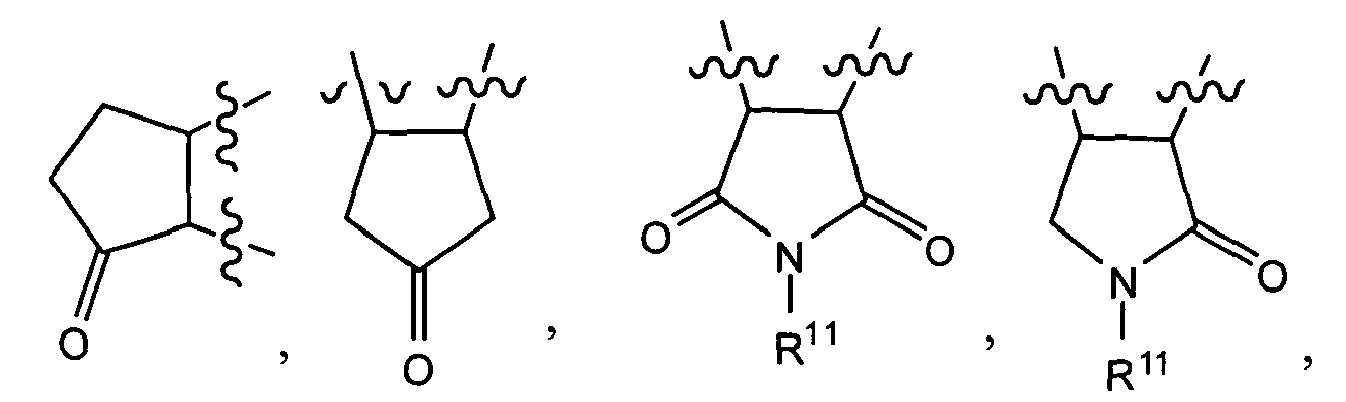

R1 is halo or C1-6 alkyl;
R2 is H; or
R1 and R2 together form an optionally substituted 5-7 membered carbocyclic ring, aryl, or heteroaryl or heterocyclic ring comprising N, O and/or S; and
R6 is isopropoxy or methoxy. - In yet another embodiment, the invention provides compounds having Formula (4A) or Formula (4B):


R2 is H; or
R1 and R2 together form an optionally substituted 5-7 membered carbocyclic ring, aryl, or heteroaryl or heterocyclic ring comprising N, O and/or S;
R6 is isopropoxy or methoxy; and
B2 and B3 are independently an optionally substituted 5-6 membered aryl or heteroaryl containing N, O or S. - In another aspect, the invention provides compounds having Formula (5):

W is
each A2 and A3 is C, or one of A2 and A3 is N when R6 and R7 form a ring;
B and C are independently an optionally substituted 5-7 membered carbocyclic ring, aryl, heteroaryl or heterocyclic ring containing N, O or S;
Z1, Z2 and Z3 are independently NR11, C=O, CR-OR, (CR2)1-2 or =C-R12;
R1 and R2 are independently halo, OR12, NR(R12), SR12, or an optionally substituted C1-6 alkyl, C2-6 alkenyl or C2-6alkynyl; or one of R1 and R2 is H;
R3 is (CR2)0-2SO2R12, (CR2)0-2SO2NRR12, (CR2)0-2CO1-2R12 (CR2)0-2CONRR12 or cyano;
R4, R6, and R7 and R10 when attached to a carbon atom, are independently H, an optionally substituted C1-6 alkyl, C2-6 alkenyl or C2-6 alkynyl; OR12, NR(R12), halo, nitro, SO2R12, (CR2)pR13 or X; provided R6 and R7 are not both H;
R, R5 and R5' are independently H or C1-6 alkyl;
R8 and R9 are independently C1-6 alkyl, C2-6 alkenyl, C2-6 alkynyl, halo or X, or one of R8 and R9 is H; and provided one of R8 and R9 is X;
alternatively, R1 and R2, or R6 and R7, R7 and R8, or R9 and R10, when attached to a carbon atom may form an optionally substituted 5-7 membered monocyclic or fused carbocyclic ring, aryl, or heteroaryl or heterocyclic ring comprising N, O and/or S; or R7, R8, R9 and R10 are absent when attached to N;
R11 is H, C1-6 alkyl, C2-6alkenyl, (CR2)pCO1-2R, (CR2)pOR, (CR2)pR13, (CR2)pNRR12, (CR2)pCONRR12 or (CR2)pSO1-2R12
R12 and R13 are independently an optionally substituted 3-7 membered saturated or partially unsaturated carbocyclic ring, or a 5-7 membered heterocyclic ring comprising N, O and/or S; aryl or heteroaryl; or R12 is H, C1-6 alkyl;
X is (CR2)qY, cyano, CO1-2R12, CONR(R12), CONR(CR2)pNR(R12), CONR(CR2)pOR12, CONR(CR2)pSR12, CONR(CR2)pS(O)1-2R12 or (CR2)1-6NR(CR2)pOR12;
Y is an optionally substituted 3-12 membered carbocyclic ring, a 5-12 membered aryl, or a 5-12 membered heteroaryl or heterocyclic ring comprising N, O and/or S and attached to A2 or A3 or both via a carbon atom of said heteroaryl or heterocyclic ring when q in (CR2)qY is 0; and n, p and q are independently 0-4. - In each of the above formula, Y or R13 may independently be heterocyclic rings, which may be a bicyclic amine or bicyclic diamine. Examples of bicyclic amine and bicyclic diamines include but are not limited to an optionally substituted hexanemethyleneimine; heptamethyleneimine; quinuclidine; 3-azabicyclo(3,3,0)octane; 3,8-diazabicyclo[3,2,1]octane; octahydro-1H-pyrido[3,4-C]azepine; octahydropyrrolizine; 6-azabicyclo[3,2,1]octane; 3-azabicyclo[3,2,1]octane; 2,5-diazabicyclo[2,2,1]heptane; I-azabicyclo[2,2,1]heptane; 2-azabicyclo[2,2,1]heptane; 1,4-diazabicyclo[4,4,0]decane; 1,4-diazabicyclo[4,3,0]nonane; 1-azabicyclo[3,2,1]octane; 3-azabicyclo[3,3,0]octane; 8-azabicyclo[3,2,1]octane; 3,9-diazabicyclo[4,2,1]nonane; octahydropyrrolo[3,4-C]pyrrole; octahydropyrrolo[3,4-B]pyrrole; hexahydropyrrolo[3,2-B]pyrrole; hexahydropyrrolo[3,2-C]pyrrole; 1,4-diazacyclooctane; 1,5-diazacyclooctane; 3,7-diazabicyclo[4,2,0]octane; 3,7-diazabicyclo[3,3,1]nonane; octahydropyrrolo[3,4-C]pyridine; octahydropyrrolo[3,4-B]pyridine; octahydrocyclopenta[C]pyrrolidine; hexahydrocyclopenta[C]pyrrolidine; 8-azabicyclo[3,2,1]octane; decahydroquinoline; decahydroisoquinoline; decahydropyrido[3,4-B]azepine; decahydropyrido[4,3-B]azepine; 9-azabicyclo[3,3,1]nonane; bispidine; 3-azabicyclo[3,1,0]hexane; 8-azabicyclo[3,2,1]octane; 2-azabicyclo[3.3.1]nonane; tetrahydroquinoline; tetrahydroisoquinoline; 2,5-diazabicyclo[2,2,2]octane; decahydro-2,7-naphthyridine; 1,4-diazepane; azonane; octahydro-1H-indole; octahydro-1H-isoindole; 2-azabicyclo[3,3,0]octane; 6-azabicyclo[3,2,1]octane; 7-aza-bicyclo[2.2.1]heptane; decahydropyrazino[1,2-a]azepine; 3,8-diaza-bicyclo[3,2,1]octane; 3-azabicyclo[3,2,1]octane; 3-aza-tricyclo[4,2,1,0(2,5)]nonane; 2,6-diazaspiro[3,5]nonane; 6-azabicyclo[2,1,0]hexane, etc.
- I n each of the above formula, any asymmetric carbon atoms may be present in the (R)-, (S)-or (R,S)-configuration. The compounds may thus be present as mixtures of isomers or as pure isomers, for example, as pure enantiomers or diastereomers. The invention further encompasses possible tautomers of the inventive compounds.
- In each of the above formula, each optionally substituted moiety may be substituted with C1-6 alkyl, C2-6 alkenyl or C3-6 alkynyl, each of which may be optionally halogenated or optionally having a carbon that may be replaced or substituted with N, S, O, or a combination thereof (for example, hydroxylC1-C8alkyl, C1-C8alkoxyC1-C8alkyl); halo, amino, amidino, C1-6 alkoxy; hydroxyl, methylenedioxy, carboxy; C1-8 alkylcarbonyl, C1-8 alkoxycarbonyl, carbamoyl, C1-8 alkylcarbamoyl, sulfamoyl, cyano, oxo, nitro, or an optionally substituted carbocyclic ring, heterocyclic ring, aryl or heteroaryl as previously described.
- The compounds of the invention and their pharmaceutically acceptable salts exhibit valuable pharmacological properties when tested in vitro in cell-free kinase assays and in cellular assays, and are therefore useful as pharmaceuticals.
- In one aspect, compounds of Formula (1), (2), (3A), (3B), (4A), (4B) or (5) may inhibit the tyrosine kinase activity of anaplastic lymphoma kinase (ALK) and the fusion protein of NPM-ALK. This protein tyrosine kinase results from a gene fusion of nucleophosmin (NPM) and ALK, rendering the protein tyrosine kinase activity of ALK ligand independent. NPM-ALK plays a key role in signal transmission in a number of hematopoetic and other human cells leading to hematological and neoplastic diseases, for example in anaplastic large-cell lymphoma (ALCL) and non-Hodgkin's lymphomas (NHL), specifically in ALK+NHL or Alkomas, in inflammatory myofibroblastic tumors (IMT) and neuroblastomas. (Duyster et al. 2001 Oncogene 20, 5623-5637). In addition to NPM-ALK, other gene fusions have been identified in human hematological and neoplastic diseases; for example, TPM3-ALK (a fusion of nonmuscle tropomyosin with ALK).
- The inhibition of ALK tyrosine kinase activity may be demonstrated using known methods, for example using the recombinant kinase domain of the ALK in analogy to the VEGF-R kinase assay described in J. Wood et al. Cancer Res. 60, 2178-2189 (2000). In general, in vitro enzyme assays using GST-ALK protein tyrosine kinase are performed in 96-well plates as a filter binding assay in 20 mM Tris HCl, pH = 7.5, 3 mM MgCl2, 10 mM MnCl2, 1 mM DTT, 0.1 µCi/assay (=30 µl) [γ-33]-ATP, 2 µM ATP, 3 µg/mL poly (Glu, Tyr 4:1) Poly-EY (Sigma P-0275), 1 % DMSO, 25 ng ALK enzyme. Assays are incubated for 10 min at ambient temperature. Reactions are terminated by adding 50 µl of 125 mM EDTA, and the reaction mixture is transferred onto a MAIP Multiscreen plate (Millipore, Bedford, MA, USA), previously wet with methanol, and rehydrated for 5 min with H2O. Following washing (0.5 % H3PO4), plates are counted in a liquid scintillation counter. IC50 values are calculated by linear regression analysis of the percentage inhibition.
- Compounds of Formula (1), (2), (3A), (3B), (4A), (4B) or (5) may potently inhibit the growth of human NPM-ALK overexpressing murine BaF3 cells (DSMZ Deutsche Sammiung von Mikroorganismen und Zelikulturen GmbH, Germany). The expression of NPM-ALK may be achieved by transfecting the BaF3 cell line with an expression vector pClneo™ (Promega Corp., Madison WI, USA) coding for NPM-ALK and subsequent selection of G418 resistant cells. Non-transfected BaF3 cells depend on IL-3 for cell survival. In contrast, NPM-ALK expressing BaF3 cells (named BaF3-NPM-ALK hereinafter) can proliferate in the absence of IL-3 because they obtain proliferative signal through NPM-ALK kinase. Putative inhibitors of the NPM-ALK kinase therefore abolish the growth signal and may result in antiproliferative activity. The antiproliferative activity of putative inhibitors of the NPM-ALK kinase can however be overcome by addition of IL-3, which provides growth signals through an NPM-ALK independent mechanism. An analogous cell system using FLT3 kinase has also been described (see, E Weisberg et al. Cancer Cell; 1, 433-443 (2002)).
- The inhibitor y activity of the compounds of the invention may be determined as follows. In general, BaF3-NPM-ALK cells (15,000/microtitre plate well) are transferred to 96-well microtitre plates. Test compounds dissolved in dimethyl sulfoxide (DMSO) are added in a series of concentrations (dilution series) in such a manner that the final concentration of DMSO is not greater than 1 % (v/v). After the addition, the plates are incubated for two days during which the control cultures without test compound are able to undergo two cell-division cycles. The growth of the BaF3-NPM-ALK cells is measured by means of YOPRO™ staining [T Idziorek et al. J. Immunol. Methods; 185: 249-258 (1995)]: 25 µl of lysis buffer comprising 20 mM sodium citrate, pH 4.0, 26.8 mM sodium chloride, 0.4 % NP40, 20 mM EDTA and 20 mM is added to each well. Cell lysis is completed within 60 min at room temperature and total amount of YOPRO™ bound to DNA is determined by measurement using the Cytofluor II 96-well reader (PerSeptive Biosystems) with the following settings: Excitation (nm) 485/20 and Emission (nm) 530/25.
- IC50 values may be determined by a computer-aided system using the formula:

- The IC50 value in those experiments is given as that concentration of the test compound in question that results in a cell count that is 50 % lower than that obtained using the control without inhibitor. The compounds of the invention in free form or in pharmaceutically acceptable salt form, may exhibit valuable pharmacological properties, for example, as indicated by the in vitro tests described in this application. In general, compounds of the invention have IC50 values from 1 nM to 10 µM. In some examples, compounds of the invention have IC50 values from 0.01 µM to 5 µM. In other examples, compounds of the invention have IC50 values from 0.01 µM to 1 µM, or more particularly from 1 nM to 1 µM. In yet other examples, compounds of the invention have IC50 values of less than 1 nM or more than 10 µM. The compounds of the invention may exhibit a percentage inhibition of greater than 50%, or in other embodiments, may exhibit a percentage inhibition greater than about 70%, against ALK at 10 µM.
- The antiprolifer ative action of the inventive compounds may also be determined in the human KARPAS-299 lymphoma cell line (DSMZ Deutsche Sammiung von Mikroorganismen und Zelikulturen GmbH, Braunschweig, Germany, described in WG Dirks et al. Int. J. Cancer 100, 49-56 (2002)) using the same methodology described above for the BaF3-NPM-ALK cell line. In some embodiments, compounds of the invention may exhibit inhibitory activity with an IC50 in the range from approximately 0.01 to 1 µM. The action of the inventive compounds on autophosphorylation of the ALK may be determined in the human KARPAS-299 lymphoma cell line by means of an immunoblot as described in WG Dirks et al. Int. J. Cancer 100, 49-56 (2002).
- In another aspect, the compounds of the invention may inhibit Focal Adhesion Kinase (FAK), and may be useful as pharmaceuticals to treat conditions caused by a malfunction of signal cascades connected with FAK, such as in the treatment of particular tumors. The inhibition of endogenous FAK signaling results in reduced motility, and in some cases induces cell death. On the other hand, enhancing FAK signaling by exogenous expression increases cell motility. In addition, FAK is overexpressed in invasive and metastatic epithelial, mesenchymal, thyroid and prostate cancers. Consequently, an inhibitor of FAK is likely to be a drug for antitumor growth and metastasis. The compounds of the invention may thus be useful to prevent and/or treat a vertebrate and more particularly a mammal, affected by a neoplastic disease, in particular breast tumor, cancer of the bowel (colon and rectum), stomach cancer and cancer of the ovary and prostate, non-small cell lung cancer, small cell lung cancer, cancer of liver, melanoma, bladder tumor and cancer of head and neck.
- The relation betw een FAK inhibition and immuno-system is described e.g. in G.A. van Seventer et al., Eur. J. Immunol. 2001, 31, 1417-1427. Therefore, the compounds of the invention are, for example, useful to prevent and/or treat a vertebrate and more particularly a mammal, affected by immune system disorders, diseases or disorders mediated by T lymphocytes, B lymphocytes, mast cells and/or eosinophils e.g. acute or chronic rejection of organ or tissue allo-or xenografts, atherosclerosis, vascular occlusion due to vascular injury such as angioplasty, restenosis, hypertension, heart failure, chronic obstructive pulmonary disease, CNS disease such as Alzheimer disease or amyotrophic lateral sclerosis; cancer; infectious disease such as AIDS; septic shock or adult respiratory distress syndrome, ischemia/reperfusion injury e.g. myocardial infarction, stroke, gut ischemia, renal failure or hemorrhage shock, or traumatic shock.
- In yet another aspect, the compounds of the invention may inhibit zeta chain-associate protein 70 (ZAP-70). ZAP-70 protein tyrosine kinase interaction of the agents of the invention may be demonstrated, for example, by their ability to prevent phosphorylation of LAT-11 (linker for activation of T cell) by human ZAP-70 protein tyrosine kinase in aqueous solution. Therefore, the compounds of the invention may be useful for the prevention or treatment of disorders or diseases where ZAP-70 inhibition plays a role.
- The compounds of the in vention may also inhibit insulin like growth-factor receptor 1 (IGF-1R), and may be useful in the treatment of IGF-1 R mediated diseases. Examples of IGF-1R mediated diseases include but are not limited to proliferative diseases, such as tumors, for example breast, renal, prostate, colorectal, thyroid, ovarian, pancreas, neuronal, lung, uterine and gastro intestinal tumors, as well as osteosarcomas and melanomas. The efficacy of the compounds of the invention as inhibitors of IGF-1R tyrosine kinase activity may be demonstrated using a cellular capture ELISA. In this assay, the activity of the compounds of the invention against (IGF-1)-induced autophosphorylation of the IGF-1R is determined.
- The compounds of the in vention may also be useful in the treatment and/or prevention of acute or chronic inflammatory diseases or disorders or autoimmune diseases e.g. rheumatoid arthritis, osteoarthritis, systemic lupus erythematosus, Hashimoto's thyroiditis, multiple sclerosis, myasthenia gravis, diabetes (type I and II) and the disorders associated therewith, respiratory diseases such as asthma or inflammatory liver injury, inflammatory glomerular injury, cutaneous manifestations of immunologically-mediated disorders or illnesses, inflammatory and hyperproliferative skin diseases (such as psoriasis, atopic dermatitis, allergic contact dermatitis, irritant contact dermatitis and further eczematous dermatitis, seborrhoeic dermatitis), s inflammatory eye diseases, e.g. Sjoegren's syndrome, keratoconjunctivitis or uveitis, inflammatory bowel disease, Crohn's disease or ulcerative colitis.
- I n accordance with the foregoing, the present invention provides:
- (1) a compound of the invention for use as a pharmaceutical;
- (2) a compound of the invention for use as an ALK inhibitor, FAK inhibitor, ZAP-70 inhibitor and/or IGF-1R inhibitor, for example for use in any of the particular indications hereinbefore set forth;
- (3) a pharmaceutical composition, e.g. for use in any of the indications herein before set forth, comprising a compound of the invention as active ingredient together with one or more pharmaceutically acceptable diluents or carriers;
- (4) a method for the treatment of any particular indication set forth hereinbefore in a subject in need thereof which comprises administering an effective amount of a compound of the invention or a pharmaceutical composition comprising same;
- (5) the use of a compound of the invention for the manufacture of a medicament for the treatment or prevention of a disease or condition in which ALK, FAK, ZAP-70 and/or IGF-1R activation plays a role or is implicated;
- (6) the method as defined above under (4) comprising co-administration, e.g. concomitantly or in sequence, of a therapeutically effective amount of a compound of the invention and one or more further drug substances, said further drug substance being useful in any of the particular indications set forth hereinbefore;
- (7) a combination comprising a therapeutically effective amount of a compound of the invention and one or more further drug substances, said further drug substance being useful in any of the particular indications set forth hereinbefore;
- (8) use of a compound of the invention for the manufacture of a medicament for the treatment or prevention of a disease which responds to inhibition of the anaplastic lymphoma kinase;
- (9) the use according to (8), wherein the disease to be treated is selected from anaplastic large cell lymphoma, non-Hodgkin's lymphomas, inflammatory myofibroblastic tumors, neuroblastomas and neoplastic diseases;
- (10) the use according to (8) or (9), wherein the compound is or a pharmaceutically acceptable; salt of any one of the examples;
- (11) a method for the treatment of a disease which responds to inhibition of the anaplastic lymphoma kinase, especially a disease selected from anaplastic large-cell lymphoma, non Hodgkin's lymphomas, inflammatory myofibroblastic tumors, neuroblastomas and neoplastic diseases, comprising administering an effective amount of a compound of the invention or a pharmaceutically acceptable salt thereof.
- In general, compounds of the invention will be administered in therapeutically effective amounts via any of the usual and acceptable modes known in the art, either singly or in combination with one or more therapeutic agents. A therapeutically effective amount may vary widely depending on the severity of the disease, the age and relative health of the subject, the potency of the compound used and other factors known to those of ordinary skill in the art. For example, for the treatment of neoplastic diseases and immune system disorders, the required dosage will also vary depending on the mode of administration, the particular condition to be treated and the effect desired.
- In general, satisfactory results are indicated to be obtained systemically at daily dosages of from about 0.01 to about 100 mg/kg per body weight, or particularly, from about 0.03 to 2.5 mg/kg per body weight. An indicated daily dosage in the larger mammal, e.g. humans, may be in the range from about 0.5 mg to about 2000 mg, or more particularly, from about 0.5 mg to about 100 mg, conveniently administered, for example, in divided doses up to four times a day or in retard form. Suitable unit dosage forms for oral administration comprise from ca. 1 to 50 mg active ingredient.
- Compounds of the invention ma y be administered as pharmaceutical compositions by any conventional route; for example, enterally, e.g., orally, e.g., in the form of tablets or capsules; parenterally, e.g., in the form of injectable solutions or suspensions; or topically, e.g., in the form of lotions, gels, ointments or creams, or in a nasal or suppository form.
- Pharmaceutic al compositions comprising a compound of the present invention in free form or in a pharmaceutically acceptable salt form in association with at least one pharmaceutically acceptable carrier or diluent may be manufactured in a conventional manner by mixing, granulating, coating, dissolving or lyophilizing processes. For example, pharmaceutical compositions comprising a compound of the invention in association with at least one pharmaceutical acceptable carrier or diluent may be manufactured in conventional manner by mixing with a pharmaceutically acceptable carrier or diluent. Unit dosage forms for oral administration contain, for example, from about 0.1 mg to about 500 mg of active substance.
- In one embodiment, the pharmaceutical compositions are solutions of the active ingredient, including suspensions or dispersions, such as isotonic aqueous solutions. In the case of lyophilized compositions comprising the active ingredient alone or together with a carrier such as mannitol, dispersions or suspensions can be made up before use. The pharmaceutical compositions may be sterilized and/or contain adjuvants, such as preserving, stabilizing, wetting or emulsifying agents, solution promoters, salts for regulating the osmotic pressure and/or buffers. Suitable preservatives include but are not limited to antioxidants such as ascorbic acid, or microbicides, such as sorbic acid or benzoic acid. The solutions or suspensions may further comprise viscosity-increasing agents, including but not limited to, sodium carboxymethylcellulose, carboxymethylcellulose, dextran, polyvinylpyrrolidone, gelatins, or solubilizers, e.g. Tween 80 (polyoxyethylene(20)sorbitan mono-oleate).
- Suspensions in oil ma y comprise as the oil component the vegetable, synthetic, or semi-synthetic oils customary for injection purposes. Examples include liquid fatty acid esters that contain as the acid component a long-chained fatty acid having from 8 to 22 carbon atoms, or in some embodiments, from 12 to 22 carbon atoms. Suitable liquid fatty acid esters include but are not limited to lauric acid, tridecylic acid, myristic acid, pentadecylic acid, palmitic acid, margaric acid, stearic acid, arachidic acid, behenic acid or corresponding unsaturated acids, for example oleic acid, elaidic acid, erucic acid, brassidic acid and linoleic acid, and if desired, may contain antioxidants, for example vitamin E, 3-carotene or 3,5-di-tert-butyl-hydroxytoluene. The alcohol component of these fatty acid esters may have six carbon atoms and may be monovalent or polyvalent, for example a mono-, di- or trivalent, alcohol. Suitable alcohol components include but are not limited to methanol, ethanol, propanol, butanol or pentanol or isomers thereof; glycol and glycerol.
- Other suitable fatt y acid esters include but are not limited ethyl-oleate, isopropyl myristate, isopropyl palmitate, LABRAFIL® M 2375, (polyoxyethylene glycerol), LABRAFIL® M 1944 CS (unsaturated polyglycolized glycerides prepared by alcoholysis of apricot kernel oil and comprising glycerides and polyethylene glycol ester), LABRASOL™ (saturated polyglycolized glycerides prepared by alcoholysis of TCM and comprising glycerides and polyethylene glycol ester; all available from GaKefosse, France), and/or MIGLYOL™ 812 (triglyceride of saturated fatty acids of chain length C8 to C12 from Hüls AG, Germany), and vegetable oils such as cottonseed oil, almond oil, olive oil, castor oil, sesame oil, soybean oil, or groundnut oil.
- Pharmaceutic al compositions for oral administration may be obtained, for example, by combining the active ingredient with one or more solid carriers, and if desired, granulating a resulting mixture, and processing the mixture or granules by the inclusion of additional excipients, to form tablets or tablet cores.
- Suitable carrie rs include but are not limited to fillers, such as sugars, for example lactose, saccharose, mannitol or sorbitol, cellulose preparations, and/or calcium phosphates, for example tricalcium phosphate or calcium hydrogen phosphate, and also binders, such as starches, for example corn, wheat, rice or potato starch, methylcellulose, hydroxypropyl methylcellulose, sodium carboxymethylcellulose, and/or polyvinylpyrrolidone, and/or, if desired, disintegrators, such as the above-mentioned starches, carboxymethyl starch, crosslinked polyvinylpyrrolidone, alginic acid or a salt thereof, such as sodium alginate. Additional excipients include flow conditioners and lubricants, for example silicic acid, talc, stearic acid or salts thereof, such as magnesium or calcium stearate, and/or polyethylene glycol, or derivatives thereof.
- Tablet cor es may be provided with suitable, optionally enteric, coatings through the use of, inter alia, concentrated sugar solutions which may comprise gum arable, talc, polyvinylpyrrolidone, polyethylene glycol and/or titanium dioxide, or coating solutions in suitable organic solvents or solvent mixtures, or, for the preparation of enteric coatings, solutions of suitable cellulose preparations, such as acetylcellulose phthalate or hydroxypropylmethylcellulose phthalate. Dyes or pigments may be added to the tablets or tablet coatings, for example for identification purposes or to indicate different doses of active ingredient.
- Pharmaceutic al compositions for oral administration may also include hard capsules comprising gelatin or soft-sealed capsules comprising gelatin and a plasticizer, such as glycerol or sorbitol. The hard capsules may contain the active ingredient in the form of granules, for example in admixture with fillers, such as corn starch, binders, and/or glidants, such as talc or magnesium stearate, and optionally stabilizers. In soft capsules, the active ingredient may be dissolved or suspended in suitable liquid excipients, such as fatty oils, paraffin oil or liquid polyethylene glycols or fatty acid esters of ethylene or propylene glycol, to which stabilizers and detergents, for example of the polyoxyethylene sorbitan fatty acid ester type, may also be added.
- Pharmaceutic al compositions suitable for rectal administration are, for example, suppositories comprising a combination of the active ingredient and a suppository base. Suitable suppository bases are, for example, natural or synthetic triglycerides, paraffin hydrocarbons, polyethylene glycols or higher alkanols.
- Pharmaceutic al compositions suitable for parenteral administration may comprise aqueous solutions of an active ingredient in water-soluble form, for example of a water-soluble salt, or aqueous injection suspensions that contain viscosity-increasing substances, for example sodium carboxymethylcellulose, sorbitol and/or dextran, and, if desired, stabilizers. The active ingredient, optionally together with excipients, can also be in the form of a lyophilizate and can be made into a solution before parenteral administration by the addition of suitable solvents. Solutions such as are used, for example, for parenteral administration can also be employed as infusion solutions. The manufacture of injectable preparations is usually carried out under sterile conditions, as is the filling, for example, into ampoules or vials, and the sealing of the containers.
- The compounds of the in vention may be administered as the sole active ingredient, or together with other drugs useful against neoplastic diseases or useful in immunomodulating regimens. For example, the compounds of the invention may be used in accordance with the invention in combination with pharmaceutical compositions effective in various diseases as described above, e.g. with cyclophosphamide, 5-fluorouracil, fludarabine, gemcitabine, cisplatinum, carboplatin, vincristine, vinblastine, etoposide, irinotecan, paclitaxel, docetaxel, rituxan, doxorubicine, gefitinib, or imatinib; or also with cyclosporins, rapamycins, ascomycins or their immunosuppressive analogs, e.g. cyclosporin A, cyclosporin G, FK-506, sirolimus or everolimus, corticosteroids, e.g. prednisone, cyclophosphamide, azathioprene, methotrexate, gold salts, sulfasalazine, antimalarials, brequinar, leflunomide, mizoribine, mycophenolic acid, mycophenolate, mofetil, 15-deoxyspergualine, immuno-suppressive monoclonal antibodies, e.g. monoclonal antibodies to leukocyte receptors, e.g. MHC, CD2, CD3, CD4, CD7, CD25, CD28, I CD40, CD45, CD58, CD80, CD86, CD152, CD137, CD154, ICOS, LFA-1, VLA-4 or their ligands, or other immunomodulatory compounds, e.g. CTLA41 g.
- The invention also provides for a ph armaceutical combinations, e.g. a kit, comprising a) a first agent which is a compound of the invention as disclosed herein, in free form or in pharmaceutically acceptable salt form, and b) at least one co-agent. The kit can comprise instructions for its administration.
- Compounds of Formula (1) may be prepared following Reaction Scheme I, in which each substituent is as defined in the Summary of the Invention:

- A compound of Fo rmula (1) may be synthesized by reacting a compound of formula (6) with a compound of formula (7) in the presence of palladium catalyst (for example palladium acetate and the like), ligand (for example xantphos and the like) and base (for example cesium carbonate and the like) in a suitable solvent (for example, THF, and the like). The reaction proceeds in a temperature range of about 70°C to about 180°C and can take 10 min. to 8 hours to complete.
- Alternatively, a compound of Formula (1) may be synthesized by reacting a compound of formula (6) with a compound of formula (7) in the presence of acid (for example HCl, TsOH and the like), in a suitable solvent (for example, 2-propanol, and the like). The reaction proceeds in a temperature range of about 70°C to about 150°C and can take up to 12 hours to complete.
- The compounds of the invention, including their salts, are also obtainable in the form of hydrates, or their crystals may include for example the solvent used for crystallization (present as solvates). Salts can usually be converted to compounds in free form, e.g., by treating with suitable basic agents, for example with alkali metal carbonates, alkali metal hydrogen carbonates, or alkali metal hydroxides, such as potassium carbonate or sodium hydroxide. In view of the close relationship between the novel compounds in free form and those in the form of their salts, including those salts that may be used as intermediates, for example in the purification or identification of the novel compounds, any reference to the free compounds hereinbefore and hereinafter is to be understood as referring also to the corresponding salts, as appropriate.
- Salts of the inventive co mpounds with a salt-forming group may be prepared in a manner known per se. Acid addition salts of compounds of Formula (1), (2), (3A), (3B), (4A), (4B) or (5) may thus be obtained by treatment with an acid or with a suitable anion exchange reagent. Pharmaceutically acceptable salts of the compounds of the invention may be formed, for example, as acid addition salts, with organic or inorganic acids, from compounds of Formula (1), (2), (3A), (3B), (4A), (4B) or (5) with a basic nitrogen atom.
- Suitable inorganic acids include, but are not limited to, halogen acids, such as hydrochloric acid, sulfuric acid, or phosphoric acid. Suitable organic acids include, but are not limited to, carboxylic, phosphoric, sulfonic or sulfamic acids, for example acetic acid, propionic acid, octanoic acid, decanoic acid, dodecanoic acid, glycolic acid, lactic acid, fumaric acid, succinic acid, adipic acid, pimelic acid, suberic acid, azelaic acid,-malic acid, tartaric acid, citric acid, amino acids, such as glutamic acid or aspartic acid, maleic acid, hydroxymaleic acid, methylmaleic acid, cyclohexanecarboxylic acid, adamantanecarboxylic acid, benzoic acid, salicylic acid, 4 aminosalicylic acid, phthalic acid, phenylacetic acid, mandelic acid, cinnamic acid, methane-or ethane-sulfonic acid, 2-hydroxyethanesulfonic acid, ethane-1,2-disulfonic acid, benzenesulfonic acid, 2-naphthalenesulfonic acid, 1,5-naphthalene-disuifonic acid, 2-, 3-or 4 methylbenzenesulfonic acid, methylsulfuric acid, ethylsulfuric acid, dodecylsulfuric acid, N cyclohexylsulfamic acid, N-methyl-, N-ethyl-or N-propyl-sulfamic acid, or other organic protonic acids, such as ascorbic acid.
- For isolation or purification purposes, it is also possible to use pharmaceutically unacceptable salts, for example picrates or perchlorates. For therapeutic use, only pharmaceutically acceptable salts or free compounds are employed (where applicable in the form of pharmaceutical preparations).
- Compounds of the invention in unoxidized form may be prepared from N-oxides of compounds of the invention by treating with a reducing agent (e.g., sulfur, sulfur dioxide, triphenyl phosphine, lithium borohydride, sodium borohydride, phosphorus trichloride, tribromide, or the like) in a suitable inert organic solvent (e.g. acetonitrile, ethanol, aqueous dioxane, or the like) at 0 to 80°C.
- Prodrug derivatives of the compounds of the invention may be prepared by methods known to those of ordinary skill in the art (e.g., for further details see Saulnier et al., (1994), Bioorganic and Medicinal Chemistry Letters, Vol. 4, p. 1985). For example, appropriate prodrugs may be prepared by reacting a non-derivatized compound of the invention with a suitable carbamylating agent (e.g., 1,1-acyloxyalkylcarbanochloridate, para-nitrophenyl carbonate, or the like).
- Protected deriv atives of the compounds of the invention may be made by means known to those of ordinary skill in the art. A detailed description of techniques applicable to the creation of protecting groups and their removal may be found in T. W. Greene, "Protecting Groups in Organic Chemistry", 3rd edition, John Wiley and Sons, Inc., 1999.
- Compounds of the invention may be prepared as their individual stereoisomers by reacting a racemic mixture of the compound with an optically active resolving agent to form a pair of diastereoisomeric compounds, separating the diastereomers and recovering the optically pure enantiomers. Resolution of enantiomers may be carried out using covalent diastereomeric derivatives of the compounds of the invention, or by using dissociable complexes (e.g., crystalline diastereomeric salts). Diastereomers have distinct physical properties (e.g., melting points, boiling points, solubilities, reactivity, etc.) and may be readily separated by taking advantage of these dissimilarities. The diastereomers may be separated by fractionated crystallization, chromatography, or by separation/resolution techniques based upon differences in solubility. The optically pure enantiomer is then recovered, along with the resolving agent, by any practical means that would not result in racemization. A more detailed description of the techniques applicable to the resolution of stereoisomers of compounds from their racemic mixture may be found in Jean Jacques, Andre Collet, Samuel H. Wilen, "Enantiomers, Racemates and Resolutions", John Wiley And Sons, Inc., 1981.
- In summary, the compounds of the invention may be made by a process, which involves:
- (a) that of Reaction Scheme I; and
- (b) optionally converting a compound of the invention into a pharmaceutically acceptable salt;
- (c) optionally converting a salt form of a compound of the invention to a non-salt form;
- (d) optionally converting an unoxidized form of a compound of the invention into a pharmaceutically acceptable N-oxide;
- (e) optionally converting an N-oxide form of a compound of the invention to its unoxidized form;
- (f) optionally resolving an individual isomer of a compound of the invention from a mixture of isomers;
- (g) optionally converting a non-derivatized compound of the invention into a pharmaceutically acceptable prodrug derivative; and
- (h) optionally converting a prodrug derivative of a compound of the invention to its non-derivatized form.
- I nsofar as the production of the starting materials is not particularly described, the compounds are known or can be prepared analogously to methods known in the art or as disclosed in the Examples hereinafter. One of skill in the art will appreciate that the above transformations are only representative of methods for preparation of the compounds of the present invention, and that other well known methods can similarly be used. The present invention is further exemplified, but not limited, by the following and Examples that illustrate the preparation of the compounds of the invention.
-

- To a suspension of 730 mg of NaH in a mixture of DMF/DMSO (25/2.5 ml) is added drop-wise at 0°C, 2.53 g (12.69 mmol) of 2-(iso-propylsulfonyl)benzenamine in DMF/DMSO (10 ml, ratio 9/1). The solution is stirred 30 minutes at 0°C and 4.11 g (25.3 mmol, 2 eq.) of 2,4-dichloro-5-methylpyrimidine diluted in 10 ml of DMF/DMSO (ratio: 9/1) is added dropwise. The solution is warmed-up to room temperature and stirred overnight. After work-up, the crude product is directly crystallized from cold CH3CN in several batches to afford 2-chloro-N-(2-(isopropylsulfonyl)phenyl)-5-methylpyrimidin-4-amine as pale creamy colored crystals: ESMS m/z 326.1 (M + H+).
-

- Using the sam e procedure described for the synthesis of 2-chloro-N-(2-(isopropylsulfonyl)phenyl)-5-methylpyrimidin-4-amine, 2,5-dichloro-N-(2-(isopropylsulfonyl)phenyl)pyrimidin-4-amine is isolated as a creamy colored solid: ESMS m/z 346.0 (M+H+).
-

- To a solution of 100 g (0. 7 mol) of 2-chloro-4-fluorotoluene in 250 ml of concentrated H2SO4 is added portion-wise 85 g (0.875 mol) of KNO3 at 0°C (addition of the whole amount of KNO3 is finished in about 1 hour). The reddish mixture is slowly warmed-up at room temperature overnight and quenched over crushed ice and extracted with EtOAc. The organic layers are combined, dried over MgSO4 and concentrated. The crude oil is then purified over a large silica plug (eluent: 97/3 hexanes/EtOAc) to afford 2-chloro-4-fluoro-5-nitrotoluene as a pale yellow oil that solidifies upon standing. 1H NMR (CDCl3, 400 Mz): 7.97 (d, J = 8.0 Hz, 1H), 7.32 (d, J = 10.4 Hz, 1H), 2.43 (s, 3H).
-

- To a solution of 25 g (0.1 31 mol) of 2-chloro-4-fluoro-5-nitrotoluene in 250 ml of 2-propanol is added 208 g (0.659 mol, 5 eq.) of Cs2CO3. The mixture is stirred at 60°C overnight and most of the 2-propanol is evaporated under reduced pressure. Water is added and the solution is extracted with EtOAc. The organic layers are combined, dried over MgSO4, concentrated and the crude product filtrated over a silica plug (eluent: 95/5 hexanes/EtOAc) to afford 2-chloro-4-isopropoxy-5-nitrotoluene as a pale yellow fluffy solid.
-

- A mixture of 5.09 g 2 -chloro-4-isopropoxy-5-nitrotoluene (0.02216 mol), 6.20 g (0.02437 mol) of pinacol diborane, 595 mg (0.00212 mol) of PCy3, 1.014 g (0.00108 mol) of Pd2dba3 and 3.16 g (0.0322 mol) of KOAc in 100 ml of dry dioxane is heated to 100°C overnight. After cooling to RT, the dark solution is filtered over Celite and the solvent evaporated under reduced pressure. The crude oil is purified with silica gel column chromatography (eluent: 95/5 hexanes/EtOAc) to afford 2-methyl-4-nitro-5-isopropoxy-phenylboronic acid pinacol ester as an oil that solidifies upon standing. 1H NMR (CDCl3, 400 Mz): 7.51 (s, 1H), 7.44 (s, 1H), 4.70 (m, 1H), 2.48 (s, 3H), 1.36 (d, J = 7.6 Hz, 6H), 1.35 (s, 12H).
-

- A solution of N-tert-Butoxycarbonyl-4-piperidone (10.17 g, 0.05 mol) in THF (100 mL) is added dropwise into a cooled (-78 °C), vigorously stirring solution of LDA (40 mL of 1.5 M solution in cyclohexanes, 0.06 mol) in THF (100 mL), under N2. The reaction mixture is left at -78 °C for 30 min before adding a solution of phenyl trifluorosulfonimide (19.85 g, 0.055 mol) in THF (50 mL). Then the reaction mixture is warmed to room temperature and stirred for 3 h. The reaction is quenched at 0 °C with 100 mL of saturated aqueous NH4Cl and filtered through Celite. The filtrate is added to 100 mL of EtOAc and the layers are separated. The organic layer is washed with H2O, dried over MgSO4 and concentrated. The crude product is purified by silica flash column chromatography (0-30% EtOAc in Hexanes as eluent and checked by TLC stained with 2% of KMnO4 in EtOH) to afford 4-Trifluoromethanesulfonyloxy-3,6-dihydro-2H-pyridine-1-carboxylic acid tert-butyl ester as a yellow oil.
-

- To a solution of 2 -methyl-4-nitro-5-isopropoxy-phenylboronic acid pinacol ester (2.04 g, 6.4 mmol) and 4-Trifluoromethanesulfonyloxy-3,6-dihydro-2H-pyridine-1-carboxylic acid tert-butyl ester (3.2 g, 9.6 mmol) in 110 mL of DME/H2O (10:1 V/V) is added Pd(PPh3)4 (365 mg, 0.32 mmol) and Cs2CO3 (4.2 g, 12.8 mmol). The reaction mixture is heated under N2 at 80 °C overnight. After cooling to room temperature, the reaction is filtered through Celite and the filtrate is diluted with 100 mL of EtOAc, sequentially washed with H2O brine, and finally concentrated in vacuo. The crude product is purified by silica gel flash chromatography (5%-15% EtOAc in Hexanes as eluent) to afford 4-(5-Isopropoxy-2-methyl-4-nitro-phenyl)-3,6-dihydro-2H-pyridine-1-carboxylic acid tert-butyl ester as a yellow oil. 1H NMR (CD3OD, 400 Mz): 7.59 (s, 1H), 6.96 (s, 1H), 5.67 (broad s, 1H), 4.73 (m, 1H), 4.06 (m, 2H), 3.65 (m, 2H), 2.37 (m, 2H), 2.25 (s, 3H), 1.50 (s, 9H), 1.33 (d, J = 6.0 Hz, 6H).
-

- A mixture of 2 -chloro-4-fluoro-5-nitro-benzoic acid (5.0 g, 22.8 mmol) and cesium carbonate (29.7 g, 91.1 mmol) in 2-propanol (100 mL) is heated at 50°C overnight. The solvent is removed in vacuo and 100 mL of water is added. Concentrated aqueous HCl is added dropwise to this solution at 0 °C until pH=2. The product precipitate which forms is isolated by filtration, washed by water and dried under vacuum to give 2-chloro-4-isopropoxy-5-nitrobenzoic acid.
-

-

- To a solution of 2 -chloro-4-isopropoxy-5-nitro-benzoic acid (Intermediate 8, 10 g, 38.5 mmol) in DCM (200 mL) and DMF (1mL), is slowly added thionyl chloride (9.17 g, 77 mmol) via a syringe. The mixture is stirred for 3 hours, and is then concentrated to dryness. The obtained white solid, 2-chloro-4-isopropoxy-5-nitro-benzoyl chloride, is dried under vacuum. To a mixture of 4-amino-piperidine-1-carboxylic acid tert-butyl ester (1.44g, 7.2 mmol) and triethylamine (3 mL, 21.6 mmol) in DCM (100 mL), is slowly added 2-chloro-4-isopropoxy-5-nitro-benzoyl chloride (2g, 7.2 mmol) dissolved in DCM (10 mL) via syringe. The mixture is stirred at room temperature for 3 hours, and then is concentrated. The obtained solid is dissolved in ethyl acetate and is washed with water and brine respectively. After evaporation of the solvent, the title compound is obtained as light yellow solid, and is directly used for the next step without further purification.
-

- To a mixture of 4 -(2-chloro-4-isopropoxy-5-nitro-benzoylamino)-piperidine-1-carboxylic acid tert-butyl ester (7.2 mmol) obtained in the previous step, vinylboronic acid dibutyl ester (1.72 g, 9.4 mmol) and sodium carbonate (5.34 g, 50.4 mmol) in THF/H2O (100/25 mL) is added dichlorobis(triphenylphospine) palladium (II) (442 mg, 5% mmol). The mixture is purged with N2 for 3 min and heated at 90°C under N2 for overnight in a round bottom flask equipped with a condenser. The mixture is cooled to room temperature and poured into saturated aqueous ammonia chloride solution. The mixture is extracted with ethyl acetate (3 x 100 mL). The organic extracts are combined, washed with brine and concentrated. The crude product is purified with silica gel column chromatography (40% ethyl acetate in hexanes) to afford 4-(4-isopropoxy-5-nitro-2-vinyl-benzoylamino)-piperidine-1-carboxylic acid tert-butyl ester as white solid.
-
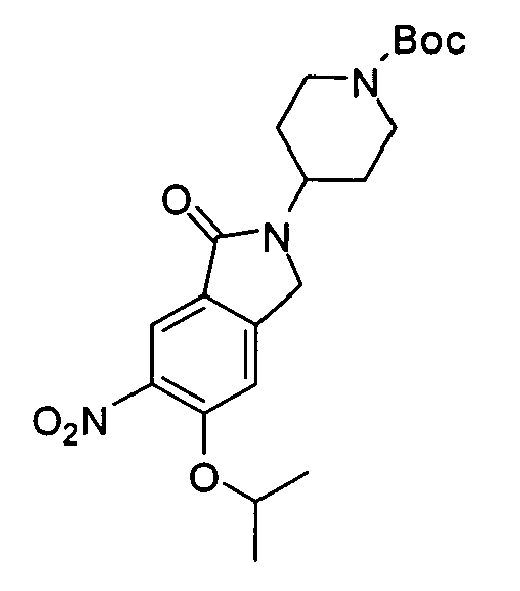
- 4 -(4-Isopropoxy-5-nitro-2-vinyl-benzoylamino)-piperidine-I-carboxylic acid tert-butyl ester obtained from previous step (1.9 g, 4.38mmol) is dissolved in DCM (100 mL) and is cooled to -78 °C. O3 (g) is bubbled into the solution until the solution's color turns blue/gray. The solution is then purged with N2 (g) until the blue color disappears. The solution is warmed to room temperature and treated with triphenyl phosphine resin (5 g) pre-swelled in DCM (100 mL). After 30 min, the mixture is filtered, the filtrate is concentrated, and the resulting residue dissolved in DCM/TFA (100mL / 25 mL). To this mixture is added triethyl silane (4.6 mL, 17.5 mmol). The resulting mixture is stirred at room temperature overnight. The reaction mixture is concentrated and re-dissolved in DCM. The DCM solution is washed with IN aqueous HCl (3 x 20 mL). The combined aqueous layer is treated with conc. aqueous NaOH until pH =12. The aqueous layer is extracted with ethyl acetate (3 x 30 mL). The combined organic layers are washed with brine, and dried over sodium sulfate. A light yellow solid is obtained after evaporation of the organic solvent.
- The solid is dissolved in a mixture of methanol and triethylamine (100mL, 9:1 v/v). To this mixture is added di-tert-butyl dicarbonate (680 mg, 3.1 mmol). After stirring at 50 °C for 30 minutes, the mixture is concentrated and purified by silica gel flash column chromatography (eluent: 40∼50% ethyl acetate in hexanes) to afford 4-(5-Isopropoxy-6-nitro-1-oxo-1,3-dihydro-isoindol-2-yl)-piperidine-1-carboxylic acid tert-butyl ester as a white solid. 1H NMR (400 MHz, CDCl3) δ 8.19 (s, 1H), 7.11 (s, 1H), 4.74 (q, 1H), 4.45-4.38 (m, 1H), 4.35 (s, 2H), 2.90-2.80 (m, 2H), 1.85-1.81 (m, 2H), 1.66-1.63 (m, 2H), 1.48 (s, 9H), 1.42 (d, 6H).
- To a solution of 4 -(5-isopropoxy-6-nitro-l-oxo-1,3-dihydro-isoindol-2-yl)-piperidine-1-carboxylic acid tert-butyl ester from the previous step (850 mg, 2mmol) in methanol, is added Pd/C (10% on carbon, 100 mg). The mixture is hydrogenated under 1 atm of hydrogen gas. After 4 hours, the mixture is filtered and concentrated. The obtained aniline, as yellow solid, is used for next step without additional purification. To a mixture of the crude product (2 mmol) from previous step, (2,5-dichloro-pyrimidin-4-yl)-[2-(propane-2-sulfonyl)-phenyl]-amine (Intermediate 2, 770mg, 2.2 mmol), cesium carbonate (1.3g, 4mmol), and xantphos (115 mg, 0.2mmol) in THF (20 mL), is added palladium acetate (22mg, 5% mmol) in a microwave tube. The mixture is purged with N2 for 3 min. The sealed tube is heated at 150°C for 20 min under microwave irradiation. The mixture is cooled, filtered and concentrated. The residue is purified by silica gel flash column chromatography (eluent: 65% ethyl acetate in hexanes) to afford a yellow solid. The solid is treated with DCM/TFA (1/1, 10mL)) for 1 hour followed by concentration under vacuum. Final purification using preparative RP LC-MS affords 6-{5-Chloro-4-[2-(propane-2-sulfonyl)-phenylamino]-pyrimidin-2-ylamino}-5-isopropoxy-2-piperidin-4-yl-2,3-dihydro-isoindol-1-one (178) as a white solid. 1H NMR (400 MHz, CDCl3) δ 10.38 (s, 1H), 10.13 (s, 1H), 9.60-9.50 (br, 1H), 9.34-9.21 (br, 1H), 8.46 (d, 1H), 8.26 (s, 1H), 8.08 (s, 1H), 7.91 (dd, 1H), 7.71 (m, 1H), 7.34 (t, 1H), 7.03 (s, 1H), 4.30 (m, 1H), 4.53 (m, 1H), 4.33 (s, 2H), 3.62 (m, 2H), 3.21-3.09 (m, 3H), 2.31-2.21 (m, 2H), 2.09-2.05 (m, 2H), 1.41 (d, 6H), 2.30 (d, 6H); ESMS m/z 599.2 (M + H+).
-

-
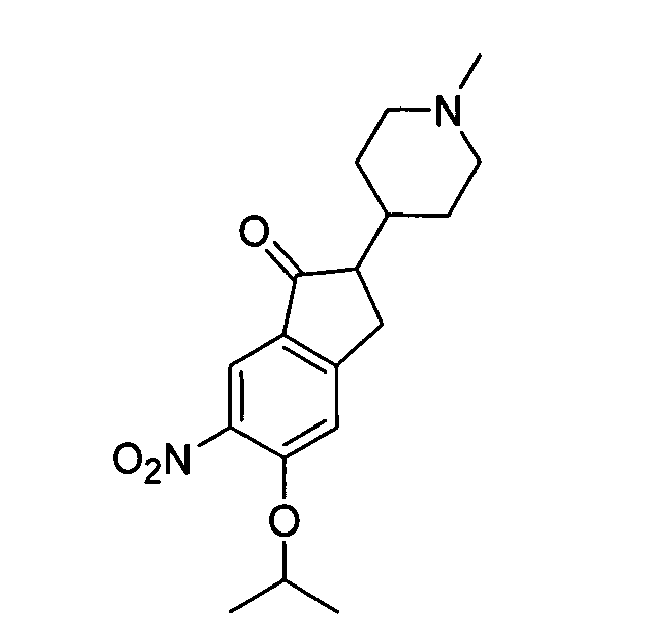
- To a solution of 5 -isopropoxy-6-nitro-2-piperidin-4-yl-indan-1-one (Example 1, Step 5) in THF (5 mL) and methanol (5 mL) is added formaldehyde (104.2 uL, 1.39 mmol) and 10 drops of AcOH sequentially. The reaction mixture is stirred at room temperature for 1h, then sodium cyanoborohydride (175.1 mg, 2.78 mmol) is added in one portion, and the reaction is stirred for an additional 30 min. The reaction is quenched by saturated aqueous NH4Cl and concentrated in vacuo to give an oily residue. This oil is partitioned between EtOAc and brine, the organic extract is dried over Na2SO4, filtered and concentrated under vacuum. Silica gel chromatography (5% MeOH in DCM) affords 5-isopropoxy-2-(1-methyl-piperidin-4-yl)-6-nitro-indan-1-one; MS m/z 333.2 (M+1).
- Following the procedures previously described (Example 1, Steps 7 and 8) using the product from Step 1 generates the title compound 6-{5-Chloro-4-[2-(propane-2-sulfonyl)-phenylamino]-pyrimidin-2-ylamino}-5-isopropoxy-2-(1-methyl-piperidin-4-yl)-2,3-dihydro-isoindol-1-one (181) as a white solid. 1H NMR 400 MHz (DMSO-d6 with trace D2O) δ 8.46 (d, 1H), 8.35 (s, 1H), 8.09(s, 1H), 7.82(d, 1H), 7.74(t, 1H), 7.36(t,1H), 7.33(s, 1H), 4.75 (m, 1H), 4.41(s, 2H), 4,29(m, 1H), 3.65(m, 2H), 3.44(m, 1H), 3.17(t, 2H), 2,79(s, 3H), 2.07(m, 2H), 1,98(d, 2H), 1.28(d, 6H), 1.14(d, 6H); MS m/z 613 (M+1).
-
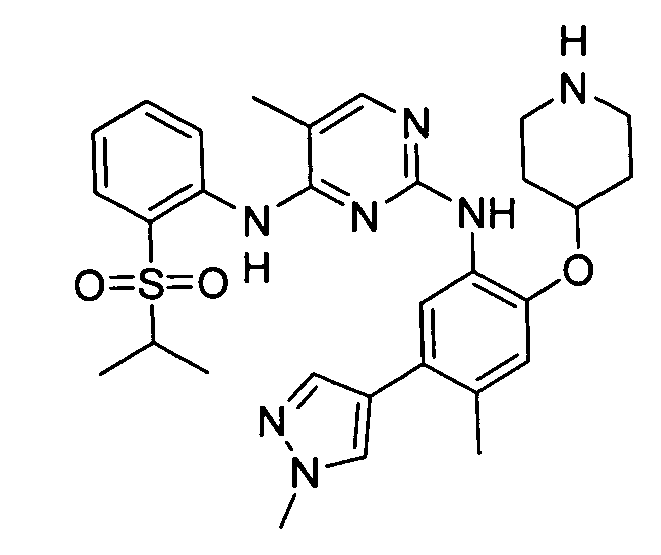
-

- To a mixture of 4 -Chloro-5-methyl-2-nitro-phenol (3.752 g, 20.0 mmol), 4-Hydroxy-piperidine-1-carboxylic acid tert-butyl ester (4.83 g, 24 mmol), and triphenylphosphine (6.23 g, 24 mmol) in 75 mL THF is added diisopropyl asodicarboxylate (4.73 mL, 245 mmol) in several portions at 22 °C for 1 h. The reaction is stirred at the same temperature for an additional 2 hrs. The reaction mixture is concentrated in vacuo. The residue is taken up in 50 mL ether, and let stand at 22 °C for 14 hrs. The resulting crystals are removed by filtration. The filtrate is concentrated in vacuo, and the residue is purified over a 330 g SiO2 column (ISCO) using a gradient of 20 to 40% ethyl acetate in hexanes as eluent, affording 4-(4-Chloro-5-methyl-2-nitro-phenoxy)-piperidine-1-carboxylic acid tert-butyl ester as dark yellow viscous oil. MS (ES+); 315.1 (MH+ - C4H8), 393.1 (MNa+).
-

- A mixture of 4 -(4-Chloro-5-methyl-2-nitro-phenoxy)-piperidine-1-carboxylic acid tert-butyl ester from the previous step (375.8 mg, 1.01 mmol), 1-Methyl-4-(4,4,5,5-tetramethyl-[1,3,2]dioxaborolan-2-yl)-1H-pyrazole (Boron Molecular, 224.4 mg 1.08 mmol), potassium phosphate tribasic monohydrate (392 mg), Pd2(dba)3 (45 mg), and dicyclophosphinobiphenyl (43 mg) in 4 mL of 1,4-dioxane/H2O (3/1) is heated in a sealed tube at 150 °C for 20 min under microwave radiation. The reaction mixture is filtered through a small plug of Celite, dried over Na2SO4 and concentrated. The residue is purified using a SiO2 column (ISCO), affording 4-[5-Methyl-4-(1-methyl-1H-pyrazol-4-yl)-2-nitro-phenoxy]-piperidine-1-carboxylic acid tert-butyl ester. MS (ES+); 417.3 (MH+), 439.2 (MNa+).
- Utilizing the same proce dures described in the synthesis of Example 1 (Steps 7, 8 and 9) and final purification using preparative RP LC-MS affords 5-Methyl-N2-[4-methyl-5-(1-methyl-1H-pyrazol-4-yl)-2-(piperidin-4-yloxy)-phenyl]-N4-[2-(propane-2-sulfonyl)-phenyl]-pyrimidine-2,4-diamine (35). MS (ES+): 576.3 (MH+).
-

-

- A mixture of 1-(4-Isopropoxy-2-methyl-5-nitro-phenyl)-ethanone (0.788 g, 3.32 mmol), ethyleneglycol (1.8 mL), and p-toluenesulfonic acid monohydrate (6.3 mg) in 60 mL of benzene is heated at reflux with a Dean-Stark trap for 18 hrs. The reaction mixture is diluted with 100 mL of ethyl acetate and successively washed with 100 mL each of aqueous saturated NaHCO3, H2O, and saturated brine. The organic phase is dried over anhydrous Na2SO4, filtered and concentrated in vacuo, affording 2-(4-Isopropoxy-2-methyl-5-nitro-phenyl)-2-methyl-[1,3]dioxolane as yellow crystals. MS (ES+): 282.2 (MH+).
-

- Utilizing the same procedures described in the synthesis of Example 1 (Steps 7 and 8), using 2-(4-Isopropoxy-2-methyl-5-nitro-phenyl)-2-methyl-[1,3]dioxolane from the previous step as starting material and purification using silica gel chromatography (gradient 2% to 20% EtOAc in hexanes) affords 5-Chloro-N2-[2-isopropoxy-4-methyl-5-(2-methyl-[1,3]dioxolan-2-yl)-phenyl]-N4-[2-(propane-2-sulfonyl)-phenyl]-pyrimidine-2,4-diamine as a white solid. MS (ES+): 561.2 (MH+).
- A solution of 5-Chloro-N2-[2-isopropoxy-4-methyl-5-(2-methyl-[1,3]dioxolan-2-yl)-phenyl]-N4-[2-(propane-2-sulfonyl)-phenyl]-pyrimidine-2,4-diamine from the previous step (84 mg, 0.15 mmol) in 5 mL 1,4-dioxane is treated with 1 mL of aqueous 1N HCl at 22 °C for 2 hrs. The reaction is worked up and affords 1-(5-{5-Chloro-4-[2-(propane-2-sulfonyl)-phenylamino]-pyrimidin-2-ylamino}-4-isopropoxy-2-methyl-phenyl)-ethanone (36). MS (ES+): 517.2 (MH+).
-

-

- 4-Bromo-3-methyl-phenol (1.122 g, 6.00 mmol) and Yb(CF3SO3)3 (372 mg) in 30 mL dichloromethane is treated with 0.38 mL of conc. HNO3 at 22 °C. After stirring at the same temperature for 1 hr, an additional 0.1 mL of conc. HNO3 is added, and the reaction is stirred for an additional hour. The reaction mixture is washed with H2O, dried over anhydrous magnesium sulfate, filtered and concentrated. The residue is purified using a SiO2 column (ISCO), affording a mixture of 4-Bromo-5-methyl-2-nitro-phenol as yellow crystals and its regioisomer by-product as orange crystals.
-

- To a mixture of 4-Bromo-5-methyl-2-nitro-phenol from the previous step (0.66 g, 2.84 mmol), 2-propanol (0.262 mL), and triphenylphosphine (894 mg) in 10 mL THF is added diisopropyl asodicarboxylate (0.671 mL) at 22 °C. The reaction mixture is concentrated in vacuo. The residue is purified using a SiO2 column (ISCO), affording 1-Bromo-4-isopropoxy-2-methyl-5-nitro-benzene as a bright yellow solid.
-

- To 1-Bromo-4-isopropoxy-2-methyl-5-nitro-benzene from the previous step (0.734 g, 2.68 mmol) and iron (powder, 325 mesh, 1.05 g) in 20 mL ethanol is added 1 mL of 1N aqueous HCl with cooling in an ice bath. Following this addition, the reaction is heated at reflux for 2 hrs. Then an additional 0.5 g of iron is added and the reaction is heated at reflux for an additional 2 hrs. The reaction mixture is cooled down and filtered though a pad of Celite. The filtrate is concentrated in vacuo, affording 5-Bromo-2-isopropoxy-4-methyl-phenylamine as an orange oil. The product is used for the next step without further purification.
-

- 5-Bromo-2-isopropoxy-4-methyl-phenylamine from the previous step (537 mg, 2.20 mmol) and 2-chloro-N-(2-(iso-propylsulfonyl)phenyl)-5-methylpyrimidin-4-amine (Intermediate 1, 652 mg, 2.00 mmol) in the presence of methanesulfonic acid (0.143 mL) in 4 mL 2-propanol are condensed at 140 °C for 30 min in a sealed tube under microwave irradiation. Following workup, N2-(5-Bromo-2-isopropoxy-4-methyl-phenyl)-5-methyl-N4-[2-(propane-2-sulfonyl)-phenyl]-pyrimidine-2,4-diamine is obtained. MS (ES+): 535.1 (MH+).
- A mixture of N2-(5-Bromo-2-isopropoxy-4-methyl-phenyl)-5-methyl-N4-[2-(propane-2-sulfonyl)-phenyl]-pyrimidine-2,4-diamine from the previous step (53 mg, 0.099 mmol), 4-{2-[4-(4,4,5,5-Tetramethyl-[1,3,2]dioxaborolan-2-yl)-pyrazol-1-yl]-ethyl}-morpholine (Boron Molecular, 61 mg 0.20 mmol), K3PO4 (58 mg), Pd2(dba)3 (10 mg), and tricyclohexylphosphine (8 mg) in 1 mL of 1,4-dioxane/H2O (3/1 v/v) is heated in a sealed tube at 150 °C for 20 min under microwave radiation. The reaction mixture is filtered through a small plug of Celite and concentrated. Final purification using preparative RP LC-MS affords N2-{2-Isopropoxy-4-methyl-5-[1-(2-morpholin-4-yl-ethyl)-1H-pyrazol-4-yl]-phenyl}-5-methyl-N4-[2-(propane-2-sulfonyl)-phenyl]-pyrimidine-2,4-diamine (37). MS (ES+): 634.3 (MH+).
-

-

- To a mixture of 1-chloro-2-methyl-4-nitro-5-isopropoxy-benzene (Intermediate 4, 870 mg, 3.77mmol), vinylboronic acid dibutyl ester (1.24 mL, 5.6 mmol), and sodium carbonate (2.8 g, 26.4mmol) in THF/H2O (20/5 mL) is added dichlorobis(triphenylphospine) palladium (II) (132 mg, 5% mmol). The reaction tube is sealed, the mixture is purged with N2 for 3 min and then heated at 90°C under N2 for overnight. The reaction is cooled to room temperature and poured into saturated aqueous ammonia chloride solution. The crude reaction mixture is extracted with ethyl acetate (3 x 100 mL). The organic extracts are combined, washed with brine and concentrated. The crude product is purified with silica gel column chromatography (10% ethyl acetate in hexanes) to afford 1-methyl-5-nitro-4-propoxy-2-vinyl-benzene as a yellow solid. 1-Methyl-5-nitro-4-propoxy-2-vinyl-benzene obtained from the previous step (360 mg, 1.63mmol) is dissolved in DCM (20 mL) and is cooled to -78 °C. O3 (g) is bubbled into the solution until the solution's color turns blue/gray. The solution is then purged with N2 (g) until the blue color disappears. The solution is warmed to room temperature and treated with triphenylphospine resin (2 g) pre-swelled in DCM (30 mL). After 30 min, the mixture is filtered, and the filtrate is concentrated to afford 2-methyl-4-nitro-5-propoxy-benzaldehyde as yellow solid.
-

- To a solution of 2-methyl-4-nitro-5-propoxy-benzaldehyde obtained in the previous step (34 mg, 0.152 mmol) in MeOH/THF (0.5/0.5 mL), is added acetic acid (5 drops). The mixture is stirred at room temperature for 1 hour. Sodium cyanoborohydride (20 mg, 0.30 mmol) is then added. After stirring for 30 min, the reaction is quenched by adding saturated aqueous ammonium chloride solution. The reaction mixture is extracted with ethyl acetate (3 x 5 mL). The organic phases are combined and concentrated to afford the amine product as an yellow oil which is directly used for the next step without further purification. To a solution of the product obtained in the previous step in methanol (5 mL), is added Pd/C (10% on carbon, 2 mg). The mixture is hydrogenated under 1 atm hydrogen. After 4 hours, the mixture is filtered and concentrated. The aniline product obtained (yellow solid), is used in the next step without further purification.
- To a mixture of the aniline product obtained in the previous step (0.152 mmol), (2,5-dichloro-pyrimidin-4-yl)-[2-(propane-2-sulfonyl)-phenyl]-amine (Intermediate 2, 52 mg, 0.152 mmol), cesium carbonate (99 mg, 0.30 mmol) and xantphos (8 mg, 0.02mmol) in THF (2 mL), is added palladium acetate (2 mg, 5% mmol) in a microwave tube. The mixture is purged with N2 for 3 min and then the sealed tube is heated at 150 °C for 20 min. under microwave irradiation. The reaction is filtered, concentrated, and purified by mass-trigger preparative RP LC-MS to afford the title compound 5-Chloro-N2-(2-isopropoxy-5-methyl-4-morpholin-4-ylmethyl-phenyl)-N4-[2-(propane-2-sulfonyl)-phenyl]-pyrimidine-2,4-diamine (60) as a yellow solid: 1H NMR (400 MHz, CDCl3) δ 10.35(s, 1H), 8.38 (d, 1H0, 7.93 (d, 1H), 7.59 (m, 2H), 7.41-7.36 (m, 2H), 4.70-4.63(br, 1H), 4.30-4.18 (br, 2H), 4.15-4.10 (br, 2H), 4.00-3.97 (br, 2H), 3.52-3.46 (br, 2H), 3.20 (m, 1H), 2.95-2.84 (br, 2H), 2.24 (s, 3H), 1.31 (d, 12H); ESMS m/z 574.2 (M + H+).
-

-

- 4-Pyridineboronic acid (147 mg, 1.20 mmol, 1.1 equiv.) is dissolved in a 2:1 v/v mixture of dioxane and H2O (15 mL) and N2 is bubbled through for 5 minutes. Tris(dibenzylidene acetone)dipalladium (0) (100 mg, 0.109 mmol, 0.1 equiv.), 2-dicyclohexylphosphine-2'-6'-dimethoxy biphenyl (112 mg, 0.272 mmol, 0.25 equiv.), 1-chloro-5-isopropoxy-2-methyl-4-nitro-benzene (Intermediate 4, 250 mg, 1.09 mmol, 1.0 equiv.) and K3PO4 (462 mg, 2.18 mmol, 2.0 equiv.) are added under a N2 blanket. The reaction vessel is sealed and heated with microwave irradiation to 150 °C for 20 min. After cooling to room temperature, the reaction is diluted with ethyl acetate and washed with 1 N aqueous NaOH (2x), the organic layer is then dried over Na2SO4 and filtered. After concentration, the crude product is purified by silica gel chromatography (gradient from hexanes to 30% ethyl acetate in hexanes) to give 4-(5-Isopropoxy-2-methyl-4-nitro-phenyl)-pyridine as a brown solid: ESMS m/z 273.1 (M + H+).
-

- 4-(5-Isopropoxy-2-methyl-4-nitro-phenyl)-pyridine from the previous step(438 mg, 1.61 mmol) dissolved in acetic acid (30 mL) is treated with TFA (0.24 mL, 3.22 mmol) and PtO2 (176 mg, 40% w/w). The reaction mixture is vigorously stirred under 1 atm. H2 for 36 hours. The reaction mixture is filtered and the filtrate is concentrated under vacuum. The resulting residue is diluted with ethyl acetate and washed with 1 N aqueous NaOH (2x), the organic layer is then dried over Na2SO4 and filtered. After concentration, the crude product (391 mg) is dissolved in anhydrous CH2Cl2 (30 mL). TEA is added (0.44 mL, 3.15, 2 equiv.) followed by Boc2O (344 mg, 1.57 equiv, 1 equiv.). The reaction is stirred at room temperature for 30 min. The reaction is concentrated under vacuum. The resulting residue is purified by silica gel chromatography (gradient from hexanes to 30% ethyl acetate in hexanes) to give 4-(4-amino-5-isopropoxy-2-methyl-phenyl)-piperidine-1-carboxylic acid tert-butyl ester as a sticky foam: ESMS m/z 293.1 (M-tBu+H)+.
- 4-(4-Amino-5-isopropoxy-2-methyl-phenyl)-piperidine-1-carboxylic acid tert-butyl ester (170 mg, 0.488 mmol) from the previous step, (2,5-Dichloro-pyrimidin-4-yl)-[2-(propane-2-sulfonyl)-phenyl]-amine (Intermediate 2, 169 mg, 0.488 mmol, 1 equiv.), xantphos (28 mg, 0.049 mmol, 0.1 equiv.), palladium acetate (5.5 mg, 0.024 mmol, 0.05 equiv.), and Cs2CO3 (477 mg, 1.46 mmol, 3 equiv.) are dissolved in anhydrous THF (6 mL). N2 is bubbled through the reaction mixture for 5 minutes and then the reaction vessel is sealed and heated with microwave irradiation to 150 °C for 20 min. The reaction is filtered and the filtrate concentrated under vacuum. After concentration, the crude product is purified by silica gel chromatography (gradient from hexanes to 30% ethyl acetate in hexanes) to give 4-(4-{5-chloro-4-[2-(propane-2-sulfonyl)-phenylamino]-pyrimidin-2-ylamino}-5-isopropoxy-2-methyl-phenyl)-piperidine-1-carboxylic acid tert-butyl ester as a yellow film: ESMS m/z 658.3 (M + H+). This product (105 mg, 0.160 mmol) is dissolved in CH2Cl2 (3 mL) and treated with TFA (3 mL). After 45 min., the reaction is concentrated under vacuum. 1 N HCl in Et2O (5 mL x 2) is added causing the product HCl salt to precipitate. The solvent is removed by decantation. The resulting 5-Chloro-N2-(2-isopropoxy-5-methyl-4-piperidin-4-yl-phenyl)-N4-[2-(propane-2-sulfonyl)-phenyl]-pyrimidine-2,4-diamine (66) is dried under high vacuum, generating an off-white powder: 1H NMR (400 MHz, DMSO-d 6 + trace D2O) δ 8.32 (s, 1H), 8.27 (d, 1H), 7.88 (d, 1H), 7.67 (dd, 1H), 7.45 (dd, 1H), 7.42 (s, 1H), 6.79 (s, 1H), 4.56-4.48 (m, 1H), 3.49-3.32 (m, 3H), 3.10-2.91 (m, 3H), 2.09 (s, 3H), 1.89-1.77 (m, 4H), 1.22 (d, 6H), 1.13 (d, 6H); ESMS m/z 558.1 (M + H+).
-

-
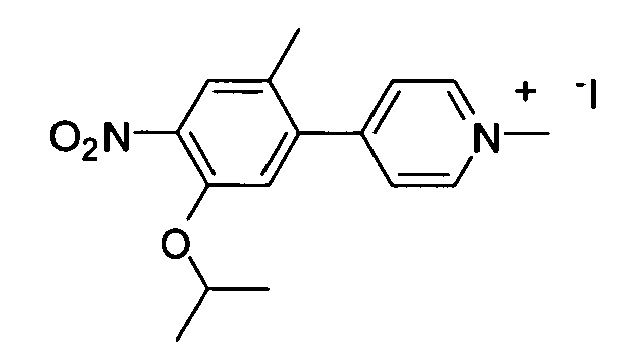
- 4-(5-Isopropoxy-2-methyl-4-nitro-phenyl)-pyridine (Example 7, Step 1, 217 mg, 0.797 mmol) is dissolved in anhydrous THF (9 mL). Iodomethane (0.10 mL, 1.61 mmol, 2 equiv.) is added and the reaction is stirred at 40 °C in a sealed tube for 2 days. The volatiles are removed under vacuum generating 4-(5-Isopropoxy-2-methyl-4-nitro-phenyl)-1-methyl-pyridinium iodide as a brown solid: ESMS m/z 287.1 (M+).
-
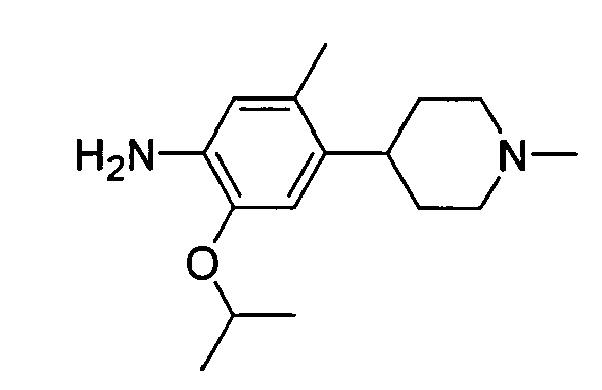
- 4-(5-Isopropoxy-2-methyl-4-nitro-phenyl)-1-methyl-pyridinium iodide from the previous step (0.697 mmol) is dissolved in CH3OH (20 mL) and cooled to 0 °C. NaBH4 (264 mg, 6.97 mmol, 10 equiv.) is slowly added. After this addition is complete, the cooling bath is removed and the reaction is stirred at room temperature for 1 h. The reaction is quenched by the slow addition of 1N aqueous HCl (14 mL). The CH3OH is partially removed by vacuum. The resulting residue is partitioned between EtOAc and 1 N aqueous NaOH. Additional 50 % aqueous NaOH is added until the aqueous layer pH > 12. The EtOAc layer is washed with 1 N aqueous NaOH (2x), the organic layer is then dried over Na2SO4, filtered, and concentrated under vacuum. After concentration, the crude product (175 mg) is dissolved in acetic acid (10 mL). TFA (0.15 mL, 3 equiv.) and PtO2 (53 mg, 30% w/w) are added and the reaction is placed under 50 psi H2 gas in a Parr Shaker for 14 h. The reaction mixture is filtered and the filtrate is concentrated under vacuum. The resulting residue is partitioned between EtOAc and 1 N aqueous NaOH. Additional 50% aqueous NaOH is added until the aqueous layer pH >12. The EtOAc layer is washed with 1 N aqueous NaOH (2x), the organic layer is then dried over Na2SO4, filtered, and concentrated under vacuum to give 2-Isopropoxy-5-methyl-4-(1-methyl-piperidin-4-yl)-phenylamine which is used in Step 4 without further purification: ESMS m/z 263.2 (M + H+).
- Utilizing the same procedures described in the synthesis of Example 7 (Step 4) and final purification using preparative RP LC-MS affords 5-Chloro-N2-[2-isopropoxy-5-methyl-4-(1-methyl-piperidin-4-yl)-phenyl]-N4-[2-(propane-2-sulfonyl)-phenyl]-pyrimidine-2,4-diamine (67) as a pale yellow powder: (HCl salt, DMSO-d 6 + trace D2O) δ 8.28 (s, 1H), 8.19 (d, 1H), 7.86 (d, 1H), 7.66 (dd, 1H), 7.45 (dd, 1H), 7.37 (s, 1H), 6.77 (s, 1H), 4.56-4.49 (m, 1H), 3.51-3.37 (m, 3H), 3.16-3.08 (m, 2H), 2.98-2.88 (m, 1H), 2.77 (s, 3H), 2.05 (s, 3H), 1.90-1.81 (m, 4H), 1.19 (d, 6H), 1.11 (d, 6H); ESMS m/z 572.2 (M + H+).
-

- 5-Chloro-N2-(2-isopropoxy-5-methyl-4-piperidin-4-yl-phenyl)-N4-[2-(propane-2-sulfonyl)-phenyl]-pyrimidine-2,4-diamine (Example 7, 0.087 mmol) is dissolved in anhydrous DMF (1 mL). TEA (0.04 mL, 0.262 mmol, 3 equiv.) is added followed by 2-bromo-ethanol (0.019 mL, 0.262 mmol, 3 equiv.) dissolved in anhydrous DMF (0.7 mL). The reaction vessel is sealed and heated at 70 °C for 12 h. After cooling to room temperature, the reaction is diluted with ethyl acetate and washed with 1 N aqueous NaOH (5x), the organic layer is then dried over Na2SO4 and filtered. After concentration, the crude product is purified using preparative RP LC-MS to give 2-[4-(4-{5-Chloro-4-[2-(propane-2-sulfonyl)-phenylamino]-pyrimidin-2-ylamino}-5-isopropoxy-2-methyl-phenyl)-piperidin-1-yl]-ethanol (72) as a yellow powder: ESMS m/z 602.2 (M + H+).
-

- To a mixture of 6-{5-Chloro-4-[2-(propane-2-sulfonyl)-phenylamino]-pyrimidin-2-ylamino}-5-isopropoxy-2-piperidin-4-yl-2,3-dihydro-isoindol-1-one (Example 1, 20 mg, 0.033 mmol) and triethylamine (23 uL, 0.165 mmol) in DMF (1.5 mL), is added 2-bromo-acetamide (10 mg, 0.066 mmol). The mixture is stirred at 60 °C for 4 hours. The reaction is filtered and the filtrate is purified by mass-trigger preparative RP LC-MS to afford the title compound 2-[4-(6-{5-Chloro-4-[2-(propane-2-sulfonyl)-phenylamino]-pyrimidin-2-ylamino}-5-isopropoxy-1-oxo-1,3-dihydro-isoindol-2-yl)-piperidin-1-yl]-acetamide (136) as a white solid: 1H NMR (400 MHz, MeOD-d 4) δ 8.41 (d, 1H), 8.27 (s, 1H), 8.21 (br, 1H), 7.93 (dd, 1H), 7.73 (m, 1H), 7.40 (dd, 1H), 7.30 (s, 1H), 4.52 (s, 2H), 4.45-4.37 (m, 1H), 4.19-4.15 (br, 2H), 3.87-3.78 (br, 2H), 2.37-2.19 (m, 2H), 2.20-2.15 (m, 1H), 1.40 (d, 6H), 1.25 (d, 6H); ESMS m/z 656.2 (M + H+).
-

- To a mixture of 6-{5-Chloro-4-[2-(propane-2-sulfonyl)-phenylamino]-pyrimidin-2-ylamino}-5-isopropoxy-2-piperidin-4-yl-2,3-dihydro-isoindol-1-one (Example 1, 20 mg, 0.033 mmol) and triethylamine (23 uL, 0.165 mmol) in DMF (1.5 mL) is added dimethylcarbamyl chloride (11 mg, 0.1 mmol). The mixture is stirred at room temperature for 1 hour. The reaction is filtered and the filtrate is purified by mass-trigger preparative RP LC-MS to afford the title compound 4-(6-{5-Chloro-4-[2-(propane-2-sulfonyl)-phenylamino]-pyrimidin-2-ylaminol-5-isopropoxy-1-oxo-1,3-dihydro-isoindol-2-yl)-piperidine-1-carboxylic acid dimethylamide (155) as a white solid: 1H NMR (400 MHz, MeOD-d4) δ 8.29 (s, 1H), 8.26 (br, 1H), 7.96 (dd, 1H), 7.93 (s, 1H), 7.72(dd, 1H), 7.48 (dd, 1H), 7.35 (s, 1H), 4.50 (s, 2H), 4.35-4.29 (m, 1H), 3.83 (d, 2H), 3.38-3.30 (m, 2H), 3.02-2.95 (m, 3H), 2.88 (s, 6H), 1.88-1.84 (m, 3H), 1.36 (d, 6H), 1.25 (d, 6H); ESMS m/z 670.2 (M + H+).
-

-

- A mixture of N2-(5-Bromo-2-isopropoxy-4-methyl-phenyl)-5-methyl-N4-[2-(propane-2-sulfonyl)-phenyl]-pyrimidine-2,4-diamine (Example 5, Step 4, 110 mg, 0.21 mmol), ethynyl-trimethyl-silane (0.14 mL), N,N-diisopropyl ethylamine (0.10 mL), PdCl2(PhCN)2 (12 mg), tBu3PHBF4 (17 mg), and CuI (4 mg) in 1 mL 1,4-dioxane is stirred at 22 °C for 20 hrs followed by heating at 60 °C for an additional 2 hrs. The reaction mixture is filtered through a small Celite plug and concentrated. The residue is purified over a 4 g SiO2 column (ISCO) using a gradient of 0 to 20% ethyl acetate in hexanes as eluent, affording N2-(2-Isopropoxy-4-methyl-5-trimethylsilanylethynyl-phenyl)-5-methyl-N4-[2-(propane-2-sulfonyl)-phenyl]-pyrimidine-2,4-diamine as a yellow viscous oil.
- A solution of N2-(2-Isopropoxy-4-methyl-5-trimethylsilanylethynyl-phenyl)-5-methyl-N4-[2-(propane-2-sulfonyl)-phenyl]-pyrimidine-2,4-diamine from the previous step (0.102 g, 0.18 mmol) in 2.5 mL THF is treated with TBAF (0.5 mL, 1M in THF) and 30 µL AcOH at 22 °C for 2 hrs. The reaction mixture is concentrated and the residue is purified using a 4 g SiO2 column (ISCO), affording N2-(5-Ethynyl-2-isopropoxy-4-methyl-phenyl)-5-methyl-N4-[2-(propane-2-sulfonyl)-phenyl]-pyrimidine-2,4-diamine (257). MS (ES+): 479.2 (MH+).
-

- To a mixture of 6-{5-Chloro-4-[2-(propane-2-sulfonyl)-phenylamino]-pyrimidin-2-ylamino}-5-isopropoxy-2-piperidin-4-yl-2,3-dihydro-isoindol-1-one (Example 1, 15 mg, 0.025 mmol) and triethylamine (37.5 uL, 0.25 mmol) in DMF (0.5 mL), is added ethyl chloroformate (5.4 mg, 0.05 mmol). The mixture is stirred at room temperature for 1 hour. The crude reaction mixture is purified by mass-trigger preparative RP LC-MS to afford the title compound 4-(6-{5-chloro-4-[2-(propane-2-sulfonyl)-phenylamino]-pyrimidin-2-ylamino}-5-isopropoxy-1-oxo-1,3-dihydro-isoindol-2-yl)-piperidine-1-carboxylic acid ethyl ester (175) as a white solid. 1H NMR 400 MHz (DMSO-d6 with trace D2O) δ 8.55 (d, 1H), 8.32 (s, 1H), 8.14 (s, 1H), 7.82 (dd,1H), 7.74 (t, 1H), 7.34 (t, 1H), 7.28 (s, 1H), 4.73 (m, 2H), 4.39 (s, 2H), 4.12 (m, 2H), 4.06 (q, 2H), 3.46 (m, 1H), 2.92 (m 2H), 1.76 (m, 2H), 1.68 (m, 2H), 1.29 (d, 6H), 1.20 (t, 3H), 1.17 (d, 6H); MS m/z 671 (M+1).
-

-

- 4-(4-Isopropoxy-5-nitro-2-vinyl-benzoylamino)-piperidine-1-carboxylic acid tert-butyl ester (Example 1, Step 3, 1.2 g, 2.77 mmol) dissolved in 50 mL of DCM is cooled to -78 °C. Ozone gas is bubbled through this solution until the starting material is consumed and then nitrogen gas is bubbled through the solution for 5 min. The reaction mixture is warmed to room temperature. Triphenylphosphine-resin (2.77 g) in 10 mL of DCM is added and the resulting mixture is stirred for 1.5 h. The resin is removed by filtration and the filtrate is concentrated. Silica gel chromatography (5% MeOH in DCM) affords 4-(1-hydroxy-6-isopropoxy-5-nitro-3-oxo-1,3-dihydro-isoindol-2-yl)-piperidine-1-carboxylic acid tert-butyl ester; MS m/z 336.2 (M-Boc + H+).
-

- To the solution of 4-(1-hydroxy-6-isopropoxy-5-nitro-3-oxo-1,3-dihydro-isoindol-2-yl)-piperidine-1-carboxylic acid tert-butyl ester from the previous step (173.9 mg, 0.4 mmol) in DMF (4 mL) is added pyridinum dichromate (286.5 mg, 0.8 mmol) in one portion. After stirring at room temperature for 2 h, the reaction mixture is poured into 25 mL of water and the product is extracted with EtOAc. The organic extracts are dried over Na2SO4, filtered and concentrated in vacuo to give crude 4-(5-isopropoxy-6-nitro-1,3-dioxo-1,3-dihydro-isoindol-2-yl)-piperidine-1-carboxylic acid tert-butyl ester, which is directly used in the next step without further purification.
- To a solution of 4-(5-isopropoxy-6-nitro-1,3-dioxo-1,3-dihydro-isoindol-2-yl)-piperidine-1-carboxylic acid tert-butyl ester generated in the previous step in 3 mL of DCM is added TFA (3 mL). The reaction mixture is stirred at room temperature for 1 h. After concentration, water (5 mL) is added to the crude reaction mixture, the resulting mixture is neutralized to pH=8 by adding NaHCO3, and the product is extracted with DCM. The organic extracts are dried over Na2SO4, filtered and concentrated in vacuo to give crude 5-isopropoxy-6-nitro-2-piperidin-4-yl-isoindole-1,3-dione, which is directly used in the next step without further purification.
- To a solution of the 5-isopropoxy-6-nitro-2-piperidin-4-yl-isoindole-1,3-dione generated in the previous step in THF (5 mL) and methanol (5 mL) are added formaldehyde (30 uL, 0.4 mmol) and 2 drops of AcOH sequentially. The reaction mixture is stirred at room temperature for 1h, then sodium cyanoborohydride (50.4 mg, 0.8 mmol) is added in one portion and the resulting mixture is stirred for an additional 30 min. The reaction is quenched by the addition of saturated aqueous NH4Cl followed by concentration in vacuo to give an oily residue. This oil is partitioned between EtOAc and brine. The organic extract is dried over Na2SO4, filtered and concentrated. Silica gel chromatography (5% MeOH in DCM) affords 5-isopropoxy-2-(1-methyl-piperidin-4-yl)-6-nitro-indan-1,3-dione; MS m/z 347.2 (M+1).
- Following the procedures previously described (Example 1, Steps 7 and 8) using the product from Step 4 generates the title compound 5-{5-Chloro-4-[2-(propane-2-sulfonyl)-phenylamino]-pyrimidin-2-ylamino}-6-isopropoxy-2-(1-methyl-piperidin-4-yl)-isoindole-1,3-dione (176) as a yellow solid. 1H NMR 400 MHz (DMSO-d6 with trace D2O) δ 8.44 (s, 2H), 8.39 (s, 1H), 7.87 (dd, 1H), 7.78 (dt, 1H), 7.45 (s, 1H), 7.41 (m, 1H), 4.91(m, 2H), 4.25(m, 2H), 3.51 (m, 3H), 3.10(m, 2H), 2.77(s, 3H), 1.80(m, 2H), 1.35(d, 6H), 1.13(d, 6H); MS m/z 627 (M+1).
-

-
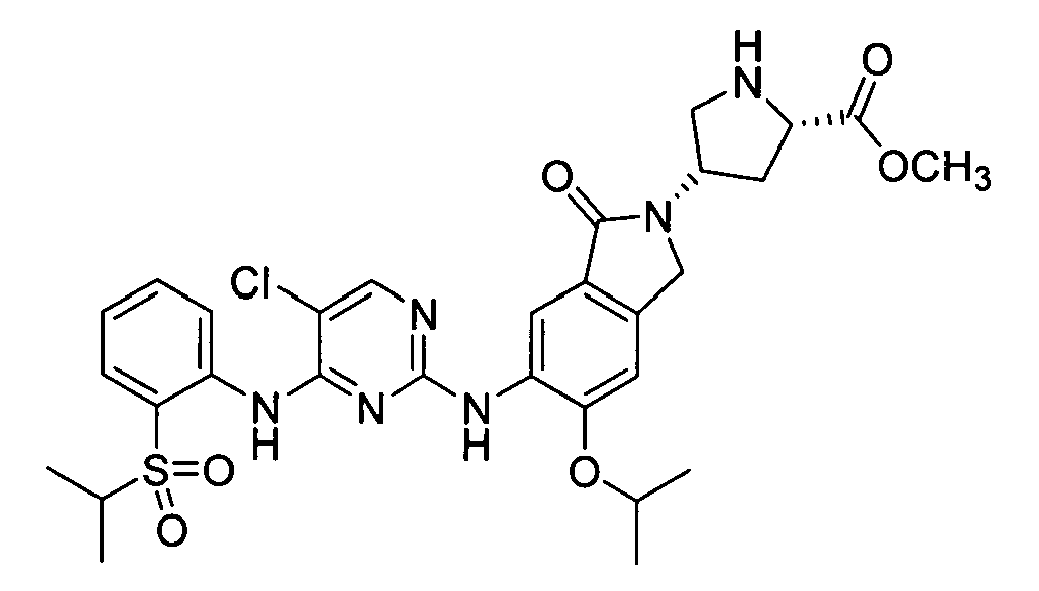
- Following the procedures previously described (Example 1) using N-Boc-cis-4-amino-L-proline methyl ester in place of 4-amino-piperidine-1-carboxylic acid tert-butyl ester, generates (2S,4S)-4-(6-{5-Chloro-4-[2-(propane-2-sulfonyl)-phenylamino]-pyrimidin-2-ylamino}-5-isopropoxy-1-oxo-1,3-dihydro-isoindol-2-yl)-pyrrolidine-2-carboxylic acid methyl ester; MS m/z 643.2 (M+1).
- (2S, 4S)-4-(6-{5-Chloro-4-[2-(propane-2-sulfonyl)-phenylamino]-pyrimidin-2-ylamino}-5-isopropoxy-1-oxo-1,3-dihydro-isoindol-2-yl)-pyrrolidine-2-carboxylic acid methyl ester generated in Step 1 (20 mg, 0.03 mmol) is dissolved in 7 N ammonia solution in MeOH ( 3 mL, 21 mmol). The resulting solution is heated using microwave irradiation to 120 °C for 1 h. After cooling to room temperature, the reaction mixture is concentrated in vacuo, neutralized to pH=8 with saturated aqueous NaHCO3, and extracted with DCM. The organic extracts are dried over Na2SO4, filtered, and concentrated in vacuo to give (2S, 4S)-4-(6-{5-Chloro-4-[2-(propane-2-sulfonyl)-phenylamino]-pyrimidin-2-ylamino}-5-isopropoxy-1-oxo-1,3-dihydro-isoindol-2-yl)-pyrrolidine-2-carboxylic acid amide (177) as a yellow solid. 1H NMR 400 MHz (DMSO-d6 with trace D2O) δ 8.47(d, 1H), 8.25 (s, 1H), 8.07 (s, 1H), 7.78 (dd, 1H), 7.68 (m, 1H), 7.31 (t, 1H), 7,24 (s, 1H), 4,71 (m, 2H), 4.43 (dd, 2H), 3.60 (m, 1H), 3.44 (m, 1H), 3.35 (m,1H), 2.63 (m, 1H), 2.28 (m, 1H), 1.22 (d, 6H), 1.10 (d, 6H); MS m/z 628 (M+1).
-

-
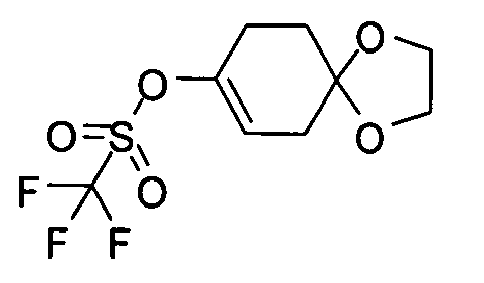
- A solution of 0.5 M KHMDS in toluene (4.7 mL, 2.34 mmol) is added to a solution of 1,4-dioxaspiro[4.5]decan-8-one (1.80 mmol) and N-phenyltrifluoromethanesulfonimide (2.34 mmol) in dry THF (18 mL) at -78°C under argon. After stirring at -78°C for 4 hours, the mixture is quenched with H2O, extracted with diethyl ether and dried with MgSO4. After workup and silica flash chromatography (hexane/EtOAc 90:10), 1,4-dioxaspiro[4.5]dec-7-en-8-yl trifluoromethanesulfonate is isolated: 1H NMR (CDCl3, 400 MHz) δ 5.66 (m, 1H), 3.98 (m. 4H), 2.53 (m, 2H), 2.40 (m, 2H), 1.90 (t, 2H). MS (ES+): 289.0 (M+1)+.
-

- A stirred solution of the 1,4-dioxaspiro[4.5]dec-7-en-8-yl trifluoromethanesulfonate (0.03 mmol) and 2-(5-isopropoxy-2-methyl-4-nitrophenyl)-4,4,5,5-tetramethyl-l,3,2-dioxaborolane (Intermediate 5, 0.04 mmol) in THF (3 mL), containing [Pd(PPh3)4] (0.013 mmol) and K3PO4·H2O (0.045 mmol), is heated to 80°C under argon for 16 hours. After workup and silica flash chromatography (hexane/EtOAc 4:1), 8-(5-isopropoxy-2-methyl-4-nitrophenyl)-1,4-dioxaspiro[4.5]dec-7-ene is obtained. 1H NMR (CDCl3, 400 MHz) δ 7.62 (s, 1H), 6.82 (s, 1H), 5.74 (m, 1H), 4.65 (m, 1H), 4.04 (m. 4H), 2.47 (m, 4H), 2.27 (s, 3H), 1.89 (t, 2H), 1.29 (d. 6H). MS (ES+): 334.16 (M+1)+.
-

- A solution of 8-(5-isopropoxy-2-methyl-4-nitrophenyl)-1,4-dioxaspiro[4.5]dec-7-ene (0.1 mmol) in 2.5 mL of TFA and CH2Cl2 (1:4 v/v), is stirred at room temperature for 6 hours. After workup and silica flash chromatography (hexane/EtOAc 4:1), 4-(5-isopropoxy-2-methyl-4-nitrophenyl)cyclohex-3-enone is obtained. 1H NMR (CDCl3, 400 MHz) δ 7.63 (s, 1H), 6.81 (s, 1H), 5.73 (m, 1H), 4.62 (m, 1H), 3.07 (m, 2H), 2.68 (m, 4H), 2.27 (s, 3H), 1.37 (d. 6H). MS (ES+): 290.13 (M+1)+.
-

- To a solution of 4-(5-isopropoxy-2-methyl-4-nitrophenyl)cyclohex-3-enone (0.1 mmol) and dimethylamine (0.11 mmol) in 2 mL of 1,2-dicholoroethane, is added AcOH (0.1 mmol) and NaBH(OAc)3 (0.11 mmol). The reaction mixture is stirred at room temperature for 10 hours. After workup and silica flash chromatography (CH2Cl2/MeOH 9:1), 4-(5-isopropoxy-2-methyl-4-nitrophenyl)-N,N-dimethylcyclohex-3-enamine is obtained. MS (ES+): 319.19 (M+1)+.
-

- To a solution of 4-(5-isopropoxy-2-methyl-4-nitrophenyl)-N,N-dimethylcyclohex-3-enamine (0.1 mmol) in 10 mL of MeOH, is added Pd/C (5 mg) under argon. The suspension is stirred under 1 atm. H2 for 6 hours. After filtering, solvent is removed and 4-(4-(dimethylamino)cyclohexyl)-2-isopropoxy-5-methylaniline is obtained. MS (ES+): 291.24 (M+1)+.
- Following the procedure previously described (Example 7, Step 4) using the product from Step 5 generates the title compound 5-Chloro-N2-[4-(4-dimethylamino-cyclohexyl)-2-isopropoxy-5-methyl-phenyl]-N4-[2-(propane-2-sulfonyl)-phenyl]-pyrimidine-2,4-diamine (21). 1H NMR (CD3OD, 400 MHz) δ 8.36-8.38 (d, 1H), 8.20 (s, 1H), 7.97-7.99 (m, 1H), 7.69-7.73 (m, 1H), 7.46-7.52 (m, 2H), 6.89-7.02 (d, 1H), 4.60-4.66 (m, 1H), 3.37-3.39 (m, 1H), 3.00 (s, 3H), 2.90 (s, 3H), 2.17-2.22 (m, 4H), 1.64-2.01 (m, 8H), 1.25-1.32 (m, 12H); MS (ES+): 600.3 (M+1)+.
- Exemplary compounds of the invention are set forth below. Table 1 shows exemplary compounds of Formula (1A).
Table 1 Structure Physical Data 1H NMR 400 MHz (DMSO-d6) and/or MS (m/z) 1 
MS (ES+): 563.1 (M+1)+. (2-(5-chloro-2-(2-isopropoxy-5-methyl-4-(1-methylpiperidin-4-yl)phenylamino)pyrimidin-4-ylamino)phenyl)(pyrrolidin-1-yl)methanone 2 
MS (ES+): 577.2 (M+1)+. 2-(5-chloro-2-(2-isopropoxy-5-methyl-4-(1-methylpiperidin-4-yl)phenylamino)pyrimidin-4-ylamino)-N-cyclopentylbenzamide 3 
MS (ES+): 643.3 (M+1)+. N2-(4-((1R,2S,4R)-2,4-bis(dimethylamino) cyclohexyl)-2-isopropoxy-5-methylphenyl)-5-chloro-N4-(2-(isopropylsulfonyl)phenyl)pyrimidine-2,4-diamine 4 
MS (ES+): 643.3 (M+1)+. N2-(4-((1R,2S,4S)-2,4-bis(dimethylamino)cyclohexyl)-2-isopropoxy-5-methylphenyl)-5-chloro-N4-(2-(isopropylsulfonyl)phenyl)pyrimidine-2,4-diamine 5 
MS (ES+): 601.2 (M+1)+. 2-(5-chloro-2-(4-((1s,4s)-4-(dimethylamino)cyclohexyl)-2-isopropoxy-5-methylphenylamino) pyrimidin-4-ylamino)-N,Ndimethylbenzenesulfonamide 6 
MS (ES+): 601.2 (M+1)+. 2-(5-chloro-2-(4-((1r,4r)-4-(dimethylamino)cyclohexyl)-2-isopropoxy-5-methylphenylamino)pyrimidin-4-ylamino)-N,N-dimethylbenzenesulfonamide 7 
MS (ES+): 563.1 (M+1)+. 2-(5-chloro-2-(2-isopropoxy-5-methyl-4-(1-methylpiperidin-4-yl)phenylamino)pyrimidin-4-ylamino)-N-cyclobutylbenzamide 8 
MS (ES+): 549.1 (M+1)+. azetidin-1-yl(2-(5-chloro-2-(2-isopropoxy-5-methyl-4-(1-methylpiperidin-4-yl)phenylamino)pyrimidin-4-ylamino)phenyl)methanone 9 
MS (ES+): 627.2 (M+1)+. 5-chloro-N2-(4-((1r,4r)-4-(dimethylamino) cyclohexyl)-2-isopropoxy-5-methylphenyl)-N4-(2-(pyrrolidin-1-ylsulfonyl)phenyl)pyrimidine-2,4-diamine 10 
MS (ES+): 627.2 (M+1)+. 5-chloro-N2-(4-((1s,4s)-4-(dimethylamino) cyclohexyl)-2-isopropoxy-5-methylphenyl)-N4-(2-(pyrrolidin-1-ylsulfonyl)phenyl)pyrimidine-2,4-diamine 11 
MS (ES+): 580.8 (M+1)+. N2-(4-((1r,4r)-4-(dimethylamino)cyclohexyl)2-isopropoxy-5-methylphenyl)-N4-(2-(isopropylsulfonyl) phenyl)-5-methylpyrimidine-2,4-diamine 12 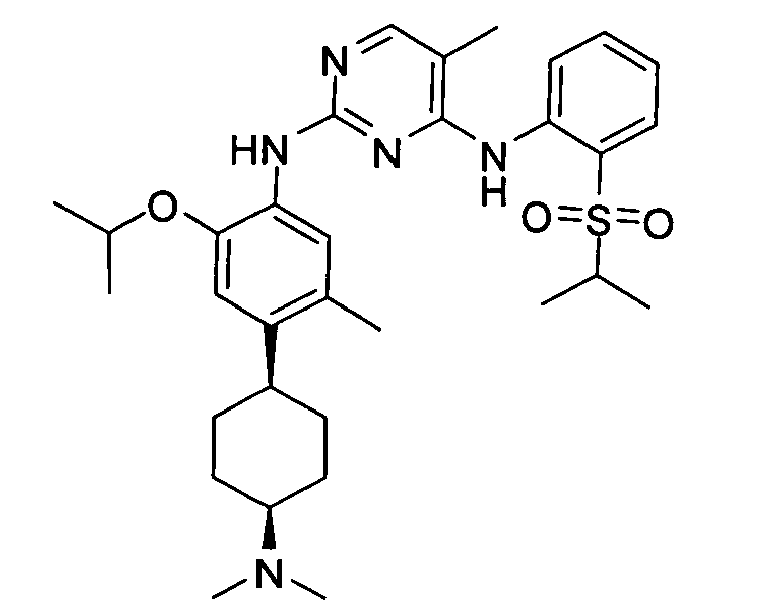
MS (ES+): 580.8 (M+1)+. N2-(4-((1s,4s)-4-(dimethylamino)cyclohexyl)-2-isopropoxy-5-methylphenyl)-N4-(2-(isopropylsulfonyl) phenyl)-5-methylpyrimidine-2,4-diamine 13 
MS (ES+): 549.1 (M+1)+. 2-(5-chloro-2-(2-isopropoxy-5-methyl-4-(1-methylpiperidin-4-yl)phenylamino)pyrimidin-4-ylamino)-N-cyclopropylbenzamide 14 
MS (ES+): 577.1 (M+1)+. (2-(5-chloro-2-(2-isopropoxy-5-methyl-4-(1-methylpiperidin-4-yl)phenylamino)pyrimidin-4-ylamino)phenyl)(piperidin-1-yl)methanone 15 
MS (ES+): 558.1 (M+1)+. (S)-5-chloro-N2-(2-isopropoxy-5-methyl-4-(piperidin-2-yl)phenyl)-N4-(2-(isopropylsulfonyl)phenyl)pyrimidine-2,4-diamine 16 
MS (ES+): 558.1 (M+1)+, (R)-5-chloro-N2-(2-isopropoxy-5-methyl-4-(piperidin-2-yl)phenyl)-N4-(2-(isopropylsulfonyl)phenyl) pyrimidine-2,4-diamine 17 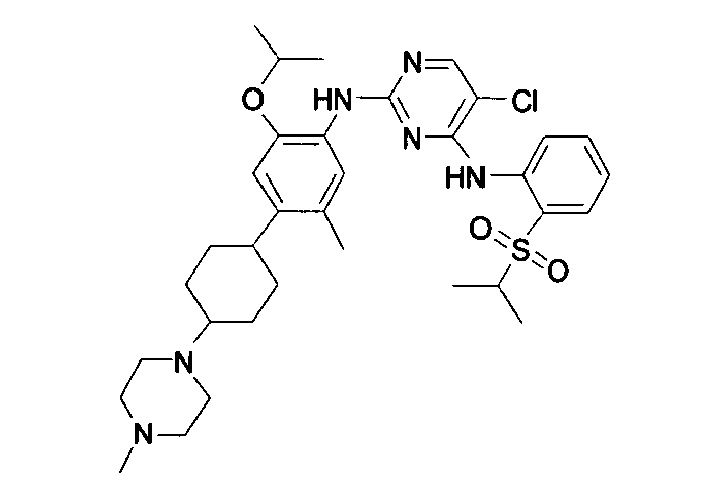
1H NMR (CD3OD, 400 MHz) δ 8.34-8.37 (m, 1H), 8.17 (s, 1H), 7.89-7.96 (m, 1H), 7.64-7.71 (m, 1H), 7.42-7.49 (m, 2H), 6.86-6.96 (d, 1H), 4.55-4.65 (m, 1H), 3.34-3.53 (m, 1H), 2.15-2.91 (m, 12H), 1.94-1.97 (m, 4H), 1.23-1.72 (m, 20H); MS (ES+): 654.8 (M+1)+. (cis,trans) 5-Chloro-N2-{2-isopropoxy-5-methyl-4-[4-(4-methyl-piperazin-1-yl)-cyclohexyl]-phenyl}-N4-[2-(propane-2-sulfonyl)-phenyl]-pyrimidine-2,4-diamine 18 
1H NMR (CD3OD, 400 MHz) δ 8.35-8.37 (d, 1H), 8.20 (s, 1H), 7.97-8.00 (m, 1H), 7.7-7.74 (m, 1H), 7.46-7.51 (m, 2H), 6.89-7.03 (d, 1H), 4.60-4.64 (m, 1H), 3.30-3.60 (m, 5H), 3.01 (s, 6H), 2.81-2.84 (m, 1H), 1.25-2.30 (m, 24H); MS (ES+): 643.3 (M+1)+. (cis,trans) 5-chloro-N2-{4-[4-(2-dimethylamino-ethyl amino)-cyclohexyl]-2-isopropoxy-5-methyl-phenyl}-N4-[2-(propane-2-sulfonyl)-phenyl]-pyrimidine-2,4-diamine 19 
1H NMR (CD3OD, 400 MHz) δ 8.51-8.56 (t, 1H), 8.41 (s, 1H), 8.19 (s, 1H), 7.86-7.89 (m, 1H), 7.54--7.58 (m, 1H), 7.27-7.31 (m, 1H), 6.97-7.00 (m, 1H), 4.77-4.84 (m, 1H), 2.66-3.32 (m, 15H), 1.22-2.21 (m, 18H); MS (ES+): 696.2 (M+1)+. 5-{5-Chloro-4-[2-(propane-2-sulfonyl)-phenylamino]-pyrimidin-2-ylamino}-4-isopropoxy-N-methyl-2-[4-(4-methyl-piperazin-1-yl)-cyclohex-1-enyl]-benzamide 20 
1H NMR (CD3OD, 400 MHz) δ 8.34-8.36 (d, 1H), 8.21 (s, 1H), 7.98-8.00 (m, 1H), 7.69-7.73 (m, 1H), 7.45--7.52 (m, 2H), 6.90-7.01 (d, 1H), 4.60-4.66 (m, 1H), 3.99 (s, 2H), 3.36-3.62 (m, 6H), 1.65-2.42 (m, 12H), 1.24-1.31 (m, 12H); MS (ES+): 655.3 (M+1)+. 4-[4-(4-{5-Chloro-4-[2-(propane-2-sulfonyl)-phenylamino]-pyrimidin-2-ylamino}-5-isopropoxy-2-methyl-phenyl)-cyclohexyl]-piperazin-2-one 21 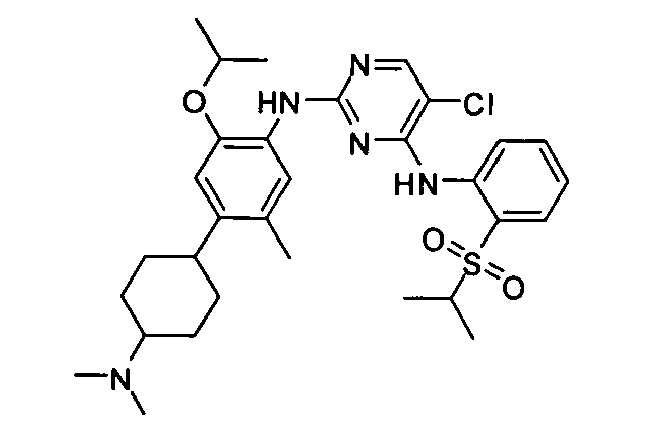
1H NMR (CD3OD, 400 MHz) δ 8.36-8.38 (d, 1H), 8.20 (s, 1H), 7.97-7.99 (m, 1H), 7.69-7.73 (m, 1H), 7.46--7.52 (m, 2H), 6.89-7.02 (d, 1H), 4.60-4.66 (m, 1H), 3.37-3.39 (m, 1H), 3.00 (s, 3H), 2.90 (s, 3H), 2.17-2.22 (m, 4H), 1.64-2.01 (m, 8H), 1.25-1.32 (m, 12H); MS (ES+): 600.3 (M+1)+. 5-Chloro-N2-[4-(4-dimethylamino-cyclohexyl)-2-isopropoxy-5-methyl-phenyl]-N4-[2-(propane-2-sulfonyl)-phenyl]-pyrimidine-2,4-diamine 22 
1H NMR (CD3OD, 400 MHz) δ 8.32-8.34 (d, 1H), 8.22 (s, 1H), 7.98-8.00 (m, 1H), 7.69-7.73 (m, 1H), 7.49--7.53 (m, 1H), 7.40-7.41 (d, 1H), 6.91-7.02 (d, 1H), 4.61-4.66 (m, 1H), 3.36-3.40 (m, 1H), 2.74-2.78 (d, 3H), 2.17-2.28 (m, 4H), 1.64-2.03 (m, 8H), 1.24-1.31 (m, 12H); MS (ES+): 586.2 (M+1)+. 5-Chloro-N2-[2-isopropoxy-5-methyl-4-(4-methylamino-cyclohexyl)-phenyl]-N4-[2-(propane-2-sulfonyl)-phenyl]-pyrimidine-2,4-diamine 23 
MS (ES+): 645.2 (M+1)+ 5-(4-(2-(isopropylsulfonyl)phenylamino)-5-chloropyrimidin-2-ylamino)-4-isopropoxy-N-methyl-2-(2-(4-methylpiperazin-1-yl)ethyl)benzamide 24 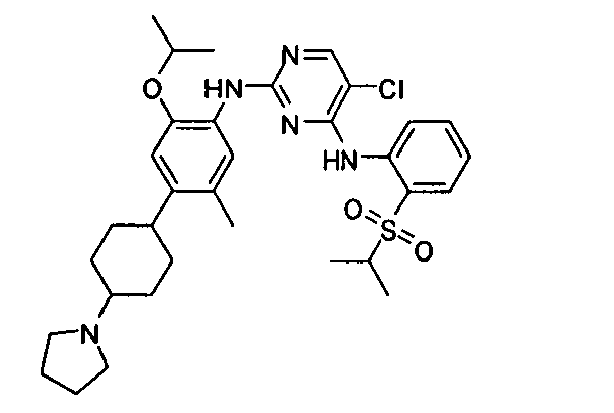
1H NMR (CD3OD, 400 MHz) δ 8.36-8.38 (d, 1H), 8.20 (s, 1H), 7.97-7.99 (m, 1H), 7.69-7.73 (m, 1H), 7.45--7.52 (m, 2H), 6.88-7.02 (d, 1H), 4.60-4.66 (m, 1H), 3.65-3.85 (m, 2H), 3.32-3.34 (m, 1H), 3.16-3.20 (m, 2H), 2.77-2.96 (m, 1H), 1.22-2.35 (m, 28H); MS (ES+): 626.3 (M+1)+. 5-Chloro-N2-[2-isopropoxy-5-methyl-4-(4-pyrrolidin-1-yl-cyclohexyl)-phenyl]-N4-[2-(propane-2-sulfonyl)-phenyl]-pyrimidine-2,4-diamine 25 
1H NMR (CD3OD, 400 MHz) δ 8.36-8.38 (d, 1H), 8.20-8.21 (m, 1H), 7.96-7.99 (m, 1H), 7.69-7.73 (m, 1H), 7.45--7.54 (m, 2H), 6.90-7.02 (d, 1H), 4.60-4.66 (m, 1H), 3.32-3.77 (m, 8H), 2.90-2.99 (m, 3H), 2.77-2.96 (m, 1H), 1.22-2.33 (m, 24H); MS (ES+): 644.3 (M+1)+. 5-Chloro-N2-(2-isopropoxy-4-{4-[(2-methoxy-ethyl)-methyl-amino]-cyclohexyl}-5-methyl-phenyl)-N4-[2-(propane-2-sulfonyl)-phenyl]-pyrimidine-2,4-diamine 26 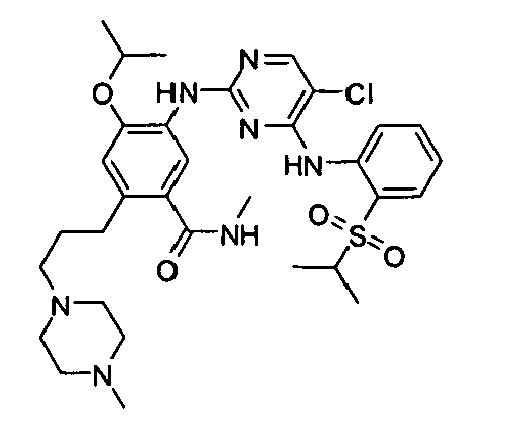
1H NMR (CD3OD, 400 MHz) δ 8.44-8.46 (d, 1H), 8.25 (s, 1H), 8.13 (s, 1H), 7.94-7.96 (m, 1H), 7.64-7.67 (m, 1H), 7.42--7.46 (m, 1H), 7.06 (s, 1H), 4.77-4.83 (m, 1H), 3.48-3.54 (m, 8H), 3.32-3.35 (m, 1H), 3.06-3.10 (m, 2H), 2.96 (s, 3H), 2.81-2.87 (m, 5H), 2.16-2.20 (m, 2H), 1.27-1.39 (m, 12H); MS 5-{5-Chloro-4-[2-(propane-2-sulfonyl)-phenylamino]-pyrimidin-2-ylamino}-4-isopropoxy-N-methyl-2-[3-(4-methyl-piperazin-1-yl)-propyl]-benzamide (ES+): 658.3 (M+1)+. 27 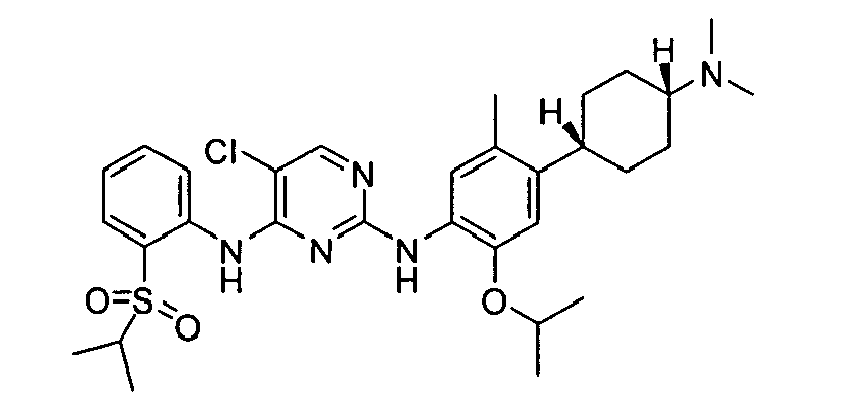
MS (ES+): 600.2 (M+1)+. 5-chloro-N2-(4-((1s,4s)-4-(dimethylamino)cyclohexyl)-2-isopropoxy-5-methylphenyl)-N4-(2-(isopropylsulfonyl)phenyl)pyrimidine-2,4-diamine 28 
MS (ES+): 558.2 (M+1)+. 5-chloro-N2-(2-isopropoxy-5-methyl-4-(piperidin-2-yl)phenyl)-N4-(2-(isopropylsulfonyl)phenyl)pyrimidine-2,4-diamine 29 
MS (ES+): 558.2 (M+1)+. 5-chloro-N2-(2-isopropoxy-4-methyl-5-(piperidin-4-yl)phenyl)-N4-(2-(isopropylsulfonyl)phenyl)pyrimidine-2,4-diamine 30 
MS (ES+): 601.2 (M+1)+. 5-chloro-N2-(2-isopropoxy-4-methyl-5-(piperidin-4-yl)phenyl)-N4-(2(morpholinosulfonamido) phenyl)pyrimidine-2,4-diamine 31 
MS (ES+): 537.3 (M+1)+. 2-(2-(2-isopropoxy-4-methyl-5-(piperidin-4-yl)phenylamino)-5-chloropyrimidin-4-ylamino)-N-isopropylbenzamide 32 
MS (ES+): 600.3 (M+1)+. 5-chloro-N2-(4-((1r,4r)-4-(dimethylamino)cyclohexyl)-2-isopropoxy-5-methylphenyl)-N4-(2-(isopropylsulfonyl)phenyl)pyrimidine-2,4-diamine 33 
MS (ES+): 655.3 (M+1)+. 5-chloro-N2-(2-isopropoxy-5-methyl-4-((1s,4s)-4-(4-methylpiperazin-1-yl)cyclohexyl)phenyl)-N4-(2-(isopropylsulfonyl)phenyl)pyrimidine-2,4-diamine 34 
MS (ES+): 655.3 (M+1)+. 5-chloro-N2-(2-isopropoxy-5-methyl-4-((1r,4r)-4-(4-methylpiperazin-1-yl)cyclohexyl)phenyl)-N4-(2-(isopropylsulfonyl)phenyl)pyrimidine-2,4-diamine 35 
1.10 (6H, d, J=5.7), 1.89 (2H, br), 2.03 (2H, br), 2.16 (3H, s), 2.32 (3H, s), 3.05 (2H, br), 3.49 (3H, br), 3.89 (3H, s), 4.72 (1H, br), 7.06 (1H, s), 7.21 (1H, br), 7.30 (1H, br), 7.41 (1H, br.s), 7.46 (1H, br.s), 7.69 (1H, s), 7.79 (1H, d, J= 7.4), 7.95 (1H, br), 8.04 (1H, br.s), 9.79 (2H, br.s). MS (ES+): 576.3 5-Methyl-N2-[4-methyl-5-(1-methyl-H-pyrazol-4-yl)-2-(piperidin-4-yloxy)-phenyl]-N4-[2-(propane-2-sulfonyl)-phenyl]-pyrimidine-2,4-diamine (M+1)+. 36 
1.10 (6H, d, J=5.7), 1.89 (2H, br), 2.03 (2H, br), 2.16 (3H, s), 2.32 (3H, s), 3.05 (2H, br), 3.49 (3H, br), 3.89 (3H, s), 4.72 (1H, br), 7.06 (1H, s), 7.21 (1H, br), 7.30 (1H, br), 7.41 (1H, br.s), 7.46 (1H, br.s), 7.69 (1H, s), 7.79 (1H, d, J= 7.4), 7.95 (1H, br), 8.04 (1H, 1-(5-{5-Chloro-4-[2-(propane-2-sulfonyl)-phenylamino]-pyrimidin-2-ylamino}-4-isopropoxy-2-methyl-phenyl)-ethanone br.s), 9.79 (2H, br.s). MS (ES+): 517.2 (M+1)+. 37 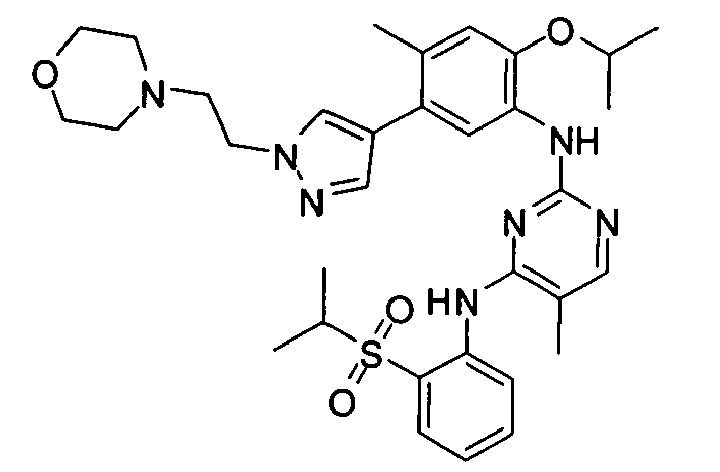
1.14 (6H, d, J=6.8), 1.25 (6H, d, J=6.0), 2.12 (3H, s), 2.33 (3H, s), 2.52 (overlapping with DMSO), 3.14 (2H, very br.) 3.45 (1H, sept, J=6.8), 3.70 (4H, very br), 3.93 (2H, very br), 4.6 (1 or 2H, br.S), 4.63 (1H, sept, J= 6.1), 6.99 (1H, s), 7.23 (2H, m), 7.53 (1H, s), 7.78 (2H, m)7.91 (1H, s), 8.01 (1H, s), 8.33 (1H, br.s), missing anilino NH. N2-{2-Isopropoxy-4-methyl-5-[1-(2-morpholin-4-yl-ethyl)-1H-pyrazol-4-yl]-phenyl}-5-methyl-N4-[2-(propane-2-sulfonyl)-phenyl]-pyrimidine-2,4-diamine MS (ES+): 634.3 (M+1)+. 38 
1.06 (6H, d, J=6.7), 1.28 (6H, d, J=6.0), 2.15 (6H, s), 2.19 (2H, br.m), 2.80 (3H, s), 2.82 (3H, s), 3.25 (2H, m), 3.39 (1H, m), 4.39 (2H, t, J=6.1), 4.70 (1H, sept, J=6.1), 6.86 (1H, d, J=8.5), 7.07 (1H, s), 7.19 (1H, br.s), 7.35 (2H, br.s), 7.48 (1H, br.m)7.74 (1H, br.d, J=6.4), 7.84 (2H, br.s), 8.05 N2-(5-(6-(3-(dimethylamino)propoxy)pyridin-3-yl)-2-isopropoxy-4-methylphenyl)-N4-(2-(isopropyl sulfonyl)phenyl)-5-methylpyrimidine-2,4-diamine (1H, br.s), 9.76 (1H, s), 10.15 (1H, br.s). MS (ES+): 633.8 (M+1)+. 39 
1.06 (6H, d, J=6.7), 1.28 (6H, d, J=6.0), 2.15 (6H, s), 2.19 (2H, br.m), 2.80 (3H, s), 2.82 (3H, s), 3.25 (2H, m), 3.39 (1H, m), 4.39 (2H, t, J=6.1), 4.70 (1H, sept, J=6.1), 6.86 (1H, d, J=8.5), 7.07 (1H, s), 7.19 (1H, br.s), 7.35 (2H, br.s), 7.48 (1H, br.m)7.74 N2-(2-isopropoxy-4-methyl-5-(6-(4-methylpiperazin-1-yl)pyridin-3-yl)phenyl)-N4-(2-(isopropylsulfonyl) phenyl)-5-methylpyrimidine-2,4-diamine (1H, br.d, J=6.4), 7.84 (2H, br.s), 8.05 (1H, br.s), 9.76 (1H, s), 10.15 (1H, br.s). MS (ES+): 630.8 (M+1)+. 40 
1.08 (6H, d, J=6.7), 1.28 (6H, d, J=6.0), 2.15 (3H, s), 2.19 (3H, s), 3.59 (4H, br), 3.78 (4H, br), 4.70 (1H, sept, J=6.1), 7.02 (1H, br.s), 7.07 (1H, s),7.24 (1H, br.s), 7.35 (2H, br.s), 7.49 (1H, br.s), 7.75 (1H, br.d, J=6.8), 7.81 (1H, br.s), 7.86 (1H, br), 8.04 (1H, br.s), 9.76 (1H, br.s). MS (ES+): 617.8 N2-(2-isopropoxy-4-methyl-5-(6-morpholinopyridin-3-yl)phenyl)-N4-(2-(isopropylsulfonyl)phenyl)-5-methylpyrimidine-2,4-diamine (M+1)+. 41 
1.12 (6H, d, J=6.7), 1.31 (6H, d, J=6.0), 2.09 (3H, s), 2.18 (3H,s), 3.25 (4H, br.s), 3.39 (1H, sept, J=6.8), 3.75 (4H, br.t, J=5.1), 4.68 (1H, sept, J=6.1), 6.90 (1H, d, J=9.0), 6.98 (1H, s), 7.01 (1H, br.s), 7.11 (1H, br.s), 7.44 (1H, s), 7.47 (1H,s) 7.70 (1H, d, J=7.7), 7.92 (1H, s) 8.04 (1H, s), 8.23 N2-(2-isopropoxy-4-methyl-5-(6-(piperazin-1-yl)pyridin-3-yl)phenyl)-N4-(2-(isopropylsulfonyl)phenyl)-5-methylpyrimidine-2,4-diamine (1H, br.s), 8.90 (1H, br.s), 8.94 (1H, br.s). MS (ES+): 616.8 (M+1)+. 42 
MS (ES+): 660.8 (M+1)+. N2-(5-(6-(2-morpholinoethylamino)pyridin-3-yl)-2-isopropoxy-4-methylphenyl)-N4-(2-(isopropyl-sulfonyl)phenyl)-5-methylpyrimidine-2,4-diamine 43 
1.13 (6H, d, J=6.8), 1.32 (6H, d, 6.0), 20.9 (3H, s), 2.20 (3H, s), 2.76 (3H, br.s), 3.1 (4H, very br.), 3.38 (H2O overlap), 3.40 (1H, sept, J=6.8), 4.36 (1H, very br), 4.70 (1H, sept, J=6.0), 6.60 (1H, d, J=4.7), 6.73 (1H, s), 7.00 (3h, br) 7.68 (1H, s), 7.72 (1H, dd, J=1.8, 7.5), 7.95 (1H, s), 8.03 (1H, s), N2-(2-isopropoxy-4-methyl-5-(2-(4-methylpiperazin-1-yl)pyridin-4-yl)phenyl)-N4-(2-(isopropylsulfonyl) phenyl)-5-methylpyrimidine-2,4-diamine 8.12 (1H, d, J=5.1), 8.31 (1H, br.d, J=7.6), 8.91 (1H, s). 630.8 (M+1)+. 44 
MS (ES+): 586.3 (M+1)+ 5-chloro-N2-(2-isopropoxy-5-methyl-4-((1s,4s)-4-(methylamino)cyclohexyl)phenyl)-N4-(2-(isopropylsulfonyl)phenyl)pyrimidine-2,4-diamine 45 
MS (ES+): 586.3 (M+1)+ 5-chloro-N2-(2-isopropoxy-5-methyl-4-((1r,4r)-4-(methylamino)cyclohexyl)phenyl)-N4-(2-(isopropylsulfonyl)phenyl)pyrimidine-2,4-diamine 46 
1H NMR (400 MHz, MeOD-d4) δ 8.15 (1H, s), 8.12 (1H, d, J = 7.6 Hz), 7.93 (1H, s), 7.78 (1H, d, J = 7.6 Hz), 7.20 (2H, m), 6.96 (1H, s), 6.18 (1H, s), 4.68 (1H, m), 3.28 (1H, m), 2.38 (3H, s), 2.23 (3H, s), 1.26 (6H, d, J = 6.0Hz), 1.16 (6H, d, J = 6.8 Hz) .MS (ES+): 556.2 (M+1)+. 5-chloro-N2-(2-isopropoxy-4-methyl-5-(3-methylisoxazol-5-yl)phenyl)-N4-(2-(isopropylsulfonyl)phenyl)pyrimidine-2,4-diamine 47 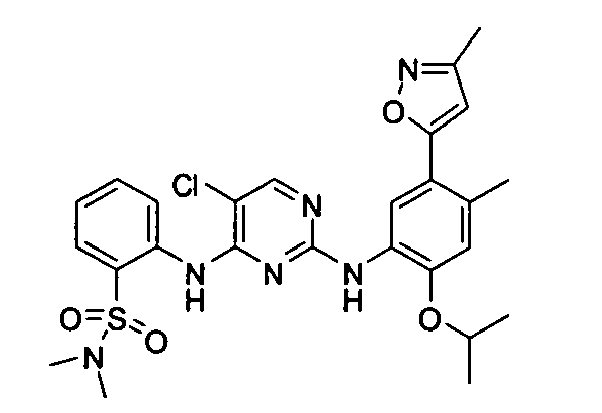
1H NMR (400 MHz, MeOD-d4) δ 8.20 (1H, s), 8.12 (1H, d, J = 7.6 Hz), 7.97 (1H, s), 7.78 (1H, d, J = 7.6 Hz), 7.20 (2H, m), 7.01 (1H, s), 6.24 (1H, s), 4.74 (1H, m), 2.68 (6H, s), 2.43 (3H, s), 2.29 (3H,s), 1.32 (6H, d, J = 6.0 Hz).MS (ES+): 557.2 (M+1)+. 2-(5-chloro-2-(2-isopropoxy-4-methyl-5-(3-methylisoxazol-5-yl)phenylamino)pyrimidin-4-ylamino)-N,N-dimethylbenzenesulfonamide 48 
1H NMR (400 MHz, MeOD-d4) δ 8.29 (1H, s), 8.13 (1H, bs), 7.97 (1H, s), 7.87 (1H, d, J = 7.6 Hz), 7.75 (1H, s), 7.35 (2H, m), 7.09 (1H,s), 6.41 (1H, s), 4.80 (1H, m), 3.40 (1H, m), 2.50 (3H, s), 2.40 (3H, s), 1.36 (6H, d, J = 6.0 Hz), 1.25 (3H, d, J = 6.8 Hz). MS 5-chloro-N2-(2-isopropoxy-4-methyl-5-(5-methyl-1H-pyrazol-3-yl)phenyl)-N4-(2-(isopropylsulfonyl) phenyl)pyrimidine-2,4-diamine (ES+): 555.2 (M+1)+. 49 
1H NMR (400 MHz, MeOD-d4) δ 8.27 (1H, s), 8.20 (1H, bs), 7.90 (1H, d, J = 6.4 Hz), 7.81 (1H, bs), 7.67 (1H, s), 7.37 (2H, bs), 7.08 (1H,s), 6.45 (1H, s), 4.76 (1H, m), 3.38 (1H, m), 2.41 (3H, s), 1.35 (6H, d, J = 6.0 Hz), 5-chloro-N2-(2-isopropoxy-4-methyl-5-(1H-pyrazol-3-yl)phenyl)-N4-(2-(isopropylsulfonyl)phenyl)pyrimidine-2,4-diamine 1.25 (3H, d, J = 6.8 Hz).MS (ES+): 541.2 (M+1)+. 50 
1H NMR (400 MHz, MeOD-d4) δ 8.31 (1H, s), 8.16 (1H, s), 8.03 (1H, bs), 7.92 (1H, s), 7.74 (1H, d, J = 7.2 Hz), 7.17 (2H, bs), 6.99 (1H,s), 6.34 (1H,s), 4.69 (1H, m), 2.64 (6H, s), 2.39 (3H, s), 1.27 (6H, d, J = 6.0 Hz). MS (ES+): 543.2 (M+1)+. 2-(5-chloro-2-(2-isopropoxy-5-(isoxazol-5-yl)-4-methylphenylamino)pyrimidin-4-ylamino)-N,N-dimethylbenzenesulfonamide 51 
1H NMR (400 MHz, MeOD-d4) δ 8.18 (1H, s), 7.94 (1H, d, J = 5.2 Hz), 7.72 (1H, s), 7.70 (1H, s), 7.29 (2H, bs), 7.21 (2H, bs), 7.00 (1H,s), 4.68 (1H, m), 2.65 (6H, s), 2.58 (3H, s), 2.28 (3H, s), 1.27 (6H, d, J = 6.0 Hz). .MS (ES+): 556.2 (M+1)+. 2-(5-chloro-2-(2-isopropoxy-4-methyl-5-(2-methyl-1H-imidazol-4-yl)phenylamino)pyrimidin-4-ylamino)-N,N-dimethylbenzenesulfonamide 52 
1H NMR (400 MHz, MeOD-d4) δ 8.10 (1H, bs), 7.90 (1H, s), 7.85 (1H, d, J = 7.6 Hz), 7.65 (1H, s), 7.48 (1H, bs), 7.36 (2H, bs), 7.12 (1H,s), 4.70 (1H, m), 3.39 (1H, m), 2.70 (3H, s), 2.40 (3H, s), 2.26 (3H, s), 1.34 (6H, d, J = 6.0 Hz), 1.24 (6H, d, J = 6.8 Hz). 5-chloro-N2-(2-isopropoxy-4-methyl-5-(2-methyl-1H-imidazol-4-yl)phenyl)-N4-(2-(isopropylsulfonyl) phenyl)pyrimidine-2,4-diamine MS (ES+): 535.2 (M+1)+. 53 
1H NMR (400 MHz, MeOD-d4) δ 8.39 (1H, s), 8.31 (1H, d, J = 8.0 Hz), 7.98 (1H, s), 7.81 (1H, d, J = 7.2 Hz), 7.19 (1H, bs), 7.10 (1H, bs), 6.97 (1H, s), 6.29 (1H,s), 4.78 (1H, m), 4.66 (2H, s), 3.39 (1H, m), 2.44 (3H, s), 2.18 (3H, s), 2.26 (3H, s), 1.41 (6H, d, J = (5-(5-(4-(2-(isopropylsulfonyl)phenylamino)-5-methylpyrimidin-2-ylamino)-4-isopropoxy-2-methylphenyl)isoxazol-3-yl)methanol 5.6 Hz), 1.27 (6H, d, J = 6.8 Hz). MS (ES+): 552.6 (M+1)+. 54 
1H NMR (400 MHz, MeOD-d4) δ 8.31 (1H, d, J = 8.4 Hz), 8.29 (1H, s), 7.88 (1H, s), 7.71 (1H, d, J = 8.0 Hz), 7.11 (1H, t, J = 8.8 Hz), 6.98 (1H, t, J = 7.2 Hz), 6.88 (1H, s), 6.25 (1H,s), 4.67 (1H, m), 3.59 (2H, s), 3.22 (1H, m), 3.03 (4H, bs), 2.61 (4H, bs), 2.35 (3H, s), 2.07 (3H, s), 1.30 (6H, d, J = 5.6 Hz), 1.17 (6H, d, J = 6.8 Hz). MS N2-(2-isopropoxy-4-methyl-5-(3-((piperazin-1-yl)methyl)isoxazol-5-yl)phenyl)-N4-(2-(isopropyl-sulfonyl)phenyl)-5-methylpyrimidine-2,4-diamine (ES+): 620.8 (M+1)+. 55 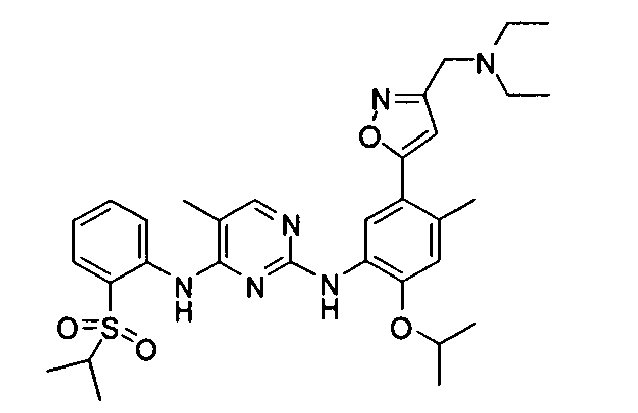
1H NMR (400 MHz, MeOD-d4) δ 8.35 (1H, s), 8.33 (1H, d, J = 8.4 Hz), 7.89 (1H, s), 7.72 (1H, d, J = 8.0 Hz), 7.15 (1H, t, J = 8.8 Hz), 7.01 (1H, t, J = 7.2 Hz), 6.90 (1H, s), 6.47 (1H,s), 4.69 (1H, m), 4.19 (2H, s), 3.24 (1H, m), 3.00 (4H, bs), 2.38 (3H, s), 2.08 (3H, s), 1.22 (6H, t, J = 7.2 Hz), 1.17 N2-(5-(3-((diethylamino)methyl)isoxazol-5-yl)-2-isopropoxy-4-methylphenyl)-N4-(2-(isopropyl-sulfonyl)phenyl)-5-methylpyrimidine-2,4-diamine (6H, d, J = 6.8 Hz). MS (ES+): 607.8 (M+1)+. 56 
1H NMR (400 MHz, MeOD-d4) δ 8.31 (1H, d, J = 8.4 Hz), 8.28 (1H, s), 7.87 (1H, s), 7.70 (1H, d, J = 8.0 Hz), 7.08 (1H, t, J = 8.8 Hz), 6.99 (1H, t, J = 7.2 Hz), 6.87 (1H, s), 6.25 (1H,s), 4.66 (1H, m), 3.61 (4H, m), 3.55 (2H, s), 3.21 (1H, m), 2.34-2.59 (12H, m), N2-(2-isopropoxy-4-methyl-5-(3-((4-(2-morpholinoethyl)piperazin-1-yl)methyl)isoxazol-5-yl)phenyl)-N4-(2-(isopropylsulfonyl)phenyl)-5-methylpyrimidine-2,4-diamine 2.35 (3H, s), 2.06 (3H, s), 1.29 (6H, d, J = 6.0 Hz), 1.16 (6H, d, J = 6.8 Hz). MS (ES+): 733.4 (M+1)+. 57 
1H NMR (400 MHz, MeOD-d4) δ 8.33 (1H, s), 8.17 (1H, bs), 7.93 (1H, s), 7.92 (1H, d, J = 7.2 Hz), 7.91 (1H, s), 7.37-7.39 (2H, m), 7.17 (1H, s), 6.83 (1H, s), 4.84 (1H, m), 4.11 (2H, dd, J = 2.8 and 12.8 Hz) 3.83-3.88 (4H, m), 3.70 (2H, d, J = 12.4 Hz), 3.42-3.48 (3H, m), 3.21 (2H, m), 2.54 (3H, s), 1.36 (6H, d, J = 6.0 Hz), 1.26 (6H, d, J = 6.8 Hz). MS (ES+): 698.2 (M+1)+. 5-(5-(4-(2-(isopropylsulfonyl)phenylamino)-5-chloropyrimidin-2-ylamino)-4-isopropoxy-2-methylphenyl)-N-(2-morpholinoethyl)isoxazole-3-carboxamide 58 
1H NMR (400 MHz, MeOD-d4) δ 8.33 (1H, s), 8.12 (1H, bs), 7.93 (1H, s), 7.95 (1H, s), 7.91 (1H, d, J = 8.8 Hz), 7.35-7.44 (2H, m), 7.15 (1H, s), 6.76 (1H, s), 4.85 (1H, m), 3.66-3.76 (4H, m) 3.38-3.43 (2H, m), 3.10 (2H, m), 2.54 (3H, s), 1.42 (3H, t, J = 7.2 Hz ), 1.37 (6H, d, J = 6.0 Hz), 1.27 (6H, d, J = 6.8 Hz). MS (ES+): 682.3 (5-(5-(4-(2-(isopropylsulfonyl)phenylamino)-5-chloropyrimidin-2-ylamino)4-isopropoxy-2-methylphenyl)isoxazol-3-yl)(4-ethylpiperazin-1-yl)methanone (M+1)+. 59 
1H NMR (400 MHz, MeOD-d4) δ 8.17 (1H, s), 8.06 (1H, d, J = 8.0 Hz), 8.02 (1H, s), 7.77 (1H, d, J = 7.6 Hz), 7.21 (1H, bs), 7.12 (1H, t, J = 7.6 Hz), 6.97 (1H, s), 6.51 (1H, s), 4.71 (1H, m), 3.77 (3H, s), 3.29 (1H, m), 2.39 (3H, s), 1.28 (6H, d, J = 6.0 Hz), 1.17 (6H, d, J = 6.8 Hz). MS (ES+): 615.1 (M+1)+. 5-(5-(4-(2-(isopropylsulfonyl)phenylamino)-5-chloropyrimidin-2-ylamino)-4-isopropoxy-2-methylphenyl)-N-methoxyisoxazole-3-carboxamide 60 
1H NMR (400 MHz, CDCl3) 10.35(s, 1H), 8.38 (d, 1H0, 7.93 (d, 1H), 7.59 (m, 2H), 7.41-7.36 (m, 2H), 4.70-4.63(br, 1H), 4.30-4.18 (br, 2H), 4.15-4.10 (br, 2H), 4.00-3.97 (br, 2H), 3.52-3.46 (br, 2H), 3.20 (m, 1H), 2.95-2.84 5-Chloro-N2-(2-isopropoxy-5-methyl-4-morpholin-4-ylmethyl-phenyl)-N4-[2-(propane-2-sulfonyl)-phenyl]-pyrimidine-2,4-diamine (br, 2H), 2.24 (s, 3H), 1.31 (d, 12H). MS (ES+): 574.2 (M+1)+. 61 
1H NMR (400 MHz, CDCl3) 10.43 (s, 1H), 9.68 (s, 1H), 8.32 (d, 1H), 8.04 (s, 1H), 7.93 (d, 1H), 7.71-7.65 (m, 3H), 7.59 (s, 1H), 7.40-7.37 (, 3H), 4.46-4.43 (m, 1H), 3.31-3.20 (m, 1H), 2.38 (s, 3H), 1.32 (d, 6H), 1.15 (d, 6H). MS N2-(4-(1H-benzo[d]imidazol-2-yl)-2-isopropoxy-5-methylphenyl)-5-chloro-N4-(2-(isopropylsulfonyl)phenyl)pyrimidine-2,4-diamine (ES+): 591.2 (M+1)+. 62 
MS (ES+): 601.2 (M+1)+. 5-(4-(2-(isopropylsulfonyl)phenylamino)-5-chloropyrimidin-2-ylamino)-4-isopropoxy-N-methyl-2-((pyrrolidin-1-yl)methyl)benzamide 63 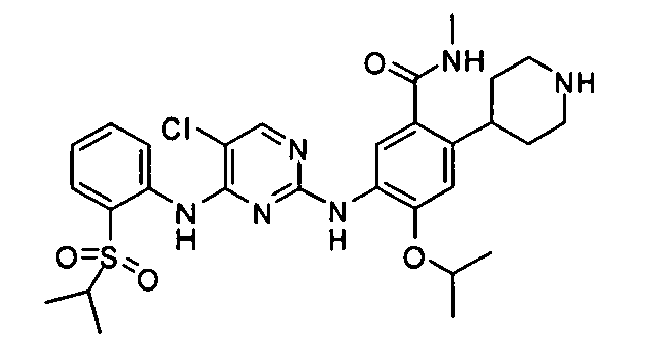
1H NMR: (DMSO-d6 + trace D20): δ 8.46(d,1H);8.30(s,1H); 7.83(s,1H);7.81(s,1H);7.58(t,1); 7.33(t,1H);6.88(s,1H);4.65(m,1H);3.37 (m,1H);3.35(d,2H); 3.18 (m,1H); 2.98(m,2H); 2.65 (s,3H); 1.90(d,2H); 5-(4-(2-(isopropylsulfonyl)phenylamino)-5-chloropyrimidin-2-ylamino)-4-isopropoxy-N-methyl-2-(piperidin-4-yl)benzamide 1.84(m,2H);1,28 (d,6H); 1.117(d,6H). MS (ES+): 602.2 (M+1)+. 64 
1H NMR: (DMSO-d6 + trace D2O): δ 8.48(d,1H);8.36(s,1H); 8.27(s,1H); 7.82(dd,1H); 7.52 (m,1H); 7.36(d,1H); 7.33(s,1H); 4.76(m,1H); 4.39 (s, 2H); 4.01 (d,2H); 3.70(t,2H); 3.44 (m,1H); 3.36(d,2H); 3.19 (t,2H); 2.66(s, 3H);1.30(d,6H); 1.18(d,6H).MS (ES+): 5-(4-(2-(isopropylsulfonyl)phenylamino)-5-chloropyrimidin-2-ylamino)-4-isopropoxy-N-methyl-2-(morpholinomethyl)benzamide 617.2 (M+1)+. 65 
(TFA salt, CD3OD) δ 8.44 (d, 1H), 8.31 (s, 1H), 8.09 (s, 1H), 7.98 (d, 1H), 7.80 (dd, 1H), 7.59 (s, 1H), 7.45 (dd, 1H), 4.75-4.65 (m, 1H), 3.40-3.30 (m, 1H, partially obscured by CD3OD peak), 2.36 (s, 3H), 1.41 (d, 6H), 1.31 4-(4-(2-(isopropylsulfonyl)phenylamino)-5-chloropyrimidin-2-ylamino)-5-isopropoxy-2-methylbenzoic acid (d, 6H). MS (ES+): 519.1 (M+1)+. 66 
(HCl salt, DMSO-d6 + trace D2O) δ 8.32 (s, 1H), 8.27 (d, 1H), 7.88 (d, 1H), 7.67 (dd, 1H), 7.45 (dd, 1H), 7.42 (s, 1H), 6.79 (s, 1H), 4.56-4.48 (m, 1H), 3.49-3.32 (m, 3H), 3.10-2.91 (m, 3H), 2.09 (s, 3H), 1.89-1.77 (m, 4H), 1.22 (d, 6H), 1.13 (d, 6H). MS (ES+): 558.1 (M+1)+. 5-chloro-N2-(2-isopropoxy-5-methyl-4-(piperidin-4-yl)phenyl)-N4-[2-(propane-2-sulfonyl)-phenyl]-pyrimidine-2,4-diamine 67 
(HCl salt, DMSO-d6 + trace D2O) δ 8.28 (s, 1H), 8.19 (d, 1H), 7.86 (d, 1H), 7.66 (dd, 1H), 7.45 (dd, 1H), 7.37 (s, 1H), 6.77 (s, 1H), 4.56-4.49 (m, 1H), 3.51-3.37 (m, 3H), 3.16-3.08 (m, 2H), 2.98-2.88 (m, 1H), 2.77 (s, 3H), 5-chloro-N2-(2-isopropoxy-5-methyl-4-(1-methylpiperidin-4-yl)phenyl)-N4-[2-(propane-2-sulfonyl)phenyl]-pyrimidine-2,4-diamine 2.05 (s, 3H), 1.90-1.81 (m, 4H), 1.19 (d, 6H), 1.11 (d, 6H). MS (ES+): 572.2 (M+1)+. 68 
MS (ES+): 601.2 (M+1)+. (4-(4-(2-(isopropylsulfonyl)phenylamino)-5-chloropyrimidin-2-ylamino)-5-isopropoxy-2-methylphenyl)(4-methylpiperazin-1-yl)methanone 69 
MS (ES+): 655.3 (M+1)+. 5-chloro-N2-(2-isopropoxy-5-methyl-4-(1-(1-methylpiperidin-4-yl)piperidin-4-yl)phenyl)-N4-(2-(isopropylsulfonyl)phenyl)pyrimidine-2,4-diamine 70 
MS (ES+): 650.3 (M+1)+. 5-chloro-N2-(2-isopropoxy-5-methyl-4-(6-(4-methylpiperazin-1-yl)pyridin-3-yl)phenyl)-N4-(2-(isopropylsulfonyl)phenyl)pyrimidine-2,4-diamine 71 
MS (ES+): 570.2 (M+1)+. 5-chloro-N2-(2-cyclobutoxy-5-methyl-4-(piperidin-4-yl)phenyl)-N4-(2-(isopropylsulfonyl) phenyl)pyrimidine-2,4-diamine 72 
MS (ES+): 602.2 (M+1)+. 2-[4-(4-{5-Chloro-4-[2-(propane-2-sulfonyl)-phenylamino]-pyrimidin-2-ylamino}-5-isopropoxy-2-methyl-phenyl)-piperidin-1-yl]-ethanol 73 
MS (ES+): 616.3 (M+1)+. 5-chloro-N2-(2-isopropoxy-4-(1-(2-methoxyethyl)piperidin-4-yl)-5-methylphenyl)-N4-(2-(isopropylsulfonyl)phenyl)pyrimidine-2,4-diamine 74 
1H NMR (HCl salt, DMSO-d6 + trace D2O, 400 MHz) 8.04 (s, 1H), 7.96 (dd, J = 8.0, 1.6 Hz, 2H), 7.79 (m, 1H), 7.61 (m, 1H), 7.27 (s, 1H), 6.81 (s, 1H), 4.55 (m, 1H), 3.43 (m, 3H), 3.08 (m, 2H), 2.91 (m, 1H), 2.77 (s, 3H), 2.17 (s, 3H), 1.98 (s, 3H), 1.91 (m, N2-(2-isopropoxy-5-methyl-4-(1-methylpiperidin-4-yl)phenyl)-N4-(2-(isopropylsulfonyl)phenyl)-5-methylpyrimidine-2,4-diamine 2H), 1.80 (m, 2H), 1.24 (d, J = 6.0 Hz, 6H), 1.10 (d, J = 6.8 Hz, 6H). MS (ES+): 552.7 (M+1)+. 75 
1H NMR (HCl salt, CD3OD, 400 MHz) 8.15 (s, 1H), 8.05 (m, 1H), 7.94 (dd, J = 8.0, 1.2 Hz, 1H), 7.66 (m, 1H), 7.50 (m, 1H), 7.19 (s, 1H), 6.83 (s, 1H), 4.60 (m, 1H), 3.54 (m, 2H), 3.13 (m, 4H), 2.99 (m, 1H), 2.82 (s, 3H), 2.06 (s, 3H), 1.91 (m, 4H), 1.54 (m, 2H), 5-chloro-N2-(2-isopropoxy-5-methyl-4-(1-methylpiperidin-4-yl)phenyl)-N4-(2-(propylsulfonyl)phenyl)pyrimidine-2,4-diamine 1.19 (d, J = 2.0 Hz, 6H), 0.82 (t, J = 7.6 Hz, 3H). MS (ES+): 572.2 (M+1)+MS (ES+): 572.2 (M+1)+. 76 
1H NMR (HCl salt, CD3OD, 400 MHz) 8.14 (s, 1H), 8.09 (m, 1H), 7.86 (dd, J = 8.0, 1.6 Hz, 1H), 7.59 (m, 1H), 7.44 (m, 1H), 7.24 (s, 1H), 6.83 (s, 1H), 4.59 (m, 1H), 3.51 (m, 2H), 3.13 (m, 2H), 3.02 (m, 1H), 2.82 (s, 3H), 2.62 2-(5-chloro-2-(2-isopropoxy-5-methyl-4-(1-methylpiperidin-4-yl)phenylamino)pyrimidin4-ylamino)-N,N-dimethylbenzenesulfonamide (s, 6H), 2.09 (s, 3H), 1.92 (m, 4H), 1.19 (d, J = 6.0 Hz, 6H). MS (ES+): 573.1 (M+1)+. 77 
1H NMR (HCl salt, CD3OD, 400 MHz) 8.14 (s, 1H) ,8.09 (m, 1H), 7.89 (dd, J = 8.0, 1.6 Hz, 1H), 7.58 (m, 1H), 7.40 (m, 1H), 7.28 (s, 1H), 6.83 (s, 1H), 4.59 (m, 1H), 3.51 (m, 2H), 3.13 (m, 6H), 3.02 (m, 1H), 2.82 (s, 3H), 2.09 (s, 3H), 1.91 (m, 4H), 1.67 (m, 4H), 5-chloro-N2-(2-isopropoxy-5-methyl-4-(1-methylpiperidin-4-yl)phenyl)-N4-(2-(pyrrolidin-1-ylsulfonyl)phenyl)pyrimidine-2,4-diamine 1.20 (d, J = 6.0 Hz, 6H). MS (ES+): 573.1 (M+1)+.MS (ES+): 599.3 (M+1)+. 78 
1H NMR (HCl salt, CD3OD, 400 MHz) 8.17 (s, 1H), 8.05 (m, 1H), 7.89 (dd, J = 8.0, 1.6 Hz, 1H), 7.56 (m, 1H), 7.38 (m, 1H), 7.28 (s, 1H), 6.84 (s, 1H), 4.61 (m, 1H), 3.59 (m, 1H), 3.51 (m, 2H), 3.14 (m, 2H), 3.00 (m, 1H), 2.82 5-chloro-N4-(2-(cyclobutylaminosulfonyl)phenyl)-N2-(2-isopropoxy-5-methyl-4-(1-methylpiperidin-4-yl)phenyl)pyrimidine-2,4-diamine (s, 3H), 2.07 (s, 3H), 1.91 (m, 6H), 1.67 (m, 2H), 1.36 (m, 2H), 1.20 (d, J = 6.0 Hz, 6H). MS (ES+): 599.3 (M+1)+. 79 
1H NMR (HCl salt, CD3OD, 400 MHz) 8.15 (s, 1H), 7.78 (m, 1H), 7.59 (m, 1H), 7.54 (m, 1H), 7.46 (m, 1H), 7.33 (s, 1H), 6.90 (s, 1H), 4.69 (m, 1H), 3.61 (m, 2H), 3.22 (m, 2H), 3.09 (m, 1H), 3.06 (s, 3H), 2.92 (s, 6H), 2.17 (s, 3H), 2.00 (m, 4H), 1.30 (d, J = 6.0 Hz, 2-(2-(2-isopropoxy-5-methyl-4-(1-methylpiperidin-4-yl)phenylamino)-5-chloropyrimidin-4-ylamino)-N,N-dimethylbenzamide 6H). MS (ES+): 537.3 (M+1)+. 80 
1H NMR (HCl salt, CD3OD, 400 MHz) 8.60 (s, 1H), 8.15 (s, 1H), 7.88 (m, 1H), 7.48 (m, 1H), 7.44 (m, 1H), 7.33 (m, 1H), 6.99 (s, 1H), 4.69 (m, 1H), 3.64 (m, 2H), 3.28 (m, 3H), 2.95 (s, 3H), 2.32 (s, 3H), 2.08 (m, 4H), 1.30 2-(2-(2-isopropoxy-5-methyl-4-(1-methylpiperidin-4-yl)phenylamino)-5-chloropyrimidin-4-ylamino) benzamide (d, J = 6.0 Hz, 6H). MS (ES+): 509.2 (M+1)+. 81 
1H NMR (HCl salt, CD3OD, 400 MHz) 8.12 (s, 1H),8.09(s, 1H), 7.94 (dd, J = 8.0, 1.6 Hz, 1H), 7.52 (m, 1H), 7.36 (m, 1H), 7.28 (s, 1H), 6.85 (s, 1H), 4.60 (m, 1H), 3.51 (m, 2H), 3.09 (m, 2H), 3.02 (m, 1H), 2.82 (s, 3H), 2.11 5-chloro-N2-(2-isopropoxy-5-methyl-4-(1-methylpiperidin-4-yl)phenyl)-N4-(2-(aminosulfonyl)phenyl)pyrimidine-2,4-diamine (s, 3H), 1.92 (m, 4H), 1.19 (d, J = 6.0 Hz, 6H).MS (ES+): 545.2 (M+1)+. 82 
1NMR (HCl salt, CD3OD, 400 MHz) 8.14 (s, 1H), 8.04 (s, 1H), 8.00 (dd, J = 8.0, 1.6 Hz, 1H), 7.67 (m, 1H), 7.49 (m, 1H), 7.23 (s, 1H), 6.82 (s, 1H), 4.58 (m, 1H), 3.54 (m, 2H), 3.14 (m, 2H), 3.10 (s, 3H), 3.00 (m, 1H), 2.82 (s, 3H), 2.08 (s, 3H), 1.89 (m, 4H), 5-chloro-N2-(2-isopropoxy-5-methyl-4-(1-methylpiperidin-4-yl)phenyl)-N4-(2-(methylsulfonyl)phenyl)pyrimidine-2,4-diamine 1.19 (d, J = 6.0 Hz, 6H). MS (ES+): 544.2 (M+1)+. 83 
1H NMR (HCl salt, DMSO-d6, 400 MHz) 9.61 (s, 1H), 9.39 (s, 1H), 9.11 (s, 1H), 8.38 (d, J = 8.0 Hz, 1H), 8.23 (s, 1H), 7.84 (dd, J = 8.0, 1.6 Hz, 1H), 7.70 (s, 2H), 7.41 (m, 1H), 7.33 (d, J = 8.0 Hz, 1H), 7.20 (m, 1H), 7.00 (d, J = 5-chloro-N2-(2-fluoro-5-methyl-4-(1-methylpiperidin-4-yl)phenyl)-N4-(2-(aminosulfonyl)phenyl)pyrimidine-2,4-diamine 12.4 Hz, 1H), 3.52 (m, 2H), 3.11 (m, 2H), 2.99 (m, 1H), 2.82 (d, J = 4.8 Hz, 3H), 2.25 (s, 3H), 1.92 (m, 2H), 1.81(m, 2H). MS (ES+): 505.2 (M+1)+. 84 
1H NMR (HCl salt, CD3O, 400 MHz) 8.15 (s, 1H), 8.07 (s, 1H), 7.92 (dd, J = 8.0, 1.6 Hz, 1H), 7.65 (m, 1H), 7.47 (m, 1H), 7.20 (s, 1H), 6.84 (s, 1H), 4.58 (m, 1H), 3.99 (m, 1H), 3.52 (m, 2H), 3.14 (m, 2H), 3.02 (m, 1H), 2.83 5-chloro-N4-(2-(cyclobutylsulfonyl)phenyl)-N2-(2-isopropoxy-5-methyl-4-(-methylpiperidin-4-yl)phenyl)pyrimidine-2,4-diamine (s, 3H), 2.35 (m, 2H), 2.08 (s, 3H), 2.00 (m, 2H),1.89 (m, 6H), 1.19 (d, J = 6.0 Hz, 6H). MS (ES+): 584.2 (M+1)+. 85 
MS (ES+): 523.2 (M+1)+. 5-chloro-N4-(2-(isopropylsulfonyl)phenyl)-N2-(2-methoxy-5-methyl-4-phenyl)-phenyl)pyrimidine-2,4-diamine 86 
MS (ES+): 442.1 (M+1)+. 5-chloro-N4-(2-cyanophenyl)-N2-(2-methoxy-5-methyl-4-phenyl)-phenyl)pyrimidine-2,4-diamine 87 
MS (ES+): 524.1 (M+1)+. 2-(5-chloro-2-(5-methoxy-2-methylbiphenyl-4-ylamino)pyrimidin-4-ylamino)-N,N-dimethylbenzenesulfonamide 88 
MS (ES+): 537.0 (M+1)+. 5-chloro-N4-(2-(isopropylsulfonyl)phenyl)-N2-(2-methoxy-5-methyl-4-(4-methylphenyl)-phenyl)pyrimidine-2,4-diamine 89 
MS (ES+): 541.1 (M+1)+. 5-chloro-N4-(2-(isopropylsulfonyl)phenyl)-N2-(2-methoxy-5-methyl-4-(4-fluorophenyl)-phenyl)pyrimidine-2,4-diamine 90 
MS (ES+): 559.0 (M+1)+. 5-chloro-N4-(2-(isopropylsulfonyl)phenyl)-N2-(2-methoxy-5-methyl-4-(2,4-difluorophenyl)-phenyl)pyrimidine-2,4-diamine 91 
MS (ES+): 581.2 (M+1)+. 2-(5-chloro-2-(4'-(dimethylamino)-5-methoxy-2,3'-dimethylbiphenyl-4-ylamino)pyrimidin-4-ylamino)-N,N-dimethylbenzenesulfonamide 92 
MS (ES+): 626.3 (M+1)+. 5-chloro-N2-(2-isopropoxy-5-methyl-4-((1s,4s)-4-(pyrrolidin-1-yl)cyclohexyl)phenyl)-N4-(2-(isopropylsulfonyl)phenyl)pyrimidine-2,4-diamine 93 
MS (ES+): 609.2 (M+1)+. 2-(5-chloro-2-(5-methoxy-2-methyl-4'-morpholinobiphenyl-4-ylamino)pyrimidin-4-ylaminof N,N-dimethylbenzenesulfonamide 94 
MS (ES+): 602.1 (M+1)+. 2-(5-chloro-2-(5-methoxy-2-methyl-4'-(methylsulfonyl)biphenyl-4-ylamino)pyrimidin-4-ylamino)-N,N-dimethylbenzenesulfonamide 95 
MS (ES+): 567.2 (M+1)+. 4'-(5-chloro-4-(2-(N,N-dimethylsulfamoyl) phenylamino)pyrimidin-2-ylamino)-5'-methoxy-2'-methylbiphenyl-4-carboxamide 96 
MS (ES+): 566.2 (M+1)+. 2-(2-(4'-acetyl-5-methoxy-2-methylbiphenyl-4-ylamino)-5-chloropyrimidin-4-ylamino)-N,N-dimethylbenzenesulfonamide 97 
MS (ES+): 581.2 (M+1)+. 4'-(5-chloro-4-(2-(N,N-dimethylsulfamoyl) phenylamino)pyrimidin-2-ylamino)-5'-methoxy-N,2'-dimethylbiphenyl-4-carboxamide 98 
MS (ES+): 568.1 (M+1)+. 4'-(5-chloro-4-(2-(N,N-dimethylsulfamoyl) phenylamino)pyrimidin-2-ylamino)-5'-methoxy-2'-methylbiphenyl-4-carboxylic acid 99 
MS (ES+): 525.1 (M+1)+. 2-(5-chloro-2-(2-methoxy-5-methyl-4-(pyridin-4-yl)phenylamino)pyrimidin-4-ylamino)-N,N-dimethylbenzenesulfonamide 100 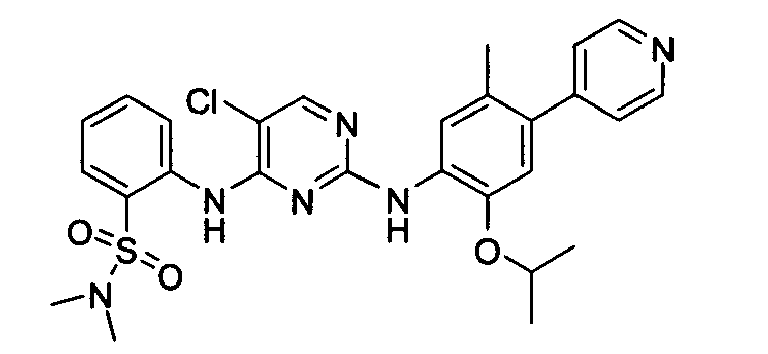
MS (ES+): 553.2 (M+1)+. 2-(5-chloro-2-(2-isopropoxy-5-methyl-4-(pyridin-4-yl)phenylamino)pyrimidin-4-ylamino)-N,N-dimethylbenzenesulfonamide 101 
MS (ES+): 608.2 (M+1)+. 2-(5-chloro-2-(5-methyl-2-(1-methylpiperidin-4-yloxy)-4-(pyridin-4-yl)phenylamino)yrimidin-4-ylamino)-N,N-dimethylbenzenesulfonamide 102 
MS (ES+): 596.2 (M+1)+. 5-(5-chloro-4-(2-(N,N-dimethylsulfamoyl) phenylamino)pyrimidin-2-ylamino)-4-isopropoxy-N-methyl-2-(pyridin-4-yl)benzamide 103 
MS (ES+): 614.2 (M+1)+. 5-(5-chloro-4-(2-(N,N-dimethylsulfamoyl) phenylamino)pyrimidin-2-ylamino)-2-(2-fluoropyridin-4-yl)-4-isopropoxy-N-methylbenzamide 104 
MS (ES+): 532.0 (M+1)+. 5-(4-(2-(isopropylsulfonyl)phenylamino)-5-chloropyrimidin-2-ylamino)-4-isopropoxy-N,2-dimethylbenzamide 105 
MS (ES+): 598.2 (M+1)+. 5-(4-(2-(isopropylsulfonyl)phenylamino)-5-chloropyrimidin-2-ylamino)-4-isopropoxy-N-methyl-2-(3-methyl-1H-pyrazol-5-yl)benzamide 106 
MS (ES+): 615.2 (M+1)+. 5-(4-(2-(isopropylsulfonyl)phenylamino)-5-chloropyrimidin-2-ylamino)-4-isopropoxy-N-methyl-2-(2-methylthiazol-5-yl)benzamide 107 
MS (ES+): 615.2 (M+1)+. 5-(4-(2-(isopropylsulfonyl)phenylamino)-5-chloropyrimidin-2-ylamino)-4-isopropoxy-2-methyl-N-(1-methylpiperidin-4-yl)benzamide 108 
MS (ES+): 558.2 (M+1)+. 5-(4-(2-(isopropylsulfonyl)phenylamino)-5-chloropyrimidin-2-ylamino)-2-cyclopropyl-4-isopropoxy-N-methylbenzamide 109 
MS (ES+): 620.2 (M+1)+. 4'-(5-chloro-4-(2-(N,N-dimethylsulfamoyl) phenylamino)pyrimidin-2-ylamino)-2'-cyano-5'-isopropoxy-N-methylbiphenyl-4-carboxamide 110 
MS (ES+): 581.2 (M+1)+. 5-chloro-N4-(2-(sulfonylamino)phenyl)-N2-(2-methoxy-5-methyl-4-(3-methyl-4-(methylacetamidophenyl)-phenyl)pyrimidine-2,4-diamine 111 
MS (ES+): 607.2 (M+1)+. 4'-(5-chloro-4-(2-(N,N-dimethylsulfamoyl) phenylamino)pyrimidin-2-ylamino)-N-cyclopropyl-5'-methoxy-2'-methylbiphenyl-4-carboxamide 112 
MS (ES+): 595.2 (M+1)+. N-((4'-(5-chloro-4-(2-(N,N-dimethylsulfamoyl) phenylamino)pyrimidin-2-ylamino)-5'-methoxy-2'-methylbiphenyl-4-yl)methyl)acetamide 113 
MS (ES+): 623.2 (M+1)+. 5-chloro-N4-(2-(morpholinosulfonyl)phenyl)-N2-(2-methoxy-5-methyl-4-(4-(methylacetamidophenyl)-phenyl)pyrimidine-2,4-diamine 114 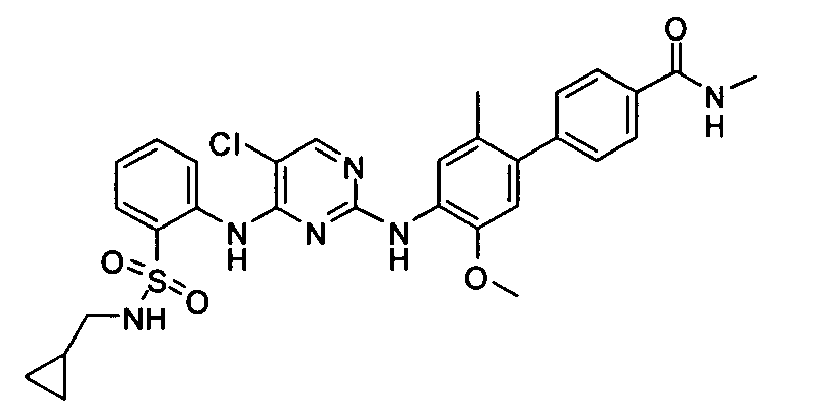
MS (ES+): 607.1 (M+1)+. 4'-(5-chloro-4-(2-(N-(cyclopropylmethyl) sulfamoyl)phenylamino)pyrimidin-2-ylamino)-5'-methoxy-N,2'-dimethylbiphenyl-4-carboxamide 115 
MS (ES+): 607.1 (M+1)+. 4'-(5-chloro-4-(2-(N-cyclobutylsulfamoyl) phenylamino)pyrimidin-2-ylamino)-5'-methoxy-N,2'-dimethylbiphenyl-4-carboxamide 116 
MS (ES+): 607.2 (M+1)+. 5-chloro-N4-(2-(pyrrolidinosulfonyl)phenyl)-N2-(2-methoxy-5-methyl-4-(4-acetamidomethylphenyl) phenyl)pyrimidine-2,4-diamine 117 
MS (ES+): 568.1 (M+1)+. 4'-(5-chloro-4-(2-(N,N-dimethylsulfamoyl) phenylamino)pyrimidin-2-ylamino)-5'-methoxy-2'-methylbiphenyl-3-carboxylic acid 118 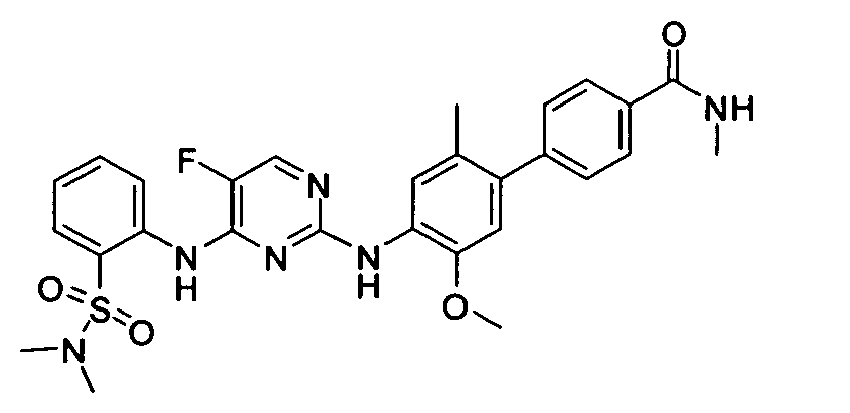
MS (ES+): 565.2 (M+1)+. 4'-(4-(2-(N,N-dimethylsulfamoyl)phenylamino)-5-fluoropyrimidin-2-ylamino)-5'-methoxy-N,2'-dimethylbiphenyl-4-carboxamide 119 
MS (ES+): 673.2 (M+1)+. 2-(5-chloro-2-(5-methoxy-2-methyl-4'-(morpholinosulfonyl)biphenyl-4-ylamino)pyrimidin-4-ylamino)-N,N-dimethylbenzenesulfonamide 120 
MS (ES+): 622.2 (M+1)+. 2-(5-chloro-2-(5-methoxy-2-methyl-4'-(4-methylpiperazin-1-yl)biphenyl-4-ylamino)pyrimidin-4-ylamino)-N,N-dimethylbenzenesulfonamide 121 
MS (ES+): 626.3 (M+1)+. 5-chloro-N2-(2-isopropoxy-5-methyl-4-((1r,4r)-4-(pyrrolidin-1-yl)cyclohexyl)phenyl)-N4-(2-(isopropylsulfonyl)phenyl)pyrimidine-2,4-diamine 122 
MS (ES+): 630.3 (M+1)+, 2-(N-((1r,4r)-4-(4-(4-(2-(isopropylsulfonyl) phenylamino)-5-chloropyrimidin-2-ylamino)-5-isopropoxy-2-methylphenyl)cyclohexyl)-N-methylamino)ethanol 123 
MS (ES+): 644.3 (M+1)+. N2-(4-((1 s,4s)-4-(N-(2-methoxyethyl)-N-methylamino)cydohexyl)-2-isopropoxy-5-methylphenyly 5-chloro-N4-(2-(isopropylsulfonyl) phenyl)pyrimidine-2,4-diamine 124 
MS (ES+): 644.3 (M+1)+. N2-(4-((r,4r)-4-(N-(2-methoxyethyl)-N-methylamino)cyclohexyl)-2-isopropoxy-5-methylphenyl)-5-chloro-N4-(2-(isopropylsulfonyl)phenyl)pyrimidine-2,4-diamine 125 
MS (ES+): 696.3 (M+1)+. 5-(4-(2-(isopropylsulfonyl)phenylaminoys-chloropyrimidin-2-ylamino)-4-isopropoxy-N-methyl-2-((R)-4-(4-methylpiperazin-1-yl)cyclohex-1-enyl)benzamide 126 
MS (ES+): 696.3 (M+1)+. 5-(4-(2-(isopropylsulfonyl)phenylamino)-5-chloropyrimidin-2-ylamino)-4-isopropoxy-N-methyl-2-((S)-4-(4-methylpiperazin-1-yl)cydohex-1-enyl)benzamide 127 
MS (ES+): 671.3 (M+1)+. 2-(4-((R)-1-hydroxypropan-2-ylamino)cyclohex-1-enyl)-5-(4-(2-(isopropylsulfonyl)phenylamino)-5-chloropyrimidin-2-ylamino)-4-isopropoxy-N-methylbenzamide 128 
MS (ES+): 671.3 (M+1)+, 2-(4-((S)-1-hydroxypropan-2-ylamino)cyclohex-1-enyl)-5-(4-(2-(isopropylsulfonyl)phenylamino)-5-chloropyrimidin-2-ylamino)-4-isopropoxy-N-methylbenzamide 129 
MS (ES+): 612.2 (M+1)+. 5-(4-(2-(isopropylsulfonyl)phenylamino)-5-chloropyrimidin-2-ylamino)-4-isopropoxy-N-methyl-2-(4-oxocyclohex-1-enyl)benzamide 130 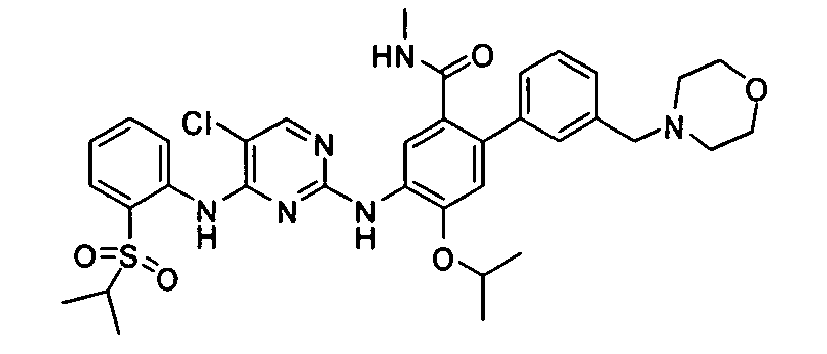
MS (ES+): 693.3 (M+1)+. 5-chloro-N4-(2-(isopropylsulfony)phenyl)-N2-(2-isopropoxy-5-(N-methylcarboxamido)-4-(3-methyl-4-(3-morpholinomethyl)phenyl)pyrimidine-2,4-diamine 131 
MS (ES+): 558.2 (M+1)+. 5-chloro-N2-(2-isopropoxy-5-methyl-4-(piperidin-3-yl)phenyl)-N4-(2-(isopropylsulfonyl) phenyl)pyrimidine-2,4-diamine 132 
MS (ES+): 579.1 (M+1)+. (2-(5-chloro-2-(2-isopropoxy-5-methyl-4-(1-methylpiperidin-4-yl)phenylamino)pyrimidin-4-ylamino)phenyl)(morpholino)methanone 133 
MS (ES+): 590.1 (M+1)+. 2-((2-(4-(5-chloro-4-(2-(isopropylsulfonyl)phenylamino) pyrimidin-2-ylamino)-5-isopropoxy-2-methylphenyl) propyl)(methyl)amino)ethanol 134 
MS (ES+): 572.1 (M+1)+. 5-chloro-N2-(4-((lr,4r)-4-(dimethylamino) cyclohexyl)-2-methoxy-5-methylphenyl)-N4-(2-(isopropylsulfonyl) phenyl)pyrimidine-2,4-diamine 135 
MS (ES+): 572.1 (M+1)+. 5-chloro-N2-(4-((ls,4s)-4-(dimethylamino) cyclohexyl)-2-methoxy-5-methylphenyl)-N4-(2-(isopropylsulfonyl) phenyl)pyrimidine-2,4-diamine 136 
MS (ES+): 552.7 (M+1)+. N2-(2-isopropoxy-5-methyl-4-(piperidin-4-yl)phenyl)-N4-(2-(isopropylsulfonyl)phenyl)-5-methylpyrimidine-2,4,6-triamine 137 
MS (ES+): 610.0 (M+1)+. 5-(4-(2-(isopropylsulfonyl)phenylamino)-5-chloropyrimidin-2-ylamino)-2-chloro-N-(2-(dimethylamino)ethyl)-4-isopropoxybenzamide 138 
MS (ES+): 577.5 (M+1)+. 5-chloro-N2-(4-chloro-2-isopropoxy-5-(3-methylisoxazol-5-yl)phenyl)-N4-(2-(isopropylsulfonyl)phenyl)pyrimidine-2,4-diamine 139 
MS (ES+): 599.2 (M+1)+. 6-(4-(2-(isopropylsulfonyl)phenylamino)-5-chloropyrimidin-2-ylamino)-5-isopropoxy-2-((R)-piperidin-3-yl)isoindolin-1-one 140 
MS (ES+): 599.2 (M+1)+. 6-(4-(2-(isopropylsulfonyl)phenylamino)-5-chloropyrimidin-2-ylamino)-5-isopropoxy-2-((S)-piperidin-3-yl)isoindolin-1-one 141 
MS (ES+): 571.2 (M+1)+. 6-(4-(2-(isopropyisulfonyl)phenylamino)-5-chloropyrimidin-2-ylamino)-2-(azetidin-3-yl)-5-isopropoxyisoindolin-1-one 142 
MS (ES+): 588.2 (M+1)+. Ethyl 6-(4-(2-(isopropyLsuLfonyl)phenylamino)-5-chloropyrimidin-2-ylamino)-5-isopropoxy-1-oxoisoindoline-2-carboxylate 143 
MS (ES+): 600.2 (M+1)+. 6-(4-(2-(isopropylsulfonyl)phenylamino)-5-chloropyrimidin-2-ylamino)-2-(tetrahydro-2H-pyran-4-yl)-5-isopropoxyisoindolin-1-one 144 
MS (ES+): 598.2 (M+1)+. 6-(4-(2-(isopropylsulfonyl)phenylamino)-5-chloro pyrimidin-2-ylamino)-2-cyclohexyl-5-isopropoxy-isoindolin-1-one 145 
MS (ES+): 601.2 (M+1)+. 6-(4-(2-(isopropylsulfonyl)phenylamino)-5-chloro pyrimidin-2-ylamino)-5-isopropoxy-2-morpholino-isoindolin-1-one 146 
MS (ES+): 585.2 (M+1)+. 6-(4-(2-(isopropylsulfonyl)phenylamino)-5-chloropyrimidin-2-ylamino)-5-isopropoxy-2-((S)-pyrrolidin-3-yl)isoindolin-1-one 147 
MS (ES+): 671.2 (M+1)+. 3-(4-(6-(4-(2-(isopropylsulfonyl)phenylamino)-5-chloropyrimidin-2-ylamino)-5-isopropoxy-1-oxoisoindolin-2-yl)piperidin-1-yl)propanoic acid 148 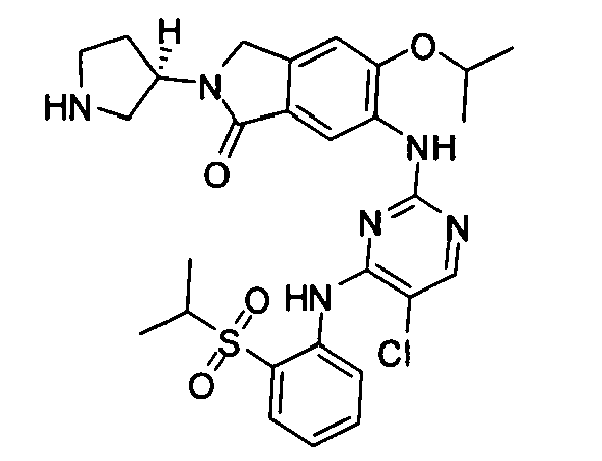
MS (ES+): 585.2 (M+1)+. 6-(4-(2-(isopropylsulfonyl)phenylamino)-5-chloropyrimidin-2-ylamino)-5-isopropoxy-2-((R)-pyrrolidin-3-yl)isoindolin-1-one 149 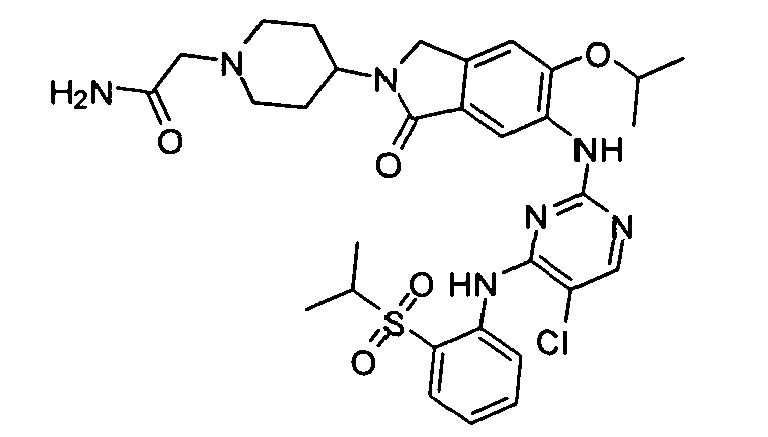
MS (ES+): 656.2 (M+1)+. 2-[4-(6-{5-Chloro-4-[2-(propane-2-sulfonyl)-phenyl-amino]-pyrimidin-2-ylamino}-5-isopropoxy-1-oxo-1,3-dihydro-isoindol-2-yl)-piperidin-1-yl]-acetamide 150 
MS (ES+): 558.2 (M+1)+. 6-(4-(2-(isopropylsulfonyl)phenylamino)-5-chloropyrimidin-2-ylamino)-2-acetyl-5-isopropoxyisoindolin-1-one 151 
MS (ES+): 560.2(M+1)+. 6-(4-(2-(isopropyisulfonyl)phenylamino)-5-chloropyrimidin-2-ylamino)-2-(2-hydroxyethyl)-5-isopropoxyisoindolin-1-one 152 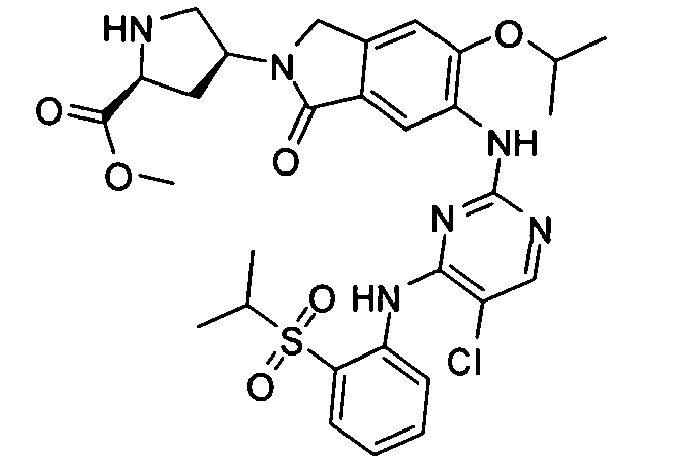
MS (ES+): 643.2 (M+1)+. (2S,4S)-methyl 4-(6-(4-(2-(isopropylsulfonyl) phenylamino)-5-chloropyrimidin-2-ylamino)-5-isopropoxy-1-oxoisoindolin-2-yl)pyrrolidine-2-carboxylate 153 
MS (ES+): 574.1 (M+1)+. 2-(6-(4-(2-(isopropylsulfonyl)phenylamino)-5-chLoropyrimidin-2-yLamino)-5-isopropoxy-1-oxoisoindolin-2-yl)acetic acid 154 
MS (ES+): 643.2 (M+1)+. (2S,4R)-methyl 4-(6-(4-(2-(isopropylsulfonyl) phenylamino)-5-chloropyrimidin-2-ylamino)-5-isopropoxy-1-oxoisoindolin-2-yl)pyrrolidine-2-carboxylate 155 
1H NMR (400 MHz, MeOD-d4) δ 8.29 (s, 1H), 8.26 (br, 1H), 7.96 (dd, 1H), 7.93 (s, 1H), 7.72(dd, 1H), 7.48 (dd, 1H), 7.35 (s, 1H), 4.50 (s, 2H), 4.35-4.29 (m, 1H), 3.83 (d, 2H), 3.38-3.30 (m, 2H), 3.02-2.95 (m, 3H), 2.88 (s, 6H), 1.88-1.84 (m, 3H), 1.36 (d, 6H), 1.25 (d, 6H); ESMS m/z 670.2 (M + H+). 4-(6-{5-Chloro-4-[2-(propane-2-sulfonyl)-phenylamino]-pyrimidin-2-ylamino}-5-isopropoxy-1-oxo-1,3-dihydro-isoindol-2-yl)-piperidine-1-carboxylic acid dimethylamide 156 
MS (ES+): 629.2 (M+1)+. (2S,4S)-4-(6-(4-(2-(isopropylsulfonyl) phenylamino)-5-chloropyrimidin-2-ylamino)-5-isopropoxy-1-oxoisoindolin-2-yl)pyrrolidine-2-carboxylic acid 157 
MS (ES+): 629.2 (M+1)+. (2S,4R)-4-(6-(4-(2-(isopropylsulfonyl) phenylamino)-5-chloropyrimidin-2-ylamino)-5-isopropoxy-1-oxoisoindolin-2-yl)pyrrolidine-2-carboxylic acid 158 
MS (ES+): 585.2 (M+1)+. 6-(4-(2-(isopropylsulfonyl)phenylamino)-5-chloropyrimidin-2-ylamino)-2-((azetidin-3-yl)methyl)-5-isopropoxyisoindolin-1-one 159 
MS (ES+): 625.2 (M+1)+. 6-(4-(2-(isopropylsulfonyL)phenylamino)-5-chloropyrimidin-2-ylamino)-5-isopropoxy-2-((S)-quinuclidin-3-yl)isoindolin-1-one 160 
MS (ES+): 639.2 (M+1)+. 6-{5-Chloro-4-[2-(propane-2-sulfonyl)-phenylamino]-pyrimidin-2-ylamino}-5-isopropoxy-2-(8-methyl-8-aza-bicyclo[3.2.1]oct-6-yl)-2,3-dihydro-isoindol-1-one 161 
MS (ES+): 670.3 (M+1)+. 4-(6-(4-(2-(isopropylsulfonyl)phenylamino)-5-chloropyrimidin-2-ylamino)-5-isopropoxy-1-oxoisoindolin-2-yl)-N-ethylpiperidine-1-carboxamide 162 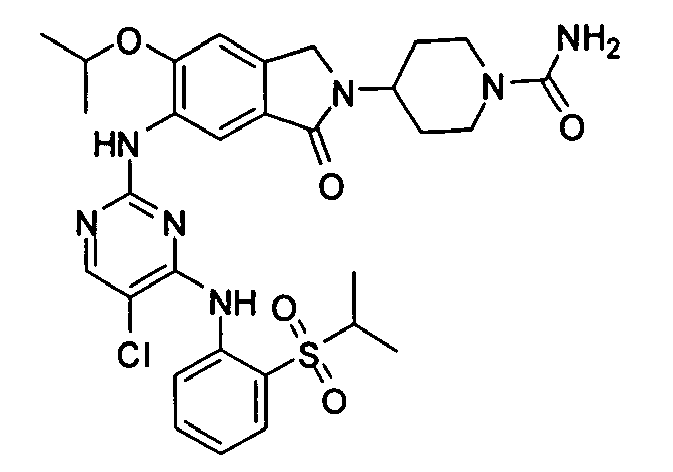
MS (ES+): 642.1 (M+1)+. 4-(6-(4-(2-(isopropylsulfonyl)phenylamino)-5-chloropyrimidin-2-ylamino)-5-isopropoxy-1-oxoisoindolin-2-yl)piperidine-1-carboxamide 163 
MS (ES+): 476.1 (M+1)+. 6-(4-(2-(isopropylsulfonyl)phenylamino)-5-chloropyrimidin-2-ylamino)-5-fluoroisoindolin-1-one 164 
MS (ES+): 456.1 (M+1)+. 6-(4-(2-(isopropylsulfonyl)phenylamino)-5-methylpyrimidin-2-ylamino)-5-fluoroisoindolin-1-one 165 
MS (ES+): 591.2 (M+1)+. Ethyl 7-(4-(2-(isopropylsulfonyl)phenylamino)-5-methylpyrimidin-2-ylamino)-1,4-dihydro-6-isopropoxyindeno[1,2-c]pyrazole-3-carboxylate 166 
MS (ES+): 549.2 (M+1)+, (7-(4-(2-(isopropylsulfonyl)phenylamino)-5-methylpyrimidin-2-ylamino)-1,4-dihydro-6-isopropoxyindeno[1,2-c]pyrazol-3-yl)methanol 167 
MS (ES+): 611.2 (M+1)+. Ethyl 7-(4-(2-(isopropylsulfonyl)phenylamino)-5-chloropyrimidin-2-ylamino)-1,4-dihydro-6-isopropoxyindeno[1,2-c]pyrazole-3-carboxylate 168 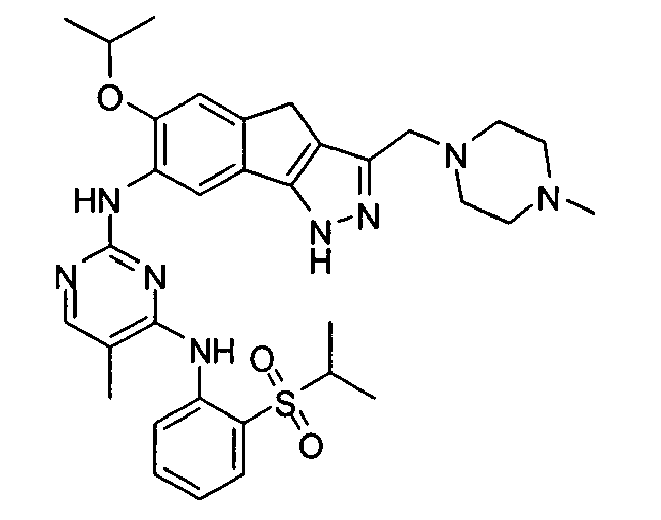
MS (ES+): 631.3 (M+1)+. N2-(1,4-dihydro-6-isopropoxy-3-((4-methylpiperazin-1-yl)methyl)indeno[1,2-c]pyrazol-7-yl)-N4-(2-(isopropylsulfonyl)phenyl)-5-methylpyrimidine-2,4-diamine 169 
MS (ES+): 618.3 (M+1)+. N2-(1,4-dihydro-6-isopropoxy-3-(morpholinomethyl) indeno[1,2-c]pyrazol-7-yl)-N4-(2-(isopropylsulfonyl) phenyl)-5-methylpyrimidine-2,4-diamine 170 
MS (ES+): 631.3 (M+1)+. N2-(3-((4-aminopiperidin-1-yl)methyl)-1,4-dihydro-6-isopropoxyindeno[1,2-c]pyrazol-7-yl)-N4-(2-(isopropylsulfonyl)phenyl)-5-methylpyrimidine-2,4-diamine 171 
MS (ES+): 631.3 (M+1)+. N2-(1,4-dihydro-6-isopropoxy-3-((piperidin-4-ylamino)methyl)indeno[1,2-c]pyrazol-7-yl)-N4-(2-(isopropylsulfonyl)phenyl)-5-methylpyrimidine-2,4-diamine 172 
MS (ES+): 515.1 (M+1)+. 6-(4-(2-(isopropylsulfonyl)phenylamino)-5-chloropyrimidin-2-ylamino)-2,3-dihydro-5-isopropoxyinden-1-one 173 
MS (ES+): 495.2 (M+1)+, 6-(4-(2-(isopropylsulfonyl)phenylamino)-5-methylpyrimidin-2-ylamino)-2,3-dihydro-5-isopropoxyinden-1-one 174 
MS (ES+): 497.2 (M+1)+. 6-(4-(2-(isopropylsulfonyl)phenylamino)-5-methyl pyrimidin-2-ylamino)-2,3-dihydro-5-isopropoxy-1H-inden-1-ol 175 
1H NMR 400 MHz (DMSO-d6 with trace D2O) δ 8.55 (d, 1H), 8.32 (s, 1H), 8.14 (s, 1H), 7.82 (dd,1H), 7.74 (t, 1H), 7.34 (t, 1H), 7.28 (s, 1H), 4.73 (m, 2H), 4.39 (s, 2H), 4.12 (m, 2H), 4.06 (q, 2H), 3.46 (m, 1H), 2.92 (m 2H), 1.76 (m, 2H), 1.68 (m, 2H), 1.29 (d, 6H), 1.20 (t, 3H), 1.17 (d, 6H); MS 4-(6-{5-Chloro-4-[2-(propane-2-sulfonyl)-phenylamino] -pyrimidin-2-ylamino}-5-isopropoxy-1-oxo-1,3-dihydro -isoindol-2-yl)-piperidine-1-carboxylic acid ethyl ester m/z 671 (M+1). 176 
1H NMR 400 MHz (DMSO-d6 with trace D2O) δ 8.44 (s, 2H), 8.39 (s, 1H), 7.87 (dd, 1H), 7.78 (dt, 1H), 7.45 (s, 1H), 7.41 (m, 1H), 4.91 (m, 2H), 4.25(m, 2H), 3.51 (m, 3H), 3.10(m, 2H), 2.77(s, 3H), 1.80(m, 2H), 1.35(d, 6H), 1.13(d, 6H); MS m/z 627 (M+1). 5-{5-Chloro-4-[2-(propane-2-sulfonyl)-phenylamino]-pyrimidin-2-ylamino}-6-isopropoxy-2-(1-methyl-piperidin-4-yl)-isoindole-1,3-dione 177 
1H NMR 400 MHz (DMSO-d6 with trace D2O) δ 8.47(d, 1H), 8.25 (s, 1H), 8.07 (s, 1H), 7.78 (dd, 1H), 7.68 (m, 1H), 7.31 (t, 1H), 7,24 (s, 1H), 4,71 (m, 2H), 4.43 (dd, 2H), 3.60 (m, 1H), 3.44 (m, 1H), 3.35 (m,1H), 2.63 (m, 1H), 2.28 (m, 1H), 1.22 (d, 6H), 1.10 (d, 6H); MS m/z 628 (M+1). (2S, 4S)-4-(6-{5-Chloro-4-[2-(propane-2-sulfonyl)-phenylamino]-pyrimidin-2-ylamino}-5-isopropoxy-1-oxo-1,3-dihydro-isoindol-2-yl)-pyrrolidine-2-carboxylic acid amide 178 
1H NMR (400 MHz, CDCl3) δ 10.38 (s, 1H), 10.13 (s, 1H), 9.60-9.50 (br, 1H), 9.34-9.21 (br, 1H), 8.46 (d, 1H), 8.26 (s, 1H), 8.08 (s, 1H), 7.91 (dd, 1H), 7.71 (m, 1H), 7.34 (t, 1H), 7.03 (s, 1H), 4.30 (m, 1H), 4.53 (m, 1H), 4.33 (s, 2H), 3.62 (m, 2H), 3.21-3.09 6-{5-Chloro-4-[2-(propane-2-sulfonyl)-phenylamino]-pyrimidin-2-ylamino}-5-isopropoxy-2-piperidin-4-yl-2,3-dihydro-isoindol-1-one (m, 3H), 2.31-2.21 (m, 2H), 2.09-2.05 (m, 2H), 1.41 (d, 6H), 2.30 (d, 6H); ESMS m/z 599.2 (M + H+). 179 
MS (ES+): 641.3 (M+1)+. 6-(4-(2-(isopropylsulfonyl)phenylamino)-5-chloropyrimidin-2-ylamino)-5-isopropoxy-2-(1-isopropylpiperidin-4-yl)isoindolin-1-one 180 
MS (ES+): 710.3 (M+1)+. 6-(4-(2-(isopropylsulfonyl)phenylamino)-5-chloropyrimidin-2-ylamino)-5-isopropoxy-2-(2-(4-(piperidin-1-yl)piperidin-1-yl)ethyl)isoindolin-1-one 181 
1H NMR 400 MHz (DMSO-d6 with trace D2O) δ 8.46 (d, 1H), 8.35 (s, 1H), 8.09(s, 1H), 7.82(d, 1H), 7.74(t, 1H), 7.36(t,1H), 7.33(s, 1H), 4.75 (m, 1H), 4.41(s, 2H), 4,29(m, 1H), 3.65(m, 2H), 3.44(m, 1H), 3.17(t, 2H), 2,79(s, 3H), 2.07(m, 2H), 1,98(d, 2H), 1.28(d, 6H), 1.14(d, 6H); MS m/z 613 (M+1). 6-{5-Chloro-4-[2-(propane-2-sulfonyl)-phenylamino]-pyrimidin-2-ylamino}-5-isopropoxy-2-(1-methyl-piperidin-4-yl)-2,3-dihydro-isoindol-1-one 182 
8.60(d,1H), 8.33(s,1H);8.20 (s,1H);7.82(dd,1H);7.77(dt, 1H); 7.35(s, 1H); 7.33(t,1H); 4.76 (m, 1H); 4.44(s,2H); 3.88 (t, 2H); 3.40 (m, 3H); 2.87 (s, 6H); 1,30 (d, 6H); 1.16 (d, 6H). ). MS (ES+): 587.2 (M+1)+. 6-(4-(2-(isopropylsulfonyl)phenylamino)-5-chloro pyrimidin-2-ylamino)-2-(1-(2-(dimethylamino)ethyl) piperidin-4-yl)-5-isopropoxyisoindolin-1-one 183 
8.60(d,1H); 8.32(s,1H);8.20 (s, 1H);7.83(dd,1H);7.78 (dt,1H);7.35 (s,1H);7.31(t,1H);4.76(m,1H);4.46(s,2 H);3.87 (t,2H); 3.63 (m,2H); 3.48 (m,1H); 3.09 (m,2H); 2.05 (m, 2H); 1.85 (m, 2H); 1.30(d,6H); 1.17(d,6H). MS (ES+): 613.2 (M+1)+. 6-(4-(2-(isopropyisulfonyl)phenylamino)-5-chloropyrimidin-2-ylamino)-5-isopropoxy-2-(1-(2-(pyrrolidin-1-yl)ethyl)piperidin-4-yl)isoindolin-1-one 184 
8.53(d, 1H); 8.32(s, 1H), 8.11(s, 1H); 7.81 (dd, 1H); 7.73(dt, 1H); 7.33(t, 1H);7.28(s, 1H);4.72 (m,1H); 4.39 (s, 2H); 3.30 (m, 1H); 3.06(s, 3H); 1.28 (d, 6H), 1.15 (d, 6H). MS (ES+): 530.2 (M+1)+. 6-(4-(2-(isopropylsulfonyl)phenylamino)-5-chloropyrimidin-2-ylamino)-5-isopropoxy-2-methylisoindolin-1-one 185 
MS (ES+): 597.1 (M+1)+. 8-(5-chloro-4-(2-(isopropylsulfonyl)phenylamino) pyrimidin-2-ylamino)-9-isopropoxy-3-methyl-1,2,3,4-tetrahydrobenzo[c][1,7]naphthyridin-6(5H)-one 186 
MS (ES+): 643.2 (M+1)+. (S)-6-(5-chloro-4-(2-(isopropylsulfonyl)phenylamino) pyrimidin-2-ylamino)-2-(1-(2-hydroxyethyl)piperidin-3-yl)-5-isopropoxyisoindolin-1-one 187 
MS (ES+): 643.2 (M+1)+. (R)-6-(5-chloro-4-(2-(isopropylsulfonyl)phenylamino) pyrimidin-2-ylamino)-2-(1-(2-hydroxyethyl)piperidin-3-yl)-5-isopropoxyisoindolin-1-one 188 
MS (ES+): 669.3 (M+1)+. 6-(5-chloro-4-(2-(isopropylsulfonyl)phenylamino) pyrimidin-2-ylamino)-5-isopropoxy-2-(1,2,2,6,6-pentamethylpiperidin-4-yl)isoindolin-1-one 189 
MS (ES+): 642.2 (M+1)+. (2S,4S)-4-(6-(5-chloro-4-(2-(isopropylsulfonyl) phenylamino)pyrimidin-2-ylamino)-5-isopropoxy-1-oxoisoindolin-2-yl)-1-methylpyrrolidine-2-carboxamide 190 
MS (ES+): 657.2 (M+1)+. 5-(5-chloro-4-(2-(isopropylsulfonyl)phenylamino) pyrimidin-2-ylamino)-2-(1-(2-hydroxyethyl)piperidin-4-yl)-6-isopropoxyisoindoline-1,3-dione 191 
MS (ES+): 670.2 (M+1)+, 2-(4-(5-(5-chloro-4-(2-(isopropylsulfonyl)phenylamino) pyrimidin-2-ylamino)-6-isopropoxy-1,3-dioxoisoindolin-2-yl)piperidin-1-yl)acetamide 192 
MS (ES+): 666 (M+1)+. 3-(4-(5-(5-chloro-4-(2-(isopropylsulfonyl) phenylamino)pyrimidin-2-ylamino)-6-isopropoxy-1,3-dioxoisoindolin-2-yl)piperidin-1-yl)propanenitrile 193 
MS (ES+): 613.1 (M+1)+, (S)-5-(5-chloro-4-(2-(isopropylsulfonyl)phenylamino) pyrimidin-2-ylamino)-6-isopropoxy-2-(1-methylpyrrolidin-3-yl)isoindoline-1,3-dione 194 
MS (ES+): 643.1 (M+1)+. (S)-5-(5-chloro-4-(2-(isopropylsulfonyl)phenylamino) pyrimidin-2-ylamino)-2-(1-(2-hydroxyethyl)pyrrolidin-3-yl)-6-isopropoxyisoindoline-1,3-dione 195 
MS (ES+): 613.1 (M+1)+. (S)-5-(5-chloro-4-(2-(isopropylsulfonyl)phenylamino) pyrimidin-2-ylamino)-6-isopropoxy-2-(1-methylpyrrolidin-3-yl)isoindoline-1,3-dione 196 
8.44(s,2H);8.39(s,1H);7.87(dd,1H);7.7 8(dt,1H);7.45(s,1H);7.41 (m,1H);4.91 m,2H); 4.25(m,2H); 3.51 (m,3H); 3.10 (m,2H); 2.77 (s,3H); 1.80(m,2H),1.35(d,6H);1.13(d,6H). MS (ES+): 614.2 (M+1)+. 6-(4-(2-(isopropyisulfonyl)phenylamino)-5-chloropyrimidin-2-ylamino)-5-isopropoxy-2-(1-methylpiperidin-4-yl)isoindolin-1-one 197 
MS (ES+): 654.2 (M+1)+. 6-(4-(2-(isopropylsulfonyl)phenylamino)-5-chloropyrimidin-2-ylamino)-5-isopropoxy-2-((6S,7R)-9-methyl-9-aza-bicyclo[4.2.1]nonan-7-yl)isoindolin-1-one 198 
1H NMR (DMSO, 400 MHz) δ 10.04 (s, 1H), 9.66 (s, 1H), 8.47-8.63 (m, 3H), 8.18-8.23 (m, 2H), 7.97-7.99 (d, 1H), 7.54-7.82 (m, 3H), 7.25-7.35 (m, 1H), 3.31-3.33 (m, 1H), 2.54 (s, 3H), 1.15 (d, 6H). MS (ES+): 511.1 (M+1)+. 4-{5-Chloro-4-[2-(propane-2-sulfonyl)-phenylamino]-pyrimidin-2-ylamino}-6-methyl-quinoline-2-carboxylic acid amide 199 
1H NMR (CDCl3, 400 MHz) δ 9.73 (s, 1H), 8.85 (s, 1H), 8.21-8.55 (m, 1H), 8.21 (s, 1H), 8.08-8.18 (m, 1H), 7.90-7.92 (d, 1H), 7.81-7.83 (dd, 1H), 7.51-7.67 (m, 4H), 7.18-7.21 (m, 1H), 3.13-3.16 (m, 1H), 3.03-3.05 (d, 3H), 1.23-1.25 (d, 3H). MS (ES+): 525.7 (M+1)+. 4-{5-Chloro-4-[2-(propane-2-sulfonyl)-phenylamino]-pyrimidin-2-ylamino}-6-methyl-quinoline-2-carboxylic acid methylamide 200 
1H NMR (CDCl3, 400 MHz) δ 9.79 (s, 1H), 9.00 (s, 1H), 8.57-8.59 (m, 2H), 8.30 (s, 1H), 8.11-8.13 (d, 1H), 7.99-8.01 (d, 1H), 7.88-7.91 (dd, 1H), 7.20-7.78 (m, 4H), 7.24-7.26 (m, 1H), 3.78-3.80 (m, 4H), 3.64-3.69 (m, 2H), 3.20-3.23 (m, 1H), 2.67-2.71 (m, 2H), 2.58-2.60 (m, 2H), 1.25-1.31 (d, 3H). MS 4-{5-Chloro-4-[2-(propane-2-sulfonyl)-phenylamino]-pyrimidin-2-ylamino}-quinoline-2-carboxylic acid (2-morpholin-4-yl-ethyl)-amide (ES+): 610.7 (M+1)+. 201 
1H NMR (CDCl3, 400 MHz) δ 9.73 (s, 1H), 8.93 (s, 1H), 8.43-8.52 (m, 2H), 8.22 (s, 1H), 8.03-8.05 (d, 1H), 7.93-7.95 (d, 1H), 7.82-7.84 (dd, 1H), 7.54-7.72 (m, 4H), 7.16-7.20 (m, 1H), 4.43-4.48 (m, 8H), 3.58-3.62 (m, 2H), 3.11-3.18 (m, 1H), 2.67-2.71 (m, 2H), 2.46 (s, 3H), 1.23-1.25 (d, 6H). MS (ES+): 4-{5-Chloro-4-[2-(propane-2-sulfonyl)-phenylamino]-pyrimidin-2-ylamino}-quinoline-2-carboxylic acid [2-(4-methyl-piperazin-1-yl)-ethyl]-amide 623.8 (M+1)+. 202 
1H NMR (CD3OD, 400 MHz) δ 8.92 (s, 1H), 8.68-8.70 (d, 1H), 8.46-8.48 (m, 2H), 8.26-8.28 (d, 1H), 7.96-7.99 (m, 2H), 7.79-7.83 (t, 1H), 7.67-7.71 (t, 1H), 7.38-7.42 (t, 1H), 4.31-4.33 (m, 1H), 3.60-3.63 (m, 2H), 3.40-3.46 (m, 1H), 3.27-3.33 (m, 2H), 2.33-2.37 4-{5-Chloro-4-[2-(propane-2-sulfonyl)-phenylamino]-pyrimidin-2-ylamino}-quinoline-2-carboxylic acid piperidin-4-ylamide (m, 2H), 2.05-2.08 (m, 2H), 1.35-1.37 (d, 6H). MS (ES+): 580.7 (M+1)+. - Table 2 shows exemplary compounds of Formula (1C).
Table 2 Structure Physical Data 1H NMR 400 MHz (DMSO-d6) and/or MS (m/z) MS (ES+): 534.6 (M+1)+ 203 
N2-(2-isopropoxy-5-methyl-4-(piperidin-4-yl)phenyl)-N4-(2-(methylsulfonyl)phenyl)-7H-pyrrolo[2,3-d]pyrimidine-2,4-diamine 204 
MS (ES+): 590.8 (M+1)+. N2-(4-(1-ethylpiperidin-4-yl)-2-isopropoxy-5-methylphenyl)-N4-(2-(isopropylsulfonyl)phenyl)-7H-pyrrolo[2,3-d]pyrimidine-2,4-diamine 205 
MS (ES+): 620.3 (M+1)+. 2-(4-(5-isopropoxy-4-(4-(2-(isopropylsulfonyl) phenylamino)-7H-pyrrolo[2,3-d]pyrimidin-2-ylamino)-2-methylphenyl)piperidin-1-yl)propan-1-ol 206 
MS (ES+): 604.8 (M+1)+. N2-(2-isopropoxy-4-(1-isopropylpiperidin-4-yl)-5-methylphenylyN4-(2-(isopropylsulfonyl)phenyl)-7H-pyrrolo[2,3-d]pyrimidine-2,4-diamine 207 
MS (ES+): 606.8 (M+1)+. 2-(4-(5-isopropoxy-4-(4-(2-(isopropylsulfonyl) phenylamino)-7H-pyrrolo[2,3-d]pyrimidin-2-ylamino)-2-methylphenyl)piperidin-1-yl)ethanol 208 
MS (ES+): 659.8 (M+1)+. N2-(2-isopropoxy-5-methyl-4-(1'-methyl-1,4'-bipiperidin-4-yl)phenyl)-N4-(2-(isopropylsulfonyl) phenyl)-7H-pyrrolo[2,3-d]pyrimidine-2,4-diamine 209 
MS (ES+): 577.7 (M+1)+. N2-(2-isopropoxy-5-methyl-4-(1-methylpiperidin-4-yl)phenyl)-N6-(2-(isopropylsulfonyl)phenyl)-9H-purine-2,6-diamine 210 
MS (ES+): 588.7 (M+1)+, N2-(2-isopropoxy-5-methyl-4-(1-methylpiperidin-4-yl)phenyl)-N4-(2-(isopropylsulfonyl)phenyl)quinazoline-2,4-diamine 211 
MS (ES+): 618.8 (M+1)+. N2-(2-isopropoxy-5-methyl-4-(1-methylpiperidin-4-yl)phenyl)-N4-(2-(isopropylsulfonyl)phenyl)-6-methoxyquinazoline-2,4-diamine 212 
MS (ES+): 648.8 (M+1)+. N2-(2-isopropoxy-5-methyl-4-(1-methylpiperidin-4-yl)phenyl)-N4-(2-(isopropylsulfonyl)phenyl)-6,7-dimethoxyquinazoline-2,4-diamine 213 
MS (ES+): 604.7 (M+1)+. 5-isopropoxy-6-(4-(2-(isopropylsulfonyl)phenylamino)-7H-pyrrolo[2,3-d]pyrimidin-2-ylamino)-2-(piperidin-4-yl)isoindolin-1-one 214 
MS (ES+): 606.7 (M+1)+. N2-(4-(4-(dimethylamino)cyclohexyl)-2-isopropoxy-5-methylphenyl)-N6-(2-(isopropylsulfonyl)phenyl)-9H-purine-2,6-diamine 215 
MS (ES+): 561.6 (M+1)+. N2-(2-isopropoxy-4-methyl-5-(3-methylisoxazol-S-yl)phenyl)-N4-(2-(isopropylsulfonyl)phenyl)-7H-pyrrolo[2,3-d]pyrimidine-2,4-diamine 216 
MS (ES+): 563.2 (M+1)+. N2-(2-isopropoxy-5-methyl-4-(piperidin-2-yl)phenyl)-N4-(2-(isopropylsulfonyl)phenyl)-7H-pyrrolo[2,3-d]pyrimidine-2,4-diamine 217 
MS (ES+): 621.8 (M+1)+. N2-(2-isopropoxy-4-(1-(2-methoxyethyl)piperidin-4-yl)-5-methylphenyl)-N4-(2-(isopropylsulfonyl)phenyl)-7H-pyrrolo[2,3-d]pyrimidine-2,4-diamine 218 
MS (ES+): 621.8 (M+1)+. 3-(4-(5-isopropoxy-4-(4-(2-(isopropylsulfonyl) phenylamino)-7H-pyrrolo[2,3-d]pyrimidin-2-ylamino)-2-methylphenyl)piperidin-1-yl)propan-1-ol 219 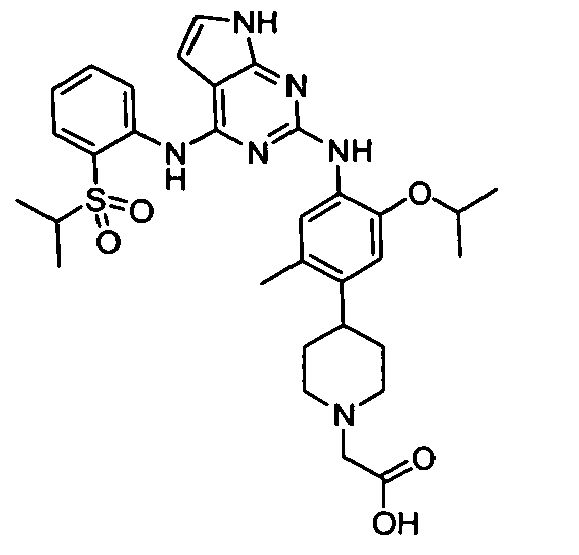
MS (ES+): 621.7 (M+1)+. 2-(4-(5-isopropoxy-4-(4-(2-(isopropylsulfonyl) phenylamino)-7H-pyrrolo[2,3-d]pyrimidin-2-ylamino)-2-methylphenyl)piperidin-1-yl)acetic acid 220 
MS (ES+): 635.8 (M+1)+. 3-(4-(5-isopropoxy-4-(4-(2-(isopropylsulfonyl) phenylamino)-7H-pyrrolo[2,3-d]pyrimidin-2-ylamino)-2-methylphenyl)piperidin-1-yl)propanoic acid 221 
MS (ES+): 620.2 (M+1)+. 2-(4-(5-isopropoxy-4-(4-(2-(isopropylsulfonyl) phenylamino)-7H-pyrrolo[2,3-d]pyrimidin-2-ylamino)-2-methylphenyl)piperidin-1-yl)acetamide 222 
MS (ES+): 634.8 (M+1)+. 3-(4-(5-isopropoxy-4-(4-(2-(isopropylsulfonyl) phenylamino)-7H-pyrrolo[2,3-d]pyrimidin-2-ylamino)-2-methylphenyl)piperidin-1-yl)propanamide 223 
MS (ES+): 634.8 (M+1)+. 4-(5-isopropoxy-4-(4-(2-(isopropylsulfonyl) phenylamino)-7H-pyrrolo[2,3-d]pyrimidin-2-ylamino)-2-methylphenyl)-N,N-dimethylpiperidine-1-carboxamide 224 
MS (ES+): 563.7 (M+1)+. N2-(2-isopropoxy-5-methyl-4-(piperidin-3-yl)phenyl)-N4-(2-(isopropylsulfonyl)phenyl)-7H-pyrrolo[2,3-d]pyrimidine-2,4-diamine 225 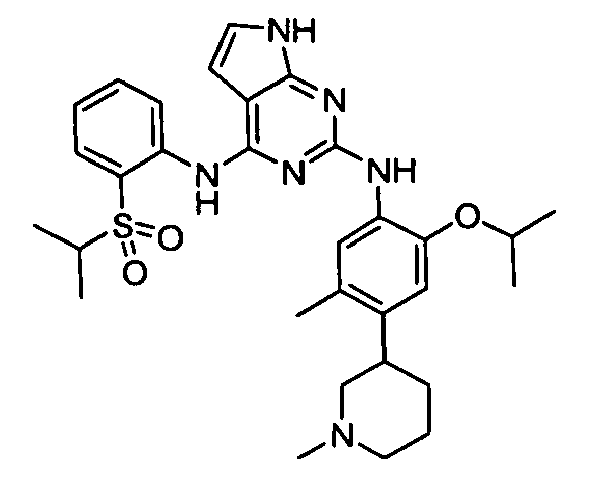
MS (ES+): 576.7 (M+1)+. N2-(2-isopropoxy-5-methyl-4-(1-methylpiperidin-3-yl)phenyl)-N4-(2-(isopropylsulfonyl)phenyl)-7H-pyrrolo[2,3-d]pyrimidine-2,4-diamine 226 
MS (ES+): 607.8 (M+1)+. 2-(3-(5-isopropoxy-4-(4-(2-(isopropylsulfonyl) phenylamino)-7H-pyrrolo[2,3-d]pyrimidin-2-ylamino)-2-methylphenyl)piperidin-1-yl)ethanol 227 
MS (ES+): 621.8 (M+1)+. N2-(2-isopropoxy-4-(1-(2-methoxyethyl)piperidin-3-yl)-5-methylphenyl)-N4-(2-(isopropylsulfonyl)phenyl)-7H-pyrrolo[2,3-d]pyrimidine-2,4-diamine 228 
MS (ES+): 620.7 (M+1)+. 5-(5-isopropoxy-4-(4-(2-(isopropylsulfonyl) phenylamino)-7H-pyrrolo[2,3-d]pyrimidin-2-ylamino)-2-methylphenyl)-N-methylpiperidine-2-carboxamide 229 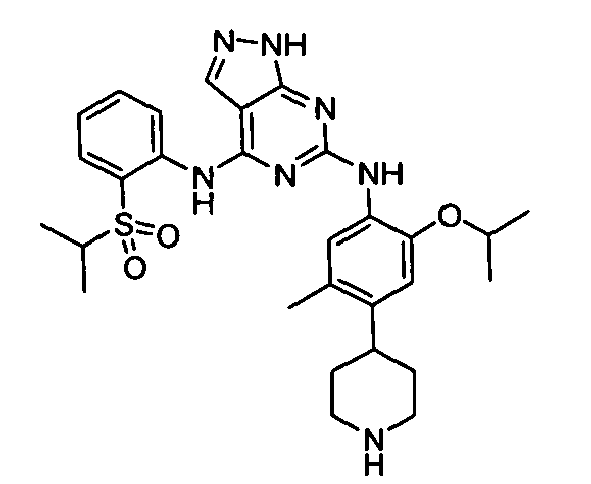
MS (ES+): 564.7 (M+1)+. N6-(2-isopropoxy-5-methyl-4-(piperidin-4-yl)phenyl)-N4-(2-(isopropylsulfonyl)phenyl)-1H-pyrazolo[3,4-d]pyrimidine-4,6-diamine 230 
MS (ES+): 592.7 (M+1)+. N6-(4-(1-ethylpiperidin-4-yl)-2-isopropoxy-5-methylphenyl)-N4-(2-(isopropylsulfonyl)phenyl)-1H-pyrazolo[3,4-d]pyrimidine-4,6-diamine 231 
MS (ES+): 578.7 (M+1)+. N6-(2-isopropoxy-5-methyl-4-(1-methylpiperidin-4-yl)phenyl)-N4-(2-(isopropylsulfonyl)phenyl)-1H-pyrazolo[3,4-d]pyrimidine-4,6-diamine 232 
MS (ES+): 608.7 (M+1)+. 2-(4-(5-isopropoxy-4-(4-(2-(isopropylsulfonyl) phenylamino)-1H-pyrazolo[3,4-d]pyrimidin-6-ylamino)-2-methylphenyl)piperidin-1-yl)ethanol 233 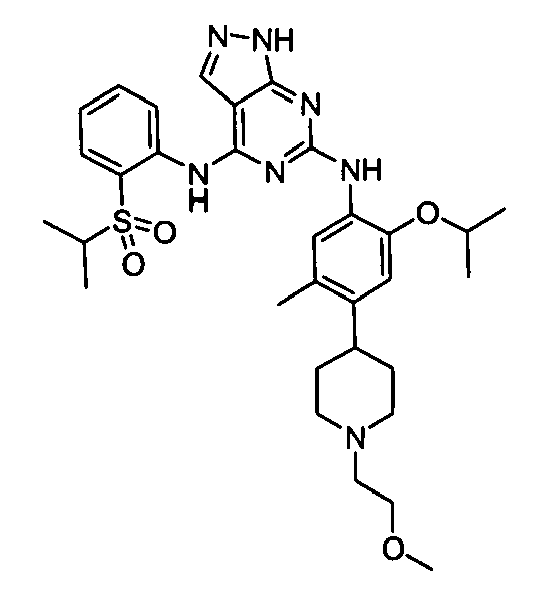
MS (ES+): 622.7 (M+1)+. N6-(2-isopropoxy-4-(1-(2-methoxyethyl)piperidin-4-yl)-5-methylphenyl)-N4-(2-(isopropylsulfonyl)phenyl)-1H-pyrazolo[3,4-d]pyrimidine-4,6-diamine 234 
MS (ES+): 606.8 (M+1)+, N6-(4-(4-(dimethylamino)cyclohexyl)-2-isopropoxy-5-methylphenyl)-N4-(2-(isopropylsulfonyl)phenyl)-1H-pyrazolo[3,4-d]pyrimidine-4,6-diamine 235 
MS (ES+): 564.7 (M+1)+. N6-(2-isopropoxy-5-methyl-4-(piperidin-2-yl)phenyl)-N4-(2-(isopropylsulfonyl)phenyl)-1H-pyrazolo[3,4-d]pyrimidine-4,6-diamine 236 
MS (ES+): 605.7 (M+1)+. 5-isopropoxy-6-(4-(2-(isopropylsulfonyl)phenylamino)-1H-pyrazolo[3,4-d]pyrimidin-6-ylamino)-2-(piperidin-4-yl)isoindolin-1-one 237 
MS (ES+): 579.7 (M+1)+. N2-(2-isopropoxy-S-methyl-4-(piperidin-4-yl)phenyl)-N4-(2-(isopropylsulfonyl)phenyl)-5,6,7,8-tetrahydropyrido[2,3-d]pyrimidine-2,4-diamine 238 
MS (ES+): 575.7 (M+1)+. N2-(2-isopropoxy-5-methyl-4-(piperidin-4-yl)phenyl)-N4-(2-(isopropylsulfonyl)phenyl)pyrido[2,3-d]pyrimidine-2,4-diamine 239 
MS (ES+): 619.7 (M+1)+. 5-isopropoxy-6-(4-(2-(isopropylsulfonyl)phenylamino)-1H-pyrazolo[3,4-d]pyrimidin-6-ylamino)-2-(1-methylpiperidin-4-yl)isoindolin-1-one 240 
MS (ES+): 633.7 (M+1)+. 5-isopropoxy-6-(4-(2-(isopropylsulfonyl)-5-methylphenylamino)-1H-pyrazolo[3,4-d]pyrimidin-6-ylamino)-2-(1-methylpiperidin-4-yl)isoindolin-1-one 241 
MS (ES+): 677.8 (M+1)+. 5-isopropoxy-6-(4-(2-(isopropylsulfonyl)-5-methylphenylamino)-1H-pyrazolo[3,4-d]pyrimidin-6-ylamino)-2-(1-(2-methoxyethyl)piperidin-4-yl)isoindolin-1-one 242 
MS (ES+): 578.7 (M+1)+. N6-(2-isopropoxy-5-methyl-4-(piperidin-2-yl)phenyl)-N4-(2-(isopropylsulfonyl)-5-methylphenyl)-1H-pyrazolo[3,4-d]pyrimidine-4,6-diamine 243 
MS (ES+): 578.7 (M+1)+. N6-(2-isopropoxy-5-methyl-4-(piperidin-3-yl)phenyl)-N4-(2-(isopropylsulfonyl)-5-methylphenyl)-1H-pyrazolo[3,4-d]pyrimidine-4,6-diamine 244 
MS (ES+): 562.3 (M+1)+. N2-(2-isopropoxy-4-(1-methylpiperidin-4-yl)phenyl)-N4-(2-(isopropylsulfonyl)phenyl)-7H-pyrrolo[2,3-d]pyrimidine-2,4-diamine 245 
MS (ES+): 593.7 (M+1)+. 2-(4-(3-isopropoxy-4-(6-(2-(isopropylsulfonyl) phenylamino)-9H-purin-2-ylamino)phenyl)piperidin-1-yl)ethanol 246 
MS (ES+): 563.7 (M+1)+. N2-(2-isopropoxy-4-(1-methylpiperidin-4-yl)phenyl)-N6-(2-(isopropylsulfonyl)phenyl)-9H-purine-2,6-diamine -

-

- Methyl 4'-amino-5'-methoxy-2'-methylbiphenyl-4-carboxylate; MS m/z 272.1 (M+1), may be synthesized following the procedures previously described (Example 7, Steps 1 and 2) using appropriate reagents.
-

- Methyl 4'-amino-5'-methoxy-2'-methylbiphenyl-4-carboxylate generated in Step 1 (200 mg, 0.75 mmol), 2,4-dibromo-5-chloropyridine (222 mg, 0.82 mmol, 1.1 equiv), Pd2(dba)3 (17 mg, 0.02 mmol, 0.025 equiv.), xantphos (22 mg, 0.04 mmol, 0.05 equiv.), and Cs2CO3 (365 mg, 1.1 mmol, 1.5 equiv.) are added to THF (5 mL). The resulting mixture is bubbled with N2 gas for 5 minutes and then heated at 150 °C for 4 hours. After cooling to room temperature, the reaction mixture is diluted into EtOAc and washed with H2O. The EtOAc layer is dried over Mg2SO4 and concentrated in vacuo. Silica gel chromatography (hexanes-EtOAc) affords Methyl 4'-(4-bromo-5-chloropyridin-2-ylamino)-5'-methoxy-2'-methylbiphenyl-4-carboxylate; MS m/z 461.0 (M+1).
- Methyl 4'-(4-bromo-5-chloropyridin-2-ylamino)-5'-methoxy-2'-methylbiphenyl-4-carboxylate generated in Step 2 (9 mg, 0.022 mmol), 2-(isopropylsulfonyl)aniline (4 mg, 0.022 mmol, 1 equiv), Pd2(dba)3 (1.7 mg, 0.002 mmol, 0.1 equiv.), 2-(Dicyclohexylphosphino)-2',4',6'-tri-i-propyl-1,1'-biphenyl (1.8 mg, 0.004 mmol, 0.2 equiv.), and Sodium tert-butoxide (2.7 mg, 0.028 mmol, 1.3 equiv.) are added to THF (1 mL). The resulting mixture is bubbled with N2 gas for 5 minutes and then heated at 150 °C for 4 hours. After cooling to room temperature, the reaction mixture is diluted into EtOAc and washed with H2O. The EtOAc layer is dried over Mg2SO4 and concentrated in vacuo. Silica gel chromatography (hexanes-EtOAc) affords Methyl 4'-(5-chloro-4-(2-(isopropylsulfonyl)phenylamino)pyridin-2-ylamino)-5'-methoxy-2'-methylbiphenyl-4-carboxylate (254); MS m/z 580.2 (M+1).
- Exemplary compounds of the invention are set forth below. Table 3 shows exemplary compounds of Formula (5).
Table 3 Structure Physical Data 1H NMR 400 MHz (DMSO-d6) and/or MS (m/z) 247 
MS (ES+): 544.2 (M+1)+. 5-chloro-N2-(3-isopropoxy-5-(piperidin-4-yl)pyridin-2-yl)-N4-(2-(isopropylsulfonyl)phenyl)pyridine-2,4-diamine 248 
MS (ES+): 558.2 (M+1)+. 5-chloro-N2-(3-isopropoxy-5-(1-methylpiperidin-4-yl)pyridin-2-yl)-N4-(2-(isopropylsulfonyl) phenyl)pyridine-2,4-diamine 249 
MS (ES+): 572.2 (M+1)+. 5-chloro-N2-(5-(1-ethylpiperidin-4-yl)-3-isopropoxypyridin-2-yl)-N4-(2-(isopropylsulfonyl) phenyl)pyridine-2,4-diamine 250 
MS (ES+): 588.2 (M+1)+. 2-(4-(6-(5-chloro-4-(2-(isopropylsulfonyl) phenylamino)pyridin-2-ylamino)-5-isopropoxypyridin-3-yl)piperidin-1-yl)ethanol 251 
MS (ES+): 549.2 (M+1)+. 4'-(5-chloro-4-(2-(isopropylsulfonyl)phenylamino) pyridin-2-ylamino)-N,2'-dimethylbiphenyl-4-carboxamide 252 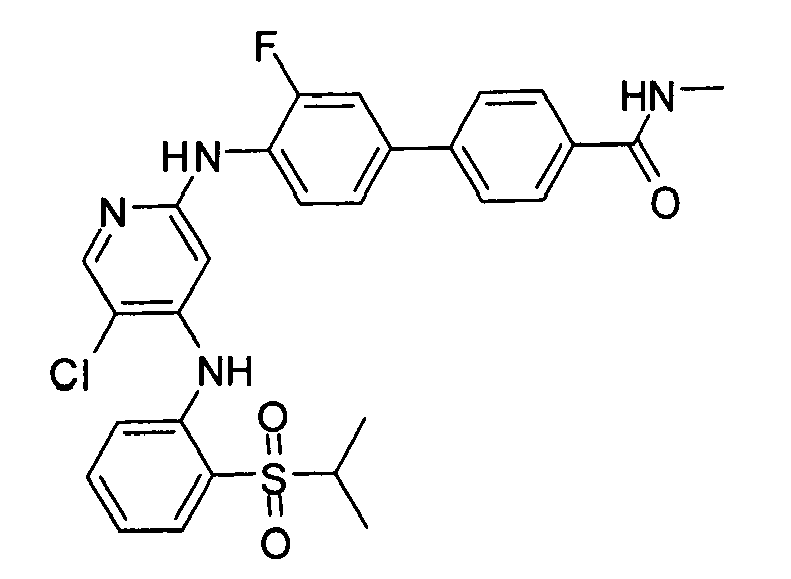
MS (ES+): 553.1 (M+1)+. 4'-(5-chloro-4-(2-(isopropylsulfonyl)phenylamino) pyridin-2-ylamino)-3'-fluoro-N-methylbiphenyl-4-carboxamide 253 
MS (ES+): 570.1 (M+1)+. 5-chloro-N4-(2-(isopropylsulfonyl)phenyl)-N2-(2-methyl-3'-(methylsulfonyl)biphenyl-4-yl)pyridine-2,4-diamine 254 
MS m/z 580.2 (M+1)+. Methyl 4'-(5-chloro-4-(2-(isopropylsulfonyl) phenylamino)pyridin-2-ylamino)-5'-methoxy-2'-methylbiphenyl-4-carboxylate 255 
MS (ES+): 495.6 (M+1)+. N2-(3-isopropoxy-5-(piperidin-4-yl)pyridin-2-yl)-5-methyl-N4-(2-(methylsulfonyl)phenyl)pyridine-2,4-diamine 256 
MS (ES+): 534.6 (M+1)+. 6-(3-isopropoxy-5-(piperidin-4-yl)pyridin-2-ylamino)-4-(2-(isopropylsulfonyl)phenylamino) nicotinonitrile - Table 4 shows other compounds which may be useful treating, ameliorating or preventing a condition which responds to inhibition of anaplastic lymphoma kinase (ALK) activity, focal adhesion kinase (FAK), zeta-chain-associated protein kinase 70 (ZAP-70), insulin-like growth factor (IGF-1R).
Table 4 Structure Physical Data 1H NMR 400 MHz (DMSO-d6) and/or MS (m/z) 257 
MS (ES+): 479.2 (M+1)+. N2-(5-Ethynyl-2-isopropoxy-4-methyl-phenyl)-5-methyl-N4-[2-(propane-2-sulfonyl)-phenyl]-pyrimidine-2,4-diamine 258 
MS (ES+): 458.6 (M+1)+. 2-(2-(5-ethynyl-2-isopropoxy-4-methylphenylamino)-5-methylpyrimidin-4-ylamino)-N-isopropylbenzamide 259 
MS (ES+): 515.1 (M+1)+. 4-(4-(2-(tsopropylsulfonyl)phenylamino)-5-chloropyrimidin-2-ylamino)-2,3-dihydro-5-isopropoxyinden-1-one 260 
MS (ES+): 537.1 (M+1)+. 5-chloro-N4-(2-(isopropylsulfonyl)phenyl)-N2-(5-(piperidin-4-yl)isoquinolin-8-yl)pyrimidine-2,4-diamine 261 
1H NMR (CDCl3, 400 MHz) δ 9.45 (s, 1H), 8.34-8.37 (d, 1H), 8.20 (s, 1H), 8.10 (s, 1H), 7.82-7.9 (m, 3H), 7.52-7.60 (m, 3H), 7.19-7.26 (m, 1H), 2.69 (s. 6H), 2.54 (s, 2-[5-Chloro-2-(6-chloro-2-methyl-quinolin-4-ylamino)-pyrimidin-4-ylamino]-N,N-dimethyl-benzenesulfonamide 3H). MS (ES+): 503.0 (M+1)+. 262 
MS (ES+): 451.5 (M+1)+. N4-(2-(isopropylsulfonyl)phenyl)-N2-(2-methoxy-5-methylphenyl)-7H-pyrrolo[2,3-d]pyrimidine-2,4-diamine 263 
MS (ES+): 558.1 (M+1)+. 5-chloro-N2-(2-isopropoxy-4-(1-methylpiperidin-2-yl)phenyl)-N4-(2-(isopropylsulfonyl)phenyl)pyrimidine-2,4-diamine 264 
MS (ES+): 601.2 (M+1)+. 5-chloro-N2-(2-isopropoxy-4-(1-(4-methylpiperazin-1-yl)propan-2-yl)phenyl)-N4-(2-(isopropylsulfonyl) phenyl)pyrimidine-2,4-diamine 265 
MS (ES+): 533.1 (M+1)+. 3-(4-(5-chloro-4-(2-(isopropylsulfonyl)phenylamino) pyrimidin-2-ylamino)-3-isopropoxyphenyl)butan-1-ol 266 
MS (ES+): 544.1 (M+1)+. 5-chloro-N2-(2-isopropoxy-4-(1-methylpiperidin-4-yl)phenyl)-N4-(2-(methylsulfonylmethyl) phenyl)pyrimidine-2,4-diamine 267 
MS (ES+): 559.1 (M+1)+, 2-(5-chloro-2-(2-isopropoxy-4-(1-methylpiperidin-4-yl)phenylamino)pyrimidin-4-ylamino)-N,N-dimethylbenzenesulfonamide 268 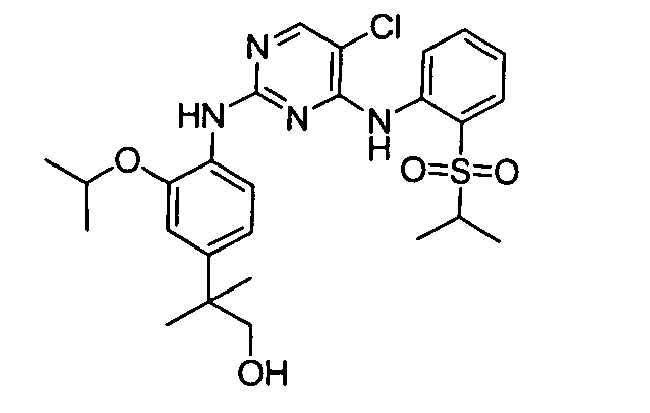
MS (ES+): 533.1 (M+1)+. 2-(4-(5-chloro-4-(2-(isopropylsulfonyl)phenylamino) pyrimidin-2-ylamino)-3-isopropoxyphenyl)-2-methylpropan-1-ol 269 
MS (ES+): 615.3 (M+1)+. 5-chloro-N2-(2-isopropoxy-4-(2-methyl-1-(4- methylpiperazin-1-yl)propan-2-yl)phenyl)-N4-(2- (isopropylsulfonyl)phenyl)pyrimidine-2,4-diamine 270 
MS (ES+): 572.2 (M+1)+. 5-chloro-N2-(2-isopropoxy-4-(1-(pyrrolidin-1-yl)propan-2-yl)phenyl)-N4-(2-(isopropylsulfonyl) phenyl)pyrimidine-2,4-diamine 271 
MS (ES+): 561.1 (M+1)+. Methyl 2-(4-(5-chloro-4-(2-(isopropylsulfonyl) phenylamino)pyrimidin-2-ylamino)-3-isopropoxyphenyl)-2-methylpropanoate 272 
MS (ES+): 588.2 (M+1)+. 5-chloro-N2-(2-isopropoxy-4-(1-morpholinopropan-2-yl)phenyl)-N4-(2-(isopropylsulfonyl)phenyl)pyrimidine-2,4-diamine 273 
MS (ES+): 562.1 (M+1)+. 5-chloro-N4-(S-fluoro-2-(isopropylsulfonyl)phenyl)-N2-(2-isopropoxy-4-(piperidin-4-yl)phenyl)pyrimidine-2,4-diamine 274 
MS (ES+): 576.2 (M+1)+. 5-chloro-N4-(5-fluoro-2-(isopropylsulfonyl)phenyl)-N2-(2-isopropoxy-4-(1-methylpiperidin-4-yl)phenyl)pyrimidine-2,4-diamine 275 
MS (ES+): 571.1 (M+1)+. 5-chloro-N2-(2-isopropoxy-4-(piperidin-4-yl)phenyl)-N4-(2-(pyrrolidin-I-ylsulfonyl)phenyl)pyrimidine-2,4-diamine 276 
MS (ES+): 544.1 (M+1)+. 5-chloro-N2-(2-isopropoxy-4-(piperidin-4-yl)phenyl)-N4-(2-(isopropylsulfonyl)phenyl)pyrimidine-2,4-diamine 277 
MS (ES+): 641.3 (M+1)+. 5-chloro-N2-(2-isopropoxy-4-(1-(1-methylpiperidin-4-yl)piperidin-4-yl)phenyl)-N4-(2-(isopropylsulfonyl)phenyl)pyrimidine-2,4-diamine 278 
MS (ES+): 557.1 (M+1)+. 4-(4-(4-(2-(isopropylsulfonyl)phenylaminoys-chloropyrimidin-2-ylamino)-3-isopropoxyphenyl)cyclohexanone 279 
MS (ES+): 524.2 (M+1)+. N2-(2-isopropoxy-4-(piperidin-4-yl)phenyl)-N4-(2-(isopropylsulfonyl)phenyl)-5-methylpyrimidine-2,4-diamine 280 
MS (ES+): 568.7 (M+1)+. 2-(4-(4-(4-(2-(isopropylsulfonyl)phenylamino)-5-methylpyrimidin-2-ylamino)-3-isopropoxy phenyl)piperidin-1-yl)ethanol 281 
MS (ES+): 558.1 (M+1)+. 5-chloro-N2-(2-isopropoxy-4-(1-methylpiperidin-4-yl)phenyl)-N4-(2-(isopropylsulfonyl)phenyl)pyrimidine-2,4-diamine 282 
MS (ES+): 538.7(M+1)+. N2-(2-isopropoxy-4-(1-methylpiperidin-4-yl)phenyl)-N4-(2-(isopropylsulfonyl)phenyl)-5-methylpyrimidine-2,4-diamine 283 
MS (ES+): 523.0 (M+1)+. 2-(2-(2-isopropoxy-4-(1-methylpiperidin-4-yl)phenylamino)-5-chloropyrimidin-4-ylamino)-N,N-dimethylbenzamide 284 
MS (ES+): 601.1 (M+1)+. 2-(4-(4-(4-(2-(isopropylsulfonyl)phenylamino)-5-chloropyrimidin-2-ylamino)-3-isopropoxyphenyl) piperidin-1-yl)acetamide 285 
MS (ES+): 546.1 (M+1)+. 5-chloro-N2-(4-isopropoxy-2-(piperidin-4-yl)pyrimidin-5-yl)-N4-(2-(isopropylsulfonyl) phenyl)pyrimidine-2,4-diamine 286 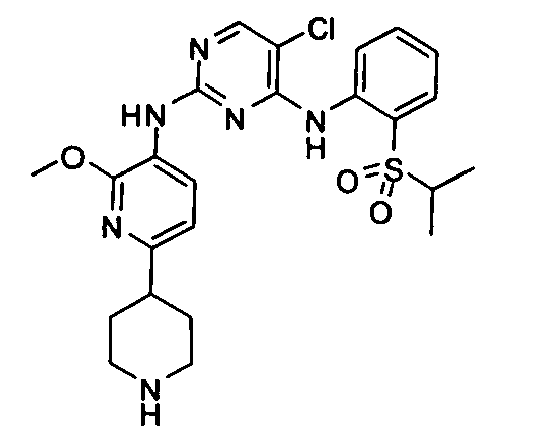
MS (ES+): 517.1 (M+1)+. 5-chloro-N4-(2-(isopropylsulfonyl)phenyl)-N2-(2-methoxy-6-(piperidin-4-yl)pyridin-3-yl) pyrimidine-2,4-diamine 287 
MS (ES+): 594.1 (M+1)+. 5-chloro-N4-(2-(isopropylsulfonyl)phenyl)-N2-(2-methoxy-6-(4-(piperazin-1-yl)phenyl)pyridin-3-yl)pyrimidine-2,4-diamine 288 
MS (ES+): 511.1 (M+1)+. 2-(5-chloro-2-(2-methoxy-6-phenylpyridin-3-ylamino)pyrimidin-4-ylamino)-N,N-dimethylbenzenesulfonamide 289 
MS (ES+): 548.1 (M+1)+. 2-(4-(5-chloro-4-(2-(isopropylsulfonyl)phenylamino) pyrimidin-2-ylamino)-3-isopropoxyphenyl)-2-methylpropane-1,3-diol - Compounds of the present invention may be assessed for their ability to inhibit ALK using assays described below, as well as other assays known in the art.
- Ba/F3 is a murine IL-3-dependent pro-B lymphoma cell line. Parental Ba/F3 cells are used to generate a panel of sublines whose proliferation and survival is rendered IL-3-independent by stable transduction with individual tyrosine kinases activated by fusion with the amino-terminal portion of TEL (amino acid 1-375) or BCR. In order to generate Ba/F3 cell lines transformed by Tel-Tyrosine Kinase (TK) fusions, parental Ba/F3 cells are infected with a retrovirus harboring each kinase domain and subjected to puromycin selection and IL-3 withdrawal to obtain IL-3-independent, transformed Ba/F3 cells.
- Each transformed Ba/F3 cells are cultured in RPMI-1640 media (Gibco Cat #11875093, Carlsbad, CA) supplemented with 10% FBS (Hyclone Cat #SV30014.03, Logan, UT), 4.5 g/L glucose (Sigma #G5400, St.Louis, MO), 1.5 g/L sodium bicarbonate (Biowhittaker #17-613E, Walkersville, MD) and Pen/Strep (Gibco #10378-016, Carlsbad, CA). Cells are splitted twice weekly.
- The potency of test compounds against various Tel-TK transformed Ba/F3 lines is determined as follows. Exponentially growing BaF3 Tel-TK cells are diluted in fresh medium to 75,000 cells/mL and seeded into 384-well plates (3750 cells/well) at 50 µL/well using a µFill liquid dispenser (BioTek, Winooski, VT, USA). Duplicate plates are run for each cell line. Test and control compounds are serially diluted with DMSO and arrayed in a polypropylene 384-well plate. 50 nL of compound is transferred into the assay plates using a pin-transfer device, and the plates are incubated at 37 °C (5% CO2) for 48 hours. 25 µL Bright-Glo (Promega, Madison, WI, USA) is added and luminescence is quantified using Analyst GT (Perkin Elmer, Wellesley, MA). Custom curve-fitting software is used to produce a logistic fit of percent cell viability as a function of the logarithm of inhibitor concentration. The IC50 is interpolated as the concentration of compound needed to reduce cell viability to 50% of a DMSO control. Parental Ba/F3 cells that are maintained and cultured in presence of IL-3 (1 ng/ml in final) are diluted in fresh medium containing IL-3 (1 ng/ml in final) to 75,000 cells/mL following the same procedure as described above.
- Luciferized Karpas 299 (Karpas299-Luc) is generated by infecting retrovirus encoding luciferase gene, and cultured in RPMI-1649 medium supplemented with 10% FBS, 1% P/S/L-Glu. At day 1, cells are harvested and resuspended at density of 150,000 cells/ml (cell number is measured using ViCell (BD). Cells are dispensed from a diluted suspension into a 384-well assay plate in 50 µl volume using µFill (Bio-TEK). Serially diluted compounds (in DMSO) are transferred into plate using 50 nL pinhead. Assay plates are incubated at 37 °C for 48 hours. At day 4, 25 µl/well of Bright-Glo reagent (Promega) is added using µFill (Bio-TEK). Within 30 minutes, a luciferase signal is measured using Analyst GT in default setting for luminescence detection.
- ALK enzyme and IGF1R and INSR are purchased from Upstate. Following reagents are prepared in-house; 10 x kinas buffer (KB) (200 mM Tris (pH 7.0), 100 mM MgCl2, 30 mM MnCl2, 50 nM NaVO4), 10 mM ATP, 100 mg/ml BSA, 0.5 M EDTA, 4 M KF. Proxiplate-384 from Perkin-Elmer is used for set up assay. All the HTRF reagents including substrate (Biotin-poly-GT (61GTOBLB), Mab PT66-K, (6 1 T66KLB), Streptavidin-XLent (611 SAXLB)) are purchased from CIS-US, Inc.
- The substrate/ATP mix is prepared by adding ATP (final concentration, 3 µM) and biotinylated poly-GT (final concentration, 10 ng/µl) into 1x KB, and dispensed into Proxiplate-384 at 5 µl/well using µFill (Bio-TEK). Serially diluted compounds (in DMSO) are transferred into plate using 50 nL pinhead. 5 µL of prepared Enzyme mix (enzyme (final concentration, 5 ng/µl), mixed with BSA and DTT in 1x KB) is added to initiate kinase reaction using µFill (Bio-TEK). Assay plate is incubated at room temperature for 2 hours. Detection mix is prepared by adding both Mab PT66-K and Streptavidin-XLent into 0.5 x KB solution containing KF (final concentration, 125 mM), EDTA (final concentration, 50 mM) and BSA (final concentration, 100 µg/ml) in. At the end of reaction, 10 µL of detection mix is added and incubated for 30 minutes at room temperature before measurement. HTRF signal is detected using Analyst-GT (molecular dynamic).
- Seed 10M cells / T175 Flask in Mc Coy 10% FBS and 4 days later, suck off media and add fresh media. Next day (5 days after seeding), trypsinize cells, wash once with PBS, then resuspend cells in Mc-Coy media 4% delipidated serum with P/S/G. Count cells and dilute to 400,000 cells/ml.
- For 95 ml of cells (400000 cells/ml (40M)), prepare the following DNA/Fugene6 mix: 5 ml Mc-Coy media without serum; 120 µg DNA mix (20 µg IGF1R-S3-5 or INSR-S3-5+100 µg RE1-pGL3); and 240 µL Fugene6 reagent. Incubate DNA/ Fugene6 mix for 15 min before adding it to cells in 4% delipidated serum. Dispense 50 µL / well in 384 well plate. 22-24h later, add 50 nL of serially diluted compounds using pinhead. 30 min later, add 2 µL of 26X IGF1 (or 100X Insulin) dose diluted in Mc-Coy 4% delipidated serum using µ-Fill. 30 hours later, add 25 µL 100% bright-glo and read on Analyst-GT for measuring luminescence.
- It is understood that the examples and embodiments described herein are for illustrative purposes only and that various modifications or changes in light thereof will be suggested to persons skilled in the art and are to be included within the spirit and purview of this application and scope of the appended claims. All publications, patents, and patent applications cited herein are hereby incorporated by reference for all purposes.
The following numbered clauses, describing aspects of our proposals, form part of the description.
1. A compound having Formula (1):
W is
each A2 and A3 is C, or one of A2 and A3 is N when R6 and R7 form a ring;
B and C are independently an optionally substituted 5-7 membered carbocyclic ring, aryl, heteroaryl or heterocyclic ring containing N, O or S;
Z1, Z2 and Z3 are independently NR11, C=O, CR-OR, (CR2)1-2 or =C-R12;
R1 and R2 are independently halo, OR12, NR(R12), SR12, or an optionally substituted C1-6 alkyl, C2-6 alkenyl or C2-6 alkynyl; or one of R1 and R2 is H;
R3 is (CR2)0-2SO2R12, (CR2)0-2SO2NRR12, (CR2)0-2CO1-2R12, (CR2)0-2CONRR12 or cyano;
R4, R6, R7 and R10 are independently an optionally substituted C1-6 alkyl, C2-6 alkenyl or C2-6 alkynyl; OR12, NR(R12), halo, nitro, SO2R12, (CR2)pR13 or X; or R4, R7 and R10 are independently H;
R, R5 and R5' are independently H or C1-6 alkyl;
R8 and R9 are independently C1-6 alkyl, C2-6 alkenyl, C2-6 alkynyl, halo or X, or one of R8 and R9 is H when R1 and R2 form a ring; and provided one of R8 and R9 is X;
alternatively, R1 and R2, or R6 and R7, R7 and R8, or R9 and R10, when attached to a carbon atom may form an optionally substituted 5-7 membered monocyclic or fused carbocyclic ring, aryl, or heteroaryl or heterocyclic ring comprising N, O and/or S; or R7, R8, R9 and R10 are absent when attached to N;
R11 is H, C1-6 alkyl, C2-6 alkenyl, (CR2)pCO1-2R, (CR2)pOR, (CR2)pR13, (CR2)pNRR12, (CR2)pCONRR12 or (CR2)pSO1-2R12;
R12 and R13 are independently an optionally substituted 3-7 membered saturated or partially unsaturated carbocyclic ring, or a 5-7 membered heterocyclic ring comprising N, O and/or S; aryl or heteroaryl; or R12 is H, C1-6 alkyl;
X is (CR2)qY, cyano, CO1-2R12, CONR(R12), CONR(CR2)pNR(R12), CONR(CR2)pOR12, CONR(CR2)pSR12, CONR(CR2)pS(O)1-2R12 or (CR2)1-6NR(CR2)pOR12;
Y is an optionally substituted 3-12 membered carbocyclic ring, a 5-12 membered aryl, or a 5-12 membered heteroaryl or heterocyclic ring comprising N, O and/or S and attached to A2 or A3 or both via a carbon atom of said heteroaryl or heterocyclic ring when q in (CR2)qY is 0; and
n, p and q are independently 0-4.
2. The compound of clause 1, wherein R1 is halo or C1-6 alkyl;
R2 is H or NH2; or
R1 and R2 together form an optionally substituted 5-6 membered aryl, or heteroaryl or heterocyclic ring comprising 1-3 nitrogen atoms.
3. The compound of clause 1 or clause 2, wherein R3 is SO2R12, SO2NH2, SO2NRR12, CO2NH2, CONRR12, CO1-2R12, or cyano; and
R12 is C1-6 alkyl, an optionally substituted C3-7 cycloalkyl, C3-7 cycloalkenyl, pyrrolidinyl, piperazinyl, piperidinyl, morpholinyl or azetidinyl.
4. The compound of any one of clauses 1-3, wherein R5, R5', R7 and R10 are independently H, and n is 0.
5. The compound of any one of clauses 1-3, wherein R6 is OR12, and R12 is C1-6 alkyl.
6. The compound of any one of clauses 1-3, wherein said compound is of Formula (2):
R2 is H; or
R1 and R2 together form an optionally substituted 5-6 membered heteroaryl or heterocyclic ring comprising one or two nitrogen atoms;
R6 is isopropoxy or methoxy;
one of R8 and R9 is (CR2)qY and the other is C1-6 alkyl, cyano, CO1-2R12, CONR(R12) or CONR(CR2)pNR(R12);
Y is an optionally substituted C3-7 cycloalkyl, C3-7 cycloalkenyl, or phenyl; or Y is pyridyl, pyrazolyl, isoxazolyl, imidazolyl, thiazolyl, benzimidazolyl, pyrrolidinyl, piperazinyl, piperidinyl, morpholinyl, azetidinyl, heptamethyleneimine or octamethyleneimine, each of which is attached to the phenyl ring via a carbon atom when q in (CR2)qY is 0;
n is 0-1; and
q is 0-4.
7. The compound of clause 6, wherein one of R8 and R9 is (CR2)qY and the other is C1-6 alkyl; and n and q are independently 0.
8. The compound of clause 1, wherein said compound is of Formula (3A) or (3B):


R1 is halo or C1-6alkyl;
R2 is H; or
R1 and R2 together form an optionally substituted 5-7 membered carbocyclic ring, aryl, or heteroaryl or heterocyclic ring comprising N, O and/or S; and
R6 is isopropoxy or methoxy.
9. The compound of clause 8, wherein each R11 is (CR2)pCO1-2R, (CR2)pOR, (CR2)pR13, (CR2)pNRR12 or (CR2)pCONRR12;
R and R12 are independently H or C1-6 alkyl; and
R13 is an optionally substituted piperidinyl, azetidiyl, tetrahydropyranyl, cyclohexyl, morpholinyl, pyrrolidinyl, heptamethyleneimine, octamethyleneimine, a bicyclic amine or diamine derivative, quinuclidin-3-yl, 8-methyl-8-aza-bicyclo[3.2.1]oct-6-yl], or 9-methyl-9-aza-bicyclo[4.2.1]nonan-7-yl.
10. The compound of clause 1, wherein said compound is of Formula (4A) or Formula (4B):

R2 is H; or
R1 and R2 together form an optionally substituted 5-7 membered carbocyclic ring, aryl, or heteroaryl or heterocyclic ring comprising N, O and/or S;
R6 is isopropoxy or methoxy; and
B2 and B3 are independently an optionally substituted 5-6 membered aryl or heteroaryl containing N, O or S.
11. The compound of clause 1, wherein said compound is selected from the group consisting of1 
124 
(2-(5-chloro-2-(2-isopropoxy-5-methyl-4-(1-methylpiperidin-4-yl)phenylamino) pyrimidin-4-ylamino)phenyl)(pyrrolidin-1-yl)methanone N2-(4-((1r,4r)-4-(N-(2-methoxyethyl)-N-methylamino)cyclohexyl)-2-isopropoxy-5-methylphenyl)-5-chloro-N4-(2-(isopropylsulfonyl)phenyl)pyrimidine -2,4-diamine 2 
125 
2-(5-chloro-2-(2-isopropoxy-5-methyl-4-(1-methylpiperidin-4-yl)phenylamino) pyrimidin-4-ylamino)-N-cyclopentylbenzamide 5-(4-(2-(isopropylsulfonyl)phenylamino)-5-chloropyrimidin-2-ylamino)-4-isopropoxy-N-methyl-2-((R)-4-(4-methylpiperazin-1-yl)cyclohex-1-enyl)benzamide 3 
126 
N2-(4-((1R,2S,4R)-2,4-bis(dimethylamino) cyclohexyl)-2-isopropoxy-5-methylphenyl)-5-chloro-N4-(2-(isopropylsulfonyl) phenyl)pyrimidine-2,4-diamine 5-(4-(2- (isopropylsulfonyl)phenylamino)-5- chloropyrimidin-2-ylamino)-4- isopropoxy-N-methyl-2-((S)-4-(4-methylpiperazin-1-yl)cyclohex-1-enyl)benzamide 4 
127 
N2-(4-((1R,2S,4S)-2,4-bis(dimethylamino) cyclohexyl)-2-isopropoxy-5-methylphenyl)-5-chloro N4-(2-(isopropylsulfonyl) phenyl)pyrimidine-2,4-diamine 2-(4-((R)- I -hydroxypropan-2- ylamino)cyclohex-1-enyl)-5-(4-(2- (isopropylsulfonyl)phenylamino)-5-chloropyrimidin-2-ylamino)-4-isopropoxy-N-methylbenzamide 5 
128 
2-(5-chloro-2-(4-((1s,4s)-4-(dimethylamino) cyclohexyl)-2-isopropoxy-5-methylphenylamino) pyrimidin-4-ylamino)-N,Ndimethylbenzenesulfonamide 2-(4-((S)-1-hydroxypropan-2- ylamino)cyclohex-1-enyl)-5-(4-(2- (isopropylsulfonyl)phenylamino)-5- chloropyrimidin-2-ylamino)-4-isopropoxy-N-methylbenzamide 6 
129 
2-(5-chloro-2-(4-((1r,4r)-4-(dimethylamino)cyclohexyl)-2-isopropoxy-5-methylphenylamino) pyrimidin-4-ylamino)-N,N-dimethylbenzenesulfonamide 5-(4-(2- (isopropylsulfonyl)phenylamino)-5-chloropyrimidin-2-ylamino)-4-isopropoxy-N-methyl-2-(4-oxocyclohex-1-enyl)benzamide 7 
130 
2-(5-chloro-2-(2-isopropoxy-5-methyl-4-(1-methylpiperidin-4-yl)phenylamino) pyrimidin-4-ylamino)-N-cyclobutylbenzamide 5-chloro-N4-(2-(isopropylsulfony)phenyl)-N2-(2-isopropoxy-5-(N-methylcarboxamidoF4-(3-methyl-4-(3-morpholinomethyly phenyl)pyrimidine-2,4-diamine 8 
131 
azetidin-1-yl(2-(5-chloro-2-(2-isopropoxy-5-methyl-4-(1-methylpiperidin-4-yl)phenylamino) pyrimidin-4-ylamino)phenyl)methanone 5-chloro-N2-(2-isopropoxy-5-methyl-4-(piperidin-3-yl)phenyl)-N4-(2-(isopropylsulfonyl) phenyl)pyrimidine-2,4-diamine 9 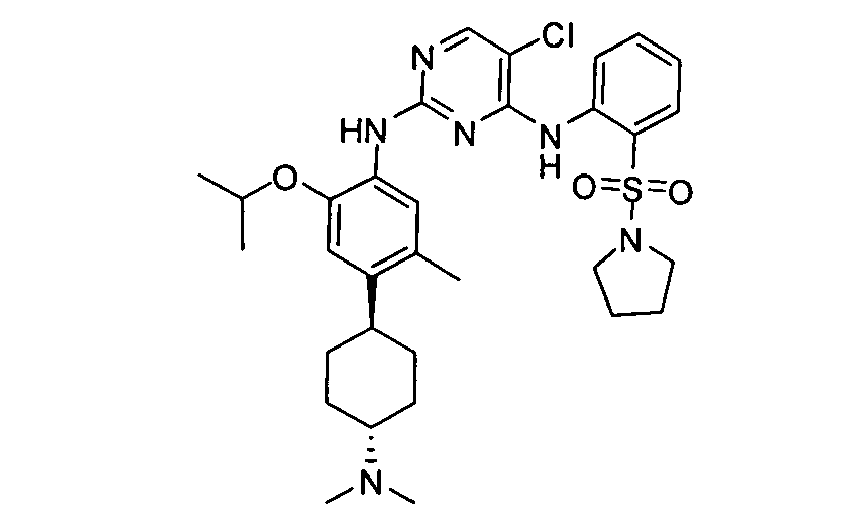
132 
5-chloro-N2-(4-((1r,4r)-4-(dimethylamino) cyclohexyl)-2-isopropoxy-5-methylphenyl)-N4-(2-(pyrrolidin-1-ylsulfonyl)phenyl) pyrimidine-2,4-diamine (2-(5-chloro-2-(2-isopropoxy-5-methyl-4-(1-methylpiperidin-4-yl)phenylamino)pyrimidin-4-ylamino)phenyl)(morpholino)methano ne 10 
133 
5-chloro-N2-(4-((1s,4s)-4-(dimethylamino) cyclohexyl)-2-isopropoxy-5-methylphenyl)-N4-(2-(pyrrolidin-1-ylsulfonyl)phenyl) pyrimidine-2,4-diamine 2-((2-(4-(5-chloro-4-(2-(isopropylsulfonyl)phenylamino) pyrimidin-2-ylamino)-5-isopropoxy-2-methylphenyl) propyl)(methyl)amino) ethanol 11 
134 
N2-(4-((1r,4r)-4-(dimethylamino)cyclohexyl)-2-isopropoxy-5-methylphenyl)-N4-(2-(isopropylsulfonyl) phenyl)-5-methylpyrimidine-2,4-diamine 5-chloro-N2-(4-((1r,4r)-4-(dimethylamino) cyclohexyl)-2-methoxy-5-methylphenyl)-N4-(2-(isopropylsulfonyl) phenyl)pyrimidine-2,4-diamine 12 
135 
N2-(4-((1s,4s)-4-(dimethylamino) cyclohexyl)-2-isopropoxy-5-methylphenyl)-N4-(2-(isopropylsulfonyl) phenyl)-5-methylpyrimidine-2,4-diamine 5-chloro-N2-(4-((1s,4s)-4-(dimethylamino) cyclohexyl)-2-methoxy-5-methylphenyl)-N4-(2-(isopropylsulfonyl) phenyl)pyrimidine-2,4-diamine 13 
136 
2-(5-chloro-2-(2-isopropoxy-5-methyl-4-(1-methylpiperidin-4-yl)phenylamino) pyrimidin-4-ylamino)-N-cyclopropylbenzamide N2-(2-isopropoxy-5-methyl-4-(piperidin-4-yl)phenyl)-N4-(2-(isopropylsulfonyl) phenyl)-5-methylpyrimidine-2,4,6-triamine 14 
137 
(2-(5-chloro-2-(2-isopropoxy-5-methyl-4-(1-methylpiperidin-4-yl)phenylamino) pyrimidin-4-ylamino)phenyl)(piperidin-1-yl)methanone 5-(4-(2-(isopropylsulfonyl)phenylamino)-5-chloropyrimidin-2-ylamino)-2-chloro-N-(2-(dimethylamino)ethyl)-4-isopropoxybenzamide 15 
138 
(S)-5-chloro-N2-(2-isopropoxy-5-methyl-4-(piperidin-2-yl)phenyl)-N4-(2-(isopropylsulfonyl)phenyl)pyrimidine-2,4-diamine 5-chloro-N2-(4-chloro-2-isopropoxy-5-(3-methylisoxazol-5-yl)phenyl)-N4-(2-(isopropylsulfonyl)phenyl)pyrimidine -2,4-diamine 16 
139 
(R)-5-chloro-N2-(2-isopropoxy-5-methyl-4-(piperidin-2-yl)phenyl)-N4-(2-(isopropylsulfonyl)phenyl) pyrimidine-2,4-diamine 6-(4-(2-(isopropylsulfonyl)phenylamino)-5-chloropyrimidin-2-ylamino)-5-isopropoxy-2-((R)-piperidin-3-yl)isoindolin-1-one 17 
140 
(cis,trans) 5-Chloro-N2-{2-isopropoxy-5-methyl-4-[4-(4-methyl-piperazin-1-yl)-cyclohexyl]-phenyl}-N4-[2-(propane-2-sulfonyl)-phenyl]-pyrimidine-2,4-diamine 6-(4-(2-(isopropylsulfonyl)phenylamino)-5-chloropyrimidin-2-ylamino)-5-isopropoxy-2-((S)-piperidin-3-yl)isoindolin-1-one 18 
141 
(cis,trans) 5-chloro-N2-{4-[4-(2-dimethylamino-ethyl amino)-cyclohexyl]-2-isopropoxy-5-methyl-phenyl}-N4-[2-(propane-2-sulfonyl)-phenyl]-pyrimidine-2,4-diamine 6-(4-(2-(isopropylsulfonyl)phenylamino)-5-chloropyrimidin-2-ylamino)-2-(azetidin-3-yl)-5-isopropoxyisoindolin-1-one 19 
142 
5-{5-Chloro-4-[2-(propane-2-sulfonyl)-phenylamino]-pyrimidin-2-ylamino}-4-isopropoxy-N-methyl-2-[4-(4-methyl-piperazin-1-yl)-cyclohex-1-enyl]-benzamide Ethyl 6-(4-(2-(isopropy(sulfonyl)phenylamino)-5-chloropyrimidin-2-ylamino)-5-isopropoxy-1-oxoisoindoline-2-carboxylate 20 
143 
4-[4-(4-{5-Chloro-4-[2-(propane-2-sulfonyl)-phenylamino]-pyrimidin-2-ylamino}-5-isopropoxy-2-methyl-phenyl)-cyclohexyl]-piperazin-2-one 6-(4-(2-(isopropylsulfonyl)phenylamino)-5-chloropyrimidin-2-ylamino)-2-(tetrahydro-2H-pyran-4-yl)-5-isopropoxyisoindolin-1-one 21 
144 
5-Chloro-N2-[4-(4-dimethylamino-cyclohexyl)-2-isopropoxy-5-methyl-phenyl]-N4-[2-(propane-2-sulfonyl)-phenyl]-pyrimidine-2,4-diamine 6-(4-(2-(isopropylsulfonyl)phenylamino)-5-chloro pyrimidin-2-ylamino)-2-cyclohexyl-5-isopropoxy-isoindolin-1-one 22 
145 
5-Chloro-N2-[2-isopropoxy-5-methyl-4-(4-methylamino-cyclohexyl)-phenyl]-N4-[2-(propane-2-sulfonyl)-phenyl]-pyrimidine-2,4-diamine 6-(4-(2-(isopropylsulfonyl)phenylamino)-5-chloro pyrimidin-2-ylamino)-5-isopropoxy-2-morpholino-isoindolin-1-one 23 
146 
5-(4-(2-(isopropylsulfonyl)phenylamino)-5-chloropyrimidin-2-ylamino)-4-isopropoxy-N-methyl-2-(2-(4-methylpiperazin-1-yl)ethyl)benzamide 6-(4-(2-(isopropylsulfonyl)phenylamino)-5-chloropyrimidin-2-ylamino)-5-isopropoxy-2-((S)-pyrrolidin-3-yl)isoindolin-1-one 24 
147 
5-Chloro-N2-[2-isopropoxy-5-methyl-4-(4-pyrrolidin-1-yl-cyclohexyl)-phenyl]-N4-[2-(propane-2-sulfonyl)-phenyl]-pyrimidine-2,4-diamine 3-(4-(6-(4-(2-(isopropylsulfonyl) phenylamino)-5-chloropyrimidin-2-ylamino)-5-isopropoxy-1-oxoisoindolin-2-yl)piperidin-1-yl)propanoic acid 25 
148 
5-Chloro-N2-(2-isopropoxy-4-{4-[(2-methoxy-ethyl)-methyl-amino]-cyclohexyl}-5-methyl-phenyl)-N4-[2-(propane-2-sulfonyl)-phenyl]-pyrimidine-2,4-diamine 6-(4-(2-(isopropylsulfonyl)phenylamino)-5-chloropyrimidin-2-ylamino)-5-isopropoxy-2-((R)-pyrrolidin-3-yl)isoindolin-1-one 26 
149 
5-{5-Chloro-4-[2-(propane-2-sulfonyl)-phenylamino]-pyrimidin-2-ylamino}-4-isopropoxy-N-methyl-2-[3-(4-methyl-piperazin-1-yl)-propyl]-benzamide 2-[4-(6-{5-Chloro-4-[2-(propane-2-sulfonyl)-phenyl-amino]-pyrimidin-2-ylamino}-5-isopropoxy-1-oxo-1,3-dihydro-isoindol-2-yl)-piperidin-1- yl]-acetamide 27 
150 
5-chloro-N2-(4-((1s,4s)-4-(dimethylamino) cyclohexyl)-2-isopropoxy-5-methylphenyl)-N4-(2-(isopropylsulfonyl)phenyl)pyrimidine-2,4-diamine 6-(4-(2-(isopropylsulfonyl)phenylamino)-5-chloropyrimidin-2-ylamino)-2-acetyl-5-isopropoxyisoindolin-1-one 28 
151 
5-chloro-N2-(2-isopropoxy-5-methyl-4-(piperidin-2-yl)phenyl)-N4-(2-(isopropylsulfonyl)phenyl)pyrim idine-2,4-diamine 6-(4-(2-(isopropylsulfonyl)phenylamino)-5-chloropyrimidin-2-ylamino)-2-(2-hydroxyethyl)-5-isopropoxyisoindolin-1-one 29 
152 
5-chloro-N2-(2-isopropoxy-4-methyl-5-(piperidin-4-yl)phenyl)-N4-(2-(isopropylsulfonyl)phenyl) pyrimidine-2,4-diamine (2S,4S)-methyl 4-(6-(4-(2-(isopropylsulfonyl) phenylamino)-5-chloropyrimidin-2-ylamino)-5-isopropoxy-1-oxoisoindolin-2-yl)pyrrolidine-2-carboxylate 30 
153 
5-chloro-N2-(2-isopropoxy-4-methyl-5-(piperidin-4-yl)phenyl)-N4-(2(morpholinosulfonamido) phenyl)pyrimidine-2,4-diamine 2-(6-(4-(2-(isopropylsulfonyl) phenylamino)-5-chloropyrimidin-2-ylamino)-5-isopropoxy-1-oxoisoindolin-2-yl)acetic acid 31 
154 
2-(2-(2-isopropoxy-4-methyl-5-(piperidin-4-yl)phenylamino)-5-chloropyrimidin-4-ylamino)-N-isopropylbenzamide (2S,4R)-methyl 4-(6-(4-(2-(isopropylsulfonyl) phenylamino)-5-chloropyrimidin-2-ylamino)-5-isopropoxy-1-oxoisoindolin-2-yl)pyrrolidine-2-carboxylate 32 
155 
5-chloro-N2-(4-((1r,4r)-4-(dimethylamino) cyclohexyl)-2-isopropoxy-5-methylphenyl)-N4-(2-(isopropylsulfonyl)phenyl)pyrimidine-2,4-diamine 4-(6-{5-Chloro-4-[2-(propane-2-sulfonyl)-phenylamino]-pyrimidin-2-ylamino}-5-isopropoxy-1-oxo-1,3-dihydro-isoindol-2-yl)-piperidine-1-carboxylic acid dimethylamide 33 
156 
5-chloro-N2-(2-isopropoxy-5-methyl-4-((1s,4s)-4-(4-methylpiperazin-1-yl)cyclohexyl)phenyl)-N4-(2-(isopropylsulfonyl)phenyl)pyrimidine-2,4-diamine (2S,4S)-4-(6-(4-(2-(isopropylsulfonyl) phenylamino)-5-chloropyrimidin-2-ylamino)-5-isopropoxy-1-oxoisoindolin-2-yl)pyrrolidine-2-carboxylic acid 34 
157 
5-chloro-N2-(2-isopropoxy-5-methyl-4-((1r,4r)-4-(4-methylpiperazin-1-yl)cyclohexyl)phenyl)-N4-(2-(isopropylsulfonyl)phenyl)pyrimidine-2,4-diamine (2S,4R)-4-(6-(4-(2-(isopropylsulfonyl) phenylamino)-5-chloropyrimidin-2-ylamino)-5-isopropoxy-1-oxoisoindolin-2-yl)pyrrolidine-2-carboxylic acid 35 
158 
5-Methyl-N2-[4-methyl-5-(1-methyl-1H-pyrazol-4-yl)-2-(piperidin-4-yloxy)-phenyl]-N4-[2-(propane-2-sulfonyl)-phenyl]-pyrimidine-2,4-diamine 6-(4-(2-(isopropylsulfonyl)phenylamino)-5-chloropyrimidin-2-ylamino)-2-((azetidin-3-yl)methyl)-5-isopropoxyisoindolin-1-one 36 
159 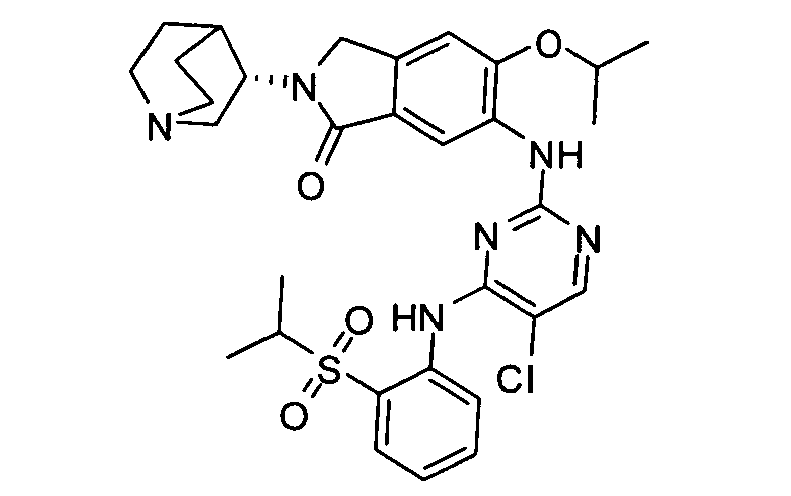
1-(5-{5-Chloro-4-[2-(propane-2-sulfonyl)-phenylamino]-pyrimidin-2-ylamino}-4-isopropoxy-2-methyl-phenyl)-ethanone 6-(4-(2-(isopropylsulfonyl)phenylamino)-5-chloropyrimidin-2-ylamino)-5-isopropoxy-2-((S)-quinuclidin-3-yl)isoindolin-1-one 37 
160 
N2-{2-Isopropoxy-4-methyl-5-[1-(2-morpholin-4-yl-ethyl)-1H-pyrazol-4-yl]-phenyl}-5-methyl-N4-[2-(propane-2-sulfonyl)-phenyl]-pyrimidine-2,4-diamine 6-{5-Chloro-4-[2-(propane-2-sulfonyl)-phenylamino]-pyrimidin-2-ylamino}-5-isopropoxy-2-(8-methyl-8-aza-bicyclo[3.2.1]oct-6-yl)-2,3-dihydro-isoindol-1-one 38 
161 
N2-(5-(6-(3-(dimethylamino)propoxy) pyridin-3-yl)-2-isopropoxy-4-methylphenyl)-N4-(2-(isopropyl sulfonyl)phenyl)-5-methylpyrimidine-2,4-diamine 4-(6-(4-(2-(isopropylsulfonyl) phenylamino)-5-chloropyrimidin-2-ylamino)-5-isopropoxy-1-oxoisoindolin-2-yl)-N-ethylpiperidine-1-carboxamide 39 
162 
N2-(2-isopropoxy-4-methyl-5-(6-(4-methylpiperazin-1-yl)pyridin-3-yl)phenyl)-N4-(2-(isopropylsulfonyl) phenyl)-5-methylpyrimidine-2,4-diamine 4-(6-(4-(2-(isopropylsulfonyl) phenylamino)-5-chloropyrimidin-2-ylamino)-5-isopropoxy-1-oxoisoindolin-2-yl)piperidine-1-carboxamide 40 
163 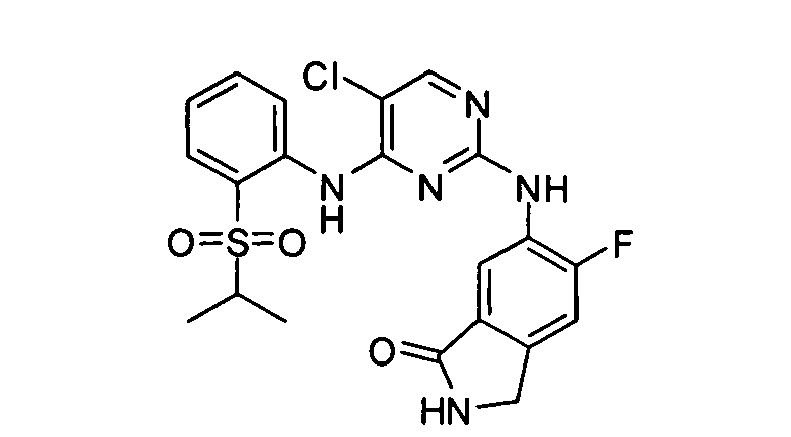
N2-(2-isopropoxy-4-methyl-5-(6-morpholinopyridin-3-yl)phenyl)-N4-(2-(isopropylsulfonyl)phenyl)-5-methylpyrimidine-2,4-diamine 6-(4-(2-(isopropylsulfonyl)phenylamino)-5-chloropyrimidin-2-ylamino)-5-fluoroisoindolin-1-one 41 
164 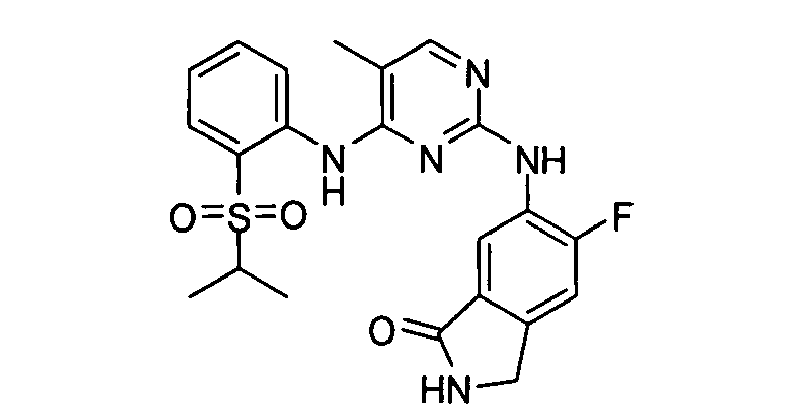
N2-(2-isopropoxy-4-methyl-5-(6-(piperazin-1-yl)pyridin-3-yl)phenyl)-N4-(2-(isopropylsulfonyl) phenyl)-5-methylpyrimidine-2,4-diamine 6-(4-(2- (isopropylsulfonyl)phenylamino)-5-methylpyrimidin-2-ylamino)-5-fluoroisoindolin-1-one 42 
165 
N2-(5-(6-(2-morpholinoethylamino) pyridin-3-yl)-2-isopropoxy-4-methylphenyl)-N4-(2-(isopropyl-sulfonyl)phenyl)-5-methylpyrimidine-2,4-diamine Ethyl 7-(4-(2-(isopropylsulfonyl) phenylamino)-5-methylpyrimidin-2-ylamino)-1,4-dihydro-6-isopropoxyindeno[1,2-c]pyrazole-3-carboxylate 43 
166 
N2-(2-isopropoxy-4-methyl-5-(2-(4-methylpiperazin-1-yl)pyridin-4-yl)phenyl)-N4-(2-(isopropylsulfonyl) phenyl)-5-methylpyrimidine-2,4-diamine (7-(4-(2-(isopropylsulfonyl)phenylamino)-5-methylpyrimidin-2-ylamino)-1,4-dihydro-6-isopropoxyindeno[1,2-c]pyrazol-3-yl)methanol 44 
167 
5-chloro-N2-(2-isopropoxy-5-methyl-4-((1s,4s)-4-(methylamino)cyclohexyl) phenyl)-N4-(2-(isopropylsulfonyl) phenyl)pyrimidine-2,4-diamine Ethyl 7-(4-(2-(isopropylsulfonyl) phenylamino)-5-chloropyrimidin-2-ylamino)-1,4-dihydro-6-isopropoxyindeno[1,2-c]pyrazole-3-carboxylate 45 
168 
5-chloro-N2-(2-isopropoxy-5-methyl-4-((1r,4r)-4-(methylamino)cyclohexyl) phenyl)-N4-(2-(isopropylsulfonyl)phenyl) pyrimidine-2,4-diamine N2-(1,4-dihydro-6-isopropoxy-3-((4-methylpiperazin-1-yl)methyl)indeno[1,2-c]pyrazol-7-yl)-N4-(2-(isopropylsulfonyl)phenyl)-5-methylpyrimidine-2,4-diamine 46 
169 
5-chloro-N2-(2-isopropoxy-4-methyl-5-(3-methylisoxazol-5-yl)phenyl)-N4-(2-(isopropylsulfonyl)phenyl)pyrimidine-2,4-diamine N2-(1,4-dihydro-6-isopropoxy-3-(morpholinomethyl) indeno[1,2-c]pyrazol-7-yl)-N4-(2-(isopropylsulfonyl) phenyl)-5-methylpyrimidine-2,4-diamine 47 
170 
2-(5-chloro-2-(2-isopropoxy-4-methyl-5-(3-methylisoxazol-5-yl)phenylamino)pyrimidin-4-ylamino)-N,N-dimethylbenzenesulfonamide N2-(3-((4-aminopiperidin-1-yl)methyl)-1,4-dihydro-6-isopropoxyindeno[1,2-c]pyrazol-7-yl)-N4-(2-(isopropylsulfonyl)phenyl)-5-methylpyrimidine-2,4-diamine 48 
171 
5-chloro-N2-(2-isopropoxy-4-methyl-5-(5-methyl-1H-pyrazol-3-yl)phenyl)-N4-(2-(isopropylsulfonyl) phenyl)pyrimidine-2,4-diamine N2-(1,4-dihydro-6-isopropoxy-3-((piperidin-4-ylamino)methyl)indeno[1,2-c]pyrazol-7-yl)-N4-(2-(isopropylsulfonyl)phenyl)-5-methylpyrimidine-2,4-diamine 49 
172 
5-chloro-N2-(2-isopropoxy-4-methyl-5-(1H-pyrazol-3-yl)phenyl)-N4-(2-(isopropylsulfonyl) phenyl)pyrimidine-2,4-diamine 6-(4-(2-(isopropylsulfonyl)phenylamino)-5-chloropyrimidin-2-ylamino)-2,3-dihydro-5-isopropoxyinden-1-one 50 
173 
2-(5-chloro-2-(2-isopropoxy-5-(isoxazol-5-yl)-4-methylphenylamino)pyrimidin-4-ylamino)-N,N-dimethylbenzenesulfonamide 6-(4-(2-(isopropylsulfonyl)phenylamino)-5-methylpyrimidin-2-ylamino)-2,3-dihydro-5-isopropoxyinden-1-one 51 
174 
2-(5-chloro-2-(2-isopropoxy-4-methyl-5-(2-methyl-1H-imidazol-4-yl) phenylamino)pyrimidin-4-ylamino)-N,N-dimethylbenzenesulfonamide 6-(4-(2-(isopropylsulfonyl)phenylamino)-5-methyl pyrimidin-2-ylamino)-2,3-dihydro-5-isopropoxy-1H-inden-1-ol 52 
175 
5-chloro-N2-(2-isopropoxy-4-methyl-5-(2-methyl-1H-imidazol-4-yl)phenyl)-N4-(2-(isopropylsulfonyl) phenyl)pyrimidine-2,4-diamine 4-(6-{5-Chloro-4-[2-(propane-2-sulfonyl)-phenylamino] -pyrimidin-2-ylamino}-5-isopropoxy-1-oxo-1,3-dihydro -isoindol-2-yl)-piperidine-1-carboxylic acid ethyl ester 53 
176 
(5-(5-(4-(2-(isopropylsulfonyl) phenylamino)-5-methylpyrimidin-2-ylamino)-4-isopropoxy-2-methylphenyl)isoxazol-3-yl)methanol 5-{5-Chloro-4-[2-(propane-2-sulfonyl)-phenylamino]-pyrimidin-2-ylamino}-6-isopropoxy-2-(1-methyl-piperidin-4-yl)-isoindole-1,3-dione 54 
177 
N2-(2-isopropoxy-4-methyl-5-(3-((piperazin-1-yl)methyl)isoxazol-5-yl)phenyl)-N4-(2-(isopropyl-sulfonyl)phenyl)-5-methylpyrimidine-2,4-diamine (2S, 4S)-4-(6-{5-Chloro-4-[2-(propane-2-sulfonyl)-phenylamino]- pyrimidin-2-ylamino}-5-isopropoxy- 1-oxo-1,3-dihydro-isoindol-2-yl)-pyrrolidine-2-carboxylic acid amide 55 
178 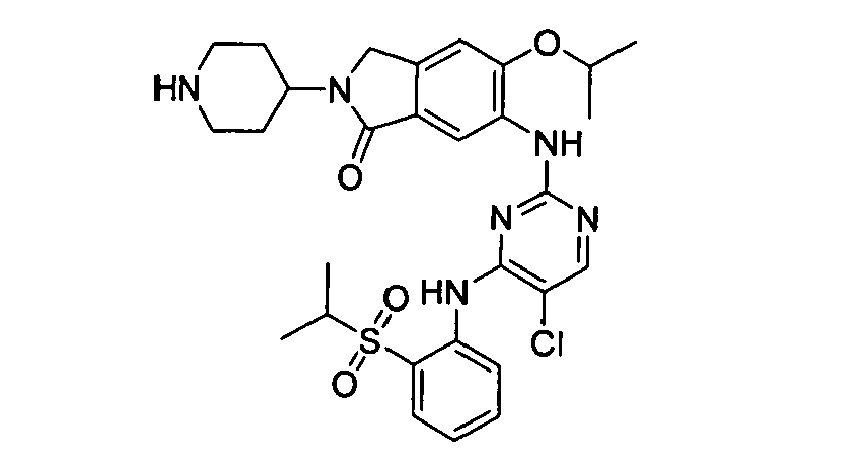
N2-(5-(3-((diethylamino)methyl) isoxazol-5-yl)-2-isopropoxy-4-methylphenyl)-N4-(2-(isopropyl-sulfonyl)phenyl)-5-methylpyrimidine-2,4-diamine 6-{5-Chloro-4-[2-(propane-2-sulfonyl)-phenylamino]-pyrimidin-2-ylamino}-5-isopropoxy-2-piperidin-4-yl-2,3-dihydro-isoindol-1-one 56 
179 
N2-(2-isopropoxy-4-methyl-5-(3-((4-(2-morpholinoethyl)piperazin-1-yl)methyl)isoxazol-5-yl)phenyl)-N4-(2-(isopropylsulfonyl)phenyl)-5-methylpyrimidine-2,4-diamine 6-(4-(2-(isopropylsulfonyl)phenylamino)-5-chloropyrimidin-2-ylamino)-5-isopropoxy-2-(1-isopropylpiperidin-4-yl)isoindolin-1-one 57 
180 
5-(5-(4-(2-(isopropylsulfonyl) phenylamino)-5-chloropyrimidin-2-ylamino)-4-isopropoxy-2-methylphenyl)-N-(2-morpholinoethyl)isoxazole-3-carboxamide 6-(4-(2-(isopropylsulfonyl)phenylamino)-5-chloropyrimidin-2-ylamino)-5-isopropoxy-2-(2-(4-(piperidin-1-yl)piperidin-1-yl)ethyl)isoindolin-1-one 58 
181 
(5-(5-(4-(2-(isopropylsulfonyl) phenylamino)-5-chloropyrimidin-2-ylamino)-4-isopropoxy-2-methylphenyl)isoxazol-3-yl)(4-ethylpiperazin-1-yl)methanone 6-{5-Chloro-4-[2-(propane-2-sulfonyl)-phenylamino]-pyrimidin-2-ylamino}-5-isopropoxy-2-(1-methyl-piperidin-4-yl)-2,3-dihydro-isoindol-1-one 59 
182 
5-(5-(4-(2-(isopropylsulfonyl)phenylamino)-5-chloropyrimidin-2-ylamino)-4-isopropoxy-2-methylphenyl)-N-methoxyisoxazole-3-carboxamide 6-(4-(2-(isopropylsulfonyl)phenylamino)-5-chloro pyrimidin-2-ylamino)-2-(1-(2-(dimethylamino)ethyl) piperidin-4-yl)-5-isopropoxyisoindolin-1-one 60 
183 
5-Chloro-N2-(2-isopropoxy-5-methyl-4-morpholin-4-ylmethyl-phenyl)-N4-[2-(propane-2-sulfonyl)-phenyl]-pyrimidine-2,4-diamine 6-(4-(2-(isopropylsulfonyl)phenylamino)-5-chloropyrimidin-2-ylamino)-5-isopropoxy-2-(1-(2-(pyrrolidin-1-yl)ethyl)piperidin-4-yl)isoindolin-1-one 61 
184 
N2-(4-(1H-benzo[d]imidazol-2-yl)-2-isopropoxy-5-methylphenyl)-5-chloro-N4-(2-(isopropylsulfonyl) phenyl)pyrimidine-2,4-diamine 6-(4-(2-(isopropylsulfonyl)phenylamino)-5-chloropyrimidin-2-ylamino)-5-isopropoxy-2-methylisoindolin-I-one 62 
185 
5-(4-(2-(isopropylsulfonyl)phenylamino)-5-chloropyrimidin-2-ylamino)-4-isopropoxy-N-methyl-2-((pyrrolidin-1-yl)methyl)benzamide 8-(5-chloro-4-(2-(isopropylsulfonyl) phenylamino)pyrimidin-2-ylamino)-9-isopropoxy-3-methyl-1,2,3,4-tetrahydrobenzo[c][1,7]naphthyridin-6(5H)-one 63 
186 
5-(4-(2-(isopropylsulfonyl)phenylamino)-5-chloropyrimidin-2-ylamino)-4-isopropoxy-N-methyl-2-(piperidin-4-yl)benzamide (S)-6-(5-chloro-4-(2-(isopropylsulfonyl)phenylamino) pyrimidin-2-ylamino)-2-(1-(2-hydroxyethyl)piperidin-3-yl)-5-isopropoxyisoindolin-1-one 64 
187 
5-(4-(2-(isopropylsulfonyl)phenylamino)-5-chloropyrimidin-2-ylamino)-4-isopropoxy-N-methyl-2-(morpholinomethyl)benzamide (R)-6-(5-chloro-4-(2-(isopropylsulfonyl)phenylamino) pyrimidin-2-ylamino)-2-(1-(2-hydroxyethyl)piperidin-3-yl)-5-isopropoxyisoindolin-1-one 65 
188 
4-(4-(2-(isopropylsulfonyl)phenylam ino)-5-chloropyrimidin-2-ylamino)-5-isopropoxy-2-methylbenzoic acid 6-(5-chloro-4-(2-(isopropylsulfonyl) phenylamino)pyrimidin-2-ylamino)-5-isopropoxy-2-(1,2,2,6,6-pentamethyl piperidin-4-yl)isoindolin-1-one 66 
189 
5-chloro-N2-(2-isopropoxy-5-methyl-4- (piperidin-4-yl)phenyl)-N4-[2-(propane-2-sulfonyl)-phenyl]-pyrimidine-2,4-diamine (2S,4S)-4-(6-(5-chloro-4-(2-(isopropylsulfonyl)phenylamino) pyrimidin-2-ylamino)-5-isopropoxy-1-oxoisoindolin-2-yl)-1-methylpyrrolidine-2-carboxamide 67 
190 
5-chloro-N2-(2-isopropoxy-5-methyl-4-(-methylpiperidin-4-yl)phenyl)-N4-[2-(propane-2-sulfonyl)phenyl]-pyrimidine-2,4-diamine 5-(5-chloro-4-(2-(isopropylsulfonyl) phenylamino) pyrimidin-2-ylamino)-2-(1-(2-hydroxyethyl)piperidin-4-yl)-6-isopropoxyisoindoline-1,3-dione 68 
191 
(4-(4-(2-(isopropylsulfonyl) phenylamino)-5-chloropyrimidin-2-ylamino)-5-isopropoxy-2-methylphenyl)(4-methylpiperazin-1-yl)methanone 2-(4-(5-(5-chloro-4-(2-(isopropylsulfonyl) phenylamino) pyrimidin-2-ylamino)-6-isopropoxy-1,3-dioxoisoindolin-2-yl)piperidin-1-yl)acetamide 69 
192 
5-chloro-N2-(2-isopropoxy-5-methyl-4-(1-(1-methylpiperidin-4-yl)piperidin-4-yl)phenyl)-N4-(2-(isopropylsulfonyl) phenyl)pyrimidine-2,4-diamine 3-(4-(5-(5-chloro-4-(2-(isopropylsulfonyl) phenylamino)pyrimidin-2-ylamino)-6-isopropoxy-1,3-dioxoisoindolin-2-yl)piperidin-1-yl)propanenitrile 70 
193 
5-chloro-N2-(2-isopropoxy-5-methyl-4-(6-(4-methylpiperazin-1-yl)pyridin-3-yl)phenyl)-N4-(2-(isopropylsulfonyl) phenyl)pyrimidine-2,4-diamine (S)-5-(5-chloro-4-(2-(isopropylsulfonyl)phenylamino) pyrimidin-2-ylamino)-6-isopropoxy-2-(1-methylpyrrolidin-3-yl)isoindoline-1,3-dione 71 
194 
5-chloro-N2-(2-cyclobutoxy-5-methyl-4-(piperidin-4-yl)phenyl)-N4-(2-(isopropylsulfonyl)phenyl)pyrimidine-2,4-diamine (S)-5-(5-chloro-4-(2-(isopropylsulfonyl) phenylamino) pyrimidin-2-ylamino)-2-(1-(2-hydroxyethyl)pyrrolidin-3-yl)-6-isopropoxyisoindoline-1,3-dione 72 
195 
2-[4-(4-{5-Chloro-4-[2-(propane-2-sulfonyl)-phenylamino]-pyrimidin-2-ylamino}-5-isopropoxy-2-methyl-phenyl)-piperidin-I-yl]-ethanol (S)-5-(5-chloro-4-(2-(isopropylsulfonyl)phenylamino) pyrimidin-2-ylamino)-6-isopropoxy-2-(1-methylpyrrolidin-3-yl)isoindoline-1,3-dione 73 
196 
5-chloro-N2-(2-isopropoxy-4-(1-(2-methoxyethyl)piperidin-4-yl)-5-methylphenyl)-N4-(2-(isopropylsulfonyl) phenyl)pyrimidine-2,4-diamine 6-(4-(2-(isopropylsulfonyl)phenylamino)-5-chloropyrimidin-2-ylamino)-5-isopropoxy-2-(1-methylpiperidin-4-yl)isoindolin-1-one 74 
197 
N2-(2-isopropoxy-5-methyl-4-(1-methylpiperidin-4-yl)phenyl)-N4-(2-(isopropylsulfonyl)phenyl)-5-methylpyrimidine-2,4-diamine 6-(4-(2-(isopropylsulfonyl)phenylamino)-5-chloropyrimidin-2-ylamino)-5-isopropoxy-2-((6S,7R)-9-methyl-9-aza-bicyclo[4.2.1]nonan-7-yl)isoindolin-1-one 75 
198 
5-chloro-N2-(2-isopropoxy-5-methyl-4-(1-methylpipetidin-4-yl)phenyl)-N4-(2-(propylsulfonyl)phenyl)pyrimidine-2,4-diamine 4- {5-Chloro-4-[2-(propane-2-sulfonyl)-phenylamino]-pyrimidin-2-ylamino}-6-methyl-quinoline-2-carboxylic acid amide 76 
199 
2-(5-chloro-2-(2-isopropoxy-5-methyl-4-(1-methylpiperidin-4-yl)phenylamino) pyrimidin-4-ylamino)-N,N-dimethylbenzenesulfonamide 4-{5-Chloro-4-[2-(propane-2-sulfonyl)-phenylamino]-pyrimidin-2-ylamino}-6-methyl-quinoline-2-carboxylic acid methylamide 77 
200 
5-chloro-N2-(2-isopropoxy-5-methyl-4-(1-methylpiperidin-4-yl)phenyl)-N4-(2-(pyrrolidin-1-ylsulfonyl)phenyl) pyrimidine-2,4-diamine 4-{5-Chloro-4-[2-(propane-2-sulfonyl)-phenylamino]-pyrimidin-2-ylamino}-quinoline-2-carboxylic acid (2-morpholin-4-yl-ethyl)-amide 78 
201 
5-chloro-N4-(2-(cyclobutylaminosulfonyl)phenyl)-N2-(2-isopropoxy-5-methyl-4-(1-methylpiperidin-4-yl)phenyl)pyrimidine-2,4-diamine 4-{5-Chloro-4-[2-(propane-2-sulfonyl)-phenylamino]-pyrimidin-2-ylamino}-quinoline-2-carboxylic acid [2-(4-methyl-piperazin-1-yl)-ethyl]-amide 79 
202 
2-(2-(2-isopropoxy-5-methyl-4-(1-methylpiperidin-4-yl)phenylamino)-5-chloropyrimidin-4-ylamino)-N,N-dimethylbenzamide 4- {5-Chloro-4-[2-(propane-2-sulfonyl)-phenylamino]-pyrimidin-2-ylamino}-quinoline-2-carboxylic acid piperidin-4-ylamide 80 
203 
2-(2-(2-isopropoxy-5-methyl-4-(1-methylpiperidin-4-yl)phenylamino)-5-chloropyrimidin-4-ylamino) benzamide N2-(2-isopropoxy-5-methyl-4-(piperidin-4-yl)phenyl)-N4-(2-(methylsulfonyl)phenyl)-7H-pyrrolo[2,3-d]pyrimidine-2,4-diamine 81 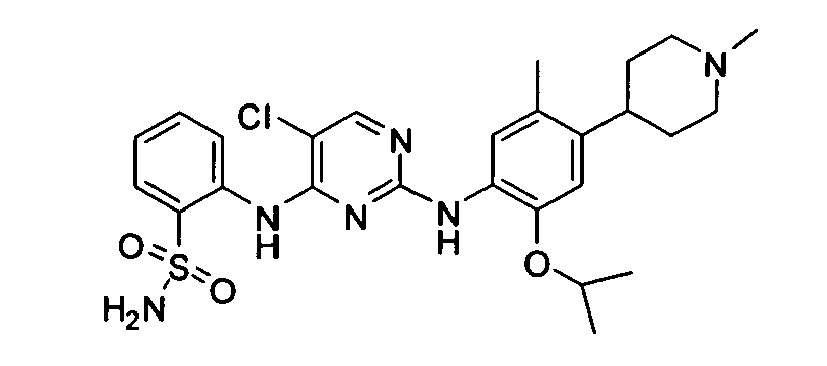
204 
5-chloro-N2-(2-isopropoxy-5-methyl-4-(1-methylpiperidin-4-yl)phenyl)-N4-(2-(aminosulfonyl)phenyl)pyrimidine-2,4-diamine N2-(4-(1-ethylpiperidin-4-yl)-2-isopropoxy-5-methylphenyl)-N4-(2-(isopropylsulfonyl)phenyl)-7H-pyrrolo[2,3-d]pyrimidine-2,4-diamine 82 
205 
5-chloro-N2-(2-isopropoxy-5-methyl-4-(1-methylpiperidin-4-yl)phenyl)-N4-(2-(methylsulfonyl)phenyl)pyrimidine-2,4-diamine 2-(4-(5-isopropoxy-4-(4-(2-(isopropylsulfonyl)phenylamino)-7H-pyrrolo[2,3-d]pyrimidin-2-ylamino)-2-methylphenyl)piperidin-1-yl)propan-1-ol 83 
206 
5-chloro-N2-(2-fluoro-5-methyl-4-(1-methylpiperidin-4-yl)phenyl)-N4-(2-(aminosulfonyl)phenyl)pyrimidine-2,4-diamine N2-(2-isopropoxy-4-(1-isopropylpiperidin-4-yl)-5-methylphenyl)-N4-(2-(isopropylsulfonyl)phenyl)-7H-pyrrolo[2,3-d]pyrimidine-2,4-diamine 84 
207 
5-chloro-N4-(2-(cyclobutylsulfonyl)phenyl)-N2-(2-isopropoxy-5-methyl-4-(1-methylpiperidin-4-yl)phenyl)pyrimidine-2,4-diamine 2-(4-(5-isopropoxy-4-(4-(2-(isopropylsulfonyl)phenylamino)-7H-pyrrolo[2,3-d]pyrimidin-2-ylamino)-2-methylphenyl)piperidin-1-yl)ethanol 85 
208 
5-chloro-N4-(2-(isopropylsulfonyl) phenyl)-N2-(2-methoxy-5-methyl-4-phenyl)-phenyl)pyrimidine-2,4-diamine N2-(2-isopropoxy-5-methyl-4-(1'-methyl-1,4'-bipiperidin-4-yl)phenyl)-N4-(2-(isopropylsulfonyl) phenyl)-7H-pyrrolo[2,3-d]pyrimidine-2,4-diamine 86 
209 
5-chloro-N4-(2-cyanophenyl)-N2-(2-methoxy-5-methyl-4-phenyl)-phenyl)pyrimidine-2,4-diamine N2-(2-isopropoxy-5-methyl-4-(1-methylpiperidin-4-yl)phenyl)-N6-(2-(isopropylsulfonyl)phenyl)-9H-purine-2,6-diamine 87 
210 
2-(5-chloro-2-(5-methoxy-2-methylbiphenyl-4-ylamino)pyrimidin-4-ylamino)-N,N-dimethylbenzenesulfonamide N2-(2-isopropoxy-5-methyl-4-(1-methylpiperidin-4-yl)phenyl)-N4-(2-(isopropylsulfonyl)phenyl)quinazoline -2,4-diamine 88 
211 
5-chloro-N4-(2-(isopropylsulfonyl) phenyl)-N2-(2-methoxy-5-methyl-4-(4-methylphenyl)-phenyl)pyrimidine-2,4-diamine N2-(2-isopropoxy-5-methyl-4-(1-methylpiperidin-4-yl)phenyl)-N4-(2-(isopropylsulfonyl)phenyl)-6-methoxyquinazoline-2,4-diamine 89 
212 
5-chloro-N4-(2-(isopropylsulfonyl) phenyl)-N2-(2-methoxy-5-methyl-4-(4-fluorophenyl)-phenyl)pyrimidine-2,4-diamine N2-(2-isopropoxy-5-methyl-4-(1-methylpiperidin-4-yl)phenyl)-N4-(2-(isopropylsulfonyl)phenyl)-6,7-dimethoxyquinazoline-2,4-diamine 90 
213 
5-chloro-N4-(2-(isopropylsulfonyl) phenyl)-N2-(2-methoxy-5-methyl-4-(2,4-difluorophenyl)-phenyl)pyrimidine-2,4-diamine 5-isopropoxy-6-(4-(2-(isopropylsulfonyl) phenylamino)-7H-pyrrolo[2,3-d]pyrimidin-2-ylamino)-2-(piperidin-4-yl)isoindolin-1-one 91 
214 
2-(5-chloro-2-(4'-(dimethylamino)-5-methoxy-2,3'-dimethylbiphenyl-4-ylamino)pyrimidin-4-ylamino)-N,N-dimethylbenzenesulfonamide N2-(4-(4-(dimethylamino)cyclohexyl)-2-isopropoxy-5-methylphenyl)-N6-(2-(isopropylsulfonyl)phenyl)-9H-purine-2,6-diamine 92 
215 
5-chloro-N2-(2-isopropoxy-5-methyl-4-((1s,4s)-4-(pyrrolidin-1-yl)cyclohexyl)phenyl)-N4-(2-(isopropylsulfonyl)phenyl)pyrimidine-2,4-diamine N2-(2-isopropoxy-4-methyl-5-(3-methylisoxazol-5-yl)phenyl)-N4-(2-(isopropylsulfonyl)phenyl)-7H-pyrrolo[2,3-d]pyrimidine-2,4-diamine 93 
216 
2-(5-chloro-2-(5-methoxy-2-methyl-4'-morpholinobiphenyl-4-ylamino) pyrimidin-4-ylamino)-N,N-dimethylbenzenesulfonamide N2-(2-isopropoxy-5-methyl-4-(piperidin-2-yl)phenyl)-N4-(2-(isopropylsulfonyl)phenyl)-7H-pyrrolo[2,3-d]pyrimidine-2,4-diamine 94 
217 
2-(5-chloro-2-(5-methoxy-2-methyl-4'-(methylsulfonyl)biphenyl-4-ylamino)pyrimidin-4-ylamino)-N,N-dimethylbenzenesulfonamide N2-(2-isopropoxy-4-(1-(2-methoxyethyl)piperidin-4-yl)-5-methylphenyl)-N4-(2-(isopropylsulfonyl)phenyl)-7H-pyrrolo[2,3-d]pyrimidine-2,4-diamine 95 
218 
4'-(5-chloro-4-(2-(N,N-dimethylsulfamoyl) phenylamino) pyrimidin-2-ylamino)-5'-methoxy-2'-methylbiphenyl-4-carboxamide 3-(4-(5-isopropoxy-4-(4-(2-(isopropylsulfonyl) phenylamino)-7H-pyrrolo[2,3-d]pyrimidin-2-ylamino)-2-methylphenyl)piperidin-1-yl)propan-1-ol 96 
219 
2-(2-(4'-acetyl-5-methoxy-2-methylbiphenyl-4-ylamino)-5-chloropyrimidin-4-ylamino)-N,N-dimethylbenzenesulfonamide 2-(4-(5-isopropoxy-4-(4-(2-(isopropylsulfonyl) phenylamino)-7H-pyrrolo[2,3-d]pyrimidin-2-ylamino)-2-methylphenyl)piperidin-1-yl)acetic acid 97 
220 
4'-(5-chloro-4-(2-(N,N-dimethylsulfamoyl) phenylamino) pyrimidin-2-ylamino)-5'-methoxy-N,2'-dimethylbiphenyl-4-carboxamide 3-(4-(5-isopropoxy-4-(4-(2-(isopropylsulfonyl) phenylamino)-7H-pyrrolo[2,3-d]pyrimidin-2-ylamino)-2-methylphenyl)piperidin-1-yl)propanoic acid 98 
221 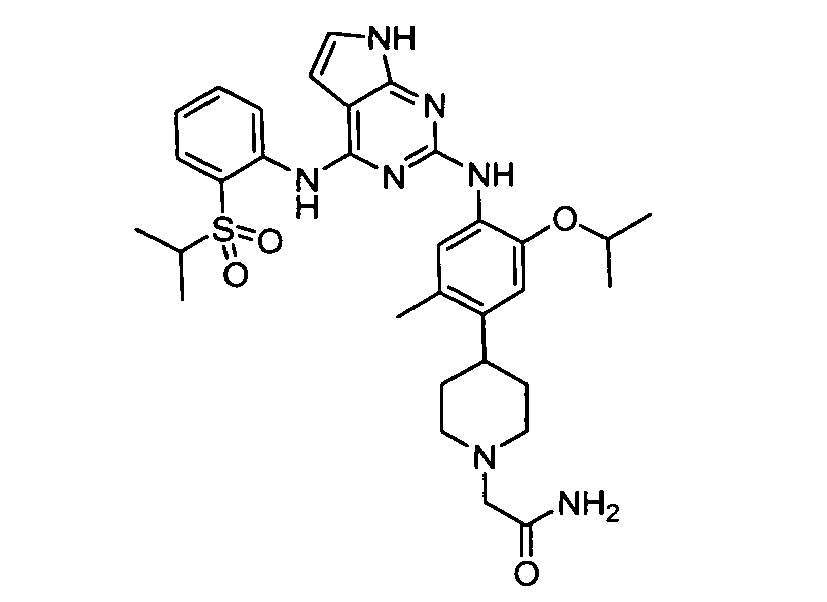
4'-(5-chloro-4-(2-(N,N-dimethylsulfamoyl) phenylamino) pyrimidin-2-ylamino)-5'-methoxy-2'-methylbiphenyl-4-carboxylic acid 2-(4-(5-isopropoxy-4-(4-(2-(isopropylsulfonyl) phenylamino)-7H-pyrrolo[2,3-d]pyrimidin-2-ylamino)-2-methylphenyl)piperidin-1-yl)acetamide 99 
222 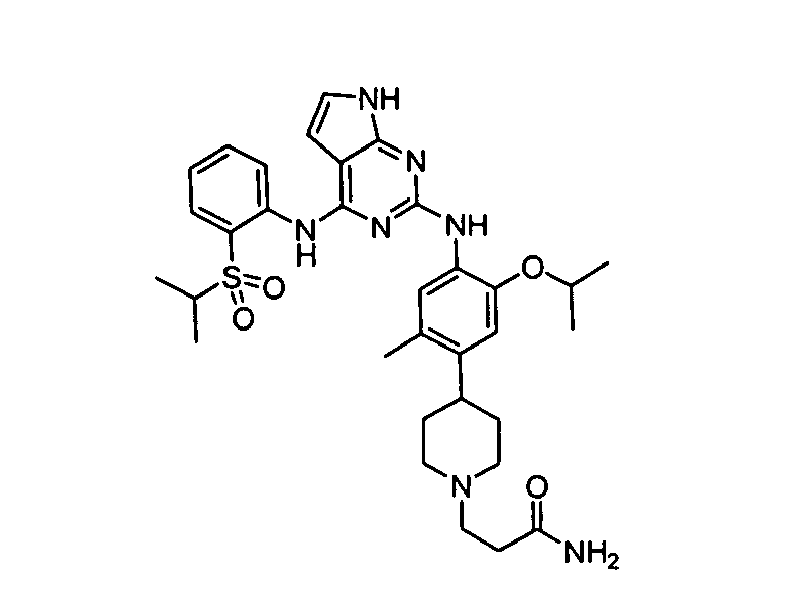
2-(5-chloro-2-(2-methoxy-5-methyl-4-(pyridin-4-yl)phenylamino)pyrimidin-4-ylamino)-N,N-dimethylbenzenesulfonamide 3-(4-(5 -isopropoxy-4-(4-(2-(isopropylsulfonyl) phenylamino)-7H-pyrrolo[2,3-d]pyrimidin-2-ylamino)-2-methylphenyl)piperidin-1-yl)propanamide 100 
223 
2-(5-chloro-2-(2-isopropoxy-5-methyl-4-(pyridin-4-yl)phenylamino)pyrimidin-4-ylamino)-N,N-dimethylbenzenesulfonamide 4-(5-isopropoxy-4-(4-(2-(isopropylsulfonyl) phenylamino)-7H-pyrrolo[2,3-d]pyrimidin-2-ylamino)-2-methylphenyl)-N,N-dimethylpiperidine-1-carboxamide 101 
224 
2-(5-chloro-2-(5-methyl-2-(1-methylpiperidin-4-yloxy)-4-(pyridin-4-yl)phenylamino)pyrimidin-4-ylamino)-N,N-dimethylbenzenesulfonamide N2-(2-isopropoxy-5-methyl-4-(piperidin-3-yl)phenyl)-N4-(2-(isopropylsulfonyl)phenyl)-7H-pyrrolo[2,3-d]pyrimidine-2,4-diamine 102 
225 
5-(5-chloro-4-(2-(N,N-dimethylsulfamoyl) phenylamino) pyrimidin-2-ylamino)-4-isopropoxy-N-methyl-2-(pyridin-4-yl)benzamide N2-(2-isopropoxy-5-methyl-4-(1-methylpiperidin-3-yl)phenyl)-N4-(2-(isopropylsulfonyl)phenyl)-7H-pyrrolo[2,3-d]pyrimidine-2,4-diamine 103 
226 
5-(5-chloro-4-(2-(N,N-dimethylsulfamoyl) phenylamino) pyrimidin-2-ylamino)-2-(2-fluoropyridin-4-yl)-4-isopropoxy-N-methylbenzamide 2-(3-(5-isopropoxy-4-(4-(2-(isopropylsulfonyl) phenylamino)-7H-pyrrolo[2,3-d]pyrimidin-2-ylamino)-2-methylphenyl)piperidin-1-yl)ethanol 104 
227 
5-(4-(2-(isopropylsulfonyl)phenylamino)-5-chloropyrimidin-2-ylamino)-4-isopropoxy-N,2-dimethylbenzamide N2-(2-isopropoxy-4-(1-(2-methoxyethyl)piperidin-3-yl)-5-methylphenyl)-N4-(2-(isopropylsulfonyl) phenyl)-7H-pyrrolo[2,3-d]pyrimidine-2,4-diamine 105 
228 
5-(4-(2-(isopropylsulfonyl)phenylamino)-5-chloropyrimidin-2-ylamino)-4-isopropoxy-N-methyl-2-(3-methyl-1H-pyrazol-5-yl)benzamide 5-(5-isopropoxy-4-(4-(2-(isopropylsulfonyl)phenylamino)-7H-pyrrolo[2,3-d]pyrimidin-2-ylamino)-2-methylphenyl)-N-methylpiperidine-2-carboxamide 106 
229 
5-(4-(2-(isopropylsulfonyl)phenylamino)-5-chloropyrimidin-2-ylamino)-4-isopropoxy-N-methyl-2-(2-methylthiazol-5-yl)benzamide N6-(2-isopropoxy-5-methyl-4-(piperidin-4-yl)phenyl)-N4-(2-(isopropylsulfonyl) phenyl)-1H-pyrazolo[3,4-d]pyrimidine-4,6-diamine 107 
230 
5-(4-(2-(isopropylsulfonyl)phenylamino)-5-chloropyrimidin-2-ylamino)-4-isopropoxy-2-methyl-N-(1-methylpiperidin-4-yl)benzamide N6-(4-(1-ethylpiperidin-4-yl)-2-isopropoxy-5-methylphenyl)-N4-(2-(isopropylsulfonyl)phenyl)-1H-pyrazolo[3,4-d]pyrimidine-4,6-diamine 108 
231 
5-(4-(2-(isopropylsulfonyl)phenylamino)-5-chloropyrimidin-2-ylamino)-2-cyclopropyl-4-isopropoxy-N-methylbenzamide N6-(2-isopropoxy-5-methyl-4-(1-methylpiperidin-4-yl)phenyl)-N4-(2-(isopropylsulfonyl)phenyl)-1H-pyrazolo[3,4-d]pyrimidine-4,6-diamine 109 
232 
4'-(5-chloro-4-(2-(N,N-dimethylsulfamoyl)phenylamino) pyrimidin-2-ylamino)-2'-cyano-5'-isopropoxy-N-methylbiphenyl-4-carboxamide 2-(4-(5-isopropoxy-4-(4-(2-(isopropylsulfonyl)phenylamino)-1H-pyrazolo[3,4-d]pyrimidin-6-ylamino)-2-methylphenyl)piperidin-1-yl)ethanol 110 
233 
5-chloro-N4-(2-(sulfonylamino)phenyl)-N2-(2-methoxy-5-methyl-4-(3-methyl-4-(methylacetamidophenyl)-phenyl)pyrimidine-2,4-diamine N6-(2-isopropoxy-4-(1-(2-methoxyethyl) piperidin-4-yl)-5-methylphenyl)-N4-(2-(isopropylsulfonyl)phenyl)-1H-pyrazolo[3,4-d]pyrimidine-4,6-diamine 111 
234 
4'-(5-chloro-4-(2-(N,N-dimethylsulfamoyl)phenylamino) pyrimidin-2-ylamino)-N-cyclopropyl-5'-methoxy-2'-methylbiphenyl-4-carboxamide N6-(4-(4-(dimethylamino)cyclohexyl)-2-isopropoxy-5-methylphenyl)-N4-(2-(isopropylsulfonyl)phenyl)-1H-pyrazolo[3,4-d]pyrimidine-4,6-diamine 112 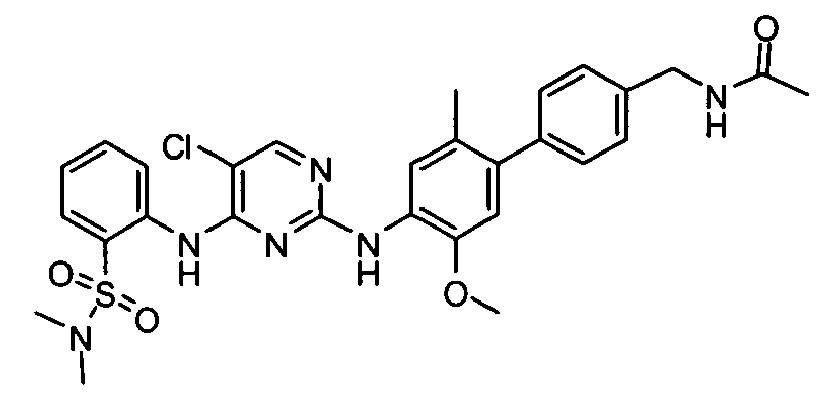
235 
N-((4'-(5-chloro-4-(2-(N,N-dimethylsulfamoyl) phenylamino) pyrimidin-2-ylamino)-5'-methoxy-2'-methylbiphenyl-4-yl)methyl)acetamide N6-(2-isopropoxy-5-methyl-4-(piperidin-2-yl)phenyl)-N4-(2-(isopropylsulfonyl) phenyl)-1H-pyrazolo[3,4-d]pyrimidine-4,6-diamine 113 
236 
5-chloro-N4-(2-(morpholinosulfonyl) phenyl)-N2-(2-methoxy-5-methyl-4-(4 (methylacetamidophenyl)-phenyl)pyrimidine-2,4-diamine 5-isopropoxy-6-(4-(2-(isopropylsulfonyl) phenylamino)-1H-pyrazolo[3,4-d]pyrimidin-6-ylamino)-2-(piperidin-4-yl)isoindolin-1-one 114 
237 
4'-(5-chloro-4-(2-(N-(cyclopropylmethyl) sulfamoyl)phenylamino)pyrimidin-2-ylamino)-5'-methoxy-N,2'-dimethylbiphenyl-4-carboxamide N2-(2-isopropoxy-5-methyl-4-(piperidin-4-yl)phenyl)-N4-(2-(isopropylsulfonyl) phenyl)-5,6,7,8-tetrahydropyrido[2,3-d]pyrimidine-2,4-diamine 115 
238 
4'-(5-chloro-4-(2-(N-cyclobutyl sulfamoyl)phenylamino)pyrimidin-2-ylamino)-5'-methoxy-N,2'-dimethylbiphenyl-4-carboxamide N2-(2-isopropoxy-5-methyl-4-(piperidin-4-yl)phenyl)-N4-(2-(isopropylsulfonyl) phenyl)pyrido[2,3-d]pyrimidine-2,4-diamine 116 
239 
5-chloro-N4-(2-(pyrrolidinosulfonyl) phenyl)-N2-(2-methoxy-5-methyl-4-(4-acetamidomethylphenyl)-phenyl)pyrimidine-2,4-diamine 5-isopropoxy-6-(4-(2-(isopropylsulfonyl)phenylamino)-1H-pyrazolo[3,4-d]pyrimidin-6-ylamino)-2-(1-methylpiperidin-4-yl)isoindolin-1-one 117 
240 
4'-(5-chloro-4-(2-(N,N-dimethylsulfamoyl) phenylamino) pyrimidin-2-ylamino)-5'-methoxy-2'-methylbiphenyl-3-carboxylic acid 5-isopropoxy-6-(4-(2-(isopropylsulfonyl)-5-methylphenylamino)-1H-pyrazolo[3,4-d]pyrimidin-6-ylamino)-2-(1-methylpiperidin-4-yl)isoindolin-1-one 118 
241 
4'-(4-(2-(N,N-dimethylsulfamoyl) phenylamino)-5-fluoropyrimidin-2-ylamino)-5'-methoxy-N,2'-dimethylbiphenyl-4-carboxamide 5-isopropoxy-6-(4-(2-(isopropylsulfonyl)-5-methylphenylamino)-1H-pyrazolo[3,4-d]pyrimidin-6-ylamino)-2-(1-(2-methoxy ethyl)piperidin-4-yl)isoindolin-1-one 119 
242 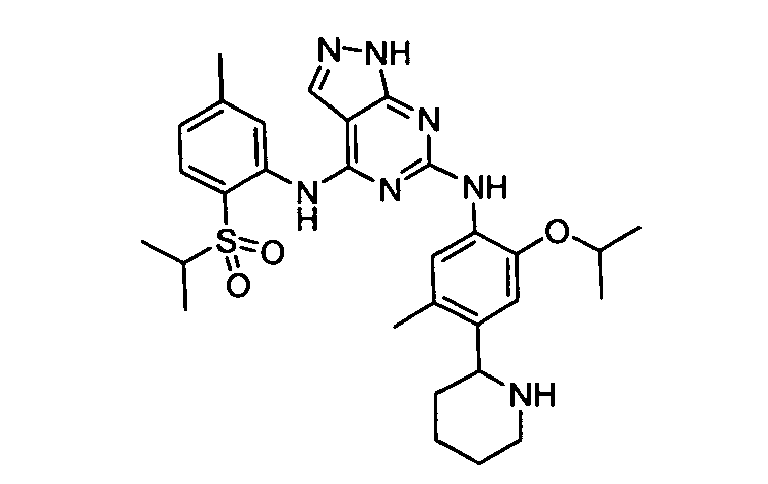
2-(5-chloro-2-(5-methoxy-2-methyl-4'-(morpholinosulfonyl)biphenyl-4-ylamino)pyrimidin-4-ylamino)-N,N-dimethylbenzenesulfonamide N6-(2-isopropoxy-5-methyl-4-(piperidin-2-yl)phenyl)-N4-(2-(isopropylsulfonyl)-5-methylphenyl)-1H-pyrazolo[3,4-d]pyrimidine-4,6-diamine 120 
243 
2-(5-chloro-2-(5-methoxy-2-methyl-4'-(4-methylpiperazin-1-yl)biphenyl-4-ylamino)pyrimidin-4-ylamino)-N,N-dimethylbenzenesulfonamide N6-(2-isopropoxy-5-methyl-4-(piperidin-3-yl)phenyl)-N4-(2-(isopropylsulfonyl)-5-methylphenyl)-1H-pyrazolo[3,4-d]pyrimidine-4,6-diamine 121 
244 
5-chloro-N2-(2-isopropoxy-5-methyl-4-((1r,4r)-4-(pyrrolidin-1-yl)cyclohexyl) phenyl)-N4-(2-(isopropylsulfonyl) phenyl)pyrimidine-2,4-diamine N2-(2-isopropoxy-4-(1-methylpiperidin-4-yl)phenyl)-N4-(2-(isopropylsulfonyl) phenyl)-7H-pyrrolo[2,3-d]pyrimidine-2,4-diamine 122 
245 
2-(N-((1r,4r)-4-(4-(4-(2-(isopropylsulfonyl)phenylamino)-5-chloropyrimidin-2-ylamino)-5-isopropoxy-2-methylphenyl)cyclohexyl)-N-methylamino)ethanol 2-(4-(3-isopropoxy-4-(6-(2-(isopropylsulfonyl) phenylamino)-9H-purin-2-ylamino)phenyl)piperidin-1-yl)ethanol; and 123 
246 
N2-(4-((1s,4s)-4-(N-(2-methoxyethyl)-N-methylamino)cyclohexyl)-2-isopropoxy-5-methylphenyl)-5-chloro-N4-(2-(isopropylsulfonyl) phenyl)pyrimidine-2,4-diamine N2-(2-isopropoxy-4-(1-methylpiperidin-4-yl)phenyl)-N6-(2-(isopropylsulfonyl) phenyl)-9H-purine-2,6-diamine. 
W is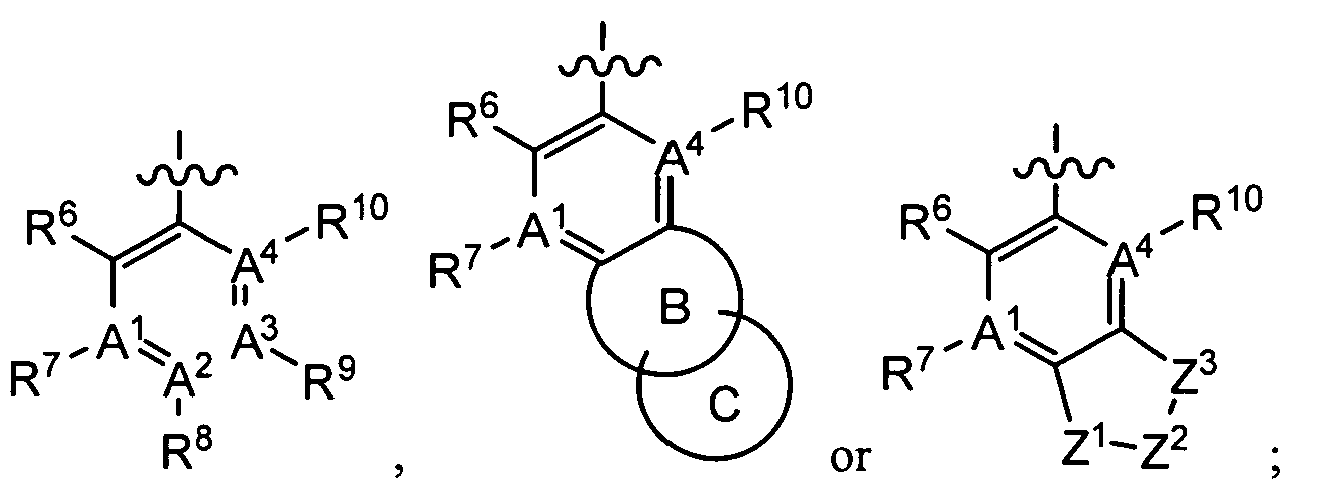
each A2 and A3 is C, or one of A2 and A3 is N when R6 and R7 form a ring;
B and C are independently an optionally substituted 5-7 membered carbocyclic ring, aryl, heteroaryl or heterocyclic ring containing N, O or S;
Z1, Z2 and Z3 are independently NR11, C=O, CR-OR, (CR2)1-2 or =C-R12;
R1 and R2 are independently halo, OR12, NR(R12), SR12, or an optionally substituted C1-6 alkyl, C2-6 alkenyl or C2-6 alkynyl; or one of R1 and R2 is H;
R3 is (CR2)0-2SO2R12, (CR2)0-2SO2NRR12, (CR2)0-2CO1-2R12, (CR2)0-2CONRR12 or cyano;
R4, R6, and R7 and R10 when attached to a carbon atom, are independently H, an optionally substituted C1-6 alkyl, C2-6 alkenyl or C2-6 alkynyl; OR12, NR(R12), halo, nitro, SO2R12, (CR2)pR13 or X; provided R6 and R7 are not both H;
R, R5 and R5' are independently H or C1-6 alkyl;
R8 and R9 are independently C1-6 alkyl, C2-6 alkenyl, C2-6 alkynyl, halo or X, or one of R8 and R9 is H; and provided one of R8 and R9 is X;
alternatively, R1 and R2, or R6 and R7, R7 and R8, or R9 and R10, when attached to a carbon atom may form an optionally substituted 5-7 membered monocyclic or fused carbocyclic ring, aryl, or heteroaryl or heterocyclic ring comprising N, O and/or S; or R7, R8, R9 and R10 are absent when attached to N;
R11 is H, C1-6 alkyl, C2-6 alkenyl, (CR2)pCO1-2R, (CR2)pOR, (CR2)pR13, (CR2)pNRR12, (CR2)pCONRR12 or (CR2)pSO1-2R12;
R12 and R13 are independently an optionally substituted 3-7 membered saturated or partially unsaturated carbocyclic ring, or a 5-7 membered heterocyclic ring comprising N, O and/or S; aryl or heteroaryl; or R12 is H, C1-6 alkyl;
X is (CR2)qY, cyano, CO1-2R12, CONR(R12), CONR(CR2)pNR(R12), CONR(CR2)pOR12, CONR(CR2)pSR12, CONR(CR2)pS(O)1-2R12 or (CR2)1-6NR(CR2)pOR12;
Y is an optionally substituted 3-12 membered carbocyclic ring, a 5-12 membered aryl, or a 5-12 membered heteroaryl or heterocyclic ring comprising N, O and/or S and attached to A2 or A3 or both via a carbon atom of said heteroaryl or heterocyclic ring when q in (CR2)qY is 0; and
n, p and q are independently 0-4.
13. The compound of clause 12, wherein R1 is halo or C1-6 alkyl;
R2 is H or NH2; or
R1 and R2 together form an optionally substituted 5-6 membered aryl, or heteroaryl or heterocyclic ring comprising 1-3 nitrogen atoms.
14. The compound of clause 12, selected from the group consisting of247 
252 
5-chloro-N2-(3-isopropoxy-5-(piperidin-4-yl)pyridin-2-yl)-N4-(2-(isopropylsulfonyl)phenyl)pyridine-2,4-diamine 4'-(5-chloro-4-(2-(isopropylsulfonyl) phenylamino)pyridin-2-ylamino)-3'-fluoro-N-methylbiphenyl-4-carboxamide 248 
253 
5-chloro-N2-(3-isopropoxy-5-(1-methylpiperidin-4-yl)pyridin-2-yl)-N4-(2-(isopropylsulfonyl) phenyl)pyridine-2,4-diamine 5-chloro-N4-(2-(isopropylsulfonyl)phenyl)-N2-(2-methyl-3'-(methylsulfonyl)biphenyl-4-yl)pyridine-2,4-diamine 249 
254 
5-chloro-N2-(5-(1-ethylpiperidin-4-yl)-3-isopropoxypyridin-2-yl)-N4-(2-(isopropylsulfonyl)phenyl)pyridine-2,4-diamine Methyl 4'-(5-chloro-4-(2-(isopropylsulfonyl) phenylamino)pyridin-2-ylamino)-5'-methoxy-2'-methylbiphenyl-4-carboxylate 250 
255 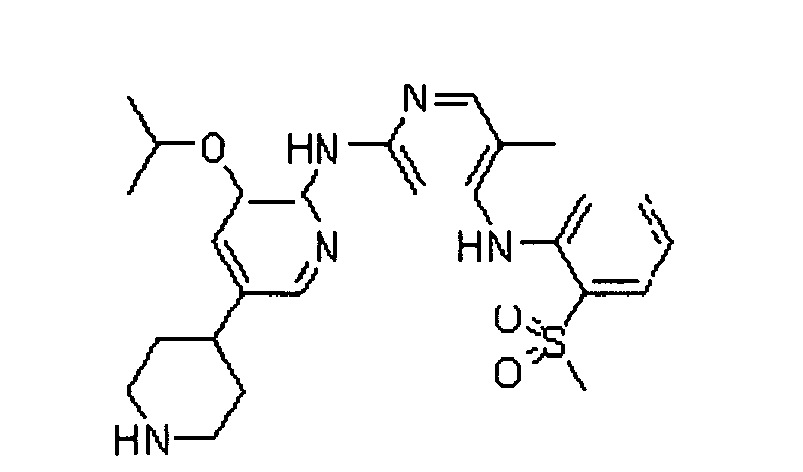
2-(4-(6-(5-chloro-4-(2-(isopropylsulfonyl) phenylamino)pyridin-2-ylamino)-5-isopropoxypyridin-3-yl)piperidin-1-yl)ethanol N2-(3-isopropoxy-5-(piperidin-4-yl)pyridin-2-yl)-5-methyl-N4-(2-(methylsulfonyl)phenyl)pyridine-2,4-diamine; and 251 
256 
4'-(5-chloro-4-(2-(isopropylsulfonyl) phenylamino) pyridin-2-ylamino)-N,2'-dimethylbiphenyl-4-carboxamide 6-(3-isopropoxy-5-(piperidin-4-yl)pyridin-2-ylamino)-4-(2-(isopropylsulfonyl) phenylamino) nicotinonitrile. 257 
274 
N2-(5-Ethynyl-2-isopropoxy-4-methyl-phenyl)-5-methyl-N4-[2-(propane-2-sulfonyl)-phenyl]-pyrimidine-2,4-diamine 5-chloro-N4-(5-fluoro-2-(isopropylsulfonyl) phenyl)-N2-(2-isopropoxy-4-(1-methyl piperidin-4-yl)phenyl)pyrimidine-2,4-diamine 258 
275 
2-(2-(5-ethynyl-2-isopropoxy-4-methylphenylamino)-5-methylpyrimidin-4-ylamino)-N-isopropylbenzamide 5-chloro-N2-(2-isopropoxy-4-(piperidin-4-yl)phenyl)-N4-(2-(pyrrolidin-1-ylsulfonyl)phenyl)pyrimidine-2,4-diamine 259 
276 

5-chloro-N2-(2-isopropoxy-4-(piperidin-4-yl)phenyl)-N4-(2-(isopropylsulfonyl) phenyl)pyrimidine-2,4-diamine 260 
277 
5-chloro-N4-(2-(isopropylsulfonyl) phenyl)-N2-(5-(piperidin-4-yl)isoquinolin-8-yl)pyrimidine-2,4-diamine 5-chloro-N2-(2-isopropoxy-4-(1-(1-methylpiperidin-4-yl)piperidin-4-yl)phenyl)-N4-(2-(isopropylsulfonyl) phenyl)pyrimidine-2,4-diamine 261 
278 
2-[5-Chloro-2-(6-chloro-2-methyl-quinolin-4-ylamino)-pyrimidin-4-ylamino]-N,N-dimethyl-benzenesulfonamide 4-(4-(4-(2-(isopropylsulfonyl)phenylamino)-5-chloropyrimidin-2-ylamino)-3-isopropoxyphenyl)cyclohexanone 262 
279 
N4-(2-(isopropylsulfonyl)phenyl)-N2-(2-methoxy-5-methylphenyl)-7H-pyrrolo[2,3-d]pyrimidine-2,4-diamine N2-(2-isopropoxy-4-(piperidin-4-yl)phenyl)-N4-(2-(isopropylsulfonyl)phenyl)-5-methylpyrimidine-2,4-diamine 263 
280 
5-chloro-N2-(2-isopropoxy-4-(1-methyl piperidin-2-yl)phenyl)-N4-(2-(isopropyl sulfonyl)phenyl)pyrimidine-2,4-diamine 2-(4-(4-(4-(2-(isopropylsulfonyl)phenylamino)-5-methylpyrimidin-2-ylamino)-3-isopropoxy phenyl)piperidin-1-yl)ethanol 264 
281 
5-chloro-N2-(2-isopropoxy-4-(1-(4-methylpiperazin-1-yl)propan-2-yl)phenyl)-N4-(2-(isopropylsulfonyl)phenyl)pyrimidine-2,4-diamine 5-chloro-N2-(2-isopropoxy-4-(1-methylpiperidin-4-yl)phenyl)-N4-(2-(isopropylsulfonyl)phenyl)pyrimidine -2,4-diamine 265 
282 
3-(4-(5-chloro-4-(2-(isopropylsulfonyl) phenylamino)pyrimidin-2-ylamino)-3-isopropoxyphenyl)butan-1-ol N2-(2-isopropoxy-4-(1-methylpiperidin-4-yl)phenyl)-N4-(2-(isopropylsulfonyl)phenyl)-5-methylpyrimidine-2,4-diamine 266 
283 
5-chloro-N2-(2-isopropoxy-4-(1-methylpiperidin-4-yl)phenyl)-N4-(2-(methylsulfonylmethyl) phenyl)pyrimidine-2,4-diamine 2-(2-(2-isopropoxy-4-(1-methylpiperidin-4-yl)phenylamino)-5-chloropyrimidin-4-ylamino)-N,N-dimethylbenzamide 267 
284 
2-(5-chloro-2-(2-isopropoxy-4-(1-methyl piperidin-4-yl)phenylamino) pyrimidin-4-ylamino)-N,N-dimethylbenzenesulfonamide 2-(4-(4-(4-(2-(isopropylsulfonyl) phenylamino)-5-chloropyrimidin-2-ylamino)-3-isopropoxyphenyl) piperidin-1-yl)acetamide 268 
285 
2-(4-(5-chloro-4-(2-(isopropylsulfonyl) phenylamino) pyrimidin-2-ylamino)-3-isopropoxyphenyl)-2-methylpropan-1-ol 5-chloro-N2-(4-isopropoxy-2-(piperidin-4-yl)pyrimidin-5-yl)-N4-(2-(isopropyl sulfonyl)phenyl)pyrimidine-2,4-diamine 269 
286 
5-chloro-N2-(2-isopropoxy-4-(2-methyl-1-(4-methylpiperazin-1-yl)propan-2-yl)phenyl)-N4-(2-(isopropylsulfonyl)phenyl)pyrimidine-2,4-diamine 5-chloro-N4-(2-(isopropylsulfonyl)phenyl)-N2-(2-methoxy-6-(piperidin-4-yl)pyridin-3-yl)pyrimidine-2,4-diamine 270 
287 
5-chloro-N2-(2-isopropoxy-4-(1-(pyrrolidin-1-yl)propan-2-yl)phenyl)-N4-(2-(isopropylsulfonyl) phenyl)pyrimidine-2,4-diamine 5-chloro-N4-(2-(isopropylsulfonyl)phenyl)-N2-(2-methoxy-6-(4-(piperazin-1-yl)phenyl)pyridin-3-yl)pyrimidine-2,4-diamine 271 
288 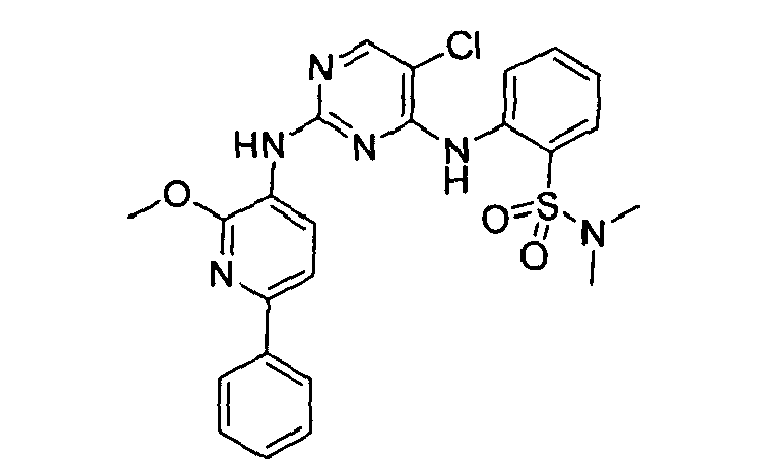
Methyl 2-(4-(5-chloro-4-(2-(isopropylsulfonyl) phenylamino)pyrimidin-2-ylamino)-3-isopropoxyphenyl)-2-methylpropanoate 2-(5-chloro-2-(2-methoxy-6-phenyipyridin-3-ylamino)pyrimidin-4-ylamino)-N,N-dimethylbenzenesulfonamide; 272 
289 
5-chloro-N2-(2-isopropoxy-4-(1-morpholinopropan-2-yl)phenyl)-N4-(2-(isopropylsulfonyl)phenyl)pyrimidine-2,4-diamine 2-(4-(5-chloro-4-(2-(isopropylsulfonyl)phenylamino) pyrimidin-2-ylamino)-3-isopropoxyphenyl)-2-methylpropane-1,3-diol 273 
5-chloro-N4-(5-fluoro-2-(isopropylsulfonyl)phenyl)-N2-(2-isopropoxy-4-(piperidin-4-yl)phenyl)pyrimidine-2,4-diamine
17. A method for inhibiting anaplastic lymphoma kinase, comprising administering to a cell or tissue system or to a mammalian subject, a therapeutically effective amount of a compound of any one of clauses 1-15, or pharmaceutically acceptable salts thereof, thereby inhibiting said kinase.
18. The use of a compound of any one of clauses 1-15, or a pharmaceutical composition thereof, for the manufacture of a medicament for treating a condition mediated by anaplastic lymphoma kinase, and optionally in combination with a second therapeutic agent, wherein said condition is an autoimmune disease, a transplantation disease, an infectious disease or a cell proliferative disorder.
19. The use of a compound of any one of clauses 1-15, or a pharmaceutical composition thereof, for the manufacture of a medicament for treating a cell proliferative disorder, and optionally in combination with a second therapeutic agent, wherein said cell proliferative disorder is lymphoma, osteosarcoma, melanoma, or a tumor of breast, renal, prostate, colorectal, thyroid, ovarian, pancreatic, neuronal, lung, uterine or gastrointestinal tumor.
20. The use of clause 19, wherein said second therapeutic agent is a chemotherapeutic agent.
Claims (12)
- A compound having Formula (1):

W is
each A2 and A3 is C;
R1 and R2 together form an optionally substituted 5-6 membered aryl, or heteroaryl or heterocyclic ring comprising 1-3 nitrogen atoms;
R3 is (CR2)0-2SO2R12, (CR2)0-2SO2NRR12, (CR2)0-2C(O)O0-1R12, (CR2)0-2CONRR12 or cyano;
R4, R7 and R10 are independently H;
R, R5 and R5' are independently H or C1-6 alkyl;
R6 is halo or O(C1-6 alkyl);
R8 and R9 are independently C1-6 alkyl, C2-6 alkenyl, C2-6 alkynyl, halo or X, or one of R8 and R9 is H; and provided one of R8 and R9 is X;
X is (CR2)qY, cyano, C(O)O0-1R12, CONR(R12), CONR(CR2)pNR(R12), CONR(CR2)pOR12, CONR(CR2)pSR12, CONR(CR2)pS(O)1-2R12 or (CR2)1-6NR(CR2)pOR12;
Y is an optionally substituted 3-12 membered carbocyclic ring, a 5-12 membered aryl, or a 5-12 membered heteroaryl or heterocyclic ring comprising N, O and/or S and attached to A2 or A3 or both via a carbon atom of said heteroaryl or heterocyclic ring when q in (CR2)qY is 0;
R12 is an optionally substituted 3-7 membered saturated or partially unsaturated carbocyclic ring, or a 5-7 membered heterocyclic ring comprising N, O and/or S; aryl or heteroaryl; or R12 is H, C1-6 alkyl; and
n is 0; and
p and q are independently 0-4. - The compound of claim 1, wherein R3 is SO2R12, SO2NH2, SO2NRR12, CO2NH2, CONRR12, C(O)O0-1R12, or cyano; and
R12 is C1-6alkyl, an optionally substituted C3-7 cycloalkyl, C3-7 cycloalkenyl, pyrrolidinyl, piperazinyl, piperidinyl or morpholinyl. - The compound of claim 1, wherein said compound is selected from the group consisting of
203 
N2-(2-isopropoxy-5-methyl-4-(piperidin-4-yl)phenyl)-N4-(2-(methylsulfonyl)phenyl)-7H-pyrrolo[2,3-d]pyrimidine-2,4-diamine; 204 
N2-(4-(1-ethylpiperidin-4-yl)-2-isopropoxy-5-methylphenyl)-N4-(2-(isopropylsulfonyl)phenyl)-7H-pyrrolo[2,3-d]pyrimidine-2,4-diamine; 205 
2-(4-(5-isopropoxy-4-(4-(2-(isopropylsulfonyl) phenylamino)-7H-pyrrolo[2,3-d]pyrimidin-2-ylamino)-2-methylphenyl)piperidin-1-yl)propan-1-ol; 206 
N2-(2-isopropoxy-4-(1-isopropylpiperidin-4-yl)-5-methylphenyl)-N4-(2-(isopropylsulfonyl)phenyl)-7H-pyrrolo[2,3-d]pyrimidine-2,4-diamine; 207 
2-(4-(5-isopropoxy-4-(4-(2-(isopropylsulfonyl) phenylamino)-7H-pyrrolo[2,3-d]pyrimidin-2-ylamino)-2-methylphenyl)piperidin-1-yl)ethanol; 208 
N2-(2-isopropoxy-5-methyl-4-(1'-methyl-1,4'-bipiperidin-4-yl)phenyl)-N4-(2-(isopropylsulfonyl) phenyl)-7H-pyrrolo[2,3-d]pyrimidine-2,4-diamine; 215 
N2-(2-isopropoxy-4-methyl-5-(3-methylisoxazol-5-yl)phenyl)-N4-(2-(isopropylsulfonyl)phenyl)-7H-pyrrolo[2,3-d]pyrimidine-2,4-diamine; 216 
N2-(2-isopropoxy-5-methyl-4-(piperidin-2-yl)phenyl)-N4-(2-(isopropylsulfonyl) phenyl)-7H-pyrrolo[2,3-d]pyrimidine-2,4-diamine; 217 
N2-(2-isopropoxy-4-(1-(2-methoxyethyl)piperidin-4-yl)-5-methylphenyl)-N4-(2-(isopropylsulfonyl) phenyl)-7H-pyrrolo[2,3-d]pyrimidine-2,4-diamine; 218 
3-(4-(5-isopropoxy-4-(4-(2-(isopropylsulfonyl) phenylamino)-7H-pyrrolo[2,3-d]pyrimidin-2-ylamino)-2-methylphenyl)piperidin-1-yl)propan-1-ol; 219 
2-(4-(5-isopropoxy-4-(4-(2-(isopropylsulfonyl) phenylamino)-7H-pyrrolo[2,3-d]pyrimidin-2-ylamino)-2-methylphenyl)piperidin-1-yl)acetic acid; 220 
3-(4-(5-isopropoxy-4-(4-(2-(isopropylsulfonyl) phenylamino)-7H-pyrrolo[2,3-d]pyrimidin-2-ylamino)-2-methylphenyl)piperidin-1-yl)propanoic acid; 221 
2-(4-(5-isopropoxy-4-(4-(2-(isopropylsulfonyl) phenylamino)-7H-pyrrolo[2,3-d]pyrimidin-2-ylamino)-2-methylphenyl)piperidin-1-yl)acetamide; 222 
3-(4-(5-isopropoxy-4-(4-(2-(isopropylsulfonyl) phenylamino)-7H-pyrrolo[2,3-d]pyrimidin-2-ylamino)-2-methylphenyl)piperidin-1-yl)propanamide; 223 
4-(5-isopropoxy-4-(4-(2-(isopropylsulfonyl) phenylamino)-7H-pyrrolo[2,3-d]pyrimidin-2-ylamino)-2-methylphenyl)-N,N-dimethylpiperidine-1-carboxam ide; 224 
N2-(2-isopropoxy-5-methyl-4-(piperidin-3-yl)phenyl)-N4-(2-(isopropylsulfonyl)phenyl)-7H-pyrrolo[2,3-d]pyrimidine-2,4-diamine; 225 
N2-(2-isopropoxy-5-methyl-4-(1-methylpiperidin-3-yl)phenyl)-N4-(2-(isopropylsulfonyl)phenyl)-7H-pyrrolo[2,3-d]pyrimidine-2,4-diamine; 226 
2-(3-(5-isopropoxy-4-(4-(2-(isopropylsulfonyl) phenylamino)-7H-pyrrolo[2,3-d]pyrimidin-2-ylamino)-2-methylphenyl)piperidin-1-yl)ethanol; 227 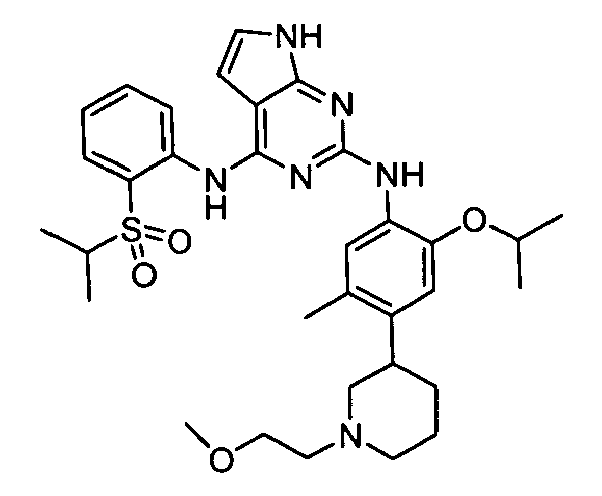
N2-(2-isopropoxy-4-(1-(2-methoxyethyl)piperidin-3-yl)-5-methylphenyl)-N4-(2-(isopropylsulfonyl)phenyl)-7H-pyrrolo[2,3-d]pyrimidine-2,4-diamine; 228 
5-(5-isopropoxy-4-(4-(2-(isopropylsulfonyl)phenylamino)-7H-pyrrolo[2,3-d]pyrimidin-2-ylamino)-2-methylphenyl)-N-methylpiperidine-2-carboxamide; and 244 
N2-(2-isopropoxy-4-(1-methylpiperidin-4-yl)phenyl)-N4-(2-(isopropylsulfonyl) phenyl)-7H-pyrrolo[2,3-d]pyrimidine-2,4-diamine; - The compound of claim 1, wherein said compound is selected from the group consisting of:
229 
N6-(2-isopropoxy-5-methyl-4-(piperidin-4-yl)phenyl)-N4-(2-(isopropylsulfonyl) phenyl)-1H-pyrazolo[3,4-d]pyrimidine-4,6-diamine; 230 
N6-(4-(1-ethylpiperidin-4-yl)-2-isopropoxy-5-methylphenyl)-N4-(2-(isopropylsulfonyl)phenyl)-1H-pyrazolo[3,4-d]pyrimidine-4,6-diamine; 231 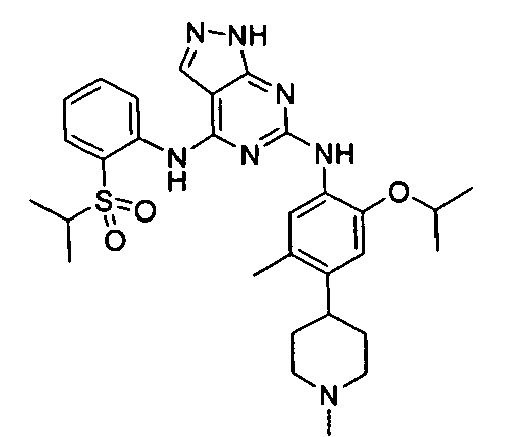
N6-(2-isopropoxy-5-methyl-4-(1-methylpiperidin-4-yl)phenyl)-N4-(2-(isopropylsulfonyl)phenyl)-1H-pyrazolo[3,4-d]pyrimidine-4,6-diamine; 232 
2-(4-(5-isopropoxy-4-(4-(2-(isopropylsulfonyl) phenylamino)-1H-pyrazolo[3,4-d]pyrimidin-6-ylamino)-2-methylphenyl)piperidin-1-yl)ethanol; 233 
N6-(2-isopropoxy-4-(1-(2-methoxyethyl)piperidin-4-yl)-5-methylphenyl)-N4-(2-(isopropylsulfonyl)phenyl)-1H-pyrazolo[3,4-d]pyrimidine-4,6-diamine; 234 
N6-(4-(4-(dimethylamino)cyclohexyl)-2-isopropoxy-5-methylphenyl)-N4-(2-(isopropylsulfonyl)phenyl)-1H-pyrazolo[3,4-d]pyrimidine-4,6-diamine; 235 
N6-(2-isopropoxy-5-methyl-4-(piperidin-2-yl)phenyl)-N4-(2-(isopropylsulfonyl)phenyl)-1H-pyrazolo[3,4-d]pyrimidine-4,6-diamine; 242 
N6-(2-isopropoxy-5-methyl-4-(piperidin-2-yl)phenyl)-N4-(2-(isopropylsulfonyl)-5-methylphenyl)-1H-pyrazolo[3,4-d]pyrimidine-4,6-diamine; and 243 
N6-(2-isopropoxy-5-methyl-4-(piperidin-3-yl)phenyl)-N4-(2-(isopropylsulfonyl)-5-methylphenyl)-1H-pyrazolo[3,4-d]pyrimidine-4,6-diamine; - The compound of claim 1, wherein said compound is selected from the group consisting of
209 
N2-(2-isopropoxy-5-methyl-4-(1-methylpiperidin-4-yl)phenyl)-N6-(2-(isopropylsulfonyl)phenyl)-9H-purine-2,6-diamine; 210 
N2-(2-isopropoxy-5-methyl-4-(1-methylpiperidin-4-yl)phenyl)-N4-(2-(isopropylsulfonyl)phenyl)quinazoline-2,4-diamine; 211 
N2-(2-isopropoxy-5-methyl-4-(1-methylpiperidin-4-yl)phenyl)-N4-(2-(isopropylsulfonyl)phenyl)-6-methoxyquinazoline-2,4-diamine; 212 
N2-(2-isopropoxy-5-methyl-4-(1-methylpiperidin-4-yl)phenyl)-N4-(2-(isopropylsulfonyl)phenyl)-6,7-dimethoxyquinazoline-2,4-diamine; 214 
N2-(4-(4-(dimethylamino)cyclohexyl)-2-isopropoxy-5-methylphenyl)-N6-(2-(isopropylsulfonyl)phenyl)-9H-purine-2,6-diamine; 237 
N2-(2-isopropoxy-5-methyl-4-(piperidin-4-yl)phenyl)-N4-(2-(isopropylsulfonyl) phenyl)-5,6,7,8-tetrahydropyrido[2,3-d]pyrimidine-2,4-diamine; 238 
N2-(2-isopropoxy-5-methyl-4-(piperidin-4-yl)phenyl)-N4-(2-(isopropylsulfonyl)phenyl)pyrido[2,3-d]pyrimidine-2,4-diamine; 245 
2-(4-(3-isopropoxy-4-(6-(2-(isopropylsulfonyl) phenylamino)-9H-purin-2-ylamino)phenyl)piperidin-1-yl)ethanol; and 246 
N2-(2-isopropoxy-4-(1-methylpiperidin-4-yl)phenyl)-N6-(2-(isopropylsulfonyl) phenyl)-9H-purine-2,6-diamine; - A pharmaceutical composition comprising a therapeutically effective amount of a compound of any one of claims 1-5 and a pharmaceutically acceptable carrier.
- A compound of any one of claims 1-5, or pharmaceutically acceptable salts thereof for use in a method for inhibiting anaplastic lymphoma kinase, comprising administering to a cell or tissue system or to a mammalian subject, a therapeutically effective amount of the compound, or pharmaceutically acceptable salts thereof, thereby inhibiting said kinase.
- The use of a compound of any one of claims 1-5, or a pharmaceutical composition thereof, for the manufacture of a medicament for treating a condition mediated by anaplastic lymphoma kinase, and optionally in combination with a second therapeutic agent, wherein said condition is an autoimmune disease, a transplantation disease, an infectious disease or a cell proliferative disorder.
- The use of a compound of any one of claims 1-5, or a pharmaceutical composition thereof, for the manufacture of a medicament for treating a cell proliferative disorder, and optionally in combination with a second therapeutic agent, wherein said cell proliferative disorder is lymphoma, osteosarcoma, melanoma, or a tumor of breast, renal, prostate, colorectal, thyroid, ovarian, pancreatic, neuronal, lung, uterine or gastrointestinal tumor, non-small cell lung carcinoma or neuroblastoma.
- The use of claim 9, wherein said cell proliferative disorder is non-small cell lung carcinoma.
- The use of claim 9, wherein said cell proliferative disorder is neuroblastoma.
- The use of claim 9, wherein said second therapeutic agent is a chemotherapeutic agent.
Priority Applications (1)
| Application Number | Priority Date | Filing Date | Title |
|---|---|---|---|
| EP15188988.8A EP3012249A1 (en) | 2006-12-08 | 2007-11-20 | Compounds and composition as protein kinase inhibitors |
Applications Claiming Priority (2)
| Application Number | Priority Date | Filing Date | Title |
|---|---|---|---|
| US86929906P | 2006-12-08 | 2006-12-08 | |
| EP07864693.2A EP2091918B1 (en) | 2006-12-08 | 2007-11-20 | Compounds and compositions as protein kinase inhibitors |
Related Parent Applications (3)
| Application Number | Title | Priority Date | Filing Date |
|---|---|---|---|
| EP07864693.2 Division | 2007-11-20 | ||
| EP07864693.2A Division-Into EP2091918B1 (en) | 2006-12-08 | 2007-11-20 | Compounds and compositions as protein kinase inhibitors |
| EP07864693.2A Division EP2091918B1 (en) | 2006-12-08 | 2007-11-20 | Compounds and compositions as protein kinase inhibitors |
Related Child Applications (2)
| Application Number | Title | Priority Date | Filing Date |
|---|---|---|---|
| EP15188988.8A Division EP3012249A1 (en) | 2006-12-08 | 2007-11-20 | Compounds and composition as protein kinase inhibitors |
| EP15188988.8A Previously-Filed-Application EP3012249A1 (en) | 2006-12-08 | 2007-11-20 | Compounds and composition as protein kinase inhibitors |
Publications (2)
| Publication Number | Publication Date |
|---|---|
| EP2311807A1 true EP2311807A1 (en) | 2011-04-20 |
| EP2311807B1 EP2311807B1 (en) | 2015-11-11 |
Family
ID=39641888
Family Applications (3)
| Application Number | Title | Priority Date | Filing Date |
|---|---|---|---|
| EP15188988.8A Withdrawn EP3012249A1 (en) | 2006-12-08 | 2007-11-20 | Compounds and composition as protein kinase inhibitors |
| EP20120180519 Withdrawn EP2537830A1 (en) | 2006-12-08 | 2007-11-20 | Compounds and compositions as protein kinase inhibitors |
| EP10007914.4A Active EP2311807B1 (en) | 2006-12-08 | 2007-11-20 | Compounds and composition as protein kinase inhibitors |
Family Applications Before (2)
| Application Number | Title | Priority Date | Filing Date |
|---|---|---|---|
| EP15188988.8A Withdrawn EP3012249A1 (en) | 2006-12-08 | 2007-11-20 | Compounds and composition as protein kinase inhibitors |
| EP20120180519 Withdrawn EP2537830A1 (en) | 2006-12-08 | 2007-11-20 | Compounds and compositions as protein kinase inhibitors |
Country Status (28)
| Country | Link |
|---|---|
| US (6) | US8039479B2 (en) |
| EP (3) | EP3012249A1 (en) |
| KR (1) | KR101364277B1 (en) |
| CN (1) | CN101616895A (en) |
| AR (3) | AR064197A1 (en) |
| BR (2) | BRPI0722383A2 (en) |
| CL (2) | CL2007003552A1 (en) |
| CU (1) | CU23829B1 (en) |
| CY (1) | CY1115898T1 (en) |
| DO (1) | DOP2011000074A (en) |
| EA (2) | EA019941B1 (en) |
| EC (1) | ECSP109500A (en) |
| ES (2) | ES2559528T3 (en) |
| GE (2) | GEP20125691B (en) |
| HN (1) | HN2009001145A (en) |
| HR (1) | HRP20141260T1 (en) |
| IL (1) | IL230972A (en) |
| JO (2) | JO2980B1 (en) |
| LU (1) | LU92785I2 (en) |
| MY (1) | MY148427A (en) |
| NZ (2) | NZ577197A (en) |
| PE (2) | PE20081447A1 (en) |
| RS (1) | RS53588B1 (en) |
| SI (1) | SI2091918T1 (en) |
| SM (1) | SM201000108B (en) |
| TW (2) | TWI410416B (en) |
| UA (1) | UA100846C2 (en) |
| ZA (1) | ZA201005313B (en) |
Cited By (1)
| Publication number | Priority date | Publication date | Assignee | Title |
|---|---|---|---|---|
| US9309229B2 (en) | 2010-12-17 | 2016-04-12 | Novartis Ag | Crystalline forms of 5-chloro-N2-(2-isopropoxy-5-methyl-4-piperidin-4-yl-phenyl)-N4-[2-(propane-2-sulfonyl)-phenyl]-pyrimidine-2, 4-diamine |
Families Citing this family (119)
| Publication number | Priority date | Publication date | Assignee | Title |
|---|---|---|---|---|
| ES2555803T3 (en) | 2006-10-23 | 2016-01-08 | Cephalon, Inc. | Fusion of bicyclic 2,4-diaminopyrimidine derivatives as using ALK and c-Met inhibitors |
| BRPI0722383A2 (en) * | 2006-12-08 | 2012-06-05 | Irm Llc | protein kinase inhibiting compounds, compositions containing them as well as their uses |
| CA2681015C (en) * | 2007-03-16 | 2016-06-21 | The Scripps Research Institute | Inhibitors of focal adhesion kinase |
| WO2009032668A2 (en) | 2007-08-28 | 2009-03-12 | Irm Llc | 2 -biphenylamino-4 -aminopyrimidine derivatives as kinase inhibitors |
| US8592432B2 (en) * | 2008-04-07 | 2013-11-26 | Bei Chen | Compounds and compositions as protein kinase inhibitors |
| US9273077B2 (en) | 2008-05-21 | 2016-03-01 | Ariad Pharmaceuticals, Inc. | Phosphorus derivatives as kinase inhibitors |
| EP2300013B2 (en) | 2008-05-21 | 2024-11-13 | Takeda Pharmaceutical Company Limited | Phosphorous derivatives as kinase inhibitors |
| US8445505B2 (en) | 2008-06-25 | 2013-05-21 | Irm Llc | Pyrimidine derivatives as kinase inhibitors |
| EP2331526A2 (en) * | 2008-06-25 | 2011-06-15 | Irm Llc | Pyrimidine derivatives as kinase inhibitors |
| UY31929A (en) * | 2008-06-25 | 2010-01-05 | Irm Llc | COMPOUNDS AND COMPOSITIONS AS CINASE INHIBITORS |
| CA2743449C (en) | 2008-11-12 | 2016-10-18 | Ariad Pharmaceuticals, Inc. | Pyrazinopyrazines and derivatives as kinase inhibitors |
| TW201100441A (en) * | 2009-06-01 | 2011-01-01 | Osi Pharm Inc | Amino pyrimidine anticancer compounds |
| BR112012029647A2 (en) | 2010-05-21 | 2016-08-02 | Chemilia Ab | new pyrimidine derivatives |
| US20120101108A1 (en) | 2010-08-06 | 2012-04-26 | Cell Signaling Technology, Inc. | Anaplastic Lymphoma Kinase In Kidney Cancer |
| WO2012037155A2 (en) * | 2010-09-13 | 2012-03-22 | Gtx, Inc. | Tyrosine kinase inhibitors |
| JP6000273B2 (en) | 2010-11-29 | 2016-09-28 | オーエスアイ・ファーマシューティカルズ,エルエルシー | Macrocyclic kinase inhibitor |
| CN103384669A (en) * | 2011-01-21 | 2013-11-06 | Abbvie公司 | Bicyclic inhibitors of ALK |
| HUE025395T2 (en) * | 2011-02-02 | 2016-02-29 | Novartis Ag | Methods of using alk inhibitors |
| JP5886411B2 (en) | 2011-03-24 | 2016-03-16 | ノビガ・リサーチ・エービーNoviga Research AB | New pyrimidine derivatives |
| EP2704572B1 (en) | 2011-05-04 | 2015-12-30 | Ariad Pharmaceuticals, Inc. | Compounds for inhibiting cell proliferation in egfr-driven cancers |
| WO2013059740A1 (en) * | 2011-10-21 | 2013-04-25 | Foundation Medicine, Inc. | Novel alk and ntrk1 fusion molecules and uses thereof |
| CA2865420C (en) * | 2012-03-06 | 2020-06-02 | Cephalon, Inc. | Fused bicyclic 2,4-diaminopyrimidine derivative as a dual alk and fak inhibitor |
| JP6469567B2 (en) | 2012-05-05 | 2019-02-13 | アリアド・ファーマシューティカルズ・インコーポレイテッド | Compound for inhibiting cell proliferation of EGFR-activated cancer |
| AU2013337277B2 (en) | 2012-11-05 | 2018-03-08 | Foundation Medicine, Inc. | Novel NTRK1 fusion molecules and uses thereof |
| WO2014071419A2 (en) | 2012-11-05 | 2014-05-08 | Foundation Medicine, Inc. | Novel fusion molecules and uses thereof |
| CA2890006C (en) * | 2012-11-06 | 2021-11-23 | Shanghai Fochon Pharmaceutical Co Ltd | Alk kinase inhibitors |
| CN104016979B (en) * | 2012-11-23 | 2017-05-03 | 广东东阳光药业有限公司 | Substituted cyclic compound as well as use method and application thereof |
| WO2014089324A1 (en) * | 2012-12-07 | 2014-06-12 | Calitor Sciences, Llc | Substituted cyclic compounds and methods of use |
| WO2014113729A2 (en) | 2013-01-18 | 2014-07-24 | Foundation Mecicine, Inc. | Methods of treating cholangiocarcinoma |
| US9561228B2 (en) | 2013-02-08 | 2017-02-07 | Celgene Avilomics Research, Inc. | ERK inhibitors and uses thereof |
| KR20150118159A (en) | 2013-02-22 | 2015-10-21 | 에프. 호프만-라 로슈 아게 | Methods of treating cancer and preventing drug resistance |
| US9611283B1 (en) | 2013-04-10 | 2017-04-04 | Ariad Pharmaceuticals, Inc. | Methods for inhibiting cell proliferation in ALK-driven cancers |
| CN104109149B (en) | 2013-04-22 | 2018-09-28 | 苏州泽璟生物制药有限公司 | Deuterated diaminopyrimidine compounds and the pharmaceutical composition comprising the compound |
| ES2674361T3 (en) * | 2013-08-28 | 2018-06-29 | Novartis Ag | Combination of an ALK inhibitor and a CDK inhibitor for the treatment of proliferative cell diseases |
| CN104458677A (en) * | 2013-09-12 | 2015-03-25 | 中国药科大学 | High flux screening method for screening anaplastic lymphoma kinase inhibitor |
| CN104458670A (en) * | 2013-09-12 | 2015-03-25 | 中国药科大学 | High flux screening method for screening angiogenin 2 acceptor kinase inhibitor |
| CN104458669A (en) * | 2013-09-12 | 2015-03-25 | 中国药科大学 | High flux screening method for screening protein kinase A inhibitor |
| EP3757130A1 (en) | 2013-09-26 | 2020-12-30 | Costim Pharmaceuticals Inc. | Methods for treating hematologic cancers |
| CN104672214B (en) * | 2013-12-03 | 2019-04-12 | 上海翰森生物医药科技有限公司 | Compound and its preparation and purposes with ALK inhibitory activity |
| KR20160100975A (en) * | 2013-12-23 | 2016-08-24 | 노파르티스 아게 | Pharmaceutical combinations |
| WO2015109109A1 (en) | 2014-01-15 | 2015-07-23 | Forum Pharmaceuticals Inc. | Fused morpholinopyrimidines and methods of use thereof |
| CA2935423C (en) | 2014-01-24 | 2023-11-07 | Dana-Farber Cancer Institute, Inc. | Antibody molecules to pd-1 and uses thereof |
| AU2015210750B2 (en) | 2014-01-31 | 2020-08-20 | Children's Medical Center Corporation | Antibody molecules to TIM-3 and uses thereof |
| TWI672141B (en) | 2014-02-20 | 2019-09-21 | 美商醫科泰生技 | Molecules for administration to ros1 mutant cancer cells |
| CN104876914B (en) * | 2014-02-28 | 2017-04-19 | 山东轩竹医药科技有限公司 | Pyrimidine derivative type anaplastic lymphoma kinase inhibitor |
| WO2015138920A1 (en) | 2014-03-14 | 2015-09-17 | Novartis Ag | Antibody molecules to lag-3 and uses thereof |
| JP6517319B2 (en) | 2014-03-28 | 2019-05-22 | キャリター・サイエンシーズ・リミテッド・ライアビリティ・カンパニーCalitor Sciences, Llc | Substituted heteroaryl compounds and methods of use |
| AU2015265470A1 (en) * | 2014-05-29 | 2016-11-24 | Novartis Ag | Ceritinib formulation |
| CN105272921A (en) * | 2014-06-09 | 2016-01-27 | 江苏奥赛康药业股份有限公司 | Method for preparing Ceritinib and intermediate compound of Ceritinib |
| CN103992262B (en) * | 2014-06-12 | 2015-11-11 | 苏州明锐医药科技有限公司 | Sai Rui replaces the preparation method of Buddhist nun and intermediate thereof |
| JP6622726B2 (en) * | 2014-06-17 | 2019-12-18 | コリア リサーチ インスティチュート オブ ケミカル テクノロジーKorea Research Institute Of Chemical Technology | Pyrimidine-2,4-diamine derivative and anticancer pharmaceutical composition containing it as an active ingredient |
| CN105294649B (en) * | 2014-07-30 | 2019-05-14 | 江苏奥赛康药业股份有限公司 | A kind of Ceritinib compound and its pharmaceutical composition |
| CN105294650A (en) * | 2014-08-01 | 2016-02-03 | 江苏奥赛康药业股份有限公司 | Ceritinib compound and pharmaceutical composition thereof |
| US10005760B2 (en) | 2014-08-13 | 2018-06-26 | Celgene Car Llc | Forms and compositions of an ERK inhibitor |
| WO2016040882A1 (en) | 2014-09-13 | 2016-03-17 | Novartis Ag | Combination therapies of egfr inhibitors |
| US10011592B2 (en) * | 2014-09-29 | 2018-07-03 | Xuanzhu Pharma Co., Ltd. | Polycyclic inhibitor of anaplastic lymphoma kinase |
| CN104356050B (en) * | 2014-09-30 | 2017-02-22 | 常州市勇毅生物药业有限公司 | Preparation method of ceritinib midbody |
| KR20170066546A (en) | 2014-10-03 | 2017-06-14 | 노파르티스 아게 | Combination therapies |
| CN105524045B (en) * | 2014-10-22 | 2020-04-10 | 山东轩竹医药科技有限公司 | Tetracyclic anaplastic lymphoma kinase inhibitors |
| CN104356112B (en) * | 2014-10-30 | 2017-03-15 | 南京奇可药业有限公司 | A kind of preparation method of Ceritinib |
| WO2016081538A1 (en) | 2014-11-18 | 2016-05-26 | Teva Pharmaceuticals International Gmbh | Solid state forms of ceritinib and salts thereof |
| CN105601614A (en) * | 2014-11-21 | 2016-05-25 | 奥浦顿(上海)医药科技有限公司 | Ceritinib crystal form and preparation method thereof |
| WO2016082795A1 (en) * | 2014-11-28 | 2016-06-02 | 苏州晶云药物科技有限公司 | Crystal form i of ceritinib and preparation method therefor |
| KR102595599B1 (en) | 2014-12-02 | 2023-11-02 | 이그니타, 인코포레이티드 | Combinations for the treatment of neuroblastoma |
| US20160159774A1 (en) * | 2014-12-05 | 2016-06-09 | Celgene Avilomics Research, Inc. | Heteroaryl compounds and uses thereof |
| EP3233918A1 (en) | 2014-12-19 | 2017-10-25 | Novartis AG | Combination therapies |
| CN105985317B (en) * | 2015-02-12 | 2018-09-18 | 正大天晴药业集团股份有限公司 | A kind of Preparation Method And Their Intermediate of Ceritinib |
| AU2015385326B2 (en) * | 2015-03-04 | 2019-04-18 | Novartis Ag | Chemical process for preparing pyrimidine derivatives and intermediates thereof |
| JO3746B1 (en) | 2015-03-10 | 2021-01-31 | Aduro Biotech Inc | Compositions and methods for activating “stimulator of interferon gene”-dependent signalling |
| KR101772134B1 (en) * | 2015-04-14 | 2017-08-29 | 한국화학연구원 | N2-(2-methoxyphenyl)pyrimidine derivatives, preparation method thereof, and pharmaceutical composition for use in preventing or treating cancer containing the same as an active ingredient |
| CN106146468B (en) * | 2015-04-17 | 2020-12-01 | 杭州雷索药业有限公司 | Pyridone protein kinase inhibitors |
| KR101653571B1 (en) * | 2015-04-22 | 2016-09-05 | 한국화학연구원 | 4-(2-amino-tetrahydronaphthaleneyl)pyrimidine derivatives, preparation method thereof, and pharmaceutical composition for use in preventing or treating cancer containing the same as an active ingredient |
| CN106176752B (en) * | 2015-05-07 | 2020-06-23 | 石药集团中奇制药技术(石家庄)有限公司 | Ceritinib pharmaceutical composition |
| WO2016199020A1 (en) * | 2015-06-08 | 2016-12-15 | Dr. Reddy's Laboratories Limited | Process for preparation of ceritinib |
| CN106336382B (en) * | 2015-07-06 | 2022-04-05 | 杭州雷索药业有限公司 | 4-saturated cyclic substituted aniline protein kinase inhibitor |
| ES2878188T3 (en) | 2015-07-29 | 2021-11-18 | Novartis Ag | Combination therapies comprising antibody molecules against LAG-3 |
| CN105061397B (en) * | 2015-08-07 | 2018-01-02 | 武汉英普瑞医药科技有限公司 | A kind of c-type crystal formation of Ceritinib and preparation method and application |
| CN106478700B (en) * | 2015-08-26 | 2020-12-29 | 杭州雷索药业有限公司 | Boron-substituted aniline protein kinase inhibitors |
| CN106699743B (en) * | 2015-11-05 | 2020-06-12 | 湖北生物医药产业技术研究院有限公司 | Pyrimidine derivatives and their uses |
| CN108697661A (en) | 2015-12-18 | 2018-10-23 | 亚尼塔公司 | Combination for treating cancer |
| CN105646452B (en) * | 2015-12-24 | 2018-05-01 | 北京康立生医药技术开发有限公司 | A kind of synthetic method of kinases inhibitor |
| WO2017152858A1 (en) * | 2016-03-11 | 2017-09-14 | 苏州晶云药物科技有限公司 | Crystal form of ceritinib and preparation method thereof |
| WO2017158619A1 (en) | 2016-03-15 | 2017-09-21 | Natco Pharma Limited | A modified process for the preparation of ceritinib and amorphous form of ceritinib |
| CN107216319B (en) * | 2016-03-21 | 2021-10-08 | 中国科学院上海药物研究所 | A kind of 2,4-diaminopyrimidine derivative, its preparation method and use |
| CN105801603B (en) * | 2016-04-13 | 2018-10-02 | 成都倍特药业有限公司 | A kind of ALK inhibitor and preparation method thereof with macrocyclic structure |
| EP3507367A4 (en) | 2016-07-05 | 2020-03-25 | Aduro BioTech, Inc. | Locked nucleic acid cyclic dinucleotide compounds and uses thereof |
| CN106220608B (en) | 2016-07-25 | 2018-11-27 | 安润医药科技(苏州)有限公司 | Diphenylamino pyrimidine and triaizine compounds, its Pharmaceutical composition and purposes |
| SG11201901251SA (en) | 2016-08-29 | 2019-03-28 | Univ Michigan Regents | Aminopyrimidines as alk inhibitors |
| CN107793417B (en) * | 2016-09-05 | 2020-06-09 | 复旦大学 | Pyrrolo[2,3-d]pyrimidine compounds and salts thereof, and preparation methods and medicinal uses thereof |
| CN106518849B (en) * | 2016-10-27 | 2019-08-16 | 上海人类基因组研究中心 | Quinazoline compounds and its preparation method and application |
| US10781208B2 (en) | 2016-11-18 | 2020-09-22 | The Regents Of The University Of Michigan | 5,6-dihydro-11H-indolo[2,3-B]quinolin-11-ones as alk inhibitors |
| CN108276410B (en) * | 2017-01-06 | 2021-12-10 | 首药控股(北京)股份有限公司 | Anaplastic lymphoma kinase inhibitor and preparation method and application thereof |
| UY37695A (en) | 2017-04-28 | 2018-11-30 | Novartis Ag | BIS 2’-5’-RR- (3’F-A) (3’F-A) CYCLE DINUCLEOTIDE COMPOUND AND USES OF THE SAME |
| JOP20190281A1 (en) | 2017-06-13 | 2019-12-02 | Korea Res Inst Chemical Tech | N2,n4-diphenylpyrimidin-2,4-diamine derivative, method for preparing same, and pharmaceutical composition containing same as active ingredient for prevention or treatment of cancer |
| EP3654952A1 (en) | 2017-07-19 | 2020-05-27 | Ignyta, Inc. | Pharmaceutical compositions comprising entrectinib |
| JP7311498B2 (en) | 2017-10-17 | 2023-07-19 | イグナイタ インコーポレイテッド | Pharmaceutical compositions and dosage forms |
| CN108047204A (en) * | 2018-01-08 | 2018-05-18 | 沈阳药科大学 | 2,4- diarylamino pyrimidine derivatives and its preparation method and application |
| CN110092759A (en) * | 2018-01-31 | 2019-08-06 | 陆柯潮 | The chloro- 2,4- pyrimidine derivatives of 5- as anti-tumor drug |
| CN108440499A (en) * | 2018-03-22 | 2018-08-24 | 盐城师范学院 | A kind of preparation method of Ceritinib and its key intermediate |
| BR112020020246A8 (en) | 2018-04-05 | 2022-10-18 | Sumitomo Dainippon Pharma Oncology Inc | AXL KINASE INHIBITORS AND THEIR USE |
| AU2019266718B2 (en) * | 2018-05-07 | 2024-08-15 | Hinova Pharmaceuticals Inc. | Deuterated Defactinib compound and use thereof |
| CN110563656A (en) * | 2018-06-06 | 2019-12-13 | 四川大学 | Pyrimidine small molecule compound and application thereof in preparing anti-mycobacteria drugs |
| CN108689993A (en) * | 2018-06-22 | 2018-10-23 | 苏州市贝克生物科技有限公司 | The preparation method of Ceritinib |
| WO2020069527A1 (en) * | 2018-09-30 | 2020-04-02 | University Of Kansas | Bioenergetically active esters for health and disease |
| CN111171017B (en) * | 2018-11-09 | 2021-12-24 | 天津大学 | Pyrimidine-based derivatives, their preparation and use |
| CN111170996B (en) * | 2018-11-09 | 2021-12-28 | 天津大学 | Pyrimidine derivative with ALK inhibitory activity and synthetic method and application thereof |
| CN109593065A (en) * | 2018-12-03 | 2019-04-09 | 重庆医科大学 | A kind of bis- target spot inhibitor of HDAC/ALK and the preparation method and application thereof |
| JP2022539208A (en) | 2019-07-03 | 2022-09-07 | スミトモ ファーマ オンコロジー, インコーポレイテッド | Tyrosine kinase non-receptor 1 (TNK1) inhibitors and uses thereof |
| CN112645929B (en) * | 2019-10-11 | 2022-03-11 | 苏州泽璟生物制药股份有限公司 | Polymorphs of isopropylsulfonylphenylpyrimidines or salts thereof |
| CN110724137B (en) * | 2019-11-13 | 2021-03-30 | 广东工业大学 | Thiophene derivative and preparation method and application thereof |
| WO2021173677A1 (en) * | 2020-02-25 | 2021-09-02 | Dana-Farber Cancer Institute, Inc. | Potent and selective degraders of alk |
| KR20230002721A (en) * | 2020-04-14 | 2023-01-05 | 치루 파머수티컬 컴퍼니 리미티드 | Tricyclic compounds as EGFR inhibitors |
| CN111560013B (en) * | 2020-06-08 | 2023-04-07 | 中山大学 | Autophagy inhibitor and application thereof |
| CN114181257B (en) * | 2020-09-14 | 2025-02-14 | 四川科伦博泰生物医药股份有限公司 | Pyridine compound, pharmaceutical composition containing the same, preparation method and use thereof |
| CN112390760B (en) * | 2020-10-15 | 2022-07-29 | 北京师范大学 | FAK-targeting compound and preparation method and application thereof |
| WO2023061434A1 (en) * | 2021-10-14 | 2023-04-20 | 齐鲁制药有限公司 | Use of tricyclic compound |
| EP4464699A1 (en) * | 2022-01-14 | 2024-11-20 | Lisen Therapeutics, Inc. | Pyrimidine-2,4-diamine derivatives as well as preparation method therefor and use thereof |
| CN116284001B (en) * | 2023-01-30 | 2025-06-06 | 中国药科大学 | DCLK1 inhibitor, preparation method, pharmaceutical composition and application |
| WO2026086879A1 (en) * | 2024-10-25 | 2026-04-30 | 应世生物科技(南京)有限公司 | Fak inhibitor |
Citations (4)
| Publication number | Priority date | Publication date | Assignee | Title |
|---|---|---|---|---|
| WO2004080980A1 (en) * | 2003-03-14 | 2004-09-23 | Novartis Ag | 2, 4- di (phenylamino) pyrimidines useful in the treatment of neoplastic diseases, inflammatory and immune system disorders |
| WO2005016894A1 (en) * | 2003-08-15 | 2005-02-24 | Novartis Ag | 2, 4-pyrimidinediamines useful in the treatment of neoplastic diseases, inflammatory and immune system disorders |
| WO2006021454A2 (en) * | 2004-08-27 | 2006-03-02 | Novartis Ag | Pyrimidine derivatives |
| WO2006074057A2 (en) * | 2004-12-30 | 2006-07-13 | Exelixis, Inc. | Pyrimidine derivatives as kinase modulators and method of use |
Family Cites Families (57)
| Publication number | Priority date | Publication date | Assignee | Title |
|---|---|---|---|---|
| NL129020C (en) | 1964-12-15 | |||
| US3432493A (en) | 1966-06-27 | 1969-03-11 | Abbott Lab | Substituted sulfanilamides |
| DE3905364A1 (en) * | 1989-02-22 | 1990-08-23 | Hoechst Ag | SUBSTITUTED PYRIMIDINE DERIVATIVES, METHOD FOR THE PRODUCTION THEREOF AND THEIR USE AS A TOOL |
| PT874846E (en) | 1995-11-01 | 2003-08-29 | Novartis Ag | PURINA DERIVATIVES AND PROCESSES FOR THEIR PREPARATION |
| GB9523675D0 (en) | 1995-11-20 | 1996-01-24 | Celltech Therapeutics Ltd | Chemical compounds |
| GB9619284D0 (en) | 1996-09-16 | 1996-10-30 | Celltech Therapeutics Ltd | Chemical compounds |
| GB9622363D0 (en) | 1996-10-28 | 1997-01-08 | Celltech Therapeutics Ltd | Chemical compounds |
| GB9705361D0 (en) | 1997-03-14 | 1997-04-30 | Celltech Therapeutics Ltd | Chemical compounds |
| AU1507199A (en) | 1997-12-15 | 1999-07-05 | Yamanouchi Pharmaceutical Co., Ltd. | Novel pyrimidine-5-carboxamide derivatives |
| AU751573C (en) | 1998-03-27 | 2003-10-09 | Janssen Pharmaceutica N.V. | HIV inhibiting pyrimidine derivatives |
| DE69933680T2 (en) | 1998-08-29 | 2007-08-23 | Astrazeneca Ab | PYRIMIDINE COMPOUNDS |
| GB9828511D0 (en) | 1998-12-24 | 1999-02-17 | Zeneca Ltd | Chemical compounds |
| AU5107900A (en) | 1999-06-09 | 2000-12-28 | Yamanouchi Pharmaceutical Co., Ltd. | Novel heterocyclic carboxamide derivatives |
| GB9914258D0 (en) | 1999-06-18 | 1999-08-18 | Celltech Therapeutics Ltd | Chemical compounds |
| GB9918035D0 (en) | 1999-07-30 | 1999-09-29 | Novartis Ag | Organic compounds |
| JP2003511378A (en) | 1999-10-07 | 2003-03-25 | アムジエン・インコーポレーテツド | Triazine kinase inhibitors |
| HUP0301117A3 (en) | 2000-02-17 | 2004-01-28 | Amgen Inc Thousand Oaks | Imidazole derivatives kinase inhibitors, their use, process for their preparation and pharmaceutical compositions containing them |
| GB0004887D0 (en) | 2000-03-01 | 2000-04-19 | Astrazeneca Uk Ltd | Chemical compounds |
| GB0004888D0 (en) | 2000-03-01 | 2000-04-19 | Astrazeneca Uk Ltd | Chemical compounds |
| GB0004890D0 (en) | 2000-03-01 | 2000-04-19 | Astrazeneca Uk Ltd | Chemical compounds |
| US7276510B2 (en) | 2000-05-08 | 2007-10-02 | Janssen Pharmaceutica, Inc. | HIV replication inhibitors |
| US7034019B2 (en) | 2000-05-08 | 2006-04-25 | Janssen Pharmaceutica N.V. | Prodrugs of HIV replication inhibiting pyrimidines |
| FR2818642B1 (en) | 2000-12-26 | 2005-07-15 | Hoechst Marion Roussel Inc | NOVEL DERIVATIVES OF PURINE, PROCESS FOR PREPARING THEM, THEIR USE AS MEDICAMENTS, PHARMACEUTICAL COMPOSITIONS AND THEIR NEW USE |
| US20020132823A1 (en) | 2001-01-17 | 2002-09-19 | Jiahuai Han | Assay method |
| JP4329003B2 (en) | 2001-03-23 | 2009-09-09 | バイエル コーポレイション | Rho kinase inhibitor |
| TWI336328B (en) | 2001-03-23 | 2011-01-21 | Bayer Healthcare Llc | Rho-kinase inhibitors |
| JO3429B1 (en) | 2001-08-13 | 2019-10-20 | Janssen Pharmaceutica Nv | Hiv inhibiting pyrimidines derivatives |
| US6939874B2 (en) | 2001-08-22 | 2005-09-06 | Amgen Inc. | Substituted pyrimidinyl derivatives and methods of use |
| WO2003030909A1 (en) | 2001-09-25 | 2003-04-17 | Bayer Pharmaceuticals Corporation | 2- and 4-aminopyrimidines n-substtituded by a bicyclic ring for use as kinase inhibitors in the treatment of cancer |
| JP4505228B2 (en) | 2002-01-10 | 2010-07-21 | バイエル・シェーリング・ファルマ・アクチェンゲゼルシャフト | Rho-kinase inhibitor |
| TWI329105B (en) | 2002-02-01 | 2010-08-21 | Rigel Pharmaceuticals Inc | 2,4-pyrimidinediamine compounds and their uses |
| WO2003066601A1 (en) | 2002-02-08 | 2003-08-14 | Smithkline Beecham Corporation | Pyrimidine compounds |
| GB0206215D0 (en) | 2002-03-15 | 2002-05-01 | Novartis Ag | Organic compounds |
| AU2003231231A1 (en) | 2002-05-06 | 2003-11-11 | Bayer Pharmaceuticals Corporation | Pyridinyl amino pyrimidine derivatives useful for treating hyper-proliferative disorders |
| AR039540A1 (en) | 2002-05-13 | 2005-02-23 | Tibotec Pharm Ltd | MICROBICIDE COMPOUNDS WITH PIRIMIDINE OR TRIAZINE CONTENT |
| EP1518855B1 (en) | 2002-06-28 | 2011-10-26 | Astellas Pharma Inc. | Diaminopyrimidinecarboxa mide derivative |
| UA80767C2 (en) | 2002-12-20 | 2007-10-25 | Pfizer Prod Inc | Pyrimidine derivatives for the treatment of abnormal cell growth |
| DE602004021472D1 (en) | 2003-02-20 | 2009-07-23 | Smithkline Beecham Corp | Pyrimiidinverbindungen |
| US20050014753A1 (en) | 2003-04-04 | 2005-01-20 | Irm Llc | Novel compounds and compositions as protein kinase inhibitors |
| AU2004259012C1 (en) * | 2003-07-23 | 2012-08-02 | Exelixis, Inc. | Anaplastic lymphoma kinase modulators and methods of use |
| EP1663242B1 (en) | 2003-08-07 | 2011-04-27 | Rigel Pharmaceuticals, Inc. | 2,4-pyrimidinediamine compounds and uses as anti-proliferative agents |
| MXPA06001758A (en) | 2003-08-15 | 2006-08-11 | Irm Llc | 6-substituted anilino purines as rtk inhibitors. |
| GB0321710D0 (en) | 2003-09-16 | 2003-10-15 | Novartis Ag | Organic compounds |
| BRPI0414544A (en) | 2003-09-18 | 2006-11-07 | Novartis Ag | 2,4-di (phenylamino) pyrimidines useful in the treatment of proliferative disorders |
| GB0407723D0 (en) | 2004-04-05 | 2004-05-12 | Novartis Ag | Organic compounds |
| EP1598343A1 (en) | 2004-05-19 | 2005-11-23 | Boehringer Ingelheim International GmbH | 2-Arylaminopyrimidine derivatives as PLK inhibitors |
| WO2006014325A2 (en) | 2004-07-02 | 2006-02-09 | Exelixis, Inc. | C-met modulators and method of use |
| GB0419160D0 (en) | 2004-08-27 | 2004-09-29 | Novartis Ag | Organic compounds |
| JP5095409B2 (en) | 2004-11-24 | 2012-12-12 | ライジェル ファーマシューティカルズ, インコーポレイテッド | Spiro 2,4-pyrimidinediamine compounds and uses thereof |
| EP1904457B1 (en) | 2005-06-08 | 2017-09-06 | Rigel Pharmaceuticals, Inc. | Compositions and methods for inhibition of the jak pathway |
| JP5400388B2 (en) | 2005-12-15 | 2014-01-29 | ライジェル ファーマシューティカルズ, インコーポレイテッド | Kinase inhibitors and uses thereof |
| EP2007373A4 (en) | 2006-03-29 | 2012-12-19 | Foldrx Pharmaceuticals Inc | INHIBITION OF THE TOXICITY OF ALPHA-SYNUCLEIN |
| US8314234B2 (en) | 2006-09-25 | 2012-11-20 | Janssen Pharmaceutica N.V. | Bicyclic pyrimidine kinase inhibitors |
| ES2555803T3 (en) | 2006-10-23 | 2016-01-08 | Cephalon, Inc. | Fusion of bicyclic 2,4-diaminopyrimidine derivatives as using ALK and c-Met inhibitors |
| BRPI0722383A2 (en) * | 2006-12-08 | 2012-06-05 | Irm Llc | protein kinase inhibiting compounds, compositions containing them as well as their uses |
| CA2673965A1 (en) | 2006-12-28 | 2008-07-10 | Taisho Pharmaceutical Co., Ltd. | Pyrazolopyrimidine compound |
| WO2009032703A1 (en) | 2007-08-28 | 2009-03-12 | Irm Llc | 2- (het) arylamino-6-aminopyridine derivatives and fused forms thereof as anaplastic lymphoma kinase inhibitors |
-
2007
- 2007-11-20 BR BRPI0722383-8A patent/BRPI0722383A2/en not_active Application Discontinuation
- 2007-11-20 KR KR1020117019463A patent/KR101364277B1/en not_active Expired - Fee Related
- 2007-11-20 EA EA201100688A patent/EA019941B1/en not_active IP Right Cessation
- 2007-11-20 RS RSP20140601 patent/RS53588B1/en unknown
- 2007-11-20 CN CN200780051064A patent/CN101616895A/en active Pending
- 2007-11-20 EP EP15188988.8A patent/EP3012249A1/en not_active Withdrawn
- 2007-11-20 SI SI200731554T patent/SI2091918T1/en unknown
- 2007-11-20 BR BRPI0722384-6A patent/BRPI0722384A2/en not_active IP Right Cessation
- 2007-11-20 GE GEAP200711295A patent/GEP20125691B/en unknown
- 2007-11-20 ES ES10007914.4T patent/ES2559528T3/en active Active
- 2007-11-20 GE GEAP200712682A patent/GEP20156282B/en unknown
- 2007-11-20 HR HRP20141260TT patent/HRP20141260T1/en unknown
- 2007-11-20 EP EP20120180519 patent/EP2537830A1/en not_active Withdrawn
- 2007-11-20 UA UAA200905803A patent/UA100846C2/en unknown
- 2007-11-20 EP EP10007914.4A patent/EP2311807B1/en active Active
- 2007-11-20 ES ES07864693.2T patent/ES2524009T3/en active Active
- 2007-11-20 MY MYPI20092135A patent/MY148427A/en unknown
- 2007-11-20 NZ NZ577197A patent/NZ577197A/en unknown
- 2007-11-20 EA EA201100687A patent/EA019966B1/en not_active IP Right Cessation
- 2007-11-20 US US11/943,436 patent/US8039479B2/en active Active
- 2007-11-20 NZ NZ590601A patent/NZ590601A/en not_active IP Right Cessation
- 2007-12-06 JO JO2007519A patent/JO2980B1/en active
- 2007-12-07 AR ARP070105497 patent/AR064197A1/en not_active Application Discontinuation
- 2007-12-07 PE PE2007001743A patent/PE20081447A1/en active IP Right Grant
- 2007-12-07 CL CL2007003552A patent/CL2007003552A1/en unknown
- 2007-12-07 TW TW96146905A patent/TWI410416B/en active
- 2007-12-07 PE PE2011001883A patent/PE20120814A1/en not_active Application Discontinuation
- 2007-12-07 TW TW100112339A patent/TWI413641B/en not_active IP Right Cessation
-
2009
- 2009-06-05 CU CU2009000102A patent/CU23829B1/en active IP Right Grant
- 2009-06-08 HN HN2009001145A patent/HN2009001145A/en unknown
- 2009-07-02 SM SM201000108A patent/SM201000108B/en unknown
-
2010
- 2010-06-17 EC ECSP109500 patent/ECSP109500A/en unknown
- 2010-07-26 ZA ZA2010/05313A patent/ZA201005313B/en unknown
- 2010-08-11 AR ARP100102940 patent/AR077849A2/en not_active Application Discontinuation
-
2011
- 2011-03-09 DO DO2011000074A patent/DOP2011000074A/en unknown
- 2011-03-15 US US13/048,636 patent/US8372858B2/en active Active
- 2011-06-29 US US13/172,572 patent/US8377921B2/en active Active
- 2011-06-29 US US13/172,357 patent/US8399450B2/en active Active
- 2011-08-03 CL CL2011001863A patent/CL2011001863A1/en unknown
-
2012
- 2012-09-11 US US13/610,422 patent/US8957081B2/en active Active
-
2014
- 2014-02-13 IL IL230972A patent/IL230972A/en active IP Right Grant
- 2014-11-25 CY CY20141100976T patent/CY1115898T1/en unknown
- 2014-12-17 US US14/574,063 patent/US20150105390A1/en not_active Abandoned
-
2015
- 2015-07-29 LU LU92785C patent/LU92785I2/en unknown
-
2016
- 2016-02-14 JO JOP/2016/0025A patent/JO3403B1/en active
-
2017
- 2017-03-23 AR ARP170100729A patent/AR107966A2/en not_active Application Discontinuation
Patent Citations (4)
| Publication number | Priority date | Publication date | Assignee | Title |
|---|---|---|---|---|
| WO2004080980A1 (en) * | 2003-03-14 | 2004-09-23 | Novartis Ag | 2, 4- di (phenylamino) pyrimidines useful in the treatment of neoplastic diseases, inflammatory and immune system disorders |
| WO2005016894A1 (en) * | 2003-08-15 | 2005-02-24 | Novartis Ag | 2, 4-pyrimidinediamines useful in the treatment of neoplastic diseases, inflammatory and immune system disorders |
| WO2006021454A2 (en) * | 2004-08-27 | 2006-03-02 | Novartis Ag | Pyrimidine derivatives |
| WO2006074057A2 (en) * | 2004-12-30 | 2006-07-13 | Exelixis, Inc. | Pyrimidine derivatives as kinase modulators and method of use |
Non-Patent Citations (13)
| Title |
|---|
| D. SCHLAEPFER ET AL., PROG BIOPHYS MOL BIOL, vol. 71, 1999, pages 43578 |
| DUYSTER ET AL., ONCOGENE, vol. 20, 2001, pages 5623 - 5637 |
| E WEISBERG ET AL., CANCER CELL, vol. 1, 2002, pages 433 - 443 |
| G.A. VAN SEVENTER ET AL., EUR. J. IMMUNOL., vol. 31, 2001, pages 1417 - 1427 |
| J. WOOD ET AL., CANCER RES., vol. 60, 2000, pages 2178 - 2189 |
| JEAN JACQUES; ANDRE COLLET; SAMUEL H. WILEN: "Enantiomers, Racemates and Resolutions", 1981, JOHN WILEY AND SONS, INC. |
| LARSSON ET AL., BR. J. CANCER, vol. 92, 2005, pages 2097 - 2101 |
| ORCHARD ET AL., LEUK. LYMPHOMA, vol. 46, 2005, pages 1689 - 98 |
| PULFORD ET AL., CELL. MOL. LIFE SCI., vol. 61, 2004, pages 2939 - 2953 |
| SAULNIER ET AL., BIOORGANIC AND MEDICINAL CHEMISTRY LETTERS, vol. 4, 1994, pages 1985 |
| T IDZIOREK ET AL., J. IMMUNOL. METHODS, vol. 185, 1995, pages 249 - 258 |
| T. W. GREENE: "Protecting Groups in Organic Chemistry, 3rd edition,", 1999, JOHN WILEY AND SONS, INC. |
| WG DIRKS ET AL., INT. J. CANCER, vol. 100, 2002, pages 49 - 56 |
Cited By (1)
| Publication number | Priority date | Publication date | Assignee | Title |
|---|---|---|---|---|
| US9309229B2 (en) | 2010-12-17 | 2016-04-12 | Novartis Ag | Crystalline forms of 5-chloro-N2-(2-isopropoxy-5-methyl-4-piperidin-4-yl-phenyl)-N4-[2-(propane-2-sulfonyl)-phenyl]-pyrimidine-2, 4-diamine |
Also Published As
Similar Documents
| Publication | Publication Date | Title |
|---|---|---|
| EP2091918B1 (en) | Compounds and compositions as protein kinase inhibitors | |
| EP2311807B1 (en) | Compounds and composition as protein kinase inhibitors | |
| HK1150832A (en) | Compounds and composition as protein kinase inhibitors | |
| HK1179967A (en) | Compounds and compositions as protein kinase inhibitors | |
| HK1134290B (en) | Compounds and compositions as protein kinase inhibitors |
Legal Events
| Date | Code | Title | Description |
|---|---|---|---|
| PUAI | Public reference made under article 153(3) epc to a published international application that has entered the european phase |
Free format text: ORIGINAL CODE: 0009012 |
|
| AC | Divisional application: reference to earlier application |
Ref document number: 2091918 Country of ref document: EP Kind code of ref document: P |
|
| AK | Designated contracting states |
Kind code of ref document: A1 Designated state(s): AT BE BG CH CY CZ DE DK EE ES FI FR GB GR HU IE IS IT LI LT LU LV MC MT NL PL PT RO SE SI SK TR |
|
| AX | Request for extension of the european patent |
Extension state: AL BA HR MK RS |
|
| 17P | Request for examination filed |
Effective date: 20111010 |
|
| REG | Reference to a national code |
Ref country code: HK Ref legal event code: DE Ref document number: 1150832 Country of ref document: HK |
|
| 17Q | First examination report despatched |
Effective date: 20121114 |
|
| RIN1 | Information on inventor provided before grant (corrected) |
Inventor name: JIN, YUNHO Inventor name: MARSILJE, THOMAS H. Inventor name: UNO, TETSUO Inventor name: CHEN, BEI Inventor name: JIANG, TAO Inventor name: MICHELLYS, PIERRE-YVES Inventor name: PEI, WEI |
|
| GRAP | Despatch of communication of intention to grant a patent |
Free format text: ORIGINAL CODE: EPIDOSNIGR1 |
|
| INTG | Intention to grant announced |
Effective date: 20150206 |
|
| RAP1 | Party data changed (applicant data changed or rights of an application transferred) |
Owner name: NOVARTIS AG |
|
| GRAP | Despatch of communication of intention to grant a patent |
Free format text: ORIGINAL CODE: EPIDOSNIGR1 |
|
| INTG | Intention to grant announced |
Effective date: 20150720 |
|
| GRAS | Grant fee paid |
Free format text: ORIGINAL CODE: EPIDOSNIGR3 |
|
| GRAA | (expected) grant |
Free format text: ORIGINAL CODE: 0009210 |
|
| REG | Reference to a national code |
Ref country code: FR Ref legal event code: PLFP Year of fee payment: 9 |
|
| AC | Divisional application: reference to earlier application |
Ref document number: 2091918 Country of ref document: EP Kind code of ref document: P |
|
| AK | Designated contracting states |
Kind code of ref document: B1 Designated state(s): AT BE BG CH CY CZ DE DK EE ES FI FR GB GR HU IE IS IT LI LT LU LV MC MT NL PL PT RO SE SI SK TR |
|
| AX | Request for extension of the european patent |
Extension state: AL BA HR MK RS |
|
| REG | Reference to a national code |
Ref country code: GB Ref legal event code: FG4D |
|
| REG | Reference to a national code |
Ref country code: CH Ref legal event code: EP |
|
| REG | Reference to a national code |
Ref country code: IE Ref legal event code: FG4D |
|
| REG | Reference to a national code |
Ref country code: AT Ref legal event code: REF Ref document number: 760364 Country of ref document: AT Kind code of ref document: T Effective date: 20151215 |
|
| REG | Reference to a national code |
Ref country code: DE Ref legal event code: R096 Ref document number: 602007043934 Country of ref document: DE |
|
| REG | Reference to a national code |
Ref country code: ES Ref legal event code: FG2A Ref document number: 2559528 Country of ref document: ES Kind code of ref document: T3 Effective date: 20160212 |
|
| REG | Reference to a national code |
Ref country code: LT Ref legal event code: MG4D |
|
| REG | Reference to a national code |
Ref country code: NL Ref legal event code: MP Effective date: 20160211 |
|
| REG | Reference to a national code |
Ref country code: AT Ref legal event code: MK05 Ref document number: 760364 Country of ref document: AT Kind code of ref document: T Effective date: 20151111 |
|
| PG25 | Lapsed in a contracting state [announced via postgrant information from national office to epo] |
Ref country code: NL Free format text: LAPSE BECAUSE OF FAILURE TO SUBMIT A TRANSLATION OF THE DESCRIPTION OR TO PAY THE FEE WITHIN THE PRESCRIBED TIME-LIMIT Effective date: 20151111 Ref country code: IS Free format text: LAPSE BECAUSE OF FAILURE TO SUBMIT A TRANSLATION OF THE DESCRIPTION OR TO PAY THE FEE WITHIN THE PRESCRIBED TIME-LIMIT Effective date: 20160311 Ref country code: LT Free format text: LAPSE BECAUSE OF FAILURE TO SUBMIT A TRANSLATION OF THE DESCRIPTION OR TO PAY THE FEE WITHIN THE PRESCRIBED TIME-LIMIT Effective date: 20151111 |
|
| PG25 | Lapsed in a contracting state [announced via postgrant information from national office to epo] |
Ref country code: LV Free format text: LAPSE BECAUSE OF FAILURE TO SUBMIT A TRANSLATION OF THE DESCRIPTION OR TO PAY THE FEE WITHIN THE PRESCRIBED TIME-LIMIT Effective date: 20151111 Ref country code: SE Free format text: LAPSE BECAUSE OF FAILURE TO SUBMIT A TRANSLATION OF THE DESCRIPTION OR TO PAY THE FEE WITHIN THE PRESCRIBED TIME-LIMIT Effective date: 20151111 Ref country code: GR Free format text: LAPSE BECAUSE OF FAILURE TO SUBMIT A TRANSLATION OF THE DESCRIPTION OR TO PAY THE FEE WITHIN THE PRESCRIBED TIME-LIMIT Effective date: 20160212 Ref country code: BE Free format text: LAPSE BECAUSE OF NON-PAYMENT OF DUE FEES Effective date: 20151130 Ref country code: AT Free format text: LAPSE BECAUSE OF FAILURE TO SUBMIT A TRANSLATION OF THE DESCRIPTION OR TO PAY THE FEE WITHIN THE PRESCRIBED TIME-LIMIT Effective date: 20151111 Ref country code: PT Free format text: LAPSE BECAUSE OF FAILURE TO SUBMIT A TRANSLATION OF THE DESCRIPTION OR TO PAY THE FEE WITHIN THE PRESCRIBED TIME-LIMIT Effective date: 20160311 Ref country code: PL Free format text: LAPSE BECAUSE OF FAILURE TO SUBMIT A TRANSLATION OF THE DESCRIPTION OR TO PAY THE FEE WITHIN THE PRESCRIBED TIME-LIMIT Effective date: 20151111 Ref country code: FI Free format text: LAPSE BECAUSE OF FAILURE TO SUBMIT A TRANSLATION OF THE DESCRIPTION OR TO PAY THE FEE WITHIN THE PRESCRIBED TIME-LIMIT Effective date: 20151111 |
|
| REG | Reference to a national code |
Ref country code: CH Ref legal event code: PL |
|
| PG25 | Lapsed in a contracting state [announced via postgrant information from national office to epo] |
Ref country code: CZ Free format text: LAPSE BECAUSE OF FAILURE TO SUBMIT A TRANSLATION OF THE DESCRIPTION OR TO PAY THE FEE WITHIN THE PRESCRIBED TIME-LIMIT Effective date: 20151111 Ref country code: CH Free format text: LAPSE BECAUSE OF NON-PAYMENT OF DUE FEES Effective date: 20151130 Ref country code: LI Free format text: LAPSE BECAUSE OF NON-PAYMENT OF DUE FEES Effective date: 20151130 |
|
| REG | Reference to a national code |
Ref country code: DE Ref legal event code: R097 Ref document number: 602007043934 Country of ref document: DE |
|
| REG | Reference to a national code |
Ref country code: IE Ref legal event code: MM4A |
|
| PG25 | Lapsed in a contracting state [announced via postgrant information from national office to epo] |
Ref country code: RO Free format text: LAPSE BECAUSE OF FAILURE TO SUBMIT A TRANSLATION OF THE DESCRIPTION OR TO PAY THE FEE WITHIN THE PRESCRIBED TIME-LIMIT Effective date: 20151111 Ref country code: SK Free format text: LAPSE BECAUSE OF FAILURE TO SUBMIT A TRANSLATION OF THE DESCRIPTION OR TO PAY THE FEE WITHIN THE PRESCRIBED TIME-LIMIT Effective date: 20151111 Ref country code: EE Free format text: LAPSE BECAUSE OF FAILURE TO SUBMIT A TRANSLATION OF THE DESCRIPTION OR TO PAY THE FEE WITHIN THE PRESCRIBED TIME-LIMIT Effective date: 20151111 Ref country code: DK Free format text: LAPSE BECAUSE OF FAILURE TO SUBMIT A TRANSLATION OF THE DESCRIPTION OR TO PAY THE FEE WITHIN THE PRESCRIBED TIME-LIMIT Effective date: 20151111 |
|
| PLBE | No opposition filed within time limit |
Free format text: ORIGINAL CODE: 0009261 |
|
| STAA | Information on the status of an ep patent application or granted ep patent |
Free format text: STATUS: NO OPPOSITION FILED WITHIN TIME LIMIT |
|
| PG25 | Lapsed in a contracting state [announced via postgrant information from national office to epo] |
Ref country code: MC Free format text: LAPSE BECAUSE OF FAILURE TO SUBMIT A TRANSLATION OF THE DESCRIPTION OR TO PAY THE FEE WITHIN THE PRESCRIBED TIME-LIMIT Effective date: 20151111 |
|
| 26N | No opposition filed |
Effective date: 20160812 |
|
| REG | Reference to a national code |
Ref country code: FR Ref legal event code: PLFP Year of fee payment: 10 |
|
| PG25 | Lapsed in a contracting state [announced via postgrant information from national office to epo] |
Ref country code: IE Free format text: LAPSE BECAUSE OF NON-PAYMENT OF DUE FEES Effective date: 20151120 |
|
| PG25 | Lapsed in a contracting state [announced via postgrant information from national office to epo] |
Ref country code: SI Free format text: LAPSE BECAUSE OF FAILURE TO SUBMIT A TRANSLATION OF THE DESCRIPTION OR TO PAY THE FEE WITHIN THE PRESCRIBED TIME-LIMIT Effective date: 20151111 |
|
| PG25 | Lapsed in a contracting state [announced via postgrant information from national office to epo] |
Ref country code: BE Free format text: LAPSE BECAUSE OF FAILURE TO SUBMIT A TRANSLATION OF THE DESCRIPTION OR TO PAY THE FEE WITHIN THE PRESCRIBED TIME-LIMIT Effective date: 20151111 |
|
| PG25 | Lapsed in a contracting state [announced via postgrant information from national office to epo] |
Ref country code: IT Free format text: LAPSE BECAUSE OF NON-PAYMENT OF DUE FEES Effective date: 20151120 |
|
| PG25 | Lapsed in a contracting state [announced via postgrant information from national office to epo] |
Ref country code: BG Free format text: LAPSE BECAUSE OF FAILURE TO SUBMIT A TRANSLATION OF THE DESCRIPTION OR TO PAY THE FEE WITHIN THE PRESCRIBED TIME-LIMIT Effective date: 20151111 Ref country code: HU Free format text: LAPSE BECAUSE OF FAILURE TO SUBMIT A TRANSLATION OF THE DESCRIPTION OR TO PAY THE FEE WITHIN THE PRESCRIBED TIME-LIMIT; INVALID AB INITIO Effective date: 20071120 |
|
| PG25 | Lapsed in a contracting state [announced via postgrant information from national office to epo] |
Ref country code: CY Free format text: LAPSE BECAUSE OF FAILURE TO SUBMIT A TRANSLATION OF THE DESCRIPTION OR TO PAY THE FEE WITHIN THE PRESCRIBED TIME-LIMIT Effective date: 20151111 |
|
| PG25 | Lapsed in a contracting state [announced via postgrant information from national office to epo] |
Ref country code: TR Free format text: LAPSE BECAUSE OF FAILURE TO SUBMIT A TRANSLATION OF THE DESCRIPTION OR TO PAY THE FEE WITHIN THE PRESCRIBED TIME-LIMIT Effective date: 20151111 Ref country code: MT Free format text: LAPSE BECAUSE OF FAILURE TO SUBMIT A TRANSLATION OF THE DESCRIPTION OR TO PAY THE FEE WITHIN THE PRESCRIBED TIME-LIMIT Effective date: 20151111 |
|
| REG | Reference to a national code |
Ref country code: FR Ref legal event code: PLFP Year of fee payment: 11 |
|
| PG25 | Lapsed in a contracting state [announced via postgrant information from national office to epo] |
Ref country code: LU Free format text: LAPSE BECAUSE OF NON-PAYMENT OF DUE FEES Effective date: 20151120 |
|
| REG | Reference to a national code |
Ref country code: HK Ref legal event code: WD Ref document number: 1150832 Country of ref document: HK |
|
| REG | Reference to a national code |
Ref country code: FR Ref legal event code: PLFP Year of fee payment: 12 |
|
| P01 | Opt-out of the competence of the unified patent court (upc) registered |
Effective date: 20230513 |
|
| PGFP | Annual fee paid to national office [announced via postgrant information from national office to epo] |
Ref country code: DE Payment date: 20251022 Year of fee payment: 19 |
|
| PGFP | Annual fee paid to national office [announced via postgrant information from national office to epo] |
Ref country code: GB Payment date: 20251016 Year of fee payment: 19 |
|
| PGFP | Annual fee paid to national office [announced via postgrant information from national office to epo] |
Ref country code: FR Payment date: 20251023 Year of fee payment: 19 |
|
| PGFP | Annual fee paid to national office [announced via postgrant information from national office to epo] |
Ref country code: ES Payment date: 20251210 Year of fee payment: 19 |