EP2311504A2 - Wound covering comprising octenidine dihydrochloride for use in the antisepsis of catheter insertion points - Google Patents
Wound covering comprising octenidine dihydrochloride for use in the antisepsis of catheter insertion points Download PDFInfo
- Publication number
- EP2311504A2 EP2311504A2 EP10186489A EP10186489A EP2311504A2 EP 2311504 A2 EP2311504 A2 EP 2311504A2 EP 10186489 A EP10186489 A EP 10186489A EP 10186489 A EP10186489 A EP 10186489A EP 2311504 A2 EP2311504 A2 EP 2311504A2
- Authority
- EP
- European Patent Office
- Prior art keywords
- hydrogel
- wound covering
- weight
- octenidine dihydrochloride
- film
- Prior art date
- Legal status (The legal status is an assumption and is not a legal conclusion. Google has not performed a legal analysis and makes no representation as to the accuracy of the status listed.)
- Granted
Links
Classifications
-
- A—HUMAN NECESSITIES
- A61—MEDICAL OR VETERINARY SCIENCE; HYGIENE
- A61L—METHODS OR APPARATUS FOR STERILISING MATERIALS OR OBJECTS IN GENERAL; DISINFECTION, STERILISATION OR DEODORISATION OF AIR; CHEMICAL ASPECTS OF BANDAGES, DRESSINGS, ABSORBENT PADS OR SURGICAL ARTICLES; MATERIALS FOR BANDAGES, DRESSINGS, ABSORBENT PADS OR SURGICAL ARTICLES
- A61L15/00—Chemical aspects of, or use of materials for, bandages, dressings or absorbent pads
- A61L15/16—Bandages, dressings or absorbent pads for physiological fluids such as urine or blood, e.g. sanitary towels, tampons
- A61L15/42—Use of materials characterised by their function or physical properties
- A61L15/60—Liquid-swellable gel-forming materials, e.g. super-absorbents
-
- A—HUMAN NECESSITIES
- A61—MEDICAL OR VETERINARY SCIENCE; HYGIENE
- A61L—METHODS OR APPARATUS FOR STERILISING MATERIALS OR OBJECTS IN GENERAL; DISINFECTION, STERILISATION OR DEODORISATION OF AIR; CHEMICAL ASPECTS OF BANDAGES, DRESSINGS, ABSORBENT PADS OR SURGICAL ARTICLES; MATERIALS FOR BANDAGES, DRESSINGS, ABSORBENT PADS OR SURGICAL ARTICLES
- A61L15/00—Chemical aspects of, or use of materials for, bandages, dressings or absorbent pads
- A61L15/16—Bandages, dressings or absorbent pads for physiological fluids such as urine or blood, e.g. sanitary towels, tampons
- A61L15/42—Use of materials characterised by their function or physical properties
- A61L15/46—Deodorants or malodour counteractants, e.g. to inhibit the formation of ammonia or bacteria
-
- A—HUMAN NECESSITIES
- A61—MEDICAL OR VETERINARY SCIENCE; HYGIENE
- A61P—SPECIFIC THERAPEUTIC ACTIVITY OF CHEMICAL COMPOUNDS OR MEDICINAL PREPARATIONS
- A61P17/00—Drugs for dermatological disorders
- A61P17/02—Drugs for dermatological disorders for treating wounds, ulcers, burns, scars, keloids, or the like
-
- A—HUMAN NECESSITIES
- A61—MEDICAL OR VETERINARY SCIENCE; HYGIENE
- A61L—METHODS OR APPARATUS FOR STERILISING MATERIALS OR OBJECTS IN GENERAL; DISINFECTION, STERILISATION OR DEODORISATION OF AIR; CHEMICAL ASPECTS OF BANDAGES, DRESSINGS, ABSORBENT PADS OR SURGICAL ARTICLES; MATERIALS FOR BANDAGES, DRESSINGS, ABSORBENT PADS OR SURGICAL ARTICLES
- A61L2300/00—Biologically active materials used in bandages, wound dressings, absorbent pads or medical devices
- A61L2300/20—Biologically active materials used in bandages, wound dressings, absorbent pads or medical devices containing or releasing organic materials
- A61L2300/204—Biologically active materials used in bandages, wound dressings, absorbent pads or medical devices containing or releasing organic materials with nitrogen-containing functional groups, e.g. aminoxides, nitriles, guanidines
-
- A—HUMAN NECESSITIES
- A61—MEDICAL OR VETERINARY SCIENCE; HYGIENE
- A61L—METHODS OR APPARATUS FOR STERILISING MATERIALS OR OBJECTS IN GENERAL; DISINFECTION, STERILISATION OR DEODORISATION OF AIR; CHEMICAL ASPECTS OF BANDAGES, DRESSINGS, ABSORBENT PADS OR SURGICAL ARTICLES; MATERIALS FOR BANDAGES, DRESSINGS, ABSORBENT PADS OR SURGICAL ARTICLES
- A61L2300/00—Biologically active materials used in bandages, wound dressings, absorbent pads or medical devices
- A61L2300/40—Biologically active materials used in bandages, wound dressings, absorbent pads or medical devices characterised by a specific therapeutic activity or mode of action
- A61L2300/404—Biocides, antimicrobial agents, antiseptic agents
-
- A—HUMAN NECESSITIES
- A61—MEDICAL OR VETERINARY SCIENCE; HYGIENE
- A61L—METHODS OR APPARATUS FOR STERILISING MATERIALS OR OBJECTS IN GENERAL; DISINFECTION, STERILISATION OR DEODORISATION OF AIR; CHEMICAL ASPECTS OF BANDAGES, DRESSINGS, ABSORBENT PADS OR SURGICAL ARTICLES; MATERIALS FOR BANDAGES, DRESSINGS, ABSORBENT PADS OR SURGICAL ARTICLES
- A61L2300/00—Biologically active materials used in bandages, wound dressings, absorbent pads or medical devices
- A61L2300/60—Biologically active materials used in bandages, wound dressings, absorbent pads or medical devices characterised by a special physical form
- A61L2300/602—Type of release, e.g. controlled, sustained, slow
Definitions
- the invention relates to a wound covering for use in the antisepsis of catheter insertion points.
- the wound covering comprises a transparent film and, applied to the film, a transparent hydrogel which comprises octenidine dihydrochloride. It also relates to a wound covering set and a hydrogel comprising octenidine dihydrochloride for use for the antisepsis of catheter insertion points.
- the insertion point can be covered with a wound dressing which is antimicrobially finished.
- an antimicrobially finished wound covering is the commercial product biopatch ® , which is supplied by Johnson & Johnson and comprises chlorhexidine gluconate as antimicrobial active ingredient.
- Another known wound covering is the product SilvaSorb Site ® from Medline which is antimicrobially finished with silver.
- the object of the present invention was therefore to provide means for preventing catheter-associated infections, with the help of which the described problems of the prior art can be avoided.
- a wound covering which comprises:
- the invention is based inter alia on the fact that it has been found that hydrogels release the antimicrobial active ingredient octenidine dihydrochloride not only quickly, but surprisingly also in a long-lasting manner. This avoids the incompatibility reactions which are observed with chlorhexidine gluconate or silver as active ingredient. In addition, infections are reliably and long-lastingly prevented. Consequently, in the field of skin antisepsis at an insertion point, it is possible e.g. to bring about increased performance and also an increase in safety compared with customary skin antisepsis. Moreover, the transparent film and the transparent hydrogel permit good monitoring of the catheter insertion point, as a result of which it is possible to avoid an inflammation thereof that has become protracted due to it being unnoticed without a frequent change of the wound covering being necessary for checking.
- the wound covering according to the invention has a transparent film.
- the film does not have to be completely transparent.
- the wound covering is preferably transparent not only in the area which has the hydrogel, but also in the adhesive area and especially over the entire area.
- the film can be an opaque to translucent film, but preferably a transparent film.
- transparent film means a film, the permeability to light of which in accordance with ASTM-D 1003-77 is at least 90%, preferably at least 95%.
- the film used according to the invention can be formed as one or more layers, but is preferably formed as one layer.
- a typical thickness of the film used according to the invention is 5-500 ⁇ m, preferably 50-200 ⁇ m.
- Suitable film materials are polymer films, preferably with breathable properties, e.g. polyester polyurethanes or polyether polyurethanes (such as e.g. Estane ® , B.F. Goodridge), polyether polyamides (such as e.g. PEBAX ® , Arkema), but also hydrophilic and hydrophobic polyurethanes or those with elastomeric properties (such as e.g. HYTREL ® , DuPont).
- polyester polyurethanes or polyether polyurethanes such as e.g. Estane ® , B.F. Goodridge
- polyether polyamides such as e.g. PEBAX ® , Arkema
- hydrophilic and hydrophobic polyurethanes or those with elastomeric properties such as e.g. HYTREL ® , DuPont).
- the film preferably has a particularly good water vapour permeability of > 500 g/m 2 /24 h, but especially of > 2500 g/m 2 /24 h.
- the water vapour permeability is determined in accordance with DIN EN 13726-2: 2002.
- the film of the wound covering is coated in one area with an adhesive, for example based on poly(meth)acrylate, and is provided in another area with the hydrogel.
- the area finished with the hydrogel constitutes preferably 5 to 95%, preferably 50 to 80%, such as about 70%, of the total area of the wound covering.
- the wound covering according to the invention has a peelable film particularly preferably on the side of the film which has the hydrogel.
- Peelable films of this type are known from the prior art. For example, peelable films made of polyethylene terephthalalate, polyethylene, polypropylene or polyvinyl chloride are used. This thus gives rise, in the areas of the wound covering which have the hydrogel, to a layer sequence film-hydrogel-peelable film, and in the areas which do not have hydrogel, to a layer sequence film-peelable film.
- the hydrogel used according to the invention is transparent and skin-friendly.
- the transparency or permeability to light is measured in accordance with ASTM-D 1003-77.
- the hydrogel may be an opaque to translucent gel, but is preferably a transparent gel.
- transparent gel means a gel, the permeability to light of which in accordance with ASTM-D 1003-77 is at least 90%, preferably at least 95%.
- the hydrogel is sterile.
- it comprises, besides b1) octenidine dihydrochloride, also
- the hydrogel is applied to the film in a thickness of 0.1-5 mm.
- Octenidine dihydrochloride corresponds to the following formula:
- the active ingredient is used successfully by Schülke & Mayr GmbH, Norderstedt, Germany inter alia in the commercial products Octenisept ® (wound and mucosa antisepsis), Octeniderm ® (preoperative skin antiseptic), Octenidol ® (antimicrobial mouth rinse solution) and Octenisan ® (antimicrobial washing lotion).
- Octenidine dihydrochloride has a wide antimicrobial spectrum of activity. According to the invention, it has been found that the active ingredient octenidine dihydrochloride is particularly advantageously released from a hydrogel, as demonstrated by the examples.
- the amount of octenidine dihydrochloride in the hydrogel is 0.001 to 1% by weight, more preferably 0.005 to 0.5% by weight, such as 0.01 to 0.2% by weight and in particular 0.05 to 0.1% by weight.
- Thickener is present in the hydrogel preferably in an amount of from 0.5 to 10% by weight, preferably 1 to 5% by weight, more preferably 1.5 to 4% by weight and in particular 2 to 3% by weight.
- Preferred thickeners are xanthan gums, thickening silicas, polyvinyl alcohols, polyacrylates, gelatin, pectin, casein, agar agar, starch, tragacanth, polyvinylpyrrolidone, cellulose and cellulose derivatives such as hydroxyethylcellulose, and mixtures thereof.
- a preferred amount of polyol in the hydrogel is 0.1 to 20% by weight.
- Exemplary polyols are selected from di-, tri- and tetraols, preferably polyethylene glycol and/or glycerol.
- hydrogels according to the invention and their preparation are given below:
- This exemplary hydrogel is prepared as follows: water is introduced as initial charge and propylene glycol and octenidine dihydrochloride are dissolved therein with heating to 60°C to give a clear solution. The hydroxyethylcellulose is then added and stirring is carried out until the distribution is homogeneous. The product is then left to swell overnight.
- octenidine dihydrochloride 2.00% phenoxyethanol 0.50% glycerol 85% 0.40% sodium gluconate 1.00% cocamidopropylbetaine 30% 2.75% hydroxyethylcellulose 4000 93.25% dem. water
- This exemplary hydrogel is prepared as follows: water is introduced as initial charge, then the constituents octenidine dihydrochloride, phenoxyethanol, glycerol, sodium gluconate and cocamidopropylbetaine are added. The mixture is then stirred until a clear solution is formed. The cellulose is then stirred in homogeneously. Finally, the mixture is left to swell overnight.
- the hydrogel can also comprise one or more antiseptic active ingredients and/or functional additives.
- chlorhexidine salts such as chlorhexidine digluconate, polyhexanide salts, silver or silver salts, lower alcohols such as ethanol, isopropanol, n-propanol or mixtures thereof.
- humectants such as urea, glyceryl ethers such as 1-(2-ethylhexyl) glycerol ether (Sensiva ® SC 50), sorbitol, collagens, plant extracts, e.g. aloe vera, hyaluronic acid, glycerol), osmolytes (such as sodium chloride, Ringer's solution, carbohydrates, proteins), buffers or pH regulators (e.g.
- antioxidants such as vitamin E or derivatives, BHA, BHT, vitamin C, gallates, acetyl-cystein, 3-tert-butyl-4-hydroxyanisole, 2,6-di-tert-butyl-p-cresol, tert-butylhydroquinone, caffeic acid, chlorogenic acid, cysteine, cysteine hydrochloride, decyl mercaptomethylimidazole, diamylhydroquinone, di-tert-butylhydroquinone, dicetyl thiodipropionate, digalloyl trioleate, dilauryl
- vitamin E and its derivatives (e.g. vitamin E derivatives such as vitamin E acetate, vitamin E linoleate, vitamin E nicotinate and vitamin E succinate), o-tolylbiguanide, tris(nonylphenyl) phosphite, dexpanthenol, alpha-hydroxycarboxylic acids (e.g. glycolic acid, lactic acid, mandelic acid) and salts thereof, p-hydroxybenzoic acid esters (e.g. methyl, ethyl, propyl or butyl esters thereof), dimethyloldimethylhydantoin, n-acylamino acids and salts thereof (e.g.
- Sensiva SC 50 skincare additives such as allantoin, Sensiva SC 50, dexpanthenol, stabilizers such as vitamin E, BHA, BHT, wetting agents such as Sensiva SC 50, macrogol lauryl ether (e.g. Brij 35), macrogol glycerol hydroxystearate (Cremophor RH 40), betaines, fatty alcohol polyalkoxylates, sorbitan fatty acid esters (Tween) and polyoxyethylene sorbitan fatty acid esters, alkyl glycosides, EO/PO block copolymers, skin-cooling additives such as menthyl glycerol ether, dyes, marking agents, adhesion improvers, aroma substances and fragrances.
- skin-cooling additives such as menthyl glycerol ether, dyes, marking agents, adhesion improvers, aroma substances and fragrances.
- the viscosity of the hydrogels used according to the invention is typically at least 20 000-500 mPa*s, preferably 15 000-1000 mPa*s, particularly preferably 10 000-3000 mPa*s, measured by measurement, corresponding to DIN 53019, of viscosities and flow curves using rotary viscometers.
- the pH of the hydrogels used according to the invention is generally in the pH range from 2 to 10, preferably in the pH range from 3 to 8, particularly preferably in the pH range from 4 to 7.
- the invention also relates to a hydrogel which comprises octenidine dihydrochloride for use for the antisepsis of catheter insertion points.
- the invention also relates to a wound covering set which comprises
- the transparent film and the transparent gel are present separately, for example in a kit. It is thus possible to firstly place the hydrogel on the catheter insertion point and then to cover the catheter insertion point with the transparent film.
- the application of the hydrogel can take place as a result of application by means of swabs, patches or spraying methods. Alternatively, it is possible to place the hydrogel on the film prior to application and then to cover the catheter insertion point with the film finished with the hydrogel.
- the wound covering according to the invention can be used, for example, for covering central venous catheters (CVC) and for covering other peripheral accesses.
- CVC central venous catheters
- the ointment liberation cell consists of three see-through Plexiglas plates held together by bolts and nuts. Chambers are built into two plates. Heating water passes through the heating space in the middle plate. In the same plate, there is, opposite the heating space, the ointment chamber for accommodating the substance under investigation. In the plate, the acceptor medium flows through the ripple plate, where it comes into contact with the membrane of the released active ingredient.
- Temperature medium and acceptor medium thus have two independent cycles.
- the sample for determining the content is drawn from the acceptor medium chamber.
- Photometer method Photometer Cadas 100, Dr. Lange (280 nm)
- a calibration for the active ingredient octenidine dihydrochloride is firstly carried out.
- test product is weighed into the ointment chamber. Samples are taken at the specified times. The removed sample volume is replaced completely by new acceptor medium. At the end of the total runtime, the samples are measured at 280 nm in 1 cm quartz cuvettes.
Landscapes
- Health & Medical Sciences (AREA)
- Chemical & Material Sciences (AREA)
- General Health & Medical Sciences (AREA)
- Veterinary Medicine (AREA)
- Engineering & Computer Science (AREA)
- Public Health (AREA)
- Life Sciences & Earth Sciences (AREA)
- Animal Behavior & Ethology (AREA)
- Epidemiology (AREA)
- Materials Engineering (AREA)
- Hematology (AREA)
- Dispersion Chemistry (AREA)
- Medicinal Chemistry (AREA)
- Chemical Kinetics & Catalysis (AREA)
- General Chemical & Material Sciences (AREA)
- Dermatology (AREA)
- Nuclear Medicine, Radiotherapy & Molecular Imaging (AREA)
- Organic Chemistry (AREA)
- Pharmacology & Pharmacy (AREA)
- Bioinformatics & Cheminformatics (AREA)
- Materials For Medical Uses (AREA)
- Medicinal Preparation (AREA)
- Pharmaceuticals Containing Other Organic And Inorganic Compounds (AREA)
Abstract
Description
- The invention relates to a wound covering for use in the antisepsis of catheter insertion points. The wound covering comprises a transparent film and, applied to the film, a transparent hydrogel which comprises octenidine dihydrochloride. It also relates to a wound covering set and a hydrogel comprising octenidine dihydrochloride for use for the antisepsis of catheter insertion points.
- To prevent catheter-associated infections, it is usually customary to disinfect and to thereby care for the skin prior to positioning the catheter, to position the catheter and then to cover the catheter insertion point with a customary wound dressing. Alternatively, the insertion point can be covered with a wound dressing which is antimicrobially finished. One example of an antimicrobially finished wound covering is the commercial product biopatch®, which is supplied by Johnson & Johnson and comprises chlorhexidine gluconate as antimicrobial active ingredient. Another known wound covering is the product SilvaSorb Site® from Medline which is antimicrobially finished with silver.
- Tietz et al. (Infect Control Hosp Epidemiol. 2005, August, 26 (8): 703-7) describe the use of octenidine dihydrochloride for the care of venous catheter insertion points in patients with a severely weakened immune system.
- However, it has been found that when using a wound dressing and also when using a wound covering, on account of the lack of transparency of the carrier material, catheter insertion points are difficult to assess visually and there is therefore the risk that inflammation arises that has become protracted due to it being unnoticed. Added to this is the high rate of incompatibility reactions when using chlorhexidine gluconate (especially in sensitive patients, such as e.g. patients with weakened immune system, oncologic patients) or silver as active ingredient. Furthermore, the specified wound coverings have to be covered with an additional (adhesive) dressing or a film in order to ensure the greatest possible freedom from germs of the catheter insertion point. Added to this, for both of the described methods in the prior art, is an inadequate antimicrobial effect over a prolonged period, which makes it necessary, but undesirable, to frequently change the wound covering/the wound dressing in order to be able to reliably exclude an infection. Such a change is always associated with the risk of a new infection of the catheter insertion point.
- On account of these disadvantages, a tending of catheter insertion points that avoids infections has hitherto not been satisfactorily possible.
- The object of the present invention was therefore to provide means for preventing catheter-associated infections, with the help of which the described problems of the prior art can be avoided.
- Surprisingly, it has now been found that this object is achieved by a wound covering which comprises:
- a) a transparent film and
- b) applied to the film, a transparent hydrogel which comprises octenidine dihydrochloride.
- The invention is based inter alia on the fact that it has been found that hydrogels release the antimicrobial active ingredient octenidine dihydrochloride not only quickly, but surprisingly also in a long-lasting manner. This avoids the incompatibility reactions which are observed with chlorhexidine gluconate or silver as active ingredient. In addition, infections are reliably and long-lastingly prevented. Consequently, in the field of skin antisepsis at an insertion point, it is possible e.g. to bring about increased performance and also an increase in safety compared with customary skin antisepsis. Moreover, the transparent film and the transparent hydrogel permit good monitoring of the catheter insertion point, as a result of which it is possible to avoid an inflammation thereof that has become protracted due to it being unnoticed without a frequent change of the wound covering being necessary for checking.
- The wound covering according to the invention has a transparent film. The film does not have to be completely transparent. For example, it suffices if the part of the film covering the catheter insertion point upon subsequent use is transparent. However, the wound covering is preferably transparent not only in the area which has the hydrogel, but also in the adhesive area and especially over the entire area.
- The transparency or permeability to light is measured in accordance with ASTM-D 1003-77. According to this, the film can be an opaque to translucent film, but preferably a transparent film. Within the context of the present invention, "transparent film" means a film, the permeability to light of which in accordance with ASTM-D 1003-77 is at least 90%, preferably at least 95%.
- The film used according to the invention can be formed as one or more layers, but is preferably formed as one layer. Here, in all embodiments of the invention, preference is given to rectangular films. Typical dimensions of the film are about 3 x about 3 cm. Alternatively, it is possible to design the films according to the invention round in shape; the diameter is then preferably about 3 cm.
- A typical thickness of the film used according to the invention is 5-500 µm, preferably 50-200 µm.
- Suitable film materials are polymer films, preferably with breathable properties, e.g. polyester polyurethanes or polyether polyurethanes (such as e.g. Estane®, B.F. Goodridge), polyether polyamides (such as e.g. PEBAX®, Arkema), but also hydrophilic and hydrophobic polyurethanes or those with elastomeric properties (such as e.g. HYTREL®, DuPont).
- The film preferably has a particularly good water vapour permeability of > 500 g/m2/24 h, but especially of > 2500 g/m2/24 h. The water vapour permeability is determined in accordance with DIN EN 13726-2: 2002.
- In this connection, one embodiment is possible in which the film of the wound covering is coated in one area with an adhesive, for example based on poly(meth)acrylate, and is provided in another area with the hydrogel. The area finished with the hydrogel constitutes preferably 5 to 95%, preferably 50 to 80%, such as about 70%, of the total area of the wound covering.
- The wound covering according to the invention has a peelable film particularly preferably on the side of the film which has the hydrogel. Peelable films of this type are known from the prior art. For example, peelable films made of polyethylene terephthalalate, polyethylene, polypropylene or polyvinyl chloride are used. This thus gives rise, in the areas of the wound covering which have the hydrogel, to a layer sequence film-hydrogel-peelable film, and in the areas which do not have hydrogel, to a layer sequence film-peelable film.
- The hydrogel used according to the invention is transparent and skin-friendly. The transparency or permeability to light is measured in accordance with ASTM-D 1003-77. Accordingly, the hydrogel may be an opaque to translucent gel, but is preferably a transparent gel. Within the context of the present invention, "transparent gel" means a gel, the permeability to light of which in accordance with ASTM-D 1003-77 is at least 90%, preferably at least 95%.
- Preferably, the hydrogel is sterile. In one preferred embodiment, it comprises, besides b1) octenidine dihydrochloride, also
- b2) thickener,
- b3) polyol and
- b4) water,
- Typically, the hydrogel is applied to the film in a thickness of 0.1-5 mm.
- Octenidine dihydrochloride corresponds to the following formula:
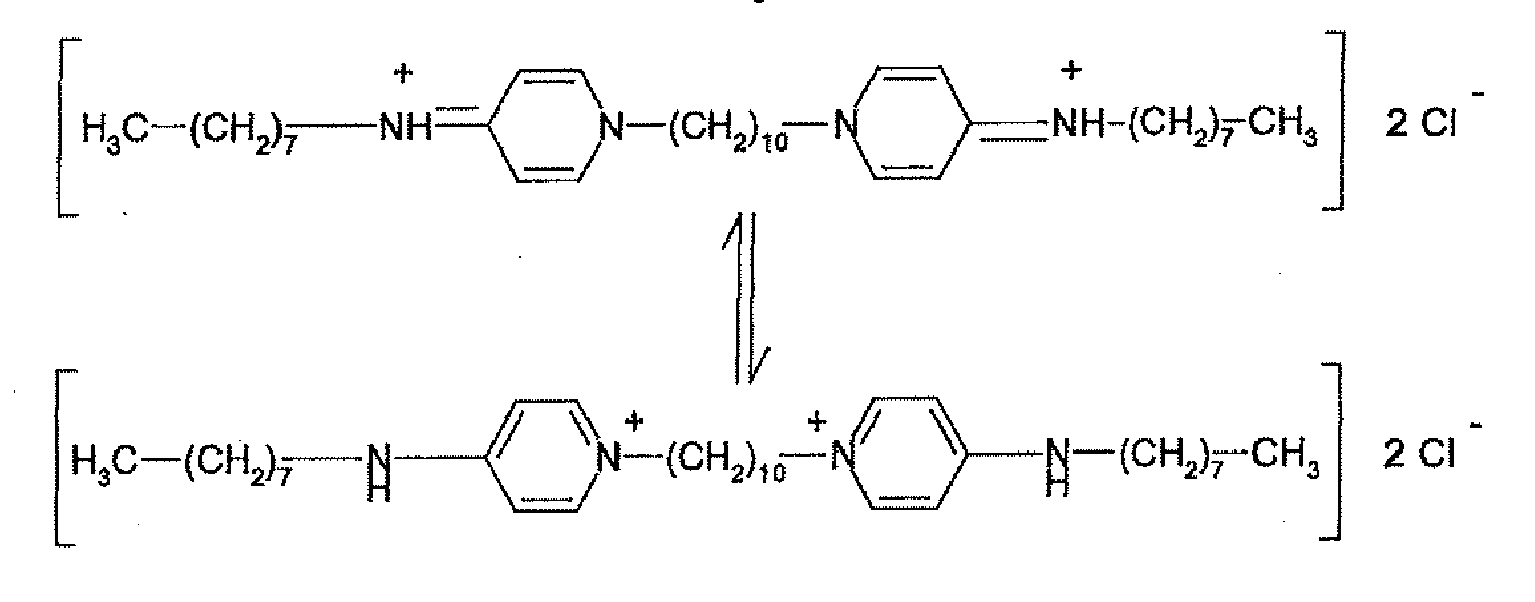
- The active ingredient is used successfully by Schülke & Mayr GmbH, Norderstedt, Germany inter alia in the commercial products Octenisept® (wound and mucosa antisepsis), Octeniderm® (preoperative skin antiseptic), Octenidol® (antimicrobial mouth rinse solution) and Octenisan® (antimicrobial washing lotion). Octenidine dihydrochloride has a wide antimicrobial spectrum of activity. According to the invention, it has been found that the active ingredient octenidine dihydrochloride is particularly advantageously released from a hydrogel, as demonstrated by the examples.
- Preferably, the amount of octenidine dihydrochloride in the hydrogel is 0.001 to 1% by weight, more preferably 0.005 to 0.5% by weight, such as 0.01 to 0.2% by weight and in particular 0.05 to 0.1% by weight.
- Thickener is present in the hydrogel preferably in an amount of from 0.5 to 10% by weight, preferably 1 to 5% by weight, more preferably 1.5 to 4% by weight and in particular 2 to 3% by weight.
- Preferred thickeners are xanthan gums, thickening silicas, polyvinyl alcohols, polyacrylates, gelatin, pectin, casein, agar agar, starch, tragacanth, polyvinylpyrrolidone, cellulose and cellulose derivatives such as hydroxyethylcellulose, and mixtures thereof.
- A preferred amount of polyol in the hydrogel is 0.1 to 20% by weight.
- Exemplary polyols are selected from di-, tri- and tetraols, preferably polyethylene glycol and/or glycerol.
- Particularly preferred hydrogels according to the invention and their preparation are given below:
-
0.05% octenidine dihydrochloride 9.90% propylene glycol 2.50% hydroxyethylcellulose 4000 87.55% demineralized (dem.) water - This exemplary hydrogel is prepared as follows: water is introduced as initial charge and propylene glycol and octenidine dihydrochloride are dissolved therein with heating to 60°C to give a clear solution. The hydroxyethylcellulose is then added and stirring is carried out until the distribution is homogeneous. The product is then left to swell overnight.
-
0.10% octenidine 2.85% glycerol 85% 94.55% dem. water 2.50% hydroxyethylcellulose 4000 -
0.10% octenidine dihydrochloride 2.00% phenoxyethanol 0.50% glycerol 85% 0.40% sodium gluconate 1.00% cocamidopropylbetaine 30% 2.75% hydroxyethylcellulose 4000 93.25% dem. water - This exemplary hydrogel is prepared as follows: water is introduced as initial charge, then the constituents octenidine dihydrochloride, phenoxyethanol, glycerol, sodium gluconate and cocamidopropylbetaine are added. The mixture is then stirred until a clear solution is formed. The cellulose is then stirred in homogeneously. Finally, the mixture is left to swell overnight.
- The hydrogel can also comprise one or more antiseptic active ingredients and/or functional additives.
- Examples of further antiseptic active ingredients are chlorhexidine salts, such as chlorhexidine digluconate, polyhexanide salts, silver or silver salts, lower alcohols such as ethanol, isopropanol, n-propanol or mixtures thereof.
- Examples of functional additives are humectants (such as urea, glyceryl ethers such as 1-(2-ethylhexyl) glycerol ether (Sensiva® SC 50), sorbitol, collagens, plant extracts, e.g. aloe vera, hyaluronic acid, glycerol), osmolytes (such as sodium chloride, Ringer's solution, carbohydrates, proteins), buffers or pH regulators (e.g. acids, alkalizing agents, citrates, phosphates), complexing agents such as EDTA, phosphates, polyphosphates, 8-hydroxyquinoline, antiinflammatory additives such as allantoin, plant extracts such as camomile or aloe vera, bisabolol, dexpanthenol, medicament active ingredients, hemistatic additives, antioxidants (such as vitamin E or derivatives, BHA, BHT, vitamin C, gallates, acetyl-cystein, 3-tert-butyl-4-hydroxyanisole, 2,6-di-tert-butyl-p-cresol, tert-butylhydroquinone, caffeic acid, chlorogenic acid, cysteine, cysteine hydrochloride, decyl mercaptomethylimidazole, diamylhydroquinone, di-tert-butylhydroquinone, dicetyl thiodipropionate, digalloyl trioleate, dilauryl thiodipropionate, dimyristyl thiodipropionate, dioleyl tocopherol methyl-silanol, disodium rutinyl disulphate, distearyl thiodipropionate, ditridecyl thiodipropionate, dodecyl gallate, erythorbic acid, ethyl ferulate, ferulic acid, hydroquinone, p-hydroxyanisole, hydroxylamine hydrochloride, hydroxylamine sulphate, isooctyl thioglycolate, cojic acid, madecassicoside, methoxy-PEG-7-rutinyl succinate, nordihydroguaiaretic acid, octyl gallate, phenylthioglycolic acid, phloroglucinol, propyl gallate, rosmarinic acid, rutin, sodium erythorbate, sodium thioglycolate, sorbityl furfural, thiodiglycol, thiodiglycolamide, thiodiglycolic acid, thioglycolic acid, thiolactic acid, thiosalicylic acid, tocophereth-5, tocophereth-10, tocophereth-12, tocophereth-18, tocophereth-50, tocophersolan, tocopherol (e.g. vitamin E) and its derivatives (e.g. vitamin E derivatives such as vitamin E acetate, vitamin E linoleate, vitamin E nicotinate and vitamin E succinate), o-tolylbiguanide, tris(nonylphenyl) phosphite, dexpanthenol, alpha-hydroxycarboxylic acids (e.g. glycolic acid, lactic acid, mandelic acid) and salts thereof, p-hydroxybenzoic acid esters (e.g. methyl, ethyl, propyl or butyl esters thereof), dimethyloldimethylhydantoin, n-acylamino acids and salts thereof (e.g. N-octanoylglycine, Lipacid C8G), ascorbic acid and hinokitiol), preservatives such as phenoxyethanol, propylene glycol, parabens, ascorbic acid, benzoates, thiazolinones, ethylhexylglycerol, sorbic acid and salts thereof, solvents such as lower alcohols, aromatic alcohols such as benzyl alcohol, phenoxyethanol, anaesthetics such as benzyl alcohol, electrolytes such as proteins, irons (sodium, chloride, magnesium, calcium), viscosity modifiers, active ingredient boosters such as glycerol ethers (e.g. Sensiva SC 50), skincare additives such as allantoin, Sensiva SC 50, dexpanthenol, stabilizers such as vitamin E, BHA, BHT, wetting agents such as Sensiva SC 50, macrogol lauryl ether (e.g. Brij 35), macrogol glycerol hydroxystearate (Cremophor RH 40), betaines, fatty alcohol polyalkoxylates, sorbitan fatty acid esters (Tween) and polyoxyethylene sorbitan fatty acid esters, alkyl glycosides, EO/PO block copolymers, skin-cooling additives such as menthyl glycerol ether, dyes, marking agents, adhesion improvers, aroma substances and fragrances.
- The viscosity of the hydrogels used according to the invention is typically at least 20 000-500 mPa*s, preferably 15 000-1000 mPa*s, particularly preferably 10 000-3000 mPa*s, measured by measurement, corresponding to DIN 53019, of viscosities and flow curves using rotary viscometers.
- The pH of the hydrogels used according to the invention is generally in the pH range from 2 to 10, preferably in the pH range from 3 to 8, particularly preferably in the pH range from 4 to 7.
- The invention also relates to a hydrogel which comprises octenidine dihydrochloride for use for the antisepsis of catheter insertion points.
- The invention also relates to a wound covering set which comprises
- a) a transparent film and
- b) a transparent hydrogel which comprises octenidine dihydrochloride.
- In this embodiment, the transparent film and the transparent gel are present separately, for example in a kit. It is thus possible to firstly place the hydrogel on the catheter insertion point and then to cover the catheter insertion point with the transparent film. The application of the hydrogel can take place as a result of application by means of swabs, patches or spraying methods. Alternatively, it is possible to place the hydrogel on the film prior to application and then to cover the catheter insertion point with the film finished with the hydrogel.
- The wound covering according to the invention can be used, for example, for covering central venous catheters (CVC) and for covering other peripheral accesses.
- Advantages of the use according to the invention of a hydrogel comprising octenidine dihydrochloride are:
- broad and rapid-onset microbicidal effectiveness
- long-lasting microbicidal effectiveness
- very good to adequately good release of the active ingredient from the hydrogel
- very good stability of the active ingredient and of the hydrogel
- very good thermal stability of the active ingredient and of the hydrogel
- heat-sterilizable
- clear and/or translucent and/or transparent, even after prolonged storage under unfavourable storage conditions
- good adhesion to skin, mucosa and medical articles such as catheters
- good spreadability on surfaces
- very good and rapid wetting of surfaces
- very good skin compatibility, very good compatibility on injured skin, very slight cytotoxic effect
- pleasant skin feel, possibly skin-cooling effect
- free from undesired by-products or degradation products
- can be washed off easily, can be removed without residues
- material-conserving
- economical
- high acceptance among medical personnel and patients.
- The advantages of the invention arise in particular from the following examples.
- The bioavailability of octenidine dihydrochloride from a hydrogel was tested using the Sartorius liberation model (type SM 16755).
- The ointment liberation cell consists of three see-through Plexiglas plates held together by bolts and nuts. Chambers are built into two plates. Heating water passes through the heating space in the middle plate. In the same plate, there is, opposite the heating space, the ointment chamber for accommodating the substance under investigation. In the plate, the acceptor medium flows through the ripple plate, where it comes into contact with the membrane of the released active ingredient.
- Temperature medium and acceptor medium thus have two independent cycles. The sample for determining the content is drawn from the acceptor medium chamber.
- A calibration for the active ingredient octenidine dihydrochloride is firstly carried out.
- The test product is weighed into the ointment chamber. Samples are taken at the specified times. The removed sample volume is replaced completely by new acceptor medium. At the end of the total runtime, the samples are measured at 280 nm in 1 cm quartz cuvettes.
- The results are shown in the table below:
Time (h) Released amounts of octenidine dihydrochloride (in % of the total amount) 0.5 10.83 1 16.73 2 27.54 3 36.22 4 43.15 5 50.27 6 56.06 8 65.31 24 90.04 - The results show that a good and continuous release of the active ingredient octenidine dihydrochloride from the hydrogel takes place. After 24 hours, 90% of the contained active ingredient have been released from the gel.
Claims (12)
- Wound covering comprisinga) a transparent film andb) applied to the film, a transparent hydrogel which comprises octenidine dihydrochloride.
- Wound covering according to Claim 1, characterized in that the film is prepared from polyester polyurethane or polyether polyurethane or polyether polyamide.
- Wound covering according to Claim 1 or 2, characterized in that, besides b1) octenidine dihydrochloride, the hydrogen also comprisesb2) thickener,b3) polyol andb4) water.
- Wound covering according to one of the preceding claims, characterized in that the hydrogen comprises 0.001 to 1% by weight, preferably 0.005 to 0.5% by weight, more preferably 0.01 to 0.2% by weight and in particular 0.05 to 0.1% by weight, of octenidine dihydrochloride.
- Wound covering according to claim 3 or claim 4, characterized in that the hydrogel comprises 0.5 to 10% by weight, preferably 1 to 5% by weight, more preferably 1.5 to 4% by weight and in particular 2 to 3% by weight, of thickener.
- Wound covering according to one of Claims 3 to 5, characterized in that the thickener is selected from xanthan gums, thickening silicas, polyvinyl alcohols, polyacrylates, gelatins, pectin, casein, agar agar, starch, tragacanth, polyvinylpyrrolidone, cellulose and cellulose derivatives such as hydroxyethylcellulose, and mixtures thereof.
- Wound covering according to one of Claims 3 to 6, characterized in that the hydrogel comprises 0.1 to 20% by weight of polyol.
- Wound covering according to one of Claims 3 to 7, characterized in that the polyol is selected from di-, tri- and tetraols, and mixtures thereof, preferably propylene glycol and/or glycerol.
- Wound covering according to one of Claims 3 to 8, characterized in that the hydrogel also comprises one or more antiseptic active ingredients and/or functional additives.
- Wound covering according to one of Claims 3 to 8, characterized in that the hydrogel consists of components b1) to b4).
- Wound covering set which comprisesa) a transparent film andb) a transparent hydrogel which comprises octenidine dihydrochloride.
- Hydrogel which comprises octenidine dihydrochloride for use for the antisepsis of catheter insertion points.
Priority Applications (2)
| Application Number | Priority Date | Filing Date | Title |
|---|---|---|---|
| EP16196419.2A EP3150234A1 (en) | 2009-10-15 | 2010-10-05 | Wound covering comprising octenidine dihydrochloride for use in the antisepsis of catheter insertion points |
| PL10186489T PL2311504T3 (en) | 2009-10-15 | 2010-10-05 | Wound covering comprising octenidine dihydrochloride for use in the antisepsis of catheter insertion points |
Applications Claiming Priority (1)
| Application Number | Priority Date | Filing Date | Title |
|---|---|---|---|
| DE102009049506A DE102009049506A1 (en) | 2009-10-15 | 2009-10-15 | Octenidine dihydrochloride-containing wound dressing for use in the antiseptic of catheter entry sites |
Related Child Applications (2)
| Application Number | Title | Priority Date | Filing Date |
|---|---|---|---|
| EP16196419.2A Division-Into EP3150234A1 (en) | 2009-10-15 | 2010-10-05 | Wound covering comprising octenidine dihydrochloride for use in the antisepsis of catheter insertion points |
| EP16196419.2A Division EP3150234A1 (en) | 2009-10-15 | 2010-10-05 | Wound covering comprising octenidine dihydrochloride for use in the antisepsis of catheter insertion points |
Publications (3)
| Publication Number | Publication Date |
|---|---|
| EP2311504A2 true EP2311504A2 (en) | 2011-04-20 |
| EP2311504A3 EP2311504A3 (en) | 2014-08-27 |
| EP2311504B1 EP2311504B1 (en) | 2018-12-05 |
Family
ID=43585713
Family Applications (2)
| Application Number | Title | Priority Date | Filing Date |
|---|---|---|---|
| EP16196419.2A Withdrawn EP3150234A1 (en) | 2009-10-15 | 2010-10-05 | Wound covering comprising octenidine dihydrochloride for use in the antisepsis of catheter insertion points |
| EP10186489.0A Not-in-force EP2311504B1 (en) | 2009-10-15 | 2010-10-05 | Wound covering comprising octenidine dihydrochloride for use in the antisepsis of catheter insertion points |
Family Applications Before (1)
| Application Number | Title | Priority Date | Filing Date |
|---|---|---|---|
| EP16196419.2A Withdrawn EP3150234A1 (en) | 2009-10-15 | 2010-10-05 | Wound covering comprising octenidine dihydrochloride for use in the antisepsis of catheter insertion points |
Country Status (5)
| Country | Link |
|---|---|
| US (1) | US20110091551A1 (en) |
| EP (2) | EP3150234A1 (en) |
| DE (1) | DE102009049506A1 (en) |
| ES (1) | ES2706648T3 (en) |
| PL (1) | PL2311504T3 (en) |
Cited By (3)
| Publication number | Priority date | Publication date | Assignee | Title |
|---|---|---|---|---|
| EP2401914A1 (en) * | 2010-07-02 | 2012-01-04 | L'AIR LIQUIDE, Société Anonyme pour l'Etude et l'Exploitation des Procédés Georges Claude | Antiseptic based on bispyridinium alkanes |
| EP2958600A4 (en) * | 2013-02-20 | 2016-09-21 | Carefusion 2200 Inc | ANTIMICROBIAL HYDROGEL POLYMERS |
| CN110624127A (en) * | 2019-10-14 | 2019-12-31 | 河南承东生物科技有限公司 | Dual-bacteriostatic healing-promoting liquid dressing and preparation method thereof |
Families Citing this family (16)
| Publication number | Priority date | Publication date | Assignee | Title |
|---|---|---|---|---|
| US10227289B2 (en) | 2010-05-07 | 2019-03-12 | Medicus Biosciences, Llc | Methods for treating diseases of the lung |
| PL2524706T3 (en) * | 2011-05-19 | 2014-12-31 | Lohmann & Rauscher Gmbh & Co Kg | Sterilized wound dressing comprising a triblock-elastomeric component |
| DE102011077432A1 (en) | 2011-06-10 | 2012-12-13 | Schülke & Mayr GmbH | Use of bispyridiniumalkanes to kill spores |
| US11083821B2 (en) | 2011-08-10 | 2021-08-10 | C.P. Medical Corporation | Biocompatible hydrogel polymer formulations for the controlled delivery of biomolecules |
| US10111985B2 (en) | 2011-08-10 | 2018-10-30 | Medicus Biosciences, Llc | Biocompatible hydrogel polymer formulations for the controlled delivery of biomolecules |
| CA2873105C (en) | 2012-05-11 | 2018-01-16 | Medicus Biosciences, Llc | Biocompatible hydrogel treatments for retinal detachment |
| DE102012215511A1 (en) * | 2012-08-31 | 2014-06-12 | Schülke & Mayr GmbH | Process for the preparation of a semi-solid preparation containing bispyridiniumalkane |
| DE102012019194B4 (en) | 2012-09-24 | 2024-08-01 | Wolfgang Winkelmann | Medicinal preparation comprising a carrier with polyhexanide or octenidine |
| US9687432B2 (en) | 2012-12-21 | 2017-06-27 | Lonza Inc. | Antimicrobial bispyridine amine compositions and uses |
| WO2014113269A1 (en) * | 2013-01-15 | 2014-07-24 | Board Of Regents, The University Of Texas System | Antimicrobial coatings |
| WO2014203075A2 (en) * | 2013-06-20 | 2014-12-24 | The Governors Of The University Of Alberta | Nanocrystalline cellulose hydrogels for inhibition of bacterial adhesion |
| KR101718306B1 (en) | 2015-07-27 | 2017-03-27 | 주식회사 퍼슨 | The improved method for preparing octenidine dihydrochloride and the method for preparing a pharmaceutical composition containing the octenidine dihydrochloride |
| WO2020043665A1 (en) | 2018-08-27 | 2020-03-05 | Claudia Eder | Antiseptic gel |
| WO2020201945A1 (en) | 2019-04-01 | 2020-10-08 | 3M Innovative Properties Company | Antimicrobial composition |
| US20220227997A1 (en) * | 2019-05-14 | 2022-07-21 | Coloplast A/S | Elastomeric silicone compositions comprising glycerol, cyclodextrin and octenidine |
| JP7873965B2 (en) | 2019-05-24 | 2026-06-15 | ソルベンタム インテレクチュアル プロパティズ カンパニー | Adhesive composition |
Family Cites Families (12)
| Publication number | Priority date | Publication date | Assignee | Title |
|---|---|---|---|---|
| US4909244B1 (en) * | 1986-11-26 | 1994-07-05 | Kendall & Co | Hydrogel wound dressing |
| US4920158A (en) * | 1989-10-11 | 1990-04-24 | Medipro Sciences Limited | Hydrogel-forming wound dressing or skin coating material |
| US5106629A (en) * | 1989-10-20 | 1992-04-21 | Ndm Acquisition Corp. | Transparent hydrogel wound dressing |
| US5786092A (en) * | 1994-11-21 | 1998-07-28 | W.R. Grace & Co.-Conn. | Peelable laminate |
| IL138099A0 (en) * | 2000-08-25 | 2001-10-31 | Naimer Richard | Bandage |
| US7005143B2 (en) * | 2002-04-12 | 2006-02-28 | 3M Innovative Properties Company | Gel materials, medical articles, and methods |
| DE102005045145B4 (en) * | 2005-09-15 | 2025-09-25 | Schülke & Mayr GmbH | Use of octenidine dihydrochloride in semi-solid preparations |
| DE102005063375A1 (en) * | 2005-09-15 | 2007-04-19 | Schülke & Mayr GmbH | Antimicrobial preparations containing octenidine dihydrochloride encapsulated in liposomes |
| DE102006001954B4 (en) * | 2006-01-16 | 2013-01-03 | Lohmann & Rauscher Gmbh & Co. Kg | Antiseptic alginate preparation, process for their preparation, and their use |
| EP2240143B1 (en) * | 2008-01-18 | 2014-03-05 | 3M Innovative Properties Company | Hydrogels with tapered edge |
| DE102008017746A1 (en) * | 2008-04-07 | 2009-10-08 | Beiersdorf Ag | Skin or wound dressing for moist wound healing |
| WO2009137074A1 (en) * | 2008-05-06 | 2009-11-12 | Indigene Pharmaceuticals, Inc. | Compositions and methods for treating diabetic ulcers |
-
2009
- 2009-10-15 DE DE102009049506A patent/DE102009049506A1/en not_active Ceased
-
2010
- 2010-10-05 EP EP16196419.2A patent/EP3150234A1/en not_active Withdrawn
- 2010-10-05 ES ES10186489T patent/ES2706648T3/en active Active
- 2010-10-05 PL PL10186489T patent/PL2311504T3/en unknown
- 2010-10-05 EP EP10186489.0A patent/EP2311504B1/en not_active Not-in-force
- 2010-10-13 US US12/903,486 patent/US20110091551A1/en not_active Abandoned
Non-Patent Citations (1)
| Title |
|---|
| TIETZ ET AL., INFECT CONTROL HOSP EPIDEMIOL., vol. 26, no. 8, August 2005 (2005-08-01), pages 703 - 7 |
Cited By (3)
| Publication number | Priority date | Publication date | Assignee | Title |
|---|---|---|---|---|
| EP2401914A1 (en) * | 2010-07-02 | 2012-01-04 | L'AIR LIQUIDE, Société Anonyme pour l'Etude et l'Exploitation des Procédés Georges Claude | Antiseptic based on bispyridinium alkanes |
| EP2958600A4 (en) * | 2013-02-20 | 2016-09-21 | Carefusion 2200 Inc | ANTIMICROBIAL HYDROGEL POLYMERS |
| CN110624127A (en) * | 2019-10-14 | 2019-12-31 | 河南承东生物科技有限公司 | Dual-bacteriostatic healing-promoting liquid dressing and preparation method thereof |
Also Published As
| Publication number | Publication date |
|---|---|
| EP2311504B1 (en) | 2018-12-05 |
| DE102009049506A1 (en) | 2011-04-21 |
| ES2706648T3 (en) | 2019-03-29 |
| US20110091551A1 (en) | 2011-04-21 |
| EP2311504A3 (en) | 2014-08-27 |
| EP3150234A1 (en) | 2017-04-05 |
| PL2311504T3 (en) | 2019-05-31 |
Similar Documents
| Publication | Publication Date | Title |
|---|---|---|
| US20110091551A1 (en) | Wound covering comprising octenidine dihydrochloride for use in the antisepsis of catheter insertion points | |
| EP2954019B1 (en) | Antimicrobial adhesives having improved properties | |
| US5547662A (en) | Preparation of a skin surface for a surgical procedure | |
| EP1769824B1 (en) | Quick-drying disinfectant gel for hands | |
| EP3017808B1 (en) | Water-soluble hyaluronic acid gel and method for producing same | |
| US8609128B2 (en) | Cyanoacrylate-based liquid microbial sealant drape | |
| JPH0622558B2 (en) | Film-forming composition containing antibacterial agent | |
| US20150297592A1 (en) | Composition containing ecotine or hydroxyecotine as an active substances for promoting the regeneration of injured body tissue | |
| BRPI0811948B1 (en) | new agent for the release of active ingredients in dressings containing at least one greasy substance | |
| CN106466319A (en) | Antimicrobial compositions and using method | |
| Landry et al. | Acute toxicity profile of 1-butyl-3-methylimidazolium chloride. | |
| US20210178009A1 (en) | Wound care products comprising alexidine | |
| BRPI0811949B1 (en) | new active ingredient in healing and its use | |
| EP2988731B1 (en) | Composition for use in reducing scab formation and promoting healing | |
| EP1245636B1 (en) | Composition for hydrogel, hydrogel, and use thereof | |
| KR20150013280A (en) | Use of seaprose to remove bacterial biofilm | |
| JP2006519847A (en) | Gel composition and method for treating vaginal infection | |
| WO2003035121A2 (en) | Bio-compatible medical adhesive composition | |
| AU2020271339B2 (en) | Liquid composition for influencing the microbiota on a subject's skin comprising chitosan | |
| EP4382125A1 (en) | Disinfecting composition | |
| EP1747029A1 (en) | An iodine-containing hot melt pressure sensitive adhesive capable of being melted and coated at a temperature not higher than 100° c, and a medical adhesive sheet product with such a pressure sensitive adhesive | |
| JP7628425B2 (en) | Tranexamic acid-containing topical composition | |
| US20230381217A1 (en) | Liquid composition for use in the prevention or reduction of skin irritation, allergy and/or an infectious disease | |
| EP4333804B1 (en) | In-situ film-forming composition | |
| HK40105910A (en) | Disinfecting composition |
Legal Events
| Date | Code | Title | Description |
|---|---|---|---|
| PUAI | Public reference made under article 153(3) epc to a published international application that has entered the european phase |
Free format text: ORIGINAL CODE: 0009012 |
|
| AK | Designated contracting states |
Kind code of ref document: A2 Designated state(s): AL AT BE BG CH CY CZ DE DK EE ES FI FR GB GR HR HU IE IS IT LI LT LU LV MC MK MT NL NO PL PT RO RS SE SI SK SM TR |
|
| AX | Request for extension of the european patent |
Extension state: BA ME |
|
| PUAL | Search report despatched |
Free format text: ORIGINAL CODE: 0009013 |
|
| AK | Designated contracting states |
Kind code of ref document: A3 Designated state(s): AL AT BE BG CH CY CZ DE DK EE ES FI FR GB GR HR HU IE IS IT LI LT LU LV MC MK MT NL NO PL PT RO RS SE SI SK SM TR |
|
| AX | Request for extension of the european patent |
Extension state: BA ME |
|
| RIC1 | Information provided on ipc code assigned before grant |
Ipc: A61L 15/44 20060101AFI20140718BHEP Ipc: A61L 15/46 20060101ALI20140718BHEP Ipc: A61L 15/60 20060101ALI20140718BHEP |
|
| 17P | Request for examination filed |
Effective date: 20150227 |
|
| RBV | Designated contracting states (corrected) |
Designated state(s): AL AT BE BG CH CY CZ DE DK EE ES FI FR GB GR HR HU IE IS IT LI LT LU LV MC MK MT NL NO PL PT RO RS SE SI SK SM TR |
|
| 17Q | First examination report despatched |
Effective date: 20160419 |
|
| STAA | Information on the status of an ep patent application or granted ep patent |
Free format text: STATUS: EXAMINATION IS IN PROGRESS |
|
| GRAJ | Information related to disapproval of communication of intention to grant by the applicant or resumption of examination proceedings by the epo deleted |
Free format text: ORIGINAL CODE: EPIDOSDIGR1 |
|
| GRAP | Despatch of communication of intention to grant a patent |
Free format text: ORIGINAL CODE: EPIDOSNIGR1 |
|
| GRAP | Despatch of communication of intention to grant a patent |
Free format text: ORIGINAL CODE: EPIDOSNIGR1 |
|
| STAA | Information on the status of an ep patent application or granted ep patent |
Free format text: STATUS: GRANT OF PATENT IS INTENDED |
|
| INTG | Intention to grant announced |
Effective date: 20180308 |
|
| RAP1 | Party data changed (applicant data changed or rights of an application transferred) |
Owner name: SCHUELKE & MAYR GMBH Owner name: L'AIR LIQUIDE SOCIETE ANONYME POUR L'ETUDE ET L'EX |
|
| RIN1 | Information on inventor provided before grant (corrected) |
Inventor name: BAUR, BORIS Inventor name: BEHRENDS, SABINE Inventor name: DETTMANN, ANDREAS |
|
| GRAJ | Information related to disapproval of communication of intention to grant by the applicant or resumption of examination proceedings by the epo deleted |
Free format text: ORIGINAL CODE: EPIDOSDIGR1 |
|
| STAA | Information on the status of an ep patent application or granted ep patent |
Free format text: STATUS: EXAMINATION IS IN PROGRESS |
|
| GRAP | Despatch of communication of intention to grant a patent |
Free format text: ORIGINAL CODE: EPIDOSNIGR1 |
|
| STAA | Information on the status of an ep patent application or granted ep patent |
Free format text: STATUS: GRANT OF PATENT IS INTENDED |
|
| RIN1 | Information on inventor provided before grant (corrected) |
Inventor name: BAUR, BORIS Inventor name: BEHRENDS, SABINE Inventor name: DETTMANN, ANDREAS |
|
| INTC | Intention to grant announced (deleted) | ||
| INTG | Intention to grant announced |
Effective date: 20180614 |
|
| GRAS | Grant fee paid |
Free format text: ORIGINAL CODE: EPIDOSNIGR3 |
|
| GRAA | (expected) grant |
Free format text: ORIGINAL CODE: 0009210 |
|
| GRAA | (expected) grant |
Free format text: ORIGINAL CODE: 0009210 |
|
| STAA | Information on the status of an ep patent application or granted ep patent |
Free format text: STATUS: THE PATENT HAS BEEN GRANTED |
|
| AK | Designated contracting states |
Kind code of ref document: B1 Designated state(s): AL AT BE BG CH CY CZ DE DK EE ES FI FR GB GR HR HU IE IS IT LI LT LU LV MC MK MT NL NO PL PT RO RS SE SI SK SM TR |
|
| REG | Reference to a national code |
Ref country code: GB Ref legal event code: FG4D |
|
| REG | Reference to a national code |
Ref country code: CH Ref legal event code: EP |
|
| REG | Reference to a national code |
Ref country code: AT Ref legal event code: REF Ref document number: 1072246 Country of ref document: AT Kind code of ref document: T Effective date: 20181215 |
|
| REG | Reference to a national code |
Ref country code: IE Ref legal event code: FG4D |
|
| REG | Reference to a national code |
Ref country code: DE Ref legal event code: R096 Ref document number: 602010055582 Country of ref document: DE |
|
| REG | Reference to a national code |
Ref country code: ES Ref legal event code: FG2A Ref document number: 2706648 Country of ref document: ES Kind code of ref document: T3 Effective date: 20190329 |
|
| REG | Reference to a national code |
Ref country code: NL Ref legal event code: MP Effective date: 20181205 |
|
| REG | Reference to a national code |
Ref country code: AT Ref legal event code: MK05 Ref document number: 1072246 Country of ref document: AT Kind code of ref document: T Effective date: 20181205 |
|
| REG | Reference to a national code |
Ref country code: LT Ref legal event code: MG4D |
|
| PG25 | Lapsed in a contracting state [announced via postgrant information from national office to epo] |
Ref country code: FI Free format text: LAPSE BECAUSE OF FAILURE TO SUBMIT A TRANSLATION OF THE DESCRIPTION OR TO PAY THE FEE WITHIN THE PRESCRIBED TIME-LIMIT Effective date: 20181205 Ref country code: BG Free format text: LAPSE BECAUSE OF FAILURE TO SUBMIT A TRANSLATION OF THE DESCRIPTION OR TO PAY THE FEE WITHIN THE PRESCRIBED TIME-LIMIT Effective date: 20190305 Ref country code: LV Free format text: LAPSE BECAUSE OF FAILURE TO SUBMIT A TRANSLATION OF THE DESCRIPTION OR TO PAY THE FEE WITHIN THE PRESCRIBED TIME-LIMIT Effective date: 20181205 Ref country code: AT Free format text: LAPSE BECAUSE OF FAILURE TO SUBMIT A TRANSLATION OF THE DESCRIPTION OR TO PAY THE FEE WITHIN THE PRESCRIBED TIME-LIMIT Effective date: 20181205 Ref country code: HR Free format text: LAPSE BECAUSE OF FAILURE TO SUBMIT A TRANSLATION OF THE DESCRIPTION OR TO PAY THE FEE WITHIN THE PRESCRIBED TIME-LIMIT Effective date: 20181205 Ref country code: LT Free format text: LAPSE BECAUSE OF FAILURE TO SUBMIT A TRANSLATION OF THE DESCRIPTION OR TO PAY THE FEE WITHIN THE PRESCRIBED TIME-LIMIT Effective date: 20181205 Ref country code: NO Free format text: LAPSE BECAUSE OF FAILURE TO SUBMIT A TRANSLATION OF THE DESCRIPTION OR TO PAY THE FEE WITHIN THE PRESCRIBED TIME-LIMIT Effective date: 20190305 |
|
| PG25 | Lapsed in a contracting state [announced via postgrant information from national office to epo] |
Ref country code: AL Free format text: LAPSE BECAUSE OF FAILURE TO SUBMIT A TRANSLATION OF THE DESCRIPTION OR TO PAY THE FEE WITHIN THE PRESCRIBED TIME-LIMIT Effective date: 20181205 Ref country code: GR Free format text: LAPSE BECAUSE OF FAILURE TO SUBMIT A TRANSLATION OF THE DESCRIPTION OR TO PAY THE FEE WITHIN THE PRESCRIBED TIME-LIMIT Effective date: 20190306 Ref country code: RS Free format text: LAPSE BECAUSE OF FAILURE TO SUBMIT A TRANSLATION OF THE DESCRIPTION OR TO PAY THE FEE WITHIN THE PRESCRIBED TIME-LIMIT Effective date: 20181205 Ref country code: SE Free format text: LAPSE BECAUSE OF FAILURE TO SUBMIT A TRANSLATION OF THE DESCRIPTION OR TO PAY THE FEE WITHIN THE PRESCRIBED TIME-LIMIT Effective date: 20181205 |
|
| PG25 | Lapsed in a contracting state [announced via postgrant information from national office to epo] |
Ref country code: NL Free format text: LAPSE BECAUSE OF FAILURE TO SUBMIT A TRANSLATION OF THE DESCRIPTION OR TO PAY THE FEE WITHIN THE PRESCRIBED TIME-LIMIT Effective date: 20181205 |
|
| PG25 | Lapsed in a contracting state [announced via postgrant information from national office to epo] |
Ref country code: CZ Free format text: LAPSE BECAUSE OF FAILURE TO SUBMIT A TRANSLATION OF THE DESCRIPTION OR TO PAY THE FEE WITHIN THE PRESCRIBED TIME-LIMIT Effective date: 20181205 Ref country code: PT Free format text: LAPSE BECAUSE OF FAILURE TO SUBMIT A TRANSLATION OF THE DESCRIPTION OR TO PAY THE FEE WITHIN THE PRESCRIBED TIME-LIMIT Effective date: 20190405 |
|
| PG25 | Lapsed in a contracting state [announced via postgrant information from national office to epo] |
Ref country code: SM Free format text: LAPSE BECAUSE OF FAILURE TO SUBMIT A TRANSLATION OF THE DESCRIPTION OR TO PAY THE FEE WITHIN THE PRESCRIBED TIME-LIMIT Effective date: 20181205 Ref country code: EE Free format text: LAPSE BECAUSE OF FAILURE TO SUBMIT A TRANSLATION OF THE DESCRIPTION OR TO PAY THE FEE WITHIN THE PRESCRIBED TIME-LIMIT Effective date: 20181205 Ref country code: SK Free format text: LAPSE BECAUSE OF FAILURE TO SUBMIT A TRANSLATION OF THE DESCRIPTION OR TO PAY THE FEE WITHIN THE PRESCRIBED TIME-LIMIT Effective date: 20181205 Ref country code: IS Free format text: LAPSE BECAUSE OF FAILURE TO SUBMIT A TRANSLATION OF THE DESCRIPTION OR TO PAY THE FEE WITHIN THE PRESCRIBED TIME-LIMIT Effective date: 20190405 Ref country code: RO Free format text: LAPSE BECAUSE OF FAILURE TO SUBMIT A TRANSLATION OF THE DESCRIPTION OR TO PAY THE FEE WITHIN THE PRESCRIBED TIME-LIMIT Effective date: 20181205 |
|
| REG | Reference to a national code |
Ref country code: ES Ref legal event code: PC2A Owner name: SCHUELKE & MAYR GMBH Effective date: 20190827 |
|
| REG | Reference to a national code |
Ref country code: DE Ref legal event code: R097 Ref document number: 602010055582 Country of ref document: DE |
|
| PLBE | No opposition filed within time limit |
Free format text: ORIGINAL CODE: 0009261 |
|
| STAA | Information on the status of an ep patent application or granted ep patent |
Free format text: STATUS: NO OPPOSITION FILED WITHIN TIME LIMIT |
|
| REG | Reference to a national code |
Ref country code: GB Ref legal event code: 732E Free format text: REGISTERED BETWEEN 20190919 AND 20190925 |
|
| PG25 | Lapsed in a contracting state [announced via postgrant information from national office to epo] |
Ref country code: SI Free format text: LAPSE BECAUSE OF FAILURE TO SUBMIT A TRANSLATION OF THE DESCRIPTION OR TO PAY THE FEE WITHIN THE PRESCRIBED TIME-LIMIT Effective date: 20181205 Ref country code: DK Free format text: LAPSE BECAUSE OF FAILURE TO SUBMIT A TRANSLATION OF THE DESCRIPTION OR TO PAY THE FEE WITHIN THE PRESCRIBED TIME-LIMIT Effective date: 20181205 |
|
| 26N | No opposition filed |
Effective date: 20190906 |
|
| PG25 | Lapsed in a contracting state [announced via postgrant information from national office to epo] |
Ref country code: TR Free format text: LAPSE BECAUSE OF FAILURE TO SUBMIT A TRANSLATION OF THE DESCRIPTION OR TO PAY THE FEE WITHIN THE PRESCRIBED TIME-LIMIT Effective date: 20181205 |
|
| PG25 | Lapsed in a contracting state [announced via postgrant information from national office to epo] |
Ref country code: MC Free format text: LAPSE BECAUSE OF FAILURE TO SUBMIT A TRANSLATION OF THE DESCRIPTION OR TO PAY THE FEE WITHIN THE PRESCRIBED TIME-LIMIT Effective date: 20181205 |
|
| REG | Reference to a national code |
Ref country code: CH Ref legal event code: PL |
|
| PG25 | Lapsed in a contracting state [announced via postgrant information from national office to epo] |
Ref country code: LU Free format text: LAPSE BECAUSE OF NON-PAYMENT OF DUE FEES Effective date: 20191005 Ref country code: LI Free format text: LAPSE BECAUSE OF NON-PAYMENT OF DUE FEES Effective date: 20191031 Ref country code: CH Free format text: LAPSE BECAUSE OF NON-PAYMENT OF DUE FEES Effective date: 20191031 |
|
| REG | Reference to a national code |
Ref country code: BE Ref legal event code: MM Effective date: 20191031 |
|
| PG25 | Lapsed in a contracting state [announced via postgrant information from national office to epo] |
Ref country code: BE Free format text: LAPSE BECAUSE OF NON-PAYMENT OF DUE FEES Effective date: 20191031 |
|
| PG25 | Lapsed in a contracting state [announced via postgrant information from national office to epo] |
Ref country code: IE Free format text: LAPSE BECAUSE OF NON-PAYMENT OF DUE FEES Effective date: 20191005 |
|
| PG25 | Lapsed in a contracting state [announced via postgrant information from national office to epo] |
Ref country code: CY Free format text: LAPSE BECAUSE OF FAILURE TO SUBMIT A TRANSLATION OF THE DESCRIPTION OR TO PAY THE FEE WITHIN THE PRESCRIBED TIME-LIMIT Effective date: 20181205 |
|
| PG25 | Lapsed in a contracting state [announced via postgrant information from national office to epo] |
Ref country code: HU Free format text: LAPSE BECAUSE OF FAILURE TO SUBMIT A TRANSLATION OF THE DESCRIPTION OR TO PAY THE FEE WITHIN THE PRESCRIBED TIME-LIMIT; INVALID AB INITIO Effective date: 20101005 Ref country code: MT Free format text: LAPSE BECAUSE OF FAILURE TO SUBMIT A TRANSLATION OF THE DESCRIPTION OR TO PAY THE FEE WITHIN THE PRESCRIBED TIME-LIMIT Effective date: 20181205 |
|
| PGFP | Annual fee paid to national office [announced via postgrant information from national office to epo] |
Ref country code: ES Payment date: 20211223 Year of fee payment: 12 |
|
| PGFP | Annual fee paid to national office [announced via postgrant information from national office to epo] |
Ref country code: IT Payment date: 20211022 Year of fee payment: 12 Ref country code: FR Payment date: 20211022 Year of fee payment: 12 |
|
| PG25 | Lapsed in a contracting state [announced via postgrant information from national office to epo] |
Ref country code: MK Free format text: LAPSE BECAUSE OF FAILURE TO SUBMIT A TRANSLATION OF THE DESCRIPTION OR TO PAY THE FEE WITHIN THE PRESCRIBED TIME-LIMIT Effective date: 20181205 |
|
| PGFP | Annual fee paid to national office [announced via postgrant information from national office to epo] |
Ref country code: PL Payment date: 20220927 Year of fee payment: 13 |
|
| PGFP | Annual fee paid to national office [announced via postgrant information from national office to epo] |
Ref country code: GB Payment date: 20221020 Year of fee payment: 13 Ref country code: DE Payment date: 20221019 Year of fee payment: 13 |
|
| PG25 | Lapsed in a contracting state [announced via postgrant information from national office to epo] |
Ref country code: FR Free format text: LAPSE BECAUSE OF NON-PAYMENT OF DUE FEES Effective date: 20221031 |
|
| PG25 | Lapsed in a contracting state [announced via postgrant information from national office to epo] |
Ref country code: IT Free format text: LAPSE BECAUSE OF NON-PAYMENT OF DUE FEES Effective date: 20221005 |
|
| REG | Reference to a national code |
Ref country code: ES Ref legal event code: FD2A Effective date: 20231124 |
|
| PG25 | Lapsed in a contracting state [announced via postgrant information from national office to epo] |
Ref country code: ES Free format text: LAPSE BECAUSE OF NON-PAYMENT OF DUE FEES Effective date: 20221006 |
|
| PG25 | Lapsed in a contracting state [announced via postgrant information from national office to epo] |
Ref country code: ES Free format text: LAPSE BECAUSE OF NON-PAYMENT OF DUE FEES Effective date: 20221006 |
|
| REG | Reference to a national code |
Ref country code: DE Ref legal event code: R119 Ref document number: 602010055582 Country of ref document: DE |
|
| GBPC | Gb: european patent ceased through non-payment of renewal fee |
Effective date: 20231005 |
|
| PG25 | Lapsed in a contracting state [announced via postgrant information from national office to epo] |
Ref country code: GB Free format text: LAPSE BECAUSE OF NON-PAYMENT OF DUE FEES Effective date: 20231005 |
|
| PG25 | Lapsed in a contracting state [announced via postgrant information from national office to epo] |
Ref country code: GB Free format text: LAPSE BECAUSE OF NON-PAYMENT OF DUE FEES Effective date: 20231005 Ref country code: DE Free format text: LAPSE BECAUSE OF NON-PAYMENT OF DUE FEES Effective date: 20240501 |
|
| PG25 | Lapsed in a contracting state [announced via postgrant information from national office to epo] |
Ref country code: PL Free format text: LAPSE BECAUSE OF NON-PAYMENT OF DUE FEES Effective date: 20231005 |