EP2310448B1 - Three-dimensional nanocomposite materials consisting of a polysaccharidic matrix and metallic nanoparticles, preparation and use thereof - Google Patents
Three-dimensional nanocomposite materials consisting of a polysaccharidic matrix and metallic nanoparticles, preparation and use thereof Download PDFInfo
- Publication number
- EP2310448B1 EP2310448B1 EP09800060.7A EP09800060A EP2310448B1 EP 2310448 B1 EP2310448 B1 EP 2310448B1 EP 09800060 A EP09800060 A EP 09800060A EP 2310448 B1 EP2310448 B1 EP 2310448B1
- Authority
- EP
- European Patent Office
- Prior art keywords
- dimensional
- polysaccharides
- dimensional nanocomposite
- lyotropic
- material according
- Prior art date
- Legal status (The legal status is an assumption and is not a legal conclusion. Google has not performed a legal analysis and makes no representation as to the accuracy of the status listed.)
- Not-in-force
Links
- 239000002114 nanocomposite Substances 0.000 title claims description 129
- 239000000463 material Substances 0.000 title claims description 71
- 239000002105 nanoparticle Substances 0.000 title claims description 70
- 239000011159 matrix material Substances 0.000 title claims description 22
- 238000002360 preparation method Methods 0.000 title description 29
- 229920001282 polysaccharide Polymers 0.000 claims description 84
- 239000005017 polysaccharide Substances 0.000 claims description 84
- 150000004804 polysaccharides Chemical class 0.000 claims description 60
- 229920001661 Chitosan Polymers 0.000 claims description 46
- 239000000017 hydrogel Substances 0.000 claims description 42
- 229910052751 metal Inorganic materials 0.000 claims description 41
- 239000002184 metal Substances 0.000 claims description 41
- 230000007935 neutral effect Effects 0.000 claims description 41
- 229920001586 anionic polysaccharide Polymers 0.000 claims description 28
- 150000004836 anionic polysaccharides Chemical class 0.000 claims description 28
- -1 cationic polysaccharide Chemical class 0.000 claims description 28
- 239000007864 aqueous solution Substances 0.000 claims description 25
- 238000000034 method Methods 0.000 claims description 24
- 239000004005 microsphere Substances 0.000 claims description 22
- 239000000203 mixture Substances 0.000 claims description 22
- 230000002535 lyotropic effect Effects 0.000 claims description 18
- 239000003349 gelling agent Substances 0.000 claims description 15
- PCHJSUWPFVWCPO-UHFFFAOYSA-N gold Chemical compound [Au] PCHJSUWPFVWCPO-UHFFFAOYSA-N 0.000 claims description 15
- 229910052737 gold Inorganic materials 0.000 claims description 15
- 239000010931 gold Substances 0.000 claims description 15
- 150000002482 oligosaccharides Chemical class 0.000 claims description 15
- 239000000126 substance Substances 0.000 claims description 15
- 150000002500 ions Chemical class 0.000 claims description 14
- 125000000129 anionic group Chemical group 0.000 claims description 13
- 150000002772 monosaccharides Chemical class 0.000 claims description 13
- BQCADISMDOOEFD-UHFFFAOYSA-N Silver Chemical compound [Ag] BQCADISMDOOEFD-UHFFFAOYSA-N 0.000 claims description 9
- 229910052709 silver Inorganic materials 0.000 claims description 9
- 239000004332 silver Substances 0.000 claims description 9
- GUBGYTABKSRVRQ-QKKXKWKRSA-N Lactose Natural products OC[C@H]1O[C@@H](O[C@H]2[C@H](O)[C@@H](O)C(O)O[C@@H]2CO)[C@H](O)[C@@H](O)[C@H]1O GUBGYTABKSRVRQ-QKKXKWKRSA-N 0.000 claims description 8
- PXHVJJICTQNCMI-UHFFFAOYSA-N Nickel Chemical compound [Ni] PXHVJJICTQNCMI-UHFFFAOYSA-N 0.000 claims description 8
- 125000002091 cationic group Chemical group 0.000 claims description 8
- 239000008101 lactose Substances 0.000 claims description 8
- 239000002253 acid Substances 0.000 claims description 7
- 150000002739 metals Chemical class 0.000 claims description 7
- 229920001542 oligosaccharide Polymers 0.000 claims description 7
- 150000003077 polyols Chemical group 0.000 claims description 7
- KDLHZDBZIXYQEI-UHFFFAOYSA-N Palladium Chemical compound [Pd] KDLHZDBZIXYQEI-UHFFFAOYSA-N 0.000 claims description 6
- MSWZFWKMSRAUBD-QZABAPFNSA-N beta-D-glucosamine Chemical group N[C@H]1[C@H](O)O[C@H](CO)[C@@H](O)[C@@H]1O MSWZFWKMSRAUBD-QZABAPFNSA-N 0.000 claims description 6
- BASFCYQUMIYNBI-UHFFFAOYSA-N platinum Chemical compound [Pt] BASFCYQUMIYNBI-UHFFFAOYSA-N 0.000 claims description 6
- 150000003839 salts Chemical class 0.000 claims description 6
- RYGMFSIKBFXOCR-UHFFFAOYSA-N Copper Chemical compound [Cu] RYGMFSIKBFXOCR-UHFFFAOYSA-N 0.000 claims description 5
- 239000010949 copper Substances 0.000 claims description 5
- 229910052802 copper Inorganic materials 0.000 claims description 5
- 229910052725 zinc Inorganic materials 0.000 claims description 5
- 239000011701 zinc Substances 0.000 claims description 5
- GUBGYTABKSRVRQ-CUHNMECISA-N D-Cellobiose Chemical compound O[C@@H]1[C@@H](O)[C@H](O)[C@@H](CO)O[C@H]1O[C@@H]1[C@@H](CO)OC(O)[C@H](O)[C@H]1O GUBGYTABKSRVRQ-CUHNMECISA-N 0.000 claims description 4
- HCHKCACWOHOZIP-UHFFFAOYSA-N Zinc Chemical compound [Zn] HCHKCACWOHOZIP-UHFFFAOYSA-N 0.000 claims description 4
- 125000003277 amino group Chemical group 0.000 claims description 4
- 239000003795 chemical substances by application Substances 0.000 claims description 4
- 229910052759 nickel Inorganic materials 0.000 claims description 4
- 150000007513 acids Chemical class 0.000 claims description 3
- 239000004599 antimicrobial Substances 0.000 claims description 3
- WQZGKKKJIJFFOK-VFUOTHLCSA-N beta-D-glucose Chemical compound OC[C@H]1O[C@@H](O)[C@H](O)[C@@H](O)[C@@H]1O WQZGKKKJIJFFOK-VFUOTHLCSA-N 0.000 claims description 3
- 239000000835 fiber Substances 0.000 claims description 3
- 229910052763 palladium Inorganic materials 0.000 claims description 3
- 229910052697 platinum Inorganic materials 0.000 claims description 3
- 238000006467 substitution reaction Methods 0.000 claims description 3
- OWEGMIWEEQEYGQ-UHFFFAOYSA-N 100676-05-9 Natural products OC1C(O)C(O)C(CO)OC1OCC1C(O)C(O)C(O)C(OC2C(OC(O)C(O)C2O)CO)O1 OWEGMIWEEQEYGQ-UHFFFAOYSA-N 0.000 claims description 2
- DBTMGCOVALSLOR-UHFFFAOYSA-N 32-alpha-galactosyl-3-alpha-galactosyl-galactose Natural products OC1C(O)C(O)C(CO)OC1OC1C(O)C(OC2C(C(CO)OC(O)C2O)O)OC(CO)C1O DBTMGCOVALSLOR-UHFFFAOYSA-N 0.000 claims description 2
- GUBGYTABKSRVRQ-PZPXDAEZSA-N 4β-mannobiose Chemical compound O[C@H]1[C@@H](O)[C@H](O)[C@@H](CO)O[C@H]1O[C@@H]1[C@@H](CO)O[C@@H](O)[C@@H](O)[C@H]1O GUBGYTABKSRVRQ-PZPXDAEZSA-N 0.000 claims description 2
- GUBGYTABKSRVRQ-XLOQQCSPSA-N Alpha-Lactose Chemical compound O[C@@H]1[C@@H](O)[C@@H](O)[C@@H](CO)O[C@H]1O[C@@H]1[C@@H](CO)O[C@H](O)[C@H](O)[C@H]1O GUBGYTABKSRVRQ-XLOQQCSPSA-N 0.000 claims description 2
- RXVWSYJTUUKTEA-UHFFFAOYSA-N D-maltotriose Natural products OC1C(O)C(OC(C(O)CO)C(O)C(O)C=O)OC(CO)C1OC1C(O)C(O)C(O)C(CO)O1 RXVWSYJTUUKTEA-UHFFFAOYSA-N 0.000 claims description 2
- WQZGKKKJIJFFOK-QTVWNMPRSA-N D-mannopyranose Chemical compound OC[C@H]1OC(O)[C@@H](O)[C@@H](O)[C@@H]1O WQZGKKKJIJFFOK-QTVWNMPRSA-N 0.000 claims description 2
- WQZGKKKJIJFFOK-GASJEMHNSA-N Glucose Natural products OC[C@H]1OC(O)[C@H](O)[C@@H](O)[C@@H]1O WQZGKKKJIJFFOK-GASJEMHNSA-N 0.000 claims description 2
- GUBGYTABKSRVRQ-PICCSMPSSA-N Maltose Natural products O[C@@H]1[C@@H](O)[C@H](O)[C@@H](CO)O[C@@H]1O[C@@H]1[C@@H](CO)OC(O)[C@H](O)[C@H]1O GUBGYTABKSRVRQ-PICCSMPSSA-N 0.000 claims description 2
- OVRNDRQMDRJTHS-CBQIKETKSA-N N-Acetyl-D-Galactosamine Chemical compound CC(=O)N[C@H]1[C@@H](O)O[C@H](CO)[C@H](O)[C@@H]1O OVRNDRQMDRJTHS-CBQIKETKSA-N 0.000 claims description 2
- OVRNDRQMDRJTHS-UHFFFAOYSA-N N-acelyl-D-glucosamine Natural products CC(=O)NC1C(O)OC(CO)C(O)C1O OVRNDRQMDRJTHS-UHFFFAOYSA-N 0.000 claims description 2
- MBLBDJOUHNCFQT-UHFFFAOYSA-N N-acetyl-D-galactosamine Natural products CC(=O)NC(C=O)C(O)C(O)C(O)CO MBLBDJOUHNCFQT-UHFFFAOYSA-N 0.000 claims description 2
- OVRNDRQMDRJTHS-FMDGEEDCSA-N N-acetyl-beta-D-glucosamine Chemical compound CC(=O)N[C@H]1[C@H](O)O[C@H](CO)[C@@H](O)[C@@H]1O OVRNDRQMDRJTHS-FMDGEEDCSA-N 0.000 claims description 2
- MBLBDJOUHNCFQT-LXGUWJNJSA-N N-acetylglucosamine Natural products CC(=O)N[C@@H](C=O)[C@@H](O)[C@H](O)[C@H](O)CO MBLBDJOUHNCFQT-LXGUWJNJSA-N 0.000 claims description 2
- DKXNBNKWCZZMJT-UHFFFAOYSA-N O4-alpha-D-Mannopyranosyl-D-mannose Natural products O=CC(O)C(O)C(C(O)CO)OC1OC(CO)C(O)C(O)C1O DKXNBNKWCZZMJT-UHFFFAOYSA-N 0.000 claims description 2
- WQZGKKKJIJFFOK-PHYPRBDBSA-N alpha-D-galactose Chemical compound OC[C@H]1O[C@H](O)[C@H](O)[C@@H](O)[C@H]1O WQZGKKKJIJFFOK-PHYPRBDBSA-N 0.000 claims description 2
- QLTSDROPCWIKKY-PMCTYKHCSA-N beta-D-glucosaminyl-(1->4)-beta-D-glucosamine Chemical compound O[C@@H]1[C@@H](N)[C@H](O)O[C@H](CO)[C@H]1O[C@H]1[C@H](N)[C@@H](O)[C@H](O)[C@@H](CO)O1 QLTSDROPCWIKKY-PMCTYKHCSA-N 0.000 claims description 2
- GUBGYTABKSRVRQ-QUYVBRFLSA-N beta-maltose Chemical compound OC[C@H]1O[C@H](O[C@H]2[C@H](O)[C@@H](O)[C@H](O)O[C@@H]2CO)[C@H](O)[C@@H](O)[C@@H]1O GUBGYTABKSRVRQ-QUYVBRFLSA-N 0.000 claims description 2
- 229910052799 carbon Inorganic materials 0.000 claims description 2
- 125000004432 carbon atom Chemical group C* 0.000 claims description 2
- FYGDTMLNYKFZSV-ZWSAEMDYSA-N cellotriose Chemical compound O[C@@H]1[C@@H](O)[C@H](O)[C@@H](CO)O[C@H]1O[C@@H]1[C@@H](CO)O[C@@H](O[C@@H]2[C@H](OC(O)[C@H](O)[C@H]2O)CO)[C@H](O)[C@H]1O FYGDTMLNYKFZSV-ZWSAEMDYSA-N 0.000 claims description 2
- RQFQJYYMBWVMQG-IXDPLRRUSA-N chitotriose Chemical compound O[C@@H]1[C@@H](N)[C@H](O)O[C@H](CO)[C@H]1O[C@H]1[C@H](N)[C@@H](O)[C@H](O[C@H]2[C@@H]([C@@H](O)[C@H](O)[C@@H](CO)O2)N)[C@@H](CO)O1 RQFQJYYMBWVMQG-IXDPLRRUSA-N 0.000 claims description 2
- 229930182830 galactose Natural products 0.000 claims description 2
- 239000008103 glucose Substances 0.000 claims description 2
- 229910052739 hydrogen Inorganic materials 0.000 claims description 2
- 239000001257 hydrogen Substances 0.000 claims description 2
- 125000004435 hydrogen atom Chemical group [H]* 0.000 claims description 2
- FYGDTMLNYKFZSV-UHFFFAOYSA-N mannotriose Natural products OC1C(O)C(O)C(CO)OC1OC1C(CO)OC(OC2C(OC(O)C(O)C2O)CO)C(O)C1O FYGDTMLNYKFZSV-UHFFFAOYSA-N 0.000 claims description 2
- 229950006780 n-acetylglucosamine Drugs 0.000 claims description 2
- FYGDTMLNYKFZSV-BYLHFPJWSA-N β-1,4-galactotrioside Chemical compound O[C@@H]1[C@@H](O)[C@H](O)[C@@H](CO)O[C@H]1O[C@@H]1[C@H](CO)O[C@@H](O[C@@H]2[C@@H](O[C@@H](O)[C@H](O)[C@H]2O)CO)[C@H](O)[C@H]1O FYGDTMLNYKFZSV-BYLHFPJWSA-N 0.000 claims description 2
- 230000029663 wound healing Effects 0.000 claims 1
- 239000000243 solution Substances 0.000 description 111
- 239000000499 gel Substances 0.000 description 61
- FAPWRFPIFSIZLT-UHFFFAOYSA-M Sodium chloride Chemical compound [Na+].[Cl-] FAPWRFPIFSIZLT-UHFFFAOYSA-M 0.000 description 46
- 229940045110 chitosan Drugs 0.000 description 43
- 235000010443 alginic acid Nutrition 0.000 description 38
- 229920000615 alginic acid Polymers 0.000 description 38
- SQGYOTSLMSWVJD-UHFFFAOYSA-N silver(1+) nitrate Chemical compound [Ag+].[O-]N(=O)=O SQGYOTSLMSWVJD-UHFFFAOYSA-N 0.000 description 37
- FHVDTGUDJYJELY-UHFFFAOYSA-N 6-{[2-carboxy-4,5-dihydroxy-6-(phosphanyloxy)oxan-3-yl]oxy}-4,5-dihydroxy-3-phosphanyloxane-2-carboxylic acid Chemical compound O1C(C(O)=O)C(P)C(O)C(O)C1OC1C(C(O)=O)OC(OP)C(O)C1O FHVDTGUDJYJELY-UHFFFAOYSA-N 0.000 description 34
- 229940072056 alginate Drugs 0.000 description 34
- VTYYLEPIZMXCLO-UHFFFAOYSA-L Calcium carbonate Chemical compound [Ca+2].[O-]C([O-])=O VTYYLEPIZMXCLO-UHFFFAOYSA-L 0.000 description 26
- JKMHFZQWWAIEOD-UHFFFAOYSA-N 2-[4-(2-hydroxyethyl)piperazin-1-yl]ethanesulfonic acid Chemical compound OCC[NH+]1CCN(CCS([O-])(=O)=O)CC1 JKMHFZQWWAIEOD-UHFFFAOYSA-N 0.000 description 24
- PHOQVHQSTUBQQK-SQOUGZDYSA-N D-glucono-1,5-lactone Chemical compound OC[C@H]1OC(=O)[C@H](O)[C@@H](O)[C@@H]1O PHOQVHQSTUBQQK-SQOUGZDYSA-N 0.000 description 24
- 239000011780 sodium chloride Substances 0.000 description 23
- 235000012209 glucono delta-lactone Nutrition 0.000 description 21
- 210000004027 cell Anatomy 0.000 description 20
- 230000000844 anti-bacterial effect Effects 0.000 description 19
- FOIXSVOLVBLSDH-UHFFFAOYSA-N Silver ion Chemical compound [Ag+] FOIXSVOLVBLSDH-UHFFFAOYSA-N 0.000 description 18
- 238000012360 testing method Methods 0.000 description 18
- 230000015572 biosynthetic process Effects 0.000 description 16
- 229910000019 calcium carbonate Inorganic materials 0.000 description 13
- QTBSBXVTEAMEQO-UHFFFAOYSA-N Acetic acid Chemical compound CC(O)=O QTBSBXVTEAMEQO-UHFFFAOYSA-N 0.000 description 12
- OKKJLVBELUTLKV-UHFFFAOYSA-N Methanol Chemical compound OC OKKJLVBELUTLKV-UHFFFAOYSA-N 0.000 description 12
- 230000001580 bacterial effect Effects 0.000 description 12
- 239000002609 medium Substances 0.000 description 12
- 230000000845 anti-microbial effect Effects 0.000 description 11
- 238000011065 in-situ storage Methods 0.000 description 11
- CIWBSHSKHKDKBQ-JLAZNSOCSA-N Ascorbic acid Chemical compound OC[C@H](O)[C@H]1OC(=O)C(O)=C1O CIWBSHSKHKDKBQ-JLAZNSOCSA-N 0.000 description 10
- BHPQYMZQTOCNFJ-UHFFFAOYSA-N Calcium cation Chemical compound [Ca+2] BHPQYMZQTOCNFJ-UHFFFAOYSA-N 0.000 description 10
- 229910001424 calcium ion Inorganic materials 0.000 description 10
- 239000002082 metal nanoparticle Substances 0.000 description 10
- XLYOFNOQVPJJNP-UHFFFAOYSA-N water Substances O XLYOFNOQVPJJNP-UHFFFAOYSA-N 0.000 description 10
- 238000003756 stirring Methods 0.000 description 9
- 229910004042 HAuCl4 Inorganic materials 0.000 description 8
- 229920001284 acidic polysaccharide Polymers 0.000 description 7
- 150000004805 acidic polysaccharides Chemical class 0.000 description 7
- 239000003638 chemical reducing agent Substances 0.000 description 7
- 239000008367 deionised water Substances 0.000 description 7
- 229910021641 deionized water Inorganic materials 0.000 description 7
- UXVMQQNJUSDDNG-UHFFFAOYSA-L Calcium chloride Chemical compound [Cl-].[Cl-].[Ca+2] UXVMQQNJUSDDNG-UHFFFAOYSA-L 0.000 description 6
- FBPFZTCFMRRESA-KVTDHHQDSA-N D-Mannitol Chemical compound OC[C@@H](O)[C@@H](O)[C@H](O)[C@H](O)CO FBPFZTCFMRRESA-KVTDHHQDSA-N 0.000 description 6
- 229930195725 Mannitol Natural products 0.000 description 6
- 239000012620 biological material Substances 0.000 description 6
- 239000001110 calcium chloride Substances 0.000 description 6
- 229910001628 calcium chloride Inorganic materials 0.000 description 6
- 239000000594 mannitol Substances 0.000 description 6
- 235000010355 mannitol Nutrition 0.000 description 6
- 229910021645 metal ion Inorganic materials 0.000 description 6
- 229920000642 polymer Polymers 0.000 description 6
- 239000011668 ascorbic acid Substances 0.000 description 5
- 229960005070 ascorbic acid Drugs 0.000 description 5
- 235000010323 ascorbic acid Nutrition 0.000 description 5
- 239000011324 bead Substances 0.000 description 5
- 210000003527 eukaryotic cell Anatomy 0.000 description 5
- 230000009467 reduction Effects 0.000 description 5
- 210000001519 tissue Anatomy 0.000 description 5
- 230000002378 acidificating effect Effects 0.000 description 4
- 230000000975 bioactive effect Effects 0.000 description 4
- 239000000872 buffer Substances 0.000 description 4
- 238000000576 coating method Methods 0.000 description 4
- 230000003013 cytotoxicity Effects 0.000 description 4
- 231100000135 cytotoxicity Toxicity 0.000 description 4
- 230000012010 growth Effects 0.000 description 4
- 238000002156 mixing Methods 0.000 description 4
- 239000007787 solid Substances 0.000 description 4
- 229920000936 Agarose Polymers 0.000 description 3
- 241001360526 Escherichia coli ATCC 25922 Species 0.000 description 3
- 238000013019 agitation Methods 0.000 description 3
- 230000008901 benefit Effects 0.000 description 3
- 230000004071 biological effect Effects 0.000 description 3
- 238000012512 characterization method Methods 0.000 description 3
- 238000005354 coacervation Methods 0.000 description 3
- 231100000433 cytotoxic Toxicity 0.000 description 3
- 230000001472 cytotoxic effect Effects 0.000 description 3
- 231100000263 cytotoxicity test Toxicity 0.000 description 3
- 210000002950 fibroblast Anatomy 0.000 description 3
- 208000015181 infectious disease Diseases 0.000 description 3
- 230000003993 interaction Effects 0.000 description 3
- 230000000399 orthopedic effect Effects 0.000 description 3
- 239000002245 particle Substances 0.000 description 3
- 239000004033 plastic Substances 0.000 description 3
- 229920003023 plastic Polymers 0.000 description 3
- 230000008569 process Effects 0.000 description 3
- BEOOHQFXGBMRKU-UHFFFAOYSA-N sodium cyanoborohydride Chemical compound [Na+].[B-]C#N BEOOHQFXGBMRKU-UHFFFAOYSA-N 0.000 description 3
- 238000001356 surgical procedure Methods 0.000 description 3
- 239000000725 suspension Substances 0.000 description 3
- 238000003786 synthesis reaction Methods 0.000 description 3
- 101710088194 Dehydrogenase Proteins 0.000 description 2
- 241000588724 Escherichia coli Species 0.000 description 2
- 102000003855 L-lactate dehydrogenase Human genes 0.000 description 2
- 108700023483 L-lactate dehydrogenases Proteins 0.000 description 2
- 229920002230 Pectic acid Polymers 0.000 description 2
- 239000004793 Polystyrene Substances 0.000 description 2
- 229920002305 Schizophyllan Polymers 0.000 description 2
- QAOWNCQODCNURD-UHFFFAOYSA-L Sulfate Chemical compound [O-]S([O-])(=O)=O QAOWNCQODCNURD-UHFFFAOYSA-L 0.000 description 2
- 208000025865 Ulcer Diseases 0.000 description 2
- 230000021736 acetylation Effects 0.000 description 2
- 238000006640 acetylation reaction Methods 0.000 description 2
- 230000001464 adherent effect Effects 0.000 description 2
- 238000013459 approach Methods 0.000 description 2
- 229910052791 calcium Inorganic materials 0.000 description 2
- 239000011575 calcium Substances 0.000 description 2
- 239000002775 capsule Substances 0.000 description 2
- 150000001805 chlorine compounds Chemical class 0.000 description 2
- 238000004132 cross linking Methods 0.000 description 2
- 238000011161 development Methods 0.000 description 2
- 230000018109 developmental process Effects 0.000 description 2
- 238000000502 dialysis Methods 0.000 description 2
- ZZUFCTLCJUWOSV-UHFFFAOYSA-N furosemide Chemical compound C1=C(Cl)C(S(=O)(=O)N)=CC(C(O)=O)=C1NCC1=CC=CO1 ZZUFCTLCJUWOSV-UHFFFAOYSA-N 0.000 description 2
- 239000011133 lead Substances 0.000 description 2
- 230000003902 lesion Effects 0.000 description 2
- 210000000963 osteoblast Anatomy 0.000 description 2
- 238000005240 physical vapour deposition Methods 0.000 description 2
- 229920000447 polyanionic polymer Polymers 0.000 description 2
- 239000004814 polyurethane Substances 0.000 description 2
- 239000013641 positive control Substances 0.000 description 2
- 239000000843 powder Substances 0.000 description 2
- 239000012266 salt solution Substances 0.000 description 2
- 229910001961 silver nitrate Inorganic materials 0.000 description 2
- 230000006641 stabilisation Effects 0.000 description 2
- 238000011105 stabilization Methods 0.000 description 2
- 230000000087 stabilizing effect Effects 0.000 description 2
- 239000000758 substrate Substances 0.000 description 2
- 229910021653 sulphate ion Inorganic materials 0.000 description 2
- 230000001225 therapeutic effect Effects 0.000 description 2
- 231100000331 toxic Toxicity 0.000 description 2
- 230000002588 toxic effect Effects 0.000 description 2
- 238000011282 treatment Methods 0.000 description 2
- 230000036269 ulceration Effects 0.000 description 2
- KIUKXJAPPMFGSW-DNGZLQJQSA-N (2S,3S,4S,5R,6R)-6-[(2S,3R,4R,5S,6R)-3-Acetamido-2-[(2S,3S,4R,5R,6R)-6-[(2R,3R,4R,5S,6R)-3-acetamido-2,5-dihydroxy-6-(hydroxymethyl)oxan-4-yl]oxy-2-carboxy-4,5-dihydroxyoxan-3-yl]oxy-5-hydroxy-6-(hydroxymethyl)oxan-4-yl]oxy-3,4,5-trihydroxyoxane-2-carboxylic acid Chemical compound CC(=O)N[C@H]1[C@H](O)O[C@H](CO)[C@@H](O)[C@@H]1O[C@H]1[C@H](O)[C@@H](O)[C@H](O[C@H]2[C@@H]([C@@H](O[C@H]3[C@@H]([C@@H](O)[C@H](O)[C@H](O3)C(O)=O)O)[C@H](O)[C@@H](CO)O2)NC(C)=O)[C@@H](C(O)=O)O1 KIUKXJAPPMFGSW-DNGZLQJQSA-N 0.000 description 1
- WDQLRUYAYXDIFW-RWKIJVEZSA-N (2r,3r,4s,5r,6r)-4-[(2s,3r,4s,5r,6r)-3,5-dihydroxy-4-[(2r,3r,4s,5s,6r)-3,4,5-trihydroxy-6-(hydroxymethyl)oxan-2-yl]oxy-6-[[(2r,3r,4s,5s,6r)-3,4,5-trihydroxy-6-(hydroxymethyl)oxan-2-yl]oxymethyl]oxan-2-yl]oxy-6-(hydroxymethyl)oxane-2,3,5-triol Chemical compound O[C@@H]1[C@@H](CO)O[C@@H](O)[C@H](O)[C@H]1O[C@H]1[C@H](O)[C@@H](O[C@H]2[C@@H]([C@@H](O)[C@H](O)[C@@H](CO)O2)O)[C@H](O)[C@@H](CO[C@H]2[C@@H]([C@@H](O)[C@H](O)[C@@H](CO)O2)O)O1 WDQLRUYAYXDIFW-RWKIJVEZSA-N 0.000 description 1
- FEBUJFMRSBAMES-UHFFFAOYSA-N 2-[(2-{[3,5-dihydroxy-2-(hydroxymethyl)-6-phosphanyloxan-4-yl]oxy}-3,5-dihydroxy-6-({[3,4,5-trihydroxy-6-(hydroxymethyl)oxan-2-yl]oxy}methyl)oxan-4-yl)oxy]-3,5-dihydroxy-6-(hydroxymethyl)oxan-4-yl phosphinite Chemical compound OC1C(O)C(O)C(CO)OC1OCC1C(O)C(OC2C(C(OP)C(O)C(CO)O2)O)C(O)C(OC2C(C(CO)OC(P)C2O)O)O1 FEBUJFMRSBAMES-UHFFFAOYSA-N 0.000 description 1
- 239000011165 3D composite Substances 0.000 description 1
- 229920001817 Agar Polymers 0.000 description 1
- 241000894006 Bacteria Species 0.000 description 1
- 208000035143 Bacterial infection Diseases 0.000 description 1
- OYPRJOBELJOOCE-UHFFFAOYSA-N Calcium Chemical compound [Ca] OYPRJOBELJOOCE-UHFFFAOYSA-N 0.000 description 1
- 229920002558 Curdlan Polymers 0.000 description 1
- 239000001879 Curdlan Substances 0.000 description 1
- 229910052693 Europium Inorganic materials 0.000 description 1
- 206010017533 Fungal infection Diseases 0.000 description 1
- 229910052688 Gadolinium Inorganic materials 0.000 description 1
- 229920002148 Gellan gum Polymers 0.000 description 1
- FYYHWMGAXLPEAU-UHFFFAOYSA-N Magnesium Chemical compound [Mg] FYYHWMGAXLPEAU-UHFFFAOYSA-N 0.000 description 1
- PWHULOQIROXLJO-UHFFFAOYSA-N Manganese Chemical compound [Mn] PWHULOQIROXLJO-UHFFFAOYSA-N 0.000 description 1
- 208000031888 Mycoses Diseases 0.000 description 1
- 229910021586 Nickel(II) chloride Inorganic materials 0.000 description 1
- 229920005372 Plexiglas® Polymers 0.000 description 1
- ZLMJMSJWJFRBEC-UHFFFAOYSA-N Potassium Chemical compound [K] ZLMJMSJWJFRBEC-UHFFFAOYSA-N 0.000 description 1
- 241000589517 Pseudomonas aeruginosa Species 0.000 description 1
- 206010072170 Skin wound Diseases 0.000 description 1
- 241000191967 Staphylococcus aureus Species 0.000 description 1
- 241000191963 Staphylococcus epidermidis Species 0.000 description 1
- 229910052771 Terbium Inorganic materials 0.000 description 1
- 229920002310 Welan gum Polymers 0.000 description 1
- ZNOZWUKQPJXOIG-XSBHQQIPSA-L [(2r,3s,4r,5r,6s)-6-[[(1r,3s,4r,5r,8s)-3,4-dihydroxy-2,6-dioxabicyclo[3.2.1]octan-8-yl]oxy]-4-[[(1r,3r,4r,5r,8s)-8-[(2s,3r,4r,5r,6r)-3,4-dihydroxy-6-(hydroxymethyl)-5-sulfonatooxyoxan-2-yl]oxy-4-hydroxy-2,6-dioxabicyclo[3.2.1]octan-3-yl]oxy]-5-hydroxy-2-( Chemical compound O[C@@H]1[C@@H](O)[C@@H](OS([O-])(=O)=O)[C@@H](CO)O[C@H]1O[C@@H]1[C@@H]2OC[C@H]1O[C@H](O[C@H]1[C@H]([C@@H](CO)O[C@@H](O[C@@H]3[C@@H]4OC[C@H]3O[C@H](O)[C@@H]4O)[C@@H]1O)OS([O-])(=O)=O)[C@@H]2O ZNOZWUKQPJXOIG-XSBHQQIPSA-L 0.000 description 1
- 239000008272 agar Substances 0.000 description 1
- 230000002776 aggregation Effects 0.000 description 1
- 238000004220 aggregation Methods 0.000 description 1
- AEMOLEFTQBMNLQ-BKBMJHBISA-N alpha-D-galacturonic acid Chemical compound O[C@H]1O[C@H](C(O)=O)[C@H](O)[C@H](O)[C@H]1O AEMOLEFTQBMNLQ-BKBMJHBISA-N 0.000 description 1
- 239000012736 aqueous medium Substances 0.000 description 1
- 125000004429 atom Chemical group 0.000 description 1
- 208000022362 bacterial infectious disease Diseases 0.000 description 1
- 229910052788 barium Inorganic materials 0.000 description 1
- DSAJWYNOEDNPEQ-UHFFFAOYSA-N barium atom Chemical compound [Ba] DSAJWYNOEDNPEQ-UHFFFAOYSA-N 0.000 description 1
- 230000003115 biocidal effect Effects 0.000 description 1
- 229920000249 biocompatible polymer Polymers 0.000 description 1
- 210000000988 bone and bone Anatomy 0.000 description 1
- KGBXLFKZBHKPEV-UHFFFAOYSA-N boric acid Chemical compound OB(O)O KGBXLFKZBHKPEV-UHFFFAOYSA-N 0.000 description 1
- 239000004327 boric acid Substances 0.000 description 1
- 229910052792 caesium Inorganic materials 0.000 description 1
- TVFDJXOCXUVLDH-UHFFFAOYSA-N caesium atom Chemical compound [Cs] TVFDJXOCXUVLDH-UHFFFAOYSA-N 0.000 description 1
- 229920001525 carrageenan Polymers 0.000 description 1
- 235000010418 carrageenan Nutrition 0.000 description 1
- 239000000969 carrier Substances 0.000 description 1
- 230000015556 catabolic process Effects 0.000 description 1
- 230000003197 catalytic effect Effects 0.000 description 1
- 229920006317 cationic polymer Polymers 0.000 description 1
- 230000005779 cell damage Effects 0.000 description 1
- 230000030833 cell death Effects 0.000 description 1
- 230000004663 cell proliferation Effects 0.000 description 1
- 125000001547 cellobiose group Chemical group 0.000 description 1
- 230000001413 cellular effect Effects 0.000 description 1
- 239000001913 cellulose Substances 0.000 description 1
- 229920002678 cellulose Polymers 0.000 description 1
- 239000013043 chemical agent Substances 0.000 description 1
- 238000005234 chemical deposition Methods 0.000 description 1
- 238000007385 chemical modification Methods 0.000 description 1
- 238000006243 chemical reaction Methods 0.000 description 1
- 238000005229 chemical vapour deposition Methods 0.000 description 1
- 210000001612 chondrocyte Anatomy 0.000 description 1
- ZCDOYSPFYFSLEW-UHFFFAOYSA-N chromate(2-) Chemical compound [O-][Cr]([O-])(=O)=O ZCDOYSPFYFSLEW-UHFFFAOYSA-N 0.000 description 1
- 229910052804 chromium Inorganic materials 0.000 description 1
- 239000011651 chromium Substances 0.000 description 1
- 239000000084 colloidal system Substances 0.000 description 1
- 150000001875 compounds Chemical class 0.000 description 1
- 238000013270 controlled release Methods 0.000 description 1
- 238000001816 cooling Methods 0.000 description 1
- ARUVKPQLZAKDPS-UHFFFAOYSA-L copper(II) sulfate Chemical compound [Cu+2].[O-][S+2]([O-])([O-])[O-] ARUVKPQLZAKDPS-UHFFFAOYSA-L 0.000 description 1
- 229910000366 copper(II) sulfate Inorganic materials 0.000 description 1
- 235000019316 curdlan Nutrition 0.000 description 1
- 229940078035 curdlan Drugs 0.000 description 1
- 230000007423 decrease Effects 0.000 description 1
- 238000006731 degradation reaction Methods 0.000 description 1
- 230000018044 dehydration Effects 0.000 description 1
- 238000006297 dehydration reaction Methods 0.000 description 1
- 238000000151 deposition Methods 0.000 description 1
- 239000006185 dispersion Substances 0.000 description 1
- 229940079593 drug Drugs 0.000 description 1
- 239000003814 drug Substances 0.000 description 1
- 238000005538 encapsulation Methods 0.000 description 1
- 230000002708 enhancing effect Effects 0.000 description 1
- OGPBJKLSAFTDLK-UHFFFAOYSA-N europium atom Chemical compound [Eu] OGPBJKLSAFTDLK-UHFFFAOYSA-N 0.000 description 1
- 239000000945 filler Substances 0.000 description 1
- UIWYJDYFSGRHKR-UHFFFAOYSA-N gadolinium atom Chemical compound [Gd] UIWYJDYFSGRHKR-UHFFFAOYSA-N 0.000 description 1
- 238000001879 gelation Methods 0.000 description 1
- 239000000216 gellan gum Substances 0.000 description 1
- 235000010492 gellan gum Nutrition 0.000 description 1
- 238000002682 general surgery Methods 0.000 description 1
- 239000000182 glucono-delta-lactone Substances 0.000 description 1
- 229960003681 gluconolactone Drugs 0.000 description 1
- 239000001963 growth medium Substances 0.000 description 1
- 210000003494 hepatocyte Anatomy 0.000 description 1
- 229920002674 hyaluronan Polymers 0.000 description 1
- 229960003160 hyaluronic acid Drugs 0.000 description 1
- 230000036571 hydration Effects 0.000 description 1
- 238000006703 hydration reaction Methods 0.000 description 1
- 230000003301 hydrolyzing effect Effects 0.000 description 1
- 230000003116 impacting effect Effects 0.000 description 1
- 238000002513 implantation Methods 0.000 description 1
- 238000010952 in-situ formation Methods 0.000 description 1
- 238000011534 incubation Methods 0.000 description 1
- 230000002452 interceptive effect Effects 0.000 description 1
- 230000001057 ionotropic effect Effects 0.000 description 1
- 238000009630 liquid culture Methods 0.000 description 1
- 239000007791 liquid phase Substances 0.000 description 1
- 229920002521 macromolecule Polymers 0.000 description 1
- 229910052749 magnesium Inorganic materials 0.000 description 1
- 239000011777 magnesium Substances 0.000 description 1
- 229910052748 manganese Inorganic materials 0.000 description 1
- 239000011572 manganese Substances 0.000 description 1
- 238000002483 medication Methods 0.000 description 1
- 239000012528 membrane Substances 0.000 description 1
- 239000013528 metallic particle Substances 0.000 description 1
- 244000005700 microbiome Species 0.000 description 1
- 230000004048 modification Effects 0.000 description 1
- 238000012986 modification Methods 0.000 description 1
- 210000004877 mucosa Anatomy 0.000 description 1
- 239000013642 negative control Substances 0.000 description 1
- QMMRZOWCJAIUJA-UHFFFAOYSA-L nickel dichloride Chemical compound Cl[Ni]Cl QMMRZOWCJAIUJA-UHFFFAOYSA-L 0.000 description 1
- 150000002823 nitrates Chemical class 0.000 description 1
- 125000004433 nitrogen atom Chemical group N* 0.000 description 1
- 231100000065 noncytotoxic Toxicity 0.000 description 1
- 230000003287 optical effect Effects 0.000 description 1
- 244000052769 pathogen Species 0.000 description 1
- 230000001717 pathogenic effect Effects 0.000 description 1
- VLTRZXGMWDSKGL-UHFFFAOYSA-N perchloric acid Chemical class OCl(=O)(=O)=O VLTRZXGMWDSKGL-UHFFFAOYSA-N 0.000 description 1
- 230000003239 periodontal effect Effects 0.000 description 1
- 239000012071 phase Substances 0.000 description 1
- 238000005191 phase separation Methods 0.000 description 1
- 238000005289 physical deposition Methods 0.000 description 1
- 239000004926 polymethyl methacrylate Substances 0.000 description 1
- 229920005862 polyol Polymers 0.000 description 1
- 229920002223 polystyrene Polymers 0.000 description 1
- 229920002635 polyurethane Polymers 0.000 description 1
- 229910052700 potassium Inorganic materials 0.000 description 1
- 239000011591 potassium Substances 0.000 description 1
- 239000002244 precipitate Substances 0.000 description 1
- 125000002924 primary amino group Chemical group [H]N([H])* 0.000 description 1
- 108090000765 processed proteins & peptides Proteins 0.000 description 1
- 102000004196 processed proteins & peptides Human genes 0.000 description 1
- 239000000047 product Substances 0.000 description 1
- 238000011321 prophylaxis Methods 0.000 description 1
- 108090000623 proteins and genes Proteins 0.000 description 1
- 102000004169 proteins and genes Human genes 0.000 description 1
- 229910052761 rare earth metal Inorganic materials 0.000 description 1
- 230000010076 replication Effects 0.000 description 1
- 238000011160 research Methods 0.000 description 1
- 229910052701 rubidium Inorganic materials 0.000 description 1
- IGLNJRXAVVLDKE-UHFFFAOYSA-N rubidium atom Chemical compound [Rb] IGLNJRXAVVLDKE-UHFFFAOYSA-N 0.000 description 1
- 239000012279 sodium borohydride Substances 0.000 description 1
- 229910000033 sodium borohydride Inorganic materials 0.000 description 1
- 239000001509 sodium citrate Substances 0.000 description 1
- NLJMYIDDQXHKNR-UHFFFAOYSA-K sodium citrate Chemical compound O.O.[Na+].[Na+].[Na+].[O-]C(=O)CC(O)(CC([O-])=O)C([O-])=O NLJMYIDDQXHKNR-UHFFFAOYSA-K 0.000 description 1
- 239000002904 solvent Substances 0.000 description 1
- 230000000638 stimulation Effects 0.000 description 1
- 229910052712 strontium Inorganic materials 0.000 description 1
- CIOAGBVUUVVLOB-UHFFFAOYSA-N strontium atom Chemical compound [Sr] CIOAGBVUUVVLOB-UHFFFAOYSA-N 0.000 description 1
- 125000001424 substituent group Chemical group 0.000 description 1
- GZCRRIHWUXGPOV-UHFFFAOYSA-N terbium atom Chemical compound [Tb] GZCRRIHWUXGPOV-UHFFFAOYSA-N 0.000 description 1
- 238000002560 therapeutic procedure Methods 0.000 description 1
- 230000017423 tissue regeneration Effects 0.000 description 1
- 230000000699 topical effect Effects 0.000 description 1
- 229910052723 transition metal Inorganic materials 0.000 description 1
- 150000003624 transition metals Chemical class 0.000 description 1
- GPRLSGONYQIRFK-MNYXATJNSA-N triton Chemical compound [3H+] GPRLSGONYQIRFK-MNYXATJNSA-N 0.000 description 1
- 229920001285 xanthan gum Polymers 0.000 description 1
- 239000000230 xanthan gum Substances 0.000 description 1
- 235000010493 xanthan gum Nutrition 0.000 description 1
- 229940082509 xanthan gum Drugs 0.000 description 1
- 239000011592 zinc chloride Substances 0.000 description 1
- JIAARYAFYJHUJI-UHFFFAOYSA-L zinc dichloride Chemical compound [Cl-].[Cl-].[Zn+2] JIAARYAFYJHUJI-UHFFFAOYSA-L 0.000 description 1
Images

Classifications
-
- C—CHEMISTRY; METALLURGY
- C08—ORGANIC MACROMOLECULAR COMPOUNDS; THEIR PREPARATION OR CHEMICAL WORKING-UP; COMPOSITIONS BASED THEREON
- C08L—COMPOSITIONS OF MACROMOLECULAR COMPOUNDS
- C08L5/00—Compositions of polysaccharides or of their derivatives not provided for in groups C08L1/00 or C08L3/00
- C08L5/08—Chitin; Chondroitin sulfate; Hyaluronic acid; Derivatives thereof
-
- A—HUMAN NECESSITIES
- A61—MEDICAL OR VETERINARY SCIENCE; HYGIENE
- A61P—SPECIFIC THERAPEUTIC ACTIVITY OF CHEMICAL COMPOUNDS OR MEDICINAL PREPARATIONS
- A61P1/00—Drugs for disorders of the alimentary tract or the digestive system
- A61P1/02—Stomatological preparations, e.g. drugs for caries, aphtae, periodontitis
-
- A—HUMAN NECESSITIES
- A61—MEDICAL OR VETERINARY SCIENCE; HYGIENE
- A61P—SPECIFIC THERAPEUTIC ACTIVITY OF CHEMICAL COMPOUNDS OR MEDICINAL PREPARATIONS
- A61P13/00—Drugs for disorders of the urinary system
-
- A—HUMAN NECESSITIES
- A61—MEDICAL OR VETERINARY SCIENCE; HYGIENE
- A61P—SPECIFIC THERAPEUTIC ACTIVITY OF CHEMICAL COMPOUNDS OR MEDICINAL PREPARATIONS
- A61P17/00—Drugs for dermatological disorders
-
- A—HUMAN NECESSITIES
- A61—MEDICAL OR VETERINARY SCIENCE; HYGIENE
- A61P—SPECIFIC THERAPEUTIC ACTIVITY OF CHEMICAL COMPOUNDS OR MEDICINAL PREPARATIONS
- A61P17/00—Drugs for dermatological disorders
- A61P17/02—Drugs for dermatological disorders for treating wounds, ulcers, burns, scars, keloids, or the like
-
- A—HUMAN NECESSITIES
- A61—MEDICAL OR VETERINARY SCIENCE; HYGIENE
- A61P—SPECIFIC THERAPEUTIC ACTIVITY OF CHEMICAL COMPOUNDS OR MEDICINAL PREPARATIONS
- A61P31/00—Antiinfectives, i.e. antibiotics, antiseptics, chemotherapeutics
-
- A—HUMAN NECESSITIES
- A61—MEDICAL OR VETERINARY SCIENCE; HYGIENE
- A61P—SPECIFIC THERAPEUTIC ACTIVITY OF CHEMICAL COMPOUNDS OR MEDICINAL PREPARATIONS
- A61P31/00—Antiinfectives, i.e. antibiotics, antiseptics, chemotherapeutics
- A61P31/04—Antibacterial agents
-
- C—CHEMISTRY; METALLURGY
- C08—ORGANIC MACROMOLECULAR COMPOUNDS; THEIR PREPARATION OR CHEMICAL WORKING-UP; COMPOSITIONS BASED THEREON
- C08B—POLYSACCHARIDES; DERIVATIVES THEREOF
- C08B37/00—Preparation of polysaccharides not provided for in groups C08B1/00 - C08B35/00; Derivatives thereof
- C08B37/0006—Homoglycans, i.e. polysaccharides having a main chain consisting of one single sugar, e.g. colominic acid
- C08B37/0024—Homoglycans, i.e. polysaccharides having a main chain consisting of one single sugar, e.g. colominic acid beta-D-Glucans; (beta-1,3)-D-Glucans, e.g. paramylon, coriolan, sclerotan, pachyman, callose, scleroglucan, schizophyllan, laminaran, lentinan or curdlan; (beta-1,6)-D-Glucans, e.g. pustulan; (beta-1,4)-D-Glucans; (beta-1,3)(beta-1,4)-D-Glucans, e.g. lichenan; Derivatives thereof
- C08B37/0027—2-Acetamido-2-deoxy-beta-glucans; Derivatives thereof
- C08B37/003—Chitin, i.e. 2-acetamido-2-deoxy-(beta-1,4)-D-glucan or N-acetyl-beta-1,4-D-glucosamine; Chitosan, i.e. deacetylated product of chitin or (beta-1,4)-D-glucosamine; Derivatives thereof
-
- C—CHEMISTRY; METALLURGY
- C08—ORGANIC MACROMOLECULAR COMPOUNDS; THEIR PREPARATION OR CHEMICAL WORKING-UP; COMPOSITIONS BASED THEREON
- C08L—COMPOSITIONS OF MACROMOLECULAR COMPOUNDS
- C08L5/00—Compositions of polysaccharides or of their derivatives not provided for in groups C08L1/00 or C08L3/00
- C08L5/04—Alginic acid; Derivatives thereof
Definitions
- the present invention relates to three-dimensional nanocomposite materials comprising a complex polymeric matrix consisting of a polysaccharidic composition of neutral or anionic polysaccharides and of branched cationic polysaccharides, in which metallic nanoparticles are uniformly dispersed and stabilized, said branched cationic polysaccharides so forming a metal-based nanocomposite.
- the invention further concerns the preparation and use of said three-dimensional nanocomposite materials in biomedical, pharmaceutical and food fields.
- Natural polysaccharides have been generally recognized as biocompatible polymers; as such, they are well-studied materials employed since long time for applications in biomedical field, for example as carriers of biologically active compounds or cells for tissue engineering.
- alginates and chitosan may be mentioned for their abundance, relatively low cost, high biocompatibility and ability to produce in appropriate conditions three-dimensional matrices in the form of hydrogels with high water content.
- chitosan exhibits some application limits linked to its marked dependence of its water solubility from pH, its non-miscibility in aqueous solutions with anionic polysaccharides such as alginate, with which it produces coacervates not usable for applicative purposes, such as for example in tissue engineering. Chitosan shares with alginates a further limit inasmuch as it does not carry any cell-specific signal thus lacking bioactivity. For these reasons chitosan derivatives, which can overcome the above-mentioned limits, are currently studied and developed.
- the aforesaid patent mentioned the fact that the chitosan derivatized with another oligosaccharide, that is cellobiose, does not form gels in aqueous solutions per se, while it forms rigid gels when mixed with alginate.
- This gel formation is due to the strong interaction between the positive polycation charges and the negative polyanion charges, which leads to a system coacervation, a process that otherwise is a limit in its use, for example, for microencapsulation of biologic material such as cells.
- Patent Application WO2007/135116 (Paoletti S. et al. ) describes methods for preparing polymeric solutions containing mixtures of anionic and cationic polysaccharides to overcome the problem of coacervation and the use thereof in biomedical field.
- Patent Application WO2007/135114 (Paoletti S. et al. ) describes three-dimensional structures, both hydrated or non-hydrated, and methods of preparing them from the above-mentioned polymeric mixtures of anionic and cationic polysaccharides gelled with appropriate gelling agents, useful for the purpose to encapsulate pharmacologically active molecules and cells.
- nanocomposite materials comprising in particular metallic nanoparticles.
- polysaccharidic solutions which allow to obtain nanocomposite systems wherein the metallic particles are homogeneously dispersed due to the interactions with the polymeric chains, could be profitably used. Therefore, the role of polysaccharides is related to formation and stabilization of metallic nanoparticles by expecting the possibility of exploiting their particular properties; indeed, metallic nanoparticles are known to be provided with particular optical, catalytic and antimicrobial properties.
- the three-dimensional hydrogel structure may be particularly advantageous especially for the latter aspect, being able to ensure an appropriate environment for cell replication without interfering with cell phenotype.
- the major risk factor is related to the possible cytotoxicity of the antimicrobial agents themselves.
- the prosthetic joint replacement operations and osteosynthesis of unexposed fractures represent a type of clean surgery with regards to surgery infections ( Tucci G. et al., Giornale Italiano di Ortopedia e Traumatologia, 2005; 31:121-129 ).
- implantation of biomaterials within host tissues may promote the onset and subsistence of infections even with somewhat low bacterial loads.
- US 7255881 (Gillis et al. ) provides a possible solution to the above-mentioned problems.
- the patent discloses silver-based coatings formed on various types of substrate through techniques such as chemical and physical depositions from a vapour phase ("chemical vapour deposition” CVD, "physical vapour deposition” PVD) and in a liquid phase for antimicrobial applications.
- CVD chemical vapour deposition
- PVD physical vapour deposition
- chitosan, alginate and hyaluronic acid are mentioned. It is noted that these techniques are not directed to the formation of metallic nanoparticles homogeneously dispersed within appropriate matrices, but address the formation of continuous, surface silver (nanocrystalline, polycrystalline or amorphous) layers.
- the temperature and pressure conditions required for these deposition techniques are not compatible with the stability of the polysaccharide nor of bioactive biomolecules (like peptides or proteins) that might be desirable to be part of the scaffold, nor, even more so, with tissue engineering applications involving living cells.
- suitable polysaccharidic systems based on at least binary compositions comprising neutral or anionic polysaccharides, preferably derived from vegetal or bacterial sources, and branched cationic polysaccharides allowing the later polysaccharides to entrap metallic nanoparticles, and being the neutral or anionic polysaccharides able to form three-dimensional solid matrices hydrated or non-hydrated (e.g. hydrogels with various forms, microspheres, scaffolds, fibrous matrices) and/or high surface/volume ratio matrices (wet or dehydrated membranes and films).
- the system formed by branched cationic polysaccharides, uniformly entrapping metal nanoparticles is itself a nanocomposite.
- the object of the invention consists in three-dimensional nanocomposite materials comprising a polymeric matrix consisting of at least one neutral or anionic (lyotropic, thermotropic or thermo-lyotropic) polysaccharide, and a metal-based nanocomposite consisting of at least one branched cationic polysaccharide wherein metallic nanoparticles are uniformly dispersed and stabilized, where the neutral or anionic polysaccharide is gelled by means of suitable physical or chemical gelling agents, depending on the type of the neutral or anionic polysaccharide itself.
- a method of preparing three-dimensional nanocomposite materials comprising a polymeric matrix consisting of at least one lyotropic, thermotropic or thermo-lyotropic, neutral or anionic polysaccharide, and a metal-based nanocomposite consisting of at least one branched cationic polysaccharide wherein metallic nanoparticles are uniformly dispersed and stabilized, characterized in that said three-dimensional nanocomposite materials are obtainable from aqueous solutions of at least one lyotropic, thermotropic or thermo-lyotropic, neutral or anionic polysaccharide, and of a metal-based nanocomposite consisting of at least one branched cationic polysaccharide entrapping the metallic nanoparticles, wherein these aqueous solutions have a ionic strength of at least 50 mM and not higher than 350 mM and a pH of at least of 7 and wherein these aqueous solutions are treated with physical or chemical gelling
- the three-dimensional nanocomposite materials obtainable with such a method of preparing are still an object of the invention.
- the three-dimensional nanocomposite materials according to the invention showed to have a strong, broad-spectrum antimicrobial activity and no cytotoxic effects.
- the use of these three-dimensional nanocomposite materials in biomedical field in particular for antimicrobial applications.
- the three-dimensional composite materials object of the present invention promise useful applications as biomaterials in both dermatological (e.g. vascular-metabolic cutaneous ulcerations) and orthopedic (e.g. bone prostheses coatings), dental (treatment of periodontal pathogen infections), cardiological, urological (stent coatings) and general surgery therapeutic fields.
- Three-dimensional structure the definition indicates for the purpose of the present application a structure, both hydrated or non-hydrated, capable of maintaining shape and size when not subjected to deformation.
- the three-dimensional structure disclosed in the present application are nanocomposite material formed by a neutral or anionic polysaccharides matrix comprising a material formed by metal-nanoparticles uniformly and permanently dispersed in polycationic branched polysaccharides hereinafter described in detail.
- the definition "three-dimensional nanocomposite” is used to indicate the nanocomposite material of the invention.
- Hydrogel generally, the term "hydrogel” indicates highly hydrated three-dimensional semisolid structures capable of maintaining shape and size when not subjected to deformation. They may be obtained from semi-dilute solutions of suitably crosslinked polysaccharides.
- nanocomposite hydrogels can also be used to indicate, when hydrated, the three-dimensional nanocomposite structures of the invention as previously defined.
- Nanocomposite generally, the term “nanocomposite” indicates a system consisting of particles with nanometric size (fillers) through a macroscopic material (matrix). Being the invention a three-dimensional nanocomposite deriving from the inclusion in a neutral or anionic polysaccharidic matrix of a nanocomposite material (e.g. metallic nanoparticles uniformly and permanently dispersed in branched cationic polysaccharides), this latter material is indicated herein mainly as “metal-based nanocomposite”.
- the metal-based nanocomposite consists of metallic nanoparticles formed by reduction of metal ions by or in alditolic or aldonic polysaccharidic derivatives of chitosan.
- metal-based nanocomposite consists of metallic nanoparticles formed by reduction of metal ions by or in alditolic or aldonic polysaccharidic derivatives of chitosan.
- Colloidal solution (or colloid): system in which particles with sizes from 1 and 1,000 nm are dispersed in a continuous solvent medium.
- “In situ” gelification method of gelling in which there is a controlled release of the gelling agent (e.g., ion Ca 2+ for alginate). This is achieved by using an inactivated form of the gelling agent (e.g. CaCO 3 ) which is then released upon adding a second component (e.g. glucono- ⁇ -lactone, GDL).
- the gelling agent e.g., ion Ca 2+ for alginate
- an inactivated form of the gelling agent e.g. CaCO 3
- a second component e.g. glucono- ⁇ -lactone, GDL
- three-dimensional nanocomposite materials are formed from a polymeric matrix consisting of a composition of at least one lyotropic, thermotropic or thermo-lyotropic, neutral or anionic, polysaccharide, and a metal-based nanocomposite consisting of at least one branched cationic polysaccharide entrapping metallic nanoparticles uniformly dispersed and stabilized in such a branched cationic polysaccharide.
- the branched cationic polysaccharides has a double function in the three-dimensional nanocomposite material according of the invention: i) mainly on one side, in properly entrapping and stabilizing the metal nanoparticles and ii) additionally on the other side, in contributing in forming the matrix, which is substantially a composition of polysaccharides (e.g. at least one lyotropic, thermotropic or thermo-lyotropic, neutral or anionic, polysaccharide and at least one branched cationic polysaccharide), inasmuch as the three dimensional matrix is mainly due to the capability of the neutral or anionic polysaccharides to form gels with appropriate gellifying agents.
- a composition of polysaccharides is in a possible embodiment binary and formed by a neutral or acid polysaccharide and a branched cationic polysaccharide.
- the neutral or acid polysaccharides useful for the purpose of the invention are: a) acidic polysaccharides, capable of forming lyotropic gels, selected from the group consisting of alginates, pectates, pectinates; b) neutral polysaccharides capable of giving rise to thermotropic gels and, in this case, they are preferably selected from the group consisting of agarose, scleroglucan, schizophyllan, curdlan; c) acidic polysaccharides capable of giving rise to thermo-lyotropic gels and, in this case, are preferably selected from the group consisting of agarose sulphate, I- and ⁇ -carrageenan, cellulose sulphate, gellan gum, rhamsan gum, whelan gum (also addressed to as welan gum), xanthan gum.
- the average molecular weight (MW) of neutral or acidic polysaccharides can be up to 2'000 kDa and preferably be from 100 kDa to 1'000 kDa and average molecular weights of 200 kDa are more preferably used.
- these neutral or anionic polysaccharides have the feature of forming three-dimensional structures (gel-like or hydrogels, when hydrated), under suitable conditions.
- the aspect related to hydrogel formation is substantially related to the ability of these neutral or acidic polysaccharides to instantly form hydrogels when contacted with solutions of ions for lyotropic polysaccharides, or with cooled solutions for thermotropic polysaccharides.
- the gelling agents can be both/either physical and/or chemical and thus be either ions or appropriate temperatures or both.
- the aspect related to forming and carrying metallic nanoparticles is substantially related to the second polysaccharidic component, that is the branched cationic polysaccharides.
- these are alditolic or aldonic branched derivatives of chitosan, wherein the D-Glucosamine units forming the linear chitosan chain bind, by means of the -NH-functional group on carbon atom C2, mono- or oligo-saccharidic alditolic or aldonic polyols residues, equal or different from each other, represented by the general formula (I) where:
- the D-Glucosamine units substituted with mono- or oligo-saccharidic alditolic or aldonic polyols residues in the chitosan branched derivates is represented by the general formula (II), where "n" refers to the overall number of D-Glucosamine units constituting a linear chitosan chain:
- R 1 when R 1 is a monosaccharide, said monosaccharide is selected from the group consisting of galactose, glucose, mannose, N-acetyl glucosamine, and N-acetyl galactosamine, and, when R 1 is an oligosaccharide, said oligosaccharide can comprise 2 glycosidic units.
- the alditolic or aldonic mono- or oligo-saccharidic residues of general formula (I) preferably are mono- or oligo-saccharides comprising from 1 to 3 glycosidic units and, according to a more preferred aspect, these alditolic or aldonic polyols residues are residues of oligosaccharides comprising from 2 to 3 glycosidic units and yet more preferably are selected from the group of oligosaccharides residues consisting of lactose, cellobiose, cellotriose, maltose, maltotriose, chitobiose, chitotriose, mannobiose as well as from their corresponding aldonic acids.
- the most preferred oligosaccharidic derivative of chitosan is the derivative with lactose (Chitlac; CAS registry number 85941-43-1).
- the chemical substitution degree of chitosan amino groups with these mono- or oligo-saccharides of general formula (I) must be at least 40%.
- the substitution degree of chitosan amino groups with said mono- or oligo-saccharides is preferably comprised in the range from 50% to 80% and more preferably is 70%.
- the average molecular weight (hereinafter referred to as MW) of the chitosan useable for obtaining the mentioned oligosaccharidic derivatives is up to 1'500 kDa and be preferably comprised in the range from 400 kDa to 700 kDa.
- the metallic nanoparticles incorporated into the polymeric matrix consisting of these mono-or oligo-saccharidic branched derivates of chitosan are made of metals preferentially selected from silver, gold, platinum, palladium, copper, zinc, nickel and mixtures thereof.
- the nanoparticles included into the polymeric matrix consisting of mono- or oligo-saccharidic branched derivates of chitosan have a size in the range from 5 nm to 150, and in particular a controlled average metallic nanoparticle size between 30 and 50 nm.
- nanoparticles are mostly metals in their reduced form, moreover without excluding the residual presence of clusters made of few atoms with an ionic character, and that in their dispersion/stabilization in the polysaccharidic matrix, mono- or oligo-saccharidic side chains close to amino groups of the chitosan itself are involved.
- the preferred ratios of cationic polysaccharidic matrix and metals are referred to metal-based nanocomposites in the form of colloidal solutions, although said metal-based nanocomposite materials can be also in the form of dehydrated films or powders, and even dialyzed to remove the residual counter-ions from the preparation of the materials themselves.
- the ratio of the polysaccharide concentration (expressed as % w/v) over the concentration of the starting metal salt (expressed as molarity) is from 0.0025 to 20 and preferably is 0.2.
- the metal mass expressed as mg which may be incorporated per gram of cationic polysaccharide, can be from 3'000 mg/g to 0.3 mg/g and preferentially is 50 mg of metal incorporated per gram of polysaccharide.
- Such a component of the three-dimensional nanocomposite materials according to the invention may be prepared under appropriate conditions with aqueous solutions of basic polysaccharides in the presence or absence of exogenous reducing agents.
- the method of preparing this component of the three-dimensional nanocomposite materials according to the invention comprises at least:
- a reducing agent is optionally added to the obtained colloidal solutions.
- metal nanoparticles in the presence of branched cationic polysaccharides produces an exceptionally well-disperse and stabilized metal-nanoparticle system, avoiding the well-known tendency of pre-formed metal nanoparticle to give large agglomerated clusters in solution, which generally leads to loose the benefits related to the nanometric scale.
- the method of preparing the metal-based nanocomposite is as follows: aqueous solutions of these chitosan branched derivates with mono- or oligo-saccharides are prepared at different concentrations (up to 2% (w/v), preferably in the range from 0.05% (w/v) to 1% (w/v) and more preferably are 0.2%.
- the polysaccharide solutions are then mixed with solutions of metallic salts chosen from silver, gold, platinum, palladium, copper, zinc, nickel, preferably selected from chlorides, perchlorates and nitrates (e.g.
- reducing agents preferably selected from ascorbic acid, sodium citrate, sodium borohydride and sodium cyanoborohydride, can optionally be added to the solutions in order to obtain metallic-state nanoparticles.
- the reducing agent is added at concentrations from 0.05 mM to 10 mM and preferably the concentration is 0.5 mM.
- the metal-based nanocomposites formed from chitosan branched derivates with mono- or oligo-saccharides and metallic nanoparticles can be also prepared in the absence of reducing agents, since the side mono- or oligo-saccharidic chains act as reducing agent for metal ions per se, and allow to form in situ nanoparticles dispersed in the polymeric matrix.
- the metallic nanoparticles are obtainable by simply mixing the chitosan derivative solutions with salt solutions of the selected metal at appropriate concentrations. Also in this case, the polysaccharide and metal salt concentrations are as previously reported.
- the metal ions interact with macromolecules by means of coordination interactions, while the presence of the side chains of mono-or oligo-saccharides, for example lactose, offers an effective steric hindrance to hamper the natural tendency of nanoparticles to aggregate.
- the subsequent ion reduction either caused by an exogenous reducing agent or by the mono- or oligosaccharidic chains of the branched derivatives of chitosan, leads to the formation of nanoparticles stabilized by polysaccharidic chains.
- the obtained nanocomposite materials are three-dimensional matrices or stable hydrogels and they are not coacervates in nature, despite the presence of metallic nanoparticles, as well as the nanoparticles remain uniformly dispersed in the branched derivatives of chitosan.
- hydrogel or three-dimensional matrix formation according of the invention is obtainable by mixing the two components (e.g. neutral or acid polysaccharides and the metal-based nanocomposite) in aqueous solutions having appropriate features by means of a subsequent treatment thereof with suitable agents capable of gelling the anionic or neutral polysaccharide.
- two components e.g. neutral or acid polysaccharides and the metal-based nanocomposite
- the three-dimensional nanocomposite materials comprising a polymeric matrix consisting of at least one neutral or anionic, lyotropic, thermotropic or thermo-lyotropic polysaccharide, and a metal-based nanocomposite consisting of at least one branched cationic polysaccharide entrapping metallic nanoparticles uniformly dispersed and stabilized, are obtainable from aqueous solutions of the two components having the solutions an ionic strength at least of 50 mM and not higher than 350 mM and a pH at least of 7, and by treating these solutions with chemical or physical gelling agents capable of gelling the neutral or anionic, lyotropic, thermotropic or thermo-lyotropic polysaccharides.
- the preferred conditions (substantially concentrations, pH, ionic strength) to obtain the three-dimensional matrices or hydrogels from these two components are typically aqueous solutions having a pH in a physiological range, and in particular between 7 and 8 and more preferably the pH is 7.4, and an osmolarity from 250 to 300 mM, with an ionic strength from 50 mM to 350 mM, and preferably of 150 mM, preferably obtained by adding NaCl at concentrations from 0.05 M to 0.35 M and more preferably of 0.15 M.
- the gelling agents may be selected depending of the type of lyotropic anionic polysaccharide from suitable monovalent, bivalent or trivalent ions, and for thermotropic polysaccharides between temperatures not higher than 50°C or not lower than 10°C.
- the gelling agents may be both chemical agents, such as ions, and physical agents, such as temperature. The choice between the two types of gelling agents substantially depends as well known in the art on the acidic thermo-lyotropic polysaccharide to be gelled.
- alginate and pectate these ions are alkaline-earth ions, excluding magnesium, and transition metals, and preferably selected from the group consisting of calcium, barium, strontium, lead, copper, manganese and mixtures thereof, or they are rare earth ions and preferably selected from the group consisting of gadolinium, terbium, europium and mixtures thereof.
- the concentrations of the aqueous solution of these ions adapted for the gelification are higher than 10 mM and preferably from 10 mM to 100 mM and more preferably of 50 mM.
- the gelling solution preferably contains a concentration of CaCl 2 of 50 mM and an ionic strength of 0.15 M.
- alkaline ions preferably chosen from the group consisting of potassium, rubidium and cesium, at concentrations not lower than 50 mM and preferably from 50 mM to 200 mM and more preferably of 0.1 M, can be used.
- the hydrogels preparation is performed by cooling below the gel formation temperature.
- the polysaccharidic solutions are prepared at a temperature above the temperature at which the hydrogel formation by the thermotropic polysaccharide occurs. At this temperature, the thermotropic polysaccharide does not form hydrogels.
- the temperature at which polysaccharidic solutions are prepared preferably is in the range from 50°C to 30°C and more preferably is 37°C.
- the hydrogel formation occurs by dripping the polysaccharidic solution into a gelling bath cooled to a temperature below the gel formation temperature. This temperature preferably is in the range from 10°C to 40 °C and more preferably is 20 °C.
- the at least binary mixtures of neutral or anionic polysaccharide and of branched basic polysaccharide comprising the metallic nanoparticles have total polymeric concentrations of neutral or anionic polysaccharide up to 4% (w/v). These total polymeric concentrations preferably are in the range from 1.5% to 3% (w/v) and more preferably are 2% (w/v).
- the weight ratios of acidic polysaccharides and cationic polysaccharides, wherein the metallic nanoparticles are entrapped are from 8:1 to 1:1 (neutral or anionic polysaccharide : cationic polysaccharide), and preferably from 8:1 to 5:1, and more preferably 7.5:1. Therefore, the three-dimensional nanocomposite materials of the invention are obtainable according to a method of preparing comprising at least the following steps:
- this latter step can be realized by dripping through a needle into a solution containing the crosslinking ion for the lyotropic anionic polysaccharides, or into a solution at a suitable temperature for the thermotropic polysaccharides, or by "in situ" gelification.
- a solution containing the crosslinking ion for the lyotropic anionic polysaccharides or into a solution at a suitable temperature for the thermotropic polysaccharides, or by "in situ" gelification.
- thermo-lyotropic polysaccharides both ionic solutions and solutions at appropriate temperatures for the gelification process can be employed.
- nanocomposite materials are obtained, in which the polymeric matrix made of polysaccharides is three-dimensional and in the form of a hydrogel or not hydrated if subjected to subsequent dehydration processes.
- these matrices can take various forms as cylinders, microspheres, disks, dried films, powders, or can be extruded to produce fibers.
- the cylinders can be prepared by adding a crosslinking ion in the inactive form, for example CaCO 3 or the Ca-EDTA complex, to the polysaccharidic solution.
- a slowly hydrolyzing substance is then added, such as for example GDL (D-glucono- ⁇ -lactone).
- GDL D-glucono- ⁇ -lactone
- this suspension is transferred within the cylinder-shaped or discoid containers and there kept for 24h.
- the gel cylinders of the polysaccharidic solutions are then extracted from the containers.
- the in situ formation of cylinders is due to release of calcium ions.
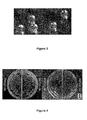
- bacterial growth tests on semisolid support and counting test of bacterial colonies in the presence of microspheres of three-dimensional nanocomposites gel are performed; it has been shown that because of the presence of metal nanoparticles, bacteria grow neither on such gel surface nor in a suspension placed in contact with the three-dimensional nanocomposites gel microspheres, thereby underlining a strong antibacterial activity.
- hydrogel or 3D matrix non hydrated preparation according to the invention as well as the antimicrobial-type biologic activity are described hereinafter.
- Example 1 synthesis of chitosan derivates with lactose (hereinafter "Chitlac”)
- Chitosan (1.5 g, acetylation degree 11%) is dissolved into 110 mL of a methanol solution (55 mL) and 1% acetic acid buffer, pH 4.5 (55 mL).
- 60 mL of a methanol solution (30 mL) and 1% acetic acid buffer, pH 4.5 (30 mL) containing lactose (2.2 g) and sodium cyanoborohydride (900 mg) are added.
- the mixture is left to stir for 24 hours, transferred to dialysis tubes ( cut off 12'000Da) and dialyzed against NaCl 0.1 M (2 changes) and against deionized water until a conductivity of 4 ⁇ S at 4°C is achieved.
- the solution is filtered on Millipore 0.45 ⁇ m filters and freeze-dried.
- Example 2 synthesis of chitosan derivates with cellobiose (hereinafter "Chitcell”)
- Chitosan (1.5g, acetylation degree 11%) is dissolved into 110 mL of a methanol solution (55 mL) and 1% acetic acid buffer, pH 4.5 (55 mL).
- 60 mL of a methanol solution (30 mL) and 1% acetic acid buffer, pH 4.5 (30 mL) containing cellobiose (2.2 g) and sodium cyanoborohydride (900mg) are added.
- the mixture is left to stir for 24 hours, transferred to dialysis tubes ( cut off 12'000Da) and dialyzed against NaCl 0.1 M (2 changes) and against deionized water until a conductivity of 4 ⁇ S at 4°C is achieved.
- the solution is filtered on Millipore 0.45 ⁇ m filters and freeze-dried.
- Example 3 Preparation of metal-based nanocomposite with silver nanoparticles in Chitlac.
- Nanoparticles are obtained upon reduction of metal ions with ascorbic acid in Chitlac solutions according to the following procedure: an aqueous Chitlac solution at a concentration of 0.4 % (w/v) is prepared. The Chitlac solutions are then mixed with silver nitrate solutions, so as to obtain a final concentration of AgNO 3 of 1 mM. Then, a solution of ascorbic acid, is added so as to obtain a final concentration of 0.5 mM.
- Nanoparticles are obtained upon reduction of metal ions with ascorbic acid in Chitcel solutions according to the following procedure: an aqueous Chitcel solution at a concentration of 0.4 % (w/v) is prepared. The Chitcel solutions are then mixed with silver nitrate solutions, so as to obtain a final concentration of AgNO 3 of 1 mM. Then, a solution of ascorbic acid is added, so as to obtain a final concentration equal to 0.5 mM.
- Nanoparticles are obtained upon reduction of metal ions by the polysaccharide Chitlac according to the following procedure: an aqueous Chitlac solution at a concentration of 0.4 % (w/V) is prepared. The Chitlac solution is then mixed with a tetrachloroauric acid so as to obtain a final concentration of HAuCl 4 of 1 mM.
- Example 6 Preparation of cylindrical hydrogels based on alginate-Chitlac and by means of "in situ" gelification
- Example 7 Preparation of three-dimensional nanocomposite hydrogels based on alginate-Chitlac and metallic nanoparticles by means of "in situ" gelification
- Example 8 Preparation of cylindrical three-dimensional nanocomposite hydrogels based on alginate-Chitlac and silver nanoparticles by means of "in situ" gelification
- an alginate solution in the presence of NaCl and Hepes buffer is added so as to obtain the following final concentrations: 1.5% (w/v) alginate, 0.2% (w/v) Chitlac, 0.5 mM AgNO 3 , 0.25 mM C 6 H 8 O 6 , 0.15 M NaCl, 0.01 M Hepes buffer, pH 7.4).
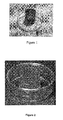
- the obtained three-dimensional nanocomposite material is a yellow-orange hydrogel (the color varies depending on silver concentration).
- Example 9 Preparation of cylindrical three-dimensional hydrogels based on alginate-Chitlac and gold nanoparticles by means of "in situ" gelification
- Example 10 preparation of three-dimensional nanocomposite spheres by means of a syringe from alginate-Chitlac solutions (in mannitol) with silver nanoparticles.
- a polysaccharidic solution with the following final concentrations was prepared. 1.5% (w/v) alginate, 0.2% (w/v) Chitlac, 0.5 mM AgNO 3 , 0.25 mM C 6 H 8 O 6 , 0.15 M NaCl, 0.01 M Hepes buffer, pH 7.4. The solution was dripped using a syringe provided with a 23G needle, into a solution containing 50 mM CaCl 2 and 0.15 M mannitol, 10 mM Hepes buffer (pH 7.4) under stirring by means of a magnetic rod. The spheres were kept under agitation in the gelling bath for 10 min before being removed and washed with deionized water.
- Example 11 preparation of three-dimensional nanocomposite spheres by means of a syringe from alginate-Chitlac solutions (in NaCl) with silver nanoparticles
- a polysaccharidic solution with the following final concentrations was prepared. 1.5% (w/v) alginate, 0.2% (w/v) Chitlac, 0.5 mM AgNO 3 , 0.25 mM C 6 H 8 O 6 , 0.15 M NaCl, 0.01 M Hepes buffer, pH 7.4. The solution was dripped using a syringe provided with a 23G needle, into a solution containing 50 mM CaCl 2 and 0.15 M mannitol, 10 mM Hepes buffer (pH 7.4) under stirring by means of a magnetic rod. The spheres were kept under agitation in the gelling bath for 10 min before being removed and washed with deionized water.
- Example 12 preparation of three-dimensional nanocomposite spheres by means of a syringe from alginate-Chitlac solutions with gold nanoparticles.
- a polysaccharidic solution with the following final concentrations was prepared. 1.5% (w/v) alginate, 0.2% (w/v) Chitlac, 0.5 mM HAuCl 4 , 0.15 M NaCl, 0.01 M Hepes buffer, pH 7.4. The solution was dripped using a syringe provided with a 23G needle, into a solution containing 50 mM CaCl 2 and 0.15 M mannitol (gelling bath) under stirring by means of a magnetic rod. The spheres were kept under agitation in the gelling bath for 10 min before being removed and washed with deionized water.
- Example 13 preparation of three-dimensional nanocomposite microspheres by means of an electrostatic bead generator from alginate-Chitlac solutions with silver nanoparticles.
- a polysaccharidic solution with the following final concentrations was prepared. 1.5% (w/v) alginate, 0.2% (w/v) Chitlac, 0.5 mM AgNO 3 , 0.25 mM C 6 H 8 O 6 , 0.15 M NaCl, 0.01 M Hepes buffer, pH 7.4. The solution was dripped into a gelling bath containing 50 mM CaCl 2 and 0.15 nm mannitol under stirring by means of a magnetic rod. The microsphere size is controlled by using an electrostatic generator, which allows to act on the surface tension of the drops so as to reduce the size thereof.
- Example 14 preparation of three-dimensional nanocomposite microspheres by means of an electrostatic bead generator from alginate-Chitlac solutions with gold nanoparticles
- a polysaccharidic solution with the following final concentrations was prepared: 1.5% (w/v) alginate, 0.2% (w/v) Chitlac, 0.5 mM HAuCl 4 , 0.15M NaCl, 0.01 M Hepes buffer, pH 7.4. The solution was dripped into a gelling bath containing 50 mM CaCl 2 and 0.15 nm mannitol under stirring by means of a magnetic rod.
- the microsphere size is controlled by using an electrostatic bead generator, which allows to act on the surface tension of the drops so as to reduce the size thereof.
- the conditions employed typically are: voltage 5 kV, internal needle diameter 0.7 mM, distance between gelling bath and needle 4 cm, binary polymeric solution flow rate 10 mL/min.
- the microspheres are left in the gelling solution under stirring for 10 min before being removed and washed with deionized water.
- Example 15 Preparation of three-dimensional nanocomposite hydrogels with high surface/volume ratio based on alginate-Chitlac and silver nanoparticles by means of "in situ" gelification.
- an alginate solution in the presence of NaCl and Hepes buffer is added so as to obtain the following final concentrations: 1.5% (w/v) alginate, 0.2% (w/v) Chitlac, 0.5 mM AgNO 3 , 0.25 mM C e H 8 O 6 , 0.15 M NaCl, 0.01 M Hepes buffer, pH 7.4.
- a solution of CaCO 3 concentration 30 mM
- 20% final Mueller-Hinton medium is added (4.2 g/L). The final solution is poured onto smooth surfaces (slides, Petri dishes, etc.) and left to gel in the dark for 24 hours.
- Example 16 Preparation of three-dimensional nanocomposite dehydrated films based on alginate-Chitlac and silver nanoparticles by means of "in situ” gelification.
- an alginate solution in the presence of NaCl and Hepes buffer is added so as to obtain the following final concentrations: 1.5% (w/v) alginate, 0.2% (w/v) Chitlac, 0.5 mM AgNO 3 , 0.25 mM C 6 H 8 O 6 , 0.15 M NaCl, 0.01 M Hepes buffer, pH 7.4.
- a solution of CaCO 3 concentration 30 mM
- Example 17 Preparation of three-dimensional nanocomposite hydrogels with high surface/volume ratio based on alginate-Chitlac and gold nanoparticles by means of "in situ" gelification
- Example 18 Preparation of three-dimensional nanocomposite films based on alginate-Chitlac and gold nanoparticles by means of "in situ" gelification
- the final solution is poured on smooth surfaces (slides, Petri dishes, etc.) and left to gel in the dark for 24 hours. Then, the three-dimensional nanocomposite gel is air-dried so as to obtain a three-dimensional nanocomposite solid film.
- microspheres of the above-reported specific examples 13 and 14 were prepared according to known methods and in particular by: a) using syringes, with which of the solutions of one anionic polysaccharide and one metal-based nanocomposite mono-or oligo-saccharidic derivative of chitosan with metallic nanoparticles are manually dripped into a suitable gelling bath, b) using one Electrostatic Bead Generator, developed by Prof. Gudmund Skj ⁇ k-Br ⁇ k of Institute of Biotechnology of NTNU University of Trondheim (Norway) and described by Strand et al., 2002, J. of Microencapsulation 19, 615-630 .
- Such an apparatus consists of an electrostatic bead generator with an adjustable voltage (up to 10kV) by means of a suitable switch, connected to an autoclavable needle support contained in a safety stand made of Plexiglas.
- the starting solution is dripped into a crystallizator (within the stand) containing the gelling solution, in which an electrode is inserted.
- the instrument generates a constant potential difference between the needle tip and the free surface of the gelling solution, which may be adjusted and ranges from 0 to 10 kV.
- the potential difference causes the sudden detachment of the polymer drop (negatively charged) from the needle tip and thus allows to have capsules even with small sizes ( ⁇ 200 ⁇ m).
- the capsule sizes may be adjusted by even varying other factors, such as the internal needle diameter, the distance of the needle from the gelling solution surface, the polymer flow rate.
- the gel cylinders and disks of the above-reported specific examples 6, 8 and 9 were prepared by pouring the solution containing the polysaccharides and the metal-based nanocomposite into cylinder-shaped containers.
- the cylindrical hydrogel size depends on the size of the latter ones.
- the cylinder-shaped container dimensions typically are 18 mm in height and 16 mm in internal diameter, while those of discoid containers are 8 mm in height and 16 mm in internal diameter, even if different sizes (height and internal diameter) are fully allowable.
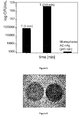
- nanocomposite gel microspheres containing silver nanoparticles are made and contacted with bacterial solutions (Escherichia coli ); the control is represented by alginate-Chitlac gel microspheres (without silver nanoparticles).
- bacterial solutions Esscherichia coli
- alginate-Chitlac gel microspheres without silver nanoparticles.
- nanocomposite microspheres obtained according to example 13 and nanocomposite hydrogels obtained according to examples 6 and 9 proved to be able to exert an effective antimicrobial action, as shown in figures 5 and 6 , respectively.
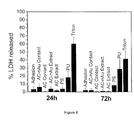
- LDH tests to evaluate gel cytotoxicity on eukaryotic cell lines, such as osteoblasts (MG63), hepatocytes (HEPG2) and fibroblasts (3T3), were performed.
- MG63 osteoblasts
- HEPG2 hepatocytes
- 3T3 fibroblasts
- LDH tests demonstrate that these three-dimensional nanocomposite gels do not cause cytotoxic effects to the tested cells, as it can be seen in figure 7 , for example in the case of fibroblasts. Indeed, after 24 and 72 hours no significant difference in the release of lactate dehydrogenase (LDH) between the cells treated with AC-nAg and the controls (i.e. cells treated with alginate-Chitlac gels and non-treated cells) are found.
- the three-dimensional nanocomposite according to the invention such as alginate-Chitlac-based hydrogels containing nanoparticles formed and stabilized in Chitlac, are provided with a homogeneous structure in which the nanoparticles do not aggregate and have a strong bactericidal activity, without being toxic for the eukaryotic cells.
- These new three-dimensional nanocomposite systems provide the following advantages:
Landscapes
- Health & Medical Sciences (AREA)
- Chemical & Material Sciences (AREA)
- Organic Chemistry (AREA)
- Chemical Kinetics & Catalysis (AREA)
- Medicinal Chemistry (AREA)
- Life Sciences & Earth Sciences (AREA)
- General Health & Medical Sciences (AREA)
- Veterinary Medicine (AREA)
- Pharmacology & Pharmacy (AREA)
- General Chemical & Material Sciences (AREA)
- Animal Behavior & Ethology (AREA)
- Polymers & Plastics (AREA)
- Public Health (AREA)
- Nuclear Medicine, Radiotherapy & Molecular Imaging (AREA)
- Engineering & Computer Science (AREA)
- Bioinformatics & Cheminformatics (AREA)
- Communicable Diseases (AREA)
- Dermatology (AREA)
- Materials Engineering (AREA)
- Oncology (AREA)
- Molecular Biology (AREA)
- Biochemistry (AREA)
- Urology & Nephrology (AREA)
- Medicinal Preparation (AREA)
- Materials For Medical Uses (AREA)
- Compositions Of Macromolecular Compounds (AREA)
- Pharmaceuticals Containing Other Organic And Inorganic Compounds (AREA)
- Polysaccharides And Polysaccharide Derivatives (AREA)
- Processes Of Treating Macromolecular Substances (AREA)
- Manufacture Of Metal Powder And Suspensions Thereof (AREA)
- Food Preservation Except Freezing, Refrigeration, And Drying (AREA)
Description
- The present invention relates to three-dimensional nanocomposite materials comprising a complex polymeric matrix consisting of a polysaccharidic composition of neutral or anionic polysaccharides and of branched cationic polysaccharides, in which metallic nanoparticles are uniformly dispersed and stabilized, said branched cationic polysaccharides so forming a metal-based nanocomposite. The invention further concerns the preparation and use of said three-dimensional nanocomposite materials in biomedical, pharmaceutical and food fields.
- Natural polysaccharides have been generally recognized as biocompatible polymers; as such, they are well-studied materials employed since long time for applications in biomedical field, for example as carriers of biologically active compounds or cells for tissue engineering. Among the most used ones in both pharmaceutical and food industry, alginates and chitosan may be mentioned for their abundance, relatively low cost, high biocompatibility and ability to produce in appropriate conditions three-dimensional matrices in the form of hydrogels with high water content. However, chitosan exhibits some application limits linked to its marked dependence of its water solubility from pH, its non-miscibility in aqueous solutions with anionic polysaccharides such as alginate, with which it produces coacervates not usable for applicative purposes, such as for example in tissue engineering. Chitosan shares with alginates a further limit inasmuch as it does not carry any cell-specific signal thus lacking bioactivity. For these reasons chitosan derivatives, which can overcome the above-mentioned limits, are currently studied and developed.
- In the recent years, different chitosan derivates were obtained by means of chemical modification of the polymeric chain. For these modifications, reactions involving the amino residue of the D-glucosamine units, forming the linear chitosan chain, are extensively used. In particular, introducing saccharidic units (mono- and oligo-saccharides) as the N-linked side chain, allowed to obtain water-soluble chitosan derivatives without the need of lowering pH down to acidic values, in this manner also avoiding the possible resulting problems of degradation of the polymer due to the acidity of the aqueous solutions.
- In
US 4,424,346 (Hall, L.D. and Yalpani, M. ) the synthesis of these derivatives was described for the first time as well as the aqueous solubility thereof in a non-acidic aqueous medium. In particular,US 4,424,346 disclosed that the chitosan derivative with lactose produces rigid gels in aqueous solutions at concentrations higher than 3-5%, while it does not gel nor precipitate in salts or acids mixtures (in particular with Ca, Cr, Zn chlorides, K chromate, boric acid) and combinations thereof. Moreover, the aforesaid patent mentioned the fact that the chitosan derivatized with another oligosaccharide, that is cellobiose, does not form gels in aqueous solutions per se, while it forms rigid gels when mixed with alginate. This gel formation is due to the strong interaction between the positive polycation charges and the negative polyanion charges, which leads to a system coacervation, a process that otherwise is a limit in its use, for example, for microencapsulation of biologic material such as cells. - Patent Application
WO2007/135116 (Paoletti S. et al. ) describes methods for preparing polymeric solutions containing mixtures of anionic and cationic polysaccharides to overcome the problem of coacervation and the use thereof in biomedical field. - In addition, Patent Application
WO2007/135114 (Paoletti S. et al. ) describes three-dimensional structures, both hydrated or non-hydrated, and methods of preparing them from the above-mentioned polymeric mixtures of anionic and cationic polysaccharides gelled with appropriate gelling agents, useful for the purpose to encapsulate pharmacologically active molecules and cells. - Another remarkably interesting research area releated to nanotechnologies and with a great topical interest for polysaccharides is their possible use for preparing nanocomposite materials, comprising in particular metallic nanoparticles. Indeed, in order to stabilize the nanoparticles, polysaccharidic solutions, which allow to obtain nanocomposite systems wherein the metallic particles are homogeneously dispersed due to the interactions with the polymeric chains, could be profitably used. Therefore, the role of polysaccharides is related to formation and stabilization of metallic nanoparticles by expecting the possibility of exploiting their particular properties; indeed, metallic nanoparticles are known to be provided with particular optical, catalytic and antimicrobial properties. In fact, the use of metals, such as silver, gold, copper, zinc and nickel, in the field of antimicrobial materials is greatly impacting on the market, especially for treating skin wounds. Companies such as Johnson&Johnson© and Convatec© recently have commercialized medications based on the antibacterial properties of silver nanoparticles. Similar applications could be found by appropriate polysaccharides-based nanocomposite materials to exploit the well-known antimicrobial activity of these metals, for example, for the development of gauzes, bandages, patches. The latter products could be endowed with a broad-spectrum antimicrobial activity or high water content gels with bactericidal activity. Indeed, the need for novel therapeutic aids for treating skin or mucosa lesions, such as burns and ulcerations, is still felt. These lesions are often very resistant to the currently adopted antibiotic therapies; in addition, they also need further biological effects for tissue repair, for example enhancing cell proliferation, and/or appropriate tissue hydration. The three-dimensional hydrogel structure may be particularly advantageous especially for the latter aspect, being able to ensure an appropriate environment for cell replication without interfering with cell phenotype.
- Furthermore, the possibility of obtaining three-dimensional hydrated structures is also particularly interesting for tissue-engineering applications, where combining bioactive properties typical of polysaccharides with antimicrobial activity is desirable.
- In the field of tissue-engineering, a great effort is being made to produce antimicrobial coatings on biomaterials to be implanted into human body; in this case, the major risk factor is related to the possible cytotoxicity of the antimicrobial agents themselves. For example, in the orthopedic surgery field, the prosthetic joint replacement operations and osteosynthesis of unexposed fractures represent a type of clean surgery with regards to surgery infections (Tucci G. et al., Giornale Italiano di Ortopedia e Traumatologia, 2005; 31:121-129). However, implantation of biomaterials within host tissues may promote the onset and subsistence of infections even with somewhat low bacterial loads. Despite the progress in perioperative prophylaxis, bacterial and fungal infections are still very common; this is caused by time-extended risk of adhesion of these microorganisms to the orthopedic device (Zimmerli W. et al., New England J. Med., 2004; 351(16):1645-54). These data support the importance of developing alternative antimicrobial agents to be associated with new-generation biomaterials.
-
US 7255881 (Gillis et al. ) provides a possible solution to the above-mentioned problems. In fact, the patent discloses silver-based coatings formed on various types of substrate through techniques such as chemical and physical depositions from a vapour phase ("chemical vapour deposition" CVD, "physical vapour deposition" PVD) and in a liquid phase for antimicrobial applications. Regarding the polysaccharidic substrates, on which silver is deposited, chitosan, alginate and hyaluronic acid are mentioned. It is noted that these techniques are not directed to the formation of metallic nanoparticles homogeneously dispersed within appropriate matrices, but address the formation of continuous, surface silver (nanocrystalline, polycrystalline or amorphous) layers. Furthermore, the temperature and pressure conditions required for these deposition techniques are not compatible with the stability of the polysaccharide nor of bioactive biomolecules (like peptides or proteins) that might be desirable to be part of the scaffold, nor, even more so, with tissue engineering applications involving living cells. - It is a first object of the present invention to provide three-dimensional nanocomposite systems, where size-controlled metallic nanoparticles are homogeneously dispersed into polysaccharidic matrices, being said matrices in the gel or in the solid form, and the properties of which are particularly suitable for biologic applications in the biomedical field.
- It is a further object that such a three-dimensional nanocomposite is obtainable by a simple and economically convenient chemical approach, and in particular, but not exclusively, by producing biocompatible and bioactive hydrogels and dehydrated hydrogels.
- It is a further object to improve these systems by employing readily commercially available polysaccharides and without these polysaccharides being subjected to chemical manipulations, as well as without the need for complex preparative manipulations of these systems.
- In order to fulfill the above-mentioned objects, the inventors developed suitable polysaccharidic systems based on at least binary compositions comprising neutral or anionic polysaccharides, preferably derived from vegetal or bacterial sources, and branched cationic polysaccharides allowing the later polysaccharides to entrap metallic nanoparticles, and being the neutral or anionic polysaccharides able to form three-dimensional solid matrices hydrated or non-hydrated (e.g. hydrogels with various forms, microspheres, scaffolds, fibrous matrices) and/or high surface/volume ratio matrices (wet or dehydrated membranes and films). In this manner the system formed by branched cationic polysaccharides, uniformly entrapping metal nanoparticles, is itself a nanocomposite.
- Therefore, in a first aspect the object of the invention consists in three-dimensional nanocomposite materials comprising a polymeric matrix consisting of at least one neutral or anionic (lyotropic, thermotropic or thermo-lyotropic) polysaccharide, and a metal-based nanocomposite consisting of at least one branched cationic polysaccharide wherein metallic nanoparticles are uniformly dispersed and stabilized, where the neutral or anionic polysaccharide is gelled by means of suitable physical or chemical gelling agents, depending on the type of the neutral or anionic polysaccharide itself.
- It was possible to mix solutions of metal nanoparticles-containing cationic branched polysaccharides with neutral or anionic polysaccharide solutions and working with suitable pH value and ionic strength, in order not to cause formation of coacervates. By exploiting the neutral or acidic polysaccharide ability to form ionotropic or thermotropic gels, by means of suitable gelling agents, it was then possible to obtain three-dimensional matrices, hydrated or non-hydrated, consisting of mixtures of these neutral or anionic polysaccharides and branched basic polysaccharides, entrapping these latter metallic nanoparticles uniformly dispersed and stabilized through the branched basic polysaccharide itself. Therefore, in a second aspect, it is an object of the invention a method of preparing three-dimensional nanocomposite materials comprising a polymeric matrix consisting of at least one lyotropic, thermotropic or thermo-lyotropic, neutral or anionic polysaccharide, and a metal-based nanocomposite consisting of at least one branched cationic polysaccharide wherein metallic nanoparticles are uniformly dispersed and stabilized, characterized in that said three-dimensional nanocomposite materials are obtainable from aqueous solutions of at least one lyotropic, thermotropic or thermo-lyotropic, neutral or anionic polysaccharide, and of a metal-based nanocomposite consisting of at least one branched cationic polysaccharide entrapping the metallic nanoparticles, wherein these aqueous solutions have a ionic strength of at least 50 mM and not higher than 350 mM and a pH of at least of 7 and wherein these aqueous solutions are treated with physical or chemical gelling agents capable to cause the gelation of lyotropic, thermotropic or thermo-lyotropic, neutral or anionic, polysaccharides. These aqueous solutions preferably have an osmolarity comprised in the range from 250 to 300 mM.
- Thus, the three-dimensional nanocomposite materials obtainable with such a method of preparing are still an object of the invention.
- Furthermore, the three-dimensional nanocomposite materials according to the invention showed to have a strong, broad-spectrum antimicrobial activity and no cytotoxic effects.
- Therefore, it is a further object of the invention the use of these three-dimensional nanocomposite materials in biomedical field, in particular for antimicrobial applications. Indeed, the three-dimensional composite materials object of the present invention promise useful applications as biomaterials in both dermatological (e.g. vascular-metabolic cutaneous ulcerations) and orthopedic (e.g. bone prostheses coatings), dental (treatment of periodontal pathogen infections), cardiological, urological (stent coatings) and general surgery therapeutic fields.
-
-
Figure 1 : the figure shows a three-dimensional nanocomposite material in form of hydrogel comprising a metal-based nanocomposite formed by a chitosan derivative with lactose (C: hereinafter referred to as Chitlac: CAS registry number 85941-43-1)-based silver nanoparticles (nAg) in an alginate (A) matrix (AC-nAg gel). The composition is: 0.2% (w/v) Chitlac, 1.5% (w/v) alginate, 0.5 mM AgNO3, 0.25 mM C6H8O6, 10 mM Hepes buffer, 30 mM CaCO3, 60 mM GDL (D-glucono-δ-lactone). The preparation of the hydrogel is described in example 8. -
Figure 2 : the figure shows a three-dimensional nanocomposite material in form of hydrogel comprising a metal-based nanocomposite formed by Chitlac-based gold nanoparticles (nAu) in an Alginate matrix (AC-nAu gel). The composition is: 0.2% (w/V) Chitlac, 1.5% (w/v) alginate, 0.5 mM HAuCl4, 10 mM Hepes buffer, 30 mM CaCO3, 60 mM GDL. The preparation is described in example 9. -
Figure 3 : the figure shows three-dimensional nanocomposite material AC-nAg gel microspheres (0.2% (w/v) Chitlac, 1.5% (w/v) alginate, 0.5 mM AgNO3, 0.25 mM C6H8O6, 10 mM Hepes buffer, 30 mM CaCO3, 60 mM GDL). The preparation is described in example 13. -
Figure 4 : the figure shows a bacterial growth test of E. coli ATCC 25922 on three-dimensional nanocomposite material in form of Alginate-Chitlac hydrogel (AC gel, example 6, on the left) in comparison with a three-dimensional nanocomposite material in form of Alginate-Chitlac-nAg hydrogel (AC-nAg gel, example 8, on the right). -
Figure 5 : the figure shows a bacterial colony counting test of E. coli ATCC 25922 in contact with a suspension containing three-dimensional nanocomposite material AC-nAg microspheres for 240 min. The microsphere preparation is described in example 13. The control is represented by growth in 20% Mueller-Hinton medium (T -
Figure 6 : the figure shows a bacterial growth test of E. coli ATCC 25922 on three-dimensional nanocomposite material Alginate-Chitlac hydrogel (AC gel, example 6, on the left) in comparison with a three-dimensional nanocomposite material Alginate-Chitlac-nAu hydrogel (AC-nAg gel, example 9, on the right). -
Figure 7 : the figure shows a cytotoxicity test on fibroblast cell lines (NIH-3T3), assessed as LDH (lactic dehydrogenase) release, of three-dimensional nanocomposite material AC-nAg gels (example 8, diagonal lines) by contact, and the related extract after 24 and 72 hours in a 37°C medium. The controls are represented by i) adherent cells (control, confluent), ii) cells in contact with Alginate-Chitlac gel without silver nanoparticles (AC gel, example 6, horizontal lines), iii) cells in contact with the liquid culture medium kept in contact with the material for given time (24 hours) (hereafter referred to as "extract") from Alginate-Chitlac gels without silver nanoparticles (AC gel Extract, orthogonal mesh). -
Figure 8 : the figure shows a cytotoxicity test (LDH) on osteoblast cell lines (MG63), assessed as LDH (lactic dehydrogenase) release, of three-dimensional nanocomposite material AC-nAu gels (ex. 9, AC-nAu Cont.) by contact, and the related extract (AC-nAu Est.) after 24 and 72 hours in a 37°C medium. The controls are represented by adherent cells (Adhesion), cells in contact with Alginate-Chitlac gels without metal nanoparticles (example 6, AC Cont.), extract from Alginate-Chitlac gels without metal nanoparticles (AC Est), cells in contact with polystyrene disks (PS, negative control of the contacted system), cells in contact with polyurethane disks with ZnDBC (PU, positive control of the contacted system according to ISO 10993-5), cells with a solution of Triton (positive control of the extract). - Three-dimensional structure: the definition indicates for the purpose of the present application a structure, both hydrated or non-hydrated, capable of maintaining shape and size when not subjected to deformation.
- The three-dimensional structure disclosed in the present application are nanocomposite material formed by a neutral or anionic polysaccharides matrix comprising a material formed by metal-nanoparticles uniformly and permanently dispersed in polycationic branched polysaccharides hereinafter described in detail. Thus, in first instance the definition "three-dimensional nanocomposite" is used to indicate the nanocomposite material of the invention.
- Hydrogel: generally, the term "hydrogel" indicates highly hydrated three-dimensional semisolid structures capable of maintaining shape and size when not subjected to deformation. They may be obtained from semi-dilute solutions of suitably crosslinked polysaccharides.
- In the following description "nanocomposite hydrogels" can also be used to indicate, when hydrated, the three-dimensional nanocomposite structures of the invention as previously defined.
- Nanocomposite: generally, the term "nanocomposite" indicates a system consisting of particles with nanometric size (fillers) through a macroscopic material (matrix). Being the invention a three-dimensional nanocomposite deriving from the inclusion in a neutral or anionic polysaccharidic matrix of a nanocomposite material (e.g. metallic nanoparticles uniformly and permanently dispersed in branched cationic polysaccharides), this latter material is indicated herein mainly as "metal-based nanocomposite". In particular, the metal-based nanocomposite consists of metallic nanoparticles formed by reduction of metal ions by or in alditolic or aldonic polysaccharidic derivatives of chitosan. Thus, in the following description, besides "metal-based nanocomposite", "metallic-nanoparticles based nanocomposite" is used with reference to this material.
- Colloidal solution (or colloid): system in which particles with sizes from 1 and 1,000 nm are dispersed in a continuous solvent medium.
- "In situ" gelification: method of gelling in which there is a controlled release of the gelling agent (e.g., ion Ca2+ for alginate). This is achieved by using an inactivated form of the gelling agent (e.g. CaCO3) which is then released upon adding a second component (e.g. glucono-δ-lactone, GDL).
- The objects and advantages of the three-dimensional nanocomposite material described in the present invention will be better understood from the following detailed description where, by the way of non-limiting example of the invention, some examples of preparing three-dimensional nanocomposites and their biological characterization to evaluate the antibacterial activity and cytotoxicity, will be described.
- For the pursued objects, the aspect related to preparation and characterization of a polysaccharides-based nanocomposite system wherein properties related to nano-scale of metallic nanoparticles are exploited, has been addressed. According to the invention three-dimensional nanocomposite materials are formed from a polymeric matrix consisting of a composition of at least one lyotropic, thermotropic or thermo-lyotropic, neutral or anionic, polysaccharide, and a metal-based nanocomposite consisting of at least one branched cationic polysaccharide entrapping metallic nanoparticles uniformly dispersed and stabilized in such a branched cationic polysaccharide. The branched cationic polysaccharides has a double function in the three-dimensional nanocomposite material according of the invention: i) mainly on one side, in properly entrapping and stabilizing the metal nanoparticles and ii) additionally on the other side, in contributing in forming the matrix, which is substantially a composition of polysaccharides (e.g. at least one lyotropic, thermotropic or thermo-lyotropic, neutral or anionic, polysaccharide and at least one branched cationic polysaccharide), inasmuch as the three dimensional matrix is mainly due to the capability of the neutral or anionic polysaccharides to form gels with appropriate gellifying agents. Thus, such a composition of polysaccharides is in a possible embodiment binary and formed by a neutral or acid polysaccharide and a branched cationic polysaccharide.
- The neutral or acid polysaccharides useful for the purpose of the invention are: a) acidic polysaccharides, capable of forming lyotropic gels, selected from the group consisting of alginates, pectates, pectinates; b) neutral polysaccharides capable of giving rise to thermotropic gels and, in this case, they are preferably selected from the group consisting of agarose, scleroglucan, schizophyllan, curdlan; c) acidic polysaccharides capable of giving rise to thermo-lyotropic gels and, in this case, are preferably selected from the group consisting of agarose sulphate, I- and κ-carrageenan, cellulose sulphate, gellan gum, rhamsan gum, whelan gum (also addressed to as welan gum), xanthan gum.
- The average molecular weight (MW) of neutral or acidic polysaccharides can be up to 2'000 kDa and preferably be from 100 kDa to 1'000 kDa and average molecular weights of 200 kDa are more preferably used.
- As well known, these neutral or anionic polysaccharides have the feature of forming three-dimensional structures (gel-like or hydrogels, when hydrated), under suitable conditions. Indeed, the aspect related to hydrogel formation is substantially related to the ability of these neutral or acidic polysaccharides to instantly form hydrogels when contacted with solutions of ions for lyotropic polysaccharides, or with cooled solutions for thermotropic polysaccharides. In the case of acidic thermo-lyotropic polysaccharides, the gelling agents can be both/either physical and/or chemical and thus be either ions or appropriate temperatures or both.
- On the contrary, the aspect related to forming and carrying metallic nanoparticles is substantially related to the second polysaccharidic component, that is the branched cationic polysaccharides. For the purposes of the present invention these are alditolic or aldonic branched derivatives of chitosan, wherein the D-Glucosamine units forming the linear chitosan chain bind, by means of the -NH-functional group on carbon atom C2, mono- or oligo-saccharidic alditolic or aldonic polyols residues, equal or different from each other, represented by the general formula (I)

- R is -CH2- or -CO-;
- R1 is hydrogen or a monosaccharide, or an oligosaccharide;
- R2 is -OH or -NHCOCH3.
- For representative purposes, the D-Glucosamine units substituted with mono- or oligo-saccharidic alditolic or aldonic polyols residues in the chitosan branched derivates is represented by the general formula (II), where "n" refers to the overall number of D-Glucosamine units constituting a linear chitosan chain:

- For the purposes of the present invention, in preferred branched derivatives of chitosan, when R1 is a monosaccharide, said monosaccharide is selected from the group consisting of galactose, glucose, mannose, N-acetyl glucosamine, and N-acetyl galactosamine, and, when R1 is an oligosaccharide, said oligosaccharide can comprise 2 glycosidic units.
- The alditolic or aldonic mono- or oligo-saccharidic residues of general formula (I) preferably are mono- or oligo-saccharides comprising from 1 to 3 glycosidic units and, according to a more preferred aspect, these alditolic or aldonic polyols residues are residues of oligosaccharides comprising from 2 to 3 glycosidic units and yet more preferably are selected from the group of oligosaccharides residues consisting of lactose, cellobiose, cellotriose, maltose, maltotriose, chitobiose, chitotriose, mannobiose as well as from their corresponding aldonic acids. For the purposes of the present invention the most preferred oligosaccharidic derivative of chitosan is the derivative with lactose (Chitlac; CAS registry number 85941-43-1). Furthermore, to uniformly disperse and stabilize the metallic nanoparticles, the chemical substitution degree of chitosan amino groups with these mono- or oligo-saccharides of general formula (I) must be at least 40%. The substitution degree of chitosan amino groups with said mono- or oligo-saccharides is preferably comprised in the range from 50% to 80% and more preferably is 70%.
- The average molecular weight (hereinafter referred to as MW) of the chitosan useable for obtaining the mentioned oligosaccharidic derivatives is up to 1'500 kDa and be preferably comprised in the range from 400 kDa to 700 kDa.
- The metallic nanoparticles incorporated into the polymeric matrix consisting of these mono-or oligo-saccharidic branched derivates of chitosan are made of metals preferentially selected from silver, gold, platinum, palladium, copper, zinc, nickel and mixtures thereof.
- The nanoparticles included into the polymeric matrix consisting of mono- or oligo-saccharidic branched derivates of chitosan have a size in the range from 5 nm to 150, and in particular a controlled average metallic nanoparticle size between 30 and 50 nm.
- An essential feature of these nanoparticles is that these nanoparticles are mostly metals in their reduced form, moreover without excluding the residual presence of clusters made of few atoms with an ionic character, and that in their dispersion/stabilization in the polysaccharidic matrix, mono- or oligo-saccharidic side chains close to amino groups of the chitosan itself are involved.
- Without being bound to these, the preferred ratios of cationic polysaccharidic matrix and metals are referred to metal-based nanocomposites in the form of colloidal solutions, although said metal-based nanocomposite materials can be also in the form of dehydrated films or powders, and even dialyzed to remove the residual counter-ions from the preparation of the materials themselves. In the metal-based nanocomposites in the form of aqueous colloidal solutions, the ratio of the polysaccharide concentration (expressed as % w/v) over the concentration of the starting metal salt (expressed as molarity) is from 0.0025 to 20 and preferably is 0.2.
- Therefore, the metal mass expressed as mg, which may be incorporated per gram of cationic polysaccharide, can be from 3'000 mg/g to 0.3 mg/g and preferentially is 50 mg of metal incorporated per gram of polysaccharide.
- Such a component of the three-dimensional nanocomposite materials according to the invention may be prepared under appropriate conditions with aqueous solutions of basic polysaccharides in the presence or absence of exogenous reducing agents.
- The method of preparing this component of the three-dimensional nanocomposite materials according to the invention comprises at least:
- a) preparing aqueous solutions of branched cationic polysaccharides in a concentration up to 2% (w/v);
- b) preparing aqueous solutions of metallic salts in a concentration from 0.1 mM to 20 mM;
- c) adding these salt solutions to the solutions of polysaccharides and mixing until obtaining colloidal solutions where metallic nanoparticles are homogeneously dispersed.
- A reducing agent is optionally added to the obtained colloidal solutions.
- The formation of the metal nanoparticles in the presence of branched cationic polysaccharides produces an exceptionally well-disperse and stabilized metal-nanoparticle system, avoiding the well-known tendency of pre-formed metal nanoparticle to give large agglomerated clusters in solution, which generally leads to loose the benefits related to the nanometric scale.
- In its general features, the method of preparing the metal-based nanocomposite is as follows: aqueous solutions of these chitosan branched derivates with mono- or oligo-saccharides are prepared at different concentrations (up to 2% (w/v), preferably in the range from 0.05% (w/v) to 1% (w/v) and more preferably are 0.2%. The polysaccharide solutions are then mixed with solutions of metallic salts chosen from silver, gold, platinum, palladium, copper, zinc, nickel, preferably selected from chlorides, perchlorates and nitrates (e.g. AgNO3, HAuCl4, CuSO4, ZnCl2, NiCl2), in order to obtain final concentrations of these metals from 0.1 mM to 20 mM, more preferably from 1 mM to 14 mM, and still more preferably of 1 mM. Appropriate known reducing agents, preferably selected from ascorbic acid, sodium citrate, sodium borohydride and sodium cyanoborohydride, can optionally be added to the solutions in order to obtain metallic-state nanoparticles. The reducing agent is added at concentrations from 0.05 mM to 10 mM and preferably the concentration is 0.5 mM.
- However, it was found that otherwise for other polymeric systems, the metal-based nanocomposites formed from chitosan branched derivates with mono- or oligo-saccharides and metallic nanoparticles can be also prepared in the absence of reducing agents, since the side mono- or oligo-saccharidic chains act as reducing agent for metal ions per se, and allow to form in situ nanoparticles dispersed in the polymeric matrix. In this case, the metallic nanoparticles are obtainable by simply mixing the chitosan derivative solutions with salt solutions of the selected metal at appropriate concentrations. Also in this case, the polysaccharide and metal salt concentrations are as previously reported.
- However, in both cases because of the chemical and physical-chemical properties of nitrogen atoms and side substituents existing on the mono- or oligo-saccharidic branched derivative of chitosan, the metal ions interact with macromolecules by means of coordination interactions, while the presence of the side chains of mono-or oligo-saccharides, for example lactose, offers an effective steric hindrance to hamper the natural tendency of nanoparticles to aggregate. The subsequent ion reduction, either caused by an exogenous reducing agent or by the mono- or oligosaccharidic chains of the branched derivatives of chitosan, leads to the formation of nanoparticles stabilized by polysaccharidic chains.
- In both cases, the ratio of silver mass which may be incorporated and that of polysaccharide, reported as mg per gram, is as previously reported. Unexpectedly, it was found that mixing in aqueous solutions the polymeric component consisting of the previously mentioned neutral or acidic polysaccharides, and in particular alginates, and the basic polysaccharidic polymeric component, that is branched derivatives of chitosan with the alditolic or aldonic polyols of general formula (I), comprising the metallic nanoparticles, being already a nanocomposite material in nature (e.g. the metal-based nanocomposite), the obtained nanocomposite materials are three-dimensional matrices or stable hydrogels and they are not coacervates in nature, despite the presence of metallic nanoparticles, as well as the nanoparticles remain uniformly dispersed in the branched derivatives of chitosan.
- Indeed, hydrogel or three-dimensional matrix formation according of the invention is obtainable by mixing the two components (e.g. neutral or acid polysaccharides and the metal-based nanocomposite) in aqueous solutions having appropriate features by means of a subsequent treatment thereof with suitable agents capable of gelling the anionic or neutral polysaccharide.
- In particular, the three-dimensional nanocomposite materials comprising a polymeric matrix consisting of at least one neutral or anionic, lyotropic, thermotropic or thermo-lyotropic polysaccharide, and a metal-based nanocomposite consisting of at least one branched cationic polysaccharide entrapping metallic nanoparticles uniformly dispersed and stabilized, are obtainable from aqueous solutions of the two components having the solutions an ionic strength at least of 50 mM and not higher than 350 mM and a pH at least of 7, and by treating these solutions with chemical or physical gelling agents capable of gelling the neutral or anionic, lyotropic, thermotropic or thermo-lyotropic polysaccharides.
- The preferred conditions (substantially concentrations, pH, ionic strength) to obtain the three-dimensional matrices or hydrogels from these two components are typically aqueous solutions having a pH in a physiological range, and in particular between 7 and 8 and more preferably the pH is 7.4, and an osmolarity from 250 to 300 mM, with an ionic strength from 50 mM to 350 mM, and preferably of 150 mM, preferably obtained by adding NaCl at concentrations from 0.05 M to 0.35 M and more preferably of 0.15 M.
- The gelling agents may be selected depending of the type of lyotropic anionic polysaccharide from suitable monovalent, bivalent or trivalent ions, and for thermotropic polysaccharides between temperatures not higher than 50°C or not lower than 10°C. As known, for thermo-lyotropic polysaccharides the gelling agents may be both chemical agents, such as ions, and physical agents, such as temperature. The choice between the two types of gelling agents substantially depends as well known in the art on the acidic thermo-lyotropic polysaccharide to be gelled.
- For polysaccharides such as alginate and pectate these ions are alkaline-earth ions, excluding magnesium, and transition metals, and preferably selected from the group consisting of calcium, barium, strontium, lead, copper, manganese and mixtures thereof, or they are rare earth ions and preferably selected from the group consisting of gadolinium, terbium, europium and mixtures thereof.
- The concentrations of the aqueous solution of these ions adapted for the gelification are higher than 10 mM and preferably from 10 mM to 100 mM and more preferably of 50 mM. The gelling solution preferably contains a concentration of CaCl2 of 50 mM and an ionic strength of 0.15 M.
- In the case of carrageenans, alkaline ions preferably chosen from the group consisting of potassium, rubidium and cesium, at concentrations not lower than 50 mM and preferably from 50 mM to 200 mM and more preferably of 0.1 M, can be used.
- In the case of polysaccharidic solutions, which lead to thermotropic hydrogels, such as for example agarose, the hydrogels preparation is performed by cooling below the gel formation temperature. The polysaccharidic solutions are prepared at a temperature above the temperature at which the hydrogel formation by the thermotropic polysaccharide occurs. At this temperature, the thermotropic polysaccharide does not form hydrogels. The temperature at which polysaccharidic solutions are prepared, preferably is in the range from 50°C to 30°C and more preferably is 37°C. The hydrogel formation occurs by dripping the polysaccharidic solution into a gelling bath cooled to a temperature below the gel formation temperature. This temperature preferably is in the range from 10°C to 40 °C and more preferably is 20 °C.
- For the purposes of the present invention, the at least binary mixtures of neutral or anionic polysaccharide and of branched basic polysaccharide comprising the metallic nanoparticles have total polymeric concentrations of neutral or anionic polysaccharide up to 4% (w/v). These total polymeric concentrations preferably are in the range from 1.5% to 3% (w/v) and more preferably are 2% (w/v).
- For the purposes of the present invention, the weight ratios of acidic polysaccharides and cationic polysaccharides, wherein the metallic nanoparticles are entrapped, are from 8:1 to 1:1 (neutral or anionic polysaccharide : cationic polysaccharide), and preferably from 8:1 to 5:1, and more preferably 7.5:1. Therefore, the three-dimensional nanocomposite materials of the invention are obtainable according to a method of preparing comprising at least the following steps:
- i. preparing an aqueous solution of a mixture of at least one neutral or anionic, lyotropic, thermotropic or thermo-lyotropic, polysaccharide and of a metal-based nanocomposite consisting of at least one mono- or oligo-saccharidic derivative of chitosan entrapping metallic nanoparticles (prepared as previously mentioned), said aqueous solution having an ionic strength of at least 50 mM and not higher than 350 mM and at least a pH of 7;
- ii. gelling the neutral or anionic, lyotropic, thermotropic or thermo-lyotropic polysaccharide, by treating the aqueous solution of the mixture prepared at the previous step by means of suitable chemical or physical gelling agents.
- In particular, this latter step can be realized by dripping through a needle into a solution containing the crosslinking ion for the lyotropic anionic polysaccharides, or into a solution at a suitable temperature for the thermotropic polysaccharides, or by "in situ" gelification. For the thermo-lyotropic polysaccharides both ionic solutions and solutions at appropriate temperatures for the gelification process can be employed.
- With the above-described method, nanocomposite materials are obtained, in which the polymeric matrix made of polysaccharides is three-dimensional and in the form of a hydrogel or not hydrated if subjected to subsequent dehydration processes. Moreover, these matrices can take various forms as cylinders, microspheres, disks, dried films, powders, or can be extruded to produce fibers.
- In case of alginate, the cylinders can be prepared by adding a crosslinking ion in the inactive form, for example CaCO3 or the Ca-EDTA complex, to the polysaccharidic solution. A slowly hydrolyzing substance is then added, such as for example GDL (D-glucono-δ-lactone). For example, this suspension is transferred within the cylinder-shaped or discoid containers and there kept for 24h. The gel cylinders of the polysaccharidic solutions are then extracted from the containers. The in situ formation of cylinders is due to release of calcium ions.
- For testing the antimicrobial activity of three-dimensional nanocomposites of the invention, bacterial growth tests on semisolid support and counting test of bacterial colonies in the presence of microspheres of three-dimensional nanocomposites gel are performed; it has been shown that because of the presence of metal nanoparticles, bacteria grow neither on such gel surface nor in a suspension placed in contact with the three-dimensional nanocomposites gel microspheres, thereby underlining a strong antibacterial activity.
- Cytotoxicity tests on different eukaryotic cell lines demonstrate that these three-dimensional nanocomposite gels are not cytotoxic even maintaining an effective bactericidal effect.
- For illustrative and not limitative purpose, the hydrogel or 3D matrix non hydrated preparation according to the invention as well as the antimicrobial-type biologic activity are described hereinafter.
- Chitosan (1.5 g, acetylation degree 11%) is dissolved into 110 mL of a methanol solution (55 mL) and 1% acetic acid buffer, pH 4.5 (55 mL). 60 mL of a methanol solution (30 mL) and 1% acetic acid buffer, pH 4.5 (30 mL) containing lactose (2.2 g) and sodium cyanoborohydride (900 mg) are added. The mixture is left to stir for 24 hours, transferred to dialysis tubes (cut off 12'000Da) and dialyzed against NaCl 0.1 M (2 changes) and against deionized water until a conductivity of 4 µS at 4°C is achieved. Finally, the solution is filtered on Millipore 0.45 µm filters and freeze-dried.
- Chitosan (1.5g, acetylation degree 11%) is dissolved into 110 mL of a methanol solution (55 mL) and 1% acetic acid buffer, pH 4.5 (55 mL). 60 mL of a methanol solution (30 mL) and 1% acetic acid buffer, pH 4.5 (30 mL) containing cellobiose (2.2 g) and sodium cyanoborohydride (900mg) are added. The mixture is left to stir for 24 hours, transferred to dialysis tubes (cut off 12'000Da) and dialyzed against NaCl 0.1 M (2 changes) and against deionized water until a conductivity of 4 µS at 4°C is achieved. Finally, the solution is filtered on Millipore 0.45 µm filters and freeze-dried.
- Nanoparticles are obtained upon reduction of metal ions with ascorbic acid in Chitlac solutions according to the following procedure: an aqueous Chitlac solution at a concentration of 0.4 % (w/v) is prepared. The Chitlac solutions are then mixed with silver nitrate solutions, so as to obtain a final concentration of AgNO3 of 1 mM. Then, a solution of ascorbic acid, is added so as to obtain a final concentration of 0.5 mM.
- Nanoparticles are obtained upon reduction of metal ions with ascorbic acid in Chitcel solutions according to the following procedure: an aqueous Chitcel solution at a concentration of 0.4 % (w/v) is prepared. The Chitcel solutions are then mixed with silver nitrate solutions, so as to obtain a final concentration of AgNO3 of 1 mM. Then, a solution of ascorbic acid is added, so as to obtain a final concentration equal to 0.5 mM.
- Nanoparticles are obtained upon reduction of metal ions by the polysaccharide Chitlac according to the following procedure: an aqueous Chitlac solution at a concentration of 0.4 % (w/V) is prepared. The Chitlac solution is then mixed with a tetrachloroauric acid so as to obtain a final concentration of HAuCl4 of 1 mM. Example 6: Preparation of cylindrical hydrogels based on alginate-Chitlac and by means of "in situ" gelification
- To a Chitlac solution, an alginate solution in the presence of NaCl and Hepes buffer is added, so as to obtain the following final concentrations: 1.5% (w/v) alginate, 0.2% (w/v) Chitlac, 0.15 M NaCl, 0.01 M Hepes buffer, pH 7.4. Then, a solution of CaCO3 (concentration 30 mM) is added and subsequently D-glucono-δ-lactone (GDL) ([GDL]/[Ca2+]= 2) is added to allow a slow gelification. For the
antibacterial tests 20% Mueller-Hinton medium is added (4.2 g/L). The final solution is transferred to plastic cylinders sized as desired (e.g. 16 mM (0) X 18 mM (h)) and left to gel in the dark for 24 hours. - A Chitlac solution with metallic nanoparticles prepared according to example 3 is added to an alginate solution (final alginate concentrations up to 4%(w/v) and preferably in the range from 1% (w/v) to 2% (w/v)) in the presence of CaCO3 (final concentration up to 40 mM and preferably from 15 mM to 30 mM) and then D-glucono-δ-lactone (GDL) ([GDL]/[Ca2+]= 2) is added to allow a slow gelification. For the
antibacterial tests 20% final Mueller-Hinton medium is added (4.2 g/L). Example 8: Preparation of cylindrical three-dimensional nanocomposite hydrogels based on alginate-Chitlac and silver nanoparticles by means of "in situ" gelification To a Chitlac solution with silver nanoparticles prepared according to example 3, an alginate solution in the presence of NaCl and Hepes buffer is added so as to obtain the following final concentrations: 1.5% (w/v) alginate, 0.2% (w/v) Chitlac, 0.5 mM AgNO3, 0.25 mM C6H8O6, 0.15 M NaCl, 0.01 M Hepes buffer, pH 7.4). Then, a solution of CaCO3 (concentration 30 mM) is added and subsequently D-glucono-δ-lactone ([GDL]/[Ca2+]=2) is added to allow a slow gelification. For theantibacterial tests 20% Mueller-Hinton medium is added (4.2 g/L). The final solution is transferred to plastic cylinders sized as desired (e.g. 16 mM (0) X 18 mM (h)) and left to gel in the dark for 24 hours. - It is worth underlining that particle aggregation or polymeric phase separation is absent both during and after the gelification. As seen in
Figure 1 , the obtained three-dimensional nanocomposite material is a yellow-orange hydrogel (the color varies depending on silver concentration). - To a Chitlac solution with gold nanoparticles prepared according to example 5, an alginate solution in the presence of NaCl and Hepes buffer is added, so as to obtain the following final concentrations: 1.5% (w/v) alginate, 0.2% (w/v) Chitlac, 0.5 mM HAuCl4, 0.15M NaCl, 0.01 M Hepes buffer, pH 7.4). Then, a solution of CaCO3 (concentration 30 mM) is added and subsequently D-glucono-δ-lactone (GDL) ([GDL]/[Ca2+]=2) is added to allow a slow gelification. For the
antibacterial tests 20% Mueller-Hinton medium is added (4.2 g/L). The final solution is transferred to plastic cylinders sized as desired (e.g. 16 mM (0) X 18 mM (h)) and left to gel in the dark for 24 hours. - An obtained three-dimensional nanocomposite hydrogel sample is shown in
figure 2 . - A polysaccharidic solution with the following final concentrations was prepared. 1.5% (w/v) alginate, 0.2% (w/v) Chitlac, 0.5 mM AgNO3, 0.25 mM C6H8O6, 0.15 M NaCl, 0.01 M Hepes buffer, pH 7.4. The solution was dripped using a syringe provided with a 23G needle, into a solution containing 50 mM CaCl2 and 0.15 M mannitol, 10 mM Hepes buffer (pH 7.4) under stirring by means of a magnetic rod. The spheres were kept under agitation in the gelling bath for 10 min before being removed and washed with deionized water.
- A polysaccharidic solution with the following final concentrations was prepared. 1.5% (w/v) alginate, 0.2% (w/v) Chitlac, 0.5 mM AgNO3, 0.25 mM C6H8O6, 0.15 M NaCl, 0.01 M Hepes buffer, pH 7.4. The solution was dripped using a syringe provided with a 23G needle, into a solution containing 50 mM CaCl2 and 0.15 M mannitol, 10 mM Hepes buffer (pH 7.4) under stirring by means of a magnetic rod. The spheres were kept under agitation in the gelling bath for 10 min before being removed and washed with deionized water.
- A polysaccharidic solution with the following final concentrations was prepared. 1.5% (w/v) alginate, 0.2% (w/v) Chitlac, 0.5 mM HAuCl4, 0.15 M NaCl, 0.01 M Hepes buffer, pH 7.4. The solution was dripped using a syringe provided with a 23G needle, into a solution containing 50 mM CaCl2 and 0.15 M mannitol (gelling bath) under stirring by means of a magnetic rod. The spheres were kept under agitation in the gelling bath for 10 min before being removed and washed with deionized water.
- A polysaccharidic solution with the following final concentrations was prepared. 1.5% (w/v) alginate, 0.2% (w/v) Chitlac, 0.5 mM AgNO3, 0.25 mM C6H8O6, 0.15 M NaCl, 0.01 M Hepes buffer, pH 7.4. The solution was dripped into a gelling bath containing 50 mM CaCl2 and 0.15 nm mannitol under stirring by means of a magnetic rod. The microsphere size is controlled by using an electrostatic generator, which allows to act on the surface tension of the drops so as to reduce the size thereof. The conditions employed typically were: voltage 5kV, internal needle diameter 0.7 mM, distance between gelling bath and needle 4 cm, binary polymeric
solution flow rate 10 mL/min. The microspheres were left in the gelling solution under stirring for 10 min before being removed and washed with deionized water. - Obtained three-dimensional nanocomposite microsphere samples are shown in
figure 3 . - A polysaccharidic solution with the following final concentrations was prepared: 1.5% (w/v) alginate, 0.2% (w/v) Chitlac, 0.5 mM HAuCl4, 0.15M NaCl, 0.01 M Hepes buffer, pH 7.4. The solution was dripped into a gelling bath containing 50 mM CaCl2 and 0.15 nm mannitol under stirring by means of a magnetic rod.
- The microsphere size is controlled by using an electrostatic bead generator, which allows to act on the surface tension of the drops so as to reduce the size thereof. The conditions employed typically are: voltage 5 kV, internal needle diameter 0.7 mM, distance between gelling bath and needle 4 cm, binary polymeric
solution flow rate 10 mL/min. The microspheres are left in the gelling solution under stirring for 10 min before being removed and washed with deionized water. - To a Chitlac solution with silver nanoparticles prepared according to example 3, an alginate solution in the presence of NaCl and Hepes buffer is added so as to obtain the following final concentrations: 1.5% (w/v) alginate, 0.2% (w/v) Chitlac, 0.5 mM AgNO3, 0.25 mM CeH8O6, 0.15 M NaCl, 0.01 M Hepes buffer, pH 7.4. Then, a solution of CaCO3 (concentration 30 mM) is added and subsequently D-glucono-δ-lactone (GDL) ([GDL]/[Ca2+]=2 is added to allow a slow gelification. For the
antibacterial tests 20% final Mueller-Hinton medium is added (4.2 g/L). The final solution is poured onto smooth surfaces (slides, Petri dishes, etc.) and left to gel in the dark for 24 hours. - To a Chitlac solution with silver nanoparticles prepared according to example 3, an alginate solution in the presence of NaCl and Hepes buffer is added so as to obtain the following final concentrations: 1.5% (w/v) alginate, 0.2% (w/v) Chitlac, 0.5 mM AgNO3, 0.25 mM C6H8O6, 0.15 M NaCl, 0.01 M Hepes buffer, pH 7.4. Then, a solution of CaCO3 (concentration 30 mM) is added and subsequently D-glucono-δ-lactone (GDL) ([GDL]/[Ca2+]=2) is added to allow a slow gelification. For the
antibacterial tests 20% final Mueller-Hinton medium is added (4.2 g/L). The final solution is poured onto smooth surfaces (slides, Petri dishes, etc.) and left to gel in the dark for 24 hours. Then, the three-dimensional nanocomposite gel is air-dried so as to obtain a three-dimensional nanocomposite solid dehydrated film. - To a Chitlac solution with gold nanoparticles prepared according to example 5, an alginate solution in the presence of NaCl and Hepes buffer is added so as to obtain the following final concentrations: 1.5% (w/v) alginate, 0.2% (w/v) Chitlac, 0.5 mM HAuCl4, 0.15M NaCl, 0.01 M Hepes buffer, pH 7.4. Then, a solution of CaCO3 (concentration 30 mM) is added and subsequently D-glucono-δ-lactone (GDL) ([GDL]/[Ca2+]=2) is added to allow a slow gelification. For the
antibacterial tests 20% final Mueller-Hinton medium is added (4.2 g/L). The final solution is poured on smooth surfaces (slides, Petri dishes, etc.) and left to gel in the dark for 24 hours. - To a Chitlac solution with gold nanoparticles prepared according to example 5, an alginate solution in the presence of NaCl and Hepes buffer is added so as to obtain the following final concentrations: 1.5% (w/v) alginate, 0.2% (w/v) Chitlac, 0.5 mM HAuCl4, 0.15M NaCl, 0.01 M Hepes buffer, pH 7.4. Then, a solution of CaCO3 (concentration 30 mM) is added and subsequently D-glucono-δ-lactone (GDL) ([GDL]/[Ca2+]=2) is added to allow a slow gelification. For the
antibacterial tests 20% final Mueller-Hinton medium is added (4.2 g/L). The final solution is poured on smooth surfaces (slides, Petri dishes, etc.) and left to gel in the dark for 24 hours. Then, the three-dimensional nanocomposite gel is air-dried so as to obtain a three-dimensional nanocomposite solid film. - The microspheres of the above-reported specific examples 13 and 14 were prepared according to known methods and in particular by: a) using syringes, with which of the solutions of one anionic polysaccharide and one metal-based nanocomposite mono-or oligo-saccharidic derivative of chitosan with metallic nanoparticles are manually dripped into a suitable gelling bath, b) using one Electrostatic Bead Generator, developed by Prof. Gudmund Skjåk-Bræk of Institute of Biotechnology of NTNU University of Trondheim (Norway) and described by Strand et al., 2002, J. of Microencapsulation 19, 615-630. Such an apparatus consists of an electrostatic bead generator with an adjustable voltage (up to 10kV) by means of a suitable switch, connected to an autoclavable needle support contained in a safety stand made of Plexiglas.
- By means of a system outside the stand, consisting of a syringe adjusted by a pump and connected to a pipe made of lattice having an internal diameter of 1 mm, the starting solution is dripped into a crystallizator (within the stand) containing the gelling solution, in which an electrode is inserted. The instrument generates a constant potential difference between the needle tip and the free surface of the gelling solution, which may be adjusted and ranges from 0 to 10 kV. The potential difference causes the sudden detachment of the polymer drop (negatively charged) from the needle tip and thus allows to have capsules even with small sizes (<200 µm). The capsule sizes may be adjusted by even varying other factors, such as the internal needle diameter, the distance of the needle from the gelling solution surface, the polymer flow rate.
- The gel cylinders and disks of the above-reported specific examples 6, 8 and 9 were prepared by pouring the solution containing the polysaccharides and the metal-based nanocomposite into cylinder-shaped containers. The cylindrical hydrogel size depends on the size of the latter ones. The cylinder-shaped container dimensions typically are 18 mm in height and 16 mm in internal diameter, while those of discoid containers are 8 mm in height and 16 mm in internal diameter, even if different sizes (height and internal diameter) are fully allowable.
- For testing the antibacterial activity of three-dimensional nanocomposite gels, different bacterial strains at various concentrations were smeared on the gel surfaces. Both Gram negative strains (Escherichia coli, Pseudomonas aeruginosa) and Gram positive strains (Staphylococcus aureus, Staphylococcus epidermidis) were tested. The controls are represented by agar gels and alginate-Chitlac gels without nanoparticles (AC gels). After "overnight" incubation the bacterial colonies are clearly evident on controls but completely absent on gels containing nanoparticles (AC-nAg gels) (
figure 4 ), thus proving the bactericidal action efficacy performed by these materials. - Moreover, nanocomposite gel microspheres containing silver nanoparticles (AC-nAg) are made and contacted with bacterial solutions (Escherichia coli); the control is represented by alginate-Chitlac gel microspheres (without silver nanoparticles). The results demonstrate that the concentration of bacterial colonies increases in the control but decreases by more than three logarithmic units in the case of microspheres with silver nanoparticles.
- Even the nanocomposite microspheres obtained according to example 13 and nanocomposite hydrogels obtained according to examples 6 and 9 proved to be able to exert an effective antimicrobial action, as shown in
figures 5 and 6 , respectively. - Tests to evaluate gel cytotoxicity on eukaryotic cell lines, such as osteoblasts (MG63), hepatocytes (HEPG2) and fibroblasts (3T3), were performed. In the test, the release of lactate dehydrogenase enzyme (LDH) by cells is measured assessed, which is related to cellular damage and death. The LDH tests demonstrate that these three-dimensional nanocomposite gels do not cause cytotoxic effects to the tested cells, as it can be seen in
figure 7 , for example in the case of fibroblasts. Indeed, after 24 and 72 hours no significant difference in the release of lactate dehydrogenase (LDH) between the cells treated with AC-nAg and the controls (i.e. cells treated with alginate-Chitlac gels and non-treated cells) are found. - Comparable results are reported in the case of similar three-dimensional nanocomposite alginate-Chitlac-based gels containing gold nanoparticles (AC-nAu gels); as seen in
figure 8 , this type of gel is not cytotoxic for the eukaryotic cells as well. - The combination of these results allows to conclude that the three-dimensional nanocomposite according to the invention, such as alginate-Chitlac-based hydrogels containing nanoparticles formed and stabilized in Chitlac, are provided with a homogeneous structure in which the nanoparticles do not aggregate and have a strong bactericidal activity, without being toxic for the eukaryotic cells. These new three-dimensional nanocomposite systems provide the following advantages:
- the development of an integrated system which combines the ability of branched derivatives of chitosan of forming and stabilizing metallic nanoparticles with a bactericidal activity, with the already demonstrated biological properties in cellular stimulation by the oligosaccharidic side-chains of such chitosan derivatives (Marsich et al., "Alginate/lactose-modified chitosan hydrogels: A bioactive biomaterial for chondrocyte encapsulation", Journal of biomedical materials research-Part A, 2008 Feb; 84(2):364-76). This new "Glyco-Nanotechnological" approach will provide new instruments for designing materials, which exploit the bioactivity provided by the "glycobiological" component and the special properties of the nanoparticles;
- the possibility of preparing three-dimensional gels with a mixed composition of i) neutral or anionic polysaccharides and ii) cationic branched mono-or oligo-saccharidic derivates of chitosan entrapping metallic nanoparticles, by exploiting the total miscibility under appropriate conditions between two polymers separately belonging to each of the two classes i) and ii), although they have opposite charges (for the polyanions of class i) and despite the presence of metallic nanoparticles. On the other hand, as known, coacervation phenomena with anionic polysaccharide, and in particular with alginate, occur by using other non-oligosaccharide-branched cationic polymers such as chitosan;
- the obtained nanocomposite gels are found not to be toxic to eukaryotic cells even if they have a strong bactericidal activity;
- the used method of gelification allows to obtain materials with shapes and sizes which may be suitable for the different application needs (for example wet and dry films, scaffolds, microspheres, fibers, etc.).
Claims (21)
- A three-dimensional nanocomposite material comprising a polymeric matrix consisting of at least one lyotropic, thermotropic or thermo-lyotropic, neutral or anionic polysaccharide, and a metal-based nanocomposite consisting of at least one cationic branched polysaccharide uniformly entrapping metallic nanoparticles, wherein the neutral or anionic polysaccharide is gelled by means of suitable chemical or physical gelling agents.
- The three-dimensional nanocomposite material according to claim 1, wherein the cationic branched polysaccharides are branched derivatives of chitosan, wherein the D-Glucosamine units forming the chitosan linear chain bind, by means the functional group-NH- on carbon atom C2, alditolic or aldonic polyols residues, equal or different from each other, represented by the general formula (II)
 - R is -CH2- or -CO-;- R1 is hydrogen, a monosaccharide, or an oligosaccharide;- R2 is -OH or -NHCOCH3.
 - The three-dimensional nanocomposite material according to claim 2, wherein the alditolic or aldonic polyols residues are residues of mono- or oligosaccharides comprising from 1 to 3 glycosidic units.
- The three-dimensional nanocomposite material according to claim 2, wherein, when R1 is a monosaccharide, said monosaccharide is selected from the group consisting of galactose, glucose, mannose, N-acetyl glucosamine, and N-acetyl galactosamine.
- The three-dimensional nanocomposite material according to claim 2, wherein the alditolic or aldonic polyols residues are selected from the group consisting of residues of lactose, cellobiose, cellotriose, maltose, maltotriose, chitobiose, chitotriose, mannobiose and aldonic acids thereof.
- The three-dimensional nanocomposite material according to claim 2, wherein the branched derivatives of chitosan have a chemical substitution degree of the D-Glucosamine unit amine group higher than 40% and up to 80%.
- The three-dimensional nanocomposite material according to claim 1, wherein the metallic nanoparticles comprised in the metal-based nanocomposite with cationic branched polysaccharides are of metals selected from the group consisting of silver, gold, platinum, palladium, copper, zinc, nickel and mixtures thereof.
- The three-dimensional nanocomposite material according to claim 1, wherein the nanoparticles have an average size comprised in the range from 5 nm to 150 nm.
- The three-dimensional nanocomposite material according to claim 1, wherein the metal mass in mg per g of cationic polysaccharide is comprised in the range from 3'000 mg/g to 0.3 mg/g.
- The three-dimensional nanocomposite material according to claim 1, wherein the weight ratios of neutral or anionic polysaccharides to cationic branched polysaccharides comprising the metallic nanoparticles are comprised in the range from 8:1 to 1:1 (neutral or anionic polysaccharides:cationic polysaccharides).
- The three-dimensional nanocomposite materials according to one of the claims 1-10, wherein the polymeric matrices are hydrogels or non-hydrated matrices.
- The three-dimensional nanocomposite materials according to one of the claims 1-11, wherein the polymeric matrices are in different forms selected from cylinder shaped, microspheres, scaffolds, gel-slabs, films and fibers.
- A three-dimensional nanocomposite material according to one of the claims 1-12 for use as an antimicrobial agent.
- The three-dimensional nanocomposite material according to claim 13 for use in wound healing.
- The three-dimensional nanocomposite material according to claim 13 for use in surgical applications.
- The three-dimensional nanocomposite material according to claim 13 for use in agriculture and food applications.
- A method for preparing three-dimensional nanocomposite materials according to claims 1-12, characterized by the fact that said three-dimensional nanocomposite materials are obtainable by preparing aqueous solutions of mixtures of at least one lyotropic, thermotropic or thermo-lyotropic, neutral or anionic polysaccharide and of a metal-based nanocomposite consisting of at least one cationic branched polysaccharide uniformly entrapping metallic nanoparticles, wherein said aqueous solutions have an ionic strength of at least 50 mM and not higher than 350 mM and a pH of at least 7, and by treating said aqueous solutions with chemical or physical agents capable of gelling the lyotropic, thermotropic or thermo-lyotropic, neutral or anionic, polysaccharides.
- The method for preparing three-dimensional nanocomposite materials according to claim 17, wherein the aqueous solutions have an osmolarity comprised in the range from 250 to 300mM.
- The method for preparing three-dimensional nanocomposite materials according to claim 17, wherein the gelling agents for the lyotropic or thermo-lyotropic polysaccharides are aqueous solutions of salts of ions selected from monovalent, divalent or trivalent ions having concentrations are from 10 mM and up to 100mM.
- The method for preparing three-dimensional nanocomposite materials according to claim 17, wherein the gelling agents for the thermotropic or thermo-lyotropic polysaccharides have temperatures comprised in the range from 10°C to 40°C.
- The method for preparing three-dimensional nanocomposite materials according to claim 17, wherein the polymeric concentrations of neutral or anionic polysaccharides are higher than 1.5% and up to 4% (w/v).
Applications Claiming Priority (2)
| Application Number | Priority Date | Filing Date | Title |
|---|---|---|---|
| ITPD2008A000220A IT1391669B1 (en) | 2008-07-23 | 2008-07-23 | NANOCOMPOSITE MATERIALS FORMED FROM A POLYSACCHARIDIC MATRIX AND METALLIC NANOPARTICLES, THEIR PREPARATION AND USE |
| PCT/EP2009/059432 WO2010010123A1 (en) | 2008-07-23 | 2009-07-22 | Three-dimensional nanocomposite materials consisting of a polysaccharidic matrix and metallic nanoparticles, preparation and use thereof |
Publications (2)
| Publication Number | Publication Date |
|---|---|
| EP2310448A1 EP2310448A1 (en) | 2011-04-20 |
| EP2310448B1 true EP2310448B1 (en) | 2016-10-19 |
Family
ID=40589778
Family Applications (1)
| Application Number | Title | Priority Date | Filing Date |
|---|---|---|---|
| EP09800060.7A Not-in-force EP2310448B1 (en) | 2008-07-23 | 2009-07-22 | Three-dimensional nanocomposite materials consisting of a polysaccharidic matrix and metallic nanoparticles, preparation and use thereof |
Country Status (9)
| Country | Link |
|---|---|
| US (1) | US20110123589A1 (en) |
| EP (1) | EP2310448B1 (en) |
| JP (1) | JP2011528746A (en) |
| CN (1) | CN102105524A (en) |
| BR (1) | BRPI0916299A2 (en) |
| CA (1) | CA2731395A1 (en) |
| ES (1) | ES2611105T3 (en) |
| IT (1) | IT1391669B1 (en) |
| WO (1) | WO2010010123A1 (en) |
Families Citing this family (39)
| Publication number | Priority date | Publication date | Assignee | Title |
|---|---|---|---|---|
| FR2934600B1 (en) * | 2008-07-31 | 2013-01-11 | Commissariat Energie Atomique | GELIFIED CAPSULES OR AGGLOMERATES OF NANOBJETS OR NANOSTRUCTURES, NANOCOMPOSITE MATERIALS WITH POLYMERIC MATRIX COMPRISING SAME, AND PROCESSES FOR PREPARING SAME. |
| TWI386224B (en) * | 2010-09-07 | 2013-02-21 | Univ Nat Chiao Tung | An injectable smart gel and the fabricating method thereof |
| CN102398026B (en) * | 2010-09-10 | 2013-10-23 | 聚和国际股份有限公司 | Chitin-modified gold nanoparticle and manufacturing method thereof |
| WO2014059323A1 (en) * | 2012-10-12 | 2014-04-17 | Advantageous Systems Llc | Immobilization of particles on a matrix |
| TWI472536B (en) * | 2013-05-14 | 2015-02-11 | Hopewang Ent Co Ltd | Alginate monomer structure with metal crystallite embeded, alginate salt structure with metal crystallite embeded and alginate hydrogel with metal crystallite incorporated and method of processing the same |
| WO2015088270A1 (en) * | 2013-12-12 | 2015-06-18 | 인제대학교 산학협력단 | Glycoside-gold nanocomplex and medicinal use thereof |
| US10420860B2 (en) * | 2015-01-09 | 2019-09-24 | Kondapavulur T. VENKATESWARA-RAO | Coatings, materials, and devices with biohealing properties |
| CL2015000921A1 (en) * | 2015-04-10 | 2015-08-21 | Univ Del Desarrollo | Cellulose-based materials that incorporate a copper-based biocidal agent |
| KR102588589B1 (en) * | 2015-05-18 | 2023-10-16 | 히데미 카키하라 | Antibacterial substances and liquid antibacterial agents and methods for producing liquid antibacterial agents |
| WO2017002137A1 (en) * | 2015-07-01 | 2017-01-05 | Council Of Scientific & Industrial Research | Sustainable biomaterial nanocomposites for water treatment and process for preparation thereof |
| US20190000759A1 (en) * | 2015-10-05 | 2019-01-03 | Otago Innovation Limited | Antimicrobial gel containing silver nanoparticles |
| CN105384182B (en) * | 2015-10-12 | 2017-04-26 | 中海油天津化工研究设计院有限公司 | Preparation method for alumina microsphere |
| CN106180753B (en) * | 2016-08-05 | 2019-01-15 | 武汉工程大学 | A kind of preparation method of nano silver particles and thus obtained nano silver particles |
| CN106346018B (en) * | 2016-09-21 | 2019-02-01 | 武汉工程大学 | A kind of preparation method of agarose/nano-silver composite gel and application thereof |
| DE102016124943A1 (en) * | 2016-12-20 | 2018-06-21 | Leibniz-Institut Für Neue Materialien Gemeinnützige Gesellschaft Mit Beschränkter Haftung | composite materials |
| IT201600130342A1 (en) * | 2016-12-22 | 2018-06-22 | Biopolife S R L | SOLUBLE ADDUCTES OF BORIC ACID OR ITS DERIVATIVES AND PRECURSORS WITH CHIGOSAN OLIGOSACCHARID DERIVATIVES |
| FI128467B (en) * | 2016-12-30 | 2020-05-29 | Teknologian Tutkimuskeskus Vtt Oy | Three-dimensional printing with biomaterials |
| KR101804214B1 (en) * | 2017-02-16 | 2017-12-04 | 인제대학교 산학협력단 | Glycoside-gold nano complex and medical use thereof |
| WO2018208177A1 (en) * | 2017-05-12 | 2018-11-15 | Inhibit Coatings Limited | Composite resins containing silver nanoparticles |
| CN107446058B (en) * | 2017-06-23 | 2019-08-16 | 广西大学 | A kind of preparation method and applications of nanometer of manioc waste |
| CN107868139B (en) * | 2017-12-05 | 2020-10-16 | 青岛聚大洋藻业集团有限公司 | Method for processing algin by using isothiazolinone as bactericide |
| CN108785731A (en) * | 2018-06-05 | 2018-11-13 | 东莞市联洲知识产权运营管理有限公司 | A kind of porous aquagel medical dressing of the modified by nano particles of mannose-modified and preparation method thereof |
| CN108927528A (en) * | 2018-07-05 | 2018-12-04 | 燕山大学 | A method of nanometer platinum particles are prepared by template of Auricularia polysaccharide |
| CN109759602A (en) * | 2018-11-20 | 2019-05-17 | 天津大学 | A method for preparing nano-metal hydrogel composites by electron reduction |
| IT201800020242A1 (en) * | 2018-12-19 | 2020-06-19 | Milano Politecnico | Three-dimensional substrate for microbial cultures |
| CN109908089A (en) * | 2019-03-27 | 2019-06-21 | 泓博元生命科技(深圳)有限公司 | Nanosphere and the preparation method and application thereof containing NADH or NADPH |
| IT201900010740A1 (en) | 2019-07-02 | 2021-01-02 | Medacta Int Sa | Biocompatible compositions comprising a biocompatible thickening polymer and a chitosan derivative |
| EP3785823A1 (en) * | 2019-08-30 | 2021-03-03 | ETH Zurich | Light gold |
| CN110684211B (en) * | 2019-10-14 | 2022-07-12 | 宁夏妙朗生物科技有限公司 | Method for preparing cross-linked dextran gels resistant to alpha-glucosidase hydrolysis |
| CN111109292B (en) * | 2019-12-17 | 2021-07-27 | 河北科技大学 | A kind of preparation method of North American ginseng polysaccharide nano-silver particles |
| CN111793018B (en) * | 2020-07-23 | 2021-08-10 | 首都医科大学 | PHTrp-Cu complex and preparation method thereof, low-molecular-weight hydrogel preparation and preparation method thereof |
| CN114073921A (en) * | 2020-08-10 | 2022-02-22 | 深圳先进技术研究院 | Composite microsphere and preparation method and application thereof |
| CN112059200B (en) * | 2020-08-21 | 2023-04-18 | 武汉纺织大学 | Silver nanoparticles and macro-controllable preparation method thereof |
| CN115524326B (en) * | 2021-06-24 | 2026-03-13 | 嘉兴大学 | Reagent kit, its applications, and methods for indicating temperature and time using it |
| CN114409973A (en) * | 2022-02-23 | 2022-04-29 | 北京工业大学 | Bio-based blending material and preparation method thereof |
| CN115260544B (en) * | 2022-07-26 | 2024-04-26 | 武汉纺织大学 | Rapid forming method of multi-crosslinked 3D gel material |
| CN116077735B (en) * | 2023-01-13 | 2023-09-12 | 南方医科大学口腔医院 | Charged composite membrane material with high osteogenesis activity and preparation method and application thereof |
| WO2024187253A1 (en) * | 2023-03-10 | 2024-09-19 | Cnpem - Centro Nacional De Pesquisa Em Energia E Materiais | Porous nanocomposites of oxidised nanofibrillated cellulose and natural rubber latex comprising antimicrobial metal oxides, production processes and uses |
| CN119346874B (en) * | 2024-12-26 | 2025-04-11 | 成都欧珀琅精密工具有限公司 | Nano composite coating hard alloy cutter for intermetallic compound/superalloy processing and preparation method thereof |
Family Cites Families (10)
| Publication number | Priority date | Publication date | Assignee | Title |
|---|---|---|---|---|
| JPH06287355A (en) * | 1993-04-02 | 1994-10-11 | Asahi Chem Ind Co Ltd | Molding containing ultrafine particle dispersed therein |
| JPH10130427A (en) * | 1996-10-25 | 1998-05-19 | Kazuya Abe | Material comprising compound of metal with chitin derivative and chitosan derivative |
| US6939568B2 (en) * | 2001-04-23 | 2005-09-06 | Nucryst Pharmaceuticals Corp. | Treatment of inflammatory skin conditions |
| GB2392913B (en) * | 2002-09-11 | 2007-04-04 | Johnson & Johnson Medical Ltd | Wound dressings comprising complexes of oxidised celluloses with silver |
| GB2393120A (en) * | 2002-09-18 | 2004-03-24 | Johnson & Johnson Medical Ltd | Compositions for wound treatment |
| CN101175512B (en) * | 2005-05-13 | 2012-10-17 | 株式会社奈特克 | Medical composition for promotion of skin regeneration |
| ITPD20060202A1 (en) * | 2006-05-22 | 2007-11-23 | Univ Degli Studi Trieste | POLYMERIC MIXTURES OF ANIONIC AND CATIONIC POLYSACCHARIDES AND THEIR USE |
| ITPD20060203A1 (en) * | 2006-05-22 | 2007-11-23 | Univ Degli Studi Trieste | HYDROGELS OF POLYSACCHARID MIXTURES FOR TISSUE ENGINEERING AND THE VEHICLE OF ACTIVE COMPOUNDS |
| US20080147019A1 (en) * | 2006-12-19 | 2008-06-19 | Kimberly-Clark Worldwide, Inc. | Antimicrobial component system containing metallic nanoparticles and chitosan and/or its derivatives |
| IT1391668B1 (en) * | 2008-07-23 | 2012-01-17 | Universita' Degli Studi Di Trieste | NANOCOMPOSITE MATERIALS BASED ON METALLIC NANOPARTICLES STABILIZED WITH POLYSACCHARIDES WITH A BRANCHED STRUCTURE. |
-
2008
- 2008-07-23 IT ITPD2008A000220A patent/IT1391669B1/en active
-
2009
- 2009-07-22 CN CN2009801287025A patent/CN102105524A/en active Pending
- 2009-07-22 BR BRPI0916299A patent/BRPI0916299A2/en not_active IP Right Cessation
- 2009-07-22 CA CA2731395A patent/CA2731395A1/en not_active Abandoned
- 2009-07-22 EP EP09800060.7A patent/EP2310448B1/en not_active Not-in-force
- 2009-07-22 JP JP2011519164A patent/JP2011528746A/en active Pending
- 2009-07-22 ES ES09800060.7T patent/ES2611105T3/en active Active
- 2009-07-22 US US13/055,286 patent/US20110123589A1/en not_active Abandoned
- 2009-07-22 WO PCT/EP2009/059432 patent/WO2010010123A1/en not_active Ceased
Also Published As
| Publication number | Publication date |
|---|---|
| WO2010010123A1 (en) | 2010-01-28 |
| CA2731395A1 (en) | 2010-01-28 |
| JP2011528746A (en) | 2011-11-24 |
| EP2310448A1 (en) | 2011-04-20 |
| ES2611105T3 (en) | 2017-05-04 |
| ITPD20080220A1 (en) | 2010-01-24 |
| BRPI0916299A2 (en) | 2018-05-29 |
| US20110123589A1 (en) | 2011-05-26 |
| CN102105524A (en) | 2011-06-22 |
| IT1391669B1 (en) | 2012-01-17 |
Similar Documents
| Publication | Publication Date | Title |
|---|---|---|
| US20110123589A1 (en) | Three-dimensional nanocomposite materials consisting of a polysaccharidic matrix and metallic nanoparticles, preparation and use thereof | |
| Wahid et al. | Preparation, characterization and antibacterial applications of carboxymethyl chitosan/CuO nanocomposite hydrogels | |
| Ghasemzadeh et al. | Antimicrobial chitosan-agarose full polysaccharide silver nanocomposite films | |
| Wahid et al. | Synthesis and characterization of antibacterial carboxymethyl Chitosan/ZnO nanocomposite hydrogels | |
| Prusty et al. | Release of ciprofloxacin drugs by nano gold embedded cellulose grafted polyacrylamide hybrid nanocomposite hydrogels | |
| EP2310422B1 (en) | Nanocomposite materials based on metallic nanoparticles stabilized with branched polysaccharides | |
| JP5357015B2 (en) | Hydrogels of polysaccharide mixtures for tissue engineering and as active compound carriers | |
| CN102604141B (en) | Method for preparing antibacterial film of quaternarized chitosan iodine complex | |
| Guan et al. | Fabrication of biopolymer hydrogel containing Ag nanoparticles for antibacterial property | |
| Nešović et al. | A comprehensive review of the polymer‐based hydrogels with electrochemically synthesized silver nanoparticles for wound dressing applications | |
| Dacrory et al. | Preparation and characterization of eco-friendly carboxymethyl cellulose antimicrobial nanocomposite hydrogels | |
| EP0977780B1 (en) | Hetero-polysaccharide conjugates, s-inp polysaccharide gels and methods of making and using the same | |
| CN107778497A (en) | A kind of compound covalently hydrogel and its preparation method and application discharged on demand | |
| Mondal et al. | Enhanced wound healing with biogenic zinc oxide nanoparticle-incorporated carboxymethyl cellulose/polyvinylpyrrolidone nanocomposite hydrogels | |
| Hu et al. | One-step construction of silver nanoparticles immersed hydrogels by triple-helix β-glucans and the application in infectious wound healing | |
| Hassan | Methods of polysaccharides crosslinking: future-promising crosslinking techniques of alginate hydrogels for 3D printing in biomedical applications | |
| Sukhodub et al. | Chitosan-apatite composites: synthesis and properties | |
| Nagpal et al. | Pharmaceutical applications of gellan gum | |
| Sacourbaravi et al. | Preparation and characterization of gallic acid-incorporated ZIF-11@ sodium alginate/poly (vinylalcohol) nanocomposite hydrogels for antibacterial and wound healing applications | |
| Sudha et al. | Advances in guar gum-based materials in biomedical applications with special reference to tissue engineering applications | |
| Li et al. | Alginate-based films and membranes: Preparation, characterization and applications | |
| Hameed et al. | Extraction, characterization and controlled release application of pectin-like/chitosan hydrogels system loaded Ciprofloxacin | |
| Błoniarz et al. | Natural Polysaccharide-Based Coatings with Solid Antibacterial Particles for Titanium or Its Alloys | |
| Ahuja et al. | Exopolysaccharides-based composite materials for industrial applications | |
| Dilmaghani et al. | In-situ Preparation of Zeolitic Imidazolate Framework-8 Modified Dialdehyde Starch-Crosslinked Chitosan Hydrogel Films as an Antibacterial Bio-platform for pH-sensitive Doxorubicin Delivery |
Legal Events
| Date | Code | Title | Description |
|---|---|---|---|
| PUAI | Public reference made under article 153(3) epc to a published international application that has entered the european phase |
Free format text: ORIGINAL CODE: 0009012 |
|
| 17P | Request for examination filed |
Effective date: 20110222 |
|
| AK | Designated contracting states |
Kind code of ref document: A1 Designated state(s): AT BE BG CH CY CZ DE DK EE ES FI FR GB GR HR HU IE IS IT LI LT LU LV MC MK MT NL NO PL PT RO SE SI SK SM TR |
|
| AX | Request for extension of the european patent |
Extension state: AL BA RS |
|
| RIN1 | Information on inventor provided before grant (corrected) |
Inventor name: PAOLETTI, SERGIO Inventor name: MARSICH, ELEONORA Inventor name: TRAVAN, ANDREA Inventor name: DONATI, IVAN |
|
| DAX | Request for extension of the european patent (deleted) | ||
| 17Q | First examination report despatched |
Effective date: 20150820 |
|
| REG | Reference to a national code |
Ref country code: DE Ref legal event code: R079 Ref document number: 602009041864 Country of ref document: DE Free format text: PREVIOUS MAIN CLASS: C08L0005000000 Ipc: C08L0005040000 |
|
| GRAP | Despatch of communication of intention to grant a patent |
Free format text: ORIGINAL CODE: EPIDOSNIGR1 |
|
| RIC1 | Information provided on ipc code assigned before grant |
Ipc: C08L 5/04 20060101AFI20160421BHEP Ipc: C08B 37/08 20060101ALI20160421BHEP Ipc: C08L 5/08 20060101ALI20160421BHEP |
|
| INTG | Intention to grant announced |
Effective date: 20160506 |
|
| GRAS | Grant fee paid |
Free format text: ORIGINAL CODE: EPIDOSNIGR3 |
|
| GRAA | (expected) grant |
Free format text: ORIGINAL CODE: 0009210 |
|
| AK | Designated contracting states |
Kind code of ref document: B1 Designated state(s): AT BE BG CH CY CZ DE DK EE ES FI FR GB GR HR HU IE IS IT LI LT LU LV MC MK MT NL NO PL PT RO SE SI SK SM TR |
|
| REG | Reference to a national code |
Ref country code: GB Ref legal event code: FG4D |
|
| REG | Reference to a national code |
Ref country code: CH Ref legal event code: EP |
|
| REG | Reference to a national code |
Ref country code: AT Ref legal event code: REF Ref document number: 838301 Country of ref document: AT Kind code of ref document: T Effective date: 20161115 |
|
| REG | Reference to a national code |
Ref country code: IE Ref legal event code: FG4D |
|
| REG | Reference to a national code |
Ref country code: DE Ref legal event code: R096 Ref document number: 602009041864 Country of ref document: DE |
|
| REG | Reference to a national code |
Ref country code: CH Ref legal event code: NV Representative=s name: IPWAY DI FRANCESCO FABIO AND CO., CH |
|
| REG | Reference to a national code |
Ref country code: NL Ref legal event code: MP Effective date: 20161019 |
|
| REG | Reference to a national code |
Ref country code: LT Ref legal event code: MG4D |
|
| PG25 | Lapsed in a contracting state [announced via postgrant information from national office to epo] |
Ref country code: LV Free format text: LAPSE BECAUSE OF FAILURE TO SUBMIT A TRANSLATION OF THE DESCRIPTION OR TO PAY THE FEE WITHIN THE PRESCRIBED TIME-LIMIT Effective date: 20161019 |
|
| REG | Reference to a national code |
Ref country code: AT Ref legal event code: MK05 Ref document number: 838301 Country of ref document: AT Kind code of ref document: T Effective date: 20161019 |
|
| PG25 | Lapsed in a contracting state [announced via postgrant information from national office to epo] |
Ref country code: GR Free format text: LAPSE BECAUSE OF FAILURE TO SUBMIT A TRANSLATION OF THE DESCRIPTION OR TO PAY THE FEE WITHIN THE PRESCRIBED TIME-LIMIT Effective date: 20170120 Ref country code: SE Free format text: LAPSE BECAUSE OF FAILURE TO SUBMIT A TRANSLATION OF THE DESCRIPTION OR TO PAY THE FEE WITHIN THE PRESCRIBED TIME-LIMIT Effective date: 20161019 Ref country code: LT Free format text: LAPSE BECAUSE OF FAILURE TO SUBMIT A TRANSLATION OF THE DESCRIPTION OR TO PAY THE FEE WITHIN THE PRESCRIBED TIME-LIMIT Effective date: 20161019 Ref country code: NO Free format text: LAPSE BECAUSE OF FAILURE TO SUBMIT A TRANSLATION OF THE DESCRIPTION OR TO PAY THE FEE WITHIN THE PRESCRIBED TIME-LIMIT Effective date: 20170119 |
|
| REG | Reference to a national code |
Ref country code: ES Ref legal event code: FG2A Ref document number: 2611105 Country of ref document: ES Kind code of ref document: T3 Effective date: 20170504 |
|
| PG25 | Lapsed in a contracting state [announced via postgrant information from national office to epo] |
Ref country code: IS Free format text: LAPSE BECAUSE OF FAILURE TO SUBMIT A TRANSLATION OF THE DESCRIPTION OR TO PAY THE FEE WITHIN THE PRESCRIBED TIME-LIMIT Effective date: 20170219 Ref country code: HR Free format text: LAPSE BECAUSE OF FAILURE TO SUBMIT A TRANSLATION OF THE DESCRIPTION OR TO PAY THE FEE WITHIN THE PRESCRIBED TIME-LIMIT Effective date: 20161019 Ref country code: BE Free format text: LAPSE BECAUSE OF FAILURE TO SUBMIT A TRANSLATION OF THE DESCRIPTION OR TO PAY THE FEE WITHIN THE PRESCRIBED TIME-LIMIT Effective date: 20161019 Ref country code: PL Free format text: LAPSE BECAUSE OF FAILURE TO SUBMIT A TRANSLATION OF THE DESCRIPTION OR TO PAY THE FEE WITHIN THE PRESCRIBED TIME-LIMIT Effective date: 20161019 Ref country code: NL Free format text: LAPSE BECAUSE OF FAILURE TO SUBMIT A TRANSLATION OF THE DESCRIPTION OR TO PAY THE FEE WITHIN THE PRESCRIBED TIME-LIMIT Effective date: 20161019 Ref country code: AT Free format text: LAPSE BECAUSE OF FAILURE TO SUBMIT A TRANSLATION OF THE DESCRIPTION OR TO PAY THE FEE WITHIN THE PRESCRIBED TIME-LIMIT Effective date: 20161019 Ref country code: FI Free format text: LAPSE BECAUSE OF FAILURE TO SUBMIT A TRANSLATION OF THE DESCRIPTION OR TO PAY THE FEE WITHIN THE PRESCRIBED TIME-LIMIT Effective date: 20161019 Ref country code: PT Free format text: LAPSE BECAUSE OF FAILURE TO SUBMIT A TRANSLATION OF THE DESCRIPTION OR TO PAY THE FEE WITHIN THE PRESCRIBED TIME-LIMIT Effective date: 20170220 |
|
| REG | Reference to a national code |
Ref country code: FR Ref legal event code: PLFP Year of fee payment: 9 |
|
| REG | Reference to a national code |
Ref country code: DE Ref legal event code: R097 Ref document number: 602009041864 Country of ref document: DE |
|
| PG25 | Lapsed in a contracting state [announced via postgrant information from national office to epo] |
Ref country code: CZ Free format text: LAPSE BECAUSE OF FAILURE TO SUBMIT A TRANSLATION OF THE DESCRIPTION OR TO PAY THE FEE WITHIN THE PRESCRIBED TIME-LIMIT Effective date: 20161019 Ref country code: SK Free format text: LAPSE BECAUSE OF FAILURE TO SUBMIT A TRANSLATION OF THE DESCRIPTION OR TO PAY THE FEE WITHIN THE PRESCRIBED TIME-LIMIT Effective date: 20161019 Ref country code: RO Free format text: LAPSE BECAUSE OF FAILURE TO SUBMIT A TRANSLATION OF THE DESCRIPTION OR TO PAY THE FEE WITHIN THE PRESCRIBED TIME-LIMIT Effective date: 20161019 Ref country code: DK Free format text: LAPSE BECAUSE OF FAILURE TO SUBMIT A TRANSLATION OF THE DESCRIPTION OR TO PAY THE FEE WITHIN THE PRESCRIBED TIME-LIMIT Effective date: 20161019 Ref country code: EE Free format text: LAPSE BECAUSE OF FAILURE TO SUBMIT A TRANSLATION OF THE DESCRIPTION OR TO PAY THE FEE WITHIN THE PRESCRIBED TIME-LIMIT Effective date: 20161019 |
|
| PLBE | No opposition filed within time limit |
Free format text: ORIGINAL CODE: 0009261 |
|
| STAA | Information on the status of an ep patent application or granted ep patent |
Free format text: STATUS: NO OPPOSITION FILED WITHIN TIME LIMIT |
|
| PG25 | Lapsed in a contracting state [announced via postgrant information from national office to epo] |
Ref country code: BG Free format text: LAPSE BECAUSE OF FAILURE TO SUBMIT A TRANSLATION OF THE DESCRIPTION OR TO PAY THE FEE WITHIN THE PRESCRIBED TIME-LIMIT Effective date: 20170119 Ref country code: SM Free format text: LAPSE BECAUSE OF FAILURE TO SUBMIT A TRANSLATION OF THE DESCRIPTION OR TO PAY THE FEE WITHIN THE PRESCRIBED TIME-LIMIT Effective date: 20161019 |
|
| 26N | No opposition filed |
Effective date: 20170720 |
|
| PG25 | Lapsed in a contracting state [announced via postgrant information from national office to epo] |
Ref country code: SI Free format text: LAPSE BECAUSE OF FAILURE TO SUBMIT A TRANSLATION OF THE DESCRIPTION OR TO PAY THE FEE WITHIN THE PRESCRIBED TIME-LIMIT Effective date: 20161019 |
|
| REG | Reference to a national code |
Ref country code: IE Ref legal event code: MM4A |
|
| PG25 | Lapsed in a contracting state [announced via postgrant information from national office to epo] |
Ref country code: IE Free format text: LAPSE BECAUSE OF NON-PAYMENT OF DUE FEES Effective date: 20170722 |
|
| PG25 | Lapsed in a contracting state [announced via postgrant information from national office to epo] |
Ref country code: LU Free format text: LAPSE BECAUSE OF NON-PAYMENT OF DUE FEES Effective date: 20170722 |
|
| REG | Reference to a national code |
Ref country code: FR Ref legal event code: PLFP Year of fee payment: 10 |
|
| PG25 | Lapsed in a contracting state [announced via postgrant information from national office to epo] |
Ref country code: MT Free format text: LAPSE BECAUSE OF NON-PAYMENT OF DUE FEES Effective date: 20170722 |
|
| PG25 | Lapsed in a contracting state [announced via postgrant information from national office to epo] |
Ref country code: MC Free format text: LAPSE BECAUSE OF FAILURE TO SUBMIT A TRANSLATION OF THE DESCRIPTION OR TO PAY THE FEE WITHIN THE PRESCRIBED TIME-LIMIT Effective date: 20161019 Ref country code: HU Free format text: LAPSE BECAUSE OF FAILURE TO SUBMIT A TRANSLATION OF THE DESCRIPTION OR TO PAY THE FEE WITHIN THE PRESCRIBED TIME-LIMIT; INVALID AB INITIO Effective date: 20090722 |
|
| PG25 | Lapsed in a contracting state [announced via postgrant information from national office to epo] |
Ref country code: CY Free format text: LAPSE BECAUSE OF NON-PAYMENT OF DUE FEES Effective date: 20161019 |
|
| PGFP | Annual fee paid to national office [announced via postgrant information from national office to epo] |
Ref country code: ES Payment date: 20190801 Year of fee payment: 11 Ref country code: DE Payment date: 20190723 Year of fee payment: 11 Ref country code: FR Payment date: 20190730 Year of fee payment: 11 |
|
| PG25 | Lapsed in a contracting state [announced via postgrant information from national office to epo] |
Ref country code: MK Free format text: LAPSE BECAUSE OF FAILURE TO SUBMIT A TRANSLATION OF THE DESCRIPTION OR TO PAY THE FEE WITHIN THE PRESCRIBED TIME-LIMIT Effective date: 20161019 |
|
| PGFP | Annual fee paid to national office [announced via postgrant information from national office to epo] |
Ref country code: GB Payment date: 20190724 Year of fee payment: 11 |
|
| PGFP | Annual fee paid to national office [announced via postgrant information from national office to epo] |
Ref country code: CH Payment date: 20190725 Year of fee payment: 11 |
|
| PG25 | Lapsed in a contracting state [announced via postgrant information from national office to epo] |
Ref country code: TR Free format text: LAPSE BECAUSE OF FAILURE TO SUBMIT A TRANSLATION OF THE DESCRIPTION OR TO PAY THE FEE WITHIN THE PRESCRIBED TIME-LIMIT Effective date: 20161019 |
|
| REG | Reference to a national code |
Ref country code: DE Ref legal event code: R119 Ref document number: 602009041864 Country of ref document: DE |
|
| REG | Reference to a national code |
Ref country code: CH Ref legal event code: PL |
|
| GBPC | Gb: european patent ceased through non-payment of renewal fee |
Effective date: 20200722 |
|
| PG25 | Lapsed in a contracting state [announced via postgrant information from national office to epo] |
Ref country code: FR Free format text: LAPSE BECAUSE OF NON-PAYMENT OF DUE FEES Effective date: 20200731 Ref country code: GB Free format text: LAPSE BECAUSE OF NON-PAYMENT OF DUE FEES Effective date: 20200722 Ref country code: CH Free format text: LAPSE BECAUSE OF NON-PAYMENT OF DUE FEES Effective date: 20200731 Ref country code: LI Free format text: LAPSE BECAUSE OF NON-PAYMENT OF DUE FEES Effective date: 20200731 |
|
| PG25 | Lapsed in a contracting state [announced via postgrant information from national office to epo] |
Ref country code: DE Free format text: LAPSE BECAUSE OF NON-PAYMENT OF DUE FEES Effective date: 20210202 |
|
| PGFP | Annual fee paid to national office [announced via postgrant information from national office to epo] |
Ref country code: IT Payment date: 20210929 Year of fee payment: 13 |
|
| REG | Reference to a national code |
Ref country code: ES Ref legal event code: FD2A Effective date: 20220103 |
|
| PG25 | Lapsed in a contracting state [announced via postgrant information from national office to epo] |
Ref country code: ES Free format text: LAPSE BECAUSE OF NON-PAYMENT OF DUE FEES Effective date: 20200723 |
|
| PG25 | Lapsed in a contracting state [announced via postgrant information from national office to epo] |
Ref country code: IT Free format text: LAPSE BECAUSE OF NON-PAYMENT OF DUE FEES Effective date: 20220722 |