EP2310357B1 - Potassium ion channel modulators & uses thereof - Google Patents
Potassium ion channel modulators & uses thereof Download PDFInfo
- Publication number
- EP2310357B1 EP2310357B1 EP09785362.6A EP09785362A EP2310357B1 EP 2310357 B1 EP2310357 B1 EP 2310357B1 EP 09785362 A EP09785362 A EP 09785362A EP 2310357 B1 EP2310357 B1 EP 2310357B1
- Authority
- EP
- European Patent Office
- Prior art keywords
- group
- groups
- disorders
- pharmacologically acceptable
- acceptable salt
- Prior art date
- Legal status (The legal status is an assumption and is not a legal conclusion. Google has not performed a legal analysis and makes no representation as to the accuracy of the status listed.)
- Active
Links
- VQSOGLXFDJNFTR-UHFFFAOYSA-N C=C(CNc(cc1)cc(CC(NCCO)=O)c1F)Cl Chemical compound C=C(CNc(cc1)cc(CC(NCCO)=O)c1F)Cl VQSOGLXFDJNFTR-UHFFFAOYSA-N 0.000 description 1
- OGCMQEYJLBFBKZ-UHFFFAOYSA-N OCCNC(Cc(cc1)ccc1Nc(c(Cl)cc(OC(F)(F)F)c1)c1Cl)=O Chemical compound OCCNC(Cc(cc1)ccc1Nc(c(Cl)cc(OC(F)(F)F)c1)c1Cl)=O OGCMQEYJLBFBKZ-UHFFFAOYSA-N 0.000 description 1
Classifications
-
- A—HUMAN NECESSITIES
- A61—MEDICAL OR VETERINARY SCIENCE; HYGIENE
- A61K—PREPARATIONS FOR MEDICAL, DENTAL OR TOILETRY PURPOSES
- A61K31/00—Medicinal preparations containing organic active ingredients
- A61K31/16—Amides, e.g. hydroxamic acids
- A61K31/165—Amides, e.g. hydroxamic acids having aromatic rings, e.g. colchicine, atenolol, progabide
-
- A—HUMAN NECESSITIES
- A61—MEDICAL OR VETERINARY SCIENCE; HYGIENE
- A61K—PREPARATIONS FOR MEDICAL, DENTAL OR TOILETRY PURPOSES
- A61K31/00—Medicinal preparations containing organic active ingredients
- A61K31/185—Acids; Anhydrides, halides or salts thereof, e.g. sulfur acids, imidic, hydrazonic or hydroximic acids
- A61K31/19—Carboxylic acids, e.g. valproic acid
- A61K31/195—Carboxylic acids, e.g. valproic acid having an amino group
- A61K31/197—Carboxylic acids, e.g. valproic acid having an amino group the amino and the carboxyl groups being attached to the same acyclic carbon chain, e.g. gamma-aminobutyric acid [GABA], beta-alanine, epsilon-aminocaproic acid or pantothenic acid
- A61K31/198—Alpha-amino acids, e.g. alanine or edetic acid [EDTA]
-
- A—HUMAN NECESSITIES
- A61—MEDICAL OR VETERINARY SCIENCE; HYGIENE
- A61K—PREPARATIONS FOR MEDICAL, DENTAL OR TOILETRY PURPOSES
- A61K31/00—Medicinal preparations containing organic active ingredients
- A61K31/33—Heterocyclic compounds
- A61K31/395—Heterocyclic compounds having nitrogen as a ring hetero atom, e.g. guanethidine or rifamycins
- A61K31/40—Heterocyclic compounds having nitrogen as a ring hetero atom, e.g. guanethidine or rifamycins having five-membered rings with one nitrogen as the only ring hetero atom, e.g. sulpiride, succinimide, tolmetin, buflomedil
-
- A—HUMAN NECESSITIES
- A61—MEDICAL OR VETERINARY SCIENCE; HYGIENE
- A61K—PREPARATIONS FOR MEDICAL, DENTAL OR TOILETRY PURPOSES
- A61K31/00—Medicinal preparations containing organic active ingredients
- A61K31/33—Heterocyclic compounds
- A61K31/395—Heterocyclic compounds having nitrogen as a ring hetero atom, e.g. guanethidine or rifamycins
- A61K31/435—Heterocyclic compounds having nitrogen as a ring hetero atom, e.g. guanethidine or rifamycins having six-membered rings with one nitrogen as the only ring hetero atom
- A61K31/44—Non condensed pyridines; Hydrogenated derivatives thereof
- A61K31/4402—Non condensed pyridines; Hydrogenated derivatives thereof only substituted in position 2, e.g. pheniramine, bisacodyl
-
- A—HUMAN NECESSITIES
- A61—MEDICAL OR VETERINARY SCIENCE; HYGIENE
- A61K—PREPARATIONS FOR MEDICAL, DENTAL OR TOILETRY PURPOSES
- A61K31/00—Medicinal preparations containing organic active ingredients
- A61K31/33—Heterocyclic compounds
- A61K31/395—Heterocyclic compounds having nitrogen as a ring hetero atom, e.g. guanethidine or rifamycins
- A61K31/435—Heterocyclic compounds having nitrogen as a ring hetero atom, e.g. guanethidine or rifamycins having six-membered rings with one nitrogen as the only ring hetero atom
- A61K31/44—Non condensed pyridines; Hydrogenated derivatives thereof
- A61K31/445—Non condensed piperidines, e.g. piperocaine
-
- A—HUMAN NECESSITIES
- A61—MEDICAL OR VETERINARY SCIENCE; HYGIENE
- A61K—PREPARATIONS FOR MEDICAL, DENTAL OR TOILETRY PURPOSES
- A61K31/00—Medicinal preparations containing organic active ingredients
- A61K31/33—Heterocyclic compounds
- A61K31/395—Heterocyclic compounds having nitrogen as a ring hetero atom, e.g. guanethidine or rifamycins
- A61K31/535—Heterocyclic compounds having nitrogen as a ring hetero atom, e.g. guanethidine or rifamycins having six-membered rings with at least one nitrogen and one oxygen as the ring hetero atoms, e.g. 1,2-oxazines
- A61K31/5375—1,4-Oxazines, e.g. morpholine
-
- A—HUMAN NECESSITIES
- A61—MEDICAL OR VETERINARY SCIENCE; HYGIENE
- A61K—PREPARATIONS FOR MEDICAL, DENTAL OR TOILETRY PURPOSES
- A61K45/00—Medicinal preparations containing active ingredients not provided for in groups A61K31/00 - A61K41/00
- A61K45/06—Mixtures of active ingredients without chemical characterisation, e.g. antiphlogistics and cardiaca
-
- A—HUMAN NECESSITIES
- A61—MEDICAL OR VETERINARY SCIENCE; HYGIENE
- A61P—SPECIFIC THERAPEUTIC ACTIVITY OF CHEMICAL COMPOUNDS OR MEDICINAL PREPARATIONS
- A61P1/00—Drugs for disorders of the alimentary tract or the digestive system
-
- A—HUMAN NECESSITIES
- A61—MEDICAL OR VETERINARY SCIENCE; HYGIENE
- A61P—SPECIFIC THERAPEUTIC ACTIVITY OF CHEMICAL COMPOUNDS OR MEDICINAL PREPARATIONS
- A61P13/00—Drugs for disorders of the urinary system
- A61P13/02—Drugs for disorders of the urinary system of urine or of the urinary tract, e.g. urine acidifiers
-
- A—HUMAN NECESSITIES
- A61—MEDICAL OR VETERINARY SCIENCE; HYGIENE
- A61P—SPECIFIC THERAPEUTIC ACTIVITY OF CHEMICAL COMPOUNDS OR MEDICINAL PREPARATIONS
- A61P15/00—Drugs for genital or sexual disorders; Contraceptives
-
- A—HUMAN NECESSITIES
- A61—MEDICAL OR VETERINARY SCIENCE; HYGIENE
- A61P—SPECIFIC THERAPEUTIC ACTIVITY OF CHEMICAL COMPOUNDS OR MEDICINAL PREPARATIONS
- A61P21/00—Drugs for disorders of the muscular or neuromuscular system
-
- A—HUMAN NECESSITIES
- A61—MEDICAL OR VETERINARY SCIENCE; HYGIENE
- A61P—SPECIFIC THERAPEUTIC ACTIVITY OF CHEMICAL COMPOUNDS OR MEDICINAL PREPARATIONS
- A61P25/00—Drugs for disorders of the nervous system
- A61P25/04—Centrally acting analgesics, e.g. opioids
-
- A—HUMAN NECESSITIES
- A61—MEDICAL OR VETERINARY SCIENCE; HYGIENE
- A61P—SPECIFIC THERAPEUTIC ACTIVITY OF CHEMICAL COMPOUNDS OR MEDICINAL PREPARATIONS
- A61P25/00—Drugs for disorders of the nervous system
- A61P25/06—Antimigraine agents
-
- A—HUMAN NECESSITIES
- A61—MEDICAL OR VETERINARY SCIENCE; HYGIENE
- A61P—SPECIFIC THERAPEUTIC ACTIVITY OF CHEMICAL COMPOUNDS OR MEDICINAL PREPARATIONS
- A61P25/00—Drugs for disorders of the nervous system
- A61P25/08—Antiepileptics; Anticonvulsants
-
- A—HUMAN NECESSITIES
- A61—MEDICAL OR VETERINARY SCIENCE; HYGIENE
- A61P—SPECIFIC THERAPEUTIC ACTIVITY OF CHEMICAL COMPOUNDS OR MEDICINAL PREPARATIONS
- A61P25/00—Drugs for disorders of the nervous system
- A61P25/14—Drugs for disorders of the nervous system for treating abnormal movements, e.g. chorea, dyskinesia
-
- A—HUMAN NECESSITIES
- A61—MEDICAL OR VETERINARY SCIENCE; HYGIENE
- A61P—SPECIFIC THERAPEUTIC ACTIVITY OF CHEMICAL COMPOUNDS OR MEDICINAL PREPARATIONS
- A61P25/00—Drugs for disorders of the nervous system
- A61P25/22—Anxiolytics
-
- A—HUMAN NECESSITIES
- A61—MEDICAL OR VETERINARY SCIENCE; HYGIENE
- A61P—SPECIFIC THERAPEUTIC ACTIVITY OF CHEMICAL COMPOUNDS OR MEDICINAL PREPARATIONS
- A61P25/00—Drugs for disorders of the nervous system
- A61P25/28—Drugs for disorders of the nervous system for treating neurodegenerative disorders of the central nervous system, e.g. nootropic agents, cognition enhancers, drugs for treating Alzheimer's disease or other forms of dementia
-
- A—HUMAN NECESSITIES
- A61—MEDICAL OR VETERINARY SCIENCE; HYGIENE
- A61P—SPECIFIC THERAPEUTIC ACTIVITY OF CHEMICAL COMPOUNDS OR MEDICINAL PREPARATIONS
- A61P27/00—Drugs for disorders of the senses
- A61P27/02—Ophthalmic agents
-
- A—HUMAN NECESSITIES
- A61—MEDICAL OR VETERINARY SCIENCE; HYGIENE
- A61P—SPECIFIC THERAPEUTIC ACTIVITY OF CHEMICAL COMPOUNDS OR MEDICINAL PREPARATIONS
- A61P27/00—Drugs for disorders of the senses
- A61P27/16—Otologicals
-
- A—HUMAN NECESSITIES
- A61—MEDICAL OR VETERINARY SCIENCE; HYGIENE
- A61P—SPECIFIC THERAPEUTIC ACTIVITY OF CHEMICAL COMPOUNDS OR MEDICINAL PREPARATIONS
- A61P29/00—Non-central analgesic, antipyretic or antiinflammatory agents, e.g. antirheumatic agents; Non-steroidal antiinflammatory drugs [NSAID]
-
- A—HUMAN NECESSITIES
- A61—MEDICAL OR VETERINARY SCIENCE; HYGIENE
- A61P—SPECIFIC THERAPEUTIC ACTIVITY OF CHEMICAL COMPOUNDS OR MEDICINAL PREPARATIONS
- A61P3/00—Drugs for disorders of the metabolism
-
- A—HUMAN NECESSITIES
- A61—MEDICAL OR VETERINARY SCIENCE; HYGIENE
- A61P—SPECIFIC THERAPEUTIC ACTIVITY OF CHEMICAL COMPOUNDS OR MEDICINAL PREPARATIONS
- A61P35/00—Antineoplastic agents
-
- A—HUMAN NECESSITIES
- A61—MEDICAL OR VETERINARY SCIENCE; HYGIENE
- A61P—SPECIFIC THERAPEUTIC ACTIVITY OF CHEMICAL COMPOUNDS OR MEDICINAL PREPARATIONS
- A61P37/00—Drugs for immunological or allergic disorders
- A61P37/02—Immunomodulators
-
- A—HUMAN NECESSITIES
- A61—MEDICAL OR VETERINARY SCIENCE; HYGIENE
- A61P—SPECIFIC THERAPEUTIC ACTIVITY OF CHEMICAL COMPOUNDS OR MEDICINAL PREPARATIONS
- A61P43/00—Drugs for specific purposes, not provided for in groups A61P1/00-A61P41/00
-
- A—HUMAN NECESSITIES
- A61—MEDICAL OR VETERINARY SCIENCE; HYGIENE
- A61P—SPECIFIC THERAPEUTIC ACTIVITY OF CHEMICAL COMPOUNDS OR MEDICINAL PREPARATIONS
- A61P7/00—Drugs for disorders of the blood or the extracellular fluid
- A61P7/02—Antithrombotic agents; Anticoagulants; Platelet aggregation inhibitors
-
- A—HUMAN NECESSITIES
- A61—MEDICAL OR VETERINARY SCIENCE; HYGIENE
- A61P—SPECIFIC THERAPEUTIC ACTIVITY OF CHEMICAL COMPOUNDS OR MEDICINAL PREPARATIONS
- A61P9/00—Drugs for disorders of the cardiovascular system
-
- A—HUMAN NECESSITIES
- A61—MEDICAL OR VETERINARY SCIENCE; HYGIENE
- A61P—SPECIFIC THERAPEUTIC ACTIVITY OF CHEMICAL COMPOUNDS OR MEDICINAL PREPARATIONS
- A61P9/00—Drugs for disorders of the cardiovascular system
- A61P9/06—Antiarrhythmics
-
- C—CHEMISTRY; METALLURGY
- C07—ORGANIC CHEMISTRY
- C07C—ACYCLIC OR CARBOCYCLIC COMPOUNDS
- C07C237/00—Carboxylic acid amides, the carbon skeleton of the acid part being further substituted by amino groups
- C07C237/02—Carboxylic acid amides, the carbon skeleton of the acid part being further substituted by amino groups having the carbon atoms of the carboxamide groups bound to acyclic carbon atoms of the carbon skeleton
- C07C237/20—Carboxylic acid amides, the carbon skeleton of the acid part being further substituted by amino groups having the carbon atoms of the carboxamide groups bound to acyclic carbon atoms of the carbon skeleton the carbon skeleton containing six-membered aromatic rings
-
- C—CHEMISTRY; METALLURGY
- C07—ORGANIC CHEMISTRY
- C07D—HETEROCYCLIC COMPOUNDS
- C07D213/00—Heterocyclic compounds containing six-membered rings, not condensed with other rings, with one nitrogen atom as the only ring hetero atom and three or more double bonds between ring members or between ring members and non-ring members
- C07D213/02—Heterocyclic compounds containing six-membered rings, not condensed with other rings, with one nitrogen atom as the only ring hetero atom and three or more double bonds between ring members or between ring members and non-ring members having three double bonds between ring members or between ring members and non-ring members
- C07D213/04—Heterocyclic compounds containing six-membered rings, not condensed with other rings, with one nitrogen atom as the only ring hetero atom and three or more double bonds between ring members or between ring members and non-ring members having three double bonds between ring members or between ring members and non-ring members having no bond between the ring nitrogen atom and a non-ring member or having only hydrogen or carbon atoms directly attached to the ring nitrogen atom
- C07D213/24—Heterocyclic compounds containing six-membered rings, not condensed with other rings, with one nitrogen atom as the only ring hetero atom and three or more double bonds between ring members or between ring members and non-ring members having three double bonds between ring members or between ring members and non-ring members having no bond between the ring nitrogen atom and a non-ring member or having only hydrogen or carbon atoms directly attached to the ring nitrogen atom with substituted hydrocarbon radicals attached to ring carbon atoms
- C07D213/36—Radicals substituted by singly-bound nitrogen atoms
- C07D213/40—Acylated substituent nitrogen atom
Definitions
- the present disclosure relates to ion channel modulators, and more particularly to heterocyclic compounds that modulate (preferably open) KCNQ2 (Kv7.2), KCNQ3 (Kv7.3) and KCNQ2/3 voltage-dependent potassium channels.
- Voltage-dependent potassium (Kv) channels conduct potassium ions (K + ) across cell membranes in response to change in the membrane voltage and thereby can regulate cellular excitability by modulating (increasing or decreasing) the electrical activity of the cell.
- Functional Kv channels exist as multimeric structures formed by the association of four alpha and four beta subunits.
- the alpha subunits comprise six transmembrane domains, a pore-forming loop and a voltage-sensor and are arranged symmetrically around a central pore.
- the beta or auxiliary subunits interact with the alpha subunits and can modify the properties of the channel complex to include, but not be limited to, alterations in the channel's electrophysiological or biophysical properties, expression levels or expression patterns.
- Functional Kv channels can exist as multimeric structures formed by the association of either identical or dissimilar Kv alpha and/or Kv beta subunits.
- Kv7 channel family consists of at least five members which include one or more of the following mammalian channels: Kv7.1, Kv7.2, Kv7.3, Kv7.4, Kv7.5 and any mammalian or non-mammalian equivalent or variant (including splice variants) thereof.
- KCNQ1, KCNQ2, KCNQ3, KCNQ4 and KCNQ5 are termed KCNQ1, KCNQ2, KCNQ3, KCNQ4 and KCNQ5 respectively ( Dalby-Brown. W et al., Current Topics in Medicinal Chemistry, 2006, 6, 999-1023 ).
- Kv7.1 is restricted to the heart, peripheral epithelial and smooth muscle
- Kv7.2-Kv7.4 is limited to the nervous system to include the hippocampus, cortical neurons and dorsal root ganglion neurons (for a review see Delmas.P & Brown.D, Nature, 2005, 6, 850-862 ).
- Kv7 channels have been demonstrated to play key roles in controlling neuronal excitation.
- Kv7 channels in particular Kv7.2/ Kv7.3 heterodimers, underlie the M-current, a non-activating potassium current found in a number of neuronal cell types.
- the current has a characteristic time and voltage dependence that results in stabilisation of the membrane potential in response to multiple excitatory stimuli.
- the M-current is central to controlling neuronal excitability (for a review see Delmas.P & Brown.D, Nature, 2005, 6, 850-862 ).
- the Kv7 channels are also clinically valuable targets, since mutations in the genes of four out of the five members gives rise to a number of human disorders.
- mutations in the genes for KCNQ2 or KCNQ3 result in a form of juvenile epilepsy called benign familial neonatal convulsions (BNFC) ( Jentsch, T.J., Nature Reviews Neuroscience, 2000, 1 (1), 21-30 ).
- BNFC benign familial neonatal convulsions
- Modulators of KCNQ2, KCNQ3 or KCNQ2/3 have potential utility in the treatment, prevention, inhibition, amelioration or alleviation of symptoms of a number of conditions or disease states including:
- Retigabine is an anti-epileptic drug whose mechanism of action involves potassium channel opening activity in neuronal cells (first described in European Patent No. 0554543 ). Retigabine enhances potassium currents through specific activation of KCNQ2/3 channels ( Wickenden, A.D., Molecular Pharmacology, 2000, 58, 591-600 ). However, retigabine has been reported to have multiple effects in neuronal cells.
- WO04035037 discloses the use of N -phenylanthranilic acid derivatives as modulators of KCNQ2, KCNQ3 and KCNQ2/3 channels. These derivatives have substituents comprising hydroxyalkyl or polyalkylene glycol moieties that are linked to one of the phenyl groups of the N -phenylanthranilic acid moiety via a variety of linkers.
- the compounds disclosed therein all require the (CR 3a R 3b ) p CON(R 3b )X or (CR 3a R 3b ) p N(R 3b )CO(X) substituents on one of the aryl or heteroaryl groups to be ortho to the group linking said aryl or heteroaryl group to the other aryl or heteroaryl group.
- US 2005182040 relates to a compound represented a formula, wherein X is a single bond or a substituted or unsubstituted lower alkylene group; Z is a saturated or unsaturated monocyclic hydrocarbon ring group or the like; and each of R ⁇ 1>, R ⁇ 2>, R ⁇ 3 >and R ⁇ 4>, which may be the same or different, is a hydrogen atom, a halogen atom, a nitro group, a cyano group, a carboxyl group, a substituted or unsubstituted alkyl group, or the like, a prodrug of said compound, or a pharmaceutically acceptable salt of said compound or prodrug has inhibitory effect on Rho kinase and hence is useful for treating diseases which are such that morbidity due to them is expected to be improved by inhibition of Rho kinase and secondary effects such as inhibition of the Na ⁇ +>/H ⁇ +> exchange transport system caused by the Rho kinase inhibition, for example, hypertension
- US 3413313 relates to Anthranilic acid compounds and methods for their production.
- WO 03076406 relates to Compounds in which each of the phenyl rings represented is optionally substituted one or more times; n represents an integer selected from 0, 1, 2, 3, 4 and 5; W represents -CO-or -SO2-; Z represents H; alkyl; aryl; or arylalkyl; R1 represents any monovalent organic group; and the pharmaceutically acceptable salts thereof, can be used in the treatment of pathologies that are characterized by an oxidative stress condition.
- US 2007072915 relates to novel phenoxyacetamide derivatives, to a process for the preparation thereof and to the use thereof for the preparation of diphenylamines.
- WO 2006063999 relates to selected (R)-2-phenyl-propionamides and (R)-2-phenyl-sulfonamides with a hydrogen bond acceptor atom/group in a well defined position in the chemical space. These compounds show a surprising potent inhibitory effect on C5a induced human PMN chemotaxis.
- the compounds of the invention absolutely lack of CXCL8 inhibitory activity. Said compounds are useful in the treatment of pathologies depending on the chemotactic activation of neutrophils and monocytes induced by the fraction C5a of the complement.
- the compounds of the invention are useful in the treatment of sepsis, psoriasis, rheumatoid arthritis, ulcerative colitis, acute respiratory distress syndrome, idiopathic fibrosis, glomerulonephritis and in the prevention and treatment of injury caused by ischemia and reperfusion.
- US 4181519 relates to compounds of the formula wherein X is halogen or (halo)alkyl; Y and Y1 are hydrogen, halogen or (halo)alkyl; Z is hydrogen, halogen, (halo)alkyl, (halo)alkoxy, (halo)alkylthio, (halo)alkylsulfinyl, (halo)alkylsulfonyl or amino; with the proviso that at least one of Y, Y1, and Z is other than hydrogen; and R1 is alkyl or an optionally substituted cyclopropyl group, are useful as herbicides.
- KALGUTKAR A S ET AL relates to "Amide Derivatives of Meclofenamic Acid as Selective Cyclooxygenase-2 Inhibitors",BIOORGANIC & MEDICINAL CHEMISTRY LETTERS, PERGAMON, AMSTERDAM, NL, vol. 12, 1 January 2002 (2002-01-01), pages 521-524, ISSN: 0960-894X .
- WARD Y D ET AL relates to "Solid Phase Synthesis of Aryl Amines Via Palladium Catalyzed Amination of Resin-Bound Aromatic Bromides", TETRAHEDRON LETTERS, ELSEVIER, AMSTERDAM, (19960923), vol. 37, no. 39, ISSN 0040-4039, pages 6993 - 6996 .
- HUANG X ET AL relates to "Expanding Pd-Catalyzed C-N Bond-Forming Processes: The First Amidation of Aryl Sulfonates, Aqueous Amination, and Complementarity with Cu-Catalyzed Reactions", JOURNAL OF THE AMERICAN CHEMICAL SOCIETY, AMERICAN CHEMICAL SOCIETY, WASHINGTON, DC. US, (20030101), vol. 125, no. 22, ISSN 0002-7863, pages 6653 - 6655 .
- Kv7 channel modulators for the prophylaxis or treatment of a number of disease states including lower urinary tract disorders, inflammatory and immunological diseases and pain indications.
- KCNQ2, KCNQ3 and KCNQ2/3 channels recombinantly expressed in cells lines, a new family of N -phenylanthranilic acid compounds has been found that are excellent selective modulators of potassium ion flux through KCNQ2, KCNQ3 and/or KCNQ2/3 channels.
- the present invention relates to a compound of formula (I) or a pharmacologically acceptable salt thereof wherein:
- V is (CR 3a R 3b ) p CON(R 3b )X, wherein said group is in the 3- ( meta ) or 4- ( para ) position with respect to the substituent Z, wherein p is an integer of 0 or 1, each of R 3a and R 3b is a hydrogen, and X is selected from the group consisting of alkyl having 1 or 2 carbon atoms which are substituted with hydroxyl.
- V is (CR 3a R 3b ) p CON(R 3b )X, wherein said group is in the 3- ( meta ) position with respect to the substituent Z, wherein p is an integer of 0 or 1, each of R 3a and R 3b is a hydrogen, and X is selected from the group consisting of an alkyl group having 1 or 2 carbon atoms which are substituted with hydroxyl.
- V is (CR 3a R 3b ) p CON(R 3b )X, wherein said group is in the 3- ( meta ) or 4- ( para ) position with respect to the substituent Z, wherein p is an integer of 0 or 1, each of R 3a and R 3b is a hydrogen, and X is selected from the group consisting of polyalkylene glycol residues of general formula HO-[(CR 6a R 6b ) c1 -O-(CR 6c R 6d ) c2 ] c3 -wherein c1 and c2 are the same or different and each is an integer of from 1 to 3, c3 is an integer of from 1 to 10 and R 6a , R 6b , R 6c and R 6d may be the same or different and each is a hydrogen atom or an alkyl group having from 1 to 4 carbon atoms.
- V is (CR 3a R 3b ) p CON(R 3b )X, wherein said group is in the 3-( meta ) position with respect to the substituent Z, wherein p is an integer of 0 or 1, each of R 3a and R 3b is a hydrogen, and X is selected from the group consisting of polyalkylene glycol residues of general formula HO-[(CR 6a R 6b ) c1 -O-(CR 6c R 6d ) c2 ] c3 -wherein c1 and c2 are the same or different and each is an integer of from 1 to 3, c3 is an integer of from 1 to 10 and R 6a , R 6b , R 6c and R 6d are each a hydrogen atom or an alkyl group having from 1 to 4 carbon atoms.
- the compound or the pharmacologically acceptable salt thereof is selected from the group consisting of:
- the compound is 2-[2-Fluoro-5-(2,4,6-trichloro-phenylamino)-phenyl]-N-(2-hydroxyethyl)-acetamide having the structural formula:
- the present invention relates also to a pharmaceutical composition
- a pharmaceutical composition comprising a pharmacologically acceptable diluent or carrier and an active ingredient, wherein said active ingredient is a compound according to any one of claims 1 to 7 or a pharmacologically acceptable salt thereof.
- the present invention relates also to compound or a pharmacologically acceptable salt thereof for use as a medicament.
- the compound is for use in the prophylaxis or treatment of a condition or disease selected from the group consisting of Anxiety and Anxiety-Related Conditions, Epilepsy, Pain Disorders, Gynaecological Pain, Cardiac Arrhythmias, Thromboembolic Events, Cardiovascular Diseases, Disorders of the Auditory System, Migraine, and Inflammatory and Immunological Diseases.
- a condition or disease selected from the group consisting of Anxiety and Anxiety-Related Conditions, Epilepsy, Pain Disorders, Gynaecological Pain, Cardiac Arrhythmias, Thromboembolic Events, Cardiovascular Diseases, Disorders of the Auditory System, Migraine, and Inflammatory and Immunological Diseases.
- the compound is for use in the prophylaxis or treatment of Lower Urinary Tract Disorders, Gastrointestinal Disorders, Vascular and Visceral Smooth Muscle Disorders, Cell Proliferative Disorders, Metabolic Disorders, Memory Loss, CNSMediated Motor Dysfunction Disorders, and/or Ophthalmic Disorders.
- Lower Urinary Tract Disorders Gastrointestinal Disorders, Vascular and Visceral Smooth Muscle Disorders, Cell Proliferative Disorders, Metabolic Disorders, Memory Loss, CNSMediated Motor Dysfunction Disorders, and/or Ophthalmic Disorders.
- the present invention relates also to a pharmaceutical composition
- a pharmaceutical composition comprising a pharmacologically acceptable diluent or carrier and at least two active ingredients, wherein said active ingredients comprise at least one compound, or a pharmacologically acceptable salt thereof in combination with at least one compound selected from the group consisting of muscarinic receptor antagonists, ⁇ 3 adrenergic receptor agonists, neurokinin K receptor antagonists, vanilloid VR1 agonists, calcium channel ⁇ 2 ⁇ ligands, potassium channel activators, calcium channel inhibitors, sodium channel blockers, serotonin and norepinephrine reuptake inhibitors (SNRIs), 5-HT antagonists, alpha-1 adrenoceptor antagonists, tricyclic antidepressants, N methyl-D-aspartate (NMDA) receptor antagonists, cannabinoid receptor agonists, anti-convulsants, aldose reductase inhibitors, opioids, alpha adrenoceptor agonists,
- the pharmaceutical composition is for the prophylaxis or treatment of Anxiety and Anxiety-Related Conditions, Epilepsy, Pain Disorders, Gynaecological Pain, Cardiac Arrhythmias, Thromboembolic Events, Cardiovascular Diseases, Disorders of the Auditory System, Migraine, Inflammatory and Immunological Diseases, Lower Urinary Tract Disorders, Gastrointestinal Disorders, Vascular and Visceral Smooth Muscle Disorders, Cell Proliferative Disorders, Metabolic Disorders, Memory Loss, CNS-Mediated Motor Dysfunction Disorders, and/or Ophthalmic Disorders.
- Anxiety and Anxiety-Related Conditions Epilepsy, Pain Disorders, Gynaecological Pain, Cardiac Arrhythmias, Thromboembolic Events, Cardiovascular Diseases, Disorders of the Auditory System, Migraine, Inflammatory and Immunological Diseases, Lower Urinary Tract Disorders, Gastrointestinal Disorders, Vascular and Visceral Smooth Mus
- a pharmaceutical composition comprising a pharmacologically acceptable diluent or carrier and an active ingredient, wherein said active ingredient is a compound according to any one of (1) to (27) or a pharmacologically acceptable salt or prodrug thereof as an active ingredient thereof.
- a compound according to any one of (1) to (27) or a pharmacologically acceptable salt or prodrug thereof for use as a medicament there is provided a compound according to any one of (1) to (27) or a pharmacologically acceptable salt or prodrug thereof for use as a medicament.
- a compound according to any one of (1) to (27) or a pharmacologically acceptable salt or prodrug thereof in the preparation of a medicament for the prophylaxis or treatment of a disease in which KCNQ2, KCNQ3 or KCNQ2/3 channels are involved.
- a compound according to any one of (1) to (27) or a pharmacologically acceptable salt or prodrug thereof in the preparation of a medicament for the prophylaxis or treatment of a condition or disease ameliorated by KCNQ2, KCNQ3 or KCNQ2/3 channel opening is provided.
- a compound according to any one of (1) to (27) or a pharmacologically acceptable salt or prodrug thereof in the preparation of a medicament for the prophylaxis or treatment of Anxiety and Anxiety-Related Conditions.
- a compound according to any one of (1) to (27) or a pharmacologically acceptable salt or prodrug thereof in the preparation of a medicament for the prophylaxis or treatment of Pain Disorders there is provided use of a compound according to any one of (1) to (27) or a pharmacologically acceptable salt or prodrug thereof in the preparation of a medicament for the prophylaxis or treatment of Pain Disorders.
- a compound of formula (Ia) as defined in the sixth aspect of the present disclosure or a pharmacologically acceptable salt or prodrug thereof in the preparation of a medicament for the prophylaxis or treatment of Thromboembolic Events.
- a fourteenth aspect of the present disclosure there is provided use of a compound according to any one of (1) to (27) or a pharmacologically acceptable salt or prodrug thereof in the preparation of a medicament for the prophylaxis or treatment of Disorders of the Auditory System.
- a sixteenth aspect of the present disclosure there is provided use of a compound according to any one of (1) to (27) or a pharmacologically acceptable salt or prodrug thereof in the preparation of a medicament for the prophylaxis or treatment of Inflammatory and Immunological Diseases.
- a compound of formula (Ia) as defined in the sixth aspect of the present disclosure or a pharmacologically acceptable salt or prodrug thereof in the preparation of a medicament for the prophylaxis or treatment of Vascular and Visceral Smooth Muscle Disorders.
- a compound according to any one of (1) to (27) or a pharmacologically acceptable salt or prodrug thereof in the preparation of a medicament for the prophylaxis or treatment of Cell Proliferative Disorders.
- a compound according to any one of (1) to (27) or a pharmacologically acceptable salt or prodrug thereof in the preparation of a medicament for the prophylaxis or treatment of Metabolic Disorders there is provided use of a compound according to any one of (1) to (27) or a pharmacologically acceptable salt or prodrug thereof in the preparation of a medicament for the prophylaxis or treatment of Metabolic Disorders.
- a compound according to any one of (1) to (27) or a pharmacologically acceptable salt or prodrug thereof in the preparation of a medicament for the prophylaxis or treatment of CNS-Mediated Motor Dysfunction Disorders.
- a compound according to any one of (1) to (27) or a pharmacologically acceptable salt or prodrug thereof in the preparation of a medicament for the prophylaxis or treatment of Ophthalmic Disorders there is provided use of a compound according to any one of (1) to (27) or a pharmacologically acceptable salt or prodrug thereof in the preparation of a medicament for the prophylaxis or treatment of Ophthalmic Disorders.
- a method for the prophylaxis or treatment of a disease in which KCNQ2, KCNQ3 or KCNQ2/3 is involved comprising administering to a patient in need thereof an effective amount of a compound according to any one of (1) to (27) or a pharmacologically acceptable salt or prodrug thereof.
- a method for the prophylaxis or treatment of a condition or disease ameliorated by KCNQ2, KCNQ3 or KCNQ2/3 channel opening comprising administering to a patient in need thereof an effective amount of a compound according to any one of (1) to (27) or a pharmacologically acceptable salt or prodrug thereof.
- a method for the prophylaxis or treatment of Lower Urinary Tract Disorders comprising administering to a patient in need thereof an effective amount of a compound of formula (Ia) as defined in the sixth aspect of the present disclosure or a pharmacologically acceptable salt or prodrug thereof.
- a method for the prophylaxis or treatment of Anxiety and Anxiety-Related Conditions comprising administering to a patient in need thereof an effective amount of a compound according to any one of (1) to (27) or a pharmacologically acceptable salt or prodrug thereof.
- a method for the prophylaxis or treatment of Epilepsy comprising administering to a patient in need thereof an effective amount of a compound according to any one of (1) to (27) or a pharmacologically acceptable salt or prodrug thereof.
- a method for the prophylaxis or treatment of Pain Disorders comprising administering to a patient in need thereof an effective amount of a compound according to any one of (1) to (27) or a pharmacologically acceptable salt or prodrug thereof.
- a method for the prophylaxis or treatment of Gynaecological Pain comprising administering to a patient in need thereof an effective amount of a compound of formula (Ia) as defined in the sixth aspect of the present disclosure or a pharmacologically acceptable salt or prodrug thereof.
- a method for the prophylaxis or treatment of Cardiac Arrhythmias comprising administering to a patient in need thereof an effective amount of a compound of formula (Ia) as defined in the sixth aspect of the present disclosure or a pharmacologically acceptable salt or prodrug thereof.
- a method for the prophylaxis or treatment of Thromboembolic Events comprising administering to a patient in need thereof an effective amount of a compound of formula (Ia) as defined in the sixth aspect of the present disclosure or a pharmacologically acceptable salt or prodrug thereof.
- a method for the prophylaxis or treatment of Cardiovascular Diseases comprising administering to a patient in need thereof an effective amount of a compound of formula (Ia) as defined in the sixth aspect of the present disclosure or a pharmacologically acceptable salt or prodrug thereof.
- a method for the prophylaxis or treatment of Disorders of the Auditory System comprising administering to a patient in need thereof an effective amount of a compound according to any one of (1) to (27) or a pharmacologically acceptable salt or prodrug thereof.
- a method for the prophylaxis or treatment of Migraine comprising administering to a patient in need thereof an effective amount of a compound according to any one of (1) to (27) or a pharmacologically acceptable salt or prodrug thereof.
- a method for the prophylaxis or treatment of Inflammatory and Immunological Diseases comprising administering to a patient in need thereof an effective amount of a compound according to any one of (1) to (27) or a pharmacologically acceptable salt or prodrug thereof.
- a method for the prophylaxis or treatment of Gastrointestinal Disorders comprising administering to a patient in need thereof an effective amount of a compound of formula (Ia) as defined in the sixth aspect of the present disclosure or a pharmacologically acceptable salt or prodrug thereof.
- a method for the prophylaxis or treatment of Vascular and Visceral Smooth Muscle Disorders comprising administering to a patient in need thereof an effective amount of a compound of formula (Ia) as defined in the sixth aspect of the present disclosure or a pharmacologically acceptable salt or prodrug thereof.
- a method for the prophylaxis or treatment of Cell Proliferative Disorders comprising administering to a patient in need thereof an effective amount of a compound according to any one of (1) to (27) or a pharmacologically acceptable salt or prodrug thereof.
- a method for the prophylaxis or treatment of Metabolic Disorders comprising administering to a patient in need thereof an effective amount of a compound according to any one of (1) to (27) or a pharmacologically acceptable salt or prodrug thereof.
- a method for the prophylaxis or treatment of Memory Loss comprising administering to a patient in need thereof an effective amount of a compound according to any one of (1) to (27) or a pharmacologically acceptable salt or prodrug thereof.
- a method for the prophylaxis or treatment of CNS-Mediated Motor Dysfunction Disorders comprising administering to a patient in need thereof an effective amount of a compound according to any one of (1) to (27) or a pharmacologically acceptable salt or prodrug thereof.
- a method for the prophylaxis or treatment of Ophthalmic Disorders comprising administering to a patient in need thereof an effective amount of a compound according to any one of (1) to (27) or a pharmacologically acceptable salt or prodrug thereof.
- a pharmaceutical composition comprising a pharmacologically acceptable diluent or carrier and an active ingredient, wherein said active ingredient is a compound according to any one of (1) to (27) or a pharmacologically acceptable salt or prodrug thereof for use in the prophylaxis or treatment of any disease or condition recited in any one of the fourth, fifth, seventh, eighth, ninth, fourteenth, fifteenth, sixteenth, nineteenth, twentieth, twenty-first, twenty-second and twenty-third aspects of the present disclosure.
- a pharmaceutical composition comprising a pharmacologically acceptable diluent or carrier and an active ingredient, wherein said active ingredient is a compound of formula (Ia) as defined in the sixth aspect of the present disclosure or a pharmacologically acceptable salt or prodrug thereof for use in the prophylaxis or treatment of any disease or condition recited in any one of the sixth, tenth, eleventh, twelfth, thirteenth, seventeenth and eighteenth aspects of the present disclosure.
- a pharmaceutical composition comprising a pharmacologically acceptable diluent or carrier and at least two active ingredients, wherein said active ingredients comprise at least one compound according to any one of (1) to (27) or at least one compound of formula (Ia) as defined in the sixth aspect of the present disclosure, or a pharmacologically acceptable salt or prodrug thereof in combination with at least one compound selected from the group consisting of muscarinic receptor antagonists, ⁇ 3 adrenergic receptor agonists, neurokinin K receptor antagonists, vanilloid VR1 agonists, calcium channel ⁇ 2 ⁇ ligands, potassium channel activators, calcium channel inhibitors, sodium channel blockers, serotonin and norepinephrine reuptake inhibitors (SNRIs), 5-HT antagonists, alpha-1 adrenoceptor antagonists, tricyclic antidepressants, N-methyl-D-aspartate (NMDA) receptor antagonists, cannabinoid receptor
- Preferred pharmaceutical combinations according to the forty-eighth aspect of the present disclosure include:
- the combinations of preferred option (1) are of particular use in the prophylaxis or treatment of lower urinary tract disorders.
- the combinations of preferred option (2) are of particular use in the prophylaxis or treatment of pain.
- a forty-ninth aspect of the present disclosure there is provided use of at least one compound according to any one of (1) to (27) or at least one compound of formula (Ia) as defined in the sixth aspect of the present disclosure, or a pharmacologically acceptable salt or prodrug thereof and at least one compound selected from the group consisting of muscarinic receptor antagonists, ⁇ 3 adrenergic receptor agonists, neurokinin K receptor antagonists, vanilloid VR1 agonists, calcium channel ⁇ 2 ⁇ delta ligands, potassium channel inhibitors, calcium channel inhibitors, sodium channel blockers, serotonin and norepinephrine reuptake inhibitors (SNRIs), 5-HT antagonists and ⁇ -1 adrenoceptor antagonists in the manufacture of a medicament for the prophylaxis or treatment of lower urinary tract disorders.
- muscarinic receptor antagonists ⁇ 3 adrenergic receptor agonists
- neurokinin K receptor antagonists vanilloid VR1 agonists
- a fiftieth aspect of the present disclosure there is provided use of at least one compound according to any one of (1) to (27) or at least one compound of formula (Ia) as defined in the sixth aspect of the present disclosure, or a pharmacologically acceptable salt or prodrug thereof and at least one compound selected from the group consisting of neurokinin K receptor antagonists, vanilloid VR1 agonists, calcium channel ⁇ 2 ⁇ delta ligands, potassium channel inhibitors, calcium channel inhibitors, sodium channel blockers, serotonin and norepinephrine reuptake inhibitors (SNRIs), tricyclic antidepressants, N -methyl-D-aspartate (NMDA) receptor antagonists, cannabinoid receptor agonists, anti-convulsants, aldose reductase inhibitors, opioids, alpha adrenoceptor agonists, P2X receptor antagonists, acid-sensing ion channel modulators, NGF receptor modulators, nicotinic acety
- a pharmaceutical composition according to the forty-eighth aspect of the present disclosure for the prophylaxis or treatment of any disease or condition recited in the fourth to twenty-third aspects of the present disclosure.
- the alkyl groups in the definitions of R 1 , R 2 , R 3a , R 3b , R 4a , R 4b , R 5a , R 5b , R 6a R 6b , R 6c , R 6d and X are preferably alkyl groups having from 1 to 6 carbon atoms, more preferably alkyl groups having from 1 to 4 carbon atoms and most preferably methyl groups.
- the cycloalkyl groups in the definitions of R 3a , R 3b , R 4a , R 4b , R 5a , R 5b and X are preferably cycloalkyl groups having from 3 to 7 carbon atoms, more preferably having 5 or 6 carbon atoms and most preferably cyclohexyl.
- the aryl groups in the definitions of Ar 1 , Ar 2 , R 3a , R 3b , R 4a , R 4b , R 5a , R 5b and X are preferably aryl groups having from one to 5 to 14 carbon atoms.
- the unsubstiuted aryl groups include phenyl, indenyl, naphthyl, phenanthrenyl and anthracenyl groups. More preferred aryl groups include phenyl groups.
- the heteroaryl groups in the definitions of Ar 1 , Ar 2 , R 3a , R 3b , R 4a , R 4b , R 5a , R 5b and X are preferably 5-to 7-membered aromatic heterocyclic group containing 1 to 3 sulfur atoms, oxygen atoms and/or nitrogen atoms.
- Examples include furyl, thienyl, pyrrolyl, azepinyl, pyrazolyl, imidazolyl, oxazolyl, isoxazolyl, thiazolyl, isothiazolyl, 1,2,3-oxadiazolyl, triazolyl, tetrazolyl, thiadiazolyl, pyranyl, pyridyl, pyridazinyl, pyrimidinyl and pyrazinyl groups. More preferred heteroaryl groups include furyl, thienyl, pyrrolyl and pyridyl.
- the alkoxy groups in the definitions of R 1 , R 2 and X are preferably alkoxy groups having from 1 to 6 carbon atoms, more preferably alkoxy groups having from 1 to 4 carbon atoms and most preferably methoxy or ethoxy groups.
- the haloalkoxy groups in the definitions of R 1 , R 2 and X are preferably alkoxy groups as defined above that are substituted with one or more halogen atoms. More preferably, they are alkoxy groups having from 1 to 4 carbon atoms that are substituted with at least one chlorine or fluorine atom and most preferably they are chloromethoxy groups, trichloromethoxy groups, trifluoromethoxy groups and tetrafluoroethoxy groups.
- the haloalkyl groups in the definitions of R 1 , R 2 and X are preferably alkyl groups as defined above that are substituted with one or more halogen atoms. More preferably, they are alkyl groups having from 1 to 4 carbon atoms that are substituted with at least one chlorine or fluorine atom and most preferably they are chloromethyl groups, trichloromethyl groups, trifluoromethyl groups and tetrafluoroethyl groups.
- the alkoxycarbonyl groups in the definitions of R 1 , R 2 and X are preferably carbonyl groups substituted with alkoxy groups as defined above, and are more preferably methoxycarbonyl or ethoxycarbonyl groups.
- the hydroxyalkyl groups in the definitions of X are preferably alkyl groups as defined above that are substituted with one ore more hydroxy groups, and are more preferably hydroxymethyl, 1-hydroxyethyl or 2-hydroxyethyl groups.
- the monoalkylamino groups in the definitions of R 1 , R 2 and X are preferably amino groups which are substituted with one alkyl group as defined above, and are more preferably methylamino, ethylamino or t-butylamino groups.
- dialkylamino groups in the definitions of R 1 , R 2 and X are preferably amino groups which are substituted with two alkyl groups as defined above which may be the same or different from each other, and are more preferably dimethylamino or diethylamino groups.
- the acylamino groups in the definitions of R 1 and R 2 are preferably amino groups which are substituted with an acyl group having from 1 to 6 carbon atoms and are more preferably acetylamino or propionylamino groups.
- the alkoxycarbonylamino groups in the definitions of R 1 and R 2 are preferably amino groups which are substituted with an alkoxycarbonyl group as defined above, and are more preferably methoxycarbonylamino or ethoxycarbonylamino groups.
- the alkylsulphonyl groups in the definitions of R 1 and R 2 are preferably sulphonyl groups which are substituted with an alkyl group as defined above and are more preferably a methylsulphonyl or ethylsulphonyl group.
- the alkylsulphonylamino groups in the definitions of R 1 and R 2 are preferably sulphonylamino groups which are substituted with an alkyl group as defined above and are more preferably a methylsulphonylamino or ethylsulphonylamino group.
- the polyalkylene glycol residues in the definition of X are preferably groups of formula HO-[(CR 6a R 6b ) c1 -O-(CR 6c R 6d ) c2 ] c3 -, wherein c1 and c2 are the same or different and each is an integer of from 0 to 4, c3 is an integer of from 1 to 20 and R 6a , R 6b , R 6c and R 6d may be the same or different and each is a hydrogen atom or an alkyl group having from 1 to 6 carbon atoms; more preferably groups of formula HO-[(CR 6a R 6b ) c1 -O-(CR 6c R 6d ) c2 ] c3 -, wherein c1 and c2 are the same or different and each is an integer of from 1 to 3, c3 is an integer of from 1 to 10 and R 6a , R 6b ,
- the alkoxyalkyl groups in the definition of X are preferably alkyl groups as defined above that are substituted by alkoxy groups as defined above, and are more preferably methoxymethyl groups, 2-methoxyethyl groups or 2-ethoxyethyl groups.
- the haloalkoxyalkyl groups in the definition of X are preferably alkyl groups as defined above that are substituted by haloalkoxy groups having from 1 to 6 carbon atoms, and are more preferably difluoromethoxymethyl groups, trichloromethoxymethyl groups, 2-trichloromethoxyethyl groups or 2-tetrafluoroethoxyethyl groups.
- the aryloxyalkyl groups in the definition of X are preferably alkyl groups as defined above that are substituted by aryloxy groups comprising aryl groups as defined above that are attached to an oxygen atom, and are more preferably phenoxymethyl groups or 2-phenoxyethyl groups.
- the alkyl groups that are substituted with groups of formula NR8R9 wherein R8 and R9 together with the nitrogen atom to which they are attached form a saturated or partially unsaturated heterocyclic group which optionally contains at least one more heteroatom selected from nitrogen, oxygen and sulphur atoms in the definition of X are preferably alkyl groups that are substituted with groups of formula NR8R9 wherein R8 and R9 together with the nitrogen atom to which they are attached form a saturated or partially unsaturated heterocyclic group which optionally contains at least one more heteroatom selected from nitrogen, oxygen and sulphur atoms comprising an alkyl group having form 1 to 6 carbon atoms that is substituted with a group of formula NR8R9 wherein R8 and R9 together with the nitrogen atom to which they are attached form a 4- to 14- membered nitrogen-containing saturated or partially unsaturated heterocyclic group having one or more rings (including bridged saturated or partially uns
- the aminoalkyl groups in the definition of X are preferably alkyl groups as defined above that are substituted with one ore more amino groups, and are more preferably aminomethyl, 1-aminoethyl or 2-aminoethyl groups.
- the monoalkylaminoalkyl groups in the definition of X are preferably alkyl groups as defined above that are substituted with one ore more monoalkylamino groups as defined above, and are more preferably methylaminomethyl, ethylaminomethyl, 1-methylaminoethyl or 2-methylaminoethyl groups.
- dialkylaminoalkyl groups in the definition of X are preferably alkyl groups as defined above that are substituted with one ore more dialkylamino groups as defined above, and are more preferably dimethylaminomethyl or 2-dimethylaminoethyl groups.
- the carboxyalkyl groups in the definition of X are preferably alkyl groups as defined above that are substituted with one ore more carboxy groups, and more preferably carboxymethyl groups or 2-carboxyethyl groups.
- the alkoxycarbonylalkyl groups in the definition of X are preferably alkyl groups as defined above that are substituted with alkoxycarbonyl groups as defined above, and are more preferably methoxycarbonylmethyl groups, ethoxycarbonylmethyl groups, 2-methoxycarbonylethyl groups or 2-ethoxycarbonylethyl groups.
- the haloalkoxycarbonyalkyl groups in the definition of X are preferably alkyl groups as defined above that are substituted with haloalkoxycarbonyl groups comprising alkoxycarbonyl groups as defined above wherein the alkoxy moiety is substituted with one or more halogen atoms, and are more preferably dichloromethoxycarbonylmethyl groups, pentafluoroethoxycarbonylmethyl groups, 2-trichloromethoxycarbonylethyl groups or 2-tetrafluoroethoxycarbonylethyl groups.
- the aralkyloxycarbonylalkyl groups in the definition of X are preferably alkyl groups as defined above that are substituted with aralkyloxycarbonyl groups comprising alkyl groups as defined above that are substituted by aryl groups as defined above which are bonded to an oxycarbonyl moiety, and more preferably benzyloxycarbonylmethyl groups and 2-benzyloxycarbonylethyl groups.
- the compounds of formula (I) and (Ia) of the present disclosure can form pharmacologically acceptable salts and these form a part of the present disclosure.
- salts include inorganic salts such as ammonium salts; organic amine salts such as t-octylamine salts, dibenzylamine salts, morpholine salts, glucosamine salts, phenylglycine alkyl ester salts, ethylenediamine salts, N-methylglucamine salts, guanidine salts, diethylamine salts, triethylamine salts, dicyclohexylamine salts, N,N' -dibenzylethylenediamine salts, chloroprocaine salts, procaine salts, diethanolamine salts, N -benzyl- N -phenethylamine salts, piperazine salts, tetramethylammonium salts and tris(hydroxymethyl)aminemethane salts; hydrohalogen
- the compounds of formula (I) and (Ia) of the present disclosure can be administered in the form of prodrugs.
- Prodrugs are derivatives of the pharmacologically active compound in which one or more of the substituents on said compound are protected by a group which is then removable by a biological process (e.g. hydrolysis) in vivo after administration to the patient.
- a biological process e.g. hydrolysis
- Many suitable prodrugs are well-known to the person in the art and can be found, for example, in " Greene's Protective Groups in Organic Synthesis", 4th Edition, 2006, Wiley-VCH .
- Suitable examples of such prodrugs include pharmacologically acceptable esters of the compound having the formula (I) or (Ia) wherein a carboxyl moiety of the compound having the formula (I) or (Ia) is esterified.
- the pharmacologically acceptable esters are not particularly restricted, and can be selected by a person with an ordinary skill in the art. In the case of said esters, it is preferable that such esters can be cleaved by a biological process such as hydrolysis in vivo.
- the group constituting the said esters can be, for example, a C 1 -C 4 alkoxy C 1 -C 4 alkyl group such as methoxyethyl, 1-ethoxyethyl, 1-methyl-1-methoxyethyl, 1-(isopropoxy)ethyl, 2-methoxyethyl, 2-ethoxyethyl, 1,1-dimethyl-1-methoxymethyl, ethoxymethyl, propoxymethyl, isopropoxymethyl, butoxymethyl or t-butoxymethyl; a C 1 -C 4 alkoxylated C 1 -C 4 alkoxy C 1 -C 4 alkyl group such as 2-methoxyethoxymethyl; a C 6 -C 10 aryloxy C 1 -C 4 alkyl group such as phenoxymethyl; a halogenated C 1 -C 4 alkoxy C 1 -C 4 alkyl group such as 2,
- the compounds of formula (I) and (Ia) or pharmacologically active prodrugs or salts thereof contain some substituents for which there exist isosteres, and compounds containing such isosteres in place of said substituents also form a part of the present disclosure.
- substituents for which there exist isosteres and compounds containing such isosteres in place of said substituents also form a part of the present disclosure.
- compounds of formula (I) and (Ia) or pharmacologically active prodrugs or salts thereof contain a carboxyl group, this can be replaced with a tetrazolyl group.
- Some compounds of formula (I) and (Ia) and their pharmacologically acceptable salts or prodrugs thereof of the present disclosure may have one or more asymmetric carbons, and optical isomers (including diastereoisomers) due to the presence of asymmetric carbon atom(s) in the molecule can exist. These respective isomers are included in the present disclosure, both as individual isomers and mixtures thereof in all possible ratios.
- Examples of the administration form of a compound having the general formula (I) and (Ia) of the present disclosure, or pharmacologically acceptable salt or prodrug thereof include oral administration by tablets, capsules, granules, powders or syrups, and parenteral administration by injection, patches or suppositories.
- a compound having the general formula (I) and (Ia) or a pharmacologically acceptable salt or prodrug thereof of the present disclosure can also be administered by pulmonary administration in the form of a powder, solution or suspension. Preparations for these administrations are produced by known methods using additives such as excipients, lubricants, binders, disintegrants, stabilizers, corrigents, diluents and so forth.
- excipients include organic excipients such as sugar derivatives, e.g. lactose, sucrose, glucose, mannitol or sorbitol, starch derivatives, e.g. corn starch, potato starch, ⁇ -starch, dextrin or carboxymethyl starch, cellulose derivatives, e.g. crystalline cellulose, low substituted hydroxypropyl cellulose, hydroxypropyl methyl cellulose, carboxymethyl cellulose, calcium carboxymethyl cellulose or internally crosslinked sodium carboxymethyl cellulose, and gum Arabic, dextran or pullulan; and, inorganic excipients such as silicate derivatives, e.g.
- lubricants include stearic acid and metal stearates such as calcium stearate or magnesium stearate; talc; colloidal silica; waxes such as bee gum or spermaceti; boric acid; adipic acid; sulfates such as sodium sulfate; glycol; fumaric acid; sodium benzoate; DL-leucine; sodium fatty acid salts; lauryl sulfates such as sodium lauryl sulfate or magnesium lauryl sulfate; silicic acids such as silicic anhydride or silicate hydrate; and, starch derivatives.
- stearic acid and metal stearates such as calcium stearate or magnesium stearate
- talc colloidal silica
- waxes such as bee gum or spermaceti
- boric acid adipic acid
- sulfates such as sodium sulfate
- glycol fumaric acid
- binders examples include polyvinylpyrrolidone, Macrogol and compounds similar to the aforementioned excipients.
- disintegrants agents include compounds similar to the aforementioned excipients, and chemically crosslinked starches and celluloses such as cross sodium carmellose, sodium carboxymethyl starch or crosslinked polyvinylpyrrolidone.
- stabilizers include paraoxybenzoate esters such as methyl paraben or propyl paraben; alcohols such as chlorobutanol, benzyl alcohol or phenyl ethyl alcohol; benzalkonium chloride; phenols such as phenol or cresol; thimerosal; dehydroacetic acid; and, sorbic acid.
- paraoxybenzoate esters such as methyl paraben or propyl paraben
- alcohols such as chlorobutanol, benzyl alcohol or phenyl ethyl alcohol
- benzalkonium chloride phenols such as phenol or cresol
- thimerosal thimerosal
- dehydroacetic acid and, sorbic acid.
- corrigents include ordinarily used sweeteners, sour flavourings and fragrances.
- said solution or suspension can be produced by dissolving or suspending crystals of the present disclosure in water or in a mixture of water and an auxiliary solvent (e.g. ethanol, propylene glycol or polyethylene glycol).
- auxiliary solvent e.g. ethanol, propylene glycol or polyethylene glycol.
- Such a solution or suspension may also contain an antiseptic (e.g. benzalkonium chloride), solubilizing agent (e.g. a polysorbate such as Tween 80 or Span 80 or surface activator such as benzalkonium chloride), buffer, isotonic agent (e.g. sodium chloride), absorption promoter and/or thickener.
- the suspension may additionally contain a suspending agent (such as microcrystalline cellulose or sodium carboxymethyl cellulose).
- a composition for pulmonary administration produced in the manner described above is administered directly into the nasal cavity or oral cavity by a typical means in the field of inhalants (using, for example, a dropper, pipette, cannula or atomizer).
- crystals of the present disclosure can be atomized as an aerosol in the form of a pressurized pack together with a suitable nebula (for example, a chlorofluorocarbon such as dichlorofluoromethane, trichlorofluoromethane or dichlorotetrafluoroethane, or a gas such as carbon dioxide), or they can be administered using a nebulizer.
- a suitable nebula for example, a chlorofluorocarbon such as dichlorofluoromethane, trichlorofluoromethane or dichlorotetrafluoroethane, or a gas such as carbon dioxide
- the amount of a compound having the general formula (I) and (Ia) or pharmacologically acceptable salt or prodrug thereof of the present disclosure used varies depending on the symptoms, age, administration method and so forth, and may be administered either in a single dose or by dividing into multiple doses according to the symptoms.
- Examples of the administration form of the combination of the present disclosure are the same as given above for the compounds of general formula (I) and (Ia) and pharmacologically acceptable salts thereof.
- the particular form can be chosen depending upon the condition to be treated and the nature of the compounds being administered in combination.
- a combination of a compound of general formula (I) and (Ia) or a pharmacologically acceptable salt or prodrug thereof with lidocaine could be administered transdermally by means of a patch while a combination with ziconotide could be administered transmucosally.
- the first step of Reaction Scheme 1 involves reaction of a 3-nitrophenylacetic acid derivative of formula (II) which has a leaving group L with an amino compound of formula (III) to give a 3-nitrophenylmethylamide derivative of formula (IV).
- the leaving group L can be any group which readily becomes detached from the carbonyl group to which it is attached in the compound of formula (II) on nucleophilic attack by the nitrogen atom of the amino compound of formula (III).
- Such leaving groups are well known to the person skilled in the art and include halogen atoms, mesyl groups, tosyl groups and trifluoromethanesulfonyl groups. Chlorine atoms, iodine atoms, bromine atoms and tosyl groups are more preferred and chlorine atoms are most preferred.
- the second step of Reaction Scheme 1 involves reaction of the 3-nitrophenylmethylamide derivative of formula (IV) with a reducing agent to give a 3-aminophenylmethylamide derivative of formula (V).
- a reducing agent suitable for the reduction of a nitro group to an amino group may be used, suitable examples of which include catalytic hydrogenation, the zinc-acetic acid method, the tin-alcohol method and the tin-hydrochloric acid method. Preferred is catalytic hydrogenation.
- the final step of Reaction Scheme 1 involves reaction of the 3-aminophenylmethylamide derivative of formula (V) with an optionally substituted bromophenyl compound of formula (VI) in a Buchwald reaction to give the target N-phenyl- aminophenylmethylamide derivative of formula (I).
- R 1 , R 2 , R 3a , R 3b , X and p are as defined above.
- the first step of Reaction Scheme 2 involves reaction of a 4-nitrophenylacetic acid derivative of formula (VII) which has a leaving group L with an amino compound of formula (III) to give a 4-nitrophenylmethylamide derivative of formula (VIII).
- the leaving group L can be any group which readily becomes detached from the carbonyl group to which it is attached in the compound of formula (VII) on nucleophilic attack by the nitrogen atom of the amino compound of formula (III).
- Such leaving groups are well known to the person skilled in the art and include halogen atoms, mesyl groups, tosyl groups and trifluoromethanesulfonyl groups. Chlorine atoms, iodine atoms, bromine atoms and tosyl groups are more preferred and chlorine atoms are most preferred.
- the second step of Reaction Scheme 2 involves reaction of the 4-nitrophenylmethylamide derivative of formula (VIII) with a reducing agent to give a 4-aminophenylmethylamide derivative of formula (IX).
- a reducing agent suitable for the reduction of a nitro group to an amino group may be used, suitable examples of which include catalytic hydrogenation, the zinc-acetic acid method, the tin-alcohol method and the tin-hydrochloric acid method. Preferred is catalytic hydrogenation.
- the final step of Reaction Scheme 2 involves reaction of the 4-aminophenylmethylamide derivative of formula (IX) with an optionally substituted bromophenyl compound of formula (VI) in a Buchwald reaction to give the target N-phenyl- aminophenylmethylamide derivative of formula (I).
- the reaction was cooled before filtering through celite and concentrating in vacuo.
- the reaction mixture was purified by preparative column chromatography using acidic eluent.
- the purified tert -butyl ester product was dissolved in 3:1 DCM:trifluoroacetic acid (4 ml) and the reaction stirred at room temperature overnight.
- the reaction was concentrated in vacuo and the crude product purified by preparative chromatography to afford the named product (10.6 mg).
- LCMS R t 3.76 min, m/z (ES+) 353 (M+H).
- the objective of this study was to examine the in vitro effects of the Example compounds on the KCNQ2/KCNQ3 potassium channel current expressed in mammalian cells using the PatchXpress 7000A (Molecular Devices), an automatic parallel patch clamp system.
- Table 1 shows the individual results for the compounds.
- the results for a positive control, flupirtine (Table 2) confirm the sensitivity of the test system to detect KCNQ2/KCNQ3 current enhancement.
- n the number cells
- the positive control was applied in the same manner, to verify sensitivity of the assay.
- intracellular solution was loaded into the intracellular compartments of the Seal chip 16 planar electrode.
- Cell suspension was pipetted into the extracellular compartments of the Seal chip 16 planar electrode.
- membrane currents were recorded using dual-channel patch clamp amplifiers in the PatchXpress® system. Before digitization, the current records were low-pass filtered at one-fifth of the sampling frequency.
Landscapes
- Health & Medical Sciences (AREA)
- Chemical & Material Sciences (AREA)
- Veterinary Medicine (AREA)
- Public Health (AREA)
- General Health & Medical Sciences (AREA)
- Animal Behavior & Ethology (AREA)
- Life Sciences & Earth Sciences (AREA)
- Medicinal Chemistry (AREA)
- Pharmacology & Pharmacy (AREA)
- Organic Chemistry (AREA)
- Chemical Kinetics & Catalysis (AREA)
- General Chemical & Material Sciences (AREA)
- Nuclear Medicine, Radiotherapy & Molecular Imaging (AREA)
- Engineering & Computer Science (AREA)
- Bioinformatics & Cheminformatics (AREA)
- Epidemiology (AREA)
- Neurology (AREA)
- Neurosurgery (AREA)
- Biomedical Technology (AREA)
- Pain & Pain Management (AREA)
- Heart & Thoracic Surgery (AREA)
- Immunology (AREA)
- Hematology (AREA)
- Diabetes (AREA)
- Cardiology (AREA)
- Psychology (AREA)
- Psychiatry (AREA)
- Hospice & Palliative Care (AREA)
- Rheumatology (AREA)
- Ophthalmology & Optometry (AREA)
- Orthopedic Medicine & Surgery (AREA)
- Physical Education & Sports Medicine (AREA)
- Urology & Nephrology (AREA)
- Endocrinology (AREA)
- Reproductive Health (AREA)
- Obesity (AREA)
- Pharmaceuticals Containing Other Organic And Inorganic Compounds (AREA)
- Acyclic And Carbocyclic Compounds In Medicinal Compositions (AREA)
- Organic Low-Molecular-Weight Compounds And Preparation Thereof (AREA)
- Hydrogenated Pyridines (AREA)
Description
- The present disclosure relates to ion channel modulators, and more particularly to heterocyclic compounds that modulate (preferably open) KCNQ2 (Kv7.2), KCNQ3 (Kv7.3) and KCNQ2/3 voltage-dependent potassium channels.
- Voltage-dependent potassium (Kv) channels conduct potassium ions (K+) across cell membranes in response to change in the membrane voltage and thereby can regulate cellular excitability by modulating (increasing or decreasing) the electrical activity of the cell.
- Functional Kv channels exist as multimeric structures formed by the association of four alpha and four beta subunits. The alpha subunits comprise six transmembrane domains, a pore-forming loop and a voltage-sensor and are arranged symmetrically around a central pore. The beta or auxiliary subunits interact with the alpha subunits and can modify the properties of the channel complex to include, but not be limited to, alterations in the channel's electrophysiological or biophysical properties, expression levels or expression patterns.
- Functional Kv channels can exist as multimeric structures formed by the association of either identical or dissimilar Kv alpha and/or Kv beta subunits.
- Nine Kv channel alpha subunit families have been identified and are termed Kv1-Kv9. As such, there is an enormous diversity in Kv channel function that arises as a consequence of the multiplicity of sub-families, the formation of both homomeric and heteromeric subunits within sub-families and the additional effects of association with beta subunits (M. J. Christie, Clinical and Experimental Pharmacology and Physiology, 1995, 22 (12), 944-951).
The Kv7 channel family consists of at least five members which include one or more of the following mammalian channels: Kv7.1, Kv7.2, Kv7.3, Kv7.4, Kv7.5 and any mammalian or non-mammalian equivalent or variant (including splice variants) thereof. Alternatively, the members of this family are termed KCNQ1, KCNQ2, KCNQ3, KCNQ4 and KCNQ5 respectively (Dalby-Brown. W et al., Current Topics in Medicinal Chemistry, 2006, 6, 999-1023). - The five members of this family differ in their expression patterns. The expression of Kv7.1 is restricted to the heart, peripheral epithelial and smooth muscle, whereas the expression of Kv7.2-Kv7.4 is limited to the nervous system to include the hippocampus, cortical neurons and dorsal root ganglion neurons (for a review see Delmas.P & Brown.D, Nature, 2005, 6, 850-862).
- The neuronal Kv7 channels have been demonstrated to play key roles in controlling neuronal excitation. Kv7 channels, in particular Kv7.2/ Kv7.3 heterodimers, underlie the M-current, a non-activating potassium current found in a number of neuronal cell types. The current has a characteristic time and voltage dependence that results in stabilisation of the membrane potential in response to multiple excitatory stimuli. In this way, the M-current is central to controlling neuronal excitability (for a review see Delmas.P & Brown.D, Nature, 2005, 6, 850-862).
- The Kv7 channels are also clinically valuable targets, since mutations in the genes of four out of the five members gives rise to a number of human disorders. For example, mutations in the genes for KCNQ2 or KCNQ3 result in a form of juvenile epilepsy called benign familial neonatal convulsions (BNFC) (Jentsch, T.J., Nature Reviews Neuroscience, 2000, 1 (1), 21-30).
- Thus, given the key physiological role of Kv7 channels in the nervous system and the involvement of these channels in a number of diseases, the development of modulators of Kv7 channels is very desirable.
- Modulators of KCNQ2, KCNQ3 or KCNQ2/3 have potential utility in the treatment, prevention, inhibition, amelioration or alleviation of symptoms of a number of conditions or disease states including:
- "Lower Urinary Tract Disorders", this encompasses both painful (any lower urinary tract disorder involving sensations or symptoms that a patient subjectively describes as producing or resulting in pain) and non-painful lower urinary tract disorders (any lower urinary tract disorder involving sensations or symptoms, including mild or general discomfort, that is subjectively described as not producing or resulting in pain). "Lower urinary tract disorders" also includes any lower urinary tract disorder characterised by overactive bladder with and/or without loss of urine, urinary frequency, urinary urgency, and nocturia. Thus, lower urinary tract disorders includes overactive bladder or overactive urinary bladder (including, overactive detrusor, detrusor instability, detrusor hyperreflexia, sensory urgency and the symptoms of detrusor overactivity), urge incontinence or urinary urge incontinence, stress incontinence or urinary stress incontinence, lower urinary tract symptoms including obstructive urinary symptoms such as slow urination, dribbling at the end of urination, inability to urinate and/or the need to strain to urinate at an acceptable rate or irritating symptoms such as frequency and/or urgency. Lower urinary tract disorders may also include neurogenic bladder that occurs as the result of neurological damage due to disorders including but not limited to stroke, Parkinson's disease, diabetes, multiple sclerosis, peripheral neuropathy, or spinal cord lesions. Lower urinary tract disorders may also include prostatitis, interstitial cystitis, benign prostatic hyperplasia, and, in spinal cord injured patients, spastic bladder.
- "Anxiety and Anxiety-Related Conditions", this includes, but is not limited to, anxiety, generalized anxiety disorder, panic anxiety, obsessive compulsive disorder, social phobia, performance anxiety, post-traumatic stress disorder, acute stress reaction, adjustment disorders, hypochondriacal disorders, separation anxiety disorder, agoraphobia and specific phobias. Specific anxiety related phobias include, but are not limited to, fear of animals, insects, storms, driving, flying, heights or crossing bridges, closed or narrow spaces, water; blood or injury, as well as extreme fear of inoculations or other invasive medical or dental procedures.
- "Epilepsy", includes, but is not limited to, one or more of the following seizures: simple partial seizures, complex partial seizures, secondary generalised seizures, generalised seizures including absence seizures, myoclonic seizures, clonic seizures, tonic seizures, tonic clonic seizures and atonic seizures.
- "Pain Disorders", includes but is not limited to one or more on the following: acute pain such as musculoskeletal pain, post-operative pain and surgical pain; chronic pain such as chronic inflammatory pain (e.g. rheumatoid arthritis and osteoarthritis), neuropathic pain (e.g. post-herpetic neuralgia, trigeminal neuralgia and sympathetically-maintained pain) and pain associated with cancer and fibromyalgia; pain associated with migraine; pain (both chronic and acute), and/or fever and/or inflammation of conditions such as rheumatic fever; symptoms associated with influenza or other viral infections, such as the common cold; lower back and neck pain; headache; toothache; sprains and strains; myositis; neuralgia; synovitis; arthritis, including rheumatoid arthritis; degenerative joint diseases, including osteoarthritis; gout and ankylosing spondylitis; tendinitis; bursitis; skin-related conditions, such as psoriasis, eczema, burns and dermatitis; injuries, such as sports injuries and those arising from surgical and dental procedures.
- "Gynaecological Pain", for example, dysmenorrhoea, labour pain and pain associated with endometriosis.
- "Cardiac Arrhythmias", include, but are not limited to, atrial fibrillation, atrial flutter, atrial arrhythmia and supaventricular tachycardia.
- "Thromboembolic Events" such as stroke.
- "Cardiovascular Diseases" such as angina pectoris, hypertension and congestive heart failure.
- "Disorders of the Auditory System" such as tinnitus.
- "Migraine"
- "Inflammatory and Immunological Diseases" (or a disorder involving immunosuppression) including inflammatory bowel disease, rheumatoid arthritis, graft rejection, asthma, chronic obstructive pulmonary disease, multiple sclerosis, cystic fibrosis and atherosclerosis.
- "Gastrointestinal Disorders" including reflux oesophagitis, functional dyspepsia, motility disorders (including constipation and diarrhoea), and irritable bowel syndrome.
- "Vascular and Visceral Smooth Muscle Disorders" including asthma, pulmonary hypertension, chronic obstructive pulmonary disease, adult respiratory distress syndrome, peripheral vascular disease (including intermittent claudication), venous insufficiency, impotence, cerebral and coronary spasm and Raynaud's disease.
- "Cell Proliferative Disorders" including restenosis and cancer (including leukemia); treating or preventing gliomas including those of lower and higher malignancy.
- "Metabolic Disorders" such as diabetes (including diabetic retinopathy, diabetic nephropathy and diabetic neuropathy), insulin resistance/insensitivity and obesity.
- "Memory Loss" including Alzheimer's disease and dementia.
- Other "CNS-Mediated Motor Dysfunction Disorders" including Parkinson's disease and ataxia.
- "Ophthalmic Disorders" such as ocular hypertension.
- Retigabine is an anti-epileptic drug whose mechanism of action involves potassium channel opening activity in neuronal cells (first described in European Patent No.
0554543 ). Retigabine enhances potassium currents through specific activation of KCNQ2/3 channels (Wickenden, A.D., Molecular Pharmacology, 2000, 58, 591-600). However, retigabine has been reported to have multiple effects in neuronal cells. These include sodium and calcium channel blocking activity (Rundfeldt, C, 1995, Naunyn-Schmiederberg's Arch Pharmacol, 351 (Suppl): R160) and effects on GABA (y-aminobutyric acid) synthesis and transmission in rat neurons (Kapetanovic, I.M., 1995, Epilepsy Research, 22, 167-173, Rundfeldt, C, 1995, Naunyn-Schmiederberg's Arch Pharmacol, 351 (Suppl):R160). - Thus, in order to overcome unwanted side effects, more selective Kv7 channel modulators are required.
-
WO04035037 -
US 2005182040 relates to a compound represented a formula, wherein X is a single bond or a substituted or unsubstituted lower alkylene group; Z is a saturated or unsaturated monocyclic hydrocarbon ring group or the like; and each of R<1>, R<2>, R<3 >and R<4>, which may be the same or different, is a hydrogen atom, a halogen atom, a nitro group, a cyano group, a carboxyl group, a substituted or unsubstituted alkyl group, or the like, a prodrug of said compound, or a pharmaceutically acceptable salt of said compound or prodrug has inhibitory effect on Rho kinase and hence is useful for treating diseases which are such that morbidity due to them is expected to be improved by inhibition of Rho kinase and secondary effects such as inhibition of the Na<+>/H<+> exchange transport system caused by the Rho kinase inhibition, for example, hypertension. -
US 3413313 relates to Anthranilic acid compounds and methods for their production. -
WO 03076406 -
US 2007072915 relates to novel phenoxyacetamide derivatives, to a process for the preparation thereof and to the use thereof for the preparation of diphenylamines. -
WO 2006063999 relates to selected (R)-2-phenyl-propionamides and (R)-2-phenyl-sulfonamides with a hydrogen bond acceptor atom/group in a well defined position in the chemical space. These compounds show a surprising potent inhibitory effect on C5a induced human PMN chemotaxis. The compounds of the invention absolutely lack of CXCL8 inhibitory activity. Said compounds are useful in the treatment of pathologies depending on the chemotactic activation of neutrophils and monocytes induced by the fraction C5a of the complement. In particular, the compounds of the invention are useful in the treatment of sepsis, psoriasis, rheumatoid arthritis, ulcerative colitis, acute respiratory distress syndrome, idiopathic fibrosis, glomerulonephritis and in the prevention and treatment of injury caused by ischemia and reperfusion. -
US 4181519 relates to compounds of the formula wherein X is halogen or (halo)alkyl; Y and Y1 are hydrogen, halogen or (halo)alkyl; Z is hydrogen, halogen, (halo)alkyl, (halo)alkoxy, (halo)alkylthio, (halo)alkylsulfinyl, (halo)alkylsulfonyl or amino; with the proviso that at least one of Y, Y1, and Z is other than hydrogen; and R1 is alkyl or an optionally substituted cyclopropyl group, are useful as herbicides. - KALGUTKAR A S ET AL relates to "Amide Derivatives of Meclofenamic Acid as Selective Cyclooxygenase-2 Inhibitors",BIOORGANIC & MEDICINAL CHEMISTRY LETTERS, PERGAMON, AMSTERDAM, NL, vol. 12, 1 January 2002 (2002-01-01), pages 521-524, ISSN: 0960-894X.
- WARD Y D ET AL, relates to "Solid Phase Synthesis of Aryl Amines Via Palladium Catalyzed Amination of Resin-Bound Aromatic Bromides", TETRAHEDRON LETTERS, ELSEVIER, AMSTERDAM, (19960923), vol. 37, no. 39, ISSN 0040-4039, pages 6993 - 6996.
- HUANG X ET AL, relates to "Expanding Pd-Catalyzed C-N Bond-Forming Processes: The First Amidation of Aryl Sulfonates, Aqueous Amination, and Complementarity with Cu-Catalyzed Reactions", JOURNAL OF THE AMERICAN CHEMICAL SOCIETY, AMERICAN CHEMICAL SOCIETY, WASHINGTON, DC. US, (20030101), vol. 125, no. 22, ISSN 0002-7863, pages 6653 - 6655.
- It would be desirable to identify more selective Kv7 channel modulators for the prophylaxis or treatment of a number of disease states including lower urinary tract disorders, inflammatory and immunological diseases and pain indications. Using potassium ion channel patch clamp assays on KCNQ2, KCNQ3 and KCNQ2/3 channels recombinantly expressed in cells lines, a new family of N-phenylanthranilic acid compounds has been found that are excellent selective modulators of potassium ion flux through KCNQ2, KCNQ3 and/or KCNQ2/3 channels.
- The present invention relates to a compound of formula (I) or a pharmacologically acceptable salt thereof wherein:

- Ar1 and Ar2 are each phenyl;
- a is an integer of from 0 to 1;
- R1 is selected from the group consisting of alkyl having from 1 to 4 carbon atoms, halogen, haloalkyl having from 1 to 4 carbon atoms, alkoxy having from 1 to 4 carbon atoms, haloalkoxy having from 1 to 4 carbon atoms, and hydroxyl;
- b is 3;
- R2 is selected from the group consisting of halogen, haloalkyl having from 1 to 3
- carbon atoms, and haloalkoxy having from 1 to 3 carbon atoms, and where each substituent R2 may be the same or different;
- W is NR4a, wherein R4a is selected from the group consisting of hydrogen, alkyl having from 1 to 3 carbon atoms and phenyl;
- Y and Z are each a group of formula (CR5aR5b)n1 wherein each n1 is 0;
- V is (CR3aR3b)bCON(R3b)X, wherein said group is in the 3- (meta) or 4- (para) position with respect to the substituent Z, wherein p is an integer of 0 or 1, R3a and R3b are the same or different and each is selected from the group consisting of hydrogen and alkyl having from 1 to 4 carbon atoms, and X is a substituent selected from the group consisting of hydroxyalkyl having from 1 to 4 carbon atoms, polyalkylene glycol residues of general formula HO-[(CR6aR6b)c1-O-(CR6cR6d)c2]c3- wherein c1 and c2 are the same or different and each is an integer of from 1 to 3, c3 is an integer of from 1 to 10 and R6a, R6b, R6c and R6d may be the same or different and each is a hydrogen atom or an alkyl group having from 1 to 4 carbon atoms.
- Preferably, V is (CR3aR3b)pCON(R3b)X, wherein said group is in the 3- (meta) or 4- (para) position with respect to the substituent Z, wherein p is an integer of 0 or 1, each of R3a and R3b is a hydrogen, and X is selected from the group consisting of alkyl having 1 or 2 carbon atoms which are substituted with hydroxyl.
- Preferably, V is (CR3aR3b)pCON(R3b)X, wherein said group is in the 3- (meta) position with respect to the substituent Z, wherein p is an integer of 0 or 1, each of R3a and R3b is a hydrogen, and X is selected from the group consisting of an alkyl group having 1 or 2 carbon atoms which are substituted with hydroxyl.
- Preferably, V is (CR3aR3b)pCON(R3b)X, wherein said group is in the 3- (meta) or 4- (para) position with respect to the substituent Z, wherein p is an integer of 0 or 1, each of R3a and R3b is a hydrogen, and X is selected from the group consisting of polyalkylene glycol residues of general formula HO-[(CR6aR6b)c1-O-(CR6cR6d)c2]c3-wherein c1 and c2 are the same or different and each is an integer of from 1 to 3, c3 is an integer of from 1 to 10 and R6a, R6b, R6c and R6d may be the same or different and each is a hydrogen atom or an alkyl group having from 1 to 4 carbon atoms.
- Preferably, V is (CR3aR3b)pCON(R3b)X, wherein said group is in the 3-(meta) position with respect to the substituent Z, wherein p is an integer of 0 or 1, each of R3a and R3b is a hydrogen, and X is selected from the group consisting of polyalkylene glycol residues of general formula HO-[(CR6aR6b)c1-O-(CR6cR6d)c2]c3-wherein c1 and c2 are the same or different and each is an integer of from 1 to 3, c3 is an integer of from 1 to 10 and R6a, R6b, R6c and R6d are each a hydrogen atom or an alkyl group having from 1 to 4 carbon atoms.
- Preferably, the compound or the pharmacologically acceptable salt thereof is selected from the group consisting of:
- N-(2-hydroxyethyl)-2-[3-(2,4,6-trichlorophenylamino)phenyl]acetamide;
- 2-[4-(2,6-dichloro-4-trifluoromethyl-phenylamino)-phenyl]-N-(2-hydroxyethyl)-acetamide;
- N-(2-hydroxy-ethyl)-2-[4-(2,4,6-trichloro-phenylamino)-phenyl]acetamide;
- 3-(2,6-dichloro-4-trifluoromethyl-phenylamino)-N-(2-hydroxy-ethyl)benzamide;
- 2-[2-fluoro-5-(2,4,6-trichloro-phenylamino)-phenyl]-N-(2-hydroxy-ethyl)acetamide;
- 2-[5-(2,6-dichloro-4-trifluoromethyl-phenylamino)-2-fluoro-phenyl]-N-(2-hydroxyethyl) acetamide;
- 2-[5-(2,6-dichloro-4-trifluoromethoxy-phenylamino)-2-fluoro-phenyl]-N-(2-hydroxyethyl) acetamide;
- 2-[4-(2,6-dichloro-4-trifluoromethoxy-phenylamino)-phenyl]-N-(2-hydroxy-ethyl)-acetamide;
- 5-(2,6-dichloro-4-trifluoromethyl-phenylamino)-2-fluoro-N-(2-hydroxy-ethyl)-benzamide;
- 2-[4-(2,6-dichloro-4-trifluoromethyl-phenylamino)-phenyl]-N-(2-hydroxy-2-methylpropyl) acetamide;
- 2-[5-(2,6-dichloro-4-trifluoromethyl-phenylamino)-2-fluoro-phenyl]-N-(2-hydroxy-2-methyl-propyl)acetamide; and
- 2-[4-(2,6-dichloro-4-trifluoromethoxy-phenylamino)-2-fluoro-phenyl]-N-(2-hydroxyethyl) propionamide.
- Preferably, the compound is 2-[2-Fluoro-5-(2,4,6-trichloro-phenylamino)-phenyl]-N-(2-hydroxyethyl)-acetamide having the structural formula:

- The present invention relates also to a pharmaceutical composition comprising a pharmacologically acceptable diluent or carrier and an active ingredient, wherein said active ingredient is a compound according to any one of claims 1 to 7 or a pharmacologically acceptable salt thereof.
- The present invention relates also to compound or a pharmacologically acceptable salt thereof for use as a medicament.
- Preferably, the compound is for use in the prophylaxis or treatment of a condition or disease selected from the group consisting of Anxiety and Anxiety-Related Conditions, Epilepsy, Pain Disorders, Gynaecological Pain, Cardiac Arrhythmias, Thromboembolic Events, Cardiovascular Diseases, Disorders of the Auditory System, Migraine, and Inflammatory and Immunological Diseases.
- Preferably, the compound is for use in the prophylaxis or treatment of Lower Urinary Tract Disorders, Gastrointestinal Disorders, Vascular and Visceral Smooth Muscle Disorders, Cell Proliferative Disorders, Metabolic Disorders, Memory Loss, CNSMediated Motor Dysfunction Disorders, and/or Ophthalmic Disorders.
- The present invention relates also to a pharmaceutical composition comprising a pharmacologically acceptable diluent or carrier and at least two active ingredients, wherein said active ingredients comprise at least one compound, or a pharmacologically acceptable salt thereof in combination with at least one compound selected from the group consisting of muscarinic receptor antagonists, β3 adrenergic receptor agonists, neurokinin K receptor antagonists, vanilloid VR1 agonists, calcium channel α2 δ ligands, potassium channel activators, calcium channel inhibitors,
sodium channel blockers, serotonin and norepinephrine reuptake inhibitors (SNRIs), 5-HT antagonists, alpha-1 adrenoceptor antagonists, tricyclic antidepressants, Nmethyl-D-aspartate (NMDA) receptor antagonists, cannabinoid receptor agonists, anti-convulsants, aldose reductase inhibitors, opioids, alpha adrenoceptor agonists, P2X receptor antagonists, acid-sensing ion channel modulators, NGF receptor modulators, nicotinic acetylcholine receptor modulators, synaptic vesicle protein 2A ligands and non-steroidal anti-inflammatory drugs (NSAIDs). - Preferably, the pharmaceutical composition is for the prophylaxis or treatment of Anxiety and Anxiety-Related Conditions, Epilepsy, Pain Disorders,
Gynaecological Pain, Cardiac Arrhythmias, Thromboembolic Events, Cardiovascular Diseases, Disorders of the Auditory System, Migraine, Inflammatory and Immunological Diseases, Lower Urinary Tract Disorders, Gastrointestinal Disorders, Vascular and Visceral Smooth Muscle Disorders, Cell Proliferative Disorders, Metabolic Disorders, Memory Loss, CNS-Mediated Motor Dysfunction Disorders, and/or Ophthalmic Disorders. - In a second aspect of the present disclosure, there is provided a pharmaceutical composition comprising a pharmacologically acceptable diluent or carrier and an active ingredient, wherein said active ingredient is a compound according to any one of (1) to (27) or a pharmacologically acceptable salt or prodrug thereof as an active ingredient thereof.
- In a third aspect of the present disclosure, there is provided a compound according to any one of (1) to (27) or a pharmacologically acceptable salt or prodrug thereof for use as a medicament.
- In a fourth aspect of the present disclosure, there is provided use of a compound according to any one of (1) to (27) or a pharmacologically acceptable salt or prodrug thereof in the preparation of a medicament for the prophylaxis or treatment of a disease in which KCNQ2, KCNQ3 or KCNQ2/3 channels are involved.
- In a fifth aspect of the present disclosure, there is provided use of a compound according to any one of (1) to (27) or a pharmacologically acceptable salt or prodrug thereof in the preparation of a medicament for the prophylaxis or treatment of a condition or disease ameliorated by KCNQ2, KCNQ3 or KCNQ2/3 channel opening.
- In a sixth aspect of the present disclosure, there is provided use of a compound of formula (Ia) as defined below or a pharmacologically acceptable salt or prodrug thereof in the preparation of a medicament for the prophylaxis or treatment of Lower Urinary Tract Disorders:

- Ar1 and Ar2 are the same or different and each is an aryl group or a heteroaryl group; a is an integer of from 0 to 5;
- R1 is selected from the group consisting of alkyl groups, halogen atoms, haloalkyl groups, alkoxy groups, haloalkoxy groups, alkoxycarbonyl groups, carboxyl groups, hydroxyl groups, amino groups, monoalkylamino groups, dialkylamino groups, nitro groups, acylamino groups, alkoxycarbonylamino groups, alkylsulphonyl groups, alkylsulphonylamino groups and cyano groups and, where a is greater than 1, each substituent R1 may be the same or different;
- b is an integer of from 0 to 5;
- R2 is selected from the group consisting of alkyl groups, halogen atoms, haloalkyl groups, haloalkoxy groups, alkoxy groups, alkoxycarbonyl groups, carboxyl groups, hydroxyl groups, amino groups, monoalkylamino groups, dialkylamino groups, nitro groups, acylamino groups, alkoxycarbonylamino groups, alkylsulphonyl groups, alkylsulphonylamino groups and cyano groups and where b is greater than 1, each substituent R2 may be the same or different;
- V is selected from the group consisting of (CR3aR3b)pCON(R3b)X and (CR3aR3b)pN(R3b)CO(X), wherein said groups are in the 3-(meta) or 4-(para) position with respect to the substituent Z;
- W is selected from the group consisting of NR4a, O, S, S=O, SO2 and C(R4aR4b)2;
- X is a substituent selected from the group consisting of hydrogen atoms, alkyl groups, hydroxyalkyl groups, alkoxyalkyl groups, haloalkoxyalkyl groups, aryloxyalkyl groups, cycloalkyl groups, aryl groups, heteroaryl groups, polyalkylene glycol residues, aminoalkyl groups, monoalkylaminoalkyl groups, dialkylaminoalkyl groups; alkyl groups that are substituted with groups of formula NR8R9 wherein R8 and R9 together with the nitrogen atom to which they are attached form a saturated or partially unsaturated heterocyclic group which optionally contains at least one more heteroatom selected from nitrogen, oxygen and sulphur atoms (said saturated or partially unsaturated heterocyclic group optionally further being substituted by one or more substituents selected from the group consisting of alkyl groups, halogen atoms, haloalkyl groups, alkoxy groups, alkoxycarbonyl groups, carboxyl groups, nitro groups, amino groups, monoalkylamino groups, dialkylamino groups and hydroxyl groups), carboxyalkyl groups, alkoxycarbonylalkyl groups, haloalkoxycarbonylalkyl groups and aralkyloxycarbonylalkyl groups;
- Y and Z are the same or different and each is a substituent selected from the group consisting of (CR5aR5b)n1, C=O, SO2, C(=O)NR5a; C(=O)NR5aSO2 and C=O(R5aR5b)n2; R3a, R3b, R4a, R4b, R5a and R5b are the same or different and each is selected from the group consisting of hydrogen atoms, alkyl groups, cycloalkyl groups, aryl groups and heteroaryl groups;
- n1 and n2 are the same or different and each is an integer of from 0 to 2; and p is an integer of from 0 to 2.
- In an seventh aspect of the present disclosure, there is provided use of a compound according to any one of (1) to (27) or a pharmacologically acceptable salt or prodrug thereof in the preparation of a medicament for the prophylaxis or treatment of Anxiety and Anxiety-Related Conditions.
- In a eighth aspect of the present disclosure, there is provided use of a compound according to any one of (1) to (27) or a pharmacologically acceptable salt or prodrug thereof in the preparation of a medicament for the prophylaxis or treatment of Epilepsy.
- In a ninth aspect of the present disclosure, there is provided use of a compound according to any one of (1) to (27) or a pharmacologically acceptable salt or prodrug thereof in the preparation of a medicament for the prophylaxis or treatment of Pain Disorders.
- In a tenth aspect of the present disclosure, there is provided use of a compound of formula (Ia) as defined in the sixth aspect of the present disclosure or a pharmacologically acceptable salt or prodrug thereof in the preparation of a medicament for the prophylaxis or treatment of Gynaecological Pain.
- In an eleventh aspect of the present disclosure, there is provided use of a compound of formula (Ia) as defined in the sixth aspect of the present disclosure or a pharmacologically acceptable salt or prodrug thereof in the preparation of a medicament for the prophylaxis or treatment of Cardiac Arrhythmias.
- In a twelfth aspect of the present disclosure, there is provided use of a compound of formula (Ia) as defined in the sixth aspect of the present disclosure or a pharmacologically acceptable salt or prodrug thereof in the preparation of a medicament for the prophylaxis or treatment of Thromboembolic Events.
- In a thirteenth aspect of the present disclosure, there is provided use of a compound of formula (Ia) as defined in the sixth aspect of the present disclosure or a pharmacologically acceptable salt or prodrug thereof in the preparation of a medicament for the prophylaxis or treatment of Cardiovascular Diseases.
- In a fourteenth aspect of the present disclosure, there is provided use of a compound according to any one of (1) to (27) or a pharmacologically acceptable salt or prodrug thereof in the preparation of a medicament for the prophylaxis or treatment of Disorders of the Auditory System.
- In a fifteenth aspect of the present disclosure, there is provided use of a compound according to any one of (1) to (27) or a pharmacologically acceptable salt or prodrug thereof in the preparation of a medicament for the prophylaxis or treatment of Migraine.
- In a sixteenth aspect of the present disclosure, there is provided use of a compound according to any one of (1) to (27) or a pharmacologically acceptable salt or prodrug thereof in the preparation of a medicament for the prophylaxis or treatment of Inflammatory and Immunological Diseases.
- In an seventeenth aspect of the present disclosure, there is provided use of a compound of formula (Ia) as defined in the sixth aspect of the present disclosure or a pharmacologically acceptable salt or prodrug thereof in the preparation of a medicament for the prophylaxis or treatment of Gastrointestinal Disorders.
- In an eighteenth aspect of the present disclosure, there is provided use of a compound of formula (Ia) as defined in the sixth aspect of the present disclosure or a pharmacologically acceptable salt or prodrug thereof in the preparation of a medicament for the prophylaxis or treatment of Vascular and Visceral Smooth Muscle Disorders.
- In a nineteenth aspect of the present disclosure, there is provided use of a compound according to any one of (1) to (27) or a pharmacologically acceptable salt or prodrug thereof in the preparation of a medicament for the prophylaxis or treatment of Cell Proliferative Disorders.
- In a twentieth aspect of the present disclosure, there is provided use of a compound according to any one of (1) to (27) or a pharmacologically acceptable salt or prodrug thereof in the preparation of a medicament for the prophylaxis or treatment of Metabolic Disorders.
- In a twenty-first aspect of the present disclosure, there is provided use of a compound according to any one of (1) to (27) or a pharmacologically acceptable salt or prodrug thereof in the preparation of a medicament for the prophylaxis or treatment of Memory Loss.
- In a twenty-second aspect of the present disclosure, there is provided use of a compound according to any one of (1) to (27) or a pharmacologically acceptable salt or prodrug thereof in the preparation of a medicament for the prophylaxis or treatment of CNS-Mediated Motor Dysfunction Disorders.
- In a twenty-third aspect of the present disclosure, there is provided use of a compound according to any one of (1) to (27) or a pharmacologically acceptable salt or prodrug thereof in the preparation of a medicament for the prophylaxis or treatment of Ophthalmic Disorders.
- In an twenty-fourth aspect of the present disclosure, there is provided a method for the prophylaxis or treatment of a disease in which KCNQ2, KCNQ3 or KCNQ2/3 is involved comprising administering to a patient in need thereof an effective amount of a compound according to any one of (1) to (27) or a pharmacologically acceptable salt or prodrug thereof.
- In a twenty-fifth aspect of the present disclosure, there is provided a method for the prophylaxis or treatment of a condition or disease ameliorated by KCNQ2, KCNQ3 or KCNQ2/3 channel opening comprising administering to a patient in need thereof an effective amount of a compound according to any one of (1) to (27) or a pharmacologically acceptable salt or prodrug thereof.
- In a twenty-sixth aspect of the present disclosure, there is provided a method for the prophylaxis or treatment of Lower Urinary Tract Disorders comprising administering to a patient in need thereof an effective amount of a compound of formula (Ia) as defined in the sixth aspect of the present disclosure or a pharmacologically acceptable salt or prodrug thereof.
- In a twenty-seventh aspect of the present disclosure, there is provided a method for the prophylaxis or treatment of Anxiety and Anxiety-Related Conditions comprising administering to a patient in need thereof an effective amount of a compound according to any one of (1) to (27) or a pharmacologically acceptable salt or prodrug thereof.
- In a twenty-eighth aspect of the present disclosure, there is provided a method for the prophylaxis or treatment of Epilepsy comprising administering to a patient in need thereof an effective amount of a compound according to any one of (1) to (27) or a pharmacologically acceptable salt or prodrug thereof.
- In a twenty-ninth aspect of the present disclosure, there is provided a method for the prophylaxis or treatment of Pain Disorders comprising administering to a patient in need thereof an effective amount of a compound according to any one of (1) to (27) or a pharmacologically acceptable salt or prodrug thereof.
- In a thirtieth aspect of the present disclosure, there is provided a method for the prophylaxis or treatment of Gynaecological Pain comprising administering to a patient in need thereof an effective amount of a compound of formula (Ia) as defined in the sixth aspect of the present disclosure or a pharmacologically acceptable salt or prodrug thereof.
- In a thirty-first aspect of the present disclosure, there is provided a method for the prophylaxis or treatment of Cardiac Arrhythmias comprising administering to a patient in need thereof an effective amount of a compound of formula (Ia) as defined in the sixth aspect of the present disclosure or a pharmacologically acceptable salt or prodrug thereof.
- In a thirty-second aspect of the present disclosure, there is provided a method for the prophylaxis or treatment of Thromboembolic Events comprising administering to a patient in need thereof an effective amount of a compound of formula (Ia) as defined in the sixth aspect of the present disclosure or a pharmacologically acceptable salt or prodrug thereof.
- In a thirty-third aspect of the present disclosure, there is provided a method for the prophylaxis or treatment of Cardiovascular Diseases comprising administering to a patient in need thereof an effective amount of a compound of formula (Ia) as defined in the sixth aspect of the present disclosure or a pharmacologically acceptable salt or prodrug thereof.
- In a thirty-fourth aspect of the present disclosure, there is provided a method for the prophylaxis or treatment of Disorders of the Auditory System comprising administering to a patient in need thereof an effective amount of a compound according to any one of (1) to (27) or a pharmacologically acceptable salt or prodrug thereof.
- In a thirty-fifth aspect of the present disclosure, there is provided a method for the prophylaxis or treatment of Migraine comprising administering to a patient in need thereof an effective amount of a compound according to any one of (1) to (27) or a pharmacologically acceptable salt or prodrug thereof.
- In a thirty-sixth aspect of the present disclosure, there is provided a method for the prophylaxis or treatment of Inflammatory and Immunological Diseases comprising administering to a patient in need thereof an effective amount of a compound according to any one of (1) to (27) or a pharmacologically acceptable salt or prodrug thereof.
- In a thirty-seventh aspect of the present disclosure, there is provided a method for the prophylaxis or treatment of Gastrointestinal Disorders comprising administering to a patient in need thereof an effective amount of a compound of formula (Ia) as defined in the sixth aspect of the present disclosure or a pharmacologically acceptable salt or prodrug thereof.
- In a thirty-eighth aspect of the present disclosure, there is provided a method for the prophylaxis or treatment of Vascular and Visceral Smooth Muscle Disorders comprising administering to a patient in need thereof an effective amount of a compound of formula (Ia) as defined in the sixth aspect of the present disclosure or a pharmacologically acceptable salt or prodrug thereof.
- In a thirty-ninth aspect of the present disclosure, there is provided a method for the prophylaxis or treatment of Cell Proliferative Disorders comprising administering to a patient in need thereof an effective amount of a compound according to any one of (1) to (27) or a pharmacologically acceptable salt or prodrug thereof.
- In a fortieth aspect of the present disclosure, there is provided a method for the prophylaxis or treatment of Metabolic Disorders comprising administering to a patient in need thereof an effective amount of a compound according to any one of (1) to (27) or a pharmacologically acceptable salt or prodrug thereof.
- In a forty-first aspect of the present disclosure, there is provided a method for the prophylaxis or treatment of Memory Loss comprising administering to a patient in need thereof an effective amount of a compound according to any one of (1) to (27) or a pharmacologically acceptable salt or prodrug thereof.
- In a forty-second aspect of the present disclosure, there is provided a method for the prophylaxis or treatment of CNS-Mediated Motor Dysfunction Disorders comprising administering to a patient in need thereof an effective amount of a compound according to any one of (1) to (27) or a pharmacologically acceptable salt or prodrug thereof.
- In a forty-third aspect of the present disclosure, there is provided a method for the prophylaxis or treatment of Ophthalmic Disorders comprising administering to a patient in need thereof an effective amount of a compound according to any one of (1) to (27) or a pharmacologically acceptable salt or prodrug thereof.
- In a forty-fourth aspect of the present disclosure, there is provided a compound according to any one of (1) to (27) or a pharmacologically acceptable salt or prodrug thereof for use in the prophylaxis or treatment of any disease or condition recited in any one of the fourth, fifth, seventh, eighth, ninth, fourteenth, fifteenth, sixteenth, nineteenth, twentieth, twenty-first, twenty-second and twenty-third aspects of the present disclosure.
- In a forty-fifth aspect of the present disclosure there is provided a compound of formula (Ia) as defined in the sixth aspect of the present disclosure or a pharmacologically acceptable salt or prodrug thereof for use in the prophylaxis or treatment of any disease or condition recited in any one of the sixth, tenth, eleventh, twelfth, thirteenth, seventeenth and eighteenth aspects of the present disclosure.
- In a forty-sixth aspect of the present disclosure there is provided a pharmaceutical composition comprising a pharmacologically acceptable diluent or carrier and an active ingredient, wherein said active ingredient is a compound according to any one of (1) to (27) or a pharmacologically acceptable salt or prodrug thereof for use in the prophylaxis or treatment of any disease or condition recited in any one of the fourth, fifth, seventh, eighth, ninth, fourteenth, fifteenth, sixteenth, nineteenth, twentieth, twenty-first, twenty-second and twenty-third aspects of the present disclosure.
- In the forty-seventh aspect of the present disclosure there is provided a pharmaceutical composition comprising a pharmacologically acceptable diluent or carrier and an active ingredient, wherein said active ingredient is a compound of formula (Ia) as defined in the sixth aspect of the present disclosure or a pharmacologically acceptable salt or prodrug thereof for use in the prophylaxis or treatment of any disease or condition recited in any one of the sixth,
tenth, eleventh, twelfth, thirteenth, seventeenth and eighteenth aspects of the present disclosure. - In a forty-eighth aspect of the present disclosure there is provided a pharmaceutical composition comprising a pharmacologically acceptable diluent or carrier and at least two active ingredients, wherein said active ingredients comprise at least one compound according to any one of (1) to (27) or at least one compound of formula (Ia) as defined in the sixth aspect of the present disclosure, or a pharmacologically acceptable salt or prodrug thereof in combination with at least one compound selected from the group consisting of muscarinic receptor antagonists, β3 adrenergic receptor agonists, neurokinin K receptor antagonists, vanilloid VR1 agonists, calcium channel α2 δ ligands, potassium channel activators, calcium channel inhibitors, sodium channel blockers, serotonin and norepinephrine reuptake inhibitors (SNRIs), 5-HT antagonists, alpha-1 adrenoceptor antagonists, tricyclic antidepressants, N-methyl-D-aspartate (NMDA) receptor antagonists, cannabinoid receptor agonists, anti-convulsants, aldose reductase inhibitors, opioids, alpha adrenoceptor agonists, P2X receptor antagonists, acid-sensing ion channel modulators, NGF receptor modulators, nicotinic acetylcholine receptor modulators, synaptic vesicle protein 2A ligands and non-steroidal anti-inflammatory drugs (NSAIDs).
- Preferred pharmaceutical combinations according to the forty-eighth aspect of the present disclosure include:
- (1) a pharmaceutical composition comprising a pharmacologically acceptable diluent or carrier and a combination of active ingredients, wherein said active ingredients comprise at least one compound according to any one of (1) to (27) or at least one compound of formula (Ia) as defined in the sixth aspect of the present disclosure, or a pharmacologically acceptable salt or prodrug thereof in combination with at least one compound selected from the group consisting of muscarinic receptor antagonists, β3 adrenergic receptor agonists, neurokinin K receptor antagonists, vanilloid VR1 agonists, calcium channel α2 δ ligands, potassium channel activators, calcium channel inhibitors, sodium channel blockers, serotonin and norepinephrine reuptake inhibitors (SNRIs), 5-HT antagonists and α-1 adrenoceptor antagonists; and
- (2) a pharmaceutical composition comprising a pharmacologically acceptable diluent or carrier and a combination of active ingredients, wherein said active ingredients comprise at least one compound according to any one of (1) to (27) or at least one compound of formula (Ia) as defined in the sixth aspect of the present disclosure, or a pharmacologically acceptable salt or prodrug thereof in combination with at least one compound selected from the group consisting of neurokinin K receptor antagonists, vanilloid VR1 agonists, calcium channel α2 δ ligands, potassium channel activators, calcium channel inhibitors, sodium channel blockers, serotonin and norepinephrine reuptake inhibitors (SNRIs), tricyclic antidepressants, N-methyl-D-aspartate (NMDA) receptor antagonists, cannabinoid receptor agonists, anti-convulsants, aldose reductase inhibitors, opioids, alpha adrenoceptor agonists, P2X receptor antagonists, acid-sensing ion channel modulators, NGF receptor modulators, nicotinic acetylcholine receptor modulators, synaptic vesicle protein 2A ligands and non-steroidal anti-inflammatory drugs (NSAIDs).
- The combinations of preferred option (1) are of particular use in the prophylaxis or treatment of lower urinary tract disorders. The combinations of preferred option (2) are of particular use in the prophylaxis or treatment of pain.
- In a forty-ninth aspect of the present disclosure there is provided use of at least one compound according to any one of (1) to (27) or at least one compound of formula (Ia) as defined in the sixth aspect of the present disclosure, or a pharmacologically acceptable salt or prodrug thereof and at least one compound selected from the group consisting of muscarinic receptor antagonists, β3 adrenergic receptor agonists, neurokinin K receptor antagonists, vanilloid VR1 agonists, calcium channel α2 δ delta ligands, potassium channel inhibitors, calcium channel inhibitors, sodium channel blockers, serotonin and norepinephrine reuptake inhibitors (SNRIs), 5-HT antagonists and α-1 adrenoceptor antagonists in the manufacture of a medicament for the prophylaxis or treatment of lower urinary tract disorders.
- In a fiftieth aspect of the present disclosure there is provided use of at least one compound according to any one of (1) to (27) or at least one compound of formula (Ia) as defined in the sixth aspect of the present disclosure, or a pharmacologically acceptable salt or prodrug thereof and at least one compound selected from the group consisting of neurokinin K receptor antagonists, vanilloid VR1 agonists, calcium channel α2 δ delta ligands, potassium channel inhibitors, calcium channel inhibitors, sodium channel blockers, serotonin and norepinephrine reuptake inhibitors (SNRIs), tricyclic antidepressants, N-methyl-D-aspartate (NMDA) receptor antagonists, cannabinoid receptor agonists, anti-convulsants, aldose reductase inhibitors, opioids, alpha adrenoceptor agonists, P2X receptor antagonists, acid-sensing ion channel modulators, NGF receptor modulators, nicotinic acetylcholine receptor modulators, synaptic vesicle protein 2A ligands and non-steroidal anti-inflammatory drugs (NSAIDs) in the manufacture of a medicament for the prophylaxis or treatment of pain.
- In a fifty-first aspect of the present disclosure there is provided a pharmaceutical composition according to the forty-eighth aspect of the present disclosure for the prophylaxis or treatment of any disease or condition recited in the fourth to twenty-third aspects of the present disclosure.
- In the compounds of formula (I) and (Ia) of the present disclosure, the alkyl groups in the definitions of R1, R2, R3a, R3b, R4a, R4b, R5a, R5b, R6a R6b, R6c, R6d and X are preferably alkyl groups having from 1 to 6 carbon atoms, more preferably alkyl groups having from 1 to 4 carbon atoms and most preferably methyl groups.
- In the compounds of formula (I) and (Ia) of the present disclosure, the cycloalkyl groups in the definitions of R3a, R3b, R4a, R4b, R5a, R5b and X are preferably cycloalkyl groups having from 3 to 7 carbon atoms, more preferably having 5 or 6 carbon atoms and most preferably cyclohexyl.
- In the compounds of formula (I) and (Ia) of the present disclosure, the aryl groups in the definitions of Ar1, Ar2, R3a, R3b, R4a, R4b, R5a, R5b and X are preferably aryl groups having from one to 5 to 14 carbon atoms. Examples of the unsubstiuted aryl groups include phenyl, indenyl, naphthyl, phenanthrenyl and anthracenyl groups. More preferred aryl groups include phenyl groups.
- In the compounds of formula (I) and (Ia) of the present disclosure, the heteroaryl groups in the definitions of Ar1, Ar2, R3a, R3b, R4a, R4b, R5a, R5b and X are preferably 5-to 7-membered aromatic heterocyclic group containing 1 to 3 sulfur atoms, oxygen atoms and/or nitrogen atoms. Examples include furyl, thienyl, pyrrolyl, azepinyl, pyrazolyl, imidazolyl, oxazolyl, isoxazolyl, thiazolyl, isothiazolyl, 1,2,3-oxadiazolyl, triazolyl, tetrazolyl, thiadiazolyl, pyranyl, pyridyl, pyridazinyl, pyrimidinyl and pyrazinyl groups. More preferred heteroaryl groups include furyl, thienyl, pyrrolyl and pyridyl. In the compounds of formula (I) and (Ia) of the present disclosure, the alkoxy groups in the definitions of R1, R2 and X are preferably alkoxy groups having from 1 to 6 carbon atoms, more preferably alkoxy groups having from 1 to 4 carbon atoms and most preferably methoxy or ethoxy groups.
- In the compounds of formula (I) and (Ia) of the present disclosure, the haloalkoxy groups in the definitions of R1, R2 and X are preferably alkoxy groups as defined above that are substituted with one or more halogen atoms. More preferably, they are alkoxy groups having from 1 to 4 carbon atoms that are substituted with at least one chlorine or fluorine atom and most preferably they are chloromethoxy groups, trichloromethoxy groups, trifluoromethoxy groups and tetrafluoroethoxy groups.
- In the compounds of formula (I) and (Ia) of the present disclosure, the haloalkyl groups in the definitions of R1, R2 and X are preferably alkyl groups as defined above that are substituted with one or more halogen atoms. More preferably, they are alkyl groups having from 1 to 4 carbon atoms that are substituted with at least one chlorine or fluorine atom and most preferably they are chloromethyl groups, trichloromethyl groups, trifluoromethyl groups and tetrafluoroethyl groups.
- In the compounds of formula (I) and (Ia) of the present disclosure, the alkoxycarbonyl groups in the definitions of R1, R2 and X are preferably carbonyl groups substituted with alkoxy groups as defined above, and are more preferably methoxycarbonyl or ethoxycarbonyl groups.
- In the compounds of formula (I) and (Ia) of the present disclosure, the hydroxyalkyl groups in the definitions of X are preferably alkyl groups as defined above that are substituted with one ore more hydroxy groups, and are more preferably hydroxymethyl, 1-hydroxyethyl or 2-hydroxyethyl groups.
- In the compounds of formula (I) and (Ia) of the present disclosure, the monoalkylamino groups in the definitions of R1, R2 and X are preferably amino groups which are substituted with one alkyl group as defined above, and are more preferably methylamino, ethylamino or t-butylamino groups.
- In the compounds of formula (I) and (Ia) of the present disclosure, the dialkylamino groups in the definitions of R1, R2 and X are preferably amino groups which are substituted with two alkyl groups as defined above which may be the same or different from each other, and are more preferably dimethylamino or diethylamino groups.
- In the compounds of formula (I) and (Ia) of the present disclosure, the acylamino groups in the definitions of R1 and R2 are preferably amino groups which are substituted with an acyl group having from 1 to 6 carbon atoms and are more preferably acetylamino or propionylamino groups.
- In the compounds of formula (I) and (Ia) of the present disclosure, the alkoxycarbonylamino groups in the definitions of R1 and R2 are preferably amino groups which are substituted with an alkoxycarbonyl group as defined above, and are more preferably methoxycarbonylamino or ethoxycarbonylamino groups.
- In the compounds of formula (I) and (Ia) of the present disclosure, the alkylsulphonyl groups in the definitions of R1 and R2 are preferably sulphonyl groups which are substituted with an alkyl group as defined above and are more preferably a methylsulphonyl or ethylsulphonyl group.
- In the compounds of formula (I) and (Ia) of the present disclosure, the alkylsulphonylamino groups in the definitions of R1 and R2 are preferably sulphonylamino groups which are substituted with an alkyl group as defined above and are more preferably a methylsulphonylamino or ethylsulphonylamino group.
- In the compounds of formula (I) and (Ia) of the present disclosure, the polyalkylene glycol residues in the definition of X are preferably groups of formula HO-[(CR6aR6b)c1-O-(CR6cR6d)c2]c3-, wherein c1 and c2 are the same or different and each is an integer of from 0 to 4, c3 is an integer of from 1 to 20 and R6a, R6b, R6c and R6d may be the same or different and each is a hydrogen atom or an alkyl group having from 1 to 6 carbon atoms; more preferably groups of formula HO-[(CR6aR6b)c1-O-(CR6cR6d)c2]c3-, wherein c1 and c2 are the same or different and each is an integer of from 1 to 3, c3 is an integer of from 1 to 10 and R6a, R6b, R6c and R6d may be the same or different and each is a hydrogen atom or an alkyl group having from 1 to 4 carbon atoms; and most preferably groups of formula HO-[(CR6aR6b)c1-O-(CR6cR6d)c2]c3-, wherein c1 and c2 are the same or different and each is 1 or 2, c3 is an integer of from 1 to 6 and each of R6a, R6b, R6c and R6d is the same or different and is a hydrogen atom.
- In the compounds of formula (I) and (Ia) of the present disclosure, the alkoxyalkyl groups in the definition of X are preferably alkyl groups as defined above that are substituted by alkoxy groups as defined above, and are more preferably methoxymethyl groups, 2-methoxyethyl groups or 2-ethoxyethyl groups.
- In the compounds of formula (I) and (Ia) of the present disclosure, the haloalkoxyalkyl groups in the definition of X are preferably alkyl groups as defined above that are substituted by haloalkoxy groups having from 1 to 6 carbon atoms, and are more preferably difluoromethoxymethyl groups, trichloromethoxymethyl groups, 2-trichloromethoxyethyl groups or 2-tetrafluoroethoxyethyl groups.
- In the compounds of formula (I) and (Ia) of the present disclosure, the aryloxyalkyl groups in the definition of X are preferably alkyl groups as defined above that are substituted by aryloxy groups comprising aryl groups as defined above that are attached to an oxygen atom, and are more preferably phenoxymethyl groups or 2-phenoxyethyl groups.
- In the compounds of formula (I) and (Ia) of the present disclosure, the alkyl groups that are substituted with groups of formula NR8R9 wherein R8 and R9 together with the nitrogen atom to which they are attached form a saturated or partially unsaturated heterocyclic group which optionally contains at least one more heteroatom selected from nitrogen, oxygen and sulphur atoms in the definition of X are preferably alkyl groups that are substituted with groups of formula NR8R9 wherein R8 and R9 together with the nitrogen atom to which they are attached form a saturated or partially unsaturated heterocyclic group which optionally contains at least one more heteroatom selected from nitrogen, oxygen and sulphur atoms comprising an alkyl group having form 1 to 6 carbon atoms that is substituted with a group of formula NR8R9 wherein R8 and R9 together with the nitrogen atom to which they are attached form a 4- to 14- membered nitrogen-containing saturated or partially unsaturated heterocyclic group having one or more rings (including bridged saturated or partially unsaturated heterocyclic groups having one or more rings), which optionally further contains one or more additional nitrogen, oxygen or sulphur atoms (wherein said saturated or partially unsaturated heterocyclic group is optionally substituted by one or more substituents selected from the group consisting of alkyl groups as defined above, halogen atoms, haloalkyl groups as defined above, alkoxy groups as defined above, alkoxycarbonyl groups as defined above, carboxyl groups, nitro groups, amino groups, monoalkylamino groups as defined above, dialkylamino groups as defined above and hydroxyl groups), and more preferably piperazin-1-yl groups, 4-methylpiperazin-1-yl groups, morpholin-4-yl, 3-hydroxy-pyrrolidin-1-yl, 4,4-difluoro-piperidin-1-yl and 4-methoxycarbonylpiperazin-1-yl groups.
- In the compounds of formula (I) and (Ia) of the present disclosure, the aminoalkyl groups in the definition of X are preferably alkyl groups as defined above that are substituted with one ore more amino groups, and are more preferably aminomethyl, 1-aminoethyl or 2-aminoethyl groups.
- In the compounds of formula (I) and (Ia) of the present disclosure, the monoalkylaminoalkyl groups in the definition of X are preferably alkyl groups as defined above that are substituted with one ore more monoalkylamino groups as defined above, and are more preferably methylaminomethyl, ethylaminomethyl, 1-methylaminoethyl or 2-methylaminoethyl groups.
- In the compounds of formula (I) and (Ia) of the present disclosure, the dialkylaminoalkyl groups in the definition of X are preferably alkyl groups as defined above that are substituted with one ore more dialkylamino groups as defined above, and are more preferably dimethylaminomethyl or 2-dimethylaminoethyl groups.
- In the compounds of formula (I) and (Ia) of the present disclosure, the carboxyalkyl groups in the definition of X are preferably alkyl groups as defined above that are substituted with one ore more carboxy groups, and more preferably carboxymethyl groups or 2-carboxyethyl groups.
- In the compounds of formula (I) and (Ia) of the present disclosure, the alkoxycarbonylalkyl groups in the definition of X are preferably alkyl groups as defined above that are substituted with alkoxycarbonyl groups as defined above, and are more preferably methoxycarbonylmethyl groups, ethoxycarbonylmethyl groups, 2-methoxycarbonylethyl groups or 2-ethoxycarbonylethyl groups.
- In the compounds of formula (I) and (Ia) of the present disclosure, the haloalkoxycarbonyalkyl groups in the definition of X are preferably alkyl groups as defined above that are substituted with haloalkoxycarbonyl groups comprising alkoxycarbonyl groups as defined above wherein the alkoxy moiety is substituted with one or more halogen atoms, and are more preferably dichloromethoxycarbonylmethyl groups, pentafluoroethoxycarbonylmethyl groups, 2-trichloromethoxycarbonylethyl groups or 2-tetrafluoroethoxycarbonylethyl groups.
- In the compounds of formula (I) and (Ia) of the present disclosure, the aralkyloxycarbonylalkyl groups in the definition of X are preferably alkyl groups as defined above that are substituted with aralkyloxycarbonyl groups comprising alkyl groups as defined above that are substituted by aryl groups as defined above which are bonded to an oxycarbonyl moiety, and more preferably benzyloxycarbonylmethyl groups and 2-benzyloxycarbonylethyl groups.
- The compounds of formula (I) and (Ia) of the present disclosure can form pharmacologically acceptable salts and these form a part of the present disclosure. Examples of such salts include inorganic salts such as ammonium salts; organic amine salts such as t-octylamine salts, dibenzylamine salts, morpholine salts, glucosamine salts, phenylglycine alkyl ester salts, ethylenediamine salts, N-methylglucamine salts, guanidine salts, diethylamine salts, triethylamine salts, dicyclohexylamine salts, N,N'-dibenzylethylenediamine salts, chloroprocaine salts, procaine salts, diethanolamine salts, N-benzyl-N-phenethylamine salts, piperazine salts, tetramethylammonium salts and tris(hydroxymethyl)aminemethane salts; hydrohalogenated salts such as hydrofluoric acid salts, hydrochlorides, hydrobromides and hydroiodides; inorganic acid salts such as nitrates, perchlorates, sulfates and phosphates; lower alkanesulfonate salts such as methanesulfonates, trifluoromethanesulfonates and ethanesulfonates; arylsulfonate salts such as benzensulfonates and p-toluenesulfonates; organic acid salts such as acetates, malates, fumarates, succinates, citrates, tartrates, oxalates and maleates; and amino acid salts such as ornithinates, glutamates and aspartates. Of these, organic amine salts are more preferred and triethylamine salts are most preferred.
- The compounds of formula (I) and (Ia) of the present disclosure can be administered in the form of prodrugs. Prodrugs are derivatives of the pharmacologically active compound in which one or more of the substituents on said compound are protected by a group which is then removable by a biological process (e.g. hydrolysis) in vivo after administration to the patient. Many suitable prodrugs are well-known to the person in the art and can be found, for example, in "Greene's Protective Groups in Organic Synthesis", 4th Edition, 2006, Wiley-VCH. Suitable examples of such prodrugs include pharmacologically acceptable esters of the compound having the formula (I) or (Ia) wherein a carboxyl moiety of the compound having the formula (I) or (Ia) is esterified. The pharmacologically acceptable esters are not particularly restricted, and can be selected by a person with an ordinary skill in the art. In the case of said esters, it is preferable that such esters can be cleaved by a biological process such as hydrolysis in vivo. The group constituting the said esters (the group shown as R when the esters thereof are expressed as -COOR) can be, for example, a C1-C4 alkoxy C1-C4 alkyl group such as methoxyethyl, 1-ethoxyethyl, 1-methyl-1-methoxyethyl, 1-(isopropoxy)ethyl, 2-methoxyethyl, 2-ethoxyethyl, 1,1-dimethyl-1-methoxymethyl, ethoxymethyl, propoxymethyl, isopropoxymethyl, butoxymethyl or t-butoxymethyl; a C1-C4 alkoxylated C1-C4 alkoxy C1-C4 alkyl group such as 2-methoxyethoxymethyl; a C6-C10 aryloxy C1-C4 alkyl group such as phenoxymethyl; a halogenated C1-C4 alkoxy C1-C4 alkyl group such as 2,2,2-trichloroethoxymethyl or bis(2-chloroethoxy)methyl; a C1-C4 alkoxycarbonyl C1-C4 alkyl group such as methoxycarbonylmethyl; a cyano C1-C4 alkyl group such as cyanomethyl or 2-cyanoethyl; a C1-C4 alkylthiomethyl group such as methylthiomethyl or ethylthiomethyl; a C6-C10 arylthiomethyl group such as phenylthiomethyl or naphthylthiomethyl; a C1-C4 alkylsulfonyl C1-C4 lower alkyl group, which may be optionally substituted with a halogen atom(s) such as 2-methanesulfonylethyl or 2-trifluoromethanesulfonylethyl; a C6-C10 arylsulfonyl C1-C4 alkyl group such as 2-benzenesulfonylethyl or 2-toluenesulfonylethyl; a C1-C7 aliphatic acyloxy C1-C4 alkyl group such as formyloxymethyl, acetoxymethyl, propionyloxymethyl, butyryloxymethyl, pivaloyloxymethyl, valeryloxymethyl, isovaleryloxymethyl, hexanoyloxymethyl, 1-formyloxyethyl, 1-acetoxyethyl, 1-propionyloxyethyl, 1-butyryloxyethyl, 1-pivaloyloxyethyl, 1-valeryloxyethyl, 1-isovaleryloxyethyl, 1-hexanoyloxyethyl, 2-formyloxyethyl, 2-acetoxyethyl, 2-propionyloxyethyl, 2-butyryloxyethyl, 2-pivaloyloxyethyl, 2-valeryloxyethyl, 2-isovaleryloxyethyl, 2-hexanoyloxyethyl, 1-formyloxypropyl, 1-acetoxypropyl, 1-propionyloxypropyl, 1-butyryloxypropyl, 1-pivaloyloxypropyl, 1-valeryloxypropyl, 1-isovaleryloxypropyl, 1-hexanoyloxypropyl, 1-acetoxybutyl, 1-propionyloxybutyl, 1-butyryloxybutyl, 1-pivaloyloxybutyl, 1-acetoxypentyl, 1-propionyloxypentyl, 1-butyryloxypentyl, 1-pivaloyloxypentyl or 1-pivaloyloxyhexyl; a C5-C6 cycloalkylcarbonyloxy C1-C4 alkyl group such as cyclopentylcarbonyloxymethyl, cyclohexylcarbonyloxymethyl, 1-cyclopentylcarbonyloxyethyl, 1-cyclohexylcarbonyloxyethyl, 1-cyclopentylcarbonyloxypropyl, 1-cyclohexylcarbonyloxypropyl, 1-cyclopentylcarbonyloxybutyl or 1-cyclohexylcarbonyloxybutyl; a C6-C10 arylcarbonyloxy C1-C4 alkyl group such as benzoyloxymethyl; a C1-C6 alkoxycarbonyloxy C1-C4 alkyl group such as methoxycarbonyloxymethyl, 1-(methoxycarbonyloxy)ethyl, 1-(methoxycarbonyloxy)propyl, 1-(methoxycarbonyloxy)butyl, 1-(methoxycarbonyloxy)pentyl, 1-(methoxycarbonyloxy)hexyl, ethoxycarbonyloxymethyl, 1-(ethoxycarbonyloxy)ethyl, 1-(ethoxycarbonyloxy)propyl, 1-(ethoxycarbonyloxy)butyl, 1-(ethoxycarbonyloxy)pentyl, 1-(ethoxycarbonyloxy)hexyl, propoxycarbonyloxymethyl, 1-(propoxycarbonyloxy)ethyl, 1-(propoxycarbonyloxy)propyl, 1-(propoxycarbonyloxy)butyl, isopropoxycarbonyloxymethyl, 1-(isopropoxycarbonyloxy)ethyl, 1-(isopropoxycarbonyloxy)butyl, butoxycarbonyloxymethyl, 1-(butoxycarbonyloxy)ethyl, 1-(butoxycarbonyloxy)propyl, 1-(butoxycarbonyloxy)butyl, isobutoxycarbonyloxymethyl, 1-(isobutoxycarbonyloxy)ethyl, 1-(isobutoxycarbonyloxy)propyl, 1-(isobutoxycarbonyloxy)butyl, t-butoxycarbonyloxymethyl, 1-(t-butoxycarbonyloxy)ethyl, pentyloxycarbonyloxymethyl, 1-(pentyloxycarbonyloxy)ethyl, 1-(pentyloxycarbonyloxy)propyl, hexyloxycarbonyloxymethyl, 1-(hexyloxycarbonyloxy)ethyl or 1-(hexyloxycarbonyloxy)propyl; a C5-C6 cycloalkyloxycarbonyloxy C1-C4 alkyl group such as cyclopentyloxycarbonyloxymethyl, 1-(cyclopentyloxycarbonyloxy)ethyl, 1-(cyclopentyloxycarbonyloxy)propyl, 1-(cyclopentyloxycarbonyloxy)butyl, cyclohexyloxycarbonyloxymethyl, 1-(cyclohexyloxycarbonyloxy)ethyl, 1-(cyclohexyloxycarbonyloxy)propyl or 1-(cyclohexyloxycarbonyloxy)butyl; a [5-(C1-C4 alkyl)-2-oxo-1,3-dioxolen-4-yl]methyl group such as (5-methyl-2-oxo-1,3-dioxolen-4-yl)methyl, (5-ethyl-2-oxo-1,3-dioxolen-4-yl)methyl, (5-propyl-2-oxo-1,3-dioxolen-4-yl)methyl, (5-isopropyl-2-oxo-1,3-dioxolen-4-yl)methyl or (5-butyl-2-oxo-1,3-dioxolen-4-yl)methy; a [5-(phenyl, which may be optionally substituted with a C1-C4 alkyl, C1-C4 alkoxy or halogen atom(s))-2-oxo-1,3-dioxolen-4-yl]methyl group such as (5-phenyl-2-oxo-1,3-dioxolen-4-yl)methyl, [5-(4-methylphenyl)-2-oxo-1,3-dioxolen-4-yl]methyl, [5-(4-methoxyphenyl)-2-oxo-1,3-dioxolen-4-yl]methyl, [5-(4-fluorophenyl)-2-oxo-1,3-dioxolen-4-yl]methyl or [5-(4-chlorophenyl)-2-oxo-1,3-dioxolen-4-yl]methyl; or a phthalidyl group, which may be optionally substituted with a C1-C4 alkyl or C1-C4 alkoxy group(s), such as phthalidyl, dimethylphthalidyl or dimethoxyphthalidyl, and is preferably a pivaloyloxymethyl group, phthalidyl group or (5-methyl-2-oxo-1,3-dioxolen-4-yl)methyl group, and more preferably a (5-methyl-2-oxo-1,3-dioxolen-4-yl)methyl group.
- The compounds of formula (I) and (Ia) or pharmacologically active prodrugs or salts thereof contain some substituents for which there exist isosteres, and compounds containing such isosteres in place of said substituents also form a part of the present disclosure. For example, where the compounds of formula (I) and (Ia) or pharmacologically active prodrugs or salts thereof contain a carboxyl group, this can be replaced with a tetrazolyl group.
- Hydrates or solvates of the compounds of formula (I) and (la), prodrugs thereof and pharmacologically acceptable salts thereof can also be used and form a part of the disclosure.
- Some compounds of formula (I) and (Ia) and their pharmacologically acceptable salts or prodrugs thereof of the present disclosure may have one or more asymmetric carbons, and optical isomers (including diastereoisomers) due to the presence of asymmetric carbon atom(s) in the molecule can exist. These respective isomers are included in the present disclosure, both as individual isomers and mixtures thereof in all possible ratios.
- Examples of the administration form of a compound having the general formula (I) and (Ia) of the present disclosure, or pharmacologically acceptable salt or prodrug thereof, include oral administration by tablets, capsules, granules, powders or syrups, and parenteral administration by injection, patches or suppositories. Moreover, a compound having the general formula (I) and (Ia) or a pharmacologically acceptable salt or prodrug thereof of the present disclosure can also be administered by pulmonary administration in the form of a powder, solution or suspension. Preparations for these administrations are produced by known methods using additives such as excipients, lubricants, binders, disintegrants, stabilizers, corrigents, diluents and so forth.
- Examples of excipients include organic excipients such as sugar derivatives, e.g. lactose, sucrose, glucose, mannitol or sorbitol, starch derivatives, e.g. corn starch, potato starch, α-starch, dextrin or carboxymethyl starch, cellulose derivatives, e.g. crystalline cellulose, low substituted hydroxypropyl cellulose, hydroxypropyl methyl cellulose, carboxymethyl cellulose, calcium carboxymethyl cellulose or internally crosslinked sodium carboxymethyl cellulose, and gum Arabic, dextran or pullulan; and, inorganic excipients such as silicate derivatives, e.g. light anhydrous silicic acid, synthetic aluminium silicate or magnesium aluminium metasilicate, phosphates, e.g. calcium phosphate, carbonates, e.g. calcium carbonate, or sulfates, e.g. calcium sulfate.
- Examples of lubricants include stearic acid and metal stearates such as calcium stearate or magnesium stearate; talc; colloidal silica; waxes such as bee gum or spermaceti; boric acid; adipic acid; sulfates such as sodium sulfate; glycol; fumaric acid; sodium benzoate; DL-leucine; sodium fatty acid salts; lauryl sulfates such as sodium lauryl sulfate or magnesium lauryl sulfate; silicic acids such as silicic anhydride or silicate hydrate; and, starch derivatives.
- Examples of binders include polyvinylpyrrolidone, Macrogol and compounds similar to the aforementioned excipients.
- Examples of disintegrants agents include compounds similar to the aforementioned excipients, and chemically crosslinked starches and celluloses such as cross sodium carmellose, sodium carboxymethyl starch or crosslinked polyvinylpyrrolidone.
- Examples of stabilizers include paraoxybenzoate esters such as methyl paraben or propyl paraben; alcohols such as chlorobutanol, benzyl alcohol or phenyl ethyl alcohol; benzalkonium chloride; phenols such as phenol or cresol; thimerosal; dehydroacetic acid; and, sorbic acid.
- Examples of corrigents include ordinarily used sweeteners, sour flavourings and fragrances.
- In the case of producing a solution or suspension for pulmonary administration of a compound having the general formula (I) and (Ia) or pharmacologically acceptable salt or prodrug thereof of the present disclosure, for example, said solution or suspension can be produced by dissolving or suspending crystals of the present disclosure in water or in a mixture of water and an auxiliary solvent (e.g. ethanol, propylene glycol or polyethylene glycol). Such a solution or suspension may also contain an antiseptic (e.g. benzalkonium chloride), solubilizing agent (e.g. a polysorbate such as Tween 80 or Span 80 or surface activator such as benzalkonium chloride), buffer, isotonic agent (e.g. sodium chloride), absorption promoter and/or thickener. In addition, the suspension may additionally contain a suspending agent (such as microcrystalline cellulose or sodium carboxymethyl cellulose).
- A composition for pulmonary administration produced in the manner described above is administered directly into the nasal cavity or oral cavity by a typical means in the field of inhalants (using, for example, a dropper, pipette, cannula or atomizer). In the case of using an atomizer, crystals of the present disclosure can be atomized as an aerosol in the form of a pressurized pack together with a suitable nebula (for example, a chlorofluorocarbon such as dichlorofluoromethane, trichlorofluoromethane or dichlorotetrafluoroethane, or a gas such as carbon dioxide), or they can be administered using a nebulizer.
- The amount of a compound having the general formula (I) and (Ia) or pharmacologically acceptable salt or prodrug thereof of the present disclosure used varies depending on the symptoms, age, administration method and so forth, and may be administered either in a single dose or by dividing into multiple doses according to the symptoms.
- In the combinations according to the forty-seventh aspect of the present disclosure, typical examples of each of the classes of compounds that can be used in combination with the compounds having the general formula (I) and (Ia) or a pharmacologically acceptable salt or prodrug thereof of the present disclosure are as follows:
- 1. Examples of muscarinic receptor antagonists (including but not limited to selective M3 antagonists) include esoxybutynin, oxybutynin [especially the chloride], tolterodine [especially the tartrate], solifenacin [especially the succinate], darifenacin [especially the hydrobromide], temiverine, fesoterodine, imidafenacin and trospium [especially the chloride].
- 2. Examples of β3 adrenergic receptor agonists include YM-178 and solabegron, KUC-7483.
- 3. Examples of neurokinin K receptor antagonists (including selective NK-1 antagonists) include cizolirtine and casopitant.
- 4. Examples of vanilloid VR1 agonists include capsaicin, resiniferatoxin and NDG-8243.
- 5. Examples of calcium channel α2 δ ligands include gabapentin and pregabalin.
- 6. Examples of potassium channel activators (including activators of KCNQ, BKCa channels, Kv channels and KATP channels) include KW-7158, NS-8 and retigabine.
- 7. Examples of calcium channel inhibitors (including Cav2.2 channel inhibitors) include ziconotide and NMED-160.
- 8. Examples of sodium channel blockers include lidocaine, lamotrigine, VX-409, ralfinamide and carbamazepine.
- 9. Examples of serotonin and norepinephrine reuptake inhibitors (SNRIs) include duloxetine and venlafaxine
- 10. Examples of 5-HT antagonists including 5-HT1a antagonists and 5HT3 antagonists.
- 11. Examples of α-1 adrenoceptor antagonists include tamsulosin.
- 12. Examples of tricyclic antidepressants include amitriptyline, amoxapine, clomipramine, dosulepin (dothiepin), doxepin, imipramine, lofepramine, nortriptyline, and trimipramine.
- 13. Examples of N-methyl-D-aspartate (NMDA) receptor antagonists include ketamine, memantine, amantadine, AVP-923, NP-1 and EVT-101.
- 14. Examples of cannabinoid receptor agonists include GW-1000 (Sativex) and KDS-2000.
- 15. Anti-convulsants. Examples include lacosamide, carbamazepine, topiramate, oxcarbazepine and levetiracetam
- 16. Examples of aldose reductase inhibitors include tolrestat, zopolrestat, zenarestat, epalrestat, sorbinil, AS-3201, fidarestat, risarestat, ponalrestat and alrestatin.
- 17. Examples of opioids (e.g. mu opioid agonists) include fentanyl and tapentadol.
- 18. Examples of α adrenoceptor agonists include a1-adrenoceptor agonists such as ethoxamine, phenylephrine, oxymetazoline, tetrahydralazine and xylometazoline and a2-adrenoceptor agonists such as clonidine, guanabenz, guanfacine and α-methyldopa.
- 19. Examples of P2X receptor antagonists including P2X2 receptor antagonists and P2X7 receptor antagonists.
- 20. Examples of acid-sensing ion channel modulators include amiloride.
- 21. Examples of NGF receptor modulators include trkA.
- 22. Examples of nicotinic acetylcholine receptor modulators include A-85380, tebanicline, ABT-366833, ABT-202, ABT-894, epibatidine analogs and SIB-1663.
- 23. Examples of synaptic vesicle protein 2A ligands include brivaracetam.
- Examples of the administration form of the combination of the present disclosure are the same as given above for the compounds of general formula (I) and (Ia) and pharmacologically acceptable salts thereof. The particular form can be chosen depending upon the condition to be treated and the nature of the compounds being administered in combination. For example, a combination of a compound of general formula (I) and (Ia) or a pharmacologically acceptable salt or prodrug thereof with lidocaine could be administered transdermally by means of a patch while a combination with ziconotide could be administered transmucosally.
- Compounds of formula (I) or (Ia) (the schemes below are given for compounds of formula (I)) wherein Ar1 and Ar2 each represent phenyl groups, W is a group of formula NH, Y and Z are each single bonds and V is a group of formula - (CR3aR3b)pCONR3bX wherein X is defined as above can be prepared according to the following general Reaction Schemes:

- The first step of Reaction Scheme 1 involves reaction of a 3-nitrophenylacetic acid derivative of formula (II) which has a leaving group L with an amino compound of formula (III) to give a 3-nitrophenylmethylamide derivative of formula (IV). The leaving group L can be any group which readily becomes detached from the carbonyl group to which it is attached in the compound of formula (II) on nucleophilic attack by the nitrogen atom of the amino compound of formula (III). Such leaving groups are well known to the person skilled in the art and include halogen atoms, mesyl groups, tosyl groups and trifluoromethanesulfonyl groups. Chlorine atoms, iodine atoms, bromine atoms and tosyl groups are more preferred and chlorine atoms are most preferred.
- The second step of Reaction Scheme 1 involves reaction of the 3-nitrophenylmethylamide derivative of formula (IV) with a reducing agent to give a 3-aminophenylmethylamide derivative of formula (V). Any reducing agent suitable for the reduction of a nitro group to an amino group may be used, suitable examples of which include catalytic hydrogenation, the zinc-acetic acid method, the tin-alcohol method and the tin-hydrochloric acid method. Preferred is catalytic hydrogenation.
- The final step of Reaction Scheme 1 involves reaction of the 3-aminophenylmethylamide derivative of formula (V) with an optionally substituted bromophenyl compound of formula (VI) in a Buchwald reaction to give the target N-phenyl- aminophenylmethylamide derivative of formula (I).

- The first step of Reaction Scheme 2 involves reaction of a 4-nitrophenylacetic acid derivative of formula (VII) which has a leaving group L with an amino compound of formula (III) to give a 4-nitrophenylmethylamide derivative of formula (VIII). The leaving group L can be any group which readily becomes detached from the carbonyl group to which it is attached in the compound of formula (VII) on nucleophilic attack by the nitrogen atom of the amino compound of formula (III). Such leaving groups are well known to the person skilled in the art and include halogen atoms, mesyl groups, tosyl groups and trifluoromethanesulfonyl groups. Chlorine atoms, iodine atoms, bromine atoms and tosyl groups are more preferred and chlorine atoms are most preferred.
- The second step of Reaction Scheme 2 involves reaction of the 4-nitrophenylmethylamide derivative of formula (VIII) with a reducing agent to give a 4-aminophenylmethylamide derivative of formula (IX). Any reducing agent suitable for the reduction of a nitro group to an amino group may be used, suitable examples of which include catalytic hydrogenation, the zinc-acetic acid method, the tin-alcohol method and the tin-hydrochloric acid method. Preferred is catalytic hydrogenation.
- The final step of Reaction Scheme 2 involves reaction of the 4-aminophenylmethylamide derivative of formula (IX) with an optionally substituted bromophenyl compound of formula (VI) in a Buchwald reaction to give the target N-phenyl- aminophenylmethylamide derivative of formula (I).
- Using the general procedure described above in Reaction Scheme 1, the following compounds were prepared.
-

- To a stirred solution of 3-nitrophenyl acetic acid (1.00g, 5.53 mmol) and dimethylformamide (catalytic, 3 drops) in dichloromethane (50 ml) was added oxalyl chloride (0.59 ml, 6.91 mmol) dropwise via syringe and the reaction stirred at room temperature for 30 minutes. N-hydroxysuccinamide (0.667g, 5.80 mmol) and triethylamine (1.92 ml, 13.81 mmol) were added in one portion and the reaction left to stir at room temperature overnight. The reaction was washed with water, separated, the organic layer dried over sodium sulfate, filtered and concentrated onto silica in vacuo. The reaction was purified by column chromatography eluting with 5%MeOH:DCM to afford the named product (0.937g). Rf (2%MeOH:DCM) 0.10; LCMS Rt=3.43 min, m/z (ES+) 296 (M+H2O).
- To a stirred solution of (3-nitrophenyl)-acetic acid 2,5-dioxopyrrolidin-1-yl ester (0.465g, 1.67 mmol) in acetonitrile (10 ml) was added 2-aminoethanol (111µL, 1.84 mmol) in one portion and the reaction left to stir at room temperature overnight. The reaction was filtered, concentrated onto silica in vacuo and purified by column chromatography eluting with 10%MeOH:DCM to afford the named product (0.205g). Rf (5%MeOH:DCM) 0.13; LCMS Rt=2.04 min, m/z (ES+) 225 (M+H).
- To a stirred solution of N-(2-hydroxyethyl)-2-(3-nitrophenyl)acetamide (0.205g, 0.92 mmol) in methanol (10ml) under an atmosphere of nitrogen was added 10% Pd/C (10 Wt%, 20mg) in one portion. The reaction was evacuated, placed under an atmosphere of hydrogen (1 bar) and stirred vigorously overnight. The reaction was filtered through celite and the filtrate concentrated in vacuo. The crude mixture was purified using an SCX solid phase extraction cartridge eluting with 10%MeOH:DCM to afford the named product (0.175g). LCMS Rt=1.30 min, m/z (ES+) 195 (M+H).
- To a stirred solution of 2-(3-aminophenyl)-N-(2-hydroxyethyl)-acetamide (0.09 g, 0.46 mmol), 2,4,6-trichloro-1-bromobenzene (0.151 g, 0.46mmol), K2CO3 (0.160 g, 1.15 mmol) and xantphos (0.027 g, 0.046 mmol) in 1,4-dioxane (2ml) under nitrogen in a microwave tube was added Pd2dba3 (0.021 g, 0.023 mmol) in one portion and the tube sealed. The reaction was heated with stirring in a microwave at 160°C for 75 minutes. The reaction was cooled before filtering through celite and concentrating in vacuo. The reaction mixture was purified by preparative column chromatography using acidic eluent to afford the named product (22.8 mg). LCMS Rt=3.62 min, m/z (ES+) 375 (M+H).
-

- To a stirred solution of 2-fluoro-5-nitrophenylacetic acid (1.00 g, 5.0 mmol) in DCM (40 ml) was added HATU (2.11 g, 7.5 mmol) in one portion and the reaction stirred for 5 minutes. Glycine t-butyl ester (1.03 ml, 7.5 mmol) and diisopropylethylamine (1.78 ml, 10 mmol) were added and the reaction stirred overnight. The reaction was washed with water, separated, the organic layer dried over sodium sulfate, filtered and concentrated onto silica in vacuo. The reaction was purified by column chromatography eluting with 100% EtOAc to afford the named product (1.57 g). LCMS Rt=3.48 min, m/z (ES+) 257 (MH-t-Butyl).
- To a stirred solution of [2-(fluoro-5-nitrophenyl)-acetylamino]-acetic acid tert-butyl ester (1.57 g, 5.0 mmol) in methanol (50ml) under an atmosphere of nitrogen was added 10% Pd/C (50% wet) (10 Wt%, 300 mg) in one portion. The reaction was evacuated, placed under an atmosphere of hydrogen (1 bar) and stirred vigorously overnight. The reaction was filtered through celite and the filtrate concentrated in vacuo. The crude mixture was purified using an SCX solid phase extraction cartridge eluting with MeOH:5% ammonium hydroxide to afford the named product (1.27 g). LCMS Rt=2.11 min, m/z (ES+) 283 (M+H).
- To a stirred solution of [2-(fluoro-5-aminophenyl)-acetylamino]-acetic acid tert-butyl ester (0.160 g, 0.57 mmol), 3,5-dichloro-1-bromobenzene (0.156 g, 0.69 mmol), K2CO3 (0.147 g, 1.06 mmol) and xantphos (0.031 g, 0.057 mmol) in 1,4-dioxane (2ml) under nitrogen in a microwave tube was added Pd2dba3 (0.024 g, 0.028 mmol) in one portion and the tube sealed. The reaction was heated with stirring in a microwave at 160°C for 60 minutes. The reaction was cooled before filtering through celite and concentrating in vacuo. The reaction mixture was purified by column chromatography using 1:1 EtOAc:Hexane as eluent to afford the named product (145 mg). LCMS Rt=4.57 min, m/z (ES-) 425 (M-H).
- To a stirred solution of {2-[5-(3,5-dichlorophenylamino)-2-fluorophenyl]-acetylamino}-acetic acid tert-butyl ester (145 mg, 0.34 mmol) in DCM (3 ml) was added trifluroacetic acid (0.30 ml) and the reaction stirred overnight. The reaction was concentrated in vacuo and purified by preparative chromatography to afford the named product (35 mg). LCMS Rt=3.86 min, m/z (ES+) 371 (M+H).
-

- To a stirred solution of 4-nitrophenyl acetic acid (1.00g, 5.53 mmol) and dimethylformamide (catalytic, 3 drops) in dichloromethane (50 ml) was added oxalyl chloride (0.59 ml, 6.91 mmol) dropwise via syringe and the reaction stirred at room temperature for 30 minutes. N-hydroxysuccinamide (0.667g, 5.80 mmol) and triethylamine (1.92 ml, 13.81 mmol) were added in one portion and the reaction left to stir at room temperature overnight. The reaction was washed with water, separated, the organic layer dried over sodium sulfate, filtered and concentrated onto silica in vacuo. The reaction was purified by column chromatography eluting with 5%MeOH:DCM to afford the named product (1.021g). Rf (2%MeOH:DCM) 0.08; LC Rt=3.44 min.
- To a stirred solution of (4-nitrophenyl)-acetic acid 2,5-dioxopyrrolidin-1-yl ester (0.500g, 1.80 mmol) in acetonitrile (10 ml) was added 2-aminoethanol (119µL, 1.98 mmol) in one portion and the reaction left to stir at room temperature overnight. The reaction was filtered, concentrated onto silica in vacuo and purified by column chromatography eluting with 10%MeOH:DCM to afford the named product (0.237g). Rf (5%MeOH:DCM) 0.13; LCMS Rt=2.06 min, m/z (ES+) 225 (M+H).
- To a stirred solution of N-(2-hydroxyethyl)-2-(4-nitrophenyl)acetamide (0.237g, 1.06 mmol) in methanol (15ml) under an atmosphere of nitrogen was added 10% Pd/C (10 Wt%, 24mg) in one portion. The reaction was evacuated, placed under an atmosphere of hydrogen (1 bar) and stirred vigorously overnight. The reaction was filtered through celite and the filtrate concentrated in vacuo. The crude mixture was purified using an SCX solid phase extraction cartridge eluting with 10%MeOH:DCM to afford the named product (0.130g). LCMS Rt=0.98 min, m/z (ES+) 195 (M+H).
- To a stirred solution of 2-(4-aminophenyl)-N-(2-hydroxyethyl)-acetamide (0.100 g, 0.52 mmol), 2,6-dichloro-4-trifluromethylbromobenzene (0.189 g, 0.65mmol), K2CO3 (0.178 g, 1.30 mmol) and xantphos (0.030 g, 0.052 mmol) in 1,4-dioxane (2ml) under nitrogen in a microwave tube was added Pd2dba3 (0.024 g, 0.026 mmol) in one portion and the tube sealed. The reaction was heated with stirring in a microwave at 160°C for 75 minutes. The reaction was cooled before filtering through celite and concentrating in vacuo. The reaction mixture was purified by preparative column chromatography using acidic eluent to afford the named product (38.2 mg). LCMS Rt=3.75 min, m/z (ES+) 407 (M+H).
-

- To a stirred solution of 4-nitrophenyl acetic acid (1.00g, 5.53 mmol) and dimethylformamide (catalytic, 3 drops) in dichloromethane (25 ml) was added oxalyl chloride (0.59 ml, 6.91 mmol) dropwise via syringe and the reaction stirred at room temperature for 30 minutes. Glycine tert-butyl ester (1.44g, 11.06 mmol) was added in one portion and the reaction left to stir at room temperature for 1 hour. The reaction was washed with water, separated, the organic layer dried over sodium sulfate, filtered and concentrated onto silica in vacuo. The reaction was purified by column chromatography eluting with 1:1 EtOAc:Hexane as eluent to afford the named product (0.900g). LCMS Rt=3.30 min, m/z (ES+) 295 (M+H).
- To a stirred solution of [2-(4-nitrophenyl)-acetylamino]-acetic acid tert-butyl ester (1.10 g, 4.17 mmol) in methanol (20ml) under an atmosphere of nitrogen was added 10% Pd/C (50% wet) (7 Wt%, 150 mg) in one portion. The reaction was evacuated, placed under an atmosphere of hydrogen (1 bar) and stirred vigorously overnight. The reaction was filtered through celite and the filtrate concentrated in vacuo to afford the named product (0.900 g,). LCMS Rt=2.57 min, m/z (ES+) 265 (M+H).
- To a stirred solution of [2-(4-aminophenyl)-acetylamino]-acetic acid tert-butyl ester (0.200 g, 0.76 mmol), 3,5-dichloro-1-bromobenzene (0.186 g, 0.83 mmol), K2CO3 (0.524 g, 3.80 mmol) and xantphos (0.050 g, 0.087 mmol) in 1,4-dioxane (2ml) under nitrogen in a microwave tube was added Pd2dba3 (0.050 g, 0.054 mmol) in one portion and the tube sealed. The reaction was heated with stirring in a microwave at 160°C for 75 minutes. The reaction was cooled before filtering through celite and concentrating in vacuo. The reaction mixture was purified by preparative column chromatography using acidic eluent. The purified tert-butyl ester product was dissolved in 3:1 DCM:trifluoroacetic acid (4 ml) and the reaction stirred at room temperature overnight. The reaction was concentrated in vacuo and the crude product purified by preparative chromatography to afford the named product (10.6 mg). LCMS Rt=3.76 min, m/z (ES+) 353 (M+H).
-
Example Structure Name m/z (ES+, M+H) 5 
N-(2-Hydroxy-ethyl)-2-[4-(2,4,6-trichloro-phenylamino)-phenyl]acetamide 375 6 
3-(2,6-Dichloro-4-trifluoromethyl-phenylamino)-N-(2-hydroxy-ethyl)benzamide 395 7 
2-[2-Fluoro-5-(2,4,6-trichloro-phenylamino)-phenyl]-N-(2-hydroxy-ethyl)-acetamide 393 8 
2-[5-(2,6-Dichloro-4-trifluoromethyl-phenylamino)-2-fluoro-phenyl]-N-(2-morpholin-4-yl-ethyl)-acetamide 494 9 
2-[2-Fluoro-5-(2,4,6-trichloro-phenylamino)-phenyl]-N-(2-morpholin-4-yl-ethyl)-acetamide 462 10 
2-[5-(2,6-Dichloro-4-trifluoromethyl-phenylamino)-2-fluoro-phenyl]-N-(2-hydroxyethyl)-acetamide 425 11 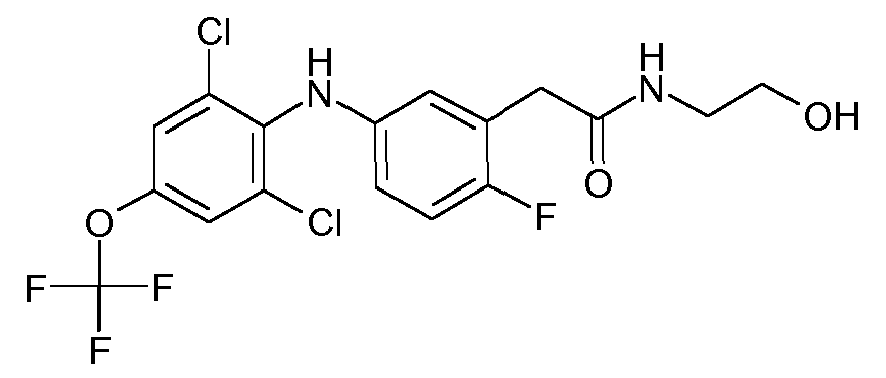
2-[5-(2,6-Dichloro-4-trifluoromethoxy-phenylamino)-2-fluoro-phenyl]-N-(2-hydroxy-ethyl)-acetamide 441 12 
2-[4-(2,6-Dichloro-4-trifluoromethoxy-phenylamino)-phenyl]-N-(2-hydroxy-ethyl)-acetamide 423 13 
5-(2,6-Dichloro-4-trifluoromethyl-phenylamino)-2-fluoro-N-(2-hydroxy-ethyl)-benzamide 413 14 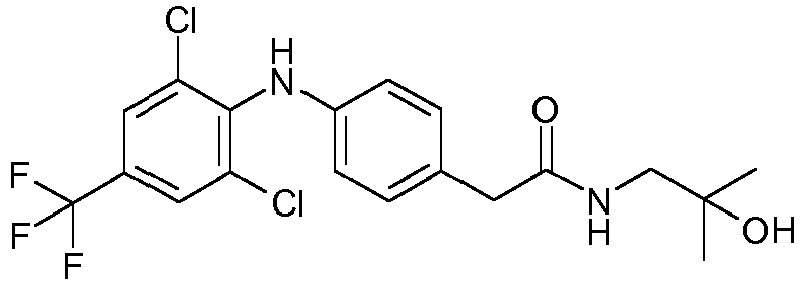
2-[4-(2,6-Dichloro-4-trifluoromethyl-phenylamino)-phenyl]-N-(2-hydroxy-2-methyl-propyl)-acetam ide 435 15 
2-[5-(2,6-Dichloro-4-trifluoromethyl-phenylamino)-2-fluoro-phenyl]-N-(2-hydroxy-2-methyl-propyl)-acetamide 455 16 
2-[5-(2,6-Dichloro-4-trifluoromethyl-phenylamino)-2-fluoro-phenyl]-acetamide 382 17 
2-[5-(2,6-Dichloro-4-trifluoromethyl-phenylamino)-2-fluoro-phenyl]-1-(3-hydroxy-pyrrolidin-1-yl)-ethanone 452 18 
2-[4-(2,6-Dichloro-4-trifluoromethoxy-phenylamino)-2-fluoro-phenyl]-N-(2-hydroxy-ethyl)-propionamide 455 19 
2-[4-(2,6-Dichloro-4-trifluoromethyl-phenylamino)-phenyl]-N-(2-morpholin-4-yl-ethyl)-acetamide 478 20 
2-[5-(2,6-Dichloro-4-trifluoromethyl-phenylamino)-2-fluoro-phenyl]-N-[2-(4,4-difluoro-piperidin-1-yl)-ethyl]-acetamide 529 21 
2-[5-(2,6-Dichloro-4-trifluoromethyl-phenylamino)-2-fluoro-phenyl]-N-(2-pyridin-2-yl-ethyl)-acetamide 487 22 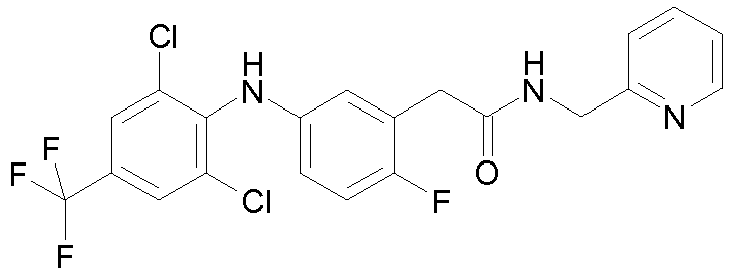
2-[5-(2,6-Dichloro-4-trifluoromethyl-phenylamino)-2-fluoro-phenyl]-N-pyridin-2-ylmethyl-acetamide 473 - The objective of this study was to examine the in vitro effects of the Example compounds on the KCNQ2/KCNQ3 potassium channel current expressed in mammalian cells using the PatchXpress 7000A (Molecular Devices), an automatic parallel patch clamp system. The test compounds were evaluated at 30 µM with this concentration tested in 3 cells (n = 3). The duration of exposure to the test compound concentration was 5 minutes. The compounds were found to produce a concentration-dependent enhancement of the current. Table 1 shows the individual results for the compounds. The results for a positive control, flupirtine (Table 2) confirm the sensitivity of the test system to detect KCNQ2/KCNQ3 current enhancement.
- All experiments were performed at ambient temperature. Each cell acted as its own control.
- A 30µM concentration of test compound was applied via disposable polyethylene micropipette tips to naive cells (n = 2, where n = the number cells). Each solution exchange, performed in quadruplicate, consisted of aspiration and replacement of 45 µL of the total 50 µL volume of the extracellular well of the Sealchip16.
- Vehicle was applied to naive cells (n ≥ 2, where n = the number cells), for a 5 minute exposure interval. Each solution exchange, performed in quadruplicate, consisted of aspiration and replacement of 45 µL of the total 50 µL volume of the extracellular well of the Sealchip16. After vehicle application, the positive control was applied in the same manner, to verify sensitivity of the assay.
- In preparation for a recording session, intracellular solution was loaded into the intracellular compartments of the Sealchip16 planar electrode. Cell suspension was pipetted into the extracellular compartments of the Sealchip16 planar electrode. After establishment of a whole-cell configuration, membrane currents were recorded using dual-channel patch clamp amplifiers in the PatchXpress® system. Before digitization, the current records were low-pass filtered at one-fifth of the sampling frequency.
- Data acquisition and analyses were performed using the suite of pCLAMP programs (Axon Instruments, Union City, CA). Steady state was defined by the limiting constant rate of change with time (linear time dependence). The steady state before and after test article application was used to calculate the percentage of current inhibited at each concentration. Results obtained from different cell were averaged and presented as Mean ± S.D. - see Tables 1 and 2.
Table 1 Test Article ID Conc. (µM) n Mean % Enhancement of KCNQ2/KCNQ3 Example 1 30 3 168.2 Example 2 30 3 162.5 Example 3 30 3 115.8 Example 4 30 3 181.9 -
Table 2 Test Article ID Conc. (µM) n Mean % Enhancement of KCNQ2/ KCNQ3 Flupirtine 10 6 201.0 - It can be seen from the results in Table 1 that the example compounds of the present application showed excellent enhancement of the KCNQ2/KCNQ3 potassium channel current.
Claims (13)
- A compound of formula (I) or a pharmacologically acceptable salt thereof wherein:
 Ar1 and Ar2 are each phenyl;a is an integer of from 0 to 1;R1 is selected from the group consisting of alkyl having from 1 to 4 carbon atoms, halogen, haloalkyl having from 1 to 4 carbon atoms, alkoxy having from 1 to 4 carbon atoms, haloalkoxy having from 1 to 4 carbon atoms, and hydroxyl;b is 3;R2 is selected from the group consisting of halogen, haloalkyl having from 1 to 3 carbon atoms, and haloalkoxy having from 1 to 3 carbon atoms, and where each substituent R2 may be the same or different;W is NR4a, wherein R4a is selected from the group consisting of hydrogen, alkyl having from 1 to 3 carbon atoms and phenyl;Y and Z are each a group of formula (CR5aR5b)n1 wherein each n1 is 0;R5a and R5b are the same or different and each is selected from the group consisting of hydrogen atoms, alkyl groups, cycloalkyl groups, aryl groups and heteroaryl groups;V is (CR3aR3b)pCON(R3b)X, wherein said group is in the 3- (meta) or 4- (para) position with respect to the substituent Z, wherein p is an integer of 0 or 1, R3a and R3b are the same or different and each is selected from the group consisting of hydrogen and alkyl having from 1 to 4 carbon atoms, and X is a substituent selected from the group consisting of hydroxyalkyl having from 1 to 4 carbon atoms, polyalkylene glycol residues of general formula HO-[(CR6aR6b)c1-O-(CR6cR6d)c2]c3- wherein c1 and c2 are the same or different and each is an integer of from 1 to 3, c3 is an integer of from 1 to 10 and R6a, R6b, R6c and R6d may be the same or different and each is a hydrogen atom or an alkyl group having from 1 to 4 carbon atoms.
 - A compound according to claim 1 or a pharmacologically acceptable salt thereof, wherein V is (CR3aR3b)pCON(R3b)X, wherein said group is in the 3- (meta) or 4- (para) position with respect to the substituent Z, wherein p is an integer of 0 or 1, each of R3a and R3b is a hydrogen, and X is selected from the group consisting of alkyl having 1 or 2 carbon atoms which are substituted with hydroxyl.
- A compound according to claim 1 or a pharmacologically acceptable salt thereof, wherein:
V is (CR3aR3b)pCON(R3b)X, wherein said group is in the 3- (meta) position with respect to the substituent Z, wherein p is an integer of 0 or 1, each of R3a and R3b is a hydrogen, and X is selected from the group consisting of an alkyl group having 1 or 2 carbon atoms which are substituted with hydroxyl. - A compound according to claim 1 or a pharmacologically acceptable salt thereof, wherein V is (CR3aR3b)pCON(R3b)X, wherein said group is in the 3- (meta) or 4- (para) position with respect to the substituent Z, wherein p is an integer of 0 or 1, each of R3a and R3b is a hydrogen, and X is selected from the group consisting of polyalkylene glycol residues of general formula HO-[(CR6aR6b)c1-O-(CR6cR6d)c2]c3-wherein c1 and c2 are the same or different and each is an integer of from 1 to 3, c3 is an integer of from 1 to 10 and R6a, R6b, R6c and R6d may be the same or different and each is a hydrogen atom or an alkyl group having from 1 to 4 carbon atoms.
- A compound according to claim 1 or a pharmacologically acceptable salt thereof, wherein V is (CR3aR3b)pCON(R3b)X, wherein said group is in the 3-(meta) position with respect to the substituent Z, wherein p is an integer of 0 or 1, each of R3a and R3b is a hydrogen, and X is selected from the group consisting of polyalkylene glycol residues of general formula HO-[(CR6aR6b)c1-O-(CR6cR6d)c2]c3-wherein c1 and c2 are the same or different and each is an integer of from 1 to 3, c3 is an integer of from 1 to 10 and R6a, R6b, R6c and R6d are each a hydrogen atom or an alkyl group having from 1 to 4 carbon atoms.
- A compound according to claim 1 or a pharmacologically acceptable salt thereof, selected from the group consisting of:N-(2-hydroxyethyl)-2-[3-(2,4,6-trichlorophenylamino)phenyl]acetamide;2-[4-(2,6-dichloro-4-trifluoromethyl-phenylamino)-phenyl]-N-(2-hydroxyethyl)-acetamide;N-(2-hydroxy-ethyl)-2-[4-(2,4,6-trichloro-phenylamino)-phenyl]acetamide;3-(2,6-dichloro-4-trifluoromethyl-phenylamino)-N-(2-hydroxy-ethyl)benzamide;2-[2-fluoro-5-(2,4,6-trichloro-phenylamino)-phenyl]-N-(2-hydroxy-ethyl)acetamide;2-[5-(2,6-dichloro-4-trifluoromethyl-phenylamino)-2-fluoro-phenyl]-N-(2-hydroxy-ethyl)acetamide;2-[5-(2,6-dichloro-4-trifluoromethoxy-phenylamino)-2-fluoro-phenyl]-N-(2-hydroxy-ethyl)acetamide;2-[4-(2,6-dichloro-4-trifluoromethoxy-phenylamino)-phenyl]-N-(2-hydroxy-ethyl)-acetamide;5-(2,6-dichloro-4-trifluoromethyl-phenylamino)-2-fluoro-N-(2-hydroxy-ethyl)-benzamide;2-[4-(2,6-dichloro-4-trifluoromethyl-phenylamino)-phenyl]-N-(2-hydroxy-2-methylpropyl)acetamide;2-[5-(2,6-dichloro-4-trifluoromethyl-phenylamino)-2-fluoro-phenyl]-N-(2-hydroxy-2-methyl-propyl)acetamide; and2-[4-(2,6-dichloro-4-trifluoromethoxy-phenylamino)-2-fluoro-phenyl]-N-(2-hydroxyethyl)propionamide.
- A compound according to claim 4 or a pharmacologically acceptable salt thereof, which is 2-[2-Fluoro-5-(2,4,6-trichloro-phenylamino)-phenyl]-N-(2-hydroxyethyl)-acetamide having the structural formula:

- A pharmaceutical composition comprising a pharmacologically acceptable diluent or carrier and an active ingredient, wherein said active ingredient is a compound according to any one of claims 1 to 7 or a pharmacologically acceptable salt thereof.
- A compound according to any one of claims 1 to 7 or a pharmacologically acceptable salt thereof for use as a medicament.
- A compound according to any one of claims 1 to 7 or a pharmacologically acceptable salt thereof, for use in the prophylaxis or treatment of a condition or disease selected from the group consisting of Anxiety and Anxiety-Related Conditions, Epilepsy, Pain Disorders, Gynaecological Pain, Cardiac Arrhythmias, Thromboembolic Events, Cardiovascular Diseases, Disorders of the Auditory System, Migraine, and Inflammatory and Immunological Diseases.
- A compound according to any one of claims 1 to 7, or a pharmacologically acceptable salt thereof, for use in the prophylaxis or treatment of Lower Urinary Tract Disorders, Gastrointestinal Disorders, Vascular and Visceral Smooth Muscle Disorders, Cell Proliferative Disorders, Metabolic Disorders, Memory Loss, CNS-Mediated Motor Dysfunction Disorders, and/or Ophthalmic Disorders.
- A pharmaceutical composition comprising a pharmacologically acceptable diluent or carrier and at least two active ingredients, wherein said active ingredients comprise at least one compound according to any one of claims 1 to 7, or a pharmacologically acceptable salt thereof in combination with at least one compound selected from the group consisting of muscarinic receptor antagonists, β3 adrenergic receptor agonists, neurokinin K receptor antagonists, vanilloid VR1 agonists, calcium channel α2 δ ligands, potassium channel activators, calcium channel inhibitors, sodium channel blockers, serotonin and norepinephrine reuptake inhibitors (SNRIs), 5-HT antagonists, alpha-1 adrenoceptor antagonists, tricyclic antidepressants, N-methyl-D-aspartate (NMDA) receptor antagonists, cannabinoid receptor agonists, anti-convulsants, aldose reductase inhibitors, opioids, alpha adrenoceptor agonists, P2X receptor antagonists, acid-sensing ion channel modulators, NGF receptor modulators, nicotinic acetylcholine receptor modulators, synaptic vesicle protein 2A ligands and non-steroidal anti-inflammatory drugs (NSAIDs).
- A pharmaceutical composition according to claim 12 for use in the prophylaxis or treatment of Anxiety and Anxiety-Related Conditions, Epilepsy, Pain Disorders, Gynaecological Pain, Cardiac Arrhythmias, Thromboembolic Events, Cardiovascular Diseases, Disorders of the Auditory System, Migraine, Inflammatory and Immunological Diseases, Lower Urinary Tract Disorders, Gastrointestinal Disorders, Vascular and Visceral Smooth Muscle Disorders, Cell Proliferative Disorders, Metabolic Disorders, Memory Loss, CNS-Mediated Motor Dysfunction Disorders, and/or Ophthalmic Disorders.
Applications Claiming Priority (2)
| Application Number | Priority Date | Filing Date | Title |
|---|---|---|---|
| GBGB0813403.3A GB0813403D0 (en) | 2008-07-22 | 2008-07-22 | Potassium ion channel modulators & uses thereof |
| PCT/GB2009/050887 WO2010010380A1 (en) | 2008-07-22 | 2009-07-20 | Potassium ion channel modulators & uses thereof |
Publications (2)
| Publication Number | Publication Date |
|---|---|
| EP2310357A1 EP2310357A1 (en) | 2011-04-20 |
| EP2310357B1 true EP2310357B1 (en) | 2019-09-11 |
Family
ID=39737453
Family Applications (1)
| Application Number | Title | Priority Date | Filing Date |
|---|---|---|---|
| EP09785362.6A Active EP2310357B1 (en) | 2008-07-22 | 2009-07-20 | Potassium ion channel modulators & uses thereof |
Country Status (7)
| Country | Link |
|---|---|
| US (2) | US9464052B2 (en) |
| EP (1) | EP2310357B1 (en) |
| JP (1) | JP2011529037A (en) |
| CN (1) | CN102159535A (en) |
| DK (1) | DK2310357T3 (en) |
| GB (1) | GB0813403D0 (en) |
| WO (1) | WO2010010380A1 (en) |
Cited By (4)
| Publication number | Priority date | Publication date | Assignee | Title |
|---|---|---|---|---|
| US12084458B2 (en) | 2021-02-19 | 2024-09-10 | Sudo Biosciences Limited | Substituted pyridines, pyridazines, and pyrimidines as TYK2 inhibitors |
| US12122785B2 (en) | 2021-02-19 | 2024-10-22 | Sudo Biosciences Limited | Substituted pyridines, pyridazines, pyrimidines, and 1,2,4-triazines as TYK2 inhibitors |
| EP4308544A4 (en) * | 2021-03-19 | 2025-04-30 | Xyzagen, Inc. | Prodrugs of kv7 channel openers |
| US12600721B2 (en) | 2021-02-19 | 2026-04-14 | Sudo Biosciences Limited | TYK2 inhibitors and uses thereof |
Families Citing this family (19)
| Publication number | Priority date | Publication date | Assignee | Title |
|---|---|---|---|---|
| GB0813403D0 (en) | 2008-07-22 | 2008-08-27 | Lectus Therapeutics Ltd | Potassium ion channel modulators & uses thereof |
| US8624063B2 (en) | 2009-06-30 | 2014-01-07 | Wisconsin Alumni Research Foundation | Non-lactone carbocyclic and heterocyclic antagonists and agonists of bacterial quorum sensing |
| JP2013531687A (en) | 2010-07-16 | 2013-08-08 | パーデュー、ファーマ、リミテッド、パートナーシップ | Pyridine compounds as sodium channel blockers |
| EP2616441B1 (en) | 2010-09-17 | 2019-08-07 | Purdue Pharma L.P. | Pyridine compounds and the uses thereof |
| US9376376B2 (en) * | 2012-03-14 | 2016-06-28 | Sinochem Corporation | Substitute diphenylamine compounds use thereof as antitumor agents |
| AU2013203824A1 (en) | 2012-03-16 | 2013-10-03 | Purdue Pharma L.P. | Substituted pyridines and pryimidines as sodium channel blockers |
| WO2014096941A1 (en) | 2012-12-20 | 2014-06-26 | Purdue Pharma L.P. | Cyclic sulfonamides as sodium channel blockers |
| WO2017156519A1 (en) * | 2016-03-11 | 2017-09-14 | The Board Of Trustees Of The University Of Illinois | Small-molecules active against gram-negative bacteria |
| JP7457505B2 (en) | 2017-05-10 | 2024-03-28 | ユニバーシティー オブ ロチェスター | How to treat neuropsychiatric disorders |
| AU2018349376A1 (en) | 2017-10-09 | 2020-05-07 | Ramot At Tel-Aviv University Ltd. | Modulators of potassium ion and TRPV1 channels and uses thereof |
| US10526278B2 (en) | 2017-10-19 | 2020-01-07 | Wisconsin Alumni Research Foundation | Inhibitors of quorum sensing receptor LasR |
| JP2022547083A (en) * | 2019-09-03 | 2022-11-10 | ザルツマン グループ リミテッド | ATP-regulated potassium channel openers containing guanidine and uses thereof |
| AU2020350614A1 (en) * | 2019-09-17 | 2022-03-31 | Biohaven Therapeutics Ltd. | Methods of use for Kv7 channel activators |
| US20230080054A1 (en) * | 2021-01-22 | 2023-03-16 | Ildong Pharmaceutical Co., Ltd. | Inhibitors of anoctamin 6 protein and uses thereof |
| CA3213636A1 (en) | 2021-03-18 | 2022-09-22 | Seagen Inc. | Selective drug release from internalized conjugates of biologically active compounds |
| MX2024007904A (en) | 2021-12-22 | 2024-09-18 | Augustine Therapeutics | COMPOUNDS AND THEIR USE AS HDAC6 INHIBITORS. |
| EP4466261A4 (en) * | 2022-01-18 | 2026-01-07 | Bsense Bio Therapeutics Ltd | MODULATORS OF A POTASSIUM CHANNEL AND OF THE TRPV1 CHANNEL AND USES THEM |
| EP4580679A1 (en) * | 2022-08-30 | 2025-07-09 | Biohaven Therapeutics Ltd. | Combination therapies including metal channel activators and nmda receptor antagonists |
| IT202200024948A1 (en) * | 2022-12-05 | 2024-06-05 | Angelini Pharma S P A | KV7.2/KV7.3 Potassium Channel Activating Compounds |
Citations (6)
| Publication number | Priority date | Publication date | Assignee | Title |
|---|---|---|---|---|
| US5347036A (en) * | 1985-07-22 | 1994-09-13 | Riker Laboratories, Inc. | Substituted di-t-butylphenols |
| WO1999001421A1 (en) * | 1997-07-01 | 1999-01-14 | Warner-Lambert Company | 2-(4-bromo or 4-iodo phenylamino) benzoic acid derivatives and their use as mek inhibitors |
| US20030225076A1 (en) * | 2000-03-15 | 2003-12-04 | Cathlin Biwersi | 5-Amide substituted diarylamines as mex inhibitors |
| WO2004035037A2 (en) * | 2002-10-21 | 2004-04-29 | Ramot At Tel Aviv University Ltd. | Derivatives of n-phenylanthranilic acid and 2-benzimidazolon as potassium channel and/or cortical neuron activity modulators |
| WO2006127133A2 (en) * | 2005-04-01 | 2006-11-30 | Wellstat Therapeutics Corporation | Compounds for the treatment of metabolic disorders |
| EP1880720A1 (en) * | 2005-05-12 | 2008-01-23 | Daiichi Sankyo Company, Limited | Substituted acrylamide derivative and pharmaceutical composition comprising the same |
Family Cites Families (21)
| Publication number | Priority date | Publication date | Assignee | Title |
|---|---|---|---|---|
| US1882286A (en) | 1929-07-17 | 1932-10-11 | Gen Aniline Works Inc | Arylamides of meta-hydroxy-diarylamine-carboxylic acids and process of making same |
| BE590607A (en) | 1960-02-24 | |||
| US3413313A (en) | 1964-06-18 | 1968-11-26 | Parke Davis & Co | Anthranilic acid compounds and methods for their production |
| CA1087186A (en) | 1977-01-21 | 1980-10-07 | Kurt H. G. Pilgram | Cycloalkane-carboxanilides |
| US4181519A (en) * | 1977-01-21 | 1980-01-01 | Shell Oil Company | Diphenylamine derivative herbicides |
| IL86462A (en) | 1987-05-29 | 1992-12-01 | Fujisawa Pharmaceutical Co | Alkanesulfonanilide derivatives, processes for preparation thereof and pharmaceutical compositions comprising the same |
| JPH03278050A (en) | 1990-03-27 | 1991-12-09 | Konica Corp | Silver halide photographic sensitive material |
| JPH0473190A (en) | 1990-07-16 | 1992-03-09 | Konica Corp | Heat-sensitive transfer recording material |
| KR950703280A (en) | 1992-09-09 | 1995-09-20 | 미리암 디.메코너헤이 | Herbicidal Benzene Compounds |
| US6268387B1 (en) | 1997-12-23 | 2001-07-31 | Warner-Lambert Company | Thiourea and benzamide compounds, compositions and methods of treating or preventing inflammatory diseases and atherosclerosis |
| AU2001247372A1 (en) | 2000-03-15 | 2001-09-24 | Warner Lambert Company | 5-amide substituted diarylamines as mex inhibitors |
| FR2836917B1 (en) * | 2002-03-11 | 2006-02-24 | Lipha | NITROSO DIPHENYLAMINE DERIVATIVES, PHARMACEUTICAL COMPOSITIONS CONTAINING SAME AS MEDICAMENTS FOR THE TREATMENT OF DISEASES CHARACTERIZED BY OXIDATIVE STRESS SITUATION |
| AU2003220935A1 (en) | 2002-04-03 | 2003-10-13 | Sumitomo Pharmaceuticals Company, Limited. | Benzamide derivatives |
| CA2528496C (en) | 2003-06-05 | 2011-04-12 | Elan Pharmaceuticals, Inc. | Acylated amino acid amidyl pyrazoles and related compounds |
| US7504401B2 (en) | 2003-08-29 | 2009-03-17 | Locus Pharmaceuticals, Inc. | Anti-cancer agents and uses thereof |
| FR2862965B1 (en) * | 2003-11-27 | 2007-09-07 | Merck Sante Sas | NOVEL PHENOXYACETAMIDE DERIVATIVES AND THEIR USE FOR THE PREPARATION OF DIPHENYLAMIDES. |
| NZ555502A (en) | 2004-12-15 | 2010-12-24 | Dompe Pha R Ma Spa Res & Mfg | 2-arylpropionic acid derivatives and pharmaceutical compositions containing them |
| CA2612976C (en) * | 2005-06-21 | 2012-04-10 | Mitsui Chemicals, Inc. | Amide derivative and insecticide containing the same |
| EP1754483A1 (en) * | 2005-08-18 | 2007-02-21 | Merck Sante | Use of thienopyridone derivatives as AMPK activators and pharmaceutical compositions containing them |
| AP2008004459A0 (en) | 2005-10-06 | 2008-06-30 | Univ Massachusetts | Composition and sythesis of new reagents for inhibition of HIV replication |
| GB0813403D0 (en) | 2008-07-22 | 2008-08-27 | Lectus Therapeutics Ltd | Potassium ion channel modulators & uses thereof |
-
2008
- 2008-07-22 GB GBGB0813403.3A patent/GB0813403D0/en not_active Ceased
-
2009
- 2009-07-20 EP EP09785362.6A patent/EP2310357B1/en active Active
- 2009-07-20 WO PCT/GB2009/050887 patent/WO2010010380A1/en not_active Ceased
- 2009-07-20 JP JP2011519241A patent/JP2011529037A/en active Pending
- 2009-07-20 US US13/054,960 patent/US9464052B2/en active Active
- 2009-07-20 CN CN2009801378414A patent/CN102159535A/en active Pending
- 2009-07-20 DK DK09785362T patent/DK2310357T3/en active
-
2016
- 2016-09-08 US US15/259,064 patent/US9675567B2/en active Active
Patent Citations (6)
| Publication number | Priority date | Publication date | Assignee | Title |
|---|---|---|---|---|
| US5347036A (en) * | 1985-07-22 | 1994-09-13 | Riker Laboratories, Inc. | Substituted di-t-butylphenols |
| WO1999001421A1 (en) * | 1997-07-01 | 1999-01-14 | Warner-Lambert Company | 2-(4-bromo or 4-iodo phenylamino) benzoic acid derivatives and their use as mek inhibitors |
| US20030225076A1 (en) * | 2000-03-15 | 2003-12-04 | Cathlin Biwersi | 5-Amide substituted diarylamines as mex inhibitors |
| WO2004035037A2 (en) * | 2002-10-21 | 2004-04-29 | Ramot At Tel Aviv University Ltd. | Derivatives of n-phenylanthranilic acid and 2-benzimidazolon as potassium channel and/or cortical neuron activity modulators |
| WO2006127133A2 (en) * | 2005-04-01 | 2006-11-30 | Wellstat Therapeutics Corporation | Compounds for the treatment of metabolic disorders |
| EP1880720A1 (en) * | 2005-05-12 | 2008-01-23 | Daiichi Sankyo Company, Limited | Substituted acrylamide derivative and pharmaceutical composition comprising the same |
Non-Patent Citations (3)
| Title |
|---|
| CORSE J W ET AL: "Biosynthesis of penicillins. V. Substituted phenylacetic acid derivatives as penicillin precursors", JOURNAL OF THE AMERICAN CHEMICAL SOCIETY, ACS PUBLICATIONS, US, vol. 70, no. 9, 30 September 1948 (1948-09-30), pages 2837 - 2843, XP002235986, ISSN: 0002-7863, DOI: 10.1021/JA01189A001 * |
| DATABASE REGISTRY [online] CHEMICAL ABSTRACTS SERVICE, COLUMBUS, OHIO, US; 7 November 2003 (2003-11-07), Database accession no. 613654-74-3 * |
| KALGUTKAR A S ET AL: "Amide Derivatives of Meclofenamic Acid as Selective Cyclooxygenase-2 Inhibitors", BIOORGANIC & MEDICINAL CHEMISTRY LETTERS, PERGAMON, AMSTERDAM, NL, vol. 12, 1 January 2002 (2002-01-01), pages 521 - 524, XP002319950, ISSN: 0960-894X, DOI: 10.1016/S0960-894X(01)00792-2 * |
Cited By (6)
| Publication number | Priority date | Publication date | Assignee | Title |
|---|---|---|---|---|
| US12084458B2 (en) | 2021-02-19 | 2024-09-10 | Sudo Biosciences Limited | Substituted pyridines, pyridazines, and pyrimidines as TYK2 inhibitors |
| US12103937B2 (en) | 2021-02-19 | 2024-10-01 | Sudo Biosciences Limited | Substituted pyridines and pyridazines as TYK2 inhibitors |
| US12122785B2 (en) | 2021-02-19 | 2024-10-22 | Sudo Biosciences Limited | Substituted pyridines, pyridazines, pyrimidines, and 1,2,4-triazines as TYK2 inhibitors |
| US12600721B2 (en) | 2021-02-19 | 2026-04-14 | Sudo Biosciences Limited | TYK2 inhibitors and uses thereof |
| EP4308544A4 (en) * | 2021-03-19 | 2025-04-30 | Xyzagen, Inc. | Prodrugs of kv7 channel openers |
| EP4308543A4 (en) * | 2021-03-19 | 2025-04-30 | Xyzagen, Inc. | PRODRUGS OF KV7 CHANNEL OPENERS |
Also Published As
| Publication number | Publication date |
|---|---|
| CN102159535A (en) | 2011-08-17 |
| EP2310357A1 (en) | 2011-04-20 |
| US20110245250A1 (en) | 2011-10-06 |
| US20160374969A1 (en) | 2016-12-29 |
| US9464052B2 (en) | 2016-10-11 |
| US9675567B2 (en) | 2017-06-13 |
| GB0813403D0 (en) | 2008-08-27 |
| DK2310357T3 (en) | 2019-11-25 |
| JP2011529037A (en) | 2011-12-01 |
| WO2010010380A1 (en) | 2010-01-28 |
Similar Documents
| Publication | Publication Date | Title |
|---|---|---|
| US9675567B2 (en) | Potassium ion channel modulators and uses thereof | |
| US8466201B2 (en) | Potassium ion channel modulators and uses thereof | |
| US20090318423A1 (en) | Ion Channel Modulators & Uses Thereof | |
| WO2008149163A2 (en) | Potassium ion channel modulators and uses thereof | |
| CN102639496B (en) | Lysine specific demethylase-1 inhibitors and their use | |
| TWI332500B (en) | Novel compounds | |
| CN101133026B (en) | 1- sulfonyl-pi perdine- 3 -carboxyl i c acid amide derivatives as inhibitors of 11-beta-hydroxysteroid dehydrogenase for the treatment of type ii diabetes mellitus | |
| US8252785B2 (en) | Aryl sulfonamides as bradykinin-B1-receptor antagonists | |
| TW201010690A (en) | Organic compounds | |
| US20090264499A1 (en) | Cathepsin C Inhibitors | |
| CN1249742A (en) | Anti-inflammatory compounds | |
| US8394805B2 (en) | Compounds | |
| JP3731827B2 (en) | Aminomethylindane, -benzofuran and -benzothiophene | |
| TW386988B (en) | Arylbenzoylguanidines, the preparation and pharmaceutical compositions thereof | |
| US20110294775A1 (en) | Novel compounds | |
| US20110166136A1 (en) | Calcium Ion Channel Modulators & Uses Thereof | |
| WO2009133387A1 (en) | Indole- 3 -glyoxylamide derivatives for use as calcium ion channel modulators | |
| US20110077231A1 (en) | Compounds | |
| CN101855213B (en) | Therapeutic compounds | |
| US7638649B2 (en) | Method of preparation of (R)-(−)-5-(2-aminopropyl)-2-methoxybenzenesulfonamide | |
| CN101463019A (en) | Amidine compounds containing aryl, arylmethyl and piperazinyl | |
| NZ554718A (en) | Indoline compound and process for producing the same |
Legal Events
| Date | Code | Title | Description |
|---|---|---|---|
| PUAI | Public reference made under article 153(3) epc to a published international application that has entered the european phase |
Free format text: ORIGINAL CODE: 0009012 |
|
| 17P | Request for examination filed |
Effective date: 20110207 |
|
| AK | Designated contracting states |
Kind code of ref document: A1 Designated state(s): AT BE BG CH CY CZ DE DK EE ES FI FR GB GR HR HU IE IS IT LI LT LU LV MC MK MT NL NO PL PT RO SE SI SK SM TR |
|
| AX | Request for extension of the european patent |
Extension state: AL BA RS |
|
| DAX | Request for extension of the european patent (deleted) | ||
| 17Q | First examination report despatched |
Effective date: 20131217 |
|
| STAA | Information on the status of an ep patent application or granted ep patent |
Free format text: STATUS: EXAMINATION IS IN PROGRESS |
|
| GRAP | Despatch of communication of intention to grant a patent |
Free format text: ORIGINAL CODE: EPIDOSNIGR1 |
|
| STAA | Information on the status of an ep patent application or granted ep patent |
Free format text: STATUS: GRANT OF PATENT IS INTENDED |
|
| INTG | Intention to grant announced |
Effective date: 20190322 |
|
| GRAS | Grant fee paid |
Free format text: ORIGINAL CODE: EPIDOSNIGR3 |
|
| RIN1 | Information on inventor provided before grant (corrected) |
Inventor name: EDWARDS, SIMON DAVID Inventor name: KIMBERLEY, MERIEL RUTH Inventor name: ARMER, RICHARD EDWARD Inventor name: KHAN, NAWAZ MOHAMMED |
|
| GRAA | (expected) grant |
Free format text: ORIGINAL CODE: 0009210 |
|
| STAA | Information on the status of an ep patent application or granted ep patent |
Free format text: STATUS: THE PATENT HAS BEEN GRANTED |
|
| AK | Designated contracting states |
Kind code of ref document: B1 Designated state(s): AT BE BG CH CY CZ DE DK EE ES FI FR GB GR HR HU IE IS IT LI LT LU LV MC MK MT NL NO PL PT RO SE SI SK SM TR |
|
| REG | Reference to a national code |
Ref country code: GB Ref legal event code: FG4D |
|
| REG | Reference to a national code |
Ref country code: CH Ref legal event code: EP |
|
| REG | Reference to a national code |
Ref country code: AT Ref legal event code: REF Ref document number: 1178290 Country of ref document: AT Kind code of ref document: T Effective date: 20190915 |
|
| REG | Reference to a national code |
Ref country code: DE Ref legal event code: R096 Ref document number: 602009059814 Country of ref document: DE Ref country code: IE Ref legal event code: FG4D |
|
| REG | Reference to a national code |
Ref country code: CH Ref legal event code: NV Representative=s name: DENNEMEYER AG, CH |
|
| REG | Reference to a national code |
Ref country code: DK Ref legal event code: T3 Effective date: 20191122 |
|
| REG | Reference to a national code |
Ref country code: SE Ref legal event code: TRGR |
|
| REG | Reference to a national code |
Ref country code: NL Ref legal event code: MP Effective date: 20190911 |
|
| REG | Reference to a national code |
Ref country code: LT Ref legal event code: MG4D |
|
| PG25 | Lapsed in a contracting state [announced via postgrant information from national office to epo] |
Ref country code: LT Free format text: LAPSE BECAUSE OF FAILURE TO SUBMIT A TRANSLATION OF THE DESCRIPTION OR TO PAY THE FEE WITHIN THE PRESCRIBED TIME-LIMIT Effective date: 20190911 Ref country code: HR Free format text: LAPSE BECAUSE OF FAILURE TO SUBMIT A TRANSLATION OF THE DESCRIPTION OR TO PAY THE FEE WITHIN THE PRESCRIBED TIME-LIMIT Effective date: 20190911 Ref country code: FI Free format text: LAPSE BECAUSE OF FAILURE TO SUBMIT A TRANSLATION OF THE DESCRIPTION OR TO PAY THE FEE WITHIN THE PRESCRIBED TIME-LIMIT Effective date: 20190911 Ref country code: NO Free format text: LAPSE BECAUSE OF FAILURE TO SUBMIT A TRANSLATION OF THE DESCRIPTION OR TO PAY THE FEE WITHIN THE PRESCRIBED TIME-LIMIT Effective date: 20191211 Ref country code: BG Free format text: LAPSE BECAUSE OF FAILURE TO SUBMIT A TRANSLATION OF THE DESCRIPTION OR TO PAY THE FEE WITHIN THE PRESCRIBED TIME-LIMIT Effective date: 20191211 |
|
| PG25 | Lapsed in a contracting state [announced via postgrant information from national office to epo] |
Ref country code: LV Free format text: LAPSE BECAUSE OF FAILURE TO SUBMIT A TRANSLATION OF THE DESCRIPTION OR TO PAY THE FEE WITHIN THE PRESCRIBED TIME-LIMIT Effective date: 20190911 Ref country code: GR Free format text: LAPSE BECAUSE OF FAILURE TO SUBMIT A TRANSLATION OF THE DESCRIPTION OR TO PAY THE FEE WITHIN THE PRESCRIBED TIME-LIMIT Effective date: 20191212 Ref country code: ES Free format text: LAPSE BECAUSE OF FAILURE TO SUBMIT A TRANSLATION OF THE DESCRIPTION OR TO PAY THE FEE WITHIN THE PRESCRIBED TIME-LIMIT Effective date: 20190911 |
|
| REG | Reference to a national code |
Ref country code: AT Ref legal event code: MK05 Ref document number: 1178290 Country of ref document: AT Kind code of ref document: T Effective date: 20190911 |
|
| PG25 | Lapsed in a contracting state [announced via postgrant information from national office to epo] |
Ref country code: AT Free format text: LAPSE BECAUSE OF FAILURE TO SUBMIT A TRANSLATION OF THE DESCRIPTION OR TO PAY THE FEE WITHIN THE PRESCRIBED TIME-LIMIT Effective date: 20190911 Ref country code: NL Free format text: LAPSE BECAUSE OF FAILURE TO SUBMIT A TRANSLATION OF THE DESCRIPTION OR TO PAY THE FEE WITHIN THE PRESCRIBED TIME-LIMIT Effective date: 20190911 Ref country code: PL Free format text: LAPSE BECAUSE OF FAILURE TO SUBMIT A TRANSLATION OF THE DESCRIPTION OR TO PAY THE FEE WITHIN THE PRESCRIBED TIME-LIMIT Effective date: 20190911 Ref country code: EE Free format text: LAPSE BECAUSE OF FAILURE TO SUBMIT A TRANSLATION OF THE DESCRIPTION OR TO PAY THE FEE WITHIN THE PRESCRIBED TIME-LIMIT Effective date: 20190911 Ref country code: RO Free format text: LAPSE BECAUSE OF FAILURE TO SUBMIT A TRANSLATION OF THE DESCRIPTION OR TO PAY THE FEE WITHIN THE PRESCRIBED TIME-LIMIT Effective date: 20190911 Ref country code: PT Free format text: LAPSE BECAUSE OF FAILURE TO SUBMIT A TRANSLATION OF THE DESCRIPTION OR TO PAY THE FEE WITHIN THE PRESCRIBED TIME-LIMIT Effective date: 20200113 |
|
| PG25 | Lapsed in a contracting state [announced via postgrant information from national office to epo] |
Ref country code: SM Free format text: LAPSE BECAUSE OF FAILURE TO SUBMIT A TRANSLATION OF THE DESCRIPTION OR TO PAY THE FEE WITHIN THE PRESCRIBED TIME-LIMIT Effective date: 20190911 Ref country code: SK Free format text: LAPSE BECAUSE OF FAILURE TO SUBMIT A TRANSLATION OF THE DESCRIPTION OR TO PAY THE FEE WITHIN THE PRESCRIBED TIME-LIMIT Effective date: 20190911 Ref country code: CZ Free format text: LAPSE BECAUSE OF FAILURE TO SUBMIT A TRANSLATION OF THE DESCRIPTION OR TO PAY THE FEE WITHIN THE PRESCRIBED TIME-LIMIT Effective date: 20190911 Ref country code: IS Free format text: LAPSE BECAUSE OF FAILURE TO SUBMIT A TRANSLATION OF THE DESCRIPTION OR TO PAY THE FEE WITHIN THE PRESCRIBED TIME-LIMIT Effective date: 20200224 |
|
| REG | Reference to a national code |
Ref country code: DE Ref legal event code: R097 Ref document number: 602009059814 Country of ref document: DE |
|
| PLBE | No opposition filed within time limit |
Free format text: ORIGINAL CODE: 0009261 |
|
| STAA | Information on the status of an ep patent application or granted ep patent |
Free format text: STATUS: NO OPPOSITION FILED WITHIN TIME LIMIT |
|
| PG2D | Information on lapse in contracting state deleted |
Ref country code: IS |
|
| PG25 | Lapsed in a contracting state [announced via postgrant information from national office to epo] |
Ref country code: IS Free format text: LAPSE BECAUSE OF FAILURE TO SUBMIT A TRANSLATION OF THE DESCRIPTION OR TO PAY THE FEE WITHIN THE PRESCRIBED TIME-LIMIT Effective date: 20200112 |
|
| 26N | No opposition filed |
Effective date: 20200615 |
|
| PG25 | Lapsed in a contracting state [announced via postgrant information from national office to epo] |
Ref country code: SI Free format text: LAPSE BECAUSE OF FAILURE TO SUBMIT A TRANSLATION OF THE DESCRIPTION OR TO PAY THE FEE WITHIN THE PRESCRIBED TIME-LIMIT Effective date: 20190911 |
|
| PG25 | Lapsed in a contracting state [announced via postgrant information from national office to epo] |
Ref country code: MC Free format text: LAPSE BECAUSE OF FAILURE TO SUBMIT A TRANSLATION OF THE DESCRIPTION OR TO PAY THE FEE WITHIN THE PRESCRIBED TIME-LIMIT Effective date: 20190911 |
|
| REG | Reference to a national code |
Ref country code: DK Ref legal event code: EBP Effective date: 20200731 |
|
| PG25 | Lapsed in a contracting state [announced via postgrant information from national office to epo] |
Ref country code: LU Free format text: LAPSE BECAUSE OF NON-PAYMENT OF DUE FEES Effective date: 20200720 |
|
| PG25 | Lapsed in a contracting state [announced via postgrant information from national office to epo] |
Ref country code: IE Free format text: LAPSE BECAUSE OF NON-PAYMENT OF DUE FEES Effective date: 20200720 Ref country code: DK Free format text: LAPSE BECAUSE OF NON-PAYMENT OF DUE FEES Effective date: 20200731 |
|
| PG25 | Lapsed in a contracting state [announced via postgrant information from national office to epo] |
Ref country code: TR Free format text: LAPSE BECAUSE OF FAILURE TO SUBMIT A TRANSLATION OF THE DESCRIPTION OR TO PAY THE FEE WITHIN THE PRESCRIBED TIME-LIMIT Effective date: 20190911 Ref country code: MT Free format text: LAPSE BECAUSE OF FAILURE TO SUBMIT A TRANSLATION OF THE DESCRIPTION OR TO PAY THE FEE WITHIN THE PRESCRIBED TIME-LIMIT Effective date: 20190911 Ref country code: CY Free format text: LAPSE BECAUSE OF FAILURE TO SUBMIT A TRANSLATION OF THE DESCRIPTION OR TO PAY THE FEE WITHIN THE PRESCRIBED TIME-LIMIT Effective date: 20190911 |
|
| PG25 | Lapsed in a contracting state [announced via postgrant information from national office to epo] |
Ref country code: MK Free format text: LAPSE BECAUSE OF FAILURE TO SUBMIT A TRANSLATION OF THE DESCRIPTION OR TO PAY THE FEE WITHIN THE PRESCRIBED TIME-LIMIT Effective date: 20190911 |
|
| P01 | Opt-out of the competence of the unified patent court (upc) registered |
Effective date: 20230529 |
|
| PGFP | Annual fee paid to national office [announced via postgrant information from national office to epo] |
Ref country code: DE Payment date: 20250722 Year of fee payment: 17 |
|
| PGFP | Annual fee paid to national office [announced via postgrant information from national office to epo] |
Ref country code: IT Payment date: 20250724 Year of fee payment: 17 |
|
| PGFP | Annual fee paid to national office [announced via postgrant information from national office to epo] |
Ref country code: BE Payment date: 20250721 Year of fee payment: 17 Ref country code: GB Payment date: 20250722 Year of fee payment: 17 |
|
| PGFP | Annual fee paid to national office [announced via postgrant information from national office to epo] |
Ref country code: FR Payment date: 20250725 Year of fee payment: 17 |
|
| PGFP | Annual fee paid to national office [announced via postgrant information from national office to epo] |
Ref country code: CH Payment date: 20250801 Year of fee payment: 17 Ref country code: SE Payment date: 20250722 Year of fee payment: 17 |