EP2309760A2 - Method and apparatus for efficiently calculating multiprimary color conversion matrices - Google Patents
Method and apparatus for efficiently calculating multiprimary color conversion matrices Download PDFInfo
- Publication number
- EP2309760A2 EP2309760A2 EP11152390A EP11152390A EP2309760A2 EP 2309760 A2 EP2309760 A2 EP 2309760A2 EP 11152390 A EP11152390 A EP 11152390A EP 11152390 A EP11152390 A EP 11152390A EP 2309760 A2 EP2309760 A2 EP 2309760A2
- Authority
- EP
- European Patent Office
- Prior art keywords
- matrices
- conversion
- color
- color space
- primary
- Prior art date
- Legal status (The legal status is an assumption and is not a legal conclusion. Google has not performed a legal analysis and makes no representation as to the accuracy of the status listed.)
- Granted
Links
Images

Classifications
-
- G—PHYSICS
- G09—EDUCATION; CRYPTOGRAPHY; DISPLAY; ADVERTISING; SEALS
- G09G—ARRANGEMENTS OR CIRCUITS FOR CONTROL OF INDICATING DEVICES USING STATIC MEANS TO PRESENT VARIABLE INFORMATION
- G09G5/00—Control arrangements or circuits for visual indicators common to cathode-ray tube indicators and other visual indicators
- G09G5/10—Intensity circuits
-
- H—ELECTRICITY
- H04—ELECTRIC COMMUNICATION TECHNIQUE
- H04N—PICTORIAL COMMUNICATION, e.g. TELEVISION
- H04N9/00—Details of colour television systems
- H04N9/64—Circuits for processing colour signals
- H04N9/67—Circuits for processing colour signals for matrixing
-
- G—PHYSICS
- G09—EDUCATION; CRYPTOGRAPHY; DISPLAY; ADVERTISING; SEALS
- G09G—ARRANGEMENTS OR CIRCUITS FOR CONTROL OF INDICATING DEVICES USING STATIC MEANS TO PRESENT VARIABLE INFORMATION
- G09G3/00—Control arrangements or circuits, of interest only in connection with visual indicators other than cathode-ray tubes
- G09G3/20—Control arrangements or circuits, of interest only in connection with visual indicators other than cathode-ray tubes for presentation of an assembly of a number of characters, e.g. a page, by composing the assembly by combination of individual elements arranged in a matrix no fixed position being assigned to or needed to be assigned to the individual characters or partial characters
- G09G3/2003—Display of colours
-
- G—PHYSICS
- G09—EDUCATION; CRYPTOGRAPHY; DISPLAY; ADVERTISING; SEALS
- G09G—ARRANGEMENTS OR CIRCUITS FOR CONTROL OF INDICATING DEVICES USING STATIC MEANS TO PRESENT VARIABLE INFORMATION
- G09G5/00—Control arrangements or circuits for visual indicators common to cathode-ray tube indicators and other visual indicators
- G09G5/02—Control arrangements or circuits for visual indicators common to cathode-ray tube indicators and other visual indicators characterised by the way in which colour is displayed
-
- H—ELECTRICITY
- H04—ELECTRIC COMMUNICATION TECHNIQUE
- H04N—PICTORIAL COMMUNICATION, e.g. TELEVISION
- H04N1/00—Scanning, transmission or reproduction of documents or the like, e.g. facsimile transmission; Details thereof
- H04N1/46—Colour picture communication systems
- H04N1/54—Conversion of colour picture signals to a plurality of signals some of which represent particular mixed colours, e.g. for textile printing
-
- H—ELECTRICITY
- H04—ELECTRIC COMMUNICATION TECHNIQUE
- H04N—PICTORIAL COMMUNICATION, e.g. TELEVISION
- H04N1/00—Scanning, transmission or reproduction of documents or the like, e.g. facsimile transmission; Details thereof
- H04N1/46—Colour picture communication systems
- H04N1/56—Processing of colour picture signals
- H04N1/60—Colour correction or control
- H04N1/6016—Conversion to subtractive colour signals
- H04N1/6022—Generating a fourth subtractive colour signal, e.g. under colour removal, black masking
-
- H—ELECTRICITY
- H04—ELECTRIC COMMUNICATION TECHNIQUE
- H04N—PICTORIAL COMMUNICATION, e.g. TELEVISION
- H04N7/00—Television systems
- H04N7/01—Conversion of standards, e.g. involving analogue television standards or digital television standards processed at pixel level
-
- G—PHYSICS
- G09—EDUCATION; CRYPTOGRAPHY; DISPLAY; ADVERTISING; SEALS
- G09G—ARRANGEMENTS OR CIRCUITS FOR CONTROL OF INDICATING DEVICES USING STATIC MEANS TO PRESENT VARIABLE INFORMATION
- G09G2300/00—Aspects of the constitution of display devices
- G09G2300/04—Structural and physical details of display devices
- G09G2300/0439—Pixel structures
- G09G2300/0452—Details of colour pixel setup, e.g. pixel composed of a red, a blue and two green components
-
- G—PHYSICS
- G09—EDUCATION; CRYPTOGRAPHY; DISPLAY; ADVERTISING; SEALS
- G09G—ARRANGEMENTS OR CIRCUITS FOR CONTROL OF INDICATING DEVICES USING STATIC MEANS TO PRESENT VARIABLE INFORMATION
- G09G2340/00—Aspects of display data processing
- G09G2340/06—Colour space transformation
Definitions
- a method for efficiently calculating multiprimary conversion matrices comprising:
- said conversion matrices are 3 x N dimensions wherein N is the number of target multiprimaries.
- said smaller dimensioned matrices are 3 x 3 matrices.
- the step of compressing said conversion matrices further comprises removing duplicate rows of said conversion matrices.
- a processing system for efficiently calculating multiprimary conversion matrices comprising:
- said conversion matrices are 3 x N dimensions wherein N is the number of target multiprimaries.
- said smaller dimensioned matrices are 3 x 3 matrices.
- the system further comprising means for removing duplicate rows of said conversion matrices.
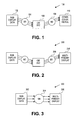
- FIG. 1 shows one embodiment of a general color conversion diagram.
- FIG. 2 shows another embodiment of a general color conversion diagram.
- FIG. 3 shows yet another embodiment of a general color conversion diagram.
- FIG. 4 depicts one embodiment of a gamut pipeline as made in accordance with the principles of the present invention.
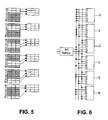
- FIGS. 5 and 6 depict one embodiment of a hardware optimization for implementing an efficient 3*N multiply unit in a multi-primary conversion system.
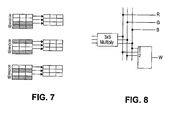
- FIGS. 7 and 8 show yet another embodiment of a hardware optimization for an efficient multiplier for a RGBW system.
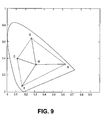
- FIG. 9 depicts one embodiment of a chromaticity diagram for an example multi-primary system with 4 primaries, RGB and C where C is cyan.
- RGB and sRGB sometimes called non-linear RGB or R'G'B'
- three-valued chroma/luminance signals such as YIQ or YCbCr.
- RGB and sRGB sometimes called non-linear RGB or R'G'B'
- YIQ chroma/luminance signals
- YCbCr three-valued chroma/luminance signals
- RGB image data conversion -- treats RGB image data conversion -- as a mapping from one color-space to another. This is commonly done between color output devices, for example converting RGB data intended for a monitor to a form that can be printed on a color printer. The traditional way to do this is to convert a source color image data 102 to CIE XYZ 106, then to convert that to the target color, for perhaps, another color device 110, as in FIG. 1 .
- FIG. 2 calculates a conversion matrix 208 for mapping CIE XYZ data 206 into multi-primary data for rendering on a multi-primary display 210 (i.e. a display having any number of colored subpixels greater than three colors).
- FIG. 3 depicts yet another embodiment 300.
- the matrices for mapping RGB data 302 to CIE XYZ and then from CIE XYZ to multi-primary data for display 306 are combined into one matrix 304 that converts directly from RGB in one step.
- FIG. 4 shows yet another embodiment of a "gamut pipeline" system 400.
- three valued data e.g. sRGB data, RGB, or the like at 402
- some of these steps may not be required or desired.
- the conversion to separate chroma and luma is not desired.
- the input data is sRGB, or RGB data with a nonlinear transform applied to it as in most images stored on computers, then the input gamma step is not desired.
- the intermediate separate chroma/luma space used is CIE Lab, this space has an implied gamma and also includes the input gamma table.
- the general architecture of FIG. 4 is variable to allow a pass-by mode for optional subsystems ⁇ depending upon the requirements of any complete system incorporating the present invention. Alternatively, these optional subsystems could be deleted altogether ⁇ resembling a much simplified system, as shown in FIG. 3 .
- Equation 1 shows a formula for a first conversion that has conversion constants which are all powers of two and thus easy to implement as shifts in hardware.
- Equation 1 Y is the luminance component and By,Ry are the chrominance components.
- the formula for Y is similar to the standard conversion of RGB to luminance; except that red and blue colors are given equal luminance weight.
- Equation 2 describes alternate weighted relationships that are also easy to implement in digital logic.
- Equation 2 Using Equation 2 to convert RGB to chroma/luma is reasonably close for intermediate calculations but can be easily implemented with shifts and adds in hardware. Equation 2 thus gives a transformation from RGB space to a new color-space -- YByRy.
- Multi-primary displays are considered to produce a display that can render more of the colors visible to the human eye than previous, conventional 3-color displays.
- most of the computer images and TV programming that currently exists was created with the assumption of the reduced gamut of TVs and computer monitors.
- One of the assumptions of a gamut converter is that TV cameras, digital cameras, and other input devices do not destroy the expanded gamut of the real world, but compress much of it into the limited gamut that they can represent. Thus, it may be desirable to reconstruct the full gamut in image sources by stretching the gamut back out again.
- This optional gamut conversion block 408 of FIG. 4 is further disclosed in the copending application entitled "GAMUT CONVERSION SYSTEM AND METHODS" and incorporated herein by reference.
- the CIE XYZ color space is versatile in that this color space can encode any color that is visible to a "standard observer” so it essentially encodes all the colors of human vision. Thus, if one has a way to convert any color on your input or output device into CIE XYZ and back, then you can convert to or from any other calibrated device.
- Equation 3 shows the formula for converting from RGB values to XYZ.
- Equation 4 can be solved for (Cr Cg Cb) by inverting the matrix of chromaticity values and multiplying by the white point vector. The resulting Cr Cg and Cb values can then be substituted into Equation 3 creating a matrix that converts from RGB to XYZ. The inverse of that matrix can be used to convert from XYZ to RGB.
- Equations 3 and 4 have square matrices that can be inverted to calculate intermediate values and to calculate reverse transformation matrices.
- inverse operations are problematic.
- the following matrices are depicted transforming RGBC (where "C" is cyan; but any other color may suffice; or, alternatively, any four colors C1,C2, C3, and C4 would suffice) space into XYZ space:
- Equation 6 the matrix is no longer square and cannot be inverted. There are four unknowns and only three equations, not enough information to find a unique solution. In actual fact, there are many solutions and one such solution might suffice if found. There are many different numerical techniques in the literature for finding solutions like this. Just as an example, MathCad uses several of these techniques (linear, conjugate gradient, Levenberg-Marquardt or quasi-Newton) to find numerical solutions.
- Equation 6 is a condition that could be used to do this search.
- Equation 6 when Equation 6 is used as the search condition, the solutions most often found are ones that result in one of the Cr, Cg, Cb or Cc values going to zero. So, it is desirable to find conditions on the equations that would result in solutions other than trivial ones.
- X W 2 Y W 2 Z W 2 x r ⁇ Cr + x g ⁇ Cg + x b ⁇ Cb + x c ⁇ Cc 2 y r ⁇ Cr + y g ⁇ Cg + y b ⁇ Cb + y c ⁇ Cc 2 z r ⁇ Cr + z g ⁇ Cg + z b ⁇ Cb + z c ⁇ Cc 2
- Equation 7 results from taking Equation 6 and symbolically expanding the right side of the equation and squaring the components of both sides. With Equation 7, it should be possible to find results that do not involve one of the primaries going to zero. With Equations 7 and 6 together as conditions for the solution, it is possible to find yet another non-zero solution. There are possibly many (and perhaps an infinite number of) solutions but it suffices to find one of them for the purposes of the present invention. Of course, the present invention encompasses other conditions to find a non-trivial solution and the present invention should not be limited to the recitation of any one or few numbers of such conditions.
- Equation 4 or 5 may fail to find a solution in some of these situations. In that case, it may be desirable to find another condition equation that allows the numerical search algorithm to find a useful solution.
- Equation 5 The solution to equation 5 is a set of Cr, Cg, Cb and Cc values that can be substituted into Equation 3, which can now convert any 4-primary (R G B C in this case) value into CIE XYZ.
- R G B C 4-primary
- Equation 3 The above procedure was demonstrated with a 4-primary system, but this procedure works just as well with any number of primaries. Converting from multi-primary to CIE XYZ is a useful task but what is more useful would be to convert CIE XYZ value into (R G B C) or some other multi-primary system.
- the regions are disjoint ⁇ i.e. it may be possible to define solution matrices for regions that have overlapping color points. For each triangle or region, a matrix for Equation 8 should always be found that converts CIE XYZ to multi-primary inside that triangle or region.
- the regions may be other than triangles for the purpose of the present invention, it is also possible to define another point ⁇ i.e. other than the white point ⁇ in which to calculate solution matrices. In fact, it may be desirable to choose other points that are off-white to in which to calculate solutions ⁇ possibly in regards to backlighting conditions. Of course, for purposes of the present invention, any other point in the interior of the target color space might suffice for suitable solutions matrices for converting to a multi-primary color space.
- the source color space has N primaries and the target color space has N+1 or more primaries ⁇ such that there is less than N primaries in common between the source and the target color spaces (with the extreme case being that there are no primaries in common between the source and the target color spaces).
- Having primaries in common is not a requirement of this invention, since the intermediate colorspace of CIE XYZ is used.
- monitors are typically RGB while printers are typically CMY and yet conversions between the two are routinely done.
- the method for generating conversion equations proceeds as described above.
- the procedure may have to be done twice, once to generate conversion equations to convert the source space to CIE XYZ and a second time to generate conversion equations to convert CIE XYZ to the target color space. Then the resulting matrices can be combined together to do the conversion directly without going through the intermediate CIE space.
- the CIE XYZ tristimulus values of each corner can be calculated using equation 5 above. These three known points can then be used as test conditions in a numerical solver for finding a matrix for Equation 8. On the lines between the triangles, the matrix for the triangle on either side can be used since this line segment is a locus where both transformations are restricted to produce the same results. Each of these matrices will have rows that are unique and rows that repeat (where repeating rows may appear anywhere). Table 1 shows the exemplary matrix for the red-green-white triangle in RGBC color space.
- Table 1 shows this in an extreme case (e.g. RYW triangle in R,Y,G,T,C,B,M ⁇ where T is turquoise and M is magenta) that has 7 primaries.
- the identical rows in Table 3 refer to "outside of the triangle" primaries (i.e. not R and not Y) that are restricted to linearly change from 0 to 1 from the outside edge to the white point. Knowing that many of the values in these matrices will be identical can lead to optimizations in the hardware implementation.
- the storage for the matrix in Table 2 could be reduced, for example.
- the calculation of the multi-primary values could be simplified by knowing that many of the multiplications are done with the same constant values. This will be discussed below as 3xN multiplier hardware optimization.
- the input color values can be converted to some hue based color co-ordinate system and then the hue angle could be used to determine which triangle the color is in.
- the hue angle is something that may be calculated for other reasons, for example it is important to many gamut expansion algorithms. So this information may already be available and could be used to choose the transformation matrix with little or no increase in computational complexity.
- hue angle calculator comes from changing the number of degrees around a circle from 360 to a power of 2 ⁇ e.g. 256. Units of angle having only 256 "degrees" around a circle is easier to implement in hardware. This and other embodiments are disclosed in one of the co-pending, related applications mentioned above.
- RGBW is a display with 4 primaries where three of them are the usual red, green and blue but the fourth primary is pure white. This type of display is of interest because the addition of white can increase the brightness.
- One of the "primaries" is white and lies underneath the white-point. Despite this situation, it is still possible to build a set of multi-primary matrices to convert CIE XYX to RGBW. This is disclosed in yet another co-pending, related application mentioned above.
- FIG. 5 shows one way of reducing the memory required to store the 3xN matrices ⁇ in this case, a six primary system. It was also mentioned above that there would be a way to take advantage of the identical rows in the hardware.
- FIG. 6 shows how this can be done with a 3x3 multiplier and 6 multiplexors for the same 6-primary system. This is just one example, the same savings can be done with any number of primaries. As the number of primaries increases, the number of inexpensive multiplexors increases, but the number of expensive multipliers remains constant at 3x3.
- FIG. 5 is a diagram showing one way to resize a list of 3x6 matrices for converting 3-valued colors for a 6-primary display.
- the top matrix is the one calculated for converting colors that lie inside the RYW triangle (where W is the center white-point).
- the rows for R and Y will have unique rows; while the rest of the rows will be identical. These identical rows are shaded gray to indicate that they are identical.
- the rest of the 3x6 matrix diagrams are for the other five chromaticity triangles and have the rows for the base colors shaded white while the identical rows are shaded gray. Any system can be used to compress these matrices into 3x3 matrices, as long as both of the unique rows are copied along with one of the identical rows.
- FIG. 5 is a diagram showing one way to resize a list of 3x6 matrices for converting 3-valued colors for a 6-primary display.
- the top matrix is the one calculated for converting colors that lie inside the RYW triangle
- FIG. 6 shows how to use the 3x3 matrices from FIG. 5 to perform multi-primary conversions.
- Three valued colors are presented to the 3x3 matrix multiplier and one of the 6 matrices is chosen based on the triangle number of the input color, calculated as described in a related application regarding hue angle calculations.
- the 3x3 matrix multiplier performs the 9 multiplies (and several additions to complete a matrix multiply) and outputs 3 values. These three values are distributed as the 6 output signals by 6 multiplexors.
- the multiplexors also use the chromaticity triangle number as their input to select different values.
- the three multiply results are wired to the 6 multiplexors depending upon the rules used to compact the original multi-primary matrices into 3x3 matrices.
- the rule that the red row is always put in the top row of the 3x3 matrices means that the red multiplexor always selects the first matrix multiplier result.
- the red multiplexor is somewhat unnecessary, but it is left in as an example. It should be appreciated that the same hardware optimization can be applied to an N primary system where N is typical greater than 3.
- FIG. 7 shows the special case for RGBW when W (white) is one of the primaries. Because W is typically contains a row identical to one of the others, it can be removed from the 3x3 matrices. Also in the case of RGBW, only 3 rows remain after removing W and these can be kept in their original order. Because of this, the multiplexors for R G and B are can be removed, as shown in FIG. 8 . Only one multiplexor for W may be desirable to choose the correct value from the other primaries.
- references to functional blocks can be implemented using any combination of hardware and/or software, including components or modules such as one or more memory devices or circuitry.
- a programmable gate array or like circuitry can be configured to implement such functional blocks.
- a microprocessor operating a program in memory can also implement such functional blocks.
Landscapes
- Engineering & Computer Science (AREA)
- Multimedia (AREA)
- Signal Processing (AREA)
- Physics & Mathematics (AREA)
- Computer Hardware Design (AREA)
- General Physics & Mathematics (AREA)
- Theoretical Computer Science (AREA)
- Textile Engineering (AREA)
- Image Processing (AREA)
- Color Image Communication Systems (AREA)
- Processing Of Color Television Signals (AREA)
- Facsimile Image Signal Circuits (AREA)
- Liquid Crystal Display Device Control (AREA)
- Control Of Indicators Other Than Cathode Ray Tubes (AREA)
- Image Generation (AREA)
- Spectrometry And Color Measurement (AREA)
- Compression Of Band Width Or Redundancy In Fax (AREA)
Abstract

Description
- In commonly owned United States Patent Applications: (1) United States Patent Application Serial No.
09/916,232 10/278,353 10/278,352 10/243,094 10/278,328 10/278,393 01/347,001 ("the '001 application") entitled "IMPROVED SUB-PIXEL ARRANGEMENTS FOR STRIPED DISPLAYS AND METHODS AND SYSTEMS FOR SUB-PIXEL RENDERING SAME," filed January 16, 2003, novel sub-pixel arrangements are therein disclosed for improving the cost/performance curves for image display devices and herein incorporated by reference. - For certain subpixel repeating groups having an even number of subpixels in a horizontal direction, the following systems and techniques to affect proper dot inversion schemes are disclosed and are herein incorporated by reference: (1) United States Patent Application Serial Number
10/456,839 10/455,925 10/455,931 10/455,927 10/456,806 10/456,838 - These improvements are particularly pronounced when coupled with sub-pixel rendering (SPR) systems and methods further disclosed in those applications and in commonly owned United States Patent Applications: (1) United States Patent Application Serial No.
10/051,612 10/150,355 U.S. patent application Ser. No. 10/215,843 U.S. patent application Ser. No. 10/379,767 U.S. patent application Ser. No. 10/379,765 U.S. patent application Ser. No. 10/379,766 U.S. patent application Ser. No. 10/409,413 - In a first aspect of the invention, there is provided a method for efficiently calculating multiprimary conversion matrices, the steps of said method comprising:
- calculating a plurality of conversion matrices, wherein each said conversion matrix converts source image data from its chromaticity triangle into a image point in a target color space;
- compressing said conversion matrices into smaller dimensioned matrices, wherein said smaller dimensioned matrices may convert source image data from its chromaticity triangle into a image point in a target color space;
- performing matrix multiplies with said smaller dimensioned matrices on said source image data; and
- multiplexing the results of said multiplies to create multiprimary values.
- Preferably, said conversion matrices are 3 x N dimensions wherein N is the number of target multiprimaries.
- Preferably, said smaller dimensioned matrices are 3 x 3 matrices.
- Preferably, the step of compressing said conversion matrices further comprises removing duplicate rows of said conversion matrices.
- In a second aspect of the invention, there is provided a processing system for efficiently calculating multiprimary conversion matrices, comprising:
- means for calculating a plurality of conversion matrices, wherein each said conversion matrix converts source image data from its chromaticity triangle into a image point in a target color space;
- means for compressing said conversion matrices into smaller dimensioned matrices, wherein said smaller dimensioned matrices may convert source image data from its chromaticity triangle into a image point in a target color space;
- means for performing matrix multiplies with said smaller dimensioned matrices on said source image data; and
- means for multiplexing the results of said multiplies to create multiprimary values.
- Preferably, said conversion matrices are 3 x N dimensions wherein N is the number of target multiprimaries.
- Preferably, said smaller dimensioned matrices are 3 x 3 matrices.
- Preferably, the system further comprising means for removing duplicate rows of said conversion matrices.
- Further aspects of the invention are set forth in the following numbered clauses:
- 1. A method for converting from a source color space to a target color space, said source color space resulting from a combination of N primary color points and said target color space resulting from combination of a N + 1 or more primary color points in said target color space, wherein N is an integer, the method comprising:
- for the target color space, defining a set of at least N + 1 primaries in which color points will be rendered as a combination of said primaries;
- defining a color point in the interior of said target color space;
- dividing said target color space into a set of regions that are bounded by at least three primaries, said one of at least three primaries comprising said interior color point;
- calculating solution matrices for each said region;
- for any given color point in said source color space, calculating which said region the color point lies in and using the calculated region to select one of said solution matrices for rendering said source color point with said target primaries.
- 2. The method of
clause 1 wherein N is 3. - 3. The method of
clause 1 wherein said interior color point is the white point of the target color space. - 4. The method of
clause 1 wherein said interior color point is an off-white color point of the target color space. - 5. The method of
clause 1 wherein said regions are substantially triangles. - 6. The method of
clause 1 wherein the step of calculating solution matrices further comprises calculating a matrix that converts between an intermediate color space and the destination color space for each said region bounded by said at least three primaries. - 7. The method of clause 6 wherein the intermediate color space is CIE XYZ space.
- 8. The method of clause 6 wherein the intermediate color space is the source color space.
- 9. The method of
clause 1 further comprising determining which region said color point resides. - 10. The method of clause 9 wherein the step of determining which region said color point resides further comprises:
- determining the hue angle of said color point; and
- determining from said hue angle which region said color point resides.
- 11. An image processing system for converting from a source color space to a target color space, said source color space resulting from a combination of N primary color points and said target color space resulting from combination of a N + 1 or more primary color points in said target color space, wherein N is an integer, comprising:
- a display for displaying image data in at least one of the source color space and target color space; and
- processing circuitry to define a set of at least N + 1 primaries in which color points will be rendered as a combination of said primaries for the target color space, to define a color point in the interior of said target color space, to divide said target color space into a set of regions that are bounded by at least three primaries, said one of at least three primaries comprising said interior color point, to calculate solution matrices for each said region, to calculate which said region each source color point lies in and using the calculated region to select one of said solution matrices for rendering said source color point with said target primaries for any given color point in said source color space.
- 12. The image processing system of clause 11 wherein N is 3.
- 13. The image processing system of clause 11 wherein said interior color point is the white point of the target color space.
- 14. The image processing system of clause 11 wherein said interior color point is an off-white color point of the target color space.
- 15. The image processing system method of clause 11 wherein said regions are substantially triangles.
- 16. The image processing system of clause 11 wherein the processing circuitry is to choose a matrix to convert between an intermediate color space and said region bounded by said at least three primaries.
- 17. The image processing system of clause 16 wherein the intermediate color space is CIE XYZ space.
- 18. The image processing system of clause 16 wherein the intermediate color space is the source color space.
- 19. The image processing system of clause 11 wherein the processing circuitry is to determine which region said color point resides.
- 20. The image processing system of clause 19 wherein the processing circuitry is to determine the hue angle of said color point and to determine from said hue angle which region said color point resides.
- 21. A system for converting from a source color space to a target color space, wherein said source color space comprises N primary color points and said target color space comprises at least N + 1 primary color points, said system comprising:
- input means for accepting source image data color points;
- a hue angle calculator to calculate hue angles for the source image data color points;
- a gamut converter for optionally fitting the gamut of the source color space to said target color space using the calculated hue angles;
- a multi-primary converter for image data values from the N-primary source color space into image data values for the at least N + 1 primary target space.
- The accompanying drawings, which are incorporated in, and constitute a part of this specification illustrate exemplary implementations and embodiments of the invention and, together with the description, serve to explain principles of the invention.
-
FIG. 1 shows one embodiment of a general color conversion diagram. -
FIG. 2 shows another embodiment of a general color conversion diagram. -
FIG. 3 shows yet another embodiment of a general color conversion diagram. -
FIG. 4 depicts one embodiment of a gamut pipeline as made in accordance with the principles of the present invention. -
FIGS. 5 and 6 depict one embodiment of a hardware optimization for implementing an efficient 3*N multiply unit in a multi-primary conversion system. -
FIGS. 7 and 8 show yet another embodiment of a hardware optimization for an efficient multiplier for a RGBW system. -
FIG. 9 depicts one embodiment of a chromaticity diagram for an example multi-primary system with 4 primaries, RGB and C where C is cyan. - Reference will now be made in detail to implementations and embodiments, examples of which are illustrated in the accompanying drawings. Wherever possible, the same reference numbers will be used throughout the drawings to refer to the same or like parts.
- Most monitors and TVs today were designed to display three-valued color data such as RGB and sRGB (sometimes called non-linear RGB or R'G'B') or three-valued chroma/luminance signals such as YIQ or YCbCr. To make brighter displays and displays with larger color gamuts, manufacturers are starting to consider multi-primary displays. These displays will have more than three primary colors. However, there are no convenient sources of multi-primary image data, and there are a large number of sources of three-valued color data that should be converted to the new multi-primary displays. A method and apparatus is provided to convert existing three valued color data into multi-primary data for this new class of displays. The present method and apparatus will work for multi-primary displays with any number of color primaries.
- One conventional
color conversion system 100 is depicted inFIG. 1 . This approach treats RGB image data conversion -- as a mapping from one color-space to another. This is commonly done between color output devices, for example converting RGB data intended for a monitor to a form that can be printed on a color printer. The traditional way to do this is to convert a sourcecolor image data 102 toCIE XYZ 106, then to convert that to the target color, for perhaps, anothercolor device 110, as inFIG. 1 . There are standard formulas, or conversion matrices (M1 104 and M2 108), to convert common color-spaces, such as RGB, into CIE XYZ and back again. For each output device, a different matrix can convert CIE XYZ for that particular device. - One
embodiment 200 of the present system, as shown inFIG. 2 , calculates aconversion matrix 208 for mapping CIE XYZ data 206 into multi-primary data for rendering on a multi-primary display 210 (i.e. a display having any number of colored subpixels greater than three colors).FIG. 3 depicts yet anotherembodiment 300. In this embodiment, the matrices formapping RGB data 302 to CIE XYZ and then from CIE XYZ to multi-primary data fordisplay 306 are combined into onematrix 304 that converts directly from RGB in one step. - Although the conversion from three-value to multi-primary is depicted as one mathematical step in
FIG. 3 , there may be other desirable steps and/or subsystems in other embodiments.FIG. 4 shows yet another embodiment of a "gamut pipeline"system 400. Thus, for example, in the conversion from three valued data (e.g. sRGB data, RGB, or the like at 402) to multi-primary, it may be desirable to perform one or more of the following steps and/or subsystems, such as aninput gamma 404 andoutput gamma 414, a conversion from RGB to a color-space with separate chroma andluma 406,gamut conversion 408,hue angle converter 410, amultiprimary converter 412. In some embodiments, some of these steps may not be required or desired. For example, if the three-value color input is YCbCr instead of RGB, the conversion to separate chroma and luma is not desired. If the input data is sRGB, or RGB data with a nonlinear transform applied to it as in most images stored on computers, then the input gamma step is not desired. If the intermediate separate chroma/luma space used is CIE Lab, this space has an implied gamma and also includes the input gamma table. Thus, the general architecture ofFIG. 4 is variable to allow a pass-by mode for optional subsystems ― depending upon the requirements of any complete system incorporating the present invention. Alternatively, these optional subsystems could be deleted altogether ― resembling a much simplified system, as shown inFIG. 3 . - Many conventional video devices convert back and forth between RGB and separate chroma/luma color systems. In fact, such a converter is an off-the-shelf item that is readily available for use in hardware implementations. For the purposes of the present invention, such a conventional chroma/luma converter would suffice in the present system. However, in some cases, it may be desirable to design the algorithms and hardware in such a manner as to reduce costs of the design. Also, it may be desirable to calculate the chroma information as part of an intermediate step to calculate a hue angle, as will be discussed in greater detail below. Thus, the information needed may differ or be more easily computed with the present methods and system described herein.
- In a first embodiment of a chroma/luma converter,
Equation 1 shows a formula for a first conversion that has conversion constants which are all powers of two and thus easy to implement as shifts in hardware.
- In
Equation 1, Y is the luminance component and By,Ry are the chrominance components. The formula for Y is similar to the standard conversion of RGB to luminance; except that red and blue colors are given equal luminance weight. For other applications, it may be possible in another embodiment to weight the chroma components differently. It may also be desirable to weight the chroma components in such a way as to simultaneously reduce the cost to implement the system.Equation 2 describes alternate weighted relationships that are also easy to implement in digital logic.
- In
Equation 2, the green value is multiplied by 5/8ths by first multiplying by 4 then adding one more copy, then eventually divided by 8. If done in floating point, this formula would look like: Y=0.25*R+ 0.625*G + 0.125*B. This compares favorably to the REC 709 conversion formula for luminosity: Y=0.2127*R + 0.7152*G + 0.0722*B. Using Equation 2 to convert RGB to chroma/luma is reasonably close for intermediate calculations but can be easily implemented with shifts and adds in hardware.Equation 2 thus gives a transformation from RGB space to a new color-space -- YByRy. - Multi-primary displays are considered to produce a display that can render more of the colors visible to the human eye than previous, conventional 3-color displays. However, most of the computer images and TV programming that currently exists was created with the assumption of the reduced gamut of TVs and computer monitors. One of the assumptions of a gamut converter is that TV cameras, digital cameras, and other input devices do not destroy the expanded gamut of the real world, but compress much of it into the limited gamut that they can represent. Thus, it may be desirable to reconstruct the full gamut in image sources by stretching the gamut back out again. This optional
gamut conversion block 408 ofFIG. 4 is further disclosed in the copending application entitled "GAMUT CONVERSION SYSTEM AND METHODS" and incorporated herein by reference. - Now it will be described a system and a method for generating the matrix for converting from one space (for example, CIE XYZ) to another space for rendering on a multi-primary display. Once such a matrix or mapping (e.g. CIE XYZ to multi-primary) is constructed, it may be combined with other conversion matrices to create a single matrix (for example, via matrix multiplication), so that a separate conversion to an intermediate space (e.g. CIE XYZ) is actually never performed. In one embodiment, if, in an earlier optional step, the input data is converted to YCbCr, there exists a standard matrix for converting this to RGB. There also exists a standard matrix for converting RGB to XYZ. These two matrices can be combined (i.e. multiplied) with the CIE XYZ to multi-primary matrix to create a single matrix that performs a direct conversion from YCbCr to multi-primary.
- As is known, the CIE XYZ color space is versatile in that this color space can encode any color that is visible to a "standard observer" so it essentially encodes all the colors of human vision. Thus, if one has a way to convert any color on your input or output device into CIE XYZ and back, then you can convert to or from any other calibrated device. There are standard transformation matrices for converting from RGB to CIE XYZ and back again. These standard transformation matrices (also known as "recommendations" or "Rec") are based on the typical values of the primary colors and white point of a display device are often good enough for casual color conversions and calculations. Several of these standards are the "CIE Rec 601-1", "CIE Rec 709" or the "CIE XYZ itu". The white points for these recommendations have names like "D50" "D65" or "Illuminant E". Each recommendation has a slightly different chromaticity value for each of the red green and blue primary colors and a different white point value.
- These standard recommendations are approximations and it is considered more accurate to measure the chromaticity values of the primary colors of a specific display model and calculate a transformation matrix tailored for that model of display. To do this, e.g., the chromaticity of each primary color and the CIE XYZ tri-stimulus values of the white point is typically measured. Chromaticity values are pairs of "little x" and "little y" values -- xr,yr for the red primary, xg,yg for the green and xb,yb for the blue. There is a "little z" value as well, but this can be calculated from the x and y values with the formula z = 1-x-y. With just these four pieces of information (three primary chromaticity values and one XYZ white point), it is possible to calculate the transformation matrices as follows:

- Equation 3 shows the formula for converting from RGB values to XYZ. The Cr, Cg and Cb values are linear weighting values that must be calculated for a particular family of displays. Given the white point XYZ values, (Xw Yw Zw) and knowing that this translates into RGB values of (1 1 1), equation 3 can be re-written into the following form:

- Equation 4 can be solved for (Cr Cg Cb) by inverting the matrix of chromaticity values and multiplying by the white point vector. The resulting Cr Cg and Cb values can then be substituted into Equation 3 creating a matrix that converts from RGB to XYZ. The inverse of that matrix can be used to convert from XYZ to RGB.
- Now, in order to convert into a color space with more than three coordinates (i.e. multi-primary space), then additional processing is required. This is primarily because of the fact that Equations 3 and 4 have square matrices that can be inverted to calculate intermediate values and to calculate reverse transformation matrices. However, when there are non-square matrices involved, inverse operations are problematic. For example, the following matrices are depicted transforming RGBC (where "C" is cyan; but any other color may suffice; or, alternatively, any four colors C1,C2, C3, and C4 would suffice) space into XYZ space:


- If we knew the values of (Cr Cg Cb Cc) we would be able to convert from (R G B C) to XYZ. However, in Equation 6, the matrix is no longer square and cannot be inverted. There are four unknowns and only three equations, not enough information to find a unique solution. In actual fact, there are many solutions and one such solution might suffice if found. There are many different numerical techniques in the literature for finding solutions like this. Just as an example, MathCad uses several of these techniques (linear, conjugate gradient, Levenberg-Marquardt or quasi-Newton) to find numerical solutions. Starting from an initial guess for the unknown values ― for one example set Cr, Cg, Cb and Cc all equal to 1 (of course other initial values are sufficient) -- these techniques search for better values until some condition is met. Equation 6 is a condition that could be used to do this search.
- However, when Equation 6 is used as the search condition, the solutions most often found are ones that result in one of the Cr, Cg, Cb or Cc values going to zero. So, it is desirable to find conditions on the equations that would result in solutions other than trivial ones. One embodiment of such a transformation matrix that may avoid this problem is given below:

- Equation 7 results from taking Equation 6 and symbolically expanding the right side of the equation and squaring the components of both sides. With Equation 7, it should be possible to find results that do not involve one of the primaries going to zero. With Equations 7 and 6 together as conditions for the solution, it is possible to find yet another non-zero solution. There are possibly many (and perhaps an infinite number of) solutions but it suffices to find one of them for the purposes of the present invention. Of course, the present invention encompasses other conditions to find a non-trivial solution and the present invention should not be limited to the recitation of any one or few numbers of such conditions.
- When we have actual displays -- displays with different primaries or displays with more than four primaries -- then either Equation 4 or 5 may fail to find a solution in some of these situations. In that case, it may be desirable to find another condition equation that allows the numerical search algorithm to find a useful solution.
- The solution to equation 5 is a set of Cr, Cg, Cb and Cc values that can be substituted into Equation 3, which can now convert any 4-primary (R G B C in this case) value into CIE XYZ. The above procedure was demonstrated with a 4-primary system, but this procedure works just as well with any number of primaries. Converting from multi-primary to CIE XYZ is a useful task but what is more useful would be to convert CIE XYZ value into (R G B C) or some other multi-primary system.
- The matrix in Equation 5 is not square so it cannot be inverted and the equation cannot be simply solved to convert from CIE XYZ. Of course, if the matrix could be inverted, the result would look similar to this:

- Although the solution cannot be solved for by inverting a matrix, it is possible to glean an inverse equation and it should be able to test to see if the transformation matrix is a correct one. One embodiment might be to convert all the primary colors to CIE XYZ using equation 5. In the case of a 4-primary system, we would then have five known input and output values (4 primaries plus the white point) and could use them as condition equations. However, this may be difficult because there may be too many restrictions on the system to find a linear solution. The analogous situation might be to find a single straight line through a collection of points. In the case of solving Equation 8, we are trying to find a linear equation, a plane that passes through all of our primary points and the white point in a 4 dimensional space. There will always be a plane that passed through three of these points, but if trying to fmd one through all the points may be difficult.
- However, given that there is always a solution to the case with three points, it is possible to formulate a general way to convert from CIE XYZ to any multi-primary system. It is possible to find a matrix for Equation 8 that works if the image data point is inside a chromaticity triangle ― for example, between the red, green and white point. Likewise, a matrix for Equation 8 may be found that works for a point is inside the chromaticity triangle between the green, cyan, and white point, etc., e.g., as shown in
FIG. 9 . In general, no matter how many primaries a system has, it should be possible to break the color space down into regions (for example, triangles or some other shapes) that are bounded by the white point and two primaries. Additionally, it may not be required that the regions are disjoint ― i.e. it may be possible to define solution matrices for regions that have overlapping color points. For each triangle or region, a matrix for Equation 8 should always be found that converts CIE XYZ to multi-primary inside that triangle or region. - In addition to the fact that the regions may be other than triangles for the purpose of the present invention, it is also possible to define another point ― i.e. other than the white point ― in which to calculate solution matrices. In fact, it may be desirable to choose other points that are off-white to in which to calculate solutions ― possibly in regards to backlighting conditions. Of course, for purposes of the present invention, any other point in the interior of the target color space might suffice for suitable solutions matrices for converting to a multi-primary color space.
- For yet another embodiment, it is possible that the source color space has N primaries and the target color space has N+1 or more primaries ― such that there is less than N primaries in common between the source and the target color spaces (with the extreme case being that there are no primaries in common between the source and the target color spaces). Having primaries in common is not a requirement of this invention, since the intermediate colorspace of CIE XYZ is used. For example, monitors are typically RGB while printers are typically CMY and yet conversions between the two are routinely done. In the case of N source primaries and N+1 or more target primaries, the method for generating conversion equations proceeds as described above. Because there may not be standard recommended conversion equations for the source color space, the procedure may have to be done twice, once to generate conversion equations to convert the source space to CIE XYZ and a second time to generate conversion equations to convert CIE XYZ to the target color space. Then the resulting matrices can be combined together to do the conversion directly without going through the intermediate CIE space.
- For each triangle, the CIE XYZ tristimulus values of each corner can be calculated using equation 5 above. These three known points can then be used as test conditions in a numerical solver for finding a matrix for Equation 8. On the lines between the triangles, the matrix for the triangle on either side can be used since this line segment is a locus where both transformations are restricted to produce the same results. Each of these matrices will have rows that are unique and rows that repeat (where repeating rows may appear anywhere). Table 1 shows the exemplary matrix for the red-green-white triangle in RGBC color space.
2.166792 -0.850238 -0.192135 4.962725 -4.231465 0.47251 -1.778663 3.483939 -0.728554 -4.849038 9.749895 -3.802703 0.024661 -0.175291 1.057744 -0.04661 0.003508 0.955759 0.024661 -0.175291 1.057744 -0.04661 0.003508 0.955759 Table 1 -0.04661 0.003508 0.955759 -0.04661 0.003508 0.955759 -0.04661 0.003508 0.955759 Table 2 - In this Table 1, it should be noted that the rows that are not related to the primary corners of the associated triangle are identical. This will generally be true of any matrix generated this way for any primary system. Table 2 shows this in an extreme case (e.g. RYW triangle in R,Y,G,T,C,B,M ―where T is turquoise and M is magenta) that has 7 primaries. The identical rows in Table 3 refer to "outside of the triangle" primaries (i.e. not R and not Y) that are restricted to linearly change from 0 to 1 from the outside edge to the white point. Knowing that many of the values in these matrices will be identical can lead to optimizations in the hardware implementation. The storage for the matrix in Table 2 could be reduced, for example. Also the calculation of the multi-primary values could be simplified by knowing that many of the multiplications are done with the same constant values. This will be discussed below as 3xN multiplier hardware optimization.
- To convert a CIE XYZ value to multi-primary, it is desirable to determine which chromaticity triangle the color is in and use the corresponding matrix to do the conversion in Equation 8. The XYZ values can be converted to xyY chromaticity and then tested against the original chromaticity co-ordinates. Although this works well, it could be computationally very expensive to do at full speed in a monitor. In another embodiment, there is a single 3x3 matrix multiply that could determine if a point is in a triangle. This is also computationally intensive, but may be reasonable in some architectures where this is a common operation. Graphics adapter cards for PC computers often have this capability as part of their texture mapping capability. The input color values can be converted to some hue based color co-ordinate system and then the hue angle could be used to determine which triangle the color is in. The hue angle is something that may be calculated for other reasons, for example it is important to many gamut expansion algorithms. So this information may already be available and could be used to choose the transformation matrix with little or no increase in computational complexity.
- When doing multi-primary conversion as described above, it was desirable to calculate the hue angle and use it as an index to select a conversion matrix. One improved embodiment of a hue angle calculator comes from changing the number of degrees around a circle from 360 to a power of 2 ― e.g. 256. Units of angle having only 256 "degrees" around a circle is easier to implement in hardware. This and other embodiments are disclosed in one of the co-pending, related applications mentioned above.
- RGBW is a display with 4 primaries where three of them are the usual red, green and blue but the fourth primary is pure white. This type of display is of interest because the addition of white can increase the brightness. One of the "primaries" is white and lies underneath the white-point. Despite this situation, it is still possible to build a set of multi-primary matrices to convert CIE XYX to RGBW. This is disclosed in yet another co-pending, related application mentioned above.
- As mentioned in connection with Tables 1 and 2 above,
FIG. 5 shows one way of reducing the memory required to store the 3xN matrices ― in this case, a six primary system. It was also mentioned above that there would be a way to take advantage of the identical rows in the hardware.FIG. 6 shows how this can be done with a 3x3 multiplier and 6 multiplexors for the same 6-primary system. This is just one example, the same savings can be done with any number of primaries. As the number of primaries increases, the number of inexpensive multiplexors increases, but the number of expensive multipliers remains constant at 3x3. -
FIG. 5 is a diagram showing one way to resize a list of 3x6 matrices for converting 3-valued colors for a 6-primary display. The top matrix is the one calculated for converting colors that lie inside the RYW triangle (where W is the center white-point). The rows for R and Y will have unique rows; while the rest of the rows will be identical. These identical rows are shaded gray to indicate that they are identical. The rest of the 3x6 matrix diagrams are for the other five chromaticity triangles and have the rows for the base colors shaded white while the identical rows are shaded gray. Any system can be used to compress these matrices into 3x3 matrices, as long as both of the unique rows are copied along with one of the identical rows. InFIG. 5 , several other rules are used, but these are arbitrary as long as the connections to the multiplexors inFIG. 6 , as described below, are changed to match. The arbitrary rules used inFIG. 5 are that the red row is always copied to the top of the 3x3 matrix, and the rows copied are kept in their original order. -
FIG. 6 shows how to use the 3x3 matrices fromFIG. 5 to perform multi-primary conversions. Three valued colors are presented to the 3x3 matrix multiplier and one of the 6 matrices is chosen based on the triangle number of the input color, calculated as described in a related application regarding hue angle calculations. The 3x3 matrix multiplier performs the 9 multiplies (and several additions to complete a matrix multiply) and outputs 3 values. These three values are distributed as the 6 output signals by 6 multiplexors. The multiplexors also use the chromaticity triangle number as their input to select different values. The three multiply results are wired to the 6 multiplexors depending upon the rules used to compact the original multi-primary matrices into 3x3 matrices. For example, the rule that the red row is always put in the top row of the 3x3 matrices means that the red multiplexor always selects the first matrix multiplier result. Thus, the red multiplexor is somewhat unnecessary, but it is left in as an example. It should be appreciated that the same hardware optimization can be applied to an N primary system where N is typical greater than 3. -
FIG. 7 shows the special case for RGBW when W (white) is one of the primaries. Because W is typically contains a row identical to one of the others, it can be removed from the 3x3 matrices. Also in the case of RGBW, only 3 rows remain after removing W and these can be kept in their original order. Because of this, the multiplexors for R G and B are can be removed, as shown inFIG. 8 . Only one multiplexor for W may be desirable to choose the correct value from the other primaries. - In the above embodiments, reference to functional blocks can be implemented using any combination of hardware and/or software, including components or modules such as one or more memory devices or circuitry. For example, a programmable gate array or like circuitry can be configured to implement such functional blocks. In other examples, a microprocessor operating a program in memory can also implement such functional blocks.
- While the invention has been described with reference to an exemplary embodiment, it will be understood by those skilled in the art that various changes may be made and equivalents may be substituted for elements thereof without departing from the scope of the invention. In addition, many modifications may be made to adapt a particular situation or material to the teachings without departing from the essential scope thereof. Therefore, it is intended that the invention not be limited to the particular embodiment disclosed as the best mode contemplated for carrying out this invention, but that the invention will include all embodiments falling within the scope of the appended claims.
Claims (8)
- A method for efficiently calculating multiprimary conversion matrices, the steps of said method comprising:calculating a plurality of conversion matrices, wherein each said conversion matrix converts source image data from its chromaticity triangle into a image point in a target color space;compressing said conversion matrices into smaller dimensioned matrices, wherein said smaller dimensioned matrices may convert source image data from its chromaticity triangle into a image point in a target color space;performing matrix multiplies with said smaller dimensioned matrices on said source image data; andmultiplexing the results of said multiplies to create multiprimary values.
- The method of claim 1 wherein said conversion matrices are 3 x N dimensions wherein N is the number of target multiprimaries.
- The method of claim 1 wherein said smaller dimensioned matrices are 3 x 3 matrices.
- The method of claim 1 wherein the step of compressing said conversion matrices further comprises removing duplicate rows of said conversion matrices.
- A processing system for efficiently calculating multiprimary conversion matrices, comprising:means for calculating a plurality of conversion matrices, wherein each said conversion matrix converts source image data from its chromaticity triangle into a image point in a target color space;means for compressing said conversion matrices into smaller dimensioned matrices, wherein said smaller dimensioned matrices may convert source image data from its chromaticity triangle into a image point in a target color space;means for performing matrix multiplies with said smaller dimensioned matrices on said source image data; andmeans for multiplexing the results of said multiplies to create multiprimary values.
- The processing system of claim 5 wherein said conversion matrices are 3 x N dimensions wherein N is the number of target multiprimaries.
- The processing system of claim 5 wherein said smaller dimensioned matrices are 3 x 3 matrices.
- The processing system of claim 5 further comprising means for removing duplicate rows of said conversion matrices.
Applications Claiming Priority (2)
| Application Number | Priority Date | Filing Date | Title |
|---|---|---|---|
| US10/691,396 US7598961B2 (en) | 2003-10-21 | 2003-10-21 | method and apparatus for converting from a source color space to a target color space |
| EP04794937.5A EP1676254B1 (en) | 2003-10-21 | 2004-10-12 | Method and apparatus for converting from a source color space to a target color space |
Related Parent Applications (3)
| Application Number | Title | Priority Date | Filing Date |
|---|---|---|---|
| EP04794937.5 Division | 2004-10-12 | ||
| EP04794937.5A Division EP1676254B1 (en) | 2003-10-21 | 2004-10-12 | Method and apparatus for converting from a source color space to a target color space |
| EP04794937.5A Division-Into EP1676254B1 (en) | 2003-10-21 | 2004-10-12 | Method and apparatus for converting from a source color space to a target color space |
Publications (3)
| Publication Number | Publication Date |
|---|---|
| EP2309760A2 true EP2309760A2 (en) | 2011-04-13 |
| EP2309760A3 EP2309760A3 (en) | 2011-04-20 |
| EP2309760B1 EP2309760B1 (en) | 2015-05-20 |
Family
ID=34521869
Family Applications (2)
| Application Number | Title | Priority Date | Filing Date |
|---|---|---|---|
| EP20110152390 Expired - Lifetime EP2309760B1 (en) | 2003-10-21 | 2004-10-12 | Method and apparatus for efficiently calculating multiprimary color conversion matrices |
| EP04794937.5A Expired - Lifetime EP1676254B1 (en) | 2003-10-21 | 2004-10-12 | Method and apparatus for converting from a source color space to a target color space |
Family Applications After (1)
| Application Number | Title | Priority Date | Filing Date |
|---|---|---|---|
| EP04794937.5A Expired - Lifetime EP1676254B1 (en) | 2003-10-21 | 2004-10-12 | Method and apparatus for converting from a source color space to a target color space |
Country Status (7)
| Country | Link |
|---|---|
| US (1) | US7598961B2 (en) |
| EP (2) | EP2309760B1 (en) |
| JP (1) | JP4705917B2 (en) |
| KR (1) | KR101095636B1 (en) |
| CN (1) | CN101076848B (en) |
| TW (1) | TWI289274B (en) |
| WO (1) | WO2005043498A2 (en) |
Cited By (1)
| Publication number | Priority date | Publication date | Assignee | Title |
|---|---|---|---|---|
| RU2711121C1 (en) * | 2018-08-14 | 2020-01-15 | Александр Георгиевич Носков | Complex of four-color digital television full colours |
Families Citing this family (156)
| Publication number | Priority date | Publication date | Assignee | Title |
|---|---|---|---|---|
| US20030128389A1 (en) | 2001-12-26 | 2003-07-10 | Eastman Kodak Company | Method for creating and using affective information in a digital imaging system cross reference to related applications |
| US7728846B2 (en) | 2003-10-21 | 2010-06-01 | Samsung Electronics Co., Ltd. | Method and apparatus for converting from source color space to RGBW target color space |
| US7598961B2 (en) | 2003-10-21 | 2009-10-06 | Samsung Electronics Co., Ltd. | method and apparatus for converting from a source color space to a target color space |
| US7176935B2 (en) * | 2003-10-21 | 2007-02-13 | Clairvoyante, Inc. | Gamut conversion system and methods |
| JP4549881B2 (en) * | 2004-03-18 | 2010-09-22 | シャープ株式会社 | Color signal conversion apparatus, display unit, color signal conversion program, and computer-readable recording medium recording the color signal conversion program |
| US7619637B2 (en) * | 2004-04-09 | 2009-11-17 | Samsung Electronics Co., Ltd. | Systems and methods for improved gamut mapping from one image data set to another |
| US7248268B2 (en) * | 2004-04-09 | 2007-07-24 | Clairvoyante, Inc | Subpixel rendering filters for high brightness subpixel layouts |
| US7301543B2 (en) * | 2004-04-09 | 2007-11-27 | Clairvoyante, Inc. | Systems and methods for selecting a white point for image displays |
| KR20050120958A (en) * | 2004-06-21 | 2005-12-26 | 삼성전자주식회사 | Color signal processing method for wide color gamut reproducing device and apparatus of using the same |
| KR100691466B1 (en) * | 2004-09-20 | 2007-03-09 | 삼성전자주식회사 | Method and device for adjusting color and brightness in image display device |
| US20060066557A1 (en) * | 2004-09-27 | 2006-03-30 | Floyd Philip D | Method and device for reflective display with time sequential color illumination |
| US7710632B2 (en) * | 2004-09-27 | 2010-05-04 | Qualcomm Mems Technologies, Inc. | Display device having an array of spatial light modulators with integrated color filters |
| US7525730B2 (en) | 2004-09-27 | 2009-04-28 | Idc, Llc | Method and device for generating white in an interferometric modulator display |
| US8362987B2 (en) * | 2004-09-27 | 2013-01-29 | Qualcomm Mems Technologies, Inc. | Method and device for manipulating color in a display |
| US8102407B2 (en) * | 2004-09-27 | 2012-01-24 | Qualcomm Mems Technologies, Inc. | Method and device for manipulating color in a display |
| US7911428B2 (en) * | 2004-09-27 | 2011-03-22 | Qualcomm Mems Technologies, Inc. | Method and device for manipulating color in a display |
| US20060077148A1 (en) * | 2004-09-27 | 2006-04-13 | Gally Brian J | Method and device for manipulating color in a display |
| US8031133B2 (en) * | 2004-09-27 | 2011-10-04 | Qualcomm Mems Technologies, Inc. | Method and device for manipulating color in a display |
| JP4938761B2 (en) * | 2005-04-04 | 2012-05-23 | コーニンクレッカ フィリップス エレクトロニクス エヌ ヴィ | How to convert signals for multi-primary displays |
| CN101171594A (en) * | 2005-04-04 | 2008-04-30 | 克雷沃耶提公司 | Systems and methods for implementing low-cost full-range mapping algorithms |
| CN1882103B (en) | 2005-04-04 | 2010-06-23 | 三星电子株式会社 | Systems and methods for implementing improved color gamut mapping algorithms |
| EP2372609A3 (en) | 2005-05-20 | 2011-11-30 | Samsung Electronics Co., Ltd. | Multiprimary color subpixel rendering with metameric filtering |
| US20070035752A1 (en) * | 2005-08-15 | 2007-02-15 | Microsoft Corporation | Hardware-accelerated color data processing |
| JP4976782B2 (en) * | 2005-09-07 | 2012-07-18 | キヤノン株式会社 | Signal processing method, image display device, and television device |
| KR101182298B1 (en) * | 2005-09-12 | 2012-09-20 | 엘지디스플레이 주식회사 | Apparatus and method for driving liquid crystal display device |
| US7636076B2 (en) * | 2005-09-22 | 2009-12-22 | Au Optronics Corporation | Four-color transflective color liquid crystal display |
| EP2472507B1 (en) | 2005-10-14 | 2016-02-10 | Samsung Display Co., Ltd. | Improved gamut mapping and subpixel rendering systems and methods |
| JP2007116288A (en) * | 2005-10-18 | 2007-05-10 | Seiko Epson Corp | Image processing apparatus, image processing method, and image processing program |
| WO2007056541A2 (en) * | 2005-11-08 | 2007-05-18 | Young Garrett J | Apparatus and method for generating light from multi - primary colors |
| KR101364076B1 (en) * | 2005-11-09 | 2014-02-26 | 코닌클리케 필립스 엔.브이. | A method and apparatus processing pixel signals for driving a display and a display using the same |
| US7746411B1 (en) * | 2005-12-07 | 2010-06-29 | Marvell International Ltd. | Color management unit |
| US8107762B2 (en) | 2006-03-17 | 2012-01-31 | Qualcomm Incorporated | Systems, methods, and apparatus for exposure control |
| US8004743B2 (en) * | 2006-04-21 | 2011-08-23 | Qualcomm Mems Technologies, Inc. | Method and apparatus for providing brightness control in an interferometric modulator (IMOD) display |
| WO2007143340A2 (en) | 2006-06-02 | 2007-12-13 | Clairvoyante, Inc | High dynamic contrast display system having multiple segmented backlight |
| US8018476B2 (en) | 2006-08-28 | 2011-09-13 | Samsung Electronics Co., Ltd. | Subpixel layouts for high brightness displays and systems |
| US7876341B2 (en) * | 2006-08-28 | 2011-01-25 | Samsung Electronics Co., Ltd. | Subpixel layouts for high brightness displays and systems |
| CN101529496B (en) | 2006-10-19 | 2012-01-11 | 皇家飞利浦电子股份有限公司 | Color mapping method, system and display device |
| US8305391B2 (en) | 2006-11-27 | 2012-11-06 | Texas Instruments Incorporated | System and method to generate multiprimary signals |
| EP2095353B1 (en) * | 2006-12-20 | 2019-05-01 | Signify Holding B.V. | Lighting device with multiple primary colors |
| US20080151193A1 (en) * | 2006-12-26 | 2008-06-26 | Texas Instruments Incorporated | Stereoscopic imaging systems utilizing solid-state illumination and passive glasses |
| US20100188443A1 (en) * | 2007-01-19 | 2010-07-29 | Pixtronix, Inc | Sensor-based feedback for display apparatus |
| JP5235901B2 (en) | 2007-02-13 | 2013-07-10 | 三星ディスプレイ株式會社 | Subpixel layout and subpixel rendering method and system for directional display devices |
| US9083943B2 (en) * | 2007-06-04 | 2015-07-14 | Sri International | Method for generating test patterns for detecting and quantifying losses in video equipment |
| US7567370B2 (en) * | 2007-07-26 | 2009-07-28 | Hewlett-Packard Development Company, L.P. | Color display having layer dependent spatial resolution and related method |
| FR2921785A1 (en) * | 2007-10-01 | 2009-04-03 | Thomson Licensing Sas | SYSTEM FOR DISPLAYING IMAGES WITH FOUR PRIMARY COLORS FROM VIDEO DATA BASED ON THREE PRIMARY COLORS. |
| US8295594B2 (en) | 2007-10-09 | 2012-10-23 | Samsung Display Co., Ltd. | Systems and methods for selective handling of out-of-gamut color conversions |
| FR2923067B1 (en) * | 2007-10-25 | 2010-05-21 | St Microelectronics Grenoble | METHOD FOR PROCESSING A DIGITAL VIDEO STREAM AND CORRESPONDING DEVICE. |
| KR101397398B1 (en) * | 2008-01-14 | 2014-05-22 | 삼성전자주식회사 | System and method for converting rgb-to-rgbw according to gamut of rgbw output display |
| CN101521001B (en) * | 2008-02-26 | 2011-04-27 | 瑞昱半导体股份有限公司 | Color correction method and device for display device |
| EP2120448A1 (en) | 2008-05-14 | 2009-11-18 | Thomson Licensing | Method of processing of a compressed image into a gamut mapped image using spatial frequency analysis |
| JP2010014843A (en) * | 2008-07-02 | 2010-01-21 | Sony Corp | Display unit |
| US8638858B2 (en) | 2008-07-08 | 2014-01-28 | Intellectual Ventures Fund 83 Llc | Method, apparatus and system for converging images encoded using different standards |
| TWI388222B (en) * | 2008-08-20 | 2013-03-01 | Chunghwa Picture Tubes Ltd | Device for adjusting white balance in a field sequential display and method thereof |
| TWI402822B (en) * | 2008-10-07 | 2013-07-21 | Au Optronics Corp | Driving method of a display |
| TWI384888B (en) * | 2008-10-09 | 2013-02-01 | Asustek Comp Inc | Method and module for regulating luminance |
| TWI458357B (en) * | 2008-10-09 | 2014-10-21 | Asustek Comp Inc | Method and module for regulating color distribution |
| US8497871B2 (en) * | 2008-10-21 | 2013-07-30 | Zulch Laboratories, Inc. | Color generation using multiple illuminant types |
| KR101093258B1 (en) * | 2009-11-12 | 2011-12-14 | 삼성모바일디스플레이주식회사 | LCD Display |
| WO2011115169A1 (en) * | 2010-03-18 | 2011-09-22 | シャープ株式会社 | Multi-primary color liquid crystal panel drive circuit, multi-primary color liquid crystal panel drive method, liquid crystal display device and overdrive setting method |
| JP2013525955A (en) | 2010-04-16 | 2013-06-20 | フレックス ライティング 2,エルエルシー | Lighting device with film-based light guide |
| KR101821727B1 (en) | 2010-04-16 | 2018-01-24 | 플렉스 라이팅 투 엘엘씨 | Front illumination device comprising a film-based lightguide |
| US8848294B2 (en) | 2010-05-20 | 2014-09-30 | Qualcomm Mems Technologies, Inc. | Method and structure capable of changing color saturation |
| US9245471B2 (en) | 2010-07-06 | 2016-01-26 | Sharp Kabushiki Kaisha | Multiple-primary color liquid crystal display apparatus |
| US8743023B2 (en) | 2010-07-23 | 2014-06-03 | Biological Illumination, Llc | System for generating non-homogenous biologically-adjusted light and associated methods |
| US9532423B2 (en) | 2010-07-23 | 2016-12-27 | Lighting Science Group Corporation | System and methods for operating a lighting device |
| US8686641B2 (en) | 2011-12-05 | 2014-04-01 | Biological Illumination, Llc | Tunable LED lamp for producing biologically-adjusted light |
| US9827439B2 (en) | 2010-07-23 | 2017-11-28 | Biological Illumination, Llc | System for dynamically adjusting circadian rhythm responsive to scheduled events and associated methods |
| US8760370B2 (en) | 2011-05-15 | 2014-06-24 | Lighting Science Group Corporation | System for generating non-homogenous light and associated methods |
| US8547391B2 (en) * | 2011-05-15 | 2013-10-01 | Lighting Science Group Corporation | High efficacy lighting signal converter and associated methods |
| US9681522B2 (en) | 2012-05-06 | 2017-06-13 | Lighting Science Group Corporation | Adaptive light system and associated methods |
| US9024536B2 (en) | 2011-12-05 | 2015-05-05 | Biological Illumination, Llc | Tunable LED lamp for producing biologically-adjusted light and associated methods |
| US8841864B2 (en) | 2011-12-05 | 2014-09-23 | Biological Illumination, Llc | Tunable LED lamp for producing biologically-adjusted light |
| US8459773B2 (en) | 2010-09-15 | 2013-06-11 | Electronics For Imaging, Inc. | Inkjet printer with dot alignment vision system |
| US8401231B2 (en) | 2010-11-09 | 2013-03-19 | Biological Illumination, Llc | Sustainable outdoor lighting system for use in environmentally photo-sensitive area |
| US8687143B2 (en) * | 2010-12-20 | 2014-04-01 | Sharp Laboratories Of America, Inc. | Multi-primary display with area active backlight |
| CN102129852B (en) * | 2010-12-31 | 2013-04-10 | Tcl集团股份有限公司 | Spatial non-isochronous mapping method and system for converting three primary colors into four primary colors |
| US8901850B2 (en) | 2012-05-06 | 2014-12-02 | Lighting Science Group Corporation | Adaptive anti-glare light system and associated methods |
| US8754832B2 (en) | 2011-05-15 | 2014-06-17 | Lighting Science Group Corporation | Lighting system for accenting regions of a layer and associated methods |
| US9173269B2 (en) | 2011-05-15 | 2015-10-27 | Lighting Science Group Corporation | Lighting system for accentuating regions of a layer and associated methods |
| US8729832B2 (en) | 2011-05-15 | 2014-05-20 | Lighting Science Group Corporation | Programmable luminaire system |
| US8847436B2 (en) | 2011-09-12 | 2014-09-30 | Lighting Science Group Corporation | System for inductively powering an electrical device and associated methods |
| US8749538B2 (en) | 2011-10-21 | 2014-06-10 | Qualcomm Mems Technologies, Inc. | Device and method of controlling brightness of a display based on ambient lighting conditions |
| US8963450B2 (en) | 2011-12-05 | 2015-02-24 | Biological Illumination, Llc | Adaptable biologically-adjusted indirect lighting device and associated methods |
| US8866414B2 (en) | 2011-12-05 | 2014-10-21 | Biological Illumination, Llc | Tunable LED lamp for producing biologically-adjusted light |
| US9220202B2 (en) | 2011-12-05 | 2015-12-29 | Biological Illumination, Llc | Lighting system to control the circadian rhythm of agricultural products and associated methods |
| US9289574B2 (en) | 2011-12-05 | 2016-03-22 | Biological Illumination, Llc | Three-channel tuned LED lamp for producing biologically-adjusted light |
| US9913341B2 (en) | 2011-12-05 | 2018-03-06 | Biological Illumination, Llc | LED lamp for producing biologically-adjusted light including a cyan LED |
| TWI447693B (en) * | 2011-12-07 | 2014-08-01 | Orise Technology Co Ltd | Pixel data conversion apparatus and method for display with delta panel arrangement |
| US9366409B2 (en) | 2012-05-06 | 2016-06-14 | Lighting Science Group Corporation | Tunable lighting apparatus |
| US9402294B2 (en) | 2012-05-08 | 2016-07-26 | Lighting Science Group Corporation | Self-calibrating multi-directional security luminaire and associated methods |
| US9006987B2 (en) | 2012-05-07 | 2015-04-14 | Lighting Science Group, Inc. | Wall-mountable luminaire and associated systems and methods |
| US8680457B2 (en) | 2012-05-07 | 2014-03-25 | Lighting Science Group Corporation | Motion detection system and associated methods having at least one LED of second set of LEDs to vary its voltage |
| TWI460712B (en) * | 2012-08-21 | 2014-11-11 | Au Optronics Corp | Method of compensating color gamut of display |
| US9174067B2 (en) | 2012-10-15 | 2015-11-03 | Biological Illumination, Llc | System for treating light treatable conditions and associated methods |
| KR20140052743A (en) * | 2012-10-25 | 2014-05-07 | 삼성디스플레이 주식회사 | Device for converting color gamut and method thereof |
| US9183812B2 (en) | 2013-01-29 | 2015-11-10 | Pixtronix, Inc. | Ambient light aware display apparatus |
| US9347655B2 (en) | 2013-03-11 | 2016-05-24 | Lighting Science Group Corporation | Rotatable lighting device |
| US9353935B2 (en) | 2013-03-11 | 2016-05-31 | Lighting Science Group, Corporation | Rotatable lighting device |
| US9018854B2 (en) | 2013-03-14 | 2015-04-28 | Biological Illumination, Llc | Lighting system with reduced physioneural compression and associate methods |
| US20140268731A1 (en) | 2013-03-15 | 2014-09-18 | Lighting Science Group Corpporation | Low bay lighting system and associated methods |
| US9157618B2 (en) | 2013-03-15 | 2015-10-13 | Lighting Science Group Corporation | Trough luminaire with magnetic lighting devices and associated systems and methods |
| US9151453B2 (en) | 2013-03-15 | 2015-10-06 | Lighting Science Group Corporation | Magnetically-mountable lighting device and associated systems and methods |
| US9222653B2 (en) | 2013-03-15 | 2015-12-29 | Lighting Science Group Corporation | Concave low profile luminaire with magnetic lighting devices and associated systems and methods |
| CN103218988B (en) | 2013-03-25 | 2015-02-25 | 京东方科技集团股份有限公司 | Method and device for image conversion from RGB signal to RGBW signal |
| US9666162B2 (en) | 2013-07-30 | 2017-05-30 | Boe Technology Group Co., Ltd. | Method and apparatus for converting image from RGB signals to RGBY signals |
| CN103428512B (en) * | 2013-07-30 | 2016-05-04 | 京东方科技集团股份有限公司 | A kind of rgb signal is to image conversion method and the device of RGBY signal |
| ES2820499T3 (en) * | 2013-09-12 | 2021-04-21 | Shenzhen Yunyinggu Tech Co Ltd | Method and apparatus for sub-pixel representation |
| US9466260B2 (en) * | 2014-03-26 | 2016-10-11 | Samsung Display Co., Ltd. | Conversion between color spaces |
| US9280940B2 (en) * | 2014-07-17 | 2016-03-08 | Shenzhen China Star Optoelectronics Technology Co., Ltd. | Liquid crystal display device, four-color converter, and conversion method for converting RGB data to RGBW data |
| US9943042B2 (en) | 2015-05-18 | 2018-04-17 | Biological Innovation & Optimization Systems, LLC | Grow light embodying power delivery and data communications features |
| EP3298767A1 (en) * | 2015-05-18 | 2018-03-28 | Thomson Licensing | Method and device for processing color image data representing colors of a color gamut |
| US9844116B2 (en) | 2015-09-15 | 2017-12-12 | Biological Innovation & Optimization Systems, LLC | Systems and methods for controlling the spectral content of LED lighting devices |
| US9788387B2 (en) | 2015-09-15 | 2017-10-10 | Biological Innovation & Optimization Systems, LLC | Systems and methods for controlling the spectral content of LED lighting devices |
| KR102389196B1 (en) * | 2015-10-05 | 2022-04-22 | 엘지디스플레이 주식회사 | Display device and image rendering method thereof |
| JP2018021963A (en) * | 2016-08-01 | 2018-02-08 | 株式会社ジャパンディスプレイ | Display device and display method |
| US10595376B2 (en) | 2016-09-13 | 2020-03-17 | Biological Innovation & Optimization Systems, LLC | Systems and methods for controlling the spectral content of LED lighting devices |
| CN107316602B (en) * | 2017-08-28 | 2019-11-19 | 京东方科技集团股份有限公司 | Display control method, device and display device for N-color display screen |
| CN107919103B (en) * | 2017-12-13 | 2019-10-22 | 京东方科技集团股份有限公司 | Multi-primary color conversion method, driving method, readable storage medium and display device |
| US11410593B2 (en) | 2018-10-25 | 2022-08-09 | Baylor University | System and method for a multi-primary wide gamut color system |
| US11403987B2 (en) | 2018-10-25 | 2022-08-02 | Baylor University | System and method for a multi-primary wide gamut color system |
| US11037481B1 (en) | 2018-10-25 | 2021-06-15 | Baylor University | System and method for a multi-primary wide gamut color system |
| US12444337B2 (en) | 2018-10-25 | 2025-10-14 | Baylor University | System and method for a multi-primary wide gamut color system |
| US11069280B2 (en) | 2018-10-25 | 2021-07-20 | Baylor University | System and method for a multi-primary wide gamut color system |
| US11475819B2 (en) | 2018-10-25 | 2022-10-18 | Baylor University | System and method for a multi-primary wide gamut color system |
| US11062638B2 (en) | 2018-10-25 | 2021-07-13 | Baylor University | System and method for a multi-primary wide gamut color system |
| US11043157B2 (en) | 2018-10-25 | 2021-06-22 | Baylor University | System and method for a six-primary wide gamut color system |
| US12444334B2 (en) | 2018-10-25 | 2025-10-14 | Baylor University | System and method for a multi-primary wide gamut color system |
| US12475826B2 (en) | 2018-10-25 | 2025-11-18 | Baylor University | System and method for a multi-primary wide gamut color system |
| US11488510B2 (en) | 2018-10-25 | 2022-11-01 | Baylor University | System and method for a multi-primary wide gamut color system |
| US11289000B2 (en) | 2018-10-25 | 2022-03-29 | Baylor University | System and method for a multi-primary wide gamut color system |
| US11069279B2 (en) | 2018-10-25 | 2021-07-20 | Baylor University | System and method for a multi-primary wide gamut color system |
| US10997896B2 (en) | 2018-10-25 | 2021-05-04 | Baylor University | System and method for a six-primary wide gamut color system |
| US11315467B1 (en) | 2018-10-25 | 2022-04-26 | Baylor University | System and method for a multi-primary wide gamut color system |
| US10950162B2 (en) | 2018-10-25 | 2021-03-16 | Baylor University | System and method for a six-primary wide gamut color system |
| US10607527B1 (en) | 2018-10-25 | 2020-03-31 | Baylor University | System and method for a six-primary wide gamut color system |
| US11532261B1 (en) | 2018-10-25 | 2022-12-20 | Baylor University | System and method for a multi-primary wide gamut color system |
| US11341890B2 (en) | 2018-10-25 | 2022-05-24 | Baylor University | System and method for a multi-primary wide gamut color system |
| US11289003B2 (en) | 2018-10-25 | 2022-03-29 | Baylor University | System and method for a multi-primary wide gamut color system |
| US11030934B2 (en) | 2018-10-25 | 2021-06-08 | Baylor University | System and method for a multi-primary wide gamut color system |
| US11587491B1 (en) | 2018-10-25 | 2023-02-21 | Baylor University | System and method for a multi-primary wide gamut color system |
| US10950161B2 (en) | 2018-10-25 | 2021-03-16 | Baylor University | System and method for a six-primary wide gamut color system |
| US12555507B2 (en) | 2018-10-25 | 2026-02-17 | Baylor University | System and method for a multi-primary wide gamut color system |
| US11189210B2 (en) | 2018-10-25 | 2021-11-30 | Baylor University | System and method for a multi-primary wide gamut color system |
| US11373575B2 (en) | 2018-10-25 | 2022-06-28 | Baylor University | System and method for a multi-primary wide gamut color system |
| CN111866318A (en) * | 2019-04-29 | 2020-10-30 | 北京小米移动软件有限公司 | Multispectral imaging method, multispectral imaging device, mobile terminal and storage medium |
| KR102673058B1 (en) * | 2020-03-06 | 2024-06-10 | 주식회사 엘엑스세미콘 | Apparatus ans method for processing image data for driving display panel |
| CN111696447A (en) * | 2020-03-20 | 2020-09-22 | 利亚德光电股份有限公司 | Dot matrix LED display screen, method and system for displaying image and storage medium |
| EP4143815A4 (en) * | 2020-04-28 | 2024-05-22 | Baylor University | SYSTEM AND METHOD FOR A WIDE GAUGE COLOUR SYSTEM WITH MULTIPLE PRIMARY COLOURS |
| CN114067741B (en) * | 2020-07-31 | 2022-08-30 | 北京小米移动软件有限公司 | Screen calibration method and device, electronic equipment and storage medium |
| CN111862888B (en) * | 2020-08-25 | 2021-10-26 | 深圳市奥拓电子股份有限公司 | Four-color low-blue-light wide-color-gamut display method, device, system and storage medium |
| WO2022086629A1 (en) * | 2020-10-21 | 2022-04-28 | Baylor University | System and method for a multi-primary wide gamut color system |
| US11816819B2 (en) | 2021-06-03 | 2023-11-14 | Baylor University | System and method for displaying super saturated color |
| US11501419B1 (en) | 2021-06-03 | 2022-11-15 | Baylor University | System and method for displaying super saturated color |
| CN119451617A (en) * | 2022-05-13 | 2025-02-14 | 徕卡仪器(新加坡)有限公司 | Method, processor and medical fluorescence observation device for switching images |
| EP4275579A1 (en) * | 2022-05-13 | 2023-11-15 | Leica Instruments (Singapore) Pte. Ltd. | Method, processor, and medical observation device using two color images and color cameras for fluorescence and white-light |
| US12462772B1 (en) | 2024-06-20 | 2025-11-04 | 6P Color, Inc. | System and method for conversion from XYZ to multiple primaries using pseudo white points |
Citations (1)
| Publication number | Priority date | Publication date | Assignee | Title |
|---|---|---|---|---|
| US5161202A (en) | 1990-07-18 | 1992-11-03 | Dainippon Screen Mfg. Co. Ltd. | Method of and device for inspecting pattern of printed circuit board |
Family Cites Families (120)
| Publication number | Priority date | Publication date | Assignee | Title |
|---|---|---|---|---|
| US661414A (en) * | 1898-10-03 | 1900-11-06 | Cesaire Melancon | Stubble-shaver. |
| US4439759A (en) * | 1981-05-19 | 1984-03-27 | Bell Telephone Laboratories, Incorporated | Terminal independent color memory for a digital image display system |
| US4737843A (en) * | 1984-04-09 | 1988-04-12 | Raytheon Company | Color image display system for producing and combining four color component images each inverted in at least one aspect relative to the other images |
| US4751535A (en) * | 1986-10-15 | 1988-06-14 | Xerox Corporation | Color-matched printing |
| JPS6459318A (en) * | 1987-08-18 | 1989-03-07 | Ibm | Color liquid crystal display device and manufacture thereof |
| US4989079A (en) * | 1987-10-23 | 1991-01-29 | Ricoh Company, Ltd. | Color correction device and method having a hue area judgement unit |
| US5341153A (en) * | 1988-06-13 | 1994-08-23 | International Business Machines Corporation | Method of and apparatus for displaying a multicolor image |
| EP0416833B1 (en) * | 1989-09-05 | 2000-01-05 | Canon Kabushiki Kaisha | Color image encoding |
| US5661371A (en) * | 1990-12-31 | 1997-08-26 | Kopin Corporation | Color filter system for light emitting display panels |
| US5448652A (en) * | 1991-09-27 | 1995-09-05 | E. I. Du Pont De Nemours And Company | Adaptive display system |
| JPH05241551A (en) * | 1991-11-07 | 1993-09-21 | Canon Inc | Image processor |
| US5416890A (en) * | 1991-12-11 | 1995-05-16 | Xerox Corporation | Graphical user interface for controlling color gamut clipping |
| US5233385A (en) * | 1991-12-18 | 1993-08-03 | Texas Instruments Incorporated | White light enhanced color field sequential projection |
| DE4310727C2 (en) * | 1992-04-06 | 1996-07-11 | Hell Ag Linotype | Method and device for analyzing image templates |
| US5438649A (en) * | 1992-10-05 | 1995-08-01 | Canon Information Systems, Inc. | Color printing method and apparatus which compensates for Abney effect |
| DE69431006D1 (en) * | 1993-01-11 | 2002-08-29 | Canon Kk | Clipping the hue area |
| JP3305794B2 (en) | 1993-03-03 | 2002-07-24 | 日本放送協会 | Primary color conversion method and apparatus for multi-primary color display |
| US5311295A (en) * | 1993-04-12 | 1994-05-10 | Tektronix, Inc. | RGB display of a transcoded serial digital signal |
| JP3524122B2 (en) * | 1993-05-25 | 2004-05-10 | キヤノン株式会社 | Display control device |
| US5398066A (en) * | 1993-07-27 | 1995-03-14 | Sri International | Method and apparatus for compression and decompression of digital color images |
| GB2282928B (en) * | 1993-10-05 | 1998-01-07 | British Broadcasting Corp | Method and apparatus for decoding colour video signals for display |
| US6714212B1 (en) * | 1993-10-05 | 2004-03-30 | Canon Kabushiki Kaisha | Display apparatus |
| US5748828A (en) * | 1993-11-10 | 1998-05-05 | Alliedsignal Inc. | Color separating backlight |
| US5724112A (en) * | 1994-03-28 | 1998-03-03 | Casio Computer Co., Ltd. | Color liquid crystal apparatus |
| EP0679020A1 (en) * | 1994-04-19 | 1995-10-25 | Eastman Kodak Company | Method and apparatus for constrained gamut clipping |
| JPH089172A (en) * | 1994-06-15 | 1996-01-12 | Fuji Xerox Co Ltd | Color image processing unit |
| US5450216A (en) * | 1994-08-12 | 1995-09-12 | International Business Machines Corporation | Color image gamut-mapping system with chroma enhancement at human-insensitive spatial frequencies |
| DE69516797D1 (en) * | 1994-10-20 | 2000-06-15 | Canon Kk | Device and method for controlling a ferroelectric liquid crystal display device |
| US5642176A (en) * | 1994-11-28 | 1997-06-24 | Canon Kabushiki Kaisha | Color filter substrate and liquid crystal display device |
| JP2726631B2 (en) * | 1994-12-14 | 1998-03-11 | インターナショナル・ビジネス・マシーンズ・コーポレイション | LCD display method |
| JPH08202317A (en) | 1995-01-31 | 1996-08-09 | Mitsubishi Electric Corp | Liquid crystal display device and driving method thereof |
| JP3400888B2 (en) * | 1995-03-29 | 2003-04-28 | 大日本スクリーン製造株式会社 | How to change the color of a color image |
| JP3600372B2 (en) * | 1995-06-27 | 2004-12-15 | 株式会社リコー | Apparatus and method for correcting color gamut |
| US6147728A (en) | 1995-07-17 | 2000-11-14 | Seiko Epson Corporation | Reflective color LCD with color filters having particular transmissivity |
| JP3163987B2 (en) * | 1995-09-04 | 2001-05-08 | 富士ゼロックス株式会社 | Image processing apparatus and gamut adjustment method |
| TWI287652B (en) * | 1995-09-11 | 2007-10-01 | Hitachi Ltd | Color liquid crystal display device |
| JPH0998298A (en) * | 1995-09-29 | 1997-04-08 | Sony Corp | Color gamut compression method and color gamut compression device |
| US6137560A (en) * | 1995-10-23 | 2000-10-24 | Hitachi, Ltd. | Active matrix type liquid crystal display apparatus with light source color compensation |
| JPH09163162A (en) | 1995-12-08 | 1997-06-20 | Canon Inc | Image processing method and apparatus |
| US5751268A (en) * | 1995-12-15 | 1998-05-12 | Xerox Corporation | Pseudo-four color twisting ball display |
| US5899550A (en) * | 1996-08-26 | 1999-05-04 | Canon Kabushiki Kaisha | Display device having different arrangements of larger and smaller sub-color pixels |
| KR100275681B1 (en) * | 1996-08-28 | 2000-12-15 | 윤종용 | Apparatus for changing rcc table by extracting histogram |
| TW417074B (en) * | 1996-09-06 | 2001-01-01 | Matsushita Electric Industrial Co Ltd | Display device |
| JPH10164380A (en) * | 1996-10-04 | 1998-06-19 | Canon Inc | Image processing apparatus and method |
| JPH10178557A (en) * | 1996-10-14 | 1998-06-30 | Oki Data:Kk | Color image processing method |
| US6262698B1 (en) * | 1997-02-06 | 2001-07-17 | Dieter W. Blum | Method and apparatus for display sign |
| US5917556A (en) * | 1997-03-19 | 1999-06-29 | Eastman Kodak Company | Split white balance processing of a color image |
| US6707463B1 (en) * | 1997-04-30 | 2004-03-16 | Canon Kabushiki Kaisha | Data normalization technique |
| US6256425B1 (en) * | 1997-05-30 | 2001-07-03 | Texas Instruments Incorporated | Adaptive white light enhancement for displays |
| US6054832A (en) * | 1997-05-30 | 2000-04-25 | Texas Instruments Incorporated | Electronically programmable color wheel |
| US6108053A (en) * | 1997-05-30 | 2000-08-22 | Texas Instruments Incorporated | Method of calibrating a color wheel system having a clear segment |
| US5990997A (en) | 1997-06-05 | 1999-11-23 | Ois Optical Imaging Systems, Inc. | NW twisted nematic LCD with negative tilted retarders for improved viewing characteristics |
| US5963263A (en) * | 1997-06-10 | 1999-10-05 | Winbond Electronic Corp. | Method and apparatus requiring fewer number of look-up tables for converting luminance-chrominance color space signals to RGB color space signals |
| US6005968A (en) | 1997-08-29 | 1999-12-21 | X-Rite, Incorporated | Scanner calibration and correction techniques using scaled lightness values |
| US6147664A (en) | 1997-08-29 | 2000-11-14 | Candescent Technologies Corporation | Controlling the brightness of an FED device using PWM on the row side and AM on the column side |
| US6453067B1 (en) * | 1997-10-20 | 2002-09-17 | Texas Instruments Incorporated | Brightness gain using white segment with hue and gain correction |
| JPH11313219A (en) * | 1998-01-20 | 1999-11-09 | Fujitsu Ltd | Color data conversion method |
| JPH11275377A (en) * | 1998-03-25 | 1999-10-08 | Fujitsu Ltd | Color data conversion method and apparatus |
| US6181445B1 (en) * | 1998-03-30 | 2001-01-30 | Seiko Epson Corporation | Device-independent and medium-independent color matching between an input device and an output device |
| US7075502B1 (en) | 1998-04-10 | 2006-07-11 | E Ink Corporation | Full color reflective display with multichromatic sub-pixels |
| US6278434B1 (en) * | 1998-10-07 | 2001-08-21 | Microsoft Corporation | Non-square scaling of image data to be mapped to pixel sub-components |
| US6393145B2 (en) | 1999-01-12 | 2002-05-21 | Microsoft Corporation | Methods apparatus and data structures for enhancing the resolution of images to be rendered on patterned display devices |
| JP4197788B2 (en) * | 1999-02-25 | 2008-12-17 | オリンパス株式会社 | Color reproduction system |
| US6714243B1 (en) * | 1999-03-22 | 2004-03-30 | Biomorphic Vlsi, Inc. | Color filter pattern |
| US6262710B1 (en) * | 1999-05-25 | 2001-07-17 | Intel Corporation | Performing color conversion in extended color polymer displays |
| JP2000338950A (en) * | 1999-05-26 | 2000-12-08 | Olympus Optical Co Ltd | Color reproduction system |
| US6738526B1 (en) * | 1999-07-30 | 2004-05-18 | Microsoft Corporation | Method and apparatus for filtering and caching data representing images |
| US6483518B1 (en) | 1999-08-06 | 2002-11-19 | Mitsubishi Electric Research Laboratories, Inc. | Representing a color gamut with a hierarchical distance field |
| KR100314097B1 (en) * | 1999-10-08 | 2001-11-26 | 윤종용 | Method and apparatus for generating white component and for controlling the brightness in display devices |
| JP3584964B2 (en) * | 1999-10-14 | 2004-11-04 | 三菱電機株式会社 | Color conversion device and color conversion method |
| US6750874B1 (en) * | 1999-11-06 | 2004-06-15 | Samsung Electronics Co., Ltd. | Display device using single liquid crystal display panel |
| CN1343346B (en) | 1999-11-12 | 2010-05-05 | 统宝香港控股有限公司 | Liquid crystal display device with high brightness |
| US6781626B1 (en) * | 2000-01-13 | 2004-08-24 | Biomorphic Vlsi, Inc. | System and method of color interpolation |
| JP4034022B2 (en) * | 2000-01-25 | 2008-01-16 | シャープ株式会社 | Liquid crystal display |
| KR100679521B1 (en) * | 2000-02-18 | 2007-02-07 | 엘지.필립스 엘시디 주식회사 | Liquid Crystal Display Manufacturing Method |
| JP2003533715A (en) * | 2000-05-09 | 2003-11-11 | コーニンクレッカ フィリップス エレクトロニクス エヌ ヴィ | Method and unit for displaying images in subfields |
| US6870523B1 (en) * | 2000-06-07 | 2005-03-22 | Genoa Color Technologies | Device, system and method for electronic true color display |
| JP3450842B2 (en) * | 2000-11-30 | 2003-09-29 | キヤノン株式会社 | Color liquid crystal display |
| EP1227687A3 (en) * | 2000-12-30 | 2005-05-25 | Texas Instruments Incorporated | System for reducing color separation artifacts in sequential color displays |
| TW540022B (en) * | 2001-03-27 | 2003-07-01 | Koninkl Philips Electronics Nv | Display device and method of displaying an image |
| EP1407445B1 (en) * | 2001-06-07 | 2010-07-21 | Genoa Color Technologies Ltd. | System and method of data conversion for wide gamut displays |
| US20020191130A1 (en) | 2001-06-19 | 2002-12-19 | Wei-Chen Liang | Color display utilizing combinations of four colors |
| KR100806897B1 (en) * | 2001-08-07 | 2008-02-22 | 삼성전자주식회사 | Liquid crystal display |
| JP4565260B2 (en) * | 2001-09-21 | 2010-10-20 | 株式会社ニコン | Signal processing device |
| KR20040052246A (en) | 2001-10-19 | 2004-06-22 | 코닌클리케 필립스 일렉트로닉스 엔.브이. | Method of and display processing unit for displaying a colour image and a display apparatus comprising such a display processing unit |
| JP4378927B2 (en) * | 2001-10-23 | 2009-12-09 | パナソニック株式会社 | Video display device |
| KR100513759B1 (en) * | 2001-11-28 | 2005-09-09 | 삼성전자주식회사 | Color signal processing device and method for multi-primary color display |
| US6719392B2 (en) * | 2001-12-20 | 2004-04-13 | International Business Machines Corporation | Optimized color ranges in gamut mapping |
| US7027105B2 (en) * | 2002-02-08 | 2006-04-11 | Samsung Electronics Co., Ltd. | Method and apparatus for changing brightness of image |
| JP4130744B2 (en) * | 2002-03-19 | 2008-08-06 | 株式会社沖データ | Image processing apparatus and image processing method |
| US7045861B2 (en) * | 2002-03-26 | 2006-05-16 | Semiconductor Energy Laboratory Co., Ltd. | Light-emitting device, liquid-crystal display device and method for manufacturing same |
| KR100878280B1 (en) * | 2002-11-20 | 2009-01-13 | 삼성전자주식회사 | 4-color driving liquid crystal display and display panel for use |
| TWI263339B (en) * | 2002-05-15 | 2006-10-01 | Semiconductor Energy Lab | Light emitting device and method for manufacturing the same |
| US6888604B2 (en) * | 2002-08-14 | 2005-05-03 | Samsung Electronics Co., Ltd. | Liquid crystal display |
| US7365722B2 (en) * | 2002-09-11 | 2008-04-29 | Samsung Electronics Co., Ltd. | Four color liquid crystal display and driving device and method thereof |
| US20060050079A1 (en) | 2002-10-31 | 2006-03-09 | Moshe Ben-Chorin | System and method of selective adjustment of a color display |
| US20040111435A1 (en) * | 2002-12-06 | 2004-06-10 | Franz Herbert | System for selecting and creating composition formulations |
| US7184067B2 (en) * | 2003-03-13 | 2007-02-27 | Eastman Kodak Company | Color OLED display system |
| KR100493165B1 (en) * | 2002-12-17 | 2005-06-02 | 삼성전자주식회사 | Method and apparatus for rendering image signal |
| KR20040080778A (en) * | 2003-03-13 | 2004-09-20 | 삼성전자주식회사 | Liquid crystal displays using 4 color and panel for the same |
| KR100915238B1 (en) | 2003-03-24 | 2009-09-02 | 삼성전자주식회사 | Liquid crystal display |
| KR100929673B1 (en) | 2003-03-25 | 2009-12-03 | 삼성전자주식회사 | Display device driving device and driving method thereof |
| KR100490322B1 (en) * | 2003-04-07 | 2005-05-17 | 삼성전자주식회사 | Organic electro-luminescent display |
| US6771028B1 (en) * | 2003-04-30 | 2004-08-03 | Eastman Kodak Company | Drive circuitry for four-color organic light-emitting device |
| KR100943273B1 (en) | 2003-05-07 | 2010-02-23 | 삼성전자주식회사 | 4-color conversion method and apparatus and organic light emitting display device using the same |
| US6903378B2 (en) * | 2003-06-26 | 2005-06-07 | Eastman Kodak Company | Stacked OLED display having improved efficiency |
| US6897876B2 (en) * | 2003-06-26 | 2005-05-24 | Eastman Kodak Company | Method for transforming three color input signals to four or more output signals for a color display |
| US7212359B2 (en) * | 2003-07-25 | 2007-05-01 | Texas Instruments Incorporated | Color rendering of illumination light in display systems |
| US7176935B2 (en) * | 2003-10-21 | 2007-02-13 | Clairvoyante, Inc. | Gamut conversion system and methods |
| US7598961B2 (en) | 2003-10-21 | 2009-10-06 | Samsung Electronics Co., Ltd. | method and apparatus for converting from a source color space to a target color space |
| US6980219B2 (en) | 2003-10-21 | 2005-12-27 | Clairvoyante, Inc | Hue angle calculation system and methods |
| US7728846B2 (en) * | 2003-10-21 | 2010-06-01 | Samsung Electronics Co., Ltd. | Method and apparatus for converting from source color space to RGBW target color space |
| US6885380B1 (en) * | 2003-11-07 | 2005-04-26 | Eastman Kodak Company | Method for transforming three colors input signals to four or more output signals for a color display |
| WO2005050296A1 (en) | 2003-11-20 | 2005-06-02 | Samsung Electronics Co., Ltd. | Apparatus and method of converting image signal for six color display device, and six color display device having optimum subpixel arrangement |
| KR101012790B1 (en) * | 2003-12-30 | 2011-02-08 | 삼성전자주식회사 | Apparatus and method for converting video signals of a four-color display device, and a display device comprising the same |
| WO2005076257A2 (en) | 2004-02-09 | 2005-08-18 | Genoa Color Technologies Ltd. | Method device, and system of displaying a more-than-three primary color image |
| US7333080B2 (en) * | 2004-03-29 | 2008-02-19 | Eastman Kodak Company | Color OLED display with improved power efficiency |
| US7301543B2 (en) * | 2004-04-09 | 2007-11-27 | Clairvoyante, Inc. | Systems and methods for selecting a white point for image displays |
| US7619637B2 (en) * | 2004-04-09 | 2009-11-17 | Samsung Electronics Co., Ltd. | Systems and methods for improved gamut mapping from one image data set to another |
| CN1882103B (en) | 2005-04-04 | 2010-06-23 | 三星电子株式会社 | Systems and methods for implementing improved color gamut mapping algorithms |
-
2003
- 2003-10-21 US US10/691,396 patent/US7598961B2/en active Active
-
2004
- 2004-10-12 JP JP2006536671A patent/JP4705917B2/en not_active Expired - Lifetime
- 2004-10-12 WO PCT/US2004/033709 patent/WO2005043498A2/en not_active Ceased
- 2004-10-12 EP EP20110152390 patent/EP2309760B1/en not_active Expired - Lifetime
- 2004-10-12 EP EP04794937.5A patent/EP1676254B1/en not_active Expired - Lifetime
- 2004-10-12 KR KR1020067007347A patent/KR101095636B1/en not_active Expired - Lifetime
- 2004-10-12 CN CN2004800302294A patent/CN101076848B/en not_active Expired - Lifetime
- 2004-10-19 TW TW093131634A patent/TWI289274B/en not_active IP Right Cessation
Patent Citations (1)
| Publication number | Priority date | Publication date | Assignee | Title |
|---|---|---|---|---|
| US5161202A (en) | 1990-07-18 | 1992-11-03 | Dainippon Screen Mfg. Co. Ltd. | Method of and device for inspecting pattern of printed circuit board |
Cited By (1)
| Publication number | Priority date | Publication date | Assignee | Title |
|---|---|---|---|---|
| RU2711121C1 (en) * | 2018-08-14 | 2020-01-15 | Александр Георгиевич Носков | Complex of four-color digital television full colours |
Also Published As
| Publication number | Publication date |
|---|---|
| CN101076848A (en) | 2007-11-21 |
| JP4705917B2 (en) | 2011-06-22 |
| TWI289274B (en) | 2007-11-01 |
| EP1676254A4 (en) | 2010-09-08 |
| EP2309760A3 (en) | 2011-04-20 |
| TW200521883A (en) | 2005-07-01 |
| WO2005043498A3 (en) | 2007-07-05 |
| JP2007528635A (en) | 2007-10-11 |
| KR101095636B1 (en) | 2011-12-19 |
| CN101076848B (en) | 2010-06-02 |
| US20050083352A1 (en) | 2005-04-21 |
| US7598961B2 (en) | 2009-10-06 |
| KR20060095563A (en) | 2006-08-31 |
| EP1676254A2 (en) | 2006-07-05 |
| EP2309760B1 (en) | 2015-05-20 |
| EP1676254B1 (en) | 2016-12-07 |
| WO2005043498A2 (en) | 2005-05-12 |
Similar Documents
| Publication | Publication Date | Title |
|---|---|---|
| EP2309760A2 (en) | Method and apparatus for efficiently calculating multiprimary color conversion matrices | |
| CN101517633B (en) | Systems and methods for selecting a white point for image displays | |
| CN101416228B (en) | Method and apparatus for converting from source color space to RGBW target color space | |
| US7619637B2 (en) | Systems and methods for improved gamut mapping from one image data set to another | |
| US7176935B2 (en) | Gamut conversion system and methods | |
| TWI364726B (en) | Systems and methods for implementing low cost gamut mapping algorithms | |
| WO2019114369A1 (en) | Primary color conversion method and converter therefor, display control method, and display device | |
| CN101471063B (en) | Color signal generating device | |
| CN101501751B (en) | Display device, method for generating four or more primary color signals | |
| Teragawa et al. | Multi‐primary‐color displays: The latest technologies and their benefits | |
| CN103761955B (en) | Perceptual color matching method between two different multicolor displays | |
| CN110277076A (en) | A kind of Color Mapping Approach and device, display equipment, medium | |
| US7719715B2 (en) | Tone characteristics-conversion determining apparatus, tone characteristics-conversion determining method, tone characteristics-conversion determining program, image processing apparatus, and image display apparatus | |
| Lebowsky et al. | Multi-primary display architecture using pre-emphasis | |
| JP5236788B2 (en) | Display device, display method, and television receiver | |
| Sugiura et al. | P‐24: LCD Module Adopting a Color Conversion Circuit |
Legal Events
| Date | Code | Title | Description |
|---|---|---|---|
| PUAI | Public reference made under article 153(3) epc to a published international application that has entered the european phase |
Free format text: ORIGINAL CODE: 0009012 |
|
| PUAL | Search report despatched |
Free format text: ORIGINAL CODE: 0009013 |
|
| AC | Divisional application: reference to earlier application |
Ref document number: 1676254 Country of ref document: EP Kind code of ref document: P |
|
| AK | Designated contracting states |
Kind code of ref document: A2 Designated state(s): AT BE BG CH CY CZ DE DK EE ES FI FR GB GR HU IE IT LI LU MC NL PL PT RO SE SI SK TR |
|
| AK | Designated contracting states |
Kind code of ref document: A3 Designated state(s): AT BE BG CH CY CZ DE DK EE ES FI FR GB GR HU IE IT LI LU MC NL PL PT RO SE SI SK TR |
|
| RIN1 | Information on inventor provided before grant (corrected) |
Inventor name: HIGGINS, MICHAEL FRANCIS |
|
| RAP1 | Party data changed (applicant data changed or rights of an application transferred) |
Owner name: SAMSUNG ELECTRONICS CO., LTD. |
|
| 17P | Request for examination filed |
Effective date: 20111020 |
|
| 17Q | First examination report despatched |
Effective date: 20120612 |
|
| RAP1 | Party data changed (applicant data changed or rights of an application transferred) |
Owner name: SAMSUNG ELECTRONICS CO., LTD. |
|
| RAP1 | Party data changed (applicant data changed or rights of an application transferred) |
Owner name: SAMSUNG DISPLAY CO., LTD. |
|
| RIC1 | Information provided on ipc code assigned before grant |
Ipc: G06F 17/16 20060101ALN20140911BHEP Ipc: G09G 5/02 20060101ALN20140911BHEP Ipc: H04N 9/67 20060101AFI20140911BHEP |
|
| GRAP | Despatch of communication of intention to grant a patent |
Free format text: ORIGINAL CODE: EPIDOSNIGR1 |
|
| RIC1 | Information provided on ipc code assigned before grant |
Ipc: H04N 9/67 20060101AFI20141113BHEP Ipc: G09G 5/02 20060101ALN20141113BHEP Ipc: G06F 17/16 20060101ALN20141113BHEP |
|
| INTG | Intention to grant announced |
Effective date: 20141203 |
|
| GRAS | Grant fee paid |
Free format text: ORIGINAL CODE: EPIDOSNIGR3 |
|
| GRAA | (expected) grant |
Free format text: ORIGINAL CODE: 0009210 |
|
| AC | Divisional application: reference to earlier application |
Ref document number: 1676254 Country of ref document: EP Kind code of ref document: P |
|
| AK | Designated contracting states |
Kind code of ref document: B1 Designated state(s): AT BE BG CH CY CZ DE DK EE ES FI FR GB GR HU IE IT LI LU MC NL PL PT RO SE SI SK TR |
|
| REG | Reference to a national code |
Ref country code: GB Ref legal event code: FG4D |
|
| REG | Reference to a national code |
Ref country code: CH Ref legal event code: EP |
|
| REG | Reference to a national code |
Ref country code: AT Ref legal event code: REF Ref document number: 728258 Country of ref document: AT Kind code of ref document: T Effective date: 20150615 |
|
| REG | Reference to a national code |
Ref country code: IE Ref legal event code: FG4D |
|
| REG | Reference to a national code |
Ref country code: DE Ref legal event code: R096 Ref document number: 602004047242 Country of ref document: DE |
|
| RAP2 | Party data changed (patent owner data changed or rights of a patent transferred) |
Owner name: SAMSUNG DISPLAY CO., LTD. |
|
| REG | Reference to a national code |
Ref country code: AT Ref legal event code: MK05 Ref document number: 728258 Country of ref document: AT Kind code of ref document: T Effective date: 20150520 |
|
| REG | Reference to a national code |
Ref country code: FR Ref legal event code: PLFP Year of fee payment: 12 |
|
| REG | Reference to a national code |
Ref country code: NL Ref legal event code: MP Effective date: 20150520 |
|
| PG25 | Lapsed in a contracting state [announced via postgrant information from national office to epo] |
Ref country code: ES Free format text: LAPSE BECAUSE OF FAILURE TO SUBMIT A TRANSLATION OF THE DESCRIPTION OR TO PAY THE FEE WITHIN THE PRESCRIBED TIME-LIMIT Effective date: 20150520 Ref country code: FI Free format text: LAPSE BECAUSE OF FAILURE TO SUBMIT A TRANSLATION OF THE DESCRIPTION OR TO PAY THE FEE WITHIN THE PRESCRIBED TIME-LIMIT Effective date: 20150520 Ref country code: PT Free format text: LAPSE BECAUSE OF FAILURE TO SUBMIT A TRANSLATION OF THE DESCRIPTION OR TO PAY THE FEE WITHIN THE PRESCRIBED TIME-LIMIT Effective date: 20150921 |
|
| PG25 | Lapsed in a contracting state [announced via postgrant information from national office to epo] |
Ref country code: AT Free format text: LAPSE BECAUSE OF FAILURE TO SUBMIT A TRANSLATION OF THE DESCRIPTION OR TO PAY THE FEE WITHIN THE PRESCRIBED TIME-LIMIT Effective date: 20150520 Ref country code: GR Free format text: LAPSE BECAUSE OF FAILURE TO SUBMIT A TRANSLATION OF THE DESCRIPTION OR TO PAY THE FEE WITHIN THE PRESCRIBED TIME-LIMIT Effective date: 20150821 Ref country code: BG Free format text: LAPSE BECAUSE OF FAILURE TO SUBMIT A TRANSLATION OF THE DESCRIPTION OR TO PAY THE FEE WITHIN THE PRESCRIBED TIME-LIMIT Effective date: 20150820 |
|
| PG25 | Lapsed in a contracting state [announced via postgrant information from national office to epo] |
Ref country code: DK Free format text: LAPSE BECAUSE OF FAILURE TO SUBMIT A TRANSLATION OF THE DESCRIPTION OR TO PAY THE FEE WITHIN THE PRESCRIBED TIME-LIMIT Effective date: 20150520 Ref country code: EE Free format text: LAPSE BECAUSE OF FAILURE TO SUBMIT A TRANSLATION OF THE DESCRIPTION OR TO PAY THE FEE WITHIN THE PRESCRIBED TIME-LIMIT Effective date: 20150520 |
|
| REG | Reference to a national code |
Ref country code: DE Ref legal event code: R097 Ref document number: 602004047242 Country of ref document: DE |
|
| PG25 | Lapsed in a contracting state [announced via postgrant information from national office to epo] |
Ref country code: RO Free format text: LAPSE BECAUSE OF NON-PAYMENT OF DUE FEES Effective date: 20150520 Ref country code: SK Free format text: LAPSE BECAUSE OF FAILURE TO SUBMIT A TRANSLATION OF THE DESCRIPTION OR TO PAY THE FEE WITHIN THE PRESCRIBED TIME-LIMIT Effective date: 20150520 Ref country code: CZ Free format text: LAPSE BECAUSE OF FAILURE TO SUBMIT A TRANSLATION OF THE DESCRIPTION OR TO PAY THE FEE WITHIN THE PRESCRIBED TIME-LIMIT Effective date: 20150520 Ref country code: PL Free format text: LAPSE BECAUSE OF FAILURE TO SUBMIT A TRANSLATION OF THE DESCRIPTION OR TO PAY THE FEE WITHIN THE PRESCRIBED TIME-LIMIT Effective date: 20150520 |
|
| PLBE | No opposition filed within time limit |
Free format text: ORIGINAL CODE: 0009261 |
|
| STAA | Information on the status of an ep patent application or granted ep patent |
Free format text: STATUS: NO OPPOSITION FILED WITHIN TIME LIMIT |
|
| 26N | No opposition filed |
Effective date: 20160223 |
|
| PG25 | Lapsed in a contracting state [announced via postgrant information from national office to epo] |
Ref country code: IT Free format text: LAPSE BECAUSE OF FAILURE TO SUBMIT A TRANSLATION OF THE DESCRIPTION OR TO PAY THE FEE WITHIN THE PRESCRIBED TIME-LIMIT Effective date: 20150520 |
|
| PG25 | Lapsed in a contracting state [announced via postgrant information from national office to epo] |
Ref country code: SI Free format text: LAPSE BECAUSE OF FAILURE TO SUBMIT A TRANSLATION OF THE DESCRIPTION OR TO PAY THE FEE WITHIN THE PRESCRIBED TIME-LIMIT Effective date: 20150520 Ref country code: LU Free format text: LAPSE BECAUSE OF FAILURE TO SUBMIT A TRANSLATION OF THE DESCRIPTION OR TO PAY THE FEE WITHIN THE PRESCRIBED TIME-LIMIT Effective date: 20151012 |
|
| REG | Reference to a national code |
Ref country code: CH Ref legal event code: PL |
|
| PG25 | Lapsed in a contracting state [announced via postgrant information from national office to epo] |
Ref country code: MC Free format text: LAPSE BECAUSE OF FAILURE TO SUBMIT A TRANSLATION OF THE DESCRIPTION OR TO PAY THE FEE WITHIN THE PRESCRIBED TIME-LIMIT Effective date: 20150520 |
|
| REG | Reference to a national code |
Ref country code: IE Ref legal event code: MM4A |
|
| PG25 | Lapsed in a contracting state [announced via postgrant information from national office to epo] |
Ref country code: CH Free format text: LAPSE BECAUSE OF NON-PAYMENT OF DUE FEES Effective date: 20151031 Ref country code: LI Free format text: LAPSE BECAUSE OF NON-PAYMENT OF DUE FEES Effective date: 20151031 |
|
| PG25 | Lapsed in a contracting state [announced via postgrant information from national office to epo] |
Ref country code: BE Free format text: LAPSE BECAUSE OF FAILURE TO SUBMIT A TRANSLATION OF THE DESCRIPTION OR TO PAY THE FEE WITHIN THE PRESCRIBED TIME-LIMIT Effective date: 20150520 |
|
| REG | Reference to a national code |
Ref country code: FR Ref legal event code: PLFP Year of fee payment: 13 |
|
| PG25 | Lapsed in a contracting state [announced via postgrant information from national office to epo] |
Ref country code: IE Free format text: LAPSE BECAUSE OF NON-PAYMENT OF DUE FEES Effective date: 20151012 |
|
| PG25 | Lapsed in a contracting state [announced via postgrant information from national office to epo] |
Ref country code: HU Free format text: LAPSE BECAUSE OF FAILURE TO SUBMIT A TRANSLATION OF THE DESCRIPTION OR TO PAY THE FEE WITHIN THE PRESCRIBED TIME-LIMIT; INVALID AB INITIO Effective date: 20041012 |
|
| PG25 | Lapsed in a contracting state [announced via postgrant information from national office to epo] |
Ref country code: NL Free format text: LAPSE BECAUSE OF FAILURE TO SUBMIT A TRANSLATION OF THE DESCRIPTION OR TO PAY THE FEE WITHIN THE PRESCRIBED TIME-LIMIT Effective date: 20150520 Ref country code: CY Free format text: LAPSE BECAUSE OF FAILURE TO SUBMIT A TRANSLATION OF THE DESCRIPTION OR TO PAY THE FEE WITHIN THE PRESCRIBED TIME-LIMIT Effective date: 20150520 Ref country code: SE Free format text: LAPSE BECAUSE OF FAILURE TO SUBMIT A TRANSLATION OF THE DESCRIPTION OR TO PAY THE FEE WITHIN THE PRESCRIBED TIME-LIMIT Effective date: 20150520 |
|
| PG25 | Lapsed in a contracting state [announced via postgrant information from national office to epo] |
Ref country code: TR Free format text: LAPSE BECAUSE OF FAILURE TO SUBMIT A TRANSLATION OF THE DESCRIPTION OR TO PAY THE FEE WITHIN THE PRESCRIBED TIME-LIMIT Effective date: 20150520 |
|
| REG | Reference to a national code |
Ref country code: FR Ref legal event code: PLFP Year of fee payment: 14 |
|
| REG | Reference to a national code |
Ref country code: FR Ref legal event code: PLFP Year of fee payment: 15 |
|
| P01 | Opt-out of the competence of the unified patent court (upc) registered |
Effective date: 20230516 |
|
| PGFP | Annual fee paid to national office [announced via postgrant information from national office to epo] |
Ref country code: GB Payment date: 20230920 Year of fee payment: 20 |
|
| PGFP | Annual fee paid to national office [announced via postgrant information from national office to epo] |
Ref country code: FR Payment date: 20230922 Year of fee payment: 20 |
|
| PGFP | Annual fee paid to national office [announced via postgrant information from national office to epo] |
Ref country code: DE Payment date: 20230920 Year of fee payment: 20 |
|
| REG | Reference to a national code |
Ref country code: DE Ref legal event code: R071 Ref document number: 602004047242 Country of ref document: DE |
|
| REG | Reference to a national code |
Ref country code: GB Ref legal event code: PE20 Expiry date: 20241011 |
|
| PG25 | Lapsed in a contracting state [announced via postgrant information from national office to epo] |
Ref country code: GB Free format text: LAPSE BECAUSE OF EXPIRATION OF PROTECTION Effective date: 20241011 |
|
| PG25 | Lapsed in a contracting state [announced via postgrant information from national office to epo] |
Ref country code: GB Free format text: LAPSE BECAUSE OF EXPIRATION OF PROTECTION Effective date: 20241011 |