EP2309720A1 - Apparatus and method for controlling picture using image recognition - Google Patents
Apparatus and method for controlling picture using image recognition Download PDFInfo
- Publication number
- EP2309720A1 EP2309720A1 EP10172480A EP10172480A EP2309720A1 EP 2309720 A1 EP2309720 A1 EP 2309720A1 EP 10172480 A EP10172480 A EP 10172480A EP 10172480 A EP10172480 A EP 10172480A EP 2309720 A1 EP2309720 A1 EP 2309720A1
- Authority
- EP
- European Patent Office
- Prior art keywords
- picture
- action
- user
- images
- control apparatus
- Prior art date
- Legal status (The legal status is an assumption and is not a legal conclusion. Google has not performed a legal analysis and makes no representation as to the accuracy of the status listed.)
- Withdrawn
Links
Images

Classifications
-
- G—PHYSICS
- G06—COMPUTING OR CALCULATING; COUNTING
- G06T—IMAGE DATA PROCESSING OR GENERATION, IN GENERAL
- G06T7/00—Image analysis
- G06T7/20—Analysis of motion
-
- G—PHYSICS
- G06—COMPUTING OR CALCULATING; COUNTING
- G06T—IMAGE DATA PROCESSING OR GENERATION, IN GENERAL
- G06T7/00—Image analysis
-
- H—ELECTRICITY
- H04—ELECTRIC COMMUNICATION TECHNIQUE
- H04N—PICTORIAL COMMUNICATION, e.g. TELEVISION
- H04N23/00—Cameras or camera modules comprising electronic image sensors; Control thereof
- H04N23/60—Control of cameras or camera modules
- H04N23/61—Control of cameras or camera modules based on recognised objects
-
- H—ELECTRICITY
- H04—ELECTRIC COMMUNICATION TECHNIQUE
- H04N—PICTORIAL COMMUNICATION, e.g. TELEVISION
- H04N23/00—Cameras or camera modules comprising electronic image sensors; Control thereof
- H04N23/60—Control of cameras or camera modules
- H04N23/61—Control of cameras or camera modules based on recognised objects
- H04N23/611—Control of cameras or camera modules based on recognised objects where the recognised objects include parts of the human body
-
- H—ELECTRICITY
- H04—ELECTRIC COMMUNICATION TECHNIQUE
- H04N—PICTORIAL COMMUNICATION, e.g. TELEVISION
- H04N23/00—Cameras or camera modules comprising electronic image sensors; Control thereof
- H04N23/60—Control of cameras or camera modules
- H04N23/63—Control of cameras or camera modules by using electronic viewfinders
- H04N23/631—Graphical user interfaces [GUI] specially adapted for controlling image capture or setting capture parameters
Definitions
- the following description relates to display control, and more particularly, to an apparatus to control a picture displayed on a display of a mobile terminal, and a method for controlling a picture displayed on a display of a mobile terminal.
- a display control technique has been developed which enlarges or reduces a size of a picture displayed on a display, such as a liquid crystal display (LCD) of a mobile terminal, through a user's physical manipulations, such as manipulation of key buttons or a touch screen.
- a display such as a liquid crystal display (LCD) of a mobile terminal
- Exemplary embodiments of the present invention provide a picture control apparatus using image recognition, which can control a picture that is displayed on a display of a mobile terminal, etc., according to a user's action detected through image recognition.
- Exemplary embodiments of the present invention also provide a picture control method using image recognition, which can control a picture that is displayed on a display of a mobile terminal, etc., according to a user's action detected through image recognition.
- An exemplary embodiment of the present invention provides a picture control apparatus including: an action detector to detect a specific action from images captured by a camera; and a picture controller to control a picture displayed on a display if the specific action is detected by the action detector.
- An exemplary embodiment of the present invention provides a picture control method including: detecting an action from images captured by a camera; and controlling a picture displayed on a display if the detected action is a specific action.
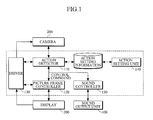
- FIG. 1 is a block diagram illustrating a picture control apparatus using image recognition, according to an exemplary embodiment.
- FIG. 2 is a flowchart illustrating a picture control method, according to an exemplary embodiment.
- FIG. 1 is a block diagram illustrating picture control apparatus 100 using image recognition, according to an exemplary embodiment.
- the picture control apparatus 100 may be implemented in the form of hardware, software, or a combination thereof, and may be disposed in a mobile terminal having a camera.
- the picture may be still images, moving images, and/or video.
- the picture control apparatus 100 includes an action detector 110 and a picture controller 120.
- the picture control apparatus 100 further includes a driver 130, an action setting unit 140, and a sound controller 150.
- the action detector 110 receives images of a user captured by a camera 200 and detects a specific action from the images of the user.
- the specific action may be detected by analyzing variations of feature points included in the images of the user to thus recognize variations in motion or expression.
- the images are not limited thereto such that the action detector 110 may recognize variations in motion or expression of an object, an animal, an, or a subject of the image, and the like, i.e., not the user.
- the action detector 110 may recognize the user's motion or expression variations from the images of the user by detecting the user's movement toward or away from the camera 200, the user's movement to the right or left, a wink of the user's right or left eye, the user's lip shape, an inclination of the user's face, a rotation of the user's face to the left or right, a grimace of the user's face, thereby detecting a specific action.
- the picture controller 120 controls a picture displayed on a display 300.
- the picture controller 120 may control a picture displayed on the display 300 by enlarging or reducing a size of the picture or by varying coordinates, colors, and brightness of individual pixels belonging to the picture to change color effects, white balances, etc.
- the picture controller 120 may enlarge or reduce a size of a picture stored in a memory or transmitted in real-time through a network.
- the picture transmitted through the network may be a picture transmitted from a same channel or from a different channel and/or may be transmitted in real time or as delayed.
- the picture controller 120 may enlarge or reduce a size of an entire or partial area of a single-layered picture, such as a JPG file or the like.
- the picture controller 120 may enlarge or reduce a size of a layer in a multi-layered picture, such as a PHOTOSHOP® file or the like.
- the picture controller 120 may enlarge or reduce a size of an object in a tree-structured picture including a plurality of associated objects, such as an HTML file or the like.
- the picture control apparatus 100 controls a picture displayed on a display of a mobile terminal in such a manner as to enlarge or reduce the size of the picture according to a user's action detected through image recognition from the images of the user captured by a camera 200 without any direct physical manipulation of the mobile terminal from the user.
- the driver 130 may drive a picture control function in response to a user's touch on the display 300. That is, when the display 300 is a touch screen, if a user touches a specific location on the touch screen 300 while a picture is reproduced, the driver 130 drives the camera 200 to photograph the user.
- the action detector 110 detects the user's action from the images of the user captured by the camera 200, and the picture controller 120 controls a picture displayed on the touch screen 300 according to the user's detected action.
- the picture controller 120 may enlarge or reduce the size of the picture and center the picture at the specific location where the user's touch has occurred on the touch screen 300. That is, if the user touches a specific location on the touch screen 300, the driver 130 drives a picture control function, and if the action detector 110 detects a specific action from the images of the user captured by the camera 200, the picture controller 120 enlarges or reduces a picture centering on the specific location where the user's touch has occurred.
- a picture may be controlled according to a user's action that is detected through image recognition in such a manner as to be enlarged or reduced without any physical manipulations from the user.
- the action setting unit 140 may set specific actions that can be detected by the action detector 110. That is, the action setting unit 140 allows a user to set specific actions that will be used to control pictures and then stores them as action setting information 160, which may be, without limitation, a storage, such as read-only memory, random access memory, flash memory, removable memory, or a register included in a processor.
- the stored action setting information 160 is referred to by the action detector 110 in order to detect a specific action.
- the sound controller 150 controls sound associated with a picture that is controlled by the picture controller 120. That is, the sound controller 150 is used to control sound associated with a picture that is controlled by the picture controller 120 according to a user's action detected through image recognition. The sound control may be carried out simultaneously with or separately from the picture control.
- the sound control may increase or decrease a volume of sound that is output through a sound output unit 400 in association with the picture.
- sound associated with a picture may also be controlled according to a user's action detected through image recognition.
- the user may increase or decrease the volume of sound in association with a picture without any physical manipulations from the user.
- FIG. 2 is a flowchart illustrating a picture control method, according to an exemplary embodiment.
- a driving command is received, which may be generated due to touch, etc. on a specific region of a touch screen of a mobile terminal and images of a user are captured in operation 510. If the driving command is received and the camera is driven to capture the images of the user, the picture control apparatus detects a specific action from the captured images of the user in operation 520.
- the specific action may be detected by detecting the user's movement toward or away from a camera from the images of the user.
- the user's movement toward or away from the camera may be detected by recognizing variations in object sizes of the images of the user captured by the camera.
- the specific action may be detected by detecting the user's movement to the left or right from the images of the user.
- the user's movement to the left or right may be detected by recognizing location movements, rotations, inclinations, etc. of feature points included in the images of the user.
- the specific action may be detected by detecting a wink of the user's left or right eye from the images of the user.
- the wink of the user's left or right eye may be detected by recognizing variations of feature points corresponding to the user's left or right eye included in the images of the user.
- the specific action may be detected by detecting the user's lip shape from the images of the user.
- the user's lip shape may be detected by recognizing variations of feature points corresponding to the user's lips included in the images of the user.
- the specific action may be detected by detecting, from the images of the user, an inclination of the user's face.
- the inclination of the user's face may be detected by recognizing location movements, rotations, or inclinations of feature points included in the images of the user.
- the specific action may be detected by detecting, from the images of the user, a rotation of the user's face to the left or right.
- the rotation of the user's face to the left or right may be detected by recognizing location movements, rotations, inclinations, etc. of feature points included in the images of the user.
- the specific action may be detected by detecting a grimace of the user's face from the images of the user.
- the grimace of the user's face may be detected by recognizing variations of feature points corresponding to the user's eyes, nose, and lips, included in the images of the user.
- the picture control apparatus controls a picture displayed on a display of a mobile terminal in operation 530.
- the control on the picture is maintained until an end command is received in operation 540.
- the control on the picture may be to enlarge or reduce a size of a picture stored in a memory or transmitted in real-time through a network.
- the picture control apparatus may enlarge or reduce a size of an entire or partial area of a single-layered picture, such as a JPG file or the like.
- the picture control apparatus 100 may enlarge or reduce a size of a layer in a multi-layered picture, such as a PHOTOSHOP® file or the like.
- the picture control apparatus 100 may enlarge or reduce a size of an object in a tree-structured picture including a plurality of associated objects, such as an HTML file or the like.
- the picture control apparatus using image recognition may control a picture displayed on a display of a mobile terminal, etc., in such a manner as to enlarge or reduce the size of the picture, according to a user's action that is detected through image recognition from the images of the user captured by a camera without any physical manipulation from the user.
- pictures may be controlled according to the user's movement toward or away from the camera without any direct physical manipulations from the user.
- picture control apparatus by implementing the picture control apparatus in such a manner as to enlarge a size of a picture displayed on a display if a user's movement to the left is detected from images captured by the camera, and to reduce a size of a picture displayed on the display if the user's movement to the right is detected from the captured images, picture may be controlled according to the user's movement to the left or right without any direct physical manipulations from the user.
- pictures may be controlled according to a wink of the user's left or right eye, without any direct physical manipulations from the user.
- pictures may be controlled according to the user's lip shape, without any direct physical manipulations from the user.
- pictures may be controlled according to an inclination of the user's face, without any direct physical manipulations from the user.
- pictures may be controlled according to a rotation of the user's face to the left or right, without any direct physical manipulations from the user.
- pictures may be controlled according to the user's expression, without any direct physical manipulations from the user.
- the picture control apparatus may adjust a degree of enlargement or reduction of a picture in accordance with a speed at which a user approaches the camera or moves away from the camera, how many times the approach or moving-away occurs, a speed at which the user moves to the left or right, how many times the user's movement to the left or right occurs, a speed at which the user winks his or her left or right eye, how many times the wink of the user's left or right eye occurs, a degree of opening of the user's lips, a degree of inclination of the user's face, a speed at which the user's face rotates to the left or right, how many times the user's face rotates, or a degree of a grimace on the user's face.
- the degree of enlargement or reduction of a picture can be adjusted by enlarging a size of a picture to 150% when a user inclines their face once forward and to 200% when the user inclines their face twice forward.
- a picture control apparatus provides control of a picture displayed on a display of a mobile terminal according to an action detected through image recognition.
- a picture control method includes detecting an action from images captured by a camera, and controlling a picture displayed on a display if the detected action is a specific action.
Landscapes
- Engineering & Computer Science (AREA)
- Multimedia (AREA)
- Signal Processing (AREA)
- Human Computer Interaction (AREA)
- Computer Vision & Pattern Recognition (AREA)
- Physics & Mathematics (AREA)
- General Physics & Mathematics (AREA)
- Theoretical Computer Science (AREA)
- User Interface Of Digital Computer (AREA)
- Controls And Circuits For Display Device (AREA)
- Telephone Function (AREA)
Abstract
Description
- This application claims priority to and the benefit under 35 U.S.C. §119(a) of Korean Patent Application No.
10-2009-0090650, filed on September 24, 2009 - The following description relates to display control, and more particularly, to an apparatus to control a picture displayed on a display of a mobile terminal, and a method for controlling a picture displayed on a display of a mobile terminal.
- A display control technique has been developed which enlarges or reduces a size of a picture displayed on a display, such as a liquid crystal display (LCD) of a mobile terminal, through a user's physical manipulations, such as manipulation of key buttons or a touch screen.
- However, a technique for controlling pictures displayed on a display, without any direct physical manipulations by the user is needed.
- Exemplary embodiments of the present invention provide a picture control apparatus using image recognition, which can control a picture that is displayed on a display of a mobile terminal, etc., according to a user's action detected through image recognition. Exemplary embodiments of the present invention also provide a picture control method using image recognition, which can control a picture that is displayed on a display of a mobile terminal, etc., according to a user's action detected through image recognition.
- Additional features of the invention will be set forth in the description which follows, and in part will be apparent from the description, or may be learned by practice of the invention.
- An exemplary embodiment of the present invention provides a picture control apparatus including: an action detector to detect a specific action from images captured by a camera; and a picture controller to control a picture displayed on a display if the specific action is detected by the action detector.
- An exemplary embodiment of the present invention provides a picture control method including: detecting an action from images captured by a camera; and controlling a picture displayed on a display if the detected action is a specific action.
- It is to be understood that both the foregoing general description and the following detailed description are exemplary and explanatory and are intended to provide further explanation of the invention as claimed. Other objects, features and advantages will be apparent from the following description, the drawings, and the claims.
- The accompanying drawings, which are included to provide a further understanding of the invention and are incorporated in and constitute a part of this specification, illustrate embodiments of the invention, and together with the description serve to explain the principles of the invention.
-
FIG. 1 is a block diagram illustrating a picture control apparatus using image recognition, according to an exemplary embodiment. -
FIG. 2 is a flowchart illustrating a picture control method, according to an exemplary embodiment. - Throughout the drawings and the detailed description, unless otherwise described, the same drawing reference numerals are understood to refer to the same elements, features, and structures. The relative size and depiction of these elements may be exaggerated for clarity, illustration, and convenience.
- The invention is described more fully hereinafter with reference to the accompanying drawings, in which exemplary embodiments of the invention are shown. This invention may, however, be embodied in many different forms and should not be construed as limited to the embodiments set forth herein. Rather, these exemplary embodiments are provided so that this disclosure is thorough, and will fully convey the scope of the invention to those skilled in the art. In the drawings, the size and relative sizes of layers and regions may be exaggerated for clarity. Like reference numerals in the drawings denote like elements.
-
FIG. 1 is a block diagram illustrating picture control apparatus 100 using image recognition, according to an exemplary embodiment. The picture control apparatus 100 may be implemented in the form of hardware, software, or a combination thereof, and may be disposed in a mobile terminal having a camera. The picture may be still images, moving images, and/or video. - As illustrated in
FIG. 1 , the picture control apparatus 100 includes anaction detector 110 and apicture controller 120. The picture control apparatus 100 further includes adriver 130, an action setting unit 140, and asound controller 150. - The
action detector 110 receives images of a user captured by acamera 200 and detects a specific action from the images of the user. The specific action may be detected by analyzing variations of feature points included in the images of the user to thus recognize variations in motion or expression. Although described as being of the user, the images are not limited thereto such that theaction detector 110 may recognize variations in motion or expression of an object, an animal, an, or a subject of the image, and the like, i.e., not the user. - For example, the
action detector 110 may recognize the user's motion or expression variations from the images of the user by detecting the user's movement toward or away from thecamera 200, the user's movement to the right or left, a wink of the user's right or left eye, the user's lip shape, an inclination of the user's face, a rotation of the user's face to the left or right, a grimace of the user's face, thereby detecting a specific action. - If the
action detector 110 detects a specific action, thepicture controller 120 controls a picture displayed on adisplay 300. Thepicture controller 120 may control a picture displayed on thedisplay 300 by enlarging or reducing a size of the picture or by varying coordinates, colors, and brightness of individual pixels belonging to the picture to change color effects, white balances, etc. - In the case of enlarging or reducing the size of the picture, the
picture controller 120 may enlarge or reduce a size of a picture stored in a memory or transmitted in real-time through a network. The picture transmitted through the network may be a picture transmitted from a same channel or from a different channel and/or may be transmitted in real time or as delayed. - For example, the
picture controller 120 may enlarge or reduce a size of an entire or partial area of a single-layered picture, such as a JPG file or the like. - As another example, the
picture controller 120 may enlarge or reduce a size of a layer in a multi-layered picture, such as a PHOTOSHOP® file or the like. - As another example, the
picture controller 120 may enlarge or reduce a size of an object in a tree-structured picture including a plurality of associated objects, such as an HTML file or the like. - Accordingly, the picture control apparatus 100 controls a picture displayed on a display of a mobile terminal in such a manner as to enlarge or reduce the size of the picture according to a user's action detected through image recognition from the images of the user captured by a
camera 200 without any direct physical manipulation of the mobile terminal from the user. - The
driver 130 may drive a picture control function in response to a user's touch on thedisplay 300. That is, when thedisplay 300 is a touch screen, if a user touches a specific location on thetouch screen 300 while a picture is reproduced, thedriver 130 drives thecamera 200 to photograph the user. - Then, the
action detector 110 detects the user's action from the images of the user captured by thecamera 200, and thepicture controller 120 controls a picture displayed on thetouch screen 300 according to the user's detected action. - At this time, the
picture controller 120 may enlarge or reduce the size of the picture and center the picture at the specific location where the user's touch has occurred on thetouch screen 300. That is, if the user touches a specific location on thetouch screen 300, thedriver 130 drives a picture control function, and if theaction detector 110 detects a specific action from the images of the user captured by thecamera 200, thepicture controller 120 enlarges or reduces a picture centering on the specific location where the user's touch has occurred. - Accordingly, a picture may be controlled according to a user's action that is detected through image recognition in such a manner as to be enlarged or reduced without any physical manipulations from the user.
- The action setting unit 140 may set specific actions that can be detected by the
action detector 110. That is, the action setting unit 140 allows a user to set specific actions that will be used to control pictures and then stores them as action setting information 160, which may be, without limitation, a storage, such as read-only memory, random access memory, flash memory, removable memory, or a register included in a processor. The stored action setting information 160 is referred to by theaction detector 110 in order to detect a specific action. - The
sound controller 150 controls sound associated with a picture that is controlled by thepicture controller 120. That is, thesound controller 150 is used to control sound associated with a picture that is controlled by thepicture controller 120 according to a user's action detected through image recognition. The sound control may be carried out simultaneously with or separately from the picture control. - For example, the sound control may increase or decrease a volume of sound that is output through a
sound output unit 400 in association with the picture. Accordingly, sound associated with a picture may also be controlled according to a user's action detected through image recognition. For example, the user may increase or decrease the volume of sound in association with a picture without any physical manipulations from the user. - Hereinafter, a method in which the picture control apparatus 100 of
FIG. 1 using image recognition, having the above-described structure, controls a picture will be described in detail with reference toFIG. 2 , below.FIG. 2 is a flowchart illustrating a picture control method, according to an exemplary embodiment. - First, it is determined whether a driving command is received, which may be generated due to touch, etc. on a specific region of a touch screen of a mobile terminal and images of a user are captured in
operation 510. If the driving command is received and the camera is driven to capture the images of the user, the picture control apparatus detects a specific action from the captured images of the user inoperation 520. - For example, the specific action may be detected by detecting the user's movement toward or away from a camera from the images of the user. Here, the user's movement toward or away from the camera may be detected by recognizing variations in object sizes of the images of the user captured by the camera.
- As another example, the specific action may be detected by detecting the user's movement to the left or right from the images of the user. The user's movement to the left or right may be detected by recognizing location movements, rotations, inclinations, etc. of feature points included in the images of the user.
- As another example, the specific action may be detected by detecting a wink of the user's left or right eye from the images of the user. The wink of the user's left or right eye may be detected by recognizing variations of feature points corresponding to the user's left or right eye included in the images of the user.
- As another example, the specific action may be detected by detecting the user's lip shape from the images of the user. The user's lip shape may be detected by recognizing variations of feature points corresponding to the user's lips included in the images of the user.
- As another example, the specific action may be detected by detecting, from the images of the user, an inclination of the user's face. The inclination of the user's face may be detected by recognizing location movements, rotations, or inclinations of feature points included in the images of the user.
- As another example, the specific action may be detected by detecting, from the images of the user, a rotation of the user's face to the left or right. The rotation of the user's face to the left or right may be detected by recognizing location movements, rotations, inclinations, etc. of feature points included in the images of the user.
- As another example, the specific action may be detected by detecting a grimace of the user's face from the images of the user. The grimace of the user's face may be detected by recognizing variations of feature points corresponding to the user's eyes, nose, and lips, included in the images of the user.
- If a specific action is detected in
operation 520, the picture control apparatus controls a picture displayed on a display of a mobile terminal inoperation 530. The control on the picture is maintained until an end command is received inoperation 540. - In
operation 530, the control on the picture may be to enlarge or reduce a size of a picture stored in a memory or transmitted in real-time through a network. For example, inoperation 530, the picture control apparatus may enlarge or reduce a size of an entire or partial area of a single-layered picture, such as a JPG file or the like. - As another example, in
operation 530, the picture control apparatus 100 may enlarge or reduce a size of a layer in a multi-layered picture, such as a PHOTOSHOP® file or the like. - As another example, in
operation 530, the picture control apparatus 100 may enlarge or reduce a size of an object in a tree-structured picture including a plurality of associated objects, such as an HTML file or the like. - Accordingly, the picture control apparatus using image recognition may control a picture displayed on a display of a mobile terminal, etc., in such a manner as to enlarge or reduce the size of the picture, according to a user's action that is detected through image recognition from the images of the user captured by a camera without any physical manipulation from the user.
- Hereinafter, examples in which the picture control apparatus using image recognition according to an exemplary embodiment is applied to a mobile terminal will be described.
- For example, by implementing the picture control apparatus in such a manner as to enlarge a size of a picture displayed on a display if a user's movement toward a camera is detected from images captured by the camera, and to reduce a picture displayed on the display if the user's movement away from the camera is detected from the captured images, pictures may be controlled according to the user's movement toward or away from the camera without any direct physical manipulations from the user.
- As another example, by implementing the picture control apparatus in such a manner as to enlarge a size of a picture displayed on a display if a user's movement to the left is detected from images captured by the camera, and to reduce a size of a picture displayed on the display if the user's movement to the right is detected from the captured images, picture may be controlled according to the user's movement to the left or right without any direct physical manipulations from the user.
- As another example, by implementing the picture control apparatus in such a manner as to enlarge a size of a picture displayed on a display if a wink of a user's left eye is detected from images captured by the camera, and to reduce a size of a picture displayed on the display if a wink of the user's right eye is detected from the captured images, pictures may be controlled according to a wink of the user's left or right eye, without any direct physical manipulations from the user.
- As another example, by implementing the picture control apparatus in such a manner as to enlarge a size of a picture displayed on a display if that a user opens his or her lips is detected from images captured by the camera, and to reduce a size of a picture displayed on the display if that the user pouts his or her lips is detected from the captured images, pictures may be controlled according to the user's lip shape, without any direct physical manipulations from the user.
- As another example, by implementing the picture control apparatus in such a manner as to enlarge a size of a picture displayed on a display if that a user's face is inclined forward is detected from images captured by the camera, and to reduce a size of a picture displayed on the display if that the user's face is inclined backward is detected from the captured images, pictures may be controlled according to an inclination of the user's face, without any direct physical manipulations from the user.
- As another example, by implementing the picture control apparatus in such a manner as to enlarge a size of a picture displayed on a display if a rotation of a user's face to the left is detected from images captured by the camera, and to reduce a size of a picture displayed on the display if a rotation of the user's face to the right is detected from the captured images, pictures may be controlled according to a rotation of the user's face to the left or right, without any direct physical manipulations from the user.
- As another example, by implementing the picture control apparatus in such a manner as to enlarge a size of a picture displayed on a display if a grimace of a user's face is detected from images captured by the camera, and to reduce a size of a picture displayed on the display if a smile on the user's face is detected from the captured images, pictures may be controlled according to the user's expression, without any direct physical manipulations from the user.
- Further, the picture control apparatus may adjust a degree of enlargement or reduction of a picture in accordance with a speed at which a user approaches the camera or moves away from the camera, how many times the approach or moving-away occurs, a speed at which the user moves to the left or right, how many times the user's movement to the left or right occurs, a speed at which the user winks his or her left or right eye, how many times the wink of the user's left or right eye occurs, a degree of opening of the user's lips, a degree of inclination of the user's face, a speed at which the user's face rotates to the left or right, how many times the user's face rotates, or a degree of a grimace on the user's face.
- For example, the degree of enlargement or reduction of a picture can be adjusted by enlarging a size of a picture to 150% when a user inclines their face once forward and to 200% when the user inclines their face twice forward.
- The above-described embodiments are applicable to display control technologies or applications thereof.
- It will be apparent to those skilled in the art that various modifications and variation can be made in the present invention without departing from the spirit or scope of the invention. Thus, it is intended that the present invention cover the modifications and variations of this invention provided they come within the scope of the appended claims and their equivalents.
- A picture control apparatus provides control of a picture displayed on a display of a mobile terminal according to an action detected through image recognition. A picture control method includes detecting an action from images captured by a camera, and controlling a picture displayed on a display if the detected action is a specific action.
Claims (13)
the driver preferably driving the picture control function in response to a touch of a touch screen, the picture controller advantageously enlarging or reducing a size of the picture and centering the picture at a location where the touch has occurred on the touch screen.
Applications Claiming Priority (1)
| Application Number | Priority Date | Filing Date | Title |
|---|---|---|---|
| KR1020090090650A KR101038323B1 (en) | 2009-09-24 | 2009-09-24 | Screen frame control device using image recognition technique |
Publications (1)
| Publication Number | Publication Date |
|---|---|
| EP2309720A1 true EP2309720A1 (en) | 2011-04-13 |
Family
ID=42651126
Family Applications (1)
| Application Number | Title | Priority Date | Filing Date |
|---|---|---|---|
| EP10172480A Withdrawn EP2309720A1 (en) | 2009-09-24 | 2010-08-11 | Apparatus and method for controlling picture using image recognition |
Country Status (4)
| Country | Link |
|---|---|
| US (1) | US8587710B2 (en) |
| EP (1) | EP2309720A1 (en) |
| KR (1) | KR101038323B1 (en) |
| CN (1) | CN102033696B (en) |
Families Citing this family (16)
| Publication number | Priority date | Publication date | Assignee | Title |
|---|---|---|---|---|
| CN103228198B (en) | 2010-09-08 | 2016-07-06 | 科维蒂恩有限合伙公司 | catheter with imaging assembly |
| CN102841725A (en) * | 2011-06-21 | 2012-12-26 | 鸿富锦精密工业(深圳)有限公司 | Electronic device and screen information adjusting method thereof |
| CN102841676A (en) * | 2011-06-23 | 2012-12-26 | 鸿富锦精密工业(深圳)有限公司 | Webpage browsing control system and method |
| CN102955565A (en) * | 2011-08-31 | 2013-03-06 | 德信互动科技(北京)有限公司 | Man-machine interaction system and method |
| US10890965B2 (en) * | 2012-08-15 | 2021-01-12 | Ebay Inc. | Display orientation adjustment using facial landmark information |
| CN103631365B (en) * | 2012-08-22 | 2016-12-21 | 中国移动通信集团公司 | A kind of terminal input control method and device |
| USD717340S1 (en) | 2012-09-07 | 2014-11-11 | Covidien Lp | Display screen with enteral feeding icon |
| US9517184B2 (en) | 2012-09-07 | 2016-12-13 | Covidien Lp | Feeding tube with insufflation device and related methods therefor |
| US9198835B2 (en) | 2012-09-07 | 2015-12-01 | Covidien Lp | Catheter with imaging assembly with placement aid and related methods therefor |
| USD735343S1 (en) | 2012-09-07 | 2015-07-28 | Covidien Lp | Console |
| USD716841S1 (en) | 2012-09-07 | 2014-11-04 | Covidien Lp | Display screen with annotate file icon |
| KR102003371B1 (en) | 2012-11-16 | 2019-10-01 | 삼성전자주식회사 | Apparatas and method for adjusting of screen brightness in an electronic device |
| CN103475758B (en) * | 2013-08-30 | 2016-04-27 | 杨堃 | A kind of mobile phone |
| CN105487648A (en) * | 2014-09-16 | 2016-04-13 | 深圳富泰宏精密工业有限公司 | Software control system and method with lens-adding function |
| CN106445272A (en) * | 2015-08-10 | 2017-02-22 | 中兴通讯股份有限公司 | Picture display method on mobile terminal, and corresponding mobile terminal |
| CN110070063B (en) * | 2019-04-29 | 2020-06-30 | 北京字节跳动网络技术有限公司 | Target object motion recognition method and device and electronic equipment |
Citations (4)
| Publication number | Priority date | Publication date | Assignee | Title |
|---|---|---|---|---|
| EP0840200A2 (en) * | 1996-07-12 | 1998-05-06 | Rank Xerox Limited | Interactive desktop system with adjustable image display |
| EP1748378A1 (en) * | 2005-07-26 | 2007-01-31 | Canon Kabushiki Kaisha | Image capturing apparatus and image capturing method |
| US20080025576A1 (en) * | 2006-07-25 | 2008-01-31 | Arcsoft, Inc. | Method for detecting facial expressions of a portrait photo by an image capturing electronic device |
| US20080024620A1 (en) * | 2006-07-31 | 2008-01-31 | Sanyo Electric Co., Ltd. | Image-taking apparatus and output image generation method |
Family Cites Families (33)
| Publication number | Priority date | Publication date | Assignee | Title |
|---|---|---|---|---|
| JP3535693B2 (en) * | 1997-04-30 | 2004-06-07 | キヤノン株式会社 | Portable electronic device, image processing method, imaging device, and computer-readable recording medium |
| US6211856B1 (en) * | 1998-04-17 | 2001-04-03 | Sung M. Choi | Graphical user interface touch screen with an auto zoom feature |
| US6501515B1 (en) | 1998-10-13 | 2002-12-31 | Sony Corporation | Remote control system |
| US7158172B2 (en) * | 2000-06-20 | 2007-01-02 | Fuji Photo Film Co., Ltd. | Digital camera with an automatic image transmission function |
| KR100413267B1 (en) | 2001-11-14 | 2004-01-03 | 에스케이텔레텍주식회사 | Mobile Communication Device including Camera-direction Automatic Control Apparatus using Recognition of Specific Part of Face |
| KR100513739B1 (en) | 2002-08-23 | 2005-09-09 | 삼성전자주식회사 | Motion detecting device using face characteristics and monitoring system adapting it |
| KR20040023088A (en) * | 2002-09-10 | 2004-03-18 | 엘지전자 주식회사 | Image display apparatus and method rendering optimum image according to position of viewer |
| KR100455294B1 (en) | 2002-12-06 | 2004-11-06 | 삼성전자주식회사 | Method for detecting user and detecting motion, and apparatus for detecting user within security system |
| KR100464040B1 (en) | 2002-12-16 | 2005-01-03 | 엘지전자 주식회사 | Method for controlling of mobile communication device using face moving |
| JP4401804B2 (en) * | 2004-02-06 | 2010-01-20 | キヤノン株式会社 | Imaging apparatus and control method thereof |
| US7502036B2 (en) * | 2004-03-03 | 2009-03-10 | Virtual Iris Studios, Inc. | System for delivering and enabling interactivity with images |
| JP2008508628A (en) | 2004-08-02 | 2008-03-21 | コーニンクレッカ フィリップス エレクトロニクス エヌ ヴィ | Pressure-controlled navigation on a touch screen |
| KR100724939B1 (en) | 2005-06-20 | 2007-06-04 | 삼성전자주식회사 | Implementation method of user interface using camera and mobile communication terminal for same |
| JP4717539B2 (en) | 2005-07-26 | 2011-07-06 | キヤノン株式会社 | Imaging apparatus and imaging method |
| KR20070023863A (en) | 2005-08-25 | 2007-03-02 | 주식회사 팬택앤큐리텔 | Mobile communication terminal capable of character body management through user movement recognition |
| KR20070045664A (en) | 2005-10-28 | 2007-05-02 | 주식회사 팬택 | Control method of mobile communication terminal |
| US7721207B2 (en) * | 2006-05-31 | 2010-05-18 | Sony Ericsson Mobile Communications Ab | Camera based control |
| US9317124B2 (en) * | 2006-09-28 | 2016-04-19 | Nokia Technologies Oy | Command input by hand gestures captured from camera |
| KR100845274B1 (en) * | 2006-11-06 | 2008-07-09 | 주식회사 시공테크 | Interface Method and Apparatus for Exhibition System Considering Viewing Direction of Spectator |
| US7995794B2 (en) * | 2007-03-02 | 2011-08-09 | Sony Ericsson Mobile Communications Ab | Remote control of an image capturing unit in a portable electronic device |
| KR100790143B1 (en) | 2007-03-14 | 2008-01-02 | 삼성전자주식회사 | User authentication method using camera and mobile communication terminal for same |
| KR100724914B1 (en) | 2007-04-10 | 2007-06-04 | 삼성전자주식회사 | Implementation method of user interface using camera and mobile communication terminal for same |
| KR100912511B1 (en) * | 2007-12-03 | 2009-08-17 | 한국전자통신연구원 | User adaptive gesture interface method and system thereof |
| KR20090060547A (en) * | 2007-12-10 | 2009-06-15 | 주식회사유넷컨버전스 | User-Aware Electronic Billboards and Electronic Picture Frames |
| KR100906378B1 (en) * | 2007-12-17 | 2009-07-07 | 한국전자통신연구원 | User interface device using head gesture and its method |
| US9772689B2 (en) * | 2008-03-04 | 2017-09-26 | Qualcomm Incorporated | Enhanced gesture-based image manipulation |
| KR100978929B1 (en) * | 2008-06-24 | 2010-08-30 | 한국전자통신연구원 | Method of registering reference gesture data, driving method of mobile terminal and mobile terminal performing the same |
| US7990421B2 (en) * | 2008-07-18 | 2011-08-02 | Sony Ericsson Mobile Communications Ab | Arrangement and method relating to an image recording device |
| JP4720874B2 (en) * | 2008-08-14 | 2011-07-13 | ソニー株式会社 | Information processing apparatus, information processing method, and information processing program |
| US8788977B2 (en) * | 2008-11-20 | 2014-07-22 | Amazon Technologies, Inc. | Movement recognition as input mechanism |
| US20100138797A1 (en) * | 2008-12-01 | 2010-06-03 | Sony Ericsson Mobile Communications Ab | Portable electronic device with split vision content sharing control and method |
| US8379134B2 (en) * | 2010-02-26 | 2013-02-19 | Research In Motion Limited | Object detection and selection using gesture recognition |
| KR20130037998A (en) * | 2011-10-07 | 2013-04-17 | 삼성전자주식회사 | Display apparatus and display method thereof |
-
2009
- 2009-09-24 KR KR1020090090650A patent/KR101038323B1/en active Active
-
2010
- 2010-08-10 US US12/853,798 patent/US8587710B2/en active Active
- 2010-08-11 EP EP10172480A patent/EP2309720A1/en not_active Withdrawn
- 2010-09-17 CN CN201010284923.6A patent/CN102033696B/en active Active
Patent Citations (4)
| Publication number | Priority date | Publication date | Assignee | Title |
|---|---|---|---|---|
| EP0840200A2 (en) * | 1996-07-12 | 1998-05-06 | Rank Xerox Limited | Interactive desktop system with adjustable image display |
| EP1748378A1 (en) * | 2005-07-26 | 2007-01-31 | Canon Kabushiki Kaisha | Image capturing apparatus and image capturing method |
| US20080025576A1 (en) * | 2006-07-25 | 2008-01-31 | Arcsoft, Inc. | Method for detecting facial expressions of a portrait photo by an image capturing electronic device |
| US20080024620A1 (en) * | 2006-07-31 | 2008-01-31 | Sanyo Electric Co., Ltd. | Image-taking apparatus and output image generation method |
Also Published As
| Publication number | Publication date |
|---|---|
| KR101038323B1 (en) | 2011-06-01 |
| US8587710B2 (en) | 2013-11-19 |
| US20110069215A1 (en) | 2011-03-24 |
| KR20110032906A (en) | 2011-03-30 |
| CN102033696B (en) | 2014-04-23 |
| CN102033696A (en) | 2011-04-27 |
Similar Documents
| Publication | Publication Date | Title |
|---|---|---|
| US8587710B2 (en) | Apparatus and method for controlling picture using image recognition | |
| US11750918B2 (en) | Assist for orienting a camera at different zoom levels | |
| RU2649773C2 (en) | Controlling camera with face detection | |
| KR101977638B1 (en) | Method for correcting user’s gaze direction in image, machine-readable storage medium and communication terminal | |
| EP2664131B1 (en) | Apparatus and method for compositing image in a portable terminal | |
| US9767612B2 (en) | Method, system and apparatus for removing a marker projected in a scene | |
| US12464226B2 (en) | Photographing method and apparatus for intelligent framing recommendation | |
| CN101562703A (en) | Method and apparatus for performing touch-based adjustments wthin imaging devices | |
| US20130286240A1 (en) | Image capturing device and operating method of image capturing device | |
| WO2023040288A1 (en) | Display device and device control method | |
| US12598372B2 (en) | Shooting method and related device | |
| WO2023226634A1 (en) | Photographing method and electronic device | |
| CN119653225B (en) | A photography method and a foldable screen device | |
| CN106657771A (en) | PowerPoint data processing method and mobile terminal | |
| JP5398359B2 (en) | Information processing apparatus, imaging apparatus, and control method | |
| JP2005195904A (en) | Projector, projector control method, and program | |
| CN120434328A (en) | Display screen adjustment method and electronic device | |
| WO2021175125A1 (en) | System and method for automatically adjusting focus of a camera | |
| WO2026065237A1 (en) | Vehicle-mounted terminal and image capture method | |
| CN120321498A (en) | A shooting method, electronic device and readable storage medium | |
| JP2025500021A (en) | Digital comic book providing device and control method thereof | |
| JP2024154327A (en) | Imaging device and control device | |
| KR20210069281A (en) | Extended reality device and method for controlling the same | |
| KR20170114822A (en) | Display Control System, Method and Computer Readable Record Medium Thereof |
Legal Events
| Date | Code | Title | Description |
|---|---|---|---|
| PUAI | Public reference made under article 153(3) epc to a published international application that has entered the european phase |
Free format text: ORIGINAL CODE: 0009012 |
|
| 17P | Request for examination filed |
Effective date: 20100811 |
|
| AK | Designated contracting states |
Kind code of ref document: A1 Designated state(s): AL AT BE BG CH CY CZ DE DK EE ES FI FR GB GR HR HU IE IS IT LI LT LU LV MC MK MT NL NO PL PT RO SE SI SK SM TR |
|
| AX | Request for extension of the european patent |
Extension state: BA ME RS |
|
| 17Q | First examination report despatched |
Effective date: 20120424 |
|
| RIN1 | Information on inventor provided before grant (corrected) |
Inventor name: JEON, HYEONG-BAEK |
|
| STAA | Information on the status of an ep patent application or granted ep patent |
Free format text: STATUS: THE APPLICATION HAS BEEN WITHDRAWN |
|
| 18W | Application withdrawn |
Effective date: 20140122 |