EP2309110A1 - Engine stoppage control device - Google Patents
Engine stoppage control device Download PDFInfo
- Publication number
- EP2309110A1 EP2309110A1 EP09804688A EP09804688A EP2309110A1 EP 2309110 A1 EP2309110 A1 EP 2309110A1 EP 09804688 A EP09804688 A EP 09804688A EP 09804688 A EP09804688 A EP 09804688A EP 2309110 A1 EP2309110 A1 EP 2309110A1
- Authority
- EP
- European Patent Office
- Prior art keywords
- engine
- target
- reference point
- torque
- rotation speed
- Prior art date
- Legal status (The legal status is an assumption and is not a legal conclusion. Google has not performed a legal analysis and makes no representation as to the accuracy of the status listed.)
- Granted
Links
- 239000000446 fuel Substances 0.000 claims description 24
- 230000004044 response Effects 0.000 claims description 4
- 238000000034 method Methods 0.000 description 65
- 230000008569 process Effects 0.000 description 59
- 230000006399 behavior Effects 0.000 description 58
- 238000012545 processing Methods 0.000 description 31
- 238000012937 correction Methods 0.000 description 24
- 230000006835 compression Effects 0.000 description 14
- 238000007906 compression Methods 0.000 description 14
- 230000001276 controlling effect Effects 0.000 description 11
- 101150050472 Tfr2 gene Proteins 0.000 description 8
- 238000010586 diagram Methods 0.000 description 7
- 230000005540 biological transmission Effects 0.000 description 6
- 238000002485 combustion reaction Methods 0.000 description 6
- 230000007423 decrease Effects 0.000 description 6
- 230000006870 function Effects 0.000 description 6
- 238000002347 injection Methods 0.000 description 6
- 239000007924 injection Substances 0.000 description 6
- 230000007935 neutral effect Effects 0.000 description 6
- 238000010276 construction Methods 0.000 description 5
- 239000007789 gas Substances 0.000 description 5
- 238000009499 grossing Methods 0.000 description 4
- 230000008859 change Effects 0.000 description 3
- 239000003054 catalyst Substances 0.000 description 2
- 239000002826 coolant Substances 0.000 description 2
- 238000013461 design Methods 0.000 description 2
- 230000032683 aging Effects 0.000 description 1
- QVGXLLKOCUKJST-UHFFFAOYSA-N atomic oxygen Chemical compound [O] QVGXLLKOCUKJST-UHFFFAOYSA-N 0.000 description 1
- 230000002238 attenuated effect Effects 0.000 description 1
- 230000015556 catabolic process Effects 0.000 description 1
- 125000004122 cyclic group Chemical group 0.000 description 1
- 230000003247 decreasing effect Effects 0.000 description 1
- 238000006731 degradation reaction Methods 0.000 description 1
- 230000000694 effects Effects 0.000 description 1
- 230000005611 electricity Effects 0.000 description 1
- 238000004134 energy conservation Methods 0.000 description 1
- 238000005516 engineering process Methods 0.000 description 1
- 230000007246 mechanism Effects 0.000 description 1
- 239000000203 mixture Substances 0.000 description 1
- 238000012986 modification Methods 0.000 description 1
- 230000004048 modification Effects 0.000 description 1
- 239000001301 oxygen Substances 0.000 description 1
- 229910052760 oxygen Inorganic materials 0.000 description 1
- 238000010248 power generation Methods 0.000 description 1
- 230000001105 regulatory effect Effects 0.000 description 1
- 239000007858 starting material Substances 0.000 description 1
- 230000001360 synchronised effect Effects 0.000 description 1
- 238000011144 upstream manufacturing Methods 0.000 description 1
Images







Classifications
-
- B—PERFORMING OPERATIONS; TRANSPORTING
- B60—VEHICLES IN GENERAL
- B60W—CONJOINT CONTROL OF VEHICLE SUB-UNITS OF DIFFERENT TYPE OR DIFFERENT FUNCTION; CONTROL SYSTEMS SPECIALLY ADAPTED FOR HYBRID VEHICLES; ROAD VEHICLE DRIVE CONTROL SYSTEMS FOR PURPOSES NOT RELATED TO THE CONTROL OF A PARTICULAR SUB-UNIT
- B60W20/00—Control systems specially adapted for hybrid vehicles
- B60W20/10—Controlling the power contribution of each of the prime movers to meet required power demand
- B60W20/15—Control strategies specially adapted for achieving a particular effect
-
- B—PERFORMING OPERATIONS; TRANSPORTING
- B60—VEHICLES IN GENERAL
- B60W—CONJOINT CONTROL OF VEHICLE SUB-UNITS OF DIFFERENT TYPE OR DIFFERENT FUNCTION; CONTROL SYSTEMS SPECIALLY ADAPTED FOR HYBRID VEHICLES; ROAD VEHICLE DRIVE CONTROL SYSTEMS FOR PURPOSES NOT RELATED TO THE CONTROL OF A PARTICULAR SUB-UNIT
- B60W10/00—Conjoint control of vehicle sub-units of different type or different function
- B60W10/04—Conjoint control of vehicle sub-units of different type or different function including control of propulsion units
- B60W10/06—Conjoint control of vehicle sub-units of different type or different function including control of propulsion units including control of combustion engines
-
- B—PERFORMING OPERATIONS; TRANSPORTING
- B60—VEHICLES IN GENERAL
- B60W—CONJOINT CONTROL OF VEHICLE SUB-UNITS OF DIFFERENT TYPE OR DIFFERENT FUNCTION; CONTROL SYSTEMS SPECIALLY ADAPTED FOR HYBRID VEHICLES; ROAD VEHICLE DRIVE CONTROL SYSTEMS FOR PURPOSES NOT RELATED TO THE CONTROL OF A PARTICULAR SUB-UNIT
- B60W10/00—Conjoint control of vehicle sub-units of different type or different function
- B60W10/04—Conjoint control of vehicle sub-units of different type or different function including control of propulsion units
- B60W10/08—Conjoint control of vehicle sub-units of different type or different function including control of propulsion units including control of electric propulsion units, e.g. motors or generators
-
- B—PERFORMING OPERATIONS; TRANSPORTING
- B60—VEHICLES IN GENERAL
- B60W—CONJOINT CONTROL OF VEHICLE SUB-UNITS OF DIFFERENT TYPE OR DIFFERENT FUNCTION; CONTROL SYSTEMS SPECIALLY ADAPTED FOR HYBRID VEHICLES; ROAD VEHICLE DRIVE CONTROL SYSTEMS FOR PURPOSES NOT RELATED TO THE CONTROL OF A PARTICULAR SUB-UNIT
- B60W20/00—Control systems specially adapted for hybrid vehicles
-
- F—MECHANICAL ENGINEERING; LIGHTING; HEATING; WEAPONS; BLASTING
- F02—COMBUSTION ENGINES; HOT-GAS OR COMBUSTION-PRODUCT ENGINE PLANTS
- F02D—CONTROLLING COMBUSTION ENGINES
- F02D17/00—Controlling engines by cutting out individual cylinders; Rendering engines inoperative or idling
- F02D17/04—Controlling engines by cutting out individual cylinders; Rendering engines inoperative or idling rendering engines inoperative or idling, e.g. caused by abnormal conditions
-
- F—MECHANICAL ENGINEERING; LIGHTING; HEATING; WEAPONS; BLASTING
- F02—COMBUSTION ENGINES; HOT-GAS OR COMBUSTION-PRODUCT ENGINE PLANTS
- F02D—CONTROLLING COMBUSTION ENGINES
- F02D29/00—Controlling engines, such controlling being peculiar to the devices driven thereby, the devices being other than parts or accessories essential to engine operation, e.g. controlling of engines by signals external thereto
- F02D29/02—Controlling engines, such controlling being peculiar to the devices driven thereby, the devices being other than parts or accessories essential to engine operation, e.g. controlling of engines by signals external thereto peculiar to engines driving vehicles; peculiar to engines driving variable pitch propellers
-
- F—MECHANICAL ENGINEERING; LIGHTING; HEATING; WEAPONS; BLASTING
- F02—COMBUSTION ENGINES; HOT-GAS OR COMBUSTION-PRODUCT ENGINE PLANTS
- F02D—CONTROLLING COMBUSTION ENGINES
- F02D41/00—Electrical control of supply of combustible mixture or its constituents
- F02D41/02—Circuit arrangements for generating control signals
- F02D41/04—Introducing corrections for particular operating conditions
- F02D41/042—Introducing corrections for particular operating conditions for stopping the engine
-
- F—MECHANICAL ENGINEERING; LIGHTING; HEATING; WEAPONS; BLASTING
- F02—COMBUSTION ENGINES; HOT-GAS OR COMBUSTION-PRODUCT ENGINE PLANTS
- F02N—STARTING OF COMBUSTION ENGINES; STARTING AIDS FOR SUCH ENGINES, NOT OTHERWISE PROVIDED FOR
- F02N19/00—Starting aids for combustion engines, not otherwise provided for
- F02N19/005—Aiding engine start by starting from a predetermined position, e.g. pre-positioning or reverse rotation
-
- B—PERFORMING OPERATIONS; TRANSPORTING
- B60—VEHICLES IN GENERAL
- B60W—CONJOINT CONTROL OF VEHICLE SUB-UNITS OF DIFFERENT TYPE OR DIFFERENT FUNCTION; CONTROL SYSTEMS SPECIALLY ADAPTED FOR HYBRID VEHICLES; ROAD VEHICLE DRIVE CONTROL SYSTEMS FOR PURPOSES NOT RELATED TO THE CONTROL OF A PARTICULAR SUB-UNIT
- B60W2510/00—Input parameters relating to a particular sub-units
- B60W2510/06—Combustion engines, Gas turbines
- B60W2510/0638—Engine speed
-
- B—PERFORMING OPERATIONS; TRANSPORTING
- B60—VEHICLES IN GENERAL
- B60W—CONJOINT CONTROL OF VEHICLE SUB-UNITS OF DIFFERENT TYPE OR DIFFERENT FUNCTION; CONTROL SYSTEMS SPECIALLY ADAPTED FOR HYBRID VEHICLES; ROAD VEHICLE DRIVE CONTROL SYSTEMS FOR PURPOSES NOT RELATED TO THE CONTROL OF A PARTICULAR SUB-UNIT
- B60W2510/00—Input parameters relating to a particular sub-units
- B60W2510/06—Combustion engines, Gas turbines
- B60W2510/0685—Engine crank angle
-
- F—MECHANICAL ENGINEERING; LIGHTING; HEATING; WEAPONS; BLASTING
- F02—COMBUSTION ENGINES; HOT-GAS OR COMBUSTION-PRODUCT ENGINE PLANTS
- F02D—CONTROLLING COMBUSTION ENGINES
- F02D41/00—Electrical control of supply of combustible mixture or its constituents
- F02D41/009—Electrical control of supply of combustible mixture or its constituents using means for generating position or synchronisation signals
- F02D2041/0095—Synchronisation of the cylinders during engine shutdown
-
- F—MECHANICAL ENGINEERING; LIGHTING; HEATING; WEAPONS; BLASTING
- F02—COMBUSTION ENGINES; HOT-GAS OR COMBUSTION-PRODUCT ENGINE PLANTS
- F02D—CONTROLLING COMBUSTION ENGINES
- F02D2200/00—Input parameters for engine control
- F02D2200/02—Input parameters for engine control the parameters being related to the engine
- F02D2200/10—Parameters related to the engine output, e.g. engine torque or engine speed
- F02D2200/1015—Engines misfires
-
- F—MECHANICAL ENGINEERING; LIGHTING; HEATING; WEAPONS; BLASTING
- F02—COMBUSTION ENGINES; HOT-GAS OR COMBUSTION-PRODUCT ENGINE PLANTS
- F02D—CONTROLLING COMBUSTION ENGINES
- F02D2250/00—Engine control related to specific problems or objectives
- F02D2250/18—Control of the engine output torque
- F02D2250/24—Control of the engine output torque by using an external load, e.g. a generator
-
- F—MECHANICAL ENGINEERING; LIGHTING; HEATING; WEAPONS; BLASTING
- F02—COMBUSTION ENGINES; HOT-GAS OR COMBUSTION-PRODUCT ENGINE PLANTS
- F02D—CONTROLLING COMBUSTION ENGINES
- F02D41/00—Electrical control of supply of combustible mixture or its constituents
- F02D41/24—Electrical control of supply of combustible mixture or its constituents characterised by the use of digital means
- F02D41/2406—Electrical control of supply of combustible mixture or its constituents characterised by the use of digital means using essentially read only memories
- F02D41/2425—Particular ways of programming the data
- F02D41/2429—Methods of calibrating or learning
- F02D41/2451—Methods of calibrating or learning characterised by what is learned or calibrated
-
- F—MECHANICAL ENGINEERING; LIGHTING; HEATING; WEAPONS; BLASTING
- F02—COMBUSTION ENGINES; HOT-GAS OR COMBUSTION-PRODUCT ENGINE PLANTS
- F02N—STARTING OF COMBUSTION ENGINES; STARTING AIDS FOR SUCH ENGINES, NOT OTHERWISE PROVIDED FOR
- F02N19/00—Starting aids for combustion engines, not otherwise provided for
- F02N19/005—Aiding engine start by starting from a predetermined position, e.g. pre-positioning or reverse rotation
- F02N2019/008—Aiding engine start by starting from a predetermined position, e.g. pre-positioning or reverse rotation the engine being stopped in a particular position
-
- Y—GENERAL TAGGING OF NEW TECHNOLOGICAL DEVELOPMENTS; GENERAL TAGGING OF CROSS-SECTIONAL TECHNOLOGIES SPANNING OVER SEVERAL SECTIONS OF THE IPC; TECHNICAL SUBJECTS COVERED BY FORMER USPC CROSS-REFERENCE ART COLLECTIONS [XRACs] AND DIGESTS
- Y02—TECHNOLOGIES OR APPLICATIONS FOR MITIGATION OR ADAPTATION AGAINST CLIMATE CHANGE
- Y02T—CLIMATE CHANGE MITIGATION TECHNOLOGIES RELATED TO TRANSPORTATION
- Y02T10/00—Road transport of goods or passengers
- Y02T10/60—Other road transportation technologies with climate change mitigation effect
- Y02T10/62—Hybrid vehicles
Definitions
- the present invention relates to an engine stop control device having a function to control an engine rotation stop position (stop crank angle) when an engine stops.
- An engine stop control device described in above Patent document 1 controls the engine rotation stop position into the target crank angle range by controlling a load of the alternator when automatically stopping the engine.
- the control device merely sets the target current value of the alternator in accordance with present engine rotation speed with the use of a preset map when the engine rotation speed, which is sensed when a piston passes a compression top dead center (TDC), is in a range from 480 rpm to 540 rpm (refer to paragraph 69 of Patent document 1). Therefore, the control of the alternator load is rough and it is difficult to sufficiently compensate a variation in an engine rotation behavior during an engine stop process. Therefore, it is thought that the control device of Patent document 1 cannot reduce the variation in the engine rotation stop position sufficiently and cannot exert a sufficient effect to improve the restarting performance.
- target trajectory a target engine rotation behavior extending until engine rotation stops at a target stop position and for controlling an accessory load of an engine to conform an engine rotation behavior to the target trajectory as described in specifications of Japanese Patent Applications No. 2007-53598 and No. 2007-54775 .
- cylinder pressure changes with compression and expansion of cylinder air caused by rotation of the engine.
- the cylinder pressure at the engine rotation stop changes in accordance with a crank angle at the engine rotation stop and therefore compression torque (torque caused by cylinder pressure) acting on a crankshaft changes.
- the target trajectory suitable for stopping the engine rotation at the target stop position also changes.
- such the change in the target trajectory is not taken into account. Therefore, accuracy of the target trajectory worsens correspondingly.
- the applicant of the present application filed an application of an invention for correcting the target trajectory in accordance with the target stop position in consideration of an influence of the compression as described in a specification of Japanese Patent Application No. 2007-325520 .
- the target trajectory can be set accurately when there is no error.
- a characteristic of a friction or compression governing the engine rotation stop behavior changes due to oil temperature, oil degradation, aging change and the like. Therefore, in order to accurately set the target trajectory, it is necessary to learn the friction and the compression from a stop position error separately. However, it is difficult to learn the compression and the friction from the stop position error separately.
- the present invention has been made in consideration of the above circumstances. Therefore, it is an object of the present invention to provide an engine stop control device that is capable of controlling torque of an electric machinery to accurately conform an engine rotation behavior to a target trajectory of engine stop control by accurately setting the target trajectory and that is capable of accurately controlling an engine rotation stop position to a target stop position.
- an engine stop control device performs engine stop control for controlling an engine rotation behavior with torque of an electric machinery such that an engine rotation stop position is controlled to a target stop position when the control device stops engine rotation in response to an engine stop request.
- the control device has a reference point target rotation speed setting section, a target trajectory calculating section, and a stop controlling section.
- the reference point target rotation speed setting section sets target rotation speed at a reference point, which is set at a position preceding the target stop position by a predetermined crank angle.
- the target trajectory calculating section calculates a target trajectory of the engine rotation behavior extending since the engine stop control is started until the target rotation speed at the reference point is reached based on the target rotation speed at the reference point and an engine friction.
- the stop controlling section controls the torque of the electric machinery to conform the engine rotation behavior to the target trajectory during execution of the engine stop control.
- the stop controlling section controls the torque of the electric machinery such that an energy deviation between the target trajectory and the engine rotation behavior becomes zero at a position preceding the reference point by a second predetermined crank angle.
- the influence of the compression arises in a very low rotation range immediately before the engine rotation stops. Therefore, by setting the target trajectory extending to the target rotation speed at the reference point set at the position preceding the target stop position by the predetermined crank angle as in the present invention, the target trajectory can be set in the range preceding the very low rotation range in which the influence of the compression arises.
- the engine rotation behavior can be controlled with the electric machinery without being affected by the compression during the engine rotation stop behavior.
- the torque of the electric machinery is controlled such that the energy deviation between the target trajectory and the engine rotation behavior becomes zero at the position preceding the reference point by the second predetermined crank angle. Accordingly, the engine rotation behavior can be accurately conformed to the target trajectory with the torque of the electric machinery by using the range where the torque of the electric machinery can be efficiently controlled before the reference point is reached. Thus, the actual rotation speed can be accurately conformed to the target rotation speed at the reference point.
- the target rotation speed at the reference point is set at the engine rotation speed at the reference point necessary for stopping the engine rotation at the target stop position from the reference point.
- the setting is made such that the target stop position is located on an extended line of the target trajectory extending to the reference point. Therefore, as the actual rotation speed can be accurately conformed to the target rotation speed at the reference point according to the present invention, the actual stop position of the engine rotation can be accurately conformed to the target stop position.
- the target rotation speed at the reference point may be set to or under lower limit rotation speed of a rotation speed range, in which the torque of the electric machinery is generated, and the position preceding the reference point by the second predetermined crank angle (i.e., position where energy deviation between target trajectory and engine rotation behavior becomes zero) may be set at a position where the engine rotation speed coincides with the lower limit rotation speed of the rotation speed range, in which the torque of the electric machinery is generated.
- the influence of the torque of the electric machinery does not arise in the engine rotation behavior extending from the reference point to the target stop position.
- the error in the stop position due to the torque of the electric machinery can be eliminated.
- the position where the energy deviation between the target trajectory and the engine rotation behavior becomes zero is set at the position where the engine rotation speed coincides with the lower limit rotation speed of the torque generation rotation speed range of the electric machinery. Therefore, the engine rotation behavior can be accurately conformed to the target trajectory by using the range, where the torque of the electric machinery can be efficiently outputted, as efficiently as possible.
- the present invention may be implemented by setting the position where the energy deviation between the target trajectory and the engine rotation behavior becomes zero at a position where the engine rotation speed becomes rotation speed slightly higher than the lower limit rotation speed of the torque generation rotation speed range of the electric machinery.
- the engine stop control may be performed by fixing the torque of the electric machinery at a maximum value when the energy deviation at the start of the engine stop control is greater than a predetermined upper limit value.
- the engine stop control may be performed by fixing the torque of the electric machinery at a minimum value when the energy deviation at the start of the engine stop control is less than a predetermined lower limit value.
- the engine stop control may be performed by fixing the torque of the electric machinery at a constant value when an absolute value of the energy deviation at the start of the engine stop control is smaller than a predetermined value, and the engine friction may be learned based on the engine rotation behavior during the engine stop control.
- the absolute value of the energy deviation at the start of the engine stop control is small, the engine rotation can be stopped at the target stop position with a certain accuracy even without performing the feedback control of the torque of the electric machinery. Therefore, in this case, the feedback control is prohibited and the engine friction is learned based on the engine rotation behavior.
- the present invention may be implemented by omitting the function to learn the engine friction and by calculating the engine friction based on experimental data or design data beforehand.
- the engine stop control may be started at a position posterior to a position, at which fuel is cut in response to the engine stop request, by a predetermined crank angle rotation.
- the fuel cut i.e., in initial stage of engine stop behavior
- decrease width of the engine rotation speed is smaller than an actual value due to smoothing processing of the engine rotation speed sensed from an output pulse of a crank angle sensor. Therefore, at that time, the engine friction is estimated to be smaller than an actual value.
- An air cleaner 13 is arranged in the most upstream portion of an intake pipe 12 of an internal combustion engine 11.
- An airflow meter 14 sensing intake air quantity is provided downstream of the air cleaner 13.
- a throttle valve 16, whose opening degree is regulated by a motor 15, and a throttle position sensor 17 sensing the opening degree of the throttle valve 16 (throttle opening) are provided downstream of the airflow meter 14.
- a surge tank 18 is provided downstream of the throttle valve 16.
- An intake manifold 20 that introduces air into each cylinder of the engine 11 is connected to the surge tank 18.
- An injector 21 that injects fuel is provided near an intake port of the intake manifold 20 of each cylinder.
- a spark plug 22 is provided to a cylinder head of the engine 11 for each cylinder. A mixture gas in the cylinder is ignited by a spark discharge of the spark plug 22.
- An exhaust gas sensor 24 (air-fuel ratio sensor, oxygen sensor or the like) that senses an air-fuel ratio, a rich/ lean state or the like of exhaust gas is provided to an exhaust pipe 23 of the engine 11.
- a catalyst 25 such as a three-way catalyst that purifies the exhaust gas is provided downstream of the exhaust gas sensor 24.
- a coolant temperature sensor 26 that senses coolant temperature is provided to a cylinder block of the engine 11.
- a signal rotor 29 having teeth on its outer periphery at a predetermined crank angle pitch is fitted to a crankshaft 27 of the engine 11.
- a crank angle sensor 28 is provided to be opposed to the outer periphery of the signal rotor 29. Every time the tooth of the signal rotor 29 faces the crank angle sensor 28 (i.e., every time crankshaft 27 rotates by predetermined crank angle), the crank angle sensor 28 outputs a crank pulse signal. Engine rotation speed is sensed based on a cycle of the output pulse of the crank angle sensor 28 (or pulse output frequency).
- a cam angle sensor (not shown) that outputs a cam pulse signal at a predetermined cam angle in synchronization with rotation of a camshaft of the engine 11 is provided.
- Rotation of the crankshaft 27 is transmitted to an alternator 33 as a typical accessory of the engine 11 through a belt transmission mechanism (not shown).
- the alternator 33 is rotated and driven by the power of the engine 11 to generate electricity.
- Torque of the alternator 33 can be controlled by duty control of a power generation control current (field current) of the alternator 33.
- the alternator 33 is used as an electric machinery described in the claims.
- the ECU 30 is constituted mainly by a microcomputer and controls fuel injection quantity and injection timing of the injector 21 and ignition timing of the spark plug 22 in accordance with an engine operation state sensed with the various sensors.
- an engine stop request idle stop request
- the ECU 30 performs an idle stop to stop combustion (ignition and/ or fuel injection) and to stop the engine rotation.
- a predetermined automatic start condition is established and the ECU 30 energizes a starter (not shown) to crank and automatically start the engine 11.
- the ECU 30 executes routines shown in FIGS. 3 to 14 explained later.
- the ECU 30 functions as a reference point target rotation speed setting section, a target trajectory calculating section, and a stop controlling section.
- the reference point target rotation speed setting section sets target rotation speed at a reference point, which is set at a top dead center (TDC) preceding a target stop position (target stop crank angle) of the engine rotation by a predetermined crank angle.
- the target trajectory calculating section calculates a target trajectory of an engine rotation behavior extending since the engine stop control is started until the target rotation speed at the reference point is reached based on the target rotation speed at the reference point and an engine friction.
- the stop controlling section controls the torque of the alternator 33 to conform the engine rotation behavior to the target trajectory during execution of the engine stop control.
- the target rotation speed at the reference point which is set at the TDC preceding the target stop position of the engine rotation by the predetermined crank angle, is set at rotation speed that is equal to or lower than lower limit rotation speed of a rotation speed range, in which the torque of the alternator 33 is generated, and that is close to the lower limit rotation speed. More specifically, the target rotation speed at the reference point is set such that the engine rotation speed between the reference point and the TDC immediately preceding the reference point becomes equal to or lower than the lower limit rotation speed of the torque generation rotation speed range of the alternator 33. With such the setting, in an interval since the engine rotation stop behavior starts until the vicinity of the target rotation speed at the reference point is reached, control can be performed to conform the engine rotation behavior to the target trajectory using the torque of the alternator 33. In addition, the torque of the alternator 33 does not affect the engine rotation behavior from the reference point to the target stop position. Thus, an error in the stop position due to the torque of the alternator 33 can be eliminated.
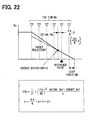
- the target trajectory is defined by calculating target engine rotation speeds for respective TDCs in the interval since the engine rotation stop behavior starts until the target rotation speed at the reference point is reached and by allotting the calculated target engine rotation speeds in a table (refer to FIG. 2 ).
- a kinetic energy (rotation energy) is attenuated by the engine friction and the engine rotation speed decreases. Therefore, the actual engine rotation speed can be conformed to the target rotation speed at the reference point with high accuracy by calculating the target trajectory based on the engine friction and the target rotation speed at the reference point and by controlling the torque of the alternator 33 to conform the actual engine rotation behavior to the target trajectory. Moreover, the torque of the alternator 33 does not affect the engine rotation behavior in the interval from the reference point to the target stop position. Therefore, the error of the stop position due to the torque of the alternator 33 can be eliminated. As a result, the actual stop position of the engine rotation can be conformed to the target stop position with high accuracy.
- the target trajectory is calculated by selecting the engine friction from the multiple engine frictions in accordance with the crank angle to the reference point.
- the engine friction set in an interval from the reference point to M1 is different from the engine friction set in an interval from M1 to M.
- the target rotation speed at the reference point is set equal to or lower than the lower limit rotation speed of the rotation speed range in which the torque of the alternator 33 is generated. Therefore, a state where the torque of the alternator 33 is not generated arises before the reference point is reached.
- the torque of the alternator 33 is controlled by calculating feedback correction torque Tfb such that a deviation (energy deviation) between the target trajectory and the engine rotation behavior becomes zero at a position preceding the reference point by a predetermined crank angle [(4 ⁇ /N) ⁇ ].
- N is the number of the cylinders of the engine 11
- ⁇ is an adjustment parameter for calculating the crank angle from the reference point to a position where the generation of the torque of the alternator 33 ceases (0 ⁇ ⁇ 1).
- the position preceding the reference point by the predetermined crank angle. [(4 ⁇ /N) ⁇ ] is set at a position where the engine rotation speed coincides with the lower limit rotation speed of the torque generation rotation speed range of the alternator 33.
- the position preceding the reference point by the predetermined crank angle [(4 ⁇ /N) ⁇ ] may be set at a position where the engine rotation speed becomes rotation speed slightly higher than the lower limit rotation speed of the torque generation rotation speed range of the alternator 33.
- the above-described engine stop control according to the present embodiment is performed by the ECU 30 according to the respective routines of FIGS. 3 to 14 . Next, processing contents of the respective routines will be explained.
- a time synchronization routine shown in FIG. 3 is performed by the ECU 30 repeatedly in a predetermined cycle (e.g., 8ms cycle) while a power source of the ECU 30 is ON (i.e., while a power source of an ignition switch is ON). If the routine is started, first in step 100, an engine stop request determination routine shown in FIG. 5 explained later is executed to determine whether an engine stop request (idle stop request) is generated.
- a predetermined cycle e.g. 8ms cycle
- step 200 in which an engine start request determination routine shown in FIG. 6 explained later is executed to determine whether an engine start request (automatic start request after idle stop) is generated.
- step 300 in which a first engine stop control routine shown in FIG. 7 explained later is executed to calculate request torque of the alternator 33 (hereafter, referred to as request alternator torque).
- request alternator torque request alternator torque
- step 400 a first engine start control routine shown in FIG. 12 explained later is executed to set a first ignition cylinder and a second ignition cylinder in the automatic start.
- a crank angle synchronization routine shown in FIG. 4 is executed by the ECU 30 repeatedly at every predetermined crank angle (e.g., at every 30 deg CA) while the power source of the ECU 30 is ON (i.e., while the power source of the ignition switch is ON). If the routine is started, first in step 500, a second engine start control routine shown in FIG. 14 explained later is executed to perform fuel injection control, ignition control and misfire determination of the first ignition cylinder in the automatic start.
- step 550 it is determined whether present time is TDC timing as execution timing of stop position control. If the present time is not the TDC timing, the routine is ended as it is. If the present time is the TDC timing, the process proceeds to step 600, in which a second engine stop control routine shown in FIG. 10 explained later is executed to perform the stop position control.
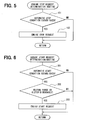
- the engine stop request determination routine shown in FIG. 5 is a subroutine executed in step 100 of the time synchronization routine of FIG. 3 . If the routine is started, first in step 101, it is determined whether an automatic stop condition (idle stop execution condition) is established.
- the automatic stop condition is established when either one of following conditions (a), (b) is satisfied.
- the engine start request determination routine shown in FIG. 6 is a subroutine executed in step 200 of the time synchronization routine of FIG. 3 . If the routine is started, first in step 201, it is determined whether the automatic start condition is established (i.e., whether driver has performed operation for starting vehicle).
- step 202 When it is determined in step 202 that the shift position is in the neutral range or the clutch is disengaged (clutch pedal is pressed down), the power transmission from the engine 11 to the driving wheels is blocked and the vehicle maintains the stopped state even if the automatic start is performed. Therefore, in this case, the process proceeds to step 203, in which the engine start request is outputted, and the routine is ended.
- the first engine stop control routine shown in FIG. 7 is a subroutine performed in step 300 of the time synchronization routine of FIG. 3 . If the routine is started, first in step 301, it is determined whether an engine stop request is outputted based on the processing result of the engine stop request determination routine of FIG. 5 . When the engine stop request is not outputted, the routine is ended as it is without performing subsequent processing.
- step 302 it is determined whether a fuel cut flag is set at ON.
- the fuel cut flag is set in step 304 mentioned later.
- step 303 it is determined whether present engine rotation speed Ne is higher than a predetermined value Ne1.
- processing of steps 304 to 306 or processing of steps 307 to 309 is performed. If the engine rotation speed Ne at the start of the engine stop control is too low, the number of the TDCs until the reference point is reached becomes too small and it becomes difficult to conform the engine rotation behavior to the target trajectory. Therefore, the processing of steps 304 to 306 and the processing of steps 307 to 309 are provided to control the engine rotation speed Ne at the start of the engine stop control to or over the predetermined value Ne1 necessary for conforming the engine rotation behavior to the target trajectory.
- step 303 If it is determined in step 303 that the present engine rotation speed Ne is higher than the predetermined value Ne1, it is determined that the engine rotation speed Ne necessary for conforming the engine rotation behavior to the target trajectory is secured. In this case, the process proceeds to step 304; in which the fuel cut flag is set at ON to perform the fuel cut.
- step 305 the throttle opening is increased to a first predetermined value Ta1 (i.e., opening larger than idle speed control opening).
- step 306 the request alternator torque is set by adding offset torque Tofs, which is reference torque of the torque control of the alternator 33, and feedback correction torque Tfb, which is used for performing feedback correction of an error between the actual engine rotation behavior and the target trajectory.
- the offset torque Tofs is set at a half of maximum controllable torque of the alternator 33.
- the alternator 33 cannot output assist torque unlike a motor generator, but the torque of the alternator 33 can be controlled in both of positive and negative directions in a virtual manner. That is, the torque of the alternator 33 can be controlled by regarding the torque smaller than the offset torque Tofs as virtual negative torque and regarding the torque larger than the offset torque Tofs as virtual positive torque.
- performance of the engine rotation behavior to follow the target trajectory can be improved.
- the offset torque Tofs is not limited to the half of the maximum torque.
- the offset torque Tofs may be 1/3, 1/4, 2/3, 3/4 or the like of the maximum torque.
- Arbitrary torque that is smaller than the maximum controllable torque of the alternator 33 and larger than zero may be set as the offset torque Tofs.
- step 302 If it is determined in step 302 that the fuel cut flag has been already set at ON, the processing of steps 303 to 305 is skipped and the processing of step 306 is executed.
- step 303 If it is determined in step 303 that the present engine rotation speed Ne is equal to or lower than the predetermined value Ne1, the process proceeds to step 307, in which the ignition timing is advanced to a certain value or a knock limit. Thus, the engine torque is increased and the engine rotation speed Ne is increased.
- step 308 a compressor OFF request is outputted (i.e., compressor OFF flag is switched on) to switch off a compressor of an air conditioner.
- a load on the engine 11 is reduced and the engine rotation speed Ne is increased.
- the engine rotation speed may be increased by increasing the intake air quantity (i.e., increasing throttle opening) or increasing the fuel injection quantity.
- step 309 in which request alternator torque is restricted to the offset torque Tofs.
- step 310 it is determined whether a throttle opening is requested (i.e., whether TDC immediately before stop position has been passed). If the throttle opening is requested, the process proceeds to step 311, in which the throttle opening is set to a second predetermined value Ta2 larger than the first predetermined value Ta1. If it is determined in step 310 that there is no throttle opening request, the processing in step 311 is not executed and the throttle opening is continuously maintained at the first predetermined value Ta1.
- step 312 it is determined whether a predetermined time has elapsed after the engine rotation speed Ne lowers to speed equal to or lower than rotation speed Ne2 immediately preceding the engine stop.
- the rotation speed Ne2 immediately before the stop corresponds to rotation speed at time immediately after the TDC, which is immediately before the stop position.
- the predetermined time is set to time for waiting until the engine rotation surely stops.
- step 312 If it is determined in step 312 that the predetermined time has not elapsed after the engine rotation speed Ne lowers to speed equal to or lower than the rotation speed Ne2 immediately preceding the stop, the routine is ended as it is. Thereafter, if step 312 is determined to be "Yes" when the predetermined time elapses after the engine rotation speed Ne lowers to speed equal to or lower than the rotation speed Ne2 immediately preceding the stop, the process proceeds to step 313.
- step 313 a reference point learning routine of FIG. 8 explained later is executed to calculate target Ne at a next reference point. Ne means the rotation speed, hereinafter.
- step 314 in which a friction learning routine of FIG. 9 explained later, is executed to learn first and second frictions Tfr1, Tfr2 of the engine 11.
- the reference point learning routine shown in FIG. 8 is a subroutine executed in step 313 of the first engine stop control shown in FIG. 7 and functions as a learning correction means of the claims. If the routine is started, first in step 321, a stop position error is calculated by a following formula.
- Stop position error actual stop position crank angle - current reference point crank angle mod ⁇ 720 + 720 / N ⁇ K - target stop position crank angle
- N represents the cylinder number of the engine 11 and K represents the number of the TDCs having passed from the current reference point to the actual stop position.
- step 322 in which an upper limit and a lower limit of a norm Ne 2 error corresponding to the stop position error are calculated with reference to a norm Ne 2 error upper limit and lower limit map shown in FIG. 16 .
- step 323 an upper limit and a lower limit of a next reference point target Ne base value are calculated by following formulae.
- Next reference point target Ne base value upper limit ⁇ current reference point actual Ne 2 - Norm Ne 2 error lower limit
- Next reference point target Ne base value lower limit ⁇ current reference point actual Ne 2 - Norm Ne 2 error upper limit
- the process proceeds to step 324, in which the next reference point target Ne base value lower limit is compared with the current reference point target Ne. If the next reference point target Ne base value lower limit is larger than the current reference point target Ne, the process proceeds to step 326, in which the next reference point target Ne base value lower limit is used as the next reference point target Ne base value.
- Next reference point target Ne base value next reference point target Ne base value lower limit If it is determined in step 324 that the next reference point target Ne base value lower limit is equal to or smaller than the current reference point target Ne, the process proceeds to step 325. In step 325, the next reference point target Ne base value upper limit is compared with the current reference point target Ne. If the next reference point target Ne base value upper limit is smaller than the current reference point target Ne, the process proceeds to step 327, in which the next reference point target Ne base value upper limit is used as the next reference point target Ne base value.
- Next reference point target Ne base value next reference point target Ne base value upper limit If the determination result is "NO" in both of steps 324 and 325, i.e., if the current reference point target Ne exists between the lower limit and the upper limit of the next reference point target Ne base value, the process proceeds to step 328. In step 328, the current reference point target Ne is continuously used as the next reference point target Ne base value.
- Next reference point target Ne base value current reference point target Ne
- the next reference point target Ne base value is set in either one of steps 326 to 328. Then, the process proceeds to step 329, in which the next reference point target Ne is obtained by smoothing processing based on a following formula.
- Next reference point target Ne current reference point target Ne - ⁇ • current reference point target Ne - next reference point target Ne base value
- ⁇ is a smoothing coefficient (0 ⁇ ⁇ ⁇ 1).
- step 330 If it is determined that the friction learning execution condition is established in step 330, the process proceeds to step 331.
- step 331 trajectory data (x n , y n ) of the actual rotation behavior in the interval (0 to M 1 ) in which the first friction (Tfr1) is calculated are read.
- y n is actual Ne 2 at each TDC in the interval of the first friction.
- N is the cylinder number of the engine 11
- M 1 is a starting position of the interval of the first friction (i.e., the number of TDCs from reference point).
- step 332 in which a first inclination is calculated by the least-square method.
- n M 1 + 1.
- step 333 in which the first friction (Tfr1) is calculated by a following formula using the first inclination.
- Tfr ⁇ 1 ⁇ • l / 10 x first inclination
- I represents an engine inertia moment [kgm].
- step 334 trajectory data (x n , y n ) of the actual rotation behavior in the interval (M 1 to M) in which the second friction (Tfr2) is calculated are read.
- y n is the actual Ne 2 at each TDC in the interval of the second friction.
- step 335 in which a second inclination is calculated by the least square method.
- step 336 in which the second friction (Tfr2) is calculated by a following formula using the second inclination.
- the second engine stop control routine shown in FIG. 10 is a subroutine executed in step 600 of the crank angle synchronization routine shown in FIG. 4 . If the routine is started, first in step 601, the target Ne is calculated as follows.
- target Ne 2 [M] in the interval (0 to M 1 ) of the first friction (Tfr1) and the interval (M 1 to M) of the second friction (Tfr2) is calculated by a following formula.
- Target Ne 2 M 10 / ⁇ • l ⁇ 0 , 720 ⁇ Tfg ⁇ 1 / N , 720 ⁇ Tfr ⁇ 1 / N ⁇ 2 , ... , 720 ⁇ Tfr ⁇ 1 / N ⁇ M 1 , 720 ⁇ Tfr ⁇ 2 / N ⁇ M 1 + 1 , ... , 720 ⁇ Tfr ⁇ 2 / N ⁇ M - 1 + reference point target Ne 2
- a following relationship is established between the engine inertia moment I and the friction Tfr.
- Ne 2 10 / ⁇ • I • Tfr • ⁇
- the target Ne 2 [M] is calculated using the above relationship.
- the current target Ne is calculated from the target Ne 2 at the m-th TDC from the reference point by a following formula.
- Target Ne ⁇ target Ne 2 Accordingly, with the decrease of the actual Ne, values of the target Ne at the respective TDCs are serially calculated based on the frictions Tfr1, Tfr2 and the reference point target Ne. Thus, the target trajectory is set.
- step 602 it is determined whether a stop position control execution condition is established, for example, based on whether both of following conditions (a), (b) are satisfied.
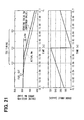
- the above condition (a) is used for following reason. That is, as shown in FIG. 21 , decrease width ⁇ Ne of the engine rotation speed Ne, which is sensed from the output pulse of the crank angle sensor 28, becomes smaller than an actual value due to the smoothing processing of the engine rotation speed Ne immediately after the fuel cut (i.e., in initial stage of engine stop behavior). Accordingly, the friction is estimated to be smaller than an actual value.
- the above condition (b) is used because there is no need to start the stop position control from the TDC that is far from the reference point beyond necessity. In addition, it is difficult to perform the stop position control when the engine rotation speed is too high.
- the stop position control execution condition is not established and the stop position control is not performed if at least either one of the conditions (a), (b) is not satisfied.
- step 603 a stop position control routine shown in FIG. 11 explained later is executed to calculate the feedback correction torque Tfb of the request alternator torque.
- the stop position control routine shown in FIG. 11 is a subroutine executed in step 603 of the second engine stop control routine shown in FIG. 10 . If the routine is started, first in step 611, it is determined whether a stop position control mode has been determined. If the stop position control mode has been determined, the routine is ended without performing subsequent processing.
- step 612 it is determined whether a deviation (energy deviation) between the target Ne 2 and the actual Ne 2 is smaller than a lower limit value ThAltMin at the m-th TDC, at which the control is performed currently, with reference to a map of the lower limit value ThAltMin of the controllable energy deviation shown in FIG. 17 . If it is determined that the deviation between the target Ne 2 and the actual Ne 2 is smaller than the lower limit value ThAltMin, the process proceeds to step 613, in which the stop position control mode is set to "3." In following step 614, the feedback correction torque Tfb of the request alternator torque is set to a minimum value (for example, -8).
- step 612 If it is determined in step 612 that the deviation between the target Ne 2 and the actual Ne 2 is equal to or larger than the lower limit value ThAltMin, the process proceeds to step 615, in which it is determined whether the deviation between the target Ne 2 and the actual Ne 2 is larger than an upper limit value ThAltMax at the m-th TDC, at which the control is performed currently, with reference to a map of the upper limit value ThAltMax of the controllable energy deviation shown in FIG. 18 .
- step 616 the stop position control mode is set to "2."
- step 617 the feedback correction torque Tfb of the request alternator torque is set to a maximum value (for example, 10).
- step 618 it is determined whether an absolute value of the deviation between the target Ne 2 and the actual Ne 2 (i.e., Itarget Ne 2 - actual Ne 2
- a determination value for example, 5000.
- step 619 in which the stop position control mode is set to "1."
- step 620 the feedback correction torque Tfb of the request alternator torque is set to 0.
- the first and second frictions can be learned in a state where the torque of the alternator 33 is fixed at the offset torque Tofs (i.e., in a state where feedback control is prohibited) over an entire range of the engine rotation stop behavior.
- step 621 If it is determined that
- Tfb 1 / 2 ⁇ I ⁇ 2 ⁇ ⁇ / 60 2 ⁇ actual Ne 2 - target Ne 2 ⁇ 4 ⁇ ⁇ / N ⁇ m - 1 - ⁇
- ⁇ represents an adjustment parameter for calculating the crank angle from the reference point to a position where the generation of the torque of the alternator 33 ceases (0 ⁇ ⁇ ⁇ 1).
- the generation of the torque of the alternator 33 ceases at a position preceding the reference point by a predetermined crank angle [(4 ⁇ /N) ⁇ ]. Therefore, the feedback correction torque Tfb is calculated such that the deviation (energy deviation) between the target Ne 2 and the actual Ne 2 becomes zero at the position preceding the reference point by the predetermined crank angle [(4 ⁇ /N) ⁇ ] with the use of the above formula.
- the position preceding the reference point by the predetermined crank angle [(4 ⁇ /N) ⁇ ] is set at a position where the actual Ne coincides with the lower limit rotation speed of the torque generation rotation speed range of the alternator 33.
- the position may be set at a position where the actual Ne becomes rotation speed slightly higher than the lower limit rotation speed of the torque generation rotation speed range of the alternator 33.
- the stop position control mode is determined based on the deviation (energy deviation) between the target Ne 2 and the actual Ne 2 at the start of the stop position control by the processing of the above-described stop position control routine. Based on the determination result, the feedback correction torque Tfb of the request alternator torque is set as follows.
- the control can be performed also in a range where the control cannot be performed by the feedback control.
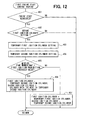
- the first engine start control routine shown in FIG. 12 is a subroutine executed in step 400 of the time synchronization routine shown in FIG. 3 . If the routine is started, first in step 401, it is determined whether the engine start is requested based on the processing result of the engine start request determination routine of FIG. 6 . If the engine start is not requested, the routine is ended as it is.
- step 402 it is determined whether a first ignition cylinder for performing the ignition first in the automatic start has not been set. If the first ignition cylinder has been already set, the routine is ended without performing subsequent processing.
- step 403 a temporary first ignition cylinder corresponding to the crank angle of the stop position is set with reference to a first ignition cylinder map shown in FIG. 13 (in the case of four-cylinder engine).
- the stop position can be controlled to the target stop position with high accuracy. Therefore, the crank angle of the target stop position may be used as the crank angle of the stop position.
- step 404 a cylinder, in which the TDC is reached next to the temporary first ignition cylinder, is set as a temporary second ignition cylinder.
- step 405 it is determined whether a misfire time number Nmf of the temporary first ignition cylinder sensed by a second engine start control routine of FIG. 14 explained later is larger than a first ignition prohibition threshold value. If the misfire time number Nmf of the temporary first ignition cylinder is larger than the first ignition prohibition threshold value, the process proceeds to step 406, in which the temporary second ignition cylinder is set as the first ignition cylinder and a cylinder, in which the TDC is reached next to the temporary second ignition cylinder, is set as the second ignition cylinder.
- step 405 If it is determined in step 405 that the misfire time number Nmf of the temporary first ignition cylinder is equal to or smaller than the first ignition prohibition threshold value, the process proceeds to step 407, in which the temporary first ignition cylinder is set as the first ignition cylinder as it is and the temporary second ignition cylinder is set as the second ignition cylinder as it is.
- the second engine start control routine shown in FIG. 14 is a subroutine executed in step 500 of the crank angle synchronization routine shown in FIG. 4 . If the routine is started, first in step 501, it is determined whether the engine start is requested based on the processing result of the engine start request determination routine of FIG. 6 . If the engine start is not requested, the routine is ended as it is.
- step 502 If the engine start is requested, the process proceeds to step 502, in which fuel injection control is performed. In following step 503, ignition control is performed.
- step 504 it is determined whether the present time is the TDC timing. If the present time is not the TDC timing, the routine is ended as it is. If the present time is the TDC timing, the process proceeds to step 505, in which it is determined whether the present time is the TDC timing of the first ignition cylinder. If the present time is the TDC timing of the first ignition cylinder, the process proceeds to step 506, in which the actual Ne at the TDC timing of the first ignition cylinder is stored as Nef in the memory of the ECU 30 (RAM or the like).
- step 505 If it is determined in step 505 that the present time is not the TDC timing of the first ignition cylinder, the process proceeds to step 507, in which it is determined whether the present time is TDC timing of the second ignition cylinder. If the present time is not the TDC timing of the second ignition cylinder, the routine is ended as it is.
- step 509 a misfire time number counter that counts the misfire time number Nmf of the first ignition cylinder is incremented.
- the misfire time number counter is provided for each cylinder.
- the misfire time number counter of the cylinder counts the misfire time number Nmf at the time when the cylinder is the first ignition cylinder. If the deviation ⁇ Ne is larger than the misfire determination threshold value, it is determined that the first ignition cylinder has caused the normal combustion.
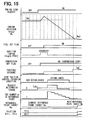
- FIG. 15 is a time chart showing an example of the engine stop control according to the present embodiment described above.
- the engine rotation speed Ne is lower than the predetermined value Ne1 necessary for conforming the engine rotation behavior to the target trajectory. Therefore, the ignition timing is advanced to increase the engine torque, and the compressor OFF flag is set at ON to stop the compressor and to reduce the load on the engine 11. Thus, the engine rotation speed Ne is increased.
- the fuel cut flag is set at ON to perform the fuel cut, and the throttle opening is increased from the idle speed control opening to the first predetermined value Ta1.
- the stop position control is started and the request alternator torque is set based on the offset torque Tofs and the feedback correction torque Tfb.
- the request alternator torque becomes zero when the establishment of the stop position control execution condition fails. Further, the throttle opening is increased from the first predetermined value Ta1 to the second predetermined value Ta2 when the reference point is reached. Thereafter, when a predetermined time elapses after the engine rotation speed Ne decreases to or under the rotation speed Ne2 immediately preceding the stop, the next reference point target Ne is learned based on the stop position error and the frictions Tfr1, Tfr2 are learned.
- the target trajectory (target Ne at respective TDCs) extending to the target Ne at the reference point set at the position preceding the target stop position by a predetermined crank angle is set.
- the target trajectory can be set in the range preceding the very low rotation range in which the influence of the compression arises.
- the engine rotation behavior can be controlled with the torque of the alternator 33 without being affected by the compression during the engine rotation stop behavior.
- the torque of the alternator 33 is controlled such that the deviation (energy deviation) between the target trajectory and the engine rotation behavior becomes zero at the position preceding the reference point by the predetermined crank angle [(4 ⁇ /N) ⁇ ] in the present embodiment. Therefore, the engine rotation behavior can be accurately conformed to the target trajectory with the torque of the alternator 33 by using the range where the torque of the alternator 33 can be efficiently controlled before the reference point is reached.
- the actual Ne can be conformed to the target Ne with high accuracy at the reference point.
- the target Ne at the reference point is set to the engine rotation speed at the reference point necessary for stopping the engine rotation at the target stop position from the reference point.
- the setting is made such that the target stop position is located on an extended line of the target trajectory extending to the reference point. Therefore, as the actual Ne can be accurately conformed to the target Ne at the reference point by the control according to the present embodiment, the actual stop position of the engine rotation can be conformed to the target stop position with high accuracy.
- the target Ne at the reference point is set to be equal to or lower than the lower limit rotation speed of the rotation speed range in which the torque of the alternator 33 is generated.
- the position preceding the reference point by the predetermined crank angle [(4 ⁇ /N) ⁇ ] (i.e., position where energy deviation between target trajectory and engine rotation behavior becomes zero) is set at the position where the engine rotation speed becomes the lower limit rotation speed of the torque generation rotation speed range of the alternator 33. Therefore, the engine rotation behavior can be conformed to the target trajectory with high accuracy by using the rotation speed range, in which the torque of the alternator 33 can be outputted efficiently, as efficiently as possible.
- the engine stop control when the energy deviation at the start of the engine stop control is larger than the upper limit value ThAltMax of the controllable energy deviation, the engine stop control is performed by fixing the feedback correction torque Tfb of the alternator 33 at the maximum value.
- the engine stop control is performed by fixing the feedback correction torque Tfb of the alternator 33 at the minimum value. Accordingly, when it is determined that the energy deviation at the start of the engine stop control exceeds the capacity of the engine stop control, the engine stop control can be performed by fixing the feedback correction torque Tfb at the maximum value or the minimum value.
- the control can be performed also in the range, where the control cannot be performed by the feedback control.
- the engine stop control when the absolute value of the energy deviation at the start of the engine stop control is smaller than the determination value, the engine stop control is performed by fixing the feedback correction torque Tfb at the constant value "zero," and the engine friction is learned based on the engine rotation behavior during the engine stop control. Therefore, when it is determined that there is no need to perform the feedback control of the torque of the alternator 33 because the absolute value of the energy deviation at the start of the engine stop control is small, the feedback control is prohibited and the engine friction can be learned based on the engine rotation behavior. Thus, the engine friction can be learned with high accuracy without being affected by the feedback control.
- the present invention may be implemented by omitting the function to learn the engine friction. In this case, the engine friction may be calculated based on experimental data, design data and the like and stored in a nonvolatile memory such as the ROM of the ECU 30 beforehand.
- the setting is made such that the target stop position is located on the extended line of the target trajectory extending to the reference point. Therefore, it is thought that the error in the stop position is caused by the error in the target Ne at the reference point (error in target trajectory).
- the target Ne at the reference point is learned and corrected based on the error in the stop position. Accordingly, the accuracy of the target Ne at the reference point can be improved.
- cylinder pressure of each cylinder operates in a direction to hinder the engine rotation (i.e., direction in which kinetic energy decreases) in a compression stroke and operates in a direction to help the engine rotation (i.e., direction in which kinetic energy increases) in an expansion stroke. Therefore, balance of the kinetic energy due to the cylinder pressure becomes zero at each TDC.
- the target trajectory is set for each TDC. Therefore, the target trajectory can be set with high accuracy by eliminating the influence of cyclic change of the kinetic energy due to the cylinder pressure, and the calculation for setting the target trajectory can be simplified.
- the present invention is not limited to the construction that sets the target trajectory for each TDC.
- the target trajectory may be set for each predetermined crank angle interval.
- the torque of the alternator 33 is controlled during the engine stop control.
- other electric machinery than the alternator 33 e.g., motor generator of hybrid vehicle
- the invention has been described in connection with what is presently considered to be the most practical and preferred embodiments, it is to be understood that the invention is not to be limited to the disclosed embodiments, but on the contrary, is intended to cover various modifications and equivalent arrangements included within the spirit and scope of the appended claims.
Landscapes
- Engineering & Computer Science (AREA)
- Chemical & Material Sciences (AREA)
- Combustion & Propulsion (AREA)
- Mechanical Engineering (AREA)
- General Engineering & Computer Science (AREA)
- Transportation (AREA)
- Automation & Control Theory (AREA)
- Control Of Vehicle Engines Or Engines For Specific Uses (AREA)
- Combined Controls Of Internal Combustion Engines (AREA)
- Output Control And Ontrol Of Special Type Engine (AREA)
Abstract
Description
- This application is based on and incorporates herein by reference Japanese Patent Application No.
2008-205951 filed on August 8, 2008 - The present invention relates to an engine stop control device having a function to control an engine rotation stop position (stop crank angle) when an engine stops.
- In recent years, as described in Patent document 1 (
JP-A-2005-315202 -
- Patent document 1:
JP-A-2005-315202 - An engine stop control device described in above
Patent document 1 controls the engine rotation stop position into the target crank angle range by controlling a load of the alternator when automatically stopping the engine. However, practically, the control device merely sets the target current value of the alternator in accordance with present engine rotation speed with the use of a preset map when the engine rotation speed, which is sensed when a piston passes a compression top dead center (TDC), is in a range from 480 rpm to 540 rpm (refer to paragraph 69 of Patent document 1). Therefore, the control of the alternator load is rough and it is difficult to sufficiently compensate a variation in an engine rotation behavior during an engine stop process. Therefore, it is thought that the control device ofPatent document 1 cannot reduce the variation in the engine rotation stop position sufficiently and cannot exert a sufficient effect to improve the restarting performance. - In order to solve the problem, the applicant of the present application filed patent applications of an invention for calculating a target engine rotation behavior (referred to as target trajectory, hereinafter) extending until engine rotation stops at a target stop position and for controlling an accessory load of an engine to conform an engine rotation behavior to the target trajectory as described in specifications of Japanese Patent Applications No.
2007-53598 2007-54775 - In the engine stop process, cylinder pressure changes with compression and expansion of cylinder air caused by rotation of the engine. The cylinder pressure at the engine rotation stop changes in accordance with a crank angle at the engine rotation stop and therefore compression torque (torque caused by cylinder pressure) acting on a crankshaft changes. Accordingly, the target trajectory suitable for stopping the engine rotation at the target stop position also changes. In the invention of the above applications, such the change in the target trajectory is not taken into account. Therefore, accuracy of the target trajectory worsens correspondingly.
- In order to solve such the problem, the applicant of the present application filed an application of an invention for correcting the target trajectory in accordance with the target stop position in consideration of an influence of the compression as described in a specification of Japanese Patent Application No.
2007-325520 - The present invention has been made in consideration of the above circumstances. Therefore, it is an object of the present invention to provide an engine stop control device that is capable of controlling torque of an electric machinery to accurately conform an engine rotation behavior to a target trajectory of engine stop control by accurately setting the target trajectory and that is capable of accurately controlling an engine rotation stop position to a target stop position.
- In order to achieve the above object, according to an invention of
claim 1, an engine stop control device performs engine stop control for controlling an engine rotation behavior with torque of an electric machinery such that an engine rotation stop position is controlled to a target stop position when the control device stops engine rotation in response to an engine stop request. The control device has a reference point target rotation speed setting section, a target trajectory calculating section, and a stop controlling section. The reference point target rotation speed setting section sets target rotation speed at a reference point, which is set at a position preceding the target stop position by a predetermined crank angle. The target trajectory calculating section calculates a target trajectory of the engine rotation behavior extending since the engine stop control is started until the target rotation speed at the reference point is reached based on the target rotation speed at the reference point and an engine friction. The stop controlling section controls the torque of the electric machinery to conform the engine rotation behavior to the target trajectory during execution of the engine stop control. The stop controlling section controls the torque of the electric machinery such that an energy deviation between the target trajectory and the engine rotation behavior becomes zero at a position preceding the reference point by a second predetermined crank angle. - The influence of the compression arises in a very low rotation range immediately before the engine rotation stops. Therefore, by setting the target trajectory extending to the target rotation speed at the reference point set at the position preceding the target stop position by the predetermined crank angle as in the present invention, the target trajectory can be set in the range preceding the very low rotation range in which the influence of the compression arises. Thus, the engine rotation behavior can be controlled with the electric machinery without being affected by the compression during the engine rotation stop behavior.
- The control of the torque of the electric machinery becomes difficult immediately before the reference point. Therefore, in consideration of this point, according to the present invention, the torque of the electric machinery is controlled such that the energy deviation between the target trajectory and the engine rotation behavior becomes zero at the position preceding the reference point by the second predetermined crank angle. Accordingly, the engine rotation behavior can be accurately conformed to the target trajectory with the torque of the electric machinery by using the range where the torque of the electric machinery can be efficiently controlled before the reference point is reached. Thus, the actual rotation speed can be accurately conformed to the target rotation speed at the reference point. The target rotation speed at the reference point is set at the engine rotation speed at the reference point necessary for stopping the engine rotation at the target stop position from the reference point. That is, the setting is made such that the target stop position is located on an extended line of the target trajectory extending to the reference point. Therefore, as the actual rotation speed can be accurately conformed to the target rotation speed at the reference point according to the present invention, the actual stop position of the engine rotation can be accurately conformed to the target stop position.
- In this case, as in
claim 2, the target rotation speed at the reference point may be set to or under lower limit rotation speed of a rotation speed range, in which the torque of the electric machinery is generated, and the position preceding the reference point by the second predetermined crank angle (i.e., position where energy deviation between target trajectory and engine rotation behavior becomes zero) may be set at a position where the engine rotation speed coincides with the lower limit rotation speed of the rotation speed range, in which the torque of the electric machinery is generated. With such the construction, the influence of the torque of the electric machinery does not arise in the engine rotation behavior extending from the reference point to the target stop position. Thus, the error in the stop position due to the torque of the electric machinery can be eliminated. Moreover, the position where the energy deviation between the target trajectory and the engine rotation behavior becomes zero is set at the position where the engine rotation speed coincides with the lower limit rotation speed of the torque generation rotation speed range of the electric machinery. Therefore, the engine rotation behavior can be accurately conformed to the target trajectory by using the range, where the torque of the electric machinery can be efficiently outputted, as efficiently as possible. Alternatively, the present invention may be implemented by setting the position where the energy deviation between the target trajectory and the engine rotation behavior becomes zero at a position where the engine rotation speed becomes rotation speed slightly higher than the lower limit rotation speed of the torque generation rotation speed range of the electric machinery. - If the energy deviation at the start of the engine stop control exceeds the capacity of the engine stop control, the engine rotation behavior cannot be conformed to the target trajectory.
- In consideration of this point, as in
claim 3, the engine stop control may be performed by fixing the torque of the electric machinery at a maximum value when the energy deviation at the start of the engine stop control is greater than a predetermined upper limit value. The engine stop control may be performed by fixing the torque of the electric machinery at a minimum value when the energy deviation at the start of the engine stop control is less than a predetermined lower limit value. With such the construction, when it is determined that the energy deviation at the start of the engine stop control exceeds the capacity of the engine stop control, the engine stop control can be performed by fixing the torque of the electric machinery at the maximum value or the minimum value. Accordingly, the control can be performed also in a range where the control cannot be performed by feedback control. - As in
claim 4, the engine stop control may be performed by fixing the torque of the electric machinery at a constant value when an absolute value of the energy deviation at the start of the engine stop control is smaller than a predetermined value, and the engine friction may be learned based on the engine rotation behavior during the engine stop control. When the absolute value of the energy deviation at the start of the engine stop control is small, the engine rotation can be stopped at the target stop position with a certain accuracy even without performing the feedback control of the torque of the electric machinery. Therefore, in this case, the feedback control is prohibited and the engine friction is learned based on the engine rotation behavior. Thus, the engine friction can be learned with high accuracy without being affected by the torque fluctuation of the electric machinery due to the feedback control. Alternatively, the present invention may be implemented by omitting the function to learn the engine friction and by calculating the engine friction based on experimental data or design data beforehand. - As in
claim 5, the engine stop control may be started at a position posterior to a position, at which fuel is cut in response to the engine stop request, by a predetermined crank angle rotation. Immediately after the fuel cut (i.e., in initial stage of engine stop behavior), decrease width of the engine rotation speed is smaller than an actual value due to smoothing processing of the engine rotation speed sensed from an output pulse of a crank angle sensor. Therefore, at that time, the engine friction is estimated to be smaller than an actual value. - Features and advantages of an embodiment will be appreciated, as well as methods of operation and the function of the related parts, from a study of the following detailed description, the appended claims, and the drawings, all of which form a part of this application. In the drawings:
-
FIG. 1 is a schematic construction diagram of an entire engine control system according to an embodiment of the present invention. -
FIG. 2 is a diagram illustrating a setting method of a target trajectory. -
FIG. 3 is a flowchart illustrating a processing flow of a time synchronization routine. -
FIG. 4 is a flowchart illustrating a processing flow of a crank angle synchronization routine. -
FIG. 5 is a flowchart illustrating a processing flow of an engine stop request determination routine. -
FIG. 6 is a flowchart illustrating a processing flow of an engine start request determination routine. -
FIG. 7 is a flowchart illustrating a processing flow of a first engine stop control routine. -
FIG. 8 is a flowchart illustrating a processing flow of a reference point learning routine. -
FIG. 9 is a flowchart illustrating a processing flow of a friction learning routine. -
FIG. 10 is a flowchart illustrating a processing flow of a second engine stop control routine. -
FIG. 11 is a flowchart illustrating a processing flow of a stop position control routine. -
FIG. 12 is a flowchart illustrating a processing flow of a first engine start control routine. -
FIG. 13 is a diagram showing an example of a first ignition cylinder map. -
FIG. 14 is a flowchart illustrating a processing flow of a second engine start control routine. -
FIG. 15 is a time chart showing an example of engine stop control according to the embodiment. -
FIG. 16 is a diagram showing an example of a norm Ne2 error upper limit and lower limit map. -
FIG. 17 is a diagram showing an example of a map of a lower limit value ThAltMin of a controllable energy deviation. -
FIG. 18 is a diagram showing an example of a map of an upper limit value ThAltMax of the controllable energy deviation. -
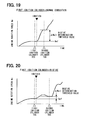
FIG. 19 is a time chart showing an example of a behavior of engine rotation speed Ne at the time when a first ignition cylinder causes normal combustion. -
FIG. 20 is a time chart showing an example of a behavior of the engine rotation speed Ne at the time when the first ignition cylinder causes a misfire. -
FIG. 21 is a time chart showing behaviors of a sensing value and an actual value of the engine rotation speed Ne and a sensing value of a crank angle immediately after a fuel cut (or in initial stage of engine stop behavior). -
FIG. 22 is a diagram illustrating a method for calculating feedback correction torque Tfb such that a deviation (energy deviation) between target Ne2 and actual Ne2 becomes zero at a position preceding a reference point by a predetermined crank angle [(4π/N)×β]. - Hereinafter, an embodiment embodying the best mode for implementing the present invention will be described.
- First, a schematic construction of entirety of an engine control system will be explained with reference to
FIG. 1 . - An
air cleaner 13 is arranged in the most upstream portion of anintake pipe 12 of aninternal combustion engine 11. Anairflow meter 14 sensing intake air quantity is provided downstream of theair cleaner 13. Athrottle valve 16, whose opening degree is regulated by amotor 15, and athrottle position sensor 17 sensing the opening degree of the throttle valve 16 (throttle opening) are provided downstream of theairflow meter 14. Asurge tank 18 is provided downstream of thethrottle valve 16. Anintake manifold 20 that introduces air into each cylinder of theengine 11 is connected to thesurge tank 18. Aninjector 21 that injects fuel is provided near an intake port of theintake manifold 20 of each cylinder. Aspark plug 22 is provided to a cylinder head of theengine 11 for each cylinder. A mixture gas in the cylinder is ignited by a spark discharge of thespark plug 22. - An exhaust gas sensor 24 (air-fuel ratio sensor, oxygen sensor or the like) that senses an air-fuel ratio, a rich/ lean state or the like of exhaust gas is provided to an
exhaust pipe 23 of theengine 11. Acatalyst 25 such as a three-way catalyst that purifies the exhaust gas is provided downstream of theexhaust gas sensor 24. - A
coolant temperature sensor 26 that senses coolant temperature is provided to a cylinder block of theengine 11. Asignal rotor 29 having teeth on its outer periphery at a predetermined crank angle pitch is fitted to acrankshaft 27 of theengine 11. Acrank angle sensor 28 is provided to be opposed to the outer periphery of thesignal rotor 29. Every time the tooth of thesignal rotor 29 faces the crank angle sensor 28 (i.e., everytime crankshaft 27 rotates by predetermined crank angle), thecrank angle sensor 28 outputs a crank pulse signal. Engine rotation speed is sensed based on a cycle of the output pulse of the crank angle sensor 28 (or pulse output frequency). A cam angle sensor (not shown) that outputs a cam pulse signal at a predetermined cam angle in synchronization with rotation of a camshaft of theengine 11 is provided. - Rotation of the
crankshaft 27 is transmitted to analternator 33 as a typical accessory of theengine 11 through a belt transmission mechanism (not shown). Thus, thealternator 33 is rotated and driven by the power of theengine 11 to generate electricity. Torque of thealternator 33 can be controlled by duty control of a power generation control current (field current) of thealternator 33. In the present embodiment, thealternator 33 is used as an electric machinery described in the claims. - Outputs of the above various sensors are inputted to an engine control circuit 30 (hereafter, referred to as ECU). The
ECU 30 is constituted mainly by a microcomputer and controls fuel injection quantity and injection timing of theinjector 21 and ignition timing of thespark plug 22 in accordance with an engine operation state sensed with the various sensors. When a predetermined automatic stop condition is established and an engine stop request (idle stop request) is generated during idling, theECU 30 performs an idle stop to stop combustion (ignition and/ or fuel injection) and to stop the engine rotation. When a driver performs an operation for starting a vehicle while the engine is stopped by the idle stop, a predetermined automatic start condition is established and theECU 30 energizes a starter (not shown) to crank and automatically start theengine 11. - The
ECU 30 executes routines shown inFIGS. 3 to 14 explained later. Thus, theECU 30 functions as a reference point target rotation speed setting section, a target trajectory calculating section, and a stop controlling section. The reference point target rotation speed setting section sets target rotation speed at a reference point, which is set at a top dead center (TDC) preceding a target stop position (target stop crank angle) of the engine rotation by a predetermined crank angle. The target trajectory calculating section calculates a target trajectory of an engine rotation behavior extending since the engine stop control is started until the target rotation speed at the reference point is reached based on the target rotation speed at the reference point and an engine friction. The stop controlling section controls the torque of thealternator 33 to conform the engine rotation behavior to the target trajectory during execution of the engine stop control. - The target rotation speed at the reference point, which is set at the TDC preceding the target stop position of the engine rotation by the predetermined crank angle, is set at rotation speed that is equal to or lower than lower limit rotation speed of a rotation speed range, in which the torque of the
alternator 33 is generated, and that is close to the lower limit rotation speed. More specifically, the target rotation speed at the reference point is set such that the engine rotation speed between the reference point and the TDC immediately preceding the reference point becomes equal to or lower than the lower limit rotation speed of the torque generation rotation speed range of thealternator 33. With such the setting, in an interval since the engine rotation stop behavior starts until the vicinity of the target rotation speed at the reference point is reached, control can be performed to conform the engine rotation behavior to the target trajectory using the torque of thealternator 33. In addition, the torque of thealternator 33 does not affect the engine rotation behavior from the reference point to the target stop position. Thus, an error in the stop position due to the torque of thealternator 33 can be eliminated. - The target trajectory is defined by calculating target engine rotation speeds for respective TDCs in the interval since the engine rotation stop behavior starts until the target rotation speed at the reference point is reached and by allotting the calculated target engine rotation speeds in a table (refer to
FIG. 2 ). - During an engine stop process, a kinetic energy (rotation energy) is attenuated by the engine friction and the engine rotation speed decreases. Therefore, the actual engine rotation speed can be conformed to the target rotation speed at the reference point with high accuracy by calculating the target trajectory based on the engine friction and the target rotation speed at the reference point and by controlling the torque of the
alternator 33 to conform the actual engine rotation behavior to the target trajectory. Moreover, the torque of thealternator 33 does not affect the engine rotation behavior in the interval from the reference point to the target stop position. Therefore, the error of the stop position due to the torque of thealternator 33 can be eliminated. As a result, the actual stop position of the engine rotation can be conformed to the target stop position with high accuracy. - In the process since the engine rotation stop behavior starts until the target rotation speed at,the reference point is reached, a characteristic of the engine friction changes in accordance with the crank angle to the reference point because of the multiple accessories of the
engine 11 and the like. In consideration of this point, in the present embodiment, the target trajectory is calculated by selecting the engine friction from the multiple engine frictions in accordance with the crank angle to the reference point. In the example ofFIG. 2 , the engine friction set in an interval from the reference point to M1 is different from the engine friction set in an interval from M1 to M. - As mentioned above, the target rotation speed at the reference point is set equal to or lower than the lower limit rotation speed of the rotation speed range in which the torque of the
alternator 33 is generated. Therefore, a state where the torque of thealternator 33 is not generated arises before the reference point is reached. - In consideration of this point, in the present embodiment, as shown in
FIG. 22 , the torque of thealternator 33 is controlled by calculating feedback correction torque Tfb such that a deviation (energy deviation) between the target trajectory and the engine rotation behavior becomes zero at a position preceding the reference point by a predetermined crank angle [(4π/N)×β]. N is the number of the cylinders of theengine 11, and β is an adjustment parameter for calculating the crank angle from the reference point to a position where the generation of the torque of thealternator 33 ceases (0 ≤ β≤ 1). - In the present embodiment, the position preceding the reference point by the predetermined crank angle. [(4π/N)×β] is set at a position where the engine rotation speed coincides with the lower limit rotation speed of the torque generation rotation speed range of the
alternator 33. Alternatively, according to the present invention, the position preceding the reference point by the predetermined crank angle [(4π/N)×β] may be set at a position where the engine rotation speed becomes rotation speed slightly higher than the lower limit rotation speed of the torque generation rotation speed range of thealternator 33. - The above-described engine stop control according to the present embodiment is performed by the
ECU 30 according to the respective routines ofFIGS. 3 to 14 . Next, processing contents of the respective routines will be explained. - A time synchronization routine shown in
FIG. 3 is performed by theECU 30 repeatedly in a predetermined cycle (e.g., 8ms cycle) while a power source of theECU 30 is ON (i.e., while a power source of an ignition switch is ON). If the routine is started, first instep 100, an engine stop request determination routine shown inFIG. 5 explained later is executed to determine whether an engine stop request (idle stop request) is generated. - Then, the process proceeds to step 200, in which an engine start request determination routine shown in
FIG. 6 explained later is executed to determine whether an engine start request (automatic start request after idle stop) is generated. - Then, the process proceeds to step 300, in which a first engine stop control routine shown in
FIG. 7 explained later is executed to calculate request torque of the alternator 33 (hereafter, referred to as request alternator torque). Then, in followingstep 400, a first engine start control routine shown inFIG. 12 explained later is executed to set a first ignition cylinder and a second ignition cylinder in the automatic start. - A crank angle synchronization routine shown in
FIG. 4 is executed by theECU 30 repeatedly at every predetermined crank angle (e.g., at every 30 deg CA) while the power source of theECU 30 is ON (i.e., while the power source of the ignition switch is ON). If the routine is started, first instep 500, a second engine start control routine shown inFIG. 14 explained later is executed to perform fuel injection control, ignition control and misfire determination of the first ignition cylinder in the automatic start. - Then, the process proceeds to step 550, in which it is determined whether present time is TDC timing as execution timing of stop position control. If the present time is not the TDC timing, the routine is ended as it is. If the present time is the TDC timing, the process proceeds to step 600, in which a second engine stop control routine shown in
FIG. 10 explained later is executed to perform the stop position control. - The engine stop request determination routine shown in
FIG. 5 is a subroutine executed instep 100 of the time synchronization routine ofFIG. 3 . If the routine is started, first instep 101, it is determined whether an automatic stop condition (idle stop execution condition) is established. - In the case of a manual transmission vehicle, the automatic stop condition is established when either one of following conditions (a), (b) is satisfied.
-
- (a) A shift position is in a forward gear range, vehicle speed is equal to or lower than a predetermined value (for example, equal to or lower than 10 km/h), a brake pedal is pressed down (brake = ON), and a clutch is disengaged (clutch pedal is pressed down).
- (b) A shift position is in a neutral range and a clutch is engaged (clutch pedal is not pressed down).
-
- (c) A shift position is in a forward gear range or in a neutral range, vehicle speed is equal to or lower than a predetermined value (for example, equal to or lower than 10 km/h), and a brake pedal is pressed down (brake = ON).
- (d) A shift position is in a parking range.
- The engine start request determination routine shown in
FIG. 6 is a subroutine executed instep 200 of the time synchronization routine ofFIG. 3 . If the routine is started, first instep 201, it is determined whether the automatic start condition is established (i.e., whether driver has performed operation for starting vehicle). - In the case of a manual transmission vehicle, it is determined that the driver has performed the operation for starting the vehicle and the automatic start condition is established when either one of following conditions (a), (b) is satisfied.
-
- (a) A shift position is in a forward gear range and a brake operation is cancelled (brake = OFF) or a clutch is engaged (clutch pedal is not pressed down).
- (b) A shift position is in a neutral range and a clutch is disengaged (clutch pedal is pressed down).
-
- (c) A shift position is in other range than a parking range and a brake operation is cancelled (brake = OFF).
- When it is determined in
step 202 that the shift position is in the neutral range or the clutch is disengaged (clutch pedal is pressed down), the power transmission from theengine 11 to the driving wheels is blocked and the vehicle maintains the stopped state even if the automatic start is performed. Therefore, in this case, the process proceeds to step 203, in which the engine start request is outputted, and the routine is ended. - The first engine stop control routine shown in
FIG. 7 is a subroutine performed instep 300 of the time synchronization routine ofFIG. 3 . If the routine is started, first instep 301, it is determined whether an engine stop request is outputted based on the processing result of the engine stop request determination routine ofFIG. 5 . When the engine stop request is not outputted, the routine is ended as it is without performing subsequent processing. - If it is determined in
step 301 that the engine stop request is outputted, the process proceeds to step 302, in which it is determined whether a fuel cut flag is set at ON. The fuel cut flag is set instep 304 mentioned later. When the fuel cut flag is set at ON, it indicates that fuel cut is in execution. When the fuel cut flag is not set at ON, the process proceeds to step 303, in which it is determined whether present engine rotation speed Ne is higher than a predetermined value Ne1. In accordance with the determination result, processing ofsteps 304 to 306 or processing ofsteps 307 to 309 is performed.
If the engine rotation speed Ne at the start of the engine stop control is too low, the number of the TDCs until the reference point is reached becomes too small and it becomes difficult to conform the engine rotation behavior to the target trajectory. Therefore, the processing ofsteps 304 to 306 and the processing ofsteps 307 to 309 are provided to control the engine rotation speed Ne at the start of the engine stop control to or over the predetermined value Ne1 necessary for conforming the engine rotation behavior to the target trajectory. - If it is determined in
step 303 that the present engine rotation speed Ne is higher than the predetermined value Ne1, it is determined that the engine rotation speed Ne necessary for conforming the engine rotation behavior to the target trajectory is secured. In this case, the process proceeds to step 304; in which the fuel cut flag is set at ON to perform the fuel cut. In followingstep 305, the throttle opening is increased to a first predetermined value Ta1 (i.e., opening larger than idle speed control opening). In followingstep 306, the request alternator torque is set by adding offset torque Tofs, which is reference torque of the torque control of thealternator 33, and feedback correction torque Tfb, which is used for performing feedback correction of an error between the actual engine rotation behavior and the target trajectory. -

alternator 33. Thealternator 33 cannot output assist torque unlike a motor generator, but the torque of thealternator 33 can be controlled in both of positive and negative directions in a virtual manner. That is, the torque of thealternator 33 can be controlled by regarding the torque smaller than the offset torque Tofs as virtual negative torque and regarding the torque larger than the offset torque Tofs as virtual positive torque. Thus, performance of the engine rotation behavior to follow the target trajectory can be improved. - The offset torque Tofs is not limited to the half of the maximum torque. Alternatively, the offset torque Tofs may be 1/3, 1/4, 2/3, 3/4 or the like of the maximum torque. Arbitrary torque that is smaller than the maximum controllable torque of the
alternator 33 and larger than zero may be set as the offset torque Tofs. - 0 < Tofs < maximum torque
If it is determined instep 302 that the fuel cut flag has been already set at ON, the processing ofsteps 303 to 305 is skipped and the processing ofstep 306 is executed. - If it is determined in
step 303 that the present engine rotation speed Ne is equal to or lower than the predetermined value Ne1, the process proceeds to step 307, in which the ignition timing is advanced to a certain value or a knock limit. Thus, the engine torque is increased and the engine rotation speed Ne is increased. In followingstep 308, a compressor OFF request is outputted (i.e., compressor OFF flag is switched on) to switch off a compressor of an air conditioner. Thus, a load on theengine 11 is reduced and the engine rotation speed Ne is increased. Alternatively, the engine rotation speed may be increased by increasing the intake air quantity (i.e., increasing throttle opening) or increasing the fuel injection quantity. Then, the process proceeds to step 309, in which request alternator torque is restricted to the offset torque Tofs. - Request alternator torque = Tofs
In followingstep 310, it is determined whether a throttle opening is requested (i.e., whether TDC immediately before stop position has been passed). If the throttle opening is requested, the process proceeds to step 311, in which the throttle opening is set to a second predetermined value Ta2 larger than the first predetermined value Ta1. If it is determined instep 310 that there is no throttle opening request, the processing instep 311 is not executed and the throttle opening is continuously maintained at the first predetermined value Ta1. - Then, the process proceeds to step 312, in which it is determined whether a predetermined time has elapsed after the engine rotation speed Ne lowers to speed equal to or lower than rotation speed Ne2 immediately preceding the engine stop. As shown in
FIG. 15 , the rotation speed Ne2 immediately before the stop corresponds to rotation speed at time immediately after the TDC, which is immediately before the stop position. The predetermined time is set to time for waiting until the engine rotation surely stops. - If it is determined in
step 312 that the predetermined time has not elapsed after the engine rotation speed Ne lowers to speed equal to or lower than the rotation speed Ne2 immediately preceding the stop, the routine is ended as it is. Thereafter, ifstep 312 is determined to be "Yes" when the predetermined time elapses after the engine rotation speed Ne lowers to speed equal to or lower than the rotation speed Ne2 immediately preceding the stop, the process proceeds to step 313. Instep 313, a reference point learning routine ofFIG. 8 explained later is executed to calculate target Ne at a next reference point. Ne means the rotation speed, hereinafter. Then, the process proceeds to step 314, in which a friction learning routine ofFIG. 9 explained later, is executed to learn first and second frictions Tfr1, Tfr2 of theengine 11. - The reference point learning routine shown in
FIG. 8 is a subroutine executed instep 313 of the first engine stop control shown inFIG. 7 and functions as a learning correction means of the claims. If the routine is started, first instep 321, a stop position error is calculated by a following formula. -

(Actual stop position crank angle - current reference point crank angle) mod720 means a remainder crank angle provided when (actual stop position crank angle - current reference point crank angle) is divided by 720 [deg CA]. For example, when (actual stop position crank angle - current reference point crank angle) is 1000 [deg CA], (1000) mod720 = 280 [deg CA]. - When (actual stop position crank angle - current reference point crank angle) is 400 [deg CA], (400) mod720 = 400 [deg CA]. In the above formula, N represents the cylinder number of the
engine 11 and K represents the number of the TDCs having passed from the current reference point to the actual stop position. - Then, the process proceeds to step 322, in which an upper limit and a lower limit of a norm Ne2 error corresponding to the stop position error are calculated with reference to a norm Ne2 error upper limit and lower limit map shown in
FIG. 16 . -
- Norm Ne2 error upper limit = norm Ne2 error upper limit map (stop position error)
- Norm Ne2 error lower limit = norm Ne2 error lower limit map (stop position error)
- Then, the process proceeds to step 323, in which an upper limit and a lower limit of a next reference point target Ne base value are calculated by following formulae.
-


- Next reference point target Ne base value = next reference point target Ne base value lower limit
If it is determined instep 324 that the next reference point target Ne base value lower limit is equal to or smaller than the current reference point target Ne, the process proceeds to step 325. Instep 325, the next reference point target Ne base value upper limit is compared with the current reference point target Ne. If the next reference point target Ne base value upper limit is smaller than the current reference point target Ne, the process proceeds to step 327, in which the next reference point target Ne base value upper limit is used as the next reference point target Ne base value. - Next reference point target Ne base value = next reference point target Ne base value upper limit
If the determination result is "NO" in both ofsteps step 328, the current reference point target Ne is continuously used as the next reference point target Ne base value. - Next reference point target Ne base value = current reference point target Ne
Thus, the next reference point target Ne base value is set in either one ofsteps 326 to 328. Then, the process proceeds to step 329, in which the next reference point target Ne is obtained by smoothing processing based on a following formula. -

In the above formula, γ is a smoothing coefficient (0 < γ ≤ 1). - The friction learning routine shown in
FIG. 9 is a subroutine executed instep 314 of the first engine stop control shown inFIG. 7 . If the routine is started, first instep 330, it is determined whether a friction learning execution condition is established based on whether a stop position control mode (explained later) = 1 (i.e., feedback correction torque Tfb = 0). If the friction learning execution condition is not established, the routine is ended without performing subsequent processing. - If it is determined that the friction learning execution condition is established in
step 330, the process proceeds to step 331. Instep 331, trajectory data (xn, yn) of the actual rotation behavior in the interval (0 to M1) in which the first friction (Tfr1) is calculated are read. -

yn = {reference point actual Ne2, actual Ne2 at the time when m=1, ...... , actual Ne2 at the time when m=M1}
xn is a crank angle from the reference point to each TDC (0 to M1) in the interval where the first friction is calculated (refer toFig. 2 ). yn is actual Ne2 at each TDC in the interval of the first friction. N is the cylinder number of theengine 11, and M1 is a starting position of the interval of the first friction (i.e., the number of TDCs from reference point). - Then, the process proceeds to step 332, in which a first inclination is calculated by the least-square method.
-

In the above formula, n = M1 + 1. - Then, the process proceeds to step 333, in which the first friction (Tfr1) is calculated by a following formula using the first inclination.
-

In the formula, I represents an engine inertia moment [kgm]. - Then, the process proceeds to step 334. In
step 334, trajectory data (xn, yn) of the actual rotation behavior in the interval (M1 to M) in which the second friction (Tfr2) is calculated are read. -

yn = {actual Ne2 at M1, actual Ne2 at the time when m=M1+1, ....., actual Ne2 at the time when m=M}
xn is a crank angle at each TDC (M1 to M) in the interval, in which the second friction is calculated (refer toFIG. 2 ). yn is the actual Ne2 at each TDC in the interval of the second friction. - Then, the process proceeds to step 335, in which a second inclination is calculated by the least square method. Then, the process proceeds to step 336, in which the second friction (Tfr2) is calculated by a following formula using the second inclination.
-

When there are three or more frictions, processing for calculating the inclination by the above-described least square method and for calculating the friction may be repeated. - The second engine stop control routine shown in
FIG. 10 is a subroutine executed instep 600 of the crank angle synchronization routine shown inFIG. 4 . If the routine is started, first instep 601, the target Ne is calculated as follows. - First, target Ne2 [M] in the interval (0 to M1) of the first friction (Tfr1) and the interval (M1 to M) of the second friction (Tfr2) is calculated by a following formula.
-

-

w is angular speed [rad/s] and Θ is a rotational angle [rad]. -


θ: rotational angle [deg]
A following formula is derived from the above relationship. -

The target Ne2 [M] is calculated using the above relationship. - After the target Ne2 [M] is calculated, "m" that satisfies a following expression is obtained (0 ≤ m ≤ M).

In the above expression, 0 ≤ α ≤ 1. "m" satisfying the above expression represents the position of the TDC, at which the control is performed currently (i.e., m-th TDC from reference point). - Then, the current target Ne is calculated from the target Ne2 at the m-th TDC from the reference point by a following formula.
-

- After the current target Ne is calculated as above, the process proceeds to step 602, in which it is determined whether a stop position control execution condition is established, for example, based on whether both of following conditions (a), (b) are satisfied.
-
- (a) The number of the TDCs after the fuel cut is equal to or larger than a predetermined value (for example, two).
- (b) 1 < m < another predetermined value (for example, 15).
- "m" is the TDC number to the reference point.
- The above condition (a) is used for following reason. That is, as shown in
FIG. 21 , decrease width ΔNe of the engine rotation speed Ne, which is sensed from the output pulse of thecrank angle sensor 28, becomes smaller than an actual value due to the smoothing processing of the engine rotation speed Ne immediately after the fuel cut (i.e., in initial stage of engine stop behavior). Accordingly, the friction is estimated to be smaller than an actual value. - The above condition (b) is used because there is no need to start the stop position control from the TDC that is far from the reference point beyond necessity. In addition, it is difficult to perform the stop position control when the engine rotation speed is too high.
- The stop position control execution condition is not established and the stop position control is not performed if at least either one of the conditions (a), (b) is not satisfied.
- If both of the conditions (a), (b) are satisfied, the stop position control execution condition is established and the process proceeds to step 603, in which a stop position control routine shown in
FIG. 11 explained later is executed to calculate the feedback correction torque Tfb of the request alternator torque. - Then, the process proceeds to step 604, in which it is determined whether the reference point is reached (i.e., whether previous m = 1). If the reference point is not reached, the routine is ended as it is. If the reference point is reached, the process proceeds to step 605, in which the throttle opening request is outputted. Thus, the throttle opening is increased to the second predetermined value Ta2 larger than the first predetermined value Ta1.
- Arbitrary throttle opening timing may be used as long as the opening timing is synchronized with the TDC. Therefore, it may be determined in
step 604 whether previous m = 2 (or 3, for example) and the throttle opening request may be outputted when the previous m = 2 (or 3, for example). It suffices if the throttle opening is increased at the reference point or at the TDC slightly preceding the reference point. - The stop position control routine shown in
FIG. 11 is a subroutine executed instep 603 of the second engine stop control routine shown inFIG. 10 . If the routine is started, first instep 611, it is determined whether a stop position control mode has been determined. If the stop position control mode has been determined, the routine is ended without performing subsequent processing. - If the stop position control mode has not been determined yet, the process proceeds to step 612, in which it is determined whether a deviation (energy deviation) between the target Ne2 and the actual Ne2 is smaller than a lower limit value ThAltMin at the m-th TDC, at which the control is performed currently, with reference to a map of the lower limit value ThAltMin of the controllable energy deviation shown in
FIG. 17 . If it is determined that the deviation between the target Ne2 and the actual Ne2 is smaller than the lower limit value ThAltMin, the process proceeds to step 613, in which the stop position control mode is set to "3." In followingstep 614, the feedback correction torque Tfb of the request alternator torque is set to a minimum value (for example, -8). - If it is determined in
step 612 that the deviation between the target Ne2 and the actual Ne2 is equal to or larger than the lower limit value ThAltMin, the process proceeds to step 615, in which it is determined whether the deviation between the target Ne2 and the actual Ne2 is larger than an upper limit value ThAltMax at the m-th TDC, at which the control is performed currently, with reference to a map of the upper limit value ThAltMax of the controllable energy deviation shown inFIG. 18 . If it is determined that the deviation between the target Ne2 and the actual Ne2 is larger than the upper limit value ThAltMax, the process proceeds to step 616, in which the stop position control mode is set to "2." Then, in followingstep 617, the feedback correction torque Tfb of the request alternator torque is set to a maximum value (for example, 10). - If it is determined that the deviation between the target Ne2 and the actual Ne2 is equal to or smaller than the upper limit value ThAltMax, the process proceeds to step 618, in which it is determined whether an absolute value of the deviation between the target Ne2 and the actual Ne2 (i.e., Itarget Ne2 - actual Ne2|) is smaller than a determination value (for example, 5000). When the absolute value Itarget Ne2 - actual Ne2| is smaller than the determination value, the deviation between the target Ne2 and the actual Ne2 is small. Therefore, in this case, it is determined that there is no need to perform the feedback control of the torque of the
alternator 33 and the process proceeds to step 619, in which the stop position control mode is set to "1." Then, in followingstep 620, the feedback correction torque Tfb of the request alternator torque is set to 0. Thus, the first and second frictions (Tfr1, Tfr2) can be learned in a state where the torque of thealternator 33 is fixed at the offset torque Tofs (i.e., in a state where feedback control is prohibited) over an entire range of the engine rotation stop behavior. - If it is determined that |target Ne2 -actual Ne2| is equal to or larger than the determination value, it is determined that the present state is in the feedback control range, and the process proceeds to step 621, in which the stop position control mode is set to "0." Then, in following
step 622, the feedback correction torque Tfb of the request alternator torque is calculated by a following formula. -

alternator 33 ceases (0 ≤ β ≤ 1). - As shown in
FIG. 22 , the generation of the torque of thealternator 33 ceases at a position preceding the reference point by a predetermined crank angle [(4π/N)×β]. Therefore, the feedback correction torque Tfb is calculated such that the deviation (energy deviation) between the target Ne2 and the actual Ne2 becomes zero at the position preceding the reference point by the predetermined crank angle [(4π/N)×β] with the use of the above formula. In this case, the position preceding the reference point by the predetermined crank angle [(4π/N)×β] is set at a position where the actual Ne coincides with the lower limit rotation speed of the torque generation rotation speed range of thealternator 33. Alternatively, the position may be set at a position where the actual Ne becomes rotation speed slightly higher than the lower limit rotation speed of the torque generation rotation speed range of thealternator 33. - The stop position control mode is determined based on the deviation (energy deviation) between the target Ne2 and the actual Ne2 at the start of the stop position control by the processing of the above-described stop position control routine. Based on the determination result, the feedback correction torque Tfb of the request alternator torque is set as follows.
-
- (A) When the deviation between the target Ne2 and the actual Ne2 is smaller than the lower limit value ThAltMin of the controllable energy deviation, the stop position control mode is set to "3" and the feedback correction torque Tfb of the request alternator torque is set to the minimum value (for example, -8).
-
- (B) When the deviation between the target Ne2 and the actual Ne2 is larger than the upper limit value ThAltMax of the controllable energy deviation, the stop position control mode is set to "2" and the feedback correction torque Tfb of the request alternator torque is set to the maximum value (for example, 10).
- By fixing the feedback correction torque Tfb of the request alternator torque at the maximum value or the minimum value when the deviation between the target Ne2 and the actual Ne2 exceeds the upper limit value or the lower limit value of the controllable energy deviation as in above (A) or (B), the control can be performed also in a range where the control cannot be performed by the feedback control.
-
- (C) When |target Ne2 - actual Ne2| is smaller than the determination value, the deviation between the target Ne2 and the actual Ne2 is small. Therefore, in this case, it is determined that the feedback control of the torque of the
alternator 33 is unnecessary. In this case, the stop position control mode is set to "1" and the feedback correction torque Tfb of the request alternator torque is set to 0. Thus, the first and second frictions (Tfr1, Tfr2) can be learned in a state where the feedback control of the torque of thealternator 33 is prohibited over the entire range of engine rotation stop behavior. -
- (D) In the other case than the above, it is determined that the present state is in the feedback control range. In this case, the stop position control mode is set to "0" and the feedback correction torque Tfb of the request alternator torque is calculated.
- The first engine start control routine shown in
FIG. 12 is a subroutine executed instep 400 of the time synchronization routine shown inFIG. 3 . If the routine is started, first instep 401, it is determined whether the engine start is requested based on the processing result of the engine start request determination routine ofFIG. 6 . If the engine start is not requested, the routine is ended as it is. - If the engine start is requested, the process proceeds to step 402, in which it is determined whether a first ignition cylinder for performing the ignition first in the automatic start has not been set. If the first ignition cylinder has been already set, the routine is ended without performing subsequent processing.
- If it is determined that the first ignition cylinder has not been set yet, the process proceeds to step 403, in which a temporary first ignition cylinder corresponding to the crank angle of the stop position is set with reference to a first ignition cylinder map shown in
FIG. 13 (in the case of four-cylinder engine). In the present embodiment, the stop position can be controlled to the target stop position with high accuracy. Therefore, the crank angle of the target stop position may be used as the crank angle of the stop position. Then, the process proceeds to step 404. Instep 404, a cylinder, in which the TDC is reached next to the temporary first ignition cylinder, is set as a temporary second ignition cylinder. - Then, the process proceeds to step 405, in which it is determined whether a misfire time number Nmf of the temporary first ignition cylinder sensed by a second engine start control routine of
FIG. 14 explained later is larger than a first ignition prohibition threshold value. If the misfire time number Nmf of the temporary first ignition cylinder is larger than the first ignition prohibition threshold value, the process proceeds to step 406, in which the temporary second ignition cylinder is set as the first ignition cylinder and a cylinder, in which the TDC is reached next to the temporary second ignition cylinder, is set as the second ignition cylinder. - If it is determined in
step 405 that the misfire time number Nmf of the temporary first ignition cylinder is equal to or smaller than the first ignition prohibition threshold value, the process proceeds to step 407, in which the temporary first ignition cylinder is set as the first ignition cylinder as it is and the temporary second ignition cylinder is set as the second ignition cylinder as it is. - The second engine start control routine shown in
FIG. 14 is a subroutine executed instep 500 of the crank angle synchronization routine shown inFIG. 4 . If the routine is started, first instep 501, it is determined whether the engine start is requested based on the processing result of the engine start request determination routine ofFIG. 6 . If the engine start is not requested, the routine is ended as it is. - If the engine start is requested, the process proceeds to step 502, in which fuel injection control is performed. In following
step 503, ignition control is performed. - Then, the process proceeds to step 504, in which it is determined whether the present time is the TDC timing. If the present time is not the TDC timing, the routine is ended as it is. If the present time is the TDC timing, the process proceeds to step 505, in which it is determined whether the present time is the TDC timing of the first ignition cylinder. If the present time is the TDC timing of the first ignition cylinder, the process proceeds to step 506, in which the actual Ne at the TDC timing of the first ignition cylinder is stored as Nef in the memory of the ECU 30 (RAM or the like).
- If it is determined in
step 505 that the present time is not the TDC timing of the first ignition cylinder, the process proceeds to step 507, in which it is determined whether the present time is TDC timing of the second ignition cylinder. If the present time is not the TDC timing of the second ignition cylinder, the routine is ended as it is. - Thereafter, when the TDC timing of the second ignition cylinder is reached, the process proceeds to step 508, in which it is determined whether a deviation ΔNe (= actual Ne - Nef) between the actual Ne at the TDC timing of the second ignition cylinder and the rotation speed Nef at the TDC timing of the first ignition cylinder stored in the memory is "equal to or smaller than" a misfire determination threshold value. Thus, it is determined whether the first ignition cylinder has caused the misfire.
- If the normal combustion occurs in the first ignition cylinder, the actual Ne increases suddenly and the deviation ΔNe between the actual Ne at the TDC timing of the second ignition cylinder and the actual Ne (=Nef) at the TDC timing of the first ignition cylinder increases as shown in
FIG. 19 . If the misfire occurs in the first ignition cylinder, the actual Ne does not increase significantly as shown inFIG. 20 . Therefore, the deviation ΔNe between the actual Ne at the TDC timing of the second ignition cylinder and the actual Ne (=Nef) at the TDC timing of the first ignition cylinder is much smaller than in the case of the normal combustion. Based on such the characteristic, when the deviation ΔNe is equal to or smaller than the misfire determination threshold value, it is determined that the first ignition cylinder has caused a misfire and the process proceeds to step 509. Instep 509, a misfire time number counter that counts the misfire time number Nmf of the first ignition cylinder is incremented. The misfire time number counter is provided for each cylinder. For each cylinder, the misfire time number counter of the cylinder counts the misfire time number Nmf at the time when the cylinder is the first ignition cylinder. If the deviation ΔNe is larger than the misfire determination threshold value, it is determined that the first ignition cylinder has caused the normal combustion. -
FIG. 15 is a time chart showing an example of the engine stop control according to the present embodiment described above. In the control example, when the engine stop request is outputted (ON), the engine rotation speed Ne is lower than the predetermined value Ne1 necessary for conforming the engine rotation behavior to the target trajectory. Therefore, the ignition timing is advanced to increase the engine torque, and the compressor OFF flag is set at ON to stop the compressor and to reduce the load on theengine 11. Thus, the engine rotation speed Ne is increased. - In this way, when the engine rotation speed Ne exceeds the predetermined value Ne1, the fuel cut flag is set at ON to perform the fuel cut, and the throttle opening is increased from the idle speed control opening to the first predetermined value Ta1. Thereafter, when the stop position control execution condition is established, the stop position control is started and the request alternator torque is set based on the offset torque Tofs and the feedback correction torque Tfb.
-

alternator 33 ceases at the position preceding the reference point by the predetermined crank angle [(4π/N)×β]. Therefore, the feedback correction torque Tfb is calculated such that the deviation (energy deviation) between the target trajectory and the engine rotation behavior becomes zero at the position preceding the reference point by the predetermined crank angle [(4π/N)×β]. Thus, the engine rotation behavior coincides with the target trajectory at the position preceding the reference point by the predetermined crank angle [(4π/N)×β] as shown inFIG. 22 . - Thereafter, the request alternator torque becomes zero when the establishment of the stop position control execution condition fails. Further, the throttle opening is increased from the first predetermined value Ta1 to the second predetermined value Ta2 when the reference point is reached. Thereafter, when a predetermined time elapses after the engine rotation speed Ne decreases to or under the rotation speed Ne2 immediately preceding the stop, the next reference point target Ne is learned based on the stop position error and the frictions Tfr1, Tfr2 are learned.
- The influence of the compression arises in a very low rotation range immediately before the engine rotation stops. Therefore, in the present embodiment, the target trajectory (target Ne at respective TDCs) extending to the target Ne at the reference point set at the position preceding the target stop position by a predetermined crank angle is set. Thus, the target trajectory can be set in the range preceding the very low rotation range in which the influence of the compression arises. Thus, the engine rotation behavior can be controlled with the torque of the
alternator 33 without being affected by the compression during the engine rotation stop behavior. - In consideration of the phenomenon that the generation of the torque of the
alternator 33 ceases immediately before the reference point, the torque of thealternator 33 is controlled such that the deviation (energy deviation) between the target trajectory and the engine rotation behavior becomes zero at the position preceding the reference point by the predetermined crank angle [(4π/N)×β] in the present embodiment. Therefore, the engine rotation behavior can be accurately conformed to the target trajectory with the torque of thealternator 33 by using the range where the torque of thealternator 33 can be efficiently controlled before the reference point is reached. Thus, the actual Ne can be conformed to the target Ne with high accuracy at the reference point. The target Ne at the reference point is set to the engine rotation speed at the reference point necessary for stopping the engine rotation at the target stop position from the reference point. That is, the setting is made such that the target stop position is located on an extended line of the target trajectory extending to the reference point. Therefore, as the actual Ne can be accurately conformed to the target Ne at the reference point by the control according to the present embodiment, the actual stop position of the engine rotation can be conformed to the target stop position with high accuracy. - According to the present embodiment, the target Ne at the reference point is set to be equal to or lower than the lower limit rotation speed of the rotation speed range in which the torque of the
alternator 33 is generated. Thus, the influence of the torque of thealternator 33 on the engine rotation behavior from the reference point to the target stop position does not occur, so the error in the stop position due to the torque of thealternator 33 can be eliminated. - The position preceding the reference point by the predetermined crank angle [(4π/N)×β] (i.e., position where energy deviation between target trajectory and engine rotation behavior becomes zero) is set at the position where the engine rotation speed becomes the lower limit rotation speed of the torque generation rotation speed range of the
alternator 33. Therefore, the engine rotation behavior can be conformed to the target trajectory with high accuracy by using the rotation speed range, in which the torque of thealternator 33 can be outputted efficiently, as efficiently as possible. - In the present embodiment, when the energy deviation at the start of the engine stop control is larger than the upper limit value ThAltMax of the controllable energy deviation, the engine stop control is performed by fixing the feedback correction torque Tfb of the
alternator 33 at the maximum value. When the energy deviation at the start of the engine stop control is smaller than the lower limit value ThAltMin of the controllable energy deviation, the engine stop control is performed by fixing the feedback correction torque Tfb of thealternator 33 at the minimum value. Accordingly, when it is determined that the energy deviation at the start of the engine stop control exceeds the capacity of the engine stop control, the engine stop control can be performed by fixing the feedback correction torque Tfb at the maximum value or the minimum value. Thus, the control can be performed also in the range, where the control cannot be performed by the feedback control. - In the present embodiment, when the absolute value of the energy deviation at the start of the engine stop control is smaller than the determination value, the engine stop control is performed by fixing the feedback correction torque Tfb at the constant value "zero," and the engine friction is learned based on the engine rotation behavior during the engine stop control. Therefore, when it is determined that there is no need to perform the feedback control of the torque of the
alternator 33 because the absolute value of the energy deviation at the start of the engine stop control is small, the feedback control is prohibited and the engine friction can be learned based on the engine rotation behavior. Thus, the engine friction can be learned with high accuracy without being affected by the feedback control. Alternatively, the present invention may be implemented by omitting the function to learn the engine friction. In this case, the engine friction may be calculated based on experimental data, design data and the like and stored in a nonvolatile memory such as the ROM of theECU 30 beforehand. - The setting is made such that the target stop position is located on the extended line of the target trajectory extending to the reference point. Therefore, it is thought that the error in the stop position is caused by the error in the target Ne at the reference point (error in target trajectory). In consideration of this point, in the present embodiment, the target Ne at the reference point is learned and corrected based on the error in the stop position. Accordingly, the accuracy of the target Ne at the reference point can be improved.
- In the engine stop process, cylinder pressure of each cylinder operates in a direction to hinder the engine rotation (i.e., direction in which kinetic energy decreases) in a compression stroke and operates in a direction to help the engine rotation (i.e., direction in which kinetic energy increases) in an expansion stroke. Therefore, balance of the kinetic energy due to the cylinder pressure becomes zero at each TDC. Paying attention to this point, according to the present embodiment, the target trajectory is set for each TDC. Therefore, the target trajectory can be set with high accuracy by eliminating the influence of cyclic change of the kinetic energy due to the cylinder pressure, and the calculation for setting the target trajectory can be simplified.
- The present invention is not limited to the construction that sets the target trajectory for each TDC. Alternatively, the target trajectory may be set for each predetermined crank angle interval.
- In the present embodiment, the torque of the
alternator 33 is controlled during the engine stop control. Alternatively, other electric machinery than the alternator 33 (e.g., motor generator of hybrid vehicle) may be controlled.
While the invention has been described in connection with what is presently considered to be the most practical and preferred embodiments, it is to be understood that the invention is not to be limited to the disclosed embodiments, but on the contrary, is intended to cover various modifications and equivalent arrangements included within the spirit and scope of the appended claims.
Claims (5)
- An engine stop control device that performs engine stop control for controlling an engine rotation behavior with torque of an electric machinery such that an engine rotation stop position is controlled to a target stop position when the control device stops engine rotation in response to an engine stop request, the control device being characterized by comprising:a reference point target rotation speed setting means for setting target rotation speed at a reference point, which is set at a position preceding the target stop position by a first predetermined crank angle;a target trajectory calculating means for calculating a target trajectory of the engine rotation behavior extending since the engine stop control is started until the target rotation speed at the reference point is reached based on the target rotation speed at the reference point and an engine friction; anda stop controlling means for controlling the torque of the electric machinery to conform the engine rotation behavior to the target trajectory during execution of the engine stop control, whereinthe stop controlling means controls the torque of the electric machinery such that an energy deviation between the target trajectory and the engine rotation behavior becomes zero at a position preceding the reference point by a second predetermined crank angle.
- The engine stop control device as in claim 1, wherein
the reference point target rotation speed setting means sets the target rotation speed at the reference point to or under lower limit rotation speed of a rotation speed range, in which the torque of the electric machinery is generated, and
the stop controlling means sets the position preceding the reference point by the second predetermined crank angle at a position where the engine rotation speed coincides with the lower limit rotation speed of the rotation speed range, in which the torque of the electric machinery is generated. - The engine stop control device as in claim 1 or 2, wherein
the stop controlling means performs the engine stop control by fixing the torque of the electric machinery at a maximum value when the energy deviation at the start of the engine stop control is greater than a predetermined upper limit value and performs the engine stop control by fixing the torque of the electric machinery at a minimum value when the energy deviation at the start of the engine stop control is less than a predetermined lower limit value. - The engine stop control device as in any one of claims 1 to 3, wherein
the stop controlling means performs the engine stop control by fixing the torque of the electric machinery at a constant value when an absolute value of the energy deviation at the start of the engine stop control is smaller than a predetermined value and learns the engine friction based on the engine rotation behavior during the engine stop control. - The engine stop control device as in any one of claims 1 to 4, wherein
the stop controlling means starts the engine stop control at a position posterior to a position, at which fuel is cut in response to the engine stop request, by a predetermined crank angle rotation.
Applications Claiming Priority (2)
| Application Number | Priority Date | Filing Date | Title |
|---|---|---|---|
| JP2008205951A JP5114340B2 (en) | 2008-08-08 | 2008-08-08 | Engine stop control device |
| PCT/JP2009/003565 WO2010016201A1 (en) | 2008-08-08 | 2009-07-29 | Engine stoppage control device |
Publications (3)
| Publication Number | Publication Date |
|---|---|
| EP2309110A1 true EP2309110A1 (en) | 2011-04-13 |
| EP2309110A4 EP2309110A4 (en) | 2017-07-05 |
| EP2309110B1 EP2309110B1 (en) | 2018-04-25 |
Family
ID=41663430
Family Applications (1)
| Application Number | Title | Priority Date | Filing Date |
|---|---|---|---|
| EP09804688.1A Not-in-force EP2309110B1 (en) | 2008-08-08 | 2009-07-29 | Engine stoppage control device |
Country Status (5)
| Country | Link |
|---|---|
| US (1) | US8676478B2 (en) |
| EP (1) | EP2309110B1 (en) |
| JP (1) | JP5114340B2 (en) |
| CN (1) | CN101970839B (en) |
| WO (1) | WO2010016201A1 (en) |
Cited By (1)
| Publication number | Priority date | Publication date | Assignee | Title |
|---|---|---|---|---|
| WO2017032481A1 (en) * | 2015-08-24 | 2017-03-02 | Robert Bosch Gmbh | Method for controlling the deceleration of an internal combustion engine and device for controlling the deceleration of an internal combustion engine |
Families Citing this family (31)
| Publication number | Priority date | Publication date | Assignee | Title |
|---|---|---|---|---|
| JP4730713B2 (en) | 2008-08-08 | 2011-07-20 | 株式会社デンソー | Automatic engine stop / start control device |
| JP4529190B2 (en) | 2008-08-08 | 2010-08-25 | 株式会社デンソー | Engine stop control device |
| US8770173B2 (en) * | 2010-04-14 | 2014-07-08 | GM Global Technology Operations LLC | Multi-phase engine stop position control |
| US8543318B2 (en) * | 2010-06-01 | 2013-09-24 | GM Global Technology Operations LLC | Controlled engine shutdown system for a stop-start system and a hybrid electric vehicle |
| DE102010030751A1 (en) * | 2010-06-30 | 2012-01-05 | Robert Bosch Gmbh | Method and device for positioning a crankshaft of an internal combustion engine of a motor vehicle |
| US9097200B2 (en) * | 2010-06-30 | 2015-08-04 | Mazda Motor Corporation | Starter and starting method of compression self-ignition engine |
| DE112011104909B4 (en) | 2011-02-17 | 2022-04-14 | Suzuki Motor Corporation | Control unit of a hybrid vehicle |
| US8700243B2 (en) * | 2011-09-12 | 2014-04-15 | Toyota Jidosha Kabushiki Kaisha | Vehicle control device |
| JP5847514B2 (en) * | 2011-09-27 | 2016-01-20 | アイシン精機株式会社 | Control device for hybrid vehicle |
| US9303576B2 (en) | 2012-02-24 | 2016-04-05 | Ford Global Technologies, Llc | Method for controlling an engine |
| JP2013194708A (en) * | 2012-03-22 | 2013-09-30 | Denso Corp | Engine-driven auxiliary control device |
| JP2013194707A (en) * | 2012-03-22 | 2013-09-30 | Denso Corp | Engine-driven auxiliary control device |
| JP5836234B2 (en) * | 2012-09-20 | 2015-12-24 | 本田技研工業株式会社 | Ranma fall detection device |
| US9599052B2 (en) * | 2014-01-09 | 2017-03-21 | Ford Global Technologies, Llc | Methods and system for catalyst reactivation |
| US9321450B2 (en) * | 2014-02-27 | 2016-04-26 | Fca Us Llc | System and method for processing engine roughness for cold start fuel control via electric motor |
| KR101558376B1 (en) * | 2014-05-27 | 2015-10-07 | 현대자동차 주식회사 | Apparatus and method for controlling engine clutch of hybrid electric vehicle |
| JP2015229944A (en) * | 2014-06-04 | 2015-12-21 | 株式会社デンソー | Engine starter |
| JP6191552B2 (en) | 2014-06-19 | 2017-09-06 | トヨタ自動車株式会社 | Automatic stop control device for internal combustion engine |
| JP6070669B2 (en) * | 2014-10-02 | 2017-02-01 | トヨタ自動車株式会社 | Engine stop device |
| CN108431390B (en) | 2016-01-19 | 2022-03-18 | 伊顿智能动力有限公司 | Cylinder deactivation and engine braking for thermal management |
| JP2017190029A (en) * | 2016-04-12 | 2017-10-19 | トヨタ自動車株式会社 | Hybrid-vehicular control apparatus |
| US11187162B2 (en) | 2016-08-17 | 2021-11-30 | Eaton Intelligent Power Limited | Extended coast and controlled deceleration using cylinder deactivation |
| WO2018035302A1 (en) * | 2016-08-17 | 2018-02-22 | Eaton Corporation | Friction mitigation in cylinder deactivation |
| JP6906740B2 (en) * | 2017-09-29 | 2021-07-21 | トヨタ自動車株式会社 | Hybrid vehicle control device |
| GB2580096B (en) * | 2018-12-21 | 2021-10-27 | Jaguar Land Rover Ltd | Controller and method for operating starter motor |
| JP7211254B2 (en) * | 2019-05-09 | 2023-01-24 | トヨタ自動車株式会社 | vehicle controller |
| CN111042932B (en) * | 2019-12-13 | 2022-06-10 | 潍柴动力股份有限公司 | Method and device for obtaining downtime and electronic control unit |
| CN113074045B (en) * | 2021-04-22 | 2022-04-29 | 东风柳州汽车有限公司 | Engine misfire diagnosis method, engine misfire diagnosis device, engine misfire diagnosis equipment and storage medium |
| CN113353055B (en) * | 2021-07-27 | 2022-10-25 | 哈尔滨东安汽车发动机制造有限公司 | Motor controller with engine start-stop control function |
| JP7560680B2 (en) * | 2021-09-30 | 2024-10-02 | 本田技研工業株式会社 | Idle stop control device |
| CN115075961B (en) * | 2022-07-19 | 2024-06-04 | 浙江吉利控股集团有限公司 | Engine stop control method, device, equipment and storage medium |
Family Cites Families (33)
| Publication number | Priority date | Publication date | Assignee | Title |
|---|---|---|---|---|
| US6499342B1 (en) * | 2000-09-05 | 2002-12-31 | Ford Global Technologies, Inc. | Method of determining the stopping position of an internal combustion engine |
| US6453864B1 (en) * | 2001-01-16 | 2002-09-24 | General Motors Corporation | Crankshaft rotation control in a hybrid electric vehicle |
| FR2827911B1 (en) * | 2001-07-27 | 2004-01-30 | Peugeot Citroen Automobiles Sa | STOP ADJUSTMENT PROCESS AND RESTART PROCESS OF AN INTERNAL COMBUSTION ENGINE |
| JP3673201B2 (en) * | 2001-09-14 | 2005-07-20 | 本田技研工業株式会社 | Motor control device for deceleration cylinder-removed engine vehicle |
| JP3794389B2 (en) * | 2003-01-27 | 2006-07-05 | トヨタ自動車株式会社 | Stop control device for internal combustion engine |
| WO2004067949A1 (en) * | 2003-01-27 | 2004-08-12 | Toyota Jidosha Kabushiki Kaisha | Control apparatus of internal combustion engine |
| US7027911B2 (en) * | 2003-01-30 | 2006-04-11 | Denso Corporation | Apparatus for controlling engine rotation stop by estimating kinetic energy and stop position |
| JP2004239082A (en) * | 2003-02-03 | 2004-08-26 | Kobelco Contstruction Machinery Ltd | Engine control system of construction machine |
| JP4062264B2 (en) * | 2003-06-06 | 2008-03-19 | アイシン・エィ・ダブリュ株式会社 | Vehicle drive control device, vehicle drive control method, and program |
| JP4206847B2 (en) * | 2003-07-07 | 2009-01-14 | マツダ株式会社 | Vehicle control device |
| US7082899B2 (en) * | 2004-03-26 | 2006-08-01 | Bose Corporation | Controlled starting and braking of an internal combustion engine |
| JP4419655B2 (en) * | 2004-04-08 | 2010-02-24 | 株式会社デンソー | Engine stop / start control device |
| EP1586765B1 (en) * | 2004-04-15 | 2011-06-29 | TEMIC Automotive Electric Motors GmbH | Method and control system for positioning the crankshaft during shutdown of a combustion engine |
| EP1591657B8 (en) | 2004-04-30 | 2019-12-25 | Mazda Motor Corporation | Engine starting system |
| JP3772891B2 (en) | 2004-04-30 | 2006-05-10 | マツダ株式会社 | Engine starter |
| US7217221B2 (en) * | 2004-05-14 | 2007-05-15 | General Motors Corporation | Method for active engine stop of a hybrid electric vehicle |
| JP4345587B2 (en) * | 2004-06-21 | 2009-10-14 | トヨタ自動車株式会社 | Engine start control system for internal combustion engine |
| JP2006029247A (en) * | 2004-07-20 | 2006-02-02 | Denso Corp | Engine stop / start control device |
| US7066127B2 (en) * | 2004-07-21 | 2006-06-27 | Delphi Technologies, Inc. | Controlled engine camshaft stopping position |
| JP2006057524A (en) * | 2004-08-19 | 2006-03-02 | Denso Corp | Engine rotation stop control device |
| US7146960B2 (en) * | 2004-11-16 | 2006-12-12 | Ford Global Technologies, Llc | Engine shut down using fluid pump to control crankshaft stopping position |
| JP4379325B2 (en) * | 2004-12-15 | 2009-12-09 | マツダ株式会社 | Vehicle control device |
| JP2007053598A (en) | 2005-08-18 | 2007-03-01 | Fujifilm Corp | Data processing apparatus and data processing method |
| JP2007054775A (en) | 2005-08-26 | 2007-03-08 | Sktech Corp | Jet burner type crushing apparatus |
| US8210294B2 (en) * | 2005-10-18 | 2012-07-03 | Eaton Corporation | Method and system for shutting down an engine in a hybrid vehicle |
| JP4673767B2 (en) * | 2006-02-28 | 2011-04-20 | トヨタ自動車株式会社 | INTERNAL COMBUSTION ENGINE AUTOMATIC STOP DEVICE AND AUTOMOBILE INTERNAL COMBUSTION ENGINE HAVING THE AUTOMATIC STOP DEVICE |
| JP4661727B2 (en) * | 2006-03-29 | 2011-03-30 | トヨタ自動車株式会社 | Stop position control device for internal combustion engine |
| US7669569B2 (en) * | 2006-06-27 | 2010-03-02 | Gm Global Technology Operations, Inc. | Crankshaft stop positioning control system |
| JP2008215182A (en) | 2007-03-05 | 2008-09-18 | Denso Corp | Engine rotation stop control device |
| JP4666286B2 (en) | 2007-03-05 | 2011-04-06 | 株式会社デンソー | Engine rotation stop control device |
| JP4811741B2 (en) | 2007-12-18 | 2011-11-09 | 株式会社デンソー | Engine rotation stop control device |
| JP4529190B2 (en) * | 2008-08-08 | 2010-08-25 | 株式会社デンソー | Engine stop control device |
| JP4678442B2 (en) * | 2009-03-12 | 2011-04-27 | 株式会社デンソー | Vehicle control device |
-
2008
- 2008-08-08 JP JP2008205951A patent/JP5114340B2/en not_active Expired - Fee Related
-
2009
- 2009-07-29 CN CN2009801022556A patent/CN101970839B/en not_active Expired - Fee Related
- 2009-07-29 EP EP09804688.1A patent/EP2309110B1/en not_active Not-in-force
- 2009-07-29 US US12/679,538 patent/US8676478B2/en not_active Expired - Fee Related
- 2009-07-29 WO PCT/JP2009/003565 patent/WO2010016201A1/en not_active Ceased
Non-Patent Citations (1)
| Title |
|---|
| See references of WO2010016201A1 * |
Cited By (1)
| Publication number | Priority date | Publication date | Assignee | Title |
|---|---|---|---|---|
| WO2017032481A1 (en) * | 2015-08-24 | 2017-03-02 | Robert Bosch Gmbh | Method for controlling the deceleration of an internal combustion engine and device for controlling the deceleration of an internal combustion engine |
Also Published As
| Publication number | Publication date |
|---|---|
| US20100204908A1 (en) | 2010-08-12 |
| EP2309110B1 (en) | 2018-04-25 |
| CN101970839B (en) | 2013-03-20 |
| US8676478B2 (en) | 2014-03-18 |
| JP2010043534A (en) | 2010-02-25 |
| EP2309110A4 (en) | 2017-07-05 |
| CN101970839A (en) | 2011-02-09 |
| WO2010016201A1 (en) | 2010-02-11 |
| JP5114340B2 (en) | 2013-01-09 |
Similar Documents
| Publication | Publication Date | Title |
|---|---|---|
| EP2309110B1 (en) | Engine stoppage control device | |
| US7848875B2 (en) | Engine automatic stop-start controller | |
| US8000885B2 (en) | Engine stop control device | |
| US20100036591A1 (en) | Engine stop control apparatus | |
| US7661403B2 (en) | Start controller for internal combustion engine | |
| EP2061966B1 (en) | Control unit and control method for torque-demand-type internal combustion engine | |
| JP4666286B2 (en) | Engine rotation stop control device | |
| EP1748172A2 (en) | Controller for internal combustion engine | |
| JP4811741B2 (en) | Engine rotation stop control device | |
| EP2241739B1 (en) | Controller of an internal combustion engine for synchronizing the engine during the engine shutdown | |
| JP2009215887A (en) | Engine revolution stop control device | |
| JP5273547B2 (en) | Engine control device | |
| JP2012082698A (en) | Engine revolution stop control device | |
| JP5255003B2 (en) | Engine rotation stop control device | |
| JP2010220358A (en) | Engine revolution stop control device | |
| JP5374471B2 (en) | Engine rotation stop control device | |
| JP7115632B2 (en) | CONTROL METHOD AND CONTROL DEVICE FOR INTERNAL COMBUSTION ENGINE | |
| NOTESTABLISHED | REES."-F | |
| JP5077585B2 (en) | Engine rotation stop control device | |
| JP5527612B2 (en) | Engine rotation stop control device | |
| JP2012082808A (en) | Engine revolution stop control device | |
| JP2012082697A (en) | Engine revolution stop control device | |
| JP2012082695A (en) | Engine revolution stop control device | |
| JP2012102695A (en) | Engine rotation stop control device |
Legal Events
| Date | Code | Title | Description |
|---|---|---|---|
| PUAI | Public reference made under article 153(3) epc to a published international application that has entered the european phase |
Free format text: ORIGINAL CODE: 0009012 |
|
| 17P | Request for examination filed |
Effective date: 20100223 |
|
| AK | Designated contracting states |
Kind code of ref document: A1 Designated state(s): AT BE BG CH CY CZ DE DK EE ES FI FR GB GR HR HU IE IS IT LI LT LU LV MC MK MT NL NO PL PT RO SE SI SK SM TR |
|
| AX | Request for extension of the european patent |
Extension state: AL BA RS |
|
| DAX | Request for extension of the european patent (deleted) | ||
| RAP1 | Party data changed (applicant data changed or rights of an application transferred) |
Owner name: DENSO CORPORATION Owner name: TOYOTA JIDOSHA KABUSHIKI KAISHA |
|
| RIN1 | Information on inventor provided before grant (corrected) |
Inventor name: YOSHIHARA, MASAMOTO Inventor name: NAKAI, YASUHIRO Inventor name: OKAMURA, KOUJI |
|
| RA4 | Supplementary search report drawn up and despatched (corrected) |
Effective date: 20170607 |
|
| RIC1 | Information provided on ipc code assigned before grant |
Ipc: F02D 17/00 20060101ALI20170531BHEP Ipc: F02D 29/02 20060101AFI20170531BHEP Ipc: F02D 45/00 20060101ALI20170531BHEP |
|
| GRAP | Despatch of communication of intention to grant a patent |
Free format text: ORIGINAL CODE: EPIDOSNIGR1 |
|
| STAA | Information on the status of an ep patent application or granted ep patent |
Free format text: STATUS: GRANT OF PATENT IS INTENDED |
|
| INTG | Intention to grant announced |
Effective date: 20171121 |
|
| GRAA | (expected) grant |
Free format text: ORIGINAL CODE: 0009210 |
|
| GRAS | Grant fee paid |
Free format text: ORIGINAL CODE: EPIDOSNIGR3 |
|
| STAA | Information on the status of an ep patent application or granted ep patent |
Free format text: STATUS: THE PATENT HAS BEEN GRANTED |
|
| AK | Designated contracting states |
Kind code of ref document: B1 Designated state(s): AT BE BG CH CY CZ DE DK EE ES FI FR GB GR HR HU IE IS IT LI LT LU LV MC MK MT NL NO PL PT RO SE SI SK SM TR |
|
| REG | Reference to a national code |
Ref country code: GB Ref legal event code: FG4D |
|
| REG | Reference to a national code |
Ref country code: CH Ref legal event code: EP |
|
| REG | Reference to a national code |
Ref country code: AT Ref legal event code: REF Ref document number: 993177 Country of ref document: AT Kind code of ref document: T Effective date: 20180515 |
|
| REG | Reference to a national code |
Ref country code: IE Ref legal event code: FG4D |
|
| REG | Reference to a national code |
Ref country code: DE Ref legal event code: R096 Ref document number: 602009052002 Country of ref document: DE |
|
| REG | Reference to a national code |
Ref country code: FR Ref legal event code: PLFP Year of fee payment: 10 |
|
| REG | Reference to a national code |
Ref country code: NL Ref legal event code: MP Effective date: 20180425 |
|
| PGFP | Annual fee paid to national office [announced via postgrant information from national office to epo] |
Ref country code: FR Payment date: 20180612 Year of fee payment: 10 |
|
| REG | Reference to a national code |
Ref country code: LT Ref legal event code: MG4D |
|
| PG25 | Lapsed in a contracting state [announced via postgrant information from national office to epo] |
Ref country code: NL Free format text: LAPSE BECAUSE OF FAILURE TO SUBMIT A TRANSLATION OF THE DESCRIPTION OR TO PAY THE FEE WITHIN THE PRESCRIBED TIME-LIMIT Effective date: 20180425 |
|
| PG25 | Lapsed in a contracting state [announced via postgrant information from national office to epo] |
Ref country code: ES Free format text: LAPSE BECAUSE OF FAILURE TO SUBMIT A TRANSLATION OF THE DESCRIPTION OR TO PAY THE FEE WITHIN THE PRESCRIBED TIME-LIMIT Effective date: 20180425 Ref country code: LT Free format text: LAPSE BECAUSE OF FAILURE TO SUBMIT A TRANSLATION OF THE DESCRIPTION OR TO PAY THE FEE WITHIN THE PRESCRIBED TIME-LIMIT Effective date: 20180425 Ref country code: NO Free format text: LAPSE BECAUSE OF FAILURE TO SUBMIT A TRANSLATION OF THE DESCRIPTION OR TO PAY THE FEE WITHIN THE PRESCRIBED TIME-LIMIT Effective date: 20180725 Ref country code: PL Free format text: LAPSE BECAUSE OF FAILURE TO SUBMIT A TRANSLATION OF THE DESCRIPTION OR TO PAY THE FEE WITHIN THE PRESCRIBED TIME-LIMIT Effective date: 20180425 Ref country code: SE Free format text: LAPSE BECAUSE OF FAILURE TO SUBMIT A TRANSLATION OF THE DESCRIPTION OR TO PAY THE FEE WITHIN THE PRESCRIBED TIME-LIMIT Effective date: 20180425 Ref country code: BG Free format text: LAPSE BECAUSE OF FAILURE TO SUBMIT A TRANSLATION OF THE DESCRIPTION OR TO PAY THE FEE WITHIN THE PRESCRIBED TIME-LIMIT Effective date: 20180725 Ref country code: FI Free format text: LAPSE BECAUSE OF FAILURE TO SUBMIT A TRANSLATION OF THE DESCRIPTION OR TO PAY THE FEE WITHIN THE PRESCRIBED TIME-LIMIT Effective date: 20180425 |
|
| PG25 | Lapsed in a contracting state [announced via postgrant information from national office to epo] |
Ref country code: HR Free format text: LAPSE BECAUSE OF FAILURE TO SUBMIT A TRANSLATION OF THE DESCRIPTION OR TO PAY THE FEE WITHIN THE PRESCRIBED TIME-LIMIT Effective date: 20180425 Ref country code: GR Free format text: LAPSE BECAUSE OF FAILURE TO SUBMIT A TRANSLATION OF THE DESCRIPTION OR TO PAY THE FEE WITHIN THE PRESCRIBED TIME-LIMIT Effective date: 20180726 Ref country code: LV Free format text: LAPSE BECAUSE OF FAILURE TO SUBMIT A TRANSLATION OF THE DESCRIPTION OR TO PAY THE FEE WITHIN THE PRESCRIBED TIME-LIMIT Effective date: 20180425 |
|
| PGFP | Annual fee paid to national office [announced via postgrant information from national office to epo] |
Ref country code: GB Payment date: 20180725 Year of fee payment: 10 |
|
| REG | Reference to a national code |
Ref country code: DE Ref legal event code: R084 Ref document number: 602009052002 Country of ref document: DE |
|
| REG | Reference to a national code |
Ref country code: AT Ref legal event code: MK05 Ref document number: 993177 Country of ref document: AT Kind code of ref document: T Effective date: 20180425 |
|
| PG25 | Lapsed in a contracting state [announced via postgrant information from national office to epo] |
Ref country code: PT Free format text: LAPSE BECAUSE OF FAILURE TO SUBMIT A TRANSLATION OF THE DESCRIPTION OR TO PAY THE FEE WITHIN THE PRESCRIBED TIME-LIMIT Effective date: 20180827 |
|
| REG | Reference to a national code |
Ref country code: DE Ref legal event code: R097 Ref document number: 602009052002 Country of ref document: DE |
|
| PG25 | Lapsed in a contracting state [announced via postgrant information from national office to epo] |
Ref country code: CZ Free format text: LAPSE BECAUSE OF FAILURE TO SUBMIT A TRANSLATION OF THE DESCRIPTION OR TO PAY THE FEE WITHIN THE PRESCRIBED TIME-LIMIT Effective date: 20180425 Ref country code: RO Free format text: LAPSE BECAUSE OF FAILURE TO SUBMIT A TRANSLATION OF THE DESCRIPTION OR TO PAY THE FEE WITHIN THE PRESCRIBED TIME-LIMIT Effective date: 20180425 Ref country code: SK Free format text: LAPSE BECAUSE OF FAILURE TO SUBMIT A TRANSLATION OF THE DESCRIPTION OR TO PAY THE FEE WITHIN THE PRESCRIBED TIME-LIMIT Effective date: 20180425 Ref country code: DK Free format text: LAPSE BECAUSE OF FAILURE TO SUBMIT A TRANSLATION OF THE DESCRIPTION OR TO PAY THE FEE WITHIN THE PRESCRIBED TIME-LIMIT Effective date: 20180425 Ref country code: AT Free format text: LAPSE BECAUSE OF FAILURE TO SUBMIT A TRANSLATION OF THE DESCRIPTION OR TO PAY THE FEE WITHIN THE PRESCRIBED TIME-LIMIT Effective date: 20180425 Ref country code: EE Free format text: LAPSE BECAUSE OF FAILURE TO SUBMIT A TRANSLATION OF THE DESCRIPTION OR TO PAY THE FEE WITHIN THE PRESCRIBED TIME-LIMIT Effective date: 20180425 |
|
| PG25 | Lapsed in a contracting state [announced via postgrant information from national office to epo] |
Ref country code: IT Free format text: LAPSE BECAUSE OF FAILURE TO SUBMIT A TRANSLATION OF THE DESCRIPTION OR TO PAY THE FEE WITHIN THE PRESCRIBED TIME-LIMIT Effective date: 20180425 Ref country code: SM Free format text: LAPSE BECAUSE OF FAILURE TO SUBMIT A TRANSLATION OF THE DESCRIPTION OR TO PAY THE FEE WITHIN THE PRESCRIBED TIME-LIMIT Effective date: 20180425 |
|
| REG | Reference to a national code |
Ref country code: CH Ref legal event code: PL |
|
| PLBE | No opposition filed within time limit |
Free format text: ORIGINAL CODE: 0009261 |
|
| STAA | Information on the status of an ep patent application or granted ep patent |
Free format text: STATUS: NO OPPOSITION FILED WITHIN TIME LIMIT |
|
| PG25 | Lapsed in a contracting state [announced via postgrant information from national office to epo] |
Ref country code: MC Free format text: LAPSE BECAUSE OF FAILURE TO SUBMIT A TRANSLATION OF THE DESCRIPTION OR TO PAY THE FEE WITHIN THE PRESCRIBED TIME-LIMIT Effective date: 20180425 Ref country code: LU Free format text: LAPSE BECAUSE OF NON-PAYMENT OF DUE FEES Effective date: 20180729 |
|
| REG | Reference to a national code |
Ref country code: BE Ref legal event code: MM Effective date: 20180731 |
|
| 26N | No opposition filed |
Effective date: 20190128 |
|
| PG25 | Lapsed in a contracting state [announced via postgrant information from national office to epo] |
Ref country code: CH Free format text: LAPSE BECAUSE OF NON-PAYMENT OF DUE FEES Effective date: 20180731 Ref country code: LI Free format text: LAPSE BECAUSE OF NON-PAYMENT OF DUE FEES Effective date: 20180731 |
|
| REG | Reference to a national code |
Ref country code: IE Ref legal event code: MM4A |
|
| PG25 | Lapsed in a contracting state [announced via postgrant information from national office to epo] |
Ref country code: SI Free format text: LAPSE BECAUSE OF FAILURE TO SUBMIT A TRANSLATION OF THE DESCRIPTION OR TO PAY THE FEE WITHIN THE PRESCRIBED TIME-LIMIT Effective date: 20180425 Ref country code: BE Free format text: LAPSE BECAUSE OF NON-PAYMENT OF DUE FEES Effective date: 20180731 |
|
| PG25 | Lapsed in a contracting state [announced via postgrant information from national office to epo] |
Ref country code: IE Free format text: LAPSE BECAUSE OF NON-PAYMENT OF DUE FEES Effective date: 20180729 |
|
| PG25 | Lapsed in a contracting state [announced via postgrant information from national office to epo] |
Ref country code: MT Free format text: LAPSE BECAUSE OF NON-PAYMENT OF DUE FEES Effective date: 20180729 |
|
| GBPC | Gb: european patent ceased through non-payment of renewal fee |
Effective date: 20190729 |
|
| PG25 | Lapsed in a contracting state [announced via postgrant information from national office to epo] |
Ref country code: TR Free format text: LAPSE BECAUSE OF FAILURE TO SUBMIT A TRANSLATION OF THE DESCRIPTION OR TO PAY THE FEE WITHIN THE PRESCRIBED TIME-LIMIT Effective date: 20180425 |
|
| PG25 | Lapsed in a contracting state [announced via postgrant information from national office to epo] |
Ref country code: GB Free format text: LAPSE BECAUSE OF NON-PAYMENT OF DUE FEES Effective date: 20190729 |
|
| PG25 | Lapsed in a contracting state [announced via postgrant information from national office to epo] |
Ref country code: HU Free format text: LAPSE BECAUSE OF FAILURE TO SUBMIT A TRANSLATION OF THE DESCRIPTION OR TO PAY THE FEE WITHIN THE PRESCRIBED TIME-LIMIT; INVALID AB INITIO Effective date: 20090729 |
|
| PG25 | Lapsed in a contracting state [announced via postgrant information from national office to epo] |
Ref country code: FR Free format text: LAPSE BECAUSE OF NON-PAYMENT OF DUE FEES Effective date: 20190731 Ref country code: CY Free format text: LAPSE BECAUSE OF FAILURE TO SUBMIT A TRANSLATION OF THE DESCRIPTION OR TO PAY THE FEE WITHIN THE PRESCRIBED TIME-LIMIT Effective date: 20180425 Ref country code: MK Free format text: LAPSE BECAUSE OF NON-PAYMENT OF DUE FEES Effective date: 20180425 |
|
| PG25 | Lapsed in a contracting state [announced via postgrant information from national office to epo] |
Ref country code: IS Free format text: LAPSE BECAUSE OF FAILURE TO SUBMIT A TRANSLATION OF THE DESCRIPTION OR TO PAY THE FEE WITHIN THE PRESCRIBED TIME-LIMIT Effective date: 20180825 |
|
| PGFP | Annual fee paid to national office [announced via postgrant information from national office to epo] |
Ref country code: DE Payment date: 20230719 Year of fee payment: 15 |
|
| REG | Reference to a national code |
Ref country code: DE Ref legal event code: R119 Ref document number: 602009052002 Country of ref document: DE |
|
| PG25 | Lapsed in a contracting state [announced via postgrant information from national office to epo] |
Ref country code: DE Free format text: LAPSE BECAUSE OF NON-PAYMENT OF DUE FEES Effective date: 20250201 |