EP2309045B1 - Pleated fabric and textile formation comprising a layer of pleated fabric - Google Patents
Pleated fabric and textile formation comprising a layer of pleated fabric Download PDFInfo
- Publication number
- EP2309045B1 EP2309045B1 EP10186476.7A EP10186476A EP2309045B1 EP 2309045 B1 EP2309045 B1 EP 2309045B1 EP 10186476 A EP10186476 A EP 10186476A EP 2309045 B1 EP2309045 B1 EP 2309045B1
- Authority
- EP
- European Patent Office
- Prior art keywords
- multilayer
- pleated fabric
- fabric
- textile
- folds
- Prior art date
- Legal status (The legal status is an assumption and is not a legal conclusion. Google has not performed a legal analysis and makes no representation as to the accuracy of the status listed.)
- Not-in-force
Links
Images

Classifications
-
- B—PERFORMING OPERATIONS; TRANSPORTING
- B32—LAYERED PRODUCTS
- B32B—LAYERED PRODUCTS, i.e. PRODUCTS BUILT-UP OF STRATA OF FLAT OR NON-FLAT, e.g. CELLULAR OR HONEYCOMB, FORM
- B32B7/00—Layered products characterised by the relation between layers; Layered products characterised by the relative orientation of features between layers, or by the relative values of a measurable parameter between layers, i.e. products comprising layers having different physical, chemical or physicochemical properties; Layered products characterised by the interconnection of layers
- B32B7/03—Layered products characterised by the relation between layers; Layered products characterised by the relative orientation of features between layers, or by the relative values of a measurable parameter between layers, i.e. products comprising layers having different physical, chemical or physicochemical properties; Layered products characterised by the interconnection of layers with respect to the orientation of features
-
- D—TEXTILES; PAPER
- D04—BRAIDING; LACE-MAKING; KNITTING; TRIMMINGS; NON-WOVEN FABRICS
- D04H—MAKING TEXTILE FABRICS, e.g. FROM FIBRES OR FILAMENTARY MATERIAL; FABRICS MADE BY SUCH PROCESSES OR APPARATUS, e.g. FELTS, NON-WOVEN FABRICS; COTTON-WOOL; WADDING ; NON-WOVEN FABRICS FROM STAPLE FIBRES, FILAMENTS OR YARNS, BONDED WITH AT LEAST ONE WEB-LIKE MATERIAL DURING THEIR CONSOLIDATION
- D04H1/00—Non-woven fabrics formed wholly or mainly of staple fibres or like relatively short fibres
- D04H1/70—Non-woven fabrics formed wholly or mainly of staple fibres or like relatively short fibres characterised by the method of forming fleeces or layers, e.g. reorientation of fibres
- D04H1/74—Non-woven fabrics formed wholly or mainly of staple fibres or like relatively short fibres characterised by the method of forming fleeces or layers, e.g. reorientation of fibres the fibres being orientated, e.g. in parallel (anisotropic fleeces)
-
- B—PERFORMING OPERATIONS; TRANSPORTING
- B32—LAYERED PRODUCTS
- B32B—LAYERED PRODUCTS, i.e. PRODUCTS BUILT-UP OF STRATA OF FLAT OR NON-FLAT, e.g. CELLULAR OR HONEYCOMB, FORM
- B32B29/00—Layered products comprising a layer of paper or cardboard
- B32B29/02—Layered products comprising a layer of paper or cardboard next to a fibrous or filamentary layer
-
- B—PERFORMING OPERATIONS; TRANSPORTING
- B32—LAYERED PRODUCTS
- B32B—LAYERED PRODUCTS, i.e. PRODUCTS BUILT-UP OF STRATA OF FLAT OR NON-FLAT, e.g. CELLULAR OR HONEYCOMB, FORM
- B32B3/00—Layered products comprising a layer with external or internal discontinuities or unevennesses, or a layer of non-planar shape; Layered products comprising a layer having particular features of form
- B32B3/26—Layered products comprising a layer with external or internal discontinuities or unevennesses, or a layer of non-planar shape; Layered products comprising a layer having particular features of form characterised by a particular shape of the outline of the cross-section of a continuous layer; characterised by a layer with cavities or internal voids ; characterised by an apertured layer
- B32B3/28—Layered products comprising a layer with external or internal discontinuities or unevennesses, or a layer of non-planar shape; Layered products comprising a layer having particular features of form characterised by a particular shape of the outline of the cross-section of a continuous layer; characterised by a layer with cavities or internal voids ; characterised by an apertured layer characterised by a layer comprising a deformed thin sheet, i.e. the layer having its entire thickness deformed out of the plane, e.g. corrugated, crumpled
-
- B—PERFORMING OPERATIONS; TRANSPORTING
- B32—LAYERED PRODUCTS
- B32B—LAYERED PRODUCTS, i.e. PRODUCTS BUILT-UP OF STRATA OF FLAT OR NON-FLAT, e.g. CELLULAR OR HONEYCOMB, FORM
- B32B5/00—Layered products characterised by the non- homogeneity or physical structure, i.e. comprising a fibrous, filamentary, particulate or foam layer; Layered products characterised by having a layer differing constitutionally or physically in different parts
- B32B5/02—Layered products characterised by the non- homogeneity or physical structure, i.e. comprising a fibrous, filamentary, particulate or foam layer; Layered products characterised by having a layer differing constitutionally or physically in different parts characterised by structural features of a fibrous or filamentary layer
- B32B5/022—Non-woven fabric
-
- B—PERFORMING OPERATIONS; TRANSPORTING
- B32—LAYERED PRODUCTS
- B32B—LAYERED PRODUCTS, i.e. PRODUCTS BUILT-UP OF STRATA OF FLAT OR NON-FLAT, e.g. CELLULAR OR HONEYCOMB, FORM
- B32B5/00—Layered products characterised by the non- homogeneity or physical structure, i.e. comprising a fibrous, filamentary, particulate or foam layer; Layered products characterised by having a layer differing constitutionally or physically in different parts
- B32B5/02—Layered products characterised by the non- homogeneity or physical structure, i.e. comprising a fibrous, filamentary, particulate or foam layer; Layered products characterised by having a layer differing constitutionally or physically in different parts characterised by structural features of a fibrous or filamentary layer
- B32B5/028—Net structure, e.g. spaced apart filaments bonded at the crossing points
-
- B—PERFORMING OPERATIONS; TRANSPORTING
- B32—LAYERED PRODUCTS
- B32B—LAYERED PRODUCTS, i.e. PRODUCTS BUILT-UP OF STRATA OF FLAT OR NON-FLAT, e.g. CELLULAR OR HONEYCOMB, FORM
- B32B5/00—Layered products characterised by the non- homogeneity or physical structure, i.e. comprising a fibrous, filamentary, particulate or foam layer; Layered products characterised by having a layer differing constitutionally or physically in different parts
- B32B5/22—Layered products characterised by the non- homogeneity or physical structure, i.e. comprising a fibrous, filamentary, particulate or foam layer; Layered products characterised by having a layer differing constitutionally or physically in different parts characterised by the presence of two or more layers which are next to each other and are fibrous, filamentary, formed of particles or foamed
-
- B—PERFORMING OPERATIONS; TRANSPORTING
- B32—LAYERED PRODUCTS
- B32B—LAYERED PRODUCTS, i.e. PRODUCTS BUILT-UP OF STRATA OF FLAT OR NON-FLAT, e.g. CELLULAR OR HONEYCOMB, FORM
- B32B5/00—Layered products characterised by the non- homogeneity or physical structure, i.e. comprising a fibrous, filamentary, particulate or foam layer; Layered products characterised by having a layer differing constitutionally or physically in different parts
- B32B5/22—Layered products characterised by the non- homogeneity or physical structure, i.e. comprising a fibrous, filamentary, particulate or foam layer; Layered products characterised by having a layer differing constitutionally or physically in different parts characterised by the presence of two or more layers which are next to each other and are fibrous, filamentary, formed of particles or foamed
- B32B5/24—Layered products characterised by the non- homogeneity or physical structure, i.e. comprising a fibrous, filamentary, particulate or foam layer; Layered products characterised by having a layer differing constitutionally or physically in different parts characterised by the presence of two or more layers which are next to each other and are fibrous, filamentary, formed of particles or foamed one layer being a fibrous or filamentary layer
- B32B5/26—Layered products characterised by the non- homogeneity or physical structure, i.e. comprising a fibrous, filamentary, particulate or foam layer; Layered products characterised by having a layer differing constitutionally or physically in different parts characterised by the presence of two or more layers which are next to each other and are fibrous, filamentary, formed of particles or foamed one layer being a fibrous or filamentary layer another layer next to it also being fibrous or filamentary
-
- B—PERFORMING OPERATIONS; TRANSPORTING
- B32—LAYERED PRODUCTS
- B32B—LAYERED PRODUCTS, i.e. PRODUCTS BUILT-UP OF STRATA OF FLAT OR NON-FLAT, e.g. CELLULAR OR HONEYCOMB, FORM
- B32B7/00—Layered products characterised by the relation between layers; Layered products characterised by the relative orientation of features between layers, or by the relative values of a measurable parameter between layers, i.e. products comprising layers having different physical, chemical or physicochemical properties; Layered products characterised by the interconnection of layers
- B32B7/04—Interconnection of layers
- B32B7/12—Interconnection of layers using interposed adhesives or interposed materials with bonding properties
-
- D—TEXTILES; PAPER
- D04—BRAIDING; LACE-MAKING; KNITTING; TRIMMINGS; NON-WOVEN FABRICS
- D04H—MAKING TEXTILE FABRICS, e.g. FROM FIBRES OR FILAMENTARY MATERIAL; FABRICS MADE BY SUCH PROCESSES OR APPARATUS, e.g. FELTS, NON-WOVEN FABRICS; COTTON-WOOL; WADDING ; NON-WOVEN FABRICS FROM STAPLE FIBRES, FILAMENTS OR YARNS, BONDED WITH AT LEAST ONE WEB-LIKE MATERIAL DURING THEIR CONSOLIDATION
- D04H13/00—Other non-woven fabrics
-
- B—PERFORMING OPERATIONS; TRANSPORTING
- B32—LAYERED PRODUCTS
- B32B—LAYERED PRODUCTS, i.e. PRODUCTS BUILT-UP OF STRATA OF FLAT OR NON-FLAT, e.g. CELLULAR OR HONEYCOMB, FORM
- B32B2307/00—Properties of the layers or laminate
- B32B2307/10—Properties of the layers or laminate having particular acoustical properties
- B32B2307/102—Insulating
-
- B—PERFORMING OPERATIONS; TRANSPORTING
- B32—LAYERED PRODUCTS
- B32B—LAYERED PRODUCTS, i.e. PRODUCTS BUILT-UP OF STRATA OF FLAT OR NON-FLAT, e.g. CELLULAR OR HONEYCOMB, FORM
- B32B2307/00—Properties of the layers or laminate
- B32B2307/50—Properties of the layers or laminate having particular mechanical properties
-
- B—PERFORMING OPERATIONS; TRANSPORTING
- B32—LAYERED PRODUCTS
- B32B—LAYERED PRODUCTS, i.e. PRODUCTS BUILT-UP OF STRATA OF FLAT OR NON-FLAT, e.g. CELLULAR OR HONEYCOMB, FORM
- B32B2307/00—Properties of the layers or laminate
- B32B2307/50—Properties of the layers or laminate having particular mechanical properties
- B32B2307/554—Wear resistance
-
- B—PERFORMING OPERATIONS; TRANSPORTING
- B32—LAYERED PRODUCTS
- B32B—LAYERED PRODUCTS, i.e. PRODUCTS BUILT-UP OF STRATA OF FLAT OR NON-FLAT, e.g. CELLULAR OR HONEYCOMB, FORM
- B32B2419/00—Buildings or parts thereof
-
- B—PERFORMING OPERATIONS; TRANSPORTING
- B32—LAYERED PRODUCTS
- B32B—LAYERED PRODUCTS, i.e. PRODUCTS BUILT-UP OF STRATA OF FLAT OR NON-FLAT, e.g. CELLULAR OR HONEYCOMB, FORM
- B32B2601/00—Upholstery
-
- B—PERFORMING OPERATIONS; TRANSPORTING
- B32—LAYERED PRODUCTS
- B32B—LAYERED PRODUCTS, i.e. PRODUCTS BUILT-UP OF STRATA OF FLAT OR NON-FLAT, e.g. CELLULAR OR HONEYCOMB, FORM
- B32B2605/00—Vehicles
-
- B—PERFORMING OPERATIONS; TRANSPORTING
- B32—LAYERED PRODUCTS
- B32B—LAYERED PRODUCTS, i.e. PRODUCTS BUILT-UP OF STRATA OF FLAT OR NON-FLAT, e.g. CELLULAR OR HONEYCOMB, FORM
- B32B2607/00—Walls, panels
Definitions
- the invention relates to a multilayer pleated fabric.
- the invention further relates to a textile formation comprising at least one layer of such multilayer pleated fabric.
- the pleated fabrics that reach such parameters are created by pleating down plane fabrics into folds (lamellas).
- folds folds
- two basic types of pleating namely the lateral (vertical) pleating, at which the individual folds of plane fabric are arranged side by side and surfaces of pleated fabric are formed of peaks of the folds, and the longitudinal (horizontal) pleating, at which the folds of the plane fabric are arranged on each other and surfaces of pleated fabric are formed of the side surface of the first and the last fold.
- the lateral pleating is more preferred for number of applications, as the same thickness of product could be achieved at lower consumption of material and the resultant pleated fabric thanks to arrangement of folds mostly preserves the typical textile properties.
- the fold in the form of V letter whose width continuously increases along a whole height of the fold in direction from the fold's peak, is used first of all in filtration applications because without substantial increase of hydraulic gradient or weight it distinctly increases the filtration surface of filter, thus also absorptive capacity of filtered off impurities.
- the examples are the plane filtration insertion according to the CA 2034867 or cylindrical filtration lining according to the EP 2042221 .
- the fold in the form of U letter whose width is constant along a whole height of the fold in direction from the fold's peak, thanks to relatively great density of the fabric is mostly used in applications for sound and/or heat insulation, to fill cavities in machinery or building industry, in production of furniture, etc.
- An example is the fabric produced by a well known Struto technology, the pleated fabric designated for automotive industry according to the US6534145 , or upholstery padding according to the CA 2217314 .
- the pleated fabrics whose folds are in the form of V or U letter nevertheless show a number of joint disadvantages, which prevent their utilisation for some applications, possibly they limit the application for a relatively short period with necessary frequent replacement.
- the most substantial of these disadvantages is mutual shifting of individual layers of multi layer plane fabric, possibly their undesired disconnecting in vertical direction, which results in loss of mechanical properties of the pleated fabric, deformation of its folds and its non-reversible devaluation.
- the goal of the invention is to remove disadvantages of the background art through design of a new type of pleated fabric and textile composite, which comprises at least one layer of this pleated fabric.
- the goal of the invention has been achieved by a multilayer pleated fabric, whose principle consists in that, all of its layers are secured against undesired mutual shifting or disconnecting by a shape of the folds, which are alternately on opposite sides of the multilayer fabric closed by peaks of the folds.
- the folds continuously widen in direction from their peak on one side of the multilayer fabric into the broadest section of the fold, from which it continuously narrows into the narrowest section of the fold, in which the neighbouring folds ties together into its arms, while width of the fold in the narrowest section is zero a the fold is closed against its peak.
- the goal of the invention has also been achieved by textile formation which comprises at least one layer of multilayer pleated fabric according to the invention, on which at least one further layer of a suitable fabric is deposited.
- the second layer of multilayer pleated fabric comprising folds, which are alternately on opposite end closed by a peak of the fold, while width of the fold changes continuously along the fold's height, at the same time the fold in direction from its peak on one side of multilayer pleated fabric continuously broadens into the broadest section of the fold, from which it continuously narrows into the narrowest fold's section, in which the neighbouring folds ties together into arm of the fold and the width of the fold is zero and the fold is closed against its peak.
- folds of second layer of multilayer pleated fabric for the purpose to increase the strength in horizontal direction, may be mechanically fixed by means of quasi-yarn and/or adhesive and/or heat fixation and/or the reinforcing netting or their combinations, etc.
- the second layer of multilayer pleated fabric is towards the layer of multilayer pleated fabric with advantage turned in a plane of the second layer of multilayer pleated fabric by a suitable acute angle, through which the strength of textile formation or its other mechanical property may be increased in direction of presumed loading.
- the second layer of multilayer pleated fabric is towards the layer of multilayer pleated textile turned in plane of the second layer of multilayer pleated fabric by a right angle.
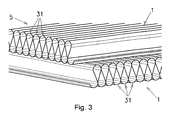
- the enclosed drawing schematically represents two variants of multilayer pleated fabric and one variant of textile formation according to the invention, while the Fig. 1 represents a cross section through a multilayer pleated fabric, at which the folds in area of fold's foot are opened, the Fig. 2 a cross section through variant of multilayer pleated fabric, at which the folds in area of fold's foot are closed, and the Fig. 3 a variant of textile formation, which comprises two layers of multilayer pleated fabric according to the Fig. 2 .
- the Fig. 1 represents a cross section of one of possible variants of embodiments of the multilayer pleated fabric 1 .
- the multilayer pleated fabric 1 is created by pleating down the plane fabric 2 , which consists of three layers, while between two covering layers 22 of nonwoven fabric the layer 21 of paper is arranged.
- the multilayer pleated fabric 1 is formed of folds 3 of plane fabric 2, which alternately on opposite end are closed by the peak 31 of the fold 3 , while each fold 3 in direction from the peak 31 of the fold 3 on one side of the multilayer pleated fabric 1 continuously broadens into the broadest section of the fold 3 , and from it continuously narrows into the narrowest section of the fold 3 , in which the neighbouring folds 3 ties together into its arms.
- the fold 3 is of a drop-type shape with side wall of approximate shape of the S letter. In the represented variant of embodiment the folds 3 are opened against the peak 31 of the fold 3.
- This shape of the fold 3 substantially increase the friction forces between individual layers 21 and 22 of the plane fabric 2 , by which these layers 21 and 22 are secured against undesired mutual shifting or disconnecting, this even without necessity of their previous and/or additional binding in vertical direction.
- the multilayer pleated fabric 1 in embodiment represented in the Fig. 1 on its surfaces is strengthened by so called quasi yarns 4 , this is by the stable linear formations similar to yarn, which are formed by twisting the portions of fibres protruding on external section of the peaks 31 of individual folds 3 or in their vicinity.
- the device known from the patent document CZ 281287 can advantageously be used for creation of the quasi-yarns 4.
- the multilayer pleated fabric 1 prepared in this way, against the pleated fabrics from background art, is advantageous in that, even without usage of adhesive, its layers 21 and 22 thanks to the shape of the folds 3 are mutually sufficiently fixed, so that at common manipulation or at full operational loading their disconnection or shifting cannot occur. Moreover, action of the shape of folds 3 does not change with time, either is not influenced by temperature or other parameters of environment in which the multilayer pleated fabric 1 is used, possibly stored.
- Production of the multilayer pleated fabric 1 according to the invention simultaneously brings, when compared with production of pleated fabrics according to the background art, a considerable savings in time and costs, as no binding material is used, so that the technological breaks for its sufficient drying need not to be kept, possibly to operate any device for speeding up its drying, etc. Applicability of the multilayer pleated fabric 1 according to the invention is neither influenced by properties of the binding material used.
- one of the layers 21 , 22 of plane fabric 2 may be performed from material with lower consistency, like e.g. from the recycled textile material, textile or non-textile fragments, granules, mash, dust, possibly the nanofibres or microfibres, their mixtures, etc., which at suitable choice enables creation of the multilayer pleated fabric 1 with properties, which are at the to date used pleated fabrics not at all achievable, or only at usage of large quantity of material.
- at least one layer 21 , 22 of plane fabric 2 may be created of material, whose binding with textile layers 22 by means of binders or other methods was complicated and not reliable to date, e. g.
- the covering layers 22 are at the same time with advantage formed of non-woven fabrics of various types, as these are the most suitable for creation of quasi-yarns 4 , possibly of other suitable textile materials.
- the multilayer pleated fabric 1 is fixed on its surfaces in horizontal direction by means of quasi-yarns 4 , but in other not represented examples of embodiments it is in the horizontal direction fixed in other suitable manners, e.g. by heat fixation performed on its entire surface or only in selected sections, etc.
- the multilayer pleated fabrics 1 loaded in vertical or mostly vertical direction it is further advantageous, if cohesion of layers 21 and 22 of the plane fabric 2 is increased in vertical direction through their heat fixation, lamination, etc. performed before and/or during and/or after creating of folds 3.
- a suitable binding material nevertheless to achieve the desired result, an expressly smaller quantity is sufficient than at pleated fabrics according to the background art.
- the Fig. 2 represents a cross section of further variant of embodiment of the multilayer pleated fabric 1 according to the invention, created by pleating down the same plane fabric 2 as in the previous example of embodiment.
- each fold 3 in direction from the peak 31 of the fold 3 continuously narrows up to a zero value, and the folds 3 are against the peak 31 of the fold 3 closed.
- This shape of folds 3 further increases the friction forces between the layers 21 and 22 of plane fabric 2 and increases their resistance against undesired disconnection or shifting.
- the multilayer pleated fabric 1 also in this variant of embodiment is fixed on its surfaces in horizontal direction by quasi-yarns 4 , possibly in other not represented examples of embodiment by means of other suitable manners, e.g. by heat fixation performed on its entire surface or only in selected areas, etc.
- multilayer pleated fabric 1 in the not represented example of embodiment may be achieved the required strength in horizontal direction by positioning the reinforcing netting on one or on both of its surfaces.
- the reinforcing netting is at the same time formed of independent layer of suitable material, for example of thin knitting or other fibrous netting, etc., which is tightly connected with surface of the multilayer pleated fabric 1, namely according to the type and material of reinforcing netting either by means of binding material and/or heat fixation and/or quasi-yarns created on free ends of fibres of material of the multilayer pleated fabric 1 , which overlap over the reinforcing netting.
- the reinforcing netting/more netting may be used also for increasing resistance of the multilayer pleated fabric 1 against abrasive wear, etc.
- the reinforcing netting may be combined with any from the above mentioned methods for strengthening the multilayer pleated fabric 1 in vertical as well horizontal direction.
- a noted advantage of both variants of multilayer pleated fabric 1 according to the invention resulting from shape of their folds 3 is existence of lateral cavities equally distributed in structure of the multilayer pleated fabric 1 , which increase a total surface of multilayer pleated fabric 1 and simultaneously they relieve it, at the same time these cavities may further be used for inserting of not represented cores from suitable materials, possibly of not represented reinforcing elements, that further in a required manner enhance and/or modify some properties of these multilayer pleated fabrics 1 , e.g. compression resistance, and others. Next, these cavities may also be used for fastening the multilayer pleated fabric 1 in a required place, for positioning on to it designated structure, etc.
- the multilayer pleated fabrics 1 prepared by pleating down the single-layer as well as multi-layer plane fabrics 2 are after then applicable independently e.g. as anti-noise and/or heat insulation, filtration and/or sorption materials, light construction walls, ceiling soffits in building industry as well as in automotive industry, distant insertions, advertising or exhibition panels, filling of cavities, upholstery padding, etc., or in combination with further layers of textile as well as non-textile material as component parts of composites.
- the Fig. 3 represents the textile formation 5 , which comprises two on each other positioned layers of multilayer pleated fabric 1 according to the invention represented in the Fig. 2 , this is with folds 3 closed against the peak 31 of the fold 3 .
- Upper layer of the multilayer pleated fabric 1 is in its plane turned towards the bottom layer of the multilayer pleated fabric 1 by angle of 90°, which ensures that this textile formation 5 in the lateral as well as longitudinal direction has the same or at least comparable mechanical properties.
- the upper layer of the multilayer pleated fabric 1 may be turned by any other angle.
- any layer of multilayer pleated fabric 1 may be added on any of its surface by further textile or non-textile layer, possibly by several layers, at the same time at least one of these layers may serve for fixation of multilayer pleated fabric 1 .
- the textile formation 5 may then comprise only one layer of multilayer pleated fabric 1 added by one or whatever required number of textile and/or non-textile layers.
- principle of the invention consisting in the shape of the fold 3 besides the multilayer pleated fabrics 1 is usable also for pleating down similar plane materials, e.g. paper, cardboard, etc.
Landscapes
- Engineering & Computer Science (AREA)
- Textile Engineering (AREA)
- Treatment Of Fiber Materials (AREA)
Description
- The invention relates to a multilayer pleated fabric.
- The invention further relates to a textile formation comprising at least one layer of such multilayer pleated fabric.
- In cases when the required thickness and/or mechanical properties of product cannot be achieved by a plane fabric or textile composite, the pleated fabrics that reach such parameters are created by pleating down plane fabrics into folds (lamellas). At the same time there exist two basic types of pleating, namely the lateral (vertical) pleating, at which the individual folds of plane fabric are arranged side by side and surfaces of pleated fabric are formed of peaks of the folds, and the longitudinal (horizontal) pleating, at which the folds of the plane fabric are arranged on each other and surfaces of pleated fabric are formed of the side surface of the first and the last fold. The lateral pleating is more preferred for number of applications, as the same thickness of product could be achieved at lower consumption of material and the resultant pleated fabric thanks to arrangement of folds mostly preserves the typical textile properties.
- According to considered application at the lateral pleating two basic types of folds are used. The fold in the form of V letter, whose width continuously increases along a whole height of the fold in direction from the fold's peak, is used first of all in filtration applications because without substantial increase of hydraulic gradient or weight it distinctly increases the filtration surface of filter, thus also absorptive capacity of filtered off impurities. The examples are the plane filtration insertion according to the
CA 2034867 or cylindrical filtration lining according to theEP 2042221 . - The fold in the form of U letter, whose width is constant along a whole height of the fold in direction from the fold's peak, thanks to relatively great density of the fabric is mostly used in applications for sound and/or heat insulation, to fill cavities in machinery or building industry, in production of furniture, etc. An example is the fabric produced by a well known Struto technology, the pleated fabric designated for automotive industry according to the
US6534145 , or upholstery padding according to theCA 2217314 . - The pleated fabrics, whose folds are in the form of V or U letter nevertheless show a number of joint disadvantages, which prevent their utilisation for some applications, possibly they limit the application for a relatively short period with necessary frequent replacement. The most substantial of these disadvantages is mutual shifting of individual layers of multi layer plane fabric, possibly their undesired disconnecting in vertical direction, which results in loss of mechanical properties of the pleated fabric, deformation of its folds and its non-reversible devaluation. This simultaneously excludes usage of multi layer plane fabrics, whose at least one layer would be formed of material with lower consistency like e.g. from recycled textile materials, mashes, granules, etc. Usage of these materials is nevertheless desirable, as it would to plane fabric and consequently also to the pleated fabric render certain specific properties, e.g. suitable bending rigidity or increased acoustic absorption capacity, this at simultaneous preservation of textile appearance as well as touch. Disconnection of layers cannot sufficient reliably be prevented either by their binding before and/or after creation of folds, as the used binders during time upon exposure to UV radiation, increased temperature or other effects degrade and lose their binding properties. Moreover these binders in a negative manner influence the final parameters of the prepared pleated fabric, as they among others reduce its air permeability, increase its weight, etc.
- The goal of the invention is to remove disadvantages of the background art through design of a new type of pleated fabric and textile composite, which comprises at least one layer of this pleated fabric.
- The goal of the invention has been achieved by a multilayer pleated fabric, whose principle consists in that, all of its layers are secured against undesired mutual shifting or disconnecting by a shape of the folds, which are alternately on opposite sides of the multilayer fabric closed by peaks of the folds. The folds continuously widen in direction from their peak on one side of the multilayer fabric into the broadest section of the fold, from which it continuously narrows into the narrowest section of the fold, in which the neighbouring folds ties together into its arms, while width of the fold in the narrowest section is zero a the fold is closed against its peak. This drop-type shape of fold upon pleating down the multilayer pleated fabric increases friction between its individual layers and, on the contrary of the shapes of folds from the background art, prevents their undesired shifting or disconnection. This simultaneously enables application of a larger spectrum of materials and their combinations.
- To increase cohesion of multilayer pleated fabric and its strength in horizontal direction it is further advantageous, if its folds are mechanically fixed, namely e.g. by creating the quasi-yarns, adhesives, heat fixation and/or reinforcing netting or by combinations of these mechanisms.
- The goal of the invention has also been achieved by textile formation which comprises at least one layer of multilayer pleated fabric according to the invention, on which at least one further layer of a suitable fabric is deposited.
- To reinforce multilayer pleated fabric in horizontal fold, its folds are with advantage mechanically fixed, this either by means of quasi-yarn and/or adhesive and/or heat fixation and/or the reinforcing netting.
- In one embodiment of the textile formation on the layer of multilayer pleated fabric there is positioned the second layer of multilayer pleated fabric comprising folds, which are alternately on opposite end closed by a peak of the fold, while width of the fold changes continuously along the fold's height, at the same time the fold in direction from its peak on one side of multilayer pleated fabric continuously broadens into the broadest section of the fold, from which it continuously narrows into the narrowest fold's section, in which the neighbouring folds ties together into arm of the fold and the width of the fold is zero and the fold is closed against its peak.
- Also the folds of second layer of multilayer pleated fabric, for the purpose to increase the strength in horizontal direction, may be mechanically fixed by means of quasi-yarn and/or adhesive and/or heat fixation and/or the reinforcing netting or their combinations, etc.
- The second layer of multilayer pleated fabric is towards the layer of multilayer pleated fabric with advantage turned in a plane of the second layer of multilayer pleated fabric by a suitable acute angle, through which the strength of textile formation or its other mechanical property may be increased in direction of presumed loading.
- If there is requirement for identical or similar properties of the textile formation in longitudinal as well as lateral direction, the second layer of multilayer pleated fabric is towards the layer of multilayer pleated textile turned in plane of the second layer of multilayer pleated fabric by a right angle.
- The enclosed drawing schematically represents two variants of multilayer pleated fabric and one variant of textile formation according to the invention, while the
Fig. 1 represents a cross section through a multilayer pleated fabric, at which the folds in area of fold's foot are opened, theFig. 2 a cross section through variant of multilayer pleated fabric, at which the folds in area of fold's foot are closed, and theFig. 3 a variant of textile formation, which comprises two layers of multilayer pleated fabric according to theFig. 2 . - The
Fig. 1 represents a cross section of one of possible variants of embodiments of the multilayer pleatedfabric 1 . As indicated here, the multilayer pleatedfabric 1 is created by pleating down theplane fabric 2, which consists of three layers, while between two coveringlayers 22 of nonwoven fabric thelayer 21 of paper is arranged. The multilayer pleatedfabric 1 is formed offolds 3 ofplane fabric 2, which alternately on opposite end are closed by thepeak 31 of thefold 3, while eachfold 3 in direction from thepeak 31 of thefold 3 on one side of the multilayer pleatedfabric 1 continuously broadens into the broadest section of thefold 3, and from it continuously narrows into the narrowest section of thefold 3, in which the neighbouringfolds 3 ties together into its arms. Thefold 3 is of a drop-type shape with side wall of approximate shape of the S letter. In the represented variant of embodiment thefolds 3 are opened against thepeak 31 of thefold 3. - This shape of the
fold 3 substantially increase the friction forces betweenindividual layers plane fabric 2, by which theselayers - In horizontal direction the multilayer pleated
fabric 1 in embodiment represented in theFig. 1 on its surfaces is strengthened by so called quasiyarns 4, this is by the stable linear formations similar to yarn, which are formed by twisting the portions of fibres protruding on external section of thepeaks 31 ofindividual folds 3 or in their vicinity. The device known from the patent documentCZ 281287 - The multilayer pleated
fabric 1 prepared in this way, against the pleated fabrics from background art, is advantageous in that, even without usage of adhesive, itslayers folds 3 are mutually sufficiently fixed, so that at common manipulation or at full operational loading their disconnection or shifting cannot occur. Moreover, action of the shape offolds 3 does not change with time, either is not influenced by temperature or other parameters of environment in which the multilayer pleatedfabric 1 is used, possibly stored. Production of the multilayer pleatedfabric 1 according to the invention simultaneously brings, when compared with production of pleated fabrics according to the background art, a considerable savings in time and costs, as no binding material is used, so that the technological breaks for its sufficient drying need not to be kept, possibly to operate any device for speeding up its drying, etc. Applicability of the multilayer pleatedfabric 1 according to the invention is neither influenced by properties of the binding material used. - Another advantage is that one of the
layers plane fabric 2, advantageously that one positioned between the two coveringlayers 22, may be performed from material with lower consistency, like e.g. from the recycled textile material, textile or non-textile fragments, granules, mash, dust, possibly the nanofibres or microfibres, their mixtures, etc., which at suitable choice enables creation of the multilayer pleatedfabric 1 with properties, which are at the to date used pleated fabrics not at all achievable, or only at usage of large quantity of material. Next to this, at least onelayer plane fabric 2 may be created of material, whose binding withtextile layers 22 by means of binders or other methods was complicated and not reliable to date, e. g. by metal or plastic foils, etc., which enables further adapting of properties of the multilayer pleatedfabric 1 to the particular requirements. The coveringlayers 22 are at the same time with advantage formed of non-woven fabrics of various types, as these are the most suitable for creation of quasi-yarns 4, possibly of other suitable textile materials. - In embodiment in the
Fig. 1 the multilayer pleatedfabric 1 is fixed on its surfaces in horizontal direction by means of quasi-yarns 4, but in other not represented examples of embodiments it is in the horizontal direction fixed in other suitable manners, e.g. by heat fixation performed on its entire surface or only in selected sections, etc. For the multilayer pleatedfabrics 1 loaded in vertical or mostly vertical direction it is further advantageous, if cohesion oflayers plane fabric 2 is increased in vertical direction through their heat fixation, lamination, etc. performed before and/or during and/or after creating offolds 3. For fixation of the multilayer pleatedfabric 1 in vertical and horizontal direction there may be further used a suitable binding material, nevertheless to achieve the desired result, an expressly smaller quantity is sufficient than at pleated fabrics according to the background art. - The
Fig. 2 represents a cross section of further variant of embodiment of the multilayer pleatedfabric 1 according to the invention, created by pleating down thesame plane fabric 2 as in the previous example of embodiment. At this variant eachfold 3 in direction from thepeak 31 of thefold 3 continuously narrows up to a zero value, and thefolds 3 are against thepeak 31 of thefold 3 closed. This shape offolds 3 further increases the friction forces between thelayers plane fabric 2 and increases their resistance against undesired disconnection or shifting. The multilayer pleatedfabric 1 also in this variant of embodiment is fixed on its surfaces in horizontal direction byquasi-yarns 4 , possibly in other not represented examples of embodiment by means of other suitable manners, e.g. by heat fixation performed on its entire surface or only in selected areas, etc. If there is an assumption of loading in vertical or previously vertical direction, it is further advantageous, if cohesion oflayers plane fabric 2 in vertical direction is increased by heat fixation, lamination of layers, etc. performed before and/or during and/or after creating of thefolds 3. For fixation of the multilayer pleatedfabric 1 in vertical and horizontal direction there may be also used a suitable binding material, nevertheless to achieve the desired result, an expressly smaller quantity is sufficient than at pleated fabrics according to the background art. - At both described variants of multilayer pleated
fabric 1 in the not represented example of embodiment may be achieved the required strength in horizontal direction by positioning the reinforcing netting on one or on both of its surfaces. The reinforcing netting is at the same time formed of independent layer of suitable material, for example of thin knitting or other fibrous netting, etc., which is tightly connected with surface of the multilayer pleatedfabric 1, namely according to the type and material of reinforcing netting either by means of binding material and/or heat fixation and/or quasi-yarns created on free ends of fibres of material of the multilayer pleatedfabric 1 , which overlap over the reinforcing netting. Besides reinforcing the multilayer pleatedfabric 1, the reinforcing netting/more netting may be used also for increasing resistance of the multilayer pleatedfabric 1 against abrasive wear, etc. In further not illustrated examples of embodiment the reinforcing netting may be combined with any from the above mentioned methods for strengthening the multilayer pleatedfabric 1 in vertical as well horizontal direction. - A noted advantage of both variants of multilayer pleated
fabric 1 according to the invention resulting from shape of theirfolds 3 is existence of lateral cavities equally distributed in structure of the multilayer pleatedfabric 1 , which increase a total surface of multilayer pleatedfabric 1 and simultaneously they relieve it, at the same time these cavities may further be used for inserting of not represented cores from suitable materials, possibly of not represented reinforcing elements, that further in a required manner enhance and/or modify some properties of these multilayer pleatedfabrics 1, e.g. compression resistance, and others. Next, these cavities may also be used for fastening the multilayer pleatedfabric 1 in a required place, for positioning on to it designated structure, etc. - Due to the above mentioned reasons it is advantageous to create the multilayer pleated
fabrics 1 withfolds 3 according to any of the variants represented in theFig. 1 and Fig. 2 , also on the single-layer plane fabrics 2, because through improvement of their properties and their further possible modification their applicability increases considerably. - The multilayer pleated
fabrics 1 prepared by pleating down the single-layer as well asmulti-layer plane fabrics 2 are after then applicable independently e.g. as anti-noise and/or heat insulation, filtration and/or sorption materials, light construction walls, ceiling soffits in building industry as well as in automotive industry, distant insertions, advertising or exhibition panels, filling of cavities, upholstery padding, etc., or in combination with further layers of textile as well as non-textile material as component parts of composites. - The
Fig. 3 represents thetextile formation 5 , which comprises two on each other positioned layers of multilayer pleatedfabric 1 according to the invention represented in theFig. 2 , this is withfolds 3 closed against thepeak 31 of thefold 3 . Upper layer of the multilayer pleatedfabric 1 is in its plane turned towards the bottom layer of the multilayer pleatedfabric 1 by angle of 90°, which ensures that thistextile formation 5 in the lateral as well as longitudinal direction has the same or at least comparable mechanical properties. As per the expected loading of thetextile formation 5 in other not represented examples of embodiment the upper layer of the multilayer pleatedfabric 1 may be turned by any other angle. In other not represented variants oftextile formation 5 any layer of multilayer pleatedfabric 1 may be added on any of its surface by further textile or non-textile layer, possibly by several layers, at the same time at least one of these layers may serve for fixation of multilayer pleatedfabric 1 . In other not represented examples of embodiment thetextile formation 5 may then comprise only one layer of multilayer pleatedfabric 1 added by one or whatever required number of textile and/or non-textile layers. - As it is obvious for average skilled person in the branch, principle of the invention consisting in the shape of the
fold 3 besides the multilayerpleated fabrics 1 is usable also for pleating down similar plane materials, e.g. paper, cardboard, etc. The used methods of fixation in vertical as well as horizontal direction after then correspond to the selected materials.
Claims (10)
- A multilayer pleated fabric, characterised in that all of its layers (21) and (22) are secured against undesired mutual shifting or disconnecting by a shape of the folds (3), which are alternately on opposite sides of the multilayer fabric closed by peaks (31) of the folds (3), while the folds (3) continuously widen in direction from their peak (31) on one side of the multilayer fabric (1) into the broadest section of the fold (3), from which it continuously narrows into the narrowest section of the fold (3), in which the neighbouring folds (3) ties together into its arms, while width of the fold (3) in the narrowest section is zero, by which the fold (3) is closed against its peak (31).
- The multilayer pleated fabric according to the claim 1, characterised in that, the folds (3) are mechanically fixed by means of quasi-yarns (4) and/or adhesive and/or heat fixation and/or reinforcing netting.
- The multilayer pleated fabric according to any of previous claims, characterized in that, the layer (21) of plane fabric (2) positioned between the two covering layers (22) is performed from material with lower consistency, like e.g. from the recycled textile material, textile or non-textile fragments, granules, mash, dust, possibly the nanofibres or microfibres, their mixtures, etc.
- The multilayer pleated fabric according to any of previous claims, characterized in that, at least one layer (21, 22) of the pleated textile (1) is created of metal or plastic foil.
- A textile formation (5) comprising at least one multilayer pleated fabric (1) according to any of previous claims on which at least one further layer of textile is positioned.
- The textile formation (5) according to the claim 5, characterised in that, the folds (3) of the multilayer pleated fabric (1) are mechanically fixed by means of quasi yarns (4) and/or adhesive and/or heat fixation and/or reinforcing netting.
- The textile formation (5) according to any of the claims 5 to 6, characterised in that, on the multilayer pleated fabric (1) there is positioned second multilayer pleated fabric (1) according to any of claims 1 to 4.
- The textile formation (5) according to the claim 7, characterised in that, the folds (3) of the second multilayer pleated fabric (1) are mechanically fixed by means of quasi-yarns (4) and/or adhesive and/or heat fixation and/or reinforcing netting.
- The textile formation (5) according to the claims 7 or 8, characterised in that, the second multilayer pleated fabric (1) is turned towards the first multilayer pleated fabric (1) in plane of the second multilayer pleated fabric by an acute angle.
- The textile formation (5) according to the claims 7 or 8, characterised in that, the second multilayer pleated fabric (1) is turned towards the first multilayer pleated fabric (1) turned in plane of the second multilayer pleated fabric (1) by right angle.
Applications Claiming Priority (2)
| Application Number | Priority Date | Filing Date | Title |
|---|---|---|---|
| CZ2009-672A CZ306405B6 (en) | 2009-10-12 | 2009-10-12 | A multi-layer folded fabric and a textile unit containing such a multi-layer folded fabric |
| CZ200921801U CZ20308U1 (en) | 2009-10-12 | 2009-10-12 | Pleated textile and textile formation comprising a layer of pleated textile |
Publications (2)
| Publication Number | Publication Date |
|---|---|
| EP2309045A1 EP2309045A1 (en) | 2011-04-13 |
| EP2309045B1 true EP2309045B1 (en) | 2014-06-18 |
Family
ID=43303855
Family Applications (1)
| Application Number | Title | Priority Date | Filing Date |
|---|---|---|---|
| EP10186476.7A Not-in-force EP2309045B1 (en) | 2009-10-12 | 2010-10-05 | Pleated fabric and textile formation comprising a layer of pleated fabric |
Country Status (1)
| Country | Link |
|---|---|
| EP (1) | EP2309045B1 (en) |
Family Cites Families (14)
| Publication number | Priority date | Publication date | Assignee | Title |
|---|---|---|---|---|
| GB299825A (en) * | 1927-08-02 | 1928-11-02 | John Ernest Chilton | Improvements in placards, show-cards, window display screens and the like |
| FR1409526A (en) * | 1964-08-17 | 1965-08-27 | Corrugated packing liner for elongated articles and method for its manufacture | |
| US3935360A (en) * | 1972-09-27 | 1976-01-27 | Brown Products, Inc. | Composite pad |
| DE4002078C1 (en) | 1990-01-25 | 1991-05-02 | Fa. Carl Freudenberg, 6940 Weinheim, De | |
| US5558924A (en) * | 1992-02-26 | 1996-09-24 | Shinih Enterprise Co., Ltd | Method for producing a corrugated resin-bonded or thermo-bonded fiberfill and the structure produced thereby |
| DE9215985U1 (en) * | 1992-11-20 | 1994-03-24 | Edm. Romberg & Sohn (GmbH & Co) KG, 25479 Ellerau | Multi-layer corrugated cardboard body |
| GB9311075D0 (en) * | 1993-05-28 | 1993-07-14 | Aston Packaging Ltd | Product packaging material and method |
| CZ281287B6 (en) | 1993-09-16 | 1996-08-14 | Soukromá Firma I.N.T., Prof. Radko Krčma Drsc. | Method of reinforcing voluminous filamentary formations and apparatus for making the same |
| US5955174A (en) * | 1995-03-28 | 1999-09-21 | The University Of Tennessee Research Corporation | Composite of pleated and nonwoven webs |
| DE29617347U1 (en) | 1996-10-05 | 1998-02-05 | Polus, Michael, Dr., 90489 Nürnberg | Furniture upholstery |
| US6660366B1 (en) * | 1998-07-31 | 2003-12-09 | Eugene D. Simpson | Interlocking fastening and packing material |
| US6534145B1 (en) | 1998-10-28 | 2003-03-18 | Lear Corporation | Pleated nonwoven products and methods of constructing such products |
| FR2887562A1 (en) * | 2005-06-22 | 2006-12-29 | Saertex France Soc Par Actions | PROCESS FOR PRODUCING AN INSULATING MATERIAL FROM VIRGIN AND / OR WASTE FIBERS, INSULATING MATERIAL OBTAINED |
| EP2042221B1 (en) | 2007-07-31 | 2012-05-02 | Sorin Group Italia S.r.l. | Filter for body fluids |
-
2010
- 2010-10-05 EP EP10186476.7A patent/EP2309045B1/en not_active Not-in-force
Also Published As
| Publication number | Publication date |
|---|---|
| EP2309045A1 (en) | 2011-04-13 |
Similar Documents
| Publication | Publication Date | Title |
|---|---|---|
| JP5718462B2 (en) | Reinforced nonwoven fabric | |
| JP5159617B2 (en) | Reinforcing fiber structure for composite material and member including the structure | |
| EP2267202A1 (en) | Composite yarn fabric including an untwisted cotton mass | |
| EP0398965B1 (en) | An oriented fibre structure and a method for manufacturing it | |
| CA2500733A1 (en) | Bi-directional and multi-axial fabrics and fabric composites | |
| ATE343671T1 (en) | COMPOSITE NON-WOVEN MATERIAL | |
| DK1506339T3 (en) | Machine-made paper fabric | |
| RU2681176C2 (en) | Part made from oxide/oxide composite material for three-dimensional reinforcing and method for manufacture of same | |
| CN101886348A (en) | Paper machine clothing | |
| CN106573452A (en) | Linings for upholstered furniture | |
| WO2003060218A3 (en) | Fibrous structure which is used to produce composite materials | |
| EP2309045A1 (en) | Pleated fabric and textile formation comprising a layer of pleated fabric | |
| RU2357028C2 (en) | Nonwoven needled material | |
| CN106460259A (en) | Reinforcing textile structure for composite materials | |
| US20050227565A1 (en) | Non-woven fabric reinforced stratiform product and production method therefor | |
| RU2357029C2 (en) | Nonwoven needled material | |
| WO2006060398A3 (en) | Method of making a filamentary laminate and the products thereof | |
| CZ306405B6 (en) | A multi-layer folded fabric and a textile unit containing such a multi-layer folded fabric | |
| CZ20308U1 (en) | Pleated textile and textile formation comprising a layer of pleated textile | |
| EP2128334A1 (en) | Press felt | |
| JP5644755B2 (en) | Textile substrate and fiber reinforced composite material | |
| RU69397U1 (en) | NONWOVE NEEDLE-PUNCHING MATERIAL | |
| CN211074952U (en) | Spunlace nonwoven fabric with compression resistance | |
| ATE317031T1 (en) | COMPOSITE MATERIALS WITH TWO OR MORE LAYERS OF PLASTIC FILAMENTARY NON-WOVEN MESH AND GLASS FABRIC METHOD AND GLASS NET METHOD | |
| AU2002361793A1 (en) | Insulation material |
Legal Events
| Date | Code | Title | Description |
|---|---|---|---|
| PUAI | Public reference made under article 153(3) epc to a published international application that has entered the european phase |
Free format text: ORIGINAL CODE: 0009012 |
|
| AK | Designated contracting states |
Kind code of ref document: A1 Designated state(s): AL AT BE BG CH CY CZ DE DK EE ES FI FR GB GR HR HU IE IS IT LI LT LU LV MC MK MT NL NO PL PT RO RS SE SI SK SM TR |
|
| AX | Request for extension of the european patent |
Extension state: BA ME |
|
| 17P | Request for examination filed |
Effective date: 20111010 |
|
| 17Q | First examination report despatched |
Effective date: 20120330 |
|
| GRAP | Despatch of communication of intention to grant a patent |
Free format text: ORIGINAL CODE: EPIDOSNIGR1 |
|
| INTG | Intention to grant announced |
Effective date: 20140214 |
|
| GRAS | Grant fee paid |
Free format text: ORIGINAL CODE: EPIDOSNIGR3 |
|
| GRAA | (expected) grant |
Free format text: ORIGINAL CODE: 0009210 |
|
| AK | Designated contracting states |
Kind code of ref document: B1 Designated state(s): AL AT BE BG CH CY CZ DE DK EE ES FI FR GB GR HR HU IE IS IT LI LT LU LV MC MK MT NL NO PL PT RO RS SE SI SK SM TR |
|
| REG | Reference to a national code |
Ref country code: GB Ref legal event code: FG4D |
|
| REG | Reference to a national code |
Ref country code: CH Ref legal event code: EP |
|
| REG | Reference to a national code |
Ref country code: AT Ref legal event code: REF Ref document number: 673442 Country of ref document: AT Kind code of ref document: T Effective date: 20140715 |
|
| REG | Reference to a national code |
Ref country code: IE Ref legal event code: FG4D |
|
| REG | Reference to a national code |
Ref country code: DE Ref legal event code: R096 Ref document number: 602010016746 Country of ref document: DE Effective date: 20140731 |
|
| PG25 | Lapsed in a contracting state [announced via postgrant information from national office to epo] |
Ref country code: CY Free format text: LAPSE BECAUSE OF FAILURE TO SUBMIT A TRANSLATION OF THE DESCRIPTION OR TO PAY THE FEE WITHIN THE PRESCRIBED TIME-LIMIT Effective date: 20140618 Ref country code: GR Free format text: LAPSE BECAUSE OF FAILURE TO SUBMIT A TRANSLATION OF THE DESCRIPTION OR TO PAY THE FEE WITHIN THE PRESCRIBED TIME-LIMIT Effective date: 20140919 Ref country code: LT Free format text: LAPSE BECAUSE OF FAILURE TO SUBMIT A TRANSLATION OF THE DESCRIPTION OR TO PAY THE FEE WITHIN THE PRESCRIBED TIME-LIMIT Effective date: 20140618 Ref country code: FI Free format text: LAPSE BECAUSE OF FAILURE TO SUBMIT A TRANSLATION OF THE DESCRIPTION OR TO PAY THE FEE WITHIN THE PRESCRIBED TIME-LIMIT Effective date: 20140618 Ref country code: NO Free format text: LAPSE BECAUSE OF FAILURE TO SUBMIT A TRANSLATION OF THE DESCRIPTION OR TO PAY THE FEE WITHIN THE PRESCRIBED TIME-LIMIT Effective date: 20140918 |
|
| REG | Reference to a national code |
Ref country code: NL Ref legal event code: VDEP Effective date: 20140618 |
|
| REG | Reference to a national code |
Ref country code: AT Ref legal event code: MK05 Ref document number: 673442 Country of ref document: AT Kind code of ref document: T Effective date: 20140618 |
|
| REG | Reference to a national code |
Ref country code: LT Ref legal event code: MG4D |
|
| PG25 | Lapsed in a contracting state [announced via postgrant information from national office to epo] |
Ref country code: RS Free format text: LAPSE BECAUSE OF FAILURE TO SUBMIT A TRANSLATION OF THE DESCRIPTION OR TO PAY THE FEE WITHIN THE PRESCRIBED TIME-LIMIT Effective date: 20140618 Ref country code: LV Free format text: LAPSE BECAUSE OF FAILURE TO SUBMIT A TRANSLATION OF THE DESCRIPTION OR TO PAY THE FEE WITHIN THE PRESCRIBED TIME-LIMIT Effective date: 20140618 Ref country code: HR Free format text: LAPSE BECAUSE OF FAILURE TO SUBMIT A TRANSLATION OF THE DESCRIPTION OR TO PAY THE FEE WITHIN THE PRESCRIBED TIME-LIMIT Effective date: 20140618 Ref country code: SE Free format text: LAPSE BECAUSE OF FAILURE TO SUBMIT A TRANSLATION OF THE DESCRIPTION OR TO PAY THE FEE WITHIN THE PRESCRIBED TIME-LIMIT Effective date: 20140618 |
|
| PG25 | Lapsed in a contracting state [announced via postgrant information from national office to epo] |
Ref country code: PT Free format text: LAPSE BECAUSE OF FAILURE TO SUBMIT A TRANSLATION OF THE DESCRIPTION OR TO PAY THE FEE WITHIN THE PRESCRIBED TIME-LIMIT Effective date: 20141020 Ref country code: CZ Free format text: LAPSE BECAUSE OF FAILURE TO SUBMIT A TRANSLATION OF THE DESCRIPTION OR TO PAY THE FEE WITHIN THE PRESCRIBED TIME-LIMIT Effective date: 20140618 Ref country code: SK Free format text: LAPSE BECAUSE OF FAILURE TO SUBMIT A TRANSLATION OF THE DESCRIPTION OR TO PAY THE FEE WITHIN THE PRESCRIBED TIME-LIMIT Effective date: 20140618 Ref country code: ES Free format text: LAPSE BECAUSE OF FAILURE TO SUBMIT A TRANSLATION OF THE DESCRIPTION OR TO PAY THE FEE WITHIN THE PRESCRIBED TIME-LIMIT Effective date: 20140618 Ref country code: EE Free format text: LAPSE BECAUSE OF FAILURE TO SUBMIT A TRANSLATION OF THE DESCRIPTION OR TO PAY THE FEE WITHIN THE PRESCRIBED TIME-LIMIT Effective date: 20140618 Ref country code: RO Free format text: LAPSE BECAUSE OF FAILURE TO SUBMIT A TRANSLATION OF THE DESCRIPTION OR TO PAY THE FEE WITHIN THE PRESCRIBED TIME-LIMIT Effective date: 20140618 |
|
| PG25 | Lapsed in a contracting state [announced via postgrant information from national office to epo] |
Ref country code: PL Free format text: LAPSE BECAUSE OF FAILURE TO SUBMIT A TRANSLATION OF THE DESCRIPTION OR TO PAY THE FEE WITHIN THE PRESCRIBED TIME-LIMIT Effective date: 20140618 Ref country code: NL Free format text: LAPSE BECAUSE OF FAILURE TO SUBMIT A TRANSLATION OF THE DESCRIPTION OR TO PAY THE FEE WITHIN THE PRESCRIBED TIME-LIMIT Effective date: 20140618 Ref country code: IS Free format text: LAPSE BECAUSE OF FAILURE TO SUBMIT A TRANSLATION OF THE DESCRIPTION OR TO PAY THE FEE WITHIN THE PRESCRIBED TIME-LIMIT Effective date: 20141018 Ref country code: AT Free format text: LAPSE BECAUSE OF FAILURE TO SUBMIT A TRANSLATION OF THE DESCRIPTION OR TO PAY THE FEE WITHIN THE PRESCRIBED TIME-LIMIT Effective date: 20140618 |
|
| REG | Reference to a national code |
Ref country code: DE Ref legal event code: R097 Ref document number: 602010016746 Country of ref document: DE |
|
| PLBE | No opposition filed within time limit |
Free format text: ORIGINAL CODE: 0009261 |
|
| STAA | Information on the status of an ep patent application or granted ep patent |
Free format text: STATUS: NO OPPOSITION FILED WITHIN TIME LIMIT |
|
| PG25 | Lapsed in a contracting state [announced via postgrant information from national office to epo] |
Ref country code: IT Free format text: LAPSE BECAUSE OF FAILURE TO SUBMIT A TRANSLATION OF THE DESCRIPTION OR TO PAY THE FEE WITHIN THE PRESCRIBED TIME-LIMIT Effective date: 20140618 Ref country code: DK Free format text: LAPSE BECAUSE OF FAILURE TO SUBMIT A TRANSLATION OF THE DESCRIPTION OR TO PAY THE FEE WITHIN THE PRESCRIBED TIME-LIMIT Effective date: 20140618 |
|
| 26N | No opposition filed |
Effective date: 20150319 |
|
| PG25 | Lapsed in a contracting state [announced via postgrant information from national office to epo] |
Ref country code: MC Free format text: LAPSE BECAUSE OF FAILURE TO SUBMIT A TRANSLATION OF THE DESCRIPTION OR TO PAY THE FEE WITHIN THE PRESCRIBED TIME-LIMIT Effective date: 20140618 Ref country code: LU Free format text: LAPSE BECAUSE OF FAILURE TO SUBMIT A TRANSLATION OF THE DESCRIPTION OR TO PAY THE FEE WITHIN THE PRESCRIBED TIME-LIMIT Effective date: 20141005 |
|
| REG | Reference to a national code |
Ref country code: CH Ref legal event code: PL |
|
| GBPC | Gb: european patent ceased through non-payment of renewal fee |
Effective date: 20141005 |
|
| REG | Reference to a national code |
Ref country code: IE Ref legal event code: MM4A |
|
| PG25 | Lapsed in a contracting state [announced via postgrant information from national office to epo] |
Ref country code: SI Free format text: LAPSE BECAUSE OF FAILURE TO SUBMIT A TRANSLATION OF THE DESCRIPTION OR TO PAY THE FEE WITHIN THE PRESCRIBED TIME-LIMIT Effective date: 20140618 Ref country code: LI Free format text: LAPSE BECAUSE OF NON-PAYMENT OF DUE FEES Effective date: 20141031 Ref country code: CH Free format text: LAPSE BECAUSE OF NON-PAYMENT OF DUE FEES Effective date: 20141031 Ref country code: GB Free format text: LAPSE BECAUSE OF NON-PAYMENT OF DUE FEES Effective date: 20141005 |
|
| REG | Reference to a national code |
Ref country code: FR Ref legal event code: ST Effective date: 20150630 |
|
| PG25 | Lapsed in a contracting state [announced via postgrant information from national office to epo] |
Ref country code: FR Free format text: LAPSE BECAUSE OF NON-PAYMENT OF DUE FEES Effective date: 20141031 |
|
| PG25 | Lapsed in a contracting state [announced via postgrant information from national office to epo] |
Ref country code: IE Free format text: LAPSE BECAUSE OF NON-PAYMENT OF DUE FEES Effective date: 20141005 |
|
| PG25 | Lapsed in a contracting state [announced via postgrant information from national office to epo] |
Ref country code: SM Free format text: LAPSE BECAUSE OF FAILURE TO SUBMIT A TRANSLATION OF THE DESCRIPTION OR TO PAY THE FEE WITHIN THE PRESCRIBED TIME-LIMIT Effective date: 20140618 |
|
| PG25 | Lapsed in a contracting state [announced via postgrant information from national office to epo] |
Ref country code: BG Free format text: LAPSE BECAUSE OF FAILURE TO SUBMIT A TRANSLATION OF THE DESCRIPTION OR TO PAY THE FEE WITHIN THE PRESCRIBED TIME-LIMIT Effective date: 20140618 |
|
| PG25 | Lapsed in a contracting state [announced via postgrant information from national office to epo] |
Ref country code: MT Free format text: LAPSE BECAUSE OF FAILURE TO SUBMIT A TRANSLATION OF THE DESCRIPTION OR TO PAY THE FEE WITHIN THE PRESCRIBED TIME-LIMIT Effective date: 20140618 Ref country code: HU Free format text: LAPSE BECAUSE OF FAILURE TO SUBMIT A TRANSLATION OF THE DESCRIPTION OR TO PAY THE FEE WITHIN THE PRESCRIBED TIME-LIMIT; INVALID AB INITIO Effective date: 20101005 Ref country code: BE Free format text: LAPSE BECAUSE OF FAILURE TO SUBMIT A TRANSLATION OF THE DESCRIPTION OR TO PAY THE FEE WITHIN THE PRESCRIBED TIME-LIMIT Effective date: 20140618 Ref country code: TR Free format text: LAPSE BECAUSE OF FAILURE TO SUBMIT A TRANSLATION OF THE DESCRIPTION OR TO PAY THE FEE WITHIN THE PRESCRIBED TIME-LIMIT Effective date: 20140618 |
|
| PG25 | Lapsed in a contracting state [announced via postgrant information from national office to epo] |
Ref country code: MK Free format text: LAPSE BECAUSE OF FAILURE TO SUBMIT A TRANSLATION OF THE DESCRIPTION OR TO PAY THE FEE WITHIN THE PRESCRIBED TIME-LIMIT Effective date: 20140618 |
|
| PG25 | Lapsed in a contracting state [announced via postgrant information from national office to epo] |
Ref country code: AL Free format text: LAPSE BECAUSE OF FAILURE TO SUBMIT A TRANSLATION OF THE DESCRIPTION OR TO PAY THE FEE WITHIN THE PRESCRIBED TIME-LIMIT Effective date: 20140618 |
|
| PGFP | Annual fee paid to national office [announced via postgrant information from national office to epo] |
Ref country code: DE Payment date: 20181026 Year of fee payment: 9 |
|
| REG | Reference to a national code |
Ref country code: DE Ref legal event code: R119 Ref document number: 602010016746 Country of ref document: DE |
|
| PG25 | Lapsed in a contracting state [announced via postgrant information from national office to epo] |
Ref country code: DE Free format text: LAPSE BECAUSE OF NON-PAYMENT OF DUE FEES Effective date: 20200501 |