EP2308843A1 - Condensed-cyclic compound and organic light emitting diode including organic layer containing the condensed-cyclic compound - Google Patents
Condensed-cyclic compound and organic light emitting diode including organic layer containing the condensed-cyclic compound Download PDFInfo
- Publication number
- EP2308843A1 EP2308843A1 EP10181070A EP10181070A EP2308843A1 EP 2308843 A1 EP2308843 A1 EP 2308843A1 EP 10181070 A EP10181070 A EP 10181070A EP 10181070 A EP10181070 A EP 10181070A EP 2308843 A1 EP2308843 A1 EP 2308843A1
- Authority
- EP
- European Patent Office
- Prior art keywords
- group
- unsubstituted
- substituted
- represented
- condensed
- Prior art date
- Legal status (The legal status is an assumption and is not a legal conclusion. Google has not performed a legal analysis and makes no representation as to the accuracy of the status listed.)
- Granted
Links
- FWLWFNWZMINIBQ-UHFFFAOYSA-N CC(C)(c1c2)c3cc4ccc(C(CC=C5C=C6)c7cnccc7)c5c4c6c3-c1ccc2-c(cc1)cc(c2c3cccc2)c1[n]3-c1ccccc1 Chemical compound CC(C)(c1c2)c3cc4ccc(C(CC=C5C=C6)c7cnccc7)c5c4c6c3-c1ccc2-c(cc1)cc(c2c3cccc2)c1[n]3-c1ccccc1 FWLWFNWZMINIBQ-UHFFFAOYSA-N 0.000 description 1
- USZYBKCCFURTSW-UHFFFAOYSA-N CC(C)(c1cc(-c2cccnc2)ccc1-1)c2c-1c(cc1)c3c4c1C=CC(c1cnccc1)C4=CCc3c2 Chemical compound CC(C)(c1cc(-c2cccnc2)ccc1-1)c2c-1c(cc1)c3c4c1C=CC(c1cnccc1)C4=CCc3c2 USZYBKCCFURTSW-UHFFFAOYSA-N 0.000 description 1
Images
Classifications
-
- C—CHEMISTRY; METALLURGY
- C07—ORGANIC CHEMISTRY
- C07D—HETEROCYCLIC COMPOUNDS
- C07D213/00—Heterocyclic compounds containing six-membered rings, not condensed with other rings, with one nitrogen atom as the only ring hetero atom and three or more double bonds between ring members or between ring members and non-ring members
- C07D213/02—Heterocyclic compounds containing six-membered rings, not condensed with other rings, with one nitrogen atom as the only ring hetero atom and three or more double bonds between ring members or between ring members and non-ring members having three double bonds between ring members or between ring members and non-ring members
- C07D213/04—Heterocyclic compounds containing six-membered rings, not condensed with other rings, with one nitrogen atom as the only ring hetero atom and three or more double bonds between ring members or between ring members and non-ring members having three double bonds between ring members or between ring members and non-ring members having no bond between the ring nitrogen atom and a non-ring member or having only hydrogen or carbon atoms directly attached to the ring nitrogen atom
- C07D213/06—Heterocyclic compounds containing six-membered rings, not condensed with other rings, with one nitrogen atom as the only ring hetero atom and three or more double bonds between ring members or between ring members and non-ring members having three double bonds between ring members or between ring members and non-ring members having no bond between the ring nitrogen atom and a non-ring member or having only hydrogen or carbon atoms directly attached to the ring nitrogen atom containing only hydrogen and carbon atoms in addition to the ring nitrogen atom
-
- C—CHEMISTRY; METALLURGY
- C09—DYES; PAINTS; POLISHES; NATURAL RESINS; ADHESIVES; COMPOSITIONS NOT OTHERWISE PROVIDED FOR; APPLICATIONS OF MATERIALS NOT OTHERWISE PROVIDED FOR
- C09K—MATERIALS FOR MISCELLANEOUS APPLICATIONS, NOT PROVIDED FOR ELSEWHERE
- C09K11/00—Luminescent materials, e.g. electroluminescent or chemiluminescent
- C09K11/06—Luminescent materials, e.g. electroluminescent or chemiluminescent containing organic luminescent materials
-
- C—CHEMISTRY; METALLURGY
- C07—ORGANIC CHEMISTRY
- C07C—ACYCLIC OR CARBOCYCLIC COMPOUNDS
- C07C13/00—Cyclic hydrocarbons containing rings other than, or in addition to, six-membered aromatic rings
- C07C13/28—Polycyclic hydrocarbons or acyclic hydrocarbon derivatives thereof
- C07C13/32—Polycyclic hydrocarbons or acyclic hydrocarbon derivatives thereof with condensed rings
- C07C13/62—Polycyclic hydrocarbons or acyclic hydrocarbon derivatives thereof with condensed rings with more than three condensed rings
-
- C—CHEMISTRY; METALLURGY
- C07—ORGANIC CHEMISTRY
- C07C—ACYCLIC OR CARBOCYCLIC COMPOUNDS
- C07C211/00—Compounds containing amino groups bound to a carbon skeleton
- C07C211/43—Compounds containing amino groups bound to a carbon skeleton having amino groups bound to carbon atoms of six-membered aromatic rings of the carbon skeleton
- C07C211/57—Compounds containing amino groups bound to a carbon skeleton having amino groups bound to carbon atoms of six-membered aromatic rings of the carbon skeleton having amino groups bound to carbon atoms of six-membered aromatic rings being part of condensed ring systems of the carbon skeleton
- C07C211/61—Compounds containing amino groups bound to a carbon skeleton having amino groups bound to carbon atoms of six-membered aromatic rings of the carbon skeleton having amino groups bound to carbon atoms of six-membered aromatic rings being part of condensed ring systems of the carbon skeleton with at least one of the condensed ring systems formed by three or more rings
-
- C—CHEMISTRY; METALLURGY
- C07—ORGANIC CHEMISTRY
- C07D—HETEROCYCLIC COMPOUNDS
- C07D213/00—Heterocyclic compounds containing six-membered rings, not condensed with other rings, with one nitrogen atom as the only ring hetero atom and three or more double bonds between ring members or between ring members and non-ring members
- C07D213/02—Heterocyclic compounds containing six-membered rings, not condensed with other rings, with one nitrogen atom as the only ring hetero atom and three or more double bonds between ring members or between ring members and non-ring members having three double bonds between ring members or between ring members and non-ring members
- C07D213/04—Heterocyclic compounds containing six-membered rings, not condensed with other rings, with one nitrogen atom as the only ring hetero atom and three or more double bonds between ring members or between ring members and non-ring members having three double bonds between ring members or between ring members and non-ring members having no bond between the ring nitrogen atom and a non-ring member or having only hydrogen or carbon atoms directly attached to the ring nitrogen atom
- C07D213/06—Heterocyclic compounds containing six-membered rings, not condensed with other rings, with one nitrogen atom as the only ring hetero atom and three or more double bonds between ring members or between ring members and non-ring members having three double bonds between ring members or between ring members and non-ring members having no bond between the ring nitrogen atom and a non-ring member or having only hydrogen or carbon atoms directly attached to the ring nitrogen atom containing only hydrogen and carbon atoms in addition to the ring nitrogen atom
- C07D213/22—Heterocyclic compounds containing six-membered rings, not condensed with other rings, with one nitrogen atom as the only ring hetero atom and three or more double bonds between ring members or between ring members and non-ring members having three double bonds between ring members or between ring members and non-ring members having no bond between the ring nitrogen atom and a non-ring member or having only hydrogen or carbon atoms directly attached to the ring nitrogen atom containing only hydrogen and carbon atoms in addition to the ring nitrogen atom containing two or more pyridine rings directly linked together, e.g. bipyridyl
-
- C—CHEMISTRY; METALLURGY
- C07—ORGANIC CHEMISTRY
- C07D—HETEROCYCLIC COMPOUNDS
- C07D235/00—Heterocyclic compounds containing 1,3-diazole or hydrogenated 1,3-diazole rings, condensed with other rings
- C07D235/02—Heterocyclic compounds containing 1,3-diazole or hydrogenated 1,3-diazole rings, condensed with other rings condensed with carbocyclic rings or ring systems
- C07D235/04—Benzimidazoles; Hydrogenated benzimidazoles
- C07D235/06—Benzimidazoles; Hydrogenated benzimidazoles with only hydrogen atoms, hydrocarbon or substituted hydrocarbon radicals, directly attached in position 2
- C07D235/08—Radicals containing only hydrogen and carbon atoms
-
- C—CHEMISTRY; METALLURGY
- C07—ORGANIC CHEMISTRY
- C07D—HETEROCYCLIC COMPOUNDS
- C07D401/00—Heterocyclic compounds containing two or more hetero rings, having nitrogen atoms as the only ring hetero atoms, at least one ring being a six-membered ring with only one nitrogen atom
- C07D401/02—Heterocyclic compounds containing two or more hetero rings, having nitrogen atoms as the only ring hetero atoms, at least one ring being a six-membered ring with only one nitrogen atom containing two hetero rings
- C07D401/04—Heterocyclic compounds containing two or more hetero rings, having nitrogen atoms as the only ring hetero atoms, at least one ring being a six-membered ring with only one nitrogen atom containing two hetero rings directly linked by a ring-member-to-ring-member bond
-
- C—CHEMISTRY; METALLURGY
- C07—ORGANIC CHEMISTRY
- C07D—HETEROCYCLIC COMPOUNDS
- C07D487/00—Heterocyclic compounds containing nitrogen atoms as the only ring hetero atoms in the condensed system, not provided for by groups C07D451/00 - C07D477/00
- C07D487/02—Heterocyclic compounds containing nitrogen atoms as the only ring hetero atoms in the condensed system, not provided for by groups C07D451/00 - C07D477/00 in which the condensed system contains two hetero rings
- C07D487/04—Ortho-condensed systems
-
- H—ELECTRICITY
- H10—SEMICONDUCTOR DEVICES; ELECTRIC SOLID-STATE DEVICES NOT OTHERWISE PROVIDED FOR
- H10K—ORGANIC ELECTRIC SOLID-STATE DEVICES
- H10K50/00—Organic light-emitting devices
-
- H—ELECTRICITY
- H10—SEMICONDUCTOR DEVICES; ELECTRIC SOLID-STATE DEVICES NOT OTHERWISE PROVIDED FOR
- H10K—ORGANIC ELECTRIC SOLID-STATE DEVICES
- H10K50/00—Organic light-emitting devices
- H10K50/10—OLEDs or polymer light-emitting diodes [PLED]
- H10K50/14—Carrier transporting layers
-
- H—ELECTRICITY
- H10—SEMICONDUCTOR DEVICES; ELECTRIC SOLID-STATE DEVICES NOT OTHERWISE PROVIDED FOR
- H10K—ORGANIC ELECTRIC SOLID-STATE DEVICES
- H10K85/00—Organic materials used in the body or electrodes of devices covered by this subclass
- H10K85/60—Organic compounds having low molecular weight
- H10K85/615—Polycyclic condensed aromatic hydrocarbons, e.g. anthracene
- H10K85/624—Polycyclic condensed aromatic hydrocarbons, e.g. anthracene containing six or more rings
-
- C—CHEMISTRY; METALLURGY
- C07—ORGANIC CHEMISTRY
- C07C—ACYCLIC OR CARBOCYCLIC COMPOUNDS
- C07C2603/00—Systems containing at least three condensed rings
- C07C2603/02—Ortho- or ortho- and peri-condensed systems
- C07C2603/04—Ortho- or ortho- and peri-condensed systems containing three rings
- C07C2603/06—Ortho- or ortho- and peri-condensed systems containing three rings containing at least one ring with less than six ring members
- C07C2603/10—Ortho- or ortho- and peri-condensed systems containing three rings containing at least one ring with less than six ring members containing five-membered rings
- C07C2603/12—Ortho- or ortho- and peri-condensed systems containing three rings containing at least one ring with less than six ring members containing five-membered rings only one five-membered ring
- C07C2603/18—Fluorenes; Hydrogenated fluorenes
-
- C—CHEMISTRY; METALLURGY
- C07—ORGANIC CHEMISTRY
- C07C—ACYCLIC OR CARBOCYCLIC COMPOUNDS
- C07C2603/00—Systems containing at least three condensed rings
- C07C2603/02—Ortho- or ortho- and peri-condensed systems
- C07C2603/54—Ortho- or ortho- and peri-condensed systems containing more than five condensed rings
-
- H—ELECTRICITY
- H10—SEMICONDUCTOR DEVICES; ELECTRIC SOLID-STATE DEVICES NOT OTHERWISE PROVIDED FOR
- H10K—ORGANIC ELECTRIC SOLID-STATE DEVICES
- H10K50/00—Organic light-emitting devices
- H10K50/10—OLEDs or polymer light-emitting diodes [PLED]
- H10K50/14—Carrier transporting layers
- H10K50/15—Hole transporting layers
- H10K50/155—Hole transporting layers comprising dopants
Definitions
- the present invention relates to a condensed-cyclic compound, and an organic light emitting diode including an organic layer containing the condensed-cyclic compound.
- OLEDs which are self-emitting devices, have advantages such as a wide viewing angle, excellent contrast, quick response, high brightness, excellent driving voltage characteristics, and can provide multicolored images.
- a typical OLED has a structure including a substrate, and an anode, a hole transport layer (HTL), an emissive layer (EML), an electron transport layer (ETL), and a cathode which are sequentially stacked on the substrate in the order stated.
- HTL hole transport layer
- EML emissive layer
- ETL electron transport layer
- cathode cathode
- the HTL, the EML, and the ETL are organic thin films formed of organic compounds.
- An operating principle of an OLED having the above-described structure is as follows. When a voltage is applied to the anode and the cathode, holes injected from the anode move to the EML via the HTL, and electrons injected from the cathode move to the EML via the ETL. The holes and electrons recombine in the EML to generate excitons. When the excitons drop from an excited state to a ground state, light is emitted.
- a compound for providing an organic light emitting diode having high efficiency and long durability is provided.
- R 1 through R 3 and R 4 through R 7 may be hydrogen;
- R 8 may be selected from the group consisting of hydrogen, a substituted or unsubstituted C 1 -C 10 alkyl group, a substituted or unsubstituted C 2 -C 10 alkenyl group, a substituted or unsubstituted C 2 -C 10 alkynyl group, a substituted or unsubstituted C 1 -C 10 alkoxy group, a group represented by -(Ar 1 ) a -Ar 11 , and a group represented by -N[-(Ar 2 ) b -Ar 12 ][-(Ar 3 ) c -Ar 13 ];
- R 11 through R 14 may be each independently selected from the group consisting of hydrogen, a substituted or unsubstituted C 1 -C 10 alkyl group, a substituted or unsubstituted C 2 -C 10 alkenyl group, a
- a condensed-cyclic compound represented by Formula 1 below is provided according to a first aspect of the present invention:
- R 8 and R 7 are each independently selected from the group consisting of a hydrogen atom, a halogen atom, a hydroxyl group, a cyano group, a substituted or unsubstituted C 1 -C 30 alkyl group, a substituted or unsubstituted C 2 -C 30 alkenyl group, a substituted or unsubstituted C 2 -C 30 alkynyl group, a substituted or unsubstituted C 1 -C 30 alkoxy group, a group represented by -(Ar 1 ) a -Ar 11 , and a group represented by -N[-(Ar 2 ) b -Ar 12 ][-(Ar 3 ) c -Ar 13 ]; or R 8 is connected to * of Formula 2 represented by and R 7 is connected to *' of Formula 2; and R 1 through R 6 , R 11 through R 14 , and R 21 through R 24 are each independently selected from the group
- R 8 and R 7 may be each independently selected from the group consisting of a hydrogen atom, a halogen atom, a hydroxyl group, a cyano group, a substituted or unsubstituted C 1 -C 30 alkyl group, a substituted or unsubstituted C 2 -C 30 alkenyl group, a substituted or unsubstituted C 2 -C 30 alkynyl group, a substituted or unsubstituted C 1 -C 30 alkoxy group, a group represented by -(Ar 1 ) a -Ar 11 , and a group represented by -N[-(Ar 2 ) b -Ar 12 ][-(Ar 3 ) c -Ar 13 ], and R 1 through R 6 and R 11 through R 14 may be each independently selected from the group consisting of a hydrogen atom, a halogen atom, a hydroxyl group, a cyano
- R 1 through R 3 and R 4 through R 7 may be hydrogen;
- R 8 may be selected from the group consisting of hydrogen, a substituted or unsubstituted C 1 -C 10 alkyl group, a substituted or unsubstituted C 2 -C 10 alkenyl group, a substituted or unsubstituted C 2 -C 10 alkynyl group, a substituted or unsubstituted C 1 -C 10 alkoxy group, a group represented by - (Ar 1 ) a -Ar 11 , and a group represented by -N[-(Ar 2 ) b -Ar 12 ][-(Ar 3 ) c -Ar 13 ];
- R 11 through R 14 may be each independently selected from the group consisting of hydrogen, a substituted or unsubstituted C 1 -C 10 alkyl group, a substituted or unsubstituted C 2 -C 10 alkenyl group,
- Ar 1 through Ar 6 may be each independently selected from the group consisting of a substituted or unsubstituted C 1 -C 30 alkylene group, a substituted or unsubstituted C 2 -C 30 alkenylene group, a substituted or unsubstituted C 5 -C 30 arylene group, and a substituted or unsubstituted C 4 -C 30 heteroarylene group.
- Ar 1 through Ar 6 may be each independently selected from the group consisting of a substituted or unsubstituted C 1 -C 10 alkylene group, a substituted or unsubstituted C 2 -C 10 alkenylene group, a substituted or unsubstituted C 5 -C 14 arylene group, and a substituted or unsubstituted C 4 -C 14 heteroarylene group.
- Ar 1 through Ar 6 may be each independently selected from the group consisting of a substituted or unsubstituted ethylene group, a substituted or unsubstituted phenylene group, a substituted or unsubstituted pentalenylene group, a substituted or unsubstituted indenylene group, a substituted or unsubstituted naphthylene group, a substituted or unsubstituted azulenylene group, a substituted or unsubstituted heptalenylene group, a substituted or unsubstituted indacenylene group, a substituted or unsubstituted acenaphthylene group, a substituted or unsubstituted fluorenylene group, a substituted or unsubstituted phenalenylene group, a substituted or unsubstituted phenanthrenylene group, a substituted or unsubstituted anthraceny
- Ar 11 through Ar 16 are each independently selected from the group consisting of a hydrogen atom, a halogen atom, a hydroxyl group, a cyano group, a substituted or unsubstituted C 1 -C 30 alkyl group, a substituted or unsubstituted C 2 -C 30 alkenyl group, a substituted or unsubstituted C 2 -C 30 alkynyl group, a substituted or unsubstituted C 1 -C 30 alkoxy group, a substituted or unsubstituted C 5 -C 30 aryl group, and a substituted or unsubstituted C 4 -C 30 heteroaryl group.
- Ar 11 through Ar 16 may be each independently selected from the group consisting of a substituted or unsubstituted C 1 -C 10 alkyl group, a substituted or unsubstituted C 1 -C 10 alkoxy group, a substituted or unsubstituted phenyl group, a substituted or unsubstituted pentalenyl group, a substituted or unsubstituted indenyl group, a substituted or unsubstituted naphthyl group, a substituted or unsubstituted azulenyl group, a substituted or unsubstituted heptalenyl group, a substituted or unsubstituted indacenyl group, a substituted or unsubstituted acenaphthyl group, a substituted or unsubstituted fluorenyl group, a substituted or unsubstituted phenalenyl group, a substituted or un
- Ar 1 through Ar 6 may be each independently selected from the group consisting of a pyridinylene group, a quinolinylene group, a benzimidazolylene group, an imidazopyridinylene group, an imidazopyrimidinylene group, a phenylene group, a C 1 -C 10 alkyl phenylene group, a carbazolylene group, a phenylcarbazolylene group, a fluorenylene group, a C 1 -C 10 alkyl fluorenylene group, a di(C 1 -C 10 alkyl) fluorenylene group, an ethylene group, and a naphthylene group, but are not limited thereto.
- Ar 11 through Ar 16 may be each independently selected from the group consisting of a methyl group, an ethyl group, a propyl group, a butyl group, a methoxy group, an ethoxy group, a propoxy group, a butoxy group, a pyridinyl group, a quinolinyl group, a benzimidazolyl group, an imidazopyridinyl group, an imidazopyrimidinyl group, a phenyl group, a carbazolyl group, a fluorenyl group, a di(C 1 -C 10 alkyl)fluorenyl group, a naphthyl group, and a functional group represented by the formula but are not limited thereto.
- R 8 and R 11 through R 14 may be each independently selected from the group consisting of functional groups represented by Formulae 3A through 30 below, but are not limited thereto:
- Z 1 and Z 2 are each independently selected from the group consisting of hydrogen, a hydroxyl group, a methyl group, an ethyl group, a propyl group, a butyl group, a methoxy group, an ethoxy group, a propoxy group, a butoxy group, a phenyl group, and a naphthyl group.
- R 8 and R 11 through R 14 may be each independently selected from the group consisting of compounds represented by Formulae 4A through 4R below, but are not limited thereto:
- a through f may be each independently an integer from 0 to 10.
- a through f may be each independently 0, 1, or 2, but are not limited thereto.
- a the moieties represented by Ar 1 in the group represented by -(Ar 1 ) a -Ar 11 may be identical to or different from each other
- the moieties represented by Ar 2 in the group represented by -(Ar 2 ) b -Ar 12 may be identical to or different from each other
- c the moieties represented by Ar 3 in the group represented by (Ar 3 ) c -Ar 13 may be identical to or different from each other
- d the moieties represented by Ar 4 in the group represented by -(Ar 4 ) d -Ar 14 may be identical to or different from each other
- e the moieties represented by Ar 5 in the group represented by -(Ar 5 ) e -Ar 15 may be identical to or different from each other
- f the moieties represented by Ar 6 in the group represented by [-(Ar 6 ) f -Ar 16 ] may be identical to or different from each other.
- the two Ar 1 s may be both phenylene groups, or one of the two may be a phenylene group and the other may be a benzimidazolylene group.
- Q 1 through Q 3 may be each independently selected from the group consisting of hydrogen, a C 1 -C 30 alkyl group, a C 1 -C 30 alkoxy group, a C 5 -C 14 aryl group, and a C 4 -C 14 heteroaryl group.
- Q 1 through Q 3 may be each independently selected from the group consisting of hydrogen, a methyl group, an ethyl group, a propyl group, a butyl group, a methoxy group, an ethoxy group, a propoxy group, a butoxy group, a phenyl group, and a naphthyl group, but are not limited thereto.
- Q 1 through Q 3 may be each independently hydrogen, a methyl group, or a phenyl group
- X 1 may be selected from the group consisting of -CH 2 -, -CH(CH 3 )-, -C(CH 3 ) 2 -, - CH(Ph)-, -NH-, and -N(Ph)-, wherein Ph denotes a phenyl group, but is not limited thereto.
- the condensed-cyclic compound of Formula 1 has high thermal stability. Also, since the condensed-cyclic compound has a wide band gap, the condensed-cyclic compound may be used for various layers, such as a hole transport layer (HTL), an emissive layer (EML), and/or an electron transport layer (ETL), of an organic light emitting diode (OLED), according to substituents, such as R 8 and R 11 through R 14 .
- HTL hole transport layer
- EML emissive layer
- ETL electron transport layer
- OLED organic light emitting diode
- R 8 may be connected to * of Formula 2 below and R 7 may be connected to *' of Formula 2.
- the condensed-cyclic compound represented by Formula 1 may be represented by Formula 1A below:
- R 1 through R 6 and R 11 through R 14 are as described above, and R 21 through R 24 are as described in connection with R 11 through R 14 .
- R 1 through R 6 may be hydrogen;
- R 11 through R 14 and R 21 through R 24 may each independently hydrogen, a substituted or unsubstituted C 1 -C 10 alkyl group, a substituted or unsubstituted C 2 -C 10 alkenyl group, a substituted or unsubstituted C 2 -C 10 alkynyl group, a substituted or unsubstituted C 1 -C 10 alkoxy group, a group represented by -(Ar 4 ) a -Ar 14 , and a group represented by -N[-(Ar 5 ) e -Ar 15 ][-(Ar 6 ) f -Ar 16 ].
- Ar 4 through Ar 6 , A 14 through Ar 16 , and d through f are as described above.
- R 11 through R 14 and R 21 through R 24 may be each independently selected from the group consisting of the compounds represented by Formulae 3A through 30, but are not limited thereto.
- R 11 through R 14 and R 21 through R 24 may be each independently selected from the group consisting of the functional groups represented by Formulae 4A through 4R, but are not limited thereto.
- the condensed-cyclic compound of Formula 1 may be represented by Formula 1A, the condensed-cyclic compound has high thermal stability. Also, since the condensed-cyclic compound has a wide band gap, the condensed-cyclic compound may be used for various layers, such as a HTL, an EML, and/or an ETL, of an OLED, according to substituents, such as R 8 and R 11 through R 14 .
- R 1 through R 3 and R 4 through R 7 are hydrogen; R 8 and R 11 through R 14 are each independently selected from the group consisting of hydrogen and functional groups represented by Formulae 3A through 30; and X 1 is a divalent linking group selected from the group consisting of -C(Q 1 )(Q 2 )- and -N(Q 3 )-, wherein Q 1 through Q 3 are each independently selected from the group consisting of hydrogen, a methyl group, an ethyl group, a propyl group, a butyl group, a methoxy group, an ethoxy group, a propoxy group, a butoxy group, a phenyl group, and a naphthyl group.
- R 1 through R 3 , R 4 through R 7 , R 11 , R 13 , and R 14 are hydrogen;
- R 8 and R 12 are each independently selected from the group consisting of hydrogen and the functional groups represented by Formulae 3A through 30; and
- X 1 is a divalent linking group selected from the group consisting of -C(Q 1 ) (Q 2 )- and -N(Q 3 )-, wherein Q 1 through Q 3 are each independently selected from the group consisting of hydrogen, a methyl group, an ethyl group, a propyl group, a butyl group, a methoxy group, an ethoxy group, a propoxy group, a butoxy group, a phenyl group, and a naphthyl group.
- R 1 through R 3 , R 4 through R 7 , R 11 , R 13 , and R 14 are hydrogen;
- R 8 and R 12 are each independently selected from the group consisting of hydrogen and the functional groups represented by Formulae 4A through 4R;
- X 1 is selected from the group consisting of -CH 2 -, -CH(CH 3 )-, -C(CH 3 ) 2 -, -CH(Ph)-, -NH-, and -N(Ph)-, wherein Ph denotes a phenyl group.
- R 1 through R 3 , R 4 through R 7 , R 11 , R 13 , and R 14 are hydrogen; R 8 and R 12 are each independently selected from the group consisting of hydrogen and the functional groups represented by Formulae 4A through 4R; and X 1 is selected from the group consisting of -CH 2 -, -CH(CH 3 )-, -C(CH 3 ) 2 -, and -CH(Ph)-, wherein Ph denotes a phenyl group.
- R 8 is connected to * of Formula 2
- R 7 is connected to *' of Formula 2
- R 1 through R 6 are hydrogen
- R 11 through R 14 and R 21 through R 24 are each independently selected from the group consisting of hydrogen and the functional groups represented by Formulae 3A through 30
- X 1 and X 2 are each independently a divalent linking group selected from the group consisting of -C(Q 1 )(Q 2 )-and -N(Q 3 )-, wherein Q 1 through Q 3 are each independently selected form the group consisting of hydrogen, a methyl group, an ethyl group, a propyl group, a butyl group, a methoxy group, an ethoxy group, a propoxy group, a butoxy group, a phenyl group, and a naphthyl group.
- R 8 is connected to * of Formula 2
- R 7 is connected to *' of Formula 2
- R 1 through R 6 , R 11 , R 13 , R 14 , R 21 , R 23 , and R 24 are hydrogen
- R 12 and R 22 are each independently selected from the group consisting of hydrogen and the functional groups represented by Formulae 3A through 30
- X 1 and X 2 are each independently a divalent linking group selected from the group consisting of -C(Q 1 )(Q 2 )- and -N(Q 3 )-, wherein Q 1 through Q 3 are each independently selected from the group consisting of hydrogen, a methyl group, an ethyl group, a propyl group, a butyl group, a methoxy group, an ethoxy group, a propoxy group, a butoxy group, a phenyl group, and a naphthyl group.
- R 8 is connected to * of Formula 2
- R 7 is connected to *' of Formula 2
- Formula 1 is represented by Formula 1A
- R 1 through R 6 , R 11 , R 13 , R 14 , R 21 , R 23 , and R 24 are hydrogen
- R 12 and R 22 are each independently selected from the group consisting of hydrogen and the functional groups represented by Formulae 4A through 4R
- X 1 and X 2 are each independently selected from the group consisting of -CH 2 -, -CH(CH 3 )-, - C(CH 3 ) 2 -, -CH(Ph)-, -NH-, and -N(Ph)-, wherein Ph denotes a phenyl group.
- R 8 is connected to * of Formula 2
- R 7 is connected to *' of Formula 2
- Formula 1 is represented by Formula 1A
- R 1 through R 6 , R 11 , R 13 , R 14 , R 21 , R 23 , and R 24 are hydrogen
- R 12 and R 22 are each independently selected from the group consisting of hydrogen and the functional groups represented by Formulae 4A through 4R
- X 1 and X 2 are each independently selected from the group consisting of -CH 2 -, -CH(CH 3 )-, - C(CH 3 ) 2 -, and -CH(Ph)-.
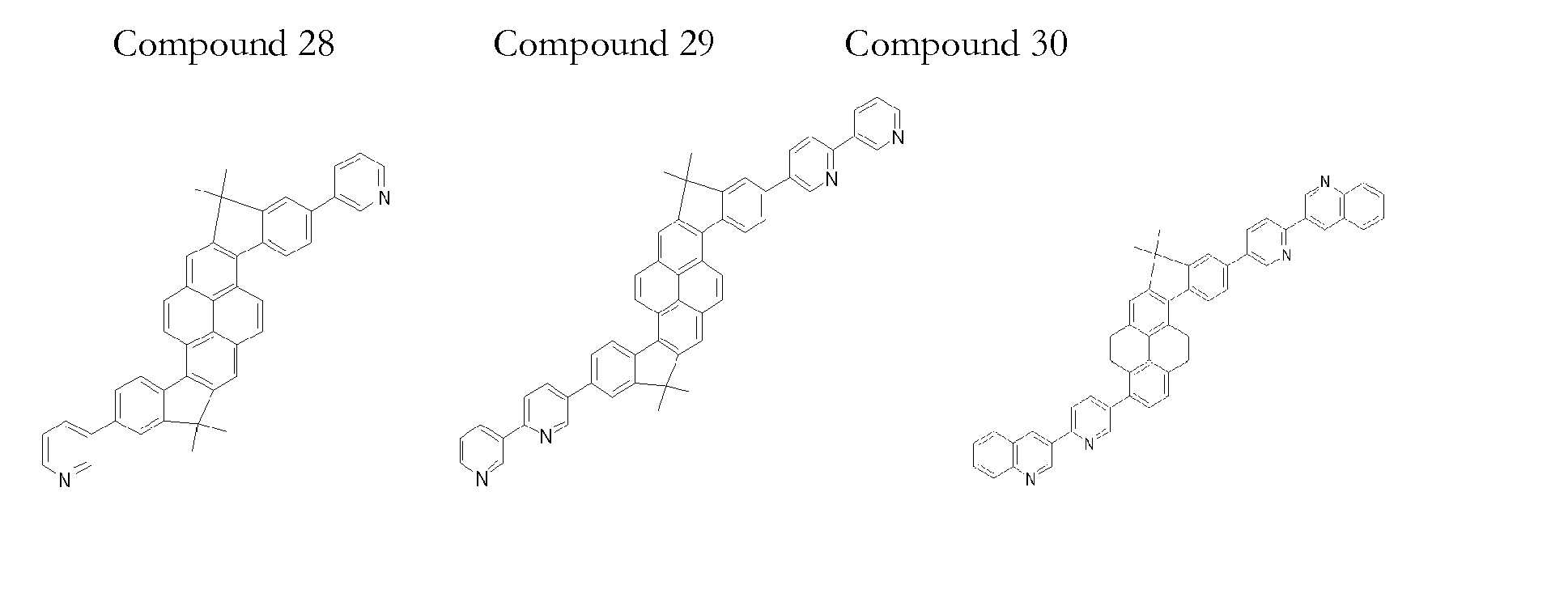
- the condensed-cyclic compound represented by Formula 1 is one of Compounds 1 to 43 below, but is not limited thereto.
- Examples of the unsubstituted C 1 -C 30 alkyl group or the C 1 -C 30 alkyl group used herein include methyl, ethyl, propyl, isobutyl, sec-butyl, pentyl, iso-amyl, hexyl, and the like.
- the substituted C 1 -C 30 alkyl group at least one hydrogen atom of the unsubstituted C 1 -C 30 alkyl group may be substituted with a halogen atom, a hydroxyl group, a nitro group, a cyano group, an amino group, an amidino group, hydrazine, hydrazone, a carboxyl group or salts thereof, a sulfonic acid group or salts thereof, a phosphoric acid or salts thereof, a C 1 -C 30 alkyl group, a C 1 -C 30 alkenyl group, a C 1 -C 30 alkynyl group, a C 6 -C 30 aryl group, or a C 2 -C 20 heteroaryl group.
- the substituted or unsubstituted C 1 -C 30 alkylene group has the same structure as the substituted or unsubstituted C 1 -C 30 alkyl group as described above, but is a divalent linking
- the unsubstituted C 1 -C 30 alkoxy group or the C 1 -C 30 alkoxy group may be a group represented by -OA, wherein A is the unsubstituted C 1 -C 30 alkyl group, and examples of the unsubstituted C 1 -C 30 alkoxy group are methoxy, ethoxy, and isopropyloxy. At least one hydrogen atom in the unsubstituted C 1 -C 30 alkoxy group may be substituted with the substituents described with reference to the substituted C 1 -C 30 alkyl group.
- the unsubstituted C 2 -C 30 alkenyl group or the C 2 -C 30 alkenyl group has at least one carbon-carbon double bond in the center or at one end of the unsubstituted C 2 -C 30 alkyl group structure.
- Examples of the unsubstituted C 2 -C 30 alkenyl group include ethenyl, propenyl, and butenyl.
- At least one hydrogen atom in the unsubstituted C 2 -C 30 alkenyl group may be substituted with the substituents described with reference to the substituted C 1 -C 30 alkyl group.
- the substituted or unsubstituted C 2 -C 30 alkenylene group has the same structure as the substituted or unsubstituted C 2 -C 30 alkenyl group described above, but is a divalent linking group.
- the unsubstituted C 2 -C 30 alkynyl group or the C 2 -C 30 alkynyl group has a carbon-carbon triple bond in the center or at one end of the C 2 -C 30 alkyl group structure.
- At least one hydrogen atom in the alkynyl group may be substituted with the substituents described with reference to the substituted C 1 -C 30 alkyl group.
- the unsubstituted C 5 -C 30 aryl group is a monovalent group having a carbocyclic aromatic system having 5 to 30 carbon atoms including at least one aromatic ring.
- the unsubstituted C 5 -C 30 arylene group is a divalent group having a carbocyclic aromatic system having 5 to 30 carbon atoms including at least one aromatic ring.
- the aryl group and the arylene group have at least two rings, the at least two rings may be fused to each other.
- At least one hydrogen atom in the aryl group and the arylene group may be substituted with the substituents described with reference to the substituted C 1 -C 30 alkyl group.
- Examples of the substituted or unsubstituted C 5 -C 30 aryl group are a phenyl group, a C 1 -C 10 alkylphenyl group (e.g., an ethylphenyl group), a C 1 -C 10 alkylbiphenyl group (e.g., an ethylbiphenyl group), a halophenyl group (e.g., an o-, m- or p-fluorophenyl group and a dichlorophenyl group), a dicyanophenyl group, a trifluoromethoxyphenyl group, an o-, m- or p-tolyl group, an o-, m- or p-cumenyl group, a mesityl group, a phenoxyphenyl group, a ( ⁇ , ⁇ -dimethylbenzene)phenyl group, a (N,N'-dimethyl)aminoph
- the unsubstituted C 4 -C 30 heteroaryl group is a monovalent group having at least one aromatic ring having at least one of the hetero atoms selected from the group consisting of N, O, P, and S.
- the unsubstituted C 2 -C 30 heteroarylene group is a divalent group having at least one aromatic ring having at least one of the hetero atoms selected from the group consisting of N, O, P, and S.
- the heteroaryl group and the heteroarylene group have at least two rings, the at least two rings may be fused with each other.
- At least one hydrogen atom in the heteroaryl group and the heteroarylene group may be substituted with the substituents described with reference to the substituted C 1 -C 30 alkyl group.
- Examples of the unsubstituted C 4 -C 30 heteroaryl group include a pyrazolyl group, an imidazolyl group, an oxazolyl group, a thiazolyl group, a triazolyl group, a tetrazolyl group, an oxadiazolyl group, a pyridinyl group, a pyridazinyl group, a pyrimidinyl group, a triazinyl group, a carbazolyl group, an indolyl group, a quinolinyl group, an isoquinolinyl group, a benzimidazolyl group, an imidazopyridinyl group and an imidazopyrimidinyl group.
- Examples of the substituted and unsubstituted C 4 -C 30 heteroarylene group may be easily derived from examples of the substituted or unsubstituted C 4 -C 30 arylene group.
- the condensed-cyclic compound of Formula 1 may be synthesized using an organic synthesis method. A method of synthesizing the condensed-cyclic compound will be described later.
- Reaction Scheme 1A is a reaction scheme for synthesizing the condensed-cyclic compound of Formula 1:
- R 1 through R 8 , R 11 through R 14 , and X 1 are defined as described above.
- Ha denotes a halogen atom, and may be -F, -Cl, -Br, or -I.
- a 1 may be a hydrogen atom, or -B(OH) 2 , but is not limited thereto and may be selected from well known various moieties according to selected R 8 .
- Reaction Scheme 1A is an example of a method of synthesizing the condensed-cyclic compound of Formula 1, and one of ordinary skill in the art may synthesize the condensed-cyclic compound of Formula 1 by using a well-known organic synthesis method by referring to Reaction Scheme 1A and the structure of the compound of Formula 1.
- the condensed-cyclic compound of Formula 1 may be used in an organic layer of an OLED.
- an OLED including a first electrode, a second electrode, and an organic layer disposed between the first electrode and the second electrode, wherein the organic layer includes the condensed-cyclic compound of Formula 1 described above.
- the OLED may further comprise, between the first electrode and the second electrode, at least one layer selected from the group consisting of a hole injection layer, a hole transport layer, an emissive layer, a hole blocking layer, an electron transport layer, and an electron injection layer.
- the organic layer may be an EML, a HTL, or an ETL, but is not limited thereto.
- the condensed-cyclic compound of Formula 1 When used as an EML, the condensed-cyclic compound may be used as a host or a dopant.
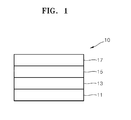
- FIG. 1 is a diagram schematically illustrating a structure of an OLED 10 according to an embodiment of the present invention. A structure of the OLED 10 and a method of manufacturing the OLED 10 according to embodiments of the invention will now be described with reference to Figure 1 .
- the OLED 10 includes a substrate 11, a first electrode 13, an organic layer 15, and a second electrode 17, which are sequentially stacked in this order.
- the substrate 11 which may be any substrate that is used in conventional OLEDs, may be a glass substrate or a transparent plastic substrate with excellent mechanical strength, thermal stability, transparency, surface smoothness, ease of handling, and waterproofness.
- the first electrode 13 may be formed by depositing or sputtering a material that is used to form the first electrode 13 on the substrate.
- the material used to form the first electrode 13 may be a high work-function material so as to facilitate hole injection.
- the first electrode 13 may be a reflective electrode or a transparent electrode.
- Transparent and conductive materials such as indium tin oxide (ITO), indium zinc oxide (IZO), tin dioxide (SnO 2 ), and zinc oxide (ZnO) may be used to form the first electrode 13.
- the first electrode 13 may be formed by using magnesium (Mg), aluminum (Al), aluminum-lithium (Al-Li), calcium (Ca), magnesium-indium (Mg-In), magnesium-silver (Mg-Ag), or the like.
- the organic layer 15 may be disposed on the first electrode 13.
- the term "organic layer” used herein indicates any layer interposed between the first electrode 13 and the second electrode 17.
- the organic layer 15 may not be formed of pure organic materials, and may also include a metal complex.
- the organic layer 15 may include at least one of a hole injection layer (HIL), a HTL, an EML, a hole blocking layer (HBL), an ETL and an electron injection layer (EIL).
- HIL hole injection layer
- EML hole blocking layer
- EIL electron injection layer
- the HIL may be formed on the first electrode 13 by using a vacuum deposition method, a spin coating method, a casting method, a Langmuir-Blodgett (LB) method, or the like.
- vacuum deposition conditions may vary according to a compound that is used to form the HIL, and the desired structure and thermal properties of the HIL to be formed.
- the vacuum deposition method may be performed at a deposition temperature of about 100°C to about 500°C, under a pressure of about 10-8 torr to about 10-3 torr, and at a deposition rate of about 0.01 to about 100 ⁇ /sec.
- the coating conditions may vary according to a compound that is used to form the HIL, and the desired structure and thermal properties of the HIL to be formed.
- conditions for the spin coating method may include a coating rate of about 2,000 rpm to about 5,000 rpm and a heat treatment temperature of about 80°C to about 200°C, wherein the heat treatment is performed to remove a solvent after coating.
- the HIL may be formed of any well known hole injecting material.
- the hole injecting material include N,N'-diphenyl-N,N'-bis-[4-(phenyl- m-tolyl-amino)-phenyl]-biphenyl-4,4'-diamine (DNTPD), a phthalocyanine compound such as copperphthalocyanine, 4,4',4"-tris (3-methylphenylphenylamino) triphenylamine (m-MTDATA), TDATA, 2T-NATA, polyaniline/dodecylbenzenesulfonic acid (Pani/DBSA), poly(3,4-ethylenedioxythiophene)/poly(4-styrenesulfonate) (PEDOT/PSS), polyaniline/camphor sulfonic acid (Pani/CSA), and (polyaniline)/poly (4-styrenesulfonate) (PANI/PSS), but are not limited thereto
- the thickness of the HIL may be about 100 ⁇ to about 10000 ⁇ , and for example, about 100 ⁇ to about 1000 ⁇ . When the thickness of the HIL is within this range, the HIL may have excellent hole injecting ability without a substantial increase in driving voltage.
- the HTL may be formed on the HIL by using a vacuum deposition method, a spin coating method, a casting method, a LB method, or the like.
- the conditions for deposition and coating may be similar to those for the formation of the HIL, although the conditions for the deposition and coating may vary according to the material that is used to form the HTL.
- a HTL material may include the condensed-cyclic compound of Formula 1 described above.
- the HTL may be formed of any material that is commonly used to form a HTL.
- the material that is used to form the HTL include: a carbazole derivative such as N-phenylcarbazole and polyvinylcarbazole; an amine derivative having an aromatic condensation ring such as N,N'-bis(3-methylphenyl)-N,N'-diphenyl-[1,1-biphenyl]-4,4'-diamine (TPD), and N,N'-di(naphthalene-1-yl)-N,N'-diphenyl benzydine ( ⁇ -NPD); and a triphenylamine-based material such as 4,4',4"-tris(N-carbazolyl)triphenylamine (TCTA).
- TCTA triphenylamine-based material
- TCTA may not only transport holes but also inhibit excitons from being diffused into the EML.
- the thickness of the HTL may be about 50 ⁇ to about 1000 ⁇ , and for example, about 100 ⁇ to about 800 ⁇ . When the thickness of the HTL is within the range described above, the HTL may have excellent hole transporting ability without a substantial increase in driving voltage.
- an EML may be formed on the HTL by using a vacuum deposition method, a spin coating method, a casting method, an LB method, or the like.
- the conditions for deposition and coating may be similar to those for the formation of the HIL, although the conditions for deposition and coating may vary according to the material that is used to form the EML.
- the EML may include the condensed-cyclic compound represented by Formula 1 as previously described.
- the EML may include only the condensed-cyclic compound of Formula 1; include the condensed-cyclic compound of Formula 1 as a host and a well known dopant; or include a well known host and the condensed-cyclic compound of Formula 1 as a dopant.
- Examples of the well known host include Alq 3 , 4,4'-N,N'- dicarbazole-biphenyl (CBP), poly(n-vinylcarbazole) (PVK), 9,10-di(naphthalene-2-yl)anthracene (ADN), TCTA, 1,3,5-tris(N-phenylbenzimidazole-2-yl)benzene (TPBI), 3-tert-butyl-9,10-di-2- naphthylanthracene (TBADN), E3, and distyrylarylene (DSA), but are not limited thereto.
- CBP 4,4'-N,N'- dicarbazole-biphenyl
- PVK poly(n-vinylcarbazole)
- ADN 9,10-di(naphthalene-2-yl)anthracene
- TCTA 1,3,5-tris(N-phenylbenzimidazole-2-yl)benzen
- red dopant examples include PtOEP, Ir(piq) 3 , and Btp 2 Ir(acac), but are not limited thereto.
- blue dopant examples include F 2 Irpic, (F 2 ppy) 2 Ir(tmd), Ir(dfppz) 3 , ter-fluorene, 4,4'-bis(4-diphenylaminostyryl)biphenyl (DPAVBi), and 2,5,8,11-tetra-t-butyl pherylene (TBP), but are not limited to.
- an amount of the dopant may be generally in a range from about 0.01 to about 15 parts by weight based on about 100 parts by weight of the host, but is not limited thereto.
- the thickness of the EML may be from about 100 ⁇ to about 1000 ⁇ , and for example, from about 200 ⁇ to about 600 ⁇ . When the thickness of the EML is within this range, the EML may have excellent emitting ability without a substantial increase in driving voltage.
- a HBL may be formed between the HTL and the EML by using a vacuum deposition method, a spin coating method, a casting method, a LB method, or the like, in order to prevent diffusion of triplet excitons or holes into an ETL.
- the HBL is formed by using a vacuum deposition method or a spin coating method
- the conditions for deposition and coating may be similar to those for the formation of the HIL, although the conditions for deposition and coating may vary according to the material that is used to form the HBL. Any material that is commonly used to form a HBL may be used. Examples of materials for forming the HBL include an oxadiazole derivative, a triazole derivative, and a phenanthroline derivative, but are not limited thereto.
- the thickness of the HBL may be in the range of about 50 ⁇ to about 1000 ⁇ , for example, about 100 ⁇ to about 300 ⁇ . When the thickness of the HBL is within these ranges, the HBL may have an excellent hole blocking ability without a substantial increase in driving voltage.
- an ETL is formed by using a vacuum deposition method, a spin coating method, a casting method, or the like.
- the deposition and coating conditions may be similar to those for formation of the HIL, although the deposition and coating conditions may vary according to a compound that is used to form the ETL.
- the ETL may be formed of the condensed-cyclic compound of Formula 1.
- a material that is used to form the ETL may be a material that stably transports electrons injected from the electron injecting electrode (cathode) and any known material may be used.
- Examples of materials for forming the ETL include a quinoline derivative, tris(8-quinolinorate)aluminum (Alq 3 ), TAZ, Balq, and beryllium bis(benzoquinolin-10-olate) (bebq 2 ), but are not limited thereto.
- the thickness of the ETL may be from about 100 ⁇ to about 1000 ⁇ , and for example, from about 150 ⁇ to about 500 ⁇ . When the thickness of the ETL is within this range, the ETL may have satisfactory electron transporting ability without a substantial increase in driving voltage.
- an EIL may be formed on the ETL.
- a material for forming the EIL is not limited as long as it allows electrons to be easily injected from the cathode.
- Examples of materials for forming the EIL include LiF, NaCl, CsF, Li 2 O, and BaO, which are known in the art.
- Deposition conditions for forming the EIL are similar to those for formation of the HIL, although the deposition conditions may vary according to a material that is used to form the EIL.
- the thickness of the EIL may be from about 1 ⁇ to about 100 ⁇ , specifically from about 3 ⁇ to about 90 ⁇ . When the thickness of the EIL is within this range, the EIL may have satisfactory electron injection ability without a substantial increase in driving voltage.
- the second electrode 17, which may be a transparent electrode is disposed on the organic layer 15.
- the second electrode 17 may be a cathode that is an electron injection electrode.
- a second electrode forming metal may be a metal having a low work function, an alloy having a low work function, an electro-conductive compound, or mixtures thereof.
- the second electrode 17 may be formed of lithium (Li), magnesium (Mg), aluminum (Al), aluminum (Al)-lithium (Li), calcium (Ca), magnesium (Mg)-indium (In), magnesium (Mg)-silver (Ag), or the like, and may be formed as a thin film type transmission electrode.
- the transmission electrode may be formed of ITO or IZO to manufacture a top-emission type light-emitting device.
- Compound 3 was synthesized through Reaction Scheme 3 below: 2.0 g (5.0 mmol) of Compound G and 1.84 g (5.5 mmol) of Compound H were added to a mixed solvent of 2.07 g (15.0 mmol) potassium carbonate solution and THF, 173 mg (3 mol%) of Pd(PPh 3 ) 4 was added thereto while stirring, and the mixture was heated for 24 hours. The mixture was cooled to room temperature and subjected to extraction using dichloromethane.
- Compound 19 was synthesized through Reaction Scheme 4 below: 2.0 g (4.20 mmol) of Compound F and 2.58 g (12.6 mmol) of 3-pyridylboron acid pinacolester were added to a mixed solvent of 2.32 g (16.8 mmol) potassium carbonate solution and THF, 194 mg (4 mol%) of Pd(PPh3)4 was added thereto while stirring, and the mixture was heated for 24 hours. The mixture was cooled to room temperature and subjected to extraction using dichloromethane. Then, an organic layer was collected, and the solvent was removed by drying the organic layer using anhydrous magnesium sulfate under reduced pressure.
- the structure of Compound 40 was identified using 1 H -NMR.
- 1 H NMR (CDCl3, 300MHz) ⁇ 8.21 (1H), 8.06-8.01 (2H), 7.81(1H), 7.78-7.62(5H) 7.48-7.43(3H), 7.32-7.25(4H), 1.70(6H)
- Compound 34 was synthesized through Reaction Scheme 7 below: 2.4 g (5.0 mmol) of Compound F and 2.54 g (15.0 mmol) of diphenylamine was dissolved in 100 mL of toluene, and then 2.40 g (25 mmol) of t-BuONa, 137 mg (3 mol%) of Pd 2 (dba) 3 , and 30 mg (3 mol%) of (t-Bu)3P were added thereto, and then the mixture was stirred for 6 hours at 90°C.
- a 15 ⁇ /cm 2 (1200 ⁇ ) ITO glass substrate (available from Corning Co.) was cut to a size of 50 mm x 50 mm x 0.7 mm, ultrasonically washed with isopropyl alcohol for 5 minutes and then with pure water for 5 minutes, and washed again with UV ozone for 30 minutes. Then, m-MTDATA was vacuum deposited on the substrate to form a hole injection layer having a thickness of 750 ⁇ , and then ⁇ -NPD was vacuum deposited on the hole injection layer to form a hole transport layer having a thickness of 150 ⁇ .
- 97 wt% of DSA as a host and 3 wt% of TBPe as a dopant were deposited on the HTL to form an EML with a thickness of 300 ⁇ .
- Alq3 was vacuum-deposited on the EML to form an ETL having a thickness of 200 ⁇ .
- LiF was vacuum-deposited on the ETL to form an EIL having a thickness of 80 ⁇ and Al was vacuum-deposited on the EIL to form a cathode having a thickness of 3000 ⁇ .
- An OLED was manufactured in the same manner as in Comparative Example 1, except that Compound 34 was used instead of m-MTDATA to form the HTL.
- An OLED was manufactured in the same manner as in Comparative Example 1, except that Compound 40 was used instead of DSA as the host of the EML.
- An OLED was manufactured in the same manner as in Comparative Example 1, except that Compound 35 was used instead of TBPe as the dopant of the EML.
- An OLED was manufactured in the same manner as in Comparative Example 1, except that Compound 43 was used instead of Alq 3 to form the ETL.
- An OLED was manufactured in the same manner as in Comparative Example 1, except that Compound 19 was used instead of Alq 3 to form the ETL.
- An OLED was manufactured in the same manner as in Comparative Example 1, except that Compound 3 was used instead of Alq 3 to form the ETL.
- OLEDs of Examples 1 through 6 have higher luminance efficiencies and half lifetime, compared to the OLED of Comparative Example 1.
- An OLED including an organic layer containing the condensed-cyclic compound of Formula 1 above may have high efficiency and long durability.
Landscapes
- Chemical & Material Sciences (AREA)
- Organic Chemistry (AREA)
- Physics & Mathematics (AREA)
- Optics & Photonics (AREA)
- Engineering & Computer Science (AREA)
- Materials Engineering (AREA)
- Spectroscopy & Molecular Physics (AREA)
- Electroluminescent Light Sources (AREA)
- Organic Low-Molecular-Weight Compounds And Preparation Thereof (AREA)
- Plural Heterocyclic Compounds (AREA)
- Pyridine Compounds (AREA)
- Indole Compounds (AREA)
Abstract

Description
- The present invention relates to a condensed-cyclic compound, and an organic light emitting diode including an organic layer containing the condensed-cyclic compound.
- Organic light-emitting diodes (OLEDs), which are self-emitting devices, have advantages such as a wide viewing angle, excellent contrast, quick response, high brightness, excellent driving voltage characteristics, and can provide multicolored images.
- A typical OLED has a structure including a substrate, and an anode, a hole transport layer (HTL), an emissive layer (EML), an electron transport layer (ETL), and a cathode which are sequentially stacked on the substrate in the order stated. In this regard, the HTL, the EML, and the ETL are organic thin films formed of organic compounds.
- An operating principle of an OLED having the above-described structure is as follows. When a voltage is applied to the anode and the cathode, holes injected from the anode move to the EML via the HTL, and electrons injected from the cathode move to the EML via the ETL. The holes and electrons recombine in the EML to generate excitons. When the excitons drop from an excited state to a ground state, light is emitted.
- A compound for providing an organic light emitting diode having high efficiency and long durability is provided.
- In a first aspect of the present invention there is provided a condensed-cyclic compound represented by Formula 1 below:


R1 through R3 and R4 through R7 may be hydrogen; R8 may be selected from the group consisting of hydrogen, a substituted or unsubstituted C1-C10 alkyl group, a substituted or unsubstituted C2-C10 alkenyl group, a substituted or unsubstituted C2-C10 alkynyl group, a substituted or unsubstituted C1-C10 alkoxy group, a group represented by -(Ar1)a-Ar11, and a group represented by -N[-(Ar2)b-Ar12][-(Ar3)c-Ar13]; R11 through R14 may be each independently selected from the group consisting of hydrogen, a substituted or unsubstituted C1-C10 alkyl group, a substituted or unsubstituted C2-C10 alkenyl group, a substituted or unsubstituted C2-C10 alkynyl group, a substituted or unsubstituted C1-C10 alkoxy group, a group represented by - (Ar4)d-Ar14, and a group represented by -N[-(Ar5)e-Ar15][-(Ar6)f-Ar16]; Ar1 through Ar6 may be each independently selected from the group consisting of a substituted or unsubstituted C1-C30 alkylene group, a substituted or unsubstituted C2-C30 alkenylene group, a substituted or unsubstituted C5-C30 arylene group, and a substituted or unsubstituted C4-C30 heteroarylene group; and Ar11 and Ar16 may be each independently selected from the group consisting of a hydrogen atom, a halogen atom, a hydroxyl group, a cyano group, a substituted or unsubstituted C1-C30 alkyl group, a substituted or unsubstituted C2-C30 alkenyl group, a substituted or unsubstituted C2-C30 alkynyl group, a substituted or unsubstituted C1-C30 alkoxy group, a substituted or unsubstituted C5-C30 aryl group, and a substituted or unsubstituted C4-C30 heteroaryl group. - A more complete appreciation of the present invention, and many of the attendant advantages thereof, will be readily apparent as the same becomes better understood by reference to the following detailed description when considered in conjunction with the accompanying drawings, wherein:
-
Figure 1 is a diagram schematically illustrating a structure of an organic light emitting diode (OLED) according to an embodiment of the present invention. - A condensed-cyclic compound represented by Formula 1 below is provided according to a first aspect of the present invention:

- In Formula 1, R8 and R7 are each independently selected from the group consisting of a hydrogen atom, a halogen atom, a hydroxyl group, a cyano group, a substituted or unsubstituted C1-C30 alkyl group, a substituted or unsubstituted C2-C30 alkenyl group, a substituted or unsubstituted C2-C30 alkynyl group, a substituted or unsubstituted C1-C30 alkoxy group, a group represented by -(Ar1)a-Ar11, and a group represented by -N[-(Ar2)b-Ar12][-(Ar3)c-Ar13]; or R8 is connected to * of Formula 2 represented by

- For example, in Formula 1, R8 and R7 may be each independently selected from the group consisting of a hydrogen atom, a halogen atom, a hydroxyl group, a cyano group, a substituted or unsubstituted C1-C30 alkyl group, a substituted or unsubstituted C2-C30 alkenyl group, a substituted or unsubstituted C2-C30 alkynyl group, a substituted or unsubstituted C1-C30 alkoxy group, a group represented by -(Ar1)a-Ar11, and a group represented by -N[-(Ar2)b-Ar12][-(Ar3)c-Ar13], and R1 through R6 and R11 through R14 may be each independently selected from the group consisting of a hydrogen atom, a halogen atom, a hydroxyl group, a cyano group, a substituted or unsubstituted C1-C30 alkyl group, a substituted or unsubstituted C2-C30 alkenyl group, a substituted or unsubstituted C2-C30 alkynyl group, a substituted or unsubstituted C1-C30 alkoxy group, a group represented by -(Ar4)d-Ar14, and a group represented by -N[-(Ar5)e-Ar15][-(Ar6)f-Ar16].
- For example, in Formula 1, R1 through R3 and R4 through R7 may be hydrogen; R8 may be selected from the group consisting of hydrogen, a substituted or unsubstituted C1-C10 alkyl group, a substituted or unsubstituted C2-C10 alkenyl group, a substituted or unsubstituted C2-C10 alkynyl group, a substituted or unsubstituted C1-C10 alkoxy group, a group represented by - (Ar1)a-Ar11, and a group represented by -N[-(Ar2)b-Ar12][-(Ar3)c-Ar13]; R11 through R14 may be each independently selected from the group consisting of hydrogen, a substituted or unsubstituted C1-C10 alkyl group, a substituted or unsubstituted C2-C10 alkenyl group, a substituted or unsubstituted C2-C10 alkynyl group, a substituted or unsubstituted C1-C10 alkoxy group, a group represented by -(Ar4)d-Ar14, and a group represented by -N[-(Ar5)e-Ar15][-(Ar6)f-Ar16].
- Ar1 through Ar6 may be each independently selected from the group consisting of a substituted or unsubstituted C1-C30 alkylene group, a substituted or unsubstituted C2-C30 alkenylene group, a substituted or unsubstituted C5-C30 arylene group, and a substituted or unsubstituted C4-C30 heteroarylene group.
- For example, Ar1 through Ar6 may be each independently selected from the group consisting of a substituted or unsubstituted C1-C10 alkylene group, a substituted or unsubstituted C2-C10 alkenylene group, a substituted or unsubstituted C5-C14 arylene group, and a substituted or unsubstituted C4-C14 heteroarylene group.
- Ar1 through Ar6 may be each independently selected from the group consisting of a substituted or unsubstituted ethylene group, a substituted or unsubstituted phenylene group, a substituted or unsubstituted pentalenylene group, a substituted or unsubstituted indenylene group, a substituted or unsubstituted naphthylene group, a substituted or unsubstituted azulenylene group, a substituted or unsubstituted heptalenylene group, a substituted or unsubstituted indacenylene group, a substituted or unsubstituted acenaphthylene group, a substituted or unsubstituted fluorenylene group, a substituted or unsubstituted phenalenylene group, a substituted or unsubstituted phenanthrenylene group, a substituted or unsubstituted anthracenylene group, a substituted or unsubstituted fluoranthenylene group, a substituted or unsubstituted triphenylenylene group, a substituted or unsubstituted pyrenylenylene group, a substituted or unsubstituted chrysenylene group, a substituted or unsubstituted naphthacenylene group, a substituted or unsubstituted picenylene group, a substituted or unsubstituted perylenylene group, a substituted or unsubstituted pentaphenylene group, a substituted or unsubstituted hexacenylene group, a substituted or unsubstituted pyrrolylene group, a substituted or unsubstituted pyrazolylene group, a substituted or unsubstituted imidazolylene group, a substituted or unsubstituted imidazolinylene group, a substituted or unsubstituted imidazopyridinylene group, a substituted or unsubstituted imidazopyrimidinylene group, a substituted or unsubstituted pyridinylene group, a substituted or unsubstituted pyrazinylene group, a substituted or unsubstituted pyrimidinylene group, a substituted or unsubstituted indolylene group, a substituted or unsubstituted purinylene group, a substituted or unsubstituted quinolinylene group, a substituted or unsubstituted phthalazinylene group, a substituted or unsubstituted indolizinylene group, a substituted or unsubstituted naphthyridinylene group, a substituted or unsubstituted quinazolinylene group, a substituted or unsubstituted cinnolinylene group, a substituted or unsubstituted indazolylene group, a substituted or unsubstituted carbazolylene group, a substituted or unsubstituted phenazinylene group, a substituted or unsubstituted phenanthridinylene group, a substituted or unsubstituted pyranylene group, a substituted or unsubstituted chromenylene group, a substituted or unsubstituted benzofuranylene group, a substituted or unsubstituted thiophenylene group, a substituted or unsubstituted benzothiophenylene group, a substituted or unsubstituted isothiazolylene group, a substituted or unsubstituted benzimidazolylene group, and a substituted or unsubstituted isoxazolylene group, but are not limited thereto.
- Ar11 through Ar16 are each independently selected from the group consisting of a hydrogen atom, a halogen atom, a hydroxyl group, a cyano group, a substituted or unsubstituted C1-C30 alkyl group, a substituted or unsubstituted C2-C30 alkenyl group, a substituted or unsubstituted C2-C30 alkynyl group, a substituted or unsubstituted C1-C30 alkoxy group, a substituted or unsubstituted C5-C30 aryl group, and a substituted or unsubstituted C4-C30 heteroaryl group.
- Ar11 through Ar16 may be each independently selected from the group consisting of a substituted or unsubstituted C1-C10 alkyl group, a substituted or unsubstituted C1-C10 alkoxy group, a substituted or unsubstituted phenyl group, a substituted or unsubstituted pentalenyl group, a substituted or unsubstituted indenyl group, a substituted or unsubstituted naphthyl group, a substituted or unsubstituted azulenyl group, a substituted or unsubstituted heptalenyl group, a substituted or unsubstituted indacenyl group, a substituted or unsubstituted acenaphthyl group, a substituted or unsubstituted fluorenyl group, a substituted or unsubstituted phenalenyl group, a substituted or unsubstituted phenantlenyl group, a substituted or unsubstituted anthracenyl group, a substituted or unsubstituted fluoranthenyl group, a substituted or unsubstituted triphenylenyl group, a substituted or unsubstituted pyrenyl group, a substituted or unsubstituted chrysenyl group, a substituted or unsubstituted naphthacenyl group, a substituted or unsubstituted picenyl group, a substituted or unsubstituted perylenyl group, a substituted or unsubstituted pentacenyl group, a substituted or unsubstituted hexacenyl group, a substituted or unsubstituted pyrrolyl group, a substituted or unsubstituted pyrazolyl group, a substituted or unsubstituted imidazolyl group, a substituted or unsubstituted imidazolinyl group, a substituted or unsubstituted imidazopyridinyl group, a substituted or unsubstituted imidazopyrimidinyl group, a substituted or unsubstituted pyridinyl group, a substituted or unsubstituted pyrazinyl group, a substituted or unsubstituted pyrimidinyl group, a substituted or unsubstituted indolyl group, a substituted or unsubstituted furinyl group, a substituted or unsubstituted quinolinyl group, a substituted or unsubstituted phthalazinyl group, a substituted or unsubstituted indolizinyl group, a substituted or unsubstituted naphthyridinyl group, a substituted or unsubstituted quinazolinyl group, a substituted or unsubstituted cinolinyl group, a substituted or unsubstituted indazolyl group, a substituted or unsubstituted carbazolyl group, a substituted or unsubstituted phenazinyl group, a substituted or unsubstituted phenanthridinyl group, a substituted or unsubstituted pyranylene group, a substituted or unsubstituted chromenyl group, a substituted or unsubstituted benzofuranyl group, a substituted or unsubstituted thiophenyl group, a substituted or unsubstituted benzothiophenyl group, a substituted or unsubstituted isothiazolyl group, a substituted or unsubstituted benzimidazolyl group, and a substituted or unsubstituted isoxazolyl group, but are not limited thereto.
- For example, Ar1 through Ar6 may be each independently selected from the group consisting of a pyridinylene group, a quinolinylene group, a benzimidazolylene group, an imidazopyridinylene group, an imidazopyrimidinylene group, a phenylene group, a C1-C10 alkyl phenylene group, a carbazolylene group, a phenylcarbazolylene group, a fluorenylene group, a C1-C10 alkyl fluorenylene group, a di(C1-C10 alkyl) fluorenylene group, an ethylene group, and a naphthylene group, but are not limited thereto.
- For example, Ar11 through Ar16 may be each independently selected from the group consisting of a methyl group, an ethyl group, a propyl group, a butyl group, a methoxy group, an ethoxy group, a propoxy group, a butoxy group, a pyridinyl group, a quinolinyl group, a benzimidazolyl group, an imidazopyridinyl group, an imidazopyrimidinyl group, a phenyl group, a carbazolyl group, a fluorenyl group, a di(C1-C10alkyl)fluorenyl group, a naphthyl group, and a functional group represented by the formula

- R8 and R11 through R14 may be each independently selected from the group consisting of functional groups represented by Formulae 3A through 30 below, but are not limited thereto:

- In Formulae 3A through 30, Z1 and Z2 are each independently selected from the group consisting of hydrogen, a hydroxyl group, a methyl group, an ethyl group, a propyl group, a butyl group, a methoxy group, an ethoxy group, a propoxy group, a butoxy group, a phenyl group, and a naphthyl group.
- R8 and R11 through R14 may be each independently selected from the group consisting of compounds represented by Formulae 4A through 4R below, but are not limited thereto:

- In Formula 1, a through f may be each independently an integer from 0 to 10. For example, a through f may be each independently 0, 1, or 2, but are not limited thereto.
- In Formula 1, a the moieties represented by Ar1 in the group represented by -(Ar1)a-Ar11 may be identical to or different from each other, b the moieties represented by Ar2 in the group represented by -(Ar2)b-Ar12 may be identical to or different from each other, c the moieties represented by Ar3 in the group represented by (Ar3)c-Ar13 may be identical to or different from each other, d the moieties represented by Ar4 in the group represented by -(Ar4)d-Ar14 may be identical to or different from each other, e the moieties represented by Ar5 in the group represented by -(Ar5)e-Ar15 may be identical to or different from each other, and f the moieties represented by Ar6 in the group represented by [-(Ar6)f-Ar16] may be identical to or different from each other.
- For example, in the group represented by -(Ar1)a-Ar11, when a is 2, the two Ar1s may be both phenylene groups, or one of the two may be a phenylene group and the other may be a benzimidazolylene group.
- In Formula 1, Q1 through Q3 may be each independently selected from the group consisting of hydrogen, a C1-C30 alkyl group, a C1-C30 alkoxy group, a C5-C14 aryl group, and a C4-C14 heteroaryl group. For example, Q1 through Q3 may be each independently selected from the group consisting of hydrogen, a methyl group, an ethyl group, a propyl group, a butyl group, a methoxy group, an ethoxy group, a propoxy group, a butoxy group, a phenyl group, and a naphthyl group, but are not limited thereto. For example, Q1 through Q3 may be each independently hydrogen, a methyl group, or a phenyl group
- In Formula 1, X1 may be selected from the group consisting of -CH2-, -CH(CH3)-, -C(CH3)2-, - CH(Ph)-, -NH-, and -N(Ph)-, wherein Ph denotes a phenyl group, but is not limited thereto.
- Accordingly, the condensed-cyclic compound of Formula 1 has high thermal stability. Also, since the condensed-cyclic compound has a wide band gap, the condensed-cyclic compound may be used for various layers, such as a hole transport layer (HTL), an emissive layer (EML), and/or an electron transport layer (ETL), of an organic light emitting diode (OLED), according to substituents, such as R8 and R11 through R14.
- In Formula 1, R8 may be connected to * of Formula 2 below and R7 may be connected to *' of Formula 2.

- Accordingly, the condensed-cyclic compound represented by Formula 1 may be represented by Formula 1A below:

- In Formula 1A, R1 through R6 and R11 through R14 are as described above, and R21 through R24 are as described in connection with R11 through R14.
- For example, in Formula 1A, R1 through R6 may be hydrogen; R11 through R14 and R21 through R24 may each independently hydrogen, a substituted or unsubstituted C1-C10 alkyl group, a substituted or unsubstituted C2-C10 alkenyl group, a substituted or unsubstituted C2-C10 alkynyl group, a substituted or unsubstituted C1-C10 alkoxy group, a group represented by -(Ar4)a-Ar14, and a group represented by -N[-(Ar5)e-Ar15][-(Ar6)f-Ar16].
- In this embodiment, Ar4 through Ar6, A14 through Ar16, and d through f are as described above. In Formula 1A, R11 through R14 and R21 through R24 may be each independently selected from the group consisting of the compounds represented by Formulae 3A through 30, but are not limited thereto.
- In Formula 1A, R11 through R14 and R21 through R24 may be each independently selected from the group consisting of the functional groups represented by Formulae 4A through 4R, but are not limited thereto.
- In Formula 1A, Q1 through Q3 and X1 are as described above, and X2 is as described above in connection with X1.
- Since the condensed-cyclic compound of Formula 1 may be represented by Formula 1A, the condensed-cyclic compound has high thermal stability. Also, since the condensed-cyclic compound has a wide band gap, the condensed-cyclic compound may be used for various layers, such as a HTL, an EML, and/or an ETL, of an OLED, according to substituents, such as R8 and R11 through R14.
- In an embodiment, in Formula 1, R1 through R3 and R4 through R7 are hydrogen; R8 and R11 through R14 are each independently selected from the group consisting of hydrogen and functional groups represented by Formulae 3A through 30; and X1 is a divalent linking group selected from the group consisting of -C(Q1)(Q2)- and -N(Q3)-, wherein Q1 through Q3 are each independently selected from the group consisting of hydrogen, a methyl group, an ethyl group, a propyl group, a butyl group, a methoxy group, an ethoxy group, a propoxy group, a butoxy group, a phenyl group, and a naphthyl group.
- In another embodiment, in Formula 1, R1 through R3, R4 through R7, R11, R13, and R14 are hydrogen; R8 and R12 are each independently selected from the group consisting of hydrogen and the functional groups represented by Formulae 3A through 30; and X1 is a divalent linking group selected from the group consisting of -C(Q1) (Q2)- and -N(Q3)-, wherein Q1 through Q3 are each independently selected from the group consisting of hydrogen, a methyl group, an ethyl group, a propyl group, a butyl group, a methoxy group, an ethoxy group, a propoxy group, a butoxy group, a phenyl group, and a naphthyl group.
- In another embodiment, in Formula 1, R1 through R3, R4 through R7, R11, R13, and R14 are hydrogen; R8 and R12 are each independently selected from the group consisting of hydrogen and the functional groups represented by Formulae 4A through 4R; and X1 is selected from the group consisting of -CH2-, -CH(CH3)-, -C(CH3)2-, -CH(Ph)-, -NH-, and -N(Ph)-, wherein Ph denotes a phenyl group.
- In another embodiment, in Formula 1, R1 through R3, R4 through R7, R11, R13, and R14 are hydrogen; R8 and R12 are each independently selected from the group consisting of hydrogen and the functional groups represented by Formulae 4A through 4R; and X1 is selected from the group consisting of -CH2-, -CH(CH3)-, -C(CH3)2-, and -CH(Ph)-, wherein Ph denotes a phenyl group.
- In an embodiment, in Formula 1, R8 is connected to * of Formula 2, R7 is connected to *' of Formula 2 (that is, Formula 1 is represented by Formula 1A), R1 through R6 are hydrogen; R11 through R14 and R21 through R24 are each independently selected from the group consisting of hydrogen and the functional groups represented by Formulae 3A through 30; and X1 and X2 are each independently a divalent linking group selected from the group consisting of -C(Q1)(Q2)-and -N(Q3)-, wherein Q1 through Q3 are each independently selected form the group consisting of hydrogen, a methyl group, an ethyl group, a propyl group, a butyl group, a methoxy group, an ethoxy group, a propoxy group, a butoxy group, a phenyl group, and a naphthyl group.
- In another embodiment, in Formula 1, R8 is connected to * of Formula 2, R7 is connected to *' of Formula 2 (that is, Formula 1 is represented by Formula 1A), R1 through R6, R11, R13, R14, R21, R23, and R24 are hydrogen; R12 and R22 are each independently selected from the group consisting of hydrogen and the functional groups represented by Formulae 3A through 30; and X1 and X2 are each independently a divalent linking group selected from the group consisting of -C(Q1)(Q2)- and -N(Q3)-, wherein Q1 through Q3 are each independently selected from the group consisting of hydrogen, a methyl group, an ethyl group, a propyl group, a butyl group, a methoxy group, an ethoxy group, a propoxy group, a butoxy group, a phenyl group, and a naphthyl group.
- In another embodiment, in Formula 1, R8 is connected to * of Formula 2, R7 is connected to *' of Formula 2 (that is, Formula 1 is represented by Formula 1A); R1 through R6, R11, R13, R14, R21, R23, and R24 are hydrogen; R12 and R22 are each independently selected from the group consisting of hydrogen and the functional groups represented by Formulae 4A through 4R; and X1 and X2 are each independently selected from the group consisting of -CH2-, -CH(CH3)-, - C(CH3)2-, -CH(Ph)-, -NH-, and -N(Ph)-, wherein Ph denotes a phenyl group.
- In another embodiment, in Formula 1, R8 is connected to * of Formula 2, R7 is connected to *' of Formula 2 (that is, Formula 1 is represented by Formula 1A); R1 through R6, R11, R13, R14, R21, R23, and R24 are hydrogen; R12 and R22 are each independently selected from the group consisting of hydrogen and the functional groups represented by Formulae 4A through 4R; and X1 and X2 are each independently selected from the group consisting of -CH2-, -CH(CH3)-, - C(CH3)2-, and -CH(Ph)-.
- In another embodiment, the condensed-cyclic compound represented by Formula 1 is one of Compounds 1 to 43 below, but is not limited thereto.




- Examples of the unsubstituted C1-C30 alkyl group or the C1-C30 alkyl group used herein include methyl, ethyl, propyl, isobutyl, sec-butyl, pentyl, iso-amyl, hexyl, and the like. In the substituted C1-C30 alkyl group, at least one hydrogen atom of the unsubstituted C1-C30 alkyl group may be substituted with a halogen atom, a hydroxyl group, a nitro group, a cyano group, an amino group, an amidino group, hydrazine, hydrazone, a carboxyl group or salts thereof, a sulfonic acid group or salts thereof, a phosphoric acid or salts thereof, a C1-C30 alkyl group, a C1-C30 alkenyl group, a C1-C30 alkynyl group, a C6-C30 aryl group, or a C2-C20 heteroaryl group. The substituted or unsubstituted C1-C30 alkylene group has the same structure as the substituted or unsubstituted C1-C30 alkyl group as described above, but is a divalent linking group.
- The unsubstituted C1-C30 alkoxy group or the C1-C30 alkoxy group may be a group represented by -OA, wherein A is the unsubstituted C1-C30 alkyl group, and examples of the unsubstituted C1-C30 alkoxy group are methoxy, ethoxy, and isopropyloxy. At least one hydrogen atom in the unsubstituted C1-C30 alkoxy group may be substituted with the substituents described with reference to the substituted C1-C30 alkyl group.
- The unsubstituted C2-C30 alkenyl group or the C2-C30 alkenyl group has at least one carbon-carbon double bond in the center or at one end of the unsubstituted C2-C30 alkyl group structure. Examples of the unsubstituted C2-C30 alkenyl group include ethenyl, propenyl, and butenyl. At least one hydrogen atom in the unsubstituted C2-C30 alkenyl group may be substituted with the substituents described with reference to the substituted C1-C30 alkyl group. The substituted or unsubstituted C2-C30 alkenylene group has the same structure as the substituted or unsubstituted C2-C30 alkenyl group described above, but is a divalent linking group.
- The unsubstituted C2-C30 alkynyl group or the C2-C30 alkynyl group has a carbon-carbon triple bond in the center or at one end of the C2-C30 alkyl group structure. Examples of the unsubstituted C2-C30 alkynyl group and acetylene, propylene, isopropylacetylene, and t-butylacetylene. At least one hydrogen atom in the alkynyl group may be substituted with the substituents described with reference to the substituted C1-C30 alkyl group.
- The unsubstituted C5-C30 aryl group is a monovalent group having a carbocyclic aromatic system having 5 to 30 carbon atoms including at least one aromatic ring. The unsubstituted C5-C30 arylene group is a divalent group having a carbocyclic aromatic system having 5 to 30 carbon atoms including at least one aromatic ring. When the aryl group and the arylene group have at least two rings, the at least two rings may be fused to each other. At least one hydrogen atom in the aryl group and the arylene group may be substituted with the substituents described with reference to the substituted C1-C30 alkyl group.
- Examples of the substituted or unsubstituted C5-C30 aryl group are a phenyl group, a C1-C10 alkylphenyl group (e.g., an ethylphenyl group), a C1-C10 alkylbiphenyl group (e.g., an ethylbiphenyl group), a halophenyl group (e.g., an o-, m- or p-fluorophenyl group and a dichlorophenyl group), a dicyanophenyl group, a trifluoromethoxyphenyl group, an o-, m- or p-tolyl group, an o-, m- or p-cumenyl group, a mesityl group, a phenoxyphenyl group, a (α,α-dimethylbenzene)phenyl group, a (N,N'-dimethyl)aminophenyl group, a (N,N'-diphenyl)aminophenyl group, a pentalenyl group, an indenyl group, a naphthyl group, a halonaphthyl group (e.g., a fluoronaphthyl group), a C1-C10 alkylnaphthyl group (e.g., a methylnaphthyl group), a C1-C10 alkoxynaphthyl group (e.g., a methoxynaphthyl group), an anthracenyl group, an azulenyl group, a heptalenyl group, an acenaphthylenyl group, a phenalenyl group, a fluorenyl group, an anthraquinolyl group, a methylanthryl group, a phenanthryl group, a triphenylenyl group, a pyrenyl group, a chrysenyl group, an ethyl-chrysenyl group, a picenyl group, a perylenyl group, a chloroperylenyl group, a pentaphenyl group, a pentacenyl group, a tetraphenylenyl group, a hexaphenyl group, hexacenyl group, a rubicenyl group, a coronenyl group, a trinaphthylenyl group, a heptaphenyl group, a heptacenyl group, a pyranthrenyl group, and an ovalenyl group. Examples of the substituted or unsubstituted C5-C30 arylene group may be easily derived from examples of the substituted or unsubstituted C5-C30 aryl group.
- The unsubstituted C4-C30 heteroaryl group is a monovalent group having at least one aromatic ring having at least one of the hetero atoms selected from the group consisting of N, O, P, and S. The unsubstituted C2-C30 heteroarylene group is a divalent group having at least one aromatic ring having at least one of the hetero atoms selected from the group consisting of N, O, P, and S. In this regard, when the heteroaryl group and the heteroarylene group have at least two rings, the at least two rings may be fused with each other. At least one hydrogen atom in the heteroaryl group and the heteroarylene group may be substituted with the substituents described with reference to the substituted C1-C30 alkyl group.
- Examples of the unsubstituted C4-C30 heteroaryl group include a pyrazolyl group, an imidazolyl group, an oxazolyl group, a thiazolyl group, a triazolyl group, a tetrazolyl group, an oxadiazolyl group, a pyridinyl group, a pyridazinyl group, a pyrimidinyl group, a triazinyl group, a carbazolyl group, an indolyl group, a quinolinyl group, an isoquinolinyl group, a benzimidazolyl group, an imidazopyridinyl group and an imidazopyrimidinyl group. Examples of the substituted and unsubstituted C4-C30 heteroarylene group may be easily derived from examples of the substituted or unsubstituted C4-C30 arylene group.
- The condensed-cyclic compound of Formula 1 may be synthesized using an organic synthesis method. A method of synthesizing the condensed-cyclic compound will be described later.
- For example, Reaction Scheme 1A below is a reaction scheme for synthesizing the condensed-cyclic compound of Formula 1:

- In Reaction Scheme 1A, R1 through R8, R11 through R14, and X1 are defined as described above.
- In Reaction Scheme 1A, Ha denotes a halogen atom, and may be -F, -Cl, -Br, or -I.
- In Reaction Scheme 1A, A1 may be a hydrogen atom,

- Reaction Scheme 1A is an example of a method of synthesizing the condensed-cyclic compound of Formula 1, and one of ordinary skill in the art may synthesize the condensed-cyclic compound of Formula 1 by using a well-known organic synthesis method by referring to Reaction Scheme 1A and the structure of the compound of Formula 1.
- The condensed-cyclic compound of Formula 1 may be used in an organic layer of an OLED. In an aspect of the invention there is provided an OLED including a first electrode, a second electrode, and an organic layer disposed between the first electrode and the second electrode, wherein the organic layer includes the condensed-cyclic compound of Formula 1 described above. The OLED may further comprise, between the first electrode and the second electrode, at least one layer selected from the group consisting of a hole injection layer, a hole transport layer, an emissive layer, a hole blocking layer, an electron transport layer, and an electron injection layer.
- The organic layer may be an EML, a HTL, or an ETL, but is not limited thereto. When the condensed-cyclic compound of Formula 1 is used as an EML, the condensed-cyclic compound may be used as a host or a dopant.
-
Figure 1 is a diagram schematically illustrating a structure of anOLED 10 according to an embodiment of the present invention. A structure of theOLED 10 and a method of manufacturing theOLED 10 according to embodiments of the invention will now be described with reference toFigure 1 . - The
OLED 10 includes asubstrate 11, afirst electrode 13, anorganic layer 15, and asecond electrode 17, which are sequentially stacked in this order. - The
substrate 11, which may be any substrate that is used in conventional OLEDs, may be a glass substrate or a transparent plastic substrate with excellent mechanical strength, thermal stability, transparency, surface smoothness, ease of handling, and waterproofness. - The
first electrode 13 may be formed by depositing or sputtering a material that is used to form thefirst electrode 13 on the substrate. When thefirst electrode 13 constitutes an anode, the material used to form thefirst electrode 13 may be a high work-function material so as to facilitate hole injection. Thefirst electrode 13 may be a reflective electrode or a transparent electrode. Transparent and conductive materials such as indium tin oxide (ITO), indium zinc oxide (IZO), tin dioxide (SnO2), and zinc oxide (ZnO) may be used to form thefirst electrode 13. Alternatively, thefirst electrode 13 may be formed by using magnesium (Mg), aluminum (Al), aluminum-lithium (Al-Li), calcium (Ca), magnesium-indium (Mg-In), magnesium-silver (Mg-Ag), or the like. - The
organic layer 15 may be disposed on thefirst electrode 13. The term "organic layer" used herein indicates any layer interposed between thefirst electrode 13 and thesecond electrode 17. Theorganic layer 15 may not be formed of pure organic materials, and may also include a metal complex. - The
organic layer 15 may include at least one of a hole injection layer (HIL), a HTL, an EML, a hole blocking layer (HBL), an ETL and an electron injection layer (EIL). - The HIL may be formed on the
first electrode 13 by using a vacuum deposition method, a spin coating method, a casting method, a Langmuir-Blodgett (LB) method, or the like. - When the HIL is formed by using a vacuum deposition method, vacuum deposition conditions may vary according to a compound that is used to form the HIL, and the desired structure and thermal properties of the HIL to be formed. In general, however, the vacuum deposition method may be performed at a deposition temperature of about 100°C to about 500°C, under a pressure of about 10-8 torr to about 10-3 torr, and at a deposition rate of about 0.01 to about 100 Å/sec.
- When the HIL is formed by using a spin coating method, the coating conditions may vary according to a compound that is used to form the HIL, and the desired structure and thermal properties of the HIL to be formed. In general, however, conditions for the spin coating method may include a coating rate of about 2,000 rpm to about 5,000 rpm and a heat treatment temperature of about 80°C to about 200°C, wherein the heat treatment is performed to remove a solvent after coating.
- The HIL may be formed of any well known hole injecting material. Examples of the hole injecting material include N,N'-diphenyl-N,N'-bis-[4-(phenyl- m-tolyl-amino)-phenyl]-biphenyl-4,4'-diamine (DNTPD), a phthalocyanine compound such as copperphthalocyanine, 4,4',4"-tris (3-methylphenylphenylamino) triphenylamine (m-MTDATA), TDATA, 2T-NATA, polyaniline/dodecylbenzenesulfonic acid (Pani/DBSA), poly(3,4-ethylenedioxythiophene)/poly(4-styrenesulfonate) (PEDOT/PSS), polyaniline/camphor sulfonic acid (Pani/CSA), and (polyaniline)/poly (4-styrenesulfonate) (PANI/PSS), but are not limited thereto.

- The thickness of the HIL may be about 100 Å to about 10000 Å, and for example, about 100 Å to about 1000 Å. When the thickness of the HIL is within this range, the HIL may have excellent hole injecting ability without a substantial increase in driving voltage.
- Then, the HTL may be formed on the HIL by using a vacuum deposition method, a spin coating method, a casting method, a LB method, or the like. When the HTL is formed by using a vacuum deposition method or a spin coating method, the conditions for deposition and coating may be similar to those for the formation of the HIL, although the conditions for the deposition and coating may vary according to the material that is used to form the HTL.
- A HTL material may include the condensed-cyclic compound of Formula 1 described above. Alternatively, the HTL may be formed of any material that is commonly used to form a HTL. Examples of the material that is used to form the HTL include: a carbazole derivative such as N-phenylcarbazole and polyvinylcarbazole; an amine derivative having an aromatic condensation ring such as N,N'-bis(3-methylphenyl)-N,N'-diphenyl-[1,1-biphenyl]-4,4'-diamine (TPD), and N,N'-di(naphthalene-1-yl)-N,N'-diphenyl benzydine (α-NPD); and a triphenylamine-based material such as 4,4',4"-tris(N-carbazolyl)triphenylamine (TCTA). Among these materials,
- TCTA may not only transport holes but also inhibit excitons from being diffused into the EML.

- The thickness of the HTL may be about 50 Å to about 1000 Å, and for example, about 100 Å to about 800 Å. When the thickness of the HTL is within the range described above, the HTL may have excellent hole transporting ability without a substantial increase in driving voltage.
- Then, an EML may be formed on the HTL by using a vacuum deposition method, a spin coating method, a casting method, an LB method, or the like. When the EML is formed using a vacuum deposition method or a spin coating method, the conditions for deposition and coating may be similar to those for the formation of the HIL, although the conditions for deposition and coating may vary according to the material that is used to form the EML.
- The EML may include the condensed-cyclic compound represented by Formula 1 as previously described. The EML may include only the condensed-cyclic compound of Formula 1; include the condensed-cyclic compound of Formula 1 as a host and a well known dopant; or include a well known host and the condensed-cyclic compound of Formula 1 as a dopant. Examples of the well known host include Alq3, 4,4'-N,N'- dicarbazole-biphenyl (CBP), poly(n-vinylcarbazole) (PVK), 9,10-di(naphthalene-2-yl)anthracene (ADN), TCTA, 1,3,5-tris(N-phenylbenzimidazole-2-yl)benzene (TPBI), 3-tert-butyl-9,10-di-2- naphthylanthracene (TBADN), E3, and distyrylarylene (DSA), but are not limited thereto.


- Examples of a well known red dopant include PtOEP, Ir(piq)3, and Btp2Ir(acac), but are not limited thereto.

- Also, examples of well known green dopant include Ir(ppy)3 (ppy = phenylpyridine), Ir(ppy)2(acac), and Ir(mpyp)3, but are not limited thereto.

- Examples of well known blue dopant include F2Irpic, (F2ppy)2Ir(tmd), Ir(dfppz)3, ter-fluorene, 4,4'-bis(4-diphenylaminostyryl)biphenyl (DPAVBi), and 2,5,8,11-tetra-t-butyl pherylene (TBP), but are not limited to.


- When the EML includes a host and a dopant, an amount of the dopant may be generally in a range from about 0.01 to about 15 parts by weight based on about 100 parts by weight of the host, but is not limited thereto.
- The thickness of the EML may be from about 100 Å to about 1000 Å, and for example, from about 200 Å to about 600 Å. When the thickness of the EML is within this range, the EML may have excellent emitting ability without a substantial increase in driving voltage.
- When a phosphorescent dopant is also used to form the EML, a HBL may be formed between the HTL and the EML by using a vacuum deposition method, a spin coating method, a casting method, a LB method, or the like, in order to prevent diffusion of triplet excitons or holes into an ETL. When the HBL is formed by using a vacuum deposition method or a spin coating method, the conditions for deposition and coating may be similar to those for the formation of the HIL, although the conditions for deposition and coating may vary according to the material that is used to form the HBL. Any material that is commonly used to form a HBL may be used. Examples of materials for forming the HBL include an oxadiazole derivative, a triazole derivative, and a phenanthroline derivative, but are not limited thereto.
- The thickness of the HBL may be in the range of about 50 Å to about 1000 Å, for example, about 100 Å to about 300 Å. When the thickness of the HBL is within these ranges, the HBL may have an excellent hole blocking ability without a substantial increase in driving voltage.
- Then, an ETL is formed by using a vacuum deposition method, a spin coating method, a casting method, or the like. When the ETL is formed by using a vacuum deposition method or a spin coating method, the deposition and coating conditions may be similar to those for formation of the HIL, although the deposition and coating conditions may vary according to a compound that is used to form the ETL. The ETL may be formed of the condensed-cyclic compound of Formula 1. Alternatively, a material that is used to form the ETL may be a material that stably transports electrons injected from the electron injecting electrode (cathode) and any known material may be used. Examples of materials for forming the ETL include a quinoline derivative, tris(8-quinolinorate)aluminum (Alq3), TAZ, Balq, and beryllium bis(benzoquinolin-10-olate) (bebq2), but are not limited thereto.


- The thickness of the ETL may be from about 100 Å to about 1000 Å, and for example, from about 150 Å to about 500 Å. When the thickness of the ETL is within this range, the ETL may have satisfactory electron transporting ability without a substantial increase in driving voltage.
- Then, an EIL may be formed on the ETL. A material for forming the EIL is not limited as long as it allows electrons to be easily injected from the cathode.
- Examples of materials for forming the EIL include LiF, NaCl, CsF, Li2O, and BaO, which are known in the art. Deposition conditions for forming the EIL are similar to those for formation of the HIL, although the deposition conditions may vary according to a material that is used to form the EIL.
- The thickness of the EIL may be from about 1 Å to about 100 Å, specifically from about 3 Å to about 90 Å. When the thickness of the EIL is within this range, the EIL may have satisfactory electron injection ability without a substantial increase in driving voltage.
Finally, thesecond electrode 17, which may be a transparent electrode, is disposed on theorganic layer 15. Thesecond electrode 17 may be a cathode that is an electron injection electrode. Here, a second electrode forming metal may be a metal having a low work function, an alloy having a low work function, an electro-conductive compound, or mixtures thereof. Thesecond electrode 17 may be formed of lithium (Li), magnesium (Mg), aluminum (Al), aluminum (Al)-lithium (Li), calcium (Ca), magnesium (Mg)-indium (In), magnesium (Mg)-silver (Ag), or the like, and may be formed as a thin film type transmission electrode. In addition, the transmission electrode may be formed of ITO or IZO to manufacture a top-emission type light-emitting device. - Hereinafter, one or more embodiments of the present invention will be described in more detail with reference to the following examples. However, these examples are not intended to limit the scope of the one or more embodiments of the present invention.
- Compounds F and G were synthesized through Reaction Scheme 2 below:

- 100 g (355.68 mmol) of 2-bromopyrene was mixed with 1 L of tetrahydrofuran (THF) in a flask, the temperature of the mixture in the flask was decreased to -78°C, 213.4 ml (533.52 mmol) of 2.5M n-butyllithium (n-BuLi) in hexane was slowly dropwise added to the dilution under a nitrogen flow and then the mixture thereof was stirred for 30 minutes. 99.41 mL (487.28 mmol) of 2-isopropoxy- 4,4,5,5-tetramethyl-1,3,2-dioxaborolane was slowly input to the reactant in the flask, and then the flask was stationed at room temperature.
The reaction was stopped by using 1N (hydrochloric acid) HCl, and then extraction was performed with ethylacetate (EA). Then, the resultant thereof was washed with water and brine, dried with magnesium sulfate (MgSO4), and concentrated under reduced pressure. The resultant thereof was sufficiently washed while suspending with hexane, so as to obtain 75 g (yield=64%) of solid Compound A.
1H-NMR(CDCl3, 300MHz) δ 1.48 (s, 12H), 7.97 - 8.04 (m, 3H), 8.07 - 8.22 (m, 4H), 8.53 (d, J = 6.9 Hz, 1H) 8.06 (d, J = 9.3 Hz, 1H). - 85 g (258.98 mmol) of 4,4,5,5-tetramethyl-2-(pyren-1-yl)-1,3,2-dioxaborolane, 45.23 mL (284.88 mmol) of ethyl 2-bromobenzoate, 83.49 g (258.98 mmol) of tetrabutylammonium bromide, 259 mL (517.96 mmol) of 2M potassium carbonate, and 14.96 g (12.95 mmol) of Pd(PPh3)4 were mixed with in toluene. The mixture was stirred while increasing the temperature, and the reaction was performed for 12 hours. The reaction was stopped by adding water to the mixture, and was extracted with EA. The resultant thereof was washed with water and brine, dried with MgSO4 and then concentrated under reduced pressure. The resultant thereof was separated by using column chromatography (EA:Hexane (HEX)=1:50) so as to obtain 83 g (yield=91.5%) of thin yellow solid Compound B.
1H-NMR(CDCl3, 300MHz) δ 0.38 (t, J = 6.9 Hz, 3H), 3.66 - 3.81 (m, 2H), 7.50 (d, J = 6.9 Hz, 1H), 7.56 -7.61, (m, 1H), 7.65 - 7.70 (m, 1H), 7.75 (d, J = 9.3 Hz, 1H), 7.87 (d, 7.8 Hz 1H) 7.96 - 8.03 (m, 2H), 8.11 (m, 2H), 8.13 - 8.14 (m, 2H), 8.20 - 8.22 (m, 2H). - 35 g (99.88 mmol) of Compound B was added to 500 mL of methanesulfonic acid, external temperature was increased to about 75°C, and then a reaction was performed for about 4 hours. After checking that a starting material has disappeared by using thin layer chromatography (TLC), the reaction product was cooled down to 0°C. Red solids are formed in the resultant, and the resultant was sufficiently stirred and then the red solids were filtered. The filtrate was dried with MgSO4 and concentrated under reduced pressure so as to obtain 29 g (yield=95%) of red solid Compound C.
1H-NMR(300MHz) δ 7.97-7.99 (m, 4H), 8.05 - 8.15 (m, 4H), 8.32 (m, 1H), 8.44 - 8.49 (m, 2H) 8.75 (d, J = 7.8 Hz, 1H), 9.36 (s, 1H). - 30 g (98.57 mmol) of Compound C was added to 500 mL of ethylene glycol, and then 148.08 mL (2957.1 mmol) of hydrazine hydrate was added thereof. 132.74 g (2365.8 mmol) of potassium hydroxide was added to the reactant, and was stationed overnight at a temperature from 180°C to 190°C. Next, the reaction product thereof was cooled down at room temperature, and then was poured into water with ice. Solids were obtained by neutralizing the resultant by slowly adding 2N HCl, the solids were filtered, and then methylene chloride (MC) was dissolved in the resultant so as to obtain an organic layer. The organic layer was dried with MgSO4, and then concentrated under reduced pressure. Accordingly, 10 g (yield=35%) of yellow solid Compound D was obtained.
1H-NMR(CDCl3, 300MHz) δ 4.29 (s, 2H), 7.41 (t, J = 7.5 Hz, 1H) 7.55 (t, J = 7.5 Hz, 1H), 7.72 (d, J = 7.5 Hz, 1H), 8.00 - 8.09 (m, 3H), 8.20 - 8.27 (m, 3H), 8.35 (s, 1H), 8.59 (d, J = 7.5Hz, 1H), 9.02 (d, J = 6.3 Hz, 1H). - 55.1 mL (137.76 mmol) of 2.5M n-BuLi in hexane was put into a flask at -78°C, and then 16 g (55.1 mmol) of Compound D that has been dissolved in dried THF, was slowly added to the flask at -78°C. 8.58 mL (137.76 mmol) of methyl iodide was added to the reactant at -78°C, and the temperature was slowly increased to room temperature, and then a reaction was performed for about 2 to 3 hours. Water was poured to the reaction product obtained accordingly and then the reaction product was neutralized with 2N HCl. The resultant thereof were extracted with MC, dried with MgSO4, concentrated under reduced pressure, and then purified with column chromatography (EA:HEX=1:100) so as to obtain 11 g (yield=63%) of yellow solid Compound E.
1H-NMR(CDCl3, 30OMHz) δ 1.63 (s, 6H), 7.4 1 (t, J = 7.2 Hz, 1H), 7.50 (t, J = 7.2 Hz, 1H) 7.60 (d, J = 7.5 Hz, 1H) 7.98 (t. J = 7.2 Hz, 1H) 8.09 - 8.16 (m, 2H), 8.19 - 8.26 (m, 4H) 8.53 (d, J = 7.5 Hz, 1H), 9.00 (d, J = 9.3Hz, 1H). - 11 g (34.55 mmol) of Compound E was dissolved in 80 mL of THF in a 1L of round-bottom flask (RBF), and then 400 mL of methanol (MeOH) was slowly added to the RBF. 9.5 mL (76.00 mmol) of 48% hydrobromic acid was slowly added to the reactant in the RBF at 0°C, and then 34.5% hydroperoxide was slowly added to the reactant. The temperature of the resultant was slowly increased from 0°C to room temperature, while stirring the resultant. Solids obtained after 2 days were filtered, dissolved in MC, washed with water, neutralized with a NaHCO3 saturation solution, dried with MgSO4 and then concentrated under reduced pressure. The resultant thereof was purified with column chromatography so as to obtain 5.2 g (yield=31.6%) of yellow solid Compound F.
1H-NMR (CDCl3, 300MHz) δ 1.70 (s, 6H), 7.45 (t, J = 7.2 Hz, 1H) 7.52 (t, J = 7.8 Hz, 1H) 7.63 (d, J = 7.2 Hz, 1H), 8.21 (d, J = 9.3 Hz, 1H), 8.32 (s, 1H), 8.38 (4 J = 9.3 Hz, 1H), 8.51 - 8.56 (m, 3H), 9.11 (d, J = 9.9 Hz, 1H). - 7.8 g (yield=56%) of Compound G was obtained in the same manner as in Synthesis of Compound F, except that the reaction time was reduced to 8 hours, instead of 2 days.
1H-NMR(CDCl3, 300MHz) δ 1.70 (s, 6H),7.24 (t, J = 7.1 Hz, 1H) 7.45 (t, J = 7.8 Hv 1 H) 7.52 (t, J = 7.8 Hz, 1H) 7.61 (d, J = 7.1 Hz 1H) 8.21 (d, J = 9.3 Hz, 1H) 8.32 (s, 1H) 8.38 (d, J = 9.3 Hz 1H), 8.51 - 8.56 (m, 3H), 9.11 (d, J = 9.9 Hz, 1H). - Compound 3 was synthesized through Reaction Scheme 3 below:

- Then, an organic layer was collected, and the solvent was removed by drying the organic layer using anhydrous magnesium sulfate under reduced pressure. The resultant was filtered using a column chromatography (ethyl acetate:dichloromethane=3:7) to obtain 2.07 g (yield=79%) of yellow solid Compound 3. The structure of Compound 3 was identified using 1H -nuclear magnetic resonance (NMR).
1H NMR (CDCl3, 300MHz) δ 9.21(1H), 8.82(1H), 8.73(1H), 8.18-8.03(4H), 7.81(1H), 7.71-7.60(8H), 7.45-7.43(2H), 7.24(2H), 1.71(6H) - Compound 19 was synthesized through Reaction Scheme 4 below:

1H NMR (CDCl3, 300MHz) δ 8.72(2H), 8.51(2H), 8.18-8.12(2H), 8.02-7.97(3H), 7.85-7.81(2H), 7.71-7.G5(5H), 7.45-7.41(2H), 1.72(6H) - Compound 40 was synthesized through Reaction Scheme 5 below:

- Compound 40 was synthesized in the same manner as Synthesis Example 3, except that Compound G was used instead of Compound F, and phenylboronic acid was used instead of 3-pyridylboron acid pinacolester (yield=84%). The structure of Compound 40 was identified using 1H -NMR.
1H NMR (CDCl3, 300MHz) δ 8.21 (1H), 8.06-8.01 (2H), 7.81(1H), 7.78-7.62(5H) 7.48-7.43(3H), 7.32-7.25(4H), 1.70(6H) - Compound 35 was synthesized through Reaction Scheme 6 below:

- The reaction mixture was extracted 3 times by using 50 mL of dichloromethane so as to collect an organic layer. The collected organic layer was dried using magnesium sulfate to evaporate the solvent. The residue was separately purified using silica gel column chromatography to obtain 1.76 g (yield=72%) of Compound 35. The structure of Compound 35 was identified using 1H - NMR.
1H-NMR(300MHz) δ 7.98(1H) 7.87-7.81 (2H) 7.72-7.63(5H), 7.44(1H), 7.21(1H), 7.05-6.97(6H), 6.65-6.46(5H), 1.71 (6H) - Compound 34 was synthesized through Reaction Scheme 7 below:

- The reaction mixture was extracted 3 times by using 100 mL of dichloromethane so as to collect an organic layer. The collected organic layer was dried using magnesium sulfate to evaporate the solvent. The residue was separately purified using silica gel column chromatography to obtain 2.27 g (yield=69%) of Compound 34. The structure of Compound 34 was identified using 1H - NMR.
1H-NMR(300MHz) δ 7.89 (1H), 7.82-7.80(2H), 7.83-7.70(4H), 7.11-7.04(10H), 6.82(2H), 6.65-6.59(4H), 6.52-6.47 (7H), 1.72(GH) - Compound 43 was synthesized through Reaction Scheme 8 below:
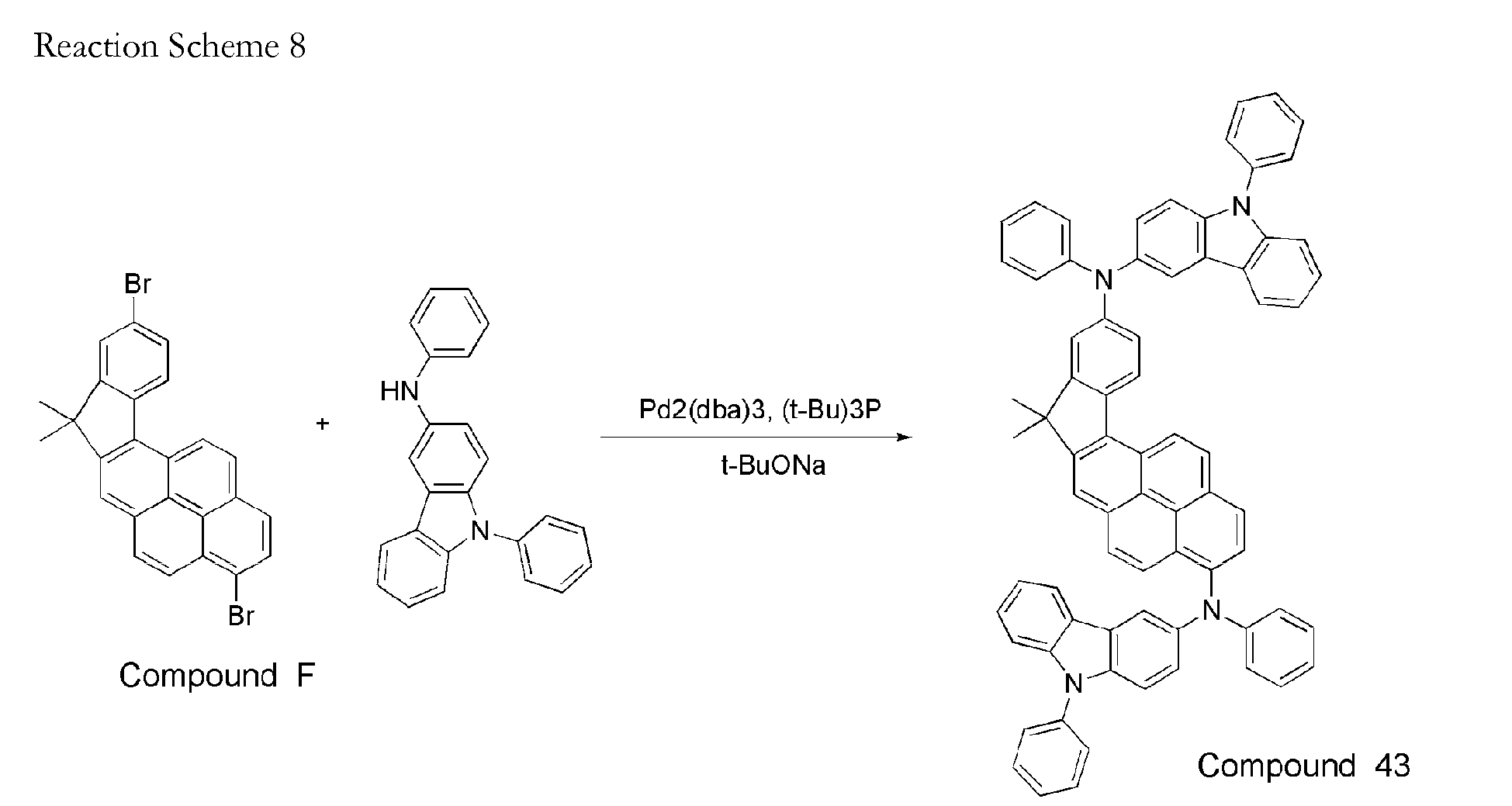
The reaction mixture was extracted 3 times by using 100 mL of dichloromethane so as to collect an organic layer. The collected organic layer was dried using magnesium sulfate to evaporate the solvent. The residue was separately purified using silica gel column chromatography to obtain 2.73 g (yield=56%) of Compound 43. The structure of Compound 43 was identified using 1H - NMR.
1H-NMR(300MHz) δ 7.87(1H), 7.82(1H), 7.76-7.72(5H), 7.56(2H), 7.42(2H), 7.39-7.13(12H), 7.08-6.98(10H), 6.81-6.46(9H), 6.28(2H), 1.71(6H) - A 15Ω/cm2 (1200Å) ITO glass substrate (available from Corning Co.) was cut to a size of 50 mm x 50 mm x 0.7 mm, ultrasonically washed with isopropyl alcohol for 5 minutes and then with pure water for 5 minutes, and washed again with UV ozone for 30 minutes. Then, m-MTDATA was vacuum deposited on the substrate to form a hole injection layer having a thickness of 750 Å, and then α-NPD was vacuum deposited on the hole injection layer to form a hole transport layer having a thickness of 150 Å. 97 wt% of DSA as a host and 3 wt% of TBPe as a dopant were deposited on the HTL to form an EML with a thickness of 300 Å. Alq3 was vacuum-deposited on the EML to form an ETL having a thickness of 200 Å. LiF was vacuum-deposited on the ETL to form an EIL having a thickness of 80 Å and Al was vacuum-deposited on the EIL to form a cathode having a thickness of 3000 Å.
- An OLED was manufactured in the same manner as in Comparative Example 1, except that Compound 34 was used instead of m-MTDATA to form the HTL.
- An OLED was manufactured in the same manner as in Comparative Example 1, except that Compound 40 was used instead of DSA as the host of the EML.
- An OLED was manufactured in the same manner as in Comparative Example 1, except that Compound 35 was used instead of TBPe as the dopant of the EML.
- An OLED was manufactured in the same manner as in Comparative Example 1, except that Compound 43 was used instead of Alq3 to form the ETL.
- An OLED was manufactured in the same manner as in Comparative Example 1, except that Compound 19 was used instead of Alq3 to form the ETL.
- An OLED was manufactured in the same manner as in Comparative Example 1, except that Compound 3 was used instead of Alq3 to form the ETL.
- Efficiency and half lifetime characteristics of the OLEDs manufactured in Comparative Example 1 and Examples 1 through 6 were measured using a PR650 (Spectroscan) Source Measurement Unit. (available from PhotoResearch, Inc.). The results are shown in Table 1 below.
Table 1 • • Compound • Use of Compound • Luminance Efficiency (cd/A) • Half Lifetime (hour)@1000 cd/m2 • Example 1 • Compound 34 • Hole Transport Layer • 4.2 • 3700 • Example 2 • Compound 40 • Host • 4.3 • 4200 • Example 3 • Compound 35 • Dopant • 3.7 • 3800 • Example 4 • Compound 43 • Hole Transport Layer • 4.1 • 4200 • Example 5 • Compound 19 • Electron Transport Layer • 4.4 • 4500 • Example 6 • Compound 3 • Electron Transport Layer • 3.9 • 2600 • Comparative Example • - • - • 2.8 • 1400 - Referring to Table 1, it can be confirmed that the OLEDs of Examples 1 through 6 have higher luminance efficiencies and half lifetime, compared to the OLED of Comparative Example 1. An OLED including an organic layer containing the condensed-cyclic compound of Formula 1 above may have high efficiency and long durability.
- While the present invention has been described in connection with certain exemplary embodiments thereof, it is to be understood that the invention is not limited to the disclosed embodiments, but, on the contrary, is intended to cover various modifications and equivalent arrangements included within the scope of the appended claims.
Claims (16)
- A condensed-cyclic compound represented by Formula 1 below: Formula 1


wherein Ar1 through Ar6 are each independently selected from the group consisting of a substituted or unsubstituted C1-C30 alkylene group, a substituted or unsubstituted C2-C30 alkenylene group, a substituted or unsubstituted C5-C30 arylene group, and a substituted or unsubstituted C4-C30 heteroarylene group;
wherein Ar11 through Ar16 are each independently selected from the group consisting of a hydrogen atom, a halogen atom, a hydroxyl group, a cyano group, a substituted or unsubstituted C1-C30 alkyl group, a substituted or unsubstituted C2-C30 alkenyl group, a substituted or unsubstituted C2-C30 alkynyl group, a substituted or unsubstituted C1-C30 alkoxy group, a substituted or unsubstituted C5-C30 aryl group, and a substituted or unsubstituted C4-C30 heteroaryl group;
wherein a through f are each independently an integer from 0 to 10;
wherein the moieties represented by Ar1 in the group represented by -(Ar1)a-Ar11 are identical to or different from each other, the moieties represented by Ar2 in the group represented by -(Ar2)b-Ar12 are identical to or different from each other, the moieties represented by Ar3 in the group represented by -(Ar3)c-Ar13 are identical to or different from each other, the moieties represented by Ar4 in the group represented by -(Ar4)d-Ar14 are identical to or different from each other, the moieties represented by Ar5 in the group represented by -(Ar5)e-Ar15 are identical to or different from each other, and the moieties represented by Ar6 in the group represented by [-(Ar6)f-Ar16] are identical to or different from each other;
wherein X1 and X2 are each independently a divalent linking group selected from the group consisting of -C(Q1)(Q2)- and -N(Q3)-; and
wherein Q1 through Q3 are each independently selected from the group consisting of a hydrogen atom, a halogen atom, a hydroxyl group, a cyano group, a substituted or unsubstituted C1-C30 alkyl group, a substituted or unsubstituted C2-C30 alkenyl group, a substituted or unsubstituted C2-C30 alkynyl group, a substituted or unsubstituted C1-C30 alkoxy group, a substituted or unsubstituted C5-C30 aryl group, and a substituted or unsubstituted C4-C30 heteroaryl group. - The condensed-cyclic compound of claim 1, wherein R1, R2 R3 R4, R5, R6, and R7 are hydrogen;
R8 is selected from the group consisting of hydrogen, a substituted or unsubstituted C1-C10 alkyl group, a substituted or unsubstituted C2-C10 alkenyl group, a substituted or unsubstituted C2-C10 alkynyl group, a substituted or unsubstituted C1-C10 alkoxy group, a group represented by -(Ar1)a-Ar11, and a group represented by -N[-(Ar2)b-Ar12][-(Ar3)cAr13];
R11, R12, R13 and R14 are each independently selected from the group consisting of hydrogen, a substituted or unsubstituted C1-C10 alkyl group, a substituted or unsubstituted C2-C10 alkenyl group, a substituted or unsubstituted C2-C10 alkynyl group, a substituted or unsubstituted C1-C10 alkoxy group, a group represented by -(Ar4)d-Ar14, and a group represented by -N[-(Ar5)e-Ar15][-(Ar6)f-Ar16];
Ar1, Ar2, Ar3, Ar4, Ar5 and Ar6 are each independently selected from the group consisting of a substituted or unsubstituted C1-C30 alkylene group, a substituted or unsubstituted C2-C30 alkenylene group, a substituted or unsubstituted C5-C30 arylene group, and a substituted or unsubstituted C4-C30 heteroarylene group; and
Ar11 and Ar16 are each independently selected from the group consisting of a hydrogen atom, a halogen atom, a hydroxyl group, a cyano group, a substituted or unsubstituted C1-C30 alkyl group, a substituted or unsubstituted C2-C30 alkenyl group, a substituted or unsubstituted C2-C30 alkynyl group, a substituted or unsubstituted C1-C30 alkoxy group, a substituted or unsubstituted C5-C30 aryl group, and a substituted or unsubstituted C4-C30 heteroaryl group. - The condensed-cyclic compound of claim 1 or claim 2, wherein a, b, c, d, e and f are each independently 0, 1, or 2.
- The condensed-cyclic compound of any one of the preceding claims wherein Ar1, Ar2, Ar3, Ar4, Ar5 and Ar6 are each independently selected from the group consisting of a pyridinylene group, a quinolinylene group, a benzimidazolylene group, an imidazopyridinylene group, an imidazopyrimidinylene group, a phenylene group, a C1-C1o alkyl phenylene group, a carbazolylene group, a phenylcarbazolylene group, a fluorenylene group, a C1-C10 alkylfluorenylene group, a di(C1-C10alkyl)fluorenylene group, an ethylene group, and a naphthylene group.
- The condensed-cyclic compound of any one of the preceding claims, wherein Ar11 Ar12Ar13, Ar14, Ar15 and Ar16 are each independently selected from the group consisting of a methyl group, ethyl, a propyl group, a butyl group, a methoxy group, an ethoxy group, a propoxy group, a butoxy group, a pyridinyl group, a quinolinyl group, a benzimidazolyl group, an imidazopyridinyl group, an imidazopyrimidinyl group, a phenyl group, a carbazolyl group, a fluorenyl group, a di(C1-C10alkyl)fluorenyl group, a naphthyl group, and a functional group represented by the formula

- The condensed-cyclic compound of any one of the preceding claims, wherein R8 and R11, R12, R13 and R14 are each independently selected from the group consisting of hydrogen and functional groups represented by Formulae 3A through 30 and Formulae 4A through 4R below:


- The condensed-cychc compound of any one of the preceding claims, wherein Q1 through Q3 are each independently selected from the group consisting of hydrogen, a C1-C30 alkyl group, a C1-C30 alkoxy group, a C5-C14 aryl group, and a C4-C14 heteroaryl group.
- The condensed-cyclic compound of claim 1, wherein R8 is connected to * of Formula 2 and R7 is connected to *' of Formula 2 so as to be represented by Formula 1a below:

- The condensed-cyclic compound of 8, wherein R1 R2, R3, R4, R5 and R6 are hydrogen; R11 R12, R13, R14 R21 R22, R23 and R24 are each independently selected from the group consisting of hydrogen, a substituted or unsubstituted C1-C10 alkyl group, a substituted or unsubstituted C2-C10 alkenyl group, a substituted or unsubstituted C2-C10 alkynyl group, a substituted or unsubstituted C1-C10 alkoxy group, a group represented by - (Ar4)d-Ar14, and a group represented by -N[-(Ar5)e-Ar15][-(Ar6)f-Ar16]; Ar4, Ar5 and Ar6 are each independently selected from the group consisting of a substituted or unsubstituted C1-C30 alkylene group, a substituted or unsubstituted C2-C30 alkenylene group, a substituted or unsubstituted C5-C30 arylene group, and a substituted or unsubstituted C4-C30 heteroarylene group; and
Ar14 and Ar16 are each independently selected from the group consisting of a hydrogen atom, a halogen atom, a hydroxyl group, a cyano group, a substituted or unsubstituted C1-C30 alkyl group, a substituted or unsubstituted C2-C30 alkenyl group, a substituted or unsubstituted C2-C30 alkynyl group, a substituted or unsubstituted C1-C30 alkoxy group, a substituted or unsubstituted C5-C30 aryl group, and a substituted or unsubstituted C4-C30 heteroaryl group. - The condensed-cyclic compound of any one of the preceding claims, wherein d, e and f are each independently 0, 1, or 2.
- The condensed-cyclic compound of any one of the preceding claims, wherein Ar4, Ar5 and Ar6 are each independently selected from the group consisting of a pyridinylene group, a quinolinylene group, a benzimidazolylene group, an imidazopyridinylene group, an imidazopyrimidinylene group, a phenylene group, a C1-C10 alkyl phenylene group, a carbazolylene group, a phenylcarbazolylene group, a fluorenylene group, a C1-C10 alkyl fluorenylene group, a di(C1-C10 alkyl) fluorenylene group, an ethylene group, and a naphthylene group.
- The condensed-cyclic compound of any one of the preceding claims, wherein Ar14, Ar15 and Ar16 are each independently selected from the group consisting of a methyl group, an ethyl group, a propyl group, a butyl group, a methoxy group, an ethoxy group, a propoxy group, a butoxy group, a pyridinyl group, a quinolinyl group, a benzimidazolyl group, an imidazopyridinyl group, an imidazopyrimidinyl group, a phenyl group, a carbazolyl group, a fluorenyl group, di(C1-C10 alkyl)fluorenyl group, a naphthyl group, and a functional group represented by the formula

- The condensed-cyclic compound of claim 9, wherein R11 R12, R13, R14 R21 R22, R23 and R24 are each independently selected from the group consisting of hydrogen and functional groups represented by Formulae 3A through 30 and Formulae 4A through 4R below:


- The condensed-cyclic compound of any one of the preceding claims, wherein Q1, Q2 and Q3 are each independently selected from the group consisting of hydrogen, a C1-C30 alkyl group, a C1-C30 alkoxy group, a C5-C14 aryl group, and a C4-C14 heteroaryl group.
- The condensed-cyclic compound of claim 1, wherein the condensed-cyclic compound is compound 3, 19, 34, 35, 40, or 43 below:


- An organic light emitting diode comprising:a first electrode;a second electrode facing the first electrode; andan organic layer disposed between the first electrode and the second electrode;wherein the organic layer comprises the condensed-cyclic compound of any one of claims 1 to 15.
Applications Claiming Priority (1)
| Application Number | Priority Date | Filing Date | Title |
|---|---|---|---|
| KR1020090096393A KR101202347B1 (en) | 2009-10-09 | 2009-10-09 | A condensed-cyclic compound and an organic light emitting diode employing an organic layer comprising the same |
Publications (2)
| Publication Number | Publication Date |
|---|---|
| EP2308843A1 true EP2308843A1 (en) | 2011-04-13 |
| EP2308843B1 EP2308843B1 (en) | 2016-12-14 |
Family
ID=43085950
Family Applications (1)
| Application Number | Title | Priority Date | Filing Date |
|---|---|---|---|
| EP10181070.3A Active EP2308843B1 (en) | 2009-10-09 | 2010-09-28 | Condensed-cyclic compound and organic light emitting diode including organic layer containing the condensed-cyclic compound |
Country Status (6)
| Country | Link |
|---|---|
| US (1) | US9000420B2 (en) |
| EP (1) | EP2308843B1 (en) |
| JP (1) | JP5362671B2 (en) |
| KR (1) | KR101202347B1 (en) |
| CN (1) | CN102040589B (en) |
| TW (1) | TWI430991B (en) |
Families Citing this family (29)
| Publication number | Priority date | Publication date | Assignee | Title |
|---|---|---|---|---|
| KR101108154B1 (en) * | 2009-08-10 | 2012-02-08 | 삼성모바일디스플레이주식회사 | Organic light emitting device comprising a condensed cyclic compound and an organic layer including the same |
| KR101758328B1 (en) | 2010-04-06 | 2017-07-17 | 삼성디스플레이 주식회사 | Heterocyclic compound and organic light emitting device comprising the same |
| KR101736987B1 (en) | 2010-04-06 | 2017-05-18 | 삼성디스플레이 주식회사 | Heterocyclic compound and organic light emitting device comprising the same |
| JP5645465B2 (en) | 2010-05-06 | 2014-12-24 | キヤノン株式会社 | New organic compounds |
| KR101328977B1 (en) * | 2010-10-26 | 2013-11-13 | 삼성디스플레이 주식회사 | Organic light emitting device |
| US8455867B2 (en) | 2010-10-26 | 2013-06-04 | Samsung Display Co., Ltd. | Organic light-emitting device |
| US9653689B2 (en) | 2011-01-17 | 2017-05-16 | Samsung Display Co., Ltd. | Condensed-cyclic compound and organic light-emitting diode including the same |
| US9238623B2 (en) | 2011-01-17 | 2016-01-19 | Samsung Display Co., Ltd. | Condensed-cyclic compound and organic light-emitting diode including the same |
| KR101511168B1 (en) | 2011-06-16 | 2015-04-10 | 삼성디스플레이 주식회사 | A condensed-cyclic compound and an organic light emitting diode comprising the same |
| KR101881081B1 (en) | 2011-06-22 | 2018-08-20 | 삼성디스플레이 주식회사 | Heterocyclic compound, organic light-emitting diode comprising the same and flat display device |
| KR101872407B1 (en) | 2011-06-22 | 2018-08-01 | 삼성디스플레이 주식회사 | Heterocyclic compound, organic light-emitting diode comprising the same and flat display device |
| KR101885699B1 (en) | 2011-06-29 | 2018-08-07 | 삼성디스플레이 주식회사 | Novel heterocyclic compound and Organic light emitting device containing same |
| JP6046884B2 (en) * | 2011-08-11 | 2016-12-21 | ユー・ディー・シー アイルランド リミテッド | ORGANIC ELECTROLUMINESCENT ELEMENT, ELEMENT MATERIAL, AND LIGHT EMITTING DEVICE, DISPLAY DEVICE AND LIGHTING DEVICE USING THE ELEMENT |
| JP5890980B2 (en) | 2011-08-18 | 2016-03-22 | ユー・ディー・シー アイルランド リミテッド | ORGANIC ELECTROLUMINESCENT ELEMENT, COMPOUND FOR ORGANIC ELECTROLUMINESCENT ELEMENT, AND LIGHT EMITTING DEVICE, DISPLAY DEVICE AND LIGHTING DEVICE USING THE ELEMENT |
| JP6063114B2 (en) * | 2011-08-18 | 2017-01-18 | ユー・ディー・シー アイルランド リミテッド | ORGANIC ELECTROLUMINESCENT ELEMENT, ELEMENT MATERIAL, AND LIGHT EMITTING DEVICE, DISPLAY DEVICE AND LIGHTING DEVICE USING THE ELEMENT |
| JP5952543B2 (en) * | 2011-08-18 | 2016-07-13 | ユー・ディー・シー アイルランド リミテッド | ORGANIC ELECTROLUMINESCENT ELEMENT, COMPOUND FOR ORGANIC ELECTROLUMINESCENT ELEMENT, AND LIGHT EMITTING DEVICE, DISPLAY DEVICE AND LIGHTING DEVICE USING THE ELEMENT |
| JP6347909B2 (en) * | 2011-08-22 | 2018-06-27 | ユー・ディー・シー アイルランド リミテッド | ORGANIC ELECTROLUMINESCENT ELEMENT, ELEMENT MATERIAL, AND LIGHT EMITTING DEVICE, DISPLAY DEVICE AND LIGHTING DEVICE USING THE ELEMENT |
| JP5753027B2 (en) | 2011-08-22 | 2015-07-22 | ユー・ディー・シー アイルランド リミテッド | ORGANIC ELECTROLUMINESCENT ELEMENT, COMPOUND, AND LIGHT EMITTING DEVICE, DISPLAY DEVICE AND LIGHTING DEVICE USING THE ELEMENT |
| JP6012148B2 (en) * | 2011-08-22 | 2016-10-25 | ユー・ディー・シー アイルランド リミテッド | ORGANIC ELECTROLUMINESCENT ELEMENT, COMPOUND, AND LIGHT EMITTING DEVICE, DISPLAY DEVICE AND LIGHTING DEVICE USING THE ELEMENT |
| CN103172524B (en) * | 2011-12-26 | 2016-02-17 | 昆山维信诺显示技术有限公司 | One class organic compound and application thereof |
| KR102134844B1 (en) * | 2013-01-30 | 2020-07-17 | 삼성디스플레이 주식회사 | Amine-based compound and organic light emitting diode comprising the same |
| WO2014196580A1 (en) * | 2013-06-04 | 2014-12-11 | 出光興産株式会社 | Nitrogen-containing heterocyclic derivative, organic electroluminescence element material using same, and organic electroluminescence element and electronic device using same |
| JP6123895B2 (en) | 2013-07-10 | 2017-05-10 | Jnc株式会社 | Material for light emitting auxiliary layer containing ring condensed fluorene compound or fluorene compound |
| CN103435462B (en) * | 2013-07-10 | 2015-03-11 | 安徽师范大学 | Indenophenanthrylone derivative and preparation method thereof |
| JP6371320B2 (en) * | 2016-02-12 | 2018-08-08 | ユー・ディー・シー アイルランド リミテッド | ORGANIC ELECTROLUMINESCENT ELEMENT, ELEMENT MATERIAL, AND LIGHT EMITTING DEVICE, DISPLAY DEVICE AND LIGHTING DEVICE USING THE ELEMENT |
| CN107089958A (en) * | 2017-05-17 | 2017-08-25 | 中节能万润股份有限公司 | A kind of pyrene class electroluminescent organic material, its preparation method and application |
| JP7325731B2 (en) | 2018-08-23 | 2023-08-15 | 国立大学法人九州大学 | organic electroluminescence element |
| TWI702745B (en) * | 2019-09-03 | 2020-08-21 | 晶宜科技股份有限公司 | Organic electroluminescent devices and material thereof |
| CN121342842B (en) * | 2025-12-19 | 2026-02-27 | 烟台九目化学股份有限公司 | Naphthol-containing compound oxazolocarbazoles organic compound and application thereof |
Citations (5)
| Publication number | Priority date | Publication date | Assignee | Title |
|---|---|---|---|---|
| US20080124455A1 (en) * | 2006-11-24 | 2008-05-29 | Samsung Electronics Co., Ltd. | Organic light emitting compound, organic light emitting device comprising the same, and method of manufacturing the organic light emitting device |
| CN101319044A (en) * | 2008-05-23 | 2008-12-10 | 南京邮电大学 | Linear conjugated polymer derivative material of 9-pyrenylfluorene structure and preparation method thereof |
| JP2010073987A (en) * | 2008-09-19 | 2010-04-02 | Idemitsu Kosan Co Ltd | Material for organic thin-film solar cell |
| WO2010053210A1 (en) * | 2008-11-06 | 2010-05-14 | Canon Kabushiki Kaisha | Indenopyrene compound and organic light-emitting device using the compound |
| WO2010114264A2 (en) * | 2009-03-31 | 2010-10-07 | Dow Advanced Display Materials,Ltd. | Novel organic electroluminescent compounds and organic electroluminescent device using the same |
Family Cites Families (10)
| Publication number | Priority date | Publication date | Assignee | Title |
|---|---|---|---|---|
| US6849348B2 (en) * | 2002-12-31 | 2005-02-01 | Eastman Kodak Company | Complex fluorene-containing compounds |
| KR20060129065A (en) * | 2004-02-26 | 2006-12-14 | 스미또모 가가꾸 가부시키가이샤 | Polymer compound and polymer light emitting device using same |
| JP2006176494A (en) | 2004-11-25 | 2006-07-06 | Kyoto Univ | PYRENE COMPOUND AND LIGHT EMITTING TRANSISTOR DEVICE AND ELECTROLUMINESCENT DEVICE USING THE SAME |
| KR20060117038A (en) | 2005-05-12 | 2006-11-16 | 엘지전자 주식회사 | Light emitting compound and organic electroluminescent device |
| KR20060118913A (en) | 2005-05-17 | 2006-11-24 | 엘지전자 주식회사 | Host material and organic electroluminescent device |
| KR100786947B1 (en) | 2005-06-30 | 2007-12-17 | 주식회사 엘지화학 | Pyrene derivatives and organic electronic device using pyrene derivatives |
| CN103193697B (en) * | 2005-09-08 | 2015-11-18 | 东丽株式会社 | Light emitting element material and luminous element |
| US20080049413A1 (en) | 2006-08-22 | 2008-02-28 | Idemitsu Kosan Co., Ltd. | Organic electroluminescence device |
| US20080299294A1 (en) * | 2007-06-04 | 2008-12-04 | Feng Wen Yen | Anthracene compound and organic light emitting device using the same |
| JP2010205986A (en) | 2009-03-04 | 2010-09-16 | Mitsui Chemicals Inc | Organic transistor |
-
2009
- 2009-10-09 KR KR1020090096393A patent/KR101202347B1/en active Active
-
2010
- 2010-09-28 EP EP10181070.3A patent/EP2308843B1/en active Active
- 2010-09-30 US US12/895,732 patent/US9000420B2/en active Active
- 2010-10-05 JP JP2010225742A patent/JP5362671B2/en active Active
- 2010-10-05 TW TW099133781A patent/TWI430991B/en active
- 2010-10-09 CN CN201010503420.3A patent/CN102040589B/en active Active
Patent Citations (5)
| Publication number | Priority date | Publication date | Assignee | Title |
|---|---|---|---|---|
| US20080124455A1 (en) * | 2006-11-24 | 2008-05-29 | Samsung Electronics Co., Ltd. | Organic light emitting compound, organic light emitting device comprising the same, and method of manufacturing the organic light emitting device |
| CN101319044A (en) * | 2008-05-23 | 2008-12-10 | 南京邮电大学 | Linear conjugated polymer derivative material of 9-pyrenylfluorene structure and preparation method thereof |
| JP2010073987A (en) * | 2008-09-19 | 2010-04-02 | Idemitsu Kosan Co Ltd | Material for organic thin-film solar cell |
| WO2010053210A1 (en) * | 2008-11-06 | 2010-05-14 | Canon Kabushiki Kaisha | Indenopyrene compound and organic light-emitting device using the compound |
| WO2010114264A2 (en) * | 2009-03-31 | 2010-10-07 | Dow Advanced Display Materials,Ltd. | Novel organic electroluminescent compounds and organic electroluminescent device using the same |
Non-Patent Citations (3)
| Title |
|---|
| C. A. HENRIQUES, J. L. F. MONTEIRO, P. MAGNOUX, M. GUISNET: "Characterization of the coke formed during o-xylene isomerization over mordenites at various temperatures", JOURNAL OF CATALYSIS, vol. 172, 1997, pages 436 - 445, XP002610923 * |
| FENG LIU, LING-HAI XIE, CHAO TANG, JING LIANG, QING-QUAN CHEN ET AL.: "Facile synthesis of spirocyclic aromatic hydrocarbon derivatives based on o-halobiaryl route and Domino reaction for deep-blue organic semiconductors", ORGANIC LETTERS, vol. 11, no. 17, 5 August 2008 (2008-08-05), pages 3850 - 3853, XP002610922 * |
| SEUNG JUN HWANG, HYUN JIN KIM, SUKBOK CHANG: "Highly efficient and versatile synthesis of polyarylfluorenes via Pd-catalyzed C-H bond activation", ORGANIC LETTERS, vol. 11, no. 20, 15 September 2009 (2009-09-15), pages 4588 - 4591, XP002610924 * |
Also Published As
| Publication number | Publication date |
|---|---|
| JP5362671B2 (en) | 2013-12-11 |
| TW201120008A (en) | 2011-06-16 |
| US9000420B2 (en) | 2015-04-07 |
| EP2308843B1 (en) | 2016-12-14 |
| CN102040589A (en) | 2011-05-04 |
| US20110084256A1 (en) | 2011-04-14 |
| KR101202347B1 (en) | 2012-11-16 |
| TWI430991B (en) | 2014-03-21 |
| JP2011079822A (en) | 2011-04-21 |
| KR20110039108A (en) | 2011-04-15 |
| CN102040589B (en) | 2015-04-01 |
Similar Documents
| Publication | Publication Date | Title |
|---|---|---|
| EP2308843B1 (en) | Condensed-cyclic compound and organic light emitting diode including organic layer containing the condensed-cyclic compound | |
| EP2371828B1 (en) | Condensed-Cyclic Compound and Organic Light-Emitting Device Including the Same | |
| CN101656301B (en) | Organic light emitting diode employing luminescent efficiency improvement layer | |
| US8685542B2 (en) | Organic light-emitting device | |
| US10665788B2 (en) | Amine-based compound, organic light-emitting diode including the same, and organic light-emitting apparatus including the amine-based compound | |
| KR102079254B1 (en) | Organic light emitting diode | |
| EP2554545B1 (en) | Carbazole-based compound and organic light-emitting diode comprising the same | |
| US9815821B2 (en) | Condensed-cyclic compound and organic light emitting diode including the same | |
| KR102147840B1 (en) | Amined-basd compound and organic light emitting diode including the same | |
| US20130228755A1 (en) | Organic light-emitting diode | |
| EP2535331B1 (en) | Condensed-Cyclic Compound and Organic Light-Emitting Diode Comprising the Same | |
| KR102116494B1 (en) | Organic light emitting diode | |
| KR101328976B1 (en) | A condensed-cyclic compound and an organic light emitting diode comprising the same | |
| KR20140122613A (en) | Heteroaryl-based compound and Organic light emitting diode comprising the same | |
| KR102040874B1 (en) | Silicon-based compound and organic light emitting diode comprising the same | |
| KR102100371B1 (en) | Anthracene-based compounds and Organic light emitting device comprising the same |
Legal Events
| Date | Code | Title | Description |
|---|---|---|---|
| PUAI | Public reference made under article 153(3) epc to a published international application that has entered the european phase |
Free format text: ORIGINAL CODE: 0009012 |
|
| 17P | Request for examination filed |
Effective date: 20100928 |
|
| AK | Designated contracting states |
Kind code of ref document: A1 Designated state(s): AL AT BE BG CH CY CZ DE DK EE ES FI FR GB GR HR HU IE IS IT LI LT LU LV MC MK MT NL NO PL PT RO SE SI SK SM TR |
|
| AX | Request for extension of the european patent |
Extension state: BA ME RS |
|
| 17Q | First examination report despatched |
Effective date: 20111208 |
|
| RAP1 | Party data changed (applicant data changed or rights of an application transferred) |
Owner name: SAMSUNG DISPLAY CO., LTD. |
|
| RAP1 | Party data changed (applicant data changed or rights of an application transferred) |
Owner name: SAMSUNG DISPLAY CO., LTD. |
|
| GRAP | Despatch of communication of intention to grant a patent |
Free format text: ORIGINAL CODE: EPIDOSNIGR1 |
|
| INTG | Intention to grant announced |
Effective date: 20160620 |
|
| STAA | Information on the status of an ep patent application or granted ep patent |
Free format text: STATUS: GRANT OF PATENT IS INTENDED |
|
| GRAS | Grant fee paid |
Free format text: ORIGINAL CODE: EPIDOSNIGR3 |
|
| GRAA | (expected) grant |
Free format text: ORIGINAL CODE: 0009210 |
|
| STAA | Information on the status of an ep patent application or granted ep patent |
Free format text: STATUS: THE PATENT HAS BEEN GRANTED |
|
| AK | Designated contracting states |
Kind code of ref document: B1 Designated state(s): AL AT BE BG CH CY CZ DE DK EE ES FI FR GB GR HR HU IE IS IT LI LT LU LV MC MK MT NL NO PL PT RO SE SI SK SM TR |
|
| REG | Reference to a national code |
Ref country code: GB Ref legal event code: FG4D |
|
| REG | Reference to a national code |
Ref country code: CH Ref legal event code: EP |
|
| REG | Reference to a national code |
Ref country code: IE Ref legal event code: FG4D |
|
| REG | Reference to a national code |
Ref country code: AT Ref legal event code: REF Ref document number: 853428 Country of ref document: AT Kind code of ref document: T Effective date: 20170115 |
|
| REG | Reference to a national code |
Ref country code: DE Ref legal event code: R096 Ref document number: 602010038744 Country of ref document: DE |
|
| PG25 | Lapsed in a contracting state [announced via postgrant information from national office to epo] |
Ref country code: LV Free format text: LAPSE BECAUSE OF FAILURE TO SUBMIT A TRANSLATION OF THE DESCRIPTION OR TO PAY THE FEE WITHIN THE PRESCRIBED TIME-LIMIT Effective date: 20161214 |
|
| REG | Reference to a national code |
Ref country code: LT Ref legal event code: MG4D |
|
| REG | Reference to a national code |
Ref country code: NL Ref legal event code: MP Effective date: 20161214 |
|
| PG25 | Lapsed in a contracting state [announced via postgrant information from national office to epo] |
Ref country code: SE Free format text: LAPSE BECAUSE OF FAILURE TO SUBMIT A TRANSLATION OF THE DESCRIPTION OR TO PAY THE FEE WITHIN THE PRESCRIBED TIME-LIMIT Effective date: 20161214 Ref country code: LT Free format text: LAPSE BECAUSE OF FAILURE TO SUBMIT A TRANSLATION OF THE DESCRIPTION OR TO PAY THE FEE WITHIN THE PRESCRIBED TIME-LIMIT Effective date: 20161214 Ref country code: GR Free format text: LAPSE BECAUSE OF FAILURE TO SUBMIT A TRANSLATION OF THE DESCRIPTION OR TO PAY THE FEE WITHIN THE PRESCRIBED TIME-LIMIT Effective date: 20170315 Ref country code: NO Free format text: LAPSE BECAUSE OF FAILURE TO SUBMIT A TRANSLATION OF THE DESCRIPTION OR TO PAY THE FEE WITHIN THE PRESCRIBED TIME-LIMIT Effective date: 20170314 |
|
| REG | Reference to a national code |
Ref country code: AT Ref legal event code: MK05 Ref document number: 853428 Country of ref document: AT Kind code of ref document: T Effective date: 20161214 |
|
| PG25 | Lapsed in a contracting state [announced via postgrant information from national office to epo] |
Ref country code: FI Free format text: LAPSE BECAUSE OF FAILURE TO SUBMIT A TRANSLATION OF THE DESCRIPTION OR TO PAY THE FEE WITHIN THE PRESCRIBED TIME-LIMIT Effective date: 20161214 Ref country code: HR Free format text: LAPSE BECAUSE OF FAILURE TO SUBMIT A TRANSLATION OF THE DESCRIPTION OR TO PAY THE FEE WITHIN THE PRESCRIBED TIME-LIMIT Effective date: 20161214 |
|
| PG25 | Lapsed in a contracting state [announced via postgrant information from national office to epo] |
Ref country code: NL Free format text: LAPSE BECAUSE OF FAILURE TO SUBMIT A TRANSLATION OF THE DESCRIPTION OR TO PAY THE FEE WITHIN THE PRESCRIBED TIME-LIMIT Effective date: 20161214 |
|
| PG25 | Lapsed in a contracting state [announced via postgrant information from national office to epo] |
Ref country code: IS Free format text: LAPSE BECAUSE OF FAILURE TO SUBMIT A TRANSLATION OF THE DESCRIPTION OR TO PAY THE FEE WITHIN THE PRESCRIBED TIME-LIMIT Effective date: 20170414 Ref country code: SK Free format text: LAPSE BECAUSE OF FAILURE TO SUBMIT A TRANSLATION OF THE DESCRIPTION OR TO PAY THE FEE WITHIN THE PRESCRIBED TIME-LIMIT Effective date: 20161214 Ref country code: EE Free format text: LAPSE BECAUSE OF FAILURE TO SUBMIT A TRANSLATION OF THE DESCRIPTION OR TO PAY THE FEE WITHIN THE PRESCRIBED TIME-LIMIT Effective date: 20161214 Ref country code: RO Free format text: LAPSE BECAUSE OF FAILURE TO SUBMIT A TRANSLATION OF THE DESCRIPTION OR TO PAY THE FEE WITHIN THE PRESCRIBED TIME-LIMIT Effective date: 20161214 Ref country code: CZ Free format text: LAPSE BECAUSE OF FAILURE TO SUBMIT A TRANSLATION OF THE DESCRIPTION OR TO PAY THE FEE WITHIN THE PRESCRIBED TIME-LIMIT Effective date: 20161214 |
|
| PG25 | Lapsed in a contracting state [announced via postgrant information from national office to epo] |
Ref country code: BE Free format text: LAPSE BECAUSE OF FAILURE TO SUBMIT A TRANSLATION OF THE DESCRIPTION OR TO PAY THE FEE WITHIN THE PRESCRIBED TIME-LIMIT Effective date: 20161214 Ref country code: BG Free format text: LAPSE BECAUSE OF FAILURE TO SUBMIT A TRANSLATION OF THE DESCRIPTION OR TO PAY THE FEE WITHIN THE PRESCRIBED TIME-LIMIT Effective date: 20170314 Ref country code: ES Free format text: LAPSE BECAUSE OF FAILURE TO SUBMIT A TRANSLATION OF THE DESCRIPTION OR TO PAY THE FEE WITHIN THE PRESCRIBED TIME-LIMIT Effective date: 20161214 Ref country code: PL Free format text: LAPSE BECAUSE OF FAILURE TO SUBMIT A TRANSLATION OF THE DESCRIPTION OR TO PAY THE FEE WITHIN THE PRESCRIBED TIME-LIMIT Effective date: 20161214 Ref country code: AT Free format text: LAPSE BECAUSE OF FAILURE TO SUBMIT A TRANSLATION OF THE DESCRIPTION OR TO PAY THE FEE WITHIN THE PRESCRIBED TIME-LIMIT Effective date: 20161214 Ref country code: SM Free format text: LAPSE BECAUSE OF FAILURE TO SUBMIT A TRANSLATION OF THE DESCRIPTION OR TO PAY THE FEE WITHIN THE PRESCRIBED TIME-LIMIT Effective date: 20161214 Ref country code: IT Free format text: LAPSE BECAUSE OF FAILURE TO SUBMIT A TRANSLATION OF THE DESCRIPTION OR TO PAY THE FEE WITHIN THE PRESCRIBED TIME-LIMIT Effective date: 20161214 Ref country code: PT Free format text: LAPSE BECAUSE OF FAILURE TO SUBMIT A TRANSLATION OF THE DESCRIPTION OR TO PAY THE FEE WITHIN THE PRESCRIBED TIME-LIMIT Effective date: 20170414 |
|
| REG | Reference to a national code |
Ref country code: DE Ref legal event code: R097 Ref document number: 602010038744 Country of ref document: DE |
|
| PLBE | No opposition filed within time limit |
Free format text: ORIGINAL CODE: 0009261 |
|
| STAA | Information on the status of an ep patent application or granted ep patent |
Free format text: STATUS: NO OPPOSITION FILED WITHIN TIME LIMIT |
|
| 26N | No opposition filed |
Effective date: 20170915 |
|
| PG25 | Lapsed in a contracting state [announced via postgrant information from national office to epo] |
Ref country code: DK Free format text: LAPSE BECAUSE OF FAILURE TO SUBMIT A TRANSLATION OF THE DESCRIPTION OR TO PAY THE FEE WITHIN THE PRESCRIBED TIME-LIMIT Effective date: 20161214 |
|
| PG25 | Lapsed in a contracting state [announced via postgrant information from national office to epo] |
Ref country code: SI Free format text: LAPSE BECAUSE OF FAILURE TO SUBMIT A TRANSLATION OF THE DESCRIPTION OR TO PAY THE FEE WITHIN THE PRESCRIBED TIME-LIMIT Effective date: 20161214 |
|
| REG | Reference to a national code |
Ref country code: CH Ref legal event code: PL |
|
| PG25 | Lapsed in a contracting state [announced via postgrant information from national office to epo] |
Ref country code: MC Free format text: LAPSE BECAUSE OF FAILURE TO SUBMIT A TRANSLATION OF THE DESCRIPTION OR TO PAY THE FEE WITHIN THE PRESCRIBED TIME-LIMIT Effective date: 20161214 |
|
| REG | Reference to a national code |
Ref country code: IE Ref legal event code: MM4A |
|
| PG25 | Lapsed in a contracting state [announced via postgrant information from national office to epo] |
Ref country code: LU Free format text: LAPSE BECAUSE OF NON-PAYMENT OF DUE FEES Effective date: 20170928 |
|
| REG | Reference to a national code |
Ref country code: FR Ref legal event code: ST Effective date: 20180531 |
|
| PG25 | Lapsed in a contracting state [announced via postgrant information from national office to epo] |
Ref country code: CH Free format text: LAPSE BECAUSE OF NON-PAYMENT OF DUE FEES Effective date: 20170930 Ref country code: LI Free format text: LAPSE BECAUSE OF NON-PAYMENT OF DUE FEES Effective date: 20170930 Ref country code: IE Free format text: LAPSE BECAUSE OF NON-PAYMENT OF DUE FEES Effective date: 20170928 |
|
| PG25 | Lapsed in a contracting state [announced via postgrant information from national office to epo] |
Ref country code: FR Free format text: LAPSE BECAUSE OF NON-PAYMENT OF DUE FEES Effective date: 20171002 |
|
| PG25 | Lapsed in a contracting state [announced via postgrant information from national office to epo] |
Ref country code: MT Free format text: LAPSE BECAUSE OF NON-PAYMENT OF DUE FEES Effective date: 20170928 |
|
| PG25 | Lapsed in a contracting state [announced via postgrant information from national office to epo] |
Ref country code: HU Free format text: LAPSE BECAUSE OF FAILURE TO SUBMIT A TRANSLATION OF THE DESCRIPTION OR TO PAY THE FEE WITHIN THE PRESCRIBED TIME-LIMIT; INVALID AB INITIO Effective date: 20100928 |
|
| PG25 | Lapsed in a contracting state [announced via postgrant information from national office to epo] |
Ref country code: CY Free format text: LAPSE BECAUSE OF NON-PAYMENT OF DUE FEES Effective date: 20161214 |
|
| PG25 | Lapsed in a contracting state [announced via postgrant information from national office to epo] |
Ref country code: MK Free format text: LAPSE BECAUSE OF FAILURE TO SUBMIT A TRANSLATION OF THE DESCRIPTION OR TO PAY THE FEE WITHIN THE PRESCRIBED TIME-LIMIT Effective date: 20161214 |
|
| PG25 | Lapsed in a contracting state [announced via postgrant information from national office to epo] |
Ref country code: TR Free format text: LAPSE BECAUSE OF FAILURE TO SUBMIT A TRANSLATION OF THE DESCRIPTION OR TO PAY THE FEE WITHIN THE PRESCRIBED TIME-LIMIT Effective date: 20161214 |
|
| PG25 | Lapsed in a contracting state [announced via postgrant information from national office to epo] |
Ref country code: AL Free format text: LAPSE BECAUSE OF FAILURE TO SUBMIT A TRANSLATION OF THE DESCRIPTION OR TO PAY THE FEE WITHIN THE PRESCRIBED TIME-LIMIT Effective date: 20161214 |
|
| P01 | Opt-out of the competence of the unified patent court (upc) registered |
Effective date: 20230515 |
|
| PGFP | Annual fee paid to national office [announced via postgrant information from national office to epo] |
Ref country code: DE Payment date: 20250820 Year of fee payment: 16 |
|
| PGFP | Annual fee paid to national office [announced via postgrant information from national office to epo] |
Ref country code: GB Payment date: 20250820 Year of fee payment: 16 |