EP2308725A1 - Process for producing blade rubber and wiper blade - Google Patents
Process for producing blade rubber and wiper blade Download PDFInfo
- Publication number
- EP2308725A1 EP2308725A1 EP09800364A EP09800364A EP2308725A1 EP 2308725 A1 EP2308725 A1 EP 2308725A1 EP 09800364 A EP09800364 A EP 09800364A EP 09800364 A EP09800364 A EP 09800364A EP 2308725 A1 EP2308725 A1 EP 2308725A1
- Authority
- EP
- European Patent Office
- Prior art keywords
- rubber
- blade
- monomers
- diene
- blade rubber
- Prior art date
- Legal status (The legal status is an assumption and is not a legal conclusion. Google has not performed a legal analysis and makes no representation as to the accuracy of the status listed.)
- Granted
Links
- 229920001971 elastomer Polymers 0.000 title claims abstract description 312
- 239000005060 rubber Substances 0.000 title claims abstract description 312
- 238000000034 method Methods 0.000 title claims description 35
- 230000008569 process Effects 0.000 title description 2
- 239000000178 monomer Substances 0.000 claims abstract description 80
- 238000011282 treatment Methods 0.000 claims abstract description 70
- CLNYHERYALISIR-UHFFFAOYSA-N nona-1,3-diene Chemical compound CCCCCC=CC=C CLNYHERYALISIR-UHFFFAOYSA-N 0.000 claims abstract description 63
- 238000010559 graft polymerization reaction Methods 0.000 claims abstract description 40
- 239000000463 material Substances 0.000 claims description 29
- 229920000642 polymer Polymers 0.000 claims description 24
- 238000004519 manufacturing process Methods 0.000 claims description 23
- 238000004132 cross linking Methods 0.000 claims description 21
- VGGSQFUCUMXWEO-UHFFFAOYSA-N Ethene Chemical compound C=C VGGSQFUCUMXWEO-UHFFFAOYSA-N 0.000 claims description 20
- 239000005977 Ethylene Substances 0.000 claims description 20
- 238000000465 moulding Methods 0.000 claims description 18
- 150000002978 peroxides Chemical class 0.000 claims description 18
- 241000428199 Mustelinae Species 0.000 claims description 16
- 239000012530 fluid Substances 0.000 claims description 16
- 238000005520 cutting process Methods 0.000 claims description 14
- 229920002943 EPDM rubber Polymers 0.000 claims description 13
- WOBHKFSMXKNTIM-UHFFFAOYSA-N Hydroxyethyl methacrylate Chemical compound CC(=C)C(=O)OCCO WOBHKFSMXKNTIM-UHFFFAOYSA-N 0.000 claims description 8
- 230000002209 hydrophobic effect Effects 0.000 claims description 8
- OMIGHNLMNHATMP-UHFFFAOYSA-N 2-hydroxyethyl prop-2-enoate Chemical compound OCCOC(=O)C=C OMIGHNLMNHATMP-UHFFFAOYSA-N 0.000 claims description 6
- SMZOUWXMTYCWNB-UHFFFAOYSA-N 2-(2-methoxy-5-methylphenyl)ethanamine Chemical compound COC1=CC=C(C)C=C1CCN SMZOUWXMTYCWNB-UHFFFAOYSA-N 0.000 claims description 3
- NIXOWILDQLNWCW-UHFFFAOYSA-N 2-Propenoic acid Natural products OC(=O)C=C NIXOWILDQLNWCW-UHFFFAOYSA-N 0.000 claims description 3
- 125000003903 2-propenyl group Chemical group [H]C([*])([H])C([H])=C([H])[H] 0.000 claims description 3
- HRPVXLWXLXDGHG-UHFFFAOYSA-N Acrylamide Chemical compound NC(=O)C=C HRPVXLWXLXDGHG-UHFFFAOYSA-N 0.000 claims description 3
- CERQOIWHTDAKMF-UHFFFAOYSA-N Methacrylic acid Chemical compound CC(=C)C(O)=O CERQOIWHTDAKMF-UHFFFAOYSA-N 0.000 claims description 3
- VOZRXNHHFUQHIL-UHFFFAOYSA-N glycidyl methacrylate Chemical compound CC(=C)C(=O)OCC1CO1 VOZRXNHHFUQHIL-UHFFFAOYSA-N 0.000 claims description 3
- 125000000555 isopropenyl group Chemical group [H]\C([H])=C(\*)C([H])([H])[H] 0.000 claims description 3
- 239000002184 metal Substances 0.000 claims description 3
- 229910052751 metal Inorganic materials 0.000 claims description 3
- SNVLJLYUUXKWOJ-UHFFFAOYSA-N methylidenecarbene Chemical compound C=[C] SNVLJLYUUXKWOJ-UHFFFAOYSA-N 0.000 claims description 3
- 150000003839 salts Chemical class 0.000 claims description 3
- 125000000391 vinyl group Chemical group [H]C([*])=C([H])[H] 0.000 claims description 3
- 229910052736 halogen Inorganic materials 0.000 abstract description 5
- 150000002367 halogens Chemical class 0.000 abstract description 5
- 238000004381 surface treatment Methods 0.000 abstract description 5
- 230000007613 environmental effect Effects 0.000 abstract description 4
- 230000001603 reducing effect Effects 0.000 abstract description 2
- 239000003921 oil Substances 0.000 description 30
- 244000043261 Hevea brasiliensis Species 0.000 description 26
- 229920003052 natural elastomer Polymers 0.000 description 26
- 229920001194 natural rubber Polymers 0.000 description 26
- 238000010894 electron beam technology Methods 0.000 description 12
- 238000002474 experimental method Methods 0.000 description 12
- 239000000203 mixture Substances 0.000 description 11
- 229920001084 poly(chloroprene) Polymers 0.000 description 11
- CBENFWSGALASAD-UHFFFAOYSA-N Ozone Chemical compound [O-][O+]=O CBENFWSGALASAD-UHFFFAOYSA-N 0.000 description 10
- ZAMOUSCENKQFHK-UHFFFAOYSA-N Chlorine atom Chemical compound [Cl] ZAMOUSCENKQFHK-UHFFFAOYSA-N 0.000 description 9
- 239000000460 chlorine Substances 0.000 description 9
- 229910052801 chlorine Inorganic materials 0.000 description 9
- XLOMVQKBTHCTTD-UHFFFAOYSA-N Zinc monoxide Chemical compound [Zn]=O XLOMVQKBTHCTTD-UHFFFAOYSA-N 0.000 description 8
- NINIDFKCEFEMDL-UHFFFAOYSA-N Sulfur Chemical compound [S] NINIDFKCEFEMDL-UHFFFAOYSA-N 0.000 description 7
- QIQXTHQIDYTFRH-UHFFFAOYSA-N octadecanoic acid Chemical compound CCCCCCCCCCCCCCCCCC(O)=O QIQXTHQIDYTFRH-UHFFFAOYSA-N 0.000 description 7
- 229910052717 sulfur Inorganic materials 0.000 description 7
- 239000011593 sulfur Substances 0.000 description 7
- 239000003795 chemical substances by application Substances 0.000 description 6
- 239000010734 process oil Substances 0.000 description 6
- 238000004073 vulcanization Methods 0.000 description 6
- 150000001993 dienes Chemical class 0.000 description 5
- 230000000694 effects Effects 0.000 description 5
- 238000011156 evaluation Methods 0.000 description 5
- 238000001125 extrusion Methods 0.000 description 5
- 230000004048 modification Effects 0.000 description 5
- 238000012986 modification Methods 0.000 description 5
- 230000002829 reductive effect Effects 0.000 description 5
- 235000014692 zinc oxide Nutrition 0.000 description 5
- XMNIXWIUMCBBBL-UHFFFAOYSA-N 2-(2-phenylpropan-2-ylperoxy)propan-2-ylbenzene Chemical compound C=1C=CC=CC=1C(C)(C)OOC(C)(C)C1=CC=CC=C1 XMNIXWIUMCBBBL-UHFFFAOYSA-N 0.000 description 4
- 235000021355 Stearic acid Nutrition 0.000 description 4
- 239000012752 auxiliary agent Substances 0.000 description 4
- 239000003153 chemical reaction reagent Substances 0.000 description 4
- 238000010586 diagram Methods 0.000 description 4
- OQCDKBAXFALNLD-UHFFFAOYSA-N octadecanoic acid Natural products CCCCCCCC(C)CCCCCCCCC(O)=O OQCDKBAXFALNLD-UHFFFAOYSA-N 0.000 description 4
- 239000004014 plasticizer Substances 0.000 description 4
- 239000008117 stearic acid Substances 0.000 description 4
- 239000011787 zinc oxide Substances 0.000 description 4
- 239000005662 Paraffin oil Substances 0.000 description 3
- 238000002835 absorbance Methods 0.000 description 3
- -1 and therefore Substances 0.000 description 3
- 230000000052 comparative effect Effects 0.000 description 3
- 239000012744 reinforcing agent Substances 0.000 description 3
- 239000000126 substance Substances 0.000 description 3
- 238000013519 translation Methods 0.000 description 3
- 238000012795 verification Methods 0.000 description 3
- TYNRPOFACABVSI-UHFFFAOYSA-N 3,3,4,4,5,5,6,6,6-nonafluorohexyl 2-methylprop-2-enoate Chemical compound CC(=C)C(=O)OCCC(F)(F)C(F)(F)C(F)(F)C(F)(F)F TYNRPOFACABVSI-UHFFFAOYSA-N 0.000 description 2
- 239000004971 Cross linker Substances 0.000 description 2
- VYPSYNLAJGMNEJ-UHFFFAOYSA-N Silicium dioxide Chemical compound O=[Si]=O VYPSYNLAJGMNEJ-UHFFFAOYSA-N 0.000 description 2
- 229910000831 Steel Inorganic materials 0.000 description 2
- PPBRXRYQALVLMV-UHFFFAOYSA-N Styrene Chemical compound C=CC1=CC=CC=C1 PPBRXRYQALVLMV-UHFFFAOYSA-N 0.000 description 2
- 229920006311 Urethane elastomer Polymers 0.000 description 2
- HCHKCACWOHOZIP-UHFFFAOYSA-N Zinc Chemical compound [Zn] HCHKCACWOHOZIP-UHFFFAOYSA-N 0.000 description 2
- 231100000987 absorbed dose Toxicity 0.000 description 2
- 239000000654 additive Substances 0.000 description 2
- QVGXLLKOCUKJST-UHFFFAOYSA-N atomic oxygen Chemical compound [O] QVGXLLKOCUKJST-UHFFFAOYSA-N 0.000 description 2
- 229920005549 butyl rubber Polymers 0.000 description 2
- 239000006229 carbon black Substances 0.000 description 2
- 238000006243 chemical reaction Methods 0.000 description 2
- 229920001577 copolymer Polymers 0.000 description 2
- 239000003431 cross linking reagent Substances 0.000 description 2
- 238000002425 crystallisation Methods 0.000 description 2
- 230000008025 crystallization Effects 0.000 description 2
- 230000003247 decreasing effect Effects 0.000 description 2
- 229920005558 epichlorohydrin rubber Polymers 0.000 description 2
- NBVXSUQYWXRMNV-UHFFFAOYSA-N fluoromethane Chemical compound FC NBVXSUQYWXRMNV-UHFFFAOYSA-N 0.000 description 2
- 239000011521 glass Substances 0.000 description 2
- VLKZOEOYAKHREP-UHFFFAOYSA-N methyl pentane Natural products CCCCCC VLKZOEOYAKHREP-UHFFFAOYSA-N 0.000 description 2
- 239000001301 oxygen Substances 0.000 description 2
- 229910052760 oxygen Inorganic materials 0.000 description 2
- 238000003825 pressing Methods 0.000 description 2
- 230000009257 reactivity Effects 0.000 description 2
- 239000011347 resin Substances 0.000 description 2
- 229920005989 resin Polymers 0.000 description 2
- 238000007711 solidification Methods 0.000 description 2
- 230000008023 solidification Effects 0.000 description 2
- 239000010959 steel Substances 0.000 description 2
- XLYOFNOQVPJJNP-UHFFFAOYSA-N water Substances O XLYOFNOQVPJJNP-UHFFFAOYSA-N 0.000 description 2
- 229910052725 zinc Inorganic materials 0.000 description 2
- 239000011701 zinc Substances 0.000 description 2
- WRXCBRHBHGNNQA-UHFFFAOYSA-N (2,4-dichlorobenzoyl) 2,4-dichlorobenzenecarboperoxoate Chemical compound ClC1=CC(Cl)=CC=C1C(=O)OOC(=O)C1=CC=C(Cl)C=C1Cl WRXCBRHBHGNNQA-UHFFFAOYSA-N 0.000 description 1
- QEQBMZQFDDDTPN-UHFFFAOYSA-N (2-methylpropan-2-yl)oxy benzenecarboperoxoate Chemical compound CC(C)(C)OOOC(=O)C1=CC=CC=C1 QEQBMZQFDDDTPN-UHFFFAOYSA-N 0.000 description 1
- OKIRBHVFJGXOIS-UHFFFAOYSA-N 1,2-di(propan-2-yl)benzene Chemical compound CC(C)C1=CC=CC=C1C(C)C OKIRBHVFJGXOIS-UHFFFAOYSA-N 0.000 description 1
- UBRWPVTUQDJKCC-UHFFFAOYSA-N 1,3-bis(2-tert-butylperoxypropan-2-yl)benzene Chemical compound CC(C)(C)OOC(C)(C)C1=CC=CC(C(C)(C)OOC(C)(C)C)=C1 UBRWPVTUQDJKCC-UHFFFAOYSA-N 0.000 description 1
- QTKPMCIBUROOGY-UHFFFAOYSA-N 2,2,2-trifluoroethyl 2-methylprop-2-enoate Chemical compound CC(=C)C(=O)OCC(F)(F)F QTKPMCIBUROOGY-UHFFFAOYSA-N 0.000 description 1
- VBHXIMACZBQHPX-UHFFFAOYSA-N 2,2,2-trifluoroethyl prop-2-enoate Chemical compound FC(F)(F)COC(=O)C=C VBHXIMACZBQHPX-UHFFFAOYSA-N 0.000 description 1
- RSVZYSKAPMBSMY-UHFFFAOYSA-N 2,2,3,3-tetrafluoropropyl 2-methylprop-2-enoate Chemical compound CC(=C)C(=O)OCC(F)(F)C(F)F RSVZYSKAPMBSMY-UHFFFAOYSA-N 0.000 description 1
- VHJHZYSXJKREEE-UHFFFAOYSA-N 2,2,3,3-tetrafluoropropyl prop-2-enoate Chemical compound FC(F)C(F)(F)COC(=O)C=C VHJHZYSXJKREEE-UHFFFAOYSA-N 0.000 description 1
- DMWVYCCGCQPJEA-UHFFFAOYSA-N 2,5-bis(tert-butylperoxy)-2,5-dimethylhexane Chemical compound CC(C)(C)OOC(C)(C)CCC(C)(C)OOC(C)(C)C DMWVYCCGCQPJEA-UHFFFAOYSA-N 0.000 description 1
- BIISIZOQPWZPPS-UHFFFAOYSA-N 2-tert-butylperoxypropan-2-ylbenzene Chemical compound CC(C)(C)OOC(C)(C)C1=CC=CC=C1 BIISIZOQPWZPPS-UHFFFAOYSA-N 0.000 description 1
- XDLMVUHYZWKMMD-UHFFFAOYSA-N 3-trimethoxysilylpropyl 2-methylprop-2-enoate Chemical compound CO[Si](OC)(OC)CCCOC(=O)C(C)=C XDLMVUHYZWKMMD-UHFFFAOYSA-N 0.000 description 1
- KBQVDAIIQCXKPI-UHFFFAOYSA-N 3-trimethoxysilylpropyl prop-2-enoate Chemical compound CO[Si](OC)(OC)CCCOC(=O)C=C KBQVDAIIQCXKPI-UHFFFAOYSA-N 0.000 description 1
- BESKSSIEODQWBP-UHFFFAOYSA-N 3-tris(trimethylsilyloxy)silylpropyl 2-methylprop-2-enoate Chemical compound CC(=C)C(=O)OCCC[Si](O[Si](C)(C)C)(O[Si](C)(C)C)O[Si](C)(C)C BESKSSIEODQWBP-UHFFFAOYSA-N 0.000 description 1
- PPBAWVJOPQUAMY-UHFFFAOYSA-N 3-tris(trimethylsilyloxy)silylpropyl prop-2-enoate Chemical compound C[Si](C)(C)O[Si](O[Si](C)(C)C)(O[Si](C)(C)C)CCCOC(=O)C=C PPBAWVJOPQUAMY-UHFFFAOYSA-N 0.000 description 1
- 239000004342 Benzoyl peroxide Substances 0.000 description 1
- OMPJBNCRMGITSC-UHFFFAOYSA-N Benzoylperoxide Chemical compound C=1C=CC=CC=1C(=O)OOC(=O)C1=CC=CC=C1 OMPJBNCRMGITSC-UHFFFAOYSA-N 0.000 description 1
- KZBUYRJDOAKODT-UHFFFAOYSA-N Chlorine Chemical compound ClCl KZBUYRJDOAKODT-UHFFFAOYSA-N 0.000 description 1
- JIGUQPWFLRLWPJ-UHFFFAOYSA-N Ethyl acrylate Chemical compound CCOC(=O)C=C JIGUQPWFLRLWPJ-UHFFFAOYSA-N 0.000 description 1
- PXGOKWXKJXAPGV-UHFFFAOYSA-N Fluorine Chemical compound FF PXGOKWXKJXAPGV-UHFFFAOYSA-N 0.000 description 1
- 241000238631 Hexapoda Species 0.000 description 1
- 239000006087 Silane Coupling Agent Substances 0.000 description 1
- 229920000800 acrylic rubber Polymers 0.000 description 1
- 238000007259 addition reaction Methods 0.000 description 1
- 230000000996 additive effect Effects 0.000 description 1
- 230000005260 alpha ray Effects 0.000 description 1
- 230000004075 alteration Effects 0.000 description 1
- 239000003963 antioxidant agent Substances 0.000 description 1
- 230000003078 antioxidant effect Effects 0.000 description 1
- 239000007864 aqueous solution Substances 0.000 description 1
- 238000005102 attenuated total reflection Methods 0.000 description 1
- 235000019400 benzoyl peroxide Nutrition 0.000 description 1
- 230000005250 beta ray Effects 0.000 description 1
- 230000015572 biosynthetic process Effects 0.000 description 1
- 229910052799 carbon Inorganic materials 0.000 description 1
- 239000011203 carbon fibre reinforced carbon Substances 0.000 description 1
- 230000008859 change Effects 0.000 description 1
- 239000011248 coating agent Substances 0.000 description 1
- 238000000576 coating method Methods 0.000 description 1
- 150000001875 compounds Chemical class 0.000 description 1
- OIWOHHBRDFKZNC-UHFFFAOYSA-N cyclohexyl 2-methylprop-2-enoate Chemical compound CC(=C)C(=O)OC1CCCCC1 OIWOHHBRDFKZNC-UHFFFAOYSA-N 0.000 description 1
- KBLWLMPSVYBVDK-UHFFFAOYSA-N cyclohexyl prop-2-enoate Chemical compound C=CC(=O)OC1CCCCC1 KBLWLMPSVYBVDK-UHFFFAOYSA-N 0.000 description 1
- 238000000354 decomposition reaction Methods 0.000 description 1
- 230000006866 deterioration Effects 0.000 description 1
- LSXWFXONGKSEMY-UHFFFAOYSA-N di-tert-butyl peroxide Chemical compound CC(C)(C)OOC(C)(C)C LSXWFXONGKSEMY-UHFFFAOYSA-N 0.000 description 1
- 238000007598 dipping method Methods 0.000 description 1
- 238000010494 dissociation reaction Methods 0.000 description 1
- 230000005593 dissociations Effects 0.000 description 1
- GMSCBRSQMRDRCD-UHFFFAOYSA-N dodecyl 2-methylprop-2-enoate Chemical compound CCCCCCCCCCCCOC(=O)C(C)=C GMSCBRSQMRDRCD-UHFFFAOYSA-N 0.000 description 1
- 150000002148 esters Chemical class 0.000 description 1
- FFYWKOUKJFCBAM-UHFFFAOYSA-N ethenyl 2-methylprop-2-enoate Chemical compound CC(=C)C(=O)OC=C FFYWKOUKJFCBAM-UHFFFAOYSA-N 0.000 description 1
- BLCTWBJQROOONQ-UHFFFAOYSA-N ethenyl prop-2-enoate Chemical compound C=COC(=O)C=C BLCTWBJQROOONQ-UHFFFAOYSA-N 0.000 description 1
- SUPCQIBBMFXVTL-UHFFFAOYSA-N ethyl 2-methylprop-2-enoate Chemical compound CCOC(=O)C(C)=C SUPCQIBBMFXVTL-UHFFFAOYSA-N 0.000 description 1
- 239000000945 filler Substances 0.000 description 1
- 229910052731 fluorine Inorganic materials 0.000 description 1
- 239000011737 fluorine Substances 0.000 description 1
- 125000000524 functional group Chemical group 0.000 description 1
- 230000005251 gamma ray Effects 0.000 description 1
- 150000002430 hydrocarbons Chemical group 0.000 description 1
- 238000010884 ion-beam technique Methods 0.000 description 1
- 230000001678 irradiating effect Effects 0.000 description 1
- PBOSTUDLECTMNL-UHFFFAOYSA-N lauryl acrylate Chemical compound CCCCCCCCCCCCOC(=O)C=C PBOSTUDLECTMNL-UHFFFAOYSA-N 0.000 description 1
- 230000014759 maintenance of location Effects 0.000 description 1
- 230000000873 masking effect Effects 0.000 description 1
- 239000012299 nitrogen atmosphere Substances 0.000 description 1
- PNJWIWWMYCMZRO-UHFFFAOYSA-N pent‐4‐en‐2‐one Natural products CC(=O)CC=C PNJWIWWMYCMZRO-UHFFFAOYSA-N 0.000 description 1
- 229920000058 polyacrylate Polymers 0.000 description 1
- 229920000573 polyethylene Polymers 0.000 description 1
- 239000005077 polysulfide Substances 0.000 description 1
- 229920001021 polysulfide Polymers 0.000 description 1
- 150000008117 polysulfides Polymers 0.000 description 1
- 230000009467 reduction Effects 0.000 description 1
- 230000000717 retained effect Effects 0.000 description 1
- 238000010517 secondary reaction Methods 0.000 description 1
- 239000000377 silicon dioxide Substances 0.000 description 1
- 229920002379 silicone rubber Polymers 0.000 description 1
- 238000005728 strengthening Methods 0.000 description 1
- 238000006467 substitution reaction Methods 0.000 description 1
- 125000004434 sulfur atom Chemical group 0.000 description 1
- PGQNYIRJCLTTOJ-UHFFFAOYSA-N trimethylsilyl 2-methylprop-2-enoate Chemical compound CC(=C)C(=O)O[Si](C)(C)C PGQNYIRJCLTTOJ-UHFFFAOYSA-N 0.000 description 1
- OTYBJBJYBGWBHB-UHFFFAOYSA-N trimethylsilyl prop-2-enoate Chemical compound C[Si](C)(C)OC(=O)C=C OTYBJBJYBGWBHB-UHFFFAOYSA-N 0.000 description 1
- 229940070710 valerate Drugs 0.000 description 1
- NQPDZGIKBAWPEJ-UHFFFAOYSA-N valeric acid Chemical compound CCCCC(O)=O NQPDZGIKBAWPEJ-UHFFFAOYSA-N 0.000 description 1
- RNWHGQJWIACOKP-UHFFFAOYSA-N zinc;oxygen(2-) Chemical class [O-2].[Zn+2] RNWHGQJWIACOKP-UHFFFAOYSA-N 0.000 description 1
Images






Classifications
-
- B—PERFORMING OPERATIONS; TRANSPORTING
- B60—VEHICLES IN GENERAL
- B60S—SERVICING, CLEANING, REPAIRING, SUPPORTING, LIFTING, OR MANOEUVRING OF VEHICLES, NOT OTHERWISE PROVIDED FOR
- B60S1/00—Cleaning of vehicles
- B60S1/02—Cleaning windscreens, windows or optical devices
- B60S1/04—Wipers or the like, e.g. scrapers
- B60S1/32—Wipers or the like, e.g. scrapers characterised by constructional features of wiper blade arms or blades
- B60S1/38—Wiper blades
- B60S1/3848—Flat-type wiper blade, i.e. without harness
- B60S1/3874—Flat-type wiper blade, i.e. without harness with a reinforcing vertebra
- B60S1/3875—Flat-type wiper blade, i.e. without harness with a reinforcing vertebra rectangular section
- B60S1/3877—Flat-type wiper blade, i.e. without harness with a reinforcing vertebra rectangular section embedded in the squeegee
-
- B—PERFORMING OPERATIONS; TRANSPORTING
- B60—VEHICLES IN GENERAL
- B60S—SERVICING, CLEANING, REPAIRING, SUPPORTING, LIFTING, OR MANOEUVRING OF VEHICLES, NOT OTHERWISE PROVIDED FOR
- B60S1/00—Cleaning of vehicles
- B60S1/02—Cleaning windscreens, windows or optical devices
- B60S1/04—Wipers or the like, e.g. scrapers
- B60S1/32—Wipers or the like, e.g. scrapers characterised by constructional features of wiper blade arms or blades
- B60S1/38—Wiper blades
- B60S1/3806—Means, or measures taken, for influencing the aerodynamic quality of the wiper blades
- B60S1/381—Spoilers mounted on the squeegee or on the vertebra
-
- B—PERFORMING OPERATIONS; TRANSPORTING
- B60—VEHICLES IN GENERAL
- B60S—SERVICING, CLEANING, REPAIRING, SUPPORTING, LIFTING, OR MANOEUVRING OF VEHICLES, NOT OTHERWISE PROVIDED FOR
- B60S1/00—Cleaning of vehicles
- B60S1/02—Cleaning windscreens, windows or optical devices
- B60S1/04—Wipers or the like, e.g. scrapers
- B60S1/32—Wipers or the like, e.g. scrapers characterised by constructional features of wiper blade arms or blades
- B60S1/38—Wiper blades
- B60S2001/3827—Wiper blades characterised by the squeegee or blade rubber or wiping element
- B60S2001/3829—Wiper blades characterised by the squeegee or blade rubber or wiping element characterised by the material of the squeegee or coating thereof
-
- B—PERFORMING OPERATIONS; TRANSPORTING
- B60—VEHICLES IN GENERAL
- B60S—SERVICING, CLEANING, REPAIRING, SUPPORTING, LIFTING, OR MANOEUVRING OF VEHICLES, NOT OTHERWISE PROVIDED FOR
- B60S1/00—Cleaning of vehicles
- B60S1/02—Cleaning windscreens, windows or optical devices
- B60S1/04—Wipers or the like, e.g. scrapers
- B60S1/32—Wipers or the like, e.g. scrapers characterised by constructional features of wiper blade arms or blades
- B60S1/38—Wiper blades
- B60S2001/3827—Wiper blades characterised by the squeegee or blade rubber or wiping element
- B60S2001/3836—Wiper blades characterised by the squeegee or blade rubber or wiping element characterised by cross-sectional shape
-
- B—PERFORMING OPERATIONS; TRANSPORTING
- B60—VEHICLES IN GENERAL
- B60S—SERVICING, CLEANING, REPAIRING, SUPPORTING, LIFTING, OR MANOEUVRING OF VEHICLES, NOT OTHERWISE PROVIDED FOR
- B60S1/00—Cleaning of vehicles
- B60S1/02—Cleaning windscreens, windows or optical devices
- B60S1/04—Wipers or the like, e.g. scrapers
- B60S1/32—Wipers or the like, e.g. scrapers characterised by constructional features of wiper blade arms or blades
- B60S1/38—Wiper blades
- B60S2001/3898—Wiper blades method for manufacturing wiper blades
-
- C—CHEMISTRY; METALLURGY
- C08—ORGANIC MACROMOLECULAR COMPOUNDS; THEIR PREPARATION OR CHEMICAL WORKING-UP; COMPOSITIONS BASED THEREON
- C08K—Use of inorganic or non-macromolecular organic substances as compounding ingredients
- C08K3/00—Use of inorganic substances as compounding ingredients
- C08K3/02—Elements
- C08K3/04—Carbon
-
- C—CHEMISTRY; METALLURGY
- C08—ORGANIC MACROMOLECULAR COMPOUNDS; THEIR PREPARATION OR CHEMICAL WORKING-UP; COMPOSITIONS BASED THEREON
- C08K—Use of inorganic or non-macromolecular organic substances as compounding ingredients
- C08K5/00—Use of organic ingredients
- C08K5/01—Hydrocarbons
-
- C—CHEMISTRY; METALLURGY
- C08—ORGANIC MACROMOLECULAR COMPOUNDS; THEIR PREPARATION OR CHEMICAL WORKING-UP; COMPOSITIONS BASED THEREON
- C08K—Use of inorganic or non-macromolecular organic substances as compounding ingredients
- C08K5/00—Use of organic ingredients
- C08K5/04—Oxygen-containing compounds
- C08K5/14—Peroxides
-
- Y—GENERAL TAGGING OF NEW TECHNOLOGICAL DEVELOPMENTS; GENERAL TAGGING OF CROSS-SECTIONAL TECHNOLOGIES SPANNING OVER SEVERAL SECTIONS OF THE IPC; TECHNICAL SUBJECTS COVERED BY FORMER USPC CROSS-REFERENCE ART COLLECTIONS [XRACs] AND DIGESTS
- Y10—TECHNICAL SUBJECTS COVERED BY FORMER USPC
- Y10T—TECHNICAL SUBJECTS COVERED BY FORMER US CLASSIFICATION
- Y10T428/00—Stock material or miscellaneous articles
- Y10T428/31504—Composite [nonstructural laminate]
- Y10T428/31855—Of addition polymer from unsaturated monomers
Definitions
- the present invention relates to a technique for a blade rubber provided in a wiper blade which wipes a windshield of a vehicle, and more particularly, the present invention relates to a technique effectively applied to a blade rubber using a non-diene-based rubber.
- a wiper blade In vehicles such as an automobile, a bus, and a truck, a wiper blade is used in order to ensure driver' s view by wiping attachments such as rain, snow, insects, and muddy water splashed by a forward-running vehicle on a windshield such as a front windshield and a rear windshield.
- a blade rubber provided in the wiper blade is normally formed such that natural rubber (NR) or a blend (NR/CR) of natural rubber and chloroprene rubber is cross-linked by sulfur.
- NR natural rubber
- NR/CR a blend of natural rubber and chloroprene rubber
- the NR has superior durability (low-temperature performance) at a low temperature, but has inferior durability (heat resistance) at a high temperature.
- the NR/CR has superior heat resistance, but has inferior low-temperature performance.
- both of the NR and the CR are diene-based rubbers, and therefore, carbon-carbon bond is unstable.
- the NR and the CR easily react with ozone, oxygen, chemical reagents, and others, and thus the NR and the CR have inferior durability (weather resistance, ozone resistance, and chemical resistance) against weather, ozone, and chemical reagents.
- EPDM ethylene-propylene-diene terpolimer rubber
- non-diene-based rubber preferably polymer containing a small content of ethylene, and more particularly, polymer without adding oil or polymer blended with using oil having a low pour point
- EPDM ethylene-propylene-diene terpolimer rubber
- the EPDM does not have a double bond in its main chain, there is a problem that its surface cannot be modified by an addition reaction with chlorine. Accordingly, its friction cannot be reduced as low as required for the wiper, and it is difficult to improve its wiping performance to be a practicable level.
- Patent Documents 1 to 3 propose a multi-color extrusion molding (co-extrusion) in which the EPDM is used for a structure including a neck and the diene-based rubber is used for a lip portion for wiping a glass. Further, for example, Patent Documents 4 and 5 propose a treatment of performing a substitution reaction with halogen to EPDM.
- Patent Documents 1 to 3 propose the multi-color co-extrusion molding, its manufacturing cost is higher than that of the existing extrusion molding, and it is difficult to reflect the superior durability of the EPDM because the lip portion is not made of the EPDM.
- Patent Documents 4 and 5 propose that fluorine having high reactivity needs to be used or chlorine gas needs to be handled at a high temperature, there is a problem that the control of their treatment is difficult. In addition, there is a problem that environmental burden occurs due to halogen.
- Patent Document 6 does not describe specific effects in a case that the non-diene-based rubber is subjected to the surface modification by the irradiation treatment.
- a preferred aim of the invention is to manufacture a blade rubber having both of superior durability and wiping performance with using non-diene-based rubber without environment burden.
- the blade rubber includes: a head portion formed in a cross-sectional rectangular shape; a lip portion contacting a surface of a windshield of a vehicle; and a neck portion connecting the head portion with the lip portion
- the method includes: a step of molding the blade rubber with using a non-diene-based rubber; a step of adhering monomers on at least the lip portion of the molded blade rubber; a step of performing an irradiation treatment to a portion where the monomers are adhered to generate radical active sites on the non-diene-based rubber of a surface of the corresponding portion; and a step of binding the monomers by graft polymerization at the generated radical active sites.
- the blade rubber includes: a head portion formed in a cross-sectional rectangular shape; a lip portion contacting a surface of a windshield of a vehicle; and a neck portion connecting the head portion with the lip portion
- the method includes: a step of molding the blade rubber with using a non-diene-based rubber; a step of adhering monomers on at least the lip portion of the molded blade rubber; and a step of performing an irradiation treatment to a portion where the monomers are adhered to generate radical active sites on the non-diene-based rubber of a surface of the corresponding portion, and simultaneously binding the monomers by graft polymerization at the generated radical active sites.
- the blade rubber includes: a head portion formed in a cross-sectional rectangular shape; a lip portion contacting a surface of a windshield of a vehicle; and a neck portion connecting the head portion with the lip portion
- the method includes: a step of molding the blade rubber with using a non-diene-based rubber; a step of performing an irradiation treatment to at least the lip portion of the blade rubber to generate radical active sites on the non-diene-based rubber of a surface of the irradiation-treated portion; a step of adhering monomers on a portion where the radical active sites are generated; and a step of binding the monomers by graft polymerization at the generated radical active sites.
- the blade rubber includes: a head portion formed in a cross-sectional rectangular shape; a lip portion contacting a surface of a windshield of a vehicle; and a neck portion connecting the head portion with the lip portion
- the method includes: a step of molding the blade rubber with using a non-diene-based rubber; a step of performing an irradiation treatment to at least the lip portion of the blade rubber to generate radical active sites on the non-diene-based rubber of a surface of the irradiation-treated portion; and a step of adhering monomers on a portion where the radical active sites are generated and binding the monomers by graft polymerization at the radical active sites on which the monomers are adhered.
- the blade rubber includes: a head portion formed in a cross-sectional rectangular shape; a lip portion contacting a surface of a windshield of a vehicle; and a neck portion connecting the head portion with the lip portion
- the method includes: a step of molding a blade rubber intermediate, in which a pair of the lip portions are faced with each other, with using a non-diene-based rubber; a step of adhering monomers on at least the lip portion of the molded blade rubber intermediate; a step of performing an irradiation treatment to a portion where the monomers are adhered to generate radical active sites on the non-diene-based rubber of a surface of the corresponding portion; a step of binding the monomers by graft polymerization at the generated radical active sites; and a step of dividing the blade rubber intermediate by cutting the blade rubber intermediate at the lip portions.
- the blade rubber includes: a head portion formed in a cross-sectional rectangular shape; a lip portion contacting a surface of a windshield of a vehicle; and a neck portion connecting the head portion with the lip portion
- the method includes: a step of molding a blade rubber intermediate, in which a pair of the lip portions are faced with each other, with using a non-diene-based rubber; a step of adhering monomers on at least the lip portion of the molded blade rubber intermediate; a step of performing an irradiation treatment to a portion where the monomers are adhered to generate radical active sites on the non-diene-based rubber of a surface of the corresponding portion and simultaneously binding the monomers by graft polymerization at the generated radical active sites; and a step of dividing the blade rubber intermediate by cutting the blade rubber intermediate at the lip portions.
- the blade rubber includes: a head portion formed in a cross-sectional rectangular shape; a lip portion contacting a surface of a windshield of a vehicle; and a neck portion connecting the head portion with the lip portion
- the method includes: a step of molding a blade rubber intermediate, in which a pair of the lip portions are faced with each other, with using a non-diene-based rubber; a step of performing an irradiation treatment to at least the lip portion of the blade rubber intermediate to generate radical active sites on the non-diene-based rubber of a surface of the irradiation-treated portion; a step of adhering monomers on a portion where the radical active sites are generated; a step of binding the monomers by graft polymerization at the generated radical active sites; and a step of dividing the blade rubber intermediate by cutting the blade rubber intermediate at the lip portions.
- the blade rubber includes: a head portion formed in a cross-sectional rectangular shape; a lip portion contacting a surface of a windshield of a vehicle; and a neck portion connecting the head portion with the lip portion
- the method includes: a step of molding a blade rubber intermediate, in which a pair of the lip portions are faced with each other, with using a non-diene-based rubber; a step of performing an irradiation treatment to at least the lip portion of the blade rubber intermediate to generate radical active sites on the non-diene-based rubber of a surface on the irradiation-treated portion; a step of adhering monomers on a portion where the radical active sites are generated and binding the monomers by graft polymerization at the radical active sites on which the monomers are adhered; and a step of dividing the blade rubber intermediate by cutting the blade rubber intermediate at the lip portions.
- a wiper blade according to the present invention is a wiper blade for wiping a windshield of a vehicle, and the wiper blade includes: a blade rubber integrally formed with using a non-diene-based rubber and including a head portion formed in a cross-sectional rectangular shape, a lip portion contacting a surface of the windshield of the vehicle, and a neck portion connecting the head portion with the lip portion; and monomers adhered on a surface of the lip portion of the blade rubber and simultaneously bound by graft polymerization at radical active sites formed on the surface of the blade rubber due to performing an irradiation treatment to the blade rubber.
- wiper blade for wiping a windshield of a vehicle
- the wiper blade includes: a blade rubber integrally formed with using a non-diene-based rubber and including a head portion formed in a cross-sectional rectangular shape, a lip portion contacting a surface of the windshield of the vehicle, and a neck portion connecting the head portion with the lip portion; and monomers adhered on both side surfaces of a surface of the lip portion of the blade rubber and simultaneously bound by graft polymerization at radical active sites formed on the surface of the blade rubber due to performing an irradiation treatment to the blade rubber.
- the monomers are polymerizable monomers made of hydrophilic monomers containing at least one of 2-hydroxyethyl methacrylate (HEMA), 2-hydroxyethyl acrylate (HEA), glycidyl methacrylate (GMA), acrylamide, methacrylic acid, acrylic acid, and their metal salt.
- HEMA 2-hydroxyethyl methacrylate
- HHA 2-hydroxyethyl acrylate
- GMA glycidyl methacrylate
- acrylamide methacrylic acid
- acrylic acid acrylic acid
- the non-diene-based rubber is made of ethylene-propylene-diene terpolymer rubber (EPDM).
- EPDM ethylene-propylene-diene terpolymer rubber
- the non-diene-based rubber is formed by peroxide cross-linking.
- the Martens hardness in the surface of the lip portion is 5 N/mm 2 or harder.
- the monomers are not adhered on a tip surface of the lip portion of the blade rubber.
- a content of ethylene contained in the ethylene-propylene-diene terpolymer rubber (EPDM) polymer is 62 mol% or less.
- a content of ethylene contained in the ethylene-propylene-diene terpolymer rubber (EPDM) polymer is 50 mol% or more and 60 mol% or less.
- a modulus of tensile elasticity of the lip portion at an atmospheric temperature of -20°C to 20°C is 170% or lower.
- a modulus of tensile elasticity of the lip portion at an atmospheric temperature of -20°C to 20°C is 100% or higher and 160% or lower.
- oil is added, and a fluid point of the oil is -20°C or lower.
- oil is added, and a fluid point of the oil is -30°C or lower.
- a blade rubber is molded with using a non-diene-based rubber, radical active sites are generated on at least a lip portion due to performing an irradiation treatment, and monomers are bound by graft polymerization as beginning at the radical active sites, and therefore, a surface treatment without halogen by which friction of the non-diene-based rubber having superior durability is reduced as low as being a practicable level for a wiper can be achieved.
- a blade rubber having superior durability and wiping performance can be manufactured with using a non-diene-based rubber without environmental burden.
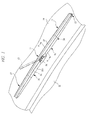
- Fig. 1 is a perspective view illustrating a wiper blade in which a blade rubber according to an embodiment of the present invention is provided
- Fig. 2 is a cross-sectional view taken along line A-A of Fig. 1
- Figs. 3A and 3B are explanatory views illustrating a detail of a holding portion illustrated in Fig. 1 .
- a wiper blade 11 is attached to a tip portion of a wiper arm 13 of a vehicle 12, and wipes a front windshield 14 (hereinafter, referred to as a windshield 14) of the vehicle 12 as swinging together with the wiper arm 13 when the wiper arm 13 is swung by driving a wiper motor which is not illustrated.
- the wiper blade 11 includes: a blade rubber 15 directly contacting the windshield 14; and a rubber holder 16 holding the blade rubber 15, and a pair of covers 17 is provided on both sides of the rubber holder 16 in a longitudinal direction.
- the blade rubber 15 includes: a head portion 21 having a cross-sectional rectangular shape; a lip portion 22; and a neck portion 23, is formed in a bar shape having a substantially uniformed cross-sectional surface in a longitudinal direction, and is formed to contact a surface of the windshield 14 at the lip portion 22.
- the neck portion 23 is formed so that a width in a wiping direction is narrower than those of the head portion 21 and the lip portion 22, and therefore, the lip portion 22 is tiltably jointed to the head portion 21 in the wiping direction.
- a holding groove 24 having opening portions on both side surfaces in the wiping direction and extending in the longitudinal direction is formed between the head portion 21 and the neck portion 23. Further, on each of both side surfaces of the head portion 21, an attachment groove 21a is formed so as to extend in the longitudinal direction. And, a plate spring member 25 is attached to each of the attachment grooves 21a.
- the plate spring member 25 is formed in a plate shape having the same length as that of the blade rubber 15 by performing a stamping process to a plate material such as a steel sheet, and is elastically deformable in a direction perpendicular to the windshield 14. That is, the blade rubber 15 to which the plate spring member 25 is attached is elastically deformable together with the plate spring member 25 in a direction perpendicular to the windshield 14, that is a direction where a curvature magnitude varies. Further, in a natural state, the plate spring member 25 is significantly curved toward the elastically deformable direction as much as its curvature is larger than that of the windshield 14. Accordingly, in a state that the blade rubber is away from the windshield 14, the blade rubber 15 to which the plate spring member 25 is attached is also curved more than the windshield 14.
- the plate spring member 25 is made of a steel sheet in the figures.
- the material is not limited to this, and may be a material elastically deformable in the direction perpendicular to the windshield 14 such that the plate spring member is made of a rigid resin or others.
- the rubber holder 16 is made of a resin material, and is formed in a cross-sectional U shape so as to include: a top wall portion 16a extending in the longitudinal direction; and a pair of side wall portions 16b extending from both sides of the top wall portion 16a toward the windshield 14, and has a length which is almost half the length of the blade rubber 15.
- a center portion of the blade rubber 15 is disposed inside the rubber holder 16, the blade rubber is covered by the rubber holder 16, and only the lip portion 22 is exposed outside.
- the attachment portion 26 is fixed to a substantially center portion of one wall portion 16b in the longitudinal direction, and the rubber holder 16 is attached to the tip portion of the wiper arm 13 at the attachment portion 26.
- a fin 27 is integrally formed with the top wall portion 16a, and aerodynamic characteristics of the wiper blade 11 are improved by the fin 27.
- a holding portion 31 is provided on one side of the rubber holder 16 in the longitudinal direction (on a closer side to a swinging center of the wiper arm 13 when the wiper blade 11 is attached to the wiper arm 13).
- the holding portion 31 includes a pair of holding hooks 32 (the figure illustrates only one side, but the same holding hook is also provided on the other side).
- Each of these holding hooks 32 is formed in a cross-sectionally protruding rectangular shape which is perpendicular to the longitudinal direction of the blade rubber 15, is parallel to the wiping direction, and is protruded from the side wall portion 16b, and each of these holding hooks holds the blade rubber 15 so as to be engaged with each holding groove 24.
- a pair of stopper portions 33a and 33b sandwiching each holding hook 32 therebetween in the longitudinal direction is provided in the blade rubber 15, so that movement of the holding hook 32 in the direction along the holding groove 24 is limited with respect to the blade rubber 15 by these stopper portions 33a and 33b. That is, the blade rubber 15 is held by the rubber holder 16 as being positioned at the holding portion 31 in the longitudinal direction.
- a holding portion 34 is provided on the other end of the rubber holder 16 in the longitudinal direction.
- the holding portion 34 includes a pair of holding hooks 35 (the figure illustrates only one side, but the same holding hook is also provided on the other side) each shaped as having a rectangular cross-sectional surface, and these holding hooks 35 are engaged with the holding groove 24 to hold the blade rubber 15.
- the stopper portion is not provided in the blade rubber 15 at the portion where the holding hook 35 is engaged, so that the holding hook 35 is movable along the holding groove 24. That is, the blade rubber 15 is held so as to be movable at the holding portion 34 with respect to the rubber holder 16 in a shaft direction.
- the pair of holding portions 31 and 34 are provided on both ends of the rubber holder 16 in the longitudinal direction, and the blade rubber 15 is held at two points of these holding portions 31 and 34. Accordingly, when a pressing force is applied from the wiper arm 13 to the rubber holder 16 via the attachment portion 26, the pressing force is applied from two points on both ends of the rubber holder 16, that is each of the holding portions 31 and 34, to the blade rubber 15, so that the blade rubber 15 is elastically contacted the windshield 14.
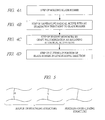
- FIGs. 4A to 4D are schematic flow charts schematically illustrating a procedure of the method of manufacturing the blade rubber according to the present invention.
- the above-described blade rubber 15 is manufactured through a step of forming the blade rubber, a step of generating radical active sites on the blade rubber by performing an irradiation treatment, a step of binding monomers by graft polymerization as beginning at the radical active sites, and a step of cutting the lip portion of the blade rubber in the longitudinal direction.
- non-diene-based rubber is used because of having superior durability.
- non-diene-based rubber there may be used, for example, ethylene-propylene-diene terpolymer rubber (EPDM), ethylene-propylene copolymer rubber (EPR), fluorocarbon rubber (FKM), butyl rubber (IIR), silicon rubber, epichlorohydrin rubber (CO, ECO), urethane rubber (U), acrylic rubber (ACM), or others.
- non-diene-based rubber is compounded with natural rubber (NR) or a blend (NR/CR) of natural rubber and chloroprene rubber
- NR natural rubber
- NR/CR blend of natural rubber and chloroprene rubber
- ester-based urethane rubber the one in which a predetermined amount of non-diene-based rubber is blended with ester-based urethane rubber
- a predetermined amount of a plurality of types of non-diene-based rubbers is blended with each other.
- EPDM ethylene-propylene-diene terpolymer rubber
- EPR ethylene-propylene copolymer rubber
- EPDM ethylene-propylene-diene terpolymer rubber
- EPDM is generally classified as a rubber having superior low-temperature performance, and has low-temperature performance superior to that of chloroprene rubber (CR) and equivalent to that of natural rubber (NR) .
- CR chloroprene rubber
- NR natural rubber
- the wiping performance at low temperature even in the EPDM is significantly changed depending on its composition. This is because of the influence of low-temperature crystallization of an ethylene component of EPDM polymer and low-temperature solidification of an additive oil component.
- EPDM polymer containing a small content of ethylene is used as the EPDM, and no oil is added to the EPDM or oil having a low fluid point is blended, so that the EPDM blade rubber having superior low-temperature wiping performance can be obtained.
- the content of ethylene polymer contained in the EPDM is preferably 62 mol% or less, and is more preferably 60 mol% or less.
- the EPDM normally contains 50 mol% or more of ethylene.
- a modulus of tensile elasticity of EPDM in temperature change from 20°C to -20°C is preferably 170% or less, and is more preferably 160% or less.
- the modulus of tensile elasticity can be measured based on, for example, JIS K6251 standard.
- As the oil component to be added to the EPDM its fluid point is preferably -20°C or lower, more preferably -30°C or lower, and particularly preferably -45°C or lower.
- the fluid point of the oil can be measured based on, for example, JIS K2269 standard. Note that, in consideration of practical benefits and costs, a lower limit of the fluid point of the oil is preferably about -50°C.
- non-diene-based rubbers are blended with generally-known additives such as a vulcanizing agent (cross-linker), a vulcanization accelerator auxiliary agent, a softener, an antioxidant, a filler, a silane coupling agent, silica, and carbon black (strengthening agent), and are molded into the blade rubber through a conventionally already-known method such as press molding.
- Fig. 5 is a schematic explanatory diagram schematically illustrating a difference in a cross-linking structure.
- the peroxide cross-linking there is provided a cross-linking structure in which polymer chains are directly linked to each other by covalent bond. That is, in the peroxide cross-linking structure in which the polymer chains are directly linked to each other by covalent bond, the structure becomes rigid, and therefore, molecular relaxation behavior is suppressed. Since the permanent deformation behavior of rubber is influenced by relaxation phenomena of the rubber molecular structure, the permanent deformation is suppressed by peroxides.
- the peroxide cross-linking structure has higher dissociation energy than the sulfur cross-linking structure and has higher resistance against heat or others than the sulfur cross-linking structure, it has also superior deterioration resistance.
- a linking method employing a cross-linking structure in which the polymer chains are linked to each other by covalent bond has also the same effects as that of the peroxide cross-linking method.
- the peroxide cross-linking agent for cross-linking the non-diene-based rubber there are 1,3-bis(tertiary-butyl peroxy isopropyl)benzene, 2,5-dimethyl-2,5-di(tertiary-butyl peroxy) hexine-3, di-cumyl peroxide, 2,4-dichloro benzoyl peroxide, benzoyl peroxide, 1,1-di-(tert.-butyl peroxy)-3,3,5-trimethyl cyclohexane, 2,5-dimethyl-2,5-dibenzoyl peroxy hexane, n-butyl-4,4-di(tert.-butyl peroxy)valerate, tert.-butyl peroxy benzoate, di(tert.-butyl peroxy)diisopropyl benzene, tert.-butyl cumyl peroxide, 2,5-dimethyl
- the irradiation treatment for generating radical active sites in the blade rubber molded in the step illustrated in Fig. 4B there are, for example, electron beam irradiation treatment, ultraviolet irradiation treatment, plasma irradiation treatment, ray ( ⁇ -ray, ⁇ -ray, and ⁇ -ray) irradiation treatment, ion beam irradiation treatment, corona discharge irradiation treatment, and others.
- the electron beam irradiation treatment is particularly preferable from a viewpoint of high treatment efficiency or others.
- Figs. 6A and 6B are explanatory diagrams illustrating a reaction mode of each irradiation treatment. Note that Figs. 6A and 6B illustrate a state before the blade rubber is cut, that is only the lip portion of the blade rubber molded so that the lip portions of the pair of blade rubbers are faced with each other. As illustrated in Figs. 6A and 6B , as the irradiation treatment for accelerating the graft polymerization reaction as beginning at the generated radical active sites, two methods are cited.
- the radical active sites are generated by irradiating electron beam or others to a rubber, and then, through a step of adhering monomers on a surface of the blade rubber, the monomers are bound by the graft polymerization, that is a previous irradiation treatment that the radical active sites are generated by a previous irradiation treatment.
- the previous irradiation treatment it is preferable to perform both of the irradiation treatment and the graft polymerization reaction under a nitrogen atmosphere.
- An absorbed dose in the previous irradiation treatment is preferably 50 to 500 kGy in a deoxygenated state.
- the treatment illustrated in Fig. 6B is a simultaneous irradiation treatment that the generation of the radical active sites and the graft polymerization are simultaneously performed.
- the simultaneous irradiation treatment for example, through a step of adhering monomers used for the graft polymerization to the surface of the blade rubber by coating or dipping, the above-described irradiation with the electron beam or others for generating the radical active sites is performed.
- An absorbed dose in the simultaneous irradiation treatment is preferably 10 to 200 kGy.
- the graft polymerization can be performed by a generally-known method, and either of a hydrophobic material and a hydrophilic material may be used as a polymerizable monomer used for the graft polymerization.
- hydrophobic material there are, for example, ethyl methacrylate, vinyl methacrylate, styrene, cyclohexyl methacrylate, dodecyl methacrylate, ethyl acrylate, vinyl acrylate, cyclohexyl acrylate, dodecyl acrylate, trimethylsilyl methacrylate, trimethoxysilyl propyl methacrylate, 3-(methacryloyloxy)propyl tris(trimethylsiloxy)silane, trimethylsilyl acrylate, trimethoxysilyl propyl acrylate, 3-(acryloyloxy)propyl tris-(trimethylsiloxy)silane, 1H, 1H, 3H-tetrafluoropropyl methacrylate, 2,2,2-trifluoroethyl methacrylate, 2-(perfluorobutyl)ethyl methacrylate, 1H, 1H, 1H
- hydrophilic material there are, for example, 2-hydroxyethylmethacrylate (HEMA), 2-hydroxyethyl acrylate (HEA), glycidyl methacrylate (GMA), acrylamide, methacrylic acid, acrylic acid, their metal salts, and others.
- HEMA 2-hydroxyethylmethacrylate
- HHA 2-hydroxyethyl acrylate
- GMA glycidyl methacrylate
- acrylamide methacrylic acid
- acrylic acid acrylic acid
- metal salts and others.
- hydrophilic monomers one single type of them or a mixture of two or more types thereof may be used.
- the above-described blade rubber is manufactured as a pair of blade-rubber molded bodies (blade-rubber intermediate bodies) which is formed so that the lip portions are faced with each other. And, the pair of the blade-rubber molded bodies are cut at the lip portions in the longitudinal direction in the step illustrated in Fig 4D , so that the blade rubber is manufactured.
- Fig. 7A is an enlarged view illustrating a state that monomers are adhered only on the lip portion illustrated in Fig. 2
- Fig. 7B is an enlarged view illustrating a state that monomers are entirely adhered on the blade rubber illustrated in Fig. 2 .
- portions where the monomers are bound are illustrated with the dashed line. Since the pair of rubber molded bodies are cut with the state that the graft-polymerized monomers are adhered, the monomers are not adhered on a cutting surface (tip surface) 36 of the blade rubber as illustrated in Figs. 7A and 7B .
- the windshield is wiped by an edge portion which is a boundary between both side surfaces 37a and 37b of the lip portion 22 and the cutting surface 36, and therefore, the windshield can be wiped by the both side surfaces 37a and 37b on which the monomers are adhered, and the windshield cannot be wiped by the cutting surface 36 on which the monomers are not adhered.
- the irradiation for generating the radical active sites with using the electron beam or others and the graft polymerization may not be performed.
- a masking may be previously performed on a portion to which the electron beam or others is not to be irradiated, and the electron beam or others may be irradiated only onto a necessary portion such as the lip portions 22 of the blade-rubber molded bodies as exemplified in Figs. 7A and 7B .
- the surface modification for modifying the surface of the blade rubber is performed by performing the irradiation treatment to the surface of the blade rubber to generate the radical active sites and binding the monomers by the graft polymerization as beginning at the radical active sites, and therefore, the surface friction of the rubber may be reduced even in the non-diene-based rubber similarly to the diene-based rubber whose surface is treated by chlorine.
- the surface treatment by chlorine cannot be performed in spite of having the superior durability at both of low temperature and high temperature and the superior durability against weather, ozone, and chemical reagents to that of the diene-based rubber because of low reactivity with heat, water, ultraviolet rays, ozone, oxygen, chemical reagents, and others.
- the surface treatment for low friction can be performed to the non-diene-based rubber, and therefore, a blade rubber having superior durability and wiping performance can be obtained.
- the surface treatment can be performed without halogen, and therefore, the blade rubber can be manufactured without the environmental burden.
- the blade rubber 15 is manufactured as the pair of blade-rubber molded bodies formed so that the lip portions 22 are faced with each other, and the blade rubber 15 is formed by cutting the pair of blade-rubber molded bodies at the lip portions 22 in the longitudinal direction.
- the formation is not limited this, and the blade rubbers 15 may be previously individually molded to omit the cutting step.
- the wiper blade 11 wipes the front windshield 14 of the vehicle 12.
- the wiping is not limited this, and the wiper blade may wipe a rear windshield or others of the vehicle 12.
- the plate spring member 25 is attached to the attachment groove 21a of the blade rubber 15.
- the attachment is not limited this, and the plate spring member 25 may be directly fixed to the blade rubber 15 by adhesion or others.
- the present invention can be applied to a wiper blade used in various-type wiper devices such as a tandem-type wiper device and an opposed-type wiper device.
- micro Martens hardness (N/mm 2 ) of the blade-rubber molded bodies obtained after the treatment was measured in conformity with ISO14577- by a dynamic ultra micro hardness tester manufactured by Shimadzu Corporation.
- Fig. 8 illustrates the example (example of EPDM graft polymerization) that the blade-rubber molded bodies molded from EPDM were subjected to the simultaneous irradiation treatment as "Practical Example”, and other examples as “Comparative Examples”.
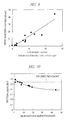
- the micro Martens hardness tended to be increased as increasing the absorbance ratio. That is, it was found out that the micro Martens hardness can be increased by the graft polymerization of HEMA by the electron beam irradiation.
- the friction coefficient tended to be decreased as increasing the micro Martens hardness. And, when the micro Martens hardness was 5 N/mm 2 or harder, the friction was lower than that in the case of the chlorine treatment. That is, it was found out that the friction can be reduced by the graft polymerization of HEMA by the electron beam irradiation to EPDM.
- the blade-rubber molded bodies (rubber material A) molded from EPDM in the above-described Experiment 1 and other rubber materials B to E were retained under the following conditions, and their ozone resistances were evaluated by presence or absence of cracks.
- the cracks were not caused even after 200 hours.
- the cracks were early caused after 2 to 4 hours. That is, it was found out that the rubber materials A and B manufactured by the method of manufacturing the blade rubber according to the present invention have the extremely-superior ozone resistance to the rubber materials C to E manufactured by different methods from the present invention.
- Blade-rubber molded bodies were manufactured similarly to Experiment 1 with the following compositions of Nos. 1 to 5 whose EPDM or oil components were different from each other, and then, the blade-rubber molded bodies were cut to obtain the blade rubber.
- a modulus of tensile stress (%) based on JIS K2269 was measured from -20°C to 20°C, and the low-temperature wiping performance was evaluated as follows. The result is shown in Tables 2 and 3 together with the compositions of Nos. 1 to 5, the ethylene content (mol%) of the EPDM polymer, and the oil fluid point (°C) of the oil component. Further, the temperature dependency of the tensile stress is illustrated in graphs of Figs. 11A and 11B , and the blade rubbers after the evaluation of the low-temperature wiping performance are shown in pictures of Fig. 12 . Note that their ethylene contents and oil fluid points have been excerpted from catalogs of their products. Here, the oil fluid points are generally measured based on JIS K6251.
- the modulus of tensile stress from -20°C to 20°C was significantly over 200%, and therefore, the low-temperature wiping performance was not good, either.
- the ethylene content of the EPDM polymer is 62 mol% or less, the low-temperature crystallization of the ethylene component is suppressed to cause good low-temperature wiping performance, and when the ethylene content thereof is 60 mol% or less, the effect is remarkable.
- the present invention can be used for a blade rubber that is provided in a wiper blade for wiping a windshield of a vehicle.
Landscapes
- Engineering & Computer Science (AREA)
- Mechanical Engineering (AREA)
- Physics & Mathematics (AREA)
- Fluid Mechanics (AREA)
- Quality & Reliability (AREA)
- Treatments Of Macromolecular Shaped Articles (AREA)
- Graft Or Block Polymers (AREA)
Abstract
Description
- The present invention relates to a technique for a blade rubber provided in a wiper blade which wipes a windshield of a vehicle, and more particularly, the present invention relates to a technique effectively applied to a blade rubber using a non-diene-based rubber.
- In vehicles such as an automobile, a bus, and a truck, a wiper blade is used in order to ensure driver' s view by wiping attachments such as rain, snow, insects, and muddy water splashed by a forward-running vehicle on a windshield such as a front windshield and a rear windshield.
- A blade rubber provided in the wiper blade is normally formed such that natural rubber (NR) or a blend (NR/CR) of natural rubber and chloroprene rubber is cross-linked by sulfur. However, the NR has superior durability (low-temperature performance) at a low temperature, but has inferior durability (heat resistance) at a high temperature. The NR/CR has superior heat resistance, but has inferior low-temperature performance. Further, both of the NR and the CR are diene-based rubbers, and therefore, carbon-carbon bond is unstable. Accordingly, the NR and the CR easily react with ozone, oxygen, chemical reagents, and others, and thus the NR and the CR have inferior durability (weather resistance, ozone resistance, and chemical resistance) against weather, ozone, and chemical reagents.
- On the other hand, ethylene-propylene-diene terpolimer rubber (EPDM) which is non-diene-based rubber (preferably polymer containing a small content of ethylene, and more particularly, polymer without adding oil or polymer blended with using oil having a low pour point) has superior weather resistance, ozone resistance, or others, and besides, has low-temperature performance equivalent to that of the NR and heat resistance superior to that of the NR/CR, and therefore, has superior durability. However, since the EPDM does not have a double bond in its main chain, there is a problem that its surface cannot be modified by an addition reaction with chlorine. Accordingly, its friction cannot be reduced as low as required for the wiper, and it is difficult to improve its wiping performance to be a practicable level.
- Therefore, various techniques for using the EPDM in the blade rubber have been proposed. For example, Patent Documents 1 to 3 propose a multi-color extrusion molding (co-extrusion) in which the EPDM is used for a structure including a neck and the diene-based rubber is used for a lip portion for wiping a glass. Further, for example, Patent Documents 4 and 5 propose a treatment of performing a substitution reaction with halogen to EPDM.
- On the other hand, as the method of modifying the rubber surface of the blade rubber, a method of modifying the surface with using an irradiation treatment has been proposed (for example, see Patent Document 6).
-
- Patent Document 1: Japanese Patent Application Laid-Open Publication No.
S61-35946 - Patent Document 2: Japanese Patent Application Laid-Open Publication (Translation of PCT Application) No.
Hll-506071 - Patent Document 3: Japanese Patent Application Laid-Open Publication (Translation of PCT Application) No.
2007-517085 - Patent Document 4: Japanese Patent Application Laid-Open Publication No.
S60-184531 - Patent Document 5: Japanese Patent Application Laid-Open Publication (Translation of PCT Application) No.
2008-500415 - Patent Document 6: Japanese Patent Application Laid-Open Publication No.
2008-24091 - However, since Patent Documents 1 to 3 propose the multi-color co-extrusion molding, its manufacturing cost is higher than that of the existing extrusion molding, and it is difficult to reflect the superior durability of the EPDM because the lip portion is not made of the EPDM. Since Patent Documents 4 and 5 propose that fluorine having high reactivity needs to be used or chlorine gas needs to be handled at a high temperature, there is a problem that the control of their treatment is difficult. In addition, there is a problem that environmental burden occurs due to halogen.
- On the other hand, the proposal of Patent Document 6 does not describe specific effects in a case that the non-diene-based rubber is subjected to the surface modification by the irradiation treatment.
- A preferred aim of the invention is to manufacture a blade rubber having both of superior durability and wiping performance with using non-diene-based rubber without environment burden.
- In a method of manufacturing a blade rubber according to the present invention, the blade rubber includes: a head portion formed in a cross-sectional rectangular shape; a lip portion contacting a surface of a windshield of a vehicle; and a neck portion connecting the head portion with the lip portion, and the method includes: a step of molding the blade rubber with using a non-diene-based rubber; a step of adhering monomers on at least the lip portion of the molded blade rubber; a step of performing an irradiation treatment to a portion where the monomers are adhered to generate radical active sites on the non-diene-based rubber of a surface of the corresponding portion; and a step of binding the monomers by graft polymerization at the generated radical active sites.
- In another method of manufacturing a blade rubber according to the present invention, the blade rubber includes: a head portion formed in a cross-sectional rectangular shape; a lip portion contacting a surface of a windshield of a vehicle; and a neck portion connecting the head portion with the lip portion, and the method includes: a step of molding the blade rubber with using a non-diene-based rubber; a step of adhering monomers on at least the lip portion of the molded blade rubber; and a step of performing an irradiation treatment to a portion where the monomers are adhered to generate radical active sites on the non-diene-based rubber of a surface of the corresponding portion, and simultaneously binding the monomers by graft polymerization at the generated radical active sites.
- In still another method of manufacturing a blade rubber according to the present invention, the blade rubber includes: a head portion formed in a cross-sectional rectangular shape; a lip portion contacting a surface of a windshield of a vehicle; and a neck portion connecting the head portion with the lip portion, and the method includes: a step of molding the blade rubber with using a non-diene-based rubber; a step of performing an irradiation treatment to at least the lip portion of the blade rubber to generate radical active sites on the non-diene-based rubber of a surface of the irradiation-treated portion; a step of adhering monomers on a portion where the radical active sites are generated; and a step of binding the monomers by graft polymerization at the generated radical active sites.
- In still another method of manufacturing a blade rubber according to the present invention, the blade rubber includes: a head portion formed in a cross-sectional rectangular shape; a lip portion contacting a surface of a windshield of a vehicle; and a neck portion connecting the head portion with the lip portion, and the method includes: a step of molding the blade rubber with using a non-diene-based rubber; a step of performing an irradiation treatment to at least the lip portion of the blade rubber to generate radical active sites on the non-diene-based rubber of a surface of the irradiation-treated portion; and a step of adhering monomers on a portion where the radical active sites are generated and binding the monomers by graft polymerization at the radical active sites on which the monomers are adhered.
- In still another method of manufacturing a blade rubber according to the present invention, the blade rubber includes: a head portion formed in a cross-sectional rectangular shape; a lip portion contacting a surface of a windshield of a vehicle; and a neck portion connecting the head portion with the lip portion, and the method includes: a step of molding a blade rubber intermediate, in which a pair of the lip portions are faced with each other, with using a non-diene-based rubber; a step of adhering monomers on at least the lip portion of the molded blade rubber intermediate; a step of performing an irradiation treatment to a portion where the monomers are adhered to generate radical active sites on the non-diene-based rubber of a surface of the corresponding portion; a step of binding the monomers by graft polymerization at the generated radical active sites; and a step of dividing the blade rubber intermediate by cutting the blade rubber intermediate at the lip portions.
- In still another method of manufacturing a blade rubber according to the present invention, the blade rubber includes: a head portion formed in a cross-sectional rectangular shape; a lip portion contacting a surface of a windshield of a vehicle; and a neck portion connecting the head portion with the lip portion, and the method includes: a step of molding a blade rubber intermediate, in which a pair of the lip portions are faced with each other, with using a non-diene-based rubber; a step of adhering monomers on at least the lip portion of the molded blade rubber intermediate; a step of performing an irradiation treatment to a portion where the monomers are adhered to generate radical active sites on the non-diene-based rubber of a surface of the corresponding portion and simultaneously binding the monomers by graft polymerization at the generated radical active sites; and a step of dividing the blade rubber intermediate by cutting the blade rubber intermediate at the lip portions.
- In still another method of manufacturing a blade rubber according to the present invention, the blade rubber includes: a head portion formed in a cross-sectional rectangular shape; a lip portion contacting a surface of a windshield of a vehicle; and a neck portion connecting the head portion with the lip portion, and the method includes: a step of molding a blade rubber intermediate, in which a pair of the lip portions are faced with each other, with using a non-diene-based rubber; a step of performing an irradiation treatment to at least the lip portion of the blade rubber intermediate to generate radical active sites on the non-diene-based rubber of a surface of the irradiation-treated portion; a step of adhering monomers on a portion where the radical active sites are generated; a step of binding the monomers by graft polymerization at the generated radical active sites; and a step of dividing the blade rubber intermediate by cutting the blade rubber intermediate at the lip portions.
- In still another method of manufacturing a blade rubber according to the present invention, the blade rubber includes: a head portion formed in a cross-sectional rectangular shape; a lip portion contacting a surface of a windshield of a vehicle; and a neck portion connecting the head portion with the lip portion, and the method includes: a step of molding a blade rubber intermediate, in which a pair of the lip portions are faced with each other, with using a non-diene-based rubber; a step of performing an irradiation treatment to at least the lip portion of the blade rubber intermediate to generate radical active sites on the non-diene-based rubber of a surface on the irradiation-treated portion; a step of adhering monomers on a portion where the radical active sites are generated and binding the monomers by graft polymerization at the radical active sites on which the monomers are adhered; and a step of dividing the blade rubber intermediate by cutting the blade rubber intermediate at the lip portions.
- A wiper blade according to the present invention is a wiper blade for wiping a windshield of a vehicle, and the wiper blade includes: a blade rubber integrally formed with using a non-diene-based rubber and including a head portion formed in a cross-sectional rectangular shape, a lip portion contacting a surface of the windshield of the vehicle, and a neck portion connecting the head portion with the lip portion; and monomers adhered on a surface of the lip portion of the blade rubber and simultaneously bound by graft polymerization at radical active sites formed on the surface of the blade rubber due to performing an irradiation treatment to the blade rubber.
- Another wiper blade according to the present invention is a wiper blade for wiping a windshield of a vehicle, and the wiper blade includes: a blade rubber integrally formed with using a non-diene-based rubber and including a head portion formed in a cross-sectional rectangular shape, a lip portion contacting a surface of the windshield of the vehicle, and a neck portion connecting the head portion with the lip portion; and monomers adhered on both side surfaces of a surface of the lip portion of the blade rubber and simultaneously bound by graft polymerization at radical active sites formed on the surface of the blade rubber due to performing an irradiation treatment to the blade rubber.
- In the wiper blade according to the present invention, the monomers are polymerizable monomers made of a hydrophobic material containing at least one of a vinyl group (CH2=CH-) , an isopropenyl group (CH2=C(CH3)-), and an allyl group (CH2=CHCH2-) in molecules.
- In the wiper blade according to the present invention, the monomers are polymerizable monomers made of hydrophilic monomers containing at least one of 2-hydroxyethyl methacrylate (HEMA), 2-hydroxyethyl acrylate (HEA), glycidyl methacrylate (GMA), acrylamide, methacrylic acid, acrylic acid, and their metal salt.
- In the wiper blade according to the present invention, the non-diene-based rubber is made of ethylene-propylene-diene terpolymer rubber (EPDM).
- In the wiper blade according to the present invention, the non-diene-based rubber is formed by peroxide cross-linking.
- In the wiper blade according to the present invention, the Martens hardness in the surface of the lip portion is 5 N/mm2 or harder.
- In the wiper blade according to the present invention, the monomers are not adhered on a tip surface of the lip portion of the blade rubber.
- In the wiper blade according to the present invention, a content of ethylene contained in the ethylene-propylene-diene terpolymer rubber (EPDM) polymer is 62 mol% or less.
- In the wiper blade according to the present invention, a content of ethylene contained in the ethylene-propylene-diene terpolymer rubber (EPDM) polymer is 50 mol% or more and 60 mol% or less.
- In the wiper blade according to the present invention, a modulus of tensile elasticity of the lip portion at an atmospheric temperature of -20°C to 20°C is 170% or lower.
- In the wiper blade according to the present invention, a modulus of tensile elasticity of the lip portion at an atmospheric temperature of -20°C to 20°C is 100% or higher and 160% or lower.
- In the wiper blade according to the present invention, oil is added, and a fluid point of the oil is -20°C or lower.
- In the wiper blade according to the present invention, oil is added, and a fluid point of the oil is -30°C or lower.
- According to the present invention, a blade rubber is molded with using a non-diene-based rubber, radical active sites are generated on at least a lip portion due to performing an irradiation treatment, and monomers are bound by graft polymerization as beginning at the radical active sites, and therefore, a surface treatment without halogen by which friction of the non-diene-based rubber having superior durability is reduced as low as being a practicable level for a wiper can be achieved.
- In this manner, a blade rubber having superior durability and wiping performance can be manufactured with using a non-diene-based rubber without environmental burden.
-
-
Fig. 1 is a perspective view illustrating a wiper blade in which a blade rubber according to an embodiment of the present invention is provided; -
Fig. 2 is a cross-sectional view taken along line A-A ofFig. 1 ; -
Figs. 3A and 3B are explanatory views illustrating a detail of a holding portion illustrated inFig. 1 ; -
Figs. 4A to 4D are schematic flow charts schematically illustrating a procedure of a method of manufacturing the blade rubber according to the present invention; -
Fig. 5 is a schematic explanatory diagram schematically explaining a difference in a cross-linking structure; -
Figs. 6A and 6B are explanatory diagrams illustrating a reaction mode in each irradiation treatment; -
Fig. 7A is an enlarged view illustrating a state that monomers are adhered only on a lip portion illustrated inFig. 2 , andFig. 7B is an enlarged view illustrating a state that monomers are entirely adhered on a blade rubber illustrated inFig. 2 ; -
Fig. 8 is a graph illustrating a confirmatory result of a friction reducing effect by irradiation treatments in Experiment 1; -
Fig. 9 is a graph illustrating a relationship between micro martens hardness and absorbance ratio in Experiment 2; -
Fig. 10 is a graph illustrating a relationship between friction coefficient and micro Martens hardness in Experiment 3; -
Figs. 11A and 11B are graphs illustrating temperature dependency of tensile stress; and -
Fig. 12 is pictures of a blade rubber after evaluation of low-temperature wiping performance. - Hereinafter, an embodiment of the present invention will be described in detail.
Fig. 1 is a perspective view illustrating a wiper blade in which a blade rubber according to an embodiment of the present invention is provided,Fig. 2 is a cross-sectional view taken along line A-A ofFig. 1 , andFigs. 3A and 3B are explanatory views illustrating a detail of a holding portion illustrated inFig. 1 . - As illustrated in
Fig. 1 , awiper blade 11 is attached to a tip portion of awiper arm 13 of avehicle 12, and wipes a front windshield 14 (hereinafter, referred to as a windshield 14) of thevehicle 12 as swinging together with thewiper arm 13 when thewiper arm 13 is swung by driving a wiper motor which is not illustrated. - The
wiper blade 11 includes: ablade rubber 15 directly contacting thewindshield 14; and arubber holder 16 holding theblade rubber 15, and a pair ofcovers 17 is provided on both sides of therubber holder 16 in a longitudinal direction. - As illustrated in
Fig. 2 , theblade rubber 15 includes: ahead portion 21 having a cross-sectional rectangular shape; alip portion 22; and aneck portion 23, is formed in a bar shape having a substantially uniformed cross-sectional surface in a longitudinal direction, and is formed to contact a surface of thewindshield 14 at thelip portion 22. Theneck portion 23 is formed so that a width in a wiping direction is narrower than those of thehead portion 21 and thelip portion 22, and therefore, thelip portion 22 is tiltably jointed to thehead portion 21 in the wiping direction. - A holding
groove 24 having opening portions on both side surfaces in the wiping direction and extending in the longitudinal direction is formed between thehead portion 21 and theneck portion 23. Further, on each of both side surfaces of thehead portion 21, anattachment groove 21a is formed so as to extend in the longitudinal direction. And, aplate spring member 25 is attached to each of theattachment grooves 21a. - The
plate spring member 25 is formed in a plate shape having the same length as that of theblade rubber 15 by performing a stamping process to a plate material such as a steel sheet, and is elastically deformable in a direction perpendicular to thewindshield 14. That is, theblade rubber 15 to which theplate spring member 25 is attached is elastically deformable together with theplate spring member 25 in a direction perpendicular to thewindshield 14, that is a direction where a curvature magnitude varies. Further, in a natural state, theplate spring member 25 is significantly curved toward the elastically deformable direction as much as its curvature is larger than that of thewindshield 14. Accordingly, in a state that the blade rubber is away from thewindshield 14, theblade rubber 15 to which theplate spring member 25 is attached is also curved more than thewindshield 14. - Note that the
plate spring member 25 is made of a steel sheet in the figures. However, the material is not limited to this, and may be a material elastically deformable in the direction perpendicular to thewindshield 14 such that the plate spring member is made of a rigid resin or others. - The
rubber holder 16 is made of a resin material, and is formed in a cross-sectional U shape so as to include: atop wall portion 16a extending in the longitudinal direction; and a pair ofside wall portions 16b extending from both sides of thetop wall portion 16a toward thewindshield 14, and has a length which is almost half the length of theblade rubber 15. A center portion of theblade rubber 15 is disposed inside therubber holder 16, the blade rubber is covered by therubber holder 16, and only thelip portion 22 is exposed outside. Further, as illustrated inFig. 1 , theattachment portion 26 is fixed to a substantially center portion of onewall portion 16b in the longitudinal direction, and therubber holder 16 is attached to the tip portion of thewiper arm 13 at theattachment portion 26. Still further, afin 27 is integrally formed with thetop wall portion 16a, and aerodynamic characteristics of thewiper blade 11 are improved by thefin 27. - As illustrated in
Fig. 1 , a holdingportion 31 is provided on one side of therubber holder 16 in the longitudinal direction (on a closer side to a swinging center of thewiper arm 13 when thewiper blade 11 is attached to the wiper arm 13). As illustrated inFig. 3A , the holdingportion 31 includes a pair of holding hooks 32 (the figure illustrates only one side, but the same holding hook is also provided on the other side). Each of these holding hooks 32 is formed in a cross-sectionally protruding rectangular shape which is perpendicular to the longitudinal direction of theblade rubber 15, is parallel to the wiping direction, and is protruded from theside wall portion 16b, and each of these holding hooks holds theblade rubber 15 so as to be engaged with each holdinggroove 24. Further, a pair ofstopper portions 33a and 33b sandwiching each holdinghook 32 therebetween in the longitudinal direction is provided in theblade rubber 15, so that movement of the holdinghook 32 in the direction along the holdinggroove 24 is limited with respect to theblade rubber 15 by thesestopper portions 33a and 33b. That is, theblade rubber 15 is held by therubber holder 16 as being positioned at the holdingportion 31 in the longitudinal direction. - Similarly, a holding
portion 34 is provided on the other end of therubber holder 16 in the longitudinal direction. As illustrated inFig. 3B , the holdingportion 34 includes a pair of holding hooks 35 (the figure illustrates only one side, but the same holding hook is also provided on the other side) each shaped as having a rectangular cross-sectional surface, and these holdinghooks 35 are engaged with the holdinggroove 24 to hold theblade rubber 15. In addition, the stopper portion is not provided in theblade rubber 15 at the portion where the holdinghook 35 is engaged, so that the holdinghook 35 is movable along the holdinggroove 24. That is, theblade rubber 15 is held so as to be movable at the holdingportion 34 with respect to therubber holder 16 in a shaft direction. - In this manner, in the
wiper blade 11, the pair of holdingportions rubber holder 16 in the longitudinal direction, and theblade rubber 15 is held at two points of these holdingportions wiper arm 13 to therubber holder 16 via theattachment portion 26, the pressing force is applied from two points on both ends of therubber holder 16, that is each of the holdingportions blade rubber 15, so that theblade rubber 15 is elastically contacted thewindshield 14. - Next, a method of manufacturing the blade rubber according to the present invention is described.
Figs. 4A to 4D are schematic flow charts schematically illustrating a procedure of the method of manufacturing the blade rubber according to the present invention. As illustrated inFigs. 4A to 4D , the above-describedblade rubber 15 is manufactured through a step of forming the blade rubber, a step of generating radical active sites on the blade rubber by performing an irradiation treatment, a step of binding monomers by graft polymerization as beginning at the radical active sites, and a step of cutting the lip portion of the blade rubber in the longitudinal direction. - In the step illustrated in
Fig. 4A , as a rubber used for forming the blade rubber, non-diene-based rubber is used because of having superior durability. As the non-diene-based rubber, there may be used, for example, ethylene-propylene-diene terpolymer rubber (EPDM), ethylene-propylene copolymer rubber (EPR), fluorocarbon rubber (FKM), butyl rubber (IIR), silicon rubber, epichlorohydrin rubber (CO, ECO), urethane rubber (U), acrylic rubber (ACM), or others. In addition, there may be used the one in which a predetermined amount of non-diene-based rubber is compounded with natural rubber (NR) or a blend (NR/CR) of natural rubber and chloroprene rubber, the one in which a predetermined amount of non-diene-based rubber is blended with ester-based urethane rubber, or the one in which a predetermined amount of a plurality of types of non-diene-based rubbers is blended with each other. - The ethylene-propylene-diene terpolymer rubber (EPDM) and the ethylene-propylene copolymer rubber (EPR) of these non-diene-based rubbers are preferable because their surfaces are easily modified without developing a decomposition reaction due to the irradiation treatment. Further, from a viewpoint of obtaining superior performance of the wiper blade, ethylene-propylene-diene terpolymer rubber (EPDM) is particularly preferable because of lightest weight among the generally-known rubbers.
- Here, EPDM is generally classified as a rubber having superior low-temperature performance, and has low-temperature performance superior to that of chloroprene rubber (CR) and equivalent to that of natural rubber (NR) . However, when EPDM is considered as a wiper product, the wiping performance at low temperature even in the EPDM is significantly changed depending on its composition. This is because of the influence of low-temperature crystallization of an ethylene component of EPDM polymer and low-temperature solidification of an additive oil component. For this reason, EPDM polymer containing a small content of ethylene is used as the EPDM, and no oil is added to the EPDM or oil having a low fluid point is blended, so that the EPDM blade rubber having superior low-temperature wiping performance can be obtained.
- Specifically, the content of ethylene polymer contained in the EPDM is preferably 62 mol% or less, and is more preferably 60 mol% or less. Note that the EPDM normally contains 50 mol% or more of ethylene. A modulus of tensile elasticity of EPDM in temperature change from 20°C to -20°C is preferably 170% or less, and is more preferably 160% or less. The modulus of tensile elasticity can be measured based on, for example, JIS K6251 standard. As the oil component to be added to the EPDM, its fluid point is preferably -20°C or lower, more preferably -30°C or lower, and particularly preferably -45°C or lower. The fluid point of the oil can be measured based on, for example, JIS K2269 standard. Note that, in consideration of practical benefits and costs, a lower limit of the fluid point of the oil is preferably about -50°C.
- These non-diene-based rubbers are blended with generally-known additives such as a vulcanizing agent (cross-linker), a vulcanization accelerator auxiliary agent, a softener, an antioxidant, a filler, a silane coupling agent, silica, and carbon black (strengthening agent), and are molded into the blade rubber through a conventionally already-known method such as press molding.
- As a method for vulcanization (cross-linking), the peroxide cross-linking is preferable from a viewpoint of superior permanent deformation characteristics.
Fig. 5 is a schematic explanatory diagram schematically illustrating a difference in a cross-linking structure. - As illustrated in
Fig. 5 , in the sulfur cross-linking, there is provided a cross-linking structure having monosulfide or polysulfide bond in which polymer chains are linked to each other by one or plural sulfur atoms, respectively. On the other hand, in the peroxide cross-linking, there is provided a cross-linking structure in which polymer chains are directly linked to each other by covalent bond. That is, in the peroxide cross-linking structure in which the polymer chains are directly linked to each other by covalent bond, the structure becomes rigid, and therefore, molecular relaxation behavior is suppressed. Since the permanent deformation behavior of rubber is influenced by relaxation phenomena of the rubber molecular structure, the permanent deformation is suppressed by peroxides. - For example, as shown in Table 1, when the permanent deformation is measured under a predetermined condition, in a case of the peroxide cross-linking of EPDM, the permanent deformation can be suppressed to less than 1/10 of that in a case of the sulfur cross-linking of the natural rubber (NR).
[Table 1] TYPE OF RUBBER CROSS-LINKING METHOD PERMANENT DEFORMATION COMPARATIVE EXAMPLE NR SULFUR 17% COMPARATIVE EXAMPLE NR PEROXIDE 12% EXAMPLE EPDM PEROXIDE 1.5% 
JIS No. 3 Dumbbell (markedline 20 mm)
- Further, since the peroxide cross-linking structure has higher dissociation energy than the sulfur cross-linking structure and has higher resistance against heat or others than the sulfur cross-linking structure, it has also superior deterioration resistance. Note that, in addition to the peroxide cross-linking method, a linking method employing a cross-linking structure in which the polymer chains are linked to each other by covalent bond has also the same effects as that of the peroxide cross-linking method.
- As the peroxide cross-linking agent for cross-linking the non-diene-based rubber, there are 1,3-bis(tertiary-butyl peroxy isopropyl)benzene, 2,5-dimethyl-2,5-di(tertiary-butyl peroxy) hexine-3, di-cumyl peroxide, 2,4-dichloro benzoyl peroxide, benzoyl peroxide, 1,1-di-(tert.-butyl peroxy)-3,3,5-trimethyl cyclohexane, 2,5-dimethyl-2,5-dibenzoyl peroxy hexane, n-butyl-4,4-di(tert.-butyl peroxy)valerate, tert.-butyl peroxy benzoate, di(tert.-butyl peroxy)diisopropyl benzene, tert.-butyl cumyl peroxide, 2,5-dimethyl-2,5-di(tert.-butyl peroxy)hexane, di(tert.-butyl) peroxide, 2,5-dimethyl-2,5-di(tert.-butyl peroxy)hexine-3, and others. As these peroxide cross-linking agents, one single type of them may be used or mixture of two types or more of them may be used.
- As the irradiation treatment for generating radical active sites in the blade rubber molded in the step illustrated in
Fig. 4B , there are, for example, electron beam irradiation treatment, ultraviolet irradiation treatment, plasma irradiation treatment, ray (α-ray, β-ray, and γ-ray) irradiation treatment, ion beam irradiation treatment, corona discharge irradiation treatment, and others. Among them, the electron beam irradiation treatment is particularly preferable from a viewpoint of high treatment efficiency or others. By performing such an irradiation treatment, the radical active sites are generated in the blade rubber, and graft polymerization reaction proceeds as beginning at the radical active sites in the step illustrated inFig. 4C . -
Figs. 6A and 6B are explanatory diagrams illustrating a reaction mode of each irradiation treatment. Note thatFigs. 6A and 6B illustrate a state before the blade rubber is cut, that is only the lip portion of the blade rubber molded so that the lip portions of the pair of blade rubbers are faced with each other. As illustrated inFigs. 6A and 6B , as the irradiation treatment for accelerating the graft polymerization reaction as beginning at the generated radical active sites, two methods are cited. - In the treatment illustrated in
Fig. 6A , the radical active sites are generated by irradiating electron beam or others to a rubber, and then, through a step of adhering monomers on a surface of the blade rubber, the monomers are bound by the graft polymerization, that is a previous irradiation treatment that the radical active sites are generated by a previous irradiation treatment. In the previous irradiation treatment, it is preferable to perform both of the irradiation treatment and the graft polymerization reaction under a nitrogen atmosphere. An absorbed dose in the previous irradiation treatment is preferably 50 to 500 kGy in a deoxygenated state. - The treatment illustrated in
Fig. 6B is a simultaneous irradiation treatment that the generation of the radical active sites and the graft polymerization are simultaneously performed. In the simultaneous irradiation treatment, for example, through a step of adhering monomers used for the graft polymerization to the surface of the blade rubber by coating or dipping, the above-described irradiation with the electron beam or others for generating the radical active sites is performed. An absorbed dose in the simultaneous irradiation treatment is preferably 10 to 200 kGy. - The graft polymerization can be performed by a generally-known method, and either of a hydrophobic material and a hydrophilic material may be used as a polymerizable monomer used for the graft polymerization. As the hydrophobic material, there is a compound which is a polymerizable monomer having at least one of a vinyl group (CH2=CH-), an isopropenyl group (CH2=C(CH3)-), and an allyl group (CH2=CHCH2-) in molecules, and has a hydrophobic structure such as a hydrocarbon group, organosilicon group, or fluorocarbon group or has a functional group providing hydrophobic property by a secondary reaction after the graft polymerization, at its molecular end.
- As such a hydrophobic material, there are, for example, ethyl methacrylate, vinyl methacrylate, styrene, cyclohexyl methacrylate, dodecyl methacrylate, ethyl acrylate, vinyl acrylate, cyclohexyl acrylate, dodecyl acrylate, trimethylsilyl methacrylate, trimethoxysilyl propyl methacrylate, 3-(methacryloyloxy)propyl tris(trimethylsiloxy)silane, trimethylsilyl acrylate, trimethoxysilyl propyl acrylate, 3-(acryloyloxy)propyl tris-(trimethylsiloxy)silane, 1H, 1H, 3H-tetrafluoropropyl methacrylate, 2,2,2-trifluoroethyl methacrylate, 2-(perfluorobutyl)ethyl methacrylate, 1H, 1H, 3H-tetrafluoropropyl acrylate, 2,2,2-trifluoroethyl acrylate, 2-(perfluorobutyl)ethyl methacrylate, their derivatives, and others. In these hydrophobic monomers, one single type of them or a mixture of two or more types thereof may be used.
- As the hydrophilic material, there are, for example, 2-hydroxyethylmethacrylate (HEMA), 2-hydroxyethyl acrylate (HEA), glycidyl methacrylate (GMA), acrylamide, methacrylic acid, acrylic acid, their metal salts, and others. In these hydrophilic monomers, one single type of them or a mixture of two or more types thereof may be used.
- The above-described blade rubber is manufactured as a pair of blade-rubber molded bodies (blade-rubber intermediate bodies) which is formed so that the lip portions are faced with each other. And, the pair of the blade-rubber molded bodies are cut at the lip portions in the longitudinal direction in the step illustrated in
Fig 4D , so that the blade rubber is manufactured. -
Fig. 7A is an enlarged view illustrating a state that monomers are adhered only on the lip portion illustrated inFig. 2 , andFig. 7B is an enlarged view illustrating a state that monomers are entirely adhered on the blade rubber illustrated inFig. 2 . Note that, inFigs. 7A and 7B , portions where the monomers are bound are illustrated with the dashed line. Since the pair of rubber molded bodies are cut with the state that the graft-polymerized monomers are adhered, the monomers are not adhered on a cutting surface (tip surface) 36 of the blade rubber as illustrated inFigs. 7A and 7B . Generally, in theblade rubber 15, the windshield is wiped by an edge portion which is a boundary between bothside surfaces lip portion 22 and the cuttingsurface 36, and therefore, the windshield can be wiped by the bothside surfaces surface 36 on which the monomers are not adhered. In addition, to a portion not contacted with the windshield such as a head portion of the blade rubber, the irradiation for generating the radical active sites with using the electron beam or others and the graft polymerization may not be performed. Accordingly, a masking may be previously performed on a portion to which the electron beam or others is not to be irradiated, and the electron beam or others may be irradiated only onto a necessary portion such as thelip portions 22 of the blade-rubber molded bodies as exemplified inFigs. 7A and 7B . - As described above, in the present invention, the surface modification for modifying the surface of the blade rubber is performed by performing the irradiation treatment to the surface of the blade rubber to generate the radical active sites and binding the monomers by the graft polymerization as beginning at the radical active sites, and therefore, the surface friction of the rubber may be reduced even in the non-diene-based rubber similarly to the diene-based rubber whose surface is treated by chlorine.
- That is, in the non-diene-based rubber, the surface treatment by chlorine cannot be performed in spite of having the superior durability at both of low temperature and high temperature and the superior durability against weather, ozone, and chemical reagents to that of the diene-based rubber because of low reactivity with heat, water, ultraviolet rays, ozone, oxygen, chemical reagents, and others. Thus, it has been difficult to manufacture a blade rubber whose chatter vibration or others is reduced and which can wipe with good visibility by using only the non-diene-based rubber. However, in the present invention, the surface treatment for low friction can be performed to the non-diene-based rubber, and therefore, a blade rubber having superior durability and wiping performance can be obtained. Further, the surface treatment can be performed without halogen, and therefore, the blade rubber can be manufactured without the environmental burden.
- In the foregoing, the invention made by the present inventors has been concretely described based on the embodiments. However, it is needless to say that the present invention is not limited to the foregoing embodiments and various modifications and alterations can be made within the scope of the present invention.
- For example, in the present embodiment, the
blade rubber 15 is manufactured as the pair of blade-rubber molded bodies formed so that thelip portions 22 are faced with each other, and theblade rubber 15 is formed by cutting the pair of blade-rubber molded bodies at thelip portions 22 in the longitudinal direction. However, the formation is not limited this, and the blade rubbers 15 may be previously individually molded to omit the cutting step. - Further, in the present embodiment, the
wiper blade 11 wipes thefront windshield 14 of thevehicle 12. However, the wiping is not limited this, and the wiper blade may wipe a rear windshield or others of thevehicle 12. - Still further, in the present embodiment, the
plate spring member 25 is attached to theattachment groove 21a of theblade rubber 15. However, the attachment is not limited this, and theplate spring member 25 may be directly fixed to theblade rubber 15 by adhesion or others. - Moreover, the present invention can be applied to a wiper blade used in various-type wiper devices such as a tandem-type wiper device and an opposed-type wiper device.
- Hereinafter, the present invention will be described in more detail based on Examples.
- With 100 phr of EPDM which is the non-diene-based rubber, 5 phr of a peroxide cross linker, 5 phr of zinc oxide, 2 phr of stearic acid, 1 phr of a vulcanization accelerator auxiliary agent, and 50 phr of carbon black were mixed, and the pair of blade-rubber molded bodies were molded by press molding. The blade-rubber molded bodies were dipped into aqueous solution of 50 weight% HEMA, and were subjected to the simultaneous irradiation treatment at a temperature of 25°C with 10 kGy of electron beam as illustrated in
Fig. 6B (the generation of the radical active sites by the electron beam irradiation and the graft polymerization of HEMA were simultaneously performed). The micro Martens hardness (N/mm2) of the blade-rubber molded bodies obtained after the treatment was measured in conformity with ISO14577- by a dynamic ultra micro hardness tester manufactured by Shimadzu Corporation. - Further, also in example that each of the pair of blade-rubber molded bodies molded from EPDM and NR was subjected to the chlorine treatment instead of the simultaneous irradiation, the micro Martens hardness (N/mm2) was measured similarly to the example that the blade-rubber molded bodies were subjected to the simultaneous irradiation treatment. Still further, also in a non-treatment example that the blade rubber molded from EPDM was not subjected to any treatment, the micro Martens hardness (N/mm2) was measured similarly to the example that the blade-rubber molded bodies were subjected to the simultaneous irradiation treatment. As these results,
Fig. 8 illustrates the example (example of EPDM graft polymerization) that the blade-rubber molded bodies molded from EPDM were subjected to the simultaneous irradiation treatment as "Practical Example", and other examples as "Comparative Examples". - As illustrated in
Fig. 8 , even when the blade-rubber molded bodies molded from EPDM was subjected to the general chlorine treatment, the rubber surface did not become hard. However, when the EPDM was subj ected to the irradiation with electron beam to cause the graft polymerization of HEMA, its micro Martens hardness was improved by about four over three times of the hardness of the example of the chlorine-treated NR. That is, it was found out that, when the blade-rubber molded bodies molded from EPDM was subjected to the simultaneous irradiation treatment, its hardness of the rubber surface could be improved equivalent to or more than that of the case that the blade-rubber molded bodies molded from NR was subjected to the chlorine treatment. - A progress degree of the surface modification obtained by the simultaneous irradiation treatment to the blade-rubber molded bodies molded from EPDM in the above-described Experiment 1 was verified by studying a relationship between an absorbance ratio (1720 cm-1/1375 cm-1) obtained from a total reflection measuring method (FT/IR analytical system called Attenuated Total Reflection: ATR-FT/IR) and the micro Martens hardness of the rubber surface. The result is illustrated in
Fig. 9 . - As illustrated in
Fig. 9 , the micro Martens hardness tended to be increased as increasing the absorbance ratio. That is, it was found out that the micro Martens hardness can be increased by the graft polymerization of HEMA by the electron beam irradiation. - In the simultaneous irradiation treatment to the blade-rubber molded bodies molded from EPDM in the above-described Experiment 1, the correlation between the micro Martens hardness and the friction coefficient was verified from a result of measuring frictional force of a target base material when the micro Martens hardness is varied. The result is illustrated in a graph of
Fig. 10 . Note that the frictional force was measured under the following conditions. - Sample width: 10 mm
- Load: 15 gf
- Sliding radius: 70 mm
- Number of rotations: 173.5 rpm
- Friction speed: 1.3 m/s
- Temperature: 25°C
- Humidity: 70%
- Partner material: glass plate
- As illustrated in
Fig. 10 , the friction coefficient tended to be decreased as increasing the micro Martens hardness. And, when the micro Martens hardness was 5 N/mm2 or harder, the friction was lower than that in the case of the chlorine treatment. That is, it was found out that the friction can be reduced by the graft polymerization of HEMA by the electron beam irradiation to EPDM. - The blade-rubber molded bodies (rubber material A) molded from EPDM in the above-described Experiment 1 and other rubber materials B to E were retained under the following conditions, and their ozone resistances were evaluated by presence or absence of cracks.
- Temperature: 40°C
- Ozone concentration of: 50 pphm
- Tensile rate: 40%
- Retention time: until generation of cracks (200 hours at longest)
- As other rubber materials, the following materials were evaluated.
- Rubber material B: a rubber material in which NR was used as the diene-based rubber instead of EPDM and whose surface was not treated
- Rubber material C: a NR rubber material which was vulcanized by sulfur
- Rubber material D: a rubber material in which the rubber material C was subjected to the chlorine treatment
- As results of the evaluation, in the rubber materials A and B, the cracks were not caused even after 200 hours. However, in the rubber materials C to E, the cracks were early caused after 2 to 4 hours. That is, it was found out that the rubber materials A and B manufactured by the method of manufacturing the blade rubber according to the present invention have the extremely-superior ozone resistance to the rubber materials C to E manufactured by different methods from the present invention.
- Blade-rubber molded bodies were manufactured similarly to Experiment 1 with the following compositions of Nos. 1 to 5 whose EPDM or oil components were different from each other, and then, the blade-rubber molded bodies were cut to obtain the blade rubber.
- No. 1
- EPDM polymer: 20 phr of EP24 (manufactured by JSR Corporation, the same is used up to No. 3) and 80 phr of EP27;
- Reinforcing agent: 40 phr of Asahi #60 (manufactured by Asahi Carbon Co., Ltd.) as FEF (Fast Extrusion Furnace);
- Vulcanizing agent: 5 phr of Percumyl D-40 (manufactured by NOF Corporation) as peroxide (DCP);
- Vulcanization accelerator auxiliary agent: 5 phr of mixture of two types of zinc oxides (manufactured by Sakai Chemical Industry Co., Ltd.) as zinc oxide and 1 phr of Lunac S-20 (manufactured by Kao Corporation) as stearic acid; and
- Plasticizer: 10 phr of Diana Process Oil NR-26 (manufactured by Idemitsu Kosan Co., Ltd.) as naphthenic oil.
- No. 2
- The same as No. 1 except for using 20 phr of EP21 and 80 phr of EP107 as the EPDM polymer
- No. 3
- The same as No. 1 except for using 100 phr of EP57F as the EPDM polymer
- No. 4
- The same as No. 1 except for using 50 phr of EPT3072EH (manufactured by Mitsui Chemicals, Inc.) and 50 phr of EPT3045H as the EPDM polymer
- No. 5
- The same as No. 4 except for using 10 phr of paraffin oil (Diana process oil PW-90) as the plasticizer (oil component)
- For each obtained blade rubber, a modulus of tensile stress (%) based on JIS K2269 was measured from -20°C to 20°C, and the low-temperature wiping performance was evaluated as follows. The result is shown in Tables 2 and 3 together with the compositions of Nos. 1 to 5, the ethylene content (mol%) of the EPDM polymer, and the oil fluid point (°C) of the oil component. Further, the temperature dependency of the tensile stress is illustrated in graphs of
Figs. 11A and 11B , and the blade rubbers after the evaluation of the low-temperature wiping performance are shown in pictures ofFig. 12 . Note that their ethylene contents and oil fluid points have been excerpted from catalogs of their products. Here, the oil fluid points are generally measured based on JIS K6251. - For each blade rubber, after the wiper blade illustrated in
Fig. 1 is assembled, the wiping performance was evaluated at -20°C based on JIS D5710, and almost no wiping unevenness is denoted by a symbol of "⊙", low wiping unevenness is denoted by a symbol of "○", and high wiping unevenness is denoted by a symbol of "△".[Table 2] COMPOSITION No. 1 No. 2 No. 3 POLYMER EPDM EP24 20 EP27 80 EP21 20 EP107 80 EP57F 100 REINFORCING AGENT FEF ASAHI #60 40 40 40 VULCANIZING AGENT PEROXIDE (DCP) PERCUMYL D-40 5 5 5 VULCANIZATION ACCELERATOR AUXILIARY ZINC OXIDE TWO TYPES OF ZINC OXIDES 5 5 5 AGENT STEARIC ACID LUNAC S-20 1 1 1 PLASTICIZER NAPHTHENIC OIL DIANA PROCESS OIL NR-26 10 10 10 PARAFFIN OIL DIANA PROCESS OIL PW-90 ETHYLENE CONTENT (MOL%) 54 62 66 OIL FLUID POINT (°C) -45 -45 -45 20°C→20°C MODULUS OF TENSILE STRESS (%) 131 167 223 LOW-TEMPERATURE WIPING PERFORMANCE ⊙ ○ △ [Table 3] COMPOSITION No. 4 No. 5 POLYMER EPDM EPT3072EH 50 50 EPT3045H 50 50 REINFORCING AGENT FEF ASAHI #60 40 40 VULCANIZING AGENT PEROXIDE (DCP) PERCUMYL D-40 5 5 VULCANIZATION ACCELERATOR AUXILIARY AGENT ZINC OXIDE TWO TYPES OF ZINC OXIDES 5 5 STEARIC ACID LUNAC S-20 1 1 PLASTICIZER NAPHTHENIC OIL DIANA PROCESS OIL NR-26 10 PARAFFIN OIL DIANA PROCESS OIL PW-90 10 ETHYLENE CONTENT (MOL%) 63 63 OIL FLUID POINT (°C) -45 -18 20°C→20°C MODULUS OF TENSILE STRESS (%) 176 246 LOW-TEMPERATURE WIPING PERFORMANCE ⊙ △ - As shown in Table 2 and
Fig. 11A , in Nos. 1 and 2 having the ethylene content of the EPDM polymer which is equal to or less than 62 mol%, the modulus of tensile stress from -20°C to 20°C could be suppressed to be 170% or lower. As a result, as shown in Table 2 andFig. 12 , the low-temperature wiping performance was good. Particularly, in No. 1 having the ethylene content which is equal to or less than 60 mol%, the modulus of tensile stress could be suppressed to be 160%, and therefore, the low-temperature wiping performance was superior. On the other hand, in No. 3 having the ethylene content of the EPDM polymer which is more than 62 mol%, the modulus of tensile stress from -20°C to 20°C was significantly over 200%, and therefore, the low-temperature wiping performance was not good, either. As described above, when the ethylene content of the EPDM polymer is 62 mol% or less, the low-temperature crystallization of the ethylene component is suppressed to cause good low-temperature wiping performance, and when the ethylene content thereof is 60 mol% or less, the effect is remarkable. - Further, as shown in Table 3 and
Fig. 11B , in No. 4 using the oil component having the oil fluid point which is equal to or lower than -20°C, the modulus of tensile stress from -20°C to 20°C could be decreased by 70% lower than that of No. 5 using the oil component having the oil fluid point which is higher than -20°C. Accordingly, when the oil component having the oil fluid point which is equal to or lower than -20°C is used, it was found out that the low-temperature solidification of the added oil component can be suppressed. Note that, as shown in Table 3 andFig. 12 , in spite of the fact that the ethylene content of the EPDM polymer is more than 62 mol% and the modulus of tensile stress is higher than 170% in No. 4, No. 4 has the superior low-temperature wiping performance. However, it is thought that the result was good because the rubber itself of the blade rubber of No. 4 was softer than those of other samples. - The present invention can be used for a blade rubber that is provided in a wiper blade for wiping a windshield of a vehicle.
Claims (22)
- A method of manufacturing a blade rubber including: a head portion formed in a cross-sectional rectangular shape; a lip portion contacting a surface of a windshield of a vehicle; and a neck portion connecting the head portion with the lip portion, the method comprising the steps of:molding the blade rubber with using a non-diene-based rubber;adhering monomers on at least the lip portion in the molded blade rubber;performing an irradiation treatment to a portion where the monomers are adhered to generate radical active sites on the non-diene-based rubber of a surface of the portion; andbinding the monomers by graft polymerization at the generated radical active sites.
- A method of manufacturing a blade rubber including: a head portion formed in a cross-sectional rectangular shape; a lip portion contacting a surface of a windshield of a vehicle; and a neck portion connecting the head portion with the lip portion, the method comprising the steps of:molding the blade rubber with using a non-diene-based rubber to produce;adhering monomers on at least the lip portion in the molded blade rubber; andperforming an irradiation treatment to a portion where the monomers are adhered to generate radical active sites on the non-diene-based rubber of a surface of the portion, and simultaneously binding the monomers by graft polymerization at the generated radical active sites.
- A method of manufacturing a blade rubber including: a head portion formed in a cross-sectional rectangular shape; a lip portion contacting a surface of a windshield of a vehicle; and a neck portion connecting the head portion with the lip portion, the method comprising the steps of:molding the blade rubber with using a non-diene-based rubber;performing an irradiation treatment to at least the lip portion in the blade rubber to generate radical active sites in the non-diene-based rubber of a surface of the irradiation-treated portion;adhering monomers on the portion where the radical active sites are generated; andbinding the monomers by graft polymerization at the generated radical active sites.
- A method of manufacturing a blade rubber including: a head portion formed in a cross-sectional rectangular shape; a lip portion contacting a surface of a windshield of a vehicle; and a neck portion connecting the head portion with the lip portion, the method comprising the steps of:molding the blade rubber with using a non-diene-based rubber;performing an irradiation treatment to at least the lip portion in the blade rubber to generate radical active sites on the non-diene-based rubber of a surface of the irradiation-treated portion; andadhering monomers on the portion where the radical active sites are generated, and binding the monomers by graft polymerization at the radical active sites on which the monomers are adhered.
- A method of manufacturing a blade rubber including: a head portion formed in a cross-sectional rectangular shape; a lip portion contacting a surface of a windshield of a vehicle; and a neck portion connecting the head portion with the lip portion, the method comprising the steps of:molding a blade rubber intermediate in which a pair of the lip portions are faced with each other, with using a non-diene-based rubber;adhering monomers on at least the lip portion in the molded blade rubber intermediate;performing an irradiation treatment to a portion where the monomers are adhered to generate radical active sites on the non-diene-based rubber of a surface of the corresponding portion;binding the monomers by graft polymerization at the generated radical active sites; anddividing the blade rubber intermediate by cutting the blade rubber intermediate at the lip portions.
- A method of manufacturing a blade rubber including: a head portion formed in a cross-sectional rectangular shape; a lip portion contacting a surface of a windshield of a vehicle; and a neck portion connecting the head portion with the lip portion, the method comprising the steps of:molding a blade rubber intermediate in which a pair of the lip portions are faced with each other with using a non-diene-based rubber;adhering monomers on at least the lip portion in the molded blade rubber intermediate;performing an irradiation treatment to a portion where the monomers are adhered to generate radical active sites on the non-diene-based rubber of a surface of the corresponding portion, and simultaneously binding the monomers by graft polymerization at the generated radical active sites; anddividing the blade rubber intermediate by cutting the blade rubber intermediate at the lip portions.
- A method of manufacturing a blade rubber including: a head portion formed in a cross-sectional rectangular shape; a lip portion contacting a surface of a windshield of a vehicle; and a neck portion connecting the head portion with the lip portion, the method comprising the steps of:molding a blade rubber intermediate in which a pair of the lip portions are faced with each other with using a non-diene-based rubber;performing an irradiation treatment to at least the lip portion of the blade rubber intermediate to generate radical active sites on the non-diene-based rubber of a surface of the irradiation-treated portion;adhering monomers on a portion where the radical active sites are generated;binding the monomers by graft polymerization at the generated radical active sites; anddividing the blade rubber intermediate by cutting the blade rubber intermediate at the lip portions.
- A method of manufacturing a blade rubber including: a head portion formed in a cross-sectional rectangular shape; a lip portion contacting a surface of a windshield of a vehicle; and a neck portion connecting the head portion with the lip portion, the method comprising the steps of:molding a blade rubber intermediate in which a pair of the lip portions are faced with each other with using a non-diene-based rubber;performing an irradiation treatment to at least the lip portion of the blade rubber intermediate to generate radical active sites on the non-diene-based rubber of a surface of the irradiation-treated portion;adhering monomers on a portion where the radical active sites are generated, and binding the monomers by graft polymerization at the radical active sites on which the monomers are adhered; anddividing the blade rubber intermediate by cutting the blade rubber intermediate at the lip portions.
- A wiper blade for wiping a windshield of a vehicle, comprising:a blade rubber comprising a head portion formed in a cross-sectional rectangular shape, a lip portion contacting a surface of a windshield of a vehicle, and a neck portion connecting the head portion with the lip portion, which are integrally formed with using a non-diene-based rubber; andmonomers adhered on a surface of the lip portion of the blade rubber and bound by graft polymerization at radical active sites formed on a surface of the blade rubber due to performing an irradiation treatment to the blade rubber.
- A wiper blade for wiping a windshield of a vehicle, comprising:a blade rubber comprising a head portion formed in a cross-sectional rectangular shape, a lip portion contacting a surface of a windshield of a vehicle, and a neck portion connecting the head portion with the lip portion, which are integrally formed with using a non-diene-based rubber; andmonomers adhered on both side surfaces of a surface of the lip portion of the blade rubber and simultaneously bound by graft polymerization at radical active sites formed on a surface of the blade rubber due to performing an irradiation treatment to the blade rubber.
- The wiper blade according to claim 9 or 10, wherein
the monomers are polymerizable monomers made of a hydrophobic material containing at least one of a vinyl group (CHz=CH-), an isopropenyl group (CH2=C(CH3)-), and an allyl group (CH2=CHCH2-) in molecules. - The wiper blade according to claim 9 or 10, wherein
the monomers are polymerizable monomers made of a hydrophilic material containing at least one of 2-hydroxyethyl methacrylate (HEMA), 2-hydroxyethyl acrylate (HEA), glycidyl methacrylate (GMA), acrylamide, methacrylic acid, acrylic acid, and their metal salt. - The wiper blade according to any one of claims 9 to 12, wherein
the non-diene-based rubber is made of ethylene-propylene-diene terpolymer rubber (EPDM). - The wiper blade according to any one of claims 9 to 13, wherein
the non-diene-based rubber is molded by peroxide cross-linking. - The wiper blade according to any one of claims 9 to 14, wherein
the Martens hardness of the surface of the lip portion is 5 N/mm2 or harder. - The wiper blade according to any one of claims 9 to 15, wherein
the monomers are not adhered on a tip surface of the lip portion of the blade rubber. - The wiper blade according to any one of claims 13 to 16, wherein
a content of ethylene contained in the polymer of the ethylene-propylene-diene terpolymer rubber (EPDM) is 62 mol% or less. - The wiper blade according to any one of claims 13 to 17, wherein
a content of ethylene contained in the polymer of the ethylene-propylene-diene terpolymer rubber (EPDM) is 50 mol% or more and 60 mol% or less. - The wiper blade according to any one of claims 13 to 18, wherein
a modulus of tensile stress of the lip portion at an atmospheric temperature of -20°C to 20°C is 170% or lower. - The wiper blade according to any one of claims 13 to 19, wherein
a modulus of tensile stress of the lip portion at an atmospheric temperature of -20°C to 20°C is 100% or higher and 160% or lower. - The wiper blade according to any one of claims 13 to 20, wherein oil is added, and a fluid point of the oil is -20°C or lower.
- The wiper blade according to any one of claims 13 to 21, wherein oil is added, and a fluid point of the oil is -30°C or lower.
Applications Claiming Priority (2)
| Application Number | Priority Date | Filing Date | Title |
|---|---|---|---|
| JP2008188548 | 2008-07-22 | ||
| PCT/JP2009/062959 WO2010010850A1 (en) | 2008-07-22 | 2009-07-17 | Process for producing blade rubber and wiper blade |
Publications (3)
| Publication Number | Publication Date |
|---|---|
| EP2308725A1 true EP2308725A1 (en) | 2011-04-13 |
| EP2308725A4 EP2308725A4 (en) | 2012-06-20 |
| EP2308725B1 EP2308725B1 (en) | 2016-11-30 |
Family
ID=41570314
Family Applications (1)
| Application Number | Title | Priority Date | Filing Date |
|---|---|---|---|
| EP09800364.3A Not-in-force EP2308725B1 (en) | 2008-07-22 | 2009-07-17 | Process for producing blade rubber and wiper blade |
Country Status (5)
| Country | Link |
|---|---|
| US (1) | US8679638B2 (en) |
| EP (1) | EP2308725B1 (en) |
| JP (1) | JP5479339B2 (en) |
| CN (1) | CN102149580B (en) |
| WO (1) | WO2010010850A1 (en) |
Cited By (2)
| Publication number | Priority date | Publication date | Assignee | Title |
|---|---|---|---|---|
| DE102012204016A1 (en) | 2012-03-14 | 2013-09-19 | Robert Bosch Gmbh | EPDM wiper rubber |
| WO2019161013A1 (en) | 2018-02-14 | 2019-08-22 | Dow Global Technologies Llc | Ethylene/alpha-olefin interpolymer compositions with improved continuous high temperature resistance |
Families Citing this family (7)
| Publication number | Priority date | Publication date | Assignee | Title |
|---|---|---|---|---|
| JP5975715B2 (en) * | 2011-04-28 | 2016-08-23 | 株式会社ミツバ | Manufacturing method of blade rubber |
| JP2013123975A (en) * | 2011-12-14 | 2013-06-24 | Mitsuba Corp | Method for producing blade rubber |
| RU2493032C1 (en) * | 2012-09-18 | 2013-09-20 | Торовин Алексей Иванович | Wipe brush tape |
| DE102013202109A1 (en) * | 2013-02-08 | 2014-08-14 | Robert Bosch Gmbh | Rubber, useful for windshield wipers that are useful in motor vehicle, includes an elastomer material comprising ethylene-propylene-diene rubber and/or ethylene-propylene rubber and extender oil having a specified pour point |
| JP2016215848A (en) * | 2015-05-21 | 2016-12-22 | 株式会社ミツバ | Blade Rubber |
| US10207682B2 (en) | 2015-06-11 | 2019-02-19 | Federal-Mogul Motorparts Llc | Rubber wiper blade element with friction reducing agent that continuously migrates to the surface |
| KR20230170003A (en) * | 2021-03-26 | 2023-12-18 | 비카리우스 써지컬 인크. | Lens cleaning system and method for surgical camera |
Family Cites Families (13)
| Publication number | Priority date | Publication date | Assignee | Title |
|---|---|---|---|---|
| BR8307763A (en) * | 1983-12-27 | 1985-11-05 | Ford Motor Co | PERFECT MATERIAL FOR WINDSCREEN Wiper |
| JPS60184531A (en) | 1984-03-02 | 1985-09-20 | Honda Motor Co Ltd | Wiper blade |
| JPS6135946A (en) * | 1984-07-30 | 1986-02-20 | 豊田合成株式会社 | Wiper blade rubber |
| JPH0342355A (en) * | 1989-07-06 | 1991-02-22 | Dow Corning Kk | Wiper blade rubber |
| JPH056071A (en) | 1991-06-20 | 1993-01-14 | Ricoh Co Ltd | Color image forming device |
| DE4236218C2 (en) | 1991-12-19 | 2001-08-16 | Degussa | Vulcanizable EPDM rubber compounds |
| JPH06135946A (en) | 1992-10-30 | 1994-05-17 | Otsuka Pharmaceut Co Ltd | Pyrazine derivative |
| DE19612081A1 (en) | 1996-03-27 | 1997-10-02 | Bosch Gmbh Robert | wiper blade |
| JP2004017948A (en) | 2002-06-20 | 2004-01-22 | Ge Toshiba Silicones Co Ltd | Wiper blade rubber and method for producing the same |
| DE10356934A1 (en) | 2003-12-05 | 2005-06-30 | Robert Bosch Gmbh | Rubber material and method of making the same |
| FR2870848B1 (en) | 2004-05-25 | 2008-10-03 | Valeo Systemes Dessuyage | POLYMERIC MATERIAL BASED ON CHLORINATED SURFACE PROPYLENE OR ETHYLENE, PREPARATION AND USES |
| GB0511320D0 (en) | 2005-06-03 | 2005-07-13 | Exxonmobil Chem Patents Inc | Elastomeric structures |
| JP2008024091A (en) | 2006-07-19 | 2008-02-07 | Mitsuba Corp | Surface-modified blade rubber, wiper device, and blade rubber surface modification method |
-
2009
- 2009-07-17 JP JP2010521691A patent/JP5479339B2/en not_active Expired - Fee Related
- 2009-07-17 US US13/055,057 patent/US8679638B2/en not_active Expired - Fee Related
- 2009-07-17 WO PCT/JP2009/062959 patent/WO2010010850A1/en not_active Ceased
- 2009-07-17 CN CN200980128994.2A patent/CN102149580B/en not_active Expired - Fee Related
- 2009-07-17 EP EP09800364.3A patent/EP2308725B1/en not_active Not-in-force
Non-Patent Citations (2)
| Title |
|---|
| No further relevant documents disclosed * |
| See also references of WO2010010850A1 * |
Cited By (4)
| Publication number | Priority date | Publication date | Assignee | Title |
|---|---|---|---|---|
| DE102012204016A1 (en) | 2012-03-14 | 2013-09-19 | Robert Bosch Gmbh | EPDM wiper rubber |
| US9938387B2 (en) | 2012-03-14 | 2018-04-10 | Robert Bosch Gmbh | EPDM wiper rubber |
| WO2019161013A1 (en) | 2018-02-14 | 2019-08-22 | Dow Global Technologies Llc | Ethylene/alpha-olefin interpolymer compositions with improved continuous high temperature resistance |
| US11753521B2 (en) | 2018-02-14 | 2023-09-12 | Dow Global Technologies Llc | Ethylene/alpha-olefin interpolymer compositions with improved continuous high temperature resistance |
Also Published As
| Publication number | Publication date |
|---|---|
| EP2308725A4 (en) | 2012-06-20 |
| US8679638B2 (en) | 2014-03-25 |
| WO2010010850A1 (en) | 2010-01-28 |
| CN102149580A (en) | 2011-08-10 |
| JP5479339B2 (en) | 2014-04-23 |
| EP2308725B1 (en) | 2016-11-30 |
| JPWO2010010850A1 (en) | 2012-01-05 |
| CN102149580B (en) | 2014-04-30 |
| US20110119857A1 (en) | 2011-05-26 |
Similar Documents
| Publication | Publication Date | Title |
|---|---|---|
| EP2308725B1 (en) | Process for producing blade rubber and wiper blade | |
| US8227522B2 (en) | Surface-modified blade rubber, wiper unit, and blade rubber surface modifying method | |
| JP2010023710A (en) | Manufacturing method of blade rubber and wiper blade | |
| CN103221474B (en) | Chloroprene rubber composition and its vulcanizate and molded body | |
| KR20020059821A (en) | Wiper blade | |
| US20080271277A1 (en) | Rubber product for wiping, rubber for wiper blade, method for producing rubber for wiper blade, and wiper unit | |
| JP3476676B2 (en) | Wiper blade | |
| US6004659A (en) | Wiper blade | |
| EP3243874A1 (en) | Rubber composition including conjugated diene polymer and olefin polymer and tire using same | |
| JP5414403B2 (en) | Wiper blade | |
| JP5339030B2 (en) | Rubber for wiper blade, method for manufacturing rubber for wiper blade, and wiper device | |
| US9932015B2 (en) | Blade rubber and vehicle wiper device | |
| CN110198977B (en) | Vibration-isolating rubber composition and vibration-isolating rubber member | |
| JP2020163981A (en) | Coating agent for wiper rubber and wiper rubber | |
| WO2003106233A1 (en) | Wiper blade | |
| JP2019064281A (en) | Wiper blade rubber | |
| JP2020125409A (en) | Wiper blade rubber | |
| CN110831823A (en) | Wiper blade comprising natural rubber and polybutadiene, method of manufacture and wiper frame assembly | |
| JP2020164681A (en) | Wiper rubber | |
| JP4928617B2 (en) | Rubber composition for wiper blade and wiper blade | |
| KR102850363B1 (en) | Organosilicon compound graft copolymer and rubber composition for tire comprising the copolymer | |
| JP2001219821A (en) | Wiper blade | |
| WO2025239370A1 (en) | Wiper blade rubber and method for manufacturing same | |
| US20080034526A1 (en) | Rubber Material | |
| US10207682B2 (en) | Rubber wiper blade element with friction reducing agent that continuously migrates to the surface |
Legal Events
| Date | Code | Title | Description |
|---|---|---|---|
| PUAI | Public reference made under article 153(3) epc to a published international application that has entered the european phase |
Free format text: ORIGINAL CODE: 0009012 |
|
| 17P | Request for examination filed |
Effective date: 20110127 |
|
| AK | Designated contracting states |
Kind code of ref document: A1 Designated state(s): AT BE BG CH CY CZ DE DK EE ES FI FR GB GR HR HU IE IS IT LI LT LU LV MC MK MT NL NO PL PT RO SE SI SK SM TR |
|
| AX | Request for extension of the european patent |
Extension state: AL BA RS |
|
| DAX | Request for extension of the european patent (deleted) | ||
| A4 | Supplementary search report drawn up and despatched |
Effective date: 20120521 |
|
| RIC1 | Information provided on ipc code assigned before grant |
Ipc: C08L 23/16 20060101ALI20120514BHEP Ipc: B60S 1/38 20060101AFI20120514BHEP |
|
| 17Q | First examination report despatched |
Effective date: 20130207 |
|
| GRAP | Despatch of communication of intention to grant a patent |
Free format text: ORIGINAL CODE: EPIDOSNIGR1 |
|
| INTG | Intention to grant announced |
Effective date: 20160706 |
|
| GRAS | Grant fee paid |
Free format text: ORIGINAL CODE: EPIDOSNIGR3 |
|
| GRAA | (expected) grant |
Free format text: ORIGINAL CODE: 0009210 |
|
| AK | Designated contracting states |
Kind code of ref document: B1 Designated state(s): AT BE BG CH CY CZ DE DK EE ES FI FR GB GR HR HU IE IS IT LI LT LU LV MC MK MT NL NO PL PT RO SE SI SK SM TR |
|
| REG | Reference to a national code |
Ref country code: CH Ref legal event code: EP Ref country code: GB Ref legal event code: FG4D |
|
| REG | Reference to a national code |
Ref country code: AT Ref legal event code: REF Ref document number: 849476 Country of ref document: AT Kind code of ref document: T Effective date: 20161215 |
|
| REG | Reference to a national code |
Ref country code: IE Ref legal event code: FG4D |
|
| REG | Reference to a national code |
Ref country code: DE Ref legal event code: R096 Ref document number: 602009042823 Country of ref document: DE |
|
| PG25 | Lapsed in a contracting state [announced via postgrant information from national office to epo] |
Ref country code: LV Free format text: LAPSE BECAUSE OF FAILURE TO SUBMIT A TRANSLATION OF THE DESCRIPTION OR TO PAY THE FEE WITHIN THE PRESCRIBED TIME-LIMIT Effective date: 20161130 |
|
| REG | Reference to a national code |
Ref country code: LT Ref legal event code: MG4D |
|
| REG | Reference to a national code |
Ref country code: NL Ref legal event code: MP Effective date: 20161130 |
|
| REG | Reference to a national code |
Ref country code: AT Ref legal event code: MK05 Ref document number: 849476 Country of ref document: AT Kind code of ref document: T Effective date: 20161130 |
|
| PG25 | Lapsed in a contracting state [announced via postgrant information from national office to epo] |
Ref country code: SE Free format text: LAPSE BECAUSE OF FAILURE TO SUBMIT A TRANSLATION OF THE DESCRIPTION OR TO PAY THE FEE WITHIN THE PRESCRIBED TIME-LIMIT Effective date: 20161130 Ref country code: LT Free format text: LAPSE BECAUSE OF FAILURE TO SUBMIT A TRANSLATION OF THE DESCRIPTION OR TO PAY THE FEE WITHIN THE PRESCRIBED TIME-LIMIT Effective date: 20161130 Ref country code: GR Free format text: LAPSE BECAUSE OF FAILURE TO SUBMIT A TRANSLATION OF THE DESCRIPTION OR TO PAY THE FEE WITHIN THE PRESCRIBED TIME-LIMIT Effective date: 20170301 Ref country code: NO Free format text: LAPSE BECAUSE OF FAILURE TO SUBMIT A TRANSLATION OF THE DESCRIPTION OR TO PAY THE FEE WITHIN THE PRESCRIBED TIME-LIMIT Effective date: 20170228 |
|
| PG25 | Lapsed in a contracting state [announced via postgrant information from national office to epo] |
Ref country code: PT Free format text: LAPSE BECAUSE OF FAILURE TO SUBMIT A TRANSLATION OF THE DESCRIPTION OR TO PAY THE FEE WITHIN THE PRESCRIBED TIME-LIMIT Effective date: 20170330 Ref country code: PL Free format text: LAPSE BECAUSE OF FAILURE TO SUBMIT A TRANSLATION OF THE DESCRIPTION OR TO PAY THE FEE WITHIN THE PRESCRIBED TIME-LIMIT Effective date: 20161130 Ref country code: HR Free format text: LAPSE BECAUSE OF FAILURE TO SUBMIT A TRANSLATION OF THE DESCRIPTION OR TO PAY THE FEE WITHIN THE PRESCRIBED TIME-LIMIT Effective date: 20161130 Ref country code: FI Free format text: LAPSE BECAUSE OF FAILURE TO SUBMIT A TRANSLATION OF THE DESCRIPTION OR TO PAY THE FEE WITHIN THE PRESCRIBED TIME-LIMIT Effective date: 20161130 Ref country code: AT Free format text: LAPSE BECAUSE OF FAILURE TO SUBMIT A TRANSLATION OF THE DESCRIPTION OR TO PAY THE FEE WITHIN THE PRESCRIBED TIME-LIMIT Effective date: 20161130 Ref country code: ES Free format text: LAPSE BECAUSE OF FAILURE TO SUBMIT A TRANSLATION OF THE DESCRIPTION OR TO PAY THE FEE WITHIN THE PRESCRIBED TIME-LIMIT Effective date: 20161130 |
|
| PG25 | Lapsed in a contracting state [announced via postgrant information from national office to epo] |
Ref country code: NL Free format text: LAPSE BECAUSE OF FAILURE TO SUBMIT A TRANSLATION OF THE DESCRIPTION OR TO PAY THE FEE WITHIN THE PRESCRIBED TIME-LIMIT Effective date: 20161130 |
|
| PG25 | Lapsed in a contracting state [announced via postgrant information from national office to epo] |
Ref country code: EE Free format text: LAPSE BECAUSE OF FAILURE TO SUBMIT A TRANSLATION OF THE DESCRIPTION OR TO PAY THE FEE WITHIN THE PRESCRIBED TIME-LIMIT Effective date: 20161130 Ref country code: RO Free format text: LAPSE BECAUSE OF FAILURE TO SUBMIT A TRANSLATION OF THE DESCRIPTION OR TO PAY THE FEE WITHIN THE PRESCRIBED TIME-LIMIT Effective date: 20161130 Ref country code: SK Free format text: LAPSE BECAUSE OF FAILURE TO SUBMIT A TRANSLATION OF THE DESCRIPTION OR TO PAY THE FEE WITHIN THE PRESCRIBED TIME-LIMIT Effective date: 20161130 Ref country code: CZ Free format text: LAPSE BECAUSE OF FAILURE TO SUBMIT A TRANSLATION OF THE DESCRIPTION OR TO PAY THE FEE WITHIN THE PRESCRIBED TIME-LIMIT Effective date: 20161130 Ref country code: DK Free format text: LAPSE BECAUSE OF FAILURE TO SUBMIT A TRANSLATION OF THE DESCRIPTION OR TO PAY THE FEE WITHIN THE PRESCRIBED TIME-LIMIT Effective date: 20161130 |
|
| PG25 | Lapsed in a contracting state [announced via postgrant information from national office to epo] |
Ref country code: SM Free format text: LAPSE BECAUSE OF FAILURE TO SUBMIT A TRANSLATION OF THE DESCRIPTION OR TO PAY THE FEE WITHIN THE PRESCRIBED TIME-LIMIT Effective date: 20161130 Ref country code: BG Free format text: LAPSE BECAUSE OF FAILURE TO SUBMIT A TRANSLATION OF THE DESCRIPTION OR TO PAY THE FEE WITHIN THE PRESCRIBED TIME-LIMIT Effective date: 20170228 Ref country code: IT Free format text: LAPSE BECAUSE OF FAILURE TO SUBMIT A TRANSLATION OF THE DESCRIPTION OR TO PAY THE FEE WITHIN THE PRESCRIBED TIME-LIMIT Effective date: 20161130 Ref country code: BE Free format text: LAPSE BECAUSE OF FAILURE TO SUBMIT A TRANSLATION OF THE DESCRIPTION OR TO PAY THE FEE WITHIN THE PRESCRIBED TIME-LIMIT Effective date: 20161130 |
|
| REG | Reference to a national code |
Ref country code: DE Ref legal event code: R097 Ref document number: 602009042823 Country of ref document: DE |
|
| PLBE | No opposition filed within time limit |
Free format text: ORIGINAL CODE: 0009261 |
|
| STAA | Information on the status of an ep patent application or granted ep patent |
Free format text: STATUS: NO OPPOSITION FILED WITHIN TIME LIMIT |
|
| 26N | No opposition filed |
Effective date: 20170831 |
|
| PG25 | Lapsed in a contracting state [announced via postgrant information from national office to epo] |
Ref country code: SI Free format text: LAPSE BECAUSE OF FAILURE TO SUBMIT A TRANSLATION OF THE DESCRIPTION OR TO PAY THE FEE WITHIN THE PRESCRIBED TIME-LIMIT Effective date: 20161130 |
|
| REG | Reference to a national code |
Ref country code: CH Ref legal event code: PL |
|
| GBPC | Gb: european patent ceased through non-payment of renewal fee |
Effective date: 20170717 |
|
| REG | Reference to a national code |
Ref country code: IE Ref legal event code: MM4A |
|
| REG | Reference to a national code |
Ref country code: FR Ref legal event code: ST Effective date: 20180330 |
|
| PG25 | Lapsed in a contracting state [announced via postgrant information from national office to epo] |
Ref country code: LI Free format text: LAPSE BECAUSE OF NON-PAYMENT OF DUE FEES Effective date: 20170731 Ref country code: GB Free format text: LAPSE BECAUSE OF NON-PAYMENT OF DUE FEES Effective date: 20170717 Ref country code: CH Free format text: LAPSE BECAUSE OF NON-PAYMENT OF DUE FEES Effective date: 20170731 Ref country code: IE Free format text: LAPSE BECAUSE OF NON-PAYMENT OF DUE FEES Effective date: 20170717 |
|
| PG25 | Lapsed in a contracting state [announced via postgrant information from national office to epo] |
Ref country code: FR Free format text: LAPSE BECAUSE OF NON-PAYMENT OF DUE FEES Effective date: 20170731 |
|
| PG25 | Lapsed in a contracting state [announced via postgrant information from national office to epo] |
Ref country code: LU Free format text: LAPSE BECAUSE OF NON-PAYMENT OF DUE FEES Effective date: 20170717 |
|
| PG25 | Lapsed in a contracting state [announced via postgrant information from national office to epo] |
Ref country code: MT Free format text: LAPSE BECAUSE OF NON-PAYMENT OF DUE FEES Effective date: 20170717 |
|
| PG25 | Lapsed in a contracting state [announced via postgrant information from national office to epo] |
Ref country code: MC Free format text: LAPSE BECAUSE OF FAILURE TO SUBMIT A TRANSLATION OF THE DESCRIPTION OR TO PAY THE FEE WITHIN THE PRESCRIBED TIME-LIMIT Effective date: 20161130 Ref country code: HU Free format text: LAPSE BECAUSE OF FAILURE TO SUBMIT A TRANSLATION OF THE DESCRIPTION OR TO PAY THE FEE WITHIN THE PRESCRIBED TIME-LIMIT; INVALID AB INITIO Effective date: 20090717 |
|
| PG25 | Lapsed in a contracting state [announced via postgrant information from national office to epo] |
Ref country code: CY Free format text: LAPSE BECAUSE OF NON-PAYMENT OF DUE FEES Effective date: 20161130 |
|
| PG25 | Lapsed in a contracting state [announced via postgrant information from national office to epo] |
Ref country code: MK Free format text: LAPSE BECAUSE OF FAILURE TO SUBMIT A TRANSLATION OF THE DESCRIPTION OR TO PAY THE FEE WITHIN THE PRESCRIBED TIME-LIMIT Effective date: 20161130 |
|
| PG25 | Lapsed in a contracting state [announced via postgrant information from national office to epo] |
Ref country code: TR Free format text: LAPSE BECAUSE OF FAILURE TO SUBMIT A TRANSLATION OF THE DESCRIPTION OR TO PAY THE FEE WITHIN THE PRESCRIBED TIME-LIMIT Effective date: 20161130 |
|
| PG25 | Lapsed in a contracting state [announced via postgrant information from national office to epo] |
Ref country code: IS Free format text: LAPSE BECAUSE OF FAILURE TO SUBMIT A TRANSLATION OF THE DESCRIPTION OR TO PAY THE FEE WITHIN THE PRESCRIBED TIME-LIMIT Effective date: 20170330 |
|
| PGFP | Annual fee paid to national office [announced via postgrant information from national office to epo] |
Ref country code: DE Payment date: 20220531 Year of fee payment: 14 |
|
| REG | Reference to a national code |
Ref country code: DE Ref legal event code: R119 Ref document number: 602009042823 Country of ref document: DE |
|
| PG25 | Lapsed in a contracting state [announced via postgrant information from national office to epo] |
Ref country code: DE Free format text: LAPSE BECAUSE OF NON-PAYMENT OF DUE FEES Effective date: 20240201 |