EP2307398B1 - Polymerisable compounds for making opto-electronic devices - Google Patents
Polymerisable compounds for making opto-electronic devices Download PDFInfo
- Publication number
- EP2307398B1 EP2307398B1 EP09772204A EP09772204A EP2307398B1 EP 2307398 B1 EP2307398 B1 EP 2307398B1 EP 09772204 A EP09772204 A EP 09772204A EP 09772204 A EP09772204 A EP 09772204A EP 2307398 B1 EP2307398 B1 EP 2307398B1
- Authority
- EP
- European Patent Office
- Prior art keywords
- group
- blend
- solar cell
- active layer
- cell
- Prior art date
- Legal status (The legal status is an assumption and is not a legal conclusion. Google has not performed a legal analysis and makes no representation as to the accuracy of the status listed.)
- Not-in-force
Links
- 0 N#CCCC1=C*C=C1 Chemical compound N#CCCC1=C*C=C1 0.000 description 2
- WQZWGGYRESHOLV-UHFFFAOYSA-N Bc1c(CCCC(C)=O)cc(CCC)[s]1 Chemical compound Bc1c(CCCC(C)=O)cc(CCC)[s]1 WQZWGGYRESHOLV-UHFFFAOYSA-N 0.000 description 1
- LLTOSHGVIKSRDO-UHFFFAOYSA-N Bc1c(CCCCC2C(C)C2)cc(S)[s]1 Chemical compound Bc1c(CCCCC2C(C)C2)cc(S)[s]1 LLTOSHGVIKSRDO-UHFFFAOYSA-N 0.000 description 1
- GQXKAQPKMLWWCO-UHFFFAOYSA-N CC(C)c1cc(CCN=O)c(C(C)C)[s]1 Chemical compound CC(C)c1cc(CCN=O)c(C(C)C)[s]1 GQXKAQPKMLWWCO-UHFFFAOYSA-N 0.000 description 1
- FXNRDWAQHAWHHU-JSSACUBCSA-N CC(C1[C@H](C)C1)/C=C/C1C=CC=CC1 Chemical compound CC(C1[C@H](C)C1)/C=C/C1C=CC=CC1 FXNRDWAQHAWHHU-JSSACUBCSA-N 0.000 description 1
Images





Classifications
-
- B—PERFORMING OPERATIONS; TRANSPORTING
- B82—NANOTECHNOLOGY
- B82Y—SPECIFIC USES OR APPLICATIONS OF NANOSTRUCTURES; MEASUREMENT OR ANALYSIS OF NANOSTRUCTURES; MANUFACTURE OR TREATMENT OF NANOSTRUCTURES
- B82Y10/00—Nanotechnology for information processing, storage or transmission, e.g. quantum computing or single electron logic
-
- C—CHEMISTRY; METALLURGY
- C07—ORGANIC CHEMISTRY
- C07D—HETEROCYCLIC COMPOUNDS
- C07D333/00—Heterocyclic compounds containing five-membered rings having one sulfur atom as the only ring hetero atom
- C07D333/02—Heterocyclic compounds containing five-membered rings having one sulfur atom as the only ring hetero atom not condensed with other rings
- C07D333/04—Heterocyclic compounds containing five-membered rings having one sulfur atom as the only ring hetero atom not condensed with other rings not substituted on the ring sulphur atom
- C07D333/26—Heterocyclic compounds containing five-membered rings having one sulfur atom as the only ring hetero atom not condensed with other rings not substituted on the ring sulphur atom with hetero atoms or with carbon atoms having three bonds to hetero atoms with at the most one bond to halogen, e.g. ester or nitrile radicals, directly attached to ring carbon atoms
- C07D333/28—Halogen atoms
-
- C—CHEMISTRY; METALLURGY
- C08—ORGANIC MACROMOLECULAR COMPOUNDS; THEIR PREPARATION OR CHEMICAL WORKING-UP; COMPOSITIONS BASED THEREON
- C08G—MACROMOLECULAR COMPOUNDS OBTAINED OTHERWISE THAN BY REACTIONS ONLY INVOLVING UNSATURATED CARBON-TO-CARBON BONDS
- C08G61/00—Macromolecular compounds obtained by reactions forming a carbon-to-carbon link in the main chain of the macromolecule
- C08G61/12—Macromolecular compounds containing atoms other than carbon in the main chain of the macromolecule
- C08G61/122—Macromolecular compounds containing atoms other than carbon in the main chain of the macromolecule derived from five- or six-membered heterocyclic compounds, other than imides
- C08G61/123—Macromolecular compounds containing atoms other than carbon in the main chain of the macromolecule derived from five- or six-membered heterocyclic compounds, other than imides derived from five-membered heterocyclic compounds
- C08G61/126—Macromolecular compounds containing atoms other than carbon in the main chain of the macromolecule derived from five- or six-membered heterocyclic compounds, other than imides derived from five-membered heterocyclic compounds with a five-membered ring containing one sulfur atom in the ring
-
- H—ELECTRICITY
- H01—ELECTRIC ELEMENTS
- H01B—CABLES; CONDUCTORS; INSULATORS; SELECTION OF MATERIALS FOR THEIR CONDUCTIVE, INSULATING OR DIELECTRIC PROPERTIES
- H01B1/00—Conductors or conductive bodies characterised by the conductive materials; Selection of materials as conductors
- H01B1/06—Conductors or conductive bodies characterised by the conductive materials; Selection of materials as conductors mainly consisting of other non-metallic substances
- H01B1/12—Conductors or conductive bodies characterised by the conductive materials; Selection of materials as conductors mainly consisting of other non-metallic substances organic substances
- H01B1/124—Intrinsically conductive polymers
- H01B1/127—Intrinsically conductive polymers comprising five-membered aromatic rings in the main chain, e.g. polypyrroles, polythiophenes
-
- H—ELECTRICITY
- H10—SEMICONDUCTOR DEVICES; ELECTRIC SOLID-STATE DEVICES NOT OTHERWISE PROVIDED FOR
- H10K—ORGANIC ELECTRIC SOLID-STATE DEVICES
- H10K30/00—Organic devices sensitive to infrared radiation, light, electromagnetic radiation of shorter wavelength or corpuscular radiation
- H10K30/20—Organic devices sensitive to infrared radiation, light, electromagnetic radiation of shorter wavelength or corpuscular radiation comprising organic-organic junctions, e.g. donor-acceptor junctions
-
- H—ELECTRICITY
- H10—SEMICONDUCTOR DEVICES; ELECTRIC SOLID-STATE DEVICES NOT OTHERWISE PROVIDED FOR
- H10K—ORGANIC ELECTRIC SOLID-STATE DEVICES
- H10K85/00—Organic materials used in the body or electrodes of devices covered by this subclass
- H10K85/10—Organic polymers or oligomers
- H10K85/111—Organic polymers or oligomers comprising aromatic, heteroaromatic, or aryl chains, e.g. polyaniline, polyphenylene or polyphenylene vinylene
- H10K85/113—Heteroaromatic compounds comprising sulfur or selene, e.g. polythiophene
-
- H—ELECTRICITY
- H10—SEMICONDUCTOR DEVICES; ELECTRIC SOLID-STATE DEVICES NOT OTHERWISE PROVIDED FOR
- H10K—ORGANIC ELECTRIC SOLID-STATE DEVICES
- H10K85/00—Organic materials used in the body or electrodes of devices covered by this subclass
- H10K85/10—Organic polymers or oligomers
- H10K85/151—Copolymers
-
- C—CHEMISTRY; METALLURGY
- C08—ORGANIC MACROMOLECULAR COMPOUNDS; THEIR PREPARATION OR CHEMICAL WORKING-UP; COMPOSITIONS BASED THEREON
- C08G—MACROMOLECULAR COMPOUNDS OBTAINED OTHERWISE THAN BY REACTIONS ONLY INVOLVING UNSATURATED CARBON-TO-CARBON BONDS
- C08G2261/00—Macromolecular compounds obtained by reactions forming a carbon-to-carbon link in the main chain of the macromolecule
- C08G2261/10—Definition of the polymer structure
- C08G2261/12—Copolymers
- C08G2261/122—Copolymers statistical
-
- C—CHEMISTRY; METALLURGY
- C08—ORGANIC MACROMOLECULAR COMPOUNDS; THEIR PREPARATION OR CHEMICAL WORKING-UP; COMPOSITIONS BASED THEREON
- C08G—MACROMOLECULAR COMPOUNDS OBTAINED OTHERWISE THAN BY REACTIONS ONLY INVOLVING UNSATURATED CARBON-TO-CARBON BONDS
- C08G2261/00—Macromolecular compounds obtained by reactions forming a carbon-to-carbon link in the main chain of the macromolecule
- C08G2261/10—Definition of the polymer structure
- C08G2261/14—Side-groups
- C08G2261/141—Side-chains having aliphatic units
-
- C—CHEMISTRY; METALLURGY
- C08—ORGANIC MACROMOLECULAR COMPOUNDS; THEIR PREPARATION OR CHEMICAL WORKING-UP; COMPOSITIONS BASED THEREON
- C08G—MACROMOLECULAR COMPOUNDS OBTAINED OTHERWISE THAN BY REACTIONS ONLY INVOLVING UNSATURATED CARBON-TO-CARBON BONDS
- C08G2261/00—Macromolecular compounds obtained by reactions forming a carbon-to-carbon link in the main chain of the macromolecule
- C08G2261/10—Definition of the polymer structure
- C08G2261/14—Side-groups
- C08G2261/142—Side-chains containing oxygen
- C08G2261/1428—Side-chains containing oxygen containing acyl groups
-
- C—CHEMISTRY; METALLURGY
- C08—ORGANIC MACROMOLECULAR COMPOUNDS; THEIR PREPARATION OR CHEMICAL WORKING-UP; COMPOSITIONS BASED THEREON
- C08G—MACROMOLECULAR COMPOUNDS OBTAINED OTHERWISE THAN BY REACTIONS ONLY INVOLVING UNSATURATED CARBON-TO-CARBON BONDS
- C08G2261/00—Macromolecular compounds obtained by reactions forming a carbon-to-carbon link in the main chain of the macromolecule
- C08G2261/30—Monomer units or repeat units incorporating structural elements in the main chain
- C08G2261/32—Monomer units or repeat units incorporating structural elements in the main chain incorporating heteroaromatic structural elements in the main chain
- C08G2261/322—Monomer units or repeat units incorporating structural elements in the main chain incorporating heteroaromatic structural elements in the main chain non-condensed
- C08G2261/3223—Monomer units or repeat units incorporating structural elements in the main chain incorporating heteroaromatic structural elements in the main chain non-condensed containing one or more sulfur atoms as the only heteroatom, e.g. thiophene
-
- C—CHEMISTRY; METALLURGY
- C08—ORGANIC MACROMOLECULAR COMPOUNDS; THEIR PREPARATION OR CHEMICAL WORKING-UP; COMPOSITIONS BASED THEREON
- C08G—MACROMOLECULAR COMPOUNDS OBTAINED OTHERWISE THAN BY REACTIONS ONLY INVOLVING UNSATURATED CARBON-TO-CARBON BONDS
- C08G2261/00—Macromolecular compounds obtained by reactions forming a carbon-to-carbon link in the main chain of the macromolecule
- C08G2261/70—Post-treatment
- C08G2261/76—Post-treatment crosslinking
-
- C—CHEMISTRY; METALLURGY
- C08—ORGANIC MACROMOLECULAR COMPOUNDS; THEIR PREPARATION OR CHEMICAL WORKING-UP; COMPOSITIONS BASED THEREON
- C08G—MACROMOLECULAR COMPOUNDS OBTAINED OTHERWISE THAN BY REACTIONS ONLY INVOLVING UNSATURATED CARBON-TO-CARBON BONDS
- C08G2261/00—Macromolecular compounds obtained by reactions forming a carbon-to-carbon link in the main chain of the macromolecule
- C08G2261/90—Applications
- C08G2261/91—Photovoltaic applications
-
- H—ELECTRICITY
- H10—SEMICONDUCTOR DEVICES; ELECTRIC SOLID-STATE DEVICES NOT OTHERWISE PROVIDED FOR
- H10K—ORGANIC ELECTRIC SOLID-STATE DEVICES
- H10K30/00—Organic devices sensitive to infrared radiation, light, electromagnetic radiation of shorter wavelength or corpuscular radiation
- H10K30/50—Photovoltaic [PV] devices
-
- H—ELECTRICITY
- H10—SEMICONDUCTOR DEVICES; ELECTRIC SOLID-STATE DEVICES NOT OTHERWISE PROVIDED FOR
- H10K—ORGANIC ELECTRIC SOLID-STATE DEVICES
- H10K85/00—Organic materials used in the body or electrodes of devices covered by this subclass
- H10K85/20—Carbon compounds, e.g. carbon nanotubes or fullerenes
- H10K85/211—Fullerenes, e.g. C60
- H10K85/215—Fullerenes, e.g. C60 comprising substituents, e.g. PCBM
-
- Y—GENERAL TAGGING OF NEW TECHNOLOGICAL DEVELOPMENTS; GENERAL TAGGING OF CROSS-SECTIONAL TECHNOLOGIES SPANNING OVER SEVERAL SECTIONS OF THE IPC; TECHNICAL SUBJECTS COVERED BY FORMER USPC CROSS-REFERENCE ART COLLECTIONS [XRACs] AND DIGESTS
- Y02—TECHNOLOGIES OR APPLICATIONS FOR MITIGATION OR ADAPTATION AGAINST CLIMATE CHANGE
- Y02E—REDUCTION OF GREENHOUSE GAS [GHG] EMISSIONS, RELATED TO ENERGY GENERATION, TRANSMISSION OR DISTRIBUTION
- Y02E10/00—Energy generation through renewable energy sources
- Y02E10/50—Photovoltaic [PV] energy
- Y02E10/549—Organic PV cells
Definitions
- the present invention relates to opto-electronic devices made by cross-linking blends of conjugated polymers having either p-type or n-type properties with n-type or p-type compounds respectively, preferably in the absence of a photoinitiator, said conjugated polymers being made from aromatic polymerisable compounds.
- Photosensitive polymers with photo-crosslinkable groups have gained a considerable interest in recent years owing to a wide variety of applications in the field of photoresist, photocurable coatings, microlithography, etc.
- crosslinkable materials are increasing, notably for electroluminescent devices and the application of the active layer in a direct structured manner, avoiding then the use of shadow masks.
- the active layer of the organic based device is a semi-conducting polymer made from a polymerisable ink formulation comprising a liquid formed from a UV reactive resin monomer (monomer), a UV reactive thinner (oligomer) and a photoinitiator: the ink is configured for polymerization by UV exposure into a (semi-conducting) polymer film.
- a polymerisable ink formulation comprising a liquid formed from a UV reactive resin monomer (monomer), a UV reactive thinner (oligomer) and a photoinitiator: the ink is configured for polymerization by UV exposure into a (semi-conducting) polymer film.
- an admixed electronically active compound such as a photoinitiator
- it cannot be removed from the film after crosslinking and therefore can act as an impurity, adversely affecting the film composition, the film morphology and then affecting the functioning of the organic device.
- organic devices such as organic bulk hetero-junction solar cells in which the nano-morphology of the active layer is very sensitive to any parameter change (during the fabrication process but also during time after fabrication) and then to the power efficiency of the cell.
- crosslinkable semi-conducting materials can be produced that permit to stabilise in time the nano-morphology of an active layer comprising said crosslinkable semi-conducting materials.
- an active layer in organic bulk heterojunction solar cells comprising a semi-conducting material as described herein can have its nano-morphology stabilised upon cross-linking of said material.
- the stabilisation of the morphology is accompanied by a stabilisation of the performances of the device, such as for instance the stabilisation of the power efficiency and/or the short circuit current of a bulk heterojunction solar cell.
- the stability in time of the power efficiency of the solar cells may be linked to the stability in time of the active layer.
- This active layer may be processed as a thin film from an organic solvent in which both p- and n-type components are soluble, and may be made from a blend of a p-type semi-conducting polymer and a n-type material (for example a C60 fullerene derivative or a n-type semi-conducting polymer) which would tend to de-mix with time if not properly stabilised according to the teachings of this invention.
- This blend may be made of a p-type semi-conducting material containing specific crosslinkable functions as side chains and a n-type material mixed together in various ratios and processed e.g. as a thin film from solution.
- the n-type material included in such blends can be any previously known small molecule, oligomer or polymer optionally containing known crosslinkable functions as side chains.
- conjugated polymers comprising one or more repeating units derived from the above-defined monomeric compounds represented by the structural formula (I) or the structural formula (II), and optionally one or more repeating units derived from a co-monomer copolymerisable with said monomeric compound, the latter repeating units comprising a divalent homocyclic or heterocyclic aromatic group Ar' optionally substituted with one or more substituents independently selected from the group consisting of C 1-20 -alkyl, C 1-20 -alkoxy, C 1-20 -alkylsulfate, phenyl, benzyl, and functional crosslinkable groups.
- a process for preparing a polymer comprising the following steps: copolymerization of a monomer post-functionalisable to a compound represented by structural formula (I) or structural formula (II) as defined above with a co-monomer copolymerisable therewith, said co-monomer being a divalent homocyclic or heterocyclic aromatic group Ar' optionally substituted with one or more substituents independently selected from the group consisting of C 1-20 -alkyl, C 1-20 -alkoxy, C 1-20 -alkylsulfate, phenyl and benzyl, to produce a post-functionalisable copolymer; and post-functionalizing said post-functionalisable copolymer to produce the polymer of the fifth aspect.
- monomers post-functionalisable to a compound represented by structural formula (I) are esters of 3-(2-hydroxyethyl)thiophene e.g. 3-(2-acetoxyethyl)thiophene.
- crosslinked polymer materials and methods for producing the same, being irradiated, e.g. UV-irradiated, blends as mentioned before preferably in the absence of a photoinitiator.
- the present invention provides solar cells comprising a crosslinked polymer material as defined above, i.e. obtained from irradiated blends of a n-type or p-type compound and a conjugated polymer or copolymer derived from an above-defined monomeric compound.
- C 1-12 alkyl refers to a straight (non-branched) or branched chain saturated acyclic hydrocarbon monovalent group having from 1 to 4 carbon atoms such as, for example, methyl, ethyl, propyl, n-butyl, 1-methylethyl (isopropyl), 2-methylpropyl (isobutyl), and 1,1-dimethylethyl (tert-butyl).
- C 1-20 alkyl refers to straight (non-branched) or branched chain groups having from 1 to 20 carbon atoms such as, for example, pentyl, hexyl, heptyl, octyl, nonyl, decyl, dodecyl, tetradecyl, hexadecyl, octadecyl and the like.
- the terms "homocyclic aromatic” or “aryl” designate any mono- or polycyclic aromatic monovalent hydrocarbon group having from 6 to 15 carbon atoms such as, but not limited to, phenyl, naphthyl, anthracenyl, phenanthracyl, fluoranthenyl, chrysenyl, pyrenyl, biphenylyl, terphenyl, picenyl, indenyl, biphenyl, indacenyl, tetrahydropyrenyl, benzocyclobutenyl, benzocyclooctenyl and the like, including fused benzo-C 4-8 cycloalkyl groups such as, for instance, indanyl, tetrahydronaphthyl, fluorenyl and the like, all of the said groups being optionally substituted with one or more substituents (preferably 1 to 3 substituents) independently
- heterocyclic aromatic or “heteroaryl” means a mono- or polycyclic, polyunsaturated, monovalent hydrocarbon group having from 4 to 12 carbon atoms and including one or more heteroatoms in one or more heterocyclic rings, each of said rings having 5 or 6 atoms (and optionally further including one or more heteroatoms attached to one or more carbon atoms of said ring, for instance in the form of a carbonyl, and/or to one or more heteroatoms of said ring, for instance in the form of a N-oxide), each of said heteroatoms being independently nitrogen or sulfur, also including groups wherein a heterocyclic ring is fused to one or more aromatic homocyclic rings for instance in the form of benzo-fused, dibenzo-fused and naphtho-fused heterocyclic groups; within this definition are included heteroaryl groups such as, but not limited to, thienyl, pyrroly
- halogen means any atom selected from the group consisting of fluorine, chlorine, bromine and iodine.
- C 1-12 alkoxy refers to substituents wherein a carbon atom of a C 1-20 alkyl group (such as defined herein above, including sub-groups thereof), is attached to an oxygen atom through a single bond, including methoxy, ethoxy, propoxy, n-butoxy, isopropoxy, sec-butoxy, and tert-butoxy.
- C 1-20 alkylsulfate refers to substituents wherein a carbon atom of a C 1-20 alkyl group (such as defined herein above, including sub-groups thereof), is attached to an oxygen atom of a sulfate group through a single bond such as, but not limited to methylsulfate (methoxysulfonyloxy), ethylsulfate (ethoxysulfonyloxy), n-butylsulfate (n-butoxysulfonyloxy), tert- butylsulfate ( tert -butoxysulfonyloxy), undecylsulfate (undecyloxysulfonyloxy), and the like.
- arylene designates any divalent group derived from aryl (such as above defined) by abstracting a hydrogen atom.
- heteroarylene designates any divalent group derived from heteroaryl (such as above defined) by abstracting a hydrogen atom.
- crosslinkable refers to the capacity of being irreversibly cured or polymerized, thereby forming a material that cannot be reshaped or reformed.
- the term "functional crosslinkable” group designates moieties containing one or more functionalities selected from the group consisting of double bond, triple bond, or precursors thereof, or addition-polymerisable groups known in the art.
- Suitable crosslinkable groups include vinyl, allyl, or may be derived from acrylates, methacrylates, vinyl ethers, 1-propenyl ethers, arylene containing one or more substituents independently selected from the group consisting of benzocyclobutane, azide, di(hydrocarbyl)amino, cyanate, ester, hydroxyl, glycidyl ether, C 1-20 alkyl acrylates, C 1-20 alkyl methacrylates, alkenyl, alkenyloxy, alkynyl, maleimide, vinylbenzyl, allyloxy, p-ethenylphenyl, perfluoroethenyl, perfluoroethenyloxy, coumaroyl, and halogenated derivatives thereof.
- active layer designates an organic layer which includes an organic semiconductor material exhibiting one type of electronic conductivity and possibly a second semiconductor material having the same or opposite type conductivity.
- stable refers to the adequate nano-morphology of the active layer which does not change in time at room temperature or even at higher temperature under inert atmosphere.
- boronic ester refers to a boronic acid derivative wherein hydrogen is replaced by any organic residue, preferably a hydrocarbyl group, and which can be obtained by condensation with alcohols or diols, including but not limited to dioxaborolanes and dioxaborinanes.
- organotin refers to a group represented by the structural formula SnR 9 R 10 R 11 wherein each of R 9 , R 10 and R 11 is independently selected from the group consisting of halogen, C 1-20 alkyl, C 3-10 cycloalkyl, aryl, benzyl and C 2-7 alkenyl, provided that R 9 , R 10 and R 11 are not simultaneously halogen; such organotin groups may be derived from tin compounds including, but not limited to, di- n -butyltin dibromide, di- n -butyltin dichloride, di- tert -butyltin dichloride, dimethyltin dibromide, dimethyltin dichloride, dimethyltin difluoride, dimethyltin diiodide, diphenyltin dichloride, diphenyltin dibromide, diphenyltin difluoride, diphen
- conjugated polymers within the conjugated polymers, as described in the Summary of the Invention, a more specific embodiment of particular importance consists of functionalized semi-conducting materials (conjugated materials), being oligomers, polymers or copolymers, containing one or more monomeric groups or repeating units represented by the structural formula (IA): and/or represented by the structural formula (IIA): wherein Ar, L, R 1 , R 2 , R 3 and R 4 are as defined with respect to structural formulae (I) and (II), and optionally one or more monomeric groups or repeating units comprising a divalent group Ar' wherein Ar' may be arylene or heteroarylene, said Ar' being optionally substituted with one or more substituents independently selected from the group consisting of C 1-20 -alkyl, C 1-20 -alkoxy, C 1-20 -alkylsulfate, aryl, benzyl, and functional crosslinkable groups known in the art.
- conjugated materials being oligomers,
- Ar' may be 2,5-thienylene optionally substituted with one or more substituents independently selected from the group consisting of C 1-20 -alkyl, C 1-20 -alkoxy, C 1-20 -alkylsulfate, phenyl, benzyl, and functional crosslinkable groups known in the art, e.g. 3- n -hexyl-2,5-thienylene or 3- n- octyl-2,5-thienylene.
- aromatic homocyclic or heterocyclic group Ar and the optionally substituted arylene or heteroarylene divalent group Ar' may be the same, e.g. they may be both 2,5-thienylene, or may be different.
- said semi-conducting conjugated material is a copolymer containing one or more monomeric groups or repeating units represented by the structural formula (IA), wherein Ar is thienyl, and one or more monomeric groups or repeating units comprising a divalent group Ar' wherein Ar' is 3-C 1-20 -alkyl-2,5-thienylene, then R 1 and R 2 are not both hydrogen.
- said semi-conducting conjugated material is a copolymer containing one or more monomeric groups or repeating units represented by the structural formula (IA), wherein Ar is fluorenyl, and one or more monomeric groups or repeating units comprising a divalent group Ar' wherein Ar' is 2,7-fluorenylene, then R 1 and R 2 are not both hydrogen.
- the weight average molecular weight Mw (measured against a polystyrene standard) of the polymer or copolymer of this invention may be in the range from about 10,000 to about 1,000,000 Dalton, e.g. from about 40,000 to 75,000 Dalton;
- the arylene or heteroarylene divalent group Ar' present in the recurring units of the co-monomer may be selected from the group consisting of 1,4-phenylene; 2,6-naphthalenediyl; 1,4-naphthalenediyl; 1,4-anthracenediyl; 2,6-anthracenediyl; 9,10-anthracenediyl; 2,5-thienylene; 2,5-furanediyl; 2,5-pyrrolediyl; 1,3,4-oxa-diazole-2,5-dyil; 1,3,4-thiadiazole-2,5-diyl; 2,3-benzo[c]thienylene; thieno[3,2-b]thiophene-2,5-diyl; pyrrolo[3,2-b]pyrrole-2,5-diyl; pyrene-2,7-diyl; 4,5,9,10-tetra
- the co-monomer comprising a divalent group Ar' may represent at least 0.5 % by mole of the copolymer, e.g. at least 50 % by mole of the copolymer, or at least 85 % by mole of the copolymer. In another particular embodiment of these conjugated polymers, the co-monomer comprising a divalent group Ar' may represent at most 99.5 % by mole of the copolymer, e.g. at most 98 % by mole of the copolymer, or at most 15 % by mole of the copolymer.
- the polymers and copolymers described herein may be produced via a reductive coupling reaction such as, but not limited to, Rieke coupling (e.g. following a procedure analog to the one disclosed in T.-A.Chen, R. D. Rieke, J. Am. Chem. Soc. (1992) 114, 10087 ), McCullough coupling (e.g. following a procedure analog to the one disclosed in R. D. McCullough et al., J. Chem. Soc., Chem. Commun., 1992. 70 or U.S. Pat. No. 6,166,172 ), Stille coupling (e.g.
- Suzuki coupling e.g. following a procedure analog to the one disclosed in N. Miyaura, T. Yanagi, A. Suzuki, Synth. Commun., 1981, 11, 513
- Yamamoto coupling e.g. following a procedure analog to the one diclosed in T. Yamamoto, A. Morita, Y. Miyazaki, T. Maruyama, H. Wakayama, Z. H. Zhou, Y. Nakamura, T. Kanbara, S. Sasaki and K. Kubota, Macromolecules, 1992, 25, 1214 ).
- the polymers described herein include homopolymers containing monomeric groups or repeating units represented by the structural formula (IA) or the structural formula (IIA), and copolymers comprising two or more different recurring units, including a divalent group Ar', in a random or block arrangement type, which may include the same or a different aromatic homocyclic or heterocyclic group.
- Suitable co-monomers that can be co-polymerised with the crosslinkable monomers according to different embodiments of the present invention, especially as represented by the structural formula (I) or the structural formula (II), include monomers, preferably conjugated monomers, comprising two reactive groups selected from the group consisting of halogen (e.g. I, Br or Cl), boronic acid, boronic esters, organotin, and other groups known by the person skilled in the art be useful in reductive coupling reactions.
- halogen e.g. I, Br or Cl
- co-monomers includes monomers such as among others fluorene derivatives (such as but not limited to 2,7-dibromo-9,9-dialkylfluorene or 2,7-dibromo-9,9-diarylfluorenes ( see e.g. C. Ego et al, Adv. Mater. 14 (2002) 809-811 )) , indenofluorene derivatives (see e.g. S. Setayesh, Macromolecules (2000)33:2016 ), phenylene or ladder-type phenylene derivatives (see e.g. J. Grimme et al., Adv. Mat.
- aniline derivatives such as 2,5-dibromothiophenes and 2,5-dibromo-3-C 1-20 alkylthiophenes
- fluorenone derivatives such as but not limited to 2,7-dibromoflurenone
- naphthalene derivatives such as but not limited to 2,6-dibromonaphthalene and 1,4-dibromonaphthalene
- anthracene derivatives such as, but not limited to, 1,4-dibromoanthracene, 2,6-dibromoanthracene and 9,10-dibromoanthracene
- furane derivatives such as, but not limited to, 2,5-dibromofurane
- pyrrole derivatives such as, but not limited to, 2,5-dibromopyrrole); 1,3,4-oxadiazole-2,5-dyil derivatives; 1,
- the monomer or co-monomers involved in a polymerisation process in a Suzuki coupling polymerisation preferably comprise:
- the monomer or co-monomers involved in the polymerisation process in a Stille coupling polymerisation preferably comprise:
- end groups resulting from the polymerisation process is usually difficult to determined in view of the large molecular mass of the polymer produced but it is usually accepted that they are either of the same nature as one of the leaving groups present on the starting monomer (e.g. halogen (e.g. I, Br or Cl), boronic acid, boronic ester or organotin, or hydrogen.
- a first method involves the addition of ending molecules together with the monomer or co-monomers into the reaction mixture right from the start of the polymerisation.
- a second method involves a first step of producing the (co)polymer as described in the previous paragraphs, and a second step of reacting this (co)polymer with the ending molecules.
- the ending molecules preferably comprise only one reactive halogen (e.g. I, Br or Cl), boronic acid, boronic ester, organotin or other group known by the person skilled in the art be useful in reductive coupling and are otherwise analog to the co-monomers described above.
- the polymers described herein are suitable for use in active layer of organic devices and more particularly bulk heterojunction solar cells.
- the present application further relates to an active layer, which comprises the polymers as described above.
- the polymers are generally applied in the form of a thin film to a substrate by know methods familiar to the person skilled in the art, such as dipping, spin coating, inkjet printing, screen printing, etc.
- the invention relates to organic solar cells having one or more active layers, where at least one of these active layers comprises one or more polymers as described herein.
- the invention likewise relates to organic solar cells having one or more active layers, where at least one of these active layers is made from a blend of one or more polymers as described above having one type of electronic conductivity and a second semi-conducting material (small molecule as for example C60 derivatives or polymers as semi-conducting polymers) having the opposite type conductivity.
- a second semi-conducting material small molecule as for example C60 derivatives or polymers as semi-conducting polymers
- the second semi-conducting material having the opposite type conductivity may be or may not be a polymer as described herein, i.e. with crosslinkable side groups.
- Polymers as described herein are furthermore suitable for organic based devices, for example but not limited to, for use in light emitting diodes, optical storage media, as photorefractive, for nonlinear-optical applications, in organic transistors such as Field effect transistors (FET), in photovoltaic cells (bilayers, bulk heterojunction, tandem cells, dye-sensitized, organic/organic, organic/polymer, organic/inorganic, etc), in chemo- and bio-sensors.
- organic transistors such as Field effect transistors (FET)
- FET Field effect transistors
- photovoltaic cells bilayers, bulk heterojunction, tandem cells, dye-sensitized, organic/organic, organic/polymer, organic/inorganic, etc
- chemo- and bio-sensors for chemo- and bio-sensors.
- an active layer which comprises one or more polymers as described herein.
- a stable active layer which comprises one or more polymers as described herein.
- the nano-morphology of the active layer becomes stable after UV curing.
- UV lamps with shortwave 200-280 nm, typically 254 nm), midrange (280-315 nm, typically 302 nm) or long-wave (315-380 nm, typically 365 nm) are suitable for the UV-curing process which is carried out in inert atmosphere.
- the plurality of parameters of the UV light (for example but not limited to UV peak intensity and dosage) is controlled to ensure optimum curing of the layer. A low irradiation for a relatively long period is not equivalent to a higher irradiation for a shorter period, even if the overall energies are equal.
- a time-stable organic solar cell comprising one or more "stable" active layer.
- Organic solar cells with active layers containing one or more polymers according the invention are fabricated using state-of-the-art procedures as described in literature (especially relating to parameters such as substrates, electrodes, p-type/n-type ratios, solvents, concentration, etc).
- the active layer is preferably subject to an annealing step at a temperature dependent upon the copolymer ratio used in the copolymer, before the top electrode is applied.
- the choice of top electrode (cathode), e.g. 20nm Ca and 80 nm Al or 100 nm Ytterbium, has little effect upon the ageing characteristics of the solar cell, but affects the absolute value of the initial power efficiency.
- the solar cell is then exposed to UV light under inert atmosphere for a defined time to induce the crosslinking of the active layer and therefore the stabilization of the nano-morphology of the active layer.
- UV lamps with short-wave 200-280 nm, typically 254 nm
- Midrange 280-315 nm, typically 302 nm
- long-wave 315-380 nm, typically 365 nm
- Preferred irradiation conditions are: Wavelength: 253.7 nm; Intensity: 250 ⁇ W/cm 2 at 15 cm & 14 mW/cm 2 at 2 cm with a distance lamp/device during irradiation of 2 cm.
- UV-Vis spectra were recorded using films dropcast from a CHCl 3 solution on a quartz substrate on a Varian CARY 500 UV-Vis-NIR spectrophotometer from 200 to 800 nm at 600 nm/ min.
- Fourier transform infrared (FT-IR) was performed on a Perkin Elmer Spectrum One FT-IR spectrometer with a nominal resolution of 4 cm -1 .
- Samples for the FTIR were pellets in KBr or films dropcast from a CHCl 3 solution.
- Gas chromatography/mass spectrometry (GC-MS) was carried out on TSQ-70 and Voyager mass spectrometers.
- Size exclusion chromatography was performed on a 1wt% polymer solution, which was filtered with a 0.45 ⁇ m pore PTFE syringe filter.
- a Spectra series P100 (Spectra Physics) pump equipped with two mixed-B columns (10 ⁇ m, 2x30cm, Polymer Labs) and a refractive index detector (Shodex) at 40°C in THF at a flow rate of 1.0 ml/min were used. Molecular weight distributions were measured relative to polystyrene standards. Toluene was used as a flow rate marker.
- TEM transmission electron microscope
- J sc was the averaged J sc of the 4 solar cells.
- outliers were removed.
- the influence of a prolonged thermal treatment on the photovoltaic performance of the devices was measured in a set-up that measured Solar cell characteristics ( J sc , V oc , FF, Eff) was measured every 30 minutes. Illumination was done with a White 5500K LED (Lamina) while the samples were kept under continuous annealing. In between the measurements, the samples were kept in the dark.
- Lamina White 5500K LED
- the organic phase was washed using 100ml of 2.5M NaOH solution, H 2 O and NaCl sat and dried with MgSO 4 to obtain a yellow liquid that was purified using short path distillation to yield 81% (15.50 g, 0.048mol) of a colourless liquid.
- M2 was obtained after stirring 2 (1 eq, 36.2g, 0.143 mol) under reflux with 1.3 eq. (18.93 g, 0.185 mol) of acetic anhydride and 140 ml of pyridine for 5 hours.
- the mixture was neutralised by adding HCl, extracted with 3x100ml diethyl ether and washed with 3x100ml H 2 O.
- the extract was dried over MgSO 4 , filtered and evaporated.
- P3HT for use in a solar cell as a reference system was synthesized using the Rieke method for the production of highly regioregular poly(3-alkylthiophene)s.
- a solution of M1 (1 eq, 10.04 g, 0.031 mol) in 80ml THF was added to active Zinc at -78°C.
- the organozinc solution formed was added to a solution of 0.002 eq (0.035 g, 6.4 10 -5 mol) Ni(dppp)Cl 2 in 40ml THF and stirred under inert atmosphere at 60°C for 18h.
- the crude polymer was precipitated in a MeOH/ 2M HCl (2/1, v/v) mixture and purified by solid phase extraction with methanol and hexane.
- the purified polymer was extracted with chloroform and precipitated in MeOH before filtration and drying, yielding 3.63g (67%) of conjugated polymer.
- Example 2 synthesis of random copolymers of 3-hexylthiophene (M1) and 3-(2-acetoxyethyl)thiophene (M2) (P1) , random copolymers of 3-hexylthiophene and 3-hydroxyethylthiophene (P2), and random copolymers with a 9:1 molar ratio of 3-hexylthiophene and 3-cinnamoyloxyethylthiophene ( P3 )
- the crude co-polymer was purified using a soxhlet extraction with methanol and pentane.
- the purified poly-3-hexylthiophene-co-3-(2-acetoxyethyl)thiophene (P1) was extracted with chloroform and precipitated again in MeOH, before filtration and drying to obtain 3.18 g of a 9/1 copolymer in 61% yield, which was characterised as follows:
- 0.61 g P3 was obtained in 95% yield by reacting 0.60 g poly-3-hexylthiophene-co-3-(2-hydroxyethyl)thiophene (P2) with 0.62 g (0.004 mol) cinnamoyl chloride in THF in the presence of 0.37 g (0.004 mol) triethylamine, and was purified using soxhlet extraction with methanol and acetone before characterisation as follows:
- Example 3 synthesis of random copolymers of 3-hexylthiophene and 3-cinnamoylaminoethylthiophene (P4).
- the synthesis proceeds according to the following scheme and provides a copolymer comprising recurrent units from a monomer represented by the structural formula (I) wherein L is NH.
- Example 4 synthesis of random copolymers of 3-hexylthiophene and 3-cinnamoylthioethylthiophene (P5).
- the synthesis proceeds according to the following scheme and provides a copolymer comprising recurrent units from a monomer represented by the structural formula (I) wherein L is S.
- Example 5 Fabrication and comparative study of the nano-morpholgy of two active layers made respectively of a comparative semi-conducting polymer P3HT (3) and a n-type material (fullerene derivative) for Film A, and the random copolymer (P3) of example 2 and a n-type material (fullerene derivative) for "Film B"
- Example 6 Fabrication and study of the power efficiency of organic bulk heterojunction solar cells having the random copolymer (P3) of example 2 as p-type material in the active laver.
- Solar cells were prepared on glass ITO-patterned substrates.
- the substrates were cleaned with sonicating in soapy water, Mili-Q water, acetone and heated in isopropanol before a UV/O 3 treatment.
- a 30 nm thick PEDOT:PSS (Baytron P) layer was spincoated from aqueous dispersion on the ITO electrode. This was dried for 15 minutes at 130°C.
- a ca. 250 nm thick 1/1 (w/w) blend of the copolymer (P3) of example 2, containing 10% by moles of a cinnamic acid ester functionalised monomer, with PCBM active layer was spincoated from chlorobenzene solution and annealed for 10 minutes on a hotplate at 130°C.
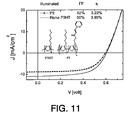
- Table 11 displays the I-V curve and Table 2 compares the initial device characteristics for P3HT/PCBM- and P3/PCBM-blends.
- Table 2 Blend [1:1 w/w] J sc [mA/cm 2 ] V oc [V] FF Power efficiency [%] P3HT/PCBM 10.93 0.60 0.60 3.95 P3/PCBM 8.87 0.59 0.62 3.22
- Example 7 Fabrication and comparative study of the power efficiency, open circuit voltage, Fill factor and short-circuit current versus time of two organic bulk heterojunction solar cells having respectively P3HT for "cell A” and the random copolymer P3 of example 2 for “cell B” as p-type material in their active layer.
- V oc The relative open circuit voltages ( V oc ), Fill Factors ( FF ), short-circuit current ( J sc ) values and power efficiencies of the solar cells with 1:1 (w/w) P3HT/PCBM-blends and P3 /PCBMblends as a function of time are shown in Fig. 12 to Fig. 15 for a temperature of 80 °C, Fig. 16 to Fig. 19 for a temperature of 100°C and Fig. 20 to Fig. 23 for a temperature of 150 °C. Note the different timescales at different temperatures.
- Figures 12 to 15 show that at a temperature of 80°C, the relative FF decreased very slightly and pseudo-linearly with time for the blend with P3 , whereas the blend with P3HT exhibited slightly lower relative FF values in a pseudo-linear decrease for the first 400 hours after which the deviation in FF for the blend with P3HT increased strongly with time, the relative V oc values for both blends first decreased and then the relative ⁇ / oc value for the P3-blend declined slightly linearly whereas the relative V oc value for the P3HT-blend first decreased slightly more strongly up to 500 hours before increasing and at 800 hours exceeded the value for the P3-blend, and the relative J sc value for the P3 -blend first increased and then decreased pseudo-linearly passing the initial value after about 800 hours whereas the relative J sc value for the P3HT-blend decreased pseudo-linearly by about 20% after 800 hours.
- the resulting relative power efficiency values mirrored the relative J sc -time characteristics with a
- Fig. 16 to 19 show that at a temperature of 100°C, the relative FF value for the P3 -blend initially rose slightly and then decreased linearly very slightly, whereas for the P3HT-blend there is a strong pseudo-linear decline of 12.5% after 100 hours, the relative V oc -value for the P3 -blend rose slightly and then stabilized over 100 hours whereas although the initial relative V oc value for the P3HT-blend was slightly higher there was a pseudo-linear decline of 15% after 100 hours, the relative short circuit current of Cell B (according to an embodiment of the present invention) was stable over time (more than 110 hours) whereas that for cell A (comparative) declined pseudo-linearly by 15% after 100 hours, and the relative power efficiency of Cell B was also stable over time (more than 110 hours) whereas that for Cell A (comparative) decreased pseudo-linearly by ca. 38% after 100 hours.
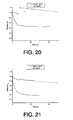
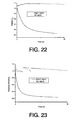
- Figures 20 to 23 show that at a temperature of 150°C the relative FF value decreased slightly and linearly with time for the blend with P3 , whereas the blend with P3HT showed a pronounced exponential decrease in relative FF value from comparable start values, the relative V oc -values also decreased with time with again a much reduced pseudo-linear decrease with the blend with P3 compared with a pronounced exponential decrease in the case of the blend with P3HT, and the relative J sc value for the blend with P3 exhibited a slight increase whereas the value for the blend with P3HT showed a pronounced exponential decrease to about 53% of the initial value after 40 hours, and the relative power efficiency for the blend with P3 increased by about 10% and then exhibited a linear back to the initial value after 50 hours whereas the power efficiency value for the blend with P3HT showed a pronounced exponential decline by about 78% of the initial value after 40 hours.
- Table 3 Maximum permissible decrease in J sc Cell A with P3HT/PCBM-blend [comparative] Cell B with P3 /PCBM-blend [present invention] Lifetime at 25 °C [years] Lifetime at 50°C [years] Lifetime at 25°C [years] Lifetime at 50 °C [years] 10% 10.9 0.6 49.3 2.8 20% 21.7 1.2 98.6 5.6 25% 27.1 1.6 123.2 7.1 50% 54.3 3.1 246.5 14.1
- the lifetime estimates are considerably longer for solar cell B with the P3/PCBM blend, according to the present invention, than for solar cell A with the P3HT/PCBM blend (comparative example) both at 25°C and 50°C.
- Example 8 synthesis of random copolymers of 3-hexylthiophene (M1) and 3-(2-acetoxyethyl)thiophene (M2), random copolymers of 3-hexylthiophene and 3-hydroxyethylthiophene (P2), and random copolymers with a 7:3 molar ratio of 3-hexylthiophene and 3-cinnamoyloxyethylthiophene (P6).
- M1 3-hexylthiophene
- M2 3-(2-acetoxyethyl)thiophene
- P2 3-hydroxyethylthiophene
- P6 random copolymers with a 7:3 molar ratio of 3-hexylthiophene and 3-cinnamoyloxyethylthiophene
- the random copolymers with a 7:3 molar ratio of 3-hexylthiophene and 3-cinnamoyloxyethylthiophene ( P6 ) was prepared entirely analogously to P3 except that the molar ratio of the 3-hexyl thiophene to 2,5-dibromo-3-acetylethanolthiophene ( M2 ), 2,5-dibromo-3-ethanolthiophene ( 2 ) and cinnamoylethyl thiophene respectively was 7:3.
- Example 9 fabrication and comparative study of the power efficiency of two organic bulk heterojunction solar cells having respectively P3HT for "cell A", the random copolymer P3 of example 2 for “cell B” as p-type material in their active layer and the random copolymer P6 of example 8 for "cell C” as p-type material.
- the solar cells of Example 9 were produced as described for Example 6 except that in addition to solar cells of with a 1:1 (w/w) P3HT/PCBM-blend and solar cells with a 1:1 (w/w) P3 /PCBM-blend solar cells were also produced with a 1:1 (w/w) P6 /PCBM-blend.
- the solar cells were kept at temperatures of 125 and 150°C for at least 100 hours, but in the case of P3 /PCBM- and P6 /PCBM-blends after the solar cells were irradiated 2 hours with the UV-lamp used in Example 6. In these experiments, the performances of the solar cells made with these polymer blends were clearly different.
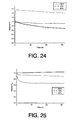
- the relative open circuit voltages ( V oc ), Fill Factors ( FF ), short-circuit current ( J sc ) values and efficiencies of the solar cells of P3HT, P3 and P6 with PCBM (1/1) as a function of time are shown in Fig. 24 to Fig. 27 for a temperature of 125°C.
Landscapes
- Chemical & Material Sciences (AREA)
- Engineering & Computer Science (AREA)
- Organic Chemistry (AREA)
- Physics & Mathematics (AREA)
- Nanotechnology (AREA)
- Materials Engineering (AREA)
- Crystallography & Structural Chemistry (AREA)
- Theoretical Computer Science (AREA)
- Mathematical Physics (AREA)
- Electromagnetism (AREA)
- Health & Medical Sciences (AREA)
- Chemical Kinetics & Catalysis (AREA)
- Medicinal Chemistry (AREA)
- Polymers & Plastics (AREA)
- Spectroscopy & Molecular Physics (AREA)
- Photovoltaic Devices (AREA)
- Organic Low-Molecular-Weight Compounds And Preparation Thereof (AREA)
- Addition Polymer Or Copolymer, Post-Treatments, Or Chemical Modifications (AREA)
Description
- The present invention relates to opto-electronic devices made by cross-linking blends of conjugated polymers having either p-type or n-type properties with n-type or p-type compounds respectively, preferably in the absence of a photoinitiator, said conjugated polymers being made from aromatic polymerisable compounds.
- Photosensitive polymers with photo-crosslinkable groups have gained a considerable interest in recent years owing to a wide variety of applications in the field of photoresist, photocurable coatings, microlithography, etc.
- Also in the field of organic semi-conducting materials, the interest in crosslinkable materials is increasing, notably for electroluminescent devices and the application of the active layer in a direct structured manner, avoiding then the use of shadow masks.
- An approach has been proposed in
U.S. Pat. 2007/0290194 in which a crosslinking process using oxetane-functionalized organic semiconductors and conductors is proposed. In this procedure the crosslinking reaction is initiated by UV irradiation in the presence of at least one added onium compound as photoinitiator. - Another approach has been proposed in
WO 2008/001051A2 wherein the active layer of the organic based device (mainly OLED, PLED, organic capacities touch sensor and bi-layer photovoltaics) is a semi-conducting polymer made from a polymerisable ink formulation comprising a liquid formed from a UV reactive resin monomer (monomer), a UV reactive thinner (oligomer) and a photoinitiator: the ink is configured for polymerization by UV exposure into a (semi-conducting) polymer film. - However the disadvantage of an admixed electronically active compound such as a photoinitiator is that it cannot be removed from the film after crosslinking and therefore can act as an impurity, adversely affecting the film composition, the film morphology and then affecting the functioning of the organic device. This is even more true for organic devices such as organic bulk hetero-junction solar cells in which the nano-morphology of the active layer is very sensitive to any parameter change (during the fabrication process but also during time after fabrication) and then to the power efficiency of the cell.
- Other methods towards crosslinkable semi-conducting polymers, mainly polythiophenes, have been reported in which no photoinitiator is used, but they show many drawbacks:
- G. Zotti in Synthetic Metals (1999) 105:135 has polymerized by electrochemistry an acrylated monomer giving a totally insoluble polymer;
- B. de Ruiter in Synthetic Metals, (1996) 79:215-218 has polymerized by oxidative polymerization an acrylated monomer but this method shows interference between the acrylate chemistry and the radical chain process leading to a very difficult control of the polymer fabrication (e.g. linear polymer chain are difficult to reach, with high polydispersity values even for very short reaction times).
- Zhu et al. in Journal of Macromolecular Science (2004) 41:1467-1487 reports the synthesis of epoxy-functionalized polythiophene derivatives. A slow degradation of cells made from poly(3-hexylthiophene) and a fullerene derivative of butyric acid methyl ester was observed due to a change of phase morphology.
- It is an object of the present invention to provide solar cells according to
claim 1. - It is an advantage of some embodiments of the present invention that crosslinkable semi-conducting materials can be produced that permit to stabilise in time the nano-morphology of an active layer comprising said crosslinkable semi-conducting materials. For instance, an active layer in organic bulk heterojunction solar cells comprising a semi-conducting material as described herein can have its nano-morphology stabilised upon cross-linking of said material.
- It is another advantage of some embodiments of the present invention that the stabilisation of the morphology is accompanied by a stabilisation of the performances of the device, such as for instance the stabilisation of the power efficiency and/or the short circuit current of a bulk heterojunction solar cell.
- It is another advantage of some embodiments of the present invention that the stabilisation of the morphology is accompanied by an increase in the lifetime to predetermined performance levels of the solar cells.
- It is another advantage of some embodiments of the present invention that the stability in time of the power efficiency of the solar cells may be linked to the stability in time of the active layer. This active layer may be processed as a thin film from an organic solvent in which both p- and n-type components are soluble, and may be made from a blend of a p-type semi-conducting polymer and a n-type material (for example a C60 fullerene derivative or a n-type semi-conducting polymer) which would tend to de-mix with time if not properly stabilised according to the teachings of this invention.
- It is an object of the present invention to provide a stable active layer based on a blend of p-type and n-type materials for bulk heterojunction solar cell applications. This blend may be made of a p-type semi-conducting material containing specific crosslinkable functions as side chains and a n-type material mixed together in various ratios and processed e.g. as a thin film from solution. The n-type material included in such blends can be any previously known small molecule, oligomer or polymer optionally containing known crosslinkable functions as side chains.
- Herein is described a class of monomeric compounds represented by the structural formula (I)


- Ar is a homocyclic or heterocyclic aromatic group selected from the group consisting of thienyl, phenyl, naphthyl, pyrrolyl, pyridyl, carbazolyl, fluorenyl and benzothiazolyl;
- L is selected from the group consisting of -O-, -CH(CH3)-O-, -(CH2)q-O-, - NH-, -CH(CH3)-NH-, -(CH2)q-NH-, -S-, -CH(CH3)-S- and -(CH2)q-S-" the oxygen atom of said -CH(CH3)-O- or -(CH2)q-O-, being adjacent to the carbonyl group, the NH group of said -CH(CH3)-NH- or -(CH2)q-NH-, being adjacent to the carbonyl group and the sulphur atom of said -CH(CH3)-S-or -(CH2)q-S-, being adjacent to the carbonyl group;
- q is 1, 2, 3, 4, 5, 6, 7, 8, 9, 10, 11 or 12;
- R1 and R2 are independently selected from the group consisting of hydrogen, C1-12 alkyl and phenyl, wherein said phenyl is optionally substituted with one or more substituents independently selected from the group consisting of hydroxyl, halogen, metonym, C2-4-alkoxy and trifluoromethyl;
- R3 is selected from the group consisting of hydrogen, C1-12-alkyl and phenyl;
- R4 is hydrogen, methyl or C2-4-alkyl; and
- X and Y are independently selected from the group consisting of hydrogen, chloro, bromo, iodo, boronic acid, boronic esters and organotin, provided that X and Y are not both hydrogen. In a preferred embodiment of the first aspect L is selected from the group consisting of -O-, -CH(CH3)-O-, -(CH2)q-O-, -NH- or -S-, the oxygen atom of said -CH(CH3)-O- or -(CH2)q-O-, being adjacent to the carbonyl group.
- Herein are also described conjugated polymers comprising one or more repeating units derived from the above-defined monomeric compounds represented by the structural formula (I) or the structural formula (II), and optionally one or more repeating units derived from a co-monomer copolymerisable with said monomeric compound, the latter repeating units comprising a divalent homocyclic or heterocyclic aromatic group Ar' optionally substituted with one or more substituents independently selected from the group consisting of C1-20-alkyl, C1-20-alkoxy, C1-20-alkylsulfate, phenyl, benzyl, and functional crosslinkable groups.
- Herein are also described methods for producing an above-defined monomeric compounds represented by the structural formula (I) or the structural formula (II), comprising reacting a hydroxyl-substituted homocyclic or heterocyclic aromatic compound represented by the structural formula (III)


or with an acetylenically unsaturated carbonyl chloride represented by the structural formula (V)
- Herein is also described a method for producing the above-described polymer comprising polymerising a compound represented for formula (I) or formula (II) by reductive coupling.
- Herein is also described a method for producing the above-described polymer comprising copolymerising by reductive coupling a compound according to formula (I) or formula (II) and one or more co-monomers.
- Herein is also described a process for preparing a polymer comprising the following steps: copolymerization of a monomer post-functionalisable to a compound represented by structural formula (I) or structural formula (II) as defined above with a co-monomer copolymerisable therewith, said co-monomer being a divalent homocyclic or heterocyclic aromatic group Ar' optionally substituted with one or more substituents independently selected from the group consisting of C1-20-alkyl, C1-20-alkoxy, C1-20-alkylsulfate, phenyl and benzyl, to produce a post-functionalisable copolymer; and post-functionalizing said post-functionalisable copolymer to produce the polymer of the fifth aspect. Examples of monomers post-functionalisable to a compound represented by structural formula (I) are esters of 3-(2-hydroxyethyl)thiophene e.g. 3-(2-acetoxyethyl)thiophene.
- Herein are also described blends of a n-type or p-type compound and a conjugated polymer or conjugated copolymer derived from a monomeric compound represented by the structural formula (I) or the structural formula (II).
- Herein are also described crosslinked polymer materials, and methods for producing the same, being irradiated, e.g. UV-irradiated, blends as mentioned before preferably in the absence of a photoinitiator.
- The present invention provides solar cells comprising a crosslinked polymer material as defined above, i.e. obtained from irradiated blends of a n-type or p-type compound and a conjugated polymer or copolymer derived from an above-defined monomeric compound.
-
-
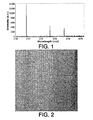
Fig. 1 shows the UV spectrum of an irradiation lamp used to operate cross-linking. -
Fig. 2 shows a TEM picture of a comparative blend (film A) as deposited. -
Fig. 3 shows a TEM picture of a comparative blend (film A) after heat treatment. -
Fig. 4 shows as electron diffraction pattern measured on the comparative blend (Fig. 3 ) after heat treatment. -
Fig. 5 shows a TEM picture of a comparative blend (film A) after heat treatment. The magnification is larger than in the TEM picture ofFig. 3 . -
Fig. 6 shows a TEM picture of a blend (film B) as deposited. -
Fig. 7 shows a TEM picture of a blend (film B) after heat treatment. -
Fig. 8 shows a TEM picture of a blend (film B) after heat treatment. The magnification is smaller than forFig. 7 . -
Fig. 9 shows a TEM picture of a blend (film B) after UV curing and heat treatment. -
Fig. 10 shows a TEM picture of a blend (film B) after UV curing and heat treatment. The magnification is smaller than forFig. 9 . -
Fig. 11 is a graph of the current density versus the voltage as measured on a bulk heterojunction solar cell having an active layer made from a blend according to an embodiment of the present invention. -
Fig. 12 is a graph of the relative Fill Factor versus time as measured on a bulk heterojunction solar cell having an active layer made from a comparative blend (Cell A) and on a bulk heterojunction solar cell having an active layer made from a P3/PCBM blend according to an embodiment of the present invention (Cell B) at 80°C. -
Fig. 13 is a graph of the relative open circuit voltage versus time as measured on a bulk heterojunction solar cell having an active layer made from a comparative blend (Cell A) and on a bulk heterojunction solar cell having an active layer made from a P3/PCBM blend according to an embodiment of the present invention (Cell B) at 80°C. -
Fig. 14 is a graph of the relative short-circuit current density versus time as measured on a bulk heterojunction solar cell having an active layer made from a comparative blend (Cell A) and on a bulk heterojunction solar cell having an active layer made from a P3/PCBM blend according to an embodiment of the present invention (Cell B) at 80°C. -
Fig. 15 is a graph of the relative power efficiency versus time as measured on a bulk heterojunction solar cell having an active layer made from a comparative blend (Cell A) and on a bulk heterojunction solar cell having an active layer made from a P3/PCBM blend according to an embodiment of the present invention (Cell B) at 80°C. -
Fig. 16 is a graph of the relative Fill Factor versus time as measured on a bulk heterojunction solar cell having an active layer made from a comparative blend (Cell A) and on a bulk heterojunction solar cell having an active layer made from a P3/PCBM blend according to an embodiment of the present invention (Cell B) at 100°C. -
Fig. 17 is a graph of the relative open circuit voltage versus time as measured on a bulk heterojunction solar cell having an active layer made from a comparative blend (Cell A) and on a bulk heterojunction solar cell having an active layer made from a P3/PCBM blend according to an embodiment of the present invention (Cell B) at 100°C. -
Fig. 18 is a graph of the relative short-circuit current density versus time as measured on a bulk heterojunction solar cell having an active layer made from a comparative blend (Cell A) and on a bulk heterojunction solar cell having an active layer made from a P3/PCBM blend according to an embodiment of the present invention (Cell B) at 100°C. -
Fig. 19 is a graph of the relative power efficiency versus time as measured on a bulk heterojunction solar cell having an active layer made from a comparative blend (Cell A) and on a bulk heterojunction solar cell having an active layer made from a P3/PCBM blend according to an embodiment of the present invention (Cell B) at 100°C. -
Fig. 20 is a graph of the relative Fill Factor versus time as measured on a bulk heterojunction solar cell having an active layer made from a comparative blend (Cell A) and on a bulk heterojunction solar cell having an active layer made from a blend according to an embodiment of the present invention (Cell B) at 150°C. -
Fig. 21 is a graph of the relative open circuit voltage versus time as measured on a bulk heterojunction solar cell having an active layer made from a comparative blend (Cell A) and on a bulk heterojunction solar cell having an active layer made from a P3/PCBM blend according to an embodiment of the present invention (Cell B) at 150°C. -
Fig. 22 is a graph of the relative short-circuit current density versus time as measured on a bulk heterojunction solar cell having an active layer made from a comparative blend (Cell A) and on a bulk heterojunction solar cell having an active layer made from a P3/PCBM blend according to an embodiment of the present invention (Cell B) layer made from a blend according to an embodiment of the present invention at 150°C. -
Fig. 23 is a graph of the relative power efficiency versus time as measured on a bulk heterojunction solar cell having an active layer made from a comparative blend (Cell A) and on a bulk heterojunction solar cell having an active layer made from a P3/PCBM blend according to an embodiment of the present invention (Cell B) at 150°C. -
Fig. 24 is a graph of the relative Fill Factor versus time as measured on a bulk heterojunction solar cell having an active layer made from a comparative blend (Cell A) and on a bulk heterojunction solar cell having an active layer made from a P3/PCBM blend according to an embodiment of the present invention (Cell B) and on a bulk heterojunction solar cell having an active layer made from a P6/PCBM blend according to an embodiment of the present invention (Cell C) at 125°C. -
Fig. 25 is a graph of the relative open circuit voltage versus time as measured on a bulk heterojunction solar cell having an active layer made from a comparative blend (Cell A) and on a bulk heterojunction solar cell having an active layer made from a P3/PCBM blend according to an embodiment of the present invention (Cell B) and on a bulk heterojunction solar cell having an active layer made from a P6/PCBM blend according to an embodiment of the present invention (Cell C) at 125°C. -
Fig. 26 is a graph of the relative short-circuit current density versus time as measured on a bulk heterojunction solar cell having an active layer made from a comparative blend (Cell A) and on a bulk heterojunction solar cell having an active layer made from a P3/PCBM blend according to an embodiment of the present invention (Cell B) and on a bulk heterojunction solar cell having an active layer made from a P6/PCBM blend according to an embodiment of the present invention (Cell C) at 125°C. -
Fig. 27 is a graph of the relative power efficiency versus time as measured on a bulk heterojunction solar cell having an active layer made from a comparative blend (Cell A), on a bulk heterojunction solar cell having an active layer made from a P3/PCBM blend according to an embodiment of the present invention (Cell B) and on a bulk heterojunction solar cell having an active layer made from a P6/PCBM blend according to an embodiment of the present invention (Cell C) at 125°C. - As used herein with respect to a substituting group, and unless otherwise stated, the term "C1-12 alkyl" refers to a straight (non-branched) or branched chain saturated acyclic hydrocarbon monovalent group having from 1 to 4 carbon atoms such as, for example, methyl, ethyl, propyl, n-butyl, 1-methylethyl (isopropyl), 2-methylpropyl (isobutyl), and 1,1-dimethylethyl (tert-butyl). Similarly, the term " C1-20 alkyl " refers to straight (non-branched) or branched chain groups having from 1 to 20 carbon atoms such as, for example, pentyl, hexyl, heptyl, octyl, nonyl, decyl, dodecyl, tetradecyl, hexadecyl, octadecyl and the like.
- As used herein with respect to a substituting group, and unless otherwise stated, the terms "homocyclic aromatic" or "aryl" designate any mono- or polycyclic aromatic monovalent hydrocarbon group having from 6 to 15 carbon atoms such as, but not limited to, phenyl, naphthyl, anthracenyl, phenanthracyl, fluoranthenyl, chrysenyl, pyrenyl, biphenylyl, terphenyl, picenyl, indenyl, biphenyl, indacenyl, tetrahydropyrenyl, benzocyclobutenyl, benzocyclooctenyl and the like, including fused benzo-C4-8 cycloalkyl groups such as, for instance, indanyl, tetrahydronaphthyl, fluorenyl and the like, all of the said groups being optionally substituted with one or more substituents (preferably 1 to 3 substituents) independently selected from the group consisting of halogen, C1-12 alkyl, nitro, trifluoromethoxy, trifluoromethyl and C1-12 alkoxy (all of such substituents being such as herein defined, including individual species and sub-groups thereof), such as, but not limited to, 4-fluorophenyl, 4-chlorophenyl, 3,4-dichlorophenyl, 2,6-dichlorophenyl, 2-fluorophenyl, 3-chlorophenyl, 3,5-dichlorophenyl, trifluoromethylphenyl, 3,4-dimethoxyphenyl, iodophenyl, and bromophenyl.
- As used herein with respect to a substituting group, and unless otherwise stated, the terms "heterocyclic aromatic" or "heteroaryl" means a mono- or polycyclic, polyunsaturated, monovalent hydrocarbon group having from 4 to 12 carbon atoms and including one or more heteroatoms in one or more heterocyclic rings, each of said rings having 5 or 6 atoms (and optionally further including one or more heteroatoms attached to one or more carbon atoms of said ring, for instance in the form of a carbonyl, and/or to one or more heteroatoms of said ring, for instance in the form of a N-oxide), each of said heteroatoms being independently nitrogen or sulfur, also including groups wherein a heterocyclic ring is fused to one or more aromatic homocyclic rings for instance in the form of benzo-fused, dibenzo-fused and naphtho-fused heterocyclic groups; within this definition are included heteroaryl groups such as, but not limited to, thienyl, pyrrolyl, pyridyl, carbazolyl and benzothiazolyl.
- As used herein with respect to a substituting atom, and unless otherwise stated, the term "halogen" means any atom selected from the group consisting of fluorine, chlorine, bromine and iodine.
- As used herein with respect to a substituting group, and unless otherwise stated, the term "C1-12 alkoxy" refers to substituents wherein a carbon atom of a C1-20 alkyl group (such as defined herein above, including sub-groups thereof), is attached to an oxygen atom through a single bond, including methoxy, ethoxy, propoxy, n-butoxy, isopropoxy, sec-butoxy, and tert-butoxy.
- As used herein with respect to a substituting group, and unless otherwise stated, the term "C1-20 alkylsulfate" refers to substituents wherein a carbon atom of a C1-20 alkyl group (such as defined herein above, including sub-groups thereof), is attached to an oxygen atom of a sulfate group through a single bond such as, but not limited to methylsulfate (methoxysulfonyloxy), ethylsulfate (ethoxysulfonyloxy), n-butylsulfate (n-butoxysulfonyloxy), tert-butylsulfate (tert-butoxysulfonyloxy), undecylsulfate (undecyloxysulfonyloxy), and the like.
- As used herein, and unless otherwise stated, the term "arylene" designates any divalent group derived from aryl (such as above defined) by abstracting a hydrogen atom.
- As used herein, and unless otherwise stated, the term "heteroarylene" designates any divalent group derived from heteroaryl (such as above defined) by abstracting a hydrogen atom.
- As used herein, and unless otherwise stated, "crosslinkable" refers to the capacity of being irreversibly cured or polymerized, thereby forming a material that cannot be reshaped or reformed.
- As used herein with respect to a substituting group, and unless otherwise stated, the term "functional crosslinkable" group designates moieties containing one or more functionalities selected from the group consisting of double bond, triple bond, or precursors thereof, or addition-polymerisable groups known in the art. Suitable crosslinkable groups include vinyl, allyl, or may be derived from acrylates, methacrylates, vinyl ethers, 1-propenyl ethers, arylene containing one or more substituents independently selected from the group consisting of benzocyclobutane, azide, di(hydrocarbyl)amino, cyanate, ester, hydroxyl, glycidyl ether, C1-20 alkyl acrylates, C1-20 alkyl methacrylates, alkenyl, alkenyloxy, alkynyl, maleimide, vinylbenzyl, allyloxy, p-ethenylphenyl, perfluoroethenyl, perfluoroethenyloxy, coumaroyl, and halogenated derivatives thereof.
- As used herein with respect to organic devices, and unless otherwise stated, the term "active layer" designates an organic layer which includes an organic semiconductor material exhibiting one type of electronic conductivity and possibly a second semiconductor material having the same or opposite type conductivity.
- As used herein with respect to an active, and unless otherwise stated, the term "stable" refers to the adequate nano-morphology of the active layer which does not change in time at room temperature or even at higher temperature under inert atmosphere.
- As used herein, and unless otherwise stated, the term " boronic ester " refers to a boronic acid derivative wherein hydrogen is replaced by any organic residue, preferably a hydrocarbyl group, and which can be obtained by condensation with alcohols or diols, including but not limited to dioxaborolanes and dioxaborinanes.
- As used herein, and unless otherwise stated, the term " organotin " refers to a group represented by the structural formula SnR9R10R11 wherein each of R9, R10 and R11 is independently selected from the group consisting of halogen, C1-20 alkyl, C3-10 cycloalkyl, aryl, benzyl and C2-7 alkenyl, provided that R9, R10 and R11 are not simultaneously halogen; such organotin groups may be derived from tin compounds including, but not limited to, di-n-butyltin dibromide, di-n-butyltin dichloride, di-tert-butyltin dichloride, dimethyltin dibromide, dimethyltin dichloride, dimethyltin difluoride, dimethyltin diiodide, diphenyltin dichloride, diphenyltin dibromide, diphenyltin difluoride, diphenyltin diiodide, tributyltin fluoride, tributyltin chloride, tributyltin bromide, tributyltin iodide, phenyltin tribromide, phenyltin trichloride, tricyclohexyltin chloride, triethyltin bromide, triethyltin chloride, triethyltin iodide, vinyltributyltin, tetrabutyltin, butyltin trichloride, n-butylvinyltin dichloride, diallyldibutyltin, diallyldiphenyltin, dibutylvinyltin bromide, dibutylvinyltin chloride, dichlorodi-m-tolylstannane, diethyldiisoamyltin, diethyldiisobutyltin, diethyldiphenyltin, diethylisoamyltin bromide, diethylisoamyltin chloride, diethylisobutyltin bromide, diethyl-n-propyltin bromide, diethyl-n-propyltin chloride, diethyl-n-propyltin fluoride, diethyltin dibromide, diethyltin dichloride, diethyltin difluoride, diethyltin diiodide, diisoamyltin dibromide, diisoamyltin dichloride, diisoamyltin diiodide, diisobutyltin dichloride, diisobutyltin diiodide, diisopropyltin dichloride, diisopropyltin dibromide, dimethyldiethyltin, dimethyldiisobutyltin, dimethyldioctyltin, dimethyldivinyltin, dimethylethylpropyltin, dimethylethyltin iodide, dimethyldivinyltin, dimethylvinyltin bromide, dimethylvinyltin iodide, diphenyldivinyltin, dipropyltin difluoride, dipropyltin diiodide, dipropyltin dichloride, dipropyltin dibromide, di-o-tolyltin dichloride, di-p-tolyltin dichloride, ditriphenyl-stannylmethane, divinylbutyltin chloride, divinyltin dichloride, ethyldiisoamyltin bromide, ethyldiisobutyltin bromide, ethylmethylpropyltin iodide, ethyl-n-propyldiisoamyltin, ethylpropyltin dichloride, ethyltin tribromide, ethyltin triiodide, ethyltri-n-butyltin, ethyltri-n-propyltin, methyltin tribromide, methyltin trichloride, methyltin triiodide, methyltri-n-butyltin, methyltri-n-propyltin, phenylbenzyltin dichloride, phenyltribenzyltin, propyltin triiodide, propyltri-n-amyltin, tetra-n-amyltin, tetra-n-butyltin, tetrabenzyltin, tetracyclohexyltin, tetraethyltin, tetra-n-heptyltin, tetra-n-hexyltin, tetraisoamyltin, tetraisobutyltin, tetralauryltin, tetramethyltin, tetra-n-octyltin, tetraphenyltin, tetrapropyltin, tetra-o-tolyltin, tetra-m-tolyltin, tetra-p-tolyltin, tetravinyltin, tetra-m-xylyltin, tetra-p-xylyltin, o-tolyltin trichloride, p-tolyltin trichloride, m-tolyltrichlorostannane, triallylbutyltin, tri-n-amyltin bromide, tribenzylethyltin, tribenzyltin chloride, tribenzyltin iodide, tri-n-butyltin bromide, tri-n-butylvinyltin, triethyl-n-amyltin, triethylisoamyltin, triethylisobutyltin, triethylphenyltin, triethyl-n-propyltin, triisoamyltin bromide, triisoamyltin chloride, triisoamyltin fluoride,triisoamyltin iodide, triisobutylethyltin, triisobutylisoamyltin, triisobutyltin bromide, triisobutyltin chloride, triisobutyltin fluoride, triisobutyltin iodide, triisopropyltin bromide, triisopropyltin iodide, trimethyldecyltin, trimethyldodecyltin, trimethylethyltin, trimethyltin bromide, trimethyltin chloride, trimethyltin fluoride, trimethyltin iodide, triphenylallyltin, triphenylbenzyltin, triphenylbutyltin, triphenylethyltin, triphenylmethyltin, triphenyl-α-naphthyltin, triphenyltin bromide, triphenyltin chloride, triphenyltin fluoride, triphenyltin iodide, triphenyl-p-tolyltin, triphenyl-p-xylyltin, tri-n-propyl-n-butyltin, tri-n-propylethyltin, tri-n-propylisobutyl tin, tri-n-propyltin chloride, tri-n-propyltin fluoride, tri-n-propyltin iodide, tri-o-tolyltin bromide, tri-p-tolyltin bromide, tri-o-tolyltin chloride, tri-m-tolyltin chloride, tri-p-tolyltin chloride, tri-p-tolyltin fluoride, tri-o-tolyltin iodide, tri-p-tolyltin iodide, triphenylstannylmethane, trivinyldecyltin, trivinylhexyltin, trivinyloctyltin, trivinyltin chloride, vinyltin trichloride, tri-p-xylyltin bromide, tri-p-xylyltin chloride, tri-p-xylyltin fluoride, tri-p-xylyltin iodide and tri-m-xylyltin fluoride.
- Within the class of monomeric compounds represented by the structural formula (I) and (II), as described in the Summary of the Invention, the following more specific embodiments are of particular importance:
- compounds represented by the structural formula (I) or the structural formula (II) wherein L is adjacent to X or Y;
- compounds represented by the structural formula (I) wherein R1 and R2 are both hydrogen, and R4 is methyl, which may be derived from methacryloyl chloride, as explained below with regard to the third aspect of the invention;
- compounds represented by the structural formula (I) wherein R1 and R4 are hydrogen, and wherein R2 is methyl or ethyl or n-propyl or n-butyl, or R2 is phenyl optionally mono-substituted with fluoro, chloro, hydroxyl, methoxy, trifluoromethyl or C2-4-alkoxy: such compounds may be derived from crotonyl chloride, pent-2-enoyl chloride, hex-2-enoyl chloride, hept-2-enoyl chloride, phenylprop-2-enoyl chloride, cinnamoyl chloride, 2-chlorocinnamoyl chloride, 4-fluorocinnamoyl chloride, 4-methoxycinnamoyl chloride, or analogs thereof as explained below with regard to the third aspect of the invention;
- compounds represented by the structural formula (I) wherein R1, R2 and R4 are hydrogen, which may be derived from acryloyl chloride, as explained below with regard to the third aspect of the invention; and
- compounds represented by the structural formula (II) wherein R3 is hydrogen, methyl, ethyl, n-propyl or phenyl, which may be derived from propiolic acid chloride and analogs thereof, as explained below with regard to the third aspect of the invention.
- Within the conjugated polymers, as described in the Summary of the Invention, a more specific embodiment of particular importance consists of functionalized semi-conducting materials (conjugated materials), being oligomers, polymers or copolymers, containing one or more monomeric groups or repeating units represented by the structural formula (IA):


- More specifically Ar' may be 2,5-thienylene optionally substituted with one or more substituents independently selected from the group consisting of C1-20-alkyl, C1-20-alkoxy, C1-20-alkylsulfate, phenyl, benzyl, and functional crosslinkable groups known in the art, e.g. 3-n-hexyl-2,5-thienylene or 3-n-octyl-2,5-thienylene.
- The aromatic homocyclic or heterocyclic group Ar and the optionally substituted arylene or heteroarylene divalent group Ar' may be the same, e.g. they may be both 2,5-thienylene, or may be different.
- In one embodiment, when said semi-conducting conjugated material is a copolymer containing one or more monomeric groups or repeating units represented by the structural formula (IA), wherein Ar is thienyl, and one or more monomeric groups or repeating units comprising a divalent group Ar' wherein Ar' is 3-C1-20-alkyl-2,5-thienylene, then R1 and R2 are not both hydrogen.
- In another embodiment, when said semi-conducting conjugated material is a copolymer containing one or more monomeric groups or repeating units represented by the structural formula (IA), wherein Ar is fluorenyl, and one or more monomeric groups or repeating units comprising a divalent group Ar' wherein Ar' is 2,7-fluorenylene, then R1 and R2 are not both hydrogen.
- In another embodiment, the weight average molecular weight Mw (measured against a polystyrene standard) of the polymer or copolymer of this invention may be in the range from about 10,000 to about 1,000,000 Dalton, e.g. from about 40,000 to 75,000 Dalton;
- In another embodiment, the polydispersity index (PD = Mw/Mn) of the polymer or copolymer of this invention may be comprised between 1.05 and about 5.0, e.g. between 1.1 and 3.0, or between about 1.3 and 2.5.
- In a particular embodiment of these conjugated polymers, the arylene or heteroarylene divalent group Ar' present in the recurring units of the co-monomer may be selected from the group consisting of 1,4-phenylene; 2,6-naphthalenediyl; 1,4-naphthalenediyl; 1,4-anthracenediyl; 2,6-anthracenediyl; 9,10-anthracenediyl; 2,5-thienylene; 2,5-furanediyl; 2,5-pyrrolediyl; 1,3,4-oxa-diazole-2,5-dyil; 1,3,4-thiadiazole-2,5-diyl; 2,3-benzo[c]thienylene; thieno[3,2-b]thiophene-2,5-diyl; pyrrolo[3,2-b]pyrrole-2,5-diyl; pyrene-2,7-diyl; 4,5,9,10-tetrahydropyrene-2,7-diyl; 4,4'-bi-phenylene; phenantrene-2,7-diyl; 9,10-dihydrophenantrene-2,7-diyl; dibenzo-furane-2,7-diyl; dibenzothiophene-2,7-diyl; 2,5-selenophenylene; isothianaphthylene; 2,7-silafluorenylene; 3,6-carbazolediyl; pyridinediyl; 2,2'-dipyridinediyl; pyridopyrazinediyl; quinoxalinediyl; thieno[3,4-c]pyridinediyl; thieno[3,4-b]pyridinediyl; thieno[3,4-b]pyrazinediyl; benzothiadiazolediyl; 4H-cyclopenta[2,1-b;3,4-b']dithienylene; silacyclo-pentadienediyl; and anthrazolinediyl. More specific examples of suitable co-monomers of this type are given below, together with literature references relating to their polymerisation techniques.
- In a particular embodiment of these conjugated polymers, the co-monomer comprising a divalent group Ar' may represent at least 0.5 % by mole of the copolymer, e.g. at least 50 % by mole of the copolymer, or at least 85 % by mole of the copolymer. In another particular embodiment of these conjugated polymers, the co-monomer comprising a divalent group Ar' may represent at most 99.5 % by mole of the copolymer, e.g. at most 98 % by mole of the copolymer, or at most 15 % by mole of the copolymer.
- Within the methods for producing an above-defined monomeric compounds represented by the structural formula (I) or the structural formula (II), as described in the Summary of the Invention, the following more specific embodiments are of particular importance:
- the ethylenically unsaturated carbonyl chloride represented by the structural formula (IV) may be selected from the group consisting of crotonyl chloride, acryloyl chloride, methacryloyl chloride, pent-2-enoyl chloride, hex-2-enoyl chloride, hept-2-enoyl chloride, cinnamoyl chloride, 2-chlorocinnamoyl chloride, 4-fluorocinnamoyl chloride, and 4-methoxycinnamoyl chloride;
- the acetylenically unsaturated carbonyl chloride represented by the structural formula (V) may be selected from the group consisting of propiolic acid chloride, phenylpropiolic acid chloride, 2-butynoic acid chloride, 2-pentynoic acid chloride, and 2-hexynoic acid chloride;
- the hydroxyl-substituted homocyclic or heterocyclic aromatic compound represented by the structural formula (III) may be selected from the group consisting of 2,5-dibromo-3-hydroxyethyl thiophene, 2,5-dibromo-3-hydroxymethyl thiophene, 2,5-dibromophenol, 2-bromophenol, 3-bromophenol, 4-bromophenol, 2,5-dibromo-1-(2-hydroxyethyl)benzene, 2-bromobenzyl alcohol, 3-bromobenzyl alcohol, 4-bromobenzyl alcohol, 4-hydroxyphenylboronic acid, 4-(hydroxymethyl)phenylboronic acid, 3-(hydroxymethyl)phenylboronic acid, 2,6-dibromo-4-(2-hydroxyethyl)-pyridine, 2,6-dibromo-3-(2-hydroxyethyl)pyridine, (S)-2,6-dibromo-4-(1-hydroxyethyl)pyridine, (R)-2,6-dibromo-4-(1-hydroxyethyl)pyridine, 2,6-dibromo-4-(hydroxymethyl)-pyridine, 2,6-dibromo-3-(hydroxymethyl)-pyridine, 2,6-dibromo-3-(3-hydroxypropyl)-pyridine, 3,6-dibromo-9H-2-hydroxycarbazole, 3,6-dibromo-9H-4-hydroxycarbazole, 2,7-dibromo-9-hydroxyfluorene, 2,7-dibromo-9-hydroxymethylfluorene, 1,4-dibromo-2-naphthol, 1,4-dibromo-2-naphthalenemethanol and 4,7-dibromo-2-hydroxybenzothiazole ; when such a homocyclic or heterocyclic aromatic compound represented by the structural formula (III) is not commercially available, it may be produced by inserting the X and/or Y substituent onto a readily available hydroxyl-containing compound with the structural formula Ar-LH, e.g. through chlorination, bromination, iodination or boronation, using synthetic procedures known in the art.
- In a preferred embodiment of the present invention, the polymers and copolymers described herein may be produced via a reductive coupling reaction such as, but not limited to, Rieke coupling (e.g. following a procedure analog to the one disclosed in T.-A.Chen, R. D. Rieke, J. Am. Chem. Soc. (1992) 114, 10087), McCullough coupling (e.g. following a procedure analog to the one disclosed in R. D. McCullough et al., J. Chem. Soc., Chem. Commun., 1992. 70 or
U.S. Pat. No. 6,166,172 ), Stille coupling (e.g. following a procedure analog to the one disclosed in Milstein, D.; Stille, J. K. J. Am. Chem. Soc. 1978, 100, 3636 or D. Milstein, J. K. Stille, J. Am. Chem. Soc., 1979, 101, 4992.), Suzuki coupling (e.g. following a procedure analog to the one disclosed in N. Miyaura, T. Yanagi, A. Suzuki, Synth. Commun., 1981, 11, 513) or Yamamoto coupling (e.g. following a procedure analog to the one diclosed in T. Yamamoto, A. Morita, Y. Miyazaki, T. Maruyama, H. Wakayama, Z. H. Zhou, Y. Nakamura, T. Kanbara, S. Sasaki and K. Kubota, Macromolecules, 1992, 25, 1214). - In a particular embodiment of the invention, the polymers described herein include homopolymers containing monomeric groups or repeating units represented by the structural formula (IA) or the structural formula (IIA), and copolymers comprising two or more different recurring units, including a divalent group Ar', in a random or block arrangement type, which may include the same or a different aromatic homocyclic or heterocyclic group.
- Suitable co-monomers that can be co-polymerised with the crosslinkable monomers according to different embodiments of the present invention, especially as represented by the structural formula (I) or the structural formula (II), include monomers, preferably conjugated monomers, comprising two reactive groups selected from the group consisting of halogen (e.g. I, Br or Cl), boronic acid, boronic esters, organotin, and other groups known by the person skilled in the art be useful in reductive coupling reactions. Those co-monomers includes monomers such as among others fluorene derivatives (such as but not limited to 2,7-dibromo-9,9-dialkylfluorene or 2,7-dibromo-9,9-diarylfluorenes (see e.g. C. Ego et al, Adv. Mater. 14 (2002) 809-811 )) , indenofluorene derivatives (see e.g. S. Setayesh, Macromolecules (2000)33:2016), phenylene or ladder-type phenylene derivatives (see e.g. J. Grimme et al., Adv. Mat. (1995) 7 ,292), aniline derivatives, thiophene derivatives (such as 2,5-dibromothiophenes and 2,5-dibromo-3-C1-20 alkylthiophenes), fluorenone derivatives (such as but not limited to 2,7-dibromoflurenone), naphthalene derivatives (such as but not limited to 2,6-dibromonaphthalene and 1,4-dibromonaphthalene); anthracene derivatives (such as, but not limited to, 1,4-dibromoanthracene, 2,6-dibromoanthracene and 9,10-dibromoanthracene); furane derivatives (such as, but not limited to, 2,5-dibromofurane); pyrrole derivatives such as, but not limited to, 2,5-dibromopyrrole); 1,3,4-oxadiazole-2,5-dyil derivatives; 1,3,4-thiadiazole-2,5-diyl derivatives; 2,3-benzo[c]thienylene derivatives; thieno[3,2-b]thiophene-2,5-diyl derivatives; pyrrolo[3,2-b]pyrrole-2,5-diyl derivatives; pyrene derivatives such as, but not limited to, 2,7-dibromopyrene and 2,7-dibromo-4,5,9,10-tetrahydropyrene; 4,4'-bi-phenylene derivatives; phenanthrene derivatives (such as, but not limited to, 2,7-dibromo phenanthrene; 3,6-dibromophenanthrene and 2,7-dibromo,-9,10-dihydrophenantrene); dibenzofurane-2,7-diyl derivatives; dibenzo-thiophene-2,7-diyl derivatives, and perylene derivatives (see C. Ego et al, J. Am. Chem. Soc. 125(2) (2003) 437-443 ).
- A monomer or co-monomer involved in the polymerisation process in a Rieke or Yamamoto coupling polymerisation comprises preferably two identical (i.e. X = Y) reactive halogens (e.g. I, Br or Cl).
- The monomer or co-monomers involved in a polymerisation process in a Suzuki coupling polymerisation preferably comprise:
- (a) two identical (i.e. X = Y) reactive halogens (e.g. I, Br or Cl) for one molar half of the comonomers involved and two identical reactive groups selected from the group consisting of boronic acid and boronic esters for another molar half of the comonomers involved, or
- (b) one reactive halogen (e.g. I, Br or Cl) and another reactive group (i.e. X and Y are different) selected from the group consisting of boronic acid or boronic esters.
- The monomer or co-monomers involved in the polymerisation process in a Stille coupling polymerisation preferably comprise:
- (a) two identical (i.e. X = Y) reactive halogens (e.g. I, Br or Cl) for one molar half of the comonomers involved and two identical reactive organotin groups for another molar half of the comonomers involved, or
- (b) each one reactive halogen (e.g. I, Br or Cl) and another reactive (i.e. X and Y are different) organotin group.
- The nature of the end groups resulting from the polymerisation process is usually difficult to determined in view of the large molecular mass of the polymer produced but it is usually accepted that they are either of the same nature as one of the leaving groups present on the starting monomer (e.g. halogen (e.g. I, Br or Cl), boronic acid, boronic ester or organotin, or hydrogen.
- Methods to introduce alternative end-groups into the (co)polymer are well known to the person skilled in the art. A first method (a so-called "one pot" method) involves the addition of ending molecules together with the monomer or co-monomers into the reaction mixture right from the start of the polymerisation. A second method involves a first step of producing the (co)polymer as described in the previous paragraphs, and a second step of reacting this (co)polymer with the ending molecules. In both methods the ending molecules preferably comprise only one reactive halogen (e.g. I, Br or Cl), boronic acid, boronic ester, organotin or other group known by the person skilled in the art be useful in reductive coupling and are otherwise analog to the co-monomers described above.
- An example of end-group introduction according to the first method is disclosed in C. Ego et al, J. of the Am. Chem. Soc. 125(2) (2003), 437-443).
- According to the present invention the polymers described herein are suitable for use in active layer of organic devices and more particularly bulk heterojunction solar cells. The present application further relates to an active layer, which comprises the polymers as described above.
- In order to be used as active layers, the polymers are generally applied in the form of a thin film to a substrate by know methods familiar to the person skilled in the art, such as dipping, spin coating, inkjet printing, screen printing, etc.
- The invention relates to organic solar cells having one or more active layers, where at least one of these active layers comprises one or more polymers as described herein.
- The invention likewise relates to organic solar cells having one or more active layers, where at least one of these active layers is made from a blend of one or more polymers as described above having one type of electronic conductivity and a second semi-conducting material (small molecule as for example C60 derivatives or polymers as semi-conducting polymers) having the opposite type conductivity.
- In a particular embodiment the second semi-conducting material having the opposite type conductivity may be or may not be a polymer as described herein, i.e. with crosslinkable side groups.
- Polymers as described herein are furthermore suitable for organic based devices, for example but not limited to, for use in light emitting diodes, optical storage media, as photorefractive, for nonlinear-optical applications, in organic transistors such as Field effect transistors (FET), in photovoltaic cells (bilayers, bulk heterojunction, tandem cells, dye-sensitized, organic/organic, organic/polymer, organic/inorganic, etc), in chemo- and bio-sensors.
- There is also herein provided a method for stabilizing the nano-morphology of an active layer, which comprises one or more polymers as described herein. Herein is described a "stable" active layer, which comprises one or more polymers as described herein. The nano-morphology of the active layer becomes stable after UV curing.
- In a particular embodiment, UV lamps with shortwave (200-280 nm, typically 254 nm), midrange (280-315 nm, typically 302 nm) or long-wave (315-380 nm, typically 365 nm) are suitable for the UV-curing process which is carried out in inert atmosphere. The plurality of parameters of the UV light (for example but not limited to UV peak intensity and dosage) is controlled to ensure optimum curing of the layer. A low irradiation for a relatively long period is not equivalent to a higher irradiation for a shorter period, even if the overall energies are equal.
- According to an aspect of the present invention there is provided a time-stable organic solar cell comprising one or more "stable" active layer.
- Organic solar cells with active layers containing one or more polymers according the invention are fabricated using state-of-the-art procedures as described in literature (especially relating to parameters such as substrates, electrodes, p-type/n-type ratios, solvents, concentration, etc). The active layer is preferably subject to an annealing step at a temperature dependent upon the copolymer ratio used in the copolymer, before the top electrode is applied. The choice of top electrode (cathode), e.g. 20nm Ca and 80 nm Al or 100 nm Ytterbium, has little effect upon the ageing characteristics of the solar cell, but affects the absolute value of the initial power efficiency. The solar cell is then exposed to UV light under inert atmosphere for a defined time to induce the crosslinking of the active layer and therefore the stabilization of the nano-morphology of the active layer.
- In a particular embodiment, UV lamps with short-wave (200-280 nm, typically 254 nm), Midrange (280-315 nm, typically 302 nm) or long-wave (315-380 nm, typically 365 nm) are suitable for the UV-curing process which is carried out in inert atmosphere.
- Preferred irradiation conditions are: Wavelength: 253.7 nm; Intensity: 250 µW/cm2 at 15 cm & 14 mW/cm2 at 2 cm with a distance lamp/device during irradiation of 2 cm.
- The following examples are given for illustrative purposes and, although explained in details with reference to various schemes showing 2,5-thienyl as the Ar or Ar' group, can easily translated by the skilled person to other Ar groups such as phenyl, naphthyl, pyrrolyl, pyridyl, carbazolyl, fluorenyl and benzothiazolyl, by mere analogy to the teaching incorporated therein.
- All chemicals were used as obtained from commercial sources, unless stated otherwise. THF and diethylether were distilled after drying with sodium wire and benzophenone until a blue colour appeared. 3-Bromothiophene was purified using short path distillation. NMR spectra were recorded on a Varian Inova 300 spectrometer at 300 MHz for 1H and at 75 MHz for 13C NMR using a 5 mm probe. Deuterated CHCl3 was obtained from Cambridge Isotope Laboratories, Inc. 1H and 13C chemical shifts were reported downfield from tetramethylsilane (TMS) using the peak of residual CHCl3 as an internal standard at δ=7.24 ppm. UV-Vis spectra were recorded using films dropcast from a CHCl3 solution on a quartz substrate on a Varian CARY 500 UV-Vis-NIR spectrophotometer from 200 to 800 nm at 600 nm/ min. Fourier transform infrared (FT-IR) was performed on a Perkin Elmer Spectrum One FT-IR spectrometer with a nominal resolution of 4 cm-1. Samples for the FTIR were pellets in KBr or films dropcast from a CHCl3 solution. Gas chromatography/mass spectrometry (GC-MS) was carried out on TSQ-70 and Voyager mass spectrometers. Size exclusion chromatography (SEC) was performed on a 1wt% polymer solution, which was filtered with a 0.45µm pore PTFE syringe filter. A Spectra series P100 (Spectra Physics) pump equipped with two mixed-B columns (10µm, 2x30cm, Polymer Labs) and a refractive index detector (Shodex) at 40°C in THF at a flow rate of 1.0 ml/min were used. Molecular weight distributions were measured relative to polystyrene standards. Toluene was used as a flow rate marker.
- The morphology of thin films, prepared analogously to the active layer of the solar cells, was studied with a transmission electron microscope (TEM) (Philips CM12-STEM). Thin freestanding films were used as TEM samples and obtained by spincoating a blend on a Silicon plate, covered with a thin layer of silicon oxide. These blends were separated from the silicon substrate by dissolving the oxide layer in HF and placed on a cupper grid.
- For every accelerated lifetime measurement, a new substrate with 4 solar cells was used. The displayed Jsc was the averaged Jsc of the 4 solar cells. To obtain a continuous degradation curve, outliers were removed. The influence of a prolonged thermal treatment on the photovoltaic performance of the devices was measured in a set-up that measured Solar cell characteristics (Jsc , Voc , FF, Eff) was measured every 30 minutes. Illumination was done with a White 5500K LED (Lamina) while the samples were kept under continuous annealing. In between the measurements, the samples were kept in the dark.
-

- Starting from the commercially available products 3-bromothiophene (3-BT) and hexylmagnesiumbromide, 1 was produced using a Ni catalyst. In a three-necked flask, 100ml (1 eq, 166.0 g, 1.018 mol) of bromothiophene is stirred under nitrogen atmosphere with 0.01 equivalent of Ni(dppp)Cl2 (5.19 g, 0.0102 mol) and 300ml dry diethylether. 1.2 equivalent (0.611 I of a 2.0M solution in diethyl ether, 1.22 mol) of hexylmagnesiumbromide was added dropwise at a temperature of 0°C. The reaction was stirred overnight at room temperature before neutralisation by addition of a 1 M HCl solution. After extraction with diethyl ether, washing with a saturated NaHCO3 solution and drying over MgSO4 a brown liquid was obtained. This liquid was purified by short path distillation to obtain 1 in a yield of 95.6% (163.73g, 0.973mol) at p= 7.10-3 mbar and T= 81-84°C.
- Characterization: TLC (hexane): Rf =0.81; 1H NMR (300MHz, CDCl3): δ 7.23(s, H), 6.95 (d, H), 6.92 (d, H), 2.63 (t, CH2), 1.63 (q, CH2), 1.32 (m, 3 CH2), 0.90 (t, CH3); 13C NMR (75MHz, CDCl3): δ 142.8, 130.8, 110.2, 107.2, 31.5, 29.4, 29.3, 28.7, 22.5, 14.0; GC/MS (m/z): 168 [M] +,153 [M-CH3] +, 139 [M - CH2CH3]+, 125 [M - (CH2)2CH3] +, 111 [M - (CH2)3CH3] +, 97 [M-(CH2)4CH3] +, 85 [M -(CH2)5CH3] +; FT-IR: 3000- 2800 cm-1 (C-H stretch alkyl), 1600-1500cm-1 (C=C stretch aromatic ring).
- A solution of NBS (2.2 eq, 23.26 g, 0.130 mol) in 100ml DMF was added dropwise to a solution of 1 (10g, 0.059 mol) in 100ml DMF and stirred in the dark at 0°C. When addition was complete, the reaction was allowed to warm to room temperature. After stirring for 48h, the solution was added to 100ml of an ice cooled 2.5M NaOH solution and stirred before extraction with 3 x 100ml diethyl ether. The organic phase was washed using 100ml of 2.5M NaOH solution, H2O and NaClsat and dried with MgSO4 to obtain a yellow liquid that was purified using short path distillation to yield 81% (15.50 g, 0.048mol) of a colourless liquid.
- Characterization 1H NMR (300 MHz, CDCl3): 5 6.76 (s, H ), 2.49 (t, CH2), 1.53 (q, CH2), 1.29 (m, 3 CH2), 0.89 (t, CH3); GC/MS (m/z): 326 [M]+,255 {M-(CH2)4CH3]+, 247 [M - Br]+, 177 [M - Br, (CH2)4CH3]+, 111 [M - (CH2)3CH3]+, 95 [M- 2Br,(CH2)4CH3]+. FT-IR: 3000- 2800 cm-1 (C-H stretch alkyl); 1600-1500cm-1 (C=C stretch aromatic ring).

- 2 Was obtained by dibromination of 3-ethanolthiophene using NBS in an analogous procedure to that used for M1. 2.2 eq of NBS (32.93g, 0.185mol) was dissolved in 100ml DMF and added dropwise to 3-ethanolthiophene (1 eq, 10.75 g, 0.084 mol) in 100ml DMF at 0°C. The reaction was allowed to warm to room temperature and stirred for 48h. The solution was added to 100ml of an ice cooled 2.5M NaOH solution and stirred before extraction with 3 x 100ml diethyl ether. The organic phase was washed with 100ml of a 2.5M NaOH solution, H2O and NaClsat, and dried with MgSO4. The yellow liquid obtained was purified using short path distillation to isolate a colourless liquid (18.66g, 73.5 mmol, 95%) at p = 4.10-3 mbar, T = 107°C. 1H-NMR (300MHz; CDCl3;): δ 6.82 (s, 1 H), 3.72 (t, 2H), 2.73 (t, 2H), 2.52 (s, 1 H); 13C-NMR (75MHz, CDCl3): δ 139.0, 131.2, 110.7, 109.3, 61.5, 32.2; GC/MS m/z 288, 286, 284 [M] + 257, 255, 253 [M - CH2OCH]+ 257,255,253 [M - CH2OC(O)CH3]+ 189,187 [M - Br, OCOCH3]+
- M2 was obtained after stirring 2 (1 eq, 36.2g, 0.143 mol) under reflux with 1.3 eq. (18.93 g, 0.185 mol) of acetic anhydride and 140 ml of pyridine for 5 hours. The mixture was neutralised by adding HCl, extracted with 3x100ml diethyl ether and washed with 3x100ml H2O. The extract was dried over MgSO4, filtered and evaporated. The mixture was purified with short path distillation to provide 36.2g (113 mmol, 78%) of M2 at p = 1.10-3 mbar and T = 95°C.
- Characterization: TLC (hexane:diethyl ether, 8:2) Rf =0.81, 1H-NMR (300MHz, CDCl3): δ 6.79 (s, 1 H), 4.17 (t, 2 H), 2.82 (t, 2H), 2.02 (s, 3H); 13C-NMR (75MHz, CDCl3): δ 170.7, 138.1, 130.8, 110.7, 109.6, 62.8, 28.7, 20.8; GC/MS (m/z) 330,328,326 [M]+ 270, 268, 266 [M - OCOCH3]+ 257, 255, 253 [M - CH2OC(O)CH3]+ 205, 207 [M - Br]+ 187,189 [M - Br, OCOCH3]+ 176, 174 [M- Br, CH2OC(O)CH3]+ 108 [M- 2Br, CH2OC(O)CH3]+, 95 M - 2Br, CH2CH2OC(O)CH3]+ v max(film)/cm-1
- P3HT for use in a solar cell as a reference system was synthesized using the Rieke method for the production of highly regioregular poly(3-alkylthiophene)s. A solution of M1 (1 eq, 10.04 g, 0.031 mol) in 80ml THF was added to active Zinc at -78°C. The organozinc solution formed was added to a solution of 0.002 eq (0.035 g, 6.4 10-5 mol) Ni(dppp)Cl2 in 40ml THF and stirred under inert atmosphere at 60°C for 18h. The crude polymer was precipitated in a MeOH/ 2M HCl (2/1, v/v) mixture and purified by solid phase extraction with methanol and hexane. The purified polymer was extracted with chloroform and precipitated in MeOH before filtration and drying, yielding 3.63g (67%) of conjugated polymer.
- GPC (THF): Mn= 27,800; Mw= 53,500; polydispersity index, D = 1.9;
-
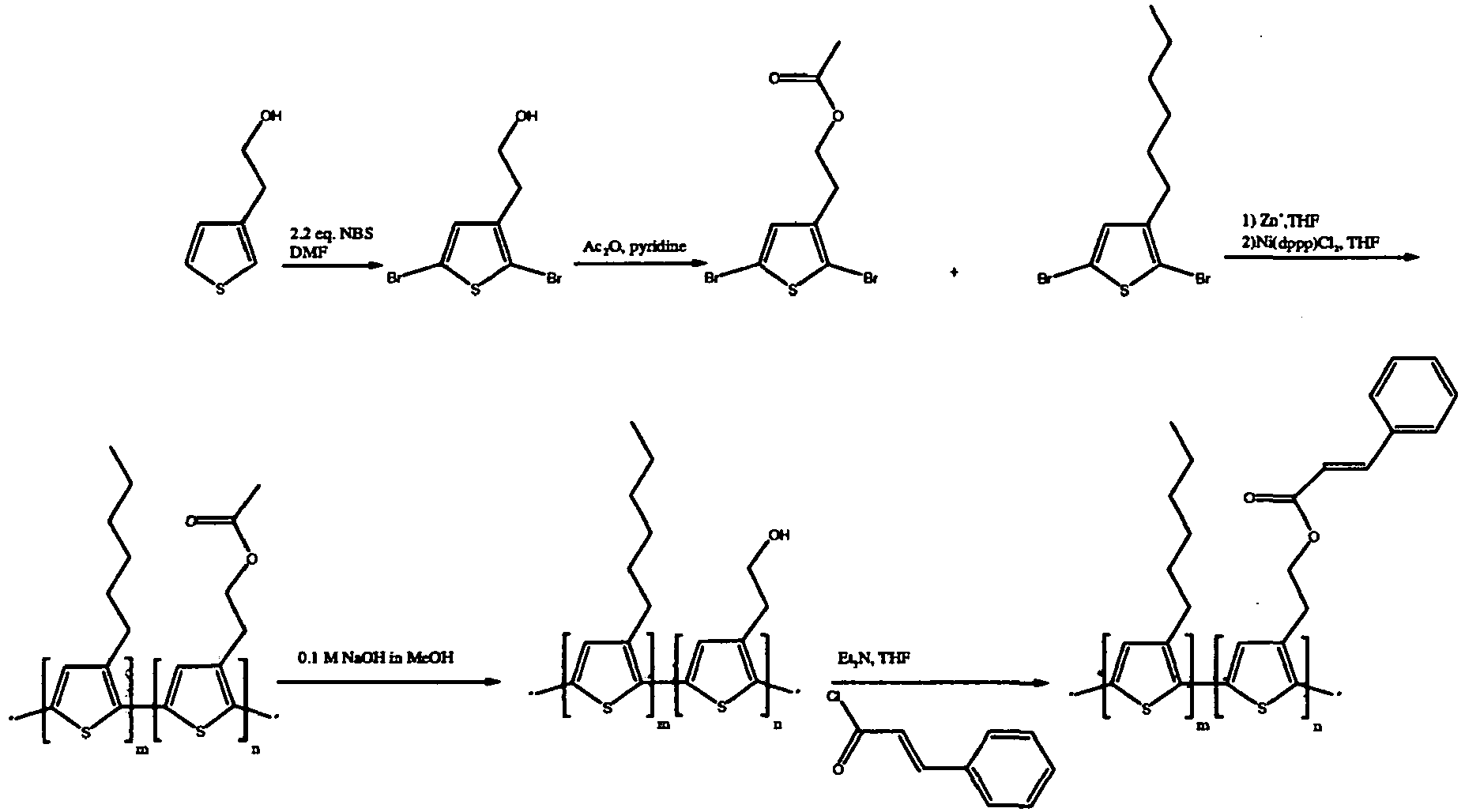
-

- A solution of a mixture of 2,5-dibromo-3-(2-acetoxyethyl)thiophene (M2) (10 % molar) (1.05 g, 0.003 mol) and 2,5-dibromo-3-hexylthiophene (M1) (90 % molar) (9.41 g, 0.029 mol) in THF was added to active zinc at -78°C to form an organozinc solution which was then polymerised in the presence of a Ni(dppp)Cl2 catalyst. After reaction, the co-polymer was precipitated in a mixture of MeOH and 2M HCl (2/1). The crude co-polymer was purified using a soxhlet extraction with methanol and pentane. The purified poly-3-hexylthiophene-co-3-(2-acetoxyethyl)thiophene (P1) was extracted with chloroform and precipitated again in MeOH, before filtration and drying to obtain 3.18 g of a 9/1 copolymer in 61% yield, which was characterised as follows:
- GPC (THF): Mn= 34,400; Mw = 65,500; polydispersity index, D = 1.9 giving an average of 207 repeating units/chain;
- 1H-NMR (CDCl3): δ =7.00 (1 Harom,AcET, s), 6.96 ppm (1 Harom,3HT, s), 4.35 ppm (2Hb,AcET, t), 3.14 ppm (2Ha,AcET, t), 2.79 ppm (2 Ha,3HT, t), 2.05 ppm (3Hc,AcET, s) 1.70 ppm (2 Hb,3HT, t), 1.45 ppm (2 Hc,3HT, m), 1.40 ppm (2 Hd,3HT, m), 1.35 ppm (2 He,3HT, m), and 0.90 ppm (3 Hf,3HT, t);
- UV/Vis: λmax at 555 nm; sh at 600 nm;
- infrared spectrum: see Table 1 below.
-

- 1.04 g Polymer (P1) was refluxed under an inert atmosphere with 100 mL of 0.1 M NaOH solution in MeOH to yield P2 in 100% yield, which was characterised as follows:
- GPC (THF): Mn = 31,300, Mw = 68,100, D = 2.2 giving an average of 190 repeating units/chain;
- 1H-NMR (CDCl3): δ =7.03 (1Harom,ET, s), 6.96 ppm (1Harom,3HT, s), 3.94 ppm (2Hb,ET, t), 3.09 ppm (2Ha,ET, t), 2.79 ppm (2Ha,3HT, t), 1.70 ppm (2Hb,3HT, t), 1.45 ppm (2Hc,3HT, m), 1.40 ppm (2Hd,3HT, m), 1.25 ppm (2He,3HT, m), and 0.90 ppm (3Hf,3HT, t);
- .UV/Vis: λmax at 551 nm, sh, at 600 nm;
- infrared spectrum: see Table 1 below.
-


- 0.61 g P3 was obtained in 95% yield by reacting 0.60 g poly-3-hexylthiophene-co-3-(2-hydroxyethyl)thiophene (P2) with 0.62 g (0.004 mol) cinnamoyl chloride in THF in the presence of 0.37 g (0.004 mol) triethylamine, and was purified using soxhlet extraction with methanol and acetone before characterisation as follows:
- GPC (THF): Mn = 33,100, Mw = 74,500, D = 2.2 giving an average of 193 repeating units/chain;
1H-NMR (CDCl3): 5 =7.67 ppm (1Hd,cin, d), 7.47 ppm (2He,cin, m), 7.32 ppm ( 2Hf,cin, m), 7.05 ppm (1Hg,cin, m), 6.96 ppm (1 Harom,3HT and cin, s), 6.42 ppm ( 1 Hc,cin, d), 4.49 ppm (2Hb,cin, t), 3.23 ppm (2Ha,cin, t), 2.79 ppm (2 Ha,3HT, t), 1.70 ppm (2Hb,3HT, m), 1.40 ppm (2Hc,3HT, m), 1.35 ppm (2Hd,3HT, m), 1.25 ppm (2He,3HT, m), and 0.90 ppm (3Hf,3HT, t); and integrations originating from the M2 monomer unit corresponded to about 10% of a comparable integration originating from the M1 monomer unit, indicating that 1 out of 10 monomer units has a functionalized side chain. Disappearance of the methyl group in the acetylester of the P1 side chain at δ=2.05 ppm proved hydrolysis was completed. The complete functionalisation was also illustrated by a change in chemical shift of CH2 - proton signals in P3 because of a different ester. Appearance of double bond and aromatic proton signals in the functionalized polymer confirmed the presence of the cinnamoyl ester in the side chain. - UV/Vis: λmax at 275 nm and 551 nm, sh. at 600 nm. λmax at 275 nm of polymer films dropcast from chloroform solutions was due to the presence of the cinnamic acid ester in the copolymer side chain. In the absorption region of the conjugated polymer, the shoulder at 600 nm had a higher intensity, but was less sharply pronounced. After 2 hours UV-exposure of such a film of P3 the intensity of the 275 nm peak decreased ca. 10% indicating that some cinnamoyl moieties had disappeared due to photo-initiated [2+2] cycloaddition. With an average of about 200 monomer units in a polymer chain, there were thus an average of 2 side chains that were linked to another chain, which accounted for the immobilization and enhanced thermal stability after such exposure;
- infrared spectrum: see Table 1 below.
- The C=O ester absorption at around 1740 cm-1 in P1 disappeared upon its hydrolysis to P2. Upon functionalisation of P2 to P3 a peak at around 1715 cm-1 appeared due to the C=O bond of the cinnamic ester group.
- The synthesis proceeds according to the following scheme and provides a copolymer comprising recurrent units from a monomer represented by the structural formula (I) wherein L is NH.


- The synthesis proceeds according to the following scheme and provides a copolymer comprising recurrent units from a monomer represented by the structural formula (I) wherein L is S.


- In the TEM pictures of
Fig. 7-8 , a phase separation in the thin film B was observed after 2 hours at 110°C. This phase separation was similar to these observed for the film A heated in the same conditions (Fig. 3 and5 ). This phase separation was prevented when the thin film B was preliminarily UV cured: the nano-morphology of the film was then stable (Fig. 9-10 ). Film A and Film B as deposited, i.e. before heat treatment, are shown inFig. 2 and6 respectively for comparison purpose.Figure 4 shows an electron diffraction of a black spot as visible inFig. 3 . The diffraction pattern indicates that the black spots are PCBM crystals. - Solar cells were prepared on glass ITO-patterned substrates. The substrates were cleaned with sonicating in soapy water, Mili-Q water, acetone and heated in isopropanol before a UV/O3 treatment. A 30 nm thick PEDOT:PSS (Baytron P) layer was spincoated from aqueous dispersion on the ITO electrode. This was dried for 15 minutes at 130°C. A ca. 250 nm thick 1/1 (w/w) blend of the copolymer (P3) of example 2, containing 10% by moles of a cinnamic acid ester functionalised monomer, with PCBM active layer was spincoated from chlorobenzene solution and annealed for 10 minutes on a hotplate at 130°C. Then the Ytterbium top electrode was evaporated on the active layer in vacuum (1.10-6 mbar) until the electrode reached a thickness of 100 nm. The active surface of each solar cell was 3 mm2. After clearing the ITO contacts, I-V measurements were performed in a nitrogen atmosphere under AM 1.5G simulation, using an Oriel simulator equipped with a 150W Xenon short arc lamp. These cells displayed a Fill Factor of 0.60. The Short Circuit Current (J sc) reached 8.74 mA/cm2. Together with an Open Circuit Voltage (V oc) of 0.59V: this leads to a power efficiency of 3.22% comparable to a value of 3.95% with the P3HT/PCBM-blend.
Fig. 11 displays the I-V curve and Table 2 compares the initial device characteristics for P3HT/PCBM- and P3/PCBM-blends.Table 2: Blend [1:1 w/w] Jsc [mA/cm2] Voc [V] FF Power efficiency [%] P3HT/PCBM 10.93 0.60 0.60 3.95 P3/PCBM 8.87 0.59 0.62 3.22 - Then the cell was UV-cured for 2 hours in a nitrogen atmosphere with UV-light (A= 254 nm), whose spectrum is shown in
Fig. 1 , in a Lawtronics ME5 exposure unit and the power efficiency was measured again: a value of 3.22% was then measured indicating that UV curing had no influence on the power efficiency of the cell. - Accelerated lifetime measurements were performed on solar cells with 1:1 (w/w) blends of P3HT and the 10 % cinnamic acid ester functionalized copolymer of example 2 (P3) with PCBM, after 2 hours exposure in the Lawtronics ME5 exposure unit used in Example 6 in the case of the P3/blend, and kept at temperatures of 80,100 and 150°C in a specially developed heating chamber for at least 100 hours. The top electrode used was typically 20 nm Ca and 80 nm Al. The device was kept in the dark between measurements. The relative values for a given parameter are given as the ratio of the value at time t to the initial value at time t0. In these experiments, the performances of the solar cells with P3HT/PCBM- and P3/PCBM -blends were clearly different.
- The relative open circuit voltages (V oc), Fill Factors (FF), short-circuit current (Jsc ) values and power efficiencies of the solar cells with 1:1 (w/w) P3HT/PCBM-blends and P3/PCBMblends as a function of time are shown in
Fig. 12 to Fig. 15 for a temperature of 80 °C,Fig. 16 to Fig. 19 for a temperature of 100°C andFig. 20 to Fig. 23 for a temperature of 150 °C. Note the different timescales at different temperatures. - At temperatures of 100°C or less, the decline in efficiency of J sc proceeded according to a pseudo-linear behaviour for P3HT. This decline in efficiency was more marked than with solar cells with a crosslinked P3/PCBM active layer.
-
Figures 12 to 15 show that at a temperature of 80°C, the relative FF decreased very slightly and pseudo-linearly with time for the blend with P3, whereas the blend with P3HT exhibited slightly lower relative FF values in a pseudo-linear decrease for the first 400 hours after which the deviation in FF for the blend with P3HT increased strongly with time, the relative Voc values for both blends first decreased and then the relative \/ oc value for the P3-blend declined slightly linearly whereas the relative Voc value for the P3HT-blend first decreased slightly more strongly up to 500 hours before increasing and at 800 hours exceeded the value for the P3-blend, and the relative Jsc value for the P3-blend first increased and then decreased pseudo-linearly passing the initial value after about 800 hours whereas the relative Jsc value for the P3HT-blend decreased pseudo-linearly by about 20% after 800 hours. The resulting relative power efficiency values mirrored the relative Jsc -time characteristics with a reduction in relative power efficiency after 800 hours of about 7% with the P3/PCBM-blend and about 25% with the P3HT/PCBM-blend. -
Fig. 16 to 19 show that at a temperature of 100°C, the relative FF value for the P3-blend initially rose slightly and then decreased linearly very slightly, whereas for the P3HT-blend there is a strong pseudo-linear decline of 12.5% after 100 hours, the relative Voc -value for the P3-blend rose slightly and then stabilized over 100 hours whereas although the initial relative Voc value for the P3HT-blend was slightly higher there was a pseudo-linear decline of 15% after 100 hours, the relative short circuit current of Cell B (according to an embodiment of the present invention) was stable over time (more than 110 hours) whereas that for cell A (comparative) declined pseudo-linearly by 15% after 100 hours, and the relative power efficiency of Cell B was also stable over time (more than 110 hours) whereas that for Cell A (comparative) decreased pseudo-linearly by ca. 38% after 100 hours. -
Figures 20 to 23 show that at a temperature of 150°C the relative FF value decreased slightly and linearly with time for the blend with P3, whereas the blend with P3HT showed a pronounced exponential decrease in relative FF value from comparable start values, the relative Voc -values also decreased with time with again a much reduced pseudo-linear decrease with the blend with P3 compared with a pronounced exponential decrease in the case of the blend with P3HT, and the relative Jsc value for the blend with P3 exhibited a slight increase whereas the value for the blend with P3HT showed a pronounced exponential decrease to about 53% of the initial value after 40 hours, and the relative power efficiency for the blend with P3 increased by about 10% and then exhibited a linear back to the initial value after 50 hours whereas the power efficiency value for the blend with P3HT showed a pronounced exponential decline by about 78% of the initial value after 40 hours. - An estimate of the likely lifetime of solar cells on the basis of P3/PCBM-and P3HT/PCBM-blends at operating temperatures of 25°C and 50°C was made using the activation energy values derived from the data at 80, 100 and 150°C i.e. 0.95 eV for both the P3HT/PCBM and P3/PCBM blends yielded the lifetimes to a particular decrease in short-circuit current given in Table 3 below.
Table 3: Maximum permissible decrease in Jsc Cell A with P3HT/PCBM-blend [comparative] Cell B with P3/PCBM-blend [present invention] Lifetime at 25 °C [years] Lifetime at 50°C [years] Lifetime at 25°C [years] Lifetime at 50 °C [years] 10% 10.9 0.6 49.3 2.8 20% 21.7 1.2 98.6 5.6 25% 27.1 1.6 123.2 7.1 50% 54.3 3.1 246.5 14.1 - The lifetime estimates are considerably longer for solar cell B with the P3/PCBM blend, according to the present invention, than for solar cell A with the P3HT/PCBM blend (comparative example) both at 25°C and 50°C.
- The random copolymers with a 7:3 molar ratio of 3-hexylthiophene and 3-cinnamoyloxyethylthiophene (P6) was prepared entirely analogously to P3 except that the molar ratio of the 3-hexyl thiophene to 2,5-dibromo-3-acetylethanolthiophene (M2), 2,5-dibromo-3-ethanolthiophene (2) and cinnamoylethyl thiophene respectively was 7:3.
- The solar cells of Example 9 were produced as described for Example 6 except that in addition to solar cells of with a 1:1 (w/w) P3HT/PCBM-blend and solar cells with a 1:1 (w/w) P3/PCBM-blend solar cells were also produced with a 1:1 (w/w) P6/PCBM-blend. The solar cells were kept at temperatures of 125 and 150°C for at least 100 hours, but in the case of P3/PCBM- and P6/PCBM-blends after the solar cells were irradiated 2 hours with the UV-lamp used in Example 6. In these experiments, the performances of the solar cells made with these polymer blends were clearly different.
- The relative open circuit voltages (V oc), Fill Factors (FF), short-circuit current (Jsc ) values and efficiencies of the solar cells of P3HT, P3 and P6 with PCBM (1/1) as a function of time are shown in
Fig. 24 to Fig. 27 for a temperature of 125°C. The relative power efficiency with the blend of P6/PCBM-blend initially increased strongly to 200% of the initial value reflecting strong initial increases in Fill Factor and open-circuit current and even after 150 hours was still ca. 50% above its initial value, whereas the relative power efficiency in the case of the P3/PCBM-blend exhibited a pseudo-linear decline to about 75% of its initial value.
| Absorption: | P3HT homopolymer (3) | 10% ester functionalised copolymer (P1) | 10% ethanol functionalised copolymer (P2) | 10% cinnamon functionalised copolymer (P3) |
| C-H stretch on aromatic ring | 2953 | 2952 | 2952 | 2950 |
| C-H stretch in aliphatic chain | 2923 | 2922 | 2922 | 2923 |
| C-H stretch in aliphatic chain | 2853 | 2853 | 2852 | 2853 |
| C=O stretch ester bond | - | 1742 | - | 1715 |
| Conjugated system | 1635 | 1635 | 1640 | 1635 |
| C=C asymmetric ring stretch | 1508 | 1507 | 1508 | 1505 |
| C=C symmetric ring stretch | 1454 | 1452 | 1455 | 1449 |
| methyl deformation | 1376 | 1376 | 1376 | 1375 |
| C-O stretch | - | 1225 | 1262 | 1259 |
| C-H in plane bending of 2,3,5 substituted thiophene | 1088 | 1032 | 1046 | 1075 |
| C-H out of plane bending of 2,3,5 substituted thiophene or C-S stretching | 820 | 819 | 821 | 818 |
| methyl rock | 724 | 723 | 723 | 721 |
Claims (6)
- A solar cell comprising a crosslinked polymer material, said crosslinked polymer material being obtained by irradiating a blend, said blend comprising:- a conjugated polymer, and- a n-type or p-type compound,said conjugated polymer containing one or more repeating units represented by the structural formula

 - Ar is a homocyclic or heterocyclic aromatic group selected from the group consisting of thienyl, phenyl, naphthyl, pyrrolyl, pyridyl, carbazolyl, fluorenyl and benzothiazolyl, said homocyclic aromatic group being optionally substituted with one or more substituents independently selected from the group consisting of halogen, C1-12 alkyl, nitro, trifluoromethoxy, trifluoromethyl and C1-12 alkoxy;- L is selected from the group consisting of -0-, -CH(CH3)-O-, -(CH2)q-O-, - NH-, -CH(CH3)-NH-, -(CH2)q-NH-, -S-, -CH(CH3)-S- and -(CH2)q-S-, the oxygen atom of said -CH(CH3)-O- or -(CH2)q-O-, being adjacent to the carbonyl group, the NH group of said -CH(CH3)-NH- or -(CH2)q-NH-, being adjacent to the carbonyl group and the sulphur atom of said -CH(CH3)-S- or -(CH2)q-S-, being adjacent to the carbonyl group;- q is 1, 2 or 3;- R1 and R2 are independently selected from the group consisting of hydrogen, C1-4 alkyl and phenyl, wherein said phenyl is optionally substituted with one or more substituents independently selected from the group consisting of halogen and methoxy;- R3 is selected from the group consisting of hydrogen, C1-4-alkyl and phenyl; and- R4 is hydrogen or methyl.
 - The solar cell according to claim 1, wherein said polymer further comprises one or more monomeric groups or repeating units comprising a divalent Ar' optionally substituted with one or more substituents independently selected from the group consisting of C1-20-alkyl, C1-20-alkoxy, C1-20-alkylsulfate, phenyl and benzyl.
- The solar cell according to claim 2, wherein Ar' is arylene or heteroarylene.
- The solar cell according to claim 2 or 3, wherein the group Ar' and the group Ar are the same.
- The solar cell according to claim 4, wherein Ar and Ar' are both 2,5-thienylene.
- The solar cell according to any one of claims 2 to 5, wherein Ar' represents from 0.5 % to 99.5% by mole of said polymer.
Applications Claiming Priority (3)
| Application Number | Priority Date | Filing Date | Title |
|---|---|---|---|
| US7702408P | 2008-06-30 | 2008-06-30 | |
| GBGB0811930.7A GB0811930D0 (en) | 2008-06-30 | 2008-06-30 | Polymerisable compounds for making opto-electronic devices |
| PCT/EP2009/054056 WO2010000504A1 (en) | 2008-06-30 | 2009-04-03 | Polymerisable compounds for making opto-electronic devices |
Publications (2)
| Publication Number | Publication Date |
|---|---|
| EP2307398A1 EP2307398A1 (en) | 2011-04-13 |
| EP2307398B1 true EP2307398B1 (en) | 2012-09-05 |
Family
ID=39683378
Family Applications (1)
| Application Number | Title | Priority Date | Filing Date |
|---|---|---|---|
| EP09772204A Not-in-force EP2307398B1 (en) | 2008-06-30 | 2009-04-03 | Polymerisable compounds for making opto-electronic devices |
Country Status (5)
| Country | Link |
|---|---|
| US (1) | US8450604B2 (en) |
| EP (1) | EP2307398B1 (en) |
| JP (1) | JP5414791B2 (en) |
| GB (1) | GB0811930D0 (en) |
| WO (1) | WO2010000504A1 (en) |
Families Citing this family (8)
| Publication number | Priority date | Publication date | Assignee | Title |
|---|---|---|---|---|
| JP5644041B2 (en) * | 2008-10-15 | 2014-12-24 | コニカミノルタ株式会社 | Manufacturing method of organic photoelectric conversion element |
| US9176377B2 (en) | 2010-06-01 | 2015-11-03 | Inpria Corporation | Patterned inorganic layers, radiation based patterning compositions and corresponding methods |
| JP2014034618A (en) * | 2012-08-08 | 2014-02-24 | Kuraray Co Ltd | Organic thin film, and photoelectric conversion element using the same |
| US9074043B2 (en) * | 2012-08-17 | 2015-07-07 | Harvatek Corporation | Compound for carrier transport, element and electronic device using the same |
| US9310684B2 (en) | 2013-08-22 | 2016-04-12 | Inpria Corporation | Organometallic solution based high resolution patterning compositions |
| JP6249512B2 (en) * | 2014-01-17 | 2017-12-20 | エルジー・ケム・リミテッド | Organic solar cell and method of manufacturing the same |
| KR102319630B1 (en) | 2014-10-23 | 2021-10-29 | 인프리아 코포레이션 | Organometallic solution based high resolution patterning compositions and corresponding methods |
| CN119431305B (en) * | 2024-10-24 | 2025-09-26 | 蓝固(常州)新能源有限公司 | Thiophene compound, modified positive electrode material, preparation method of thiophene compound and modified positive electrode material, and lithium ion battery |
Family Cites Families (15)
| Publication number | Priority date | Publication date | Assignee | Title |
|---|---|---|---|---|
| US3097230A (en) * | 1960-10-03 | 1963-07-09 | Monsanto Chemicals | Aryl propiolates |
| JPS6377872A (en) * | 1986-09-18 | 1988-04-08 | Nippon Shokubai Kagaku Kogyo Co Ltd | Novel brominated thiophene derivative |
| DE69535080T2 (en) * | 1994-12-28 | 2006-12-28 | Cambridge Display Technology Ltd. | Polymers for optical devices |
| GB0325324D0 (en) * | 2003-10-30 | 2003-12-03 | Avecia Ltd | Process for producing semiconducting layers and devices containing the same |
| DE112004002221T5 (en) * | 2003-11-17 | 2007-01-18 | Sumitomo Chemical Company, Ltd. | Crosslinkable substituted fluorene linkages and conjugated oligomers or polymers based thereon |
| DE102004009355A1 (en) | 2004-02-26 | 2005-09-15 | Covion Organic Semiconductors Gmbh | Process for crosslinking organic semiconductors |
| CN100583485C (en) * | 2004-09-24 | 2010-01-20 | 普莱克斯托尼克斯公司 | Photovoltaic cell containing hetero atom stereoregular poly (3-substituted thiophene) |
| GB0423528D0 (en) * | 2004-10-22 | 2004-11-24 | Cambridge Display Tech Ltd | Monomer for making a crosslinked polymer |
| KR101248047B1 (en) * | 2005-03-14 | 2013-03-27 | 시바 홀딩 인크 | Novel polymers |
| JP2007266281A (en) * | 2006-03-28 | 2007-10-11 | Hitachi Chem Co Ltd | Hole injection layer material and organic electroluminescent device using the same |
| US20070295389A1 (en) * | 2006-05-05 | 2007-12-27 | Nanosolar, Inc. | Individually encapsulated solar cells and solar cell strings having a hybrid organic/inorganic protective layer |
| GB0612777D0 (en) | 2006-06-28 | 2006-08-09 | Polymertronics Ltd | Multi-layered ultra-violet cured organic electronic device |
| JP5125110B2 (en) * | 2006-07-19 | 2013-01-23 | 東レ株式会社 | Field effect transistor |
| JP2008091886A (en) * | 2006-09-08 | 2008-04-17 | Toray Ind Inc | Material for photovoltaic element and photovoltaic element |
| GB0621830D0 (en) * | 2006-11-02 | 2006-12-13 | Chroma Therapeutics Ltd | Inhibitors of p38 mitogen-activated protein kinase |
-
2008
- 2008-06-30 GB GBGB0811930.7A patent/GB0811930D0/en not_active Ceased
-
2009
- 2009-04-03 US US13/001,603 patent/US8450604B2/en not_active Expired - Fee Related
- 2009-04-03 WO PCT/EP2009/054056 patent/WO2010000504A1/en not_active Ceased
- 2009-04-03 EP EP09772204A patent/EP2307398B1/en not_active Not-in-force
- 2009-04-03 JP JP2011515254A patent/JP5414791B2/en not_active Expired - Fee Related
Also Published As
| Publication number | Publication date |
|---|---|
| WO2010000504A1 (en) | 2010-01-07 |
| EP2307398A1 (en) | 2011-04-13 |
| JP5414791B2 (en) | 2014-02-12 |
| US8450604B2 (en) | 2013-05-28 |
| US20110130522A1 (en) | 2011-06-02 |
| GB0811930D0 (en) | 2008-07-30 |
| JP2011526420A (en) | 2011-10-06 |
Similar Documents
| Publication | Publication Date | Title |
|---|---|---|
| CN105198909B (en) | Compound for forming high-molecular compound | |
| US8450604B2 (en) | Polymerisable compounds for making opto-electronic devices | |
| CN102598341B (en) | Photoelectric conversion element | |
| US20110006287A1 (en) | Polymers with tunable band gaps for photonic and electronic applications | |
| JP5462998B2 (en) | Composition and organic photoelectric conversion element | |
| JP5991324B2 (en) | Polymer compound and organic photoelectric conversion element | |
| CN102597045A (en) | Polymeric compound | |
| Banishoeib et al. | Synthesis of poly (2, 5-Thienylene Vinylene) and its derivatives: Low band gap materials for photovoltaics | |
| CN102598338B (en) | Photoelectric conversion element | |
| WO2012050070A1 (en) | High molecular compound and organic photoelectric conversion element using same | |
| JP2011526420A5 (en) | ||
| Marinelli et al. | Single-material organic solar cells with fully conjugated electron-donor alkoxy-substituted bithiophene units and electron-acceptor benzothiadiazole moieties alternating in the main chain | |
| EP2302700A1 (en) | Organic photoelectric conversion element | |
| Marshall et al. | Polythiophenes with vinylene linked ortho, meta and para-carborane sidechains | |
| JP2015189853A (en) | Polymer compound and electronic element using the same | |
| US8765882B2 (en) | Polythiophene based active layer for solar cells | |
| WO2012070390A1 (en) | Organic photoelectric conversion element | |
| JP6003399B2 (en) | Polymer compound and organic photoelectric conversion device using the same | |
| JP2014019781A (en) | Polymer compound, and organic photoelectric conversion element using the same | |
| Ha et al. | Low-band gap copolymers based on diketopyrrolopyrrole and dibenzosilole and their application in organic photovoltaics | |
| Lim et al. | Synthesis of an alternating thienylenevinylene–benzothiadiazole copolymer with high hole mobility for use in organic solar cells | |
| JP5874302B2 (en) | Polymer compound and organic photoelectric conversion device using the same | |
| Lee et al. | Synthesis of a new conjugated polymer composed of pyrene and bithiophene units for organic solar cells | |
| JP2014170971A (en) | Polythiophene-based active layer for solar cells | |
| Zhang et al. | Selenium and tellurium containing conjugated polymers |
Legal Events
| Date | Code | Title | Description |
|---|---|---|---|
| PUAI | Public reference made under article 153(3) epc to a published international application that has entered the european phase |
Free format text: ORIGINAL CODE: 0009012 |
|
| 17P | Request for examination filed |
Effective date: 20110119 |
|
| AK | Designated contracting states |
Kind code of ref document: A1 Designated state(s): AT BE BG CH CY CZ DE DK EE ES FI FR GB GR HR HU IE IS IT LI LT LU LV MC MK MT NL NO PL PT RO SE SI SK TR |
|
| AX | Request for extension of the european patent |
Extension state: AL BA RS |
|
| 17Q | First examination report despatched |
Effective date: 20110610 |
|
| DAX | Request for extension of the european patent (deleted) | ||
| GRAP | Despatch of communication of intention to grant a patent |
Free format text: ORIGINAL CODE: EPIDOSNIGR1 |
|
| GRAS | Grant fee paid |
Free format text: ORIGINAL CODE: EPIDOSNIGR3 |
|
| GRAA | (expected) grant |
Free format text: ORIGINAL CODE: 0009210 |
|
| AK | Designated contracting states |
Kind code of ref document: B1 Designated state(s): AT BE BG CH CY CZ DE DK EE ES FI FR GB GR HR HU IE IS IT LI LT LU LV MC MK MT NL NO PL PT RO SE SI SK TR |
|
| REG | Reference to a national code |
Ref country code: GB Ref legal event code: FG4D |
|
| REG | Reference to a national code |
Ref country code: CH Ref legal event code: EP |
|
| REG | Reference to a national code |
Ref country code: AT Ref legal event code: REF Ref document number: 574064 Country of ref document: AT Kind code of ref document: T Effective date: 20120915 |
|
| REG | Reference to a national code |
Ref country code: IE Ref legal event code: FG4D |
|
| REG | Reference to a national code |
Ref country code: DE Ref legal event code: R096 Ref document number: 602009009550 Country of ref document: DE Effective date: 20121031 |
|
| REG | Reference to a national code |
Ref country code: AT Ref legal event code: MK05 Ref document number: 574064 Country of ref document: AT Kind code of ref document: T Effective date: 20120905 |
|
| RAP2 | Party data changed (patent owner data changed or rights of a patent transferred) |
Owner name: UNIVERSITEIT HASSELT Owner name: IMEC |
|
| REG | Reference to a national code |
Ref country code: NL Ref legal event code: VDEP Effective date: 20120905 |
|
| PG25 | Lapsed in a contracting state [announced via postgrant information from national office to epo] |
Ref country code: HR Free format text: LAPSE BECAUSE OF FAILURE TO SUBMIT A TRANSLATION OF THE DESCRIPTION OR TO PAY THE FEE WITHIN THE PRESCRIBED TIME-LIMIT Effective date: 20120905 Ref country code: AT Free format text: LAPSE BECAUSE OF FAILURE TO SUBMIT A TRANSLATION OF THE DESCRIPTION OR TO PAY THE FEE WITHIN THE PRESCRIBED TIME-LIMIT Effective date: 20120905 Ref country code: LT Free format text: LAPSE BECAUSE OF FAILURE TO SUBMIT A TRANSLATION OF THE DESCRIPTION OR TO PAY THE FEE WITHIN THE PRESCRIBED TIME-LIMIT Effective date: 20120905 Ref country code: NO Free format text: LAPSE BECAUSE OF FAILURE TO SUBMIT A TRANSLATION OF THE DESCRIPTION OR TO PAY THE FEE WITHIN THE PRESCRIBED TIME-LIMIT Effective date: 20121205 Ref country code: FI Free format text: LAPSE BECAUSE OF FAILURE TO SUBMIT A TRANSLATION OF THE DESCRIPTION OR TO PAY THE FEE WITHIN THE PRESCRIBED TIME-LIMIT Effective date: 20120905 |
|
| REG | Reference to a national code |
Ref country code: LT Ref legal event code: MG4D Effective date: 20120905 |
|
| PG25 | Lapsed in a contracting state [announced via postgrant information from national office to epo] |
Ref country code: SI Free format text: LAPSE BECAUSE OF FAILURE TO SUBMIT A TRANSLATION OF THE DESCRIPTION OR TO PAY THE FEE WITHIN THE PRESCRIBED TIME-LIMIT Effective date: 20120905 Ref country code: SE Free format text: LAPSE BECAUSE OF FAILURE TO SUBMIT A TRANSLATION OF THE DESCRIPTION OR TO PAY THE FEE WITHIN THE PRESCRIBED TIME-LIMIT Effective date: 20120905 Ref country code: GR Free format text: LAPSE BECAUSE OF FAILURE TO SUBMIT A TRANSLATION OF THE DESCRIPTION OR TO PAY THE FEE WITHIN THE PRESCRIBED TIME-LIMIT Effective date: 20121206 Ref country code: LV Free format text: LAPSE BECAUSE OF FAILURE TO SUBMIT A TRANSLATION OF THE DESCRIPTION OR TO PAY THE FEE WITHIN THE PRESCRIBED TIME-LIMIT Effective date: 20120905 |
|
| PG25 | Lapsed in a contracting state [announced via postgrant information from national office to epo] |
Ref country code: ES Free format text: LAPSE BECAUSE OF FAILURE TO SUBMIT A TRANSLATION OF THE DESCRIPTION OR TO PAY THE FEE WITHIN THE PRESCRIBED TIME-LIMIT Effective date: 20121216 Ref country code: IS Free format text: LAPSE BECAUSE OF FAILURE TO SUBMIT A TRANSLATION OF THE DESCRIPTION OR TO PAY THE FEE WITHIN THE PRESCRIBED TIME-LIMIT Effective date: 20130105 Ref country code: RO Free format text: LAPSE BECAUSE OF FAILURE TO SUBMIT A TRANSLATION OF THE DESCRIPTION OR TO PAY THE FEE WITHIN THE PRESCRIBED TIME-LIMIT Effective date: 20120905 Ref country code: EE Free format text: LAPSE BECAUSE OF FAILURE TO SUBMIT A TRANSLATION OF THE DESCRIPTION OR TO PAY THE FEE WITHIN THE PRESCRIBED TIME-LIMIT Effective date: 20120905 Ref country code: CZ Free format text: LAPSE BECAUSE OF FAILURE TO SUBMIT A TRANSLATION OF THE DESCRIPTION OR TO PAY THE FEE WITHIN THE PRESCRIBED TIME-LIMIT Effective date: 20120905 Ref country code: BE Free format text: LAPSE BECAUSE OF FAILURE TO SUBMIT A TRANSLATION OF THE DESCRIPTION OR TO PAY THE FEE WITHIN THE PRESCRIBED TIME-LIMIT Effective date: 20120905 Ref country code: NL Free format text: LAPSE BECAUSE OF FAILURE TO SUBMIT A TRANSLATION OF THE DESCRIPTION OR TO PAY THE FEE WITHIN THE PRESCRIBED TIME-LIMIT Effective date: 20120905 |
|
| REG | Reference to a national code |
Ref country code: DE Ref legal event code: R081 Ref document number: 602009009550 Country of ref document: DE Owner name: UNIVERSITEIT HASSELT, BE Free format text: FORMER OWNERS: IMEC, LEUVEN, BE; UNIVERSITEIT HASSELT, DIEPENBEEK, BE Effective date: 20130313 Ref country code: DE Ref legal event code: R081 Ref document number: 602009009550 Country of ref document: DE Owner name: IMEC, BE Free format text: FORMER OWNERS: IMEC, LEUVEN, BE; UNIVERSITEIT HASSELT, DIEPENBEEK, BE Effective date: 20130313 Ref country code: DE Ref legal event code: R081 Ref document number: 602009009550 Country of ref document: DE Owner name: UNIVERSITEIT HASSELT, BE Free format text: FORMER OWNER: IMEC, UNIVERSITEIT HASSELT, , BE Effective date: 20130313 Ref country code: DE Ref legal event code: R081 Ref document number: 602009009550 Country of ref document: DE Owner name: IMEC, BE Free format text: FORMER OWNER: IMEC, UNIVERSITEIT HASSELT, , BE Effective date: 20130313 |
|
| PG25 | Lapsed in a contracting state [announced via postgrant information from national office to epo] |
Ref country code: SK Free format text: LAPSE BECAUSE OF FAILURE TO SUBMIT A TRANSLATION OF THE DESCRIPTION OR TO PAY THE FEE WITHIN THE PRESCRIBED TIME-LIMIT Effective date: 20120905 Ref country code: PT Free format text: LAPSE BECAUSE OF FAILURE TO SUBMIT A TRANSLATION OF THE DESCRIPTION OR TO PAY THE FEE WITHIN THE PRESCRIBED TIME-LIMIT Effective date: 20130107 Ref country code: PL Free format text: LAPSE BECAUSE OF FAILURE TO SUBMIT A TRANSLATION OF THE DESCRIPTION OR TO PAY THE FEE WITHIN THE PRESCRIBED TIME-LIMIT Effective date: 20120905 |
|
| PLBE | No opposition filed within time limit |
Free format text: ORIGINAL CODE: 0009261 |
|
| STAA | Information on the status of an ep patent application or granted ep patent |
Free format text: STATUS: NO OPPOSITION FILED WITHIN TIME LIMIT |
|
| PG25 | Lapsed in a contracting state [announced via postgrant information from national office to epo] |
Ref country code: DK Free format text: LAPSE BECAUSE OF FAILURE TO SUBMIT A TRANSLATION OF THE DESCRIPTION OR TO PAY THE FEE WITHIN THE PRESCRIBED TIME-LIMIT Effective date: 20120905 Ref country code: BG Free format text: LAPSE BECAUSE OF FAILURE TO SUBMIT A TRANSLATION OF THE DESCRIPTION OR TO PAY THE FEE WITHIN THE PRESCRIBED TIME-LIMIT Effective date: 20121205 |
|
| 26N | No opposition filed |
Effective date: 20130606 |
|
| PG25 | Lapsed in a contracting state [announced via postgrant information from national office to epo] |
Ref country code: IT Free format text: LAPSE BECAUSE OF FAILURE TO SUBMIT A TRANSLATION OF THE DESCRIPTION OR TO PAY THE FEE WITHIN THE PRESCRIBED TIME-LIMIT Effective date: 20120905 |
|
| REG | Reference to a national code |
Ref country code: DE Ref legal event code: R097 Ref document number: 602009009550 Country of ref document: DE Effective date: 20130606 |
|
| PG25 | Lapsed in a contracting state [announced via postgrant information from national office to epo] |
Ref country code: MC Free format text: LAPSE BECAUSE OF FAILURE TO SUBMIT A TRANSLATION OF THE DESCRIPTION OR TO PAY THE FEE WITHIN THE PRESCRIBED TIME-LIMIT Effective date: 20120905 Ref country code: CY Free format text: LAPSE BECAUSE OF FAILURE TO SUBMIT A TRANSLATION OF THE DESCRIPTION OR TO PAY THE FEE WITHIN THE PRESCRIBED TIME-LIMIT Effective date: 20120905 |
|
| REG | Reference to a national code |
Ref country code: CH Ref legal event code: PL |
|
| REG | Reference to a national code |
Ref country code: IE Ref legal event code: MM4A |
|
| PG25 | Lapsed in a contracting state [announced via postgrant information from national office to epo] |
Ref country code: LI Free format text: LAPSE BECAUSE OF NON-PAYMENT OF DUE FEES Effective date: 20130430 Ref country code: CH Free format text: LAPSE BECAUSE OF NON-PAYMENT OF DUE FEES Effective date: 20130430 |
|
| PG25 | Lapsed in a contracting state [announced via postgrant information from national office to epo] |
Ref country code: IE Free format text: LAPSE BECAUSE OF NON-PAYMENT OF DUE FEES Effective date: 20130403 |
|
| PG25 | Lapsed in a contracting state [announced via postgrant information from national office to epo] |
Ref country code: MT Free format text: LAPSE BECAUSE OF FAILURE TO SUBMIT A TRANSLATION OF THE DESCRIPTION OR TO PAY THE FEE WITHIN THE PRESCRIBED TIME-LIMIT Effective date: 20120905 |
|
| PG25 | Lapsed in a contracting state [announced via postgrant information from national office to epo] |
Ref country code: TR Free format text: LAPSE BECAUSE OF FAILURE TO SUBMIT A TRANSLATION OF THE DESCRIPTION OR TO PAY THE FEE WITHIN THE PRESCRIBED TIME-LIMIT Effective date: 20120905 |
|
| PG25 | Lapsed in a contracting state [announced via postgrant information from national office to epo] |
Ref country code: MK Free format text: LAPSE BECAUSE OF FAILURE TO SUBMIT A TRANSLATION OF THE DESCRIPTION OR TO PAY THE FEE WITHIN THE PRESCRIBED TIME-LIMIT Effective date: 20120905 Ref country code: HU Free format text: LAPSE BECAUSE OF FAILURE TO SUBMIT A TRANSLATION OF THE DESCRIPTION OR TO PAY THE FEE WITHIN THE PRESCRIBED TIME-LIMIT; INVALID AB INITIO Effective date: 20090403 Ref country code: LU Free format text: LAPSE BECAUSE OF NON-PAYMENT OF DUE FEES Effective date: 20130403 |
|
| REG | Reference to a national code |
Ref country code: FR Ref legal event code: PLFP Year of fee payment: 8 |
|
| REG | Reference to a national code |
Ref country code: FR Ref legal event code: PLFP Year of fee payment: 9 |
|
| REG | Reference to a national code |
Ref country code: FR Ref legal event code: PLFP Year of fee payment: 10 |
|
| PGFP | Annual fee paid to national office [announced via postgrant information from national office to epo] |
Ref country code: GB Payment date: 20180321 Year of fee payment: 10 |
|
| PGFP | Annual fee paid to national office [announced via postgrant information from national office to epo] |
Ref country code: FR Payment date: 20180322 Year of fee payment: 10 |
|
| PGFP | Annual fee paid to national office [announced via postgrant information from national office to epo] |
Ref country code: DE Payment date: 20180320 Year of fee payment: 10 |
|
| REG | Reference to a national code |
Ref country code: DE Ref legal event code: R119 Ref document number: 602009009550 Country of ref document: DE |
|
| GBPC | Gb: european patent ceased through non-payment of renewal fee |
Effective date: 20190403 |
|
| PG25 | Lapsed in a contracting state [announced via postgrant information from national office to epo] |
Ref country code: GB Free format text: LAPSE BECAUSE OF NON-PAYMENT OF DUE FEES Effective date: 20190403 Ref country code: DE Free format text: LAPSE BECAUSE OF NON-PAYMENT OF DUE FEES Effective date: 20191101 |
|
| PG25 | Lapsed in a contracting state [announced via postgrant information from national office to epo] |
Ref country code: FR Free format text: LAPSE BECAUSE OF NON-PAYMENT OF DUE FEES Effective date: 20190430 |