EP2307017B1 - Compounds which can be used for the treatment of cancers - Google Patents
Compounds which can be used for the treatment of cancers Download PDFInfo
- Publication number
- EP2307017B1 EP2307017B1 EP09761809.4A EP09761809A EP2307017B1 EP 2307017 B1 EP2307017 B1 EP 2307017B1 EP 09761809 A EP09761809 A EP 09761809A EP 2307017 B1 EP2307017 B1 EP 2307017B1
- Authority
- EP
- European Patent Office
- Prior art keywords
- alkyl
- group
- optionally substituted
- aryl
- heteroaryl
- Prior art date
- Legal status (The legal status is an assumption and is not a legal conclusion. Google has not performed a legal analysis and makes no representation as to the accuracy of the status listed.)
- Active
Links
- 0 CC(*)(C(N(*)*)=O)N(*)C(*)=O Chemical compound CC(*)(C(N(*)*)=O)N(*)C(*)=O 0.000 description 54
- DJMGBLCYTFAHNV-UHFFFAOYSA-N CC(C)(C(NCc(cc1)ccc1OC)=O)N(C(CCl)=O)c(cc1)ccc1F Chemical compound CC(C)(C(NCc(cc1)ccc1OC)=O)N(C(CCl)=O)c(cc1)ccc1F DJMGBLCYTFAHNV-UHFFFAOYSA-N 0.000 description 2
- GPFBMTGXGTUMQI-UHFFFAOYSA-N Cc(c(C(F)(F)F)ccc1)c1N(C(C(N(CC1)CCN1C(OCc1ccccc1)=O)=O)c1ccc[s]1)C(CCl)=O Chemical compound Cc(c(C(F)(F)F)ccc1)c1N(C(C(N(CC1)CCN1C(OCc1ccccc1)=O)=O)c1ccc[s]1)C(CCl)=O GPFBMTGXGTUMQI-UHFFFAOYSA-N 0.000 description 2
- ATLWUCLCZNAGLV-UHFFFAOYSA-N C#CC(C(C(C(CC1CCCCC1)=O)c1ccc[s]1)c(cccc1)c1N)=O Chemical compound C#CC(C(C(C(CC1CCCCC1)=O)c1ccc[s]1)c(cccc1)c1N)=O ATLWUCLCZNAGLV-UHFFFAOYSA-N 0.000 description 1
- JNBHXJRLQSMAHO-UHFFFAOYSA-N C#CC(CCN(C(C(NC1CCCCC1)=O)c1ccc[s]1)c(cccc1)c1O)=O Chemical compound C#CC(CCN(C(C(NC1CCCCC1)=O)c1ccc[s]1)c(cccc1)c1O)=O JNBHXJRLQSMAHO-UHFFFAOYSA-N 0.000 description 1
- YYFIUDMBOJPZIO-UHFFFAOYSA-N C#CC(CN(C(C(NC1CCCCC1)=O)c(ccc(F)c1)c1F)c1cc(C(F)(F)F)ccc1)=O Chemical compound C#CC(CN(C(C(NC1CCCCC1)=O)c(ccc(F)c1)c1F)c1cc(C(F)(F)F)ccc1)=O YYFIUDMBOJPZIO-UHFFFAOYSA-N 0.000 description 1
- YJRCSKVXASVHGL-JFLMPSFJSA-N C#CC(N(C(C(/N=C/c1ccccc1)=O)c1ccc[s]1)c1cc(C(F)(F)F)ccc1)=O Chemical compound C#CC(N(C(C(/N=C/c1ccccc1)=O)c1ccc[s]1)c1cc(C(F)(F)F)ccc1)=O YJRCSKVXASVHGL-JFLMPSFJSA-N 0.000 description 1
- XSRQJSSFQZVZCV-UHFFFAOYSA-N C#CC(N(C(C(CCC1CCCCC1)=O)c(cc1)ccc1C#N)c1cc(C(F)(F)F)ccc1)=O Chemical compound C#CC(N(C(C(CCC1CCCCC1)=O)c(cc1)ccc1C#N)c1cc(C(F)(F)F)ccc1)=O XSRQJSSFQZVZCV-UHFFFAOYSA-N 0.000 description 1
- HNWBLSKKIQLLAG-UHFFFAOYSA-N C#CC(N(C(C(NC1CCCC1)=O)c1ccccc1)c(cc1)cc2c1OCO2)=O Chemical compound C#CC(N(C(C(NC1CCCC1)=O)c1ccccc1)c(cc1)cc2c1OCO2)=O HNWBLSKKIQLLAG-UHFFFAOYSA-N 0.000 description 1
- WBTZWOVJDILQRA-UHFFFAOYSA-N C#CC(N(C(C(NC1CCCC1)=O)c1ccccc1)c1ccc2OCCOc2c1)=O Chemical compound C#CC(N(C(C(NC1CCCC1)=O)c1ccccc1)c1ccc2OCCOc2c1)=O WBTZWOVJDILQRA-UHFFFAOYSA-N 0.000 description 1
- CYUUDVGNZMCAGV-UHFFFAOYSA-N C#CC(N(C(C(NC1CCCCC1)=O)c(cc1)ccc1O)c1cc(C(F)(F)F)ccc1)=O Chemical compound C#CC(N(C(C(NC1CCCCC1)=O)c(cc1)ccc1O)c1cc(C(F)(F)F)ccc1)=O CYUUDVGNZMCAGV-UHFFFAOYSA-N 0.000 description 1
- ORRAHTHKKZWFAS-UHFFFAOYSA-N C#CC(N(C(C(NC1CCCCC1)=O)c1c2OCOc2ccc1)c1cc(C(F)(F)F)ccc1)=O Chemical compound C#CC(N(C(C(NC1CCCCC1)=O)c1c2OCOc2ccc1)c1cc(C(F)(F)F)ccc1)=O ORRAHTHKKZWFAS-UHFFFAOYSA-N 0.000 description 1
- NBSYRWGTQXEQSZ-UHFFFAOYSA-N C#CC(N(C(C(NC1CCCCC1)=O)c1cc(C#N)ccc1)c1cc(C(F)(F)F)ccc1)=O Chemical compound C#CC(N(C(C(NC1CCCCC1)=O)c1cc(C#N)ccc1)c1cc(C(F)(F)F)ccc1)=O NBSYRWGTQXEQSZ-UHFFFAOYSA-N 0.000 description 1
- ARQZVLLUQIMEDP-UHFFFAOYSA-N C#CC(N(C(C(NC1CCCCC1)=O)c1ccc(C(F)(F)F)cc1)c1cc(C(F)(F)F)ccc1)=O Chemical compound C#CC(N(C(C(NC1CCCCC1)=O)c1ccc(C(F)(F)F)cc1)c1cc(C(F)(F)F)ccc1)=O ARQZVLLUQIMEDP-UHFFFAOYSA-N 0.000 description 1
- HFJCFVOXTMNHPS-UHFFFAOYSA-N C#CC(N(C(C(NC1CCCCC1)=O)c1ccc[s]1)c(c(F)c1)ccc1F)=O Chemical compound C#CC(N(C(C(NC1CCCCC1)=O)c1ccc[s]1)c(c(F)c1)ccc1F)=O HFJCFVOXTMNHPS-UHFFFAOYSA-N 0.000 description 1
- OAYMWILONACABW-UHFFFAOYSA-N C#CC(N(CC1CC1)C(C(NCc1ccccc1)=O)c1ccc[s]1)=O Chemical compound C#CC(N(CC1CC1)C(C(NCc1ccccc1)=O)c1ccc[s]1)=O OAYMWILONACABW-UHFFFAOYSA-N 0.000 description 1
- CZWLTBFWFKIKPQ-ZZYFQOAESA-N C/C=C(\C=N/C=C)/c1cccc(N(C(C(C(CCC2CCCCC2)=C)=O)c2ccc[s]2)C(C#C)=O)c1 Chemical compound C/C=C(\C=N/C=C)/c1cccc(N(C(C(C(CCC2CCCCC2)=C)=O)c2ccc[s]2)C(C#C)=O)c1 CZWLTBFWFKIKPQ-ZZYFQOAESA-N 0.000 description 1
- OGKOHUHBGCNFKU-UHFFFAOYSA-N CC(C)(C)CC(C(NC1CCCCC1)=O)N(Cc1ccccc1)C(C#C)=O Chemical compound CC(C)(C)CC(C(NC1CCCCC1)=O)N(Cc1ccccc1)C(C#C)=O OGKOHUHBGCNFKU-UHFFFAOYSA-N 0.000 description 1
- SPLNUVFGOYZYPF-UHFFFAOYSA-N CC(C)(C)CCN(CC1)CCN1C(C(c1ccc[s]1)N(C(CCl)=O)c1c(C)c(C(F)(F)F)ccc1)=O Chemical compound CC(C)(C)CCN(CC1)CCN1C(C(c1ccc[s]1)N(C(CCl)=O)c1c(C)c(C(F)(F)F)ccc1)=O SPLNUVFGOYZYPF-UHFFFAOYSA-N 0.000 description 1
- LNEXFBTXKRBBKC-UHFFFAOYSA-N CC(C)c(cc1F)ccc1N(C(C(NC1CCCCC1)=O)c(cc1)ccc1OCCCN1CCN(C)CC1)C(CCl)=O Chemical compound CC(C)c(cc1F)ccc1N(C(C(NC1CCCCC1)=O)c(cc1)ccc1OCCCN1CCN(C)CC1)C(CCl)=O LNEXFBTXKRBBKC-UHFFFAOYSA-N 0.000 description 1
- NQQITNOPXNOJSL-UHFFFAOYSA-N CC(CC(C#N)=C1)C=C1N(C(C(NC1CCCCC1)=O)c1ccc[s]1)C(C#C)=O Chemical compound CC(CC(C#N)=C1)C=C1N(C(C(NC1CCCCC1)=O)c1ccc[s]1)C(C#C)=O NQQITNOPXNOJSL-UHFFFAOYSA-N 0.000 description 1
- RLIAAKCYXMIVRT-DPDUENAVSA-N CC/C=C\SC(C(C(N(CC1)CCN1S(c1ccc(C)cc1)(=O)=O)=O)N(C/C=C(/C(F)(F)F)\C=C/C=C)C(CCl)=O)=C Chemical compound CC/C=C\SC(C(C(N(CC1)CCN1S(c1ccc(C)cc1)(=O)=O)=O)N(C/C=C(/C(F)(F)F)\C=C/C=C)C(CCl)=O)=C RLIAAKCYXMIVRT-DPDUENAVSA-N 0.000 description 1
- UAEPNZWRGJTJPN-UHFFFAOYSA-N CC1CCCCC1 Chemical compound CC1CCCCC1 UAEPNZWRGJTJPN-UHFFFAOYSA-N 0.000 description 1
- KEOAMIKSTZUTMN-UHFFFAOYSA-N CCC(N(C(C(NC1CCCCC1)=O)c(cc1)ccc1OCCCN1CCOCC1)c1cc(C(F)(F)F)ccc1)=O Chemical compound CCC(N(C(C(NC1CCCCC1)=O)c(cc1)ccc1OCCCN1CCOCC1)c1cc(C(F)(F)F)ccc1)=O KEOAMIKSTZUTMN-UHFFFAOYSA-N 0.000 description 1
- ZUJYQNRHTWFBIS-UHFFFAOYSA-N CCC(N(C(C(Nc1cc(C(OCC)=O)ccc1)=O)c1ccc[s]1)c1cc(C(F)(F)F)ccc1)=O Chemical compound CCC(N(C(C(Nc1cc(C(OCC)=O)ccc1)=O)c1ccc[s]1)c1cc(C(F)(F)F)ccc1)=O ZUJYQNRHTWFBIS-UHFFFAOYSA-N 0.000 description 1
- IGMSFRXMZOPWBN-UHFFFAOYSA-N CCCOc(cc1)ccc1N(C(C(NC1CCCCC1)=O)c1ccc[s]1)C(CBr)=O Chemical compound CCCOc(cc1)ccc1N(C(C(NC1CCCCC1)=O)c1ccc[s]1)C(CBr)=O IGMSFRXMZOPWBN-UHFFFAOYSA-N 0.000 description 1
- RISJLDBIDDTPHY-XADRRFQNSA-N CC[C@@H](c1ccccc1)N(C(/C(/NCc1ccccc1)=[O]\C)c1ccc[s]1)C(C#C)=O Chemical compound CC[C@@H](c1ccccc1)N(C(/C(/NCc1ccccc1)=[O]\C)c1ccc[s]1)C(C#C)=O RISJLDBIDDTPHY-XADRRFQNSA-N 0.000 description 1
- IMHWFVUQSKQECH-UHFFFAOYSA-N CN(C(N(CC1)CCN1C(C(c1ccc[s]1)N(C(CCl)=O)c1cc(C(F)(F)F)ccc1)=O)=O)c1ccccc1 Chemical compound CN(C(N(CC1)CCN1C(C(c1ccc[s]1)N(C(CCl)=O)c1cc(C(F)(F)F)ccc1)=O)=O)c1ccccc1 IMHWFVUQSKQECH-UHFFFAOYSA-N 0.000 description 1
- KHHCHBOZHUOBCH-UHFFFAOYSA-N COc(cc1)ccc1N(C(C(NC1CCCCC1)=O)c1ccc[s]1)C(CF)=O Chemical compound COc(cc1)ccc1N(C(C(NC1CCCCC1)=O)c1ccc[s]1)C(CF)=O KHHCHBOZHUOBCH-UHFFFAOYSA-N 0.000 description 1
- RLALEHXHMORVPF-MJTSIZKDSA-N C[C@H](C(N(C(C(NC1CCCCC1)=O)c1ccc[s]1)c1cc(C(F)(F)F)ccc1)=O)Cl Chemical compound C[C@H](C(N(C(C(NC1CCCCC1)=O)c1ccc[s]1)c1cc(C(F)(F)F)ccc1)=O)Cl RLALEHXHMORVPF-MJTSIZKDSA-N 0.000 description 1
- AQAHCTCLQJIZFW-UHFFFAOYSA-N Cc(c(C(F)(F)F)ccc1)c1N(C(C(NC1CCCCC1)=O)c1cccc(OCCCN2CCN(C)CC2)c1)C(CCl)=O Chemical compound Cc(c(C(F)(F)F)ccc1)c1N(C(C(NC1CCCCC1)=O)c1cccc(OCCCN2CCN(C)CC2)c1)C(CCl)=O AQAHCTCLQJIZFW-UHFFFAOYSA-N 0.000 description 1
- MIJIDSWPNJIWBW-UHFFFAOYSA-N Cc(cc1)ccc1S(N(CC1)CCN1C(C(c1ccc[s]1)N(C(CCl)=O)c1cc(C(F)(F)F)ccc1)=O)(=O)=O Chemical compound Cc(cc1)ccc1S(N(CC1)CCN1C(C(c1ccc[s]1)N(C(CCl)=O)c1cc(C(F)(F)F)ccc1)=O)(=O)=O MIJIDSWPNJIWBW-UHFFFAOYSA-N 0.000 description 1
- YFWVSIINBFPNCJ-UHFFFAOYSA-N Cc1ccc(C(C(NCc2ccccc2)=O)N(C(C#C)=O)c2cccc(C(F)(F)F)c2)[s]1 Chemical compound Cc1ccc(C(C(NCc2ccccc2)=O)N(C(C#C)=O)c2cccc(C(F)(F)F)c2)[s]1 YFWVSIINBFPNCJ-UHFFFAOYSA-N 0.000 description 1
- LGUAPCRECKQKBU-UHFFFAOYSA-N NC(CC1)CCC1NC(C(c1ccc[s]1)N(C(CO)=O)c1cc(C(F)(F)F)ccc1)=O Chemical compound NC(CC1)CCC1NC(C(c1ccc[s]1)N(C(CO)=O)c1cc(C(F)(F)F)ccc1)=O LGUAPCRECKQKBU-UHFFFAOYSA-N 0.000 description 1
- QOPVGTVBIMDOEA-UHFFFAOYSA-N NCC(N(C(C(NC1CC=CCC1)=O)c(cc1)ccc1OCCCN1CCOCC1)c1cccc(CCC(F)F)c1)=O Chemical compound NCC(N(C(C(NC1CC=CCC1)=O)c(cc1)ccc1OCCCN1CCOCC1)c1cccc(CCC(F)F)c1)=O QOPVGTVBIMDOEA-UHFFFAOYSA-N 0.000 description 1
- KMZAWYLAQQLIAT-UHFFFAOYSA-N O=C(CCl)N(C(C(N(CC1)CCN1C(OCc1ccccc1)=O)=O)c1ccc[s]1)c(cc1)ccc1Oc1ccccc1 Chemical compound O=C(CCl)N(C(C(N(CC1)CCN1C(OCc1ccccc1)=O)=O)c1ccc[s]1)c(cc1)ccc1Oc1ccccc1 KMZAWYLAQQLIAT-UHFFFAOYSA-N 0.000 description 1
- KUEQUMTYPAZGKV-UHFFFAOYSA-N O=C(CCl)N(C(C(N(CC1)CCN1C1CCCCC1)=O)c1ccc[s]1)c1cccc(C(F)(F)F)c1 Chemical compound O=C(CCl)N(C(C(N(CC1)CCN1C1CCCCC1)=O)c1ccc[s]1)c1cccc(C(F)(F)F)c1 KUEQUMTYPAZGKV-UHFFFAOYSA-N 0.000 description 1
- SFICQQGPLJYJRO-UHFFFAOYSA-N O=C(CCl)N(C(C(NC1=CCCCC1)=O)c1ccc[s]1)c1cc(C(F)(F)F)ccc1 Chemical compound O=C(CCl)N(C(C(NC1=CCCCC1)=O)c1ccc[s]1)c1cc(C(F)(F)F)ccc1 SFICQQGPLJYJRO-UHFFFAOYSA-N 0.000 description 1
- KJCNFWGSLCHUOK-UHFFFAOYSA-N OCC(N(C(C(NC1CCCCC1)=O)c1ccc[s]1)c1c(cccc2)c2ccc1)=O Chemical compound OCC(N(C(C(NC1CCCCC1)=O)c1ccc[s]1)c1c(cccc2)c2ccc1)=O KJCNFWGSLCHUOK-UHFFFAOYSA-N 0.000 description 1
- OLAKZFOFHJKCAT-UHFFFAOYSA-N OCC(N(C(C(NC1CCCCC1)=O)c1ccc[s]1)c1cc(C(F)(F)F)ccc1)=O Chemical compound OCC(N(C(C(NC1CCCCC1)=O)c1ccc[s]1)c1cc(C(F)(F)F)ccc1)=O OLAKZFOFHJKCAT-UHFFFAOYSA-N 0.000 description 1
- PPLRDPAUOIOWDF-UHFFFAOYSA-N OCC(N(C(C(NC1CCCCC1)=O)c1cccnc1)c1cc(C(F)(F)F)ccc1)=O Chemical compound OCC(N(C(C(NC1CCCCC1)=O)c1cccnc1)c1cc(C(F)(F)F)ccc1)=O PPLRDPAUOIOWDF-UHFFFAOYSA-N 0.000 description 1
- ZJUORPBILLYZSG-UHFFFAOYSA-N OCC(N(C(C(NCCC(O)=O)=O)c1ccc[s]1)c1cc(C(F)(F)F)ccc1)=O Chemical compound OCC(N(C(C(NCCC(O)=O)=O)c1ccc[s]1)c1cc(C(F)(F)F)ccc1)=O ZJUORPBILLYZSG-UHFFFAOYSA-N 0.000 description 1
- JWHJQJWGTLUXAO-UHFFFAOYSA-N OCC(N(Cc(cc1)cc2c1OCO2)C(C(NCc1ccccc1)=O)c(cccc1)c1F)=O Chemical compound OCC(N(Cc(cc1)cc2c1OCO2)C(C(NCc1ccccc1)=O)c(cccc1)c1F)=O JWHJQJWGTLUXAO-UHFFFAOYSA-N 0.000 description 1
Classifications
-
- C—CHEMISTRY; METALLURGY
- C07—ORGANIC CHEMISTRY
- C07D—HETEROCYCLIC COMPOUNDS
- C07D333/00—Heterocyclic compounds containing five-membered rings having one sulfur atom as the only ring hetero atom
- C07D333/02—Heterocyclic compounds containing five-membered rings having one sulfur atom as the only ring hetero atom not condensed with other rings
- C07D333/04—Heterocyclic compounds containing five-membered rings having one sulfur atom as the only ring hetero atom not condensed with other rings not substituted on the ring sulphur atom
- C07D333/06—Heterocyclic compounds containing five-membered rings having one sulfur atom as the only ring hetero atom not condensed with other rings not substituted on the ring sulphur atom with only hydrogen atoms, hydrocarbon or substituted hydrocarbon radicals, directly attached to the ring carbon atoms
- C07D333/24—Radicals substituted by carbon atoms having three bonds to hetero atoms with at the most one bond to halogen, e.g. ester or nitrile radicals
-
- A—HUMAN NECESSITIES
- A61—MEDICAL OR VETERINARY SCIENCE; HYGIENE
- A61P—SPECIFIC THERAPEUTIC ACTIVITY OF CHEMICAL COMPOUNDS OR MEDICINAL PREPARATIONS
- A61P35/00—Antineoplastic agents
-
- C—CHEMISTRY; METALLURGY
- C07—ORGANIC CHEMISTRY
- C07C—ACYCLIC OR CARBOCYCLIC COMPOUNDS
- C07C237/00—Carboxylic acid amides, the carbon skeleton of the acid part being further substituted by amino groups
- C07C237/02—Carboxylic acid amides, the carbon skeleton of the acid part being further substituted by amino groups having the carbon atoms of the carboxamide groups bound to acyclic carbon atoms of the carbon skeleton
- C07C237/22—Carboxylic acid amides, the carbon skeleton of the acid part being further substituted by amino groups having the carbon atoms of the carboxamide groups bound to acyclic carbon atoms of the carbon skeleton having nitrogen atoms of amino groups bound to the carbon skeleton of the acid part, further acylated
-
- C—CHEMISTRY; METALLURGY
- C07—ORGANIC CHEMISTRY
- C07C—ACYCLIC OR CARBOCYCLIC COMPOUNDS
- C07C237/00—Carboxylic acid amides, the carbon skeleton of the acid part being further substituted by amino groups
- C07C237/24—Carboxylic acid amides, the carbon skeleton of the acid part being further substituted by amino groups having the carbon atom of at least one of the carboxamide groups bound to a carbon atom of a ring other than a six-membered aromatic ring of the carbon skeleton
-
- C—CHEMISTRY; METALLURGY
- C07—ORGANIC CHEMISTRY
- C07C—ACYCLIC OR CARBOCYCLIC COMPOUNDS
- C07C255/00—Carboxylic acid nitriles
- C07C255/49—Carboxylic acid nitriles having cyano groups bound to carbon atoms of six-membered aromatic rings of a carbon skeleton
- C07C255/58—Carboxylic acid nitriles having cyano groups bound to carbon atoms of six-membered aromatic rings of a carbon skeleton containing cyano groups and singly-bound nitrogen atoms, not being further bound to other hetero atoms, bound to the carbon skeleton
- C07C255/60—Carboxylic acid nitriles having cyano groups bound to carbon atoms of six-membered aromatic rings of a carbon skeleton containing cyano groups and singly-bound nitrogen atoms, not being further bound to other hetero atoms, bound to the carbon skeleton at least one of the singly-bound nitrogen atoms being acylated
-
- C—CHEMISTRY; METALLURGY
- C07—ORGANIC CHEMISTRY
- C07C—ACYCLIC OR CARBOCYCLIC COMPOUNDS
- C07C323/00—Thiols, sulfides, hydropolysulfides or polysulfides substituted by halogen, oxygen or nitrogen atoms, or by sulfur atoms not being part of thio groups
- C07C323/50—Thiols, sulfides, hydropolysulfides or polysulfides substituted by halogen, oxygen or nitrogen atoms, or by sulfur atoms not being part of thio groups containing thio groups and carboxyl groups bound to the same carbon skeleton
- C07C323/62—Thiols, sulfides, hydropolysulfides or polysulfides substituted by halogen, oxygen or nitrogen atoms, or by sulfur atoms not being part of thio groups containing thio groups and carboxyl groups bound to the same carbon skeleton having the sulfur atom of at least one of the thio groups bound to a carbon atom of a six-membered aromatic ring of the carbon skeleton
- C07C323/63—Thiols, sulfides, hydropolysulfides or polysulfides substituted by halogen, oxygen or nitrogen atoms, or by sulfur atoms not being part of thio groups containing thio groups and carboxyl groups bound to the same carbon skeleton having the sulfur atom of at least one of the thio groups bound to a carbon atom of a six-membered aromatic ring of the carbon skeleton the carbon skeleton being further substituted by nitrogen atoms, not being part of nitro or nitroso groups
-
- C—CHEMISTRY; METALLURGY
- C07—ORGANIC CHEMISTRY
- C07D—HETEROCYCLIC COMPOUNDS
- C07D207/00—Heterocyclic compounds containing five-membered rings not condensed with other rings, with one nitrogen atom as the only ring hetero atom
- C07D207/02—Heterocyclic compounds containing five-membered rings not condensed with other rings, with one nitrogen atom as the only ring hetero atom with only hydrogen or carbon atoms directly attached to the ring nitrogen atom
- C07D207/04—Heterocyclic compounds containing five-membered rings not condensed with other rings, with one nitrogen atom as the only ring hetero atom with only hydrogen or carbon atoms directly attached to the ring nitrogen atom having no double bonds between ring members or between ring members and non-ring members
- C07D207/08—Heterocyclic compounds containing five-membered rings not condensed with other rings, with one nitrogen atom as the only ring hetero atom with only hydrogen or carbon atoms directly attached to the ring nitrogen atom having no double bonds between ring members or between ring members and non-ring members with hydrocarbon radicals, substituted by hetero atoms, attached to ring carbon atoms
- C07D207/09—Radicals substituted by nitrogen atoms, not forming part of a nitro radical
-
- C—CHEMISTRY; METALLURGY
- C07—ORGANIC CHEMISTRY
- C07D—HETEROCYCLIC COMPOUNDS
- C07D211/00—Heterocyclic compounds containing hydrogenated pyridine rings, not condensed with other rings
- C07D211/04—Heterocyclic compounds containing hydrogenated pyridine rings, not condensed with other rings with only hydrogen or carbon atoms directly attached to the ring nitrogen atom
- C07D211/06—Heterocyclic compounds containing hydrogenated pyridine rings, not condensed with other rings with only hydrogen or carbon atoms directly attached to the ring nitrogen atom having no double bonds between ring members or between ring members and non-ring members
- C07D211/36—Heterocyclic compounds containing hydrogenated pyridine rings, not condensed with other rings with only hydrogen or carbon atoms directly attached to the ring nitrogen atom having no double bonds between ring members or between ring members and non-ring members with hetero atoms or with carbon atoms having three bonds to hetero atoms with at the most one bond to halogen, e.g. ester or nitrile radicals, directly attached to ring carbon atoms
- C07D211/60—Carbon atoms having three bonds to hetero atoms with at the most one bond to halogen, e.g. ester or nitrile radicals
- C07D211/62—Carbon atoms having three bonds to hetero atoms with at the most one bond to halogen, e.g. ester or nitrile radicals attached in position 4
- C07D211/66—Carbon atoms having three bonds to hetero atoms with at the most one bond to halogen, e.g. ester or nitrile radicals attached in position 4 having a hetero atom as the second substituent in position 4
-
- C—CHEMISTRY; METALLURGY
- C07—ORGANIC CHEMISTRY
- C07D—HETEROCYCLIC COMPOUNDS
- C07D213/00—Heterocyclic compounds containing six-membered rings, not condensed with other rings, with one nitrogen atom as the only ring hetero atom and three or more double bonds between ring members or between ring members and non-ring members
- C07D213/02—Heterocyclic compounds containing six-membered rings, not condensed with other rings, with one nitrogen atom as the only ring hetero atom and three or more double bonds between ring members or between ring members and non-ring members having three double bonds between ring members or between ring members and non-ring members
- C07D213/04—Heterocyclic compounds containing six-membered rings, not condensed with other rings, with one nitrogen atom as the only ring hetero atom and three or more double bonds between ring members or between ring members and non-ring members having three double bonds between ring members or between ring members and non-ring members having no bond between the ring nitrogen atom and a non-ring member or having only hydrogen or carbon atoms directly attached to the ring nitrogen atom
- C07D213/24—Heterocyclic compounds containing six-membered rings, not condensed with other rings, with one nitrogen atom as the only ring hetero atom and three or more double bonds between ring members or between ring members and non-ring members having three double bonds between ring members or between ring members and non-ring members having no bond between the ring nitrogen atom and a non-ring member or having only hydrogen or carbon atoms directly attached to the ring nitrogen atom with substituted hydrocarbon radicals attached to ring carbon atoms
- C07D213/54—Radicals substituted by carbon atoms having three bonds to hetero atoms with at the most one bond to halogen, e.g. ester or nitrile radicals
- C07D213/56—Amides
-
- C—CHEMISTRY; METALLURGY
- C07—ORGANIC CHEMISTRY
- C07D—HETEROCYCLIC COMPOUNDS
- C07D215/00—Heterocyclic compounds containing quinoline or hydrogenated quinoline ring systems
- C07D215/02—Heterocyclic compounds containing quinoline or hydrogenated quinoline ring systems having no bond between the ring nitrogen atom and a non-ring member or having only hydrogen atoms or carbon atoms directly attached to the ring nitrogen atom
- C07D215/16—Heterocyclic compounds containing quinoline or hydrogenated quinoline ring systems having no bond between the ring nitrogen atom and a non-ring member or having only hydrogen atoms or carbon atoms directly attached to the ring nitrogen atom with hetero atoms or with carbon atoms having three bonds to hetero atoms with at the most one bond to halogen, e.g. ester or nitrile radicals, directly attached to ring carbon atoms
- C07D215/38—Nitrogen atoms
-
- C—CHEMISTRY; METALLURGY
- C07—ORGANIC CHEMISTRY
- C07D—HETEROCYCLIC COMPOUNDS
- C07D231/00—Heterocyclic compounds containing 1,2-diazole or hydrogenated 1,2-diazole rings
- C07D231/54—Heterocyclic compounds containing 1,2-diazole or hydrogenated 1,2-diazole rings condensed with carbocyclic rings or ring systems
- C07D231/56—Benzopyrazoles; Hydrogenated benzopyrazoles
-
- C—CHEMISTRY; METALLURGY
- C07—ORGANIC CHEMISTRY
- C07D—HETEROCYCLIC COMPOUNDS
- C07D233/00—Heterocyclic compounds containing 1,3-diazole or hydrogenated 1,3-diazole rings, not condensed with other rings
- C07D233/54—Heterocyclic compounds containing 1,3-diazole or hydrogenated 1,3-diazole rings, not condensed with other rings having two double bonds between ring members or between ring members and non-ring members
- C07D233/64—Heterocyclic compounds containing 1,3-diazole or hydrogenated 1,3-diazole rings, not condensed with other rings having two double bonds between ring members or between ring members and non-ring members with substituted hydrocarbon radicals attached to ring carbon atoms, e.g. histidine
-
- C—CHEMISTRY; METALLURGY
- C07—ORGANIC CHEMISTRY
- C07D—HETEROCYCLIC COMPOUNDS
- C07D237/00—Heterocyclic compounds containing 1,2-diazine or hydrogenated 1,2-diazine rings
- C07D237/02—Heterocyclic compounds containing 1,2-diazine or hydrogenated 1,2-diazine rings not condensed with other rings
- C07D237/06—Heterocyclic compounds containing 1,2-diazine or hydrogenated 1,2-diazine rings not condensed with other rings having three double bonds between ring members or between ring members and non-ring members
- C07D237/10—Heterocyclic compounds containing 1,2-diazine or hydrogenated 1,2-diazine rings not condensed with other rings having three double bonds between ring members or between ring members and non-ring members with hetero atoms or with carbon atoms having three bonds to hetero atoms with at the most one bond to halogen, e.g. ester or nitrile radicals, directly attached to ring carbon atoms
- C07D237/20—Nitrogen atoms
-
- C—CHEMISTRY; METALLURGY
- C07—ORGANIC CHEMISTRY
- C07D—HETEROCYCLIC COMPOUNDS
- C07D257/00—Heterocyclic compounds containing rings having four nitrogen atoms as the only ring hetero atoms
- C07D257/02—Heterocyclic compounds containing rings having four nitrogen atoms as the only ring hetero atoms not condensed with other rings
- C07D257/04—Five-membered rings
-
- C—CHEMISTRY; METALLURGY
- C07—ORGANIC CHEMISTRY
- C07D—HETEROCYCLIC COMPOUNDS
- C07D285/00—Heterocyclic compounds containing rings having nitrogen and sulfur atoms as the only ring hetero atoms, not provided for by groups C07D275/00 - C07D283/00
- C07D285/01—Five-membered rings
- C07D285/02—Thiadiazoles; Hydrogenated thiadiazoles
- C07D285/04—Thiadiazoles; Hydrogenated thiadiazoles not condensed with other rings
- C07D285/06—1,2,3-Thiadiazoles; Hydrogenated 1,2,3-thiadiazoles
-
- C—CHEMISTRY; METALLURGY
- C07—ORGANIC CHEMISTRY
- C07D—HETEROCYCLIC COMPOUNDS
- C07D295/00—Heterocyclic compounds containing polymethylene-imine rings with at least five ring members, 3-azabicyclo [3.2.2] nonane, piperazine, morpholine or thiomorpholine rings, having only hydrogen atoms directly attached to the ring carbon atoms
- C07D295/04—Heterocyclic compounds containing polymethylene-imine rings with at least five ring members, 3-azabicyclo [3.2.2] nonane, piperazine, morpholine or thiomorpholine rings, having only hydrogen atoms directly attached to the ring carbon atoms with substituted hydrocarbon radicals attached to ring nitrogen atoms
- C07D295/08—Heterocyclic compounds containing polymethylene-imine rings with at least five ring members, 3-azabicyclo [3.2.2] nonane, piperazine, morpholine or thiomorpholine rings, having only hydrogen atoms directly attached to the ring carbon atoms with substituted hydrocarbon radicals attached to ring nitrogen atoms substituted by singly bound oxygen or sulfur atoms
- C07D295/084—Heterocyclic compounds containing polymethylene-imine rings with at least five ring members, 3-azabicyclo [3.2.2] nonane, piperazine, morpholine or thiomorpholine rings, having only hydrogen atoms directly attached to the ring carbon atoms with substituted hydrocarbon radicals attached to ring nitrogen atoms substituted by singly bound oxygen or sulfur atoms with the ring nitrogen atoms and the oxygen or sulfur atoms attached to the same carbon chain, which is not interrupted by carbocyclic rings
- C07D295/092—Heterocyclic compounds containing polymethylene-imine rings with at least five ring members, 3-azabicyclo [3.2.2] nonane, piperazine, morpholine or thiomorpholine rings, having only hydrogen atoms directly attached to the ring carbon atoms with substituted hydrocarbon radicals attached to ring nitrogen atoms substituted by singly bound oxygen or sulfur atoms with the ring nitrogen atoms and the oxygen or sulfur atoms attached to the same carbon chain, which is not interrupted by carbocyclic rings with aromatic radicals attached to the chain
-
- C—CHEMISTRY; METALLURGY
- C07—ORGANIC CHEMISTRY
- C07D—HETEROCYCLIC COMPOUNDS
- C07D295/00—Heterocyclic compounds containing polymethylene-imine rings with at least five ring members, 3-azabicyclo [3.2.2] nonane, piperazine, morpholine or thiomorpholine rings, having only hydrogen atoms directly attached to the ring carbon atoms
- C07D295/04—Heterocyclic compounds containing polymethylene-imine rings with at least five ring members, 3-azabicyclo [3.2.2] nonane, piperazine, morpholine or thiomorpholine rings, having only hydrogen atoms directly attached to the ring carbon atoms with substituted hydrocarbon radicals attached to ring nitrogen atoms
- C07D295/14—Heterocyclic compounds containing polymethylene-imine rings with at least five ring members, 3-azabicyclo [3.2.2] nonane, piperazine, morpholine or thiomorpholine rings, having only hydrogen atoms directly attached to the ring carbon atoms with substituted hydrocarbon radicals attached to ring nitrogen atoms substituted by carbon atoms having three bonds to hetero atoms with at the most one bond to halogen, e.g. ester or nitrile radicals
- C07D295/155—Heterocyclic compounds containing polymethylene-imine rings with at least five ring members, 3-azabicyclo [3.2.2] nonane, piperazine, morpholine or thiomorpholine rings, having only hydrogen atoms directly attached to the ring carbon atoms with substituted hydrocarbon radicals attached to ring nitrogen atoms substituted by carbon atoms having three bonds to hetero atoms with at the most one bond to halogen, e.g. ester or nitrile radicals with the ring nitrogen atoms and the carbon atoms with three bonds to hetero atoms separated by carbocyclic rings or by carbon chains interrupted by carbocyclic rings
-
- C—CHEMISTRY; METALLURGY
- C07—ORGANIC CHEMISTRY
- C07D—HETEROCYCLIC COMPOUNDS
- C07D307/00—Heterocyclic compounds containing five-membered rings having one oxygen atom as the only ring hetero atom
- C07D307/02—Heterocyclic compounds containing five-membered rings having one oxygen atom as the only ring hetero atom not condensed with other rings
- C07D307/04—Heterocyclic compounds containing five-membered rings having one oxygen atom as the only ring hetero atom not condensed with other rings having no double bonds between ring members or between ring members and non-ring members
- C07D307/10—Heterocyclic compounds containing five-membered rings having one oxygen atom as the only ring hetero atom not condensed with other rings having no double bonds between ring members or between ring members and non-ring members with substituted hydrocarbon radicals attached to ring carbon atoms
- C07D307/14—Radicals substituted by nitrogen atoms not forming part of a nitro radical
-
- C—CHEMISTRY; METALLURGY
- C07—ORGANIC CHEMISTRY
- C07D—HETEROCYCLIC COMPOUNDS
- C07D307/00—Heterocyclic compounds containing five-membered rings having one oxygen atom as the only ring hetero atom
- C07D307/02—Heterocyclic compounds containing five-membered rings having one oxygen atom as the only ring hetero atom not condensed with other rings
- C07D307/34—Heterocyclic compounds containing five-membered rings having one oxygen atom as the only ring hetero atom not condensed with other rings having two or three double bonds between ring members or between ring members and non-ring members
- C07D307/38—Heterocyclic compounds containing five-membered rings having one oxygen atom as the only ring hetero atom not condensed with other rings having two or three double bonds between ring members or between ring members and non-ring members with substituted hydrocarbon radicals attached to ring carbon atoms
- C07D307/52—Radicals substituted by nitrogen atoms not forming part of a nitro radical
-
- C—CHEMISTRY; METALLURGY
- C07—ORGANIC CHEMISTRY
- C07D—HETEROCYCLIC COMPOUNDS
- C07D317/00—Heterocyclic compounds containing five-membered rings having two oxygen atoms as the only ring hetero atoms
- C07D317/08—Heterocyclic compounds containing five-membered rings having two oxygen atoms as the only ring hetero atoms having the hetero atoms in positions 1 and 3
- C07D317/44—Heterocyclic compounds containing five-membered rings having two oxygen atoms as the only ring hetero atoms having the hetero atoms in positions 1 and 3 ortho- or peri-condensed with carbocyclic rings or ring systems
- C07D317/46—Heterocyclic compounds containing five-membered rings having two oxygen atoms as the only ring hetero atoms having the hetero atoms in positions 1 and 3 ortho- or peri-condensed with carbocyclic rings or ring systems condensed with one six-membered ring
- C07D317/48—Methylenedioxybenzenes or hydrogenated methylenedioxybenzenes, unsubstituted on the hetero ring
- C07D317/50—Methylenedioxybenzenes or hydrogenated methylenedioxybenzenes, unsubstituted on the hetero ring with only hydrogen atoms, hydrocarbon or substituted hydrocarbon radicals, directly attached to atoms of the carbocyclic ring
- C07D317/58—Radicals substituted by nitrogen atoms
-
- C—CHEMISTRY; METALLURGY
- C07—ORGANIC CHEMISTRY
- C07D—HETEROCYCLIC COMPOUNDS
- C07D317/00—Heterocyclic compounds containing five-membered rings having two oxygen atoms as the only ring hetero atoms
- C07D317/08—Heterocyclic compounds containing five-membered rings having two oxygen atoms as the only ring hetero atoms having the hetero atoms in positions 1 and 3
- C07D317/44—Heterocyclic compounds containing five-membered rings having two oxygen atoms as the only ring hetero atoms having the hetero atoms in positions 1 and 3 ortho- or peri-condensed with carbocyclic rings or ring systems
- C07D317/46—Heterocyclic compounds containing five-membered rings having two oxygen atoms as the only ring hetero atoms having the hetero atoms in positions 1 and 3 ortho- or peri-condensed with carbocyclic rings or ring systems condensed with one six-membered ring
- C07D317/48—Methylenedioxybenzenes or hydrogenated methylenedioxybenzenes, unsubstituted on the hetero ring
- C07D317/50—Methylenedioxybenzenes or hydrogenated methylenedioxybenzenes, unsubstituted on the hetero ring with only hydrogen atoms, hydrocarbon or substituted hydrocarbon radicals, directly attached to atoms of the carbocyclic ring
- C07D317/60—Radicals substituted by carbon atoms having three bonds to hetero atoms with at the most one bond to halogen, e.g. ester or nitrile radicals
-
- C—CHEMISTRY; METALLURGY
- C07—ORGANIC CHEMISTRY
- C07D—HETEROCYCLIC COMPOUNDS
- C07D319/00—Heterocyclic compounds containing six-membered rings having two oxygen atoms as the only ring hetero atoms
- C07D319/10—1,4-Dioxanes; Hydrogenated 1,4-dioxanes
- C07D319/14—1,4-Dioxanes; Hydrogenated 1,4-dioxanes condensed with carbocyclic rings or ring systems
- C07D319/16—1,4-Dioxanes; Hydrogenated 1,4-dioxanes condensed with carbocyclic rings or ring systems condensed with one six-membered ring
- C07D319/18—Ethylenedioxybenzenes, not substituted on the hetero ring
-
- C—CHEMISTRY; METALLURGY
- C07—ORGANIC CHEMISTRY
- C07D—HETEROCYCLIC COMPOUNDS
- C07D409/00—Heterocyclic compounds containing two or more hetero rings, at least one ring having sulfur atoms as the only ring hetero atoms
- C07D409/02—Heterocyclic compounds containing two or more hetero rings, at least one ring having sulfur atoms as the only ring hetero atoms containing two hetero rings
- C07D409/12—Heterocyclic compounds containing two or more hetero rings, at least one ring having sulfur atoms as the only ring hetero atoms containing two hetero rings linked by a chain containing hetero atoms as chain links
-
- C—CHEMISTRY; METALLURGY
- C07—ORGANIC CHEMISTRY
- C07D—HETEROCYCLIC COMPOUNDS
- C07D417/00—Heterocyclic compounds containing two or more hetero rings, at least one ring having nitrogen and sulfur atoms as the only ring hetero atoms, not provided for by group C07D415/00
- C07D417/02—Heterocyclic compounds containing two or more hetero rings, at least one ring having nitrogen and sulfur atoms as the only ring hetero atoms, not provided for by group C07D415/00 containing two hetero rings
- C07D417/12—Heterocyclic compounds containing two or more hetero rings, at least one ring having nitrogen and sulfur atoms as the only ring hetero atoms, not provided for by group C07D415/00 containing two hetero rings linked by a chain containing hetero atoms as chain links
-
- C—CHEMISTRY; METALLURGY
- C07—ORGANIC CHEMISTRY
- C07C—ACYCLIC OR CARBOCYCLIC COMPOUNDS
- C07C2601/00—Systems containing only non-condensed rings
- C07C2601/12—Systems containing only non-condensed rings with a six-membered ring
- C07C2601/14—The ring being saturated
Definitions
- the present invention relates to new compounds which can be used for the treatment of cancer, and to the compositions containing them.
- MDR multidrug resistance
- the present invention concerns more particularly a compound of general formula (I) : as well as the pharmaceutically acceptable salts thereof, the isomers or isomer mixtures thereof in all proportions, in particular an enantiomer mixture, and especially a racemic mixture, for which:
- halogen » refers in the sense of the present invention to a fluorine, bromine, chlorine or iodine atom.
- it is a fluorine, bromine or chlorine atom.
- alkyl » group refers in the sense of the present invention to any saturated linear or branched hydrocarbon group, comprising preferably 1 to 6 carbon atoms, and advantageously 1 to 4 carbon atoms for the groups R2 and R3, in particular, the methyl, ethyl, n-propyl, isopropyl, n-butyl, isobutyl, sec-butyl, tert -butyl, n-pentyl, neopentyl or n-hexyl groups.
- it is a methyl, isopropyl, tert -butyl, isobutyl or neopentyl group.
- the alkyl group can be substituted by one or more halogen atoms, in particular bromine, chlorine and fluorine and advantageously fluorine. It will in particular in this case be the -CF 3 group.
- alkynyl » group refers in the sense of the present invention to any linear or branched hydrocarbon group, comprising at least one triple bond and comprising preferably 2 to 6 carbon atoms.
- it is a -C ⁇ CH group.
- alkoxy » group refers in the sense of the present invention to an -O-(C 1 -C 6 )alkyl group, i.e. an alkyl group as defined hereinbefore bound to the molecule via an oxygen atom.
- alkoxy group include the methoxy, ethoxy or else tert-butoxy group.
- it is methoxy or tert -butoxy, and even more advantageously, it is methoxy.
- the alkoxy group can be substituted by one or more fluorine atoms. In this case, it will advantageously be the -OCHF 2 or -OCF 3 group.
- aryl » group refers in the sense of the present invention to an aromatic group, comprising preferably 5 to 10 carbon atoms and comprising one or more fused rings.
- it is phenyl or naphthyl, and more advantageously, phenyl (Ph).
- heteroaryl » group refers in the sense of the present invention to any aryl group as defined hereinbefore in which one or more carbon atoms have been replaced by one or more heteroatoms, advantageously 1 to 4 and, even more advantageously 1 to 2, such as for example sulphur, nitrogen or oxygen atoms.
- it is a furyl, thiophenyl, pyridinyl, pyrimidinyl, tetrazolyl, quinolinyl, 1,2,3-thiadiazolyl, benzoimidazolyl, indazolyl or 1,2,3-benzotriazolyl group.
- it is a thiophenyl, and in particular, a thiophen-2-yl.
- aryloxy » group refers in the sense of the present invention to an -O-(aryl) group, i.e. an aryl group as defined hereinbefore bound to the molecule via an oxygen atom. It is advantageously a phenyloxy group.
- cycloalkyl » group refers in the sense of the present invention to a saturated hydrocarbon ring comprising 3 to 10 carbon atoms, advantageously 3 to 7 carbon atoms, also advantageously 3 to 7 carbon atoms and even more advantageously 5 to 6 carbon atoms, in particular the cyclopropyl, cyclohexyl or cyclopentyl group.
- it is a cyclopentyl or a cyclohexyl, and more particularly a cyclohexyl.
- it is a cyclopropyl.
- cycloalkenyl » group refers in the sense of the present invention to a hydrocarbon ring comprising at least one double bond and comprising 3 to 10 carbon atoms, advantageously 3 to 7 carbon atoms, also advantageously 3 to 6 carbon atoms and even more advantageously 5 to 6 carbon atoms.
- it is a cyclohexenyl.
- heterocycloalkyl » group refers in the sense of the present invention to any cycloalkyl group as defined hereinbefore, comprising advantageously 3 to 7 members, in which one or more carbon atoms have been replaced by one or more heteroatoms, advantageously 1 to 4 and, even more advantageously 1 to 2, such as for example sulphur, nitrogen or oxygen atoms.
- it is a tetrahydrofuranyl, piperidinyl, pyrrolidinyl or else morpholinyl group.
- heterocycle » refers in the sense of the present invention to a 5 or 6-membered non-aromatic hydrocarbon ring (unless otherwise stated) which can comprise one or more unsaturation and comprising one or more heteroatoms, advantageously 1 to 4 and, even more advantageously 1 to 2, such as for example sulphur, nitrogen or oxygen atoms.
- this When it is fused to an aryl or heteroaryl group, this will advantageously be a group of the following structure : the bond indicated by broken lines representing the bond common with the aryl or heteroaryl ring.
- the heterocycle will advantageously be a 5 or 6-membered ring, preferably saturated or comprising a double bond, and optionally comprising a heteroatom in additioan to the nitrogen atom already present, this heteroatom advatangeously being an oxygen or nitrogen atom.
- the heterocycle can be in particular a morpholine, piperidine, piperazine, pyrrolidine, 2,5-dihydropyrrole and 1,2,5,6-tetrahydropyridine group. It will preferably be a piperazine group.
- aryl-(C 1 -C 6 )alkyl » group refers in the sense of the present invention to an aryl group as defined hereinbefore bound to the molecule via an alkyl group as defined hereinbefore.
- it is a benzyl or 1-phenylethyl group, and even more advantageously a phenyl.
- heteroaryl-(C 1 -C 6 )alkyl refers in the sense of the present invention to a heteroaryl group as defined hereinbefore bound to the molecule via an alkyl group as defined hereinbefore.
- it will be a heteroarylmethyl group, the heteroaryl group being advantageously a pyridinyl group, especially bound in position 2 or 3, or a furanyl group, especially bound in position 2.
- (C 3 -C 10 )cycloalkyl-(C 1 -C 6 )alkyl » group refers in the sense of the present invention to a cycloalkyl group as defined hereinbefore bound to the molecule via an alkyl group as defined hereinbefore.
- the alkyl unit will be a methyl, and also advantageously, the cycloalkyl unit will be a cyclopropyl.
- the term « (3 to 7-membered heterocycloalkyl)-(C 1 -C 6 )alkyl » group refers in the sense of the present invention to a heterocycloalkyl group as defined hereinbefore bound to the molecule via an alkyl group as defmed hereinbefore.
- the alkyl unit will be a methyl, and also advantageously, the heterocycloalkyl unit will be 5 or 6-membered, especially will be a tetrahydrofuranyl group.
- the term « (3 to 7-membered heterocycloalkyl)-(C 1 -C 6 )alkoxy » group refers in the sense of the present invention to a heterocycloalkyl group as defined hereinbefore bound to the molecule via an alkoxy group as defined hereinbefore.
- the alkoxy unit will comprise 1 to 3 carbon atoms, and also advantageously will be a linear propoxy.
- the heterocycloalkyl unit will be 5 or 6-membered, preferably 6-membered, and especially will be a morpholinyl group.
- (C 1 -C 6 )alkyl-heteroaryl group refers in the sense of the present invention to an alkyl group as defined hereinbefore bound to the molecule via a heteroaryl group as defined hereinbefore.
- it will be a methylpyridine or methylimidazole group.
- the alkoxy unit will be an n-propoxy and the heterocycloalkyl unit will be a morpholinyl bound by its nitrogen atom to the alkoxy group.
- the term « pharmaceutically acceptable » refers to that which can be used in the preparation of a pharmaceutical composition which is generally safe, non-toxic and neither biologically nor otherwise undesirable and which is acceptable both for veterinary and for human pharmaceutical use.
- salts which are pharmaceutically acceptable, as defined in the present document, and which have the desired pharmacological activity of the parent compound.
- Such salts include :
- the term « isomers » refers in the sense of the present invention to diastereoisomers or enantiomers. They are therefore optical isomers also known as « stereoisomers Fantasy Stereoisomers which are not mirror images of one another are thus referred to as « diastereoisomers » and stereoisomers which are non-superimposable mirror images are referred to as « enantiomers réelle
- a carbon atom bound to four non-identical substituents is called a « chiral centre
- racemic mixture An equimolar mixture of two enantiomers is called a racemic mixture.
- the NR1R2 group represents a heteroaryl or heterocycle
- said cycle comprises one or more other heteroatoms, preferably zero or one another, heteroatom(s) in addition to the nitrogen atom carrying R1 and R2 which is already present, said heteroaryl or heterocycle advantageously having 5 to 6 members.
- Said heteroatom will therefore be advantageously selected from O, S and N, and preferably from O and N.
- it will be a piperidine, morpholine or piperazine group, and preferably piperazine.
- R1 does not represent a hydrogen atom.
- R1 and/or R4 do(es) not represent a hydrogen atom. Even more advantageously, R1 and R4 do not represent a hydrogen atom.
- R1 represents a hydrogen atom or a (C 1 -C 6 )akyl, aryl, heteroaryl, aryl-(C 1 -C 6 )alkyl, heteroaryl-(C 1 -C 6 )alkyl, (C 3 -C 10 )cycloalkyl group, said group being optionally substituted by one or more groups selected from - NH 2 , -COOH, benzyloxy, -C(O)O((C 1 -C 6 )alkyl), -NHC(O)O((C 1 -C 6 )alkyl).
- R1 represents a (C 1 -C 6 )alkyl, aryl, aryl-(C 1 -C 6 )alkyl, (C 3 -C 10 )cycloalkyl group, said group being optionally substituted by one or more groups selected from -NH 2 , -COOH, benzyloxy, -C(O)O((C 1 -C 6 )alkyl), - NHC(O)O((C 1 -C 6 )alkyl), and advantageously from benzyloxy and -C(O)O((C 1 -C 6 )alkyl).
- R1 represents a (C 1 -C 6 )alkyl group optionally substituted by a -C(O)O((C 1 -C 6 )alkyl) group; an aryl group optionally substituted by a -C(O)O((C 1 -C 6 )alkyl) or benzyloxy group; an aryl-(C 1 -C 6 )alkyl group; or a (C 3 -C 10 )cycloalkyl group.
- R1 represents a cyclohexyl, cyclopentyl, benzyl, -C 6 H 4 -C(O)OMe, -C 6 H 4 -OBn, -CH 2 CH 2 -CO 2 Me or -CH 2 CH 2 -CO 2 tBu group.
- R1 represents a cyclohexyl, cyclopentyl or benzyl, and also advantageously cyclohexyl group.
- R2 represents a hydrogen atom.
- R1 represents a (C 3 -C 10 )cycloalkyl or aryl-(C 1 -C 6 )alkyl group, and preferably cyclohexyl, cyclopentyl or benzyl, said group being optionally substituted by one or more groups selected from a halogen atom, a (C 1 -C 6 )alkoxy, -NH 2 , -COOH, -CN, -OH, -NR 7 R 8 , -O-(C 1 -C 6 )alkyl-NR 7 R 8 , benzyloxy, aryloxy, -C(O)O-(C 1 -C 6 )alkyl, -NH-C(O)O-(C 1 -C 6 )alkyl, -C(O)NH 2 , -C(O)NR 9 R 10 , -S-(C 1 -C 6 )alkyl, -
- R1 represents a (C 3 -C 10 )cycloalkyl or aryl-(C 1 -C 6 )alkyl group, preferably cyclohexyl, cyclopentyl or benzyl, said group being optionally substituted by one or more groups from a halogen atom, -OH and (C 1 -C 6 )alkoxy.
- R1 advantageously represents a (C 3 -C 10 )cycloalkyl group, and preferably cyclohexyl, preferably unsubstituted
- R2 advantageously represents a hydrogen atom
- R1 forms, with R2 and the nitrogen atom carrying them, a 3 to 7-membered heterocycle optionally substituted by one or more groups selected from a halogen atom, a (C 3 -C 10 )cycloalkyl, (C 3 -C 10 )cycloalkenyl, aryl, heteroaryl, aryl-(C 1 -C 6 )alkyl, heteroaryl-(C 1 -C 6 )alkyl, heterocycloalkyl-(C 1 -C 6 )alkyl, -OH, -NH 2 , -C(O)OH, -C(O)NH 2 , -C(S)NH 2 , -OR 50 , -OC(O)R 51 , -C(O)R 52 , -C(O)OR 53 , -NHC(O)R 54 , - NHC(O)OR 55 , -SO 2 R 56 -
- heterocycle will advantageously be 5 or 6-membered and preferably saturated. It will advantageously be piperazine.
- -NR1R2 will advantageously represent the following piperazine cycle: with :
- R 104 represents a (C 3 -C 10 )cycloalkyl, aryl-(C 1 -C 6 )alkyl, heteroaryl-(C 1 -C 6 )alkyl, -C(O)R 52 , -C(O)OR 53 , -C(O)NH 2 , -C(O)NR 60 R 61 , - SO 2 R 56 or -C(O)NHNR 64 R 65 group, and preferablya represents a (C 3 -C 10 )cycloalkyl, aryl-(C 1 -C 6 )alkyl, heteroaryl-(C 1 -C 6 )alkyl, -C(O)R 52 , -C(O)OR 53 , -C(O)NR 60 R 61 or -SO 2 R 56 group.
- R4 is a particular embodiment of the invention.
- R3 represents a hydrogen atom or a methyl, and advantageously a hydrogen atom
- R4 represents a hydrogen atom or a (C 1 -C 6 )alkyl, aryl, advantageously phenyl, or heteroaryl, advantageously thiophenyl, group, said group being optionally substituted by one or more groups selected from a halogen atom, a -CF 3 , -B(OH) 2 , -CN, -OH, -NR 17 R 18 (R 17 and R 18 being as defined hereinbefore), -NO 2 , -COOH, 3 to 7-membered heterocycloalkyl, (C 1 -C 6 )alkyl, -S-(C 1 -C 6 )alkyl, aryloxy radical and a (C 1 -C 6 )alkoxy optionally substituted by one or more fluorine atoms, and said group, if it is an aryl or heteroaryl, being optionally fuse
- R3 represents a hydrogen atom or a methyl, and advantageously a hydrogen atom
- R4 represents a hydrogen atom or an aryl, advantageously phenyl, or heteroaryl, advantageously thiophenyl group, said group being optionally substituted by one or more groups selected from a halogen atom, a -CF 3 , -B(OH) 2 , -CN, -OH, -NR 17 R 18 , -NO 2 , -COOH, 3 to 7-membered heterocycloalkyl, (C 1 -C 6 )alkyl, -S-(C 1 -C 6 )alkyl, aryloxy radical and a (C 1 -C 6 )alkoxy optionally substituted by one or more fluorine atoms, and said group being optionally fused to a 5 or 6-membered heterocycle, or R3 and R4 form with the carbon carrying them a ring selected from a (C 3 -C
- R3 represents a hydrogen atom or a methyl, and advantageously a hydrogen atom
- R4 represents a hydrogen atom or an aryl, advantageously phenyl, or heteroaryl, advantageously thiophenyl group, said group being optionally substituted by one or more groups selected from a halogen atom, a -CF 3 , -B(OH) 2 , -CN, -OH, -NR 17 R 18 , -NO 2 , -COOH, 3 to 7-membered heterocycloalkyl, (C 1 -C 6 )alkyl, -S-(C 1 -C 6 )alkyl, aryloxy radical and a (C 1 -C 6 )alkoxy optionally substituted by one or more fluorine atoms, and said group being optionally fused to a 5 or 6-membered heterocycle, R 17 and R 18 being as defined hereinbefore.
- R3 represents a hydrogen atom or a methyl, and advantageously a hydrogen atom
- R4 represents a hydrogen atom
- a heteroaryl preferably thiophenyl, group optionally substituted by a (C 1 -C 6 )alkyl group
- an aryl preferably phenyl, group optionally fused to a 5 or 6-membered heterocycle comprising preferably two oxygen atoms, and optionally substituted by one or more groups selected from a halogen atom and a -CN, -NR 17 R 18 , -NO 2 , (C 1 -C 6 )alkyl, (C 1 -C 6 )alkoxy, (C 5 -C 6 )heterocycloalkyl, -S- (C 1 -C 6 )alkyl and aryloxy group, or R3 and R4 form with the carbon carrying them a (C 5 -C 6 )cycloalkyl or 5 or 6-membered hetero
- R3 represents a hydrogen atom or a methyl, and advantageously a hydrogen atom
- R4 represents a hydrogen atom; or a heteroaryl, preferably thiophenyl, group optionally substituted by a (C 1 -C 6 )alkyl group; or an aryl, preferably phenyl, group optionally fused to a 5 or 6-membered heterocycle comprising preferably two oxygen atoms, and optionally substituted by one or more groups selected from a halogen atom and a -CN, -NR 17 R 18 , -NO 2 , (C 1 -C 6 )alkyl, (C 1 -C 6 )alkoxy, (C 5 -C 6 )heterocycloalkyl, -S-(C 1 -C 6 )alkyl and aryloxy group, R 17 and R 18 being as defined hereinbefore.
- R4 does not represent a hydrogen atom.
- R3 represents a hydrogen atom or a methyl, and advantageously a hydrogen atom.
- R3 represents a hydrogen atom or a methyl, and advantageously a hydrogen atom
- R4 represents a thiophenyl group optionally substituted by a methyl; a 1,3-benzodioxolyl; group or a phenyl group optionally substituted by one or more groups selected from a halogen atom and a -CN, - NR 17 R 18 , preferably -NMe 2 , -NO 2 , (C 1 -C 6 )alkyl, preferably methyl or isopropyl, (C 1 -C 6 )alkoxy, preferably methoxy, pyrrolidinyl, -S-(C 1 -C 6 )alkyl, preferably thiomethoxy, and phenoxy group, or R3 and R4 form with the carbon carrying them a ring of formula R 17 and R 18 being as defined hereinbefore.
- R3 represents a hydrogen atom or a methyl
- R4 represents a thiophenyl group optionally substituted by a methyl, a 1,3-benzodioxolyl group or a phenyl group optionally substituted by one or more groups selected from a halogen atom and a -CN, - NR 17 R 18 , preferably -NMe 2 , -NO 2 , (C 1 -C 6 )alkyl, preferably methyl or isopropyl, (C 1 -C 6 )alkoxy, preferably methoxy, pyrrolidinyl, -S-(C 1 -C 6 )alkyl, preferably thiomethoxy, and phenoxy group, R 7 and R 8 being as defmed hereinbefore.
- R3 represents a hydrogen atom or a methyl, and advantageously a hydrogen atom
- R4 represents a thiophenyl, advantageously thiophen-2-yl group.
- R3 and R4 each represent, independently of each other, a (C 1 -C 6 )alkyl group, such as methyl.
- R3 represents a hydrogen atom
- R4 represents an aryl, advantageously phenyl or heteroaryl, advantageously thiophenyl, group, said group being optionally substituted by one or more groups selected from a halogen atom, a -C(CF 3 ) 2 OH, -CN, NH 2 , -OPO 3 H 2 , -NR 17 R 18 , -NO 2 , -COOH, - OH, -O(C 1 -C 6 )alkyl-OPO 3 H 2 , -O-(C 1 -C 6 )alkyl-O-(C 1 -C 6 )alkyl, -O(C 1 -C 6 )alkyl-NR 19 R 20 , -NR 81 (C 1 -C 6 )alkyl-NR 85 R 86 , benzyloxy, -C(O)O-(C 1 -
- R4 advantageously represents an aryl, advantageously phenyl, or heteroaryl, advantageously thiophenyl, group, said group being optionally substituted by one or more groups selected from a halogen atom, a -CF 3 , -B(OH) 2 , -CN, -OH, -NR 17 R 18 (R 17 and R 18 being as defined above), -NO 2 , -COOH, 3 to 7-membered heterocycloalkyl, (C 1 -C 6 )alkyl, - S-(C 1 -C 6 )alkyl, aryloxy, -O(C 1 -C 6 )alkyl-NR 19 R 20 radical and a (C 1 -C 6 )alkoxy optionally substituted by one or more fluorine atoms, and said group being optionally fused to a 5 or 6-membered heterocycle
- R4 preferably represents an unsubstituted thiophenyl group, preferably thiophen-2-yl; or a phenyl group optionally substituted by one or more groups selected frorm a halogen atom and a -CF 3 , -B(OH) 2 , -CN, -OH, -NR 17 R 18 group (R 17 and R 18 being as defined above), -NO 2 , -COOH, 3 to 7-membered heterocycloalkyl, (C 1 -C 6 )alkyl, -S-(C 1 -C 6 )alkyl, aryloxy, -O(C 1 -C 6 )alkyl-NR 19 R 20 radical and a (C 1 -C 6 )alkoxy optionally substituted by one or more f;luorine atoms, and optionally fused to or the bond shown as a dotted line representing the bond common with phenyl.
- R5 represents a (C 1 -C 6 )alkyl, aryl, heteroaryl, aryl-(C 1 -C 6 )alkyl, heteroaryl-(C 1 -C 6 )alkyl, (C 3 -C 10 )cycloalkyl-(C 1 -C 6 )alkyl, (3 to 7-membered heterocycloalkyl) -(C 1 -C 6 )alkyl group, said group being optionally substituted by one or more groups selected from a halogen atom, a -CF 3 , -CN, -OH, -NR 29 R 30 , -NO 2 , -C(CF 3 ) 2 OH, (C 1 -C 6 )alkoxy, aryloxy, -S-(C 1 -C 6 )alkyl, -C(O)O((C 1 -C 6 )alkyl), (C 2 -C 6 )alkynyl
- R5 represents a (C 1 -C 6 )alkyl, heteroaryl, (C 3 -C 10 )cycloalkyl-(C 1 -C 6 )alkyl, aryl-(C 1 -C 6 )alkyl, or aryl group, the aryl core of the aryl or aryl-(C 1 -C 6 )alkyl group being optionally fused to a 5 or 6-membered heterocycle, comprising preferably two oxygen atoms, and being optionally substituted by one or more groups selected from a halogen atom, a - CF 3 , -CN, -OH, -NR 29 R 30 , -NO 2 , -C(CF 3 ) 2 OH, (C 1 -C 6 )alkoxy, aryloxy, -S-(C 1 -C 6 )alkyl, -C(O)O((C 1 -C 6 )alkyl), (C 2
- R5 represents a (C 1 -C 6 )alkyl, heteroaryl, (C 3 -C 10 )cycloalkyl-(C 1 -C 6 )alkyl, aryl-(C 1 -C 6 )alkyl, or aryl group, the aryl core of the aryl or aryl-(C 1 -C 6 )alkyl group being optionally fused to a 5 or 6-membered heterocycle, comprising preferably two oxygen atoms, and being optionally substituted by one or more groups selected from a halogen atom, a - CF 3 , -CN, -NR 29 R 30 , -NO 2 , -C(CF 3 ) 2 OH, (C 1 -C 6 )alkoxy, aryloxy, (C 1 -C 6 )alkyl, (C 2 -C 6 )alkynyl, aryl and 5 or 6-membered heterocycloalkyl group,
- R5 represents a (C 1 -C 6 )alkyl, preferably methyl or isobutyl; indazolyl; phenyl-(C 1 -C 6 )alkyl, preferably benzyl; cyclopropyl-(C 1 -C 6 )alkyl, preferably, cyclopropylmethyl; 1,3-benzodioxolyl; 1,3-benzodioxolylmethyl; naphthyl; or phenyl group, said phenyl group being optionally substituted by one or more groups selected from a halogen atom, preferably a fluorine or chlorine atom, a -CF 3 , -CN, -NR 29 R 30 , preferably -NMe 2 or -NEt 2 , -NO 2 , -C(CF 3 ) 2 OH, (C 1 -C 6 )alkoxy, preferably methoxy, phenoxy, (C 1 -C 6 )
- R5 represents a phenyl group, being optionally fused to a 5 or 6-membered heterocycle, comprising preferably two oxygen atoms, and being optionally substituted by one or more groups selected from a halogen atom, a -NH 2 , -COOH, -CN, -OH, -NO 2 , -B(OH) 2 , (C 1 -C 6 )alkoxy, -O-(C 1 -C 6 )alkyl-NR 27 R 28 , -O-(C 1 -C 6 )alkyl-O-(C 1 -C 6 )alkyl, aryloxy, -C(O)O-(C 1 -C 6 )alkyl, (C 2 -C 6 )alkynyl, -NR 29 R 30 , -NHC(O)O-(C 1 -C 6 )alkyl, -C(O)NH 2 , -C(O)NR
- R5 represents a 1,3-benzodioxolyl or phenyl group, said phenyl group being optionally substituted by one or more groups selected from a halogen atom, preferably a fluorine or chlorine atom, a -CF 3 , -CN, -NR 29 R 30 , preferably -NMe 2 or -NEt 2 , -NO 2 , -C(CF 3 ) 2 OH, (C 1 -C 6 )alkoxy, preferably methoxy, phenoxy, (C 1 -C 6 )alkyl, preferably methyl, isopropyl or tert- butyl, (C 2 -C 6 )alkynyl, preferably -C ⁇ CH, phenyl and morpholinyl group, R 29 and R 30 being as defined hereinbefore.
- a halogen atom preferably a fluorine or chlorine atom
- R6 represents a -CH 2 Hal or -C ⁇ CR 12 group, with Hal and R 12 as defined hereinbefore.
- R6 is selected from -CH 2 Cl, -CH 2 Br, -CH 2 F, - C ⁇ CH, -C ⁇ CMe and -C ⁇ CPh, and advantageously R6 is selected from -CH 2 Cl and -C ⁇ CH.
- R6 represents the -CH 2 Cl group.
- R6 represents the -C ⁇ CH group.
- the compounds according to the invention will be selected from the compounds of formula (I) for which R1 represents a cyclohexyl, R2 and R3 represent a hydrogen atom, R4 represents a thiophenyl, R6 represents a -CH 2 Cl or -C ⁇ CH group and R5 represents a phenyl group, said phenyl group being optionally fused to a 5 or 6-membered heterocycle, comprising preferably two oxygen atoms, and being optionally substituted by one or more groups selected from a halogen atom, a -NH 2 , -COOH, -CN, -OH, -NO 2 , -B(OH) 2 , (C 1 -C 6 )alkoxy, -O-(C 1 -C 6 )alkyl-NR 27 R 28 , -O-(C 1 -C 6 )alkyl-O-(C 1 -C 6 )alkyl, aryloxy, -
- the compounds according to the invention will be selected from the compounds of formula (I) for which R1 represents a cyclohexyl, R2 and R3 represent a hydrogen atom, R4 represents a thiophenyl, R6 represents a -CH 2 Cl or -C ⁇ CH group and R5 represents a 1,3-benzodioxolyl or phenyl group, said phenyl group being optionally substituted by one or more groups selected from a halogen atom, preferably a fluorine or chlorine atom, a -CF 3 , -CN, -NR 29 R 30 , preferably -NMe 2 or -NEt 2 , -NO 2 , - C(CF 3 ) 2 OH, (C 1 -C 6 )alkoxy, preferably methoxy, phenoxy, (C 1 -C 6 )alkyl, preferably methyl, isopropyl or tert -butyl, (C 2 -
- the compound of the invention is selected from the following molecules: 1 2 3 4 5 6 9 8 11 10 13 12 15 14 17 16 19 18 21 20 23 22 25 24 27 26 29 28 31 30 33 32 35 34 37 36 39 38 41 40 43 42 45 44 47 46 49 48 51 50 53 52 55 54 57 56 59 58 61 60 63 62 65 64 67 66 69 68 71 70 73 72 75 74 77 76 79 78 81 80 83 82 85 84 87 86 89 88 91 90 93 92 95 94 97 96 99 98 101 100 103 102 105 104 107 106 109 111 110 113 112 115 114 117 116 118 118 121 120 123 122 125 124 127 126 129 128 131 130 133 132 135 134 136 139 141 140 143 142 145 144 147 146 149 151 150 153 152 155 154 157
- the present invention also relates to the use of a compound of formula (I) as defined hereinbefore for the production of a medicament, in particular intended to treat or prevent a cancer, and in particular a cancer resistant to chemotherapy.
- the present invention also relates to a method for the treatment or prevention of cancer comprising the administration of an effective quantity of a compound of formula (I) as defined hereinbefore to a patient In need thereof
- the present invention also concerns a pharmaceutical composition
- a pharmaceutical composition comprising at least one compound of formula (I) as defined hereinbefore, in association with one or more pharmaceutically acceptable excipients.
- this composition may comprise at least one other active principle.
- this/these active principle(s) may be anticancer agents conventionally used in the treatment of cancer.
- anticancer agents may be selected in particular from cisplatin and the derivatives thereof such as carboplatin and oxaliplatin ; taxanes such as taxol, taxotere, paclitaxel and docetaxel ; vinca alkaloids such as vinblastine, vincristine and vinorelbine ; purine analogues such as mercaptopurine, thioguanine, pentostatin and 2-chlorodeoxyadenosine ; topoisomerase I inhibitors such as compounds of camptothecin, like irinotecan and topotecan; topoisomerase II inhibitors such as epipodophyllotoxin, podophyllotoxin and the derivatives thereof like etoposide and teniposide ; antitumoural nucleoside derivatives such as 5-fluorouracil, leucovorin, gemcita
- the compounds according to the invention can be administered orally, sublingually, parenterally, subcutaneously, intramuscularly, intravenously, transdermally, locally or rectally.
- the active ingredient can be administered in unitary forms of administration, in a mixture with conventional pharmaceutical carriers, to animals or to human beings.
- Appropriate unitary forms of administration include forms to be administered orally such as tablets, capsules, powders, granules and oral solutions or suspensions, forms to be administered sublingually and buccally, forms to be administered parenterally, subcutaneously, intramuscularly, intravenously, intranasally or intraocularly and forms to be administered rectally.
- the main active ingredient is mixed with a pharmaceutical vehicle such as gelatin, starch, lactose, magnesium stearate, talc, gum arabic or the like.
- a pharmaceutical vehicle such as gelatin, starch, lactose, magnesium stearate, talc, gum arabic or the like. Tablets made of sucrose or other suitable materials can be coated or else treated in such a way that they display prolonged or delayed activity and that they continuously release a predetermined quantity of active principle.
- a capsule preparation is obtained by mixing the active ingredient with a diluent and by pouring the mixture obtained into soft or hard capsules.
- a preparation in the form of a syrup or elixir can contain the active ingredient in conjunction with a sweetening agent, an antiseptic, and also a flavour-imparting agent and an appropriate dye.
- Water-dispersible powders or granules can contain the active ingredient in a mixture with dispersing agents or wetting agents, or suspending agents, and also with taste modifiers or sweetening agents.
- suppositories prepared with binders which melt at rectal temperature, for example cocoa butter or polyethylene glycols.
- aqueous suspensions For parenteral, intranasal or intraocular administration, use is made of aqueous suspensions, isotonic saline solutions or sterile and injectable solutions containing pharmacologically compatible dispersing agents and/or wetting agents.
- the active principle can also be formulated in the form of microcapsules, optionally with one or more additive carriers.
- the compounds of the invention can be used at doses of between 0.01 mg and 1,000 mg per day, given in a single dose once per day or administered in a plurality of doses over the course of the day, for example twice per day in equal doses.
- the daily administered dose is advantageously comprised between 5 mg and 500 mg, even more advantageously between 10 mg and 200 mg. It may be necessary to use doses outside these ranges; a person skilled in the art will be able to take account of this himself
- the present invention also concerns a pharmaceutical composition
- a pharmaceutical composition comprising :
- this/these active principle(s) may be anticancer agents used conventionally in the treatment of cancer.
- anticancer agents may be selected in particular from cisplatin and the derivatives thereof such as carboplatin and oxaliplatin; taxanes such as taxol, taxotere, paclitaxel and docetaxel ; vinca alkaloids such as vinblastine, vincristine and vinorelbine ; purine analogues such as mercaptopurine, thioguanine, pentostatin and 2-chlorodeoxyadenosine ; topoisomerase I inhibitors such as compounds of camptothecin, like irinotecan and topotecan; topoisomerase II inhibitors such as epipodophyllotoxin, podophyllotoxin and the derivatives thereof like etoposide and teniposide ; antitumoural nucleoside derivatives such as 5-fluorouracil, leucovorin, gemcitabine
- the present invention also concerns a pharmaceutical composition as defined hereinbefore, for use thereof as a medicament intended to treat or to prevent cancer, in particular a cancer which is resistant to chemotherapy.
- the present invention also relates to the use of a pharmaceutical composition
- a pharmaceutical composition comprising :
- the present invention also relates to a process for preparing a compound of formula (I) as defined hereinbefore for which R2 represents a hydrogen atom, according to the following steps :
- the first step of this process corresponds to a multicomponent reaction known as an Ugi reaction (U-4MCRs), the conditions for the implementation of which are well known to a person skilled in the art.
- U-4MCRs Ugi reaction
- Each of the four reagents used for this reaction can be either commercially available or prepared using organic synthesis methods well known to a person skilled in the art.
- the four reagents are introduced in the following order : ketone, amine, carboxylic acid and isonitrile.
- reaction is carried out in methanol as a solvent, and advantageously at ambient temperature.
- the ketone used will be an aldehyde where R3 represents a hydrogen atom.
- the present invention also concerns compounds of general formula (I) : as well as the pharmaceutically acceptable salts thereof, the isomers or isomer mixtures thereof in all proportions, in particular an enantiomer mixture, and especially a racemic mixture, for which R1, R2, R3, R4, R5 and R6 are as defined hereinbefore, provided that :
- the subject of the present invention is more particularly compounds of the general formula (I): as well as the pharmaceutically acceptable salts thereof, the isomers or isomer mixtures thereof in all proportions, in particular an enantiomer mixture, and especially a racemic mixture, for which R1, R2, R3, R4, R5 and R6 are as defined hereinbefore, provided that :
- the NR1R2 group represents a heteroaryl or heterocycle
- said cycle comprises one or more other heteroatoms, preferably zero or one another, heteroatom(s) in addition to the nitrogen atom carrying R1 and R2 which is already present, said heteroaryl or heterocycle advantageously having 5 to 6 members.
- Said heteroatom will therefore be advantageously selected from O, S and N, and preferably from O and N.
- it will be a piperidine, morpholine or piperazine group, and preferably piperazine.
- R1 does not represent a hydrogen atom.
- R1 and/or R4 do(es) not represent a hydrogen atom. Even more advantageously, R1 and R4 do not represent a hydrogen atom.
- R1 represents a hydrogen atom or a (C 1 -C 6 )alkyl, aryl, heteroaryl, aryl-(C 1 -C 6 )alkyl, heteroaryl-(C 1 -C 6 )alkyl, (C 3 -C 10 )cycloalkyl group, said group being optionally substituted by one or more groups selected from - NH 2 , -COOH, benzyloxy, aryloxy, -C(O)O((C 1 -C 6 )alkyl), -NHC(O)O((C 1 -C 6 )alkyl).
- R1 represents a (C 1 -C 6 )alkyl, aryl, aryl-(C 1 -C 6 )alkyl, (C 3 -C 10 )cycloalkyl group, said group being optionally substituted by one or more groups selected from -NH 2 , -COOH, benzyloxy, aryloxy, -C(O)O((C 1 -C 6 )alkyl), - NHC(O)O((C 1 -C 6 )alkyl), and advantageously from benzyloxy and -C(O)O((C 1 -C 6 )alkyl).
- R1 represents a (C 1 -C 6 )akyl group optionally substituted by a -C(O)O((C 1 -C 6 )alkyl) group; an aryl group optionally substituted by a -C(O)O((C 1 -C 6 )alkyl) or benzyloxy group; an aryl-(C 1 -C 6 )alkyl group; or a (C 3 -C 10 )cycloalkyl group.
- R1 represents a cyclohexyl, cyclopentyl or benzyl, and also advantageously cyclohexyl group.
- R2 represents a hydrogen atom.
- R1 represents a (C 3 -C 10 )cycloalkyl or aryl-(C 1 -C 6 )alkyl group, and preferably cyclohexyl, cyclopentyl or benzyl, said group being optionally substituted by one or more groups selected from a halogen atom, a (C 1 -C 6 )alkoxy, -NH 2 , -COOH, -CN, -OH, -NR 7 R 8 , -O-(C 1 -C 6 )alkyl-NR 7 R 8 , benzyloxy, aryloxy, -C(O)O-(C 1 -C 6 )alkyl, -NH-C(O)O-(C 1 -C 6 )alkyl, -C(O)NH 2 , -C(O)NR 9 R 10 , -S-(C 1 -C 6 )alkyl, -
- R1 represents a (C 3 -C 10 )cycloalkyl or aryl-(C 1 -C 6 )alkyl group, preferably cyclohexyl, cyclopentyl or benzyl, said group being optionally substituted by one or more groups from a halogen atom, -OH and (C 1 -C 6 )alkoxy.
- R1 advantageously represents a (C 3 -C 10 )cycloalkyl group, and preferably cyclohexyl, preferably unsubstituted
- R2 advantageously represents a hydrogen atom
- R1 forms, with R2 and the nitrogen atom carrying them, a 3 to 7-membered heterocycle optionally substituted by one or more groups selected from a halogen atom, a (C 3 -C 10 )cycloalkyl, (C 3 -C 10 )cycloalkenyl, aryl, heteroaryl, aryl-(C 1 -C 6 )alkyl, heteroaryl-(C 1 -C 6 )alkyl, heterocycloalkyl-(C 1 -C 6 )alkyl, -OH, -NH 2 , -C(O)OH, -C(O)NH 2 , -C(S)NH 2 , -OR 50 , -OC(O)R 51 , -C(O)R 52 , -C(O)OR 53 , -NHC(O)R 54 , - NHC(O)OR 55 , -SO 2 R 56 -
- heterocycle will advantageously be 5 or 6-membered and preferably saturated. It will advantageously be piperazine.
- -NR1R2 will advantageously represent the following piperazine cycle: with :
- R 104 represents a (C 3 -C 10 )cycloalkyl, aryl-(C 1 -C 6 )alkyl, heteroaryl-(C 1 -C 6 )alkyl, -C(O)R 52 , -C(O)OR 53 , -C(O)NH 2 , -C(O)NR 60 R 61 , - SO 2 R 56 or -C(O)NHNR 64 R 65 group, and preferablya represents a (C 3 -C 10 )cycloalkyl, aryl-(C 1 -C 6 )alkyl, heteroaryl-(C 1 -C 6 )alkyl, -C(O)R 52 , -C(O)OR 53 , -C(O)NR 60 R 61 or -SO 2 R 56 group.
- R4 is a particular embodiment of the invention.
- R3 represents a hydrogen atom or a methyl, and advantageously a hydrogen atom
- R4 represents a hydrogen atom or a (C 1 -C 6 )alkyl, aryl, advantageously phenyl, or heteroaryl, advantageously thiophenyl, group, said group being optionally substituted by one or more groups selected from a halogen atom, a -CF 3 , -B(OH) 2 , -CN, -OH, -NR 17 R 18 (R 17 and R 18 being as defined hereinbefore), -NO 2 , -COOH, 3 to 7-membered heterocycloalkyl, (C 1 -C 6 )alkyl, -S-(C 1 -C 6 )alkyl, aryloxy radical and a (C 1 -C 6 )alkoxy optionally substituted by one or more fluorine atoms, and said group, if it is an aryl or heteroaryl, being optionally fuse
- R3 represents a hydrogen atom or a methyl, and advantageously a hydrogen atom
- R4 represents a hydrogen atom or an aryl, advantageously phenyl, or heteroaryl, advantageously thiophenyl group, said group being optionally substituted by one or more groups selected from a halogen atom, a -CF 3 , -B(OH) 2 , -CN, -OH, -NR 17 R 18 , -NO 2 , -COOH, 3 to 7-membered heterocycloalkyl, (C 1 -C 6 )alkyl, -S-(C 1 -C 6 )alkyl, aryloxy radical and a (C 1 -C 6 )alkoxy optionally substituted by one or more fluorine atoms, and said group being optionally fused to a 5 or 6-membered heterocycle, or R3 and R4 form with the carbon carrying them a ring selected from a (C 3 -C
- R3 represents a hydrogen atom or a methyl, and advantageously a hydrogen atom
- R4 represents a hydrogen atom or an aryl, advantageously phenyl, or heteroaryl, advantageously thiophenyl group, said group being optionally substituted by one or more groups selected from a halogen atom, a -CF 3 , -B(OH) 2 , -CN, -OH, -NR 17 R 18 , -NO 2 , -COOH, 3 to 7-membered heterocycloalkyi, (C 1 -C 6 )alkyl, -S-(C 1 -C 6 )alkyl, aryloxy radical and a (C 1 -C 6 )alkoxy optionally substituted by one or more fluorine atoms, and said group being optionally fused to a 5 or 6-membered heterocycle, R 17 and R 18 being as defined hereinbefore.
- R3 represents a hydrogen atom or a methyl, and advantageously a hydrogen atom
- R4 represents a hydrogen atom
- a heteroaryl preferably thiophenyl, group optionally substituted by a (C 1 -C 6 )alkyl group
- an aryl preferably phenyl, group optionally fused to a 5 or 6-membered heterocycle comprising preferably two oxygen atoms, and optionally substituted by one or more groups selected from a halogen atom and a -CN, -NR 17 R 18 , -NO 2 , (C 1 -C 6 )alkyl, (C 1 -C 6 )alkoxy, (C 5 -C 6 )heterocycloalkyl, -S- (C 1 -C 6 )alkyl and aryloxy group, or R3 and R4 form with the carbon carrying them a (C 5 -C 6 )cycloalkyl or 5 or 6-membered hetero
- R3 represents a hydrogen atom or a methyl, and advantageously a hydrogen atom
- R4 represents a hydrogen atom; or a heteroaryl, preferably thiophenyl, group optionally substituted by a (C 1 -C 6 )alkyl group; or an aryl, preferably phenyl, group optionally fused to a 5 or 6-membered heterocycle comprising preferably two oxygen atoms, and optionally substituted by one or more groups selected from a halogen atom and a -CN, -NR 17 R 18 , -NO 2 , (C 1 -C 6 )akyl, (C 1 -C 6 )alkoxy, (C 5 -C 6 )heterocycloalkyl, -S-(C 1 -C 6 )alkyl and aryloxy group, R 17 and R 18 being as defined hereinbefore.
- R4 does not represent a hydrogen atom.
- R3 represents a hydrogen atom or a methyl, and advantageously a hydrogen atom.
- R3 represents a hydrogen atom or a methyl
- R4 represents a thiophenyl group optionally substituted by a methyl, a 1,3-benzodioxolyl group or a phenyl group optionally substituted by one or more groups selected from a halogen atom and a -CN, - NR 17 R 18 , preferably -NMe 2 , -NO 2 , (C 1 -C 6 )alkyl, preferably methyl or isopropyl, (C 1 -C 6 )alkoxy, preferably methoxy, pyrrolidinyl, -S-(C 1 -C 6 )alkyl, preferably thiomethoxy, and phenoxy group, or R3 and R4 form with the carbon carrying them a ring of formula R 17 and R 18 being as defined hereinbefore.
- R3 represents a hydrogen atom or a methyl
- R4 represents a thiophenyl group optionally substituted by a methyl; a 1,3-benzodioxolyl group; or a phenyl group optionally substituted by one or more groups selected from a halogen atom and a -CN, - NR 17 R 18 , preferably -NMe 2 , -NO 2 , (C 1 -C 6 )akyl, preferably methyl or isopropyl, (C 1 -C 6 )alkoxy, preferably methoxy, pyrrolidinyl, -S-(C 1 -C 6 )alkyl, preferably thiomethoxy, and phenoxy group, R 7 and R 8 being as defined hereinbefore.
- R3 represents a hydrogen atom or a methyl, and advantageously a hydrogen atom
- R4 represents a thiophenyl, advantageously thiophen-2-yl group.
- R3 and R4 each represent, independently of each other, a (C 1 -C 6 )alkyl group, such as methyl.
- R3 represents a hydrogen atom
- R4 represents an aryl, advantageously phenyl or heteroaryl, advantageously thiophenyl, group, said group being optionally substituted by one or more groups selected from a halogen atom, a -C(CF 3 ) 2 OH, -CN, -NH 2 , -OPO 3 H 2 , -NR 17 R 18 , -NO 2 , -COOH, - OH, -O(C 1 -C 6 )alkyl-OPO 3 H 2 , -O-(C 1 -C 6 )alkyl-O-(C 1 -C 6 )alkyl, -O(C 1 -C 6 )alkyl-NR 19 R 20 , -NR 81 (C 1 -C 6 )alkyl-NR 58 R 86 , benzyloxy, -C(O)O-(C 1
- R4 advantageously represents an aryl, advantageously phenyl, or heteroaryl, advantageously thiophenyl, group, said group being optionally substituted by one or more groups selected from a halogen atom, a -CF 3 , -B(OH) 2 , -CN, -OH, -NR 17 R 18 (R 17 and R 18 being as defined above), -NO 2 , -COOH, 3 to 7-membered heterocycloalkyl, (C 1 -C 6 )alkyl, - S-(C 1 -C 6 )alkyl, aryloxy, -O(C 1 -C 6 )alkyl-NR 19 R 20 radical and a (C 1 -C 6 )alkoxy optionally substituted by one or more fluorine atoms, and said group being optionally fused to a 5 or 6-membered heterocycle
- R4 preferably represents an unsubstituted thiophenyl group, preferably thiophen-2-yl; or a phenyl group optionally substituted by one or more groups selected frorm a halogen atom and a -CF 3 , -B(OH) 2 , -CN, -OH, -NR 17 R 18 group (R 17 and R 18 being as defined above), -NO 2 , -COOH, 3 to 7-membered heterocycloalkyl, (C 1 -C 6 )alkyl, -S-(C 1 -C 6 )alkyl, aryloxy, -O(C 1 -C 6 )alkyl-NR 19 R 20 radical and a (C 1 -C 6 )alkoxy optionally substituted by one or more fluorine atoms, and optionally fused to or the bond shown as a dotted line representing the bond common with phenyl.
- R5 represents a (C 1 -C 6 )alkyl, aryl, heteroaryl, aryl-(C 1 -C 6 )alkyl, heteroaryl-(C 1 -C 6 )alkyl, (C 3 -C 10 )cycloalkyl-(C 1 -C 6 )alkyl, (3 to 7-membered heterocycloalkyl) -(C 1 -C 6 )alkyl group,
- said group being optionally substituted by one or more groups selected from a halogen atom, a -CF 3 , -CN, -OH, -NR 29 R 30 , -NO 2 , -C(CF 3 ) 2 OH, (C 1 -C 6 )alkoxy, aryloxy, -S-(C 1 -C 6 )akyl, -C(O)O((C 1 -C 6 )alkyl), (C 2 -C 6 )alkynyl, aryl, heteroaryl, (C 1 -C 6 )alkyl-heteroaryl, 3 to 7-membered heterocycloalkyl, (3 to 7-membered heterocycloalkyl)-(C 1 -C 6 )alkoxy radical and a (C 1 -C 6 )alkyl optionally substituted by one or more fluorine atoms, and the aryl or heteroaryl core of said group, when present, being optionally
- R5 represents a (C 1 -C 6 )alkyl, heteroaryl, (C 3 -C 10 )cycloalkyl-(C 1 -C 6 )alkyl, aryl-(C 1 -C 6 )alkyl, or aryl group, the aryl core of the aryl or aryl-(C 1 -C 6 )alkyl group being optionally fused to a 5 or 6-membered heterocycle, comprising preferably two oxygen atoms, and being optionally substituted by one or more groups selected from a halogen atom, a - CF 3 , -CN, -OH, -NR 29 R 30 , -NO 2 , -C(CF 3 ) 2 OH, (C 1 -C 6 )alkoxy, aryloxy, -S-(C 1 -C 6 )alkyl, -C(O)O((C 1 -C 6 )alkyl), (C 2
- R5 represents a (C 1 -C 6 )alkyl, heteroaryl, (C 3 -C 10 )cycloalkyl-(C 1 -C 6 )alkyl, aryl-(C 1 -C 6 )alkyl, or aryl group, the aryl core of the aryl or aryl-(C 1 -C 6 )alkyl group being optionally fused to a 5 or 6-membered heterocycle, comprising preferably two oxygen atoms, and being optionally substituted by one or more groups selected from a halogen atom, a - CF 3 , -CN, -NR 29 R 30 , -NO 2 , -C(CF 3 ) 2 OH, (C 1 -C 6 )alkoxy, aryloxy, (C 1 -C 6 )alkyl, (C 2 -C 6 )alkynyl, aryl and 5 or 6-membered heterocycloalkyl group,
- R5 represents a (C 1 -C 6 )alkyl, preferably methyl or isobutyl; indazolyl; phenyl-(C 1 -C 6 )alkyl, preferably benzyl; cyclopropyl-(C 1 -C 6 )alkyl, preferably, cyclopropylmethyl; 1,3-benzodioxolyl; 1,3-benzodioxolylmethyl; naphthyl; or phenyl group, said phenyl group being optionally substituted by one or more groups selected from a halogen atom, preferably a fluorine or chlorine atom, a -CF 3 , -CN, -NR 29 R 30 , preferably -NMe 2 or -NEt 2 , -NO 2 , -C(CF 3 ) 2 OH, (C 1 -C 6 )alkoxy, preferably methoxy, phenoxy, (C 1 -C 6 )
- R5 represents a phenyl group, being optionally fused to a 5 or 6-membered heterocycle, comprising preferably two oxygen atoms, and being optionally substituted by one or more groups selected from a halogen atom, a -NH 2 , -COOH, -CN, -OH, -NO 2 , -B(OH) 2 , (C 1 -C 6 )alkoxy, -O-(C 1 -C 6 )alkyl-NR 27 R 28 , -O-(C 1 -C 6 )alkyl-O-(C 1 -C 6 )alkyl, aryloxy, -C(O)O-(C 1 -C 6 )akyl, (C 2 -C 6 )alkynyl, -NR 29 R 30 , -NHC(O)O-(C 1 -C 6 )alkyl, -C(O)NH 2 , -C(O)NR
- R5 represents a 1,3-benzodioxolyl or phenyl group, said phenyl group being optionally substituted by one or more groups selected from a halogen atom, preferably a fluorine or chlorine atom, a -CF 3 , -CN, -NR 29 R 30 , preferably -NMe 2 or -NEt 2 , -NO 2 , -C(CF 3 ) 2 OH, (C 1 -C 6 )alkoxy, preferably methoxy, phenoxy, (C 1 -C 6 )alkyl, preferably methyl, isopropyl or tert- butyl, (C 2 -C 6 )alkynyl, preferably -C ⁇ CH, phenyl and morpholinyl group,
- R 29 and R 30 being as defined hereinbefore.
- R6 represents a -CH 2 Hal or -C ⁇ CR 12 group, with Hal and R 12 as defined hereinbefore.
- R6 represents the -CH 2 Cl group.
- the compounds according to the invention will be selected from the compounds of formula (I) for which R1 represents a cyclohexyl, R2 and R3 represent a hydrogen atom, R4 represents a thiophenyl, R6 represents a -CH 2 Cl or -C ⁇ CH group and R5 represents a phenyl group, said phenyl group being optionally fused to a 5 or 6-membered heterocycle, comprising preferably two oxygen atoms, and being optionally substituted by one or more groups selected from a halogen atom, a -NH 2 , -COOH, -CN, -OH, -NO 2 , -B(OH) 2 , (C 1 -C 6 )alkoxy, -O-(C 1 -C 6 )alkyl-NR 27 R 28 , -O-(C 1 -C 6 )akyl-O-(C 1 -C 6 )alkyl, aryloxy, -
- the compounds according to the invention will be selected from the compounds of formula (I) for which R1 represents a cyclohexyl, R2 and R3 represent a hydrogen atom, R4 represents a thiophenyl, R6 represents a -CH 2 Cl or -C ⁇ CH group and R5 represents a 1,3-benzodioxolyl or phenyl group, said phenyl group being optionally substituted by one or more groups selected from a halogen atom, preferably a fluorine or chlorine atom, a -CF 3 , -CN, -NR 29 R 30 , preferably -NMe 2 or -NEt 2 , -NO 2 , - C(CF 3 ) 2 OH, (C 1 -C 6 )alkoxy, preferably methoxy, phenoxy, (C 1 -C 6 )alkyl, preferably methyl, isopropyl or tert -butyl, (C 2 -
- the compound of the invention is selected from the molecules cited hereinbefore of number 1, 2, 4-6, 8-157, and also 185-206.
- the reaction conventionally uses four chemical reagents which are an isonitrile (R1-NC), an aldehyde or a ketone (R3-CO-R4), an amine (R5-NH 2 ) and a carboxylic acid (R6-COOH), but can also use three chemical reagents, one of the reagents then being bifunctionalised.
- Each of the reagents can be commercially available or be prepared beforehand by methods known to a person skilled in the art.
- the product obtained is in the form of a racemic mixture.
- the groups R1, R3, R4, R5 and R6 can be aliphatic, aromatic and also functionalised by any additional synthesis steps.
- the functions R1 and COR6 can be protective groups which can be cleaved using suitable synthesis methods or else reactive functions which can give rise to additional synthesis steps.
- the amine R5-NH 2 (1 eq.) was added to a millimolar aldehyde or ketone R3-CO-R4 (1 eq) solution in methanol. The solution was stirred at ambient temperature for 0.5 hours. After the addition of carboxylic acid R6-COOH (1 eq) the reaction medium was stirred for 10 minutes. The isonitrile R1-NC (1 eq) was then added. The reaction medium was stirred for 2 hours. Once it had reacted, the reaction medium was concentrated then taken up in dichloromethane.
- the organic phase in accordance with the nature of the groups R1, R3, R4, R5 and R6, was washed with a 1M HCl aqueous solution, a 1M NaHCO 3 aqueous solution and with water. After drying on MgSO 4 and filtration, the solvent was evaporated to recover the crude product either in the form of a solid or in the form of an oil.
- the solid was washed with a little organic solvent (usually diisopropyl ether, also pentane or diethyl ether). If necessary, the solid can be recrystallised, or purified on silica gel. If there is no precipitation, the oil is also purified on silica gel.
- Example 14 was obtained in the form of a white solid using general method E.
- Example 36 was obtained in the form of a brown oil using general method E.
- Example 59 was obtained in the form of an orange solid using general method E.
- Example 82 was obtained in the form of a white solid using general method E.
- Example 104 Propynoic acid (cyclohexylcarbamoylthiophen-2-yl-methyl)-[3-(1 H -tetrazol-5-yl)-phenyl]amide.
- Example 105 was obtained in the form of a pink solid using general method E.
- Example 109 was obtained in the form of a grey solid.
- Example 110 was obtained in the form of a white solid.
- Example 111 was obtained in the form of an orange solid.
- Example 116 was obtained in the form of a white solid.
- Example 117 was obtained in the form of a white solid.
- NMR H 1 (CDCl 3 , 300): ⁇ 1.05-1.26 (m, 3H, CH 2 ), 1.26-1.48 (m, 2H, CH 2 ); 1.53-1.80 (m, 3H, CH 2 ); 1.82-1.99 (m, 2H, CH 2 ); 3.03 (s, 1.04 H, CH 3 form 1), 3.16 (s, 0.33 H, ⁇ CH form 1), 3.22 (s, 0.59 H, ⁇ CH form 2), 3.33 (s, 1.88 H, CH 3 form 2), 3.64-3.92 (m, 1H, C H -NH); 4.00 (s, 1.26 H, CH 2 form 2), 4.23 (s, 0.71 H, CH 2 form 1), 5.60-5.80 (1, 0.32 H, NH form 1), 5.85-6.08 (1,
- Example 120 was obtained in the form of a white solid.
- Example 121 was obtained in the form of a beige solid.
- Example 122 was obtained in the form of a beige solid.
- Example 123 was obtained in the form of a white solid.
- Example 128 was obtained in the form of a white solid using general method E.
- Example 130 was obtained in the form of a white solid.
- Example 131 was obtained in the form of a white solid.
- Example 132 was obtained in the form of a white solid.
- Example 133 was obtained in the form of a beige solid.
- Example 135 2-[1,3-Benzodioxol-5-yl-(2-chloroacetyl)amino]- N -cyclohexyl-2-thiophen-2-yl-acetamide.
- Example 137 had been generated from Example 136 (390 mg, 0.902 mmol) dissolved in 5 mL of a 5 % v/v THF-HCl mixture. The reaction medium was stirred for 1 hour then was extracted in dichloromethane. The organic phase was washed in water then dried on MgSO 4 . After evaporation, the white solid recovered was washed in a little diisopropyl ether and was recovered by filtration.
- Example 137 was obtained in the form of a white solid.
- Example 138 was obtained in the form of a white solid.
- Example 139 was obtained in the form of a yellow solid.
- Example 140 was obtained in the form of a beige solid.
- Example 141 was obtained in the form of a white solid.
- Example 142 (4- ⁇ 2-[(2-Chloroacetyl)-(3-trifluoromethylphenyl) amino]-2-thiophen-2-yl-acetylamino ⁇ cyclohexyl)carbamic acid tert -butyl ester.
- Example 143 had been generated from Example 142 using the method described for Example 125.
- Example 143 was obtained in the form of a white solid.
- Example 186 was obtained in the form of a colourless gum using general method E.
- Example 187 was obtained in the form of a colourless gum using general method E.
- Example 188 was obtained in the form of a colourless gum using general method E.
- Example 189 was obtained using general method E for implementatioan of the sythesis. After reaction, the reaction medium is simply concentrated to then obtain an oil, directly purifried by semi-preparative HPLC usng a binary water-acetonitrile mixture buffered to a pH of 9.2 with ammonium formiate. Example 189 is recovered following lyophilisation in the form of white powder.
- Example 194 was obtained in the form of a white powder using the method described for Example 149.
- the compounds of formula (I) can also be prepared in accordance with reaction scheme III.
- the first step consists in releasing the amine by eliminating the trifluoroacetate to obtain the compound of general formula F.
- the CO-R6 group is subsequently introduced onto this amine.
- a person skilled in the art is capable of adapting the method used in order to introduce the CO-R6 group as a function of the nature of R6, which can be for example a peptide coupling, a Mitsunobu reaction, a nucleophilic substitution or else a reductive amination.
- the R6 group can also be functionalised or modified subsequently by any synthesis methods known to a person skilled in the art.
- the first step consists in condensing the amine G on the acid chloride H in order to obtain the compound of general formula J.
- the second step consists in carrying out a nucleophilic substitution of a trifluoroacetamide derivative K on the chlorinated derivative of general formula J in order to obtain the desired compound of general formula F.
- Intermediate 4 was generated from intermediate 1 using general method F.
- the oil obtained was subsequently precipitated with pentane in order to obtain a white powder.
- Intermediate 5 was generated from intermediate 2 using general method F.
- the product was subsequently purified on a silica gel column (EtOAc/cyclohexane, 1/9) and obtained in the form of a white solid.
- Intermediate 6 was generated from intermediate 3 using general method F.
- the product was subsequently purified on a silica gel column (EtOAc/cyclohexane, 0.5/9.5) and obtained in the form of a colourless oil.
- the compound of general formula formula N (1 eq.) is solubilised in methanol (27 Vol.), in the presence of acetic acid (2.7 Vol.).
- the solution is cooled to 0°C and sodium cyanoborohydride (1.5 eq.) is added portionwise within 5 min.
- the mixture is allowed to return to ambient temperature.
- the mixture is then sealed under a nitrogen atmosphere and stirred at ambient temperature for 18h.
- the medium is then poured on to a mixture of ice/ NaHCO 3 (saturated solution). After decantation, the mixture is extracted with ethyl acetate.
- the organic phases are washed with a saturated solution of NaHCO 3 , then with brine. After drying on MgSO 4 and filtration, the organic phases are concentrated.
- the compound O obtained is used as it is in the following reaction.
- the ethyl ester derivative O (1 eq) is solubilised in tetrahydrofuran (10 Vol.).
- a sodium hydroxide solution (3 eq.) is then added at 0°C and the mixture is allowed to return to ambient temperature with stirring overnight.
- the aqueous phase is acidified then extracted with ethyl acetate (twice).
- the organic phases are combined and then washed successively with water, with a saturated solution of NH 4 Cl, then with brine. After drying on MgSO 4 and filtration, the organic phase is concentrated in a vacuum.
- the carboxylic acid derivative L (1 eq.) was dissolved in dichloromethane (10 Vol) with the amine R1R2NH (1,5 eq.).
- 2-(7-aza-1H-benzotriazole-1-yl)-1,1,3,3-tetramethyluronium hexafluorophosphate (HATU) (2 eq.) was added and the reaction medium was heated to 55°C for 3h.
- R1R2NH (0.2eq.) amine and HATU (0.3eq.) may be added to render the reaction total.
- the medium is allowed to return to ambient temperature, then taken up in ethyl acetate.
- the organic phase is washed with a saturated NH 4 Cl solution and then with brine. After drying on MgSO 4 and filtration, the organic phase is concentrated under vacuum.
- the crude product obtained is purified on silica gel.
- Intermediate 11 was generated from intermediate 9 and 1-Z-piperazine using general method J.
- the product was then purified on a silica gel column (heptane/ ethyl acetate) and obtained in the form of a pale yellow solid.
- the compound of general formula F (1 eq.) is dissolved in dichloromethane (10 Vol.). The mixture is cooled to 0°C and the NaHCO 3 base (2 eq.) is added along with the chloroacetic acid chloride (2 eq.). After 4h to 1 night of stirring at ambient temperature, the reaction medium is hydrolysed with water. After decantation and extraction with ethyl acetate, the organic phases are washed with a saturated NH 4 Cl solution, dried on MgSO 4 , filtered and concentrated under vacuum.
- the crude product may be in the form either of a solid or of an oil. The solid is washed with a little organic solvent (usually diisopropyl ether,, also pentane or diethyl ether). If necessary the solid may be recrystallised or else is purified on silica gel. In the absence of precipitation, the oil is similarly purified on silica gel.
- Compound 197 was prepared from intermediate 10 using general method K. It was obtained in the form of a white solid following trituration in a pentane / isopropyl ether mixture, then crystallisation in a dichloromethane / diethyl ether mixture.
- the compound 198 was generated from intermediate 11 using general method K. It was obtained in the form of a white solid following purification on a silica column (heptane /ethyl acetate), then taken up several times in a pentane / isopropyl ether mixture.
- the person skilled in the art is capable of adapting the method used to introduce the R1R2NH group as a function of the nature of R1 and R2, such as for example a peptide coupling on a carboxylic acid, or an animation on an ester.
- the R1 and R2 groups can also be subsequently functionalised or modified by any method of synthesis known to the person skilled in the art.
- the compound of general formula P was generated from compound of general formula Q and aniline of general formula R5NH 2 using the general method G.
- the difference in synthesis resides in the number of equivalents (1.2 eq.) of APTS.
- the compound of general formula P (1 eq.) is dissolved in tetrahydrofurane, under nitrogen. The mixture is cooled to 0°C and a solution of DIBALH in THF (3 eq.) is added dropwise. The medium is allowed to return to ambient temperature. After 1h30 of stirring, the reaction medium is hydrolysed with Glauber salts. The medium is then filtered on Cellite and the solvent evaporated. The raw produuct can be used as it is in the following reaction or purified on silica gel.
- Intermediate 15 was prepared from intermediate 12 using general method M. The product was then purified on a silica gel column (dichloromethane / methanol) and obtained in the form of a yellow oil.
- Intermediate 16 was prepared from Intermediate 14 using general method M. The product was obtained without purification in the form of a yellow gel. It is used as it is in the following reaction.
- the compound 199 was obtained from intermediate 15 using general method K.
- the product was obtained following purification on a silica gel column (dichloromethane / methanol) in the form of a colourless gum.
- the compound 200 was obtained from intermediate 15 using general method K.
- the product was obtained following purification on a silica gel column (heptane / ethyl acetate) in the form of a white powder.
- Triethylamine (2.5 eq.) was added to a solution of the compound of general formula S (1 eq) in dichloromethane (20 Vol.) at 0°C.
- the compound ofgeneral formula R-Cl (1.3 eq.) was then added slowly at 0°C.
- the reaction medium was subjected to stirring overnight at ambient temperature.
- the organic phase was washed with water, then with brine. After drying on MgSO 4 and filtration, the orgnic phase was concentrated under vacuum.
- the product obtained was purified on silica gel.
- Triethylamine (1.1 eq.) is added to a solution of the compound of general formula S (1 eq.) in dichloromethane.
- the compound of general formula R-CHO (1.1 eq.) and sodium triacetoxyborohydride (1.5 eq.) are then added to the reaction medium.
- a IN solution of sodium bicarbonate is poured into the mixture and the product is extracted with dichloromethane (twice). The organic phases are combined, dried on MgSO 4 , filtered and concentrated under vacuum. The product ontained is purified on silica gel
- the compound 201 was obtained from intermediate 17 using general method O.
- the compound 202 was obtained from intermediate 17 using general method P.
- the product was obtained following purification on a silica gel column (ethyl acetate) in the form of a white solid.
- the compound 203 was obtained from intermediate 17 using general method O.
- the product was obtained following purification on a silica gel column (dichloromethane / ethyl acetatee) in the form of a pale brown gum.
- the compound 204 was obtained from intermediate 17 using general method O.
- the product was obtained after purification on a silica gel column (dichloromethane / ethyl acetate) in the form of colourless gum.
- the compound 205 was obtained from intermediate 17 using general method O.
- the product was obtained after purification on a silica gel column (heptane / ethyl acetate) in the form of a white solid.
- MCF-7 breast cancer
- MCF-7/adr adriamycin-resistant breast cancer
- ARH-77 myeloma
- ARH-77/Dox doxorubicin (other name for adriamycin)-resistant myeloma
- HL-60 acute promyelocytic leukaemia
- HL-60/R10 doxorubicin-resistant acute promyelocytic leukaemia
- the cancer cell lines originate from the ATCC (American Type Culture Collection) in the case of MCF-7, ARH-77 and HL-60, from Pharmacell (Paris, France) for HL-60/R10, from Oncodesign (Dijon, France) for ARH-77/Dox and from the Pitié Salpetrière Hospital for MCF-7/adr. They were cultivated in a RPMI 1640 medium containing 2 mM L-glutamine and supplemented with 10 % foetal calf serum. All the cell lines were maintained in culture at 37 °C in a moist atmosphere containing 5 % CO 2 .
- Cell proliferation was evaluated using the "CellTiter 96 ® AQ ueous " reagent (Promega, WI, USA) while adhering to the manufacturer's instructions.
- the cells were seeded in 96-well culture plates in a proportion of from 5,000 to 10,000 cells per well in 200 ⁇ l of culture medium. After 24 hours of preincubation at 37 °C, the compounds of the invention dissolved in dimethyl sulphoxide (DMSO) were added individually to each of the wells in a proportion of 2 ⁇ l per well.
- DMSO dimethyl sulphoxide
- Table 2 Result obtained with the ARH-77, ARH-77/Dox, HL-60 and HL-60/R10 cell lines N° of the tested compound of the invention CI 50 for various cell lines (nM) ARH-77 ARH-77/Dox HL-60 HL-60/R10 1 46 12 1,343 32 2 92 6 2,082 95 3 58 5 2,959 46 4 103 25 1,632 76 21 60 6 2,024 43 186 - - 362 78 188 - - 2500 176 192 - - 524 140
Landscapes
- Chemical & Material Sciences (AREA)
- Organic Chemistry (AREA)
- Health & Medical Sciences (AREA)
- Chemical Kinetics & Catalysis (AREA)
- General Chemical & Material Sciences (AREA)
- Medicinal Chemistry (AREA)
- Nuclear Medicine, Radiotherapy & Molecular Imaging (AREA)
- Pharmacology & Pharmacy (AREA)
- Life Sciences & Earth Sciences (AREA)
- Animal Behavior & Ethology (AREA)
- General Health & Medical Sciences (AREA)
- Public Health (AREA)
- Veterinary Medicine (AREA)
- Pharmaceuticals Containing Other Organic And Inorganic Compounds (AREA)
- Hydrogenated Pyridines (AREA)
- Pyridine Compounds (AREA)
- Plural Heterocyclic Compounds (AREA)
- Acyclic And Carbocyclic Compounds In Medicinal Compositions (AREA)
- Heterocyclic Compounds That Contain Two Or More Ring Oxygen Atoms (AREA)
- Organic Low-Molecular-Weight Compounds And Preparation Thereof (AREA)
- Heterocyclic Compounds Containing Sulfur Atoms (AREA)
Description
- The present invention relates to new compounds which can be used for the treatment of cancer, and to the compositions containing them.
- An increasing life expectancy means that cancer, the leading cause of mortality in France, is affecting more and more people; yet it remains difficult to treat.
- The development of resistance to chemotherapeutic agents is a serious problem representing a considerable obstacle to the treatment of many types of cancer. Tolerance to one agent is frequently accompanied by cross-resistance to a variety of other agents. This multidrug resistance, MDR, is the result of numerous mechanisms, only a small number of which have been well described. They include an increase in drug efflux, an increase in the cell's detoxification capabilities, a change in a drug's target, changes in the DNA repair system, and changes to the apototic pathways (Gatti et al. Methods Mol. Med. 2005, 111, 127-148 ; Longley et al. J. Pathol. 2005, 205, 275-292 ; Kohno et al. Eur. J. Cancer 2005, 41, 2577-2586).
- Numerous attempts have been made to inhibit these mechanisms, but as yet no substance has demonstrated convincing inhibitory activity.
- There therefore remains a real need to develop new anticancer compounds which are able in particular to resolve the problems of multidrug resistance.
- The present invention concerns more particularly a compound of general formula (I) :

- R1 represents a hydrogen atom or a (C1-C6)alkyl, (C3-C0)cycloalkyl, (C3-C10)cycloalkenyl, aryl, heteroaryl, aryl-(C1-C6)alkyl, heteroaryl-(C1-C6)alkyl group,
said group being optionally substituted by one or more groups selected from a halogen atom, (C1-C6)alkoxy, -NH2, -COOH, -CN, -OH, -NR7R8, -O-(C1-C6)alkyl-NR7R8, benzyloxy, aryloxy, -C(O)O-(C1-C6)alkyl, -NH-C(O)O-(C1-C6)alkyl, -C(O)NH2, -C(O)NR9R10, -S-(C1-C6)alkyl, -S(O)-(C1-C6)alkyl, -SO2-(C1-C6)alkyl, -SO2NH2, -SO2NR11R12, NR13SO2R14 and a (C1-C6)alkyl group optionally substituted by one or more halogen atoms, - R2 represents a hydrogen atom or a (C1-C6)alkyl, advantageously (C1-C4) alkyl group, or
- R1 and R2 together form, with the nitrogen atom carrying them:
- ■ a heteroaryl optionally substituted by one or more groups selected from a halogen atom, a -CN, -NH2, -NR40R41, -NO2, -OH, (C1-C6)alkoxy, aryloxy, benzyloxy, -O(C1-C6)alkyl-NR42R43, -C(O)O-(C1-C6)alkyl, -NHC(O)O-(C1-C6)alkyl, -C(O)NH2, -C(O)NR44R45, -SO2NH2, -SO2NR46R47 and -NR48SO2R49, or
- ■ a 3 to 7-membered heterocycle optionally substituted by one or more groups selected from a halogen atom, a (C3-C10)cycloalkyl, (C3-C10)cycloalkenyl, aryl, heteroaryl, aryl-(C1-C6)alkyl, heteroaryl-(C1-C6)alkyl, heterocycloalkyl-(C1-C6)alkyl, -OH, -NH2, -C(O)OH, -C(O)NH2, -C(S)NH2, -OR50, -OC(O)R51, -C(O)R52, -C(O)OR53, -NHC(O)R54, -NHC(O)OR55, -SO2R56 -(C1-C6)alkyl-C(O)OR57, -NR58R59, -C(O)NR60R61, -C(O)N(R62)(aryl), C(O)N(R63)(heteroaryl), -C(O)NHNR64R65, -C(S)NR66R67, -C(S)N(R68)(aryl), -C(S)N(R69)(heteroaryl), -C(S)NHNR70R71, -OC(O)-NR72R73, -(C1-C6)alkyl-C(O)-NR74R75, -(C1-C6)alkyl-NR103-C(O)-OR104, -(C1-C6)alkyl-NR76R77, -C(NOR78)-aryl radical, and a (C1-C6)alkyl group optionally substituted with one or more halogen atoms,
the aryl and heteroaryl unit of said radical, when present, being optionally substituted by one or more groups selected from a halogen atom, and a -CN, -OH, (C1-C6)alkyl, (C1-C6)alkoxy, -NR79R80, - (C1-C6)alkyl-NR81R82 and -O-(C1-C6)alkyl-NR83R84 group,
- R3 represents a hydrogen atom or a (C1-C6)alkyl group, avantageously (C1-C4)alkyl, or -(C1-C4)alkyl-NR15R16,
- R4 represents a hydrogen atom or a (C1-C6)alkyl, (C3-C10)cycloalkyl, aryl, advantageously phenyl, heteroaryl, advantageously thiophenyl, group,
said group being optionally substituted by one or more groups selected from a halogen atom, a -C(CF3)2OH, -CN, -NH2, -OPO3H2, -NR17R18, -NO2, - COOH, -OH, -O(C1-C6)alkyl-OPO3H2, -O-(C1-C6)alkyl-O-(C1-C6)alkyl - O(C1-C6)alkyl-NR19R20, -NR81(C1-C6)alkyl-NR85R86, benzyloxy, -C(O)O-(C1-C6)alkyl, -NHC(O)O-(C1-C6)alkyl, -C(O)NH2, -C(O)NR21R22, -S-(C1-C6)alkyl, -S(O)-(C1-C6)akyl, -SO2-(C1-C6)alkyl, -SO2NH2, -SO2NR23R24, -NR25SO2R26, 3 to 7-membered heterocycloalkyl, aryloxy radical, a (C1-C6)alkyl group optionally substituted by one or more halogen atoms and a (C1-C6)alkoxy optionally substituted by one or more fluorine atoms, and
the aryl and heteroaryl unit of said radical, when present, being optionally fused to a 5 or 6-membered heterocycle, or - R3 and R4 form with the carbon carrying them a ring selected from a (C3-C10)cycloalkyl and a 3 to 7-membered heterocycloalkyl, said ring being optionally substituted by a (C1-C6)alkyl, -C(O)-(C1-C6)alkyl, -C(O)O-(C1-C6)alkyl group,
- R5 represents a (C1-C6)alkyl, (C3-C10)cycloalkyl, (C3-C10)cycloalkenyl, aryl (advantageouslys phenyl), heteroaryl, aryl-(C1-C6)alkyl, heteroaryl-(C1-C6)alkyl, (C3-C10)cycloalkyl-(C1-C6)alkyl, (3 to 7-membered heterocycloalkyl)-(C1-C6)alkyl group,
said group being optionally substituted by one or more groups selected from a halogen atom, a -NH2, -COOH, -CN, -OH, -NO2, -B(OH)2, (C1-C6)alkoxy, - O-(C1-C6)alkyl-NR27R28, -O-(C1-C6)alkyl-O-(C1-C6)alkyl, aryloxy, -C(O)O-(C1-C6)alkyl, (C2-C6)alkynyl, -NR29R30, -NHC(O)O-(C1-C6)akyl, -C(O)NH2, -C(O)NR31R32, -S-(C1-C6)alkyl, -S(O)-(C1-C6)alkyl, -SO2-(C1-C6)alkyl, - SO2NH2, -SO2NR33R34, -NR35SO2R36, aryl, heteroaryl, (C1-C6)alkyl-heteroaryle 3 to 7-membered heterocycloalkyl, (3 to 7-membered heterocycloalkyl)-(C1-C6)alkoxy radical and a (C1-C6)alkyl group optionally substituted by one or more halogen atoms,
the aryl or heteroaryl unit of said radical, when present, being optionally fused to a 5 or 6-membered heterocycle, and - R6 represents a -CHR37Hal or -C≡CR38 group, with Hal representing a halogen atom, advantageously chlorine or bromine,
- R7 to R13, R15 to R18, R21 to R25 R27 to R35, R37, R40 to R48, R58 to R84, R89 to R103 represent, independently of one another, a hydrogen atom or a (C1-C6)alkyl group, and preferably a (C1-C6)alkyl group or, if two groups are carried by the same nitrogen, the two groups form with the nitrogen atom carrying them a 3 to 7-membered heterocycloalkyl,
- R14, R26, R36 and R49 represent, independently of one another, a (C1-C6)alkyl group,
- R38 represents a hydrogen atom, a (C1-C6)alkyl group, preferably a methyl, or a phenyl group,
- R50 to R57, R87, R88 and R104 represent, independently of one another, a (C1-C6)alkyl, aryl, heteroaryl, aryl-(C1-C6)alkyl, heteroaryl-(C1-C6)alkyl, (C1-C6)alkyl-aryl or (C1-C6)alkyl-heteroaryl group, and
- R19, R20, R85 and R86 represent, independently of one another, a (C1-C6)alkyl group, or (R19 and R20) and/or (R85 and R86) together form, with the nitrogen atom carrying them, a 3 to 7-membered heterocycle optionally substituted by one or more groups selected from a halogen atom, a (C3-C10)cycloalkyl, aryl, heteroaryl, aryl-(C1-C6)alkyl, heteroaryl-(C1-C6)alkyl, -C(O)OR87, -SO2R88, - OH, (C1-C6)alkoxy, -OC(O)-(C1-C6)alkyl, -OC(O)-NR89R90, -NHC(O)O-(C1-C6)alkyl, -C(O)NH2, -C(O)NR91R92, -C(S)NR93R94, -C(O)NHNR95R96, -C(S)NHNR97R98 radical and a (C1-C6)alkyl group optionally substituted by one or more atoms of halogen,
the aryl and heteroaryl unit of said radical, when present, being optionally substituted with one or more groups selected from a halogen atom and a (C1- C6 )alkyl, -CN, -OH, NR99R100, (C1-C6)alkoxy, -O-(C1-C6)alkyl-NR101R102 group, - Compounds of formula (I), for which R6 = -C≡CR38 and R1 is an optionally substituted 1,3-thiazol-2-yl group, are preferably not claimed as compounds suitable for use as a medicament. Indeed, these compounds are described in
DE10 2005 062 991 as inhibitors of the mGluR5 receptor, but not as anticancer agents. - The present invention will therefore similarly relate to compounds of formula (I) such as those described above, including compounds for which R6 = - C≡CR38 and R1 is an optionally substituted 1,3-thiazol-2-yl group, for use thereof as a medicament intended to treat or prevent a cancer, and in particular a cancer resistant to chemotherapy.
- The term « halogen » refers in the sense of the present invention to a fluorine, bromine, chlorine or iodine atom. Advantageously, it is a fluorine, bromine or chlorine atom.
- The term « alkyl » group refers in the sense of the present invention to any saturated linear or branched hydrocarbon group, comprising preferably 1 to 6 carbon atoms, and advantageously 1 to 4 carbon atoms for the groups R2 and R3, in particular, the methyl, ethyl, n-propyl, isopropyl, n-butyl, isobutyl, sec-butyl, tert-butyl, n-pentyl, neopentyl or n-hexyl groups. Advantageously it is a methyl, isopropyl, tert-butyl, isobutyl or neopentyl group.
- The alkyl group can be substituted by one or more halogen atoms, in particular bromine, chlorine and fluorine and advantageously fluorine. It will in particular in this case be the -CF3 group.
- The term « alkynyl » group refers in the sense of the present invention to any linear or branched hydrocarbon group, comprising at least one triple bond and comprising preferably 2 to 6 carbon atoms. Advantageously it is a -C≡CH group.
- The term « alkoxy » group refers in the sense of the present invention to an -O-(C1-C6)alkyl group, i.e. an alkyl group as defined hereinbefore bound to the molecule via an oxygen atom. Examples of an alkoxy group include the methoxy, ethoxy or else tert-butoxy group. Advantageously, it is methoxy or tert-butoxy, and even more advantageously, it is methoxy.
- The alkoxy group can be substituted by one or more fluorine atoms. In this case, it will advantageously be the -OCHF2 or -OCF3 group.
- The term « aryl » group refers in the sense of the present invention to an aromatic group, comprising preferably 5 to 10 carbon atoms and comprising one or more fused rings. Advantageously, it is phenyl or naphthyl, and more advantageously, phenyl (Ph).
- The term « heteroaryl » group refers in the sense of the present invention to any aryl group as defined hereinbefore in which one or more carbon atoms have been replaced by one or more heteroatoms, advantageously 1 to 4 and, even more advantageously 1 to 2, such as for example sulphur, nitrogen or oxygen atoms. Advantageously, it is a furyl, thiophenyl, pyridinyl, pyrimidinyl, tetrazolyl, quinolinyl, 1,2,3-thiadiazolyl, benzoimidazolyl, indazolyl or 1,2,3-benzotriazolyl group. Also advantageously, it is a thiophenyl, and in particular, a thiophen-2-yl.
- The term « aryloxy » group refers in the sense of the present invention to an -O-(aryl) group, i.e. an aryl group as defined hereinbefore bound to the molecule via an oxygen atom. It is advantageously a phenyloxy group.
- The term « cycloalkyl » group refers in the sense of the present invention to a saturated hydrocarbon ring comprising 3 to 10 carbon atoms, advantageously 3 to 7 carbon atoms, also advantageously 3 to 7 carbon atoms and even more advantageously 5 to 6 carbon atoms, in particular the cyclopropyl, cyclohexyl or cyclopentyl group. Advantageously, it is a cyclopentyl or a cyclohexyl, and more particularly a cyclohexyl. Also advantageously, it is a cyclopropyl.
- The term « cycloalkenyl » group refers in the sense of the present invention to a hydrocarbon ring comprising at least one double bond and comprising 3 to 10 carbon atoms, advantageously 3 to 7 carbon atoms, also advantageously 3 to 6 carbon atoms and even more advantageously 5 to 6 carbon atoms. Advantageously, it is a cyclohexenyl.
- The term « heterocycloalkyl » group refers in the sense of the present invention to any cycloalkyl group as defined hereinbefore, comprising advantageously 3 to 7 members, in which one or more carbon atoms have been replaced by one or more heteroatoms, advantageously 1 to 4 and, even more advantageously 1 to 2, such as for example sulphur, nitrogen or oxygen atoms. Advantageously, it is a tetrahydrofuranyl, piperidinyl, pyrrolidinyl or else morpholinyl group.
- The term « heterocycle » refers in the sense of the present invention to a 5 or 6-membered non-aromatic hydrocarbon ring (unless otherwise stated) which can comprise one or more unsaturation and comprising one or more heteroatoms, advantageously 1 to 4 and, even more advantageously 1 to 2, such as for example sulphur, nitrogen or oxygen atoms.
- When it is fused to an aryl or heteroaryl group, this will advantageously be a group of the following structure :

- When the group is NR1R2, NR19R20 or NR85R86, the heterocycle will advantageously be a 5 or 6-membered ring, preferably saturated or comprising a double bond, and optionally comprising a heteroatom in additioan to the nitrogen atom already present, this heteroatom advatangeously being an oxygen or nitrogen atom. The heterocycle can be in particular a morpholine, piperidine, piperazine, pyrrolidine, 2,5-dihydropyrrole and 1,2,5,6-tetrahydropyridine group. It will preferably be a piperazine group.
- The term « aryl-(C1-C6)alkyl » group refers in the sense of the present invention to an aryl group as defined hereinbefore bound to the molecule via an alkyl group as defined hereinbefore. Advantageously, it is a benzyl or 1-phenylethyl group, and even more advantageously a phenyl.
- The term « heteroaryl-(C1-C6)alkyl » group refers in the sense of the present invention to a heteroaryl group as defined hereinbefore bound to the molecule via an alkyl group as defined hereinbefore. Advantageously, it will be a heteroarylmethyl group, the heteroaryl group being advantageously a pyridinyl group, especially bound in position 2 or 3, or a furanyl group, especially bound in position 2.
- The term « (C3-C10)cycloalkyl-(C1-C6)alkyl » group refers in the sense of the present invention to a cycloalkyl group as defined hereinbefore bound to the molecule via an alkyl group as defined hereinbefore. Advantageously, the alkyl unit will be a methyl, and also advantageously, the cycloalkyl unit will be a cyclopropyl.
- The term « (3 to 7-membered heterocycloalkyl)-(C1-C6)alkyl » group refers in the sense of the present invention to a heterocycloalkyl group as defined hereinbefore bound to the molecule via an alkyl group as defmed hereinbefore. Advantageously, the alkyl unit will be a methyl, and also advantageously, the heterocycloalkyl unit will be 5 or 6-membered, especially will be a tetrahydrofuranyl group.
- The term « (3 to 7-membered heterocycloalkyl)-(C1-C6)alkoxy » group refers in the sense of the present invention to a heterocycloalkyl group as defined hereinbefore bound to the molecule via an alkoxy group as defined hereinbefore. Advantageously, the alkoxy unit will comprise 1 to 3 carbon atoms, and also advantageously will be a linear propoxy. Advantageously, the heterocycloalkyl unit will be 5 or 6-membered, preferably 6-membered, and especially will be a morpholinyl group.
- The term «(C1-C6)alkyl-heteroaryl group » refers in the sense of the present invention to an alkyl group as defined hereinbefore bound to the molecule via a heteroaryl group as defined hereinbefore. Advantageously, it will be a methylpyridine or methylimidazole group.
- The term « (3 to 7-membered heterocycloalkyl)-(C1-C6)alkoxy group » refers in the sense of the present invention to a heterocycloalkyl group as defined hereinbefore bound to the molecule via an alkoxy group as defined hereinbefore. Advantageously, the alkoxy unit will be an n-propoxy and the heterocycloalkyl unit will be a morpholinyl bound by its nitrogen atom to the alkoxy group.
- In the present invention, the term « pharmaceutically acceptable » refers to that which can be used in the preparation of a pharmaceutical composition which is generally safe, non-toxic and neither biologically nor otherwise undesirable and which is acceptable both for veterinary and for human pharmaceutical use.
- The term « pharmaceutically acceptable salts » of a compound refers in the present invention to salts which are pharmaceutically acceptable, as defined in the present document, and which have the desired pharmacological activity of the parent compound. Such salts include :
- (1) hydrates and solvates,
- (2) acid addition salts formed with inorganic acids such as hydrochloric acid, hydrobromic acid, sulphuric acid, nitric acid, phosphoric acid and the like ; or formed with organic acids such as acetic acid, benzenesulphonic acid, benzoic acid, camphorsulphonic acid, citric acid, ethanesulphonic acid, fumaric acid, glucoheptonic acid, gluconic acid, glutamic acid, glycolic acid, hydroxynaphthoic acid, 2-hydroxyethanesulphonic acid, lactic acid, maleic acid, malic acid, mandelic acid, methanesulphonic acid, muconic acid, 2-naphthalenesulphonic acid, propionic acid, salicylic acid, succinic acid, dibenzoyl-L-tartaric acid, tartaric acid, p-toluenesulphonic acid, trimethylacetic acid, trifluoroacetic acid and the like, advantageously, this will be hydrochloric acid ; and
- (3) the salts formed when an acidic proton present in the parent compound either is replaced by a metal ion, for example an alkali metal ion (Na+, K+ or Li+ for example), an alkaline earth metal ion (like Ca2+ or Mg2+) or an aluminium ion ; or is coordinated with an organic or inorganic base. Acceptable organic bases include diethanolamine, ethanolamine, N-methylglucamine, triethanolamine, tromethamine and the like. Acceptable inorganic bases include aluminium hydroxide, calcium hydroxide, potassium hydroxide, sodium carbonate and sodium hydroxide.
- In the present invention, the term « isomers » refers in the sense of the present invention to diastereoisomers or enantiomers. They are therefore optical isomers also known as « stereoisomers ». Stereoisomers which are not mirror images of one another are thus referred to as « diastereoisomers », and stereoisomers which are non-superimposable mirror images are referred to as « enantiomers ».
- A carbon atom bound to four non-identical substituents is called a « chiral centre ».
- An equimolar mixture of two enantiomers is called a racemic mixture.
- When the NR1R2 group represents a heteroaryl or heterocycle, it is of course possible for said cycle to comprise one or more other heteroatoms, preferably zero or one another, heteroatom(s) in addition to the nitrogen atom carrying R1 and R2 which is already present, said heteroaryl or heterocycle advantageously having 5 to 6 members. Said heteroatom will therefore be advantageously selected from O, S and N, and preferably from O and N. Advantageously, it will be a piperidine, morpholine or piperazine group, and preferably piperazine.
- The same comment also applies to the groups NR19R20 and NR85R86, when they form heterocycles.
- Advantageously, R1 does not represent a hydrogen atom. Advantageously, R1 and/or R4 do(es) not represent a hydrogen atom. Even more advantageously, R1 and R4 do not represent a hydrogen atom. According to a particular embodiment of the invention, R1:
- represents a hydrogen atom or a (C1-C6)alkyl, (C3-C10)cycloalkyl, (C3-C10)cycloalkenyl, aryl, heteroaryl, aryl-(C1-C6)alkyl, heteroaryl-(C1-C6)alkyl group,
said group being optionally substituted by one or more groups selected from a halogen atom, a (C1-C6)alkoxy, -NH2, -COOH, -CN, -OH, -NR7R8, -O-(C1-C6)alkyl-NR7R8, benzyloxy, -C(O)O-(C1-C6)alkyl, -NH-C(O)O-(C1-C6)alkyl, -C(O)NH2, -C(O)NR9R10, -S-(C1-C6)alkyl, -S(O)-(C1-C6)alkyl, - SO2-(C1-C6)alkyl, -SO2NH2, -SO2NR11R12, -NR13SO2R14 radical and a (C1-C6)alkyl group optionally substituted by one or more halogen atoms, or - forms, with R2 and the nitrogen atom carrying them, a 3 to 7-membered heterocycloalkyl, said heterocycloalkyl being optionally substituted by one or more groups selected from a halogen atom and a (C1-C6)alkyl group optionally substituted by one or more halogen atoms.
- Advantageously, R1 represents a hydrogen atom or a (C1-C6)akyl, aryl, heteroaryl, aryl-(C1-C6)alkyl, heteroaryl-(C1-C6)alkyl, (C3-C10)cycloalkyl group, said group being optionally substituted by one or more groups selected from - NH2, -COOH, benzyloxy, -C(O)O((C1-C6)alkyl), -NHC(O)O((C1-C6)alkyl).
- Also advantageously, R1 represents a (C1-C6)alkyl, aryl, aryl-(C1-C6)alkyl, (C3-C10)cycloalkyl group, said group being optionally substituted by one or more groups selected from -NH2, -COOH, benzyloxy, -C(O)O((C1-C6)alkyl), - NHC(O)O((C1-C6)alkyl), and advantageously from benzyloxy and -C(O)O((C1-C6)alkyl).
- Also advantageously, R1 represents a (C1-C6)alkyl group optionally substituted by a -C(O)O((C1-C6)alkyl) group; an aryl group optionally substituted by a -C(O)O((C1-C6)alkyl) or benzyloxy group; an aryl-(C1-C6)alkyl group; or a (C3-C10)cycloalkyl group.
- Even more advantageously, R1 represents a cyclohexyl, cyclopentyl, benzyl, -C6H4-C(O)OMe, -C6H4-OBn, -CH2CH2-CO2Me or -CH2CH2-CO2tBu group.
- Also advantageously, R1 represents a cyclohexyl, cyclopentyl or benzyl, and also advantageously cyclohexyl group.
- In one particular embodiment, R2 represents a hydrogen atom.
- According to a first preferred embodiment of the invention, R1 represents a (C3-C10)cycloalkyl or aryl-(C1-C6)alkyl group, and preferably cyclohexyl, cyclopentyl or benzyl, said group being optionally substituted by one or more groups selected from a halogen atom, a (C1-C6)alkoxy, -NH2, -COOH, -CN, -OH, -NR7R8, -O-(C1-C6)alkyl-NR7R8, benzyloxy, aryloxy, -C(O)O-(C1-C6)alkyl, -NH-C(O)O-(C1-C6)alkyl, -C(O)NH2, -C(O)NR9R10, -S-(C1-C6)alkyl, -S(O)-(C1-C6)alkyl, - SO2-(C1-C6)alkyl, -SO2NH2, -SO2NR11R12, -NR13SO2R14 radical and a (C1-C6)alkyl group optionally substituted by one or more groups selected from a halogen atom, a (C1-C6)alkoxy, -NH2, -COOH, benzyloxy, aryloxy, -C(O)O((C1-C6)alkyl), -NHC(O)O((C1-C6)alkyl) group.
- Advantageously, R1 represents a (C3-C10)cycloalkyl or aryl-(C1-C6)alkyl group, preferably cyclohexyl, cyclopentyl or benzyl, said group being optionally substituted by one or more groups from a halogen atom, -OH and (C1-C6)alkoxy.
- In this case, R1 advantageously represents a (C3-C10)cycloalkyl group, and preferably cyclohexyl, preferably unsubstituted, and R2 advantageously represents a hydrogen atom.
- According to a second preferred embodiment of the invention, R1 forms, with R2 and the nitrogen atom carrying them, a 3 to 7-membered heterocycle optionally substituted by one or more groups selected from a halogen atom, a (C3-C10)cycloalkyl, (C3-C10)cycloalkenyl, aryl, heteroaryl, aryl-(C1-C6)alkyl, heteroaryl-(C1-C6)alkyl, heterocycloalkyl-(C1-C6)alkyl, -OH, -NH2, -C(O)OH, -C(O)NH2, -C(S)NH2, -OR50, -OC(O)R51, -C(O)R52, -C(O)OR53, -NHC(O)R54, - NHC(O)OR55, -SO2R56 -(C1-C6)alkyl-C(O)OR57, -NR58R59, -C(O)NR60R61, - C(O)N(R62)(aryl), C(O)N(R63)(heteroaryl), -C(O)NHNR64R65, -C(S)NR66R67,-C(S)N(R68)(aryl), -C(S)N(R69)(heteroaryl), -C(S)NHNR70R71, -OC(O)-NR72R73, -(C1-C6)alkyl-C(O)-NR74R75, -(C1-C6)alkyl-NR103-C(O)-OR104, -(C1-C6)alkyl-NR76R77, -C(NOR78)-aryl radical, and a (C1-C6)alkyl group optionally substituted by one or more halogen atoms,
the aryl and heteroaryl unit of said radical, when present, being optionally substituted by one or more groups selected from a halogen atom, a -CN, -OH, (C1-C6)alkyl, (C1-C6)alkoxy, -NR79R80, -(C1-C6)alkyl-NR81R82 and -O-(C1-C6)alkyl-NR83R84 group. - In this case the heterocycle will advantageously be 5 or 6-membered and preferably saturated. It will advantageously be piperazine.
- Thus, -NR1R2 will advantageously represent the following piperazine cycle:

- R104 representing a hydrogen atom, a (C3-C10)cycloalkyl, (C3-C10)cycloalkenyl, aryl, heteroaryl, aryl-(C1-C6)alkyl, heteroaryl-(C1-C6)alkyl, heterocycloalkyl-(C1-C6)alkyl, -C(O)R52, -C(O)OR53, -C(O)OH, -C(O)NH2, -C(S)NH2, - C(O)NR60R61, -C(S)NR66R67, -SO2R56, -C(O)NHNR64R65, -C(S)NHNR70R71 radical, and a (C1-C6)alkyl group optionally substituted by one or more halogen atoms,
- the aryl and heteroaryl unit of said radical, when present, being optionally substituted with one or more groups selected from a halogen atom, a -CN, -OH, (C1-C6)alkoxy, -NR79R80, and -O-(C1-C6)alkyl-NR83R84 group.
- Advantageously, R104 represents a (C3-C10)cycloalkyl, aryl-(C1-C6)alkyl, heteroaryl-(C1-C6)alkyl, -C(O)R52, -C(O)OR53, -C(O)NH2, -C(O)NR60R61, - SO2R56 or -C(O)NHNR64R65 group, and preferablya represents a (C3-C10)cycloalkyl, aryl-(C1-C6)alkyl, heteroaryl-(C1-C6)alkyl, -C(O)R52, -C(O)OR53, -C(O)NR60R61 or -SO2R56 group.
- According to a particular embodiment of the invention, R4:
- represents a hydrogen atom or a (C1-C6)alkyl, (C3-C10)cycloalkyl, aryl advantageously phenyl, or heteroaryl, advantageously thiophenyl, group, said group being optionally substituted by one or more groups selected from a halogen atom, a -C(CF3)2OH, -CN, -NH2, -OPO3H2, -NR17R18, -NO2, - COOH, -OH, -O-(C1-C6)alkyl-O-(C1-C6)alkyl, -O(C1-C6)alkyl-NR19R20 (with R19 and R20 each representing a (C1-C6)alkyl), benzyloxy, -C(O)O-(C1-C6)alkyl, -NHC(O)O-(C1-C6)alkyl, -C(O)NH2, -C(O)NR21R22, -S-(C1-C6)alkyl, -S(O)-(C1-C6)alkyl, -SO2-(C1-C6)akyl, -SO2NH2, -SO2NR23R24, -NR25SO2R26 group, a 3 to 7-membered heterocycloalkyl, aryloxy radical, a (C1-C6)alkyl optionally substituted by one or more halogen atoms, and a (C1-C6)alkoxy optionally substituted by one or more fluorine atoms, and
said group, when it is an aryl or heteroaryl, being optionally fused to a 5 or 6-membered heterocycle, or - forms, with R3 and the carbon carrying them, a ring selected from a (C3-C10)cycloalkyl and a 3 to 7-membered heterocycloalkyl, said cycle being optionally substituted by a (C1-C6)alkyl, -C(O)-(C1-C6)alkyl, -C(O)O-(C1-C6)alkyl group.
- Advantageously, R3 represents a hydrogen atom or a methyl, and advantageously a hydrogen atom, and R4 represents a hydrogen atom or a (C1-C6)alkyl, aryl, advantageously phenyl, or heteroaryl, advantageously thiophenyl, group,
said group being optionally substituted by one or more groups selected from a halogen atom, a -CF3, -B(OH)2, -CN, -OH, -NR17R18 (R17 and R18 being as defined hereinbefore), -NO2, -COOH, 3 to 7-membered heterocycloalkyl, (C1-C6)alkyl, -S-(C1-C6)alkyl, aryloxy radical and a (C1-C6)alkoxy optionally substituted by one or more fluorine atoms, and
said group, if it is an aryl or heteroaryl, being optionally fused to a 5 or 6-membered heterocycle, or
R3 and R4 form with the carbon carrying them a ring selected from a (C3-C10)cycloalkyl and a 3 to 7-membered heterocycloalkyl, said ring being optionally substituted by a -C(O)O((C1-C6)alkyl group). - Also advantageously, R3 represents a hydrogen atom or a methyl, and advantageously a hydrogen atom, and R4 represents a hydrogen atom or an aryl, advantageously phenyl, or heteroaryl, advantageously thiophenyl group,
said group being optionally substituted by one or more groups selected from a halogen atom, a -CF3, -B(OH)2, -CN, -OH, -NR17R18, -NO2, -COOH, 3 to 7-membered heterocycloalkyl, (C1-C6)alkyl, -S-(C1-C6)alkyl, aryloxy radical and a (C1-C6)alkoxy optionally substituted by one or more fluorine atoms, and
said group being optionally fused to a 5 or 6-membered heterocycle, or
R3 and R4 form with the carbon carrying them a ring selected from a (C3-C10)cycloalkyl and a 3 to 7-membered heterocycloalkyl, advantageously a 3 to 7-membered heterocycloalkyl, said ring being optionally substituted by a - C(O)O((C1-C6)alkyl) group,
R17 and R18 being as defined hereinbefore. - Advantageously, R3 represents a hydrogen atom or a methyl, and advantageously a hydrogen atom, and R4 represents a hydrogen atom or an aryl, advantageously phenyl, or heteroaryl, advantageously thiophenyl group,
said group being optionally substituted by one or more groups selected from a halogen atom, a -CF3, -B(OH)2, -CN, -OH, -NR17R18, -NO2, -COOH, 3 to 7-membered heterocycloalkyl, (C1-C6)alkyl, -S-(C1-C6)alkyl, aryloxy radical and a (C1-C6)alkoxy optionally substituted by one or more fluorine atoms, and
said group being optionally fused to a 5 or 6-membered heterocycle,
R17 and R18 being as defined hereinbefore. - Advantageously, R3 represents a hydrogen atom or a methyl, and advantageously a hydrogen atom, and R4 represents a hydrogen atom; a heteroaryl, preferably thiophenyl, group optionally substituted by a (C1-C6)alkyl group; or an aryl, preferably phenyl, group optionally fused to a 5 or 6-membered heterocycle comprising preferably two oxygen atoms, and optionally substituted by one or more groups selected from a halogen atom and a -CN, -NR17R18, -NO2, (C1-C6)alkyl, (C1-C6)alkoxy, (C5-C6)heterocycloalkyl, -S- (C1-C6)alkyl and aryloxy group, or
R3 and R4 form with the carbon carrying them a (C5-C6)cycloalkyl or 5 or 6-membered heterocycloalkyl ring, advantageously a 5 or 6-membered heterocycloalkyl, said ring being optionally substituted by a -C(O)O((C1-C6)alkyl) group,
R17 and R18 being as defined hereinbefore. - Advantageously, R3 represents a hydrogen atom or a methyl, and advantageously a hydrogen atom, and R4 represents a hydrogen atom; or a heteroaryl, preferably thiophenyl, group optionally substituted by a (C1-C6)alkyl group; or an aryl, preferably phenyl, group optionally fused to a 5 or 6-membered heterocycle comprising preferably two oxygen atoms, and optionally substituted by one or more groups selected from a halogen atom and a -CN, -NR17R18, -NO2, (C1-C6)alkyl, (C1-C6)alkoxy, (C5-C6)heterocycloalkyl, -S-(C1-C6)alkyl and aryloxy group,
R17 and R18 being as defined hereinbefore. - Even more advantageously, R4 does not represent a hydrogen atom.
- Advantageously, R3 represents a hydrogen atom or a methyl, and advantageously a hydrogen atom.
- Also advantageously, R3 represents a hydrogen atom or a methyl, and advantageously a hydrogen atom, and R4 represents a thiophenyl group optionally substituted by a methyl; a 1,3-benzodioxolyl; group or a phenyl group optionally substituted by one or more groups selected from a halogen atom and a -CN, - NR17R18, preferably -NMe2, -NO2, (C1-C6)alkyl, preferably methyl or isopropyl, (C1-C6)alkoxy, preferably methoxy, pyrrolidinyl, -S-(C1-C6)alkyl, preferably thiomethoxy, and phenoxy group, or R3 and R4 form with the carbon carrying them a ring of formula

- Also advantageously, R3 represents a hydrogen atom or a methyl, and advantageously a hydrogen atom, and R4 represents a thiophenyl group optionally substituted by a methyl, a 1,3-benzodioxolyl group or a phenyl group optionally substituted by one or more groups selected from a halogen atom and a -CN, - NR17R18, preferably -NMe2, -NO2, (C1-C6)alkyl, preferably methyl or isopropyl, (C1-C6)alkoxy, preferably methoxy, pyrrolidinyl, -S-(C1-C6)alkyl, preferably thiomethoxy, and phenoxy group,
R7 and R8 being as defmed hereinbefore. - Also advantageously, R3 represents a hydrogen atom or a methyl, and advantageously a hydrogen atom, and R4 represents a thiophenyl, advantageously thiophen-2-yl group.
- According to a first preferred embodiment of the invention, R3 and R4 each represent, independently of each other, a (C1-C6)alkyl group, such as methyl.
- According to a second preferred embeodiment of the invention, R3 represents a hydrogen atom, and R4 represents an aryl, advantageously phenyl or heteroaryl, advantageously thiophenyl, group,
said group being optionally substituted by one or more groups selected from a halogen atom, a -C(CF3)2OH, -CN, NH2, -OPO3H2, -NR17R18, -NO2, -COOH, - OH, -O(C1-C6)alkyl-OPO3H2, -O-(C1-C6)alkyl-O-(C1-C6)alkyl, -O(C1-C6)alkyl-NR19R20, -NR81(C1-C6)alkyl-NR85R86, benzyloxy, -C(O)O-(C1-C6)alkyl, - NHC(O)O-(C1-C6)alkyl, -C(O)NH2, -C(O)NR21R22, -S-(C1-C6)alkyl, -S(O)-(C1-C6)alkyl, -SO2-(C1-C6)alkyl, -SO2NH2, -SO2NR23R24, -NR25SO2R26, 3 to 7-membered heterocycloalkyl, aryloxy radical, a (C1-C6)alkyl optionally substituted by one or more halogen atoms, and a (C1-C6)alkoxy optionally substituted by one or more fluorine atoms, and
said group being optionally fused to a 5 or 6-membered heterocycle. - In this case, R4 advantageously represents an aryl, advantageously phenyl, or heteroaryl, advantageously thiophenyl, group,
said group being optionally substituted by one or more groups selected from a halogen atom, a -CF3, -B(OH)2, -CN, -OH, -NR17R18 (R17 and R18 being as defined above), -NO2, -COOH, 3 to 7-membered heterocycloalkyl, (C1-C6)alkyl, - S-(C1-C6)alkyl, aryloxy, -O(C1-C6)alkyl-NR19R20 radical and a (C1-C6)alkoxy optionally substituted by one or more fluorine atoms, and
said group being optionally fused to a 5 or 6-membered heterocycle - R4 preferably represents an unsubstituted thiophenyl group, preferably thiophen-2-yl; or a phenyl group optionally substituted by one or more groups selected frorm a halogen atom and a -CF3, -B(OH)2, -CN, -OH, -NR17R18 group (R17 and R18 being as defined above), -NO2, -COOH, 3 to 7-membered heterocycloalkyl, (C1-C6)alkyl, -S-(C1-C6)alkyl, aryloxy, -O(C1-C6)alkyl-NR19R20 radical and a (C1-C6)alkoxy optionally substituted by one or more f;luorine atoms, and optionally fused to
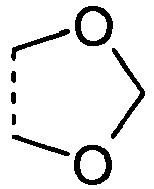

- Advantageously, R5 represents a (C1-C6)alkyl, aryl, heteroaryl, aryl-(C1-C6)alkyl, heteroaryl-(C1-C6)alkyl, (C3-C10)cycloalkyl-(C1-C6)alkyl, (3 to 7-membered heterocycloalkyl) -(C1-C6)alkyl group,
said group being optionally substituted by one or more groups selected from a halogen atom, a -CF3, -CN, -OH, -NR29R30, -NO2, -C(CF3)2OH, (C1-C6)alkoxy, aryloxy, -S-(C1-C6)alkyl, -C(O)O((C1-C6)alkyl), (C2-C6)alkynyl, aryl, heteroaryl, (C1-C6)alkyl-heteroaryl, 3 to 7-membered heterocycloalkyl, (3 to 7-membered heterocycloalkyl)-(C1-C6)alkoxy radical and a (C1-C6)alkyl optionally substituted by one or more fluorine atoms, and
the aryl or heteroaryl core of said group, when present, being optionally fused to a 5 or 6-membered heterocycle,
R29 and R30 being as defined hereinbefore. - Also advantageously, R5 represents a (C1-C6)alkyl, heteroaryl, (C3-C10)cycloalkyl-(C1-C6)alkyl, aryl-(C1-C6)alkyl, or aryl group,
the aryl core of the aryl or aryl-(C1-C6)alkyl group being optionally fused to a 5 or 6-membered heterocycle, comprising preferably two oxygen atoms, and being optionally substituted by one or more groups selected from a halogen atom, a - CF3, -CN, -OH, -NR29R30, -NO2, -C(CF3)2OH, (C1-C6)alkoxy, aryloxy, -S-(C1-C6)alkyl, -C(O)O((C1-C6)alkyl), (C2-C6)alkynyl, aryl, heteroaryl, (C1-C6)alkylheteroaryl, 3 to 7-membered heterocycloalkyl, (3 to 7-membered heterocycloalkyl)-(C1-C6)alkoxy radical, and a (C1-C6)alkyl optionally substituted by one or more fluorine atoms,
R29 and R30 being as defined hereinbefore. - Advantageously, R5 represents a (C1-C6)alkyl, heteroaryl, (C3-C10)cycloalkyl-(C1-C6)alkyl, aryl-(C1-C6)alkyl, or aryl group,
the aryl core of the aryl or aryl-(C1-C6)alkyl group being optionally fused to a 5 or 6-membered heterocycle, comprising preferably two oxygen atoms, and being optionally substituted by one or more groups selected from a halogen atom, a - CF3, -CN, -NR29R30, -NO2, -C(CF3)2OH, (C1-C6)alkoxy, aryloxy, (C1-C6)alkyl, (C2-C6)alkynyl, aryl and 5 or 6-membered heterocycloalkyl group,
R29 and R30 being as defined hereinbefore. - Also advantageously, R5 represents a (C1-C6)alkyl, preferably methyl or isobutyl; indazolyl; phenyl-(C1-C6)alkyl, preferably benzyl; cyclopropyl-(C1-C6)alkyl, preferably, cyclopropylmethyl; 1,3-benzodioxolyl; 1,3-benzodioxolylmethyl; naphthyl; or phenyl group, said phenyl group being optionally substituted by one or more groups selected from a halogen atom, preferably a fluorine or chlorine atom, a -CF3, -CN, -NR29R30, preferably -NMe2 or -NEt2, -NO2, -C(CF3)2OH, (C1-C6)alkoxy, preferably methoxy, phenoxy, (C1-C6)alkyl, preferably methyl, isopropyl or tert-butyl, (C2-C6)alkynyl, preferably -C=CH, phenyl and morpholinyl group,
R29 and R30 being as defined hereinbefore. - Also advantageously, R5 represents a phenyl group, being optionally fused to a 5 or 6-membered heterocycle, comprising preferably two oxygen atoms, and being optionally substituted by one or more groups selected from a halogen atom, a -NH2, -COOH, -CN, -OH, -NO2, -B(OH)2, (C1-C6)alkoxy, -O-(C1-C6)alkyl-NR27R28, -O-(C1-C6)alkyl-O-(C1-C6)alkyl, aryloxy, -C(O)O-(C1-C6)alkyl, (C2-C6)alkynyl, -NR29R30, -NHC(O)O-(C1-C6)alkyl, -C(O)NH2, -C(O)NR31R32, - S-(C1-C6)alkyl, -S(O)-(C1-C6)alkyl, -SO2-(C1-C6)alkyl, -SO2NH2, -SO2NR33R34, -NR35SO2R36, aryl, heteroaryl, (C1-C6)alkylheteroaryl, 3 to 7-membered heterocycloalkyl, (3 to 7-membered heterocycloalkyl)-(C1-C6)alkoxy radical and a (C1-C6)alkyl group optionally substituted by one or more halogen atoms,
R29 to R36 being as defined hereinbefore. - Even more advantageously, R5 represents a 1,3-benzodioxolyl or phenyl group, said phenyl group being optionally substituted by one or more groups selected from a halogen atom, preferably a fluorine or chlorine atom, a -CF3, -CN, -NR29R30, preferably -NMe2 or -NEt2, -NO2, -C(CF3)2OH, (C1-C6)alkoxy, preferably methoxy, phenoxy, (C1-C6)alkyl, preferably methyl, isopropyl or tert-butyl, (C2-C6)alkynyl, preferably -C≡CH, phenyl and morpholinyl group,
R29 and R30 being as defined hereinbefore. - Also advantageously, R6 represents a -CH2Hal or -C≡CR12 group, with Hal and R12 as defined hereinbefore.
- Even more advantageously, R6 is selected from -CH2Cl, -CH2Br, -CH2F, - C≡CH, -C≡CMe and -C≡CPh, and advantageously R6 is selected from -CH2Cl and -C≡CH.
- In one particular embodiment, R6 represents the -CH2Cl group.
- In another particular embodiment, R6 represents the -C≡CH group.
- In one particular embodiment, the compounds according to the invention will be selected from the compounds of formula (I) for which R1 represents a cyclohexyl, R2 and R3 represent a hydrogen atom, R4 represents a thiophenyl, R6 represents a -CH2Cl or -C≡CH group and R5 represents a phenyl group, said phenyl group being optionally fused to a 5 or 6-membered heterocycle, comprising preferably two oxygen atoms, and being optionally substituted by one or more groups selected from a halogen atom, a -NH2, -COOH, -CN, -OH, -NO2, -B(OH)2, (C1-C6)alkoxy, -O-(C1-C6)alkyl-NR27R28, -O-(C1-C6)alkyl-O-(C1-C6)alkyl, aryloxy, -C(O)O-(C1-C6)alkyl, (C2-C6)alkynyl, -NR29R30, -NHC(O)O-(C1-C6)alkyl, -C(O)NH2, -C(O)NR31R32, -S-(C1-C6)alkyl, -S(O)-(C1-C6)alkyl, - SO2-(C1-C6)alkyl, -SO2NH2, -SO2NR33R34, -NR35SO2R36, aryl, heteroaryl, (C1-C6)alkylheteroaryl, 3 to 7-membered heterocycloalkyl, (3 to 7-membered heterocycloalkyl)-(C1-C6)alkoxy radical and a (C1-C6)alkyl group optionally substituted by one or more halogen atoms,
R29 to R36 being as defmed hereinbefore. - In another particular embodiment, the compounds according to the invention will be selected from the compounds of formula (I) for which R1 represents a cyclohexyl, R2 and R3 represent a hydrogen atom, R4 represents a thiophenyl, R6 represents a -CH2Cl or -C≡CH group and R5 represents a 1,3-benzodioxolyl or phenyl group, said phenyl group being optionally substituted by one or more groups selected from a halogen atom, preferably a fluorine or chlorine atom, a -CF3, -CN, -NR29R30, preferably -NMe2 or -NEt2, -NO2, - C(CF3)2OH, (C1-C6)alkoxy, preferably methoxy, phenoxy, (C1-C6)alkyl, preferably methyl, isopropyl or tert-butyl, (C2-C6)alkynyl, preferably -C≡CH, phenyl and morpholinyl group,
R29 and R30 being as defined hereinbefore. - In one particular embodiment, the compound of the invention is selected from the following molecules:
1 
2 
3 
4 
5 
6 
9 
8 
11 
10 
13 
12 
15 
14 
17 
16 
19 
18 
21 
20 
23 
22 
25 
24 
27 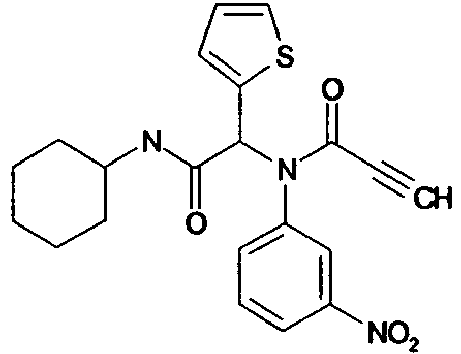
26 
29 
28 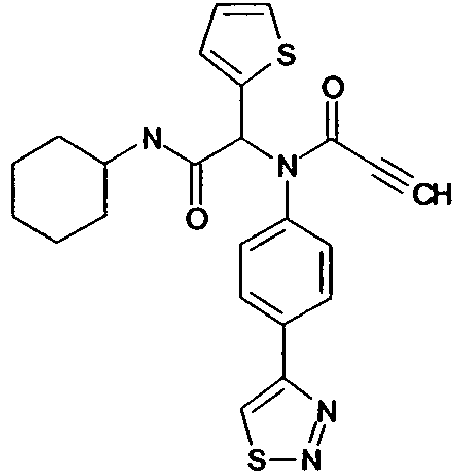
31 
30 
33 
32 
35 
34 
37 
36 
39 
38 
41 
40 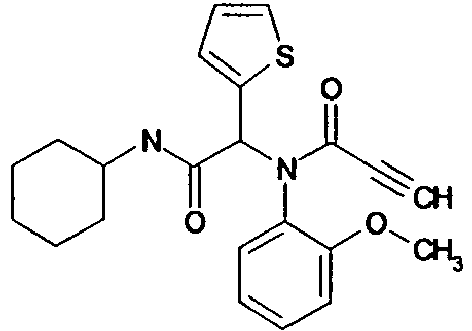
43 
42 
45 
44 
47 
46 
49 
48 
51 
50 
53 
52 
55 
54 
57 
56 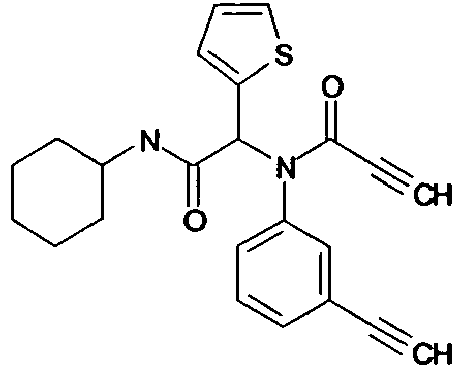
59 
58 
61 
60 
63 
62 
65 
64 
67 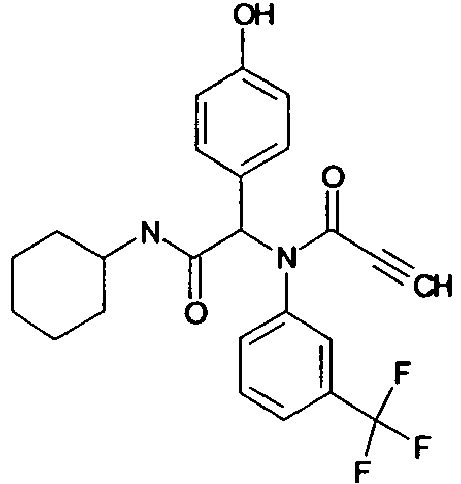
66 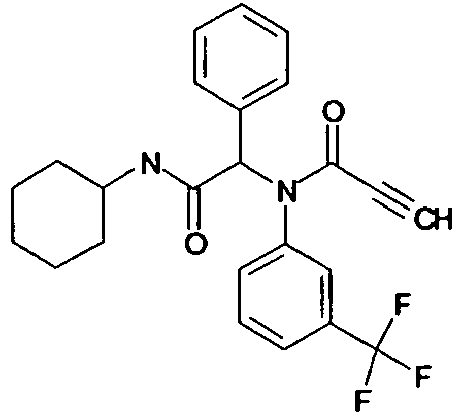
69 
68 
71 
70 
73 
72 
75 
74 
77 
76 
79 
78 
81 
80 
83 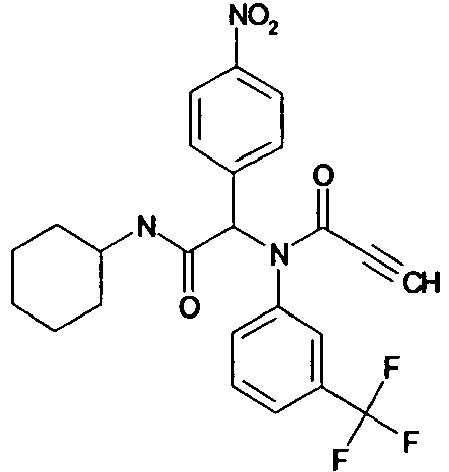
82 
85 
84 
87 
86 
89 
88 
91 
90 
93 
92 
95 
94 
97 
96 
99 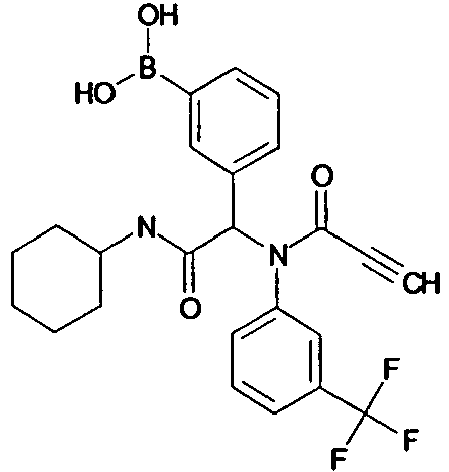
98 
101 
100 
103 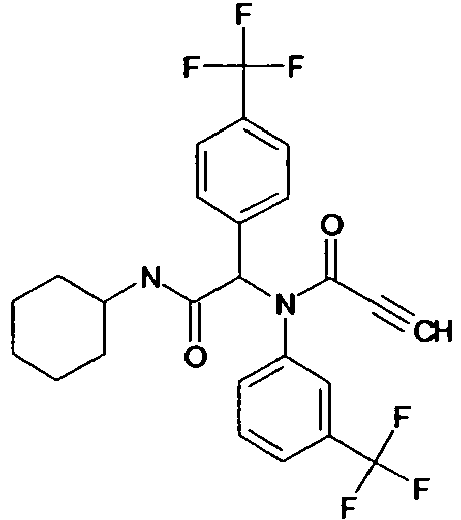
102 
105 
104 
107 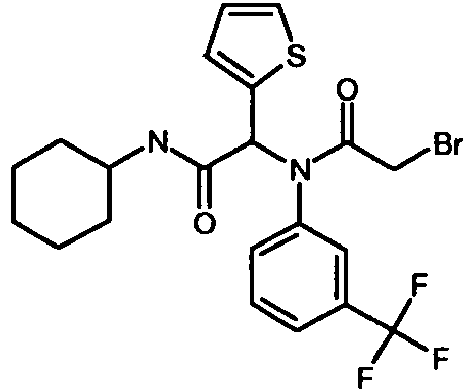
106 
109 
108 
111 
110 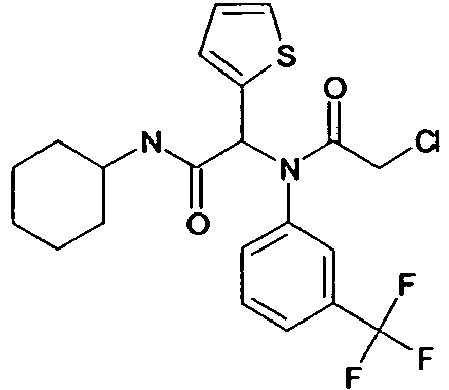
113 
112 
115 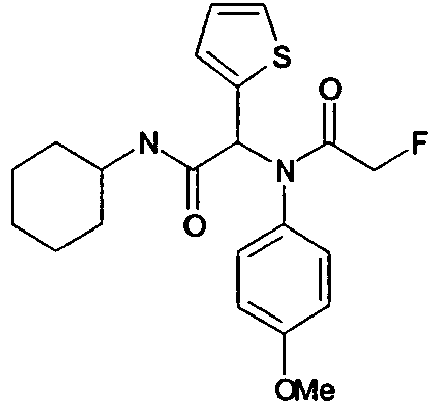
114 
117 
116 
119 
118 
121 
120 
123 
122 
125 
124 
127 
126 
129 
128 
131 
130 
133 
132 
135 
134 
137 
136 
139 
138 
141 
140 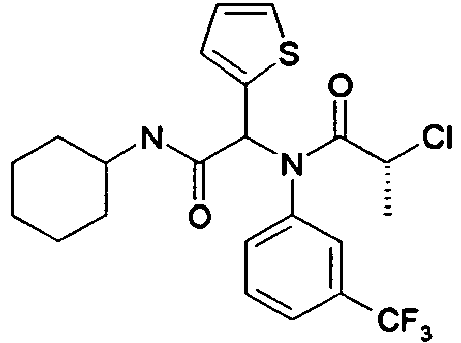
143 
142 
145 
144 
147 
146 
149 
148 
151 
150 
153 
152 
155 
154 
157 
156 
159 
158 
161 
160 
163 
162 
165 
164 
167 
166 
169 
168 
171 
170 
173 
172 
175 
174 
177 
176 
179 
178 
181 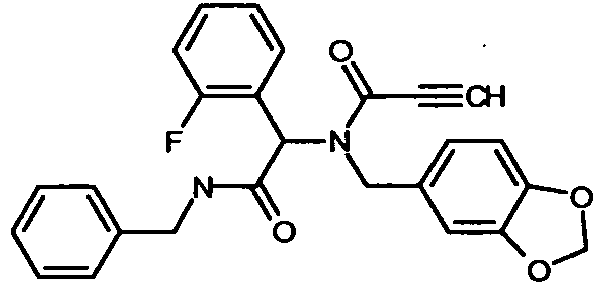
180 
183 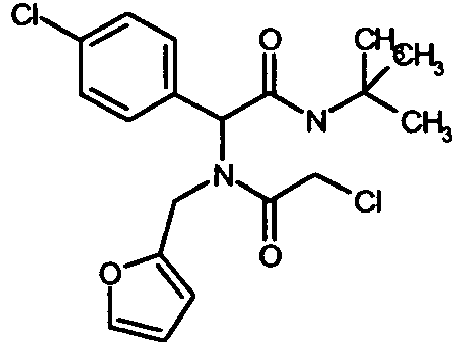
182 
185 
184 
187 
186 
189 
188 
191 
190 
193 
192 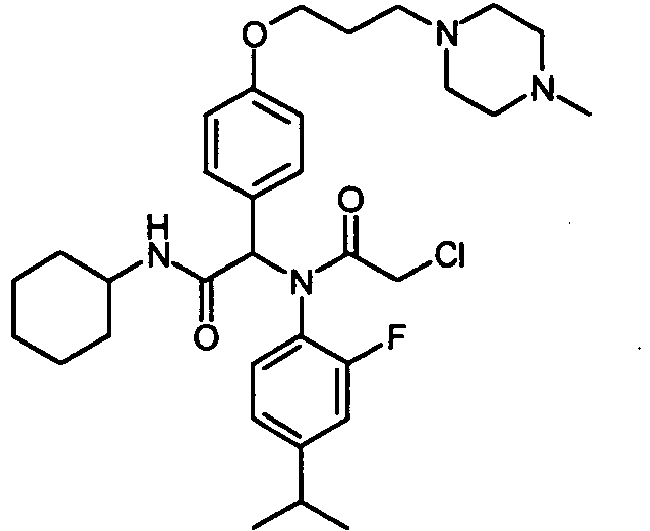
195 
194 
197 
196 
199 
198 
201 
200 
203 
202 
205 
204 
206 
N.B. It should be noted that when nitrogen atoms present only 2 substituents on the above molecules, the 3rd substituent is, of course, a hydrogen atom. - The present invention also relates to the use of a compound of formula (I) as defined hereinbefore for the production of a medicament, in particular intended to treat or prevent a cancer, and in particular a cancer resistant to chemotherapy.
- The present invention also relates to a method for the treatment or prevention of cancer comprising the administration of an effective quantity of a compound of formula (I) as defined hereinbefore to a patient In need thereof
- The present invention also concerns a pharmaceutical composition comprising at least one compound of formula (I) as defined hereinbefore, in association with one or more pharmaceutically acceptable excipients.
- The compounds of formula (I) for which R6 = -C≡CR38 and R1 is an optionally substituted 1,3-thiazol-2-yl group will preferably be excluded from the pharmaceutical compositions not comprising another active principle, such as an anticancer agent.
- In one particular embodiment, this composition may comprise at least one other active principle.
- In particular, this/these active principle(s) may be anticancer agents conventionally used in the treatment of cancer. These anticancer agents may be selected in particular from cisplatin and the derivatives thereof such as carboplatin and oxaliplatin ; taxanes such as taxol, taxotere, paclitaxel and docetaxel ; vinca alkaloids such as vinblastine, vincristine and vinorelbine ; purine analogues such as mercaptopurine, thioguanine, pentostatin and 2-chlorodeoxyadenosine ; topoisomerase I inhibitors such as compounds of camptothecin, like irinotecan and topotecan; topoisomerase II inhibitors such as epipodophyllotoxin, podophyllotoxin and the derivatives thereof like etoposide and teniposide ; antitumoural nucleoside derivatives such as 5-fluorouracil, leucovorin, gemcitabine or capecitabine ; alkylating agents such as nitrogen mustards like cyclophosphamide, mechlorethamine, chlorambucil and melphalan, nitrosoureas like carmustine, lomustine and streptozocin, alkyl sulphonates like busulphan, ethyleneimines and methylmelamines like thiotepa and hexamethylmelamine, and tetrazines like dacarbazine ; antitumoural anthracycline derivatives such as daunorubicin, adriamycin, doxil, idarubicin and mitoxantrone ; molecules targeting the IGF-I receptor such as picropodophyllin ; tetracarcin derivatives such as tetrocarcin A ; corticosteroids such as prednisone ; antibodies such as trastuzumab (anti-HER2 antibody), rituximab (anti-CD20 antibody), gemtuzamab, cetuximab, pertuzumab and bevacizumab; selective oestrogen receptor antagonists or modulators such as tamoxifen, fulvestrant, toremifene, droloxifene, faslodex and raloxifene ; aromatase inhibitors such as exemestane, anastrozole, letrozole and vorozole ; differentiating agents such as retinoids like retinoic acid and vitamin D and retinoic acid metabolism blocking agents such as accutane ; DNA methyltransferase inhibitors such as azacytidine and decitabine ; antifolates such as disodium permetrexed ; antibiotics such as antinomycin D, bleomycin, mitomycin C, actinomycin D, carminomycin, daunomycin and plicamycin; antimetabolites such as chlofarabine, aminopterin, cytosine arabinoside, floxuridine and methotrexate ; apoptosis inducing agents and Bcl-2 inhibitor antiangiogenic agents such as YC 137, BH 312, ABT 737, gossypol, HA 14-1, TW 37 and decanoic acid ; agents binding to tubulin such as combrestatin, colchicine derivatives and nocodazole ; kinase inhibitors such as flavoperidol, imatinib mesylate, erlotinib and gefitinib ; farnesyltransferase inhibitors such as tipifarnib ; histone deacetylase inhibitors such as sodium butyrate, suberoylanilide hydroxamic acid, depsipeptide, NVP- LAQ824, R306465, JNJ-26481585 and trichostatin A ; inhibitors of the ubiquitin proteasome system such as MLN .41, bortezomib and yondelis ; and telomerase inhibitors such as telomestatin.
- The compounds according to the invention can be administered orally, sublingually, parenterally, subcutaneously, intramuscularly, intravenously, transdermally, locally or rectally.
- In the pharmaceutical compositions of the present invention for oral, sublingual, parenteral, subcutaneous, intramuscular, intravenous, transdermal, local or rectal administration, the active ingredient can be administered in unitary forms of administration, in a mixture with conventional pharmaceutical carriers, to animals or to human beings. Appropriate unitary forms of administration include forms to be administered orally such as tablets, capsules, powders, granules and oral solutions or suspensions, forms to be administered sublingually and buccally, forms to be administered parenterally, subcutaneously, intramuscularly, intravenously, intranasally or intraocularly and forms to be administered rectally.
- During preparation of a solid composition in the form of tablets, the main active ingredient is mixed with a pharmaceutical vehicle such as gelatin, starch, lactose, magnesium stearate, talc, gum arabic or the like. Tablets made of sucrose or other suitable materials can be coated or else treated in such a way that they display prolonged or delayed activity and that they continuously release a predetermined quantity of active principle.
- A capsule preparation is obtained by mixing the active ingredient with a diluent and by pouring the mixture obtained into soft or hard capsules.
- A preparation in the form of a syrup or elixir can contain the active ingredient in conjunction with a sweetening agent, an antiseptic, and also a flavour-imparting agent and an appropriate dye.
- Water-dispersible powders or granules can contain the active ingredient in a mixture with dispersing agents or wetting agents, or suspending agents, and also with taste modifiers or sweetening agents.
- For rectal administration, use is made of suppositories prepared with binders which melt at rectal temperature, for example cocoa butter or polyethylene glycols.
- For parenteral, intranasal or intraocular administration, use is made of aqueous suspensions, isotonic saline solutions or sterile and injectable solutions containing pharmacologically compatible dispersing agents and/or wetting agents.
- The active principle can also be formulated in the form of microcapsules, optionally with one or more additive carriers.
- The compounds of the invention can be used at doses of between 0.01 mg and 1,000 mg per day, given in a single dose once per day or administered in a plurality of doses over the course of the day, for example twice per day in equal doses. The daily administered dose is advantageously comprised between 5 mg and 500 mg, even more advantageously between 10 mg and 200 mg. It may be necessary to use doses outside these ranges; a person skilled in the art will be able to take account of this himself
- The present invention also concerns a pharmaceutical composition comprising :
- (i) at least one compound of formula (I) as defined hereinbefore, and
- (ii) at least one other active principle,
- Indeed, it is common to treat cancer by double or triple therapy. It may be useful especially to combine the molecules of the invention with one or more anticancer compounds, thus allowing the treatment of cancer, on the one hand, and the prevention of the appearance of resistant cancer cells, on the other hand.
- In particular, this/these active principle(s) may be anticancer agents used conventionally in the treatment of cancer. These anticancer agents may be selected in particular from cisplatin and the derivatives thereof such as carboplatin and oxaliplatin; taxanes such as taxol, taxotere, paclitaxel and docetaxel ; vinca alkaloids such as vinblastine, vincristine and vinorelbine ; purine analogues such as mercaptopurine, thioguanine, pentostatin and 2-chlorodeoxyadenosine ; topoisomerase I inhibitors such as compounds of camptothecin, like irinotecan and topotecan; topoisomerase II inhibitors such as epipodophyllotoxin, podophyllotoxin and the derivatives thereof like etoposide and teniposide ; antitumoural nucleoside derivatives such as 5-fluorouracil, leucovorin, gemcitabine or capecitabine ; alkylating agents such as nitrogen mustards like cyclophosphamide, mechlorethamine, chlorambucil and melphalan, nitrosoureas like carmustine, lomustine and streptozocin, alkyl sulphonates like busulphan, ethyleneimines and methylmelamines like thiotepa and hexamethylmelamine, and tetrazines like dacarbazine ; antitumoural anthracycline derivatives such as daunorubicin, adriamycin, doxil, idarubicin and mitoxantrone; molecules targeting the IGF-I receptor such as picropodophyllin; tetracarcin derivatives such as tetrocarcin A; corticosteroids such as prednisone; antibodies such as trastuzumab (anti-HER2 antibody), rituximab (anti-CD20 antibody), gemtuzamab, cetuximab, pertuzumab and bevacizumab; selective oestrogen receptor antagonists or modulators such as tamoxifen, fulvestrant, toremifene, droloxifene, faslodex and raloxifene ; aromatase inhibitors such as exemestane, anastrozole, letrozole and vorozole ; differentiating agents such as retinoids like retinoic acid and vitamin D and retinoic acid metabolism blocking agents such as accutane ; DNA methyltransferase inhibitors such as azacytidine and decitabine ; antifolates such as disodium permetrexed; antibiotics such as antinomycin D, bleomycin, mitomycin C, actinomycin D, carminomycin, daunomycin and plicamycin; antimetabolites such as chlofarabine, aminopterin, cytosine arabinoside, floxuridine and methotrexate ; apoptosis inducing agents and Bcl-2 inhibitor antiangiogenic agents such as YC 137, BH 312, ABT 737, gossypol, HA 14-1, TW 37 and decanoic acid ; agents binding to tubulin such as combrestatin, colchicine derivatives and nocodazole ; kinase inhibitors such as flavoperidol, imatinib mesylate, erlotinib and gefitinib ; farnesyltransferase inhibitors such as tipifarnib ; histone deacetylase inhibitors such as sodium butyrate, suberoylanilide hydroxamic acid, depsipeptide, NVP- LAQ824, R306465, JNJ-26481585 and trichostatin A ; inhibitors of the ubiquitin proteasome system such as MLN .41, bortezomib and yondelis ; and telomerase inhibitors such as telomestatin.
- The present invention also concerns a pharmaceutical composition as defined hereinbefore, for use thereof as a medicament intended to treat or to prevent cancer, in particular a cancer which is resistant to chemotherapy.
- The present invention also relates to the use of a pharmaceutical composition comprising :
- (i) at least one compound of formula (I) as defined hereinbefore,
- (ii) at least one other active principle, and in particular the active principle(s) cited hereinbefore,
- The present invention also relates to a process for preparing a compound of formula (I) as defined hereinbefore for which R2 represents a hydrogen atom, according to the following steps :
- reacting a ketone of formula R3-CO-R4 with an amine of formula R5-NH2, a carboxylic acid of formula R6-COOH and an isonitrile of formula R1-NC, R1, R3, R4, R5 and R6 being as defined hereinbefore, to produce the compound of formula (I), and
- separating the compound of formula (I) obtained in the preceding step from the reaction medium.
- The first step of this process corresponds to a multicomponent reaction known as an Ugi reaction (U-4MCRs), the conditions for the implementation of which are well known to a person skilled in the art.
- Each of the four reagents used for this reaction (ketone, amine, carboxylic acid and isonitrile) can be either commercially available or prepared using organic synthesis methods well known to a person skilled in the art.
- Advantageously, the four reagents are introduced in the following order : ketone, amine, carboxylic acid and isonitrile.
- Advantageously, the reaction is carried out in methanol as a solvent, and advantageously at ambient temperature.
- The ketone used will be an aldehyde where R3 represents a hydrogen atom.
- Moreover, additional protection/deprotection and/or molecule functionalisation steps, well known to a person skilled in the art, are conceivable in the preceding process for the preparation of compounds of formula (I).
- Other processes for the preparation of the compounds of the invention may be used as described below in examples 2 to 5.
- The present invention also concerns compounds of general formula (I) :

- ■ if R1 represents a cyclopentyl or cyclohexyl group or a benzyl group optionally substituted by a fluorine atom, R2 and R3 represent a hydrogen atom and R6 represents a -C≡CH group, then R4 does not represent a thiophenyl, furyl or furylmethyl group or a phenyl group optionally substituted by a fluorine atom, a chlorine atom or a methoxy group, and
- ■ if R1 represents a tert-butyl group, R2 and R3 represent a hydrogen atom, R4 represents a phenyl group substituted by a chlorine atom or an OH group and R6 represents a -CH2Cl group, then R5 does not represent a furylmethyl or 1,3-benzodioxolylmethyl group.
- Compounds 3 and 158 to 184 of the present invention are in fact commercially available from Asinex.
- The subject of the present invention is more particularly compounds of the general formula (I):

- if R6 = -C≡CR38 with R38 as defined hereinbefore,
then R1 does not represent an optionally substituted 1,3-thiazol-2-yl group, - if R1 represents a cyclopentyl or cyclohexyl or a benzyl group optionally substituted by a fluorine atom, R2 and R3 represent a hydrogen atom and R6 represents a -C≡CH group,
then R4 does not represent a thiophenyl or furyl group or a phenyl group optionally substituted by a fluorine atom, a chlorine atom or a methoxy group, - if when R1 represents a hydrogen atom, a tert-butyl, sec-butyl, cyclohexyl, hexyl, ethyl or methyl group, or a phenyl group optionally substituted by one or more groups selected from F, ethoxy and CF3, R2 represents a hydrogen atom or a methyl group, or R1 and R2 together form, with the nitrogen atom carrying them, a morpholine or piperidine group, R3 represents a hydrogen atom, and R4 represents a hydrogen atom, a methyl or ethyl group, or a phenyl group optionally substituted by one or more groups selected from Cl, OH, methoxy, NO2 or NMe2, or R3 and R4 together form, with the carbon atom carrying them, a cyclopentane or a cyclohexane, and R6 represents a -CH2Cl group,
then R5 does not represent a prop-2-yne, (C1-C8)alkyl, furylmethyl, tetrahydro-pyrane, thiopyrane ou 1,3-benzodioxolylmethyl group; or a benzyl group optionally substituted by a chlorine atom or NO2; or a phenyl group optionally substituted by one or more Br, ethyl or methyl groups, and - if R1 represents a tert-butyl or benzyl group, R2 and R3 each represent a hydrogen atom, R4 represents a furyl or pyrrole group substituted on the nitrogen atom by a -SO2Me group, and R6 represents a -C≡CMe or -C≡CPh group,
then R5 does not represent a a tert-butyl group or a benzyl group optionally substituted by a bromine atom or a phenyl. - Derivates of formula (I) are in fact described, without any biological activity not being reported elsewhere, in:
WO 008/008 022 US 4 944 796 ,US 4 205 168 , Neo et al. Tetrahedron Lett. 2005, 7977-7979 and Wright et al. Tetrahedron Lett. 2002, 943-946. - Subject to the same limitations as set out hereinbefore, the compounds of the invention will be advantageously characterised as follows.
- When the NR1R2 group represents a heteroaryl or heterocycle, it is of course possible for said cycle to comprise one or more other heteroatoms, preferably zero or one another, heteroatom(s) in addition to the nitrogen atom carrying R1 and R2 which is already present, said heteroaryl or heterocycle advantageously having 5 to 6 members. Said heteroatom will therefore be advantageously selected from O, S and N, and preferably from O and N. Advantageously, it will be a piperidine, morpholine or piperazine group, and preferably piperazine.
- The same comment also applies to the groups NR19R20 and NR85R86, when they form heterocycles.
- Advantageously, R1 does not represent a hydrogen atom. Advantageously, R1 and/or R4 do(es) not represent a hydrogen atom. Even more advantageously, R1 and R4 do not represent a hydrogen atom. According to a particular embodiment of the invention, R1:
- represents a hydrogen atom or a (C1-C6)alkyl, (C3-C10)cycloalkyl, (C3-C10)cycloalkenyl, aryl, heteroaryl, aryl-(C1-C6)alkyl, heteroaryl-(C1-C6)alkyl group,
said group being optionally substituted by one or more groups selected from a halogen atom, a (C1-C6)alkoxy, -NH2, -COOH, -CN, -OH, -NR7R8, -O-(C1-C6)alkyl-NR7R8, benzyloxy, -C(O)O-(C1-C6)alkyl, -NH-C(O)O-(C1-C6)alkyl, -C(O)NH2, -C(O)NR9R10, -S-(C1-C6)alkyl, -S(O)-(C1-C6)akyl, - SO2-(C1-C6)alkyl, -SO2NH2, -SO2NR11R12, NR13SO2R14 radical and a (C1-C6)alkyl group optionally substituted by one or more halogen atoms, or - forms, with R2 and the nitrogen atom carrying them, a 3 to 7-membered heterocycloalkyl, said heterocycloalkyl being optionally substituted by one or more groups selected from a halogen atom and a (C1-C6)alkyl group optionally substituted by one or more halogen atoms.
- Advantageously, R1 represents a hydrogen atom or a (C1-C6)alkyl, aryl, heteroaryl, aryl-(C1-C6)alkyl, heteroaryl-(C1-C6)alkyl, (C3-C10)cycloalkyl group, said group being optionally substituted by one or more groups selected from - NH2, -COOH, benzyloxy, aryloxy, -C(O)O((C1-C6)alkyl), -NHC(O)O((C1-C6)alkyl).
- Also advantageously, R1 represents a (C1-C6)alkyl, aryl, aryl-(C1-C6)alkyl, (C3-C10)cycloalkyl group, said group being optionally substituted by one or more groups selected from -NH2, -COOH, benzyloxy, aryloxy, -C(O)O((C1-C6)alkyl), - NHC(O)O((C1-C6)alkyl), and advantageously from benzyloxy and -C(O)O((C1-C6)alkyl).
- Also advantageously, R1 represents a (C1-C6)akyl group optionally substituted by a -C(O)O((C1-C6)alkyl) group; an aryl group optionally substituted by a -C(O)O((C1-C6)alkyl) or benzyloxy group; an aryl-(C1-C6)alkyl group; or a (C3-C10)cycloalkyl group.
- Even more advantageously, R1 represents a cyclohexyl, cyclopentyl, benzyl, -C6H4-C(O)OMe, -C6H4-OAr (with Ar = aryl), -C6H4-OBn, -CH2CH2-CO2Me or -CH2CH2-CO2tBu group.
- Also advantageously, R1 represents a cyclohexyl, cyclopentyl or benzyl, and also advantageously cyclohexyl group.
- In one particular embodiment, R2 represents a hydrogen atom.
- According to a first preferred embodiment of the invention, R1 represents a (C3-C10)cycloalkyl or aryl-(C1-C6)alkyl group, and preferably cyclohexyl, cyclopentyl or benzyl, said group being optionally substituted by one or more groups selected from a halogen atom, a (C1-C6)alkoxy, -NH2, -COOH, -CN, -OH, -NR7R8, -O-(C1-C6)alkyl-NR7R8, benzyloxy, aryloxy, -C(O)O-(C1-C6)alkyl, -NH-C(O)O-(C1-C6)alkyl, -C(O)NH2, -C(O)NR9R10, -S-(C1-C6)alkyl, -S(O)-(C1-C6)alkyl, - SO2-(C1-C6)alkyl, -SO2NH2, -SO2NR11R12, -NR13SO2R14 radical and a (C1-C6)alkyl group optionally substituted by one or more groups selected from a halogen atom, a (C1-C6)alkoxy, -NH2, -COOH, benzyloxy, aryloxy, -C(O)O((C1-C6)alkyl), -NHC(O)O((C1-C6)alkyl) group.
- Advantageously, R1 represents a (C3-C10)cycloalkyl or aryl-(C1-C6)alkyl group, preferably cyclohexyl, cyclopentyl or benzyl, said group being optionally substituted by one or more groups from a halogen atom, -OH and (C1-C6)alkoxy.
- In this case, R1 advantageously represents a (C3-C10)cycloalkyl group, and preferably cyclohexyl, preferably unsubstituted, and R2 advantageously represents a hydrogen atom.
- According to a second preferred embodiment of the invention, R1 forms, with R2 and the nitrogen atom carrying them, a 3 to 7-membered heterocycle optionally substituted by one or more groups selected from a halogen atom, a (C3-C10)cycloalkyl, (C3-C10)cycloalkenyl, aryl, heteroaryl, aryl-(C1-C6)alkyl, heteroaryl-(C1-C6)alkyl, heterocycloalkyl-(C1-C6)alkyl, -OH, -NH2, -C(O)OH, -C(O)NH2, -C(S)NH2, -OR50, -OC(O)R51, -C(O)R52, -C(O)OR53, -NHC(O)R54, - NHC(O)OR55, -SO2R56 -(C1-C6)alkyl-C(O)OR57, -NR58R59, -C(O)NR60R61, - C(O)N(R62)(aryl), C(O)N(R63)(heteroaryl), -C(O)NHNR64R65, -C(S)NR66R67, - C(S)N(R68)(aryl), -C(S)N(R69)(heteroaryl), -C(S)NHNR70R71, -OC(O)-NR72R73, -(C1-C6)alkyl-C(O)-NR74R75, -(C1-C6)alkyl-NR103-C(O)-OR104, -(C1-C6)alkyl-NR76R77, -C(NOR78)-aryl radical, and a (C1-C6)alkyl group optionally substituted by one or more halogen atoms,
the aryl and heteroaryl unit of said radical, when present, being optionally substituted by one or more groups selected from a halogen atom, a -CN, -OH, (C1-C6)alkyl, (C1-C6)alkoxy, -NR79R80, -(C1-C6)alkyl-NR81R82 and -O-(C1-C6)alkyl-NR83R84 group. - In this case the heterocycle will advantageously be 5 or 6-membered and preferably saturated. It will advantageously be piperazine.
- Thus, -NR1R2 will advantageously represent the following piperazine cycle:

- R104 representing a hydrogen atom, a (C3-C10)cycloalkyl, (C3-C10)cycloalkenyl, aryl, heteroaryl, aryl-(C1-C6)alkyl, heteroaryl-(C1-C6)alkyl, heterocycloalkyl-(C1-C6)akyl, -C(O)R52, -C(O)OR53, -C(O)OH, -C(O)NH2, -C(S)NH2, - C(O)NR60R61, -C(S)NR66R67, -SO2R56, -C(O)NHNR64R65, -C(S)NHNR70R71 radical, and a (C1-C6)alkyl group optionally substituted by one or more halogen atoms,
- the aryl and heteroaryl unit of said radical, when present, being optionally substituted with one or more groups selected from a halogen atom, a -CN, -OH, (C1-C6)alkoxy, -NR79R80, and -O-(C1-C6)alkyl-NR83R84 group.
- Advantageously, R104 represents a (C3-C10)cycloalkyl, aryl-(C1-C6)alkyl, heteroaryl-(C1-C6)alkyl, -C(O)R52, -C(O)OR53, -C(O)NH2, -C(O)NR60R61, - SO2R56 or -C(O)NHNR64R65 group, and preferablya represents a (C3-C10)cycloalkyl, aryl-(C1-C6)alkyl, heteroaryl-(C1-C6)alkyl, -C(O)R52, -C(O)OR53, -C(O)NR60R61 or -SO2R56 group.
- According to a particular embodiment of the invention, R4:
- represents a hydrogen atom or a (C1-C6)alkyl, (C3-C10)cycloalkyl, aryl advantageously phenyl, or heteroaryl, advantageously thiophenyl, group, said group being optionally substituted by one or more groups selected from a halogen atom, a -C(CF3)2OH, -CN, -NH2, -OPO3H2, -NR17R18, -NO2, - COOH, -OH, -O-(C1-C6)alkyl-O-(C1-C6)alkyl, -O(C1-C6)alkyl-NR19R20 (with R19 and R20 each representing a (C1-C6)alkyl), benzyloxy, -C(O)O-(C1-C6)alkyl, -NHC(O)O-(C1-C6)alkyl, -C(O)NH2, -C(O)NR21R22, -S-(C1-C6)alkyl, -S(O)-(C1-C6)alkyl, -SO2-(C1-C6)akyl, -SO2NH2, -SO2NR23R24, -NR25SO2R26 group, a 3 to 7-membered heterocycloalkyl, aryloxy radical, a (C1-C6)alkyl optionally substituted by one or more halogen atoms, and a (C1-C6)alkoxy optionally substituted by one or more fluorine atoms, and
said group, when it is an aryl or heteroaryl, being optionally fused to a 5 or 6-membered heterocycle, or - forms, with R3 and the carbon carrying them, a ring selected from a (C3-C10)cycloalkyl and a 3 to 7-membered heterocycloalkyl, said cycle being optionally substituted by a (C1-C6)alkyl, -C(O)-(C1-C6)akyl, -C(O)O-(C1-C6)alkyl group.
- Advantageously, R3 represents a hydrogen atom or a methyl, and advantageously a hydrogen atom, and R4 represents a hydrogen atom or a (C1-C6)alkyl, aryl, advantageously phenyl, or heteroaryl, advantageously thiophenyl, group,
said group being optionally substituted by one or more groups selected from a halogen atom, a -CF3, -B(OH)2, -CN, -OH, -NR17R18 (R17 and R18 being as defined hereinbefore), -NO2, -COOH, 3 to 7-membered heterocycloalkyl, (C1-C6)alkyl, -S-(C1-C6)alkyl, aryloxy radical and a (C1-C6)alkoxy optionally substituted by one or more fluorine atoms, and
said group, if it is an aryl or heteroaryl, being optionally fused to a 5 or 6-membered heterocycle, or
R3 and R4 form with the carbon carrying them a ring selected from a (C3-C10)cycloalkyl and a 3 to 7-membered heterocycloalkyl, said ring being optionally substituted by a -C(O)O((C1-C6)alkyl group). - Also advantageously, R3 represents a hydrogen atom or a methyl, and advantageously a hydrogen atom, and R4 represents a hydrogen atom or an aryl, advantageously phenyl, or heteroaryl, advantageously thiophenyl group,
said group being optionally substituted by one or more groups selected from a halogen atom, a -CF3, -B(OH)2, -CN, -OH, -NR17R18, -NO2, -COOH, 3 to 7-membered heterocycloalkyl, (C1-C6)alkyl, -S-(C1-C6)alkyl, aryloxy radical and a (C1-C6)alkoxy optionally substituted by one or more fluorine atoms, and
said group being optionally fused to a 5 or 6-membered heterocycle, or
R3 and R4 form with the carbon carrying them a ring selected from a (C3-C10)cycloalkyl and a 3 to 7-membered heterocycloalkyl, advantageously a 3 to 7-membered heterocycloalkyl, said ring being optionally substituted by a - C(O)O((C1-C6)alkyl) group,
R17 and R18 being as defined hereinbefore. - Advantageously, R3 represents a hydrogen atom or a methyl, and advantageously a hydrogen atom, and R4 represents a hydrogen atom or an aryl, advantageously phenyl, or heteroaryl, advantageously thiophenyl group,
said group being optionally substituted by one or more groups selected from a halogen atom, a -CF3, -B(OH)2, -CN, -OH, -NR17R18, -NO2, -COOH, 3 to 7-membered heterocycloalkyi, (C1-C6)alkyl, -S-(C1-C6)alkyl, aryloxy radical and a (C1-C6)alkoxy optionally substituted by one or more fluorine atoms, and
said group being optionally fused to a 5 or 6-membered heterocycle,
R17 and R18 being as defined hereinbefore. - Advantageously, R3 represents a hydrogen atom or a methyl, and advantageously a hydrogen atom, and R4 represents a hydrogen atom; a heteroaryl, preferably thiophenyl, group optionally substituted by a (C1-C6)alkyl group; or an aryl, preferably phenyl, group optionally fused to a 5 or 6-membered heterocycle comprising preferably two oxygen atoms, and optionally substituted by one or more groups selected from a halogen atom and a -CN, -NR17R18, -NO2, (C1-C6)alkyl, (C1-C6)alkoxy, (C5-C6)heterocycloalkyl, -S- (C1-C6)alkyl and aryloxy group, or
R3 and R4 form with the carbon carrying them a (C5-C6)cycloalkyl or 5 or 6-membered heterocycloalkyl ring, advantageously a 5 or 6-membered heterocycloalkyl, said ring being optionally substituted by a -C(O)O((C1-C6)alkyl) group,
R17 and R18 being as defined hereinbefore. - Advantageously, R3 represents a hydrogen atom or a methyl, and advantageously a hydrogen atom, and R4 represents a hydrogen atom; or a heteroaryl, preferably thiophenyl, group optionally substituted by a (C1-C6)alkyl group; or an aryl, preferably phenyl, group optionally fused to a 5 or 6-membered heterocycle comprising preferably two oxygen atoms, and optionally substituted by one or more groups selected from a halogen atom and a -CN, -NR17R18, -NO2, (C1-C6)akyl, (C1-C6)alkoxy, (C5-C6)heterocycloalkyl, -S-(C1-C6)alkyl and aryloxy group,
R17 and R18 being as defined hereinbefore. - Even more advantageously, R4 does not represent a hydrogen atom.
- Advantageously, R3 represents a hydrogen atom or a methyl, and advantageously a hydrogen atom.
- Also advantageously, R3 represents a hydrogen atom or a methyl, and advantageously a hydrogen atom, and R4 represents a thiophenyl group optionally substituted by a methyl, a 1,3-benzodioxolyl group or a phenyl group optionally substituted by one or more groups selected from a halogen atom and a -CN, - NR17R18, preferably -NMe2, -NO2, (C1-C6)alkyl, preferably methyl or isopropyl, (C1-C6)alkoxy, preferably methoxy, pyrrolidinyl, -S-(C1-C6)alkyl, preferably thiomethoxy, and phenoxy group, or
R3 and R4 form with the carbon carrying them a ring of formula
- Also advantageously, R3 represents a hydrogen atom or a methyl, and advantageously a hydrogen atom, and R4 represents a thiophenyl group optionally substituted by a methyl; a 1,3-benzodioxolyl group; or a phenyl group optionally substituted by one or more groups selected from a halogen atom and a -CN, - NR17R18, preferably -NMe2, -NO2, (C1-C6)akyl, preferably methyl or isopropyl, (C1-C6)alkoxy, preferably methoxy, pyrrolidinyl, -S-(C1-C6)alkyl, preferably thiomethoxy, and phenoxy group,
R7 and R8 being as defined hereinbefore. - Also advantageously, R3 represents a hydrogen atom or a methyl, and advantageously a hydrogen atom, and R4 represents a thiophenyl, advantageously thiophen-2-yl group.
- According to a first preferred embodiment of the invention, R3 and R4 each represent, independently of each other, a (C1-C6)alkyl group, such as methyl.
- According to a second preferred embeodiment of the invention, R3 represents a hydrogen atom, and R4 represents an aryl, advantageously phenyl or heteroaryl, advantageously thiophenyl, group,
said group being optionally substituted by one or more groups selected from a halogen atom, a -C(CF3)2OH, -CN, -NH2, -OPO3H2, -NR17R18, -NO2, -COOH, - OH, -O(C1-C6)alkyl-OPO3H2, -O-(C1-C6)alkyl-O-(C1-C6)alkyl, -O(C1-C6)alkyl-NR19R20, -NR81(C1-C6)alkyl-NR58R86, benzyloxy, -C(O)O-(C1-C6)alkyl, - NHC(O)O-(C1-C6)akyl, -C(O)NH2, -C(O)NR21R22, -S-(C1-C6)akyl, -S(O)-(C1-C6)alkyl, -SO2-(C1-C6)alkyl, -SO2NH2, -SO2NR23R24, -NR25SO2R26, 3 to 7-membered heterocycloalkyl, aryloxy radical, a (C1-C6)alkyl optionally substituted by one or more halogen atoms, and a (C1-C6)alkoxy optionally substituted by one or more fluorine atoms, and
said group being optionally fused to a 5 or 6-membered heterocycle. - In this case, R4 advantageously represents an aryl, advantageously phenyl, or heteroaryl, advantageously thiophenyl, group,
said group being optionally substituted by one or more groups selected from a halogen atom, a -CF3, -B(OH)2, -CN, -OH, -NR17R18 (R17 and R18 being as defined above), -NO2, -COOH, 3 to 7-membered heterocycloalkyl, (C1-C6)alkyl, - S-(C1-C6)alkyl, aryloxy, -O(C1-C6)alkyl-NR19R20 radical and a (C1-C6)alkoxy optionally substituted by one or more fluorine atoms, and
said group being optionally fused to a 5 or 6-membered heterocycle - R4 preferably represents an unsubstituted thiophenyl group, preferably thiophen-2-yl; or a phenyl group optionally substituted by one or more groups selected frorm a halogen atom and a -CF3, -B(OH)2, -CN, -OH, -NR17R18 group (R17 and R18 being as defined above), -NO2, -COOH, 3 to 7-membered heterocycloalkyl, (C1-C6)alkyl, -S-(C1-C6)alkyl, aryloxy, -O(C1-C6)alkyl-NR19R20 radical and a (C1-C6)alkoxy optionally substituted by one or more fluorine atoms, and optionally fused to


- Advantageously, R5 represents a (C1-C6)alkyl, aryl, heteroaryl, aryl-(C1-C6)alkyl, heteroaryl-(C1-C6)alkyl, (C3-C10)cycloalkyl-(C1-C6)alkyl, (3 to 7-membered heterocycloalkyl) -(C1-C6)alkyl group,
- said group being optionally substituted by one or more groups selected from a halogen atom, a -CF3, -CN, -OH, -NR29R30, -NO2, -C(CF3)2OH, (C1-C6)alkoxy, aryloxy, -S-(C1-C6)akyl, -C(O)O((C1-C6)alkyl), (C2-C6)alkynyl, aryl, heteroaryl, (C1-C6)alkyl-heteroaryl, 3 to 7-membered heterocycloalkyl, (3 to 7-membered heterocycloalkyl)-(C1-C6)alkoxy radical and a (C1-C6)alkyl optionally substituted by one or more fluorine atoms, and
the aryl or heteroaryl core of said group, when present, being optionally fused to a 5 or 6-membered heterocycle,
R29 and R30 being as defined hereinbefore. - Also advantageously, R5 represents a (C1-C6)alkyl, heteroaryl, (C3-C10)cycloalkyl-(C1-C6)alkyl, aryl-(C1-C6)alkyl, or aryl group,
the aryl core of the aryl or aryl-(C1-C6)alkyl group being optionally fused to a 5 or 6-membered heterocycle, comprising preferably two oxygen atoms, and being optionally substituted by one or more groups selected from a halogen atom, a - CF3, -CN, -OH, -NR29R30, -NO2, -C(CF3)2OH, (C1-C6)alkoxy, aryloxy, -S-(C1-C6)alkyl, -C(O)O((C1-C6)alkyl), (C2-C6)alkynyl, aryl, heteroaryl, (C1-C6)alkylheteroaryl, 3 to 7-membered heterocycloalkyl, (3 to 7-membered heterocycloalkyl)-(C1-C6)alkoxy radical, and a (C1-C6)alkyl optionally substituted by one or more fluorine atoms,
R29 and R30 being as defined hereinbefore. - Advantageously, R5 represents a (C1-C6)alkyl, heteroaryl, (C3-C10)cycloalkyl-(C1-C6)alkyl, aryl-(C1-C6)alkyl, or aryl group,
the aryl core of the aryl or aryl-(C1-C6)alkyl group being optionally fused to a 5 or 6-membered heterocycle, comprising preferably two oxygen atoms, and being optionally substituted by one or more groups selected from a halogen atom, a - CF3, -CN, -NR29R30, -NO2, -C(CF3)2OH, (C1-C6)alkoxy, aryloxy, (C1-C6)alkyl, (C2-C6)alkynyl, aryl and 5 or 6-membered heterocycloalkyl group,
R29 and R30 being as defined hereinbefore. - Also advantageously, R5 represents a (C1-C6)alkyl, preferably methyl or isobutyl; indazolyl; phenyl-(C1-C6)alkyl, preferably benzyl; cyclopropyl-(C1-C6)alkyl, preferably, cyclopropylmethyl; 1,3-benzodioxolyl; 1,3-benzodioxolylmethyl; naphthyl; or phenyl group, said phenyl group being optionally substituted by one or more groups selected from a halogen atom, preferably a fluorine or chlorine atom, a -CF3, -CN, -NR29R30, preferably -NMe2 or -NEt2, -NO2, -C(CF3)2OH, (C1-C6)alkoxy, preferably methoxy, phenoxy, (C1-C6)alkyl, preferably methyl, isopropyl or tert-butyl, (C2-C6)alkynyl, preferably -C≡CH, phenyl and morpholinyl group,
R29 and R30 being as defined hereinbefore. - Also advantageously, R5 represents a phenyl group, being optionally fused to a 5 or 6-membered heterocycle, comprising preferably two oxygen atoms, and being optionally substituted by one or more groups selected from a halogen atom, a -NH2, -COOH, -CN, -OH, -NO2, -B(OH)2, (C1-C6)alkoxy, -O-(C1-C6)alkyl-NR27R28, -O-(C1-C6)alkyl-O-(C1-C6)alkyl, aryloxy, -C(O)O-(C1-C6)akyl, (C2-C6)alkynyl, -NR29R30, -NHC(O)O-(C1-C6)alkyl, -C(O)NH2, -C(O)NR31R32, - S-(C1-C6)akyl, -S(O)-(C1-C6)alkyl, -SO2-(C1-C6)akyl, -SO2NH2, -SO2NR33R34, -NR35SO2R36, aryl, heteroaryl, (C1-C6)akylheteroaryl, 3 to 7-membered heterocycloalkyl, (3 to 7-membered heterocycloalkyl)-(C1-C6)alkoxy radical and a (C1-C6)alkyl group optionally substituted by one or more halogen atoms,
R29 to R36 being as defined hereinbefore. - Even more advantageously, R5 represents a 1,3-benzodioxolyl or phenyl group, said phenyl group being optionally substituted by one or more groups selected from a halogen atom, preferably a fluorine or chlorine atom, a -CF3, -CN, -NR29R30, preferably -NMe2 or -NEt2, -NO2, -C(CF3)2OH, (C1-C6)alkoxy, preferably methoxy, phenoxy, (C1-C6)alkyl, preferably methyl, isopropyl or tert-butyl, (C2-C6)alkynyl, preferably -C≡CH, phenyl and morpholinyl group,
- R29 and R30 being as defined hereinbefore.
- Also advantageously, R6 represents a -CH2Hal or -C≡CR12 group, with Hal and R12 as defined hereinbefore.
- Even more advantageously, R6 is selected from -CH2Cl, -CH2Br, -CH2F, - C=CH, -C≡CMe and -C≡CPh, and advantageously R6 is selected from -CH2Cl and -C≡CH.
- In one particular embodiment, R6 represents the -CH2Cl group.
- In another particular embodiment, R6 represents the -C=CH group.
- In one particular embodiment, the compounds according to the invention will be selected from the compounds of formula (I) for which R1 represents a cyclohexyl, R2 and R3 represent a hydrogen atom, R4 represents a thiophenyl, R6 represents a -CH2Cl or -C≡CH group and R5 represents a phenyl group, said phenyl group being optionally fused to a 5 or 6-membered heterocycle, comprising preferably two oxygen atoms, and being optionally substituted by one or more groups selected from a halogen atom, a -NH2, -COOH, -CN, -OH, -NO2, -B(OH)2, (C1-C6)alkoxy, -O-(C1-C6)alkyl-NR27R28, -O-(C1-C6)akyl-O-(C1-C6)alkyl, aryloxy, -C(O)O-(C1-C6)alkyl, (C2-C6)alkynyl, -NR29R30, -NH(O)O-(C1-C6)alkyl, -C(O)NH2, -C(O)NR31R32, -S-(C1-C6)akyl, -S(O)-(C1-C6)akyl, - SO2-(C1-C6)alkyl, -SO2NH2, -SO2NR33R34, -NR35SO2R36, aryl, heteroaryl, (C1-C6)alkylheteroaryl, 3 to 7-membered heterocycloalkyl, (3 to 7-membered heterocycloalkyl)-(C1-C6)alkoxy radical and a (C1-C6)alkyl group optionally substituted by one or more halogen atoms,
R29 to R36 being as defined hereinbefore. - In another particular embodiment, the compounds according to the invention will be selected from the compounds of formula (I) for which R1 represents a cyclohexyl, R2 and R3 represent a hydrogen atom, R4 represents a thiophenyl, R6 represents a -CH2Cl or -C≡CH group and R5 represents a 1,3-benzodioxolyl or phenyl group, said phenyl group being optionally substituted by one or more groups selected from a halogen atom, preferably a fluorine or chlorine atom, a -CF3, -CN, -NR29R30, preferably -NMe2 or -NEt2, -NO2, - C(CF3)2OH, (C1-C6)alkoxy, preferably methoxy, phenoxy, (C1-C6)alkyl, preferably methyl, isopropyl or tert-butyl, (C2-C6)alkynyl, preferably -C≡CH, phenyl and morpholinyl group,
R29 and R30 being as defined hereinbefore. - In one particular embodiment, the compound of the invention is selected from the molecules cited hereinbefore of number 1, 2, 4-6, 8-157, and also 185-206.
- The invention will be better understood on reading the following examples, these examples serving merely to illustrate the invention.
- Compounds Nos. 3 and 158 to 184 are sold by Asinex.
- The compounds of formula (I) for which R2 = H can be prepared via the multicomponent reaction known as the Ugi reaction (U-4MCRs) as described in reaction scheme II.

- The reaction conventionally uses four chemical reagents which are an isonitrile (R1-NC), an aldehyde or a ketone (R3-CO-R4), an amine (R5-NH2) and a carboxylic acid (R6-COOH), but can also use three chemical reagents, one of the reagents then being bifunctionalised. Each of the reagents can be commercially available or be prepared beforehand by methods known to a person skilled in the art. The product obtained is in the form of a racemic mixture. The groups R1, R3, R4, R5 and R6 can be aliphatic, aromatic and also functionalised by any additional synthesis steps. The functions R1 and COR6 can be protective groups which can be cleaved using suitable synthesis methods or else reactive functions which can give rise to additional synthesis steps.
- The amine R5-NH2 (1 eq.) was added to a millimolar aldehyde or ketone R3-CO-R4 (1 eq) solution in methanol. The solution was stirred at ambient temperature for 0.5 hours. After the addition of carboxylic acid R6-COOH (1 eq) the reaction medium was stirred for 10 minutes. The isonitrile R1-NC (1 eq) was then added. The reaction medium was stirred for 2 hours. Once it had reacted, the reaction medium was concentrated then taken up in dichloromethane. The organic phase, in accordance with the nature of the groups R1, R3, R4, R5 and R6, was washed with a 1M HCl aqueous solution, a 1M NaHCO3 aqueous solution and with water. After drying on MgSO4 and filtration, the solvent was evaporated to recover the crude product either in the form of a solid or in the form of an oil. The solid was washed with a little organic solvent (usually diisopropyl ether, also pentane or diethyl ether). If necessary, the solid can be recrystallised, or purified on silica gel. If there is no precipitation, the oil is also purified on silica gel.
- Example 1 was obtained in the form of a white solid using general method E. Yield = 50 %: C23H17F3N2O2S: MS [M+H] = 443; [M+Na] = 465.
- NMR H1 (CDCl3, 300): δ = 2.89 (s, 1H, ≡CH); 4.50 (AB, 1H, J = 15.0 6.1 Hz, CH2); 4.57 (AB, 1H, J = 15.0 5.7 Hz, CH2); 6.25 (s, 1H, CH); 6.29 (br, 1H, NH); 6.90 (dd, 1H, J = 5.1 3.6 Hz, CH); 6.97 (dl, 1H, J = 2.7 Hz, CH); 7.25-7.47 (m, 8H, CH); 7.51 (d, 1H, J = 8.4 Hz, CH); 7.59 (d, 1H, J = 7.5 Hz, CH).
- Example 2 was obtained in the form of a white solid using general method E. Yield = 55 %; C22H21F3N2O2S; MS [M+H] = 435; [M+Na] = 457. NMR H1 (CDCl3, 300): δ = 1.10-1.24 (m, 3H, CH2); 1.26-1.46 (m, 2H, CH2); 1.55-1.77 (m, 3H, CH2); 1.86-2.01 (m, 2H, CH2); 2.88 (s, 1H, ≡CH); 3.75-3.90 (m, 1H, CH-NH); 5.84 (dl, 1H, J = 5.1 Hz, NH); 6.23 (s, 1H, CH); 6.91 (dd, 1H, J = 5.4 3.6 Hz, CH); 6.97 (d, 1H, J = 2.7 Hz, CH); 7.29 (d, 1H, J = 5.4 Hz, CH); 7.38 (d, 2H, J = 8.1 Hz, CH); 7.54 (d, 2H, J = 8.1 Hz, CH).
- Example 3 was obtained in the form of a white solid using general method E. Yield = 47 %; C22H21F3N2O2S; MS [M+H] = 435; [M+Na] = 457.
- NMR H1 (CDCl3, 300): δ = 1.10-1.24 (m, 3H, CH2); 1.27-1.46 (m, 2H, CH2); 1.60-1.78 (m, 3H, CH2); 1.87-2.02 (m, 2H, CH2); 2.87 (s, 1H, ≡CH); 3.75-3.90 (m, 1H, CH-NH); 5.84 (d, 1H, J = 7.8 Hz, NH); 6.25 (s, 1H, CH); 6.90 (dd, 1H, J = 5.1 3.6 Hz, CH); 6.96 (d, 1H, J = 2.7 Hz, CH); 7.29 (dd, 1H, J = 4.8 1.2 Hz, CH); 7.39-7.46 (m, 2H, CH); 7.53 (d, 2H, J = 7.8 Hz, CH); 7.57 (d, 2H, J = 8.4 Hz, CH).
- Example 4 was obtained in the form of a white solid using general method E. Yield = 63 %; C23H17F3N2O2S; MS [M+H] = 443; [M+Na] = 465.
- NMR H1 (CDCl3, 300): δ = 2.89 (s, 1H, ≡CH); 4.50 (AB, 1H, J = 15 5.7 Hz, CH2); 4.57 (AB, 1H, J = 15 5.7 Hz, CH2); 6.23 (s, 1H, CH); 6.28 (br, 1H, NH); 6.90 (dd, 1H, J = 5.1 3.6 Hz, CH); 6.98 (d, 1H, J = 3.0 Hz, CH); 7.26-7.41 (m, 8H, CH); 7.55 (d, 2H, J = 8.1 Hz, CH).
- Example 5 was obtained in the form of lightly coloured oil using general method E.
Yield = 11 %; C25H15F3N2O2S; MS [M+H] = 429; [M+Na] = 451. NMR H1 (CDCl3, 300): δ = 2.91 (s, 1H, ≡CH); 6.46 (s, 1H, CH); 6.94 (dd, 1H, J = 4.8 3.6 Hz, CH); 7.05 (d, 1H, J = 3.0 Hz, CH); 7.16 (t, 1H, J = 7.5 Hz, CH); 7.31-7.62 (m, 9H, CH); 7.84 (s, 1H, NH) - Example 6 was obtained in the form of lightly coloured oil using general method E.
Yield = 8 %; C25H15F3N2O2S; MS [M+H] = 429; [M+Na] = 451. NMR H1 (CDCl3, 300): δ = 2.90 (s, 1H, ≡CH); 6.48 (s, 1H, CH); 6.93 (dd, 1H, J = 5.1 3.6 Hz, CH); 7.04 (d, 1H, J = 3.3 Hz, CH); 7.16 (t, 1H, J = 7.5 Hz, CH); 7.30-7.42 (m, 5H, CH); 7.49-7.58 (m, 4H, CH); 7.97 (s, 1H, NH) - Example 8 was obtained in the form of a white solid using general method E. Yield = 9 %; C24H22N2O2S; MS [M+H] = 403; [M+Na] = 425.
- NMR H1 (CDCl3, 300): δ = 1.54 (d, 3H, J = 7.2 Hz, CH), 3.24 (s, 1H, ≡CH), 4.14 (dd, 1H, J = 15.0 5.1 Hz, CH), 4.52 (dd, 1H, J = 15.0 6.6 Hz, CH), 4.92 (s, 1H, CH), 5.91-6.01 (m, 2H, CH-CH3+NH), 6.95 (dd, 1H, J = 5.1 3.6 Hz, CH), 6.96 (d, 1H, J = 3.3 Hz, CH), 7.17-7.47 (m, 9H, CH), 7.55-7.60 (m, 2H, CH).
- Example 9 was obtained in the form of a white solid using general method E. Yield = 33 %; C24H22N2O2S; MS [M+H] = 403; [M+Na] = 425.
- NMR H1 (CDCl3, 300): δ = 1.86 (d, 3H, J = 6.9 Hz, CH), 3.25 (s, 1H, ≡CH), 4.28 (dd, 1H, J = 15.0 5.1 Hz, CH), 4.62 (dd, 1H, J = 15.0 6.6 Hz, CH), 4.84 (s, 1H, CH), 5.92 (q, 1H, J = 7.2 Hz, CH), 6.21-6.26 (m, 2H, CH-CH3+NH), 6.62 (dd, 1H, J = 5.1 3.6 Hz, CH), 7.11 (dd, 1H, J = 5.1 1.2 Hz, CH), 7.20-7.33 (m, 10H, CH).
- Example 10 was obtained in the form of a white solid using general method E. Yield = 49 %; C28H25F3N2O2S; MS [M+H] = 511; [M+Na] = 533.
- NMR H1 (CDCl3, 300): δ = 1.10-1.28 (m, 3H, CH2); 1.29-1.47 (m, 2H, CH2); 1.53-1.77 (m, 3H, CH2); 1.85-2.03 (m, 2H, CH2); 3.77-3.93 (m, 1H, CH-NH); 5.91-6.06 (1, 1H, NH); 6.34 (s, 1H, CH); 6.91 (dd, 1H, J = 5.2 3.6 Hz, CH); 6.96-7.07 (m, 3H, CH); 7.16-7.49 (m, 4H, CH); 7.44 (d, 2H, J = 8.2 Hz, CH), 7.58 (d, 2H, J = 8.2 Hz, CH).
- Example 11 was obtained in the form of a white solid using general method E. Yield = 53 %; C29H21F3N2O2S; MS [M+H] = 519; [M+Na] = 541. NMR H1 (CDCl3, 300): δ = 4.51 (AB, 1H, J = 14.6 5.5 Hz, CH2); 4.58 (AB, 1H, J = 14.6 5.5 Hz, CH2); 6.35 (s, 1H, CH); 6.41-6.54 (1, 1H, NH); 6.90 (t, 2H, J = 4.3 Hz, CH), 6.98-7.14 (m, 3H, CH); 7.17-7.69 (m, 13H, CH).
- Example 12 was obtained in the form of a white solid using general method E. Yield = 7 %; C19H26N2O2S; MS [M+H] = 347; [M+Na] = 369.
- NMR H1 (CDCl3, 300): δ = 0.84 (d, 3H, J = 6.6 Hz, CH3), 0.87 (d, 3H, J = 6.7 Hz, CH3), 1.06-1.26 (m, 3H, CH2); 1.26-1.44 (m, 2H, CH2); 1.59-1.77 (m, 3H, CH2); 1.77-1.99 (m, 3H, CH+CH2); 3.18 (s, 1H, ≡CH), 3.29 (AB, 1H, J = 14.6 6.5 Hz, CH2); 3.49 (AB, 1H, J = 14.5 8.4 Hz, CH2), 3.69-3.87 (m, 1H, CH-NH); 5.83 (s, 1H, CH); 6.27-6.38 (1, 1H, NH), 7.02, (dd, 1H, J = 5.1 3.6 Hz, CH); 7.18 (d, 1H, J = 2.9 Hz, CH), 7.39 (d, 1H, J = 4.3 Hz, CH).
- Example 13 was obtained in the form of a white solid using general method E. Yield = 37 %; C28H25F3N2O2S; MS [M+H] = 511; [M+Na] = 533.
- NMR H1 (CDCl3, 300): δ = 1.08-1.30 (m, 3H, CH2); 1.30-1.49 (m, 2H, CH2); 1.54-1.78 (m, 3H, CH2); 1.86-2.05 (m, 2H, CH2); 3.77-3.94 (m, 1H, CH-NH); 5.90-6.07 (1, 1H, NH); 6.34 (s, 1H, CH); 6.91 (dd, 1H, J = 5.0 3.7 Hz, CH); 6.97-7.13 (m, 3H, CH); 7.17-7.39 (m, 4H, CH); 7.40-7.53 (m, 2H, CH); 7.53-7.65 (m, 2H, CH).
- Example 14 was obtained in the form of a white solid using general method E.
- Yield = 28 %; C25H3ON202S; MS [M+H] = 423; [M+Na] = 445.
- NMR H1 (CDCl3, 300): δ = 0.88 (d, 3H, J = 6.8 Hz, CH3), 0.91 (d, 3H, J = 6.8 Hz, CH3), 1.07-1.27 (m, 3H, CH2); 1.27-1.45 (m, 2H, CH2); 1.51-1.75 (m, 3H, CH2); 1.83-1.99 (m, 3H, CH+CH2); 3.36 (AB, 1H, J = 14.6 6.6 Hz, CH2); 3.56 (AB, 1H, J = 14.6 8.5 Hz, CH2), 3.71-3.88 (m, 1H, CH-NH); 5.94 (s, 1H, CH); 6.45 (dl, 1H, J = 6.3 Hz, NH); 7.02 (dd, 1H, J = 5.1 3.5 Hz, CH); 7.21 (d, 1H, J = 2.8 Hz, CH), 7.32-7.48 (m, 4H, CH); 7.50-7.59 (m, 2H, CH).
- Example 15 was obtained in the form of a white solid using general method E. Yield = 30 %; C25H28N2O2S; MS [M+H] = 421; [M+Na] = 443.
- NMR H1 (CDCl3, 300): δ = 0.07-0.22 (m, 1H, CH2); 0.26-0.56 (m, 3H, CH2), 0.90-1.08 (m, 1H, CH), 1.09-1.28 (m, 3H, CH2); 1.28-1.47 (m, 2H, CH2); 1.52-1.75 (m, 3H, CH2); 1.82-1.99 (m, 2H, CH2); 3.52 (AB, 1H, J = 15.2 6.6 Hz, CH2); 3.62 (AB, 1H, J = 15.3 7.4 Hz, CH2), 3.73-3.92 (m, 1H, CH-NH); 6.18 (s, 1H, CH); 6.40 (dl, 1H, J = 7.0 Hz, NH); 7.02 (dd, 1H, J = 5.0 3.6 Hz, CH); 7.24 (d, 1H, J = 3.1 Hz, CH), 7.31-7.49 (m, 4H, CH); 7.49-7.59 (m, 2H, CH).
- Example 16 was obtained in the form of a white solid using general method E. Yield = 39 %; C20H22N2O2S; MS [M+H] = 355; [M+Na] = 377.
- NMR H1 (CDCl3, 300): δ = 0.80 (d, 3H, J = 6.6 Hz, CH3), 0.90 (d, 3H, J = 6.6 Hz, CH3), 1.69-1.91 (m, 1H, CH); 3.18 (s, 1H, ≡CH), 3.38 (AB, 1H, J = 14.6 6.8 Hz, CH2); 3.53 (AB, 1H, J = 14.7 8.2 Hz, CH2), 4.38 (AB, 1H, J = 15.0 5.44 Hz, CH2); 4.55 (AB, 1H, J = 15.0 6.2 Hz, CH2), 5.74 (s, 1H, CH); 6.53-6.66 (1, 1H, NH), 7.00, (dd, 1H, J = 5.2 3.6 Hz, CH); 7.15-7.41 (m, 7H, CH).
- Example 17 was obtained in the form of a white solid using general method E. Yield = 48 %; C19H24N2O2S; MS [M+H] = 345; [M+Na] = 367. NMR H1 (CDCl3, 300): δ = 0.03-0.15 (m, 1H, CH2); 0.8-0.53 (m, 3H, CH2), 0.85-1.01 (m, 1H, CH), 1.06-1.25 (m, 3H, CH2); 1.25-1.44 (m, 2H, CH2); 1.50-1.75 (m, 3H, CH2); 1.79-2.01 (m, 2H, CH2); 3.16 (s, 1H, ≡CH), 3.45 (AB, 1H, J = 15.4 6.8 Hz, CH2); 3.54 (AB, 1H, J = 15.4 7.5 Hz, CH2), 3.69-3.85 (m, 1H, CH-NH); 6.06 (s, 1H, CH); 6.19-6.34 (1, 1H, NH); 7.01 (dd, 1H, J = 5.1 3.6 Hz, CH); 7.18-7.22 (m, 1H, CH); 7.36 (dd, 1H, J = 5.1 1.2 Hz, CH).
- Example 18 was obtained in the form of a white solid using general method E. Yield = 26 %; C20H20N2O2S; MS [M+H] = 353; [M+Na] = 375.
- NMR H1 (CDCl3, 300): δ = 0.03-0.14 (m, 1H, CH2); 0.23-0.52 (m, 3H, CH2), 0.83-0.99 (m, 1H, CH), 3.13 (s, 1H, =CH), 3.50 (AB, 1H, J = 15.3 6.7 Hz, CH2); 3.58 (AB, 1H, J = 15.3 7.5 Hz, CH2), 4.43 (AB, 1H, J = 15.0 5.6 Hz, CH2); 4.53 (AB, 1H, J = 14.8 5.6 Hz, CH2), 6.04 (s, 1H, CH); 6.53-6.68 (1, 1H, NH); 7.01 (dd, 1H, J = 5.2 3.6 Hz, CH); 7.12-7.43 (m, 7H, CH).
- Example 19 was obtained in the form of a white solid using general method E. Yield = 16 %; C23H23F3N2O2S; MS [M+H] = 449.
- NMR H1 (CDCl3, 300): δ = 1.03-1.27 (m, 3H, CH2); 1.27-1.47 (m, 2H, CH2); 1.52-1.80 (m, 3H, CH2); 1.82-2.02 (m, 2H, CH2); 2.39 (s, 3H, CH3); 2.85 (s, 1H, ≡CH); 3.72-3.93 (m, 1H, CH-NH); 5.81 (dl, 1H, J = 7.1 Hz, NH); 6.10 (s, 1H, CH); 6.53 (dd, 1H, J = 3.5 1.0 Hz, CH); 7.71 (d, 1H, J = 3.4 Hz, CH), 7.37-7.47 (m, 2H, CH); 7.51-7.63 (m, 2H, CH).
- Example 20 was obtained in the form of a white solid using general method E. Yield = 51 %; C23H23F3N2O2S; MS [M+H] = 349; [M+Na] = 371.
- NMR H1 (CDCl3, 300): δ = 1.04-1.27 (m, 3H, CH2); 1.27-1.48 (m, 2H, CH2); 1.55-1.76 (m, 6H, CH3+CH2); 1.84-2.01 (m, 2H, CH2); 3.75-3.91 (m, 1H, CH-NH); 5.93 (dl, 1H, J = 6.8 Hz, NH); 6.26 (s, 1H, CH); 6.88 (dd, 1H, J = 5.1 3.8 Hz, CH); 6.96 (d, 1H, J = 3.3 Hz, CH), 7.25 (dd, 1H, J = 5.2 1.0 Hz, CH); 7.35-7.43 (m, 2H, CH); 7.44-7.57 (m, 2H, CH).
- Example 21 was obtained in the form of a white solid using general method E. Yield = 5 %; C24H29F3N2O2S; MS [M+Na] = 479.
- NMR H1 (CDCl3, 300): δ = 2.38 (s, 3H, CH3); 2.86 (s, 1H, =CH); 4.48 (AB, 1H, J = 15.2 5.4 Hz, CH2); 4.55 (AB, 1H, J = 14.7 5.8 Hz, CH2), 6.20-6.34 (m, 1H, NH); 6.46-6.59 (m, 1H, CH); 6.73 (d, 1H, J = 3.1 Hz, CH), 7.22-7.39 (m, 5H, CH), 7.39-7.66 (m, 4H, CH).
- Example 22 was obtained in the form of a white solid using general method E. Yield = 65 %; C24H19F3N2O2S; MS [M+H] = 457; [M+Na] = 479.
- NMR H1 (CDCl3, 300): δ = 1.71 (s, 3H, CH3); 4.48 (AB, 1H, J = 14.9 4.9 Hz, CH2); 4.56 (AB, 1H, J = 14.5 5.5 Hz, CH2), 6.25 (s, 1H, CH); 6.31-6.46 (1, 1H, NH); 6.88 (dd, 1H, J = 5.1 3.6 Hz, CH); 6.93-7.01 (1, 1H, CH); 7.25-7.60 (m, 10H, CH).
- Example 23 was obtained in the form of a white solid using general method E. Yield = 68 %; C23H32N2O2; MS [M+H] = 369; [M+Na] = 391.
- NMR H1 (CDCl3, 300): δ = 0.82 (s, 9H, CH3), 1.00-1.87 (m, 10H, CH2), 1.28 (dd, 1H, J = 14.1 3.6 Hz, CH2), 2.20 (dd, 1H, J = 13.9 8.8 Hz, CH2), 3.12 (s, 1H, =CH), 3.42-3.59 (m, 1H, CH), 4.73 (dd, 1H, J = 9.0 3.6 Hz, CH), 4.82 (sys AB, 1H, J = 16.5 Hz, CH2), 4.89 (sys AB, 1H, J = 16.5 Hz, CH2), 6.29 (dl, 1H, J = 7.8 Hz, NH), 7.20-7.37 (m, 5H, CH).
- Example 24 was obtained in the form of a white solid using general method E. Yield = 33 %; C24H28N2O2; MS [M+H] = 377; [M+Na] = 399. NMR H1 (CDCl3, 300): δ = 0.83 (s, 9H, CH3), 1.34 (dd, 1H, J = 14.1 3.6 Hz, CH2), 1.23 (sys dd, 1H, J = 14.1 8.4 Hz, CH2), 3.13 (s, 1H, ≡CH); 4.10 (sys AB, 1H, J = 14.7 5.4 Hz, CH2), 4.33 (sys AB, 1H, J = 14.7 6.3 Hz, CH2), 4.79-4.95 (m, 3H, CH2+CH), 6.78 (tl, 1H, J = 5.4 Hz, NH), 7.10-7.35 (m, 10H, CH).
- Cyclohexanecarbaldehyde, 4-trifluoromethylphenylamine, propargylic acid and isocyanocyclohexane were reacted as described in general method E. Compound 25 was obtained in the form of a yellow oil.
- Yield = 50 %; C23H27F3N2O2; MS [M+H] = 421
- NMR H1 (CDCl3, 300): δ = 1.15-1.78 (m, 16H) ; 1.95-2.04 (m, 2H) ; 2.25-2.29 (m, 2H) ; 2.77 (s, 1H) ; 3.17 (s, 1H) ; 3.75-3.91 (m, 1H) ; 6.26 (d, J = 7.8 Hz, 1H) ; 7.58 (d, J = 8.4 Hz, 2H) ; 7.66 (d, J = 8.4 Hz, 2 H).
- Cyclohexanecarbaldehyde, 3-trifluoromethylphenylamine, propargylic acid and isocyanocyclohexane were reacted as described in general method E. The compound from Example 26 was obtained in the form of a white solid.
- Yield = 28 %; C23H27F3N2O2; MS [M+H] = 421.
- NMR H1 (CDCl3, 300): δ = 1.19-1.78 (m, 16H) ; 1.95-2.00 (m, 2H) ; 2.15-2.39 (m, 2H) ; 2.77 (s, 1H) ; 2.76 (s, 1H) ; 3.78-3.92 (m, 1H) ; 6.24 (d, J = 7.8 Hz, 1H) ; 7.52 (t, J = 7.8 Hz, 1H) ; 7.63-7.69 (m, 2 H); 7.72 (s, 1H).
- Example 27 was obtained in the form of a brown solid using general method E. Yield = 63 %; C21H21N3O4S; MS [M+H] = 412; [M+Na] = 434.
- Example 28 was obtained in the form of a brown foam using general method E. Yield = 63 %; C23H22N4O2S2; MS [M+H] = 451; [M+Na] = 473.
- Example 29 was obtained in the form of an orange foam using general method E. Yield = 27 %; C24H22N4F6O2S; MS [M+H] = 533; [M+Na] = 555.
- Example 30 was obtained in the form of a white solid using general method E. Yield = 27 %; C21H22N2O3S; MS [M+H] = 383; [M+Na] = 405.
- Example 31 was obtained in the form of a brown oil using general method E. Yield = 90 %; C22H21N3O2S; MS [M+H] = 392; [M+Na] = 414.
- Example 32 was obtained in the form of a brown foam using general method E. Yield = 44 %; C25H31N3O2S; MS [M+H] = 438.
- Example 33 was obtained in the form of a red oil using general method E. Yield = 26 %; C21H21ClN2O2S; MS [M+H] = 401.
- Example 34 was obtained in the form of a brown oil using general method E. Yield = 22 %; C22H24N2O2S2; MS [M+H] = 413.
- Example 35 was obtained in the form of a brown oil using general method E. Yield = 25 %; C27H26N2O3S; MS [M+H] = 459; [M+Na] = 481.
- Example 36 was obtained in the form of a brown oil using general method E.
- Yield = 61 %; C22H22N2O4S; MS [M+H] = 411; [M+Na] = 433.
- Example 37 was obtained in the form of a white solid using general method E. Yield = 71 %; C21H20F2N2O2S; MS [M+H] = 403; [M+Na] = 425.
- Example 38 was obtained in the form of a red foam using general method E. Yield = 65 %; C26H26N4O2S; MS [M+H] = 459.
- Example 39 was obtained in the form of a brown oil using general method E. Yield = 47 %; C22H24N2O2S2; MS [M+H] = 413.
- Example 40 was obtained in the form of a brown oil using general method E. Yield = 22 %; C22H24N2O3S2; MS [M+H] = 397.
- Example 41 was obtained in the form of a white solid using general method E. Yield = 67 %; C21H21ClN2O2S; MS [M+H] = 401.
- Example 42 was obtained in the form of a yellow foam using general method E. Yield = 66 %; C21H22N2O3S; MS [M+H] = 383; [M+Na] = 405.
- Example 43 was obtained in the form of an orange oil using general method E. Yield = 54 %; C23H24N2O4S; MS [M+H] = 425.
- Example 44 was obtained in the form of a brown oil using general method E. Yield = 27 %; C23H26N2O2S; MS [M+H] = 395.
- Example 45 was obtained in the form of a white solid using general method E. Yield = 86 %; C22H24N2O2S; MS [M+H] = 381; [M+Na] = 403.
- Example 46 was obtained in the form of an orange oil using general method E. Yield = 65 %; C22H24N2O3S; MS [M+H] = 397; [M+Na] = 419.
- Example 47 was obtained in the form of a white solid using general method E. Yield = 83 %; C23H21F3N4O2S; MS [M+H] = 475.
- Example 48 was obtained in the form of a white solid using general method E. Yield = 73 %; C25H29N3O3S; MS [M+H] = 452; [M+Na] = 474.
- Example 49 was obtained in the form of a white solid using general method E. Yield = 84 %; C22H22N4O2S; MS [M+H] = 407.
- Example 50 was obtained in the form of a white solid using general method E. Yield = 28 %; C21H20F2N2O2S; MS [M+H] = 403; [M+Na] = 425.
- Example 51 was obtained in the form of a yellow solid using general method E. Yield = 61 %; C23H26N2O2S; MS [M+H] = 395; [M+Na] = 417.
- Example 52 was obtained in the form of a white solid using general method E. Yield = 49 %; C25H30N2O2S; MS [M+H] = 423; [M+Na] = 445.
- Example 53 was obtained in the form of a white solid using general method E. Yield = 79 %; C22H21N3O2S; MS [M+H] = 392; [M+Na] = 414.
- Example 54 was obtained in the form of a brown oil using general method E. Yield = 18 %; C22H21N3O2S; MS [M+H] = 392; [M+Na] = 414.
- Example 55 was obtained in the form of a white solid using general method E. Yield = 84 %; C27H26N2O3S; MS [M+H] = 459; [M+Na] = 481.
- Example 56 was obtained in the form of a brown foam using general method E. Yield = 59 %; C23H22N2O2S; MS [M+H] = 391; [M+Na] = 413.
- Example 57 was obtained in the form of a yellow solid using general method E. Yield = 58 %; C24H28N2O2S; MS [M+H] = 409; [M+Na] = 431.
- Example 58 was obtained in the form of a brown foam using general method E. Yield = 84 %; C27H26N2O2S; MS [M+H] = 443; [M+Na] = 465.
- Example 59 was obtained in the form of an orange solid using general method E.
- Yield = 49 %; C21H21FN2O2S; MS [M+H] = 385; [M+Na] = 407.
- Example 60 was obtained in the form of a white solid using general method E. Yield = 68 %; C22H24N2O2S; MS [M+H] = 381.
- Example 61 was obtained in the form of a white solid using general method E. Yield = 80 %; C27H26N2O2S; MS [M+H] = 443; [M+Na] = 465.
- Example 62 was obtained in the form of an orange solid using general method E. Yield = 88 %; C25H24N4O2S; MS [M+H] = 445.
- Example 63 was obtained in the form of a white solid using general method E. Yield = 58 %; C25H23F3N2O4; MS [M+H] = 473; [M+Na] = 495.
- Example 64 was obtained in the form of a white solid using general method E. Yield = 26 %; C24H22F4N2O2; MS [M+H] = 447; [M+Na] = 469.
- Example 65 was obtained in the form of a white solid using general method E. Yield = 96 %; C26H27F3N2O4; MS [M+H] = 489; [M+Na] = 411.
- Example 66 was obtained in the form of a white solid using general method E. Yield = 24 %; C24H23F3N2O2; MS [M+H] = 429; [M+Na] = 451.
- Example 67 was obtained in the form of a white solid using general method E. Yield = 97 %; C24H23F3N2O3; MS [M+H] = 445; [M+Na] = 467.
- Example 68 was obtained in the form of a white solid using general method E. Yield = 44 %; C25H23F5N2O3; MS [M+H] = 495; [M+Na] = 517.
- Example 69 was obtained in the form of a white solid using general method E. Yield = 62 %; C25H25F3N2O2; MS [M+H] = 443; [M+Na] = 465.
- Example 70 was obtained in the form of a white solid using general method E. Yield = 42 %; C25H25F3N2O2; MS [M+H] = 443; [M+Na] = 465.
- Example 71 was obtained in the form of a white solid using general method E. Yield = 45 %; C24H22ClF3N2O2; MS [M+H] = 463; [M+Na] = 485.
- Example 72 was obtained in the form of a white solid using general method E. Yield = 71 %; C24H22F4N2O2; MS [M+H] = 447; [M+Na] = 469:
- Example 73 was obtained in the form of a white solid using general method E. Yield = 35 %; C24H21F5N2O2; MS [M+H] = 465; [M+Na] = 487.
- Example 74 was obtained in the form of a white solid using general method E. Yield = 30 %; C24H22F4N2O2; MS [M+H] = 447; [M+Na] = 469.
- Example 75 was obtained in the form of a white solid using general method E. Yield = 98 %; C25H25F3N2O4; MS [M+H] = 475; [M+Na] = 497.
- Example 76 was obtained in the form of a white solid using general method E. Yield = 53 %; C26H28F3N3O2; MS [M+H] = 472.
- Example 77 was obtained in the form of a white solid using general method E. Yield = 72 %; C24H22F3N3O4 MS [M+H] = 474.
- Example 78 was obtained in the form of a white solid using general method E. Yield = 39 %; C25H21ClF6N2O2; MS [M+H] = 531; [M+Na] = 553.
- Example 79 was obtained in the form of a white solid using general method E. Yield = 50 %; C24H22ClF3N2O2; MS [M+H] = 463; [M+Na] = 485.
- Example 80 was obtained in the form of a white solid using general method E. Yield = 50 %; C25H22F6N2O3; MS [M+H] = 513.
- Example 81 was obtained in the form of a white solid using general method E. Yield = 66 %; C25H22F3N3O2; MS [M+H] = 454; [M+Na] = 476.
- Example 82 was obtained in the form of a white solid using general method E.
- Yield = 62 %; C25H25F3N2O3; MS [M+H] = 459.
- Example 83 was obtained in the form of a white solid using general method E. Yield = 70 %; C24H22F3N3O4; MS [M+H] = 474; [M+Na] = 496.
- Example 84 was obtained in the form of a white solid using general method E. Yield = 33 %; C25H23F3N2O4; MS [M+H] = 473; [M+Na] = 495.
- Example 85 was obtained in the form of a white solid using general method E. Yield = 87 %; C24H22F3N3O4; MS [M+H] = 474; [M+Na] = 496.
- Example 86 was obtained in the form of a pink solid using general method E. Yield = 62 %; C24H21Cl2F3N2O2; MS [M+H] = 497.
- Example 87 was obtained in the form of a white solid using general method E. Yield = 52 %; C24H21ClF4N2O2; MS [M+H] = 481; [M+Na] = 503.
- Example 88 was obtained in the form of a white solid using general method E. Yield = 73 %; C25H25F3N2O2S; MS [M+H] = 475; [M+Na] = 497.
- Example 89 was obtained in the form of a white solid using general method E. Yield = 32 %; C27H29F3N2O2; MS [M+H] = 471; [M+Na] = 493.
- Example 90 was obtained in the form of a yellow solid using general method E. Yield = 32 %; C30H27F3N2O3; MS [M+H] = 521; [M+Na] = 543.
- Example 91 was obtained in the form of a white solid using general method E. Yield = 47 %; C26H25F3N2O4; MS [M+H] = 487; [M+Na] = 509.
- Example 92 was obtained in the form of a yellow solid using general method E. Yield = 46 %; C24H21Cl2F3N2O2; MS [M+H] = 497.
- Example 93 was obtained in the form of a white solid using general method E. Yield = 72 %; C24H21F5N2O2; MS [M+H] = 465; [M+Na] = 487.
- Example 94 was obtained in the form of a white solid using general method E. Yield = 26 %; C25H25F3N2O2; MS [M+H] = 443; [M+Na] = 465.
- Example 95 was obtained in the form of a pink solid using general method E. Yield = 89 %; C25H22F3N3O2; MS [M+H] = 454; [M+Na] = 476.
- Example 96 was obtained in the form of a white solid using general method E. Yield = 73 %; C25H25F3N2O3; MS [M+H] = 459; [M+Na] = 481.
- Example 97 was obtained in the form of a white solid using general method E. Yield = 85 %; C25H25F3N2O3; MS [M+H] = 459; [M+Na] = 481.
- Example 98 was obtained in the form of a yellow solid using general method E. Yield = 72 %; C24H24BF3N2O4; MS [M+H] = 473.
- Example 99 was obtained in the form of a yellow solid using general method E. Yield = 73 %; C24H24BF3N2O4; MS [M+H] = 473; [M+Na] = 495.
- Example 100 was obtained in the form of a white solid using general method E. Yield = 82 %; C26H27F3N2O2; MS [M+H] = 457; [M+Na] = 480.
- Example 101 1 was obtained in the form of a pink solid using general method E. Yield = 83 %; C28H30F3N3O2; MS [M+H] = 498.
- Example 102 was obtained in the form of a pink solid using general method E. Yield = 74 %; C24H21Cl2F3N2O2; MS [M+H] = 497; [M+Na] = 520.
- Example 103 was obtained in the form of a white solid using general method E. Yield = 32 %; C25H22F6N2O2; MS [M+H] = 497.
- Example 104 was obtained in the form of a pink solid using general method E. Yield = 90 %; C22H22N6O2S; MS [M+H] = 435.
- Example 105 was obtained in the form of a pink solid using general method E.
- Yield = 74 %; C21H21N5O2S; MS [M+H] = 408; [M+Na] = 430.
- Example 106 was obtained in the form of a white solid using general method E. Yield = 69 %; C24H21F5N2O2; MS [M+H] = 465; [M+Na] = 487.
- Example 107 was obtained in the form of a white solid using general method E. Yield = 80 %; C21H22BrF3N2O2S; MS [M+H] = 503.
- Example 108 was obtained in the form of a white solid using general method E. Yield = 77 %; C21H25BrN2O3S; MS [M+H] = 466.
- NMR H1 (CDCl3, 300): δ = 1.10-1.25 (m, 3H, CH2), 1.25-1.45 (m, 2H, CH2), 1.55-1.77 (m, 3 H, CH2), 1.85-2.07 (m, 2H, CH2), 3.65 (s, 2H, CH2), 3.78 (s, 2H, CH2), 3.80 (m, 1H, CH), 6.02 (d, 1H, J = 7.8 Hz, NH), 6.19 (s, 1H, CH), 6.50-7.50 (1, 4H, CH), 6.88 (dd, 1H, J = 5.1 3.6 Hz, CH), 6.95 (m, 1H, CH), 7.25 (dd, 1H, J = 5.1 1.2 Hz, CH).
- NMR C13 (CDCl3, 300): δ = 167.2 159,7 154.8 135.3 131.3 130.7 129.8 128.1 126.2 114.3 60.4 55.4 48.8 32.7 27.5 25.4 24.7.
- Thiophene-2-carbaldehyde, 4-methoxyphenylamine, chloroacetic acid and isocyanocyclohexane were reacted as described in general method E. Example 109 was obtained in the form of a grey solid.
- Yield = 38 %; C21H25ClN2O3S; MS [M+H] = 421
- NMR H1 (DMSO D6, 300): δ = 0.96-1.29 (m, 5H) ; 1.50-1.78 (m, 5H) ; 3.5 -3.61 (m, 1H) ; 3.69 (s, 3H); 3.90 (sys AB, 2H); 6.23 (s, 1H) ; 6.75-7.36 (m, 7H) ; 8.06 (d, J = 7.8 Hz, 1H)
- Thiophene-2-carbaldehyde, 3-trifluoromethylphenylamine, chloroacetic acid and isocyanocyclohexane were reacted as described in general method E. Example 110 was obtained in the form of a white solid.
- Yield = 52 %; C21H22ClF3N2O2S; MS [M+H] = 559 ; [M-H] = 557.
- NMR H1 (acetone D6, 300): δ = 1.08-1.42 (m, 5H) ; 1.56-1.92 (m, 5H) ; 3.67-3.79 (m, 1H) ; 3.96 (s, 2H) ; 6.40 (s, 1H) ; 6.83 (dd, J = 3.6 Hz, J = 5.1 Hz, 1H), 6.91-6.92 (m, 1H,) ; 7.31-7.90 (m, 5H.
- Thiophene-2-carbaldehyde, isobutylamine, chloroacetic acid and isocyanocyclohexane were reacted as described in general method E. Example 111 was obtained in the form of an orange solid.
- Yield = 48 %; C18H27ClN2O2S; MS [M+H] = 371; [M-H] = 399. NMR H1 (CDCl3, 300): δ = 0.75-084 (m, 6H) ; 1.12-1.39 (m, 5H) ; 1.51-1.83 (m, 6H) ; 3.08-3.35 (m, 2H) ; 3.65-3.75 (m, 1H) ; 4.10-4.35 (m, 2H) ; 5.84 (s, 1H) ; 6.82-6.84 (m, 1H) ; 7.20-7.21 (m, 1H) ; 7.49 (d, J = 4.5 Hz, 1H).
- Example 112 was obtained in the form of a white solid using general method E. Yield = 30 %; C29H21F3N2O3S; MS [M+H] = 535; [M+Na] = 557; [M+K] = 573.
- NMR H1 (CDCl3, 300): δ = 2.86 (s, 1H, ≡CH), 5.00 (s, 2H, CH2), 6.37 (s, 1H, CH), 6.76 (dd, J = 5.2 3.6 Hz, 1H, CH); 6.89-7.10 (m, 4H, CH), 7.20 (dd, J = 5.2 1.0 Hz, 1H, CH); 7.22-7.27 (m, 2H, CH), 7.30-7.50 (m, 5H, CH), 7.54-7.63 (m, 2H, CH), 8.27 (s, 1H, NH), 8.39 (dd, J = 7.8 1.8 Hz, 1H, CH).
- NMR C13 (CDCl3, 300): δ = 165.2 153.0 147.4 139.8 136.1 134.1 133.8 131.6 130.6 129.5 128,7 128.5 128.2 127.7 127.4 126.8 125.7 124.4 121.4 120.9 120.1 111.6 81.4 70.7 61.1.
- Example 113 was obtained in the form of a white solid using general method E. Yield = 60 %; C21H22F4N2O2S; MS [M+H] = 443.
- NMR H1 (CDCl3, 300): δ = 1.03-1.27 (m, 3H, CH2); 1.27-1.48 (m, 2H, CH2); 1.53-1.78 (m, 3H, CH2); 1.82-2.05 (m, 2H, CH2); 3.73-3.90 (m, 1H, CH-NH); 4.59 (d, J = 46.6 Hz, 2H, CH2), 5.87 (d, J = 7.0 Hz, 1H, NH), 6.25 (s, 1H, CH), 6.83-6.97 (m, 2H, CH); 7.20-7.31 (m, 2H, CH), 7.37-7.66 (m, 3H, CH).
- Example 114 was obtained in the form of a white solid using general method E. Yield = 25 %; C18H27FN2O2S; MS [M+H] = 355.
- NMR H1 (CDCl3, 300): δ = 0.81 (d, J = 6.7 Hz, 3H, CH3); 0.88 (d, J = 6.7 Hz, 3H, CH3); 1.04-1.24 (m, 3H, CH2); 1.25-1.44 (m, 2H, CH2); 1.51-1.75 (m, 3H, CH2); 1.78-2.00 (m, 3H, CH+CH2); 2.89-3.09 (m, 2H, CH2); 3.69-3.88 (m, 1H, CH-NH); 5.03 (d, J = 46.6 Hz, 2H, CH2), 5.63 (s, 1H, CH); 6.16-6.35 (1, 1H, NH), 7.03 (dd, J = 5.2 3.6 Hz, 1H, CH), 7.18 (d, J = 3.2 Hz, 1H, CH), 7.38 (dd, J = 5.2 1.2 Hz, 1H, CH).
- Example 115 was obtained in the form of a white solid using general method E. Yield = 74 %; C21H25FN2O3S; MS [M+H] = 405.
- NMR H1 (CDCl3, 300): δ = 1.02-1.50 (m, 5H, CH2); 1.50-1.82 (m, 3H, CH2); 1.83-2.05 (m, 2H, CH2); 3.71-3.91 (m, 1H, CH-NH); 3.79 (s, 3H,CH3), 4.59 (d, J = 46.9 Hz, 2H, CH2), 5.96 (d, J = 7.5 Hz, 1H, NH), 6.25 (s, 1H, CH); 6.66-6.84 (m, 2H, CH), 6.88 (dd, J = 5.2 3.6 Hz, 1H, CH), 6.92-6.97 (m, 1H, CH), 7.25 (dd, J = 5.1 1.1 Hz, 1H, CH), 5.90-7.65 (m, 2H, CH).
- Thiophene-2-carbaldehyde, methylamine, propargylic acid and isocyanocyclohexane were reacted as described in general method E. Example 116 was obtained in the form of a white solid.
- Yield = 20 %; C16H20N2O2S; MS [M+H] = 305; [M-H] = 303.
- NMR H1 (CDCl3, 300): δ = 1.09-1.40 (m, 5H) ; 1.55-1.71 (m, 3H) ; 1.86-1.92 (m, 2H) ; 2.90 and 3.14 (2s, 3H) ; 3.20 and 3.26 (2s, 1H) ; 3.70-3.75 (m, 1H) ; 65.95-6.12 (m, 1H) ; 6.34 and 6.36 (2s, 1H) ; 7.00-7.03 (m, 1H, CH); 7.11-7.16 (m, 1H) ; 7.34-7.37 (m, 1H).
- Formaldehyde, 3-trifluoromethylphenylamine, propargylic acid and isocyanocyclohexane were reacted as described in general method E. Example 117 was obtained in the form of a white solid.
- Yield = 26 %; C18H19F3N2O2; MS [M+H] = 353.
- NMR H1 (CDCl3, 300): δ = 1.02-1.25 (m, 5H) ; 1.49-1.66 (m, 5H) ; 3.40-3.44 (m, 1H) ; 4.29 and 4.32 (2s, 2H) ; 4.51 and 4.69 (2s, 1H) ; 7.59-8.11 (m, 5H).
- Example 118 was obtained in the form of a white solid using general method E. Yield = 52 %; C16H11F3N2O2S; [M+Na] = 375.
- NMR H1 (CDCl3, 300): δ = 2.87 (s, 1H, ≡CH), 5.85-6.22 (1, 2H, NH2); 6.32 (s, 1H, CH), 6.88 (dd, J = 5.1 1.2 Hz, 1H, CH), 6.92-6.98 (m, 1H, CH); 7.25-7.60 (m, 5H, CH), 7.17-7.70 (1, 1H, CH).
- Example 119 was obtained in the form of a white solid using general method E. Yield = 32 %; C12H18N2O2 MS [M+H] = 223; [M+Na] = 245. NMR H1 (CDCl3, 300): δ = 1.05-1.26 (m, 3H, CH2), 1.26-1.48 (m, 2H, CH2); 1.53-1.80 (m, 3H, CH2); 1.82-1.99 (m, 2H, CH2); 3.03 (s, 1.04 H, CH3 form 1), 3.16 (s, 0.33 H, ≡CH form 1), 3.22 (s, 0.59 H, ≡CH form 2), 3.33 (s, 1.88 H, CH3 form 2), 3.64-3.92 (m, 1H, CH-NH); 4.00 (s, 1.26 H, CH2 form 2), 4.23 (s, 0.71 H, CH2 form 1), 5.60-5.80 (1, 0.32 H, NH form 1), 5.85-6.08 (1, 0.57 H, NH form 2).
- Thiophene-2-carbaldehyde, 2-aminobenzonitrile, chloroacetic acid and isocyanocyclohexane were reacted as described in general method E. Example 120 was obtained in the form of a white solid.
- Yield = 5 %; C21H22CN3O2S MS [M+H] = 416.
- NMR H1 (CDCl3, 300): δ = 1.08-2.05 (m, 10H) ; 3.75-3.93 (m, 3H) ; 5.86 (dl, 1H) ; 6.42 (s, 1H); 6.85 (dd, J = 3.6 Hz, J = 5.4 Hz, 1H); 7.07 (dd, J = 3.6 Hz, J = 0.6 Hz, 1H) ; 7.018 (dd, J = 0.6 Hz, J = 5.4 Hz, 1H) ; 7.35-7.73 (m, 3H) ; 8.08 (d, J = 7.8 Hz, 1H).
- Thiophene-2-carbaldehyde, 3-aminobenzonitrile, chloroacetic acid and isocyanocyclohexane were reacted as described in general method E. Example 121 was obtained in the form of a beige solid.
- Yield = 67 %; C21H22ClN3O2S; MS [M+H] = 416; [M-H] = 414. NMR H1 (CDCl3, 300): δ = 1.08-1.24 (m, 3H) ; 1.29-1.42 (m, 2H) ; 1.58-1.72 (m, 3H) ; 1.87-1.98 (m, 2H) ; 3.78-3.86 (m, 3H) ; 5.81 (dl, J = 6.6 Hz, 1H) ; 6.21 (s, 1H) ; 6.87-6.91 (m, 2H) ; 7.10-7.90 (m, 5H).
- Thiophene-2-carbaldehyde, 4-aminobenzonitrile, chloroacetic acid and isocyanocyclohexane were reacted as described in general method E. Example 122 was obtained in the form of a beige solid.
- Yield = 41 %; C21H22ClN3O2S MS [M+H] = 416; [M-H] = 414.
- NMR H1 (CDCl3, 300): δ = 1.05-1.21 (m, 3H) ; 1.29-1.42 (m, 2H) ; 1.57-1.72 (m, 3H) ; 1.85-1.98 (m, 2H) ; 3.77-3.85 (m, 3H) ; 5.82 (dl, J = 8.1 Hz, 1H) ; 6.21 (s, 1H); 6.87-6.91 (m, 2H) ; 7.10-7.90 (m, 5H).
- 2-Fluorobenzaldehyde, C-1,3-benzodioxol-5-yl-methylamine, chloroacetic acid and isocyanomethylbenzene were reacted as described in general method E. Example 123 was obtained in the form of a white solid.
- Yield = 70 %; C25H22ClFN2O4 MS [M+Na] = 491; [M-H] = 467.
- NMR H1 (CDCl3, 300): δ = 3.98-4.13 (m, 2H) ; 4.50-4.74 (m, 4H) ; 5.89 (s, 2H) ; 6.21 (sl, 2H) ; 6.51-6.64 (m, 3H) ; 6.97 (t, J = 9.3 Hz, 1H) ; 7.10 (t, J = 7.5 Hz, 1H) ; 7.25-7.32 (m, 6H) ; 7.54 (tl, 1H).
- Example 124 was obtained in the form of a white solid using general method E. Yield = 69 %; C21H25ClN2O3S; MS [M+H] = 421.
- Example 125 was obtained in the form of a white solid using general method E. Yield = 57 %; C21H25ClN2O3S; MS [M+H] = 421.
- Example 126 was obtained in the form of a white solid using general method E. Yield = 80 %; C20H23ClN2O2S; MS [M+H] = 391; [M+Na] = 413.
- Example 127 was obtained in the form of a white solid using general method E. Yield = 39 %; C24H32ClN3O2S; MS [M+H] = 462.
- Example 128 was obtained in the form of a white solid using general method E.
- Yield = 27 %; C20H23ClN2O3S; MS [M+H] = 407; [M+Na] = 429.
- Example 129 was obtained in the form of a white solid using general method E. Yield = 65 %; C21H22ClF3N2O2S; MS [M+H] = 459; [M+Na] = 481.
- Formaldehyde (37 % in water), 4-trifluoromethylphenylamine, chloroacetic acid and isocyanocyclohexane were reacted as described in general method E. Example 130 was obtained in the form of a white solid.
- Yield =31%; C17H20ClF3N2O2; MS [M+H] = 377; [M-H+HCO2H] = 421. NMR H1 (CDCl3, 300): δ =1.11-1.45 (m, 5H); 1.69-1.76 (m, 3H) ; 1.89-1.96 (m, 2H) ; 3.72-3.84 (m, 1H) ; 3.88 (s, 2H) ; 4.26 (s, 2H) ; 5.92 (d, J = 7.8 Hz, 1H) ; 7.58-7.68 (m, 4H).
- Benzaldehyde, 4-trifluoromethylphenylamine, chloroacetic acid and isocyanocyclohexane were reacted as described in general method E. Example 131 was obtained in the form of a white solid.
- Yield = 74 %; C23H24ClF3N2O2; MS [M+H] = 453; [M-H] = 451. NMR H1 (CDCl3, 300): δ = 0.90-1.99 (m, 10H); 3.75-3.87 (m, 3H) ; 5.49 (d, J = 7.8 Hz, 1H); 6.08 (s, 1H); 7.04-7.50 (m, 9H).
- Isobutyraldehyde, 4-trifluoromethylphenylamine, chloroacetic acid and isocyanocyclohexane were reacted as described in general method E. Example 132 was obtained in the form of a white solid.
- Yield = 62 %; C20H26ClF3N2O21 MS [M+H] = 419; [M-H+HCO2H] = 463. NMR H1 (CDCl3, 300): δ = 0.93 (d, J =8.1 Hz, 3H); 1.1 (d, J = 8.1 Hz, 3H) ; 1.15-1.55 (m, 5H) ; 1.49-1.75 (m, 3H); 1.89-1.94 (m, 2H) ; 2.10-2.21 (m, 1H); 3.72-3.83 (m, 3H) ; 4.34 (d, J = 11.1 Hz, 1H); 6.46 (d, J = 6.6 Hz, 1H); 7.58-7.71 (m, 4H).
- 3,3-dimethylbutyraldehyde, 4-trifluoromethylphenylamine, chloroacetic acid and isocyanocyclohexane were reacted as described in general method E. Example 133 was obtained in the form of a beige solid.
- Yield = 41 %; C22H30ClF3N2O2; MS [M+H] = 447.
- NMR H1 (CDCl3, 300): δ = 0.89 (s, 9H) ; 1.09-1.91 (m, 12H) ; 3.67-3.80 (m, 3H) ; 5.09 (dd, J = 3 Hz, J = 9.3 Hz, 1H); 6.45 (d, J = 7.8 Hz, 1H); 7.48-7.61 (m, 3H) ; 7.68-7.71 (m, 1H).
- Example 134 was obtained in the form of a white solid using general method E. Yield = 75 %; C24H25ClN2O2S; MS [M+H] = 441.
- Example 135 was obtained in the form of a white solid using general method E. Yield = 57 %; C21H23ClN2O4S; MS [M+H] = 435; [M+Na] = 457.
- Example 136 was obtained in the form of a white solid using general method E. Yield = 43 %; C21H20ClF3N2O2S; MS [M+Na] = 479.
- NMR H1 (CDCl3, 300): δ = 1.52-1.63 (m, 2H, CH2), 1.64-1.74 (m, 2H, CH2); 1.79-1.92 (m, 1H, CH2); 2.07-2.17 (m, 3H, CH2); 3.82 (s, 2H, ClCH2), 6.05-6.13 (m, 1H, CH); 6.22 (s, 1H, CH), 6.78-6.99 (m, 3H, NH+CH); 7.27 (dd, J = 5.1 1.1 Hz, 1H, CH), 7.40-7.53 (m, 1H, CH); 7.59 (d, J = 7.6 Hz, 1H, CH), 7.05-7.90 (1, 2H, CH).
- NMR C13 (CDCl3, 300): δ = 166.4 166.1 138.8 134.3 133.8 132.3 130.4 129,9 128.5 127.2 126.8 125.9 114.5 61.0 42.1 27.8 24.0 22.4 21.8.
- Example 137 had been generated from Example 136 (390 mg, 0.902 mmol) dissolved in 5 mL of a 5 %v/v THF-HCl mixture. The reaction medium was stirred for 1 hour then was extracted in dichloromethane. The organic phase was washed in water then dried on MgSO4. After evaporation, the white solid recovered was washed in a little diisopropyl ether and was recovered by filtration.
- Example 137 was obtained in the form of a white solid.
- Yield = 79 %; C15H12ClF3N2O2S; MS [M+Na] = 399.
- NMR H1 (CDCl3, 300): δ = 3.82 (s, 2H, ClCH2), 5.73 (1, 1H, NH); 6.00 (1, 1H, NH); 6.28 (s, 1H, CH), 6.84-6.94 (m, 2H, CH); 7.28 (dd, J = 5.1 1.2 Hz, 1H, CH), 7.40-7.65 (m, 3H, CH), 7.17-7.70 (1, 1H, CH).
- Thiophenecarboxaldehyde, 4-trifluoromethylphenylamine, (S)-2-chloropropanoic acid and isocyanocyclohexane were reacted as described in general method E. Example 138 was obtained in the form of a white solid.
- Yield = 47 %; C22H24ClF3N2O2S; MS [M+H] = 473; [M+Na] = 471. NMR H1 (CDCl3, 300): δ = 1.06-1.39 (m, 5H) ; 1.58 (d, J = 6.6 Hz, 3H) ; 1.59-1.70 (m, 3H) ; 1.85-1.96 (m, 2H) ; 3.77-3.91 (m, 1H); 4.03-4.12 (m, 1H); 6.00-6.33 (m, 2H) ; 6.81-8.00 (m, 7H).
- Thiophenecarboxaldehyde, 4-trifluoromethylphenylamine, chloroacetic acid and methyl 3-isocyanopropanoate were reacted as described in general method E. Example 139 was obtained in the form of a yellow solid.
- Yield = 55 % C19H18ClF3N2O4S; MS [M+H] = 463; [M+Na] = 461. NMR H1 (CDCl3, 300): δ = 2.58 (t, J = 6.0 Hz, 2H) ; 3.58 (quint, J = 6.1 Hz, 2H) ; 3.66 (s, 3H) ; 3.82 (s, 2H) ;6.15 (s, 1H) ; 4.50 (tl, 1H) ; 6.87-6.89 (m, 2H) ; 7.26-7.28 (m, 2H) ; 7.51-7.61 (m, 3H).
- Thiophenecarboxaldehyde, 4-trifluoromethylphenylamine, (R)-2-chloropropanoic acid and isocyanocyclohexane were reacted as described in general method E. Example 140 was obtained in the form of a beige solid.
- Yield = 77 %; C22H24ClF3N2O2S; MS [M+H] = 473; [M+Na] = 471. NMR H1 (CDCl3, 300): δ = 1.09-1.99 (m, 13H) ; 3.74-3.89 (m, 1H) ; 4.05-4.17 (m, 1H); 5.77-6.31 (m, 2H) ; 6.83-6.98 (m, 2H) ; 7.26 (m, 1H); 7.35 (m, 5H).
- Formaldehyde (37 % in water), 2-cyanophenylamine, chloroacetic acid and isocyanocyclohexane were reacted as described in general method E. Example 141 was obtained in the form of a white solid.
- Yield = 70 %;
C17H20ClN3O2; MS [M+H] = 334; [M-H+HCO2H] =378. - NMR H1 (CDCl3, 300): δ = 1.11-1.99 (m, 10H) ; 3.70-3.81 (m, 1H) ; 3.83-3.97 (m, 3H) ; 4.71 (d de AB, 1H); 5.99 (dl, 1H); 7.53-7.62 (m, 1H); 7.73-7.81 (m, 3H).
- Example 142 was obtained in the form of a white solid using general method E. Yield = 83 %; C26H31ClF3N3O4S; [M+Na] = 596.
- NMR H1 (CDCl3, 300): δ = 1.14-1.32 (m, 4H, CH2), 1.44 (s, 9H, CH3), 1.92-2.13 (m, 4H, CH2), 3.28-3.50 (m, 1H, CH), 3.71-3.87 (m, 1H, CH), 4.29-4.48 (m, 1H, NH), 5.79 (d, 1H, J = 8.0 Hz, NH), 6.15 (s, 1H, CH), 6.84-6.94 (m, 2H, CH), 7.03-7.93 (m, 5H, CH).
- Example 143 had been generated from Example 142 using the method described for Example 125.
- Example 143 was obtained in the form of a white solid.
- Yield = 65 %; C21H24Cl2F3N3O2S; [M-H] = 472.
- NMR H1 (DMSO, 300): δ = 1.02-1.49 (m, 4H), 1.71-2.05 (m, 4H), 2.87-3.02 (m, 1H), 3.43-3.62 (m, 1H), 3.88-4.10 (m, 2H), 6.28 (s, 1H), 6.78-6.86 (m, 2H), 7.37 (dd, J = 5.0 1.3 Hz, 1H), 7.43-7.51 (m, 1H), 7.60 (d, J = 7.6 Hz, 1H), 7.90-8.10 (1, 3H), 8.30 (d, J = 7.1 Hz, 1H).
- Example 144 was obtained in the form of a white solid using general method E. Yield = 82 %; C22H23ClF3N3O2; [M+H] = 454.
- NMR H1 (CDCl3, 300): δ = 0.96-1.45 (m, 5H, CH2), 1.52-2.04 (m, 5H, CH2), 3.69-3.88 (m, 1H, CH), 3.81 (s, 2H, ClCH2), 6.21 (s, 1H, CH), 6.30 (d, J = 7.0 Hz, 1H, NH), 6.65-8.40 (m, 2H, CH), 7.18 (d, J = 7.7 5.0 Hz, 1H, CH), 7.32-7.63 (m, 3H, CH), 8.51 (d, J =4.2 Hz, 1H, CH), 8.55-8.68 (1, 1H, CH).
- Example 185 was obtained in the form of a white solid using general method E. Yield =71%; C19H19ClF2N2O2; [M+H] = 381.
- NMR H1 (CDCl3, 300): δ = 1.45 (s, 3H), 1.61 (s, 3H), 3.72 (s, 2H), 4.51 (s, 2H), 6.12 (m, 1H), 7.06 (t, J = 6.7 Hz, 2H), 7.16 (t, J = 6.7 Hz, 2H), 7.34 (d, J = 6.7 Hz, 1H), 7.36 (d, J = 6.7 Hz, 1H), 7.43 (d, J = 6.7 Hz, 1H), 7.45 (d, J = 6,7 Hz, 1H).
- Example 186 was obtained in the form of a colourless gum using general method E.
- Yield =31%; C20H22ClFN2O3; [M+H] = 393.
- NMR H1 (CDCl3, 300): δ = 1.40 (s, 6H), 3.72 (s, 2H), 3.82 (s, 3H), 4.46 (m, 2H), 6.04 (m, 1H), 6.90 (m, 2H), 7.16 (m, 2H), 7.28 (m, 2H), 7.42 (m, 2H).
- Example 187 was obtained in the form of a colourless gum using general method E.
- Yield=37%; C27H29ClN2O4; [M+H] = 481.
- NMR H1 (CDCl3 300): δ = 1.38 (s, 3H), 1.51 (s, 3H), 2.42 (s, 3H), 3.73 (q, J = 10.4 Hz, 2H), 3.82 (s, 3H), 4.48 (d, J = 4.3 Hz, 2H), 6.13 (m, 1H), 6.84-6.97 (m, 4H), 7.08 (d, J = 6.7 Hz, 2H), 7.20 (t, J = 5.0 Hz, 1H), 7.31 (d, J = 6.7 Hz, 2H), 7.38-7.47 (m, 3H).
- Example 188 was obtained in the form of a colourless gum using general method E.
- Yield=18%; C20H21Cl2FN2O2; [M+H]=411.
- NMR H1 (CDCl3, 300): δ = 1.38 (s, 3H), 1.51 (s, 3H), 2.55 (s, 3H), 3.68 (m, 2H), 4.52 (d, J = 4.3 Hz, 2H), 6.24 (m, 1H), 7.07 (t, J = 6.7 Hz, 2H), 7.21-7.32 (m, 1H), 7.37 (dd, J = 6.7 Hz et J = 4.8 Hz, 2H), 7.49 (t, J = 5.2 Hz, 2H).
- Example 189 was obtained using general method E for implementatioan of the sythesis. After reaction, the reaction medium is simply concentrated to then obtain an oil, directly purifried by semi-preparative HPLC usng a binary water-acetonitrile mixture buffered to a pH of 9.2 with ammonium formiate. Example 189 is recovered following lyophilisation in the form of white powder.
- Yield =42%; C34H49ClN4O3; MS [M+H] = 598.
- NMR 1H (CDCl3, 300): δ = 0.85-2.44 (m, 21H, 6CH2+3CH3); 2.31 (s, 3H, NCH3); 2.36-2.84 (m, 10H, NCH2); 3.74-3.90 (m, 3H, CH-NH+CH2Cl); 3.91 (t, 2H, J = 6.3 Hz, OCH2); 5.53 (d, 1H, J = 8.0 Hz, NH); 5.79-6.16 (1, 1H, CH); 6.24-6.77 (m, 3H, CH); 6.79-7.81 (m, 5H, CH).
- Example 190 was obtained in the form of a white powder using general method E. Yield =46%; C34H49ClN4O3; MS [M+H] = 612.
- NMR 1H (CDCl3, 300): δ = 0.78-2.10 (m, 21H, 9CH2+1CH3); 2.29 (s, 3H, NCH3); 2.17-2.83 (m, 13H, 5NCH2+1CH3); 3.61-4.10 (m, 5H, CH-NH+CH2Cl+CH2O); 5.63 (d, 1H, J = 8.0 Hz, NH); 5.83 (s, 1H, CH); 6.50-7.15 (m, 6H, CH); 7.20-7.58 (m, 1H, CH).
- Example 191 was obtained in the form of a white powder using general method E. Yield =30%; C32H42ClF3N4O3; MS [M+H] = 624.
- NMR 1H (CDCl3, 300): δ = 0.91-1.22 (m, 3H, CH2); 1.23-1.47 (m, 2H, CH2); 1.50-1.75 (m, 3H, CH2); 1.76-2.06 (m, 8H, CH2+CH3); 2.32 (s, 3H, NCH3); 2.38-2.75 (m, 10H, NCH2); 3.63-4.08 (m, 5H, CH-NH+CH2Cl+CH2O); 5.45 (d, 1H, J = 8.1 Hz, NH); 5.90 (s, 1H, CH); 6.65 (d, 2H, J = 8.7 Hz, CH); 6.93 (d, 2H, J = 8.7 Hz, CH);6.28-6.68 (m, 2H, CH); 8.00 (d, 1H, J = 7.8 Hz, CH).
- Example 192 was obtained in the form of a white powder using general method E. Yield=22%; C33H46ClFN4O3; MS[M+H]=621.
- NMR 1H (CDCl3, 300): δ = 1.00-1.05 (m, 18H, CH2+CH3); 2.31 (s, 3H, NCH3); 2.37-2.70 (m, 10H, NCH2); 2.72-2.95 (m, 1H, CH); 3.70-4.03 (m, 5H, CH-NH+CH2Cl+CH2O); 5.50 (d, 1H, J = 8.0 Hz, NH); 5.65-6.05 (m, 1H, CH); 6.55-7.07 (m, 6H, CH); 7.20-7.84 (m, 1H, CH).
- Example 193 was obtained in the form of a white powder using general method E. Yield=61%; C35H51ClN4O3; MS[M+H]=612.
- NMR 1H (CDCl3, 300): δ = 0.69-1.39 (m, 14H, CH2+CH3); 1.43-1.66 (m, 3H, CH2); 1.68-2.11 (m, 6H, CH2); 2.22 (s, 3H, NCH3); 2.19-2.63 (m, 10H, NCH2); 2.78 (sep, 1H, J = 6.7 Hz, CH); 3.60-4.00 (m, 5H, CH-NH+CH2Cl+CH2O); 5.55 (d, 1H, J = 7.7 Hz, NH); 5.61 (s, 1H, CH); 6.52-6.80 (m, 2H, CH); 6.83-7.39 (m, 5H, CH).
- Example 194 was obtained in the form of a white powder using the method described for Example 149.
- Yield = 52% ; C34H49ClN4O4; MS[M+H]=614.
- NMR 1H (CDCl3, 300): δ = 0.90-1.30 (m, 9H, CH2+CH3); 1.30-1.50 (m, 2H, CH2); 1.54-1.77 (m, 3H, CH2); 1.78-2.01 (m, 4H, CH2); 2.30 (s, 3H, NCH3); 2.36-2.70 (m, 10H, NCH2); 3.00-3.37 (m, 1H, CH); 3.45-3.63 (m, 3H, CH3O); 3.70-3.87 (m, 4H, CH2Cl+CH2O); 5.68 (s, 1H, CH); 5.79 (d, 1H, J = 8.3 Hz, NH); 6.63-6.82 (m, 2H, CH); 6.91-7.40 (m, 5H, CH).
- Example 195 was obtained in the form of a white powder using general method E. Yield=38%; C36H51ClN4O3; MS[M+H]=624.
- NMR 1H (CDCl3, 300): δ = 0.34-0.76 (m, 4H, CH2); 0.76-2.04 (m, 19H, CH2+CH3); 2.30 (s, 3H, NCH3); 2.35-2.70 (m, 10H, NCH2); 2.78 (sep, 1H, J = 6.9 Hz, CH); 3.71-4.04 (m, 5H, CH-NH+CH2Cl+CH2O); 5.60 (d, 1H, J = 8.1 Hz, NH); 5.69 (s, 1H, CH); 6.28-6.54 (m, 1H, CH); 6.61-6.85 (m, 2H, CH); 6.87-7.00 (m, 1H, CH); 7.00-7.17 (m, 2H, CH); 7.28-7.42 (m, 1H, CH).
- Example 196 was obtained in the form of a white powder using general method E. Yield = 20% ; C32H42ClF3N4O3; MS [M+H] = 624.
- NMR 1H (CDCl3, 300): δ = 0.92-1.21 (m, 3H, CH2); 1.22-1.46 (m, 2H, CH2); 1.50-1.75 (m, 3H, CH2); 1.77-2.16 (m, 7H, CH2+CH3); 2.33 (s, 3H, NCH3); 2.36-2.74 (m, 10H, NCH2); 3.64-3.99 (m, 5H, CH-NH+CH2Cl+CH2O); 5.50 (d, 1H, J = 8.1 Hz, NH); 5.88 (s, 1H, CH); 6.48-6.57 (m, 1H, CH); 6.64 (d, 1H, J = 7.6 Hz, CH); 6.72-6.89 (m, 1H, CH); 7.06 (t, 1H, J = 8.0 Hz, CH); 7.33 (t, 1H, J = 8.0 Hz, CH); 7.53-7.67 (m, 1H, CH); 8.00 (d, 1H, J = 7.8 Hz, CH).
- Compounds 145 to 184 were similarly prepared using general method E.
- The compounds of formula (I) can also be prepared in accordance with reaction scheme III.

- Starting from the compound of general formula E, the first step consists in releasing the amine by eliminating the trifluoroacetate to obtain the compound of general formula F. The CO-R6 group is subsequently introduced onto this amine. For this step, a person skilled in the art is capable of adapting the method used in order to introduce the CO-R6 group as a function of the nature of R6, which can be for example a peptide coupling, a Mitsunobu reaction, a nucleophilic substitution or else a reductive amination. Similarly, the R6 group can also be functionalised or modified subsequently by any synthesis methods known to a person skilled in the art.
- The compounds of formula E which R2 = H can be obtained by an Ugi reaction according to Example 1 using trifluoroacetic acid as carboxylic acid or else can be prepared in accordance with reaction scheme IV.

- The first step consists in condensing the amine G on the acid chloride H in order to obtain the compound of general formula J. The second step consists in carrying out a nucleophilic substitution of a trifluoroacetamide derivative K on the chlorinated derivative of general formula J in order to obtain the desired compound of general formula F.
- Intermediate 1 was obtained in the form of a white solid using general method E from Example 1.
- Yield = 60 % C21H20F6N2O2S ; MS [M+H] = 479; [M+Na] = 501.
- NMR H1 (CDCl3, 300): δ = 1.03-1.24 (m, 3H, CH2); 1.28-1.47 (m, 2H, CH2); 1.55-1.76 (m, 3H, CH2); 1.85-2.02 (m, 2H, CH2); 3.75-3.91 (m, 1H, CH-NH); 5.68 (d, 1H, J = 6.3 Hz, NH); 5.96-6.21 (1, 1H, CH); 6.85-6.94 (m, 2H, CH); 6.96-7.19 (1, 1H, CH); 7.29-7.34 (m, 1H, CH); 7.37-7.54 (1, 1H, CH); 7.59 (d, 1H, J = 7.6 Hz, CH); 7.72-7.99 (1, 1H, CH).
- 2-Thiophenecarboxaldehyde, 4-methoxyphenylamine, trifluoroacetic acid and isocyanocyclohexane were reacted as described in general method E from Example 1. Intermediate 2 was obtained in the form of a white solid.
- Yield =70%; C21H23F3N2O3S; [M+NH] = 441.
- 2-Thiophenecarboxaldehyde, isobutylamine, trifluoroacetic acid and isocyanocyclohexane were reacted as described in general method E from Example 2. Intermediate 3 was obtained in the form of a white solid.
- Yield = 56 %; C18H25F3N2O2S; [M+NH] = 391.
- A solution of the compound of general formula E (1 eq.), and of K2CO3 (1.5 eq.) in ethanol was stirred under reflux until the reaction was completed. The medium was subsequently concentrated under vacuum, taken up with ethyl acetate, and washed with brine. The organic phase was dried on MgSO4, then concentrated under vacuum. The compound of general formula F could then be purified on a silica gel column or precipitated.
- Intermediate 4 was generated from intermediate 1 using general method F. The oil obtained was subsequently precipitated with pentane in order to obtain a white powder.
- Yield = 81 %; C19H21F3N2OS; MS [M+H] = 383
- NMR H1 (CDCl3, 300) δ = 0.99-1.22 (m, 3H,); 1.24-1.43 (m, 2H,); 1.53-1.72 (m, 3H,); 1.75-1.94 (m, 2H,); 3.72-3.86 (m, 1H,); 5.15-5.23 (m, 1H,); 6.45 (d, 1H, J = 7.2 Hz,); 6.90-7.07 (m, 3H,); 7.09-7.17 (m, 1H,); 7.18-7.20 (m, 1H,); 7.25-7.33 (m, 2H,).
- Intermediate 5 was generated from intermediate 2 using general method F. The product was subsequently purified on a silica gel column (EtOAc/cyclohexane, 1/9) and obtained in the form of a white solid.
- Yield = 85 %; C16H26N2OS
- NMR H1 (CDCl3, 300) δ = 0.85 (d, J = 3.6 Hz, 3H) ; 0.88 (d, J = 3.6 Hz, 3H) ; 1.17-1.36 (m, 3H) ; 1.61-1.73 (m, 3H) ; 1.81-1.85 (m, 2H) ; 1.80-2.14 (m, 3H) ; 2.83 (dd, J = 6.9 Hz, J = 14.1 Hz, 1H); 3.32 (dd, J = 8.4 Hz, J = 14.1 Hz, 1H); 3.93 (tt, J = 12.3 Hz, J = 3.9 Hz, 1H); 7.00-7.02 (m, 2H) ; 7.35-7.36 (m, 1H).
- Intermediate 6 was generated from intermediate 3 using general method F. The product was subsequently purified on a silica gel column (EtOAc/cyclohexane, 0.5/9.5) and obtained in the form of a colourless oil.
- Yield = 81 %; C19H24N2O2S
- NMR H1 (CDCl3, 300) δ = 1.00-1.25 (m, 3H); 1.25-1.44 (m, 2H,); 1.52-1.74 (m, 3H,); 1.76-1.96 (m, 2H,); 3.73-3.96 (m, 1H,); 3.75 (s, 3H,); 4.98-5.07 (br, 1H,); 6.66-6.90 (m, 4H,); 6.99 (dd, 1H, J = 5.2 3.5 Hz,); 7.14-7.18 (m, 1H,); 7.28 (dd, 1H, J =cached by CDCl3, J = 1.2 Hz,).
- The compounds of formula (I) where R4 = H can similarly be prepared in accordance with reaction scheme V, from a carboxylic acid derivative L, which latter may be prepared in accordance with reaction scheme VI.


- A solution of the compound of general formula M (1 eq.) and of the amine of general formula R5NH2 (1.2 eq.) in toluene is subjected to magnetic stirring, under nitrogen, in a three-necked flask fitted with a Dean-Stark. Paratoluenesulphonic acid (PTSA) (2%) is added at ambient temperature and the mixture is heated to 125°C for 48h. The medium is then allowed to return to ambient temperature, and the toluene phase is washed successively with a saturated NaHCO3 solution, then with brine. After drying on MgSO4 and filtration, the organic phase is concentrated under vacuum. The compound of general formula M can then be purified on a column of silica gel.
- Intermediate 7 was generated from ethyl thienylglyoxylate and 3-aminobenzotrifluoride using general method G. The product was then purified on a column of silica gel (heptane/ diisopropyl ether) and obtained in the form of a yellow oil. Yield = 66% ; C15H12F3NO2S ; MS [M+H] = 328.
- Under a nitrogen stream and with magnetic stirring, the compound of general formula formula N (1 eq.) is solubilised in methanol (27 Vol.), in the presence of acetic acid (2.7 Vol.). The solution is cooled to 0°C and sodium cyanoborohydride (1.5 eq.) is added portionwise within 5 min. The mixture is allowed to return to ambient temperature. The mixture is then sealed under a nitrogen atmosphere and stirred at ambient temperature for 18h. The medium is then poured on to a mixture of ice/ NaHCO3 (saturated solution). After decantation, the mixture is extracted with ethyl acetate. The organic phases are washed with a saturated solution of NaHCO3, then with brine. After drying on MgSO4 and filtration, the organic phases are concentrated. The compound O obtained is used as it is in the following reaction.
- Intermediate 8 was generated from intermediate 7 using general method H. No purification is necessary and the product is obtained in the form of a colourless oil.
- Yield =96%; C15H14F3NO2S; MS[M+H]=330.
- The ethyl ester derivative O (1 eq) is solubilised in tetrahydrofuran (10 Vol.). A sodium hydroxide solution (3 eq.) is then added at 0°C and the mixture is allowed to return to ambient temperature with stirring overnight. The aqueous phase is acidified then extracted with ethyl acetate (twice). The organic phases are combined and then washed successively with water, with a saturated solution of NH4Cl, then with brine. After drying on MgSO4 and filtration, the organic phase is concentrated in a vacuum.
- Intermediate 9 was generated from intermediate 8 using General method I. the product was obtained in the form of a yellow solid.
- Yield = 96% ; C13H10F3NO2S; MS[M-H]=300.
- The carboxylic acid derivative L (1 eq.) was dissolved in dichloromethane (10 Vol) with the amine R1R2NH (1,5 eq.). 2-(7-aza-1H-benzotriazole-1-yl)-1,1,3,3-tetramethyluronium hexafluorophosphate (HATU) (2 eq.) was added and the reaction medium was heated to 55°C for 3h. R1R2NH (0.2eq.) amine and HATU (0.3eq.) may be added to render the reaction total.
- The medium is allowed to return to ambient temperature, then taken up in ethyl acetate. The organic phase is washed with a saturated NH4Cl solution and then with brine. After drying on MgSO4 and filtration, the organic phase is concentrated under vacuum. The crude product obtained is purified on silica gel.
- Intermediate 10 was generated from intermediate 9 and cyclohexylpiperazine using general method J. The product was then purified on a silica gel column (dichloromethane/ methanol) and obtained in the form of a yellow solid. Yield=53%; C23H28F3N3OS.
- Intermediate 11 was generated from intermediate 9 and 1-Z-piperazine using general method J. The product was then purified on a silica gel column (heptane/ ethyl acetate) and obtained in the form of a pale yellow solid.
- Yield = 62% ; C25H24F3N3O3S; MS[M-H]=502
- The compound of general formula F (1 eq.) is dissolved in dichloromethane (10 Vol.). The mixture is cooled to 0°C and the NaHCO3 base (2 eq.) is added along with the chloroacetic acid chloride (2 eq.). After 4h to 1 night of stirring at ambient temperature, the reaction medium is hydrolysed with water. After decantation and extraction with ethyl acetate, the organic phases are washed with a saturated NH4Cl solution, dried on MgSO4, filtered and concentrated under vacuum. The crude product may be in the form either of a solid or of an oil. The solid is washed with a little organic solvent (usually diisopropyl ether,, also pentane or diethyl ether). If necessary the solid may be recrystallised or else is purified on silica gel. In the absence of precipitation, the oil is similarly purified on silica gel.
- Compound 197 was prepared from intermediate 10 using general method K. It was obtained in the form of a white solid following trituration in a pentane / isopropyl ether mixture, then crystallisation in a dichloromethane / diethyl ether mixture.
- Yield = 70% ; C25H29ClF3N3O2S; MS [M+H] = 528; [M+Na] = 550.
- NMR H1 (CDCl3, 300MHz) δ = 1.10-1.60 (m, 6H); 1,71 (m, 2H); 1,94 (m, 2H); 2.27 (m, 2H); 3,03 (m, 2H); 3.18-3.58 (m, 2H); 3.82 (m, 2H); 4.07 (m, 2H); 4.45-4.90 (m, 1H); 6.62 (s, 1H,); 6.68- 6.85 (m, 2H), 6.94 (m, 1H), 7.19 (m, 1H), 7.54 (m, 2H), 8.09- 8.30 (m, 1H).
- The compound 198 was generated from intermediate 11 using general method K. It was obtained in the form of a white solid following purification on a silica column (heptane /ethyl acetate), then taken up several times in a pentane / isopropyl ether mixture.
- Yield =42%; C27H25ClF3N3O4S; [M+Na] = 602.
- NMR H1 (CDCl3, 300MHz) δ = 3,03 (m, 1H); 3,38 (m, 2H); 3,46- 3,90 (m, 7H); 5,11 (s, 2H); 6,65-6,81 (m, 3H); 6,86-6,98 (m, 1H); 7,15-7,41 (m, 6H); 7,51 (m, 2H); 8,26 (m, 1H).
- The compounds of formula (I) with R4 = H can be prepared similarly according to reaction scheme VII from an imine derivative P, which latter may be prepared according to reaction scheme VIII.


- To form the compound Q, the person skilled in the art is capable of adapting the method used to introduce the R1R2NH group as a function of the nature of R1 and R2, such as for example a peptide coupling on a carboxylic acid, or an animation on an ester. Similarly, the R1 and R2 groups can also be subsequently functionalised or modified by any method of synthesis known to the person skilled in the art.
- The compound of general formula P was generated from compound of general formula Q and aniline of general formula R5NH2 using the general method G. The difference in synthesis resides in the number of equivalents (1.2 eq.) of APTS.
- Intermediate 12 was generated from 1-(4-cyclohexyl-piperazin-1-yl)-2-thiophen-2-yl-ethane-1,2-dione and 3-isopropylaniline using general method L.
- Following purification on a column of silica (dichloromethane/ methanol eluent), Intermediate 12 is engaged directly in the next reaction.
- Intermediate 13 was generated from 1-piperazin-1-yl-2-thiophen-2-yl-ethane-1,2-dione and 2-methyl-3-(trifluoromethyl)aniline using general method L.
- After purification on a silica column (dichloromethane/ methanol eluent), Intermediate 13 was obtained in the form of a yellow gel.
- Yield=78%; C18H18F3N3OS; MS[M+H]=382.
- Intermediate 14 was generated from intermediate 13 according to the following protocol:
- Intermediate 13 (1 eq.) is dissolved in dichloromethane. Di-tert-butyl dicarbonate (1.2 eq.) and triethylamine (1.5 eq.) are added to the solution and the reaction medium is subjected to magnetic stirring overnight at ambient temerature. The organic phase is washed with water, and then with brine. After drying on MgSO4 and filtration, the organic phase is concentrated under vacuum. Intermediate 14 is obtained in the form of a yellow-orange gel.
- Yield = quantitative ; C23H26F3N3O3S ; MS [M+H] = 482.
- The compound of general formula P (1 eq.) is dissolved in tetrahydrofurane, under nitrogen. The mixture is cooled to 0°C and a solution of DIBALH in THF (3 eq.) is added dropwise. The medium is allowed to return to ambient temperature. After 1h30 of stirring, the reaction medium is hydrolysed with Glauber salts. The medium is then filtered on Cellite and the solvent evaporated. The raw produuct can be used as it is in the following reaction or purified on silica gel.
- Intermediate 15 was prepared from intermediate 12 using general method M. The product was then purified on a silica gel column (dichloromethane / methanol) and obtained in the form of a yellow oil.
- Yield = 2 1 % (in 2 stages) ; C25H35N3OS; MS[M+H]=426.
- Intermediate 16 was prepared from Intermediate 14 using general method M. The product was obtained without purification in the form of a yellow gel. It is used as it is in the following reaction.
- C23H28F3N3O3S; MS[M+H]=484.
- The compound 199 was obtained from intermediate 15 using general method K. The product was obtained following purification on a silica gel column (dichloromethane / methanol) in the form of a colourless gum.
- Yield =92%; C27H36ClN3O2S; MS [M+H] =502.
- NMR H1 (CDCl3, 300MHz) δ = 1,03 (t, J = 5,2 Hz, 3H), 1,07-1,32 (m, 8H); 1,63 (m, 2H); 1,78 (m, 3H); 2,20 (m, 2H); 2,31-2,99 (m, 4H); 3,38 (m, 1H); 3,49-3,75 (m, 3H); 3,76-3,99 (m, 2H); 6,40-6,52 (m, 1H); 6,65-6,82 (m, 2H), 6,97-7,30 (m, 4H), 7,65-7,80 (m, 1H).
- The compound 200 was obtained from intermediate 15 using general method K. The product was obtained following purification on a silica gel column (heptane / ethyl acetate) in the form of a white powder.
- Yield=55%; C25H29ClF3N3O4S; MS[M+H]=560.
- NMR H1 (CDCl3, 300MHz) δ = 1.46 (s, 9H); 2.17 (s, 3H); 2.95 (m, 1H); 3.25-3.71 (m, 7H); 3.76 (q, J = 10.4 Hz, 2H); 6.71 (s, 1H); 6.78 (dd, J = 3.8 Hz et J = 2.7 Hz, 1H); 6.86 (d, J = 3.8 Hz, 1H); 7.17 (d, J = 3.8 Hz, 1H); 7.35 (t, J = 5.7 Hz, 1H); 7.58 (d, J = 5.7 Hz, 1H); 8.32 (d, J = 5.7 Hz, 1H).
- The compounds of the invention of formula T may be prepared in accordance with the following reaction scheme IX

- To a solution of the compound of general formula R (1 eq.) in dichloromethane (20 Vol.) is added slowly trifluoroacetic acid (TFA) (15 eq.). After 2h30 of agitation at ambient temperature, the medium is concentrated under vacuum. The medium is taken up again in methyl tert-butyl ether (MTBE) several times in order to obtain the compound of general formula S in crystalline form.
- Intermediate 17 was generated from Example 200 using general method N of Example 5. It was obtained in the form of a white powder.
- Yield = quantitatif ; MS [M+H] = 460.
- Triethylamine (2.5 eq.) was added to a solution of the compound of general formula S (1 eq) in dichloromethane (20 Vol.) at 0°C. The compound ofgeneral formula R-Cl (1.3 eq.) was then added slowly at 0°C. The reaction medium was subjected to stirring overnight at ambient temperature. The organic phase was washed with water, then with brine. After drying on MgSO4 and filtration, the orgnic phase was concentrated under vacuum. The product obtained was purified on silica gel.
- Triethylamine (1.1 eq.) is added to a solution of the compound of general formula S (1 eq.) in dichloromethane. The compound of general formula R-CHO (1.1 eq.) and sodium triacetoxyborohydride (1.5 eq.) are then added to the reaction medium. After one night of stirring at ambient temperature, a IN solution of sodium bicarbonate is poured into the mixture and the product is extracted with dichloromethane (twice). The organic phases are combined, dried on MgSO4, filtered and concentrated under vacuum. The product ontained is purified on silica gel
- The compound 201 was obtained from intermediate 17 using general method O. The product was obtained following purification on a silica gel column (heptane /ethyl acetate) in the form of a gel which crystallises into a white solid. Yield=58%; C28H27ClF3N3O4S; MS[M+H]=594.
- NMR H1 (CDCl3, 300MHz) δ = 2.16 (s, 3H); 3.01 (m, 1H); 3.42 (m, 1H); 3.56-3.70 (m, 6H); 3.77 (q, J = 10.2 Hz, 2H); 5.13 (s, 2H); 6.70 (s, 1H); 6.78 (dd, J = 3.4 Hz and J = 2.8 Hz, 1H); 6.86 (m, 1H); 7.17 (d, J = 3.4 Hz, 1H); 7.31-7.44 (m, 6H); 7.58 (d, J = 5.6 Hz, 1H); 8.31 (d, J = 5.6 Hz, 1H).
- The compound 202 was obtained from intermediate 17 using general method P. The product was obtained following purification on a silica gel column (ethyl acetate) in the form of a white solid.
- Yield = 79% ; C26H33ClF3N3O2S; MS [M+H] = 544.
- NMR H1 (CDCl3, 300MHz) δ = 0.89 (s, 9H); 1.37 (t, J = 6.4 Hz, 2H); 1.66 (m, 1H); 2.01 (m, 1H); 2.16 (s, 3H); 2.32 (m, 3H); 2.52 (m, 2H); 3.44 (m, 1H); 3.60-3.72 (m, 2H); 3.77 (q, J = 10.2 Hz, 2H); 6.73 (s, 1H); 6.77 (dd, J = 3.6 Hz et J = 2.4 Hz, 1H); 6.83 (d, J = 2.4 Hz, 1H); 7.17 (d, J = 3.6 Hz, 1H); 7.34 (t, J = 5.6 Hz, 1H); 7.57 (d, J = 5.6 Hz, 1H); 8.34 (d, J = 5.6 Hz, 1H).
- The compound 203 was obtained from intermediate 17 using general method O. The product was obtained following purification on a silica gel column (dichloromethane / ethyl acetatee) in the form of a pale brown gum.
- Yield = 82% ; C25H29ClF3N3O3S; MS [M+H] = 544.
- NMR H1 (CDCl3, 300MHz) δ = 1.04 (s, 9H); 2.22 (m, 2H); 3.10-3.30 (m, 1H); 3.31-3.50 (m, 2H); 3.51-3.78 (m, 5H); 3.83 (m, 2H); 6.72 (s, 1H); 6.78 (m, 2H); 6.92 (m, 1H); 7.23 (m, 1H); 7.53 (m, 2H); 8.15-8.37 (m, 1H).
- The compound 204 was obtained from intermediate 17 using general method O. The product was obtained after purification on a silica gel column (dichloromethane / ethyl acetate) in the form of colourless gum.
- Yield = 74% ; C27H26ClF3N4O3S ; MS [M+H] = 579.
- NMR H1 (CDCl3, 300MHz) δ = 2.83 (m, 1H); 3.12 (m, 1H); 3.22 (s, 3H); 3.25 (m, 3H); 3.41 (m, 2H); 3.53 (m, 1H); 3.79 (m, 2H); 6.63 (s, 1H); 6.69 (m, 1H); 6.76 (m, 1H); 6.85-6.94 (m, 1H); 7.09 (d, J = 5.5 Hz, 2H); 7.17 (m, 2H); 7.35 (t, J = 5.5 Hz, 2H); 7.51 (m, 2H); 8.15-8.31 (m, 1H).
- The compound 205 was obtained from intermediate 17 using general method O. The product was obtained after purification on a silica gel column (heptane / ethyl acetate) in the form of a white solid.
- Yield = 76% ; C26H25ClF3N3O4S2; MS [M+H] = 600.
- NMR H1 (CDCl3, 300MHz) δ = 2.47 (s, 3H); 2.79 (m, 1H); 2.95 (m, 2H); 3.10 (m, 1H); 3.35 (m, 1H); 3.60 (m, 1H); 3.65 (m, 1H); 3.78 (m, 2H); 3.92 (m, 1H); 6.60-6.66 (m, 2H); 6.71 (m, 1H); 6.84-6.92 (m, 1H); 7.14-7.25 (m, 1H); 7.34 (d, J = 6.2 Hz, 2H); 7.50 (t, J = 6.2 Hz, 2H); 7.59 (d, J = 6.2 Hz, 2H); 8.11-8.28 (m 1H).
- The effects of the compounds of the invention on the proliferation of cancer cells were studied on various human cancer cell lines of various tissue origins (MCF-7 : breast cancer, MCF-7/adr : adriamycin-resistant breast cancer, ARH-77 : myeloma, ARH-77/Dox : doxorubicin (other name for adriamycin)-resistant myeloma, HL-60: acute promyelocytic leukaemia, HL-60/R10: doxorubicin-resistant acute promyelocytic leukaemia). The cancer cells used for this study were incubated at 37°C in the presence of one of the compounds of the invention added to the culture medium at various concentrations.
- The cancer cell lines originate from the ATCC (American Type Culture Collection) in the case of MCF-7, ARH-77 and HL-60, from Pharmacell (Paris, France) for HL-60/R10, from Oncodesign (Dijon, France) for ARH-77/Dox and from the Pitié Salpetrière Hospital for MCF-7/adr. They were cultivated in a RPMI 1640 medium containing 2 mM L-glutamine and supplemented with 10 % foetal calf serum. All the cell lines were maintained in culture at 37 °C in a moist atmosphere containing 5 % CO2. Cell proliferation was evaluated using the "CellTiter 96® AQueous " reagent (Promega, WI, USA) while adhering to the manufacturer's instructions. The cells were seeded in 96-well culture plates in a proportion of from 5,000 to 10,000 cells per well in 200 µl of culture medium. After 24 hours of preincubation at 37 °C, the compounds of the invention dissolved in dimethyl sulphoxide (DMSO) were added individually to each of the wells in a proportion of 2 µl per well. After 72 hours of incubation at 37 °C in a moist atmosphere containing 5 % CO2, 40 µL of a MTS/PMS ([3-(4,5-dimethylthiazol-2-yl)-5-(3-carboxymethoxyphenyl)-2-(4-sulphophenyl)-2H-tetrazolium / phenazine methosulphate) solution were added to each well. After 1 to 4 hours of incubation at 37 °C, the absorbance was measured at 490 nm with the aid of a plate reader and then the data thus obtained was processed by computer to give the value of the concentration of each of the compounds that induces the death of 50 % of the cells (CI50).
- The results obtained are presented in the following Tables 1 and 2.


Table 2 : Result obtained with the ARH-77, ARH-77/Dox, HL-60 and HL-60/R10 cell lines N° of the tested compound of the invention CI50 for various cell lines (nM) ARH-77 ARH-77/Dox HL-60 HL-60/R10 1 46 12 1,343 32 2 92 6 2,082 95 3 58 5 2,959 46 4 103 25 1,632 76 21 60 6 2,024 43 186 - - 362 78 188 - - 2500 176 192 - - 524 140 - Moreover, the compound BADLG of the following formula

Claims (15)
- Compound of general formula (I) :

for which :- R1 represents a hydrogen atom or a (C1-C6)akyl, (C3-C10)cycloalkyl, (C3-C10)cycloalkenyl, aryl, heteroaryl, aryl-(C1-C6)alkyl, heteroaryl-(C1-C6)alkyl group, said group being optionally substituted by one or more groups selected from a halogen atom, (C1-C6)alkoxy, -NH2, -COOH, -CN, -OH, -NR7R8, -O-(C1-C6)alkyl-NR7R8, benzyloxy, aryloxy, -C(O)O-(C1-C6)alkyl, -NH-C(O)O-(C1-C6)alkyl, -C(O)NH2, -C(O)NR9R10, -S-(C1-C6)alkyl, -S(O)-(C1-C6)alkyl, - SO2-(C1-C6)alkyl, -SO2NH2, -SO2NR11R12, -NR13SO2R14 and a (C1-C6)akyl group optionally substituted by one or more halogen atoms,- R2 represents a hydrogen atom or a (C1-C6)alkyl, advantageously (C1-C4) alkyl group, or- R1 and R2 together form, with the nitrogen atom carrying them:■ a heteroaryl optionally substituted by one or more groups selected from a halogen atom, a -CN, -NH2, -NR40R41, -NO2, -OH, (C1-C6)alkoxy, aryloxy, benzyloxy, -O(C1-C6)alkyl-NR42R43, -C(O)O-(C1-C6)alkyl, - NHC(O)O-(C1-C6)akyl, -C(O)NH2, -C(O)NR44R45, -SO2NH2, - SO2NR46R47 and -NR48SO2R49 group, or• a 3 to 7-membered heterocycle optionally substituted by one or more groups selected from a halogen atom, a (C3-C10)cycloalkyl, (C3-C10)cycloalkenyl, aryl, heteroaryl, aryl-(C1-C6)alkyl, heteroaryl-(C1-C6)alkyl, heterocycloalkyl-(C1-C6)alkyl, -OH, -NH2, -C(O)OH, -C(O)NH2, -C(S)NH2, -OR50, -OC(O)R51, -C(O)R52, -C(O)OR53, -NHC(O)R54, -NHC(O)OR55, -SO2R56 -(C1-C6)alkyle-C(O)OR57, -NR58R59, -C(O)NR60R61, -C(O)N(R62)(aryl), C(O)N(R63)(heteroaryl), -C(O)NHNR64R65, -C(S)NR66R67, -C(S)N(R68)(aryl), -C(S)N(R69)(heteroaryl), -C(S)NHNR70R71, -OC(O)-NR72R73, -(C1-C6)alkyl-C(O)-NR74R75, -(C1-C6)alkyl-NR103-C(O)-OR104, -(C1-C6)alkyl-NR76R77, -C(NOR78)-aryl radical, and a (C1-C6)alkyl group optionally substituted by one or more halogen atoms,
the aryl and heteroaryl unit of said radical, when present, being optionally substituted by one or more groups selected from a halogen atom, a -CN, -OH, (C1-C6)alkyl, (C1-C6)alkoxy, -NR79R80, - (C1-C6)alkyl-NR81R82 and -O-(C1-C6)alkyl-NR83R84 group,- R3 represents a hydrogen atom or a (C1-C6)alkyl, advantageously (C1-C4)allcyl, or -(C1-C4)alkyl-NR15R16 group,- R4 represents a hydrogen atom or a (C1-C6)alkyl, (C3-C10)cycloalkyl, aryl, advantageously phenyl, heteroaryl, advantageously thiophenyl, group,
said group being optionally substituted by one or more groups selected from a halogen atom, a -(CF3)2OH, -CN, -NH2, -OPO3H2, -NR17R18, -NO2, -COOH, -OH, -O(C1-C6)akyl-OPO3H2, -O-(C1-C6)alkyl-O-(C1-C6)akyl, -O(C1-C6)alkyl-NR19R20, -NR81(C1-C6)alkyl-NR85R86, benzyloxy, -C(O)O-(C1-C6)alkyl, -NHC(O)O-(C1-C6)alkyl, -C(O)NH2, -C(O)NR21R22, -S-(C1-C6)alkyl, -S(O)-(C1-C6)alkyl, -SO2-(C1-C6)alkyl, -SO2NH2, -SO2NR23R24, -NR25SO2R26, 3 to 7-membered heterocycloalkyl, aryloxy radical, a (C1-C6)alkyl group optionally substituted by one or more halogen atoms and a (C1-C6)alkoxy optionally substituted by one or more fluorine atoms, and
the aryl and heteroaryl unit of said radical, when present, being optionally fused to a 5 or 6-membered heterocycle, or- R3 and R4 form with the carbon carrying them a ring selected from a (C3-C10)cycloalkyl and a 3 to 7-membered heterocycloalkyl, said ring being optionally substituted by a (C1-C6)alkyl, -C(O)-(C1-C6)alkyl, -C(O)O-(C1-C6)alkyl group,- R5 represents a (C1-C6)alkyl, (C3-C10)cycloalkyl, (C3-C10)cycloalkenyl, aryl, heteroaryl, aryl-(C1-C6)alkyl, heteroaryl-(C1-C6)alkyl, (C3-C10)cycloalkyl-(C1-C6)alkyl, (3 to 7-membered heterocycloalkyl)-(C1-C6)alkyl group,
said group being optionally substituted by one or more groups selected from a halogen atom, a -NH2, -COOH, -CN, -OH, -NO2, -B(OH)2, (C1-C6)alkoxy, - O-(C1-C6)alkyl-NR27R28, -O-(C1-C6)akyl-O-(C1-C6)akyl, aryloxy, -C(O)O-(C1-C6)alkyl, (C2-C6)alkynyl, -NR29R30, -NHC(O)O-(C1-C6)alkyl, -C(O)NH2, -C(O)NR31R32, -S-(C1-C6)alkyl, -S(O)-(C1-C6)alkyl, -SO2-(C1-C6)akyl, - SO2NH2, -SO2NR33R34, -NR35SO2R36, aryl, heteroaryl, (C1-C6)alkylheteroaryl, 3 to 7-membered heterocycloalkyl, (3 to 7-membered heterocycloalkyl)-(C1-C6)alkoxy radical and a (C1-C6)akyl group optionally substituted by one or more halogen atoms,
the aryl or heteroaryl unit of said radical, when present, being optionally fused to a 5 or 6-membered heterocycle, and- R6 represents a -CHR37Hal or -C≡CR38 group, with Hal representing a halogen atom,wherein :- R7 to R13, R15 to R18, R21 to R25, R17 to R35, R37, R40 to R48, R58 to R84, R89 to R102 represent, independently of one another, a hydrogen atoam or a (C1-C6)alkyl group, preferably a (C1-C6)alkyl group, or, if two groups are carried by the same nitrogen, the two groups form with the nitrogen atom carrying them a 3 to 7-membered heterocycloalkyl,- R14, R26, R36 and R49 represent, independently of one another, a (C1-C6)alkyl group,- R38 represents a hydrogen atom, a (C1-C6)alkyl group, preferably a methyl, or a phenyl group,- R50 to R57, R87 and R88 represent, independently of one another, a (C1-C6)alkyl, aryl, heteroaryl, aryl-(C1-C6)alkyl, heteroaryl-(C1-C6)alkyl, (C1-C6)alkyl-aryl or (C1-C6)alkyl-heteroaryl group, and- R19, R20, R85 et R86 represent, independently of one another, a (C1-C6)alkyl group, or (R19 and R20) and/or (R85 and R86) together form, with the nityrogen atom carrying them, a 3 to 7-membered heterocycloalkyl optionally substituted by one or more groups selected from a halogen atom, a (C3-C10)cycloalkyl, aryl, heteroaryle, aryl-(C1-C6)alkyl, heteroaryl-(C1-C6)alkyl, -C(O)OR87, -SO2R88, -OH, (C1-C6)alkoxy, -OC(O)-(C1-C6)alkyl, - OC(O)-NR89R90, -NHC(O)O-(C1-C6)alkyl, -C(O)NH2, -C(O)NR91R92, -C(S)NR93R94, -C(O)NHNR95R96, -C(S)NHNR97R98 radical and a (C1-C6)alkyl group optionally substituted by one or more halogen atoms,with the exclusion of the compounds of formula (I) for which R6 = -C≡CR38 and R1 is an optionally substituted 1,3-thiazol-2-yl group,
the aryl et heteroaryl unit of said radical, when present, being optionally substituted by one or more groups, selected from a halogen atom and a (C1-C6)alkyl, -CN, -OH, NR99R100, (C1-C6)alkoxy, -O-(C1-C6)alkyl-NR101R102 group
for use thereof as a medicament. - Compound according to claim 1, characterised in that R2 represents a hydrogen atom, and R1 represents a (C3-C10)cycloalkyl or aryl-(C1-C6)alkyl group, and preferably cyclohexyl, cyclopentyl ou benzyl,
said group being optionally substituted by one or more groups selected from a halogen atom, a (C1-C6)alkoxy, -NH2, -COOH, -CN, -OH, -NR7R8, -O-(C1-C6)alkyl-NR7R8, benzyloxy, aryloxy, -C(O)O-(C1-C6)alkyl, -NH-C(O)O-(C1-C6)alkyl, -C(O)NH2, -C(O)NR9R10, -S-(C1-C6)alkyl, -S(O)-(C1-C6)alkyl, - SO2-(C1-C6)alkyl, -SO2NH2, -SO2NR11R12, -NR13SO2R14 radical and a (C1-C6)alkyl group optionally substituted by one or more halogen atoms, and preferably selected from a halogen atom and a (C1-C6)alkoxy, -NH2, -COOH, benzyloxy, aryloxy, -C(O)O((C1-C6)alkyl), -NHC(O)O((C1-C6)alkyl) group,
the radicals R7 and R8 being as defined in claim 1. - Compound according to claim 1, characterised in that -NR1R2 represents the following piperazine ring:

R104 representing a ahydrogen atom, a (C3-C10)cycloalkyl, (C3-C10)cycloalkenyl, aryl, hetreroaryl, aryl-(C1-C6)alkyl, heteroaryl-(C1-C6)alkyl, heterocycloalkyl-(C1-C6)alkyl, -C(O)R52, -C(O)OR53, -C(O)OH, -C(O)NH2, -C(S)NH2, - C(O)NR60R61, -C(S)NR66R67, -SO2R56, -C(O)NHNR64R65, -C(S)NHNR70R71 radical, and a (C1-C6)alkyl group optionally substituted by one or more halogen atoms,
the aryl and heteroaryl unit of said radical, when present, being optionally substituted by one or more groups selected from a haloge atom, a -CN, -OH, (C1-C6)alkoxy, -NR79R80, and -O-(C1-C6)alkyl-NR83R84 group,
the radicals R52, R53, R56, R60, R61, R64 to R67 R70, R71 R79, R80, R83 and R84 being as defined in claim 1. - Compound according to any one of claims 1 to 3, characterised in that R3 represents a hydrogen atom and R4 represents an aryl group, advantageously phenyl, or heteroaryl group, advantageously thiophenyl, group said group being optionally substituted by one or more groups selected from a halogen atom, a -CF3, -B(OH)2, -CN, -OH, -NR17R18, -NO2, -COOH, 3 to 7-membered heterocycloalkyl, (C1-C6)alkyl, -S-(C1-C6)alkyl, aryloxy, -O(C1-C6)alkyl-NR19R20 radical and a (C1-C6)alkoxy optionally substituted by one or more fluorine atoms, and
said group being optionally fused to a 5 or 6-membered heterocycle,
the radicals R17, R18, R19 and R20 being as defined in claim 1 - Compound according to any one of claims 1 to 4, characterised in that R5 represents a (C1-C6)alkyl, heteroaryl, (C3-C10)cycloalkyl-(C1-C6)alkyl, aryl-(C1-C6)alkyl or aryl group,
the aryl core of the aryl or aryl-(C1-C6)alkyl group being optionally fused to a 5 or 6-membered heterocycle, comprising preferably two oxygen atoms, and being optionally substituted by one or more groups selected from a halogen atom, a - CF3, -CN, -NR29R30, -NO2, -C(CF3)2OH, (C1-C6)alkoxy, aryloxy, (C1-C6)alkyl, (C2-C6)alkynyl, aryl and 5 or 6-membered heterocycloalkyl group,
R29 and R30 being as defined in claim 1. - Compound according to any one of claims 1 to 5, characterised in that the compound is selected from :
1 
2 
3 
4 
5 
6 
9 
8 
11 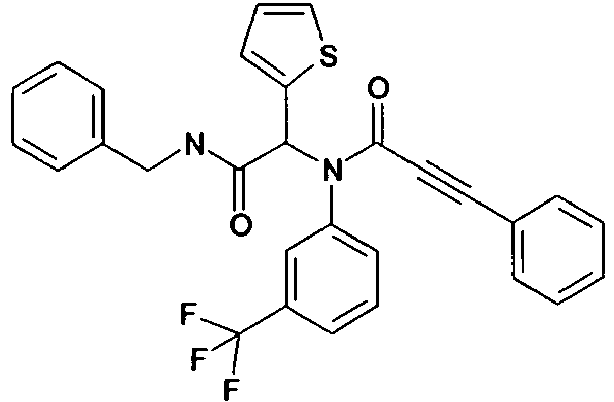
10 
13 
12 
15 
14 
17 
16 
19 
18 
21 
20 
23 
22 
25 
24 
27 
26 
29 
28 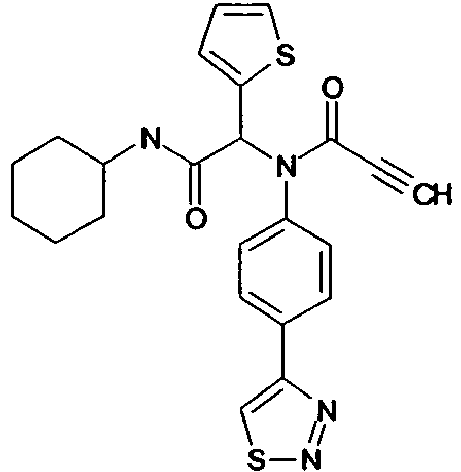
31 
30 
33 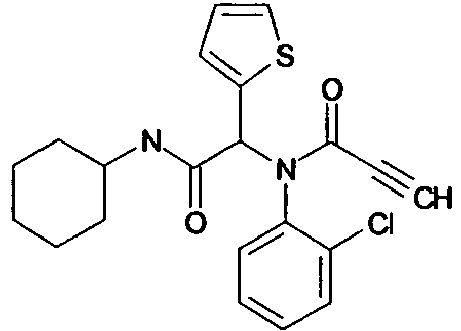
32 
35 
34 
37 
36 
39 
38 
41 
40 
43 
42 
45 
44 
47 
46 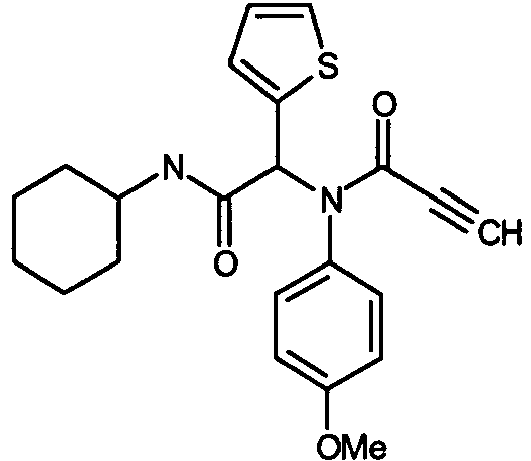
49 
48 
51 
50 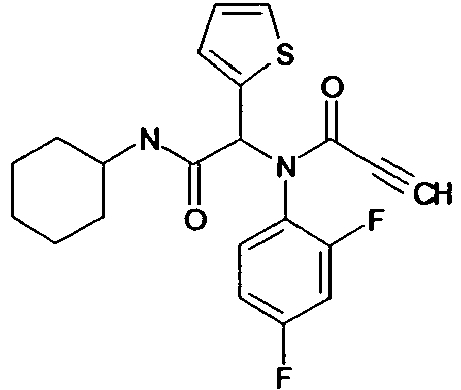
53 
52 
55 
54 
57 
56 
59 
58 
61 
60 
63 
62 
65 
64 
67 
66 
69 
68 
71 
70 
73 
72 
75 
74 
77 
76 
79 
78 
81 
80 
83 
82 
85 
84 
87 
86 
89 
88 
91 
90 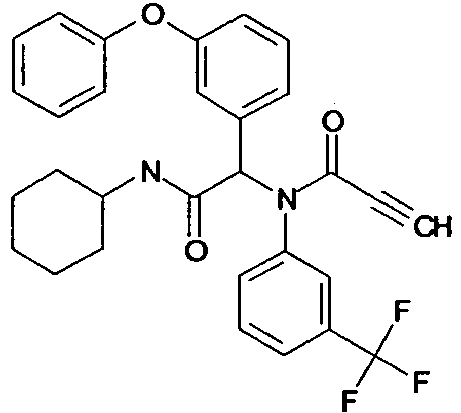
93 
92 
95 
94 
97 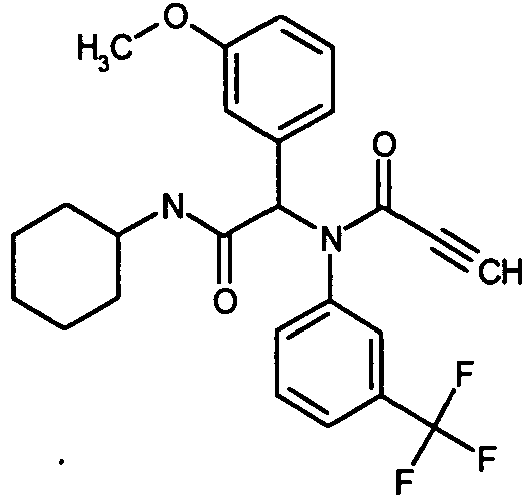
96 
99 
98 
101 
100 
103 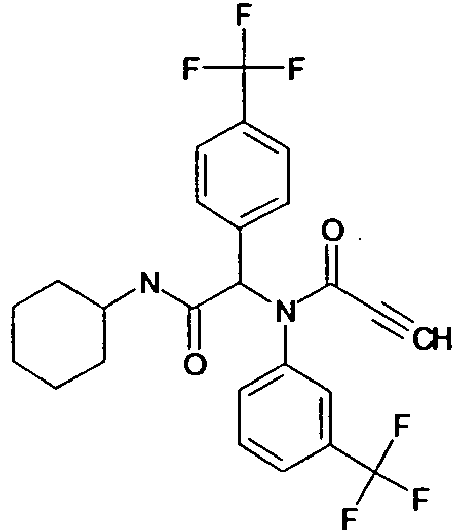
102 
105 
104 
107 
106 
109 
108 
111 
110 
113 
112 
115 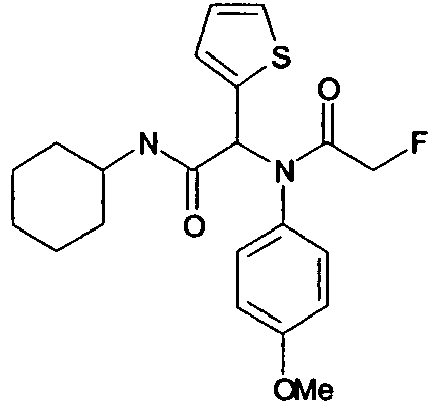
114 
117 
116 
119 
118 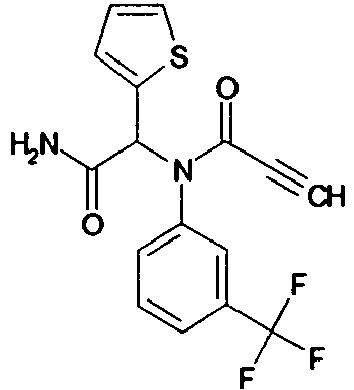
121 
120 
123 
122 
125 
124 
127 
126 
129 
128 
131 
130 
133 
132 
135 
134 
137 
136 
139 
138 
141 
140 
143 
142 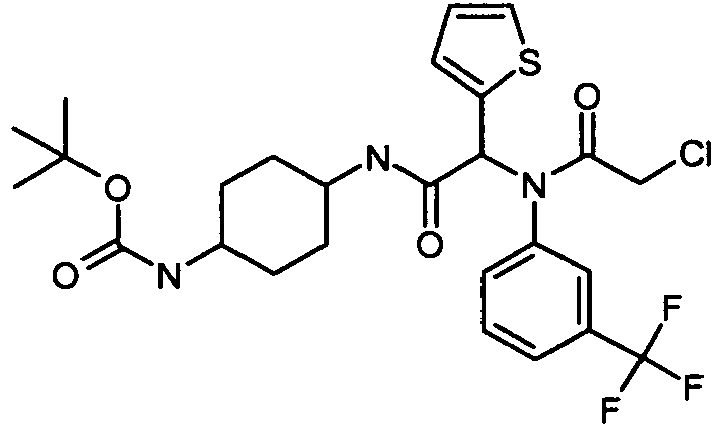
145 
144 
147 
146 
149 
148 
151 
150 
153 
152 
155 
154 
157 
156 
159 
158 
161 
160 
163 
162 
165 
164 
167 
166 
169 
168 
171 
170 
173 
172 
175 
174 
177 
176 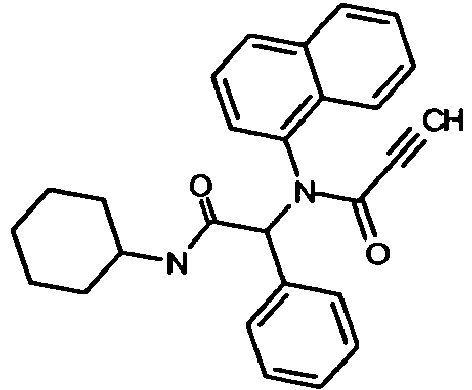
179 
178 
181 
180 
183 
182 
185 
184 
187 
186 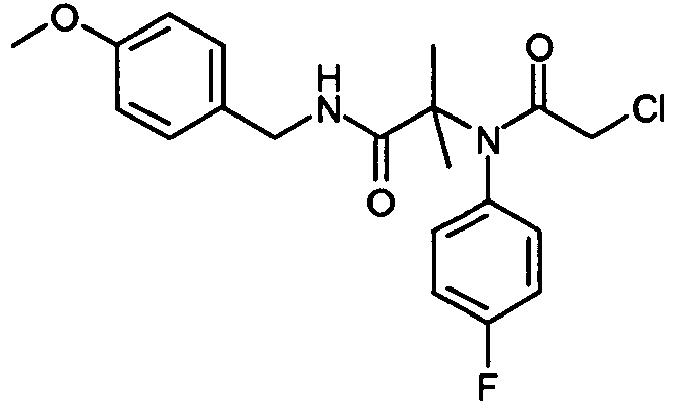
189 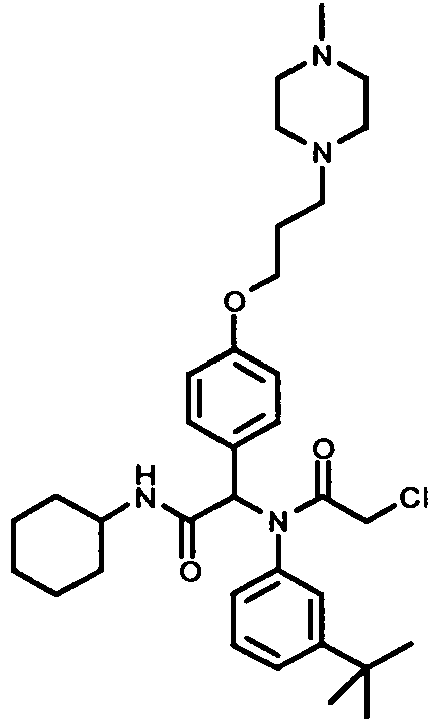
188 
191 
190 
193 
192 
195 
194 
197 
196 
199 
198 
201 
200 
203 
202 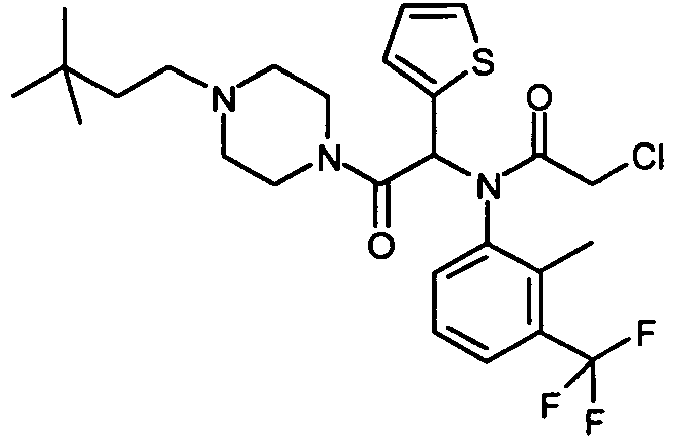
205 
204 
206 
- Compound of formula (I) according to any one of claims 1 to 6, including the compounds of formula (I) for which R6 = -C≡CR38 and R1 is an optionally substituted 1,3-thiazol-2-yl group, for use thereof as a medicament intended to treat or prevent a cancer, and preferably a cancer resistant to chemotherapy.
- Pharmaceutical composition comprising at least one compound of formula (I) according to any one of claims 1 to 7, in association with one or more pharmaceutically acceptable excipients.
- Pharmaceutical composition according to claim 8, characterised in that it comprises at least one other active principle.
- Pharmaceutical composition according to claim 9, characterised in that the active principle(s) is/are selected from cisplatin and the derivatives thereof such as carboplatin and oxaliplatin ; taxanes such as taxol, taxotere, paclitaxel and docetaxel ; vinca alkaloids such as vinblastine, vincristine and vinorelbine ; purine analogues such as mercaptopurine, thioguanine, pentostatin and 2-chlorodeoxyadenosine ; topoisomerase I inhibitors such as compounds of camptothecin, like irinotecan and topotecan ; topoisomerase II inhibitors such as epipodophyllotoxin, podophyllotoxin and the derivatives thereof like etoposide and teniposide ; antitumoural nucleoside derivatives such as 5-fluorouracil, leucovorin, gemcitabine or capecitabine ; alkylating agents such as nitrogen mustards like cyclophosphamide, mechlorethamine, chlorambucil and melphalan, nitrosoureas like carmustine, lomustine and streptozocin, alkyl sulphonates like busulphan, ethyleneimines and methylmelamines like thiotepa and hexamethylmelamine, and tetrazines like dacarbazine ; antitumoural anthracycline derivatives such as daunorubicin, adriamycin, doxil, idarubicin and mitoxantrone ; molecules targeting the IGF-I receptor such as picropodophyllin ; tetracarcin derivatives such as tetrocarcin A ; corticosteroids such as prednisone ; antibodies such as trastuzumab (anti-HER2 antibody), rituximab (anti-CD20 antibody), gemtuzamab, cetuximab, pertuzumab and bevacizumab; selective oestrogen receptor antagonists or modulators such as tamoxifen, fulvestrant, toremifene, droloxifene, faslodex and raloxifene ; aromatase inhibitors such as exemestane, anastrozole, letrozole and vorozole ; differentiating agents such as retinoids like retinoic acid and vitamin D and retinoic acid metabolism blocking agents such as accutane ; DNA methyltransferase inhibitors such as azacytidine and decitabine ; antifolates such as disodium permetrexed ; antibiotics such as antinomycin D, bleomycin, mitomycin C, actinomycin D, carminomycin, daunomycin and plicamycin; antimetabolites such as chlofarabine, aminopterin, cytosine arabinoside, floxuridine and methotrexate ; apoptosis inducing agents and Bcl-2 inhibitor antiangiogenic agents such as YC 137, BH 312, ABT 737, gossypol, HA 14-1, TW 37 and decanoic acid ; agents binding to tubulin such as combrestatin, colchicine derivatives and nocodazole ; kinase inhibitors such as flavoperidol, imatinib mesylate, erlotinib and gefitinib ; farnesyltransferase inhibitors such as tipifarnib ; histone deacetylase inhibitors such as sodium butyrate, suberoylanilide hydroxamic acid, depsipeptide, NVP- LAQ824, R306465, JNJ-26481585 and trichostatin A ; inhibitors of the ubiquitin proteasome system such as MLN .41, bortezomib and yondelis ; and telomerase inhibitors such as telomestatin.
- Pharmaceutical composition comprising :(iii) at least one compound of formula (I) according to any one of claims 1 to 7, and(iv) at least one other active principle,as combination products for use simultaneously, separately or spread over time.
- Pharmaceutical composition according to claim 11, characterised in that the active principle(s) is/are selected from cisplatin and the derivatives thereof such as carboplatin and oxaliplatin ; taxanes such as taxol, taxotere, paclitaxel and docetaxel ; vinca alkaloids such as vinblastine, vincristine and vinorelbine ; purine analogues such as mercaptopurine, thioguanine, pentostatin and 2-chlorodeoxyadenosine; topoisomerase I inhibitors such as compounds of camptothecin, like irinotecan and topotecan ; topoisomerase II inhibitors such as epipodophyllotoxin, podophyllotoxin and the derivatives thereof like etoposide and teniposide ; antitumoural nucleoside derivatives such as 5-fluorouracil, leucovorin, gemcitabine or capecitabine ; alkylating agents such as nitrogen mustards like cyclophosphamide, mechlorethamine, chlorambucil and melphalan, nitrosoureas like carmustine, lomustine and streptozocin, alkyl sulphonates like busulphan, ethyleneimines and methylmelamines like thiotepa and hexamethylmelamine, and tetrazines like dacarbazine ; antitumoural anthracycline derivatives such as daunorubicin, adriamycin, doxil, idarubicin and mitoxantrone ; molecules targeting the IGF-I receptor such as picropodophyllin ; tetracarcin derivatives such as tetrocarcin A ; corticosteroids such as prednisone ; antibodies such as trastuzumab (anti-HER2 antibody), rituximab (anti-CD20 antibody), gemtuzamab, cetuximab, pertuzumab and bevacizumab; selective oestrogen receptor antagonists or modulators such as tamoxifen, fulvestrant, toremifene, droloxifene, faslodex and raloxifene ; aromatase inhibitors such as exemestane, anastrozole, letrozole and vorozole ; differentiating agents such as retinoids like retinoic acid and vitamin D and retinoic acid metabolism blocking agents such as accutane ; DNA methyltransferase inhibitors such as azacytidine and decitabine ; antifolates such as disodium permetrexed; antibiotics such as antinomycin D, bleomycin, mitomycin C, actinomycin D, carminomycin, daunomycin and plicamycin; antimetabolites such as chlofarabine, aminopterin, cytosine arabinoside, floxuridine and methotrexate; apoptosis inducing agents and Bcl-2 inhibitor antiangiogenic agents such as YC 137, BH 312, ABT 737, gossypol, HA 14-1, TW 37 and decanoic acid ; agents binding to tubulin such as combrestatin, colchicine derivatives and nocodazole ; kinase inhibitors such as flavoperidol, imatinib mesylate, erlotinib and gefitinib ; farnesyltransferase inhibitors such as tipifarnib ; histone deacetylase inhibitors such as sodium butyrate, suberoylanilide hydroxamic acid, depsipeptide, NVP- LAQ824, R306465, JNJ-26481585 and trichostatin A ; inhibitors of the ubiquitin proteasome system such as MLN .41, bortezomib and yondelis ; and telomerase inhibitors such as telomestatin.
- Pharmaceutical composition according to either of claims 11 and 12, for use thereof as a medicament intended to treat or prevent a cancer, and preferably a cancer resistant to chemotherapy.
- Compound of general formula (I) :
 ■ if R6 = -C≡CR38 with R38 as defined hereinbefore,
then R1 does not represent an optionally substituted 1,3-thiazol-2-yl group,■ if R1 represents a cyclopentyl or cyclohexyl group or a benzyl group optionally substituted by a fluorine atom, R2 and R3 represent a hydrogen atom and R6 represents a -C≡CH group,
then R4 does not represent a thiophenyl or furyl group or a phenyl group optionally substituted by a fluorine atom, a chlorine atom or a methoxy group,■ if R1 represents a hydrogen atom, a tert-butyl, sec-butyl, cyclohexyl, hexyl, ethyl or methyl group, or a phenyl group, optionally substituted by one or more groups selected from F, ethoxy and CF3, R2 represents a hydrogen atom or a methyl group, or R1 and R2 together form, with the nitrogen atom carrying them, a morpholine or piperidine group, R3 represents a hydrogen atom , and R4 represents a hydrogen atom, a methyl or ethyl group or a phenyl group optionally substituted with one or more groups selected from Cl, OH, methoxy, NO2 or NMe2, or R3 and R4 together form, with the carbon atom carrying them, a cyclopentane or cyclohexane, and R6 represents a -CH2Cl group,
then R5 does not represent a prop-2-yne, (C1-C8)alkyl, furylmethyl, tetrahydro-pyrane, thiopyrane or 1,3-benzodioxolyl-methyl group; or a benzyl group optionally substituted by a chlorine atom or NO2 ; or a phenyl group optionally substituted by one or more Br, ethyl or methyl groups, and■ if R1 represents a tert-butyl or benzyl group, R2 and R3 each represent a hydrogen atom, R4 represents a furyl or pyrrole group substituted on the nitrogen atom by a -SO2Me group, and R6 represents a -C≡CMe or -C≡CPh group,
then R5 does not represent a tert-butyl group or a benzyl group optionally substituted by a bromine atom or a phenyl. - Compound according to claim 14, characterised in that the compound is selected from :
5 
6 
11 
10 
13 
15 
14 
19 
21 
20 
23 
22 
25 
24 
63 
65 
67 
69 
68 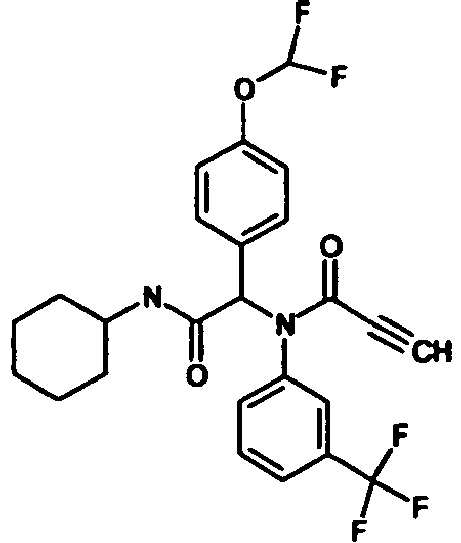
70 
73 
- 75 
77 
76 
78 
81 
80 
83 
85 
84 
87 
86 
89 
88 
91 
90 
93 
92 
95 
94 
99 
98 
101 
100 
103 
102 
107 
106 
109 
108 
111 
110 
113 
112 
115 
114 
117 
- 119 
118 
121 
120 
123 
122 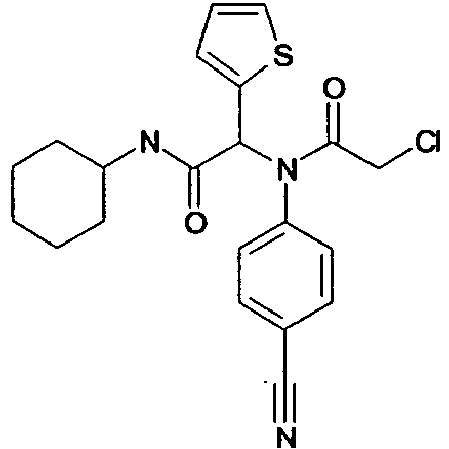
125 
124 
127 
126 
129 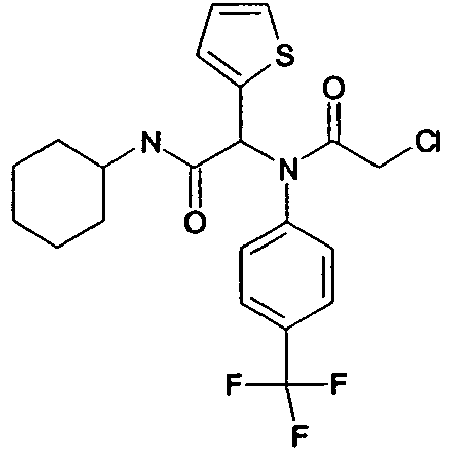
128 
131 
130 
133 
132 
135 
134 
137 
136 
139 
138 
141 
140 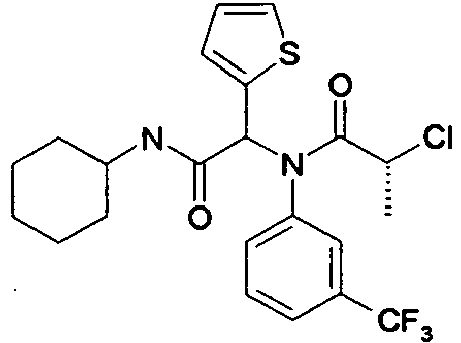
143 
142 
145 
144 
147 
146 
149 
148 
151 
150 
153 
152 
155 
154 
157 
156 
186 
185 
188 
187 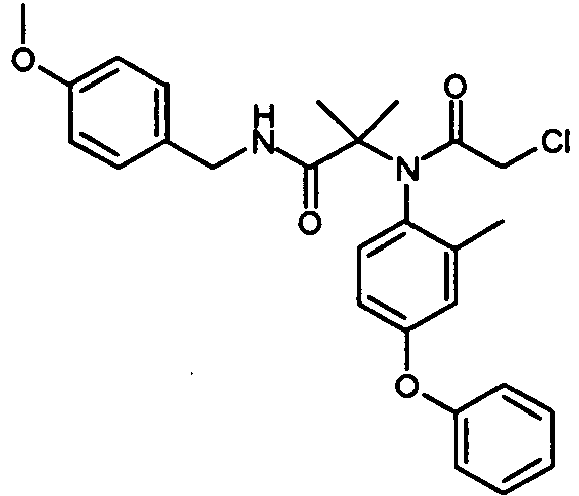
190 
189 
192 
191 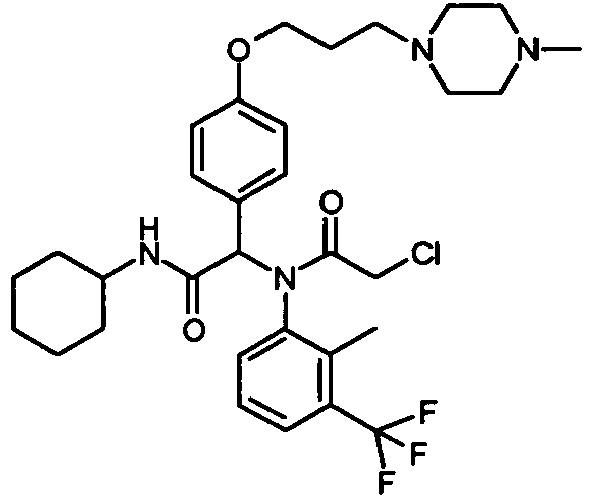
194 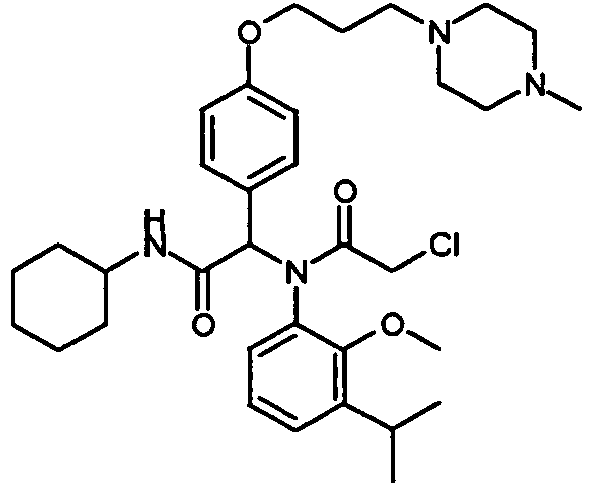
193 
196 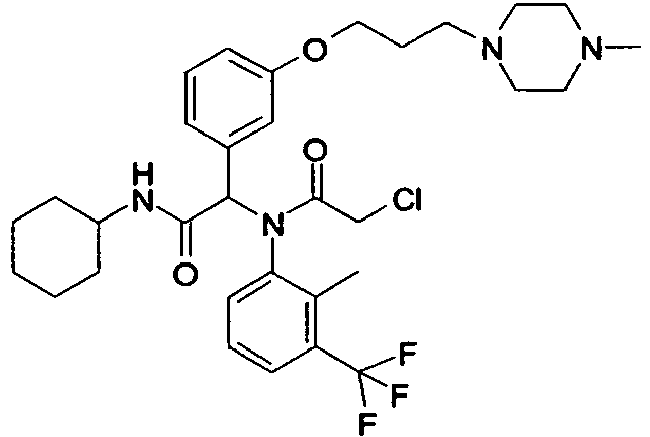
195 
198 
197 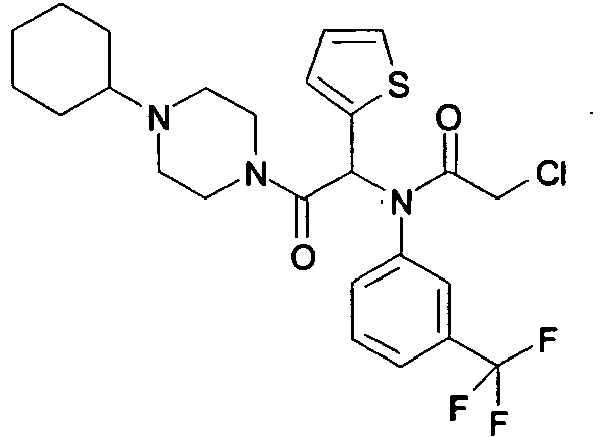
200 
199 
202 
201 
204 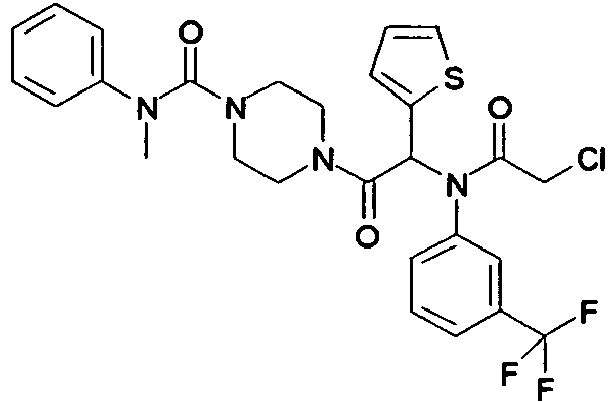
203 
206 
205 
Applications Claiming Priority (4)
| Application Number | Priority Date | Filing Date | Title |
|---|---|---|---|
| FR0853944A FR2932483A1 (en) | 2008-06-13 | 2008-06-13 | COMPOUNDS USEFUL FOR THE TREATMENT OF CANCERS. |
| US7698408P | 2008-06-30 | 2008-06-30 | |
| FR0952520A FR2932478B1 (en) | 2008-06-13 | 2009-04-17 | COMPOUNDS USEFUL FOR THE TREATMENT OF CANCERS. |
| PCT/EP2009/057371 WO2009150248A1 (en) | 2008-06-13 | 2009-06-15 | Compounds which can be used for the treatment of cancers |
Publications (2)
| Publication Number | Publication Date |
|---|---|
| EP2307017A1 EP2307017A1 (en) | 2011-04-13 |
| EP2307017B1 true EP2307017B1 (en) | 2013-08-14 |
Family
ID=40039642
Family Applications (1)
| Application Number | Title | Priority Date | Filing Date |
|---|---|---|---|
| EP09761809.4A Active EP2307017B1 (en) | 2008-06-13 | 2009-06-15 | Compounds which can be used for the treatment of cancers |
Country Status (6)
| Country | Link |
|---|---|
| US (1) | US8519188B2 (en) |
| EP (1) | EP2307017B1 (en) |
| JP (1) | JP2011523956A (en) |
| CA (1) | CA2727296C (en) |
| FR (2) | FR2932483A1 (en) |
| WO (1) | WO2009150248A1 (en) |
Families Citing this family (38)
| Publication number | Priority date | Publication date | Assignee | Title |
|---|---|---|---|---|
| ES2740424T3 (en) | 2009-03-13 | 2020-02-05 | Agios Pharmaceuticals Inc | Methods and compositions for disorders related to cell proliferation |
| SG10201403696UA (en) | 2009-06-29 | 2014-10-30 | Agios Pharmaceuticals Inc | Therapeutic compounds and compositions |
| EP3064595B1 (en) | 2009-10-21 | 2019-02-27 | Agios Pharmaceuticals, Inc. | Methods for cell-proliferation-related disorders |
| EP2525790B1 (en) | 2009-10-21 | 2020-05-27 | Agios Pharmaceuticals, Inc. | Methods and compositions for cell-proliferation-related disorders |
| ES2704862T3 (en) * | 2010-07-16 | 2019-03-20 | Agios Pharmaceuticals Inc | Therapeutically active compositions and their method of use |
| US20130071328A1 (en) * | 2011-03-22 | 2013-03-21 | University Of Southern California | Propynoic Acid Carbamoyl Methyl-Amides and Pharmaceutical Compositions and Methods Based Thereon |
| JO3733B1 (en) * | 2011-04-05 | 2021-01-31 | Bayer Ip Gmbh | Use of substituted 2,3-dihydroimidazo[1,2-c] quinazolines |
| JP6272754B2 (en) | 2011-05-03 | 2018-01-31 | アジオス ファーマシューティカルズ, インコーポレイテッド | Method of using pyruvate kinase activator |
| CN102827170A (en) | 2011-06-17 | 2012-12-19 | 安吉奥斯医药品有限公司 | Active treatment compositions and use method thereof |
| CN102827073A (en) | 2011-06-17 | 2012-12-19 | 安吉奥斯医药品有限公司 | Therapeutically active compositions and application methods thereof |
| CN102512427A (en) * | 2011-12-16 | 2012-06-27 | 南京医科大学 | New use for ER (estrogen receptor) antagonist |
| US9877962B2 (en) * | 2011-12-30 | 2018-01-30 | Marc Henry Pitty | Piperazinyl derivatives for the treatment of cancer |
| FR2985256B1 (en) | 2011-12-30 | 2016-03-04 | Pitty Marc Henry | PIPERAZINYL DERIVATIVES FOR THE TREATMENT OF CANCERS |
| LT2800743T (en) | 2012-01-06 | 2018-06-25 | Agios Pharmaceuticals, Inc. | Therapeutically active compounds and their methods of use |
| JP6228130B2 (en) * | 2012-01-19 | 2017-11-08 | アジオス ファーマシューティカルズ, インコーポレイテッド | Therapeutically active compounds and methods of their use |
| US9474779B2 (en) * | 2012-01-19 | 2016-10-25 | Agios Pharmaceuticals, Inc. | Therapeutically active compositions and their methods of use |
| US20150038541A1 (en) * | 2012-03-19 | 2015-02-05 | Aposignal Bioscience Llc | Composition and methods for cell modulation |
| KR101373107B1 (en) * | 2012-04-12 | 2014-03-14 | 이화여자대학교 산학협력단 | Pharmaceutical composition for reversing multidrug resistance comprising piperazine derivative or pharmaceutically acceptable salt thereof as an active ingredient |
| NZ706999A (en) | 2012-10-15 | 2018-12-21 | Agios Pharmaceuticals Inc | Inhibitors of mutant isocitrate dehydrogenase and therapeutical uses thereof |
| US9616065B2 (en) | 2013-04-16 | 2017-04-11 | Drexel University | Compositions useful in treating brain-related diseases or disorders and methods using same |
| WO2015003355A2 (en) | 2013-07-11 | 2015-01-15 | Agios Pharmaceuticals, Inc. | Therapeutically active compounds and their methods of use |
| WO2015003360A2 (en) | 2013-07-11 | 2015-01-15 | Agios Pharmaceuticals, Inc. | Therapeutically active compounds and their methods of use |
| US10376510B2 (en) | 2013-07-11 | 2019-08-13 | Agios Pharmaceuticals, Inc. | 2,4- or 4,6-diaminopyrimidine compounds as IDH2 mutants inhibitors for the treatment of cancer |
| WO2015010297A1 (en) | 2013-07-25 | 2015-01-29 | Agios Pharmaceuticals, Inc. | Therapeutically active compounds and their methods of use |
| KR101861869B1 (en) * | 2013-09-10 | 2018-05-28 | 경희대학교 산학협력단 | A novel bis-amide derivatives and use thereof |
| US9968595B2 (en) | 2014-03-14 | 2018-05-15 | Agios Pharmaceuticals, Inc. | Pharmaceutical compositions of therapeutically active compounds |
| CN106146599A (en) * | 2015-04-07 | 2016-11-23 | 江苏希迪制药有限公司 | A kind of recovery is because of the method for sulfoxide configuration ratio underproof fulvestrant or derivatives thereof |
| WO2016188421A1 (en) * | 2015-05-25 | 2016-12-01 | 中国医学科学院药物研究所 | 2-phenylimidazole derivative containing propynamide groups, preparation method therefor, pharmaceutical composition thereof, and uses thereof |
| RS64777B1 (en) | 2015-06-11 | 2023-11-30 | Agios Pharmaceuticals Inc | Methods of using pyruvate kinase activators |
| UA123401C2 (en) | 2015-10-15 | 2021-03-31 | Аджиос Фармасьютікалз, Інк. | Combination therapy for treating malignancies |
| DK3362066T3 (en) | 2015-10-15 | 2021-11-22 | Les Laboratoires Servier Sas | COMBINATION THERAPY FOR THE TREATMENT OF MALIGNITIES |
| EP3596043B1 (en) | 2017-03-15 | 2025-12-03 | Lunella Biotech, Inc. | Mitoriboscins: mitochondrial-based therapeutics targeting cancer cells, bacteria, and pathogenic yeast |
| US10980788B2 (en) | 2018-06-08 | 2021-04-20 | Agios Pharmaceuticals, Inc. | Therapy for treating malignancies |
| JP2023524489A (en) * | 2020-04-30 | 2023-06-12 | インシリコ メディシン アイピー リミテッド | SARS-COV-2 inhibitors with covalent modifications for treating coronavirus infections |
| CN118510759A (en) | 2021-11-02 | 2024-08-16 | 英矽智能科技知识产权有限公司 | SARS-COV-2 inhibitors for treatment of coronavirus infection |
| CN113845440A (en) * | 2021-11-04 | 2021-12-28 | 沈阳药科大学 | Non-natural peptide IDH1 inhibitor synthesized based on UGI reaction and preparation method and application thereof |
| WO2024030651A1 (en) * | 2022-08-05 | 2024-02-08 | Sonata Therapeutics, Inc. | Gpx4 inhibitors and use thereof |
| WO2025106949A1 (en) * | 2023-11-16 | 2025-05-22 | Radd Pharmaceuticals, Inc. | Wrn inhibitors |
Family Cites Families (8)
| Publication number | Priority date | Publication date | Assignee | Title |
|---|---|---|---|---|
| US4205168A (en) | 1973-09-24 | 1980-05-27 | Chevron Research Company | N-Carbamylalkyl-2,6-dialkyl-α-haloacetanilides |
| US4944796A (en) | 1988-11-14 | 1990-07-31 | Ici Americas Inc. | Certain 2-(disubstituted amino) acetanilide herbicides |
| US5200426A (en) * | 1990-08-14 | 1993-04-06 | Board Of Regents, The University Of Texas | Inhibitors of neutral endopeptidase/CALLA as chemotherapeutic agents |
| JP2005508891A (en) * | 2001-08-13 | 2005-04-07 | プロバイオドラッグ アーゲー | Regumain irreversible cysteine protease inhibitor |
| RU2416608C2 (en) * | 2004-08-06 | 2011-04-20 | Оцука Фармасьютикал Ко., Лтд. | Aromatic compound |
| WO2007025286A2 (en) * | 2005-08-26 | 2007-03-01 | The Board Of Trustees Of The Leland Stanford Junior University | Therapy procedure for drug delivery for trigeminal pain |
| DE102005062991A1 (en) * | 2005-12-28 | 2007-07-05 | Grünenthal GmbH | Substituted thiazoles and their use for the preparation of medicaments |
| TW200812962A (en) * | 2006-07-12 | 2008-03-16 | Astrazeneca Ab | New compounds I/418 |
-
2008
- 2008-06-13 FR FR0853944A patent/FR2932483A1/en not_active Withdrawn
-
2009
- 2009-04-17 FR FR0952520A patent/FR2932478B1/en active Active
- 2009-06-15 US US12/997,764 patent/US8519188B2/en not_active Expired - Fee Related
- 2009-06-15 CA CA2727296A patent/CA2727296C/en active Active
- 2009-06-15 EP EP09761809.4A patent/EP2307017B1/en active Active
- 2009-06-15 WO PCT/EP2009/057371 patent/WO2009150248A1/en not_active Ceased
- 2009-06-15 JP JP2011513005A patent/JP2011523956A/en not_active Withdrawn
Also Published As
| Publication number | Publication date |
|---|---|
| FR2932478B1 (en) | 2013-01-11 |
| WO2009150248A1 (en) | 2009-12-17 |
| US20110104162A1 (en) | 2011-05-05 |
| CA2727296A1 (en) | 2009-12-17 |
| FR2932478A1 (en) | 2009-12-18 |
| US8519188B2 (en) | 2013-08-27 |
| CA2727296C (en) | 2016-02-02 |
| FR2932483A1 (en) | 2009-12-18 |
| EP2307017A1 (en) | 2011-04-13 |
| JP2011523956A (en) | 2011-08-25 |
Similar Documents
| Publication | Publication Date | Title |
|---|---|---|
| US8519188B2 (en) | Compounds which can be used for the treatment of cancers | |
| RU2709207C2 (en) | 1,3,4-oxadiazole derivatives of compound as inhibitor of histone deacetylase 6 and pharmaceutical composition containing same | |
| EP1373233B1 (en) | Derivatives of n-(arylsulfonyl)beta-aminoacids comprising a substituted aminomethyl group, the preparation method thereof and the pharmaceutical compositions containing same | |
| CA2683557C (en) | Inhibitors of histone deacetylase | |
| US7449485B2 (en) | N-sulfonylurea apoptosis promoters | |
| CA2712109A1 (en) | Thiazolidine derivatives and methods for the preparation thereof | |
| JP5164847B2 (en) | Novel piperazine as an antimalarial drug | |
| EP1487811B1 (en) | N-sulfonylurea apoptosis promoters | |
| JP4704914B2 (en) | α-amino acid derivatives and their pharmaceutical use | |
| US9877962B2 (en) | Piperazinyl derivatives for the treatment of cancer | |
| EP0734378A1 (en) | Aminosulphonyl-phenyl-1h-pyrrole derivatives, method of their preparation and their use | |
| JP2024531200A (en) | Piperazine-Based LFA-1 and VLA-4 Agonists | |
| JP4746253B2 (en) | Propanolaminotetralins, their production and compositions containing them | |
| JP2002537228A (en) | Substituted 1- (piperidin-4-yl) -3-arylisothioureas, their preparation and their therapeutic use | |
| CN1193972A (en) | Heterocyclic compounds for the treatment of myocardial ischemia | |
| CZ20067A3 (en) | Process for preparing (S)-N-methyl-3-(1-naphthyloxy)-3-(2-thienyl)propylamine hydrochloride (duloxetine) | |
| AU2012360815B2 (en) | Piperazinyl derivatives for the treatment of cancer | |
| US20040067911A1 (en) | Isoquinuclidine derivative process for producing the same, and medicinal composition containing the same | |
| NZ627149B2 (en) | Piperazinyl derivatives for the treatment of cancer |
Legal Events
| Date | Code | Title | Description |
|---|---|---|---|
| PUAI | Public reference made under article 153(3) epc to a published international application that has entered the european phase |
Free format text: ORIGINAL CODE: 0009012 |
|
| 17P | Request for examination filed |
Effective date: 20110111 |
|
| AK | Designated contracting states |
Kind code of ref document: A1 Designated state(s): AT BE BG CH CY CZ DE DK EE ES FI FR GB GR HR HU IE IS IT LI LT LU LV MC MK MT NL NO PL PT RO SE SI SK TR |
|
| AX | Request for extension of the european patent |
Extension state: AL BA RS |
|
| DAX | Request for extension of the european patent (deleted) | ||
| RAP1 | Party data changed (applicant data changed or rights of an application transferred) |
Owner name: PITTY, MARC-HENRY |
|
| GRAP | Despatch of communication of intention to grant a patent |
Free format text: ORIGINAL CODE: EPIDOSNIGR1 |
|
| GRAS | Grant fee paid |
Free format text: ORIGINAL CODE: EPIDOSNIGR3 |
|
| GRAA | (expected) grant |
Free format text: ORIGINAL CODE: 0009210 |
|
| AK | Designated contracting states |
Kind code of ref document: B1 Designated state(s): AT BE BG CH CY CZ DE DK EE ES FI FR GB GR HR HU IE IS IT LI LT LU LV MC MK MT NL NO PL PT RO SE SI SK TR |
|
| REG | Reference to a national code |
Ref country code: GB Ref legal event code: FG4D |
|
| REG | Reference to a national code |
Ref country code: AT Ref legal event code: REF Ref document number: 626374 Country of ref document: AT Kind code of ref document: T Effective date: 20130815 Ref country code: CH Ref legal event code: EP |
|
| REG | Reference to a national code |
Ref country code: IE Ref legal event code: FG4D |
|
| REG | Reference to a national code |
Ref country code: DE Ref legal event code: R096 Ref document number: 602009018020 Country of ref document: DE Effective date: 20131010 |
|
| REG | Reference to a national code |
Ref country code: NL Ref legal event code: T3 |
|
| REG | Reference to a national code |
Ref country code: AT Ref legal event code: MK05 Ref document number: 626374 Country of ref document: AT Kind code of ref document: T Effective date: 20130814 |
|
| REG | Reference to a national code |
Ref country code: LT Ref legal event code: MG4D |
|
| PG25 | Lapsed in a contracting state [announced via postgrant information from national office to epo] |
Ref country code: LT Free format text: LAPSE BECAUSE OF FAILURE TO SUBMIT A TRANSLATION OF THE DESCRIPTION OR TO PAY THE FEE WITHIN THE PRESCRIBED TIME-LIMIT Effective date: 20130814 Ref country code: PT Free format text: LAPSE BECAUSE OF FAILURE TO SUBMIT A TRANSLATION OF THE DESCRIPTION OR TO PAY THE FEE WITHIN THE PRESCRIBED TIME-LIMIT Effective date: 20131216 Ref country code: SE Free format text: LAPSE BECAUSE OF FAILURE TO SUBMIT A TRANSLATION OF THE DESCRIPTION OR TO PAY THE FEE WITHIN THE PRESCRIBED TIME-LIMIT Effective date: 20130814 Ref country code: NO Free format text: LAPSE BECAUSE OF FAILURE TO SUBMIT A TRANSLATION OF THE DESCRIPTION OR TO PAY THE FEE WITHIN THE PRESCRIBED TIME-LIMIT Effective date: 20131114 Ref country code: AT Free format text: LAPSE BECAUSE OF FAILURE TO SUBMIT A TRANSLATION OF THE DESCRIPTION OR TO PAY THE FEE WITHIN THE PRESCRIBED TIME-LIMIT Effective date: 20130814 Ref country code: HR Free format text: LAPSE BECAUSE OF FAILURE TO SUBMIT A TRANSLATION OF THE DESCRIPTION OR TO PAY THE FEE WITHIN THE PRESCRIBED TIME-LIMIT Effective date: 20130814 Ref country code: IS Free format text: LAPSE BECAUSE OF FAILURE TO SUBMIT A TRANSLATION OF THE DESCRIPTION OR TO PAY THE FEE WITHIN THE PRESCRIBED TIME-LIMIT Effective date: 20131214 Ref country code: CY Free format text: LAPSE BECAUSE OF FAILURE TO SUBMIT A TRANSLATION OF THE DESCRIPTION OR TO PAY THE FEE WITHIN THE PRESCRIBED TIME-LIMIT Effective date: 20130717 |
|
| PG25 | Lapsed in a contracting state [announced via postgrant information from national office to epo] |
Ref country code: SI Free format text: LAPSE BECAUSE OF FAILURE TO SUBMIT A TRANSLATION OF THE DESCRIPTION OR TO PAY THE FEE WITHIN THE PRESCRIBED TIME-LIMIT Effective date: 20130814 Ref country code: PL Free format text: LAPSE BECAUSE OF FAILURE TO SUBMIT A TRANSLATION OF THE DESCRIPTION OR TO PAY THE FEE WITHIN THE PRESCRIBED TIME-LIMIT Effective date: 20130814 Ref country code: GR Free format text: LAPSE BECAUSE OF FAILURE TO SUBMIT A TRANSLATION OF THE DESCRIPTION OR TO PAY THE FEE WITHIN THE PRESCRIBED TIME-LIMIT Effective date: 20131115 Ref country code: LV Free format text: LAPSE BECAUSE OF FAILURE TO SUBMIT A TRANSLATION OF THE DESCRIPTION OR TO PAY THE FEE WITHIN THE PRESCRIBED TIME-LIMIT Effective date: 20130814 Ref country code: FI Free format text: LAPSE BECAUSE OF FAILURE TO SUBMIT A TRANSLATION OF THE DESCRIPTION OR TO PAY THE FEE WITHIN THE PRESCRIBED TIME-LIMIT Effective date: 20130814 |
|
| PG25 | Lapsed in a contracting state [announced via postgrant information from national office to epo] |
Ref country code: CY Free format text: LAPSE BECAUSE OF FAILURE TO SUBMIT A TRANSLATION OF THE DESCRIPTION OR TO PAY THE FEE WITHIN THE PRESCRIBED TIME-LIMIT Effective date: 20130814 |
|
| PG25 | Lapsed in a contracting state [announced via postgrant information from national office to epo] |
Ref country code: DK Free format text: LAPSE BECAUSE OF FAILURE TO SUBMIT A TRANSLATION OF THE DESCRIPTION OR TO PAY THE FEE WITHIN THE PRESCRIBED TIME-LIMIT Effective date: 20130814 Ref country code: RO Free format text: LAPSE BECAUSE OF FAILURE TO SUBMIT A TRANSLATION OF THE DESCRIPTION OR TO PAY THE FEE WITHIN THE PRESCRIBED TIME-LIMIT Effective date: 20130814 Ref country code: EE Free format text: LAPSE BECAUSE OF FAILURE TO SUBMIT A TRANSLATION OF THE DESCRIPTION OR TO PAY THE FEE WITHIN THE PRESCRIBED TIME-LIMIT Effective date: 20130814 Ref country code: CZ Free format text: LAPSE BECAUSE OF FAILURE TO SUBMIT A TRANSLATION OF THE DESCRIPTION OR TO PAY THE FEE WITHIN THE PRESCRIBED TIME-LIMIT Effective date: 20130814 Ref country code: SK Free format text: LAPSE BECAUSE OF FAILURE TO SUBMIT A TRANSLATION OF THE DESCRIPTION OR TO PAY THE FEE WITHIN THE PRESCRIBED TIME-LIMIT Effective date: 20130814 |
|
| PG25 | Lapsed in a contracting state [announced via postgrant information from national office to epo] |
Ref country code: ES Free format text: LAPSE BECAUSE OF FAILURE TO SUBMIT A TRANSLATION OF THE DESCRIPTION OR TO PAY THE FEE WITHIN THE PRESCRIBED TIME-LIMIT Effective date: 20130814 Ref country code: IT Free format text: LAPSE BECAUSE OF FAILURE TO SUBMIT A TRANSLATION OF THE DESCRIPTION OR TO PAY THE FEE WITHIN THE PRESCRIBED TIME-LIMIT Effective date: 20130814 |
|
| REG | Reference to a national code |
Ref country code: CH Ref legal event code: NV Representative=s name: MICHELI AND CIE SA, CH |
|
| PLBE | No opposition filed within time limit |
Free format text: ORIGINAL CODE: 0009261 |
|
| STAA | Information on the status of an ep patent application or granted ep patent |
Free format text: STATUS: NO OPPOSITION FILED WITHIN TIME LIMIT |
|
| 26N | No opposition filed |
Effective date: 20140515 |
|
| REG | Reference to a national code |
Ref country code: DE Ref legal event code: R097 Ref document number: 602009018020 Country of ref document: DE Effective date: 20140515 |
|
| REG | Reference to a national code |
Ref country code: DE Ref legal event code: R082 Ref document number: 602009018020 Country of ref document: DE Representative=s name: HOEGER, STELLRECHT & PARTNER PATENTANWAELTE MB, DE |
|
| PG25 | Lapsed in a contracting state [announced via postgrant information from national office to epo] |
Ref country code: MT Free format text: LAPSE BECAUSE OF FAILURE TO SUBMIT A TRANSLATION OF THE DESCRIPTION OR TO PAY THE FEE WITHIN THE PRESCRIBED TIME-LIMIT Effective date: 20130814 |
|
| REG | Reference to a national code |
Ref country code: FR Ref legal event code: PLFP Year of fee payment: 8 |
|
| PG25 | Lapsed in a contracting state [announced via postgrant information from national office to epo] |
Ref country code: BG Free format text: LAPSE BECAUSE OF FAILURE TO SUBMIT A TRANSLATION OF THE DESCRIPTION OR TO PAY THE FEE WITHIN THE PRESCRIBED TIME-LIMIT Effective date: 20130814 |
|
| PG25 | Lapsed in a contracting state [announced via postgrant information from national office to epo] |
Ref country code: TR Free format text: LAPSE BECAUSE OF FAILURE TO SUBMIT A TRANSLATION OF THE DESCRIPTION OR TO PAY THE FEE WITHIN THE PRESCRIBED TIME-LIMIT Effective date: 20130814 Ref country code: HU Free format text: LAPSE BECAUSE OF FAILURE TO SUBMIT A TRANSLATION OF THE DESCRIPTION OR TO PAY THE FEE WITHIN THE PRESCRIBED TIME-LIMIT; INVALID AB INITIO Effective date: 20090615 |
|
| REG | Reference to a national code |
Ref country code: FR Ref legal event code: PLFP Year of fee payment: 9 |
|
| REG | Reference to a national code |
Ref country code: FR Ref legal event code: PLFP Year of fee payment: 10 |
|
| PG25 | Lapsed in a contracting state [announced via postgrant information from national office to epo] |
Ref country code: MK Free format text: LAPSE BECAUSE OF FAILURE TO SUBMIT A TRANSLATION OF THE DESCRIPTION OR TO PAY THE FEE WITHIN THE PRESCRIBED TIME-LIMIT Effective date: 20130814 |
|
| REG | Reference to a national code |
Ref country code: DE Ref legal event code: R082 Ref document number: 602009018020 Country of ref document: DE Representative=s name: HOEGER, STELLRECHT & PARTNER PATENTANWAELTE MB, DE |
|
| PGFP | Annual fee paid to national office [announced via postgrant information from national office to epo] |
Ref country code: LU Payment date: 20240524 Year of fee payment: 16 |
|
| PGFP | Annual fee paid to national office [announced via postgrant information from national office to epo] |
Ref country code: NL Payment date: 20240524 Year of fee payment: 16 |
|
| PGFP | Annual fee paid to national office [announced via postgrant information from national office to epo] |
Ref country code: IE Payment date: 20240517 Year of fee payment: 16 |
|
| PGFP | Annual fee paid to national office [announced via postgrant information from national office to epo] |
Ref country code: GB Payment date: 20240626 Year of fee payment: 16 |
|
| PGFP | Annual fee paid to national office [announced via postgrant information from national office to epo] |
Ref country code: DE Payment date: 20240613 Year of fee payment: 16 |
|
| PGFP | Annual fee paid to national office [announced via postgrant information from national office to epo] |
Ref country code: MC Payment date: 20240522 Year of fee payment: 16 |
|
| PGFP | Annual fee paid to national office [announced via postgrant information from national office to epo] |
Ref country code: FR Payment date: 20240515 Year of fee payment: 16 |
|
| PGFP | Annual fee paid to national office [announced via postgrant information from national office to epo] |
Ref country code: BE Payment date: 20240620 Year of fee payment: 16 |
|
| PGFP | Annual fee paid to national office [announced via postgrant information from national office to epo] |
Ref country code: CH Payment date: 20240704 Year of fee payment: 16 |
|
| REG | Reference to a national code |
Ref country code: DE Ref legal event code: R119 Ref document number: 602009018020 Country of ref document: DE |
|
| REG | Reference to a national code |
Ref country code: CH Ref legal event code: H13 Free format text: ST27 STATUS EVENT CODE: U-0-0-H10-H13 (AS PROVIDED BY THE NATIONAL OFFICE) Effective date: 20260127 |
|
| PG25 | Lapsed in a contracting state [announced via postgrant information from national office to epo] |
Ref country code: MC Free format text: LAPSE BECAUSE OF NON-PAYMENT OF DUE FEES Effective date: 20250630 |
|
| REG | Reference to a national code |
Ref country code: NL Ref legal event code: MM Effective date: 20250701 |
|
| PG25 | Lapsed in a contracting state [announced via postgrant information from national office to epo] |
Ref country code: LU Free format text: LAPSE BECAUSE OF NON-PAYMENT OF DUE FEES Effective date: 20250615 |
|
| GBPC | Gb: european patent ceased through non-payment of renewal fee |
Effective date: 20250615 |
|
| REG | Reference to a national code |
Ref country code: BE Ref legal event code: MM Effective date: 20250630 |
|
| PG25 | Lapsed in a contracting state [announced via postgrant information from national office to epo] |
Ref country code: NL Free format text: LAPSE BECAUSE OF NON-PAYMENT OF DUE FEES Effective date: 20250701 |
|
| PG25 | Lapsed in a contracting state [announced via postgrant information from national office to epo] |
Ref country code: GB Free format text: LAPSE BECAUSE OF NON-PAYMENT OF DUE FEES Effective date: 20250615 |
|
| PG25 | Lapsed in a contracting state [announced via postgrant information from national office to epo] |
Ref country code: IE Free format text: LAPSE BECAUSE OF NON-PAYMENT OF DUE FEES Effective date: 20250615 Ref country code: DE Free format text: LAPSE BECAUSE OF NON-PAYMENT OF DUE FEES Effective date: 20260101 |
|
| PG25 | Lapsed in a contracting state [announced via postgrant information from national office to epo] |
Ref country code: BE Free format text: LAPSE BECAUSE OF NON-PAYMENT OF DUE FEES Effective date: 20250630 |
|
| PG25 | Lapsed in a contracting state [announced via postgrant information from national office to epo] |
Ref country code: FR Free format text: LAPSE BECAUSE OF NON-PAYMENT OF DUE FEES Effective date: 20250630 |
|
| PG25 | Lapsed in a contracting state [announced via postgrant information from national office to epo] |
Ref country code: CH Free format text: LAPSE BECAUSE OF NON-PAYMENT OF DUE FEES Effective date: 20250630 |