EP2302811B1 - Soft-Output Viterbi-Algorithmusverfahren und Decoder - Google Patents
Soft-Output Viterbi-Algorithmusverfahren und Decoder Download PDFInfo
- Publication number
- EP2302811B1 EP2302811B1 EP10159966A EP10159966A EP2302811B1 EP 2302811 B1 EP2302811 B1 EP 2302811B1 EP 10159966 A EP10159966 A EP 10159966A EP 10159966 A EP10159966 A EP 10159966A EP 2302811 B1 EP2302811 B1 EP 2302811B1
- Authority
- EP
- European Patent Office
- Prior art keywords
- path
- node
- surviving
- stage
- concurrent
- Prior art date
- Legal status (The legal status is an assumption and is not a legal conclusion. Google has not performed a legal analysis and makes no representation as to the accuracy of the status listed.)
- Not-in-force
Links
- 238000000034 method Methods 0.000 title claims description 35
- 238000004422 calculation algorithm Methods 0.000 title claims description 24
- 230000007704 transition Effects 0.000 claims description 67
- 238000004590 computer program Methods 0.000 claims description 14
- 238000012545 processing Methods 0.000 claims description 10
- 238000004891 communication Methods 0.000 claims description 5
- 238000004364 calculation method Methods 0.000 claims description 4
- 230000001186 cumulative effect Effects 0.000 claims description 3
- 230000006870 function Effects 0.000 description 14
- 230000008901 benefit Effects 0.000 description 11
- 238000010586 diagram Methods 0.000 description 8
- 238000013459 approach Methods 0.000 description 5
- 239000000470 constituent Substances 0.000 description 4
- 230000009467 reduction Effects 0.000 description 3
- 230000009466 transformation Effects 0.000 description 3
- 230000007423 decrease Effects 0.000 description 2
- 230000003247 decreasing effect Effects 0.000 description 2
- 238000005192 partition Methods 0.000 description 2
- 238000003491 array Methods 0.000 description 1
- 238000012937 correction Methods 0.000 description 1
- 238000013461 design Methods 0.000 description 1
- 238000004870 electrical engineering Methods 0.000 description 1
- 238000011156 evaluation Methods 0.000 description 1
- 230000007774 longterm Effects 0.000 description 1
- 230000007935 neutral effect Effects 0.000 description 1
- 238000000844 transformation Methods 0.000 description 1
Images



Classifications
-
- H—ELECTRICITY
- H03—ELECTRONIC CIRCUITRY
- H03M—CODING; DECODING; CODE CONVERSION IN GENERAL
- H03M13/00—Coding, decoding or code conversion, for error detection or error correction; Coding theory basic assumptions; Coding bounds; Error probability evaluation methods; Channel models; Simulation or testing of codes
- H03M13/37—Decoding methods or techniques, not specific to the particular type of coding provided for in groups H03M13/03 - H03M13/35
- H03M13/39—Sequence estimation, i.e. using statistical methods for the reconstruction of the original codes
- H03M13/41—Sequence estimation, i.e. using statistical methods for the reconstruction of the original codes using the Viterbi algorithm or Viterbi processors
-
- H—ELECTRICITY
- H03—ELECTRONIC CIRCUITRY
- H03M—CODING; DECODING; CODE CONVERSION IN GENERAL
- H03M13/00—Coding, decoding or code conversion, for error detection or error correction; Coding theory basic assumptions; Coding bounds; Error probability evaluation methods; Channel models; Simulation or testing of codes
- H03M13/37—Decoding methods or techniques, not specific to the particular type of coding provided for in groups H03M13/03 - H03M13/35
- H03M13/3707—Adaptive decoding and hybrid decoding, e.g. decoding methods or techniques providing more than one decoding algorithm for one code
-
- H—ELECTRICITY
- H03—ELECTRONIC CIRCUITRY
- H03M—CODING; DECODING; CODE CONVERSION IN GENERAL
- H03M13/00—Coding, decoding or code conversion, for error detection or error correction; Coding theory basic assumptions; Coding bounds; Error probability evaluation methods; Channel models; Simulation or testing of codes
- H03M13/37—Decoding methods or techniques, not specific to the particular type of coding provided for in groups H03M13/03 - H03M13/35
- H03M13/3776—Decoding methods or techniques, not specific to the particular type of coding provided for in groups H03M13/03 - H03M13/35 using a re-encoding step during the decoding process
-
- H—ELECTRICITY
- H03—ELECTRONIC CIRCUITRY
- H03M—CODING; DECODING; CODE CONVERSION IN GENERAL
- H03M13/00—Coding, decoding or code conversion, for error detection or error correction; Coding theory basic assumptions; Coding bounds; Error probability evaluation methods; Channel models; Simulation or testing of codes
- H03M13/37—Decoding methods or techniques, not specific to the particular type of coding provided for in groups H03M13/03 - H03M13/35
- H03M13/39—Sequence estimation, i.e. using statistical methods for the reconstruction of the original codes
-
- H—ELECTRICITY
- H03—ELECTRONIC CIRCUITRY
- H03M—CODING; DECODING; CODE CONVERSION IN GENERAL
- H03M13/00—Coding, decoding or code conversion, for error detection or error correction; Coding theory basic assumptions; Coding bounds; Error probability evaluation methods; Channel models; Simulation or testing of codes
- H03M13/37—Decoding methods or techniques, not specific to the particular type of coding provided for in groups H03M13/03 - H03M13/35
- H03M13/39—Sequence estimation, i.e. using statistical methods for the reconstruction of the original codes
- H03M13/3972—Sequence estimation, i.e. using statistical methods for the reconstruction of the original codes using sliding window techniques or parallel windows
-
- H—ELECTRICITY
- H03—ELECTRONIC CIRCUITRY
- H03M—CODING; DECODING; CODE CONVERSION IN GENERAL
- H03M13/00—Coding, decoding or code conversion, for error detection or error correction; Coding theory basic assumptions; Coding bounds; Error probability evaluation methods; Channel models; Simulation or testing of codes
- H03M13/37—Decoding methods or techniques, not specific to the particular type of coding provided for in groups H03M13/03 - H03M13/35
- H03M13/39—Sequence estimation, i.e. using statistical methods for the reconstruction of the original codes
- H03M13/41—Sequence estimation, i.e. using statistical methods for the reconstruction of the original codes using the Viterbi algorithm or Viterbi processors
- H03M13/4138—Sequence estimation, i.e. using statistical methods for the reconstruction of the original codes using the Viterbi algorithm or Viterbi processors soft-output Viterbi algorithm based decoding, i.e. Viterbi decoding with weighted decisions
- H03M13/4146—Sequence estimation, i.e. using statistical methods for the reconstruction of the original codes using the Viterbi algorithm or Viterbi processors soft-output Viterbi algorithm based decoding, i.e. Viterbi decoding with weighted decisions soft-output Viterbi decoding according to Battail and Hagenauer in which the soft-output is determined using path metric differences along the maximum-likelihood path, i.e. "SOVA" decoding
-
- H—ELECTRICITY
- H03—ELECTRONIC CIRCUITRY
- H03M—CODING; DECODING; CODE CONVERSION IN GENERAL
- H03M13/00—Coding, decoding or code conversion, for error detection or error correction; Coding theory basic assumptions; Coding bounds; Error probability evaluation methods; Channel models; Simulation or testing of codes
- H03M13/37—Decoding methods or techniques, not specific to the particular type of coding provided for in groups H03M13/03 - H03M13/35
- H03M13/39—Sequence estimation, i.e. using statistical methods for the reconstruction of the original codes
- H03M13/41—Sequence estimation, i.e. using statistical methods for the reconstruction of the original codes using the Viterbi algorithm or Viterbi processors
- H03M13/4138—Sequence estimation, i.e. using statistical methods for the reconstruction of the original codes using the Viterbi algorithm or Viterbi processors soft-output Viterbi algorithm based decoding, i.e. Viterbi decoding with weighted decisions
- H03M13/4146—Sequence estimation, i.e. using statistical methods for the reconstruction of the original codes using the Viterbi algorithm or Viterbi processors soft-output Viterbi algorithm based decoding, i.e. Viterbi decoding with weighted decisions soft-output Viterbi decoding according to Battail and Hagenauer in which the soft-output is determined using path metric differences along the maximum-likelihood path, i.e. "SOVA" decoding
- H03M13/4153—Sequence estimation, i.e. using statistical methods for the reconstruction of the original codes using the Viterbi algorithm or Viterbi processors soft-output Viterbi algorithm based decoding, i.e. Viterbi decoding with weighted decisions soft-output Viterbi decoding according to Battail and Hagenauer in which the soft-output is determined using path metric differences along the maximum-likelihood path, i.e. "SOVA" decoding two-step SOVA decoding, i.e. the soft-output is determined by a second traceback operation after the determination of the hard decision like in the Berrou decoder
-
- H—ELECTRICITY
- H03—ELECTRONIC CIRCUITRY
- H03M—CODING; DECODING; CODE CONVERSION IN GENERAL
- H03M13/00—Coding, decoding or code conversion, for error detection or error correction; Coding theory basic assumptions; Coding bounds; Error probability evaluation methods; Channel models; Simulation or testing of codes
- H03M13/37—Decoding methods or techniques, not specific to the particular type of coding provided for in groups H03M13/03 - H03M13/35
- H03M13/39—Sequence estimation, i.e. using statistical methods for the reconstruction of the original codes
- H03M13/41—Sequence estimation, i.e. using statistical methods for the reconstruction of the original codes using the Viterbi algorithm or Viterbi processors
- H03M13/4161—Sequence estimation, i.e. using statistical methods for the reconstruction of the original codes using the Viterbi algorithm or Viterbi processors implementing path management
- H03M13/4184—Sequence estimation, i.e. using statistical methods for the reconstruction of the original codes using the Viterbi algorithm or Viterbi processors implementing path management using register-exchange
-
- H—ELECTRICITY
- H03—ELECTRONIC CIRCUITRY
- H03M—CODING; DECODING; CODE CONVERSION IN GENERAL
- H03M13/00—Coding, decoding or code conversion, for error detection or error correction; Coding theory basic assumptions; Coding bounds; Error probability evaluation methods; Channel models; Simulation or testing of codes
- H03M13/65—Purpose and implementation aspects
- H03M13/6508—Flexibility, adaptability, parametrability and configurability of the implementation
- H03M13/6511—Support of multiple decoding rules, e.g. combined MAP and Viterbi decoding
-
- H—ELECTRICITY
- H03—ELECTRONIC CIRCUITRY
- H03M—CODING; DECODING; CODE CONVERSION IN GENERAL
- H03M13/00—Coding, decoding or code conversion, for error detection or error correction; Coding theory basic assumptions; Coding bounds; Error probability evaluation methods; Channel models; Simulation or testing of codes
- H03M13/65—Purpose and implementation aspects
- H03M13/6522—Intended application, e.g. transmission or communication standard
- H03M13/6525—3GPP LTE including E-UTRA
Definitions
- the present invention relates generally to the field of decoding of error correcting codes. More particularly, it relates to decoding of trellis codes.
- iterative decoders The principle of iterative decoders is described, for example, in J. Hagenauer, E. Offer, and L. Papke, "Iterative decoding of binary block and convolutional codes", IEEE Trans. Inf. Theory, vol. 42, no. 2, pp. 429-445, Mar. 1996 .
- iterative decoding may be based on exchange of de-correlated extrinsic information between soft-input soft-output (SISO) constituent decoders.
- SISO soft-input soft-output
- received intrinsic soft values representing two code bits are input to the first SISO decoder 11 (Decoder 1) as illustrated by reference numbers 41 and 42.
- Decoder 1 outputs extrinsic soft values for each information bit (or more generally each information symbol) as illustrated by reference number 22, and the extrinsic soft values are interleaved in an interleaver 12.
- a hard decision 30 may be taken in relation to each information bit in a decision unit 15 based on extrinsic soft values output from Decoder 2.
- SISO modules Another possibility for the SISO modules is (variants of) an approach based on the traditional Viterbi algorithm, namely the soft-output Viterbi algorithm (SOVA) disclosed in J. Hagenauer and P.305r, "A Viterbi algorithm with soft-decision output and its applications", Proc. IEEE Globecom, Dallas, Nov. 1989, pp. 1680-1686 .
- SOVA soft-output Viterbi algorithm
- SOVA provides soft output values at a lower complexity cost than the BCJR algorithm.
- Another advantage of SOVA is a reduction in latency compared to BCJR. Latency of SOVA basically depends on the depth of the decoding window (as known from traditional Viterbi decoding). SOVA may also have the advantage of less parallelization required. In some situations, however, the SOVA suffers from a worse error rate performance than the BCJR algorithm.
- SOVA may initially assign a reliability value L to each node of the trellis, where the reliability value depends on the path metrics of the incoming paths of the node.
- the path metric may for example, be a cumulative metric.
- the SOVA applies a sliding window 120 of length U, which is currently in position k.
- a surviving path s for the uppermost node 124 at stage k is denoted with reference number 121 and has a corresponding decision bit (or more generally - decision symbol) u k-U (s), denoted by reference number 126, at stage k-U.
- Its concurrent path c is denoted with reference number 122 and has a corresponding decision bit u k-U (c), denoted by reference number 127, at stage k-U.
- the node of the surviving path has a concurrent path denoted by reference number 123.
- the Hagenauer rule suggests that the reliability value of node 125 should be replaced by the reliability value of node 124.
- the update rule applied for the reliability values affects the quality (e.g. accuracy) of the extrinsic soft output values and thus the overall performance of the iterative decoder.
- the Battail rule for updating of reliability values may be expressed as:
- the Battail rule suggests that the reliability value of node 138 may be replaced by a sum of the reliability value of node 133 and the reliability value of node 139.
- the reliability value of node 139 must first be determined which involves evaluation of the secondary concurrent paths (134, 135, etc.) and results in a complexity increase and a latency increase.
- turbo decoder The size and complexity of implementations of a turbo decoder may be an important implementation parameter as well as latency. At the same time, acceptable error rate performance should typically be achieved.
- the design of the core Soft-In Soft-Out (SISO) unit used in turbo decoder is based on either the Maximum A-Posteriori Algorithm (MAP) or the Soft-Output Viterbi Algorithm (SOVA). Although the former provides the best performance in terms of minimizing the decoding errors, nevertheless, the altter in which bit error performance is traded for a reduction in decoding complexity is more suitable for practical implementation.
- MAP Maximum A-Posteriori Algorithm
- SOVA Soft-Output Viterbi Algorithm
- the improved algorithms should have low latency, low complexity and good error rate performance.
- a method of decoding a block with a Soft Output Viterbi Algorithm wherein the block comprises a plurality of symbols having a mutual association described by a trellis representation, the trellis representation having a node for each possible state of an encoder corresponding to the trellis representation and for each stage corresponding to a symbol input occasion of the encoder, each node having at least two incoming path transitions wherein each incoming path transition corresponds to a respective possible input symbol of the encoder, and wherein the SOVA uses a sliding window wherein each position of the sliding window has a path determination stage at one end of the sliding window and a symbol decision stage at another end of the sliding window.
- SOVA Soft Output Viterbi Algorithm
- the method comprises determining soft output values of the SOVA. This is achieved by (for each path determination stage and for each node of the path determination stage) calculating a transition metric and a corresponding path metric for each incoming path transition, determining a surviving path and a concurrent path based on the path metrics, calculating a path metric disparity value based at least on the path metric of the surviving and concurrent paths, storing the path metric disparity value for the node of the path determination stage, and determining a surviving path input symbol corresponding to a path transition of the surviving path at the decision stage, a surviving decision stage node which has the path transition of the surviving path at the decision stage as an incoming path transition, a concurrent path input symbol corresponding to a path transition of the concurrent path at the decision stage, and a concurrent decision stage node which has the path transition of the concurrent path at the decision stage as an incoming path transition.
- the transition and path metrics may be cumulative metrics.
- the function may be a summation according to some embodiments.
- the step of calculating the path metric disparity value may comprise calculating an absolute value of the difference between the path metrics of the surviving and concurrent paths.
- the at least two incoming path transitions of each node may consist of exactly two incoming path transitions according to some embodiments.
- the sliding window is a first sliding window and the determined soft output values are intermediate soft output values.
- the method further comprises applying a second sliding window, wherein the first and second sliding windows are non-overlapping. For each path determination stage of the second sliding window and for each node of the path determination stage, a soft output value of the surviving decision stage node of the second sliding window may be determined based on at least one of the intermediate soft output values using different criteria than in the first sliding window.
- the different criteria comprises determining the soft output value of the surviving decision stage node as the intermediate soft output value of the surviving decision stage node if the surviving path input symbol is equal to the concurrent path input symbol.
- a second aspect of the invention is a computer program product comprising a computer readable medium, having thereon a computer program comprising program instructions.
- the computer program is loadable into a data-processing unit and adapted to cause the data-processing unit to execute the method steps of the first aspect of the invention when the computer program is run by the data-processing unit.
- a third aspect of the invention is a decoder adapted to decode a block using SOVA.
- the decoder comprises a metric calculation unit adapted to, for each path determination stage and for each node of the path determination stage, calculate a transition metric and a corresponding path metric for each incoming path transition, and calculate a path metric disparity value based at least on the path metric of a surviving path and a concurrent path.
- the decoder also comprises at least one disparity value register unit adapted to store, for each stage and node of the sliding window, the corresponding path metric disparity value.
- a survivor path unit of the decoder is adapted to, for each path determination stage and for each node of the path determination stage, determine the surviving path based on the path metrics, and determine a surviving path input symbol corresponding to a path transition of the surviving path at the decision stage, and a surviving decision stage node which has the path transition of the surviving path at the decision stage as an incoming path transition.
- a path comparison unit of the decoder is adapted to, for each path determination stage and for each node of the path determination stage, determine the concurrent path based on the path metrics, determine a concurrent path input symbol corresponding to a path transition of the concurrent path at the decision stage, and a concurrent decision stage node which has the path transition of the concurrent path at the decision stage as an incoming path transition, and determine if the surviving path input symbol differs from the concurrent path input symbol.
- the decoder further comprises a soft output value unit adapted to, for each path determination stage and for each node of the path determination stage, determine a soft output value of the surviving decision stage node.
- the soft output value of the surviving decision stage node is determined as the path metric disparity value of the node of the path determination stage, if the surviving path input symbol differs from the concurrent path input symbol and if the path metric disparity value of the node of the path determination stage is less than the stored path metric disparity value of the surviving decision stage node.
- the soft output value of the surviving decision stage node is determined as a function of the path metric disparity value of the node of the path determination stage and the stored path metric disparity value of the concurrent decision stage node.
- the soft output value of the surviving decision stage node is determined as the stored path metric disparity value of the surviving decision stage node.
- the at least two incoming path transitions of each node may consist of two incoming path transitions and the decoder may further comprise a state register exchange unit wherein each register cell, corresponding to a node of the sliding window, and each register exchange connection, corresponding to a path transition between nodes, has a word length equal to one.
- the decoder may further comprise means to extract at least one of the concurrent decision stage node and the concurrent path input symbol from the state register exchange unit, wherein the means are adapted to extract the concurrent decision stage node by combining register cell content and/or to extract the concurrent path input symbol by application of an encoding polynomial of the encoder on register cell content.
- the at least one disparity value register unit is adapted to update the stored path metric disparity value for the surviving decision stage node with the determined intermediate soft output value; and the at least one disparity value register unit is also adapted to store the corresponding path metric disparity value, for each stage and node of a second sliding window (150) additionally used by the SOVA wherein the first and second sliding windows are non-overlapping;
- the decoder further comprises a second soft output value unit (378) adapted to, for each path determination stage of the second sliding window and for each node of the path determination stage of the second window, determine a soft output value of the surviving decision stage node of the second sliding window based on at least one of the intermediate soft output values as:
- a fourth aspect of the invention is a radio communication apparatus comprising the decoder of the third aspect of the invention.
- the third and fourth aspects of the invention may additionally have features identical with or corresponding to any of the various features as explained above for the first aspect of the invention.
- embodiments of the invention are applicable to all codes that may be represented by a trellis. Examples of such codes are the class of convolutional codes. Other examples include e.g. speech recognition applications.
- An advantage of some embodiments of the invention is that the computational complexity and/or latency is improved (decreased) compared to BR-SOVA and/or BCJR.
- Another advantage of some embodiments of the invention is that the complexity of implementations of a turbo decoder may be lowered.
- the lower complexity is due to that a lower degree of parallelization is required to achieve a particular throughput.
- Another advantage of some embodiments of the invention is that the error rate performance is improved (decreased error probability) compared to HR-SOVA.
- Another advantage of some embodiments of the invention is that the error rate performance is comparable to that of BR-SOVA and/or BCJR.
- modified update rule for SOVA results in a reduced complexity compared to BR-SOVA while achieving better error rate performance than HR-SOVA.
- the modified update rule for updating of reliability values may, according to some embodiments, be expressed as:
- L k-U (c) is supposed to be updated with the minimum reliability value among its possible concurrent paths, i.e. min c' ( L k-U (c')), where c' represents a concurrent path of the concurrent path (i.e. a secondary concurrent path). Therefore, it can be deduced that ⁇ k-U (c) ⁇ L k-U (c), which implies that L k (s)+ ⁇ k-U (c) ⁇ L k (s)+ L k-U (c). This implies that, in the modified update rule, L k-U (s) is updated with a value larger than in the Battail rule, which means that is less likely for the update value to be smaller than L k-U (s). Therefore, L k-U (s) is updated less often in the modified update rule than in BR-SOVA.
- An implementation advantage of SOVA with the modified update rule is that the update of L k-U (s) can be performed without a delay due to having to update L k-U (c) first. This decreases complexity and latency. In some implementations SOVA with the modified update rule may also require less memory than BR-SOVA.
- the modified update rule is applied in a first sliding window and another update rule (e.g. the Hagenauer rule) is applied in a second sliding window.
- another update rule e.g. the Hagenauer rule
- two non-overlapping sliding windows may be applied, where the sliding windows use different update rules (which may not necessarily comprise the modified update rule).
- the first sliding window may use the Battail rule and the second may use the Hagenauer rule.
- This setup is illustrated in Figure 1E , where two non-overlapping sliding windows 140 and 150 are illustrated.
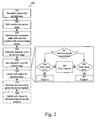
- Figure 2 illustrates an example method 200 that uses a sliding window approach and which may be used in a SISO decoding module.
- the method steps of the example method 200 may be performed for each node of each stage in the trellis representation.
- Transition metrics for each incoming transition of the node are calculated in step 210, and path metrics for each incoming path are determined in step 220 based on the transition metrics and relevant node metrics of the previous stage. These operations are performed at the leading end of the sliding window (compare with node 124 of figure 1C ).
- the surviving path and its concurrent path are determined based on the calculated path metrics.
- the determination may include performing trace-back or similar operations (e.g. retrieval of corresponding information from a memory unit, e.g. a register) to determine the decision bit of the surviving path and of the concurrent path (compare with 126 and 127 of Figure 1C ) and either or both of their respective reliability values.
- a path disparity value (which is to be used as an initial reliability value) for the node under consideration is calculated in step 240 and stored in step 250.
- the path disparity value may, for example, be an absolute value of the difference between the path metrics of the surviving and concurrent paths. Other disparity values may also be considered. For example, if there are more than two incoming paths all or a subset of the path metrics may be involved in the disparity value calculation. It is noted that steps 240 and 250 may alternatively be performed before or in parallel with step 230.
- step 260 the reliability value of the decision bit of the surviving path (compare with node value 125 in Figure 1C ) may be updated if certain criteria are fulfilled as will be explained in the following.
- step 260 may comprise comparing the decision bits u k-U (s) and u k-U (c) of the surviving and the concurrent paths (sub-step 261) to determine whether or not they are equal.
- the reliability value L k (s) for the current node and the reliability value L k-U (s) for the decision bit of the surviving path are compared in sub-step 264. If L k-U (s) is larger than L k (s), L k-U (s) is replaced by L k (s) in sub-step 265. Otherwise L k-U (s) is kept unchanged (sub-step 266).
- a function of the reliability value L k (s) for the current node and the initial reliability value ⁇ k-U (c) for the decision bit of the concurrent path is compared to the reliability value L k-U (s) for the decision bit of the surviving path in sub-step 262. If L k-U (s) is larger than the function value, L k-U (s) is replaced by the function value in sub-step 263. Otherwise L k-U (s) is kept unchanged (sub-step 266).
- the function may be a summation, i.e. L k (s)+ ⁇ k-U (c). However, other functions may be equally applicable, e.g. a weighted sum ⁇ L k (s)+(2- ⁇ )A k-U (c).
- Steps 270 and 280 represent embodiments where a second sliding window is applied after the first sliding window has passed and where a different reliability value update rule is used than in the first window.
- the operations of step 270 for the second window correspond to the operations of step 230 for the first window.
- the operations of step 280 for the second window correspond to the operations of step 260 for the first window with at least one criteria or value formula being different from what has been described for step 260.
- Figure 3A illustrates an example decoding arrangement that may be used for HR-SOVA implementations.
- the arrangement comprises a metric unit 310, a survivor path unit 311, a symbol register 312, a disparity register 313, a selection unit 314, a path comparison unit 315 and a soft value unit 316.
- Received intrinsic soft values and extrinsic soft values are input to the metric unit 310 as illustrated at 321 and 322.
- the metric unit 310 determines the preferred incoming path and calculates the corresponding disparity value (i.e. the initial reliability value) for each node of each stage of the trellis.
- the operations of the metric unit 310 may be compared with steps 210, 220 and 240 of Figure 2 .
- the bit value 324 that corresponds to the preferred incoming path is stored in the symbol register 312 for each node, and the corresponding disparity value 325 is stored in the disparity register 313 (compare with step 250 of Figure 2 ).
- the bit value 323 that corresponds to the preferred incoming path is also forwarded to the survivor path unit 311, which establishes relevant information associated with the surviving path (compare with step 230 - surviving path part - of Figure 2 ), such as the decision bit 326 and the decision stage survivor node 327 (compare with 125 and 126 of Figure 1C ).
- the information associated with the surviving path is forwarded to the path comparison unit 315 which relays the decision bit to an arrangement output 331.
- the path comparison unit also establishes relevant information associated with the concurrent path (compare with step 230 - concurrent path part - of Figure 2 ), such as the bit corresponding to the decision bit and the decision stage concurrent node.
- the path comparison unit 315 also has access to the symbol register 312 as shown at 328.
- the path comparison unit 315 also compares the decision bit with the corresponding bit of the concurrent path (compare with sub-step 261 of Figure 2 ) and forwards the result 332 of the comparison to the soft value unit 316, which updates reliability values accordingly (e.g. according to the Hagenauer rule) and outputs the resulting reliability values as soft values as illustrated at 333.
- the soft value unit 316 also has access to adequate information of the disparity register 314 as shown at 330.
- the selection unit 314 selects the appropriate disparity value 330 from the values of the disparity register 239 based on the decision stage node 327.
- Figure 3B illustrates another example decoding arrangement that may be used for BR-SOVA implementations or for implementations of SOVA with the modified update rule.
- the arrangement comprises a metric unit 340, a survivor path unit 341, a disparity register 343, a selection and absolute value unit 344, a path comparison unit 345, a selection unit 347 and a soft value unit 346.
- Received intrinsic soft values and extrinsic soft values are input to the metric unit 340 as illustrated at 351 and 352.
- the metric unit 340 determines the preferred incoming path and calculates the corresponding disparity value for each node of each stage of the trellis.
- the disparity values 355 are stored in the disparity register 343.
- the bit value 353 that corresponds to the preferred incoming path is forwarded to the survivor path unit 341, which establishes relevant information associated with the surviving path, such as the decision bit 356 and the decision stage survivor node 357.
- the information associated with the surviving path is forwarded to the path comparison unit 345 which relays the decision bit to an arrangement output 361.
- the path comparison unit also establishes relevant information associated with the concurrent path, such as the bit corresponding to the decision bit and the decision stage concurrent node.
- Such information may, for example, be extracted from the sign of the disparity values (as in the Hagenauer rule).
- Disparity values are commonly defined as absolute values in with case their sign contains no information. Therefore, embodiments of the invention describe disparity values as signed values since such an approach simplifies the implementation of the metric unit.
- the absolute value of the disparity values may be determined at a later stage of the processing according to such embodiments.
- the path comparison unit 345 also compares the decision bit with the corresponding bit of the concurrent path and forwards the result 365 of the comparison to the selection unit 347.
- the path comparison unit 345 provides information 364 relevant for a possible reliability update to the selection unit 347.
- information may include (updated) reliability values of the concurrent path, while for SOVA with the modified update rule such information may include initial reliability values of the concurrent path.
- the path comparison unit 345 also has access to the disparity register 343 as shown at 358.
- the selection and absolute value unit 344 selects an appropriate disparity value (i.e. the one corresponding to the surviving path) from the values of the disparity register 259 based on the decision stage node 357, and provides its absolute value 360 to the selection unit 347 and the soft value unit 346.
- the selection unit 347 determined whether or not the information 364 relevant for a possible reliability update is to be used based whether or not the decision bit was equal to the corresponding bit of the concurrent path (i.e. the information provided at 365) and outputs the result at 362.
- the soft value unit 346 updates reliability values accordingly and outputs the resulting reliability values as soft values as illustrated at 363. For example, if either of BR-SOVA or SOVA with the modified update rule are implemented, the soft output value may compare the result at 362 with the disparity value 360 (compare with sub-steps 262 and 264 of Figure 2 ) and output the least of the two (compare with sub-steps 263, 265 and 266 of Figure 2 ).
- Figure 3C illustrates yet another example decoding arrangement that may be used for a combination of two different SOVA implementations (e.g. BR-SOVA or SOVA with the modified update rule, followed by HR-SOVA) according to some embodiments of the invention.
- SOVA implementations e.g. BR-SOVA or SOVA with the modified update rule, followed by HR-SOVA
- the arrangement comprises a metric unit 370, a survivor path unit 371, a disparity register 373, a selection and absolute value unit 374, a path comparison unit 375, a selection unit 377 and a soft value unit 376.
- These units operate similarly or equivalently with the corresponding units 340, 341, 343, 344, 345, 347 and 346 of Figure 3B and will therefore not be described in detail.
- the arrangement further comprises a second path comparison unit 379 and a second soft value unit 378.
- the path comparison unit 375 forwards the decision bits 391 and the decision stage survivor nodes 396 to the second path comparison unit 379.
- the soft value unit 376 forwards its resulting reliability values 393 to the second soft value unit 378, which uses them as initial reliability values.
- the path comparison unit 379 and the soft value unit 378 operate similarly or equivalently with the corresponding units 315 and 316 of Figure 3A and will therefore not be described in detail. Values corresponding to the symbol register of Figure 3A may be provided to the path comparison unit 379 in Figure 3C e.g. by extracting the values from the sign of the disparity values as has been explained above.
- the path comparison unit 375, the selection unit 377 and the soft value unit 376 typically cover a certain number of stages of the trellis at a time and may be seen as operating in a first sliding window.
- the path comparison unit 379 and the soft value unit 378 typically cover another certain number of stages of the trellis at a time and may be seen as operating in a second sliding window.
- the first and second sliding windows may be overlapping in an example not forming part of the embodiments, but are non-overlapping for optimal performance.
- the reliability update procedure used by the second soft value unit 378 differs for the reliability update procedure used by the soft value unit 376 and the selection unit 377.
- the soft value unit 376 and the selection unit 377 applies the modified update rule (or the Battail rule in an example not forming part of the embodiments), while the second soft value unit 378 applies the Hagenauer rule.
- units 375, 377 and 376 may be compared with the application of a first sliding window 140 in Figure 1E and the operations of units 379 and 378 may be compared with the application of a second sliding window 150 in Figure 1E and with steps 270 and 280 of Figure 2 .
- a method of decoding a block with a Soft Output Viterbi Algorithm wherein the block is encoded by an encoder of a code having a trellis representation, the trellis representation having a node for each possible state of the encoder and for each stage corresponding to a symbol input occasion of the encoder, each node having at least two incoming path transitions wherein each incoming path transition corresponds to a respective possible input symbol of the encoder.
- the SOVA uses a first sliding window wherein each position of the sliding window has a path determination stage at one end of the sliding window and a symbol decision stage at another end of the sliding window.
- the SOVA also uses a second sliding window wherein each position of the sliding window has a path determination stage at one end of the sliding window and a symbol decision stage at another end of the sliding window.
- the first and second sliding windows are non-overlapping.
- the method comprises determining intermediate soft output values of the SOVA by, for each path determination stage of the first sliding window and for each node of the path determination stage: calculating a transition metric and a corresponding path metric for each incoming path transition, determining a surviving path and a concurrent path based on the path metrics, calculating a path metric disparity value based at least on the path metric of the surviving and concurrent paths, storing the path metric disparity value for the node of the path determination stage, and determining a surviving path input symbol corresponding to a path transition of the surviving path at the decision stage, a surviving decision stage node which has the path transition of the surviving path at the decision stage as an incoming path transition, a concurrent path input symbol corresponding to a path transition of the concurrent path at the decision stage, and a concurrent decision stage node which has the path transition of the concurrent path at the decision stage as an incoming path transition.
- the intermediate soft output value of the surviving decision stage node is determined as the path metric disparity value of the node of the path determination stage, if the surviving path input symbol differs from the concurrent path input symbol and if the path metric disparity value of the node of the path determination stage is less than the stored path metric disparity value of the surviving decision stage node.
- intermediate soft output values of the surviving decision stage node is determined as a function of the path metric disparity value of the node of the path determination stage and the stored path metric disparity value of the concurrent decision stage node.
- intermediate soft output values of the surviving decision stage node may instead be determined as a function of the path metric disparity value of the node of the path determination stage and a reliability value of the concurrent decision stage node, if the surviving path input symbol is equal to the concurrent path input symbol and if the function of the path metric disparity value of the node of the path determination stage and the reliability value of the concurrent decision node is less than the stored path metric disparity value of the surviving decision stage node.
- intermediate soft output value of the surviving decision stage node is determined as the stored path metric disparity value of the surviving decision stage node.
- the method according to such embodiments further comprises determining soft output values of the SOVA by, for each path determination stage of the second sliding window and for each node of the path determination stage: determining a concurrent path input symbol corresponding to a path transition of the concurrent path at the decision stage, and a concurrent decision stage node which has the path transition of the concurrent path at the decision stage as an incoming path transition.
- the soft output values of the surviving decision stage node are determined using rules that are different in at least one aspect from those used to determine the intermediate soft output values of the first sliding window.
- the soft output values of the surviving decision stage node are determined based on at least one of the intermediate soft output values and using different criteria than in the first sliding window.
- the soft output values of the surviving decision stage node are, in the embodiments, determined as the intermediate soft output value of the node of the path determination stage, if the surviving path input symbol differs from the concurrent path input symbol and if the intermediate soft output value of the node of the path determination stage is less than the intermediate soft output value of the surviving decision stage node.
- the soft output value of the surviving decision stage node is determined as the intermediate soft output value of the surviving decision stage node.
- a corresponding decoder may also be envisioned comprising a metric calculation unit, at least one disparity value register unit, a survivor path unit, first and second path comparison units, and first and second soft output value units.
- the various parts being adapted to perform respective steps of the method as described above.
- An advantage with such embodiments when the modified update rule is applied in the first sliding window is that the complexity (compared to BR-SOVA or BCJR) may be even further reduced. Another advantage is that the error rate performance is not (or merely slightly) worsened compared to using only the modified update rule with a sliding window length that is equal to the sum of the lengths of the first and second sliding window lengths of the hybrid setup.
- the trade-off may be illustrated by varying the lengths of the first and second sliding windows while keeping the total window length constant.
- a SOVA with low-complexity properties e.g. HR-SOVA
- a SOVA with performance-maintaining properties e.g. BR-SOVA or SOVA with the modified update rule
- one implementation achieves this by cascading the reliability update units (path comparison units 375, 379, and selection unit 377 and soft value units 376, 378) serially.
- the reliability update units path comparison units 375, 379, and selection unit 377 and soft value units 376, 3708 serially.
- the likelihood that the reliability for the best concurrent path is eliminated within the first sliding window is reduced compared to if only HR-SOVA is used, and thus the overestimation of the extrinsic information in the HR-SOVA is less pronounced.
- the complexity increase from using a SOVA with performance-maintaining properties is kept low by applying the combination with HR-SOVA.
- register exchange is a low-latency method for tracing the survivor path back to a merged state in order to put out a decision symbol.
- Register exchange may be used for survivor management to obtain a possible hard decision symbol, as well as to track the survivor and/or concurrent paths within the reliability value update units (e.g. soft value units if Figure 3A-C ).
- Traditional register exchange units perform register exchange on hard decision bits, which is useful to obtain a merged final decision bit.
- SOVA reliability value updates where the metric differences for the concurrent path need to be obtained (e.g. SOVA with the modified update rule as described above).
- One way of obtaining the metric difference for the concurrent path is to perform register exchange on an array of metric differences. Depending on the bit width (word length) of the metric differences, this may result in a large number of multiplexers and undesirable wiring in the circuit.
- An alternative way involves storing the array of metric differences in an array of shift registers. However, in such cases the sequence of concurrent states of a path typically needs to be available in order to enable selection of the relevant metric difference values. Performing direct register exchange on the (generally multi-bit) state value is possible, but is not always an optimal solution.
- each state is associated with two possible input transitions and two possible output transitions, one for decision bit '0' and the other for decision bit '1'.
- FIG. 4A illustrates an example state register exchange unit according to some embodiments of the invention.
- Each stage of a corresponding trellis is represented by an appropriate number of memory elements 405, 406, 407, 408, each having a bit-width equal to one.
- a corresponding number of multiplexers 401, 402, 403, 404 inputs one of two possible values (either from initial input alternatives 0/1 in the first stage - 411, 412, 414, 415, 417, 418, 420, 421 - or from one of two previous memory element alternatives in later stages) based on the state transition having the best metric at the path determination stage 413, 416, 419, 422.
- This example implementation represents a minimal implementation since all of the memory elements and all wiring have a bit width equal to one.
- Figure 4B illustrates an example of such a transformation.
- the encoding polynomial is utilized to extract the relevant decision bit 430 by addition 531 of corresponding memory element content of a row of the register exchange unit, while the relevant state 440 may be extracted from corresponding memory element content of a row of the register exchange unit.
- the state sequence of a path (e.g. the concurrent path) may be efficiently obtained, and the relevant metric differences may thereafter be obtained from the disparity registers.
- the example mobile terminal 500 may be adapted to connect to a mobile telecommunication network via the wireless link to a radio base station.
- the mobile terminal 500 and the base station may be compliant with at least one mobile telecommunication standard, for instance UMTS LTE (Universal Mobile Telecommunication Standard - Long Term Evolution).
- UMTS LTE Universal Mobile Telecommunication Standard - Long Term Evolution
- DSP digital signal processors
- CPU central processing units
- FPGA field-programmable gate arrays
- ASIC application-specific integrated circuits
- the invention may be embodied within an electronic apparatus comprising circuitry/logic or performing methods according to any of the embodiments of the invention.
- the electronic apparatus may, for example, be radio communication apparatus, a portable or handheld mobile radio communication equipment, a mobile radio terminal, a mobile telephone, a base station, a pager, a communicator, an electronic organizer, a smartphone, a computer, a notebook, a modem, a plug-in card, or a mobile gaming device.
Landscapes
- Physics & Mathematics (AREA)
- Probability & Statistics with Applications (AREA)
- Engineering & Computer Science (AREA)
- Theoretical Computer Science (AREA)
- Error Detection And Correction (AREA)
Claims (8)
- Verfahren zum Decodieren eines Blocks mit einem Soft-Output Viterbi-Algorithmus - SOVA,
wobei der Block eine Mehrzahl von Symbolen umfasst, die eine gegenseitige Zuordnung aufweisen, die durch eine Trellis-Darstellung beschrieben wird, wobei die Trellis-Darstellung einen Knoten für jeden möglichen Zustand eines Encoders, welcher der Trellis-Darstellung entspricht, und für jede Stufe aufweist, die einem Symboleingangsereignis des Encoders entspricht, und jeder Knoten mindestens zwei Empfangspfadübergänge aufweist, wobei jeder Empfangspfadübergang einem jeweiligen möglichen Eingangssymbol des Encoders entspricht, und
wobei der SOVA ein erstes Gleitfenster (120, 130, 140) verwendet, wobei jede Position des ersten Gleitfensters eine Pfadbestimmungsstufe an einem Ende des ersten Gleitfensters und eine Symbolentscheidungsstufe am anderen Ende des ersten Gleitfensters aufweist,
wobei das Verfahren ein Bestimmen von Soft-Output-Zwischenwerten des SOVA für jede Pfadbestimmungsstufe und für jeden Knoten der Pfadbestimmungsstufe umfasst durch:Berechnen (210, 220) einer Übergangsmetrik und einer entsprechenden Pfadmetrik für jeden Empfangspfadübergang;Bestimmen (230) eines Überlebenspfades und eines Parallelpfades basierend auf der Pfadmetrik;Berechnen (240) eines Pfadmetrik-Disparitätswerts basierend mindestens auf der Pfadmetrik der Überlebens- und Parallelpfade;Speichern (250) des Pfadmetrik-Disparitätswerts für den Knoten der Pfadbestimmungsstufe;Bestimmen (230) eines Überlebenspfadeingangssymbols, das einem Pfadübergang des Überlebenspfades an der Entscheidungsstufe entspricht, eines Knotens der Überlebensentscheidungsstufe, welcher den Pfadübergang des Überlebenspfades an der Entscheidungsstufe als einen Empfangspfadübergang aufweist, eines Parallelpfadeingangssymbols, das einem Pfadübergang des Parallelpfades an der Entscheidungsstufe entspricht, und eines Knotens der Parallelentscheidungsstufe, welcher den Pfadübergang des Parallelpfades an der Entscheidungsstufe als einen Empfangspfadübergang aufweist;Bestimmen (260, 263, 265, 266) eines Soft-Output-Zwischenwerts des Knotens der Überlebensentscheidungsstufe als:den Pfadmetrik-Disparitätswert des Knotens der Pfadbestimmungsstufe, wenn (261) sich das Überlebenspfadeingangssymbol vom Parallelpfadeingangssymbol unterscheidet und wenn (264) der Pfadmetrik-Disparitätswert des Knotens der Pfadbestimmungsstufe niedriger als der gespeicherte Pfadmetrik-Disparitätswert des Knotens der Überlebensentscheidungsstufe ist;eine Funktion des Pfadmetrik-Disparitätswerts des Knotens der Pfadbestimmungsstufe und des gespeicherten Pfadmetrik-Disparitätswerts des Knotens der Parallelentscheidungsstufe, wenn (261) das Überlebenspfadeingangssymbol gleich dem Parallelpfadeingangssymbol ist und wenn (262) die Funktion des Pfadmetrik-Disparitätswerts des Knotens der Pfadbestimmungsstufe und des gespeicherten Pfadmetrik-Disparitätswerts des Parallelentscheidungsknotens niedriger als der gespeicherte Pfadmetrik-Disparitätswert des Knotens der Überlebensentscheidungsstufe ist; undandernfalls als den gespeicherten Pfadmetrik-Disparitätswert des Knotens der Überlebensentscheidungsstufe;Aktualisieren des gespeicherten Pfadmetrik-Disparitätswerts für den Knoten der Überlebensentscheidungsstufe mit dem bestimmten Soft-Output-Zwischenwert;wobei der SOVA zusätzlich ein zweites Gleitfenster (150) verwendet und die ersten und zweiten Gleitfenster nicht überlappend sind;wobei das Verfahren ferner umfasst:Bestimmen (270, 280) für jede Pfadbestimmungsstufe des zweiten Gleitfensters und für jeden Knoten der Pfadbestimmungsstufe des zweiten Gleitfensters eines Soft-Output-Werts des Knotens der Überlebensentscheidungsstufe des zweiten Gleitfensters basierend auf mindestens einem der Soft-Output-Zwischenwerte als:den Pfadmetrik-Disparitätswert des Knotens der Pfadbestimmungsstufe des zweiten Gleitfensters, wenn sich das Überlebenspfadeingangssymbol vom Parallelpfadeingangssymbol unterscheidet und wenn der Pfadmetrik-Disparitätswert des Knotens der Pfadbestimmungsstufe des zweiten Gleitfensters niedriger als der Soft-Output-Zwischenwert des Knotens der Überlebensentscheidungsstufe des zweiten Gleitfensters ist; undden Soft-Output-Zwischenwert des Knotens der Überlebensentscheidungsstufe des zweiten Gleitfensters, wenn das Überlebenspfadeingangssymbol gleich dem Parallelpfadeingangssymbol ist. - Verfahren nach Anspruch 1, wobei es sich bei der Übergangs- und der Pfadmetrik jeweils um eine kumulative Metrik handelt.
- Verfahren nach einem der Ansprüche 1 bis 2, wobei es sich bei der Funktion um eine Summierung handelt.
- Verfahren nach einem der Ansprüche 1 bis 3, wobei der Schritt des Berechnens des Pfadmetrik-Disparitätswerts ein Berechnen eines absoluten Wertes der Differenz zwischen der Pfadmetrik der Überlebens- und Parallelpfade umfasst.
- Verfahren nach einem der Ansprüche 1 bis 4, wobei die mindestens zwei Empfangspfadübergänge jedes Knotens aus zwei Empfangspfadübergängen bestehen.
- Computerprogrammprodukt (600), umfassend ein computerlesbares Medium, das ein Computerprogramm darauf aufweist, das Programmanweisungen umfasst, wobei das Computerprogramm in eine Datenverarbeitungseinheit geladen werden kann und so ausgelegt ist, dass es die Datenverarbeitungseinheit veranlasst, die Schritte nach einem der Ansprüche 1 bis 5 auszuführen, wenn das Computerprogramm durch die Datenverarbeitungseinheit ausgeführt wird.
- Decoder, der zum Decodieren eines Blocks mit einem Soft-Output Viterbi-Algorithmus - SOVA - ausgelegt ist,
wobei der Block eine Mehrzahl von Symbolen umfasst, die eine gegenseitige Zuordnung aufweisen, die durch eine Trellis-Darstellung beschrieben wird, wobei die Trellis-Darstellung einen Knoten für jeden möglichen Zustand eines Encoders, welcher der Trellis-Darstellung entspricht, und für jede Stufe aufweist, die einem Symboleingangsereignis des Encoders entspricht, und jeder Knoten mindestens zwei Empfangspfadübergänge aufweist, wobei jeder Empfangspfadübergang einem jeweiligen möglichen Eingangssymbol des Encoders entspricht, und
wobei der SOVA ein erstes Gleitfenster (120, 130, 140) verwendet, wobei jede Position des ersten Gleitfensters eine Pfadbestimmungsstufe an einem Ende des ersten Gleitfensters und eine Symbolentscheidungsstufe am anderen Ende des ersten Gleitfensters aufweist,
wobei der Decoder umfasst:eine Metrikberechnungseinheit (340, 370), die so ausgelegt ist, dass sie für jede Pfadbestimmungsstufe und für jeden Knoten der Pfadbestimmungsstufe:eine Übergangsmetrik und eine entsprechende Pfadmetrik für jeden Empfangspfadübergang berechnet;einen Pfadmetrik-Disparitätswert basierend mindestens auf der Pfadmetrik eines Überlebenspfades und eines Parallelpfades berechnet;mindestens eine Disparitätswertregistereinheit (343, 373), die so ausgelegt ist, dass sie für jede Stufe und jeden Knoten des ersten Gleitfensters den entsprechenden Pfadmetrik-Disparitätswert speichert;eine Überlebenspfadeinheit (341, 371), die so ausgelegt ist, dass sie für jede Pfadbestimmungsstufe und für jeden Knoten der Pfadbestimmungsstufe:den Überlebenspfad basierend auf der Pfadmetrik bestimmt; undein Überlebenspfadeingangssymbol, das einem Pfadübergang des Überlebenspfades an der Entscheidungsstufe entspricht, und einen Knoten der Überlebensentscheidungsstufe bestimmt, welcher den Pfadübergang des Überlebenspfades an der Entscheidungsstufe als einen Empfangspfadübergang aufweist;eine Pfadvergleichseinheit (345, 375), die so ausgelegt ist, dass sie für jede Pfadbestimmungsstufe und für jeden Knoten der Pfadbestimmungsstufe:den Parallelpfad basierend auf der Pfadmetrik bestimmt; undein Parallelpfadeingangssymbol, das einem Pfadübergang des Parallelpfades an der Entscheidungsstufe entspricht, und einen Knoten der Parallelentscheidungsstufe bestimmt, welcher den Pfadübergang des Parallelpfades an der Entscheidungsstufe als einen Empfangspfadübergang aufweist;bestimmt, ob sich das Überlebenspfadeingangssymbol vom Parallelpfadeingangssymbol unterscheidet;eine Soft-Output-Zwischenwerteinheit (346, 376), die so ausgelegt ist, dass sie für jede Pfadbestimmungsstufe und für jeden Knoten der Pfadbestimmungsstufe einen Soft-Output-Wert des Knotens der Überlebensentscheidungsstufe bestimmt als:den Pfadmetrik-Disparitätswert des Knotens der Pfadbestimmungsstufe, wenn sich das Überlebenspfadeingangssymbol vom Parallelpfadeingangssymbol unterscheidet und wenn der Pfadmetrik-Disparitätswert des Knotens der Pfadbestimmungsstufe niedriger als der gespeicherte Pfadmetrik-Disparitätswert des Knotens der Überlebensentscheidungsstufe ist;eine Funktion des Pfadmetrik-Disparitätswerts des Knotens der Pfadbestimmungsstufe und des gespeicherten Pfadmetrik-Disparitätswerts des Knotens der Parallelentscheidungsstufe, wenn das Überlebenspfadeingangssymbol gleich dem Parallelpfadeingangssymbol ist und wenn die Funktion des Pfadmetrik-Disparitätswerts des Knotens der Pfadbestimmungsstufe und des gespeicherten Pfadmetrik-Disparitätswerts des Knotens der Parallelentscheidungsstufe niedriger als der gespeicherte Pfadmetrik-Disparitätswert des Knotens der Überlebensentscheidungsstufe ist; undandernfalls als den gespeicherten Pfadmetrik-Disparitätswert des Knotens der Überlebensentscheidungsstufe;wobei die mindestens eine Disparitätswertregistereinheit so ausgelegt ist, dass sie den gespeicherten Pfadmetrik-Disparitätswert für den Knoten der Überlebensentscheidungsstufe mit dem bestimmten Soft-Output-Zwischenwert aktualisiert;wobei die mindestens eine Disparitätswertregistereinheit außerdem so ausgelegt ist, dass sie den entsprechenden Pfadmetrik-Disparitätswert für jede Stufe und jeden Knoten eines zweiten Gleitfensters (150) speichert, das durch den SOVA zusätzlich verwendet wird, wobei die ersten und zweiten Gleitfenster nicht überlappend sind;wobei der Decoder ferner umfasst:eine zweite Soft-Output-Werteinheit (378), die so ausgelegt ist, dass sie für jede Pfadbestimmungsstufe des zweiten Gleitfensters und für jeden Knoten der Pfadbestimmungsstufe des zweiten Gleitfensters einen Soft-Output-Wert des Knotens der Überlebensentscheidungsstufe des zweiten Gleitfensters basierend auf mindestens einem der Soft-Output-Zwischenwerte bestimmt als:den Pfadmetrik-Disparitätswert des Knotens der Pfadbestimmungsstufe des zweiten Gleitfensters, wenn sich das Überlebenspfadeingangssymbol vom Parallelpfadeingangssymbol unterscheidet und wenn der Pfadmetrik-Disparitätswert des Knotens der Pfadbestimmungsstufe des zweiten Gleitfensters niedriger als der Soft-Output-Zwischenwert des Knotens der Überlebensentscheidungsstufe des zweiten Gleitfensters ist; undden Soft-Output-Zwischenwert des Knotens der Überlebensentscheidungsstufe des zweiten Gleitfensters, wenn das Überlebenspfadeingangssymbol gleich dem Parallelpfadeingangssymbol ist. - Funkkommunikationsgerät (500), umfassend den Decoder nach Anspruch 7.
Priority Applications (4)
| Application Number | Priority Date | Filing Date | Title |
|---|---|---|---|
| EP11190056A EP2442451A1 (de) | 2009-08-18 | 2010-04-15 | Soft-Output-Viterbi-Algorithmusverfahren und Decoder |
| US13/389,907 US8806312B2 (en) | 2009-08-18 | 2010-08-12 | Soft output Viterbi algorithm method and decoder |
| CN2010800365867A CN102484485A (zh) | 2009-08-18 | 2010-08-12 | 软输出维特比算法方法和解码器 |
| PCT/EP2010/061760 WO2011020770A1 (en) | 2009-08-18 | 2010-08-12 | Soft output viterbi algorithm method and decoder |
Applications Claiming Priority (1)
| Application Number | Priority Date | Filing Date | Title |
|---|---|---|---|
| US23470109P | 2009-08-18 | 2009-08-18 |
Related Child Applications (1)
| Application Number | Title | Priority Date | Filing Date |
|---|---|---|---|
| EP11190056.9 Division-Into | 2011-11-22 |
Publications (3)
| Publication Number | Publication Date |
|---|---|
| EP2302811A2 EP2302811A2 (de) | 2011-03-30 |
| EP2302811A3 EP2302811A3 (de) | 2011-04-20 |
| EP2302811B1 true EP2302811B1 (de) | 2013-03-27 |
Family
ID=42632647
Family Applications (2)
| Application Number | Title | Priority Date | Filing Date |
|---|---|---|---|
| EP10159966A Not-in-force EP2302811B1 (de) | 2009-08-18 | 2010-04-15 | Soft-Output Viterbi-Algorithmusverfahren und Decoder |
| EP11190056A Withdrawn EP2442451A1 (de) | 2009-08-18 | 2010-04-15 | Soft-Output-Viterbi-Algorithmusverfahren und Decoder |
Family Applications After (1)
| Application Number | Title | Priority Date | Filing Date |
|---|---|---|---|
| EP11190056A Withdrawn EP2442451A1 (de) | 2009-08-18 | 2010-04-15 | Soft-Output-Viterbi-Algorithmusverfahren und Decoder |
Country Status (4)
| Country | Link |
|---|---|
| US (1) | US8806312B2 (de) |
| EP (2) | EP2302811B1 (de) |
| CN (1) | CN102484485A (de) |
| WO (1) | WO2011020770A1 (de) |
Families Citing this family (4)
| Publication number | Priority date | Publication date | Assignee | Title |
|---|---|---|---|---|
| CN103378943B (zh) * | 2012-04-19 | 2018-07-13 | 马维尔国际有限公司 | 验证码字有效性的方法和设备以及译码方法和译码器 |
| TWI555339B (zh) * | 2015-04-21 | 2016-10-21 | 國立清華大學 | 疊代式解碼裝置、疊代式訊號檢驗裝置與資訊更新方法 |
| US10014026B1 (en) * | 2017-06-20 | 2018-07-03 | Seagate Technology Llc | Head delay calibration and tracking in MSMR systems |
| US11533126B1 (en) | 2021-08-20 | 2022-12-20 | Cisco Technology, Inc. | Soft-output Viterbi equalizer for non-binary modulation |
Family Cites Families (15)
| Publication number | Priority date | Publication date | Assignee | Title |
|---|---|---|---|---|
| US5537444A (en) * | 1993-01-14 | 1996-07-16 | At&T Corp. | Extended list output and soft symbol output viterbi algorithms |
| DK1135877T3 (da) * | 1999-10-05 | 2008-06-09 | Samsung Electronics Co Ltd | Turbodekodning med soft-output-Viterbi-dekoder |
| US6829313B1 (en) * | 2000-07-17 | 2004-12-07 | Motorola, Inc. | Sliding window turbo decoder |
| US7234100B1 (en) * | 2000-09-28 | 2007-06-19 | Intel Corporation | Decoder for trellis-based channel encoding |
| US20020157058A1 (en) * | 2001-02-20 | 2002-10-24 | Cute Ltd. | System and method for feedback-based unequal error protection coding |
| US6961921B2 (en) * | 2001-09-06 | 2005-11-01 | Interdigital Technology Corporation | Pipeline architecture for maximum a posteriori (MAP) decoders |
| KR100449578B1 (ko) * | 2001-09-14 | 2004-09-21 | 한국전자통신연구원 | 3차원 이상의 블럭터보 부호에 대한 반복 복호 방법 |
| US7120207B2 (en) * | 2001-12-31 | 2006-10-10 | Nokia Corporation | Transmission method and radio receiver |
| CN1398047A (zh) * | 2002-08-20 | 2003-02-19 | 北京邮电大学 | 并行滑动窗涡轮码译码器及其实现方法 |
| US7103831B1 (en) * | 2003-01-22 | 2006-09-05 | Conexant Systems, Inc. | Burst reliability and error locator for trellis codes |
| GB0504483D0 (en) * | 2005-03-03 | 2005-04-13 | Ttp Communications Ltd | Trellis calculations |
| US7925964B2 (en) * | 2006-12-22 | 2011-04-12 | Intel Corporation | High-throughput memory-efficient BI-SOVA decoder architecture |
| US7930617B1 (en) * | 2007-06-20 | 2011-04-19 | Rockwell Collins, Inc. | Sliding window block codes for cross-packet coding |
| US7721187B2 (en) * | 2007-09-04 | 2010-05-18 | Broadcom Corporation | ACS (add compare select) implementation for radix-4 SOVA (soft-output viterbi algorithm) |
| US7752531B2 (en) * | 2007-09-12 | 2010-07-06 | Seagate Technology Llc | Defect sensing Viterbi based detector |
-
2010
- 2010-04-15 EP EP10159966A patent/EP2302811B1/de not_active Not-in-force
- 2010-04-15 EP EP11190056A patent/EP2442451A1/de not_active Withdrawn
- 2010-08-12 WO PCT/EP2010/061760 patent/WO2011020770A1/en not_active Ceased
- 2010-08-12 CN CN2010800365867A patent/CN102484485A/zh active Pending
- 2010-08-12 US US13/389,907 patent/US8806312B2/en not_active Expired - Fee Related
Also Published As
| Publication number | Publication date |
|---|---|
| EP2442451A1 (de) | 2012-04-18 |
| EP2302811A2 (de) | 2011-03-30 |
| US8806312B2 (en) | 2014-08-12 |
| CN102484485A (zh) | 2012-05-30 |
| EP2302811A3 (de) | 2011-04-20 |
| WO2011020770A1 (en) | 2011-02-24 |
| US20120159288A1 (en) | 2012-06-21 |
Similar Documents
| Publication | Publication Date | Title |
|---|---|---|
| US7191377B2 (en) | Combined turbo-code/convolutional code decoder, in particular for mobile radio systems | |
| EP1314254B1 (de) | ITERATIONSABBRUCH Für Turbodecodierer | |
| Le et al. | Revisiting the max-log-map algorithm with SOVA update rules: New simplifications for high-radix SISO decoders | |
| US8806312B2 (en) | Soft output Viterbi algorithm method and decoder | |
| Guo et al. | SOVA Decoded Serially Concatenated Continuous Phase Modulations with Binary Markov Source | |
| US7096410B2 (en) | Turbo-code decoding using variably set learning interval and sliding window | |
| Sreedevi et al. | Design and Implementation of Interleaver in GNU Radio for short block length Turbo codes | |
| Muller et al. | Spc05-3: On the parallelism of convolutional turbo decoding and interleaving interference | |
| Zhang et al. | Research on common algorithms of convolutional codes and turbo codes | |
| WO2002021784A1 (en) | Soft-output error-trellis decoder for convolutional codes | |
| Kene et al. | WiMAX physical layer optimization by implementing SOVA Decoding algorithm | |
| Chaikalis et al. | Improving the reconfigurable SOVA/log-MAP turbo decoder for 3GPP | |
| Han et al. | Implementation of an efficient two-step SOVA turbo decoder for wireless communication systems | |
| US9106266B2 (en) | Trellis state based stopping criterion for turbo-decoding | |
| Ghrayeb et al. | Concatenated coding and iterative SOVA decoding with PR4 signaling | |
| Papaharalabos et al. | A new method of improving SOVA turbo decoding for AWGN, rayleigh and rician fading channels | |
| He et al. | Memory-reduced MAP decoding for double-binary convolutional turbo code | |
| Shim et al. | A novel metric representation for low-complexity log-MAP decoder | |
| Lu et al. | Low-latency turbo decoder design by concurrent decoding of component codes | |
| Ramteke et al. | Hdl implementation of turbo decoder using soft output viterbi algorithm | |
| Shrivastava et al. | Performance of Turbo Code for UMTS in AWGN channel | |
| Shresthal et al. | Reconfigurable VLSI-Architecture | |
| Luo | An Improved SOVA for Turbo Code Decoding | |
| Liao | A new short memory turbo code with good BER performance and low decoding complexity | |
| Yang et al. | Reliable Transfer of Variable-Length Coded Correlated Date: An Low Complexity Iterative Joint Source-Channel Decoding Approach |
Legal Events
| Date | Code | Title | Description |
|---|---|---|---|
| PUAI | Public reference made under article 153(3) epc to a published international application that has entered the european phase |
Free format text: ORIGINAL CODE: 0009012 |
|
| PUAL | Search report despatched |
Free format text: ORIGINAL CODE: 0009013 |
|
| AK | Designated contracting states |
Kind code of ref document: A2 Designated state(s): AT BE BG CH CY CZ DE DK EE ES FI FR GB GR HR HU IE IS IT LI LT LU LV MC MK MT NL NO PL PT RO SE SI SK SM TR |
|
| AK | Designated contracting states |
Kind code of ref document: A3 Designated state(s): AT BE BG CH CY CZ DE DK EE ES FI FR GB GR HR HU IE IS IT LI LT LU LV MC MK MT NL NO PL PT RO SE SI SK SM TR |
|
| 17P | Request for examination filed |
Effective date: 20111019 |
|
| 17Q | First examination report despatched |
Effective date: 20120319 |
|
| REG | Reference to a national code |
Ref country code: DE Ref legal event code: R079 Ref document number: 602010005713 Country of ref document: DE Free format text: PREVIOUS MAIN CLASS: H03M0013410000 Ipc: H03M0013370000 |
|
| GRAP | Despatch of communication of intention to grant a patent |
Free format text: ORIGINAL CODE: EPIDOSNIGR1 |
|
| RIC1 | Information provided on ipc code assigned before grant |
Ipc: H03M 13/39 20060101ALI20121002BHEP Ipc: H03M 13/37 20060101AFI20121002BHEP Ipc: H03M 13/41 20060101ALI20121002BHEP |
|
| GRAS | Grant fee paid |
Free format text: ORIGINAL CODE: EPIDOSNIGR3 |
|
| GRAA | (expected) grant |
Free format text: ORIGINAL CODE: 0009210 |
|
| AK | Designated contracting states |
Kind code of ref document: B1 Designated state(s): AT BE BG CH CY CZ DE DK EE ES FI FR GB GR HR HU IE IS IT LI LT LU LV MC MK MT NL NO PL PT RO SE SI SK SM TR |
|
| REG | Reference to a national code |
Ref country code: GB Ref legal event code: FG4D |
|
| REG | Reference to a national code |
Ref country code: CH Ref legal event code: EP |
|
| REG | Reference to a national code |
Ref country code: AT Ref legal event code: REF Ref document number: 603964 Country of ref document: AT Kind code of ref document: T Effective date: 20130415 |
|
| REG | Reference to a national code |
Ref country code: IE Ref legal event code: FG4D |
|
| REG | Reference to a national code |
Ref country code: DE Ref legal event code: R096 Ref document number: 602010005713 Country of ref document: DE Effective date: 20130529 |
|
| PG25 | Lapsed in a contracting state [announced via postgrant information from national office to epo] |
Ref country code: SE Free format text: LAPSE BECAUSE OF FAILURE TO SUBMIT A TRANSLATION OF THE DESCRIPTION OR TO PAY THE FEE WITHIN THE PRESCRIBED TIME-LIMIT Effective date: 20130327 Ref country code: NO Free format text: LAPSE BECAUSE OF FAILURE TO SUBMIT A TRANSLATION OF THE DESCRIPTION OR TO PAY THE FEE WITHIN THE PRESCRIBED TIME-LIMIT Effective date: 20130627 Ref country code: BG Free format text: LAPSE BECAUSE OF FAILURE TO SUBMIT A TRANSLATION OF THE DESCRIPTION OR TO PAY THE FEE WITHIN THE PRESCRIBED TIME-LIMIT Effective date: 20130627 Ref country code: LT Free format text: LAPSE BECAUSE OF FAILURE TO SUBMIT A TRANSLATION OF THE DESCRIPTION OR TO PAY THE FEE WITHIN THE PRESCRIBED TIME-LIMIT Effective date: 20130327 |
|
| REG | Reference to a national code |
Ref country code: AT Ref legal event code: MK05 Ref document number: 603964 Country of ref document: AT Kind code of ref document: T Effective date: 20130327 |
|
| REG | Reference to a national code |
Ref country code: LT Ref legal event code: MG4D |
|
| PG25 | Lapsed in a contracting state [announced via postgrant information from national office to epo] |
Ref country code: SI Free format text: LAPSE BECAUSE OF FAILURE TO SUBMIT A TRANSLATION OF THE DESCRIPTION OR TO PAY THE FEE WITHIN THE PRESCRIBED TIME-LIMIT Effective date: 20130327 Ref country code: FI Free format text: LAPSE BECAUSE OF FAILURE TO SUBMIT A TRANSLATION OF THE DESCRIPTION OR TO PAY THE FEE WITHIN THE PRESCRIBED TIME-LIMIT Effective date: 20130327 Ref country code: GR Free format text: LAPSE BECAUSE OF FAILURE TO SUBMIT A TRANSLATION OF THE DESCRIPTION OR TO PAY THE FEE WITHIN THE PRESCRIBED TIME-LIMIT Effective date: 20130628 Ref country code: LV Free format text: LAPSE BECAUSE OF FAILURE TO SUBMIT A TRANSLATION OF THE DESCRIPTION OR TO PAY THE FEE WITHIN THE PRESCRIBED TIME-LIMIT Effective date: 20130327 |
|
| REG | Reference to a national code |
Ref country code: NL Ref legal event code: VDEP Effective date: 20130327 |
|
| PG25 | Lapsed in a contracting state [announced via postgrant information from national office to epo] |
Ref country code: HR Free format text: LAPSE BECAUSE OF FAILURE TO SUBMIT A TRANSLATION OF THE DESCRIPTION OR TO PAY THE FEE WITHIN THE PRESCRIBED TIME-LIMIT Effective date: 20130327 Ref country code: BE Free format text: LAPSE BECAUSE OF FAILURE TO SUBMIT A TRANSLATION OF THE DESCRIPTION OR TO PAY THE FEE WITHIN THE PRESCRIBED TIME-LIMIT Effective date: 20130327 |
|
| PG25 | Lapsed in a contracting state [announced via postgrant information from national office to epo] |
Ref country code: NL Free format text: LAPSE BECAUSE OF FAILURE TO SUBMIT A TRANSLATION OF THE DESCRIPTION OR TO PAY THE FEE WITHIN THE PRESCRIBED TIME-LIMIT Effective date: 20130327 Ref country code: RO Free format text: LAPSE BECAUSE OF FAILURE TO SUBMIT A TRANSLATION OF THE DESCRIPTION OR TO PAY THE FEE WITHIN THE PRESCRIBED TIME-LIMIT Effective date: 20130327 Ref country code: AT Free format text: LAPSE BECAUSE OF FAILURE TO SUBMIT A TRANSLATION OF THE DESCRIPTION OR TO PAY THE FEE WITHIN THE PRESCRIBED TIME-LIMIT Effective date: 20130327 Ref country code: EE Free format text: LAPSE BECAUSE OF FAILURE TO SUBMIT A TRANSLATION OF THE DESCRIPTION OR TO PAY THE FEE WITHIN THE PRESCRIBED TIME-LIMIT Effective date: 20130327 Ref country code: CZ Free format text: LAPSE BECAUSE OF FAILURE TO SUBMIT A TRANSLATION OF THE DESCRIPTION OR TO PAY THE FEE WITHIN THE PRESCRIBED TIME-LIMIT Effective date: 20130327 Ref country code: ES Free format text: LAPSE BECAUSE OF FAILURE TO SUBMIT A TRANSLATION OF THE DESCRIPTION OR TO PAY THE FEE WITHIN THE PRESCRIBED TIME-LIMIT Effective date: 20130708 Ref country code: PT Free format text: LAPSE BECAUSE OF FAILURE TO SUBMIT A TRANSLATION OF THE DESCRIPTION OR TO PAY THE FEE WITHIN THE PRESCRIBED TIME-LIMIT Effective date: 20130729 Ref country code: IS Free format text: LAPSE BECAUSE OF FAILURE TO SUBMIT A TRANSLATION OF THE DESCRIPTION OR TO PAY THE FEE WITHIN THE PRESCRIBED TIME-LIMIT Effective date: 20130727 Ref country code: SK Free format text: LAPSE BECAUSE OF FAILURE TO SUBMIT A TRANSLATION OF THE DESCRIPTION OR TO PAY THE FEE WITHIN THE PRESCRIBED TIME-LIMIT Effective date: 20130327 |
|
| PG25 | Lapsed in a contracting state [announced via postgrant information from national office to epo] |
Ref country code: CY Free format text: LAPSE BECAUSE OF FAILURE TO SUBMIT A TRANSLATION OF THE DESCRIPTION OR TO PAY THE FEE WITHIN THE PRESCRIBED TIME-LIMIT Effective date: 20130327 Ref country code: PL Free format text: LAPSE BECAUSE OF FAILURE TO SUBMIT A TRANSLATION OF THE DESCRIPTION OR TO PAY THE FEE WITHIN THE PRESCRIBED TIME-LIMIT Effective date: 20130327 |
|
| PG25 | Lapsed in a contracting state [announced via postgrant information from national office to epo] |
Ref country code: MC Free format text: LAPSE BECAUSE OF FAILURE TO SUBMIT A TRANSLATION OF THE DESCRIPTION OR TO PAY THE FEE WITHIN THE PRESCRIBED TIME-LIMIT Effective date: 20130327 |
|
| REG | Reference to a national code |
Ref country code: IE Ref legal event code: MM4A |
|
| PG25 | Lapsed in a contracting state [announced via postgrant information from national office to epo] |
Ref country code: DK Free format text: LAPSE BECAUSE OF FAILURE TO SUBMIT A TRANSLATION OF THE DESCRIPTION OR TO PAY THE FEE WITHIN THE PRESCRIBED TIME-LIMIT Effective date: 20130327 Ref country code: DE Free format text: LAPSE BECAUSE OF NON-PAYMENT OF DUE FEES Effective date: 20131101 |
|
| PLBE | No opposition filed within time limit |
Free format text: ORIGINAL CODE: 0009261 |
|
| STAA | Information on the status of an ep patent application or granted ep patent |
Free format text: STATUS: NO OPPOSITION FILED WITHIN TIME LIMIT |
|
| REG | Reference to a national code |
Ref country code: DE Ref legal event code: R119 Ref document number: 602010005713 Country of ref document: DE Effective date: 20131101 |
|
| PG25 | Lapsed in a contracting state [announced via postgrant information from national office to epo] |
Ref country code: IT Free format text: LAPSE BECAUSE OF FAILURE TO SUBMIT A TRANSLATION OF THE DESCRIPTION OR TO PAY THE FEE WITHIN THE PRESCRIBED TIME-LIMIT Effective date: 20130327 |
|
| 26N | No opposition filed |
Effective date: 20140103 |
|
| REG | Reference to a national code |
Ref country code: FR Ref legal event code: ST Effective date: 20140303 |
|
| PG25 | Lapsed in a contracting state [announced via postgrant information from national office to epo] |
Ref country code: IE Free format text: LAPSE BECAUSE OF NON-PAYMENT OF DUE FEES Effective date: 20130415 |
|
| PG25 | Lapsed in a contracting state [announced via postgrant information from national office to epo] |
Ref country code: FR Free format text: LAPSE BECAUSE OF NON-PAYMENT OF DUE FEES Effective date: 20130527 |
|
| REG | Reference to a national code |
Ref country code: CH Ref legal event code: PL |
|
| PG25 | Lapsed in a contracting state [announced via postgrant information from national office to epo] |
Ref country code: LI Free format text: LAPSE BECAUSE OF NON-PAYMENT OF DUE FEES Effective date: 20140430 Ref country code: CH Free format text: LAPSE BECAUSE OF NON-PAYMENT OF DUE FEES Effective date: 20140430 |
|
| PG25 | Lapsed in a contracting state [announced via postgrant information from national office to epo] |
Ref country code: MT Free format text: LAPSE BECAUSE OF FAILURE TO SUBMIT A TRANSLATION OF THE DESCRIPTION OR TO PAY THE FEE WITHIN THE PRESCRIBED TIME-LIMIT Effective date: 20130327 |
|
| PG25 | Lapsed in a contracting state [announced via postgrant information from national office to epo] |
Ref country code: SM Free format text: LAPSE BECAUSE OF FAILURE TO SUBMIT A TRANSLATION OF THE DESCRIPTION OR TO PAY THE FEE WITHIN THE PRESCRIBED TIME-LIMIT Effective date: 20130327 |
|
| PG25 | Lapsed in a contracting state [announced via postgrant information from national office to epo] |
Ref country code: TR Free format text: LAPSE BECAUSE OF FAILURE TO SUBMIT A TRANSLATION OF THE DESCRIPTION OR TO PAY THE FEE WITHIN THE PRESCRIBED TIME-LIMIT Effective date: 20130327 |
|
| PG25 | Lapsed in a contracting state [announced via postgrant information from national office to epo] |
Ref country code: MK Free format text: LAPSE BECAUSE OF FAILURE TO SUBMIT A TRANSLATION OF THE DESCRIPTION OR TO PAY THE FEE WITHIN THE PRESCRIBED TIME-LIMIT Effective date: 20130327 Ref country code: LU Free format text: LAPSE BECAUSE OF NON-PAYMENT OF DUE FEES Effective date: 20130415 Ref country code: HU Free format text: LAPSE BECAUSE OF FAILURE TO SUBMIT A TRANSLATION OF THE DESCRIPTION OR TO PAY THE FEE WITHIN THE PRESCRIBED TIME-LIMIT; INVALID AB INITIO Effective date: 20100415 |
|
| PGFP | Annual fee paid to national office [announced via postgrant information from national office to epo] |
Ref country code: GB Payment date: 20210427 Year of fee payment: 12 |
|
| GBPC | Gb: european patent ceased through non-payment of renewal fee |
Effective date: 20220415 |
|
| PG25 | Lapsed in a contracting state [announced via postgrant information from national office to epo] |
Ref country code: GB Free format text: LAPSE BECAUSE OF NON-PAYMENT OF DUE FEES Effective date: 20220415 |