EP2301988A2 - Perfluoropolyether-modified polysiloxane, a method for preparing the same and a defoaming agent comprising the same - Google Patents
Perfluoropolyether-modified polysiloxane, a method for preparing the same and a defoaming agent comprising the same Download PDFInfo
- Publication number
- EP2301988A2 EP2301988A2 EP10169685A EP10169685A EP2301988A2 EP 2301988 A2 EP2301988 A2 EP 2301988A2 EP 10169685 A EP10169685 A EP 10169685A EP 10169685 A EP10169685 A EP 10169685A EP 2301988 A2 EP2301988 A2 EP 2301988A2
- Authority
- EP
- European Patent Office
- Prior art keywords
- perfluoropolyether
- formula
- represented
- integer
- modified polysiloxane
- Prior art date
- Legal status (The legal status is an assumption and is not a legal conclusion. Google has not performed a legal analysis and makes no representation as to the accuracy of the status listed.)
- Withdrawn
Links
- 229920001296 polysiloxane Polymers 0.000 title claims abstract description 68
- -1 polysiloxane Polymers 0.000 title claims abstract description 67
- 239000002518 antifoaming agent Substances 0.000 title claims description 28
- 238000000034 method Methods 0.000 title claims description 9
- 125000004432 carbon atom Chemical group C* 0.000 claims abstract description 11
- 125000000217 alkyl group Chemical group 0.000 claims abstract description 9
- 125000003118 aryl group Chemical group 0.000 claims abstract description 8
- 125000004435 hydrogen atom Chemical group [H]* 0.000 claims abstract description 5
- 239000010702 perfluoropolyether Substances 0.000 claims description 33
- 125000000391 vinyl group Chemical group [H]C([*])=C([H])[H] 0.000 claims description 10
- 125000001153 fluoro group Chemical group F* 0.000 claims description 8
- BASFCYQUMIYNBI-UHFFFAOYSA-N platinum Chemical compound [Pt] BASFCYQUMIYNBI-UHFFFAOYSA-N 0.000 description 34
- 150000001875 compounds Chemical class 0.000 description 28
- 239000003960 organic solvent Substances 0.000 description 28
- 239000000463 material Substances 0.000 description 21
- YXFVVABEGXRONW-UHFFFAOYSA-N Toluene Chemical compound CC1=CC=CC=C1 YXFVVABEGXRONW-UHFFFAOYSA-N 0.000 description 18
- 229910052697 platinum Inorganic materials 0.000 description 17
- 230000000694 effects Effects 0.000 description 16
- 239000002904 solvent Substances 0.000 description 13
- VYPSYNLAJGMNEJ-UHFFFAOYSA-N Silicium dioxide Chemical compound O=[Si]=O VYPSYNLAJGMNEJ-UHFFFAOYSA-N 0.000 description 12
- 230000000052 comparative effect Effects 0.000 description 12
- NTIZESTWPVYFNL-UHFFFAOYSA-N Methyl isobutyl ketone Chemical compound CC(C)CC(C)=O NTIZESTWPVYFNL-UHFFFAOYSA-N 0.000 description 11
- 239000003973 paint Substances 0.000 description 11
- SJBBXFLOLUTGCW-UHFFFAOYSA-N 1,3-bis(trifluoromethyl)benzene Chemical group FC(F)(F)C1=CC=CC(C(F)(F)F)=C1 SJBBXFLOLUTGCW-UHFFFAOYSA-N 0.000 description 10
- UIHCLUNTQKBZGK-UHFFFAOYSA-N Methyl isobutyl ketone Natural products CCC(C)C(C)=O UIHCLUNTQKBZGK-UHFFFAOYSA-N 0.000 description 10
- 239000003795 chemical substances by application Substances 0.000 description 10
- 239000002537 cosmetic Substances 0.000 description 10
- 239000000243 solution Substances 0.000 description 9
- 239000000654 additive Substances 0.000 description 8
- 230000000996 additive effect Effects 0.000 description 8
- 238000005187 foaming Methods 0.000 description 8
- 239000011248 coating agent Substances 0.000 description 7
- 238000000576 coating method Methods 0.000 description 7
- IMNFDUFMRHMDMM-UHFFFAOYSA-N N-Heptane Chemical compound CCCCCCC IMNFDUFMRHMDMM-UHFFFAOYSA-N 0.000 description 6
- WYURNTSHIVDZCO-UHFFFAOYSA-N Tetrahydrofuran Chemical compound C1CCOC1 WYURNTSHIVDZCO-UHFFFAOYSA-N 0.000 description 6
- RIOQSEWOXXDEQQ-UHFFFAOYSA-N triphenylphosphine Chemical compound C1=CC=CC=C1P(C=1C=CC=CC=1)C1=CC=CC=C1 RIOQSEWOXXDEQQ-UHFFFAOYSA-N 0.000 description 6
- 238000005160 1H NMR spectroscopy Methods 0.000 description 5
- XMSXQFUHVRWGNA-UHFFFAOYSA-N Decamethylcyclopentasiloxane Chemical compound C[Si]1(C)O[Si](C)(C)O[Si](C)(C)O[Si](C)(C)O[Si](C)(C)O1 XMSXQFUHVRWGNA-UHFFFAOYSA-N 0.000 description 5
- 239000003054 catalyst Substances 0.000 description 5
- 239000004205 dimethyl polysiloxane Substances 0.000 description 5
- 235000013870 dimethyl polysiloxane Nutrition 0.000 description 5
- 239000006260 foam Substances 0.000 description 5
- 239000000314 lubricant Substances 0.000 description 5
- 239000003921 oil Substances 0.000 description 5
- 125000001997 phenyl group Chemical group [H]C1=C([H])C([H])=C(*)C([H])=C1[H] 0.000 description 5
- 229920000435 poly(dimethylsiloxane) Polymers 0.000 description 5
- 239000000377 silicon dioxide Substances 0.000 description 5
- 239000000126 substance Substances 0.000 description 5
- GETTZEONDQJALK-UHFFFAOYSA-N (trifluoromethyl)benzene Chemical compound FC(F)(F)C1=CC=CC=C1 GETTZEONDQJALK-UHFFFAOYSA-N 0.000 description 4
- GTJOHISYCKPIMT-UHFFFAOYSA-N 2-methylundecane Chemical compound CCCCCCCCCC(C)C GTJOHISYCKPIMT-UHFFFAOYSA-N 0.000 description 4
- SGVYKUFIHHTIFL-UHFFFAOYSA-N Isobutylhexyl Natural products CCCCCCCC(C)C SGVYKUFIHHTIFL-UHFFFAOYSA-N 0.000 description 4
- 150000004945 aromatic hydrocarbons Chemical class 0.000 description 4
- 238000006243 chemical reaction Methods 0.000 description 4
- 239000000975 dye Substances 0.000 description 4
- 229910052731 fluorine Inorganic materials 0.000 description 4
- VKPSKYDESGTTFR-UHFFFAOYSA-N isododecane Natural products CC(C)(C)CC(C)CC(C)(C)C VKPSKYDESGTTFR-UHFFFAOYSA-N 0.000 description 4
- 230000001050 lubricating effect Effects 0.000 description 4
- 125000002496 methyl group Chemical group [H]C([H])([H])* 0.000 description 4
- VLKZOEOYAKHREP-UHFFFAOYSA-N n-Hexane Chemical compound CCCCCC VLKZOEOYAKHREP-UHFFFAOYSA-N 0.000 description 4
- 125000004108 n-butyl group Chemical group [H]C([H])([H])C([H])([H])C([H])([H])C([H])([H])* 0.000 description 4
- 239000000049 pigment Substances 0.000 description 4
- 238000002360 preparation method Methods 0.000 description 4
- 238000007639 printing Methods 0.000 description 4
- 238000010992 reflux Methods 0.000 description 4
- 125000002023 trifluoromethyl group Chemical group FC(F)(F)* 0.000 description 4
- ZWEHNKRNPOVVGH-UHFFFAOYSA-N 2-Butanone Chemical compound CCC(C)=O ZWEHNKRNPOVVGH-UHFFFAOYSA-N 0.000 description 3
- YCKRFDGAMUMZLT-UHFFFAOYSA-N Fluorine atom Chemical compound [F] YCKRFDGAMUMZLT-UHFFFAOYSA-N 0.000 description 3
- 238000004566 IR spectroscopy Methods 0.000 description 3
- 239000002671 adjuvant Substances 0.000 description 3
- KPUWHANPEXNPJT-UHFFFAOYSA-N disiloxane Chemical class [SiH3]O[SiH3] KPUWHANPEXNPJT-UHFFFAOYSA-N 0.000 description 3
- 239000006185 dispersion Substances 0.000 description 3
- 239000000835 fiber Substances 0.000 description 3
- 239000011737 fluorine Substances 0.000 description 3
- 238000006459 hydrosilylation reaction Methods 0.000 description 3
- 239000006082 mold release agent Substances 0.000 description 3
- 239000000843 powder Substances 0.000 description 3
- KSOCRXJMFBYSFA-UHFFFAOYSA-N 1,1,1,2,2,3,3,4,4,5,6,6,6-tridecafluoro-5-(1,1,1,2,3,3,4,4,5,5,6,6,6-tridecafluorohexan-2-yloxy)hexane Chemical compound FC(F)(F)C(F)(F)C(F)(F)C(F)(F)C(F)(C(F)(F)F)OC(F)(C(F)(F)F)C(F)(F)C(F)(F)C(F)(F)C(F)(F)F KSOCRXJMFBYSFA-UHFFFAOYSA-N 0.000 description 2
- PGISRKZDCUNMRX-UHFFFAOYSA-N 1,1,1,2,2,3,3,4,4-nonafluoro-4-(trifluoromethoxy)butane Chemical compound FC(F)(F)OC(F)(F)C(F)(F)C(F)(F)C(F)(F)F PGISRKZDCUNMRX-UHFFFAOYSA-N 0.000 description 2
- QKAGYSDHEJITFV-UHFFFAOYSA-N 1,1,1,2,2,3,4,5,5,5-decafluoro-3-methoxy-4-(trifluoromethyl)pentane Chemical compound FC(F)(F)C(F)(F)C(F)(OC)C(F)(C(F)(F)F)C(F)(F)F QKAGYSDHEJITFV-UHFFFAOYSA-N 0.000 description 2
- NHTMVDHEPJAVLT-UHFFFAOYSA-N Isooctane Chemical compound CC(C)CC(C)(C)C NHTMVDHEPJAVLT-UHFFFAOYSA-N 0.000 description 2
- CTQNGGLPUBDAKN-UHFFFAOYSA-N O-Xylene Chemical compound CC1=CC=CC=C1C CTQNGGLPUBDAKN-UHFFFAOYSA-N 0.000 description 2
- 229910018540 Si C Inorganic materials 0.000 description 2
- YFCGDEUVHLPRCZ-UHFFFAOYSA-N [dimethyl(trimethylsilyloxy)silyl]oxy-dimethyl-trimethylsilyloxysilane Chemical compound C[Si](C)(C)O[Si](C)(C)O[Si](C)(C)O[Si](C)(C)C YFCGDEUVHLPRCZ-UHFFFAOYSA-N 0.000 description 2
- 238000005299 abrasion Methods 0.000 description 2
- 239000002253 acid Substances 0.000 description 2
- 150000001338 aliphatic hydrocarbons Chemical class 0.000 description 2
- 230000015572 biosynthetic process Effects 0.000 description 2
- 238000001311 chemical methods and process Methods 0.000 description 2
- 125000000113 cyclohexyl group Chemical group [H]C1([H])C([H])([H])C([H])([H])C([H])(*)C([H])([H])C1([H])[H] 0.000 description 2
- 230000007547 defect Effects 0.000 description 2
- JVSWJIKNEAIKJW-UHFFFAOYSA-N dimethyl-hexane Natural products CCCCCC(C)C JVSWJIKNEAIKJW-UHFFFAOYSA-N 0.000 description 2
- 238000004821 distillation Methods 0.000 description 2
- FBZANXDWQAVSTQ-UHFFFAOYSA-N dodecamethylpentasiloxane Chemical compound C[Si](C)(C)O[Si](C)(C)O[Si](C)(C)O[Si](C)(C)O[Si](C)(C)C FBZANXDWQAVSTQ-UHFFFAOYSA-N 0.000 description 2
- 229940087203 dodecamethylpentasiloxane Drugs 0.000 description 2
- 125000001495 ethyl group Chemical group [H]C([H])([H])C([H])([H])* 0.000 description 2
- 238000011156 evaluation Methods 0.000 description 2
- 239000004519 grease Substances 0.000 description 2
- UQEAIHBTYFGYIE-UHFFFAOYSA-N hexamethyldisiloxane Chemical compound C[Si](C)(C)O[Si](C)(C)C UQEAIHBTYFGYIE-UHFFFAOYSA-N 0.000 description 2
- 239000012770 industrial material Substances 0.000 description 2
- 238000002329 infrared spectrum Methods 0.000 description 2
- 239000000976 ink Substances 0.000 description 2
- 125000000959 isobutyl group Chemical group [H]C([H])([H])C([H])(C([H])([H])[H])C([H])([H])* 0.000 description 2
- 125000001449 isopropyl group Chemical group [H]C([H])([H])C([H])(*)C([H])([H])[H] 0.000 description 2
- IVSZLXZYQVIEFR-UHFFFAOYSA-N m-xylene Chemical group CC1=CC=CC(C)=C1 IVSZLXZYQVIEFR-UHFFFAOYSA-N 0.000 description 2
- 229910052751 metal Inorganic materials 0.000 description 2
- 239000002184 metal Substances 0.000 description 2
- 238000012986 modification Methods 0.000 description 2
- 230000004048 modification Effects 0.000 description 2
- 238000000465 moulding Methods 0.000 description 2
- CXQXSVUQTKDNFP-UHFFFAOYSA-N octamethyltrisiloxane Chemical compound C[Si](C)(C)O[Si](C)(C)O[Si](C)(C)C CXQXSVUQTKDNFP-UHFFFAOYSA-N 0.000 description 2
- UJMWVICAENGCRF-UHFFFAOYSA-N oxygen difluoride Chemical compound FOF UJMWVICAENGCRF-UHFFFAOYSA-N 0.000 description 2
- 235000011837 pasties Nutrition 0.000 description 2
- 125000005010 perfluoroalkyl group Chemical group 0.000 description 2
- 239000003208 petroleum Substances 0.000 description 2
- 238000005504 petroleum refining Methods 0.000 description 2
- 150000003058 platinum compounds Chemical class 0.000 description 2
- 239000000376 reactant Substances 0.000 description 2
- 229910010271 silicon carbide Inorganic materials 0.000 description 2
- 239000004094 surface-active agent Substances 0.000 description 2
- 238000003786 synthesis reaction Methods 0.000 description 2
- 239000012085 test solution Substances 0.000 description 2
- 239000004753 textile Substances 0.000 description 2
- 239000001993 wax Substances 0.000 description 2
- 239000008096 xylene Substances 0.000 description 2
- NAWXUBYGYWOOIX-SFHVURJKSA-N (2s)-2-[[4-[2-(2,4-diaminoquinazolin-6-yl)ethyl]benzoyl]amino]-4-methylidenepentanedioic acid Chemical compound C1=CC2=NC(N)=NC(N)=C2C=C1CCC1=CC=C(C(=O)N[C@@H](CC(=C)C(O)=O)C(O)=O)C=C1 NAWXUBYGYWOOIX-SFHVURJKSA-N 0.000 description 1
- PTTPXKJBFFKCEK-UHFFFAOYSA-N 2-Methyl-4-heptanone Chemical compound CC(C)CC(=O)CC(C)C PTTPXKJBFFKCEK-UHFFFAOYSA-N 0.000 description 1
- OKTJSMMVPCPJKN-UHFFFAOYSA-N Carbon Chemical compound [C] OKTJSMMVPCPJKN-UHFFFAOYSA-N 0.000 description 1
- LFQSCWFLJHTTHZ-UHFFFAOYSA-N Ethanol Chemical compound CCO LFQSCWFLJHTTHZ-UHFFFAOYSA-N 0.000 description 1
- VGGSQFUCUMXWEO-UHFFFAOYSA-N Ethene Chemical compound C=C VGGSQFUCUMXWEO-UHFFFAOYSA-N 0.000 description 1
- 239000005977 Ethylene Substances 0.000 description 1
- UFHFLCQGNIYNRP-UHFFFAOYSA-N Hydrogen Chemical compound [H][H] UFHFLCQGNIYNRP-UHFFFAOYSA-N 0.000 description 1
- NFHFRUOZVGFOOS-UHFFFAOYSA-N Pd(PPh3)4 Substances [Pd].C1=CC=CC=C1P(C=1C=CC=CC=1)C1=CC=CC=C1.C1=CC=CC=C1P(C=1C=CC=CC=1)C1=CC=CC=C1.C1=CC=CC=C1P(C=1C=CC=CC=1)C1=CC=CC=C1.C1=CC=CC=C1P(C=1C=CC=CC=1)C1=CC=CC=C1 NFHFRUOZVGFOOS-UHFFFAOYSA-N 0.000 description 1
- 229920001774 Perfluoroether Polymers 0.000 description 1
- KJTLSVCANCCWHF-UHFFFAOYSA-N Ruthenium Chemical compound [Ru] KJTLSVCANCCWHF-UHFFFAOYSA-N 0.000 description 1
- ZFJFYUXFKXTXGT-UHFFFAOYSA-N [dimethyl(methylsilyloxy)silyl]oxy-[dimethyl(trimethylsilyloxy)silyl]oxy-dimethylsilane Chemical compound C[SiH2]O[Si](C)(C)O[Si](C)(C)O[Si](C)(C)O[Si](C)(C)C ZFJFYUXFKXTXGT-UHFFFAOYSA-N 0.000 description 1
- 150000001336 alkenes Chemical class 0.000 description 1
- 125000003342 alkenyl group Chemical group 0.000 description 1
- PNEYBMLMFCGWSK-UHFFFAOYSA-N aluminium oxide Inorganic materials [O-2].[O-2].[O-2].[Al+3].[Al+3] PNEYBMLMFCGWSK-UHFFFAOYSA-N 0.000 description 1
- 238000004458 analytical method Methods 0.000 description 1
- 229940045985 antineoplastic platinum compound Drugs 0.000 description 1
- 229910052799 carbon Inorganic materials 0.000 description 1
- NQZFAUXPNWSLBI-UHFFFAOYSA-N carbon monoxide;ruthenium Chemical compound [Ru].[Ru].[Ru].[O+]#[C-].[O+]#[C-].[O+]#[C-].[O+]#[C-].[O+]#[C-].[O+]#[C-].[O+]#[C-].[O+]#[C-].[O+]#[C-].[O+]#[C-].[O+]#[C-].[O+]#[C-] NQZFAUXPNWSLBI-UHFFFAOYSA-N 0.000 description 1
- 230000003197 catalytic effect Effects 0.000 description 1
- 239000008119 colloidal silica Substances 0.000 description 1
- 238000006356 dehydrogenation reaction Methods 0.000 description 1
- 239000003085 diluting agent Substances 0.000 description 1
- 239000000839 emulsion Substances 0.000 description 1
- 239000010419 fine particle Substances 0.000 description 1
- 229910021485 fumed silica Inorganic materials 0.000 description 1
- 239000011521 glass Substances 0.000 description 1
- 230000002209 hydrophobic effect Effects 0.000 description 1
- 229910052741 iridium Inorganic materials 0.000 description 1
- GKOZUEZYRPOHIO-UHFFFAOYSA-N iridium atom Chemical compound [Ir] GKOZUEZYRPOHIO-UHFFFAOYSA-N 0.000 description 1
- 239000003350 kerosene Substances 0.000 description 1
- 150000002576 ketones Chemical class 0.000 description 1
- 238000004519 manufacturing process Methods 0.000 description 1
- 238000013508 migration Methods 0.000 description 1
- 230000005012 migration Effects 0.000 description 1
- 239000000203 mixture Substances 0.000 description 1
- 229910000510 noble metal Inorganic materials 0.000 description 1
- JRZJOMJEPLMPRA-UHFFFAOYSA-N olefin Natural products CCCCCCCC=C JRZJOMJEPLMPRA-UHFFFAOYSA-N 0.000 description 1
- 125000000962 organic group Chemical group 0.000 description 1
- 150000002941 palladium compounds Chemical class 0.000 description 1
- 230000035484 reaction time Effects 0.000 description 1
- 238000011160 research Methods 0.000 description 1
- 229910052703 rhodium Inorganic materials 0.000 description 1
- 239000010948 rhodium Substances 0.000 description 1
- MHOVAHRLVXNVSD-UHFFFAOYSA-N rhodium atom Chemical compound [Rh] MHOVAHRLVXNVSD-UHFFFAOYSA-N 0.000 description 1
- 229910052707 ruthenium Inorganic materials 0.000 description 1
- 150000003377 silicon compounds Chemical class 0.000 description 1
- 229920002545 silicone oil Polymers 0.000 description 1
- 239000004575 stone Substances 0.000 description 1
- YLQBMQCUIZJEEH-UHFFFAOYSA-N tetrahydrofuran Natural products C=1C=COC=1 YLQBMQCUIZJEEH-UHFFFAOYSA-N 0.000 description 1
- 229920002554 vinyl polymer Polymers 0.000 description 1
- XLYOFNOQVPJJNP-UHFFFAOYSA-N water Substances O XLYOFNOQVPJJNP-UHFFFAOYSA-N 0.000 description 1
Images
Classifications
-
- C—CHEMISTRY; METALLURGY
- C08—ORGANIC MACROMOLECULAR COMPOUNDS; THEIR PREPARATION OR CHEMICAL WORKING-UP; COMPOSITIONS BASED THEREON
- C08G—MACROMOLECULAR COMPOUNDS OBTAINED OTHERWISE THAN BY REACTIONS ONLY INVOLVING UNSATURATED CARBON-TO-CARBON BONDS
- C08G77/00—Macromolecular compounds obtained by reactions forming a linkage containing silicon with or without sulfur, nitrogen, oxygen or carbon in the main chain of the macromolecule
- C08G77/42—Block-or graft-polymers containing polysiloxane sequences
- C08G77/46—Block-or graft-polymers containing polysiloxane sequences containing polyether sequences
-
- B—PERFORMING OPERATIONS; TRANSPORTING
- B01—PHYSICAL OR CHEMICAL PROCESSES OR APPARATUS IN GENERAL
- B01D—SEPARATION
- B01D19/00—Degasification of liquids
- B01D19/02—Foam dispersion or prevention
- B01D19/04—Foam dispersion or prevention by addition of chemical substances
- B01D19/0404—Foam dispersion or prevention by addition of chemical substances characterised by the nature of the chemical substance
- B01D19/0427—Foam dispersion or prevention by addition of chemical substances characterised by the nature of the chemical substance compounds containing halogen-atoms
-
- B—PERFORMING OPERATIONS; TRANSPORTING
- B01—PHYSICAL OR CHEMICAL PROCESSES OR APPARATUS IN GENERAL
- B01D—SEPARATION
- B01D19/00—Degasification of liquids
- B01D19/02—Foam dispersion or prevention
- B01D19/04—Foam dispersion or prevention by addition of chemical substances
- B01D19/0404—Foam dispersion or prevention by addition of chemical substances characterised by the nature of the chemical substance
- B01D19/0431—Foam dispersion or prevention by addition of chemical substances characterised by the nature of the chemical substance containing aromatic rings
Definitions
- the present invention relates to a perfluoropolyether-modified polysiloxane which has the properties of both a perfluoropolyether and a silicone and which has a good affinity with materials such as paints, cosmetics and various coating materials; a method for preparing the perfluoropolyether-modified polysiloxane; and a defoaming agent comprising the perfluoropolyether-modified polysiloxane, in particular, having a good defoaming effect on foam of organic solvents.
- perfluoropolyether group-containing compounds have very small surface energy and, accordingly, have unique properties such as water- and oil-repellency, chemical resistance, lubricating property, demoldability, and stain resistance. Therefore, they find applications, on account of such properties, as water- and oil-repelling, stain-proofing agents in paper and fiber; lubricating agents in magnetic recording media; oil proof agents in precision machinery; mold release agents; cosmetics; and protecting films.
- the low surface energy of the perfluoropolyether group-containing compounds result in very poor compatibility and affinity with materials such as organic solvents, paints, cosmetics and various coating materials.
- polysiloxanes i.e., silicone
- properties such as water-repellency, lubricating property, and demoldability.
- polysiloxanes have a better affinity with materials such as organic solvents, paints, cosmetics, and various coating materials than the perfluoropolyethers.
- Their dispersion stability can be enhanced by various modifications. Therefore, polysiloxanes can be added to various industrial materials to provide the materials with characteristics of silicone. Thus, they are used as an additive to improve performance in various fields.
- a perfluoropolyether-modified polysiloxane is synthesized as a compound having both a perfluoropolyether group and a polysiloxane chain (Patent Literatures 1 to 5).
- defoaming silicone agents are widely used, such as oil compounds, comprising a silicone oil such as dimethylpolysiloxane, methylphenylpolysiloxane and methylvinylpolysiloxane, and fine powder of silica; and an emulsion of these oil compounds dispersed in water with a surfactant, because the defoaming silicone agents show various good properties such as better chemical stability and effects even when employed in a smaller amount than the other defoaming agents.
- defoaming silicone agents attain the good defoaming effect in aqueous systems, they show an extremely small defoaming effect in organic solvent systems which have a lower surface tension and greater solubility for silicone than in aqueous systems.
- Japanese Patent Publication No. Sho-35-12564 describes the use of particularly highly viscous dimethylpolysiloxane for a defoaming agent for organic solvent systems, but the defoaming effects are not always satisfactory.
- Japanese Patent Application Laid-Open Nos. Sho-59-22611 and Sho-60-22907 describe a defoaming agent comprising a perfluoroether as an effective component.
- Sho-35-12564 and US Patent 4329528 describe a defoaming agent for organic solvents comprising a perfluoroalkyl group-containing siloxane as an effective component.
- Japanese Patent Application Laid-Open No. Hei-2-51644 describes a defoaming agent for organic solvent comprising a perfluoroether group-containing siloxane as an effective component. None of these defoaming agents is very satisfactory. Therefore, a defoaming silicone agent is desired which has a good defoaming effect for organic solvent systems. (See the following Patent Literatures 4 to 8).
- Patent Literature 1 Japanese Patent Application Laid-Open No. 2006-321764 .
- Patent Literature 2 Japanese Patent Application Laid-Open No. 2008-308628 .
- Patent Literature 3 Japanese Patent Application Laid-Open No. 2008-88412 .
- Patent Literature 4 Japanese Patent Application Laid-Open No. Sho-59-22611 .
- Patent Literature 5 Japanese Patent Application Laid-Open No. Sho-60-22907 .
- Patent Literature 6 Japanese Patent Publication No. Sho-35-12564 .
- Patent Literature 7 US Patent No. 4329528 .
- Patent Literature 8 Japanese Patent Publication No. Hei-2-51644 .
- the purpose of the present invention is to provide a compound which has the characteristics of both perfluoropolyether and silicone and also has good affinity with materials such as organic solvents, paints, cosmetics and various coating materials, and to provide a defoaming silicone agent showing a good defoaming effect and foaming suppressing effect for organic solvents.
- the present inventors have made research to attain the afore-mentioned purpose and have found the following compound which has characteristics of both perfluoropolyether and silicone and also has good affinity with materials such as organic solvents, paints, cosmetics and various coating materials, and that a defoaming agent composed mainly of this compound attains a good defoaming effect for organic solvents.
- the present invention provides a perfluoropolyether-modified polysiloxane represented by general formula (1): wherein X is a divalent group represented by formula -CH 2 -, -CH 2 O-, -CH 2 OCH 2 - or -Y-NR-CO-, wherein Y is a divalent group represented by -CH 2 - or the following formula: and R is a hydrogen atom, an alkyl group having 1 to 10 carbon atoms or an aryl group; R 1 , R 2 , and R 3 are, independently of each other, an alkyl group having 1 to 10 carbon atoms or an aryl group; X' is a divalent group represented by formula -CH 2 -, -OCH 2 -, -CH 2 OCH 2 - or -CO-NR-Y'-, wherein Y'is a divalent group represented by formula -CH 2 - or the following formula: and R is as defined above; a is, independently of each other,
- the present invention provides a defoaming agent composed mainly of the afore-mentioned perfluoropolyether-modified polysiloxane represented by general formula (1).
- the perfluoropolyether group-containing organopolysiloxane represented by the afore-mentioned formula (1) has a small surface tension, good affinity with organic solvents, and good dispersibility in organic solvents and, therefore, attains a good defoaming effect for organic solvents.
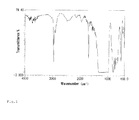
- Figure 1 shows an IR spectrum of the compound prepared in Example 1.
- Rf is a divalent group represented by the following formula (2): -C t F 2t [OCF 2 CF(CF 3 )] m OCF 2 (CF 2 ) r CF 2 O[CF(CF 3 )CF 2 O] n C t F 2t - (2) wherein m and n are an integer of 1 to 150, provided that an average of the total of m and n is 2 to 200; r is an integer of 0 to 6; t is 2 or 3; and C t F 2t is linear or branched, or by the following general formula (3): -C t' F 2t' (OCF 2 CF 2 ) u (OCF 2 ) v OC t' F 2t' - (3) wherein u is an integer of 1 to 200; v is an integer of 1 to 50; t' is an integer of 1 to 3; and C
- Rf represented by the afore-mentioned formula (2) include the groups represented by the following formula (7): -CF 2 CF 2 [OCF 2 CF(CF 3 )] m OCF 2 (CF 2 ) z CF 2 O[CF(CF 3 )CF 2 O] n CF 2 CF 2 - (7) wherein m and n are an integer of 1 to 150, provided that an average of the total of m and n is 2 to 200; and z is an integer of 0 to 6; or by the following formula (8): wherein m and n are an integer of 1 to 150, provided that an average of the total of m and n is 2 to 200.
- Rf is preferably a group represented by the afore-mentioned formula (8) or the afore-mentioned general formula (3).
- R 1 , R 2 , and R 3 are, independently of each other, an alkyl group having 1 to 10 carbon atoms or an aryl group, such as methyl, ethyl, isopropyl, n-butyl, isobutyl, cyclohexyl, phenyl, and 2-phenylpropyl groups.
- aryl group such as methyl, ethyl, isopropyl, n-butyl, isobutyl, cyclohexyl, phenyl, and 2-phenylpropyl groups.
- preferred are methyl, n-butyl and phenyl groups.
- X is a divalent group represented by formulas -CH 2 -, -CH 2 O-, -CH 2 OCH 2 - or -Y-NR-CO-, wherein Y is a divalent group represented by formula -CH 2 - or the following formula: and R is a hydrogen atom, an alkyl group having 1 to 10 carbon atoms or an aryl group, such as methyl, ethyl, isopropyl, n-butyl, isobutyl, cyclohexyl, phenyl, and 2-phenylpropyl groups.
- R is a hydrogen atom, an alkyl group having 1 to 10 carbon atoms or an aryl group, such as methyl, ethyl, isopropyl, n-butyl, isobutyl, cyclohexyl, phenyl, and 2-phenylpropyl groups.
- R is a hydrogen atom, an alkyl group having 1 to 10 carbon
- X' is a divalent group represented by formula -CH 2 -, -OCH 2 -, -CH 2 OCH 2 - or -CO-NR-Y'-, wherein Y' is a divalent group represented by formula -CH 2 - or the following formula: and R is as defined above.
- a is, independently of each other, 0 or 1
- z and z' are, independently of each other, an integer of 5 to 100, preferably 10 to 60.
- the perfluoropolyether chain and the polysiloxane chain in the compound of formula (1) are present in such a weight ratio that the fluorine atoms are 20 to 70 % by weight, more preferably 25 to 55 % by weight, relative to the whole molecule.
- the characteristics of the perfluoropolyether chain such as water- and oil-repellency, a lubricating property and demoldability, may be worse.
- the compatibility with other materials may be worse.
- the defoaming agent decrease in the surface tension of the present organopolysiloxane is insufficient below the afore-mentioned lower limit, so that the defoaming effect is insufficient for a system which comprises an organic solvent with a small surface tension or a fluorine-containing surfactant.
- solubility in organic solvents is worse, so that variety of organic solvents which can be used as a diluent for a defoaming agent are limited; and its dispersibility in organic solvents or migration to foam is worse and, therefore, the defoaming effect, particularly a foam-destroying-property, and prompt effectiveness are not attained sufficiently.
- Examples of the present perfluoropolyether-modified polysiloxane include the following.
- the perfluoropolyether modified-polysiloxane represented by the following formula (4) is preferred, wherein a, X, X', R 1 , R 2 , R 3 , m, n, z and z' are as defined above.
- the afore-mentioned vinyl group-containing perfluoropolyether and the SiH group-containing polysiloxane are subjected to the reaction preferably in a molar ratio, Vi/H, of 0.8 to 1.2, more preferably 0.9 to 1.1. If the amount of the perfluoropolyether exceeds the above upper limit, compatibility with other materials may be worse. Meanwhile, if the amount of the polysiloxane is too large, the resulting product may be cloudy or the SiH group may cause a dehydrogenation reaction to generate hydrogen gas, which is not preferred.
- platinum catalysts for hydrosilylation may be used as the platinum catalyst.
- compounds of noble metals are expensive and, therefore, platinum or platinum compounds which are relatively less expensive are often used.
- the platinum compound include chloroplatinic acid; complexes of chloroplatinic acid with an olefin such as ethylene, with an alcohol, or with a vinyl siloxane; and metal platinum supported on silica, alumina or carbon.
- Examples of the metal catalyst of the platinum family other than platinum include rhodium, ruthenium, iridium and palladium compounds such as RhCl(PPh 3 ) 3 , RhCl(CO) (PPh 3 ) 2 , Ru 3 (CO) 12 , IrCl(CO)(PPh 3 ) 2 and Pd(PPh 3 ) 4 , wherein Ph is a phenyl group.
- the platinum catalyst may be used in a catalytic amount, preferably in 0.1 to 500 ppm, reduced to a platinum content, relative to 100 parts by weight of the total amount of the perfluoropolyether and the polysiloxane.
- the reaction temperature may be properly determined, depending upon amounts and kinds of solvents and may be usually room temperature to 200 degrees C, preferably 70 to 140 degrees C.
- the reaction time is not particularly limited as long as the reaction proceeds sufficiently under particular reaction conditions.
- the afore-mentioned hydrosilylation may be carried out in the presence of a solvent, if needed.
- the solvent can desirably dissolve both the perfluoropolyether and the polysiloxane, but is not particularly limited. Those which dissolve either one of the reactants may be used as long as those do not hinder the hydrosilylation.
- the amount of solvent is properly determined, depending upon viscosity of the perfluoropolyether and the polysiloxane and amounts of reactants, and is preferably 10 to 200 parts by weight, more preferably 20 to 100 parts by weight, relative to 100 parts by weight of the total amount of the perfluoropolyether and the polysiloxane.
- solvents examples include aliphatic hydrocarbons such as n-hexane, n-heptane, isooctane, and isododecane; aromatic hydrocarbons such as toluene and xylene; fluorine-containing aromatic hydrocarbons such as trifluorotoluene and hexafluorometaxylene; hydrofluoroethers such as perfluorobutyl methyl ether, perfluorobutyl ethyl ether and 1, 1, 1, 2, 2, 3, 4, 5, 5, 5-decafluoro-3-methoxy-4-(trifluoromethyl)pentane; chlorofluorocarbons such as Daifloil ex Daikin Industries, Ltd.; linear siloxanes such as hexamethyldisiloxane, octamethyltrisiloxane, decamethyltetrasiloxane, dodecamethylpentasiloxane, and 2-(trimethylsiloxy)-1
- the present defoaming agent is composed mainly of the afore-mentioned perfluoropolyether-modified polysiloxane.
- the present defoaming agent may be composed only of the perfluoropolyether-modified polysiloxane, but is desirably diluted with a proper solvent.
- the polysiloxane is dissolved in a solvent in such an amount that the content of the polysiloxane is 0.1 to 50 % by weight to form a defoaming agent.
- solvents examples include aliphatic hydrocarbons such as n-hexane, n-heptane, isooctane, and isododecane; aromatic hydrocarbons such as toluene and xylene; ketones such as methyl ethyl ketone, methyl isobutyl ketone and diisobutyl ketone; fluorine-containing aromatic hydrocarbons such as trifluorotoluene and hexafluorometaxylene; hydrofluoroethers such as perfluorobutyl methyl ether, perfluorobutyl ethyl ether and 1, 1, 1, 2, 2, 3, 4, 5, 5, 5-decafluoro-3-methoxy-4-(trifluoromethyl)pentane; chlorofluorocarbons such as Daifloil ex Daikin Industries, Ltd.; linear siloxanes such as hexamethyldisiloxane, octamethyltrisiloxan
- isododecane methyl isobutyl ketone and hexafluorometaxylene are preferred, because these dissolve the perfluoropolyether-modified polysiloxanes and are dispersible in organic solvents well.
- the present defoaming agent may further comprise the perfluoropolyether-modified polysiloxane which is described as a deforming component in Japanese Patent Application No.
- Rf is a linear or branched perfluoroalkyl group having 1 to 10 carbon atoms
- X is a fluorine atom or a trifluoromethyl group
- Q is a divalent organic group having 1 to 12 carbon atoms
- R 1 , R 2 , and R 3 are, independently of each other, an alkyl group having 1 to 10 carbon atoms
- a, b, c and d are, independently of each other, an integer of 0 to 200, provided that the total of a, b, c and d is 1 or greater
- e is 0 or 1
- z is an integer of 5 to 100.
- Examples of the perfluoropolyether-modified polysiloxanes represented by the afore-mentioned formula (9) include the following.
- perfluoropolyether modified-polysiloxane represented by the following formula (2) is preferred, wherein b, Q, R 1 , R 2 , R 3 and z are as defined above.
- the present defoaming agent may optionally comprise fine particles of silica in order to improve the foam-destroying property as in conventional dimethylsiloxane-containing defoaming agents.
- This silica powder preferably has a specific BET surface area of 50 m 2 /g or more, more preferably 50 to 400 m 2 /g for better dispersibility.
- This silica powder may be preferably fumed silica or colloidal silica treated with a silicon compound for a hydrophobic property in order to enhance its dispersibility in a solvent.
- the present perfluoropolyether-modified polysiloxane has good water- and oil-repellency, chemical resistance, a lubricating property and demoldability and better affinity with organic solvents, paints, cosmetics and various coating materials than conventional perfluoropolyether-group-containing compounds and, therefore, is useful as an additive for cleaners and waxes in the field of household products and cosmetics; a mold release agent to improve demoldability in molding; an additive to provide grease with water- and oil-repellency; an additive to improve abrasion resistance of lubricant; an adjuvant to improve colorability and dispersibility of pigments in the industrial field of dyes and pigments; and an agent to provide a leveling property and a crater-preventing property to correct defects of paint.
- the perfluoropolyether-modified polysiloxane major agent of the present defoaming agent, has a small surface tension and good affinity with organic solvents and, therefore, shows a good effect of suppressing foaming in organic solvent systems. Therefore, the present defoaming agent can be used in a variety of industries where foaming occurs, such as chemical, petroleum, textile, pharmaceutical, and printing industries. More specifically, the present defoaming agent can be suitably used, for instance, in paints based on an organic solvent, dyes for fibers and cloths, inks for printing, lubricants and operating oils, chemical processes such as synthesis and distillation, and petroleum refining processes.
- IR spectrum of compound I (KBr method, FT-730 ex Horiba) is shown in Fig. 1 .
- the present perfluoropolyether-modified polysiloxane has good solubility in many organic solvents and a good affinity with the same, compared to the compounds of Comparative Examples 1 to 3.
- This is useful as an additive for cleaners and waxes in the field of household products and an additive for cosmetics; a mold release agent to improve demoldability in molding; an additive to provide grease with water- and oil-repellency; an additive to improve abrasion resistance of lubricant; an adjuvant to improve colorability and dispersibility of pigments in the industrial field of dyes and pigments; and an agent to provide a leveling property and a crater-preventing property to correct defects of paint.
- the present defoaming agent has a good foam-suppressing effect and a defoaming effect for organic solvents. Therefore, the present defoaming agent can be used in a variety of industries where foaming occurs, such as chemical, petroleum, textile, pharmaceutical, and printing industries. More specifically, the present defoaming agent can be suitably used, for instance, in paints based on an organic solvent, dyes for fibers and cloths, inks for printing, lubricants and operating oils, chemical processes such as synthesis and distillation, and petroleum refining processes.
Landscapes
- Chemical & Material Sciences (AREA)
- Health & Medical Sciences (AREA)
- Chemical Kinetics & Catalysis (AREA)
- Toxicology (AREA)
- Dispersion Chemistry (AREA)
- Medicinal Chemistry (AREA)
- Polymers & Plastics (AREA)
- Organic Chemistry (AREA)
- Silicon Polymers (AREA)
- Polyethers (AREA)
Abstract
The present invention relates to a perfluoropolyether-modified polysiloxane represented by general formula (1):

wherein X is a divalent group represented by formula -CH2-, -CH2O-, -CH2OCH2- or -Y-NR-CO-,
wherein Y is a divalent group represented by formula -CH2- or the following formula: 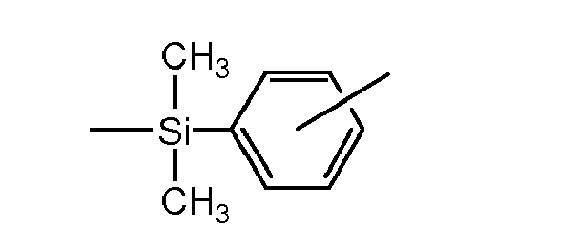
and R is a hydrogen atom, an alkyl group having 1 to 10 carbon atoms or an aryl group;
R1, R2, and R3 are, independently of each other, an alkyl group having 1 to 10 carbon atoms or an aryl group;
X' is a divalent group represented by formula -CH2-, -OCH2-,
-CH2OCH2- or -CO-NR-Y'-,
wherein Y'is a divalent group represented by formula -CH2- or the following formula: 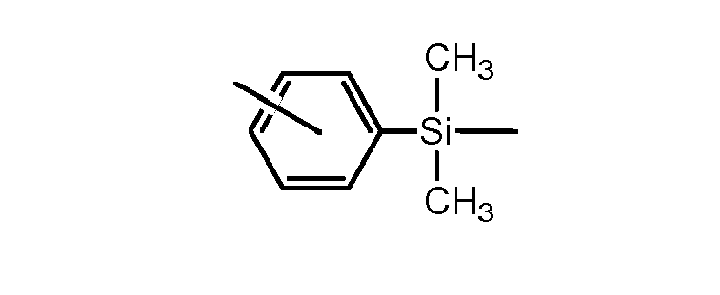
and R is as defined above;
a is, independently of each other, 0 or 1;
z and z' are, independently of each other, an integer of 5 to 100; and
Rf is a divalent group represented by the following general formula (2) :
-CtF2t[OCF2CF(CF3)]mOCF2(CF2)rCF2O[CF(CF3)CF2O]nCtF2t- (2)
wherein m and n are an integer of 1 to 150, provided that an average of the total of m and n is 2 to 200;
r is an integer of 0 to 6;
t is 2 or 3; and
CtF2t is linear or branched;
or by the following general formula (3):
-Ct'F2t'(OCF2CF2)u(OCF2)vOCt'F2t'- (3)
wherein u is an integer of 1 to 200;
v is an integer of 1 to 50;
t' is an integer of 1 to 3; and
Ct,F2t, is linear or branched.
wherein Y is a divalent group represented by formula -CH2- or the following formula:
R1, R2, and R3 are, independently of each other, an alkyl group having 1 to 10 carbon atoms or an aryl group;
X' is a divalent group represented by formula -CH2-, -OCH2-,
-CH2OCH2- or -CO-NR-Y'-,
wherein Y'is a divalent group represented by formula -CH2- or the following formula:
a is, independently of each other, 0 or 1;
z and z' are, independently of each other, an integer of 5 to 100; and
Rf is a divalent group represented by the following general formula (2) :
-CtF2t[OCF2CF(CF3)]mOCF2(CF2)rCF2O[CF(CF3)CF2O]nCtF2t- (2)
wherein m and n are an integer of 1 to 150, provided that an average of the total of m and n is 2 to 200;
r is an integer of 0 to 6;
t is 2 or 3; and
CtF2t is linear or branched;
or by the following general formula (3):
-Ct'F2t'(OCF2CF2)u(OCF2)vOCt'F2t'- (3)
wherein u is an integer of 1 to 200;
v is an integer of 1 to 50;
t' is an integer of 1 to 3; and
Ct,F2t, is linear or branched.
Description
- This application claims the benefits of Japanese Patent Application No.
2009-169433 filed on July 17, 2009 2009-169424 filed on July 17, 2009 - The present invention relates to a perfluoropolyether-modified polysiloxane which has the properties of both a perfluoropolyether and a silicone and which has a good affinity with materials such as paints, cosmetics and various coating materials; a method for preparing the perfluoropolyether-modified polysiloxane; and a defoaming agent comprising the perfluoropolyether-modified polysiloxane, in particular, having a good defoaming effect on foam of organic solvents.
- Generally, perfluoropolyether group-containing compounds have very small surface energy and, accordingly, have unique properties such as water- and oil-repellency, chemical resistance, lubricating property, demoldability, and stain resistance. Therefore, they find applications, on account of such properties, as water- and oil-repelling, stain-proofing agents in paper and fiber; lubricating agents in magnetic recording media; oil proof agents in precision machinery; mold release agents; cosmetics; and protecting films. However, the low surface energy of the perfluoropolyether group-containing compounds result in very poor compatibility and affinity with materials such as organic solvents, paints, cosmetics and various coating materials. Therefore, it has been pointed out that where a perfluoropolyether group-containing compound is added to various industrial materials to provide the afore-mentioned properties, problems arise, for instance, in dispersion stability and, therefore, the application of the perfluoropolyether group-containing compounds is difficult.
- Also polysiloxanes, i.e., silicone, have a small surface energy and, therefore, have properties such as water-repellency, lubricating property, and demoldability. However, polysiloxanes have a better affinity with materials such as organic solvents, paints, cosmetics, and various coating materials than the perfluoropolyethers. Their dispersion stability can be enhanced by various modifications. Therefore, polysiloxanes can be added to various industrial materials to provide the materials with characteristics of silicone. Thus, they are used as an additive to improve performance in various fields. A perfluoropolyether-modified polysiloxane is synthesized as a compound having both a perfluoropolyether group and a polysiloxane chain (Patent Literatures 1 to 5).
- Various defoaming agents are conventionally used in industrial processes where foaming occurs. Inter alia, defoaming silicone agents are widely used, such as oil compounds, comprising a silicone oil such as dimethylpolysiloxane, methylphenylpolysiloxane and methylvinylpolysiloxane, and fine powder of silica; and an emulsion of these oil compounds dispersed in water with a surfactant, because the defoaming silicone agents show various good properties such as better chemical stability and effects even when employed in a smaller amount than the other defoaming agents.
- Although these defoaming silicone agents attain the good defoaming effect in aqueous systems, they show an extremely small defoaming effect in organic solvent systems which have a lower surface tension and greater solubility for silicone than in aqueous systems. Japanese Patent Publication No.
Sho-35-12564 Sho-59-22611 Sho-60-22907 Sho-35-12564 US Patent 4329528 describe a defoaming agent for organic solvents comprising a perfluoroalkyl group-containing siloxane as an effective component. Japanese Patent Application Laid-Open No.Hei-2-51644
(See the following Patent Literatures 4 to 8). - [Patent Literature 1] Japanese Patent Application Laid-Open No.
2006-321764
[Patent Literature 2] Japanese Patent Application Laid-Open No.2008-308628
[Patent Literature 3] Japanese Patent Application Laid-Open No.2008-88412
[Patent Literature 4] Japanese Patent Application Laid-Open No.Sho-59-22611
[Patent Literature 5] Japanese Patent Application Laid-Open No.Sho-60-22907
[Patent Literature 6] Japanese Patent Publication No.Sho-35-12564
[Patent Literature 7]US Patent No. 4329528 .
[Patent Literature 8] Japanese Patent Publication No.Hei-2-51644 - However, if a modification ratio of the fluorine atoms is raised in order to enhance the characteristics of the perfluoropolyether group, affinity with other materials lowers significantly to cause a problem in dispersion stability. Therefore, there is a need for a compound which has the characteristics of both of perfluoropolyether and silicone and also has good affinity with materials such as organic solvents, paints, cosmetics and various coating materials. The present invention has been made to fulfill the afore-mentioned need. Thus, the purpose of the present invention is to provide a compound which has the characteristics of both perfluoropolyether and silicone and also has good affinity with materials such as organic solvents, paints, cosmetics and various coating materials, and to provide a defoaming silicone agent showing a good defoaming effect and foaming suppressing effect for organic solvents.
- The present inventors have made research to attain the afore-mentioned purpose and have found the following compound which has characteristics of both perfluoropolyether and silicone and also has good affinity with materials such as organic solvents, paints, cosmetics and various coating materials, and that a defoaming agent composed mainly of this compound attains a good defoaming effect for organic solvents.
- Namely, the present invention provides a perfluoropolyether-modified polysiloxane represented by general formula (1):

wherein Y is a divalent group represented by -CH2- or the following formula:
R1, R2, and R3 are, independently of each other, an alkyl group having 1 to 10 carbon atoms or an aryl group;
X' is a divalent group represented by formula -CH2-, -OCH2-,
-CH2OCH2- or -CO-NR-Y'-,
wherein Y'is a divalent group represented by formula -CH2- or the following formula:
a is, independently of each other, 0 or 1;
z and z' are, independently of each other, an integer of 5 to 100; and
Rf is a divalent group represented by the following general formula (2):
-CtF2t[OCF2CF(CF3)]mOCF2(CF2)rCF2O[CF(CF3)CF2O]nCtF2t- (2)
wherein m and n are an integer of 1 to 150, provided that an average of the total of m and n is 2 to 200;
r is an integer of 0 to 6;
t is 2 or 3; and
CtF2t is linear or branched;
or by the following general formula (3):
-Ct'F2t'(OCF2CF2)u(OCF2)vOCt'F2t'- (3)
wherein u is an integer of 1 to 200;
v is an integer of 1 to 50;
t' is an integer of 1 to 3; and
Ct'F2t'is linear or branched. - Further, the present invention provides a method for preparing the afore-mentioned perfluoropolyether-modified polysiloxane, wherein a vinyl group-containing perfluoropolyether represented by general formula (5):
CH2=CH-(X)a-Rf-(X')a-CH=CH2 (5)
wherein Rf, X, X' and a are as defined above, is hydrosilylated with an SiH group-containing polysiloxane represented by general formula (6):
- Further, the present invention provides a defoaming agent composed mainly of the afore-mentioned perfluoropolyether-modified polysiloxane represented by general formula (1).
- The perfluoropolyether group-containing organopolysiloxane represented by the afore-mentioned formula (1) has a small surface tension, good affinity with organic solvents, and good dispersibility in organic solvents and, therefore, attains a good defoaming effect for organic solvents.
-
Figure 1 shows an IR spectrum of the compound prepared in Example 1. - The present invention will be further described in detail below.
- The present perfluoropolyether-modified polysiloxane is represented by general formula (1) as mentioned above. In formula (1), Rf is a divalent group represented by the following formula (2):
-CtF2t[OCF2CF(CF3)]mOCF2(CF2)rCF2O[CF(CF3)CF2O]nCtF2t- (2)
wherein m and n are an integer of 1 to 150, provided that an average of the total of m and n is 2 to 200; r is an integer of 0 to 6; t is 2 or 3; and CtF2t is linear or branched, or by the following general formula (3):
-Ct'F2t'(OCF2CF2)u(OCF2)vOCt'F2t'- (3)
wherein u is an integer of 1 to 200; v is an integer of 1 to 50; t' is an integer of 1 to 3; and Ct'F2t'is linear or branched. - Specific examples of Rf represented by the afore-mentioned formula (2) include the groups represented by the following formula (7):
-CF2CF2[OCF2CF(CF3)]mOCF2(CF2)zCF2O[CF(CF3)CF2O]nCF2CF2- (7)
wherein m and n are an integer of 1 to 150, provided that an average of the total of m and n is 2 to 200; and z is an integer of 0 to 6;
or by the following formula (8):
- In formula (1), R1, R2, and R3 are, independently of each other, an alkyl group having 1 to 10 carbon atoms or an aryl group, such as methyl, ethyl, isopropyl, n-butyl, isobutyl, cyclohexyl, phenyl, and 2-phenylpropyl groups. Inter alia, preferred are methyl, n-butyl and phenyl groups.
- In formula (1), X is a divalent group represented by formulas -CH2-, -CH2O-, -CH2OCH2- or -Y-NR-CO-, wherein Y is a divalent group represented by formula -CH2- or the following formula:

- In formula (1), X' is a divalent group represented by formula -CH2-, -OCH2-, -CH2OCH2- or -CO-NR-Y'-, wherein Y' is a divalent group represented by formula -CH2- or the following formula:

- In formula (1), a is, independently of each other, 0 or 1, and z and z' are, independently of each other, an integer of 5 to 100, preferably 10 to 60.
- The perfluoropolyether chain and the polysiloxane chain in the compound of formula (1) are present in such a weight ratio that the fluorine atoms are 20 to 70 % by weight, more preferably 25 to 55 % by weight, relative to the whole molecule. Below the afore-mentioned lower limit, the characteristics of the perfluoropolyether chain, such as water- and oil-repellency, a lubricating property and demoldability, may be worse. Above the afore-mentioned upper limit, the compatibility with other materials may be worse. In the defoaming agent, decrease in the surface tension of the present organopolysiloxane is insufficient below the afore-mentioned lower limit, so that the defoaming effect is insufficient for a system which comprises an organic solvent with a small surface tension or a fluorine-containing surfactant. Above the afore-mentioned upper limit, solubility in organic solvents is worse, so that variety of organic solvents which can be used as a diluent for a defoaming agent are limited; and its dispersibility in organic solvents or migration to foam is worse and, therefore, the defoaming effect, particularly a foam-destroying-property, and prompt effectiveness are not attained sufficiently.
- Examples of the present perfluoropolyether-modified polysiloxane include the following.





- Inter alia, the perfluoropolyether modified-polysiloxane represented by the following formula (4) is preferred,

- For the preparation of the afore-mentioned perfluoropolyether-modified polysiloxane, a vinyl group containing-perfluoropolyether represented by general formula (5) :
CH2=CH-(X)a-Rf-(X')a-CH=CH2 (5)
wherein Rf, X, X' and a are as defined above, is hydrosilylated with an SiH group-containing polysiloxane represented by general formula (6):
- The afore-mentioned vinyl group-containing perfluoropolyether and the SiH group-containing polysiloxane are subjected to the reaction preferably in a molar ratio, Vi/H, of 0.8 to 1.2, more preferably 0.9 to 1.1. If the amount of the perfluoropolyether exceeds the above upper limit, compatibility with other materials may be worse. Meanwhile, if the amount of the polysiloxane is too large, the resulting product may be cloudy or the SiH group may cause a dehydrogenation reaction to generate hydrogen gas, which is not preferred.
- Conventional platinum catalysts for hydrosilylation may be used as the platinum catalyst. Generally, compounds of noble metals are expensive and, therefore, platinum or platinum compounds which are relatively less expensive are often used. Examples of the platinum compound include chloroplatinic acid; complexes of chloroplatinic acid with an olefin such as ethylene, with an alcohol, or with a vinyl siloxane; and metal platinum supported on silica, alumina or carbon. Examples of the metal catalyst of the platinum family other than platinum include rhodium, ruthenium, iridium and palladium compounds such as RhCl(PPh3)3, RhCl(CO) (PPh3)2, Ru3(CO)12, IrCl(CO)(PPh3)2 and Pd(PPh3)4, wherein Ph is a phenyl group.
- The platinum catalyst may be used in a catalytic amount, preferably in 0.1 to 500 ppm, reduced to a platinum content, relative to 100 parts by weight of the total amount of the perfluoropolyether and the polysiloxane.
- The reaction temperature may be properly determined, depending upon amounts and kinds of solvents and may be usually room temperature to 200 degrees C, preferably 70 to 140 degrees C. The reaction time is not particularly limited as long as the reaction proceeds sufficiently under particular reaction conditions.
- The afore-mentioned hydrosilylation may be carried out in the presence of a solvent, if needed. The solvent can desirably dissolve both the perfluoropolyether and the polysiloxane, but is not particularly limited. Those which dissolve either one of the reactants may be used as long as those do not hinder the hydrosilylation. The amount of solvent is properly determined, depending upon viscosity of the perfluoropolyether and the polysiloxane and amounts of reactants, and is preferably 10 to 200 parts by weight, more preferably 20 to 100 parts by weight, relative to 100 parts by weight of the total amount of the perfluoropolyether and the polysiloxane.
- Examples of the solvents include aliphatic hydrocarbons such as n-hexane, n-heptane, isooctane, and isododecane; aromatic hydrocarbons such as toluene and xylene; fluorine-containing aromatic hydrocarbons such as trifluorotoluene and hexafluorometaxylene; hydrofluoroethers such as perfluorobutyl methyl ether, perfluorobutyl ethyl ether and 1, 1, 1, 2, 2, 3, 4, 5, 5, 5-decafluoro-3-methoxy-4-(trifluoromethyl)pentane; chlorofluorocarbons such as Daifloil ex Daikin Industries, Ltd.; linear siloxanes such as hexamethyldisiloxane, octamethyltrisiloxane, decamethyltetrasiloxane, dodecamethylpentasiloxane, and 2-(trimethylsiloxy)-1, 1, 1, 2, 3, 3, 3-heptamethyltrisiloxane; cyclic siloxanes such as ocatamethylcyclopentasiloxane and decamethylcyclopentasiloxane; perfluoropolyethers such as Fomblin, Galden (ex Solvay Solexis), Demnum (ex Daikin Industries Ltd.), and Krytox (ex Du Pont). Inter alia, hexafluorometaxylene and decamethylpentasiloxane are preferred, because these dissolve the perfluoropolyether of formula (5), the polysiloxane of formula (6) and the resulting products well.
- The present defoaming agent is composed mainly of the afore-mentioned perfluoropolyether-modified polysiloxane. The present defoaming agent may be composed only of the perfluoropolyether-modified polysiloxane, but is desirably diluted with a proper solvent. Preferably, the polysiloxane is dissolved in a solvent in such an amount that the content of the polysiloxane is 0.1 to 50 % by weight to form a defoaming agent.
- Examples of the solvents include aliphatic hydrocarbons such as n-hexane, n-heptane, isooctane, and isododecane; aromatic hydrocarbons such as toluene and xylene; ketones such as methyl ethyl ketone, methyl isobutyl ketone and diisobutyl ketone; fluorine-containing aromatic hydrocarbons such as trifluorotoluene and hexafluorometaxylene; hydrofluoroethers such as perfluorobutyl methyl ether, perfluorobutyl ethyl ether and 1, 1, 1, 2, 2, 3, 4, 5, 5, 5-decafluoro-3-methoxy-4-(trifluoromethyl)pentane; chlorofluorocarbons such as Daifloil ex Daikin Industries, Ltd.; linear siloxanes such as hexamethyldisiloxane, octamethyltrisiloxane, decamethyltetrasiloxane, dodecamethylpentasiloxane, and 2-(trimethylsiloxy)-1, 1, 1, 2, 3, 3, 3-heptamethyltrisiloxane; cyclic siloxanes such as ocatamethylcyclopentasiloxane and decamethylcyclopentasiloxane; and perfluoropolyethers such as Fomblin, Galden (ex Solvay Solexis), Demnum (ex Daikin Industries Ltd.), and Krytox (ex Du Pont). Inter alia, isododecane, methyl isobutyl ketone and hexafluorometaxylene are preferred, because these dissolve the perfluoropolyether-modified polysiloxanes and are dispersible in organic solvents well.
- In addition to the perfluoropolyether-modified polysiloxane represented by the afore-mentioned formula (1), the present defoaming agent may further comprise the perfluoropolyether-modified polysiloxane which is described as a deforming component in Japanese Patent Application No.
2009-157760 
- Examples of the perfluoropolyether-modified polysiloxanes represented by the afore-mentioned formula (9) include the following.


- Inter alia, the perfluoropolyether modified-polysiloxane represented by the following formula (2) is preferred,

- The present defoaming agent may optionally comprise fine particles of silica in order to improve the foam-destroying property as in conventional dimethylsiloxane-containing defoaming agents. This silica powder preferably has a specific BET surface area of 50 m2/g or more, more preferably 50 to 400 m2/g for better dispersibility. This silica powder may be preferably fumed silica or colloidal silica treated with a silicon compound for a hydrophobic property in order to enhance its dispersibility in a solvent.
- The present perfluoropolyether-modified polysiloxane has good water- and oil-repellency, chemical resistance, a lubricating property and demoldability and better affinity with organic solvents, paints, cosmetics and various coating materials than conventional perfluoropolyether-group-containing compounds and, therefore, is useful as an additive for cleaners and waxes in the field of household products and cosmetics; a mold release agent to improve demoldability in molding; an additive to provide grease with water- and oil-repellency; an additive to improve abrasion resistance of lubricant; an adjuvant to improve colorability and dispersibility of pigments in the industrial field of dyes and pigments; and an agent to provide a leveling property and a crater-preventing property to correct defects of paint.
- The perfluoropolyether-modified polysiloxane, major agent of the present defoaming agent, has a small surface tension and good affinity with organic solvents and, therefore, shows a good effect of suppressing foaming in organic solvent systems. Therefore, the present defoaming agent can be used in a variety of industries where foaming occurs, such as chemical, petroleum, textile, pharmaceutical, and printing industries. More specifically, the present defoaming agent can be suitably used, for instance, in paints based on an organic solvent, dyes for fibers and cloths, inks for printing, lubricants and operating oils, chemical processes such as synthesis and distillation, and petroleum refining processes.
- The present invention will be explained more specifically with reference of the following Examples, but shall not be limited thereto.
- To a flask equipped with a reflux condenser and a thermometer, were placed 332.6 grams of the vinyl group-containing perfluoropolyether represented by the following formula (10):
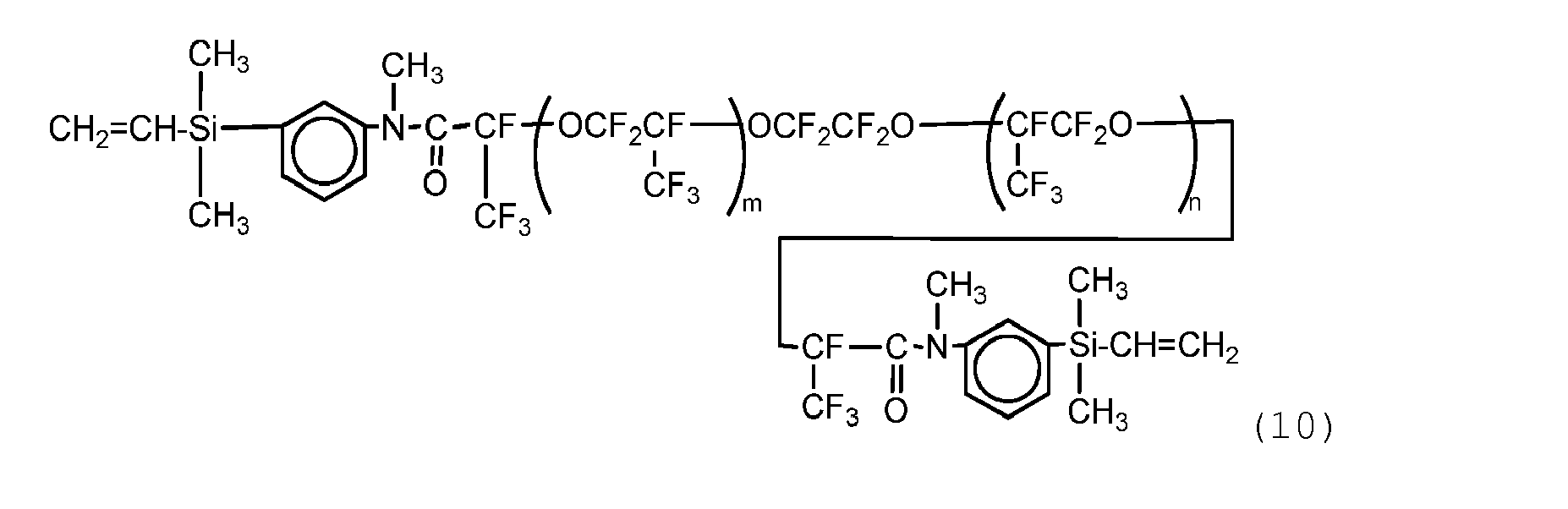

- The product obtained above was analyzed by 1H-NMR and IR spectrometry and was found to be a compound represented by the following formula (12):

- The analysis results in 1H-NMR, JNM-NS50 ex JOEL Co. Ltd., are as shown below.
1H-NMR (TMS reference, ppm): 0.1-0.6(Si-CH 3, 156H), 0.5-1.1(Si-CH 2-, CH 3-, 18H), 1.1-1.6(-CH 2CH 2-, 8H), 3.4(-NCH 3, 6H), 7.3-7.8(-C6 H 4-, 8H) - IR spectrum of compound I (KBr method, FT-730 ex Horiba) is shown in
Fig. 1 . - To a flask equipped with a reflux condenser and a thermometer, were placed 216.9 grams of the vinyl group-containing perfluoropolyether represented by the following formula (13):


- The product obtained above was analyzed by 1H-NMR and IR spectrometry and was found to be represented by the following formula (15)

- To a flask equipped with a reflux condenser and a thermometer, were placed 296.5 grams of the vinyl group-containing perfluoropolyether represented by the following formula (16):


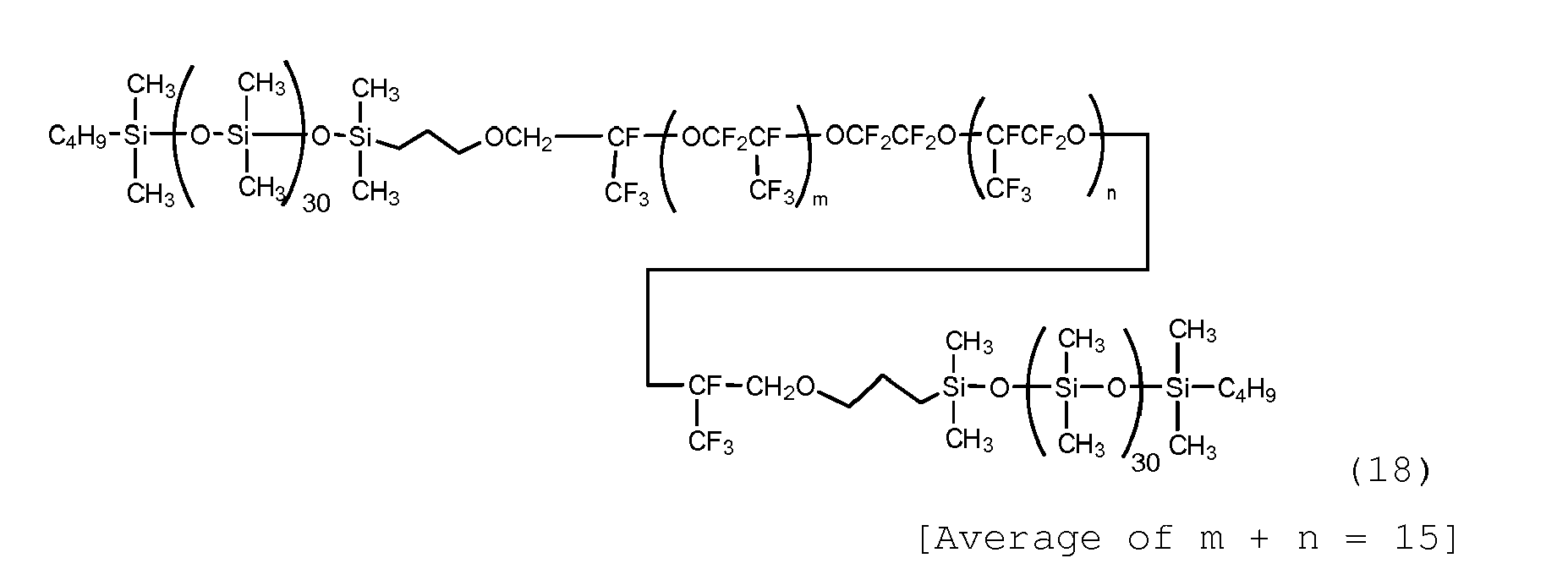
- The product obtained above was analyzed by 1H-NMR and IR spectrometry and was found to be represented by the following formula (18):
- To a flask equipped with a reflux condenser and a thermometer, were placed 470.1 grams of the alkenyl group-containing perfluoropolyether represented by the following formula (19):


- To a transparent glass sample bottle, were placed 4.0 grams of each perfluoropolyether-modified polysiloxane of Examples 1 to 3 and 16.0 grams of the solvent shown in Table 1, shaken well and left still at room temperature for 1 hour. Then, the appearance was observed with the naked eye and the solubility was evaluated based on the following criteria. The results are as shown in Table 1.
+: Dissolved and transparent
-: White and translucent, but the polysiloxane is homogeneously dispersed.
--: White and turbid, or a siloxane and a solvent were separated in two phases. - The solubility in each solvent shown in Table 1 was evaluated in the same manner as in the Use Examples, except that the following compound was used instead of the compounds of Examples 1 to 3.
- For Comparative Example 1, polydimethylsiloxane (PDMS) with a viscosity of 200 cS at 25 degrees C, ex Shin-Etsu Chemical Co., Ltd.
- For Comparative Example 2, perfluoropolyether-modified polysiloxane represented by formula (21) obtained in Preparation of a Compound for Comparison.
- For Comparative Example 3, perfluoropolyether oligomer (PFPE), Galden HT-200, ex Solvay Solexis.
-
Table 1 Solubility Solvent THF MIB K Isododecane KF - 9 95 MXHF Use Example 1 + + + + + Use Example 2 + + + + + Use Example 3 + + + + + Comparative Example 1 + + + + -- Comparative Example 2 + - -- -- + Comparative Example 3 -- -- -- -- + THF : Tetrahydrofuran
MIBK : Methyl isobutyl ketone
KF - 995 : Decamethylcyclopentasiloxane, ex Shin-Etsu
MXHF : Metaxylene hexafluoride - 1. Dimethylpolysiloxane with a dynamic viscosity at 25 degrees C of 1, 000, 000 mm2/s, foaming adjuvant, was dissolved in methyl isobutyl ketone at a concentration of 5 % by weight to prepare a foaming test solution. To 80 grams of the foaming test solution, was added 0.16 gram of a 20 ppm solution of each of the defoaming agents of Examples 1 to 3 and Preparation of a Compound for Comparison in methyl isobutyl ketone, mixed homogeneously and, then, gently poured into a 1000 ml measuring cylinder. Air was introduced continuously through a diffuser stone at a rate of 1 liter/min. and the volume of foam generated was followed with time. A mixture which did not contain the perfluoropolyether-modified polysiloxane was also tested as Reference Example 1. The results are as shown in Table 2.
-
Table 2 Volume of Foam in ml Time 30 sec. 60 sec. 120 sec. 300 sec. 600 sec. Example 4 110 110 110 120 120 Example 5 120 120 130 140 140 Example 6 140 140 140 150 150 Comparative Example 4 210 270 330 370 410 Reference Example 1 420 530 650 700 900 - The afore-mentioned procedures were repeated except that kerosene was used instead of methyl isobutyl ketone to evaluate the defoaming property of the defoaming agents. The results are as shown in Table 3.
-
Table 3 Volume of Foam in ml Time 30 sec. 60 sec. 120 sec. 300 sec. 600 sec. Example 4 110 110 110 110 110 Example 5 180 160 150 140 140 Example 6 110 110 120 130 130 Comparative Example 4 150 190 240 290 330 Reference Example 1 600 >1000 >1000 >1000 >1000 - As seen in Table 1, the present perfluoropolyether-modified polysiloxane has good solubility in many organic solvents and a good affinity with the same, compared to the compounds of Comparative Examples 1 to 3. This is useful as an additive for cleaners and waxes in the field of household products and an additive for cosmetics; a mold release agent to improve demoldability in molding; an additive to provide grease with water- and oil-repellency; an additive to improve abrasion resistance of lubricant; an adjuvant to improve colorability and dispersibility of pigments in the industrial field of dyes and pigments; and an agent to provide a leveling property and a crater-preventing property to correct defects of paint. As seen in Tables 2 and 3, the present defoaming agent has a good foam-suppressing effect and a defoaming effect for organic solvents. Therefore, the present defoaming agent can be used in a variety of industries where foaming occurs, such as chemical, petroleum, textile, pharmaceutical, and printing industries. More specifically, the present defoaming agent can be suitably used, for instance, in paints based on an organic solvent, dyes for fibers and cloths, inks for printing, lubricants and operating oils, chemical processes such as synthesis and distillation, and petroleum refining processes.
Claims (5)
- A perfluoropolyether-modified polysiloxane represented by general formula (1):

wherein Y is a divalent group represented by formula -CH2- or the following formula:
R1, R2, and R3 are, independently of each other, an alkyl group having 1 to 10 carbon atoms or an aryl group; X' is a divalent group represented by formula -CH2-, -OCH2-, -CH2OCH2- or -CO-NR-Y'-,
wherein Y'is a divalent group represented by formula -CH2- or the following formula:
a is, independently of each other, 0 or 1;
z and z' are, independently of each other, an integer of 5 to 100; and
Rf is a divalent group represented by the following general formula (2):
CtF2t[OCF2CF(CF3)]mOCF2(CF2)rCF2O[CF(CF3)CF2O]nCtF2t- (2)
wherein m and n are an integer of 1 to 150, provided that an average of the total of m and n is 2 to 200;
r is an integer of 0 to 6;
t is 2 or 3; and
CtF2t is linear or branched;
or by the following general formula (3):
-Ct'F2t'(OCF2CF2)u(OCF2)vOCt'F2t'- (3)
wherein u is an integer of 1 to 200;
v is an integer of 1 to 50;
t' is an integer of 1 to 3; and
Ct'F2t' is linear or branched. - A perfluoropolyether-modified polysiloxane according to claim 1 which is represented by general formula (4):

- The perfluoropolyether-modified polysiloxane according to claim 1 or 2, wherein the fluorine atoms account for 20 to 70 % by weight of the whole molecule of the perfluoropolyether-modified polysiloxane.
- A method for preparing the perfluoropolyether-modified polysiloxane described in any one of claims 1 to 3, wherein a vinyl group-containing perfluoropolyether represented by general formula (5):
CH2=CH-(X)a-Rf-(X')a-CH=CH2 (5)
wherein Rf, X, X' and a are as defined above, is hydrosilylated with an SiH group-containing polysiloxane represented by general formula (6):
- A defoaming agent comprising the perfluoropolyether-modified polysiloxane described in any one of claims 1 to 3.
Applications Claiming Priority (2)
| Application Number | Priority Date | Filing Date | Title |
|---|---|---|---|
| JP2009169433A JP4919437B2 (en) | 2009-07-17 | 2009-07-17 | Antifoam |
| JP2009169424A JP4900854B2 (en) | 2009-07-17 | 2009-07-17 | Perfluoropolyether-modified polysiloxane and method for producing the same |
Publications (1)
| Publication Number | Publication Date |
|---|---|
| EP2301988A2 true EP2301988A2 (en) | 2011-03-30 |
Family
ID=43465754
Family Applications (2)
| Application Number | Title | Priority Date | Filing Date |
|---|---|---|---|
| EP10169689.6A Not-in-force EP2301989B1 (en) | 2009-07-17 | 2010-07-15 | Perfluoropolyether-modified polysiloxane, a method for preparing the same and a defoaming agent comprising the same |
| EP10169685A Withdrawn EP2301988A2 (en) | 2009-07-17 | 2010-07-15 | Perfluoropolyether-modified polysiloxane, a method for preparing the same and a defoaming agent comprising the same |
Family Applications Before (1)
| Application Number | Title | Priority Date | Filing Date |
|---|---|---|---|
| EP10169689.6A Not-in-force EP2301989B1 (en) | 2009-07-17 | 2010-07-15 | Perfluoropolyether-modified polysiloxane, a method for preparing the same and a defoaming agent comprising the same |
Country Status (2)
| Country | Link |
|---|---|
| US (1) | US8304571B2 (en) |
| EP (2) | EP2301989B1 (en) |
Cited By (4)
| Publication number | Priority date | Publication date | Assignee | Title |
|---|---|---|---|---|
| CN104826365A (en) * | 2015-05-12 | 2015-08-12 | 常熟理工学院 | Special defoaming agent for high-interface fluorocarbon resin emulsion and preparation method of special defoaming agent |
| CN106336514A (en) * | 2016-08-29 | 2017-01-18 | 太仓中化环保化工有限公司 | Vinyl perfluorinated polyether fluoride silicone oil and preparation method thereof |
| CN106349717A (en) * | 2016-08-29 | 2017-01-25 | 太仓中化环保化工有限公司 | Curable composition of high-strength perfluoropolyether fluorosilicone oil and preparing method thereof |
| WO2019063538A1 (en) | 2017-09-27 | 2019-04-04 | Byk-Chemie Gmbh | Polysiloxane defoaming agent |
Families Citing this family (5)
| Publication number | Priority date | Publication date | Assignee | Title |
|---|---|---|---|---|
| US10150889B2 (en) | 2013-09-16 | 2018-12-11 | Honeywell International Inc. | Poly fluorine-containing siloxane coatings |
| WO2017012909A1 (en) | 2015-07-17 | 2017-01-26 | Solvay Specialty Polymers Italy S.P.A. | Anti-foaming agents |
| WO2017141707A1 (en) * | 2016-02-17 | 2017-08-24 | 信越化学工業株式会社 | Fluoropolyether group-containing polymer-modified silane, surface treatment agent and article |
| FI128011B (en) * | 2016-02-18 | 2019-07-31 | Vauhti Speed Oy | Composition for improving the performance of herdless skis |
| JP7110722B2 (en) * | 2018-05-21 | 2022-08-02 | 信越化学工業株式会社 | FLUORINE-CONTAINING ORGANOSILIC COMPOUND AND METHOD FOR PRODUCING THEREOF, ROOM-TEMPERATURE-CURABLE FLUORINE-CONTAINING RUBBER COMPOSITION AND ITS CURED MATERIAL AND ARTICLES |
Citations (8)
| Publication number | Priority date | Publication date | Assignee | Title |
|---|---|---|---|---|
| US4329528A (en) | 1980-12-01 | 1982-05-11 | General Electric Company | Method of defoaming crude hydrocarbon stocks with fluorosilicone compounds |
| JPS5922611A (en) | 1982-07-30 | 1984-02-04 | Nippon Mektron Ltd | Antifoaming agent |
| JPS6022907A (en) | 1983-07-15 | 1985-02-05 | Nippon Mektron Ltd | Defoaming agent |
| JPH0251644A (en) | 1988-08-10 | 1990-02-21 | Yanmar Diesel Engine Co Ltd | Planetary gear type advancing second gear speed reducing reverser |
| JP2006321764A (en) | 2005-05-20 | 2006-11-30 | Shin Etsu Chem Co Ltd | Fluorine-containing organosilicon compound and fluorine-containing surfactant |
| JP2008088412A (en) | 2006-09-08 | 2008-04-17 | Shin Etsu Chem Co Ltd | Perfluoropolyether-polyorganosiloxane copolymer and surface treatment agent containing the same |
| JP2008308628A (en) | 2007-06-18 | 2008-12-25 | Shin Etsu Chem Co Ltd | Fluorine-containing coating agent composition |
| JP2009157760A (en) | 2007-12-27 | 2009-07-16 | Carecom:Kk | Emergency notification system |
Family Cites Families (3)
| Publication number | Priority date | Publication date | Assignee | Title |
|---|---|---|---|---|
| JPS6422310A (en) | 1987-07-17 | 1989-01-25 | Shinetsu Chemical Co | Antifoaming agent |
| JP3512564B2 (en) | 1996-07-12 | 2004-03-29 | 株式会社サクラクレパス | Water-based erasable marking pen ink composition |
| JP3712031B2 (en) * | 1998-02-23 | 2005-11-02 | 信越化学工業株式会社 | Curable composition |
-
2010
- 2010-07-12 US US12/834,439 patent/US8304571B2/en not_active Expired - Fee Related
- 2010-07-15 EP EP10169689.6A patent/EP2301989B1/en not_active Not-in-force
- 2010-07-15 EP EP10169685A patent/EP2301988A2/en not_active Withdrawn
Patent Citations (8)
| Publication number | Priority date | Publication date | Assignee | Title |
|---|---|---|---|---|
| US4329528A (en) | 1980-12-01 | 1982-05-11 | General Electric Company | Method of defoaming crude hydrocarbon stocks with fluorosilicone compounds |
| JPS5922611A (en) | 1982-07-30 | 1984-02-04 | Nippon Mektron Ltd | Antifoaming agent |
| JPS6022907A (en) | 1983-07-15 | 1985-02-05 | Nippon Mektron Ltd | Defoaming agent |
| JPH0251644A (en) | 1988-08-10 | 1990-02-21 | Yanmar Diesel Engine Co Ltd | Planetary gear type advancing second gear speed reducing reverser |
| JP2006321764A (en) | 2005-05-20 | 2006-11-30 | Shin Etsu Chem Co Ltd | Fluorine-containing organosilicon compound and fluorine-containing surfactant |
| JP2008088412A (en) | 2006-09-08 | 2008-04-17 | Shin Etsu Chem Co Ltd | Perfluoropolyether-polyorganosiloxane copolymer and surface treatment agent containing the same |
| JP2008308628A (en) | 2007-06-18 | 2008-12-25 | Shin Etsu Chem Co Ltd | Fluorine-containing coating agent composition |
| JP2009157760A (en) | 2007-12-27 | 2009-07-16 | Carecom:Kk | Emergency notification system |
Cited By (7)
| Publication number | Priority date | Publication date | Assignee | Title |
|---|---|---|---|---|
| CN104826365A (en) * | 2015-05-12 | 2015-08-12 | 常熟理工学院 | Special defoaming agent for high-interface fluorocarbon resin emulsion and preparation method of special defoaming agent |
| CN104826365B (en) * | 2015-05-12 | 2016-08-24 | 常熟理工学院 | A kind of special defoamer of fluorocarbon resin emulsion and preparation method thereof |
| CN106336514A (en) * | 2016-08-29 | 2017-01-18 | 太仓中化环保化工有限公司 | Vinyl perfluorinated polyether fluoride silicone oil and preparation method thereof |
| CN106349717A (en) * | 2016-08-29 | 2017-01-25 | 太仓中化环保化工有限公司 | Curable composition of high-strength perfluoropolyether fluorosilicone oil and preparing method thereof |
| CN106349717B (en) * | 2016-08-29 | 2019-04-26 | 太仓中化环保化工有限公司 | A kind of high-strength perfluoropolyether fluorosilicone oil curable composition and preparation method thereof |
| WO2019063538A1 (en) | 2017-09-27 | 2019-04-04 | Byk-Chemie Gmbh | Polysiloxane defoaming agent |
| US11298634B2 (en) | 2017-09-27 | 2022-04-12 | Byk-Chemie Gmbh | Polysiloxane defoaming agent |
Also Published As
| Publication number | Publication date |
|---|---|
| EP2301989B1 (en) | 2014-04-23 |
| US20110015420A1 (en) | 2011-01-20 |
| EP2301989A3 (en) | 2013-10-09 |
| EP2301989A2 (en) | 2011-03-30 |
| US8304571B2 (en) | 2012-11-06 |
Similar Documents
| Publication | Publication Date | Title |
|---|---|---|
| EP2301989B1 (en) | Perfluoropolyether-modified polysiloxane, a method for preparing the same and a defoaming agent comprising the same | |
| EP2272896B1 (en) | Perfluoropolyether-modified polysiloxane, a method for preparing the same and a defoaming agent comprising the same | |
| EP2399570B1 (en) | Polyether-modified polysiloxane containing a perfluoropolyether group and its production method | |
| JP5165644B2 (en) | Organopolysiloxane composition and method for producing the same | |
| JP4900854B2 (en) | Perfluoropolyether-modified polysiloxane and method for producing the same | |
| JP2020193337A (en) | SiOC-BASED POLYETHERSILOXANES | |
| KR101230455B1 (en) | Defoamer formulations | |
| US6187891B1 (en) | Linear polyether-polysiloxane copolymers, their preparation and use | |
| CN112011057A (en) | Process for preparing polyoxyalkylene polysiloxane block polymers | |
| JP3646775B2 (en) | Curable fluoropolyether rubber composition | |
| CN114797186B (en) | Polyether and long-chain fluorine-containing hydrocarbon group co-modified polysiloxane, and preparation method and application thereof | |
| TW200922969A (en) | Surface treating agent, article, and novel fluorine-containing ether compound | |
| JP4900853B2 (en) | Perfluoropolyether-modified polysiloxane and method for producing the same | |
| JP7306334B2 (en) | Organohydrogenpolysiloxane having perfluoropolyether blocks and method for producing the same | |
| JP4919437B2 (en) | Antifoam | |
| JP7599805B2 (en) | Perfluoropolyether-organopolysiloxane block copolymer | |
| JP5431255B2 (en) | Antifoam | |
| JP7636130B2 (en) | Organopolysiloxane having perfluoropolyether blocks and (meth)acryloyl groups, and method for producing same | |
| JP2581101B2 (en) | Functional oils | |
| JP7628383B2 (en) | Perfluoropolyether-organopolysiloxane block copolymer | |
| JP2010053218A (en) | Fluorine-containing organic silicon compound and method for producing the same | |
| JP2018052868A (en) | Fluorine-containing silicon compound |
Legal Events
| Date | Code | Title | Description |
|---|---|---|---|
| PUAI | Public reference made under article 153(3) epc to a published international application that has entered the european phase |
Free format text: ORIGINAL CODE: 0009012 |
|
| AK | Designated contracting states |
Kind code of ref document: A2 Designated state(s): AL AT BE BG CH CY CZ DE DK EE ES FI FR GB GR HR HU IE IS IT LI LT LU LV MC MK MT NL NO PL PT RO SE SI SK SM TR |
|
| AX | Request for extension of the european patent |
Extension state: BA ME RS |
|
| STAA | Information on the status of an ep patent application or granted ep patent |
Free format text: STATUS: THE APPLICATION HAS BEEN WITHDRAWN |
|
| 18W | Application withdrawn |
Effective date: 20111209 |