EP2299326A1 - Polymerizable compound and polymer compound obtained by using the same - Google Patents
Polymerizable compound and polymer compound obtained by using the same Download PDFInfo
- Publication number
- EP2299326A1 EP2299326A1 EP10195102A EP10195102A EP2299326A1 EP 2299326 A1 EP2299326 A1 EP 2299326A1 EP 10195102 A EP10195102 A EP 10195102A EP 10195102 A EP10195102 A EP 10195102A EP 2299326 A1 EP2299326 A1 EP 2299326A1
- Authority
- EP
- European Patent Office
- Prior art keywords
- group
- optionally substituted
- integer
- polymerizable compound
- bond
- Prior art date
- Legal status (The legal status is an assumption and is not a legal conclusion. Google has not performed a legal analysis and makes no representation as to the accuracy of the status listed.)
- Withdrawn
Links
- 150000001875 compounds Chemical class 0.000 title claims abstract description 122
- 229920000642 polymer Polymers 0.000 title claims description 57
- 125000002947 alkylene group Chemical group 0.000 claims description 22
- 125000002496 methyl group Chemical group [H]C([H])([H])* 0.000 claims description 19
- 125000004435 hydrogen atom Chemical group [H]* 0.000 claims description 18
- 125000005843 halogen group Chemical group 0.000 claims description 17
- 125000004453 alkoxycarbonyl group Chemical group 0.000 claims description 14
- 125000004122 cyclic group Chemical group 0.000 claims description 14
- 229910052731 fluorine Inorganic materials 0.000 claims description 14
- 125000001153 fluoro group Chemical group F* 0.000 claims description 14
- 125000000547 substituted alkyl group Chemical group 0.000 claims description 14
- 125000003368 amide group Chemical group 0.000 claims description 13
- 125000002252 acyl group Chemical group 0.000 claims description 12
- RTZKZFJDLAIYFH-UHFFFAOYSA-N ether Substances CCOCC RTZKZFJDLAIYFH-UHFFFAOYSA-N 0.000 claims description 12
- 125000003107 substituted aryl group Chemical group 0.000 claims description 12
- 125000005346 substituted cycloalkyl group Chemical group 0.000 claims description 12
- -1 acryl group Chemical group 0.000 claims description 11
- 125000002887 hydroxy group Chemical group [H]O* 0.000 claims description 11
- 125000003178 carboxy group Chemical group [H]OC(*)=O 0.000 claims description 10
- 125000002560 nitrile group Chemical group 0.000 claims description 9
- 125000005415 substituted alkoxy group Chemical group 0.000 claims description 8
- 125000005641 methacryl group Chemical group 0.000 claims description 7
- 125000002023 trifluoromethyl group Chemical group FC(F)(F)* 0.000 claims description 6
- 239000004202 carbamide Substances 0.000 claims description 5
- 125000003518 norbornenyl group Chemical group C12(C=CC(CC1)C2)* 0.000 claims description 4
- 230000000379 polymerizing effect Effects 0.000 claims description 3
- IOVCWXUNBOPUCH-UHFFFAOYSA-M nitrite group Chemical group N(=O)[O-] IOVCWXUNBOPUCH-UHFFFAOYSA-M 0.000 claims 1
- 239000000243 solution Substances 0.000 description 39
- 239000002904 solvent Substances 0.000 description 27
- 239000000203 mixture Substances 0.000 description 25
- 229920005989 resin Polymers 0.000 description 25
- 239000011347 resin Substances 0.000 description 25
- XEKOWRVHYACXOJ-UHFFFAOYSA-N Ethyl acetate Chemical compound CCOC(C)=O XEKOWRVHYACXOJ-UHFFFAOYSA-N 0.000 description 24
- OKKJLVBELUTLKV-UHFFFAOYSA-N Methanol Chemical compound OC OKKJLVBELUTLKV-UHFFFAOYSA-N 0.000 description 24
- 125000004432 carbon atom Chemical group C* 0.000 description 23
- 238000000034 method Methods 0.000 description 23
- 238000006243 chemical reaction Methods 0.000 description 18
- 230000015572 biosynthetic process Effects 0.000 description 17
- 239000000126 substance Substances 0.000 description 16
- 238000003786 synthesis reaction Methods 0.000 description 16
- LLHKCFNBLRBOGN-UHFFFAOYSA-N propylene glycol methyl ether acetate Chemical compound COCC(C)OC(C)=O LLHKCFNBLRBOGN-UHFFFAOYSA-N 0.000 description 15
- XLYOFNOQVPJJNP-UHFFFAOYSA-N water Substances O XLYOFNOQVPJJNP-UHFFFAOYSA-N 0.000 description 15
- JHIVVAPYMSGYDF-UHFFFAOYSA-N cyclohexanone Chemical compound O=C1CCCCC1 JHIVVAPYMSGYDF-UHFFFAOYSA-N 0.000 description 14
- 239000000178 monomer Substances 0.000 description 13
- HEDRZPFGACZZDS-MICDWDOJSA-N Trichloro(2H)methane Chemical compound [2H]C(Cl)(Cl)Cl HEDRZPFGACZZDS-MICDWDOJSA-N 0.000 description 12
- 239000000843 powder Substances 0.000 description 12
- 238000001816 cooling Methods 0.000 description 11
- 239000012153 distilled water Substances 0.000 description 11
- 238000001914 filtration Methods 0.000 description 11
- 239000012299 nitrogen atmosphere Substances 0.000 description 11
- 230000003287 optical effect Effects 0.000 description 11
- 125000001424 substituent group Chemical group 0.000 description 11
- 239000004793 Polystyrene Substances 0.000 description 10
- 239000006185 dispersion Substances 0.000 description 10
- 239000011259 mixed solution Substances 0.000 description 10
- 239000003505 polymerization initiator Substances 0.000 description 10
- 229920002223 polystyrene Polymers 0.000 description 10
- 125000000217 alkyl group Chemical group 0.000 description 9
- 239000003999 initiator Substances 0.000 description 9
- 238000001226 reprecipitation Methods 0.000 description 9
- VEXZGXHMUGYJMC-UHFFFAOYSA-N Hydrochloric acid Chemical compound Cl VEXZGXHMUGYJMC-UHFFFAOYSA-N 0.000 description 8
- 239000002253 acid Substances 0.000 description 8
- ZQMHJBXHRFJKOT-UHFFFAOYSA-N methyl 2-[(1-methoxy-2-methyl-1-oxopropan-2-yl)diazenyl]-2-methylpropanoate Chemical compound COC(=O)C(C)(C)N=NC(C)(C)C(=O)OC ZQMHJBXHRFJKOT-UHFFFAOYSA-N 0.000 description 8
- 238000001556 precipitation Methods 0.000 description 8
- 0 CCCC(C(CC)C(CCCC1[C@](C)(*)[C@]1C)C(C)*)C1C*C*C1 Chemical compound CCCC(C(CC)C(CCCC1[C@](C)(*)[C@]1C)C(C)*)C1C*C*C1 0.000 description 7
- 239000007877 V-601 Substances 0.000 description 7
- 125000001997 phenyl group Chemical group [H]C1=C([H])C([H])=C(*)C([H])=C1[H] 0.000 description 7
- 238000000746 purification Methods 0.000 description 7
- 239000002994 raw material Substances 0.000 description 7
- 238000005160 1H NMR spectroscopy Methods 0.000 description 6
- IMNFDUFMRHMDMM-UHFFFAOYSA-N N-Heptane Chemical compound CCCCCCC IMNFDUFMRHMDMM-UHFFFAOYSA-N 0.000 description 6
- HEMHJVSKTPXQMS-UHFFFAOYSA-M Sodium hydroxide Chemical compound [OH-].[Na+] HEMHJVSKTPXQMS-UHFFFAOYSA-M 0.000 description 6
- WYURNTSHIVDZCO-UHFFFAOYSA-N Tetrahydrofuran Chemical compound C1CCOC1 WYURNTSHIVDZCO-UHFFFAOYSA-N 0.000 description 6
- 125000003118 aryl group Chemical group 0.000 description 6
- 238000006116 polymerization reaction Methods 0.000 description 6
- 239000013077 target material Substances 0.000 description 6
- 125000003545 alkoxy group Chemical group 0.000 description 5
- 230000003321 amplification Effects 0.000 description 5
- 125000000753 cycloalkyl group Chemical group 0.000 description 5
- 239000000463 material Substances 0.000 description 5
- 238000003199 nucleic acid amplification method Methods 0.000 description 5
- 239000012044 organic layer Substances 0.000 description 5
- 125000001436 propyl group Chemical group [H]C([*])([H])C([H])([H])C([H])([H])[H] 0.000 description 5
- 239000007787 solid Substances 0.000 description 5
- 239000000758 substrate Substances 0.000 description 5
- UIIMBOGNXHQVGW-UHFFFAOYSA-M Sodium bicarbonate Chemical compound [Na+].OC([O-])=O UIIMBOGNXHQVGW-UHFFFAOYSA-M 0.000 description 4
- 125000002915 carbonyl group Chemical group [*:2]C([*:1])=O 0.000 description 4
- 230000008034 disappearance Effects 0.000 description 4
- 125000005842 heteroatom Chemical group 0.000 description 4
- 150000002596 lactones Chemical group 0.000 description 4
- 125000004805 propylene group Chemical group [H]C([H])([H])C([H])([*:1])C([H])([H])[*:2] 0.000 description 4
- 239000011541 reaction mixture Substances 0.000 description 4
- OZAIFHULBGXAKX-UHFFFAOYSA-N 2-(2-cyanopropan-2-yldiazenyl)-2-methylpropanenitrile Chemical compound N#CC(C)(C)N=NC(C)(C)C#N OZAIFHULBGXAKX-UHFFFAOYSA-N 0.000 description 3
- ZWEHNKRNPOVVGH-UHFFFAOYSA-N 2-Butanone Chemical compound CCC(C)=O ZWEHNKRNPOVVGH-UHFFFAOYSA-N 0.000 description 3
- ZMXDDKWLCZADIW-UHFFFAOYSA-N N,N-Dimethylformamide Chemical compound CN(C)C=O ZMXDDKWLCZADIW-UHFFFAOYSA-N 0.000 description 3
- YXFVVABEGXRONW-UHFFFAOYSA-N Toluene Chemical compound CC1=CC=CC=C1 YXFVVABEGXRONW-UHFFFAOYSA-N 0.000 description 3
- ZMANZCXQSJIPKH-UHFFFAOYSA-N Triethylamine Chemical compound CCN(CC)CC ZMANZCXQSJIPKH-UHFFFAOYSA-N 0.000 description 3
- 125000005708 carbonyloxy group Chemical group [*:2]OC([*:1])=O 0.000 description 3
- 125000001495 ethyl group Chemical group [H]C([H])([H])C([H])([H])* 0.000 description 3
- VLKZOEOYAKHREP-UHFFFAOYSA-N n-Hexane Chemical compound CCCCCC VLKZOEOYAKHREP-UHFFFAOYSA-N 0.000 description 3
- YLQBMQCUIZJEEH-UHFFFAOYSA-N tetrahydrofuran Natural products C=1C=COC=1 YLQBMQCUIZJEEH-UHFFFAOYSA-N 0.000 description 3
- ARXJGSRGQADJSQ-UHFFFAOYSA-N 1-methoxypropan-2-ol Chemical compound COCC(C)O ARXJGSRGQADJSQ-UHFFFAOYSA-N 0.000 description 2
- XKRFYHLGVUSROY-UHFFFAOYSA-N Argon Chemical compound [Ar] XKRFYHLGVUSROY-UHFFFAOYSA-N 0.000 description 2
- IJGRMHOSHXDMSA-UHFFFAOYSA-N Atomic nitrogen Chemical compound N#N IJGRMHOSHXDMSA-UHFFFAOYSA-N 0.000 description 2
- WKBOTKDWSSQWDR-UHFFFAOYSA-N Bromine atom Chemical group [Br] WKBOTKDWSSQWDR-UHFFFAOYSA-N 0.000 description 2
- HEDRZPFGACZZDS-UHFFFAOYSA-N Chloroform Chemical compound ClC(Cl)Cl HEDRZPFGACZZDS-UHFFFAOYSA-N 0.000 description 2
- UFWIBTONFRDIAS-UHFFFAOYSA-N Naphthalene Chemical compound C1=CC=CC2=CC=CC=C21 UFWIBTONFRDIAS-UHFFFAOYSA-N 0.000 description 2
- QAOWNCQODCNURD-UHFFFAOYSA-N Sulfuric acid Chemical compound OS(O)(=O)=O QAOWNCQODCNURD-UHFFFAOYSA-N 0.000 description 2
- 238000010521 absorption reaction Methods 0.000 description 2
- MWPLVEDNUUSJAV-UHFFFAOYSA-N anthracene Chemical compound C1=CC=CC2=CC3=CC=CC=C3C=C21 MWPLVEDNUUSJAV-UHFFFAOYSA-N 0.000 description 2
- 125000002178 anthracenyl group Chemical group C1(=CC=CC2=CC3=CC=CC=C3C=C12)* 0.000 description 2
- 239000007864 aqueous solution Substances 0.000 description 2
- 229910052801 chlorine Inorganic materials 0.000 description 2
- 125000001309 chloro group Chemical group Cl* 0.000 description 2
- 125000002592 cumenyl group Chemical group C1(=C(C=CC=C1)*)C(C)C 0.000 description 2
- 125000004093 cyano group Chemical group *C#N 0.000 description 2
- 238000000151 deposition Methods 0.000 description 2
- 238000001035 drying Methods 0.000 description 2
- 150000002170 ethers Chemical class 0.000 description 2
- 125000000816 ethylene group Chemical group [H]C([H])([*:1])C([H])([H])[*:2] 0.000 description 2
- 230000014509 gene expression Effects 0.000 description 2
- 150000002430 hydrocarbons Chemical group 0.000 description 2
- 125000001449 isopropyl group Chemical group [H]C([H])([H])C([H])(*)C([H])([H])[H] 0.000 description 2
- 150000002576 ketones Chemical class 0.000 description 2
- 239000007788 liquid Substances 0.000 description 2
- 125000000956 methoxy group Chemical group [H]C([H])([H])O* 0.000 description 2
- 125000001570 methylene group Chemical group [H]C([H])([*:1])[*:2] 0.000 description 2
- 239000012046 mixed solvent Substances 0.000 description 2
- 125000001624 naphthyl group Chemical group 0.000 description 2
- 125000005575 polycyclic aromatic hydrocarbon group Chemical group 0.000 description 2
- 238000010526 radical polymerization reaction Methods 0.000 description 2
- 150000003254 radicals Chemical class 0.000 description 2
- 229910000030 sodium bicarbonate Inorganic materials 0.000 description 2
- 235000017557 sodium bicarbonate Nutrition 0.000 description 2
- 238000003756 stirring Methods 0.000 description 2
- 238000001308 synthesis method Methods 0.000 description 2
- WGTYBPLFGIVFAS-UHFFFAOYSA-M tetramethylammonium hydroxide Chemical compound [OH-].C[N+](C)(C)C WGTYBPLFGIVFAS-UHFFFAOYSA-M 0.000 description 2
- 125000005425 toluyl group Chemical group 0.000 description 2
- 238000005406 washing Methods 0.000 description 2
- 125000005023 xylyl group Chemical group 0.000 description 2
- BYEAHWXPCBROCE-UHFFFAOYSA-N 1,1,1,3,3,3-hexafluoropropan-2-ol Chemical compound FC(F)(F)C(O)C(F)(F)F BYEAHWXPCBROCE-UHFFFAOYSA-N 0.000 description 1
- RYHBNJHYFVUHQT-UHFFFAOYSA-N 1,4-Dioxane Chemical compound C1COCCO1 RYHBNJHYFVUHQT-UHFFFAOYSA-N 0.000 description 1
- LMDZBCPBFSXMTL-UHFFFAOYSA-N 1-Ethyl-3-(3-dimethylaminopropyl)carbodiimide Substances CCN=C=NCCCN(C)C LMDZBCPBFSXMTL-UHFFFAOYSA-N 0.000 description 1
- MEKOFIRRDATTAG-UHFFFAOYSA-N 2,2,5,8-tetramethyl-3,4-dihydrochromen-6-ol Chemical compound C1CC(C)(C)OC2=C1C(C)=C(O)C=C2C MEKOFIRRDATTAG-UHFFFAOYSA-N 0.000 description 1
- QJXCFMJTJYCLFG-UHFFFAOYSA-N 2,3,4,5,6-pentafluorobenzaldehyde Chemical compound FC1=C(F)C(F)=C(C=O)C(F)=C1F QJXCFMJTJYCLFG-UHFFFAOYSA-N 0.000 description 1
- UTFMTSQCBMJRND-UHFFFAOYSA-M 2,3,4,5,6-pentafluorobenzenesulfonate;triphenylsulfanium Chemical compound [O-]S(=O)(=O)C1=C(F)C(F)=C(F)C(F)=C1F.C1=CC=CC=C1[S+](C=1C=CC=CC=1)C1=CC=CC=C1 UTFMTSQCBMJRND-UHFFFAOYSA-M 0.000 description 1
- LDWLIXZSDPXYDR-UHFFFAOYSA-N 3,5-bis(trifluoromethyl)benzaldehyde Chemical compound FC(F)(F)C1=CC(C=O)=CC(C(F)(F)F)=C1 LDWLIXZSDPXYDR-UHFFFAOYSA-N 0.000 description 1
- FPQQSJJWHUJYPU-UHFFFAOYSA-N 3-(dimethylamino)propyliminomethylidene-ethylazanium;chloride Chemical compound Cl.CCN=C=NCCCN(C)C FPQQSJJWHUJYPU-UHFFFAOYSA-N 0.000 description 1
- BEOBZEOPTQQELP-UHFFFAOYSA-N 4-(trifluoromethyl)benzaldehyde Chemical compound FC(F)(F)C1=CC=C(C=O)C=C1 BEOBZEOPTQQELP-UHFFFAOYSA-N 0.000 description 1
- OTXINXDGSUFPNU-UHFFFAOYSA-N 4-tert-butylbenzaldehyde Chemical compound CC(C)(C)C1=CC=C(C=O)C=C1 OTXINXDGSUFPNU-UHFFFAOYSA-N 0.000 description 1
- ZCYVEMRRCGMTRW-UHFFFAOYSA-N 7553-56-2 Chemical group [I] ZCYVEMRRCGMTRW-UHFFFAOYSA-N 0.000 description 1
- OZAIFHULBGXAKX-VAWYXSNFSA-N AIBN Substances N#CC(C)(C)\N=N\C(C)(C)C#N OZAIFHULBGXAKX-VAWYXSNFSA-N 0.000 description 1
- ZAFNJMIOTHYJRJ-UHFFFAOYSA-N Diisopropyl ether Chemical compound CC(C)OC(C)C ZAFNJMIOTHYJRJ-UHFFFAOYSA-N 0.000 description 1
- LFQSCWFLJHTTHZ-UHFFFAOYSA-N Ethanol Chemical compound CCO LFQSCWFLJHTTHZ-UHFFFAOYSA-N 0.000 description 1
- WQZGKKKJIJFFOK-ZZWDRFIYSA-N L-glucose Chemical compound OC[C@@H]1OC(O)[C@@H](O)[C@H](O)[C@H]1O WQZGKKKJIJFFOK-ZZWDRFIYSA-N 0.000 description 1
- NTIZESTWPVYFNL-UHFFFAOYSA-N Methyl isobutyl ketone Chemical compound CC(C)CC(C)=O NTIZESTWPVYFNL-UHFFFAOYSA-N 0.000 description 1
- UIHCLUNTQKBZGK-UHFFFAOYSA-N Methyl isobutyl ketone Natural products CCC(C)C(C)=O UIHCLUNTQKBZGK-UHFFFAOYSA-N 0.000 description 1
- FXHOOIRPVKKKFG-UHFFFAOYSA-N N,N-Dimethylacetamide Chemical compound CN(C)C(C)=O FXHOOIRPVKKKFG-UHFFFAOYSA-N 0.000 description 1
- 239000004698 Polyethylene Substances 0.000 description 1
- XUIMIQQOPSSXEZ-UHFFFAOYSA-N Silicon Chemical compound [Si] XUIMIQQOPSSXEZ-UHFFFAOYSA-N 0.000 description 1
- WYGWHHGCAGTUCH-ISLYRVAYSA-N V-65 Substances CC(C)CC(C)(C#N)\N=N\C(C)(C#N)CC(C)C WYGWHHGCAGTUCH-ISLYRVAYSA-N 0.000 description 1
- 125000005571 adamantylene group Chemical group 0.000 description 1
- 239000000654 additive Substances 0.000 description 1
- 230000000996 additive effect Effects 0.000 description 1
- 150000001298 alcohols Chemical class 0.000 description 1
- 125000002723 alicyclic group Chemical group 0.000 description 1
- 150000001408 amides Chemical class 0.000 description 1
- 229910052786 argon Inorganic materials 0.000 description 1
- 239000012298 atmosphere Substances 0.000 description 1
- 125000004429 atom Chemical group 0.000 description 1
- 125000000051 benzyloxy group Chemical group [H]C1=C([H])C([H])=C(C([H])=C1[H])C([H])([H])O* 0.000 description 1
- 125000000484 butyl group Chemical group [H]C([*])([H])C([H])([H])C([H])([H])C([H])([H])[H] 0.000 description 1
- 150000004649 carbonic acid derivatives Chemical class 0.000 description 1
- 150000001735 carboxylic acids Chemical class 0.000 description 1
- 239000003054 catalyst Substances 0.000 description 1
- 238000005119 centrifugation Methods 0.000 description 1
- 239000007810 chemical reaction solvent Substances 0.000 description 1
- 238000004440 column chromatography Methods 0.000 description 1
- 239000013078 crystal Substances 0.000 description 1
- 125000001995 cyclobutyl group Chemical group [H]C1([H])C([H])([H])C([H])(*)C1([H])[H] 0.000 description 1
- 125000000582 cycloheptyl group Chemical group [H]C1([H])C([H])([H])C([H])([H])C([H])([H])C([H])(*)C([H])([H])C1([H])[H] 0.000 description 1
- 125000000113 cyclohexyl group Chemical group [H]C1([H])C([H])([H])C([H])([H])C([H])(*)C([H])([H])C1([H])[H] 0.000 description 1
- 125000004956 cyclohexylene group Chemical group 0.000 description 1
- 125000001511 cyclopentyl group Chemical group [H]C1([H])C([H])([H])C([H])([H])C([H])(*)C1([H])[H] 0.000 description 1
- 125000004979 cyclopentylene group Chemical group 0.000 description 1
- 125000001559 cyclopropyl group Chemical group [H]C1([H])C([H])([H])C1([H])* 0.000 description 1
- 238000004090 dissolution Methods 0.000 description 1
- 238000009826 distribution Methods 0.000 description 1
- WNAHIZMDSQCWRP-UHFFFAOYSA-N dodecane-1-thiol Chemical compound CCCCCCCCCCCCS WNAHIZMDSQCWRP-UHFFFAOYSA-N 0.000 description 1
- 238000010894 electron beam technology Methods 0.000 description 1
- 239000003759 ester based solvent Substances 0.000 description 1
- 125000004185 ester group Chemical group 0.000 description 1
- 150000002148 esters Chemical class 0.000 description 1
- 238000005530 etching Methods 0.000 description 1
- 125000001301 ethoxy group Chemical group [H]C([H])([H])C([H])([H])O* 0.000 description 1
- ZXYAWONOWHSQRU-UHFFFAOYSA-N ethyl 4-oxocyclohexanecarboxylate Chemical compound CCOC(=O)C1CCC(=O)CC1 ZXYAWONOWHSQRU-UHFFFAOYSA-N 0.000 description 1
- 239000000945 filler Substances 0.000 description 1
- 150000008282 halocarbons Chemical class 0.000 description 1
- 125000000623 heterocyclic group Chemical group 0.000 description 1
- FFUAGWLWBBFQJT-UHFFFAOYSA-N hexamethyldisilazane Chemical compound C[Si](C)(C)N[Si](C)(C)C FFUAGWLWBBFQJT-UHFFFAOYSA-N 0.000 description 1
- 125000004051 hexyl group Chemical group [H]C([H])([H])C([H])([H])C([H])([H])C([H])([H])C([H])([H])C([H])([H])* 0.000 description 1
- 229930195733 hydrocarbon Natural products 0.000 description 1
- 238000005286 illumination Methods 0.000 description 1
- 238000007654 immersion Methods 0.000 description 1
- 239000011261 inert gas Substances 0.000 description 1
- 239000000543 intermediate Substances 0.000 description 1
- 238000011835 investigation Methods 0.000 description 1
- 229910052740 iodine Inorganic materials 0.000 description 1
- 125000003253 isopropoxy group Chemical group [H]C([H])([H])C([H])(O*)C([H])([H])[H] 0.000 description 1
- 238000000622 liquid--liquid extraction Methods 0.000 description 1
- 238000004519 manufacturing process Methods 0.000 description 1
- DCUFMVPCXCSVNP-UHFFFAOYSA-N methacrylic anhydride Chemical compound CC(=C)C(=O)OC(=O)C(C)=C DCUFMVPCXCSVNP-UHFFFAOYSA-N 0.000 description 1
- SNVLJLYUUXKWOJ-UHFFFAOYSA-N methylidenecarbene Chemical group C=[C] SNVLJLYUUXKWOJ-UHFFFAOYSA-N 0.000 description 1
- 238000002156 mixing Methods 0.000 description 1
- PSHKMPUSSFXUIA-UHFFFAOYSA-N n,n-dimethylpyridin-2-amine Chemical compound CN(C)C1=CC=CC=N1 PSHKMPUSSFXUIA-UHFFFAOYSA-N 0.000 description 1
- 229930014626 natural product Natural products 0.000 description 1
- 150000002828 nitro derivatives Chemical class 0.000 description 1
- 125000000449 nitro group Chemical group [O-][N+](*)=O 0.000 description 1
- 229910052757 nitrogen Inorganic materials 0.000 description 1
- 125000005574 norbornylene group Chemical group 0.000 description 1
- 229920003986 novolac Polymers 0.000 description 1
- 239000013307 optical fiber Substances 0.000 description 1
- NWVVVBRKAWDGAB-UHFFFAOYSA-N p-methoxyphenol Chemical compound COC1=CC=C(O)C=C1 NWVVVBRKAWDGAB-UHFFFAOYSA-N 0.000 description 1
- 125000001147 pentyl group Chemical group C(CCCC)* 0.000 description 1
- 150000002978 peroxides Chemical class 0.000 description 1
- 229920002120 photoresistant polymer Polymers 0.000 description 1
- 229920000573 polyethylene Polymers 0.000 description 1
- 239000011148 porous material Substances 0.000 description 1
- 238000011084 recovery Methods 0.000 description 1
- 239000011342 resin composition Substances 0.000 description 1
- 125000002914 sec-butyl group Chemical group [H]C([H])([H])C([H])([H])C([H])(*)C([H])([H])[H] 0.000 description 1
- 239000004065 semiconductor Substances 0.000 description 1
- 230000035945 sensitivity Effects 0.000 description 1
- 238000000926 separation method Methods 0.000 description 1
- 229910052710 silicon Inorganic materials 0.000 description 1
- 239000010703 silicon Substances 0.000 description 1
- 125000003808 silyl group Chemical group [H][Si]([H])([H])[*] 0.000 description 1
- 239000002002 slurry Substances 0.000 description 1
- 238000000638 solvent extraction Methods 0.000 description 1
- 125000000472 sulfonyl group Chemical group *S(*)(=O)=O 0.000 description 1
- 125000000999 tert-butyl group Chemical group [H]C([H])([H])C(*)(C([H])([H])[H])C([H])([H])[H] 0.000 description 1
- 125000003396 thiol group Chemical group [H]S* 0.000 description 1
- 238000000108 ultra-filtration Methods 0.000 description 1
- 125000000391 vinyl group Chemical group [H]C([*])=C([H])[H] 0.000 description 1
- 230000004304 visual acuity Effects 0.000 description 1
Classifications
-
- G—PHYSICS
- G03—PHOTOGRAPHY; CINEMATOGRAPHY; ANALOGOUS TECHNIQUES USING WAVES OTHER THAN OPTICAL WAVES; ELECTROGRAPHY; HOLOGRAPHY
- G03F—PHOTOMECHANICAL PRODUCTION OF TEXTURED OR PATTERNED SURFACES, e.g. FOR PRINTING, FOR PROCESSING OF SEMICONDUCTOR DEVICES; MATERIALS THEREFOR; ORIGINALS THEREFOR; APPARATUS SPECIALLY ADAPTED THEREFOR
- G03F7/00—Photomechanical, e.g. photolithographic, production of textured or patterned surfaces, e.g. printing surfaces; Materials therefor, e.g. comprising photoresists; Apparatus specially adapted therefor
- G03F7/004—Photosensitive materials
- G03F7/039—Macromolecular compounds which are photodegradable, e.g. positive electron resists
- G03F7/0392—Macromolecular compounds which are photodegradable, e.g. positive electron resists the macromolecular compound being present in a chemically amplified positive photoresist composition
- G03F7/0397—Macromolecular compounds which are photodegradable, e.g. positive electron resists the macromolecular compound being present in a chemically amplified positive photoresist composition the macromolecular compound having an alicyclic moiety in a side chain
-
- C—CHEMISTRY; METALLURGY
- C07—ORGANIC CHEMISTRY
- C07D—HETEROCYCLIC COMPOUNDS
- C07D493/00—Heterocyclic compounds containing oxygen atoms as the only ring hetero atoms in the condensed system
- C07D493/12—Heterocyclic compounds containing oxygen atoms as the only ring hetero atoms in the condensed system in which the condensed system contains three hetero rings
- C07D493/14—Ortho-condensed systems
-
- C—CHEMISTRY; METALLURGY
- C07—ORGANIC CHEMISTRY
- C07H—SUGARS; DERIVATIVES THEREOF; NUCLEOSIDES; NUCLEOTIDES; NUCLEIC ACIDS
- C07H13/00—Compounds containing saccharide radicals esterified by carbonic acid or derivatives thereof, or by organic acids, e.g. phosphonic acids
- C07H13/02—Compounds containing saccharide radicals esterified by carbonic acid or derivatives thereof, or by organic acids, e.g. phosphonic acids by carboxylic acids
- C07H13/04—Compounds containing saccharide radicals esterified by carbonic acid or derivatives thereof, or by organic acids, e.g. phosphonic acids by carboxylic acids having the esterifying carboxyl radicals attached to acyclic carbon atoms
Definitions
- the present invention relates to a novel polymerizable compound which is useful for optical materials such as optical fibers and optical waveguides, optical disc substrates and photoresists and raw materials thereof, pharmaceutical or agricultural intermediates and raw materials of polymer compounds to be used for other various industrial products and so on and to a polymer compound obtained by using the same. Also, the invention relates to a novel polymerizable compound which is useful for raw materials of polymer compounds to be used for chemical amplification type resist materials for KrF, ArF or F 2 excimer lasers, chemical amplification type resist materials for ArF liquid immersion exposure and chemical amplification type resist material for X-rays, electron beams or EUV (extreme ultraviolet rays) and to a, polymer compound obtained by using the same.
- chemical amplification type resist materials for KrF, ArF or F 2 excimer lasers
- chemical amplification type resist materials for ArF liquid immersion exposure
- chemical amplification type resist material for X-rays, electron beams or EUV (extreme
- an acid is generated in an exposed area upon irradiation with radial rays such as far ultraviolet rays, and the solubility in a developing solution is changed between an exposed area and an unexposed area with active radial rays due to a reaction using this acid as a catalyst, thereby forming a pattern on a substrate.
- radial rays such as far ultraviolet rays
- resins having poly(hydroxystyrene) as a basic skeleton which are low in absorption chiefly in a region of 248 nm, are used as a main component, and therefore, they form a good pattern with a high sensitivity at a high resolution and become a good system as compared with related-art naplithoquinonediazide/novolak resin systems.
- JP-A-2006-146143 discloses a resin composition using a resin containing a repeating unit having an alicyclic lactone structure.
- the "line edge roughness" as referred to herein means that an edge of a resist at an interface between a line pattern and a substrate assumes a shape in which it irregularly fluctuates in a direction vertical to a line direction due to characteristics of the resist. When this pattern is observed from the top, the edge is seen unevenly (from about ⁇ several nm to several ten nm). Such unevenness is transferred onto the substrate in an etching step, and therefore, when the unevenness is large, failure in electrical characteristics is caused, resulting in a lowering in the yield.
- this repeating unit having a lactone structure was problematic in an affinity with a developing solution,
- An object of the invention is to provide a novel polymerizable compound and a novel polymer compound obtained by using the same.
- an expression which does not express "substituted” or “unsubstituted” includes both one not having a substituent and one having a substituent.
- the "alkyl group” includes not only an alkyl group not have a substituent (unsubstituted alkyl group) but an alkyl group having a substituent (substituted alkyl group).
- the polymerizable compound of the invention has a lactone structure, and specifically it is represented by the following general formulae (ca-1) or (cb-1),
- A represents an optionally substituted methacryl group, an optionally substituted acryl groups or an optionally substituted norbornene group.
- the substituent of the substituted methacryl group, the substituted acryl group or the substituted norbornene group is preferably a halogen atom, and more preferably a fluorine atom.
- A is preferably an unsubstituted methacryl group, a methacryl group in which a methyl group at the ⁇ -position of the carbonyl moiety thereof is replaced by a trifluoromethyl group ( ⁇ -(trifluoromethyl)acryl group), an unsubstituted acryl group or an acryl group in which a halogen atom at the ⁇ -position of the carboxyl moiety thereof is replaced by a fluorine atom ( ⁇ -fluoroacryl group), and more preferably an unsubstituted methacryl group or an unsubstituted acryl group,
- Each Z 1 independently represents a single bond, an ether bond (-O-), an ester bond, an amide bond, a urethane bond or a urea bond.
- Z 1 is preferably a single bond, an ether bond or an ester bond, more preferably an ether bond or an ester bond, and further preferably an ester bond.
- plural groups represented by Z 1 may be the same as or different from every other Z 1 .
- Each Z 2 independently represents a single bond or an optionally substituted chain or cyclic alkylene group, and preferably an optionally substituted chain or cyclic alkylene group.
- the chain alkylene group is preferably a chain alkylene group having from 1 to 10 carbon atoms, more preferably from 1 to 5 carbon atoms, and further preferably from. 1 to 3 carbon atoms. Examples thereof include a methylene group, an ethylene group, a propylene group and an isopropylene group.
- the cyclic alkylene group is preferably a cyclic alkylene group having from 3 to 20 carbon atoms. Examples thereof include a cyclohexylene group, a cyclopentylene group, a norbornylene group and an adamantylene, group.
- the group represented by Z 2 is more preferably a chain alkylene group.
- Each of the chain alkylene group and the cyclic alkylene group is not particularly limited and can have a substituent.
- substituent on each of the chain alkylene group and the cyclic alkylene group include a halogen atom (for example, a fluorine atom, a chlorine atom, a bromine atom, etc.), a mercapto group, a hydroxyl group, an alkoxy group (an alkoxy group having preferably from 1 to 30 carbon atoms, more preferably from 1 to 15 carbon atoms, and further preferably from I to 7 carbon atoms; for example, a methoxy group, an ethoxy group, an isopropoxy group, a t-butoxy group, a benzyloxy group, etc.), an alkyl group (a linear or branched alkyl group having preferably from 1 to 30 carbon atoms, more preferably from 1 to 15 carbon atoms, and further preferably from 1 to 6 carbon atoms; for example, a
- plural groups represented by Z 2 may be the same as or different from every other Z 2 .
- Each of Ta and Tb independently represents a halogen atom, an optionally substituted alkyl group, an optionally substituted cycloalkyl group, an optionally substituted alkoxy group, an optionally substituted acyl group, an optionally substituted alkyloxycarbonyl group, a carboxy group, a nitrile group, a hydroxyl group, an optionally substituted amide group or an optionally substituted aryl group.
- a halogen atom, an optionally substituted alkyl group, an optionally substituted cycloalkyl group, an optionally substituted alkoxy group, an optionally substituted alkyloxycarbonyl group and an optionally substituted aryl group are preferable, and a halogen atom, an optionally substituted alkyl group and an optionally substituted alkyloxycarbonyl group are more preferable.
- halogen atom represented by Ta and Tb examples include a fluorine atom, a chlorine atom, a bromine atom and an iodine atom. Of these, a fluorine atom is preferable.
- the alkyl group, the cycloalkyl group, the alkoxy group, the acyl group and the alkyloxycarbonyl group represented by Ta and Tb the same groups as the specific examples of the alkyl group, the cycloalkyl group, the alkoxy group, the acyl group and the alkyloxycarbonyl group as the substituent on the chain or cyclic alkylene group as exemplified in the explanation of Z 2 can be exemplified.
- the aryl group represented by Ta and Tb is preferably an aryl group having from 6 to 14 carbon atoms. Examples thereof include a phenyl group, a xylyl group, a toluyl group, a cumenyl group, a naphthyl groups and an anthracenyl group.
- Each of the alkyl group, the cycloalkyl group, the alkoxy group, the acyl group, the alkyloxycarbonyl group, the amide group and the aryl group represented by Ta and Tb is not particularly limited and can have a substituent. Specific examples of such a substituent are the same as the specific examples of the substituent on the chain or cyclic alkylene group as exemplified is the explanation of Z 2 .
- Tas may be bonded to each other to form a ring.
- Example of the ring formed when Tas are bonded to each other include a 5- to 7-membered alicyclic hydrocarbon ring or heterocyclic ring, with a 5- or 6-membered ring being preferable.
- Tbs When plural Tbs are present, Tbs may be bonded to each other to form a fused ring, which may contain a hetero atom, together with the benzene ring on which Tb is substituted.
- Examples of the fused ring formed when Tbs are bonded to each other together with the benzene ring include a polycyclic aromatic hydrocarbon.
- the polycyclic aromatic hydrocarbon preferably has from 10 to 14 carbon atoms, and examples thereof include naphthalene and anthracene.
- Tc represents a hydrogen atom, a halogen atom, an optionally substituted alkyl group, an optionally substituted cycloalkyl group, nitrile group, a hydroxyl group, an optionally substituted amide group or an optionally substituted aryl group.
- the halogen atom the optionally substituted alkyl group, the optionally substituted cycloalkyl group, the optionally substituted amide group and the optionally substituted aryl group represented by Tc, the same groups as those in Ta and Tb can be exemplified.
- the group represented by Tc is preferably a hydrogen atom, a methyl group, an ethyl group, a propyl group or an isopropyl group; more preferably a hydrogen atom, a methyl group or an ethyl group; and most preferably a hydrogen atom or a methyl group.
- L represents a carbonyl group, a carbonyloxy group or an ether bond (-O-)
- (L) r represents a group composed of a combination of Ls in the number af r. Plural Ls may be the same as or different from every other L.
- n represents an integer of from 1 to 28. m is preferably an integer of from 1 to 10, more preferably an integer of from I to 5, and most preferably 1 or 2.
- n represents an integer of atom 0 to 11. n is preferably an integer of from 0 to 5, more preferably 0, 1 or 2, and most preferably 1 or 2.
- p represents an integer of from 0 to 5
- p is preferably an integer of from 0 to 3, more preferably an integer of from 0 to 2, and most preferably 1.
- p is preferably 5.
- q represents an integer of from 0 to 5.
- q is preferably an integer of from 0 to 2, more preferably an integer of from 0 to 1, and most preferably 0.
- r represents an integer of from 0 to 5. r is preferably an integer of from 0 to 2, more preferably an integer of from 0 to 1, and most preferably 0.
- optical isomers are present, and any optical isomer is useful. Also, one kind of an optical isomer may be used singly, or a mixture of plural optical isomers may be used. In the case of one kind of an optical isomer, its optical purity (ee) is (preferably 90% or more, more preferably 95% or more, and most preferably 98% or more.
- a raw material (starting raw material in the following synthesis routes) which will become the stereostructure represented by the formula (i) is present as a natural product, and it is inexpensively and easily available; and the stereostructure represented by the formula (ii) can be obtained by steric inversion of the stereostructure represented by the formula (i).
- a raw material which will become the stereostructure represented by the formula (iii) can be synthesized from L-glucose; and the stereostructure represented by the formula (iv) can be obtained by steric inversion of the stereostructure represented by the formula (iii).
- the compound represented by the general formula (ca-1) or (cb-1) is one kind of an optical isomer, it is preferably an optical isomer having the stereostructure represented by the formula (i).
- the polymerizable compound represented by the general formula (ca-1) or (cb-1) is preferably represented by the following general formula (ca-2) or (cb-2).
- Ra represents a hydrogen atom, a fluorine atom, a methyl group or a trifluoromethyl group. Ra is preferably a hydrogen atom or a methyl group.
- Z 1 , Ta, Tb, Tc, L, m, n, p, q and r are respectively synonymous with Z 1 , Ta, Tb, Tc, L, m, n, p, q and r in the general formula (ca-1) or (cb-1); and preferred examples thereof are also the same.
- Each Z 2 ' independently represents an optionally substituted chain or cyclic alkylene group. Preferred examples and specific examples thereof are synonymous with those of the optionally substituted chain or cyclic alkylene group represented by Z 2 in the general formula (ca-1) or (cb-1).
- the polymerizable compound represented by the general formula (ca-1) or (cb-1) is more preferably represented by the following general formula (ca-3) or (cb-3).
- Ra' represents a hydrogen atom or a methyl group.
- Ta and Tb are respectively synonymous with Ta and Tb in the general formula (ca-1) or (cb- 1); and preferred examples thereof are also the same.
- Td represents a hydrogen atom or a methyl group.
- n' represents an integer of from 1 to 10. m' is preferably an integer of from 1 to 5, and more preferably 1 or 2.
- n' represents an integer of from 0 to 2, n' is preferably 1 or 2.
- p represents an integer of from 0 to 5
- p is preferably an integer of from 0 to 3, more preferably an integer of from 0 to 2, and most preferably 1.
- p is preferably 5.
- Ra represents a hydrogen atom, a fluorine atom, a methyl group or a trifluoromethyl group
- Td represents a hydrogen atom or a methyl group
- the polymer compound having a repeating unit corresponding to the polymerizable compound represented by the general formula (ca-1) or (cb-1) is obtained by polymerizing one or more of the polymerizable compound represented by the general formula (ca-1) or (cb-1).
- the polymer compound of the invention may properly have other repeating unit in addition to the repeating unit corresponding to the polymerizable compound represented by the general formula (ca-1) or (cb-1).
- the amount of the repeating unit corresponding to the polymerizable compound represented by the general formula (ca-1) or (cb-1) is, for example, from 1 to 100 % by mole, preferably from 3 to 100 % by mole, more preferably from 5 to 100 % by mole, and most preferably from 10 to 100 % by mole relative to the whole of the repeating units of the polymer compound.
- the polymer compound having a repeating unit corresponding to the polymerizable compound of the invention can be synthesized according to the usual way (for example, radical polymerization).
- a general synthesis method include a batch polymerization method in which a monomer species (the polymerizable compound represented by the general formula, (ca-1) or (cb-1) and a comonomer which is used, if desired) and an initiator are dissolved in a solvent, and the solution is heated for polymerization; and a dropping polymerization method in which a solution of a monomer species and an initiator is added dropwise to a heated solvent over from 1 to 10 hours.
- reaction solvent examples include ethers such as tetrahydrofuran, 1,4-dioxane and diisopropyl ether; ketones such as methyl ethyl ketone and methyl isobutyl ketone; ester solvents such as ethyl acetate; amide solvents such as dimethylformamide and dimethylacetamide; and solvent capable of dissolving therein the polymer compound of the invention as described later, such as propylene glycol monomethyl ether acetate, propylene glycol monomethyl ether and cyclohexanone.
- ethers such as tetrahydrofuran, 1,4-dioxane and diisopropyl ether
- ketones such as methyl ethyl ketone and methyl isobutyl ketone
- ester solvents such as ethyl acetate
- amide solvents such as dimethylformamide and dimethylacetamide
- the polymerization reaction is preferably carried out in an inert gas atmosphere such as nitrogen and argon.
- the polymerization initiator the polymerization is started using a commercially available radical initiator (for example, an azo based initiator, a peroxide, etc.).
- the radical initiator is preferably an azo based initiator; and an azo based initiator having an ester group, a cyano group or a carboxyl group is preferable.
- examples of the preferred initiator include azobisisobutyronitrile, azobisdimethylvaleronitrile and dimethyl 2,2'-azobis(2-methylpropionate).
- the initiator is supplemented or added dividedly; and after completion of the reaction, the reaction mixture is thrown into a solvent, and a desired polymer is recovered by a method such as powder or solid recovery.
- the concentration of the reaction solution is from 5 to 50 % by mass, preferably from 10 to 50 % by mass, and more preferably from 15 to 50 % by mass,
- the reaction temperature is usually from 10°C to 150°C, preferably from 30°C to 120°C, and more preferably from 60°C to 100°C.
- the reaction mixture After completion of the reaction, the reaction mixture is allowed to stand for cooling to room temperature and then purified.
- a usual method such as a liquid-liquid extraction method in which the purification is carried out by removing a residual monomer and an oligomer component by washing with water or through a combination with an appropriate solvent; a purification method in which the purification is carried out in a solution state by means of ultrafiltration for extracting and removing only materials having a molecular weight of a specified value or less; a reprecipitation method in which the purification is carried out by adding dropwise a resin solution to a poor solvent to solidify the resin in the poor solvent, thereby removing a residual monomer or the like; a purification method in which the purification is carried out in a solid state by washing a filtered resin slurry with a poor solvent or other means can be applied.
- the foregoing resin is deposited as a solid by bringing the reaction solution into contact with a solvent in which the resin is sparingly soluble or insoluble (poor solvent), in a volume amount of not more than 10 times, and preferably from 10 to 5 times the reaction solution.
- a poor solvent of the polymer is useful as the solvent (precipitation or reprecipitation solvent) which is used in a precipitation or reprecipitation operation from the polymer solution.
- the poor solvent can be properly selected and used among hydrocarbons, halogenated hydrocarbons, nitro compounds, ethers, ketones, esters, carbonates, alcohols, carboxylic acids, water and mixed solvents containing such a solvent, depending upon the type of the polymer.
- a solvent containing at least an alcohol (in particular, methanol, etc.) or water is preferable as the precipitation or reprecipitation solvent.
- the use amount of the precipitation or reprecipitation solvent can be properly selected while taking into consideration efficiency, yield and the like.
- the use amount of the precipitation or reprecipitation solvent is in general from 100 to 10,000 parts by mass, preferably from 200 to 2,000 parts by mass, and more preferably from 300 to 1, 000 parts by mass based on 100 parts by mass of the polymer solution.
- the temperature for achieving the precipitation or reprecipitation can be properly selected while taking into consideration the efficiency or operability.
- the temperature for achieving the precipitation or reprecipitation is usually from about 0 to 50°C, and preferably in the vicinity of room temperature (for examples, from about 20 to 35°C).
- the precipitation or reprecipitation operation can be carried out using a customary mixing container such as a stirring tank by a known method such as a batch type method and a continuous type method.
- the precipitated or reprecipitated polymer is usually subjected to customary solid-liquid separation such as filtration and centrifugation, dried and then provided for use.
- the filtration is carried out using a solvent-resistant filter medium preferably under a pressure.
- the drying is carried out under an atmospheric pressure or reduced pressure (preferably under a reduced pressure) at a temperature of from about 30 to 100°C, and preferably from about 3 0 to 50°C.
- the resin which has been once deposited and separated may be again dissolved in a solvent and brought into contact with a solvent in which the resin is sparingly soluble or insoluble. That is, there may be adopted a method including a step of after completion of the foregoing radical polymerization reaction, bringing the reaction mixture into contact with a solvent in which the polymer is sparingly soluble or insoluble, thereby depositing the resin (step a); a step of separating the resin from the solution (step b); a step of again dissolving the resin in a solvent, thereby preparing a resin solution A (step c); a step of subsequently bringing a solvent in which the resin is sparingly soluble or insoluble in a volume amount of less than 10 times (preferably a volume amount of not more than 5 times) the resin solution A into contact with the resin solution A, thereby depositing a resin solid (step d); and a step of separating the deposited resin (step e).
- a weight average molecular weight of the polymer compound having a repeating unit corresponding to the polymerizable compound of the invention is preferably from 1,000 to 200,000, more preferably from 2,000 to 20,000, further preferably from 3,000 to 15,000, and especially preferably from 3,000 to 10,000 in terms of a reduced value into polystyrene by the GPC method.
- a degree of dispersion (molecular weight distribution) of the polymer compound which is used is usually in the range of from 1 to 3, preferably from 1 to 2.6, more preferably from 1 to 2, and especially preferably from 1.4 to 1.7,
- the polymer compound having a repeating unit corresponding to the polymerizable compound of the invention has an excellent affinity with an alkaline developing solution, and therefore, for example, when added to a positive working resist composition containing an acid decomposable resin and a compound capable of generating an acid upon irradiation of active rays or radial rays, the developability of a resist film becomes excellent, and a good pattern can be formed,
- the polymer compound having a repeating unit corresponding to the polymerizable compound of the invention further contains an acid decomposable group-containing repeating unit as a comonomer component, an acid decomposable resin having an excellent affinity with an alkaline developing solution can be formed; and therefore, with respect to a resist film obtained by a positive working resist composition containing, in addition to such an acid decomposable resin, for example, a compound capable of generating an acid upon irradiation with active rays or radial rays, its developability becomes excellent, and a good pattern can be formed.
- a three-necked flask was charged with 10.1 g of propylene glycol monomethyl ether acetate (PGMEA) in a nitrogen atmosphere and heated at 80°C.
- PGMEA propylene glycol monomethyl ether acetate
- a solution having 36.3 g of Compound (g) and a polymerization initiator V-601 (manufactured by Wako Pure Chemical Industries, Ltd.) in an amount of 2.5 % by mole relative to the monomer dissolved in 96.8 g of PGMEA was added dropwise thereto over 4 hours. After completion of the dropwise addition, the mixture was allowed to react at 80°C for an additional 4 hours.
- reaction solution was allowed to stand for cooling and then added dropwise to a mixed solution of 1,300 g of methanol and 150 g of distilled water over 20 minutes; and a deposited powder was collected by filtration and dried to obtain 25.1 g of Polymer (1).
- the resulting Polymer (1) had a weight average molecular of 13,000 as reduced into standard polystyrene by the GPC method and a degree of dispersion (Mw/Mn) of 1.38.
- a three-necked flask was charged with 9.0 g of PGMEA in a nitrogen atmosphere and heated at 80°C.
- a solution having 25.4 g of Compound (g), 4.9 g of Compound (1) and a polymerization initiator V-601 (manufactured by Wako Pure Chemical Industries, Ltd.) in an amount of 7.5 % by mole relative to the monomers dissolved in 81.2 of PGMEA was added dropwise thereto over 4 hours, After completion of the dropwise addition, the mixture was allowed to react at 80°C for an additional 4 hours.
- the reaction solution was allowed to stand for cooling and then added dropwise to a mixed solution of 1,080 g of methanol and 120 g of distilled water over 20 minutes; and a deposited powder was collected by filtration and dried to obtain 16.5 g of Polymer (2).
- the resulting Polymer (2) had a weight average molecular of 4,000 as reduced into standard polystyrene by the GPC method and a degree of dispersion (Mw/Mn) of 1.42.
- a three-necked flask was charged with 10.9 g of PGMEA In a nitrogen atmosphere and heated at 80°C A solution having 21.8 g of Compound (g), 5.1 g of Compound (2) and a polymerization initiator V-601 (manufactured by Wako Pure Chemical Industries, Ltd.) in an amount of 5.0 % by mole relative to the monomers dissolved in 97.6 g of PGMEA was added dropwise thereto over 4 hours, After completion of the dropwise addition, the mixture was allowed to react at 80°C for an additional 4 hours.
- reaction solution was allowed to stand for cooling and then added dropwise to a mixed solution of 1,300 g of methanol and 150 g of distilled water over 20 minutes; and a deposited powder was collected by filtration and dried to obtain 20.2 g of Polymer (3).
- the resulting Polymer (3) had a weight average molecular of 8,000 as reduced into standard polystyrene by the GPC method and a degree of dispersion (Mw/Mn) of 1.32,
- a three-necksd flask was charged with 91.3 g of PGMEA in a nitrogen atmosphere and heated at 85°C.
- a solution having 76.1 g of Compound (c) and a polymerization initiator V-601 (manufactured by Wako Pure Chemical Industries, Ltd.) in an amount of 3.0 % by mole relative to the monomer dissolved in 137.0 g of PGMEA was added dropwise thereto over 4 hours. After completion of the dropwise addition, the mixture was allowed to react at 85°C for an additional 4 hours.
- reaction solution was allowed to stand for cooling and then added dropwise to a mixed solution of 2,700 g of methanol and 300 g of distilled water over 20 minutes; and a deposited powder was collected by filtration and dried to obtain 53.3 g of Polymer (4).
- the resulting Polymer (4) had a weight average molecule of 3,800 as reduced into standard polystyrene by the GPC method and a degree of dispersion (Mw/Mn) of 1.29.
- a three-necked flask was charged with 85.7 g of PGMEA in a nitrogen atmosphere and heated at 85°C.
- a solution having 46.8 g of Compound (j), 19.9 g of Compound (3), 4,7 g of Compound (4), 3.6 g of 1-dodecanethiol and a polymerization initiator V-601 (manufactured by Wako Pure Chemical Industries, Ltd.) in an amount of 3.0 % by mole relative to the monomers dissolved in 200.0 g of PGMEA was added dropwise thereto over 4 hours. After completion of the dropwise addition, the mixture was allowed to react at 85°C for an additional 4 hours.
- reaction solution was allowed to stand for cooling and then added dropwise to a mixed solution of 2,000 g of methanol and 220 g of distilled water over 20 minutes; and a deposited powder was collected by filtration and dried to obtain 57.1 g of Polymer (5).
- the resulting Polymer (5) had a weight average molecular of 4,100 as reduced into standard polystyrene by the GPC method and a degree of dispersion (Mw/Mn) of 1.26.
- a three-necked flask was charged with 76.0 g of PGMEA in a nitrogen atmosphere and heated at 85°C- A solution having 63.3 g of Compound (h) and a polymerization initiator V-601 (manufactured by Wako Pure, Chemical Industries, Ltd.) in an amount of 4.0 % by mole relative to the monomer dissolved in 177.3 g of PGMEA was added dropwise thereto over 4 hours.
- the resulting Polymer (6) had a weight average molecular of 6,300 as reduced into standard polystyrene by the GPC method and a degree of dispersion (Mw/Mn) of 1.35.
- a three-necked flask was charged with 62.8 g of cyclohexanone in a nitrogen atmosphere and heated at 80°C.
- reaction solution was allowed to stand for cooling and then added dropwise to a mixed solution of 1,100 g of heptane and 450 g of ethyl acetate over 20 minutes; and a deposited powder was collected by filtration and dried to obtain 33.7 g of Polymer (7).
- the resulting Polymer (7) had a weight average molecular of 7,800 as reduced into standard polystyrene by the GPC method and a degree of dispersion (Mw/Mn) of 1,46,
- a three-necked flask was charged with 94.0 g of cyclohexanone in a nitrogen atmosphere and heated at 65°C.
- reaction solution was allowed to stand for cooling and then added dropwise to a mixed solution of 1,700 g of heptane and 700 g of ethyl acetate over 20 minutes; and a deposited powder was collected by filtration and dried to obtain 38.6 g of Polymer (8).
- the resulting Polymer (8) had a weight average molecular of 9,800 as reduced into standard polystyrene by the GPC method and a degree of dispersion (Mw/Mn) of 1.58.
- a three-necked flask was charged with 48.0 g of cyclohexanone in a nitrogen atmosphere and heated at 80°C.
- reaction solution was allowed to stand for cooling and then added dropwise to a mixed solution of 1,400 g of heptane and 600 g of ethyl acetate over 20 minutes; and a deposited powder was collected by filtration and dried to obtain 38.5 g of Polymer (9).
- the resulting Polymer (9) had a weight average molecular of 13,200 as reduced into standard polystyrene by the GPC method and a degree of dispersion (Mw/Mn) of 1.66,
- a solution of 2 g of the above-obtained Polymer (7), 80 mg of triphenyl sulfonium pentafluorobenzene sulfonate, 7 mg of tii-n-octylamine and 4 mg of MEGAFAC F176 (manufactured by DIC Corporation) was prepared using a mixed solvent of propylene glycol monomethyl ether acetate and propylene glycol monomethyl ether (6/4) (mass ratio) so as to have a solid concentration of 5 % by mass and filtered through a polyethylene filler having a pore size of 0.1 ⁇ m, thereby obtaining a positive working resist composition.
- an antireflection film DUV-42 manufactured by Brewer Science, Inc. was uniformly coated in a thickness of 600 angstroms on a silicon substrate which had been treated with hexamethylsilazane by a spin coater, dried on a hot plate at 100°C for 90 seconds and then heated for drying at 190°C for 240 seconds.
- the foregoing positive working resist composition was coated by a spin coater and dried at 110°C for 90 seconds, thereby forming a resist film having a thickness of 180 nm.
- the resulting resist film was developed with a 2.38 % by mass tetramethylammonium hydroxide aqueous solution at 23°C for 60 seconds, rinsed with pure water for 30 seconds and then dried to obtain a pattern of 100-nm line-and-space 1/1.
- a novel polymerizable compound and a novel polymer compound obtained by using the same can be provided, and this polymer compound is especially useful for the formation of a pattern in the semiconductor field.
Landscapes
- Chemical & Material Sciences (AREA)
- Organic Chemistry (AREA)
- Physics & Mathematics (AREA)
- Spectroscopy & Molecular Physics (AREA)
- Life Sciences & Earth Sciences (AREA)
- Health & Medical Sciences (AREA)
- General Physics & Mathematics (AREA)
- Engineering & Computer Science (AREA)
- Biochemistry (AREA)
- Biotechnology (AREA)
- General Health & Medical Sciences (AREA)
- Genetics & Genomics (AREA)
- Molecular Biology (AREA)
- Organic Low-Molecular-Weight Compounds And Preparation Thereof (AREA)
- Addition Polymer Or Copolymer, Post-Treatments, Or Chemical Modifications (AREA)
Abstract
Description
- The present invention relates to a novel polymerizable compound which is useful for optical materials such as optical fibers and optical waveguides, optical disc substrates and photoresists and raw materials thereof, pharmaceutical or agricultural intermediates and raw materials of polymer compounds to be used for other various industrial products and so on and to a polymer compound obtained by using the same. Also, the invention relates to a novel polymerizable compound which is useful for raw materials of polymer compounds to be used for chemical amplification type resist materials for KrF, ArF or F2 excimer lasers, chemical amplification type resist materials for ArF liquid immersion exposure and chemical amplification type resist material for X-rays, electron beams or EUV (extreme ultraviolet rays) and to a, polymer compound obtained by using the same.
- In chemical amplification resists, an acid is generated in an exposed area upon irradiation with radial rays such as far ultraviolet rays, and the solubility in a developing solution is changed between an exposed area and an unexposed area with active radial rays due to a reaction using this acid as a catalyst, thereby forming a pattern on a substrate.
- In the case where a KrF excimer laser is used as an exposure light source, resins having poly(hydroxystyrene) as a basic skeleton, which are low in absorption chiefly in a region of 248 nm, are used as a main component, and therefore, they form a good pattern with a high sensitivity at a high resolution and become a good system as compared with related-art naplithoquinonediazide/novolak resin systems.
- On the other hand, in the case where a light source with a shorter wavelength, for example, an ArF excimer laser (193 nm) is used as an exposure light source, compounds having an aromatic group display large absorption essentially in a region of 193 nm, and therefore, they were not sufficient even in the foregoing chemical amplification system. For that reason, resists for ArF excimer laser containing a resin having an alicyclic hydrocarbon structure are being developed.
- Furthermore, it has been found that by incorporating a repeating unit having a lactone structure into the foregoing resin having an alicyclic hydrocarbon structure, the performance is enhanced. For example,
JP-A-2006-146143 - However, from the viewpoint of overall performance as a resist, it is the actual situation that it is extremely difficult to find out an appropriate combination of a resin, a photoacid generator, an additive, a solvent, etc. to be used. Furthermore, in forming a fine pattern with a line width of not more than 100 nm, improvements in not only a resolving power but a line edge roughness performance of line pattern were demanded.
- The "line edge roughness" as referred to herein means that an edge of a resist at an interface between a line pattern and a substrate assumes a shape in which it irregularly fluctuates in a direction vertical to a line direction due to characteristics of the resist. When this pattern is observed from the top, the edge is seen unevenly (from about ± several nm to several ten nm). Such unevenness is transferred onto the substrate in an etching step, and therefore, when the unevenness is large, failure in electrical characteristics is caused, resulting in a lowering in the yield. However, this repeating unit having a lactone structure was problematic in an affinity with a developing solution,
- An object of the invention is to provide a novel polymerizable compound and a novel polymer compound obtained by using the same.
- In order to solve the foregoing problems, the present inventor made extensive and intensive investigations, resulting in attaining the following inventions.
- (1) A polymerizable compound represented by the following general formula (ca-1) or (cb-1):

- A represents an optionally substituted methacryl group, an optionally substituted acryl group or an optionally substituted norbornene group,;
- each Z1 independently represents a single bond, an ether bond, an ester bond, an amide bond, a urethane bond or a urea bond;
- each Z2 independently represents a single bond or an optionally substituted chain or cyclic alkylene group;
- each of Ta and Tb independently represents a halogen atom, an optionally substituted alkyl group, an optionally substituted cycloalkyl group, an optionally substituted alkoxy group, an optionally substituted acyl group, an optionally substituted alkyloxycarbonyl group, a carboxy group, a nitrile group, a hydroxyl group, an optionally substituted amide group or an optionally substituted aryl group; and when plural Tas are present, Tas may be bonded to each other to form a ring; and when plural Tbs are present, Tbs may be bonded to each other to form a fused ring, which may contain a hetero atom, together with the benzene ring on which Tb is substituted.
- Tc represents a hydrogen atom, a halogen atom, an optionally substituted alkyl group, an optionally substituted cycloalkyl group, a nitrile group, a hydroxyl group, an optionally substituted amide group or an optionally substituted aryl group;
- each L independently represents a carbonyl group, a carbonyloxy group or an ether bond;
- m represents an integer of from I to 28;
- n represents an integer of from 0 to 11;
- p represents an integer of from 0 to 5;
- q represents an integer of from 0 to 5; and
- r represents an integer of from 0 to 5.
- (2) The polymerizable compound according as set forth in (I), which is represented by the following general formula, (ca-2) or (cb-2):
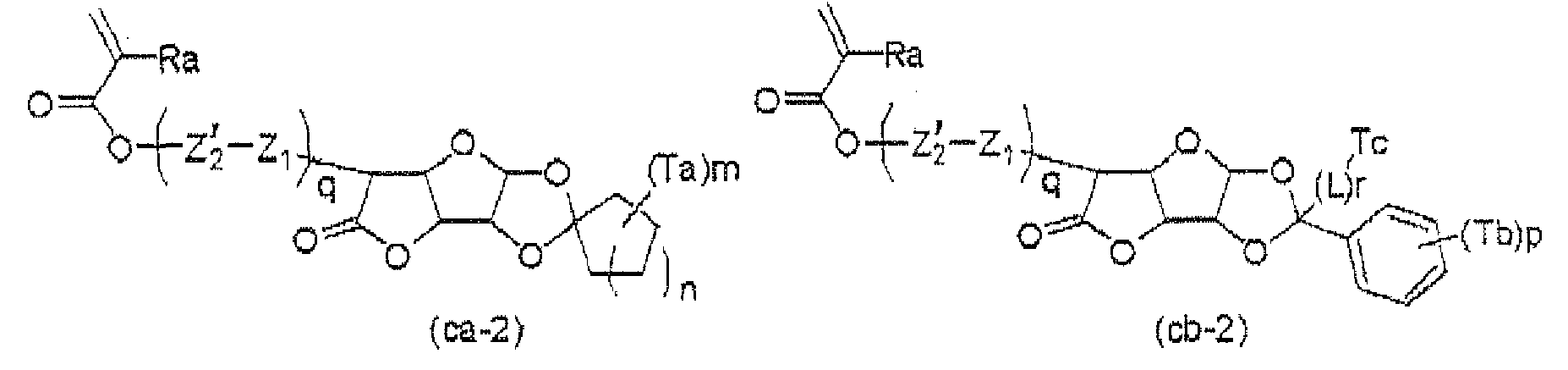
- Ra represents a hydrogen atom, a fluorine atom, a methyl group a trifluoromethyl group;
- each Z1 independently represents a single bond, an ether bond, an ester bond, an amide bond, a urethane bond or a urea bond;
- each Z2' independently represents an optionally substituted chain or cyclic alkylene group;
- each of Ta and Tb independently represents a halogen atom, an optionally substituted alkyl group, an optionally substituted cycloalkyl group, an optionally substituted alkoxy group, an optionally substituted acyl group, an optionally substituted alkyloxycarbonyl group, a carboxy group, a nitrile group, a hydroxyl group, an optionally substituted amide group or an optionally substituted aryl group; and when plural Tas are present, Tas may be bonded to each other to farm a ring; and when plural Tbs are present, Tbs may be bonded to each other to form a fused ring, which may contain a hetero atom, together with the benzene ring on which Tb is substituted.
- Tc represents a hydrogen atom, a halogen atom, an optionally substituted alkyl group, an optionally substituted cycloalkyl group, a nitrile group, hydroxyl group, an optionally substituted aide group or an optionally substituted aryl group;
- each L independently represents a carbonyl group, a carbonyloxy group or an ether bond;
- m represents an integer of from 1 to 28;
- n represents an integer of from 0 to 11;
- p represents an integer of from 0 to 5;
- q represents an integer of from 0 to 5; and
- r represents an integer of from 0 to 5.
- (3) The polymerizable compound as set forth in (1) or (2), which is represented by the following general formula (ca-3) or (cb-3):

- Ra' represents a hydrogen atom or a methyl group;
- each of Ta and Tb independently represents a halogen atom, an optionally substituted alkyl group, an optionally substituted cycloalkyl group, an optionally substituted alkoxy group, an optionally substituted acyl group, an optionally substituted alkyloxycarbonyl group, a carboxy group, a nitrile group, a hydroxyl group, an optionally substituted amide group or an optionally substituted aryl group; and when plural Tas are present, Tas may be bonded to each other to form a ring; and when plural Tbs are present, Tbs may be bonded to each other to form a fused ring, which may contain a hetero atom, together with the benzene ring on which Tb is substituted.
- Td represents a hydrogen atom or a methyl groups ;
- m' represents an integer of from 1 to 10;
- n' represents an integer of from 0 to 2; and
- p represents an integer of from 0 to S.
- (4) The polymerizable compound as set forth in (1) or (2), wherein q is 0 or 1.
- (5) The polymerizable compound as set forth in any one of (1), (2) and (4), wherein n represents an integer of from 0 to 5, and in represents an integer of from 1 to 10.
- (6) The polymerizable compound as set forth in any one of (1), (2), (4) and (5), wherein r is 0 or 1.
- (7) The polymerizable compound as set forth in any one of (1), (2) and (4) to (6), wherein Z1 represents an ether bond or an ester bond.
- (8) The polymerizable compound as set forth in any one of (1), (2) and (4) to (7), wherein Z2 or Z2' represents an optionally substituted chain alkylene group.
- (9) The polymerizable compound as set forth in (3), wherein n' is 1 or 2.
- (10) The polymerizable compound as set forth in (3) or (9), wherein m' is 1 or 2.
- (11) A polymer compound obtained by polymerizing the polymerizable compound as set forth in any one of (1) to (10).
The following embodiments are also preferable in the invention. - (12) The polymerizable compound as set forth in any one of (1), (2) and (4) to (8), wherein Z1 represents an ester bond.
- (13) The polymerizable compound as set forth in any one of (1), (2), (4) to (8) and (12), wherein the chain alkylene group represented by Z2 or Z2' is a methylene group, an ethylene group, a propylene group or an isopropylene group.
- (14) The polymerizable compound as set forth in any one of (1), (2), (4) to (8), (12) and (13), wherein m is 1 or 2.
- (15) The polymerizable compound as set forth in any one of (1), (2), (4) to (8) and (12) to (14), wherein p represents an integer of from 0 to 2.
- (16) The polymerizable compound as set forth in any one of (1), (2), (4) to (8) and (12) to (14), wherein p is 5, and all ofTbs are a fluorine atom.
- (17) The polymerizable compound as set forth in (3), (9) and (10), wherein p represents an integer of from 0 to 2.
- (18) The polymerizable compound as set forth in (3), (9) and (10), wherein p is 5, and all of Tbs are a fluorine atom.
- The invention is hereunder described in detail.
- In the expressions of groups (atomic groups) in this specification, an expression which does not express "substituted" or "unsubstituted" includes both one not having a substituent and one having a substituent. For examples, the "alkyl group" includes not only an alkyl group not have a substituent (unsubstituted alkyl group) but an alkyl group having a substituent (substituted alkyl group).
- The polymerizable compound of the invention has a lactone structure, and specifically it is represented by the following general formulae (ca-1) or (cb-1),

- A represents an optionally substituted methacryl group, an optionally substituted acryl groups or an optionally substituted norbornene group. The substituent of the substituted methacryl group, the substituted acryl group or the substituted norbornene group is preferably a halogen atom, and more preferably a fluorine atom. A is preferably an unsubstituted methacryl group, a methacryl group in which a methyl group at the α-position of the carbonyl moiety thereof is replaced by a trifluoromethyl group (α-(trifluoromethyl)acryl group), an unsubstituted acryl group or an acryl group in which a halogen atom at the α-position of the carboxyl moiety thereof is replaced by a fluorine atom (α-fluoroacryl group), and more preferably an unsubstituted methacryl group or an unsubstituted acryl group,
- Each Z1 independently represents a single bond, an ether bond (-O-), an ester bond, an amide bond, a urethane bond or a urea bond. Z1 is preferably a single bond, an ether bond or an ester bond, more preferably an ether bond or an ester bond, and further preferably an ester bond.
- In the case where the foregoing q is 2 or more, plural groups represented by Z1 may be the same as or different from every other Z1.
- Each Z2 independently represents a single bond or an optionally substituted chain or cyclic alkylene group, and preferably an optionally substituted chain or cyclic alkylene group.
- The chain alkylene group is preferably a chain alkylene group having from 1 to 10 carbon atoms, more preferably from 1 to 5 carbon atoms, and further preferably from. 1 to 3 carbon atoms. Examples thereof include a methylene group, an ethylene group, a propylene group and an isopropylene group.
- The cyclic alkylene group is preferably a cyclic alkylene group having from 3 to 20 carbon atoms. Examples thereof include a cyclohexylene group, a cyclopentylene group, a norbornylene group and an adamantylene, group.
- The group represented by Z2 is more preferably a chain alkylene group.
- Each of the chain alkylene group and the cyclic alkylene group is not particularly limited and can have a substituent. Examples of the substituent on each of the chain alkylene group and the cyclic alkylene group include a halogen atom (for example, a fluorine atom, a chlorine atom, a bromine atom, etc.), a mercapto group, a hydroxyl group, an alkoxy group (an alkoxy group having preferably from 1 to 30 carbon atoms, more preferably from 1 to 15 carbon atoms, and further preferably from I to 7 carbon atoms; for example, a methoxy group, an ethoxy group, an isopropoxy group, a t-butoxy group, a benzyloxy group, etc.), an alkyl group (a linear or branched alkyl group having preferably from 1 to 30 carbon atoms, more preferably from 1 to 15 carbon atoms, and further preferably from 1 to 6 carbon atoms; for example, a methyl group, an ethyl group, a propyl group, an isopropyl groups, a butyl group, a sec-butyl group, a t-butyl group, a pentyl group, a hexyl group, etc.), a cycloalkyl group (a cycloalkyl group having preferably from 3 to 30 carbon atoms, more preferably from 3 to 20 carbon atoms, and further (preferably from 3 to 7 carbon atoms; for example, a cyclopropyl group, a cyclobutyl group, a cyclopentyl group, a cyclohexyl group, a cycloheptyl group, etc.), an acyl group (an acyl group having preferably from 2 to 30 carbon atoms, more preferably from 2 to 15 carbon atoms, and further preferably from 2 to 7 carbon atoms; for example, -(C=O)CH3, -(C=O)C2H5, -(C=O)-n-C3H7, -(C=O)-i-C3H7 etc,), an alkyloxycarbonyl group (an alkyloxycarbonyl group having preferably from 2 to 30 carbon atoms, more preferably 2 to 15 carbon atoms, and further preferably from 2 to 7 carbon atoms; for examples, -(C=O)OCH3 -(C=O)OC2H5, -(C=O)O-n-C3H7, -(C=O)0-i-C3H7, etc.), a carboxy group, a cyano group, a nitro group, a sulfonyl group, a silyl group, a vinyl group, an aryl group (an aryl group having preferably from 6 to 14 carbon atoms; for example, a phenyl group, a xylyl group, a toluyl group, a cumenyl group, a naphthyl group, an anthracenyl group, etc.).
- In the case where the foregoing q is 2 or more, plural groups represented by Z2 may be the same as or different from every other Z2.
- Each of Ta and Tb independently represents a halogen atom, an optionally substituted alkyl group, an optionally substituted cycloalkyl group, an optionally substituted alkoxy group, an optionally substituted acyl group, an optionally substituted alkyloxycarbonyl group, a carboxy group, a nitrile group, a hydroxyl group, an optionally substituted amide group or an optionally substituted aryl group. Of these, a halogen atom, an optionally substituted alkyl group, an optionally substituted cycloalkyl group, an optionally substituted alkoxy group, an optionally substituted alkyloxycarbonyl group and an optionally substituted aryl group are preferable, and a halogen atom, an optionally substituted alkyl group and an optionally substituted alkyloxycarbonyl group are more preferable.
- Examples of the halogen atom represented by Ta and Tb include a fluorine atom, a chlorine atom, a bromine atom and an iodine atom. Of these, a fluorine atom is preferable.
- As specific examples of the alkyl group, the cycloalkyl group, the alkoxy group, the acyl group and the alkyloxycarbonyl group represented by Ta and Tb, the same groups as the specific examples of the alkyl group, the cycloalkyl group, the alkoxy group, the acyl group and the alkyloxycarbonyl group as the substituent on the chain or cyclic alkylene group as exemplified in the explanation of Z2 can be exemplified.
- The aryl group represented by Ta and Tb is preferably an aryl group having from 6 to 14 carbon atoms. Examples thereof include a phenyl group, a xylyl group, a toluyl group, a cumenyl group, a naphthyl groups and an anthracenyl group.
- The amide group represented by Ta and Tb is preferably an amide group having from 2 to 7 carbon atoms. Examples thereof include NH(C=O)CH3, -NH(C=O)C2H5, -NH(C-0)-n-C3H7 and -NH(C-0)-i-C3H7.
- Each of the alkyl group, the cycloalkyl group, the alkoxy group, the acyl group, the alkyloxycarbonyl group, the amide group and the aryl group represented by Ta and Tb is not particularly limited and can have a substituent. Specific examples of such a substituent are the same as the specific examples of the substituent on the chain or cyclic alkylene group as exemplified is the explanation of Z2.
- When plural Tas are present, Tas may be bonded to each other to form a ring. Example of the ring formed when Tas are bonded to each other include a 5- to 7-membered alicyclic hydrocarbon ring or heterocyclic ring, with a 5- or 6-membered ring being preferable.
- When plural Tbs are present, Tbs may be bonded to each other to form a fused ring, which may contain a hetero atom, together with the benzene ring on which Tb is substituted. Examples of the fused ring formed when Tbs are bonded to each other together with the benzene ring include a polycyclic aromatic hydrocarbon. The polycyclic aromatic hydrocarbon preferably has from 10 to 14 carbon atoms, and examples thereof include naphthalene and anthracene.
- Tc represents a hydrogen atom, a halogen atom, an optionally substituted alkyl group, an optionally substituted cycloalkyl group, nitrile group, a hydroxyl group, an optionally substituted amide group or an optionally substituted aryl group.
- As the halogen atom, the optionally substituted alkyl group, the optionally substituted cycloalkyl group, the optionally substituted amide group and the optionally substituted aryl group represented by Tc, the same groups as those in Ta and Tb can be exemplified.
- The group represented by Tc is preferably a hydrogen atom, a methyl group, an ethyl group, a propyl group or an isopropyl group; more preferably a hydrogen atom, a methyl group or an ethyl group; and most preferably a hydrogen atom or a methyl group.
- L represents a carbonyl group, a carbonyloxy group or an ether bond (-O-) In the case where r is an integer of 2 or more, (L)r represents a group composed of a combination of Ls in the number af r. Plural Ls may be the same as or different from every other L.
- m represents an integer of from 1 to 28. m is preferably an integer of from 1 to 10, more preferably an integer of from I to 5, and most preferably 1 or 2.
- n represents an integer of atom 0 to 11. n is preferably an integer of from 0 to 5, more preferably 0, 1 or 2, and most preferably 1 or 2.
- p represents an integer of from 0 to 5, p is preferably an integer of from 0 to 3, more preferably an integer of from 0 to 2, and most preferably 1. However, in the case where all of Tbs are a fluorine atom, p is preferably 5.
- q represents an integer of from 0 to 5. q is preferably an integer of from 0 to 2, more preferably an integer of from 0 to 1, and most preferably 0.
- r represents an integer of from 0 to 5. r is preferably an integer of from 0 to 2, more preferably an integer of from 0 to 1, and most preferably 0.
- In the lactone structure described below in the compound represented by the general formula (ea-1) or (cb-1), in general, optical isomers are present, and any optical isomer is useful. Also, one kind of an optical isomer may be used singly, or a mixture of plural optical isomers may be used. In the case of one kind of an optical isomer, its optical purity (ee) is (preferably 90% or more, more preferably 95% or more, and most preferably 98% or more.

- Specific examples of the foregoing stereostructure will be given below, but it should not be construed that the invention is limited thereto.

- A raw material (starting raw material in the following synthesis routes) which will become the stereostructure represented by the formula (i) is present as a natural product, and it is inexpensively and easily available; and the stereostructure represented by the formula (ii) can be obtained by steric inversion of the stereostructure represented by the formula (i). A raw material which will become the stereostructure represented by the formula (iii) can be synthesized from L-glucose; and the stereostructure represented by the formula (iv) can be obtained by steric inversion of the stereostructure represented by the formula (iii).
- In the case where the compound represented by the general formula (ca-1) or (cb-1) is one kind of an optical isomer, it is preferably an optical isomer having the stereostructure represented by the formula (i).
- Though a synthesis method of the compound represented by the general formula (ca-1) or (cb-1) is not particularly limited, for example, the compound can be synthesized by the following synthesis routes (the cases where A represents CH2=C(Ra)-COO- (wherein Ra represents a hydrogen atom, a fluorine atom, a methyl group or a trifluoromethyl group), q is 0, and r is 0 are shown as representative examples).

- The polymerizable compound represented by the general formula (ca-1) or (cb-1) is preferably represented by the following general formula (ca-2) or (cb-2).

- In the foregoing general formulae (ca-2) and (cb-2),
- Ra represents a hydrogen atom, a fluorine atom, a methyl group or a trifluoromethyl group. Ra is preferably a hydrogen atom or a methyl group.
- Z1, Ta, Tb, Tc, L, m, n, p, q and r are respectively synonymous with Z1, Ta, Tb, Tc, L, m, n, p, q and r in the general formula (ca-1) or (cb-1); and preferred examples thereof are also the same.
- Each Z2' independently represents an optionally substituted chain or cyclic alkylene group. Preferred examples and specific examples thereof are synonymous with those of the optionally substituted chain or cyclic alkylene group represented by Z2 in the general formula (ca-1) or (cb-1).
- The polymerizable compound represented by the general formula (ca-1) or (cb-1) is more preferably represented by the following general formula (ca-3) or (cb-3).

- In the foregoing general formulae (ca-3) and (cb-3),
- Ra' represents a hydrogen atom or a methyl group.
- Ta and Tb are respectively synonymous with Ta and Tb in the general formula (ca-1) or (cb- 1); and preferred examples thereof are also the same.
- Td represents a hydrogen atom or a methyl group.
- m' represents an integer of from 1 to 10. m' is preferably an integer of from 1 to 5, and more preferably 1 or 2.
- n' represents an integer of from 0 to 2, n' is preferably 1 or 2.
- p represents an integer of from 0 to 5, p is preferably an integer of from 0 to 3, more preferably an integer of from 0 to 2, and most preferably 1. However, in the case where all of Ths are a fluorine atom, p is preferably 5.
- Specific examples of the polymerizable compound of the invention will be given below, but it should not be construed, that the invention is limited thereto.
- In the following chemical formulae, Ra represents a hydrogen atom, a fluorine atom, a methyl group or a trifluoromethyl group; and Td represents a hydrogen atom or a methyl group.


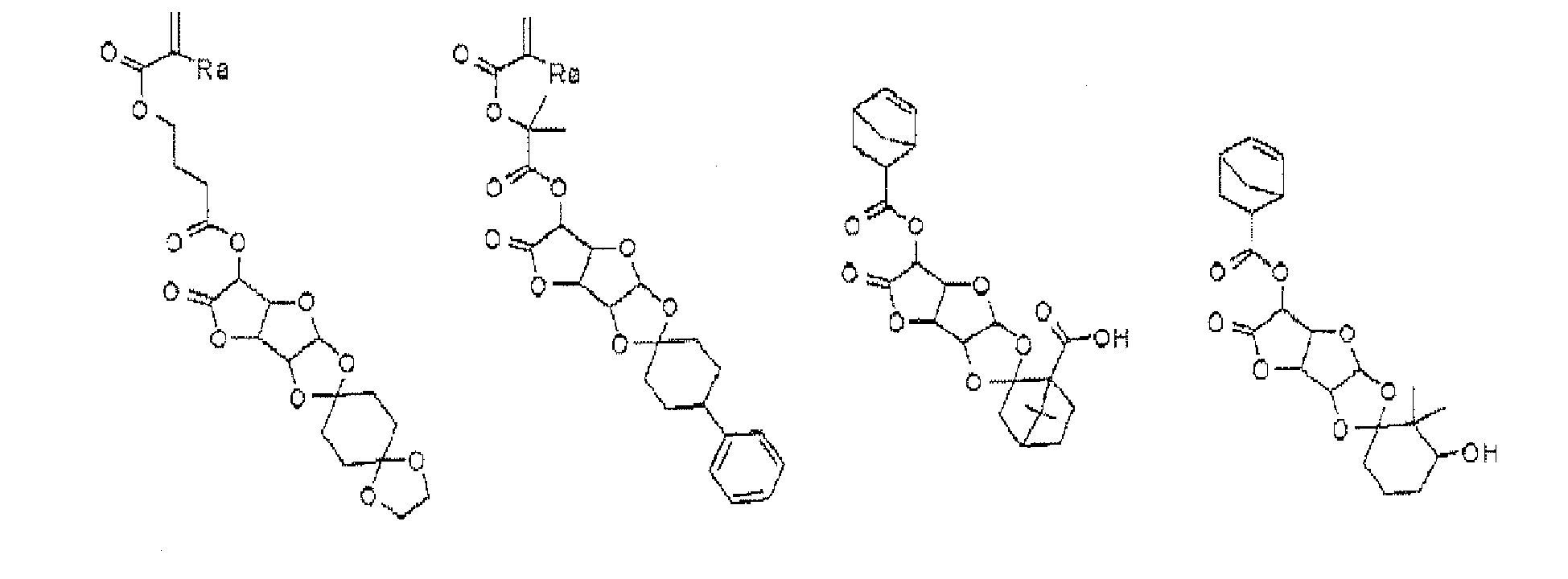


- The polymer compound having a repeating unit corresponding to the polymerizable compound represented by the general formula (ca-1) or (cb-1) is obtained by polymerizing one or more of the polymerizable compound represented by the general formula (ca-1) or (cb-1).
- The polymer compound of the invention may properly have other repeating unit in addition to the repeating unit corresponding to the polymerizable compound represented by the general formula (ca-1) or (cb-1). In that case, the amount of the repeating unit corresponding to the polymerizable compound represented by the general formula (ca-1) or (cb-1) is, for example, from 1 to 100 % by mole, preferably from 3 to 100 % by mole, more preferably from 5 to 100 % by mole, and most preferably from 10 to 100 % by mole relative to the whole of the repeating units of the polymer compound.
- The polymer compound having a repeating unit corresponding to the polymerizable compound of the invention can be synthesized according to the usual way (for example, radical polymerization). Examples of a general synthesis method include a batch polymerization method in which a monomer species (the polymerizable compound represented by the general formula, (ca-1) or (cb-1) and a comonomer which is used, if desired) and an initiator are dissolved in a solvent, and the solution is heated for polymerization; and a dropping polymerization method in which a solution of a monomer species and an initiator is added dropwise to a heated solvent over from 1 to 10 hours. Of these, a dropping polymerization method is preferable, Examples of the reaction solvent include ethers such as tetrahydrofuran, 1,4-dioxane and diisopropyl ether; ketones such as methyl ethyl ketone and methyl isobutyl ketone; ester solvents such as ethyl acetate; amide solvents such as dimethylformamide and dimethylacetamide; and solvent capable of dissolving therein the polymer compound of the invention as described later, such as propylene glycol monomethyl ether acetate, propylene glycol monomethyl ether and cyclohexanone.
- The polymerization reaction is preferably carried out in an inert gas atmosphere such as nitrogen and argon. As to the polymerization initiator, the polymerization is started using a commercially available radical initiator (for example, an azo based initiator, a peroxide, etc.). The radical initiator is preferably an azo based initiator; and an azo based initiator having an ester group, a cyano group or a carboxyl group is preferable. Examples of the preferred initiator include azobisisobutyronitrile, azobisdimethylvaleronitrile and dimethyl 2,2'-azobis(2-methylpropionate). If desired, the initiator is supplemented or added dividedly; and after completion of the reaction, the reaction mixture is thrown into a solvent, and a desired polymer is recovered by a method such as powder or solid recovery. The concentration of the reaction solution is from 5 to 50 % by mass, preferably from 10 to 50 % by mass, and more preferably from 15 to 50 % by mass, The reaction temperature is usually from 10°C to 150°C, preferably from 30°C to 120°C, and more preferably from 60°C to 100°C.
- After completion of the reaction, the reaction mixture is allowed to stand for cooling to room temperature and then purified. For the purification, a usual method such as a liquid-liquid extraction method in which the purification is carried out by removing a residual monomer and an oligomer component by washing with water or through a combination with an appropriate solvent; a purification method in which the purification is carried out in a solution state by means of ultrafiltration for extracting and removing only materials having a molecular weight of a specified value or less; a reprecipitation method in which the purification is carried out by adding dropwise a resin solution to a poor solvent to solidify the resin in the poor solvent, thereby removing a residual monomer or the like; a purification method in which the purification is carried out in a solid state by washing a filtered resin slurry with a poor solvent or other means can be applied. For example, the foregoing resin is deposited as a solid by bringing the reaction solution into contact with a solvent in which the resin is sparingly soluble or insoluble (poor solvent), in a volume amount of not more than 10 times, and preferably from 10 to 5 times the reaction solution.
- As the solvent (precipitation or reprecipitation solvent) which is used in a precipitation or reprecipitation operation from the polymer solution, a poor solvent of the polymer is useful. The poor solvent can be properly selected and used among hydrocarbons, halogenated hydrocarbons, nitro compounds, ethers, ketones, esters, carbonates, alcohols, carboxylic acids, water and mixed solvents containing such a solvent, depending upon the type of the polymer. Of these, a solvent containing at least an alcohol (in particular, methanol, etc.) or water is preferable as the precipitation or reprecipitation solvent.
- The use amount of the precipitation or reprecipitation solvent can be properly selected while taking into consideration efficiency, yield and the like. The use amount of the precipitation or reprecipitation solvent is in general from 100 to 10,000 parts by mass, preferably from 200 to 2,000 parts by mass, and more preferably from 300 to 1, 000 parts by mass based on 100 parts by mass of the polymer solution.
- The temperature for achieving the precipitation or reprecipitation can be properly selected while taking into consideration the efficiency or operability. The temperature for achieving the precipitation or reprecipitation is usually from about 0 to 50°C, and preferably in the vicinity of room temperature (for examples, from about 20 to 35°C). The precipitation or reprecipitation operation can be carried out using a customary mixing container such as a stirring tank by a known method such as a batch type method and a continuous type method.
- The precipitated or reprecipitated polymer is usually subjected to customary solid-liquid separation such as filtration and centrifugation, dried and then provided for use. The filtration is carried out using a solvent-resistant filter medium preferably under a pressure. The drying is carried out under an atmospheric pressure or reduced pressure (preferably under a reduced pressure) at a temperature of from about 30 to 100°C, and preferably from about 3 0 to 50°C.
- The resin which has been once deposited and separated may be again dissolved in a solvent and brought into contact with a solvent in which the resin is sparingly soluble or insoluble. That is, there may be adopted a method including a step of after completion of the foregoing radical polymerization reaction, bringing the reaction mixture into contact with a solvent in which the polymer is sparingly soluble or insoluble, thereby depositing the resin (step a); a step of separating the resin from the solution (step b); a step of again dissolving the resin in a solvent, thereby preparing a resin solution A (step c); a step of subsequently bringing a solvent in which the resin is sparingly soluble or insoluble in a volume amount of less than 10 times (preferably a volume amount of not more than 5 times) the resin solution A into contact with the resin solution A, thereby depositing a resin solid (step d); and a step of separating the deposited resin (step e).
- A weight average molecular weight of the polymer compound having a repeating unit corresponding to the polymerizable compound of the invention is preferably from 1,000 to 200,000, more preferably from 2,000 to 20,000, further preferably from 3,000 to 15,000, and especially preferably from 3,000 to 10,000 in terms of a reduced value into polystyrene by the GPC method.
- A degree of dispersion (molecular weight distribution) of the polymer compound which is used is usually in the range of from 1 to 3, preferably from 1 to 2.6, more preferably from 1 to 2, and especially preferably from 1.4 to 1.7,
- The polymer compound having a repeating unit corresponding to the polymerizable compound of the invention has an excellent affinity with an alkaline developing solution, and therefore, for example, when added to a positive working resist composition containing an acid decomposable resin and a compound capable of generating an acid upon irradiation of active rays or radial rays, the developability of a resist film becomes excellent, and a good pattern can be formed,
- Also, when the polymer compound having a repeating unit corresponding to the polymerizable compound of the invention further contains an acid decomposable group-containing repeating unit as a comonomer component, an acid decomposable resin having an excellent affinity with an alkaline developing solution can be formed; and therefore, with respect to a resist film obtained by a positive working resist composition containing, in addition to such an acid decomposable resin, for example, a compound capable of generating an acid upon irradiation with active rays or radial rays, its developability becomes excellent, and a good pattern can be formed.
- The invention is more specifically described below with reference to the following Examples. However, it should be construed that the invention is not limited to these Examples whatever.
-

- To 200.0 g of 1,2-0-isopropylidene-α-D-gluourono-6,3-lactone (a) (manufactured by Tokyo Chemical Industry Co., Ltd.), one liter of tetrahydrofuran (THF) was added; the mixture was stirred for dissolution; the solution was cooled to 0°C in a nitrogen atmosphere; and 187.2 of triethylamine was added thereto. Thereafter, 214.6 of methacrylic anhydride was added dropwise, and after completion of the dropwise addition, the mixture was stirred for one hour. The resulting mixture was allowed to stand for cooling at 25°C and stirred for an additional 4 hours; after confirming disappearance of the raw material (a), 4 L of ethyl acetate was added; the mixture was washed with 1 N hydrochloric acid, sodium hydrogencarbonate and distilled water (two times); and an organic layer was concentrated. A seed crystal of Compound (b) was added to form a powder, which was then recrystallized from hexane/ethyl acetate, thereby obtaining 162.0 g of Compound (b).
- 30.0 g of the above-obtained Compound (b), 150 mL of toluene, 19.5 g of 4-tort-butyleyolohexanone, 0.3 g of sulfuric acid and 0.3 g of p-methoxyphenol were added; the mixture was stirred in a nitrogen atmosphere at 70°C for 14 hours; and after confirming disappearance of Compound (b), the reaction mixture was neutralized bu the addition of a sodium hydrogencarbonate powder. 500 mL of ethyl acetate was added, the mixture was washed with 300 mL of distilled water three times, and an organic layer was concentrated. The resulting mixture was isolated and purified by means of column chromatography, thereby obtaining 12.7 of a target material (c).
- 1H-NMR of Compound (c) (ppm, CDCl3): 0.82 (9H, s), 0,90 to 1.10 (1H, m), 1.18 to 1.50 (4H, m), 1.50 to 1.82 (4H, m), 1.98 (3H. s), 4.86 (1H, d), 4.90 (1H, d), 5.09 (1H, dd), 5.55 (1H, d), 5.68 to 5.76 (1H, m), 6.02 (1H, d), 6.31 (1H, s)
-

- To 150,0 g of ethyl 4-cyclohexanonecarboxylate (d), 300.0 g of methanol was added, the mixture was stirred, and a sodium hydroxide aqueous solution (mixed solution of 35.3 g of sodium hydroxide and 300.0 g of distilled water) was added dropwise thereto at 25°C. After 3 hours, disappearance of Compound (d) was confirmed, and the reaction solution was added dropwise to 45.7 g of concentrated hydrochloric acid. 2,400 g of ethyl acetate was added, the mixture was washed with distilled water 5 times, and an organic layer was concentrated, thereby obtaining 63 g of Compound (e).
- 43.7 g of the above-obtained Compound (e), 394.0 g of chloroform, 77.6 g of 1,1,1,3,3,3-hexafluoro-2-propanol and 3.8 g of dimethylaminopyridine were added; the mixture was stirred: 64.9 g of 1-ethyl-3-(3-dimethylaminopropyl)carbodiimide hydrochloride was added; the mixture was stirred at 25°C for 3 hours; and after confirming disappearance of Compound (e), 1 N hydrochloric acid was added dropwise to the reaction solution. After stirring, an organic layer was taken out and washed with I N hydrochloric acid two times and with distilled water 5 times, respectively; and an organic layer was concentrated, thereby obtaining 70.0 g of Compound (f).
- Using 32.1 g of Compound (f) and 26.0 g of Compound (b), 10.0 g of a target material (g) was obtained in the same manner as in Example 1.
- 1H-NMR of Compound (g) (ppm, CDCl3), 1.52 to 2.10 (8H, m), 2.00 (3H, s), 2-52 to 2,66 (1H, m), 4.85 (1H, d), 4.93 (1H, d), 5.09 (1H, did), 5.54 (1H, d), 5.70 to 5.76 (1H, m), 5.70 (1H, sep), 6.04 (1H, d), 6.31 (1H, s)
-

- Using 20.7 g of pentafluorobenzaldehyde and 25.0 g of Compound (b), 12.0 g of a target material (h) was obtained in the same manner as in Example 1.
- 1H-NMR of Compound (h) (ppm, CDCl3): 2.02 (3H, 5), 4.93 (1H. d), 5.02 (1H, d), 5.31 (1H, dd), 5.66 (1H, d), 5.70 to 5.78 (1H, m), 6.16 (1H, d), 6.20 (1H, s), 6.32 (1H, s)
-

- Using 22.1 g of 4-(trifluoromethyl)benzaldehyde and 30.0 g of Compound (b), 13.5 g of a target material (i) was obtained in the same manner as in Example 1.
- 1H-NMR of Compound (i) (ppm, CDCl3), 2.03 (3H, s), 5.03 (1H, d), 5,10 (1H, d), 5.17 (1H, dd), 5.56 (1H, d), 5.76 (1H, s), 6.07 (1H, s), 6.19 (1H, d), 6.34 (1H, s), 7.56 (2H, d), 7.67 (2H, d)
-

- Using 24.5 g of 3,5-bis(trifluoromethyl)benzaldehyde and 24.0 g of Compound (b), 14.0 g of a target material (j) was obtained in the same manner as in Example 1,
- 1H-NMR of Compound (j) (ppm, CDCl3), 1.98 (3H, s), 4.86 (1H, dd), 4.98 (1H, d), 5.02 (1H, d), 5.54 (1H, d), 5.70 to 5.78 (1H, m), 6.10 (1H, s), 6.24 (1H, d), 6.3 1 (1H, s), 7.96 (3H, s)
-

- Using 20.6 g of 4-tert-butylbenzaldehyde and 30.0 g of Compound (b), 14.3 g of a target material (k) was obtained in the same manner as in Example 1.
- 1H-NMR of Compound (k) (ppm, CDCl3), 1.34 (9H, s), 2.20 (3H, s), 5.01 (1H, dd), 5.09 (1H, d), 5.15 (1H, dd), 5.56 (1H, d), 5.70 to 5.80 (1H, m), 6.00 (1H, d), 6.17 (1H, dd), 6.33 (1H, d), 7.30 to 7.50 (4H, m)
-

- A three-necked flask was charged with 10.1 g of propylene glycol monomethyl ether acetate (PGMEA) in a nitrogen atmosphere and heated at 80°C. A solution having 36.3 g of Compound (g) and a polymerization initiator V-601 (manufactured by Wako Pure Chemical Industries, Ltd.) in an amount of 2.5 % by mole relative to the monomer dissolved in 96.8 g of PGMEA was added dropwise thereto over 4 hours. After completion of the dropwise addition, the mixture was allowed to react at 80°C for an additional 4 hours. The reaction solution was allowed to stand for cooling and then added dropwise to a mixed solution of 1,300 g of methanol and 150 g of distilled water over 20 minutes; and a deposited powder was collected by filtration and dried to obtain 25.1 g of Polymer (1).
- The resulting Polymer (1) had a weight average molecular of 13,000 as reduced into standard polystyrene by the GPC method and a degree of dispersion (Mw/Mn) of 1.38.
-

- A three-necked flask was charged with 9.0 g of PGMEA in a nitrogen atmosphere and heated at 80°C. A solution having 25.4 g of Compound (g), 4.9 g of Compound (1) and a polymerization initiator V-601 (manufactured by Wako Pure Chemical Industries, Ltd.) in an amount of 7.5 % by mole relative to the monomers dissolved in 81.2 of PGMEA was added dropwise thereto over 4 hours, After completion of the dropwise addition, the mixture was allowed to react at 80°C for an additional 4 hours. The reaction solution was allowed to stand for cooling and then added dropwise to a mixed solution of 1,080 g of methanol and 120 g of distilled water over 20 minutes; and a deposited powder was collected by filtration and dried to obtain 16.5 g of Polymer (2).
- The resulting Polymer (2) had a weight average molecular of 4,000 as reduced into standard polystyrene by the GPC method and a degree of dispersion (Mw/Mn) of 1.42.
-

- A three-necked flask was charged with 10.9 g of PGMEA In a nitrogen atmosphere and heated at 80°C A solution having 21.8 g of Compound (g), 5.1 g of Compound (2) and a polymerization initiator V-601 (manufactured by Wako Pure Chemical Industries, Ltd.) in an amount of 5.0 % by mole relative to the monomers dissolved in 97.6 g of PGMEA was added dropwise thereto over 4 hours, After completion of the dropwise addition, the mixture was allowed to react at 80°C for an additional 4 hours. The reaction solution was allowed to stand for cooling and then added dropwise to a mixed solution of 1,300 g of methanol and 150 g of distilled water over 20 minutes; and a deposited powder was collected by filtration and dried to obtain 20.2 g of Polymer (3).
- The resulting Polymer (3) had a weight average molecular of 8,000 as reduced into standard polystyrene by the GPC method and a degree of dispersion (Mw/Mn) of 1.32,
-

- A three-necksd flask was charged with 91.3 g of PGMEA in a nitrogen atmosphere and heated at 85°C. A solution having 76.1 g of Compound (c) and a polymerization initiator V-601 (manufactured by Wako Pure Chemical Industries, Ltd.) in an amount of 3.0 % by mole relative to the monomer dissolved in 137.0 g of PGMEA was added dropwise thereto over 4 hours. After completion of the dropwise addition, the mixture was allowed to react at 85°C for an additional 4 hours. The reaction solution was allowed to stand for cooling and then added dropwise to a mixed solution of 2,700 g of methanol and 300 g of distilled water over 20 minutes; and a deposited powder was collected by filtration and dried to obtain 53.3 g of Polymer (4).
- The resulting Polymer (4) had a weight average molecule of 3,800 as reduced into standard polystyrene by the GPC method and a degree of dispersion (Mw/Mn) of 1.29.
-

- A three-necked flask was charged with 85.7 g of PGMEA in a nitrogen atmosphere and heated at 85°C. A solution, having 46.8 g of Compound (j), 19.9 g of Compound (3), 4,7 g of Compound (4), 3.6 g of 1-dodecanethiol and a polymerization initiator V-601 (manufactured by Wako Pure Chemical Industries, Ltd.) in an amount of 3.0 % by mole relative to the monomers dissolved in 200.0 g of PGMEA was added dropwise thereto over 4 hours. After completion of the dropwise addition, the mixture was allowed to react at 85°C for an additional 4 hours. The reaction solution was allowed to stand for cooling and then added dropwise to a mixed solution of 2,000 g of methanol and 220 g of distilled water over 20 minutes; and a deposited powder was collected by filtration and dried to obtain 57.1 g of Polymer (5).
- The resulting Polymer (5) had a weight average molecular of 4,100 as reduced into standard polystyrene by the GPC method and a degree of dispersion (Mw/Mn) of 1.26.
-

- A three-necked flask was charged with 76.0 g of PGMEA in a nitrogen atmosphere and heated at 85°C- A solution having 63.3 g of Compound (h) and a polymerization initiator V-601 (manufactured by Wako Pure, Chemical Industries, Ltd.) in an amount of 4.0 % by mole relative to the monomer dissolved in 177.3 g of PGMEA was added dropwise thereto over 4 hours. After completion of the dropwise addition, the mixture was allowed to react at 85°C for an additional 4 hours- The reaction solution was allowed to stand for cooling and then added dropwise to a mixed solution of 1,800 g of methanol and 200 g of distilled water over 20 minutes; and a deposited powder was collected by filtration and dried to obtain 44.3 g of Polymer (6).
- The resulting Polymer (6) had a weight average molecular of 6,300 as reduced into standard polystyrene by the GPC method and a degree of dispersion (Mw/Mn) of 1.35.
-

- A three-necked flask was charged with 62.8 g of cyclohexanone in a nitrogen atmosphere and heated at 80°C. A solution having 29.6 g of Compound (c), 7.1 g of Compound (4), 8.2 g of Compound (2) and a polymerization initiator AIBN (manufactured by Wako Pure Chemical Industries, Ltd.) in an amount of 7.0 % by mole relative to the monomers dissolved in 116.7 g of cyclohexanone was added dropwise thereto over 6 hours. After completion of the dropwise addition, the mixture was allowed to react at 80°C for an additional 2 hours. The reaction solution was allowed to stand for cooling and then added dropwise to a mixed solution of 1,100 g of heptane and 450 g of ethyl acetate over 20 minutes; and a deposited powder was collected by filtration and dried to obtain 33.7 g of Polymer (7).
- The resulting Polymer (7) had a weight average molecular of 7,800 as reduced into standard polystyrene by the GPC method and a degree of dispersion (Mw/Mn) of 1,46,
-

- A three-necked flask was charged with 94.0 g of cyclohexanone in a nitrogen atmosphere and heated at 65°C. A solution having 15.5 g of Compound (k), 8.9 g of Compound (5), 4,7 g of Compound (4), 18.2 g of Compound (2) and a polymerization initiator V-65 (manufactured by Wako Pure Chemical Industries, Ltd.) in as amount of 1.5 % by mole relative to the monomers dissolved in 174.5 g of cyclohexanone was added dropwise thereto over 6 hours. After completion of the dropwise addition, the mixture was allowed to react at 65°C for an additional 2 hours. The reaction solution was allowed to stand for cooling and then added dropwise to a mixed solution of 1,700 g of heptane and 700 g of ethyl acetate over 20 minutes; and a deposited powder was collected by filtration and dried to obtain 38.6 g of Polymer (8).
- The resulting Polymer (8) had a weight average molecular of 9,800 as reduced into standard polystyrene by the GPC method and a degree of dispersion (Mw/Mn) of 1.58.
-

- A three-necked flask was charged with 48.0 g of cyclohexanone in a nitrogen atmosphere and heated at 80°C. A solution having 8.0 g of Compound (i), 11.9 g of Compound (6), 7.9 g of Compound (4), 18.8 g of Compound (1) and a polymerization initiator V-601 (manufacture by Wako Pure Chemical Industries, Ltd.) in an amount of 3% by mole relative to the monomers dissolved in 89.2 g of cyclohexanone was added dropwise thereto over 6 hours, After completion of the dropwise addition, the mixture was allowed to react at 80°C for an additional 2 hours. The reaction solution was allowed to stand for cooling and then added dropwise to a mixed solution of 1,400 g of heptane and 600 g of ethyl acetate over 20 minutes; and a deposited powder was collected by filtration and dried to obtain 38.5 g of Polymer (9).
- The resulting Polymer (9) had a weight average molecular of 13,200 as reduced into standard polystyrene by the GPC method and a degree of dispersion (Mw/Mn) of 1.66,
- A solution of 2 g of the above-obtained Polymer (7), 80 mg of triphenyl sulfonium pentafluorobenzene sulfonate, 7 mg of tii-n-octylamine and 4 mg of MEGAFAC F176 (manufactured by DIC Corporation) was prepared using a mixed solvent of propylene glycol monomethyl ether acetate and propylene glycol monomethyl ether (6/4) (mass ratio) so as to have a solid concentration of 5 % by mass and filtered through a polyethylene filler having a pore size of 0.1 µm, thereby obtaining a positive working resist composition.
- On the other hand, an antireflection film DUV-42, manufactured by Brewer Science, Inc. was uniformly coated in a thickness of 600 angstroms on a silicon substrate which had been treated with hexamethylsilazane by a spin coater, dried on a hot plate at 100°C for 90 seconds and then heated for drying at 190°C for 240 seconds. Thereafter, the foregoing positive working resist composition was coated by a spin coater and dried at 110°C for 90 seconds, thereby forming a resist film having a thickness of 180 nm, This resist film was exposed through a mask by an ArF excimer laser stepper (manufactured by ASML, NA = 0.75, 2/3 zonal illumination), and immediately after the exposure, the resist film was heated on a hot plate at 120°C for 90 seconds. Furthermore, the resulting resist film was developed with a 2.38 % by mass tetramethylammonium hydroxide aqueous solution at 23°C for 60 seconds, rinsed with pure water for 30 seconds and then dried to obtain a pattern of 100-nm line-and-space 1/1.
- Also, each of the above-obtained Polymers (2), (3), (5), (8) and (9) was used in place of Polymer (7) to obtain a pattern in the same manner.
- According to the invention, a novel polymerizable compound and a novel polymer compound obtained by using the same can be provided, and this polymer compound is especially useful for the formation of a pattern in the semiconductor field.
- The entire disclosure of Japanese Patent Application Nos.
2008-317752 filed on December 12, 2008 2008-317753 filed on December 12, 2008 2Q08-317754 filed on December 12, 2008 2009-054291 filed on March 6, 2009 2009-091616 filed on April 3, 2009 2009-122470 filed on May 20, 2009 2009-131275 2009-251478 filed on October 30, 2009
Claims (10)
- A polymerizable compound represented by the following general formula (ca-1):
 A represents an optionally substituted methacryl group, an optionally substituted acryl group or an optionally substituted norbornene group;each Z1 independently represents a single bond, an ether bond, an ester bond, an amide bond, a urethane bond or a urea bond;each Z2 independently represents a single bond or an optionally substituted chain or cyclic alkylene group;Ta independently represents a halogen atom, an optionally substituted alkyl group, an optionally substituted cycloalkyl group, an optionally substituted alkoxy group, an optionally substituted acyl group, an optionally substituted alkyloxycarbonyl group, a carboxy group, a nitrile group, a hydroxyl group, an optionally substituted amide group or an optionally substituted aryl group;m represents an integer of from 1 to 28;n represents an integer of from 0 to 11; andq represents an integer of from 0 to 5.
 - The polymerizable compound according to claim 1, which is represented by the following general formula (ca-2):
 Ra represents a hydrogen atom, a fluorine atom, a methyl group or a trifluoromethyl group; each Z1 independently represents a single bond, an ether bond, an ester bond, an amide bond, a urethane bond or a urea bond;each Z2' independently represents an optionally substituted chain or cyclic alkylene group;Ta represents a halogen atom, an optionally substituted alkyl group, an optionally substituted cycloalkyl group, an optionally substituted alkoxy group, an optionally substituted acyl group, an optionally substituted alkyloxycarbonyl group, a carboxy group, a nitrile group, a hydroxyl group, an optionally substituted amide group or an optionally substituted aryl group;m represents an integer of from 1 to 28;n represents an integer of from 0 to 11; andq represents an integer of from 0 to 5.
 - The polymerizable compound according to claim 1 or 2, which is represented by the following general formula (ca-3):
 Ra' represents a hydrogen atom or a methyl group;Ta represents a halogen atom, an optionally substituted alkyl group, an optionally substituted cycloalkyl group, an optionally substituted alkoxy group, an optionally substituted acyl group, an optionally substituted alkyloxycarbonyl group, a carboxy group, a nitrite group, a hydroxyl group, an optionally substituted amide group or an optionally substituted aryl group;m' represents an integer of from 1 to 10; andn' represents an integer of from 0 to 2.
 - The polymerizable compound according to claim 1 or 2, wherein q is 0 or 1.
- The polymerizable compound according to any one of claims 1, 2 and 4, whereinn represents an integer of from 0 to 5, andm represents an integer of from 1 to 10.
- The polymerizable compound according to any one of claims 1, 2, 4 and 5, wherein
Z1 represents an ether bond or an ester bond. - The polymerizable compound according to any one of claims 1, 2 and 4 to 6, wherein
Z2 or Z2' represents an optionally substituted chain alkylene group. - The polymerizable compound according to claim 3, wherein n' is 1 or 2.
- The polymerizable compound according to claims 3 or 8, wherein m' is 1 or 2.
- A polymer compound obtainable by polymerizing the polymerizable compound according to any one of claims 1 to 9.
Applications Claiming Priority (9)
| Application Number | Priority Date | Filing Date | Title |
|---|---|---|---|
| JP2008317753 | 2008-12-12 | ||
| JP2008317752 | 2008-12-12 | ||
| JP2008317754 | 2008-12-12 | ||
| JP2009054291 | 2009-03-06 | ||
| JP2009091616 | 2009-04-03 | ||
| JP2009122470 | 2009-05-20 | ||
| JP2009131275 | 2009-05-29 | ||
| JP2009251478 | 2009-10-30 | ||
| EP09178831A EP2196853B1 (en) | 2008-12-12 | 2009-12-11 | Polymerizable compound and polymer compound obtained by using the same |
Related Parent Applications (1)
| Application Number | Title | Priority Date | Filing Date |
|---|---|---|---|
| EP09178831.5 Division | 2009-12-11 |
Publications (1)
| Publication Number | Publication Date |
|---|---|
| EP2299326A1 true EP2299326A1 (en) | 2011-03-23 |
Family
ID=41505717
Family Applications (2)
| Application Number | Title | Priority Date | Filing Date |
|---|---|---|---|
| EP09178831A Not-in-force EP2196853B1 (en) | 2008-12-12 | 2009-12-11 | Polymerizable compound and polymer compound obtained by using the same |
| EP10195102A Withdrawn EP2299326A1 (en) | 2008-12-12 | 2009-12-11 | Polymerizable compound and polymer compound obtained by using the same |
Family Applications Before (1)
| Application Number | Title | Priority Date | Filing Date |
|---|---|---|---|
| EP09178831A Not-in-force EP2196853B1 (en) | 2008-12-12 | 2009-12-11 | Polymerizable compound and polymer compound obtained by using the same |
Country Status (2)
| Country | Link |
|---|---|
| EP (2) | EP2196853B1 (en) |
| AT (1) | ATE532102T1 (en) |
Families Citing this family (2)
| Publication number | Priority date | Publication date | Assignee | Title |
|---|---|---|---|---|
| CN102311344B (en) * | 2010-06-25 | 2014-05-28 | 锦湖石油化学株式会社 | Compound, polymer comprising the same and resist protective film composition comprising the polymer |
| EP2926802B1 (en) | 2014-04-02 | 2017-09-27 | Noxell Corporation | Hair colouring compositions, kits, method, and use thereof |
Citations (11)
| Publication number | Priority date | Publication date | Assignee | Title |
|---|---|---|---|---|
| EP1612602A2 (en) * | 2004-06-28 | 2006-01-04 | Fuji Photo Film Co., Ltd. | Photosensitive composition and method for forming pattern using the same |
| JP2006146143A (en) | 2004-06-28 | 2006-06-08 | Fuji Photo Film Co Ltd | Photosensitive composition and method for forming pattern using it |
| JP2006189713A (en) * | 2005-01-07 | 2006-07-20 | Fuji Photo Film Co Ltd | Positive resist composition for ion implantation process and ion implantation method using same |
| JP2006276444A (en) * | 2005-03-29 | 2006-10-12 | Fuji Photo Film Co Ltd | Photosensitive composition and pattern forming method using the same |
| EP1754999A2 (en) * | 2005-07-26 | 2007-02-21 | Fuji Photo Film Co., Ltd. | Positive resist composition and method of pattern formation with the same |
| JP2008074805A (en) * | 2006-09-25 | 2008-04-03 | Daicel Chem Ind Ltd | Method for producing high purity (meth) acrylic acid ester |
| JP2009054291A (en) | 2007-08-23 | 2009-03-12 | Toyota Motor Corp | Fuel cell |
| JP2009091616A (en) | 2007-10-09 | 2009-04-30 | Jfe Steel Kk | Molten metal plated steel strip manufacturing apparatus and manufacturing method of molten metal plated steel strip |
| JP2009122470A (en) | 2007-11-16 | 2009-06-04 | Sumitomo Chemical Co Ltd | Light diffusion plate with condensing layer |
| JP2009131275A (en) | 2009-03-11 | 2009-06-18 | Cellseed Inc | Cell culture support |
| JP2009251478A (en) | 2008-04-10 | 2009-10-29 | Ricoh Co Ltd | Developing unit, processing unit, and image forming apparatus |
-
2009
- 2009-12-11 AT AT09178831T patent/ATE532102T1/en active
- 2009-12-11 EP EP09178831A patent/EP2196853B1/en not_active Not-in-force
- 2009-12-11 EP EP10195102A patent/EP2299326A1/en not_active Withdrawn
Patent Citations (11)
| Publication number | Priority date | Publication date | Assignee | Title |
|---|---|---|---|---|
| EP1612602A2 (en) * | 2004-06-28 | 2006-01-04 | Fuji Photo Film Co., Ltd. | Photosensitive composition and method for forming pattern using the same |
| JP2006146143A (en) | 2004-06-28 | 2006-06-08 | Fuji Photo Film Co Ltd | Photosensitive composition and method for forming pattern using it |
| JP2006189713A (en) * | 2005-01-07 | 2006-07-20 | Fuji Photo Film Co Ltd | Positive resist composition for ion implantation process and ion implantation method using same |
| JP2006276444A (en) * | 2005-03-29 | 2006-10-12 | Fuji Photo Film Co Ltd | Photosensitive composition and pattern forming method using the same |
| EP1754999A2 (en) * | 2005-07-26 | 2007-02-21 | Fuji Photo Film Co., Ltd. | Positive resist composition and method of pattern formation with the same |
| JP2008074805A (en) * | 2006-09-25 | 2008-04-03 | Daicel Chem Ind Ltd | Method for producing high purity (meth) acrylic acid ester |
| JP2009054291A (en) | 2007-08-23 | 2009-03-12 | Toyota Motor Corp | Fuel cell |
| JP2009091616A (en) | 2007-10-09 | 2009-04-30 | Jfe Steel Kk | Molten metal plated steel strip manufacturing apparatus and manufacturing method of molten metal plated steel strip |
| JP2009122470A (en) | 2007-11-16 | 2009-06-04 | Sumitomo Chemical Co Ltd | Light diffusion plate with condensing layer |
| JP2009251478A (en) | 2008-04-10 | 2009-10-29 | Ricoh Co Ltd | Developing unit, processing unit, and image forming apparatus |
| JP2009131275A (en) | 2009-03-11 | 2009-06-18 | Cellseed Inc | Cell culture support |
Also Published As
| Publication number | Publication date |
|---|---|
| ATE532102T1 (en) | 2011-11-15 |
| EP2196853A1 (en) | 2010-06-16 |
| EP2196853B1 (en) | 2011-11-02 |
Similar Documents
| Publication | Publication Date | Title |
|---|---|---|
| US8362170B2 (en) | Polymerizable compound and polymer compound obtained by using the same | |
| KR102061400B1 (en) | Homoadamantane derivative, method for producing same, and photosensitive material for photoresist | |
| EP2196462B1 (en) | Polymerizable compound, lactone-containing compound, method for manufacturing lactone-containing compound and polymer compound obtained by polymerizing the polymerizable compound | |
| TWI465418B (en) | Compound, polymer comprising the compound, and chemically amplified resist composition comprising the polymer | |
| US11814351B2 (en) | Bifunctional (meth)acrylate compound and polymer | |
| KR20100122908A (en) | Compound having alicyclic structure, (meth)acrylic acid ester, and process for production of the (meth)acrylic acid ester | |
| JP5478161B2 (en) | Acrylic ester derivatives and alcohol derivatives and methods for producing them | |
| US20100152400A1 (en) | Polymerizable compound, lactone-containing compound, method for manufacturing lactone-containing compound and polymer compound obtained by polymerizing the polymerizable compound | |
| JP3943268B2 (en) | Copolymer resin and photoresist composition containing copolymer resin | |
| KR100531535B1 (en) | (meth)acrylate esters, starting alcohols for the preparation thereof, processes for preparing both, polymers of the esters, chemically amplifiable resist compositions, and method for forming patterns | |
| WO2004041881A1 (en) | Polymeric compound for photoresist and resin composition for photoresist | |
| EP2196853B1 (en) | Polymerizable compound and polymer compound obtained by using the same | |
| KR20020002906A (en) | Organic anti-reflective coating material and preparation thereof | |
| JP4484690B2 (en) | Manufacturing method of resin for photoresist | |
| JP4033826B2 (en) | Resin for photoresist and resin composition for photoresist | |
| EP3763751A1 (en) | New bifunctional (meth)acrylate compound and polymer | |
| TWI650310B (en) | A method for producing a novel alicyclic ester compound, a novel alicyclic ester compound, a (meth) acrylate copolymer obtained by polymerizing the compound, and a photosensitive resin composition containing the copolymer | |
| TWI648259B (en) | (Meth) acrylate compound and method for producing same | |
| JP2006199764A (en) | Method for producing polymer compound for photoresist | |
| US11780946B2 (en) | Alternating copolymer, method of producing alternating copolymer, method of producing polymeric compound, and method of forming resist pattern | |
| JP5022594B2 (en) | Resin solution for photoresist and method for producing the same | |
| JP2005060511A (en) | Manufacturing method of resin for photoresist and manufacturing method of resin composition for photoresist | |
| JP4841144B2 (en) | Method for producing polymer compound for photoresist | |
| JP2005029516A (en) | 6-trifluoromethyl-2-vinyloxy-4-oxatricyclo [4.2.1.03,7] nonan-5-one and polymer compound | |
| JP5671603B2 (en) | Acrylic ester derivatives and alcohol derivatives and methods for producing them |
Legal Events
| Date | Code | Title | Description |
|---|---|---|---|
| PUAI | Public reference made under article 153(3) epc to a published international application that has entered the european phase |
Free format text: ORIGINAL CODE: 0009012 |
|
| AC | Divisional application: reference to earlier application |
Ref document number: 2196853 Country of ref document: EP Kind code of ref document: P |
|
| AK | Designated contracting states |
Kind code of ref document: A1 Designated state(s): AT BE BG CH CY CZ DE DK EE ES FI FR GB GR HR HU IE IS IT LI LT LU LV MC MK MT NL NO PL PT RO SE SI SK SM TR |
|
| 17P | Request for examination filed |
Effective date: 20110920 |
|
| GRAP | Despatch of communication of intention to grant a patent |
Free format text: ORIGINAL CODE: EPIDOSNIGR1 |
|
| RIC1 | Information provided on ipc code assigned before grant |
Ipc: G03F 7/039 20060101ALI20150709BHEP Ipc: C07H 13/04 20060101ALI20150709BHEP Ipc: C07D 493/14 20060101AFI20150709BHEP |
|
| INTG | Intention to grant announced |
Effective date: 20150728 |
|
| STAA | Information on the status of an ep patent application or granted ep patent |
Free format text: STATUS: THE APPLICATION IS DEEMED TO BE WITHDRAWN |
|
| 18D | Application deemed to be withdrawn |
Effective date: 20151208 |