EP2299132A1 - Grease-sealed bearing - Google Patents
Grease-sealed bearing Download PDFInfo
- Publication number
- EP2299132A1 EP2299132A1 EP09754643A EP09754643A EP2299132A1 EP 2299132 A1 EP2299132 A1 EP 2299132A1 EP 09754643 A EP09754643 A EP 09754643A EP 09754643 A EP09754643 A EP 09754643A EP 2299132 A1 EP2299132 A1 EP 2299132A1
- Authority
- EP
- European Patent Office
- Prior art keywords
- grease
- bearing
- sealed
- subjected
- peeling
- Prior art date
- Legal status (The legal status is an assumption and is not a legal conclusion. Google has not performed a legal analysis and makes no representation as to the accuracy of the status listed.)
- Withdrawn
Links
- 239000004519 grease Substances 0.000 claims abstract description 29
- 238000005496 tempering Methods 0.000 claims abstract description 20
- 229910000831 Steel Inorganic materials 0.000 claims abstract description 18
- 239000010959 steel Substances 0.000 claims abstract description 18
- 229910052799 carbon Inorganic materials 0.000 claims abstract description 15
- MEFBJEMVZONFCJ-UHFFFAOYSA-N molybdate Chemical compound [O-][Mo]([O-])(=O)=O MEFBJEMVZONFCJ-UHFFFAOYSA-N 0.000 claims abstract description 13
- -1 organic acid salt Chemical class 0.000 claims abstract description 11
- 238000005096 rolling process Methods 0.000 claims description 14
- UFHFLCQGNIYNRP-UHFFFAOYSA-N Hydrogen Chemical compound [H][H] UFHFLCQGNIYNRP-UHFFFAOYSA-N 0.000 abstract description 21
- 229910052739 hydrogen Inorganic materials 0.000 abstract description 21
- 239000001257 hydrogen Substances 0.000 abstract description 21
- 230000002028 premature Effects 0.000 abstract description 6
- 239000000203 mixture Substances 0.000 abstract 1
- UQSXHKLRYXJYBZ-UHFFFAOYSA-N Iron oxide Chemical compound [Fe]=O UQSXHKLRYXJYBZ-UHFFFAOYSA-N 0.000 description 8
- 230000000052 comparative effect Effects 0.000 description 8
- 238000000354 decomposition reaction Methods 0.000 description 5
- 238000004519 manufacturing process Methods 0.000 description 4
- 239000004215 Carbon black (E152) Substances 0.000 description 3
- 239000000654 additive Substances 0.000 description 3
- 239000002199 base oil Substances 0.000 description 3
- 229930195733 hydrocarbon Natural products 0.000 description 3
- 150000002430 hydrocarbons Chemical class 0.000 description 3
- 239000003921 oil Substances 0.000 description 3
- XLYOFNOQVPJJNP-UHFFFAOYSA-N water Substances O XLYOFNOQVPJJNP-UHFFFAOYSA-N 0.000 description 3
- VYZAMTAEIAYCRO-UHFFFAOYSA-N Chromium Chemical compound [Cr] VYZAMTAEIAYCRO-UHFFFAOYSA-N 0.000 description 2
- XSQUKJJJFZCRTK-UHFFFAOYSA-N Urea Chemical compound NC(N)=O XSQUKJJJFZCRTK-UHFFFAOYSA-N 0.000 description 2
- 230000001133 acceleration Effects 0.000 description 2
- 229910001566 austenite Inorganic materials 0.000 description 2
- 239000004202 carbamide Substances 0.000 description 2
- 238000001764 infiltration Methods 0.000 description 2
- 230000008595 infiltration Effects 0.000 description 2
- 229910052751 metal Inorganic materials 0.000 description 2
- 239000002184 metal Substances 0.000 description 2
- 239000005078 molybdenum compound Substances 0.000 description 2
- 150000002752 molybdenum compounds Chemical class 0.000 description 2
- 238000003303 reheating Methods 0.000 description 2
- 239000002344 surface layer Substances 0.000 description 2
- 230000015572 biosynthetic process Effects 0.000 description 1
- 239000003054 catalyst Substances 0.000 description 1
- 239000004020 conductor Substances 0.000 description 1
- 230000007423 decrease Effects 0.000 description 1
- 238000005868 electrolysis reaction Methods 0.000 description 1
- 238000002474 experimental method Methods 0.000 description 1
- 230000000415 inactivating effect Effects 0.000 description 1
- 239000000463 material Substances 0.000 description 1
- 230000002087 whitening effect Effects 0.000 description 1
Images


Classifications
-
- F—MECHANICAL ENGINEERING; LIGHTING; HEATING; WEAPONS; BLASTING
- F16—ENGINEERING ELEMENTS AND UNITS; GENERAL MEASURES FOR PRODUCING AND MAINTAINING EFFECTIVE FUNCTIONING OF MACHINES OR INSTALLATIONS; THERMAL INSULATION IN GENERAL
- F16C—SHAFTS; FLEXIBLE SHAFTS; ELEMENTS OR CRANKSHAFT MECHANISMS; ROTARY BODIES OTHER THAN GEARING ELEMENTS; BEARINGS
- F16C33/00—Parts of bearings; Special methods for making bearings or parts thereof
- F16C33/30—Parts of ball or roller bearings
- F16C33/58—Raceways; Race rings
- F16C33/62—Selection of substances
-
- C—CHEMISTRY; METALLURGY
- C10—PETROLEUM, GAS OR COKE INDUSTRIES; TECHNICAL GASES CONTAINING CARBON MONOXIDE; FUELS; LUBRICANTS; PEAT
- C10M—LUBRICATING COMPOSITIONS; USE OF CHEMICAL SUBSTANCES EITHER ALONE OR AS LUBRICATING INGREDIENTS IN A LUBRICATING COMPOSITION
- C10M161/00—Lubricating compositions characterised by the additive being a mixture of a macromolecular compound and a non-macromolecular compound, each of these compounds being essential
-
- C—CHEMISTRY; METALLURGY
- C10—PETROLEUM, GAS OR COKE INDUSTRIES; TECHNICAL GASES CONTAINING CARBON MONOXIDE; FUELS; LUBRICANTS; PEAT
- C10M—LUBRICATING COMPOSITIONS; USE OF CHEMICAL SUBSTANCES EITHER ALONE OR AS LUBRICATING INGREDIENTS IN A LUBRICATING COMPOSITION
- C10M169/00—Lubricating compositions characterised by containing as components a mixture of at least two types of ingredient selected from base-materials, thickeners or additives, covered by the preceding groups, each of these compounds being essential
- C10M169/06—Mixtures of thickeners and additives
-
- C—CHEMISTRY; METALLURGY
- C21—METALLURGY OF IRON
- C21D—MODIFYING THE PHYSICAL STRUCTURE OF FERROUS METALS; GENERAL DEVICES FOR HEAT TREATMENT OF FERROUS OR NON-FERROUS METALS OR ALLOYS; MAKING METAL MALLEABLE, e.g. BY DECARBURISATION OR TEMPERING
- C21D1/00—General methods or devices for heat treatment, e.g. annealing, hardening, quenching or tempering
- C21D1/26—Methods of annealing
- C21D1/32—Soft annealing, e.g. spheroidising
-
- C—CHEMISTRY; METALLURGY
- C21—METALLURGY OF IRON
- C21D—MODIFYING THE PHYSICAL STRUCTURE OF FERROUS METALS; GENERAL DEVICES FOR HEAT TREATMENT OF FERROUS OR NON-FERROUS METALS OR ALLOYS; MAKING METAL MALLEABLE, e.g. BY DECARBURISATION OR TEMPERING
- C21D9/00—Heat treatment, e.g. annealing, hardening, quenching or tempering, adapted for particular articles; Furnaces therefor
- C21D9/40—Heat treatment, e.g. annealing, hardening, quenching or tempering, adapted for particular articles; Furnaces therefor for rings; for bearing races
-
- F—MECHANICAL ENGINEERING; LIGHTING; HEATING; WEAPONS; BLASTING
- F16—ENGINEERING ELEMENTS AND UNITS; GENERAL MEASURES FOR PRODUCING AND MAINTAINING EFFECTIVE FUNCTIONING OF MACHINES OR INSTALLATIONS; THERMAL INSULATION IN GENERAL
- F16C—SHAFTS; FLEXIBLE SHAFTS; ELEMENTS OR CRANKSHAFT MECHANISMS; ROTARY BODIES OTHER THAN GEARING ELEMENTS; BEARINGS
- F16C33/00—Parts of bearings; Special methods for making bearings or parts thereof
- F16C33/30—Parts of ball or roller bearings
- F16C33/58—Raceways; Race rings
- F16C33/64—Special methods of manufacture
-
- F—MECHANICAL ENGINEERING; LIGHTING; HEATING; WEAPONS; BLASTING
- F16—ENGINEERING ELEMENTS AND UNITS; GENERAL MEASURES FOR PRODUCING AND MAINTAINING EFFECTIVE FUNCTIONING OF MACHINES OR INSTALLATIONS; THERMAL INSULATION IN GENERAL
- F16C—SHAFTS; FLEXIBLE SHAFTS; ELEMENTS OR CRANKSHAFT MECHANISMS; ROTARY BODIES OTHER THAN GEARING ELEMENTS; BEARINGS
- F16C33/00—Parts of bearings; Special methods for making bearings or parts thereof
- F16C33/30—Parts of ball or roller bearings
- F16C33/66—Special parts or details in view of lubrication
- F16C33/6603—Special parts or details in view of lubrication with grease as lubricant
- F16C33/6633—Grease properties or compositions, e.g. rheological properties
-
- C—CHEMISTRY; METALLURGY
- C10—PETROLEUM, GAS OR COKE INDUSTRIES; TECHNICAL GASES CONTAINING CARBON MONOXIDE; FUELS; LUBRICANTS; PEAT
- C10M—LUBRICATING COMPOSITIONS; USE OF CHEMICAL SUBSTANCES EITHER ALONE OR AS LUBRICATING INGREDIENTS IN A LUBRICATING COMPOSITION
- C10M2217/00—Organic macromolecular compounds containing nitrogen as ingredients in lubricant compositions
- C10M2217/04—Macromolecular compounds from nitrogen-containing monomers obtained otherwise than by reactions only involving carbon-to-carbon unsaturated bonds
- C10M2217/045—Polyureas; Polyurethanes
- C10M2217/0456—Polyureas; Polyurethanes used as thickening agents
-
- C—CHEMISTRY; METALLURGY
- C10—PETROLEUM, GAS OR COKE INDUSTRIES; TECHNICAL GASES CONTAINING CARBON MONOXIDE; FUELS; LUBRICANTS; PEAT
- C10M—LUBRICATING COMPOSITIONS; USE OF CHEMICAL SUBSTANCES EITHER ALONE OR AS LUBRICATING INGREDIENTS IN A LUBRICATING COMPOSITION
- C10M2227/00—Organic non-macromolecular compounds containing atoms of elements not provided for in groups C10M2203/00, C10M2207/00, C10M2211/00, C10M2215/00, C10M2219/00 or C10M2223/00 as ingredients in lubricant compositions
- C10M2227/06—Organic compounds derived from inorganic acids or metal salts
- C10M2227/066—Organic compounds derived from inorganic acids or metal salts derived from Mo or W
-
- C—CHEMISTRY; METALLURGY
- C10—PETROLEUM, GAS OR COKE INDUSTRIES; TECHNICAL GASES CONTAINING CARBON MONOXIDE; FUELS; LUBRICANTS; PEAT
- C10N—INDEXING SCHEME ASSOCIATED WITH SUBCLASS C10M RELATING TO LUBRICATING COMPOSITIONS
- C10N2030/00—Specified physical or chemical properties which is improved by the additive characterising the lubricating composition, e.g. multifunctional additives
- C10N2030/12—Inhibition of corrosion, e.g. anti-rust agents or anti-corrosives
-
- C—CHEMISTRY; METALLURGY
- C10—PETROLEUM, GAS OR COKE INDUSTRIES; TECHNICAL GASES CONTAINING CARBON MONOXIDE; FUELS; LUBRICANTS; PEAT
- C10N—INDEXING SCHEME ASSOCIATED WITH SUBCLASS C10M RELATING TO LUBRICATING COMPOSITIONS
- C10N2040/00—Specified use or application for which the lubricating composition is intended
- C10N2040/02—Bearings
-
- C—CHEMISTRY; METALLURGY
- C10—PETROLEUM, GAS OR COKE INDUSTRIES; TECHNICAL GASES CONTAINING CARBON MONOXIDE; FUELS; LUBRICANTS; PEAT
- C10N—INDEXING SCHEME ASSOCIATED WITH SUBCLASS C10M RELATING TO LUBRICATING COMPOSITIONS
- C10N2040/00—Specified use or application for which the lubricating composition is intended
- C10N2040/14—Electric or magnetic purposes
-
- C—CHEMISTRY; METALLURGY
- C10—PETROLEUM, GAS OR COKE INDUSTRIES; TECHNICAL GASES CONTAINING CARBON MONOXIDE; FUELS; LUBRICANTS; PEAT
- C10N—INDEXING SCHEME ASSOCIATED WITH SUBCLASS C10M RELATING TO LUBRICATING COMPOSITIONS
- C10N2050/00—Form in which the lubricant is applied to the material being lubricated
- C10N2050/10—Form in which the lubricant is applied to the material being lubricated semi-solid; greasy
-
- F—MECHANICAL ENGINEERING; LIGHTING; HEATING; WEAPONS; BLASTING
- F16—ENGINEERING ELEMENTS AND UNITS; GENERAL MEASURES FOR PRODUCING AND MAINTAINING EFFECTIVE FUNCTIONING OF MACHINES OR INSTALLATIONS; THERMAL INSULATION IN GENERAL
- F16C—SHAFTS; FLEXIBLE SHAFTS; ELEMENTS OR CRANKSHAFT MECHANISMS; ROTARY BODIES OTHER THAN GEARING ELEMENTS; BEARINGS
- F16C19/00—Bearings with rolling contact, for exclusively rotary movement
- F16C19/02—Bearings with rolling contact, for exclusively rotary movement with bearing balls essentially of the same size in one or more circular rows
- F16C19/04—Bearings with rolling contact, for exclusively rotary movement with bearing balls essentially of the same size in one or more circular rows for radial load mainly
- F16C19/06—Bearings with rolling contact, for exclusively rotary movement with bearing balls essentially of the same size in one or more circular rows for radial load mainly with a single row or balls
-
- F—MECHANICAL ENGINEERING; LIGHTING; HEATING; WEAPONS; BLASTING
- F16—ENGINEERING ELEMENTS AND UNITS; GENERAL MEASURES FOR PRODUCING AND MAINTAINING EFFECTIVE FUNCTIONING OF MACHINES OR INSTALLATIONS; THERMAL INSULATION IN GENERAL
- F16C—SHAFTS; FLEXIBLE SHAFTS; ELEMENTS OR CRANKSHAFT MECHANISMS; ROTARY BODIES OTHER THAN GEARING ELEMENTS; BEARINGS
- F16C2204/00—Metallic materials; Alloys
- F16C2204/60—Ferrous alloys, e.g. steel alloys
- F16C2204/66—High carbon steel, i.e. carbon content above 0.8 wt%, e.g. through-hardenable steel
-
- F—MECHANICAL ENGINEERING; LIGHTING; HEATING; WEAPONS; BLASTING
- F16—ENGINEERING ELEMENTS AND UNITS; GENERAL MEASURES FOR PRODUCING AND MAINTAINING EFFECTIVE FUNCTIONING OF MACHINES OR INSTALLATIONS; THERMAL INSULATION IN GENERAL
- F16C—SHAFTS; FLEXIBLE SHAFTS; ELEMENTS OR CRANKSHAFT MECHANISMS; ROTARY BODIES OTHER THAN GEARING ELEMENTS; BEARINGS
- F16C2380/00—Electrical apparatus
- F16C2380/26—Dynamo-electric machines or combinations therewith, e.g. electro-motors and generators
Definitions
- This invention relates to a grease-sealed rolling bearing in which grease is sealed.
- Patent document 2 it is also proposed to form at least the stationary bearing ring from steel containing 1.5 to 6% of Cr, thereby inactivating the surface with an oxide film of Cr formed on the raceway, and suppressing decomposition of the grease. In this arrangement, it is also possible to prevent infiltration of hydrogen into the steel even if the grease decomposes and hydrogen is produced.
- hydrogen may be produced from water that infiltrate from outside such as muddy water and rainwater, or from water produced due to dew formation resulting from change in ambient temperature and from the temperature difference while the bearings are operating and not operating, such hydrogen may infiltrate into steel.
- an oxide film of the iron oxide chrome family is formed on each raceway to prevent infiltration of hydrogen into steel (see e.g. Patent document 3).
- Patent document 3 an oxide film of the iron oxide chrome family is formed on each raceway by reheating each tempered member in the air.
- An object of the present invention is to prevent premature peeling on the raceways due to hydrogen embrittlement using an inexpensive means.
- the present invention provides a grease-sealed rolling bearing comprising an inner race having a raceway, an outer race having a raceway, and rolling elements disposed between the raceways of the inner and outer races, wherein grease is sealed in the bearing, wherein at least one of the inner and outer races is made of high-carbon chrome bearing steel SUJ2, and is subjected to high-temperature tempering of 260°C or higher, and wherein the grease contains a molybdate and an organic acid salt.
- the stationary one of the inner and outer races is made of high-carbon chrome bearing steel SUJ2, and is subjected to high-temperature tempering of 260°C or higher.
- This grease-sealed rolling bearing may be a ball bearing.
- This grease-sealed rolling bearing can be advantageously used to support a rotary portion of an electrical vehicle engine accessory.
- the grease-sealed bearing according to the present invention since at least one of the inner and outer races is made of high-carbon chrome bearing steel SUJ2, and is subjected to high-temperature tempering of 260°C or higher, and the grease contains a molybdate and an organic acid salt, it is possible to prevent premature peeling on the raceway due to hydrogen embrittlement using an inexpensive means.
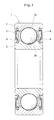
- This grease-sealed bearing 1 shown in Fig. 1 is a deep-groove ball bearing comprises an inner race 2 having a raceway 2a, an outer race 3 having a raceway 3a, a plurality of balls 4 as rolling elements disposed between the raceways 2a and 3a, and a retainer 5 retaining the balls 4 in position.
- Grease A is sealed in the interior of the bearing sealed by seal members 6.
- the inner race 2, the outer race 3 and the balls 4 are made of high-carbon chrome bearing steel SUJ2 and are subjected to hardening and tempering. Any of these elements are hardened at 850°C.
- the bearing rings, i.e. inner and outer races 2 and 3 are subjected to high-temperature tempering of 260°C.
- the balls 4 are subjected to normal tempering at a normal tempering temperature of 180°C.
- the grease A comprises grease of the urea family containing synthetic hydrocarbon oil as base oil, and a molybdate and an organic acid salt as additives.
- the molybdate is present in the amount of 0.01 to 5% by mass of the entire grease, while the organic acid salt is present in the amount of 5 to 70% by mass of the molybdate.
- Fig. 2 shows an alternator as an electrical automotive engine accessory in which grease-sealed bearings 1 of the above-described type are used.
- This alternator comprises a housing 11, a stator 12 fixed to the housing 11, and a rotor 15 having a rotor shaft 14 carrying on its front end a pulley 13 through which torque of the engine is transmitted.
- Generated current flows through slip rings 16 mounted to the rear end of the rotor shaft 14 and is taken out from a brush 17.
- the grease-sealed bearings 1 support the front and rear ends of the rotor shaft 14, respectively.
- the outer race 3 of each bearing 1 is a stationary bearing ring fixed to the housing 11.
- a grease-sealed bearing in the form of a deep groove ball bearing was prepared which comprises the above-described inner race, outer race and balls, which are made of high-carbon chrome bearing steel SUJ2 and are hardened at 850°C, of which the inner race and the outer race are subjected to high-temperature tempering of 260°C, and in which grease of the urea family is sealed which comprises synthetic hydrocarbon oil as base oil, and further contains a molybdate and an organic acid salt as additives.
- a deep groove ball bearing was prepared which comprises the above-described inner race, outer race and balls, which are made of high-carbon chrome bearing steel SUJ2 and are hardened at 850°C, as with the example of the invention, of which the inner race and the outer race are subjected to normal tempering at a normal temperature of 180°C, and in which ordinary urea-family grease containing synthetic hydrocarbon oil as base oil is sealed.
- the deep groove ball bearings of the example of the invention and the comparative example both measured 47 mm in outer diameter, 17 mm in inner diameter and 14 mm in width.
- test bearings 22 which are the deep groove ball bearings of the example of the invention and the comparative example, were subjected to an embrittlement peeling test.
- This bearing tester includes separate housings 24a and 24b insulated from each other, and a rotary shaft 21 supported by the housings 24a and 24b through the test bearing 22 and a dummy bearing 23, respectively.
- Pulleys 26a and 26b are mounted to an extension 21a extending from the portion of the rotary shaft 21 where the test bearing 22 is mounted, and to an output shaft 25a of a motor 25 which extends parallel to the rotary shaft 21, respectively.
- An endless belt 27 is trained around the pulleys 26a and 26b and the rotary shaft 21 is driven by the motor through the belt. Also, the tension of the endless belt 27 is applied to the test bearing 22 through the extension 21a of the rotary shaft 21 as radial loads.
- the rotary shaft 21 and the housings 24a and 24b are made of a conductive material, and the housings 24a and 24b have contact terminals 28a and 28b adapted to be connected to the plus and minus terminals of a power source (not shown), respectively.
- a power source By connecting the contact terminals 28a and 28b to a power source, electric current flows through the housing 24a, the outer race 22b, balls 22c and inner race 22a of the test bearing 22, the rotary shaft 21, and the inner race 23a, balls 23c and outer race 23c of the dummy bearing 23, to the housing 24b.
- hydrogen is forcibly generated from the grease sealed in the test bearing 22 due to electrolysis of the grease, so that it is possible to reproduce peeling due to hydrogen embrittlement in a short period of time.
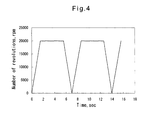
- Fig. 4 shows the acceleration/deceleration cycle of the rotary shaft 21 in the above-mentioned test device during the embrittlement peeling test. Other test conditions are shown below.
- the bearing life span of the bearing due to embrittlement peeling was determined based on change in driving torque.
- Three sample bearings were prepared for each of the example of the invention and the comparative example.
- Table 1 shows the results of the embrittlement peeling test. Compared to the average bearing life span of 67 hours for the comparative example, the average bearing life span of any sample of the example of the invention exceeded 100 hours and was about twice that of any sample of the comparative example. When the test bearings of the example of the invention and the comparative example were visually observed, it was confirmed that embrittlement peeling developed on the raceway of any of the outer races, or the stationary bearing rings.
- the grease-sealed bearing is a deep groove ball bearing, and both the inner and outer races are made of high-carbon chrome bearing steel SUJ2, and are subjected to high-temperature tempering of 260°C or higher. But only the stationary bearing ring may be subjected to high-temperature tempering of 260°C or higher.
- the grease-sealed bearing according to the present invention is not limited to a deep groove ball bearing, but may be an angular ball bearing, a roller bearing, a tapered roller bearing, etc.
Landscapes
- Chemical & Material Sciences (AREA)
- Engineering & Computer Science (AREA)
- General Engineering & Computer Science (AREA)
- Mechanical Engineering (AREA)
- Organic Chemistry (AREA)
- Chemical Kinetics & Catalysis (AREA)
- General Chemical & Material Sciences (AREA)
- Oil, Petroleum & Natural Gas (AREA)
- Physics & Mathematics (AREA)
- Thermal Sciences (AREA)
- Crystallography & Structural Chemistry (AREA)
- Materials Engineering (AREA)
- Metallurgy (AREA)
- Manufacturing & Machinery (AREA)
- Rolling Contact Bearings (AREA)
- Lubricants (AREA)
- Heat Treatment Of Articles (AREA)
Abstract
Description
- This invention relates to a grease-sealed rolling bearing in which grease is sealed.
- In a grease-sealed rolling bearing supporting a rotary portion of an electrical vehicle engine accessory such as an alternator or an electromagnetic clutch, peculiar peeling may prematurely develop on the raceways of bearing ring that accompanies whitening of the structure. Unlike ordinary peeling due to metal fatigue, this peeling phenomenon occurs at a relatively shallow portion of the surface layer, and occurs more frequently on the stationary bearing ring, of which the load acting position remains unchanged.
- For the cause of this peculiar peeling phenomenon on the surface layer, it was discovered (e.g. in Non-patent document 1) that when hydrogen analysis was conducted for the bearing rings after a reproduction test in which acceleration and deceleration are repeated, the hydrogen content on the stationary bearing ring was greater. Thus, hydrogen embrittlement is presumably the cause of the above-mentioned peculiar peeling phenomenon. In particular, hydrogen embrittlement presumably occurs when the grease sealed in the bearing decomposes due to newly generated surfaces generated on the raceways when they slip against the rolling elements, which act as catalysts, and hydrogen produced due to decomposition of the grease infiltrate into steel. Also, in the case of a grease-sealed bearing used for electrical vehicle engine accessories, grease decomposition is presumably also accelerated by weak current that flows through the bearing.
- In order to prevent premature peeling of raceways due to hydrogen embrittlement when grease decomposes, it is proposed to add a molybdate and an organic acid salt as additives to the grease, thereby forming iron oxide and a molybdenum compound film on raceways by reacting and decomposing the molybdate on newly generated surfaces, and thus reducing production of hydrogen due to decomposition of the grease (see e.g. Patent document 1).
- In
Patent document 2, it is also proposed to form at least the stationary bearing ring from steel containing 1.5 to 6% of Cr, thereby inactivating the surface with an oxide film of Cr formed on the raceway, and suppressing decomposition of the grease. In this arrangement, it is also possible to prevent infiltration of hydrogen into the steel even if the grease decomposes and hydrogen is produced. - Further, in rolling bearings used in electrical vehicle engine accessories, hydrogen may be produced from water that infiltrate from outside such as muddy water and rainwater, or from water produced due to dew formation resulting from change in ambient temperature and from the temperature difference while the bearings are operating and not operating, such hydrogen may infiltrate into steel. Thus, it is also proposed to form an oxide film of the iron oxide chrome family on each raceway to prevent infiltration of hydrogen into steel (see e.g. Patent document 3). In
Patent document 3, an oxide film of the iron oxide chrome family is formed on each raceway by reheating each tempered member in the air. -
- Non-patent document 1: "Reproducing experiment of embrittlement peeling when the outer race is rotated" by Tamada and Tanaka, Japan Tripology Academic Society's tripology meeting preliminary report, October 1994, page 749 - 752
-
- Patent document 1:
JP Patent Publication 2005-112902A - Patent document 2:
JP Patent Publication 5-26244A - Patent document 3:
JP Patent Publication 2000-11235A - In the grease-sealed bearing disclosed in
Patent document 2, since the bearing rings are made of a special material containing a large amount of Cr, its manufacturing cost is high. In the bearing disclosed inPatent document 3 too, since the additional step of reheating is necessary in order to form an oxide film, its manufacturing cost is high. - An object of the present invention is to prevent premature peeling on the raceways due to hydrogen embrittlement using an inexpensive means.
- In order to achieve this object, the present invention provides a grease-sealed rolling bearing comprising an inner race having a raceway, an outer race having a raceway, and rolling elements disposed between the raceways of the inner and outer races, wherein grease is sealed in the bearing, wherein at least one of the inner and outer races is made of high-carbon chrome bearing steel SUJ2, and is subjected to high-temperature tempering of 260°C or higher, and wherein the grease contains a molybdate and an organic acid salt.
- That is, with the arrangement in which at least one of the inner and outer races is made of high-carbon chrome bearing steel SUJ2, and is subjected to high-temperature tempering of 260°C or higher, and the grease contains a molybdate and an organic acid salt, it is possible to prevent premature peeling on the raceway by setting the tempering temperature slightly higher. It is not clearly known why embrittlement peeling due to hydrogen embrittlement is suppressed by carrying out high-temperature tempering of 260°C or higher. But this is presumably because by high-temperature tempering, the residual austenite content in the metal structure decreases, so that due to a reduction in the content of austenite, which is of the body-centered cubic structure and has large gaps between lattices, hydrogen is less likely to infiltrate into steel. By adding a molybdate and an organic acid salt to the grease, iron oxide and a molybdenum compound film form on the raceway, which reduces the production of hydrogen due to decomposition of the grease.
- Preferably, the stationary one of the inner and outer races is made of high-carbon chrome bearing steel SUJ2, and is subjected to high-temperature tempering of 260°C or higher.
- This grease-sealed rolling bearing may be a ball bearing.
- This grease-sealed rolling bearing can be advantageously used to support a rotary portion of an electrical vehicle engine accessory.
- With the grease-sealed bearing according to the present invention, since at least one of the inner and outer races is made of high-carbon chrome bearing steel SUJ2, and is subjected to high-temperature tempering of 260°C or higher, and the grease contains a molybdate and an organic acid salt, it is possible to prevent premature peeling on the raceway due to hydrogen embrittlement using an inexpensive means.
-
-
Fig. 1 is a vertical sectional view of a grease-sealed bearing embodying the present invention. -
Fig. 2 is a vertical sectional view of an alternator in which grease-sealed bearings shown inFig. 1 are used. -
Fig. 3 is a vertical sectional view of a bearing tester used in an embrittlement peeling test of examples. -
Fig. 4 is a graph showing the rotation cycle of a rotary shaft of the bearing tester ofFig. 3 during the embrittlement peeling test. - Now the embodiment of the invention is described with reference to the drawings. This grease-sealed bearing 1 shown in
Fig. 1 is a deep-groove ball bearing comprises aninner race 2 having araceway 2a, anouter race 3 having araceway 3a, a plurality ofballs 4 as rolling elements disposed between theraceways retainer 5 retaining theballs 4 in position. Grease A is sealed in the interior of the bearing sealed byseal members 6. - The
inner race 2, theouter race 3 and theballs 4 are made of high-carbon chrome bearing steel SUJ2 and are subjected to hardening and tempering. Any of these elements are hardened at 850°C. The bearing rings, i.e. inner andouter races balls 4 are subjected to normal tempering at a normal tempering temperature of 180°C. - The grease A comprises grease of the urea family containing synthetic hydrocarbon oil as base oil, and a molybdate and an organic acid salt as additives. In the embodiment, the molybdate is present in the amount of 0.01 to 5% by mass of the entire grease, while the organic acid salt is present in the amount of 5 to 70% by mass of the molybdate.
-
Fig. 2 shows an alternator as an electrical automotive engine accessory in which grease-sealed bearings 1 of the above-described type are used. This alternator comprises ahousing 11, astator 12 fixed to thehousing 11, and arotor 15 having arotor shaft 14 carrying on its front end apulley 13 through which torque of the engine is transmitted. Generated current flows throughslip rings 16 mounted to the rear end of therotor shaft 14 and is taken out from abrush 17. The grease-sealed bearings 1 support the front and rear ends of therotor shaft 14, respectively. Theouter race 3 of each bearing 1 is a stationary bearing ring fixed to thehousing 11. - As an example of the invention, a grease-sealed bearing in the form of a deep groove ball bearing was prepared which comprises the above-described inner race, outer race and balls, which are made of high-carbon chrome bearing steel SUJ2 and are hardened at 850°C, of which the inner race and the outer race are subjected to high-temperature tempering of 260°C, and in which grease of the urea family is sealed which comprises synthetic hydrocarbon oil as base oil, and further contains a molybdate and an organic acid salt as additives. As a comparative example, a deep groove ball bearing was prepared which comprises the above-described inner race, outer race and balls, which are made of high-carbon chrome bearing steel SUJ2 and are hardened at 850°C, as with the example of the invention, of which the inner race and the outer race are subjected to normal tempering at a normal temperature of 180°C, and in which ordinary urea-family grease containing synthetic hydrocarbon oil as base oil is sealed. The deep groove ball bearings of the example of the invention and the comparative example both measured 47 mm in outer diameter, 17 mm in inner diameter and 14 mm in width.
- Using a bearing tester shown in
Fig. 3 ,test bearings 22, which are the deep groove ball bearings of the example of the invention and the comparative example, were subjected to an embrittlement peeling test. This bearing tester includesseparate housings rotary shaft 21 supported by thehousings extension 21a extending from the portion of therotary shaft 21 where the test bearing 22 is mounted, and to anoutput shaft 25a of amotor 25 which extends parallel to therotary shaft 21, respectively. Anendless belt 27 is trained around thepulleys rotary shaft 21 is driven by the motor through the belt. Also, the tension of theendless belt 27 is applied to the test bearing 22 through theextension 21a of therotary shaft 21 as radial loads. - The
rotary shaft 21 and thehousings housings contact terminals contact terminals housing 24a, theouter race 22b,balls 22c andinner race 22a of the test bearing 22, therotary shaft 21, and theinner race 23a,balls 23c andouter race 23c of the dummy bearing 23, to thehousing 24b. Thus hydrogen is forcibly generated from the grease sealed in the test bearing 22 due to electrolysis of the grease, so that it is possible to reproduce peeling due to hydrogen embrittlement in a short period of time. -
Fig. 4 shows the acceleration/deceleration cycle of therotary shaft 21 in the above-mentioned test device during the embrittlement peeling test. Other test conditions are shown below. The bearing life span of the bearing due to embrittlement peeling was determined based on change in driving torque. Three sample bearings were prepared for each of the example of the invention and the comparative example. - Load on pulley: 1617 N
- Current applied: 1.0 A
-
Table 1 Bearing life span (hours) Average bearing life Span (hours) Example of the Invention 126 165 141 144 Comparative Example 42 66 92 67 - Table 1 shows the results of the embrittlement peeling test. Compared to the average bearing life span of 67 hours for the comparative example, the average bearing life span of any sample of the example of the invention exceeded 100 hours and was about twice that of any sample of the comparative example. When the test bearings of the example of the invention and the comparative example were visually observed, it was confirmed that embrittlement peeling developed on the raceway of any of the outer races, or the stationary bearing rings. The test results confirmed that with the grease-sealed bearings of the example of the invention, in which at least one of the inner and outer races is made of high-carbon chrome bearing steel SUJ2, and is subjected to high-temperature tempering of 260°C or higher, and the grease contains a molybdate and an organic acid salt, it is possible to prevent significantly prolong the bearing life span due to embrittlement peeling.
- In this embodiment, the grease-sealed bearing is a deep groove ball bearing, and both the inner and outer races are made of high-carbon chrome bearing steel SUJ2, and are subjected to high-temperature tempering of 260°C or higher. But only the stationary bearing ring may be subjected to high-temperature tempering of 260°C or higher. The grease-sealed bearing according to the present invention is not limited to a deep groove ball bearing, but may be an angular ball bearing, a roller bearing, a tapered roller bearing, etc.
-
- A.
- Grease
- 1.
- Grease-sealed bearing
- 2.
- Inner race
- 3.
- Outer race
- 2a, 3a.
- Raceway
- 4.
- Ball
- 5.
- Retainer
- 6.
- Seal member
- 11.
- Housing
- 12.
- Stator
- 13.
- Pulley
- 14.
- Rotor shaft
- 15.
- Rotor
- 16.
- Slip ring
- 17.
- Brush
- 21.
- Rotary shaft
- 21a.
- Extension
- 22.
- Test bearing
- 23.
- Dummy bearing
- 22a, 23a.
- Inner race
- 22b, 23b.
- Outer race
- 22c, 23c.
- Ball
- 24a, 24b.
- Housing
- 25.
- Motor
- 25a.
- Output shafto
- 26a, 26b.
- Pulley
- 27.
- Endless belt
- 28a, 28b.
- Contact terminal
Claims (4)
- A grease-sealed rolling bearing comprising an inner race having a raceway, an outer race having a raceway, and rolling elements disposed between the raceways of the inner and outer races, wherein grease is sealed in the bearing, characterized in that at least one of the inner and outer races is made of high-carbon chrome bearing steel SUJ2, and is subjected to high-temperature tempering of 260°C or higher, and that said grease contains a molybdate and an organic acid salt.
- The grease-sealed rolling bearing of claim 1 wherein a stationary one of the inner and outer races is made of high-carbon chrome bearing steel SUJ2, and is subjected to high-temperature tempering of 260°C or higher.
- The grease-sealed rolling bearing of claim 1 or 2 which is a ball bearing.
- The grease-sealed rolling bearing of any of claims 1 to 3 which supports a rotary portion of an electrical vehicle engine accessory.
Applications Claiming Priority (2)
| Application Number | Priority Date | Filing Date | Title |
|---|---|---|---|
| JP2008139516A JP2009287636A (en) | 2008-05-28 | 2008-05-28 | Grease filled bearing |
| PCT/JP2009/059512 WO2009145135A1 (en) | 2008-05-28 | 2009-05-25 | Grease-sealed bearing |
Publications (2)
| Publication Number | Publication Date |
|---|---|
| EP2299132A1 true EP2299132A1 (en) | 2011-03-23 |
| EP2299132A4 EP2299132A4 (en) | 2013-03-06 |
Family
ID=41377010
Family Applications (1)
| Application Number | Title | Priority Date | Filing Date |
|---|---|---|---|
| EP09754643A Withdrawn EP2299132A4 (en) | 2008-05-28 | 2009-05-25 | Grease-sealed bearing |
Country Status (5)
| Country | Link |
|---|---|
| US (1) | US20110194795A1 (en) |
| EP (1) | EP2299132A4 (en) |
| JP (1) | JP2009287636A (en) |
| CN (1) | CN102046993A (en) |
| WO (1) | WO2009145135A1 (en) |
Families Citing this family (6)
| Publication number | Priority date | Publication date | Assignee | Title |
|---|---|---|---|---|
| WO2012066913A1 (en) * | 2010-11-16 | 2012-05-24 | Ntn株式会社 | Rolling element bearing, and method for producing rolling element bearing |
| JP2012107676A (en) * | 2010-11-16 | 2012-06-07 | Ntn Corp | Rolling bearing and method for manufacturing rolling bearing |
| JP2012107675A (en) * | 2010-11-16 | 2012-06-07 | Ntn Corp | Rolling bearing and method for manufacturing rolling bearing |
| FR2994235B1 (en) * | 2012-08-06 | 2015-01-16 | Skf Ab | BEARING DEVICE, ESPECIALLY FOR A STEERING COLUMN |
| DE102017106341A1 (en) * | 2016-05-24 | 2017-11-30 | Schaeffler Technologies AG & Co. KG | Rolling bearings with a coating and CVT transmission |
| JP7668087B2 (en) * | 2019-10-03 | 2025-04-24 | Ntn株式会社 | Test method for evaluating hydrogen embrittlement spalling in rolling bearings |
Family Cites Families (13)
| Publication number | Priority date | Publication date | Assignee | Title |
|---|---|---|---|---|
| JP3009254B2 (en) | 1991-07-25 | 2000-02-14 | エヌティエヌ株式会社 | Grease sealed bearing |
| JP3238031B2 (en) * | 1995-01-18 | 2001-12-10 | 新日本製鐵株式会社 | Long life carburized bearing steel |
| US6620262B1 (en) * | 1997-12-26 | 2003-09-16 | Nsk Ltd. | Method of manufacturing inner and outer races of deep groove ball bearing in continuous annealing furnace |
| JP2000011235A (en) | 1998-06-24 | 2000-01-14 | Toyo Commun Equip Co Ltd | Reflux paper storage |
| US6531000B1 (en) * | 1998-08-25 | 2003-03-11 | Nsk Ltd. | Surface treated rolling bearing and manufacturing method thereof |
| JP2000337389A (en) * | 1999-03-19 | 2000-12-05 | Nsk Ltd | Rolling bearing |
| JP2003074562A (en) * | 2001-08-31 | 2003-03-12 | Nsk Ltd | Rolling bearing |
| JP2004176156A (en) * | 2002-11-28 | 2004-06-24 | Nsk Ltd | Rolling bearing |
| US8188016B2 (en) * | 2003-07-08 | 2012-05-29 | Ntn Corporation | Lubricant composition and bearing using same |
| JP4625651B2 (en) * | 2004-04-23 | 2011-02-02 | Ntn株式会社 | Rolling bearings for automotive electrical equipment and accessories |
| JP4434685B2 (en) | 2003-10-03 | 2010-03-17 | Ntn株式会社 | Grease composition and grease-filled bearing |
| US7435308B2 (en) * | 2005-05-27 | 2008-10-14 | Nsk Ltd. | Rolling bearing |
| US8088230B2 (en) * | 2006-05-19 | 2012-01-03 | Nsk Ltd. | Rolling apparatus |
-
2008
- 2008-05-28 JP JP2008139516A patent/JP2009287636A/en active Pending
-
2009
- 2009-05-25 WO PCT/JP2009/059512 patent/WO2009145135A1/en not_active Ceased
- 2009-05-25 EP EP09754643A patent/EP2299132A4/en not_active Withdrawn
- 2009-05-25 US US12/993,850 patent/US20110194795A1/en not_active Abandoned
- 2009-05-25 CN CN200980118922XA patent/CN102046993A/en active Pending
Non-Patent Citations (2)
| Title |
|---|
| No further relevant documents disclosed * |
| See also references of WO2009145135A1 * |
Also Published As
| Publication number | Publication date |
|---|---|
| WO2009145135A1 (en) | 2009-12-03 |
| US20110194795A1 (en) | 2011-08-11 |
| CN102046993A (en) | 2011-05-04 |
| EP2299132A4 (en) | 2013-03-06 |
| JP2009287636A (en) | 2009-12-10 |
Similar Documents
| Publication | Publication Date | Title |
|---|---|---|
| US20110194795A1 (en) | Grease-sealed bearing | |
| JP4423754B2 (en) | Manufacturing method of rolling shaft | |
| EP2642145A1 (en) | Rolling element bearing, and method for producing rolling element bearing | |
| JP2992731B2 (en) | Automotive alternator | |
| JP5529526B2 (en) | Rolling bearing | |
| JP2000337389A (en) | Rolling bearing | |
| JP2012107675A (en) | Rolling bearing and method for manufacturing rolling bearing | |
| CN105555982A (en) | Rolling component | |
| JP5538877B2 (en) | Rolling bearing | |
| JP2006071022A (en) | Rolling bearing | |
| JP2009236259A (en) | Insulating rolling bearing for electrical corrosion prevention | |
| JP2015064037A (en) | Hub bearing | |
| JP6368271B2 (en) | Manufacturing method of rolling bearing | |
| JP2004176156A (en) | Rolling bearing | |
| JP2004301149A (en) | Ball bearing | |
| JPH0772565B2 (en) | Vehicle alternator | |
| JP2009001848A (en) | Rolling member for auxiliary machinery of automotive electrical equipment, and rolling bearing for auxiliary machinery of automotive electrical equipment | |
| WO2011040267A1 (en) | Rolling bearing | |
| JP2012107676A (en) | Rolling bearing and method for manufacturing rolling bearing | |
| JPH03173747A (en) | Grease prelubricated bearing | |
| JP3071696B2 (en) | Grease sealed bearing | |
| JP2006097873A (en) | Rolling bearings for plastic pulleys | |
| JP2002242942A (en) | Rolling bearing | |
| JP6101014B2 (en) | Rolling bearing | |
| JP2899900B2 (en) | Grease sealed bearing |
Legal Events
| Date | Code | Title | Description |
|---|---|---|---|
| PUAI | Public reference made under article 153(3) epc to a published international application that has entered the european phase |
Free format text: ORIGINAL CODE: 0009012 |
|
| 17P | Request for examination filed |
Effective date: 20101221 |
|
| AK | Designated contracting states |
Kind code of ref document: A1 Designated state(s): AT BE BG CH CY CZ DE DK EE ES FI FR GB GR HR HU IE IS IT LI LT LU LV MC MK MT NL NO PL PT RO SE SI SK TR |
|
| AX | Request for extension of the european patent |
Extension state: AL BA RS |
|
| DAX | Request for extension of the european patent (deleted) | ||
| STAA | Information on the status of an ep patent application or granted ep patent |
Free format text: STATUS: THE APPLICATION HAS BEEN WITHDRAWN |
|
| A4 | Supplementary search report drawn up and despatched |
Effective date: 20130204 |
|
| RIC1 | Information provided on ipc code assigned before grant |
Ipc: F16C 19/06 20060101ALI20130129BHEP Ipc: C10M 129/26 20060101ALI20130129BHEP Ipc: C21D 9/40 20060101ALI20130129BHEP Ipc: C10M 125/10 20060101ALI20130129BHEP Ipc: C10N 50/10 20060101ALI20130129BHEP Ipc: C10N 30/00 20060101ALI20130129BHEP Ipc: C10N 40/02 20060101ALI20130129BHEP Ipc: F16C 33/64 20060101AFI20130129BHEP Ipc: C10N 10/12 20060101ALI20130129BHEP Ipc: F16C 33/66 20060101ALI20130129BHEP Ipc: C10M 139/00 20060101ALI20130129BHEP Ipc: F16C 33/62 20060101ALI20130129BHEP |
|
| 18W | Application withdrawn |
Effective date: 20130208 |