EP2298840A1 - Coating of metallic articles to restrict ice accumulation - Google Patents
Coating of metallic articles to restrict ice accumulation Download PDFInfo
- Publication number
- EP2298840A1 EP2298840A1 EP10173692A EP10173692A EP2298840A1 EP 2298840 A1 EP2298840 A1 EP 2298840A1 EP 10173692 A EP10173692 A EP 10173692A EP 10173692 A EP10173692 A EP 10173692A EP 2298840 A1 EP2298840 A1 EP 2298840A1
- Authority
- EP
- European Patent Office
- Prior art keywords
- metallic substrate
- icing
- coated
- molecules
- substrate
- Prior art date
- Legal status (The legal status is an assumption and is not a legal conclusion. Google has not performed a legal analysis and makes no representation as to the accuracy of the status listed.)
- Withdrawn
Links
- 238000000576 coating method Methods 0.000 title description 21
- 239000011248 coating agent Substances 0.000 title description 19
- 238000009825 accumulation Methods 0.000 title description 5
- 239000000758 substrate Substances 0.000 claims abstract description 67
- 239000000463 material Substances 0.000 claims abstract description 31
- 229910052751 metal Inorganic materials 0.000 claims description 10
- 239000002184 metal Substances 0.000 claims description 9
- 238000000034 method Methods 0.000 claims description 9
- RTAQQCXQSZGOHL-UHFFFAOYSA-N Titanium Chemical compound [Ti] RTAQQCXQSZGOHL-UHFFFAOYSA-N 0.000 claims description 7
- 229910045601 alloy Inorganic materials 0.000 claims description 7
- 239000000956 alloy Substances 0.000 claims description 7
- 239000010936 titanium Substances 0.000 claims description 7
- 229910052719 titanium Inorganic materials 0.000 claims description 7
- 239000000126 substance Substances 0.000 claims description 6
- 238000004519 manufacturing process Methods 0.000 claims description 5
- 238000006243 chemical reaction Methods 0.000 claims description 3
- -1 fluorocarbons Polymers 0.000 claims description 3
- 238000011065 in-situ storage Methods 0.000 claims description 3
- 239000000203 mixture Substances 0.000 claims description 3
- 150000008282 halocarbons Chemical class 0.000 claims description 2
- 229930195733 hydrocarbon Natural products 0.000 claims description 2
- 150000002430 hydrocarbons Chemical class 0.000 claims description 2
- 229920001600 hydrophobic polymer Polymers 0.000 claims description 2
- 150000004767 nitrides Chemical class 0.000 claims description 2
- 238000002161 passivation Methods 0.000 claims description 2
- 229920005573 silicon-containing polymer Polymers 0.000 claims description 2
- 239000007789 gas Substances 0.000 description 8
- 229910001069 Ti alloy Inorganic materials 0.000 description 6
- 230000008018 melting Effects 0.000 description 5
- 238000002844 melting Methods 0.000 description 5
- 239000003973 paint Substances 0.000 description 5
- 239000011347 resin Substances 0.000 description 5
- 229920005989 resin Polymers 0.000 description 5
- 238000012360 testing method Methods 0.000 description 5
- 230000015572 biosynthetic process Effects 0.000 description 4
- 238000005755 formation reaction Methods 0.000 description 4
- 230000002209 hydrophobic effect Effects 0.000 description 4
- 230000003647 oxidation Effects 0.000 description 4
- 238000007254 oxidation reaction Methods 0.000 description 4
- 241000894007 species Species 0.000 description 4
- GWEVSGVZZGPLCZ-UHFFFAOYSA-N Titan oxide Chemical compound O=[Ti]=O GWEVSGVZZGPLCZ-UHFFFAOYSA-N 0.000 description 3
- 238000010438 heat treatment Methods 0.000 description 3
- OGIDPMRJRNCKJF-UHFFFAOYSA-N titanium oxide Inorganic materials [Ti]=O OGIDPMRJRNCKJF-UHFFFAOYSA-N 0.000 description 3
- VTYYLEPIZMXCLO-UHFFFAOYSA-L Calcium carbonate Chemical compound [Ca+2].[O-]C([O-])=O VTYYLEPIZMXCLO-UHFFFAOYSA-L 0.000 description 2
- XEEYBQQBJWHFJM-UHFFFAOYSA-N Iron Chemical compound [Fe] XEEYBQQBJWHFJM-UHFFFAOYSA-N 0.000 description 2
- PXHVJJICTQNCMI-UHFFFAOYSA-N Nickel Chemical compound [Ni] PXHVJJICTQNCMI-UHFFFAOYSA-N 0.000 description 2
- 238000004630 atomic force microscopy Methods 0.000 description 2
- 238000005229 chemical vapour deposition Methods 0.000 description 2
- 150000001875 compounds Chemical class 0.000 description 2
- 238000007710 freezing Methods 0.000 description 2
- 238000005240 physical vapour deposition Methods 0.000 description 2
- 229920001343 polytetrafluoroethylene Polymers 0.000 description 2
- 239000004810 polytetrafluoroethylene Substances 0.000 description 2
- 238000002203 pretreatment Methods 0.000 description 2
- 238000003980 solgel method Methods 0.000 description 2
- 230000003068 static effect Effects 0.000 description 2
- 230000003075 superhydrophobic effect Effects 0.000 description 2
- 230000003746 surface roughness Effects 0.000 description 2
- 239000010409 thin film Substances 0.000 description 2
- ZOXJGFHDIHLPTG-UHFFFAOYSA-N Boron Chemical compound [B] ZOXJGFHDIHLPTG-UHFFFAOYSA-N 0.000 description 1
- OKTJSMMVPCPJKN-UHFFFAOYSA-N Carbon Chemical compound [C] OKTJSMMVPCPJKN-UHFFFAOYSA-N 0.000 description 1
- VYZAMTAEIAYCRO-UHFFFAOYSA-N Chromium Chemical compound [Cr] VYZAMTAEIAYCRO-UHFFFAOYSA-N 0.000 description 1
- GYHNNYVSQQEPJS-UHFFFAOYSA-N Gallium Chemical compound [Ga] GYHNNYVSQQEPJS-UHFFFAOYSA-N 0.000 description 1
- ZOKXTWBITQBERF-UHFFFAOYSA-N Molybdenum Chemical compound [Mo] ZOKXTWBITQBERF-UHFFFAOYSA-N 0.000 description 1
- 239000004698 Polyethylene Substances 0.000 description 1
- BUGBHKTXTAQXES-UHFFFAOYSA-N Selenium Chemical compound [Se] BUGBHKTXTAQXES-UHFFFAOYSA-N 0.000 description 1
- XUIMIQQOPSSXEZ-UHFFFAOYSA-N Silicon Chemical compound [Si] XUIMIQQOPSSXEZ-UHFFFAOYSA-N 0.000 description 1
- ATJFFYVFTNAWJD-UHFFFAOYSA-N Tin Chemical compound [Sn] ATJFFYVFTNAWJD-UHFFFAOYSA-N 0.000 description 1
- NRTOMJZYCJJWKI-UHFFFAOYSA-N Titanium nitride Chemical compound [Ti]#N NRTOMJZYCJJWKI-UHFFFAOYSA-N 0.000 description 1
- QCWXUUIWCKQGHC-UHFFFAOYSA-N Zirconium Chemical compound [Zr] QCWXUUIWCKQGHC-UHFFFAOYSA-N 0.000 description 1
- 239000000853 adhesive Substances 0.000 description 1
- 230000001070 adhesive effect Effects 0.000 description 1
- 239000002156 adsorbate Substances 0.000 description 1
- 230000002411 adverse Effects 0.000 description 1
- 239000000443 aerosol Substances 0.000 description 1
- 239000004411 aluminium Substances 0.000 description 1
- 229910052782 aluminium Inorganic materials 0.000 description 1
- XAGFODPZIPBFFR-UHFFFAOYSA-N aluminium Chemical compound [Al] XAGFODPZIPBFFR-UHFFFAOYSA-N 0.000 description 1
- 229910052787 antimony Inorganic materials 0.000 description 1
- WATWJIUSRGPENY-UHFFFAOYSA-N antimony atom Chemical compound [Sb] WATWJIUSRGPENY-UHFFFAOYSA-N 0.000 description 1
- 238000000149 argon plasma sintering Methods 0.000 description 1
- 229910052785 arsenic Inorganic materials 0.000 description 1
- RQNWIZPPADIBDY-UHFFFAOYSA-N arsenic atom Chemical compound [As] RQNWIZPPADIBDY-UHFFFAOYSA-N 0.000 description 1
- QVGXLLKOCUKJST-UHFFFAOYSA-N atomic oxygen Chemical compound [O] QVGXLLKOCUKJST-UHFFFAOYSA-N 0.000 description 1
- 229910052790 beryllium Inorganic materials 0.000 description 1
- ATBAMAFKBVZNFJ-UHFFFAOYSA-N beryllium atom Chemical compound [Be] ATBAMAFKBVZNFJ-UHFFFAOYSA-N 0.000 description 1
- 229910052797 bismuth Inorganic materials 0.000 description 1
- JCXGWMGPZLAOME-UHFFFAOYSA-N bismuth atom Chemical compound [Bi] JCXGWMGPZLAOME-UHFFFAOYSA-N 0.000 description 1
- 229910052796 boron Inorganic materials 0.000 description 1
- 229910000019 calcium carbonate Inorganic materials 0.000 description 1
- 229910052799 carbon Inorganic materials 0.000 description 1
- 238000000541 cathodic arc deposition Methods 0.000 description 1
- 229910052804 chromium Inorganic materials 0.000 description 1
- 239000011651 chromium Substances 0.000 description 1
- 229910017052 cobalt Inorganic materials 0.000 description 1
- 239000010941 cobalt Substances 0.000 description 1
- GUTLYIVDDKVIGB-UHFFFAOYSA-N cobalt atom Chemical compound [Co] GUTLYIVDDKVIGB-UHFFFAOYSA-N 0.000 description 1
- 238000007796 conventional method Methods 0.000 description 1
- 230000000881 depressing effect Effects 0.000 description 1
- 238000011161 development Methods 0.000 description 1
- 238000009826 distribution Methods 0.000 description 1
- 238000010894 electron beam technology Methods 0.000 description 1
- 238000005265 energy consumption Methods 0.000 description 1
- 238000005516 engineering process Methods 0.000 description 1
- 238000005530 etching Methods 0.000 description 1
- 230000008014 freezing Effects 0.000 description 1
- 229910052733 gallium Inorganic materials 0.000 description 1
- 230000012010 growth Effects 0.000 description 1
- 229910052735 hafnium Inorganic materials 0.000 description 1
- VBJZVLUMGGDVMO-UHFFFAOYSA-N hafnium atom Chemical compound [Hf] VBJZVLUMGGDVMO-UHFFFAOYSA-N 0.000 description 1
- BHEPBYXIRTUNPN-UHFFFAOYSA-N hydridophosphorus(.) (triplet) Chemical compound [PH] BHEPBYXIRTUNPN-UHFFFAOYSA-N 0.000 description 1
- 230000001939 inductive effect Effects 0.000 description 1
- 229910052742 iron Inorganic materials 0.000 description 1
- WPBNNNQJVZRUHP-UHFFFAOYSA-L manganese(2+);methyl n-[[2-(methoxycarbonylcarbamothioylamino)phenyl]carbamothioyl]carbamate;n-[2-(sulfidocarbothioylamino)ethyl]carbamodithioate Chemical compound [Mn+2].[S-]C(=S)NCCNC([S-])=S.COC(=O)NC(=S)NC1=CC=CC=C1NC(=S)NC(=O)OC WPBNNNQJVZRUHP-UHFFFAOYSA-L 0.000 description 1
- 239000011159 matrix material Substances 0.000 description 1
- 229910044991 metal oxide Inorganic materials 0.000 description 1
- 150000004706 metal oxides Chemical class 0.000 description 1
- 150000002739 metals Chemical class 0.000 description 1
- 238000012986 modification Methods 0.000 description 1
- 230000004048 modification Effects 0.000 description 1
- 229910052750 molybdenum Inorganic materials 0.000 description 1
- 239000011733 molybdenum Substances 0.000 description 1
- 239000002105 nanoparticle Substances 0.000 description 1
- 229910052759 nickel Inorganic materials 0.000 description 1
- 229910052758 niobium Inorganic materials 0.000 description 1
- 239000010955 niobium Substances 0.000 description 1
- GUCVJGMIXFAOAE-UHFFFAOYSA-N niobium atom Chemical compound [Nb] GUCVJGMIXFAOAE-UHFFFAOYSA-N 0.000 description 1
- 229910052760 oxygen Inorganic materials 0.000 description 1
- 239000001301 oxygen Substances 0.000 description 1
- 238000004375 physisorption Methods 0.000 description 1
- 229920000058 polyacrylate Polymers 0.000 description 1
- 229920000573 polyethylene Polymers 0.000 description 1
- 229920000642 polymer Polymers 0.000 description 1
- 230000002265 prevention Effects 0.000 description 1
- 238000011160 research Methods 0.000 description 1
- 229910052702 rhenium Inorganic materials 0.000 description 1
- WUAPFZMCVAUBPE-UHFFFAOYSA-N rhenium atom Chemical compound [Re] WUAPFZMCVAUBPE-UHFFFAOYSA-N 0.000 description 1
- 229910052711 selenium Inorganic materials 0.000 description 1
- 239000011669 selenium Substances 0.000 description 1
- 229910052710 silicon Inorganic materials 0.000 description 1
- 239000010703 silicon Substances 0.000 description 1
- 238000004544 sputter deposition Methods 0.000 description 1
- 229910052715 tantalum Inorganic materials 0.000 description 1
- GUVRBAGPIYLISA-UHFFFAOYSA-N tantalum atom Chemical compound [Ta] GUVRBAGPIYLISA-UHFFFAOYSA-N 0.000 description 1
- 229910052714 tellurium Inorganic materials 0.000 description 1
- PORWMNRCUJJQNO-UHFFFAOYSA-N tellurium atom Chemical compound [Te] PORWMNRCUJJQNO-UHFFFAOYSA-N 0.000 description 1
- 229910052718 tin Inorganic materials 0.000 description 1
- MTPVUVINMAGMJL-UHFFFAOYSA-N trimethyl(1,1,2,2,2-pentafluoroethyl)silane Chemical compound C[Si](C)(C)C(F)(F)C(F)(F)F MTPVUVINMAGMJL-UHFFFAOYSA-N 0.000 description 1
- WFKWXMTUELFFGS-UHFFFAOYSA-N tungsten Chemical compound [W] WFKWXMTUELFFGS-UHFFFAOYSA-N 0.000 description 1
- 229910052721 tungsten Inorganic materials 0.000 description 1
- 239000010937 tungsten Substances 0.000 description 1
- 229910052720 vanadium Inorganic materials 0.000 description 1
- GPPXJZIENCGNKB-UHFFFAOYSA-N vanadium Chemical compound [V]#[V] GPPXJZIENCGNKB-UHFFFAOYSA-N 0.000 description 1
- XLYOFNOQVPJJNP-UHFFFAOYSA-N water Substances O XLYOFNOQVPJJNP-UHFFFAOYSA-N 0.000 description 1
- 229910052726 zirconium Inorganic materials 0.000 description 1
Images

Classifications
-
- C—CHEMISTRY; METALLURGY
- C09—DYES; PAINTS; POLISHES; NATURAL RESINS; ADHESIVES; COMPOSITIONS NOT OTHERWISE PROVIDED FOR; APPLICATIONS OF MATERIALS NOT OTHERWISE PROVIDED FOR
- C09D—COATING COMPOSITIONS, e.g. PAINTS, VARNISHES OR LACQUERS; FILLING PASTES; CHEMICAL PAINT OR INK REMOVERS; INKS; CORRECTING FLUIDS; WOODSTAINS; PASTES OR SOLIDS FOR COLOURING OR PRINTING; USE OF MATERIALS THEREFOR
- C09D5/00—Coating compositions, e.g. paints, varnishes or lacquers, characterised by their physical nature or the effects produced; Filling pastes
-
- Y—GENERAL TAGGING OF NEW TECHNOLOGICAL DEVELOPMENTS; GENERAL TAGGING OF CROSS-SECTIONAL TECHNOLOGIES SPANNING OVER SEVERAL SECTIONS OF THE IPC; TECHNICAL SUBJECTS COVERED BY FORMER USPC CROSS-REFERENCE ART COLLECTIONS [XRACs] AND DIGESTS
- Y10—TECHNICAL SUBJECTS COVERED BY FORMER USPC
- Y10T—TECHNICAL SUBJECTS COVERED BY FORMER US CLASSIFICATION
- Y10T156/00—Adhesive bonding and miscellaneous chemical manufacture
- Y10T156/10—Methods of surface bonding and/or assembly therefor
-
- Y—GENERAL TAGGING OF NEW TECHNOLOGICAL DEVELOPMENTS; GENERAL TAGGING OF CROSS-SECTIONAL TECHNOLOGIES SPANNING OVER SEVERAL SECTIONS OF THE IPC; TECHNICAL SUBJECTS COVERED BY FORMER USPC CROSS-REFERENCE ART COLLECTIONS [XRACs] AND DIGESTS
- Y10—TECHNICAL SUBJECTS COVERED BY FORMER USPC
- Y10T—TECHNICAL SUBJECTS COVERED BY FORMER US CLASSIFICATION
- Y10T428/00—Stock material or miscellaneous articles
- Y10T428/24—Structurally defined web or sheet [e.g., overall dimension, etc.]
- Y10T428/24355—Continuous and nonuniform or irregular surface on layer or component [e.g., roofing, etc.]
Definitions
- the present invention relates to coating of metallic articles to restrict ice accumulation.
- Such metallic articles include all metal structures exposed to water-freezing conditions, particularly but not exclusively rotor components such as wind-turbine blades, aircraft propeller blades or air intake fan blades of gas turbine engines.
- Ice accretion on other rotor or static metallic structures increases the weight on the structure and leads to loss of efficiency and the risk of mechanical damage or failure.
- a number of anti-icing paints or resins have been devised, in which anti-icing materials are entrained in a paint or resin carrier system.
- anti-icing materials are entrained in a paint or resin carrier system.
- S Kimura et al "A New Surface Coating for Prevention of Icing on Airfoils", SAE International, 2007 ; Wang et al, “Fabrication and anti-frosting performance of super hydrophobic coating based on modified nano-sized calcium carbonate and ordinary polyacrylate", Applied Surface Science 253, 2007, pages 8818-8824 , the contents of which are incorporated herein by reference in all relevant respects.
- the present invention aims to overcome these problems or some of them, or at least to provide an acceptable alternative to conventional anti-icing coating technology.
- the present invention provides in a first aspect an anti-icing coated metallic substrate in which molecules of an anti-icing material are chemically bonded to the metallic substrate.
- the substrate is suitably formed as, or as part of, a metallic article, for example a rotor component, particularly a high-performance weight-critical rotor component such as an aircraft propeller blade or an air intake fan blade of a gas turbine engine.
- a metallic article for example a rotor component, particularly a high-performance weight-critical rotor component such as an aircraft propeller blade or an air intake fan blade of a gas turbine engine.
- the present invention provides a method of manufacturing an anti-icing coated metallic substrate according to the first aspect of the invention, which comprises bonding an anti-icing material to a metallic substrate surface so that molecules of the anti-icing material are chemically bonded to the metallic substrate.
- the metallic substrate surface is suitably pre-treated to create a nanoscale roughness before bonding the anti-icing material to it.
- the chemical bonding of molecules of the anti-icing material to the metallic substrate may suitably involve covalent bonds or chemisorption bonds or both. Ionic bonding will in general be disfavoured because of the aqueous environment in which the coating is to operate.
- chemisorption used herein refers to an adsorbed system where the chemical bonding between the adsorbate and the substrate is stronger than physisorption forces of attachment and may, for example, involve more than about 0.5 eV of binding energy per atom or molecule.
- the covalent or chemisorption bonds or both may bond molecules of the anti-icing material to the metallic substrate directly.
- the covalent or chemisorption bonds or both may bond molecules of the anti-icing material to intermediate species which is/are attached to the metallic substrate.
- the attachment of the intermediate species to the metallic substrate may, for example, itself involve chemical bonds or chemisorption bonds or both.
- intermediate species can include inorganic molecules comprising atoms of the metal of the substrate. Such molecules can suitably be formed in situ on the surface of the metallic substrate by known chemical reactions, such as passivation reactions (eg oxidation, nitridation, carbidation). The formation of such intermediate species may typically serve to create nanoscale roughness for the optional pre-treatment of the metallic substrate surface prior to the coating method according to the second aspect of the present invention.
- Oxidation, nitridation or carbidation of metallic substrates are well known processes in this art. It is preferred that a thin film of a metal oxide, nitride or carbide is formed in situ on the surface of the metal.
- a thin film of titanium oxide, nitride or carbide can be formed by physical vapor deposition (PVD, usually sputter deposition, cathodic arc deposition or electron beam heating) or chemical vapor deposition (CVD) or by a sol-gel process.
- nanoscale roughness for the optional pre-treatment of the metallic substrate surface prior to the coating method according to the second aspect of the present invention may be created by differential etching of a crystalline grain structure of the metallic substrate in known manner.
- the expression “nanoscale roughness” herein is used in the conventional sense as defined in “ Light Scattering and Nanoscale Surface Roughness", 2007, Ed. A A Maradudin, Pub. Springer (ISBN 0-387-25580-X ), the contents of which are incorporated herein by reference in all relevant respects.
- a surface having "nanoscale roughness” generally has heights of surface features above and below the mean surface level (“surface roughness”), given in terms of a root-mean-square (rms) value or an average value, in the range from about 0.01 nm to larger than about 1,000nm, for example up to about 5,000nm, but less than the millimetre size (1,000,000 nm).
- Surface spatial wavelengths of a surface having nanoscale roughness generally lie in the range from about 100nm to about 1,000,000nm, depending on the mutual spacing of the peaks. Nanoscale roughness may be measured using conventional techniques and apparatus, for example atomic force microscopy (AFM).
- AFM atomic force microscopy
- physical bonding of molecules of the anti-icing material to the metallic substrate is preferably absent or- if present - provides a secondary bonding means to the chemical bonding system.
- the chemical bonding of molecules of the anti-icing material to the metallic substrate preferably bonds the majority of the anti-icing coating area to the metallic substrate.
- the present invention makes available for the first time the possibility of coating an aircraft propeller blade or an air intake fan blade of a gas turbine engine with an anti-icing material.
- the present invention provides the use of an anti-icing material as an anti-icing coating of an aircraft propeller blade or an air intake fan blade of a gas turbine engine.
- any preference or exemplification, and all combinations thereof, stated for one aspect of the present invention applies equally to each and every other aspect of the invention.
- the preferences and exemplification of the materials and methods for constructing the anti-icing coated metallic substrate apply equally to the structure of the finished anti-icing coated metallic substrate itself and metallic articles, for example an aircraft propeller blade or an air intake fan blade of a gas turbine engine which comprise the anti-icing coated metallic substrate.
- the anti-icing material is suitably selected from all compounds and compositions which serve in use to restrict the accumulation of ice on the metallic substrate.
- examples of such materials include hydrophobic polymers such as hydrocarbons (for example, polyethylene), halogenated (eg fluorinated) compounds (for example fluorocarbons such as polytetrafluoroethylene (PTFE, TeflonTM) or halogenated hydrocarbons), silicone polymers, compositions comprising these materials, and any combination thereof.
- the polymers may have freezing point (or melting point) depressing properties on water that contacts them. Further examples of potentially suitable materials are given by P Roach et al in "Progress in Superhydrophobic Surface Development", Soft Matter, 2008 , the contents of which are incorporated herein by reference in all relevant respects.
- the metallic substrate used in the present invention may suitably comprise a titanium-based alloy and is suitably of relatively low density, for example less than about 7 gcm -3 , less than about 6 gcm -3 , or less than about 5 gcm -3 .
- the metallic substrate suitably has a relatively high melting point or melting range.
- the melting point or midpoint of the melting range may suitably be above about 1000°C, for example above about 1300°C, for example above about 1400°C, for example above about 1500°C.
- the titanium alloy comprises titanium as the main component and any other suitable metal or metals as a further component or further components. It will be appreciated that the alloy may also comprise semi- and non-metallic components in addition to metallic components. These semi- and non-metallic components may typically be present in lower amounts than the main metallic component(s), for example less than about 5% by weight, less than about 3% by weight or less than about 1 % by weight.
- the alloy comprises titanium as the main component and preferably one or more subsidiary components selected from aluminium, beryllium, bismuth, chromium, cobalt, gallium, hafnium, iron, manganese, molybdenum, niobium, nickel, oxygen, rhenium, tantalum, tin, tungsten, vanadium or zirconium.
- the alloy may also suitably comprise one or more semi- or non-metallic elements selected from boron, carbon, silicon, phosphorous, arsenic, selenium, antimony and tellurium. These elements may serve to increase the oxidation, creep or burning resistance of the alloy.
- Titanium may be present in such a titanium alloy in an amount greater than about 40% by weight, for example greater than about 50% by weight, greater than about 60% by weight or greater than about 70% by weight. In some embodiments titanium may be present in an amount greater than about 80% by weight.
- the component is preferably a component of an aero-engine which in use may be exposed to conditions of relatively high temperature (eg above about 400°C, particularly above about 650°C), eg casings, compressor drums, vanes, discs, blades, shafts, plugs or nozzles.
- relatively high temperature eg above about 400°C, particularly above about 650°C
- casings eg casings, compressor drums, vanes, discs, blades, shafts, plugs or nozzles.
- Particularly preferred components include fan blades.
- variable inlet guide vanes and outlet guide vanes include the variable inlet guide vanes and outlet guide vanes.
- ice shedding mechanism differs in that it is driven primarily by aerodynamic loading and vibration rather than by centrifugal force, it will be readily apparent to those skilled in the art that the present invention could nevertheless be used on such components in conjunction with conventional electrical, mechanical or hot air deicing systems to promote more rapid ice de-bonding and shedding.
- a substrate of Titanium 6-4 alloy was surface treated by oxidation and surface coated with the hydrophobic coating in accordance with the present invention.
- HIREC 1450 is a commercially available product, and is applied by aerosol. The coating thickness is about 15 ⁇ m.
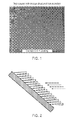
- the coated substrate was subjected to icing conditions and was found to be particularly effective at reducing ice adhesion compared to the uncoated metal substrate. Without the coating of the present invention, ice typically accumulates substantially uniformly on a substrate (see Figure 3 ) to form one smooth, homogenous coating of glaze ice (see Figure 4 ).
- ice formation on a substrate comprising a coating in accordance with the present invention exhibits a substantially different morphology, with ice accumulating as rime ice in discrete wedges.
- the wedge-shaped ice growths each have a small foot-print attaching each wedge to the substrate coating (see Figure 2 ).
- the morphology of the ice results in a weaker ice-substrate bond and promotes more regular and more predictable ice shedding, at lower accretion masses.
- the present invention therefore provides an improved or at least alternative method for reducing ice adhesion on metal substrates, particularly but not exclusively titanium alloy aerospace components.
Landscapes
- Chemical & Material Sciences (AREA)
- Life Sciences & Earth Sciences (AREA)
- Engineering & Computer Science (AREA)
- Materials Engineering (AREA)
- Wood Science & Technology (AREA)
- Organic Chemistry (AREA)
- Structures Of Non-Positive Displacement Pumps (AREA)
- Turbine Rotor Nozzle Sealing (AREA)
Abstract
An anti-icing coated metallic substrate includes molecules of an anti-icing material chemically bonded to the metallic substrate.
The substrate is suitably a metallic article, particularly a high-performance weight-critical rotor component such as an aircraft propeller blade or an air intake fan blade of a gas turbine engine.
Description
- The present invention relates to coating of metallic articles to restrict ice accumulation.
- Such metallic articles include all metal structures exposed to water-freezing conditions, particularly but not exclusively rotor components such as wind-turbine blades, aircraft propeller blades or air intake fan blades of gas turbine engines.
- Ice accumulation on the surface of an aircraft propeller blade or an air intake fan blade of a gas turbine engine, or other metallic article, can cause serious problems. As ice builds up on a rotating article, a point is reached when the ice-surface bonding strength is insufficient to withstand the centrifugal load on the accreted mass of ice, which then sling-shots off and may cause significant impact damage.
- Ice accretion on other rotor or static metallic structures increases the weight on the structure and leads to loss of efficiency and the risk of mechanical damage or failure.
- A range of precautionary measures are taken to minimise these problems. These include heating of metallic parts to prevent icing, and the use of high impact strength materials in the vicinity of rotating parts at risk of ice accumulation. However, these solutions increase manufacturing costs through the need for additional components and more expensive materials. In the aircraft industry in particular, they increase running costs of the aircraft through additional energy consumption through heating and additional weight.
- A number of anti-icing paints or resins have been devised, in which anti-icing materials are entrained in a paint or resin carrier system. For examples of such paints or resins see S Kimura et al, "A New Surface Coating for Prevention of Icing on Airfoils", SAE International, 2007; Wang et al, "Fabrication and anti-frosting performance of super hydrophobic coating based on modified nano-sized calcium carbonate and ordinary polyacrylate", Applied Surface Science 253, 2007, pages 8818-8824, the contents of which are incorporated herein by reference in all relevant respects.
- However, such paints or resins would not be effective for rotor components, as the adhesive force to the surface of the metallic substrate is insufficient and the additional weight and uneven weight distribution would adversely affect the performance and economics of the equipment. Hitherto, no effective anti-icing coating for rotor components, particularly high-performance weight-critical rotor components such as aircraft propeller blades or air intake fan blades of gas turbine engines has been published.
- The present invention aims to overcome these problems or some of them, or at least to provide an acceptable alternative to conventional anti-icing coating technology.
- The present invention provides in a first aspect an anti-icing coated metallic substrate in which molecules of an anti-icing material are chemically bonded to the metallic substrate.
- The substrate is suitably formed as, or as part of, a metallic article, for example a rotor component, particularly a high-performance weight-critical rotor component such as an aircraft propeller blade or an air intake fan blade of a gas turbine engine.
- In a second aspect the present invention provides a method of manufacturing an anti-icing coated metallic substrate according to the first aspect of the invention, which comprises bonding an anti-icing material to a metallic substrate surface so that molecules of the anti-icing material are chemically bonded to the metallic substrate.
- In this method, the metallic substrate surface is suitably pre-treated to create a nanoscale roughness before bonding the anti-icing material to it.
- The chemical bonding of molecules of the anti-icing material to the metallic substrate may suitably involve covalent bonds or chemisorption bonds or both. Ionic bonding will in general be disfavoured because of the aqueous environment in which the coating is to operate. The expression "chemisorption" used herein refers to an adsorbed system where the chemical bonding between the adsorbate and the substrate is stronger than physisorption forces of attachment and may, for example, involve more than about 0.5 eV of binding energy per atom or molecule. The covalent or chemisorption bonds or both may bond molecules of the anti-icing material to the metallic substrate directly. Alternatively or additionally, the covalent or chemisorption bonds or both may bond molecules of the anti-icing material to intermediate species which is/are attached to the metallic substrate. The attachment of the intermediate species to the metallic substrate may, for example, itself involve chemical bonds or chemisorption bonds or both.
- Examples of such intermediate species can include inorganic molecules comprising atoms of the metal of the substrate. Such molecules can suitably be formed in situ on the surface of the metallic substrate by known chemical reactions, such as passivation reactions (eg oxidation, nitridation, carbidation). The formation of such intermediate species may typically serve to create nanoscale roughness for the optional pre-treatment of the metallic substrate surface prior to the coating method according to the second aspect of the present invention.
- Oxidation, nitridation or carbidation of metallic substrates are well known processes in this art. It is preferred that a thin film of a metal oxide, nitride or carbide is formed in situ on the surface of the metal. For example, a thin film of titanium oxide, nitride or carbide can be formed by physical vapor deposition (PVD, usually sputter deposition, cathodic arc deposition or electron beam heating) or chemical vapor deposition (CVD) or by a sol-gel process.
- Alternatively, nanoscale roughness for the optional pre-treatment of the metallic substrate surface prior to the coating method according to the second aspect of the present invention may be created by differential etching of a crystalline grain structure of the metallic substrate in known manner.
- Nanoscale roughness is known to enhance superhydrophobicity of surfaces. See, for example, Y Wu et al, "Nanoscale Roughness Inducing Super-Water-Repellency: From Natural to Artificial", published by Materials Research Society, Paper # H6.35 (http://www.mrs.org/s_mrs/sec_subscribe.asp?CID=2623&DID=116361&action=detail), the contents of which are incorporated herein by reference in all relevant respects.
The expression "nanoscale roughness" herein is used in the conventional sense as defined in "Light Scattering and Nanoscale Surface Roughness", 2007, Ed. A A Maradudin, Pub. Springer (ISBN 0-387-25580-X), the contents of which are incorporated herein by reference in all relevant respects. - In more detail, as set out in Chapter 1 of the Maradudin publication, a surface having "nanoscale roughness" generally has heights of surface features above and below the mean surface level ("surface roughness"), given in terms of a root-mean-square (rms) value or an average value, in the range from about 0.01 nm to larger than about 1,000nm, for example up to about 5,000nm, but less than the millimetre size (1,000,000 nm). Surface spatial wavelengths of a surface having nanoscale roughness generally lie in the range from about 100nm to about 1,000,000nm, depending on the mutual spacing of the peaks. Nanoscale roughness may be measured using conventional techniques and apparatus, for example atomic force microscopy (AFM).
- In all aspects of the present invention, physical bonding of molecules of the anti-icing material to the metallic substrate, for example by bonding of a paint or resin matrix, entraining the anti-icing material, to the metallic substrate, is preferably absent or- if present - provides a secondary bonding means to the chemical bonding system.
- The chemical bonding of molecules of the anti-icing material to the metallic substrate preferably bonds the majority of the anti-icing coating area to the metallic substrate.
- The present invention makes available for the first time the possibility of coating an aircraft propeller blade or an air intake fan blade of a gas turbine engine with an anti-icing material.
- Therefore, in a third aspect the present invention provides the use of an anti-icing material as an anti-icing coating of an aircraft propeller blade or an air intake fan blade of a gas turbine engine.
- Any preference or exemplification, and all combinations thereof, stated for one aspect of the present invention applies equally to each and every other aspect of the invention. In particular, but not exclusively, the preferences and exemplification of the materials and methods for constructing the anti-icing coated metallic substrate apply equally to the structure of the finished anti-icing coated metallic substrate itself and metallic articles, for example an aircraft propeller blade or an air intake fan blade of a gas turbine engine which comprise the anti-icing coated metallic substrate.
- The anti-icing material is suitably selected from all compounds and compositions which serve in use to restrict the accumulation of ice on the metallic substrate. Examples of such materials include hydrophobic polymers such as hydrocarbons (for example, polyethylene), halogenated (eg fluorinated) compounds (for example fluorocarbons such as polytetrafluoroethylene (PTFE, Teflon™) or halogenated hydrocarbons), silicone polymers, compositions comprising these materials, and any combination thereof. The polymers may have freezing point (or melting point) depressing properties on water that contacts them. Further examples of potentially suitable materials are given by P Roach et al in "Progress in Superhydrophobic Surface Development", Soft Matter, 2008, the contents of which are incorporated herein by reference in all relevant respects.
- The metallic substrate used in the present invention may suitably comprise a titanium-based alloy and is suitably of relatively low density, for example less than about 7 gcm-3, less than about 6 gcm-3, or less than about 5 gcm-3. The metallic substrate suitably has a relatively high melting point or melting range. For example, the melting point or midpoint of the melting range may suitably be above about 1000°C, for example above about 1300°C, for example above about 1400°C, for example above about 1500°C.
- The titanium alloy comprises titanium as the main component and any other suitable metal or metals as a further component or further components. It will be appreciated that the alloy may also comprise semi- and non-metallic components in addition to metallic components. These semi- and non-metallic components may typically be present in lower amounts than the main metallic component(s), for example less than about 5% by weight, less than about 3% by weight or less than about 1 % by weight.
- The alloy comprises titanium as the main component and preferably one or more subsidiary components selected from aluminium, beryllium, bismuth, chromium, cobalt, gallium, hafnium, iron, manganese, molybdenum, niobium, nickel, oxygen, rhenium, tantalum, tin, tungsten, vanadium or zirconium. The alloy may also suitably comprise one or more semi- or non-metallic elements selected from boron, carbon, silicon, phosphorous, arsenic, selenium, antimony and tellurium. These elements may serve to increase the oxidation, creep or burning resistance of the alloy.
- Titanium may be present in such a titanium alloy in an amount greater than about 40% by weight, for example greater than about 50% by weight, greater than about 60% by weight or greater than about 70% by weight. In some embodiments titanium may be present in an amount greater than about 80% by weight.
- Where the metal substrate is a titanium alloy substrate comprising an aerospace component or portion thereof, the component is preferably a component of an aero-engine which in use may be exposed to conditions of relatively high temperature (eg above about 400°C, particularly above about 650°C), eg casings, compressor drums, vanes, discs, blades, shafts, plugs or nozzles. Particularly preferred components include fan blades.
- For example, other components of gas turbine engines on which ice may accumulate include the variable inlet guide vanes and outlet guide vanes. Although these components are static and the ice shedding mechanism differs in that it is driven primarily by aerodynamic loading and vibration rather than by centrifugal force, it will be readily apparent to those skilled in the art that the present invention could nevertheless be used on such components in conjunction with conventional electrical, mechanical or hot air deicing systems to promote more rapid ice de-bonding and shedding.
- The present invention will now be described by reference, and without limitation, to the following Example and the accompanying drawings, wherein:
-
Figure 1 shows a front view of a test sheet of an aerospace titanium alloy 6-4 (Ti-6AI-4V) after hydrophobic coating according to the present invention and then subjected to an ice accretion test; -
Figure 2 shows a side view of the test sheet ofFigure 1 , illustrating the ice formations; -
Figure 3 shows a front view of a comparison untreated sheet of titanium alloy 6-4 after hydrophobic coating according to the present invention and then subjected to the same ice accretion test as for the material ofFigures 1 and 2 ; and -
Figure 4 shows a side view of the test sheet ofFigure 2 , illustrating the ice formations. - A substrate of Titanium 6-4 alloy was surface treated by oxidation and surface coated with the hydrophobic coating in accordance with the present invention.
- First, a layer of titanium oxide was deposited on the substrate by a known sol-gel process. Then, a hydrophobic coating of HIREC 1450 was applied on top of the titanium oxide layer. HIREC 1450 is a commercially available product, and is applied by aerosol. The coating thickness is about 15µm.
- The coated substrate was subjected to icing conditions and was found to be particularly effective at reducing ice adhesion compared to the uncoated metal substrate. Without the coating of the present invention, ice typically accumulates substantially uniformly on a substrate (see
Figure 3 ) to form one smooth, homogenous coating of glaze ice (seeFigure 4 ). - However, ice formation on a substrate comprising a coating in accordance with the present invention (see
Figure 1 ) exhibits a substantially different morphology, with ice accumulating as rime ice in discrete wedges. The wedge-shaped ice growths each have a small foot-print attaching each wedge to the substrate coating (seeFigure 2 ). - The morphology of the ice, following treatment according to the present invention, results in a weaker ice-substrate bond and promotes more regular and more predictable ice shedding, at lower accretion masses.
- The present invention therefore provides an improved or at least alternative method for reducing ice adhesion on metal substrates, particularly but not exclusively titanium alloy aerospace components.
- The foregoing broadly describes the present invention, without limitation. Variations and modifications as will be readily apparent to those skilled in this art are intended to be included within the scope of the present invention as defined in and by the appended claims.
Claims (14)
- An anti-icing coated metallic substrate in which molecules of an anti-icing material are chemically bonded to the metallic substrate.
- An anti-icing coated metallic substrate according to claim 1, wherein the chemical bonding is via covalent or chemisorption bonds or both, which bond molecules of the anti-icing material to the metallic substrate or to intermediate species attached to the metallic substrate.
- An anti-icing coated metallic substrate according to claim 2, wherein the intermediate species is the product of a passivation reaction on the surface of the metal substrate.
- An anti-icing coated metallic substrate according to claim 2 or claim 3, wherein the intermediate species is an oxide, nitride or carbide of the metallic substrate.
- An anti-icing coated metallic substrate according to any one of the preceding claims, wherein the coated metallic substrate surface has a nanoscale roughness.
- An anti-icing coated metallic substrate according to any one of the preceding claims, wherein the anti-icing material is a hydrophobic polymer selected from hydrocarbons, halogenated hydrocarbons, fluorocarbons, silicone polymers, compositions comprising these materials, and any combination thereof.
- An anti-icing coated metallic substrate according to any one of the preceding claims, wherein the metallic substrate is a titanium-based alloy substrate.
- A rotor component comprising an anti-icing coated metallic substrate according to any one of the preceding claims.
- A rotor component according to claim 7, which is an aircraft propeller blade or an air intake fan blade of a gas turbine engine.
- A method of manufacturing an anti-icing coated metallic substrate according to any one of claims 1 to 7, which comprises bonding an anti-icing material to a metallic substrate surface so that molecules of the anti-icing material are chemically bonded to the metallic substrate.
- A method according to claim 10, wherein the metallic substrate surface is pre-treated to create a nanoscale roughness before bonding the anti-icing material to it.
- A method according to claim 10 or claim 11, wherein the metallic substrate surface is pre-treated to form intermediate species in situ on the surface of the metallic substrate, to which the molecules of the anti-icing material bond.
- A method according to any one of claims 10 to 12, wherein the metallic substrate is a rotor component and the method is for manufacturing an anti-icing coated rotor component.
- A method according to claim 13, wherein the metallic substrate is an aircraft propeller blade or an air intake fan blade of a gas turbine engine.
Applications Claiming Priority (1)
| Application Number | Priority Date | Filing Date | Title |
|---|---|---|---|
| GBGB0916597.8A GB0916597D0 (en) | 2009-09-22 | 2009-09-22 | Coating of metallic articles to restrict ice accumulation |
Publications (1)
| Publication Number | Publication Date |
|---|---|
| EP2298840A1 true EP2298840A1 (en) | 2011-03-23 |
Family
ID=41278104
Family Applications (1)
| Application Number | Title | Priority Date | Filing Date |
|---|---|---|---|
| EP10173692A Withdrawn EP2298840A1 (en) | 2009-09-22 | 2010-08-23 | Coating of metallic articles to restrict ice accumulation |
Country Status (3)
| Country | Link |
|---|---|
| US (1) | US20110070093A1 (en) |
| EP (1) | EP2298840A1 (en) |
| GB (1) | GB0916597D0 (en) |
Cited By (4)
| Publication number | Priority date | Publication date | Assignee | Title |
|---|---|---|---|---|
| EP2915854A1 (en) | 2014-03-06 | 2015-09-09 | MTU Aero Engines GmbH | Anti-ice coating for compressor blades |
| CN112774960A (en) * | 2020-12-18 | 2021-05-11 | 大唐浑源密马鬃梁新能源有限公司 | Coating process for anti-icing fan blade suitable for alpine region |
| CN114106678A (en) * | 2021-12-13 | 2022-03-01 | 国网湖南省电力有限公司 | Anti-icing coating on surface of fan blade and preparation method and application thereof |
| US20240157986A1 (en) * | 2022-11-16 | 2024-05-16 | Dellner Couplers Ab | Coupler head front face |
Families Citing this family (1)
| Publication number | Priority date | Publication date | Assignee | Title |
|---|---|---|---|---|
| CN119192948B (en) * | 2024-10-09 | 2025-04-18 | 中国科学院兰州化学物理研究所 | All-weather anti-icing coating with composite photothermal and electrothermal properties and preparation method thereof |
Citations (4)
| Publication number | Priority date | Publication date | Assignee | Title |
|---|---|---|---|---|
| US6120849A (en) * | 1994-08-16 | 2000-09-19 | Decora, Incorporated | Process for producing coated articles of manufacture |
| US20030232201A1 (en) * | 2002-06-07 | 2003-12-18 | Byrd Norman R. | Polysiloxane coatings for surfaces |
| EP1734090A2 (en) * | 2005-06-13 | 2006-12-20 | United Technologies Corporation | Erosion resistant anti-icing coatings |
| EP1849843A1 (en) * | 2006-04-28 | 2007-10-31 | United Technologies Corporation | Erosion resistant anti-icing coatings |
Family Cites Families (2)
| Publication number | Priority date | Publication date | Assignee | Title |
|---|---|---|---|---|
| DE10320779A1 (en) * | 2003-05-09 | 2004-11-18 | Degussa Ag | Corrosion protection on metals |
| DE102005031584A1 (en) * | 2005-07-06 | 2007-01-11 | Mtu Aero Engines Gmbh | Method for producing a composite component |
-
2009
- 2009-09-22 GB GBGB0916597.8A patent/GB0916597D0/en not_active Ceased
-
2010
- 2010-08-23 US US12/861,107 patent/US20110070093A1/en not_active Abandoned
- 2010-08-23 EP EP10173692A patent/EP2298840A1/en not_active Withdrawn
Patent Citations (4)
| Publication number | Priority date | Publication date | Assignee | Title |
|---|---|---|---|---|
| US6120849A (en) * | 1994-08-16 | 2000-09-19 | Decora, Incorporated | Process for producing coated articles of manufacture |
| US20030232201A1 (en) * | 2002-06-07 | 2003-12-18 | Byrd Norman R. | Polysiloxane coatings for surfaces |
| EP1734090A2 (en) * | 2005-06-13 | 2006-12-20 | United Technologies Corporation | Erosion resistant anti-icing coatings |
| EP1849843A1 (en) * | 2006-04-28 | 2007-10-31 | United Technologies Corporation | Erosion resistant anti-icing coatings |
Non-Patent Citations (2)
| Title |
|---|
| S KIMURA ET AL.: "A New Surface Coating for Prevention of Icing on Airfoils", SAE INTERNATIONAL, 2007 |
| WANG ET AL.: "Fabrication and anti-frosting performance of super hydrophobic coating based on modified nano-sized calcium carbonate and ordinary polyacrylate", APPLIED SURFACE SCIENCE, vol. 253, 2007, pages 8818 - 8824 |
Cited By (7)
| Publication number | Priority date | Publication date | Assignee | Title |
|---|---|---|---|---|
| EP2915854A1 (en) | 2014-03-06 | 2015-09-09 | MTU Aero Engines GmbH | Anti-ice coating for compressor blades |
| DE102014204075A1 (en) | 2014-03-06 | 2015-09-10 | MTU Aero Engines AG | Anti - ice coating for compressor blades |
| CN112774960A (en) * | 2020-12-18 | 2021-05-11 | 大唐浑源密马鬃梁新能源有限公司 | Coating process for anti-icing fan blade suitable for alpine region |
| CN112774960B (en) * | 2020-12-18 | 2023-09-26 | 大唐浑源密马鬃梁新能源有限公司 | A coating technology for anti-icing fan blades suitable for high-cold areas |
| CN114106678A (en) * | 2021-12-13 | 2022-03-01 | 国网湖南省电力有限公司 | Anti-icing coating on surface of fan blade and preparation method and application thereof |
| CN114106678B (en) * | 2021-12-13 | 2022-04-22 | 国网湖南省电力有限公司 | Anti-icing coating on surface of fan blade and preparation method and application thereof |
| US20240157986A1 (en) * | 2022-11-16 | 2024-05-16 | Dellner Couplers Ab | Coupler head front face |
Also Published As
| Publication number | Publication date |
|---|---|
| US20110070093A1 (en) | 2011-03-24 |
| GB0916597D0 (en) | 2009-10-28 |
Similar Documents
| Publication | Publication Date | Title |
|---|---|---|
| Zhiping et al. | Corrosion mechanism investigation of TiN/Ti coating and TC4 alloy for aircraft compressor application | |
| EP2298840A1 (en) | Coating of metallic articles to restrict ice accumulation | |
| US7247348B2 (en) | Method for manufacturing a erosion preventative diamond-like coating for a turbine engine compressor blade | |
| Lima et al. | Microstructural characterization and room-temperature erosion behavior of as-deposited SPS, EB-PVD and APS YSZ-based TBCs | |
| CN108431290B (en) | Turbine Clearance Control Coatings and Methods | |
| US10865481B2 (en) | Coatings for turbine parts | |
| US8334031B2 (en) | Wetting resistant material and articles made therewith | |
| Wei | Plasma enhanced magnetron sputter deposition of Ti–Si–C–N based nanocomposite coatings | |
| EP1870493A2 (en) | Strain tolerant coating for environmental protection | |
| JP2012501386A (en) | Anti-erosion impact coating | |
| US10280770B2 (en) | Coating system including oxide nanoparticles in oxide matrix | |
| CN103993913A (en) | Turbomachine component with an erosion and corrosion resistant coating system and method for manufacturing such a component | |
| JP2021507089A (en) | Metal spray coating material by mechanical alloying and thermal spray coating method using that material | |
| Torabi et al. | Modeling, microstructural characterization, mechanical and corrosion properties of the CrN/CrAlN multilayer coating produced by physical vapor deposition. | |
| Wang et al. | Comparison of crack resistance between ternary CrSiC and quaternary CrSiCN coatings via nanoindentation | |
| US10266782B2 (en) | Process for manufacturing a part provided with a lubricating surface coating, part provided with such a coating and turbomachine | |
| Iqbal et al. | Effects of process parameters on the microstructural characteristics of DC magnetron sputtered molybdenum films on graphite substrate | |
| Leyens et al. | Oxidation‐Resistant Coatings for Application on High‐Temperature Titanium Alloys in Aeroengines | |
| Abubakar et al. | Adhesion performance of TiN coating with amorphous NiTi alloy interlayer onto 316L stainless biosteel deposited by sputtering process | |
| Liu et al. | Mechanical and tribological properties of CrN coated Inconel X750 | |
| Ma et al. | Characteristics of DLC containing Ti and Zr films deposited by reactive magnetron sputtering | |
| Rajiv et al. | Development of Anti-Icing Superhydrophobic Composite Coatings Using CNF/PVDF | |
| Kumara et al. | Study on dry sliding wear characteristics of air plasma spraying deposited CoNiCrAlY intermetallic coatings on aluminium alloy substrate | |
| Teixeira et al. | Nanocomposite metal amorphous-carbon thin films deposited by hybrid PVD and PECVD technique | |
| Łabęda et al. | Effect of polyurethane coatings modification with organosilicon compounds on their hydro-and icephobic properties |
Legal Events
| Date | Code | Title | Description |
|---|---|---|---|
| PUAI | Public reference made under article 153(3) epc to a published international application that has entered the european phase |
Free format text: ORIGINAL CODE: 0009012 |
|
| AK | Designated contracting states |
Kind code of ref document: A1 Designated state(s): AL AT BE BG CH CY CZ DE DK EE ES FI FR GB GR HR HU IE IS IT LI LT LU LV MC MK MT NL NO PL PT RO SE SI SK SM TR |
|
| AX | Request for extension of the european patent |
Extension state: BA ME RS |
|
| STAA | Information on the status of an ep patent application or granted ep patent |
Free format text: STATUS: THE APPLICATION IS DEEMED TO BE WITHDRAWN |
|
| 18D | Application deemed to be withdrawn |
Effective date: 20110924 |