EP2298779A1 - Sulfonamide derivatives as glycokinase activators useful in the treatment of type 2 diabetes - Google Patents
Sulfonamide derivatives as glycokinase activators useful in the treatment of type 2 diabetes Download PDFInfo
- Publication number
- EP2298779A1 EP2298779A1 EP20100190898 EP10190898A EP2298779A1 EP 2298779 A1 EP2298779 A1 EP 2298779A1 EP 20100190898 EP20100190898 EP 20100190898 EP 10190898 A EP10190898 A EP 10190898A EP 2298779 A1 EP2298779 A1 EP 2298779A1
- Authority
- EP
- European Patent Office
- Prior art keywords
- ethyl
- amino
- cyclopentyl
- ylcarbamoyl
- benzenesulfonyl
- Prior art date
- Legal status (The legal status is an assumption and is not a legal conclusion. Google has not performed a legal analysis and makes no representation as to the accuracy of the status listed.)
- Withdrawn
Links
- 208000001072 type 2 diabetes mellitus Diseases 0.000 title claims abstract description 12
- 239000012190 activator Substances 0.000 title abstract description 3
- 229940124530 sulfonamide Drugs 0.000 title description 3
- 150000003456 sulfonamides Chemical class 0.000 title description 3
- 150000001875 compounds Chemical class 0.000 claims abstract description 155
- 208000002705 Glucose Intolerance Diseases 0.000 claims abstract description 11
- 239000003814 drug Substances 0.000 claims abstract description 11
- 201000009104 prediabetes syndrome Diseases 0.000 claims abstract description 11
- 208000008589 Obesity Diseases 0.000 claims abstract description 10
- 235000020824 obesity Nutrition 0.000 claims abstract description 10
- -1 carboxy, carbamoyl Chemical group 0.000 claims description 73
- 150000003839 salts Chemical class 0.000 claims description 67
- 239000000203 mixture Substances 0.000 claims description 58
- XBDQKXXYIPTUBI-UHFFFAOYSA-N Propionic acid Substances CCC(O)=O XBDQKXXYIPTUBI-UHFFFAOYSA-N 0.000 claims description 45
- QTBSBXVTEAMEQO-UHFFFAOYSA-N acetic acid Substances CC(O)=O QTBSBXVTEAMEQO-UHFFFAOYSA-N 0.000 claims description 36
- 125000003118 aryl group Chemical group 0.000 claims description 34
- 125000000753 cycloalkyl group Chemical group 0.000 claims description 34
- 125000000217 alkyl group Chemical group 0.000 claims description 30
- 125000000623 heterocyclic group Chemical group 0.000 claims description 30
- 239000001257 hydrogen Substances 0.000 claims description 27
- 229910052739 hydrogen Inorganic materials 0.000 claims description 27
- 239000002253 acid Substances 0.000 claims description 26
- 239000008194 pharmaceutical composition Substances 0.000 claims description 23
- 125000004435 hydrogen atom Chemical group [H]* 0.000 claims description 21
- 229910052799 carbon Inorganic materials 0.000 claims description 20
- 125000003545 alkoxy group Chemical group 0.000 claims description 18
- OKTJSMMVPCPJKN-UHFFFAOYSA-N Carbon Chemical compound [C] OKTJSMMVPCPJKN-UHFFFAOYSA-N 0.000 claims description 14
- 125000004414 alkyl thio group Chemical group 0.000 claims description 14
- 125000003178 carboxy group Chemical group [H]OC(*)=O 0.000 claims description 14
- 229910052736 halogen Inorganic materials 0.000 claims description 14
- 150000002367 halogens Chemical class 0.000 claims description 14
- 125000004433 nitrogen atom Chemical group N* 0.000 claims description 14
- 125000004093 cyano group Chemical group *C#N 0.000 claims description 12
- 125000004191 (C1-C6) alkoxy group Chemical group 0.000 claims description 11
- 125000000547 substituted alkyl group Chemical group 0.000 claims description 11
- 125000004178 (C1-C4) alkyl group Chemical group 0.000 claims description 9
- 125000003710 aryl alkyl group Chemical group 0.000 claims description 9
- 125000002924 primary amino group Chemical group [H]N([H])* 0.000 claims description 9
- 125000000472 sulfonyl group Chemical group *S(*)(=O)=O 0.000 claims description 9
- 125000003342 alkenyl group Chemical group 0.000 claims description 7
- 125000004397 aminosulfonyl group Chemical group NS(=O)(=O)* 0.000 claims description 7
- 239000000883 anti-obesity agent Substances 0.000 claims description 7
- 239000003472 antidiabetic agent Substances 0.000 claims description 7
- 229940030600 antihypertensive agent Drugs 0.000 claims description 7
- 239000002220 antihypertensive agent Substances 0.000 claims description 7
- 239000003524 antilipemic agent Substances 0.000 claims description 7
- 229940125710 antiobesity agent Drugs 0.000 claims description 7
- 125000002618 bicyclic heterocycle group Chemical group 0.000 claims description 7
- 125000002496 methyl group Chemical group [H]C([H])([H])* 0.000 claims description 6
- 125000002023 trifluoromethyl group Chemical group FC(F)(F)* 0.000 claims description 6
- 125000005110 aryl thio group Chemical group 0.000 claims description 5
- 125000000449 nitro group Chemical group [O-][N+](*)=O 0.000 claims description 5
- 238000002360 preparation method Methods 0.000 claims description 5
- 125000002947 alkylene group Chemical group 0.000 claims description 4
- 229940125708 antidiabetic agent Drugs 0.000 claims description 4
- 125000004104 aryloxy group Chemical group 0.000 claims description 4
- 229910052757 nitrogen Inorganic materials 0.000 claims description 4
- HZNOXGFBEDJUAZ-OAQYLSRUSA-N 3-[[4-[(2r)-3-cyclopentyl-1-oxo-1-(pyrimidin-2-ylamino)propan-2-yl]phenyl]sulfonyl-(2-methoxyethyl)amino]propanoic acid Chemical compound C1=CC(S(=O)(=O)N(CCC(O)=O)CCOC)=CC=C1[C@H](C(=O)NC=1N=CC=CN=1)CC1CCCC1 HZNOXGFBEDJUAZ-OAQYLSRUSA-N 0.000 claims description 3
- UYLQDWSRPBMBRH-OAQYLSRUSA-N 3-[[4-[(2r)-3-cyclopentyl-1-oxo-1-(pyrimidin-4-ylamino)propan-2-yl]phenyl]sulfonyl-(2-methoxyethyl)amino]propanoic acid Chemical compound C1=CC(S(=O)(=O)N(CCC(O)=O)CCOC)=CC=C1[C@H](C(=O)NC=1N=CN=CC=1)CC1CCCC1 UYLQDWSRPBMBRH-OAQYLSRUSA-N 0.000 claims description 3
- MMSLYEAFGCDHOP-UHFFFAOYSA-N 3-[[4-[3-cyclopentyl-1-[(5-methoxy-[1,3]thiazolo[5,4-b]pyridin-2-yl)amino]-1-oxopropan-2-yl]phenyl]sulfonyl-(1,3-oxazol-2-ylmethyl)amino]propanoic acid Chemical compound S1C2=NC(OC)=CC=C2N=C1NC(=O)C(C=1C=CC(=CC=1)S(=O)(=O)N(CCC(O)=O)CC=1OC=CN=1)CC1CCCC1 MMSLYEAFGCDHOP-UHFFFAOYSA-N 0.000 claims description 3
- CFNZGKJQYHXUHN-UHFFFAOYSA-N 3-[[4-[3-cyclopentyl-1-[(5-methoxy-[1,3]thiazolo[5,4-b]pyridin-2-yl)amino]-1-oxopropan-2-yl]phenyl]sulfonyl-(2-methoxyethyl)amino]propanoic acid Chemical compound C1=CC(S(=O)(=O)N(CCC(O)=O)CCOC)=CC=C1C(C(=O)NC=1SC2=NC(OC)=CC=C2N=1)CC1CCCC1 CFNZGKJQYHXUHN-UHFFFAOYSA-N 0.000 claims description 3
- RZDHUFQPZGYKGT-UHFFFAOYSA-N 3-[[4-[3-cyclopentyl-1-[(5-methoxy-[1,3]thiazolo[5,4-b]pyridin-2-yl)amino]-1-oxopropan-2-yl]phenyl]sulfonyl-(cyclopropylmethyl)amino]propanoic acid Chemical compound S1C2=NC(OC)=CC=C2N=C1NC(=O)C(C=1C=CC(=CC=1)S(=O)(=O)N(CCC(O)=O)CC1CC1)CC1CCCC1 RZDHUFQPZGYKGT-UHFFFAOYSA-N 0.000 claims description 3
- AIEYEWKYXWNVKH-UHFFFAOYSA-N 3-[[4-[3-cyclopentyl-1-[(5-methoxy-[1,3]thiazolo[5,4-b]pyridin-2-yl)amino]-1-oxopropan-2-yl]phenyl]sulfonyl-(pyridin-2-ylmethyl)amino]propanoic acid Chemical compound S1C2=NC(OC)=CC=C2N=C1NC(=O)C(C=1C=CC(=CC=1)S(=O)(=O)N(CCC(O)=O)CC=1N=CC=CC=1)CC1CCCC1 AIEYEWKYXWNVKH-UHFFFAOYSA-N 0.000 claims description 3
- WJIWCLJFIILWQI-UHFFFAOYSA-N 3-[[4-[3-cyclopentyl-1-[(5-methoxy-[1,3]thiazolo[5,4-b]pyridin-2-yl)amino]-1-oxopropan-2-yl]phenyl]sulfonyl-[(4-fluorophenyl)methyl]amino]propanoic acid Chemical compound S1C2=NC(OC)=CC=C2N=C1NC(=O)C(C=1C=CC(=CC=1)S(=O)(=O)N(CCC(O)=O)CC=1C=CC(F)=CC=1)CC1CCCC1 WJIWCLJFIILWQI-UHFFFAOYSA-N 0.000 claims description 3
- ZVHQNYTTWWSALI-UHFFFAOYSA-N 3-[[4-[3-cyclopentyl-1-[(5-methoxy-[1,3]thiazolo[5,4-b]pyridin-2-yl)amino]-1-oxopropan-2-yl]phenyl]sulfonyl-[(5-methyl-1,2-oxazol-3-yl)methyl]amino]propanoic acid Chemical compound S1C2=NC(OC)=CC=C2N=C1NC(=O)C(C=1C=CC(=CC=1)S(=O)(=O)N(CCC(O)=O)CC1=NOC(C)=C1)CC1CCCC1 ZVHQNYTTWWSALI-UHFFFAOYSA-N 0.000 claims description 3
- PKBLPXBJXNYXFW-UHFFFAOYSA-N 3-[[4-[3-cyclopentyl-1-[(5-methoxy-[1,3]thiazolo[5,4-b]pyridin-2-yl)amino]-1-oxopropan-2-yl]phenyl]sulfonyl-[(5-methylfuran-2-yl)methyl]amino]propanoic acid Chemical compound S1C2=NC(OC)=CC=C2N=C1NC(=O)C(C=1C=CC(=CC=1)S(=O)(=O)N(CCC(O)=O)CC=1OC(C)=CC=1)CC1CCCC1 PKBLPXBJXNYXFW-UHFFFAOYSA-N 0.000 claims description 3
- PXXWCVKSHMGILO-UHFFFAOYSA-N 3-[[4-[3-cyclopentyl-1-[(5-methoxy-[1,3]thiazolo[5,4-b]pyridin-2-yl)amino]-1-oxopropan-2-yl]phenyl]sulfonyl-propan-2-ylamino]propanoic acid Chemical compound S1C2=NC(OC)=CC=C2N=C1NC(=O)C(C=1C=CC(=CC=1)S(=O)(=O)N(CCC(O)=O)C(C)C)CC1CCCC1 PXXWCVKSHMGILO-UHFFFAOYSA-N 0.000 claims description 3
- GJMUJJYCMQSYSQ-UHFFFAOYSA-N 3-[[4-[3-cyclopentyl-1-oxo-1-(1,3,4-thiadiazol-2-ylamino)propan-2-yl]phenyl]sulfonyl-(2-methoxyethyl)amino]propanoic acid Chemical compound C1=CC(S(=O)(=O)N(CCC(O)=O)CCOC)=CC=C1C(C(=O)NC=1SC=NN=1)CC1CCCC1 GJMUJJYCMQSYSQ-UHFFFAOYSA-N 0.000 claims description 3
- HNKAFFAJEJVUBT-UHFFFAOYSA-N 4-[[2-carboxyethyl-[4-[3-cyclopentyl-1-[(5-methoxy-[1,3]thiazolo[5,4-b]pyridin-2-yl)amino]-1-oxopropan-2-yl]phenyl]sulfonylamino]methyl]benzoic acid Chemical compound S1C2=NC(OC)=CC=C2N=C1NC(=O)C(C=1C=CC(=CC=1)S(=O)(=O)N(CCC(O)=O)CC=1C=CC(=CC=1)C(O)=O)CC1CCCC1 HNKAFFAJEJVUBT-UHFFFAOYSA-N 0.000 claims description 3
- 125000001511 cyclopentyl group Chemical group [H]C1([H])C([H])([H])C([H])([H])C([H])(*)C1([H])[H] 0.000 claims description 3
- 125000004169 (C1-C6) alkyl group Chemical group 0.000 claims description 2
- MNBONXQQSMORPL-ISKFKSNPSA-N 2-[[(2r)-2-[4-[2-carboxyethyl-[[(2r)-oxolan-2-yl]methyl]sulfamoyl]phenyl]-3-cyclopentylpropanoyl]amino]-1,3-benzothiazole-6-carboxylic acid Chemical compound C=1C=C([C@@H](CC2CCCC2)C(=O)NC=2SC3=CC(=CC=C3N=2)C(O)=O)C=CC=1S(=O)(=O)N(CCC(=O)O)C[C@H]1CCCO1 MNBONXQQSMORPL-ISKFKSNPSA-N 0.000 claims description 2
- JIVORRNIRIDSLN-OAQYLSRUSA-N 3-[[4-[(2r)-1-[(5-chloropyrimidin-2-yl)amino]-3-cyclopentyl-1-oxopropan-2-yl]phenyl]sulfonyl-(2-methoxyethyl)amino]propanoic acid Chemical compound C1=CC(S(=O)(=O)N(CCC(O)=O)CCOC)=CC=C1[C@H](C(=O)NC=1N=CC(Cl)=CN=1)CC1CCCC1 JIVORRNIRIDSLN-OAQYLSRUSA-N 0.000 claims description 2
- IGNRHMSWQFFDAB-HSZRJFAPSA-N 3-[[4-[(2r)-3-cyclopentyl-1-[(5-methoxy-[1,3]thiazolo[5,4-b]pyridin-2-yl)amino]-1-oxopropan-2-yl]phenyl]sulfonyl-(2-propan-2-yloxyethyl)amino]propanoic acid Chemical compound C([C@@H](C(=O)NC1=NC2=CC=C(N=C2S1)OC)C=1C=CC(=CC=1)S(=O)(=O)N(CCOC(C)C)CCC(O)=O)C1CCCC1 IGNRHMSWQFFDAB-HSZRJFAPSA-N 0.000 claims description 2
- CTWLYNCHUOADBO-OAQYLSRUSA-N 3-[[4-[(2r)-3-cyclopentyl-1-[(5-methylsulfanyl-[1,3]thiazolo[5,4-b]pyridin-2-yl)amino]-1-oxopropan-2-yl]phenyl]sulfonyl-(2-methoxyethyl)amino]propanoic acid Chemical compound C1=CC(S(=O)(=O)N(CCC(O)=O)CCOC)=CC=C1[C@H](C(=O)NC=1SC2=NC(SC)=CC=C2N=1)CC1CCCC1 CTWLYNCHUOADBO-OAQYLSRUSA-N 0.000 claims description 2
- JVTVJNIBTFQUCJ-AOYPEHQESA-N 3-[[4-[(2r)-3-cyclopentyl-1-[(6-ethoxycarbonyl-1,3-benzothiazol-2-yl)amino]-1-oxopropan-2-yl]phenyl]sulfonyl-[[(2r)-oxolan-2-yl]methyl]amino]propanoic acid Chemical compound C([C@@H](C(=O)NC1=NC2=CC=C(C=C2S1)C(=O)OCC)C=1C=CC(=CC=1)S(=O)(=O)N(CCC(O)=O)C[C@@H]1OCCC1)C1CCCC1 JVTVJNIBTFQUCJ-AOYPEHQESA-N 0.000 claims description 2
- NOVDIYWBWMVYHT-JOCHJYFZSA-N 3-[[4-[(2r)-3-cyclopentyl-1-[(6-fluoro-1,3-benzothiazol-2-yl)amino]-1-oxopropan-2-yl]phenyl]sulfonyl-(2-methoxyethyl)amino]propanoic acid Chemical compound C1=CC(S(=O)(=O)N(CCC(O)=O)CCOC)=CC=C1[C@H](C(=O)NC=1SC2=CC(F)=CC=C2N=1)CC1CCCC1 NOVDIYWBWMVYHT-JOCHJYFZSA-N 0.000 claims description 2
- GEEWDCJWBIONOJ-QHCPKHFHSA-N 3-[[4-[(2s)-3-cyclopentyl-1-[[5-(2-methoxyethylcarbamoyl)-[1,3]thiazolo[5,4-b]pyridin-2-yl]amino]-1-oxopropan-2-yl]phenyl]sulfonyl-(2-methoxyethyl)amino]propanoic acid Chemical compound C([C@H](C(=O)NC1=NC2=CC=C(N=C2S1)C(=O)NCCOC)C=1C=CC(=CC=1)S(=O)(=O)N(CCOC)CCC(O)=O)C1CCCC1 GEEWDCJWBIONOJ-QHCPKHFHSA-N 0.000 claims description 2
- WWNVMBFIGCZQCB-UHFFFAOYSA-N 3-[[4-[3-cyclopentyl-1-[(5-ethyl-[1,3]thiazolo[5,4-b]pyridin-2-yl)amino]-1-oxopropan-2-yl]-2-(trifluoromethyl)phenyl]sulfonyl-(2-methoxyethyl)amino]propanoic acid Chemical compound S1C2=NC(CC)=CC=C2N=C1NC(=O)C(C=1C=C(C(=CC=1)S(=O)(=O)N(CCOC)CCC(O)=O)C(F)(F)F)CC1CCCC1 WWNVMBFIGCZQCB-UHFFFAOYSA-N 0.000 claims description 2
- CTWLYNCHUOADBO-UHFFFAOYSA-N 3-[[4-[3-cyclopentyl-1-[(5-methylsulfanyl-[1,3]thiazolo[5,4-b]pyridin-2-yl)amino]-1-oxopropan-2-yl]phenyl]sulfonyl-(2-methoxyethyl)amino]propanoic acid Chemical compound C1=CC(S(=O)(=O)N(CCC(O)=O)CCOC)=CC=C1C(C(=O)NC=1SC2=NC(SC)=CC=C2N=1)CC1CCCC1 CTWLYNCHUOADBO-UHFFFAOYSA-N 0.000 claims description 2
- PAISBZLOIOZXDA-UHFFFAOYSA-N 3-[[4-[3-cyclopentyl-1-[(5-methylsulfonyl-[1,3]thiazolo[5,4-b]pyridin-2-yl)amino]-1-oxopropan-2-yl]phenyl]sulfonyl-(2-methoxyethyl)amino]propanoic acid Chemical compound C1=CC(S(=O)(=O)N(CCC(O)=O)CCOC)=CC=C1C(C(=O)NC=1SC2=NC(=CC=C2N=1)S(C)(=O)=O)CC1CCCC1 PAISBZLOIOZXDA-UHFFFAOYSA-N 0.000 claims description 2
- YRYXTDYQFWYZPE-XMMPIXPASA-N 3-[benzyl-[4-[(2r)-1-[(5-chloro-[1,3]thiazolo[5,4-b]pyridin-2-yl)amino]-3-cyclopentyl-1-oxopropan-2-yl]phenyl]sulfonylamino]propanoic acid Chemical compound C=1C=C([C@@H](CC2CCCC2)C(=O)NC=2SC3=NC(Cl)=CC=C3N=2)C=CC=1S(=O)(=O)N(CCC(=O)O)CC1=CC=CC=C1 YRYXTDYQFWYZPE-XMMPIXPASA-N 0.000 claims description 2
- NYTQBEUCMRXDPG-UHFFFAOYSA-N 4-[2-[[4-[3-cyclopentyl-1-[(5-methoxy-[1,3]thiazolo[5,4-b]pyridin-2-yl)amino]-1-oxopropan-2-yl]phenyl]sulfonyl-methylamino]ethoxy]-4-oxobutanoic acid Chemical compound S1C2=NC(OC)=CC=C2N=C1NC(=O)C(C=1C=CC(=CC=1)S(=O)(=O)N(C)CCOC(=O)CCC(O)=O)CC1CCCC1 NYTQBEUCMRXDPG-UHFFFAOYSA-N 0.000 claims description 2
- PMFIYYXSTLXFAK-HHHXNRCGSA-N benzyl 3-[[4-[(2r)-1-[(5-chloro-[1,3]thiazolo[5,4-b]pyridin-2-yl)amino]-3-cyclopentyl-1-oxopropan-2-yl]phenyl]sulfonyl-(2-methoxyethyl)amino]propanoate Chemical compound C=1C=C([C@@H](CC2CCCC2)C(=O)NC=2SC3=NC(Cl)=CC=C3N=2)C=CC=1S(=O)(=O)N(CCOC)CCC(=O)OCC1=CC=CC=C1 PMFIYYXSTLXFAK-HHHXNRCGSA-N 0.000 claims description 2
- 125000005366 cycloalkylthio group Chemical group 0.000 claims description 2
- 239000003937 drug carrier Substances 0.000 claims description 2
- UPFLSUDKHCAGTP-HSZRJFAPSA-N tert-butyl 3-[[4-[(2r)-1-[(5-chloro-[1,3]thiazolo[5,4-b]pyridin-2-yl)amino]-3-cyclopentyl-1-oxopropan-2-yl]phenyl]sulfonyl-(2-methoxyethyl)amino]propanoate Chemical compound C1=CC(S(=O)(=O)N(CCC(=O)OC(C)(C)C)CCOC)=CC=C1[C@H](C(=O)NC=1SC2=NC(Cl)=CC=C2N=1)CC1CCCC1 UPFLSUDKHCAGTP-HSZRJFAPSA-N 0.000 claims description 2
- 150000002431 hydrogen Chemical class 0.000 claims 6
- ZKUSRUZUYSGDDY-UHFFFAOYSA-N 3-[[2-chloro-4-[1-[(5-chloro-[1,3]thiazolo[5,4-b]pyridin-2-yl)amino]-3-cyclopentyl-1-oxopropan-2-yl]phenyl]sulfonyl-(2-methoxyethyl)amino]propanoic acid Chemical compound C1=C(Cl)C(S(=O)(=O)N(CCC(O)=O)CCOC)=CC=C1C(C(=O)NC=1SC2=NC(Cl)=CC=C2N=1)CC1CCCC1 ZKUSRUZUYSGDDY-UHFFFAOYSA-N 0.000 claims 1
- YDIUQLXNSUEHTC-LJQANCHMSA-N 3-[[4-[(2r)-1-[(5-chloro-1,3-thiazol-2-yl)amino]-3-cyclopentyl-1-oxopropan-2-yl]phenyl]sulfonyl-(2-methoxyethyl)amino]propanoic acid Chemical compound C1=CC(S(=O)(=O)N(CCC(O)=O)CCOC)=CC=C1[C@H](C(=O)NC=1SC(Cl)=CN=1)CC1CCCC1 YDIUQLXNSUEHTC-LJQANCHMSA-N 0.000 claims 1
- 125000000000 cycloalkoxy group Chemical group 0.000 claims 1
- 125000005844 heterocyclyloxy group Chemical group 0.000 claims 1
- 125000003831 tetrazolyl group Chemical group 0.000 claims 1
- 102000030595 Glucokinase Human genes 0.000 abstract description 18
- 108010021582 Glucokinase Proteins 0.000 abstract description 18
- 230000000694 effects Effects 0.000 abstract description 14
- 230000001404 mediated effect Effects 0.000 abstract description 11
- 229940124597 therapeutic agent Drugs 0.000 abstract description 6
- 230000002265 prevention Effects 0.000 abstract description 4
- IAZDPXIOMUYVGZ-WFGJKAKNSA-N Dimethyl sulfoxide Chemical compound [2H]C([2H])([2H])S(=O)C([2H])([2H])[2H] IAZDPXIOMUYVGZ-WFGJKAKNSA-N 0.000 description 127
- XEKOWRVHYACXOJ-UHFFFAOYSA-N Ethyl acetate Chemical compound CCOC(C)=O XEKOWRVHYACXOJ-UHFFFAOYSA-N 0.000 description 93
- 238000005160 1H NMR spectroscopy Methods 0.000 description 92
- YMWUJEATGCHHMB-UHFFFAOYSA-N Dichloromethane Chemical compound ClCCl YMWUJEATGCHHMB-UHFFFAOYSA-N 0.000 description 54
- 238000006243 chemical reaction Methods 0.000 description 53
- WYURNTSHIVDZCO-UHFFFAOYSA-N Tetrahydrofuran Chemical compound C1CCOC1 WYURNTSHIVDZCO-UHFFFAOYSA-N 0.000 description 50
- VLKZOEOYAKHREP-UHFFFAOYSA-N n-Hexane Chemical class CCCCCC VLKZOEOYAKHREP-UHFFFAOYSA-N 0.000 description 38
- OKKJLVBELUTLKV-UHFFFAOYSA-N Methanol Chemical compound OC OKKJLVBELUTLKV-UHFFFAOYSA-N 0.000 description 36
- XLYOFNOQVPJJNP-UHFFFAOYSA-N water Chemical compound O XLYOFNOQVPJJNP-UHFFFAOYSA-N 0.000 description 36
- 229910001868 water Inorganic materials 0.000 description 35
- IAZDPXIOMUYVGZ-UHFFFAOYSA-N Dimethylsulphoxide Chemical compound CS(C)=O IAZDPXIOMUYVGZ-UHFFFAOYSA-N 0.000 description 33
- 239000000243 solution Substances 0.000 description 29
- 238000000034 method Methods 0.000 description 26
- HEMHJVSKTPXQMS-UHFFFAOYSA-M sodium hydroxide Inorganic materials [OH-].[Na+] HEMHJVSKTPXQMS-UHFFFAOYSA-M 0.000 description 25
- YLQBMQCUIZJEEH-UHFFFAOYSA-N tetrahydrofuran Natural products C=1C=COC=1 YLQBMQCUIZJEEH-UHFFFAOYSA-N 0.000 description 25
- LFQSCWFLJHTTHZ-UHFFFAOYSA-N Ethanol Chemical compound CCO LFQSCWFLJHTTHZ-UHFFFAOYSA-N 0.000 description 24
- 238000004895 liquid chromatography mass spectrometry Methods 0.000 description 23
- HEDRZPFGACZZDS-MICDWDOJSA-N Trichloro(2H)methane Chemical compound [2H]C(Cl)(Cl)Cl HEDRZPFGACZZDS-MICDWDOJSA-N 0.000 description 21
- WQZGKKKJIJFFOK-GASJEMHNSA-N Glucose Natural products OC[C@H]1OC(O)[C@H](O)[C@@H](O)[C@@H]1O WQZGKKKJIJFFOK-GASJEMHNSA-N 0.000 description 18
- JGFZNNIVVJXRND-UHFFFAOYSA-N N,N-Diisopropylethylamine (DIPEA) Chemical compound CCN(C(C)C)C(C)C JGFZNNIVVJXRND-UHFFFAOYSA-N 0.000 description 18
- WQZGKKKJIJFFOK-VFUOTHLCSA-N beta-D-glucose Chemical compound OC[C@H]1O[C@@H](O)[C@H](O)[C@@H](O)[C@@H]1O WQZGKKKJIJFFOK-VFUOTHLCSA-N 0.000 description 18
- ZMXDDKWLCZADIW-UHFFFAOYSA-N N,N-Dimethylformamide Chemical compound CN(C)C=O ZMXDDKWLCZADIW-UHFFFAOYSA-N 0.000 description 17
- 239000008103 glucose Substances 0.000 description 17
- 239000003921 oil Substances 0.000 description 17
- 235000019198 oils Nutrition 0.000 description 17
- 239000007787 solid Substances 0.000 description 17
- JUJWROOIHBZHMG-UHFFFAOYSA-N Pyridine Chemical compound C1=CC=NC=C1 JUJWROOIHBZHMG-UHFFFAOYSA-N 0.000 description 16
- 238000007792 addition Methods 0.000 description 16
- VYPSYNLAJGMNEJ-UHFFFAOYSA-N Silicium dioxide Chemical compound O=[Si]=O VYPSYNLAJGMNEJ-UHFFFAOYSA-N 0.000 description 15
- ZMANZCXQSJIPKH-UHFFFAOYSA-N Triethylamine Chemical compound CCN(CC)CC ZMANZCXQSJIPKH-UHFFFAOYSA-N 0.000 description 15
- 229960000583 acetic acid Drugs 0.000 description 15
- 239000002904 solvent Substances 0.000 description 15
- 239000003112 inhibitor Substances 0.000 description 14
- CSNNHWWHGAXBCP-UHFFFAOYSA-L Magnesium sulfate Chemical compound [Mg+2].[O-][S+2]([O-])([O-])[O-] CSNNHWWHGAXBCP-UHFFFAOYSA-L 0.000 description 12
- SJRJJKPEHAURKC-UHFFFAOYSA-N N-Methylmorpholine Chemical compound CN1CCOCC1 SJRJJKPEHAURKC-UHFFFAOYSA-N 0.000 description 12
- 239000006260 foam Substances 0.000 description 12
- FYSNRJHAOHDILO-UHFFFAOYSA-N thionyl chloride Chemical compound ClS(Cl)=O FYSNRJHAOHDILO-UHFFFAOYSA-N 0.000 description 12
- 238000003556 assay Methods 0.000 description 11
- 239000012267 brine Substances 0.000 description 11
- HPALAKNZSZLMCH-UHFFFAOYSA-M sodium;chloride;hydrate Chemical compound O.[Na+].[Cl-] HPALAKNZSZLMCH-UHFFFAOYSA-M 0.000 description 11
- KWYUFKZDYYNOTN-UHFFFAOYSA-M Potassium hydroxide Chemical compound [OH-].[K+] KWYUFKZDYYNOTN-UHFFFAOYSA-M 0.000 description 10
- 150000007513 acids Chemical class 0.000 description 10
- 239000002585 base Substances 0.000 description 10
- 125000004432 carbon atom Chemical group C* 0.000 description 10
- 150000001732 carboxylic acid derivatives Chemical class 0.000 description 10
- 238000001952 enzyme assay Methods 0.000 description 10
- 125000002887 hydroxy group Chemical group [H]O* 0.000 description 10
- ZCSHNCUQKCANBX-UHFFFAOYSA-N lithium diisopropylamide Chemical compound [Li+].CC(C)[N-]C(C)C ZCSHNCUQKCANBX-UHFFFAOYSA-N 0.000 description 10
- RTZKZFJDLAIYFH-UHFFFAOYSA-N Diethyl ether Chemical compound CCOCC RTZKZFJDLAIYFH-UHFFFAOYSA-N 0.000 description 9
- 125000004453 alkoxycarbonyl group Chemical group 0.000 description 9
- 150000001412 amines Chemical class 0.000 description 9
- 210000004027 cell Anatomy 0.000 description 9
- GUVUOGQBMYCBQP-UHFFFAOYSA-N dmpu Chemical compound CN1CCCN(C)C1=O GUVUOGQBMYCBQP-UHFFFAOYSA-N 0.000 description 9
- 239000011541 reaction mixture Substances 0.000 description 9
- VEXZGXHMUGYJMC-UHFFFAOYSA-N Hydrochloric acid Chemical compound Cl VEXZGXHMUGYJMC-UHFFFAOYSA-N 0.000 description 8
- AFVFQIVMOAPDHO-UHFFFAOYSA-N Methanesulfonic acid Chemical compound CS(O)(=O)=O AFVFQIVMOAPDHO-UHFFFAOYSA-N 0.000 description 8
- 125000003917 carbamoyl group Chemical group [H]N([H])C(*)=O 0.000 description 8
- 239000012044 organic layer Substances 0.000 description 8
- 239000000047 product Substances 0.000 description 8
- UMJSCPRVCHMLSP-UHFFFAOYSA-N pyridine Natural products COC1=CC=CN=C1 UMJSCPRVCHMLSP-UHFFFAOYSA-N 0.000 description 8
- 125000001424 substituent group Chemical group 0.000 description 8
- GSNUFIFRDBKVIE-UHFFFAOYSA-N DMF Natural products CC1=CC=C(C)O1 GSNUFIFRDBKVIE-UHFFFAOYSA-N 0.000 description 7
- 239000006144 Dulbecco’s modified Eagle's medium Substances 0.000 description 7
- 102100040880 Glucokinase regulatory protein Human genes 0.000 description 7
- 101710148430 Glucokinase regulatory protein Proteins 0.000 description 7
- PMZURENOXWZQFD-UHFFFAOYSA-L Sodium Sulfate Chemical compound [Na+].[Na+].[O-]S([O-])(=O)=O PMZURENOXWZQFD-UHFFFAOYSA-L 0.000 description 7
- 239000008280 blood Substances 0.000 description 7
- 210000004369 blood Anatomy 0.000 description 7
- 150000001735 carboxylic acids Chemical class 0.000 description 7
- 239000007822 coupling agent Substances 0.000 description 7
- 239000000284 extract Substances 0.000 description 7
- 239000003960 organic solvent Substances 0.000 description 7
- 239000000377 silicon dioxide Substances 0.000 description 7
- BZLVMXJERCGZMT-UHFFFAOYSA-N Methyl tert-butyl ether Chemical compound COC(C)(C)C BZLVMXJERCGZMT-UHFFFAOYSA-N 0.000 description 6
- 230000004913 activation Effects 0.000 description 6
- 125000002252 acyl group Chemical group 0.000 description 6
- 239000012043 crude product Substances 0.000 description 6
- 150000002148 esters Chemical class 0.000 description 6
- 125000001495 ethyl group Chemical group [H]C([H])([H])C([H])([H])* 0.000 description 6
- 125000005843 halogen group Chemical group 0.000 description 6
- 230000003287 optical effect Effects 0.000 description 6
- 229940002612 prodrug Drugs 0.000 description 6
- 239000000651 prodrug Substances 0.000 description 6
- 125000006239 protecting group Chemical group 0.000 description 6
- 239000007858 starting material Substances 0.000 description 6
- 238000003756 stirring Methods 0.000 description 6
- LMDZBCPBFSXMTL-UHFFFAOYSA-N 1-Ethyl-3-(3-dimethylaminopropyl)carbodiimide Substances CCN=C=NCCCN(C)C LMDZBCPBFSXMTL-UHFFFAOYSA-N 0.000 description 5
- FPQQSJJWHUJYPU-UHFFFAOYSA-N 3-(dimethylamino)propyliminomethylidene-ethylazanium;chloride Chemical compound Cl.CCN=C=NCCCN(C)C FPQQSJJWHUJYPU-UHFFFAOYSA-N 0.000 description 5
- CDSASYFHCMNZPN-AREMUKBSSA-N 3-[1-benzofuran-2-ylmethyl-[4-[(2r)-3-cyclopentyl-1-[(5-methoxy-[1,3]thiazolo[5,4-b]pyridin-2-yl)amino]-1-oxopropan-2-yl]phenyl]sulfonylamino]propanoic acid Chemical compound C([C@@H](C(=O)NC1=NC2=CC=C(N=C2S1)OC)C=1C=CC(=CC=1)S(=O)(=O)N(CCC(O)=O)CC=1OC2=CC=CC=C2C=1)C1CCCC1 CDSASYFHCMNZPN-AREMUKBSSA-N 0.000 description 5
- DGAQECJNVWCQMB-PUAWFVPOSA-M Ilexoside XXIX Chemical compound C[C@@H]1CC[C@@]2(CC[C@@]3(C(=CC[C@H]4[C@]3(CC[C@@H]5[C@@]4(CC[C@@H](C5(C)C)OS(=O)(=O)[O-])C)C)[C@@H]2[C@]1(C)O)C)C(=O)O[C@H]6[C@@H]([C@H]([C@@H]([C@H](O6)CO)O)O)O.[Na+] DGAQECJNVWCQMB-PUAWFVPOSA-M 0.000 description 5
- 241000124008 Mammalia Species 0.000 description 5
- 241001465754 Metazoa Species 0.000 description 5
- 125000004423 acyloxy group Chemical group 0.000 description 5
- 125000005907 alkyl ester group Chemical group 0.000 description 5
- 230000003178 anti-diabetic effect Effects 0.000 description 5
- 125000005842 heteroatom Chemical group 0.000 description 5
- 150000002430 hydrocarbons Chemical group 0.000 description 5
- 238000001727 in vivo Methods 0.000 description 5
- NOESYZHRGYRDHS-UHFFFAOYSA-N insulin Chemical compound N1C(=O)C(NC(=O)C(CCC(N)=O)NC(=O)C(CCC(O)=O)NC(=O)C(C(C)C)NC(=O)C(NC(=O)CN)C(C)CC)CSSCC(C(NC(CO)C(=O)NC(CC(C)C)C(=O)NC(CC=2C=CC(O)=CC=2)C(=O)NC(CCC(N)=O)C(=O)NC(CC(C)C)C(=O)NC(CCC(O)=O)C(=O)NC(CC(N)=O)C(=O)NC(CC=2C=CC(O)=CC=2)C(=O)NC(CSSCC(NC(=O)C(C(C)C)NC(=O)C(CC(C)C)NC(=O)C(CC=2C=CC(O)=CC=2)NC(=O)C(CC(C)C)NC(=O)C(C)NC(=O)C(CCC(O)=O)NC(=O)C(C(C)C)NC(=O)C(CC(C)C)NC(=O)C(CC=2NC=NC=2)NC(=O)C(CO)NC(=O)CNC2=O)C(=O)NCC(=O)NC(CCC(O)=O)C(=O)NC(CCCNC(N)=N)C(=O)NCC(=O)NC(CC=3C=CC=CC=3)C(=O)NC(CC=3C=CC=CC=3)C(=O)NC(CC=3C=CC(O)=CC=3)C(=O)NC(C(C)O)C(=O)N3C(CCC3)C(=O)NC(CCCCN)C(=O)NC(C)C(O)=O)C(=O)NC(CC(N)=O)C(O)=O)=O)NC(=O)C(C(C)CC)NC(=O)C(CO)NC(=O)C(C(C)O)NC(=O)C1CSSCC2NC(=O)C(CC(C)C)NC(=O)C(NC(=O)C(CCC(N)=O)NC(=O)C(CC(N)=O)NC(=O)C(NC(=O)C(N)CC=1C=CC=CC=1)C(C)C)CC1=CN=CN1 NOESYZHRGYRDHS-UHFFFAOYSA-N 0.000 description 5
- 239000000543 intermediate Substances 0.000 description 5
- 239000002609 medium Substances 0.000 description 5
- 125000002950 monocyclic group Chemical group 0.000 description 5
- ASOKPJOREAFHNY-UHFFFAOYSA-N 1-Hydroxybenzotriazole Chemical compound C1=CC=C2N(O)N=NC2=C1 ASOKPJOREAFHNY-UHFFFAOYSA-N 0.000 description 4
- ZJOYODUOYMRDQM-RUZDIDTESA-N 3-[benzyl-[4-[(2r)-3-cyclopentyl-1-[(5-methoxy-[1,3]thiazolo[5,4-b]pyridin-2-yl)amino]-1-oxopropan-2-yl]phenyl]sulfonylamino]propanoic acid Chemical compound C([C@@H](C(=O)NC1=NC2=CC=C(N=C2S1)OC)C=1C=CC(=CC=1)S(=O)(=O)N(CCC(O)=O)CC=1C=CC=CC=1)C1CCCC1 ZJOYODUOYMRDQM-RUZDIDTESA-N 0.000 description 4
- LLPVJZMTIYQTGU-UHFFFAOYSA-N 5-methoxy-[1,3]thiazolo[5,4-b]pyridin-2-amine Chemical compound COC1=CC=C2N=C(N)SC2=N1 LLPVJZMTIYQTGU-UHFFFAOYSA-N 0.000 description 4
- 102100031126 6-phosphogluconolactonase Human genes 0.000 description 4
- 108010029731 6-phosphogluconolactonase Proteins 0.000 description 4
- IJGRMHOSHXDMSA-UHFFFAOYSA-N Atomic nitrogen Chemical compound N#N IJGRMHOSHXDMSA-UHFFFAOYSA-N 0.000 description 4
- 108091003079 Bovine Serum Albumin Proteins 0.000 description 4
- DTHNMHAUYICORS-KTKZVXAJSA-N Glucagon-like peptide 1 Chemical compound C([C@@H](C(=O)N[C@@H]([C@@H](C)CC)C(=O)N[C@@H](C)C(=O)N[C@@H](CC=1C2=CC=CC=C2NC=1)C(=O)N[C@@H](CC(C)C)C(=O)N[C@@H](C(C)C)C(=O)N[C@@H](CCCCN)C(=O)NCC(=O)N[C@@H](CCCNC(N)=N)C(N)=O)NC(=O)[C@H](CCC(O)=O)NC(=O)[C@H](CCCCN)NC(=O)[C@H](C)NC(=O)[C@H](C)NC(=O)[C@H](CCC(N)=O)NC(=O)CNC(=O)[C@H](CCC(O)=O)NC(=O)[C@H](CC(C)C)NC(=O)[C@H](CC=1C=CC(O)=CC=1)NC(=O)[C@H](CO)NC(=O)[C@H](CO)NC(=O)[C@@H](NC(=O)[C@H](CC(O)=O)NC(=O)[C@H](CO)NC(=O)[C@@H](NC(=O)[C@H](CC=1C=CC=CC=1)NC(=O)[C@@H](NC(=O)CNC(=O)[C@H](CCC(O)=O)NC(=O)[C@H](C)NC(=O)[C@@H](N)CC=1N=CNC=1)[C@@H](C)O)[C@@H](C)O)C(C)C)C1=CC=CC=C1 DTHNMHAUYICORS-KTKZVXAJSA-N 0.000 description 4
- 108010018962 Glucosephosphate Dehydrogenase Proteins 0.000 description 4
- WHXSMMKQMYFTQS-UHFFFAOYSA-N Lithium Chemical compound [Li] WHXSMMKQMYFTQS-UHFFFAOYSA-N 0.000 description 4
- 241000699670 Mus sp. Species 0.000 description 4
- MZRVEZGGRBJDDB-UHFFFAOYSA-N N-Butyllithium Chemical compound [Li]CCCC MZRVEZGGRBJDDB-UHFFFAOYSA-N 0.000 description 4
- 235000019502 Orange oil Nutrition 0.000 description 4
- RAHZWNYVWXNFOC-UHFFFAOYSA-N Sulphur dioxide Chemical compound O=S=O RAHZWNYVWXNFOC-UHFFFAOYSA-N 0.000 description 4
- 239000004480 active ingredient Substances 0.000 description 4
- 125000003282 alkyl amino group Chemical group 0.000 description 4
- 125000005161 aryl oxy carbonyl group Chemical group 0.000 description 4
- 125000002619 bicyclic group Chemical group 0.000 description 4
- 125000001589 carboacyl group Chemical group 0.000 description 4
- 239000003153 chemical reaction reagent Substances 0.000 description 4
- 239000012091 fetal bovine serum Substances 0.000 description 4
- 238000001914 filtration Methods 0.000 description 4
- 238000003818 flash chromatography Methods 0.000 description 4
- 210000003494 hepatocyte Anatomy 0.000 description 4
- XMBWDFGMSWQBCA-UHFFFAOYSA-N hydrogen iodide Chemical compound I XMBWDFGMSWQBCA-UHFFFAOYSA-N 0.000 description 4
- NPZTUJOABDZTLV-UHFFFAOYSA-N hydroxybenzotriazole Substances O=C1C=CC=C2NNN=C12 NPZTUJOABDZTLV-UHFFFAOYSA-N 0.000 description 4
- 238000000338 in vitro Methods 0.000 description 4
- ZKLLSNQJRLJIGT-UYFOZJQFSA-N keto-D-fructose 1-phosphate Chemical compound OC[C@@H](O)[C@@H](O)[C@H](O)C(=O)COP(O)(O)=O ZKLLSNQJRLJIGT-UYFOZJQFSA-N 0.000 description 4
- YNESATAKKCNGOF-UHFFFAOYSA-N lithium bis(trimethylsilyl)amide Chemical compound [Li+].C[Si](C)(C)[N-][Si](C)(C)C YNESATAKKCNGOF-UHFFFAOYSA-N 0.000 description 4
- WMFOQBRAJBCJND-UHFFFAOYSA-M lithium hydroxide Inorganic materials [Li+].[OH-] WMFOQBRAJBCJND-UHFFFAOYSA-M 0.000 description 4
- 239000000463 material Substances 0.000 description 4
- 239000010502 orange oil Substances 0.000 description 4
- DHHVAGZRUROJKS-UHFFFAOYSA-N phentermine Chemical compound CC(C)(N)CC1=CC=CC=C1 DHHVAGZRUROJKS-UHFFFAOYSA-N 0.000 description 4
- 125000001997 phenyl group Chemical group [H]C1=C([H])C([H])=C(*)C([H])=C1[H] 0.000 description 4
- XQWBMZWDJAZPPX-UHFFFAOYSA-N pyridine-3-carbothioamide Chemical compound NC(=S)C1=CC=CN=C1 XQWBMZWDJAZPPX-UHFFFAOYSA-N 0.000 description 4
- 238000012360 testing method Methods 0.000 description 4
- 125000003396 thiol group Chemical class [H]S* 0.000 description 4
- VZCYOOQTPOCHFL-UHFFFAOYSA-N trans-butenedioic acid Natural products OC(=O)C=CC(O)=O VZCYOOQTPOCHFL-UHFFFAOYSA-N 0.000 description 4
- ITMCEJHCFYSIIV-UHFFFAOYSA-M triflate Chemical compound [O-]S(=O)(=O)C(F)(F)F ITMCEJHCFYSIIV-UHFFFAOYSA-M 0.000 description 4
- RRAGYLGFTIMREW-CYBMUJFWSA-N (2r)-3-cyclopentyl-2-phenylpropanoic acid Chemical compound C([C@@H](C(=O)O)C=1C=CC=CC=1)C1CCCC1 RRAGYLGFTIMREW-CYBMUJFWSA-N 0.000 description 3
- SCJOWWKBMDMMRB-MRXNPFEDSA-N (2r)-3-cyclopentyl-n-(5-methoxy-[1,3]thiazolo[5,4-b]pyridin-2-yl)-2-phenylpropanamide Chemical compound C([C@@H](C(=O)NC1=NC2=CC=C(N=C2S1)OC)C=1C=CC=CC=1)C1CCCC1 SCJOWWKBMDMMRB-MRXNPFEDSA-N 0.000 description 3
- GZCGUPFRVQAUEE-KGHOSXRCSA-N (2r,3s,4r,5r)-2,3,4,5,6-pentahydroxy-2-tritiohexanal Chemical compound O=C[C@@](O)([3H])[C@@H](O)[C@H](O)[C@H](O)CO GZCGUPFRVQAUEE-KGHOSXRCSA-N 0.000 description 3
- DYRKFGBHLFMQEX-ZPMCFJSWSA-N (4r,5s)-3-[(2r)-3-cyclopentyl-2-phenylpropanoyl]-4-methyl-5-phenyl-1,3-oxazolidin-2-one Chemical compound C([C@@H](C(=O)N1C(=O)O[C@H]([C@H]1C)C=1C=CC=CC=1)C=1C=CC=CC=1)C1CCCC1 DYRKFGBHLFMQEX-ZPMCFJSWSA-N 0.000 description 3
- FJKWWFGNYPFCTF-CXAGYDPISA-N (4r,5s)-4-methyl-5-phenyl-3-(2-phenylacetyl)-1,3-oxazolidin-2-one Chemical compound O([C@H]([C@H]1C)C=2C=CC=CC=2)C(=O)N1C(=O)CC1=CC=CC=C1 FJKWWFGNYPFCTF-CXAGYDPISA-N 0.000 description 3
- KEQGZUUPPQEDPF-UHFFFAOYSA-N 1,3-dichloro-5,5-dimethylimidazolidine-2,4-dione Chemical compound CC1(C)N(Cl)C(=O)N(Cl)C1=O KEQGZUUPPQEDPF-UHFFFAOYSA-N 0.000 description 3
- UUUHXMGGBIUAPW-UHFFFAOYSA-N 1-[1-[2-[[5-amino-2-[[1-[5-(diaminomethylideneamino)-2-[[1-[3-(1h-indol-3-yl)-2-[(5-oxopyrrolidine-2-carbonyl)amino]propanoyl]pyrrolidine-2-carbonyl]amino]pentanoyl]pyrrolidine-2-carbonyl]amino]-5-oxopentanoyl]amino]-3-methylpentanoyl]pyrrolidine-2-carbon Chemical compound C1CCC(C(=O)N2C(CCC2)C(O)=O)N1C(=O)C(C(C)CC)NC(=O)C(CCC(N)=O)NC(=O)C1CCCN1C(=O)C(CCCN=C(N)N)NC(=O)C1CCCN1C(=O)C(CC=1C2=CC=CC=C2NC=1)NC(=O)C1CCC(=O)N1 UUUHXMGGBIUAPW-UHFFFAOYSA-N 0.000 description 3
- NISJADJRILRPAK-UHFFFAOYSA-N 2-(1-benzofuran-2-ylmethyl)isoindole-1,3-dione Chemical compound O=C1C2=CC=CC=C2C(=O)N1CC1=CC2=CC=CC=C2O1 NISJADJRILRPAK-UHFFFAOYSA-N 0.000 description 3
- TWIVFOAEVKACRW-UHFFFAOYSA-N 2-(4-aminophenyl)-3-cyclopentyl-n-(5-methoxy-[1,3]thiazolo[5,4-b]pyridin-2-yl)propanamide Chemical compound S1C2=NC(OC)=CC=C2N=C1NC(=O)C(C=1C=CC(N)=CC=1)CC1CCCC1 TWIVFOAEVKACRW-UHFFFAOYSA-N 0.000 description 3
- NGNBDVOYPDDBFK-UHFFFAOYSA-N 2-[2,4-di(pentan-2-yl)phenoxy]acetyl chloride Chemical compound CCCC(C)C1=CC=C(OCC(Cl)=O)C(C(C)CCC)=C1 NGNBDVOYPDDBFK-UHFFFAOYSA-N 0.000 description 3
- JKMHFZQWWAIEOD-UHFFFAOYSA-N 2-[4-(2-hydroxyethyl)piperazin-1-yl]ethanesulfonic acid Chemical compound OCC[NH+]1CCN(CCS([O-])(=O)=O)CC1 JKMHFZQWWAIEOD-UHFFFAOYSA-N 0.000 description 3
- GIACSQUDYUHGPP-UHFFFAOYSA-N 3-cyclopentyl-2-(4-nitrophenyl)propanoic acid Chemical compound C=1C=C([N+]([O-])=O)C=CC=1C(C(=O)O)CC1CCCC1 GIACSQUDYUHGPP-UHFFFAOYSA-N 0.000 description 3
- FOEBSBXIAKYCJF-UHFFFAOYSA-N 3-cyclopentyl-2-phenyl-n-(1,3,4-thiadiazol-2-yl)propanamide Chemical compound C1CCCC1CC(C=1C=CC=CC=1)C(=O)NC1=NN=CS1 FOEBSBXIAKYCJF-UHFFFAOYSA-N 0.000 description 3
- GOGJESJFIYFHCD-UHFFFAOYSA-N 3-cyclopentyl-2-phenylpropanoyl chloride Chemical compound C=1C=CC=CC=1C(C(=O)Cl)CC1CCCC1 GOGJESJFIYFHCD-UHFFFAOYSA-N 0.000 description 3
- HORDQOZGLBGCIS-UHFFFAOYSA-N 3-cyclopentyl-n-(5-methoxy-[1,3]thiazolo[5,4-b]pyridin-2-yl)-2-(4-nitrophenyl)propanamide Chemical compound S1C2=NC(OC)=CC=C2N=C1NC(=O)C(C=1C=CC(=CC=1)[N+]([O-])=O)CC1CCCC1 HORDQOZGLBGCIS-UHFFFAOYSA-N 0.000 description 3
- BCAJJLUNGACAAV-UHFFFAOYSA-N 4-[3-cyclopentyl-1-[(5-methoxy-[1,3]thiazolo[5,4-b]pyridin-2-yl)amino]-1-oxopropan-2-yl]benzenesulfonyl chloride Chemical compound S1C2=NC(OC)=CC=C2N=C1NC(=O)C(C=1C=CC(=CC=1)S(Cl)(=O)=O)CC1CCCC1 BCAJJLUNGACAAV-UHFFFAOYSA-N 0.000 description 3
- GSXOAOHZAIYLCY-UHFFFAOYSA-N D-F6P Natural products OCC(=O)C(O)C(O)C(O)COP(O)(O)=O GSXOAOHZAIYLCY-UHFFFAOYSA-N 0.000 description 3
- 101800000224 Glucagon-like peptide 1 Proteins 0.000 description 3
- 239000007995 HEPES buffer Substances 0.000 description 3
- SECXISVLQFMRJM-UHFFFAOYSA-N N-Methylpyrrolidone Chemical compound CN1CCCC1=O SECXISVLQFMRJM-UHFFFAOYSA-N 0.000 description 3
- 102000003729 Neprilysin Human genes 0.000 description 3
- 108090000028 Neprilysin Proteins 0.000 description 3
- MUBZPKHOEPUJKR-UHFFFAOYSA-N Oxalic acid Natural products OC(=O)C(O)=O MUBZPKHOEPUJKR-UHFFFAOYSA-N 0.000 description 3
- 102000004270 Peptidyl-Dipeptidase A Human genes 0.000 description 3
- 108090000882 Peptidyl-Dipeptidase A Proteins 0.000 description 3
- 102100040918 Pro-glucagon Human genes 0.000 description 3
- OFOBLEOULBTSOW-UHFFFAOYSA-N Propanedioic acid Natural products OC(=O)CC(O)=O OFOBLEOULBTSOW-UHFFFAOYSA-N 0.000 description 3
- FEWJPZIEWOKRBE-UHFFFAOYSA-N Tartaric acid Natural products [H+].[H+].[O-]C(=O)C(O)C(O)C([O-])=O FEWJPZIEWOKRBE-UHFFFAOYSA-N 0.000 description 3
- YXFVVABEGXRONW-UHFFFAOYSA-N Toluene Chemical compound CC1=CC=CC=C1 YXFVVABEGXRONW-UHFFFAOYSA-N 0.000 description 3
- 230000002378 acidificating effect Effects 0.000 description 3
- 125000004442 acylamino group Chemical group 0.000 description 3
- 229910052784 alkaline earth metal Inorganic materials 0.000 description 3
- 229940024606 amino acid Drugs 0.000 description 3
- 235000001014 amino acid Nutrition 0.000 description 3
- 150000001413 amino acids Chemical class 0.000 description 3
- 125000003277 amino group Chemical group 0.000 description 3
- 150000008064 anhydrides Chemical class 0.000 description 3
- CSKNSYBAZOQPLR-UHFFFAOYSA-N benzenesulfonyl chloride Chemical compound ClS(=O)(=O)C1=CC=CC=C1 CSKNSYBAZOQPLR-UHFFFAOYSA-N 0.000 description 3
- BGWGXPAPYGQALX-ARQDHWQXSA-N beta-D-fructofuranose 6-phosphate Chemical compound OC[C@@]1(O)O[C@H](COP(O)(O)=O)[C@@H](O)[C@@H]1O BGWGXPAPYGQALX-ARQDHWQXSA-N 0.000 description 3
- 230000015572 biosynthetic process Effects 0.000 description 3
- 239000000872 buffer Substances 0.000 description 3
- 150000001721 carbon Chemical group 0.000 description 3
- 239000000969 carrier Substances 0.000 description 3
- XTHPWXDJESJLNJ-UHFFFAOYSA-N chlorosulfonic acid Substances OS(Cl)(=O)=O XTHPWXDJESJLNJ-UHFFFAOYSA-N 0.000 description 3
- KRKNYBCHXYNGOX-UHFFFAOYSA-N citric acid Chemical compound OC(=O)CC(O)(C(O)=O)CC(O)=O KRKNYBCHXYNGOX-UHFFFAOYSA-N 0.000 description 3
- ORTQZVOHEJQUHG-UHFFFAOYSA-L copper(II) chloride Chemical compound Cl[Cu]Cl ORTQZVOHEJQUHG-UHFFFAOYSA-L 0.000 description 3
- AZWCSSHFRRFARL-UHFFFAOYSA-N cyclopentylmethyl trifluoromethanesulfonate Chemical compound FC(F)(F)S(=O)(=O)OCC1CCCC1 AZWCSSHFRRFARL-UHFFFAOYSA-N 0.000 description 3
- WQZGKKKJIJFFOK-UKLRSMCWSA-N dextrose-2-13c Chemical compound OC[C@H]1OC(O)[13C@H](O)[C@@H](O)[C@@H]1O WQZGKKKJIJFFOK-UKLRSMCWSA-N 0.000 description 3
- 125000004663 dialkyl amino group Chemical group 0.000 description 3
- 239000003085 diluting agent Substances 0.000 description 3
- DBCSSLKEWJGXOG-UHFFFAOYSA-N ethyl 3-cyclopentyl-2-(4-nitrophenyl)propanoate Chemical compound C=1C=C([N+]([O-])=O)C=CC=1C(C(=O)OCC)CC1CCCC1 DBCSSLKEWJGXOG-UHFFFAOYSA-N 0.000 description 3
- 238000001704 evaporation Methods 0.000 description 3
- 230000008020 evaporation Effects 0.000 description 3
- 125000000524 functional group Chemical group 0.000 description 3
- 125000002541 furyl group Chemical group 0.000 description 3
- 238000010438 heat treatment Methods 0.000 description 3
- 125000001072 heteroaryl group Chemical group 0.000 description 3
- 125000002883 imidazolyl group Chemical group 0.000 description 3
- 239000003446 ligand Substances 0.000 description 3
- VZCYOOQTPOCHFL-UPHRSURJSA-N maleic acid Chemical compound OC(=O)\C=C/C(O)=O VZCYOOQTPOCHFL-UPHRSURJSA-N 0.000 description 3
- 239000011976 maleic acid Substances 0.000 description 3
- 229940098779 methanesulfonic acid Drugs 0.000 description 3
- RPQHIZZRHWZSMA-UHFFFAOYSA-N methyl 3-cyclopentyl-2-phenylpropanoate Chemical compound C=1C=CC=CC=1C(C(=O)OC)CC1CCCC1 RPQHIZZRHWZSMA-UHFFFAOYSA-N 0.000 description 3
- NNSLIKAEOYZZCK-UHFFFAOYSA-N n-methyl-1-benzofuran-2-amine Chemical compound C1=CC=C2OC(NC)=CC2=C1 NNSLIKAEOYZZCK-UHFFFAOYSA-N 0.000 description 3
- 238000007410 oral glucose tolerance test Methods 0.000 description 3
- 230000008569 process Effects 0.000 description 3
- 238000000746 purification Methods 0.000 description 3
- 125000004076 pyridyl group Chemical group 0.000 description 3
- 125000000714 pyrimidinyl group Chemical group 0.000 description 3
- 239000011347 resin Substances 0.000 description 3
- 229920005989 resin Polymers 0.000 description 3
- 239000011734 sodium Substances 0.000 description 3
- 229910052708 sodium Inorganic materials 0.000 description 3
- 125000005420 sulfonamido group Chemical group S(=O)(=O)(N*)* 0.000 description 3
- 239000000725 suspension Substances 0.000 description 3
- 125000000335 thiazolyl group Chemical group 0.000 description 3
- 125000001544 thienyl group Chemical group 0.000 description 3
- 239000003981 vehicle Substances 0.000 description 3
- DBGIVFWFUFKIQN-VIFPVBQESA-N (+)-Fenfluramine Chemical compound CCN[C@@H](C)CC1=CC=CC(C(F)(F)F)=C1 DBGIVFWFUFKIQN-VIFPVBQESA-N 0.000 description 2
- KWGRBVOPPLSCSI-WPRPVWTQSA-N (-)-ephedrine Chemical compound CN[C@@H](C)[C@H](O)C1=CC=CC=C1 KWGRBVOPPLSCSI-WPRPVWTQSA-N 0.000 description 2
- CABVTRNMFUVUDM-VRHQGPGLSA-N (3S)-3-hydroxy-3-methylglutaryl-CoA Chemical compound O[C@@H]1[C@H](OP(O)(O)=O)[C@@H](COP(O)(=O)OP(O)(=O)OCC(C)(C)[C@@H](O)C(=O)NCCC(=O)NCCSC(=O)C[C@@](O)(CC(O)=O)C)O[C@H]1N1C2=NC=NC(N)=C2N=C1 CABVTRNMFUVUDM-VRHQGPGLSA-N 0.000 description 2
- KWTSXDURSIMDCE-QMMMGPOBSA-N (S)-amphetamine Chemical compound C[C@H](N)CC1=CC=CC=C1 KWTSXDURSIMDCE-QMMMGPOBSA-N 0.000 description 2
- BJEPYKJPYRNKOW-REOHCLBHSA-N (S)-malic acid Chemical compound OC(=O)[C@@H](O)CC(O)=O BJEPYKJPYRNKOW-REOHCLBHSA-N 0.000 description 2
- SZGBZSRRLGXCOT-UHFFFAOYSA-N 3-[[4-[3-cyclopentyl-1-[(5-fluoropyridin-2-yl)amino]-1-oxopropan-2-yl]phenyl]sulfonyl-(2-methoxyethyl)amino]propanoic acid Chemical compound C1=CC(S(=O)(=O)N(CCC(O)=O)CCOC)=CC=C1C(C(=O)NC=1N=CC(F)=CC=1)CC1CCCC1 SZGBZSRRLGXCOT-UHFFFAOYSA-N 0.000 description 2
- SPEBXLLIJRDVQE-UHFFFAOYSA-N 3-[[4-[3-cyclopentyl-1-[(5-methoxy-[1,3]thiazolo[5,4-b]pyridin-2-yl)amino]-1-oxopropan-2-yl]phenyl]sulfonyl-(oxan-4-yl)amino]propanoic acid Chemical compound S1C2=NC(OC)=CC=C2N=C1NC(=O)C(C=1C=CC(=CC=1)S(=O)(=O)N(CCC(O)=O)C1CCOCC1)CC1CCCC1 SPEBXLLIJRDVQE-UHFFFAOYSA-N 0.000 description 2
- QATDHXGMFVSWFR-UHFFFAOYSA-N 3-[[4-[3-cyclopentyl-1-[(5-methoxy-[1,3]thiazolo[5,4-b]pyridin-2-yl)amino]-1-oxopropan-2-yl]phenyl]sulfonyl-(oxolan-2-ylmethyl)amino]propanoic acid Chemical compound S1C2=NC(OC)=CC=C2N=C1NC(=O)C(C=1C=CC(=CC=1)S(=O)(=O)N(CCC(O)=O)CC1OCCC1)CC1CCCC1 QATDHXGMFVSWFR-UHFFFAOYSA-N 0.000 description 2
- BRYQHIPOBXLKPN-UHFFFAOYSA-N 3-[[4-[3-cyclopentyl-1-[(5-methoxy-[1,3]thiazolo[5,4-b]pyridin-2-yl)amino]-1-oxopropan-2-yl]phenyl]sulfonyl-(thiophen-2-ylmethyl)amino]propanoic acid Chemical compound S1C2=NC(OC)=CC=C2N=C1NC(=O)C(C=1C=CC(=CC=1)S(=O)(=O)N(CCC(O)=O)CC=1SC=CC=1)CC1CCCC1 BRYQHIPOBXLKPN-UHFFFAOYSA-N 0.000 description 2
- QDKDMEUHJJFOPR-UHFFFAOYSA-N 3-[[4-[3-cyclopentyl-1-[(5-methoxy-[1,3]thiazolo[5,4-b]pyridin-2-yl)amino]-1-oxopropan-2-yl]phenyl]sulfonyl-methylamino]propanoic acid Chemical compound S1C2=NC(OC)=CC=C2N=C1NC(=O)C(C=1C=CC(=CC=1)S(=O)(=O)N(C)CCC(O)=O)CC1CCCC1 QDKDMEUHJJFOPR-UHFFFAOYSA-N 0.000 description 2
- MSAKWLQJVIXFSR-UHFFFAOYSA-N 3-[cyclohexylmethyl-[4-[3-cyclopentyl-1-[(5-methoxy-[1,3]thiazolo[5,4-b]pyridin-2-yl)amino]-1-oxopropan-2-yl]phenyl]sulfonylamino]propanoic acid Chemical compound S1C2=NC(OC)=CC=C2N=C1NC(=O)C(C=1C=CC(=CC=1)S(=O)(=O)N(CCC(O)=O)CC1CCCCC1)CC1CCCC1 MSAKWLQJVIXFSR-UHFFFAOYSA-N 0.000 description 2
- RRAGYLGFTIMREW-UHFFFAOYSA-N 3-cyclopentyl-2-phenylpropanoic acid Chemical compound C=1C=CC=CC=1C(C(=O)O)CC1CCCC1 RRAGYLGFTIMREW-UHFFFAOYSA-N 0.000 description 2
- BCAJJLUNGACAAV-MRXNPFEDSA-N 4-[(2r)-3-cyclopentyl-1-[(5-methoxy-[1,3]thiazolo[5,4-b]pyridin-2-yl)amino]-1-oxopropan-2-yl]benzenesulfonyl chloride Chemical compound C([C@@H](C(=O)NC1=NC2=CC=C(N=C2S1)OC)C=1C=CC(=CC=1)S(Cl)(=O)=O)C1CCCC1 BCAJJLUNGACAAV-MRXNPFEDSA-N 0.000 description 2
- HBAQYPYDRFILMT-UHFFFAOYSA-N 8-[3-(1-cyclopropylpyrazol-4-yl)-1H-pyrazolo[4,3-d]pyrimidin-5-yl]-3-methyl-3,8-diazabicyclo[3.2.1]octan-2-one Chemical class C1(CC1)N1N=CC(=C1)C1=NNC2=C1N=C(N=C2)N1C2C(N(CC1CC2)C)=O HBAQYPYDRFILMT-UHFFFAOYSA-N 0.000 description 2
- 102100021641 Acetyl-CoA carboxylase 2 Human genes 0.000 description 2
- 101710159293 Acyl-CoA desaturase 1 Proteins 0.000 description 2
- 108010005094 Advanced Glycation End Products Proteins 0.000 description 2
- QGZKDVFQNNGYKY-UHFFFAOYSA-N Ammonia Chemical compound N QGZKDVFQNNGYKY-UHFFFAOYSA-N 0.000 description 2
- 102100038495 Bile acid receptor Human genes 0.000 description 2
- 108010018763 Biotin carboxylase Proteins 0.000 description 2
- CPELXLSAUQHCOX-UHFFFAOYSA-M Bromide Chemical compound [Br-] CPELXLSAUQHCOX-UHFFFAOYSA-M 0.000 description 2
- WKBOTKDWSSQWDR-UHFFFAOYSA-N Bromine atom Chemical group [Br] WKBOTKDWSSQWDR-UHFFFAOYSA-N 0.000 description 2
- 239000004072 C09CA03 - Valsartan Substances 0.000 description 2
- OYPRJOBELJOOCE-UHFFFAOYSA-N Calcium Chemical compound [Ca] OYPRJOBELJOOCE-UHFFFAOYSA-N 0.000 description 2
- VEXZGXHMUGYJMC-UHFFFAOYSA-M Chloride anion Chemical compound [Cl-] VEXZGXHMUGYJMC-UHFFFAOYSA-M 0.000 description 2
- 102000012336 Cholesterol Ester Transfer Proteins Human genes 0.000 description 2
- 108010061846 Cholesterol Ester Transfer Proteins Proteins 0.000 description 2
- 229910021592 Copper(II) chloride Inorganic materials 0.000 description 2
- NBSCHQHZLSJFNQ-GASJEMHNSA-N D-Glucose 6-phosphate Chemical compound OC1O[C@H](COP(O)(O)=O)[C@@H](O)[C@H](O)[C@H]1O NBSCHQHZLSJFNQ-GASJEMHNSA-N 0.000 description 2
- LTMHDMANZUZIPE-AMTYYWEZSA-N Digoxin Natural products O([C@H]1[C@H](C)O[C@H](O[C@@H]2C[C@@H]3[C@@](C)([C@@H]4[C@H]([C@]5(O)[C@](C)([C@H](O)C4)[C@H](C4=CC(=O)OC4)CC5)CC3)CC2)C[C@@H]1O)[C@H]1O[C@H](C)[C@@H](O[C@H]2O[C@@H](C)[C@H](O)[C@@H](O)C2)[C@@H](O)C1 LTMHDMANZUZIPE-AMTYYWEZSA-N 0.000 description 2
- 102000016622 Dipeptidyl Peptidase 4 Human genes 0.000 description 2
- KCXVZYZYPLLWCC-UHFFFAOYSA-N EDTA Chemical compound OC(=O)CN(CC(O)=O)CCN(CC(O)=O)CC(O)=O KCXVZYZYPLLWCC-UHFFFAOYSA-N 0.000 description 2
- PNVJTZOFSHSLTO-UHFFFAOYSA-N Fenthion Chemical compound COP(=S)(OC)OC1=CC=C(SC)C(C)=C1 PNVJTZOFSHSLTO-UHFFFAOYSA-N 0.000 description 2
- VZCYOOQTPOCHFL-OWOJBTEDSA-N Fumaric acid Chemical compound OC(=O)\C=C\C(O)=O VZCYOOQTPOCHFL-OWOJBTEDSA-N 0.000 description 2
- 102000001267 GSK3 Human genes 0.000 description 2
- 101000930822 Giardia intestinalis Dipeptidyl-peptidase 4 Proteins 0.000 description 2
- VFRROHXSMXFLSN-UHFFFAOYSA-N Glc6P Natural products OP(=O)(O)OCC(O)C(O)C(O)C(O)C=O VFRROHXSMXFLSN-UHFFFAOYSA-N 0.000 description 2
- 108010014905 Glycogen Synthase Kinase 3 Proteins 0.000 description 2
- AEMRFAOFKBGASW-UHFFFAOYSA-N Glycolic acid Natural products OCC(O)=O AEMRFAOFKBGASW-UHFFFAOYSA-N 0.000 description 2
- 101000603876 Homo sapiens Bile acid receptor Proteins 0.000 description 2
- MHAJPDPJQMAIIY-UHFFFAOYSA-N Hydrogen peroxide Chemical compound OO MHAJPDPJQMAIIY-UHFFFAOYSA-N 0.000 description 2
- 102000004877 Insulin Human genes 0.000 description 2
- 108090001061 Insulin Proteins 0.000 description 2
- XEEYBQQBJWHFJM-UHFFFAOYSA-N Iron Chemical compound [Fe] XEEYBQQBJWHFJM-UHFFFAOYSA-N 0.000 description 2
- JVTAAEKCZFNVCJ-UHFFFAOYSA-N Lactic Acid Natural products CC(O)C(O)=O JVTAAEKCZFNVCJ-UHFFFAOYSA-N 0.000 description 2
- FYYHWMGAXLPEAU-UHFFFAOYSA-N Magnesium Chemical compound [Mg] FYYHWMGAXLPEAU-UHFFFAOYSA-N 0.000 description 2
- 238000005481 NMR spectroscopy Methods 0.000 description 2
- PVNIIMVLHYAWGP-UHFFFAOYSA-N Niacin Chemical compound OC(=O)C1=CC=CN=C1 PVNIIMVLHYAWGP-UHFFFAOYSA-N 0.000 description 2
- 102000003728 Peroxisome Proliferator-Activated Receptors Human genes 0.000 description 2
- 108090000029 Peroxisome Proliferator-Activated Receptors Proteins 0.000 description 2
- 241000700159 Rattus Species 0.000 description 2
- YASAKCUCGLMORW-UHFFFAOYSA-N Rosiglitazone Chemical compound C=1C=CC=NC=1N(C)CCOC(C=C1)=CC=C1CC1SC(=O)NC1=O YASAKCUCGLMORW-UHFFFAOYSA-N 0.000 description 2
- KEAYESYHFKHZAL-UHFFFAOYSA-N Sodium Chemical compound [Na] KEAYESYHFKHZAL-UHFFFAOYSA-N 0.000 description 2
- UIIMBOGNXHQVGW-UHFFFAOYSA-M Sodium bicarbonate Chemical class [Na+].OC([O-])=O UIIMBOGNXHQVGW-UHFFFAOYSA-M 0.000 description 2
- UIIMBOGNXHQVGW-DEQYMQKBSA-M Sodium bicarbonate-14C Chemical class [Na+].O[14C]([O-])=O UIIMBOGNXHQVGW-DEQYMQKBSA-M 0.000 description 2
- 229920002472 Starch Polymers 0.000 description 2
- QAOWNCQODCNURD-UHFFFAOYSA-N Sulfuric acid Chemical compound OS(O)(=O)=O QAOWNCQODCNURD-UHFFFAOYSA-N 0.000 description 2
- DTQVDTLACAAQTR-UHFFFAOYSA-N Trifluoroacetic acid Chemical compound OC(=O)C(F)(F)F DTQVDTLACAAQTR-UHFFFAOYSA-N 0.000 description 2
- 239000008186 active pharmaceutical agent Substances 0.000 description 2
- 125000005236 alkanoylamino group Chemical group 0.000 description 2
- 125000004390 alkyl sulfonyl group Chemical group 0.000 description 2
- 239000002168 alkylating agent Substances 0.000 description 2
- 229940100198 alkylating agent Drugs 0.000 description 2
- 230000029936 alkylation Effects 0.000 description 2
- 238000005804 alkylation reaction Methods 0.000 description 2
- 125000000304 alkynyl group Chemical group 0.000 description 2
- BJEPYKJPYRNKOW-UHFFFAOYSA-N alpha-hydroxysuccinic acid Natural products OC(=O)C(O)CC(O)=O BJEPYKJPYRNKOW-UHFFFAOYSA-N 0.000 description 2
- 150000003863 ammonium salts Chemical class 0.000 description 2
- 239000007864 aqueous solution Substances 0.000 description 2
- 125000003435 aroyl group Chemical group 0.000 description 2
- 125000005239 aroylamino group Chemical group 0.000 description 2
- 125000005333 aroyloxy group Chemical group 0.000 description 2
- 125000004391 aryl sulfonyl group Chemical group 0.000 description 2
- 125000004429 atom Chemical group 0.000 description 2
- 125000003785 benzimidazolyl group Chemical group N1=C(NC2=C1C=CC=C2)* 0.000 description 2
- 125000004618 benzofuryl group Chemical group O1C(=CC2=C1C=CC=C2)* 0.000 description 2
- 125000004619 benzopyranyl group Chemical group O1C(C=CC2=C1C=CC=C2)* 0.000 description 2
- 125000001164 benzothiazolyl group Chemical group S1C(=NC2=C1C=CC=C2)* 0.000 description 2
- 125000004196 benzothienyl group Chemical group S1C(=CC2=C1C=CC=C2)* 0.000 description 2
- 125000004541 benzoxazolyl group Chemical group O1C(=NC2=C1C=CC=C2)* 0.000 description 2
- FPBKSFMAMXMSRD-UHFFFAOYSA-N benzyl 3-(1-benzofuran-2-ylmethylamino)propanoate Chemical compound C=1C2=CC=CC=C2OC=1CNCCC(=O)OCC1=CC=CC=C1 FPBKSFMAMXMSRD-UHFFFAOYSA-N 0.000 description 2
- RJHVBCPLTRVOOQ-MGBGTMOVSA-N benzyl 3-[1-benzofuran-2-ylmethyl-[4-[(2r)-3-cyclopentyl-1-[(5-methoxy-[1,3]thiazolo[5,4-b]pyridin-2-yl)amino]-1-oxopropan-2-yl]phenyl]sulfonylamino]propanoate Chemical compound C([C@@H](C(=O)NC1=NC2=CC=C(N=C2S1)OC)C=1C=CC(=CC=1)S(=O)(=O)N(CCC(=O)OCC=1C=CC=CC=1)CC=1OC2=CC=CC=C2C=1)C1CCCC1 RJHVBCPLTRVOOQ-MGBGTMOVSA-N 0.000 description 2
- 125000001797 benzyl group Chemical group [H]C1=C([H])C([H])=C(C([H])=C1[H])C([H])([H])* 0.000 description 2
- WGQKYBSKWIADBV-UHFFFAOYSA-N benzylamine Chemical compound NCC1=CC=CC=C1 WGQKYBSKWIADBV-UHFFFAOYSA-N 0.000 description 2
- 230000037396 body weight Effects 0.000 description 2
- GDTBXPJZTBHREO-UHFFFAOYSA-N bromine Chemical group BrBr GDTBXPJZTBHREO-UHFFFAOYSA-N 0.000 description 2
- 229910052794 bromium Inorganic materials 0.000 description 2
- 239000011575 calcium Substances 0.000 description 2
- 229910052791 calcium Inorganic materials 0.000 description 2
- 239000003054 catalyst Substances 0.000 description 2
- 239000003795 chemical substances by application Substances 0.000 description 2
- 238000004440 column chromatography Methods 0.000 description 2
- 238000005859 coupling reaction Methods 0.000 description 2
- 125000004122 cyclic group Chemical group 0.000 description 2
- KWGRBVOPPLSCSI-UHFFFAOYSA-N d-ephedrine Natural products CNC(C)C(O)C1=CC=CC=C1 KWGRBVOPPLSCSI-UHFFFAOYSA-N 0.000 description 2
- 230000001419 dependent effect Effects 0.000 description 2
- 229960004597 dexfenfluramine Drugs 0.000 description 2
- 235000005911 diet Nutrition 0.000 description 2
- 230000037213 diet Effects 0.000 description 2
- 229960004890 diethylpropion Drugs 0.000 description 2
- XXEPPPIWZFICOJ-UHFFFAOYSA-N diethylpropion Chemical compound CCN(CC)C(C)C(=O)C1=CC=CC=C1 XXEPPPIWZFICOJ-UHFFFAOYSA-N 0.000 description 2
- LTMHDMANZUZIPE-PUGKRICDSA-N digoxin Chemical compound C1[C@H](O)[C@H](O)[C@@H](C)O[C@H]1O[C@@H]1[C@@H](C)O[C@@H](O[C@@H]2[C@H](O[C@@H](O[C@@H]3C[C@@H]4[C@]([C@@H]5[C@H]([C@]6(CC[C@@H]([C@@]6(C)[C@H](O)C5)C=5COC(=O)C=5)O)CC4)(C)CC3)C[C@@H]2O)C)C[C@@H]1O LTMHDMANZUZIPE-PUGKRICDSA-N 0.000 description 2
- 229960005156 digoxin Drugs 0.000 description 2
- LTMHDMANZUZIPE-UHFFFAOYSA-N digoxine Natural products C1C(O)C(O)C(C)OC1OC1C(C)OC(OC2C(OC(OC3CC4C(C5C(C6(CCC(C6(C)C(O)C5)C=5COC(=O)C=5)O)CC4)(C)CC3)CC2O)C)CC1O LTMHDMANZUZIPE-UHFFFAOYSA-N 0.000 description 2
- ZUOUZKKEUPVFJK-UHFFFAOYSA-N diphenyl Chemical compound C1=CC=CC=C1C1=CC=CC=C1 ZUOUZKKEUPVFJK-UHFFFAOYSA-N 0.000 description 2
- 229940088679 drug related substance Drugs 0.000 description 2
- 229960001484 edetic acid Drugs 0.000 description 2
- 125000001301 ethoxy group Chemical group [H]C([H])([H])C([H])([H])O* 0.000 description 2
- 238000001640 fractional crystallisation Methods 0.000 description 2
- 239000006481 glucose medium Substances 0.000 description 2
- 125000004475 heteroaralkyl group Chemical group 0.000 description 2
- 125000005226 heteroaryloxycarbonyl group Chemical group 0.000 description 2
- 125000005143 heteroarylsulfonyl group Chemical group 0.000 description 2
- 238000004128 high performance liquid chromatography Methods 0.000 description 2
- 125000001041 indolyl group Chemical group 0.000 description 2
- 230000005764 inhibitory process Effects 0.000 description 2
- 229910052500 inorganic mineral Inorganic materials 0.000 description 2
- 229940125396 insulin Drugs 0.000 description 2
- 125000000959 isobutyl group Chemical group [H]C([H])([H])C([H])(C([H])([H])[H])C([H])([H])* 0.000 description 2
- 125000002183 isoquinolinyl group Chemical group C1(=NC=CC2=CC=CC=C12)* 0.000 description 2
- 125000001786 isothiazolyl group Chemical group 0.000 description 2
- 125000000842 isoxazolyl group Chemical group 0.000 description 2
- 239000010410 layer Substances 0.000 description 2
- 229910052744 lithium Inorganic materials 0.000 description 2
- DLEDOFVPSDKWEF-UHFFFAOYSA-N lithium butane Chemical compound [Li+].CCC[CH2-] DLEDOFVPSDKWEF-UHFFFAOYSA-N 0.000 description 2
- 102000004311 liver X receptors Human genes 0.000 description 2
- 108090000865 liver X receptors Proteins 0.000 description 2
- 239000011777 magnesium Substances 0.000 description 2
- 229910052749 magnesium Inorganic materials 0.000 description 2
- 229910052943 magnesium sulfate Inorganic materials 0.000 description 2
- 235000019341 magnesium sulphate Nutrition 0.000 description 2
- 239000001630 malic acid Substances 0.000 description 2
- 235000011090 malic acid Nutrition 0.000 description 2
- 238000004519 manufacturing process Methods 0.000 description 2
- 125000000956 methoxy group Chemical group [H]C([H])([H])O* 0.000 description 2
- 235000010755 mineral Nutrition 0.000 description 2
- 239000011707 mineral Substances 0.000 description 2
- CTSLXHKWHWQRSH-UHFFFAOYSA-N oxalyl chloride Chemical compound ClC(=O)C(Cl)=O CTSLXHKWHWQRSH-UHFFFAOYSA-N 0.000 description 2
- 125000002971 oxazolyl group Chemical group 0.000 description 2
- 125000004043 oxo group Chemical group O=* 0.000 description 2
- 229910052760 oxygen Inorganic materials 0.000 description 2
- 229960003562 phentermine Drugs 0.000 description 2
- 230000026731 phosphorylation Effects 0.000 description 2
- 238000006366 phosphorylation reaction Methods 0.000 description 2
- HYAFETHFCAUJAY-UHFFFAOYSA-N pioglitazone Chemical compound N1=CC(CC)=CC=C1CCOC(C=C1)=CC=C1CC1C(=O)NC(=O)S1 HYAFETHFCAUJAY-UHFFFAOYSA-N 0.000 description 2
- 239000003495 polar organic solvent Substances 0.000 description 2
- 238000002953 preparative HPLC Methods 0.000 description 2
- AQHHHDLHHXJYJD-UHFFFAOYSA-N propranolol Chemical compound C1=CC=C2C(OCC(O)CNC(C)C)=CC=CC2=C1 AQHHHDLHHXJYJD-UHFFFAOYSA-N 0.000 description 2
- 125000003373 pyrazinyl group Chemical group 0.000 description 2
- 125000003226 pyrazolyl group Chemical group 0.000 description 2
- 125000002098 pyridazinyl group Chemical group 0.000 description 2
- 125000000168 pyrrolyl group Chemical group 0.000 description 2
- 125000002943 quinolinyl group Chemical group N1=C(C=CC2=CC=CC=C12)* 0.000 description 2
- 230000009467 reduction Effects 0.000 description 2
- 238000010992 reflux Methods 0.000 description 2
- 238000011160 research Methods 0.000 description 2
- 229920006395 saturated elastomer Polymers 0.000 description 2
- RYMZZMVNJRMUDD-HGQWONQESA-N simvastatin Chemical compound C([C@H]1[C@@H](C)C=CC2=C[C@H](C)C[C@@H]([C@H]12)OC(=O)C(C)(C)CC)C[C@@H]1C[C@@H](O)CC(=O)O1 RYMZZMVNJRMUDD-HGQWONQESA-N 0.000 description 2
- 239000012312 sodium hydride Substances 0.000 description 2
- 229910000104 sodium hydride Inorganic materials 0.000 description 2
- LPXPTNMVRIOKMN-UHFFFAOYSA-M sodium nitrite Chemical compound [Na+].[O-]N=O LPXPTNMVRIOKMN-UHFFFAOYSA-M 0.000 description 2
- 235000019698 starch Nutrition 0.000 description 2
- 239000000126 substance Substances 0.000 description 2
- 150000003460 sulfonic acids Chemical class 0.000 description 2
- YBBRCQOCSYXUOC-UHFFFAOYSA-N sulfuryl dichloride Chemical class ClS(Cl)(=O)=O YBBRCQOCSYXUOC-UHFFFAOYSA-N 0.000 description 2
- 239000011975 tartaric acid Substances 0.000 description 2
- 235000002906 tartaric acid Nutrition 0.000 description 2
- RMMXLENWKUUMAY-UHFFFAOYSA-N telmisartan Chemical compound CCCC1=NC2=C(C)C=C(C=3N(C4=CC=CC=C4N=3)C)C=C2N1CC(C=C1)=CC=C1C1=CC=CC=C1C(O)=O RMMXLENWKUUMAY-UHFFFAOYSA-N 0.000 description 2
- CANQRTXTMVVNCH-UHFFFAOYSA-N tert-butyl 2-amino-4-phenylbutanoate Chemical compound CC(C)(C)OC(=O)C(N)CCC1=CC=CC=C1 CANQRTXTMVVNCH-UHFFFAOYSA-N 0.000 description 2
- LVELOAHWPXQQQC-MUUNZHRXSA-N tert-butyl 3-[benzyl-[4-[(2r)-3-cyclopentyl-1-[(5-methoxy-[1,3]thiazolo[5,4-b]pyridin-2-yl)amino]-1-oxopropan-2-yl]phenyl]sulfonylamino]propanoate Chemical compound C([C@@H](C(=O)NC1=NC2=CC=C(N=C2S1)OC)C=1C=CC(=CC=1)S(=O)(=O)N(CCC(=O)OC(C)(C)C)CC=1C=CC=CC=1)C1CCCC1 LVELOAHWPXQQQC-MUUNZHRXSA-N 0.000 description 2
- 125000000999 tert-butyl group Chemical group [H]C([H])([H])C(*)(C([H])([H])[H])C([H])([H])[H] 0.000 description 2
- 125000001712 tetrahydronaphthyl group Chemical group C1(CCCC2=CC=CC=C12)* 0.000 description 2
- 150000003573 thiols Chemical class 0.000 description 2
- JOXIMZWYDAKGHI-UHFFFAOYSA-N toluene-4-sulfonic acid Chemical compound CC1=CC=C(S(O)(=O)=O)C=C1 JOXIMZWYDAKGHI-UHFFFAOYSA-N 0.000 description 2
- 125000001425 triazolyl group Chemical group 0.000 description 2
- GETQZCLCWQTVFV-UHFFFAOYSA-N trimethylamine Chemical compound CN(C)C GETQZCLCWQTVFV-UHFFFAOYSA-N 0.000 description 2
- RIOQSEWOXXDEQQ-UHFFFAOYSA-N triphenylphosphine Chemical compound C1=CC=CC=C1P(C=1C=CC=CC=1)C1=CC=CC=C1 RIOQSEWOXXDEQQ-UHFFFAOYSA-N 0.000 description 2
- 229960004699 valsartan Drugs 0.000 description 2
- SJSNUMAYCRRIOM-QFIPXVFZSA-N valsartan Chemical compound C1=CC(CN(C(=O)CCCC)[C@@H](C(C)C)C(O)=O)=CC=C1C1=CC=CC=C1C1=NN=N[N]1 SJSNUMAYCRRIOM-QFIPXVFZSA-N 0.000 description 2
- DTGKSKDOIYIVQL-WEDXCCLWSA-N (+)-borneol Chemical group C1C[C@@]2(C)[C@@H](O)C[C@@H]1C2(C)C DTGKSKDOIYIVQL-WEDXCCLWSA-N 0.000 description 1
- DBGIVFWFUFKIQN-UHFFFAOYSA-N (+-)-Fenfluramine Chemical compound CCNC(C)CC1=CC=CC(C(F)(F)F)=C1 DBGIVFWFUFKIQN-UHFFFAOYSA-N 0.000 description 1
- HFVMEOPYDLEHBR-UHFFFAOYSA-N (2-fluorophenyl)-phenylmethanol Chemical compound C=1C=CC=C(F)C=1C(O)C1=CC=CC=C1 HFVMEOPYDLEHBR-UHFFFAOYSA-N 0.000 description 1
- QBYIENPQHBMVBV-HFEGYEGKSA-N (2R)-2-hydroxy-2-phenylacetic acid Chemical compound O[C@@H](C(O)=O)c1ccccc1.O[C@@H](C(O)=O)c1ccccc1 QBYIENPQHBMVBV-HFEGYEGKSA-N 0.000 description 1
- XUFXOAAUWZOOIT-SXARVLRPSA-N (2R,3R,4R,5S,6R)-5-[[(2R,3R,4R,5S,6R)-5-[[(2R,3R,4S,5S,6R)-3,4-dihydroxy-6-methyl-5-[[(1S,4R,5S,6S)-4,5,6-trihydroxy-3-(hydroxymethyl)-1-cyclohex-2-enyl]amino]-2-oxanyl]oxy]-3,4-dihydroxy-6-(hydroxymethyl)-2-oxanyl]oxy]-6-(hydroxymethyl)oxane-2,3,4-triol Chemical compound O([C@H]1O[C@H](CO)[C@H]([C@@H]([C@H]1O)O)O[C@H]1O[C@@H]([C@H]([C@H](O)[C@H]1O)N[C@@H]1[C@@H]([C@@H](O)[C@H](O)C(CO)=C1)O)C)[C@@H]1[C@@H](CO)O[C@@H](O)[C@H](O)[C@H]1O XUFXOAAUWZOOIT-SXARVLRPSA-N 0.000 description 1
- BOOOLEGQBVUTKC-NVQSDHBMSA-N (2e,4e)-3-methyl-5-[(1s,2s)-2-methyl-2-(5,5,8,8-tetramethyl-6,7-dihydronaphthalen-2-yl)cyclopropyl]penta-2,4-dienoic acid Chemical compound OC(=O)\C=C(/C)\C=C\[C@@H]1C[C@]1(C)C1=CC=C2C(C)(C)CCC(C)(C)C2=C1 BOOOLEGQBVUTKC-NVQSDHBMSA-N 0.000 description 1
- FONCZICQWCUXEB-RUZDIDTESA-N (2r)-2-[4-(9-bromo-2,3-dimethylbenzo[f][1]benzothiol-4-yl)-2,6-dimethylphenoxy]-3-phenylpropanoic acid Chemical compound C([C@@H](OC1=C(C)C=C(C=C1C)C=1C2=CC=CC=C2C(Br)=C2SC(=C(C2=1)C)C)C(O)=O)C1=CC=CC=C1 FONCZICQWCUXEB-RUZDIDTESA-N 0.000 description 1
- DNISEZBAYYIQFB-PHDIDXHHSA-N (2r,3r)-2,3-diacetyloxybutanedioic acid Chemical compound CC(=O)O[C@@H](C(O)=O)[C@H](C(O)=O)OC(C)=O DNISEZBAYYIQFB-PHDIDXHHSA-N 0.000 description 1
- NWZSZGALRFJKBT-KNIFDHDWSA-N (2s)-2,6-diaminohexanoic acid;(2s)-2-hydroxybutanedioic acid Chemical compound OC(=O)[C@@H](O)CC(O)=O.NCCCC[C@H](N)C(O)=O NWZSZGALRFJKBT-KNIFDHDWSA-N 0.000 description 1
- BLWKWOVOFWHFLD-FQEVSTJZSA-N (2s)-2-(2-benzoylanilino)-3-(4-hydroxyphenyl)propanoic acid Chemical class C([C@@H](C(=O)O)NC=1C(=CC=CC=1)C(=O)C=1C=CC=CC=1)C1=CC=C(O)C=C1 BLWKWOVOFWHFLD-FQEVSTJZSA-N 0.000 description 1
- LPUDGHQMOAHMMF-JBACZVJFSA-N (2s)-2-[[[(2s)-6-amino-2-(methanesulfonamido)hexanoyl]amino]methyl]-3-[1-[[(1s)-1-carboxy-2-(4-hydroxyphenyl)ethyl]carbamoyl]cyclopentyl]propanoic acid Chemical compound N([C@@H](CC=1C=CC(O)=CC=1)C(O)=O)C(=O)C1(C[C@@H](CNC(=O)[C@H](CCCCN)NS(=O)(=O)C)C(O)=O)CCCC1 LPUDGHQMOAHMMF-JBACZVJFSA-N 0.000 description 1
- YFDSDRDMDDGDFC-HOQQKOLYSA-N (2s)-2-benzyl-n-[(2s)-1-[[(2s,3r,4s)-1-cyclohexyl-3,4-dihydroxy-6-methylheptan-2-yl]amino]-1-oxo-3-(1,3-thiazol-4-yl)propan-2-yl]-3-(4-methylpiperazin-1-yl)sulfonylpropanamide Chemical compound C([C@@H]([C@@H](O)[C@@H](O)CC(C)C)NC(=O)[C@H](CC=1N=CSC=1)NC(=O)[C@H](CC=1C=CC=CC=1)CS(=O)(=O)N1CCN(C)CC1)C1CCCCC1 YFDSDRDMDDGDFC-HOQQKOLYSA-N 0.000 description 1
- BIDNLKIUORFRQP-XYGFDPSESA-N (2s,4s)-4-cyclohexyl-1-[2-[[(1s)-2-methyl-1-propanoyloxypropoxy]-(4-phenylbutyl)phosphoryl]acetyl]pyrrolidine-2-carboxylic acid Chemical compound C([P@@](=O)(O[C@H](OC(=O)CC)C(C)C)CC(=O)N1[C@@H](C[C@H](C1)C1CCCCC1)C(O)=O)CCCC1=CC=CC=C1 BIDNLKIUORFRQP-XYGFDPSESA-N 0.000 description 1
- ZGGHKIMDNBDHJB-NRFPMOEYSA-M (3R,5S)-fluvastatin sodium Chemical compound [Na+].C12=CC=CC=C2N(C(C)C)C(\C=C\[C@@H](O)C[C@@H](O)CC([O-])=O)=C1C1=CC=C(F)C=C1 ZGGHKIMDNBDHJB-NRFPMOEYSA-M 0.000 description 1
- PPIBJOQGAJBQDF-VXNVDRBHSA-N (4r,5s)-4-methyl-5-phenyl-1,3-oxazolidin-2-one Chemical compound C[C@H]1NC(=O)O[C@H]1C1=CC=CC=C1 PPIBJOQGAJBQDF-VXNVDRBHSA-N 0.000 description 1
- VDSBXXDKCUBMQC-HNGSOEQISA-N (4r,6s)-6-[(e)-2-[2-(4-fluoro-3-methylphenyl)-4,4,6,6-tetramethylcyclohexen-1-yl]ethenyl]-4-hydroxyoxan-2-one Chemical compound C1=C(F)C(C)=CC(C=2CC(C)(C)CC(C)(C)C=2\C=C\[C@H]2OC(=O)C[C@H](O)C2)=C1 VDSBXXDKCUBMQC-HNGSOEQISA-N 0.000 description 1
- DMJWENQHWZZWDF-PKOBYXMFSA-N (6aS,13bR)-11-chloro-7-methyl-5,6,6a,8,9,13b-hexahydronaphtho[1,2-a][3]benzazepin-12-ol Chemical compound CN1CCC2=CC(Cl)=C(O)C=C2[C@H]2C3=CC=CC=C3CC[C@H]12 DMJWENQHWZZWDF-PKOBYXMFSA-N 0.000 description 1
- METKIMKYRPQLGS-GFCCVEGCSA-N (R)-atenolol Chemical compound CC(C)NC[C@@H](O)COC1=CC=C(CC(N)=O)C=C1 METKIMKYRPQLGS-GFCCVEGCSA-N 0.000 description 1
- RTHCYVBBDHJXIQ-MRXNPFEDSA-N (R)-fluoxetine Chemical compound O([C@H](CCNC)C=1C=CC=CC=1)C1=CC=C(C(F)(F)F)C=C1 RTHCYVBBDHJXIQ-MRXNPFEDSA-N 0.000 description 1
- MIOPJNTWMNEORI-GMSGAONNSA-N (S)-camphorsulfonic acid Chemical compound C1C[C@@]2(CS(O)(=O)=O)C(=O)C[C@@H]1C2(C)C MIOPJNTWMNEORI-GMSGAONNSA-N 0.000 description 1
- TWBNMYSKRDRHAT-RCWTXCDDSA-N (S)-timolol hemihydrate Chemical compound O.CC(C)(C)NC[C@H](O)COC1=NSN=C1N1CCOCC1.CC(C)(C)NC[C@H](O)COC1=NSN=C1N1CCOCC1 TWBNMYSKRDRHAT-RCWTXCDDSA-N 0.000 description 1
- JLIDRDJNLAWIKT-UHFFFAOYSA-N 1,2-dimethyl-3h-benzo[e]indole Chemical compound C1=CC=CC2=C(C(=C(C)N3)C)C3=CC=C21 JLIDRDJNLAWIKT-UHFFFAOYSA-N 0.000 description 1
- QUKGLNCXGVWCJX-UHFFFAOYSA-N 1,3,4-thiadiazol-2-amine Chemical compound NC1=NN=CS1 QUKGLNCXGVWCJX-UHFFFAOYSA-N 0.000 description 1
- RJLKIAGOYBARJG-UHFFFAOYSA-N 1,3-dimethylpiperidin-2-one Chemical compound CC1CCCN(C)C1=O RJLKIAGOYBARJG-UHFFFAOYSA-N 0.000 description 1
- WNXJIVFYUVYPPR-UHFFFAOYSA-N 1,3-dioxolane Chemical compound C1COCO1 WNXJIVFYUVYPPR-UHFFFAOYSA-N 0.000 description 1
- SLYRGJDSFOCAAI-UHFFFAOYSA-N 1,3-thiazolidin-2-one Chemical class O=C1NCCS1 SLYRGJDSFOCAAI-UHFFFAOYSA-N 0.000 description 1
- HSOMHPHYGAQRTF-UHFFFAOYSA-N 1-benzofuran-2-ylmethanol Chemical compound C1=CC=C2OC(CO)=CC2=C1 HSOMHPHYGAQRTF-UHFFFAOYSA-N 0.000 description 1
- RQEUFEKYXDPUSK-UHFFFAOYSA-N 1-phenylethylamine Chemical compound CC(N)C1=CC=CC=C1 RQEUFEKYXDPUSK-UHFFFAOYSA-N 0.000 description 1
- SGTNSNPWRIOYBX-UHFFFAOYSA-N 2-(3,4-dimethoxyphenyl)-5-{[2-(3,4-dimethoxyphenyl)ethyl](methyl)amino}-2-(propan-2-yl)pentanenitrile Chemical compound C1=C(OC)C(OC)=CC=C1CCN(C)CCCC(C#N)(C(C)C)C1=CC=C(OC)C(OC)=C1 SGTNSNPWRIOYBX-UHFFFAOYSA-N 0.000 description 1
- XVDZLPUYCVOKET-UHFFFAOYSA-N 2-[[4-[3-cyclopentyl-1-[(5-methoxy-[1,3]thiazolo[5,4-b]pyridin-2-yl)amino]-1-oxopropan-2-yl]phenyl]sulfonylamino]-2-methylpropanoic acid Chemical compound S1C2=NC(OC)=CC=C2N=C1NC(=O)C(C=1C=CC(=CC=1)S(=O)(=O)NC(C)(C)C(O)=O)CC1CCCC1 XVDZLPUYCVOKET-UHFFFAOYSA-N 0.000 description 1
- YKLGWSWDUMWHGE-UHFFFAOYSA-N 2-[[4-[3-cyclopentyl-1-[(5-methoxy-[1,3]thiazolo[5,4-b]pyridin-2-yl)amino]-1-oxopropan-2-yl]phenyl]sulfonylamino]acetic acid Chemical compound S1C2=NC(OC)=CC=C2N=C1NC(=O)C(C=1C=CC(=CC=1)S(=O)(=O)NCC(O)=O)CC1CCCC1 YKLGWSWDUMWHGE-UHFFFAOYSA-N 0.000 description 1
- FATASHUWQZLNMI-UHFFFAOYSA-N 2-[carboxymethyl-[4-[3-cyclopentyl-1-[(5-methoxy-[1,3]thiazolo[5,4-b]pyridin-2-yl)amino]-1-oxopropan-2-yl]phenyl]sulfonylamino]acetic acid Chemical compound S1C2=NC(OC)=CC=C2N=C1NC(=O)C(C=1C=CC(=CC=1)S(=O)(=O)N(CC(O)=O)CC(O)=O)CC1CCCC1 FATASHUWQZLNMI-UHFFFAOYSA-N 0.000 description 1
- KMGUEILFFWDGFV-UHFFFAOYSA-N 2-benzoyl-2-benzoyloxy-3-hydroxybutanedioic acid Chemical compound C=1C=CC=CC=1C(=O)C(C(C(O)=O)O)(C(O)=O)OC(=O)C1=CC=CC=C1 KMGUEILFFWDGFV-UHFFFAOYSA-N 0.000 description 1
- YZQLWPMZQVHJED-UHFFFAOYSA-N 2-methylpropanethioic acid S-[2-[[[1-(2-ethylbutyl)cyclohexyl]-oxomethyl]amino]phenyl] ester Chemical compound C=1C=CC=C(SC(=O)C(C)C)C=1NC(=O)C1(CC(CC)CC)CCCCC1 YZQLWPMZQVHJED-UHFFFAOYSA-N 0.000 description 1
- 125000006088 2-oxoazepinyl group Chemical group 0.000 description 1
- 125000004638 2-oxopiperazinyl group Chemical group O=C1N(CCNC1)* 0.000 description 1
- 125000004637 2-oxopiperidinyl group Chemical group O=C1N(CCCC1)* 0.000 description 1
- 125000006087 2-oxopyrrolodinyl group Chemical group 0.000 description 1
- VMZCDNSFRSVYKQ-UHFFFAOYSA-N 2-phenylacetyl chloride Chemical compound ClC(=O)CC1=CC=CC=C1 VMZCDNSFRSVYKQ-UHFFFAOYSA-N 0.000 description 1
- 125000004610 3,4-dihydro-4-oxo-quinazolinyl group Chemical group O=C1NC(=NC2=CC=CC=C12)* 0.000 description 1
- MDPXKRZVNOHZDN-VWLOTQADSA-N 3-(n-[4-[(2s)-3-cyclopentyl-1-[(5-methoxy-[1,3]thiazolo[5,4-b]pyridin-2-yl)amino]-1-oxopropan-2-yl]phenyl]sulfonyl-4-methoxyanilino)propanoic acid Chemical compound C1=CC(OC)=CC=C1N(CCC(O)=O)S(=O)(=O)C1=CC=C([C@H](CC2CCCC2)C(=O)NC=2SC3=NC(OC)=CC=C3N=2)C=C1 MDPXKRZVNOHZDN-VWLOTQADSA-N 0.000 description 1
- GGLOFRTWOBMDMO-UHFFFAOYSA-N 3-[2-carboxyethyl-[4-[3-cyclopentyl-1-[(5-methoxy-[1,3]thiazolo[5,4-b]pyridin-2-yl)amino]-1-oxopropan-2-yl]phenyl]sulfonylamino]propanoic acid Chemical compound S1C2=NC(OC)=CC=C2N=C1NC(=O)C(C=1C=CC(=CC=1)S(=O)(=O)N(CCC(O)=O)CCC(O)=O)CC1CCCC1 GGLOFRTWOBMDMO-UHFFFAOYSA-N 0.000 description 1
- DQSSHDNPHCIVKS-OAQYLSRUSA-N 3-[[3-[(2r)-1-[(5-chloropyrimidin-2-yl)amino]-3-cyclopentyl-1-oxopropan-2-yl]phenyl]sulfonyl-(2-methoxyethyl)amino]propanoic acid Chemical compound COCCN(CCC(O)=O)S(=O)(=O)C1=CC=CC([C@@H](CC2CCCC2)C(=O)NC=2N=CC(Cl)=CN=2)=C1 DQSSHDNPHCIVKS-OAQYLSRUSA-N 0.000 description 1
- ZMUXNILCHNXNOE-HXUWFJFHSA-N 3-[[4-[(2r)-1-[(5-bromo-[1,3]thiazolo[5,4-b]pyridin-2-yl)amino]-3-cyclopentyl-1-oxopropan-2-yl]phenyl]sulfonyl-(2-methoxyethyl)amino]propanoic acid Chemical compound C1=CC(S(=O)(=O)N(CCC(O)=O)CCOC)=CC=C1[C@H](C(=O)NC=1SC2=NC(Br)=CC=C2N=1)CC1CCCC1 ZMUXNILCHNXNOE-HXUWFJFHSA-N 0.000 description 1
- BYIXPUOYEFHZBM-OAQYLSRUSA-N 3-[[4-[(2r)-1-[(5-chloro-[1,3]thiazolo[5,4-b]pyridin-2-yl)amino]-3-cyclohexyl-1-oxopropan-2-yl]phenyl]sulfonyl-(2-methoxyethyl)amino]propanoic acid Chemical compound C1=CC(S(=O)(=O)N(CCC(O)=O)CCOC)=CC=C1[C@H](C(=O)NC=1SC2=NC(Cl)=CC=C2N=1)CC1CCCCC1 BYIXPUOYEFHZBM-OAQYLSRUSA-N 0.000 description 1
- LRAGWQPELZVWRI-FYYLOGMGSA-N 3-[[4-[(2r)-1-[(5-chloro-[1,3]thiazolo[5,4-b]pyridin-2-yl)amino]-3-cyclohexyl-1-oxopropan-2-yl]phenyl]sulfonyl-[[(2r)-oxolan-2-yl]methyl]amino]propanoic acid Chemical compound C=1C=C([C@@H](CC2CCCCC2)C(=O)NC=2SC3=NC(Cl)=CC=C3N=2)C=CC=1S(=O)(=O)N(CCC(=O)O)C[C@H]1CCCO1 LRAGWQPELZVWRI-FYYLOGMGSA-N 0.000 description 1
- KXSNSVDPSDYDHW-HXUWFJFHSA-N 3-[[4-[(2r)-1-[(5-chloro-[1,3]thiazolo[5,4-b]pyridin-2-yl)amino]-3-cyclopentyl-1-oxopropan-2-yl]phenyl]sulfonyl-(2-methoxyethyl)amino]propanoic acid Chemical compound C1=CC(S(=O)(=O)N(CCC(O)=O)CCOC)=CC=C1[C@H](C(=O)NC=1SC2=NC(Cl)=CC=C2N=1)CC1CCCC1 KXSNSVDPSDYDHW-HXUWFJFHSA-N 0.000 description 1
- XFDSYFRKWUNKNX-IFMALSPDSA-N 3-[[4-[(2r)-1-[(5-chloro-[1,3]thiazolo[5,4-b]pyridin-2-yl)amino]-3-cyclopentyl-1-oxopropan-2-yl]phenyl]sulfonyl-[[(2r)-oxolan-2-yl]methyl]amino]propanoic acid Chemical compound C=1C=C([C@@H](CC2CCCC2)C(=O)NC=2SC3=NC(Cl)=CC=C3N=2)C=CC=1S(=O)(=O)N(CCC(=O)O)C[C@H]1CCCO1 XFDSYFRKWUNKNX-IFMALSPDSA-N 0.000 description 1
- CURDZZXNUPSNMD-JOCHJYFZSA-N 3-[[4-[(2r)-1-[(5-chloroquinazolin-2-yl)amino]-3-cyclopentyl-1-oxopropan-2-yl]phenyl]sulfonyl-(2-methoxyethyl)amino]propanoic acid Chemical compound C1=CC(S(=O)(=O)N(CCC(O)=O)CCOC)=CC=C1[C@H](C(=O)NC=1N=C2C=CC=C(Cl)C2=CN=1)CC1CCCC1 CURDZZXNUPSNMD-JOCHJYFZSA-N 0.000 description 1
- GNKAYRQCODZPBL-HSZRJFAPSA-N 3-[[4-[(2r)-3-cyclopentyl-1-[(5-ethyl-[1,3]thiazolo[5,4-b]pyridin-2-yl)amino]-1-oxopropan-2-yl]phenyl]sulfonyl-(2-methoxyethyl)amino]propanoic acid Chemical compound C([C@@H](C(=O)NC1=NC2=CC=C(N=C2S1)CC)C=1C=CC(=CC=1)S(=O)(=O)N(CCOC)CCC(O)=O)C1CCCC1 GNKAYRQCODZPBL-HSZRJFAPSA-N 0.000 description 1
- WCEGJXXWOVVORP-HXUWFJFHSA-N 3-[[4-[(2r)-3-cyclopentyl-1-[(5-fluoro-[1,3]thiazolo[5,4-b]pyridin-2-yl)amino]-1-oxopropan-2-yl]phenyl]sulfonyl-(2-methoxyethyl)amino]propanoic acid Chemical compound C1=CC(S(=O)(=O)N(CCC(O)=O)CCOC)=CC=C1[C@H](C(=O)NC=1SC2=NC(F)=CC=C2N=1)CC1CCCC1 WCEGJXXWOVVORP-HXUWFJFHSA-N 0.000 description 1
- FFCMERVHDBBUIE-OAQYLSRUSA-N 3-[[4-[(2r)-3-cyclopentyl-1-[(5-methoxy-[1,3]thiazolo[5,4-b]pyridin-2-yl)amino]-1-oxopropan-2-yl]phenyl]sulfonyl-(1,3-thiazol-2-ylmethyl)amino]propanoic acid Chemical compound C([C@@H](C(=O)NC1=NC2=CC=C(N=C2S1)OC)C=1C=CC(=CC=1)S(=O)(=O)N(CCC(O)=O)CC=1SC=CN=1)C1CCCC1 FFCMERVHDBBUIE-OAQYLSRUSA-N 0.000 description 1
- WSRSPPMZLBEKCP-AREMUKBSSA-N 3-[[4-[(2r)-3-cyclopentyl-1-[(5-methoxy-[1,3]thiazolo[5,4-b]pyridin-2-yl)amino]-1-oxopropan-2-yl]phenyl]sulfonyl-[(4-methoxyphenyl)methyl]amino]propanoic acid Chemical compound C1=CC(OC)=CC=C1CN(CCC(O)=O)S(=O)(=O)C1=CC=C([C@@H](CC2CCCC2)C(=O)NC=2SC3=NC(OC)=CC=C3N=2)C=C1 WSRSPPMZLBEKCP-AREMUKBSSA-N 0.000 description 1
- GFHPIASMZIZMFP-XMMPIXPASA-N 3-[[4-[(2r)-3-cyclopentyl-1-[(5-morpholin-4-yl-[1,3]thiazolo[5,4-b]pyridin-2-yl)amino]-1-oxopropan-2-yl]phenyl]sulfonyl-(2-methoxyethyl)amino]propanoic acid Chemical compound C1=CC(S(=O)(=O)N(CCC(O)=O)CCOC)=CC=C1[C@H](C(=O)NC=1SC2=NC(=CC=C2N=1)N1CCOCC1)CC1CCCC1 GFHPIASMZIZMFP-XMMPIXPASA-N 0.000 description 1
- DYCSQWHCDBZWSN-HSZRJFAPSA-N 3-[[4-[(2r)-3-cyclopentyl-1-[[5-(2-methoxyethoxy)-[1,3]thiazolo[5,4-b]pyridin-2-yl]amino]-1-oxopropan-2-yl]phenyl]sulfonyl-(2-methoxyethyl)amino]propanoic acid Chemical compound C([C@@H](C(=O)NC1=NC2=CC=C(N=C2S1)OCCOC)C=1C=CC(=CC=1)S(=O)(=O)N(CCOC)CCC(O)=O)C1CCCC1 DYCSQWHCDBZWSN-HSZRJFAPSA-N 0.000 description 1
- GEEWDCJWBIONOJ-HSZRJFAPSA-N 3-[[4-[(2r)-3-cyclopentyl-1-[[5-(2-methoxyethylcarbamoyl)-[1,3]thiazolo[5,4-b]pyridin-2-yl]amino]-1-oxopropan-2-yl]phenyl]sulfonyl-(2-methoxyethyl)amino]propanoic acid Chemical compound C([C@@H](C(=O)NC1=NC2=CC=C(N=C2S1)C(=O)NCCOC)C=1C=CC(=CC=1)S(=O)(=O)N(CCOC)CCC(O)=O)C1CCCC1 GEEWDCJWBIONOJ-HSZRJFAPSA-N 0.000 description 1
- CSNRERTUNHTALS-JOCHJYFZSA-N 3-[[4-[(2r)-3-cyclopentyl-1-oxo-1-(4,5,6,7-tetrahydro-1,3-benzothiazol-2-ylamino)propan-2-yl]phenyl]sulfonyl-(2-methoxyethyl)amino]propanoic acid Chemical compound C1=CC(S(=O)(=O)N(CCC(O)=O)CCOC)=CC=C1[C@H](C(=O)NC=1SC=2CCCCC=2N=1)CC1CCCC1 CSNRERTUNHTALS-JOCHJYFZSA-N 0.000 description 1
- WJLSQYWIGWZLPG-OAQYLSRUSA-N 3-[[4-[(2r)-3-cyclopentyl-1-oxo-1-(pyrazin-2-ylamino)propan-2-yl]phenyl]sulfonyl-(2-methoxyethyl)amino]propanoic acid Chemical compound C1=CC(S(=O)(=O)N(CCC(O)=O)CCOC)=CC=C1[C@H](C(=O)NC=1N=CC=NC=1)CC1CCCC1 WJLSQYWIGWZLPG-OAQYLSRUSA-N 0.000 description 1
- RJHZRFHNZSCQFC-RUZDIDTESA-N 3-[[4-[(2r)-3-cyclopentyl-1-oxo-1-[(5-pyridin-4-yl-[1,3]thiazolo[5,4-b]pyridin-2-yl)amino]propan-2-yl]phenyl]sulfonyl-(2-methoxyethyl)amino]propanoic acid Chemical compound C1=CC(S(=O)(=O)N(CCC(O)=O)CCOC)=CC=C1[C@H](C(=O)NC=1SC2=NC(=CC=C2N=1)C=1C=CN=CC=1)CC1CCCC1 RJHZRFHNZSCQFC-RUZDIDTESA-N 0.000 description 1
- KXSNSVDPSDYDHW-FQEVSTJZSA-N 3-[[4-[(2s)-1-[(5-chloro-[1,3]thiazolo[5,4-b]pyridin-2-yl)amino]-3-cyclopentyl-1-oxopropan-2-yl]phenyl]sulfonyl-(2-methoxyethyl)amino]propanoic acid Chemical compound C1=CC(S(=O)(=O)N(CCC(O)=O)CCOC)=CC=C1[C@@H](C(=O)NC=1SC2=NC(Cl)=CC=C2N=1)CC1CCCC1 KXSNSVDPSDYDHW-FQEVSTJZSA-N 0.000 description 1
- FFCMERVHDBBUIE-NRFANRHFSA-N 3-[[4-[(2s)-3-cyclopentyl-1-[(5-methoxy-[1,3]thiazolo[5,4-b]pyridin-2-yl)amino]-1-oxopropan-2-yl]phenyl]sulfonyl-(1,3-thiazol-2-ylmethyl)amino]propanoic acid Chemical compound C([C@H](C(=O)NC1=NC2=CC=C(N=C2S1)OC)C=1C=CC(=CC=1)S(=O)(=O)N(CCC(O)=O)CC=1SC=CN=1)C1CCCC1 FFCMERVHDBBUIE-NRFANRHFSA-N 0.000 description 1
- IGNRHMSWQFFDAB-QHCPKHFHSA-N 3-[[4-[(2s)-3-cyclopentyl-1-[(5-methoxy-[1,3]thiazolo[5,4-b]pyridin-2-yl)amino]-1-oxopropan-2-yl]phenyl]sulfonyl-(2-propan-2-yloxyethyl)amino]propanoic acid Chemical compound C([C@H](C(=O)NC1=NC2=CC=C(N=C2S1)OC)C=1C=CC(=CC=1)S(=O)(=O)N(CCOC(C)C)CCC(O)=O)C1CCCC1 IGNRHMSWQFFDAB-QHCPKHFHSA-N 0.000 description 1
- QDKDMEUHJJFOPR-IBGZPJMESA-N 3-[[4-[(2s)-3-cyclopentyl-1-[(5-methoxy-[1,3]thiazolo[5,4-b]pyridin-2-yl)amino]-1-oxopropan-2-yl]phenyl]sulfonyl-methylamino]propanoic acid Chemical compound C([C@H](C(=O)NC1=NC2=CC=C(N=C2S1)OC)C=1C=CC(=CC=1)S(=O)(=O)N(C)CCC(O)=O)C1CCCC1 QDKDMEUHJJFOPR-IBGZPJMESA-N 0.000 description 1
- HXKWPQNRHFYXIN-UHFFFAOYSA-N 3-[[4-[3-cyclopentyl-1-[(5-methoxy-1,2-dihydro-[1,3]thiazolo[5,4-b]pyridin-2-yl)amino]-1-oxopropan-2-yl]phenyl]sulfonyl-[(1,5-dimethylpyrazol-3-yl)methyl]amino]propanoic acid Chemical compound S1C2=NC(OC)=CC=C2NC1NC(=O)C(C=1C=CC(=CC=1)S(=O)(=O)N(CCC(O)=O)CC1=NN(C)C(C)=C1)CC1CCCC1 HXKWPQNRHFYXIN-UHFFFAOYSA-N 0.000 description 1
- JKUGSYZKBGCYEB-UHFFFAOYSA-N 3-[[4-[3-cyclopentyl-1-[(5-methoxy-[1,3]thiazolo[5,4-b]pyridin-2-yl)amino]-1-oxopropan-2-yl]phenyl]sulfonyl-(oxan-4-ylmethyl)amino]propanoic acid Chemical compound S1C2=NC(OC)=CC=C2N=C1NC(=O)C(C=1C=CC(=CC=1)S(=O)(=O)N(CCC(O)=O)CC1CCOCC1)CC1CCCC1 JKUGSYZKBGCYEB-UHFFFAOYSA-N 0.000 description 1
- WPHWGKJETMWZRP-UHFFFAOYSA-N 3-[[4-[3-cyclopentyl-1-[(5-methoxy-[1,3]thiazolo[5,4-b]pyridin-2-yl)amino]-1-oxopropan-2-yl]phenyl]sulfonyl-[(1,5-dimethylpyrazol-3-yl)methyl]amino]propanoic acid Chemical compound S1C2=NC(OC)=CC=C2N=C1NC(=O)C(C=1C=CC(=CC=1)S(=O)(=O)N(CCC(O)=O)CC1=NN(C)C(C)=C1)CC1CCCC1 WPHWGKJETMWZRP-UHFFFAOYSA-N 0.000 description 1
- WYDSNSPMXFHGEE-UHFFFAOYSA-N 3-[[4-[3-cyclopentyl-1-[(5-methoxy-[1,3]thiazolo[5,4-b]pyridin-2-yl)amino]-1-oxopropan-2-yl]phenyl]sulfonyl-[(2,5-dimethylfuran-3-yl)methyl]amino]propanoic acid Chemical compound S1C2=NC(OC)=CC=C2N=C1NC(=O)C(C=1C=CC(=CC=1)S(=O)(=O)N(CCC(O)=O)CC1=C(OC(C)=C1)C)CC1CCCC1 WYDSNSPMXFHGEE-UHFFFAOYSA-N 0.000 description 1
- MRXTZFWTMQYFPV-UHFFFAOYSA-N 3-[[4-[3-cyclopentyl-1-oxo-1-([1,3]thiazolo[5,4-b]pyridin-2-ylamino)propan-2-yl]phenyl]sulfonyl-(2-methoxyethyl)amino]propanoic acid Chemical compound C1=CC(S(=O)(=O)N(CCC(O)=O)CCOC)=CC=C1C(C(=O)NC=1SC2=NC=CC=C2N=1)CC1CCCC1 MRXTZFWTMQYFPV-UHFFFAOYSA-N 0.000 description 1
- SZDLZMGKQFKGLM-UHFFFAOYSA-N 3-[[4-[3-cyclopentyl-1-oxo-1-[[5-(trifluoromethyl)-[1,3]thiazolo[5,4-b]pyridin-2-yl]amino]propan-2-yl]phenyl]sulfonyl-(2-methoxyethyl)amino]propanoic acid Chemical compound C1=CC(S(=O)(=O)N(CCC(O)=O)CCOC)=CC=C1C(C(=O)NC=1SC2=NC(=CC=C2N=1)C(F)(F)F)CC1CCCC1 SZDLZMGKQFKGLM-UHFFFAOYSA-N 0.000 description 1
- IXYXBWWXOVZFKE-RUZDIDTESA-N 3-[benzyl-[4-[(2r)-1-[(5-chloro-[1,3]thiazolo[5,4-b]pyridin-2-yl)amino]-3-cyclohexyl-1-oxopropan-2-yl]phenyl]sulfonylamino]propanoic acid Chemical compound C=1C=C([C@@H](CC2CCCCC2)C(=O)NC=2SC3=NC(Cl)=CC=C3N=2)C=CC=1S(=O)(=O)N(CCC(=O)O)CC1=CC=CC=C1 IXYXBWWXOVZFKE-RUZDIDTESA-N 0.000 description 1
- LHAMKAXXWHMCAQ-UHFFFAOYSA-N 3-[carboxymethyl-[4-[3-cyclopentyl-1-[(5-methoxy-[1,3]thiazolo[5,4-b]pyridin-2-yl)amino]-1-oxopropan-2-yl]phenyl]sulfonylamino]propanoic acid Chemical compound S1C2=NC(OC)=CC=C2N=C1NC(=O)C(C=1C=CC(=CC=1)S(=O)(=O)N(CCC(O)=O)CC(O)=O)CC1CCCC1 LHAMKAXXWHMCAQ-UHFFFAOYSA-N 0.000 description 1
- GBCJDASVHDVHOG-XMMPIXPASA-N 3-[cyclohexyl-[4-[(2r)-3-cyclopentyl-1-[(5-methoxy-[1,3]thiazolo[5,4-b]pyridin-2-yl)amino]-1-oxopropan-2-yl]phenyl]sulfonylamino]propanoic acid Chemical compound C([C@@H](C(=O)NC1=NC2=CC=C(N=C2S1)OC)C=1C=CC(=CC=1)S(=O)(=O)N(CCC(O)=O)C1CCCCC1)C1CCCC1 GBCJDASVHDVHOG-XMMPIXPASA-N 0.000 description 1
- GBCJDASVHDVHOG-DEOSSOPVSA-N 3-[cyclohexyl-[4-[(2s)-3-cyclopentyl-1-[(5-methoxy-[1,3]thiazolo[5,4-b]pyridin-2-yl)amino]-1-oxopropan-2-yl]phenyl]sulfonylamino]propanoic acid Chemical compound C([C@H](C(=O)NC1=NC2=CC=C(N=C2S1)OC)C=1C=CC(=CC=1)S(=O)(=O)N(CCC(O)=O)C1CCCCC1)C1CCCC1 GBCJDASVHDVHOG-DEOSSOPVSA-N 0.000 description 1
- UIAGMCDKSXEBJQ-IBGZPJMESA-N 3-o-(2-methoxyethyl) 5-o-propan-2-yl (4s)-2,6-dimethyl-4-(3-nitrophenyl)-1,4-dihydropyridine-3,5-dicarboxylate Chemical compound COCCOC(=O)C1=C(C)NC(C)=C(C(=O)OC(C)C)[C@H]1C1=CC=CC([N+]([O-])=O)=C1 UIAGMCDKSXEBJQ-IBGZPJMESA-N 0.000 description 1
- SWLAMJPTOQZTAE-UHFFFAOYSA-N 4-[2-[(5-chloro-2-methoxybenzoyl)amino]ethyl]benzoic acid Chemical class COC1=CC=C(Cl)C=C1C(=O)NCCC1=CC=C(C(O)=O)C=C1 SWLAMJPTOQZTAE-UHFFFAOYSA-N 0.000 description 1
- QBQLYIISSRXYKL-UHFFFAOYSA-N 4-[[4-[2-(5-methyl-2-phenyl-1,3-oxazol-4-yl)ethoxy]phenyl]methyl]-1,2-oxazolidine-3,5-dione Chemical compound CC=1OC(C=2C=CC=CC=2)=NC=1CCOC(C=C1)=CC=C1CC1C(=O)NOC1=O QBQLYIISSRXYKL-UHFFFAOYSA-N 0.000 description 1
- BCIPFCJDSHOKQO-UHFFFAOYSA-N 4-[[4-[3-cyclopentyl-1-[(5-methoxy-[1,3]thiazolo[5,4-b]pyridin-2-yl)amino]-1-oxopropan-2-yl]phenyl]sulfonylamino]butanoic acid Chemical compound S1C2=NC(OC)=CC=C2N=C1NC(=O)C(C=1C=CC(=CC=1)S(=O)(=O)NCCCC(O)=O)CC1CCCC1 BCIPFCJDSHOKQO-UHFFFAOYSA-N 0.000 description 1
- 125000005986 4-piperidonyl group Chemical group 0.000 description 1
- NKOHRVBBQISBSB-UHFFFAOYSA-N 5-[(4-hydroxyphenyl)methyl]-1,3-thiazolidine-2,4-dione Chemical compound C1=CC(O)=CC=C1CC1C(=O)NC(=O)S1 NKOHRVBBQISBSB-UHFFFAOYSA-N 0.000 description 1
- RZTAMFZIAATZDJ-HNNXBMFYSA-N 5-o-ethyl 3-o-methyl (4s)-4-(2,3-dichlorophenyl)-2,6-dimethyl-1,4-dihydropyridine-3,5-dicarboxylate Chemical compound CCOC(=O)C1=C(C)NC(C)=C(C(=O)OC)[C@@H]1C1=CC=CC(Cl)=C1Cl RZTAMFZIAATZDJ-HNNXBMFYSA-N 0.000 description 1
- HXFLZWAZSSPLCO-UHFFFAOYSA-N 6,6-dimethylbicyclo[3.1.1]heptyl Chemical group C1[C-]2C([CH2+])([CH2-])[C+]1CCC2 HXFLZWAZSSPLCO-UHFFFAOYSA-N 0.000 description 1
- XTHKRYHULUJQHN-UHFFFAOYSA-N 6-bromopyridin-3-amine Chemical compound NC1=CC=C(Br)N=C1 XTHKRYHULUJQHN-UHFFFAOYSA-N 0.000 description 1
- ZCYVEMRRCGMTRW-UHFFFAOYSA-N 7553-56-2 Chemical group [I] ZCYVEMRRCGMTRW-UHFFFAOYSA-N 0.000 description 1
- 102100027840 Acyl-CoA wax alcohol acyltransferase 1 Human genes 0.000 description 1
- 229920001817 Agar Polymers 0.000 description 1
- 229940123338 Aldosterone synthase inhibitor Drugs 0.000 description 1
- UXOWGYHJODZGMF-QORCZRPOSA-N Aliskiren Chemical compound COCCCOC1=CC(C[C@@H](C[C@H](N)[C@@H](O)C[C@@H](C(C)C)C(=O)NCC(C)(C)C(N)=O)C(C)C)=CC=C1OC UXOWGYHJODZGMF-QORCZRPOSA-N 0.000 description 1
- 229940077274 Alpha glucosidase inhibitor Drugs 0.000 description 1
- GUBGYTABKSRVRQ-XLOQQCSPSA-N Alpha-Lactose Chemical compound O[C@@H]1[C@@H](O)[C@@H](O)[C@@H](CO)O[C@H]1O[C@@H]1[C@@H](CO)O[C@H](O)[C@H](O)[C@H]1O GUBGYTABKSRVRQ-XLOQQCSPSA-N 0.000 description 1
- QGZKDVFQNNGYKY-UHFFFAOYSA-O Ammonium Chemical compound [NH4+] QGZKDVFQNNGYKY-UHFFFAOYSA-O 0.000 description 1
- 229940123413 Angiotensin II antagonist Drugs 0.000 description 1
- 102000005666 Apolipoprotein A-I Human genes 0.000 description 1
- 108010059886 Apolipoprotein A-I Proteins 0.000 description 1
- 239000004475 Arginine Substances 0.000 description 1
- CKLJMWTZIZZHCS-UHFFFAOYSA-N Aspartic acid Chemical compound OC(=O)C(N)CC(O)=O CKLJMWTZIZZHCS-UHFFFAOYSA-N 0.000 description 1
- BSYNRYMUTXBXSQ-UHFFFAOYSA-N Aspirin Chemical compound CC(=O)OC1=CC=CC=C1C(O)=O BSYNRYMUTXBXSQ-UHFFFAOYSA-N 0.000 description 1
- 241000416162 Astragalus gummifer Species 0.000 description 1
- XUKUURHRXDUEBC-KAYWLYCHSA-N Atorvastatin Chemical compound C=1C=CC=CC=1C1=C(C=2C=CC(F)=CC=2)N(CC[C@@H](O)C[C@@H](O)CC(O)=O)C(C(C)C)=C1C(=O)NC1=CC=CC=C1 XUKUURHRXDUEBC-KAYWLYCHSA-N 0.000 description 1
- XUKUURHRXDUEBC-UHFFFAOYSA-N Atorvastatin Natural products C=1C=CC=CC=1C1=C(C=2C=CC(F)=CC=2)N(CCC(O)CC(O)CC(O)=O)C(C(C)C)=C1C(=O)NC1=CC=CC=C1 XUKUURHRXDUEBC-UHFFFAOYSA-N 0.000 description 1
- XPCFTKFZXHTYIP-PMACEKPBSA-N Benazepril Chemical compound C([C@@H](C(=O)OCC)N[C@@H]1C(N(CC(O)=O)C2=CC=CC=C2CC1)=O)CC1=CC=CC=C1 XPCFTKFZXHTYIP-PMACEKPBSA-N 0.000 description 1
- 229940123208 Biguanide Drugs 0.000 description 1
- 239000002083 C09CA01 - Losartan Substances 0.000 description 1
- 239000002080 C09CA02 - Eprosartan Substances 0.000 description 1
- 239000002947 C09CA04 - Irbesartan Substances 0.000 description 1
- 239000002053 C09CA06 - Candesartan Substances 0.000 description 1
- 239000005537 C09CA07 - Telmisartan Substances 0.000 description 1
- LLRVGZOTEQJYAR-UHFFFAOYSA-N CC(C1)=NN2C1CCCC2 Chemical compound CC(C1)=NN2C1CCCC2 LLRVGZOTEQJYAR-UHFFFAOYSA-N 0.000 description 1
- 229940127291 Calcium channel antagonist Drugs 0.000 description 1
- 241000282472 Canis lupus familiaris Species 0.000 description 1
- 229940122820 Cannabinoid receptor antagonist Drugs 0.000 description 1
- LCEMMJMHDTWFDK-UHFFFAOYSA-N Cc1n[n](CCCC2)c2n1 Chemical compound Cc1n[n](CCCC2)c2n1 LCEMMJMHDTWFDK-UHFFFAOYSA-N 0.000 description 1
- 241000282693 Cercopithecidae Species 0.000 description 1
- ZAMOUSCENKQFHK-UHFFFAOYSA-N Chlorine atom Chemical group [Cl] ZAMOUSCENKQFHK-UHFFFAOYSA-N 0.000 description 1
- 229920001268 Cholestyramine Polymers 0.000 description 1
- 102000008186 Collagen Human genes 0.000 description 1
- 108010035532 Collagen Proteins 0.000 description 1
- 102000029816 Collagenase Human genes 0.000 description 1
- 108060005980 Collagenase Proteins 0.000 description 1
- 101000785259 Crocosmia x crocosmiiflora Myricetin 3-O-glucosyl 1,2-rhamnoside 6'-O-caffeoyltransferase AT2 Proteins 0.000 description 1
- FBPFZTCFMRRESA-FSIIMWSLSA-N D-Glucitol Natural products OC[C@H](O)[C@H](O)[C@@H](O)[C@H](O)CO FBPFZTCFMRRESA-FSIIMWSLSA-N 0.000 description 1
- FBPFZTCFMRRESA-KVTDHHQDSA-N D-Mannitol Chemical compound OC[C@@H](O)[C@@H](O)[C@H](O)[C@H](O)CO FBPFZTCFMRRESA-KVTDHHQDSA-N 0.000 description 1
- FBPFZTCFMRRESA-JGWLITMVSA-N D-glucitol Chemical compound OC[C@H](O)[C@@H](O)[C@H](O)[C@H](O)CO FBPFZTCFMRRESA-JGWLITMVSA-N 0.000 description 1
- FEWJPZIEWOKRBE-JCYAYHJZSA-N Dextrotartaric acid Chemical compound OC(=O)[C@H](O)[C@@H](O)C(O)=O FEWJPZIEWOKRBE-JCYAYHJZSA-N 0.000 description 1
- 102000002148 Diacylglycerol O-acyltransferase Human genes 0.000 description 1
- 108010001348 Diacylglycerol O-acyltransferase Proteins 0.000 description 1
- XBPCUCUWBYBCDP-UHFFFAOYSA-N Dicyclohexylamine Chemical class C1CCCCC1NC1CCCCC1 XBPCUCUWBYBCDP-UHFFFAOYSA-N 0.000 description 1
- JRWZLRBJNMZMFE-UHFFFAOYSA-N Dobutamine Chemical compound C=1C=C(O)C(O)=CC=1CCNC(C)CCC1=CC=C(O)C=C1 JRWZLRBJNMZMFE-UHFFFAOYSA-N 0.000 description 1
- 108010061435 Enalapril Proteins 0.000 description 1
- 102000004190 Enzymes Human genes 0.000 description 1
- 108090000790 Enzymes Proteins 0.000 description 1
- 108010011459 Exenatide Proteins 0.000 description 1
- 229930091371 Fructose Natural products 0.000 description 1
- 239000005715 Fructose Substances 0.000 description 1
- RFSUNEUAIZKAJO-ARQDHWQXSA-N Fructose Chemical compound OC[C@H]1O[C@](O)(CO)[C@@H](O)[C@@H]1O RFSUNEUAIZKAJO-ARQDHWQXSA-N 0.000 description 1
- 108010010803 Gelatin Proteins 0.000 description 1
- FAEKWTJYAYMJKF-QHCPKHFHSA-N GlucoNorm Chemical compound C1=C(C(O)=O)C(OCC)=CC(CC(=O)N[C@@H](CC(C)C)C=2C(=CC=CC=2)N2CCCCC2)=C1 FAEKWTJYAYMJKF-QHCPKHFHSA-N 0.000 description 1
- WHUUTDBJXJRKMK-UHFFFAOYSA-N Glutamic acid Natural products OC(=O)C(N)CCC(O)=O WHUUTDBJXJRKMK-UHFFFAOYSA-N 0.000 description 1
- DHMQDGOQFOQNFH-UHFFFAOYSA-N Glycine Chemical compound NCC(O)=O DHMQDGOQFOQNFH-UHFFFAOYSA-N 0.000 description 1
- 108010046163 Glycogen Phosphorylase Proteins 0.000 description 1
- 102000007390 Glycogen Phosphorylase Human genes 0.000 description 1
- 229910003600 H2NS Inorganic materials 0.000 description 1
- 101000698136 Homo sapiens Acyl-CoA wax alcohol acyltransferase 1 Proteins 0.000 description 1
- 229940122199 Insulin secretagogue Drugs 0.000 description 1
- WHUUTDBJXJRKMK-VKHMYHEASA-N L-glutamic acid Chemical compound OC(=O)[C@@H](N)CCC(O)=O WHUUTDBJXJRKMK-VKHMYHEASA-N 0.000 description 1
- GUBGYTABKSRVRQ-QKKXKWKRSA-N Lactose Natural products OC[C@H]1O[C@@H](O[C@H]2[C@H](O)[C@@H](O)C(O)O[C@@H]2CO)[C@H](O)[C@@H](O)[C@H]1O GUBGYTABKSRVRQ-QKKXKWKRSA-N 0.000 description 1
- 102000016267 Leptin Human genes 0.000 description 1
- 108010092277 Leptin Proteins 0.000 description 1
- 108010007859 Lisinopril Proteins 0.000 description 1
- KDXKERNSBIXSRK-UHFFFAOYSA-N Lysine Natural products NCCCCC(N)C(O)=O KDXKERNSBIXSRK-UHFFFAOYSA-N 0.000 description 1
- 239000004472 Lysine Substances 0.000 description 1
- 229930195725 Mannitol Natural products 0.000 description 1
- ZPXSCAKFGYXMGA-UHFFFAOYSA-N Mazindol Chemical compound N12CCN=C2C2=CC=CC=C2C1(O)C1=CC=C(Cl)C=C1 ZPXSCAKFGYXMGA-UHFFFAOYSA-N 0.000 description 1
- 102000003979 Mineralocorticoid Receptors Human genes 0.000 description 1
- 108090000375 Mineralocorticoid Receptors Proteins 0.000 description 1
- UWWDHYUMIORJTA-HSQYWUDLSA-N Moexipril Chemical compound C([C@@H](C(=O)OCC)N[C@@H](C)C(=O)N1[C@@H](CC2=CC(OC)=C(OC)C=C2C1)C(O)=O)CC1=CC=CC=C1 UWWDHYUMIORJTA-HSQYWUDLSA-N 0.000 description 1
- PCZOHLXUXFIOCF-UHFFFAOYSA-N Monacolin X Natural products C12C(OC(=O)C(C)CC)CC(C)C=C2C=CC(C)C1CCC1CC(O)CC(=O)O1 PCZOHLXUXFIOCF-UHFFFAOYSA-N 0.000 description 1
- 241000699666 Mus <mouse, genus> Species 0.000 description 1
- MBBZMMPHUWSWHV-BDVNFPICSA-N N-methylglucamine Chemical class CNC[C@H](O)[C@@H](O)[C@H](O)[C@H](O)CO MBBZMMPHUWSWHV-BDVNFPICSA-N 0.000 description 1
- ZBBHBTPTTSWHBA-UHFFFAOYSA-N Nicardipine Chemical compound COC(=O)C1=C(C)NC(C)=C(C(=O)OCCN(C)CC=2C=CC=CC=2)C1C1=CC=CC([N+]([O-])=O)=C1 ZBBHBTPTTSWHBA-UHFFFAOYSA-N 0.000 description 1
- 102000002072 Non-Receptor Type 1 Protein Tyrosine Phosphatase Human genes 0.000 description 1
- 108010015847 Non-Receptor Type 1 Protein Tyrosine Phosphatase Proteins 0.000 description 1
- 101100522284 Orgyia pseudotsugata multicapsid polyhedrosis virus PTP-1 gene Proteins 0.000 description 1
- 108090000854 Oxidoreductases Proteins 0.000 description 1
- 102000004316 Oxidoreductases Human genes 0.000 description 1
- MFOCDFTXLCYLKU-CMPLNLGQSA-N Phendimetrazine Chemical compound O1CCN(C)[C@@H](C)[C@@H]1C1=CC=CC=C1 MFOCDFTXLCYLKU-CMPLNLGQSA-N 0.000 description 1
- 239000002202 Polyethylene glycol Substances 0.000 description 1
- ZLMJMSJWJFRBEC-UHFFFAOYSA-N Potassium Chemical compound [K] ZLMJMSJWJFRBEC-UHFFFAOYSA-N 0.000 description 1
- TUZYXOIXSAXUGO-UHFFFAOYSA-N Pravastatin Natural products C1=CC(C)C(CCC(O)CC(O)CC(O)=O)C2C(OC(=O)C(C)CC)CC(O)C=C21 TUZYXOIXSAXUGO-UHFFFAOYSA-N 0.000 description 1
- IWYDHOAUDWTVEP-UHFFFAOYSA-N R-2-phenyl-2-hydroxyacetic acid Natural products OC(=O)C(O)C1=CC=CC=C1 IWYDHOAUDWTVEP-UHFFFAOYSA-N 0.000 description 1
- RYMZZMVNJRMUDD-UHFFFAOYSA-N SJ000286063 Natural products C12C(OC(=O)C(C)(C)CC)CC(C)C=C2C=CC(C)C1CCC1CC(O)CC(=O)O1 RYMZZMVNJRMUDD-UHFFFAOYSA-N 0.000 description 1
- AJLFOPYRIVGYMJ-UHFFFAOYSA-N SJ000287055 Natural products C12C(OC(=O)C(C)CC)CCC=C2C=CC(C)C1CCC1CC(O)CC(=O)O1 AJLFOPYRIVGYMJ-UHFFFAOYSA-N 0.000 description 1
- FAPWRFPIFSIZLT-UHFFFAOYSA-M Sodium chloride Chemical class [Na+].[Cl-] FAPWRFPIFSIZLT-UHFFFAOYSA-M 0.000 description 1
- 235000021355 Stearic acid Nutrition 0.000 description 1
- KDYFGRWQOYBRFD-UHFFFAOYSA-N Succinic acid Natural products OC(=O)CCC(O)=O KDYFGRWQOYBRFD-UHFFFAOYSA-N 0.000 description 1
- CZMRCDWAGMRECN-UGDNZRGBSA-N Sucrose Chemical compound O[C@H]1[C@H](O)[C@@H](CO)O[C@@]1(CO)O[C@@H]1[C@H](O)[C@@H](O)[C@H](O)[C@@H](CO)O1 CZMRCDWAGMRECN-UGDNZRGBSA-N 0.000 description 1
- 229930006000 Sucrose Natural products 0.000 description 1
- 229940100389 Sulfonylurea Drugs 0.000 description 1
- 102000018692 Sulfonylurea Receptors Human genes 0.000 description 1
- 108010091821 Sulfonylurea Receptors Proteins 0.000 description 1
- NINIDFKCEFEMDL-UHFFFAOYSA-N Sulfur Chemical group [S] NINIDFKCEFEMDL-UHFFFAOYSA-N 0.000 description 1
- 102000003673 Symporters Human genes 0.000 description 1
- 108090000088 Symporters Proteins 0.000 description 1
- KJADKKWYZYXHBB-XBWDGYHZSA-N Topiramic acid Chemical compound C1O[C@@]2(COS(N)(=O)=O)OC(C)(C)O[C@H]2[C@@H]2OC(C)(C)O[C@@H]21 KJADKKWYZYXHBB-XBWDGYHZSA-N 0.000 description 1
- NGBFQHCMQULJNZ-UHFFFAOYSA-N Torsemide Chemical compound CC(C)NC(=O)NS(=O)(=O)C1=CN=CC=C1NC1=CC=CC(C)=C1 NGBFQHCMQULJNZ-UHFFFAOYSA-N 0.000 description 1
- 229920001615 Tragacanth Polymers 0.000 description 1
- VXFJYXUZANRPDJ-WTNASJBWSA-N Trandopril Chemical compound C([C@@H](C(=O)OCC)N[C@@H](C)C(=O)N1[C@@H](C[C@H]2CCCC[C@@H]21)C(O)=O)CC1=CC=CC=C1 VXFJYXUZANRPDJ-WTNASJBWSA-N 0.000 description 1
- 238000010162 Tukey test Methods 0.000 description 1
- 229960002632 acarbose Drugs 0.000 description 1
- XUFXOAAUWZOOIT-UHFFFAOYSA-N acarviostatin I01 Natural products OC1C(O)C(NC2C(C(O)C(O)C(CO)=C2)O)C(C)OC1OC(C(C1O)O)C(CO)OC1OC1C(CO)OC(O)C(O)C1O XUFXOAAUWZOOIT-UHFFFAOYSA-N 0.000 description 1
- 229960002122 acebutolol Drugs 0.000 description 1
- GOEMGAFJFRBGGG-UHFFFAOYSA-N acebutolol Chemical compound CCCC(=O)NC1=CC=C(OCC(O)CNC(C)C)C(C(C)=O)=C1 GOEMGAFJFRBGGG-UHFFFAOYSA-N 0.000 description 1
- DPXJVFZANSGRMM-UHFFFAOYSA-N acetic acid;2,3,4,5,6-pentahydroxyhexanal;sodium Chemical compound [Na].CC(O)=O.OCC(O)C(O)C(O)C(O)C=O DPXJVFZANSGRMM-UHFFFAOYSA-N 0.000 description 1
- WEVYAHXRMPXWCK-FIBGUPNXSA-N acetonitrile-d3 Chemical compound [2H]C([2H])([2H])C#N WEVYAHXRMPXWCK-FIBGUPNXSA-N 0.000 description 1
- 229960001138 acetylsalicylic acid Drugs 0.000 description 1
- 125000000641 acridinyl group Chemical group C1(=CC=CC2=NC3=CC=CC=C3C=C12)* 0.000 description 1
- 230000009471 action Effects 0.000 description 1
- 125000005073 adamantyl group Chemical group C12(CC3CC(CC(C1)C3)C2)* 0.000 description 1
- 239000002671 adjuvant Substances 0.000 description 1
- 239000003463 adsorbent Substances 0.000 description 1
- 239000008272 agar Substances 0.000 description 1
- 235000010419 agar Nutrition 0.000 description 1
- 239000000556 agonist Substances 0.000 description 1
- 230000001476 alcoholic effect Effects 0.000 description 1
- 150000001298 alcohols Chemical class 0.000 description 1
- 239000000783 alginic acid Substances 0.000 description 1
- 235000010443 alginic acid Nutrition 0.000 description 1
- 229920000615 alginic acid Polymers 0.000 description 1
- 229960001126 alginic acid Drugs 0.000 description 1
- 150000004781 alginic acids Chemical class 0.000 description 1
- 229960004601 aliskiren Drugs 0.000 description 1
- 239000003513 alkali Substances 0.000 description 1
- 229910052783 alkali metal Inorganic materials 0.000 description 1
- 125000005194 alkoxycarbonyloxy group Chemical group 0.000 description 1
- 125000004457 alkyl amino carbonyl group Chemical group 0.000 description 1
- 239000003888 alpha glucosidase inhibitor Substances 0.000 description 1
- SNAAJJQQZSMGQD-UHFFFAOYSA-N aluminum magnesium Chemical compound [Mg].[Al] SNAAJJQQZSMGQD-UHFFFAOYSA-N 0.000 description 1
- 229940000806 amaryl Drugs 0.000 description 1
- 125000003368 amide group Chemical group 0.000 description 1
- 229960000528 amlodipine Drugs 0.000 description 1
- ZPBWCRDSRKPIDG-UHFFFAOYSA-N amlodipine benzenesulfonate Chemical compound OS(=O)(=O)C1=CC=CC=C1.CCOC(=O)C1=C(COCCN)NC(C)=C(C(=O)OC)C1C1=CC=CC=C1Cl ZPBWCRDSRKPIDG-UHFFFAOYSA-N 0.000 description 1
- 229940025084 amphetamine Drugs 0.000 description 1
- 238000000540 analysis of variance Methods 0.000 description 1
- 238000004458 analytical method Methods 0.000 description 1
- YBBLVLTVTVSKRW-UHFFFAOYSA-N anastrozole Chemical compound N#CC(C)(C)C1=CC(C(C)(C#N)C)=CC(CN2N=CN=C2)=C1 YBBLVLTVTVSKRW-UHFFFAOYSA-N 0.000 description 1
- 229960002932 anastrozole Drugs 0.000 description 1
- 239000002333 angiotensin II receptor antagonist Substances 0.000 description 1
- 230000001708 anti-dyslipidemic effect Effects 0.000 description 1
- 125000005140 aralkylsulfonyl group Chemical group 0.000 description 1
- ODKSFYDXXFIFQN-UHFFFAOYSA-N arginine Natural products OC(=O)C(N)CCCNC(N)=N ODKSFYDXXFIFQN-UHFFFAOYSA-N 0.000 description 1
- 125000002029 aromatic hydrocarbon group Chemical group 0.000 description 1
- 125000004659 aryl alkyl thio group Chemical group 0.000 description 1
- 235000003704 aspartic acid Nutrition 0.000 description 1
- 229960002274 atenolol Drugs 0.000 description 1
- 239000012298 atmosphere Substances 0.000 description 1
- 229960005370 atorvastatin Drugs 0.000 description 1
- 125000002785 azepinyl group Chemical group 0.000 description 1
- 230000004888 barrier function Effects 0.000 description 1
- 150000007514 bases Chemical class 0.000 description 1
- 229960004530 benazepril Drugs 0.000 description 1
- DULCUDSUACXJJC-UHFFFAOYSA-N benzeneacetic acid ethyl ester Natural products CCOC(=O)CC1=CC=CC=C1 DULCUDSUACXJJC-UHFFFAOYSA-N 0.000 description 1
- 125000005870 benzindolyl group Chemical group 0.000 description 1
- 125000004622 benzoxazinyl group Chemical group O1NC(=CC2=C1C=CC=C2)* 0.000 description 1
- YXKTVDFXDRQTKV-HNNXBMFYSA-N benzphetamine Chemical compound C([C@H](C)N(C)CC=1C=CC=CC=1)C1=CC=CC=C1 YXKTVDFXDRQTKV-HNNXBMFYSA-N 0.000 description 1
- 229960002837 benzphetamine Drugs 0.000 description 1
- KKBIUAUSZKGNOA-HNAYVOBHSA-N benzyl (2s)-2-[[(2s)-2-(acetylsulfanylmethyl)-3-(1,3-benzodioxol-5-yl)propanoyl]amino]propanoate Chemical compound O=C([C@@H](NC(=O)[C@@H](CSC(C)=O)CC=1C=C2OCOC2=CC=1)C)OCC1=CC=CC=C1 KKBIUAUSZKGNOA-HNAYVOBHSA-N 0.000 description 1
- GCTPMLUUWLLESL-UHFFFAOYSA-N benzyl prop-2-enoate Chemical compound C=CC(=O)OCC1=CC=CC=C1 GCTPMLUUWLLESL-UHFFFAOYSA-N 0.000 description 1
- UIEATEWHFDRYRU-UHFFFAOYSA-N bepridil Chemical compound C1CCCN1C(COCC(C)C)CN(C=1C=CC=CC=1)CC1=CC=CC=C1 UIEATEWHFDRYRU-UHFFFAOYSA-N 0.000 description 1
- 229960003665 bepridil Drugs 0.000 description 1
- 102000012740 beta Adrenergic Receptors Human genes 0.000 description 1
- 108010079452 beta Adrenergic Receptors Proteins 0.000 description 1
- OQFSQFPPLPISGP-UHFFFAOYSA-N beta-carboxyaspartic acid Natural products OC(=O)C(N)C(C(O)=O)C(O)=O OQFSQFPPLPISGP-UHFFFAOYSA-N 0.000 description 1
- 229960004324 betaxolol Drugs 0.000 description 1
- CHDPSNLJFOQTRK-UHFFFAOYSA-N betaxolol hydrochloride Chemical compound [Cl-].C1=CC(OCC(O)C[NH2+]C(C)C)=CC=C1CCOCC1CC1 CHDPSNLJFOQTRK-UHFFFAOYSA-N 0.000 description 1
- 150000004283 biguanides Chemical class 0.000 description 1
- 239000011230 binding agent Substances 0.000 description 1
- 239000004305 biphenyl Substances 0.000 description 1
- 235000010290 biphenyl Nutrition 0.000 description 1
- 229960002781 bisoprolol Drugs 0.000 description 1
- VHYCDWMUTMEGQY-UHFFFAOYSA-N bisoprolol Chemical compound CC(C)NCC(O)COC1=CC=C(COCCOC(C)C)C=C1 VHYCDWMUTMEGQY-UHFFFAOYSA-N 0.000 description 1
- 230000000740 bleeding effect Effects 0.000 description 1
- 230000023555 blood coagulation Effects 0.000 description 1
- 238000009835 boiling Methods 0.000 description 1
- 150000001649 bromium compounds Chemical class 0.000 description 1
- OZVBMTJYIDMWIL-AYFBDAFISA-N bromocriptine Chemical compound C1=CC(C=2[C@H](N(C)C[C@@H](C=2)C(=O)N[C@]2(C(=O)N3[C@H](C(N4CCC[C@H]4[C@]3(O)O2)=O)CC(C)C)C(C)C)C2)=C3C2=C(Br)NC3=C1 OZVBMTJYIDMWIL-AYFBDAFISA-N 0.000 description 1
- 229960002802 bromocriptine Drugs 0.000 description 1
- 230000005587 bubbling Effects 0.000 description 1
- SNPPWIUOZRMYNY-UHFFFAOYSA-N bupropion Chemical compound CC(C)(C)NC(C)C(=O)C1=CC=CC(Cl)=C1 SNPPWIUOZRMYNY-UHFFFAOYSA-N 0.000 description 1
- 229960001058 bupropion Drugs 0.000 description 1
- 239000000480 calcium channel blocker Substances 0.000 description 1
- 159000000007 calcium salts Chemical class 0.000 description 1
- 235000019577 caloric intake Nutrition 0.000 description 1
- 229960000932 candesartan Drugs 0.000 description 1
- SGZAIDDFHDDFJU-UHFFFAOYSA-N candesartan Chemical compound CCOC1=NC2=CC=CC(C(O)=O)=C2N1CC(C=C1)=CC=C1C1=CC=CC=C1C1=NN=N[N]1 SGZAIDDFHDDFJU-UHFFFAOYSA-N 0.000 description 1
- 239000003536 cannabinoid receptor antagonist Substances 0.000 description 1
- 229960000830 captopril Drugs 0.000 description 1
- FAKRSMQSSFJEIM-RQJHMYQMSA-N captopril Chemical compound SC[C@@H](C)C(=O)N1CCC[C@H]1C(O)=O FAKRSMQSSFJEIM-RQJHMYQMSA-N 0.000 description 1
- 125000000609 carbazolyl group Chemical group C1(=CC=CC=2C3=CC=CC=C3NC12)* 0.000 description 1
- 125000004623 carbolinyl group Chemical group 0.000 description 1
- BVKZGUZCCUSVTD-UHFFFAOYSA-N carbonic acid Chemical class OC(O)=O BVKZGUZCCUSVTD-UHFFFAOYSA-N 0.000 description 1
- 150000004653 carbonic acids Chemical class 0.000 description 1
- 239000001768 carboxy methyl cellulose Substances 0.000 description 1
- 125000002091 cationic group Chemical group 0.000 description 1
- 239000001913 cellulose Substances 0.000 description 1
- 229920002678 cellulose Polymers 0.000 description 1
- 238000005119 centrifugation Methods 0.000 description 1
- 229960005110 cerivastatin Drugs 0.000 description 1
- SEERZIQQUAZTOL-ANMDKAQQSA-N cerivastatin Chemical compound COCC1=C(C(C)C)N=C(C(C)C)C(\C=C\[C@@H](O)C[C@@H](O)CC(O)=O)=C1C1=CC=C(F)C=C1 SEERZIQQUAZTOL-ANMDKAQQSA-N 0.000 description 1
- GPUADMRJQVPIAS-QCVDVZFFSA-M cerivastatin sodium Chemical compound [Na+].COCC1=C(C(C)C)N=C(C(C)C)C(\C=C\[C@@H](O)C[C@@H](O)CC([O-])=O)=C1C1=CC=C(F)C=C1 GPUADMRJQVPIAS-QCVDVZFFSA-M 0.000 description 1
- JUFFVKRROAPVBI-PVOYSMBESA-N chembl1210015 Chemical compound C([C@@H](C(=O)N[C@@H]([C@@H](C)CC)C(=O)N[C@@H](CCC(O)=O)C(=O)N[C@@H](CC=1C2=CC=CC=C2NC=1)C(=O)N[C@@H](CC(C)C)C(=O)N[C@@H](CCCCN)C(=O)N[C@@H](CC(=O)N[C@H]1[C@@H]([C@@H](O)[C@H](O[C@H]2[C@@H]([C@@H](O)[C@@H](O)[C@@H](CO[C@]3(O[C@@H](C[C@H](O)[C@H](O)CO)[C@H](NC(C)=O)[C@@H](O)C3)C(O)=O)O2)O)[C@@H](CO)O1)NC(C)=O)C(=O)NCC(=O)NCC(=O)N1[C@@H](CCC1)C(=O)N[C@@H](CO)C(=O)N[C@@H](CO)C(=O)NCC(=O)N[C@@H](C)C(=O)N1[C@@H](CCC1)C(=O)N1[C@@H](CCC1)C(=O)N1[C@@H](CCC1)C(=O)N[C@@H](CO)C(N)=O)NC(=O)[C@H](CC(C)C)NC(=O)[C@H](CCCNC(N)=N)NC(=O)[C@@H](NC(=O)[C@H](C)NC(=O)[C@H](CCC(O)=O)NC(=O)[C@H](CCC(O)=O)NC(=O)[C@H](CCC(O)=O)NC(=O)[C@H](CCSC)NC(=O)[C@H](CCC(N)=O)NC(=O)[C@H](CCCCN)NC(=O)[C@H](CO)NC(=O)[C@H](CC(C)C)NC(=O)[C@H](CC(O)=O)NC(=O)[C@H](CO)NC(=O)[C@@H](NC(=O)[C@H](CC=1C=CC=CC=1)NC(=O)[C@@H](NC(=O)CNC(=O)[C@H](CCC(O)=O)NC(=O)CNC(=O)[C@@H](N)CC=1NC=NC=1)[C@@H](C)O)[C@@H](C)O)C(C)C)C1=CC=CC=C1 JUFFVKRROAPVBI-PVOYSMBESA-N 0.000 description 1
- 238000004296 chiral HPLC Methods 0.000 description 1
- 239000012069 chiral reagent Substances 0.000 description 1
- 239000012320 chlorinating reagent Substances 0.000 description 1
- 239000000460 chlorine Chemical group 0.000 description 1
- 229910052801 chlorine Inorganic materials 0.000 description 1
- 150000001805 chlorine compounds Chemical class 0.000 description 1
- 230000001906 cholesterol absorption Effects 0.000 description 1
- 238000004587 chromatography analysis Methods 0.000 description 1
- 125000004617 chromonyl group Chemical group O1C(=CC(C2=CC=CC=C12)=O)* 0.000 description 1
- 125000000259 cinnolinyl group Chemical group N1=NC(=CC2=CC=CC=C12)* 0.000 description 1
- 235000015165 citric acid Nutrition 0.000 description 1
- 238000000576 coating method Methods 0.000 description 1
- 229920001436 collagen Polymers 0.000 description 1
- 229960002424 collagenase Drugs 0.000 description 1
- 239000003086 colorant Substances 0.000 description 1
- 239000012230 colorless oil Substances 0.000 description 1
- 239000000470 constituent Substances 0.000 description 1
- 230000001276 controlling effect Effects 0.000 description 1
- 238000007796 conventional method Methods 0.000 description 1
- 125000000332 coumarinyl group Chemical group O1C(=O)C(=CC2=CC=CC=C12)* 0.000 description 1
- 230000008878 coupling Effects 0.000 description 1
- 238000010168 coupling process Methods 0.000 description 1
- 239000010779 crude oil Substances 0.000 description 1
- 238000002425 crystallisation Methods 0.000 description 1
- 230000008025 crystallization Effects 0.000 description 1
- 125000001995 cyclobutyl group Chemical group [H]C1([H])C([H])([H])C([H])(*)C1([H])[H] 0.000 description 1
- 125000000596 cyclohexenyl group Chemical group C1(=CCCCC1)* 0.000 description 1
- 125000000113 cyclohexyl group Chemical group [H]C1([H])C([H])([H])C([H])([H])C([H])(*)C([H])([H])C1([H])[H] 0.000 description 1
- 125000002433 cyclopentenyl group Chemical group C1(=CCCC1)* 0.000 description 1
- PZSMRYIWZCBSRQ-UHFFFAOYSA-N cyclopentyl trifluoromethanesulfonate Chemical compound FC(F)(F)S(=O)(=O)OC1CCCC1 PZSMRYIWZCBSRQ-UHFFFAOYSA-N 0.000 description 1
- ISQVBYGGNVVVHB-UHFFFAOYSA-N cyclopentylmethanol Chemical compound OCC1CCCC1 ISQVBYGGNVVVHB-UHFFFAOYSA-N 0.000 description 1
- 125000001559 cyclopropyl group Chemical group [H]C1([H])C([H])([H])C1([H])* 0.000 description 1
- 229950003040 dalvastatin Drugs 0.000 description 1
- 125000004652 decahydroisoquinolinyl group Chemical group C1(NCCC2CCCCC12)* 0.000 description 1
- 125000004856 decahydroquinolinyl group Chemical group N1(CCCC2CCCCC12)* 0.000 description 1
- 239000008367 deionised water Substances 0.000 description 1
- 229910021641 deionized water Inorganic materials 0.000 description 1
- UREBDLICKHMUKA-CXSFZGCWSA-N dexamethasone Chemical compound C1CC2=CC(=O)C=C[C@]2(C)[C@]2(F)[C@@H]1[C@@H]1C[C@@H](C)[C@@](C(=O)CO)(O)[C@@]1(C)C[C@@H]2O UREBDLICKHMUKA-CXSFZGCWSA-N 0.000 description 1
- 229960003957 dexamethasone Drugs 0.000 description 1
- 239000008121 dextrose Substances 0.000 description 1
- 238000006193 diazotization reaction Methods 0.000 description 1
- 150000001991 dicarboxylic acids Chemical class 0.000 description 1
- 150000005332 diethylamines Chemical class 0.000 description 1
- HPNMFZURTQLUMO-UHFFFAOYSA-O diethylammonium Chemical compound CC[NH2+]CC HPNMFZURTQLUMO-UHFFFAOYSA-O 0.000 description 1
- 125000004611 dihydroisoindolyl group Chemical group C1(NCC2=CC=CC=C12)* 0.000 description 1
- 125000004609 dihydroquinazolinyl group Chemical group N1(CN=CC2=CC=CC=C12)* 0.000 description 1
- HSUGRBWQSSZJOP-RTWAWAEBSA-N diltiazem Chemical compound C1=CC(OC)=CC=C1[C@H]1[C@@H](OC(C)=O)C(=O)N(CCN(C)C)C2=CC=CC=C2S1 HSUGRBWQSSZJOP-RTWAWAEBSA-N 0.000 description 1
- 229960004166 diltiazem Drugs 0.000 description 1
- 201000010099 disease Diseases 0.000 description 1
- 208000037265 diseases, disorders, signs and symptoms Diseases 0.000 description 1
- 239000007884 disintegrant Substances 0.000 description 1
- 108010083220 ditekiren Proteins 0.000 description 1
- 229950010513 ditekiren Drugs 0.000 description 1
- DLNKOYKMWOXYQA-UHFFFAOYSA-N dl-pseudophenylpropanolamine Natural products CC(N)C(O)C1=CC=CC=C1 DLNKOYKMWOXYQA-UHFFFAOYSA-N 0.000 description 1
- 229960001089 dobutamine Drugs 0.000 description 1
- 229940079593 drug Drugs 0.000 description 1
- 229950009714 ecopipam Drugs 0.000 description 1
- 239000003480 eluent Substances 0.000 description 1
- 239000003995 emulsifying agent Substances 0.000 description 1
- 239000000839 emulsion Substances 0.000 description 1
- 229960000873 enalapril Drugs 0.000 description 1
- GBXSMTUPTTWBMN-XIRDDKMYSA-N enalapril Chemical compound C([C@@H](C(=O)OCC)N[C@@H](C)C(=O)N1[C@@H](CCC1)C(O)=O)CC1=CC=CC=C1 GBXSMTUPTTWBMN-XIRDDKMYSA-N 0.000 description 1
- 238000003821 enantio-separation Methods 0.000 description 1
- 230000002124 endocrine Effects 0.000 description 1
- 229940088598 enzyme Drugs 0.000 description 1
- 229960002179 ephedrine Drugs 0.000 description 1
- 229960001208 eplerenone Drugs 0.000 description 1
- JUKPWJGBANNWMW-VWBFHTRKSA-N eplerenone Chemical compound C([C@@H]1[C@]2(C)C[C@H]3O[C@]33[C@@]4(C)CCC(=O)C=C4C[C@H]([C@@H]13)C(=O)OC)C[C@@]21CCC(=O)O1 JUKPWJGBANNWMW-VWBFHTRKSA-N 0.000 description 1
- OROAFUQRIXKEMV-LDADJPATSA-N eprosartan Chemical compound C=1C=C(C(O)=O)C=CC=1CN1C(CCCC)=NC=C1\C=C(C(O)=O)/CC1=CC=CS1 OROAFUQRIXKEMV-LDADJPATSA-N 0.000 description 1
- 229960004563 eprosartan Drugs 0.000 description 1
- AVOLMBLBETYQHX-UHFFFAOYSA-N etacrynic acid Chemical compound CCC(=C)C(=O)C1=CC=C(OCC(O)=O)C(Cl)=C1Cl AVOLMBLBETYQHX-UHFFFAOYSA-N 0.000 description 1
- 229960003199 etacrynic acid Drugs 0.000 description 1
- 150000002170 ethers Chemical class 0.000 description 1
- DWDRNKYLWMKWTH-UHFFFAOYSA-N ethyl 2-(4-nitrophenyl)acetate Chemical compound CCOC(=O)CC1=CC=C([N+]([O-])=O)C=C1 DWDRNKYLWMKWTH-UHFFFAOYSA-N 0.000 description 1
- PQVSTLUFSYVLTO-UHFFFAOYSA-N ethyl n-ethoxycarbonylcarbamate Chemical compound CCOC(=O)NC(=O)OCC PQVSTLUFSYVLTO-UHFFFAOYSA-N 0.000 description 1
- 229960001519 exenatide Drugs 0.000 description 1
- OLNTVTPDXPETLC-XPWALMASSA-N ezetimibe Chemical compound N1([C@@H]([C@H](C1=O)CC[C@H](O)C=1C=CC(F)=CC=1)C=1C=CC(O)=CC=1)C1=CC=C(F)C=C1 OLNTVTPDXPETLC-XPWALMASSA-N 0.000 description 1
- ZZCHHVUQYRMYLW-HKBQPEDESA-N farglitazar Chemical compound N([C@@H](CC1=CC=C(C=C1)OCCC=1N=C(OC=1C)C=1C=CC=CC=1)C(O)=O)C1=CC=CC=C1C(=O)C1=CC=CC=C1 ZZCHHVUQYRMYLW-HKBQPEDESA-N 0.000 description 1
- 229950005203 fasidotril Drugs 0.000 description 1
- 229960003580 felodipine Drugs 0.000 description 1
- 229960001582 fenfluramine Drugs 0.000 description 1
- 229940125753 fibrate Drugs 0.000 description 1
- 239000000796 flavoring agent Substances 0.000 description 1
- 235000019634 flavors Nutrition 0.000 description 1
- 229910052731 fluorine Inorganic materials 0.000 description 1
- 239000011737 fluorine Substances 0.000 description 1
- 150000002222 fluorine compounds Chemical class 0.000 description 1
- 125000001153 fluoro group Chemical group F* 0.000 description 1
- 229960002464 fluoxetine Drugs 0.000 description 1
- 229960003765 fluvastatin Drugs 0.000 description 1
- 235000013305 food Nutrition 0.000 description 1
- 235000003599 food sweetener Nutrition 0.000 description 1
- 238000009472 formulation Methods 0.000 description 1
- 229960002490 fosinopril Drugs 0.000 description 1
- 239000001530 fumaric acid Substances 0.000 description 1
- 125000004615 furo[2,3-b]pyridinyl group Chemical group O1C(=CC=2C1=NC=CC2)* 0.000 description 1
- 125000004613 furo[2,3-c]pyridinyl group Chemical group O1C(=CC=2C1=CN=CC2)* 0.000 description 1
- 125000006086 furo[3,2-b]pyridinyl] group Chemical group 0.000 description 1
- 125000004612 furopyridinyl group Chemical group O1C(=CC2=C1C=CC=N2)* 0.000 description 1
- ZZUFCTLCJUWOSV-UHFFFAOYSA-N furosemide Chemical compound C1=C(Cl)C(S(=O)(=O)N)=CC(C(O)=O)=C1NCC1=CC=CO1 ZZUFCTLCJUWOSV-UHFFFAOYSA-N 0.000 description 1
- 229960003883 furosemide Drugs 0.000 description 1
- 239000007789 gas Substances 0.000 description 1
- 239000008273 gelatin Substances 0.000 description 1
- 229920000159 gelatin Polymers 0.000 description 1
- 239000007903 gelatin capsule Substances 0.000 description 1
- 235000019322 gelatine Nutrition 0.000 description 1
- 235000011852 gelatine desserts Nutrition 0.000 description 1
- 239000012362 glacial acetic acid Substances 0.000 description 1
- 239000011521 glass Substances 0.000 description 1
- 229960004580 glibenclamide Drugs 0.000 description 1
- WIGIZIANZCJQQY-RUCARUNLSA-N glimepiride Chemical group O=C1C(CC)=C(C)CN1C(=O)NCCC1=CC=C(S(=O)(=O)NC(=O)N[C@@H]2CC[C@@H](C)CC2)C=C1 WIGIZIANZCJQQY-RUCARUNLSA-N 0.000 description 1
- ZJJXGWJIGJFDTL-UHFFFAOYSA-N glipizide Chemical compound C1=NC(C)=CN=C1C(=O)NCCC1=CC=C(S(=O)(=O)NC(=O)NC2CCCCC2)C=C1 ZJJXGWJIGJFDTL-UHFFFAOYSA-N 0.000 description 1
- 229960001381 glipizide Drugs 0.000 description 1
- 230000010030 glucose lowering effect Effects 0.000 description 1
- 235000013922 glutamic acid Nutrition 0.000 description 1
- 239000004220 glutamic acid Substances 0.000 description 1
- ZNNLBTZKUZBEKO-UHFFFAOYSA-N glyburide Chemical compound COC1=CC=C(Cl)C=C1C(=O)NCCC1=CC=C(S(=O)(=O)NC(=O)NC2CCCCC2)C=C1 ZNNLBTZKUZBEKO-UHFFFAOYSA-N 0.000 description 1
- 239000001963 growth medium Substances 0.000 description 1
- 125000002795 guanidino group Chemical group C(N)(=N)N* 0.000 description 1
- 125000003187 heptyl group Chemical group [H]C([*])([H])C([H])([H])C([H])([H])C([H])([H])C([H])([H])C([H])([H])C([H])([H])[H] 0.000 description 1
- 125000004470 heterocyclooxy group Chemical group 0.000 description 1
- 125000004051 hexyl group Chemical group [H]C([H])([H])C([H])([H])C([H])([H])C([H])([H])C([H])([H])C([H])([H])* 0.000 description 1
- 235000009200 high fat diet Nutrition 0.000 description 1
- 150000004677 hydrates Chemical class 0.000 description 1
- IKDUDTNKRLTJSI-UHFFFAOYSA-N hydrazine monohydrate Substances O.NN IKDUDTNKRLTJSI-UHFFFAOYSA-N 0.000 description 1
- 125000002632 imidazolidinyl group Chemical group 0.000 description 1
- 125000002636 imidazolinyl group Chemical group 0.000 description 1
- 238000000099 in vitro assay Methods 0.000 description 1
- 238000011065 in-situ storage Methods 0.000 description 1
- 238000011534 incubation Methods 0.000 description 1
- 125000003453 indazolyl group Chemical group N1N=C(C2=C1C=CC=C2)* 0.000 description 1
- 125000003406 indolizinyl group Chemical group C=1(C=CN2C=CC=CC12)* 0.000 description 1
- 239000007972 injectable composition Substances 0.000 description 1
- 239000004041 inotropic agent Substances 0.000 description 1
- 239000002198 insoluble material Substances 0.000 description 1
- 230000002473 insulinotropic effect Effects 0.000 description 1
- 239000013067 intermediate product Substances 0.000 description 1
- 239000011630 iodine Chemical group 0.000 description 1
- 229910052740 iodine Chemical group 0.000 description 1
- DUMSKQUKLVSSII-UHFFFAOYSA-N iodomethylcyclopentane Chemical compound ICC1CCCC1 DUMSKQUKLVSSII-UHFFFAOYSA-N 0.000 description 1
- 229960002198 irbesartan Drugs 0.000 description 1
- YCPOHTHPUREGFM-UHFFFAOYSA-N irbesartan Chemical compound O=C1N(CC=2C=CC(=CC=2)C=2C(=CC=CC=2)C=2[N]N=NN=2)C(CCCC)=NC21CCCC2 YCPOHTHPUREGFM-UHFFFAOYSA-N 0.000 description 1
- 125000004491 isohexyl group Chemical group C(CCC(C)C)* 0.000 description 1
- 125000001449 isopropyl group Chemical group [H]C([H])([H])C([H])(*)C([H])([H])[H] 0.000 description 1
- 125000004628 isothiazolidinyl group Chemical group S1N(CCC1)* 0.000 description 1
- 239000000644 isotonic solution Substances 0.000 description 1
- 125000003971 isoxazolinyl group Chemical group 0.000 description 1
- 239000004310 lactic acid Substances 0.000 description 1
- 235000014655 lactic acid Nutrition 0.000 description 1
- 239000008101 lactose Substances 0.000 description 1
- NRYBAZVQPHGZNS-ZSOCWYAHSA-N leptin Chemical compound O=C([C@H](CO)NC(=O)[C@H](CC(C)C)NC(=O)[C@H](CC(O)=O)NC(=O)[C@H](CC(C)C)NC(=O)[C@H](CCC(N)=O)NC(=O)[C@H](CC=1C2=CC=CC=C2NC=1)NC(=O)[C@H](CC(C)C)NC(=O)[C@@H](NC(=O)[C@H](CC(O)=O)NC(=O)[C@H](CCC(N)=O)NC(=O)[C@H](CC(C)C)NC(=O)[C@H](CO)NC(=O)CNC(=O)[C@H](CCC(N)=O)NC(=O)[C@@H](N)CC(C)C)CCSC)N1CCC[C@H]1C(=O)NCC(=O)N[C@@H](CS)C(O)=O NRYBAZVQPHGZNS-ZSOCWYAHSA-N 0.000 description 1
- 229940039781 leptin Drugs 0.000 description 1
- 229960002394 lisinopril Drugs 0.000 description 1
- CZRQXSDBMCMPNJ-ZUIPZQNBSA-N lisinopril dihydrate Chemical compound O.O.C([C@H](N[C@@H](CCCCN)C(=O)N1[C@@H](CCC1)C(O)=O)C(O)=O)CC1=CC=CC=C1 CZRQXSDBMCMPNJ-ZUIPZQNBSA-N 0.000 description 1
- 229940040692 lithium hydroxide monohydrate Drugs 0.000 description 1
- GLXDVVHUTZTUQK-UHFFFAOYSA-M lithium hydroxide monohydrate Substances [Li+].O.[OH-] GLXDVVHUTZTUQK-UHFFFAOYSA-M 0.000 description 1
- 210000004185 liver Anatomy 0.000 description 1
- 239000002171 loop diuretic Substances 0.000 description 1
- 229960004773 losartan Drugs 0.000 description 1
- KJJZZJSZUJXYEA-UHFFFAOYSA-N losartan Chemical compound CCCCC1=NC(Cl)=C(CO)N1CC1=CC=C(C=2C(=CC=CC=2)C=2[N]N=NN=2)C=C1 KJJZZJSZUJXYEA-UHFFFAOYSA-N 0.000 description 1
- 229960004844 lovastatin Drugs 0.000 description 1
- PCZOHLXUXFIOCF-BXMDZJJMSA-N lovastatin Chemical compound C([C@H]1[C@@H](C)C=CC2=C[C@H](C)C[C@@H]([C@H]12)OC(=O)[C@@H](C)CC)C[C@@H]1C[C@@H](O)CC(=O)O1 PCZOHLXUXFIOCF-BXMDZJJMSA-N 0.000 description 1
- QLJODMDSTUBWDW-UHFFFAOYSA-N lovastatin hydroxy acid Natural products C1=CC(C)C(CCC(O)CC(O)CC(O)=O)C2C(OC(=O)C(C)CC)CC(C)C=C21 QLJODMDSTUBWDW-UHFFFAOYSA-N 0.000 description 1
- 239000000314 lubricant Substances 0.000 description 1
- 159000000003 magnesium salts Chemical class 0.000 description 1
- 229960002510 mandelic acid Drugs 0.000 description 1
- 239000000594 mannitol Substances 0.000 description 1
- 235000010355 mannitol Nutrition 0.000 description 1
- 229960000299 mazindol Drugs 0.000 description 1
- 238000005259 measurement Methods 0.000 description 1
- 229950004994 meglitinide Drugs 0.000 description 1
- 230000008018 melting Effects 0.000 description 1
- 238000002844 melting Methods 0.000 description 1
- 239000012528 membrane Substances 0.000 description 1
- XZWYZXLIPXDOLR-UHFFFAOYSA-N metformin Chemical compound CN(C)C(=N)NC(N)=N XZWYZXLIPXDOLR-UHFFFAOYSA-N 0.000 description 1
- 229960003105 metformin Drugs 0.000 description 1
- VKQFCGNPDRICFG-UHFFFAOYSA-N methyl 2-methylpropyl 2,6-dimethyl-4-(2-nitrophenyl)-1,4-dihydropyridine-3,5-dicarboxylate Chemical compound COC(=O)C1=C(C)NC(C)=C(C(=O)OCC(C)C)C1C1=CC=CC=C1[N+]([O-])=O VKQFCGNPDRICFG-UHFFFAOYSA-N 0.000 description 1
- 229920000609 methyl cellulose Polymers 0.000 description 1
- 239000001923 methylcellulose Substances 0.000 description 1
- 235000010981 methylcellulose Nutrition 0.000 description 1
- 229960002237 metoprolol Drugs 0.000 description 1
- IUBSYMUCCVWXPE-UHFFFAOYSA-N metoprolol Chemical compound COCCC1=CC=C(OCC(O)CNC(C)C)C=C1 IUBSYMUCCVWXPE-UHFFFAOYSA-N 0.000 description 1
- AJLFOPYRIVGYMJ-INTXDZFKSA-N mevastatin Chemical compound C([C@H]1[C@@H](C)C=CC2=CCC[C@@H]([C@H]12)OC(=O)[C@@H](C)CC)C[C@@H]1C[C@@H](O)CC(=O)O1 AJLFOPYRIVGYMJ-INTXDZFKSA-N 0.000 description 1
- 229950009116 mevastatin Drugs 0.000 description 1
- BOZILQFLQYBIIY-UHFFFAOYSA-N mevastatin hydroxy acid Natural products C1=CC(C)C(CCC(O)CC(O)CC(O)=O)C2C(OC(=O)C(C)CC)CCC=C21 BOZILQFLQYBIIY-UHFFFAOYSA-N 0.000 description 1
- 238000004452 microanalysis Methods 0.000 description 1
- PZRHRDRVRGEVNW-UHFFFAOYSA-N milrinone Chemical compound N1C(=O)C(C#N)=CC(C=2C=CN=CC=2)=C1C PZRHRDRVRGEVNW-UHFFFAOYSA-N 0.000 description 1
- 229960003574 milrinone Drugs 0.000 description 1
- 150000007522 mineralic acids Chemical class 0.000 description 1
- 238000002156 mixing Methods 0.000 description 1
- 230000004048 modification Effects 0.000 description 1
- 238000012986 modification Methods 0.000 description 1
- 229960005170 moexipril Drugs 0.000 description 1
- 125000002911 monocyclic heterocycle group Chemical group 0.000 description 1
- 125000002757 morpholinyl group Chemical group 0.000 description 1
- SYSQUGFVNFXIIT-UHFFFAOYSA-N n-[4-(1,3-benzoxazol-2-yl)phenyl]-4-nitrobenzenesulfonamide Chemical class C1=CC([N+](=O)[O-])=CC=C1S(=O)(=O)NC1=CC=C(C=2OC3=CC=CC=C3N=2)C=C1 SYSQUGFVNFXIIT-UHFFFAOYSA-N 0.000 description 1
- 125000004108 n-butyl group Chemical group [H]C([H])([H])C([H])([H])C([H])([H])C([H])([H])* 0.000 description 1
- VWPOSFSPZNDTMJ-UCWKZMIHSA-N nadolol Chemical compound C1[C@@H](O)[C@@H](O)CC2=C1C=CC=C2OCC(O)CNC(C)(C)C VWPOSFSPZNDTMJ-UCWKZMIHSA-N 0.000 description 1
- 229960004255 nadolol Drugs 0.000 description 1
- 125000001624 naphthyl group Chemical group 0.000 description 1
- OELFLUMRDSZNSF-BRWVUGGUSA-N nateglinide Chemical compound C1C[C@@H](C(C)C)CC[C@@H]1C(=O)N[C@@H](C(O)=O)CC1=CC=CC=C1 OELFLUMRDSZNSF-BRWVUGGUSA-N 0.000 description 1
- 229960000698 nateglinide Drugs 0.000 description 1
- 229960001783 nicardipine Drugs 0.000 description 1
- 229960003512 nicotinic acid Drugs 0.000 description 1
- 235000001968 nicotinic acid Nutrition 0.000 description 1
- 239000011664 nicotinic acid Substances 0.000 description 1
- 229960001597 nifedipine Drugs 0.000 description 1
- HYIMSNHJOBLJNT-UHFFFAOYSA-N nifedipine Chemical compound COC(=O)C1=C(C)NC(C)=C(C(=O)OC)C1C1=CC=CC=C1[N+]([O-])=O HYIMSNHJOBLJNT-UHFFFAOYSA-N 0.000 description 1
- 229960000715 nimodipine Drugs 0.000 description 1
- 229960000227 nisoldipine Drugs 0.000 description 1
- 239000012299 nitrogen atmosphere Substances 0.000 description 1
- QIQXTHQIDYTFRH-UHFFFAOYSA-N octadecanoic acid Chemical compound CCCCCCCCCCCCCCCCCC(O)=O QIQXTHQIDYTFRH-UHFFFAOYSA-N 0.000 description 1
- OQCDKBAXFALNLD-UHFFFAOYSA-N octadecanoic acid Natural products CCCCCCCC(C)CCCCCCCCC(O)=O OQCDKBAXFALNLD-UHFFFAOYSA-N 0.000 description 1
- 125000002347 octyl group Chemical group [H]C([*])([H])C([H])([H])C([H])([H])C([H])([H])C([H])([H])C([H])([H])C([H])([H])C([H])([H])[H] 0.000 description 1
- LVRLSYPNFFBYCZ-VGWMRTNUSA-N omapatrilat Chemical compound C([C@H](S)C(=O)N[C@H]1CCS[C@H]2CCC[C@H](N2C1=O)C(=O)O)C1=CC=CC=C1 LVRLSYPNFFBYCZ-VGWMRTNUSA-N 0.000 description 1
- 229950000973 omapatrilat Drugs 0.000 description 1
- 238000001543 one-way ANOVA Methods 0.000 description 1
- 210000000056 organ Anatomy 0.000 description 1
- 150000007530 organic bases Chemical class 0.000 description 1
- 229960001243 orlistat Drugs 0.000 description 1
- AHLBNYSZXLDEJQ-FWEHEUNISA-N orlistat Chemical compound CCCCCCCCCCC[C@H](OC(=O)[C@H](CC(C)C)NC=O)C[C@@H]1OC(=O)[C@H]1CCCCCC AHLBNYSZXLDEJQ-FWEHEUNISA-N 0.000 description 1
- 230000003204 osmotic effect Effects 0.000 description 1
- 125000001715 oxadiazolyl group Chemical group 0.000 description 1
- 125000000160 oxazolidinyl group Chemical group 0.000 description 1
- 125000003566 oxetanyl group Chemical group 0.000 description 1
- 239000001301 oxygen Substances 0.000 description 1
- 125000004430 oxygen atom Chemical group O* 0.000 description 1
- 125000000636 p-nitrophenyl group Chemical group [H]C1=C([H])C(=C([H])C([H])=C1*)[N+]([O-])=O 0.000 description 1
- 238000002638 palliative care Methods 0.000 description 1
- 238000007911 parenteral administration Methods 0.000 description 1
- 239000006072 paste Substances 0.000 description 1
- 125000001147 pentyl group Chemical group C(CCCC)* 0.000 description 1
- 230000010412 perfusion Effects 0.000 description 1
- 229940021222 peritoneal dialysis isotonic solution Drugs 0.000 description 1
- 239000000546 pharmaceutical excipient Substances 0.000 description 1
- 239000002831 pharmacologic agent Substances 0.000 description 1
- 125000004934 phenanthridinyl group Chemical group C1(=CC=CC2=NC=C3C=CC=CC3=C12)* 0.000 description 1
- 125000004625 phenanthrolinyl group Chemical group N1=C(C=CC2=CC=C3C=CC=NC3=C12)* 0.000 description 1
- 229960000436 phendimetrazine Drugs 0.000 description 1
- 150000002989 phenols Chemical class 0.000 description 1
- 125000001484 phenothiazinyl group Chemical group C1(=CC=CC=2SC3=CC=CC=C3NC12)* 0.000 description 1
- 125000001644 phenoxazinyl group Chemical group C1(=CC=CC=2OC3=CC=CC=C3NC12)* 0.000 description 1
- DLNKOYKMWOXYQA-APPZFPTMSA-N phenylpropanolamine Chemical compound C[C@@H](N)[C@H](O)C1=CC=CC=C1 DLNKOYKMWOXYQA-APPZFPTMSA-N 0.000 description 1
- 229960000395 phenylpropanolamine Drugs 0.000 description 1
- NAYYNDKKHOIIOD-UHFFFAOYSA-N phthalamide Chemical compound NC(=O)C1=CC=CC=C1C(N)=O NAYYNDKKHOIIOD-UHFFFAOYSA-N 0.000 description 1
- 125000004592 phthalazinyl group Chemical group C1(=NN=CC2=CC=CC=C12)* 0.000 description 1
- 230000004962 physiological condition Effects 0.000 description 1
- 230000035790 physiological processes and functions Effects 0.000 description 1
- 229960005095 pioglitazone Drugs 0.000 description 1
- 125000004193 piperazinyl group Chemical group 0.000 description 1
- 125000003386 piperidinyl group Chemical group 0.000 description 1
- 229960002797 pitavastatin Drugs 0.000 description 1
- VGYFMXBACGZSIL-MCBHFWOFSA-N pitavastatin Chemical compound OC(=O)C[C@H](O)C[C@H](O)\C=C\C1=C(C2CC2)N=C2C=CC=CC2=C1C1=CC=C(F)C=C1 VGYFMXBACGZSIL-MCBHFWOFSA-N 0.000 description 1
- IUGYQRQAERSCNH-UHFFFAOYSA-N pivalic acid Chemical compound CC(C)(C)C(O)=O IUGYQRQAERSCNH-UHFFFAOYSA-N 0.000 description 1
- 229920001223 polyethylene glycol Polymers 0.000 description 1
- 239000001267 polyvinylpyrrolidone Substances 0.000 description 1
- 229920000036 polyvinylpyrrolidone Polymers 0.000 description 1
- 235000013855 polyvinylpyrrolidone Nutrition 0.000 description 1
- 239000013641 positive control Substances 0.000 description 1
- 239000011591 potassium Substances 0.000 description 1
- 229910052700 potassium Inorganic materials 0.000 description 1
- 159000000001 potassium salts Chemical class 0.000 description 1
- ZNNZYHKDIALBAK-UHFFFAOYSA-M potassium thiocyanate Chemical compound [K+].[S-]C#N ZNNZYHKDIALBAK-UHFFFAOYSA-M 0.000 description 1
- 229940116357 potassium thiocyanate Drugs 0.000 description 1
- 229960002965 pravastatin Drugs 0.000 description 1
- TUZYXOIXSAXUGO-PZAWKZKUSA-N pravastatin Chemical compound C1=C[C@H](C)[C@H](CC[C@@H](O)C[C@@H](O)CC(O)=O)[C@H]2[C@@H](OC(=O)[C@@H](C)CC)C[C@H](O)C=C21 TUZYXOIXSAXUGO-PZAWKZKUSA-N 0.000 description 1
- 239000002243 precursor Substances 0.000 description 1
- 239000003755 preservative agent Substances 0.000 description 1
- 230000003449 preventive effect Effects 0.000 description 1
- 230000002035 prolonged effect Effects 0.000 description 1
- NPUSXSOBPNHOPH-UHFFFAOYSA-N propan-2-yl 4-(2-chlorophenyl)-1-ethyl-2-methyl-5-oxo-4,7-dihydrofuro[3,4-b]pyridine-3-carboxylate Chemical compound CC(C)OC(=O)C1=C(C)N(CC)C(COC2=O)=C2C1C1=CC=CC=C1Cl NPUSXSOBPNHOPH-UHFFFAOYSA-N 0.000 description 1
- 229960003712 propranolol Drugs 0.000 description 1
- 125000001436 propyl group Chemical group [H]C([*])([H])C([H])([H])C([H])([H])[H] 0.000 description 1
- 229940121649 protein inhibitor Drugs 0.000 description 1
- 239000012268 protein inhibitor Substances 0.000 description 1
- KWGRBVOPPLSCSI-WCBMZHEXSA-N pseudoephedrine Chemical compound CN[C@@H](C)[C@@H](O)C1=CC=CC=C1 KWGRBVOPPLSCSI-WCBMZHEXSA-N 0.000 description 1
- 229960003908 pseudoephedrine Drugs 0.000 description 1
- 239000012264 purified product Substances 0.000 description 1
- 125000002755 pyrazolinyl group Chemical group 0.000 description 1
- 125000000719 pyrrolidinyl group Chemical group 0.000 description 1
- 125000006085 pyrrolopyridyl group Chemical group 0.000 description 1
- 229960001455 quinapril Drugs 0.000 description 1
- JSDRRTOADPPCHY-HSQYWUDLSA-N quinapril Chemical compound C([C@@H](C(=O)OCC)N[C@@H](C)C(=O)N1[C@@H](CC2=CC=CC=C2C1)C(O)=O)CC1=CC=CC=C1 JSDRRTOADPPCHY-HSQYWUDLSA-N 0.000 description 1
- 125000001567 quinoxalinyl group Chemical group N1=C(C=NC2=CC=CC=C12)* 0.000 description 1
- 125000004621 quinuclidinyl group Chemical group N12C(CC(CC1)CC2)* 0.000 description 1
- 229960003401 ramipril Drugs 0.000 description 1
- HDACQVRGBOVJII-JBDAPHQKSA-N ramipril Chemical compound C([C@@H](C(=O)OCC)N[C@@H](C)C(=O)N1[C@@H](C[C@@H]2CCC[C@@H]21)C(O)=O)CC1=CC=CC=C1 HDACQVRGBOVJII-JBDAPHQKSA-N 0.000 description 1
- 239000002464 receptor antagonist Substances 0.000 description 1
- 229940044551 receptor antagonist Drugs 0.000 description 1
- 238000011084 recovery Methods 0.000 description 1
- 238000001953 recrystallisation Methods 0.000 description 1
- 230000001105 regulatory effect Effects 0.000 description 1
- 239000002461 renin inhibitor Substances 0.000 description 1
- 229940086526 renin-inhibitors Drugs 0.000 description 1
- 229960002354 repaglinide Drugs 0.000 description 1
- JZCPYUJPEARBJL-UHFFFAOYSA-N rimonabant Chemical compound CC=1C(C(=O)NN2CCCCC2)=NN(C=2C(=CC(Cl)=CC=2)Cl)C=1C1=CC=C(Cl)C=C1 JZCPYUJPEARBJL-UHFFFAOYSA-N 0.000 description 1
- 229960003015 rimonabant Drugs 0.000 description 1
- 229960004586 rosiglitazone Drugs 0.000 description 1
- 229960000672 rosuvastatin Drugs 0.000 description 1
- BPRHUIZQVSMCRT-VEUZHWNKSA-N rosuvastatin Chemical compound CC(C)C1=NC(N(C)S(C)(=O)=O)=NC(C=2C=CC(F)=CC=2)=C1\C=C\[C@@H](O)C[C@@H](O)CC(O)=O BPRHUIZQVSMCRT-VEUZHWNKSA-N 0.000 description 1
- 238000002390 rotary evaporation Methods 0.000 description 1
- 229950001780 sampatrilat Drugs 0.000 description 1
- 108010033693 saxagliptin Proteins 0.000 description 1
- QGJUIPDUBHWZPV-SGTAVMJGSA-N saxagliptin Chemical compound C1C(C2)CC(C3)CC2(O)CC13[C@H](N)C(=O)N1[C@H](C#N)C[C@@H]2C[C@@H]21 QGJUIPDUBHWZPV-SGTAVMJGSA-N 0.000 description 1
- 229960004937 saxagliptin Drugs 0.000 description 1
- 238000000926 separation method Methods 0.000 description 1
- 238000013207 serial dilution Methods 0.000 description 1
- UNAANXDKBXWMLN-UHFFFAOYSA-N sibutramine Chemical compound C=1C=C(Cl)C=CC=1C1(C(N(C)C)CC(C)C)CCC1 UNAANXDKBXWMLN-UHFFFAOYSA-N 0.000 description 1
- 229960004425 sibutramine Drugs 0.000 description 1
- 238000007086 side reaction Methods 0.000 description 1
- 239000000741 silica gel Substances 0.000 description 1
- 229910002027 silica gel Inorganic materials 0.000 description 1
- 229960002855 simvastatin Drugs 0.000 description 1
- MFFMDFFZMYYVKS-SECBINFHSA-N sitagliptin Chemical compound C([C@H](CC(=O)N1CC=2N(C(=NN=2)C(F)(F)F)CC1)N)C1=CC(F)=C(F)C=C1F MFFMDFFZMYYVKS-SECBINFHSA-N 0.000 description 1
- 239000010802 sludge Substances 0.000 description 1
- 235000019812 sodium carboxymethyl cellulose Nutrition 0.000 description 1
- 229920001027 sodium carboxymethylcellulose Polymers 0.000 description 1
- 159000000000 sodium salts Chemical class 0.000 description 1
- 238000003797 solvolysis reaction Methods 0.000 description 1
- 239000000600 sorbitol Substances 0.000 description 1
- ZBMZVLHSJCTVON-UHFFFAOYSA-N sotalol Chemical compound CC(C)NCC(O)C1=CC=C(NS(C)(=O)=O)C=C1 ZBMZVLHSJCTVON-UHFFFAOYSA-N 0.000 description 1
- 229960002370 sotalol Drugs 0.000 description 1
- 241000894007 species Species 0.000 description 1
- 238000012453 sprague-dawley rat model Methods 0.000 description 1
- 239000004059 squalene synthase inhibitor Substances 0.000 description 1
- 239000003381 stabilizer Substances 0.000 description 1
- 230000000087 stabilizing effect Effects 0.000 description 1
- 238000010561 standard procedure Methods 0.000 description 1
- 239000008107 starch Substances 0.000 description 1
- 238000007619 statistical method Methods 0.000 description 1
- 239000008117 stearic acid Substances 0.000 description 1
- 230000000638 stimulation Effects 0.000 description 1
- 239000001384 succinic acid Substances 0.000 description 1
- 239000005720 sucrose Substances 0.000 description 1
- 229910052717 sulfur Inorganic materials 0.000 description 1
- 125000004434 sulfur atom Chemical group 0.000 description 1
- 239000000829 suppository Substances 0.000 description 1
- 239000003765 sweetening agent Substances 0.000 description 1
- 238000003786 synthesis reaction Methods 0.000 description 1
- 239000000454 talc Substances 0.000 description 1
- 229910052623 talc Inorganic materials 0.000 description 1
- 235000012222 talc Nutrition 0.000 description 1
- 229960005187 telmisartan Drugs 0.000 description 1
- UZQBKCWYZBHBOW-YIPNQBBMSA-N terlakiren Chemical compound C([C@@H](C(=O)N[C@@H](CSC)C(=O)N[C@@H](CC1CCCCC1)[C@@H](O)C(=O)OC(C)C)NC(=O)N1CCOCC1)C1=CC=CC=C1 UZQBKCWYZBHBOW-YIPNQBBMSA-N 0.000 description 1
- 108010069247 terlakiren Proteins 0.000 description 1
- 229950003204 terlakiren Drugs 0.000 description 1
- SASWSEQJAITMKS-JJNNLWIXSA-N tert-butyl (2s)-2-[[(2s)-1-[[(2s)-1-[[(4s,5s,7s)-5-hydroxy-2,8-dimethyl-7-[[(2s,3s)-3-methyl-1-oxo-1-(pyridin-2-ylmethylamino)pentan-2-yl]carbamoyl]nonan-4-yl]amino]-3-(1h-imidazol-5-yl)-1-oxopropan-2-yl]-methylamino]-1-oxo-3-phenylpropan-2-yl]carbamoyl]p Chemical compound C([C@@H](C(=O)N[C@@H](CC(C)C)[C@@H](O)C[C@H](C(=O)N[C@@H]([C@@H](C)CC)C(=O)NCC=1N=CC=CC=1)C(C)C)N(C)C(=O)[C@H](CC=1C=CC=CC=1)NC(=O)[C@H]1N(CCC1)C(=O)OC(C)(C)C)C1=CN=CN1 SASWSEQJAITMKS-JJNNLWIXSA-N 0.000 description 1
- JOBPVUDDQVPLCP-UHFFFAOYSA-N tert-butyl 3-[[4-[3-cyclopentyl-1-oxo-1-(1,3,4-thiadiazol-2-ylamino)propan-2-yl]phenyl]sulfonyl-(2-methoxyethyl)amino]propanoate Chemical compound C1=CC(S(=O)(=O)N(CCC(=O)OC(C)(C)C)CCOC)=CC=C1C(C(=O)NC=1SC=NN=1)CC1CCCC1 JOBPVUDDQVPLCP-UHFFFAOYSA-N 0.000 description 1
- QKSQWQOAUQFORH-UHFFFAOYSA-N tert-butyl n-[(2-methylpropan-2-yl)oxycarbonylimino]carbamate Chemical compound CC(C)(C)OC(=O)N=NC(=O)OC(C)(C)C QKSQWQOAUQFORH-UHFFFAOYSA-N 0.000 description 1
- FQFILJKFZCVHNH-UHFFFAOYSA-N tert-butyl n-[3-[(5-bromo-2-chloropyrimidin-4-yl)amino]propyl]carbamate Chemical compound CC(C)(C)OC(=O)NCCCNC1=NC(Cl)=NC=C1Br FQFILJKFZCVHNH-UHFFFAOYSA-N 0.000 description 1
- ISXSCDLOGDJUNJ-UHFFFAOYSA-N tert-butyl prop-2-enoate Chemical compound CC(C)(C)OC(=O)C=C ISXSCDLOGDJUNJ-UHFFFAOYSA-N 0.000 description 1
- 125000006092 tetrahydro-1,1-dioxothienyl group Chemical group 0.000 description 1
- 125000003718 tetrahydrofuranyl group Chemical group 0.000 description 1
- 125000003039 tetrahydroisoquinolinyl group Chemical group C1(NCCC2=CC=CC=C12)* 0.000 description 1
- 125000001412 tetrahydropyranyl group Chemical group 0.000 description 1
- 125000000147 tetrahydroquinolinyl group Chemical group N1(CCCC2=CC=CC=C12)* 0.000 description 1
- 238000011287 therapeutic dose Methods 0.000 description 1
- 230000001225 therapeutic effect Effects 0.000 description 1
- 125000001113 thiadiazolyl group Chemical group 0.000 description 1
- 125000006090 thiamorpholinyl sulfone group Chemical group 0.000 description 1
- 125000006089 thiamorpholinyl sulfoxide group Chemical group 0.000 description 1
- 125000001984 thiazolidinyl group Chemical group 0.000 description 1
- RSPCKAHMRANGJZ-UHFFFAOYSA-N thiohydroxylamine Chemical compound SN RSPCKAHMRANGJZ-UHFFFAOYSA-N 0.000 description 1
- 125000004568 thiomorpholinyl group Chemical group 0.000 description 1
- 229960004605 timolol Drugs 0.000 description 1
- 210000001519 tissue Anatomy 0.000 description 1
- 229960004394 topiramate Drugs 0.000 description 1
- 229960005461 torasemide Drugs 0.000 description 1
- 239000000196 tragacanth Substances 0.000 description 1
- 235000010487 tragacanth Nutrition 0.000 description 1
- 229940116362 tragacanth Drugs 0.000 description 1
- 229960002051 trandolapril Drugs 0.000 description 1
- 125000005389 trialkylsiloxy group Chemical group 0.000 description 1
- 125000004665 trialkylsilyl group Chemical group 0.000 description 1
- LENZDBCJOHFCAS-UHFFFAOYSA-N tris Chemical class OCC(N)(CO)CO LENZDBCJOHFCAS-UHFFFAOYSA-N 0.000 description 1
- DRDCQJADRSJFFD-UHFFFAOYSA-N tris-hydroxymethyl-methyl-ammonium Chemical class OC[N+](C)(CO)CO DRDCQJADRSJFFD-UHFFFAOYSA-N 0.000 description 1
- 238000007492 two-way ANOVA Methods 0.000 description 1
- 229960001722 verapamil Drugs 0.000 description 1
- SYOKIDBDQMKNDQ-XWTIBIIYSA-N vildagliptin Chemical compound C1C(O)(C2)CC(C3)CC1CC32NCC(=O)N1CCC[C@H]1C#N SYOKIDBDQMKNDQ-XWTIBIIYSA-N 0.000 description 1
- 238000010792 warming Methods 0.000 description 1
- 238000009736 wetting Methods 0.000 description 1
- 239000000080 wetting agent Substances 0.000 description 1
- 125000001834 xanthenyl group Chemical group C1=CC=CC=2OC3=CC=CC=C3C(C12)* 0.000 description 1
- 229950004219 zankiren Drugs 0.000 description 1
- 229940051223 zetia Drugs 0.000 description 1
- PSQYTAPXSHCGMF-BQYQJAHWSA-N β-ionone Chemical compound CC(=O)\C=C\C1=C(C)CCCC1(C)C PSQYTAPXSHCGMF-BQYQJAHWSA-N 0.000 description 1
Classifications
-
- C—CHEMISTRY; METALLURGY
- C07—ORGANIC CHEMISTRY
- C07D—HETEROCYCLIC COMPOUNDS
- C07D231/00—Heterocyclic compounds containing 1,2-diazole or hydrogenated 1,2-diazole rings
- C07D231/02—Heterocyclic compounds containing 1,2-diazole or hydrogenated 1,2-diazole rings not condensed with other rings
- C07D231/10—Heterocyclic compounds containing 1,2-diazole or hydrogenated 1,2-diazole rings not condensed with other rings having two or three double bonds between ring members or between ring members and non-ring members
- C07D231/14—Heterocyclic compounds containing 1,2-diazole or hydrogenated 1,2-diazole rings not condensed with other rings having two or three double bonds between ring members or between ring members and non-ring members with hetero atoms or with carbon atoms having three bonds to hetero atoms with at the most one bond to halogen, e.g. ester or nitrile radicals, directly attached to ring carbon atoms
- C07D231/38—Nitrogen atoms
- C07D231/40—Acylated on said nitrogen atom
-
- A—HUMAN NECESSITIES
- A61—MEDICAL OR VETERINARY SCIENCE; HYGIENE
- A61K—PREPARATIONS FOR MEDICAL, DENTAL OR TOILETRY PURPOSES
- A61K31/00—Medicinal preparations containing organic active ingredients
- A61K31/33—Heterocyclic compounds
- A61K31/395—Heterocyclic compounds having nitrogen as a ring hetero atom, e.g. guanethidine or rifamycins
- A61K31/41—Heterocyclic compounds having nitrogen as a ring hetero atom, e.g. guanethidine or rifamycins having five-membered rings with two or more ring hetero atoms, at least one of which being nitrogen, e.g. tetrazole
- A61K31/415—1,2-Diazoles
-
- A—HUMAN NECESSITIES
- A61—MEDICAL OR VETERINARY SCIENCE; HYGIENE
- A61P—SPECIFIC THERAPEUTIC ACTIVITY OF CHEMICAL COMPOUNDS OR MEDICINAL PREPARATIONS
- A61P3/00—Drugs for disorders of the metabolism
-
- A—HUMAN NECESSITIES
- A61—MEDICAL OR VETERINARY SCIENCE; HYGIENE
- A61P—SPECIFIC THERAPEUTIC ACTIVITY OF CHEMICAL COMPOUNDS OR MEDICINAL PREPARATIONS
- A61P3/00—Drugs for disorders of the metabolism
- A61P3/04—Anorexiants; Antiobesity agents
-
- A—HUMAN NECESSITIES
- A61—MEDICAL OR VETERINARY SCIENCE; HYGIENE
- A61P—SPECIFIC THERAPEUTIC ACTIVITY OF CHEMICAL COMPOUNDS OR MEDICINAL PREPARATIONS
- A61P3/00—Drugs for disorders of the metabolism
- A61P3/06—Antihyperlipidemics
-
- A—HUMAN NECESSITIES
- A61—MEDICAL OR VETERINARY SCIENCE; HYGIENE
- A61P—SPECIFIC THERAPEUTIC ACTIVITY OF CHEMICAL COMPOUNDS OR MEDICINAL PREPARATIONS
- A61P3/00—Drugs for disorders of the metabolism
- A61P3/08—Drugs for disorders of the metabolism for glucose homeostasis
- A61P3/10—Drugs for disorders of the metabolism for glucose homeostasis for hyperglycaemia, e.g. antidiabetics
-
- A—HUMAN NECESSITIES
- A61—MEDICAL OR VETERINARY SCIENCE; HYGIENE
- A61P—SPECIFIC THERAPEUTIC ACTIVITY OF CHEMICAL COMPOUNDS OR MEDICINAL PREPARATIONS
- A61P43/00—Drugs for specific purposes, not provided for in groups A61P1/00-A61P41/00
-
- A—HUMAN NECESSITIES
- A61—MEDICAL OR VETERINARY SCIENCE; HYGIENE
- A61P—SPECIFIC THERAPEUTIC ACTIVITY OF CHEMICAL COMPOUNDS OR MEDICINAL PREPARATIONS
- A61P9/00—Drugs for disorders of the cardiovascular system
- A61P9/12—Antihypertensives
-
- C—CHEMISTRY; METALLURGY
- C07—ORGANIC CHEMISTRY
- C07D—HETEROCYCLIC COMPOUNDS
- C07D213/00—Heterocyclic compounds containing six-membered rings, not condensed with other rings, with one nitrogen atom as the only ring hetero atom and three or more double bonds between ring members or between ring members and non-ring members
- C07D213/02—Heterocyclic compounds containing six-membered rings, not condensed with other rings, with one nitrogen atom as the only ring hetero atom and three or more double bonds between ring members or between ring members and non-ring members having three double bonds between ring members or between ring members and non-ring members
- C07D213/04—Heterocyclic compounds containing six-membered rings, not condensed with other rings, with one nitrogen atom as the only ring hetero atom and three or more double bonds between ring members or between ring members and non-ring members having three double bonds between ring members or between ring members and non-ring members having no bond between the ring nitrogen atom and a non-ring member or having only hydrogen or carbon atoms directly attached to the ring nitrogen atom
- C07D213/60—Heterocyclic compounds containing six-membered rings, not condensed with other rings, with one nitrogen atom as the only ring hetero atom and three or more double bonds between ring members or between ring members and non-ring members having three double bonds between ring members or between ring members and non-ring members having no bond between the ring nitrogen atom and a non-ring member or having only hydrogen or carbon atoms directly attached to the ring nitrogen atom with hetero atoms or with carbon atoms having three bonds to hetero atoms with at the most one bond to halogen, e.g. ester or nitrile radicals, directly attached to ring carbon atoms
- C07D213/72—Nitrogen atoms
- C07D213/75—Amino or imino radicals, acylated by carboxylic or carbonic acids, or by sulfur or nitrogen analogues thereof, e.g. carbamates
-
- C—CHEMISTRY; METALLURGY
- C07—ORGANIC CHEMISTRY
- C07D—HETEROCYCLIC COMPOUNDS
- C07D239/00—Heterocyclic compounds containing 1,3-diazine or hydrogenated 1,3-diazine rings
- C07D239/02—Heterocyclic compounds containing 1,3-diazine or hydrogenated 1,3-diazine rings not condensed with other rings
- C07D239/24—Heterocyclic compounds containing 1,3-diazine or hydrogenated 1,3-diazine rings not condensed with other rings having three or more double bonds between ring members or between ring members and non-ring members
- C07D239/28—Heterocyclic compounds containing 1,3-diazine or hydrogenated 1,3-diazine rings not condensed with other rings having three or more double bonds between ring members or between ring members and non-ring members with hetero atoms or with carbon atoms having three bonds to hetero atoms with at the most one bond to halogen, directly attached to ring carbon atoms
- C07D239/32—One oxygen, sulfur or nitrogen atom
- C07D239/42—One nitrogen atom
-
- C—CHEMISTRY; METALLURGY
- C07—ORGANIC CHEMISTRY
- C07D—HETEROCYCLIC COMPOUNDS
- C07D239/00—Heterocyclic compounds containing 1,3-diazine or hydrogenated 1,3-diazine rings
- C07D239/70—Heterocyclic compounds containing 1,3-diazine or hydrogenated 1,3-diazine rings condensed with carbocyclic rings or ring systems
- C07D239/72—Quinazolines; Hydrogenated quinazolines
- C07D239/78—Quinazolines; Hydrogenated quinazolines with hetero atoms directly attached in position 2
- C07D239/84—Nitrogen atoms
-
- C—CHEMISTRY; METALLURGY
- C07—ORGANIC CHEMISTRY
- C07D—HETEROCYCLIC COMPOUNDS
- C07D241/00—Heterocyclic compounds containing 1,4-diazine or hydrogenated 1,4-diazine rings
- C07D241/02—Heterocyclic compounds containing 1,4-diazine or hydrogenated 1,4-diazine rings not condensed with other rings
- C07D241/10—Heterocyclic compounds containing 1,4-diazine or hydrogenated 1,4-diazine rings not condensed with other rings having three double bonds between ring members or between ring members and non-ring members
- C07D241/14—Heterocyclic compounds containing 1,4-diazine or hydrogenated 1,4-diazine rings not condensed with other rings having three double bonds between ring members or between ring members and non-ring members with hetero atoms or with carbon atoms having three bonds to hetero atoms with at the most one bond to halogen, e.g. ester or nitrile radicals, directly attached to ring carbon atoms
- C07D241/20—Nitrogen atoms
-
- C—CHEMISTRY; METALLURGY
- C07—ORGANIC CHEMISTRY
- C07D—HETEROCYCLIC COMPOUNDS
- C07D277/00—Heterocyclic compounds containing 1,3-thiazole or hydrogenated 1,3-thiazole rings
- C07D277/02—Heterocyclic compounds containing 1,3-thiazole or hydrogenated 1,3-thiazole rings not condensed with other rings
- C07D277/20—Heterocyclic compounds containing 1,3-thiazole or hydrogenated 1,3-thiazole rings not condensed with other rings having two or three double bonds between ring members or between ring members and non-ring members
- C07D277/32—Heterocyclic compounds containing 1,3-thiazole or hydrogenated 1,3-thiazole rings not condensed with other rings having two or three double bonds between ring members or between ring members and non-ring members with hetero atoms or with carbon atoms having three bonds to hetero atoms with at the most one bond to halogen, e.g. ester or nitrile radicals, directly attached to ring carbon atoms
- C07D277/38—Nitrogen atoms
- C07D277/44—Acylated amino or imino radicals
- C07D277/46—Acylated amino or imino radicals by carboxylic acids, or sulfur or nitrogen analogues thereof
-
- C—CHEMISTRY; METALLURGY
- C07—ORGANIC CHEMISTRY
- C07D—HETEROCYCLIC COMPOUNDS
- C07D277/00—Heterocyclic compounds containing 1,3-thiazole or hydrogenated 1,3-thiazole rings
- C07D277/60—Heterocyclic compounds containing 1,3-thiazole or hydrogenated 1,3-thiazole rings condensed with carbocyclic rings or ring systems
- C07D277/62—Benzothiazoles
- C07D277/68—Benzothiazoles with hetero atoms or with carbon atoms having three bonds to hetero atoms with at the most one bond to halogen, e.g. ester or nitrile radicals, directly attached in position 2
- C07D277/82—Nitrogen atoms
-
- C—CHEMISTRY; METALLURGY
- C07—ORGANIC CHEMISTRY
- C07D—HETEROCYCLIC COMPOUNDS
- C07D285/00—Heterocyclic compounds containing rings having nitrogen and sulfur atoms as the only ring hetero atoms, not provided for by groups C07D275/00 - C07D283/00
- C07D285/01—Five-membered rings
- C07D285/02—Thiadiazoles; Hydrogenated thiadiazoles
- C07D285/04—Thiadiazoles; Hydrogenated thiadiazoles not condensed with other rings
- C07D285/12—1,3,4-Thiadiazoles; Hydrogenated 1,3,4-thiadiazoles
- C07D285/125—1,3,4-Thiadiazoles; Hydrogenated 1,3,4-thiadiazoles with oxygen, sulfur or nitrogen atoms, directly attached to ring carbon atoms, the nitrogen atoms not forming part of a nitro radical
- C07D285/135—Nitrogen atoms
-
- C—CHEMISTRY; METALLURGY
- C07—ORGANIC CHEMISTRY
- C07D—HETEROCYCLIC COMPOUNDS
- C07D285/00—Heterocyclic compounds containing rings having nitrogen and sulfur atoms as the only ring hetero atoms, not provided for by groups C07D275/00 - C07D283/00
- C07D285/15—Six-membered rings
- C07D285/16—Thiadiazines; Hydrogenated thiadiazines
-
- C—CHEMISTRY; METALLURGY
- C07—ORGANIC CHEMISTRY
- C07D—HETEROCYCLIC COMPOUNDS
- C07D417/00—Heterocyclic compounds containing two or more hetero rings, at least one ring having nitrogen and sulfur atoms as the only ring hetero atoms, not provided for by group C07D415/00
- C07D417/02—Heterocyclic compounds containing two or more hetero rings, at least one ring having nitrogen and sulfur atoms as the only ring hetero atoms, not provided for by group C07D415/00 containing two hetero rings
- C07D417/12—Heterocyclic compounds containing two or more hetero rings, at least one ring having nitrogen and sulfur atoms as the only ring hetero atoms, not provided for by group C07D415/00 containing two hetero rings linked by a chain containing hetero atoms as chain links
-
- C—CHEMISTRY; METALLURGY
- C07—ORGANIC CHEMISTRY
- C07D—HETEROCYCLIC COMPOUNDS
- C07D513/00—Heterocyclic compounds containing in the condensed system at least one hetero ring having nitrogen and sulfur atoms as the only ring hetero atoms, not provided for in groups C07D463/00, C07D477/00 or C07D499/00 - C07D507/00
- C07D513/02—Heterocyclic compounds containing in the condensed system at least one hetero ring having nitrogen and sulfur atoms as the only ring hetero atoms, not provided for in groups C07D463/00, C07D477/00 or C07D499/00 - C07D507/00 in which the condensed system contains two hetero rings
- C07D513/04—Ortho-condensed systems
Definitions
- the present invention relates to certain sulfonamide derivatives, pharmaceutical compositions containing them, and to methods of treating glucokinase mediated conditions, in particular, impaired glucose tolerance and type 2 diabetes, by employing such compounds.
- the present invention provides compounds of the formula wherein Q combined together with the carbon and nitrogen atoms to which it is attached form a 5-to 6-membered monocyclic heteroaromatic ring; or Q combined together with the carbon and nitrogen atoms to which it is attached form a 9-to 10-membered bicyclic heterocycle;
- R 1 and R 2 are, independently from each other, hydrogen, halogen, cyano, nitro, optionally substituted alkyl, alkoxy, alkylthio, alkylthiono, sulfonyl, free or esterified carboxy, carbamoyl, sulfamoyl, optionally substituted amino, aryl or heterocyclyl; or R 2 is absent;
- R 3 is (C 3-6 )cycloalkyl or (C 3-6 )heterocyclyl;
- R 4 is hydrogen, halogen, cyano, lower alkyl or lower alkoxy;
- R 5 is (C 3-12 )cydoalky
- the compounds of the present invention provide pharmacological agents which are glucokinase activators and, thus, may be employed for the treatment of glucokinase mediated conditions. Accordingly, the compounds of formula (I) may be employed for prevention and treatment of impaired glucose tolerance, type 2 diabetes and obesity.
- optionally substituted alkyl refers to unsubstituted or substituted alkyl groups, i.e., straight- or branched-chain hydrocarbon groups having 1-20 carbon atoms, preferably 1-10 carbon atoms.
- exemplary unsubstituted alkyl groups include methyl, ethyl, propyl, isopropyl, n-butyl, t -butyl, isobutyl, pentyl, hexyl, isohexyl, heptyl, 4,4-dimethylpentyl, octyl and the like.
- Substituted alkyl groups include, but are not limited to, alkyl groups substituted by one or more of the following groups: halogen, hydroxy, alkanoyl, alkoxy, alkanoyloxy, thiol, alkylthio, alkylthiono, sulfonyl, sulfamoyl, carbamoyl, cyano, carboxy, acyl, aryl, alkenyl, alkynyl, aralkoxy, guanidino, optionally substituted amino, heterocyclyl including imidazolyl, furyl, thienyl, thiazolyl, pyrrolidyl, pyridyl, pyrimidyl and the like.
- lower alkyl refers to those alkyl groups as described above having 1-7, preferably 2-4 carbon atoms.
- halogen refers to fluorine, chlorine, bromine and iodine.
- alkenyl refers to any of the above alkyl groups having at least two carbon atoms and further containing a carbon to carbon double bond at the point of attachment. Groups having 2-4 carbon atoms are preferred.
- alkynyl refers to any of the above alkyl groups having at least two carbon atoms and further containing a carbon to carbon triple bond at the point of attachment. Groups having 2-4 carbon atoms are preferred.
- alkylene refers to a straight-chain bridge of 3-6 carbon atoms connected by single bonds, e.g., -(CH 2 ) X -, wherein x is 3-6, which may be interrupted with one or more heteroatoms selected from O, -O-C(O)-, S, S(O), S(O) 2 or NR, wherein R may be hydrogen, alkyl, cycloalkyl, aryl, heterocyclyl, aralkyl, heteroaralkyl, acyl, carbamoyl, sulfonyl, alkoxycarbonyl, aryloxycarbonyl or aralkoxycarbonyl and the like; and the alkylene may further be substituted with one or more substituents selected from optionally substituted alkyl, cycloalkyl, aryl, heterocyclyl, oxo, halogen, hydroxy, carboxy, alkoxy, alkoxycarbonyl and the like.
- cycloalkyl refers to optionally substituted monocyclic, bicyclic or tricyclic hydrocarbon groups of 3-12 carbon atoms, each of which may contain one or more carbon to carbon double bonds, or the cycloalkyl may be substituted by one or more substituents, such as alkyl, halo, oxo, hydroxy, alkoxy, alkanoyl, acylamino, carbamoyl, alkylamino, dialkylamino, thiol, alkylthio, cyano, carboxy, alkoxycarbonyl, sulfonyl, sulfonamido, sulfamoyl, heterocyclyl and the like.
- substituents such as alkyl, halo, oxo, hydroxy, alkoxy, alkanoyl, acylamino, carbamoyl, alkylamino, dialkylamino, thiol, alkylthio, cyano, carboxy
- Exemplary monocyclic hydrocarbon groups include, but are not limited to, cyclopropyl, cyclobutyl, cyclopentyl, cyclopentenyl, cyclohexyl and cyclohexenyl and the like.
- bicyclic hydrocarbon groups include bornyl, indyl, hexahydroindyl, tetrahydronaphthyl, decahydronaphthyl, bicyclo[2.1.1]hexyl, bicyclo[2.2.1]heptyl, bicyclo[2.2.1]heptenyl, 6,6-dimethylbicyclo[3.1.1]heptyl, 2,6,6-trimethylbicyclo[3.1.1]heptyl, bicyclo[2.2.2]octyl and the like.
- Exemplary tricyclic hydrocarbon groups include adamantyl and the like.
- alkoxy refers to alkyl-O-.
- alkanoyl refers to alkyl-C(O)-.
- alkanoyloxy refers to alkyl-C(O)-O-.
- alkylamino and “dialkylamino” refer to alkyl-NH- and (alkyl) 2 N-, respectively.
- alkanoylamino refers to alkyl-C(O)-NH-.
- alkylthio refers to alkyl-S-.
- alkylthiono refers to alkyl-S(O)-.
- alkylsulfonyl refers to alkyl-S(O) 2 .
- alkoxycarbonyl refers to alkyl-O-C(O)-.
- alkoxycarbonyloxy refers to alkyl-O-C(O)O-.
- carbamoyl refers to H 2 NC(O)-, alkyl-NHC(O)-, (alkyl) 2 NC(O)-, aryl-NHC(O)-, alkyl(aryl)-NC(O)-, heteroaryl-NHC(O)-, alkyl(heteroaryl)-NC(O)-, aralkyl-NHC(O)-, alkyl(aralkyl)-NC(O)- and the like.
- sulfamoyl refers to H 2 NS(O) 2 -, alkyl-NHS(O) 2 -, (alkyl) 2 NS(O) 2 -, aryl-NHS(O) 2 -, alkyl(aryl)-NS(O) 2 -, (aryl) 2 NS(O) 2 -, heteroaryl-NHS(O) 2 -, aralkyl-NHS(O) 2 -, heteroaralkyl-NHS(O) 2 - and the like.
- sulfonamido refers to alkyl-S(O) 2 -NH-, aryl-S(O) 2 -NH-, aralkyl-S(O) 2 -NH-, heteroaryl-S(O) 2 -NH-, heteroaralkyl-S(O) 2 -NH-, alkyl-S(O) 2 -N(alkyl)-, aryl-S(O) 2 -N(alkyl)-, aralkyl-S(O) 2 -N(alkyl)-, heteroaryl-S(O) 2 -N(alkyl)-, heteroaralkyl-S(O) 2 -N(alkyl)- and the like.
- sulfonyl refers to alkylsulfonyl, arylsulfonyl, heteroarylsulfonyl, aralkylsulfonyl, heteroaralkylsulfonyl and the like.
- optionally substituted amino refers to an amino group which may optionally be substituted by substituents such as optionally substituted alkyl, acyl, sulfonyl, alkoxycarbonyl, cycloalkoxycarbonyl, aryloxycarbonyl, heteroaryloxycarbonyl, aralkoxycarbonyl, heteroaralkoxycarbonyl, carbamoyl and the like.
- aryl refers to monocyclic or bicyclic aromatic hydrocarbon groups having 6-12 carbon atoms in the ring portion, such as phenyl, biphenyl, naphthyl and tetrahydronaphthyl, each of which may optionally be substituted by 1-4 substituents, such as optionally substituted alkyl, trifluoromethyl, cycloalkyl, halo, hydroxy, alkoxy, acyl, alkanoyloxy, aryloxy, optionally substituted amino, thiol, alkylthio, arylthio, nitro, cyano, carboxy, alkoxycarbonyl, carbamoyl, alkylthiono, sulfonyl, sulfonamido, heterocyclyl and the like.
- monocyclic aryl refers to optionally substituted phenyl as described under aryl.
- aralkyl refers to an aryl group bonded directly through an alkyl group, such as benzyl.
- aralkanoyl refers to aralkyl-C(O)-.
- aralkylthio refers to aralkyl-S-.
- alkoxy refers to an aryl group bonded directly through an alkoxy group.
- arylsulfonyl refers to aryl-S(O) 2 -.
- arylthio refers to aryl-S-.
- aroyl refers to aryl-C(O)-.
- aroyloxy refers to aryl-C(O)-O-.
- aroylamino refers to aryl-C(O)-NH-.
- aryloxycarbonyl refers to aryl-O-C(O)-.
- heterocyclyl refers to an optionally substituted, fully saturated or unsaturated, aromatic or nonaromatic cyclic group, e.g., which is a 4- to 7-membered monocyclic, 7- to 12-membered bicyclic or 10- to 15-membered tricyclic ring system, which has at least one heteroatom in at least one carbon atom-containing ring.
- Each ring of the heterocyclic group containing a heteroatom may have 1, 2 or 3 heteroatoms selected from nitrogen atoms, oxygen atoms and sulfur atoms, where the nitrogen and sulfur heteroatoms may also optionally be oxidized.
- the heterocyclic group may be attached at a heteroatom or a carbon atom.
- Exemplary monocyclic heterocyclic groups include pyrrolidinyl, pyrrolyl, pyrazolyl, oxetanyl, pyrazolinyl, imidazolyl, imidazolinyl, imidazolidinyl, triazolyl, oxazolyl, oxazolidinyl, isoxazolinyl, isoxazolyl, thiazolyl, thiadiazolyl, thiazolidinyl, isothiazolyl, isothiazolidinyl, furyl, tetrahydrofuryl, thienyl, oxadiazolyl, piperidinyl, piperazinyl, 2-oxopiperazinyl, 2-oxopiperidinyl, 2-oxopyrrolodinyl, 2-oxoazepinyl, azepinyl, 4-piperidonyl, pyridinyl, pyrazinyl, pyrimidinyl
- bicyclic heterocyclic groups include indolyl, dihydroidolyl, benzothiazolyl, 4,5,6,7-tetrahydro-benzothiazolyl, benzoxazinyl, benzoxazolyl, benzothienyl, benzothiazinyl, thiazolo[5,4-b]pyridinyl, thiazolo[5,4-d]pyrimidinyl, oxazolo[5,4-b]pyridinyl, 6,7-dihydro-4H-thiopyrano[4,3-d]thiazolyl, 6,7-dihydro-4H-pyrano[4,3-d]thiazolyl, 4,5,6,7-tetrahydrothiazolo[5,4-c]pyridinyl, 4,5,6,7-tetrahydro-pyrazolo[1,5-a]pyridinyl, 5,6,7,8-tetrahydrotriazolo[1,
- Exemplary tricyclic heterocyclic groups include carbazolyl, dibenzoazepinyl, dithienoazepinyl, benzindolyl, phenanthrolinyl, acridinyl, phenanthridinyl, phenoxazinyl, phenothiazinyl, xanthenyl, carbolinyl and the like.
- heterocyclyl includes substituted heterocyclic groups.
- Substituted heterocyclic groups refer to heterocyclic groups substituted with 1, 2 or 3 substituents selected from the group consisting of the following:
- heterocyclooxy denotes a heterocyclic group bonded through an oxygen bridge.
- heteroaryl refers to an aromatic heterocycle, e.g., monocyclic or bicyclic aryl, such as pyrrolyl, pyrazolyl, imidazolyl, triazolyl, oxazolyl, isoxazolyl, thiazolyl, isothiazolyl, furyl, thienyl, pyridyl, pyrazinyl, pyrimidinyl, pyridazinyl, indolyl, benzothiazolyl, benzoxazolyl, benzothienyl, quinolinyl, isoquinolinyl, benzimidazolyl, benzofuryl and the like, optionally substituted by, e.g., lower alkyl, lower alkoxy or halo.
- heteroarylsulfonyl refers to heteroaryl-S(O) 2 -.
- heteroaroyl refers to heteroaryl-C(O)-.
- heteroaryloxycarbonyl refers to heteroaryl-O-C(O)-.
- heteroaroylamino refers to heteroaryl-C(O)NH-.
- heteroaryl refers to a heteroaryl group bonded through an alkyl group.
- heteroaralkanoyl refers to heteroaralkyl-C(O)-.
- heteroaralkanoylamino refers to heteroaralkyl-C(O)NH-.
- acyl refers to alkanoyl, aroyl, heteroaroyl, aralkanoyl, heteroaralkanoyl and the like.
- acylamino refers to alkanoylamino, aroylamino, heteroaroylamino, aralkanoylamino, heteroaralkanoylamino and the like.
- esterified carboxy refers to optionally substituted alkoxycarbonyl, cycloalkoxycarbonyl, aryloxycarbonyl, aralkoxycarbonyl, heterocyclooxycarbonyl and the like.
- salts of the compounds of the present invention refer to salts formed with acids, namely acid addition salts, such as of mineral acids, organic carboxylic acids and organic sulfonic acids, e.g., hydrochloric acid, maleic acid and methanesulfonic acid, respectively.
- salts of the compounds of the invention refer to salts formed with bases, namely cationic salts, such as alkali and alkaline earth metal salts, e.g., sodium, lithium, potassium, calcium and magnesium, as well as ammonium salts, e.g., ammonium, trimethylammonium, diethylammonium and tris(hydroxymethyl)-methylammonium salts and salts with amino acids provided an acidic group constitutes part of the structure.
- bases namely cationic salts, such as alkali and alkaline earth metal salts, e.g., sodium, lithium, potassium, calcium and magnesium
- ammonium salts e.g., ammonium, trimethylammonium, diethylammonium and tris(hydroxymethyl)-methylammonium salts and salts with amino acids provided an acidic group constitutes part of the structure.
- the present invention provides certain sulfonamide derivatives of formula (l), pharmaceutical compositions containing them, methods for preparing said compounds, and methods of treating glucokinase mediated conditions by administration of a therapeutically effective amount of a compound of the present invention, or a pharmaceutical composition thereof.
- R 3 is cyclopentyl
- R 4 is hydrogen
- R 6 is free or esterified carboxy
- R 6 is free or esterified carboxy
- R 6 is free or esterified carboxy
- R 6 is free or esterified carboxy
- R 6 is free or esterified carboxy
- R 6 is free or esterified carboxy
- R 6 is free or esterified carboxy
- R 6 is free or esterified carboxy
- R 6 is free or esterified carboxy
- an enantiomer thereof or an enantiomeric mixture thereof
- a pharmaceutically acceptable salt thereof are preferred.
- R 9 is hydrogen, optionally substituted lower alkyl, lower alkenyl, cycloalkyl, aryl or aralkyl; Q combined together with the carbon and nitrogen atoms to which it is attached form a 5-to 6-membered monocyclic heteroaromatic ring which is selected from the group consisting of or an enantiomer thereof; or an enantiomeric mixture thereof; or a pharmaceutically acceptable salt thereof.
- n is an integer from 1 to 3; or an enantiomer thereof; or an enantiomeric mixture thereof; or a pharmaceutically acceptable salt thereof.
- n is an integer from 1 to 3;
- R 9 is hydrogen; or an enantiomer thereof; or an enantiomeric mixture thereof; or a pharmaceutically acceptable salt thereof.
- n is an integer from 1 to 3;
- R 1 is hydrogen, halogen, cyano, trifluoromethyl, alkoxy, alkylthio or carboxy;
- R 2 is absent; or an enantiomer thereof; or an enantiomeric mixture thereof; or a pharmaceutically acceptable salt thereof.
- n is an integer from 1 to 3;
- R 1 is hydrogen, halogen, cyano, trifluoromethyl, alkoxy, alkylthio or carboxy;
- R 2 is absent;
- Q combined together with the carbon and nitrogen atoms to which it is attached form a 5-to 6-membered monocyclic heteroaromatic ring which is selected from the group consisting of or an enantiomer thereof; or an enantiomeric mixture thereof; or a pharmaceutically acceptable salt thereof.
- R 5 is (C 3-7 )cycloalkyl or (C 1-4 )alkyl substituted by (C 1-6 )alkoxy, (C 3-7 )cycloalkyl, (C 6-10 )aryl or (C 5-6 )heterocyclyl; or an enantiomer thereof; or an enantiomeric mixture thereof; or a pharmaceutically acceptable salt thereof.
- R 5 is (C 3-7 )cycloalkyl or (C 1-4 )alkyl substituted by (C 1-6 )alkoxy, (C 3-7 )cycloalkyl, (C 6-10 )aryl or (C 5-6 )heterocydyl;
- R 9 is hydrogen; or an enantiomer thereof; or an enantiomeric mixture thereof; or a pharmaceutically acceptable salt thereof.
- R 5 is (C 3-7 )cycloalkyl or (C 1-4 )alkyl substituted by (C 1-6 )alkoxy, (C 3-7 )cycloalkyl, (C 6-10 )aryl or (C 5-6 )heterocyclyl in which (C 1-4 )alkyl is methyl or ethyl, (C 1-6 )alkoxy is methoxy or ethoxy; and (C 6-10 )aryl is optionally substituted phenyl; R 9 is hydrogen; or an enantiomer thereof; or an enantiomeric mixture thereof; or a pharmaceutically acceptable salt thereof.
- R 9 is hydrogen, optionally substituted lower alkyl, lower alkenyl, cycloalkyl, aryl or aralkyl; Q combined together with the carbon and nitrogen atoms to which it is attached form a 9-to 10-membered bicyclic heterocycle which is selected from the group consisting of or an enantiomer thereof; or an enantiomeric mixture thereof; or a pharmaceutically acceptable salt thereof.
- n is an integer from 1 to 3; or an enantiomer thereof; or an enantiomeric mixture thereof; or a pharmaceutically acceptable salt thereof.
- n is an integer from 1 to 3;
- R 9 is hydrogen; or an enantiomer thereof; or an enantiomeric mixture thereof; or a pharmaceutically acceptable salt thereof.
- n is an integer from 1 to 3;
- R 1 is hydrogen, halogen, cyano, trifluoromethyl, alkoxy, alkylthio or carboxy;
- R 2 is absent; or an enantiomer thereof; or an enantiomeric mixture thereof; or a pharmaceutically acceptable salt thereof.
- n is an integer from 1 to 3;
- R 1 is hydrogen, halogen, cyano, trifluoromethyl, alkoxy, alkylthio or carboxy;
- R 2 is absent;
- Q combined together with the carbon and nitrogen atoms to which it is attached form a 9-to 10-membered bicyclic heterocycle which is selected from the group consisting of or an enantiomer thereof; or an enantiomeric mixture thereof; or a pharmaceutically acceptable salt thereof.
- R 5 is (C 3-7 )cycloalkyl or (C 1-4 )alkyl substituted by (C 1-6 )alkoxy, (C 3-7 )cycloalkyl, (C 6-10 )aryl or (C 5-6 )heterocydyl; or an enantiomer thereof; or an enantiomeric mixture thereof; or a pharmaceutically acceptable salt thereof.
- R 5 is (C 3-7 )cycloalkyl or (C 1-4 )alkyl substituted by (C 1-6 )alkoxy, (C 3-7 )cycloalkyl, (C 6-10 )aryl or (C 5-6 )heterocyclyl;
- R 9 is hydrogen; or an enantiomer thereof; or an enantiomeric mixture thereof; or a pharmaceutically acceptable salt thereof.
- R 5 is (C 3-7 )cycloalkyl or (C 1-4 )alkyl substituted by (C 1-6 )alkoxy, (C 3-7 )cycloalkyl, (C 6-10 )aryl or (C 5-6 )heterocyclyl in which (C 1-4 )alkyl is methyl or ethyl, (C 1-6 )alkoxy is methoxy or ethoxy; and (C 6-10 )aryl is optionally substituted phenyl; R 9 is hydrogen; or an enantiomer thereof; or an enantiomeric mixture thereof; or a pharmaceutically acceptable salt thereof.
- the compounds of the invention depending on the nature of the substituents possess one or more asymmetric centers.
- the resulting diastereoisomers, optical isomers, i.e., enantiomers, and geometric isomers, and mixtures thereof, are encompassed by the instant invention.
- Preferred are the compounds of the present invention wherein the substituent at the carbon atom adjacent to the amide group attains the R-configuration.
- Compounds of formula (I) may be obtained by coupling an amine of the formula or acid addition salts thereof, wherein R 1 ' and R 2 ' represents R 1 and R 2 , respectively, as defined herein above, or R 1 ' and R 2 ' are groups convertible to R 1 and R 2 , respectively, with an activated derivative of a carboxylic acid of the formula wherein R 3 , R 4 and n have meanings as defined herein, and R 5 ' and R 6 ' represents R 5 and R 6 , respectively, as defined herein above, or R 5 ' and R 6 ' are groups convertible to R 5 and R 6 , respectively, to afford a compound of the formula wherein R 1 ', R 2 ', R 3 , R 4 , n, R 5 ' and R 6 ' have meanings as defined for formulae (II) and (III).
- an activated derivative of a carboxylic acid e.g., those corresponding to carboxylic acids of formula (III)
- coupling agents such as 1-ethyl-3-(3-dimethylaminopropyl)carbodiimide hydrochloride (EDCl
- Mixed anhydrides are preferably such from pivalic acid, or lower alkyl hemiesters of carbonic acids, such as ethyl or isobutyl analogs.
- Activated esters include, for example, succinimido, phthalimido or 4-nitrophenyl esters.
- reaction of an activated derivative of a carboxylic acid, e.g., those corresponding to carboxylic acids of formula (III), with an amine, e.g., those of formula (II), may be carried out in the presence of a base, such as pyridine, triethylamine (TEA), diisopropylethylamine (DIEA) or N-methylmorpholine (NMM) in an inert organic solvent, such as dichloromethane (DCM), N,N-dimethylformamide (DMF) or tetrahydrofuran (THF), or a mixture of solvents thereof.
- a base such as pyridine, triethylamine (TEA), diisopropylethylamine (DIEA) or N-methylmorpholine (NMM)
- an inert organic solvent such as dichloromethane (DCM), N,N-dimethylformamide (DMF) or tetrahydrofuran (THF), or a
- Carboxylic acids of formula (III) may be converted to their activated derivatives using methods described herein or according to methods generally known in the art, e.g., a carboxylic acid of formula (III) may be treated with a chlorinating agent, such as thionyl chloride or oxalyl chloride, to afford a corresponding acid chloride thereof, or by the treatment of a coupling agent such as EDCI or HOBt, or a mixture of coupling agents thereof.
- a chlorinating agent such as thionyl chloride or oxalyl chloride
- Amines of formula (II) and carboxylic acids of formula (III) are known, or if they are novel they may be prepared using methods well known in the art or as described herein in the illustrative Examples, or modifications thereof.
- compounds of formula (III) may be prepared by treating an ester of the formula wherein R 4 has a meaning as defined herein above, and R is lower alkyl, preferably, methyl or ethyl, with chlorosulfonic acid to afford a compound of the formula wherein R 4 and R have meanings as defined herein above, optionally in the presence of an intrinsic organic solvent.
- the reaction is carried out without an intrinsic organic solvent.
- a compound of formula (V) may then be treated with an amine of the formula R 6 '-(CH 2 ) n -NH-R 8 ' (VI), or an acid addition salt thereof, wherein n, R 5 ' and R 6 ' have meanings as defined herein above, in the presence of a base, such as pyridine, TEA, DIEA or NMM, in an inert organic solvent, such as DCM, DMF or THF, or a mixture of solvents thereof, to afford a compound of the formula wherein R 4 , n, R 5 ', R 6 ' and R have meanings as defined herein above.
- a base such as pyridine, TEA, DIEA or NMM
- an inert organic solvent such as DCM, DMF or THF
- the reaction is conducted at a temperature ranging from about -4°C to room temperature (RT), more preferably, the reaction temperature is about 0°C.
- Amines of formula (VI) are known, or if they are novel they may be prepared using methods well known in the art or as described herein in the illustrative Examples.
- a resulting compound of formula (VII) may then be treated with a base, such as sodium hydride, lithium diisopropylamide (LDA) or lithium bis(trimethylsilyl)amide (LHMDS), preferably LDA, followed by addition of an alkylating agent of the formula R 3 -(CH 2 )-Lg (VIII) wherein R 3 has a meaning as defined herein above, and Lg represents a leaving group, such as chloride, bromide, iodide, mesylate, tosylate or triflate, preferably iodide ot triflate, to afford a compound of the formula wherein R 3 , R 4 , n, R 5 ', R 6 ' and R have meanings as defined herein above.
- a base such as sodium hydride, lithium diisopropylamide (LDA) or lithium bis(trimethylsilyl)amide (LHMDS), preferably LDA
- LDA lithium diisopropylamide
- the alkylation step is preferably conducted in a polar organic solvent, such as THF, DMF, N-methylpyrrolidone (NMP), 1,3-dimethyl-3,4,5,6-tetrahydro-2(1 H )-pyridone (DMPU) or 1,3-dimethyl-3,4,5,6-tetrahydro-2(1H)-pyrimidinone (DMTP), or in a mixture of solvents thereof.
- a polar organic solvent such as THF, DMF, N-methylpyrrolidone (NMP), 1,3-dimethyl-3,4,5,6-tetrahydro-2(1 H )-pyridone (DMPU) or 1,3-dimethyl-3,4,5,6-tetrahydro-2(1H)-pyrimidinone (DMTP), or in a mixture of solvents thereof.
- a resulting compound of formula (IX) may then be hydrolyzed, e.g., in the presence of an aqueous base such as sodium, lithium or potassium hydroxide and an organic solvent such as THF or lower alcohol, preferably, methanol or ethanol, to afford a carboxylic acid of formula (III) wherein R 3 , R 4 , n, R 5 ' and R 6 ' have meanings as defined herein above.
- an aqueous base such as sodium, lithium or potassium hydroxide
- organic solvent such as THF or lower alcohol, preferably, methanol or ethanol
- a carboxylic acid of formula (III) may then be coupled with an amine of formula (II), or an acid addition salt thereof, under reaction conditions as described herein above to afford a compound of formula (I') wherein R 1 ', R 2 ', R 3 , R 4 , n, R 5 ' and R 6 ' have meanings as defined herein above, e.g., via conversion of the acid to the corresponding acid chloride or in the presence of a coupling agent such as EDCI, HOBt or PyBOP, or a mixture of coupling agents thereof.
- a coupling agent such as EDCI, HOBt or PyBOP, or a mixture of coupling agents thereof.
- Compounds of formula (I) may be obtained by reacting a compound of the formula wherein R 3 and R 4 have meanings as defined herein above, and R 1 ' and R 2 ' represents R 1 and R 2 , respectively, as defined herein above, or R 1 ' and R 2 ' are a groups convertible to R 1 and R 2 , respectively, with an amine of the formula R 6' -(CH 2 ) n -NH-R 5' (VI), or an acid addition salt thereof, wherein n, R 5 ' and R 6 ' have meanings as defined herein above, in the presence of a base, such as pyridine, TEA, DIEA or NMM, in an inert organic solvent, such as DCM, DMF or THF, or a mixture of solvents thereof, to afford a compound of the formula wherein R 1 ', R 2 ', R 3 , R 4 , n, R 5 ' and R 6 ' have meanings as defined herein above.
- a base such
- Compounds of formula (X) may be prepared, e.g., by treating a compound of the formula wherein R 4 and R have meanings as defined herein above, with a base, such as sodium hydride, LDA or LHMDS, preferably LDA, followed by addition of an alkylating agent of the formula R 3 -(CH 2 )-Lg (VIII) wherein R 3 has a meaning as defined herein above, and Lg represents a leaving group, such as chloride, bromide, iodide, mesylate, tosylate or triflate, preferably iodide or triflate, to afford a compound of the formula wherein R 3 , R 4 and R have meanings as defined herein above.
- the alkylation step is preferably conducted in a polar organic solvent, such as THF, DMF, NMP, DMPU or DMTP, or in a mixture of solvents thereof.
- a resulting compound of formula (XII) may then be hydrolyzed, e.g., in the presence of an aqueous base, such as sodium, lithium or potassium hydroxide and an organic solvent such as THF or lower alcohol, preferably, methanol or ethanol, to afford a carboxylic acid of the formula wherein R 3 and R 4 have meanings as defined herein above.
- an aqueous base such as sodium, lithium or potassium hydroxide
- an organic solvent such as THF or lower alcohol, preferably, methanol or ethanol
- a carboxylic acid of formula (XIII) may then be coupled with an amine of formula (II) under reaction conditions as described herein above to afford a compound of the formula wherein R 1 ', R 2 ', R 3 and R 4 have meanings as defined herein above, e.g., via conversion of the carboxylic acid to the corresponding acid chloride, or in the presence of a coupling agent, such as EDCI, HOBt or PyBOP, or a mixture of coupling agents thereof.
- a coupling agent such as EDCI, HOBt or PyBOP, or a mixture of coupling agents thereof.
- a resulting compound of formula (XIV) may then be converted to a sulfonyl chloride derivative of formula (X) wherein R 1 ', R 2 ', R 3 and R 4 have meanings as defined herein above, by reduction of the nitro group to the amino group, e.g., using iron powder in the presence of a mixture of acetic acid and a lower alcohol, such as ethanol, followed by diazotization reaction and subsequent treatment with, e.g., sulfur dioxide in the presence of copper(II) chloride and acetic acid.
- a resulting sulfonyl chloride derivative of formula (X) may then be treated with an amine of formula (VI), or an acid addition salt thereof, wherein n, R 5 ' and R 6 ' have meanings as defined herein above, under reaction conditions described herein above to afford a compound of formula (I') wherein R 1 ', R 2 ', R 3 , R 4 , n, R 5 ' and R 6 ' have meanings as defined herein above.
- protecting groups are to protect the functional groups from undesired reactions with reaction components under the conditions used for carrying out a desired chemical transformation.
- the need and choice of protecting groups for a particular reaction is known to those skilled in the art and depends on the nature of the functional group to be protected (hydroxyl group, amino group, etc.), the structure and stability of the molecule of which the substituent is a part and the reaction conditions.
- the above-mentioned reactions are carried out according to standard methods, in the presence or absence of diluent, preferably, such as are inert to the reagents and are solvents thereof, of catalysts, condensing or said other agents, respectively and/or inert atmospheres, at low temperatures, RT or elevated temperatures, preferably at or near the boiling point of the solvents used, and at atmospheric or super-atmospheric pressure.
- diluent preferably, such as are inert to the reagents and are solvents thereof, of catalysts, condensing or said other agents, respectively and/or inert atmospheres, at low temperatures, RT or elevated temperatures, preferably at or near the boiling point of the solvents used, and at atmospheric or super-atmospheric pressure.
- the invention further includes any variant of the present processes, in which an intermediate product obtainable at any stage thereof is used as starting material and the remaining steps are carried out, or in which the starting materials are formed in situ under the reaction conditions, or in which the reaction components are used in the form of their salts or optically pure antipodes.
- the invention also relates to any novel starting materials, intermediates and processes for their manufacture.
- the new compounds may be in the form of one of the possible isomers or mixtures thereof, for example, as substantially pure geometric (cis or trans ) isomers, diastereomers, optical isomers (enantiomers, antipodes), racemates or mixtures thereof.
- the aforesaid possible isomers or mixtures thereof are within the purview of this invention.
- Any resulting mixtures of isomers can be separated on the basis of the physicochemical differences of the constituents, into the pure geometric or optical isomers, diastereomers, racemates, for example, by chromatography and/or fractional crystallization.
- any resulting racemates of final products or intermediate e.g., acids of formulae (III) and (XIII)
- the compounds of the instant invention having a basic moiety may be resolved into their optical isomers, e.g., by fractional crystallization of a salt formed with an optically active acid, e.g., tartaric acid, dibenzoyl tartaric acid, diacetyl tartaric acid, di-O,O'- p -toluoyl tartaric acid, mandelic acid, malic acid or camphor-10-sulfonic acid. Racemic products can also be resolved by chiral chromatography, e.g., high pressure liquid chromatography (HPLC) using a chiral adsorbent.
- HPLC high pressure liquid chromatography
- optically pure isomers of compounds of the present invention may be obtained by employing chiral reagents.
- an optical isomer, preferably the R isomer, of compounds of formula (X) may be prepared employing chiral auxiliaries, e.g., the Evans auxiliary, as illustrated herein in the Examples.
- compounds of the invention are either obtained in the free form, or in a salt form thereof, preferably, in a pharmaceutically acceptable salt form thereof, or as a prodrug derivative thereof.
- salts may be converted into salts with pharmaceutically acceptable bases.
- Such salts include alkali metal salts, like sodium, lithium and potassium salts; alkaline earth metal salts, like calcium and magnesium salts; ammonium salts with organic bases, e.g., trimethylamine salts, diethylamine salts, tris(hydroxymethyl)methylamine salts, dicyclohexylamine salts and N-methyl-D-glucamine salts; salts with amino acids like arginine, lysine and the like. Salts may be formed using conventional methods, advantageously in the presence of an ethereal or alcoholic solvent, such as a lower alkanol.
- the salts may be precipitated with ethers, e.g., diethyl ether. Resulting salts may be converted into the free compounds by treatment with acids. These or other salts can also be used for purification of the compounds obtained.
- Compounds of the invention may be converted into acid addition salts, especially pharmaceutically acceptable salts. These are formed, e.g., with inorganic acids, such as mineral acids, e.g., sulfuric acid, phosphoric or hydrohalic acid, or with organic carboxylic acids, such as (C 1-4 )alkanecarboxylic acids which, e.g., are unsubstituted or substituted by halogen, e.g., acetic acid, such as saturated or unsaturated dicarboxylic acids, e.g., oxalic, succinic, maleic or fumaric acid, such as hydroxycarboxylic acids, e.g., glycolic, lactic, malic, tartaric or citric acid, such as amino acids, e.g., aspartic or glutamic acid, or with organic sulfonic acids, such as (C 1-4 )alkylsulfonic acids, e.g., methanesulfonic
- Prodrug derivatives of any compound of the invention are derivatives of said compounds which following administration release the parent compound in vivo via some chemical or physiological process, e.g., a prodrug on being brought to the physiological pH or through enzyme action is converted to the parent compound.
- exemplary prodrug derivatives are, e.g., esters of free carboxylic acids and S-acyl and O-acyl derivatives of thiols, alcohols or phenols, wherein acyl has a meaning as defined herein.
- Preferred are pharmaceutically acceptable ester derivatives convertible by solvolysis under physiological conditions to the parent carboxylic acid.
- ester derivatives include, but are not limited to, lower alkyl esters, cycloalkyl esters, lower alkenyl esters, benzyl esters, mono- or di-substituted lower alkyl esters, such as the ⁇ -(amino, mono- or di-lower alkylamino, carboxy, lower alkoxycarbonyl)-lower alkyl esters, the ⁇ -(lower alkanoyloxy, lower alkoxycarbonyl or di-lower alkylaminocarbonyl)-lower alkyl esters, such as the pivaloyloxymethyl ester and others conventionally used in the art, e.g., a compound of formula (IA) wherein R 9 is optionally substituted lower alkyl as described herein above, lower alkenyl, cycloalkyl, aryl or aralkyl, is easily convertible to a compound of formula (IA) wherein R 9 is hydrogen.
- prodrug derivatives In view of the close relationship between the free compounds, the prodrug derivatives and the compounds in the form of their salts, whenever a compound is referred to in this context, a prodrug derivative and a corresponding salt is also intended, provided such is possible or appropriate under the circumstances.
- the compounds, including their salts, can also be obtained in the form of their hydrates, or include other solvents used for their crystallization.
- the compounds of the present invention may be employed for the treatment of conditions mediated by glucokinase activity. Such compounds may thus be employed therapeutically for the treatment of impaired glucose tolerance, type 2 diabetes and obesity.
- the present invention further provides pharmaceutical compositions comprising a therapeutically effective amount of a pharmacologically active compound of the instant invention, alone or in combination with one or more pharmaceutically acceptable carriers.
- compositions according to the invention are those suitable for enteral, such as oral or rectal; transdermal and parenteral administration to mammals, including man, for the treatment of conditions mediated by glucokinase activity.
- enteral such as oral or rectal
- transdermal and parenteral administration to mammals, including man, for the treatment of conditions mediated by glucokinase activity.
- Such conditions include impaired glucose tolerance, type 2 diabetes and obesity.
- the pharmacologically active compounds of the invention may be employed in the manufacture of pharmaceutical compositions comprising an effective amount thereof in conjunction or admixture with excipients or carriers suitable for either enteral or parenteral application.
- Injectable compositions are preferably aqueous isotonic solutions or suspensions, and suppositories are advantageously prepared from fatty emulsions or suspensions.
- compositions may be sterilized and/or contain adjuvants, such as preserving, stabilizing, wetting or emulsifying agents, solution promoters, salts for regulating the osmotic pressure and/or buffers. In addition, they may also contain other therapeutically valuable substances.
- adjuvants such as preserving, stabilizing, wetting or emulsifying agents, solution promoters, salts for regulating the osmotic pressure and/or buffers.
- Said compositions are prepared according to conventional mixing, granulating or coating methods, respectively, and contain about 0.1-75%, preferably about 1-50%, of the active ingredient.
- transdermal devices are in the form of a bandage comprising a backing member, a reservoir containing the compound optionally with carriers, optionally a rate controlling barrier to deliver the compound of the skin of the host at a controlled and predetermined rate over a prolonged period of time, and means to secure the device to the skin.
- the present invention provides pharmaceutical compositions as described above for the treatment of conditions mediated by glucokinase activity, preferably, impaired glucose tolerance, type 2 diabetes and obesity.
- compositions may contain a therapeutically effective amount of a compound of the invention as defined above, either alone or in a combination with another therapeutic agent, e.g., each at an effective therapeutic dose as reported in the art.
- therapeutic agents include:
- a compound of the present invention may be administered either simultaneously, before or after the other active ingredient, either separately by the same or different route of administration or together in the same pharmaceutical formulation.
- compositions comprising a therapeutically effective amount of a compound of the invention in combination with a therapeutically effective amount of another therapeutic agent, preferably selected from antidiabetics, hypolipidemic agents, anti-obesity agents or anti-hypertensive agents, most preferably from antidiabetics or hypolipidemic agents as described above.
- another therapeutic agent preferably selected from antidiabetics, hypolipidemic agents, anti-obesity agents or anti-hypertensive agents, most preferably from antidiabetics or hypolipidemic agents as described above.
- the present invention further relates to pharmaceutical compositions as described above for use as a medicament.
- the present invention further relates to use of pharmaceutical compositions or combinations as described above for the preparation of a medicament for the treatment of conditions mediated by glucokinase activity, preferably, impaired glucose tolerance, type 2 diabetes and obesity.
- the present invention also relates to a compound of formula (I) for use as a medicament; to the use of a compound of formula (I) for the preparation of a pharmaceutical composition for the prevention and/or treatment of conditions mediated by glucokinase activity, and to a pharmaceutical composition for use in conditions mediated by glucokinase activity comprising a compound of formula (I), or a pharmaceutically acceptable salt thereof, in association with a pharmaceutically acceptable diluent or carrier therefore.
- the present invention further provides a method for the prevention and/or treatment of conditions mediated by glucokinase activity, which comprises administering a therapeutically effective amount of a compound of the present invention.
- a unit dosage for a mammal of about 50-70 kg may contain between about 1 mg and 1000 mg, advantageously between about 5-500 mg of the active ingredient.
- the therapeutically effective dosage of active compound is dependent on the species of warm-blooded animal (mammal), the body weight, age and individual condition, on the form of administration, and on the compound involved.
- the present invention also provides a therapeutic combination, e.g., a kit, kit of parts, e.g., for use in any method as defined herein, comprising a compound of formula (I), or a pharmaceutically acceptable salt thereof, to be used concomitantly or in sequence with at least one pharmaceutical composition comprising at least another therapeutic agent, preferably selected from anti-diabetic agents, hypolipidemic agents, anti-obesity agents and anti-hypertensive agents, or a pharmaceutically acceptable salt thereof.
- the kit may comprise instructions for its administration.
- kits of parts comprising: (i) a pharmaceutical composition of the invention; and (ii) a pharmaceutical composition comprising a compound selected from an anti-diabetic, a hypolipidemic agent, an anti-obesity agent and an anti-hypertensive agent, or a pharmaceutically acceptable salt thereof, in the form of two separate units of the components (i) to (ii).
- the present invention provides a method as defined above comprising coadministration, e.g., concomitantly or in sequence, of a therapeutically effective amount of a compound of formula (I), or a pharmaceutically acceptable salt thereof, and a second drug substance, said second drug substance being an anti-diabetic, a hypolipidemic agent, an anti-obesity agent or an anti-hypertensive agent, e.g., as indicated above.
- a compound of the invention is administered to a mammal in need thereof.
- a compound of the invention is used for the treatment of a disease which responds to modulation of the glucokinase activity.
- the condition associated with glucokinase activity is selected from impaired glucose tolerance, type 2 diabetes and obesity.
- the present invention provides a method or use which comprises administering a compound of formula (I) in combination with a therapeutically effective amount of an anti-diabetic agent, a hypolipidemic agent, an anti-obesity agent or an anti-hypertensive agent.
- the present invention provides a method or use which comprises administering a compound of formula (I) in the form of a pharmaceutical composition as described herein.
- treatment embraces all the different forms or modes of treatment as known to those of the pertinent art and in particular includes preventive, curative, delay of progression and palliative treatment.
- the above-cited properties are demonstrable in vitro and in vivo tests using advantageously mammals, e.g., mice, rats, dogs, monkeys or isolated organs, tissues and preparations thereof.
- Said compounds can be applied in vitro in the form of solutions, e.g., preferably aqueous solutions, and in vivo either enterally, parenterally, advantageously intravenously, e.g., as a suspension or in aqueous solution.
- the dosage in vitro may range between about 10- 2 molar and 10 -9 molar concentrations.
- a therapeutically effective amount in vivo may range depending on the route of administration, between about 0.1 mg/kg and 1000 mg/kg, preferably between about 1 mg/kg and 100 mg/kg.
- the basic GK assay components are as follows: 25 mM HEPES (pH 7.1), 25 mM KCl, 2.5 mM MgC1 2 , 1 mM ATP (Sigma A-5394), 1 mM DTT, 1 mM thio-NAD (Sigma T-7375), 80 units/mL G6PDH (Sigma G-5885), 10 mM glucose and 110 nM GST-GK.
- 20 ⁇ M Fructose-6-phosphate (F-6-P) and 370 nM recombinant GKRP are added to these assay components.
- Fructose-1-phosphate (F-1-P) at 1 ⁇ M is used as a control in the GK/GKRP assay.
- F-1-P reverses inhibition of GST-GK by GKRP.
- the assay is done in standard, 96-well, round-bottom plates (Corning) and the total assay volume is 25 ⁇ L.
- Test compounds are serially diluted into 100% DMSO and 0.5 ⁇ L of diluted compound in 100% DMSO is added to the assay plate.
- Assay reagents (24.5 ⁇ L) are added using a Zymark robotic platform.
- Buffer containing HEPES, MgC1 2 , KCI, thio-NAD, G6PDH, glucose and GST-GK, are added (5 ⁇ L) using the Zymark 8-channel hand pipet.
- GKRP and F-6-P are also included.
- the reaction is then initiated by adding 19.5 ⁇ L of buffer containing HEPES, MgC1 2 , KCI, DTT and ATP using the Zymark Reagent Addition Station/Reagent Addition Module.
- the plates are read kinetically over 10 min at 25°C using a SpectraMax Plus microplate spectrophotometer (Molecular Devices, Sunnyvale, CA) to monitor the increase in optical density at 405 nm.
- the GK activity in wells containing test compounds is compared with activity in DMSO control wells.
- the concentration of compound that produces a 50% increase in the activity of GK is calculated and expressed as EC 50 .
- a majority of the compounds described in the Examples had an EC 50 value less than or equal to 200 ⁇ M and preferably less than 50 ⁇ M. Most preferable are compounds with EC 50 less than 2 ⁇ M which exhibited at least a 2-fold increase in % GK activation versus control.
- glucokinase activation in rat hepatocytes may be determined as follows:
- the rate of glucose phosphorylation is determined by the release of 3 H 2 O from [2- 3 H]glucose.
- the medium from the cultured hepatocytes is removed, and the cells are pre-incubated in 150 ⁇ L of fresh serum-free DMEM containing 5 mM glucose and compound (1, 10 and 30 ⁇ M) or DMSO for 3 h at 37°C. The final concentration of DMSO is 0.2%.
- the medium is then removed and 150 ⁇ L of a fresh mixture of DMEM/5 mM glucose containing compound or DMSO, and 1 ⁇ Ci of [2- 3 H]glucose (NEN) is added.
- cells are pre-incubated in serum-free DMEM/5 mM glucose medium containing DMSO for 3 h and then are incubated for 1 h in labeled glucose medium containing 0.5 mM fructose/DMSO (precursor of F-1-P, AnalaR ® from BDH). All conditions are tested in quadruplicate where one well per plate received 200 ⁇ L of the appropriate medium plus labeled glucose (instead of 150 ⁇ L) of which 50 ⁇ L is immediately removed and placed in a 1.2 mL microfuge tube (Costar) containing 10 ⁇ L of 1 N HCI. This sample is used as a 0-minute time point for determining background 3 H 2 O release (exchange values). Following the addition of the labeled glucose media, hepatocytes are incubated at 37°C on a slow moving rocker for 1 h.
- labeled glucose medium containing 0.5 mM fructose/DMSO (precursor of F-1-P, AnalaR ® from B
- the culture medium On termination of the incubation, 50 ⁇ L of the culture medium is collected into microfuge tubes containing 10 ⁇ L of 1 N HCI, and determination of 3 H 2 O.
- the tubes are left uncapped and each is placed inside a 20 mL glass scintillation vial (Wheaton) containing 1.5 mL of deionized water.
- the vials are capped tightly and incubated at 37°C in a dry incubator for 2 days ( 3 H 2 0 from the reaction mixture will equilibrate with the water in the vial).
- a standard curve is generated using [ 3 H]H 2 O (NEN) to correct for exchange.
- the glucokinase activation in vivo may be determined as follows:
- the compound of Example 1 demonstrates an EC 50 of about 271 nM in the in vitro assay measuring the activation of recombinant GST-GK.
- Oral (po) dosing of a compound of Example 1 provides statistically significant glucose lowering with reductions in glucose of 38-53% at different timepoints during the oral glucose tolerance test.
- Triflurormethanesulfonic anhydride (6.72 mL, 39.94 mmol) is dissolved in DCM (40 mL) and cooled to -40°C. To this is added dropwise cyclopentanemethanol (4.00 g, 39.94 mmol) dissolved in DCM (10 mL) and anhydrous pyridine (3.23 mL, 39.94 mmol). The reaction is stirred at -40°C for 45 min. The reaction is diluted with hexanes (30 mL) and run through a plug of silica using hexanes (300 mL) as the eluent. Concentration without heating gives trifluoromethanesulfonic acid cyclopentylmethyl ester as a clear, colorless oil that is used immediately.
- reaction is allowed to stir and warm to RT. After one hour, the reaction is concentrated to remove the solvent, resulting in a yellow oil. This is dissolved in ethyl acetate (300 mL) and washed with water (2 x 200 mL). The organic solution is dried over anhydrous sodium sulfate, filtered, and concentrated to a yellow oil.
- Lithium hydroxide monohydrate (1.28 g , 30.6 mmol) is suspended in THF (50 mL) and cooled to 0°C. Hydrogen peroxide (50 wt% in water, 2.81 mL, 91.79 mmol) is added dropwise. Reaction is stirred at 0°C for 15 min and the title C compound, (4R,5S)-3-((R)-3-cyclopentyl-2-phenyl-propionyl)-4-methyl-5-phenyl-oxazolidin-2-one (3.85 g, 10.2 mmol) is added in five separate portions, allowing portions to dissolve completely between additions. The reaction is allowed to stir and warm to RT overnight.
- Extracts are combined, dried over anhydrous sodium sulfate, filtered, and concentrated to give 4-[(R)-2-cyclopentyl-1-(5-methoxy-thiazolo[5,4-b]pyridin-2-ylcarbamoyl)-ethyl] benzenesulfonyl chloride as a yellow foam.
- Benzylamine (1 g, 9.33 mmol) is dissolved in ethanol (25 mL), to which tert-butyl acrylate (1.20 g, 9.33 mmol) is added. The reaction is stirred at RT overnight and then concentrated to a crude yellow oil.
- 3-cyclopentyl-2-phenylpropionic acid (3.1 g,14.2 mmol) is added 10 mL of thionyl chloride and one drop of DMF. The reaction mixture is stirred at ambient temperature for 2 h. The excess thionyl chloride is evaporated and the residue is twice treated with toluene and evaporated to yield 3-cyclopentyl-2-phenylpropionyl chloride as an orange-yellow oil which is sed as such without further purification.
- the organic layer is evaporated to a light orange resin which is dissolved in 2 mL methanol in a 50 mL round bottom flask.
- Aqueous potassium hydroxide (0.265 mL of 0.5094 M potassium hydroxide solution) is added and stirred for 30 min.
- reaction mixture is stirred at -78°C for 30 min and then cyclopentyl methyl iodide (17.6 g, 78 mmol) in 50 mL of 9:1 THF/DMPU is added.
- the reaction is stirred while warming slowly to RT overnight.
- the mixture is poured into 1 L of 1 N HCI and extracted twice with MTBE.
- the combined MTBE extracts are washed with brine, dried over anhydrous magnesium sulfate, filtered and reduced to an orange oil.
- the resulting yellow solution is then added to 180 mL of the Green Solution (prepared by bubbling 74 g of sulfur dioxide gas into 740 mL of glacial acetic acid followed by addition of 30 g of CuCl 2 in 35-40 mL water.
- the resulting mixture is filtered through filter paper to obtain a clear green solution) and the mixture is stirred at RT overnight (the initial black-green solution transforms to a light green solution after 24 h).
- the resulting mixture is poured onto 500 g of ice and the precipitated solids are collected by filtration, washed with water and then dissolved in ethyl acetate, washed with brine, dried over anhydrous magnesium sulfate, filtered and evaporated to afford a yellow foam.
- Benzofuran-2-yl-methanol 450 mg, 3.037 mmol is dissolved in THF (100 mL). Triphenylphosphine (956 mg, 3.645 mmol) and phthalamide (536 mg, 3.645 mmol) are added in one portion. The reaction is cooled to 0°C. Di-tert-butyl azodicarboxylate (839 mg, 3.645 mmol) is dissolved in THF (10 mL) and added dropwise. The reaction is allowed to warm to RT overnight and the solvent is removed by rotary evaporation.
Landscapes
- Chemical & Material Sciences (AREA)
- Organic Chemistry (AREA)
- Health & Medical Sciences (AREA)
- Animal Behavior & Ethology (AREA)
- Veterinary Medicine (AREA)
- Life Sciences & Earth Sciences (AREA)
- Pharmacology & Pharmacy (AREA)
- General Health & Medical Sciences (AREA)
- Public Health (AREA)
- Medicinal Chemistry (AREA)
- General Chemical & Material Sciences (AREA)
- Chemical Kinetics & Catalysis (AREA)
- Nuclear Medicine, Radiotherapy & Molecular Imaging (AREA)
- Bioinformatics & Cheminformatics (AREA)
- Diabetes (AREA)
- Engineering & Computer Science (AREA)
- Obesity (AREA)
- Hematology (AREA)
- Child & Adolescent Psychology (AREA)
- Cardiology (AREA)
- Heart & Thoracic Surgery (AREA)
- Endocrinology (AREA)
- Epidemiology (AREA)
- Emergency Medicine (AREA)
- Nitrogen And Oxygen Or Sulfur-Condensed Heterocyclic Ring Systems (AREA)
- Pharmaceuticals Containing Other Organic And Inorganic Compounds (AREA)
- Acyclic And Carbocyclic Compounds In Medicinal Compositions (AREA)
- Medicines That Contain Protein Lipid Enzymes And Other Medicines (AREA)
- Thiazole And Isothizaole Compounds (AREA)
- Nitrogen- Or Sulfur-Containing Heterocyclic Ring Compounds With Rings Of Six Or More Members (AREA)
- Furan Compounds (AREA)
- Pyridine Compounds (AREA)
Abstract
Description
- The present invention relates to certain sulfonamide derivatives, pharmaceutical compositions containing them, and to methods of treating glucokinase mediated conditions, in particular, impaired glucose tolerance and type 2 diabetes, by employing such compounds.
- Accordingly, the present invention provides compounds of the formula

Q combined together with the carbon and nitrogen atoms to which it is attached form a 5-to 6-membered monocyclic heteroaromatic ring; or
Q combined together with the carbon and nitrogen atoms to which it is attached form a 9-to 10-membered bicyclic heterocycle;
R1 and R2 are, independently from each other, hydrogen, halogen, cyano, nitro,
optionally substituted alkyl, alkoxy, alkylthio, alkylthiono, sulfonyl, free or esterified
carboxy, carbamoyl, sulfamoyl, optionally substituted amino, aryl or heterocyclyl; or
R2 is absent;
R3 is (C3-6)cycloalkyl or (C3-6)heterocyclyl;
R4 is hydrogen, halogen, cyano, lower alkyl or lower alkoxy;
R5 is (C3-12)cydoalkyl, (C6-10)aryl, (C3-10)heterocyclyl or (C1-6)alkyl optionally substituted by
(C1-6)alkoxy, (C1-2)alkoxy-(C1-4)alkoxy, (C1-6)alkylthio, (C3-7)cycloalkyl,
(C3-7)cydoalkoxy, (C3-7)cycloalkylthio, (C6-10)aryl, (C6-10)aryloxy, (C6-10)arylthio,
(C3-10)heterocyclyl or (C3-10)heterocydyloxy;
R6 is free or esterified carboxy, tetrazolyl, cyano or -C(O)NR7R8 in which
R7and R8 are, independently from each other, hydrogen, optionally substituted alkyl,
cycloalkyl, aryl or heterocyclyl; or
R7and R8 combined are alkylene which together with the nitrogen atom to which they
are attached form a 4- to 7-membered ring;
n is an integer from 1 to 6;
or an enantiomer thereof; or an enantiomeric mixture thereof; or a pharmaceutically acceptable salt thereof. - The compounds of the present invention provide pharmacological agents which are glucokinase activators and, thus, may be employed for the treatment of glucokinase mediated conditions. Accordingly, the compounds of formula (I) may be employed for prevention and treatment of impaired glucose tolerance, type 2 diabetes and obesity.
- Listed below are definitions of various terms used to describe the compounds of the present invention. These definitions apply to the terms as they are used throughout the specification unless they are otherwise limited in specific instances either individually or as part of a larger group, , e.g., wherein an attachment point of a certain group is limited to a specific atom within that group, the point of attachment is defined by an arrow at the specific atom.
- The term "optionally substituted alkyl" refers to unsubstituted or substituted alkyl groups, i.e., straight- or branched-chain hydrocarbon groups having 1-20 carbon atoms, preferably 1-10 carbon atoms. Exemplary unsubstituted alkyl groups include methyl, ethyl, propyl, isopropyl, n-butyl, t-butyl, isobutyl, pentyl, hexyl, isohexyl, heptyl, 4,4-dimethylpentyl, octyl and the like. Substituted alkyl groups include, but are not limited to, alkyl groups substituted by one or more of the following groups: halogen, hydroxy, alkanoyl, alkoxy, alkanoyloxy, thiol, alkylthio, alkylthiono, sulfonyl, sulfamoyl, carbamoyl, cyano, carboxy, acyl, aryl, alkenyl, alkynyl, aralkoxy, guanidino, optionally substituted amino, heterocyclyl including imidazolyl, furyl, thienyl, thiazolyl, pyrrolidyl, pyridyl, pyrimidyl and the like.
- The term "lower alkyl" refers to those alkyl groups as described above having 1-7, preferably 2-4 carbon atoms.
- The term "halogen" or "halo" refers to fluorine, chlorine, bromine and iodine.
- The term "alkenyl" refers to any of the above alkyl groups having at least two carbon atoms and further containing a carbon to carbon double bond at the point of attachment. Groups having 2-4 carbon atoms are preferred.
- The term "alkynyl" refers to any of the above alkyl groups having at least two carbon atoms and further containing a carbon to carbon triple bond at the point of attachment. Groups having 2-4 carbon atoms are preferred.
- The term "alkylene" refers to a straight-chain bridge of 3-6 carbon atoms connected by single bonds, e.g., -(CH2)X-, wherein x is 3-6, which may be interrupted with one or more heteroatoms selected from O, -O-C(O)-, S, S(O), S(O)2 or NR, wherein R may be hydrogen, alkyl, cycloalkyl, aryl, heterocyclyl, aralkyl, heteroaralkyl, acyl, carbamoyl, sulfonyl, alkoxycarbonyl, aryloxycarbonyl or aralkoxycarbonyl and the like; and the alkylene may further be substituted with one or more substituents selected from optionally substituted alkyl, cycloalkyl, aryl, heterocyclyl, oxo, halogen, hydroxy, carboxy, alkoxy, alkoxycarbonyl and the like.
- The term "cycloalkyl" refers to optionally substituted monocyclic, bicyclic or tricyclic hydrocarbon groups of 3-12 carbon atoms, each of which may contain one or more carbon to carbon double bonds, or the cycloalkyl may be substituted by one or more substituents, such as alkyl, halo, oxo, hydroxy, alkoxy, alkanoyl, acylamino, carbamoyl, alkylamino, dialkylamino, thiol, alkylthio, cyano, carboxy, alkoxycarbonyl, sulfonyl, sulfonamido, sulfamoyl, heterocyclyl and the like.
- Exemplary monocyclic hydrocarbon groups include, but are not limited to, cyclopropyl, cyclobutyl, cyclopentyl, cyclopentenyl, cyclohexyl and cyclohexenyl and the like.
- Exemplary bicyclic hydrocarbon groups include bornyl, indyl, hexahydroindyl, tetrahydronaphthyl, decahydronaphthyl, bicyclo[2.1.1]hexyl, bicyclo[2.2.1]heptyl, bicyclo[2.2.1]heptenyl, 6,6-dimethylbicyclo[3.1.1]heptyl, 2,6,6-trimethylbicyclo[3.1.1]heptyl, bicyclo[2.2.2]octyl and the like.
- Exemplary tricyclic hydrocarbon groups include adamantyl and the like.
- The term "alkoxy" refers to alkyl-O-.
- The term "alkanoyl" refers to alkyl-C(O)-.
- The term "alkanoyloxy" refers to alkyl-C(O)-O-.
- The terms "alkylamino" and "dialkylamino" refer to alkyl-NH- and (alkyl)2N-, respectively.
- The term "alkanoylamino" refers to alkyl-C(O)-NH-.
- The term "alkylthio" refers to alkyl-S-.
- The term "trialkylsilyl" refers to (alkyl)3Si-.
- The term "trialkylsilyloxy" refers to (alkyl)3SiO-.
- The term "alkylthiono" refers to alkyl-S(O)-.
- The term "alkylsulfonyl" refers to alkyl-S(O)2 .
- The term "alkoxycarbonyl" refers to alkyl-O-C(O)-.
- The term "alkoxycarbonyloxy" refers to alkyl-O-C(O)O-.
- The term "carbamoyl" refers to H2NC(O)-, alkyl-NHC(O)-, (alkyl)2NC(O)-, aryl-NHC(O)-, alkyl(aryl)-NC(O)-, heteroaryl-NHC(O)-, alkyl(heteroaryl)-NC(O)-, aralkyl-NHC(O)-, alkyl(aralkyl)-NC(O)- and the like.
- The term "sulfamoyl" refers to H2NS(O)2-, alkyl-NHS(O)2-, (alkyl)2NS(O)2-, aryl-NHS(O)2-, alkyl(aryl)-NS(O)2-, (aryl)2NS(O)2-, heteroaryl-NHS(O)2-, aralkyl-NHS(O)2-, heteroaralkyl-NHS(O)2- and the like.
- The term "sulfonamido" refers to alkyl-S(O)2-NH-, aryl-S(O)2-NH-, aralkyl-S(O)2-NH-, heteroaryl-S(O)2-NH-, heteroaralkyl-S(O)2-NH-, alkyl-S(O)2-N(alkyl)-, aryl-S(O)2-N(alkyl)-, aralkyl-S(O)2-N(alkyl)-, heteroaryl-S(O)2-N(alkyl)-, heteroaralkyl-S(O)2-N(alkyl)- and the like.
- The term "sulfonyl" refers to alkylsulfonyl, arylsulfonyl, heteroarylsulfonyl, aralkylsulfonyl, heteroaralkylsulfonyl and the like.
- The term "optionally substituted amino" refers to an amino group which may optionally be substituted by substituents such as optionally substituted alkyl, acyl, sulfonyl, alkoxycarbonyl, cycloalkoxycarbonyl, aryloxycarbonyl, heteroaryloxycarbonyl, aralkoxycarbonyl, heteroaralkoxycarbonyl, carbamoyl and the like.
- The term "aryl" refers to monocyclic or bicyclic aromatic hydrocarbon groups having 6-12 carbon atoms in the ring portion, such as phenyl, biphenyl, naphthyl and tetrahydronaphthyl, each of which may optionally be substituted by 1-4 substituents, such as optionally substituted alkyl, trifluoromethyl, cycloalkyl, halo, hydroxy, alkoxy, acyl, alkanoyloxy, aryloxy, optionally substituted amino, thiol, alkylthio, arylthio, nitro, cyano, carboxy, alkoxycarbonyl, carbamoyl, alkylthiono, sulfonyl, sulfonamido, heterocyclyl and the like.
- The term "monocyclic aryl" refers to optionally substituted phenyl as described under aryl.
- The term "aralkyl" refers to an aryl group bonded directly through an alkyl group, such as benzyl.
- The term "aralkanoyl" refers to aralkyl-C(O)-.
- The term "aralkylthio" refers to aralkyl-S-.
- The term "aralkoxy" refers to an aryl group bonded directly through an alkoxy group.
- The term "arylsulfonyl" refers to aryl-S(O)2-.
- The term "arylthio" refers to aryl-S-.
- The term "aroyl" refers to aryl-C(O)-.
- The term "aroyloxy" refers to aryl-C(O)-O-.
- The term "aroylamino" refers to aryl-C(O)-NH-.
- The term "aryloxycarbonyl" refers to aryl-O-C(O)-.
- The term "heterocyclyl" or "heterocyclo" refers to an optionally substituted, fully saturated or unsaturated, aromatic or nonaromatic cyclic group, e.g., which is a 4- to 7-membered monocyclic, 7- to 12-membered bicyclic or 10- to 15-membered tricyclic ring system, which has at least one heteroatom in at least one carbon atom-containing ring. Each ring of the heterocyclic group containing a heteroatom may have 1, 2 or 3 heteroatoms selected from nitrogen atoms, oxygen atoms and sulfur atoms, where the nitrogen and sulfur heteroatoms may also optionally be oxidized. The heterocyclic group may be attached at a heteroatom or a carbon atom.
- Exemplary monocyclic heterocyclic groups include pyrrolidinyl, pyrrolyl, pyrazolyl, oxetanyl, pyrazolinyl, imidazolyl, imidazolinyl, imidazolidinyl, triazolyl, oxazolyl, oxazolidinyl, isoxazolinyl, isoxazolyl, thiazolyl, thiadiazolyl, thiazolidinyl, isothiazolyl, isothiazolidinyl, furyl, tetrahydrofuryl, thienyl, oxadiazolyl, piperidinyl, piperazinyl, 2-oxopiperazinyl, 2-oxopiperidinyl, 2-oxopyrrolodinyl, 2-oxoazepinyl, azepinyl, 4-piperidonyl, pyridinyl, pyrazinyl, pyrimidinyl, pyridazinyl, tetrahydropyranyl, morpholinyl, thiamorpholinyl, thiamorpholinyl sulfoxide, thiamorpholinyl sulfone, 1,3-dioxolane and tetrahydro-1,1-dioxothienyl, 1,1,4-trioxo-1,2,5-thiadiazolidin-2-yl and the like.
- Exemplary bicyclic heterocyclic groups include indolyl, dihydroidolyl, benzothiazolyl, 4,5,6,7-tetrahydro-benzothiazolyl, benzoxazinyl, benzoxazolyl, benzothienyl, benzothiazinyl, thiazolo[5,4-b]pyridinyl, thiazolo[5,4-d]pyrimidinyl, oxazolo[5,4-b]pyridinyl, 6,7-dihydro-4H-thiopyrano[4,3-d]thiazolyl, 6,7-dihydro-4H-pyrano[4,3-d]thiazolyl, 4,5,6,7-tetrahydrothiazolo[5,4-c]pyridinyl, 4,5,6,7-tetrahydro-pyrazolo[1,5-a]pyridinyl, 5,6,7,8-tetrahydrotriazolo[1,5-a]pyridinyl, quinuclidinyl, quinolinyl, tetrahydroquinolinyl, decahydroquinolinyl, isoquinolinyl, tetrahydroisoquinolinyl, decahydroisoquinolinyl, benzimidazolyl, benzopyranyl, indolizinyl, benzofuryl, chromonyl, coumarinyl, benzopyranyl, cinnolinyl, quinoxalinyl, indazolyl, pyrrolopyridyl, furopyridinyl (such as furo[2,3-c]pyridinyl, furo[3,2-b]-pyridinyl] or furo[2,3-b]pyridinyl), dihydroisoindolyl, 1,3-dioxo-1,3-dihydroisoindol-2-yl, dihydroquinazolinyl (such as 3,4-dihydro-4-oxo-quinazolinyl), phthalazinyl and the like.
- Exemplary tricyclic heterocyclic groups include carbazolyl, dibenzoazepinyl, dithienoazepinyl, benzindolyl, phenanthrolinyl, acridinyl, phenanthridinyl, phenoxazinyl, phenothiazinyl, xanthenyl, carbolinyl and the like.
- The term "heterocyclyl" includes substituted heterocyclic groups. Substituted heterocyclic groups refer to heterocyclic groups substituted with 1, 2 or 3 substituents selected from the group consisting of the following:
- (a) optionally substituted alkyl;
- (b) hydroxyl (or protected hydroxyl);
- (c) halo;
- (d) oxo, i.e., =0;
- (e) optionally substituted amino;
- (f) alkoxy;
- (g) cycloalkyl;
- (h) free or esterified carboxy;
- (i) heterocyclyl;
- (j) alkylthio;
- (k) alkylthiono;
- (l) nitro;
- (m) cyano;
- (n) sulfamoyl;
- (o) alkanoyloxy;
- (p) aroyloxy;
- (q) arylthio;
- (r) aryloxy;
- (s) sulfamoyl;
- (t) sulfonyl;
- (u) carbamoyl;
- (v) aralkyl; and
- (w) aryl optionally substituted with alkyl, cycloalkyl, alkoxy, hydroxyl, amino, acylamino, alkylamino, dialkylamino or halo.
- The term "heterocyclooxy" denotes a heterocyclic group bonded through an oxygen bridge.
- The term "heteroaryl" refers to an aromatic heterocycle, e.g., monocyclic or bicyclic aryl, such as pyrrolyl, pyrazolyl, imidazolyl, triazolyl, oxazolyl, isoxazolyl, thiazolyl, isothiazolyl, furyl, thienyl, pyridyl, pyrazinyl, pyrimidinyl, pyridazinyl, indolyl, benzothiazolyl, benzoxazolyl, benzothienyl, quinolinyl, isoquinolinyl, benzimidazolyl, benzofuryl and the like, optionally substituted by, e.g., lower alkyl, lower alkoxy or halo.
- The term "heteroarylsulfonyl" refers to heteroaryl-S(O)2-.
- The term "heteroaroyl" refers to heteroaryl-C(O)-.
- The term "heteroaryloxycarbonyl" refers to heteroaryl-O-C(O)-.
- The term "heteroaroylamino" refers to heteroaryl-C(O)NH-.
- The term "heteroaralkyl" refers to a heteroaryl group bonded through an alkyl group.
- The term "heteroaralkanoyl" refers to heteroaralkyl-C(O)-.
- The term "heteroaralkanoylamino" refers to heteroaralkyl-C(O)NH-.
- The term "acyl" refers to alkanoyl, aroyl, heteroaroyl, aralkanoyl, heteroaralkanoyl and the like.
- The term "acylamino" refers to alkanoylamino, aroylamino, heteroaroylamino, aralkanoylamino, heteroaralkanoylamino and the like.
- The term "esterified carboxy" refers to optionally substituted alkoxycarbonyl, cycloalkoxycarbonyl, aryloxycarbonyl, aralkoxycarbonyl, heterocyclooxycarbonyl and the like.
- Pharmaceutically acceptable salts of the compounds of the present invention refer to salts formed with acids, namely acid addition salts, such as of mineral acids, organic carboxylic acids and organic sulfonic acids, e.g., hydrochloric acid, maleic acid and methanesulfonic acid, respectively.
- Similarly, pharmaceutically acceptable salts of the compounds of the invention refer to salts formed with bases, namely cationic salts, such as alkali and alkaline earth metal salts, e.g., sodium, lithium, potassium, calcium and magnesium, as well as ammonium salts, e.g., ammonium, trimethylammonium, diethylammonium and tris(hydroxymethyl)-methylammonium salts and salts with amino acids provided an acidic group constitutes part of the structure.
- As described herein above, the present invention provides certain sulfonamide derivatives of formula (l), pharmaceutical compositions containing them, methods for preparing said compounds, and methods of treating glucokinase mediated conditions by administration of a therapeutically effective amount of a compound of the present invention, or a pharmaceutical composition thereof.
- Preferred are the compounds of formula (l) wherein
R3 is cyclopentyl;
R4 is hydrogen;
R6 is free or esterified carboxy;
or an enantiomer thereof; or an enantiomeric mixture thereof; or a pharmaceutically acceptable salt thereof. - Further preferred are the compounds of formula (I), designated as the A group, having the formula

R9 is hydrogen, optionally substituted lower alkyl, lower alkenyl, cycloalkyl, aryl or aralkyl;
Q combined together with the carbon and nitrogen atoms to which it is attached form a 5-to 6-membered monocyclic heteroaromatic ring which is selected from the group
consisting of

- Preferred are the compounds in the A group wherein
n is an integer from 1 to 3;
or an enantiomer thereof; or an enantiomeric mixture thereof; or a pharmaceutically acceptable salt thereof. - More preferred are the compounds in the A group wherein
n is an integer from 1 to 3;
R9 is hydrogen;
or an enantiomer thereof; or an enantiomeric mixture thereof; or a pharmaceutically acceptable salt thereof. - More preferred are also the compounds in the A group wherein
n is an integer from 1 to 3;
R1 is hydrogen, halogen, cyano, trifluoromethyl, alkoxy, alkylthio or carboxy;
R2 is absent;
or an enantiomer thereof; or an enantiomeric mixture thereof; or a pharmaceutically acceptable salt thereof. - Most preferred are the compounds in the A group, designated as the B group, wherein
n is an integer from 1 to 3;
R1 is hydrogen, halogen, cyano, trifluoromethyl, alkoxy, alkylthio or carboxy;
R2 is absent;
Q combined together with the carbon and nitrogen atoms to which it is attached form a 5-to 6-membered monocyclic heteroaromatic ring which is selected from the group consisting of
- Preferred are the compounds in the B group wherein
R5 is (C3-7)cycloalkyl or (C1-4)alkyl substituted by (C1-6)alkoxy, (C3-7)cycloalkyl, (C6-10)aryl
or (C5-6)heterocyclyl;
or an enantiomer thereof; or an enantiomeric mixture thereof; or a pharmaceutically acceptable salt thereof. - More preferred are the compounds in the B group wherein
R5 is (C3-7)cycloalkyl or (C1-4)alkyl substituted by (C1-6)alkoxy, (C3-7)cycloalkyl, (C6-10)aryl
or (C5-6)heterocydyl;
R9 is hydrogen;
or an enantiomer thereof; or an enantiomeric mixture thereof; or a pharmaceutically acceptable salt thereof. - Most preferred are the compounds in the B group wherein
R5 is (C3-7)cycloalkyl or (C1-4)alkyl substituted by (C1-6)alkoxy, (C3-7)cycloalkyl, (C6-10)aryl
or (C5-6)heterocyclyl in which (C1-4)alkyl is methyl or ethyl, (C1-6)alkoxy is methoxy or
ethoxy; and (C6-10)aryl is optionally substituted phenyl;
R9 is hydrogen;
or an enantiomer thereof; or an enantiomeric mixture thereof; or a pharmaceutically acceptable salt thereof. - Further preferred are also the compounds of formula (I), designated as the C group, having the formula

R9 is hydrogen, optionally substituted lower alkyl, lower alkenyl, cycloalkyl, aryl or aralkyl;
Q combined together with the carbon and nitrogen atoms to which it is attached form a 9-to 10-membered bicyclic heterocycle which is selected from the group consisting of


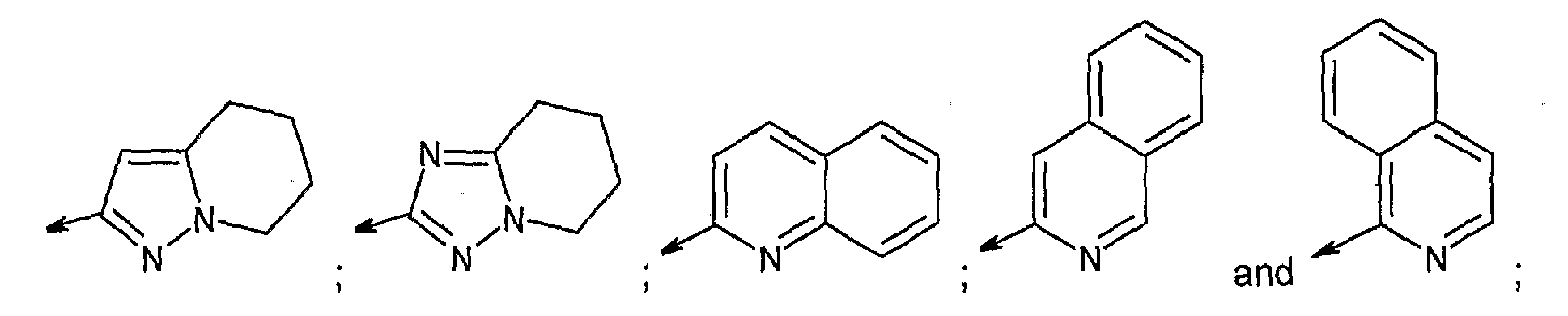
- Preferred are the compounds in the C group wherein
n is an integer from 1 to 3;
or an enantiomer thereof; or an enantiomeric mixture thereof; or a pharmaceutically acceptable salt thereof. - More preferred are the compounds in the C group wherein
n is an integer from 1 to 3;
R9 is hydrogen;
or an enantiomer thereof; or an enantiomeric mixture thereof; or a pharmaceutically acceptable salt thereof. - More preferred are also the compounds in the C group wherein
n is an integer from 1 to 3;
R1 is hydrogen, halogen, cyano, trifluoromethyl, alkoxy, alkylthio or carboxy;
R2 is absent;
or an enantiomer thereof; or an enantiomeric mixture thereof; or a pharmaceutically acceptable salt thereof. - Most preferred are the compounds in the C group, designated as the D group, wherein
n is an integer from 1 to 3;
R1 is hydrogen, halogen, cyano, trifluoromethyl, alkoxy, alkylthio or carboxy;
R2 is absent;
Q combined together with the carbon and nitrogen atoms to which it is attached form a 9-to 10-membered bicyclic heterocycle which is selected from the group consisting of
- Preferred are the compounds in the D group wherein
R5 is (C3-7)cycloalkyl or (C1-4)alkyl substituted by (C1-6)alkoxy, (C3-7)cycloalkyl, (C6-10)aryl or (C5-6)heterocydyl;
or an enantiomer thereof; or an enantiomeric mixture thereof; or a pharmaceutically acceptable salt thereof. - More preferred are the compounds in the D group wherein
R5 is (C3-7)cycloalkyl or (C1-4)alkyl substituted by (C1-6)alkoxy, (C3-7)cycloalkyl, (C6-10)aryl
or (C5-6)heterocyclyl;
R9 is hydrogen;
or an enantiomer thereof; or an enantiomeric mixture thereof; or a pharmaceutically acceptable salt thereof. - Most preferred are the compounds in the D group wherein
R5 is (C3-7)cycloalkyl or (C1-4)alkyl substituted by (C1-6)alkoxy, (C3-7)cycloalkyl, (C6-10)aryl or (C5-6)heterocyclyl in which (C1-4)alkyl is methyl or ethyl, (C1-6)alkoxy is methoxy or ethoxy; and (C6-10)aryl is optionally substituted phenyl;
R9 is hydrogen;
or an enantiomer thereof; or an enantiomeric mixture thereof; or a pharmaceutically acceptable salt thereof. - The compounds of the invention depending on the nature of the substituents possess one or more asymmetric centers. The resulting diastereoisomers, optical isomers, i.e., enantiomers, and geometric isomers, and mixtures thereof, are encompassed by the instant invention. Preferred are the compounds of the present invention wherein the substituent at the carbon atom adjacent to the amide group attains the R-configuration.
- Particular embodiments of the invention are:
- 3-(Benzyl-{4-[(R)-2-cyclopentyl-1-(5-methoxy-thiazolo[5,4-b]pyrid in-2-ylcarbamoyl)-ethyl]-benzenesulfonyl)-amino)-propionic acid;
- 3-[{4-[2-Cyclopentyl-1-([1,3,4]thiadiazol-2-ylcarbamoyl)-ethyl]-benzene-sulfonyl}-(2-methoxyethyl)-amino]-propionic acid;
- 3-(Benzofuran-2-ylmethyl-{4-[(R)-2-cyclopentyl-1-(5-methoxy-thiazolo[5,4-b]pyridin-2-ylcarbamoyl)-ethyl]-benzenesulfonyl}-amino)-propionic acid;
- 3-({4-[2-Cyclopentyl-1-(5-methoxy-thiazolo[5,4-b]pyridin-2-ylcarbamoyl)-ethyl]-benzenesulfonyl}-pyridin-2-ylmethyl-amino)-propionic acid;
- 3-({4-[2-Cyclopentyl-1-(5-methoxy-thiazolo[5,4-b]pyridin-2-ylcarbamoyl)-ethyl]-benzenesulfonyl)-oxazol-2-ylmethyl-amino)-propionic acid;
- 3-[{4-[2-Cyclopentyl-1-(5-methoxy-thiazolo[5,4-b]pyridin-2-ylcarbamoyl)-ethyl]-benzenesulfonyl}-(tetrahydro-furan-2-ylmethyl)-amino]-propionic acid;
- 3-({4-[2-Cyclopentyl-1-(5-methoxy-thiazolo[5,4-b] pyridin-2-ylcarbamoyl)-ethyl]-benzenesulfonyl)-thiophen-2-ylmethyl-amino)-propionic acid;
- 4-[((2-Carboxy-ethyl)-{4-[2-cyclopentyl-1-(5-methoxy-thiazolo[5,4-b]pyridin-2-ylcarbamoyl)-ethyl]-benzenesulfonyl}-amino)-methyl]-benzoic acid;
- 3-(Cyclohexylmethyl-{4-[2-cyclopentyl-1-(5-methoxy-thiazolo[5,4-b]pyridin-2-ylcarbamoyl)-ethyl]-benzenesulfonyl}-amino)-propionic acid;
- 3-[{4-[2-Cyclopentyl-1-(5-methoxy-thiazolo[5,4-b]pyridin-2-ylcarbamoyl)-ethyl]-benzenesulfonyl}-(5-methyl-furan-2-ylmethyl)-amino]-propionic acid;
- 3-[{4-[2-Cyclopentyl-1-(5-methoxy-thiazolo(5,4-b]pyridin-2-ylcarbamoyl)-ethyl]-benzenesulfonyl}-(2,5-dimethyl-furan-3-ylmethyl)-amino]-propionic acid;
- [{4-[2-Cyclopentyl-1-(5-methoxy-thiazolo[5,4-b]pyridin-2-ylcarbamoyl)-ethyl]-benzenesulfonyl}-(5-methyl-furan-2-ylmethyl)-amino]-acetic acid;
- 3-({4-[2-Cyclopentyl-1-(5-methoxy-thiazolo[5,4-b]pyridin-2-ylcarbamoyl)-ethyl]-benzenesulfonyl}-isopropyl-amino)-propionic acid;
- 3-[{4-[2-Cyclopentyl-1-(5-methoxy-thiazolo[5,4-b]pyridin-2-ylcarbamoyl)-ethyl]-benzenesulfonyl}-(2-methoxy-ethyl)-amino]-propionic acid;
- 3-[{4-[2-Cyclopentyl-1-(5-methoxy-1,2-dihydro-thiazolo[5,4-b]pyridin-2-ylcarbamoyl)-ethyl]-benzenesulfonyl}-(1,5-dimethyl-1H-pyrazol-3-ylmethyl)-amino]-propionic acid;
- 3-[{4-[2-Cyclopentyl-1-(5-methoxy-thiazolo[5,4-b]pyridin-2-ylcarbamoyl)-ethyl]-benzenesulfonyl}-(5-methyl-isoxazol-3-ylmethyl)-amino]-propionic acid;
- 3-[{4-[2-Cyclopentyl-1-(5-methoxy-thiazolo[5,4-b]pyridin-2-ylcarbamoyl)-ethyl]-benzenesulfonyl}-(tetrahydro-pyran-4-ylmethyl)-amino]-propionic acid;
- 3-[{4-[2-Cyclopentyl-1-(5-methoxy-thiazolo[5,4-b]pyridin-2-ylcarbamoyl)-ethyl]-benzenesulfonyl}-(4-fluoro-benzyl)-amino]-propionic acid;
- 3-({4-[2-Cyclopentyl-1-(5-methoxy-thiazolo[5,4-b]pyridin-2-ylcarbamoyl)-ethyl]-benzenesulfonyl}-cyclopropylmethyl-amino)-propionic acid;
- ({4-[2-Cyclopentyl-1-(5-methoxy-thiazolo[5,4-b]pyridin-2-ylcarbamoyl)-ethyl]-benzenesulfonyl}-methyl-amino)-acetic acid;
- 3-({4-[2-Cyclopentyl-1-(5-methoxy-thiazolo[5,4-b]pyridin-2-ylcarbamoyl)-ethyl]-benzenesulfonyl}-methyl-amino)-propionic acid;
- 3-[{4-[2-Cyclopentyl-1-(5-methoxy-thiazolo[5,4-b]pyridin-2-ylcarbamoyl)-ethyl]-benzenesulfonyl}-(tetrahydro-pyran-4-yl)-amino]-propionic acid;
- 3-(Cyclohexyl-{4-[(S)-2-cyclopentyl-1-(5-methoxy-thiazolo[5,4-b]pyridin-2-ylcarbamoyl)-ethyl]-benzenesulfonyl)-amino)-propionic acid;
- 3-[{4-[(S)-2-Cyclopentyl-1-(5-methoxy-thiazolo[5,4-b]pyridin-2-ylcarbamoyl)-ethyl]-benzenesulfonyl}-(4-methoxy-phenyl)-amino]-propionic acid;
- 3-({4-[(S)-2-Cyclopentyl-1-(5-methoxy-thiazolo[5,4-b]pyridin-2-ylcarbamoyl)-ethyl]-benzenesulfonyl)-methyl-amino)-propionic acid;
- 3-[{4-[(S)-2-Cyclopentyl-1-(5-methoxy-thiazolo[5,4-b]pyridin-2-ylcarbamoyl)-ethyl]-benzenesulfonyl}-(2-isopropoxy-ethyl)-amino]-propionic acid;
- 3-({4-[(S)-2-Cyclopentyl-1-(5-methoxy-thiazolo[5,4-b]pyridin-2-ylcarbamoyl)-ethyl]-benzenesulfonyl}-thiazol-2-ylmethyl-amino)-propionic acid;
- 3-[{4-[2-Cyclopentyl-1-(5-fluoro-pyridin-2-ylcarbamoyl)-ethyl]-benzenesulfonyl}-(2-methoxyethyl)-amino]-propionic acid;
- 3-[{4-[(R)-2-Cyclopentyl-1-(pyrimidin-2-ylcarbamoyl)-ethyl]-benzenesulfonyl}-(2-methoxyethyl)-amino]-propionic acid;
- 3-[{4-[(R)-2-Cyclopentyl-1-(4-methyl-thiazol-2-ylcarbamoyl)-ethyl]-benzenesulfonyl}-2-methoxy-ethyl)-amino]-propionic acid;
- 3-[{4-[(R)-2-Cyclopentyl-1-(1-methyl)-1H-pyrazol-3-ylcarbamoyl)-ethyl]-benzenesulfonyll-(2-methoxy-ethyl)-amino]-propionic acid; and
- 3-[{4-[(R)-2-Cyclopentyl-1-(pyrimidin-4-ylcarbamoyl)-ethyl]-benzenesulfonyl}-(2-methoxyethyl)-amino]-propionic acid;
or an enantiomer thereof; or an enantiomeric mixture thereof; or a pharmaceutically acceptable salt thereof. - Compounds of formula (I) may be prepared using methods well known in the art, e.g., according to Method A or Method B as outlined herein below.
- Compounds of formula (I) may be obtained by coupling an amine of the formula


- In the coupling reaction cited herein above, an activated derivative of a carboxylic acid, e.g., those corresponding to carboxylic acids of formula (III), include acid chlorides, bromides and fluorides, mixed anhydrides, lower alkyl esters and activated esters thereof, and adducts formed with coupling agents, such as 1-ethyl-3-(3-dimethylaminopropyl)carbodiimide hydrochloride (EDCl), 1-hydroxy benzotriazole (HOBt), O-(1,2-dihydro-2-oxo-1-pyridyl)-N, N, N', N'-tetramethyluronium tetrafluoroborate, benzotriazole-1-yl-oxy-tris-pyrrolidino-phosphonium hexafluorophosphate (PyBOP) and the like. Mixed anhydrides are preferably such from pivalic acid, or lower alkyl hemiesters of carbonic acids, such as ethyl or isobutyl analogs. Activated esters include, for example, succinimido, phthalimido or 4-nitrophenyl esters. The reaction of an activated derivative of a carboxylic acid, e.g., those corresponding to carboxylic acids of formula (III), with an amine, e.g., those of formula (II), may be carried out in the presence of a base, such as pyridine, triethylamine (TEA), diisopropylethylamine (DIEA) or N-methylmorpholine (NMM) in an inert organic solvent, such as dichloromethane (DCM), N,N-dimethylformamide (DMF) or tetrahydrofuran (THF), or a mixture of solvents thereof. Carboxylic acids of formula (III) may be converted to their activated derivatives using methods described herein or according to methods generally known in the art, e.g., a carboxylic acid of formula (III) may be treated with a chlorinating agent, such as thionyl chloride or oxalyl chloride, to afford a corresponding acid chloride thereof, or by the treatment of a coupling agent such as EDCI or HOBt, or a mixture of coupling agents thereof.
- Amines of formula (II) and carboxylic acids of formula (III) are known, or if they are novel they may be prepared using methods well known in the art or as described herein in the illustrative Examples, or modifications thereof. For example, compounds of formula (III) may be prepared by treating an ester of the formula


- A compound of formula (V) may then be treated with an amine of the formula
R6'-(CH2)n-NH-R8' (VI),
or an acid addition salt thereof, wherein n, R5' and R6' have meanings as defined herein above, in the presence of a base, such as pyridine, TEA, DIEA or NMM, in an inert organic solvent, such as DCM, DMF or THF, or a mixture of solvents thereof, to afford a compound of the formula
- A resulting compound of formula (VII) may then be treated with a base, such as sodium hydride, lithium diisopropylamide (LDA) or lithium bis(trimethylsilyl)amide (LHMDS), preferably LDA, followed by addition of an alkylating agent of the formula
R3-(CH2)-Lg (VIII)
wherein R3 has a meaning as defined herein above, and Lg represents a leaving group, such as chloride, bromide, iodide, mesylate, tosylate or triflate, preferably iodide ot triflate, to afford a compound of the formula
- A resulting compound of formula (IX) may then be hydrolyzed, e.g., in the presence of an aqueous base such as sodium, lithium or potassium hydroxide and an organic solvent such as THF or lower alcohol, preferably, methanol or ethanol, to afford a carboxylic acid of formula (III) wherein R3, R4, n, R5' and R6' have meanings as defined herein above.
- A carboxylic acid of formula (III) may then be coupled with an amine of formula (II), or an acid addition salt thereof, under reaction conditions as described herein above to afford a compound of formula (I') wherein R1', R2', R3, R4, n, R5' and R6' have meanings as defined herein above, e.g., via conversion of the acid to the corresponding acid chloride or in the presence of a coupling agent such as EDCI, HOBt or PyBOP, or a mixture of coupling agents thereof.
- Alternatively, compounds of formula (I) may be prepared as outlined herein below.
- Compounds of formula (I) may be obtained by reacting a compound of the formula

R6'-(CH2)n-NH-R5' (VI),
or an acid addition salt thereof, wherein n, R5' and R6' have meanings as defined herein above, in the presence of a base, such as pyridine, TEA, DIEA or NMM, in an inert organic solvent, such as DCM, DMF or THF, or a mixture of solvents thereof, to afford a compound of the formula
- Compounds of formula (X) may be prepared, e.g., by treating a compound of the formula

R3-(CH2)-Lg (VIII)
wherein R3 has a meaning as defined herein above, and Lg represents a leaving group, such as chloride, bromide, iodide, mesylate, tosylate or triflate, preferably iodide or triflate, to afford a compound of the formula
- A resulting compound of formula (XII) may then be hydrolyzed, e.g., in the presence of an aqueous base, such as sodium, lithium or potassium hydroxide and an organic solvent such as THF or lower alcohol, preferably, methanol or ethanol, to afford a carboxylic acid of the formula


- A resulting compound of formula (XIV) may then be converted to a sulfonyl chloride derivative of formula (X) wherein R1', R2', R3 and R4 have meanings as defined herein above, by reduction of the nitro group to the amino group, e.g., using iron powder in the presence of a mixture of acetic acid and a lower alcohol, such as ethanol, followed by diazotization reaction and subsequent treatment with, e.g., sulfur dioxide in the presence of copper(II) chloride and acetic acid.
- A resulting sulfonyl chloride derivative of formula (X) may then be treated with an amine of formula (VI), or an acid addition salt thereof, wherein n, R5' and R6' have meanings as defined herein above, under reaction conditions described herein above to afford a compound of formula (I') wherein R1', R2', R3, R4, n, R5' and R6' have meanings as defined herein above.
- The processes described herein above may be conducted under inert atmosphere, preferably under nitrogen atmosphere.
- In starting compounds and intermediates which are converted to the compounds of the present invention in a manner described herein, functional groups present, such as amino, thiol, carboxyl and hydroxyl groups, are optionally protected by conventional protecting groups that are common in preparative organic chemistry. Protected amino, thiol, carboxyl and hydroxyl groups are those that can be converted under mild conditions into free amino thiol, carboxyl and hydroxyl groups without the molecular framework being destroyed or other undesired side reactions taking place.
- The purpose of introducing protecting groups is to protect the functional groups from undesired reactions with reaction components under the conditions used for carrying out a desired chemical transformation. The need and choice of protecting groups for a particular reaction is known to those skilled in the art and depends on the nature of the functional group to be protected (hydroxyl group, amino group, etc.), the structure and stability of the molecule of which the substituent is a part and the reaction conditions.
- Well-known protecting groups that meet these conditions and their introduction and removal are described, e.g., in McOmie, "Protective Groups in Organic Chemistry", Plenum Press, London, NY (1973); and Greene and Wuts, "Protective Groups in Organic Synthesis", John Wiley and Sons, Inc., NY (1999).
- The above-mentioned reactions are carried out according to standard methods, in the presence or absence of diluent, preferably, such as are inert to the reagents and are solvents thereof, of catalysts, condensing or said other agents, respectively and/or inert atmospheres, at low temperatures, RT or elevated temperatures, preferably at or near the boiling point of the solvents used, and at atmospheric or super-atmospheric pressure. The preferred solvents, catalysts and reaction conditions are set forth in the appended illustrative Examples.
- The invention further includes any variant of the present processes, in which an intermediate product obtainable at any stage thereof is used as starting material and the remaining steps are carried out, or in which the starting materials are formed in situ under the reaction conditions, or in which the reaction components are used in the form of their salts or optically pure antipodes.
- Compounds of the invention and intermediates can also be converted into each other according to methods generally known per se.
- The invention also relates to any novel starting materials, intermediates and processes for their manufacture.
- Depending on the choice of starting materials and methods, the new compounds may be in the form of one of the possible isomers or mixtures thereof, for example, as substantially pure geometric (cis or trans) isomers, diastereomers, optical isomers (enantiomers, antipodes), racemates or mixtures thereof. The aforesaid possible isomers or mixtures thereof are within the purview of this invention.
- Any resulting mixtures of isomers can be separated on the basis of the physicochemical differences of the constituents, into the pure geometric or optical isomers, diastereomers, racemates, for example, by chromatography and/or fractional crystallization.
- Any resulting racemates of final products or intermediate, e.g., acids of formulae (III) and (XIII), can be resolved into the optically pure isomers by known methods, e.g., by separation of the diastereomeric salts thereof, obtainable with an optically active acid or base and liberating the optically active acidic or basic compound, respectively, e.g., acids of formulae (III) and (XIII) can be resolved using optically active 1-phenylethylamine. Similarly, the compounds of the instant invention having a basic moiety may be resolved into their optical isomers, e.g., by fractional crystallization of a salt formed with an optically active acid, e.g., tartaric acid, dibenzoyl tartaric acid, diacetyl tartaric acid, di-O,O'-p-toluoyl tartaric acid, mandelic acid, malic acid or camphor-10-sulfonic acid. Racemic products can also be resolved by chiral chromatography, e.g., high pressure liquid chromatography (HPLC) using a chiral adsorbent.
- Alternatively, optically pure isomers of compounds of the present invention may be obtained by employing chiral reagents. For example, an optical isomer, preferably the R isomer, of compounds of formula (X) may be prepared employing chiral auxiliaries, e.g., the Evans auxiliary, as illustrated herein in the Examples.
- Finally, compounds of the invention are either obtained in the free form, or in a salt form thereof, preferably, in a pharmaceutically acceptable salt form thereof, or as a prodrug derivative thereof.
- Compounds of the instant invention which contain acidic groups may be converted into salts with pharmaceutically acceptable bases. Such salts include alkali metal salts, like sodium, lithium and potassium salts; alkaline earth metal salts, like calcium and magnesium salts; ammonium salts with organic bases, e.g., trimethylamine salts, diethylamine salts, tris(hydroxymethyl)methylamine salts, dicyclohexylamine salts and N-methyl-D-glucamine salts; salts with amino acids like arginine, lysine and the like. Salts may be formed using conventional methods, advantageously in the presence of an ethereal or alcoholic solvent, such as a lower alkanol. From the solutions of the latter, the salts may be precipitated with ethers, e.g., diethyl ether. Resulting salts may be converted into the free compounds by treatment with acids. These or other salts can also be used for purification of the compounds obtained.
- Compounds of the invention, in general, may be converted into acid addition salts, especially pharmaceutically acceptable salts. These are formed, e.g., with inorganic acids, such as mineral acids, e.g., sulfuric acid, phosphoric or hydrohalic acid, or with organic carboxylic acids, such as (C1-4)alkanecarboxylic acids which, e.g., are unsubstituted or substituted by halogen, e.g., acetic acid, such as saturated or unsaturated dicarboxylic acids, e.g., oxalic, succinic, maleic or fumaric acid, such as hydroxycarboxylic acids, e.g., glycolic, lactic, malic, tartaric or citric acid, such as amino acids, e.g., aspartic or glutamic acid, or with organic sulfonic acids, such as (C1-4)alkylsulfonic acids, e.g., methanesulfonic acid; or arylsulfonic acids which are unsubstituted or substituted (for example by halogen). Preferred are salts formed with hydrochloric acid, maleic acid and methanesulfonic acid.
- Prodrug derivatives of any compound of the invention are derivatives of said compounds which following administration release the parent compound in vivo via some chemical or physiological process, e.g., a prodrug on being brought to the physiological pH or through enzyme action is converted to the parent compound. Exemplary prodrug derivatives are, e.g., esters of free carboxylic acids and S-acyl and O-acyl derivatives of thiols, alcohols or phenols, wherein acyl has a meaning as defined herein. Preferred are pharmaceutically acceptable ester derivatives convertible by solvolysis under physiological conditions to the parent carboxylic acid. Such ester derivatives include, but are not limited to, lower alkyl esters, cycloalkyl esters, lower alkenyl esters, benzyl esters, mono- or di-substituted lower alkyl esters, such as the ω-(amino, mono- or di-lower alkylamino, carboxy, lower alkoxycarbonyl)-lower alkyl esters, the α-(lower alkanoyloxy, lower alkoxycarbonyl or di-lower alkylaminocarbonyl)-lower alkyl esters, such as the pivaloyloxymethyl ester and others conventionally used in the art, e.g., a compound of formula (IA) wherein R9 is optionally substituted lower alkyl as described herein above, lower alkenyl, cycloalkyl, aryl or aralkyl, is easily convertible to a compound of formula (IA) wherein R9 is hydrogen.
- In view of the close relationship between the free compounds, the prodrug derivatives and the compounds in the form of their salts, whenever a compound is referred to in this context, a prodrug derivative and a corresponding salt is also intended, provided such is possible or appropriate under the circumstances.
- The compounds, including their salts, can also be obtained in the form of their hydrates, or include other solvents used for their crystallization.
- As described herein above, the compounds of the present invention may be employed for the treatment of conditions mediated by glucokinase activity. Such compounds may thus be employed therapeutically for the treatment of impaired glucose tolerance, type 2 diabetes and obesity.
- The present invention further provides pharmaceutical compositions comprising a therapeutically effective amount of a pharmacologically active compound of the instant invention, alone or in combination with one or more pharmaceutically acceptable carriers.
- The pharmaceutical compositions according to the invention are those suitable for enteral, such as oral or rectal; transdermal and parenteral administration to mammals, including man, for the treatment of conditions mediated by glucokinase activity. Such conditions include impaired glucose tolerance, type 2 diabetes and obesity.
- Thus, the pharmacologically active compounds of the invention may be employed in the manufacture of pharmaceutical compositions comprising an effective amount thereof in conjunction or admixture with excipients or carriers suitable for either enteral or parenteral application. Preferred are tablets and gelatin capsules comprising the active ingredient together with:
- a) diluents, e.g., lactose, dextrose, sucrose, mannitol, sorbitol, cellulose and/or glycine;
- b) lubricants, e.g., silica, talcum, stearic acid, its magnesium or calcium salt and/or polyethyleneglycol; for tablets also
- c) binders, e.g., magnesium aluminum silicate, starch paste, gelatin, tragacanth, methylcellulose, sodium carboxymethylcellulose and or polyvinylpyrrolidone; if desired
- d) disintegrants, e.g., starches, agar, alginic acid or its sodium salt, or effervescent mixtures; and/or
- e) absorbants, colorants, flavors and sweeteners.
- Injectable compositions are preferably aqueous isotonic solutions or suspensions, and suppositories are advantageously prepared from fatty emulsions or suspensions.
- Said compositions may be sterilized and/or contain adjuvants, such as preserving, stabilizing, wetting or emulsifying agents, solution promoters, salts for regulating the osmotic pressure and/or buffers. In addition, they may also contain other therapeutically valuable substances. Said compositions are prepared according to conventional mixing, granulating or coating methods, respectively, and contain about 0.1-75%, preferably about 1-50%, of the active ingredient.
- Suitable formulations for transdermal application include a therapeutically effective amount of a compound of the invention with carrier. Advantageous carriers include absorbable pharmacologically acceptable solvents to assist passage through the skin of the host. Characteristically, transdermal devices are in the form of a bandage comprising a backing member, a reservoir containing the compound optionally with carriers, optionally a rate controlling barrier to deliver the compound of the skin of the host at a controlled and predetermined rate over a prolonged period of time, and means to secure the device to the skin.
- Accordingly, the present invention provides pharmaceutical compositions as described above for the treatment of conditions mediated by glucokinase activity, preferably, impaired glucose tolerance, type 2 diabetes and obesity.
- The pharmaceutical compositions may contain a therapeutically effective amount of a compound of the invention as defined above, either alone or in a combination with another therapeutic agent, e.g., each at an effective therapeutic dose as reported in the art. Such therapeutic agents include:
- a) anti-diabetic agents, such as insulin, insulin derivatives and mimetics; insulin secretagogues such as the sulfonylureas, e.g., Glipizide, glyburide and Amaryl; insulinotropic sulfonylurea receptor ligands such as meglitinides, e.g., nateglinide and repaglinide; thiazolidone derivatives such as glitazones, e.g., pioglitazone and rosiglitazone; protein tyrosine phosphatase-1B (PTP-1 B) inhibitors such as PTP-112; GSK3 (glycogen synthase kinase-3) inhibitors such as SB-517955, SB-4195052, SB-216763, NN-57-05441 and NN-57-05445; RXR ligands such as GW-0791 and AGN-194204; sodium-dependent glucose co-transporter inhibitors such as T-1095; glycogen phosphorylase A inhibitors such as BAY R3401; biguanides such as metformin; alpha-glucosidase inhibitors such as acarbose; GLP-1 (glucagon like peptide-1), GLP-1 analogs such as Exendin-4 and GLP-1 mimetics; modulators of PPARs (peroxisome proliferator-activated receptors), e.g., non-glitazone type PPARy agonists such as N-(2-benzoylphenyl)-L-tyrosine analogues, e.g. GI-262570, and JTT501; DPPIV (dipeptidyl peptidase IV) inhibitors such as LAF237, MK-0431, saxagliptin and GSK23A; SCD-1 (stearoyl-CoA desaturase-1) inhibitors; DGAT1 and DGAT2 (diacylglycerol acyltransferase 1 and 2) inhibitors; ACC2 (acetyl CoA carboxylase 2) inhibitors; and breakers of AGE (advanced glycation end products);
- b) anti-dyslipidemic agents such as 3-hydroxy-3-methyl-glutaryl coenzyme A (HMG-CoA) reductase inhibitors, e.g., lovastatin, pitavastatin, simvastatin, pravastatin, cerivastatin, mevastatin, velostatin, fluvastatin, dalvastatin, atorvastatin, rosuvastatin and rivastatin; HDL increasing compounds such as cholesterol ester transfer protein (CETP) inhibitors, e.g., JTT705; Apo-A1 analogs and mimetics; squalene synthase inhibitors; FXR (farnesoid X receptor) and LXR (liver X receptor) ligands; cholestyramine; fibrates; nicotinic acid; and aspirin;
- c) anti-obesity agents such as phentermine, leptin, bromocriptine, dexamphetamine, amphetamine, fenfluramine, dexfenfluramine, sibutramine, orlistat, dexfenfluramine, mazindol, phentermine, phendimetrazine, diethylpropion, fluoxetine, bupropion, topiramate, diethylpropion, benzphetamine, phenylpropanolamine, ecopipam, ephedrine, and pseudoephedrine; cholesterol absorption modulators such as ZETIA® and KT6-971; and cannabinoid receptor antagonists such as rimonabant; and
- d) anti-hypertensive agents, e.g., loop diuretics such as ethacrynic acid, furosemide and torsemide; angiotensin converting enzyme (ACE) inhibitors such as benazepril, captopril, enalapril, fosinopril, lisinopril, moexipril, perinodopril, quinapril, ramipril and trandolapril; inhibitors of the Na-K-ATPase membrane pump such as digoxin; neutralendopeptidase (NEP) inhibitors; ACE/NEP inhibitors such as omapatrilat, sampatrilat and fasidotril; angiotensin II antagonists such as candesartan, eprosartan, irbesartan, losartan, telmisartan and valsartan, in particular valsartan; renin inhibitors such as ditekiren, zankiren, terlakiren, aliskiren, RO 66-1132 and RO-66-1168; β-adrenergic receptor blockers such as acebutolol, atenolol, betaxolol, bisoprolol, metoprolol, nadolol, propranolol, sotalol and timolol; inotropic agents such as digoxin, dobutamine, and milrinone; calcium channel blockers such as amlodipine, bepridil, diltiazem, felodipine, nicardipine, nimodipine, nifedipine, nisoldipine and verapamil; aldosterone receptor antagonists such as eplerenone; and aldosterone synthase inhibitors such as anastrazole and fadrazole.
- Other specific anti-diabetic compounds are described by Patel Mona in Expert Opin Investig Drugs, 2003, 12(4), 623-633, in the figures 1 to 7, which are herein incorporated by reference. A compound of the present invention may be administered either simultaneously, before or after the other active ingredient, either separately by the same or different route of administration or together in the same pharmaceutical formulation.
- The structure of the therapeutic agents identified by code numbers, generic or trade names may be taken from the actual edition of the standard compendium "The Merck Index" or from databases, e.g., Patents International (e.g. IMS World Publications). The corresponding content thereof is hereby incorporated by reference.
- Accordingly, the present invention provides pharmaceutical compositions comprising a therapeutically effective amount of a compound of the invention in combination with a therapeutically effective amount of another therapeutic agent, preferably selected from antidiabetics, hypolipidemic agents, anti-obesity agents or anti-hypertensive agents, most preferably from antidiabetics or hypolipidemic agents as described above.
- The present invention further relates to pharmaceutical compositions as described above for use as a medicament.
- The present invention further relates to use of pharmaceutical compositions or combinations as described above for the preparation of a medicament for the treatment of conditions mediated by glucokinase activity, preferably, impaired glucose tolerance, type 2 diabetes and obesity.
- Thus, the present invention also relates to a compound of formula (I) for use as a medicament; to the use of a compound of formula (I) for the preparation of a pharmaceutical composition for the prevention and/or treatment of conditions mediated by glucokinase activity, and to a pharmaceutical composition for use in conditions mediated by glucokinase activity comprising a compound of formula (I), or a pharmaceutically acceptable salt thereof, in association with a pharmaceutically acceptable diluent or carrier therefore.
- The present invention further provides a method for the prevention and/or treatment of conditions mediated by glucokinase activity, which comprises administering a therapeutically effective amount of a compound of the present invention.
- A unit dosage for a mammal of about 50-70 kg may contain between about 1 mg and 1000 mg, advantageously between about 5-500 mg of the active ingredient. The therapeutically effective dosage of active compound is dependent on the species of warm-blooded animal (mammal), the body weight, age and individual condition, on the form of administration, and on the compound involved.
- In accordance with the foregoing the present invention also provides a therapeutic combination, e.g., a kit, kit of parts, e.g., for use in any method as defined herein, comprising a compound of formula (I), or a pharmaceutically acceptable salt thereof, to be used concomitantly or in sequence with at least one pharmaceutical composition comprising at least another therapeutic agent, preferably selected from anti-diabetic agents, hypolipidemic agents, anti-obesity agents and anti-hypertensive agents, or a pharmaceutically acceptable salt thereof. The kit may comprise instructions for its administration.
- Similarly, the present invention provides a kit of parts comprising: (i) a pharmaceutical composition of the invention; and (ii) a pharmaceutical composition comprising a compound selected from an anti-diabetic, a hypolipidemic agent, an anti-obesity agent and an anti-hypertensive agent, or a pharmaceutically acceptable salt thereof, in the form of two separate units of the components (i) to (ii).
- Likewise, the present invention provides a method as defined above comprising coadministration, e.g., concomitantly or in sequence, of a therapeutically effective amount of a compound of formula (I), or a pharmaceutically acceptable salt thereof, and a second drug substance, said second drug substance being an anti-diabetic, a hypolipidemic agent, an anti-obesity agent or an anti-hypertensive agent, e.g., as indicated above.
- Preferably, a compound of the invention is administered to a mammal in need thereof.
- Preferably, a compound of the invention is used for the treatment of a disease which responds to modulation of the glucokinase activity.
- Preferably, the condition associated with glucokinase activity is selected from impaired glucose tolerance, type 2 diabetes and obesity.
- Finally, the present invention provides a method or use which comprises administering a compound of formula (I) in combination with a therapeutically effective amount of an anti-diabetic agent, a hypolipidemic agent, an anti-obesity agent or an anti-hypertensive agent.
- Ultimately, the present invention provides a method or use which comprises administering a compound of formula (I) in the form of a pharmaceutical composition as described herein.
- As used throughout the specification and in the claims, the term "treatment" embraces all the different forms or modes of treatment as known to those of the pertinent art and in particular includes preventive, curative, delay of progression and palliative treatment.
- The above-cited properties are demonstrable in vitro and in vivo tests using advantageously mammals, e.g., mice, rats, dogs, monkeys or isolated organs, tissues and preparations thereof. Said compounds can be applied in vitro in the form of solutions, e.g., preferably aqueous solutions, and in vivo either enterally, parenterally, advantageously intravenously, e.g., as a suspension or in aqueous solution. The dosage in vitro may range between about 10-2 molar and 10-9 molar concentrations. A therapeutically effective amount in vivo may range depending on the route of administration, between about 0.1 mg/kg and 1000 mg/kg, preferably between about 1 mg/kg and 100 mg/kg.
- The activity of compounds according to the invention may be assessed by the following methods or methods well-described in the art:
- For example, the glucokinase activation in vitro may be determined by measuring the activation of recombinant GST-GK by a compound of the present invention in the absence or the presence of GKRP, a 68,000 Da protein inhibitor of GK. In these assays, formation of glucose-6-phosphate is coupled directly to the formation of thio-NADH. GST-GK catalyzes the reaction of glucose and Mg-ATP to produce glucose-6-phosphate and ADP. Glucose-6-phosphate dehydrogenase (G6PDH) reduces thionicotinamide (thio-NAD) to thio-NADH. The assay measures the formation of thio-NADH at 405 nM.
- The basic GK assay components are as follows: 25 mM HEPES (pH 7.1), 25 mM KCl, 2.5 mM MgC12, 1 mM ATP (Sigma A-5394), 1 mM DTT, 1 mM thio-NAD (Sigma T-7375), 80 units/mL G6PDH (Sigma G-5885), 10 mM glucose and 110 nM GST-GK. For assessing reversal of GK inhibition by GKRP, 20 µM Fructose-6-phosphate (F-6-P) and 370 nM recombinant GKRP are added to these assay components. Fructose-1-phosphate (F-1-P) at 1 µM is used as a control in the GK/GKRP assay. F-1-P reverses inhibition of GST-GK by GKRP.
- The assay is done in standard, 96-well, round-bottom plates (Corning) and the total assay volume is 25 µL. Test compounds are serially diluted into 100% DMSO and 0.5 µL of diluted compound in 100% DMSO is added to the assay plate. Assay reagents (24.5 µL) are added using a Zymark robotic platform. Buffer, containing HEPES, MgC12, KCI, thio-NAD, G6PDH, glucose and GST-GK, are added (5 µL) using the Zymark 8-channel hand pipet. For the GK/GKRP assay, GKRP and F-6-P are also included. The reaction is then initiated by adding 19.5 µL of buffer containing HEPES, MgC12, KCI, DTT and ATP using the Zymark Reagent Addition Station/Reagent Addition Module. The plates are read kinetically over 10 min at 25°C using a SpectraMax Plus microplate spectrophotometer (Molecular Devices, Sunnyvale, CA) to monitor the increase in optical density at 405 nm. The GK activity in wells containing test compounds is compared with activity in DMSO control wells. The concentration of compound that produces a 50% increase in the activity of GK is calculated and expressed as EC50. A majority of the compounds described in the Examples had an EC50 value less than or equal to 200 µM and preferably less than 50 µM. Most preferable are compounds with EC50 less than 2µM which exhibited at least a 2-fold increase in % GK activation versus control.
- The glucokinase activation in rat hepatocytes may be determined as follows:
- Hepatocytes are isolated by collagenase perfusion of the livers of overnight-fasted male Harlen Sprague-Dawley rats (Charles River Laboratories, Raleigh, NC) as previously described (see Berry et al., J. Cell Biol., Vol. 43, pp. 506-520 (1969)). The cells are washed three times each with 100 mL of glucose-free Dulbecco's Modified Eagle medium (DMEM, Gibco BRL) containing 5% fetal bovine serum (FBS) and then suspended in glucose-free DMEM/5% FBS. Cells are plated in collagen coated 24-well plates (Becton Dickinson) at a density of 3 x 10⁵ cells/well in 1 mL of William's Medium E (Sigma) supplemented with 5% FBS, and incubated at 37°C in 5% CO2/95% air. After cell attachment (-4 h), the medium is replaced with serum-free DMEM containing 5 mM glucose and 10 nM dexamethasone (Sigma), and cells are cultured further for 16-20 h prior to use.
- The rate of glucose phosphorylation is determined by the release of 3H2O from [2-3H]glucose. The medium from the cultured hepatocytes is removed, and the cells are pre-incubated in 150 µL of fresh serum-free DMEM containing 5 mM glucose and compound (1, 10 and 30 µM) or DMSO for 3 h at 37°C. The final concentration of DMSO is 0.2%. The medium is then removed and 150 µL of a fresh mixture of DMEM/5 mM glucose containing compound or DMSO, and 1 µCi of [2-3H]glucose (NEN) is added. As a positive control for stimulation of glucose phosphorylation, cells are pre-incubated in serum-free DMEM/5 mM glucose medium containing DMSO for 3 h and then are incubated for 1 h in labeled glucose medium containing 0.5 mM fructose/DMSO (precursor of F-1-P, AnalaR® from BDH). All conditions are tested in quadruplicate where one well per plate received 200 µL of the appropriate medium plus labeled glucose (instead of 150 µL) of which 50 µL is immediately removed and placed in a 1.2 mL microfuge tube (Costar) containing 10 µL of 1 N HCI. This sample is used as a 0-minute time point for determining background 3H2O release (exchange values). Following the addition of the labeled glucose media, hepatocytes are incubated at 37°C on a slow moving rocker for 1 h.
- On termination of the incubation, 50 µL of the culture medium is collected into microfuge tubes containing 10 µL of 1 N HCI, and determination of 3H2O. The tubes are left uncapped and each is placed inside a 20 mL glass scintillation vial (Wheaton) containing 1.5 mL of deionized water. The vials are capped tightly and incubated at 37°C in a dry incubator for 2 days (3H20 from the reaction mixture will equilibrate with the water in the vial). A standard curve is generated using [3H]H2O (NEN) to correct for exchange. 50 µL aliquots of serial dilutions of the labeled water are added to 10 µL of 1 N HCI and exchange is performed as described for the samples (typically, approximately 90% exchange is observed). The microfuge tubes are then removed from the vials carefully to minimize the removal of any water from the vial and 18 mL of scintillation cocktail (Ready Safe, Beckman Coulter) is then added to each vial. The 3H-label recovered from [2-3H]glucose in the water is determined using a Beckman Model LS500 scintillation counter and the counts (minus the 0-time point) are corrected for recovery of 3H2O. The amount of glucose de-tritiated in nanomoles/h per 106 cells is calculated, and the results are expressed as percent increase over the DMSO control.
- The glucokinase activation in vivo may be determined as follows:
- Male C57BL mice (Jackson Lab, Bar Harbor, ME) are housed 2 per cage in a reversed light cycle room (light on from 8:00 p.m. to 8:00 a.m.) and given access to food and water ad libitum. To induce DIO, the mice are given a high fat diet (D12492 with 60% caloric intake from fat, Research Diets, New Brunswick, NJ) from 4 weeks of age and maintained on the diet before being used. The DIO mice are used at 25 weeks of age. On the day of the study, animals are fasted at 7:30 a.m. Body weight measurement and basal blood sample collection are conducted at 10:00 a.m. Plasma glucose values are then determined. Animals are assigned into five groups (n=7/group) with the means of plasma glucose matched among the groups. At 10:30 a.m. animals are dosed with vehicle (water) or compound in vehicle with a dose volume of 5 ml/kg. The test compound is given at 3, 10, 30, or 100 mg/kg. One hour after vehicle or compound dosing, a blood sample (at 0 min) is taken followed by an oral glucose tolerance test (OGTT) at 1 g/kg (20% glucose in water) and a dose volume of 5 ml/kg. Blood samples are collected at 30, 60 and 120 min following the glucose administration. The animals are refed after the OGTT. Blood samples are taken via tail bleeding. Plasma glucose concentrations are determined using a glucose meter (Ascensia Elite, Bayer Corp., Mishawaka, IN). Blood samples are collected in tubes (Microvette CB300, Aktiengesellschaft & Co., Numbrecht, Germany) which contain EDTA (ethylene diaminetetraacetic acid) to prevent blood clotting. After blood sample collection, the tubes are kept on ice before being centrifuged. Plasma portion of the blood samples is obtained by centrifugation at 10,000 x g for 10 min at 4 °C and then stored at -80 °C. Plasma insulin levels are determined by Luminex assay using Mouse Endocrine Lincoplex kit (Linco Research, Inc., St. Charles, MO). Data are reported as means ± SEM. Statistical analysis is performed using a one-way or two-way analysis of variance (ANOVA) followed by a Tukey post-hoc test to compare the difference among the groups. Statistical significance is accepted at the level of p<0.05.
- Illustrative of the invention, the compound of Example 1 demonstrates an EC50 of about 271 nM in the in vitro assay measuring the activation of recombinant GST-GK. Oral (po) dosing of a compound of Example 1 provides statistically significant glucose lowering with reductions in glucose of 38-53% at different timepoints during the oral glucose tolerance test.
- The following Examples are intended to illustrate the invention and are not to be construed as being limitations thereon. If not mentioned otherwise, all evaporations are performed under reduced pressure, preferably between about 50 mmHg and 100 mmHg. The structure of final products, intermediates and starting materials is confirmed by standard analytical methods, e.g., microanalysis, melting point (m.p.) and spectroscopic characteristics, e.g., MS, IR and NMR. Abbreviations used are those conventional in the art.
-

- (4R,5S)-4-Methyl-5-phenyl-oxazolidin-2-one (25.21 g, 142.269 mmol) is dissolved in anhydrous THF (100 mL) and cooled to -78°C. n-Butyl lithium (2.5 M in hexanes, 62.60 mL, 156.5 mmol) is added dropwise over 10 min. The reaction is stirred at -78°C for 10 min. Phenylacetyl chloride (20.73 mL, 156.5 mmol) is dissolved in anhydrous THF (50 mL) and added dropwise over 10 min. The reaction is stirred at -78°C for 2 h. The reaction is poured onto brine (300 mL) and extracted with ethyl acetate (2 x 250 mL). Extracts are combined, dried over anhydrous sodium sulfate, filtered, and concentrated to a yellow oil which solidified upon standing. Therude product is purified by column chromatography over silica eluting with 5→45% ethyl acetate in hexanes to afford (4R,5S)-4-methyl-5-phenyl-3-phenylacetyl-oxazolidin-2-one as a white solid: 1H NMR (400 MHz, DMSO-D6) δ 0.8 (d, J=6.6 Hz, 3 H) 4.2 (m, 2 H) 4.8 (m, 1 H) 5.9 (d, J=7.3 Hz, 1 H) 7.2 (m, 3 H) 7.3 (m, 5 H) 7.4 (m, 2H); LC/MS 296.2 (M+1), 294.1 (M-1).
- Triflurormethanesulfonic anhydride (6.72 mL, 39.94 mmol) is dissolved in DCM (40 mL) and cooled to -40°C. To this is added dropwise cyclopentanemethanol (4.00 g, 39.94 mmol) dissolved in DCM (10 mL) and anhydrous pyridine (3.23 mL, 39.94 mmol). The reaction is stirred at -40°C for 45 min. The reaction is diluted with hexanes (30 mL) and run through a plug of silica using hexanes (300 mL) as the eluent. Concentration without heating gives trifluoromethanesulfonic acid cyclopentylmethyl ester as a clear, colorless oil that is used immediately.
- The title A compound, (4R,5S)-4-methyl-5-phenyl-3-phenylacetyl-oxazolidin-2-one (5.00 g, 16.93 mmol) is dissolved in anhydrous THF (50 mL) and cooled to -78°C. Lithium bis(trimethylsilyl)amide (1 M in THF, 16.93 mL, 16.93 mmol) is added dropwise over 10 min. To this is added a solution of the title B compound, trifluoromethanesulfonic acid cyclopentylmethyl ester (3.93 g, 16.93 mmol) in anhydrous THF (15 mL). The reaction is stirred at -78°C for 10 min, then the cold bath is removed. The reaction is allowed to stir and warm to RT. After one hour, the reaction is concentrated to remove the solvent, resulting in a yellow oil. This is dissolved in ethyl acetate (300 mL) and washed with water (2 x 200 mL). The organic solution is dried over anhydrous sodium sulfate, filtered, and concentrated to a yellow oil. This is recrystallized from hexanes to afford (4R,5S)-3-((R)-3-cyclopentyl-2-phenyl-propionyl)-4-methyl-5-phenyl-oxazolidin-2-one as a white solid: 1H NMR (400 MHz, DMSO-D6) δ 0.8 (d, J=6.6 Hz, 3 H) 1.1 (d, J=16.2 Hz, 2 H) 1.4 (m, 2 H) 1.5 (d, J=5.8 Hz, 2 H) 1.6 (s, 2 H) 1.8 (d, J=7.1 Hz, 2 H) 2.0 (d, J=13.4 Hz, 1 H) 4.8 (s, 1 H) 5.1 -(s, 1 H) 5.7 (d, J=7.1 Hz, 1 H) 7.3 (s, 1 H) 7.4 (m, 9 H); LC/MS 378.2 (M+1).
- Lithium hydroxide monohydrate (1.28 g , 30.6 mmol) is suspended in THF (50 mL) and cooled to 0°C. Hydrogen peroxide (50 wt% in water, 2.81 mL, 91.79 mmol) is added dropwise. Reaction is stirred at 0°C for 15 min and the title C compound, (4R,5S)-3-((R)-3-cyclopentyl-2-phenyl-propionyl)-4-methyl-5-phenyl-oxazolidin-2-one (3.85 g, 10.2 mmol) is added in five separate portions, allowing portions to dissolve completely between additions. The reaction is allowed to stir and warm to RT overnight. The reaction is then concentrated to a sticky white solid. This is dissolved in ethyl acetate (25 mL)/1 N HCI (25 mL). The organic solution is dried over anhydrous sodium sulfate, filtered, and concentrated to afford the crude product as a yellow oil. The crude product is chromatographed over silica eluting with 5→65% ethyl acetate in hexanes to afford (R)-3-cyclopentyl-2-phenyl-propionic acid as a white solid: 1H NMR (400 MHz, CDCl3) δ 1.1 (m, J=11.6, 7.8, 7.8, 3.9 Hz, 2 H) 1.5 (m, 2 H) 1.6 (m, 2 H) 1.7; LC/MS 217.2 (M-1).
- Potassium thiocyanate (156 g, 1600 mmol) is dissolved in acetic acid (1400 mL) and cooled to 0°C. 6-Bromo-pyridin-3-ylamine (50 g, 400 mmol) is dissolved in acetic acid (100 mL) and added dropwise over 10 min. Bromine (25 mL, 480 mmol) is dissolved in acetic acid (100 mL) and added dropwise over 10 min. The reaction is allowed to stir and warm to RT overnight. Acetic acid is removed via concentration. The resulting residue is poured into water (1 L) and adjusted to pH = 7 with 1 N sodium hydroxide solution. This is extracted with ethyl acetate. Extracts are combined, washed with brine, and concentrated to a brown sludge. Recrystallization from methanol affords 5-methoxy-thiazolo[5,4-b]pyridin-2-ylamine as a brown solid: 1H NMR (400 MHz, DMSO-D6) δ 3.8 (s, 3 H) 6.7 (d, J=8.8 Hz, 1 H) 7.4 (s, 2 H) 7.6 (d, J=8.6 Hz, 1 H); LC/MS 182.3 (M+1),180.4 (M-1).
- The title D compound, (R)-3-cyclopentyl-2-phenyl-propionic acid (1.66 g, 7.605 mmol) is dissolved in thionyl chloride (15 mL) and heated at 50°C for 1.5 h. The reaction is then cooled to RT and concentrated to afford a yellow oil. This is dissolved in anhydrous THF (10 mL) and added dropwise to a solution of the title E compound, 5-methoxy-thiazolo[5,4-b]pyridin-2-ylamine (1.38 g, 7.605 mmol) in anhydrous pyridine (10 mL) at 0°C. The reaction is allowed to stir and warm to RT. After 2 h, the reaction is concentrated to remove the THF and most of the pyridine. The resulting brown oil is dissolved in ethyl acetate (250 mL)/1 N HCl (250 mL) and extracted further with ethyl acetate. The combined organic layer is dried over anhydrous sodium sulfate, filtered, and concentrated to afford the crude product as a brown oil. This is chromatographed over silica eluting with 5→60% ethyl acetate in hexanes to afford (R)-3-cyclopentyl-N-(5-methoxy-thiazolo[5,4-b]pyridin-2-yl)-2-phenyl-propionamide as a yellow foam: 1H NMR (400 MHz, DMSO-D6) δ 1.1 (m, 2 H) 1.4 (dd, J=7.2, 4.7 Hz, 2 H) 1.6 (m, 3 H) 1.7 (m, 3 H) 2.1 (m, 1 H) 3.9 (m, 4 H) 6.9 (d, J=8.8 Hz, 1 H) 7.3 (m, 1 H) 7.4 (m, 4 H) 8.0 (d, J=8.6 Hz, 1 H) 12.5 (s, 1 H); LC/MS 382.1 (M+1), 380.2 (M-1).
- Chlorosulfonic acid (20 mL) is cooled to 0°C. To this is added a solution of the title.F compound, (R)-3-cyclopentyl-N-(5-methoxy-thiazolo[5,4-b]pyridin-2-yl)-2-phenyl-propionamide (2.53 g, 6.632 mmol) in DCM (10 mL). The reaction is allowed to stir and warm to RT over 2.5 h. The reaction is then added dropwise to crushed ice (400 mL) and extracted with DCM (3 x 100 mL). Extracts are combined, dried over anhydrous sodium sulfate, filtered, and concentrated to give 4-[(R)-2-cyclopentyl-1-(5-methoxy-thiazolo[5,4-b]pyridin-2-ylcarbamoyl)-ethyl] benzenesulfonyl chloride as a yellow foam. Product is isolated as a 80:20 mixture of the desired para product and undesired meta product: 1H NMR (400 MHz, DMSO-D6).δ 1.1 (s, 2 H) 1.4 (d, J=4.8 Hz, 1 H) 1.4 (s, 1 H) 1.5 (m, 3 H) 1.7 (s, 2 H) 1.8 (d, J=13.4 Hz, 1 H) 2.1 (m, 1 H) 3.9 (s, 3 H) 4.0 (s, 1 H) 6.9 (d, J=8.6 Hz, 1 H) 7.3 (m, 2 H) 7.6 (d, J=8.1 Hz, 2 H) 8.0 (d, J=8.6 Hz, 1 H) 14.3 (s, 2 H); LC/MS 480.2 (M+1), 478.3 (M-1).
- Benzylamine (1 g, 9.33 mmol) is dissolved in ethanol (25 mL), to which tert-butyl acrylate (1.20 g, 9.33 mmol) is added. The reaction is stirred at RT overnight and then concentrated to a crude yellow oil. This material is purified via flash chromatography (2→20% methanol in ethyl acetate) to afford 3-benzyl amino propionic acid tert butyl ester as a clear oil: 1H NMR (400MHz, CDCl3) δ 1.44 (s, 9H) 1.64 (s, 1 H) 2.44 (m, 2H) 2.85 (m, 2H) 3.79 (m, 2H) 7.24 (m, 1H) 7.31 (m, 4H).
- The title G compound, 4-[(R)-2-cyclopentyl-1-(5-methoxythiazole[5,-4-b]pyridin-2-ylcarbomyl)ethyl] benzene sulfonyl chloride (0.301 g, 0.627 mmol) is dissolved in DCM (10 mL), to which the title H compound, 3 benzyl amino propionic acid tert butyl ester (0.148 g, 0.627 mmol) and DIEA (0.162 g, 1.254 mmol) in DCM are added. The reaction mixture is stirred at RT for one hour and then concentrated. The residue is partitioned between 1 N HCI / ethyl acetate. The organic layer is dried over magnesium sulfate, filtered and concentrated to afford a crude yellow oil. This material is purified via flash chromatography (10% ethyl acetate in hexanes → ethyl acetate) to afford a pale yellow foam. This material is separated from the meta isomer (derived from compound G) by chiral HPLC (20% ethanol in hexanes) to afford 3-(benzyl-{4-[(R)-2-cyclopentyl-1-(5-methoxy-thiazolo[5,4-b]pyridin-2-ylcarbamoyl)-ethyl]-benzenesulfonyl}-amino)-propionic acid tert-butyl ester as a white foam: 1H NMR (400MHz, CDCl3) δ 1.16 (m, 2H) 1.35 (s, 9H) 1.51 (m, 2H) 1.64 (m, 3H) 1.76 (m, 2H) 1.96 (m, 1H) 2.26 (m, 1H) 2.36 (m, 2H) 3.40 (m, 2H) 3.69 (m, 1H) 4.00 (s, 3H) 4.36 (s, 2H) 6.81 (m, 1H) 7.28 (m, 5H) 7.49 (m, 2H) 7.82 (m, 3H) 8.65 (s, 1H); LC/MS 679.6 (M+1), 677.6 (M-1).
- The title l compound, 3-(benzyl-{4-[(R)-2-cyclopentyl-1-(5-methoxy-thiazolo[5,4-b]pyridin-2-ylcarbamoyl)-ethyl]-benzenesulfonyl}-amino)-propionic acid tert-butyl ester (0.064 g, 0.0942 mmol) is dissolved in methanol (5 mL), to which a solution of sodium hydroxide (0.004 g, 0.0942 mmol) in water (2 mL) is added. The reaction mixture is stirred at RT overnight. The reaction mixture is then concentrated and the residue is partitioned between 1 M HCl / ethyl acetate. The organic layer is dried over magnesium sulfate, filtered and concentrated to afford 3-(benzyl-{4-[(R)-2-cyclopentyl-1-(5-methoxy-thiazolo[5,4-b]pyridin-2-ylcarbamoyl)-ethyl]-benzenesulfonyl}-amino)-propionic acid as a white foam: 1H NMR (400MHz - CDC13) δ 1.17 (m, 2H) 1.50 (m, 2H) 1.66 (m, 4H) 1.78 (m, 1H) 2.28 (m, 1H) 2.43 (m, 2H) 3.23 (m, 1H) 3.50 (m, 1H) 3.85 (m, 2H) 4.00 (s, 3H) 4.37 (m, 1H) 4.77 (m, 1H) 6.79 (m, 1H) 7.36 (m, 5H) 7.52 (m, 2H) 7.67 (m, 1H) 7.95 (m, 2H); LC/MS 623.3 (M+1), 621.4 (M-1). EC50 in primary enzyme assay 0.27µM
-

- To a 500 mL round bottom flask containing 250 mL of 9:1 THF/DMPU at -78°C is added 17 mL DIEA followed by rapid addition of 49 mL of 2.5 M n-BuLi/hexanes. After 10 min at - 78°C, a solution of ethyl phenylacetate (17.0 g,113 mmol) in 50 mL of 9:1 THF/DMPU is added dropwise over 15-20 min. A yellow solution results, and the reaction mixture is stirred at -78°C for 30-45 min. A solution of 26.7 g (115 mmol) of freshly prepared cyclopentyl triflate (title B compound in Example 1) in 25 mL 9:1 THF/DMPU is added dropwise over 10-15 min. The mixture is then stirred over 2-3 h to ambient temperature. The reaction is quenched into 300 mL of 1 N HCI and extracted 3 times with methyl-t-butylether (MTBE). The combined extracts are washed with saturated NaCl and dried over anhydrous magnesium sulfate. Filtration and evaporation afford crude product as a yellow oil. Flash chromatography over silica gel eluting with 4:1 hexane/MTBE affords 3-cyclopentyl-2-phenylpropionic acid methyl ester as a light yellow oil: 1H NMR (400 MHz, CDC13) δ1.1 (m, 2H), 1.3 (m, 1H), 1.50 (m, 2H), 1.6 (m, 2H), 1.7 (m, 2H), 2.1 (dt, J =13.4, 7.7 Hz, 1H), 3.60 (m, 1H), 3.64 (s, 3H), 7.3 (m, 5H); LC/MS 233 (M+1).
- To title A compound, 3-cyclopentyl-2-phenylpropionic methyl ester (13.0 g, 56 mmol) in 100 mL of methanol is added a solution of 5.6 g (140 mmol) of NaOH in 8 mL of water. The 2H), 2.1 (m, 2H), 2.2 (m, 3H), 2.4(m, 3H), 2.4 (m,1H), 4.2 (t, J=7.7 Hz, 1H), 7.9 (m, 5H); LC/MS 236 (M+NH4 +).
- To the title B compound, 3-cyclopentyl-2-phenylpropionic acid (3.1 g,14.2 mmol) is added 10 mL of thionyl chloride and one drop of DMF. The reaction mixture is stirred at ambient temperature for 2 h. The excess thionyl chloride is evaporated and the residue is twice treated with toluene and evaporated to yield 3-cyclopentyl-2-phenylpropionyl chloride as an orange-yellow oil which is sed as such without further purification.
- To 2-amino-1,3,4-thiadiazole (220 mg, 21 mmol), 0.4 mL DIEA and 7 mL of DCM is added a solution of the title C compound, 3-cyclopentyl-2-phenylpropionyl chloride (500 mg, 21 mmol) in 2 mL of DCM. The mixture is stirred at ambient temperature for 2-3 h, the mixture is evaporated, and the residue is treated with 10 mL 1 N HCI and extracted twice with ethyl acetate. The combined extracts are washed with brine, saturated sodium bicarbonate solution, and brine and dried over anhydrous magnesium sulfate. Filtration and evaporation afford 3-cyclopentyl-2-phenyl-N-[1,3,4]thiadiazol-2-yl-propionamide as an orange foam: 1H NMR (400 MHz, DMSO-d6)δ11 (m, 2H), 1.4 (m, 2H), 1.5 (m, 3H), 1.7(m, 3H), 2.1 (ddd, J=13.3, 7.8, 7.7 Hz, 1H), 4.0 (dd, J=8.1, 7.1 Hz, 1H), 7.2 (s, 1H), 7.3 (m, 4H), 9.1 (s, 1H), 12.8 (s, 1H); LC/MS 302 (M+1), 300 (M-1).
- To 5 mL of chlorosulfonic acid in an ice bath at 0°C is added dropwise title D compound, 3-cyclopentyl-2-phenyl-N-[1,3,4]thiadiazol-2-yl-propionamide (200 mg, 0.66 mmol) in 2 mL of DCM. The reaction is stirred at ambient temperature for 2-3 h until an orange color persists. The reaction is carefully quenched into solid ice, extracted with ethyl acetate and dried over anhydrous magnesium sulfate. The reaction is filtered and reduce to a greenish resin which is used as such in the next step.
- To t-butyl N-(2-methoxyethyl)propionate (110 mg, 0.058 mmol) and 0.20 mL of DIEA in 8 mL of DCM is added title E compound, 4-[2-cyclopentyl-1-(1,3,4)thiadiazol-2-ylcarbamoyl)-ethyl]benzenesulfonyl chloride (230 mg, 0.57 mmol). The mixture is stirred at ambient temperature for one hour and DCM is evaporated. The residue is treated with 10 mL of 1 N HCI and extracted with ethyl acetate. The organic extract is washed successively with brine, saturated sodium bicarbonate, and brine. The organic layer is dried over anhydrous magnesium sulfate, filtered and evaporated to a brown oil. This is purified using a Biotage 40M column eluted with 1:1-hexane:ethyl acetate to provide 3-[{4-[2-cyclopentyl-1-([1,3,4]thiadiazol-2-ylcarbamoyl)-ethyl]-benzenesulfonyl)-(2-methoxy-ethyl)-amino]-propionic acid tert-butyl ester as a light orange foam: 1H NMR (400 MHz, DMSO-d6) δ 1.1 (m, 1H), 1.4 m, 5H), 1.5 (m, 1H), 1.7 (m, 1H), 2.4 (t, 7.3 Hz, 1H), 3.3 (t, J=5.7 Hz, 1H), 3.3 (m, 5H), 7.61 (d, J=8.3 Hz, 2H), 7.79 (d, J=8.3 Hz, 2H), 9.16 (s, 1H), 12.89 (s, 1H); LC/MS 567 (M+1), 565 (M-1).
- To 75 mg (0.133 mmol) of title F compound, 3-[{4-[2-cyclopentyl-1-([1,3,4]thiadiazol-2-ylcarbamoyl)-ethyl]-benzenesulfonylj-(2-methoxy-ethyl)-amino]-propionic acid tert-butyl ester is added 2 mL of DCM and 0.5 mL of trifluoroacetic acid. The reaction mixture is stirred at ambient temperature for one hour. The reaction is evaporated to a brownish resin and subsequently dissolved in ether and decanted from some insoluble material. The organic layer is evaporated to a light orange resin which is dissolved in 2 mL methanol in a 50 mL round bottom flask. Aqueous potassium hydroxide (0.265 mL of 0.5094 M potassium hydroxide solution) is added and stirred for 30 min. The methanol is evaporated, 8 mL of water added, and the mixture lyophilized to afford 3-[{4-[2-cyclopentyl-1-([1,3,4]thiadiazol-2-ylcarbamoyl)-ethyl]-benzenesulfonyl}-(2-methoxy-ethyl)-amino]-propionic acid as a light orange-brown solid: 1H NMR (400 MHz, DMSO-d6) δ 1.1 (m, 1H), 1.4 (m, 1H), 1.6 (m, 2H), 1.7 (ddd, J=13.1, 6.9, 6.7 Hz, 2H), 2.1 (ddd, J=11.2, 8.2, 7.8, 2H), 3.2 (s, 2H), 3.2 (m, 3H), 3.7 (t, J=7.5 Hz, 1H), 7.56 (d, J=8.3, 2H), 7.63 (d, J=8.3 Hz, 2H), 8.58 (s, 1H); L/MS 511 (M+1), 509 (M-1). EC50 in primary enzyme assay 50µM.
-

- To a 1 L round bottom flask containing 250 mL of 9:1 THF/DMPU at -78C are added under nitrogen 11 mL (78.6 mmol) anhydrous DIEA followed by rapid addition of 32 mL of 2.5 M n-BuLi in hexanes. After 10 min at -78°C a solution of 15.4 g (74 mmol) of p-nitrophenylacetic acid, ethyl ester in 100 mL of 9:1 THF/DMPU is added dropwise over 30 min. A deep purple solution results, and the reaction mixture is stirred at -78°C for 30 min and then cyclopentyl methyl iodide (17.6 g, 78 mmol) in 50 mL of 9:1 THF/DMPU is added. The reaction is stirred while warming slowly to RT overnight. The mixture is poured into 1 L of 1 N HCI and extracted twice with MTBE. The combined MTBE extracts are washed with brine, dried over anhydrous magnesium sulfate, filtered and reduced to an orange oil. Flash chromatography over silica eluting with 4:1 hexane/MTBE affords 3-cyclopentyl-2-(4-nitro-phenyl)-propionic acid ethyl ester as an orange oil: 1H NMR (400 MHz, CDCl3) δ 1.0-1.1 (m, 2H), 1.2 (t, 3H, J=7.2), 1.4-1.8 (m, 5H), 1.8-1.9 (m, 2H), 2.1-2.25 (m, 2H), 3.74 (t, 1H, J=7.8), 4.1 (m, 2H), 7.51 (d, 2H, J=8.8), 8.19 (d, 2H, J=8.8); LC/MS 290 (M-1).
- The title A compound , 3-cyclopentyl-2-(4-nitro-phenyl)-propionic acid ethyl ester (3.6 g, 12.3 mmol) is dissolved in 25 mL of methanol and aqueous NaOH (0.70 g, 17.5 mmol in 4 mL of water) is added and the mixture is stirred at RT overnight. The methanol is removed under reduced pressure and the residue is diluted with 100 mL of water and extracted with ether. The aqueous layer is then acidified with 1 N HCI and then extracted with ethyl acetate. The combined ethyl acetate layers are dried over anhydrous magnesium sulfate, filtered and reduced under vacuum to a crude orange oil. The crude oil is triturated with 100 mL of hexane/10-15mL of ether to produce 3-cyclopentyl-2-(4-nitro-phenyl)-propionic acid as a solid: 1H NMR (400 MHz, CDCl3) δ 1.0-1.1 (m, 2H), 1.4-1.8 (m, 5H), 1.8-1.9 (m, 2H), 2.1-2.25 (m, 2H), 3.74 (t, 1H, J=7.8), 7.51 (d, 2H, J=8.8), 8.19 (d, 2H, J=8.8); LC/MS 218 (-CO2 M-1), 279 (M+NH4 +).
- The title B compound, 3-cyclopentyl-2-(4-nitro-phenyl)-propionic acid (7.5 g, 28.5 mmol) is dissolved in 25 mL of thionyl chloride and a drop of DMF and the mixture stirred at RT for 5-6 h. The excess of thionyl chloride is removed under reduced pressure. The residue is then taken up in DCM and added dropwise to a solution of the title E compound in Example 1, 5-methoxy-thiazolo[5,4-b]pyridin-2-ylamine (5.2 g, 28.5 mmol) in 25 mL of pyridine. The reaction mixture is stirred for 5 h before being evaporated to remove the pyridine. The residue is partitioned between ethyl acetate and brine, extracted with ethyl acetate. The combined organic layers are washed with saturated sodium bicarbonate, brine, dried over anhydrous magnesium sulfate, filtered and then reduced to an orange-brown solid. This is then vacuum dried to afford 3-cyclopentyl-N-(5-methoxy-thiazolo[5,4-b]pyridin-2-yl)-2-(4-nitro-phenyl)-propionamide as a foam: 1H NMR (400 MHz, CDCl3) δ 1.0-1.1 (m, 2H), 1.4-1.8 (m, 5H), 1.8-1.9 (m, 2H), 2.1-2.25 (m, 2H), 3.6 (t, 1H, J=7.8), 4.01 (s, 3H), 6.8 (d, 1H, J=8.8), 7.4 (d, 2H, J=8.6), 7.8 (d, 1H, J=8.8 Hz), 8.19 (d, 2H, J=8.6 Hz), 9.3 (s, 1H); LC/MS 427 (M+1).
- The title C compound, 3-cyclopentyl-N-(5-methoxy-thiazolo[5,4-b]pyridin-2-yl)-2-(4-nitrophenyl)-propionamide (12 g, 28.2 mmol) is diluted with 160 mL of ethanol and 150 mL acetic acid. 8 g of iron powder (325 mesh, 0.14 mol) is added and the mixture heated to reflux. Once reflux begins the mixture is stirred vigorously and then heating is discontinued and the mixture is allowed to cool slowly. The solvents are removed and the residue is treated with 250 mL of water. Saturated sodium bicarbonate ia added carefully to bring the mixture to a pH of 8-9. The mixture is extracted with ethyl acetate, washed with brine, dried and evaporated to give an orange solid which is triturated from hexane. The resulting solid is collected by filtration to afford 2-(4-amino-phenyl)-3-cyclopentyl-N-(5-methoxy-thiazolo[5,4-b]pyridin-2-yl)-propionamide: 1H NMR (400 MHz, CDCl3) δ 1.0-1:1 (m, 2H), 1.4-1.8-(m, 5H), 1.8-1.9 (m, 2H), 2.1-2.25 (m, 2H), 3.6 (t, 1H, J=7.8), 3.98 (s, 3H), 6.7 (d, 1H, J=8.8), 6.8 (d, 2H, J=8.6), 7.2 (d, 2H, J=8.6), 7.8 (d, 1H, J=8.8); LC/MS 397 (M+1).
- The title D compound, 2-(4-amino-phenyl)-3-cyclopentyl-N-(5-methoxy-thiazolo[5,4-b]pyridin-2-yl)-propionamide (2.0 g, 5.1 mmol) is dissolved in 50 mL of acetic acid and 20 mL of concentrated HCI and the mixture is cooled to 0°C. A solution of 0.35 g (5.1 mmol) of NaNO2 in 5 mL of water is added dropwise and the mixture is stirred for 30 min. The resulting yellow solution is then added to 180 mL of the Green Solution (prepared by bubbling 74 g of sulfur dioxide gas into 740 mL of glacial acetic acid followed by addition of 30 g of CuCl2 in 35-40 mL water. The resulting mixture is filtered through filter paper to obtain a clear green solution) and the mixture is stirred at RT overnight (the initial black-green solution transforms to a light green solution after 24 h). The resulting mixture is poured onto 500 g of ice and the precipitated solids are collected by filtration, washed with water and then dissolved in ethyl acetate, washed with brine, dried over anhydrous magnesium sulfate, filtered and evaporated to afford a yellow foam. This material is flash chromatographed over silica eluting with 7:3 hexane/ethyl acetate to afford 4-[2-cyclopentyl-1-(5-methoxy-thiazolo[5,4-b]pyridin-2-ylcarbamoyl)-ethyl]-benzenesulfonyl chloride as a stable yellow foam: 1H NMR (400 MHz, CDCl3) δ 1.0-1.1 (m, 2H), 1.4-1.8 (m, 5H), 1.8-1.9 (m, 2H), 2.1-2.25 (m, 2H), 3.7 (t, 1H, J=7.8), 4.01 (s, 3H), 6.8 (d, 1H, J=8.8), 7.5 (d, 2H, J=8.6), 7.8 (d, 1H, J=8.8), 8.19 (d, 2H, J=8.6), 9.3 (s, 1H); LC/MS 480 (M+1).
- Benzofuran-2-yl-methanol (450 mg, 3.037 mmol) is dissolved in THF (100 mL). Triphenylphosphine (956 mg, 3.645 mmol) and phthalamide (536 mg, 3.645 mmol) are added in one portion. The reaction is cooled to 0°C. Di-tert-butyl azodicarboxylate (839 mg, 3.645 mmol) is dissolved in THF (10 mL) and added dropwise. The reaction is allowed to warm to RT overnight and the solvent is removed by rotary evaporation. The resulting orange oil is triturated in methanol and filtered to afford 2-benzofuran-2-ylmethyl-isoindole-1,3-dione as a white solid: 1H NMR (400 MHz, DMSO-D6) δ 4.9 (s, 2 H) 6.87 (s, 1 H) 7.2 (m, 2 H) 7.5 (m, 2 H) 7.9 (m, 4 H); LC/MS 278.1 (M+1).
- The title F compound, 2-benzofuran-2-ylmethyl-isoindole-1,3-dione (1 g, 3.606 mmol) is slurried in methanol (150 mL). Hydrazine hydrate (271 mg, 5.410 mmol) is added and the reaction heated at 50°C for 2.5 h. A solution is formed during heating. The reaction is then cooled to RT and concentrated to afford a white foam. This is dissolved in 1 N sodium hydroxide solution and ethyl acetate. The organic layer is separated, dried over anhydrous sodium sulfate, filtered, and concentrated to afford benzofuran-2-yl-methylamine as a yellow solid: 1H NMR (400 MHz, CDCl3) δ 4.0 (s, 2 H) 6.5 (s, 1 H) 7.2 (m, 2 H) 7.4 (d, J=7.8 Hz, 1 H) 7.5 (d, J=7.6 Hz, 1 H); LC/MS 131.1 (M+1).
- The title G compound, benzofuran-2-yl-methylamine (290 mg, 1.970 mmol) is dissolved in ethanol (50 mL). To this is added benzyl acrylate (352 mg, 2.167 mmol). The reaction is stirred at RT overnight, then concentrated to afford the crude product as a yellow oil. This is chromatographed using 20% ethyl acetate in hexanes → ethyl acetate to afford the purified product as a pale yellow oil: 1H NMR (400 MHz, CDCl3) δ 2.6 (t, J=6.4 Hz, 2 H) 3.0 (t, J=6.4 Hz, 2 H) 3.9 (s, 2 H) 5.1 (s, 2 H) 6.5 (d, J=1.0 Hz, 1 H) 7.2 (m, 2 H) 7.3 (m, 5 H) 7.4 (m, 1 H) 7.5 (dd, J=7.5, 1.1 Hz, 1 H); LC/MS 310.1 (M+1).
- The title E compound, 4-[2-cyclopentyl-1-(5-methoxy-thiazolo[5,4-b]pyridin-2-ylcarbamoyl)-ethyl]-benzenesulfonyl chloride (1.208 mg, 2.517 mmol) is added in one portion to a solution of the title H compound, 3-[(benzofuran-2-ylmethyl)-amino]-propionic acid benzyl ester (856 mg, 2.768 mmol) and TEA (388 µL, 2.768 mmol) in DCM, and stirred at RT overnight. The reaction is concentrated to afford a green oil. Purification via column chromatography eluting with10% ethyl acetate in hexanes → ethyl acetate afforded the racemic product as a tan solid (750 mg). This is separated by chiral prep HPLC to afford the desired steroisomer of 3-(benzofuran-2-ylmethyl-{4-[(R)-2-cyclopentyl-1-(5-methoxy-thiazolo[5,4-b]pyridin-2-ylcarbamoyl)-ethyl]-benzenesulfonyl}-amino)-propionic acid benzyl ester as a white solid: 1H NMR (400 MHz, DMSO-D6) δ 1.1 (m, 2 H) 1.4 (dd, J=7.2, 4.7 Hz, 2 H) 1.6 (dt, J=14.9, 7.5 Hz, 3 H) 1.7 (ddd, J=13.4, 7.1, 6.8 Hz, 3 H) 2.1 (ddd, J=13.1, 7.8, 7.6 Hz, 1 H) 2.6 (m, 2 H) 3.4 (m, 2 H) 3.9 (s, 3 H) 4.0 (t, J=7.6 Hz, 1 H) 4.6 (d, J=11.4 Hz, 2 H) 5.0 (s, 2 H) 6.7 (s, 1 H) 6.9 (m, 1 H) 7.1 (m, 2 H) 7.3 (m, 6 H) 7.5 (m, 1 H) 7.6 (d, J=8.3 Hz, 2 H) 7.8 (d, J=8.3 Hz, 2 H) 8.0 (d, J=8.8 Hz, 1 H) 12.7 (s, 1 H); LC/MS 753.6 (M+1), 751.7 (M-1).
- The title I compound, 3-(benzofuran-2-ylmethyl-{4-[(R)-2-cyclopentyl-1-(5-methoxy-thiazolo[5,4-b]pyridin-2-ylcarbamoyl)-ethyl]-benzenesulfonyl}-amino)-propionic acid benzyl ester (280 mg, 0.372 mmol) is dissolved in THF. To this is added a solution of sodium hydroxide (22 mg, 0.558 mmol) in water. The reaction is stirred at RT overnight. LC/MS indicates ∼80% reaction completion and, therefore, more sodium hydroxide (10 mg, 0.250 mmol) is added. After 2 h of stirring at RT, the reaction is acidified to pH 1 with concentrated hydrochloric acid, then concentrated to remove solvent. The residue is diluted with ethyl acetate and water. The organic layer is separated, dried over anhydrous sodium sulfate, filtered, and concentrated to afford the crude product as a yellow foam. Purifiaction by preparative HPLC affords 3-(benzofuran-2-ylmethyl-{4-[(R)-2-cyclopentyl-1-(5-methoxy-thiazolo[5,4-b]pyridin-2-ylcarbamoyl)-ethyl]-benzenesulfonyl}-amino)-propionic acid as a white solid: 1H NMR (400 MHz, DMSO-D6) δ 1.4 (m, 2 H) 1.6 (m, 3 H) 1.7 (m, 3 H) 2.1 (m, 1 H) 3.35 (m, 1 H) 3.9 (s, 3 H) 4.0 (m, 1 H) 4.6 (s, 2 H) 6.7 (s, 1 H) 6.9 (d, J=8.8 Hz, 1 H) 7.1 (m, 2 H) 7.3 (m, 2 H) 7.5 (dt, J=4.3, 2.1 Hz, 1 H) 7.6 (d, J=8.3 Hz, 2 H) 7.8 (d, J=8.6 Hz, 2 H) 8.0 (d, J=8.8 Hz, 1 H) 12.7 (s, 1 H); LC/MS 663.5 (M+1), 661.5 (M-1). EC50 in primary enzyme assay 0.22µM.
- The following examples may be prepared by a skilled artisan using the appropriated method described herein above.
- 4-1 3-({4-[2-Cyclopentyl-1-(5-methoxy-thiazolo[5,4-b]pyridin-2-ylcarbamoyl)-ethyl]-benzenesulfonyl}-pyridin-2-ylmethyl-amino)-propionic acid: MS MH+ 624; 1H NMR (400 MHz, DMSO-D6) δ ppm 1.04 1.2 (m, 2 H) 1.40 - 1.48 (m, 2 H) 1.52 - 1.62 (m, 3 H) 1.68 - 1.75 (m, 2 H) 1.78 -1.85 (dd, J=13.5, 7.2 Hz, 1 H) 2.10 - 2.20 (m, 1 H) 2.4 (m, 2 H) 3.4 (t, J=7.5 Hz, 2 H) 3.91 (s, 3H) 4.1 (t, J=7.5 Hz, 1 H) 4.5 (s, 2 H) 6.9 (d, J=8.8 Hz, 1 H) 7.2 (dd, J=7.3, 5.1 Hz, 1 H) 7.3 (d, J=7.6 Hz, 1 H) 7.59 (d, J=8.3 Hz, 2H) 7.7 (m, 1 H) 7.8 (d, J=8.3 Hz, 2 H) 8.0 (d, J=8.8 Hz, 1 H) 8.4 (d, J=4.3 Hz, 1 H) 12.7 (s, 1 H).
- 4-2 3-({4-[2-Cyclopentyl-1-(5-methoxy-thiazolo[5,4-b]pyridin-2-ylcarbamoyl)-ethyl]-benzenesulfonyl}-oxazol-2-ylmethyl-amino)-propionic acid: MS MH+ 614; 1H NMR (400 MHz, DMSO-d6) δ ppm 1.12 (br. s., 2 H) 1.43 (dd, J=6.95, 4.93 Hz, 2 H) 1.59 (d, J=7.33 Hz, 1 H) 1.56 (d, J=3.79 Hz, 2 H) 1.72 (d, J=12.88 Hz, 2 H) 1.69 (br. s., 1 H) 2.01 - 2.12 (m, 3 H) 3.27 (br. s., 2 H) 3.30 (d, J=7.58 Hz, 3 H) 3.85 (s, 3 H) 4.54 (s, 2 H) 6.68 (d, J=8.84 Hz, 1 H) 7.02 (s, 1 H) 7.53 (d, J=8.59 Hz, 2 H) 7.59 - 7.65 (m, 2 H) 7.89 (s, 1 H).
- 4-3 3-[{4-[2-Cyclopentyl-1-(5-methoxy-thiazolo[5,4-b]pyridin-2-ylcarbamoyl)-ethyl]-benzenesulfonyl}-(tetrahydro-furan-2-ylmethyl)-amino]-propionic acid: MS MH+ 617, 1H NMR (400 MHz, DMSO-D6) δ ppm 1.02 -1.18 (m, 2H) 1.35 -1.43 (m, 2 H) 1.48 -1.60 (m, 4 H) 1.65 - 1.77 (m, 5 H) 1.80 - 1.86 (m, 1 H) 2.1 -2.19 (m, 3 H) 3.02 - 3.07 (m, 1 H) 3.1-3.33 (m, 4 H) 3.565 (q, J=7.6 Hz, 1 H) 3.675(q, J=7.3 Hz, 1 H) 3.87 (s, 3 H) 3.55 - 3.93 (m,1H) 6.74 (d, J=8.6 Hz, 1H) 7.59 (d, J=8.3 Hz, 2 H) 7.71 (d, J=8.3Hz, 2 H) 7.79 (d, J=8.6 Hz, 1H).
- 4-4 3-({4-[2-Cyclopentyl-1-(5-methoxy-thiazolo[5,4-b]pyridin-2-ylcarbamoyl)-ethyl]-benzenesulfonyl}-thiophen-2-ylmethyl-amino)-propionic acid: MS MH+ 629, 1H NMR (400 MHz, DMSO-D6) δppm 1.12 -1.17 (m, 2 H) 1.41 - 1.44 (m, 2 H) 1.5 - 1.6 (m, 3 H) 1.65 - 1.80 (m, 3 H) 1.9 - 2.0 (m, 2 H) 2.07 - 2.14 (m, 1H) 3.24 - 3.29 (m, 2 H) 3.86 (s, 4 H) 4.5 (s, 2 H) 6.72 (d, J=8.6 Hz, 1H) 6.91 (m, 1 H) 6.95 (m, 1H) 7.37 (m, 1H) 7.59 (d, J=8.6 Hz, 2 H) 7.72 (d, J=8.6 Hz, 2 H) 7.7 (d, J=8.6 Hz, 1H).
- 4-5 4-[((2-Carboxy-ethyl)-{4-[2-cyclopentyl-1-(5-methoxy-thiazolo[5,4-b]pyridin-2-ylcarbamoyl)-ethyl]-benzenesulfonyl}-amino)-methyl]-benzoic acid: MS MH+ 667, 1H NMR (400 MHz, DMSO-d6) δ ppm 1.12 (dd, J=11.75, 5.94 Hz, 2 H) 1.43 (dd, J=7.07, 4.80 Hz, 2 H) 1.51 - 1.63 (m, 3 H) 1.73 (dd, J=12.88, 6.82 Hz, 3 H) 1.94 (d, J=8.34 Hz, 1 H) 1.91 (br. s., 1 H) 2.12 (ddd, J=13.26, 7.58, 7.45 Hz, 1 H) 3.19 (d, J=19.45 Hz, 2 H) 3.19 (d, J=8.59 Hz, 1 H) 3.87 (s, 4 H) 4.28 (s, 2 H) 6.72 (d, J=8.84 Hz, 1 H) 7.17 (d, J=8.08 Hz, 2 H) 7.60 (d, J=8.34 Hz, 2 H) 7.75 (dd, J=8.21, 5.68 Hz, 5 H).
- 4-6 3-(Cyclohexylmethyl-{4-[2-cyclopentyl-1-(5-methoxy-thiazolo[5,4-b]pyridin-2-ylcarbamoyl)-ethyl]-benzenesulfonyl}-amino)-propionic acid : MS MH+ 629, 1H NMR (400 MHz, DMSO-d6) δ ppm 0.76 (br. s., 2 H) 1.08 (br. s., 2 H) 1.11 (d, J=8.59 Hz, 3 H) 1.43 (dd, J=7.07, 4.80 Hz, 3 H) 1.56 (t, J=10.86 Hz, 8 H) 1.66 (br. s., 1 H) 1.79 (t, J=13.89 Hz, 1 H) 1.80 (d, J=13.39 Hz, 1 H) 2.13 (ddd, J=13.26, 7.83, 7.71 Hz, 1 H) 2.32 (d, J=7.83 Hz, 1 H) 2.29 (br. s., 1 H) 2.87 (d, J=7.33 Hz, 2 H) 3.26 (br. s., 1 H) 3.23 (d, J=7.83 Hz, 2 H) 3.90 (s, 3 H) 4.05 (t, J=7.58 Hz, 1 H) 6.87 (d, J=8.59 Hz, 1 H) 7.62 (d, J=8.34 Hz, 2 H) 7.76 (d, J=8.34 Hz, 2 H) 7.98 (d, J=8.84 Hz, 1 H).
- 4-7 3-[{4-[2-Cyclopentyl-1-(5-methoxy-thiazolo[5,4-b]pyridin-2-ylcarbamoyl)-ethyl]-benzenesulfonyl}-(5-methyl-furan-2-ylmethyl)-amino]-propionic acid: MS MH+ 627, 1H NMR (400 MHz, DMSO-d6) δ ppm 1.12 (br. s., 2 H) 1.38-1.49 (m, 2 H) 1.56 (br. s., 3 H) 1.72 (br. s., 3 H) 1.83 (s, 1 H) 2.01 (br. s., 3 H) 2.13 (br. s., 3 H) 3.20 (d, J=6.32 Hz, 2 H) 3.88 (s, 4 H) 4.31 (br. s., 2 H) 5.82 (br. s., 1 H) 6.08 (br. s., 1 H) 6.77 (d, J=8.84 Hz, 1 H) 7.54 - 7.62 (m, 2 H) 7.67 (d, J=8.08 Hz, 2 H) 7.84 (d, J=8.84 Hz, 1 H).
- 4-8 3-[(4-[2-Cyclopentyl-1-(5-methoxy-thiazolo[5,4-b]pyridin-2-ylcarbamoyl)-ethyl]-benzenesulfonyl}-(2,5-dimethyl-furan-3-ylmethyl)-amino]-propionic acid: MS MH+ 641, 1H NMR (400 MHz, DMSO-d6) δ ppm 1.11 (br. s., 3 H) 1.40 (br. s., 3 H) 1.69 (br. s., 3 H) 1.88 (br. s., 2 H) 2.11 (s, 8 H) 3.12 (br. s., 3 H) 3.64 (s, 1 H) 3.82 (s, 4 H) 3.99 (s, 2 H) 5.64 (s, 1 H) 6.59 (s, 1 H) 7.56 (s, 3 H) 7.62 (s, 2 H).
- 4-9 ({4-[2-Cyclopentyl-1-(5-methoxy-thiazolo[5,4-b]pyridin-2-ylcarbamoyl)-ethyl]-benzenesulfonyl}-furan-2-ylmethyl-amino)-acetic acid: MS MH+ 599, 1H NMR (400 MHz, DMSO-d6) δ ppm 1.07 - 1.18 (m, 1 H) 1.15 (d, J=7.83 Hz, 1 H) 1.44 (dd, J=7.20, 4.67 Hz, 2 H) 1.56 (d, J=7.83 Hz, 3 H) 1.79 (d, J=7.07 Hz, 2 H) 1.74 (d, J=18.69 Hz, 2 H) 2.11 (d, J=13.39 Hz, 1 H) 3.37 (s, 2 H) 3.90 (s, 3 H) 3.98 (br. s., 1 H) 4.57 (s, 2 H) 6.02 (d, J=2.78 Hz, 1 H) 6.19 (dd, J=3.16, 1.89 Hz, 1 H) 6.85 (d, J=8.84 Hz, 1 H) 7.34 (s, 1 H) 7.49 (d, J=8.34 Hz, 2 H) 7.76 (d, J=8.34 Hz, 2 H) 7.95 (d, J=5.81 Hz, 1 H). EC50 in primary enzyme assay 2.4µM
- 4-10 3-({4-[2-Cyclopentyl-1-(5-methoxy-thiazolo[5,4-b]pyridin-2-ylcarbamoyl)-ethyl]-benzenesulfonyl}-isopropyl-amino)-propionic acid: MS MH+ 575, 1 H NMR (400 MHz, DMSO-d6) δ ppm 0.93 (d, J=6.82 Hz, 6 H) 1.11 (br. s., 2 H) 1.41 (dd, J=7.07, 4.80 Hz, 2 H) 1.58 (br. s., 2 H) 1.56 (d, J=7.33 Hz, 2 H) 1.68 (br. s., 2 H) 1.75 (dd, J=13.52, 7.20 Hz, 1 H) 2.13 (d, J=12.63 Hz, 1 H) 2.40 (d, J=8.34 Hz, 1 H) 2.37 (br. s., 1 H) 3.23 (d, J=5.31 Hz, 1 H) 3.25 (d, J=7.83 Hz, 1 H) 3.89 (s, 3 H) 3.97 (d, J=7.07 Hz, 1 H) 3.94 (d, J=6.82 Hz, 1 H) 6.83 (d, J=8.84 Hz, 1 H) 7.60 (d, J=8.59 Hz, 2 H) 7.76 (d, J=8.34 Hz, 2 H) 7.92 (d, J=8.59 Hz, 1 H).
- 4-11 3-[{4-[2-Cyclopentyl-1-(5-methoxy-thiazolo[5,4-b]pyridin-2-ylcarbamoyl)-ethyl]-benzenesulfonyl}-(2-methoxy-ethyl)-amino]-propionic acid: MS MH+ 591, 1H NMR (400 MHz, DMSO-d6) δ ppm 1.13 (dt, J=11.87, 7.58 Hz, 2 H) 1.42 (dd, J=7.33, 4.80 Hz, 2 H) 1.40 (d, J=1.77 Hz, 1 H) 1.50 - 1.62 (m, 1 H) 1.55 (d, J=5.56 Hz, 2 H) 1.67 - 1.79 (m, 2 H) 2.13 (dd, J=7.45, 5.68 Hz, 1 H) 2.27 (d, J=7.83 Hz, 1 H) 2.24 (br. s., 1 H) 3.14 (s, 3 H) 3.21 - 3.31 (m, 2 H) 3.25 (d, J=5.31 Hz, 3 H) 3.33 - 3.39 (m, 2 H) 3.89 (s, 3 H) 4.00 (t, J=7.45 Hz, 1 H) 6.82 (d, J=8.84 Hz, 1 H) 7.61 (d, J=8.59 Hz, 2 H) 7.75 (d, J=8.34 Hz, 2 H) 7.90 (d, J=8.84 Hz, 1 H).
- 4-12 3-[{4-[2-Cyclopentyl-1-(5-methoxy-thiazolo[5,4-b]pyridin-2-ylcarbamoyl)-ethyl]-benzenesulfonyl}-(1,5-dimethyl-1H-pyrazol-3-ylmethyl)-amino]-propionic acid: MS MH+ 641, 1H NMR (400 MHz, DMSO-d6) δ ppm 1.12 (br. s., 2 H) 1.42 (d, J=2.78 Hz, 2 H) 1.72 (br. s., 4 H) 2.05 (s, 4 H) 2.10 (br. s., 3 H) 3.20 (br. s., 3 H) 3.55 (s, 4 H) 3.87 (s, 5 H) 4.18 (s, 2 H) 5.57 (s, 1 H) 6.78 (s, 1 H) 7.57 (s, 2 H) 7.67 (s, 2 H) 7.83 (s, 1 H).
- 4-13 3-[{4-[2-Cyclopentyl-1-(5-methoxy-thiazolo[5,4-b]pyridin-2-ylcarbamoyl)-ethyl]-benzenesulfonyl}-(5-methyl-isoxazol-3-ylmethyl)-amino]-propionic acid: MS MH+ 628, 1H NMR (400 MHz, DMSO-d6) δ ppm 1.12 (br. s., 2 H) 1.41 (br. s., 2 H) 1.70 (br. s., 4 H) 2.06 (s, 4 H) 2.29 (s, 3 H) 3.24 (br. s., 4 H) 3.87 (s, 5 H) 4.35 (s, 2 H) 5.94 (s, 1 H) 6.77 (s, 1 H) 7.60 (s, 2 H) 7.72 (s, 2 H) 7.82 (s, 1 H).
- 4-14 3-[{4-[2-Cyclopentyl-1-(5-methoxy-thiazolo[5,4-b]pyridin-2-ylcarbamoyl)-ethyl]-benzenesulfonyl}-(tetrahydro-pyran-4-ylmethyl)-amirio]-propionic acid: MS MH+ 631, 1H NMR (400 MHz, DMSO-d6) δ ppm 1.08 (td, J=12.19, 3.66 Hz, 4H) 1.42 (dd, J=7.07, 4.80 Hz, 2H) 1.38 (d, J=8.84 Hz, 1H) 1.48 - 1.60 (m, 5H) 1.66 - 1.78 (m, 4H) 2.06 (dd, J=10.61, 5.56 Hz, 2H) 2.06 (br. s., 1H) 2.91 (d, J=7.33 Hz, 2H) 3.15 - 3.26 (m, 4H) 3.76 - 3.86 (m, 6H) 6.69 (d, J=8.59 Hz, 1 H) 7.58 (d, J=8.34 Hz, 2 H) 7.71 (d, J=8.84 Hz, 1 H) 7.64 - 7.74 (m, 2H).
- 4-15 3-[{4-[2-Cyclopentyl-1-(5-methoxy-thiazolo[5,4-b]pyridin-2-ylcarbamoyl)-ethyl]-benzenesulfonyl}-(4-fluoro-benzyl)-amino]-propionic acid: MS MH+ 641, 1H NMR (400 MHz, DMSO-d6) δ ppm 1.12 (br. s., 2 H) 1.43 (br. s., 3 H) 1.56 (br. s., 4 H) 1.70 (d, J=11.37Hz, 3 H) 2.04 (d, J=8.34 Hz, 2 H) 2.12 (br. s., 1 H) 3.23 (br. s., 2 H) 3.89 (s, 4 H) 4.30 (s, 2 H) 6.82 (d, J=8.34 Hz, 1 H) 7.10 (br. s., 2 H) 7.22 - 7.32 (m, 2 H) 7.62 (d, J=8.34 Hz, 2 H) 7.80 (d, J=7.83 Hz, 2 H) 7.91 (d, 1 H).
- 4-16 3-({4-[2-Cyclopentyl-1-(5-methoxy-thiazolo[5,4-b]pyridin-2-ylcarbamoyl)-ethyl]-benzenesulfonyl}-cyclopropylmethyl-amino)-propionic acid: MS MH+ 587, 1H NMR (400 MHz, DMSO-D6) δ ppm 0.11 - 0.18 (m, 2 H) 0.36 - 0.43 (m, 2 H) 0.80 - 0.91 (m, 1 H) 1.05 - 1.16 (m, 2 H) 1.36 - 1.46 (m, 2 H) 1.50 - 1.61 (m, 3 H) 1.65 - 1.77 (m, 3 H) 2.11 (ddd, J=13.26, 7.58, 7.45 Hz, 1 H) 2.17 - 2.25 (m, 2 H) 2.97 (d, J=6.82 Hz, 2 H) 3.28 - 3.39 (m, 2 H) 3.83 - 3.92 (m, 4 H) 6.75 (d, J=8.59 Hz, 1 H) 7.56 - 7.62 (m, 2 H) 7.70 (d, J=8.34 Hz, 2 H) 7.81 (d, J=8.59 Hz, 1 H).
- 4-17 ({4-[2-Cyclopentyl-1-(5-methoxy-thiazolo[5,4-b]pyridin-2-ylcarbamoyl)-ethyl]-benzenesulfonyl}-methyl-amino)-acetic acid: MS MH+ 533, 1H NMR (400 MHz, DMSO-D6) δ ppm 1.07 - 1.18 (m, 2 H) 1.38 - 1.48 (m, 2 H) 1.51 - 1.63 (m, 3 H) 1.71 (s, 2 H) 1.76 (dd, J=13.39, 6.82 Hz, 2 H) 2.14 (dd, J=7.71, 5.68 Hz, 1 H) 2.65 (s, 3 H) 3.25 (s, 3 H) 3.90 (s, 3 H) 4.05 (s, 1 H) 6.87 (d, J=8.84 Hz, 1 H) 7.59 (d, J=8.34 Hz, 2 H) 7.75 (d, J=8.34 Hz, 2 H) 7.98 (d, J=8.84 Hz, 1 H).
- 4-18 3-({4-[2-Cyclopentyl-1-(5-methoxy-thiazolo[5,4-b]pyridin-2-ylcarbamoyl)-ethyl]-benzenesulfonyl}-methyl-amino)-propionic acid: MS MH+ 547, 1H NMR (400 MHz, DMSO-D6) δ ppm 1.07 - 1.18 (m, 2 H) 1.37 - 1.48 (m, 2 H) 1.51 - 1.63 (m, 3H) 1.67 - 1.78 (m, 3 H) 2.10 - 2.19 (m, 1 H) 2.28 (t, J=7.45 Hz, 2 H) 2.65 (s, 3 H) 3.12 (t, J=7.45 Hz, 2 H) 3.89 (s, 3 H) 4.03 (t, J=7.45 Hz, 1 H) 6.84 (d, J=8.84 Hz, 1 H) 7.60 - 7.67 (m, 2 H) 7.69 - 7.75 (m, 2 H) 7.94 (d, J=8.84 Hz, 1H).
- 4-19 3-[{4-[2-Cyclopentyl-1-(5-methoxy-thiazolo[5,4-b]pyridin-2-ylcarbamoyl)-ethyl]-benzenesulfonyl}-(tetrahydro-pyran-4-yl)-amino]-propionic acid: MS MH+ 617, 1H NMR (400 MHz, DMSO-D6) δ ppm 1.05 - 1.16 (m, 2 H) 1.33 (s, 2 H) 1.36 - 1.46 (m, 2 H) 1.52 - 1.61 (m, 4 H) 1.65 (dd, J=12.38, 4.55 Hz, 2 H) 2.13 (ddd, J=13.07, 7.71, 7.52 Hz, 1 H) 2.30 - 2.40 (m, 2 H) 3.22 - 3.32 (m, 5 H) 3.73 - 3.85 (m, 3 H) 3.89 (s, 3 H) 4.00 (t, J=7.45 Hz, 1 H) 6.83 (d, J=8.84 Hz, 1 H), 7.60 (d, J=8.34 Hz, 2 H) 7.79 (d, J=8.34 Hz, 2 H) 7.92 (d, J=8.59 Hz, 1 H).
- 4-20 3-(Cyclohexyl-{4-[(R)-2-cyclopentyl-1-(5-methoxy-thiazolo[5,4-b]pyridin-2-ylcarbamoyl)-ethyl]-benzenesulfonyl}-amino)-propionic acid : MS MH+ 615, 1H NMR (400 MHz, DMSO-d6) δppm 0.97 (s, 2 H) 1.18 (br. s., 3 H) 1.39 (br. s., 5 H) 1.52 (br. s., 4 H) 1.67 (br. s., 5 H) 2.15 (br. s., 3 H) 3.20 (br. s., 4 H) 3.67 (br. s., 2 H) 3.83 (s, 3 H) 6.62 (s, 1 H) 7.56 (s, 3 H) 7.64 (s, 3 H).
- 4-21 3-[{4-[(R)-2-Cyclopentyl-1-(5-methoxy-thiazolo[5,4-b]pyridin-2-ylcarbamoyl)-ethyl]-benzenesulfonyl}-(4-methoxy-benzyl)-amino]-propionic acid: MS MH+ 653, 1H NMR (400 MHz, DMSO-d6) δ ppm 0.85 (br. s., 2 H) 1.27 (br. s., 2 H) 1.55 (d, J=3.28 Hz, 4 H) 1.84 (br. s., 2 H) 2.11 (br. s., 1H) 3.14 (br. s., 3 H) 3.70 (s, 4 H) 3.77 (br. s., 1 H) 3.84 (s, 4 H) 4.20 (s, 2 H) 6.67 (s, 1 H) 6.84 (s, 2 H) 7.16 (s, 2 H) 7.60 (s, 2 H) 7.70 (s, 4 H). EC50 in primary enzyme assay 0.92µM
- 4-22 ({4-[(R)-2-Cyclopentyl-1-(5-methoxy-thiazolo[5,4-b]pyridin-2-ylcarbamoyl)-ethyl]-benzenesulfonyl}-methyl-amino)-acetic acid: MS MH+ 533, 1H NMR (400 MHz, DMSO-d6) δ ppm 0.85 (br. s., 2 H) 1.27 (br. s., 2 H) 1.55 (d, J=3.28 Hz, 4 H) 1.84 (br. s., 2 H) 2.11 (br. s., 1 H) 3.14 (br. s., 3 H) 3.70 (s, 4 H) 3.77 (br. s., 1 H) 3.84 (s, 4 H) 4.20 (s, 2 H) 6.67 (s, 1 H) 6.84 (s, 2 H) 7.16 (s, 2 H) 7.60 (s, 2 H) 7.70 (s, 4 H).
- 4-23 3-[{4-[(R)-2-Cyclopentyl-1-(5-methoxy-thiazolo[5,4-b]pyridin-2-ylcarbamoyl)-ethyl]-benzenesulfonyl}-(2-isopropoxy-ethyl)-amino]-propionic acid: MS MH+ 619, 1H NMR (400 MHz, DMSO-d6) δppm 0.94 (s, 6 H) 1.11 (br. s., 2 H) 1.40 (br. s., 2 H) 1.69 (br. s., 3 H) 2.09 (s, 1 H) 2.22 (br. s., 2 H) 3.21 (s, 6 H) 3.35 (s, 6 H) 3.87 (s, 3 H) 3.94 (br. s., 1 H) 6.79 (s, 1 H) 7.60 (s, 2 H) 7.72 (s, 2 H) 7.84 (s, 1 H).
- 4-24 3-({4-[(R)-2-Cyclopentyl-1-(5-methoxy-thiazolo[5,4-b]pyridin-2-ylcarbamoyl)-ethyl]-benzenesulfonyl}-thiazol-2-ylmethyl-amino)-propionic acid: MS MH+ 630, 1H NMR (400 MHz, DMSO-d6) δ ppm 1.11 (br. s., 2 H) 1.42 (br. s., 2 H) 1.72 (br. s., 3 H) 2.06 (s, 3 H) 3.30 (br. s., 4 H) 3.86 (s, 5 H) 4.66 (s, 2 H) 6.74 (s, 1 H) 7.59 (s, 3 H) 7.65 (s, 1 H) 7.77 (s, 2 H) 7.73 (d, J=8.34 Hz, 3 H).
- 4-25 3-[{4-[2-Cyclopentyl-1-(5-fluoro-pyridin-2-ylcarbamoyl)-ethyl]-benzenesulfonyl}-(2-methoxyethyl)-amino]-propionic acid: MS MH+ 522, 1H NMR (400 MHz, DMSO-D6) δ ppm 1.08 - 1.18 (m, 2 H) 1.39 - 1.48 (m, 2 H) 1.52 - 1.64 (m, 3 H) 1.70 (dt, J=13.39, 6.69 Hz, 3 H) 2.07 - 2.15 (m, 3 H) 3.14 (s, 3 H) 3.22 - 3.26 (m, 4 H) 3.37 (t, J=5.94 Hz, 3 H) 4.07 (dd, J=8.34, 6.32 Hz, 1 H) 7.61 (d, J=8.34 Hz, 2 H) 7.67 - 7.76 (m, 3 H), 8.1 (dd, J=9.1, 4.3 Hz, 1H), 10.9 (s, 1H).
- 4-26 3-[{4-[(R)-2-Cyclopentyl-1-(pyrimidin-2-ylcarbamoyl)-ethyl]-benzenesulfonyl}-(2-methoxyethyl)-amino]-propionic acid: MS MH+ 505, 1H NMR (400 MHz, DMSO-d6) δ ppm 1.05-1.19 (m, 2H) 1.38-1.45 (m, 2H) 1.50-1.75 (m, 6H) 2.05-2.14 (m, 1H) 2.31-2.38 (m, 2H) 3.14 (s, 3H) 3.30-3.60 (m, 20H, 6H under H2O) 4.14 (m, 1H) 7.17 (t, J=4.80 Hz, 1 H) 7.61 (d, J=8.34 Hz, 2 H) 7.76 (d, J=8.34Hz, 2 H) 8.63 (d, J=4.80 Hz, 2 H) 10.88 (s, 1 H).
- 4-27 3-[{4-[(R)-2-Cyclopentyl-1-(4-methyl-thiazol-2-ylcarbamoyl)-ethyl]-benzenesulfonyl}-2-methoxy-ethyl)-amino]-propionic acid: MS MH+ 523.
- 4-28 3-[{4-[(R)-2-Cyclopenty)-1-(1-methyl-1H-pyrazot-3-ylcarbamoyl)-ethyl]-benzenesulfonyl}-(2-methoxy-ethyl)-amino]-propionic acid: MS MH+ 507, 1H NMR (400 MHz, DMSO-d6) δ ppm 1.04-1.18 (m, 2H) 1.38-1.47 (m, 2H) 1.50-1.79 (m, 6H) 2.05-2.18 (m, 3H) 3.13 (s, 3H) 3.21-3.39 (m, 54H (6H under H2O) 3.68 (s, 3H) 3.88-3.90 (m, 1H) 6.41 (d, J=2.27Hz, 1H) 7.50 (d, J=2.02Hz, 1H) 7.57 (d, J=8.59Hz, 2H) 7.72 (d, J = 8.34Hz, 2H).
- 4-29 3-[{4-[(R)-2-Cyclopentyl-1-(pyrimidin-4-ylcarbamoyl)-ethyl]-benzenesulfonyl)-(2-methoxyethyl)-amino]-propionic acid: MS MH+ 505, 1H NMR (400 MHz, DMSO-d6) δ ppm 1.04-1.18 (m, 2H) 1.37-1.48 (m, 2H) 1.49-1.62 (m, 3H) 1.65-1.74 (m, 3H) 2.06-2.17 (m, 1H) 3.09-3.14 (s, 3H) 3.21-3.40 (m, 13H (6H under H2O) 4.12 (t, J = 7.33Hz, 1H) 7.60 (d, J = 8.34Hz, 2H) 7.75 (d, J = 8.34Hz, 2H) 8.05 (d, J = 5.56Hz, 1H) 8.62 (d, J = 5.81Hz, 1H) 8.85 (s, 1H) 11.26 (s, 1H).
- 4-30 3-[{4-[(R)-2-Cyclopentyl-1-(4,5-dimethyl-thiazol-2-ylcarbamoyl-ethyl]-benzenesulfonyl}-(2-methoxy-ethyl)-amino]-propionic acid: MS MH+ 538, 1H NMR (400 MHz, DMSO-d6) δ ppm 1.03-1.17 (m, 2H) 1.37-1.48 (m, 2H) 1.50-1.62 (m, 3H) 1.64-1.76 (m, 3H) 2.07-2.15 (m, 4H) 2.19 (s, 3H) 2.42-2.54 (m, 13H (2H under DMSO) 3.13 (s, 3H) 3.23-3.34 (m, 4H) 3.37 (t, J=5.68Hz) 3.96 (dd, J= 8.46, 6.69Hz, 1H) 7.58 (d, J=8.34Hz, 2H) 7.78 (d, J=8.34Hz, 2H) 12.18 (s, 1H).
- 4-31 3-[{4-[(R)-2-Cyclopentyl-1-(4,5,6,7-tetrahydro-benzothiazol-2-ylcarbamoyl)-ethyl]-benzenesulfonyl}-(2-methoxy-ethyl)-amino]-propionic acid: MS MH+ 564, 1H NMR (400 MHz, DMSO-d6) δppm 1.04-1.19 (m, 2H) 1.37-1.48 (m, 2H) 1.50-1.60 (m, 3H) 1.64-1.79 (m, 7H) 2.06-2.17 (m, 1H) 2.41-2.48 (m, 2H) 2.42-2.55 (m, 15H, 2H under DMSO) 2.60 (br s, 2H) 3.14 (s, 3H) 3.22-3.48 (m, 6H) 3.98 (dd, J=8.72, 6.44Hz, 1H) 7.59 (d, J=8.34Hz, 2H) 7.78 (d, J=8.59Hz, 2H) 12.23 (s, 1H).
- 4-32 3-[{4-[(R)-2-Cyclopentyl-1-(pyrazin-2-ylcarbamoyl)-ethyl]-benzenesulfonyl}-(2-methoxyethyl)-amino]-propionic acid: MS MH+ 505, 1H NMR (400 MHz, DMSO-d6) δ ppm C391.05-1.19 (m, 2H) 1.36-1.48 (m, 2H) 1.50-1.65 (m, 3H) 1.67-1.78 (m, 3H) 2.10-2.25 (m, 3H) 3.13 (s, 3H) 3.20-3.29 (m, 4H) 3.37 (t, J=5.94Hz, 2H) 4.12 (t, J=7.45Hz, 1H) 7.62 (d, J=8.59Hz, 2H) 7.76 (d, J=8.59Hz, 2H) 8.32-8.39 (m, 2H) 9.32 (d, J=1.52Hz, 1H) 11.14 (s, 1H).
- 4-33 3-[{4-[(R)-2-Cyclopentyl-1-(6-fluoro-benzothiazol-2-ylcarbamoyl)-ethyl]-benzenesulfonyl}-(2-methoxy-ethyl)-amino]-propionic acid: MS MH+ 578, 1H NMR (400 MHz, DMSO-d6) δ ppm 1.06 - 1.18 (m, 2 H) 1.37 -1.47 (m, 2 H) 1.51 -1.63 (m, 3 H) 1.67 -1.78 (m, 3 H) 2.08 - 2.19 (m, 3 H) 3.15 (s, 3 H) 3.19 - 3.29 (m, 4 H) 3.37 (t, J=5.94 Hz, 2 H) 3.86 - 3.97 (m, 1 H) 7.12 (td, J=9.09, 2.53 Hz, 1 H) 7.52 - 7.63 (m, 3 H) 7.64 - 7.75 (m, 3 H).
- 4-34 3-[{3-[(R)-1-(5-Chloro-pyrimidin-2-ylcarbamoyl)-2-cyclopentyl-ethyl]-benzenesulfonyl}-(2-methoxy-ethyl)-amino]-propionic acid: MS MH+ 539, 1H NMR (400 MHz, DMSO-d6) δ ppm 1.04-1.18 (m, 2H) 1.37-1.48 (m, 2H) 1.50-1.63 (m, 3H) 1.65-1.75 (m, 3H) 1.91-2.02 (m, 2H) 2.05-2.14 (m, 1H) 3.16 (s, 3H) 3.19-3.41 (m, 11H (6H under H2O) 4.12 (t, J=7.33Hz, 1H) 7.53 (t, J=7.71Hz, 1H) 7.58-7.65 (m, 2H) 7.85 (s, 1H) 8.72 (s, 2H) 11.48 (br s, 1H).
- 4-35 3-[{4-[(R)-1-(5-Chloro-pyrimidin-2-ylcarbamoyl)-2-cyclopentyl-ethyl]-benzenesulfonyl}-(2-methoxy-ethyl)-amino]-propionic acid: MS MH+ 539, 1H NMR (400 MHz, DMSO-d6) δ ppm 1.04-1.19 (m, 2H) 1.38-1.47 (m, 2H) 1.50-1.63 (m, 3H) 1.65-1.74 (m, 3H) 2.05-2.14 (m, 1H) 2.25 (t, J=7.71Hz, 2H) 3.14 (s, 3H) 3.21-3.42 (m, 9H (6H under H2O) 4.12 (t, J=7.35Hz, 1H) 7.59 (d, J=8.59Hz, 2H) 7.75 (d, J=8.34Hz, 2H) 8.73 (s, 2H) 11.10 (s, 1H).
- 4-36 3-({4-[(R)-1-(5-Chloro-thiazol-2-ylcarbamoyl)-2-cyclopentyl-ethyl]-benzenesulfonyl}-(2-methoxy-ethyl)-amino]-propionic acid: MS MH+ 544, 1H NMR (400 MHz, DMSO-D6) δ ppm 1.04 - 1.15 (m, 2 H) 1.36 - 1.46 (m, 2 H) 1.49 - 1.59 (m, 3 H) 1.64 - 1.75 (m, 3 H) 2.09 (ddd, J=13.33, 7.83, 7.64 Hz, 1 H) 2.22 - 2.29 (m, 2 H) 3.15 (s, 3 H) 3.21 - 3.30 (m, 4 H) 3.37 (t, J=5.81 Hz, 2 H) 3.87 (t, J=7.58 Hz, 1 H) 7.30 (s, 1H) 7.57 (d, J=8.59 Hz, 2 H) 7.72 (d, J=8.34 Hz, 2 H).
- 4-37 3-[{4-[(R)-1-(5-Bromo-thiazolo[5,4-b]pyridin-2-ylcarbamoyl)-2-cyclopentyl-ethyl]-benzenesulfonyl}-(2-methoxy-ethyl)-amino]-propionic acid: MS MH+ 640, 1H NMR (400 MHz, DMSO-D6) δ ppm 1.04 - 1.16 (m, 2 H) 1.36 - 1.46 (m, 2 H) 1.50 - 1.62 (m, 3 H) 1.65 - 1.74 (m, 3 H) 2.11 (ddd, J=13.14, 7.71, 7.45 Hz, 1 H) 2.28 - 2:35 (m, 2 H) 3.16 (s, 3 H) 3.21 - 3.30 (m, 4 H) 3.38 (t, J=5.81 Hz, 2 H) 3.72 (t, J=7.58 Hz, 1 H) 7.32 (d, J=8.34 Hz, 1 H) 7.53 - 7.60 (m, 3 H) 7.66 - 7.71 (m, 2 H).
- 4-38 3-[{4-[2-Cyclopentyl-1-(5-methylsulfanyl-thiazolo[5,4-b]pyridin-2-ylcarbamoyl)-ethyl]-benzenesulfonyl}-(2-methoxy-ethyl)-amino]-propionic acid: : MS MH+ 607, 1H NMR (400 MHz, DMSO-D6) δ ppm 1.04 - 1.15 (m, 2 H) 1.36 - 1.45 (dd, J=7.07, 4.80 Hz, 2 H) 1.51 - 1.63 (m, 2 H) 1.66-1.74 (m, 3 H) 2.01 - 2.13 (m, 3 H) 2.5 (s, 3H) 3.17 (s, 3 H) 3.18 - 3.25 (m, 4 H) 3.38 (t, J=6.19 Hz, 2 H) 3.66 (t, J=7.58 Hz, 1 H) 7.01 (d, J=8.3 Hz, 1H) 7.48 (d, J=8.3 Hz, 1H) 7.57 (d, J=8.34 Hz, 2 H) 7.65 (d, J=8.3 Hz, 2 H).
- 4-39 3-[{4-[2-Cyclopentyl-1-(5-methanesulfonyl-thiazolo[5,4-b]pyridin-2-ylcarbamoyl)-ethyl]-benzenesulfonyl}-(2-methoxy-ethyl)-amino]-propionic acid: MS MH+ 639, 1H NMR (400 MHz, DMSO-D6) δ ppm 1.05 - 1.17 (m, 2 H) 1.35 - 1.46 (m, 2 H) 1.51 - 1.62 (m, 3 H) 1.66 - 1.77 (m, 3 H) 2.07 - 2.17 (m, 2 H) 2.38 - 2.46 (m, 2 H) 2.74 - 2.82 (m, 1H) 3.16 (s, 3H) 3.22 (s, 2 H) 3.25 (t, J=5.68 Hz, 2 H) 3.28 - 3.33 (m, 2 H) 3.38 (t, J=5.81 Hz, 2 H) 3.77 (t, J=7.58 Hz, 1 H) 7.60 (d, J=8.34 Hz, 2 H) 7.69 - 7.74 (m, 2 H) 7.75 - 7.82 (m, 2 H).
- 4-40 3-[{4-[(R)-1-(5-Chloro-quinazolin-2-ylcarbamoyl)-2-cyclopentyl-ethyl]-benzenesulfonyl}-(2-methoxy-ethyl)-amino]-propionic acid: MS MH+ 589, 1H NMR (400 MHz, DMSO-d6) δ ppm 1.06-1.19 (m, 2H) 1.38-1.49 (m, 2H) 1.51-1.60 (m, 3H) 1.63-1.79 (m, 3H) 2.09-2.21 (m, 1H) 2.29-2.39 (m, 2H) 3.13 (s, 3H) 3.23-3.39 (m, 19H (6H under H2O) 4.27 (s, 1H) 7.62-7.73 (m, 3H) 7.77 (d, J=8.34Hz, 3H) 7.86-7.94 (m, 1H) 9.62 (s, 1H) 11.26 (s, 1H).
- 4-41 3-[{4-[2-Cyclopentyl-1-(thiazolo[5,4-b]pyridin-2-ylcarbamoyl)-ethyl]-benzenesulfonyl}-(2-methoxy-ethyl)-amino]-propionic acid: MS MH+ 561, 1H NMR (400 MHz, DMSO-D6) δ ppm 0.91 - 1.03 (m, 2 H) 1.27 (dd, J=7.20, 4.67 Hz, 2 H) 1.36 - 1.48 (m, 3 H) 1.51 - 1.61 (m, 3 H) 1.97 (dt, J=13.39, 7.58 Hz, 1 H) 2.02 - 2.08 (m, 2 H) 2.98 -3.01 (m, 5 H) 3.05 - 3.14 (m, 4 H) 3.23 (t, J=5.94 Hz, 2 H) 3.65 (t, J=7.45 Hz, 1 H) 7.44 (d, J=8.34 Hz, 2 H) 7.51 - 7.57 (m, 3 H). EC50 in primary enzyme assay 1.2µM
- 4-42 3-[{4-[(R)-2-Cyclopentyl-1-(5-methylsulfanyl-thiazolo[5,4-b]pyridin-2-ylcarbamoyl)-ethyl]-benzenesulfonyl}-(2-methoxy-ethyl)-amino]-propionic acid: MS MH+ 607, 1H NMR (400 MHz, DMSO-D6) δppm 1.23 - 1.33 (m, 2 H) 1.53 - 1.64 (m, 2 H) 1.68 - 1.80 (m, 3 H) 1.83 - 1.92 (m, 3 H) 2.24 - 2.35 (m, 3 H) 2.5 (s, 3H) 3.31 - 3.35 (m, 3 H) 3.36 - 3.45 (m, 4 H) 3.51 - 3.58 (m, 2 H) 3.91 (t, J=7.58 Hz, 1 H) 7.25 (d, J=8.34 Hz, 1 H) 7.70 - 7.78 (m, 3 H) 7.82 - 7.87 (m, 2 H). EC50 in primary enzyme assay 0.23µM
- 4-43 3-[{4-[(R)-1-(5-Chloro-thiazolo[5,4-b]pyridin-2-ylcarbamoyl)-2-cyclopentyl-ethyl]-benzenesulfonyl}-(2-methoxy-ethyl)-amino]-propionic acid: MS MH+ 595, 1H NMR (400 MHz, DMSO-d6) δ ppm 1.03 - 1.15 (m, 2 H) 1.35 - 1.46 (m, 2 H) 1.50 - 1.60 (m, 3 H) 1.69 (dt, J=13.14, 6.57 Hz, 3 H) 2.06 - 2.15 (m, 1 H) 2.25 - 2.32 (m, 2 H) 3.15 (s, 3 H) 3.20 - 3.30 (m, 4 H) 3.34 - 3.40 (m, 2 H) 3.76 (s, 1 H) 7.23 (d, J=8.34 Hz, 1 H) 7.59 (d, J=8.34 Hz, 2 H) 7.68 (t, J=8.08 Hz, 3 H).
- 4-44 3-[(4-{(R)-2-Cyclopentyl-1-[5-(2-methoxy-ethylcarbamoyl)-thiazolo[5,4-b]pyridin-2-ylcarbamoyl]-ethyl}-benzenesulfonyl)-(2-methoxy-ethyl)-amino]-propionic acid: MS MH+ 662, 1H NMR (400 MHz, DMSO-d6) δ ppm 1.10 (td, J=12.00, 8.34 Hz, 2 H) 1.36 - 1.47 (m, 2 H) 1.51 - 1.63 (m, 3 H) 1.66 - 1.75 (m, 3 H) 1.94 - 2.02 (m, 2 H) 2.11 (ddd, J=13.14, 7.58, 7.33 Hz, 1 H) 3.17 (s, 3 H) 3.21 (t, J=6.57 Hz, 4 H) 3.26 - 3.33 (m, 8 H) 3.34 - 3.40 (m, 2 H) 3.42 - 3.49 (m, 4 H) 3.68 (t, J=7.58 Hz, 1 H) 7.61 (td, J=17.31, 8.34 Hz, 5 H) 7.80 - 7.84 (m, 1 H) 8.48 (s, 1H).
- 4-45 3-[{4-[(R)-2-Cyclopentyl-1-(5-morpholin-4-yl-thiazolo[5,4-b]pyridin-2-ylcarbamoyl)-ethyl]-benzenesulfonyl}-(2-methoxy-ethyl)-amino]-propionic acid: MS MH+ 646, 1H NMR (400 MHz, DMSO-d6) δ ppm 1.04-1.19 (m, 2H) 1.37-1.48 (m, 2H) 1.50-1.63 (m, 3H) 1.65-1.79 (m, 3H) 2.06-2.17 (m, 3H) 3.14 (s, 3H) 3.21-3.50 (m, 28H (10H under H2O) 3.67-3.74 (m, 4H) 3.92-3.97 (m, 1H) 6.88 (d, J=8.59Hz, 1H) 7.59 (d, J=8.34Hz, 2H) 7.71-7.79 (m, 3H).
- 4-46 3-[(4-{(R)-2-Cyclopentyl-1-[5-(2-methoxy-ethoxy)-thiazolo[5,4-b]pyridin-2-ylcarbamoyl]-ethyl}-benzenesulfonyl)-(2-methoxy-ethyl)-amino]-propionic acid: MS MH+ 635, 1H NMR (400 MHz, DMSO-d6) δ ppm 1.11 (br. s., 2 H) 1.41 (br. s., 2 H) 1.54 (br. s., 3 H) 1.71 (br. s., 3 H) 2.07 (br. s., 1H) 2.18 (br. s., 3 H) 3.14 (s, 3 H) 3.22 (br. s., 3 H) 3.28 (s, 4 H) 3.35 (d, J=5.31 Hz, 3 H) 3.62 - 3.72 (m, 2 H) 3.90 (br. s., 1 H) 4.38 (d, J=4.04 Hz, 2 H) 6.77 (d, J=8.59 Hz, 1 H) 7.59 (d, J=8.08 Hz, 2 H) 7.72 (d, J=8.08 Hz, 2 H) 7.83 (br. s., 1 H). EC50 in primary enzyme assay 0.22µM
- 4-47 3-[{4-[(R)-2-Cyclopentyl-1-(5-ethyl-thiazolo[5,4-b]pyridin-2-ylcarbamoyl)-ethyl]-benzenesulfonyl}-(2-methoxy-ethyl)-amino]-propionic acid: MS MH+ 589, 1H NMR (400 MHz, DMSO-d6) δ ppm 1.06-1.17 (m, 2H) 1.24 (t, J=7.58Hz, 3H) 1.37-1.46 (m, 2H) 1.51-1.61 (m, 3H) 1.66-1.79 (m, 3H) 2.08-2.22 (m, 3H) 2.78 (q, J=7.58Hz, 2H) 3.15 (s, 3H) 3.20-3.30 (m, 4H) 3.37 (t, J=5.94Hz, 2H) 3.81-3.90 (m, 1H) 7.15 (d, J=8.34Hz, 1H) 7.59 (d, J=8.34Hz, 2H) 7.71 (d, J=8.59Hz, 3H).
- 4-48 3-{{4-[(R)-1-(5-Chloro-thiazolo[5,4-b]pyridin-2-ylcarbamoyl)-2-cyclopentyl-ethyl]-benzenesulfonyl}-[(R)-1-(tetrahydro-furan-2-yl)methyl]-amino}-propionic acid: MS MH+ 621, 1H NMR (400 MHz, DMSO-D6) δ ppm 1.05 - 1.16 (m, 2 H) 1.38 - 1.45 (m, 2 H) 1.48 - 1.60 (m, 5 H) 1.66 - 1.78 (m, 4 H) 1.80 - 1.90 (m, 1 H) 2.08 - 2.15 (m, 2H) 2.37 - 2.46 (m, 2 H) 3.03 (dd, J=14.53, 7.45 Hz, 1 H) 3.18 - 3.29 (m, 2 H) 3.32 - 3.41 (m, 1 H) 3.53 - 3.61 (m, 1 H) 3.65 - 3.72 (m, 1 H) 3.74-3.78 (m, 1H) 3.89 (tt, J=7.11, 3.51 Hz, 1 H) 7.24 (d, J=8.3 HZ, 1H) 7.59 (d, J=8.59 Hz, 2 H) 7.66 - 7.72 (m, 3 H).
- 4-49 3-(Benzyl-{4-[(R)-1-(5-chloro-thiazolo[5,4-b]pyridin-2-ylcarbamoyl)-2-cyclopentyl-ethyl]-benzenesulfonyl}-amino)-propionic acid: MS MH+ 627 1H NMR (400 MHz, DMSO-D6) δ ppm 1.06 - 1.17 (m, 2 H) 1.38 - 1.47 (m, 2 H) 1.52 - 1.64 (m, 3 H) 1.72 (ddd, J=13.33, 6.95, 6.76 Hz, 3 H) 2.02 - 2.14 (m, 3 H) 3.19 - 3.27 (m, 2 H) 3.73 (t, J=7.58 Hz, 1 H) 4.30 (s, 2 H) 7.21 - 7.32 (m, 5 H) 7.58 - 7.66 (m, 3 H) 7.74 (d, J=8.59 Hz, 2 H).
- 4-50 3-[{4-[(R)-2-Cyclopentyl-1-(5-fluoro-thiazolo[5,4-b]pyridin-2-ylcarbamoyl)-ethyl]-benzenesulfonyl}-(2-methoxy-ethyl)-amino]-propionic acid: MS MH+ 579, 1H NMR (400 MHz, DMSO-d6) δppm 1.09 (d, J=8.08 Hz, 2 H) 1.36 - 1.46 (m, 2 H) 1.53 (br. s., 2 H) 1.60 (s, 1 H) 1.64 - 1.74 (m, 3 H) 2.04 - 2.14 (m, 3 H) 3.11 - 3.18 (m, 3 H) 3.18 - 3.26 (m, 5 H) 3.36 (t, J=6.06 Hz, 3 H) 3.65 (t, J=7.58 Hz, 1 H) 6.85 (dd, J=8.59, 1.77 Hz, 1 H) 7.53 - 7.58 (m, 2 H) 7.62 - 7.73 (m, 3 H).
- 4-51 3-[{4-[(S)-1-(5-Chloro-thiazolo[5,4-b]pyridin-2-ylcarbamoyl)-2-cyclopentyl-ethyl]-benzenesulfonyl}-(2-methoxy-ethyl)-amino]-propionic acid: MS MH+ 595, 1H NMR (400 MHz, DMSO-d6) δ ppm 1.10 (br. s., 2 H) 1.41 (br. s., 2 H) 1.54 (br. s., 2 H) 1.69 (br. s., 2 H) 2.08 (d, J=5.05 Hz, 1 H) 2.24 (br. s., 1 H) 3.15 (s, 3 H) 3.19 - 3.31 (m, 7 H) 3.37 (t, J=5.94 Hz, 5 H) 3.67 (s, 1 H) 7.17 (d, J=8.34 Hz, 1 H) 7.58 (t, J=9.22 Hz, 3 H) 7.67 (d, J=8.34 Hz, 2 H). EC50 in primary enzyme assay 44 µM
- 4-52 3-{{4-[(R)-1-(5-Chloro-thiazolo[5,4-b]pyridin-2-ylcarbamoyl)-2-cyclohexyl-ethyl]-benzenesulfonyl}-[(R)-1-(tetrahydro-furan-2-yl)methyl]-amino}-propionic acid: MS MH+ 635, 1H NMR (400 MHz, DMSO-d6) δ ppm 0.90 (br. s., 2 H) 1.09 (br. s., 4 H) 1.52 - 1.63 (m, 5 H) 1.74 (br. s., 4 H) 1.83 (d, J=11.62 Hz, 1 H) 1.94 - 2.05 (m, 1 H) 2.32 (br. s., 2 H) 3.03 (dd, J=14.40, 7.33 Hz, 1 H) 3.19 - 3.28 (m, 3 H) 3.34 (d, J=7.58 Hz, 2 H) 3.52 - 3.61 (m, 1 H) 3.62 - 3.72 (m, 1 H) 3.74 - 3.83 (m, 1 H) 3.84 - 3.93 (m, 1 H) 7.19 (d, J=8.34 Hz, 1 H) 7.54 - 7.64 (m, 3 H) 7.65 - 7.70 (m, 2 H).
- 4-53 3-(Benzyl-{4-[(R)-1-(5-chloro-thiazolo[5,4-b]pyridin-2-ylcarbamoyl)-2-cyclohexyl-ethyl]-benzenesulfonyl}-amino)-propionic acid: MS MH+ 641, 1H NMR (400 MHz, DMSO-d6) δ ppm 0.91 (br. s., 2 H) 1.10 (d, J=5.31 Hz, 4 H) 1.51 - 1.59 (m, 2 H) 1.62 (d, J=12.38 Hz, 2 H) 1.74 (br. s., 2 H) 1.86 - 1.96 (m, 2 H) 1.96 - 2.06 (m, 1 H) 3.15 - 3.26 (m, 2 H) 3.78 (t, J=7.58 Hz, 1 H) 4.28 (s, 2 H) 7.17 (d, J=8.34 Hz, 1 H) 7.21 - 7.32 (m, 5 H) 7.59 (dd, J=8.34, 6.06 Hz, 3 H) 7.71 (d, J=8.34 Hz, 2 H).
- 4-54 2-[(R)-2-(4-{(2-Carboxy-ethyl)-[(R)-1-(tetrahydro-furan-2-yl)methyl]-sulfamoyl}-phenyl)-3-cyclopentyl-propionylamino]-benzothiazole-6-carboxylic acid ethyl ester: MS MH+ 658, 1H NMR (400 MHz, DMSO-d6) δ ppm 1.09 (br. s., 2 H) 1.32 (t, J=7.07 Hz, 3 H) 1.40 (br. s., 2 H) 1.53 (br. s., 4 H) 1.70 (br. s., 5 H) 1.81 (br. s., 1 H) 2.12 (br. s., 3 H) 2.98 - 3.09 (m, 1 H) 3.10 - 3.20 (m, 3 H) 3.23 (br. s., 1 H) 3.28 (br. s., 2 H) 3.57 (d, J=7.33 Hz, 2 H) 3.64 - 3.74 (m, 2 H) 3.91 (br. s., 1 H) 4.27 (q, J=7.07 Hz, 2 H) 7.39 (d, J=8.34 Hz, 1 H) 7.57 (d, J=8.08 Hz, 2 H) 7.61 - 7.69 (m, 2 H) 7.71 - 7.79 (m, 1 H) 8.19 (br. s., 1 H).
- 4-55 2-[(R)-2-(4-{(2-Carboxy-ethyl)-[(R)-1-(tetrahydro-furan-2-yl)methyl]-sulfamoyl}-phenyl)-3-cyclopentyl-propionylamino]-benzothiazole-6-carboxylic acid: MS MH+ 630, 1H NMR (400 MHz, DMSO-d6) δppm 1.05 - 1.16 (m, 2 H) 1.41 (dd, J=7.07, 4.80 Hz, 4 H) 1.50 - 1.58 (m, 2 H) 1.67 - 1.75 (m, 3 H) 1.80 - 1.86 (m, 3 H) 1.93 - 2.02 (m, 2 H) 2.05 - 2.15 (m, 1 H) 2.99 - 3.06 (m, 1 H) 3.12 - 3.20 (m, 2 H) 3.22 - 3.31 (m, 2 H) 3.55 - 3.63 (m, 2 H) 3.65 - 3.73 (m, 1 H) 3.88 - 3.95 (m, 1 H) 7.14 (d, J=8.08 Hz, 1 H) 7.54 - 7.58 (m, 2 H) 7.60 - 7.66 (m, 2 H) 7.99 (d, J=1.26 Hz, 1 H).
- 4-56 3-[{4-[(R)-1-(5-Chloro-thiazolo[5,4-b]pyridin-2-ylcarbamoyl)-2-cyclohexyl-ethyl]-benzenesulfonyl}-(2-methoxy-ethyl)-amino]-propionic acid: MS MH+ 609, 1H NMR (400 MHz, DMSO-d6) δ ppm 0.90 (br. s., 2 H) 1.09 (br. s., 4 H) 1.58 (dd, J=13.89, 6.57 Hz, 3 H) 1.72 (br. s., 3 H) 1.95 - 2.06 (m, 1 H) 2.26 - 2.36 (m, 2H) 3.15 (s, 3 H) 3.20 - 3.31 (m, 4 H) 3.37 (t, J=5.56 Hz, 2 H) 3.88 (t, J=7.20 Hz, 1 H) 7.25 (d, J=8.34 Hz, 1 H) 7.58 (d, J=8.34 Hz, 2 H) 7.70 (d, J=8.34 Hz, 3 H).
- 4-57 3-[{4-[(R)-2-Cyclopentyl-1-(5-pyridin-4-yl-thiazolo[5,4-b]pyridin-2-ylcarbamoyl)-ethyl]-benzenesulfonyl}-(2-methoxy-ethyl)-amino]-propionic acid: MS MH+ 638, 1H NMR (400 MHz, DMSO-d6) δ ppm 1.10-1.19 (m, 2H) 1.37-1.48 (m, 2H) 1.51-1.64 (m, 3H) 1.67-1.79 (m, 3H) 2.08-2.17 (m, 1H) 2.32-2.45 (m, 2H) 3.16 (s, 3H) 3.22-3.46 (m, 21H (6H under H2O) 3.84 (br s, 1H) 7.62 (d, J=8.34Hz, 2H) 7.73 (d, J=8.34Hz, 2H) 7.80-7.90 (br s, 1H) 7.98-8.08 (m, 3H) 8.63 (d, J=5.81 Hz, 2H).
- 4-58 3-[{4-[(R)-1-(5-Chloro-thiazolo[5,4-b]pyridin-2-ylcarbamoyl)-2-cyclopentyl-ethyl]-benzenesulfonyl}-(2-methoxy-ethyl)-amino]-propionic acid tert-butyl ester: MS MH+ 651, 1H NMR (400 MHz, ACETONITRILE-d3) δppm 1.09 - 1.18 (m, 4 H) 1.35 (s, 9 H) 1.40 - 1.51 (m, 2 H) 1.55 - 1.66 (m, 3 H) 1.68 - 1.77 (m, 2 H) 1.91 (dt, J=4.86, 2.49 Hz, 2 H) 2.08 - 2.10 (m, 3 H) 2.13 - 2.21 (m, 1 H) 2.39 - 2.45 (m, 2 H) 3.16 (s, 3 H) 3.22 - 3.29 (m, 2 H) 3.32 - 3.40 (m, 4 H) 3.95 (t, 1 H) 7.41 (d, J=8.59 Hz, 1 H) 7.57 - 7.63 (m, 2 H) 7.73 - 7.79 (m, 2 H) 7.95 (d, J=8.59 Hz, 1 H) 10.30 (br.s., 1 H).
- 4-59 3-[{4-[(R)-1-(5-Chloro-thiazolo[5,4-b]pyridin-2-ylcarbamoyl)-2-cyclopentyl-ethyl]-benzenesulfonyl}-(2-methoxy-ethyl)-amino]-propionic acid benzyl ester: MS MH+ 685, 1H NMR (400 MHz, DMSO-d6). ppm 1.10 (d, J=3.54 Hz, 2 H) 1.15 (dd, J=11.49, 6.95 Hz, 2 H) 1.42 (dd, J=7.07, 4.80 Hz, 1 H) 1.50 - 1.62 (m, 2 H) 1.64 - 1.74 (m, 2 H) 1.75 - 1.85 (m, 1 H) 2.15 (dd, J=7.58, 5.81 Hz, 1 H) 2.63 (t, J=7.33 Hz, 2 H) 3.11 (s, 3 H) 3.24 - 3.32 (m, 2 H) 3.33 - 3.42 (m, 4 H) 4.11 (t, J=7.58 Hz, 1 H) 5.04 (s, 2 H) 7.28 - 7.37 (m, 5 H) 7.55 (d, J=8.34 Hz, 1 H) 7.63 (d, J=8.59 Hz, 2 H) 7.81 (d, J=8.34 Hz, 2 H) 8.14 (d, J=8.59 Hz, 1 H) 12.97 (s, 1 H).
- 4-60 3-[(4-((S)-2-Cyclopentyl-1-[5-(2-methoxy-ethylcarbamoyl)-thiazolo[5,4-b]pyridin-2-ylcarbamoyl]-ethyl}-benzenesulfonyl)-(2-methoxy-ethyl)-amino]-propionic acid: MS MH+ 662, 1H NMR (400 MHz, DMSO-d6) δ ppm 1.11 (br. s., 2 H) 1.35 - 1.47 (m, 2 H) 1.51 - 1.63 (m, 3 H) 1.65 - 1.76 (m, 3 H) 2.12 (dd, J=14.15, 6.57 Hz, 2 H) 3.16 (s, 3 H) 3.20 - 3.29 (m, 8 H) 3.37 (t, J=6.06 Hz, 4 H) 3.41 - 3.50 (m, 4 H) 3.70 (t, J=7.58 Hz, 1 H) 7.58 (d, J=8.59 Hz, 2 H) 7.61 - 7.69 (m, 3 H) 7.83 (d, J=8.34 Hz, 1 H) 8.48 (s, 1 H). EC50 in primary enzyme assay 6.0µM
- 4-61 3-(Carboxymethyl-{4-[2-cyclopentyl-1-(5-methoxy-thiazolo[5,4-b]pyridin-2-ylcarbamoyl)-ethyl]-benzenesulfonyl}-amino)-propionic acid: MS MH+ 591, 1H NMR (400 MHz, DMSO-d6) δ ppm 1.10 (br. s., 2 H) 1.39 (br. s., 3 H) 1.69 (br. s., 4 H) 2.07 (s, 1 H) 2.20 (br. s., 2 H) 3.25 (br. s., 4 H) 3.40 (s, 3 H) 3.65 (br. s., 1 H) 3.82 (s, 4 H) 6.61 (s, 1 H) 7.51 - 7.61 (m, 3 H) 7.65 (s, 2 H).
- 4-62 2-{4-[2-Cyclopentyl-1-(5-methoxy-thiazolo[5,4-b]pyridin-2-ylcarbamoyl)-ethyl]-benzenesulfonylamino}-2-methyl-propionic acid: MS MH+ 547, 1H NMR (400 MHz, DMSO-D6) δ ppm 1.06 - 1.16 (m, 8 H) 1.37 - 1.46 (m, 2 H) 1.56 (ddd, J=14.53, 7.20, 7.07 Hz, 3 H) 1.64 - 1.71 (m, 2 H) 1.71 - 1.81 (m, 1 H) 2.11 (ddd, J=13.20, 7.83, 7.52 Hz, 1 H) 3.90 (s, 3 H) 4.01 (t, J=7.33 Hz, 1 H) 6.87 (d, J=8.84 Hz, 1 H) 7.54 (d, J=8.34 Hz, 2 H) 7.74 (d, J=8.34 Hz, 2 H) 7.99 (d, J=8.84 Hz, 1 H).
- 4-63 Succinic acid mono-[2-({4-[2-cyclopentyl-1-(5-methoxy-thiazolo[5,4-b]pyridin-2-ylcarbamoyl)-ethyl]-benzenesulfonyl}-methyl-amino)-ethyl] ester: MS MH+ 619, 1H NMR (400 MHz, DMSO-D6) δ ppm 1.06 - 1.17 (m, 2 H) 1.37 - 1.48 (m, 2 H) 1.51 - 1.62 (m, 3 H) 1.72 (ddd, J=13.33, 6.95, 6.76 Hz, 3 H) 2.07 - 2.18 (m, 1 H) 2.19 - 2.29 (m, 2 H) 2.29 - 2.37 (m, 2 H) 2.74 (s, 3 H) 3.20 - 3.31 (m, 2 H) 3.84 - 3.91 (m, 3 H) 3.99 (t, J=7.33 Hz, 1 H) 4.06 (t, J=5.43 Hz, 2 H) 6.79 (d, J=8.84 Hz, 1 H) 7.60 (d, J=8.34 Hz, 2 H) 7.73 (d, J=8.59 Hz, 2 H) 7.87 (d, J=8.84 Hz, 1 H).
- 4-64 (S)-2-{4-[2-Cyclopentyl-1-(5-methoxy-thiazolo[5,4-b]pyridin-2-ylcarbamoyl)-ethyl]-benzenesulfonylaminol-propionic acid: MS MH+ 533, 1H NMR (400 MHz, DMSO-D6) δ ppm 1.11 (s, 2 H) 1.15 (dd, J=6.82, 2.53 Hz, 4 H) 1.43 (dd, J=6.06, 4.55 Hz, 2 H) 1.56 (d, J=6.32 Hz, 3 H) 1.65 - 1.77 (m, 3 H) 2.07 - 2.16 (m, 1 H) 2.89 - 2.96 (m, 1 H) 3.86 - 3.95 (m, 4 H) 6.80 (d, J=8.84 Hz, 1 H) 7.52 - 7.60 (m, 2 H) 7.70 (d, J=7.83 Hz, 2 H) 7.88 (s, 1 H).
- 4-65 3-((2-Carboxy-ethyl)-{4-[2-cyclopentyl-1-(5-methoxy-thiazolo[5,4-b]pyridin-2-ylcarbamoyl)-ethyl]-benzenesulfonyl}-amino)-propionic acid: MS MH+ 605, 1H NMR (400 MHz, DMSO-d6) δppm 1.09 (br. s., 3 H) 1.41 (br. s., 3 H) 1.53 (br. s., 3 H) 2.09 (br. s., 6 H) 3.20 (br. s., 5 H) 3.74 (s, 1 H) 3.83 (s, 4 H) 6.65 (s, 1 H) 7.57 (s, 2 H) 7.60 - 7.68 (m, 4 H).
- 4-66 {4-[2-Cyclopentyl-1-(5-methoxy-thiazolo[5,4-b]pyridin-2-ylcarbamoyl)-ethyl]-benzenesulfonylamino}-acetic acid: MS MH+ 519, 1H NMR (400 MHz, DMSO-d6) δ ppm 1.11 (br. s., 3 H) 1.41 (br. s., 3 H) 1.70 (br. s., 4 H) 2.08 (s, 1 H) 2.94 (s, 2 H) 3.86 (s, 5 H) 6.75 (s, 1 H) 7.55 (s, 2 H) 7.69 (s, 3 H) 7.80 (s, 1 H).
- 4-67 4-{4-[2-Cyclopentyl-1-(5-methoxy-thiazolo[5,4-b]pyridin-2-ylcarbamoyl)-ethyl]-benzenesulfonylamino}-butyric acid: MS MH+ 547, 1H NMR (400 MHz, DMSO-D6) δ ppm 1.10 - 1.16 (m, 2 H) 1.35 - 1.43 (m, 2 H) 1.46 -1.61 (m, 5H) 1.65 - 1.76 (m, 3 H) 2.0 (t, J=6.7 Hz, 2 H) 2.1 (ddd, J=13.1, 7.7, 7.5 Hz, 1 H) 2.7 (t, J=6.6 Hz, 2 H) 3.8 (t, J=7.5 Hz, 1 H) 3.9 (s, 3 H) 6.7 (d, J=8.6 Hz, 1 H) 7.55 (d, J=8.3 Hz, 2 H) 7.68(d, J=8.3 Hz, 2 H) 7.74 (d, J=8.8 Hz, 1 H).
- 4-68 (Carboxymethyl-{4-[2-cyclopentyl-1-(5-methoxy-thiazolo[5,4-b]pyridin-2-ylcarbamoyl)-ethyl]-benzenesulfonyl}-amino)-acetic acid: MS MH+ 577, 1H NMR (400 MHz, DMSO-d6) δ ppm 1.07 (br. s., 3 H) 1.41 (br. s., 3 H) 1.70 (br. s., 4 H) 2.06 (s, 1 H) 3.59 (s, 5 H) 3.82 (s, 4 H) 6.55 (s, 1 H) 7.40 (s, 2 H) 7.53 (s, 1 H) 7.74 (s, 2 H).
- 4-69 3-[{4-[2-Cyclopentyl-1-(5-trifluoromethyl-thiazolo[5,4-b]pyridin-2-ylcarbamoyl)-ethyl]-benzenesulfonyl)-(2-methoxy-ethyl)-amino]-propionic acid: MS MH+ = 629, 1H NMR (400 MHz, DMSO-D6) δ ppm 0.98 - 1.09 (m, 2 H) 1.29 - 1.40 (m, 2 H) 1.44 - 1.56 (m, 3 H) 1.58 - 1.68 (m, 3 H) 1.91 - 1.97 (m, 2 H) 2.05 (dt, J=13.20, 7.42 Hz, 1 H) 3.10 (s, 3 H) 3.12 - 3.18 (m, 4 H) 3.31 (t, J=6.19 Hz, 3 H) 3.63 (t, J=7.58 Hz, 1 H) 7.47 - 7.53 (m, 3 H) 7.57 - 7.61 (m, 3 H);
- 4-70 3-[{2-Chloro-4-[1-(5-chtoro-thiazoto[5,4-b]pyridin-2-ylcarbamoyl)-2-cyclopentyl-ethyl]-benzenesulfonyl}-(2-methoxy-ethyl)-amino]-propionic acid MS MH+ = 629 1H NMR (400 MHz, DMSO-d 6) δ ppm 1.11 (br. s., 2 H) 1.41 (d, J=2.27 Hz, 2 H) 1.50 - 1.62 (m, 3 H) 1.64-1.74 (m, 1 H) 1.69 (d, J=6.06 Hz, 2 H) 2.08 (dd, J=7.45, 5.94 Hz, 1 H) 2.26 (br. s., 2 H) 3.13 (s, 3 H) 3.40 (br. s., 1 H) 3.38 (d, J=5.05 Hz, 3 H) 3.44 (d, J=15.41 Hz, 3 H) 3.67 (t, J=7.71 Hz, 1 H) 7.18 (d, J=8.34 Hz, 1 H) 7.48 (dd, J=8.34, 1.52 Hz, 1 H) 7.64 (d, J=1.52 Hz, 1 H) 7.61 (d, J=8.34 Hz, 1 H) 7.85 (d, J=8.08 Hz, 1 H)
- 4-71 3-[{4-[2-Cyclopentyl-1-(5-ethyl-thiazolo[5,4-b]pyridin-2-ylcarbamoyl)-ethyl]-2-trifluoromethyl-benzenesulfonyl)-(2-methoxy-ethyl)-amino]-propionic acid MS MH+ = 657 1H NMR (400 MHz, DMSO-d 6) δ ppm 1.12 (ddd, J=16.74, 11.68, 8.21 Hz, 2 H) 1.24 (t, J=7.58 Hz, 3 H) 1.42 (dd, J=7.20, 4.67 Hz, 2 H) 1.50 - 1.61 (m, 3 H) 1.69 (d, J=5.05 Hz, 2 H) 2.15 (ddd, J=13.33, 7.71, 7.52 Hz, 1 H) 2.32 - 2.39 (m, 1 H) 2.35 (d, J=7.58 Hz, 1 H) 2.79 (q, J=7.58 Hz, 2 H) 3.16 (s, 3 H) 3.39 - 3.50 (m, 2 H) 3.43 (dd, J=12.76, 4.42 Hz, 5 H) 3.99 (t, J=7.58 Hz, 1 H) 7.18 (d, J=8.08 Hz, 1 H) 7.75 (d, J=8.34 Hz, 1 H) 7.85 (dd, J=8.34, 1.26 Hz, 1 H) 7.97 (d, J=1.26 Hz, 1 H) 7.92 - 7.98 (m, 1 H)
Claims (15)
- A compound of the formula

Q combined together with the carbon and nitrogen atoms to which it is attached form a 5- to
6-membered monocyclic heteroaromatic ring; or
Q combined together with the carbon and nitrogen atoms to which it is attached form a 9- to
10-membered bicyclic heterocycle;
R1 and R2 are, independently from each other, hydrogen, halogen, cyano, nitro, optionally
substituted alkyl, alkoxy, alkylthio,alkylthiono, sulfonyl, free or esterified carboxy,
carbamoyl, sulfamoyl, optionally substituted amino, aryl or heterocyclyl; or
R2 is absent;
R3 is (C3-5)cycloalkyl or (C3-6)heterocyclyl:
R4 is hydrogen, halogen, cyano, lower alkyl or lower alkoxy;
R5 is (C3-12)cycloalkyl, (C6-10)aryl, (C3-10)heterocyclyl or (C1-6)alkyl optionally substituted by
(C1-6)alkoxy, (C1-2)alkoxy-(C1-4)alkoxy, (C1-5)alkylthio, (C3-7)cycloalkyl,
(C3-7)cycloalkoxy, (C3-7)cycloalkylthio, (C6-10)aryl, (C6-10)aryloxy, (C6-10)arylthio,
(C3-10)heterocyclyl or (C3-10)heterocyclyloxy;
R6 is free or esterified carboxy, tetrazolyl,cyano or -C(O)NR7R8 in which
R7 and R6 are, independently from each other, hydrogen, optionally substituted alkyl,
cycloalkyl, aryl or heterocyclyl; or
R7 and R8 combined are alkylene which together with the nitrogen atom to which they are
attached form a 4- to 7-membered ring;
n is an integer from 1 to 6,
or a pharmaceutically acceptable salt thereof. - A compound according to Claim 1, wherein
R3 is cyclopentyl;
R4 is hydrogen;
R6 is free or esterified carboxy;
or a pharmaceutically acceptable salt thereof. - A compound according to Claim 2 of the formula

R9 is hydrogen, optionally substituted lower alkyl, loweralkenyl, cycloalkyl, aryl or aralkyl;
and
Q combined together with the carbon and nitrogen atoms to which it is attached form a 5- to
6-membered monocyclic heteroaromatic ring which is selected from the group consisting
of

- A compound according to Claim 2 of the formula

R8 is hydrogen, optionally substituted lower alkyl, lower alkenyl, cycloalkyl, aryl or aralkyl;
and
Q combined together with the carbon and nitrogen atoms to which it is attached form a 9- to
10-membered bicyclic heterocycle which is selected from the group consisting of

- A compound according to Claim 4, wherein
n is an integer from 1 to 3;
or a pharmaceutically acceptable salt thereof. - A compound according to Claim 5, wherein
R9 is hydrogen;
or an enantiomer thereof; or an enantiomeric mixture thereof; or a pharmaceutically acceptable salt thereof. - A compound according to Claim 5, wherein
R1 is hydrogen, halogen, cyano, trifluoromethyl, alkoxy, alkylthio or carboxy; and
R2 is absent;
or a pharmaceutical acceptable salt thereof. - A compound according to Claim 7, wherein
Q combined together with the carbon and nitrogen atoms to which it is attached form a 9- to
1 0-membered bicyclic heterocycle which is selected from the group consisting of
(C5-5)heterocyclyl;
or a pharmaceutically acceptable salt thereof. - A compound according to Claim 8,wherein
R9 is hydrogen:
or a pharmaceutically acceptable salt thereof. - A pharmaceutical composition comprising a therapeutically effective amount of a compound of Claim 1 ,of a pharmaceutically acceptable salt thereof, in combination with one or more pharmaceutically acceptable carriers.
- A pharmaceutical composition comprising a therapeutically effective amount of a compound of Claim 1, or a pharmaceutically acceptable salt thereof, in combination with a therapeutically effective amount of an anti-diabetic agents, a hypolipidemic agent, an anti-obesity agent or an anti-hypertensive agent.
- A pharmaceutical composition according to Claim 11 for the treatment of impaired glucose tolerance, type 2 diabetes and obesity.
- Use of a pharmaceutical composition according to Claim 10 or 11, for the preparation of a medicament for the treatment of impaired glucose tolerance, type 2 diabetes or obesity.
- Use of a compound according to Claim 1, or a pharmaceutically acceptable salt thereof, for the preparation of a pharmaceutical composition for the treatment of impaired glucose tolerance, type 2 diabetes or obesity.
- A compound according to claim 1, wherein the compound is selected from the group consisting of:3-(Benzyl-{4-[2-cyclopentyl-1-(5-methoxy-thiazolo[5,4-blpyridin-2-ylcarbamoyl)-ethyl]-benzenesulfonyl}-amino)-propionic acid:3-[{4-[2-Cyclopentyl-1-([1,3,4]thiadiazol-2-ylcarbamoyl)-ethyl]-benzenesulfonyl)-(2-methoxy-ethyl)-amino]-propionic acid:3-(Benzofuran-2-Vimethyl-{4-[2-[-cyclopentyl-1-(5-methoxy-thiazolo[5,4-b]pyridin-2-ylcarbamoyl)-ethyl]-benzenesulfonyl}-amino)-propionic acid:3-({4-[2-Cyclopentyl-1-(5-methoxy-thiazolo[5,4-b]pyridin-2-ylcarbamoyl)-ethyl]-benzenesulfonyl}-pyridin-2-ylmethyl-amino)-propionic acid;3-({4-[2-Cyclopentyl-1-(5-methoxy-thiazolo[5,4-b]pyridin-2-ylcarbamoyl)-ethyl]-benzenesulfonyl}-oxazol-2-ylmethyl-amino)-propionic acid:3-[{4-[2-Cyclopentyl-1-(5-methoxy-thiazolo[5,4-b]pyridin-2-ylcarbamoyl)-ethyl]-benzenesulfonyl}-(tetrahydiro-furan-2-ylmethyl)-amino]-propionic acid:3-({4-[2-cyclopentyl-1-(5-methoxy-thiazolo[5,4-b]pyridin-2-ylcarbamoyl)-ethyl]-benzenesulfonyl}-thiophen-2-methyl-amino)-propionic acid;4-[((2-Carboxy-ethyl)-{4-[2-cyclopentyl-1-(5-methoxy-thiazolo[5,4-b]pyridin-2-ylcarbamoyl)-ethyl]-benzenesulfonyl}-amino)-methyl]-benzoic acid:3-(Cyclohexylmethyl-(4-[2-cyolopentyl-1-(5-methoxy-thiazolot[5,4-b]pyridin-2-ylcarbamoyl)-ethyl)-benzenesulfonyl)-amino)-propionic acid:3-[{4-[2-Cyclopentyl-1-(5-methoxy-thiazolo[5,4-b]pyridin-2-ylcarbamoyl)-ethyl]-benzenesulfonyl)-(5-methyl-furan-2-ylmethyl)-amino]-propionic acid;3-[{4-[2-Cyclopentyl-1-(5-methoxy-thiazolo[5,4-pyridin-2-ylcarbamoyl)-ethyl]-benzenesulfonyl}-(2,5-dimethyl-furan-3-ylmethyl)-amino]-propionic acid;({4-[2-Cyclopentyl-1-(5-methoxy-thiazolo[5,4-b]pyridin-2-ylcarbamoyl)-ethyl]-benzenesulfonyl}-furan-2-ylmethyl-amino)-acetic acid;3-((4-[2-Cyclopentyl-1-(5-methoxy-thiazolo[5,4-b]pyridin-2-ylcarbamoyl)-ethyl]-benzenesulfonyl)-isopropyl-amino)-propionic acid;3-[{4-[2-Cyclopentyl-1-(5-methoxy-thiazolo[5,4-b]pyridin-2-ylcarbamoyl)-ethyl]-benzenesulfonyl}-(2-methoxy-ethyl)-amino]-propionic acid;3-[(4-[2-Cyclopentyl-1-(5-methoxy-thiazolo[6,4-b]pyridin-2-ylcarbamoyl)-ethyl]-benzenesulfonyl}(1,5-dimethyl-1H-pyrazol-3-ylmethyl)-amino]-propionic acid:3-[{4-[2-Cyclopentyl-1-(5-methoxy-thiazolo[5,4-b]pyridin-2-ylcarbamoyl)-ethyl]-benzenesulfonyl}-(5-methyl-isoxazol-3-ylmethyl)-amino]-propionic acid;3-1[{4-[2-Cyclopentyl-1-(5-methoxy-thiazolo[5,4-b]pyridin-2-ylcarbamoyl)-ethyl]-benzenesulfonyl}-(tetrahydro-pyran-4-ylmethyl)-amino]-propionic acid;3-[{4-[2-Cyclopentyl-1-(5-methoxy-thiazolo[5,4-b]pyridin-2-ylcarbamoyl)-ethyl]-benzenesulfonyl}-(4-fluoro-benzyl)-amino]-propionic acid;3-({4-[2-Cyclopentyl-1-(5-methoxy-thiazolo[5,4-b]pyridin-2-ylcarbamoyl)-ethyl]-benzenesulfonyl)-cyclopropylmethyl-amino)-propionic acid;({4-[2-Cyclopentyl-1-(5-methoxy-thiazolo[5,4-b]pyridin-2-ylcarbamoyl)-ethyl]-benzenesulfonyl}-methyl-amino)-acedic acid;3-(4-[2-Cyclopentyl-1-(5-methoxy-thiazolo[5,4-b]pyridin-2-ylarbamoyl)-ethyl]-benzenesulfonyl)-methyl-amino)-propionic acid;3-[{4-[2-Cyclopentyl-1-(5-methoxy-thiazolo[5,4-b.]pyridin-2-ylcarbamoyl)-ethyl]-benzenesulfonyl}-(tetrahydro-pyran-4-yl)-amino]-propionic acid;3-(Cyclohexyl-{4-[(R)-2-cyclopentyl-1-(5-methoxy-thiazolo[5,4-b]pyridin-2-ylcarbamoyl)-ethyl]-benzenesulfony}-amino)-propionic acid;3-((4-[(R)-2-Cyclopentyl-1-(5-methoxy-thiazolo[5,4-b]pyridin-2-ylcarbamoyl)-ethyl]-benzenesulfonyl}-4-methoxy-benzyl)-amino]-propionic acid;({4-[(R)-2-Cyclopentyl-1-(5-methoxy-thiazolo[5,4-b]pyridin-2-ylcarbamoyl)-ethyl]-benzenesulfonyl}-methyl-amino)-acetic acid;3-[{4-[(R)-2-Cyclopentyl-1-(5-methoxy-thiazolo[5,4-b]pyridin-2-ylcarbamoyl)-ethyl]-benzenesulfonyl}-(2-isopropoxy-ethyl)-amino]-propionic acid;3({4-[(R)-2-Cyclopenty-1-(5-methoxy-thiazolo[5,4-b]pyridin-2-ylcarbamoyl)-ethyl]-benzenesulfonyl}-thiazol-2-ylmethyl-amino)-propionic acid:3-[(4-[2-Cyclopentyl-1-(5-fluoro-pyridin-2-ylcarbamoyl)-ethyl]-benzenesulfonyl}-(2-methoxy-ethyl)-amino)-propionic acid;3-[{4-[(R)-2-Cyclopentyl-1-(pyrimid-2-ylcarbamoyl)-ethyl]-benzenesulfonyl}-(2-methoxyethyl)-amino]-propionic acid;3-[14-[(R)-2-Cyclopentyl-1-(1-methyl-1H-pyrazol-3-ylcarbamoyl)-ethyl]-benzenesuffonyl}-(2-methoxy-ethyl)-amino]-propion acid;3-[{4-[(R)-2-Cyclopentyl-1-( pyrimidin-4-ylcarbamoyl)-ethyl]-benzenesulfonyl}-(2-methoxyethyl)-amino]-propionic acid:3-[{4-[(R)-2-Cyclopentyl-1-(4.5-dimethyl-thiazol-2-ylcarbamoyl)-ethyl]-benzenesulfonyl}-(2-methoxy-ethyl)-amino]-propion acid;3-[{4-[(R)-2-Cyclopentyl-1-(4,5,6,7-tetrahydro-2-ylcarbamoyl)-ethyl]-benzenesulfonyl}-(2-methoxy-ethyl)-amino]-propionic acid;3-[(4-((R)-2-Cyclopentyl-1-(pyrazin-2-ylcarbamoyl)-ethyl]-benzenesulfonyl}-(2-methoxyethyl)-amino]-propionic acid;3-[{4-[(R)-2-Cyclopentyl-1-(6-fluoro-benzothiazol-2-ylcarbamoyl)-ethyl]-benzenesulfonyl)-(2-methoxy-ethyl)-amino]-propionic acid;3-[{3-[(R)-1-(5-Chloro-pyrimldin-2-ylcarbamoyl)-2-cyclopentyl-ethyl]-benzenesulfonyl}-(2-methoxy-ethyl)-amino]-propionic acid;3-[{4-[(R)-1-(5-Chloro-pyrimidin-2-ylcarbamoyl)-2-cyclopentyl-ethyl]-benzenesulfonyl}-(2-methoxy-ethyl)-amino]-propionic acid;3-[{4-[(R)-1-(5-Chloro-thiazol-2-ylcarbamoyl)-2-cyclopentyl-ethyl]-benzenesulfonyl}-(2-methoxy-ethyl)-amino]-propionic acid;3-{{4-[(R)-1-(5-Bromo-thiazolo[5,4-b]pyridin-2-ylcarbamoyl)-2-cyclopentyl-ethyl}-benzenesulfonyl}-(2-methoxy-ethyl)-amino]-propionic acid;3-[{4-[2-Cyclopentyl-1-(5-methylsulfanyl-thiazolo[5,4-b]pyridin-2-ylcarbamoyl)-ethyl]-benzenesulfonyl}-(2-methoxy-ethyl)-amino]-propionic acid;3-[{4-[2-Cyclopentyl-1-(5-methanesulfonyl-thiazolo[5,4-b]pyridin-2-ylcarbamoyl)-ethyl]-benzenesulfonyl}-(2-methoxy-ethyl)-amino]-propionic acid;3 [{4-[(R)-1-(5-Chloro-quinazolin-2-ylcarbamoyl)-2-cyclopentyl-ethyl]-benzenesulfonyl}-(2-methoxy-ethyl)-amino)-propionic acid;3-[{4-[2-Cyclopentyl-1-(thiazolo[5,4-b]pyridin-2-ylcarbamoyl)-ethyl]-benzenesulfonyl}-(2-methoxy-ethyl)-amino)-propionic acid;3-[{4-[(R)-2-Cyclopentyl-1-(5-methylsulfanyl-thiazolo[5,4-b]pyridin-2-ylcarbamoyl)-ethyl]-benzenesulfonyl}-(2-methoxy-ethyl)-amino]-propionic acid;3-({4-[(R)-1-(5-Chloro-thiazolo[5,4-b]pyridin-2-ylcarbamoyl)-2-cyclopentyl-ethyl]-benzenesulfonyl}-(2-methoxy-ethyl)-amino]-propionic acid;3-[(4-{(R)-2-Cyclopentyl-1-[5-(2-methoxy-ethylcarbamoyl)-thiazo[5,4-b]pyridin-2-ylcarbamoyl]-ethyl}-benzenesulfonyl)-(2-methoxy-ethyl)-amino]-propionic acid;3-[{4-[(R)-2-Cyclopentyl-1-(5-morpholin-4-yl-thiazolo[5,4-b]pyridin-2-ylcarbamoyl)-ethyl]-benzenesulfonyl}-methoxy-ethyl)-amino]-propionic acid;3-[(4-{(R)-2-Cyclopentyl-1-[5-(2-methoxy-ethoxy)-thiazolo[5,4-b]pyridin-2-ylcarbamoyl]-ethyl}-benzenesulfonyl)-(2-methoxy-ethyl)-amino)-propionic acid;3-[{4-[(R)-2-Cyclopenty)-1-(5-ethyl-thiazolo[5,4-b]pyridin-2-ylcarbamoyl)-ethyl]-benzenesulfonyl}-(2-methoxy-ethyl)-amino]-propionic acid;3-[{4-[(R)-1-(5-Chloro-thiazolo[5,4-b]pyridin-2-ylcarbamoyl)-2-cyclopentyl)-ethyl]-benzenesulfonyl}-[(R)-1-(tetrahydro-furan-2-yl)methyl]-amino)-propionic acid;3-(Benzyl-{4-[(R)-1-(5-chloro-thiazolo[5,4-b]pyridin-2-ylcarbamoyl)-2-cyclopentyl-ethyl]-benzenesulfonyl)-amino)-propionic acid;3-[{4-[(R)-2-Cyclopentyl-1-(5-fluoro-thiazolo[5,4-b]pyridin-2-ylcarbamoyl)-ethyl]-benzenesulfonyl}-(2-naethoxy-ethyl)-amino]-propionic acid;3-[{4-[(S)-1-(5-chloro-thiazolo[5,4-b]pyridin-2-ylcarbamoyl)-2-cyclopentyl-ethyl]-benzenesulfonyl}-(2-naethoxy-ethyl)-amino]-propionic acid;3-[{4-[(R)-1-(5-chloro-thiazolo[5,4-b]pyridin-2-ylcarbamoyl)-2-cyclohexyl-ethyl]-benzenesulfonyl}-[(R)-1-(tetrahydro-furan-2-yl)methyl]-amino}-propionic acid;3-(Benzyl-{4-[(R)-1-(5-chloro-thiazolo[5,4-b]pyridin-2-ylcarbamoyl)-2-cyclohexyl-ethyl]-benzenesulfony}-amino)-propionic acid;2-[(R)-2-(4-{(2-Carboxy-ethyl)-[(R)-1-(tetrahydro-furan-2-yl)methyl]-sulfamoyl}-phenyl)-3-cyclopentyl-propionylamino]-benzothiazole-6-carboxylic acid ethyl ester;2-[(R)-2-(4-{(2-Carboxy-ethyl)-[(R)-1-(tetrahydro-furan-2-yl)methyl]-sulfamoyl}-phenyl)-3-cyclopentyl-propionylamino]-benzothiazole-6-carboxylic acid;3-{{4-(R)-1-(5-Chloro-thiazolo[5,4-b]pyridin-2-ylcarbamoyl)-2-cyclohexyl-ethyl]-benzenesulfonyl}-(2-methoxy-ethyl)-amino]-propioric acid;3-[{4-[(R)-2-Cyclopentyl)-1-(5-pyridin-4-yl-thiazolo[5,4-b]pyridin-2-ylcarbamoyl)-ethyl]-benzenesulfonyl}-(2-methoxy-ethyl)-amino]-propionic acid;3-[{4-[(R)-1-(5-Chloro-thiazolo[5,4-b]pyridin-2-ylcarbamoyl)-2-cyclopentyl-ethyl]-benzenesulfonyl)-(2-methoxy-ethyl)-amino]-propionic acid tert-butyl ester;3-[{4-[(R)-1-(5-Chloro-thiazolo[5,4-b]pyridin-2-ylcarbamoyl)-2-cyclopentyl-ethyl]-benzenesulfonyl}-(2-methoxy-ethyl)-amino]-propionic acid benzyl ester;3-[(4-{(S}-2-Cyclopentyl-1-[5-(2-methoxy-ethylcarbamoyl)-thiazolo[5,4-b]pyridin-2-ylcarbamoyl]-ethyl}-benzenesulfonyl)-(2-methoxy-ethyl)-amino]-propionic acid;3-(Carboxymethyl-(4-[2-cyclopentyl-1-(5-methoxy-thiazolo[5,4-b]pyridin-2-ylcarbamoyl)-ethyl)-benzenesulfonyl)-amino)-propionic acid;Succinic acid mono-[2-({4-[2-cyclopentyl-1-(5-methoxy-thiazolo[5,4-b]pyridin-2-ylcarbamoyl)-ethyl]-benzenesulfonyl}-methyl-amino)-ethyl] ester;3-[{4-[2-Cyclopentyl-1-(5-trifluoromethyl-thiazolo[5,4-b]pyridin-2-ylcarbamoyl)-ethyl]-benzenesulfonyl}-(2-methoxy-ethyl)-amino}-propionic acid;3-[{2-Chloro-4-[1-(5-chloro-thiazolo[5,4-b]pyridin-2-ylcarbamoyl)-2-cyclopentyl-ethyl]-benzenesulfonyl)-(2-methoxy-ethyl)-amino]-propionic acid; and3-[{4-[2-Cyclopentyl-1-(5-ethyl-thiazolo[5,4-b]pyridin-2-ylcarbamoyl)-ethyl]-2-trifluoromethyl-benzenesulfonyl}-(2-methoxyl-ethyl)-amino]-propionic acid,
or a pharmaceutically acceptable salt thereof.
Applications Claiming Priority (2)
| Application Number | Priority Date | Filing Date | Title |
|---|---|---|---|
| US72263005P | 2005-09-30 | 2005-09-30 | |
| EP06815877A EP1934233B1 (en) | 2005-09-30 | 2006-09-28 | Sulfonamide derivatives as glycokinase activators useful in the treatment of type 2 diabetes |
Related Parent Applications (1)
| Application Number | Title | Priority Date | Filing Date |
|---|---|---|---|
| EP06815877.3 Division | 2006-09-28 |
Publications (1)
| Publication Number | Publication Date |
|---|---|
| EP2298779A1 true EP2298779A1 (en) | 2011-03-23 |
Family
ID=37606931
Family Applications (2)
| Application Number | Title | Priority Date | Filing Date |
|---|---|---|---|
| EP20100190898 Withdrawn EP2298779A1 (en) | 2005-09-30 | 2006-09-28 | Sulfonamide derivatives as glycokinase activators useful in the treatment of type 2 diabetes |
| EP06815877A Not-in-force EP1934233B1 (en) | 2005-09-30 | 2006-09-28 | Sulfonamide derivatives as glycokinase activators useful in the treatment of type 2 diabetes |
Family Applications After (1)
| Application Number | Title | Priority Date | Filing Date |
|---|---|---|---|
| EP06815877A Not-in-force EP1934233B1 (en) | 2005-09-30 | 2006-09-28 | Sulfonamide derivatives as glycokinase activators useful in the treatment of type 2 diabetes |
Country Status (15)
| Country | Link |
|---|---|
| US (1) | US8252931B2 (en) |
| EP (2) | EP2298779A1 (en) |
| JP (1) | JP2009510111A (en) |
| KR (1) | KR20080056175A (en) |
| CN (1) | CN101273048A (en) |
| AR (1) | AR056109A1 (en) |
| AU (1) | AU2006297128B2 (en) |
| BR (1) | BRPI0616710A2 (en) |
| CA (1) | CA2623045A1 (en) |
| ES (1) | ES2385052T3 (en) |
| GT (1) | GT200600428A (en) |
| PE (1) | PE20070489A1 (en) |
| RU (1) | RU2419624C2 (en) |
| TW (1) | TW200800896A (en) |
| WO (1) | WO2007041366A1 (en) |
Families Citing this family (42)
| Publication number | Priority date | Publication date | Assignee | Title |
|---|---|---|---|---|
| BR0314864A (en) | 2002-10-03 | 2005-08-02 | Novartis Ag | Organic compounds |
| US7781451B2 (en) | 2004-04-02 | 2010-08-24 | Novartis Ag | Thiazolopyridine derivatives, pharmaceut ical conditions containing them and methods of treating glucokinase mediated conditions |
| BRPI0509573A (en) | 2004-04-02 | 2007-09-25 | Novartis Ag | sulfonamide thiazolpyridine derivatives as useful glucokinase activators for the treatment of type 2 diabetes |
| GT200600428A (en) | 2005-09-30 | 2007-05-21 | ORGANIC COMPOUNDS | |
| GT200600429A (en) | 2005-09-30 | 2007-04-30 | ORGANIC COMPOUNDS | |
| KR20090025358A (en) | 2006-07-24 | 2009-03-10 | 에프. 호프만-라 로슈 아게 | Pyrazoles as Glucokinase Activators |
| EP2061767B1 (en) | 2006-08-08 | 2014-12-17 | Sanofi | Arylaminoaryl-alkyl-substituted imidazolidine-2,4-diones, processes for preparing them, medicaments comprising these compounds, and their use |
| TW200831081A (en) | 2006-12-25 | 2008-08-01 | Kyorin Seiyaku Kk | Glucokinase activator |
| JP5248477B2 (en) * | 2007-03-07 | 2013-07-31 | 杏林製薬株式会社 | Glucokinase activator |
| WO2008119734A2 (en) * | 2007-03-29 | 2008-10-09 | Novartis Ag | Process for the manufacture of organic compounds |
| EP2025674A1 (en) | 2007-08-15 | 2009-02-18 | sanofi-aventis | Substituted tetra hydro naphthalines, method for their manufacture and their use as drugs |
| JP5287730B2 (en) | 2008-01-18 | 2013-09-11 | アステラス製薬株式会社 | Phenylacetamide derivatives |
| US7741327B2 (en) | 2008-04-16 | 2010-06-22 | Hoffmann-La Roche Inc. | Pyrrolidinone glucokinase activators |
| US8258134B2 (en) | 2008-04-16 | 2012-09-04 | Hoffmann-La Roche Inc. | Pyridazinone glucokinase activators |
| ES2527589T3 (en) * | 2008-04-24 | 2015-01-27 | Msd K.K. | Long chain fatty acid elongation enzyme inhibitor comprising an arylsulfonyl derivative as active ingredient |
| KR101608259B1 (en) * | 2008-04-28 | 2016-04-01 | 교린 세이야꾸 가부시키 가이샤 | Cyclopentylacrylic acid amide derivative |
| WO2009133152A1 (en) * | 2008-04-29 | 2009-11-05 | Becton, Dickinson And Company | Method and system for measuring a sample to determine the presence of and optionally treat a pathologic condition |
| UY31968A (en) | 2008-07-09 | 2010-01-29 | Sanofi Aventis | NEW HETEROCYCLIC DERIVATIVES, THEIR PROCESSES FOR THEIR PREPARATION, AND THEIR THERAPEUTIC USES |
| WO2010068601A1 (en) | 2008-12-08 | 2010-06-17 | Sanofi-Aventis | A crystalline heteroaromatic fluoroglycoside hydrate, processes for making, methods of use and pharmaceutical compositions thereof |
| KR20120060207A (en) | 2009-08-26 | 2012-06-11 | 사노피 | Novel crystalline heteroaromatic fluoroglycoside hydrates, pharmaceuticals comprising these compounds and their use |
| US8222416B2 (en) | 2009-12-14 | 2012-07-17 | Hoffmann-La Roche Inc. | Azaindole glucokinase activators |
| WO2011107494A1 (en) | 2010-03-03 | 2011-09-09 | Sanofi | Novel aromatic glycoside derivatives, medicaments containing said compounds, and the use thereof |
| EP2582709B1 (en) | 2010-06-18 | 2018-01-24 | Sanofi | Azolopyridin-3-one derivatives as inhibitors of lipases and phospholipases |
| US8530413B2 (en) | 2010-06-21 | 2013-09-10 | Sanofi | Heterocyclically substituted methoxyphenyl derivatives with an oxo group, processes for preparation thereof and use thereof as medicaments |
| TW201221505A (en) | 2010-07-05 | 2012-06-01 | Sanofi Sa | Aryloxyalkylene-substituted hydroxyphenylhexynoic acids, process for preparation thereof and use thereof as a medicament |
| TW201215387A (en) | 2010-07-05 | 2012-04-16 | Sanofi Aventis | Spirocyclically substituted 1,3-propane dioxide derivatives, processes for preparation thereof and use thereof as a medicament |
| TW201215388A (en) | 2010-07-05 | 2012-04-16 | Sanofi Sa | (2-aryloxyacetylamino)phenylpropionic acid derivatives, processes for preparation thereof and use thereof as medicaments |
| US8828994B2 (en) | 2011-03-08 | 2014-09-09 | Sanofi | Di- and tri-substituted oxathiazine derivatives, method for the production thereof, use thereof as medicine and drug containing said derivatives and use thereof |
| EP2683699B1 (en) | 2011-03-08 | 2015-06-24 | Sanofi | Di- and tri-substituted oxathiazine derivates, method for the production thereof, use thereof as medicine and drug containing said derivatives and use thereof |
| EP2683704B1 (en) | 2011-03-08 | 2014-12-17 | Sanofi | Branched oxathiazine derivatives, method for the production thereof, use thereof as medicine and drug containing said derivatives and use thereof |
| WO2012120056A1 (en) | 2011-03-08 | 2012-09-13 | Sanofi | Tetrasubstituted oxathiazine derivatives, method for producing them, their use as medicine and drug containing said derivatives and the use thereof |
| EP2766349B1 (en) | 2011-03-08 | 2016-06-01 | Sanofi | Oxathiazine derivatives substituted with carbocycles or heterocycles, method for producing same, drugs containing said compounds, and use thereof |
| WO2013037390A1 (en) | 2011-09-12 | 2013-03-21 | Sanofi | 6-(4-hydroxy-phenyl)-3-styryl-1h-pyrazolo[3,4-b]pyridine-4-carboxylic acid amide derivatives as kinase inhibitors |
| WO2013045413A1 (en) | 2011-09-27 | 2013-04-04 | Sanofi | 6-(4-hydroxy-phenyl)-3-alkyl-1h-pyrazolo[3,4-b]pyridine-4-carboxylic acid amide derivatives as kinase inhibitors |
| EP2781521A4 (en) | 2011-10-19 | 2015-03-04 | Kowa Co | NOVEL COMPOUND OF SPIROINDOLINE AND THERAPEUTIC AGENT CONTAINING THE SAME |
| CN104610112B (en) * | 2015-02-12 | 2016-06-01 | 佛山市赛维斯医药科技有限公司 | N-phenyl diamantane amides glucokinase activators, preparation method and its usage |
| CN104610114B (en) * | 2015-02-12 | 2016-06-01 | 佛山市赛维斯医药科技有限公司 | The N-diamantane amides that one class alkoxyphenyl radical replaces and purposes thereof |
| CN104610113B (en) * | 2015-02-12 | 2016-02-17 | 佛山市赛维斯医药科技有限公司 | A kind of N-phenyl diamantane amides of nitrile group-containing benzene and purposes |
| CN104693085B (en) * | 2015-02-12 | 2016-06-01 | 佛山市赛维斯医药科技有限公司 | Containing N-phenyl diamantane amides, the Its Preparation Method And Use of halogeno-benzene |
| CN104592073B (en) * | 2015-02-12 | 2016-03-30 | 佛山市赛维斯医药科技有限公司 | One class is containing N-diamantane amides, the purposes of alcoxyl benzene |
| CN104610115B (en) * | 2015-02-12 | 2016-03-16 | 佛山市赛维斯医药科技有限公司 | A kind of N-phenyl diamantane amides containing p-nitrophenyl and purposes |
| AU2019318209B2 (en) | 2018-08-10 | 2025-09-25 | Diapin Therapeutics, Llc | Tri-peptides and treatment of metabolic, cardiovascular and inflammatory disorders |
Citations (3)
| Publication number | Priority date | Publication date | Assignee | Title |
|---|---|---|---|---|
| WO2004050645A1 (en) * | 2002-10-03 | 2004-06-17 | Novartis Ag | Substituted (thiazol-2-yl) -amide or sulfonamide as glycokinase activators useful in the treatment of type 2 diabetes |
| WO2004072031A2 (en) * | 2003-02-11 | 2004-08-26 | Prosidion Limited | Phenylacetamides and their use as glucokinase modulators |
| WO2005095418A1 (en) * | 2004-04-02 | 2005-10-13 | Novartis Ag | Sulfonamide-thiazolpyridine derivatives as glucokinase activators useful the treatment of type 2 diabetes |
Family Cites Families (37)
| Publication number | Priority date | Publication date | Assignee | Title |
|---|---|---|---|---|
| US6706406B1 (en) * | 1996-11-13 | 2004-03-16 | Fern Investments Limited | Composite steel structural plastic sandwich plate systems |
| PL350669A1 (en) | 1999-03-29 | 2003-01-27 | Hoffmann La Roche | Glucokinase activators |
| US6320050B1 (en) | 1999-03-29 | 2001-11-20 | Hoffmann-La Roche Inc. | Heteroaromatic glucokinase activators |
| RU2242469C2 (en) | 1999-03-29 | 2004-12-20 | Ф.Хоффманн-Ля Рош Аг | Glucokinase activating agents |
| US6610846B1 (en) | 1999-03-29 | 2003-08-26 | Hoffman-La Roche Inc. | Heteroaromatic glucokinase activators |
| US6353111B1 (en) | 1999-12-15 | 2002-03-05 | Hoffmann-La Roche Inc. | Trans olefinic glucokinase activators |
| MXPA02010745A (en) | 2000-05-03 | 2003-03-10 | Hoffmann La Roche | Alkynyl phenyl heteroaromatic glucokinase activators. |
| AU5227001A (en) | 2000-05-03 | 2001-11-12 | Hoffmann La Roche | Hydantoin-containing glucokinase activators |
| WO2001085707A1 (en) | 2000-05-08 | 2001-11-15 | F. Hoffmann-La Roche Ag | Para-amine substituted phenylamide glucokinase activators |
| DK1282611T3 (en) | 2000-05-08 | 2005-02-14 | Hoffmann La Roche | Substituted phenylacetatamides and their use as glucokinase activators |
| US6489485B2 (en) | 2000-05-08 | 2002-12-03 | Hoffmann-La Roche Inc. | Para-amine substituted phenylamide glucokinase activators |
| DE60111534T2 (en) | 2000-07-20 | 2006-05-11 | F. Hoffmann-La Roche Ag | ALPHA-ACYL AND ALPHA-HETEROATOM-SUBSTITUTED BENZENACETAMIDES USE AS GLUCKINASE ACTIVATORS |
| US6369232B1 (en) | 2000-08-15 | 2002-04-09 | Hoffmann-La Roche Inc. | Tetrazolyl-phenyl acetamide glucokinase activators |
| FR2816509B1 (en) * | 2000-11-15 | 2004-02-06 | Sod Conseils Rech Applic | ASSOCIATION OF CALPAIN INHIBITORS AND OXYGEN REACTIVE TRAPS |
| DE60117059T2 (en) | 2000-12-06 | 2006-10-26 | F. Hoffmann-La Roche Ag | CONDENSED HETEROAROMATIC GLUCCOAASE ACTIVATORS |
| US6433188B1 (en) | 2000-12-06 | 2002-08-13 | Wendy Lea Corbett | Fused heteroaromatic glucokinase activators |
| US6482951B2 (en) | 2000-12-13 | 2002-11-19 | Hoffmann-La Roche Inc. | Isoindolin-1-one glucokinase activators |
| SE0102764D0 (en) | 2001-08-17 | 2001-08-17 | Astrazeneca Ab | Compounds |
| US6911545B2 (en) | 2001-12-19 | 2005-06-28 | Hoffman-La Roche Inc. | Crystals of glucokinase and methods of growing them |
| PL370989A1 (en) | 2001-12-21 | 2005-06-13 | Novo Nordisk A/S | Amide derivatives as gk activators |
| EP1496052B1 (en) | 2002-03-26 | 2009-08-05 | Banyu Pharmaceutical Co., Ltd. | Novel aminobenzamide derivative |
| EP1501815B1 (en) | 2002-04-26 | 2006-11-22 | F. Hoffmann-La Roche Ag | Substituted phenylacetamides and their use as glucokinase activators |
| AU2003235307A1 (en) | 2002-05-16 | 2003-12-02 | Banyu Pharmaceutical Co., Ltd. | Crystal of glucokinase protein, and method for drug design using the crystal |
| AU2003243921B2 (en) | 2002-06-27 | 2009-05-07 | Novo Nordisk A/S | Aryl carbonyl derivatives as therapeutic agents |
| PL375149A1 (en) | 2002-10-03 | 2005-11-28 | F.Hoffmann-La Roche Ag | Indole-3-carboxamides as glucokinase (gk) activators |
| MY141521A (en) | 2002-12-12 | 2010-05-14 | Hoffmann La Roche | 5-substituted-six-membered heteroaromatic glucokinase activators |
| AU2003294376A1 (en) | 2003-01-06 | 2004-08-10 | Eli Lilly And Company | Heteroaryl compounds |
| DE60336850D1 (en) | 2003-01-06 | 2011-06-01 | Lilly Co Eli | Substituierte arylcyclopropylacetamide als glucokinaseaktivatoren |
| US7262196B2 (en) | 2003-02-11 | 2007-08-28 | Prosidion Limited | Tri(cyclo) substituted amide glucokinase activator compounds |
| NZ540791A (en) | 2003-02-13 | 2009-09-25 | Banyu Pharma Co Ltd | Novel 2-pyridinecarboxamide derivatives |
| US7432287B2 (en) | 2003-02-26 | 2008-10-07 | Banyu Pharmeceutical Co., Ltd. | Heteroarylcarbamoylbenzene derivative |
| US7781451B2 (en) | 2004-04-02 | 2010-08-24 | Novartis Ag | Thiazolopyridine derivatives, pharmaceut ical conditions containing them and methods of treating glucokinase mediated conditions |
| MXPA06012008A (en) | 2004-04-21 | 2007-01-25 | Prosidion Ltd | Tri(cyclo) substituted amide compounds. |
| KR100890695B1 (en) | 2004-08-12 | 2009-03-26 | 프로시디온 리미티드 | Substituted phenylacetamides and their use as glucokinase activators |
| EP1824835A1 (en) | 2004-12-03 | 2007-08-29 | Novo Nordisk A/S | Heteroaromatic glucokinase activators |
| GT200600429A (en) | 2005-09-30 | 2007-04-30 | ORGANIC COMPOUNDS | |
| GT200600428A (en) | 2005-09-30 | 2007-05-21 | ORGANIC COMPOUNDS |
-
2006
- 2006-09-25 GT GT200600428A patent/GT200600428A/en unknown
- 2006-09-28 US US12/088,594 patent/US8252931B2/en not_active Expired - Fee Related
- 2006-09-28 CA CA002623045A patent/CA2623045A1/en not_active Abandoned
- 2006-09-28 AR ARP060104277A patent/AR056109A1/en not_active Application Discontinuation
- 2006-09-28 RU RU2008116581/04A patent/RU2419624C2/en not_active IP Right Cessation
- 2006-09-28 PE PE2006001179A patent/PE20070489A1/en not_active Application Discontinuation
- 2006-09-28 EP EP20100190898 patent/EP2298779A1/en not_active Withdrawn
- 2006-09-28 CN CNA2006800354847A patent/CN101273048A/en active Pending
- 2006-09-28 ES ES06815877T patent/ES2385052T3/en active Active
- 2006-09-28 JP JP2008533703A patent/JP2009510111A/en active Pending
- 2006-09-28 WO PCT/US2006/038201 patent/WO2007041366A1/en not_active Ceased
- 2006-09-28 EP EP06815877A patent/EP1934233B1/en not_active Not-in-force
- 2006-09-28 BR BRPI0616710-1A patent/BRPI0616710A2/en not_active IP Right Cessation
- 2006-09-28 KR KR1020087007627A patent/KR20080056175A/en not_active Ceased
- 2006-09-28 AU AU2006297128A patent/AU2006297128B2/en not_active Ceased
- 2006-09-29 TW TW095136298A patent/TW200800896A/en unknown
Patent Citations (3)
| Publication number | Priority date | Publication date | Assignee | Title |
|---|---|---|---|---|
| WO2004050645A1 (en) * | 2002-10-03 | 2004-06-17 | Novartis Ag | Substituted (thiazol-2-yl) -amide or sulfonamide as glycokinase activators useful in the treatment of type 2 diabetes |
| WO2004072031A2 (en) * | 2003-02-11 | 2004-08-26 | Prosidion Limited | Phenylacetamides and their use as glucokinase modulators |
| WO2005095418A1 (en) * | 2004-04-02 | 2005-10-13 | Novartis Ag | Sulfonamide-thiazolpyridine derivatives as glucokinase activators useful the treatment of type 2 diabetes |
Non-Patent Citations (4)
| Title |
|---|
| BERRY ET AL., J. CELL BIOL., vol. 43, 1969, pages 506 - 520 |
| GREENE; WUTS: "Protective Groups in Organic Synthesis", 1999, JOHN WILEY AND SONS, INC. |
| MCOMIE: "Protective Groups in Organic Chemistry", 1973, PLENUM PRESS |
| PATEL MONA, EXPERT OPIN INVESTIG DRUGS, vol. 12, no. 4, 2003, pages 623 - 633 |
Also Published As
| Publication number | Publication date |
|---|---|
| WO2007041366A1 (en) | 2007-04-12 |
| US20080312256A1 (en) | 2008-12-18 |
| AU2006297128A1 (en) | 2007-04-12 |
| AU2006297128B2 (en) | 2010-12-23 |
| EP1934233A1 (en) | 2008-06-25 |
| ES2385052T3 (en) | 2012-07-17 |
| AR056109A1 (en) | 2007-09-19 |
| KR20080056175A (en) | 2008-06-20 |
| JP2009510111A (en) | 2009-03-12 |
| TW200800896A (en) | 2008-01-01 |
| CN101273048A (en) | 2008-09-24 |
| CA2623045A1 (en) | 2007-04-12 |
| EP1934233B1 (en) | 2012-05-16 |
| GT200600428A (en) | 2007-05-21 |
| RU2419624C2 (en) | 2011-05-27 |
| US8252931B2 (en) | 2012-08-28 |
| BRPI0616710A2 (en) | 2011-06-28 |
| PE20070489A1 (en) | 2007-06-13 |
| RU2008116581A (en) | 2009-11-10 |
Similar Documents
| Publication | Publication Date | Title |
|---|---|---|
| US8252931B2 (en) | Thiazolo[5,4-B]pyridine glucokinase activators | |
| AU2006297127B2 (en) | 3-cyclyl-2- (4-sulfamo yl-phenyl) -n-cyclyl-propionamide derivatives useful in the treatment of impaired glucose tolerance and diabetes | |
| JP4700684B2 (en) | Sulfonamide-thiazolopyridine derivatives as glucokinase activators useful in the treatment of type 2 diabetes | |
| US7812167B2 (en) | Substituted (thiazol-2-yl)-amides or sulfonamides as glucokinase activators useful in the treatment of type 2 diabetes | |
| AU2005229415B2 (en) | Thiazolopyridine derivatives, pharmaceutical conditions containing them and methods of treating glucokinase mediated conditions |
Legal Events
| Date | Code | Title | Description |
|---|---|---|---|
| PUAI | Public reference made under article 153(3) epc to a published international application that has entered the european phase |
Free format text: ORIGINAL CODE: 0009012 |
|
| AC | Divisional application: reference to earlier application |
Ref document number: 1934233 Country of ref document: EP Kind code of ref document: P |
|
| AK | Designated contracting states |
Kind code of ref document: A1 Designated state(s): AT BE BG CH CY CZ DE DK EE ES FI FR GB GR HU IE IS IT LI LT LU LV MC NL PL PT RO SE SI SK TR |
|
| 17P | Request for examination filed |
Effective date: 20110923 |
|
| 17Q | First examination report despatched |
Effective date: 20111202 |
|
| GRAP | Despatch of communication of intention to grant a patent |
Free format text: ORIGINAL CODE: EPIDOSNIGR1 |
|
| RIC1 | Information provided on ipc code assigned before grant |
Ipc: A61K 31/437 20060101ALI20150513BHEP Ipc: A61P 3/10 20060101AFI20150513BHEP Ipc: C07D 513/04 20060101ALI20150513BHEP |
|
| INTG | Intention to grant announced |
Effective date: 20150605 |
|
| GRAS | Grant fee paid |
Free format text: ORIGINAL CODE: EPIDOSNIGR3 |
|
| STAA | Information on the status of an ep patent application or granted ep patent |
Free format text: STATUS: THE APPLICATION IS DEEMED TO BE WITHDRAWN |
|
| 18D | Application deemed to be withdrawn |
Effective date: 20151016 |