EP2298248B1 - Stent graft with opening and method for binding the stent graft - Google Patents
Stent graft with opening and method for binding the stent graft Download PDFInfo
- Publication number
- EP2298248B1 EP2298248B1 EP09749404.1A EP09749404A EP2298248B1 EP 2298248 B1 EP2298248 B1 EP 2298248B1 EP 09749404 A EP09749404 A EP 09749404A EP 2298248 B1 EP2298248 B1 EP 2298248B1
- Authority
- EP
- European Patent Office
- Prior art keywords
- stent
- binding
- stent graft
- thread
- double
- Prior art date
- Legal status (The legal status is an assumption and is not a legal conclusion. Google has not performed a legal analysis and makes no representation as to the accuracy of the status listed.)
- Active
Links
Images


Classifications
-
- A—HUMAN NECESSITIES
- A61—MEDICAL OR VETERINARY SCIENCE; HYGIENE
- A61F—FILTERS IMPLANTABLE INTO BLOOD VESSELS; PROSTHESES; DEVICES PROVIDING PATENCY TO, OR PREVENTING COLLAPSING OF, TUBULAR STRUCTURES OF THE BODY, e.g. STENTS; ORTHOPAEDIC, NURSING OR CONTRACEPTIVE DEVICES; FOMENTATION; TREATMENT OR PROTECTION OF EYES OR EARS; BANDAGES, DRESSINGS OR ABSORBENT PADS; FIRST-AID KITS
- A61F2/00—Filters implantable into blood vessels; Prostheses, i.e. artificial substitutes or replacements for parts of the body; Appliances for connecting them with the body; Devices providing patency to, or preventing collapsing of, tubular structures of the body, e.g. stents
- A61F2/95—Instruments specially adapted for placement or removal of stents or stent-grafts
- A61F2/962—Instruments specially adapted for placement or removal of stents or stent-grafts having an outer sleeve
- A61F2/966—Instruments specially adapted for placement or removal of stents or stent-grafts having an outer sleeve with relative longitudinal movement between outer sleeve and prosthesis, e.g. using a push rod
-
- A—HUMAN NECESSITIES
- A61—MEDICAL OR VETERINARY SCIENCE; HYGIENE
- A61F—FILTERS IMPLANTABLE INTO BLOOD VESSELS; PROSTHESES; DEVICES PROVIDING PATENCY TO, OR PREVENTING COLLAPSING OF, TUBULAR STRUCTURES OF THE BODY, e.g. STENTS; ORTHOPAEDIC, NURSING OR CONTRACEPTIVE DEVICES; FOMENTATION; TREATMENT OR PROTECTION OF EYES OR EARS; BANDAGES, DRESSINGS OR ABSORBENT PADS; FIRST-AID KITS
- A61F2/00—Filters implantable into blood vessels; Prostheses, i.e. artificial substitutes or replacements for parts of the body; Appliances for connecting them with the body; Devices providing patency to, or preventing collapsing of, tubular structures of the body, e.g. stents
- A61F2/02—Prostheses implantable into the body
- A61F2/04—Hollow or tubular parts of organs, e.g. bladders, tracheae, bronchi or bile ducts
- A61F2/06—Blood vessels
- A61F2/07—Stent-grafts
-
- A—HUMAN NECESSITIES
- A61—MEDICAL OR VETERINARY SCIENCE; HYGIENE
- A61F—FILTERS IMPLANTABLE INTO BLOOD VESSELS; PROSTHESES; DEVICES PROVIDING PATENCY TO, OR PREVENTING COLLAPSING OF, TUBULAR STRUCTURES OF THE BODY, e.g. STENTS; ORTHOPAEDIC, NURSING OR CONTRACEPTIVE DEVICES; FOMENTATION; TREATMENT OR PROTECTION OF EYES OR EARS; BANDAGES, DRESSINGS OR ABSORBENT PADS; FIRST-AID KITS
- A61F2/00—Filters implantable into blood vessels; Prostheses, i.e. artificial substitutes or replacements for parts of the body; Appliances for connecting them with the body; Devices providing patency to, or preventing collapsing of, tubular structures of the body, e.g. stents
- A61F2/82—Devices providing patency to, or preventing collapsing of, tubular structures of the body, e.g. stents
- A61F2/86—Stents in a form characterised by the wire-like elements; Stents in the form characterised by a net-like or mesh-like structure
- A61F2/89—Stents in a form characterised by the wire-like elements; Stents in the form characterised by a net-like or mesh-like structure the wire-like elements comprising two or more adjacent rings flexibly connected by separate members
-
- A—HUMAN NECESSITIES
- A61—MEDICAL OR VETERINARY SCIENCE; HYGIENE
- A61F—FILTERS IMPLANTABLE INTO BLOOD VESSELS; PROSTHESES; DEVICES PROVIDING PATENCY TO, OR PREVENTING COLLAPSING OF, TUBULAR STRUCTURES OF THE BODY, e.g. STENTS; ORTHOPAEDIC, NURSING OR CONTRACEPTIVE DEVICES; FOMENTATION; TREATMENT OR PROTECTION OF EYES OR EARS; BANDAGES, DRESSINGS OR ABSORBENT PADS; FIRST-AID KITS
- A61F2/00—Filters implantable into blood vessels; Prostheses, i.e. artificial substitutes or replacements for parts of the body; Appliances for connecting them with the body; Devices providing patency to, or preventing collapsing of, tubular structures of the body, e.g. stents
- A61F2/95—Instruments specially adapted for placement or removal of stents or stent-grafts
- A61F2/954—Instruments specially adapted for placement or removal of stents or stent-grafts for placing stents or stent-grafts in a bifurcation
-
- A—HUMAN NECESSITIES
- A61—MEDICAL OR VETERINARY SCIENCE; HYGIENE
- A61F—FILTERS IMPLANTABLE INTO BLOOD VESSELS; PROSTHESES; DEVICES PROVIDING PATENCY TO, OR PREVENTING COLLAPSING OF, TUBULAR STRUCTURES OF THE BODY, e.g. STENTS; ORTHOPAEDIC, NURSING OR CONTRACEPTIVE DEVICES; FOMENTATION; TREATMENT OR PROTECTION OF EYES OR EARS; BANDAGES, DRESSINGS OR ABSORBENT PADS; FIRST-AID KITS
- A61F2/00—Filters implantable into blood vessels; Prostheses, i.e. artificial substitutes or replacements for parts of the body; Appliances for connecting them with the body; Devices providing patency to, or preventing collapsing of, tubular structures of the body, e.g. stents
- A61F2/02—Prostheses implantable into the body
- A61F2/04—Hollow or tubular parts of organs, e.g. bladders, tracheae, bronchi or bile ducts
- A61F2/06—Blood vessels
- A61F2002/061—Blood vessels provided with means for allowing access to secondary lumens
-
- A—HUMAN NECESSITIES
- A61—MEDICAL OR VETERINARY SCIENCE; HYGIENE
- A61F—FILTERS IMPLANTABLE INTO BLOOD VESSELS; PROSTHESES; DEVICES PROVIDING PATENCY TO, OR PREVENTING COLLAPSING OF, TUBULAR STRUCTURES OF THE BODY, e.g. STENTS; ORTHOPAEDIC, NURSING OR CONTRACEPTIVE DEVICES; FOMENTATION; TREATMENT OR PROTECTION OF EYES OR EARS; BANDAGES, DRESSINGS OR ABSORBENT PADS; FIRST-AID KITS
- A61F2/00—Filters implantable into blood vessels; Prostheses, i.e. artificial substitutes or replacements for parts of the body; Appliances for connecting them with the body; Devices providing patency to, or preventing collapsing of, tubular structures of the body, e.g. stents
- A61F2/02—Prostheses implantable into the body
- A61F2/04—Hollow or tubular parts of organs, e.g. bladders, tracheae, bronchi or bile ducts
- A61F2/06—Blood vessels
- A61F2/07—Stent-grafts
- A61F2002/075—Stent-grafts the stent being loosely attached to the graft material, e.g. by stitching
-
- A—HUMAN NECESSITIES
- A61—MEDICAL OR VETERINARY SCIENCE; HYGIENE
- A61F—FILTERS IMPLANTABLE INTO BLOOD VESSELS; PROSTHESES; DEVICES PROVIDING PATENCY TO, OR PREVENTING COLLAPSING OF, TUBULAR STRUCTURES OF THE BODY, e.g. STENTS; ORTHOPAEDIC, NURSING OR CONTRACEPTIVE DEVICES; FOMENTATION; TREATMENT OR PROTECTION OF EYES OR EARS; BANDAGES, DRESSINGS OR ABSORBENT PADS; FIRST-AID KITS
- A61F2/00—Filters implantable into blood vessels; Prostheses, i.e. artificial substitutes or replacements for parts of the body; Appliances for connecting them with the body; Devices providing patency to, or preventing collapsing of, tubular structures of the body, e.g. stents
- A61F2/95—Instruments specially adapted for placement or removal of stents or stent-grafts
- A61F2002/9505—Instruments specially adapted for placement or removal of stents or stent-grafts having retaining means other than an outer sleeve, e.g. male-female connector between stent and instrument
- A61F2002/9511—Instruments specially adapted for placement or removal of stents or stent-grafts having retaining means other than an outer sleeve, e.g. male-female connector between stent and instrument the retaining means being filaments or wires
-
- A—HUMAN NECESSITIES
- A61—MEDICAL OR VETERINARY SCIENCE; HYGIENE
- A61F—FILTERS IMPLANTABLE INTO BLOOD VESSELS; PROSTHESES; DEVICES PROVIDING PATENCY TO, OR PREVENTING COLLAPSING OF, TUBULAR STRUCTURES OF THE BODY, e.g. STENTS; ORTHOPAEDIC, NURSING OR CONTRACEPTIVE DEVICES; FOMENTATION; TREATMENT OR PROTECTION OF EYES OR EARS; BANDAGES, DRESSINGS OR ABSORBENT PADS; FIRST-AID KITS
- A61F2/00—Filters implantable into blood vessels; Prostheses, i.e. artificial substitutes or replacements for parts of the body; Appliances for connecting them with the body; Devices providing patency to, or preventing collapsing of, tubular structures of the body, e.g. stents
- A61F2/95—Instruments specially adapted for placement or removal of stents or stent-grafts
- A61F2/962—Instruments specially adapted for placement or removal of stents or stent-grafts having an outer sleeve
- A61F2/966—Instruments specially adapted for placement or removal of stents or stent-grafts having an outer sleeve with relative longitudinal movement between outer sleeve and prosthesis, e.g. using a push rod
- A61F2002/9665—Instruments specially adapted for placement or removal of stents or stent-grafts having an outer sleeve with relative longitudinal movement between outer sleeve and prosthesis, e.g. using a push rod with additional retaining means
Definitions
- the present invention relates to a method for binding a stent graft, comprising a binding thread and a control wire.
- Abdominal aortic aneurysm means diseases or lesions of the arterial wail result in abdominal aortic being local or diffuse swelling, with the main symptom of pulsatile mass.
- Infra-renal AAA is common, which may involve one side or both sides of the coax artery. AAA can be classified pathologically as true aneurysm, pseudoaneurysm and dissecting aneurysm. Once the aneurysm rupture occurs, the mural thrombus in the aneurysm will drop and embolize the artery, so the patient needs first aid.
- Abdominal aortic aneurysm is one of the common diseases which imperil wrinkly and elderly people's life. The prevalence of abdominal aortic aneurysm increases year after year along with the population aging, and the increase of the prevalence of diseases such as diabetes, atherosclerosis and hypertension etc.
- the risk factors affecting the surgery mainly lie in the elderly, serious heart and lung diseases, as well as renal inadequacy.
- the patients of abdominal aortic aneurysm are elderly peoples who suffer from coronary heart disease, hypertension, diabetes, cerebral thrombosis, chronic obstructive lung disease and renal inadequacy.
- Surgical treatment may be safe only after active treatment of the complication before the surgery, and under better cardiopulmonary function and stable blood pressure and blood glucose.
- abdominal aortic aneurysm using stent graft endovascular exclusion can obtain good effect.
- the advantages of the endovascular exclusion are less trauma, faster recovery after treatment, less complications and significantly shorter hospitalization time. Specifically, it provides the treatment opportunity for the high-risk patients who suffer from serious complications and can not tolerate the traditional surgery.
- certain contraindications for the treatment of abdominal aortic aneurysm with the traditional stent such as short aneurysmal neck, the length of less than 15 mm, proximal end aneurysmal neck with an angle greater than 60°, retortion of the taper aneurism, and involvement of the visceral artery.
- Short aneurysmal neck may result in insufficient anchorage zone at the proximal end of the stent, which causes the displacement of the stent; and the involvement of the visceral artery can not be isolated by the stent graft.
- about 30% to 40% of the patients can not be treated with common stent graft. Under this condition, a stent graft with an opening presents its advantages.
- the present stent with side opening has been formed one or more openings at the proximal end.
- the openings are aligned to the openings of important branch vessels such as renal artery, mesenteric artery and coeliac trunk artery, such that it is possible to use the area between the renal artery and the coeliac trunk artery or other important branch vessel as the aneurysmal neck to locate the stent.
- stent graft also has the following problem: the stent graft can not rotate freely for location before it being released, which results in certain difficulty for the accurate alignment between the openings of the stent and the openings of the renal artery, thus effects the success rate of the surgery.
- a stent graft with an opening which can rotate freely for location before the stent being released is advantageous for the accurate alignment between the opening of the stent and the opening of the renal artery and increases the success rate of the surgery.
- Such a stent graft with an opening comprises multiple annular wave-shaped stent sections and a graft pipe sutured with these stent sections, wherein the graft pipe has at least one opening where an opening retaining wire is sutured for supporting the opening.
- the graft pipe is formed with a U-shape opening at the head or proximal end, the wave-shaped stent section at this end itself is used as the opening retaining wire for supporting the opening.
- the graft pipe is formed with a round or oval opening at the side thereof and the opening retaining wire is made of NiTi alloy wire. Said opening retaining wire may be sutured in the shape of circle, oval, bracket, diamond or flying saucer.
- a method for binding a stent graft has been described in the international patent application WO 03/022181 A1 .
- the self-expanding stent is retained in a reduced profile configuration by internally mounted members which engage a catheter shaft. These members extend between two ends. Said ends are each engaged to a strut or other portion of the stent in such a manner that when the member is looped over the catheter shaft, the members retain the stent in the reduced profile configuration and prevent the stent from self-expanding.
- the object of the present invention is to provide an alternative method for binding the stent graft. Using such binding method, it is possible to make the stent rotate freely for location before it is released. Such method is advantageous for the accurate alignment between the opening of the stent and the opening of the renal artery and increases the success rate of the surgery.
- the present invention discloses a method for binding the stent graft, comprising a binding thread and a control wire and comprising the steps of: suturing coils on the stent sections of the stent graft; binding a double-strand binding thread onto the stent graft by winding it circumferentially and through the coils; and placing the control wire through two ends of the double-strand binding thread.
- the double-strand binding thread is wound around the stent graft circumferentially for one circle and hold in position by means of a control wire passing through the overlapping circle formed by the head end and tail end of the thread, allowing the diameter of the stent graft is limited to a circle whose perimeter is the length of the binding thread.
- the step of suturing coils on the stent sections of the stent graft further comprises: said coils may be sutured on the edge of the stent sections.
- the step of suturing coils on the stent sections of the stent graft further comprises: said coils may be sutured on the middle position of the edge of the stent sections.
- the double-strand binding thread is used to bind the apex of the edge on the first section of the graft.
- one coil is sutured on the apex of an edge, or 2-3 coils are sutured on the apexes of adjacent edges.
- the step of suturing coils on the stent sections of the stent graft further comprises: said coils are sutured on each edge or every other edge of the stent sections.
- each of said double-strand binding thread may have the same length or different length.
- said double-strand binding thread may be one closed thread, or may be a single strand with a coil at both ends or double strands
- the ejection pipe in the delivery system used to deliver and eject the stent graft is also sutured with a coil.
- Said method for binding the stent graft further comprises a step of release of the stent graft: under initial state, the stent graft is gripped with pressure within the outer pipe so that its diameter is reduced to minimum, and during release, the outer pipe is drawn out first, then the stent graft is released from the out pipe, the diameter increases to the size controlled by the binding thread; when the stent is released from the out pipe, it is in the pre-released state due to the restriction of the binding thread, and the last section of the stent is connected with the head end of the ejection pipe by the binding thread and the control wire so that the stent graft may rotate with the rotation of the ejection pipe; the control wire is drawn out and the binding thread is loosened after the alignment of the openings, as a result, and the stent graft expands spontaneously to the size of the blood vessel due to self-elasticity.
- the present invention has the following advantageous effects compared to the prior art:
- the binding method of the present invention binds the double strands binding thread onto the middle position of the stent sections of the stent graft through the coil along the circumferential direction, and then binds the two ends of the binding thread with the control wire.
- this new binding method makes the stent can rotate freely for location before it being released, which is advantageous for the accurate alignment between the opening of the stent and the opening of the artery.
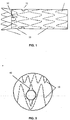
- FIG. 1 illustrates the structure of a stent graft with an opening.
- stent graft 1 comprises a graft pipe 20 made of macromolecule material and wave-shaped NiTi wire stent sections 10 sutured on the graft pipe 20.
- the NiTi wires 10 shown by real lines in Figure 1 are sutured to and outside the graft pipe 20, and the NiTi wires 10 shown by broken line in Figure 1 are sutured to and inside the graft pipe 20.
- one or more openings are formed on the graft pipe 20 as an access of the renal artery or other main blood vessels. These openings include a side opening 31 and a U-shaped opening 32.
- Figure 2 is an enlarged view of the side opening 31.
- the side opening 31 is sutured with an opening retaining wire 40 made of NiTi wire.
- the opening retaining wire 40 may support the opening, and prevent the circumferential or oval side opening 31 from deforming or collapsing under an external force, because the forming or collapsing may block the access of the blood flow.
- the other parts of Figure 2 are wave-shaped stent sections 10.
- the opening retaining wire 40 may also be made of other metallic material.
- Graft pipe 20 is formed with openings 32 at the head or proximal end where wave-shaped stent sections 10 having special shapes themselves are used as the opening retaining wires for supporting.
- Such special shapes of the wave-shaped stent sections 10 are shown in Figures 3A-B , in which the middle real line in Figure 3B represents the U-shaped opening cut from the edge of the graft pipe 20, and the broken lines in Figure 3B represent the Ni-Ti wire.
- the opening retaining wire 40 may be sutured in various forms such as circle, oval, bracket, diamond, flying saucer, etc.
- the circles in Figure 3A represent the opening on the graft pipe 20, the patterns outside the opening represent the opening retaining wires with different shapes.
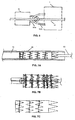
- Figure 4 illustrates the method for binding the stent graft of the present invention.
- a coil 502 is sutured onto the stent sections 10 of the stent graft 1; secondly, a double-strand binding thread 50 is bound onto the stent graft 1 by winding it along the circumferential direction and passing through the coil; last, a control wire is passed though two ends of the double-strand binding thread 50.
- the double-strand binding thread 50 is knotted by a macromolecule thread to form double strands, and has a length less than the circumference of the graft pipe under extended state.
- the double-strand binding thread 50 is wound around the stent graft 1 circumferentially for one circle and hold in position by means of a control wire 60 passing through the overlapping circle formed by the head end 500 and tail end 501 of the thread 50 together, as a result, the stent graft 1 is compacted with its diameter being limited to a circle whose perimeter is substantially equal to the length L of the binding thread 50.
- Each double-strand binding thread may have the same length or different length.
- the double-strand binding thread may be one closed thread, or may be a single strand with a coil at both ends or double strands.
- the methods for suturing the coil 502 on the stent sections 10 of the stent graft 1 comprise: suturing said coil on an edge of the stent sections 10, and preferably on the middle position of the edge of the stent sections 10; suturing said coil on each edge or every other edge of the stent sections 10.
- the method for binding the double-strand binding thread on the middle position of the edge of the stent sections by the coil further comprises: first, forming an circle 502 having a diameter of 1-3 mm with a suture thread on the middle position of each edge of the stent sections, then passing the binding thread 50 through the circle 502 to fix the binding thread 50 on the middle position of the stent sections.
- both ends of the binding thread 50 are further fixed with the control wire 60.
- all the stent sections are compressed until the diameters thereof are minimum so as to be encased in the outer pipe. Thus the binding process is over.
- the stent sections of the stent graft at different positions may adopt different binding ratios according to the inner diameter of the blood vessel.
- the diameter of the stent can be restricted to 30%-100% of its original size by adjusting the length L of the binding thread, which ensuring the stent can rotate and move freely to adjust the position under the partly pre-released state in the blood vessel cavity, as well as ensuring a guide wire and a catheter can easily pass though the stent under restricted-state.
- macromolecule sleeve is used to restrict the exposed section at the proximal end.
- the macromolecule sleeve can restrict the exposed section from being loosened so as to allow the stent to rotate circumferentially, or the exposed section can not move if it is expanded.
- the small stent (with the diameter of less than 20 cm) it is generally equipped at its proximal end with an exposed stent section (no graft).
- the edge apex of the first section of the graft means the edge apex of the first section of the proximal end of the stent graft
- the problem that a sleeve can not be employed for restricting the small-diameter stent whose exposed section is too short and tends to spring out of the sleeve is solved.
- the ejection pipe 70 in the delivery system for delivering and pushing out the stent graft is also sutured with a coil.
- the binding coil 502a on the ejection pipe 70 is overlapped into the binding coil 502b on the stent graft 1, then the control wire 60 is passed though from the binding coil 502a, as a result, the stent graft 1 is connected with the ejection pipe 70.
- the stent 1 is partly pre-released, it is possible to rotate the ejection pipe 70 circumferentially in a range of 360° to bring the stent 1 to move for adjusting the position.
- Figure 7 illustrates the corresponding release method of the binding method.
- the stent graft 1 is fully gripped within the outer pipe 80 and restricted to have a minimum diameter, i.e., the inner diameter of the outer pipe, as shown in Figure 7A .
- the outer pipe 80 is drawn out, then the graft is released from the out pipe 80 until the diameter thereof increases to the size controlled by the binding thread, as shown in Figure 7B .
- the stent is in the pre-released state due to the restriction of the binding thread, and the stent sections are bound along the circumferential direction using the new binding method in which the binding threads with different length can be used if necessary, so that the diameter of the stent is evenly reduced, the problem of displacement of the relative position of the two side openings when bound with other method is avoided, and it is easier for the alignment of the stent with more than two openings of the blood vessel.
- the control wire is drawn out, then the diameter of the graft is recovered to the size of the blood vessel implanted, as shown as Figure 7C .
- the stent When the stent is released from the outer pipe 80, it is in the pre-released state and has a diameter less than that in the natural state due to the restriction of the binding thread.
- the last section of the stent is connected with the head end of the ejection pipe 70 by the binding thread and the control wire, so that the stent graft may rotate with the rotation of the ejection pipe.
- the control wire After the side openings of the stent graft are aligned with the openings of the blood vessel, the control wire is drawn out and the binding thread is loosened, as a result, the stent graft expands spontaneously to the size of the blood vessel due to self-elasticity.
- the stent is left in the patient's body after the carrier is removed.
Landscapes
- Health & Medical Sciences (AREA)
- Engineering & Computer Science (AREA)
- Biomedical Technology (AREA)
- Life Sciences & Earth Sciences (AREA)
- General Health & Medical Sciences (AREA)
- Transplantation (AREA)
- Heart & Thoracic Surgery (AREA)
- Vascular Medicine (AREA)
- Cardiology (AREA)
- Animal Behavior & Ethology (AREA)
- Oral & Maxillofacial Surgery (AREA)
- Public Health (AREA)
- Veterinary Medicine (AREA)
- Gastroenterology & Hepatology (AREA)
- Pulmonology (AREA)
- Prostheses (AREA)
- Surgical Instruments (AREA)
- Media Introduction/Drainage Providing Device (AREA)
Description
- The present invention relates to a method for binding a stent graft, comprising a binding thread and a control wire.
- Abdominal aortic aneurysm (AAA) means diseases or lesions of the arterial wail result in abdominal aortic being local or diffuse swelling, with the main symptom of pulsatile mass. Infra-renal AAA is common, which may involve one side or both sides of the coax artery. AAA can be classified pathologically as true aneurysm, pseudoaneurysm and dissecting aneurysm. Once the aneurysm rupture occurs, the mural thrombus in the aneurysm will drop and embolize the artery, so the patient needs first aid. Abdominal aortic aneurysm is one of the common diseases which imperil wrinkly and elderly people's life. The prevalence of abdominal aortic aneurysm increases year after year along with the population aging, and the increase of the prevalence of diseases such as diabetes, atherosclerosis and hypertension etc.
- With respect to the traditional open-mode surgery, the risk factors affecting the surgery mainly lie in the elderly, serious heart and lung diseases, as well as renal inadequacy. Generally, the patients of abdominal aortic aneurysm are elderly peoples who suffer from coronary heart disease, hypertension, diabetes, cerebral thrombosis, chronic obstructive lung disease and renal inadequacy. Surgical treatment may be safe only after active treatment of the complication before the surgery, and under better cardiopulmonary function and stable blood pressure and blood glucose.
- The treatment of abdominal aortic aneurysm using stent graft endovascular exclusion can obtain good effect. Compared to common open-mode surgery, the advantages of the endovascular exclusion are less trauma, faster recovery after treatment, less complications and significantly shorter hospitalization time. Specifically, it provides the treatment opportunity for the high-risk patients who suffer from serious complications and can not tolerate the traditional surgery. However, there are certain contraindications for the treatment of abdominal aortic aneurysm with the traditional stent, such as short aneurysmal neck, the length of less than 15 mm, proximal end aneurysmal neck with an angle greater than 60°, retortion of the taper aneurism, and involvement of the visceral artery. Short aneurysmal neck may result in insufficient anchorage zone at the proximal end of the stent, which causes the displacement of the stent; and the involvement of the visceral artery can not be isolated by the stent graft. According to the above contraindications, about 30% to 40% of the patients can not be treated with common stent graft. Under this condition, a stent graft with an opening presents its advantages.
- The present stent with side opening has been formed one or more openings at the proximal end. After the release of the stent graft, the openings are aligned to the openings of important branch vessels such as renal artery, mesenteric artery and coeliac trunk artery, such that it is possible to use the area between the renal artery and the coeliac trunk artery or other important branch vessel as the aneurysmal neck to locate the stent. Thus the above-mentioned problem is resolved.
- However, such stent graft also has the following problem: the stent graft can not rotate freely for location before it being released, which results in certain difficulty for the accurate alignment between the openings of the stent and the openings of the renal artery, thus effects the success rate of the surgery.
- A stent graft with an opening which can rotate freely for location before the stent being released is advantageous for the accurate alignment between the opening of the stent and the opening of the renal artery and increases the success rate of the surgery.
- Such a stent graft with an opening comprises multiple annular wave-shaped stent sections and a graft pipe sutured with these stent sections, wherein the graft pipe has at least one opening where an opening retaining wire is sutured for supporting the opening.
- In said stent graft, the graft pipe is formed with a U-shape opening at the head or proximal end, the wave-shaped stent section at this end itself is used as the opening retaining wire for supporting the opening. Moreover, the graft pipe is formed with a round or oval opening at the side thereof and the opening retaining wire is made of NiTi alloy wire. Said opening retaining wire may be sutured in the shape of circle, oval, bracket, diamond or flying saucer.
- A stent graft with an opening which is similar to the one outlined above has been described in the international patent application
WO 2005/034808 A1 . - A method for binding a stent graft has been described in the international patent application
WO 03/022181 A1 - The object of the present invention is to provide an alternative method for binding the stent graft. Using such binding method, it is possible to make the stent rotate freely for location before it is released. Such method is advantageous for the accurate alignment between the opening of the stent and the opening of the renal artery and increases the success rate of the surgery.
- The present invention discloses a method for binding the stent graft, comprising a binding thread and a control wire and comprising the steps of: suturing coils on the stent sections of the stent graft; binding a double-strand binding thread onto the stent graft by winding it circumferentially and through the coils; and placing the control wire through two ends of the double-strand binding thread.
- In said method for binding the stent graft, the double-strand binding thread is wound around the stent graft circumferentially for one circle and hold in position by means of a control wire passing through the overlapping circle formed by the head end and tail end of the thread, allowing the diameter of the stent graft is limited to a circle whose perimeter is the length of the binding thread.
- In said method for binding the stent graft, the step of suturing coils on the stent sections of the stent graft further comprises: said coils may be sutured on the edge of the stent sections.
- In said method for binding the stent graft, the step of suturing coils on the stent sections of the stent graft further comprises: said coils may be sutured on the middle position of the edge of the stent sections.
- In said method for binding the stent graft, for the stent with small diameter, the double-strand binding thread is used to bind the apex of the edge on the first section of the graft.
- In said method for binding the stent graft, on the stent section at the distal end, one coil is sutured on the apex of an edge, or 2-3 coils are sutured on the apexes of adjacent edges.
- In said method for binding the stent graft, the step of suturing coils on the stent sections of the stent graft further comprises: said coils are sutured on each edge or every other edge of the stent sections.
- In said method for binding the stent graft, the step of suturing a coil on the stent sections of the stent graft further comprises: each of said double-strand binding thread may have the same length or different length.
- In said method for binding the stent graft, said double-strand binding thread may be one closed thread, or may be a single strand with a coil at both ends or double strands
- In said method for binding the stent graft, the ejection pipe in the delivery system used to deliver and eject the stent graft is also sutured with a coil.
- Said method for binding the stent graft further comprises a step of release of the stent graft: under initial state, the stent graft is gripped with pressure within the outer pipe so that its diameter is reduced to minimum, and during release, the outer pipe is drawn out first, then the stent graft is released from the out pipe, the diameter increases to the size controlled by the binding thread; when the stent is released from the out pipe, it is in the pre-released state due to the restriction of the binding thread, and the last section of the stent is connected with the head end of the ejection pipe by the binding thread and the control wire so that the stent graft may rotate with the rotation of the ejection pipe; the control wire is drawn out and the binding thread is loosened after the alignment of the openings, as a result, and the stent graft expands spontaneously to the size of the blood vessel due to self-elasticity.
- The present invention has the following advantageous effects compared to the prior art: The binding method of the present invention binds the double strands binding thread onto the middle position of the stent sections of the stent graft through the coil along the circumferential direction, and then binds the two ends of the binding thread with the control wire. Comparing to prior art, this new binding method makes the stent can rotate freely for location before it being released, which is advantageous for the accurate alignment between the opening of the stent and the opening of the artery.
-
- Figure 1
- is a schematic view of the structure of a stent graft with an opening;
- Figure 2
- is an enlarged view of the part of the side opening;
- Figure 3A
- illustrates various shapes of the retaining loop for the opening;
- Figure 3B
- is a schematic view of the stent section with a U-shaped opening;
- Figure 4
- illustrates the method for binding the stent graft of the present invention;
- Figures 5A-5C
- is a schematic view of the structure of the binding threads;
- Figure 6
- illustrates the connection method of the ejection pipe and the distal end of the stent;
- Figures 7A-7C
- illustrate the release methods of the stent graft.
- Further description of the present invention will be given as below accompanying with the drawings and the embodiments.
-
Figure 1 illustrates the structure of a stent graft with an opening. Referring toFigure 1 , stent graft 1 comprises a graft pipe 20 made of macromolecule material and wave-shaped NiTiwire stent sections 10 sutured on the graft pipe 20. TheNiTi wires 10 shown by real lines inFigure 1 are sutured to and outside the graft pipe 20, and theNiTi wires 10 shown by broken line inFigure 1 are sutured to and inside the graft pipe 20. According to the specific site of the patients' renal artery, one or more openings are formed on the graft pipe 20 as an access of the renal artery or other main blood vessels. These openings include aside opening 31 and aU-shaped opening 32. -
Figure 2 is an enlarged view of theside opening 31. Theside opening 31 is sutured with anopening retaining wire 40 made of NiTi wire. Theopening retaining wire 40 may support the opening, and prevent the circumferential or oval side opening 31 from deforming or collapsing under an external force, because the forming or collapsing may block the access of the blood flow. The other parts ofFigure 2 are wave-shapedstent sections 10. Theopening retaining wire 40 may also be made of other metallic material. - Graft pipe 20 is formed with
openings 32 at the head or proximal end where wave-shapedstent sections 10 having special shapes themselves are used as the opening retaining wires for supporting. Such special shapes of the wave-shapedstent sections 10 are shown inFigures 3A-B , in which the middle real line inFigure 3B represents the U-shaped opening cut from the edge of the graft pipe 20, and the broken lines inFigure 3B represent the Ni-Ti wire. Referring toFigure 3A , theopening retaining wire 40 may be sutured in various forms such as circle, oval, bracket, diamond, flying saucer, etc. The circles inFigure 3A represent the opening on the graft pipe 20, the patterns outside the opening represent the opening retaining wires with different shapes. -
Figure 4 illustrates the method for binding the stent graft of the present invention. Referring toFigure 4 and in conjunction withFigures 5A-5C , first, acoil 502 is sutured onto thestent sections 10 of the stent graft 1; secondly, a double-strand binding thread 50 is bound onto the stent graft 1 by winding it along the circumferential direction and passing through the coil; last, a control wire is passed though two ends of the double-strand binding thread 50. Referring back toFigures 5A-5C , wherein the double-strand binding thread 50 is knotted by a macromolecule thread to form double strands, and has a length less than the circumference of the graft pipe under extended state. Then the double-strand binding thread 50 is wound around the stent graft 1 circumferentially for one circle and hold in position by means of acontrol wire 60 passing through the overlapping circle formed by thehead end 500 andtail end 501 of thethread 50 together, as a result, the stent graft 1 is compacted with its diameter being limited to a circle whose perimeter is substantially equal to the length L of the bindingthread 50. Each double-strand binding thread may have the same length or different length. The double-strand binding thread may be one closed thread, or may be a single strand with a coil at both ends or double strands. - The methods for suturing the
coil 502 on thestent sections 10 of the stent graft 1 comprise: suturing said coil on an edge of thestent sections 10, and preferably on the middle position of the edge of thestent sections 10; suturing said coil on each edge or every other edge of thestent sections 10. On the stent section at the distal end, there is onecoil 502 sutured on the apex of the edge, or 2-3coils 502 sutured on the apexes of the adjacent edges. - The method for binding the double-strand binding thread on the middle position of the edge of the stent sections by the coil further comprises: first, forming an
circle 502 having a diameter of 1-3 mm with a suture thread on the middle position of each edge of the stent sections, then passing the bindingthread 50 through thecircle 502 to fix thebinding thread 50 on the middle position of the stent sections. - Again referring to
Figure 4 , both ends of the bindingthread 50 are further fixed with thecontrol wire 60. After bound in the above manners, all the stent sections are compressed until the diameters thereof are minimum so as to be encased in the outer pipe. Thus the binding process is over. - In the binding process, the stent sections of the stent graft at different positions may adopt different binding ratios according to the inner diameter of the blood vessel. The diameter of the stent can be restricted to 30%-100% of its original size by adjusting the length L of the binding thread, which ensuring the stent can rotate and move freely to adjust the position under the partly pre-released state in the blood vessel cavity, as well as ensuring a guide wire and a catheter can easily pass though the stent under restricted-state.
- In the binding process, for the big stent (with the diameter of greater than 20 cm), macromolecule sleeve is used to restrict the exposed section at the proximal end. When partly released, the macromolecule sleeve can restrict the exposed section from being loosened so as to allow the stent to rotate circumferentially, or the exposed section can not move if it is expanded. For the small stent (with the diameter of less than 20 cm), it is generally equipped at its proximal end with an exposed stent section (no graft). By the method of using the double-strand binding thread to bind the edge apex of the first section of the graft 201 (see
Figure 4 ) (the edge apex of the first section of the graft means the edge apex of the first section of the proximal end of the stent graft), the problem that a sleeve can not be employed for restricting the small-diameter stent whose exposed section is too short and tends to spring out of the sleeve is solved. - The
ejection pipe 70 in the delivery system for delivering and pushing out the stent graft is also sutured with a coil. During the binding process, under the condition that the distal end of the stent graft 1 is connected with the head part of theejection pipe 70, as shown inFigure 6 , the bindingcoil 502a on theejection pipe 70 is overlapped into the bindingcoil 502b on the stent graft 1, then thecontrol wire 60 is passed though from the bindingcoil 502a, as a result, the stent graft 1 is connected with theejection pipe 70. When the stent 1 is partly pre-released, it is possible to rotate theejection pipe 70 circumferentially in a range of 360° to bring the stent 1 to move for adjusting the position. -
Figure 7 illustrates the corresponding release method of the binding method. Referring toFigures 7A-7C , under initial state, the stent graft 1 is fully gripped within theouter pipe 80 and restricted to have a minimum diameter, i.e., the inner diameter of the outer pipe, as shown inFigure 7A . When the stent graft is released, first, theouter pipe 80 is drawn out, then the graft is released from theout pipe 80 until the diameter thereof increases to the size controlled by the binding thread, as shown inFigure 7B . In this embodiment, the stent is in the pre-released state due to the restriction of the binding thread, and the stent sections are bound along the circumferential direction using the new binding method in which the binding threads with different length can be used if necessary, so that the diameter of the stent is evenly reduced, the problem of displacement of the relative position of the two side openings when bound with other method is avoided, and it is easier for the alignment of the stent with more than two openings of the blood vessel. After the alignment, the control wire is drawn out, then the diameter of the graft is recovered to the size of the blood vessel implanted, as shown asFigure 7C . - When the stent is released from the
outer pipe 80, it is in the pre-released state and has a diameter less than that in the natural state due to the restriction of the binding thread. The last section of the stent is connected with the head end of theejection pipe 70 by the binding thread and the control wire, so that the stent graft may rotate with the rotation of the ejection pipe. After the side openings of the stent graft are aligned with the openings of the blood vessel, the control wire is drawn out and the binding thread is loosened, as a result, the stent graft expands spontaneously to the size of the blood vessel due to self-elasticity. The stent is left in the patient's body after the carrier is removed. - The above embodiments are provided to one skilled in the art to carry out or use the present invention, and one skilled in the art will recognize that various modifications and changes may be made to the embodiments described without departure from the scope of the invention. So the protection scope of the present invention is not limited to the above-mentioned embodiments, whereas it should be the largest scope of the inventive feature disclosed in the Claims.
Claims (10)
- A method for binding a stent graft (1) comprising a binding thread (50) and a control wire (60),
characterized in that comprising: suturing coils (502) on the stent sections (10) of the stent graft (1);
binding circumferentially a double strand binding thread (50) through the coils (502) onto the stent graft (1); and
setting the control wire (60) through both ends of the double-strand binding thread (50). - The method for binding a stent graft according to claims 1, characterized in that after winding around the stent graft one circle, the double-strand binding thread is held in position by the control wire extending through an overlapping circle that is formed by the head end and the tail end of the binding thread, so that the diameter of the stent graft is limited to a circle whose perimeter is the length of the binding thread.
- The method for binding a stent graft according to claim 1, characterized in that the step of suturing coils on the stent sections of the stent graft further comprises:said coils may be sutured on the edges of the stent sections.
- The method for binding a stent graft according to claim 3, characterized in that the step of suturing a coil on the stent sections of the stent graft further comprises:said coil may be sutured on the middle position of the edges of the stent sections.
- The method for binding a stent graft according to claim 3, characterized in that for the stent graft with small diameter, the double-strand binding thread is used to bind the apex of the edge on the first section of the graft pipe.
- The method for binding a stent graft according to claim 3, characterized in that the apex of the edge on the stent section at its distal end is sutured with one coil, or the apexes of the adjacent edges are sutured with 2-3 coils.
- The method for binding a stent graft according to claim 3, characterized in that the step of suturing coils on the stent sections of the stent graft further comprises: said coils are sutured on each edge or every other edge of the stent sections.
- The method for binding a stent graft according to any one of claims 1 to 7, characterized in that each of the double-strand binding threads may have the same length or different length.
- The method for binding a stent graft according to any one of claims 1 to 7, characterized in that the double-strands binding thread may be one closed thread, or may be a single strand with a coil at both ends or double strands.
- The method for binding a stent graft according to claim 6, characterized in that the ejection pipe in the delivery system used to deliver and eject the stent graft is also sutured with a coil.
Applications Claiming Priority (2)
| Application Number | Priority Date | Filing Date | Title |
|---|---|---|---|
| CN2008100377534A CN101283937B (en) | 2008-05-21 | 2008-05-21 | Tethering methods for open stent grafts |
| PCT/CN2009/000552 WO2009140861A1 (en) | 2008-05-21 | 2009-05-20 | Stent graft with opening and method for binding the stent graft |
Publications (3)
| Publication Number | Publication Date |
|---|---|
| EP2298248A1 EP2298248A1 (en) | 2011-03-23 |
| EP2298248A4 EP2298248A4 (en) | 2015-10-07 |
| EP2298248B1 true EP2298248B1 (en) | 2017-04-19 |
Family
ID=40056501
Family Applications (1)
| Application Number | Title | Priority Date | Filing Date |
|---|---|---|---|
| EP09749404.1A Active EP2298248B1 (en) | 2008-05-21 | 2009-05-20 | Stent graft with opening and method for binding the stent graft |
Country Status (3)
| Country | Link |
|---|---|
| EP (1) | EP2298248B1 (en) |
| CN (1) | CN101283937B (en) |
| WO (1) | WO2009140861A1 (en) |
Cited By (1)
| Publication number | Priority date | Publication date | Assignee | Title |
|---|---|---|---|---|
| US10888414B2 (en) | 2019-03-20 | 2021-01-12 | inQB8 Medical Technologies, LLC | Aortic dissection implant |
Families Citing this family (65)
| Publication number | Priority date | Publication date | Assignee | Title |
|---|---|---|---|---|
| CN101283937B (en) * | 2008-05-21 | 2010-08-18 | 微创医疗器械(上海)有限公司 | Tethering methods for open stent grafts |
| CN101836911A (en) * | 2009-03-18 | 2010-09-22 | 微创医疗器械(上海)有限公司 | Collateral filmed stent |
| CA2961767C (en) | 2009-06-23 | 2018-08-14 | Endospan Ltd. | Vascular prostheses for treating aneurysms |
| DE102009055969A1 (en) * | 2009-11-27 | 2011-06-01 | Transcatheter Technologies Gmbh | Device and set for folding or unfolding a medical implant and method |
| WO2011064782A2 (en) | 2009-11-30 | 2011-06-03 | Endospan Ltd. | Multi-component stent-graft system for implantation in a blood vessel with multiple branches |
| US8753386B2 (en) * | 2010-11-15 | 2014-06-17 | W. L. Gore & Associates, Inc. | Stent-graft having facing side branch portals |
| US9526638B2 (en) | 2011-02-03 | 2016-12-27 | Endospan Ltd. | Implantable medical devices constructed of shape memory material |
| JP5795364B2 (en) * | 2011-04-27 | 2015-10-14 | 株式会社パイオラックスメディカルデバイス | Stent |
| GB201109317D0 (en) * | 2011-06-03 | 2011-07-20 | Vascutek Ltd | Stent element |
| EP2579811B1 (en) | 2011-06-21 | 2016-03-16 | Endospan Ltd | Endovascular system with circumferentially-overlapping stent-grafts |
| US9839510B2 (en) | 2011-08-28 | 2017-12-12 | Endospan Ltd. | Stent-grafts with post-deployment variable radial displacement |
| WO2013065040A1 (en) | 2011-10-30 | 2013-05-10 | Endospan Ltd. | Triple-collar stent-graft |
| US8728148B2 (en) | 2011-11-09 | 2014-05-20 | Cook Medical Technologies Llc | Diameter reducing tie arrangement for endoluminal prosthesis |
| US9597204B2 (en) | 2011-12-04 | 2017-03-21 | Endospan Ltd. | Branched stent-graft system |
| US20130289701A1 (en) * | 2012-04-27 | 2013-10-31 | Medtronic Vascular, Inc. | Stent-graft prosthesis for placement in the abdominal aorta |
| US9737394B2 (en) | 2012-04-27 | 2017-08-22 | Medtronic Vascular, Inc. | Stent-graft prosthesis for placement in the abdominal aorta |
| US8968384B2 (en) * | 2012-04-27 | 2015-03-03 | Medtronic Vascular, Inc. | Circumferentially constraining sutures for a stent-graft |
| WO2013171730A1 (en) | 2012-05-15 | 2013-11-21 | Endospan Ltd. | Stent-graft with fixation elements that are radially confined for delivery |
| US9848976B2 (en) * | 2012-06-05 | 2017-12-26 | Kardiozis | Endoprosthesis, delivery device and a method for implanting such endoprosthesis |
| CN104027187B (en) * | 2013-03-04 | 2016-05-25 | 微创心脉医疗科技(上海)有限公司 | Branched membrane-covered support, the induction system that comprises it and manufacture method thereof |
| CN105208969B (en) | 2013-03-11 | 2017-10-20 | 恩多斯潘有限公司 | Multicomponent stent-graft system for aortic dissection |
| WO2015075708A1 (en) | 2013-11-19 | 2015-05-28 | Endospan Ltd. | Stent system with radial-expansion locking |
| CN104116577B (en) * | 2014-06-27 | 2017-07-14 | 先健科技(深圳)有限公司 | Branch type overlay film frame |
| EP3068339B1 (en) | 2014-12-18 | 2017-11-01 | Endospan Ltd. | Endovascular stent-graft with fatigue-resistant lateral tube |
| CN104706448B (en) * | 2015-03-26 | 2017-03-08 | 黄连军 | Overlay film frame and overlay film frame induction system |
| AU2016370459B2 (en) | 2015-12-14 | 2019-06-06 | Medtronic Vascular Inc. | Devices and methods for transcatheter valve loading and implantation |
| WO2017214098A1 (en) | 2016-06-06 | 2017-12-14 | Medtronic Vascular Inc. | Transcatheter prosthetic heart valve delivery system with lateral offset control |
| US10433991B2 (en) | 2016-07-18 | 2019-10-08 | Cook Medical Technologies Llc | Controlled expansion stent graft delivery system |
| AU2017307628C1 (en) * | 2016-08-05 | 2020-09-03 | W. L. Gore & Associates, Inc. | Integrated medical device constraining lumen |
| CN106510899B (en) * | 2016-11-28 | 2017-12-26 | 浙江大学 | Artificial blood vessel's flow regulator and artificial blood vessel |
| CN106580518B (en) * | 2016-12-20 | 2018-11-16 | 有研医疗器械(北京)有限公司 | A kind of combined type endovascular stent for abdominal aorta system and its application method |
| CN108236512B (en) * | 2016-12-27 | 2020-05-05 | 先健科技(深圳)有限公司 | stent graft |
| EP3534837A1 (en) * | 2017-02-24 | 2019-09-11 | Bolton Medical, Inc. | Constrainable stent graft, delivery system and methods of use |
| CN107280808A (en) * | 2017-07-20 | 2017-10-24 | 湖南埃普特医疗器械有限公司 | Induction system and overlay film system |
| CN109966019B (en) * | 2017-12-27 | 2021-06-04 | 先健科技(深圳)有限公司 | Covered stent |
| CN109984862B (en) * | 2017-12-29 | 2025-10-03 | 杭州唯强医疗科技有限公司 | Aortic stent graft capable of step-by-step release |
| AU2018440936B2 (en) * | 2018-09-12 | 2022-10-20 | W. L. Gore & Associates, Inc. | Low profile delivery system with lock wire lumen |
| AU2019355984B2 (en) * | 2018-10-05 | 2022-09-08 | W. L. Gore & Associates, Inc. | Constraining mechanisms and associated methods |
| EP3860517A1 (en) | 2018-10-05 | 2021-08-11 | W.L. Gore & Associates Inc. | Constraining mechanisms for selective deployment and associated methods |
| CN109350317A (en) * | 2018-12-06 | 2019-02-19 | 大连科万维医疗科技有限公司 | Convenient-to-convey branch support |
| CN111329634B (en) * | 2018-12-18 | 2024-07-16 | 先健科技(深圳)有限公司 | Implant |
| US11963894B2 (en) | 2018-12-18 | 2024-04-23 | Lifetech Scientific (Shenzhen) Co., Ltd. | Lumen stent and implant |
| CN111407475B (en) * | 2018-12-18 | 2021-07-20 | 深圳市先健畅通医疗有限公司 | Lumen stent |
| CN111329635A (en) * | 2018-12-18 | 2020-06-26 | 深圳市先健畅通医疗有限公司 | Implant and method of manufacturing the same |
| CN111407476B (en) * | 2018-12-18 | 2021-07-20 | 深圳市先健畅通医疗有限公司 | Lumen stent |
| CN111407477B (en) * | 2018-12-18 | 2021-07-20 | 深圳市先健畅通医疗有限公司 | Lumen stent |
| CN111329633B (en) * | 2018-12-18 | 2022-03-08 | 深圳市先健畅通医疗有限公司 | Implant and method of manufacturing the same |
| CN110448393B (en) * | 2018-12-18 | 2021-04-13 | 深圳市先健畅通医疗有限公司 | Lumen stent |
| CN111374812B (en) * | 2018-12-28 | 2025-07-15 | 广州医科大学附属第一医院(广州呼吸中心) | Tracheal stent delivery device and tracheal stent system |
| JP7295975B2 (en) | 2019-05-10 | 2023-06-21 | ダブリュ.エル.ゴア アンド アソシエイツ,インコーポレイティド | Restraint Mechanisms and Associated Methods for Selective Deployment |
| WO2020231387A1 (en) | 2019-05-10 | 2020-11-19 | W. L. Gore & Associates, Inc. | Constraining mechanisms for selective deployment and associated methods |
| DE102019121930A1 (en) | 2019-08-14 | 2021-02-18 | Jotec Gmbh | Vascular prosthesis |
| CN112891019B (en) | 2019-12-03 | 2022-09-20 | 深圳市先健畅通医疗有限公司 | Covered stent |
| CN113081125B (en) * | 2019-12-23 | 2022-07-26 | 微创神通医疗科技(上海)有限公司 | Aneurysm plugging device |
| WO2021129286A1 (en) * | 2019-12-23 | 2021-07-01 | 杭州唯强医疗科技有限公司 | Covered stent system and covered stent thereof |
| CN111035486B (en) * | 2019-12-25 | 2024-01-23 | 上海微创心脉医疗科技(集团)股份有限公司 | Stent delivery system and method of loading stents |
| CN114432000B (en) * | 2020-10-30 | 2026-01-02 | 先健科技(深圳)有限公司 | Covered stent |
| CN114681113A (en) * | 2020-12-29 | 2022-07-01 | 上海微创心脉医疗科技(集团)股份有限公司 | Covered stent system |
| CN114681112B (en) * | 2020-12-29 | 2025-12-16 | 先健科技(深圳)有限公司 | Tectorial membrane support |
| CN114681119B (en) * | 2020-12-30 | 2026-02-17 | 先健科技(深圳)有限公司 | Lumen stent |
| CN114681117B (en) * | 2020-12-30 | 2026-01-23 | 先健科技(深圳)有限公司 | Lumen stent |
| CN113274166B (en) * | 2021-05-10 | 2023-12-08 | 杭州唯强医疗科技有限公司 | Covered stent and delivery system |
| CN113384381B (en) * | 2021-08-17 | 2021-12-10 | 上海微创心脉医疗科技(集团)股份有限公司 | Medical device |
| CN113749698B (en) * | 2021-09-29 | 2025-06-03 | 上海佐心医疗科技有限公司 | Medical device and film sewing method thereof |
| CN115444489B (en) * | 2022-10-09 | 2025-03-07 | 刘冰 | Vascular stent delivery system |
Family Cites Families (7)
| Publication number | Priority date | Publication date | Assignee | Title |
|---|---|---|---|---|
| US20030050684A1 (en) * | 2001-09-10 | 2003-03-13 | Abrams Robert M. | Internal restraint for delivery of self-expanding stents |
| WO2005034809A1 (en) * | 2003-10-10 | 2005-04-21 | William A. Cook Australia Pty. Ltd. | Stent graft fenestration |
| JP4970944B2 (en) * | 2003-10-10 | 2012-07-11 | ウィリアム・エイ・クック・オーストラリア・プロプライエタリー・リミテッド | Stent graft with opening |
| CN100562297C (en) * | 2003-10-10 | 2009-11-25 | 威廉A·库克澳大利亚有限公司 | The stent grafts that fenestra is arranged |
| CA2573922C (en) * | 2004-06-15 | 2012-12-11 | Cook Incorporated | Stent graft with internal tube |
| CN2822554Y (en) * | 2005-07-27 | 2006-10-04 | 深圳市先健科技股份有限公司 | Blood vessel covering film holder of non sewing line for prepenting shifting |
| CN101283937B (en) * | 2008-05-21 | 2010-08-18 | 微创医疗器械(上海)有限公司 | Tethering methods for open stent grafts |
-
2008
- 2008-05-21 CN CN2008100377534A patent/CN101283937B/en active Active
-
2009
- 2009-05-20 EP EP09749404.1A patent/EP2298248B1/en active Active
- 2009-05-20 WO PCT/CN2009/000552 patent/WO2009140861A1/en not_active Ceased
Non-Patent Citations (1)
| Title |
|---|
| None * |
Cited By (1)
| Publication number | Priority date | Publication date | Assignee | Title |
|---|---|---|---|---|
| US10888414B2 (en) | 2019-03-20 | 2021-01-12 | inQB8 Medical Technologies, LLC | Aortic dissection implant |
Also Published As
| Publication number | Publication date |
|---|---|
| WO2009140861A1 (en) | 2009-11-26 |
| EP2298248A1 (en) | 2011-03-23 |
| CN101283937B (en) | 2010-08-18 |
| CN101283937A (en) | 2008-10-15 |
| EP2298248A4 (en) | 2015-10-07 |
Similar Documents
| Publication | Publication Date | Title |
|---|---|---|
| EP2298248A1 (en) | Stent graft with opening and method for binding the stent graft | |
| US11974754B2 (en) | Systems and methods for treating aneurysms | |
| CN103917197B (en) | Endoluminal device and the method preparing endoluminal device | |
| EP2745812B1 (en) | Repositionable diameter constraints | |
| EP3534838B1 (en) | Radially adjustable stent graft delivery system | |
| US8398700B2 (en) | Intravascular flow modifier and reinforcement device and deployment system for same | |
| AU2009215690B2 (en) | Stent/stent graft for reinforcement of vascular abnormalities and associated method | |
| EP2328512B1 (en) | Stent graft having extended landing area | |
| CN103237526B (en) | Vascular remodeling device | |
| KR101877586B1 (en) | Implant for influencing the blood flow in arteriovenous malformations | |
| CA2289213C (en) | Wire frame partial flow obstruction device for aneurysm treatment | |
| US9408728B2 (en) | Procedures for vascular occlusion | |
| JP2000516515A (en) | Intravascular prosthetic device and method of use | |
| JP2003527925A (en) | Repositionable and recapturable vascular stent / graft | |
| JP2003521332A (en) | Artificial vascular stent and stent insertion device | |
| EP3232987A1 (en) | Biodegradable filter and support frame | |
| WO2001019231A2 (en) | Intravascular device and method using it | |
| AU2004200062A1 (en) | Woven intravascular devices and methods for making the same and apparatus for delivery of the same |
Legal Events
| Date | Code | Title | Description |
|---|---|---|---|
| PUAI | Public reference made under article 153(3) epc to a published international application that has entered the european phase |
Free format text: ORIGINAL CODE: 0009012 |
|
| 17P | Request for examination filed |
Effective date: 20101209 |
|
| AK | Designated contracting states |
Kind code of ref document: A1 Designated state(s): AT BE BG CH CY CZ DE DK EE ES FI FR GB GR HR HU IE IS IT LI LT LU LV MC MK MT NL NO PL PT RO SE SI SK TR |
|
| AX | Request for extension of the european patent |
Extension state: AL BA RS |
|
| DAX | Request for extension of the european patent (deleted) | ||
| RAP1 | Party data changed (applicant data changed or rights of an application transferred) |
Owner name: SHANGHAI MICROPORT MEDICAL (GROUP) CO., LTD. |
|
| RAP1 | Party data changed (applicant data changed or rights of an application transferred) |
Owner name: MICROPORT ENDOVASCULAR (SHANGHAI) CO., LTD. |
|
| RIC1 | Information provided on ipc code assigned before grant |
Ipc: A61F 2/07 20130101AFI20150313BHEP |
|
| RA4 | Supplementary search report drawn up and despatched (corrected) |
Effective date: 20150908 |
|
| RIC1 | Information provided on ipc code assigned before grant |
Ipc: A61F 2/07 20130101AFI20150902BHEP |
|
| REG | Reference to a national code |
Ref country code: DE Ref legal event code: R079 Ref document number: 602009045560 Country of ref document: DE Free format text: PREVIOUS MAIN CLASS: A61F0002820000 Ipc: A61F0002962000 |
|
| GRAP | Despatch of communication of intention to grant a patent |
Free format text: ORIGINAL CODE: EPIDOSNIGR1 |
|
| RIC1 | Information provided on ipc code assigned before grant |
Ipc: A61F 2/962 20130101AFI20160928BHEP |
|
| INTG | Intention to grant announced |
Effective date: 20161103 |
|
| GRAS | Grant fee paid |
Free format text: ORIGINAL CODE: EPIDOSNIGR3 |
|
| GRAA | (expected) grant |
Free format text: ORIGINAL CODE: 0009210 |
|
| AK | Designated contracting states |
Kind code of ref document: B1 Designated state(s): AT BE BG CH CY CZ DE DK EE ES FI FR GB GR HR HU IE IS IT LI LT LU LV MC MK MT NL NO PL PT RO SE SI SK TR |
|
| REG | Reference to a national code |
Ref country code: GB Ref legal event code: FG4D |
|
| REG | Reference to a national code |
Ref country code: CH Ref legal event code: EP |
|
| REG | Reference to a national code |
Ref country code: AT Ref legal event code: REF Ref document number: 885205 Country of ref document: AT Kind code of ref document: T Effective date: 20170515 |
|
| REG | Reference to a national code |
Ref country code: IE Ref legal event code: FG4D |
|
| REG | Reference to a national code |
Ref country code: FR Ref legal event code: PLFP Year of fee payment: 9 |
|
| REG | Reference to a national code |
Ref country code: DE Ref legal event code: R096 Ref document number: 602009045560 Country of ref document: DE |
|
| REG | Reference to a national code |
Ref country code: NL Ref legal event code: MP Effective date: 20170419 |
|
| REG | Reference to a national code |
Ref country code: LT Ref legal event code: MG4D |
|
| REG | Reference to a national code |
Ref country code: AT Ref legal event code: MK05 Ref document number: 885205 Country of ref document: AT Kind code of ref document: T Effective date: 20170419 |
|
| PG25 | Lapsed in a contracting state [announced via postgrant information from national office to epo] |
Ref country code: NL Free format text: LAPSE BECAUSE OF FAILURE TO SUBMIT A TRANSLATION OF THE DESCRIPTION OR TO PAY THE FEE WITHIN THE PRESCRIBED TIME-LIMIT Effective date: 20170419 |
|
| PG25 | Lapsed in a contracting state [announced via postgrant information from national office to epo] |
Ref country code: HR Free format text: LAPSE BECAUSE OF FAILURE TO SUBMIT A TRANSLATION OF THE DESCRIPTION OR TO PAY THE FEE WITHIN THE PRESCRIBED TIME-LIMIT Effective date: 20170419 Ref country code: NO Free format text: LAPSE BECAUSE OF FAILURE TO SUBMIT A TRANSLATION OF THE DESCRIPTION OR TO PAY THE FEE WITHIN THE PRESCRIBED TIME-LIMIT Effective date: 20170719 Ref country code: AT Free format text: LAPSE BECAUSE OF FAILURE TO SUBMIT A TRANSLATION OF THE DESCRIPTION OR TO PAY THE FEE WITHIN THE PRESCRIBED TIME-LIMIT Effective date: 20170419 Ref country code: FI Free format text: LAPSE BECAUSE OF FAILURE TO SUBMIT A TRANSLATION OF THE DESCRIPTION OR TO PAY THE FEE WITHIN THE PRESCRIBED TIME-LIMIT Effective date: 20170419 Ref country code: ES Free format text: LAPSE BECAUSE OF FAILURE TO SUBMIT A TRANSLATION OF THE DESCRIPTION OR TO PAY THE FEE WITHIN THE PRESCRIBED TIME-LIMIT Effective date: 20170419 Ref country code: LT Free format text: LAPSE BECAUSE OF FAILURE TO SUBMIT A TRANSLATION OF THE DESCRIPTION OR TO PAY THE FEE WITHIN THE PRESCRIBED TIME-LIMIT Effective date: 20170419 Ref country code: GR Free format text: LAPSE BECAUSE OF FAILURE TO SUBMIT A TRANSLATION OF THE DESCRIPTION OR TO PAY THE FEE WITHIN THE PRESCRIBED TIME-LIMIT Effective date: 20170720 |
|
| PG25 | Lapsed in a contracting state [announced via postgrant information from national office to epo] |
Ref country code: PL Free format text: LAPSE BECAUSE OF FAILURE TO SUBMIT A TRANSLATION OF THE DESCRIPTION OR TO PAY THE FEE WITHIN THE PRESCRIBED TIME-LIMIT Effective date: 20170419 Ref country code: IS Free format text: LAPSE BECAUSE OF FAILURE TO SUBMIT A TRANSLATION OF THE DESCRIPTION OR TO PAY THE FEE WITHIN THE PRESCRIBED TIME-LIMIT Effective date: 20170819 Ref country code: BG Free format text: LAPSE BECAUSE OF FAILURE TO SUBMIT A TRANSLATION OF THE DESCRIPTION OR TO PAY THE FEE WITHIN THE PRESCRIBED TIME-LIMIT Effective date: 20170719 Ref country code: LV Free format text: LAPSE BECAUSE OF FAILURE TO SUBMIT A TRANSLATION OF THE DESCRIPTION OR TO PAY THE FEE WITHIN THE PRESCRIBED TIME-LIMIT Effective date: 20170419 Ref country code: SE Free format text: LAPSE BECAUSE OF FAILURE TO SUBMIT A TRANSLATION OF THE DESCRIPTION OR TO PAY THE FEE WITHIN THE PRESCRIBED TIME-LIMIT Effective date: 20170419 |
|
| REG | Reference to a national code |
Ref country code: CH Ref legal event code: PL |
|
| REG | Reference to a national code |
Ref country code: DE Ref legal event code: R097 Ref document number: 602009045560 Country of ref document: DE |
|
| PG25 | Lapsed in a contracting state [announced via postgrant information from national office to epo] |
Ref country code: RO Free format text: LAPSE BECAUSE OF FAILURE TO SUBMIT A TRANSLATION OF THE DESCRIPTION OR TO PAY THE FEE WITHIN THE PRESCRIBED TIME-LIMIT Effective date: 20170419 Ref country code: EE Free format text: LAPSE BECAUSE OF FAILURE TO SUBMIT A TRANSLATION OF THE DESCRIPTION OR TO PAY THE FEE WITHIN THE PRESCRIBED TIME-LIMIT Effective date: 20170419 Ref country code: SK Free format text: LAPSE BECAUSE OF FAILURE TO SUBMIT A TRANSLATION OF THE DESCRIPTION OR TO PAY THE FEE WITHIN THE PRESCRIBED TIME-LIMIT Effective date: 20170419 Ref country code: DK Free format text: LAPSE BECAUSE OF FAILURE TO SUBMIT A TRANSLATION OF THE DESCRIPTION OR TO PAY THE FEE WITHIN THE PRESCRIBED TIME-LIMIT Effective date: 20170419 Ref country code: MC Free format text: LAPSE BECAUSE OF FAILURE TO SUBMIT A TRANSLATION OF THE DESCRIPTION OR TO PAY THE FEE WITHIN THE PRESCRIBED TIME-LIMIT Effective date: 20170419 Ref country code: CZ Free format text: LAPSE BECAUSE OF FAILURE TO SUBMIT A TRANSLATION OF THE DESCRIPTION OR TO PAY THE FEE WITHIN THE PRESCRIBED TIME-LIMIT Effective date: 20170419 |
|
| REG | Reference to a national code |
Ref country code: IE Ref legal event code: MM4A |
|
| PLBE | No opposition filed within time limit |
Free format text: ORIGINAL CODE: 0009261 |
|
| STAA | Information on the status of an ep patent application or granted ep patent |
Free format text: STATUS: NO OPPOSITION FILED WITHIN TIME LIMIT |
|
| PG25 | Lapsed in a contracting state [announced via postgrant information from national office to epo] |
Ref country code: LI Free format text: LAPSE BECAUSE OF NON-PAYMENT OF DUE FEES Effective date: 20170531 Ref country code: CH Free format text: LAPSE BECAUSE OF NON-PAYMENT OF DUE FEES Effective date: 20170531 |
|
| 26N | No opposition filed |
Effective date: 20180122 |
|
| PG25 | Lapsed in a contracting state [announced via postgrant information from national office to epo] |
Ref country code: LU Free format text: LAPSE BECAUSE OF NON-PAYMENT OF DUE FEES Effective date: 20170520 |
|
| REG | Reference to a national code |
Ref country code: BE Ref legal event code: MM Effective date: 20170531 |
|
| PG25 | Lapsed in a contracting state [announced via postgrant information from national office to epo] |
Ref country code: IE Free format text: LAPSE BECAUSE OF NON-PAYMENT OF DUE FEES Effective date: 20170520 |
|
| REG | Reference to a national code |
Ref country code: FR Ref legal event code: PLFP Year of fee payment: 10 |
|
| PG25 | Lapsed in a contracting state [announced via postgrant information from national office to epo] |
Ref country code: SI Free format text: LAPSE BECAUSE OF FAILURE TO SUBMIT A TRANSLATION OF THE DESCRIPTION OR TO PAY THE FEE WITHIN THE PRESCRIBED TIME-LIMIT Effective date: 20170419 |
|
| PG25 | Lapsed in a contracting state [announced via postgrant information from national office to epo] |
Ref country code: BE Free format text: LAPSE BECAUSE OF NON-PAYMENT OF DUE FEES Effective date: 20170531 |
|
| PG25 | Lapsed in a contracting state [announced via postgrant information from national office to epo] |
Ref country code: MT Free format text: LAPSE BECAUSE OF NON-PAYMENT OF DUE FEES Effective date: 20170520 |
|
| REG | Reference to a national code |
Ref country code: DE Ref legal event code: R081 Ref document number: 602009045560 Country of ref document: DE Owner name: SHANGHAI MICROPORT ENDOVASCULAR MEDTECH CO., L, CN Free format text: FORMER OWNER: MICROPORT ENDOVASCULAR (SHANGHAI) CO., LTD., SHANGHAI, CN |
|
| PG25 | Lapsed in a contracting state [announced via postgrant information from national office to epo] |
Ref country code: HU Free format text: LAPSE BECAUSE OF FAILURE TO SUBMIT A TRANSLATION OF THE DESCRIPTION OR TO PAY THE FEE WITHIN THE PRESCRIBED TIME-LIMIT; INVALID AB INITIO Effective date: 20090520 |
|
| PG25 | Lapsed in a contracting state [announced via postgrant information from national office to epo] |
Ref country code: CY Free format text: LAPSE BECAUSE OF NON-PAYMENT OF DUE FEES Effective date: 20170419 |
|
| PG25 | Lapsed in a contracting state [announced via postgrant information from national office to epo] |
Ref country code: MK Free format text: LAPSE BECAUSE OF FAILURE TO SUBMIT A TRANSLATION OF THE DESCRIPTION OR TO PAY THE FEE WITHIN THE PRESCRIBED TIME-LIMIT Effective date: 20170419 |
|
| PG25 | Lapsed in a contracting state [announced via postgrant information from national office to epo] |
Ref country code: TR Free format text: LAPSE BECAUSE OF FAILURE TO SUBMIT A TRANSLATION OF THE DESCRIPTION OR TO PAY THE FEE WITHIN THE PRESCRIBED TIME-LIMIT Effective date: 20170419 |
|
| PG25 | Lapsed in a contracting state [announced via postgrant information from national office to epo] |
Ref country code: PT Free format text: LAPSE BECAUSE OF FAILURE TO SUBMIT A TRANSLATION OF THE DESCRIPTION OR TO PAY THE FEE WITHIN THE PRESCRIBED TIME-LIMIT Effective date: 20170419 |
|
| P01 | Opt-out of the competence of the unified patent court (upc) registered |
Effective date: 20231128 |
|
| REG | Reference to a national code |
Ref country code: DE Ref legal event code: R082 Ref document number: 602009045560 Country of ref document: DE Representative=s name: DENNEMEYER & ASSOCIATES RECHTSANWALTSGESELLSCH, DE |
|
| PGFP | Annual fee paid to national office [announced via postgrant information from national office to epo] |
Ref country code: DE Payment date: 20250521 Year of fee payment: 17 |
|
| PGFP | Annual fee paid to national office [announced via postgrant information from national office to epo] |
Ref country code: GB Payment date: 20250521 Year of fee payment: 17 |
|
| PGFP | Annual fee paid to national office [announced via postgrant information from national office to epo] |
Ref country code: IT Payment date: 20250527 Year of fee payment: 17 |
|
| PGFP | Annual fee paid to national office [announced via postgrant information from national office to epo] |
Ref country code: FR Payment date: 20250528 Year of fee payment: 17 |