EP2297181B1 - Synthetic pathway enzymes for the production of argyrins - Google Patents
Synthetic pathway enzymes for the production of argyrins Download PDFInfo
- Publication number
- EP2297181B1 EP2297181B1 EP09772301A EP09772301A EP2297181B1 EP 2297181 B1 EP2297181 B1 EP 2297181B1 EP 09772301 A EP09772301 A EP 09772301A EP 09772301 A EP09772301 A EP 09772301A EP 2297181 B1 EP2297181 B1 EP 2297181B1
- Authority
- EP
- European Patent Office
- Prior art keywords
- seq
- nucleotides
- nucleic acid
- argyrins
- synthetic pathway
- Prior art date
- Legal status (The legal status is an assumption and is not a legal conclusion. Google has not performed a legal analysis and makes no representation as to the accuracy of the status listed.)
- Active
Links
Images


Classifications
-
- C—CHEMISTRY; METALLURGY
- C12—BIOCHEMISTRY; BEER; SPIRITS; WINE; VINEGAR; MICROBIOLOGY; ENZYMOLOGY; MUTATION OR GENETIC ENGINEERING
- C12P—FERMENTATION OR ENZYME-USING PROCESSES TO SYNTHESISE A DESIRED CHEMICAL COMPOUND OR COMPOSITION OR TO SEPARATE OPTICAL ISOMERS FROM A RACEMIC MIXTURE
- C12P21/00—Preparation of peptides or proteins
- C12P21/02—Preparation of peptides or proteins having a known sequence of two or more amino acids, e.g. glutathione
-
- C—CHEMISTRY; METALLURGY
- C07—ORGANIC CHEMISTRY
- C07K—PEPTIDES
- C07K7/00—Peptides having 5 to 20 amino acids in a fully defined sequence; Derivatives thereof
- C07K7/50—Cyclic peptides containing at least one abnormal peptide link
- C07K7/54—Cyclic peptides containing at least one abnormal peptide link with at least one abnormal peptide link in the ring
- C07K7/56—Cyclic peptides containing at least one abnormal peptide link with at least one abnormal peptide link in the ring the cyclisation not occurring through 2,4-diamino-butanoic acid
-
- C—CHEMISTRY; METALLURGY
- C12—BIOCHEMISTRY; BEER; SPIRITS; WINE; VINEGAR; MICROBIOLOGY; ENZYMOLOGY; MUTATION OR GENETIC ENGINEERING
- C12N—MICROORGANISMS OR ENZYMES; COMPOSITIONS THEREOF; PROPAGATING, PRESERVING, OR MAINTAINING MICROORGANISMS; MUTATION OR GENETIC ENGINEERING; CULTURE MEDIA
- C12N15/00—Mutation or genetic engineering; DNA or RNA concerning genetic engineering, vectors, e.g. plasmids, or their isolation, preparation or purification; Use of hosts therefor
- C12N15/09—Recombinant DNA-technology
- C12N15/11—DNA or RNA fragments; Modified forms thereof; Non-coding nucleic acids having a biological activity
- C12N15/52—Genes encoding for enzymes or proenzymes
-
- C—CHEMISTRY; METALLURGY
- C12—BIOCHEMISTRY; BEER; SPIRITS; WINE; VINEGAR; MICROBIOLOGY; ENZYMOLOGY; MUTATION OR GENETIC ENGINEERING
- C12N—MICROORGANISMS OR ENZYMES; COMPOSITIONS THEREOF; PROPAGATING, PRESERVING, OR MAINTAINING MICROORGANISMS; MUTATION OR GENETIC ENGINEERING; CULTURE MEDIA
- C12N15/00—Mutation or genetic engineering; DNA or RNA concerning genetic engineering, vectors, e.g. plasmids, or their isolation, preparation or purification; Use of hosts therefor
- C12N15/09—Recombinant DNA-technology
- C12N15/63—Introduction of foreign genetic material using vectors; Vectors; Use of hosts therefor; Regulation of expression
- C12N15/74—Vectors or expression systems specially adapted for prokaryotic hosts other than E. coli, e.g. Lactobacillus, Micromonospora
-
- C—CHEMISTRY; METALLURGY
- C12—BIOCHEMISTRY; BEER; SPIRITS; WINE; VINEGAR; MICROBIOLOGY; ENZYMOLOGY; MUTATION OR GENETIC ENGINEERING
- C12N—MICROORGANISMS OR ENZYMES; COMPOSITIONS THEREOF; PROPAGATING, PRESERVING, OR MAINTAINING MICROORGANISMS; MUTATION OR GENETIC ENGINEERING; CULTURE MEDIA
- C12N9/00—Enzymes; Proenzymes; Compositions thereof; Processes for preparing, activating, inhibiting, separating or purifying enzymes
- C12N9/0004—Oxidoreductases (1.)
- C12N9/0069—Oxidoreductases (1.) acting on single donors with incorporation of molecular oxygen, i.e. oxygenases (1.13)
-
- C—CHEMISTRY; METALLURGY
- C12—BIOCHEMISTRY; BEER; SPIRITS; WINE; VINEGAR; MICROBIOLOGY; ENZYMOLOGY; MUTATION OR GENETIC ENGINEERING
- C12N—MICROORGANISMS OR ENZYMES; COMPOSITIONS THEREOF; PROPAGATING, PRESERVING, OR MAINTAINING MICROORGANISMS; MUTATION OR GENETIC ENGINEERING; CULTURE MEDIA
- C12N9/00—Enzymes; Proenzymes; Compositions thereof; Processes for preparing, activating, inhibiting, separating or purifying enzymes
- C12N9/10—Transferases (2.)
- C12N9/1003—Transferases (2.) transferring one-carbon groups (2.1)
- C12N9/1007—Methyltransferases (general) (2.1.1.)
-
- C—CHEMISTRY; METALLURGY
- C12—BIOCHEMISTRY; BEER; SPIRITS; WINE; VINEGAR; MICROBIOLOGY; ENZYMOLOGY; MUTATION OR GENETIC ENGINEERING
- C12N—MICROORGANISMS OR ENZYMES; COMPOSITIONS THEREOF; PROPAGATING, PRESERVING, OR MAINTAINING MICROORGANISMS; MUTATION OR GENETIC ENGINEERING; CULTURE MEDIA
- C12N9/00—Enzymes; Proenzymes; Compositions thereof; Processes for preparing, activating, inhibiting, separating or purifying enzymes
- C12N9/14—Hydrolases (3)
- C12N9/16—Hydrolases (3) acting on ester bonds (3.1)
- C12N9/22—Ribonucleases [RNase]; Deoxyribonucleases [DNase]
-
- C—CHEMISTRY; METALLURGY
- C12—BIOCHEMISTRY; BEER; SPIRITS; WINE; VINEGAR; MICROBIOLOGY; ENZYMOLOGY; MUTATION OR GENETIC ENGINEERING
- C12N—MICROORGANISMS OR ENZYMES; COMPOSITIONS THEREOF; PROPAGATING, PRESERVING, OR MAINTAINING MICROORGANISMS; MUTATION OR GENETIC ENGINEERING; CULTURE MEDIA
- C12N9/00—Enzymes; Proenzymes; Compositions thereof; Processes for preparing, activating, inhibiting, separating or purifying enzymes
- C12N9/88—Lyases (4.)
-
- C—CHEMISTRY; METALLURGY
- C12—BIOCHEMISTRY; BEER; SPIRITS; WINE; VINEGAR; MICROBIOLOGY; ENZYMOLOGY; MUTATION OR GENETIC ENGINEERING
- C12P—FERMENTATION OR ENZYME-USING PROCESSES TO SYNTHESISE A DESIRED CHEMICAL COMPOUND OR COMPOSITION OR TO SEPARATE OPTICAL ISOMERS FROM A RACEMIC MIXTURE
- C12P17/00—Preparation of heterocyclic carbon compounds with only O, N, S, Se or Te as ring hetero atoms
- C12P17/16—Preparation of heterocyclic carbon compounds with only O, N, S, Se or Te as ring hetero atoms containing two or more hetero rings
- C12P17/167—Heterorings having sulfur atoms as ring heteroatoms, e.g. vitamin B1, thiamine nucleus and open chain analogs
Definitions
- the invention relates to nucleic acid sequences encoding synthetic pathway enzymes, which catalyze the production of Argyrins. Accordingly, the invention also relates to the synthetic pathway enzymes, to microorganisms expressing the synthetic pathway enzymes and to a method for production of Argyrins, making use of the synthetic pathway enzymes, preferably expressed in a micro-organism.
- the invention provides the proteins forming part of or constituting the non-ribosomal peptide synthetases (NRPS) having the activity to catalyse at least one conversion step in the synthesis of Argyrins, including the NRPS constituting the enzymes having the activity to catalyse the synthesis of pre-Argyrin, and additional enzymes having the activity which catalyse the conversion of pre-Argyrin to at least one derivative having the core structure I of Argyrin, including e.g.
- NRPS non-ribosomal peptide synthetases
- Argyrin A Argyrin A
- Argyrin B Argyrin C
- Argyrin D Argyrin D
- Argyrin E Argyrin F
- Argyrin G Argyrin H
- Synthetic derivatives of Argyrin contain different substituents as R1, R2, R3, and R4 to common structure I.
- the synthetic pathway enzymes catalyzing the synthesis of at least one Argyrin comprising the core structure I are encoded by nucleic acid sequences of the invention, containing the structural genes for the synthetic pathway enzymes.
- Argyrins share the common core structure I: wherein substituents to R1, R2, R3, and R4 can vary, giving e.g. rise to natural derivatives designated Argyrins A - H.
- R1 can be selected from an alkyl group, preferably methyl and ethyl
- R2 preferably is hydrogen or methyl
- R3 preferably is hydrogen or methoxy
- R4 preferably is selected from hydrogen, methyl and hydroxymethyl, as described in Vollbrecht et al. (Journal of Antibiotics 8, 715 - 721 (2002 )) for Argyrins obtained from Archangium gephyra.
- Argyrins are obtained from the natural producer organism Archangium gephyra, e.g. as a mixture of one or more of the above mentioned Argyrins, collectively referred to as Argyrins A - H, e.g. by isolation from the fermentation broth, and purification by standard methods, e.g. using partition and chromatography.
- US 6833447 describes a nucleic acid sequence which encodes a nitrite reductase.
- Cytobacter fuscus is a producer of Argyrin. No nucleic acid sequence or amino acid sequences for synthetic pathway enzymes for the production of an Argyrin is given.
- the invention achieves the above-mentioned objects by providing the amino acid sequences comprised in or constituting the synthetic pathway enzymes participating in the production of Argyrins, as well as the nucleic acid sequences encoding the synthetic pathway enzymes participating in the production of Argyrins, as well as genetically manipulated micro-organisms containing nucleic acid sequences encoding the synthetic pathway enzymes for the production of Argyrins, the use of nucleic acid sequences hybridizing to the nucleic acid sequences encoding synthetic pathway enzymes participating in the production of Argyrins, e.g.
- the invention also comprises nucleic acid sequences having a homology of at least 90%, preferably of at least 95%, more preferably of at least 99% to the coding nucleic acid sequences and encoding synthetic pathway enzymes with a catalytic activity essentially corresponding to the catalytic activity of the coding sequences given below, or which have a nucleotide sequence reverse complementary to the coding sequences given below.
- the terminology of the invention includes proteins, peptides, and enzymes in respect of catalytically active proteins for amino acid sequences, as well as oligonucleotides, e.g. DNA and/or RNA, also referred to as coding sequences or genes, for nucleic acid sequences, respectively, as equivalent terms. Unless indicated otherwise, nucleic acid sequences are given from 5' to 3', and amino acid sequences are given from N-terminus to C-terminus.
- a micro-organism which is genetically manipulated to contain nucleic acid sequences encoding synthetic pathway enzymes for the production of Argyrins, and a method for production of the Argyrins comprising the step of cultivating the genetically manipulated micro-organism.
- the genetically manipulated heterologous micro-organism contains one or more expression cassettes containing the nucleic acid sequences encoding synthetic pathway enzymes for the production of Argyrins, which expression cassettes can be monocistronic or polycistronic.
- the present invention provides the use of the nucleic acid sequences encoding synthetic pathway enzymes for the production of Argyrins for targeted mutation of these nucleic acid sequences encoding the synthetic pathway enzymes within natural producer strains of Argyrins, e.g. for site directed mutagenesis or for example for inserting one or more additional copies of the least one coding sequence within a monocistronic or polycistronic expression cassette, for altering the amino acid sequence encoded by the nucleic acid sequences of the invention, e.g. for changing the enzymatic activity of the synthetic pathway enzymes, or for inactivating one or more coding sequences encoding a synthetic pathway enzyme.
- the targeted inactivation of at least one coding sequence results in the change of the synthetic products, e.g. for directing Argyrin synthesis to the preferred production of one or more of Argyrins A to H.
- mutations e.g. insertions, deletions and base exchanges of coding sequences encoding the Argyrins' synthetic pathway enzymes include the targeted mutation of the coding sequence, i.e. a mutation of the translated nucleic acid sections, as well as targeted mutation of the regulatory nucleic acid sections, e.g. of promoters and/or terminators.
- Mutations preferably cause for example the inactivation, alteration or increase of the catalytic activity of one or more enzymes, resulting in a change of the synthesis of Argyrins, e.g. in an increased Argyrin production or in the production of a different compound of Argyrins A to H when compared to the non-mutated strain.
- the synthetic pathway enzymes can be expressed from the respective coding sequences and used for synthesis of Argyrins, e.g. in a production process for Argyrins using the synthetic pathway enzymes in a cell-free reaction composition, e.g. in solution or as immobilized enzymes, e.g. bound to the surface of a carrier.
- the invention provides the use of the amino acid sequences constituting at least one of the synthetic pathway enzymes for the cell-bound and/or cell-free conversion reaction of chemical compounds, e.g. of an Argyrin precursor compound, to an another precursor compound of Argyrin or at least one of the Argyrins.
- the invention also relates to the nucleic acid sequences encoding the synthetic pathway enzymes having activity to catalyse the synthesis of at least one Argyrin, the nucleic acid sequences being in substantially purified form, optionally contained in a synthetic nucleic acid construct suitable for genetic manipulation of at least one micro-organism.
- the invention provides coding sequences, the translation products of which are synthetic pathway enzymes participating in the production of Argyrins, which coding sequences are contained in Seq ID No. 1.
- Figure 1 gives a schematic overview of the arrangement of coding sequences which are contained in a wild-type Argyrin producer isolate that was identified as Cystobacter sp., termed strain SB-Cb004.
- Each nucleic acid sequence constituting an orf and encoding a catalytically active protein is indicated as an arrow, the arrow head designating the 3'-end.
- genes designated arg2 and arg3 (black arrows) comprise catalytically active domains for synthesis of pre-Argyrin from amino acids, in co-operation with a radical SAM-domain protein encoded by arg1. Accordingly, genes arg2 and arg3, preferably in combination with arg3, encode the core enzymes for synthesis of pre-Argyrin.
- Orfs1-14 encode enzymes having catalytic activities catalysing the synthesis of at least one of Argyrins A-H, e.g. from pre-Argyrin or another one of Argyrins A-H as a precursor.
- the following table gives the genes identified, which participate in the production of the least one Argyrin.
- arg2 and arg3 are considered as essential for the production of Argyrins, e.g. for synthesis of pre-Argyrin, preferably in connection with one or both of arg4 and arg5, more preferably further in addition with a radical SAM domain protein, preferably encoded by arg1.
- genes arg1 to arg5 are given in 5' to 3', as well as their translation products, i.e. the amino acid sequences of the enzymes Arg1 to Arg5.
- the present invention in one aspect relates to isolated nucleic acid sequences encoding synthetic pathway enzymes for the production of the least one Argyrins, which nucleic acid sequences comprise at least coding sequences for Argyrin synthetic pathway enzymes, including or consisting of genes encoding enzymes Arg2 (Seq.-ID No. 8) and arg3 (Seq.-ID No. 9), preferably for enzyme Arg1 (Seq.-ID No. 7), and more preferably nucleic acids coding for at least one of enzymes encoded by at least one of orfs 1-14, a heterologous micro-organism containing nucleic acid sequences encoding at least one Argyrin synthetic pathway enzyme, e.g.
- nucleic acid molecules having a sequence complementary to at least one nucleic acid sequence encoding a synthetic pathway enzyme participating in the production of at least one Argyrin, a nucleic acid molecule capable of hybridizing, especially under stringent conditions, to a nucleic acid molecule encoding at least one Argyrin synthetic pathway enzyme, especially to the sequence of arg2 and arg3, preferably in combination with arg1, the translation products of which nucleic acid sequences are synthetic pathway enzymes for the production of Argyrins, and/or which translation products have the activity of at least one synthetic pathway enzyme in the production of Argyrins.
- the invention relates to micro-organisms containing nucleic acid sequences encoding at least one synthetic pathway enzyme for the production of at least one Argyrin, preferably nucleic acid sequences comprising arg1, arg2, arg3, arg4, more preferably additionally including arg5.
- the micro-organisms are genetically manipulated to contain these nucleic acid sequences for use in the production of Argyrins, preferably for use in the production of pre-Argyrin.
- A adenylation domain
- PCP peptidyl carrier protein domain
- C condensation domain
- HC heterocyclization domain
- E epimerization domain
- MT methyl transferase domain
- Ox oxidation domain
- TE thioesterase domain.
- the arrangement of domains shown in Figure 2 is arbitrary and does not necessarily reflect their arrangement in the enzyme.
- the core biosynthetic genes are encoded by arg2 and arg3, which are preferably arranged in one common transcriptional unit with arg1, which encodes a radical SAM protein, and more preferably in combination with arg4 and arg5 which encode a O-methyl transferase and a tryptophane 2,3-dioxygenase.
- arg2 and arg3 are arranged in one transcriptional unit, preferably in combination with arg1 within the same one transcriptional unit.
- Genes arg4 and arg5 can be contained in the same or a different transcriptional unit.
- Figure 2 shows the assignment of catalytic domains as derived from the sequence of arg2, comprising the load-module, module 1 and module 2, as well as of arg3 comprising module 3, module 4, module 5, module 6, and module 7, which in co-operation catalyse stepwise synthesis of pre-Argyrin.
- the PCP-domain of the load-module, the coding sequence of which is contained in arg2 is charged with the initial alanine by the A domain.
- the synthesis of the Argyrin core structure I is obtainable by the combination of translation products of coding sequences comprising, preferably consisting of arg2, arg3, arg4, preferably including arg5, more preferably further including arg1.
- the derivatisation i.e. introduction of substituents R1, R2, R3 and/or R4 to the Argyrin of core structure I is catalysed e.g. by the translation products of one or more of orfs1-15.
- Analyses of the enzymes show that the translation product of arg1 (Arg1) catalyses the methylation of Argyrin A to form Argyrin B, that the translation product of arg5 (Arg5) catalyses the hydroxylation of the tryptophane ring, and that the translation product of arg4 (Arg4) catalyses the methylation of the OH-group of the tryptophane ring that was introduced by Arg5.
- the catalytic activities of translation products of each of orfs1-15 and of arg1, arg4 and arg5 can be identified according to standard methods, e.g. by comparison of their amino acid sequences to known proteins, or preferably by analysis of reaction products generated in the presence of the translation products using defined substrates as precursor compounds for enzymatic catalysis.
- the catalytic activities of the translation products can be determined by generating mutant micro-organisms containing the genes encoding the enzymes for Argyrine synthesis, which micro-organisms are genetically manipulated to contain a non-functional copy of one or more of these genes replacing the functional gene copies, and analysing the resultant Argyrins synthesized by the micro-organism.
- the respective gene copies in a wild-type Argyrin producer strain can be destroyed, e.g. by insertional site-directed mutagenesis as shown below, or a homologous or heterologous non-producer strain can be provided with the genes encoding the synthetic pathway enzymes but lacking one or more of these genes.
- Analysis of the resultant Argyrin production can be done by standard methods, e.g. by highpressure liquid chromatography (HPLC), preferably coupled with a mass-spectrometer.
- HPLC highpressure liquid chromatography
- Example 1 Site-directed mutagenesis of an Argyrin producer and analysis of changes in synthesis of Argyrins
- a first oligonucleotide fwl (5'-CTC GATATC CCAGCGCAAGAGCT ATCG-3', Seq.-ID No. 12; the Eco RI restriction site is underlined), and a second oligonucleotide bw1 (5'-CTC GGATCC GGTCGGGAACCATGTACC-3', Seq.-ID No.
- coli SCS110 harbouring pArg1 and helper plasmid pRK600 for conjugation was grown in LB medium with kanamycin and chloramphenicol (pRK600) to 0.6 OD 600 .
- E. coli cells were washed and combined with cells of Cystobacter cultured in 1 mL M medium under shaking at 30 °C for 30 min, collected and resuspended in M medium and plated on M agar containing 100 ⁇ g/mL kanamycin and 120 ⁇ g/mL tobramycin. Incubation was at 30 °C until transconjugants appeared, usually after about 3 to 4 days.
- primers fwl and bwl (indicated as fwl/bwl), primers fwl and a reverse primer (pSup_B)specific for a section of the original shuttle vector, and primers bwl and a reverse primer specific for a section of the original shuttle vector (pSup_E).
- Argyrins were analysed for the wild-type and for the mutated Cystobacter sp. by HPLC. Production of Argyrins was by incubation in M medium in shake flasks in the presence of 2 % adsorber resin XAD for 4 days at 30 °C.
- HPLC was with a liner gradient 5 % B (0.1 % formic acid in water) at 2 min to 95 % B in A (0.1 % formic acid in acetonitrile) by 4 min at 0.4 mL/min.
- the wild-type culture produced Argyrin A (peak 5), Argyrin B (peak 6), Argyrin D (peak 7), and Argyrins E to H (peaks 1-4, respectively).
- the mutated strain did not produce any of the Argyrins A, B, D-H, demonstrating the effect of this site-directed mutagenesis by the example of disruption of one gene in a site-directed manner by insertional mutagenesis, and the central role of the enzyme encoded by arg 3 for Argyrin synthesis.
- Example 2 Production of Argyrin using an original non-producer strain by expression of genes encoding the pathway enzymes for Argyrin synthesis
- a non-producer micro-organism was provided with the gene cluster comprising the complete synthetic pathway enzymes for Argyrin synthesis including arg1 to arg5 and, optionally, orfs1-15.
- Seq.-ID No. 1 which contains all of the genes, was transferred into the host organism of the genus myxobacteria, e.g. Myxococcus xanthus (described in Perlova et al., AEM 2006, 72, 7485-7494 ) by the method according to Pradella et al., Arch. Microbiol.
- Argyrins by heterologous expression of the nucleic acid sequences in a host micro-organism was monitored by analytical methods as described in Vollbrecht et al. (loc. cit.), preferably by chromatographic purification of an extract from the fermentation broth, with MS coupling and/or NMR of purified fractions.
- the Argyrin derivates synthesized by the micro-organism were identified including changes in product spectra, e.g. indicating preferred or reduced synthesis of a specific Argyrin derivate in the heterologous expression host or in a natural producer micro-organism following genetic manipulation of the synthetic pathway genes.
- Pseudomonas spec. could be used for heterologous expression of the synthetic pathway enzymes of the invention, yielding synthesis of Argyrins.
- the synthetic pathway enzymes could be expressed in Pseudomonas putida by adapting the method of Wenzel et al. (Chemistry and Biology 12, 349-356 (2005 )), resulting in Argyrin synthesis.
- Cultivation of micro-organisms and analysis of Argyrins was according to Example 1, optionally using SM medium containing 5 g/L asparagine, 0.5 g/L MgSO 4 ⁇ 7H 2 O, 100 mM HEPES, 10 mg/L Fe-EDTA, 0.5 g/L CaCl 2 , 0.06 g/L K 2 HPO 4 , 10 g/L maltose, pH 7.2, instead of M medium (1.0 % soy tryptone, 1.0 % maltose, 0.1 % CaCl 2 , 0.1 % MgSO 4 ⁇ 7H 2 O, 50 mM HEPES and 8 mg/L Na-Fe-EDTA, adjusted to pH 7.2).
- M medium 1.0 % soy tryptone, 1.0 % maltose, 0.1 % CaCl 2 , 0.1 % MgSO 4 ⁇ 7H 2 O, 50 mM HEPES and 8 mg/L Na-Fe
- the wild-type strain without genetic modification did not produce any detectable amount of Argyrins, whereas the transformant produced pre-Argyrin, Argyrin A and Argyrin B, with detectable levels of Argyrins D-H.
- Argyrins could be altered by transformation with a nucleic acid containing at least arg1, arg2 and arg3 with one or more of arg4, arg5, and of orf 1 to orf 15.
Landscapes
- Life Sciences & Earth Sciences (AREA)
- Health & Medical Sciences (AREA)
- Chemical & Material Sciences (AREA)
- Genetics & Genomics (AREA)
- Organic Chemistry (AREA)
- Engineering & Computer Science (AREA)
- Zoology (AREA)
- Wood Science & Technology (AREA)
- Bioinformatics & Cheminformatics (AREA)
- Molecular Biology (AREA)
- General Engineering & Computer Science (AREA)
- Biotechnology (AREA)
- Biomedical Technology (AREA)
- Biochemistry (AREA)
- General Health & Medical Sciences (AREA)
- Microbiology (AREA)
- Medicinal Chemistry (AREA)
- Biophysics (AREA)
- Plant Pathology (AREA)
- Physics & Mathematics (AREA)
- General Chemical & Material Sciences (AREA)
- Chemical Kinetics & Catalysis (AREA)
- Proteomics, Peptides & Aminoacids (AREA)
- Micro-Organisms Or Cultivation Processes Thereof (AREA)
- Peptides Or Proteins (AREA)
- Enzymes And Modification Thereof (AREA)
Description
- The invention relates to nucleic acid sequences encoding synthetic pathway enzymes, which catalyze the production of Argyrins. Accordingly, the invention also relates to the synthetic pathway enzymes, to microorganisms expressing the synthetic pathway enzymes and to a method for production of Argyrins, making use of the synthetic pathway enzymes, preferably expressed in a micro-organism. The invention provides the proteins forming part of or constituting the non-ribosomal peptide synthetases (NRPS) having the activity to catalyse at least one conversion step in the synthesis of Argyrins, including the NRPS constituting the enzymes having the activity to catalyse the synthesis of pre-Argyrin, and additional enzymes having the activity which catalyse the conversion of pre-Argyrin to at least one derivative having the core structure I of Argyrin, including e.g. natural derivatives thereof comprising Argyrin A, Argyrin B, Argyrin C, Argyrin D, Argyrin E, Argyrin F, Argyrin G, and Argyrin H. Synthetic derivatives of Argyrin contain different substituents as R1, R2, R3, and R4 to common structure I.
- The synthetic pathway enzymes catalyzing the synthesis of at least one Argyrin comprising the core structure I are encoded by nucleic acid sequences of the invention, containing the structural genes for the synthetic pathway enzymes.
- Argyrins share the common core structure I:

Argyrin A R1= CH3; R2 = H; R3 = OCH3; R4 = CH3 Argyrin B R1 = C2H5; R2 =: H; R3 = OCH3; R4 = CH3 Argyrin C R1 = CH3; R2 = CH3; R8 = OCH3; R4 = CH3 Argyrin D R1 = C2H5; R2 = CH3; R3 = OCH3; R4 = CH3 Argyrin E R1 = CH3; R2 = H; R3 = H; R4 = CH3 Argyrin F R1 = CH3; R2 = H; R3 = OCH3; R4 = CH2OH Argyrin G R1 = C2H5; R2 = H; R3 = OCH3; R4 = CH2OH Argyrin H R1 = CH3; R2 = H; R3 = OCH3; R4 = H - To-date, Argyrins are obtained from the natural producer organism Archangium gephyra, e.g. as a mixture of one or more of the above mentioned Argyrins, collectively referred to as Argyrins A - H, e.g. by isolation from the fermentation broth, and purification by standard methods, e.g. using partition and chromatography.
- The use of the original producer strain in production only allows to influence the production rate of Argyrins or the predominant synthesis of one specific Argyrin by altering culture conditions.
-
US 6833447 describes a nucleic acid sequence which encodes a nitrite reductase. - Sasse et al. in The Journal of Antibiotics 543-551 (2002) describe the production of the cell inhibiting compound termed Argyrin B in an Archangium strain. No nucleic acid sequence or amino acid sequences for synthetic pathway enzymes for the production of an Argyrin is given.
- Rachid et al. in the Journal of Biotechnology 429-441 (2006) describe that Cytobacter fuscus is a producer of Argyrin. No nucleic acid sequence or amino acid sequences for synthetic pathway enzymes for the production of an Argyrin is given.
- In view of the limited influence on the production of Argyrin in production methods using cultivation of a natural producer organism, it is an object of the present invention to provide for an alternative production method, and to provide the basis for manipulating the synthetic pathway for the production of Argyrins in micro-organisms, including producer strains and non-producer strains.
- The invention achieves the above-mentioned objects by providing the amino acid sequences comprised in or constituting the synthetic pathway enzymes participating in the production of Argyrins, as well as the nucleic acid sequences encoding the synthetic pathway enzymes participating in the production of Argyrins, as well as genetically manipulated micro-organisms containing nucleic acid sequences encoding the synthetic pathway enzymes for the production of Argyrins, the use of nucleic acid sequences hybridizing to the nucleic acid sequences encoding synthetic pathway enzymes participating in the production of Argyrins, e.g. for inserting one or more of these coding sequences, mutating in a targeted manner one or more of these coding nucleic acid sequences, in a wild type producer micro-organism or in a heterologous micro-organism, for production of at least one Argyrin. The invention also comprises nucleic acid sequences having a homology of at least 90%, preferably of at least 95%, more preferably of at least 99% to the coding nucleic acid sequences and encoding synthetic pathway enzymes with a catalytic activity essentially corresponding to the catalytic activity of the coding sequences given below, or which have a nucleotide sequence reverse complementary to the coding sequences given below.
- The terminology of the invention includes proteins, peptides, and enzymes in respect of catalytically active proteins for amino acid sequences, as well as oligonucleotides, e.g. DNA and/or RNA, also referred to as coding sequences or genes, for nucleic acid sequences, respectively, as equivalent terms. Unless indicated otherwise, nucleic acid sequences are given from 5' to 3', and amino acid sequences are given from N-terminus to C-terminus. Accordingly, in one embodiment of the invention, a micro-organism is provided, which is genetically manipulated to contain nucleic acid sequences encoding synthetic pathway enzymes for the production of Argyrins, and a method for production of the Argyrins comprising the step of cultivating the genetically manipulated micro-organism. Preferably, the genetically manipulated heterologous micro-organism contains one or more expression cassettes containing the nucleic acid sequences encoding synthetic pathway enzymes for the production of Argyrins, which expression cassettes can be monocistronic or polycistronic.
- In a second embodiment, the present invention provides the use of the nucleic acid sequences encoding synthetic pathway enzymes for the production of Argyrins for targeted mutation of these nucleic acid sequences encoding the synthetic pathway enzymes within natural producer strains of Argyrins, e.g. for site directed mutagenesis or for example for inserting one or more additional copies of the least one coding sequence within a monocistronic or polycistronic expression cassette, for altering the amino acid sequence encoded by the nucleic acid sequences of the invention, e.g. for changing the enzymatic activity of the synthetic pathway enzymes, or for inactivating one or more coding sequences encoding a synthetic pathway enzyme. The targeted inactivation of at least one coding sequence results in the change of the synthetic products, e.g. for directing Argyrin synthesis to the preferred production of one or more of Argyrins A to H. Generally, mutations, e.g. insertions, deletions and base exchanges of coding sequences encoding the Argyrins' synthetic pathway enzymes include the targeted mutation of the coding sequence, i.e. a mutation of the translated nucleic acid sections, as well as targeted mutation of the regulatory nucleic acid sections, e.g. of promoters and/or terminators. Mutations preferably cause for example the inactivation, alteration or increase of the catalytic activity of one or more enzymes, resulting in a change of the synthesis of Argyrins, e.g. in an increased Argyrin production or in the production of a different compound of Argyrins A to H when compared to the non-mutated strain.
- In the alternative to or in addition to use of the synthetic pathway enzymes as expression products in genetically manipulated micro-organisms, the synthetic pathway enzymes can be expressed from the respective coding sequences and used for synthesis of Argyrins, e.g. in a production process for Argyrins using the synthetic pathway enzymes in a cell-free reaction composition, e.g. in solution or as immobilized enzymes, e.g. bound to the surface of a carrier. Accordingly, the invention provides the use of the amino acid sequences constituting at least one of the synthetic pathway enzymes for the cell-bound and/or cell-free conversion reaction of chemical compounds, e.g. of an Argyrin precursor compound, to an another precursor compound of Argyrin or at least one of the Argyrins.
- Further, the invention also relates to the nucleic acid sequences encoding the synthetic pathway enzymes having activity to catalyse the synthesis of at least one Argyrin, the nucleic acid sequences being in substantially purified form, optionally contained in a synthetic nucleic acid construct suitable for genetic manipulation of at least one micro-organism.
- The invention is described in further detail by way of examples and with reference to the figures, wherein
-
Figure 1 schematically shows the arrangement of nucleic acid sequences encoding catalytically active amino acid sequences participating in the synthetic pathway of Argyrins, -
Figure 2 schematically shows the synthetic steps catalysed by amino acid sequences, i.e. enzymes translated from nucleic acids ofFigure 1 , -
Figure 3A shows a schematic representation of the targeted mutation of genes encoding synthetic pathway enzymes, -
Figure 3B shows a gel electrophoresis of PCR products confirming the mutation achieved according toFigure 3A , and -
Figure 4 shows chromatogramms of HPLC of Argyrins synthesized, namely in A) by the non-mutated wild-type strain, and B) by a mutant obtained according toFigure 3 A. - The invention provides coding sequences, the translation products of which are synthetic pathway enzymes participating in the production of Argyrins, which coding sequences are contained in Seq ID No. 1.
-
Figure 1 gives a schematic overview of the arrangement of coding sequences which are contained in a wild-type Argyrin producer isolate that was identified as Cystobacter sp., termed strain SB-Cb004. Each nucleic acid sequence constituting an orf and encoding a catalytically active protein is indicated as an arrow, the arrow head designating the 3'-end. - From an analysis of catalytic domains encoded by the orfs identified, it is concluded that the genes designated arg2 and arg3 (black arrows) comprise catalytically active domains for synthesis of pre-Argyrin from amino acids, in co-operation with a radical SAM-domain protein encoded by arg1. Accordingly, genes arg2 and arg3, preferably in combination with arg3, encode the core enzymes for synthesis of pre-Argyrin. Adjacent the genes arg1, arg2, and arg3, there are located genes orf1, orf2, orf3, orf4, orf5, orf6, orf7, orf8, orf9, orf10, orf11, orf12, orf13, and orf14, (orfs1-14) which in
Figure 1 are designated with their numbers only. Orfs1-14 encode enzymes having catalytic activities catalysing the synthesis of at least one of Argyrins A-H, e.g. from pre-Argyrin or another one of Argyrins A-H as a precursor. The following table gives the genes identified, which participate in the production of the least one Argyrin.Table: Genes encoding amino acid sequences participating in the synthetic pathway of Argyrins and proposed catalylic activity of the encoded amino acid sequences gene encoded protein name localization in Seq.-ID No. 1 (nt number) GC [%] size [aa] amino acid sequence proposed function (domain arrangement) orf1 1608-4 66.3 534 ABC transporter orf2 3615-1687 69.4 642 ABC transporter orf3 5139-3661 71.1 492 ATP-dependent RNA helicase orf4 7388-5274 64.3 704 elongation factor G orf5 7710-8048 72.6 112 orf6 8870-8043 71.7 275 pseudouridine synthase orf7 9293-10282 69.2 329 orf8 11057-10320 72.1 245 RNA methyltransferase arg1 11545-13593 (Seq.-ID No. 2) 62.6 682 Seq.-ID No. 7 radical SAM domain protein arg2 13706-24322 (Seq.-ID No.3) 64.8 3538 Seq.-ID No. 8 NRPS loading module and modules 1-2 (A-PCP-E-C-A-PCP-C-A'-MT-A"-PCP) arg3 24361-42201 (Seq.-ID No. 4) 66.0 5946 Seq.-ID No. 9 NRPS modules 3-7 (C-A-PCP-HC-A'-Ox-A"-PCP-C-A-PCP-C-A-PCP-C-A-PCP-TE) arg4 42239-43249 (Seq.-ID No. 5) 63.7 336 Seq.-ID No. 10 O-methyl transferase arg5 43309-44460 (Seq.-ID No.6) 63.5 383 Seq.-ID No. 11 tryptophane 2,3-dioxyenaseorf9 45620-44706 62.7 304 orf10 46507-45617 59.8 296 orf11 47244-46504 85.9 246 N6-DNA methylase orf12 47547-47975 67.8 142 orf13 48288-49268 69.0 326 orf14 49483-55209 69.7 1908 large extracellular alpha-helical protein orf15 55212-55565 61.9 117 nt = nucleotide; orf = open reading frame; aa = amino acid - From the above coding sequences, arg2 and arg3 are considered as essential for the production of Argyrins, e.g. for synthesis of pre-Argyrin, preferably in connection with one or both of arg4 and arg5, more preferably further in addition with a radical SAM domain protein, preferably encoded by arg1.
- The nucleic acid sequences for all genes are contained in Seq.-ID No. 1, wherein the genes are located from 5' to 3' and from 3' to 5', as indicated in the sequence listing. Further, genes arg1 to arg5 are given in 5' to 3', as well as their translation products, i.e. the amino acid sequences of the enzymes Arg1 to Arg5.
- Accordingly, the present invention in one aspect relates to isolated nucleic acid sequences encoding synthetic pathway enzymes for the production of the least one Argyrins, which nucleic acid sequences comprise at least coding sequences for Argyrin synthetic pathway enzymes, including or consisting of genes encoding enzymes Arg2 (Seq.-ID No. 8) and arg3 (Seq.-ID No. 9), preferably for enzyme Arg1 (Seq.-ID No. 7), and more preferably nucleic acids coding for at least one of enzymes encoded by at least one of orfs 1-14, a heterologous micro-organism containing nucleic acid sequences encoding at least one Argyrin synthetic pathway enzyme, e.g. introduced into a micro-organism by genetic manipulation, preferably integrated into the genome of a heterologous host micro-organism or integrated by genetic manipulation into the genome of an Argyrin producer micro-organism, nucleic acid molecules having a sequence complementary to at least one nucleic acid sequence encoding a synthetic pathway enzyme participating in the production of at least one Argyrin,
a nucleic acid molecule capable of hybridizing, especially under stringent conditions, to a nucleic acid molecule encoding at least one Argyrin synthetic pathway enzyme, especially to the sequence of arg2 and arg3, preferably in combination with arg1, the translation products of which nucleic acid sequences are synthetic pathway enzymes for the production of Argyrins, and/or which translation products have the activity of at least one synthetic pathway enzyme in the production of Argyrins. - Further, the invention relates to micro-organisms containing nucleic acid sequences encoding at least one synthetic pathway enzyme for the production of at least one Argyrin, preferably nucleic acid sequences comprising arg1, arg2, arg3, arg4, more preferably additionally including arg5. Preferably, the micro-organisms are genetically manipulated to contain these nucleic acid sequences for use in the production of Argyrins, preferably for use in the production of pre-Argyrin.
-
Figure 2 depicts the synthesis of pre-Argyrin by synthetic pathway enzymes of the invention, wherein the following activities are identifiable in domains of enzymes: A = adenylation domain, PCP = peptidyl carrier protein domain, C = condensation domain, HC = heterocyclization domain, E = epimerization domain, MT = methyl transferase domain, Ox = oxidation domain, and TE = thioesterase domain. However, the arrangement of domains shown inFigure 2 is arbitrary and does not necessarily reflect their arrangement in the enzyme. - The core biosynthetic genes are encoded by arg2 and arg3, which are preferably arranged in one common transcriptional unit with arg1, which encodes a radical SAM protein, and more preferably in combination with arg4 and arg5 which encode a O-methyl transferase and a
tryptophane 2,3-dioxygenase. In accordance with the natural arrangement of arg2 and arg3 in one transcriptional unit, preferably in combination with arg1, it is preferred that in the nucleic acids of the invention, the coding sequences for arg2 and arg3 are arranged in one transcriptional unit, preferably in combination with arg1 within the same one transcriptional unit. Genes arg4 and arg5 can be contained in the same or a different transcriptional unit. - In detail,
Figure 2 shows the assignment of catalytic domains as derived from the sequence of arg2, comprising the load-module,module 1 andmodule 2, as well as ofarg3 comprising module 3,module 4,module 5,module 6, andmodule 7, which in co-operation catalyse stepwise synthesis of pre-Argyrin. Initially, the PCP-domain of the load-module, the coding sequence of which is contained in arg2, is charged with the initial alanine by the A domain. The synthesis of the Argyrin core structure I is obtainable by the combination of translation products of coding sequences comprising, preferably consisting of arg2, arg3, arg4, preferably including arg5, more preferably further including arg1. - As shown on the example of derivatisation of pre-Argyrine to Argyrin A, the derivatisation, i.e. introduction of substituents R1, R2, R3 and/or R4 to the Argyrin of core structure I is catalysed e.g. by the translation products of one or more of orfs1-15.
Analyses of the enzymes show that the translation product of arg1 (Arg1) catalyses the methylation of Argyrin A to form Argyrin B, that the translation product of arg5 (Arg5) catalyses the hydroxylation of the tryptophane ring, and that the translation product of arg4 (Arg4) catalyses the methylation of the OH-group of the tryptophane ring that was introduced by Arg5. - The catalytic activities of translation products of each of orfs1-15 and of arg1, arg4 and arg5 can be identified according to standard methods, e.g. by comparison of their amino acid sequences to known proteins, or preferably by analysis of reaction products generated in the presence of the translation products using defined substrates as precursor compounds for enzymatic catalysis. In the alternative, the catalytic activities of the translation products can be determined by generating mutant micro-organisms containing the genes encoding the enzymes for Argyrine synthesis, which micro-organisms are genetically manipulated to contain a non-functional copy of one or more of these genes replacing the functional gene copies, and analysing the resultant Argyrins synthesized by the micro-organism. For generating one or more non-functional genes, the respective gene copies in a wild-type Argyrin producer strain can be destroyed, e.g. by insertional site-directed mutagenesis as shown below, or a homologous or heterologous non-producer strain can be provided with the genes encoding the synthetic pathway enzymes but lacking one or more of these genes. Analysis of the resultant Argyrin production can be done by standard methods, e.g. by highpressure liquid chromatography (HPLC), preferably coupled with a mass-spectrometer.
- On the basis of nucleic acid sequences of genes encoding synthetic pathway enzymes for Argyrin synthesis, a first oligonucleotide fwl (5'-CTCGATATCCCAGCGCAAGAGCT ATCG-3', Seq.-ID No. 12; the EcoRI restriction site is underlined), and a second oligonucleotide bw1 (5'-CTCGGATCCGGTCGGGAACCATGTACC-3', Seq.-ID No. 13, including a BamHI restriction site, underlined) were constructed and used for amplification of a 1.1 kbp DNA fragment of arg3 by PCR (3 min at 95 °C, 30 cycles of 30 s at 95 °C, 50 s at 56 °C, 90 s at 72 °C). The fragment was isolated and ligated into the EcoRI and BamHI restriction sites of an E. coli - Cystobacter shuttle vector pSUP carrying transposon sections and a kanamycin resistance gene, giving vector pArg, schematically shown in
Figure 3A . For conjugational transfer of pArg1, methylation deficient E. coli SCS110 harbouring pArg1 and helper plasmid pRK600 for conjugation was grown in LB medium with kanamycin and chloramphenicol (pRK600) to 0.6 OD600. E. coli cells were washed and combined with cells of Cystobacter cultured in 1 mL M medium under shaking at 30 °C for 30 min, collected and resuspended in M medium and plated on M agar containing 100 µg/mL kanamycin and 120 µg/mL tobramycin. Incubation was at 30 °C until transconjugants appeared, usually after about 3 to 4 days. - Upon conjugational transfer of the vector pArg.1 into wild-type isolate Argyrin producer Cystobacter sp., integration of the vector into chromosomal DNA was confirmed by PCR on total DNA isolated from different transformants. An electrophoresis gel of PCR amplificates is shown in
Figure 3B , namely for total DNA isolated from the wild-type (WT), transformant (Mut.), and negative control (E. coli) using primers fwl and bwl (indicated as fwl/bwl), primers fwl and a reverse primer (pSup_B)specific for a section of the original shuttle vector, and primers bwl and a reverse primer specific for a section of the original shuttle vector (pSup_E). - The analysis by gel electrophoresis shown in
Figure 3B demonstrates that the vector was integrated in a site-directed manner within the genomic arg3. - For analysis of the effect of the inactivation of arg3 by insertional site-directed mutagenesis using the nucleotide sequences of the invention, the production of Argyrins was analysed for the wild-type and for the mutated Cystobacter sp. by HPLC. Production of Argyrins was by incubation in M medium in shake flasks in the presence of 2 % adsorber resin XAD for 4 days at 30 °C. Cells and adsorber resin were collected and extracted with methanol, the extract was concentrated 1:50 and analysed by HPLC-MS (reverse phase 125 x 2 mm, 3 µm particle size C18 column Nucleodur, Macherey-Nagel, using a 8 x 3 mm, 5 µm pre-column C18 with diode array detection at 200-600nm, followed by a HCTplus ion trap mass spectrometer, Bruker, positive and negative ionization detection at 100-1100 amu). HPLC was with a
liner gradient 5 % B (0.1 % formic acid in water) at 2 min to 95 % B in A (0.1 % formic acid in acetonitrile) by 4 min at 0.4 mL/min. As shown in Figure 4A, the wild-type culture produced Argyrin A (peak 5), Argyrin B (peak 6), Argyrin D (peak 7), and Argyrins E to H (peaks 1-4, respectively). In contrast to the wild-type, the mutated strain did not produce any of the Argyrins A, B, D-H, demonstrating the effect of this site-directed mutagenesis by the example of disruption of one gene in a site-directed manner by insertional mutagenesis, and the central role of the enzyme encoded by arg3 for Argyrin synthesis. - For demonstrating the synthesis of Argyrins from the genes encoding the synthetic pathway enzymes, a non-producer micro-organism was provided with the gene cluster comprising the complete synthetic pathway enzymes for Argyrin synthesis including arg1 to arg5 and, optionally, orfs1-15. For transfer of the genes, Seq.-ID No. 1, which contains all of the genes, was transferred into the host organism of the genus myxobacteria, e.g. Myxococcus xanthus (described in Perlova et al., AEM 2006, 72, 7485-7494) by the method according to Pradella et al., Arch. Microbiol. 178, 484-492 (2002) using conjugational transfer from E. coli, preferably according to the genetic modification system using electroporation of myxobacteria in the presence of a carbohydrate as described in
EP 1 619 241 A1 - Generally, production of Argyrins by heterologous expression of the nucleic acid sequences in a host micro-organism was monitored by analytical methods as described in Vollbrecht et al. (loc. cit.), preferably by chromatographic purification of an extract from the fermentation broth, with MS coupling and/or NMR of purified fractions. Using these analyses, the Argyrin derivates synthesized by the micro-organism were identified including changes in product spectra, e.g. indicating preferred or reduced synthesis of a specific Argyrin derivate in the heterologous expression host or in a natural producer micro-organism following genetic manipulation of the synthetic pathway genes.
- Alternatively, using the method as e.g. described in Gross et al. (Chemistry and Biology 13, 1253-1264 (2006)), Pseudomonas spec. could be used for heterologous expression of the synthetic pathway enzymes of the invention, yielding synthesis of Argyrins. Further, the synthetic pathway enzymes could be expressed in Pseudomonas putida by adapting the method of Wenzel et al. (Chemistry and )), resulting in Argyrin synthesis.
- Cultivation of micro-organisms and analysis of Argyrins was according to Example 1, optionally using SM medium containing 5 g/L asparagine, 0.5 g/L MgSO4·7H2O, 100 mM HEPES, 10 mg/L Fe-EDTA, 0.5 g/L CaCl2, 0.06 g/L K2HPO4, 10 g/L maltose, pH 7.2, instead of M medium (1.0 % soy tryptone, 1.0 % maltose, 0.1 % CaCl2, 0.1 % MgSO4·7H2O, 50 mM HEPES and 8 mg/L Na-Fe-EDTA, adjusted to pH 7.2).
- The wild-type strain without genetic modification did not produce any detectable amount of Argyrins, whereas the transformant produced pre-Argyrin, Argyrin A and Argyrin B, with detectable levels of Argyrins D-H.
- The product spectrum of Argyrins could be altered by transformation with a nucleic acid containing at least arg1, arg2 and arg3 with one or more of arg4, arg5, and of
orf 1 toorf 15. -
- <110> Universität des Saarlandes Helmholtz-zentrum für Infektionsforschung GmbH Müller, Prof. Dr. Rolf Wenzel, Dr. Silke Garcia, Dr. Ronald
- <120> Biosynthetic genes for the production of Argyrins
- <130> G1021PCT
- <160> 13
- <170> PatentIn version 3.5
- <210> 1
<211> 55848
<212> DNA
<213> Artificial - <220>
<223> Seq.-ID No. 1: DNA sequence comprising coding sequences for biosynthetic genes of Argyrins - <220>
<221> misc_feature
<222> (4)..(1608)
<223> orf1: coding sequence from 1608 to 4 - <220>
<221> misc_feature
<222> (3615)..(1687)
<223> orf2: coding sequence from 3615 to 1687 - <220>
<221> misc_feature
<222> (3661)..(5139)
<223> orf3: coding sequence from 5139 to 3661 - <220>
<221> misc_feature
<222> (5274)..(7388)
<223> orf4: coding sequence from 7388 to 5274 - <220>
<221> misc_feature
<222> (8043)..(8870)
<223> orf6: coding sequence from 8870 to 8043 - <220>
<221> misc_feature
<222> (8048)..(7710)
<223> orf5: coding sequence from 7710 to 8048 - <220>
<221> misc_feature
<222> (10282)..(9293)
<223> orf7: coding sequence from 9293 to 10282 - <220>
<221> misc_feature
<222> (10320)..(11057)
<223> orf5: coding sequence from 11057 to 10320 - <220>
<221> misc_feature
<222> (11545)..(13593)
<223> arg1: coding sequence from 11545 to 13593 - <220>
<221> misc_feature
<222> (13706)..(24322)
<223> arg2: coding sequence from 13706 to 24322 - <220>
<221> misc_feature
<222> (24361)..(42201)
<223> arg3: coding sequence from 24361 to 42201 - <220>
<221> misc_feature
<222> (42239)..(43249)
<223> arg4: coding sequence from 42239 to 43249 - <220>
<221> misc_feature
<222> (43309)..(44460)
<223> arg5: coding sequence from 43309 to 44460 - <220>
<221> misc_feature
<222> (45617)..(46507)
<223> orf10: coding sequence from 46507 to 45617 - <220>
<221> misc_feature
<222> (45620)..(44706)
<223> orf9: coding sequence from 45620 to 44706 - <220>
<221> misc_feature
<222> (46504)..(47244)
<223> orf11: coding sequence from 47244 to 46504 - <220>
<221> misc_feature
<222> (47547)..(47975)
<223> orf12: coding sequence from 47547 to 47975 - <220>
<221> misc_feature
<222> (48288)..(49268)
<223> orf13: coding sequence from 48288 to 49268 - <220>
<221> misc_feature
<222> (49483)..(55209)
<223> orf14: coding sequence from 49483 to 55209 - <220>
<221> misc_feature
<222> (55212)..(55565)
<223> orf15: coding sequence from 55212 to 55565 - <400> 1
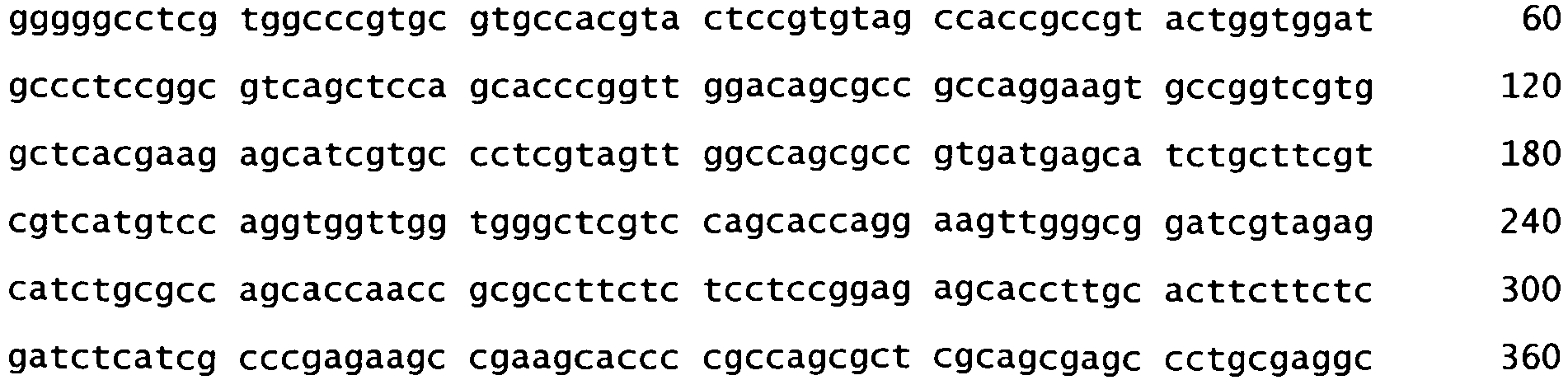


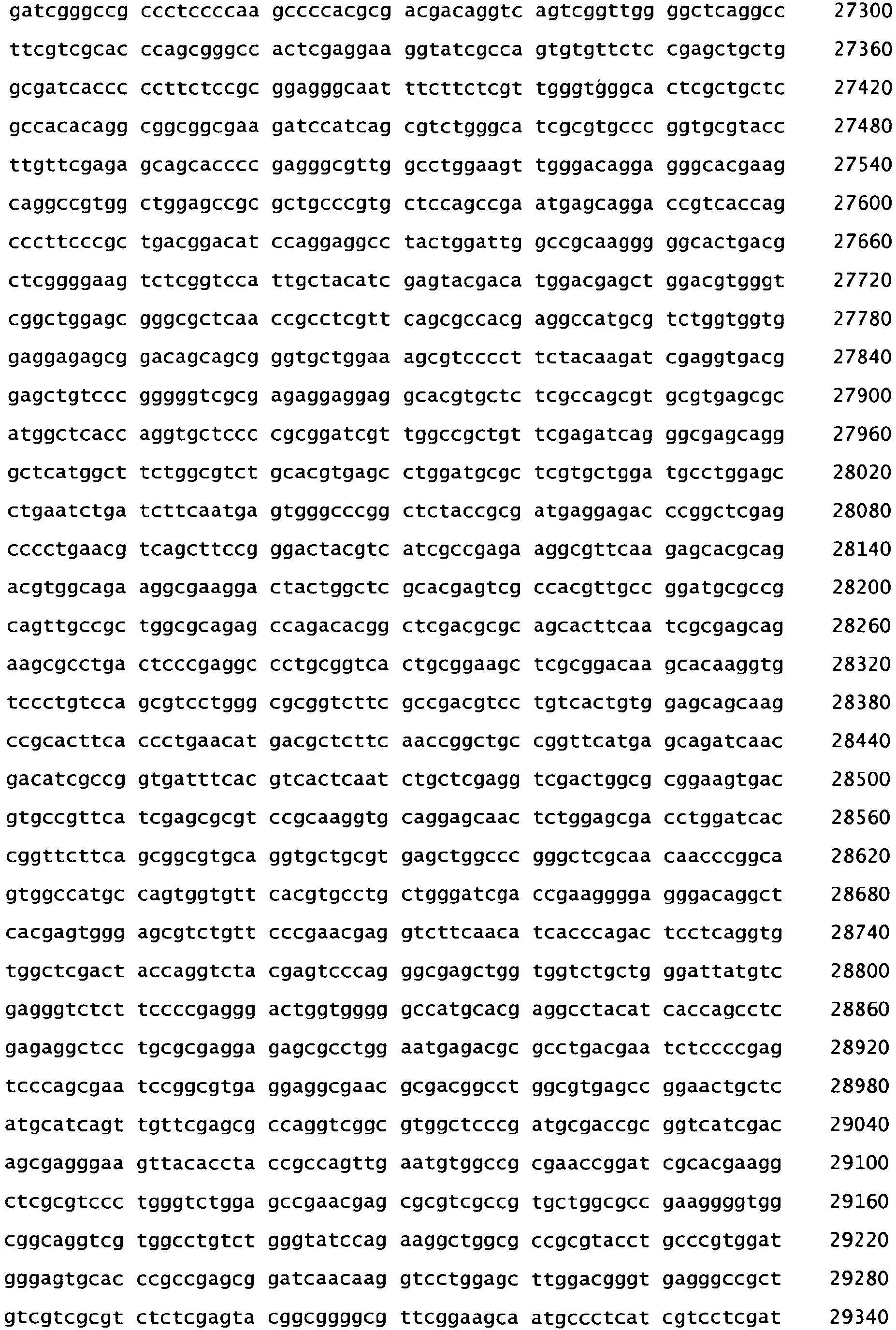


- <210> 2
<211> 2049
<212> DNA
<213> Artificial - <220>
<223> Seq.-ID No. 2: arg1 - <400> 2


- <210> 3
<211> 10617
<212> DNA
<213> Artificial - <220>
<223> Seq.-ID No. 3: arg2 - <400> 3


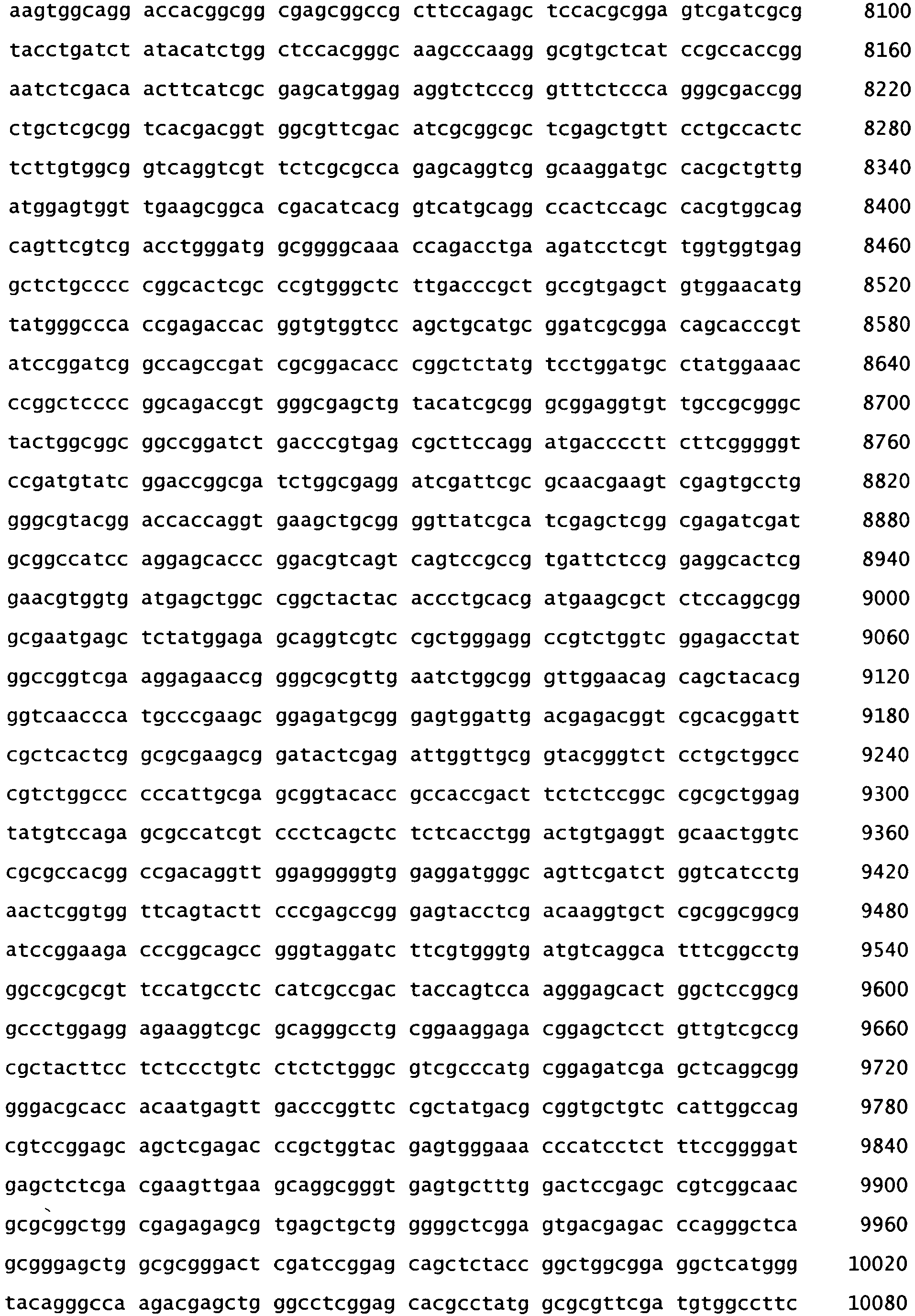

- <210> 4
<211> 17841
<212> DNA
<213> Artificial - <220>
<223> Seq.-ID No. 4: arg3 - <400> 4


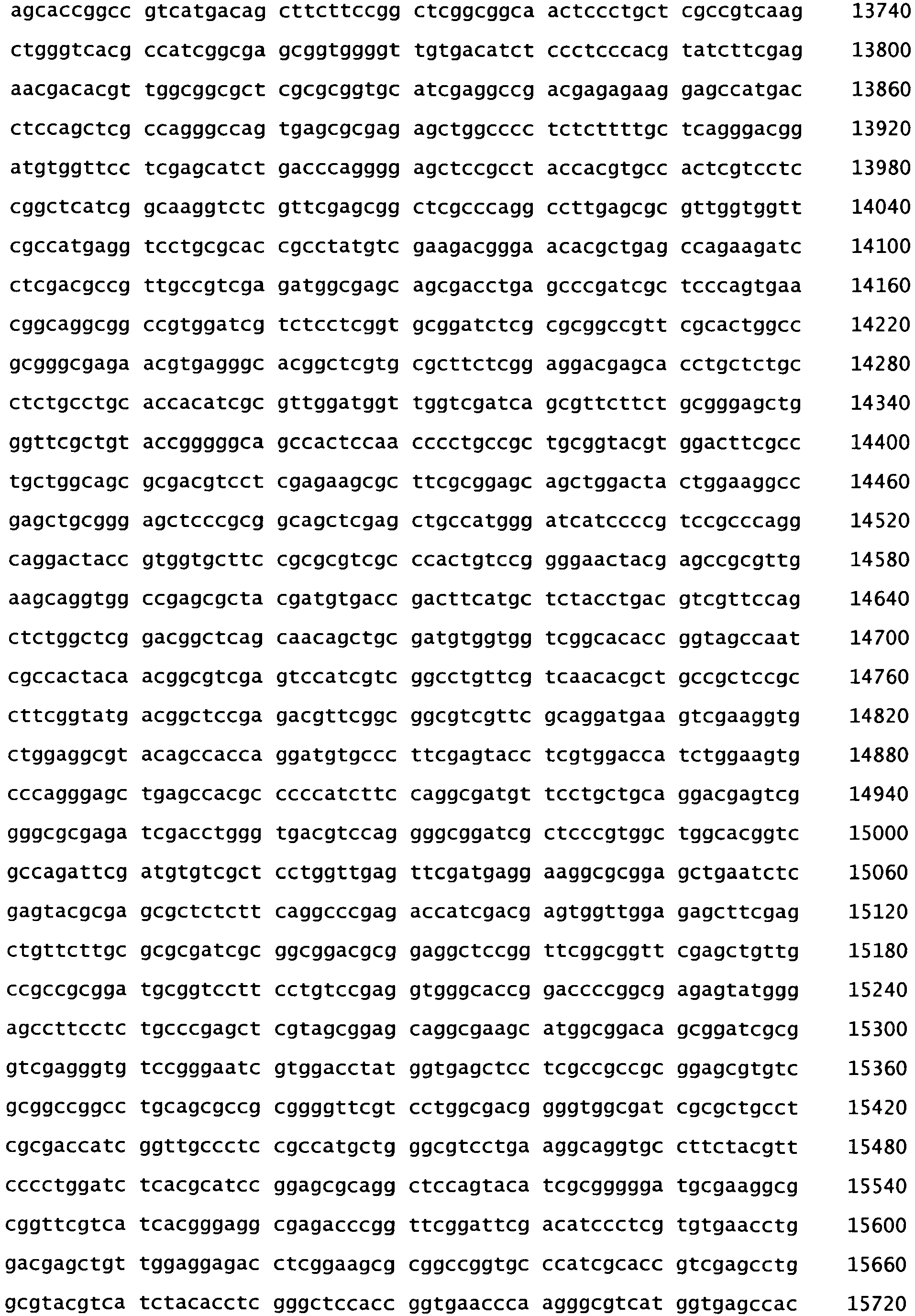


- <210> 5
<211> 1011
<212> DNA
<213> Artificial - <220>
<223> Seq.-ID No. 5: arg4 - <400> 5

- <210> 6
<211> 1152
<212> DNA
<213> Artificial - <220>
<223> Seq.-ID No. 6: arg5 - <400> 6


- <210> 7
<211> 682
<212> PRT
<213> Artificial - <220>
<223> seq.-ID No. 7: Arg1 - <400> 7


- <210> 8
<211> 3538
<212> PRT
<213> Artificial - <220>
<223> Seq.-ID No. 8: Arg2 - <400> 8
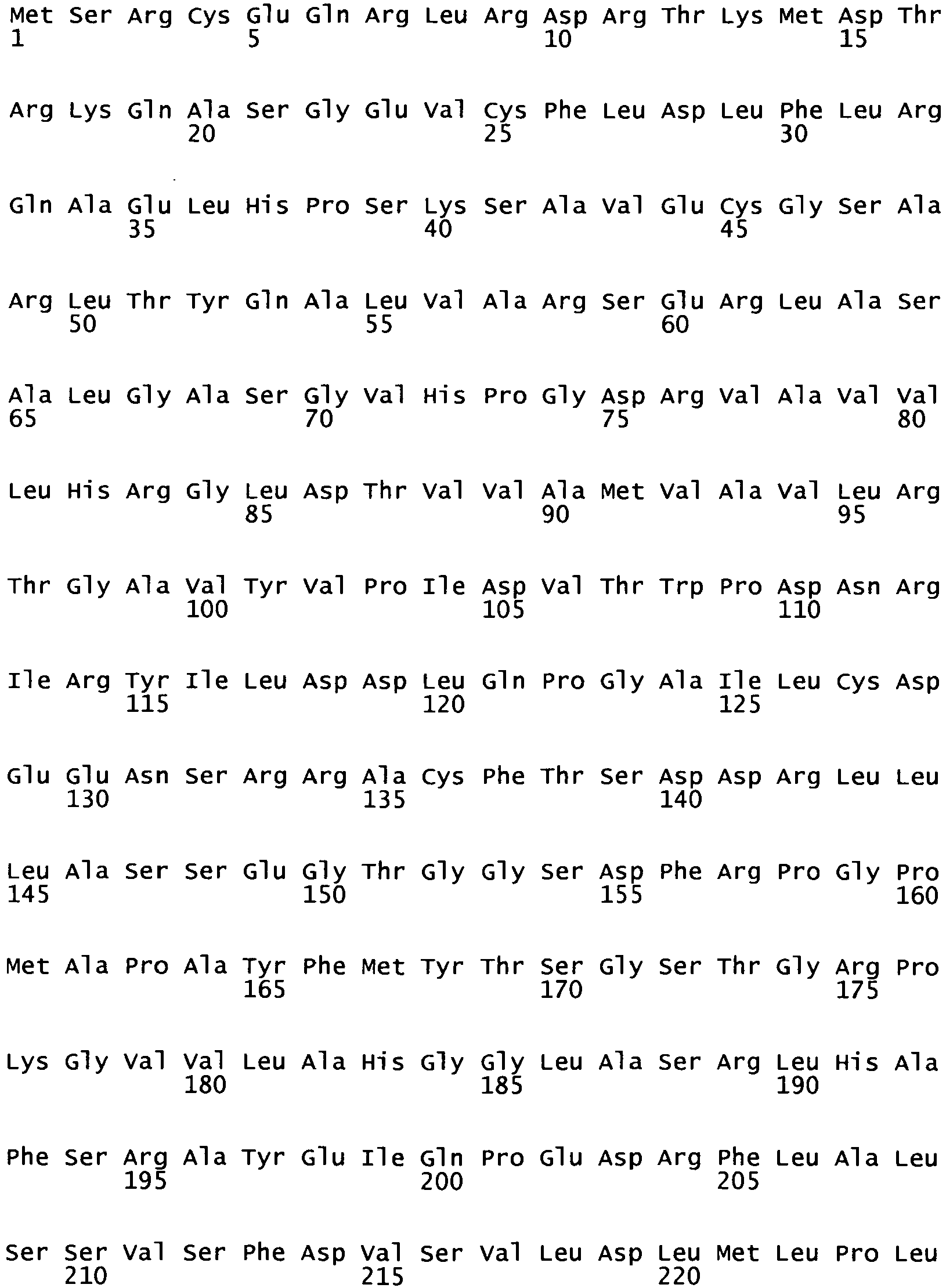

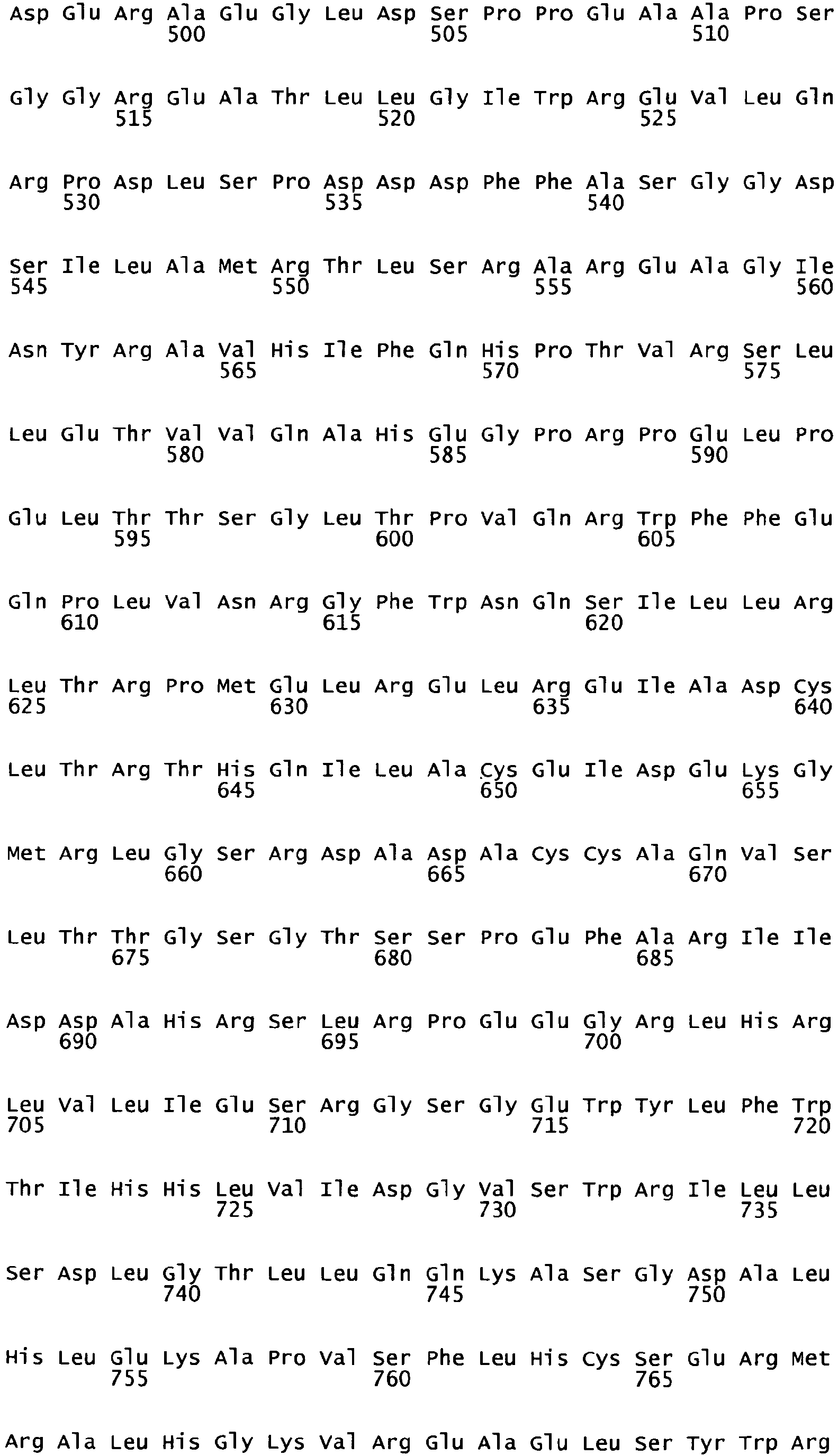


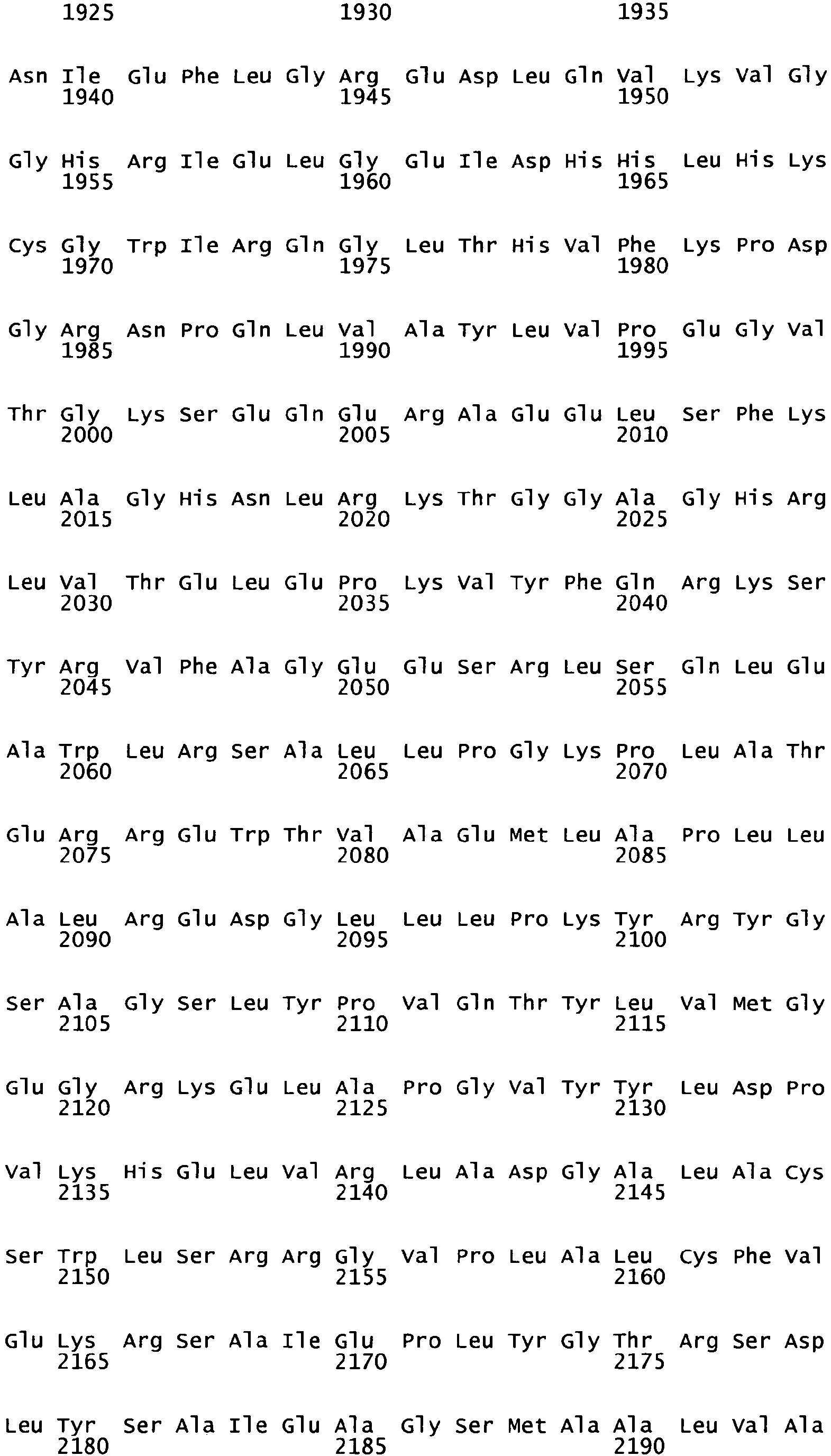
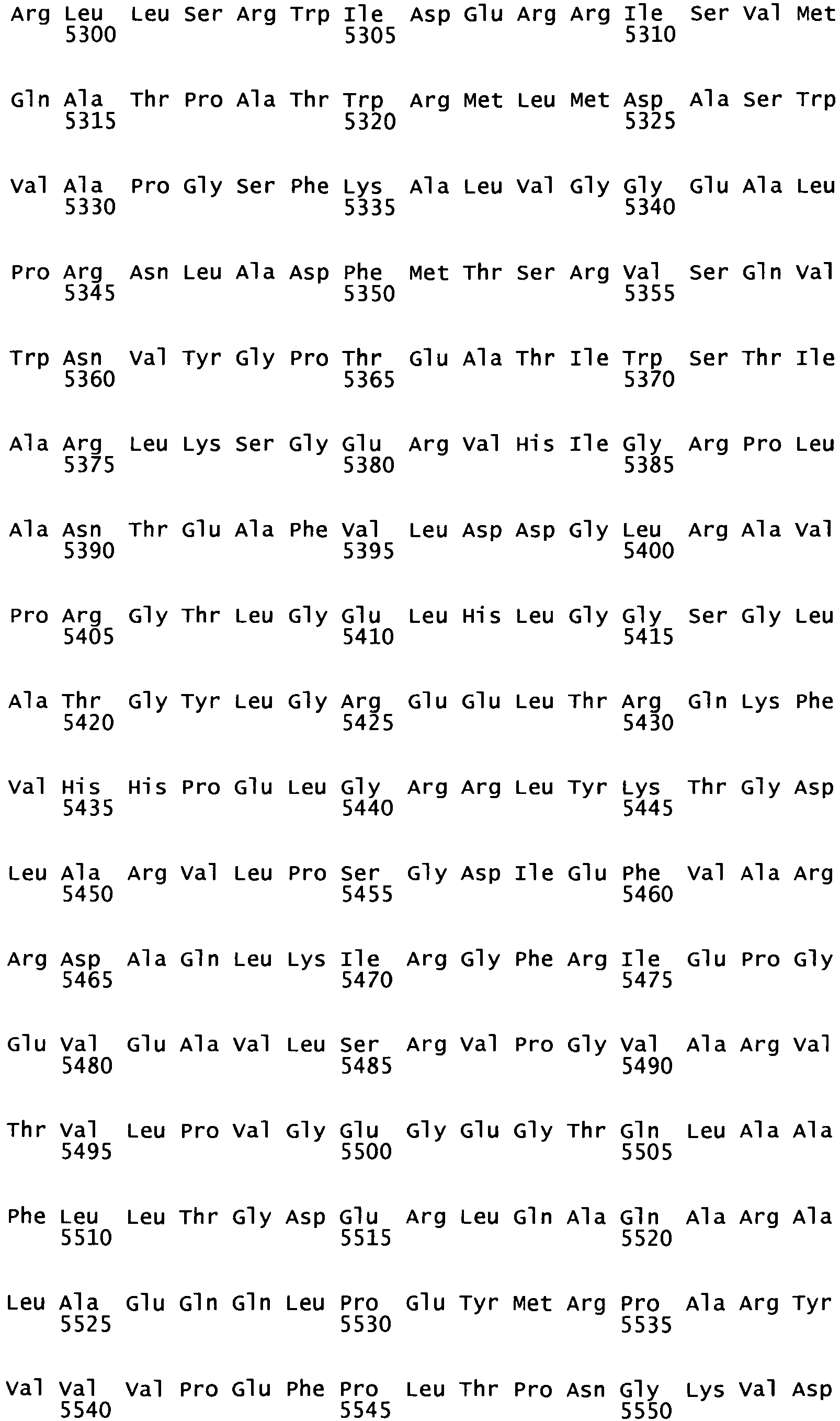
- <210> 9
<211> 5946
<212> PRT
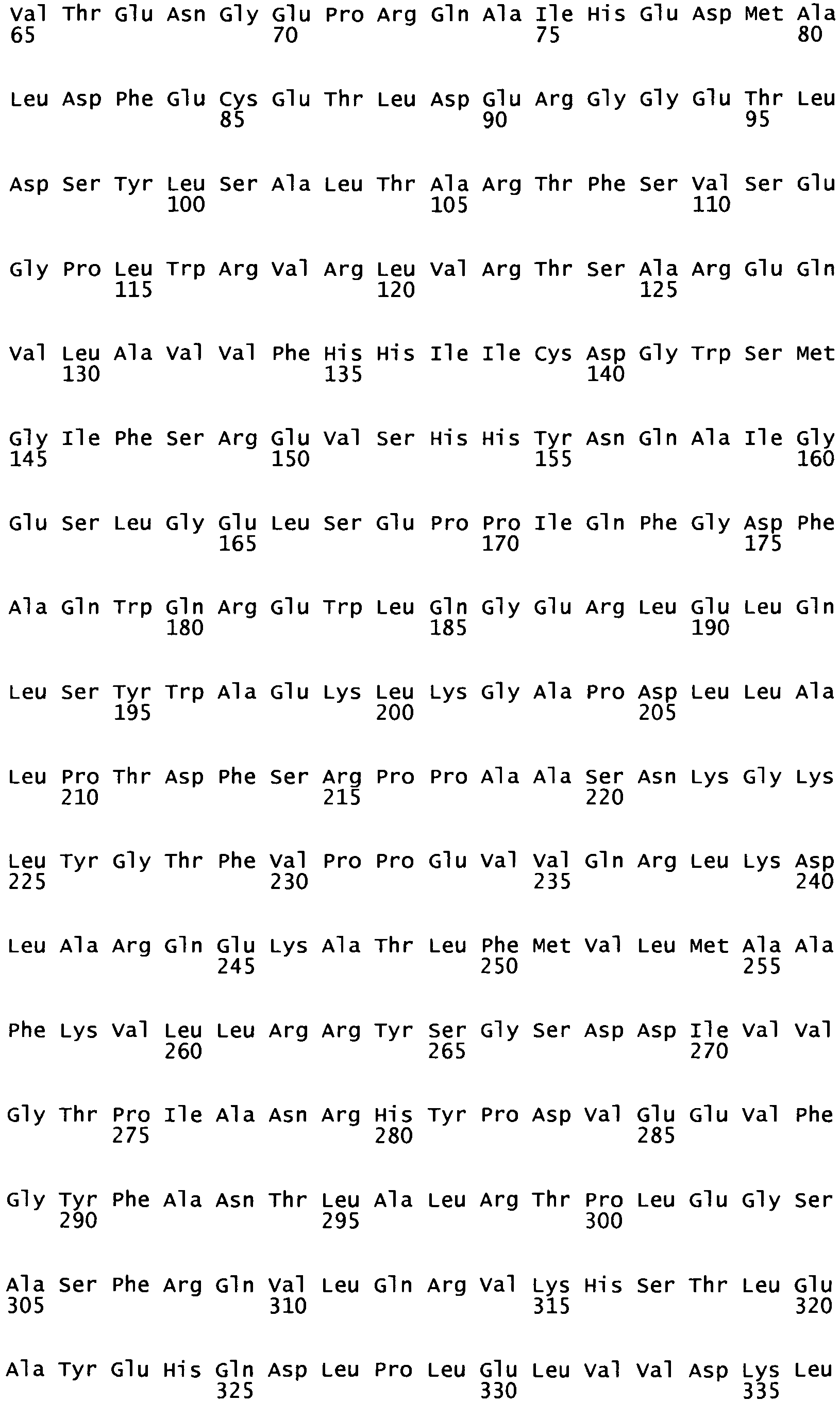
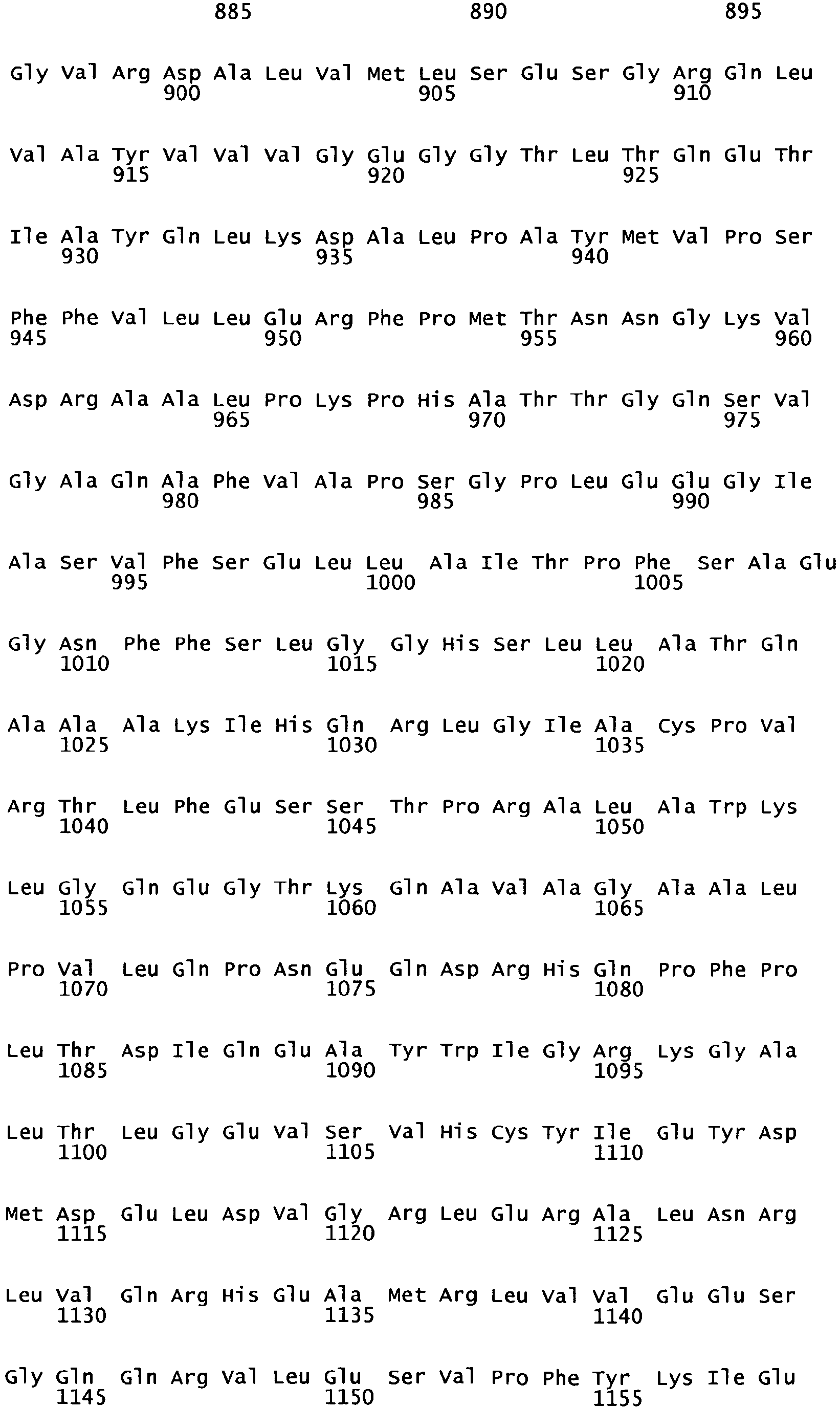
<213> Artificial - <220>
<223> Seq.-ID No. 9: Arg3 - <400> 9









- <210> 10
<211> 336
<212> PRT
<213> Artificial - <220>
<223> Seq.-ID No. 10: Arg4 - <400> 10


- <210> 11
<211> 383
<212> PRT
<213> Artificial - <220>
<223> Seq.-ID No. 11: Arg5 - <400> 11


- <210> 12
<211> 27
<212> DNA
<213> Artificial - <220>
<223> primer fw1 - <400> 12
ctcgatatcc cagcgcaaga gctatcg 27 - <210> 13
<211> 27
<212> DNA
<213> Artificial - <220>
<223> primer bw1 - <400> 13
ctcggatccg gtcgggaacc atgtacc 27
Claims (11)
- Synthetic pathway enzymes for the production of Argyrins, comprising the amino acid sequences of Arg2 of Seq.-ID No. 8 and Arg3 of Seq.-ID No. 9.
- Synthetic pathway enzymes according to claim 1, further comprising at least one of the group consisting of Arg1 of Seq.-ID No. 7, Arg4 of Seq.-ID No. 10 and Arg5 of Seq.-ID No. 11.
- Synthetic pathway enzymes according to claim 1 or 2, further comprising at least one protein of the group of proteins encoded by orf1 of nucleotides 1608 to 4 of Seq.-ID No. 1, orf2 of nucleotides 3615 to 1687 of Seq.-ID No. 1 orf3 of nucleotides 5139 to 3661 of Seq.-ID No. 1, orf4 of nucleotides 7388 to 5274 of Seq.-ID No.1, orf5 of nucleotides 7710 to 8048 of Seq.-ID No.1, orf6 of nucleotides 8870 to 8043 of Seq.-ID No.1, orf7 of nucleotides 9293 to 10282 of Seq.-ID No.1, orf8 of nucleotides 11057 to 10320 of Seq.-ID No.1, orf9 of nucleotides 45620 to 44706 of Seq.-ID No.1, orf10 of nucleotides 46507 to 45617 of Seq.-ID No.1, orf11 of nucleotides 47244 to 46504 of Seq.-ID No. 1, orf12 of nucleotides 47547 to 47975 of Seq.-ID No.1, orf13 of nucleotides 48288 to 49268 of Seq.-ID No.1, orf14 of nucleotides 49483 to 55209 of Seq.-ID No.1, and orf15 of nucleotides 55212 to 55565 of Seq.-ID No. 1.
- Nucleic acid molecule, characterized by encoding an amino acid sequence having enzymatic activity of a synthetic pathway enzyme of one of the preceding claims, wherein the nucleic acid molecule comprises the nucleotide sequence arg2 of Seq.-ID No. 3 and arg3 of Seq.-ID No. 4.
- Nucleic acid molecule according to claim 4, characterized by having a nucleic acid sequence having at least 90% sequence identity to the nucleotide sequence arg2 of Seq.-ID No. 3 and arg3 of Seq.-ID No. 4, and/or by having a nucleotide sequence of at least 90% sequence identity to a nucleotide sequence which is reverse complementary to the nucleotide sequence arg2 of Seq.-ID No. 3 and arg3 of Seq.-ID No. 4.
- Nucleic acid molecule according to one of claims 4 and 5, characterized by further comprising arg1 of Seq.-ID No. 2, arg4 of Seq.-ID No. 5 and/or arg5 of Seq.-ID No. 6.
- Nucleic acid molecule according to one of claims 4 to 6, characterized by further comprising at least one nucleic acid sequence from the group comprising orf1 of nucleotides 1608 to 4 of Seq.-ID No. 1, orf2 of nucleotides 3615 to 1687 of Seq.-ID No. 1 orf3 of nucleotides 5139 to 3661 of Seq.-ID No. 1, orf4 of nucleotides 7388 to 5274 of Seq.-ID No.1, orf5 of nucleotides 7710 to 8048 of Seq.-ID No.1, orf6 of nucleotides 8870 to 8043 of Seq.-ID No.1, orf7 of nucleotides 9293 to 10282 of Seq.-ID No.1, orf8 of nucleotides 11057 to 10320 of Seq.-ID No.1, orf9 of nucleotides 45620 to 44706 of Seq.-ID No.1, orf10 of nucleotides 46507 to 45617 of Seq.-ID No.1, orf11 of nucleotides 47244 to 46504 of Seq.-ID No. 1, orf 12 of nucleotides 47547 to 47975 of Seq.-ID No.1, orf13 of nucleotides 48288 to 49268 of Seq.-ID No.1, orf14 of nucleotides 49483 to 55209 of Seq.-ID No.1, and orf15 of nucleotides 55212 to 55565 of Seq.-ID No. 1.
- Micro-organism, which is genetically manipulated to contain a nucleic acid molecule of one of claims 4 to 7.
- Micro-organism according to claim 8, wherein the micro-organism is the product of a genetic manipulation which includes the step of providing the micro-organism with nucleic acid sequences encoding pathway enzymes Arg1 of Seq.-ID No. 7, Arg2 of Seq.-ID No. 8, Arg3 of Seq.-ID No. 9, and Arg4 of Seq.-ID No. 10 for use in the synthesis of Argyrins.
- Process for the production of Argyrins, characterized by the use of synthetic pathway enzymes, wherein the enzyme is contained in a micro-organism genetically manipulated to contain the synthetic pathway enzymes of one of claims 1 to 3.
- Process for the production of Argyrins, characterized by the use of synthetic pathway enzymes of one of claims 1 to 3, characterized in that the enzyme is used in a cell - free form for conversion of a precursor compound to a compound selected from the group comprising pre-Argyrin and Argyrins A to H.
Priority Applications (1)
| Application Number | Priority Date | Filing Date | Title |
|---|---|---|---|
| EP09772301A EP2297181B1 (en) | 2008-07-04 | 2009-06-15 | Synthetic pathway enzymes for the production of argyrins |
Applications Claiming Priority (3)
| Application Number | Priority Date | Filing Date | Title |
|---|---|---|---|
| EP08159743A EP2141242A1 (en) | 2008-07-04 | 2008-07-04 | Synthetic pathway enzymes for the production of Argyrins |
| PCT/EP2009/057336 WO2010000601A1 (en) | 2008-07-04 | 2009-06-15 | Synthetic pathway enzymes for the production of argyrins |
| EP09772301A EP2297181B1 (en) | 2008-07-04 | 2009-06-15 | Synthetic pathway enzymes for the production of argyrins |
Publications (2)
| Publication Number | Publication Date |
|---|---|
| EP2297181A1 EP2297181A1 (en) | 2011-03-23 |
| EP2297181B1 true EP2297181B1 (en) | 2013-03-13 |
Family
ID=39882844
Family Applications (2)
| Application Number | Title | Priority Date | Filing Date |
|---|---|---|---|
| EP08159743A Withdrawn EP2141242A1 (en) | 2008-07-04 | 2008-07-04 | Synthetic pathway enzymes for the production of Argyrins |
| EP09772301A Active EP2297181B1 (en) | 2008-07-04 | 2009-06-15 | Synthetic pathway enzymes for the production of argyrins |
Family Applications Before (1)
| Application Number | Title | Priority Date | Filing Date |
|---|---|---|---|
| EP08159743A Withdrawn EP2141242A1 (en) | 2008-07-04 | 2008-07-04 | Synthetic pathway enzymes for the production of Argyrins |
Country Status (4)
| Country | Link |
|---|---|
| US (2) | US8404462B2 (en) |
| EP (2) | EP2141242A1 (en) |
| CA (1) | CA2726297C (en) |
| WO (1) | WO2010000601A1 (en) |
Families Citing this family (1)
| Publication number | Priority date | Publication date | Assignee | Title |
|---|---|---|---|---|
| FR3145744A1 (en) | 2023-02-11 | 2024-08-16 | Marc Grosman | Drone comprising at least one fuel cell, a computer including a quantum or superconducting element, capable of carrying out several tasks during a flight in a difficult-to-access area. |
Family Cites Families (6)
| Publication number | Priority date | Publication date | Assignee | Title |
|---|---|---|---|---|
| DE60114865T2 (en) * | 2000-04-28 | 2006-07-27 | Kosan Biosciences, Inc., Hayward | HETEROLOGIST PREPARATION OF POLYCETIDES |
| US7863020B2 (en) * | 2000-06-28 | 2011-01-04 | Glycofi, Inc. | Production of sialylated N-glycans in lower eukaryotes |
| US6833447B1 (en) * | 2000-07-10 | 2004-12-21 | Monsanto Technology, Llc | Myxococcus xanthus genome sequences and uses thereof |
| JP3797326B2 (en) * | 2000-12-27 | 2006-07-19 | ブラザー工業株式会社 | Sewing machine with upper thread cassette and upper thread cassette |
| CN1694720A (en) * | 2002-09-16 | 2005-11-09 | 阿根尼克斯有限公司 | Lactoferrin compositions and methods of wound treatment |
| EP1619241A1 (en) | 2004-07-23 | 2006-01-25 | Gesellschaft für Biotechnologische Forschung mbH | Genetic modification system for myxobacteria |
-
2008
- 2008-07-04 EP EP08159743A patent/EP2141242A1/en not_active Withdrawn
-
2009
- 2009-06-15 US US12/999,872 patent/US8404462B2/en active Active
- 2009-06-15 WO PCT/EP2009/057336 patent/WO2010000601A1/en not_active Ceased
- 2009-06-15 EP EP09772301A patent/EP2297181B1/en active Active
- 2009-06-15 CA CA2726297A patent/CA2726297C/en active Active
-
2013
- 2013-02-27 US US13/779,212 patent/US9217169B2/en active Active
Also Published As
| Publication number | Publication date |
|---|---|
| EP2141242A1 (en) | 2010-01-06 |
| CA2726297A1 (en) | 2010-01-07 |
| CA2726297C (en) | 2016-08-16 |
| EP2297181A1 (en) | 2011-03-23 |
| US20130295606A1 (en) | 2013-11-07 |
| US9217169B2 (en) | 2015-12-22 |
| US20110159537A1 (en) | 2011-06-30 |
| US8404462B2 (en) | 2013-03-26 |
| WO2010000601A1 (en) | 2010-01-07 |
Similar Documents
| Publication | Publication Date | Title |
|---|---|---|
| EP2319923B1 (en) | Pyripyropene a biosynthetic genes | |
| Xu et al. | Identification of tailoring genes involved in the modification of the polyketide backbone of rifamycin B by Amycolatopsis mediterranei S699 | |
| EP1652926B1 (en) | Crystalline epothilone d | |
| US8030325B2 (en) | Biosynthetic gene cluster for the production of a complex polyketide | |
| EP0929681B1 (en) | Rifamycin biosynthesis gene cluster | |
| US9217169B2 (en) | Synthetic pathway enzymes for the production of argyrins | |
| CN118063531B (en) | Preparation and application of macrolide compound PA-46101s C-E | |
| US20100022766A1 (en) | Biosynthetic gene cluster for the production of a complex polyketide | |
| CN104427870B (en) | UK-2 biosynthetic genes and methods of using same to increase UK-2 productivity | |
| EP1443113B1 (en) | Method of obtaining indolocarbazoles using biosynthetic rebeccamycin genes | |
| KR100679759B1 (en) | Transformants and New Biosynthetic Genes Produce Secondary Metabolites Modified by Functional Groups | |
| EP1632569B1 (en) | Strain belonging to the genus streptomyces and being capable of producing nemadictin and process for producing nemadictin using the strain | |
| CN102260644B (en) | Mutant strain of Streptomyces flaveolus and construction method and application thereof | |
| US9394553B2 (en) | Biosynthetic gene cluster for chejuenolide of marine microorganism Hahella chejuensis | |
| EP2247740B1 (en) | Genes encoding the biosynthetic pathway for etnangien production | |
| WO2000037608A2 (en) | Micromonospora echinospora genes encoding for biosynthesis of calicheamicin and self-resistance thereto | |
| Jiang et al. | Genetic engineering ofSorangium cellulosum reveals hidden enzymology in myxobacterial natural product biosynthesis | |
| JPH0638750A (en) | Enzyme for acylating 3-position of macrolide antibiotic and gene coding the same | |
| JP2004173537A (en) | Biosynthesis gene for kanamycin | |
| WO2001019959A1 (en) | Improvement of clavulanic acid production | |
| WO2007014971A2 (en) | Genes involved in the biosynthesis of thiocoraline and heterologous production of same |
Legal Events
| Date | Code | Title | Description |
|---|---|---|---|
| PUAI | Public reference made under article 153(3) epc to a published international application that has entered the european phase |
Free format text: ORIGINAL CODE: 0009012 |
|
| 17P | Request for examination filed |
Effective date: 20101124 |
|
| AK | Designated contracting states |
Kind code of ref document: A1 Designated state(s): AT BE BG CH CY CZ DE DK EE ES FI FR GB GR HR HU IE IS IT LI LT LU LV MC MK MT NL NO PL PT RO SE SI SK TR |
|
| AX | Request for extension of the european patent |
Extension state: AL BA RS |
|
| DAX | Request for extension of the european patent (deleted) | ||
| 17Q | First examination report despatched |
Effective date: 20120402 |
|
| GRAP | Despatch of communication of intention to grant a patent |
Free format text: ORIGINAL CODE: EPIDOSNIGR1 |
|
| GRAS | Grant fee paid |
Free format text: ORIGINAL CODE: EPIDOSNIGR3 |
|
| GRAA | (expected) grant |
Free format text: ORIGINAL CODE: 0009210 |
|
| AK | Designated contracting states |
Kind code of ref document: B1 Designated state(s): AT BE BG CH CY CZ DE DK EE ES FI FR GB GR HR HU IE IS IT LI LT LU LV MC MK MT NL NO PL PT RO SE SI SK TR |
|
| REG | Reference to a national code |
Ref country code: GB Ref legal event code: FG4D |
|
| REG | Reference to a national code |
Ref country code: CH Ref legal event code: EP Ref country code: AT Ref legal event code: REF Ref document number: 600755 Country of ref document: AT Kind code of ref document: T Effective date: 20130315 |
|
| REG | Reference to a national code |
Ref country code: IE Ref legal event code: FG4D |
|
| REG | Reference to a national code |
Ref country code: DE Ref legal event code: R096 Ref document number: 602009013948 Country of ref document: DE Effective date: 20130508 |
|
| PG25 | Lapsed in a contracting state [announced via postgrant information from national office to epo] |
Ref country code: NO Free format text: LAPSE BECAUSE OF FAILURE TO SUBMIT A TRANSLATION OF THE DESCRIPTION OR TO PAY THE FEE WITHIN THE PRESCRIBED TIME-LIMIT Effective date: 20130613 Ref country code: ES Free format text: LAPSE BECAUSE OF FAILURE TO SUBMIT A TRANSLATION OF THE DESCRIPTION OR TO PAY THE FEE WITHIN THE PRESCRIBED TIME-LIMIT Effective date: 20130624 Ref country code: BG Free format text: LAPSE BECAUSE OF FAILURE TO SUBMIT A TRANSLATION OF THE DESCRIPTION OR TO PAY THE FEE WITHIN THE PRESCRIBED TIME-LIMIT Effective date: 20130613 Ref country code: SE Free format text: LAPSE BECAUSE OF FAILURE TO SUBMIT A TRANSLATION OF THE DESCRIPTION OR TO PAY THE FEE WITHIN THE PRESCRIBED TIME-LIMIT Effective date: 20130313 Ref country code: LT Free format text: LAPSE BECAUSE OF FAILURE TO SUBMIT A TRANSLATION OF THE DESCRIPTION OR TO PAY THE FEE WITHIN THE PRESCRIBED TIME-LIMIT Effective date: 20130313 |
|
| REG | Reference to a national code |
Ref country code: AT Ref legal event code: MK05 Ref document number: 600755 Country of ref document: AT Kind code of ref document: T Effective date: 20130313 |
|
| REG | Reference to a national code |
Ref country code: NL Ref legal event code: VDEP Effective date: 20130313 |
|
| REG | Reference to a national code |
Ref country code: LT Ref legal event code: MG4D |
|
| PG25 | Lapsed in a contracting state [announced via postgrant information from national office to epo] |
Ref country code: GR Free format text: LAPSE BECAUSE OF FAILURE TO SUBMIT A TRANSLATION OF THE DESCRIPTION OR TO PAY THE FEE WITHIN THE PRESCRIBED TIME-LIMIT Effective date: 20130614 Ref country code: SI Free format text: LAPSE BECAUSE OF FAILURE TO SUBMIT A TRANSLATION OF THE DESCRIPTION OR TO PAY THE FEE WITHIN THE PRESCRIBED TIME-LIMIT Effective date: 20130313 Ref country code: LV Free format text: LAPSE BECAUSE OF FAILURE TO SUBMIT A TRANSLATION OF THE DESCRIPTION OR TO PAY THE FEE WITHIN THE PRESCRIBED TIME-LIMIT Effective date: 20130313 Ref country code: FI Free format text: LAPSE BECAUSE OF FAILURE TO SUBMIT A TRANSLATION OF THE DESCRIPTION OR TO PAY THE FEE WITHIN THE PRESCRIBED TIME-LIMIT Effective date: 20130313 |
|
| PG25 | Lapsed in a contracting state [announced via postgrant information from national office to epo] |
Ref country code: HR Free format text: LAPSE BECAUSE OF FAILURE TO SUBMIT A TRANSLATION OF THE DESCRIPTION OR TO PAY THE FEE WITHIN THE PRESCRIBED TIME-LIMIT Effective date: 20130313 Ref country code: BE Free format text: LAPSE BECAUSE OF FAILURE TO SUBMIT A TRANSLATION OF THE DESCRIPTION OR TO PAY THE FEE WITHIN THE PRESCRIBED TIME-LIMIT Effective date: 20130313 |
|
| PG25 | Lapsed in a contracting state [announced via postgrant information from national office to epo] |
Ref country code: EE Free format text: LAPSE BECAUSE OF FAILURE TO SUBMIT A TRANSLATION OF THE DESCRIPTION OR TO PAY THE FEE WITHIN THE PRESCRIBED TIME-LIMIT Effective date: 20130313 Ref country code: IS Free format text: LAPSE BECAUSE OF FAILURE TO SUBMIT A TRANSLATION OF THE DESCRIPTION OR TO PAY THE FEE WITHIN THE PRESCRIBED TIME-LIMIT Effective date: 20130713 Ref country code: CZ Free format text: LAPSE BECAUSE OF FAILURE TO SUBMIT A TRANSLATION OF THE DESCRIPTION OR TO PAY THE FEE WITHIN THE PRESCRIBED TIME-LIMIT Effective date: 20130313 Ref country code: AT Free format text: LAPSE BECAUSE OF FAILURE TO SUBMIT A TRANSLATION OF THE DESCRIPTION OR TO PAY THE FEE WITHIN THE PRESCRIBED TIME-LIMIT Effective date: 20130313 Ref country code: NL Free format text: LAPSE BECAUSE OF FAILURE TO SUBMIT A TRANSLATION OF THE DESCRIPTION OR TO PAY THE FEE WITHIN THE PRESCRIBED TIME-LIMIT Effective date: 20130313 Ref country code: SK Free format text: LAPSE BECAUSE OF FAILURE TO SUBMIT A TRANSLATION OF THE DESCRIPTION OR TO PAY THE FEE WITHIN THE PRESCRIBED TIME-LIMIT Effective date: 20130313 Ref country code: PT Free format text: LAPSE BECAUSE OF FAILURE TO SUBMIT A TRANSLATION OF THE DESCRIPTION OR TO PAY THE FEE WITHIN THE PRESCRIBED TIME-LIMIT Effective date: 20130715 Ref country code: RO Free format text: LAPSE BECAUSE OF FAILURE TO SUBMIT A TRANSLATION OF THE DESCRIPTION OR TO PAY THE FEE WITHIN THE PRESCRIBED TIME-LIMIT Effective date: 20130313 |
|
| PG25 | Lapsed in a contracting state [announced via postgrant information from national office to epo] |
Ref country code: CY Free format text: LAPSE BECAUSE OF FAILURE TO SUBMIT A TRANSLATION OF THE DESCRIPTION OR TO PAY THE FEE WITHIN THE PRESCRIBED TIME-LIMIT Effective date: 20130313 Ref country code: PL Free format text: LAPSE BECAUSE OF FAILURE TO SUBMIT A TRANSLATION OF THE DESCRIPTION OR TO PAY THE FEE WITHIN THE PRESCRIBED TIME-LIMIT Effective date: 20130313 |
|
| PLBE | No opposition filed within time limit |
Free format text: ORIGINAL CODE: 0009261 |
|
| STAA | Information on the status of an ep patent application or granted ep patent |
Free format text: STATUS: NO OPPOSITION FILED WITHIN TIME LIMIT |
|
| PG25 | Lapsed in a contracting state [announced via postgrant information from national office to epo] |
Ref country code: MC Free format text: LAPSE BECAUSE OF FAILURE TO SUBMIT A TRANSLATION OF THE DESCRIPTION OR TO PAY THE FEE WITHIN THE PRESCRIBED TIME-LIMIT Effective date: 20130313 Ref country code: DK Free format text: LAPSE BECAUSE OF FAILURE TO SUBMIT A TRANSLATION OF THE DESCRIPTION OR TO PAY THE FEE WITHIN THE PRESCRIBED TIME-LIMIT Effective date: 20130313 |
|
| 26N | No opposition filed |
Effective date: 20131216 |
|
| PG25 | Lapsed in a contracting state [announced via postgrant information from national office to epo] |
Ref country code: IT Free format text: LAPSE BECAUSE OF FAILURE TO SUBMIT A TRANSLATION OF THE DESCRIPTION OR TO PAY THE FEE WITHIN THE PRESCRIBED TIME-LIMIT Effective date: 20130313 |
|
| REG | Reference to a national code |
Ref country code: IE Ref legal event code: MM4A |
|
| REG | Reference to a national code |
Ref country code: DE Ref legal event code: R097 Ref document number: 602009013948 Country of ref document: DE Effective date: 20131216 |
|
| PG25 | Lapsed in a contracting state [announced via postgrant information from national office to epo] |
Ref country code: IE Free format text: LAPSE BECAUSE OF NON-PAYMENT OF DUE FEES Effective date: 20130615 |
|
| PG25 | Lapsed in a contracting state [announced via postgrant information from national office to epo] |
Ref country code: MT Free format text: LAPSE BECAUSE OF FAILURE TO SUBMIT A TRANSLATION OF THE DESCRIPTION OR TO PAY THE FEE WITHIN THE PRESCRIBED TIME-LIMIT Effective date: 20130313 |
|
| PG25 | Lapsed in a contracting state [announced via postgrant information from national office to epo] |
Ref country code: TR Free format text: LAPSE BECAUSE OF FAILURE TO SUBMIT A TRANSLATION OF THE DESCRIPTION OR TO PAY THE FEE WITHIN THE PRESCRIBED TIME-LIMIT Effective date: 20130313 |
|
| PG25 | Lapsed in a contracting state [announced via postgrant information from national office to epo] |
Ref country code: LU Free format text: LAPSE BECAUSE OF NON-PAYMENT OF DUE FEES Effective date: 20130615 Ref country code: HU Free format text: LAPSE BECAUSE OF FAILURE TO SUBMIT A TRANSLATION OF THE DESCRIPTION OR TO PAY THE FEE WITHIN THE PRESCRIBED TIME-LIMIT; INVALID AB INITIO Effective date: 20090615 Ref country code: MK Free format text: LAPSE BECAUSE OF FAILURE TO SUBMIT A TRANSLATION OF THE DESCRIPTION OR TO PAY THE FEE WITHIN THE PRESCRIBED TIME-LIMIT Effective date: 20130313 |
|
| REG | Reference to a national code |
Ref country code: FR Ref legal event code: PLFP Year of fee payment: 8 |
|
| REG | Reference to a national code |
Ref country code: FR Ref legal event code: PLFP Year of fee payment: 9 |
|
| REG | Reference to a national code |
Ref country code: FR Ref legal event code: PLFP Year of fee payment: 10 |
|
| PGFP | Annual fee paid to national office [announced via postgrant information from national office to epo] |
Ref country code: GB Payment date: 20240620 Year of fee payment: 16 |
|
| PGFP | Annual fee paid to national office [announced via postgrant information from national office to epo] |
Ref country code: DE Payment date: 20240430 Year of fee payment: 16 |
|
| PGFP | Annual fee paid to national office [announced via postgrant information from national office to epo] |
Ref country code: FR Payment date: 20240621 Year of fee payment: 16 |
|
| PGFP | Annual fee paid to national office [announced via postgrant information from national office to epo] |
Ref country code: CH Payment date: 20240701 Year of fee payment: 16 |
|
| REG | Reference to a national code |
Ref country code: DE Ref legal event code: R119 Ref document number: 602009013948 Country of ref document: DE |
|
| REG | Reference to a national code |
Ref country code: CH Ref legal event code: H13 Free format text: ST27 STATUS EVENT CODE: U-0-0-H10-H13 (AS PROVIDED BY THE NATIONAL OFFICE) Effective date: 20260127 |
|
| GBPC | Gb: european patent ceased through non-payment of renewal fee |
Effective date: 20250615 |
|
| PG25 | Lapsed in a contracting state [announced via postgrant information from national office to epo] |
Ref country code: GB Free format text: LAPSE BECAUSE OF NON-PAYMENT OF DUE FEES Effective date: 20250615 |
|
| PG25 | Lapsed in a contracting state [announced via postgrant information from national office to epo] |
Ref country code: DE Free format text: LAPSE BECAUSE OF NON-PAYMENT OF DUE FEES Effective date: 20260101 |
|
| PG25 | Lapsed in a contracting state [announced via postgrant information from national office to epo] |
Ref country code: FR Free format text: LAPSE BECAUSE OF NON-PAYMENT OF DUE FEES Effective date: 20250630 |
|
| PG25 | Lapsed in a contracting state [announced via postgrant information from national office to epo] |
Ref country code: CH Free format text: LAPSE BECAUSE OF NON-PAYMENT OF DUE FEES Effective date: 20250630 |