EP2296715B1 - Sterile packing and sterilization method using this packing - Google Patents
Sterile packing and sterilization method using this packing Download PDFInfo
- Publication number
- EP2296715B1 EP2296715B1 EP20080807165 EP08807165A EP2296715B1 EP 2296715 B1 EP2296715 B1 EP 2296715B1 EP 20080807165 EP20080807165 EP 20080807165 EP 08807165 A EP08807165 A EP 08807165A EP 2296715 B1 EP2296715 B1 EP 2296715B1
- Authority
- EP
- European Patent Office
- Prior art keywords
- container
- membrane
- opening
- packing
- sterile
- Prior art date
- Legal status (The legal status is an assumption and is not a legal conclusion. Google has not performed a legal analysis and makes no representation as to the accuracy of the status listed.)
- Active
Links
Images

Classifications
-
- A—HUMAN NECESSITIES
- A61—MEDICAL OR VETERINARY SCIENCE; HYGIENE
- A61L—METHODS OR APPARATUS FOR STERILISING MATERIALS OR OBJECTS IN GENERAL; DISINFECTION, STERILISATION OR DEODORISATION OF AIR; CHEMICAL ASPECTS OF BANDAGES, DRESSINGS, ABSORBENT PADS OR SURGICAL ARTICLES; MATERIALS FOR BANDAGES, DRESSINGS, ABSORBENT PADS OR SURGICAL ARTICLES
- A61L2/00—Disinfection or sterilisation of materials or objects, in general; Accessories therefor
- A61L2/26—Accessories
-
- A—HUMAN NECESSITIES
- A61—MEDICAL OR VETERINARY SCIENCE; HYGIENE
- A61L—METHODS OR APPARATUS FOR STERILISING MATERIALS OR OBJECTS IN GENERAL; DISINFECTION, STERILISATION OR DEODORISATION OF AIR; CHEMICAL ASPECTS OF BANDAGES, DRESSINGS, ABSORBENT PADS OR SURGICAL ARTICLES; MATERIALS FOR BANDAGES, DRESSINGS, ABSORBENT PADS OR SURGICAL ARTICLES
- A61L2/00—Disinfection or sterilisation of materials or objects, in general; Accessories therefor
- A61L2/02—Disinfection or sterilisation of materials or objects, in general; Accessories therefor using physical processes
- A61L2/04—Heat
- A61L2/06—Hot gas
- A61L2/07—Steam
-
- A—HUMAN NECESSITIES
- A61—MEDICAL OR VETERINARY SCIENCE; HYGIENE
- A61L—METHODS OR APPARATUS FOR STERILISING MATERIALS OR OBJECTS IN GENERAL; DISINFECTION, STERILISATION OR DEODORISATION OF AIR; CHEMICAL ASPECTS OF BANDAGES, DRESSINGS, ABSORBENT PADS OR SURGICAL ARTICLES; MATERIALS FOR BANDAGES, DRESSINGS, ABSORBENT PADS OR SURGICAL ARTICLES
- A61L2/00—Disinfection or sterilisation of materials or objects, in general; Accessories therefor
- A61L2/16—Disinfection or sterilisation of materials or objects, in general; Accessories therefor using chemical substances
- A61L2/18—Liquid substances
-
- A—HUMAN NECESSITIES
- A61—MEDICAL OR VETERINARY SCIENCE; HYGIENE
- A61L—METHODS OR APPARATUS FOR STERILISING MATERIALS OR OBJECTS IN GENERAL; DISINFECTION, STERILISATION OR DEODORISATION OF AIR; CHEMICAL ASPECTS OF BANDAGES, DRESSINGS, ABSORBENT PADS OR SURGICAL ARTICLES; MATERIALS FOR BANDAGES, DRESSINGS, ABSORBENT PADS OR SURGICAL ARTICLES
- A61L2202/00—Aspects relating to methods or apparatus for disinfecting or sterilising materials or objects
- A61L2202/10—Apparatus features
- A61L2202/18—Aseptic storing means
- A61L2202/182—Rigid packaging means
-
- B—PERFORMING OPERATIONS; TRANSPORTING
- B65—CONVEYING; PACKING; STORING; HANDLING THIN OR FILAMENTARY MATERIAL
- B65D—CONTAINERS FOR STORAGE OR TRANSPORT OF ARTICLES OR MATERIALS, e.g. BAGS, BARRELS, BOTTLES, BOXES, CANS, CARTONS, CRATES, DRUMS, JARS, TANKS, HOPPERS, FORWARDING CONTAINERS; ACCESSORIES, CLOSURES, OR FITTINGS THEREFOR; PACKAGING ELEMENTS; PACKAGES
- B65D2251/00—Details relating to container closures
- B65D2251/0003—Two or more closures
- B65D2251/0006—Upper closure
- B65D2251/0031—Membrane
-
- B—PERFORMING OPERATIONS; TRANSPORTING
- B65—CONVEYING; PACKING; STORING; HANDLING THIN OR FILAMENTARY MATERIAL
- B65D—CONTAINERS FOR STORAGE OR TRANSPORT OF ARTICLES OR MATERIALS, e.g. BAGS, BARRELS, BOTTLES, BOXES, CANS, CARTONS, CRATES, DRUMS, JARS, TANKS, HOPPERS, FORWARDING CONTAINERS; ACCESSORIES, CLOSURES, OR FITTINGS THEREFOR; PACKAGING ELEMENTS; PACKAGES
- B65D2251/00—Details relating to container closures
- B65D2251/0003—Two or more closures
- B65D2251/0068—Lower closure
- B65D2251/0093—Membrane
-
- Y—GENERAL TAGGING OF NEW TECHNOLOGICAL DEVELOPMENTS; GENERAL TAGGING OF CROSS-SECTIONAL TECHNOLOGIES SPANNING OVER SEVERAL SECTIONS OF THE IPC; TECHNICAL SUBJECTS COVERED BY FORMER USPC CROSS-REFERENCE ART COLLECTIONS [XRACs] AND DIGESTS
- Y10—TECHNICAL SUBJECTS COVERED BY FORMER USPC
- Y10T—TECHNICAL SUBJECTS COVERED BY FORMER US CLASSIFICATION
- Y10T428/00—Stock material or miscellaneous articles
- Y10T428/13—Hollow or container type article [e.g., tube, vase, etc.]
-
- Y—GENERAL TAGGING OF NEW TECHNOLOGICAL DEVELOPMENTS; GENERAL TAGGING OF CROSS-SECTIONAL TECHNOLOGIES SPANNING OVER SEVERAL SECTIONS OF THE IPC; TECHNICAL SUBJECTS COVERED BY FORMER USPC CROSS-REFERENCE ART COLLECTIONS [XRACs] AND DIGESTS
- Y10—TECHNICAL SUBJECTS COVERED BY FORMER USPC
- Y10T—TECHNICAL SUBJECTS COVERED BY FORMER US CLASSIFICATION
- Y10T428/00—Stock material or miscellaneous articles
- Y10T428/249921—Web or sheet containing structurally defined element or component
Definitions
- the present invention concerns a sterile packing according to the preamble of claim 1 and a sterilization method according to the preamble of claim 13 using this packing.
- Some activities involve transporting sterile parts or components in sterile packing. This is the case in particular for the component parts of syringes, which must be transported between the production site and an assembly site, to form the syringe, and fill the syringe bodies.
- a known sterilization method used for syringe parts consists of placing these parts in packings made of a flexible and airtight material, then exposing these packings thus filled to gamma rays.
- This method has the drawback, for the syringe manufacturer, of having to pack the non-sterilized parts in non-sterile packings, then to transmit these packings to a service provider specialized in this type of sterilization, which, after sterilization, transmits these packings to the purchaser of the parts, for assembly and/or filling of the syringes.
- the use of a specialized subcontractor of this type constitutes a notable constraint for the syringe manufacturer.
- Another known sterilization method in such an application uses water vapor to sterilize the parts and their packing.
- This sterilization method is preferred to the radiation sterilization method because it is well-received by the pharmaceutical industry using the syringes, or even required by some users, or is also made obligatory by the nature or material of the packed parts or components.
- packings making it possible to ensure the perfect performance of sterilization during the sterilization method and, after transport, the perfect preservation of the integrity of the packing all the way to the end user.
- the present invention aims to resolve the abovementioned drawbacks.
- Its primary aim is therefore to provide a packing making it possible to ensure the perfect performance of a sterilization, in particular using water vapor, of said parts or components, to ensure a perfect preservation of sterility during transport and storage of this packing, and to immediately detect any loss of integrity of the packing and therefore any loss of sterility thereof.
- Another aim of the invention is to provide a sterilization method using this packing, which makes it possible to sterilize, in particular by water vapor, said parts or components while ensuring the perfect performance of the sterilization thereof.
- object will be used below generically to generally designate one or several parts or components to be packed; this term must be understood in the broadest sense, covering all types of part(s), produces) or component(s), and in particular all component parts of syringes.
- the packing according to the invention comprises the features defined in claim 1.
- the sterilization and packing method according to the invention comprises the steps defined in claim 13.
- the invention thus consists of using at least one first membrane whereof the porosity allows a sufficient diffusion of the sterilization fluid inside the container and around the object(s) contained in the container; the tight sealing of this or these first membrane(s) on the container makes it possible to preserve the integrity of the sterilization done to the object, to the internal wall of the container and to the internal wall of this or these first membrane(s).
- Tight sealing of said second membrane(s) on the container while the assembly is placed under a pressure higher than the atmospheric pressure makes it possible that, when the packing is brought back to the atmospheric pressure, said second membrane(s) is/are curved. This curving indicates the absence of escaped air from inside the packing, and therefore indicates the sterility of said packing.
- the packing and the method according to the invention thus have the determining advantages of enabling effective sterilization of objects by the sterilization fluid, perfectly protecting the packed object(s) with regard to the environment, and making it possible to immediately indicate any loss of integrity, and therefore sterility, of the packing.
- the material of said at least one first membrane comprises pores whereof the size can go from 2 to 15 microns and a Log Reduction Value (as defined in the ASTM F-1608 standard) greater than or equal to 3.
- This can be a film marketed by the company Du Pont De Nemours under the TYVEK® brand, references 1073B, 2FS or 1059B, or the complex marketed by the company WIPAK under the WIPAK® brand, references Paper 80B or Paper 120B.
- the container comprises a second opening covered by said first and second membranes and includes a connection ring for connection to a sterile enclosure in which the object(s) to be packed is/are intended to be transferred, this connection ring being connected to said second opening.
- connection of the container to said sterile enclosure for the transfer of the object(s) into this enclosure can, thanks to this ring, be done under the best conditions, the transfer being perfectly aseptic and ensuring maintained sterility during its progress.
- connection ring can in particular be of the type described in documents US 6,571,540 and US 6,817,143 .
- the container advantageously comprises an envelope able to contain the connection ring and forming a seat for sealing of said at least one first membrane.
- the container comprises at least one third opening located at an end opposite the end whereon said first opening is located, a second of said at least one first membrane being sealed to said at least one third opening of the container, after filling of the container with the object(s) in order to close this at least one third opening.
- the container thus includes two said first membranes, on two opposite ends, which ensures perfect penetration and circulation of the sterilization fluid inside the container and around the object(s) to be sterilized.
- the packing can include a second said second membrane sealed on said at least one third opening of the container, after filling of the container with the objects), the sealing of this said second membrane being done at a higher pressure than the atmospheric pressure, such that this said second membrane sealed on said third opening is curved when the packing is returned to the atmospheric pressure.
- the container can have any suitable shape, and in particular a truncated or truncated pyramid shape, in which case said at least one first opening, or, when said connection ring is present, said second opening, is located at the small cross-section end of this container while said third opening is located at the base of this container.
- This third opening thus has a significant surface, making it possible to obtain a perfect sterilization.
- the container comprises a base making it possible, when the container is placed on a surface, to draw aside, relative to this surface, the membrane closing this third opening.
- the packing according to the invention comprises at least one lid able to cover one said second membrane, in the curved state of this second membrane.
- This lid thus ensures the protection of this second membrane with regard to a risk of crushing or exertion of stretching stresses on this membrane.
- Each lid is preferably completely or partially transparent, in order to allow the visualization of the shape of the second membrane through it.
- the container can comprise a discharge conduit for the object(s), able to be engaged through the opening of this container serving to discharge this or these object(s) outside this container.
- This discharge conduit makes it possible to guide the discharge of the objects and/or to isolate these objects relative to the environment during this discharge.
- said discharge conduit makes it possible to isolate the objects relative to the base to which this ring is connected.
- This discharge conduit can in particular be in the form of a foldable horn.
- At least one said first membrane can be formed by a plurality of layers.
- This plurality of layers minimizes the risk of a loss of integrity of the packing if a hole appears in one layer. Moreover, the risk of having aligned holes decreases as the number of layers increases.
- the container is preferably rigid.
- This rigidity makes it possible to preserve the integrity of these objects with regard to mechanical stresses likely to be exerted on them, in particular during the transport of objects, which is necessary when these objects are likely to be deformed or damaged under the prolonged exertion of such mechanical stresses, as is the case for example for syringe plungers.
- This rigidity also has the advantage of granting a fixed shape to the set of objects, optimized for a homogenous exposure to the sterilization fluid, which is a crucial parameter for the performance of a sterilization using such a sterilization fluide, in particular through water vapor.
- the rigid container makes it possible to eliminate any pile of objects which would be made possible with a flexible container, causing a risk of the sterilization fluid not sufficiently penetrating to the center of this pile to ensure the required sterilization.
- the rigidity of the container also has the advantage of making it possible to increase the capacity of a packing relative to the maximum capacity which a known flexible packing can have, and to facilitate the treatments and manipulations done by the operators.
- Figure 6 illustrates a packing 1 intended to contain one or several objects 2, in particular component parts of syringes, and in particular syringe plungers. These objects 2 fully fill a container 3 comprised by the packing 1 but, out of a concern for clarity in the drawing, they have been illustrated only partially: the contour of the assembly formed by these objects 2 is defined by a dashed line.
- the container 3 comprises a rigid body 5 intended to receive the objects 2, a flange 6 and a base 7.
- the assembly can be formed in a single piece of material, in particular in a plastic material able to resist sterilization in particular by water vapor.
- the body 5 has a truncated shape and comprises upper 8 and lower 9 openings located at its ends having the smallest and largest cross-section, respectively.
- the flange 6 is integral with the body 5 and is made up of a peripheral wall, defining an upper opening 10. It forms an envelope able to completely contain a connection ring 11 and comprises a terminal outside peripheral rim 12 constituting a seat for the later sealing of a membrane.
- the base 7 is formed by an outside peripheral rim 13 comprised by the body 5.
- connection ring 11 is designed to be placed on the opening 8 and to be fixed to the body 5.
- This ring comprises a circular base 11a defining an opening for discharging of the objects 2 and a removable door 11 b which, at this stage of use of the packing 1, closes this discharge opening.
- This ring 11 is for example of the type described in documents US 6,571,540 and US 6,817,143 , and therefore will not be described in further detail.
- the container 3 After fixing of the connection ring 11 to the body 5, the container 3 is returned and filled with objects 2, up to a level located set back from the base 7.
- a membrane 15 made of a material porous to a sterilization fluid but not porous to microbial contamination is then sealed on all of the periphery of the wall of the body 5, set back from the base 7, so as to close the opening 9.
- This membrane 15 comprises pores whereof the size can go from 2 to 15 microns and a Log Reduction Value (as defined in the ASTM F-1-608 standard) greater than or equal to 3.
- This can be a film marketed by the company Du Pont De Nemours under the TYVEK® brand, references 1073B, 2FS or 1059B, or a complex marketed by the company WIPAK under the WIPAK® brand, references Paper 80B or Paper 120B.
- This membrane 16 is also made of a material porous to a sterilization fluid but not porous to microbial contamination, and can in particular be made of the same material as the membrane 15.
- the assembly thus formed is, as shown in figure 4 , placed in a sterilization enclosure 20.
- This enclosure 20 contains a sterilization fluid, in particular water vapor, under a pressure higher than the atmospheric pressure.
- the container 3 receives two other membranes 21, 22, made of a flexible and airtight material. These membranes 21, 22 completely cover the membranes 15 and 16 and are respectively sealed to these membranes as well as to the rims 12 and 13, on all of the periphery of these rims.
- the membranes 21, 22 assume a curved shape, as shown in figure 6 .
- This assembly then receives two transparent lids 25, 26 (cf. figure 6 ), comprising peripheral rims allowing their clipping onto the rims 7 and 13 and on the membranes 15, 21 and 16, 22, these lids 25, 26 being dimensioned to cover the membranes 21, 22 in the curved state thereof.
- the packing 1 thus uses membranes 15, 16 whereof the porosity allows a sufficient diffusion of the sterilization fluid inside the container 3 and around the objects 2; the tight sealing of these membranes on the container 3 makes it possible to preserve the integrity of the sterilization performed for the objects 2, the internal wall of the container 3 and the internal wall of these membranes.
- the rigidity of the container 3 makes it possible to preserve the integrity of the objects 2 with regard to the mechanical stresses likely to be exerted on these objects in particular during the transport thereof, which is necessary when these objects are liable to be deformed or damaged under the prolonged exertion of such mechanical stresses, as is the case for example for syringe plungers.
- This rigidity also has the advantage of granting a fixed shape to the set of objects, optimized for a homogenous exposure to the sterilization fluid, which is a crucial parameter for sterilization using water vapor.
- the rigid container makes it possible to eliminate any pile of objects which would be made possible with a flexible container, causing a risk of the sterilization fluid not sufficiently penetrating to the center of this pile to ensure the required sterilization.
- the rigidity of the container also has the advantages of making it possible to increase the capacity of a packing relative to the maximum capacity a known flexible packing can have, and to facilitate the treatments and manipulations done by the operations.
- the curving of the membranes 21, 22 indicates the absence of air having escaped from the inside of the packing, and therefore indicates the preservation of the sterility thereof.
- the lids 25, 26 ensure the protection of the membranes 21, 22 with regard to a risk of crushing or exertion of stretching stresses on these membranes, and enable visualization of the shape of these membranes through them. The integrity of these membranes can thus be verified without it being necessary to remove these lids.
- the invention provides a sterile packing and a sterilization method using this packing, having the determining advantages of allowing effective sterilization of objects by the sterilization fluid, perfectly protecting the packed object(s) with regard to the environment, and enabling an immediate indication of any loss of integrity, and therefore of sterility, of the packing.
Landscapes
- Health & Medical Sciences (AREA)
- Epidemiology (AREA)
- Life Sciences & Earth Sciences (AREA)
- Animal Behavior & Ethology (AREA)
- General Health & Medical Sciences (AREA)
- Public Health (AREA)
- Veterinary Medicine (AREA)
- Packages (AREA)
Description
- The present invention concerns a sterile packing according to the preamble of
claim 1 and a sterilization method according to the preamble ofclaim 13 using this packing. - Some activities involve transporting sterile parts or components in sterile packing. This is the case in particular for the component parts of syringes, which must be transported between the production site and an assembly site, to form the syringe, and fill the syringe bodies.
- A known sterilization method used for syringe parts consists of placing these parts in packings made of a flexible and airtight material, then exposing these packings thus filled to gamma rays. This method has the drawback, for the syringe manufacturer, of having to pack the non-sterilized parts in non-sterile packings, then to transmit these packings to a service provider specialized in this type of sterilization, which, after sterilization, transmits these packings to the purchaser of the parts, for assembly and/or filling of the syringes. The use of a specialized subcontractor of this type constitutes a notable constraint for the syringe manufacturer.
- Another known sterilization method in such an application uses water vapor to sterilize the parts and their packing. This sterilization method is preferred to the radiation sterilization method because it is well-received by the pharmaceutical industry using the syringes, or even required by some users, or is also made obligatory by the nature or material of the packed parts or components. There are not, however, packings making it possible to ensure the perfect performance of sterilization during the sterilization method and, after transport, the perfect preservation of the integrity of the packing all the way to the end user.
- The present invention aims to resolve the abovementioned drawbacks.
- Its primary aim is therefore to provide a packing making it possible to ensure the perfect performance of a sterilization, in particular using water vapor, of said parts or components, to ensure a perfect preservation of sterility during transport and storage of this packing, and to immediately detect any loss of integrity of the packing and therefore any loss of sterility thereof.
- Another aim of the invention is to provide a sterilization method using this packing, which makes it possible to sterilize, in particular by water vapor, said parts or components while ensuring the perfect performance of the sterilization thereof.
- The document
US 2005/042398 discloses a packing which is gas tight for carrying out a pressurized integrity testing and which gas tightness is subsequently removed for sterilization by peeling a non-porous layer overlying a porous layer, and the pre-characterizing part of the appendedclaim 1 is based thereon. - The term "object" will be used below generically to generally designate one or several parts or components to be packed; this term must be understood in the broadest sense, covering all types of part(s), produces) or component(s), and in particular all component parts of syringes.
- To achieve the abovementioned objective, the packing according to the invention comprises the features defined in
claim 1. - The sterilization and packing method according to the invention comprises the steps defined in
claim 13. - The invention thus consists of using at least one first membrane whereof the porosity allows a sufficient diffusion of the sterilization fluid inside the container and around the object(s) contained in the container; the tight sealing of this or these first membrane(s) on the container makes it possible to preserve the integrity of the sterilization done to the object, to the internal wall of the container and to the internal wall of this or these first membrane(s).
- Tight sealing of said second membrane(s) on the container while the assembly is placed under a pressure higher than the atmospheric pressure makes it possible that, when the packing is brought back to the atmospheric pressure, said second membrane(s) is/are curved. This curving indicates the absence of escaped air from inside the packing, and therefore indicates the sterility of said packing.
- The packing and the method according to the invention thus have the determining advantages of enabling effective sterilization of objects by the sterilization fluid, perfectly protecting the packed object(s) with regard to the environment, and making it possible to immediately indicate any loss of integrity, and therefore sterility, of the packing.
- The material of said at least one first membrane comprises pores whereof the size can go from 2 to 15 microns and a Log Reduction Value (as defined in the ASTM F-1608 standard) greater than or equal to 3. This can be a film marketed by the company Du Pont De Nemours under the TYVEK® brand, references 1073B, 2FS or 1059B, or the complex marketed by the company WIPAK under the WIPAK® brand, references Paper 80B or Paper 120B.
- Preferably, the container comprises a second opening covered by said first and second membranes and includes a connection ring for connection to a sterile enclosure in which the object(s) to be packed is/are intended to be transferred, this connection ring being connected to said second opening.
- The connection of the container to said sterile enclosure for the transfer of the object(s) into this enclosure can, thanks to this ring, be done under the best conditions, the transfer being perfectly aseptic and ensuring maintained sterility during its progress.
- Said connection ring can in particular be of the type described in documents
US 6,571,540 andUS 6,817,143 . - The container advantageously comprises an envelope able to contain the connection ring and forming a seat for sealing of said at least one first membrane.
- According to one embodiment of the packing according to the invention, the container comprises at least one third opening located at an end opposite the end whereon said first opening is located, a second of said at least one first membrane being sealed to said at least one third opening of the container, after filling of the container with the object(s) in order to close this at least one third opening.
- The container thus includes two said first membranes, on two opposite ends, which ensures perfect penetration and circulation of the sterilization fluid inside the container and around the object(s) to be sterilized.
- The packing can include a second said second membrane sealed on said at least one third opening of the container, after filling of the container with the objects), the sealing of this said second membrane being done at a higher pressure than the atmospheric pressure, such that this said second membrane sealed on said third opening is curved when the packing is returned to the atmospheric pressure.
- The container can have any suitable shape, and in particular a truncated or truncated pyramid shape, in which case said at least one first opening, or, when said connection ring is present, said second opening, is located at the small cross-section end of this container while said third opening is located at the base of this container.
- This third opening thus has a significant surface, making it possible to obtain a perfect sterilization.
- In this case of a third opening at the base of the container, the container comprises a base making it possible, when the container is placed on a surface, to draw aside, relative to this surface, the membrane closing this third opening.
- Preferably, the packing according to the invention comprises at least one lid able to cover one said second membrane, in the curved state of this second membrane.
- This lid thus ensures the protection of this second membrane with regard to a risk of crushing or exertion of stretching stresses on this membrane.
- Each lid is preferably completely or partially transparent, in order to allow the visualization of the shape of the second membrane through it.
- The integrity of this second membrane can thus be verified without it being necessary to remove this lid.
- The container can comprise a discharge conduit for the object(s), able to be engaged through the opening of this container serving to discharge this or these object(s) outside this container.
- This discharge conduit makes it possible to guide the discharge of the objects and/or to isolate these objects relative to the environment during this discharge. In particular, when the discharge opening is equipped with said connection ring, said discharge conduit makes it possible to isolate the objects relative to the base to which this ring is connected. This discharge conduit can in particular be in the form of a foldable horn.
- Moreover, at least one said first membrane can be formed by a plurality of layers.
- This plurality of layers minimizes the risk of a loss of integrity of the packing if a hole appears in one layer. Moreover, the risk of having aligned holes decreases as the number of layers increases.
- The container is preferably rigid.
- This rigidity makes it possible to preserve the integrity of these objects with regard to mechanical stresses likely to be exerted on them, in particular during the transport of objects, which is necessary when these objects are likely to be deformed or damaged under the prolonged exertion of such mechanical stresses, as is the case for example for syringe plungers. This rigidity also has the advantage of granting a fixed shape to the set of objects, optimized for a homogenous exposure to the sterilization fluid, which is a crucial parameter for the performance of a sterilization using such a sterilization fluide, in particular through water vapor. In other words, the rigid container makes it possible to eliminate any pile of objects which would be made possible with a flexible container, causing a risk of the sterilization fluid not sufficiently penetrating to the center of this pile to ensure the required sterilization. The rigidity of the container also has the advantage of making it possible to increase the capacity of a packing relative to the maximum capacity which a known flexible packing can have, and to facilitate the treatments and manipulations done by the operators.
- The invention will be well understood, and other characteristics and advantages thereof will appear, in reference to the appended diagrammatic drawing, showing, as a non-limiting example, one preferred embodiment of the sterile packing it concerns.
-
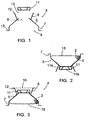
Figures 1 to 3 are very simplified cross-sectional views of different component pieces of this packing and of objects contained in this packing, during three successive steps of making up this packing; -
figure 4 is a similar view of different component parts of the packing, placed in a sterilization enclosure; -
figure 5 is a similar view of different component parts of the packing after sterilization, and -
figure 6 is a similar view of the packing, in its final constitution. -
Figure 6 illustrates apacking 1 intended to contain one orseveral objects 2, in particular component parts of syringes, and in particular syringe plungers. Theseobjects 2 fully fill acontainer 3 comprised by thepacking 1 but, out of a concern for clarity in the drawing, they have been illustrated only partially: the contour of the assembly formed by theseobjects 2 is defined by a dashed line. - As shown by
figure 1 , thecontainer 3 comprises arigid body 5 intended to receive theobjects 2, aflange 6 and abase 7. The assembly can be formed in a single piece of material, in particular in a plastic material able to resist sterilization in particular by water vapor. - The
body 5 has a truncated shape and comprises upper 8 and lower 9 openings located at its ends having the smallest and largest cross-section, respectively. - The
flange 6 is integral with thebody 5 and is made up of a peripheral wall, defining anupper opening 10. It forms an envelope able to completely contain aconnection ring 11 and comprises a terminal outsideperipheral rim 12 constituting a seat for the later sealing of a membrane. - The
base 7 is formed by an outsideperipheral rim 13 comprised by thebody 5. - As shown by
figure 2 , theconnection ring 11 is designed to be placed on theopening 8 and to be fixed to thebody 5. This ring comprises acircular base 11a defining an opening for discharging of theobjects 2 and aremovable door 11 b which, at this stage of use of thepacking 1, closes this discharge opening. Thisring 11 is for example of the type described in documentsUS 6,571,540 andUS 6,817,143 , and therefore will not be described in further detail. - After fixing of the
connection ring 11 to thebody 5, thecontainer 3 is returned and filled withobjects 2, up to a level located set back from thebase 7. Amembrane 15 made of a material porous to a sterilization fluid but not porous to microbial contamination is then sealed on all of the periphery of the wall of thebody 5, set back from thebase 7, so as to close the opening 9. - This
membrane 15 comprises pores whereof the size can go from 2 to 15 microns and a Log Reduction Value (as defined in the ASTM F-1-608 standard) greater than or equal to 3. This can be a film marketed by the company Du Pont De Nemours under the TYVEK® brand, references 1073B, 2FS or 1059B, or a complex marketed by the company WIPAK under the WIPAK® brand, references Paper 80B or Paper 120B. - The
container 3 is then returned, then, as visible infigure 3 , anothermembrane 16 is sealed on all of the periphery of therim 12 so as to close theopening 10 defined by theflange 6. Thismembrane 16 is also made of a material porous to a sterilization fluid but not porous to microbial contamination, and can in particular be made of the same material as themembrane 15. - The assembly thus formed is, as shown in
figure 4 , placed in asterilization enclosure 20. Thisenclosure 20 contains a sterilization fluid, in particular water vapor, under a pressure higher than the atmospheric pressure. After sufficient exposure of this assembly to the sterilization fluid to perform the sterilization of theobjects 2, and while theenclosure 20 is kept under a pressure higher than the atmospheric pressure, thecontainer 3 receives twoother membranes membranes membranes rims - When the assembly is removed from the
enclosure 20, and it is therefore brought back to the atmospheric pressure, themembranes figure 6 . - This assembly then receives two
transparent lids 25, 26 (cf.figure 6 ), comprising peripheral rims allowing their clipping onto therims membranes lids membranes - The packing 1 thus uses
membranes container 3 and around theobjects 2; the tight sealing of these membranes on thecontainer 3 makes it possible to preserve the integrity of the sterilization performed for theobjects 2, the internal wall of thecontainer 3 and the internal wall of these membranes. - The rigidity of the
container 3 makes it possible to preserve the integrity of theobjects 2 with regard to the mechanical stresses likely to be exerted on these objects in particular during the transport thereof, which is necessary when these objects are liable to be deformed or damaged under the prolonged exertion of such mechanical stresses, as is the case for example for syringe plungers. This rigidity also has the advantage of granting a fixed shape to the set of objects, optimized for a homogenous exposure to the sterilization fluid, which is a crucial parameter for sterilization using water vapor. In other words, the rigid container makes it possible to eliminate any pile of objects which would be made possible with a flexible container, causing a risk of the sterilization fluid not sufficiently penetrating to the center of this pile to ensure the required sterilization. The rigidity of the container also has the advantages of making it possible to increase the capacity of a packing relative to the maximum capacity a known flexible packing can have, and to facilitate the treatments and manipulations done by the operations. - The curving of the
membranes - The
lids membranes - As appears from the preceding, the invention provides a sterile packing and a sterilization method using this packing, having the determining advantages of allowing effective sterilization of objects by the sterilization fluid, perfectly protecting the packed object(s) with regard to the environment, and enabling an immediate indication of any loss of integrity, and therefore of sterility, of the packing.
- It must be specified that the embodiment of the invention described above was provided purely as an example. It goes without saying that the invention is not limited to this embodiment, but that it extends to all embodiments covered by the appended claims.
Claims (13)
- Sterile packing (1), including:- a container (3) for containing at least an object (2) to be sterilized by at least a sterilizing fluid, said container (3) including at least a first opening (10);- at least one first membrane (16) made in a material porous to the sterilizing fluid but non-porous with respect to microbial contamination, said at least one first membrane (16) being tightly sealed at said at least first opening (10) of the container (3), after filling of the container (3) with the object (2) so as to close said at least first opening (10); the tight sealing of this or these first membrane(s) (16) is such that makes it possible to preserve the integrity of the sterilization done to the object (2), to the internal wall of the container (3) and to the internal wall of this or these first membrane(s) (16);- at least one second membrane (22) made in a flexible and airtight material, said second membrane (22) being sealed at said at least first opening (10) of the container (3),characterized in that said second membrane (22) is sealed at said at least first opening (10) after installation of said first membrane (16) at this at least first opening (10), the sealing of said second membrane (22) being carried out at a pressure higher than the atmospheric pressure, so that said second membrane (22) is curved when the packing (1) is brought back to the atmospheric pressure.
- Sterile packing (1) according to claim 1, wherein said container (3) includes a second opening (8) covered by said first and second membranes (16, 22), said package further characterized in that it includes a connection ring (11) for connection to a sterile enclosure in which the object (2) to be packed is intended to be transferred, said connection ring (11) being connected to said second opening (8).
- Sterile packing (1) according to claim 2, characterized in that the container (3) defines an envelope (6) suitable to contain the connection ring (11) and forming a seat (12) for the sealing of said at least one first membrane (16).
- Sterile packing (1) according to one of claims 1 to 3, characterized in that the container (3) includes at least a third opening (9) located at an end opposite of said end at which said first and second openings (10, 8) are located, a second of said at least one first membrane (15) being sealed at said at least a third opening (9) of the container (3), after filling of the container (3) with the object (2) so as to close said at least a third opening (9).
- Sterile packing (1) according to claim 4, characterized in that it includes a second one of said at least one second membrane (21) sealed at said at least third opening (9) of the container (3), after filling of the container (3) with the object (2) so as to close said at least third opening (9), the sealing of said second one of said at least second membrane (21) being carried out at a pressure higher than the atmospheric pressure, so that said second membrane (21) at said third opening (9) is curved when the packing is brought back to the atmospheric pressure.
- Sterile packing (1) according to claim 4 or claim 5, characterized in that the container (3) has a truncated form or a truncated pyramid form, said at least first opening (10), or, when said connection ring (11) is present, said second opening (8), being located at the small section end of this container (3) and said at least third opening (9) being located at the base of this container (3).
- Sterile packing (1) according to claim 6, characterized in that the container (3) includes a base (7) formed by an outside peripheral rim (13), and said at least one first membrane (15) is sealed on all the periphery of the wall of a body (5) of the container (3) set back from the base (7) so as to close the opening (9).
- Sterile packing (1) according to one of claims 1 to 7, characterized in that it includes at least one lid (25, 26) able to cover one of said second membranes (21, 22), in the curved state of said second membrane (21, 22).
- Sterile packing (1) according to claim 8, characterized in that each lid (25, 26) is totally or partially transparent.
- Sterile packing (1) according to one of claims 1 to 9, characterized in that the container (3) includes a discharge conduit for discharging the objects (2), able to be engaged through the opening of said container (3) used for discharging the objects (2) out of said container (3).
- Sterile packing (1) according to one of claims 1 to 10, characterized in that said at least one first membrane (15, 16) is made of a plurality of layers.
- Sterile packing (1) according to one of claims 1 to 11, characterized in that said container (3) is rigid.
- Sterilization process, using a sterile packing (1) according to one of claims 1 to 12, including the steps consisting:a) to fill the container (3) above mentioned with said at least one object (2) to be sterilized;b) to seal said at least one first membrane (16) on said at least one first opening (10);c) to seal said at least one second membrane (22) on said at least one first opening (10);characterized in that it includes the following steps:b1) simultaneously or not to the sealing of said at least one first membrane (16), to sterilize this assembly by means of a sterilization fluid and to put this assembly at a pressure higher than the atmospheric pressure;c1) to seal said at least one second membrane (22) on said at least one first opening (10) whereas said pressure higher than the atmospheric pressure is maintained, so that said second membrane (22) is curved when the packing (1) is brought back to the atmospheric pressure.
Applications Claiming Priority (1)
| Application Number | Priority Date | Filing Date | Title |
|---|---|---|---|
| PCT/IB2008/002514 WO2009150486A1 (en) | 2008-06-09 | 2008-06-09 | Sterile packing and sterilization method using this packing |
Publications (2)
| Publication Number | Publication Date |
|---|---|
| EP2296715A1 EP2296715A1 (en) | 2011-03-23 |
| EP2296715B1 true EP2296715B1 (en) | 2013-08-07 |
Family
ID=40243793
Family Applications (1)
| Application Number | Title | Priority Date | Filing Date |
|---|---|---|---|
| EP20080807165 Active EP2296715B1 (en) | 2008-06-09 | 2008-06-09 | Sterile packing and sterilization method using this packing |
Country Status (6)
| Country | Link |
|---|---|
| US (1) | US8679419B2 (en) |
| EP (1) | EP2296715B1 (en) |
| JP (1) | JP5291192B2 (en) |
| CN (1) | CN102083472B (en) |
| ES (1) | ES2431794T3 (en) |
| WO (1) | WO2009150486A1 (en) |
Families Citing this family (4)
| Publication number | Priority date | Publication date | Assignee | Title |
|---|---|---|---|---|
| JP5095009B2 (en) * | 2008-06-09 | 2012-12-12 | ベクトン・ディキンソン・フランス・エス.エー.エス. | Sterilization package and sterilization method using this package |
| FR2958853B1 (en) * | 2010-04-20 | 2012-07-13 | Sartorius Stedim Biotech Sa | STERILIZABLE BIOPHARMACEUTICAL PACKAGING. |
| US9192157B2 (en) * | 2012-03-01 | 2015-11-24 | Russell James Schweizer | Tissue retrieval, storage, and explant culture device for the derivation of stem cells |
| FR3016797B1 (en) | 2014-01-27 | 2017-04-21 | Daniel Bernard Blach | MOTORIZED AGONIST / ANTAGONIST MUSCULATION DEVICE IN CONTRACTIONS: ECCENTRIC, ISOMETRIC AND CONCENTRIC, REAGENT FOR USER EFFORT |
Family Cites Families (6)
| Publication number | Priority date | Publication date | Assignee | Title |
|---|---|---|---|---|
| JPS50120294U (en) * | 1974-03-18 | 1975-10-01 | ||
| US4777780A (en) * | 1987-04-21 | 1988-10-18 | United States Surgical Corporation | Method for forming a sealed sterile package |
| SE521490C2 (en) * | 1998-03-13 | 2003-11-04 | Tetra Laval Holdings & Finance | Methods for making an aseptically packaged and coagulated food product |
| FR2777059B1 (en) * | 1998-04-03 | 2000-08-25 | Becton Dickinson France | DEVICE FOR COMMUNICATING TWO SPEAKERS, PRESERVING THEIR SEALING |
| US7160590B2 (en) | 2003-08-18 | 2007-01-09 | Advanced Technology Materials, Inc. | Packaging including a composite web comprising porous layer |
| JP4607695B2 (en) * | 2005-07-25 | 2011-01-05 | 越後製菓株式会社 | Method for producing container-enclosed food |
-
2008
- 2008-06-09 WO PCT/IB2008/002514 patent/WO2009150486A1/en not_active Ceased
- 2008-06-09 ES ES08807165T patent/ES2431794T3/en active Active
- 2008-06-09 CN CN200880130209.2A patent/CN102083472B/en active Active
- 2008-06-09 US US12/996,640 patent/US8679419B2/en active Active
- 2008-06-09 EP EP20080807165 patent/EP2296715B1/en active Active
- 2008-06-09 JP JP2011513061A patent/JP5291192B2/en active Active
Also Published As
| Publication number | Publication date |
|---|---|
| CN102083472A (en) | 2011-06-01 |
| JP5291192B2 (en) | 2013-09-18 |
| JP2011522754A (en) | 2011-08-04 |
| EP2296715A1 (en) | 2011-03-23 |
| ES2431794T3 (en) | 2013-11-28 |
| WO2009150486A1 (en) | 2009-12-17 |
| CN102083472B (en) | 2014-09-17 |
| US20110123396A1 (en) | 2011-05-26 |
| US8679419B2 (en) | 2014-03-25 |
Similar Documents
| Publication | Publication Date | Title |
|---|---|---|
| EP2296996B1 (en) | Sterile packing and sterilization method using this packing | |
| EP2293821B1 (en) | Sterile packing and sterilization method using this packing | |
| US5590778A (en) | Double-sterile package for medical apparatus and method of making | |
| US7431157B2 (en) | Package for sterile products | |
| US7303073B2 (en) | Packaging for sterile objects or objects to be sterilized | |
| JP4373910B2 (en) | Packaging containers for the transport of sterile objects or objects to be disinfected | |
| US20240227345A9 (en) | Film and packaging for gas or vapor decontaminable packaging and methods decontaminating packages | |
| US8679419B2 (en) | Sterile packing and sterilization method using this packing | |
| CA3206526A1 (en) | Medical container packaging | |
| US20190092499A1 (en) | Method and device for packaging elastomeric parts | |
| JP5592080B2 (en) | Cell culture method and cell culture system | |
| WO2025172248A1 (en) | Medical component container system with degassing valve | |
| JP6027037B2 (en) | Aseptic package and sterilization method using the package |
Legal Events
| Date | Code | Title | Description |
|---|---|---|---|
| PUAI | Public reference made under article 153(3) epc to a published international application that has entered the european phase |
Free format text: ORIGINAL CODE: 0009012 |
|
| 17P | Request for examination filed |
Effective date: 20110104 |
|
| AK | Designated contracting states |
Kind code of ref document: A1 Designated state(s): AT BE BG CH CY CZ DE DK EE ES FI FR GB GR HR HU IE IS IT LI LT LU LV MC MT NL NO PL PT RO SE SI SK TR |
|
| AX | Request for extension of the european patent |
Extension state: AL BA MK RS |
|
| RIN1 | Information on inventor provided before grant (corrected) |
Inventor name: MERMET, EMERIC Inventor name: DUBOIS, THOMAS |
|
| DAX | Request for extension of the european patent (deleted) | ||
| 17Q | First examination report despatched |
Effective date: 20120522 |
|
| GRAP | Despatch of communication of intention to grant a patent |
Free format text: ORIGINAL CODE: EPIDOSNIGR1 |
|
| GRAS | Grant fee paid |
Free format text: ORIGINAL CODE: EPIDOSNIGR3 |
|
| RIN1 | Information on inventor provided before grant (corrected) |
Inventor name: DUBOIS, THOMAS Inventor name: MERMET, EMERIC |
|
| GRAA | (expected) grant |
Free format text: ORIGINAL CODE: 0009210 |
|
| AK | Designated contracting states |
Kind code of ref document: B1 Designated state(s): AT BE BG CH CY CZ DE DK EE ES FI FR GB GR HR HU IE IS IT LI LT LU LV MC MT NL NO PL PT RO SE SI SK TR |
|
| REG | Reference to a national code |
Ref country code: GB Ref legal event code: FG4D |
|
| REG | Reference to a national code |
Ref country code: CH Ref legal event code: EP Ref country code: AT Ref legal event code: REF Ref document number: 625460 Country of ref document: AT Kind code of ref document: T Effective date: 20130815 |
|
| REG | Reference to a national code |
Ref country code: IE Ref legal event code: FG4D |
|
| REG | Reference to a national code |
Ref country code: DE Ref legal event code: R096 Ref document number: 602008026643 Country of ref document: DE Effective date: 20131002 |
|
| REG | Reference to a national code |
Ref country code: CH Ref legal event code: NV Representative=s name: MEYER AND KOLLEGEN, CH |
|
| REG | Reference to a national code |
Ref country code: AT Ref legal event code: MK05 Ref document number: 625460 Country of ref document: AT Kind code of ref document: T Effective date: 20130807 |
|
| REG | Reference to a national code |
Ref country code: NL Ref legal event code: VDEP Effective date: 20130807 |
|
| REG | Reference to a national code |
Ref country code: LT Ref legal event code: MG4D |
|
| PG25 | Lapsed in a contracting state [announced via postgrant information from national office to epo] |
Ref country code: AT Free format text: LAPSE BECAUSE OF FAILURE TO SUBMIT A TRANSLATION OF THE DESCRIPTION OR TO PAY THE FEE WITHIN THE PRESCRIBED TIME-LIMIT Effective date: 20130807 Ref country code: IS Free format text: LAPSE BECAUSE OF FAILURE TO SUBMIT A TRANSLATION OF THE DESCRIPTION OR TO PAY THE FEE WITHIN THE PRESCRIBED TIME-LIMIT Effective date: 20131207 Ref country code: PT Free format text: LAPSE BECAUSE OF FAILURE TO SUBMIT A TRANSLATION OF THE DESCRIPTION OR TO PAY THE FEE WITHIN THE PRESCRIBED TIME-LIMIT Effective date: 20131209 Ref country code: LT Free format text: LAPSE BECAUSE OF FAILURE TO SUBMIT A TRANSLATION OF THE DESCRIPTION OR TO PAY THE FEE WITHIN THE PRESCRIBED TIME-LIMIT Effective date: 20130807 Ref country code: HR Free format text: LAPSE BECAUSE OF FAILURE TO SUBMIT A TRANSLATION OF THE DESCRIPTION OR TO PAY THE FEE WITHIN THE PRESCRIBED TIME-LIMIT Effective date: 20130807 Ref country code: CY Free format text: LAPSE BECAUSE OF FAILURE TO SUBMIT A TRANSLATION OF THE DESCRIPTION OR TO PAY THE FEE WITHIN THE PRESCRIBED TIME-LIMIT Effective date: 20130710 Ref country code: NO Free format text: LAPSE BECAUSE OF FAILURE TO SUBMIT A TRANSLATION OF THE DESCRIPTION OR TO PAY THE FEE WITHIN THE PRESCRIBED TIME-LIMIT Effective date: 20131107 Ref country code: SE Free format text: LAPSE BECAUSE OF FAILURE TO SUBMIT A TRANSLATION OF THE DESCRIPTION OR TO PAY THE FEE WITHIN THE PRESCRIBED TIME-LIMIT Effective date: 20130807 |
|
| PG25 | Lapsed in a contracting state [announced via postgrant information from national office to epo] |
Ref country code: SI Free format text: LAPSE BECAUSE OF FAILURE TO SUBMIT A TRANSLATION OF THE DESCRIPTION OR TO PAY THE FEE WITHIN THE PRESCRIBED TIME-LIMIT Effective date: 20130807 Ref country code: FI Free format text: LAPSE BECAUSE OF FAILURE TO SUBMIT A TRANSLATION OF THE DESCRIPTION OR TO PAY THE FEE WITHIN THE PRESCRIBED TIME-LIMIT Effective date: 20130807 Ref country code: GR Free format text: LAPSE BECAUSE OF FAILURE TO SUBMIT A TRANSLATION OF THE DESCRIPTION OR TO PAY THE FEE WITHIN THE PRESCRIBED TIME-LIMIT Effective date: 20131108 Ref country code: LV Free format text: LAPSE BECAUSE OF FAILURE TO SUBMIT A TRANSLATION OF THE DESCRIPTION OR TO PAY THE FEE WITHIN THE PRESCRIBED TIME-LIMIT Effective date: 20130807 Ref country code: PL Free format text: LAPSE BECAUSE OF FAILURE TO SUBMIT A TRANSLATION OF THE DESCRIPTION OR TO PAY THE FEE WITHIN THE PRESCRIBED TIME-LIMIT Effective date: 20130807 Ref country code: NL Free format text: LAPSE BECAUSE OF FAILURE TO SUBMIT A TRANSLATION OF THE DESCRIPTION OR TO PAY THE FEE WITHIN THE PRESCRIBED TIME-LIMIT Effective date: 20130807 |
|
| REG | Reference to a national code |
Ref country code: HU Ref legal event code: AG4A Ref document number: E018499 Country of ref document: HU |
|
| PG25 | Lapsed in a contracting state [announced via postgrant information from national office to epo] |
Ref country code: CY Free format text: LAPSE BECAUSE OF FAILURE TO SUBMIT A TRANSLATION OF THE DESCRIPTION OR TO PAY THE FEE WITHIN THE PRESCRIBED TIME-LIMIT Effective date: 20130807 |
|
| PG25 | Lapsed in a contracting state [announced via postgrant information from national office to epo] |
Ref country code: SK Free format text: LAPSE BECAUSE OF FAILURE TO SUBMIT A TRANSLATION OF THE DESCRIPTION OR TO PAY THE FEE WITHIN THE PRESCRIBED TIME-LIMIT Effective date: 20130807 Ref country code: RO Free format text: LAPSE BECAUSE OF FAILURE TO SUBMIT A TRANSLATION OF THE DESCRIPTION OR TO PAY THE FEE WITHIN THE PRESCRIBED TIME-LIMIT Effective date: 20130807 Ref country code: EE Free format text: LAPSE BECAUSE OF FAILURE TO SUBMIT A TRANSLATION OF THE DESCRIPTION OR TO PAY THE FEE WITHIN THE PRESCRIBED TIME-LIMIT Effective date: 20130807 Ref country code: DK Free format text: LAPSE BECAUSE OF FAILURE TO SUBMIT A TRANSLATION OF THE DESCRIPTION OR TO PAY THE FEE WITHIN THE PRESCRIBED TIME-LIMIT Effective date: 20130807 Ref country code: CZ Free format text: LAPSE BECAUSE OF FAILURE TO SUBMIT A TRANSLATION OF THE DESCRIPTION OR TO PAY THE FEE WITHIN THE PRESCRIBED TIME-LIMIT Effective date: 20130807 |
|
| PLBE | No opposition filed within time limit |
Free format text: ORIGINAL CODE: 0009261 |
|
| STAA | Information on the status of an ep patent application or granted ep patent |
Free format text: STATUS: NO OPPOSITION FILED WITHIN TIME LIMIT |
|
| 26N | No opposition filed |
Effective date: 20140508 |
|
| REG | Reference to a national code |
Ref country code: DE Ref legal event code: R097 Ref document number: 602008026643 Country of ref document: DE Effective date: 20140508 |
|
| PG25 | Lapsed in a contracting state [announced via postgrant information from national office to epo] |
Ref country code: MC Free format text: LAPSE BECAUSE OF FAILURE TO SUBMIT A TRANSLATION OF THE DESCRIPTION OR TO PAY THE FEE WITHIN THE PRESCRIBED TIME-LIMIT Effective date: 20130807 Ref country code: LU Free format text: LAPSE BECAUSE OF FAILURE TO SUBMIT A TRANSLATION OF THE DESCRIPTION OR TO PAY THE FEE WITHIN THE PRESCRIBED TIME-LIMIT Effective date: 20140609 |
|
| REG | Reference to a national code |
Ref country code: IE Ref legal event code: MM4A |
|
| PG25 | Lapsed in a contracting state [announced via postgrant information from national office to epo] |
Ref country code: IE Free format text: LAPSE BECAUSE OF NON-PAYMENT OF DUE FEES Effective date: 20140609 |
|
| PG25 | Lapsed in a contracting state [announced via postgrant information from national office to epo] |
Ref country code: MT Free format text: LAPSE BECAUSE OF FAILURE TO SUBMIT A TRANSLATION OF THE DESCRIPTION OR TO PAY THE FEE WITHIN THE PRESCRIBED TIME-LIMIT Effective date: 20130807 |
|
| REG | Reference to a national code |
Ref country code: FR Ref legal event code: PLFP Year of fee payment: 9 |
|
| PG25 | Lapsed in a contracting state [announced via postgrant information from national office to epo] |
Ref country code: BG Free format text: LAPSE BECAUSE OF FAILURE TO SUBMIT A TRANSLATION OF THE DESCRIPTION OR TO PAY THE FEE WITHIN THE PRESCRIBED TIME-LIMIT Effective date: 20130807 |
|
| PG25 | Lapsed in a contracting state [announced via postgrant information from national office to epo] |
Ref country code: TR Free format text: LAPSE BECAUSE OF FAILURE TO SUBMIT A TRANSLATION OF THE DESCRIPTION OR TO PAY THE FEE WITHIN THE PRESCRIBED TIME-LIMIT Effective date: 20130807 |
|
| REG | Reference to a national code |
Ref country code: FR Ref legal event code: PLFP Year of fee payment: 10 |
|
| REG | Reference to a national code |
Ref country code: FR Ref legal event code: PLFP Year of fee payment: 11 |
|
| PGFP | Annual fee paid to national office [announced via postgrant information from national office to epo] |
Ref country code: IT Payment date: 20230523 Year of fee payment: 16 Ref country code: DE Payment date: 20230523 Year of fee payment: 16 |
|
| PGFP | Annual fee paid to national office [announced via postgrant information from national office to epo] |
Ref country code: HU Payment date: 20230531 Year of fee payment: 16 |
|
| PGFP | Annual fee paid to national office [announced via postgrant information from national office to epo] |
Ref country code: BE Payment date: 20230523 Year of fee payment: 16 |
|
| PGFP | Annual fee paid to national office [announced via postgrant information from national office to epo] |
Ref country code: ES Payment date: 20230703 Year of fee payment: 16 Ref country code: CH Payment date: 20230702 Year of fee payment: 16 |
|
| REG | Reference to a national code |
Ref country code: DE Ref legal event code: R119 Ref document number: 602008026643 Country of ref document: DE |
|
| REG | Reference to a national code |
Ref country code: CH Ref legal event code: PL |
|
| PG25 | Lapsed in a contracting state [announced via postgrant information from national office to epo] |
Ref country code: HU Free format text: LAPSE BECAUSE OF NON-PAYMENT OF DUE FEES Effective date: 20240610 |
|
| PG25 | Lapsed in a contracting state [announced via postgrant information from national office to epo] |
Ref country code: DE Free format text: LAPSE BECAUSE OF NON-PAYMENT OF DUE FEES Effective date: 20250101 |
|
| PG25 | Lapsed in a contracting state [announced via postgrant information from national office to epo] |
Ref country code: CH Free format text: LAPSE BECAUSE OF NON-PAYMENT OF DUE FEES Effective date: 20240630 Ref country code: BE Free format text: LAPSE BECAUSE OF NON-PAYMENT OF DUE FEES Effective date: 20240630 |
|
| PG25 | Lapsed in a contracting state [announced via postgrant information from national office to epo] |
Ref country code: IT Free format text: LAPSE BECAUSE OF NON-PAYMENT OF DUE FEES Effective date: 20240609 |
|
| REG | Reference to a national code |
Ref country code: BE Ref legal event code: MM Effective date: 20240630 |
|
| REG | Reference to a national code |
Ref country code: ES Ref legal event code: FD2A Effective date: 20250730 |
|
| PG25 | Lapsed in a contracting state [announced via postgrant information from national office to epo] |
Ref country code: ES Free format text: LAPSE BECAUSE OF NON-PAYMENT OF DUE FEES Effective date: 20240610 |
|
| PGFP | Annual fee paid to national office [announced via postgrant information from national office to epo] |
Ref country code: GB Payment date: 20260525 Year of fee payment: 19 |
|
| PGFP | Annual fee paid to national office [announced via postgrant information from national office to epo] |
Ref country code: FR Payment date: 20260520 Year of fee payment: 19 |