EP2295385A1 - Crystallized glass and method for producing the same - Google Patents
Crystallized glass and method for producing the same Download PDFInfo
- Publication number
- EP2295385A1 EP2295385A1 EP09746621A EP09746621A EP2295385A1 EP 2295385 A1 EP2295385 A1 EP 2295385A1 EP 09746621 A EP09746621 A EP 09746621A EP 09746621 A EP09746621 A EP 09746621A EP 2295385 A1 EP2295385 A1 EP 2295385A1
- Authority
- EP
- European Patent Office
- Prior art keywords
- glass
- crystallized glass
- crystallizable
- livopo
- crystallized
- Prior art date
- Legal status (The legal status is an assumption and is not a legal conclusion. Google has not performed a legal analysis and makes no representation as to the accuracy of the status listed.)
- Withdrawn
Links
- 239000011521 glass Substances 0.000 title claims abstract description 154
- 238000004519 manufacturing process Methods 0.000 title claims abstract description 25
- GNTDGMZSJNCJKK-UHFFFAOYSA-N divanadium pentaoxide Chemical compound O=[V](=O)O[V](=O)=O GNTDGMZSJNCJKK-UHFFFAOYSA-N 0.000 claims abstract description 44
- 239000013078 crystal Substances 0.000 claims abstract description 35
- 239000007774 positive electrode material Substances 0.000 claims abstract description 31
- 239000000203 mixture Substances 0.000 claims abstract description 27
- 229910012999 LiVOPO4 Inorganic materials 0.000 claims abstract description 24
- FUJCRWPEOMXPAD-UHFFFAOYSA-N Li2O Inorganic materials [Li+].[Li+].[O-2] FUJCRWPEOMXPAD-UHFFFAOYSA-N 0.000 claims abstract description 19
- XUCJHNOBJLKZNU-UHFFFAOYSA-M dilithium;hydroxide Chemical group [Li+].[Li+].[OH-] XUCJHNOBJLKZNU-UHFFFAOYSA-M 0.000 claims abstract description 19
- 229910006584 β-LiVOPO4 Inorganic materials 0.000 claims abstract description 17
- HBBGRARXTFLTSG-UHFFFAOYSA-N Lithium ion Chemical compound [Li+] HBBGRARXTFLTSG-UHFFFAOYSA-N 0.000 claims abstract description 15
- 229910001416 lithium ion Inorganic materials 0.000 claims abstract description 15
- WHXSMMKQMYFTQS-UHFFFAOYSA-N Lithium Chemical compound [Li] WHXSMMKQMYFTQS-UHFFFAOYSA-N 0.000 claims abstract description 13
- 229910052744 lithium Inorganic materials 0.000 claims abstract description 13
- 239000000843 powder Substances 0.000 claims description 35
- 239000011149 active material Substances 0.000 claims description 20
- 230000009477 glass transition Effects 0.000 claims description 10
- 239000002243 precursor Substances 0.000 claims description 8
- 238000002844 melting Methods 0.000 claims description 7
- 230000008018 melting Effects 0.000 claims description 7
- 239000006060 molten glass Substances 0.000 claims description 7
- 239000007791 liquid phase Substances 0.000 claims description 6
- 238000010791 quenching Methods 0.000 claims description 6
- 230000000171 quenching effect Effects 0.000 claims description 6
- 230000001376 precipitating effect Effects 0.000 claims description 3
- 239000000126 substance Substances 0.000 abstract description 3
- 239000012071 phase Substances 0.000 description 16
- 238000002425 crystallisation Methods 0.000 description 15
- 230000008025 crystallization Effects 0.000 description 15
- 238000010438 heat treatment Methods 0.000 description 13
- 238000000034 method Methods 0.000 description 11
- 239000002245 particle Substances 0.000 description 9
- 238000002441 X-ray diffraction Methods 0.000 description 7
- 239000000463 material Substances 0.000 description 7
- 238000004455 differential thermal analysis Methods 0.000 description 6
- OKTJSMMVPCPJKN-UHFFFAOYSA-N Carbon Chemical compound [C] OKTJSMMVPCPJKN-UHFFFAOYSA-N 0.000 description 5
- 229910052493 LiFePO4 Inorganic materials 0.000 description 4
- NBIIXXVUZAFLBC-UHFFFAOYSA-N Phosphoric acid Chemical compound OP(O)(O)=O NBIIXXVUZAFLBC-UHFFFAOYSA-N 0.000 description 4
- 230000004913 activation Effects 0.000 description 4
- 229910003481 amorphous carbon Inorganic materials 0.000 description 4
- WPYMKLBDIGXBTP-UHFFFAOYSA-N benzoic acid Chemical compound OC(=O)C1=CC=CC=C1 WPYMKLBDIGXBTP-UHFFFAOYSA-N 0.000 description 4
- 230000015572 biosynthetic process Effects 0.000 description 4
- 229910001386 lithium phosphate Inorganic materials 0.000 description 4
- 239000002244 precipitate Substances 0.000 description 4
- 239000002994 raw material Substances 0.000 description 4
- TWQULNDIKKJZPH-UHFFFAOYSA-K trilithium;phosphate Chemical compound [Li+].[Li+].[Li+].[O-]P([O-])([O-])=O TWQULNDIKKJZPH-UHFFFAOYSA-K 0.000 description 4
- LEONUFNNVUYDNQ-UHFFFAOYSA-N vanadium atom Chemical compound [V] LEONUFNNVUYDNQ-UHFFFAOYSA-N 0.000 description 4
- QTBSBXVTEAMEQO-UHFFFAOYSA-N Acetic acid Chemical compound CC(O)=O QTBSBXVTEAMEQO-UHFFFAOYSA-N 0.000 description 3
- OKKJLVBELUTLKV-UHFFFAOYSA-N Methanol Chemical compound OC OKKJLVBELUTLKV-UHFFFAOYSA-N 0.000 description 3
- MUBZPKHOEPUJKR-UHFFFAOYSA-N Oxalic acid Chemical compound OC(=O)C(O)=O MUBZPKHOEPUJKR-UHFFFAOYSA-N 0.000 description 3
- 239000011230 binding agent Substances 0.000 description 3
- 238000006243 chemical reaction Methods 0.000 description 3
- 150000002894 organic compounds Chemical class 0.000 description 3
- 229910052720 vanadium Inorganic materials 0.000 description 3
- 229920000178 Acrylic resin Polymers 0.000 description 2
- 239000004925 Acrylic resin Substances 0.000 description 2
- QGZKDVFQNNGYKY-UHFFFAOYSA-N Ammonia Chemical compound N QGZKDVFQNNGYKY-UHFFFAOYSA-N 0.000 description 2
- IJGRMHOSHXDMSA-UHFFFAOYSA-N Atomic nitrogen Chemical compound N#N IJGRMHOSHXDMSA-UHFFFAOYSA-N 0.000 description 2
- FERIUCNNQQJTOY-UHFFFAOYSA-N Butyric acid Chemical compound CCCC(O)=O FERIUCNNQQJTOY-UHFFFAOYSA-N 0.000 description 2
- 238000005033 Fourier transform infrared spectroscopy Methods 0.000 description 2
- VYPSYNLAJGMNEJ-UHFFFAOYSA-N Silicium dioxide Chemical compound O=[Si]=O VYPSYNLAJGMNEJ-UHFFFAOYSA-N 0.000 description 2
- 150000007933 aliphatic carboxylic acids Chemical class 0.000 description 2
- PNEYBMLMFCGWSK-UHFFFAOYSA-N aluminium oxide Inorganic materials [O-2].[O-2].[O-2].[Al+3].[Al+3] PNEYBMLMFCGWSK-UHFFFAOYSA-N 0.000 description 2
- 229910000147 aluminium phosphate Inorganic materials 0.000 description 2
- LFVGISIMTYGQHF-UHFFFAOYSA-N ammonium dihydrogen phosphate Chemical compound [NH4+].OP(O)([O-])=O LFVGISIMTYGQHF-UHFFFAOYSA-N 0.000 description 2
- 238000004458 analytical method Methods 0.000 description 2
- WMWLMWRWZQELOS-UHFFFAOYSA-N bismuth(iii) oxide Chemical compound O=[Bi]O[Bi]=O WMWLMWRWZQELOS-UHFFFAOYSA-N 0.000 description 2
- 229910052799 carbon Inorganic materials 0.000 description 2
- 230000015556 catabolic process Effects 0.000 description 2
- 230000007423 decrease Effects 0.000 description 2
- 238000006731 degradation reaction Methods 0.000 description 2
- XBDQKXXYIPTUBI-UHFFFAOYSA-N dimethylselenoniopropionate Natural products CCC(O)=O XBDQKXXYIPTUBI-UHFFFAOYSA-N 0.000 description 2
- YBMRDBCBODYGJE-UHFFFAOYSA-N germanium dioxide Chemical compound O=[Ge]=O YBMRDBCBODYGJE-UHFFFAOYSA-N 0.000 description 2
- 229910002804 graphite Inorganic materials 0.000 description 2
- 239000010439 graphite Substances 0.000 description 2
- 150000002500 ions Chemical class 0.000 description 2
- XGZVUEUWXADBQD-UHFFFAOYSA-L lithium carbonate Chemical compound [Li+].[Li+].[O-]C([O-])=O XGZVUEUWXADBQD-UHFFFAOYSA-L 0.000 description 2
- 229910052808 lithium carbonate Inorganic materials 0.000 description 2
- 229910000625 lithium cobalt oxide Inorganic materials 0.000 description 2
- MRVHOJHOBHYHQL-UHFFFAOYSA-M lithium metaphosphate Chemical compound [Li+].[O-]P(=O)=O MRVHOJHOBHYHQL-UHFFFAOYSA-M 0.000 description 2
- BFZPBUKRYWOWDV-UHFFFAOYSA-N lithium;oxido(oxo)cobalt Chemical compound [Li+].[O-][Co]=O BFZPBUKRYWOWDV-UHFFFAOYSA-N 0.000 description 2
- 239000004570 mortar (masonry) Substances 0.000 description 2
- ZKATWMILCYLAPD-UHFFFAOYSA-N niobium pentoxide Chemical compound O=[Nb](=O)O[Nb](=O)=O ZKATWMILCYLAPD-UHFFFAOYSA-N 0.000 description 2
- XNGIFLGASWRNHJ-UHFFFAOYSA-N phthalic acid Chemical compound OC(=O)C1=CC=CC=C1C(O)=O XNGIFLGASWRNHJ-UHFFFAOYSA-N 0.000 description 2
- BASFCYQUMIYNBI-UHFFFAOYSA-N platinum Chemical compound [Pt] BASFCYQUMIYNBI-UHFFFAOYSA-N 0.000 description 2
- 238000003746 solid phase reaction Methods 0.000 description 2
- 238000003786 synthesis reaction Methods 0.000 description 2
- 230000007704 transition Effects 0.000 description 2
- 229910011255 B2O3 Inorganic materials 0.000 description 1
- 239000005711 Benzoic acid Substances 0.000 description 1
- UGFAIRIUMAVXCW-UHFFFAOYSA-N Carbon monoxide Chemical compound [O+]#[C-] UGFAIRIUMAVXCW-UHFFFAOYSA-N 0.000 description 1
- 239000001856 Ethyl cellulose Substances 0.000 description 1
- ZZSNKZQZMQGXPY-UHFFFAOYSA-N Ethyl cellulose Chemical compound CCOCC1OC(OC)C(OCC)C(OCC)C1OC1C(O)C(O)C(OC)C(CO)O1 ZZSNKZQZMQGXPY-UHFFFAOYSA-N 0.000 description 1
- WQZGKKKJIJFFOK-GASJEMHNSA-N Glucose Natural products OC[C@H]1OC(O)[C@H](O)[C@@H](O)[C@@H]1O WQZGKKKJIJFFOK-GASJEMHNSA-N 0.000 description 1
- 229910019142 PO4 Inorganic materials 0.000 description 1
- 239000002202 Polyethylene glycol Substances 0.000 description 1
- OFOBLEOULBTSOW-UHFFFAOYSA-N Propanedioic acid Natural products OC(=O)CC(O)=O OFOBLEOULBTSOW-UHFFFAOYSA-N 0.000 description 1
- YWJVFBOUPMWANA-UHFFFAOYSA-H [Li+].[V+5].[O-]P([O-])([O-])=O.[O-]P([O-])([O-])=O Chemical compound [Li+].[V+5].[O-]P([O-])([O-])=O.[O-]P([O-])([O-])=O YWJVFBOUPMWANA-UHFFFAOYSA-H 0.000 description 1
- 239000006230 acetylene black Substances 0.000 description 1
- 229910000272 alkali metal oxide Inorganic materials 0.000 description 1
- 229910021529 ammonia Inorganic materials 0.000 description 1
- ADCOVFLJGNWWNZ-UHFFFAOYSA-N antimony trioxide Inorganic materials O=[Sb]O[Sb]=O ADCOVFLJGNWWNZ-UHFFFAOYSA-N 0.000 description 1
- 235000010233 benzoic acid Nutrition 0.000 description 1
- 239000002419 bulk glass Substances 0.000 description 1
- 229910002091 carbon monoxide Inorganic materials 0.000 description 1
- 239000003575 carbonaceous material Substances 0.000 description 1
- 150000004649 carbonic acid derivatives Chemical class 0.000 description 1
- 150000001732 carboxylic acid derivatives Chemical class 0.000 description 1
- 229910017052 cobalt Inorganic materials 0.000 description 1
- 239000010941 cobalt Substances 0.000 description 1
- GUTLYIVDDKVIGB-UHFFFAOYSA-N cobalt atom Chemical compound [Co] GUTLYIVDDKVIGB-UHFFFAOYSA-N 0.000 description 1
- 229910052681 coesite Inorganic materials 0.000 description 1
- 239000002131 composite material Substances 0.000 description 1
- 239000002482 conductive additive Substances 0.000 description 1
- 239000000470 constituent Substances 0.000 description 1
- 229910052593 corundum Inorganic materials 0.000 description 1
- 229910052906 cristobalite Inorganic materials 0.000 description 1
- JKWMSGQKBLHBQQ-UHFFFAOYSA-N diboron trioxide Chemical compound O=BOB=O JKWMSGQKBLHBQQ-UHFFFAOYSA-N 0.000 description 1
- 238000009826 distribution Methods 0.000 description 1
- 230000000694 effects Effects 0.000 description 1
- 229920001249 ethyl cellulose Polymers 0.000 description 1
- 235000019325 ethyl cellulose Nutrition 0.000 description 1
- 238000011156 evaluation Methods 0.000 description 1
- 238000010304 firing Methods 0.000 description 1
- QZQVBEXLDFYHSR-UHFFFAOYSA-N gallium(III) oxide Inorganic materials O=[Ga]O[Ga]=O QZQVBEXLDFYHSR-UHFFFAOYSA-N 0.000 description 1
- 239000008103 glucose Substances 0.000 description 1
- PCHJSUWPFVWCPO-UHFFFAOYSA-N gold Chemical compound [Au] PCHJSUWPFVWCPO-UHFFFAOYSA-N 0.000 description 1
- 239000010931 gold Substances 0.000 description 1
- 229910052737 gold Inorganic materials 0.000 description 1
- 229910052739 hydrogen Inorganic materials 0.000 description 1
- 239000001257 hydrogen Substances 0.000 description 1
- 125000004435 hydrogen atom Chemical class [H]* 0.000 description 1
- 238000001027 hydrothermal synthesis Methods 0.000 description 1
- 230000002427 irreversible effect Effects 0.000 description 1
- 238000011031 large-scale manufacturing process Methods 0.000 description 1
- GELKBWJHTRAYNV-UHFFFAOYSA-K lithium iron phosphate Chemical compound [Li+].[Fe+2].[O-]P([O-])([O-])=O GELKBWJHTRAYNV-UHFFFAOYSA-K 0.000 description 1
- VZCYOOQTPOCHFL-UPHRSURJSA-N maleic acid Chemical compound OC(=O)\C=C/C(O)=O VZCYOOQTPOCHFL-UPHRSURJSA-N 0.000 description 1
- 239000011976 maleic acid Substances 0.000 description 1
- 238000005259 measurement Methods 0.000 description 1
- 239000000155 melt Substances 0.000 description 1
- 229910052751 metal Inorganic materials 0.000 description 1
- 239000002184 metal Substances 0.000 description 1
- 229910044991 metal oxide Inorganic materials 0.000 description 1
- 150000004706 metal oxides Chemical class 0.000 description 1
- 239000011812 mixed powder Substances 0.000 description 1
- 238000002156 mixing Methods 0.000 description 1
- 229910052757 nitrogen Inorganic materials 0.000 description 1
- 239000005486 organic electrolyte Substances 0.000 description 1
- 150000002902 organometallic compounds Chemical class 0.000 description 1
- 235000006408 oxalic acid Nutrition 0.000 description 1
- 229910052697 platinum Inorganic materials 0.000 description 1
- 238000005498 polishing Methods 0.000 description 1
- 229920001490 poly(butyl methacrylate) polymer Polymers 0.000 description 1
- 229920001483 poly(ethyl methacrylate) polymer Polymers 0.000 description 1
- 229920003229 poly(methyl methacrylate) Polymers 0.000 description 1
- -1 polyethylene carbonate Polymers 0.000 description 1
- 229920001223 polyethylene glycol Polymers 0.000 description 1
- 239000004926 polymethyl methacrylate Substances 0.000 description 1
- 238000001144 powder X-ray diffraction data Methods 0.000 description 1
- 235000019260 propionic acid Nutrition 0.000 description 1
- IUVKMZGDUIUOCP-BTNSXGMBSA-N quinbolone Chemical compound O([C@H]1CC[C@H]2[C@H]3[C@@H]([C@]4(C=CC(=O)C=C4CC3)C)CC[C@@]21C)C1=CCCC1 IUVKMZGDUIUOCP-BTNSXGMBSA-N 0.000 description 1
- 230000002829 reductive effect Effects 0.000 description 1
- 150000003839 salts Chemical class 0.000 description 1
- 239000000377 silicon dioxide Substances 0.000 description 1
- 239000007787 solid Substances 0.000 description 1
- 239000002904 solvent Substances 0.000 description 1
- 229910052682 stishovite Inorganic materials 0.000 description 1
- YEAUATLBSVJFOY-UHFFFAOYSA-N tetraantimony hexaoxide Chemical compound O1[Sb](O2)O[Sb]3O[Sb]1O[Sb]2O3 YEAUATLBSVJFOY-UHFFFAOYSA-N 0.000 description 1
- VZCYOOQTPOCHFL-UHFFFAOYSA-N trans-butenedioic acid Natural products OC(=O)C=CC(O)=O VZCYOOQTPOCHFL-UHFFFAOYSA-N 0.000 description 1
- 229910052905 tridymite Inorganic materials 0.000 description 1
- 229910001845 yogo sapphire Inorganic materials 0.000 description 1
Images




Classifications
-
- H—ELECTRICITY
- H01—ELECTRIC ELEMENTS
- H01M—PROCESSES OR MEANS, e.g. BATTERIES, FOR THE DIRECT CONVERSION OF CHEMICAL ENERGY INTO ELECTRICAL ENERGY
- H01M4/00—Electrodes
- H01M4/02—Electrodes composed of, or comprising, active material
- H01M4/36—Selection of substances as active materials, active masses, active liquids
- H01M4/58—Selection of substances as active materials, active masses, active liquids of inorganic compounds other than oxides or hydroxides, e.g. sulfides, selenides, tellurides, halogenides or LiCoFy; of polyanionic structures, e.g. phosphates, silicates or borates
- H01M4/5825—Oxygenated metallic salts or polyanionic structures, e.g. borates, phosphates, silicates, olivines
-
- C—CHEMISTRY; METALLURGY
- C03—GLASS; MINERAL OR SLAG WOOL
- C03C—CHEMICAL COMPOSITION OF GLASSES, GLAZES OR VITREOUS ENAMELS; SURFACE TREATMENT OF GLASS; SURFACE TREATMENT OF FIBRES OR FILAMENTS MADE FROM GLASS, MINERALS OR SLAGS; JOINING GLASS TO GLASS OR OTHER MATERIALS
- C03C10/00—Devitrified glass ceramics, i.e. glass ceramics having a crystalline phase dispersed in a glassy phase and constituting at least 50% by weight of the total composition
-
- C—CHEMISTRY; METALLURGY
- C03—GLASS; MINERAL OR SLAG WOOL
- C03C—CHEMICAL COMPOSITION OF GLASSES, GLAZES OR VITREOUS ENAMELS; SURFACE TREATMENT OF GLASS; SURFACE TREATMENT OF FIBRES OR FILAMENTS MADE FROM GLASS, MINERALS OR SLAGS; JOINING GLASS TO GLASS OR OTHER MATERIALS
- C03C3/00—Glass compositions
- C03C3/12—Silica-free oxide glass compositions
- C03C3/16—Silica-free oxide glass compositions containing phosphorus
- C03C3/21—Silica-free oxide glass compositions containing phosphorus containing titanium, zirconium, vanadium, tungsten or molybdenum
-
- C—CHEMISTRY; METALLURGY
- C03—GLASS; MINERAL OR SLAG WOOL
- C03C—CHEMICAL COMPOSITION OF GLASSES, GLAZES OR VITREOUS ENAMELS; SURFACE TREATMENT OF GLASS; SURFACE TREATMENT OF FIBRES OR FILAMENTS MADE FROM GLASS, MINERALS OR SLAGS; JOINING GLASS TO GLASS OR OTHER MATERIALS
- C03C4/00—Compositions for glass with special properties
- C03C4/14—Compositions for glass with special properties for electro-conductive glass
-
- Y—GENERAL TAGGING OF NEW TECHNOLOGICAL DEVELOPMENTS; GENERAL TAGGING OF CROSS-SECTIONAL TECHNOLOGIES SPANNING OVER SEVERAL SECTIONS OF THE IPC; TECHNICAL SUBJECTS COVERED BY FORMER USPC CROSS-REFERENCE ART COLLECTIONS [XRACs] AND DIGESTS
- Y02—TECHNOLOGIES OR APPLICATIONS FOR MITIGATION OR ADAPTATION AGAINST CLIMATE CHANGE
- Y02E—REDUCTION OF GREENHOUSE GAS [GHG] EMISSIONS, RELATED TO ENERGY GENERATION, TRANSMISSION OR DISTRIBUTION
- Y02E60/00—Enabling technologies; Technologies with a potential or indirect contribution to GHG emissions mitigation
- Y02E60/10—Energy storage using batteries
Definitions
- the present invention relates to a crystallized glass and a method for producing the same. More specifically, the present invention relates to a crystallized glass suitable as a positive electrode material for a lithium ion secondary battery to be used in a portable electronic device or an electric vehicle and a method for producing the crystallized glass.
- Lithium ion secondary batteries have established their positions as high-capacity and lightweight power supplies necessary for mobile electronic terminals and electric vehicles.
- a positive electrode material for such lithium ion secondary batteries an inorganic metal oxide such as lithium cobalt oxide (LiCoO 2 ) has been heretofore used.
- LiCoO 2 lithium cobalt oxide
- it is required to further upgrade lithium ion secondary batteries.
- shifting to various materials is becoming to be desired instead of relying only on cobalt materials.
- LiFePO 4 lithium iron phosphate
- LiVOPO 4 is composed of VO 6 unit and PO 4 unit and that the plateau potential thereof is 3.9V for lithium, which is higher than that of LiFePO 4 .
- LiVOPO 4 has two types of structures i.e. ⁇ -phase of higher temperature type and ⁇ -phase of lower temperature type. Among them, the ⁇ -phase is reported to have good charge-discharge properties (refer to Non-patent Document 2, for example).
- LiVOPO 4 is ordinarily produced by a solid-phase reaction process
- alkaline component volatilizes when heat treated at a high temperature. Therefore, heat treatment temperature and heat treatment time are restricted, and a low temperature and long time production process is required.
- a hydrothermal synthesis one of low temperature synthesis processes, has problems that it is not suitable for mass production and the production process is complicated.
- the object of the present invention is, therefore, to provide a substance suitable as a positive electrode material for a lithium ion secondary battery showing remarkable battery properties and a method for producing the same.
- a crystallized glass containing LiVOPO 4 as a crystal is suitable as a positive electrode material for lithium ion secondary battery, and propose the crystallized glass as the present invention.
- the crystallized glass according to the present invention is a crystallized glass containing a LiVOPO 4 crystal.
- the crystallized glass containing LiVOPO 4 as a crystal is easy to control the crystal phase and capable of being configured to contain much amount of lower temperature type ⁇ -phase. Therefore, the crystallized glass shows a good battery characteristic and is suitable as a positive electrode material for lithium secondary battery.
- the LiVOPO 4 crystal is a ⁇ -LiVOPO 4 crystal.
- the crystallized glass according to the present invention contains a composition of Li 2 O: 25 to 60%, V 2 O 5 : 25 to 40% and P 2 O 5 : 25 to 40% in terms of mol%.
- the crystallized glass according to the present invention is used as a positive electrode material for lithium ion secondary battery.
- the positive electrode material for lithium secondary battery according to the present invention is a positive electrode material containing a powder of the above crystallized glass and a conductive active material.
- the positive electrode material precursor crystallizable glass for lithium secondary battery according to the present invention contains a composition of Li 2 O: 25 to 60%, V 2 O 5 : 20 to 40% and P 2 O 5 : 20 to 40% in terms of mol%.
- the term "positive electrode material precursor crystallizable glass for lithium ion secondary battery” is intended to mean a precursor to a crystallized glass to be used as a positive electrode material for lithium ion secondary battery, i.e. a glass capable of being crystallized through heat treatment (firing) thereby precipitating an intended crystal.
- the method for producing the crystallized glass according to the present invention is a method comprising the steps of: (1) preparing a batch so as to contain a composition of Li 2 O: 25 to 60%, V 2 O 5 : 20 to 40% and P 2 O 5 : 20 to 40% in terms of mol%; (2) melting the batch to obtain a molten glass; (3) quenching the molten glass to obtain a crystallizable glass; and (4) heat treating the crystallizable glass.
- the crystallizable glass is heat treated within a temperature range of a glass-transition temperature or higher and a liquid-phase temperature or lower
- the method for producing the crystallized glass according to the present invention by arbitrarily determining a heat treatment temperature of the crystallizable glass within the temperature range of a glass-transition temperature or higher and a liquid-phase temperature or lower, it is enabled to selectively obtain a LiVOPO 4 crystal of ⁇ -phase or ⁇ -phase.
- liquid-phase temperature in the present invention is intended to mean a temperature at which a crystal precipitates after crushing the crystallizable glass into glass powder, charging the glass powder in a platinum boat and keeping the glass powder in a temperature gradient furnace for 24 hours, wherein the crystallizable glass powder is a glass powder which passes through a standard sieve of 30 mesh (sieve mesh opening of 500 ⁇ m) and do not pass through a standard sieve of 50 mesh (sieve mesh opening of 300 ⁇ m).
- the crystallizable glass is crushed into a crystallizable glass powder before being heat treated.
- the surface area of the entire positive electrode material becomes to be large when being in powdered state thereby allowing ions and electrons to be exchanged more easily. As a result, the charge-discharge reaction is readily accelerated.
- the crystallizable glass powder is heat treated within a temperature range of a glass-transition temperature or higher and 800°C or lower, thereby precipitating a ⁇ -LiVOPO 4 crystal.
- the contained amount of LiVOPO 4 crystal is, in order to obtain a good conductive characteristic, preferably 20 mass% or more, more preferably 50 mass% or more, furthermore preferably 70 mass% or more, and particularly preferably 90 mass% or more.
- the upper limit is not particularly limited, actually 99 mass% or less, and more actually 95 mass% or less.
- ⁇ -LiVOPO 4 crystal having a good conductive characteristic is preferable, especially a single-phase of ⁇ -LiVOPO 4 crystal is preferable, but ⁇ -LiVOPO 4 crystal may be contained partially.
- the most preferable composition is the same composition as LiVOPO 4 of 33.3Li 2 O-33.3V 2 O 5 -33.3P 2 O 5 (mol%), taking the vitrifiable range into consideration, within the composition range of Li 2 O: 25 to 60%, V 2 O 5 : 20 to 40% and P 2 O 5 : 20 to 40% in terms of mol% is preferable, within the composition range of Li 2 O: 25 to 40%, V 2 O 5 : 25 to 40% and P 2 O 5 : 25 to 40% is more preferable, and within the composition range of Li 2 O: 33.3 ⁇ 3%, V 2 O 5 : 33.3 ⁇ 3% and P 2 O 5 : 33.3 ⁇ 3% is furthermore preferable because the ⁇ -LiVOPO 4 crystal is easily obtained within the range. If the composition of each component is without such ranges, then it is liable to hardly be vitrified.
- Nb 2 O 5 , SiO 2 , B 2 O 3 , GeO 2 , Al 2 O 3 , Ga 2 O 3 , Sb 2 O 3 and Bi 2 O 3 may be contained as total amount of 0.1 to 25% in terms of mol%. If the total amount of such oxides is more than 25%, then the electric conductivity of crystallized glass obtained after heat treatment might become to be lower.
- composition of the crystallizable glass as a precursor of the crystallized glass according to the present invention is, similarly to the composition of the crystallized glass, the same composition as LiVOPO 4 of 33.3Li 2 O-33.3V 2 O 5 -33.3P 2 O 5 (mol%), preliminarily considering the volatilization of a low melting point component at the time of melting, as the vitrifiable range, within the composition range of Li 2 O: 25 to 60%, V 2 O 5 : 20 to 40% and P 2 O 5 : 20 to 40% in terms of mol% is preferable, within the composition range of Li 2 O: 25-40%, V 2 O 5 : 25-40% V 2 O 5 and P 2 O 5 : 25-40% is more preferable, and within the composition range of Li 2 O: 33.3 ⁇ 3%, V 2 O 5 : 33.3 ⁇ 3% and P 2 O 5 : 33.3 ⁇ 3% is furthermore preferable because the ⁇ -LiVOPO 4 crystal is easily obtained within the range.
- composition of each component is without such ranges, then it is liable to hardly be vitrified in addition to that a LiVOPO 4 crystal becomes to hardly precipitate.
- Li 2 O, V 2 O 5 and P 2 O 5 the above described optional components may be arbitrarily contained.
- the method for producing the crystallized glass according to the present invention comprises the steps of: (1) preparing a batch so as to contain a composition of Li 2 O: 25 to 60%, V 2 O 5 : 20 to 40% V 2 O 5 and P 2 O 5 : 20 to 40% in terms of mol%; (2) melting the batch to obtain a molten glass; (3) quenching the molten glass to obtain a crystallizable glass; and (4) heat treating the crystallizable glass.
- the method for obtaining a crystallizable glass is not particularly limited so far as being a commonly-used production method for glass material, taking points of large-scale production and production cost into consideration, a melting and quenching method is preferable.
- inorganic salts particularly oxides or carbonates are preferable
- organometallic compounds or composite oxides such as lithium metaphosphate (LiPO 3 ) etc. that contains lithium, vanadium and phosphoric acid may be mentioned, although not particularly limited so far as being adjustable to become intended composition.
- the melting temperature of the glass raw material is not particularly limited so far as being the liquid-phase temperature of LiVOPO 4 or higher, approximately 900°C to 1300°C is preferable considering the volatilization of lithium.
- the crystallized glass may be obtain by heat treating the crystallizable glass.
- the temperature of the heat treatment is preferably within the temperature range of a glass-transition temperature of the crystallizable glass or more and a liquid-phase temperature thereof or less. Note that, in order to selectively obtain the ⁇ -LiVOPO 4 , it is required to heat treat within a temperature range where the ⁇ -phase exists in a stable condition. The reason thereof is that an irreversible ⁇ to ⁇ transition is found in the vicinity of 750°C regarding the ⁇ -phase (the ⁇ -phase does not return to the ⁇ -phase).
- the heat treatment temperature has a distribution depending on the glass composition
- the crystallized glass according to the present invention As a positive electrode material for lithium secondary battery, it is preferred to be used as crystallized glass powder in order to accelerate the charge-discharge reaction.
- the surface area of the entire positive electrode material becomes large in accordance with the decrease in the particle diameter of the crystallized glass powder, thereby allowing ions and electrons to be exchanged more easily, thus being preferred.
- the average particle diameter of the crystallized glass is preferably 50 ⁇ m or less, more preferably 30 ⁇ m or less, furthermore preferably 20 ⁇ m or less, and particularly preferably 10 ⁇ m or less. While not particularly limited, the lower limit is actually 0.05 ⁇ m or more.
- the crystallizable glass may be crushed to become crystallizable glass powder prior to being heat treated and that the crystallizable glass may be alternatively heat treated at first to form a crystallized glass thereafter being crushed to become crystallized glass powder
- it is preferred to crush the crystallizable glass into powder form prior to being heat treated because of enabling to shorten the crystallization reaction and to achieve a high crystallinity degree.
- Crushing of the crystallizable glass or the crystallized glass may be performed by means of a crushing machine such as ball mill.
- the crystallized glass according to the present invention as a positive electrode material for lithium secondary battery, it is preferred to add a conductive active material for the purpose of compensating the electron conductivity of the crystallized glass.
- a conductive active material for the purpose of compensating the electron conductivity of the crystallized glass.
- the crystallized glass is in powdered state from the viewpoint of improving the electron conductivity because the contact area with the conductive active material increases.
- the conductive active material is arranged to be supported on the interfacial surface of the crystallized glass powder.
- carbon-based conductive active material such as graphite, acetylene black and amorphous carbon, and metal-based conductive active material such as metallic powder etc.
- metal-based conductive active material such as metallic powder etc.
- amorphous carbon the one where C-O bond peaks and C-H bond peaks causing degradation in conductivity of the positive electrode material are not substantially detected by the FTIR analysis thereof is preferable.
- the method for supporting the conductive active material on the interfacial surface of the crystallized glass powder there may be mentioned a method which comprises adding and mixing into the crystallizable glass powder as a precursor an organic compound such as glucose; carboxylic acid such as aliphatic carboxylic acid and aromatic carboxylic acid; and organic binder, and heat treating the crystallizable glass powder with the organic compound in an inert atmosphere such as nitrogen or a reductive atmosphere such as hydrogen, ammonia or carbon monoxide, thereby crystallizing the crystallizable glass powder and causing carbon component such as amorphous carbon as the conductive active material to remain on the interfacial surface of the obtained crystallized glass powder.
- an inert atmosphere such as nitrogen or a reductive atmosphere such as hydrogen, ammonia or carbon monoxide
- aliphatic carboxylic acid As aliphatic carboxylic acid, acetic acid, propionic acid, butyric acid and oxalic acid etc. may be mentioned.
- aromatic carboxylic acid benzoic acid, phthalic acid and maleic acid etc. may be mentioned.
- organic binder acrylic resin, polyethylene glycol, polyethylene carbonate, polymethylstyrene and ethylcellulose etc. may be mentioned.
- acrylic resin polybutylmethacrylate, polyethylmethacrylate and polymethylmethacrylate etc. may be mentioned.
- the particle diameter of the conductive active material is preferably 50 ⁇ m or less, and more preferably 30 ⁇ m or less. If the particle diameter of the conductive active material is larger than 50 ⁇ m, then it is liable to be difficult to disperse the conductive active material evenly on the particle interface of the crystallized glass powder. While not particularly limited, the lower limit is actually 0.05 ⁇ m or more.
- the contained amount of the conductive active material is preferably in the range of 0.1 to 50 parts by mass, more preferably 2 to 40 parts by mass, and furthermore preferably 3 to 30 parts by mass with respect to 100 parts by mass of the crystallized glass. If the contained amount of the conductive active material is less than 0.1 parts by mass, then it is liable not to sufficiently obtain effects of imparting conductivity to the crystallized glass. On the other hand, if the contained amount of the conductive active material is more than 50 parts by mass, then the potential difference between the positive and negative electrodes of a lithium ion secondary battery becomes small, and therefore a desired electromotive force may not be obtained. In the case of using an organic compound as the conductive active material, it is preferred to satisfy the contained amount within the above ranges in terms of graphite equivalent.
- the organic binder is capable of contributing to two properties of formability and conductivity of the positive electrode material. In other words, it becomes possible to be easily formed into a sheet form and utilized as the positive electrode material of a battery without re-crushing after heat treating.
- Raw materials of Li 2 CO 3 , V 2 O 5 and NH 4 H 2 PO 4 were weighed as being 33.3Li 2 O-33.3V 2 O 5 -33.3P 2 O 5 in terms of mol% and melted in an electric furnace at 1300°C during 20 minutes. After press quenching the melt, the whole compositions were confirmed as being in glass states by X-ray diffraction (XRD) method.
- XRD X-ray diffraction
- thermophysical properties of the obtained crystallizable glass were measured by means of DTA.
- Figure 1 is a DTA pattern of the prepared crystallizable glass.
- the glass transition temperature Tg of this glass was measured as 381°C.
- the exothermic peak confirmed within the temperature range of 450°C to 500°C is originated from the crystallization of ⁇ -LiVOPO 4 .
- the peak T ⁇ - ⁇ caused by the ⁇ to ⁇ transition was confirmed in the vicinity of 730°C to 750°C.
- Raw materials of Li 2 CO 3 , V 2 O 5 and NH 4 H 2 PO 4 were weighed as being glass compositions represented by xLi 2 O-(100-x)LiVOPO 4 in terms of mol%, and the mixed powders were melted in an electric furnace at 1300°C during 20 minutes.
- the values listed in Table 1 are selected as x, and each glass composition is additionally listed in Table 1 after being converted into each component of Li 2 O, V 2 O 5 and P 2 O 5 .
- FIG. 3 shows XRD patterns of a bulk glass sample after being crystallized and a powder-like sample obtained by crushing after the crystallization. It was confirmed that ⁇ -LiVOPO 4 showing a strong orientation in the b axis was obtained by crystallization of the Li 2 O-V 2 O 5 -P 2 O 5 based glass.
- crystallizable glass powder was obtained by crushing the crystallizable glass in a mortar. Thereafter, the crystallizable glass powder was subjected to crystallization by heat treatment for 3 hours in an electric furnace at the temperature of 515°C, 597°C and 724°C, respectively.
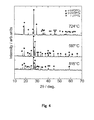
- Figure 4 shows XRD patterns of the obtained crystallized glass powders.
- ⁇ -LiVOPO 4 was precipitated by being heat treated at 515°C in the vicinity of the crystallization temperature. With respect to the sample heat treated at 597°C, ⁇ -LiVOPO 4 was obtained in a single phase. With respect to the sample heat treated at 724°C, ⁇ -LiVOPO 4 was obtained.
- the crushed crystallizable glass obtained in Example 1 was dispersed in methanol solvent so as to become 20 volume% thereof, and further crushed by using ball mill with alumina balls of 5 and 10 mm during 24 hours.
- the particle diameter of the fine powder obtained by the ball mill crushing was within the range of 0.5 to 1.3 ⁇ m.
- the crystallizable glass powder was put into a tablet mold and subjected to a uniaxial mold press under press pressure of 200 kgf/cm 2 for one minute to form a pellet-like formed body. This formed body was heat treated at 600°C for 12 hours in order to be crystallized.
- the crystal precipitated in the obtained sintered formed body was confirmed as ⁇ -LiVOPO 4 by XRD.
- the crystallizable glasses produced in Example 2 were heat treated at the respective crystallization temperatures to form crystallized glasses.
- Powder XRD pattern of each crystallized glass is shown in figure 5 .
- the electric conductivities of the crystallizable glass obtained in Example 1 and the crystallized glass obtained in Example 3 were measured as follows. Gold was vapor-deposited as an electrode on each surface of these samples, and fixed by performing a heat treatment at 300°C for 90 minutes. The electric conductivities were measured by using an alternating-current impedance method. As results of the measurement, electric conductivities of the crystallizable glass and the crystallized glass were 5 ⁇ 10 -10 S ⁇ cm -1 and 1.7 ⁇ 10 -7 S ⁇ cm -1 , respectively, at room temperature. The electric conductivity was proved to be significantly improved by crystallization.
- activation energies of respective samples were calculated from electric conductivity changes when varying temperatures of these samples.
- the temperature dependence regarding each sample is shown in figure 6 .
- the activation energy of the crystallizable glass was 0.67 eV, while the activation energy of the crystallized glass was 0.38 eV.
- Figure 7 shows electric conductivities at 100°C of the crystallizable glasses and the crystallized glasses produced according to Examples 1 to 4.
- the electric conductivity of the crystallized glass decreases in accordance that the contained amount of Li 2 O increases. This is considered to be caused by the formation of Li 2 VPO 6 crystal showing a low electric conductivity.
- the crystallized glass according to the present invention is suitable as a positive electrode material for a lithium ion secondary battery to be used in a portable electronic device, such as notebook-size personal computer and mobile phone, or an electric vehicle.
Landscapes
- Chemical & Material Sciences (AREA)
- Chemical Kinetics & Catalysis (AREA)
- Engineering & Computer Science (AREA)
- General Chemical & Material Sciences (AREA)
- Materials Engineering (AREA)
- Life Sciences & Earth Sciences (AREA)
- Geochemistry & Mineralogy (AREA)
- Organic Chemistry (AREA)
- Crystallography & Structural Chemistry (AREA)
- Dispersion Chemistry (AREA)
- Ceramic Engineering (AREA)
- Inorganic Chemistry (AREA)
- Electrochemistry (AREA)
- Battery Electrode And Active Subsutance (AREA)
- Glass Compositions (AREA)
Abstract
The crystallized glass according to the present invention contains a LiVOPO4 crystal. The LiVOPO4 crystal is preferably a β-LiVOPO4 crystal. In addition, the crystallized glass according to the present invention preferably contains a composition of Li2O: 25-60%, V2O5: 20-40% and P2O5: 20-40% in terms of mol%. The crystallized glass according to the present invention is suitable as a positive electrode material for lithium ion secondary batteries. The present invention provides a substance suitable as a positive electrode material for a lithium secondary battery having good battery properties and a method for producing the substance.
Description
- The present invention relates to a crystallized glass and a method for producing the same. More specifically, the present invention relates to a crystallized glass suitable as a positive electrode material for a lithium ion secondary battery to be used in a portable electronic device or an electric vehicle and a method for producing the crystallized glass.
- Lithium ion secondary batteries have established their positions as high-capacity and lightweight power supplies necessary for mobile electronic terminals and electric vehicles. As a positive electrode material for such lithium ion secondary batteries, an inorganic metal oxide such as lithium cobalt oxide (LiCoO2) has been heretofore used. In accordance with an increase in power consumption due to advancement of electronic devices in recent years, it is required to further upgrade lithium ion secondary batteries. Moreover, in terms of environment conservation problem, energy problem, and resource depletion problem etc., shifting to various materials is becoming to be desired instead of relying only on cobalt materials.
- Among them, a material, such as represented by lithium iron phosphate (LiFePO4), having phosphoric acid as a basic structure attracts attention as a novel material for a positive electrode because of being significantly stable in an organic electrolyte. However, one of the problems to be solved in order to use LiFePO4 as a practical positive electrode material is that the electron conductivity thereof is extremely low. In the present circumstances, it is required to combine with conductive additives such as a carbon material in order for LiFePO4 to be put into practical use.
- On the other hand, as a material having extremely good electron conductivity, an oxide having vanadium as constituent element has been found. This is due to that the electron conductivity is improved by a hopping conduction because vanadium is able to take a mixed valency of V3+/V4+/V5+ in the material. Thus, also regarding lithium vanadium phosphate (LiVOPO4), practical utility thereof as a positive electrode material for a lithium secondary battery has been found (refer to Non-patent Document 1, for example).
- It is reported that LiVOPO4 is composed of VO6 unit and PO4 unit and that the plateau potential thereof is 3.9V for lithium, which is higher than that of LiFePO4. In addition, it is found that LiVOPO4 has two types of structures i.e. α-phase of higher temperature type and β-phase of lower temperature type. Among them, the β-phase is reported to have good charge-discharge properties (refer to
Non-patent Document 2, for example). -
- Non-patent Document 1: K.H. Lii et al., J. Solid. State Chem., 95 352-359 (1991)
- Non-patent Document 2: T.A. Kerr et al., Electrochem. Solid-State Lett., 3 460-462 (2000)
- Non-patent Document 3: B.M. Azmi et al., Electrochim. Acta, 48 165-170 (2002)
- Non-patent Document 4: J. Baker et al., J. Electrochem. Soc., 151 A796-800 (2004)
- While LiVOPO4 is ordinarily produced by a solid-phase reaction process, in the case of such oxide crystal that contains considerable amount of alkali metal oxide, alkaline component volatilizes when heat treated at a high temperature. Therefore, heat treatment temperature and heat treatment time are restricted, and a low temperature and long time production process is required. However, a hydrothermal synthesis, one of low temperature synthesis processes, has problems that it is not suitable for mass production and the production process is complicated. In addition, although a synthesis of LiVOPO4 has been actually tried through solid-phase reaction, the obtained crystal contains only α-phase of higher temperature type, and thus there has not been found a production method for the lower temperature type β-phase showing a remarkable battery characteristic (refer to
Non-patent Document 3 or 4, for example). - The object of the present invention is, therefore, to provide a substance suitable as a positive electrode material for a lithium ion secondary battery showing remarkable battery properties and a method for producing the same.
- As a result of studies to solve the aforementioned problems in consideration of the above circumstances, the inventors have found out that a crystallized glass containing LiVOPO4 as a crystal is suitable as a positive electrode material for lithium ion secondary battery, and propose the crystallized glass as the present invention.
- That is, the crystallized glass according to the present invention is a crystallized glass containing a LiVOPO4 crystal.
- As will be described hereinafter, the crystallized glass containing LiVOPO4 as a crystal is easy to control the crystal phase and capable of being configured to contain much amount of lower temperature type β-phase. Therefore, the crystallized glass shows a good battery characteristic and is suitable as a positive electrode material for lithium secondary battery.
- Second, in the crystallized glass according to the present invention, the LiVOPO4 crystal is a β-LiVOPO4 crystal.
- Third, the crystallized glass according to the present invention contains a composition of Li2O: 25 to 60%, V2O5: 25 to 40% and P2O5: 25 to 40% in terms of mol%.
- Fourth, the crystallized glass according to the present invention is used as a positive electrode material for lithium ion secondary battery.
- Fifth, the positive electrode material for lithium secondary battery according to the present invention is a positive electrode material containing a powder of the above crystallized glass and a conductive active material.
- Sixth, the positive electrode material precursor crystallizable glass for lithium secondary battery according to the present invention contains a composition of Li2O: 25 to 60%, V2O5: 20 to 40% and P2O5: 20 to 40% in terms of mol%. Herein, the term "positive electrode material precursor crystallizable glass for lithium ion secondary battery" is intended to mean a precursor to a crystallized glass to be used as a positive electrode material for lithium ion secondary battery, i.e. a glass capable of being crystallized through heat treatment (firing) thereby precipitating an intended crystal.
- Seventh, the method for producing the crystallized glass according to the present invention is a method comprising the steps of: (1) preparing a batch so as to contain a composition of Li2O: 25 to 60%, V2O5: 20 to 40% and P2O5: 20 to 40% in terms of mol%; (2) melting the batch to obtain a molten glass; (3) quenching the molten glass to obtain a crystallizable glass; and (4) heat treating the crystallizable glass.
- Eighth, in the method for producing the crystallized glass according to the present invention, the crystallizable glass is heat treated within a temperature range of a glass-transition temperature or higher and a liquid-phase temperature or lower
- Thus, in the method for producing the crystallized glass according to the present invention, by arbitrarily determining a heat treatment temperature of the crystallizable glass within the temperature range of a glass-transition temperature or higher and a liquid-phase temperature or lower, it is enabled to selectively obtain a LiVOPO4 crystal of α-phase or β-phase. It is noted that "liquid-phase temperature" in the present invention is intended to mean a temperature at which a crystal precipitates after crushing the crystallizable glass into glass powder, charging the glass powder in a platinum boat and keeping the glass powder in a temperature gradient furnace for 24 hours, wherein the crystallizable glass powder is a glass powder which passes through a standard sieve of 30 mesh (sieve mesh opening of 500 µm) and do not pass through a standard sieve of 50 mesh (sieve mesh opening of 300 µm).
- Ninth, in the method for producing the crystallized glass according to the present invention, the crystallizable glass is crushed into a crystallizable glass powder before being heat treated.
- In the case that the crystallized glass according to the present invention is used as a positive electrode material for lithium secondary battery, the surface area of the entire positive electrode material becomes to be large when being in powdered state thereby allowing ions and electrons to be exchanged more easily. As a result, the charge-discharge reaction is readily accelerated.
- Tenth, in the method for producing the crystallized glass according to the present invention, the crystallizable glass powder is heat treated within a temperature range of a glass-transition temperature or higher and 800°C or lower, thereby precipitating a β-LiVOPO4 crystal.
-
- [
FIG. 1] Figure 1 is a graph illustrating a DTA (differential thermal analysis) pattern of the crystallizable glass obtained in Example 1. - [
FIG. 2] Figure 2 is a graph illustrating DTA patterns of the crystallizable glasses obtained in Examples 1 and 2. - [
FIG. 3] Figure 3 is a graph illustrating XRD patterns of the samples subjected to crystallization by heat treatment at 590°C for 3 hours with respect to the crystallizable glass obtained in Example 1. - [
FIG. 4] Figure 4 is a graph illustrating XRD patterns of the samples subjected to crystallization by heat treatment at 515°C, 597°C and 724°C respectively for 3 hours with respect to the crystallizable glass powder obtained in Example 1. - [
FIG. 5] Figure 5 is a graph illustrating XRD patterns of the samples subjected to crystallization by heat treatment at each crystallization temperature for 3 hours with respect to the crystallizable glass powder obtained in Example 2. - [
FIG. 6] Figure 6 is a graph illustrating temperature dependences of electric conductivities of the crystallizable glass obtained in Example 1 and the crystallizable glass obtained in Example 3. - [
FIG. 7] Figure 7 is a graph illustrating electric conductivities at 100°C of the crystallizable glasses and the crystallized glasses produced in Examples 1 to 4. - In the crystallized glass according to the present invention, the contained amount of LiVOPO4 crystal is, in order to obtain a good conductive characteristic, preferably 20 mass% or more, more preferably 50 mass% or more, furthermore preferably 70 mass% or more, and particularly preferably 90 mass% or more. Although, the upper limit is not particularly limited, actually 99 mass% or less, and more actually 95 mass% or less.
- As described hereinbefore, as the LiVOPO4 crystal, β-LiVOPO4 crystal having a good conductive characteristic is preferable, especially a single-phase of β-LiVOPO4 crystal is preferable, but α-LiVOPO4 crystal may be contained partially.
- As the glass composition, the most preferable composition is the same composition as LiVOPO4 of 33.3Li2O-33.3V2O5-33.3P2O5 (mol%), taking the vitrifiable range into consideration, within the composition range of Li2O: 25 to 60%, V2O5: 20 to 40% and P2O5: 20 to 40% in terms of mol% is preferable, within the composition range of Li2O: 25 to 40%, V2O5: 25 to 40% and P2O5: 25 to 40% is more preferable, and within the composition range of Li2O: 33.3±3%, V2O5: 33.3±3% and P2O5: 33.3±3% is furthermore preferable because the β-LiVOPO4 crystal is easily obtained within the range. If the composition of each component is without such ranges, then it is liable to hardly be vitrified.
- Preferably, in addition to Li2O, V2O5 and P2O5, as optional components for facilitating glass formation, Nb2O5, SiO2, B2O3, GeO2, Al2O3, Ga2O3, Sb2O3 and Bi2O3 may be contained as total amount of 0.1 to 25% in terms of mol%. If the total amount of such oxides is more than 25%, then the electric conductivity of crystallized glass obtained after heat treatment might become to be lower.
- While the most preferable composition of the crystallizable glass as a precursor of the crystallized glass according to the present invention is, similarly to the composition of the crystallized glass, the same composition as LiVOPO4 of 33.3Li2O-33.3V2O5-33.3P2O5 (mol%), preliminarily considering the volatilization of a low melting point component at the time of melting, as the vitrifiable range, within the composition range of Li2O: 25 to 60%, V2O5: 20 to 40% and P2O5: 20 to 40% in terms of mol% is preferable, within the composition range of Li2O: 25-40%, V2O5: 25-40% V2O5 and P2O5: 25-40% is more preferable, and within the composition range of Li2O: 33.3±3%, V2O5: 33.3±3% and P2O5: 33.3±3% is furthermore preferable because the β-LiVOPO4 crystal is easily obtained within the range. If the composition of each component is without such ranges, then it is liable to hardly be vitrified in addition to that a LiVOPO4 crystal becomes to hardly precipitate. In addition to Li2O, V2O5 and P2O5, the above described optional components may be arbitrarily contained.
- The method for producing the crystallized glass according to the present invention comprises the steps of: (1) preparing a batch so as to contain a composition of Li2O: 25 to 60%, V2O5: 20 to 40% V2O5 and P2O5: 20 to 40% in terms of mol%; (2) melting the batch to obtain a molten glass; (3) quenching the molten glass to obtain a crystallizable glass; and (4) heat treating the crystallizable glass.
- Although the method for obtaining a crystallizable glass is not particularly limited so far as being a commonly-used production method for glass material, taking points of large-scale production and production cost into consideration, a melting and quenching method is preferable.
- As glass raw materials, inorganic salts (particularly oxides or carbonates are preferable), organometallic compounds, or composite oxides such as lithium metaphosphate (LiPO3) etc. that contains lithium, vanadium and phosphoric acid may be mentioned, although not particularly limited so far as being adjustable to become intended composition.
- While the melting temperature of the glass raw material is not particularly limited so far as being the liquid-phase temperature of LiVOPO4 or higher, approximately 900°C to 1300°C is preferable considering the volatilization of lithium.
- Thereafter, the crystallized glass may be obtain by heat treating the crystallizable glass. The temperature of the heat treatment is preferably within the temperature range of a glass-transition temperature of the crystallizable glass or more and a liquid-phase temperature thereof or less. Note that, in order to selectively obtain the β-LiVOPO4, it is required to heat treat within a temperature range where the β-phase exists in a stable condition. The reason thereof is that an irreversible β to α transition is found in the vicinity of 750°C regarding the β-phase (the α-phase does not return to the β-phase). In this regard, because the heat treatment temperature has a distribution depending on the glass composition, it is preferred to heat treat in order for the β-phase to be formed within temperature ranges of the glass-transition temperature or higher and 800°C or lower, preferably 750°C or lower, and more preferably 700°C or lower.
- In the case of using the crystallized glass according to the present invention as a positive electrode material for lithium secondary battery, it is preferred to be used as crystallized glass powder in order to accelerate the charge-discharge reaction. In addition, the surface area of the entire positive electrode material becomes large in accordance with the decrease in the particle diameter of the crystallized glass powder, thereby allowing ions and electrons to be exchanged more easily, thus being preferred. More specifically, the average particle diameter of the crystallized glass is preferably 50 µm or less, more preferably 30 µm or less, furthermore preferably 20 µm or less, and particularly preferably 10 µm or less. While not particularly limited, the lower limit is actually 0.05 µm or more.
- Although there are options including that the crystallizable glass may be crushed to become crystallizable glass powder prior to being heat treated and that the crystallizable glass may be alternatively heat treated at first to form a crystallized glass thereafter being crushed to become crystallized glass powder, it is preferred to crush the crystallizable glass into powder form prior to being heat treated because of enabling to shorten the crystallization reaction and to achieve a high crystallinity degree. Specifically, it is preferred to subject the crystallizable glass powder to a shape forming process such as press forming and sheet forming thereby preparing a desired formed body, and thereafter to obtain a crystallized glass through heat treating the powder compact. Crushing of the crystallizable glass or the crystallized glass may be performed by means of a crushing machine such as ball mill.
- In the case of using the crystallized glass according to the present invention as a positive electrode material for lithium secondary battery, it is preferred to add a conductive active material for the purpose of compensating the electron conductivity of the crystallized glass. In this case, it is advantageous that the crystallized glass is in powdered state from the viewpoint of improving the electron conductivity because the contact area with the conductive active material increases. Particularly, it is preferred that the conductive active material is arranged to be supported on the interfacial surface of the crystallized glass powder.
- As the conductive active material, carbon-based conductive active material such as graphite, acetylene black and amorphous carbon, and metal-based conductive active material such as metallic powder etc. may be mentioned. With respect to amorphous carbon, the one where C-O bond peaks and C-H bond peaks causing degradation in conductivity of the positive electrode material are not substantially detected by the FTIR analysis thereof is preferable.
- As the method for supporting the conductive active material on the interfacial surface of the crystallized glass powder, there may be mentioned a method which comprises adding and mixing into the crystallizable glass powder as a precursor an organic compound such as glucose; carboxylic acid such as aliphatic carboxylic acid and aromatic carboxylic acid; and organic binder, and heat treating the crystallizable glass powder with the organic compound in an inert atmosphere such as nitrogen or a reductive atmosphere such as hydrogen, ammonia or carbon monoxide, thereby crystallizing the crystallizable glass powder and causing carbon component such as amorphous carbon as the conductive active material to remain on the interfacial surface of the obtained crystallized glass powder. With respect to amorphous carbon as described hereinbefore, by completely performing the heat treatment, the one where C-O bond peaks and C-H bond peaks causing degradation in conductivity of the positive electrode material are not substantially detected by the FTIR analysis thereof is preferable.
- As aliphatic carboxylic acid, acetic acid, propionic acid, butyric acid and oxalic acid etc. may be mentioned. As aromatic carboxylic acid, benzoic acid, phthalic acid and maleic acid etc. may be mentioned. As organic binder, acrylic resin, polyethylene glycol, polyethylene carbonate, polymethylstyrene and ethylcellulose etc. may be mentioned. As acrylic resin, polybutylmethacrylate, polyethylmethacrylate and polymethylmethacrylate etc. may be mentioned.
- The smaller the particle diameter of the conductive active material is, the more evenly the conductive active material may be dispersed on the particle interface of the crystallized glass powder. Specifically, the particle diameter of the conductive active material is preferably 50 µm or less, and more preferably 30 µm or less. If the particle diameter of the conductive active material is larger than 50 µm, then it is liable to be difficult to disperse the conductive active material evenly on the particle interface of the crystallized glass powder. While not particularly limited, the lower limit is actually 0.05 µm or more.
- The contained amount of the conductive active material is preferably in the range of 0.1 to 50 parts by mass, more preferably 2 to 40 parts by mass, and furthermore preferably 3 to 30 parts by mass with respect to 100 parts by mass of the crystallized glass. If the contained amount of the conductive active material is less than 0.1 parts by mass, then it is liable not to sufficiently obtain effects of imparting conductivity to the crystallized glass. On the other hand, if the contained amount of the conductive active material is more than 50 parts by mass, then the potential difference between the positive and negative electrodes of a lithium ion secondary battery becomes small, and therefore a desired electromotive force may not be obtained. In the case of using an organic compound as the conductive active material, it is preferred to satisfy the contained amount within the above ranges in terms of graphite equivalent.
- According to the above-described method, it is enabled to evenly support the conductive active material on the particle interface of the crystallized glass powder. Moreover, the organic binder is capable of contributing to two properties of formability and conductivity of the positive electrode material. In other words, it becomes possible to be easily formed into a sheet form and utilized as the positive electrode material of a battery without re-crushing after heat treating.
- While the present invention is more specifically described hereinafter with reference to examples, the present invention is not limited to these examples.
- Raw materials of Li2CO3, V2O5 and NH4H2PO4 were weighed as being 33.3Li2O-33.3V2O5-33.3P2O5 in terms of mol% and melted in an electric furnace at 1300°C during 20 minutes. After press quenching the melt, the whole compositions were confirmed as being in glass states by X-ray diffraction (XRD) method.
- The thermophysical properties of the obtained crystallizable glass were measured by means of DTA.
Figure 1 is a DTA pattern of the prepared crystallizable glass. The glass transition temperature Tg of this glass was measured as 381°C. In addition, the exothermic peak confirmed within the temperature range of 450°C to 500°C is originated from the crystallization of β-LiVOPO4. Moreover, the peak Tβ-α caused by the β to α transition was confirmed in the vicinity of 730°C to 750°C. - Raw materials of Li2CO3, V2O5 and NH4H2PO4 were weighed as being glass compositions represented by xLi2O-(100-x)LiVOPO4 in terms of mol%, and the mixed powders were melted in an electric furnace at 1300°C during 20 minutes. The values listed in Table 1 are selected as x, and each glass composition is additionally listed in Table 1 after being converted into each component of Li2O, V2O5 and P2O5.
- Crystallizable glasses were obtained by press quenching the molten glass. Glass-transition temperature and crystallization temperature of each sample is listed in Table 1. In addition,
figure 2 shows DTA patterns of the prepared crystallizable glasses. Sample No. 1 (x=0) corresponds to the crystallizable glass obtained in Example 1. -
[Table 1] (mol%) No. 1 No. 2 No. 3 No. 4 No. 5 No. 6 Li2O 33.3 35.6 38 42.8 48.2 53.8 V2O5 33.3 32.2 31 28.6 25.9 23.1 P2O5 33.3 32.2 31 28.6 25.9 23.1 xLi2O-(100-x)LiVOPO4 x=0 x=5 x=10 x=20 x=30 x=40 Glass Transition Temperature (°C) 381 341 369 353 315 288 Crystallization Temperature (°C) 498 497 493 485 464 344 - After subjecting the crystallizable glass produced in Example 1 to polishing, the crystallizable glass was subjected to crystallization by heat treating at 590°C during 3 hours.
Figure 3 shows XRD patterns of a bulk glass sample after being crystallized and a powder-like sample obtained by crushing after the crystallization. It was confirmed that β-LiVOPO4 showing a strong orientation in the b axis was obtained by crystallization of the Li2O-V2O5-P2O5 based glass. - In addition, after producing a crystallizable glass in the same manner as Example 1, crystallizable glass powder was obtained by crushing the crystallizable glass in a mortar. Thereafter, the crystallizable glass powder was subjected to crystallization by heat treatment for 3 hours in an electric furnace at the temperature of 515°C, 597°C and 724°C, respectively.
Figure 4 shows XRD patterns of the obtained crystallized glass powders. β-LiVOPO4 was precipitated by being heat treated at 515°C in the vicinity of the crystallization temperature. With respect to the sample heat treated at 597°C, β-LiVOPO4 was obtained in a single phase. With respect to the sample heat treated at 724°C, α-LiVOPO4 was obtained. - In turn, after roughly crushing in a mortar the crystallizable glass obtained in Example 1, the crushed crystallizable glass was dispersed in methanol solvent so as to become 20 volume% thereof, and further crushed by using ball mill with alumina balls of 5 and 10 mm during 24 hours. The particle diameter of the fine powder obtained by the ball mill crushing was within the range of 0.5 to 1.3 µm. The crystallizable glass powder was put into a tablet mold and subjected to a uniaxial mold press under press pressure of 200 kgf/cm2 for one minute to form a pellet-like formed body. This formed body was heat treated at 600°C for 12 hours in order to be crystallized. The crystal precipitated in the obtained sintered formed body was confirmed as β-LiVOPO4 by XRD.
- The crystallizable glasses produced in Example 2 were heat treated at the respective crystallization temperatures to form crystallized glasses. Powder XRD pattern of each crystallized glass is shown in
figure 5 . In the case of x=5 or x=10, β-LiVOPO4 crystal was found to precipitate at a large amount. While β-LiVOPO4 crystal was found to slightly precipitate also in the case of x=40, Li3PO4 crystal simultaneously precipitated. Because Li3PO4 crystal has a few sites to support electric charge from structural reasons, a sufficient electric potential cannot easily be obtained in the case of using, as a positive electrode material, crystallized glass in which Li3PO4 crystal precipitates. - The electric conductivities of the crystallizable glass obtained in Example 1 and the crystallized glass obtained in Example 3 were measured as follows. Gold was vapor-deposited as an electrode on each surface of these samples, and fixed by performing a heat treatment at 300°C for 90 minutes. The electric conductivities were measured by using an alternating-current impedance method. As results of the measurement, electric conductivities of the crystallizable glass and the crystallized glass were 5×10⁻¹⁰ S·cm-1 and 1.7×10⁻⁷ S·cm-1, respectively, at room temperature. The electric conductivity was proved to be significantly improved by crystallization.
- In addition, activation energies of respective samples were calculated from electric conductivity changes when varying temperatures of these samples. The temperature dependence regarding each sample is shown in
figure 6 . The activation energies were calculated in accordance with the Arrhenius equation σ=σ0exp(-Ea/kT). The activation energy of the crystallizable glass was 0.67 eV, while the activation energy of the crystallized glass was 0.38 eV. -
Figure 7 shows electric conductivities at 100°C of the crystallizable glasses and the crystallized glasses produced according to Examples 1 to 4. Within the range of x=10 to x=30, the electric conductivity of the crystallized glass decreases in accordance that the contained amount of Li2O increases. This is considered to be caused by the formation of Li2VPO6 crystal showing a low electric conductivity. Although the electric conductivity of the crystallized glass is high in the case of x=40, a sufficient electric potential cannot easily be obtained due to Li3PO4 crystal, as described above. - The crystallized glass according to the present invention is suitable as a positive electrode material for a lithium ion secondary battery to be used in a portable electronic device, such as notebook-size personal computer and mobile phone, or an electric vehicle.
Claims (10)
- A crystallized glass containing a LiVOPO4 crystal.
- The crystallized glass as set forth in claim 1, wherein the LiVOPO4 crystal contains a β-LiVOPO4 crystal.
- The crystallized glass as set forth in claim 1 or 2, wherein the crystallized glass contains a composition of Li2O: 25 to 60%, V2O5: 25 to 40% and P2O5: 25 to 40% in terms of mol%.
- The crystallized glass as set forth in any one of claims 1 to 3, wherein the crystallized glass is used as a positive electrode material for lithium ion secondary battery.
- A positive electrode material for lithium secondary battery, containing a powder of the crystallized glass as set forth in claim 4 and a conductive active material.
- A positive electrode material precursor crystallizable glass for lithium secondary battery, containing a composition of Li2O: 25 to 60%, V2O5: 20 to 40% and P2O5: 20 to 40% in terms of mol%.
- A method for producing a crystallized glass, comprising the steps of: (1) preparing a batch so as to contain a composition of Li2O: 25 to 60%, V2O5: 20 to 40% and P2O5: 20 to 40% in terms of mol%; (2) melting the batch to obtain a molten glass; (3) quenching the molten glass to obtain a crystallizable glass; and (4) heat treating the crystallizable glass.
- The method for producing a crystallized glass as set forth in claim 7, wherein the crystallizable glass is heat treated within a temperature range of a glass-transition temperature or higher and a liquid-phase temperature or lower.
- The method for producing a crystallized glass as set forth in claim 7 or 8, wherein the crystallizable glass is crushed into a crystallizable glass powder before being heat treated.
- The method for producing a crystallized glass as set forth in claim 9, wherein the crystallizable glass powder is heat treated within a temperature range of a glass-transition temperature or higher and 800°C or lower, thereby precipitating a β-LiVOPO4 crystal.
Applications Claiming Priority (2)
| Application Number | Priority Date | Filing Date | Title |
|---|---|---|---|
| JP2008129495 | 2008-05-16 | ||
| PCT/JP2009/058920 WO2009139415A1 (en) | 2008-05-16 | 2009-05-13 | Crystallized glass and method for producing the same |
Publications (1)
| Publication Number | Publication Date |
|---|---|
| EP2295385A1 true EP2295385A1 (en) | 2011-03-16 |
Family
ID=41318781
Family Applications (1)
| Application Number | Title | Priority Date | Filing Date |
|---|---|---|---|
| EP09746621A Withdrawn EP2295385A1 (en) | 2008-05-16 | 2009-05-13 | Crystallized glass and method for producing the same |
Country Status (5)
| Country | Link |
|---|---|
| US (1) | US20110133118A1 (en) |
| EP (1) | EP2295385A1 (en) |
| JP (1) | JP2009298687A (en) |
| CN (1) | CN102026928A (en) |
| WO (1) | WO2009139415A1 (en) |
Cited By (1)
| Publication number | Priority date | Publication date | Assignee | Title |
|---|---|---|---|---|
| WO2013011452A1 (en) | 2011-07-21 | 2013-01-24 | Saint-Gobain Centre De Recherches Et D'etudes Europeen | Method for producing a molten material |
Families Citing this family (22)
| Publication number | Priority date | Publication date | Assignee | Title |
|---|---|---|---|---|
| US8821763B2 (en) * | 2008-09-30 | 2014-09-02 | Tdk Corporation | Active material and method of manufacturing active material |
| JP5396798B2 (en) * | 2008-09-30 | 2014-01-22 | Tdk株式会社 | Active material, positive electrode and lithium ion secondary battery using the same |
| JP5347603B2 (en) * | 2009-03-16 | 2013-11-20 | Tdk株式会社 | Active material manufacturing method, active material, electrode, and lithium ion secondary battery |
| US20100233545A1 (en) * | 2009-03-16 | 2010-09-16 | Tdk Corporation | Active material, method of manufacturing active material, electrode, and lithium-ion secondary battery |
| JP5515343B2 (en) * | 2009-03-16 | 2014-06-11 | Tdk株式会社 | Active material manufacturing method, active material, electrode, and lithium ion secondary battery |
| US20110052995A1 (en) * | 2009-08-28 | 2011-03-03 | Tdk Corporation | Active material, electrode containing the same, lithium secondary battery provided therewith and method for manufacture of the active material |
| WO2011096012A1 (en) * | 2010-02-03 | 2011-08-11 | 株式会社日立製作所 | Infrared ray sensor |
| JP2011241133A (en) * | 2010-05-21 | 2011-12-01 | Hitachi Ltd | Crystallized glass and method for producing the same |
| JP2012022995A (en) * | 2010-07-16 | 2012-02-02 | Tdk Corp | Active material, electrode containing the same, lithium secondary battery including the electrode, and method for producing active material |
| JP2013206554A (en) * | 2012-03-27 | 2013-10-07 | Tdk Corp | Active material, electrode, and lithium-ion secondary battery |
| JP6102615B2 (en) * | 2013-08-01 | 2017-03-29 | 日立金属株式会社 | Negative electrode active material and secondary battery using the same |
| JP6197540B2 (en) * | 2013-09-30 | 2017-09-20 | Tdk株式会社 | Positive electrode material for lithium ion secondary battery, positive electrode for lithium ion secondary battery and lithium ion secondary battery |
| JP2015105220A (en) * | 2013-12-02 | 2015-06-08 | 旭硝子株式会社 | Crystallized glass powder, glass paste, soft magnetic composite material and powder magnetic core |
| WO2018181576A1 (en) * | 2017-03-30 | 2018-10-04 | Tdk株式会社 | All-solid-state battery |
| ES2980180T3 (en) | 2018-11-26 | 2024-09-30 | Owens Corning Intellectual Capital Llc | High performance fiberglass composition with improved modulus of elasticity |
| CA3117986A1 (en) | 2018-11-26 | 2020-06-04 | Owens Corning Intellectual Capital, Llc | High performance fiberglass composition with improved specific modulus |
| US20220344631A1 (en) * | 2019-09-20 | 2022-10-27 | Nippon Electric Glass Co., Ltd. | Method for manufacturing positive electrode material for electricity storage device |
| CN111484247B (en) * | 2020-04-16 | 2021-02-26 | 海南大学 | A kind of glass cathode material, preparation method and application thereof |
| CN111682194A (en) * | 2020-06-12 | 2020-09-18 | 成都理工大学 | A kind of Li2O-V2O5-B2O3 amorphous lithium ion battery cathode material and preparation method thereof |
| CN113013402A (en) * | 2021-02-07 | 2021-06-22 | 海南大学 | Glass positive electrode material, preparation method and application thereof |
| CN113013403A (en) * | 2021-02-07 | 2021-06-22 | 海南大学 | Sulfide glass positive electrode material, and preparation method and application thereof |
| CN117352705B (en) * | 2023-12-04 | 2024-03-01 | 山东省莘县华阳实业有限公司 | A superlattice-enhanced glass-based battery cathode material and its preparation method |
Family Cites Families (5)
| Publication number | Priority date | Publication date | Assignee | Title |
|---|---|---|---|---|
| JP5099737B2 (en) * | 2005-06-30 | 2012-12-19 | 公益財団法人北九州産業学術推進機構 | Electrode active material, method for producing the same, and non-aqueous electrolyte secondary battery |
| JP4957284B2 (en) * | 2006-04-28 | 2012-06-20 | 旭硝子株式会社 | Manufacturing method of glass substrate for magnetic disk and magnetic disk |
| JP4240078B2 (en) * | 2006-07-19 | 2009-03-18 | トヨタ自動車株式会社 | Lithium secondary battery |
| JP5034042B2 (en) * | 2006-08-15 | 2012-09-26 | 国立大学法人長岡技術科学大学 | Lithium secondary battery positive electrode material and manufacturing method thereof |
| JP5331419B2 (en) * | 2007-09-11 | 2013-10-30 | 国立大学法人長岡技術科学大学 | Positive electrode material for lithium ion secondary battery and method for producing the same |
-
2009
- 2009-05-13 JP JP2009116340A patent/JP2009298687A/en active Pending
- 2009-05-13 WO PCT/JP2009/058920 patent/WO2009139415A1/en not_active Ceased
- 2009-05-13 CN CN2009801177434A patent/CN102026928A/en active Pending
- 2009-05-13 US US12/990,436 patent/US20110133118A1/en not_active Abandoned
- 2009-05-13 EP EP09746621A patent/EP2295385A1/en not_active Withdrawn
Non-Patent Citations (1)
| Title |
|---|
| See references of WO2009139415A1 * |
Cited By (3)
| Publication number | Priority date | Publication date | Assignee | Title |
|---|---|---|---|---|
| WO2013011452A1 (en) | 2011-07-21 | 2013-01-24 | Saint-Gobain Centre De Recherches Et D'etudes Europeen | Method for producing a molten material |
| FR2978137A1 (en) * | 2011-07-21 | 2013-01-25 | Saint Gobain Ct Recherches | MELT PRODUCT BASED ON LITHIUM |
| US9620778B2 (en) | 2011-07-21 | 2017-04-11 | Saint-Gobain Centre De Recherches Et D'etudes Europeen | Method for producing a fused product |
Also Published As
| Publication number | Publication date |
|---|---|
| JP2009298687A (en) | 2009-12-24 |
| WO2009139415A1 (en) | 2009-11-19 |
| US20110133118A1 (en) | 2011-06-09 |
| CN102026928A (en) | 2011-04-20 |
Similar Documents
| Publication | Publication Date | Title |
|---|---|---|
| US20110133118A1 (en) | Crystallized glass and method for producing the same | |
| US7824802B2 (en) | Method of preparing a composite cathode active material for rechargeable electrochemical cell | |
| JP5331419B2 (en) | Positive electrode material for lithium ion secondary battery and method for producing the same | |
| US10763506B2 (en) | Method of manufacturing positive electrode material for electrical storage device | |
| JP2019153592A (en) | Lithium ion conductor, battery and electronic device | |
| EP3242300B1 (en) | Lithium ion conductor, solid electrolyte layer, electrode, battery and electronic device | |
| US20110065007A1 (en) | Electrode active material layer, all solid state battery, manufacturing method for electrode active material layer, and manufacturing method for all solid state battery | |
| JP5446017B2 (en) | Positive electrode material for lithium ion secondary battery and method for producing the same | |
| CN102378738A (en) | Manufacturing method of lithium iron phosphate particles and manufacturing method of secondary battery | |
| EP4462499A1 (en) | Solid-state secondary battery cathode and solid-state secondary battery comprising same | |
| CN118943362A (en) | Positive electrode active material for sodium ion secondary battery | |
| EP3570360A1 (en) | Solid electrolyte, all solid state battery, and method for producing solid electrolyte | |
| CN115699212A (en) | Solid electrolyte material, solid electrolyte, method for producing same, and all-solid-state battery | |
| KR20240144842A (en) | Sulfide-based solid electrolyte for all solid secondary battery, all solid secondary battery comprising sulfide-based solid electrolyte, and preparation method thereof | |
| US20120228561A1 (en) | Production method for lithium ion secondary battery positive electrode material | |
| US20120267566A1 (en) | Lithium ion secondary battery positive electrode material | |
| TW201631826A (en) | Positive electrode active material for alkali ion secondary battery | |
| CN115699214B (en) | Solid electrolyte material, solid electrolyte, method for producing solid electrolyte, and all-solid battery | |
| CN115699211B (en) | Solid electrolyte material, solid electrolyte, method for producing solid electrolyte, and all-solid battery | |
| TW201622216A (en) | Positive electrode active material for storage device and method for producing positive electrode active material for storage device | |
| EP2892092B1 (en) | Electrode material, electrode and lithium ion battery | |
| CN119275284B (en) | A halotransition metal phosphate sodium-ion battery cathode material and its preparation method | |
| US20250070162A1 (en) | Electrode material for all-solid battery, electrode for all-solid battery and method for manufacturing same, and all-solid battery and method for manufacturing same | |
| CN118451566A (en) | Positive electrode active material for sodium ion secondary battery | |
| JP2013004181A (en) | Positive electrode active material for lithium ion secondary battery and method for producing the same |
Legal Events
| Date | Code | Title | Description |
|---|---|---|---|
| PUAI | Public reference made under article 153(3) epc to a published international application that has entered the european phase |
Free format text: ORIGINAL CODE: 0009012 |
|
| 17P | Request for examination filed |
Effective date: 20101130 |
|
| AK | Designated contracting states |
Kind code of ref document: A1 Designated state(s): AT BE BG CH CY CZ DE DK EE ES FI FR GB GR HR HU IE IS IT LI LT LU LV MC MK MT NL NO PL PT RO SE SI SK TR |
|
| AX | Request for extension of the european patent |
Extension state: AL BA RS |
|
| DAX | Request for extension of the european patent (deleted) | ||
| STAA | Information on the status of an ep patent application or granted ep patent |
Free format text: STATUS: THE APPLICATION HAS BEEN WITHDRAWN |
|
| 18W | Application withdrawn |
Effective date: 20120322 |