Field of the invention
-
The present invention relates to a combination of DNA markers for characterizing a Lactobacillus sakei isolate. In particular, the present invention concerns the use of a pattern of presence or absence of DNA markers in the genome of the isolate to be characterized for identifying said isolate.
Background of the invention
-
Fresh meat and fish are nutritious but highly perishable foods. During production and storage they are exposed to unavoidable microbial contamination from the processing environment. Such contamination may include spoilage organisms and pathogens. It is therefore a priority for food processors to restrict the growth of contaminants so that they do not develop to potentially dangerous levels. One of the methods employed is the use of safe bacteria to curb growth of spoilage and disease-causing micro-organisms. The meat-borne lactic acid bacterium Lactobacillus sakei shows in this view excellent properties.
-
L. sakei has the ability to survive and grow on fresh meat, forming the dominant population when selective techniques are applied. Some strains are widely used in Europe for artisanal and larger scale manufacture of fermented sausages because of their useful preservative properties. Besides being a natural meat/fish-borne lactic acid bacterium, L. sakei is also a promising candidate for being used as natural bio-preservative agent to curb the growth of spoilage and disease-causing microorganisms, (Vermeiren et al. 2004 Int. J. Food Microbiol. 96:149-164) without a fermentation process of these foodstuffs. However, it may be difficult to distinguish the natural L. sakei population from that of bio-preservative cultures. This emerging technology thus requires a robust molecular tool to ensure follow up of the L. sakei microbial development in the product. Indeed, bio-protective cultures need to be monitored, at the isolate level, to ensure an efficient ecological activity in large industrial settings. Accordingly, there is a need for a technological tool for such measurement and for following the cultures up to the consumers, as well as for protecting industrial use of the cultures.
-
Strains of L. sakei can display an important variability in phenotypic traits and have for long been considered difficult to classify. In particular, the inventors have demonstrated the broad intra-species diversity of L. sakei isolates sourced from various food products and from worldwide laboratory collections (Chaillou et al. (2009) Appl. Environ. Microbiol. 75:970-980). This study demonstrated that the relatedness between isolates could be determined using a PCR-based method that detects the possession of chromosomal genes belonging to the flexible gene pool (genes poorly conserved between isolates). Therefore L. sakei isolates may be enormously diverse in gene content and it is possible to classify isolates in discrete variations of isolate clusters using comparative genomic content. Nevertheless, genes characterized from only few strains may not provide sufficient accuracy to profile isolates at the strain level. Accordingly, there is a need for a tool with an increased discriminating power.
-
The present inventors have designed such a tool by characterizing the variable gene pools in a wider pool of strains. The present invention thus provides a tool using a combination of 46 DNA markers, enabling obtaining rapidly, reproducibly and easily, highly accurate PCR fingerprinting profiles of any L. sakei isolates.
Detailed description of the invention
-
The present inventors have identified a combination of DNA markers, and allele-specific-polymorphic sites (ASP) and specific insertion/deletion sites (INDEL) within these DNA markers, enabling characterizing a highly specific PCR fingerprinting profile of any
L. sakei isolate. To obtain this combination of DNA markers, they conducted a large-scale substractive suppressive genomic hybridization experiment (SSH) on various strains chosen specifically from the diversity scale
of L. sakei species. They thus generated 20,000 SSH clones of few hundreds of genomic loci inferred to the flexible gene pool of the
L.
sakei species and investigated the pattern of variation (absence or presence of many of these islands and the degree of polymorphism in these genomic islands) between the chosen isolates. This analysis resulted in the selection of 46 DNA regions offering the best minimal set of markers for giving a unique PCR fingerprinting profile of any
L. sakei isolate. These 46 DNA regions are summarized in
Table 1.
Table 1: Description of the 46 DNA markers | Strain | SEQ ID NO | length (bp) | Function | Locus ID | ASP | INDEL |
| - | 1 | 2928 | CSC-type putative cell-surface protein | FGP112-0001 | YES | YES |
| - | 2 | 4700 | dTTP-rhamnose metabolism | FGP160-0001 | YES | |
| J160K | 3 | 1081 | hypothetical protein | FGP160-0002 | NO | |
| J160K | 4 | 3534 | CSC-type putative cell-surface protein | FGP160-0003 | NO | |
| J160K | 5 | 1260 | putative cytochrome P450 | FGP160-0004 | NO | |
| - | 6 | 2582 | β-galactosidase LacLM | LacLM | YES | YES |
| - | 7 | 2157 | putative bacteriocin transporter | FGPJG3-0002 | YES | |
| CTC163 | 8 | 2455 | putative Lon protease | FGP163-0001 | YES | |
| CTC163 | 9 | 777 | CSC-type putative cell-surface protein | FGP163-0003 | NO | |
| 23K | 10 | 1024 | putative bacteriocin production cluster | LSA0564-ac | NO | | |
| 23K | 11 | 1041 | threonine deaminase | LSA0572 | NO | |
| 23K | 12 | 7441 | sialic acid catabolism | LSA1639-1645 | NO | |
| 23K | 13 | 3162 | thiosulfate reduction | LSA0217-0219c | NO | |
| - | 14 | 2202 | putative cell-surface precursor | LSA0118 | YES | |
| 23K | 15 | 3047 | putative teichoic acid export complex | LSA1579-1580 | NO | |
| 23K | 16 | 849 | putative lipase/esterase precursor | LSA0439 | NO | |
| 23K | 17 | 5307 | CSC-type putative cell-surface protein | LSA1731 | NO | |
| 23K | 18 | 3398 | CSC-type putative cell-surface protein | LSA0211-0212 | NO | |
| | 19 | 3921 | CSC-type putative cell-surface protein | LSA0172 | YES | YES |
| 23K | 20 | 918 | putative cell-surface precursor | LSA0727 | NO | |
| - | 21 | 5938 | putative phosphotransferase transport system | FGP332-0001 | YES | |
| 332F | 22 | 1327 | putative autotransport protein | FGP332-0007 | NO | |
| 332F | 23 | 500 | hypothetical protein | FGP332-0008 | NO | |
| 332F | 24 | 141 | hypothetical protein | FGP332-0009 | NO | |
| 332F | 25 | 1476 | putative cell-surface protein | FGP332-0010 | NO | |
| - | 26 | 1840 | glucose 6-phosphate catabolism | FGP332-0011 | YES | |
| 332F | 27 | 866 | putative quinone oxidoreductase | FGP332-0012 | NO | |
| 332F | 28 | 1587 | putative asparagine synthase | FGP332-0013 | NO | |
| LTH673 |
| | 29 | 2462 | putative 2-hydroxyacid dehydrogenase cluster | FGP673-0001 | NO | |
| - | 30 | 931 | putative exopolysaccharide transporter | FGP673-0003 | YES | |
| LTH673 | 31 | 576 | pre-sakacin P and immunity protein | FGP673-0002 | NO | |
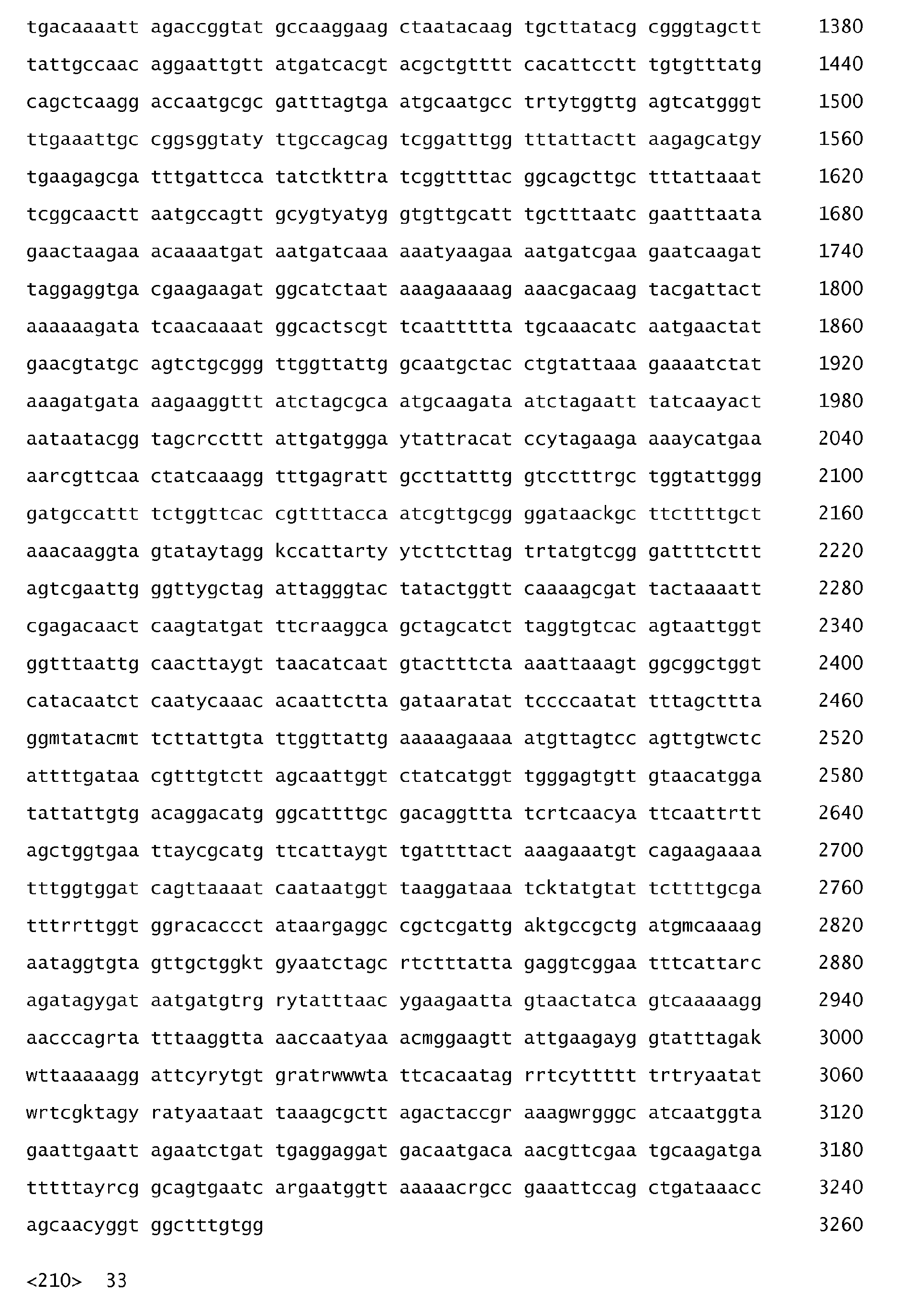
| - | 32 | 3260 | putative phosphotransferase transport system | FGP18-0001 | YES | |
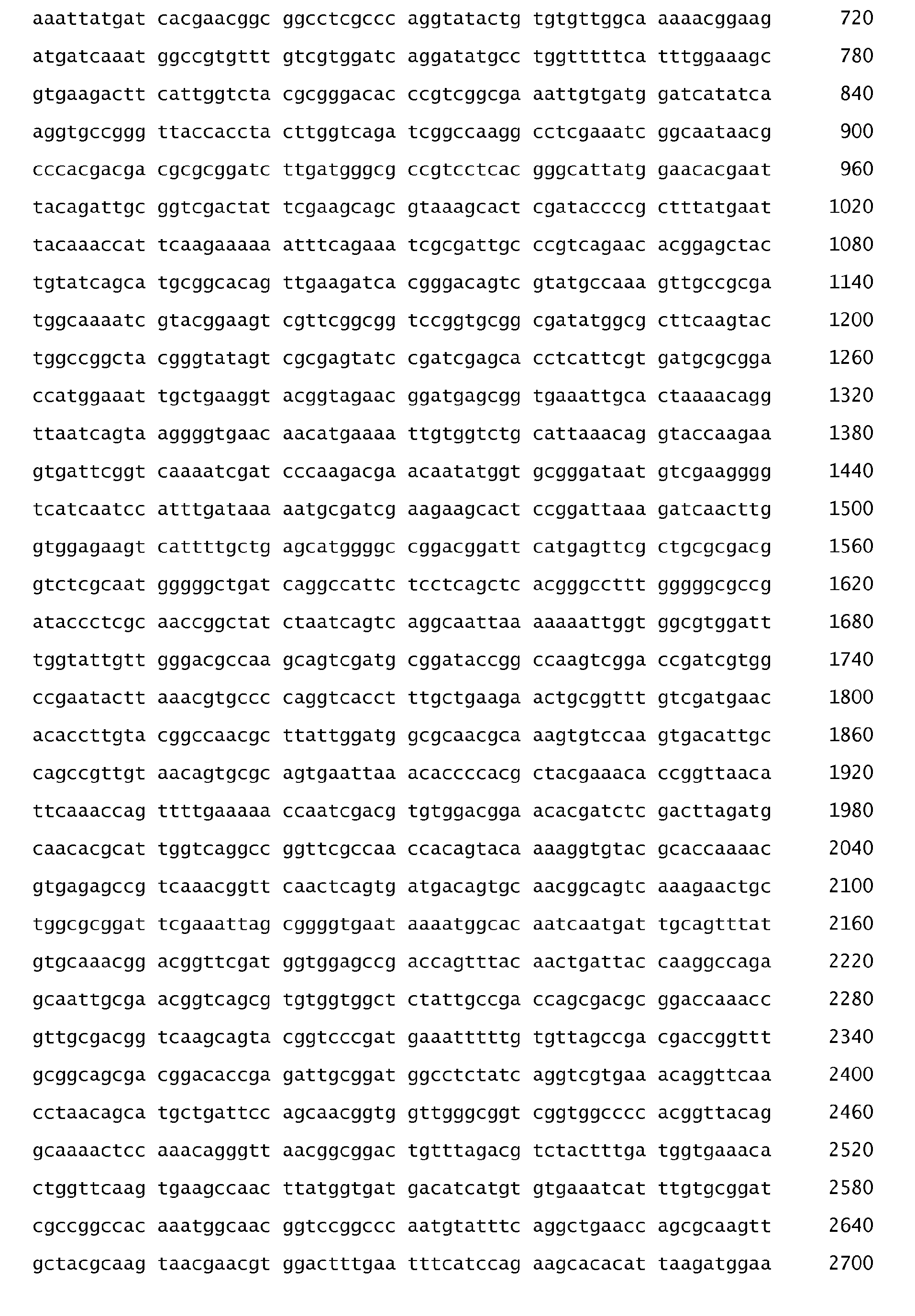
| J18 | 33 | 8265 | malonate decarboxylation | FGP18-0002 | NO | |
| J18 |
| | 34 | 1609 | putative choline kinase | FGP18-0003 | NO | |
| J21 | 35 | 336 | putative bacteriocin immunityprotein | FGP21-0001 | NO | |
| LTH677 |
| | 36 | 482 | putative short-chain dehydrogenase/reductase | FGP677-0001 | NO | |
| LTH677 |
| | 37 | 3291 | electron-transferring flavoprotein complex fixAB | FGP677-0002 | NO | |
| LTH677 |
| | 38 | 4520 | phosphonate metabolism | FGP677-0003 | NO | |
| J64 |
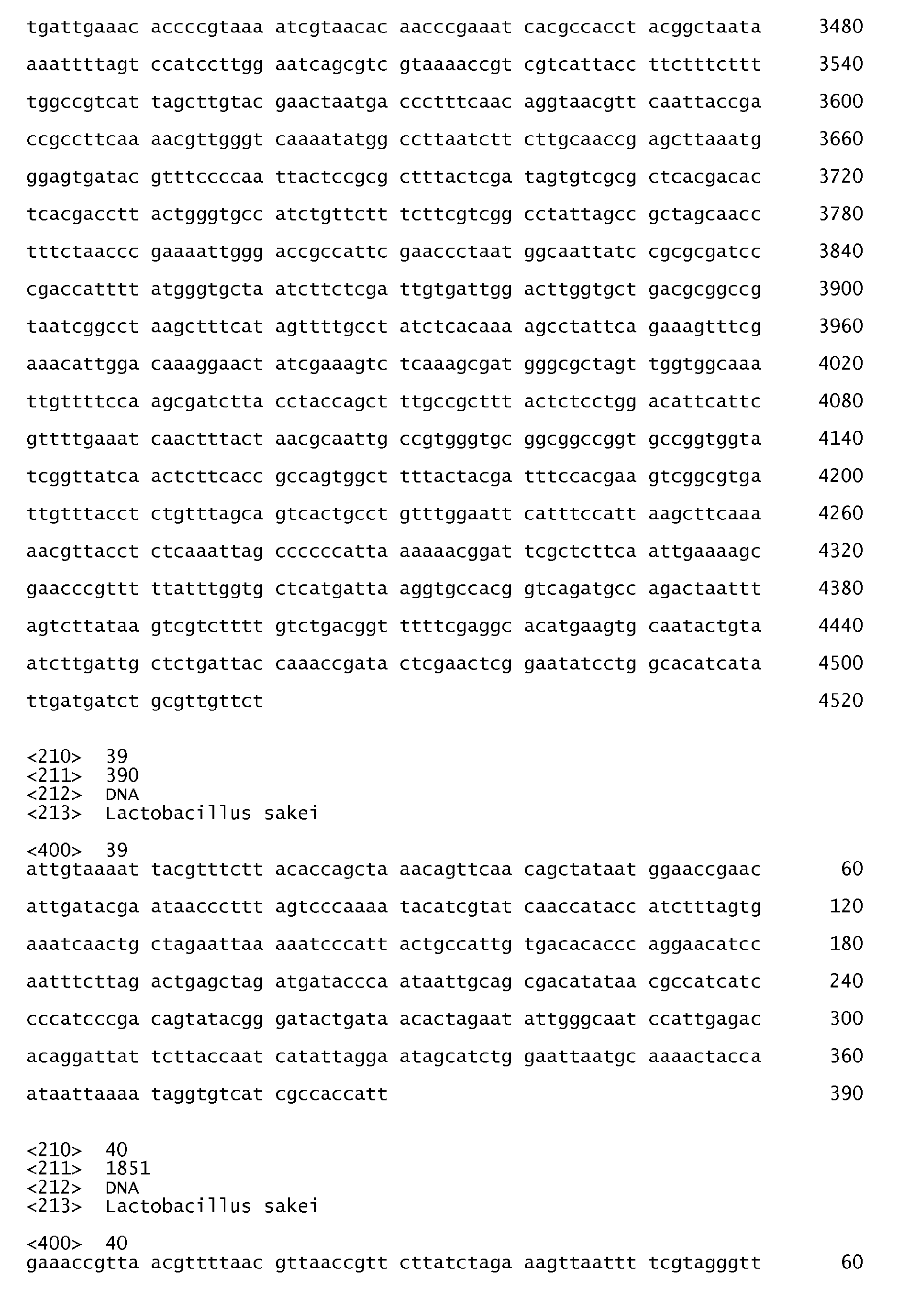
| | 39 | 390 | putative phosphotransferase transport system | FGP64-0001 | NO | |
| J64 | 40 | 1851 | putative branch-chain amino acid transporter | FGP64-0004 | NO | |
| | 41 | 270 | putative lactoylglutathione lyase | FGP64-0005 | YES | YES |
| LTH675 | 42 | 5790 | lactose catabolism | FGP675-0001 | NO | |
| LTH675 |
| | 43 | 6346 | rhamnose catabolism | FGP675-0002 | NO | |
| LTH675 |
| | 44 | 1984 | putative β-xylosidase | FGP675-0006 | NO | |
| LTH675 | 45 | 2511 | CSC-type putative cell-surface protein | FGP675-0005 | NO | |
| LTH675 |
| | 46 | 2757 | putative β-galactosidase (LacZ-like) | FGP675-0004 | NO | |
Combination of DNA markers
-
Accordingly, the present invention relates to a combination of markers enabling for characterizing a Lactobacillus sakei strain which comprises DNA markers of sequence SEQ ID NO: 1 to SEQ ID NO: 46.
-
As used herein, the terms "characterizing" and "identifying" are used indifferently and mean distinguishing a bacterial isolate or strain from another bacterial isolate or strain or from a mixture of bacterial isolates or strains.
-
In the context of the invention, the expression "DNA marker" refers to a chromosomal region or locus, having a property of variability between L. sakei isolates. Preferably, the size of DNA markers according to the invention ranges from about 150 bp to about 7.5 kb. The DNA markers according to the invention may comprise several encoding genes. Additionally, the DNA markers according to the invention may correspond to different allelic versions according to the strain of interest. More specifically, the allelic versions of the DNA markers according to the invention consist in ASP sites and specific INDEL sites. In particular, among the 46 DNA markers according to the invention, 11 DNA markers display allelic versions. These allelic variations are represented in the degenerated sequences SEQ ID NO: 1, SEQ ID NO: 2, SEQ ID NO: 6, SEQ ID NO: 7, SEQ ID NO: 14, SEQ ID NO: 19, SEQ ID NO: 21, SEQ ID NO: 26, SEQ ID NO: 30, SEQ ID NO: 32 and SEQ ID NO: 41. The 46 DNA markers according to the invention are thus most preferably of sequences SEQ ID NO: 1 to SEQ ID NO: 46. The genes encoded by the 46 DNA markers according to the invention are listed in Table 1.
-
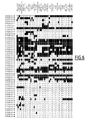
As described in Example 1, the inventors have demonstrated that these 46 DNA markers could be used to characterize a L. sakei strain among other L. sakei strains. More precisely, the following correspondence between the pattern of presence or absence of the 46 DNA markers defined above and 11 L. sakei strains has been obtained, as illustrated in
Figure 1:
-
- in strain J64, the DNA markers SEQ ID NO: 1, SEQ ID NO: 7, SEQ ID NO: 11, SEQ ID NO: 14, SEQ ID NO: 18, SEQ ID NO: 19, SEQ ID NO: 22, SEQ ID NO: 23, SEQ ID NO: 26, SEQ ID NO: 29, SEQ ID NO: 35, SEQ ID NO: 36, SEQ ID NO: 39, SEQ ID NO: 40 SEQ ID NO: 41 and SEQ ID NO: 43 are present and the other DNA markers are absent;
- in strain T332, the DNA markers SEQ ID NO: 1, SEQ ID NO: 7, SEQ ID NO: 10, SEQ ID NO: 11, SEQ ID NO: 12, SEQ ID NO: 13, SEQ ID NO: 14, SEQ ID NO: 15, SEQ ID NO: 18, SEQ ID NO: 19, SEQ ID NO: 21, SEQ ID NO: 22, SEQ ID NO: 23, SEQ ID NO: 24, SEQ ID NO: 25, SEQ ID NO: 26, SEQ ID NO: 27, SEQ ID NO: 28, SEQ ID NO: 30, SEQ ID NO: 35 and SEQ ID NO: 41 are present and the other DNA markers are absent;
- in strain LTH677, the DNA markers SEQ ID NO: 1, SEQ ID NO: 7, SEQ ID NO: 10, SEQ ID NO: 11, SEQ ID NO: 13, SEQ ID NO: 14, SEQ ID NO: 15, SEQ ID NO: 16, SEQ ID NO: 21, SEQ ID NO: 22, SEQ ID NO: 23, SEQ ID NO: 26, SEQ ID NO: 27, SEQ ID NO: 28, SEQ ID NO: 29, SEQ ID NO: 35, SEQ ID NO: 36, SEQ ID NO: 37, SEQ ID NO: 38, SEQ ID NO: 40, SEQ ID NO: 41, SEQ ID NO: 42, SEQ ID NO: 43 and SEQ ID NO: 45 are present and the other DNA markers are absent;
- in strain LTH675, the DNA markers SEQ ID NO: 7, SEQ ID NO: 9, SEQ ID NO: 11, SEQ ID NO: 13, SEQ ID NO: 14, SEQ ID NO: 18, SEQ ID NO: 21, SEQ ID NO: 22, SEQ ID NO: 35, SEQ ID NO: 38, SEQ ID NO: 41, SEQ ID NO: 42, SEQ ID NO: 43, SEQ ID NO: 44, SEQ ID NO: 45 and SEQ ID NO: 46 are present and the other DNA markers are absent;
- in strain J18, the DNA markers SEQ ID NO: 1, SEQ ID NO: 5, SEQ ID NO: 7, SEQ ID NO: 12, SEQ ID NO: 13, SEQ ID NO: 14, SEQ ID NO: 15, SEQ ID NO: 16, SEQ ID NO: 17, SEQ ID NO: 19, SEQ ID NO: 21, SEQ ID NO: 23, SEQ ID NO: 24, SEQ ID NO: 25, SEQ ID NO: 26, SEQ ID NO: 28, SEQ ID NO: 31, SEQ ID NO: 32, SEQ ID NO: 33, SEQ ID NO: 34 and SEQ ID NO: 41 are present and the other DNA markers are absent;
- in strain LTH673, the DNA markers SEQ ID NO: 1, SEQ ID NO: 5, SEQ ID NO: 7, SEQ ID NO: 8, SEQ ID NO: 12, SEQ ID NO: 14, SEQ ID NO: 16, SEQ ID NO: 19, SEQ ID NO: 21, SEQ ID NO: 24, SEQ ID NO: 25, SEQ ID NO: 26, SEQ ID NO: 29, SEQ ID NO: 30, SEQ ID NO: 31, SEQ ID NO: 32 and SEQ ID NO: 34 are present and the other DNA markers are absent;
- in strain 23K, the DNA markers SEQ ID NO: 5, SEQ ID NO: 10, SEQ ID NO: 11, SEQ ID NO: 12, SEQ ID NO: 13, SEQ ID NO: 14, SEQ ID NO: 15, SEQ ID NO: 16, SEQ ID NO: 17, SEQ ID NO: 18, SEQ ID NO: 19 and SEQ ID NO: 20 are present and the other DNA markers are absent;
- in strain CTC 163, the DNA markers SEQ ID NO: 1, SEQ ID NO: 5, SEQ ID NO: 7, SEQ ID NO: 8, SEQ ID NO: 9, SEQ ID NO: 10, SEQ ID NO: 11, SEQ ID NO: 12, SEQ ID NO: 14, SEQ ID NO: 15, SEQ ID NO: 17, SEQ ID NO: 18, SEQ ID NO: 19, SEQ ID NO: 21, SEQ ID NO: 23, SEQ ID NO: 27, SEQ ID NO: 29, SEQ ID NO: 30 and SEQ ID NO: 32 are present and the other DNA markers are absent;
- in strain JG3, the DNA markers SEQ ID NO: 1, SEQ ID NO: 2, SEQ ID NO: 3, SEQ ID NO: 5, SEQ ID NO: 6, SEQ ID NO: 7, SEQ ID NO: 9, SEQ ID NO: 10, SEQ ID NO: 11, SEQ ID NO: 12, SEQ ID NO: 13, SEQ ID NO: 14, SEQ ID NO: 15, SEQ ID NO: 18, SEQ ID NO: 19, SEQ ID NO: 23, SEQ ID NO: 26 and SEQ ID NO: 28 are present and the other DNA markers are absent;
- in strain J160K, the DNA markers SEQ ID NO: 1, SEQ ID NO: 2, SEQ ID NO: 3, SEQ ID NO: 4, SEQ ID NO: 5, SEQ ID NO: 10, SEQ ID NO: 11, SEQ ID NO: 12, SEQ ID NO: 14, SEQ ID NO: 15, SEQ ID NO: 16, SEQ ID NO: 17, SEQ ID NO: 18, SEQ ID NO: 22, SEQ ID NO: 23, SEQ ID NO: 24, SEQ ID NO: 26 and SEQ ID NO: 27 are present and the other DNA markers are absent;
- in strain J112, the DNA markers SEQ ID NO: 1, SEQ NO: 2, SEQ NO: 5, SEQ NO: 10, SEQ NO: 11, SEQ NO: 12, SEQ NO: 14, SEQ NO: 15, SEQ ID NO: 16, SEQ NO: 17, SEQ NO: 19, SEQ NO: 21, SEQ NO: 22, SEQ NO: 23, SEQ NO: 26, SEQ NO: 28 and SEQ NO: 30 are present and the other DNA markers are absent.
-
The present inventors have shown that a better characterization could be obtained when allele variations of some of the 46 DNA markers defined above were further detected. Such allele variations include allele-specific-polymorphic sites (ASP) and specific insertion/deletion sites (INDEL) and constitute additional DNA markers according to the invention. The allele-specific-polymorphic sites and specific insertion/deletion sites of interest according to the invention are summarized in Table 2.
Table 2: Additional DNA markers | Strain | SEQ ID NO | length (bp) | Allele variation from SEQ ID NO: | ASP | INDEL |
| J112 | 47 | 2928 | 1 | X | X |
| T332 |
| | 48 | 2927 | 1 | X | X |
| J160K | 49 | 2842 | 1 | X | X |
| J160K |
| | 50 | 4700 | 2 | X | |
| JG3 | 51 | 2549 | 2 | X | |
| LTH675 | 52 | 2549 | 2 | X | |
| BMG.115 | 53 | 2582 | 6 | X | X |
| BMG.37 | 54 | 2582 | 6 | X | X |
| JG3 | 55 | 2157 | 7 | X | |
| LTH673 |
| | 56 | 2157 | 7 | X | |
| 23K | 57 | 2202 | 14 | X | |
| LTH675 | 58 | 2202 | 14 | X | |
| 23K | 59 | 3921 | 19 | X | |
| J112 | 60 | 3921 | 19 | X | X |
| 332F | 61 | 5938 | 21 | X | |
| CTC163 | 62 | 5935 | 21 | X | |
| 332F | 63 | 1840 | 26 | X | |
| J160K | 64 | 1840 | 26 | X | |
| LTH673 | 65 | 931 | 30 | X | |
| CTC163 | 66 | 931 | 30 | X | |
| 332F | 67 | 930 | 30 | X | |
| J18 |
| | 68 | 3260 | 32 | X | |
| CTC163 | 69 | 3260 | 32 | X | |
| J64 |
| | 70 | 270 | 41 | X | X |
| T332 |
| | 71 | 269 | 41 | X | X |
-
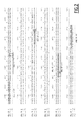
For a purpose of clarity, Figure 2 represents allelic variations of the DNA marker of sequence SEQ ID NO: 6 identified by the inventors.
-
The present inventors have shown that by increasing the number of DNA markers to 60, it was possible obtain the best accuracy for the characterization. These 60 DNA markers are the 35 DNA markers defined above that do not display allelic versions (i. e. DNA markers of sequence SEQ ID NO: 3 to SEQ ID NO: 5, SEQ ID NO: 8 to SEQ ID NO: 13, SEQ ID NO: 15 to SEQ ID NO: 18, SEQ ID NO: 20, SEQ ID NO: 22 to SEQ ID NO: 25, SEQ ID NO: 27 to SEQ ID NO: 29, SEQ ID NO: 31, SEQ ID NO: 33 to SEQ ID NO: 40 and SEQ ID NO: 42 to SEQ ID NO: 46) and the allelic versions of the 11 DNA markers defined above that display allelic versions, said allelic versions being of sequence SEQ ID NO: 47 to SEQ ID NO: 71. Accordingly, in another preferred embodiment, the combination of markers defined above further comprises DNA markers of sequence SEQ ID NO: 47 to SEQ ID NO: 71.
-
More precisely, the following correspondence between the pattern of presence or absence of the 60 DNA markers defined above and 11 L. sakei strains has been obtained, as illustrated in Figure 3 :
- in strain J64, the DNA markers SEQ ID NO: 47, SEQ ID NO: 56, SEQ ID NO: 11, SEQ ID NO: 57, SEQ ID NO: 18, SEQ ID NO: 60, SEQ ID NO: 22, SEQ ID NO: 23, SEQ ID NO: 63, SEQ ID NO: 29, SEQ ID NO: 35, SEQ ID NO: 36, SEQ ID NO: 39, SEQ ID NO: 40, SEQ ID NO: 70 and SEQ ID NO: 43 are present and the other DNA markers are absent;
- in strain T332, the DNA markers SEQ ID NO: 48, SEQ ID NO: 56, SEQ ID NO: 10, SEQ ID NO: 11, SEQ ID NO: 12, SEQ ID NO: 13, SEQ ID NO: 57, SEQ ID NO: 15, SEQ ID NO: 18, SEQ ID NO: 60, SEQ ID NO: 61, SEQ ID NO: 22, SEQ ID NO: 23, SEQ ID NO: 24, SEQ ID NO: 25, SEQ ID NO: 63, SEQ ID NO: 27, SEQ ID NO: 28, SEQ ID NO: 66, SEQ ID NO: 35 and SEQ ID NO: 71 are present and the other DNA markers are absent;
- in strain LTH677, the DNA markers SEQ ID NO: 48, SEQ ID NO: 56, SEQ ID NO: 10, SEQ ID NO: 11, SEQ ID NO: 13, SEQ ID NO: 57, SEQ ID NO: 15, SEQ ID NO: 16, SEQ ID NO: 62, SEQ ID NO: 22, SEQ ID NO: 23, SEQ ID NO: 63, SEQ ID NO: 27, SEQ ID NO: 8, SEQ ID NO: 29, SEQ ID NO: 35, SEQ ID NO: 36, SEQ ID NO: 37, SEQ ID NO: 38, SEQ ID NO: 40, SEQ ID NO: 70, SEQ ID NO: 42, SEQ ID NO: 43 and SEQ ID NO: 45 are present and the other DNA markers are absent;
- in strain LTH675, the DNA markers SEQ ID NO: 52, SEQ ID NO: 56, SEQ ID NO: 9, SEQ ID NO: 11, SEQ ID NO: 13, SEQ ID NO: 58, SEQ ID NO: 18, SEQ ID NO: 62, SEQ ID NO: 22, SEQ ID NO: 35, SEQ ID NO: 38, SEQ ID NO: 71, SEQ ID NO: 42, SEQ ID NO: 43, SEQ ID NO: 45, SEQ ID NO: 44 and SEQ ID NO: 46 are present and the other DNA markers are absent;
- in strain J18, the DNA markers SEQ ID NO: 48, SEQ ID NO: 5, SEQ ID NO 56, SEQ ID NO: 12, SEQ ID NO: 13, SEQ ID NO: 57, SEQ ID NO: 15, SEQ ID NO: 16, SEQ ID NO: 17, SEQ ID NO: 60, SEQ ID NO: 61, SEQ ID NO: 23, SEQ ID NO: 24, SEQ ID NO: 25, SEQ ID NO: 63, SEQ ID NO: 28, SEQ ID NO: 31, SEQ ID NO: 68, SEQ ID NO: 33, SEQ ID NO: 34 and SEQ ID NO: 70 are present and the other DNA markers are absent;
- in strain LTH673; the DNA markers SEQ ID NO: 47, SEQ ID NO: 5, SEQ ID NO: 56, SEQ ID NO: 8, SEQ ID NO: 12, SEQ ID NO: 16, SEQ ID NO: 60, SEQ ID NO: 62, SEQ ID NO: 24, SEQ ID NO: 25, SEQ ID NO: 63, SEQ ID NO: 29, SEQ ID NO: 65, SEQ ID NO: 31, SEQ ID NO: 68 and SEQ ID NO: 34 are present and the other DNA markers are absent;
- in strain 23K, the DNA markers SEQ ID NO: 5, SEQ ID NO: 10, SEQ ID NO: 11, SEQ ID NO: 12, SEQ ID NO: 13, SEQ ID NO: 57, SEQ ID NO: 15, SEQ ID NO: 16, SEQ ID NO: 17, SEQ ID NO: 18, SEQ ID NO: 59 and SEQ ID NO: 20 are present and the other DNA markers are absent;
- in strain CTC 163, the DNA markers SEQ ID NO: 49, SEQ ID NO: 5, SEQ ID NO: 55, SEQ ID NO: 8, SEQ ID NO: 9, SEQ ID NO: 10, SEQ ID NO: 11, SEQ ID NO: 12, SEQ ID NO: 57, SEQ ID NO: 15, SEQ ID NO: 17, SEQ ID NO: 18, SEQ ID NO: 60, SEQ ID NO: 62, SEQ ID NO: 23, SEQ ID NO: 27, SEQ ID NO: 29, SEQ ID NO: 67 and SEQ ID NO: 69 are present and the other DNA markers are absent;
- in strain JG3, the DNA markers SEQ ID NO: 48, SEQ ID NO: 51, SEQ ID NO: 3, SEQ ID NO: 5, SEQ ID NO: 53, SEQ ID NO: 55, SEQ ID NO: 9, SEQ ID NO: 10, SEQ ID NO: 11, SEQ ID NO: 12, SEQ ID NO: 13, SEQ ID NO: 57, SEQ ID NO: 15, SEQ ID NO: 18, SEQ ID NO: 60, SEQ ID NO: 23, SEQ ID NO: 64 and SEQ ID NO: 28 are present and the other DNA markers are absent;
- in strain J160K, the DNA markers SEQ ID NO: 49, SEQ ID NO: 50, SEQ ID NO: 4, SEQ ID NO: 5, SEQ ID NO: 54, SEQ ID NO: 10, SEQ ID NO: 11, SEQ ID NO: 12, SEQ ID NO: 57, SEQ ID NO: 15, SEQ ID NO: 16, SEQ ID NO: 17, SEQ ID NO: 18, SEQ ID NO: 22, SEQ ID NO: 23, SEQ ID NO: 24, SEQ ID NO: 64 and SEQ ID NO: 27 are present and the other DNA markers are absent;
- in strain J112, the DNA markers SEQ ID NO: 47, SEQ ID NO: 51, SEQ ID NO: 5, SEQ ID NO: 10, SEQ ID NO: 11, SEQ ID NO: 12, SEQ ID NO: 57, SEQ ID NO: 15, SEQ ID NO: 16, SEQ ID NO: 17, SEQ ID NO: 60, SEQ ID NO: 61, SEQ ID NO: 22, SEQ ID NO: 23, SEQ ID NO: 64 and SEQ ID NO: 28 are present and the other DNA markers are absent.
-
Specifically, the present inventors have shown that the accuracy of the characterization was dependent of the number of DNA markers used. The minimum set of DNA markers to be used is composed of the 46 DNA markers defined above. The accuracy of the characterization can then be raised by increasing the number of DNA markers used, the best accuracy being obtain with the 60 DNA markers defined above. Depending on the number of L. sakei strains to differentiate, the minimum set of 46 DNA markers may prove sufficient, or the number of DNA markers to be used to characterize the strains may be raised up to 60 if some L. sakei strains cannot be discriminated.
-
For example, as shown in Example 1, the present inventors have demonstrated that the determination of the presence or absence of 52 DNA markers including an allelic version of each of the 46 DNA markers defined above and 6 additional DNA markers consisting in ASP sites of 6 of the first 46 DNA markers, was sufficient to characterize any L. sakei isolate among 129 tested. Said 6 additional DNA markers are DNA markers of sequence SEQ ID NO: 48, SEQ ID NO: 51, SEQ ID NO: 54, SEQ ID NO: 60, SEQ ID NO: 62 and SEQ ID NO: 69. Accordingly, in a preferred embodiment, the combination of markers according to the invention comprises DNA markers of sequence SEQ ID NO: 47, SEQ ID NO: 48, SEQ ID NO: 50, SEQ ID NO: 51, SEQ ID NO:3 to SEQ ID NO: 5, SEQ ID NO: 53 to SEQ ID NO: 55, SEQ ID NO: 8 to SEQ ID NO: 13, SEQ ID NO: 57, SEQ ID N0:15 to SEQ ID NO:18, SEQ ID NO: SEQ ID NO: 59 to SEQ ID NO: 63, SEQ ID NO:20, SEQ ID NO:22 to SEQ ID NO:25, SEQ ID NO:27 to SEQ ID NO:29, SEQ ID NO:65, SEQ ID NO: 31, SEQ ID NO:68 to SEQ ID NO: 70, SEQ ID NO: 33 to SEQ ID NO:40 and SEQ ID NO: 42 to SEQ ID NO: 46.
-
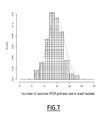
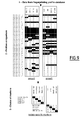
More precisely, the following correspondence between the pattern of presence or absence of the 52 DNA markers defined above and 129 L. sakei strains has been obtained, as illustrated in Figures 4 to 6 :
- in strain BMG.101, the DNA markers SEQ ID NO: 11, SEQ ID NO: 13, SEQ ID NO: 57, SEQ ID NO: 18, SEQ ID NO: 22, SEQ ID NO: 23, SEQ ID NO: 29 and SEQ ID NO: 35 are present and the 44 other DNA markers are absent;
- in strain BMG.95, the DNA markers SEQ ID NO: 4, SEQ ID NO: 11, SEQ ID NO: 13, SEQ ID NO: 18, SEQ ID NO: 22, SEQ ID No: 23, SEQ ID NO: 29, SEQ ID NO: 35, SEQ ID NO: 36, SEQ ID NO: 39, SEQ ID NO: 40, SEQ ID NO: 70 and SEQ ID NO: 44 are present and the 39 other DNA markers are absent;
- in strain J64, the DNA markers SEQ ID NO: 47, SEQ ID NO: 11, SEQ ID NO: 57, SEQ ID NO: 18, SEQ ID NO: 60, SEQ ID NO: 22, SEQ ID NO: 23, SEQ ID NO: 63, SEQ ID NO: 29, SEQ ID NO: 35, SEQ ID NO: 36, SEQ ID NO: 39, SEQ ID NO: 40, SEQ ID NO: 70 and SEQ ID NO: 43 are present and the 37 other DNA markers are absent;
- in strain J33, the DNA markers SEQ ID NO: 47, SEQ ID NO: 8, SEQ ID NO: 11, SEQ ID NO: 15, SEQ ID NO: 18, SEQ ID NO: 60, SEQ ID NO: 23, SEQ ID NO: 63, SEQ ID NO: 29, SEQ ID NO: 35, SEQ ID NO: 36, SEQ ID NO: 40 and SEQ ID NO: 70 are present and the 39 other DNA markers are absent;
- in strain H216, the DNA markers SEQ ID NO: 48, SEQ ID NO: 51, SEQ ID NO: 4, SEQ ID NO: 9, SEQ ID NO: 11, SEQ ID NO: 13, SEQ ID NO: 57, SEQ ID NO: 15, SEQ ID NO: 18, SEQ ID NO: 22, SEQ ID NO: 27, SEQ ID NO: 33, SEQ ID NO: 35 and SEQ ID NO: 38 are present and the 38 other DNA markers are absent;
- in strain J175, the DNA markers SEQ ID NO: 9, SEQ ID NO: 11, SEQ ID NO: 13, SEQ ID NO: 18, SEQ ID NO: 61, SEQ ID NO: 22, SEQ ID NO: 63, SEQ ID NO: 27, SEQ ID NO: 29, SEQ ID NO: 35, SEQ ID NO: 38, SEQ ID NO: 70 and SEQ ID NO: 44 are present and the 39 other DNA markers are absent;
- in strain LTH2070, the DNA markers SEQ ID NO: 48, SEQ ID NO: 11, SEQ ID NO: 12, SEQ ID NO: 13, SEQ ID NO: 57, SEQ ID NO: 15, SEQ ID NO: 18, SEQ ID NO: 23, SEQ ID NO: 63, SEQ ID NO: 28, SEQ ID NO: 35 and SEQ ID NO: 70 are present and the 40 other DNA markers are absent;
- in strain T332, the DNA markers SEQ ID NO: 48, SEQ ID NO: 10, SEQ ID NO: 11, SEQ ID NO: 12, SEQ ID NO: 13, SEQ ID NO: 57, SEQ ID NO: 15, SEQ ID NO: 18, SEQ ID NO: 60, SEQ ID NO: 61, SEQ ID NO: 22, SEQ ID NO: 23, SEQ ID NO: 24, SEQ ID NO: 25, SEQ ID NO: 63, SEQ ID NO: 27, SEQ ID NO: 28, SEQ ID NO: 35 and SEQ ID NO: 70 are present and the 33 other DNA markers are absent;
- in strain BMG.136, the DNA markers SEQ ID NO: 48, SEQ ID NO: 11, SEQ ID NO: 13, SEQ ID NO: 60, SEQ ID NO: 22, SEQ ID NO: 63, SEQ ID NO: 27, SEQ ID NO: 28, SEQ ID NO: 29, SEQ ID NO: 68, SEQ ID NO: 33, SEQ ID NO: 35, SEQ ID NO: 38, SEQ ID NO: 40, SEQ ID NO: 70, SEQ ID NO: 43 and SEQ ID NO: 45 are present and the 35 other DNA markers are absent;
- in strain LTH677, the DNA markers SEQ ID NO: 48, SEQ ID NO: 10, SEQ ID NO: 11, SEQ ID NO: 13, SEQ ID NO: 57, SEQ ID NO: 15, SEQ ID NO: 16, SEQ ID NO: 62, SEQ ID NO: 22, SEQ ID NO: 23, SEQ ID NO: 63, SEQ ID NO: 27, SEQ ID NO: 28, SEQ ID NO: 29, SEQ ID NO: 35, SEQ ID NO: 36, SEQ ID NO: 37, SEQ ID NO: 38, SEQ ID NO: 40, SEQ ID NO: 70, SEQ ID NO: 42, SEQ ID NO: 43 and SEQ ID NO: 45 are present and the 29 other DNA markers are absent;
- in strain LTH675, the DNA markers SEQ ID NO: 9, SEQ ID NO: 11, SEQ ID NO: 13, SEQ ID NO: 18, SEQ ID NO: 62, SEQ ID NO: 22, SEQ ID NO: 35, SEQ ID NO: 38, SEQ ID NO: 70, SEQ ID NO: 42, SEQ ID NO: 43, SEQ ID NO: 45, SEQ ID NO: 44 and SEQ ID NO: 46 are present and the 38 other DNA markers are absent;
- in strain LTH938, the DNA markers SEQ ID NO: 4, SEQ ID NO: 5, SEQ ID NO: 9, SEQ ID NO: 11, SEQ ID NO: 12, SEQ ID NO: 13, SEQ ID NO: 18, SEQ ID NO: 62, SEQ ID NO: 63, SEQ ID NO: 35, SEQ ID NO: 37, SEQ ID NO: 39, SEQ ID NO: 70, SEQ ID NO: 42, SEQ ID NO: 43 and SEQ ID NO: 46 are present and the 36 other DNA markers are absent;
- in strain ATCC15521, the DNA markers SEQ ID NO: 9, SEQ ID NO: 11, SEQ ID NO: 13, SEQ ID NO: 18, SEQ ID NO: 62, SEQ ID NO: 23, SEQ ID NO: 35, SEQ ID NO: 37, SEQ ID NO: 39, SEQ ID NO: 70, SEQ ID NO: 42, SEQ ID NO: 43 and SEQ ID NO: 46 are present and the 39 other DNA markers are absent;
- in strain TISTR890, the DNA markers SEQ ID NO: 51, SEQ ID NO: 9, SEQ ID NO: 11, SEQ ID NO: 17, SEQ ID NO: 18, SEQ ID NO: 60, SEQ ID NO: 20, SEQ ID NO: 61, SEQ ID NO: 23, SEQ ID NO: 29, SEQ ID NO: 35, SEQ ID NO: 38, SEQ ID NO: 39, SEQ ID NO: 70, SEQ ID NO: 43, SEQ ID NO: 45, SEQ ID NO: 44 and SEQ ID NO: 46 are present and the 34 other DNA markers are absent;
- in strain BMG.120, the DNA markers SEQ ID NO: 11, SEQ ID NO: 13, SEQ ID NO: 15, SEQ ID NO: 17, SEQ ID NO: 18, SEQ ID NO: 23, SEQ ID NO: 35, SEQ ID NO: 38, SEQ ID NO: 39, SEQ ID NO: 70, SEQ ID NO: 42 and SEQ ID NO: 45 are present and the 40 other DNA markers are absent;
- in strain BMG.45, the DNA markers SEQ NO: 47, SEQ NO: 11, SEQ NO: 13, SEQ ID NO: 17, SEQ NO: 18, SEQ NO: 20, SEQ ID NO: 23, SEQ NO: 63, SEQ ID NO: 27, SEQ NO: 29, SEQ NO: 33, SEQ ID NO: 35, SEQ NO: 38, SEQ NO: 39, SEQ NO: 70, SEQ NO: 42, SEQ NO: 43 and SEQ NO: 45 are present and the 34 other DNA markers are absent;
- in strain CTC6469, the DNA markers SEQ NO: 48, SEQ NO: 9, SEQ NO: 11, SEQ ID NO: 57, SEQ NO: 15, SEQ NO: 18, SEQ ID NO: 61, SEQ NO: 23, SEQ ID NO: 63, SEQ NO: 29, SEQ NO: 33, SEQ ID NO: 34, SEQ NO: 35, SEQ NO: 36, SEQ NO: 37, SEQ NO: 38, SEQ NO: 40, SEQ NO: 70, SEQ ID NO: 42, SEQ NO: 43 and SEQ NO: 45 are present and the 31 other DNA markers are absent;
- in strain LS25, the DNA markers SEQ NO: 48, SEQ NO: 51, SEQ NO: 9, SEQ NO: 11, SEQ NO: 13, SEQ NO: 57, SEQ NO: 15, SEQ NO: 17, SEQ NO: 18, SEQ NO: 22, SEQ NO: 63, SEQ NO: 29, SEQ NO: 33, SEQ ID NO: 35, SEQ NO: 37, SEQ NO: 38, SEQ NO: 39, SEQ NO: 70, SEQ NO: 42, SEQ NO: 45 and SEQ NO: 46 are present and the 31 other DNA markers are absent;
- in strain LTH5728, the DNA markers SEQ NO: 48, SEQ ID NO: 51, SEQ NO: 9, SEQ NO: 11, SEQ NO: 13, SEQ NO: 57, SEQ NO: 15, SEQ NO: 17, SEQ ID NO: 18, SEQ NO: 61, SEQ NO: 22, SEQ ID NO: 23, SEQ NO: 63, SEQ NO: 29, SEQ NO: 33, SEQ NO: 35, SEQ NO: 37, SEQ NO: 38, SEQ ID NO: 39, SEQ NO: 70, SEQ NO: 42, SEQ NO: 45 and SEQ NO: 46 are present and the 29 other DNA markers are absent;
- in strain T195, the DNA markers SEQ NO: 5, SEQ NO: 8, SEQ NO: 12, SEQ NO: 57, SEQ NO: 15, SEQ NO: 16, SEQ NO: 17, SEQ NO: 60, SEQ ID NO: 25 and SEQ NO: 28 are present and the 42 other DNA markers are absent;
- in strain J60, the DNA markers SEQ NO: 48, SEQ ID NO: 5, SEQ NO: 11, SEQ NO: 12, SEQ NO: 13, SEQ NO: 57, SEQ NO: 16, SEQ NO: 17, SEQ ID NO: 61, SEQ NO: 23, SEQ NO: 25, SEQ NO: 63, SEQ NO: 27, SEQ NO: 29, SEQ NO: 35 and SEQ NO: 70 are present and the 36 other DNA markers are absent;
- in strain T511, the DNA markers SEQ NO: 48, SEQ NO: 5, SEQ NO: 10, SEQ ID NO: 11, SEQ NO: 12, SEQ NO: 13, SEQ ID NO: 16, SEQ NO: 17, SEQ ID NO: 61, SEQ ID NO: 22, SEQ ID NO: 23, SEQ ID NO: 25, SEQ ID NO: 63, SEQ ID NO: 27, SEQ ID NO: 28, SEQ ID NO: 29 and SEQ ID NO: 70 are present and the 35 other DNA markers are absent;
- in strain Ib674, the DNA markers SEQ ID NO: 48, SEQ ID NO: 5, SEQ ID NO: 8, SEQ ID NO: 12, SEQ ID NO: 13, SEQ ID NO: 16, SEQ ID NO: 60, SEQ ID NO: 61, SEQ ID NO: 22, SEQ ID NO: 23, SEQ ID NO: 25, SEQ ID NO: 63, SEQ ID NO: 28, SEQ ID NO: 29, SEQ ID NO: 31 and SEQ ID NO: 70 are present and the 36 other DNA markers are absent;
- in strain MF1053, the DNA markers SEQ ID NO: 5, SEQ ID NO: 12, SEQ ID NO: 13, SEQ ID NO: 16, SEQ ID NO: 60, SEQ ID NO: 61, SEQ ID NO: 22, SEQ ID NO: 23, SEQ ID NO: 25, SEQ ID NO: 63, SEQ ID NO: 28, SEQ ID NO: 29, SEQ ID NO: 31 and SEQ ID NO: 70 are present and the 38 other DNA markers are absent;
- in strain J54, the DNA markers SEQ ID NO: 48, SEQ ID NO: 5, SEQ ID NO: 12, SEQ ID NO: 13, SEQ ID NO: 57, SEQ ID NO: 15, SEQ ID NO: 16, SEQ ID NO: 17, SEQ ID NO: 60, SEQ ID NO: 62, SEQ ID NO: 22, SEQ ID NO: 23, SEQ ID NO: 24, SEQ ID NO: 25, SEQ ID NO: 63, SEQ ID NO: 27, SEQ ID NO: 28, SEQ ID NO: 29, SEQ ID NO: 31 and SEQ ID NO: 70 are present and the 32 other DNA markers are absent;
- in strain J18, the DNA markers SEQ ID NO: 48, SEQ ID NO: 5, SEQ ID NO: 12, SEQ ID NO: 13, SEQ ID NO: 57, SEQ ID NO: 15, SEQ ID NO: 16, SEQ ID NO: 17, SEQ ID NO: 60, SEQ ID NO: 61, SEQ ID NO: 23, SEQ ID NO: 24, SEQ ID NO: 25, SEQ ID NO: 63, SEQ ID NO: 28, SEQ ID NO: 31, SEQ ID NO: 68, SEQ ID NO: 33, SEQ ID NO: 34 and SEQ ID NO: 70 are present and the 32 other DNA markers are absent;
- in strain J14, the DNA markers SEQ ID NO: 48, SEQ ID NO: 5, SEQ ID NO: 12, SEQ ID NO: 13, SEQ ID NO: 57, SEQ ID NO: 15, SEQ ID NO: 16, SEQ ID NO: 60, SEQ ID NO: 61, SEQ ID NO: 23, SEQ ID NO: 25, SEQ ID NO: 63, SEQ ID NO: 28, SEQ ID NO: 31, SEQ ID NO: 33, SEQ ID NO: 34 and SEQ ID NO: 70 are present and the 35 other DNA markers are absent;
- in strain LTH673, the DNA markers SEQ ID NO: 47, SEQ ID NO: 5, SEQ ID NO: 8, SEQ ID NO: 12, SEQ ID NO: 16, SEQ ID NO: 60, SEQ ID NO: 62, SEQ ID NO: 24, SEQ ID NO: 25, SEQ ID NO: 63, SEQ ID NO: 29, SEQ ID NO: 65, SEQ ID NO: 31, SEQ ID NO: 68 and SEQ ID NO: 34 are present and the 37 other DNA markers are absent;
- in strain CIP105422, the DNA markers SEQ ID NO: 47, SEQ ID NO: 5, SEQ ID NO: 12, SEQ ID NO: 15, SEQ ID NO: 16, SEQ ID NO: 17, SEQ ID NO: 60, SEQ ID NO: 61, SEQ ID NO: 23, SEQ ID NO: 63, SEQ ID NO: 31 and SEQ ID NO: 68 are present and the 40 other DNA markers are absent;
- in strain J91, the DNA markers SEQ ID NO: 47, SEQ ID NO: 5, SEQ ID NO: 12, SEQ ID NO: 13, SEQ ID NO: 57, SEQ ID NO: 15, SEQ ID NO: 16, SEQ ID NO: 17, SEQ ID NO: 60, SEQ ID NO: 62, SEQ ID NO: 23, SEQ ID NO: 25, SEQ ID NO: 63, SEQ ID NO: 29, SEQ ID NO: 36 and SEQ ID NO: 40 are present and the 36 other DNA markers are absent;
- in strain CTC429, the DNA markers SEQ ID NO: 47, SEQ ID NO: 5, SEQ ID NO: 12, SEQ ID NO: 16, SEQ ID NO: 17, SEQ ID NO: 60, SEQ ID NO: 62, SEQ ID NO: 22, SEQ ID NO: 23, SEQ ID NO: 25, SEQ ID NO: 63, SEQ ID NO: 28, SEQ ID NO: 31, SEQ ID NO: 36 and SEQ ID NO: 40 are present and the 37 other DNA markers are absent;
- in strain ADIV-L28, the DNA markers SEQ ID NO: 48, SEQ ID NO: 5, SEQ ID NO: 12, SEQ ID NO: 13, SEQ ID NO: 16, SEQ ID NO: 17, SEQ ID NO: 62, SEQ ID NO: 25, SEQ ID NO: 63, SEQ ID NO: 28, SEQ ID NO: 29 and SEQ ID NO: 31 are present and the 40 other DNA markers are absent;
- in strain J48, the DNA markers SEQ ID NO: 47, SEQ ID NO: 5, SEQ ID NO: 12, SEQ ID NO: 13, SEQ ID NO: 57, SEQ ID NO: 16, SEQ ID NO: 17, SEQ ID NO: 60, SEQ ID NO: 62, SEQ ID NO: 25, SEQ ID NO: 63, SEQ ID NO: 28, SEQ ID NO: 29 and SEQ ID NO: 31 are present and the 38 other DNA markers are absent;
- in strain LV52, the DNA markers SEQ ID NO: 47, SEQ ID NO: 5, SEQ ID NO: 12, SEQ ID NO: 13, SEQ ID NO: 57, SEQ ID NO: 16, SEQ ID NO: 60, SEQ ID NO: 62, SEQ ID NO: 25, SEQ ID NO: 63, SEQ ID NO: 29 and SEQ ID NO: 31 are present and the 40 other DNA markers are absent;
- in strain AUA-SAM517, the DNA markers SEQ ID NO: 47, SEQ ID NO: 5, SEQ ID NO: 8, SEQ ID NO: 12, SEQ ID NO: 13, SEQ ID NO: 57, SEQ ID NO: 15, SEQ ID NO: 16, SEQ ID NO: 17, SEQ ID NO: 60, SEQ ID NO: 62, SEQ ID NO: 24, SEQ ID NO: 25, SEQ ID NO: 63, SEQ ID NO: 29 and SEQ ID NO: 31 are present and the 36 other DNA markers are absent;
- in strain LV59, the DNA markers SEQ ID NO: 47, SEQ ID NO: 5, SEQ ID NO: 8, SEQ ID NO: 12, SEQ ID NO: 13, SEQ ID NO: 57, SEQ ID NO: 16, SEQ ID NO: 17, SEQ ID NO: 60, SEQ ID NO: 62, SEQ ID NO: 24, SEQ ID NO: 25, SEQ ID NO: 63, SEQ ID NO: 28, SEQ ID NO: 29, SEQ ID NO: 31 and SEQ ID NO: 37 are present and the 35 other DNA markers are absent;
- in strain T495, the DNA markers SEQ ID NO: 48, SEQ ID NO: 51, SEQ ID NO: 5, SEQ ID NO: 53, SEQ ID NO: 9, SEQ ID NO: 11, SEQ ID NO: 12, SEQ ID NO: 17, SEQ ID NO: 18, SEQ ID NO: 60, SEQ ID NO: 23, SEQ ID NO: 63, SEQ ID NO: 27, SEQ ID NO: 40, SEQ ID NO: 43 and SEQ ID NO: 45 are present and the 36 other DNA markers are absent;
- in strain LV21, the DNA markers SEQ ID NO: 48, SEQ ID NO: 5, SEQ ID NO: 53, SEQ ID NO: 11, SEQ ID NO: 12, SEQ ID NO: 17, SEQ ID NO: 20, SEQ ID NO: 23, SEQ ID NO: 63, SEQ ID NO: 27, SEQ ID NO: 28 and SEQ ID NO: 40 are present and the 40 other DNA markers are absent;
- in strain AGR706, the DNA markers SEQ ID NO: 48, SEQ ID NO: 5, SEQ ID NO: 11, SEQ ID NO: 12, SEQ ID NO: 17, SEQ ID NO: 20, SEQ ID NO: 23, SEQ ID NO: 63, SEQ ID NO: 27, SEQ ID NO: 28 and SEQ ID NO: 37 are present and the 41 other DNA markers are absent;
- in strain YMW540, the DNA markers SEQ ID NO: 5, SEQ ID NO: 53, SEQ ID NO: 11, SEQ ID NO: 12, SEQ ID NO: 13, SEQ ID NO: 57, SEQ ID NO: 15, SEQ ID NO: 17, SEQ ID NO: 60, SEQ ID NO: 61 and SEQ ID NO: 23 are present and the 41 other DNA markers are absent;
- in strain J179, the DNA markers SEQ ID NO: 5, SEQ ID NO: 11, SEQ ID NO: 12, SEQ ID NO: 13, SEQ ID NO: 57, SEQ ID NO: 15, SEQ ID NO: 16, SEQ ID NO: 23 and SEQ ID NO: 69 are present and the 43 other DNA markers are absent;
- in strain J184, the DNA markers SEQ ID NO: 5, SEQ ID NO: 11, SEQ ID NO: 12, SEQ ID NO: 13, SEQ ID NO: 57, SEQ ID NO: 15, SEQ ID NO: 16, SEQ ID NO: 60, SEQ ID NO: 23, SEQ ID NO: 68 and SEQ ID NO: 43 are present and the 41 other DNA markers are absent;
- in strain J181, the DNA markers SEQ ID NO: 48, SEQ ID NO: 5, SEQ ID NO: 53, SEQ ID NO: 11, SEQ ID NO: 12, SEQ ID NO: 13, SEQ ID NO: 16, SEQ ID NO: 18, SEQ ID NO: 60, SEQ ID NO: 23, SEQ ID NO: 63, SEQ ID NO: 28, SEQ ID NO: 29 and SEQ ID NO: 68 are present and the 38 other DNA markers are absent;
- in strain AGR53, the DNA markers SEQ ID NO: 48, SEQ ID NO: 5, SEQ ID NO: 53, SEQ ID NO: 55, SEQ ID NO: 11, SEQ ID NO: 12, SEQ ID NO: 16, SEQ ID NO: 18, SEQ ID NO: 60, SEQ ID NO: 23, SEQ ID NO: 63, SEQ ID NO: 68 and SEQ ID NO: 37 are present and the 39 other DNA markers are absent;
- in strain BMG.40, the DNA markers SEQ ID NO: 48, SEQ ID NO: 5, SEQ ID NO: 55, SEQ ID NO: 10, SEQ ID NO: 11, SEQ ID NO: 12, SEQ ID NO: 13, SEQ ID NO: 16, SEQ ID NO: 60, SEQ ID NO: 61, SEQ ID NO: 23, SEQ ID NO: 63, SEQ ID NO: 28 and SEQ ID NO: 44 are present and the 38 other DNA markers are absent;
- in strain MF 2092, the DNA markers SEQ ID NO: 51, SEQ ID NO: 5, SEQ ID NO: 11, SEQ ID NO: 12, SEQ ID NO: 13, SEQ ID NO: 16, SEQ ID NO: 60, SEQ ID NO: 61, SEQ ID NO: 23 and SEQ ID NO: 28 are present and the 42 other DNA markers are absent;
- in strain J21, the DNA markers SEQ ID NO: 48, SEQ ID NO: 5, SEQ ID NO: 8, SEQ ID NO: 9, SEQ ID NO: 11, SEQ ID NO: 12, SEQ ID NO: 13, SEQ ID NO: 17, SEQ ID NO: 18, SEQ ID NO: 23, SEQ ID NO: 29, SEQ ID NO: 33 and SEQ ID NO: 35 are present and the 39 other DNA markers are absent;
- in strain ADIV-IM8, the DNA markers SEQ ID NO: 5, SEQ ID NO: 11, SEQ ID NO: 12, SEQ ID NO: 13, SEQ ID NO: 17, SEQ ID NO: 23, SEQ ID NO: 28 and SEQ ID NO: 35 are present and the 44 other DNA markers are absent;
- in strain BMG.107, the DNA markers SEQ ID NO: 5, SEQ ID NO: 11, SEQ ID NO: 12, SEQ ID NO: 13, SEQ ID NO: 57, SEQ ID NO: 17, SEQ ID NO: 60, SEQ ID NO: 23, SEQ ID NO: 28, SEQ ID NO: 35, SEQ ID NO: 39, SEQ ID NO: 70 and SEQ ID NO: 43 are present and the 39 other DNA markers are absent;
- in strain J31, the DNA markers SEQ ID NO: 51, SEQ ID NO: 5, SEQ ID NO: 11, SEQ ID NO: 12, SEQ ID NO: 13, SEQ ID NO: 62, SEQ ID NO: 23, SEQ ID NO: 28, SEQ ID NO: 33 and SEQ ID NO: 35 are present and the 42 other DNA markers are absent;
- in strain AGR51, the DNA markers SEQ ID NO: 4, SEQ ID NO: 5, SEQ ID NO: 11, SEQ ID NO: 12, SEQ ID NO: 13, SEQ ID NO: 62, SEQ ID NO: 23 and SEQ ID NO: 35 are present and the 44 other DNA markers are absent;
- in strain BMG.115, the DNA markers SEQ ID NO: 51, SEQ ID NO: 5, SEQ ID NO: 53, SEQ ID NO: 55, SEQ ID NO: 9, SEQ ID NO: 10, SEQ ID NO: 11, SEQ ID NO: 12, SEQ ID NO: 13, SEQ ID NO: 60, SEQ ID NO: 20, SEQ ID NO: 62 and SEQ ID NO: 23 are present and the 39 other DNA markers are absent;
- in strain BMG.138, the DNA markers SEQ ID NO: 51, SEQ ID NO: 5, SEQ ID NO: 53, SEQ ID NO: 55, SEQ ID NO: 10, SEQ ID NO: 11, SEQ ID NO: 12, SEQ ID NO: 13, SEQ ID NO: 17, SEQ ID NO: 60, SEQ ID NO: 20, SEQ ID NO: 23, SEQ ID NO: 24, SEQ ID NO: 36 and SEQ ID NO: 40 are present and the 37 other DNA markers are absent;
- in strain J156, the DNA markers SEQ ID NO: 51, SEQ ID NO: 5, SEQ ID NO: 53, SEQ ID NO: 55, SEQ ID NO: 10, SEQ ID NO: 11, SEQ ID NO: 12, SEQ ID NO: 13, SEQ ID NO: 17, SEQ ID NO: 60, SEQ ID NO: 20, SEQ ID NO: 23, SEQ ID NO: 33, SEQ ID NO: 34 and SEQ ID NO: 37 are present and the 37 other DNA markers are absent;
- in strain ADIV-L2, the DNA markers SEQ ID NO: 5, SEQ ID NO: 10, SEQ ID NO: 11, SEQ ID NO: 12, SEQ ID NO: 13, SEQ ID NO: 17 and SEQ ID NO: 23 are present and the 45 other DNA markers are absent;
- in strain LTH945, the DNA markers SEQ ID NO: 5, SEQ ID NO: 53, SEQ ID NO: 10, SEQ ID NO: 11, SEQ ID NO: 12, SEQ ID NO: 13, SEQ ID NO: 17, SEQ ID NO: 23 and SEQ ID NO: 65 are present and the 43 other DNA markers are absent;
- in strain BMG.105, the DNA markers SEQ ID NO: 5, SEQ ID NO: 53, SEQ ID NO: 10, SEQ ID NO: 11, SEQ ID NO: 12, SEQ ID NO: 13, SEQ ID NO: 17, SEQ ID NO: 20, SEQ ID NO: 23 and SEQ ID NO: 65 are present and the 42 other DNA markers are absent;
- in strain J174, the DNA markers SEQ ID NO: 5, SEQ ID NO: 53, SEQ ID NO: 11, SEQ ID NO: 12, SEQ ID NO: 13, SEQ ID NO: 17, SEQ ID NO: 60, SEQ ID NO: 23 and SEQ ID NO: 65 are present and the 43 other DNA markers are absent;
- in strain AUA-SAM129, the DNA markers SEQ ID NO: 5, SEQ ID NO: 53, SEQ ID NO: 55, SEQ ID NO: 11, SEQ ID NO: 12, SEQ ID NO: 13, SEQ ID NO: 17, SEQ ID NO: 60, SEQ ID NO: 20, SEQ ID NO: 23 and SEQ ID NO: 65 are present and the 41 other DNA markers are absent;
- in strain AGR 46, the DNA markers SEQ ID NO: 5, SEQ ID NO: 53, SEQ ID NO: 55, SEQ ID NO: 10, SEQ ID NO: 11, SEQ ID NO: 12, SEQ ID NO: 13, SEQ ID NO: 17, SEQ ID NO: 60, SEQ ID NO: 20, SEQ ID NO: 23 and SEQ ID NO: 65 are present and the 40 other DNA markers are absent;
- in strain AUA-MOM4.1, the DNA markers SEQ ID NO: 5, SEQ ID NO: 10, SEQ ID NO: 11, SEQ ID NO: 12, SEQ ID NO: 13, SEQ ID NO: 18, SEQ ID NO: 59 and SEQ ID NO: 69 are present and the 44 other DNA markers are absent;
- in strain V553, the DNA markers SEQ ID NO: 51, SEQ ID NO: 5, SEQ ID NO: 10, SEQ ID NO: 11, SEQ ID NO: 12, SEQ ID NO: 13, SEQ ID NO: 57, SEQ ID NO: 16, SEQ ID NO: 17 and SEQ ID NO: 59 are present and the 42 other DNA markers are absent;
- in strain T557, the DNA markers SEQ ID NO: 50, SEQ ID NO: 5, SEQ ID NO: 10, SEQ ID NO: 11, SEQ ID NO: 12, SEQ ID NO: 13, SEQ ID NO: 57, SEQ ID NO: 15, SEQ ID NO: 16, SEQ ID NO: 18, SEQ ID NO: 59, SEQ ID NO: 20, SEQ ID NO: 61, SEQ ID NO: 23 and SEQ ID NO: 68 are present and the 37 other DNA markers are absent;
- in strain T532, the DNA markers SEQ ID NO: 50, SEQ ID NO: 5, SEQ ID NO: 10, SEQ ID NO: 11, SEQ ID NO: 12, SEQ ID NO: 13, SEQ ID NO: 57, SEQ ID NO: 15, SEQ ID NO: 16, SEQ ID NO: 18, SEQ ID NO: 59, SEQ ID NO: 20, SEQ ID NO: 61, SEQ ID NO: 23, SEQ ID NO: 68 and SEQ ID NO: 39 are present and the 36 other DNA markers are absent;
- in strain T300, the DNA markers SEQ ID NO: 5, SEQ ID NO: 10, SEQ ID NO: 11, SEQ ID NO: 12, SEQ ID NO: 13, SEQ ID NO: 57, SEQ ID NO: 15, SEQ ID NO: 16, SEQ ID NO: 18, SEQ ID NO: 59, SEQ ID NO: 20, SEQ ID NO: 61, SEQ ID NO: 23 and SEQ ID NO: 68 are present and the 38 other DNA markers are absent;
- in strain CTC287, the DNA markers SEQ ID NO: 47, SEQ ID NO: 10, SEQ ID NO: 11, SEQ ID NO: 12, SEQ ID NO: 13, SEQ ID NO: 57, SEQ ID NO: 15, SEQ ID NO: 16, SEQ ID NO: 18, SEQ ID NO: 59, SEQ ID NO: 20, SEQ ID NO: 63 and SEQ ID NO: 27 are present and the 39 other DNA markers are absent;
- in strain CTC041, the DNA markers SEQ ID NO: 47, SEQ ID NO: 51, SEQ ID NO: 10, SEQ ID NO: 11, SEQ ID NO: 12, SEQ ID NO: 13, SEQ ID NO: 57, SEQ ID NO: 15, SEQ ID NO: 16, SEQ ID NO: 17, SEQ ID NO: 18, SEQ ID NO: 59, SEQ ID NO: 20, SEQ ID NO: 63 and SEQ ID NO: 27 are present and the 37 other DNA markers are absent;
- in strain YME344, the DNA markers SEQ ID NO: 5, SEQ ID NO: 10, SEQ ID NO: 11, SEQ ID NO: 12, SEQ ID NO: 13, SEQ ID NO: 57, SEQ ID NO: 16, SEQ ID NO: 17, SEQ ID NO: 18, SEQ ID NO: 59, SEQ ID NO: 20, SEQ ID NO: 63, SEQ ID NO: 27, SEQ ID NO: 29 and SEQ ID NO: 37 are present and the 37 other DNA markers are absent;
- in strain T504, the DNA markers SEQ ID NO: 5, SEQ ID NO: 10, SEQ ID NO: 11, SEQ ID NO: 12, SEQ ID NO: 13, SEQ ID NO: 57, SEQ ID NO: 15, SEQ ID NO: 16, SEQ ID NO: 17, SEQ ID NO: 18, SEQ ID NO: 59, SEQ ID NO: 20, SEQ ID NO: 27 and SEQ ID NO: 28 are present and the 38 other DNA markers are absent;
- in strain TISTR911, the DNA markers SEQ ID NO: 5, SEQ ID NO: 10, SEQ ID NO: 11, SEQ ID NO: 12, SEQ ID NO: 13, SEQ ID NO: 57, SEQ ID NO: 15, SEQ ID NO: 16, SEQ ID NO: 17, SEQ ID NO: 18, SEQ ID NO: 59, SEQ ID NO: 20 and SEQ ID NO: 27 are present and the 39 other DNA markers are absent;
- in strain 23K, the DNA markers SEQ ID NO: 5, SEQ ID NO: 10, SEQ ID NO: 11, SEQ ID NO: 12, SEQ ID NO: 13, SEQ ID NO: 57, SEQ ID NO: 15, SEQ ID NO: 16, SEQ NO: 17, SEQ NO: 18, SEQ NO: 59 and SEQ ID NO: 20 are present and the 40 other DNA markers are absent;
- in strain AUA-SAM202, the DNA markers SEQ NO: 5, SEQ NO: 9, SEQ ID NO: 10, SEQ NO: 11, SEQ NO: 12, SEQ NO: 18, SEQ NO: 60, SEQ NO: 62, SEQ NO: 23, SEQ NO: 27, SEQ NO: 28 and SEQ NO: 69 are present and the 40 other DNA markers are absent;
- in strain CRL1467, the DNA markers SEQ NO: 47, SEQ ID NO: 50, SEQ NO: 5, SEQ NO: 55, SEQ NO: 9, SEQ NO: 10, SEQ NO: 11, SEQ NO: 12, SEQ NO: 18, SEQ NO: 60, SEQ NO: 62, SEQ ID NO: 23, SEQ NO: 27 and SEQ NO: 69 are present and the 38 other DNA markers are absent;
- in strain BMG.148, the DNA markers SEQ NO: 47, SEQ NO: 5, SEQ NO: 55, SEQ NO: 9, SEQ NO: 10, SEQ NO: 11, SEQ NO: 12, SEQ NO: 13, SEQ ID NO: 57, SEQ NO: 15, SEQ NO: 16, SEQ ID NO: 18, SEQ NO: 60, SEQ NO: 62, SEQ NO: 23 and SEQ NO: 69 are present and the 36 other DNA markers are absent;
- in strain CTC163, the DNA markers SEQ NO: 47, SEQ ID NO: 5, SEQ NO: 55, SEQ NO: 8, SEQ NO: 9, SEQ NO: 10, SEQ ID NO: 11, SEQ NO: 12, SEQ ID NO: 57, SEQ NO: 15, SEQ NO: 17, SEQ ID NO: 18, SEQ NO: 60, SEQ ID NO: 62, SEQ NO: 23, SEQ NO: 27, SEQ NO: 29 and SEQ NO: 69 are present and the 34 other DNA markers are absent;
- in strain SF770, the DNA markers SEQ NO: 47, SEQ ID NO: 51, SEQ ID NO: 5, SEQ NO: 55, SEQ NO: 10, SEQ NO: 11, SEQ NO: 12, SEQ NO: 13, SEQ ID NO: 18, SEQ NO: 60, SEQ NO: 23, SEQ NO: 63, SEQ NO: 27, SEQ ID NO: 65, SEQ NO: 36 and SEQ NO: 40 are present and the 36 other DNA markers are absent;
- in strain T378, the DNA markers SEQ NO: 47, SEQ NO: 5, SEQ NO: 55, SEQ NO: 9, SEQ NO: 11, SEQ NO: 12, SEQ NO: 13, SEQ NO: 18, SEQ NO: 60, SEQ NO: 62, SEQ NO: 22, SEQ NO: 23, SEQ NO: 27 and SEQ ID NO: 29 are present and the 38 other DNA markers are absent;
- in strain SF842, the DNA markers SEQ NO: 47, SEQ ID NO: 51, SEQ ID NO: 5, SEQ ID NO: 55, SEQ NO: 9, SEQ NO: 11, SEQ NO: 12, SEQ NO: 13, SEQ NO: 18, SEQ NO: 60, SEQ NO: 62, SEQ NO: 23, SEQ NO: 63 and SEQ ID NO: 27 are present and the 38 other DNA markers are absent;
- in strain SF771, the DNA markers SEQ NO: 47, SEQ ID NO: 51, SEQ ID NO: 5, SEQ ID NO: 55, SEQ NO: 9, SEQ NO: 10, SEQ ID NO: 11, SEQ NO: 12, SEQ NO: 13, SEQ NO: 18, SEQ NO: 60, SEQ NO: 62, SEQ NO: 23, SEQ ID NO: 27 and SEQ NO: 39 are present and the 37 other DNA markers are absent;
- in strain CTC335, the DNA markers SEQ NO: 47, SEQ NO: 51, SEQ NO: 5, SEQ NO: 55, SEQ NO: 9, SEQ NO: 10, SEQ NO: 11, SEQ NO: 12, SEQ ID NO: 13, SEQ NO: 18, SEQ NO: 60, SEQ ID NO: 62, SEQ NO: 23, SEQ ID NO: 27 and SEQ NO: 34 are present and the 37 other DNA markers are absent;
- in strain BMG.168, the DNA markers SEQ NO: 50, SEQ NO: 5, SEQ NO: 8, SEQ NO: 9, SEQ NO: 10, SEQ NO: 11, SEQ NO: 12, SEQ NO: 13, SEQ ID NO: 57, SEQ NO: 15, SEQ NO: 16, SEQ ID NO: 17, SEQ NO: 60, SEQ NO: 23, SEQ NO: 24, SEQ NO: 69 and SEQ ID NO: 40 are present and the 35 other DNA markers are absent;
- in strain CTC6626, the DNA markers SEQ NO: 48, SEQ NO: 5, SEQ NO: 9, SEQ NO: 10, SEQ NO: 11, SEQ NO: 12, SEQ NO: 13, SEQ NO: 57, SEQ ID NO: 15, SEQ NO: 16, SEQ NO: 18, SEQ ID NO: 59, SEQ NO: 23, SEQ NO: 24, SEQ NO: 63, SEQ NO: 27, SEQ NO: 69 and SEQ NO: 70 are present and the 34 other DNA markers are absent;
- in strain LTH5589, the DNA markers SEQ NO: 47, SEQ NO: 5, SEQ NO: 9, SEQ NO: 11, SEQ NO: 12, SEQ NO: 57, SEQ NO: 15, SEQ NO: 16, SEQ ID NO: 17, SEQ NO: 18, SEQ NO: 60, SEQ ID NO: 22, SEQ NO: 23, SEQ NO: 24, SEQ NO: 63, SEQ NO: 28, SEQ NO: 69, SEQ NO: 36, SEQ ID NO: 37 and SEQ NO: 40 are present and the 32 other DNA markers are absent;
- in strain YMH243, the DNA markers SEQ NO: 48, SEQ NO: 5, SEQ NO: 9, SEQ NO: 10, SEQ NO: 11, SEQ NO: 12, SEQ NO: 13, SEQ NO: 57, SEQ ID NO: 15, SEQ NO: 16, SEQ NO: 17, SEQ ID NO: 18, SEQ NO: 61, SEQ NO: 23, SEQ NO: 25, SEQ NO: 63, SEQ NO: 28, SEQ NO: 69, SEQ ID NO: 36, SEQ NO: 39, SEQ ID NO: 40 and SEQ NO: 42 are present and the 30 other DNA markers are absent;
- in strain AUA-MOM12.0, the DNA markers SEQ NO: 48, SEQ NO: 5, SEQ NO: 9, SEQ NO: 10, SEQ NO: 11, SEQ NO: 12, SEQ NO: 13, SEQ ID NO: 16, SEQ NO: 18, SEQ NO: 60, SEQ NO: 62, SEQ NO: 23, SEQ NO: 63, SEQ ID NO: 28, SEQ ID NO: 69 and SEQ ID NO: 37 are present and the 36 other DNA markers are absent;
- in strain BMG.73, the DNA markers SEQ ID NO: 48, SEQ ID NO: 5, SEQ ID NO: 9, SEQ ID NO: 10, SEQ ID NO: 11, SEQ ID NO: 12, SEQ ID NO: 13, SEQ ID NO: 57, SEQ ID NO: 15, SEQ ID NO: 16, SEQ ID NO: 17, SEQ ID NO: 62, SEQ ID NO: 23, SEQ ID NO: 24, SEQ ID NO: 63, SEQ ID NO: 28, SEQ ID NO: 69, SEQ ID NO: 36, SEQ ID NO: 37 and SEQ ID NO: 40 are present and the 32 other DNA markers are absent;
- in strain BMG.51, the DNA markers SEQ ID NO: 48, SEQ ID NO: 5, SEQ ID NO: 9, SEQ ID NO: 10, SEQ ID NO: 11, SEQ ID NO: 12, SEQ ID NO: 13, SEQ ID NO: 57, SEQ ID NO: 16, SEQ ID NO: 17, SEQ ID NO: 18, SEQ ID NO: 62, SEQ ID NO: 23, SEQ ID NO: 24, SEQ ID NO: 63, SEQ ID NO: 28, SEQ ID NO: 69, SEQ ID NO: 37 and SEQ ID NO: 40 are present and the 33 other DNA markers are absent;
- in strain ADIV-L152, the DNA markers SEQ ID NO: 48, SEQ ID NO: 51, SEQ ID NO: 5, SEQ ID NO: 55, SEQ ID NO: 9, SEQ ID NO: 10, SEQ ID NO: 11, SEQ ID NO: 12, SEQ ID NO: 13, SEQ ID NO: 57, SEQ ID NO: 15, SEQ ID NO: 18, SEQ ID NO: 60, SEQ ID NO: 23, SEQ ID NO: 63 and SEQ ID NO: 28 are present and the 36 other DNA markers are absent;
- in strain JS9, the DNA markers SEQ ID NO: 48, SEQ ID NO: 51, SEQ ID NO: 5, SEQ ID NO: 53, SEQ ID NO: 55, SEQ ID NO: 9, SEQ ID NO: 10, SEQ ID NO: 11, SEQ ID NO: 12, SEQ ID NO: 13, SEQ ID NO: 57, SEQ ID NO: 15, SEQ ID NO: 18, SEQ ID NO: 60, SEQ ID NO: 23, SEQ ID NO: 63 and SEQ ID NO: 28 are present and the 35 other DNA markers are absent;
- in strain JG3, the DNA markers SEQ ID NO: 48, SEQ ID NO: 51, SEQ ID NO: 3, SEQ ID NO: 5, SEQ ID NO: 53, SEQ ID NO: 55, SEQ ID NO: 9, SEQ ID NO: 10, SEQ ID NO: 11, SEQ ID NO: 12, SEQ ID NO: 13, SEQ ID NO: 57, SEQ ID NO: 15, SEQ ID NO: 18, SEQ ID NO: 60, SEQ ID NO: 23, SEQ ID NO: 63 and SEQ ID NO: 28 are present and the 34 other DNA markers are absent;
- in strain CTC494, the DNA markers SEQ ID NO: 48, SEQ ID NO: 5, SEQ ID NO: 53, SEQ ID NO: 10, SEQ ID NO: 11, SEQ ID NO: 12, SEQ ID NO: 57, SEQ ID NO: 15, SEQ ID NO: 17, SEQ ID NO: 60, SEQ ID NO: 20, SEQ ID NO: 23, SEQ ID NO: 63 and SEQ ID NO: 27 are present and the 38 other DNA markers are absent;
- in strain MF2088, the DNA markers SEQ ID NO: 48, SEQ ID NO: 5, SEQ ID NO: 53, SEQ ID NO: 10, SEQ ID NO: 11, SEQ ID NO: 12, SEQ ID NO: 57, SEQ ID NO: 15, SEQ ID NO: 17, SEQ ID NO: 60, SEQ ID NO: 20, SEQ ID NO: 22, SEQ ID NO: 23, SEQ ID NO: 63 and SEQ ID NO: 27 are present and the 37 other DNA markers are absent;
- in strain L317, the DNA markers SEQ ID NO: 50, SEQ ID NO: 5, SEQ ID NO: 53, SEQ ID NO: 55, SEQ ID NO: 10, SEQ ID NO: 11, SEQ ID NO: 12, SEQ ID NO: 57, SEQ ID NO: 15, SEQ ID NO: 59, SEQ ID NO: 22, SEQ ID NO: 23, SEQ ID NO: 63, SEQ ID NO: 28, SEQ ID NO: 29 and SEQ ID NO: 37 are present and the 36 other DNA markers are absent;
- in strain LTH939, the DNA markers SEQ ID NO: 48, SEQ ID NO: 5, SEQ ID NO: 53, SEQ ID NO: 11, SEQ ID NO: 12, SEQ ID NO: 57, SEQ ID NO: 15, SEQ ID NO: 17, SEQ ID NO: 18, SEQ ID NO: 59, SEQ ID NO: 20, SEQ ID NO: 22, SEQ ID NO: 23 and SEQ ID NO: 63 are present and the 38 other DNA markers are absent;
- in strain Lb790X, the DNA markers SEQ ID NO: 50, SEQ ID NO: 5, SEQ ID NO: 53, SEQ ID NO: 55, SEQ ID NO: 11, SEQ ID NO: 12, SEQ ID NO: 57, SEQ ID NO: 15, SEQ ID NO: 17, SEQ ID NO: 59, SEQ ID NO: 20, SEQ ID NO: 22, SEQ ID NO: 23 and SEQ ID NO: 63 are present and the 38 other DNA markers are absent;
- in strain AUA-SAM25, the DNA markers SEQ ID NO: 5, SEQ ID NO: 8, SEQ ID NO: 9, SEQ ID NO: 11, SEQ ID NO: 57, SEQ ID NO: 15, SEQ ID NO: 16, SEQ ID NO: 18, SEQ ID NO: 60, SEQ ID NO: 62, SEQ ID NO: 23, SEQ ID NO: 63, SEQ ID NO: 27, SEQ ID NO: 29, SEQ ID NO: 35 and SEQ ID NO: 70 are present and the 36 other DNA markers are absent;
- in strain SF843, the DNA markers SEQ ID NO: 47, SEQ ID NO: 5, SEQ ID NO: 8, SEQ ID NO: 11, SEQ ID NO: 12, SEQ ID NO: 13, SEQ ID NO: 57, SEQ ID NO: 15, SEQ ID NO: 60, SEQ ID NO: 62, SEQ ID NO: 23, SEQ ID NO: 24, SEQ ID NO: 63, SEQ ID NO: 27, SEQ ID NO: 29, SEQ ID NO: 35 and SEQ ID NO: 37 are present and the 35 other DNA markers are absent;
- in strain SF841, the DNA markers SEQ ID NO: 47, SEQ ID NO: 5, SEQ ID NO: 8, SEQ ID NO: 10, SEQ ID NO: 11, SEQ ID NO: 12, SEQ ID NO: 13, SEQ ID NO: 57, SEQ ID NO: 15, SEQ ID NO: 60, SEQ ID NO: 23, SEQ ID NO: 24, SEQ ID NO: 63, SEQ ID NO: 27, SEQ ID NO: 29, SEQ ID NO: 35 and SEQ ID NO: 45 are present and the 35 other DNA markers are absent;
- in strain AUA-M5M8.6, the DNA markers SEQ ID NO: 47, SEQ ID NO: 5, SEQ ID NO: 54, SEQ ID NO: 11, SEQ ID NO: 12, SEQ ID NO: 17, SEQ ID NO: 18, SEQ ID NO: 22, SEQ NO: 23, SEQ NO: 63 and SEQ ID NO: 27 are present and the 41 other DNA markers are absent;
- in strain T381, the DNA markers SEQ NO: 47, SEQ ID NO: 5, SEQ NO: 10, SEQ ID NO: 11, SEQ NO: 12, SEQ NO: 17, SEQ ID NO: 18, SEQ NO: 22, SEQ NO: 23, SEQ NO: 24, SEQ NO: 63, SEQ NO: 27 and SEQ NO: 28 are present and the 39 other DNA markers are absent;
- in strain BMG.37, the DNA markers SEQ NO: 47, SEQ NO: 5, SEQ NO: 54, SEQ ID NO: 10, SEQ NO: 11, SEQ NO: 12, SEQ ID NO: 17, SEQ NO: 18, SEQ NO: 23, SEQ NO: 63, SEQ NO: 27, SEQ ID NO: 28 and SEQ NO: 69 are present and the 39 other DNA markers are absent;
- in strain BMG.164, the DNA markers SEQ NO: 47, SEQ NO: 5, SEQ NO: 54, SEQ ID NO: 10, SEQ NO: 11, SEQ NO: 12, SEQ ID NO: 17, SEQ NO: 18, SEQ NO: 60, SEQ NO: 22, SEQ NO: 23, SEQ NO: 63, SEQ NO: 27 and SEQ NO: 28 are present and the 38 other DNA markers are absent;
- in strain JGV1, the DNA markers SEQ NO: 47, SEQ NO: 50, SEQ NO: 3, SEQ ID NO: 4, SEQ NO: 5, SEQ NO: 10, SEQ NO: 11, SEQ NO: 12, SEQ ID NO: 57, SEQ NO: 15, SEQ NO: 16, SEQ NO: 17, SEQ NO: 18, SEQ NO: 22, SEQ NO: 23, SEQ NO: 24, SEQ NO: 63, SEQ NO: 27 and SEQ NO: 28 are present and the 33 other DNA markers are absent;
- in strain J160K, the DNA markers SEQ NO: 47, SEQ ID NO: 50, SEQ ID NO: 3, SEQ ID NO: 4, SEQ NO: 5, SEQ NO: 10, SEQ NO: 11, SEQ NO: 12, SEQ ID NO: 57, SEQ NO: 15, SEQ NO: 16, SEQ NO: 17, SEQ NO: 18, SEQ NO: 22, SEQ NO: 23, SEQ NO: 24, SEQ NO: 63 and SEQ NO: 27 are present and the 34 other DNA markers are absent;
- in strain BMG.164, the DNA markers SEQ NO: 47, SEQ NO: 4, SEQ NO: 5, SEQ NO: 10, SEQ NO: 11, SEQ NO: 12, SEQ NO: 57, SEQ NO: 15, SEQ ID NO: 17, SEQ NO: 18, SEQ NO: 22, SEQ NO: 23, SEQ NO: 24, SEQ NO: 63, SEQ NO: 27, SEQ NO: 28 and SEQ NO: 37 are present and the 35 other DNA markers are absent;
- in strain AGR48, the DNA markers SEQ NO: 47, SEQ ID NO: 4, SEQ ID NO: 5, SEQ NO: 11, SEQ NO: 12, SEQ NO: 57, SEQ NO: 15, SEQ NO: 17, SEQ NO: 18, SEQ NO: 22, SEQ NO: 23, SEQ NO: 24, SEQ NO: 63 and SEQ ID NO: 27 are present and the 38 other DNA markers are absent;
- in strain LTH5590, the DNA markers SEQ NO: 47, SEQ NO: 4, SEQ NO: 5, SEQ NO: 10, SEQ NO: 11, SEQ NO: 12, SEQ NO: 57, SEQ NO: 15, SEQ ID NO: 17, SEQ NO: 18, SEQ NO: 22, SEQ ID NO: 23, SEQ NO: 24, SEQ ID NO: 63 and SEQ NO: 27 are present and the 37 other DNA markers are absent;
- in strain CTC014, the DNA markers SEQ NO: 47, SEQ NO: 3, SEQ NO: 4, SEQ NO: 5, SEQ NO: 10, SEQ NO: 11, SEQ NO: 12, SEQ NO: 57, SEQ ID NO: 15, SEQ NO: 17, SEQ NO: 18, SEQ ID NO: 22, SEQ NO: 23, SEQ NO: 24, SEQ NO: 63 and SEQ NO: 27 are present and the 36 other DNA markers are absent;
- in strain T331, the DNA markers SEQ NO: 48, SEQ NO: 51, SEQ NO: 5, SEQ NO: 10, SEQ NO: 11, SEQ NO: 12, SEQ NO: 57, SEQ NO: 15, SEQ NO: 16, SEQ NO: 17, SEQ NO: 18, SEQ NO: 60, SEQ NO: 61, SEQ ID NO: 22, SEQ NO: 23, SEQ ID NO: 63 and SEQ NO: 29 are present and the 35 other DNA markers are absent;
- in strain J113, the DNA markers SEQ NO: 47, SEQ ID NO: 5, SEQ NO: 10, SEQ ID NO: 11, SEQ NO: 12, SEQ NO: 13, SEQ ID NO: 57, SEQ NO: 16, SEQ NO: 17, SEQ NO: 61, SEQ NO: 23, SEQ NO: 63 and SEQ NO: 28 are present and the 39 other DNA markers are absent;
- in strain ADIV-DM2, the DNA markers SEQ NO: 47, SEQ NO: 5, SEQ NO: 10, SEQ ID NO: 11, SEQ NO: 12, SEQ NO: 13, SEQ ID NO: 57, SEQ NO: 16, SEQ ID NO: 61, SEQ NO: 23 and SEQ NO: 63 are present and the 41 other DNA markers are absent;
- in strain FLEC01, the DNA markers SEQ NO: 47, SEQ NO: 5, SEQ NO: 10, SEQ ID NO: 11, SEQ NO: 12, SEQ NO: 13, SEQ ID NO: 57, SEQ NO: 15, SEQ NO: 16, SEQ NO: 60, SEQ NO: 61, SEQ ID NO: 23 and SEQ NO: 63 are present and the 39 other DNA markers are absent;
- in strain L205, the DNA markers SEQ NO: 47, SEQ ID NO: 5, SEQ NO: 10, SEQ ID NO: 11, SEQ NO: 12, SEQ NO: 13, SEQ ID NO: 57, SEQ NO: 15, SEQ ID NO: 16, SEQ NO: 60, SEQ NO: 61, SEQ NO: 22, SEQ NO: 23, SEQ ID NO: 63 and SEQ NO: 27 are present and the 37 other DNA markers are absent;
- in strain T710, the DNA markers SEQ NO: 47, SEQ NO: 10, SEQ NO: 11, SEQ ID NO: 12, SEQ NO: 57, SEQ NO: 16, SEQ ID NO: 17, SEQ NO: 60, SEQ ID NO: 62, SEQ ID NO: 22, SEQ ID NO: 23, SEQ ID NO: 24, SEQ ID NO: 63 and SEQ ID NO: 28 are present and the 38 other DNA markers are absent;
- in strain T741, the DNA markers SEQ ID NO: 47, SEQ ID NO: 5, SEQ ID NO: 10, SEQ ID NO: 11, SEQ ID NO: 12, SEQ ID NO: 57, SEQ ID NO: 15, SEQ ID NO: 16, SEQ ID NO: 17, SEQ ID NO: 62, SEQ ID NO: 22, SEQ ID NO: 23, SEQ ID NO: 63 and SEQ ID NO: 28 are present and the 38 other DNA markers are absent;
- in strain THEIX-324, the DNA markers SEQ ID NO: 47, SEQ ID NO: 5, SEQ ID NO: 10, SEQ ID NO: 11, SEQ ID NO: 12, SEQ ID NO: 57, SEQ ID NO: 15, SEQ ID NO: 16, SEQ ID NO: 17, SEQ ID NO: 18, SEQ ID NO: 60, SEQ ID NO: 61, SEQ ID NO: 23, SEQ ID NO: 63, SEQ ID NO: 28 and SEQ ID NO: 29 are present and the 36 other DNA markers are absent;
- in strain J112, the DNA markers SEQ ID NO: 47, SEQ ID NO: 51, SEQ ID NO: 5, SEQ ID NO: 10, SEQ ID NO: 11, SEQ ID NO: 12, SEQ ID NO: 57, SEQ ID NO: 15, SEQ ID NO: 16, SEQ ID NO: 17, SEQ ID NO: 60, SEQ ID NO: 61, SEQ ID NO: 22, SEQ ID NO: 23, SEQ ID NO: 63 and SEQ ID NO: 28 are present and the 36 other DNA markers are absent;
- in strain J129, the DNA markers SEQ ID NO: 47, SEQ ID NO: 5, SEQ ID NO: 10, SEQ ID NO: 12, SEQ ID NO: 57, SEQ ID NO: 16, SEQ ID NO: 17, SEQ ID NO: 60, SEQ ID NO: 23, SEQ ID NO: 63 and SEQ ID NO: 28 are present and the 41 other DNA markers are absent;
- in strain YMW557, the DNA markers SEQ ID NO: 47, SEQ ID NO: 5, SEQ ID NO: 10, SEQ ID NO: 11, SEQ ID NO: 12, SEQ ID NO: 57, SEQ ID NO: 15, SEQ ID NO: 16, SEQ ID NO: 17, SEQ ID NO: 60, SEQ ID NO: 23, SEQ ID NO: 63 and SEQ ID NO: 28 are present and the 39 other DNA markers are absent;
- in strain J134, the DNA markers SEQ ID NO: 47, SEQ ID NO: 5, SEQ ID NO: 10, SEQ ID NO: 11, SEQ ID NO: 12, SEQ ID NO: 57, SEQ ID NO: 16, SEQ ID NO: 17, SEQ ID NO: 60, SEQ ID NO: 23, SEQ ID NO: 63 and SEQ ID NO: 28 are present and the 40 other DNA markers are absent;
- in strain T475, the DNA markers SEQ ID NO: 47, SEQ ID NO: 5, SEQ ID NO: 8, SEQ ID NO: 10, SEQ ID NO: 11, SEQ ID NO: 12, SEQ ID NO: 13, SEQ ID NO: 57, SEQ ID NO: 16, SEQ ID NO: 17, SEQ ID NO: 60, SEQ ID NO: 62, SEQ ID NO: 22, SEQ ID NO: 23, SEQ ID NO: 63, SEQ ID NO: 28 and SEQ ID NO: 37 are present and the 35 other DNA markers are absent;
- in strain J186, the DNA markers SEQ NO: 47, SEQ ID NO: 5, SEQ NO: 8, SEQ NO: 10, SEQ NO: 11, SEQ NO: 12, SEQ NO: 13, SEQ NO: 57, SEQ ID NO: 16, SEQ NO: 17, SEQ NO: 60, SEQ NO: 62, SEQ NO: 22, SEQ NO: 23, SEQ NO: 24, SEQ NO: 63, SEQ NO: 28, SEQ NO: 29 and SEQ NO: 37 are present and the 33 other DNA markers are absent;
- in strain BMG.167, the DNA markers SEQ NO: 47, SEQ NO: 5, SEQ NO: 8, SEQ NO: 10, SEQ NO: 11, SEQ NO: 12, SEQ NO: 13, SEQ NO: 16, SEQ ID NO: 17, SEQ NO: 60, SEQ NO: 62, SEQ ID NO: 22, SEQ NO: 23, SEQ NO: 63, SEQ NO: 28, SEQ NO: 29 and SEQ NO: 37 are present and the 35 other DNA markers are absent;
- in strain BMG.126, the DNA markers SEQ NO: 47, SEQ NO: 5, SEQ NO: 10, SEQ ID NO: 11, SEQ NO: 12, SEQ NO: 13, SEQ ID NO: 57, SEQ NO: 15, SEQ ID NO: 16, SEQ NO: 17, SEQ NO: 60, SEQ ID NO: 62, SEQ NO: 22, SEQ NO: 23, SEQ NO: 63, SEQ NO: 27, SEQ NO: 28 and SEQ NO: 37 are present and the 34 other DNA markers are absent;
- in strain L110, the DNA markers SEQ NO: 47, SEQ NO: 5, SEQ NO: 8, SEQ NO: 10, SEQ NO: 11, SEQ NO: 12, SEQ NO: 13, SEQ NO: 57, SEQ ID NO: 15, SEQ NO: 16, SEQ NO: 17, SEQ NO: 60, SEQ NO: 62, SEQ NO: 23, SEQ NO: 63, SEQ NO: 28, SEQ NO: 29 and SEQ NO: 37 are present and the 34 other DNA markers are absent;
- in strain MF2091, the DNA markers SEQ NO: 47, SEQ NO: 5, SEQ NO: 10, SEQ ID NO: 11, SEQ NO: 12, SEQ NO: 13, SEQ ID NO: 57, SEQ NO: 16, SEQ ID NO: 17, SEQ NO: 60, SEQ NO: 62, SEQ ID NO: 22, SEQ NO: 23, SEQ NO: 63, SEQ NO: 28, SEQ NO: 29 and SEQ NO: 37 are present and the 35 other DNA markers are absent;
- in strain LTH5588, the DNA markers SEQ NO: 47, SEQ NO: 5, SEQ NO: 10, SEQ ID NO: 11, SEQ NO: 12, SEQ NO: 13, SEQ ID NO: 57, SEQ NO: 16, SEQ ID NO: 17, SEQ NO: 60, SEQ NO: 62, SEQ ID NO: 23, SEQ NO: 63, SEQ NO: 28, SEQ NO: 29 and SEQ NO: 37 are present and the 36 other DNA markers are absent;
- in strain L115, the DNA markers SEQ NO: 47, SEQ NO: 5, SEQ NO: 10, SEQ ID NO: 11, SEQ NO: 12, SEQ NO: 13, SEQ ID NO: 57, SEQ NO: 15, SEQ NO: 16, SEQ NO: 17, SEQ NO: 60, SEQ NO: 62, SEQ NO: 22, SEQ ID NO: 23, SEQ ID NO: 63, SEQ ID NO: 28, SEQ ID NO: 29 and SEQ ID NO: 37 are present and the 34 other DNA markers are absent;
- in strain MF2090, the DNA markers SEQ ID NO: 47, SEQ ID NO: 51, SEQ ID NO: 5, SEQ ID NO: 10, SEQ ID NO: 11, SEQ ID NO: 12, SEQ ID NO: 13, SEQ ID NO: 57, SEQ ID NO: 15, SEQ ID NO: 16, SEQ ID NO: 17, SEQ ID NO: 60, SEQ ID NO: 62, SEQ ID NO: 22, SEQ ID NO: 23, SEQ ID NO: 63, SEQ ID NO: 28, SEQ ID NO: 29 and SEQ ID NO: 37 are present and the 33 other DNA markers are absent.
Methods for characterizing a L. sakei isolate or a food sample likely to contain a L. sakei strain
-
The present invention also relates to a method for characterizing a Lactobacillus sakei isolate which comprises the step consisting of determining the presence or absence of 46 DNA markers of sequence SEQ ID NO: 1 to SEQ ID NO: 46 as defined above in said Lactobacillus sakei isolate.
-
As used herein, the term "isolate" refers to an essentially homogenous population constituted by a single bacterial strain. Preferably, the L. sakei isolate according to the invention corresponds to a L. sakei strain. Techniques to obtain isolates from a non-homogenous population are well-known from the one skilled in the art and include for example streak plate technique, pour plate technique, serial dilution. Such techniques are in particular described in Najjari et al. 2008. (Najjari et al. (2008). Int J Food Microbiod. 121(3):342-51).
-
L. sakei belongs to the natural flora of many food products and is widely used in food manufacturing. Accordingly, the present invention also relates to a method for characterizing a food sample likely to contain a Lactobacillus sakei strain which comprises the step consisting of determining the presence or absence of 46 DNA markers of sequence SEQ ID NO: 1 to SEQ ID NO: 46 defined above in said food sample.
-
As used herein, a "food sample" refers to a portion of a food preparation. Food preparations encompass in particular fresh preparations, preparations stored under modified atmosphere, vacuum-packed preparations, fermented preparations, smoked preparations and dry preparations. Example of food preparations include meat preparations (including beef meat, calf meat, pork meat, horse meat, lamb meat, mutton meat, goat meat, rabbit meat, turkey meat, chicken meat, duck meat, guinea fowl meat, as sausages, minced, or ground), fish preparations (including salmon, trout) vegetable preparations (including cabbage, gherkin, bean, grape leaf, lemons, garlic, Swiss chard, beet, carrot, celery, mushroom, cucumber, courgette, broad bean, turnip, onion, peas, sweet pepper, pumpkin, radish, escarole, tomato, orange, olives, or mixes such as pickles), cereals preparations (including rice, soy, wheat) and milk (yogurt, cheese, kefir).
-
In a preferred embodiment, the above defined methods comprise the step of determining the presence or absence of the 52 DNA markers defined above. In another preferred embodiment, they comprise the step of determining the presence or absence of the 60 DNA defined above.
-
Numerous methods allowing determining the presence or absence of a DNA marker in a bacterial strain are well known from one skilled in the art. These methods include, without being limited, the use of an antibody specifically binding to an antigen which is constituted by the expression product of said DNA marker(s), the detection of mRNA, cDNA or polypeptide from said DNA marker(s), or of fragments thereof, the detection of said DNA markers by amplification or hybridization with DNA probes or primers specific of said DNA markers or of fragments thereof.
-
Preferably, the presence or absence of said DNA marker(s) is determined according to the invention by amplification, and/or by hybridization with DNA probes specific of said DNA marker(s).
-
In the context of the invention, the term "amplification" encompasses amplification by polymerase chain reaction (PCR), in particular quantitative PCR (qPCR), or real-time quantitative PCT (RT-qPCR).
-
As used herein, "real-time quantitative PCR", "real-time polymerase chain reaction", or "kinetic polymerase chain reaction" refers to a laboratory technique based on the polymerase chain reaction, which is used to amplify and simultaneously quantify a targeted DNA molecule. It enables both detection and quantification (as absolute number of copies or relative amount when normalized to DNA input or additional normalizing genes) of a specific sequence in a sample. Two common methods of quantification are the use of fluorescent dyes that intercalate with double-stranded DNA, and modified DNA oligonucleotide probes that fluoresce when hybridized with a complementary DNA.
-
In the context of the invention, the terms "hybridize" or "hybridization," as is known to those skilled in the art, refer to the binding of a nucleic acid molecule to a particular nucleotide sequence under suitable conditions, namely under stringent conditions.
-
The term "stringent conditions" or "high stringency conditions" as used herein corresponds to conditions that are suitable to produce binding pairs between nucleic acids having a determined level of complementarity, while being unsuitable to the formation of binding pairs between nucleic acids displaying a complementarity inferior to said determined level. Stringent conditions are the combination of both hybridization and wash conditions and are sequence dependent. These conditions may be modified according to methods known from those skilled in the art (Tijssen, 1993, Laboratory Techniques in Biochemistry and Molecular Biology - Hybridization with Nucleic Acid Probes, Part I, ). Generally, high stringency conditions are selected to be about 5°C lower than the thermal melting point (Tm), preferably at a temperature close to the Tm of perfectly base-paired duplexes (Andersen, Nucleic acid Hybridization, Springer, 1999, p. 54). Hybridization procedures are well known in the art and are described for example in Ausubel, F.M., Brent, R., Kingston, R.E., Moore, D.D.,Seidman, J.G., Smith, J. A., Struhl, K. eds. (1998) Current protocols in molecular biology. V.B. Chanda, series ed. New York: John Wiley & Sons.
-
High stringency conditions typically involve hybridizing at about 50°C to about 68°C in 5x SSC/5x Denhardt's solution/1.0% SDS, and washing in 0.2x SSC/0.1% SDS at about 60°C to about 68°C.
Primers, probes and DNA arrays
-
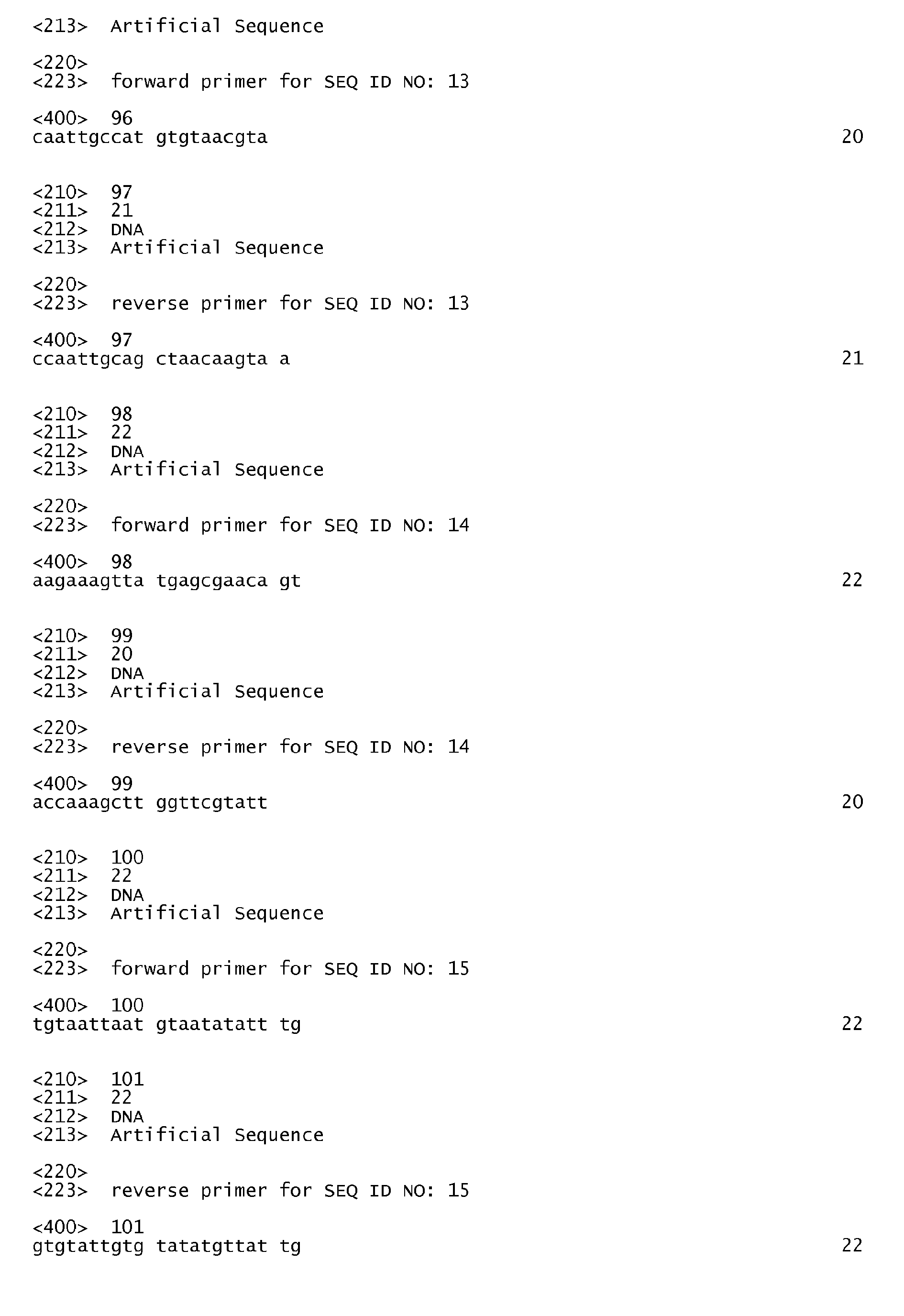
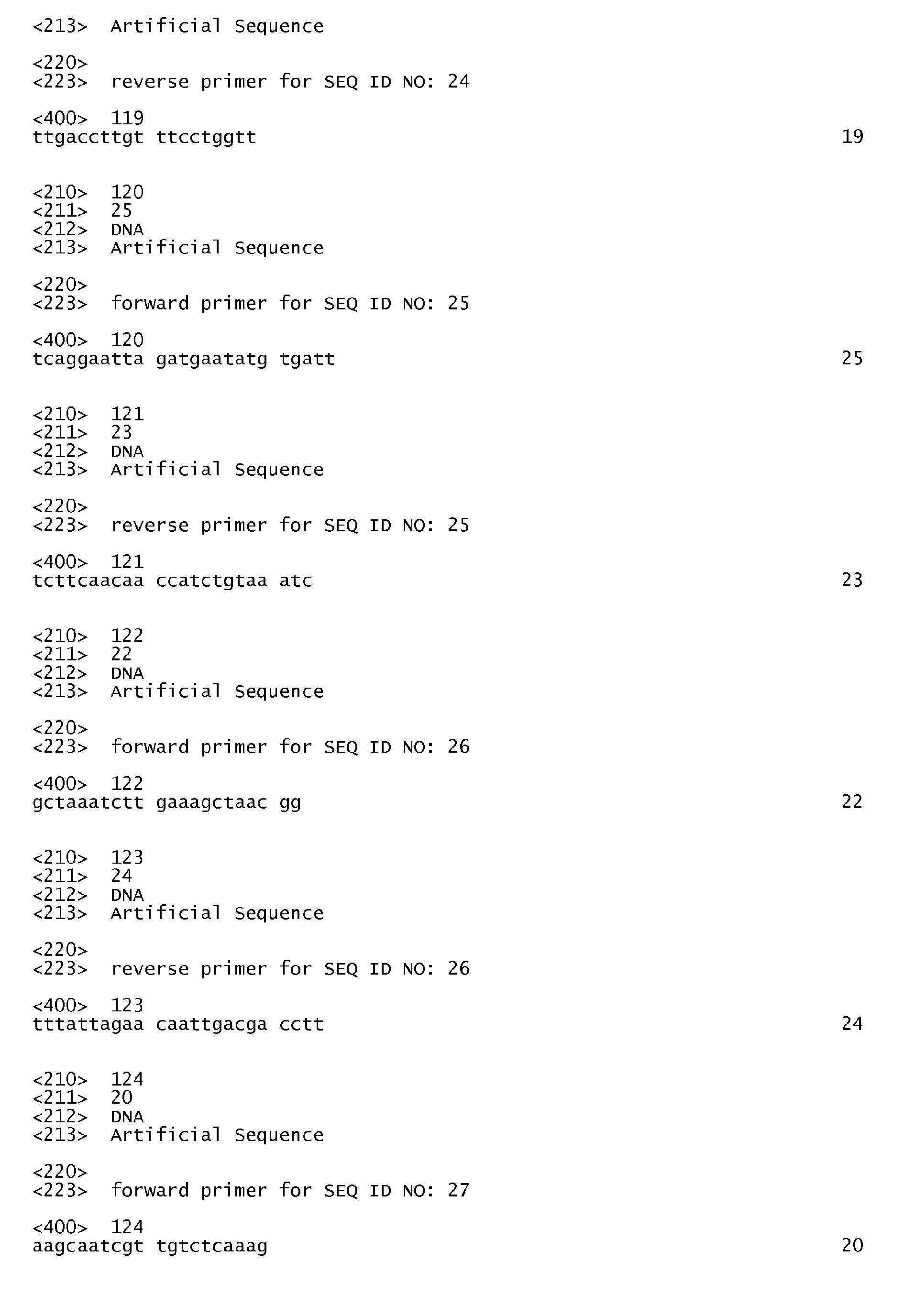
In a preferred embodiment, said amplification is performed using primers or probes, as defined herein below, having sequences that specifically hybridize under high stringency conditions to at least one sequence selected from group consisting of the sequences SEQ ID NO: 1 to SEQ ID NO: 46, and/or a complementary sequence thereof.
-
As used herein, the expression "hybridizes specifically" indicates that the nucleic acid of a determined sequence displays a sufficient degree of complementarity with a target sequence to form a stable binding between the nucleic acid and the target sequence and to avoid non-specific binding with a non-target sequence, under high stringency conditions. The degree of complementarity is calculated by comparing the sequence of said nucleic acid optimally aligned with the complementary target sequence, determining the number of positions at which the nucleic acid bases are complementary to yield the number of complementary positions, dividing the number of complementary positions by the total number of positions of the target sequence, and multiplying the result by 100 to yield the degree of complementarity. The degree of complementarity may be determined routinely using BLAST programs (basic local alignment search tools) and PowerBLAST programs known in the art (Altschul et al., (1990) J. Mol. Biol. 215: 403-410; Zhang and Madden (1997) Genome Res. 7:649-656).
-
As used herein, a "probe" refers to an oligonucleotide capable of binding in a base-specific manner to a complementary strand of nucleic acid. Probes according to the invention may be purified or recombinant. They may be labelled with a detectable moiety, i.e. a moiety capable of generating a detectable signal, such as radioactive, calorimetric, fluorescent, chemiluminescent or electrochemiluminescent signal. Numerous such detectable moieties are known in the art. By way of example, the moiety may be a radioactive compound or a detectable enzyme (e.g. horseradish peroxidase (HRP)). Preferably, the probe according to the invention comprises or is constituted of from about 10 to about 1000 nucleotides. More preferably, the probe according to the invention has a minimal size of more than 10 nucleotides, more than 20 nucleotides, more than 30 nucleotides, or more than 40 nucleotides, and a maximal size of less than 1000 nucleotides, less than 900 nucleotides, less than 800 nucleotides, less than 700 nucleotides, less than 600 nucleotides, less than 500 nucleotides, less than 400 nucleotides, less than 300 nucleotides, less than 200 nucleotides, less than 100 nucleotides, less than 90 nucleotides, less than 80 nucleotides, less than 70 nucleotides, less than 60 nucleotides, or less than 50 nucleotides. Most preferably, the probe according to the invention has a size of 60 to 70 nucleotides.
-
As used herein, the term "primer" refers to an oligonucleotide which is capable of annealing to a target sequence and serving as a point of initiation of DNA synthesis under conditions suitable for amplification of the primer extension product which is complementary to said target sequence. The primer is preferably single stranded for maximum efficiency in amplification. Preferably, the primer is an oligodeoxyribonucleotide. The length of the primer depends on several factors, including temperature and sequence of the primer, but must be long enough to initiate the synthesis of amplification products. Preferably the primer is from 10 to 100 nucleotides in length. More preferably, the primer is from 25 to 80 nucleotides in length, still preferably from 50 to 75 nucleotides in length. Most preferably, the primer is from 60 to 70 nucleotides in length. A primer can further contain additional features which allow for detection, immobilization, or manipulation of the amplified product. The primer may furthermore comprise covalently-bound fluorescent dyes, which confer specific fluorescence properties to the hybrid consisting of the primer and the target sequence or non covalently-bound fluorescent dyes which can interact with the double-stranded DNA/RNA to change the fluorescence properties. Fluorescent dyes which can be used are for example SYBR-green or ethidium bromide.
-
Preferably, the probes or primers according to the invention have sequences that specifically hybridize under high stringency conditions to at least one sequence selected from the group consisting of the sequences SEQ NO: 1 to SEQ NO: 46 and complementary sequences thereof independently of the allelic version of said sequences. Examples of suitable probes or primers according to the invention include the probes or primers having the sequence SEQ NO: 72, that specifically hybridizes to SEQ ID NO: 1, SEQ NO: 73 that specifically hybridizes to the complementary sequence of SEQ NO: 1, SEQ NO: 74 that specifically hybridizes to SEQ NO: 2, SEQ ID NO: 75 that specifically hybridizes to the complementary sequence of SEQ NO: 2, SEQ ID NO: 76 that specifically hybridizes to SEQ NO: 3, SEQ NO: 77 that specifically hybridizes to the complementary sequence of SEQ NO: 3, SEQ ID NO: 78 that specifically hybridizes to SEQ NO: 4, SEQ NO: 79 that specifically hybridizes to the complementary sequence of SEQ ID NO: 4, SEQ NO: 80 that specifically hybridizes to SEQ NO: 5, SEQ NO: 81 that specifically hybridizes to the complementary sequence of SEQ NO: 5, SEQ NO: 82 that specifically hybridizes to SEQ NO: 6, SEQ ID NO: 83 that specifically hybridizes to the complementary sequence of SEQ NO: 6, SEQ NO: 84 that specifically hybridizes to SEQ NO: 7, SEQ ID NO: 85 that specifically hybridizes to the complementary sequence of SEQ NO: 7, SEQ ID NO: 86 that specifically hybridizes to SEQ NO: 8, SEQ NO: 87 that specifically hybridizes to the complementary sequence of SEQ NO: 8, SEQ ID NO: 88 that specifically hybridizes to SEQ NO: 9, SEQ NO: 89 that specifically hybridizes to the complementary sequence of SEQ ID NO: 9, SEQ NO: 90 that specifically hybridizes to SEQ NO: 10, SEQ NO: 91 that specifically hybridizes to the complementary sequence of SEQ NO: 10, SEQ NO: 92 that specifically hybridizes to SEQ NO: 11, SEQ ID NO: 93 that specifically hybridizes to the complementary sequence of SEQ NO: 11, SEQ NO: 94 that specifically hybridizes to SEQ NO: 12, SEQ NO: 95 that specifically hybridizes to the complementary sequence of SEQ NO: 12, SEQ NO: 96 that specifically hybridizes to SEQ ID NO: 13, SEQ ID NO: 97 that specifically hybridizes to the complementary sequence of SEQ ID NO: 13, SEQ ID NO: 98 that specifically hybridizes to SEQ ID NO: 14, SEQ ID NO: 99 that specifically hybridizes to the complementary sequence of SEQ ID NO: 14, SEQ ID NO: 100 that specifically hybridizes to SEQ ID NO: 15, SEQ ID NO: 101 that specifically hybridizes to the complementary sequence of SEQ ID NO: 15, SEQ ID NO: 102 that specifically hybridizes to SEQ ID NO: 16, SEQ ID NO: 103 that specifically hybridizes to the complementary sequence of SEQ ID NO: 16, SEQ ID NO: 104 that specifically hybridizes to SEQ ID NO: 17, SEQ ID NO: 105 that specifically hybridizes to the complementary sequence of SEQ ID NO: 17, SEQ ID NO: 106 that specifically hybridizes to SEQ ID NO: 18, SEQ ID NO: 107 that specifically hybridizes to the complementary sequence of SEQ ID NO: 18, SEQ ID NO: 108 that specifically hybridizes to SEQ ID NO: 19, SEQ ID NO: 109 that specifically hybridizes to the complementary sequence of SEQ ID NO: 19, SEQ ID NO: 110 that specifically hybridizes to SEQ ID NO: 20, SEQ ID NO: 111 that specifically hybridizes to the complementary sequence of SEQ ID NO: 20, SEQ ID NO: 112 that specifically hybridizes to SEQ ID NO: 21, SEQ ID NO: 113 that specifically hybridizes to the complementary sequence of SEQ ID NO: 21, SEQ ID NO: 114 that specifically hybridizes to SEQ ID NO: 22, SEQ ID NO: 115 that specifically hybridizes to the complementary sequence of SEQ ID NO: 22, SEQ ID NO: 116 that specifically hybridizes to SEQ ID NO: 23, SEQ ID NO: 117 that specifically hybridizes to the complementary sequence of SEQ ID NO: 23, SEQ ID NO: 118 that specifically hybridizes to SEQ ID NO: 24, SEQ ID NO: 119 that specifically hybridizes to the complementary sequence of SEQ ID NO: 24, SEQ ID NO: 120 that specifically hybridizes to SEQ ID NO: 25, SEQ ID NO: 121 that specifically hybridizes to the complementary sequence of SEQ ID NO: 25, SEQ ID NO: 122 that specifically hybridizes to SEQ ID NO: 26, SEQ ID NO: 123 that specifically hybridizes to the complementary sequence of SEQ ID NO: 26, SEQ ID NO: 124 that specifically hybridizes to SEQ ID NO: 27, SEQ ID NO: 125 that specifically hybridizes to the complementary sequence of SEQ ID NO: 27, SEQ ID NO: 126 that specifically hybridizes to SEQ ID NO: 28, SEQ ID NO: 127 that specifically hybridizes to the complementary sequence of SEQ ID NO: 28, SEQ ID NO: 128 that specifically hybridizes to SEQ ID NO: 29, SEQ ID NO: 129 that specifically hybridizes to the complementary sequence of SEQ ID NO: 29, SEQ ID NO: 130 that specifically hybridizes to SEQ ID NO: 30, SEQ ID NO: 131 that specifically hybridizes to the complementary sequence of SEQ ID NO: 30, SEQ ID NO: 132 that specifically hybridizes to SEQ ID NO: 31, SEQ ID NO: 133 that specifically hybridizes to the complementary sequence of SEQ ID NO: 31, SEQ ID NO: 134 that specifically hybridizes to SEQ ID NO: 32, SEQ ID NO: 135 that specifically hybridizes to the complementary sequence of SEQ ID NO: 32, SEQ ID NO: 136 that specifically hybridizes to SEQ ID NO: 33, SEQ ID NO: 137 that specifically hybridizes to the complementary sequence of SEQ ID NO: 33, SEQ ID NO: 138 that specifically hybridizes to SEQ ID NO: 34, SEQ ID NO: 139 that specifically hybridizes to the complementary sequence of SEQ ID NO: 34, SEQ ID NO: 140 that specifically hybridizes to SEQ ID NO: 35, SEQ ID NO: 141 that specifically hybridizes to the complementary sequence of SEQ ID NO: 35, SEQ ID NO: 142 that specifically hybridizes to SEQ ID NO: 36, SEQ ID NO: 143 that specifically hybridizes to the complementary sequence of SEQ ID NO: 36, SEQ ID NO: 144 that specifically hybridizes to SEQ ID NO: 37, SEQ ID NO: 145 that specifically hybridizes to the complementary sequence of SEQ ID NO: 37, SEQ ID NO: 146 that specifically hybridizes to SEQ ID NO: 38, SEQ ID NO: 147 that specifically hybridizes to the complementary sequence of SEQ ID NO: 38, SEQ ID NO: 148 that specifically hybridizes to SEQ ID NO: 39, SEQ ID NO: 149 that specifically hybridizes to the complementary sequence of SEQ ID NO: 39, SEQ ID NO: 150 that specifically hybridizes to SEQ ID NO: 40, SEQ ID NO: 151 that specifically hybridizes to the complementary sequence of SEQ ID NO: 40, SEQ ID NO: 152 that specifically hybridizes to SEQ ID NO: 41, SEQ ID NO: 153 that specifically hybridizes to the complementary sequence of SEQ ID NO: 41, SEQ ID NO: 154 that specifically hybridizes to SEQ ID NO: 42, SEQ ID NO: 155 that specifically hybridizes to the complementary sequence of SEQ ID NO: 42, SEQ ID NO: 156 that specifically hybridizes to SEQ ID NO: 43, SEQ ID NO: 157 that specifically hybridizes to the complementary sequence of SEQ ID NO: 43, SEQ ID NO: 158 that specifically hybridizes to SEQ ID NO: 44, SEQ ID NO: 159 that specifically hybridizes to the complementary sequence of SEQ ID NO: 44, SEQ ID NO: 160 that specifically hybridizes to SEQ ID NO: 45, SEQ ID NO: 161 that specifically hybridizes to the complementary sequence of SEQ ID NO: 45, SEQ ID NO: 162 that specifically hybridizes to SEQ ID NO: 46, SEQ ID NO: 163 that specifically hybridizes to the complementary sequence of SEQ ID NO: 46. Accordingly, preferably, said amplification is performed using primers or probes having sequences SEQ ID NO: 72 to SEQ ID NO: 163.
-
The probes or primers according to the invention may also have sequences that specifically hybridize under high stringency conditions to at least one sequence selected from the group consisting of the sequences SEQ ID NO: 1 to SEQ ID NO: 46 and complementary sequences thereof, in an allelic version-specific way. Examples of suitable probes or primers according to the invention that specifically hybridize to an allelic version of the DNA markers according to the invention include probes or primers having the sequence SEQ ID NO: 164 that specifically hybridizes to SEQ ID NO: 47, SEQ ID NO: 165 that specifically hybridizes to the complementary sequence of SEQ ID NO: 47, SEQ ID NO: 166 that specifically hybridizes to SEQ ID NO: 48, SEQ ID NO: 167 that specifically hybridizes to the complementary sequence of SEQ ID NO: 48, SEQ ID NO: 168 that specifically hybridizes to SEQ ID NO: 50, SEQ ID NO: 169 that specifically hybridizes to the complementary sequence of SEQ ID NO: 50, SEQ ID NO: 170 that specifically hybridizes to SEQ ID NO: 51, SEQ ID NO: 171 that specifically hybridizes to the complementary sequence of SEQ ID NO: 51, SEQ ID NO: 172 that specifically hybridizes to SEQ ID NO: 53, SEQ ID NO: 173 that specifically hybridizes to the complementary sequence of SEQ ID NO: 53, SEQ ID NO: 174 that specifically hybridizes to SEQ ID NO: 54, SEQ ID NO: 175 that specifically hybridizes to the complementary sequence of SEQ ID NO: 54, SEQ ID NO: 176 that specifically hybridizes to SEQ ID NO: 55, SEQ ID NO: 177 that specifically hybridizes to the complementary sequence of SEQ ID NO: 55, SEQ ID NO: 178 that specifically hybridizes to SEQ ID NO: 57, SEQ ID NO: 179 that specifically hybridizes to the complementary sequence of SEQ ID NO: 57, SEQ ID NO: 180 that specifically hybridizes to SEQ ID NO: 59, SEQ ID NO: 181 that specifically hybridizes to the complementary sequence of SEQ ID NO: 59, SEQ ID NO: 182 that specifically hybridizes to SEQ ID NO: 60, SEQ ID NO: 183 that specifically hybridizes to the complementary sequence of SEQ ID NO: 60, SEQ ID NO: 184 that specifically hybridizes to SEQ ID NO: 61, SEQ ID NO: 185 that specifically hybridizes to the complementary sequence of SEQ ID NO: 61, SEQ ID NO: 186 that specifically hybridizes to SEQ ID NO: 62, SEQ ID NO: 187 that specifically hybridizes to the complementary sequence of SEQ ID NO: 62, SEQ ID NO: 188 that specifically hybridizes to SEQ ID NO: 63, SEQ ID NO: 189 that specifically hybridizes to the complementary sequence of SEQ ID NO: 64, SEQ ID NO: 190 that specifically hybridizes to SEQ ID NO: 65, SEQ ID NO: 191 that specifically hybridizes to the complementary sequence of SEQ ID NO: 65, SEQ ID NO: 192 that specifically hybridizes to SEQ ID NO: 68, SEQ ID NO: 193 that specifically hybridizes to the complementary sequence of SEQ ID NO: 68, SEQ ID NO: 194 that specifically hybridizes to SEQ ID NO: 69, SEQ ID NO: 195 that specifically hybridizes to the complementary sequence of SEQ ID NO: 69, SEQ ID NO: 196 that specifically hybridizes to SEQ ID NO: 70, SEQ ID NO: 197 that specifically hybridizes to the complementary sequence of SEQ ID NO: 70, SEQ ID NO: 198 that specifically hybridizes to SEQ ID NO: 49, SEQ ID NO: 199 that specifically hybridizes to the complementary sequence of SEQ ID NO: 49, SEQ ID NO: 200 that specifically hybridizes to SEQ ID NO: 52, SEQ ID NO: 201 that specifically hybridizes to the complementary sequence of SEQ ID NO: 52, SEQ ID NO: 202 that specifically hybridizes to SEQ ID NO: 56, SEQ ID NO: 203 that specifically hybridizes to the complementary sequence of SEQ ID NO: 56, SEQ ID NO: 204 that specifically hybridizes to SEQ ID NO: 58, SEQ ID NO: 205 that specifically hybridizes to the complementary sequence of SEQ ID NO: 58, SEQ ID NO: 206 that specifically hybridizes to SEQ ID NO: 64, SEQ ID NO: 207 that specifically hybridizes to the complementary sequence of SEQ ID NO: 64, SEQ ID NO: 208 that specifically hybridizes to SEQ ID NO: 66, SEQ ID NO: 209 that specifically hybridizes to the complementary sequence of SEQ ID NO: 66, SEQ ID NO: 210 that specifically hybridizes to SEQ ID NO: 67, SEQ ID NO: 211 that specifically hybridizes to the complementary sequence of SEQ ID NO: 67, SEQ ID NO: 212 that specifically hybridizes to SEQ ID NO: 71, SEQ ID NO: 213 that specifically hybridizes to the complementary sequence of SEQ ID NO: 71.
-
In a particular embodiment, said probes specific of these DNA markers are assembled on a same support, preferably a standardized support. These supports are known from one skilled in the art. Their size can vary according to the apparatuses used to detect the presence or absence of said marker gene(s).
-
Advantageously, the combination of DNA markers according to the invention is in form of a DNA matrix, comprising a support on which nucleic acids fragments likely to hybridize to target genes are deposed, preferably in a standardized way. The size of such supports varies according to the preparation and detection methods used. Such small supports are also referred to DNA array.
-
Another aspect of the present invention thus concerns a DNA array which comprises at least one probe comprising or consisting of a sequence that specifically hybridizes under high stringency conditions to a sequence selected from the sequences SEQ ID NO: 1 to SEQ ID NO: 71 and a complementary sequence thereof. Preferably, said at least one probe comprises or consists of a sequence selected from the group consisting of sequences SEQ ID NO: 72 to SEQ ID NO: 213.
-
Preferably, the DNA array according to the invention comprises at least 46 probes comprising or consisting of sequences that specifically hybridize under high stringency conditions to the 46 sequences SEQ ID NO: 1 to SEQ ID NO: 46 and a complementary sequence thereof. Specifically, each of the 46 probes defined above specifically hybridizes to a sequence different from the other probes, said sequence being selected from the group consisting of sequences SEQ ID NO: 1 to SEQ ID NO: 46 and a complementary sequence thereof. Preferably, said at least 46 probes specifically hybridizes to the 46 sequences defined above independently of the allelic version of said sequences. Preferably, said at least 46 probes comprise or consist of the sequences selected from the group consisting of sequences SEQ ID NO: 72 to SEQ ID NO: 163. Said at least 46 probes may in another embodiment specifically hybridizes to specific allelic versions of the 46 sequences defined above.
-
More preferably, the DNA array according to the invention comprises at least 52 probes comprising or consisting of sequences that specifically hybridize under high stringency conditions to the 52 sequences of the 52 DNA markers defined above and a complementary sequence thereof. Specifically, each of the 52 probes defined above specifically hybridizes to a sequence different from the other probes, said sequence being selected from the group consisting of sequences SEQ ID NO: 47, SEQ ID NO: 48, SEQ ID NO: 50, SEQ ID NO: 51,SEQ ID NO: 3 to SEQ ID NO: 5, SEQ ID NO: 53 to SEQ ID NO: 55, SEQ ID NO: 8 to SEQ ID NO: 13, SEQ ID NO: 57, SEQ ID NO: 15 to SEQ ID NO: 18, SEQ ID NO: 59 to SEQ ID NO: 63, SEQ ID NO: 20, SEQ ID NO: 22 to SEQ ID NO: 25, SEQ ID NO: 27 to SEQ ID NO: 29, SEQ ID NO: 65, SEQ ID NO: 31, SEQ ID NO: 68 to SEQ ID NO: 70, SEQ ID NO: 33 to SEQ ID NO: 40 and SEQ ID NO: 42 to SEQ ID NO: 46 and a complementary sequence thereof. Preferably, said at least 52 probes comprise or consist of the sequences selected from the group consisting of sequences SEQ ID NO: 76 to SEQ ID NO: 81, SEQ ID NO: 86 to SEQ ID NO: 97, SEQ ID NO: 100 to SEQ ID NO: 107, SEQ ID NO: 110 to SEQ ID NO: 111, SEQ ID NO: 114 to SEQ ID NO: 121, SEQ ID NO: 124 to SEQ ID NO: 129, SEQ ID NO: 132 to SEQ ID NO: 133, SEQ ID NO: 136 to SEQ ID NO: 151, and SEQ ID NO: 154 to SEQ ID NO: 197.
-
Still preferably, the DNA array according to the invention comprises at least 60 probes comprising or consisting of sequences that specifically hybridize under high stringency conditions to the 60 sequences SEQ ID NO: 3 to SEQ ID NO: 5, SEQ ID NO: 8 to SEQ ID NO: 13, SEQ ID NO: 15 to SEQ ID NO: 18, SEQ ID NO: 20, SEQ ID NO: 22 to SEQ ID NO: 25, SEQ ID NO: 27 to SEQ ID NO: 29, SEQ ID NO: 31, SEQ ID NO: 33 to SEQ ID NO: 40, SEQ ID NO: 42 to SEQ ID NO: 46 and SEQ ID NO: 47 to SEQ ID NO: 71 and a complementary sequence thereof. Specifically, each of the 60 probes defined above specifically hybridizes to a sequence different from the other probes, said sequence being selected from the group consisting of the 60 sequences defined above and a complementary sequence thereof. Preferably, said at least 60 probes comprise or consist of the sequences selected from the group consisting of sequences SEQ ID NO: 76 to SEQ ID NO: 81, SEQ ID NO: 86 to SEQ ID NO: 97, SEQ ID NO: 100 to SEQ ID NO: 107, SEQ ID NO: 110 to SEQ ID NO: 111, SEQ ID NO: 114 to SEQ ID NO: 121, SEQ ID NO: 124 to SEQ ID NO: 129, SEQ ID NO: 132 to SEQ ID NO: 133, SEQ ID NO: 136 to SEQ ID NO: 151, and SEQ ID NO: 154 to SEQ ID NO: 213.
-
As used herein, the term "DNA array" refers to a set of genes, fragment of genes, oligonucleotides deposited on a support (glass slide, nylon membrane...) with a high density. Numerous scientific publications about the preparation and the use of DNA arrays are available.
Kits
-
Another object of the present invention is therefore a kit for characterizing a Lactobacillus sakei isolate or for characterizing a food sample likely to contain a L. sakei strain, which comprises 46 pairs of primers, wherein each primer has a sequence that specifically hybridizes under high stringency conditions to one sequence selected from the group consisting of sequences SEQ ID NO: 1 to SEQ ID NO: 46 and a complementary sequence thereof. Specifically, each of the 46 pairs of primers defined above specifically hybridizes to a sequence different from the other pairs of primers, said sequence being selected from the group consisting of sequences SEQ ID NO: 1 to SEQ ID NO: 46 and a complementary sequence thereof. Preferably, said at least 46 pairs of primers specifically hybridizes to the 46 sequences defined above independently of the allelic version of said sequences. Said at least 46 pairs of primers may in another embodiment specifically hybridizes to specific allelic versions of the 46 sequences defined above.
-
In a preferred embodiment, the kit according to the invention comprises 52 pairs of primers, wherein each primer has a sequence that specifically hybridizes under high stringency conditions to one sequence selected from the group consisting of sequences SEQ ID NO: 47, SEQ ID NO: 48, SEQ ID NO: 50, SEQ ID NO: 51,SEQ ID NO: 3 to SEQ ID NO: 5, SEQ ID NO: 53 to SEQ ID NO: 55, SEQ ID NO: 8 to SEQ ID NO: 13, SEQ ID NO: 57, SEQ ID NO: 15 to SEQ ID NO: 18, SEQ ID NO: 59 to SEQ ID NO: 63, SEQ ID NO: 20, SEQ ID NO: 22 to SEQ ID NO: 25, SEQ ID NO: 27 to SEQ ID NO: 29, SEQ ID NO: 65, SEQ ID NO: 31, SEQ ID NO: 68 to SEQ ID NO: 70, SEQ ID NO: 33 to SEQ ID NO: 40 and SEQ ID NO: 42 to SEQ ID NO: 46 and a complementary sequence thereof. Specifically, each of the 52 pairs of primers defined above specifically hybridizes to a sequence different from the other pairs of primers, said sequence being selected from the group consisting of the 52 sequences defined above and a complementary sequence thereof.
-
In another preferred embodiment, the kit according to the invention comprises 60 pairs of primers, wherein each primer has a sequence that specifically hybridizes under high stringency conditions to one sequence selected from the group consisting of sequences SEQ ID NO: 3 to SEQ ID NO: 5, SEQ ID NO: 8 to SEQ ID NO: 13, SEQ ID NO: 15 to SEQ ID NO: 18, SEQ ID NO: 20, SEQ ID NO: 22 to SEQ ID NO: 25, SEQ ID NO: 27 to SEQ ID NO: 29, SEQ ID NO: 31, SEQ ID NO: 33 to SEQ ID NO: 40, SEQ ID NO: 42 to SEQ ID NO: 46 and SEQ ID NO: 47 to SEQ ID NO: 71 and a complementary sequence thereof. Specifically, each of the 60 pairs of primers defined above specifically hybridizes to a sequence different from the other pairs of primers, said sequence being selected from the group consisting of the 60 sequences defined above and a complementary sequence thereof.
-
Preferably, where the kit according to the invention comprises 46 pairs of primers, it comprises (1) a pair of primers that specifically hybridizes under high stringency conditions to the sequence SEQ ID NO: 1 and/or a complementary sequence thereof, (2) a pair of primers that specifically hybridizes under high stringency conditions to the sequence SEQ ID NO: 2 and/or a complementary sequence thereof, (3) a pair of primers that specifically hybridizes under high stringency conditions to the sequence SEQ ID NO: 3 and/or a complementary sequence thereof, (4) a pair of primers that specifically hybridizes under high stringency conditions to the sequence SEQ ID NO: 4 and/or a complementary sequence thereof, (5) a pair of primers that specifically hybridizes under high stringency conditions to the sequence SEQ ID NO: 5 and/or a complementary sequence thereof, (6) a pair of primers that specifically hybridizes under high stringency conditions to the sequence SEQ ID NO: 6 and/or a complementary sequence thereof, (7) a pair of primers that specifically hybridizes under high stringency conditions to the sequence SEQ ID NO: 7 and/or a complementary sequence thereof, (8) a pair of primers that specifically hybridizes under high stringency conditions to the sequence SEQ ID NO: 8 and/or a complementary sequence thereof, (9) a pair of primers that specifically hybridizes under high stringency conditions to the sequence SEQ ID NO: 9 and/or a complementary sequence thereof, (10) a pair of primers that specifically hybridizes under high stringency conditions to the sequence SEQ ID NO: 10 and/or a complementary sequence thereof, (11) a pair of primers that specifically hybridizes under high stringency conditions to the sequence SEQ ID NO: 11 and/or a complementary sequence thereof, (12) a pair of primers that specifically hybridizes under high stringency conditions to the sequence SEQ ID NO: 12 and/or a complementary sequence thereof, (13) a pair of primers that specifically hybridizes under high stringency conditions to the sequence SEQ ID NO: 13 and/or a complementary sequence thereof, (14) a pair of primers that specifically hybridizes under high stringency conditions to the sequence SEQ ID NO: 14 and/or a complementary sequence thereof, (15) a pair of primers that specifically hybridizes under high stringency conditions to the sequence SEQ ID NO: 15 and/or a complementary sequence thereof, (16) a pair of primers that specifically hybridizes under high stringency conditions to the sequence SEQ ID NO: 16 and/or a complementary sequence thereof, (17) a pair of primers that specifically hybridizes under high stringency conditions to the sequence SEQ ID NO: 17 and/or a complementary sequence thereof, (18) a pair of primers that specifically hybridizes under high stringency conditions to the sequence SEQ ID NO: 18 and/or a complementary sequence thereof, (19) a pair of primers that specifically hybridizes under high stringency conditions to the sequence SEQ ID NO: 19 and/or a complementary sequence thereof, (20) a pair of primers that specifically hybridizes under high stringency conditions to the sequence SEQ ID NO: 20 and/or a complementary sequence thereof, (21) a pair of primers that specifically hybridizes under high stringency conditions to the sequence SEQ ID NO: 21 and/or a complementary sequence thereof, (22) a pair of primers that specifically hybridizes under high stringency conditions to the sequence SEQ ID NO: 22 and/or a complementary sequence thereof, (23) a pair of primers that specifically hybridizes under high stringency conditions to the sequence SEQ ID NO: 23 and/or a complementary sequence thereof, (24) a pair of primers that specifically hybridizes under high stringency conditions to the sequence SEQ ID NO: 24 and/or a complementary sequence thereof, (25) a pair of primers that specifically hybridizes under high stringency conditions to the sequence SEQ ID NO: 25 and/or a complementary sequence thereof, (26) a pair of primers that specifically hybridizes under high stringency conditions to the sequence SEQ ID NO: 26 and/or a complementary sequence thereof, (27) a pair of primers that specifically hybridizes under high stringency conditions to the sequence SEQ ID NO: 27 and/or a complementary sequence thereof, (28) a pair of primers that specifically hybridizes under high stringency conditions to the sequence SEQ ID NO: 28 and/or a complementary sequence thereof, (29) a pair of primers that specifically hybridizes under high stringency conditions to the sequence SEQ ID NO: 29 and/or a complementary sequence thereof, (30) a pair of primers that specifically hybridizes under high stringency conditions to the sequence SEQ ID NO: 30 and/or a complementary sequence thereof, (31) a pair of primers that specifically hybridizes under high stringency conditions to the sequence SEQ ID NO: 31 and/or a complementary sequence thereof, (32) a pair of primers that specifically hybridizes under high stringency conditions to the sequence SEQ ID NO: 32 and/or a complementary sequence thereof, (33) a pair of primers that specifically hybridizes under high stringency conditions to the sequence SEQ ID NO: 33 and/or a complementary sequence thereof, (34) a pair of primers that specifically hybridizes under high stringency conditions to the sequence SEQ ID NO: 34 and/or a complementary sequence thereof, (35) a pair of primers that specifically hybridizes under high stringency conditions to the sequence SEQ ID NO: 35 and/or a complementary sequence thereof, (36) a pair of primers that specifically hybridizes under high stringency conditions to the sequence SEQ ID NO: 36 and/or a complementary sequence thereof, (37) a pair of primers that specifically hybridizes under high stringency conditions to the sequence SEQ ID NO: 37 and/or a complementary sequence thereof, (38) a pair of primers that specifically hybridizes under high stringency conditions to the sequence SEQ ID NO: 38 and/or a complementary sequence thereof, (39) a pair of primers that specifically hybridizes under high stringency conditions to the sequence SEQ ID NO: 39 and/or a complementary sequence thereof, (40) a pair of primers that specifically hybridizes under high stringency conditions to the sequence SEQ ID NO: 40 and/or a complementary sequence thereof, (41) a pair of primers that specifically hybridizes under high stringency conditions to the sequence SEQ ID NO: 41 and/or a complementary sequence thereof, (42) a pair of primers that specifically hybridizes under high stringency conditions to the sequence SEQ ID NO: 42 and/or a complementary sequence thereof, (43) a pair of primers that specifically hybridizes under high stringency conditions to the sequence SEQ ID NO: 43 and/or a complementary sequence thereof, (44) a pair of primers that specifically hybridizes under high stringency conditions to the sequence SEQ ID NO: 44 and/or a complementary sequence thereof, (45) a pair of primers that specifically hybridizes under high stringency conditions to the sequence SEQ ID NO: 45 and/or a complementary sequence thereof, and (46) a pair of primers that specifically hybridizes under high stringency conditions to the sequence SEQ ID NO: 46 and/or a complementary sequence thereof.
-
Where the kit according to the invention comprises 52 pairs of primers, it further comprises (47) a pair of primers that specifically hybridizes under high stringency conditions to the sequence SEQ ID NO: 47 and/or a complementary sequence thereof, (48) a pair of primers that specifically hybridizes under high stringency conditions to the sequence SEQ ID NO: 49 and/or a complementary sequence thereof, (49) a pair of primers that specifically hybridizes under high stringency conditions to the sequence SEQ ID NO: 51 and/or a complementary sequence thereof, (50) a pair of primers that specifically hybridizes under high stringency conditions to the sequence SEQ ID NO: 54 and/or a complementary sequence thereof, (51) a pair of primers that specifically hybridizes under high stringency conditions to the sequence SEQ ID NO: 55 and/or a complementary sequence thereof, and (52) a pair of primers that specifically hybridizes under high stringency conditions to the sequence SEQ ID NO: 59 and/or a complementary sequence thereof.
-
Where the kit according to the invention comprises 60 pairs of primers, it further comprises (53) a pair of primers that specifically hybridizes under high stringency conditions to the sequence SEQ ID NO: 48 and/or a complementary sequence thereof, (54) a pair of primers that specifically hybridizes under high stringency conditions to the sequence SEQ ID NO: 50 and/or a complementary sequence thereof, (55) a pair of primers that specifically hybridizes under high stringency conditions to the sequence SEQ ID NO: 52 and/or a complementary sequence thereof, (56) a pair of primers that specifically hybridizes under high stringency conditions to the sequence SEQ ID NO: 53 and/or a complementary sequence thereof, (57) a pair of primers that specifically hybridizes under high stringency conditions to the sequence SEQ ID NO: 56 and/or a complementary sequence thereof, (58) a pair of primers that specifically hybridizes under high stringency conditions to the sequence SEQ ID NO: 57 and/or a complementary sequence thereof, (59) a pair of primers that specifically hybridizes under high stringency conditions to the sequence SEQ NO: 58 and/or a complementary sequence thereof, and (60) a pair of primers that specifically hybridizes under high stringency conditions to the sequence SEQ ID NO: 60 and/or a complementary sequence thereof.
-
As well-known from the one skilled in the art, a pair of primers is composed of a forward primer that specifically hybridizes to a sequence of interest and of a reverse primer that specifically hybridizes to the complementary sequence of said sequence of interest. Examples of sequences of suitable primers according to the invention that specifically hybridizes to the DNA markers according to the invention and/or to a complementary sequence thereof are provided herein above. Examples of suitable pairs of primers according to the invention may thus be deduced easily by the one skilled in the art from the examples of suitable primers described above.
The kit according to the invention may further comprise instructions for use.
-
"Instructions for use" typically include a tangible expression describing the technique to be employed in using the components of the kit and explaining how to correlate determination of the presence or absence of sequences SEQ NO: 1 to SEQ NO: 60 to the characterization of a L. sakei isolate.
-
The 46 pairs of primers according to the invention are localized within the DNA markers defined above and are sufficient for defining a unique PCR fingerprinting profile of any L. sakei isolate tested. Using up to the 60 pairs of primers according to the invention enables increasing the accuracy of said PCR fingerprinting profile.
Methods for fingerprinting a L. sakei isolate or a food sample likely to contain a L. sakei isolate
-
Accordingly, the present invention also relates to a method for fingerprinting a Lactobacillus sakei isolate which comprises the amplification of 46 DNA markers of sequence SEQ NO: 1 to SEQ ID NO: 46 in said Lactobacillus sakei isolate, wherein the amplification profile of said 46 DNA markers is the fingerprint of said Lactobacillus sakei isolate. Preferably, the method for fingerprinting as defined above comprises the amplification of the 60 DNA markers of sequences defined above.
-
As used herein, the term "amplification profile" refers to the compilation of the results of the amplification of each DNA marker according to the invention, and corresponds to a table wherein the presence or absence of each DNA marker (detected by amplification) is summarized. In the context of the invention, a unique fingerprinting profile between two isolates is defined as two profiles differing by at least one DNA marker detection. Examples of amplification profiles are presented in Figures 1 to 6 . However, the number of fingerprints is not limited to those shown in these figures but is likely to be as large as the natural L. sakei strains diversity. Indeed, the number of DNA markers to which each isolate is responding positively is comprised between 8 and 25 ( Figure 7 ), with an average of about 15 per isolate corresponding to a normal distribution. This is indicating that the invention offers a high degree of potential fingerprints (over 2.1012 possibilities if 50 DNA markers and a fixed number of combination of 15 markers are chosen).
-
The herein defined DNA markers can also be used to establish the fingerprinting profile of the L. sakei population profile present in a food sample. Accordingly, the present invention also relates to a method for fingerprinting a food sample likely to contain a Lactobacillus sakei isolate which comprises the amplification of 46 DNA markers of sequence SEQ NO: 1 to SEQ ID NO: 46 in said food sample, wherein the amplification profile of said 46 DNA markers is the fingerprint of said food sample. Preferably, the method for fingerprinting as defined above comprises the amplification of the 60 DNA markers of sequences defined above.
-
According to the invention, the amplification of DNA markers may be carried out directly from chromosomal DNA of cells extracted from the food sample, or on L. sakei isolates prior individualized from other species and strains of the food sample. Techniques to individualize bacterial isolates are well-known from the one skilled in the art and include for example streak plate technique, pour plate technique, serial dilution.
-
Preferably, in the methods of fingerprinting defined above, the amplification is performed using primers as defined above.
Quantifying methods
-
The above defined methods according to the present invention are of particular interest to identify L. sakei strains in a cocktail of strains that can be used as biopreservative on meat and/or fish. Another issue of characterizing such cocktail of strains is to quantify each strain present in said cocktail.
-
Accordingly, another aspect of the invention relates to a method of quantifying a specific Lactobacillus sakei isolate in a sample comprising the steps consisting of :
- a) identifying and/or characterizing the Lactobacillus sakei strains present in said sample by a method as defined above,
- b) determining the DNA marker(s) which is(are) differently present in said specific Lactobacillus sakei strain with respect to other strains present in said sample, and
- c) amplifying said DNA marker(s) by quantitative PCR.
Methods of quantitative PCR are well-known in the art and include real-time PCR, competitive PCR and radioactive PCR.
-
As used herein the term "sample" encompasses samples in which one or several L. sakei strain(s) is/are present, optionally in combination with other bacterial species.
-
Accordingly, the above method of quantifying a specific L. sakei strain in a sample may include a prior step of individualizing said strain from other strains present in the sample.
Comparing methods
-
Another aspect of the present invention concerns a method of comparing at least two Lactobacillus sakei isolates comprising the steps consisting of:
- a) determining the presence or absence of the DNA markers of sequence SEQ ID NO: 1 to SEQ ID NO: 46, in a first Lactobacillus sakei isolate, and
- b) determining the presence or absence of said DNA markers in a second Lactobacillus sakei isolate,
wherein, if the pattern of presence or absence of said DNA markers is different between said first and said second Lactobacillus sakei isolates, then the Lactobacillus sakei isolates are different.
-
Preferably, in the method of comparing defined above, step a) comprises the determination of the presence or absence of the DNA markers of sequence SEQ ID NO: 47, SEQ ID NO: 48, SEQ ID NO: 50, SEQ ID NO: 51,SEQ ID NO: 3 to SEQ ID NO: 5, SEQ ID NO: 53 to SEQ ID NO: 55, SEQ ID NO: 8 to SEQ ID NO: 13, SEQ ID NO: 57, SEQ ID NO: 15 to SEQ ID NO: 18, SEQ ID NO: 59 to SEQ ID NO: 63, SEQ ID NO: 20, SEQ ID NO: 22 to SEQ ID NO: 25, SEQ ID NO: 27 to SEQ ID NO: 29, SEQ ID NO: 65, SEQ ID NO: 31, SEQ ID NO: 68 to SEQ ID NO: 70, SEQ ID NO: 33 to SEQ ID NO: 40 and SEQ ID NO: 42 to SEQ ID NO: 46. More preferably, in the method of comparing defined above, step a) comprises the determination of the presence or absence of the DNA markers of sequence SEQ ID NO: 3 to SEQ ID NO: 5, SEQ ID NO: 8 to SEQ ID NO: 13, SEQ ID NO: 15 to SEQ ID NO: 18, SEQ ID NO: 20, SEQ ID NO: 22 to SEQ ID NO: 25, SEQ ID NO: 27 to SEQ ID NO: 29, SEQ ID NO: 31, SEQ ID NO: 33 to SEQ ID NO: 40, SEQ ID NO: 42 to SEQ ID NO: 46 and SEQ ID NO: 47 to SEQ ID NO: 71.
-
The following examples and figures further describe the way the present inventors have identified said marker genes. These examples are illustrative, without being limited, of the above defined methods.
Description of the figures
-
- Figure 1 : Rapid screening of fingerprinting profile with 46 DNA markers. PCR detection of the DNA marker is indicated by a black background with a white number 1. An absence of detection of the DNA marker is indicated by a white background with a black null. Names of isolates are indicated at the top of the matrix. DNA markers are indicated on the left of the matrix.
- Figure 2 : Example of allelic variations and their use in defining marker's specific or non-specific pairs of primers. A Show-Align alignment of SEQ ID NO: 6, SEQ ID NO: 53 and SEQ ID NO: 54 is displayed. Differences in the sequences are indicated by letters, similarities by dots. Mutations corresponding to insertion or deletion sites are boxed. Sequences of pairs of primers are indicated underlined and in bold letters with the corresponding SEQ ID.
- Figure 3 : Fingerprinting profiles obtained with 60 DNA markers. PCR detection of the DNA marker is indicated by a black background with a white number 1. An absence of detection of the DNA marker is indicated by a white background with a black null. Names of isolates are indicated at the top of the matrix. DNA markers are indicated on the left of the matrix.
- Figures 4 to 6 : Fingerprinting profiles of 129 L. sakei isolates taken from the known diversity scale of the species. The profiles were obtained with 52 DNA markers. PCR detection of the DNA marker is indicated by a black background with a white number 1. An absence of detection of the DNA marker is indicated by a white background with a black null. Names of isolates are indicated at the top of the matrix. DNA markers are indicated on the left of the matrix.
- Figure 7 : Histogram distribution of the number of DNA markers responding positively to establish the fingerprinting profiles of 129 L. sakei isolates. The Gaussian probability distribution of the number of DNA markers in the population (estimated density on the left axis) is shown by the black smooth line.
- Figure 8 : Scheme representing the first strategy of a three steps protocol using the PCR fingerprinting profiles for designing specific markers for quantification of isolates.
- Figure 9 : Scheme representing the second strategy of a three steps protocol using the PCR fingerprinting profiles for designing specific markers for quantification of isolates.
- Figure 10 : Standard curves for the specific real-time PCR detection in ground beef inoculated with decreasing amount of two L. sakei strains. Strain 23K (white open circles) was detected using DNA marker SEQ NO: 20. Strain J112 (black circles) was detected using DNA marker SEQ NO: 28. Standard curves were plotted for the estimated log of cell number per g of meat versus Ct values. The Ct and UFC log values are the mean of six different measurements from duplicates.
- Figure 11 : Examples of experimental procedures making use of the present invention from a food sample to fingerprinting profile database. The fingerprinting profile may be obtained directly from isolates characterized from a food sample or directly from microbial DNA isolated from the same sample.
EXAMPLES
Example 1: PCR fingerprinting profile of any L. sakei isolates
-
For the purpose of constructing the present invention, the inventors conducted a large-scale substractive suppressive genomic hybridization experiment (SSH) on various strains chosen specifically from the diversity scale of L. sakei species (these strains are listed in Table 1). This experiment resulted in the generation of 20,000 SSH clones which were sequenced and assembled. The assembly resulted in the characterization of few hundreds of genomic loci inferred to the flexible gene pool of the L. sakei species. The pattern of variation (absence or presence of many of these islands and the degree of polymorphism in these genomic islands) was investigated between the chosen isolates described in Table 1.
-
This analysis resulted in the selection of 46 DNA regions (and associated ASP or INDEL) offering the best minimal set of markers for giving a unique PCR fingerprinting profile of any L. sakei isolates. As described in Table 1, the size of the DNA markers is ranging from 150 bp to about 7.5 kb and may comprise several encoding genes. These DNA markers may be associated with ASP or not.
-
These DNA markers are defined as a chromosomal region or loci (whose size are ranging from 150 bp to about 7.5 kb) and having a property of variability between L. sakei isolates. The design of only one PCR primer pair, anywhere within one of the DNA marker is sufficient to measure the variability property of the said marker. However ASP or INDEL sites offers the possibility to measure an additional level of variability by focusing also on the detection of specific alleles or INDEL mutations. The 46 DNA regions are described in SEQ NO: 1 to SEQ NO: 46.
-
The inventors have demonstrated that the combination of the 46 markers which can be tested in a minimal set of multiplex PCR allows the fingerprinting profile. Best fingerprinting profile is obtained when several set of primers are defined in ASP sites of the 46 DNA markers for detecting the alleles version of the said DNA marker, thus offering a highly specific PCR fingerprinting profile of any L. sakei isolates. As shown in Figures 1 and 3 , several level of fingerprinting profile were tested on the reference strains used for characterizing the DNA markers. The inventors thus showed that fingerprinting profiles could be obtained from the minimal set of 46 DNA markers.
-
This minimal set is thus offering an easy procedure to rapidly discriminate different isolates. Increasing the fingerprinting profile to a set of 60 DNA markers, for instance, allowing the measurement of alleles within the 46 DNA markers, enables a highly accurate fingerprinting. The invention offers thus a flexible use of the DNA markers for either rapid fingerprinting (for screening groups of isolates for instance) to highly accurate fingerprinting isolates (to a level close to the strain-level).
-
To demonstrate this last use, the inventors carried out an assay among 130 L. sakei isolates taken from the known diversity scale of the species (70 isolates chosen from a large worldwide screening procedure as described by Chaillou et al. (2009) Appl. Environ. Microbiol. 75:970-980; and 60 new ones sourced with a similar strategy). As shown in Figures 4 to 6 , the inventors demonstrated that a set of 52 pairs of primers localized within the 46 DNA markers and at whatsoever ASP site was sufficient for defining a unique PCR fingerprinting profile of any L. sakei isolates tested, describing thereby the 46 DNA markers and 6 of their ASP/INDEL sites as the best minimal set of markers for giving a unique PCR fingerprinting profile of any L. sakei isolates.
-
A unique profile between two isolates is defined as two profiles differing by at least one PCR detection. However, at present, the number of PCR fingerprint profiles is not limited to those shown in Figures 4 to 6 , but is likely to be as large as the natural L. sakei strains diversity. Indeed, the number of DNA markers to which each isolate is responding positively is comprised between 8 and 25 ( Figure 7 ), with an average of about 15 per isolate corresponding to a normal distribution. This is indicating that the invention offers a high degree of potential fingerprinting profiles (over 2.1012 possibilities if 50 PCR primers set and a fixed number of combination of 15 markers are chosen).
Example 2: Isolate- or cluster-specific markers for quantification of L. sakei isolates in a mixture
-
The inventors demonstrated that PCR fingerprint profiling as described above not only appears suitable for strain typing but can be apply for traceability (quantifying and/or monitoring) of any L. sakei isolates within a food reservoir. The PCR fingerprinting profiles can indeed be used as a strategy for comparison between isolates in order to design isolate-specific markers when several isolates are mixed together in a food sample and to achieve their accurate and specific quantification. Several level of specificity can be chosen from isolate-level specificity when several isolates with closely-related profiles are compared, or cluster-level when group of isolates are compared.
-
Typically, a three steps protocol using the PCR fingerprinting profiles was used for designing specific markers for quantification of isolates in a mixture. First, a PCR fingerprinting profile database was used for selecting isolates according to their profile in order to design mixtures of isolates for which markers could be chosen for their specific quantification. Several strategies were applied. Two examples of strategies are displayed in Figures 8 and 9 . The first strategy was based on the selection of groups of isolates in which each of the said isolates have closely related fingerprinting profiles ( Figure 8 ). The fingerprinting profiles of several groups were compared in order to choose group-specific markers for quantification and traceability of these groups in food matrices. The second strategy was based on the comparison of fingerprinting profiles within a group of related isolates for selecting isolate-specific markers ( Figure 9 ).
-
As described in Figure 10 , when the inventors performed a mixture of two isolates, they were able, by comparing their PCR fingerprinting profile, to design an isolate-specific marker for each isolate and to carry out their quantification after inoculation of the isolates in a fresh ground beef sample to which no natural L. sakei population was previously detected. Detection of each isolate revealed to be specific and linear from 102 to 107 CFU/g. This strategy can therefore be used to design cocktail of isolates (e.g. protective cultures), for which a PCR fingerprinting profile can be used for monitoring the quantification of each isolate in the food samples.
Example 3: PCR fingerprinting profile of food samples
-
The present inventors have demonstrated that the DNA markers defined above could be used for establishing the PCR fingerprinting profile of the L. sakei population present in a food sample.
-
As described in Figure 11 , a PCR fingerprinting profile can be carried out directly from chromosomal DNA of microbial cells extracted from a food sample. In parallel, L. sakei isolates can be characterized by conventional plating methods and PCR fingerprinting profiles established for these isolates. The invention is thus suitable for comparative fingerprinting profile analysis, for profile database generation and for quantification of selected markers (monitoring of population at the isolate level in a food sample).
-
In food, the
L. sakei population is likely to be influence by the "natural population" of these food samples as well as the types of food process and storage. Such population may also be influenced by the use of bio-preservative cultures. Therefore, the PCR fingerprinting profile of the
L. sakei population can be applied for traceability of food processes.