EP2290115A1 - Process and alloy for turbine blades and blades formed therefrom - Google Patents
Process and alloy for turbine blades and blades formed therefrom Download PDFInfo
- Publication number
- EP2290115A1 EP2290115A1 EP10173573A EP10173573A EP2290115A1 EP 2290115 A1 EP2290115 A1 EP 2290115A1 EP 10173573 A EP10173573 A EP 10173573A EP 10173573 A EP10173573 A EP 10173573A EP 2290115 A1 EP2290115 A1 EP 2290115A1
- Authority
- EP
- European Patent Office
- Prior art keywords
- blade
- steam turbine
- maximum
- temperature
- cooling
- Prior art date
- Legal status (The legal status is an assumption and is not a legal conclusion. Google has not performed a legal analysis and makes no representation as to the accuracy of the status listed.)
- Granted
Links
- 238000000034 method Methods 0.000 title claims abstract description 34
- 229910045601 alloy Inorganic materials 0.000 title abstract description 19
- 239000000956 alloy Substances 0.000 title abstract description 19
- 238000005266 casting Methods 0.000 claims abstract description 23
- PXHVJJICTQNCMI-UHFFFAOYSA-N Nickel Chemical compound [Ni] PXHVJJICTQNCMI-UHFFFAOYSA-N 0.000 claims abstract description 18
- XEEYBQQBJWHFJM-UHFFFAOYSA-N Iron Chemical compound [Fe] XEEYBQQBJWHFJM-UHFFFAOYSA-N 0.000 claims abstract description 13
- 229910000601 superalloy Inorganic materials 0.000 claims abstract description 10
- 239000000203 mixture Substances 0.000 claims abstract description 9
- 229910052750 molybdenum Inorganic materials 0.000 claims abstract description 9
- VYZAMTAEIAYCRO-UHFFFAOYSA-N Chromium Chemical compound [Cr] VYZAMTAEIAYCRO-UHFFFAOYSA-N 0.000 claims abstract description 8
- ZOKXTWBITQBERF-UHFFFAOYSA-N Molybdenum Chemical compound [Mo] ZOKXTWBITQBERF-UHFFFAOYSA-N 0.000 claims abstract description 8
- 229910052804 chromium Inorganic materials 0.000 claims abstract description 8
- 239000011651 chromium Substances 0.000 claims abstract description 8
- 239000011733 molybdenum Substances 0.000 claims abstract description 8
- 229910052759 nickel Inorganic materials 0.000 claims abstract description 8
- 239000010936 titanium Substances 0.000 claims abstract description 8
- 229910052719 titanium Inorganic materials 0.000 claims abstract description 8
- ZOXJGFHDIHLPTG-UHFFFAOYSA-N Boron Chemical compound [B] ZOXJGFHDIHLPTG-UHFFFAOYSA-N 0.000 claims abstract description 7
- OKTJSMMVPCPJKN-UHFFFAOYSA-N Carbon Chemical compound [C] OKTJSMMVPCPJKN-UHFFFAOYSA-N 0.000 claims abstract description 7
- RTAQQCXQSZGOHL-UHFFFAOYSA-N Titanium Chemical compound [Ti] RTAQQCXQSZGOHL-UHFFFAOYSA-N 0.000 claims abstract description 7
- 229910052782 aluminium Inorganic materials 0.000 claims abstract description 7
- XAGFODPZIPBFFR-UHFFFAOYSA-N aluminium Chemical compound [Al] XAGFODPZIPBFFR-UHFFFAOYSA-N 0.000 claims abstract description 7
- 229910052796 boron Inorganic materials 0.000 claims abstract description 7
- 229910052799 carbon Inorganic materials 0.000 claims abstract description 7
- 239000010941 cobalt Substances 0.000 claims abstract description 7
- 229910017052 cobalt Inorganic materials 0.000 claims abstract description 7
- GUTLYIVDDKVIGB-UHFFFAOYSA-N cobalt atom Chemical compound [Co] GUTLYIVDDKVIGB-UHFFFAOYSA-N 0.000 claims abstract description 7
- 239000012535 impurity Substances 0.000 claims abstract description 7
- RYGMFSIKBFXOCR-UHFFFAOYSA-N Copper Chemical compound [Cu] RYGMFSIKBFXOCR-UHFFFAOYSA-N 0.000 claims abstract description 6
- NINIDFKCEFEMDL-UHFFFAOYSA-N Sulfur Chemical compound [S] NINIDFKCEFEMDL-UHFFFAOYSA-N 0.000 claims abstract description 6
- QCWXUUIWCKQGHC-UHFFFAOYSA-N Zirconium Chemical compound [Zr] QCWXUUIWCKQGHC-UHFFFAOYSA-N 0.000 claims abstract description 6
- 229910052802 copper Inorganic materials 0.000 claims abstract description 6
- 239000010949 copper Substances 0.000 claims abstract description 6
- 229910052742 iron Inorganic materials 0.000 claims abstract description 6
- WPBNNNQJVZRUHP-UHFFFAOYSA-L manganese(2+);methyl n-[[2-(methoxycarbonylcarbamothioylamino)phenyl]carbamothioyl]carbamate;n-[2-(sulfidocarbothioylamino)ethyl]carbamodithioate Chemical compound [Mn+2].[S-]C(=S)NCCNC([S-])=S.COC(=O)NC(=S)NC1=CC=CC=C1NC(=S)NC(=O)OC WPBNNNQJVZRUHP-UHFFFAOYSA-L 0.000 claims abstract description 6
- 229910052710 silicon Inorganic materials 0.000 claims abstract description 6
- 239000010703 silicon Substances 0.000 claims abstract description 6
- 229910052717 sulfur Inorganic materials 0.000 claims abstract description 6
- 239000011593 sulfur Substances 0.000 claims abstract description 6
- 229910052726 zirconium Inorganic materials 0.000 claims abstract description 6
- 238000001816 cooling Methods 0.000 claims description 30
- 230000032683 aging Effects 0.000 claims description 13
- 238000005336 cracking Methods 0.000 abstract description 5
- 230000007613 environmental effect Effects 0.000 abstract description 5
- 238000010438 heat treatment Methods 0.000 abstract description 3
- 230000035882 stress Effects 0.000 description 9
- 229910001247 waspaloy Inorganic materials 0.000 description 5
- 230000008901 benefit Effects 0.000 description 3
- 230000001747 exhibiting effect Effects 0.000 description 3
- 239000000463 material Substances 0.000 description 3
- 239000011159 matrix material Substances 0.000 description 2
- 229910001220 stainless steel Inorganic materials 0.000 description 2
- 230000015572 biosynthetic process Effects 0.000 description 1
- 230000015556 catabolic process Effects 0.000 description 1
- 238000006243 chemical reaction Methods 0.000 description 1
- 230000000295 complement effect Effects 0.000 description 1
- 230000007797 corrosion Effects 0.000 description 1
- 238000005260 corrosion Methods 0.000 description 1
- 230000008878 coupling Effects 0.000 description 1
- 238000010168 coupling process Methods 0.000 description 1
- 238000005859 coupling reaction Methods 0.000 description 1
- 238000006731 degradation reaction Methods 0.000 description 1
- 230000001419 dependent effect Effects 0.000 description 1
- 230000018109 developmental process Effects 0.000 description 1
- 239000007789 gas Substances 0.000 description 1
- 239000011261 inert gas Substances 0.000 description 1
- 229910000734 martensite Inorganic materials 0.000 description 1
- 229910001105 martensitic stainless steel Inorganic materials 0.000 description 1
- 229910052758 niobium Inorganic materials 0.000 description 1
- 239000010955 niobium Substances 0.000 description 1
- GUCVJGMIXFAOAE-UHFFFAOYSA-N niobium atom Chemical compound [Nb] GUCVJGMIXFAOAE-UHFFFAOYSA-N 0.000 description 1
- 230000003647 oxidation Effects 0.000 description 1
- 238000007254 oxidation reaction Methods 0.000 description 1
- 230000000704 physical effect Effects 0.000 description 1
- 239000002244 precipitate Substances 0.000 description 1
- 238000003672 processing method Methods 0.000 description 1
- 239000010935 stainless steel Substances 0.000 description 1
- 229910052715 tantalum Inorganic materials 0.000 description 1
- GUVRBAGPIYLISA-UHFFFAOYSA-N tantalum atom Chemical compound [Ta] GUVRBAGPIYLISA-UHFFFAOYSA-N 0.000 description 1
- 230000001052 transient effect Effects 0.000 description 1
- 229910052723 transition metal Inorganic materials 0.000 description 1
- 150000003624 transition metals Chemical class 0.000 description 1
- WFKWXMTUELFFGS-UHFFFAOYSA-N tungsten Chemical compound [W] WFKWXMTUELFFGS-UHFFFAOYSA-N 0.000 description 1
- 229910052721 tungsten Inorganic materials 0.000 description 1
- 239000010937 tungsten Substances 0.000 description 1
Images



Classifications
-
- C—CHEMISTRY; METALLURGY
- C22—METALLURGY; FERROUS OR NON-FERROUS ALLOYS; TREATMENT OF ALLOYS OR NON-FERROUS METALS
- C22C—ALLOYS
- C22C19/00—Alloys based on nickel or cobalt
- C22C19/03—Alloys based on nickel or cobalt based on nickel
-
- C—CHEMISTRY; METALLURGY
- C22—METALLURGY; FERROUS OR NON-FERROUS ALLOYS; TREATMENT OF ALLOYS OR NON-FERROUS METALS
- C22C—ALLOYS
- C22C19/00—Alloys based on nickel or cobalt
- C22C19/03—Alloys based on nickel or cobalt based on nickel
- C22C19/05—Alloys based on nickel or cobalt based on nickel with chromium
-
- C—CHEMISTRY; METALLURGY
- C22—METALLURGY; FERROUS OR NON-FERROUS ALLOYS; TREATMENT OF ALLOYS OR NON-FERROUS METALS
- C22C—ALLOYS
- C22C19/00—Alloys based on nickel or cobalt
- C22C19/03—Alloys based on nickel or cobalt based on nickel
- C22C19/05—Alloys based on nickel or cobalt based on nickel with chromium
- C22C19/051—Alloys based on nickel or cobalt based on nickel with chromium and Mo or W
-
- C—CHEMISTRY; METALLURGY
- C22—METALLURGY; FERROUS OR NON-FERROUS ALLOYS; TREATMENT OF ALLOYS OR NON-FERROUS METALS
- C22C—ALLOYS
- C22C19/00—Alloys based on nickel or cobalt
- C22C19/03—Alloys based on nickel or cobalt based on nickel
- C22C19/05—Alloys based on nickel or cobalt based on nickel with chromium
- C22C19/051—Alloys based on nickel or cobalt based on nickel with chromium and Mo or W
- C22C19/056—Alloys based on nickel or cobalt based on nickel with chromium and Mo or W with the maximum Cr content being at least 10% but less than 20%
-
- C—CHEMISTRY; METALLURGY
- C22—METALLURGY; FERROUS OR NON-FERROUS ALLOYS; TREATMENT OF ALLOYS OR NON-FERROUS METALS
- C22F—CHANGING THE PHYSICAL STRUCTURE OF NON-FERROUS METALS AND NON-FERROUS ALLOYS
- C22F1/00—Changing the physical structure of non-ferrous metals or alloys by heat treatment or by hot or cold working
- C22F1/10—Changing the physical structure of non-ferrous metals or alloys by heat treatment or by hot or cold working of nickel or cobalt or alloys based thereon
Definitions
- the present invention generally relates to materials and processes for producing castings for high temperature applications, and particularly buckets for steam turbines intended to have operating temperatures that exceed 1300°F (about 705°C).
- Components of steam turbines such as nozzles (stationary blades) and buckets (rotating blades) of steam turbines, are typically formed of stainless steel, nickel, and cobalt-base alloys that exhibit desirable mechanical properties at typical steam turbine operating temperatures of about 1000°F to about 1050°F (about 538°C to about 566°C). Because the efficiency of a steam turbine plant is dependent on its operating temperature, there is a demand for components and particularly turbine buckets and nozzles that are capable of withstanding higher operating temperatures of 1300°F (about 705°C) and above. In particular, the development of next generation steam turbines capable of maximum operating temperatures of up to about 1400°F (about 760°C) are currently under consideration.
- the present invention provides a process and alloy for producing a turbine blade whose properties enable the blade to operate within a turbine, and particularly a bucket for use in a steam turbine having an operating temperature of greater than 1300°F (about 705°C).
- the process includes casting the blade from a gamma prime-strengthened nickel-base superalloy having a composition of, by weight, 14.25-15.75% cobalt, 14.0-15.25% chromium, 4.0-4.6% aluminum, 3.0-3.7% titanium, 3.9-4.5% molybdenum, 0.05-0.09% carbon, 0.012-0.020% boron, maximum 0.5% iron, maximum 0.2% silicon, maximum 0.15% manganese, maximum 0.04% zirconium, maximum 0.015% sulfur, maximum 0.1% copper, balance nickel and incidental impurities, and an electron vacancy number of 2.32 maximum.
- the blade is solution heat treated at a solution temperature of about 1100 to about 1200°C (about 2010 to about 2190°F) in an inert atmosphere for a duration of about one to about five hours, cooled to a first cooling temperature of about 1000 to about 1100°C (about 1830 to about 2010°F), cooled to a second cooling temperature of about 500 to about 600°C (about 930 to about 1110°F), and then cooled to about 20°C (room temperature).
- the blade is then aged at an aging temperature of about 700 to about 800°C (about 1290 to about 1470°F) for about ten to about twenty hours, and then cooled to about 20°C (room temperature).
- the resulting blade material has a 0.2% yield strength of at least 690 MPa (about 100 ksi) over an operating temperature range from about 20°C (about 70°F) through about 760°C (about 1400°F), a gamma prime phase content of about 45% to about 55% at a temperature of about 760°C (about 1400°F), and a sigma phase content of less than 5% at a temperature of about 700°C (about 1290°F).
- a turbine blade for example a steam turbine bucket, formed in a manner as described above, and a steam turbine equipped with the blade.
- a significant advantage of this invention is that a turbine blade produced from the alloy and its processing as described above is believed capable of achieving the required material characteristics consistent with steam turbine operating temperatures of greater than 1300°F (about 705°C), and as high as about 1400°F (about 760°C). As a result, turbine blades of this invention are capable of use in next generation steam turbines whose efficiencies exceed those of existing steam turbines.
- FIG. 1 represents a perspective view of a steam turbine bucket 14 and FIG. 2 represents the bucket 14 installed on a steam turbine wheel 10 having axial-entry female dovetail slots 12.
- the bucket 14 is configured to be secured to the wheel 10 by inserting a male dovetail 16 of the bucket 14 into one of the dovetail slots 12.
- the dovetail slot 12 and dovetail 16 are complementary in shape and size to provide a close fit therebetween, such that alternating lobes or hooks 20 of each dovetail slot 12 and its corresponding dovetail 16 bear against each other when the wheel 10 is rotated at high speeds.
- FIGS. 1 and 2 further shows the buckets 14 as terminating with integral covers 18.
- the present invention provides for the capability of producing steam turbine bucket castings with improved high temperature properties.
- buckets of the type represented in FIGS. 1 and 2 are conventionally produced from iron-base alloys, including series 400 martensitic stainless steels such as Crucible 422.
- series 400 martensitic stainless steels such as Crucible 422.
- FIG. 3 plots the 0.2% average yield strength of Crucible 422, Waspaloy, and a nickel-base superalloy commercially known as René 77.
- the yield strength data are plotted over a temperature range from about room temperature (about 20°C or about 70°F) to about 1400°F (about 760°C). From FIG. 3 it can be seen that Crucible 422 does not exhibit adequate yield strength above about 1100°F (about 595°C), whereas Waspaloy and René 77 provide a greater yield strength over an operating temperature range from room temperature to about 1400°F (about 760°C).
- René 77 is a gamma prime (principally Ni 3 (Al,Ti)) strengthened nickel-base superalloy. As reported in U.S. Patent No. 4,478,638 , René 77 has a composition of, by weight, 14.25-15.75% cobalt, 14.0-15.25% chromium, 4.0-4.6% aluminum, 3.0-3.7% titanium, 3.9-4.5% molybdenum, 0.05-0.09% carbon, 0.012-0.020% boron, maximum 0.5% iron, maximum 0.2% silicon, maximum 0.15% manganese, maximum 0.04% zirconium, maximum 0.015% sulfur, maximum 0.1% copper, balance nickel and incidental impurities, and an electron vacancy number (N v ) of 2.32 maximum.
- N v electron vacancy number
- René 77 is believed to be capable of exhibiting high temperature properties over an operating temperature range from room temperature to about 1400°F (about 760°C) that render the alloy suitable for steam turbine buckets.
- a preferred nominal composition is, by weight, about 15% cobalt, 15% chromium, 4.3% aluminum, 3.3% titanium, 4.2% molybdenum, 0.07% carbon, 0.015% boron, balance nickel and incidental impurities.
- the composition of René 77 has seen extensive use for low pressure turbine (LPT) blades in gas turbine engines used in aviation applications, but has not been used in steam turbine bucket applications.
- LPT low pressure turbine
- René 77 can be cast using known methods to have a polycrystalline equiaxed (EA) microstructure preferred for steam turbine bucket applications, such as represented in FIGS. 1 and 2 .
- the bucket is solution heat treated at a solution temperature of about 1100 to about 1200°C (about 2010 to about 2190°F), for example about 1160°C (about 625°F), in an inert atmosphere (for example, a vacuum or an inert gas) for a duration of about one to about five hours, for example about two hours, after which the casting is cooled to a temperature of about 1000 to about 1100°C (about 1830 to about 2010°F), for example about 1080°C (about 1975°F).
- a solution temperature of about 1100 to about 1200°C (about 2010 to about 2190°F), for example about 1160°C (about 625°F)
- an inert atmosphere for example, a vacuum or an inert gas
- the casting is further cooled to a temperature of about 500 to about 600°C (about 930 to about 1110°F), for example about 540°C (about 1000°F), and then cooled to about 20°C (room temperature).
- the bucket is then aged at a temperature of about 700 to about 800°C (about 1290 to about 1470°F), for example about 760°C (about 1400°F), for about ten to about twenty hours, for example about sixteen hours, and then allowed to air cool to about 20°C (room temperature). Further details concerning a suitable heat treatment can be found in Superalloy II 128 (Sims, Stollof and Hagel ed. 1987 ).
- Bucket castings formulated and processed as described above are capable of exhibiting a combination of yield strength, stress rupture properties, environmental resistance, castability, microstructural stability and cost well suited for steam turbine applications to 1400°F (about 760°C).
- bucket castings produced with René 77 are capable of 0.2% yield strengths of at least 100 ksi (about 690 MPa) over the temperature range from room temperature (about 20°C) to about 1400°F (about 760°C), as indicated in FIG. 3 .
- the high yield strength throughout this temperature range is an important benefit with respect to providing adequate capabilities for a steam turbine bucket to withstand steady-state and transient loads, and to maintain adequate pre-stress in the bucket airfoil to assure that adjacent bucket covers (18 in FIGS.
- the gamma prime phase content of the bucket casting is preferably at least 45%, for example, about 45% to about 55%, at a temperature of about 760°C (about 1400°F).
- buckets castings formulated and processed as described above preferably have a very low sigma phase ( ⁇ ) content, for example less than 5% at a temperature of about 760°C (about 1400°F).
- bcc transition metals such as tantalum, niobium, chromium, tungsten and molybdenum.
- Preferred bucket chemistries are expected to have a low PhaComp number (N v ) of 2.32 or less, which corresponds to the average electron-vacancy concentration per atom in the alloy matrix after accounting for known phase reactions.
- N v PhaComp number
- the low N v value of 2.32 indicates a low potential for forming brittle sigma phase in the matrix.
- higher N v values (for example 2.45) have been associated with sigma phase formation in René 77 at temperatures of about 1600°F (about 870°C) when subjected to applied stresses of about 40 ksi (about 276 MPa).
- René 77 has additional desirable properties at elevated temperatures, including mechanical properties such as stress rupture properties.
- FIG. 4 which plots applied stress versus Larson-Miller parameter (LMP)
- René 77 was shown to exhibit stress rupture properties that are superior to Crucible 422 and Waspaloy, and furthermore are necessary for steam turbine bucket applications at temperatures up to 1400°F (about 760°C).
- René 77 has additional desirable environmental properties at elevated temperatures, including resistance to hold time cracking, oxidation, and hot corrosion.
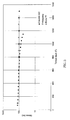
- FIG. 5 represents the range of data obtained from hold time (dwell) fatigue crack growth rate (HTFCGR; da/dN) tests performed in steam on René 77 castings in the non-heat-treated condition
- FIG. 5 represents the range of data obtained from hold time (dwell) fatigue crack growth rate (HTFCGR; da/dN) tests performed in steam on René 77 castings in the non-heat-treated condition
- the scatterband of FIG. 5 evidences a relatively flat trend observed in the data with respect to hold time, and supports a conclusion that the alloy is not highly sensitive to the steam turbine environment.
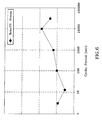
- FIG. 6 evidences that a slight departure from time independent crack propagation occurred at a hold time of about 100 seconds, but René 77 did not achieve full time dependence at hold times of about 32,000 seconds and less. It is believed that René 77 is capable of exhibiting even greater resistance to hold time cracking in the fully heat-treated condition.
- the high temperature solution heat treatment described above is believed to be particularly necessary to promote the resistance of René 77 to hold-time cracking in applications such as steam turbine buckets.
Landscapes
- Chemical & Material Sciences (AREA)
- Engineering & Computer Science (AREA)
- Materials Engineering (AREA)
- Mechanical Engineering (AREA)
- Metallurgy (AREA)
- Organic Chemistry (AREA)
- Physics & Mathematics (AREA)
- Thermal Sciences (AREA)
- Crystallography & Structural Chemistry (AREA)
- Turbine Rotor Nozzle Sealing (AREA)
Abstract
Description
- The present invention generally relates to materials and processes for producing castings for high temperature applications, and particularly buckets for steam turbines intended to have operating temperatures that exceed 1300°F (about 705°C).
- Components of steam turbines, such as nozzles (stationary blades) and buckets (rotating blades) of steam turbines, are typically formed of stainless steel, nickel, and cobalt-base alloys that exhibit desirable mechanical properties at typical steam turbine operating temperatures of about 1000°F to about 1050°F (about 538°C to about 566°C). Because the efficiency of a steam turbine plant is dependent on its operating temperature, there is a demand for components and particularly turbine buckets and nozzles that are capable of withstanding higher operating temperatures of 1300°F (about 705°C) and above. In particular, the development of next generation steam turbines capable of maximum operating temperatures of up to about 1400°F (about 760°C) are currently under consideration.
- As the operating temperatures for steam turbine components increase, different alloy compositions and processing methods must be used to achieve a balance of mechanical, physical and environmental properties required for the applications. Steam turbine buckets capable of withstanding temperatures in excess of 1300°F (about 705°C) will require bucket alloys having substantially improved creep-rupture and stress relaxation capabilities compared to current steam turbine bucket alloys such as martensitic stainless steel Crucible 422, and compared to intermediate strength nickel-base alloys such as Waspaloy. In addition, suitable bucket alloys must also meet or exceed component yield strength requirements and resist environmental cracking and other types of degradation in steam, while also minimizing overall component cost.
- The present invention provides a process and alloy for producing a turbine blade whose properties enable the blade to operate within a turbine, and particularly a bucket for use in a steam turbine having an operating temperature of greater than 1300°F (about 705°C).
- According to a first aspect of the invention, the process includes casting the blade from a gamma prime-strengthened nickel-base superalloy having a composition of, by weight, 14.25-15.75% cobalt, 14.0-15.25% chromium, 4.0-4.6% aluminum, 3.0-3.7% titanium, 3.9-4.5% molybdenum, 0.05-0.09% carbon, 0.012-0.020% boron, maximum 0.5% iron, maximum 0.2% silicon, maximum 0.15% manganese, maximum 0.04% zirconium, maximum 0.015% sulfur, maximum 0.1% copper, balance nickel and incidental impurities, and an electron vacancy number of 2.32 maximum. After casting, the blade is solution heat treated at a solution temperature of about 1100 to about 1200°C (about 2010 to about 2190°F) in an inert atmosphere for a duration of about one to about five hours, cooled to a first cooling temperature of about 1000 to about 1100°C (about 1830 to about 2010°F), cooled to a second cooling temperature of about 500 to about 600°C (about 930 to about 1110°F), and then cooled to about 20°C (room temperature). The blade is then aged at an aging temperature of about 700 to about 800°C (about 1290 to about 1470°F) for about ten to about twenty hours, and then cooled to about 20°C (room temperature). The resulting blade material has a 0.2% yield strength of at least 690 MPa (about 100 ksi) over an operating temperature range from about 20°C (about 70°F) through about 760°C (about 1400°F), a gamma prime phase content of about 45% to about 55% at a temperature of about 760°C (about 1400°F), and a sigma phase content of less than 5% at a temperature of about 700°C (about 1290°F).
- Other aspects of the invention include a turbine blade, for example a steam turbine bucket, formed in a manner as described above, and a steam turbine equipped with the blade.
- A significant advantage of this invention is that a turbine blade produced from the alloy and its processing as described above is believed capable of achieving the required material characteristics consistent with steam turbine operating temperatures of greater than 1300°F (about 705°C), and as high as about 1400°F (about 760°C). As a result, turbine blades of this invention are capable of use in next generation steam turbines whose efficiencies exceed those of existing steam turbines.
- Other aspects and advantages of this invention will be better appreciated from the following detailed description.
- There follows a detailed description of embodiments of the invention by way of example only with reference to the accompanying drawings, in which:
-
FIG. 1 is representative of a steam turbine bucket that can be formed from a nickel-base alloy using an alloy and process according to an embodiment of the present invention, andFIG. 2 represents a steam turbine bucket of the type shown inFIG. 1 installed on a steam turbine wheel. -
FIG. 3 is a graph plotting 0.2% yield strength of an alloy currently used to produce steam turbine buckets, an intermediate strength nickel-base alloy, and a nickel-base alloy within the scope of the present invention. -
FIG. 4 is a graph plotting applied stress versus Larson-Miller parameter (LMP) for Crucible 422, Waspaloy, and René 77 over a temperature range corresponding to steam turbine bucket applications of up to 1400°F (about 760°C). -
FIGS. 5 and6 are graphs representing, respectively, a data range and specific data obtained from hold time (dwell) fatigue crack growth rate (HTFCGR; da/dN) tests performed in steam on René 77 castings in the non-heat-treated condition. -
FIG. 1 represents a perspective view of asteam turbine bucket 14 andFIG. 2 represents thebucket 14 installed on asteam turbine wheel 10 having axial-entryfemale dovetail slots 12. As well understood in the art, thebucket 14 is configured to be secured to thewheel 10 by inserting amale dovetail 16 of thebucket 14 into one of thedovetail slots 12. Thedovetail slot 12 anddovetail 16 are complementary in shape and size to provide a close fit therebetween, such that alternating lobes orhooks 20 of eachdovetail slot 12 and itscorresponding dovetail 16 bear against each other when thewheel 10 is rotated at high speeds.FIGS. 1 and 2 further shows thebuckets 14 as terminating withintegral covers 18. The coupling of covers 20 ofadjacent buckets 14 is known to be necessary for minimizing tip leakage and controlling bucket vibration. Thewheel 10,bucket 14, and theirrespective dovetail slots 12 anddovetails 16 are of known configurations in the art, and do not pose any particular limitations to the scope of the invention aside from the intended application for thebuckets 14 in a steam turbine. - The present invention provides for the capability of producing steam turbine bucket castings with improved high temperature properties. At typical steam turbine operating temperatures of about 1000 to about 1050°F (about 538 to about 566°C), buckets of the type represented in
FIGS. 1 and 2 are conventionally produced from iron-base alloys, includingseries 400 martensitic stainless steels such as Crucible 422. However, to improve the steam turbine performance, there is an ongoing need to substantially increase turbine inlet temperatures, requiring that steam turbine buckets, such as thebuckets 14 inFIGS. 1 and 2 , withstand significantly higher operating temperatures. -
FIG. 3 plots the 0.2% average yield strength of Crucible 422, Waspaloy, and a nickel-base superalloy commercially known as René 77. The yield strength data are plotted over a temperature range from about room temperature (about 20°C or about 70°F) to about 1400°F (about 760°C). FromFIG. 3 it can be seen that Crucible 422 does not exhibit adequate yield strength above about 1100°F (about 595°C), whereas Waspaloy and René 77 provide a greater yield strength over an operating temperature range from room temperature to about 1400°F (about 760°C). - René 77 is a gamma prime (principally Ni3(Al,Ti)) strengthened nickel-base superalloy. As reported in
U.S. Patent No. 4,478,638 , René 77 has a composition of, by weight, 14.25-15.75% cobalt, 14.0-15.25% chromium, 4.0-4.6% aluminum, 3.0-3.7% titanium, 3.9-4.5% molybdenum, 0.05-0.09% carbon, 0.012-0.020% boron, maximum 0.5% iron, maximum 0.2% silicon, maximum 0.15% manganese, maximum 0.04% zirconium, maximum 0.015% sulfur, maximum 0.1% copper, balance nickel and incidental impurities, and an electron vacancy number (Nv) of 2.32 maximum. According to an aspect of the invention, René 77 is believed to be capable of exhibiting high temperature properties over an operating temperature range from room temperature to about 1400°F (about 760°C) that render the alloy suitable for steam turbine buckets. A preferred nominal composition is, by weight, about 15% cobalt, 15% chromium, 4.3% aluminum, 3.3% titanium, 4.2% molybdenum, 0.07% carbon, 0.015% boron, balance nickel and incidental impurities. The composition of René 77 has seen extensive use for low pressure turbine (LPT) blades in gas turbine engines used in aviation applications, but has not been used in steam turbine bucket applications. - René 77 can be cast using known methods to have a polycrystalline equiaxed (EA) microstructure preferred for steam turbine bucket applications, such as represented in
FIGS. 1 and 2 . After casting, the bucket is solution heat treated at a solution temperature of about 1100 to about 1200°C (about 2010 to about 2190°F), for example about 1160°C (about 625°F), in an inert atmosphere (for example, a vacuum or an inert gas) for a duration of about one to about five hours, for example about two hours, after which the casting is cooled to a temperature of about 1000 to about 1100°C (about 1830 to about 2010°F), for example about 1080°C (about 1975°F). Thereafter, the casting is further cooled to a temperature of about 500 to about 600°C (about 930 to about 1110°F), for example about 540°C (about 1000°F), and then cooled to about 20°C (room temperature). The bucket is then aged at a temperature of about 700 to about 800°C (about 1290 to about 1470°F), for example about 760°C (about 1400°F), for about ten to about twenty hours, for example about sixteen hours, and then allowed to air cool to about 20°C (room temperature). Further details concerning a suitable heat treatment can be found in Superalloy II 128 (Sims, Stollof and Hagel ed. 1987). - Bucket castings formulated and processed as described above are capable of exhibiting a combination of yield strength, stress rupture properties, environmental resistance, castability, microstructural stability and cost well suited for steam turbine applications to 1400°F (about 760°C). For example, bucket castings produced with René 77 are capable of 0.2% yield strengths of at least 100 ksi (about 690 MPa) over the temperature range from room temperature (about 20°C) to about 1400°F (about 760°C), as indicated in
FIG. 3 . The high yield strength throughout this temperature range is an important benefit with respect to providing adequate capabilities for a steam turbine bucket to withstand steady-state and transient loads, and to maintain adequate pre-stress in the bucket airfoil to assure that adjacent bucket covers (18 inFIGS. 1 and 2 ) remain coupled during operation. The gamma prime phase content of the bucket casting is preferably at least 45%, for example, about 45% to about 55%, at a temperature of about 760°C (about 1400°F). Furthermore, buckets castings formulated and processed as described above preferably have a very low sigma phase (σ) content, for example less than 5% at a temperature of about 760°C (about 1400°F). As known in the art, the sigma phase is a brittle topologically close-packed (TCP) phase with the general formula (Fe,Mo)x(Ni,Co)y where x and y = 1 to 7, and can form in a nickel-base superalloy in the presence of sufficient levels of bcc transition metals, such as tantalum, niobium, chromium, tungsten and molybdenum. Because sigma phase forms as brittle plate-like precipitates at high temperatures, the avoidance or minimizing of this phase is desirable for steam turbine bucket applications within the temperature range of 1300 to 1400°F (about 705 to about 760°C) intended for the present invention. Preferred bucket chemistries are expected to have a low PhaComp number (Nv) of 2.32 or less, which corresponds to the average electron-vacancy concentration per atom in the alloy matrix after accounting for known phase reactions. The low Nv value of 2.32 indicates a low potential for forming brittle sigma phase in the matrix. Notably, higher Nv values (for example 2.45) have been associated with sigma phase formation in René 77 at temperatures of about 1600°F (about 870°C) when subjected to applied stresses of about 40 ksi (about 276 MPa). - The present invention has demonstrated that René 77 has additional desirable properties at elevated temperatures, including mechanical properties such as stress rupture properties. As evident from
FIG. 4 , which plots applied stress versus Larson-Miller parameter (LMP), René 77 was shown to exhibit stress rupture properties that are superior to Crucible 422 and Waspaloy, and furthermore are necessary for steam turbine bucket applications at temperatures up to 1400°F (about 760°C). René 77 has additional desirable environmental properties at elevated temperatures, including resistance to hold time cracking, oxidation, and hot corrosion. For example,FIG. 5 represents the range of data obtained from hold time (dwell) fatigue crack growth rate (HTFCGR; da/dN) tests performed in steam on René 77 castings in the non-heat-treated condition, andFIG. 6 plots data from one of these tests. Test conditions were 1400°F (about 760°C), R = 0.1, and a maximum stress intensity ()k) of 25 ksi √in (about 27.5 MPa √m). The scatterband ofFIG. 5 evidences a relatively flat trend observed in the data with respect to hold time, and supports a conclusion that the alloy is not highly sensitive to the steam turbine environment.FIG. 6 evidences that a slight departure from time independent crack propagation occurred at a hold time of about 100 seconds, but René 77 did not achieve full time dependence at hold times of about 32,000 seconds and less. It is believed thatRené 77 is capable of exhibiting even greater resistance to hold time cracking in the fully heat-treated condition. The high temperature solution heat treatment described above is believed to be particularly necessary to promote the resistance ofRené 77 to hold-time cracking in applications such as steam turbine buckets. - While the invention has been described in terms of specific embodiments, it is apparent that other forms could be adopted by one skilled in the art. For example, the physical configuration of the bucket casting can differ from that shown, and the invention can be applied to steam turbine nozzles (stationary blades) as well as buckets (rotating blades). Therefore, the scope of the invention is to be limited only by the following claims.
- For completeness, various aspects of the invention are now set out in the following numbered clauses:
- 1. A process of producing a steam turbine blade, the process comprising:
- casting the blade from a gamma prime-strengthened nickel-base superalloy having a composition of, by weight, 14.25-15.75% cobalt, 14.0-15.25% chromium, 4.0-4.6% aluminum, 3.0-3.7% titanium, 3.9-4.5% molybdenum, 0.05-0.09% carbon, 0.012-0.020% boron, maximum 0.5% iron, maximum 0.2% silicon, maximum 0.15% manganese, maximum 0.04% zirconium, maximum 0.015% sulfur, maximum 0.1% copper, balance nickel and incidental impurities, and an electron vacancy number of 2.32 maximum;
- solution heat treating the blade at a solution temperature of about 1100 to about 1200°C in an inert atmosphere for a duration of about one to about four hours;
- cooling the blade to a first cooling temperature of about 1000 to about 1100°C;
- cooling the blade to a second cooling temperature of about 500 to about 600°C;
- cooling the blade to about room temperature;
- aging the blade at an aging temperature of about 700 to about 800EC for about ten to about 20 hours; and then
- cooling the blade to about room temperature;
- wherein the blade has a 0.2% average yield strength of greater than 690 MPa over a temperature range of about 20°C to about 760°C, a gamma prime phase content of about 45% to about 55% at a temperature of about 760°C, and a sigma phase content of less than 5% at a temperature of about 760°C.
- 2. The process according to
clause 1, wherein the solution temperature is about 1160°C and the duration of the solution heat treating step is about two hours. - 3. The process according to
clause 1, wherein the first cooling temperature is about 1080°C. - 4. The process according to
clause 1, wherein the second cooling temperature is about 540°C. - 5. The process according to
clause 1, wherein the aging temperature is about 760°C and the duration of the aging step is about sixteen hours. - 6. The process according to
clause 1, wherein the casting has an equiaxed microstructure. - 7. The process according to
clause 1, wherein the blade is a steam turbine bucket adapted for a steam turbine having an operating temperature of greater than 705°C. - 8. The process according to
clause 1, wherein the blade is a steam turbine bucket adapted for a steam turbine having an operating temperature of 705°C to 760°C. - 9. The process according to
clause 1, further comprising the step of installing the blade on a steam turbine wheel of a steam turbine having an operating temperature of greater than 705°C. - 10. The blade produced according to the process of
clause 1, whereby the blade is produced by:- casting the blade from the gamma prime-strengthened nickel-base superalloy;
- solution heat treating the blade at a solution temperature of about 1100 to about 1200°C in an inert atmosphere for a duration of about one to about four hours;
- cooling the blade to a first cooling temperature of about 1000 to about 1100°C;
- cooling the blade to a second cooling temperature of about 500 to about 600°C;
- cooling the blade to about room temperature;
- aging the blade at an aging temperature of about 700 to about 800°C for about ten to about 20 hours; and then
- cooling the blade to about room temperature;
- wherein the blade has a 0.2% average yield strength of greater than 690 MPa over a temperature range of about 20°C to about 760°C, a gamma prime phase content of about 45% to about 55% at a temperature of about 760°C, and a sigma phase content of less than 5% at a temperature of about 760°C.
- 11. The blade according to
clause 10, wherein the blade has a polycrystalline microstructure. - 12. The blade according to
clause 10, wherein the blade is a steam turbine bucket installed on a steam turbine wheel of a steam turbine having an operating temperature of greater than 705°C. - 13. The blade according to
clause 10, wherein the blade is a steam turbine bucket installed on a steam turbine wheel of a steam turbine having an operating temperature of 705°C to 760°C. - 14. A process comprising:
- casting a steam turbine bucket from a gamma prime-strengthened nickel-base superalloy having a composition of, by weight, 14.25-15.75% cobalt, 14.0-15.25% chromium, 4.0-4.6% aluminum, 3.0-3.7% titanium, 3.9-4.5% molybdenum, 0.05-0.09% carbon, 0.012-0.020% boron, maximum 0.5% iron, maximum 0.2% silicon, maximum 0.15% manganese, maximum 0.04% zirconium, maximum 0.015% sulfur, maximum 0.1% copper, balance nickel and incidental impurities, and an electron vacancy number of 2.32 maximum;
- solution heat treating the bucket at a solution temperature of about 1100 to about 1200°C in an inert atmosphere for a duration of about one to about four hours;
- cooling the bucket to a first cooling temperature of about 1000 to about 1100°C;
- cooling the bucket to a second cooling temperature of about 500 to about 600°C;
- cooling the bucket to about room temperature;
- aging the bucket at an aging temperature of about 700 to about 800°C for about ten to about 20 hours;
- cooling the bucket to about room temperature; and then
- installing the bucket on a steam turbine wheel of a steam turbine having an operating temperature of greater than 705°C;
- wherein the bucket has a 0.2% average yield strength of greater than 690 MPa over a temperature range of about 20°C to about 760°C, a gamma prime phase content of about 45% to about 55% at a temperature of about 760°C, and a sigma phase content of less than 5% at a temperature of about 760°C.
- 15. The process according to
clause 14, wherein the solution temperature is about 1160°C and the duration of the solution heat treating step is about two hours. - 16. The process according to
clause 14, wherein the first cooling temperature is about 1080°C. - 17. The process according to
clause 14, wherein the second cooling temperature is about 540°C. - 18. The process according to
clause 14, wherein the aging temperature is about 760°C and the duration of the aging step is about sixteen hours. - 19. The process according to
clause 14, wherein the casting has an equiaxed microstructure. - 20. The steam turbine produced according to the process of
clause 14.
Claims (10)
- A process of producing a steam turbine blade (14), the process comprising:casting the blade (14) from a gamma prime-strengthened nickel-base superalloy having a composition of, by weight, 14.25-15.75% cobalt, 14.0-15.25% chromium, 4.0-4.6% aluminum, 3.0-3.7% titanium, 3.9-4.5% molybdenum, 0.05-0.09% carbon, 0.012-0.020% boron, maximum 0.5% iron, maximum 0.2% silicon, maximum 0.15% manganese, maximum 0.04% zirconium, maximum 0.015% sulfur, maximum 0.1% copper, balance nickel and incidental impurities, and an electron vacancy number of 2.32 maximum;solution heat treating the blade (14) at a solution temperature of about 1100 to about 1200°C in an inert atmosphere for a duration of about one to about four hours;cooling the blade (14) to a first cooling temperature of about 1000 to about 1100°C;cooling the blade (14) to a second cooling temperature of about 500 to about 600°C;cooling the blade (14) to about room temperature;aging the blade (14) at an aging temperature of about 700 to about 800°C for about ten to about 20 hours; and thencooling the blade (14) to about room temperature;characterized in that the blade (14) has a 0.2% average yield strength of greater than 690 MPa over a temperature range of about 20°C to about 760°C, a gamma prime phase content of about 45% to about 55% at a temperature of about 760°C, and a sigma phase content of less than 5% at a temperature of about 760°C.
- The process according to claim 1, characterized in that the casting has an equiaxed microstructure.
- The process according to claim 1 or 2, characterized in that the blade (14) is a steam turbine bucket (14) adapted for a steam turbine having an operating temperature of greater than 705°C.
- The process according to claim 1 or 2, characterized in that the blade (14) is a steam turbine bucket (14) adapted for a steam turbine having an operating temperature of 705°C to 760°C.
- The process according to any one of claims 1 to 4, further comprising the step of installing the blade (14) on a steam turbine wheel (10) of a steam turbine having an operating temperature of greater than 705°C.
- The steam turbine produced according to the process of any one of claims 1 to 5.
- The blade (14) produced according to the process of any of claims 1 to 5.
- The blade (14) according to claim 7, characterized in that the blade (14) has a polycrystalline microstructure.
- The blade (14) according to claim 7 or 8, characterized in that the blade (14) is a steam turbine bucket (14) installed on a steam turbine wheel (10) of a steam turbine having an operating temperature of greater than 705°C.
- The blade (14) according to claim 7 or 8, characterized in that the blade (14) is a steam turbine bucket (14) installed on a steam turbine wheel (10) of a steam turbine having an operating temperature of 705°C to 760°C.
Applications Claiming Priority (1)
| Application Number | Priority Date | Filing Date | Title |
|---|---|---|---|
| US12/550,919 US8597440B2 (en) | 2009-08-31 | 2009-08-31 | Process and alloy for turbine blades and blades formed therefrom |
Publications (2)
| Publication Number | Publication Date |
|---|---|
| EP2290115A1 true EP2290115A1 (en) | 2011-03-02 |
| EP2290115B1 EP2290115B1 (en) | 2013-07-03 |
Family
ID=43297171
Family Applications (1)
| Application Number | Title | Priority Date | Filing Date |
|---|---|---|---|
| EP10173573.6A Not-in-force EP2290115B1 (en) | 2009-08-31 | 2010-08-20 | Process of producing turbine blades |
Country Status (3)
| Country | Link |
|---|---|
| US (1) | US8597440B2 (en) |
| EP (1) | EP2290115B1 (en) |
| JP (1) | JP5715782B2 (en) |
Cited By (2)
| Publication number | Priority date | Publication date | Assignee | Title |
|---|---|---|---|---|
| CN104451263A (en) * | 2014-12-02 | 2015-03-25 | 常熟市良益金属材料有限公司 | Super thermal resistant nickel-cobalt alloy |
| FR3129858A1 (en) * | 2021-12-07 | 2023-06-09 | Safran Aircraft Engines | Metal powder for a powder bed additive manufacturing process |
Families Citing this family (4)
| Publication number | Priority date | Publication date | Assignee | Title |
|---|---|---|---|---|
| US9598774B2 (en) | 2011-12-16 | 2017-03-21 | General Electric Corporation | Cold spray of nickel-base alloys |
| WO2015112583A1 (en) | 2014-01-21 | 2015-07-30 | United Technologies Corporation | Method for forming single crystal components using additive manufacturing and re-melt |
| US10267156B2 (en) | 2014-05-29 | 2019-04-23 | General Electric Company | Turbine bucket assembly and turbine system |
| DK3501809T3 (en) | 2017-12-22 | 2024-12-16 | Siemens Gamesa Renewable Energy As | WIND TURBINE ROTOR BLADE WITH AT LEAST ONE SPAR CAP AND METHOD FOR MANUFACTURING THE SPAR CAP |
Citations (2)
| Publication number | Priority date | Publication date | Assignee | Title |
|---|---|---|---|---|
| GB1248492A (en) * | 1968-05-31 | 1971-10-06 | Gen Electric | Alloy heat treatment |
| US4478638A (en) | 1982-05-28 | 1984-10-23 | General Electric Company | Homogenous alloy powder |
Family Cites Families (16)
| Publication number | Priority date | Publication date | Assignee | Title |
|---|---|---|---|---|
| US3457066A (en) | 1959-04-10 | 1969-07-22 | Gen Electric | Nickel base alloy |
| JPS5837382B2 (en) * | 1976-06-04 | 1983-08-16 | 三菱重工業株式会社 | Heat treatment method for nickel-based heat-resistant alloy |
| AU561663B2 (en) * | 1982-05-28 | 1987-05-14 | General Electric Company | Homogeneous superalloy powder mixture for the repair of nickel and cobalt superalloy articles |
| US5080734A (en) * | 1989-10-04 | 1992-01-14 | General Electric Company | High strength fatigue crack-resistant alloy article |
| US5106010A (en) | 1990-09-28 | 1992-04-21 | Chromalloy Gas Turbine Corporation | Welding high-strength nickel base superalloys |
| GB2252563B (en) * | 1991-02-07 | 1994-02-16 | Rolls Royce Plc | Nickel base alloys for castings |
| AU7771394A (en) * | 1993-12-03 | 1995-06-08 | Westinghouse Electric Corporation | Gas turbine blade alloy |
| JPH09184035A (en) * | 1995-12-28 | 1997-07-15 | Kansai Electric Power Co Inc:The | Production of nickel-base superalloy, and nickel-base superalloy excellent in high temperature corrosion resistance and high temperature strength |
| GB9608617D0 (en) * | 1996-04-24 | 1996-07-03 | Rolls Royce Plc | Nickel alloy for turbine engine components |
| US5987718A (en) * | 1997-04-08 | 1999-11-23 | Kelly; Kevin J. | Clutch fastener |
| JPH11310839A (en) * | 1998-04-28 | 1999-11-09 | Hitachi Ltd | High-strength Ni-base superalloy directionally solidified casting |
| JP4439881B2 (en) * | 2003-11-14 | 2010-03-24 | 山陽特殊製鋼株式会社 | Welding material and roll for continuous casting roll overlay |
| US7387763B2 (en) * | 2004-07-27 | 2008-06-17 | General Electric Company | Preparation of sheet by injection molding of powder, consolidation, and heat treating |
| JP4841931B2 (en) * | 2005-10-25 | 2011-12-21 | 財団法人電力中央研究所 | Method for improving oxidation resistance of heat-resistant metal material and method for producing heat-resistant metal member |
| DE602006017324D1 (en) * | 2005-12-21 | 2010-11-18 | Gen Electric | Composition of a nickel-base superalloy |
| JP5232492B2 (en) * | 2008-02-13 | 2013-07-10 | 株式会社日本製鋼所 | Ni-base superalloy with excellent segregation |
-
2009
- 2009-08-31 US US12/550,919 patent/US8597440B2/en not_active Expired - Fee Related
-
2010
- 2010-08-20 EP EP10173573.6A patent/EP2290115B1/en not_active Not-in-force
- 2010-08-26 JP JP2010188949A patent/JP5715782B2/en not_active Expired - Fee Related
Patent Citations (2)
| Publication number | Priority date | Publication date | Assignee | Title |
|---|---|---|---|---|
| GB1248492A (en) * | 1968-05-31 | 1971-10-06 | Gen Electric | Alloy heat treatment |
| US4478638A (en) | 1982-05-28 | 1984-10-23 | General Electric Company | Homogenous alloy powder |
Non-Patent Citations (4)
| Title |
|---|
| ANONYMOUS: "Alloy:René 77", METALTEK INTERNATIONAL, 1 January 2009 (2009-01-01), XP002613780, Retrieved from the Internet <URL:http://www.metaltek.com/alloy-guide/severe-corrosion/centri-vac-nickel-cobalt-based/rene-77.html> [retrieved on 20101210] * |
| ANONYMOUS: "SAE AS 5491C Calculation of Electron Vacancy Number in Superalloys", IHS - THE SOURCE FOR CRITICAL INFORMATION AND INSIGHT, 1 November 2007 (2007-11-01), XP002613781, Retrieved from the Internet <URL:http://engineers.ihs.com/document/abstract/ENDNBCAAAAAAAAAA> [retrieved on 20101210] * |
| ANTOLOVICH S D ET AL: "Low cycle fatigue of Rene 77 at elevated temperatures", MATERIALS SCIENCE ENGINEERING, vol. 47, no. 1, 1 January 1981 (1981-01-01), ELSEVIER SEQUOIA, LAUSANNE, CH, pages 47 - 57, XP024085786, ISSN: 0025-5416, [retrieved on 19810101], DOI: 10.1016/0025-5416(81)90040-9 * |
| SIM CHESTER THOMAS ET AL: "Superalloys II, Passage", 1 January 1987, SUPERALLOYS II, NEW YORK, WILEY, US, ISBN: 978-0-471-01147-7, XP008130299 * |
Cited By (3)
| Publication number | Priority date | Publication date | Assignee | Title |
|---|---|---|---|---|
| CN104451263A (en) * | 2014-12-02 | 2015-03-25 | 常熟市良益金属材料有限公司 | Super thermal resistant nickel-cobalt alloy |
| FR3129858A1 (en) * | 2021-12-07 | 2023-06-09 | Safran Aircraft Engines | Metal powder for a powder bed additive manufacturing process |
| WO2023105150A1 (en) * | 2021-12-07 | 2023-06-15 | Safran Aircraft Engines | Metal powder for a powder bed additive manufacturing process |
Also Published As
| Publication number | Publication date |
|---|---|
| EP2290115B1 (en) | 2013-07-03 |
| US8597440B2 (en) | 2013-12-03 |
| US20110052409A1 (en) | 2011-03-03 |
| JP2011052688A (en) | 2011-03-17 |
| JP5715782B2 (en) | 2015-05-13 |
Similar Documents
| Publication | Publication Date | Title |
|---|---|---|
| JP5696995B2 (en) | Heat resistant superalloy | |
| US9518310B2 (en) | Superalloys and components formed thereof | |
| US8313593B2 (en) | Method of heat treating a Ni-based superalloy article and article made thereby | |
| US9816161B2 (en) | Ni-based single crystal superalloy | |
| RU2415959C1 (en) | MONO-CRYSTAL SUPER-ALLOY ON BASE OF Ni AND TURBINE BLADE CONTAINING IT | |
| US20170081750A1 (en) | Nickel-based heat-resistant superalloy | |
| EP2290115B1 (en) | Process of producing turbine blades | |
| CA2764664C (en) | Ni-based single crystal superalloy and turbine blade | |
| EP1997923B1 (en) | Method for producing an ni-base superalloy | |
| US20030034098A1 (en) | Nickel-base superalloys and articles formed therefrom | |
| Morad et al. | Nickel base superalloys used for aero engine turbine blades | |
| JP2009149976A (en) | Ternary nickel eutectic alloy | |
| CA2749755C (en) | Ni-based single crystal superalloy | |
| KR20120053645A (en) | Polycrystal ni base superalloy with good mechanical properties at high temperature | |
| US20150167123A1 (en) | Nickel-based superalloy, process therefor, and components formed therefrom | |
| US20130126056A1 (en) | Cast nickel-iron-base alloy component and process of forming a cast nickel-iron-base alloy component | |
| US20140154093A1 (en) | Method of heat treating a superalloy article and article made thereby | |
| EP2415888A2 (en) | Improved low sulfur nickel-base single crystal superalloy with ppm additions of lanthanum and yttrium | |
| EP3565914B1 (en) | High-temperature nickel-based alloys | |
| JP2014005528A (en) | Ni-BASED HEAT-RESISTANT ALLOY AND TURBINE COMPONENT | |
| EP2913417B1 (en) | Article and method for forming article | |
| JP6173956B2 (en) | Austenitic heat resistant steel and turbine parts | |
| JP2015030873A (en) | Austenitic heat resistant steel and turbine parts |
Legal Events
| Date | Code | Title | Description |
|---|---|---|---|
| PUAI | Public reference made under article 153(3) epc to a published international application that has entered the european phase |
Free format text: ORIGINAL CODE: 0009012 |
|
| AK | Designated contracting states |
Kind code of ref document: A1 Designated state(s): AL AT BE BG CH CY CZ DE DK EE ES FI FR GB GR HR HU IE IS IT LI LT LU LV MC MK MT NL NO PL PT RO SE SI SK SM TR |
|
| AX | Request for extension of the european patent |
Extension state: BA ME RS |
|
| 17P | Request for examination filed |
Effective date: 20110902 |
|
| RIC1 | Information provided on ipc code assigned before grant |
Ipc: C22C 19/05 20060101ALI20121218BHEP Ipc: C22F 1/10 20060101ALI20121218BHEP Ipc: C22C 19/03 20060101AFI20121218BHEP |
|
| GRAP | Despatch of communication of intention to grant a patent |
Free format text: ORIGINAL CODE: EPIDOSNIGR1 |
|
| GRAS | Grant fee paid |
Free format text: ORIGINAL CODE: EPIDOSNIGR3 |
|
| GRAA | (expected) grant |
Free format text: ORIGINAL CODE: 0009210 |
|
| AK | Designated contracting states |
Kind code of ref document: B1 Designated state(s): AL AT BE BG CH CY CZ DE DK EE ES FI FR GB GR HR HU IE IS IT LI LT LU LV MC MK MT NL NO PL PT RO SE SI SK SM TR |
|
| REG | Reference to a national code |
Ref country code: GB Ref legal event code: FG4D |
|
| REG | Reference to a national code |
Ref country code: CH Ref legal event code: EP Ref country code: AT Ref legal event code: REF Ref document number: 619833 Country of ref document: AT Kind code of ref document: T Effective date: 20130715 |
|
| REG | Reference to a national code |
Ref country code: IE Ref legal event code: FG4D |
|
| REG | Reference to a national code |
Ref country code: DE Ref legal event code: R096 Ref document number: 602010008165 Country of ref document: DE Effective date: 20130829 |
|
| PG25 | Lapsed in a contracting state [announced via postgrant information from national office to epo] |
Ref country code: SI Free format text: LAPSE BECAUSE OF FAILURE TO SUBMIT A TRANSLATION OF THE DESCRIPTION OR TO PAY THE FEE WITHIN THE PRESCRIBED TIME-LIMIT Effective date: 20130703 |
|
| REG | Reference to a national code |
Ref country code: AT Ref legal event code: MK05 Ref document number: 619833 Country of ref document: AT Kind code of ref document: T Effective date: 20130703 |
|
| REG | Reference to a national code |
Ref country code: NL Ref legal event code: VDEP Effective date: 20130703 |
|
| REG | Reference to a national code |
Ref country code: LT Ref legal event code: MG4D |
|
| PG25 | Lapsed in a contracting state [announced via postgrant information from national office to epo] |
Ref country code: NO Free format text: LAPSE BECAUSE OF FAILURE TO SUBMIT A TRANSLATION OF THE DESCRIPTION OR TO PAY THE FEE WITHIN THE PRESCRIBED TIME-LIMIT Effective date: 20131003 Ref country code: LT Free format text: LAPSE BECAUSE OF FAILURE TO SUBMIT A TRANSLATION OF THE DESCRIPTION OR TO PAY THE FEE WITHIN THE PRESCRIBED TIME-LIMIT Effective date: 20130703 Ref country code: BE Free format text: LAPSE BECAUSE OF FAILURE TO SUBMIT A TRANSLATION OF THE DESCRIPTION OR TO PAY THE FEE WITHIN THE PRESCRIBED TIME-LIMIT Effective date: 20130703 Ref country code: SE Free format text: LAPSE BECAUSE OF FAILURE TO SUBMIT A TRANSLATION OF THE DESCRIPTION OR TO PAY THE FEE WITHIN THE PRESCRIBED TIME-LIMIT Effective date: 20130703 Ref country code: CY Free format text: LAPSE BECAUSE OF FAILURE TO SUBMIT A TRANSLATION OF THE DESCRIPTION OR TO PAY THE FEE WITHIN THE PRESCRIBED TIME-LIMIT Effective date: 20130710 Ref country code: HR Free format text: LAPSE BECAUSE OF FAILURE TO SUBMIT A TRANSLATION OF THE DESCRIPTION OR TO PAY THE FEE WITHIN THE PRESCRIBED TIME-LIMIT Effective date: 20130703 Ref country code: PT Free format text: LAPSE BECAUSE OF FAILURE TO SUBMIT A TRANSLATION OF THE DESCRIPTION OR TO PAY THE FEE WITHIN THE PRESCRIBED TIME-LIMIT Effective date: 20131104 Ref country code: AT Free format text: LAPSE BECAUSE OF FAILURE TO SUBMIT A TRANSLATION OF THE DESCRIPTION OR TO PAY THE FEE WITHIN THE PRESCRIBED TIME-LIMIT Effective date: 20130703 Ref country code: IS Free format text: LAPSE BECAUSE OF FAILURE TO SUBMIT A TRANSLATION OF THE DESCRIPTION OR TO PAY THE FEE WITHIN THE PRESCRIBED TIME-LIMIT Effective date: 20131103 |
|
| PG25 | Lapsed in a contracting state [announced via postgrant information from national office to epo] |
Ref country code: FI Free format text: LAPSE BECAUSE OF FAILURE TO SUBMIT A TRANSLATION OF THE DESCRIPTION OR TO PAY THE FEE WITHIN THE PRESCRIBED TIME-LIMIT Effective date: 20130703 Ref country code: ES Free format text: LAPSE BECAUSE OF FAILURE TO SUBMIT A TRANSLATION OF THE DESCRIPTION OR TO PAY THE FEE WITHIN THE PRESCRIBED TIME-LIMIT Effective date: 20131014 Ref country code: GR Free format text: LAPSE BECAUSE OF FAILURE TO SUBMIT A TRANSLATION OF THE DESCRIPTION OR TO PAY THE FEE WITHIN THE PRESCRIBED TIME-LIMIT Effective date: 20131004 Ref country code: PL Free format text: LAPSE BECAUSE OF FAILURE TO SUBMIT A TRANSLATION OF THE DESCRIPTION OR TO PAY THE FEE WITHIN THE PRESCRIBED TIME-LIMIT Effective date: 20130703 Ref country code: NL Free format text: LAPSE BECAUSE OF FAILURE TO SUBMIT A TRANSLATION OF THE DESCRIPTION OR TO PAY THE FEE WITHIN THE PRESCRIBED TIME-LIMIT Effective date: 20130703 Ref country code: LV Free format text: LAPSE BECAUSE OF FAILURE TO SUBMIT A TRANSLATION OF THE DESCRIPTION OR TO PAY THE FEE WITHIN THE PRESCRIBED TIME-LIMIT Effective date: 20130703 |
|
| PG25 | Lapsed in a contracting state [announced via postgrant information from national office to epo] |
Ref country code: CY Free format text: LAPSE BECAUSE OF FAILURE TO SUBMIT A TRANSLATION OF THE DESCRIPTION OR TO PAY THE FEE WITHIN THE PRESCRIBED TIME-LIMIT Effective date: 20130703 |
|
| PG25 | Lapsed in a contracting state [announced via postgrant information from national office to epo] |
Ref country code: CZ Free format text: LAPSE BECAUSE OF FAILURE TO SUBMIT A TRANSLATION OF THE DESCRIPTION OR TO PAY THE FEE WITHIN THE PRESCRIBED TIME-LIMIT Effective date: 20130703 Ref country code: EE Free format text: LAPSE BECAUSE OF FAILURE TO SUBMIT A TRANSLATION OF THE DESCRIPTION OR TO PAY THE FEE WITHIN THE PRESCRIBED TIME-LIMIT Effective date: 20130703 Ref country code: SK Free format text: LAPSE BECAUSE OF FAILURE TO SUBMIT A TRANSLATION OF THE DESCRIPTION OR TO PAY THE FEE WITHIN THE PRESCRIBED TIME-LIMIT Effective date: 20130703 Ref country code: MC Free format text: LAPSE BECAUSE OF FAILURE TO SUBMIT A TRANSLATION OF THE DESCRIPTION OR TO PAY THE FEE WITHIN THE PRESCRIBED TIME-LIMIT Effective date: 20130703 Ref country code: DK Free format text: LAPSE BECAUSE OF FAILURE TO SUBMIT A TRANSLATION OF THE DESCRIPTION OR TO PAY THE FEE WITHIN THE PRESCRIBED TIME-LIMIT Effective date: 20130703 Ref country code: RO Free format text: LAPSE BECAUSE OF FAILURE TO SUBMIT A TRANSLATION OF THE DESCRIPTION OR TO PAY THE FEE WITHIN THE PRESCRIBED TIME-LIMIT Effective date: 20130703 |
|
| PLBE | No opposition filed within time limit |
Free format text: ORIGINAL CODE: 0009261 |
|
| STAA | Information on the status of an ep patent application or granted ep patent |
Free format text: STATUS: NO OPPOSITION FILED WITHIN TIME LIMIT |
|
| REG | Reference to a national code |
Ref country code: IE Ref legal event code: MM4A |
|
| REG | Reference to a national code |
Ref country code: FR Ref legal event code: ST Effective date: 20140430 |
|
| PG25 | Lapsed in a contracting state [announced via postgrant information from national office to epo] |
Ref country code: IT Free format text: LAPSE BECAUSE OF FAILURE TO SUBMIT A TRANSLATION OF THE DESCRIPTION OR TO PAY THE FEE WITHIN THE PRESCRIBED TIME-LIMIT Effective date: 20130703 |
|
| 26N | No opposition filed |
Effective date: 20140404 |
|
| REG | Reference to a national code |
Ref country code: DE Ref legal event code: R097 Ref document number: 602010008165 Country of ref document: DE Effective date: 20140404 |
|
| PG25 | Lapsed in a contracting state [announced via postgrant information from national office to epo] |
Ref country code: IE Free format text: LAPSE BECAUSE OF NON-PAYMENT OF DUE FEES Effective date: 20130820 |
|
| PG25 | Lapsed in a contracting state [announced via postgrant information from national office to epo] |
Ref country code: FR Free format text: LAPSE BECAUSE OF NON-PAYMENT OF DUE FEES Effective date: 20130903 |
|
| PG25 | Lapsed in a contracting state [announced via postgrant information from national office to epo] |
Ref country code: SM Free format text: LAPSE BECAUSE OF FAILURE TO SUBMIT A TRANSLATION OF THE DESCRIPTION OR TO PAY THE FEE WITHIN THE PRESCRIBED TIME-LIMIT Effective date: 20130703 |
|
| PG25 | Lapsed in a contracting state [announced via postgrant information from national office to epo] |
Ref country code: MT Free format text: LAPSE BECAUSE OF FAILURE TO SUBMIT A TRANSLATION OF THE DESCRIPTION OR TO PAY THE FEE WITHIN THE PRESCRIBED TIME-LIMIT Effective date: 20130703 Ref country code: TR Free format text: LAPSE BECAUSE OF FAILURE TO SUBMIT A TRANSLATION OF THE DESCRIPTION OR TO PAY THE FEE WITHIN THE PRESCRIBED TIME-LIMIT Effective date: 20130703 |
|
| PG25 | Lapsed in a contracting state [announced via postgrant information from national office to epo] |
Ref country code: HU Free format text: LAPSE BECAUSE OF FAILURE TO SUBMIT A TRANSLATION OF THE DESCRIPTION OR TO PAY THE FEE WITHIN THE PRESCRIBED TIME-LIMIT; INVALID AB INITIO Effective date: 20100820 Ref country code: BG Free format text: LAPSE BECAUSE OF FAILURE TO SUBMIT A TRANSLATION OF THE DESCRIPTION OR TO PAY THE FEE WITHIN THE PRESCRIBED TIME-LIMIT Effective date: 20130703 Ref country code: LU Free format text: LAPSE BECAUSE OF NON-PAYMENT OF DUE FEES Effective date: 20130820 Ref country code: MK Free format text: LAPSE BECAUSE OF FAILURE TO SUBMIT A TRANSLATION OF THE DESCRIPTION OR TO PAY THE FEE WITHIN THE PRESCRIBED TIME-LIMIT Effective date: 20130703 |
|
| PG25 | Lapsed in a contracting state [announced via postgrant information from national office to epo] |
Ref country code: AL Free format text: LAPSE BECAUSE OF FAILURE TO SUBMIT A TRANSLATION OF THE DESCRIPTION OR TO PAY THE FEE WITHIN THE PRESCRIBED TIME-LIMIT Effective date: 20130703 |
|
| PGFP | Annual fee paid to national office [announced via postgrant information from national office to epo] |
Ref country code: CH Payment date: 20190722 Year of fee payment: 10 |
|
| REG | Reference to a national code |
Ref country code: CH Ref legal event code: PL |
|
| PG25 | Lapsed in a contracting state [announced via postgrant information from national office to epo] |
Ref country code: LI Free format text: LAPSE BECAUSE OF NON-PAYMENT OF DUE FEES Effective date: 20200831 Ref country code: CH Free format text: LAPSE BECAUSE OF NON-PAYMENT OF DUE FEES Effective date: 20200831 |
|
| PGFP | Annual fee paid to national office [announced via postgrant information from national office to epo] |
Ref country code: DE Payment date: 20210720 Year of fee payment: 12 Ref country code: GB Payment date: 20210720 Year of fee payment: 12 |
|
| REG | Reference to a national code |
Ref country code: DE Ref legal event code: R119 Ref document number: 602010008165 Country of ref document: DE |
|
| GBPC | Gb: european patent ceased through non-payment of renewal fee |
Effective date: 20220820 |
|
| PG25 | Lapsed in a contracting state [announced via postgrant information from national office to epo] |
Ref country code: DE Free format text: LAPSE BECAUSE OF NON-PAYMENT OF DUE FEES Effective date: 20230301 |
|
| PG25 | Lapsed in a contracting state [announced via postgrant information from national office to epo] |
Ref country code: GB Free format text: LAPSE BECAUSE OF NON-PAYMENT OF DUE FEES Effective date: 20220820 |