EP2289882A1 - 3-oxopiperazinium derivatives as agonists of nerve growth factor and their use as medicaments - Google Patents
3-oxopiperazinium derivatives as agonists of nerve growth factor and their use as medicaments Download PDFInfo
- Publication number
- EP2289882A1 EP2289882A1 EP09169036A EP09169036A EP2289882A1 EP 2289882 A1 EP2289882 A1 EP 2289882A1 EP 09169036 A EP09169036 A EP 09169036A EP 09169036 A EP09169036 A EP 09169036A EP 2289882 A1 EP2289882 A1 EP 2289882A1
- Authority
- EP
- European Patent Office
- Prior art keywords
- disease
- compounds
- disorder
- treatment
- syndrome
- Prior art date
- Legal status (The legal status is an assumption and is not a legal conclusion. Google has not performed a legal analysis and makes no representation as to the accuracy of the status listed.)
- Withdrawn
Links
- 239000003814 drug Substances 0.000 title claims abstract description 32
- IWELDVXSEVIIGI-UHFFFAOYSA-N piperazin-2-one Chemical class O=C1CNCCN1 IWELDVXSEVIIGI-UHFFFAOYSA-N 0.000 title claims abstract description 13
- 108010025020 Nerve Growth Factor Proteins 0.000 title abstract description 31
- 102000015336 Nerve Growth Factor Human genes 0.000 title abstract description 25
- 229940053128 nerve growth factor Drugs 0.000 title abstract description 24
- 239000000556 agonist Substances 0.000 title abstract description 11
- 238000011282 treatment Methods 0.000 claims abstract description 33
- 208000015122 neurodegenerative disease Diseases 0.000 claims abstract description 9
- 150000001875 compounds Chemical class 0.000 claims description 82
- 150000003839 salts Chemical class 0.000 claims description 37
- 208000037265 diseases, disorders, signs and symptoms Diseases 0.000 claims description 36
- 210000002569 neuron Anatomy 0.000 claims description 34
- 229940002612 prodrug Drugs 0.000 claims description 31
- 239000000651 prodrug Substances 0.000 claims description 31
- 201000010099 disease Diseases 0.000 claims description 21
- 208000024714 major depressive disease Diseases 0.000 claims description 21
- 230000002265 prevention Effects 0.000 claims description 21
- 208000012902 Nervous system disease Diseases 0.000 claims description 20
- 238000000034 method Methods 0.000 claims description 18
- 208000025966 Neurological disease Diseases 0.000 claims description 16
- 208000020016 psychiatric disease Diseases 0.000 claims description 16
- 230000000926 neurological effect Effects 0.000 claims description 15
- 206010002026 amyotrophic lateral sclerosis Diseases 0.000 claims description 14
- 230000030833 cell death Effects 0.000 claims description 14
- 239000004480 active ingredient Substances 0.000 claims description 13
- 229940079593 drug Drugs 0.000 claims description 12
- 230000004112 neuroprotection Effects 0.000 claims description 12
- 230000000324 neuroprotective effect Effects 0.000 claims description 11
- 206010028980 Neoplasm Diseases 0.000 claims description 9
- 230000005779 cell damage Effects 0.000 claims description 9
- 238000004519 manufacturing process Methods 0.000 claims description 9
- 239000008194 pharmaceutical composition Substances 0.000 claims description 9
- 201000002832 Lewy body dementia Diseases 0.000 claims description 8
- 208000018737 Parkinson disease Diseases 0.000 claims description 8
- 208000008795 neuromyelitis optica Diseases 0.000 claims description 8
- 208000033808 peripheral neuropathy Diseases 0.000 claims description 8
- 208000002320 spinal muscular atrophy Diseases 0.000 claims description 8
- 208000024827 Alzheimer disease Diseases 0.000 claims description 7
- 206010067889 Dementia with Lewy bodies Diseases 0.000 claims description 7
- 208000032131 Diabetic Neuropathies Diseases 0.000 claims description 7
- 208000024412 Friedreich ataxia Diseases 0.000 claims description 7
- 208000023105 Huntington disease Diseases 0.000 claims description 7
- 201000011510 cancer Diseases 0.000 claims description 7
- 201000006417 multiple sclerosis Diseases 0.000 claims description 7
- 208000007538 neurilemmoma Diseases 0.000 claims description 7
- 201000000980 schizophrenia Diseases 0.000 claims description 7
- 206010039667 schwannoma Diseases 0.000 claims description 7
- 208000010412 Glaucoma Diseases 0.000 claims description 6
- 206010065681 HIV peripheral neuropathy Diseases 0.000 claims description 6
- 208000027232 peripheral nervous system disease Diseases 0.000 claims description 6
- 230000008929 regeneration Effects 0.000 claims description 6
- 238000011069 regeneration method Methods 0.000 claims description 6
- 208000024893 Acute lymphoblastic leukemia Diseases 0.000 claims description 5
- 208000014697 Acute lymphocytic leukaemia Diseases 0.000 claims description 5
- 208000010507 Adenocarcinoma of Lung Diseases 0.000 claims description 5
- 206010003571 Astrocytoma Diseases 0.000 claims description 5
- 206010006187 Breast cancer Diseases 0.000 claims description 5
- 208000026310 Breast neoplasm Diseases 0.000 claims description 5
- 201000009030 Carcinoma Diseases 0.000 claims description 5
- 206010009944 Colon cancer Diseases 0.000 claims description 5
- 206010029240 Neuritis Diseases 0.000 claims description 5
- 206010029260 Neuroblastoma Diseases 0.000 claims description 5
- 206010033128 Ovarian cancer Diseases 0.000 claims description 5
- 206010061902 Pancreatic neoplasm Diseases 0.000 claims description 5
- 208000006664 Precursor Cell Lymphoblastic Leukemia-Lymphoma Diseases 0.000 claims description 5
- 206010060862 Prostate cancer Diseases 0.000 claims description 5
- 208000000236 Prostatic Neoplasms Diseases 0.000 claims description 5
- 208000029742 colonic neoplasm Diseases 0.000 claims description 5
- 208000005017 glioblastoma Diseases 0.000 claims description 5
- 206010073071 hepatocellular carcinoma Diseases 0.000 claims description 5
- 231100000844 hepatocellular carcinoma Toxicity 0.000 claims description 5
- 208000032839 leukemia Diseases 0.000 claims description 5
- 201000005249 lung adenocarcinoma Diseases 0.000 claims description 5
- 208000015486 malignant pancreatic neoplasm Diseases 0.000 claims description 5
- 206010027191 meningioma Diseases 0.000 claims description 5
- DIOQZVSQGTUSAI-UHFFFAOYSA-N n-butylhexane Natural products CCCCCCCCCC DIOQZVSQGTUSAI-UHFFFAOYSA-N 0.000 claims description 5
- 201000008968 osteosarcoma Diseases 0.000 claims description 5
- 201000002528 pancreatic cancer Diseases 0.000 claims description 5
- 208000008443 pancreatic carcinoma Diseases 0.000 claims description 5
- 239000000546 pharmaceutical excipient Substances 0.000 claims description 2
- 230000001172 regenerating effect Effects 0.000 claims description 2
- 210000004027 cell Anatomy 0.000 abstract description 31
- 230000000694 effects Effects 0.000 abstract description 17
- 230000004069 differentiation Effects 0.000 abstract description 10
- 102000007072 Nerve Growth Factors Human genes 0.000 abstract description 6
- 239000000816 peptidomimetic Substances 0.000 abstract description 6
- 230000004913 activation Effects 0.000 abstract description 5
- 230000004770 neurodegeneration Effects 0.000 abstract description 4
- 150000003384 small molecules Chemical class 0.000 abstract description 4
- 230000009286 beneficial effect Effects 0.000 abstract description 3
- 230000008499 blood brain barrier function Effects 0.000 abstract description 3
- 210000001218 blood-brain barrier Anatomy 0.000 abstract description 3
- 230000003018 neuroregenerative effect Effects 0.000 abstract description 3
- 230000006576 neuronal survival Effects 0.000 abstract description 2
- 229940122116 Nerve growth factor agonist Drugs 0.000 abstract 1
- 230000014511 neuron projection development Effects 0.000 abstract 1
- 239000003900 neurotrophic factor Substances 0.000 abstract 1
- 230000019491 signal transduction Effects 0.000 abstract 1
- 208000028683 bipolar I disease Diseases 0.000 description 30
- YMWUJEATGCHHMB-UHFFFAOYSA-N Dichloromethane Chemical compound ClCCl YMWUJEATGCHHMB-UHFFFAOYSA-N 0.000 description 27
- 239000000203 mixture Substances 0.000 description 26
- 125000000636 p-nitrophenyl group Chemical group [H]C1=C([H])C(=C([H])C([H])=C1*)[N+]([O-])=O 0.000 description 24
- 208000028017 Psychotic disease Diseases 0.000 description 17
- 206010026749 Mania Diseases 0.000 description 14
- 208000035475 disorder Diseases 0.000 description 14
- 239000000243 solution Substances 0.000 description 14
- HEDRZPFGACZZDS-MICDWDOJSA-N Trichloro(2H)methane Chemical compound [2H]C(Cl)(Cl)Cl HEDRZPFGACZZDS-MICDWDOJSA-N 0.000 description 12
- BWHMMNNQKKPAPP-UHFFFAOYSA-L potassium carbonate Chemical compound [K+].[K+].[O-]C([O-])=O BWHMMNNQKKPAPP-UHFFFAOYSA-L 0.000 description 12
- 238000002360 preparation method Methods 0.000 description 12
- RYHBNJHYFVUHQT-UHFFFAOYSA-N 1,4-Dioxane Chemical compound C1COCCO1 RYHBNJHYFVUHQT-UHFFFAOYSA-N 0.000 description 11
- 150000001412 amines Chemical class 0.000 description 11
- 210000003169 central nervous system Anatomy 0.000 description 11
- -1 for example Chemical class 0.000 description 11
- OKKJLVBELUTLKV-UHFFFAOYSA-N Methanol Chemical compound OC OKKJLVBELUTLKV-UHFFFAOYSA-N 0.000 description 10
- 239000002904 solvent Substances 0.000 description 10
- 238000005160 1H NMR spectroscopy Methods 0.000 description 9
- 102100033733 Tumor necrosis factor receptor superfamily member 1B Human genes 0.000 description 9
- 230000006378 damage Effects 0.000 description 9
- 239000000725 suspension Substances 0.000 description 9
- 208000011580 syndromic disease Diseases 0.000 description 9
- 238000001644 13C nuclear magnetic resonance spectroscopy Methods 0.000 description 8
- JGFZNNIVVJXRND-UHFFFAOYSA-N N,N-Diisopropylethylamine (DIPEA) Chemical compound CCN(C(C)C)C(C)C JGFZNNIVVJXRND-UHFFFAOYSA-N 0.000 description 8
- BEBCJVAWIBVWNZ-UHFFFAOYSA-N glycinamide Chemical compound NCC(N)=O BEBCJVAWIBVWNZ-UHFFFAOYSA-N 0.000 description 8
- 239000011541 reaction mixture Substances 0.000 description 8
- 230000004083 survival effect Effects 0.000 description 8
- 101150111783 NTRK1 gene Proteins 0.000 description 7
- 230000000994 depressogenic effect Effects 0.000 description 7
- 208000014674 injury Diseases 0.000 description 7
- 210000000653 nervous system Anatomy 0.000 description 7
- 230000036961 partial effect Effects 0.000 description 7
- 230000000306 recurrent effect Effects 0.000 description 7
- 239000007787 solid Substances 0.000 description 7
- 208000001089 Multiple system atrophy Diseases 0.000 description 6
- 239000002253 acid Substances 0.000 description 6
- 210000004556 brain Anatomy 0.000 description 6
- 239000002552 dosage form Substances 0.000 description 6
- 229910000027 potassium carbonate Inorganic materials 0.000 description 6
- 230000035882 stress Effects 0.000 description 6
- 206010061218 Inflammation Diseases 0.000 description 5
- 208000027520 Somatoform disease Diseases 0.000 description 5
- 150000007513 acids Chemical class 0.000 description 5
- 230000024245 cell differentiation Effects 0.000 description 5
- 239000000460 chlorine Substances 0.000 description 5
- 230000001684 chronic effect Effects 0.000 description 5
- 230000004054 inflammatory process Effects 0.000 description 5
- 230000002829 reductive effect Effects 0.000 description 5
- DFALYOKGRVBGPO-UHFFFAOYSA-N 2-(4,4-dimethyl-2-oxopiperazin-4-ium-1-yl)-n-[2-(4-nitrophenyl)ethyl]acetamide;chloride Chemical compound [Cl-].O=C1C[N+](C)(C)CCN1CC(=O)NCCC1=CC=C([N+]([O-])=O)C=C1 DFALYOKGRVBGPO-UHFFFAOYSA-N 0.000 description 4
- 108091003079 Bovine Serum Albumin Proteins 0.000 description 4
- 208000014644 Brain disease Diseases 0.000 description 4
- 208000012514 Cumulative Trauma disease Diseases 0.000 description 4
- 208000004986 Diffuse Cerebral Sclerosis of Schilder Diseases 0.000 description 4
- 239000006144 Dulbecco’s modified Eagle's medium Substances 0.000 description 4
- VEXZGXHMUGYJMC-UHFFFAOYSA-N Hydrochloric acid Chemical compound Cl VEXZGXHMUGYJMC-UHFFFAOYSA-N 0.000 description 4
- CSNNHWWHGAXBCP-UHFFFAOYSA-L Magnesium sulfate Chemical compound [Mg+2].[O-][S+2]([O-])([O-])[O-] CSNNHWWHGAXBCP-UHFFFAOYSA-L 0.000 description 4
- 208000021642 Muscular disease Diseases 0.000 description 4
- 201000009623 Myopathy Diseases 0.000 description 4
- 208000005225 Opsoclonus-Myoclonus Syndrome Diseases 0.000 description 4
- 208000006262 Psychological Sexual Dysfunctions Diseases 0.000 description 4
- 208000005587 Refsum Disease Diseases 0.000 description 4
- 201000004810 Vascular dementia Diseases 0.000 description 4
- 208000027418 Wounds and injury Diseases 0.000 description 4
- 230000010933 acylation Effects 0.000 description 4
- 238000005917 acylation reaction Methods 0.000 description 4
- 230000015572 biosynthetic process Effects 0.000 description 4
- 125000006367 bivalent amino carbonyl group Chemical group [H]N([*:1])C([*:2])=O 0.000 description 4
- 239000002775 capsule Substances 0.000 description 4
- 239000003153 chemical reaction reagent Substances 0.000 description 4
- 206010014599 encephalitis Diseases 0.000 description 4
- 238000002474 experimental method Methods 0.000 description 4
- 239000012091 fetal bovine serum Substances 0.000 description 4
- 230000006870 function Effects 0.000 description 4
- 239000007788 liquid Substances 0.000 description 4
- LIUGRXFEJOSPIA-UHFFFAOYSA-N n'-benzyl-n'-methylethane-1,2-diamine Chemical compound NCCN(C)CC1=CC=CC=C1 LIUGRXFEJOSPIA-UHFFFAOYSA-N 0.000 description 4
- 230000001575 pathological effect Effects 0.000 description 4
- 210000001428 peripheral nervous system Anatomy 0.000 description 4
- 238000007363 ring formation reaction Methods 0.000 description 4
- 208000019116 sleep disease Diseases 0.000 description 4
- 208000020685 sleep-wake disease Diseases 0.000 description 4
- UCSJYZPVAKXKNQ-HZYVHMACSA-N streptomycin Chemical compound CN[C@H]1[C@H](O)[C@@H](O)[C@H](CO)O[C@H]1O[C@@H]1[C@](C=O)(O)[C@H](C)O[C@H]1O[C@@H]1[C@@H](NC(N)=N)[C@H](O)[C@@H](NC(N)=N)[C@H](O)[C@H]1O UCSJYZPVAKXKNQ-HZYVHMACSA-N 0.000 description 4
- 208000024891 symptom Diseases 0.000 description 4
- 238000003786 synthesis reaction Methods 0.000 description 4
- 230000001225 therapeutic effect Effects 0.000 description 4
- 210000001519 tissue Anatomy 0.000 description 4
- LAFYAEVAXFNNQP-UHFFFAOYSA-N 2-(4-benzyl-4-methyl-2-oxopiperazin-4-ium-1-yl)-n-[2-(4-nitrophenyl)ethyl]acetamide;chloride Chemical compound [Cl-].C1CN(CC(=O)NCCC=2C=CC(=CC=2)[N+]([O-])=O)C(=O)C[N+]1(C)CC1=CC=CC=C1 LAFYAEVAXFNNQP-UHFFFAOYSA-N 0.000 description 3
- WRXNJTBODVGDRY-UHFFFAOYSA-N 2-pyrrolidin-1-ylethanamine Chemical compound NCCN1CCCC1 WRXNJTBODVGDRY-UHFFFAOYSA-N 0.000 description 3
- 206010003591 Ataxia Diseases 0.000 description 3
- VGCXGMAHQTYDJK-UHFFFAOYSA-N Chloroacetyl chloride Chemical compound ClCC(Cl)=O VGCXGMAHQTYDJK-UHFFFAOYSA-N 0.000 description 3
- 206010010356 Congenital anomaly Diseases 0.000 description 3
- 206010011831 Cytomegalovirus infection Diseases 0.000 description 3
- 206010012289 Dementia Diseases 0.000 description 3
- IAZDPXIOMUYVGZ-UHFFFAOYSA-N Dimethylsulphoxide Chemical compound CS(C)=O IAZDPXIOMUYVGZ-UHFFFAOYSA-N 0.000 description 3
- 201000007547 Dravet syndrome Diseases 0.000 description 3
- 208000004483 Dyspareunia Diseases 0.000 description 3
- 208000032274 Encephalopathy Diseases 0.000 description 3
- 201000011240 Frontotemporal dementia Diseases 0.000 description 3
- 208000029810 Gender identity disease Diseases 0.000 description 3
- 208000007465 Giant cell arteritis Diseases 0.000 description 3
- 206010053185 Glycogen storage disease type II Diseases 0.000 description 3
- 206010063491 Herpes zoster oticus Diseases 0.000 description 3
- 206010021143 Hypoxia Diseases 0.000 description 3
- 206010024419 Libido decreased Diseases 0.000 description 3
- 206010049567 Miller Fisher syndrome Diseases 0.000 description 3
- 208000036572 Myoclonic epilepsy Diseases 0.000 description 3
- 206010061533 Myotonia Diseases 0.000 description 3
- HOKKHZGPKSLGJE-GSVOUGTGSA-N N-Methyl-D-aspartic acid Chemical compound CN[C@@H](C(O)=O)CC(O)=O HOKKHZGPKSLGJE-GSVOUGTGSA-N 0.000 description 3
- 206010053854 Opsoclonus myoclonus Diseases 0.000 description 3
- 206010031127 Orthostatic hypotension Diseases 0.000 description 3
- 108010043958 Peptoids Proteins 0.000 description 3
- 206010073677 Severe myoclonic epilepsy of infancy Diseases 0.000 description 3
- 208000013738 Sleep Initiation and Maintenance disease Diseases 0.000 description 3
- HEMHJVSKTPXQMS-UHFFFAOYSA-M Sodium hydroxide Chemical compound [OH-].[Na+] HEMHJVSKTPXQMS-UHFFFAOYSA-M 0.000 description 3
- 208000006011 Stroke Diseases 0.000 description 3
- 208000030597 adult Refsum disease Diseases 0.000 description 3
- 239000005557 antagonist Substances 0.000 description 3
- 201000006431 brachial plexus neuropathy Diseases 0.000 description 3
- 230000003833 cell viability Effects 0.000 description 3
- 230000008878 coupling Effects 0.000 description 3
- 238000010168 coupling process Methods 0.000 description 3
- 238000005859 coupling reaction Methods 0.000 description 3
- 239000003937 drug carrier Substances 0.000 description 3
- 208000004967 femoral neuropathy Diseases 0.000 description 3
- 201000011349 geniculate herpes zoster Diseases 0.000 description 3
- 201000004502 glycogen storage disease II Diseases 0.000 description 3
- 239000003102 growth factor Substances 0.000 description 3
- 206010020765 hypersomnia Diseases 0.000 description 3
- 208000017020 hypoactive sexual desire disease Diseases 0.000 description 3
- 238000000338 in vitro Methods 0.000 description 3
- 206010022437 insomnia Diseases 0.000 description 3
- 208000007431 neuroacanthocytosis Diseases 0.000 description 3
- 230000016273 neuron death Effects 0.000 description 3
- TWNQGVIAIRXVLR-UHFFFAOYSA-N oxo(oxoalumanyloxy)alumane Chemical compound O=[Al]O[Al]=O TWNQGVIAIRXVLR-UHFFFAOYSA-N 0.000 description 3
- 230000037361 pathway Effects 0.000 description 3
- 208000022821 personality disease Diseases 0.000 description 3
- 239000012071 phase Substances 0.000 description 3
- XKJCHHZQLQNZHY-UHFFFAOYSA-N phthalimide Chemical compound C1=CC=C2C(=O)NC(=O)C2=C1 XKJCHHZQLQNZHY-UHFFFAOYSA-N 0.000 description 3
- 230000008569 process Effects 0.000 description 3
- 102000005962 receptors Human genes 0.000 description 3
- 108020003175 receptors Proteins 0.000 description 3
- 229920005989 resin Polymers 0.000 description 3
- 239000011347 resin Substances 0.000 description 3
- 210000000278 spinal cord Anatomy 0.000 description 3
- 238000002560 therapeutic procedure Methods 0.000 description 3
- RIOQSEWOXXDEQQ-UHFFFAOYSA-N triphenylphosphine Chemical compound C1=CC=CC=C1P(C=1C=CC=CC=1)C1=CC=CC=C1 RIOQSEWOXXDEQQ-UHFFFAOYSA-N 0.000 description 3
- UUDAMDVQRQNNHZ-UHFFFAOYSA-N (S)-AMPA Chemical compound CC=1ONC(=O)C=1CC(N)C(O)=O UUDAMDVQRQNNHZ-UHFFFAOYSA-N 0.000 description 2
- 208000030507 AIDS Diseases 0.000 description 2
- 208000003116 Adie Syndrome Diseases 0.000 description 2
- 208000006888 Agnosia Diseases 0.000 description 2
- 208000033237 Aicardi-Goutières syndrome Diseases 0.000 description 2
- 208000003343 Antiphospholipid Syndrome Diseases 0.000 description 2
- 208000019901 Anxiety disease Diseases 0.000 description 2
- 206010003062 Apraxia Diseases 0.000 description 2
- 206010003101 Arnold-Chiari Malformation Diseases 0.000 description 2
- 206010003694 Atrophy Diseases 0.000 description 2
- 206010003840 Autonomic nervous system imbalance Diseases 0.000 description 2
- 208000034577 Benign intracranial hypertension Diseases 0.000 description 2
- 201000004940 Bloch-Sulzberger syndrome Diseases 0.000 description 2
- COVZYZSDYWQREU-UHFFFAOYSA-N Busulfan Chemical compound CS(=O)(=O)OCCCCOS(C)(=O)=O COVZYZSDYWQREU-UHFFFAOYSA-N 0.000 description 2
- 208000016560 COFS syndrome Diseases 0.000 description 2
- 208000003163 Cavernous Hemangioma Diseases 0.000 description 2
- 206010008025 Cerebellar ataxia Diseases 0.000 description 2
- 208000015321 Chiari malformation Diseases 0.000 description 2
- 206010008748 Chorea Diseases 0.000 description 2
- 208000033895 Choreoacanthocytosis Diseases 0.000 description 2
- 208000030939 Chronic inflammatory demyelinating polyneuropathy Diseases 0.000 description 2
- 208000023890 Complex Regional Pain Syndromes Diseases 0.000 description 2
- 208000014311 Cushing syndrome Diseases 0.000 description 2
- 208000019505 Deglutition disease Diseases 0.000 description 2
- 208000016192 Demyelinating disease Diseases 0.000 description 2
- 206010012305 Demyelination Diseases 0.000 description 2
- 208000007590 Disorders of Excessive Somnolence Diseases 0.000 description 2
- 208000026331 Disruptive, Impulse Control, and Conduct disease Diseases 0.000 description 2
- 206010013654 Drug abuse Diseases 0.000 description 2
- 206010013980 Dyssomnias Diseases 0.000 description 2
- 201000008009 Early infantile epileptic encephalopathy Diseases 0.000 description 2
- 206010052369 Encephalitis lethargica Diseases 0.000 description 2
- 208000010228 Erectile Dysfunction Diseases 0.000 description 2
- LFQSCWFLJHTTHZ-UHFFFAOYSA-N Ethanol Chemical compound CCO LFQSCWFLJHTTHZ-UHFFFAOYSA-N 0.000 description 2
- 208000001730 Familial dysautonomia Diseases 0.000 description 2
- 208000001948 Farber Lipogranulomatosis Diseases 0.000 description 2
- 208000004230 Gender Dysphoria Diseases 0.000 description 2
- 208000010055 Globoid Cell Leukodystrophy Diseases 0.000 description 2
- WQZGKKKJIJFFOK-GASJEMHNSA-N Glucose Natural products OC[C@H]1OC(O)[C@H](O)[C@@H](O)[C@@H]1O WQZGKKKJIJFFOK-GASJEMHNSA-N 0.000 description 2
- 208000032007 Glycogen storage disease due to acid maltase deficiency Diseases 0.000 description 2
- 206010019196 Head injury Diseases 0.000 description 2
- 102000002737 Heme Oxygenase-1 Human genes 0.000 description 2
- 108010018924 Heme Oxygenase-1 Proteins 0.000 description 2
- 206010019468 Hemiplegia Diseases 0.000 description 2
- 208000007514 Herpes zoster Diseases 0.000 description 2
- 208000016297 Holmes-Adie syndrome Diseases 0.000 description 2
- 241000282412 Homo Species 0.000 description 2
- 206010021118 Hypotonia Diseases 0.000 description 2
- 208000018127 Idiopathic intracranial hypertension Diseases 0.000 description 2
- 208000007031 Incontinentia pigmenti Diseases 0.000 description 2
- 208000008498 Infantile Refsum disease Diseases 0.000 description 2
- 206010021750 Infantile Spasms Diseases 0.000 description 2
- 208000017463 Infantile neuroaxonal dystrophy Diseases 0.000 description 2
- 201000008450 Intracranial aneurysm Diseases 0.000 description 2
- 208000027747 Kennedy disease Diseases 0.000 description 2
- 208000000588 Klippel-Trenaunay-Weber Syndrome Diseases 0.000 description 2
- 208000034642 Klippel-Trénaunay syndrome Diseases 0.000 description 2
- 208000028226 Krabbe disease Diseases 0.000 description 2
- XNSAINXGIQZQOO-UHFFFAOYSA-N L-pyroglutamyl-L-histidyl-L-proline amide Natural products NC(=O)C1CCCN1C(=O)C(NC(=O)C1NC(=O)CC1)CC1=CN=CN1 XNSAINXGIQZQOO-UHFFFAOYSA-N 0.000 description 2
- 201000005802 Landau-Kleffner Syndrome Diseases 0.000 description 2
- 208000016604 Lyme disease Diseases 0.000 description 2
- 102100033448 Lysosomal alpha-glucosidase Human genes 0.000 description 2
- 244000081841 Malus domestica Species 0.000 description 2
- 241000124008 Mammalia Species 0.000 description 2
- 201000009906 Meningitis Diseases 0.000 description 2
- 201000002983 Mobius syndrome Diseases 0.000 description 2
- 206010069681 Monomelic amyotrophy Diseases 0.000 description 2
- 208000019022 Mood disease Diseases 0.000 description 2
- 208000007379 Muscle Hypotonia Diseases 0.000 description 2
- 208000009571 Myoclonic Cerebellar Dyssynergia Diseases 0.000 description 2
- 208000010316 Myotonia congenita Diseases 0.000 description 2
- 206010072359 Neuromyotonia Diseases 0.000 description 2
- 208000002537 Neuronal Ceroid-Lipofuscinoses Diseases 0.000 description 2
- 208000002193 Pain Diseases 0.000 description 2
- 206010033799 Paralysis Diseases 0.000 description 2
- 208000006199 Parasomnias Diseases 0.000 description 2
- 229930182555 Penicillin Natural products 0.000 description 2
- JGSARLDLIJGVTE-MBNYWOFBSA-N Penicillin G Chemical compound N([C@H]1[C@H]2SC([C@@H](N2C1=O)C(O)=O)(C)C)C(=O)CC1=CC=CC=C1 JGSARLDLIJGVTE-MBNYWOFBSA-N 0.000 description 2
- NBIIXXVUZAFLBC-UHFFFAOYSA-N Phosphoric acid Chemical compound OP(O)(O)=O NBIIXXVUZAFLBC-UHFFFAOYSA-N 0.000 description 2
- 206010063080 Postural orthostatic tachycardia syndrome Diseases 0.000 description 2
- 208000024777 Prion disease Diseases 0.000 description 2
- 102100032251 Pro-thyrotropin-releasing hormone Human genes 0.000 description 2
- 208000032831 Ramsay Hunt syndrome Diseases 0.000 description 2
- 201000001638 Riley-Day syndrome Diseases 0.000 description 2
- 208000021235 Schilder disease Diseases 0.000 description 2
- 201000001880 Sexual dysfunction Diseases 0.000 description 2
- FAPWRFPIFSIZLT-UHFFFAOYSA-M Sodium chloride Chemical compound [Na+].[Cl-] FAPWRFPIFSIZLT-UHFFFAOYSA-M 0.000 description 2
- 201000003696 Sotos syndrome Diseases 0.000 description 2
- 208000003954 Spinal Muscular Atrophies of Childhood Diseases 0.000 description 2
- 208000010112 Spinocerebellar Degenerations Diseases 0.000 description 2
- 206010042265 Sturge-Weber Syndrome Diseases 0.000 description 2
- QAOWNCQODCNURD-UHFFFAOYSA-L Sulfate Chemical compound [O-]S([O-])(=O)=O QAOWNCQODCNURD-UHFFFAOYSA-L 0.000 description 2
- QAOWNCQODCNURD-UHFFFAOYSA-N Sulfuric acid Chemical compound OS(O)(=O)=O QAOWNCQODCNURD-UHFFFAOYSA-N 0.000 description 2
- 206010042928 Syringomyelia Diseases 0.000 description 2
- 208000003664 Tarlov Cysts Diseases 0.000 description 2
- 239000000627 Thyrotropin-Releasing Hormone Substances 0.000 description 2
- 101800004623 Thyrotropin-releasing hormone Proteins 0.000 description 2
- 208000032109 Transient ischaemic attack Diseases 0.000 description 2
- 201000006791 West syndrome Diseases 0.000 description 2
- 208000027207 Whipple disease Diseases 0.000 description 2
- 208000006269 X-Linked Bulbo-Spinal Atrophy Diseases 0.000 description 2
- 208000002552 acute disseminated encephalomyelitis Diseases 0.000 description 2
- 230000001154 acute effect Effects 0.000 description 2
- 239000000654 additive Substances 0.000 description 2
- 208000012826 adjustment disease Diseases 0.000 description 2
- 230000032683 aging Effects 0.000 description 2
- 150000001299 aldehydes Chemical class 0.000 description 2
- PNEYBMLMFCGWSK-UHFFFAOYSA-N aluminium oxide Inorganic materials [O-2].[O-2].[O-2].[Al+3].[Al+3] PNEYBMLMFCGWSK-UHFFFAOYSA-N 0.000 description 2
- 238000000540 analysis of variance Methods 0.000 description 2
- 208000012948 angioosteohypertrophic syndrome Diseases 0.000 description 2
- 238000010171 animal model Methods 0.000 description 2
- 230000037444 atrophy Effects 0.000 description 2
- 239000002585 base Substances 0.000 description 2
- WQZGKKKJIJFFOK-VFUOTHLCSA-N beta-D-glucose Chemical compound OC[C@H]1O[C@@H](O)[C@H](O)[C@@H](O)[C@@H]1O WQZGKKKJIJFFOK-VFUOTHLCSA-N 0.000 description 2
- 206010005159 blepharospasm Diseases 0.000 description 2
- 230000000744 blepharospasm Effects 0.000 description 2
- 201000008247 brain infarction Diseases 0.000 description 2
- 239000012267 brine Substances 0.000 description 2
- 239000000969 carrier Substances 0.000 description 2
- 210000005056 cell body Anatomy 0.000 description 2
- 238000004113 cell culture Methods 0.000 description 2
- 230000001413 cellular effect Effects 0.000 description 2
- 208000009885 central pontine myelinolysis Diseases 0.000 description 2
- 208000025434 cerebellar degeneration Diseases 0.000 description 2
- 201000005795 chronic inflammatory demyelinating polyneuritis Diseases 0.000 description 2
- 229910052593 corundum Inorganic materials 0.000 description 2
- 208000031513 cyst Diseases 0.000 description 2
- 230000034994 death Effects 0.000 description 2
- 230000002939 deleterious effect Effects 0.000 description 2
- 238000011161 development Methods 0.000 description 2
- 208000013257 developmental and epileptic encephalopathy Diseases 0.000 description 2
- 230000018109 developmental process Effects 0.000 description 2
- ADEBPBSSDYVVLD-UHFFFAOYSA-N donepezil Chemical compound O=C1C=2C=C(OC)C(OC)=CC=2CC1CC(CC1)CCN1CC1=CC=CC=C1 ADEBPBSSDYVVLD-UHFFFAOYSA-N 0.000 description 2
- 230000008030 elimination Effects 0.000 description 2
- 238000003379 elimination reaction Methods 0.000 description 2
- 239000000839 emulsion Substances 0.000 description 2
- 206010015037 epilepsy Diseases 0.000 description 2
- 125000000816 ethylene group Chemical group [H]C([H])([*:1])C([H])([H])[*:2] 0.000 description 2
- 239000000706 filtrate Substances 0.000 description 2
- 239000008103 glucose Substances 0.000 description 2
- 201000011066 hemangioma Diseases 0.000 description 2
- 208000003906 hydrocephalus Diseases 0.000 description 2
- NPZTUJOABDZTLV-UHFFFAOYSA-N hydroxybenzotriazole Substances O=C1C=CC=C2NNN=C12 NPZTUJOABDZTLV-UHFFFAOYSA-N 0.000 description 2
- 230000007954 hypoxia Effects 0.000 description 2
- 230000001506 immunosuppresive effect Effects 0.000 description 2
- 238000001727 in vivo Methods 0.000 description 2
- 238000005462 in vivo assay Methods 0.000 description 2
- 230000006698 induction Effects 0.000 description 2
- 239000004615 ingredient Substances 0.000 description 2
- 239000000543 intermediate Substances 0.000 description 2
- 238000007917 intracranial administration Methods 0.000 description 2
- 208000028867 ischemia Diseases 0.000 description 2
- 208000004343 lateral medullary syndrome Diseases 0.000 description 2
- 230000020796 long term synaptic depression Effects 0.000 description 2
- 230000027928 long-term synaptic potentiation Effects 0.000 description 2
- 206010025135 lupus erythematosus Diseases 0.000 description 2
- 229910052943 magnesium sulfate Inorganic materials 0.000 description 2
- 238000012423 maintenance Methods 0.000 description 2
- 230000036244 malformation Effects 0.000 description 2
- BJEPYKJPYRNKOW-UHFFFAOYSA-N malic acid Chemical compound OC(=O)C(O)CC(O)=O BJEPYKJPYRNKOW-UHFFFAOYSA-N 0.000 description 2
- 230000007246 mechanism Effects 0.000 description 2
- 150000007522 mineralic acids Chemical class 0.000 description 2
- 208000005264 motor neuron disease Diseases 0.000 description 2
- VMGAPWLDMVPYIA-HIDZBRGKSA-N n'-amino-n-iminomethanimidamide Chemical compound N\N=C\N=N VMGAPWLDMVPYIA-HIDZBRGKSA-N 0.000 description 2
- KVKFRMCSXWQSNT-UHFFFAOYSA-N n,n'-dimethylethane-1,2-diamine Chemical compound CNCCNC KVKFRMCSXWQSNT-UHFFFAOYSA-N 0.000 description 2
- YQYYQQXWVAWDMU-UHFFFAOYSA-O n-[2-(5-methyl-1h-indol-2-yl)ethyl]-2-(9-oxo-8-aza-5-azoniaspiro[4.5]decan-8-yl)acetamide Chemical compound C=1C2=CC(C)=CC=C2NC=1CCNC(=O)CN(C(C1)=O)CC[N+]21CCCC2 YQYYQQXWVAWDMU-UHFFFAOYSA-O 0.000 description 2
- RCHKEJKUUXXBSM-UHFFFAOYSA-N n-benzyl-2-(3-formylindol-1-yl)acetamide Chemical compound C12=CC=CC=C2C(C=O)=CN1CC(=O)NCC1=CC=CC=C1 RCHKEJKUUXXBSM-UHFFFAOYSA-N 0.000 description 2
- 201000003631 narcolepsy Diseases 0.000 description 2
- 210000005036 nerve Anatomy 0.000 description 2
- 230000001537 neural effect Effects 0.000 description 2
- 201000010193 neural tube defect Diseases 0.000 description 2
- 210000002241 neurite Anatomy 0.000 description 2
- 208000033510 neuroaxonal dystrophy Diseases 0.000 description 2
- 201000007599 neurodegeneration with brain iron accumulation 2a Diseases 0.000 description 2
- 201000001119 neuropathy Diseases 0.000 description 2
- 230000007823 neuropathy Effects 0.000 description 2
- 150000007524 organic acids Chemical class 0.000 description 2
- 235000005985 organic acids Nutrition 0.000 description 2
- 230000036542 oxidative stress Effects 0.000 description 2
- 208000027753 pain disease Diseases 0.000 description 2
- 208000002593 pantothenate kinase-associated neurodegeneration Diseases 0.000 description 2
- 229940049954 penicillin Drugs 0.000 description 2
- 230000002093 peripheral effect Effects 0.000 description 2
- 239000006187 pill Substances 0.000 description 2
- 239000000843 powder Substances 0.000 description 2
- 239000000047 product Substances 0.000 description 2
- 230000000750 progressive effect Effects 0.000 description 2
- 201000002212 progressive supranuclear palsy Diseases 0.000 description 2
- 102000004169 proteins and genes Human genes 0.000 description 2
- 108090000623 proteins and genes Proteins 0.000 description 2
- XNSAINXGIQZQOO-SRVKXCTJSA-N protirelin Chemical compound NC(=O)[C@@H]1CCCN1C(=O)[C@@H](NC(=O)[C@H]1NC(=O)CC1)CC1=CN=CN1 XNSAINXGIQZQOO-SRVKXCTJSA-N 0.000 description 2
- 208000001381 pseudotumor cerebri Diseases 0.000 description 2
- 238000000746 purification Methods 0.000 description 2
- 150000003254 radicals Chemical class 0.000 description 2
- BOLDJAUMGUJJKM-LSDHHAIUSA-N renifolin D Natural products CC(=C)[C@@H]1Cc2c(O)c(O)ccc2[C@H]1CC(=O)c3ccc(O)cc3O BOLDJAUMGUJJKM-LSDHHAIUSA-N 0.000 description 2
- 238000004007 reversed phase HPLC Methods 0.000 description 2
- 208000002477 septooptic dysplasia Diseases 0.000 description 2
- 210000002966 serum Anatomy 0.000 description 2
- 230000011664 signaling Effects 0.000 description 2
- HPALAKNZSZLMCH-UHFFFAOYSA-M sodium;chloride;hydrate Chemical compound O.[Na+].[Cl-] HPALAKNZSZLMCH-UHFFFAOYSA-M 0.000 description 2
- 208000020431 spinal cord injury Diseases 0.000 description 2
- 229960005322 streptomycin Drugs 0.000 description 2
- 239000000126 substance Substances 0.000 description 2
- 208000011117 substance-related disease Diseases 0.000 description 2
- KDYFGRWQOYBRFD-UHFFFAOYSA-N succinic acid Chemical compound OC(=O)CCC(O)=O KDYFGRWQOYBRFD-UHFFFAOYSA-N 0.000 description 2
- 229910021653 sulphate ion Inorganic materials 0.000 description 2
- 206010042772 syncope Diseases 0.000 description 2
- 208000002025 tabes dorsalis Diseases 0.000 description 2
- 239000003826 tablet Substances 0.000 description 2
- 206010043207 temporal arteritis Diseases 0.000 description 2
- 125000005207 tetraalkylammonium group Chemical group 0.000 description 2
- 150000005621 tetraalkylammonium salts Chemical class 0.000 description 2
- 231100000399 thyrotoxic Toxicity 0.000 description 2
- 230000001897 thyrotoxic effect Effects 0.000 description 2
- 229940034199 thyrotropin-releasing hormone Drugs 0.000 description 2
- 230000008733 trauma Effects 0.000 description 2
- 238000011269 treatment regimen Methods 0.000 description 2
- 208000006961 tropical spastic paraparesis Diseases 0.000 description 2
- 230000002792 vascular Effects 0.000 description 2
- 208000018219 von Economo disease Diseases 0.000 description 2
- 208000006542 von Hippel-Lindau disease Diseases 0.000 description 2
- XLYOFNOQVPJJNP-UHFFFAOYSA-N water Substances O XLYOFNOQVPJJNP-UHFFFAOYSA-N 0.000 description 2
- 229910001845 yogo sapphire Inorganic materials 0.000 description 2
- NWZSZGALRFJKBT-KNIFDHDWSA-N (2s)-2,6-diaminohexanoic acid;(2s)-2-hydroxybutanedioic acid Chemical compound OC(=O)[C@@H](O)CC(O)=O.NCCCC[C@H](N)C(O)=O NWZSZGALRFJKBT-KNIFDHDWSA-N 0.000 description 1
- BDNKZNFMNDZQMI-UHFFFAOYSA-N 1,3-diisopropylcarbodiimide Chemical compound CC(C)N=C=NC(C)C BDNKZNFMNDZQMI-UHFFFAOYSA-N 0.000 description 1
- NXGJWKRNZOULRN-UHFFFAOYSA-N 1-(hydroxymethyl)-3,7-dimethylpurine-2,6-dione Chemical compound CN1C(=O)N(CO)C(=O)C2=C1N=CN2C NXGJWKRNZOULRN-UHFFFAOYSA-N 0.000 description 1
- PJUPKRYGDFTMTM-UHFFFAOYSA-N 1-hydroxybenzotriazole;hydrate Chemical compound O.C1=CC=C2N(O)N=NC2=C1 PJUPKRYGDFTMTM-UHFFFAOYSA-N 0.000 description 1
- ZFFMLCVRJBZUDZ-UHFFFAOYSA-N 2,3-dimethylbutane Chemical group CC(C)C(C)C ZFFMLCVRJBZUDZ-UHFFFAOYSA-N 0.000 description 1
- JVMHULJEYUQYSH-UHFFFAOYSA-N 2-(4-nitrophenyl)ethylazanium;chloride Chemical compound Cl.NCCC1=CC=C([N+]([O-])=O)C=C1 JVMHULJEYUQYSH-UHFFFAOYSA-N 0.000 description 1
- PYOUAIQXJALPKW-UHFFFAOYSA-N 2-(5-methyl-1H-indol-3-yl)ethanamine Chemical compound CC1=CC=C2NC=C(CCN)C2=C1 PYOUAIQXJALPKW-UHFFFAOYSA-N 0.000 description 1
- YFGHCGITMMYXAQ-UHFFFAOYSA-N 2-[(diphenylmethyl)sulfinyl]acetamide Chemical compound C=1C=CC=CC=1C(S(=O)CC(=O)N)C1=CC=CC=C1 YFGHCGITMMYXAQ-UHFFFAOYSA-N 0.000 description 1
- WOUANPHGFPAJCA-UHFFFAOYSA-N 2-[benzyl(methyl)amino]ethanol Chemical compound OCCN(C)CC1=CC=CC=C1 WOUANPHGFPAJCA-UHFFFAOYSA-N 0.000 description 1
- PNOUKMQSZZNBJK-UHFFFAOYSA-N 2-chloro-n-[2-(4-nitrophenyl)ethyl]acetamide Chemical compound [O-][N+](=O)C1=CC=C(CCNC(=O)CCl)C=C1 PNOUKMQSZZNBJK-UHFFFAOYSA-N 0.000 description 1
- LHNRUKBQFAJHLL-UHFFFAOYSA-N 2-n-benzylpropane-1,2-diamine Chemical compound NCC(C)NCC1=CC=CC=C1 LHNRUKBQFAJHLL-UHFFFAOYSA-N 0.000 description 1
- BMYNFMYTOJXKLE-UHFFFAOYSA-N 3-azaniumyl-2-hydroxypropanoate Chemical compound NCC(O)C(O)=O BMYNFMYTOJXKLE-UHFFFAOYSA-N 0.000 description 1
- ZVTWZSXLLMNMQC-UHFFFAOYSA-N 4-phenylmethoxybenzaldehyde Chemical compound C1=CC(C=O)=CC=C1OCC1=CC=CC=C1 ZVTWZSXLLMNMQC-UHFFFAOYSA-N 0.000 description 1
- 102100024643 ATP-binding cassette sub-family D member 1 Human genes 0.000 description 1
- WEVYAHXRMPXWCK-UHFFFAOYSA-N Acetonitrile Chemical compound CC#N WEVYAHXRMPXWCK-UHFFFAOYSA-N 0.000 description 1
- 206010052075 Acquired epileptic aphasia Diseases 0.000 description 1
- 206010001296 Adjustment disorder with anxiety Diseases 0.000 description 1
- 206010001297 Adjustment disorder with depressed mood Diseases 0.000 description 1
- 206010001298 Adjustment disorder with disturbance of conduct Diseases 0.000 description 1
- 206010001299 Adjustment disorder with mixed anxiety and depressed mood Diseases 0.000 description 1
- 201000011452 Adrenoleukodystrophy Diseases 0.000 description 1
- 208000000230 African Trypanosomiasis Diseases 0.000 description 1
- 241001047040 Agnosia Species 0.000 description 1
- 208000008811 Agoraphobia Diseases 0.000 description 1
- 201000002882 Agraphia Diseases 0.000 description 1
- 208000024341 Aicardi syndrome Diseases 0.000 description 1
- 208000007848 Alcoholism Diseases 0.000 description 1
- 208000011403 Alexander disease Diseases 0.000 description 1
- 208000036022 Alpers' disease Diseases 0.000 description 1
- 208000023434 Alpers-Huttenlocher syndrome Diseases 0.000 description 1
- 239000005995 Aluminium silicate Substances 0.000 description 1
- 208000031277 Amaurotic familial idiocy Diseases 0.000 description 1
- 208000000044 Amnesia Diseases 0.000 description 1
- 206010002329 Aneurysm Diseases 0.000 description 1
- 208000009575 Angelman syndrome Diseases 0.000 description 1
- 208000000103 Anorexia Nervosa Diseases 0.000 description 1
- 206010002660 Anoxia Diseases 0.000 description 1
- 241000976983 Anoxia Species 0.000 description 1
- 241000272517 Anseriformes Species 0.000 description 1
- 206010002941 Apallic syndrome Diseases 0.000 description 1
- 229940088872 Apoptosis inhibitor Drugs 0.000 description 1
- 208000022316 Arachnoid cyst Diseases 0.000 description 1
- 208000022211 Arteriovenous Malformations Diseases 0.000 description 1
- 208000036640 Asperger disease Diseases 0.000 description 1
- 201000006062 Asperger syndrome Diseases 0.000 description 1
- 206010003594 Ataxia telangiectasia Diseases 0.000 description 1
- 102000007371 Ataxin-3 Human genes 0.000 description 1
- 206010003658 Atrial Fibrillation Diseases 0.000 description 1
- 208000006096 Attention Deficit Disorder with Hyperactivity Diseases 0.000 description 1
- 206010003805 Autism Diseases 0.000 description 1
- 208000020706 Autistic disease Diseases 0.000 description 1
- 208000031713 Autosomal recessive spastic paraplegia type 20 Diseases 0.000 description 1
- 208000008035 Back Pain Diseases 0.000 description 1
- 201000005943 Barth syndrome Diseases 0.000 description 1
- 208000009137 Behcet syndrome Diseases 0.000 description 1
- 208000006373 Bell palsy Diseases 0.000 description 1
- 102100022548 Beta-hexosaminidase subunit alpha Human genes 0.000 description 1
- 208000020925 Bipolar disease Diseases 0.000 description 1
- 208000021657 Birth injury Diseases 0.000 description 1
- 241000283690 Bos taurus Species 0.000 description 1
- 206010006074 Brachial plexus injury Diseases 0.000 description 1
- 208000002381 Brain Hypoxia Diseases 0.000 description 1
- 201000006474 Brain Ischemia Diseases 0.000 description 1
- 208000003174 Brain Neoplasms Diseases 0.000 description 1
- 206010048409 Brain malformation Diseases 0.000 description 1
- 208000021500 Breathing-related sleep disease Diseases 0.000 description 1
- 208000021465 Brief psychotic disease Diseases 0.000 description 1
- 206010006491 Brown-Sequard syndrome Diseases 0.000 description 1
- 208000029402 Bulbospinal muscular atrophy Diseases 0.000 description 1
- 206010068597 Bulbospinal muscular atrophy congenital Diseases 0.000 description 1
- 206010006550 Bulimia nervosa Diseases 0.000 description 1
- 208000010482 CADASIL Diseases 0.000 description 1
- 108090000312 Calcium Channels Proteins 0.000 description 1
- 102000003922 Calcium Channels Human genes 0.000 description 1
- 229940127291 Calcium channel antagonist Drugs 0.000 description 1
- 208000022526 Canavan disease Diseases 0.000 description 1
- 241000282472 Canis lupus familiaris Species 0.000 description 1
- 208000001387 Causalgia Diseases 0.000 description 1
- 208000031464 Cavernous Central Nervous System Hemangioma Diseases 0.000 description 1
- 208000006569 Central Cord Syndrome Diseases 0.000 description 1
- 206010064012 Central pain syndrome Diseases 0.000 description 1
- 206010065559 Cerebral arteriosclerosis Diseases 0.000 description 1
- 206010008096 Cerebral atrophy Diseases 0.000 description 1
- 208000033221 Cerebral autosomal dominant arteriopathy with subcortical infarcts and leukoencephalopathy Diseases 0.000 description 1
- 208000033935 Cerebral autosomal dominant arteriopathy-subcortical infarcts-leukoencephalopathy Diseases 0.000 description 1
- 208000032929 Cerebral haemangioma Diseases 0.000 description 1
- 206010053684 Cerebrohepatorenal syndrome Diseases 0.000 description 1
- 208000010693 Charcot-Marie-Tooth Disease Diseases 0.000 description 1
- 206010008513 Child maltreatment syndrome Diseases 0.000 description 1
- 206010008874 Chronic Fatigue Syndrome Diseases 0.000 description 1
- 208000000094 Chronic Pain Diseases 0.000 description 1
- 208000019888 Circadian rhythm sleep disease Diseases 0.000 description 1
- 208000020094 Cockayne syndrome type 2 Diseases 0.000 description 1
- 208000001353 Coffin-Lowry syndrome Diseases 0.000 description 1
- 102000008186 Collagen Human genes 0.000 description 1
- 108010035532 Collagen Proteins 0.000 description 1
- 206010010071 Coma Diseases 0.000 description 1
- 208000013586 Complex regional pain syndrome type 1 Diseases 0.000 description 1
- 208000004117 Congenital Myasthenic Syndromes Diseases 0.000 description 1
- 208000037669 Congenital intrauterine infection-like syndrome Diseases 0.000 description 1
- 206010010904 Convulsion Diseases 0.000 description 1
- 208000011990 Corticobasal Degeneration Diseases 0.000 description 1
- 208000009283 Craniosynostoses Diseases 0.000 description 1
- 206010049889 Craniosynostosis Diseases 0.000 description 1
- 208000020406 Creutzfeldt Jacob disease Diseases 0.000 description 1
- 208000003407 Creutzfeldt-Jakob Syndrome Diseases 0.000 description 1
- 208000010859 Creutzfeldt-Jakob disease Diseases 0.000 description 1
- IVOMOUWHDPKRLL-KQYNXXCUSA-N Cyclic adenosine monophosphate Chemical compound C([C@H]1O2)OP(O)(=O)O[C@H]1[C@@H](O)[C@@H]2N1C(N=CN=C2N)=C2N=C1 IVOMOUWHDPKRLL-KQYNXXCUSA-N 0.000 description 1
- DYDCUQKUCUHJBH-UWTATZPHSA-N D-Cycloserine Chemical compound N[C@@H]1CONC1=O DYDCUQKUCUHJBH-UWTATZPHSA-N 0.000 description 1
- DYDCUQKUCUHJBH-UHFFFAOYSA-N D-Cycloserine Natural products NC1CONC1=O DYDCUQKUCUHJBH-UHFFFAOYSA-N 0.000 description 1
- 201000003863 Dandy-Walker Syndrome Diseases 0.000 description 1
- 206010012239 Delusion Diseases 0.000 description 1
- 208000024254 Delusional disease Diseases 0.000 description 1
- 208000020401 Depressive disease Diseases 0.000 description 1
- 208000019246 Developmental coordination disease Diseases 0.000 description 1
- RTZKZFJDLAIYFH-UHFFFAOYSA-N Diethyl ether Chemical compound CCOCC RTZKZFJDLAIYFH-UHFFFAOYSA-N 0.000 description 1
- 208000025967 Dissociative Identity disease Diseases 0.000 description 1
- 208000035713 Dissociative fugue Diseases 0.000 description 1
- 206010013976 Dyspraxia Diseases 0.000 description 1
- 206010071545 Early infantile epileptic encephalopathy with burst-suppression Diseases 0.000 description 1
- 208000030814 Eating disease Diseases 0.000 description 1
- 206010014567 Empty Sella Syndrome Diseases 0.000 description 1
- 206010049020 Encephalitis periaxialis diffusa Diseases 0.000 description 1
- 208000002403 Encephalocele Diseases 0.000 description 1
- 102000004190 Enzymes Human genes 0.000 description 1
- 108090000790 Enzymes Proteins 0.000 description 1
- 241000283086 Equidae Species 0.000 description 1
- 102000003951 Erythropoietin Human genes 0.000 description 1
- 108090000394 Erythropoietin Proteins 0.000 description 1
- XEKOWRVHYACXOJ-UHFFFAOYSA-N Ethyl acetate Chemical compound CCOC(C)=O XEKOWRVHYACXOJ-UHFFFAOYSA-N 0.000 description 1
- 208000024720 Fabry Disease Diseases 0.000 description 1
- 206010063006 Facial spasm Diseases 0.000 description 1
- 208000001441 Familial Periodic Paralyses Diseases 0.000 description 1
- 208000002091 Febrile Seizures Diseases 0.000 description 1
- 208000019454 Feeding and Eating disease Diseases 0.000 description 1
- 241000282326 Felis catus Species 0.000 description 1
- 208000021663 Female sexual arousal disease Diseases 0.000 description 1
- 206010057671 Female sexual dysfunction Diseases 0.000 description 1
- 208000001836 Firesetting Behavior Diseases 0.000 description 1
- 206010051004 Floppy infant Diseases 0.000 description 1
- 206010017389 Frotteurism Diseases 0.000 description 1
- 208000001613 Gambling Diseases 0.000 description 1
- 208000009796 Gangliosidoses Diseases 0.000 description 1
- 208000015872 Gaucher disease Diseases 0.000 description 1
- 208000011688 Generalised anxiety disease Diseases 0.000 description 1
- 208000007223 Gerstmann syndrome Diseases 0.000 description 1
- 208000003736 Gerstmann-Straussler-Scheinker Disease Diseases 0.000 description 1
- 206010072075 Gerstmann-Straussler-Scheinker syndrome Diseases 0.000 description 1
- 208000009119 Giant Axonal Neuropathy Diseases 0.000 description 1
- 201000004311 Gilles de la Tourette syndrome Diseases 0.000 description 1
- 208000021965 Glossopharyngeal Nerve disease Diseases 0.000 description 1
- 102000018899 Glutamate Receptors Human genes 0.000 description 1
- 108010027915 Glutamate Receptors Proteins 0.000 description 1
- 208000009396 Group II Malformations of Cortical Development Diseases 0.000 description 1
- 208000035895 Guillain-Barré syndrome Diseases 0.000 description 1
- 229940121710 HMGCoA reductase inhibitor Drugs 0.000 description 1
- 208000004547 Hallucinations Diseases 0.000 description 1
- 206010019233 Headaches Diseases 0.000 description 1
- 208000004095 Hemifacial Spasm Diseases 0.000 description 1
- 208000002972 Hepatolenticular Degeneration Diseases 0.000 description 1
- 208000016619 Histrionic personality disease Diseases 0.000 description 1
- 206010020352 Holmes-Adie pupil Diseases 0.000 description 1
- 101000588302 Homo sapiens Nuclear factor erythroid 2-related factor 2 Proteins 0.000 description 1
- 206010020523 Hydromyelia Diseases 0.000 description 1
- 208000037171 Hypercorticoidism Diseases 0.000 description 1
- 206010053712 Hypersomnia-bulimia syndrome Diseases 0.000 description 1
- 206010020852 Hypertonia Diseases 0.000 description 1
- 201000001916 Hypochondriasis Diseases 0.000 description 1
- 208000016588 Idiopathic hypersomnia Diseases 0.000 description 1
- 206010062016 Immunosuppression Diseases 0.000 description 1
- 208000030990 Impulse-control disease Diseases 0.000 description 1
- 208000035899 Infantile spasms syndrome Diseases 0.000 description 1
- 206010022034 Iniencephaly Diseases 0.000 description 1
- 206010022158 Injury to brachial plexus due to birth trauma Diseases 0.000 description 1
- 206010022773 Intracranial pressure increased Diseases 0.000 description 1
- 208000000209 Isaacs syndrome Diseases 0.000 description 1
- 201000008645 Joubert syndrome Diseases 0.000 description 1
- 101150116862 KEAP1 gene Proteins 0.000 description 1
- 206010048804 Kearns-Sayre syndrome Diseases 0.000 description 1
- 201000008178 Kleine-Levin syndrome Diseases 0.000 description 1
- 208000006541 Klippel-Feil syndrome Diseases 0.000 description 1
- 201000005725 Kluver-Bucy Syndrome Diseases 0.000 description 1
- 208000006264 Korsakoff syndrome Diseases 0.000 description 1
- OUYCCCASQSFEME-QMMMGPOBSA-N L-tyrosine Chemical compound OC(=O)[C@@H](N)CC1=CC=C(O)C=C1 OUYCCCASQSFEME-QMMMGPOBSA-N 0.000 description 1
- 201000010743 Lambert-Eaton myasthenic syndrome Diseases 0.000 description 1
- 208000006136 Leigh Disease Diseases 0.000 description 1
- 208000017507 Leigh syndrome Diseases 0.000 description 1
- 201000006792 Lennox-Gastaut syndrome Diseases 0.000 description 1
- 208000009625 Lesch-Nyhan syndrome Diseases 0.000 description 1
- 208000009829 Lewy Body Disease Diseases 0.000 description 1
- 102000004882 Lipase Human genes 0.000 description 1
- 108090001060 Lipase Proteins 0.000 description 1
- 208000010557 Lipid storage disease Diseases 0.000 description 1
- 208000008892 Lipoid Proteinosis of Urbach and Wiethe Diseases 0.000 description 1
- 206010048911 Lissencephaly Diseases 0.000 description 1
- 201000000251 Locked-in syndrome Diseases 0.000 description 1
- 206010025280 Lymphocytosis Diseases 0.000 description 1
- 238000000134 MTT assay Methods 0.000 description 1
- 231100000002 MTT assay Toxicity 0.000 description 1
- 208000002569 Machado-Joseph Disease Diseases 0.000 description 1
- 208000030431 Male orgasmic disease Diseases 0.000 description 1
- 206010057672 Male sexual dysfunction Diseases 0.000 description 1
- 206010026864 Masochism Diseases 0.000 description 1
- 208000005767 Megalencephaly Diseases 0.000 description 1
- 206010027145 Melanocytic naevus Diseases 0.000 description 1
- 201000002571 Melkersson-Rosenthal syndrome Diseases 0.000 description 1
- 108010049137 Member 1 Subfamily D ATP Binding Cassette Transporter Proteins 0.000 description 1
- 208000008948 Menkes Kinky Hair Syndrome Diseases 0.000 description 1
- 208000012583 Menkes disease Diseases 0.000 description 1
- 201000011442 Metachromatic leukodystrophy Diseases 0.000 description 1
- 241001465754 Metazoa Species 0.000 description 1
- DUGOZIWVEXMGBE-UHFFFAOYSA-N Methylphenidate Chemical compound C=1C=CC=CC=1C(C(=O)OC)C1CCCCN1 DUGOZIWVEXMGBE-UHFFFAOYSA-N 0.000 description 1
- 208000019695 Migraine disease Diseases 0.000 description 1
- 201000002169 Mitochondrial myopathy Diseases 0.000 description 1
- 206010027802 Moebius II syndrome Diseases 0.000 description 1
- 208000034167 Moebius syndrome Diseases 0.000 description 1
- 208000009433 Moyamoya Disease Diseases 0.000 description 1
- 208000008955 Mucolipidoses Diseases 0.000 description 1
- 208000002678 Mucopolysaccharidoses Diseases 0.000 description 1
- 208000005314 Multi-Infarct Dementia Diseases 0.000 description 1
- 208000004221 Multiple Trauma Diseases 0.000 description 1
- 208000023637 Multiple injury Diseases 0.000 description 1
- 208000008238 Muscle Spasticity Diseases 0.000 description 1
- 206010028372 Muscular weakness Diseases 0.000 description 1
- 206010028424 Myasthenic syndrome Diseases 0.000 description 1
- 102100026784 Myelin proteolipid protein Human genes 0.000 description 1
- 206010028570 Myelopathy Diseases 0.000 description 1
- 208000002033 Myoclonus Diseases 0.000 description 1
- 201000002481 Myositis Diseases 0.000 description 1
- OTCCIMWXFLJLIA-UHFFFAOYSA-N N-acetyl-DL-aspartic acid Natural products CC(=O)NC(C(O)=O)CC(O)=O OTCCIMWXFLJLIA-UHFFFAOYSA-N 0.000 description 1
- OTCCIMWXFLJLIA-BYPYZUCNSA-N N-acetyl-L-aspartic acid Chemical compound CC(=O)N[C@H](C(O)=O)CC(O)=O OTCCIMWXFLJLIA-BYPYZUCNSA-N 0.000 description 1
- 208000027120 Narcissistic personality disease Diseases 0.000 description 1
- 208000009905 Neurofibromatoses Diseases 0.000 description 1
- 208000003019 Neurofibromatosis 1 Diseases 0.000 description 1
- 201000005625 Neuroleptic malignant syndrome Diseases 0.000 description 1
- 208000008457 Neurologic Manifestations Diseases 0.000 description 1
- 206010029350 Neurotoxicity Diseases 0.000 description 1
- 208000007256 Nevus Diseases 0.000 description 1
- 208000014060 Niemann-Pick disease Diseases 0.000 description 1
- 208000000224 Night Terrors Diseases 0.000 description 1
- 206010029412 Nightmare Diseases 0.000 description 1
- GRYLNZFGIOXLOG-UHFFFAOYSA-N Nitric acid Chemical compound O[N+]([O-])=O GRYLNZFGIOXLOG-UHFFFAOYSA-N 0.000 description 1
- 102100031701 Nuclear factor erythroid 2-related factor 2 Human genes 0.000 description 1
- 208000020265 O'Sullivan-McLeod syndrome Diseases 0.000 description 1
- 208000021384 Obsessive-Compulsive disease Diseases 0.000 description 1
- 206010068106 Occipital neuralgia Diseases 0.000 description 1
- 208000003435 Optic Neuritis Diseases 0.000 description 1
- 208000004056 Orthostatic intolerance Diseases 0.000 description 1
- 206010069350 Osmotic demyelination syndrome Diseases 0.000 description 1
- 229910019142 PO4 Inorganic materials 0.000 description 1
- 206010052794 Panic disorder with agoraphobia Diseases 0.000 description 1
- 206010033668 Panic disorder without agoraphobia Diseases 0.000 description 1
- 102100024127 Pantothenate kinase 2, mitochondrial Human genes 0.000 description 1
- 206010033888 Paraphilia Diseases 0.000 description 1
- 206010065657 Paroxysmal choreoathetosis Diseases 0.000 description 1
- 206010034158 Pathological gambling Diseases 0.000 description 1
- 241001494479 Pecora Species 0.000 description 1
- 208000032769 Pedophilia Diseases 0.000 description 1
- 208000017493 Pelizaeus-Merzbacher disease Diseases 0.000 description 1
- 206010034701 Peroneal nerve palsy Diseases 0.000 description 1
- 208000012202 Pervasive developmental disease Diseases 0.000 description 1
- 206010034912 Phobia Diseases 0.000 description 1
- 208000000609 Pick Disease of the Brain Diseases 0.000 description 1
- 208000008713 Piriformis Muscle Syndrome Diseases 0.000 description 1
- 208000007913 Pituitary Neoplasms Diseases 0.000 description 1
- 206010036172 Porencephaly Diseases 0.000 description 1
- 206010036376 Postherpetic Neuralgia Diseases 0.000 description 1
- 206010052469 Postictal paralysis Diseases 0.000 description 1
- 208000010366 Postpoliomyelitis syndrome Diseases 0.000 description 1
- 208000032319 Primary lateral sclerosis Diseases 0.000 description 1
- 208000037534 Progressive hemifacial atrophy Diseases 0.000 description 1
- 102000004022 Protein-Tyrosine Kinases Human genes 0.000 description 1
- 108090000412 Protein-Tyrosine Kinases Proteins 0.000 description 1
- 208000033526 Proximal spinal muscular atrophy type 3 Diseases 0.000 description 1
- 208000009144 Pure autonomic failure Diseases 0.000 description 1
- 206010037779 Radiculopathy Diseases 0.000 description 1
- 206010071141 Rasmussen encephalitis Diseases 0.000 description 1
- 208000004160 Rasmussen subacute encephalitis Diseases 0.000 description 1
- 102000004278 Receptor Protein-Tyrosine Kinases Human genes 0.000 description 1
- 108090000873 Receptor Protein-Tyrosine Kinases Proteins 0.000 description 1
- 201000001947 Reflex Sympathetic Dystrophy Diseases 0.000 description 1
- 206010063837 Reperfusion injury Diseases 0.000 description 1
- 206010038584 Repetitive strain injury Diseases 0.000 description 1
- 208000005793 Restless legs syndrome Diseases 0.000 description 1
- 208000006289 Rett Syndrome Diseases 0.000 description 1
- 201000007981 Reye syndrome Diseases 0.000 description 1
- 208000025747 Rheumatic disease Diseases 0.000 description 1
- 208000007077 SUNCT syndrome Diseases 0.000 description 1
- 206010039367 Sadism Diseases 0.000 description 1
- 208000026375 Salivary gland disease Diseases 0.000 description 1
- 208000021811 Sandhoff disease Diseases 0.000 description 1
- 208000000729 Schizencephaly Diseases 0.000 description 1
- 208000030988 Schizoid Personality disease Diseases 0.000 description 1
- 208000036754 Schizophrenia, catatonic type Diseases 0.000 description 1
- 208000036752 Schizophrenia, paranoid type Diseases 0.000 description 1
- 208000036750 Schizophrenia, residual type Diseases 0.000 description 1
- 208000036820 Schizophrenia, undifferentiated type Diseases 0.000 description 1
- 208000020186 Schizophreniform disease Diseases 0.000 description 1
- 208000024791 Schizotypal Personality disease Diseases 0.000 description 1
- 208000034189 Sclerosis Diseases 0.000 description 1
- 208000018642 Semantic dementia Diseases 0.000 description 1
- 208000029899 Sexual aversion disease Diseases 0.000 description 1
- 208000002108 Shaken Baby Syndrome Diseases 0.000 description 1
- 208000019568 Shared Paranoid disease Diseases 0.000 description 1
- 208000028810 Shared psychotic disease Diseases 0.000 description 1
- 208000009106 Shy-Drager Syndrome Diseases 0.000 description 1
- 208000021386 Sjogren Syndrome Diseases 0.000 description 1
- 206010041250 Social phobia Diseases 0.000 description 1
- 208000033039 Somatisation disease Diseases 0.000 description 1
- 206010041347 Somnambulism Diseases 0.000 description 1
- 206010064387 Sotos' syndrome Diseases 0.000 description 1
- 206010041415 Spastic paralysis Diseases 0.000 description 1
- 201000010829 Spina bifida Diseases 0.000 description 1
- 208000006097 Spinal Dysraphism Diseases 0.000 description 1
- 206010058571 Spinal cord infarction Diseases 0.000 description 1
- 208000009415 Spinocerebellar Ataxias Diseases 0.000 description 1
- 208000036834 Spinocerebellar ataxia type 3 Diseases 0.000 description 1
- 229920002472 Starch Polymers 0.000 description 1
- 206010072148 Stiff-Person syndrome Diseases 0.000 description 1
- 208000037065 Subacute sclerosing leukoencephalitis Diseases 0.000 description 1
- 206010042297 Subacute sclerosing panencephalitis Diseases 0.000 description 1
- 208000027522 Sydenham chorea Diseases 0.000 description 1
- 206010042953 Systemic sclerosis Diseases 0.000 description 1
- 206010043118 Tardive Dyskinesia Diseases 0.000 description 1
- 208000022292 Tay-Sachs disease Diseases 0.000 description 1
- 208000035954 Thomsen and Becker disease Diseases 0.000 description 1
- 208000005967 Tonic Pupil Diseases 0.000 description 1
- 208000035317 Total hypoxanthine-guanine phosphoribosyl transferase deficiency Diseases 0.000 description 1
- 208000000323 Tourette Syndrome Diseases 0.000 description 1
- 208000016620 Tourette disease Diseases 0.000 description 1
- 206010044221 Toxic encephalopathy Diseases 0.000 description 1
- 208000031674 Traumatic Acute Stress disease Diseases 0.000 description 1
- 208000030886 Traumatic Brain injury Diseases 0.000 description 1
- 206010044565 Tremor Diseases 0.000 description 1
- 206010044696 Tropical spastic paresis Diseases 0.000 description 1
- 201000003397 Troyer syndrome Diseases 0.000 description 1
- 208000026911 Tuberous sclerosis complex Diseases 0.000 description 1
- 108060008683 Tumor Necrosis Factor Receptor Proteins 0.000 description 1
- 206010046298 Upper motor neurone lesion Diseases 0.000 description 1
- 208000036826 VIIth nerve paralysis Diseases 0.000 description 1
- 206010063661 Vascular encephalopathy Diseases 0.000 description 1
- 206010047115 Vasculitis Diseases 0.000 description 1
- 208000010045 Wernicke encephalopathy Diseases 0.000 description 1
- 201000008485 Wernicke-Korsakoff syndrome Diseases 0.000 description 1
- 206010049644 Williams syndrome Diseases 0.000 description 1
- 208000018839 Wilson disease Diseases 0.000 description 1
- 208000026589 Wolman disease Diseases 0.000 description 1
- 201000004525 Zellweger Syndrome Diseases 0.000 description 1
- 208000036813 Zellweger spectrum disease Diseases 0.000 description 1
- 230000002159 abnormal effect Effects 0.000 description 1
- 230000009102 absorption Effects 0.000 description 1
- 238000010521 absorption reaction Methods 0.000 description 1
- 230000009471 action Effects 0.000 description 1
- 230000003213 activating effect Effects 0.000 description 1
- 208000026345 acute stress disease Diseases 0.000 description 1
- 201000005255 adrenal gland hyperfunction Diseases 0.000 description 1
- 201000007930 alcohol dependence Diseases 0.000 description 1
- 150000001298 alcohols Chemical class 0.000 description 1
- 239000003513 alkali Substances 0.000 description 1
- 208000011916 alternating hemiplegia Diseases 0.000 description 1
- 229910000147 aluminium phosphate Inorganic materials 0.000 description 1
- 235000012211 aluminium silicate Nutrition 0.000 description 1
- 150000001408 amides Chemical class 0.000 description 1
- VZTDIZULWFCMLS-UHFFFAOYSA-N ammonium formate Chemical compound [NH4+].[O-]C=O VZTDIZULWFCMLS-UHFFFAOYSA-N 0.000 description 1
- 230000003109 amnesic effect Effects 0.000 description 1
- 238000004458 analytical method Methods 0.000 description 1
- 206010002320 anencephaly Diseases 0.000 description 1
- 208000000252 angiomatosis Diseases 0.000 description 1
- 230000007953 anoxia Effects 0.000 description 1
- 239000002260 anti-inflammatory agent Substances 0.000 description 1
- 229940121363 anti-inflammatory agent Drugs 0.000 description 1
- 208000024823 antisocial personality disease Diseases 0.000 description 1
- 201000007201 aphasia Diseases 0.000 description 1
- 230000001640 apoptogenic effect Effects 0.000 description 1
- 239000000158 apoptosis inhibitor Substances 0.000 description 1
- 230000006907 apoptotic process Effects 0.000 description 1
- 238000013459 approach Methods 0.000 description 1
- 206010003074 arachnoiditis Diseases 0.000 description 1
- 239000012300 argon atmosphere Substances 0.000 description 1
- 230000005744 arteriovenous malformation Effects 0.000 description 1
- 125000004429 atom Chemical group 0.000 description 1
- 208000029560 autism spectrum disease Diseases 0.000 description 1
- 230000001363 autoimmune Effects 0.000 description 1
- 210000003403 autonomic nervous system Anatomy 0.000 description 1
- 208000022804 avoidant personality disease Diseases 0.000 description 1
- 210000003050 axon Anatomy 0.000 description 1
- 230000007844 axonal damage Effects 0.000 description 1
- 208000016791 bilateral striopallidodentate calcinosis Diseases 0.000 description 1
- 239000011230 binding agent Substances 0.000 description 1
- 230000007321 biological mechanism Effects 0.000 description 1
- 208000022257 bipolar II disease Diseases 0.000 description 1
- 208000022266 body dysmorphic disease Diseases 0.000 description 1
- 208000030963 borderline personality disease Diseases 0.000 description 1
- 210000003461 brachial plexus Anatomy 0.000 description 1
- 208000021138 brain aneurysm Diseases 0.000 description 1
- 208000029028 brain injury Diseases 0.000 description 1
- 102000009337 cAMP response element binding (CREB) proteins Human genes 0.000 description 1
- 108050000191 cAMP response element binding (CREB) proteins Proteins 0.000 description 1
- 230000002308 calcification Effects 0.000 description 1
- 239000000480 calcium channel blocker Substances 0.000 description 1
- 229940082638 cardiac stimulant phosphodiesterase inhibitors Drugs 0.000 description 1
- 208000003295 carpal tunnel syndrome Diseases 0.000 description 1
- 150000001768 cations Chemical class 0.000 description 1
- 230000003915 cell function Effects 0.000 description 1
- 210000000170 cell membrane Anatomy 0.000 description 1
- 230000004663 cell proliferation Effects 0.000 description 1
- 208000005093 cerebellar hypoplasia Diseases 0.000 description 1
- 210000001638 cerebellum Anatomy 0.000 description 1
- 208000016886 cerebral arteriopathy with subcortical infarcts and leukoencephalopathy Diseases 0.000 description 1
- 201000000760 cerebral cavernous malformation Diseases 0.000 description 1
- 230000002490 cerebral effect Effects 0.000 description 1
- 206010008118 cerebral infarction Diseases 0.000 description 1
- 206010008129 cerebral palsy Diseases 0.000 description 1
- 210000001175 cerebrospinal fluid Anatomy 0.000 description 1
- 230000008859 change Effects 0.000 description 1
- 238000006243 chemical reaction Methods 0.000 description 1
- 239000003795 chemical substances by application Substances 0.000 description 1
- FOCAUTSVDIKZOP-UHFFFAOYSA-N chloroacetic acid Chemical compound OC(=O)CCl FOCAUTSVDIKZOP-UHFFFAOYSA-N 0.000 description 1
- 229940106681 chloroacetic acid Drugs 0.000 description 1
- WBLIXGSTEMXDSM-UHFFFAOYSA-N chloromethane Chemical compound Cl[CH2] WBLIXGSTEMXDSM-UHFFFAOYSA-N 0.000 description 1
- 208000024042 cholesterol ester storage disease Diseases 0.000 description 1
- 208000013760 cholesteryl ester storage disease Diseases 0.000 description 1
- 210000002932 cholinergic neuron Anatomy 0.000 description 1
- 201000008675 chorea-acanthocytosis Diseases 0.000 description 1
- 208000012601 choreatic disease Diseases 0.000 description 1
- KRKNYBCHXYNGOX-UHFFFAOYSA-N citric acid Chemical compound OC(=O)CC(O)(C(O)=O)CC(O)=O KRKNYBCHXYNGOX-UHFFFAOYSA-N 0.000 description 1
- 208000010877 cognitive disease Diseases 0.000 description 1
- 229920001436 collagen Polymers 0.000 description 1
- 239000012230 colorless oil Substances 0.000 description 1
- 208000003536 colpocephaly Diseases 0.000 description 1
- 208000014439 complex regional pain syndrome type 2 Diseases 0.000 description 1
- 229940124301 concurrent medication Drugs 0.000 description 1
- 201000011474 congenital myopathy Diseases 0.000 description 1
- 238000007796 conventional method Methods 0.000 description 1
- 208000012839 conversion disease Diseases 0.000 description 1
- ARUVKPQLZAKDPS-UHFFFAOYSA-L copper(II) sulfate Chemical compound [Cu+2].[O-][S+2]([O-])([O-])[O-] ARUVKPQLZAKDPS-UHFFFAOYSA-L 0.000 description 1
- 229910000366 copper(II) sulfate Inorganic materials 0.000 description 1
- 210000000877 corpus callosum Anatomy 0.000 description 1
- 210000003792 cranial nerve Anatomy 0.000 description 1
- 239000012043 crude product Substances 0.000 description 1
- HCAJEUSONLESMK-UHFFFAOYSA-N cyclohexylsulfamic acid Chemical compound OS(=O)(=O)NC1CCCCC1 HCAJEUSONLESMK-UHFFFAOYSA-N 0.000 description 1
- 208000026725 cyclothymic disease Diseases 0.000 description 1
- 230000003247 decreasing effect Effects 0.000 description 1
- 231100000868 delusion Toxicity 0.000 description 1
- 210000001787 dendrite Anatomy 0.000 description 1
- 208000030964 dependent personality disease Diseases 0.000 description 1
- 208000027688 depersonalization disease Diseases 0.000 description 1
- 201000001981 dermatomyositis Diseases 0.000 description 1
- 238000013461 design Methods 0.000 description 1
- 230000006866 deterioration Effects 0.000 description 1
- SSQJFGMEZBFMNV-PMACEKPBSA-N dexanabinol Chemical compound C1C(CO)=CC[C@@H]2C(C)(C)OC3=CC(C(C)(C)CCCCCC)=CC(O)=C3[C@H]21 SSQJFGMEZBFMNV-PMACEKPBSA-N 0.000 description 1
- WGLUMOCWFMKWIL-UHFFFAOYSA-N dichloromethane;methanol Chemical compound OC.ClCCl WGLUMOCWFMKWIL-UHFFFAOYSA-N 0.000 description 1
- LCGLNKUTAGEVQW-WFGJKAKNSA-N dimethyl ether-d6 Chemical compound [2H]C([2H])([2H])OC([2H])([2H])[2H] LCGLNKUTAGEVQW-WFGJKAKNSA-N 0.000 description 1
- 235000014632 disordered eating Nutrition 0.000 description 1
- 206010013461 dissociative amnesia Diseases 0.000 description 1
- 208000018459 dissociative disease Diseases 0.000 description 1
- 229960003530 donepezil Drugs 0.000 description 1
- 231100000673 dose–response relationship Toxicity 0.000 description 1
- 238000001647 drug administration Methods 0.000 description 1
- 229940000406 drug candidate Drugs 0.000 description 1
- 208000019479 dysautonomia Diseases 0.000 description 1
- 206010058319 dysgraphia Diseases 0.000 description 1
- 206010013932 dyslexia Diseases 0.000 description 1
- 208000024732 dysthymic disease Diseases 0.000 description 1
- 208000010118 dystonia Diseases 0.000 description 1
- 230000027721 electron transport chain Effects 0.000 description 1
- 230000008451 emotion Effects 0.000 description 1
- 238000005538 encapsulation Methods 0.000 description 1
- 201000002491 encephalomyelitis Diseases 0.000 description 1
- 210000002472 endoplasmic reticulum Anatomy 0.000 description 1
- 230000001037 epileptic effect Effects 0.000 description 1
- 230000001856 erectile effect Effects 0.000 description 1
- 229940105423 erythropoietin Drugs 0.000 description 1
- 201000006517 essential tremor Diseases 0.000 description 1
- 150000002148 esters Chemical class 0.000 description 1
- 239000004060 excitotoxin Substances 0.000 description 1
- 208000003481 exhibitionism Diseases 0.000 description 1
- 238000000605 extraction Methods 0.000 description 1
- 208000002980 facial hemiatrophy Diseases 0.000 description 1
- 208000014840 female orgasmic disease Diseases 0.000 description 1
- 230000001605 fetal effect Effects 0.000 description 1
- 206010016531 fetishism Diseases 0.000 description 1
- 208000008487 fibromuscular dysplasia Diseases 0.000 description 1
- 239000012467 final product Substances 0.000 description 1
- 238000009472 formulation Methods 0.000 description 1
- 239000012458 free base Substances 0.000 description 1
- 210000000609 ganglia Anatomy 0.000 description 1
- 208000029364 generalized anxiety disease Diseases 0.000 description 1
- 238000009650 gentamicin protection assay Methods 0.000 description 1
- 201000005442 glossopharyngeal neuralgia Diseases 0.000 description 1
- 239000003862 glucocorticoid Substances 0.000 description 1
- 208000007345 glycogen storage disease Diseases 0.000 description 1
- 150000002334 glycols Chemical class 0.000 description 1
- 210000002288 golgi apparatus Anatomy 0.000 description 1
- 239000008187 granular material Substances 0.000 description 1
- 231100000869 headache Toxicity 0.000 description 1
- 208000020727 hemicrania continua Diseases 0.000 description 1
- 208000007386 hepatic encephalopathy Diseases 0.000 description 1
- 208000008675 hereditary spastic paraplegia Diseases 0.000 description 1
- 238000004128 high performance liquid chromatography Methods 0.000 description 1
- 238000000589 high-performance liquid chromatography-mass spectrometry Methods 0.000 description 1
- 210000001320 hippocampus Anatomy 0.000 description 1
- 208000009624 holoprosencephaly Diseases 0.000 description 1
- 208000029080 human African trypanosomiasis Diseases 0.000 description 1
- 201000009075 hydranencephaly Diseases 0.000 description 1
- IKDUDTNKRLTJSI-UHFFFAOYSA-N hydrazine monohydrate Substances O.NN IKDUDTNKRLTJSI-UHFFFAOYSA-N 0.000 description 1
- 238000006698 hydrazinolysis reaction Methods 0.000 description 1
- 239000002471 hydroxymethylglutaryl coenzyme A reductase inhibitor Substances 0.000 description 1
- 230000001505 hypomanic effect Effects 0.000 description 1
- 230000028993 immune response Effects 0.000 description 1
- 230000004957 immunoregulator effect Effects 0.000 description 1
- 230000001771 impaired effect Effects 0.000 description 1
- 238000000099 in vitro assay Methods 0.000 description 1
- 210000003000 inclusion body Anatomy 0.000 description 1
- 201000008319 inclusion body myositis Diseases 0.000 description 1
- 230000001939 inductive effect Effects 0.000 description 1
- 208000015181 infectious disease Diseases 0.000 description 1
- 230000002458 infectious effect Effects 0.000 description 1
- 230000008595 infiltration Effects 0.000 description 1
- 238000001764 infiltration Methods 0.000 description 1
- 208000027866 inflammatory disease Diseases 0.000 description 1
- 238000001802 infusion Methods 0.000 description 1
- 201000004197 inhibited female orgasm Diseases 0.000 description 1
- 201000000068 inhibited male orgasm Diseases 0.000 description 1
- 239000003112 inhibitor Substances 0.000 description 1
- 230000002401 inhibitory effect Effects 0.000 description 1
- 230000005764 inhibitory process Effects 0.000 description 1
- 238000002347 injection Methods 0.000 description 1
- 239000007924 injection Substances 0.000 description 1
- 229940030980 inova Drugs 0.000 description 1
- 208000015046 intermittent explosive disease Diseases 0.000 description 1
- 201000005851 intracranial arteriosclerosis Diseases 0.000 description 1
- 201000009941 intracranial hypertension Diseases 0.000 description 1
- 238000007913 intrathecal administration Methods 0.000 description 1
- 238000001990 intravenous administration Methods 0.000 description 1
- 238000011835 investigation Methods 0.000 description 1
- 208000017476 juvenile neuronal ceroid lipofuscinosis Diseases 0.000 description 1
- 201000004815 juvenile spinal muscular atrophy Diseases 0.000 description 1
- NLYAJNPCOHFWQQ-UHFFFAOYSA-N kaolin Chemical compound O.O.O=[Al]O[Si](=O)O[Si](=O)O[Al]=O NLYAJNPCOHFWQQ-UHFFFAOYSA-N 0.000 description 1
- 206010023461 kleptomania Diseases 0.000 description 1
- 206010023497 kuru Diseases 0.000 description 1
- 201000010901 lateral sclerosis Diseases 0.000 description 1
- 201000003723 learning disability Diseases 0.000 description 1
- 208000036546 leukodystrophy Diseases 0.000 description 1
- 239000003446 ligand Substances 0.000 description 1
- 239000002502 liposome Substances 0.000 description 1
- 208000014817 lissencephaly spectrum disease Diseases 0.000 description 1
- 210000000627 locus coeruleus Anatomy 0.000 description 1
- 239000000314 lubricant Substances 0.000 description 1
- 208000014416 lysosomal lipid storage disease Diseases 0.000 description 1
- 229960003390 magnesium sulfate Drugs 0.000 description 1
- 235000019341 magnesium sulphate Nutrition 0.000 description 1
- 238000002595 magnetic resonance imaging Methods 0.000 description 1
- 208000015421 male orgasm disease Diseases 0.000 description 1
- 235000011090 malic acid Nutrition 0.000 description 1
- 241001515942 marmosets Species 0.000 description 1
- 238000004949 mass spectrometry Methods 0.000 description 1
- 238000001819 mass spectrum Methods 0.000 description 1
- 239000000463 material Substances 0.000 description 1
- 230000001404 mediated effect Effects 0.000 description 1
- 239000002609 medium Substances 0.000 description 1
- 230000004630 mental health Effects 0.000 description 1
- 208000032184 meralgia paresthetica Diseases 0.000 description 1
- 210000001259 mesencephalon Anatomy 0.000 description 1
- 230000002503 metabolic effect Effects 0.000 description 1
- 229960001344 methylphenidate Drugs 0.000 description 1
- 208000004141 microcephaly Diseases 0.000 description 1
- 201000011492 microcephaly and chorioretinopathy 1 Diseases 0.000 description 1
- 210000003657 middle cerebral artery Anatomy 0.000 description 1
- 206010027599 migraine Diseases 0.000 description 1
- 208000027061 mild cognitive impairment Diseases 0.000 description 1
- 201000011540 mitochondrial DNA depletion syndrome 4a Diseases 0.000 description 1
- 230000004065 mitochondrial dysfunction Effects 0.000 description 1
- 230000002438 mitochondrial effect Effects 0.000 description 1
- 229960001165 modafinil Drugs 0.000 description 1
- 238000012544 monitoring process Methods 0.000 description 1
- 230000036651 mood Effects 0.000 description 1
- 210000000337 motor cortex Anatomy 0.000 description 1
- 206010028093 mucopolysaccharidosis Diseases 0.000 description 1
- 206010065579 multifocal motor neuropathy Diseases 0.000 description 1
- 208000027881 multiple personality disease Diseases 0.000 description 1
- 210000003205 muscle Anatomy 0.000 description 1
- 201000006938 muscular dystrophy Diseases 0.000 description 1
- 208000029766 myalgic encephalomeyelitis/chronic fatigue syndrome Diseases 0.000 description 1
- 230000036473 myasthenia Effects 0.000 description 1
- 206010028417 myasthenia gravis Diseases 0.000 description 1
- 239000003887 narcotic antagonist Substances 0.000 description 1
- 210000001577 neostriatum Anatomy 0.000 description 1
- 201000007601 neurodegeneration with brain iron accumulation Diseases 0.000 description 1
- 201000004931 neurofibromatosis Diseases 0.000 description 1
- 210000004498 neuroglial cell Anatomy 0.000 description 1
- 210000000715 neuromuscular junction Anatomy 0.000 description 1
- 201000008051 neuronal ceroid lipofuscinosis Diseases 0.000 description 1
- 201000007607 neuronal ceroid lipofuscinosis 3 Diseases 0.000 description 1
- 230000004031 neuronal differentiation Effects 0.000 description 1
- 230000003955 neuronal function Effects 0.000 description 1
- 230000007514 neuronal growth Effects 0.000 description 1
- 230000003961 neuronal insult Effects 0.000 description 1
- 230000007512 neuronal protection Effects 0.000 description 1
- 239000004090 neuroprotective agent Substances 0.000 description 1
- 208000000288 neurosarcoidosis Diseases 0.000 description 1
- 208000002040 neurosyphilis Diseases 0.000 description 1
- 231100000228 neurotoxicity Toxicity 0.000 description 1
- 230000007135 neurotoxicity Effects 0.000 description 1
- 229910017604 nitric acid Inorganic materials 0.000 description 1
- 229910052757 nitrogen Inorganic materials 0.000 description 1
- 125000004433 nitrogen atom Chemical group N* 0.000 description 1
- 201000003077 normal pressure hydrocephalus Diseases 0.000 description 1
- 238000010606 normalization Methods 0.000 description 1
- 230000001473 noxious effect Effects 0.000 description 1
- 238000000655 nuclear magnetic resonance spectrum Methods 0.000 description 1
- 208000030459 obsessive-compulsive personality disease Diseases 0.000 description 1
- 239000003921 oil Substances 0.000 description 1
- 210000004248 oligodendroglia Anatomy 0.000 description 1
- 208000031237 olivopontocerebellar atrophy Diseases 0.000 description 1
- 210000001328 optic nerve Anatomy 0.000 description 1
- 239000006186 oral dosage form Substances 0.000 description 1
- 210000000056 organ Anatomy 0.000 description 1
- 208000019906 panic disease Diseases 0.000 description 1
- 208000012111 paraneoplastic syndrome Diseases 0.000 description 1
- 208000024817 paranoid personality disease Diseases 0.000 description 1
- 208000002851 paranoid schizophrenia Diseases 0.000 description 1
- 208000035824 paresthesia Diseases 0.000 description 1
- 208000007777 paroxysmal Hemicrania Diseases 0.000 description 1
- 208000013667 paroxysmal dyskinesia Diseases 0.000 description 1
- 239000003961 penetration enhancing agent Substances 0.000 description 1
- 230000000737 periodic effect Effects 0.000 description 1
- 210000000578 peripheral nerve Anatomy 0.000 description 1
- 201000005936 periventricular leukomalacia Diseases 0.000 description 1
- 208000020930 peroxisome biogenesis disorder 1B Diseases 0.000 description 1
- 208000030591 peroxisome biogenesis disorder type 3B Diseases 0.000 description 1
- 208000005026 persistent vegetative state Diseases 0.000 description 1
- 239000002831 pharmacologic agent Substances 0.000 description 1
- 230000000144 pharmacologic effect Effects 0.000 description 1
- NBIIXXVUZAFLBC-UHFFFAOYSA-K phosphate Chemical compound [O-]P([O-])([O-])=O NBIIXXVUZAFLBC-UHFFFAOYSA-K 0.000 description 1
- 239000010452 phosphate Substances 0.000 description 1
- 239000002571 phosphodiesterase inhibitor Substances 0.000 description 1
- 230000026731 phosphorylation Effects 0.000 description 1
- 238000006366 phosphorylation reaction Methods 0.000 description 1
- 206010049433 piriformis syndrome Diseases 0.000 description 1
- 238000007747 plating Methods 0.000 description 1
- 231100000614 poison Toxicity 0.000 description 1
- 208000005987 polymyositis Diseases 0.000 description 1
- 229920005990 polystyrene resin Polymers 0.000 description 1
- 208000028173 post-traumatic stress disease Diseases 0.000 description 1
- 208000037955 postinfectious encephalomyelitis Diseases 0.000 description 1
- OXCMYAYHXIHQOA-UHFFFAOYSA-N potassium;[2-butyl-5-chloro-3-[[4-[2-(1,2,4-triaza-3-azanidacyclopenta-1,4-dien-5-yl)phenyl]phenyl]methyl]imidazol-4-yl]methanol Chemical compound [K+].CCCCC1=NC(Cl)=C(CO)N1CC1=CC=C(C=2C(=CC=CC=2)C2=N[N-]N=N2)C=C1 OXCMYAYHXIHQOA-UHFFFAOYSA-N 0.000 description 1
- 239000002243 precursor Substances 0.000 description 1
- 206010036596 premature ejaculation Diseases 0.000 description 1
- 238000004321 preservation Methods 0.000 description 1
- 208000018290 primary dysautonomia Diseases 0.000 description 1
- 201000009395 primary hyperaldosteronism Diseases 0.000 description 1
- 208000001282 primary progressive aphasia Diseases 0.000 description 1
- 230000000861 pro-apoptotic effect Effects 0.000 description 1
- 230000001686 pro-survival effect Effects 0.000 description 1
- 206010036807 progressive multifocal leukoencephalopathy Diseases 0.000 description 1
- 230000000069 prophylactic effect Effects 0.000 description 1
- 238000011321 prophylaxis Methods 0.000 description 1
- 210000004129 prosencephalon Anatomy 0.000 description 1
- 201000006470 prosopagnosia Diseases 0.000 description 1
- 230000004224 protection Effects 0.000 description 1
- 230000004845 protein aggregation Effects 0.000 description 1
- 208000026134 pseudo-TORCH syndrome Diseases 0.000 description 1
- 201000004645 pyromania Diseases 0.000 description 1
- 230000005855 radiation Effects 0.000 description 1
- 238000011084 recovery Methods 0.000 description 1
- 230000009467 reduction Effects 0.000 description 1
- 238000001226 reprecipitation Methods 0.000 description 1
- 230000004043 responsiveness Effects 0.000 description 1
- 210000001525 retina Anatomy 0.000 description 1
- 238000012552 review Methods 0.000 description 1
- 230000000552 rheumatic effect Effects 0.000 description 1
- HJORMJIFDVBMOB-UHFFFAOYSA-N rolipram Chemical compound COC1=CC=C(C2CC(=O)NC2)C=C1OC1CCCC1 HJORMJIFDVBMOB-UHFFFAOYSA-N 0.000 description 1
- 229950005741 rolipram Drugs 0.000 description 1
- 208000022610 schizoaffective disease Diseases 0.000 description 1
- 238000012216 screening Methods 0.000 description 1
- 210000000145 septum pellucidum Anatomy 0.000 description 1
- 239000012679 serum free medium Substances 0.000 description 1
- 201000005814 sexual masochism Diseases 0.000 description 1
- 208000027599 sexual masochism disease Diseases 0.000 description 1
- 230000035936 sexual power Effects 0.000 description 1
- 201000005841 sexual sadism Diseases 0.000 description 1
- 208000027596 sexual sadism disease Diseases 0.000 description 1
- 201000002859 sleep apnea Diseases 0.000 description 1
- 201000002612 sleeping sickness Diseases 0.000 description 1
- URGAHOPLAPQHLN-UHFFFAOYSA-N sodium aluminosilicate Chemical class [Na+].[Al+3].[O-][Si]([O-])=O.[O-][Si]([O-])=O URGAHOPLAPQHLN-UHFFFAOYSA-N 0.000 description 1
- 239000003195 sodium channel blocking agent Substances 0.000 description 1
- 239000011780 sodium chloride Substances 0.000 description 1
- 239000007790 solid phase Substances 0.000 description 1
- 208000016994 somatization disease Diseases 0.000 description 1
- 210000004092 somatosensory cortex Anatomy 0.000 description 1
- 208000018198 spasticity Diseases 0.000 description 1
- 201000001716 specific phobia Diseases 0.000 description 1
- 238000004611 spectroscopical analysis Methods 0.000 description 1
- 238000001228 spectrum Methods 0.000 description 1
- 206010062261 spinal cord neoplasm Diseases 0.000 description 1
- 208000037959 spinal tumor Diseases 0.000 description 1
- 235000019698 starch Nutrition 0.000 description 1
- 239000008223 sterile water Substances 0.000 description 1
- 230000000638 stimulation Effects 0.000 description 1
- 208000003755 striatonigral degeneration Diseases 0.000 description 1
- 230000002739 subcortical effect Effects 0.000 description 1
- 210000003523 substantia nigra Anatomy 0.000 description 1
- 229960005137 succinic acid Drugs 0.000 description 1
- 235000000346 sugar Nutrition 0.000 description 1
- 150000008163 sugars Chemical class 0.000 description 1
- 239000000829 suppository Substances 0.000 description 1
- 239000000375 suspending agent Substances 0.000 description 1
- 210000000225 synapse Anatomy 0.000 description 1
- 239000006188 syrup Substances 0.000 description 1
- 235000020357 syrup Nutrition 0.000 description 1
- 229940037128 systemic glucocorticoids Drugs 0.000 description 1
- 201000000596 systemic lupus erythematosus Diseases 0.000 description 1
- 201000006361 tethered spinal cord syndrome Diseases 0.000 description 1
- 229940124597 therapeutic agent Drugs 0.000 description 1
- 206010048627 thoracic outlet syndrome Diseases 0.000 description 1
- 231100000331 toxic Toxicity 0.000 description 1
- 230000002588 toxic effect Effects 0.000 description 1
- 239000003440 toxic substance Substances 0.000 description 1
- 201000010875 transient cerebral ischemia Diseases 0.000 description 1
- 208000009174 transverse myelitis Diseases 0.000 description 1
- 201000005142 transvestism Diseases 0.000 description 1
- 230000009529 traumatic brain injury Effects 0.000 description 1
- 230000008736 traumatic injury Effects 0.000 description 1
- 208000002271 trichotillomania Diseases 0.000 description 1
- 206010044652 trigeminal neuralgia Diseases 0.000 description 1
- 208000009999 tuberous sclerosis Diseases 0.000 description 1
- 102000003298 tumor necrosis factor receptor Human genes 0.000 description 1
- 208000032471 type 1 spinal muscular atrophy Diseases 0.000 description 1
- 208000032527 type III spinal muscular atrophy Diseases 0.000 description 1
- OUYCCCASQSFEME-UHFFFAOYSA-N tyrosine Natural products OC(=O)C(N)CC1=CC=C(O)C=C1 OUYCCCASQSFEME-UHFFFAOYSA-N 0.000 description 1
- 238000005292 vacuum distillation Methods 0.000 description 1
- 206010046947 vaginismus Diseases 0.000 description 1
- 230000035899 viability Effects 0.000 description 1
- 208000008918 voyeurism Diseases 0.000 description 1
- 235000012431 wafers Nutrition 0.000 description 1
- 239000003643 water by type Substances 0.000 description 1
- 239000000080 wetting agent Substances 0.000 description 1
Images
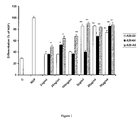

Classifications
-
- C—CHEMISTRY; METALLURGY
- C07—ORGANIC CHEMISTRY
- C07D—HETEROCYCLIC COMPOUNDS
- C07D241/00—Heterocyclic compounds containing 1,4-diazine or hydrogenated 1,4-diazine rings
- C07D241/02—Heterocyclic compounds containing 1,4-diazine or hydrogenated 1,4-diazine rings not condensed with other rings
- C07D241/06—Heterocyclic compounds containing 1,4-diazine or hydrogenated 1,4-diazine rings not condensed with other rings having one or two double bonds between ring members or between ring members and non-ring members
- C07D241/08—Heterocyclic compounds containing 1,4-diazine or hydrogenated 1,4-diazine rings not condensed with other rings having one or two double bonds between ring members or between ring members and non-ring members with oxygen atoms directly attached to ring carbon atoms
-
- A—HUMAN NECESSITIES
- A61—MEDICAL OR VETERINARY SCIENCE; HYGIENE
- A61P—SPECIFIC THERAPEUTIC ACTIVITY OF CHEMICAL COMPOUNDS OR MEDICINAL PREPARATIONS
- A61P25/00—Drugs for disorders of the nervous system
- A61P25/28—Drugs for disorders of the nervous system for treating neurodegenerative disorders of the central nervous system, e.g. nootropic agents, cognition enhancers, drugs for treating Alzheimer's disease or other forms of dementia
-
- C—CHEMISTRY; METALLURGY
- C07—ORGANIC CHEMISTRY
- C07D—HETEROCYCLIC COMPOUNDS
- C07D403/00—Heterocyclic compounds containing two or more hetero rings, having nitrogen atoms as the only ring hetero atoms, not provided for by group C07D401/00
- C07D403/02—Heterocyclic compounds containing two or more hetero rings, having nitrogen atoms as the only ring hetero atoms, not provided for by group C07D401/00 containing two hetero rings
- C07D403/12—Heterocyclic compounds containing two or more hetero rings, having nitrogen atoms as the only ring hetero atoms, not provided for by group C07D401/00 containing two hetero rings linked by a chain containing hetero atoms as chain links
-
- C—CHEMISTRY; METALLURGY
- C07—ORGANIC CHEMISTRY
- C07D—HETEROCYCLIC COMPOUNDS
- C07D471/00—Heterocyclic compounds containing nitrogen atoms as the only ring hetero atoms in the condensed system, at least one ring being a six-membered ring with one nitrogen atom, not provided for by groups C07D451/00 - C07D463/00
- C07D471/02—Heterocyclic compounds containing nitrogen atoms as the only ring hetero atoms in the condensed system, at least one ring being a six-membered ring with one nitrogen atom, not provided for by groups C07D451/00 - C07D463/00 in which the condensed system contains two hetero rings
- C07D471/10—Spiro-condensed systems
Definitions
- This invention applies to the area of therapeutics for neurological, psychiatric disorders, and ageing.
- it relates to the neuroprotective effect of small molecule agonists of neurotrophin (Nervous Growth Factor -NGF-) and the use of those agonists as medicaments.
- neurotrophin Nevous Growth Factor -NGF-
- Nerv cells Ageing, neurological and psychiatric disorders cause death and damage to nerve cells. Frequent and relevant insults to the nervous system include neuronal degeneration, ischemia, inflammation, immune responses, trauma, and cancer, among other. As a consequence of these, nerve cells can die within minutes or hours or survive to this initial insult in an impaired state that activates neurodegeneration, ending equally in cellular death.
- Neuroprotection aims to the preservation, recovery, cure, or regeneration of the nervous system, its cells, structure, and function (Vajda et al., 2002).
- a goal of neuroprotection is to prevent or minimize the effects of an original insult to the nervous system, or to prevent or minimize the consequences of endogenous or exogenous noxious processes causing damage to axons, neurons, synapses, and dendrites.
- Treatment strategies in general are frequently based on the modulation of a single proposed injury factor. Although such treatments can be shown to be beneficial in highly constrained animal models, they are less likely to prove efficacious in the more complex human disorder that involves more variable degrees of injury severity in a genetically diverse population (Faden and Stoica, 2007). Importantly, since the presumed mechanisms of neuronal death are both complex and varied, such as oxidative stress, mitochondrial dysfunction, protein aggregation, apoptosis, and inflammation (Youdim et al., 2005), single compounds having multipotential effects on multiple injury mechanisms are desirable.
- NMDA N-methyl D-aspartate
- AMPA ⁇ -amino-3-hydroxy-5-methyl-4-isoxazole propionic acid
- dexanabinol sodium channel blockers
- TRH thyrotropin-releasing hormone
- growth factors glucocorticoids
- caffeinol caffeinol
- opioid antagonists apoptosis inhibitors
- free radical trappers/scavengers erythropoietin
- calcium channel blockers calcium channel blockers
- magnesium sulfate statins.
- Nerve growth factor is a homodimeric protein from the neurotrophin family that plays a crucial role in neuronal survival, differentiation and growth (Levi-Montalcini, 1987) and binds two distinct cellular receptors: the tyrosine kinase receptor TrkA and the p75 receptor (Chao, 2003). NGF-TrkA binding activates the intrinsic tyrosine kinase of the receptor, causing tyrosine phosphorylation of TrkA and associated signalling partners and therefore activating promotion of cell survival or differentiation (Kaplan and Miller, 2000).
- the p75 receptor is a member of the tumor necrosis factor receptor superfamily. Depending on the cellular environment and the type of ligand, p75 can act as transducer of pro-survival, pro-apoptotic, or pro-differentiation signals (Barker, 1998; Rabizadeh et al., 1999; Zaccaro et al., 2001; Saragovi and Zaccaro, 2002). Accordingly, depending of the metabolic route, binding to either TrkA or p75 receptors may trigger signals, depending on the cell type considered, linked to, indistinctly, differentiation and/or cell survival.
- NGF neurodegenerative disorders
- diseases include neurodegenerative disorders, nerve inflammation and certain types of cancers, multiple sclerosis, neuromyelitis optica, amyotrophic lateral sclerosis (ALS), Parkinson's disease, Alzheimer's disease, Friedreich's ataxia, Huntington's disease, Dementia with Lewy bodies, spinal muscular atrophy, major depressive disorder, schizophrenia, glaucoma or peripheral neuropathies (diabetic or AIDS neuropathy) (Longo et al, 2007; Schulte-Herbrüggen, 2007; Shi, 2007; Hellveg, 2008; Shoval, 2005; Apfel, 2002; Anand, 2004).
- NGF has significant immunoregulatory properties during CNS inflammation to contribute to the maintenance of the CNS privilege (Villoslada and Genain, 2004).
- NGF was able to inhibit the development of the clinical symptoms when administered intracerebroventricularly by continuous infusion apparently because of its ability to induce an immunosuppressive microenvironment in the CNS which leads to decreased CNS infiltration (Villoslada et al., 2000).
- the finding that NGF induces immunosuppression during autoimmune demyelination in addition to its neuroprotective properties in neurons and oligodendrocytes makes it a very good candidate for the treatment of CNS inflammatory diseases like MS.
- NGF is not the ideal drug candidate due to its inability to cross the blood-brain barrier (BBB) (Poduslo and Curran, 1996), its short half life and its side effects (Apfel, 2002).
- BBB blood-brain barrier
- different approaches have been attempted (Poduslo and Curran, 1996; Longo et al., 1997; Maliartchouk et al., 2000a; Maliartchouk et al., 2000b; Peleshok and Saragovi, 2006).
- NGF neuroprotective growth factor
- present invention has developed a family of compounds alternative to those disclosed in the state of the art.
- the family of compounds of the invention are all peptidomimetics of NGF, agonists to Trk A specific receptor binding.
- the present invention relates to compounds of Formula I and their pharmaceutically acceptable salts and/or prodrugs.
- R 2 and R 3 are each one independently or CH 3 or form together with the 3-oxopiperazinium ring a fused azoniosapiro [4,5] decane heterocycle.
- the invention also covers the use of the compounds of Formula I, its pharmaceutically acceptable salts and/or prodrugs thereof, as active ingredients in the manufacture of medicaments for the prevention or treatment of nerve cell death or damage.
- the present invention relates to the compounds of Formula I, its pharmaceutically acceptable salts and/or prodrugs thereof for use in the prevention or treatment of nerve cell death or damage.
- the present invention relates to a method of neuroprotection comprising administering to a subject in need thereof an effective amount of a compound of Formula I, its pharmaceutically acceptable salts and/or prodrugs thereof.
- prodrug includes any compound derived from the compounds of Formula I, for example, the ester, amide, phosphate, etc., which, upon being administered to an individual, is capable of providing the compounds of Formula I or the pharmaceutically acceptable salt thereof, directly or indirectly, to said individual.
- said derivative is a compound that increases the bioavailability of the compounds of Formula I when administered to an individual or that promotes the release of the compounds of Formula I in a biological compartment.
- the nature of said derivative is not critical, provided that it may be administered to an individual and that it provides the compounds of Formula I in an individual's biological compartment.
- the preparation of said prodrug may be performed by conventional methods known by those skilled in the art.
- An example of prodrug of the compounds of Formula I can be their encapsulation into liposomes.
- pharmaceutically acceptable means that a compound or combination of compounds is sufficiently compatible with the other ingredients of a formulation, and not deleterious to the patient up to those levels acceptable by the industry standards.
- salts of the compounds of Formula I are those wherein the counter-ion is pharmaceutically acceptable.
- salt as mentioned herein is meant to comprise any stable salts, which the compounds of Formula I are able to form. Preferred are the pharmaceutically acceptable salts. Salts that are not pharmaceutically acceptable are also embraced in the scope of the present invention, since they refer to intermediates that may be useful in the preparation of compounds with pharmacological activity.
- the salts can conveniently be obtained by treating the base form of the compounds of Formula I with such appropriate acids as inorganic acids such as hydrochloric or hydrobromic acid, sulfuric, nitric, phosphoric and the like acids; or organic acids such as, for example, acetic, propanoic, hydroxyacetic, lactic, pyruvic, oxalic (i.e. ethanedioic), malonic, succinic (i.e. butanedioic acid), maleic, fumaric, malic (i.e.
- hydroxybutanedioic acid tartaric, citric, methanesulfonic, ethanesulfonic, benzenesulfonic, p-toluenesulfonic, cyclamic, salicylic, p-aminosalicylic, pamoic and the like acids.
- the pharmaceutically acceptable salts can be obtained by treating the base form of the compounds of Formula I with such appropriate pharmaceutically acceptable acids like inorganic acids, for example, including hydrochloric, hydrobromic and the like; sulfuric acid; nitric acid; phosphoric acid and the like; or organic acids, for example, acetic, propanoic, hydroxyacetic, 2-hydroxypropanoic, 2-oxopropanoic, oxalic, malonic, succinic, maleic, fumaric, malic, tartaric, 2-hydroxy-1,2,3-propane-tricarboxylic, methanesulfonic, ethanesulfonic, benzenesulfonic, 4-methylbenzenesulfonic, cyclohexanesulfamic, 2-hydroxybenzoic, 4-amino-2-hydroxybenzoic and the like acids.
- inorganic acids for example, including hydrochloric, hydrobromic and the like; sulfuric acid; nitric acid; phosphoric acid and
- salt form can be converted by treatment with alkali into the free base form.
- composition means for the purpose of present invention any composition which comprises as active compound, to whom is attributed, fully or in part, the therapeutical (pharmaceutical) effect, at least one of the compounds of the invention or combinations thereof and that may optionally further comprise at least one pharmaceutically acceptable non-active ingredient, as an excipient, carrier or so.
- preventing refers to keep from happening, existing, or alternatively delaying the onset or recurrence of a disease, disorder, or condition to which such term applies, or of one or more symptoms associated with a disease, disorder, or condition.
- prevention refers to the act of preventing, as "preventing” is defined immediately above.
- treating refers to reversing, alleviating, or inhibiting the progress of the disorder or condition to which such term applies, or one or more symptoms of such disorders or condition.
- treatment refers to the act of treating, as “treating” is defined immediately above.
- subject means animals, in particular mammals such as dogs, cats, cows, horses, sheep, geese, and humans. Particularly preferred subjects are mammals, including humans of both sexes.
- an "effective amount" of the compounds of Formula I and pharmaceutically acceptable salts or prodrugs thereof may be in the range from 0.01 mg to 50 g per day, from 0.02 mg to 40 g per day, from 0.05 mg to 30 g per day, from 0.1 mg to 20 g per day, from 0.2 mg to 10 g per day, from 0.5 mg to 5 g per day, from 1 mg to 3 g per day, from 2 mg to 2 g per day, from 5 mg to 1,5 g per day, from 10 mg to 1 g per day, from 10 mg to 500 mg per day.
- Nerve cells include those cells from any region of the brain, spinal cord, optic nerve, retina, and peripheral ganglia.
- Neurons include those in embryonic, fetal, or adult neural tissue, including tissue from the hippocampus, cerebellum, spinal cord, cortex (e.g., motor or somatosensory cortex), striatum, basal forebrain (cholinergic neurons), ventral mesencephalon (cells of the substantia nigra), and the locus ceruleus (neuroadrenaline cells of the central nervous system).
- the compounds of Formula I, its pharmaceutically acceptable salts and/or prodrugs thereof may be used for the prevention or treatment of one or more, preferably two or more, pathological or harmful conditions related to nerve cell death or damage selected from, but not being limited to, chemical substances such as oxidative stress conditions, toxic substances, infectious organisms, radiation, traumatic injury, hypoxia, ischemia, abnormal misfolded proteins, excitotoxins, free radicals, endoplasmic reticulum stressors, mitochondrial stressors including but not limited to inhibitors of the electron transport chain, Golgi apparatus antagonists, axonal damage or loss, demyelination, inflammation, pathological neuronal burst (seizures).
- the uses and methods of the present invention are directed to preventing or treating nerve cell death or damage, regardless of cause.
- neuroprotective refers to the ability to prevent or reduce death or damage to nerve cells, including neurons and glia, or rescuing, resuscitating or reviving nerve cells, e.g., following in pathological or harmful conditions to the brain, central nervous system or peripheral nervous system.
- this neuroprotective effect comprises the conferred ability of neuronal cells to maintain or recover their neuronal functions. It stabilizes the cell membrane of a neuronal cell or helps in the normalization of neuronal cell functions. It prevents the loss of viability or functions of neuronal cells. It comprises the inhibition of progressive deterioration of neurons that leads to cell death. It refers too to any detectable protection of neurons from stress.
- Neuroprotection includes the regeneration of nerve cells, i.e. the re-growth of a population of nerve cells after disease or trauma.
- a neuroprotective drug is a Disease Modifying Drug (DMD) for the treatment of brain diseases.
- DMD Disease Modifying Drug
- the present invention relates to the use of the compounds of Formula I, its pharmaceutically acceptable salts and/or prodrugs thereof as active ingredient in the manufacture of a medicament for the regeneration of nerve cells.
- the present invention relates to the compounds of Formula I, its pharmaceutically acceptable salts and/or prodrugs thereof for use for the regeneration of nerve cells.
- the present invention relates to a method of regenerating nerve cells comprising administering to a subject in need thereof an effective amount of the compounds of Formula I , its pharmaceutically acceptable salts and/or prodrugs thereof.
- Neuroprotection may be determined directly by, for example, measuring the delay or prevention of neuronal death, such as, for example, by a reduction in the number of apoptotic neurons in cerebrocortical cultures following a stress. Neuroprotection may also be determined directly by, for example, measuring the severity or extent of damage to, or functional loss by, a tissue or organ of the nervous system following such a stress, such as, for example, by measuring a decrease in the size of brain infarcts after occlusion of the middle cerebral artery (MCAO) or reperfusion injury. Also, neuroprotection can be identified by magnetic resonance imaging (measuring brain volume, tractography, levels of N-acetyl-aspartate by spectroscopy).
- neuroprotection may be determined indirectly by detecting the activation of one or more biological mechanisms for protecting neurons, including, but not limited to, detecting activation of the Keap1/Nrf2 pathway or induction of one or more phase 2 enzymes, including but not limited to hemeoxygenase-1 (HO-1).
- detecting and measuring neuronal protection are provided in the Examples below, and other such methods are known in the art.
- the various uses and methods employing the compounds of Formula I, its pharmaceutically salts and/or prodrugs thereof in the present invention comprise acute administration, i.e. occurring within several minutes to about several hours from injury, or chronic administration, suitable for chronic neurological or psychiatric diseases.
- the compounds of Formula I, its pharmaceutically acceptable salts and/or prodrugs thereof is administered to a subject with a neurological or psychiatric disease.
- Neurological diseases are those disorders of the central and peripheral nervous system, including disorders of the brain, spinal cord, cranial nerves, peripheral nerves, nerve roots, autonomic nervous system, neuromuscular junction, and muscle.
- Diseases of the central and peripheral nervous system which may be subject of prevention and/or treatment according to present invention include, without being limited to, as knowledge in clinical manifestations advances, Absence of the Septum Pellucidum, Acid Lipase Disease , Acid Maltase Deficiency, Acquired Epileptiform Aphasia, Acute Disseminated Encephalomyelitis, Adie's Pupil, Adie's Syndrome, Adrenoleukodystrophy, Agenesis of the Corpus Callosum, Agnosia, Aicardi Syndrome, Aicardi-Goutieres Syndrome Disorder, AIDS - Neurological Complications, Alexander Disease, Alpers' Disease, Alternating Hemiplegia, Alzheimer's Disease, Amyotrophic Lateral Sclerosis, Anencephaly, Aneurysm, Angelman Syndrome, Angiomatosis, Anoxia, Antiphospholipid Syndrome, Aphasia, Apraxia, Arachnoid Cysts, Arachnoiditis, Arnold-Chiari Malformation, Ar
- Psychiatric disorders which may be subject of prevention and/or treatment according to present invention include those listed by the Diagnostic and Statistical Manual of Mental Disorders, Fourth Edition (DSM-IV) published by the American Psychiatric Association, and covers all mental health disorders for both children and adults.
- DSM-IV Diagnostic and Statistical Manual of Mental Disorders, Fourth Edition
- psychiatric disorders include a disorder selected from Acute Stress Disorder; Adjustment Disorder Unspecified; Adjustment Disorder with Anxiety; Adjustment Disorder with Depressed Mood; Adjustment Disorder with Disturbance of Conduct; Adjustment Disorder with Mixed Anxiety and Depressed Mood; Adjustment Disorder with Mixed Disturbance of Emotions and Conduct; Agoraphobia without History of Panic Disorder; Anorexia Nervosa; Antisocial Personality Disorder; Anxiety Disorder Due to Medical Condition; Anxiety Disorder, NOS; Avoidant Personality Disorder; Bipolar Disorder NOS; Bipolar I Disorder, Most Recent Episode Depressed, In Full Remission; Bipolar I Disorder, Most Recent Episode Depressed, In Partial Remission; Bipolar I Disorder, Most Recent Episode Depressed, Mild; Bipolar I Disorder, Most Recent Episode Depressed, Moderate; Bipolar I Disorder, Most Recent Episode Depressed, Severe With Psychotic Features; Bipolar I Disorder, Most Recent Episode Depressed, Severe Without Psychotic Features; Bipolar I Disorder, Most Recent Episode Depressed, Unspecified
- the compounds of Formula I can be used in the treatment of diseases wherein NGF has been proven effective in the state of the art, either in vivo or in vitro, due to their improving effects on cell differentiation and cell survival, throughout TrkA pathway.
- the compounds covered in present invention can be used in the treatment of neurological diseases selected among: neurodegenerative disorders, such as amyotrophic lateral sclerosis (ALS), Parkinson's disease, Alzheimer's disease, Friedreich's ataxia, Huntington's disease, Dementia with Lewy bodies, spinal muscular atrophy; nerve inflammation, such as multiple sclerosis, neuromyelitis optica, major depressive disorder, schizophrenia, glaucoma; or peripheral neuropathies, such as diabetic or AIDS neuropathy.
- the compounds of the invention can also be indicated for treatment of cancer, by modulating NGF cell differentiation activity and stopping cell proliferation.
- glioblastoma astrocytoma, meduloblastoma, neurinoma, neuroblastoma, meningioma, colon cancer, pancreatic cancer, breast cancer, prostate cancer, leukemia, acute lymphocytic leukemia, osteosarcoma, hepatocellular carcinoma, ovarian carcinoma, lung adenocarcinoma or esophagic carcinoma.
- the compounds of Formula I, its pharmaceutically acceptable salts and/or prodrugs thereof is administered to a healthy subject, preferably a healthy subject older than 18 years old, more preferably a healthy subject older than 45 years old, even more preferably a healthy subject older than 55, 60, 65, 70, 75, 80, 85, 90, 95, or 100 years old.
- health subject is meant to comprise its plain meaning as well as those subjects that may suffer from one or more pathological conditions other than a neurological or psychiatric disease.
- the present invention further relates to the use of the compounds of Formula I, its pharmaceutically acceptable salts and/or prodrugs thereof as active ingredient in the manufacture of a medicament for the prevention or treatment of a neurological or psychiatric disease.
- the present invention also relates to the compounds of Formula I, its pharmaceutically acceptable salts and/or prodrugs thereof for use in the prevention or treatment of a neurological or psychiatric disease.
- the present invention also relates to a method of prevention or treatment of a neurological or psychiatric disease comprising administering to a subject in need thereof an effective amount of the compounds of Formula I, its pharmaceutically acceptable salts and/or prodrugs thereof.
- the neurological or psychiatric disease may be any one from those listed above.
- the disease treated or prevented with the administration of the compounds of the invention is selected from: neurodegenerative disorders, such as amyotrophic lateral sclerosis (ALS), Parkinson's disease, Alzheimer's disease, Friedreich's ataxia, Huntington's disease, Dementia with Lewy bodies, spinal muscular atrophy; inflammation, such as multiple sclerosis, neuromyelitis optica, major depressive disorder, schizophrenia, glaucoma; or peripheral neuropathies, such as diabetic or AIDS neuropathy; and cancer, such as glioblastoma, astrocytoma, meduloblastoma, neurinoma, neuroblastoma, meningioma, colon cancer, pancreatic cancer, breast cancer, prostate cancer, leukemia, acute lymphocytic leukemia, osteosarcoma, hepatocellular carcinoma, ovarian carcinoma, lung adenocarcinoma esophagic carcinoma.
- ALS amyotrophic lateral sclerosis
- Parkinson's disease
- Another goal of present invention is the use of the compounds of Formula I, its pharmaceutically acceptable salts and/or prodrugs thereof, as neuroenhancing drugs or its use for manufacturing neuroenhancing drugs.
- Neuroenhancing drugs include those that improve learning and memory, attention, mood, communicative skills and sexual performance.
- Examples of neuroenhancing drugs are those that target long-term synaptic potentiation (LTP) or long-term depression (LTD), modulation of calcium channels, or the cAMP response elementbinding (CREB) protein.
- cAMP is the acronym for cyclic adenosine monophosphate.
- Particular examples of neuroenhancing drugs are phosphodiesterase inhibitors like rolipram; donepezil; agonists of the NMDA glutamate receptor like D-cycloserine; ampakines; modafinil; methylphenidate.
- compositions usually employed for systemically administering drugs for example any solid (e.g. tablets, capsules, granules, etc.) or liquid composition (e.g. solutions, suspensions, emulsions, etc).
- a pharmaceutically acceptable carrier which carrier may take a wide variety of forms depending on the form of preparation desired for administration.
- compositions are desirable in unitary dosage form suitable, particularly, for administration orally, rectally, percutaneously, intrathecal, intravenous or by parenteral injection.
- any of the usual pharmaceutical media may be employed such as, for example, water, glycols, oils, alcohols and the like in the case of oral liquid preparations such as suspensions, syrups, elixirs, emulsions and solutions; or solid carriers such as starches, sugars, kaolin, lubricants, binders, disintegrating agents and the like in the case of powders, pills, capsules, and tablets. Because of their ease in administration, tablets and capsules represent the most advantageous oral dosage unit forms, in which case solid pharmaceutical carriers are obviously employed.
- the carrier usually comprises sterile water, at least in large part, though other ingredients, for example, to aid solubility, may be included.
- injectable solutions for example, may be prepared in which the carrier comprises saline solution, glucose solution or a mixture of saline and glucose solution.
- injectable suspensions may also be prepared in which case appropriate liquid carriers, suspending agents and the like may be employed.
- solid form preparations which are intended to be converted, shortly before use, to liquid form preparations.
- the carrier optionally comprises a penetration enhancing agent or a suitable wetting agent, or both, optionally combined with suitable additives of any nature in minor proportions, which additives do not introduce a significant deleterious effect on the skin.
- Unit dosage form refers to physically discrete units suitable as unitary dosages, each unit containing a predetermined quantity of active ingredient calculated to produce the desired therapeutic effect in association with the required pharmaceutical carrier.
- unit dosage forms are tablets (including scored or coated tablets), capsules, pills, suppositories, powder packets, wafers, injectable solutions or suspensions and the like, and segregated multiples thereof.
- compositions in accordance with this invention may contain the active ingredient in an amount that is in the range of about 0,1 % to 70%, or about 0,5% to 50%, or about 1 % to 25%, or about 5% to 20%, the remainder comprising the carrier, wherein the foregoing percentages are w/w versus the total weight of the composition or dosage form.
- the dose of the compounds of Formula I, its pharmaceutically acceptable salts and/or prodrugs thereof to be administered depends on the individual case and, as customary, is to be adapted to the conditions of the individual case for an optimum effect. Thus it depends, of course, on the frequency of administration and on the potency and duration of action of the compound employed in each case for therapy or prophylaxis, but also on the nature and severity of the disease and symptoms, and on the sex, age, weight co-medication and individual responsiveness of the subject to be treated and on whether the therapy is acute or prophylactic. Doses may be adapted in function of weight and for pediatric applications. Daily doses may be administered q.d. or in multiple quantities such as b.i.d., t.i.d. or q.i.d.
- the invention uses a library (Masip et al., 2004) of tetraalkylammonium heterocyclic compounds, (100 individual molecules).
- the invention selected 3 compounds which showed a good NGF like activity "in vitro" by inducing differentiation of PC12 cells and therefore, having neuroregenerative properties.
- R 2 and R 3 are each one independently or CH 3 or form together with the 3- oxopiperazinium ring a fused azoniasapiro [4,5] decane heterocycle.
- the invention also covers pharmaceutically acceptable salts and/or prodrugs of the compounds of Formula I.
- Preferred compounds according to present invention are those of Formula I in which, when then R 2 and R 3 are each one independently CH 3 ; or R 2 is CH 3 and R 3 is
- Also preferred compounds comprised in the invention are those of Formula I wherein when R 1 is then R 2 and R 3 form together with the 3-oxopiperazinium ring a fused azoniasapiro [4,5] decane heterocycle.
- the invention also covers pharmaceutically acceptable salts and/or prodrugs of the above mentioned preferred compounds of Formula I.
- preferred compounds according to present invention are selected among the following: 1,1- dimethyl-4-[2-(4-nitrophenethylamino) -2- oxoethyl] -3-oxopiperazinium chloride (A26-23) 1-benzyl-1-methyl-4-[2-(4-nitrophenethylamino)-2-oxoethyl]-3-oxopiperazinium chloride (A26-64) 8-[2-(2-(5-methyl-1H-indol-2-yl)ethylamino)-2-oxoethyl]-7-oxo-8-aza-5-azoniaspiro[4.5]decane. (A28-A6); and its pharmaceutically acceptable salts and/or prodrugs thereof.
- Example 1 Design of NGF agonists by combinatorial chemistry
- Semi-preparative RP-HPLC was performed with a Waters (Milford, MA, U.S.A.) system.
- High resolution mass spectra (HRMS-FAB) were carried at the Mass Spectrometry Service of the IQAC - Instituto de Quimica Avanzada de Catalu ⁇ a - (Spain).
- a Reagents and conditions (a) HOOCCH 2 Cl, DIC, HOBt, DIPEA, DCM; (b) H 2 NCH 2 CH 2 R 1 R 2 , DIPEA, dioxane; (c) ClCOCH 2 Cl, DCM; (d) Al 2 O 3 , DCM-MeOH (2:1).
- the individual tetraalkylammonium salts A26-23 and A26-64 for the in vivo assays were prepared similary to the corresponding library, but improving each step in order to achieve the highest yields and purities.
- A26-64 it was necessary to prepare N-benzyl-N-methylethane-1,2-diamine. This compound was obtained from the corresponding alcohol precursor by the Mitsunobu procedure, followed by hydrazinolysis. (Sen, S. et al, 1995).
- N -benzyl- N -methylethane-1,2-diamine N-benzyl- N -methylethane-1,2-diamine.
- N-benzyl-N-methylethanolamine 7.31 mL, 40.5 mmol
- phtalimide 6.62 g, 44.5 mmol
- triphenyl phosphine 14 g, 52.65 mmol
- diisopropyl diazacarboxylate (12.73 mL, 60.75 mmol
- the expected phtalimide derivative was isolated in 80% yield (70% purity) after repeated treatment with 1:1 AcOEt:Et 2 O mixtures to remove Ph 3 P and Ph 3 PO by preciptation.
- the phtalimide derivative (16.8 g, 39 mmol) was redissolved in absolute ethanol (200 mL) treated with hydrazine hydrate (9.7 mL, 195 mmol), and the mixture was stirred for 6 h at 80 °C.
- the crude reaction mixture was acidified with 1.5 N HCl and the resulting suspension was filtered. The solvents were removed under reduced pressure, the residue was redissolved in CH 2 Cl 2 and the amine was extracted with 1.5 N HCl.
- N,N'-dimethylethylenediamine Coupling of N,N'-dimethylethylenediamine.
- a mixture of the N -substituted chloroacetamide (2.97 g, 11.6 mmol), N,N'-dimethylethylenediamine (7.1 mL, 62 mmol) and N,N -diisopropylethylamine (4.3 mL, 24.7 mmol) in dioxane (25 mL) was allowed to react under microwave irradiation with the CEM reactor equipped with a Dimroth condenser (10 min, 80 °C, 150 W). Then the solvent was removed under reduced pressure to give the corresponding glycinamide (5.05 g crude, 98% yield, 71% purity by HPLC).
- N-benzyl- 1 -methylethane-1,2-diamine Coupling of N-benzyl- 1 -methylethane-1,2-diamine.
- N-benzyl- N -methylethane-1,2-diamine (0.64 mL, 4.2 mmol)
- anhydrous CsCO 3 14 g, 43 mmol
- activated molecular sieves Type A4
- Example 2 PC12 cell differentiation A26-23, A26-24 and A28-A6 peptidomimetics induce differentiation.
- PC 12 cell differentiation was measured by plating cells onto collagen-coated 24-wells plates. NGF (100 ng/ml) or the small chemicals at different concentrations were added and the percentage of cells with neurite processes greater than two cell bodies in length were counted after relevant treatment. For each experiment at least 300 cells were randomly measured (Burstein and Greene, 1978).
- PC12 cells were maintained at 37°C in DMEM supplemented with 2.5% FBS, 15% of Horse serum (HS) and penicillin/streptomycin in a humidified 5% CO 2 incubator. The cells were grown on 60-and 100-mm tissue culture dishes (Becton Dickinson).
- PC 12 cells were cultured for 3 days in the presence of the peptoids (from 2 ng/ml to 50 ⁇ g/ml) under reduced serum conditions (0.5% FBS and 1% HS).
- the peptoids A26-23, A26-24 and A28-A6 ( Figure 1 ) were found to induce the differentiation of PC12 cells at different concentrations to an extent substantially comparable with that induce by NGF (Foehr et al., 2000) and showing a dose-response activity.
- Example 3 Survival assays A26-23, A26-24 and A28-A6 mimetic peptoids do not promote cell survival via p75 receptor.
- the rat schawnnoma cell line RN22 was cultured in 5% CO 2 at 37°C in Dulbecco's modified Eagle's medium (DMEM) with 10% fetal bovine serum (FBS) and penicillin/streptomycin.
- DMEM Dulbecco's modified Eagle's medium
- FBS fetal bovine serum
- penicillin/streptomycin penicillin/streptomycin
- RN22 cells were plated at 20,000 cells/well on a 24-well plate in DMEM alone and after allowing the cells to adhere for 3 days, cupper sulphate (CuSO4) (150 ⁇ M) was added with or without NGF (100 ng/ml) or the peptidomimetic molecules A26-23, A26-24 and A28-A6 at different concentrations (1 ng/ml - 10 ⁇ g/ml) to generate stress and cell death. After 24 h cell viability was studied by determining the amount of yellow MTT (Sigma) that was reduced to insoluble purple formazan.
- CuSO4 cupper sulphate
- the water-insoluble formazan was solubilised with DMSO (Sigma), and the dissolved material was measured spectrophotometrically at a wavelength of 570 nm, subtracting the background at 650 nm (Frade, 2005).
Landscapes
- Organic Chemistry (AREA)
- Chemical & Material Sciences (AREA)
- Health & Medical Sciences (AREA)
- Neurosurgery (AREA)
- Engineering & Computer Science (AREA)
- Bioinformatics & Cheminformatics (AREA)
- Biomedical Technology (AREA)
- Neurology (AREA)
- Chemical Kinetics & Catalysis (AREA)
- Psychiatry (AREA)
- Hospice & Palliative Care (AREA)
- General Chemical & Material Sciences (AREA)
- Medicinal Chemistry (AREA)
- Nuclear Medicine, Radiotherapy & Molecular Imaging (AREA)
- Pharmacology & Pharmacy (AREA)
- Life Sciences & Earth Sciences (AREA)
- Animal Behavior & Ethology (AREA)
- General Health & Medical Sciences (AREA)
- Public Health (AREA)
- Veterinary Medicine (AREA)
- Pharmaceuticals Containing Other Organic And Inorganic Compounds (AREA)
Abstract
New 3-oxopiperazinium derivatives agonists of Nerve Growth Factor and it use as medicaments. Neurotrophin binding to its specific receptor Trk A leads to the activation of multiple signalling cascades, culminating in neuroregenerative effects, including neuronal survival and neurite outgrowth. Neurotrophic factors have been used for the treatment of several neurodegenerative diseases. However, their use is limited by their inability to cross the blood-brain barrier, their short half life and their side effects. Small molecule neurotrophin peptidomimetics may be beneficial in treating a number of neurodegenerative disorders. The present invention shows the capacity of nerve growth factor agonist molecules derived from the 3-oxopiperazinium scaffold to induce differentiation in PC12 cells and, therefore, that these small molecules with NGF agonist activity may be beneficial for treatment of neurodegenerative diseases, due to their neuroregenerative effects.
Description
- This invention applies to the area of therapeutics for neurological, psychiatric disorders, and ageing. In particular, it relates to the neuroprotective effect of small molecule agonists of neurotrophin (Nervous Growth Factor -NGF-) and the use of those agonists as medicaments.
- Ageing, neurological and psychiatric disorders cause death and damage to nerve cells. Frequent and relevant insults to the nervous system include neuronal degeneration, ischemia, inflammation, immune responses, trauma, and cancer, among other. As a consequence of these, nerve cells can die within minutes or hours or survive to this initial insult in an impaired state that activates neurodegeneration, ending equally in cellular death.
- Given the importance of the nervous system in enabling basic motor skills and sensing, there exists an interest in finding therapeutic weapons to protect the nervous system.
- Neuroprotection aims to the preservation, recovery, cure, or regeneration of the nervous system, its cells, structure, and function (Vajda et al., 2002). A goal of neuroprotection is to prevent or minimize the effects of an original insult to the nervous system, or to prevent or minimize the consequences of endogenous or exogenous noxious processes causing damage to axons, neurons, synapses, and dendrites.
- Treatment strategies in general are frequently based on the modulation of a single proposed injury factor. Although such treatments can be shown to be beneficial in highly constrained animal models, they are less likely to prove efficacious in the more complex human disorder that involves more variable degrees of injury severity in a genetically diverse population (Faden and Stoica, 2007). Importantly, since the presumed mechanisms of neuronal death are both complex and varied, such as oxidative stress, mitochondrial dysfunction, protein aggregation, apoptosis, and inflammation (Youdim et al., 2005), single compounds having multipotential effects on multiple injury mechanisms are desirable.
- Several neuroprotective drugs are under investigation including the following classes: anti-inflammatory agents, N-methyl D-aspartate (NMDA) antagonists, α-amino-3-hydroxy-5-methyl-4-isoxazole propionic acid (AMPA) antagonists, dexanabinol, sodium channel blockers, thyrotropin-releasing hormone (TRH), growth factors, glucocorticoids, caffeinol, opioid antagonists, apoptosis inhibitors, free radical trappers/scavengers, erythropoietin, calcium channel blockers, magnesium sulfate, statins.
- The ability of these pharmacological agents to limit secondary biochemical damage and cell death has been well established in numerous animal models of stroke, head injury, and spinal cord injury, yet the results of such neuroprotective treatment strategies in human injury have been disappointing (Faden and Stoica, 2007).
- Neurotrophins are growth factors that regulate the development and maintenance of the peripheral and the central nervous systems (Lewin and Barde, 1996). Nerve growth factor (NGF) is a homodimeric protein from the neurotrophin family that plays a crucial role in neuronal survival, differentiation and growth (Levi-Montalcini, 1987) and binds two distinct cellular receptors: the tyrosine kinase receptor TrkA and the p75 receptor (Chao, 2003). NGF-TrkA binding activates the intrinsic tyrosine kinase of the receptor, causing tyrosine phosphorylation of TrkA and associated signalling partners and therefore activating promotion of cell survival or differentiation (Kaplan and Miller, 2000). The p75 receptor is a member of the tumor necrosis factor receptor superfamily. Depending on the cellular environment and the type of ligand, p75 can act as transducer of pro-survival, pro-apoptotic, or pro-differentiation signals (Barker, 1998; Rabizadeh et al., 1999; Zaccaro et al., 2001; Saragovi and Zaccaro, 2002). Accordingly, depending of the metabolic route, binding to either TrkA or p75 receptors may trigger signals, depending on the cell type considered, linked to, indistinctly, differentiation and/or cell survival.
- The potential of NGF as a therapeutic agent for several diseases has been indicated by several investigators. Such diseases include neurodegenerative disorders, nerve inflammation and certain types of cancers, multiple sclerosis, neuromyelitis optica, amyotrophic lateral sclerosis (ALS), Parkinson's disease, Alzheimer's disease, Friedreich's ataxia, Huntington's disease, Dementia with Lewy bodies, spinal muscular atrophy, major depressive disorder, schizophrenia, glaucoma or peripheral neuropathies (diabetic or AIDS neuropathy) (Longo et al, 2007; Schulte-Herbrüggen, 2007; Shi, 2007; Hellveg, 2008; Shoval, 2005; Apfel, 2002; Anand, 2004). NGF has significant immunoregulatory properties during CNS inflammation to contribute to the maintenance of the CNS privilege (Villoslada and Genain, 2004). During EAE in marmoset, NGF was able to inhibit the development of the clinical symptoms when administered intracerebroventricularly by continuous infusion apparently because of its ability to induce an immunosuppressive microenvironment in the CNS which leads to decreased CNS infiltration (Villoslada et al., 2000). The finding that NGF induces immunosuppression during autoimmune demyelination in addition to its neuroprotective properties in neurons and oligodendrocytes makes it a very good candidate for the treatment of CNS inflammatory diseases like MS. However, NGF is not the ideal drug candidate due to its inability to cross the blood-brain barrier (BBB) (Poduslo and Curran, 1996), its short half life and its side effects (Apfel, 2002). Much effort has been made in the search for small molecules with NGF agonist activity, with better pharmacokinetics and less side effects. To achieve this goal, different approaches have been attempted (Poduslo and Curran, 1996; Longo et al., 1997; Maliartchouk et al., 2000a; Maliartchouk et al., 2000b; Peleshok and Saragovi, 2006).
- As such, there is an ongoing need for providing drugs, particularly NGF agonists, with neuroprotective properties, which have preferably multipotential effects, but without the drawbacks of NGF. Present invention has developed a family of compounds alternative to those disclosed in the state of the art. The family of compounds of the invention are all peptidomimetics of NGF, agonists to Trk A specific receptor binding.
- They are all 3-oxopiperazinium derivatives which share a cation charge due to a tetrasubstituted nitrogen atom present in its structure.
- The present invention relates to compounds of Formula I and their pharmaceutically acceptable salts and/or prodrugs.


or form together with the 3-oxopiperazinium ring a fused azoniosapiro [4,5] decane heterocycle. - The invention also covers the use of the compounds of Formula I, its pharmaceutically acceptable salts and/or prodrugs thereof, as active ingredients in the manufacture of medicaments for the prevention or treatment of nerve cell death or damage. In other words, the present invention relates to the compounds of Formula I, its pharmaceutically acceptable salts and/or prodrugs thereof for use in the prevention or treatment of nerve cell death or damage. Similarly, the present invention relates to a method of neuroprotection comprising administering to a subject in need thereof an effective amount of a compound of Formula I, its pharmaceutically acceptable salts and/or prodrugs thereof.
- The term "prodrug", as used herein, includes any compound derived from the compounds of Formula I, for example, the ester, amide, phosphate, etc., which, upon being administered to an individual, is capable of providing the compounds of Formula I or the pharmaceutically acceptable salt thereof, directly or indirectly, to said individual. Preferably, said derivative is a compound that increases the bioavailability of the compounds of Formula I when administered to an individual or that promotes the release of the compounds of Formula I in a biological compartment. The nature of said derivative is not critical, provided that it may be administered to an individual and that it provides the compounds of Formula I in an individual's biological compartment. The preparation of said prodrug may be performed by conventional methods known by those skilled in the art. An example of prodrug of the compounds of Formula I can be their encapsulation into liposomes.
- The term "pharmaceutically acceptable" means that a compound or combination of compounds is sufficiently compatible with the other ingredients of a formulation, and not deleterious to the patient up to those levels acceptable by the industry standards.
- For therapeutic use, salts of the compounds of Formula I are those wherein the counter-ion is pharmaceutically acceptable.
- The term salt as mentioned herein is meant to comprise any stable salts, which the compounds of Formula I are able to form. Preferred are the pharmaceutically acceptable salts. Salts that are not pharmaceutically acceptable are also embraced in the scope of the present invention, since they refer to intermediates that may be useful in the preparation of compounds with pharmacological activity.
- The salts can conveniently be obtained by treating the base form of the compounds of Formula I with such appropriate acids as inorganic acids such as hydrochloric or hydrobromic acid, sulfuric, nitric, phosphoric and the like acids; or organic acids such as, for example, acetic, propanoic, hydroxyacetic, lactic, pyruvic, oxalic (i.e. ethanedioic), malonic, succinic (i.e. butanedioic acid), maleic, fumaric, malic (i.e. hydroxybutanedioic acid), tartaric, citric, methanesulfonic, ethanesulfonic, benzenesulfonic, p-toluenesulfonic, cyclamic, salicylic, p-aminosalicylic, pamoic and the like acids.
- The pharmaceutically acceptable salts can be obtained by treating the base form of the compounds of Formula I with such appropriate pharmaceutically acceptable acids like inorganic acids, for example, including hydrochloric, hydrobromic and the like; sulfuric acid; nitric acid; phosphoric acid and the like; or organic acids, for example, acetic, propanoic, hydroxyacetic, 2-hydroxypropanoic, 2-oxopropanoic, oxalic, malonic, succinic, maleic, fumaric, malic, tartaric, 2-hydroxy-1,2,3-propane-tricarboxylic, methanesulfonic, ethanesulfonic, benzenesulfonic, 4-methylbenzenesulfonic, cyclohexanesulfamic, 2-hydroxybenzoic, 4-amino-2-hydroxybenzoic and the like acids.
- Conversely the salt form can be converted by treatment with alkali into the free base form.
- The term pharmaceutical composition means for the purpose of present invention any composition which comprises as active compound, to whom is attributed, fully or in part, the therapeutical (pharmaceutical) effect, at least one of the compounds of the invention or combinations thereof and that may optionally further comprise at least one pharmaceutically acceptable non-active ingredient, as an excipient, carrier or so.
- The term "preventing" refers to keep from happening, existing, or alternatively delaying the onset or recurrence of a disease, disorder, or condition to which such term applies, or of one or more symptoms associated with a disease, disorder, or condition. The term "prevention" refers to the act of preventing, as "preventing" is defined immediately above.
- The term "treating", as used herein, refers to reversing, alleviating, or inhibiting the progress of the disorder or condition to which such term applies, or one or more symptoms of such disorders or condition. The term "treatment" refers to the act of treating, as "treating" is defined immediately above.
- The term "subject" means animals, in particular mammals such as dogs, cats, cows, horses, sheep, geese, and humans. Particularly preferred subjects are mammals, including humans of both sexes.
- An "effective amount" of the compounds of Formula I and pharmaceutically acceptable salts or prodrugs thereof, may be in the range from 0.01 mg to 50 g per day, from 0.02 mg to 40 g per day, from 0.05 mg to 30 g per day, from 0.1 mg to 20 g per day, from 0.2 mg to 10 g per day, from 0.5 mg to 5 g per day, from 1 mg to 3 g per day, from 2 mg to 2 g per day, from 5 mg to 1,5 g per day, from 10 mg to 1 g per day, from 10 mg to 500 mg per day.
- Nerve cells include those cells from any region of the brain, spinal cord, optic nerve, retina, and peripheral ganglia. Neurons include those in embryonic, fetal, or adult neural tissue, including tissue from the hippocampus, cerebellum, spinal cord, cortex (e.g., motor or somatosensory cortex), striatum, basal forebrain (cholinergic neurons), ventral mesencephalon (cells of the substantia nigra), and the locus ceruleus (neuroadrenaline cells of the central nervous system).
- In one embodiment of the present invention, the compounds of Formula I, its pharmaceutically acceptable salts and/or prodrugs thereof may be used for the prevention or treatment of one or more, preferably two or more, pathological or harmful conditions related to nerve cell death or damage selected from, but not being limited to, chemical substances such as oxidative stress conditions, toxic substances, infectious organisms, radiation, traumatic injury, hypoxia, ischemia, abnormal misfolded proteins, excitotoxins, free radicals, endoplasmic reticulum stressors, mitochondrial stressors including but not limited to inhibitors of the electron transport chain, Golgi apparatus antagonists, axonal damage or loss, demyelination, inflammation, pathological neuronal burst (seizures). Also preferably, the uses and methods of the present invention are directed to preventing or treating nerve cell death or damage, regardless of cause.
- The terms "neuroprotection", "neuroprotective", or "neuroprotective effect" refer to the ability to prevent or reduce death or damage to nerve cells, including neurons and glia, or rescuing, resuscitating or reviving nerve cells, e.g., following in pathological or harmful conditions to the brain, central nervous system or peripheral nervous system. Thus, this neuroprotective effect comprises the conferred ability of neuronal cells to maintain or recover their neuronal functions. It stabilizes the cell membrane of a neuronal cell or helps in the normalization of neuronal cell functions. It prevents the loss of viability or functions of neuronal cells. It comprises the inhibition of progressive deterioration of neurons that leads to cell death. It refers too to any detectable protection of neurons from stress. Neuroprotection includes the regeneration of nerve cells, i.e. the re-growth of a population of nerve cells after disease or trauma.
- Currently the majority of the neurological and psychiatric diseases lacks specific treatments aimed to stop or ameliorate the course of the disease, which are called "disease modifying drugs". This contrast with the symptomatic therapy which is common for such diseases but do not change the course of the disease. A neuroprotective drug is a Disease Modifying Drug (DMD) for the treatment of brain diseases.
- As such, in one embodiment, the present invention relates to the use of the compounds of Formula I, its pharmaceutically acceptable salts and/or prodrugs thereof as active ingredient in the manufacture of a medicament for the regeneration of nerve cells. In other words, the present invention relates to the compounds of Formula I, its pharmaceutically acceptable salts and/or prodrugs thereof for use for the regeneration of nerve cells. Similarly, the present invention relates to a method of regenerating nerve cells comprising administering to a subject in need thereof an effective amount of the compounds of Formula I , its pharmaceutically acceptable salts and/or prodrugs thereof.
- Neuroprotection may be determined directly by, for example, measuring the delay or prevention of neuronal death, such as, for example, by a reduction in the number of apoptotic neurons in cerebrocortical cultures following a stress. Neuroprotection may also be determined directly by, for example, measuring the severity or extent of damage to, or functional loss by, a tissue or organ of the nervous system following such a stress, such as, for example, by measuring a decrease in the size of brain infarcts after occlusion of the middle cerebral artery (MCAO) or reperfusion injury. Also, neuroprotection can be identified by magnetic resonance imaging (measuring brain volume, tractography, levels of N-acetyl-aspartate by spectroscopy). Alternatively, neuroprotection may be determined indirectly by detecting the activation of one or more biological mechanisms for protecting neurons, including, but not limited to, detecting activation of the Keap1/Nrf2 pathway or induction of one or more phase 2 enzymes, including but not limited to hemeoxygenase-1 (HO-1). Methods of detecting and measuring neuronal protection are provided in the Examples below, and other such methods are known in the art.
- The various uses and methods employing the compounds of Formula I, its pharmaceutically salts and/or prodrugs thereof in the present invention comprise acute administration, i.e. occurring within several minutes to about several hours from injury, or chronic administration, suitable for chronic neurological or psychiatric diseases.
- In one embodiment of the present invention, in the various uses and methods of neuroprotection or of prevention or treatment of nerve cell death or damage, the compounds of Formula I, its pharmaceutically acceptable salts and/or prodrugs thereof is administered to a subject with a neurological or psychiatric disease.
- Neurological diseases are those disorders of the central and peripheral nervous system, including disorders of the brain, spinal cord, cranial nerves, peripheral nerves, nerve roots, autonomic nervous system, neuromuscular junction, and muscle.
- Diseases of the central and peripheral nervous system, which may be subject of prevention and/or treatment according to present invention include, without being limited to, as knowledge in clinical manifestations advances, Absence of the Septum Pellucidum, Acid Lipase Disease , Acid Maltase Deficiency, Acquired Epileptiform Aphasia, Acute Disseminated Encephalomyelitis, Adie's Pupil, Adie's Syndrome, Adrenoleukodystrophy, Agenesis of the Corpus Callosum, Agnosia, Aicardi Syndrome, Aicardi-Goutieres Syndrome Disorder, AIDS - Neurological Complications, Alexander Disease, Alpers' Disease, Alternating Hemiplegia, Alzheimer's Disease, Amyotrophic Lateral Sclerosis, Anencephaly, Aneurysm, Angelman Syndrome, Angiomatosis, Anoxia, Antiphospholipid Syndrome, Aphasia, Apraxia, Arachnoid Cysts, Arachnoiditis, Arnold-Chiari Malformation, Arteriovenous Malformation, Asperger Syndrome, Ataxia, Ataxia Telangiectasia, Ataxias and Cerebellar or Spinocerebellar Degeneration, Atrial Fibrillation and Stroke, Attention Deficit-Hyperactivity Disorder (ADHD), Autism, Autonomic Dysfunction, Back Pain, Barth Syndrome, Batten Disease, Becker's Myotonia, Behcet's Disease, Bell's Palsy, Benign Essential Blepharospasm, Benign Focal Amyotrophy, Benign Intracranial Hypertension, Bernhardt-Roth Syndrome, Binswanger's Disease, Blepharospasm, Bloch-Sulzberger Syndrome, Brachial Plexus Birth Injuries, Brachial Plexus Injuries, Bradbury-Eggleston Syndrome, Brain and Spinal Tumors, Brain Aneurysm, Brain infarction, Brain ischemia, Brain Injury, Brown-Sequard Syndrome, Bulbospinal Muscular Atrophy, , CADASIL, Canavan Disease, Carpal Tunnel Syndrome, Causalgia, Cavernomas, Cavernous Angioma, Cavernous Malformation, Central Cervical Cord Syndrome, Central Cord Syndrome, Central Pain Syndrome, Central Pontine Myelinolysis, Cephalic Disorders, Ceramidase Deficiency, Cerebellar Degeneration, Cerebellar Hypoplasia, Cerebral Aneurysm, Cerebral Arteriosclerosis, Cerebral Atrophy, Cerebral Beriberi, Cerebral Cavernous Malformation, Cerebral Gigantism, Cerebral Hypoxia, Cerebral Palsy, Cerebro-Oculo-Facio-Skeletal Syndrome, Charcot-Marie-Tooth Disease, Chiari Malformation, Cholesterol Ester Storage Disease, Chorea, Choreoacanthocytosis, Chronic Inflammatory Demyelinating Polyneuropathy (CIDP), Chronic Orthostatic Intolerance, Chronic Pain, Cockayne Syndrome Type II, Coffin Lowry Syndrome, COFS, Colpocephaly, Coma, Complex Regional Pain Syndrome, Congenital Facial Diplegia, Congenital Myasthenia, Congenital Myopathy, Congenital Vascular Cavernous Malformations, Corticobasal Degeneration, Cranial Arteritis, Craniosynostosis, Creutzfeldt-Jakob Disease, Cumulative Trauma Disorders, Cushing's Syndrome, Cytomegalic Inclusion Body Disease, Cytomegalovirus Infection, Dancing Eyes-Dancing Feet Syndrome, Dandy-Walker Syndrome, Dawson Disease, De Morsier's Syndrome, Deep Brain Stimulation for Parkinson's Disease, Dejerine-Klumpke Palsy, Dementia, Dementia - Multi-Infarct, Dementia - Semantic, Dementia - Subcortical, Dementia With Lewy Bodies, Dentate Cerebellar Ataxia, Dentatorubral Atrophy, Dermatomyositis, Developmental Dyspraxia, Devic's Syndrome, Diabetic Neuropathy, Diffuse Sclerosis, Dravet Syndrome, Dysautonomia, Dysgraphia, Dyslexia, Dysphagia, Dyspraxia, Dyssynergia Cerebellaris Myoclonica, Dyssynergia Cerebellaris Progressiva, Dystonias, , Early Infantile Epileptic Encephalopathy, Empty Sella Syndrome, Encephalitis, Encephalitis Lethargica, Encephaloceles, Encephalopathy, Encephalopathy, familial infantile, with intracranial calcification and chronic cerebrospinal fluid lymphocytosis; Cree encephalitis; Pseudo-Torch syndrome; Pseudotoxoplasmosis syndrome, Encephalotrigeminal Angiomatosis, Epilepsy, Epileptic Hemiplegia, Erb-Duchenne and Dejerine-Klumpke Palsies, Erb's Palsy, Essential Tremor, Extrapontine Myelinolysis, Fabry Disease, Fahr's Syndrome, Fainting, Familial Dysautonomia, Familial Hemangioma, Familial Idiopathic Basal Ganglia Calcification, Familial Periodic Paralyses, Familial Spastic Paralysis, Farber's Disease, Febrile Seizures, Fibromuscular Dysplasia, Fisher Syndrome, Floppy Infant Syndrome, Foot Drop, Friedreich's Ataxia, Frontotemporal Dementia , Gangliosidoses, Gaucher's Disease, Gerstmann's Syndrome, Gerstmann-Straussler-Scheinker Disease, Giant Axonal Neuropathy, Giant Cell Arteritis, Giant Cell Inclusion Disease, Globoid Cell Leukodystrophy, Glossopharyngeal Neuralgia, Glycogen Storage Disease, Guillain-Barré Syndrome, Hallervorden-Spatz Disease, Head Injury, Headache, Hemicrania Continua, Hemifacial Spasm, Hemiplegia Alterans, Hereditary Neuropathies, Hereditary Spastic Paraplegia, Heredopathia Atactica Polyneuritiformis, Herpes Zoster, Herpes Zoster Oticus, Hirayama Syndrome, Holmes-Adie syndrome , Holoprosencephaly, HTLV-1 Associated Myelopathy, Hughes Syndrome, Huntington's Disease, Hydranencephaly, Hydrocephalus, Hydrocephalus - Normal Pressure, Hydromyelia, Hypercortisolism, Hypersomnia, Hypertonia, Hypotonia, Hypoxia, Immune-Mediated Encephalomyelitis, Inclusion Body Myositis, Incontinentia Pigmenti, Infantile Hypotonia, Infantile Neuroaxonal Dystrophy , Infantile Phytanic Acid Storage Disease, Infantile Refsum Disease, Infantile Spasms, Inflammatory Myopathies, Iniencephaly, Intestinal Lipodystrophy, Intracranial Cysts, Intracranial Hypertension, Isaac's Syndrome, Joubert Syndrome, Kearns-Sayre Syndrome, Kennedy's Disease, Kinsbourne syndrome, Kleine-Levin Syndrome, Klippel-Feil Syndrome, Klippel-Trenaunay Syndrome (KTS), Klüver-Bucy Syndrome, Korsakoffs Amnesic Syndrome, Krabbe Disease, Kugelberg-Welander Disease, Kuru, Lambert-Eaton Myasthenic Syndrome, Landau-Kleffner Syndrome, Lateral Femoral Cutaneous Nerve Entrapment, Lateral Medullary Syndrome, Learning Disabilities, Leigh's Disease, Lennox-Gastaut Syndrome, Lesch-Nyhan Syndrome, Leukodystrophy, Levine-Critchley Syndrome, Lewy Body Dementia, Lipid Storage Diseases, Lipoid Proteinosis, Lissencephaly, Locked-In Syndrome, Lou Gehrig's Disease, Lupus - Neurological Sequelae, Lyme Disease - Neurological Complications, Machado-Joseph Disease, Macrencephaly, Megalencephaly, Melkersson-Rosenthal Syndrome, Meningitis, Meningitis and Encephalitis, Menkes Disease, Meralgia Paresthetica, Metachromatic Leukodystrophy, Microcephaly, Migraine, Miller Fisher Syndrome, Mild Cognitive Impairment, Mini-Strokes, Mitochondrial Myopathies, Moebius Syndrome, Monomelic Amyotrophy, Motor Neuron Diseases, Moyamoya Disease, Mucolipidoses, Mucopolysaccharidoses, Multifocal Motor Neuropathy, Multi-Infarct Dementia, Multiple Sclerosis, Multiple System Atrophy, Multiple System Atrophy with Orthostatic Hypotension, Muscular Dystrophy, Myasthenia - Congenital, Myasthenia Gravis, Myelinoclastic Diffuse Sclerosis, Myoclonic Encephalopathy of Infants, Myoclonus, Myopathy, Myopathy - Congenital, Myopathy - Thyrotoxic, Myotonia, Myotonia Congenita, Narcolepsy, Neuroacanthocytosis, Neurodegeneration with Brain Iron Accumulation, Neurofibromatosis, Neuroleptic Malignant Syndrome, Neurological Complications of AIDS, Neurological Complications of Lyme Disease, Neurological Consequences of Cytomegalovirus Infection, Neurological Manifestations of Pompe Disease, Neurological Sequelae Of Lupus, Neuromyelitis Optica , Neuromyotonia, Neuronal Ceroid Lipofuscinosis, Neuronal Migration Disorders, Neuropathy - Hereditary, Neurosarcoidosis, Neurotoxicity, Nevus Cavernosus, Niemann-Pick Disease, Normal Pressure Hydrocephalus, Occipital Neuralgia, Ohtahara Syndrome, Olivopontocerebellar Atrophy, Opsoclonus Myoclonus, Orthostatic Hypotension, O'Sullivan-McLeod Syndrome, Overuse Syndrome, Pain - Chronic, Pantothenate Kinase-Associated Neurodegeneration, Paraneoplastic Syndromes, Paresthesia, Parkinson's Disease, Paroxysmal Choreoathetosis, Paroxysmal Hemicrania, Parry-Romberg, Pelizaeus-Merzbacher Disease, Pena Shokeir II Syndrome, Perineural Cysts, Periodic Paralyses, Peripheral Neuropathy, Periventricular Leukomalacia, Persistent Vegetative State, Pervasive Developmental Disorders, Phytanic Acid Storage Disease, Pick's Disease, Pinched Nerve, Piriformis Syndrome, Pituitary Tumors, Polymyositis, Pompe Disease, Porencephaly, Postherpetic Neuralgia, Postinfectious Encephalomyelitis, Post-Polio Syndrome, Postural Hypotension, Postural Orthostatic Tachycardia Syndrome, Postural Tachycardia Syndrome, Primary Dentatum Atrophy, Primary Lateral Sclerosis, Primary Progressive Aphasia, Prion Diseases, Progressive Hemifacial Atrophy, Progressive Locomotor Ataxia, Progressive Multifocal Leukoencephalopathy, Progressive Sclerosing Poliodystrophy, Progressive Supranuclear Palsy, Prosopagnosia, Pseudotumor Cerebri, Ramsay Hunt Syndrome I (formerly known as), Ramsay Hunt Syndrome II (formerly known as), Rasmussen's Encephalitis, Reflex Sympathetic Dystrophy Syndrome, Refsum Disease, Refsum Disease - Infantile, Repetitive Motion Disorders, Repetitive Stress Injuries, Restless Legs Syndrome, Retrovirus-Associated Myelopathy, Rett Syndrome, Reye's Syndrome, Rheumatic Encephalitis, Riley-Day Syndrome, Sacral Nerve Root Cysts, Saint Vitus Dance, Salivary Gland Disease, Sandhoff Disease, Schilder's Disease, Schizencephaly, Seitelberger Disease, Seizure Disorder, Semantic Dementia, Septo-Optic Dysplasia, Severe Myoclonic Epilepsy of Infancy (SMEI), Shaken Baby Syndrome, Shingles, Shy-Drager Syndrome, Sjögren's Syndrome, Sleep Apnea, Sleeping Sickness, Sotos Syndrome, Spasticity, Spina Bifida, Spinal Cord Infarction, Spinal Cord Injury, Spinal Cord Tumors, Spinal Muscular Atrophy, Spinocerebellar Atrophy, Spinocerebellar Degeneration, Steele-Richardson-Olszewski Syndrome, Stiff-Person Syndrome, Striatonigral Degeneration, Stroke, Sturge-Weber Syndrome, Subacute Sclerosing Panencephalitis, Subcortical Arteriosclerotic Encephalopathy, SUNCT Headache, Swallowing Disorders, Sydenham Chorea, Syncope, Syphilitic Spinal Sclerosis, Syringohydromyelia, Syringomyelia, Systemic Lupus Erythematosus, Tabes Dorsalis, Tardive Dyskinesia, Tarlov Cysts, Tay-Sachs Disease, Temporal Arteritis, Tethered Spinal Cord Syndrome, Thomsen's Myotonia, Thoracic Outlet Syndrome, Thyrotoxic Myopathy, Tic Douloureux, Todd's Paralysis, Tourette Syndrome, Transient Ischemic Attack, Transmissible Spongiform Encephalopathies, Transverse Myelitis, Traumatic Brain Injury, Tremor, Trigeminal Neuralgia, Tropical Spastic Paraparesis, Troyer Syndrome, Tuberous Sclerosis, Vascular Erectile Tumor, Vasculitis Syndromes of the Central and Peripheral Nervous Systems , Von Economo's Disease, Von Hippel-Lindau Disease (VHL), Von Recklinghausen's Disease, Wallenberg's Syndrome, Werdnig-Hoffman Disease, Wernicke-Korsakoff Syndrome, West Syndrome, Whiplash, Whipple's Disease, Williams Syndrome, Wilson's Disease, Wolman's Disease , X-Linked Spinal and Bulbar Muscular Atrophy, Zellweger Syndrome, optic neuritis, Chronic fatigue syndrome, fibromialgia, psychiatric diseases such as mood disorders, major depression, bipolar syndrome, psycosis, eschizophrenia, obsessive-compulsive-syndrome, etc., Toxic or drug abuse diseases such as alcoholism and drug abuse, Encephalopathy like hepatic encephalopathy.
- Psychiatric disorders, which may be subject of prevention and/or treatment according to present invention include those listed by the Diagnostic and Statistical Manual of Mental Disorders, Fourth Edition (DSM-IV) published by the American Psychiatric Association, and covers all mental health disorders for both children and adults. In particular, psychiatric disorders include a disorder selected from Acute Stress Disorder; Adjustment Disorder Unspecified; Adjustment Disorder with Anxiety; Adjustment Disorder with Depressed Mood; Adjustment Disorder with Disturbance of Conduct; Adjustment Disorder with Mixed Anxiety and Depressed Mood; Adjustment Disorder with Mixed Disturbance of Emotions and Conduct; Agoraphobia without History of Panic Disorder; Anorexia Nervosa; Antisocial Personality Disorder; Anxiety Disorder Due to Medical Condition; Anxiety Disorder, NOS; Avoidant Personality Disorder; Bipolar Disorder NOS; Bipolar I Disorder, Most Recent Episode Depressed, In Full Remission; Bipolar I Disorder, Most Recent Episode Depressed, In Partial Remission; Bipolar I Disorder, Most Recent Episode Depressed, Mild; Bipolar I Disorder, Most Recent Episode Depressed, Moderate; Bipolar I Disorder, Most Recent Episode Depressed, Severe With Psychotic Features; Bipolar I Disorder, Most Recent Episode Depressed, Severe Without Psychotic Features; Bipolar I Disorder, Most Recent Episode Depressed, Unspecified; Bipolar I Disorder, Most Recent Episode Manic, In Full Remission; Bipolar I Disorder, Most Recent Episode Manic, In Partial Remission; Bipolar I Disorder, Most Recent Episode Manic, Mild; Bipolar I Disorder, Most Recent Episode Manic, Moderate; Bipolar I Disorder, Most Recent Episode Manic, Severe With Psychotic Features; Bipolar I Disorder, Most Recent Episode Manic, Severe Without Psychotic Features; Bipolar I Disorder, Most Recent Episode Manic, Unspecified; Bipolar I Disorder, Most Recent Episode Mixed, In Full Remission; Bipolar I Disorder, Most Recent Episode Mixed, In Partial Remission; Bipolar I Disorder, Most Recent Episode Mixed, Mild; Bipolar I Disorder, Most Recent Episode Mixed, Moderate; Bipolar I Disorder, Most Recent Episode Mixed, Severe With Psychotic Features; Bipolar I Disorder, Most Recent Episode Mixed, Severe Without Psychotic Features; Bipolar I Disorder, Most Recent Episode Mixed, Unspecified; Bipolar I Disorder, Most Recent Episode Unspecified; Bipolar I Disorder, Most Recent Episode Hypomanic; Bipolar I Disorder, Single Manic Episode, In Full Remission; Bipolar I Disorder, Single Manic Episode, In Partial Remission; Bipolar I Disorder, Single Manic Episode, Mild; Bipolar I Disorder, Single Manic Episode, Moderate; Bipolar I Disorder, Single Manic Episode, Severe With Psychotic Features; Bipolar I Disorder, Single Manic Episode, Severe Without Psychotic Features; Bipolar I Disorder, Single Manic Episode, Unspecified; Bipolar II Disorder; Body Dysmorphic Disorder; Borderline Personality Disorder; Breathing-Related Sleep Disorder; Brief Psychotic Disorder; Bulimia Nervosa; Circadian Rhythm Sleep Disorder; Conversion Disorder; Cyclothymic Disorder; Delusional Disorder; Dependent Personality Disorder; Depersonalization Disorder; Depressive Disorder NOS; Dissociative Amnesia; Dissociative Disorder NOS; Dissociative Fugue; Dissociative Identity Disorder; Dyspareunia; Dyssomnia NOS; Dyssomnia Related to (Another Disorder); Dysthymic Disorder; Eating Disorder NOS; Exhibitionism; Female Dyspareunia Due to Medical Condition; Female Hypoactive Sexual Desire Disorder Due to Medical Condition; Female Orgasmic Disorder; Female Sexual Arousal Disorder; Fetishism; Frotteurism; Gender Identity Disorder in Adolescents or Adults; Gender Identity Disorder in Children; Gender Identity Disorder NOS; Generalized Anxiety Disorder; Histrionic Personality Disorder; Hypoactive Sexual Desire Disorder; Hypochondriasis; Impulse -Control Disorder NOS; Insomnia Related to (Another Disorder); Intermittent Explosive Disorder; Kleptomania; Major Depressive Disorder, Recurrent, In Full Remission; Major Depressive Disorder, Recurrent, In Partial Remission; Major Depressive Disorder, Recurrent, Mild; Major Depressive Disorder, Recurrent, Moderate; Major Depressive Disorder, Recurrent, Severe With Psychotic Features; Major Depressive Disorder, Recurrent, Severe Without Psychotic Features; Major Depressive Disorder, Recurrent, Unspecified; Major Depressive Disorder, Single Episode, In Full Remission; Major Depressive Disorder, Single Episode, In Partial Remission; Major Depressive Disorder, Single Episode, Mild; Major Depressive Disorder, Single Episode, Moderate; Major Depressive Disorder, Single Episode, Severe With Psychotic Features; Major Depressive Disorder, Single Episode, Severe Without Psychotic Features; Major Depressive Disorder, Single Episode, Unspecified; Male Dyspareunia Due to Medical Condition; Male Erectile Disorder; Male Erectile Disorder Due to Medical Condition; Male Hypoactive Sexual Desire Disorder Due to Medical Condition; Male Orgasmic Disorder; Mood Disorder Due to Medical Condition; Narcissistic Personality Disorder; Narcolepsy; Nightmare Disorder; Obsessive Compulsive Disorder; Obsessive-Compulsive Personality Disorder; Other Female Sexual Dysfunction Due to Medical Condition; Other Male Sexual Dysfunction Due to Medical Condition; Pain Disorder Associated with both Psychological Factors and Medical Conditions; Pain Disorder Associated with Psychological Features; Panic Disorder with Agoraphobia; Panic Disorder without Agoraphobia; Paranoid Personality Disorder; Paraphilia, NOS; Parasomnia NOS; Pathological Gambling; Pedophilia; Personality Disorder NOS; Posttraumatic Stress Disorder; Premature Ejaculation; Primary Hypersomnia; Primary Insomnia; Psychotic Disorder Due to Medical Condition, with Delusions; Psychotic Disorder Due to Medical Condition, with Hallucinations; Psychotic Disorder, NOS; Pyromania; Schizoaffective Disorder; Schizoid Personality Disorder; Schizophrenia, Catatonic Type; Schizophrenia, Disorganized Type; Schizophrenia, Paranoid Type; Schizophrenia, Residual Type; Schizophrenia, Undifferentiated Type; Schizophreniform Disorder; Schizotypal Personality Disorder; Sexual Aversion Disorder; Sexual Disorder NOS; Sexual Dysfunction NOS; Sexual Masochism; Sexual Sadism; Shared Psychotic Disorder; Sleep Disorder Due to A Medical Condition, Hypersomnia Type; Sleep Disorder Due to A Medical Condition, Insomnia Type; Sleep Disorder Due to A Medical Condition, Mixed Type; Sleep Disorder Due to A Medical Condition, Parasomnia Type; Sleep Terror Disorder; Sleepwalking Disorder; Social Phobia; Somatization Disorder; Somatoform Disorder NOS; Specific Phobia; Transvestic Fetishism; Trichotillomania; Undifferentiated Somatoform Disorder; Vaginismus; and Voyeurism.
- Preferably, as NGF agonists, the compounds of Formula I, its pharmaceutically acceptable salts and/or prodrugs thereof, can be used in the treatment of diseases wherein NGF has been proven effective in the state of the art, either in vivo or in vitro, due to their improving effects on cell differentiation and cell survival, throughout TrkA pathway. Therefore, the compounds covered in present invention can be used in the treatment of neurological diseases selected among: neurodegenerative disorders, such as amyotrophic lateral sclerosis (ALS), Parkinson's disease, Alzheimer's disease, Friedreich's ataxia, Huntington's disease, Dementia with Lewy bodies, spinal muscular atrophy; nerve inflammation, such as multiple sclerosis, neuromyelitis optica, major depressive disorder, schizophrenia, glaucoma; or peripheral neuropathies, such as diabetic or AIDS neuropathy. Moreover, the compounds of the invention can also be indicated for treatment of cancer, by modulating NGF cell differentiation activity and stopping cell proliferation. Among the cancer types in which NGF has been proven effective in the state of the art, either in vivo or in vitro, due to their improving effects on cell differentiation and cell survival, throughout either TrkA and/or p75 pathways, the following may be cited: glioblastoma, astrocytoma, meduloblastoma, neurinoma, neuroblastoma, meningioma, colon cancer, pancreatic cancer, breast cancer, prostate cancer, leukemia, acute lymphocytic leukemia, osteosarcoma, hepatocellular carcinoma, ovarian carcinoma, lung adenocarcinoma or esophagic carcinoma.
- In one embodiment of the present invention, in the various uses and methods of neuroprotection or of prevention or treatment of nerve cell death or damage, the compounds of Formula I, its pharmaceutically acceptable salts and/or prodrugs thereof is administered to a healthy subject, preferably a healthy subject older than 18 years old, more preferably a healthy subject older than 45 years old, even more preferably a healthy subject older than 55, 60, 65, 70, 75, 80, 85, 90, 95, or 100 years old.
- The term "healthy subject" is meant to comprise its plain meaning as well as those subjects that may suffer from one or more pathological conditions other than a neurological or psychiatric disease.
- The neuroprotective properties of the compounds of Formula I, its pharmaceutically salts and/or prodrugs thereof have as a consequence the partial or full prevention or treatment of the various disorders in the nervous system functions caused by the neuronal cell death or damage. Therefore, the present invention further relates to the use of the compounds of Formula I, its pharmaceutically acceptable salts and/or prodrugs thereof as active ingredient in the manufacture of a medicament for the prevention or treatment of a neurological or psychiatric disease. In other words, the present invention also relates to the compounds of Formula I, its pharmaceutically acceptable salts and/or prodrugs thereof for use in the prevention or treatment of a neurological or psychiatric disease. Similarly, the present invention also relates to a method of prevention or treatment of a neurological or psychiatric disease comprising administering to a subject in need thereof an effective amount of the compounds of Formula I, its pharmaceutically acceptable salts and/or prodrugs thereof. The neurological or psychiatric disease may be any one from those listed above.
- Preferably, the disease treated or prevented with the administration of the compounds of the invention is selected from: neurodegenerative disorders, such as amyotrophic lateral sclerosis (ALS), Parkinson's disease, Alzheimer's disease, Friedreich's ataxia, Huntington's disease, Dementia with Lewy bodies, spinal muscular atrophy; inflammation, such as multiple sclerosis, neuromyelitis optica, major depressive disorder, schizophrenia, glaucoma; or peripheral neuropathies, such as diabetic or AIDS neuropathy; and cancer, such as glioblastoma, astrocytoma, meduloblastoma, neurinoma, neuroblastoma, meningioma, colon cancer, pancreatic cancer, breast cancer, prostate cancer, leukemia, acute lymphocytic leukemia, osteosarcoma, hepatocellular carcinoma, ovarian carcinoma, lung adenocarcinoma esophagic carcinoma.
- Another goal of present invention is the use of the compounds of Formula I, its pharmaceutically acceptable salts and/or prodrugs thereof, as neuroenhancing drugs or its use for manufacturing neuroenhancing drugs.
- Neuroenhancing drugs include those that improve learning and memory, attention, mood, communicative skills and sexual performance. Examples of neuroenhancing drugs are those that target long-term synaptic potentiation (LTP) or long-term depression (LTD), modulation of calcium channels, or the cAMP response elementbinding (CREB) protein. cAMP is the acronym for cyclic adenosine monophosphate. Particular examples of neuroenhancing drugs are phosphodiesterase inhibitors like rolipram; donepezil; agonists of the NMDA glutamate receptor like D-cycloserine; ampakines; modafinil; methylphenidate.
- The compounds of Formula I, its pharmaceutically acceptable salts and/or prodrugs thereof may be formulated into various pharmaceutical forms for administration purposes. As appropriate compositions there may be cited all compositions usually employed for systemically administering drugs, for example any solid (e.g. tablets, capsules, granules, etc.) or liquid composition (e.g. solutions, suspensions, emulsions, etc). To prepare the pharmaceutical compositions of the compounds of Formula I, an effective amount of the compounds of Formula I, optionally in salt form or a prodrug, as the active ingredient is combined in intimate admixture with a pharmaceutically acceptable carrier, which carrier may take a wide variety of forms depending on the form of preparation desired for administration. These pharmaceutical compositions are desirable in unitary dosage form suitable, particularly, for administration orally, rectally, percutaneously, intrathecal, intravenous or by parenteral injection. For example, in preparing the compositions in oral dosage form, any of the usual pharmaceutical media may be employed such as, for example, water, glycols, oils, alcohols and the like in the case of oral liquid preparations such as suspensions, syrups, elixirs, emulsions and solutions; or solid carriers such as starches, sugars, kaolin, lubricants, binders, disintegrating agents and the like in the case of powders, pills, capsules, and tablets. Because of their ease in administration, tablets and capsules represent the most advantageous oral dosage unit forms, in which case solid pharmaceutical carriers are obviously employed. For parenteral compositions, the carrier usually comprises sterile water, at least in large part, though other ingredients, for example, to aid solubility, may be included. Injectable solutions, for example, may be prepared in which the carrier comprises saline solution, glucose solution or a mixture of saline and glucose solution. Injectable suspensions may also be prepared in which case appropriate liquid carriers, suspending agents and the like may be employed. Also included are solid form preparations, which are intended to be converted, shortly before use, to liquid form preparations. In the compositions suitable for percutaneous administration, the carrier optionally comprises a penetration enhancing agent or a suitable wetting agent, or both, optionally combined with suitable additives of any nature in minor proportions, which additives do not introduce a significant deleterious effect on the skin. A review of the different pharmaceutical forms for drug administration and their preparation may be found in the book "Tratado de Farmacia Galénica", de C. Faulí i Trillo, 10th Edition, 1993, Luzán 5, S.A. de Ediciones.
- It is especially advantageous to formulate the aforementioned pharmaceutical compositions in unit dosage form for ease of administration and uniformity of dosage. Unit dosage form as used herein refers to physically discrete units suitable as unitary dosages, each unit containing a predetermined quantity of active ingredient calculated to produce the desired therapeutic effect in association with the required pharmaceutical carrier. Examples of such unit dosage forms are tablets (including scored or coated tablets), capsules, pills, suppositories, powder packets, wafers, injectable solutions or suspensions and the like, and segregated multiples thereof.
- The compositions in accordance with this invention, including unit dosage forms, may contain the active ingredient in an amount that is in the range of about 0,1 % to 70%, or about 0,5% to 50%, or about 1 % to 25%, or about 5% to 20%, the remainder comprising the carrier, wherein the foregoing percentages are w/w versus the total weight of the composition or dosage form.
- The dose of the compounds of Formula I, its pharmaceutically acceptable salts and/or prodrugs thereof to be administered depends on the individual case and, as customary, is to be adapted to the conditions of the individual case for an optimum effect. Thus it depends, of course, on the frequency of administration and on the potency and duration of action of the compound employed in each case for therapy or prophylaxis, but also on the nature and severity of the disease and symptoms, and on the sex, age, weight co-medication and individual responsiveness of the subject to be treated and on whether the therapy is acute or prophylactic. Doses may be adapted in function of weight and for pediatric applications. Daily doses may be administered q.d. or in multiple quantities such as b.i.d., t.i.d. or q.i.d.
-
-
Figure 1 . Induction of PC12 cells differentiation by NGF-like molecules. Differentiation levels induced after 3 days of treatment with the 3-oxopiperazinium derivatives: A26-23, A26-64 and A28-A6. Data are expressed as percentage of the differentiation (cells with neurite processes at least 2 times the diameter of the cell body) induced by NGF. Data are the mean ± SEM of at least three experiments, each in duplicate. *p < 0.05, **p < 0.01 (ANOVA) with regard to the control. -
Figure 2 . Effects of NGF-like molecules in promotion of RN22 cell survival. RN22 schwannoma cells in serum free medium were treated with cupper sulphate (CuS04) (150 µM) to generate stress and cell death. After that NGF (100 ng/ml) or NGF-like small compounds derived from 3-oxopiperazinium: A26-23, A26-64 and A28-A6 were added at different concentrations. Cell viability was analyzed by MTT assay 24 h later. Depicted are the means ± S.E. of three experiments, each in duplicate. *p < 0.05, **p < 0.01 (ANOVA) respect to stress control. - The invention uses a library (Masip et al., 2004) of tetraalkylammonium heterocyclic compounds, (100 individual molecules).
- From the tested molecules the invention selected 3 compounds which showed a good NGF like activity "in vitro" by inducing differentiation of PC12 cells and therefore, having neuroregenerative properties.
- The general Markush formula covering the compounds of the invention is the following:


or form together with the 3- oxopiperazinium ring a fused azoniasapiro [4,5] decane heterocycle. The invention also covers pharmaceutically acceptable salts and/or prodrugs of the compounds of Formula I. - Preferred compounds according to present invention are those of Formula I in which, when

; or R2 is CH3 and R3 is
- Also preferred compounds comprised in the invention are those of Formula I wherein when R1 is

- As a way of example, preferred compounds according to present invention are selected among the following:


and its pharmaceutically acceptable salts and/or prodrugs thereof. - The following examples are intended to illustrate the present invention and not to limit it thereto.
- General. Solvents, amines and other reagents were purchased from commercial suppliers and used without further purification. Reaction carried out under microwave irradiation were conducted in a 100 mL round bottomed flask equipped with a Dimroth condenser. The flask was introduced in the monomode cavity of a CEM Model Discover apparatus. The NMR spectra were recorded on a Varian Inova 500 apparatus (1H NMR, 500 MHz; 13C NMR, 125 MHz) and on a Unity 300 apparatus (1H NMR, 300 MHz; 13C NMR, 75 MHz). When appropriate, the assignment of 1H and 13C NMR peaks for compounds were confirmed by gDQCOSY and gHSQC experiments. The ocurrence of different conformers led to highly complex spectra; the absorptions given below are referred to the major conformer present in the sample. The RP-HPLC analyses were performed with a Hewlett Packard Series 1100 (UV detector 1315A) modular system using a reverse-
phase Kromasil 100 C8 (25 x 0.46 cm, 5 µm) column, with CH3CN-buffer ammonium formate (20 mM, pH=5.0) mixtures at 1 mL/min as mobile phase and monitoring at 220 nm. Semi-preparative RP-HPLC was performed with a Waters (Milford, MA, U.S.A.) system. High resolution mass spectra (HRMS-FAB) were carried at the Mass Spectrometry Service of the IQAC - Instituto de Quimica Avanzada de Cataluña - (Spain). - Library of tetraalkylammonium derivatives. This library of discrete compounds was designed and constructed as previously reported (Masip et al., 2004).
-
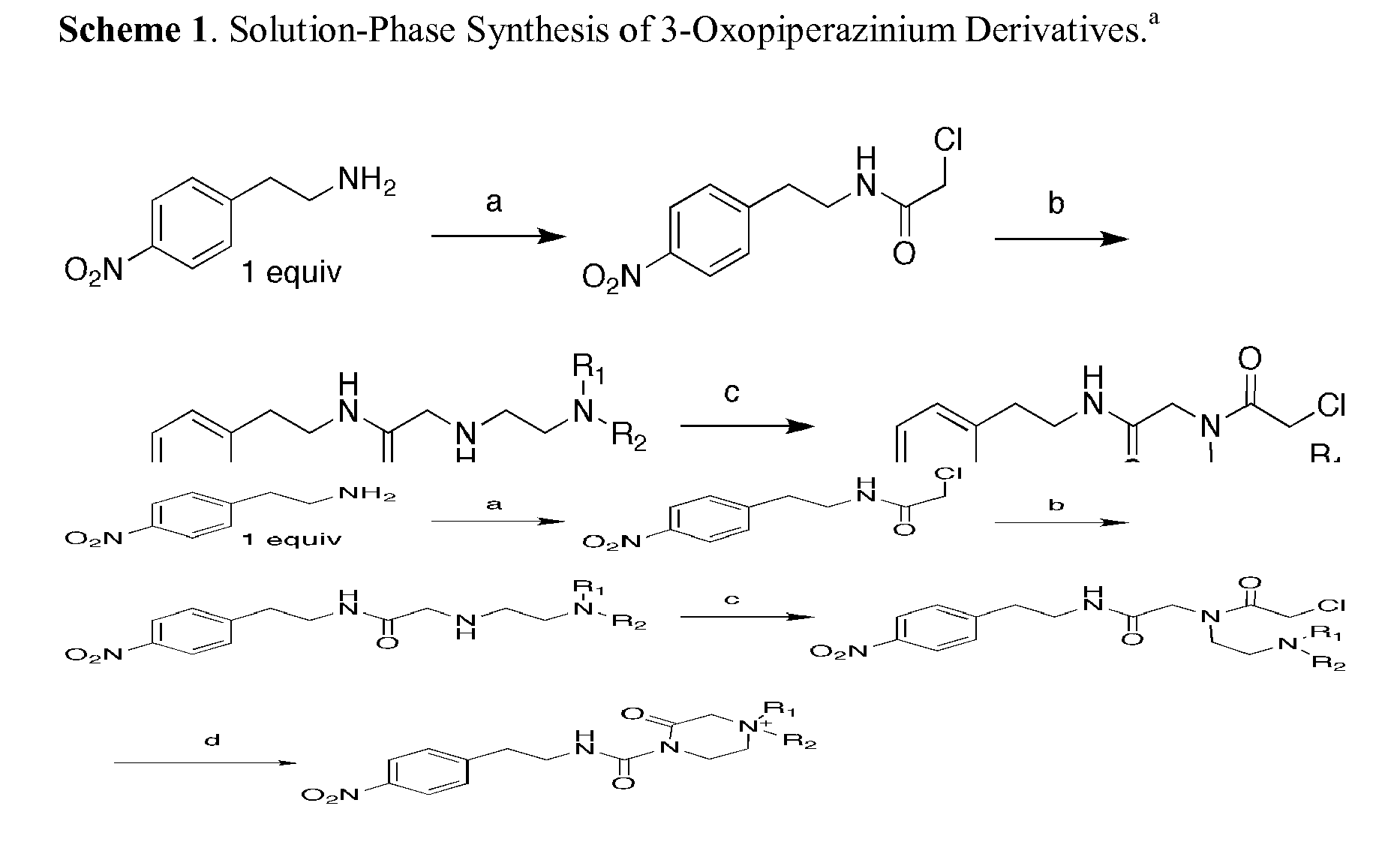
- The individual tetraalkylammonium salts A26-23 and A26-64 for the in vivo assays were prepared similary to the corresponding library, but improving each step in order to achieve the highest yields and purities. In the case of A26-64, it was necessary to prepare N-benzyl-N-methylethane-1,2-diamine. This compound was obtained from the corresponding alcohol precursor by the Mitsunobu procedure, followed by hydrazinolysis. (Sen, S. et al, 1995).
- Synthesis of N-benzyl-N-methylethane-1,2-diamine. To a solution of N-benzyl-N-methylethanolamine (7.31 mL, 40.5 mmol), phtalimide (6.62 g, 44.5 mmol), and triphenyl phosphine (14 g, 52.65 mmol) in anhydrous THF (240 mL), cooled at 0 °C, diisopropyl diazacarboxylate (12.73 mL, 60.75 mmol) was added dropwise in the absence of ligth. The mixture was stirred for 15 h at 20°C and then the solvent was removed under reduced pressure. The expected phtalimide derivative was isolated in 80% yield (70% purity) after repeated treatment with 1:1 AcOEt:Et2O mixtures to remove Ph3P and Ph3PO by preciptation. The phtalimide derivative (16.8 g, 39 mmol) was redissolved in absolute ethanol (200 mL) treated with hydrazine hydrate (9.7 mL, 195 mmol), and the mixture was stirred for 6 h at 80 °C. The crude reaction mixture was acidified with 1.5 N HCl and the resulting suspension was filtered. The solvents were removed under reduced pressure, the residue was redissolved in CH2Cl2 and the amine was extracted with 1.5 N HCl. This acid solution was taken to pH with NaOH and extracted with CH2Cl2. The combined organic fractions were washed (brine), dried (MgSO4) and concentrated in vacuo. The N -benzyl-N-methylethane-1,2-diamine was purified by vacuum distillation as a colorless oil (4.3 g, 88% yield, 95% purity). 1H NMR (300 MHz, CDCl3) ∂ 7.3-7.2 (ca, 5H, HAr), 3.50 (s, 2H, NCH 2Ph), 2.79 (t, 3 J HH=6 Hz, 2H, CH 2NH2), 2.45 (t, 3 J HH=6 Hz, 2H, CH 2 N), 2.20 (s, 3H, CH 3 N), 1.62 (NH2); 13C NMR (75 MHz, CDCl3) ∂ 128.9 (CHAr, 2,6-CH), 128.2 (CHAr, 3,5-CH), 126.9 (CHAr, 4-CH), 62.6 (NCH2Ph), 60.0 (CH2N), 42.1 (CH3N), 39.5 (CH2NH2); HRMS calcd for C10H16N2 165.1392 (M + H)+, found 165.1390.
- Synthesis of N-(4-nitrophenethyl)-2-chloroacetamide. A suspension of 2-(4-nitrophenyl)ethylamine hydrochloride (3.5 g, 17 mmol) in 30 mL anhydrous CH2Cl2 was stirred with N,N-diisopropylethylamine (2.94 mL, 17 mmol). Chloroacetic acid (1.60 g mmol, 17.0 mmol) in 10 mL anhidride DCM was added dropwise to the stirred solution containing the free amine maintained at 0 °C and under argon atmosphere, followed by the addition of (N,N'-diisopropylcarbodiimide, 2.93 mL, 18.7 mmol) and 1-hydroxybenzotriazole hydrate (2.3 g, 18.7 mmol). Then, the mixture was stirred for 2 h at 20 °C. The crude reaction mixture was cooled at 0 °C, filtered and washed with 2 N HCl, brine and dried. Elimination of solvent yielded the expected N-substituted chloroacetamide (7.4 g, 90% yield, 95% purity). 1H NMR (300 MHz, CDCl3) ∂ 8.18 (d, 3 J HH=8.5 Hz, 2H, 3,5-H C6H4NO2), 7.37 (d, 3 J HH=8.5 Hz, 2H, 2,6-H C6H4NO2), 6.64 (s, 1H, NH), 4.04 (s, 2H, COCH 2Cl), 3.61 (q, 3 J HH=7 Hz, 2H, CH 2NH), 2.97 (t, 3 J HH=7 Hz, 2H, CH 2CH2NH); 13C NMR (75 MHz, CDCl3) ∂ 165.3 (NHCO), 146.9 (1,4-C C6H4NO2), 129.6 (2,6-CH C6H4NO2), 123.9 (3,5-CH C6H4NO2), 43.5 (CH2Cl), 40.8 (CH2NH), 35.4 (CH2CH2NH).
- Coupling of N,N'-dimethylethylenediamine. A mixture of the N-substituted chloroacetamide (2.97 g, 11.6 mmol), N,N'-dimethylethylenediamine (7.1 mL, 62 mmol) and N,N-diisopropylethylamine (4.3 mL, 24.7 mmol) in dioxane (25 mL) was allowed to react under microwave irradiation with the CEM reactor equipped with a Dimroth condenser (10 min, 80 °C, 150 W). Then the solvent was removed under reduced pressure to give the corresponding glycinamide (5.05 g crude, 98% yield, 71% purity by HPLC). 1H NMR (400 MHz, (CD3)2O) ∂ 8.17 (d, 3 J HH=8.5 Hz, 2H, 3,5-H C6H4NO2), 7.57 (d, 3 J HH=8.5 Hz, 2H, 2,6-H C6H4NO2), 3.43 (q, 3 J HH=7 Hz, 2H, CH2 CH 2 NH), 3.15 (s, 2H, COCH 2 NH), 3.03 (t, 3 J HH=7 Hz, 2H, CH 2 CH2NH), 2.76 (t, 3 J HH=7 Hz, 2H, NHCH 2 CH2N), 2.48 (s, 6H, 2 x CH3N), 2.25 (t, 3 J HH=7 Hz, 2H, NHCH2 CH 2 N); 13C NMR (75 MHz, CDCl3) ∂ 165.3 (NHCO), 146.9 (1,4-C C6H4NO2), 129.6 (2,6-CH C6H4NO2), 123.8 (3,5-CH C6H4NO2), 58.8 (CH2 CH2N), 52.6 (COCH2NH), 47.4 (CH2CH2N), 45.5 (2 x CH3N), 39.7 (CH2 CH2NH), 35.8 (CH2CH2NH). Underlined atoms are the ones responsible of RMN signals detected herein.
- Acylation of the glycinamide and final cyclization. Chloroacetyl chloride (1.41 mL, 17.75 mmol) was added to a stirred suspension of the glycinamide intermediate (5.0 g, 12.07 mmol) in anhydrous CH2Cl2 (20 mL) at 0 °C, and the mixture was stirred for 1 h, filtered and evaporated to dryness (7.4 g crude, 57% purity). The residue was redissolved in a 2:1 mixture of DCM/MeOH (50 mL), and the solution was treated with basic aluminum oxide (20 % w/w) for 15 h at 20 °C. The crude reaction mixture was filtered, and the solvent was removed to give the expected product as solid. The compound was washed by using subsequent mixtures of solvents to yield 1.6 g of the cyclic tetraalkylammonium compound (36% overall yield from starting amine, 95% purity). 1H NMR (500 MHz, D2O) ∂ 8.17 (d, 3 J HH=8.5 Hz, 2H, 3,5-H C6H4NO2), 7.46 (d, 3 J HH=8.5 Hz, 2H, 2,6-H C6H4NO2), 4.22 (s, 2H, COCH 2N+), 4.11 (s, 2H, COCH 2N), 3.84 (t, 3 J HH=6 Hz, 2H, NCH 2CH2N+) , 3.72 (t, 3 J HH=6 Hz, 2H, NCH2 CH 2N+), 3.55 (t, 3 J HH=7 Hz, 2H, CH2 CH 2NH), 3.31 (s, 6H, 2 x CH 3N+), 2.95 (t, 3 J HH=7 Hz, 2H, CH 2CH2NH); 13C NMR (100 MHz, D2O) ∂ 168.9 (NHCO), 162.4 (NCO), 147.8 (1-C C6H4NO2), 146.5 (4-C C6H4NO2), 130.1 (2,6-CH C6H4NO2), 123.8 (3,5-CH C6H4NO2), 57.3 (COCH2N+), 52.5 (2 x CH3N+), 49.0 (CH2CH2N+), 42.9 (COCH2N), 40.2 (CH2CH2N+), 35.8 (CArCH2 CH2), 34.8 (CAr CH2CH2); HRMS calcd for C16H23N4O4 + 335.1714 (M)+, found 335.1714.
- Coupling of N-benzyl-1-methylethane-1,2-diamine. To a solution of the N-substituted chloroacetamide (1,01 g, 3.95 mmol) in anhydrous dioxane (20 mL), it was added N-benzyl-N-methylethane-1,2-diamine (0.64 mL, 4.2 mmol), anhydrous CsCO3 (14 g, 43 mmol) and activated molecular sieves (Type A4). The mixture was allowed to react under microwave irradiation for 2 h by subsequent cycles of 10 min at 90 °C (150 W). The crude reaction mixture was filtered and the solid was washed with dioxane. Final product was isolated after elimination of solvent under vacuum (3.52 g, 77% yield, 60% purity). 1H NMR (500 MHz, (CDCl3) ∂ 8.16 (d, 3 J HH = 8.5 Hz, 2H, 3,5-H C6H4NO2), 7.56 (t, 3 J HH = 7.5 Hz, 1H, 4-H C6H5), 7.34 (d, 3 J HH = 8.5 Hz, 2H, 2,6-H C6H4NO2), 7.32-7.27 (4H, 2,3,5,6-H C6H5), 3.71 (s, 2H, NCH2Ph), 3.55 (q, 3 J HH = 7 Hz, 2H, CH2 CH 2NH), 3.18 (s, 2H, COCH 2 NH), 2.93 (t, 3 J HH = 7 Hz, 2H, CH 2CH2NH), 2.58 (t, 3 J HH = 5.5 Hz, 2H, NHCH 2 CH2N), 2.41 (t, 3 J HH = 5.5 Hz, 2H, NHCH2 CH 2 N), 2.18 (s, 3H, CH3N).
- Acylation of the glycinamide and final cyclization. Acylation of this glycinamide was carried out as described for A26-23 to give 3.82 g of the crude product (88% yield, 58% purity). This crude was redissolved in 30 mL of a 2:1 DCM:MeOH mixture and treated with basic aluminum oxide (20 % w/w). The cyclization was performed under microwave activation for 20 min (30 °C, 150 W). The crude reaction mixture was filtered and concentrated under vacuum to give the expected product as as a solid. Purification was accomplished by extractions and reprecipitation in different solvents. Finally, 1.57 g, of the cyclic tetraalkylammonium compound were isolated (80% overall yield from starting amine, 95% purity). 1H NMR (500 MHz, D2O) ∂ 8.16 (d, 3 J HH=8.5 Hz, 2H, 3,5-H C6H4NO2), 7.62 (tt, 3 J HH=7.5 Hz, |4 J HH|=2.5 Hz, 1H, 4-H C6H5), 7.57 (tt, 3 J HH=7.5 Hz, 2H, 3,5-H C6H5), 7.54 (tt, 3 J HH=7.5 Hz, 2H, 2,6-H C6H5), 7.45 (d, 3 J HH=8.5 Hz, 2H, 2,6-H C6H4NO2), 4.73 (d, |2 J HH|=13 Hz, 1H, NCH a ,bPh), 4.65 (d, |2 J HH|=13 Hz, 1H, NCH a ,b Ph), 4.26 (d, |2 J HH|=16.5 Hz, 1H, COCH a ,bN+), 4.06 (d, |2 J HH|=16.5 Hz, 1H, COCHa,b N+), 4.10 (d, |2 J HH|=3 Hz, 2H, COCH 2 N), 3.82-3.7 (4H, NCH 2 CH2N+ + NCH2 CH 2 N+), 3.54 (t, 3 J HH=6.5 Hz, 2H, CH2 CH 2NH), 3.18 (s, 3H, CH 3N+), 2.94 (t, 3 J HH=6.5 Hz, 2H, CH 2CH2NH); 13C NMR (100 MHz, D2O) ∂ 168.8 (NHCO), 162.5 (NCO), 147.8 (1-C C6H4NO2), 146.4 (4-C C6H4NO2), 133.1 (2,6-CH C6H5), 131.4 (1-CH C6H5), 130.1 (2,6-CH C6H4NO2), 129.5 (3,5-CH C6H5), 125.6 (4-C C6H5), 123.7 (3,5-CH C6H4NO2), 69.0 (COCH2N+), 59.6 (CH2 C6H5), 54.8 (COCH2N), 48.9 (CH3N+), 47.9 (CH2 CH2N+), 42.6 (CH2CH2N+), 40.1 (CArCH2 CH2), 34.8 (CAr CH2CH2); HRMS calcd for C22H27N4O4 + 411.2027 (M)+, found 411.2028.
-
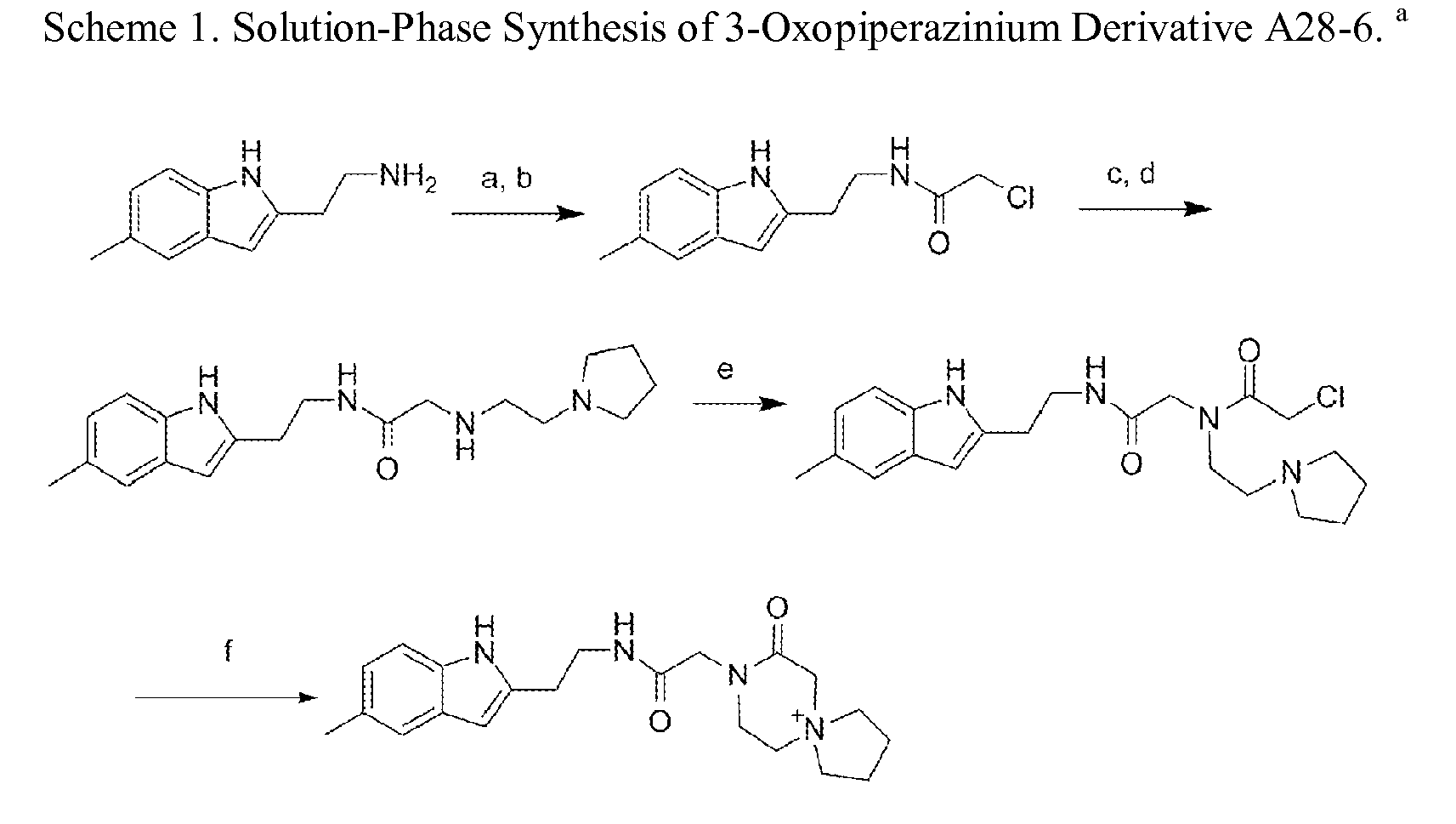
- Synthesis of 8-[2-(2-(5-methyl-1H-indol-2-yl)ethylamino)-2-oxoethyl]-7-oxo-8-aza-5-azoniaspiro[4.5]decane. (A28-A6). The individual tetraalkylammonium salt A28-A6 was obtained from the preparation of the library of tetraalkylammonium derivatives. The synthetic procedure involved a 6-step sequence carried out in solution, along with the use of solid-phase linked scavengers and microwave activation for the rapid removal of the excess of amine reagents.
- Synthesis of N-(5-methyltryptamine)-2-chloroacetamide. Chloroacetyl chloride (16 µL, 0.2 mmol) was added dropwise to a stirred suspension of 5-methyltryptamine (52.3 mg, 0.3 mmol, 1.5 equivalents) and K2CO3 (55.3 mg, 0.4 mmol) in anhydrous CH2Cl2 maintained at 0 °C. The mixture was stirred at this temperature for 30 min, filtered and evaporated to render a residue which was redissolved in dioxane (0.5 mL) and treated with the 4-benzyloxybenzaldehyde polystyrene resin (Wang aldehyde HL) (0.35 mmol, 3.5 equivalents relative to the amine, 2.8 mmol/g). The reaction mixture was placed in a domestic microwave and irradiated (350 W) for 40 min at 4-min intervals. The crude reaction mixture was filtered, and the resin was washed with dioxane (2 mL) and CH2Cl2 (3 x 2 mL). The filtrate was evaporated to afford the corresponding N-substituted chloroacetamide.
- Coupling of the 2-(pyrrolidin-1-yl)ethanamine (A6). The residue obtained was dissolved in dioxane (2 mL) and treated with the 2-(pyrrolidin-1-yl)ethanamine (76 µL, 0.6 mmol) and K2CO3 (55.3 mg, 0.4 mmol). The mixture was stirred at 90 °C for 3 h, filtered, and concentrated to 1 mL. This solution was treated with the Wang aldehyde HL resin (1.2 mmol, 3 equivalents relative to the amine, 2.8 mmol/g) for 20 min in the microwave oven (4-min intervals). The resin was filtered and washed with dioxane (2 mL) and CH2Cl2 (3 x 2 mL). The filtrate was evaporated to obtain the glycinamide.
- Acylation of the glycinamide. Chloroacetyl chloride (16 µL, 0.2 mmol) was added to a stirred suspension of the glycinamide and K2CO3 (55.3 mg, 0.4 mmol) in CH2Cl2 (2.5 mL) at 0 °C, and the mixture was stirred for 30 min, filtered and evaporated to dryness.
- Cyclization. The former residue was redissolved in a 2:1 mixture of CH2Cl2/MeOH (2 mL), and the solution was treated with basic aluminum oxide for 1 h at 20 °C. The crude reaction mixture was filtered, and the solvent was removed to give the corresponding cyclic tetraalkylammonium compound (57% overall yield from starting amine, 65% purity determined by HPLC-UV). The compound was identified by HPLC-MS.
- PC 12 cell differentiation was measured by plating cells onto collagen-coated 24-wells plates. NGF (100 ng/ml) or the small chemicals at different concentrations were added and the percentage of cells with neurite processes greater than two cell bodies in length were counted after relevant treatment. For each experiment at least 300 cells were randomly measured (Burstein and Greene, 1978).
- Cell culture. PC12 cells were maintained at 37°C in DMEM supplemented with 2.5% FBS, 15% of Horse serum (HS) and penicillin/streptomycin in a humidified 5% CO2 incubator. The cells were grown on 60-and 100-mm tissue culture dishes (Becton Dickinson).
- PC 12 cells were cultured for 3 days in the presence of the peptoids (from 2 ng/ml to 50 µg/ml) under reduced serum conditions (0.5% FBS and 1% HS). The peptoids A26-23, A26-24 and A28-A6 (
Figure 1 ) were found to induce the differentiation of PC12 cells at different concentrations to an extent substantially comparable with that induce by NGF (Foehr et al., 2000) and showing a dose-response activity. - Compounds identified from the initial library screening were also tested to assess their capacity to promote cell survival. To delineate p75 signalling independent of TrkA, we used a rat schwannoma cell line (RN22) expressing p75, but not TrkA, (Gentry et al., 2000).
- Cell culture. The rat schawnnoma cell line RN22 was cultured in 5% CO2 at 37°C in Dulbecco's modified Eagle's medium (DMEM) with 10% fetal bovine serum (FBS) and penicillin/streptomycin.
- RN22 cells were plated at 20,000 cells/well on a 24-well plate in DMEM alone and after allowing the cells to adhere for 3 days, cupper sulphate (CuSO4) (150 µM) was added with or without NGF (100 ng/ml) or the peptidomimetic molecules A26-23, A26-24 and A28-A6 at different concentrations (1 ng/ml - 10 µg/ml) to generate stress and cell death. After 24 h cell viability was studied by determining the amount of yellow MTT (Sigma) that was reduced to insoluble purple formazan. After removing the medium, the water-insoluble formazan was solubilised with DMSO (Sigma), and the dissolved material was measured spectrophotometrically at a wavelength of 570 nm, subtracting the background at 650 nm (Frade, 2005).
- After 24 h, cell viability was tested and peptidomimetic compounds A26-23, A26-24 and A28-A6 were found not to promote survival of RN22 cells at different concentrations (
Figure 2 ), hence indicating that the effects of these peptidomimetics are not exerted via p75 receptor. -
- Aloe L, Calzá L (2004) Progress in brain research. Vol 146, NGF and related molecules in health and diseases. Amsterdam: Elsevier.
- Anand P. Neurotrophic factors and their receptors in human sensory neuropathies. Prog Brain Res. 2004;146:477-92.
- Apfel S (2002) Nerve growth factor for the treatment of diabetic neuropathy: what went wrong, what went right, and what does the future hold? Int Rev Neurobiol 50:393-413.
- Barker P (1998) p75NTR: A study in contrasts. Cell Death Differ 5:346-356.
- Bhakar A, Howell J, Paul C, Salehi A, Becker E, Said F, Bonni A, Barker P (2003) Apoptosis induced by p75NTR overexpression requires Jun kinase-dependent phosphorylation of Bad. J Neurosci 23:11373-11381.
- Burstein D, Greene L (1978) Evidence for RNA synthesis-dependent and - independent pathways in stimulation of neurite outgrowth by nerve growth factor. Proc Natl Acad Sci U S A 75:6059-6063.
- Chao M (2003) Neurotrophins and their receptors: a convergence point for many signalling pathways. Nat Rev Neurosci 4:299-309.
- Faden AI, Stoica B. Neuroprotection: challenges and opportunities. Arch Neurol. 2007 Jun;64(6):794-800.
- Foehr E, Lin X, O'Mahony A, Geleziunas R, Bradshaw R, Greene W (2000) NF-kappa B signaling promotes both cell survival and neurite process formation in nerve growth factor-stimulated PC 12 cells. J Neurosci 20:7556-7563.
- Frade J (2005) Nuclear translocation of the p75 neurotrophin receptor cytoplasmic domain in response to neurotrophin binding. J Neurosci 25:1407-1411.
- Gentry J, Casaccia-Bonnefil P, Carter B (2000) Nerve growth factor activation of nuclear factor kappaB through its p75 receptor is an anti-apoptotic signal in RN22 schwannoma cells. J Biol Chem 275:7558-7565.
- Ghosh S, May M, Kopp E (1998) NF-kappa B and Rel proteins: evolutionarily conserved mediators of immune responses. Annu Rev Immunol 16:225-260.
- Greene L, Tischler A (1976) Establishment of a noradrenergic clonal line of rat adrenal pheochromocytoma cells which respond to nerve growth factor. Proc Natl Acad Sci U S A 73:2424-2428.
- Hellweg R, Ziegenhorn A, Heuser I, Deuschle M. Serum concentrations of nerve growth factor and brain-derived neurotrophic factor in depressed patients before and after antidepressant treatment. Pharmacopsychiatry. 2008 Mar;41 (2):66-71.
- Huang E, Reichardt L (2003) Trk receptors: roles in neuronal signal transduction. Annu Rev Biochem 72:609-642. Epub 2003 Mar 2027.
- Kaplan D, Miller F (2000) Neurotrophin signal transduction in the nervous system. Curr Opin Neurobiol 10:381-391.
- Levi-Montalcini R (1987) The nerve growth factor 35 years later. Science 237:1154-1162.
- Lewin G, Barde Y (1996) Physiology of the neurotrophins. Annu Rev Neurosci 19:289-317.
- Longo F, Manthorpe M, Xie Y, Varon S (1997) Synthetic NGF peptide derivatives prevent neuronal death via a p75 receptor-dependent mechanism. J Neurosci Res 48:1-17.
- Longo FM, Yang T, Knowles JK, Xie Y, Moore LA, Massa SM. Small molecule neurotrophin receptor ligands: novel strategies for targeting Alzheimer's disease mechanisms. Curr Alzheimer Res. 2007 Dec;4(5):503-6.
- Maliartchouk S, Debeir T, Beglova N, Cuello A, Gehring K, Saragovi H (2000a) Genuine monovalent ligands of TrkA nerve growth factor receptors reveal a novel pharmacological mechanism of action. J Biol Chem 275:9946-9956.
- Maliartchouk S, Feng Y, Ivanisevic L, Debeir T, Cuello A, Burgess K, Saragovi H (2000b) A designed peptidomimetic agonistic ligand of TrkA nerve growth factor receptors. Mol Pharmacol 57:385-391.
- Martinez-Forero I, Garcia-Munoz R, Martinez-Pasamar S, Inoges S, Lopez-Diaz de Cerio A, Palacios R, Sepulcre J, Moreno B, Gonzalez Z, Fernandez-Diez B, Melero I, Bendandi M, Villoslada P (2008) IL-10 suppressor activity and ex vivo Tr1 cell function are impaired in multiple sclerosis. Eur J Immunol 38:576-586.
- Masip, I.; Ferrándiz-Huertas, C.; Garcia-Martinez, C.; Ferragut, J.; Ferrer-Montiel, A.; Messeguer, A. Synthesis of a Lybrary of 3-Oxopiperazinium and Perhydro-3-oxo-1,4-diazepinium Derivatives and Identification of Bioactive Compounds. J. Comb. Chem. 2004, 6, 135-141.
- Miller S, Simon R, NG S, Zuckermann R, Kerr J, Moos W (1994) Bioorg Med Chem Letter 4:2657-2662.
- Moreno B, Hevia H, Santamaria M, Sepulcre J, Munoz J, Garcia-Trevijano E, Berasain C, Corrales F, Avila M, Villoslada P (2006) Methylthioadenosine reverses brain autoimmune disease. Ann Neurol 60:323-334.
- Palacios R, Comas D, Elorza J, Villoslada P (2008) Genomic regulation of CTLA4 and multiple sclerosis. J Neuroimmunol 203:108-115.
- Peleshok J, Saragovi H (2006) Functional mimetics of neurotrophins and their receptors. Biochem Soc Trans 34:612-617.
- Poduslo J, Curran G (1996) Permeability at the blood-brain and blood-nerve barriers of the neurotrophic factors: NGF, CNTF, NT-3, BDNF. Brain Res Mol Brain Res 36:280-286.
- Price RD, Milne SA, Sharkey J, Matsuoka N. Advances in small molecules promoting neurotrophic function. Pharmacol Ther. 2007 Aug;115(2):292-306.
- Rabizadeh S, Ye X, Wang J, Bredesen D (1999) Neurotrophin dependence mediated by p75NTR: contrast between rescue by BDNF and NGF. Cell Death Differ 6:1222-1227.
- Saragovi H, Zaccaro M (2002) Small molecule peptidomimetic ligands of neurotrophin receptors, identifying binding sites, activation sites and regulatory sites. Curr Pharm Des 8:2201-2216.
- Schulte-Herbrüggen O, Braun A, Rochlitzer S, Jockers-Scherübl MC, Hellweg R. Neurotrophic factors--a tool for therapeutic strategies in neurological, neuropsychiatric and neuroimmunological diseases? Curr Med Chem. 2007;14(22):2318-29.
- Sen, S., Roach, S. A convenient Two-step procedure for the Synthesis of Substituted Allylic amines from Allylic Alcohols. Synthesis, 1995, 756-758.)
- Shi Z, Birman E, Saragovi HU. Neurotrophic rationale in glaucoma: a TrkA agonist, but not NGF or a p75 antagonist, protects retinal ganglion cells invivo. Dev Neurobiol. 2007 Jun;67(7):884-94.
- Shoval G, Weizman A. The possible role of neurotrophins in the pathogenesis and therapy of schizophrenia. Eur Neuropsychopharmacol. 2005 May;15(3):319-29.
- Vajda FJ. Neuroprotection and neurodegenerative disease. J Clin Neurosci. 2002 Jan;9(1):4-8.
- Villoslada P, Genain C (2004) Role of nerve growth factor and other trophic factors in brain inflammation. Prog Brain Res 146:403-414.
- Villoslada P, Abel K, Heald N, Goertsches R, Hauser S, Genain C (2001) Frequency, heterogeneity and encephalitogenicity of T cells specific for myelin oligodendrocyte glycoprotein in naive outbred primates. Eur J Immunol 31:2942-2950.
- Villoslada P, Hauser S, Bartke I, Unger J, Heald N, Rosenberg D, Cheung S, Mobley W, Fisher S, Genain C (2000) Human nerve growth factor protects common marmosets against autoimmune encephalomyelitis by switching the balance of T helper cell type 1 and 2 cytokines within the central nervous system. J Exp Med 191:1799-1806.
- Williams B, Eriksdotter-Jonhagen M, Granholm A (2006) Nerve growth factor in treatment and pathogenesis of Alzheimer's disease. Prog Neurobiol 80:114-128. Epub 2006 Nov 2002.
- Youdim MB, Buccafusco JJ. Multi-functional drugs for various CNS targets in the treatment of neurodegenerative disorders. Trends Pharmacol Sci. 2005 Jan;26(1):27-35.
- Yoon S, Casaccia-Bonnefil P, Carter B, Chao M (1998) Competitive signaling between TrkA and p75 nerve growth factor receptors determines cell survival. J Neurosci 18:3273-3281.
- Zaccaro M, Ivanisevic L, Perez P, Meakin S, Saragovi H (2001) p75 Co-receptors regulate ligand-dependent and ligand-independent Trk receptor activation, in part by altering Trk docking subdomains. J Biol Chem 276:31023-31029.
Claims (21)
- A compound of formula I:


or form together with the 3-oxopiperazinium ring a fused azoniasapiro [4,5] decane heterocycle;
and pharmaceutically acceptable salts and/or prodrugs thereof. - A compound of Formula I, according to claim 1, wherein when

or R2 is CH3 and R3 is
- A compound of Formula I, according to claim 1, wherein when R1 is

and pharmaceutically acceptable salts and/or prodrugs thereof. - A compound according to any of the claims 1-3, selected among


- The compounds of claims 1 to 4 for use as medicaments.
- The compounds according to claim 5 for use as medicaments useful in the prevention or treatment of nerve cell death or damage.
- The compounds according to claim 5 wherein the medicament is a neuroprotective drug.
- The compounds according to claim 5 wherein the medicament is useful in the regeneration of nerve cells.
- The compounds according to claim 5 wherein the medicament is a neuroenhancing drug.
- The compounds according to claim 5 wherein the medicament is useful in the prevention or treatment of a neurological or psychiatric disease.
- The compounds according to claim 5 wherein the medicament is useful in the prevention or treatment of a disease selected from: neurological diseases, preferentially neurodegenerative disorders, such as amyotrophic lateral sclerosis (ALS), Parkinson's disease, Alzheimer's disease, Friedreich's ataxia, Huntington's disease, Dementia with Lewy bodies, spinal muscular atrophy; nerve inflammation, such as multiple sclerosis, neuromyelitis optica, major depressive disorder, schizophrenia, glaucoma; or peripheral neuropathies, such as diabetic or AIDS neuropathy; and cancer, such as glioblastoma, astrocytoma, meduloblastoma, neurinoma, neuroblastoma, meningioma, colon cancer, pancreatic cancer, breast cancer, prostate cancer, leukemia, acute lymphocytic leukemia , osteosarcoma, hepatocellular carcinoma, ovarian carcinoma, lung adenocarcinoma , esophagic carcinoma.
- Pharmaceutical compositions comprising a therapeutically effective amount of at least one of the compounds of claims 1 to 4 or combinations thereof and further comprising, optionally, at least one pharmaceutically acceptable non-active ingredient, preferably at least one excipient and/or carrier.
- Use of the compounds of claims 1 to 4 as active ingredients in the manufacture of a medicament for the prevention or treatment of nerve cell death or damage.
- Use of the compounds of claims 1 to 4 as active ingredients in the manufacture of a neuroprotective medicament.
- Use of the compounds of claims 1 to 4 as active ingredients in the manufacture of a medicament for the regeneration of nerve cells.
- Use of the compounds of claims 1 to 4 as active ingredients in the manufacture of a medicament for the prevention or treatment of a neurological or psychiatric disease
- Use of the compounds of claims 1 to 4 as active ingredients in the manufacture of a medicament for the prevention or treatment of a disease selected from: neurological diseases, preferentially neurodegenerative disorders, such as amyotrophic lateral sclerosis (ALS), Parkinson's disease, Alzheimer's disease, Friedreich's ataxia, Huntington's disease, Dementia with Lewy bodies, spinal muscular atrophy; nerve inflammation, such as multiple sclerosis, neuromyelitis optica, major depressive disorder, schizophrenia, glaucoma; or peripheral neuropathies, such as diabetic or AIDS neuropathy; and cancer, such as glioblastoma, astrocytoma, meduloblastoma, neurinoma, neuroblastoma, meningioma, colon cancer, pancreatic cancer, breast cancer, prostate cancer, leukemia, acute lymphocytic leukemia , osteosarcoma, hepatocellular carcinoma, ovarian carcinoma, lung adenocarcinoma , esophagic carcinoma.
- A method of prevention or treatment of nerve cell death or damage comprising administering to a subject in need thereof an effective amount of the compounds of claims 1 to 4; or of the pharmaceutical compositions of claim 12.
- A method of neuroprotection comprising administering to a subject in need thereof an effective amount of the compounds of claims 1 to 4; or of the pharmaceutical compositions of claim 12.
- A method of regenerating nerve cells comprising administering to a subject in need thereof an effective amount of the compounds of claims 1 to 4; or of the pharmaceutical compositions of claim 12.
- A method of prevention or treatment of a disease comprising administering to a subj ect in need thereof an effective amount of the compounds of claims 1 to 4; or of the pharmaceutical compositions of claim 12, wherein the disease is selected from: neurological diseases, preferentially neurodegenerative disorders, such as amyotrophic lateral sclerosis (ALS), Parkinson's disease, Alzheimer's disease, Friedreich's ataxia, Huntington's disease, Dementia with Lewy bodies, spinal muscular atrophy; nerve inflammation, such as multiple sclerosis, neuromyelitis optica, major depressive disorder, schizophrenia, glaucoma; or peripheral neuropathies, such as diabetic or AIDS neuropathy; and cancer, such as glioblastoma, astrocytoma, meduloblastoma, neurinoma, neuroblastoma, meningioma, colon cancer, pancreatic cancer, breast cancer, prostate cancer, leukemia, acute lymphocytic leukemia, osteosarcoma, hepatocellular carcinoma, ovarian carcinoma, lung adenocarcinoma, esophagic carcinoma.
Priority Applications (2)
| Application Number | Priority Date | Filing Date | Title |
|---|---|---|---|
| EP09169036A EP2289882A1 (en) | 2009-08-31 | 2009-08-31 | 3-oxopiperazinium derivatives as agonists of nerve growth factor and their use as medicaments |
| PCT/IB2010/002340 WO2011024078A1 (en) | 2009-08-31 | 2010-08-31 | 3 -oxopiperazinium derivatives as agonists of nerve growth factor and their use as medicaments |
Applications Claiming Priority (1)
| Application Number | Priority Date | Filing Date | Title |
|---|---|---|---|
| EP09169036A EP2289882A1 (en) | 2009-08-31 | 2009-08-31 | 3-oxopiperazinium derivatives as agonists of nerve growth factor and their use as medicaments |
Publications (1)
| Publication Number | Publication Date |
|---|---|
| EP2289882A1 true EP2289882A1 (en) | 2011-03-02 |
Family
ID=42289163
Family Applications (1)
| Application Number | Title | Priority Date | Filing Date |
|---|---|---|---|
| EP09169036A Withdrawn EP2289882A1 (en) | 2009-08-31 | 2009-08-31 | 3-oxopiperazinium derivatives as agonists of nerve growth factor and their use as medicaments |
Country Status (2)
| Country | Link |
|---|---|
| EP (1) | EP2289882A1 (en) |
| WO (1) | WO2011024078A1 (en) |
Cited By (1)
| Publication number | Priority date | Publication date | Assignee | Title |
|---|---|---|---|---|
| CN114945575A (en) * | 2019-11-13 | 2022-08-26 | 英联邦高等教育系统坦普尔大学 | Novel functionalized lactones as 5-hydroxytryptamine receptor 7 modulators and methods of use thereof |
Families Citing this family (3)
| Publication number | Priority date | Publication date | Assignee | Title |
|---|---|---|---|---|
| HUE029393T2 (en) | 2010-08-31 | 2017-03-28 | Bionure Farma S L | Agonists of neurotrophin receptors and their use as medicaments |
| KR101861081B1 (en) * | 2015-08-05 | 2018-05-28 | 인제대학교 산학협력단 | Composition for Preventing or Treating Inflammatory Disease, Allergic Disease or Cancer Comprising Melatonin Derivative |
| WO2023141212A1 (en) | 2022-01-24 | 2023-07-27 | Apple Inc. | User interfaces for indicating time |
Citations (1)
| Publication number | Priority date | Publication date | Assignee | Title |
|---|---|---|---|---|
| WO2001002372A1 (en) * | 1999-07-06 | 2001-01-11 | Vertex Pharmaceuticals Incorporated | Cyclized amino acid derivatives |
-
2009
- 2009-08-31 EP EP09169036A patent/EP2289882A1/en not_active Withdrawn
-
2010
- 2010-08-31 WO PCT/IB2010/002340 patent/WO2011024078A1/en not_active Ceased
Patent Citations (1)
| Publication number | Priority date | Publication date | Assignee | Title |
|---|---|---|---|---|
| WO2001002372A1 (en) * | 1999-07-06 | 2001-01-11 | Vertex Pharmaceuticals Incorporated | Cyclized amino acid derivatives |
Non-Patent Citations (47)
Cited By (1)
| Publication number | Priority date | Publication date | Assignee | Title |
|---|---|---|---|---|
| CN114945575A (en) * | 2019-11-13 | 2022-08-26 | 英联邦高等教育系统坦普尔大学 | Novel functionalized lactones as 5-hydroxytryptamine receptor 7 modulators and methods of use thereof |
Also Published As
| Publication number | Publication date |
|---|---|
| WO2011024078A1 (en) | 2011-03-03 |
Similar Documents
| Publication | Publication Date | Title |
|---|---|---|
| EP2611775B1 (en) | Agonists of neurotrophin receptors and their use as medicaments | |
| EP2289886A1 (en) | Peptoid agonists of nerve growth factor and their use as medicaments | |
| US6492553B1 (en) | Methods for preparing N-[(aliphatic or aromatic)carbonyl)]-2-aminoaetamide compounds and for cyclizing such compounds | |
| AU747987B2 (en) | Method for preparing an N-((aliphatic or aromatic)carbonyl)-2-aminoacetamide compound and a cyclyzed compound | |
| US8013170B2 (en) | Substituted pyrrolo[1,2-d][1,4]-diazonines and treatment of brain damage | |
| WO2011024078A1 (en) | 3 -oxopiperazinium derivatives as agonists of nerve growth factor and their use as medicaments | |
| CA3239040A1 (en) | Analogues of mdma for modulating sert, dat, and / or net activity | |
| EP3171941B1 (en) | N-methyl-d-aspartate receptor modulators and methods of making and using same | |
| T CAMENTS | neuroprotection is to prevent or minimize the effects of an original damage to the nervous system, or to prevent or minimize the consequences of endogenous or | |
| CN104761572A (en) | Flueggea suffruticosa-type alkaloid dimer-type compound or pharmaceutically acceptable salt thereof, preparation method and application thereof | |
| Moreno et al. | 3-Oxopiperazinium derivatives as agonists of nerve growth factor and their use as medicaments | |
| IL263486A (en) | Co-crystals of lithium benzoate and uses thereof | |
| KR20040012396A (en) | Constituents of Beauveria bassiana 101A having enhancement of the neurite outgrowth and pharmaceutical composition containing the same | |
| HRP20010118A2 (en) | Compounds, compositions, and methods for stimulating neuronal growth and elongation | |
| KR20190040340A (en) | Hydroxynorketamine derivatives for the treatment of disorders | |
| CA2027840A1 (en) | Tetracyclic pyrrole lactam derivatives | |
| KR20250002350A (en) | Mitofusin activator having an endocyclic-linked carbonyl group and method of using the same | |
| EP2592085B1 (en) | Thiazolo[3,2-a][1,3]diazepine derivatives and pharmaceutical compositions containing the same as anticonvulsant agents and method for their preparation |
Legal Events
| Date | Code | Title | Description |
|---|---|---|---|
| PUAI | Public reference made under article 153(3) epc to a published international application that has entered the european phase |
Free format text: ORIGINAL CODE: 0009012 |
|
| AK | Designated contracting states |
Kind code of ref document: A1 Designated state(s): AT BE BG CH CY CZ DE DK EE ES FI FR GB GR HR HU IE IS IT LI LT LU LV MC MK MT NL NO PL PT RO SE SI SK SM TR |
|
| STAA | Information on the status of an ep patent application or granted ep patent |
Free format text: STATUS: THE APPLICATION IS DEEMED TO BE WITHDRAWN |
|
| 18D | Application deemed to be withdrawn |
Effective date: 20110903 |