EP2289715A1 - Installing electronics in a tire - Google Patents
Installing electronics in a tire Download PDFInfo
- Publication number
- EP2289715A1 EP2289715A1 EP10173701A EP10173701A EP2289715A1 EP 2289715 A1 EP2289715 A1 EP 2289715A1 EP 10173701 A EP10173701 A EP 10173701A EP 10173701 A EP10173701 A EP 10173701A EP 2289715 A1 EP2289715 A1 EP 2289715A1
- Authority
- EP
- European Patent Office
- Prior art keywords
- tire
- electronic device
- insert member
- assembly
- cellular
- Prior art date
- Legal status (The legal status is an assumption and is not a legal conclusion. Google has not performed a legal analysis and makes no representation as to the accuracy of the status listed.)
- Granted
Links
- 230000001413 cellular effect Effects 0.000 claims abstract description 47
- 238000000034 method Methods 0.000 claims abstract description 19
- 238000012544 monitoring process Methods 0.000 claims abstract description 3
- 239000006260 foam Substances 0.000 claims description 27
- 239000000853 adhesive Substances 0.000 description 11
- 230000001070 adhesive effect Effects 0.000 description 11
- 230000007246 mechanism Effects 0.000 description 8
- 238000009434 installation Methods 0.000 description 3
- 230000000295 complement effect Effects 0.000 description 2
- 238000010276 construction Methods 0.000 description 2
- 239000000463 material Substances 0.000 description 2
- 238000001228 spectrum Methods 0.000 description 2
- 239000012790 adhesive layer Substances 0.000 description 1
- 230000015572 biosynthetic process Effects 0.000 description 1
- 230000001419 dependent effect Effects 0.000 description 1
- 238000003780 insertion Methods 0.000 description 1
- 230000037431 insertion Effects 0.000 description 1
- 239000010410 layer Substances 0.000 description 1
- 238000005259 measurement Methods 0.000 description 1
- 229920002635 polyurethane Polymers 0.000 description 1
- 239000004814 polyurethane Substances 0.000 description 1
- 230000001681 protective effect Effects 0.000 description 1
- 230000000717 retained effect Effects 0.000 description 1
- 239000007921 spray Substances 0.000 description 1
Images




Classifications
-
- B—PERFORMING OPERATIONS; TRANSPORTING
- B60—VEHICLES IN GENERAL
- B60C—VEHICLE TYRES; TYRE INFLATION; TYRE CHANGING; CONNECTING VALVES TO INFLATABLE ELASTIC BODIES IN GENERAL; DEVICES OR ARRANGEMENTS RELATED TO TYRES
- B60C23/00—Devices for measuring, signalling, controlling, or distributing tyre pressure or temperature, specially adapted for mounting on vehicles; Arrangement of tyre inflating devices on vehicles, e.g. of pumps or of tanks; Tyre cooling arrangements
- B60C23/02—Signalling devices actuated by tyre pressure
- B60C23/04—Signalling devices actuated by tyre pressure mounted on the wheel or tyre
- B60C23/0491—Constructional details of means for attaching the control device
- B60C23/0493—Constructional details of means for attaching the control device for attachment on the tyre
-
- B—PERFORMING OPERATIONS; TRANSPORTING
- B29—WORKING OF PLASTICS; WORKING OF SUBSTANCES IN A PLASTIC STATE IN GENERAL
- B29D—PRODUCING PARTICULAR ARTICLES FROM PLASTICS OR FROM SUBSTANCES IN A PLASTIC STATE
- B29D30/00—Producing pneumatic or solid tyres or parts thereof
- B29D30/0061—Accessories, details or auxiliary operations not otherwise provided for
- B29D2030/0072—Attaching fasteners to tyres, e.g. patches, in order to connect devices to tyres
-
- B—PERFORMING OPERATIONS; TRANSPORTING
- B29—WORKING OF PLASTICS; WORKING OF SUBSTANCES IN A PLASTIC STATE IN GENERAL
- B29D—PRODUCING PARTICULAR ARTICLES FROM PLASTICS OR FROM SUBSTANCES IN A PLASTIC STATE
- B29D30/00—Producing pneumatic or solid tyres or parts thereof
- B29D30/0061—Accessories, details or auxiliary operations not otherwise provided for
- B29D2030/0077—Directly attaching monitoring devices to tyres before or after vulcanization, e.g. microchips
Definitions
- the invention relates generally to the installation of electronics in a tire and, more specifically to a method for installing electronics into a post-cure finished tire.
- the invention also relates to a tire having a tire parameter measuring device attached hereto and, more specifically to a tire and electronic device assembly affixed to the tire a post-cure finished tire procedure.
- the invention relates to an assembly in accordance with claim 1 and to a method in accordance with claim 7.
- the electronic device may be embedded into the cellular insert member between raised regions of the cellular insert member.
- the electronic device is preferably configured to have an outward surface exposed and uncovered by the cellular insert member at the pre-selected location and exposed and uncovered to the tire cavity with the sub-assembly attached to the inward facing tire surface at the operable location.
- the inward facing tire surface is preferably located at the tire centerline and the cellular insert member preferably comprises an elongate foam strip dimensioned to attach to the inward facing tire surface along the tire centerline.
- the method according to the invention may include transporting the sub-assembly to the tire in a roll wherein the electronic device is situated in an accessible location proximate to a free end of the roll during transportation of the sub-assembly.
- the electronic device may be press inserted through a sized aperture within the insert member in the accessible location for transportation of the sub-assembly.
- the cellular insert member may be configured as an elongate foam strip dimensioned to attach to the inward facing tire surface along the tire centerline.
- the electronic device may be press inserted through a sized aperture within the insert member.
- Axial and “axially” means lines or directions that are parallel to the axis of rotation of the tire.
- “Circumferential” means lines or directions extending along the perimeter of the surface of the annular tread perpendicular to the axial direction.
- Equatorial Centerplane means the plane perpendicular to the tire's axis of rotation and passing through the center of the tread.
- a tire 10 having an inner liner 12, a crown or tread region 14 mounted to a wheel rim 16.
- the inner liner defines a tire cavity 18.
- An electronic device 20 of a type commercially available is employed to monitor certain tire characteristics such as air pressure and temperature within the cavity 18.
- Such a device 20 may be mounted to the inner liner 12 on the equatorial centerplane of the tire as shown in FIG. 1 by adhesive or other suitable means. Locating the electronic device 20 on a cavity defining surface 22 beneath the tread region 14 serves to maintain attachment integrity between the device and the tire because such a location experiences relatively low flexing during tire use.
- Cavity noise generated by the tire during normal operation is typically undesirable and it is an objective to reduce or minimize such noise.
- tire cavity noise generated by air resonance within the cavity contributes significantly to car interior noise within the frequency range identified.
- a cellular insert member 28 in the configuration shown in FIGS. 3 and 7 may be introduced within the cavity 18 to attenuate such noise.
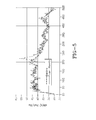
- the cellular insert member 28 may be in the form of an elongate strip attached at an operable location to the tire cavity defining surface 22 on the centerline of the tire tread region as shown in FIG. 4 by adhesive application. So positioned, the strip or insert member 28 (used herein interchangeably) attenuates air resonance induced noise within the tire cavity. The result is an improved decrease in noise as indicated in the graph of FIG. 5 .
- the foam insert or strip 28 is of cellular construction and composed of commonly available cellular material or materials such as polyurethane.
- the insert 28 is geometrically configured to have a flat base portion 30 with separated raised regions 32, 34 extending outward from the base 30 to region top extremities 32A, 34A, respectively.
- the strip 28 is of M-shape with a bight opening 36 between the raised regions 32, 34 extending to a bight floor.
- the electronic device 20 is packaged within a protective shell having an large circular base 40, a cylindrical container body 42 extending outward from the base 40 and terminating at an outward facing circular surface 44.
- Electronics packaged within the body 42 may include a temperature sensor and/or air pressure measuring sensors that communicate through access portals within the surface 44 to measure tire parameters within a tire cavity.
- the electronic device 20 and the insert member 28 are preferably combined to create a sub-assembly which is then secured to a cavity defining surface 46 on the centerline of a tire at the crown as shown in FIG. 12 or, alternatively, FIG. 13 .
- a buffing wheel 48 rotated by shaft 50 is employed as shown in FIG. 10 .
- the wheel 48 contacts and abrades the surface 46 along the centerline of the tire.
- an adhesive layer 53 is applied to the surface 46 by targeted adhesive spray 54 from an applicator 52 as shown by FIG. 11 .
- the tire 10 is thus prepared for receipt and attachment to the insert member/electronic component subassembly in a post-cure procedure.
- the sub-assembly is constructed as will be explained with reference to FIGS. 6 , 8A , and 8B .
- a "sub-assembly" is created by the attachment of an electronic device 20 to the cellular insert 28.
- the insert 28 is preferably in strip form having contoured raised portions 32, 34 that define a bight recess or valley 36 therebetween within which the electronic device 20 is attached and situated.
- the strip insert 20 is of cellular or foam construction so as to provide noise attention within the cavity of the tire to which the sub-assembly is attached.
- the assembly of the electronic device 20 and foam insert 28 occurs at a foam fitting machine station 56.
- the foam strip 28 is fed by means of feed rollers 60, 62, and roller guide 64 into a circular forming shell 66.
- the foam strip 28 thus assumes a spiral roll 80 for readily facilitating transportation between the machine 56 and an insert to tire assembly station.
- the fitting machine 56 includes a pneumatic or hydraulic powered cutter and punch mechanism 68 mounted adjacent to the foam insert feed path as shown.
- the cutter and punch mechanism 68 includes a punch 70 having a reciprocating actuator arm 71 A and a cylindrical punch die 71 B mounted to the remote end of arm 71 A. The movement of the arm 71 A is generally perpendicular to the path of travel of the foam strip 28 prior to the strip 28 entering the forming shell 66.
- a cutter mechanism 72 is mounted adjacent to the punch mechanism 68 and includes a reciprocating actuator rod 74A having a rotary cutting blade 74B mounted to a forward end.
- a tensioning arm 76 is positioned adjacent to the forming shell 66 and engages the shell to compress the shell against the foam insert strip 28 in the roll configuration 80.
- the length of foam strip 28 is formed into the roll configuration 80 and is sized in length to coincide with the circumferential dimension of the tire centerline onto which the insert is to be mounted.
- the punch mechanism is actuated to move into engagement with a free end 84 of insert foam strip 28.
- the punch head 71 B is sized to create a sized aperture 82 through the base 86 of the strip 28 at the free end 84 of the strip 28; the aperture 82 being generally configured to conform to and complement the dimension and shape of the body 42 of the electronic device 20.
- the cylindrical external geometry of the device body 42 closely fits with interference within the complementary shape and size of the aperture 82.
- the electronic device body 42 is press fit inserted through the aperture 82 with the device exposed surface 44 thus positioned between raised insert regions 32, 34.
- the device 20 thus forms with the insert strip 28 a sub-assembly for transport to the station designated for assembly of the sub-assembly to a tire.
- the device is protected by the foam strip 28 during transportation and operational use as will be appreciated from FIGS. 12 and 13 .
- the insert strip 28 in the roll configuration 80 is cut to the desired length by operation of the cutting mechanism 72.
- Blade 74B is moved axially inward by the rod 74A and severs through the strip 28 at the appropriate point.
- the roll 80 may be carried to the tire assembly station within the forming shell 66 with the electronic device 20 carried by and secured to the free strip end 84 of the roll 80.
- FIGS. 12 and 13 illustrate alternative means for attaching the electronic device to the cellular insert strip.
- the electronic device 20 remains within the aperture 82 as described above in reference to FIGS. 8A and 8B .
- the insertion of the device 20 through the aperture 82 with interference places the larger diameter base flange 40 of the device 20 against the flat underside of the strip base 86.
- the sub-assembly is unrolled along the centerline of the tire inner liner 12 beneath the crown or tread 14 and is attached to the cavity defining inner liner centerline surface 46 by adhesive.
- the adhesive may be selectively applied to the target surface 46 as shown in FIG. 11 .
- the outward surface 44 of the electronic device 20 is uncovered and exposed so that the internal air pressure within cavity 18 of the tire may be measured by a pressure sensor within device 20 through a passageway (not shown) extending through surface 44 of the device 20.
- the device 20 is recessed a distance from the extremities 32A and 34A of the raised portions 32, 34.
- the device 20 and the electronics housed therein are thereby protected by the cellular insert strip raised portions 32, 34 from potentially damaging contact during use within the tire cavity.
- the electronic device 20 may be removed temporarily at the point of installation of the sub-assembly to the tire and adhesive applied to the aperture 82 of the strip.
- the device 20 may thereafter be re-inserted into the aperture 82 and retained therein by the friction fit as well as the applied adhesive.
- the attachment of the sub-assembly is preferably to a post-cure tire.
- FIG. 13 An alternative means for affixing the device 20 to the insert cellular strip 28 is shown in FIG. 13 .
- the larger diameter flange 40 of the device 40 may be embedded within the base layer 86 of the strip 28 by forming the strip around the device 20. Embedding the flange 40 secures the device 20 to the strip without the need for adhesive application.
- the position of the device 20 is the same in FIG. 13 and in FIG. 12 ; that is, between and recessed relative to the raised regions 32, 34 of the strip 28. Protection of the device 20 from external contact is thereby enhanced by its location between the raised regions.
- the outward surface 44 as in the attachment means shown by FIG. 12 , remains uncovered by the foam strip 28 and in a position to allow sensors within the device 20 to operably measure tire parameters within the tire cavity.
- the method for installing the electronic device 20 to the tire 10 will be seen to include: affixing the electronic device 20 to a cellular insert member 28 at a pre-selected location to create a sub-assembly.
- the insert member has an inward surface shown as the underside of base 86 configured to attach to an inward facing tire surface 46 partially defining the tire cavity 18.
- the sub-assembly is accordingly attached to the inward facing tire surface 46 at an operable location from which to monitor tire parameters such as temperature and pressure within the tire.
- the electronic device 20 may be embedded into the cellular insert member as shown by FIG. 13 or affixed as shown in FIG. 12 between raised regions 32, 34 of the cellular insert member 28.
- the electronic device 20 may be configured to have one or more passageways (not shown) extending through an outward surface 44 to facilitate sensor measurement.
- the surface 44 preferably remains exposed and uncovered by the cellular insert member at a pre-selected location so as not to obstruct passageway(s) extending through the surface 44.
- the inward facing tire surface 46 is preferably located at the tire centerline and the cellular insert member is shaped as an elongate foam strip dimensioned to attach to the inward facing tire surface 46 along the tire centerline.
- the method of use may include transporting the sub-assembly to the tire in a roll with the electronic device 20 situated in an accessible location proximate to a free end 84 of the roll during transportation of the sub-assembly.
- the electronic device may be press inserted through a sized aperture 82 within the free end 84 of the insert member 28 for transportation of the sub-assembly to a tire.
- a tire and electronic device assembly is disclosed, the electronic device measuring one or more tire parameters.
- the electronic device attaches to a cellular insert member to create a sub-assembly, the insert member having an inward surface attached on a centerline of the tire to an inward facing tire surface defining a tire cavity.
- the electronic device attaches to the cellular insert member between raised regions of the cellular insert member with an outward surface of the device uncovered and exposed and recessed below outward boundaries of the raised regions.
- the electronic device 20 may be either embedded into the cellular insert member between raised regions of the cellular insert member 28 or press inserted through the member 28. Adhesive may further be employed to secure the attachment between the device 20 and the insert strip 28.
- the cellular insert member 28 may be configured as an elongate foam strip dimensioned to attach to the inward facing tire surface 46 along the tire centerline.
Landscapes
- Engineering & Computer Science (AREA)
- Mechanical Engineering (AREA)
- Tires In General (AREA)
Abstract
Description
- The invention relates generally to the installation of electronics in a tire and, more specifically to a method for installing electronics into a post-cure finished tire. The invention also relates to a tire having a tire parameter measuring device attached hereto and, more specifically to a tire and electronic device assembly affixed to the tire a post-cure finished tire procedure.
- It is desirable in certain applications to install electronic device such as a pressure sensor into a tire for monitoring the air pressure within a tire cavity. The operation of the electronic device must be reliable and capable of withstanding the potentially damaging rigors of the installation procedure as well as tire operation.
- The invention relates to an assembly in accordance with claim 1 and to a method in accordance with claim 7.
- Dependent claims refer to preferred embodiments of the invention.
- The electronic device may be embedded into the cellular insert member between raised regions of the cellular insert member. The electronic device is preferably configured to have an outward surface exposed and uncovered by the cellular insert member at the pre-selected location and exposed and uncovered to the tire cavity with the sub-assembly attached to the inward facing tire surface at the operable location.
- The inward facing tire surface is preferably located at the tire centerline and the cellular insert member preferably comprises an elongate foam strip dimensioned to attach to the inward facing tire surface along the tire centerline. The method according to the invention may include transporting the sub-assembly to the tire in a roll wherein the electronic device is situated in an accessible location proximate to a free end of the roll during transportation of the sub-assembly. The electronic device may be press inserted through a sized aperture within the insert member in the accessible location for transportation of the sub-assembly.
- The cellular insert member may be configured as an elongate foam strip dimensioned to attach to the inward facing tire surface along the tire centerline. The electronic device may be press inserted through a sized aperture within the insert member.
- "Axial" and "axially" means lines or directions that are parallel to the axis of rotation of the tire.
- "Circumferential" means lines or directions extending along the perimeter of the surface of the annular tread perpendicular to the axial direction.
- "Equatorial Centerplane (CP)" means the plane perpendicular to the tire's axis of rotation and passing through the center of the tread.
- The invention will be described by way of example and with reference to the accompanying drawings in which:
-
FIG. 1 is a perspective view of a prior art finished tire and electronics device assembly having a portion of the tire removed for the purpose of illustration; -
FIG. 2 is a graph of car interior noise spectrum plotting frequency (Hz) against SPL dB (A). -
FIG. 3 is a portion of a noise attenuation foam strip; -
FIG. 4 is a perspective view of a portion of a finished tire having a foam insert attached thereto. -
FIG. 5 is a graph of car interior noise spectrum with the foam insert sub-assembly affixed to the tire, plotting frequency (Hz) against SPL dB (A). -
FIG. 6 is a schematic representation of a foam fitting machine. -
FIG. 7 is a cross-sectional view through the foam insert member. -
FIG. 8A is an enlarged view of a portion of the foam fitting machine ofFIG. 6 . -
FIG. 8B is an enlarged view of a portion of the machine ofFIG. 6 showing operation of the cutting and punch mechanisms. -
FIG. 9 is a perspective view of an electronic device. -
FIG. 10 is a schematic representation of a tire surface buffing machine and tire. -
FIG. 11 is a schematic representation of an adhesive applicator machine and tire. -
FIG. 12 is a sectional view of a tire taken through the crown region and showing the foam insert and electronic device affixed to the interior tire equatorial surface. -
FIG. 13 is a sectional view of a tire taken through the crown region and showing an alternatively configured sub-assembly in which the electronic device is embedded within the foam insert. - Referring initially to
FIG. 1 , atire 10 is shown having aninner liner 12, a crown ortread region 14 mounted to awheel rim 16. The inner liner defines atire cavity 18. Anelectronic device 20 of a type commercially available is employed to monitor certain tire characteristics such as air pressure and temperature within thecavity 18. Such adevice 20 may be mounted to theinner liner 12 on the equatorial centerplane of the tire as shown inFIG. 1 by adhesive or other suitable means. Locating theelectronic device 20 on acavity defining surface 22 beneath thetread region 14 serves to maintain attachment integrity between the device and the tire because such a location experiences relatively low flexing during tire use. - Cavity noise generated by the tire during normal operation is typically undesirable and it is an objective to reduce or minimize such noise. As shown by the
spike 26 of the graph ofFIG. 2 , tire cavity noise generated by air resonance within the cavity contributes significantly to car interior noise within the frequency range identified. Acellular insert member 28 in the configuration shown inFIGS. 3 and7 may be introduced within thecavity 18 to attenuate such noise. Thecellular insert member 28 may be in the form of an elongate strip attached at an operable location to the tirecavity defining surface 22 on the centerline of the tire tread region as shown inFIG. 4 by adhesive application. So positioned, the strip or insert member 28 (used herein interchangeably) attenuates air resonance induced noise within the tire cavity. The result is an improved decrease in noise as indicated in the graph ofFIG. 5 . - The foam insert or
strip 28 is of cellular construction and composed of commonly available cellular material or materials such as polyurethane. Theinsert 28 is geometrically configured to have aflat base portion 30 with separated raisedregions base 30 to regiontop extremities strip 28 is of M-shape with a bight opening 36 between the raisedregions - With reference to
FIGS. 4 ,12, and 13 , theelectronic device 20 is packaged within a protective shell having an largecircular base 40, acylindrical container body 42 extending outward from thebase 40 and terminating at an outward facingcircular surface 44. Electronics packaged within thebody 42 may include a temperature sensor and/or air pressure measuring sensors that communicate through access portals within thesurface 44 to measure tire parameters within a tire cavity. - The
electronic device 20 and theinsert member 28 are preferably combined to create a sub-assembly which is then secured to acavity defining surface 46 on the centerline of a tire at the crown as shown inFIG. 12 or, alternatively,FIG. 13 . To prepare thetire surface 46, abuffing wheel 48 rotated byshaft 50 is employed as shown inFIG. 10 . Thewheel 48 contacts and abrades thesurface 46 along the centerline of the tire. Thereafter, anadhesive layer 53 is applied to thesurface 46 by targetedadhesive spray 54 from anapplicator 52 as shown byFIG. 11 . Thetire 10 is thus prepared for receipt and attachment to the insert member/electronic component subassembly in a post-cure procedure. The sub-assembly is constructed as will be explained with reference toFIGS. 6 ,8A , and8B . - As referenced herein, a "sub-assembly" is created by the attachment of an
electronic device 20 to thecellular insert 28. As explained previously, theinsert 28 is preferably in strip form having contoured raisedportions valley 36 therebetween within which theelectronic device 20 is attached and situated. The strip insert 20 is of cellular or foam construction so as to provide noise attention within the cavity of the tire to which the sub-assembly is attached. As seen fromFIGS. 6 ,8A , and8B , the assembly of theelectronic device 20 andfoam insert 28 occurs at a foamfitting machine station 56. Thefoam strip 28 is fed by means offeed rollers shell 66. Thefoam strip 28 thus assumes aspiral roll 80 for readily facilitating transportation between themachine 56 and an insert to tire assembly station. Thefitting machine 56 includes a pneumatic or hydraulic powered cutter andpunch mechanism 68 mounted adjacent to the foam insert feed path as shown. The cutter andpunch mechanism 68 includes apunch 70 having areciprocating actuator arm 71 A and a cylindrical punch die 71 B mounted to the remote end ofarm 71 A. The movement of thearm 71 A is generally perpendicular to the path of travel of thefoam strip 28 prior to thestrip 28 entering the formingshell 66. - A
cutter mechanism 72 is mounted adjacent to thepunch mechanism 68 and includes a reciprocating actuator rod 74A having arotary cutting blade 74B mounted to a forward end. Atensioning arm 76 is positioned adjacent to the formingshell 66 and engages the shell to compress the shell against thefoam insert strip 28 in theroll configuration 80. - The operation of the punch and cutting
mechanisms FIGS. 8A and8B . The length offoam strip 28 is formed into theroll configuration 80 and is sized in length to coincide with the circumferential dimension of the tire centerline onto which the insert is to be mounted. The punch mechanism is actuated to move into engagement with afree end 84 ofinsert foam strip 28. Thepunch head 71 B is sized to create asized aperture 82 through thebase 86 of thestrip 28 at thefree end 84 of thestrip 28; theaperture 82 being generally configured to conform to and complement the dimension and shape of thebody 42 of theelectronic device 20. The cylindrical external geometry of thedevice body 42 closely fits with interference within the complementary shape and size of theaperture 82. After theaperture 82 is created, theelectronic device body 42 is press fit inserted through theaperture 82 with the device exposedsurface 44 thus positioned between raisedinsert regions device 20 thus forms with the insert strip 28 a sub-assembly for transport to the station designated for assembly of the sub-assembly to a tire. The device is protected by thefoam strip 28 during transportation and operational use as will be appreciated fromFIGS. 12 and 13 . - The
insert strip 28 in theroll configuration 80 is cut to the desired length by operation of thecutting mechanism 72.Blade 74B is moved axially inward by the rod 74A and severs through thestrip 28 at the appropriate point. Theroll 80 may be carried to the tire assembly station within the formingshell 66 with theelectronic device 20 carried by and secured to thefree strip end 84 of theroll 80. -
FIGS. 12 and 13 illustrate alternative means for attaching the electronic device to the cellular insert strip. InFIG. 12 , theelectronic device 20 remains within theaperture 82 as described above in reference toFIGS. 8A and8B . The insertion of thedevice 20 through theaperture 82 with interference places the largerdiameter base flange 40 of thedevice 20 against the flat underside of thestrip base 86. The sub-assembly is unrolled along the centerline of the tireinner liner 12 beneath the crown or tread 14 and is attached to the cavity defining innerliner centerline surface 46 by adhesive. The adhesive may be selectively applied to thetarget surface 46 as shown inFIG. 11 . So positioned, theoutward surface 44 of theelectronic device 20 is uncovered and exposed so that the internal air pressure withincavity 18 of the tire may be measured by a pressure sensor withindevice 20 through a passageway (not shown) extending throughsurface 44 of thedevice 20. Moreover, it will be appreciated that thedevice 20 is recessed a distance from theextremities portions device 20 and the electronics housed therein are thereby protected by the cellular insert strip raisedportions electronic device 20 may be removed temporarily at the point of installation of the sub-assembly to the tire and adhesive applied to theaperture 82 of the strip. Thedevice 20 may thereafter be re-inserted into theaperture 82 and retained therein by the friction fit as well as the applied adhesive. The attachment of the sub-assembly is preferably to a post-cure tire. - An alternative means for affixing the
device 20 to the insertcellular strip 28 is shown inFIG. 13 . As depicted, thelarger diameter flange 40 of thedevice 40 may be embedded within thebase layer 86 of thestrip 28 by forming the strip around thedevice 20. Embedding theflange 40 secures thedevice 20 to the strip without the need for adhesive application. The position of thedevice 20 is the same inFIG. 13 and inFIG. 12 ; that is, between and recessed relative to the raisedregions strip 28. Protection of thedevice 20 from external contact is thereby enhanced by its location between the raised regions. Theoutward surface 44, as in the attachment means shown byFIG. 12 , remains uncovered by thefoam strip 28 and in a position to allow sensors within thedevice 20 to operably measure tire parameters within the tire cavity. - The method for installing the
electronic device 20 to thetire 10 will be seen to include: affixing theelectronic device 20 to acellular insert member 28 at a pre-selected location to create a sub-assembly. The insert member has an inward surface shown as the underside ofbase 86 configured to attach to an inward facingtire surface 46 partially defining thetire cavity 18. The sub-assembly is accordingly attached to the inward facingtire surface 46 at an operable location from which to monitor tire parameters such as temperature and pressure within the tire. - The
electronic device 20 may be embedded into the cellular insert member as shown byFIG. 13 or affixed as shown inFIG. 12 between raisedregions cellular insert member 28. Theelectronic device 20 may be configured to have one or more passageways (not shown) extending through anoutward surface 44 to facilitate sensor measurement. Thesurface 44 preferably remains exposed and uncovered by the cellular insert member at a pre-selected location so as not to obstruct passageway(s) extending through thesurface 44. The inward facingtire surface 46 is preferably located at the tire centerline and the cellular insert member is shaped as an elongate foam strip dimensioned to attach to the inward facingtire surface 46 along the tire centerline. The method of use may include transporting the sub-assembly to the tire in a roll with theelectronic device 20 situated in an accessible location proximate to afree end 84 of the roll during transportation of the sub-assembly. The electronic device may be press inserted through asized aperture 82 within thefree end 84 of theinsert member 28 for transportation of the sub-assembly to a tire. By locating thedevice 20 in thefree end 84, thedevice 20 does not interfere with the formation ofroll 80 and may be readily removed at the tire for application of adhesive to theaperture 82. - A tire and electronic device assembly is disclosed, the electronic device measuring one or more tire parameters. The electronic device attaches to a cellular insert member to create a sub-assembly, the insert member having an inward surface attached on a centerline of the tire to an inward facing tire surface defining a tire cavity. The electronic device attaches to the cellular insert member between raised regions of the cellular insert member with an outward surface of the device uncovered and exposed and recessed below outward boundaries of the raised regions.
- The
electronic device 20 may be either embedded into the cellular insert member between raised regions of thecellular insert member 28 or press inserted through themember 28. Adhesive may further be employed to secure the attachment between thedevice 20 and theinsert strip 28. Thecellular insert member 28 may be configured as an elongate foam strip dimensioned to attach to the inward facingtire surface 46 along the tire centerline.
Claims (15)
- A tire and electronic device assembly, the tire (10) having a cavity (18) defined by an tire inner surface (46) and the electronic device (20) comprising at least one sensor for monitoring at least one tire parameter, the assembly comprising a cellular insert member (28) having a radially outward surface attached against an inward facing tire inner surface region, the cellular insert member (28) having raised regions (32, 34) defining a recess (30) therebetween, wherein the electronic device (20) is attached to the cellular insert member (28) within the recess (30) between the raised regions (32, 34).
- The assembly of claim 1, wherein the electronic device (20) comprises lateral sides (42) and an outward surface (44) exposed and uncovered by the cellular insert member (28) within the recess (30) and/or wherein a base portion (40) of the electronic device (20) is situated within the recess (30) and embedded within the cellular insert member (28).
- The assembly of claim 1 or 2, wherein the electronic device (20) press fit through a sized aperture (82) within the cellular insert member (28) and with lateral sides (42) of the electronic device (20) positioned adjacent the raised regions (32, 34) of the cellular insert member (28).
- The assembly of at least one of the previous claims, wherein the outward exposed surface (44) of the electronic device (20) is recessed and offset from raised extremities (32A, 34A) of the raised regions (32, 34) of the cellular insert member (28).
- The assembly of at least one of the previous claims, wherein the insert member (28) comprises a cellular elongate strip.
- The assembly of at least one of the previous claims, wherein the inward facing tire surface is located at the tire centerline and the cellular insert member (28) comprises an elongate foam strip dimensioned to attach to the inward facing tire surface along the tire centerline.
- A method of installing an electronic device in a tire, the method comprising affixing an electronic device (20) to a cellular insert member (28) at a pre-selected location to create a sub-assembly, the insert member having an outward surface configured for attachment against an inward facing tire surface defining a tire cavity (18), and attaching the sub-assembly to the inward facing tire surface at an operable location.
- The method of claim 7, wherein the electronic device (20) comprises lateral sides (42) and an outward surface (44) exposed and uncovered by the cellular insert member (28) in the pre-selected location and exposed and uncovered to the tire cavity (18) with the sub-assembly attached to the inward facing tire surface at the operable location.
- The method of claim 7 or 8, further comprising embedding the electronic device (20) within the cellular insert member (28) at the pre-selected location.
- The method of at least one of the claims 7 to 9, further comprising positioning the electronic device (20) within a recess (30) situated between opposed raised regions (32, 34) of the cellular insert member (28) and the electronic device lateral sides (42) adjacent the raised regions (32, 34) of the cellular insert member.
- The method of at least one of the claims 7 to 10, further comprising press fit inserting the electronic device (20) through a sized aperture (86) in the insert member (28) at the pre-selected location prior to attaching the subassembly to the inward facing tire surface (46).
- The method of at least one of the claims 7 to 11, wherein the insert member (28) comprises a cellular elongate strip and wherein the method further comprises configuring the insert member (28) into a roll (80) wherein the electronic device (20) is situated proximate to a free end of the roll at the pre-selected location during a transportation of the sub-assembly.
- The method of at least one of the claims 7 to 12 further comprising transporting the sub-assembly to the tire (10) in a roll wherein the electronic device (20) in the pre-selected location is situated proximate to a free end of the roll during transportation of the sub-assembly.
- The method of at least one of the claims 7 to 13, further comprising positioning the electronic device (20) within a recess (36) situated between opposed raised regions (32, 34) of the cellular insert member (28) and the electronic device lateral sides (42) adjacent the raised regions (32, 34) of the cellular insert member (28).
- The method of at least one of the claims 7 to 14, wherein the inward facing tire surface (46) is located at the tire centerline and the cellular insert member (28) comprises an elongate foam strip dimensioned to attach to the inward facing tire surface along the tire centerline.
Applications Claiming Priority (2)
| Application Number | Priority Date | Filing Date | Title |
|---|---|---|---|
| US12/546,333 US20110041309A1 (en) | 2009-08-24 | 2009-08-24 | Method of installing tire electronics in a tire |
| US12/546,352 US8561659B2 (en) | 2009-08-24 | 2009-08-24 | Tire and electronic device assembly |
Publications (2)
| Publication Number | Publication Date |
|---|---|
| EP2289715A1 true EP2289715A1 (en) | 2011-03-02 |
| EP2289715B1 EP2289715B1 (en) | 2017-05-17 |
Family
ID=42813387
Family Applications (1)
| Application Number | Title | Priority Date | Filing Date |
|---|---|---|---|
| EP10173701.3A Not-in-force EP2289715B1 (en) | 2009-08-24 | 2010-08-23 | Installing electronics in a tire |
Country Status (1)
| Country | Link |
|---|---|
| EP (1) | EP2289715B1 (en) |
Cited By (1)
| Publication number | Priority date | Publication date | Assignee | Title |
|---|---|---|---|---|
| WO2019161368A1 (en) | 2018-02-19 | 2019-08-22 | Android Industries Llc | Tire sensor installation system and method |
Citations (2)
| Publication number | Priority date | Publication date | Assignee | Title |
|---|---|---|---|---|
| WO1999029525A1 (en) * | 1997-12-09 | 1999-06-17 | The Goodyear Tire & Rubber Company | Antenna for radio transponder |
| US20070146124A1 (en) * | 2005-12-28 | 2007-06-28 | Sumitomo Rubber Industries, Ltd. | Radio tag-mounting member for use in tire, pneumatic tire, and assembly composed of pneumatic tire and rim |
Family Cites Families (2)
| Publication number | Priority date | Publication date | Assignee | Title |
|---|---|---|---|---|
| JP4427007B2 (en) * | 2005-06-01 | 2010-03-03 | 住友ゴム工業株式会社 | Pneumatic tire |
| DE102006027918A1 (en) * | 2006-06-17 | 2007-12-20 | Continental Aktiengesellschaft | Vehicle tire, has tire module fixed with retaining unit to engage retaining unit in recess of tire module, and retaining pin arranged in unit such that additional fixing of tire module is achieved in longitudinal direction of retaining unit |
-
2010
- 2010-08-23 EP EP10173701.3A patent/EP2289715B1/en not_active Not-in-force
Patent Citations (2)
| Publication number | Priority date | Publication date | Assignee | Title |
|---|---|---|---|---|
| WO1999029525A1 (en) * | 1997-12-09 | 1999-06-17 | The Goodyear Tire & Rubber Company | Antenna for radio transponder |
| US20070146124A1 (en) * | 2005-12-28 | 2007-06-28 | Sumitomo Rubber Industries, Ltd. | Radio tag-mounting member for use in tire, pneumatic tire, and assembly composed of pneumatic tire and rim |
Cited By (2)
| Publication number | Priority date | Publication date | Assignee | Title |
|---|---|---|---|---|
| WO2019161368A1 (en) | 2018-02-19 | 2019-08-22 | Android Industries Llc | Tire sensor installation system and method |
| EP3755551A4 (en) * | 2018-02-19 | 2021-12-08 | Android Industries LLC | TIRE SENSOR INSTALLATION SYSTEM AND METHOD |
Also Published As
| Publication number | Publication date |
|---|---|
| EP2289715B1 (en) | 2017-05-17 |
Similar Documents
| Publication | Publication Date | Title |
|---|---|---|
| US20110041309A1 (en) | Method of installing tire electronics in a tire | |
| JP4763401B2 (en) | Mounting method of annular tire transponder assembly that also serves as counterbalance | |
| JP4601099B2 (en) | Non-wearable monitoring assembly for pneumatic tires | |
| US8561659B2 (en) | Tire and electronic device assembly | |
| US9884525B2 (en) | Method for installing a monitoring device in a tyre for vehicle wheels | |
| JP4610835B2 (en) | Method and apparatus for supplying power to a tire monitor | |
| US11446967B2 (en) | Pneumatic tire | |
| EP2501563B1 (en) | Transmission device for transmitting information about tire condition and tire condition monitoring system | |
| RU2397880C2 (en) | Tire comprising electronic unit and method of fitting said electronic unit in said tire | |
| EP2289715B1 (en) | Installing electronics in a tire | |
| JP3860921B2 (en) | Auxiliary parts for tire transponders | |
| EP4184710B1 (en) | Antenna connection for integrated rfid tag and tpms sensor | |
| JP5327237B2 (en) | Transmitter for transmitting information on tire condition and tire condition monitoring system | |
| CN104703822B (en) | Transmitter and tire condition monitoring system | |
| EP4197823A1 (en) | Tire with cellular member and sensor | |
| WO2018025854A1 (en) | Pneumatic tire | |
| JP2006327582A (en) | Method and related apparatus for securing a tire placement unit of a tire condition sensing device to a rim | |
| US6997223B2 (en) | Mounting structure of tire monitoring device | |
| JP5434881B2 (en) | Transmitter for transmitting information on tire condition and tire condition monitoring system | |
| US11491831B2 (en) | Tire information acquisition device having first and second bands fixing a sensor unit to a rim | |
| EP0300773A1 (en) | Means for protecting the inner tube of a pneumatic tyre | |
| JP5924204B2 (en) | Transmitting device, pneumatic tire, and tire condition monitoring system | |
| JP2007523005A (en) | Vehicle tire with steel belt wire and dipole antenna located in the running surface area |
Legal Events
| Date | Code | Title | Description |
|---|---|---|---|
| PUAI | Public reference made under article 153(3) epc to a published international application that has entered the european phase |
Free format text: ORIGINAL CODE: 0009012 |
|
| AK | Designated contracting states |
Kind code of ref document: A1 Designated state(s): AL AT BE BG CH CY CZ DE DK EE ES FI FR GB GR HR HU IE IS IT LI LT LU LV MC MK MT NL NO PL PT RO SE SI SK SM TR |
|
| AX | Request for extension of the european patent |
Extension state: BA ME RS |
|
| 17P | Request for examination filed |
Effective date: 20110902 |
|
| 17Q | First examination report despatched |
Effective date: 20121213 |
|
| RIC1 | Information provided on ipc code assigned before grant |
Ipc: B29D 30/00 20060101ALI20161025BHEP Ipc: B60C 23/04 20060101AFI20161025BHEP |
|
| GRAP | Despatch of communication of intention to grant a patent |
Free format text: ORIGINAL CODE: EPIDOSNIGR1 |
|
| INTG | Intention to grant announced |
Effective date: 20161206 |
|
| GRAS | Grant fee paid |
Free format text: ORIGINAL CODE: EPIDOSNIGR3 |
|
| GRAA | (expected) grant |
Free format text: ORIGINAL CODE: 0009210 |
|
| AK | Designated contracting states |
Kind code of ref document: B1 Designated state(s): AL AT BE BG CH CY CZ DE DK EE ES FI FR GB GR HR HU IE IS IT LI LT LU LV MC MK MT NL NO PL PT RO SE SI SK SM TR |
|
| REG | Reference to a national code |
Ref country code: GB Ref legal event code: FG4D |
|
| REG | Reference to a national code |
Ref country code: CH Ref legal event code: EP |
|
| REG | Reference to a national code |
Ref country code: IE Ref legal event code: FG4D |
|
| REG | Reference to a national code |
Ref country code: AT Ref legal event code: REF Ref document number: 894117 Country of ref document: AT Kind code of ref document: T Effective date: 20170615 |
|
| REG | Reference to a national code |
Ref country code: DE Ref legal event code: R096 Ref document number: 602010042374 Country of ref document: DE |
|
| REG | Reference to a national code |
Ref country code: FR Ref legal event code: PLFP Year of fee payment: 8 |
|
| REG | Reference to a national code |
Ref country code: NL Ref legal event code: MP Effective date: 20170517 |
|
| REG | Reference to a national code |
Ref country code: LT Ref legal event code: MG4D |
|
| REG | Reference to a national code |
Ref country code: AT Ref legal event code: MK05 Ref document number: 894117 Country of ref document: AT Kind code of ref document: T Effective date: 20170517 |
|
| PG25 | Lapsed in a contracting state [announced via postgrant information from national office to epo] |
Ref country code: ES Free format text: LAPSE BECAUSE OF FAILURE TO SUBMIT A TRANSLATION OF THE DESCRIPTION OR TO PAY THE FEE WITHIN THE PRESCRIBED TIME-LIMIT Effective date: 20170517 Ref country code: NO Free format text: LAPSE BECAUSE OF FAILURE TO SUBMIT A TRANSLATION OF THE DESCRIPTION OR TO PAY THE FEE WITHIN THE PRESCRIBED TIME-LIMIT Effective date: 20170817 Ref country code: AT Free format text: LAPSE BECAUSE OF FAILURE TO SUBMIT A TRANSLATION OF THE DESCRIPTION OR TO PAY THE FEE WITHIN THE PRESCRIBED TIME-LIMIT Effective date: 20170517 Ref country code: HR Free format text: LAPSE BECAUSE OF FAILURE TO SUBMIT A TRANSLATION OF THE DESCRIPTION OR TO PAY THE FEE WITHIN THE PRESCRIBED TIME-LIMIT Effective date: 20170517 Ref country code: FI Free format text: LAPSE BECAUSE OF FAILURE TO SUBMIT A TRANSLATION OF THE DESCRIPTION OR TO PAY THE FEE WITHIN THE PRESCRIBED TIME-LIMIT Effective date: 20170517 Ref country code: GR Free format text: LAPSE BECAUSE OF FAILURE TO SUBMIT A TRANSLATION OF THE DESCRIPTION OR TO PAY THE FEE WITHIN THE PRESCRIBED TIME-LIMIT Effective date: 20170818 Ref country code: LT Free format text: LAPSE BECAUSE OF FAILURE TO SUBMIT A TRANSLATION OF THE DESCRIPTION OR TO PAY THE FEE WITHIN THE PRESCRIBED TIME-LIMIT Effective date: 20170517 |
|
| PG25 | Lapsed in a contracting state [announced via postgrant information from national office to epo] |
Ref country code: SE Free format text: LAPSE BECAUSE OF FAILURE TO SUBMIT A TRANSLATION OF THE DESCRIPTION OR TO PAY THE FEE WITHIN THE PRESCRIBED TIME-LIMIT Effective date: 20170517 Ref country code: BG Free format text: LAPSE BECAUSE OF FAILURE TO SUBMIT A TRANSLATION OF THE DESCRIPTION OR TO PAY THE FEE WITHIN THE PRESCRIBED TIME-LIMIT Effective date: 20170817 Ref country code: PL Free format text: LAPSE BECAUSE OF FAILURE TO SUBMIT A TRANSLATION OF THE DESCRIPTION OR TO PAY THE FEE WITHIN THE PRESCRIBED TIME-LIMIT Effective date: 20170517 Ref country code: LV Free format text: LAPSE BECAUSE OF FAILURE TO SUBMIT A TRANSLATION OF THE DESCRIPTION OR TO PAY THE FEE WITHIN THE PRESCRIBED TIME-LIMIT Effective date: 20170517 Ref country code: IS Free format text: LAPSE BECAUSE OF FAILURE TO SUBMIT A TRANSLATION OF THE DESCRIPTION OR TO PAY THE FEE WITHIN THE PRESCRIBED TIME-LIMIT Effective date: 20170917 Ref country code: NL Free format text: LAPSE BECAUSE OF FAILURE TO SUBMIT A TRANSLATION OF THE DESCRIPTION OR TO PAY THE FEE WITHIN THE PRESCRIBED TIME-LIMIT Effective date: 20170517 |
|
| PG25 | Lapsed in a contracting state [announced via postgrant information from national office to epo] |
Ref country code: DK Free format text: LAPSE BECAUSE OF FAILURE TO SUBMIT A TRANSLATION OF THE DESCRIPTION OR TO PAY THE FEE WITHIN THE PRESCRIBED TIME-LIMIT Effective date: 20170517 Ref country code: SK Free format text: LAPSE BECAUSE OF FAILURE TO SUBMIT A TRANSLATION OF THE DESCRIPTION OR TO PAY THE FEE WITHIN THE PRESCRIBED TIME-LIMIT Effective date: 20170517 Ref country code: CZ Free format text: LAPSE BECAUSE OF FAILURE TO SUBMIT A TRANSLATION OF THE DESCRIPTION OR TO PAY THE FEE WITHIN THE PRESCRIBED TIME-LIMIT Effective date: 20170517 Ref country code: EE Free format text: LAPSE BECAUSE OF FAILURE TO SUBMIT A TRANSLATION OF THE DESCRIPTION OR TO PAY THE FEE WITHIN THE PRESCRIBED TIME-LIMIT Effective date: 20170517 Ref country code: RO Free format text: LAPSE BECAUSE OF FAILURE TO SUBMIT A TRANSLATION OF THE DESCRIPTION OR TO PAY THE FEE WITHIN THE PRESCRIBED TIME-LIMIT Effective date: 20170517 |
|
| REG | Reference to a national code |
Ref country code: DE Ref legal event code: R097 Ref document number: 602010042374 Country of ref document: DE |
|
| PG25 | Lapsed in a contracting state [announced via postgrant information from national office to epo] |
Ref country code: SM Free format text: LAPSE BECAUSE OF FAILURE TO SUBMIT A TRANSLATION OF THE DESCRIPTION OR TO PAY THE FEE WITHIN THE PRESCRIBED TIME-LIMIT Effective date: 20170517 |
|
| PLBE | No opposition filed within time limit |
Free format text: ORIGINAL CODE: 0009261 |
|
| STAA | Information on the status of an ep patent application or granted ep patent |
Free format text: STATUS: NO OPPOSITION FILED WITHIN TIME LIMIT |
|
| REG | Reference to a national code |
Ref country code: CH Ref legal event code: PL |
|
| PG25 | Lapsed in a contracting state [announced via postgrant information from national office to epo] |
Ref country code: MC Free format text: LAPSE BECAUSE OF FAILURE TO SUBMIT A TRANSLATION OF THE DESCRIPTION OR TO PAY THE FEE WITHIN THE PRESCRIBED TIME-LIMIT Effective date: 20170517 |
|
| 26N | No opposition filed |
Effective date: 20180220 |
|
| GBPC | Gb: european patent ceased through non-payment of renewal fee |
Effective date: 20170823 |
|
| PG25 | Lapsed in a contracting state [announced via postgrant information from national office to epo] |
Ref country code: CH Free format text: LAPSE BECAUSE OF NON-PAYMENT OF DUE FEES Effective date: 20170831 Ref country code: LI Free format text: LAPSE BECAUSE OF NON-PAYMENT OF DUE FEES Effective date: 20170831 |
|
| REG | Reference to a national code |
Ref country code: IE Ref legal event code: MM4A |
|
| PG25 | Lapsed in a contracting state [announced via postgrant information from national office to epo] |
Ref country code: SI Free format text: LAPSE BECAUSE OF FAILURE TO SUBMIT A TRANSLATION OF THE DESCRIPTION OR TO PAY THE FEE WITHIN THE PRESCRIBED TIME-LIMIT Effective date: 20170517 |
|
| REG | Reference to a national code |
Ref country code: BE Ref legal event code: MM Effective date: 20170831 |
|
| PG25 | Lapsed in a contracting state [announced via postgrant information from national office to epo] |
Ref country code: LU Free format text: LAPSE BECAUSE OF NON-PAYMENT OF DUE FEES Effective date: 20170823 |
|
| REG | Reference to a national code |
Ref country code: FR Ref legal event code: PLFP Year of fee payment: 9 |
|
| PG25 | Lapsed in a contracting state [announced via postgrant information from national office to epo] |
Ref country code: IE Free format text: LAPSE BECAUSE OF NON-PAYMENT OF DUE FEES Effective date: 20170823 Ref country code: GB Free format text: LAPSE BECAUSE OF NON-PAYMENT OF DUE FEES Effective date: 20170823 |
|
| PG25 | Lapsed in a contracting state [announced via postgrant information from national office to epo] |
Ref country code: BE Free format text: LAPSE BECAUSE OF NON-PAYMENT OF DUE FEES Effective date: 20170831 |
|
| PG25 | Lapsed in a contracting state [announced via postgrant information from national office to epo] |
Ref country code: MT Free format text: LAPSE BECAUSE OF NON-PAYMENT OF DUE FEES Effective date: 20170823 |
|
| PG25 | Lapsed in a contracting state [announced via postgrant information from national office to epo] |
Ref country code: HU Free format text: LAPSE BECAUSE OF FAILURE TO SUBMIT A TRANSLATION OF THE DESCRIPTION OR TO PAY THE FEE WITHIN THE PRESCRIBED TIME-LIMIT; INVALID AB INITIO Effective date: 20100823 |
|
| PG25 | Lapsed in a contracting state [announced via postgrant information from national office to epo] |
Ref country code: CY Free format text: LAPSE BECAUSE OF NON-PAYMENT OF DUE FEES Effective date: 20170517 |
|
| PG25 | Lapsed in a contracting state [announced via postgrant information from national office to epo] |
Ref country code: MK Free format text: LAPSE BECAUSE OF FAILURE TO SUBMIT A TRANSLATION OF THE DESCRIPTION OR TO PAY THE FEE WITHIN THE PRESCRIBED TIME-LIMIT Effective date: 20170517 |
|
| PG25 | Lapsed in a contracting state [announced via postgrant information from national office to epo] |
Ref country code: TR Free format text: LAPSE BECAUSE OF FAILURE TO SUBMIT A TRANSLATION OF THE DESCRIPTION OR TO PAY THE FEE WITHIN THE PRESCRIBED TIME-LIMIT Effective date: 20170517 |
|
| PG25 | Lapsed in a contracting state [announced via postgrant information from national office to epo] |
Ref country code: PT Free format text: LAPSE BECAUSE OF FAILURE TO SUBMIT A TRANSLATION OF THE DESCRIPTION OR TO PAY THE FEE WITHIN THE PRESCRIBED TIME-LIMIT Effective date: 20170517 |
|
| PG25 | Lapsed in a contracting state [announced via postgrant information from national office to epo] |
Ref country code: AL Free format text: LAPSE BECAUSE OF FAILURE TO SUBMIT A TRANSLATION OF THE DESCRIPTION OR TO PAY THE FEE WITHIN THE PRESCRIBED TIME-LIMIT Effective date: 20170517 |
|
| PGFP | Annual fee paid to national office [announced via postgrant information from national office to epo] |
Ref country code: IT Payment date: 20210712 Year of fee payment: 12 |
|
| PGFP | Annual fee paid to national office [announced via postgrant information from national office to epo] |
Ref country code: DE Payment date: 20220608 Year of fee payment: 13 |
|
| PGFP | Annual fee paid to national office [announced via postgrant information from national office to epo] |
Ref country code: FR Payment date: 20220709 Year of fee payment: 13 |
|
| PG25 | Lapsed in a contracting state [announced via postgrant information from national office to epo] |
Ref country code: IT Free format text: LAPSE BECAUSE OF NON-PAYMENT OF DUE FEES Effective date: 20220823 |
|
| REG | Reference to a national code |
Ref country code: DE Ref legal event code: R119 Ref document number: 602010042374 Country of ref document: DE |
|
| PG25 | Lapsed in a contracting state [announced via postgrant information from national office to epo] |
Ref country code: FR Free format text: LAPSE BECAUSE OF NON-PAYMENT OF DUE FEES Effective date: 20230831 Ref country code: DE Free format text: LAPSE BECAUSE OF NON-PAYMENT OF DUE FEES Effective date: 20240301 |