EP2289563A1 - Near infrared fluorescent imaging agent - Google Patents
Near infrared fluorescent imaging agent Download PDFInfo
- Publication number
- EP2289563A1 EP2289563A1 EP10174113A EP10174113A EP2289563A1 EP 2289563 A1 EP2289563 A1 EP 2289563A1 EP 10174113 A EP10174113 A EP 10174113A EP 10174113 A EP10174113 A EP 10174113A EP 2289563 A1 EP2289563 A1 EP 2289563A1
- Authority
- EP
- European Patent Office
- Prior art keywords
- group
- acid group
- groups
- compound
- carbon atoms
- Prior art date
- Legal status (The legal status is an assumption and is not a legal conclusion. Google has not performed a legal analysis and makes no representation as to the accuracy of the status listed.)
- Withdrawn
Links
- 239000012216 imaging agent Substances 0.000 title claims description 38
- 238000012632 fluorescent imaging Methods 0.000 title 1
- 150000001875 compounds Chemical class 0.000 claims abstract description 105
- 150000003839 salts Chemical class 0.000 claims abstract description 37
- 125000001424 substituent group Chemical group 0.000 claims abstract description 33
- ABLZXFCXXLZCGV-UHFFFAOYSA-N phosphonic acid group Chemical group P(O)(O)=O ABLZXFCXXLZCGV-UHFFFAOYSA-N 0.000 claims abstract description 31
- 125000000542 sulfonic acid group Chemical group 0.000 claims abstract description 29
- 125000002843 carboxylic acid group Chemical group 0.000 claims abstract description 28
- 239000002253 acid Substances 0.000 claims abstract description 20
- 125000001434 methanylylidene group Chemical group [H]C#[*] 0.000 claims abstract description 11
- 125000000547 substituted alkyl group Chemical group 0.000 claims abstract description 9
- NBIIXXVUZAFLBC-UHFFFAOYSA-N Phosphoric acid Chemical group OP(O)(O)=O NBIIXXVUZAFLBC-UHFFFAOYSA-N 0.000 claims abstract description 5
- 125000000217 alkyl group Chemical group 0.000 claims description 55
- 206010028980 Neoplasm Diseases 0.000 claims description 45
- 238000000799 fluorescence microscopy Methods 0.000 claims description 32
- 125000000623 heterocyclic group Chemical group 0.000 claims description 19
- 125000003118 aryl group Chemical group 0.000 claims description 11
- 125000004435 hydrogen atom Chemical group [H]* 0.000 claims description 11
- 125000005110 aryl thio group Chemical group 0.000 claims description 9
- 125000002496 methyl group Chemical group [H]C([H])([H])* 0.000 claims description 9
- 125000004442 acylamino group Chemical group 0.000 claims description 8
- 125000004104 aryloxy group Chemical group 0.000 claims description 8
- 125000001769 aryl amino group Chemical group 0.000 claims description 7
- 125000003710 aryl alkyl group Chemical group 0.000 claims description 5
- 210000000988 bone and bone Anatomy 0.000 claims description 5
- 210000000056 organ Anatomy 0.000 claims description 5
- 125000001997 phenyl group Chemical group [H]C1=C([H])C([H])=C(*)C([H])=C1[H] 0.000 claims description 5
- 210000004872 soft tissue Anatomy 0.000 claims description 5
- 210000004556 brain Anatomy 0.000 claims description 4
- 210000000481 breast Anatomy 0.000 claims description 4
- 210000003800 pharynx Anatomy 0.000 claims description 4
- 230000000241 respiratory effect Effects 0.000 claims description 4
- 230000002485 urinary effect Effects 0.000 claims description 4
- 210000005252 bulbus oculi Anatomy 0.000 claims description 3
- 210000003169 central nervous system Anatomy 0.000 claims description 3
- 210000000750 endocrine system Anatomy 0.000 claims description 3
- 210000001508 eye Anatomy 0.000 claims description 3
- 210000004392 genitalia Anatomy 0.000 claims description 3
- 210000001503 joint Anatomy 0.000 claims description 3
- 210000004798 organs belonging to the digestive system Anatomy 0.000 claims description 3
- 210000003491 skin Anatomy 0.000 claims description 3
- 229910001415 sodium ion Inorganic materials 0.000 claims description 2
- -1 cyanine compound Chemical class 0.000 description 128
- 125000004432 carbon atom Chemical group C* 0.000 description 108
- 239000000543 intermediate Substances 0.000 description 45
- OKKJLVBELUTLKV-UHFFFAOYSA-N Methanol Chemical compound OC OKKJLVBELUTLKV-UHFFFAOYSA-N 0.000 description 27
- 238000000034 method Methods 0.000 description 25
- ZMANZCXQSJIPKH-UHFFFAOYSA-N Triethylamine Chemical compound CCN(CC)CC ZMANZCXQSJIPKH-UHFFFAOYSA-N 0.000 description 24
- 238000001308 synthesis method Methods 0.000 description 19
- XEKOWRVHYACXOJ-UHFFFAOYSA-N Ethyl acetate Chemical compound CCOC(C)=O XEKOWRVHYACXOJ-UHFFFAOYSA-N 0.000 description 18
- 238000005160 1H NMR spectroscopy Methods 0.000 description 17
- XLYOFNOQVPJJNP-UHFFFAOYSA-N water Substances O XLYOFNOQVPJJNP-UHFFFAOYSA-N 0.000 description 16
- WEVYAHXRMPXWCK-UHFFFAOYSA-N Acetonitrile Chemical compound CC#N WEVYAHXRMPXWCK-UHFFFAOYSA-N 0.000 description 15
- 239000000243 solution Substances 0.000 description 15
- 238000003384 imaging method Methods 0.000 description 13
- 238000012360 testing method Methods 0.000 description 13
- 238000004128 high performance liquid chromatography Methods 0.000 description 12
- 102000009027 Albumins Human genes 0.000 description 11
- 108010088751 Albumins Proteins 0.000 description 11
- 239000002904 solvent Substances 0.000 description 11
- 241001465754 Metazoa Species 0.000 description 10
- ANRHNWWPFJCPAZ-UHFFFAOYSA-M thionine Chemical class [Cl-].C1=CC(N)=CC2=[S+]C3=CC(N)=CC=C3N=C21 ANRHNWWPFJCPAZ-UHFFFAOYSA-M 0.000 description 10
- 210000001519 tissue Anatomy 0.000 description 10
- HEMHJVSKTPXQMS-UHFFFAOYSA-M Sodium hydroxide Chemical compound [OH-].[Na+] HEMHJVSKTPXQMS-UHFFFAOYSA-M 0.000 description 9
- YXFVVABEGXRONW-UHFFFAOYSA-N Toluene Chemical compound CC1=CC=CC=C1 YXFVVABEGXRONW-UHFFFAOYSA-N 0.000 description 9
- 238000006243 chemical reaction Methods 0.000 description 9
- 241000282414 Homo sapiens Species 0.000 description 8
- 230000000052 comparative effect Effects 0.000 description 8
- CSCPPACGZOOCGX-UHFFFAOYSA-N Acetone Chemical compound CC(C)=O CSCPPACGZOOCGX-UHFFFAOYSA-N 0.000 description 6
- 102000004506 Blood Proteins Human genes 0.000 description 6
- 108010017384 Blood Proteins Proteins 0.000 description 6
- 125000003917 carbamoyl group Chemical group [H]N([H])C(*)=O 0.000 description 6
- 239000012043 crude product Substances 0.000 description 6
- 125000006165 cyclic alkyl group Chemical group 0.000 description 6
- 239000000975 dye Substances 0.000 description 6
- 125000001495 ethyl group Chemical group [H]C([H])([H])C([H])([H])* 0.000 description 6
- 238000001914 filtration Methods 0.000 description 6
- 125000005843 halogen group Chemical group 0.000 description 6
- 0 CC(CC1)=C(C(C(Nc2cc(S(O)(=O)=O)ccc2*)=*)C#N)C1=C Chemical compound CC(CC1)=C(C(C(Nc2cc(S(O)(=O)=O)ccc2*)=*)C#N)C1=C 0.000 description 5
- 229940126062 Compound A Drugs 0.000 description 5
- NLDMNSXOCDLTTB-UHFFFAOYSA-N Heterophylliin A Natural products O1C2COC(=O)C3=CC(O)=C(O)C(O)=C3C3=C(O)C(O)=C(O)C=C3C(=O)OC2C(OC(=O)C=2C=C(O)C(O)=C(O)C=2)C(O)C1OC(=O)C1=CC(O)=C(O)C(O)=C1 NLDMNSXOCDLTTB-UHFFFAOYSA-N 0.000 description 5
- 125000003545 alkoxy group Chemical group 0.000 description 5
- 125000004414 alkyl thio group Chemical group 0.000 description 5
- 125000004397 aminosulfonyl group Chemical group NS(=O)(=O)* 0.000 description 5
- 229910052740 iodine Inorganic materials 0.000 description 5
- 235000018102 proteins Nutrition 0.000 description 5
- 102000004169 proteins and genes Human genes 0.000 description 5
- 108090000623 proteins and genes Proteins 0.000 description 5
- 239000000126 substance Substances 0.000 description 5
- VEXZGXHMUGYJMC-UHFFFAOYSA-N Hydrochloric acid Chemical compound Cl VEXZGXHMUGYJMC-UHFFFAOYSA-N 0.000 description 4
- LRHPLDYGYMQRHN-UHFFFAOYSA-N N-Butanol Chemical compound CCCCO LRHPLDYGYMQRHN-UHFFFAOYSA-N 0.000 description 4
- WREOTYWODABZMH-DTZQCDIJSA-N [[(2r,3s,4r,5r)-3,4-dihydroxy-5-[2-oxo-4-(2-phenylethoxyamino)pyrimidin-1-yl]oxolan-2-yl]methoxy-hydroxyphosphoryl] phosphono hydrogen phosphate Chemical compound O[C@@H]1[C@H](O)[C@@H](COP(O)(=O)OP(O)(=O)OP(O)(O)=O)O[C@H]1N(C=C\1)C(=O)NC/1=N\OCCC1=CC=CC=C1 WREOTYWODABZMH-DTZQCDIJSA-N 0.000 description 4
- 125000003342 alkenyl group Chemical group 0.000 description 4
- 125000004453 alkoxycarbonyl group Chemical group 0.000 description 4
- 125000004466 alkoxycarbonylamino group Chemical group 0.000 description 4
- 125000005162 aryl oxy carbonyl amino group Chemical group 0.000 description 4
- 125000004657 aryl sulfonyl amino group Chemical group 0.000 description 4
- 125000004391 aryl sulfonyl group Chemical group 0.000 description 4
- 210000004204 blood vessel Anatomy 0.000 description 4
- 229940125758 compound 15 Drugs 0.000 description 4
- 238000000502 dialysis Methods 0.000 description 4
- 201000010099 disease Diseases 0.000 description 4
- 208000037265 diseases, disorders, signs and symptoms Diseases 0.000 description 4
- 238000010494 dissociation reaction Methods 0.000 description 4
- 230000005593 dissociations Effects 0.000 description 4
- 125000005462 imide group Chemical group 0.000 description 4
- 125000001449 isopropyl group Chemical group [H]C([H])([H])C([H])(*)C([H])([H])[H] 0.000 description 4
- 238000005259 measurement Methods 0.000 description 4
- 239000000203 mixture Substances 0.000 description 4
- 125000004123 n-propyl group Chemical group [H]C([H])([H])C([H])([H])C([H])([H])* 0.000 description 4
- 210000002966 serum Anatomy 0.000 description 4
- AOSZTAHDEDLTLQ-AZKQZHLXSA-N (1S,2S,4R,8S,9S,11S,12R,13S,19S)-6-[(3-chlorophenyl)methyl]-12,19-difluoro-11-hydroxy-8-(2-hydroxyacetyl)-9,13-dimethyl-6-azapentacyclo[10.8.0.02,9.04,8.013,18]icosa-14,17-dien-16-one Chemical compound C([C@@H]1C[C@H]2[C@H]3[C@]([C@]4(C=CC(=O)C=C4[C@@H](F)C3)C)(F)[C@@H](O)C[C@@]2([C@@]1(C1)C(=O)CO)C)N1CC1=CC=CC(Cl)=C1 AOSZTAHDEDLTLQ-AZKQZHLXSA-N 0.000 description 3
- SZUVGFMDDVSKSI-WIFOCOSTSA-N (1s,2s,3s,5r)-1-(carboxymethyl)-3,5-bis[(4-phenoxyphenyl)methyl-propylcarbamoyl]cyclopentane-1,2-dicarboxylic acid Chemical compound O=C([C@@H]1[C@@H]([C@](CC(O)=O)([C@H](C(=O)N(CCC)CC=2C=CC(OC=3C=CC=CC=3)=CC=2)C1)C(O)=O)C(O)=O)N(CCC)CC(C=C1)=CC=C1OC1=CC=CC=C1 SZUVGFMDDVSKSI-WIFOCOSTSA-N 0.000 description 3
- GHYOCDFICYLMRF-UTIIJYGPSA-N (2S,3R)-N-[(2S)-3-(cyclopenten-1-yl)-1-[(2R)-2-methyloxiran-2-yl]-1-oxopropan-2-yl]-3-hydroxy-3-(4-methoxyphenyl)-2-[[(2S)-2-[(2-morpholin-4-ylacetyl)amino]propanoyl]amino]propanamide Chemical compound C1(=CCCC1)C[C@@H](C(=O)[C@@]1(OC1)C)NC([C@H]([C@@H](C1=CC=C(C=C1)OC)O)NC([C@H](C)NC(CN1CCOCC1)=O)=O)=O GHYOCDFICYLMRF-UTIIJYGPSA-N 0.000 description 3
- QFLWZFQWSBQYPS-AWRAUJHKSA-N (3S)-3-[[(2S)-2-[[(2S)-2-[5-[(3aS,6aR)-2-oxo-1,3,3a,4,6,6a-hexahydrothieno[3,4-d]imidazol-4-yl]pentanoylamino]-3-methylbutanoyl]amino]-3-(4-hydroxyphenyl)propanoyl]amino]-4-[1-bis(4-chlorophenoxy)phosphorylbutylamino]-4-oxobutanoic acid Chemical compound CCCC(NC(=O)[C@H](CC(O)=O)NC(=O)[C@H](Cc1ccc(O)cc1)NC(=O)[C@@H](NC(=O)CCCCC1SC[C@@H]2NC(=O)N[C@H]12)C(C)C)P(=O)(Oc1ccc(Cl)cc1)Oc1ccc(Cl)cc1 QFLWZFQWSBQYPS-AWRAUJHKSA-N 0.000 description 3
- IWZSHWBGHQBIML-ZGGLMWTQSA-N (3S,8S,10R,13S,14S,17S)-17-isoquinolin-7-yl-N,N,10,13-tetramethyl-2,3,4,7,8,9,11,12,14,15,16,17-dodecahydro-1H-cyclopenta[a]phenanthren-3-amine Chemical compound CN(C)[C@H]1CC[C@]2(C)C3CC[C@@]4(C)[C@@H](CC[C@@H]4c4ccc5ccncc5c4)[C@@H]3CC=C2C1 IWZSHWBGHQBIML-ZGGLMWTQSA-N 0.000 description 3
- ONBQEOIKXPHGMB-VBSBHUPXSA-N 1-[2-[(2s,3r,4s,5r)-3,4-dihydroxy-5-(hydroxymethyl)oxolan-2-yl]oxy-4,6-dihydroxyphenyl]-3-(4-hydroxyphenyl)propan-1-one Chemical compound O[C@@H]1[C@H](O)[C@@H](CO)O[C@H]1OC1=CC(O)=CC(O)=C1C(=O)CCC1=CC=C(O)C=C1 ONBQEOIKXPHGMB-VBSBHUPXSA-N 0.000 description 3
- UNILWMWFPHPYOR-KXEYIPSPSA-M 1-[6-[2-[3-[3-[3-[2-[2-[3-[[2-[2-[[(2r)-1-[[2-[[(2r)-1-[3-[2-[2-[3-[[2-(2-amino-2-oxoethoxy)acetyl]amino]propoxy]ethoxy]ethoxy]propylamino]-3-hydroxy-1-oxopropan-2-yl]amino]-2-oxoethyl]amino]-3-[(2r)-2,3-di(hexadecanoyloxy)propyl]sulfanyl-1-oxopropan-2-yl Chemical compound O=C1C(SCCC(=O)NCCCOCCOCCOCCCNC(=O)COCC(=O)N[C@@H](CSC[C@@H](COC(=O)CCCCCCCCCCCCCCC)OC(=O)CCCCCCCCCCCCCCC)C(=O)NCC(=O)N[C@H](CO)C(=O)NCCCOCCOCCOCCCNC(=O)COCC(N)=O)CC(=O)N1CCNC(=O)CCCCCN\1C2=CC=C(S([O-])(=O)=O)C=C2CC/1=C/C=C/C=C/C1=[N+](CC)C2=CC=C(S([O-])(=O)=O)C=C2C1 UNILWMWFPHPYOR-KXEYIPSPSA-M 0.000 description 3
- ZCYVEMRRCGMTRW-UHFFFAOYSA-N 7553-56-2 Chemical compound [I] ZCYVEMRRCGMTRW-UHFFFAOYSA-N 0.000 description 3
- QTBSBXVTEAMEQO-UHFFFAOYSA-N Acetic acid Chemical compound CC(O)=O QTBSBXVTEAMEQO-UHFFFAOYSA-N 0.000 description 3
- WFDIJRYMOXRFFG-UHFFFAOYSA-N Acetic anhydride Chemical compound CC(=O)OC(C)=O WFDIJRYMOXRFFG-UHFFFAOYSA-N 0.000 description 3
- 102000014914 Carrier Proteins Human genes 0.000 description 3
- 229940126657 Compound 17 Drugs 0.000 description 3
- 102000004895 Lipoproteins Human genes 0.000 description 3
- 108090001030 Lipoproteins Proteins 0.000 description 3
- 241000124008 Mammalia Species 0.000 description 3
- LNUFLCYMSVYYNW-ZPJMAFJPSA-N [(2r,3r,4s,5r,6r)-2-[(2r,3r,4s,5r,6r)-6-[(2r,3r,4s,5r,6r)-6-[(2r,3r,4s,5r,6r)-6-[[(3s,5s,8r,9s,10s,13r,14s,17r)-10,13-dimethyl-17-[(2r)-6-methylheptan-2-yl]-2,3,4,5,6,7,8,9,11,12,14,15,16,17-tetradecahydro-1h-cyclopenta[a]phenanthren-3-yl]oxy]-4,5-disulfo Chemical compound O([C@@H]1[C@@H](COS(O)(=O)=O)O[C@@H]([C@@H]([C@H]1OS(O)(=O)=O)OS(O)(=O)=O)O[C@@H]1[C@@H](COS(O)(=O)=O)O[C@@H]([C@@H]([C@H]1OS(O)(=O)=O)OS(O)(=O)=O)O[C@@H]1[C@@H](COS(O)(=O)=O)O[C@H]([C@@H]([C@H]1OS(O)(=O)=O)OS(O)(=O)=O)O[C@@H]1C[C@@H]2CC[C@H]3[C@@H]4CC[C@@H]([C@]4(CC[C@@H]3[C@@]2(C)CC1)C)[C@H](C)CCCC(C)C)[C@H]1O[C@H](COS(O)(=O)=O)[C@@H](OS(O)(=O)=O)[C@H](OS(O)(=O)=O)[C@H]1OS(O)(=O)=O LNUFLCYMSVYYNW-ZPJMAFJPSA-N 0.000 description 3
- 125000002252 acyl group Chemical group 0.000 description 3
- 239000000654 additive Substances 0.000 description 3
- 125000005194 alkoxycarbonyloxy group Chemical group 0.000 description 3
- 125000003282 alkyl amino group Chemical group 0.000 description 3
- 125000004644 alkyl sulfinyl group Chemical group 0.000 description 3
- 125000000304 alkynyl group Chemical group 0.000 description 3
- 125000003277 amino group Chemical group 0.000 description 3
- 125000006598 aminocarbonylamino group Chemical group 0.000 description 3
- 125000002490 anilino group Chemical group [H]N(*)C1=C([H])C([H])=C([H])C([H])=C1[H] 0.000 description 3
- 150000001450 anions Chemical class 0.000 description 3
- 125000001204 arachidyl group Chemical group [H]C([*])([H])C([H])([H])C([H])([H])C([H])([H])C([H])([H])C([H])([H])C([H])([H])C([H])([H])C([H])([H])C([H])([H])C([H])([H])C([H])([H])C([H])([H])C([H])([H])C([H])([H])C([H])([H])C([H])([H])C([H])([H])C([H])([H])C([H])([H])[H] 0.000 description 3
- 125000005161 aryl oxy carbonyl group Chemical group 0.000 description 3
- 125000005135 aryl sulfinyl group Chemical group 0.000 description 3
- 125000005200 aryloxy carbonyloxy group Chemical group 0.000 description 3
- 125000000751 azo group Chemical group [*]N=N[*] 0.000 description 3
- 108091008324 binding proteins Proteins 0.000 description 3
- 238000001574 biopsy Methods 0.000 description 3
- 230000037396 body weight Effects 0.000 description 3
- 201000011510 cancer Diseases 0.000 description 3
- 229940125773 compound 10 Drugs 0.000 description 3
- 229940125797 compound 12 Drugs 0.000 description 3
- 229940126543 compound 14 Drugs 0.000 description 3
- 229940126142 compound 16 Drugs 0.000 description 3
- 239000013078 crystal Substances 0.000 description 3
- 125000000753 cycloalkyl group Chemical group 0.000 description 3
- 125000000113 cyclohexyl group Chemical group [H]C1([H])C([H])([H])C([H])([H])C([H])(*)C([H])([H])C1([H])[H] 0.000 description 3
- 125000001511 cyclopentyl group Chemical group [H]C1([H])C([H])([H])C([H])([H])C([H])(*)C1([H])[H] 0.000 description 3
- 238000004163 cytometry Methods 0.000 description 3
- 238000003745 diagnosis Methods 0.000 description 3
- 239000011630 iodine Substances 0.000 description 3
- ZLVXBBHTMQJRSX-VMGNSXQWSA-N jdtic Chemical compound C1([C@]2(C)CCN(C[C@@H]2C)C[C@H](C(C)C)NC(=O)[C@@H]2NCC3=CC(O)=CC=C3C2)=CC=CC(O)=C1 ZLVXBBHTMQJRSX-VMGNSXQWSA-N 0.000 description 3
- 208000032839 leukemia Diseases 0.000 description 3
- VLKZOEOYAKHREP-UHFFFAOYSA-N n-Hexane Chemical compound CCCCCC VLKZOEOYAKHREP-UHFFFAOYSA-N 0.000 description 3
- 125000001624 naphthyl group Chemical group 0.000 description 3
- 238000005192 partition Methods 0.000 description 3
- 125000005328 phosphinyl group Chemical group [PH2](=O)* 0.000 description 3
- 238000011160 research Methods 0.000 description 3
- 125000004469 siloxy group Chemical group [SiH3]O* 0.000 description 3
- 125000003808 silyl group Chemical group [H][Si]([H])([H])[*] 0.000 description 3
- 239000007787 solid Substances 0.000 description 3
- QAOWNCQODCNURD-UHFFFAOYSA-N sulfuric acid Substances OS(O)(=O)=O QAOWNCQODCNURD-UHFFFAOYSA-N 0.000 description 3
- 125000004149 thio group Chemical group *S* 0.000 description 3
- RFFLAFLAYFXFSW-UHFFFAOYSA-N 1,2-dichlorobenzene Chemical compound ClC1=CC=CC=C1Cl RFFLAFLAYFXFSW-UHFFFAOYSA-N 0.000 description 2
- 125000002941 2-furyl group Chemical group O1C([*])=C([H])C([H])=C1[H] 0.000 description 2
- 125000000175 2-thienyl group Chemical group S1C([*])=C([H])C([H])=C1[H] 0.000 description 2
- HJKGBRPNSJADMB-UHFFFAOYSA-N 3-phenylpyridine Chemical compound C1=CC=CC=C1C1=CC=CN=C1 HJKGBRPNSJADMB-UHFFFAOYSA-N 0.000 description 2
- GRHQDJDRGZFIPO-UHFFFAOYSA-N 4-bromobutanoic acid Chemical compound OC(=O)CCCBr GRHQDJDRGZFIPO-UHFFFAOYSA-N 0.000 description 2
- WKBOTKDWSSQWDR-UHFFFAOYSA-N Bromine atom Chemical group [Br] WKBOTKDWSSQWDR-UHFFFAOYSA-N 0.000 description 2
- 241000282693 Cercopithecidae Species 0.000 description 2
- 102100031096 Cubilin Human genes 0.000 description 2
- 238000002965 ELISA Methods 0.000 description 2
- LFQSCWFLJHTTHZ-UHFFFAOYSA-N Ethanol Chemical compound CCO LFQSCWFLJHTTHZ-UHFFFAOYSA-N 0.000 description 2
- 241000282412 Homo Species 0.000 description 2
- IMNFDUFMRHMDMM-UHFFFAOYSA-N N-Heptane Chemical compound CCCCCCC IMNFDUFMRHMDMM-UHFFFAOYSA-N 0.000 description 2
- 241000283973 Oryctolagus cuniculus Species 0.000 description 2
- KDLHZDBZIXYQEI-UHFFFAOYSA-N Palladium Chemical compound [Pd] KDLHZDBZIXYQEI-UHFFFAOYSA-N 0.000 description 2
- 102000004887 Transforming Growth Factor beta Human genes 0.000 description 2
- 108090001012 Transforming Growth Factor beta Proteins 0.000 description 2
- 238000002835 absorbance Methods 0.000 description 2
- 238000010521 absorption reaction Methods 0.000 description 2
- 230000001154 acute effect Effects 0.000 description 2
- 125000004423 acyloxy group Chemical group 0.000 description 2
- 229910052783 alkali metal Inorganic materials 0.000 description 2
- 150000001340 alkali metals Chemical class 0.000 description 2
- 229910052784 alkaline earth metal Inorganic materials 0.000 description 2
- 150000001342 alkaline earth metals Chemical class 0.000 description 2
- 125000004390 alkyl sulfonyl group Chemical group 0.000 description 2
- 125000004656 alkyl sulfonylamino group Chemical group 0.000 description 2
- 125000006615 aromatic heterocyclic group Chemical group 0.000 description 2
- IOJUPLGTWVMSFF-UHFFFAOYSA-N benzothiazole Chemical class C1=CC=C2SC=NC2=C1 IOJUPLGTWVMSFF-UHFFFAOYSA-N 0.000 description 2
- 125000002619 bicyclic group Chemical group 0.000 description 2
- IYYIVELXUANFED-UHFFFAOYSA-N bromo(trimethyl)silane Chemical compound C[Si](C)(C)Br IYYIVELXUANFED-UHFFFAOYSA-N 0.000 description 2
- 239000000872 buffer Substances 0.000 description 2
- 229910052799 carbon Inorganic materials 0.000 description 2
- 125000002915 carbonyl group Chemical group [*:2]C([*:1])=O 0.000 description 2
- 210000004027 cell Anatomy 0.000 description 2
- 210000003679 cervix uteri Anatomy 0.000 description 2
- 239000003795 chemical substances by application Substances 0.000 description 2
- STLZCUYBVPNYED-UHFFFAOYSA-N chlorbetamide Chemical class OCCN(C(=O)C(Cl)Cl)CC1=CC=C(Cl)C=C1Cl STLZCUYBVPNYED-UHFFFAOYSA-N 0.000 description 2
- 229910052801 chlorine Inorganic materials 0.000 description 2
- 229940125898 compound 5 Drugs 0.000 description 2
- 125000004093 cyano group Chemical group *C#N 0.000 description 2
- 125000001559 cyclopropyl group Chemical group [H]C1([H])C([H])([H])C1([H])* 0.000 description 2
- 238000001514 detection method Methods 0.000 description 2
- 239000012153 distilled water Substances 0.000 description 2
- 210000003238 esophagus Anatomy 0.000 description 2
- 230000005284 excitation Effects 0.000 description 2
- 230000006870 function Effects 0.000 description 2
- 229910052736 halogen Inorganic materials 0.000 description 2
- 108010003082 intrinsic factor-cobalamin receptor Proteins 0.000 description 2
- 210000003734 kidney Anatomy 0.000 description 2
- 230000003902 lesion Effects 0.000 description 2
- 210000004185 liver Anatomy 0.000 description 2
- 238000002595 magnetic resonance imaging Methods 0.000 description 2
- 238000004519 manufacturing process Methods 0.000 description 2
- 229910052757 nitrogen Inorganic materials 0.000 description 2
- 125000004433 nitrogen atom Chemical group N* 0.000 description 2
- 210000001672 ovary Anatomy 0.000 description 2
- 125000001820 oxy group Chemical group [*:1]O[*:2] 0.000 description 2
- 210000000496 pancreas Anatomy 0.000 description 2
- 230000007170 pathology Effects 0.000 description 2
- 125000003356 phenylsulfanyl group Chemical group [*]SC1=C([H])C([H])=C([H])C([H])=C1[H] 0.000 description 2
- 239000002504 physiological saline solution Substances 0.000 description 2
- 239000002244 precipitate Substances 0.000 description 2
- 235000004252 protein component Nutrition 0.000 description 2
- 238000000926 separation method Methods 0.000 description 2
- 239000011734 sodium Substances 0.000 description 2
- JHJLBTNAGRQEKS-UHFFFAOYSA-M sodium bromide Chemical compound [Na+].[Br-] JHJLBTNAGRQEKS-UHFFFAOYSA-M 0.000 description 2
- 238000000545 stagnation point adsorption reflectometry Methods 0.000 description 2
- 238000003756 stirring Methods 0.000 description 2
- 210000002784 stomach Anatomy 0.000 description 2
- 125000000999 tert-butyl group Chemical group [H]C([H])([H])C(*)(C([H])([H])[H])C([H])([H])[H] 0.000 description 2
- ZRKFYGHZFMAOKI-QMGMOQQFSA-N tgfbeta Chemical compound C([C@H](NC(=O)[C@H](C(C)C)NC(=O)CNC(=O)[C@H](CCC(O)=O)NC(=O)[C@H](CCCNC(N)=N)NC(=O)[C@H](CC(N)=O)NC(=O)[C@H](CC(C)C)NC(=O)[C@H]([C@@H](C)O)NC(=O)[C@H](CCC(O)=O)NC(=O)[C@H]([C@@H](C)O)NC(=O)[C@H](CC(C)C)NC(=O)CNC(=O)[C@H](C)NC(=O)[C@H](CO)NC(=O)[C@H](CCC(N)=O)NC(=O)[C@@H](NC(=O)[C@H](C)NC(=O)[C@H](C)NC(=O)[C@@H](NC(=O)[C@H](CC(C)C)NC(=O)[C@@H](N)CCSC)C(C)C)[C@@H](C)CC)C(=O)N[C@@H]([C@@H](C)O)C(=O)N[C@@H](C(C)C)C(=O)N[C@@H](CC=1C=CC=CC=1)C(=O)N[C@@H](C)C(=O)N1[C@@H](CCC1)C(=O)N[C@@H]([C@@H](C)O)C(=O)N[C@@H](CC(N)=O)C(=O)N[C@@H](CCC(O)=O)C(=O)N[C@@H](C)C(=O)N[C@@H](CC=1C=CC=CC=1)C(=O)N[C@@H](CCCNC(N)=N)C(=O)N[C@@H](C)C(=O)N[C@@H](CC(C)C)C(=O)N1[C@@H](CCC1)C(=O)N1[C@@H](CCC1)C(=O)N[C@@H](CCCNC(N)=N)C(=O)N[C@@H](CCC(O)=O)C(=O)N[C@@H](CCCNC(N)=N)C(=O)N[C@@H](CO)C(=O)N[C@@H](CCCNC(N)=N)C(=O)N[C@@H](CC(C)C)C(=O)N[C@@H](CC(C)C)C(O)=O)C1=CC=C(O)C=C1 ZRKFYGHZFMAOKI-QMGMOQQFSA-N 0.000 description 2
- 238000013519 translation Methods 0.000 description 2
- 210000003932 urinary bladder Anatomy 0.000 description 2
- RGGOWBBBHWTTRE-UHFFFAOYSA-N (4-bromophenyl)hydrazine;hydron;chloride Chemical compound Cl.NNC1=CC=C(Br)C=C1 RGGOWBBBHWTTRE-UHFFFAOYSA-N 0.000 description 1
- YQTCQNIPQMJNTI-UHFFFAOYSA-N 2,2-dimethylpropan-1-one Chemical group CC(C)(C)[C]=O YQTCQNIPQMJNTI-UHFFFAOYSA-N 0.000 description 1
- MONMFXREYOKQTI-UHFFFAOYSA-N 2-bromopropanoic acid Chemical compound CC(Br)C(O)=O MONMFXREYOKQTI-UHFFFAOYSA-N 0.000 description 1
- BSQLQMLFTHJVKS-UHFFFAOYSA-N 2-chloro-1,3-benzothiazole Chemical compound C1=CC=C2SC(Cl)=NC2=C1 BSQLQMLFTHJVKS-UHFFFAOYSA-N 0.000 description 1
- VHCSBTPOPKFYIU-UHFFFAOYSA-N 2-chloroethanesulfonyl chloride Chemical compound ClCCS(Cl)(=O)=O VHCSBTPOPKFYIU-UHFFFAOYSA-N 0.000 description 1
- 125000003903 2-propenyl group Chemical group [H]C([*])([H])C([H])=C([H])[H] 0.000 description 1
- 125000001494 2-propynyl group Chemical group [H]C#CC([H])([H])* 0.000 description 1
- SYBYTAAJFKOIEJ-UHFFFAOYSA-N 3-Methylbutan-2-one Chemical compound CC(C)C(C)=O SYBYTAAJFKOIEJ-UHFFFAOYSA-N 0.000 description 1
- 125000000590 4-methylphenyl group Chemical group [H]C1=C([H])C(=C([H])C([H])=C1*)C([H])([H])[H] 0.000 description 1
- 125000000339 4-pyridyl group Chemical group N1=C([H])C([H])=C([*])C([H])=C1[H] 0.000 description 1
- 125000004070 6 membered heterocyclic group Chemical group 0.000 description 1
- QTBSBXVTEAMEQO-UHFFFAOYSA-M Acetate Chemical compound CC([O-])=O QTBSBXVTEAMEQO-UHFFFAOYSA-M 0.000 description 1
- 208000010839 B-cell chronic lymphocytic leukemia Diseases 0.000 description 1
- LATOWBYYBGHXRM-UHFFFAOYSA-O CC(CC/C1=[I]/C)=C1C(C(N(C)C(N1C)=O)=O)=C1[OH2+] Chemical compound CC(CC/C1=[I]/C)=C1C(C(N(C)C(N1C)=O)=O)=C1[OH2+] LATOWBYYBGHXRM-UHFFFAOYSA-O 0.000 description 1
- JSMDRGMZZWKKIG-UHFFFAOYSA-N CCN(C(C(C(C(C)CC1)C1=C)=C(N1CC)O)=O)C1=O Chemical compound CCN(C(C(C(C(C)CC1)C1=C)=C(N1CC)O)=O)C1=O JSMDRGMZZWKKIG-UHFFFAOYSA-N 0.000 description 1
- VEXZGXHMUGYJMC-UHFFFAOYSA-M Chloride anion Chemical compound [Cl-] VEXZGXHMUGYJMC-UHFFFAOYSA-M 0.000 description 1
- 229920000858 Cyclodextrin Polymers 0.000 description 1
- 206010018338 Glioma Diseases 0.000 description 1
- 208000017604 Hodgkin disease Diseases 0.000 description 1
- 208000010747 Hodgkins lymphoma Diseases 0.000 description 1
- 101000701574 Homo sapiens Small regulatory polypeptide of amino acid response Proteins 0.000 description 1
- 206010061218 Inflammation Diseases 0.000 description 1
- 208000031422 Lymphocytic Chronic B-Cell Leukemia Diseases 0.000 description 1
- 206010027476 Metastases Diseases 0.000 description 1
- AFVFQIVMOAPDHO-UHFFFAOYSA-N Methanesulfonic acid Chemical compound CS(O)(=O)=O AFVFQIVMOAPDHO-UHFFFAOYSA-N 0.000 description 1
- 208000034578 Multiple myelomas Diseases 0.000 description 1
- 241000699666 Mus <mouse, genus> Species 0.000 description 1
- 208000015914 Non-Hodgkin lymphomas Diseases 0.000 description 1
- MHABMANUFPZXEB-UHFFFAOYSA-N O-demethyl-aloesaponarin I Natural products O=C1C2=CC=CC(O)=C2C(=O)C2=C1C=C(O)C(C(O)=O)=C2C MHABMANUFPZXEB-UHFFFAOYSA-N 0.000 description 1
- 238000012879 PET imaging Methods 0.000 description 1
- 241000009328 Perro Species 0.000 description 1
- 206010035226 Plasma cell myeloma Diseases 0.000 description 1
- 101000654497 Rattus norvegicus Signal-induced proliferation-associated 1-like protein 1 Proteins 0.000 description 1
- 208000017442 Retinal disease Diseases 0.000 description 1
- 206010039491 Sarcoma Diseases 0.000 description 1
- BQCADISMDOOEFD-UHFFFAOYSA-N Silver Chemical compound [Ag] BQCADISMDOOEFD-UHFFFAOYSA-N 0.000 description 1
- 102100030538 Small regulatory polypeptide of amino acid response Human genes 0.000 description 1
- PMZURENOXWZQFD-UHFFFAOYSA-L Sodium Sulfate Chemical compound [Na+].[Na+].[O-]S([O-])(=O)=O PMZURENOXWZQFD-UHFFFAOYSA-L 0.000 description 1
- VMHLLURERBWHNL-UHFFFAOYSA-M Sodium acetate Chemical compound [Na+].CC([O-])=O VMHLLURERBWHNL-UHFFFAOYSA-M 0.000 description 1
- 230000002159 abnormal effect Effects 0.000 description 1
- 125000000738 acetamido group Chemical group [H]C([H])([H])C(=O)N([H])[*] 0.000 description 1
- 125000002777 acetyl group Chemical group [H]C([H])([H])C(*)=O 0.000 description 1
- 229910001413 alkali metal ion Inorganic materials 0.000 description 1
- 229910001420 alkaline earth metal ion Inorganic materials 0.000 description 1
- 125000003806 alkyl carbonyl amino group Chemical group 0.000 description 1
- 125000004448 alkyl carbonyl group Chemical group 0.000 description 1
- 125000005196 alkyl carbonyloxy group Chemical group 0.000 description 1
- 230000000172 allergic effect Effects 0.000 description 1
- HSFWRNGVRCDJHI-UHFFFAOYSA-N alpha-acetylene Natural products C#C HSFWRNGVRCDJHI-UHFFFAOYSA-N 0.000 description 1
- 229910000147 aluminium phosphate Inorganic materials 0.000 description 1
- 238000004458 analytical method Methods 0.000 description 1
- 238000002583 angiography Methods 0.000 description 1
- 210000000436 anus Anatomy 0.000 description 1
- 210000001367 artery Anatomy 0.000 description 1
- 206010003246 arthritis Diseases 0.000 description 1
- 125000004658 aryl carbonyl amino group Chemical group 0.000 description 1
- 125000005129 aryl carbonyl group Chemical group 0.000 description 1
- 125000005199 aryl carbonyloxy group Chemical group 0.000 description 1
- 238000003556 assay Methods 0.000 description 1
- 208000010668 atopic eczema Diseases 0.000 description 1
- 125000000043 benzamido group Chemical group [H]N([*])C(=O)C1=C([H])C([H])=C([H])C([H])=C1[H] 0.000 description 1
- 229940077388 benzenesulfonate Drugs 0.000 description 1
- SRSXLGNVWSONIS-UHFFFAOYSA-M benzenesulfonate Chemical compound [O-]S(=O)(=O)C1=CC=CC=C1 SRSXLGNVWSONIS-UHFFFAOYSA-M 0.000 description 1
- 125000003236 benzoyl group Chemical group [H]C1=C([H])C([H])=C(C([H])=C1[H])C(*)=O 0.000 description 1
- 125000001797 benzyl group Chemical group [H]C1=C([H])C([H])=C(C([H])=C1[H])C([H])([H])* 0.000 description 1
- 150000001602 bicycloalkyls Chemical group 0.000 description 1
- 230000015572 biosynthetic process Effects 0.000 description 1
- GDTBXPJZTBHREO-UHFFFAOYSA-N bromine Substances BrBr GDTBXPJZTBHREO-UHFFFAOYSA-N 0.000 description 1
- 229910052794 bromium Inorganic materials 0.000 description 1
- QDHFHIQKOVNCNC-UHFFFAOYSA-M butane-1-sulfonate Chemical compound CCCCS([O-])(=O)=O QDHFHIQKOVNCNC-UHFFFAOYSA-M 0.000 description 1
- 244000309466 calf Species 0.000 description 1
- 238000011088 calibration curve Methods 0.000 description 1
- 125000003178 carboxy group Chemical group [H]OC(*)=O 0.000 description 1
- 150000007942 carboxylates Chemical group 0.000 description 1
- 238000005119 centrifugation Methods 0.000 description 1
- 230000008859 change Effects 0.000 description 1
- 150000001793 charged compounds Chemical class 0.000 description 1
- 239000000460 chlorine Substances 0.000 description 1
- 125000001309 chloro group Chemical group Cl* 0.000 description 1
- 238000004587 chromatography analysis Methods 0.000 description 1
- 230000001684 chronic effect Effects 0.000 description 1
- 208000032852 chronic lymphocytic leukemia Diseases 0.000 description 1
- 239000011248 coating agent Substances 0.000 description 1
- 238000000576 coating method Methods 0.000 description 1
- 210000001072 colon Anatomy 0.000 description 1
- 238000004737 colorimetric analysis Methods 0.000 description 1
- 210000002808 connective tissue Anatomy 0.000 description 1
- 238000007796 conventional method Methods 0.000 description 1
- 125000004122 cyclic group Chemical group 0.000 description 1
- 150000001925 cycloalkenes Chemical class 0.000 description 1
- 125000000392 cycloalkenyl group Chemical group 0.000 description 1
- 238000010908 decantation Methods 0.000 description 1
- 238000000432 density-gradient centrifugation Methods 0.000 description 1
- 239000003599 detergent Substances 0.000 description 1
- 206010012601 diabetes mellitus Diseases 0.000 description 1
- 238000002405 diagnostic procedure Methods 0.000 description 1
- LXCYSACZTOKNNS-UHFFFAOYSA-N diethoxy(oxo)phosphanium Chemical compound CCO[P+](=O)OCC LXCYSACZTOKNNS-UHFFFAOYSA-N 0.000 description 1
- 210000002249 digestive system Anatomy 0.000 description 1
- 125000002147 dimethylamino group Chemical group [H]C([H])([H])N(*)C([H])([H])[H] 0.000 description 1
- 239000003814 drug Substances 0.000 description 1
- 229940079593 drug Drugs 0.000 description 1
- 210000001198 duodenum Anatomy 0.000 description 1
- 230000000694 effects Effects 0.000 description 1
- 239000003792 electrolyte Substances 0.000 description 1
- 239000003480 eluent Substances 0.000 description 1
- 239000000839 emulsion Substances 0.000 description 1
- 125000003754 ethoxycarbonyl group Chemical group C(=O)(OCC)* 0.000 description 1
- WBJINCZRORDGAQ-UHFFFAOYSA-N ethyl formate Chemical compound CCOC=O WBJINCZRORDGAQ-UHFFFAOYSA-N 0.000 description 1
- 125000006125 ethylsulfonyl group Chemical group 0.000 description 1
- 125000002534 ethynyl group Chemical group [H]C#C* 0.000 description 1
- 238000011156 evaluation Methods 0.000 description 1
- 210000001752 female genitalia Anatomy 0.000 description 1
- 239000000706 filtrate Substances 0.000 description 1
- 238000009472 formulation Methods 0.000 description 1
- 125000002485 formyl group Chemical group [H]C(*)=O 0.000 description 1
- 125000002541 furyl group Chemical group 0.000 description 1
- 210000000232 gallbladder Anatomy 0.000 description 1
- 125000002350 geranyl group Chemical group [H]C([*])([H])/C([H])=C(C([H])([H])[H])/C([H])([H])C([H])([H])C([H])=C(C([H])([H])[H])C([H])([H])[H] 0.000 description 1
- 210000003128 head Anatomy 0.000 description 1
- 230000002324 hematogenic effect Effects 0.000 description 1
- 150000002391 heterocyclic compounds Chemical class 0.000 description 1
- 239000001257 hydrogen Substances 0.000 description 1
- 229910052739 hydrogen Inorganic materials 0.000 description 1
- 125000002887 hydroxy group Chemical group [H]O* 0.000 description 1
- 230000006872 improvement Effects 0.000 description 1
- 238000010348 incorporation Methods 0.000 description 1
- MOFVSTNWEDAEEK-UHFFFAOYSA-M indocyanine green Chemical compound [Na+].[O-]S(=O)(=O)CCCCN1C2=CC=C3C=CC=CC3=C2C(C)(C)C1=CC=CC=CC=CC1=[N+](CCCCS([O-])(=O)=O)C2=CC=C(C=CC=C3)C3=C2C1(C)C MOFVSTNWEDAEEK-UHFFFAOYSA-M 0.000 description 1
- 229960004657 indocyanine green Drugs 0.000 description 1
- 230000004054 inflammatory process Effects 0.000 description 1
- 239000007924 injection Substances 0.000 description 1
- 238000002347 injection Methods 0.000 description 1
- 238000011081 inoculation Methods 0.000 description 1
- 210000002570 interstitial cell Anatomy 0.000 description 1
- 210000000936 intestine Anatomy 0.000 description 1
- 238000007912 intraperitoneal administration Methods 0.000 description 1
- 150000002500 ions Chemical class 0.000 description 1
- 230000001678 irradiating effect Effects 0.000 description 1
- 210000000244 kidney pelvis Anatomy 0.000 description 1
- 239000007788 liquid Substances 0.000 description 1
- 230000003908 liver function Effects 0.000 description 1
- 231100000053 low toxicity Toxicity 0.000 description 1
- 210000004072 lung Anatomy 0.000 description 1
- 210000002751 lymph Anatomy 0.000 description 1
- 210000000260 male genitalia Anatomy 0.000 description 1
- 239000000463 material Substances 0.000 description 1
- 230000007246 mechanism Effects 0.000 description 1
- 201000001441 melanoma Diseases 0.000 description 1
- 230000009401 metastasis Effects 0.000 description 1
- OKKJLVBELUTLKV-VMNATFBRSA-N methanol-d1 Chemical compound [2H]OC OKKJLVBELUTLKV-VMNATFBRSA-N 0.000 description 1
- 125000001160 methoxycarbonyl group Chemical group [H]C([H])([H])OC(*)=O 0.000 description 1
- 125000000250 methylamino group Chemical group [H]N(*)C([H])([H])[H] 0.000 description 1
- 125000006216 methylsulfinyl group Chemical group [H]C([H])([H])S(*)=O 0.000 description 1
- 125000004170 methylsulfonyl group Chemical group [H]C([H])([H])S(*)(=O)=O 0.000 description 1
- 239000012046 mixed solvent Substances 0.000 description 1
- 230000000877 morphologic effect Effects 0.000 description 1
- 125000006608 n-octyloxy group Chemical group 0.000 description 1
- 125000005186 naphthyloxy group Chemical group C1(=CC=CC2=CC=CC=C12)O* 0.000 description 1
- 125000005029 naphthylthio group Chemical group C1(=CC=CC2=CC=CC=C12)S* 0.000 description 1
- 229910017604 nitric acid Inorganic materials 0.000 description 1
- 125000000449 nitro group Chemical group [O-][N+](*)=O 0.000 description 1
- 239000012299 nitrogen atmosphere Substances 0.000 description 1
- NOPZJEGEHWRZSE-UHFFFAOYSA-N octadecyl formate Chemical group CCCCCCCCCCCCCCCCCCOC=O NOPZJEGEHWRZSE-UHFFFAOYSA-N 0.000 description 1
- 125000001117 oleyl group Chemical group [H]C([*])([H])C([H])([H])C([H])([H])C([H])([H])C([H])([H])C([H])([H])C([H])([H])C([H])([H])/C([H])=C([H])\C([H])([H])C([H])([H])C([H])([H])C([H])([H])C([H])([H])C([H])([H])C([H])([H])C([H])([H])[H] 0.000 description 1
- 230000003204 osmotic effect Effects 0.000 description 1
- 125000001037 p-tolyl group Chemical group [H]C1=C([H])C(=C([H])C([H])=C1*)C([H])([H])[H] 0.000 description 1
- 229910052763 palladium Inorganic materials 0.000 description 1
- NFHFRUOZVGFOOS-UHFFFAOYSA-N palladium;triphenylphosphane Chemical compound [Pd].C1=CC=CC=C1P(C=1C=CC=CC=1)C1=CC=CC=C1.C1=CC=CC=C1P(C=1C=CC=CC=1)C1=CC=CC=C1.C1=CC=CC=C1P(C=1C=CC=CC=1)C1=CC=CC=C1.C1=CC=CC=C1P(C=1C=CC=CC=1)C1=CC=CC=C1 NFHFRUOZVGFOOS-UHFFFAOYSA-N 0.000 description 1
- 210000003899 penis Anatomy 0.000 description 1
- VLTRZXGMWDSKGL-UHFFFAOYSA-N perchloric acid Substances OCl(=O)(=O)=O VLTRZXGMWDSKGL-UHFFFAOYSA-N 0.000 description 1
- 238000012831 peritoneal equilibrium test Methods 0.000 description 1
- 239000000546 pharmaceutical excipient Substances 0.000 description 1
- 230000000144 pharmacologic effect Effects 0.000 description 1
- 125000000951 phenoxy group Chemical group [H]C1=C([H])C([H])=C(O*)C([H])=C1[H] 0.000 description 1
- 125000006678 phenoxycarbonyl group Chemical group 0.000 description 1
- 125000000286 phenylethyl group Chemical group [H]C1=C([H])C([H])=C(C([H])=C1[H])C([H])([H])C([H])([H])* 0.000 description 1
- 125000004344 phenylpropyl group Chemical group 0.000 description 1
- 125000003170 phenylsulfonyl group Chemical group C1(=CC=CC=C1)S(=O)(=O)* 0.000 description 1
- 238000012636 positron electron tomography Methods 0.000 description 1
- 238000012877 positron emission topography Methods 0.000 description 1
- 229910052700 potassium Inorganic materials 0.000 description 1
- 239000000843 powder Substances 0.000 description 1
- 125000001844 prenyl group Chemical group [H]C([*])([H])C([H])=C(C([H])([H])[H])C([H])([H])[H] 0.000 description 1
- 230000008569 process Effects 0.000 description 1
- 239000000047 product Substances 0.000 description 1
- 210000002307 prostate Anatomy 0.000 description 1
- 238000002731 protein assay Methods 0.000 description 1
- 238000000746 purification Methods 0.000 description 1
- 125000004076 pyridyl group Chemical group 0.000 description 1
- 125000000246 pyrimidin-2-yl group Chemical group [H]C1=NC(*)=NC([H])=C1[H] 0.000 description 1
- 230000005855 radiation Effects 0.000 description 1
- 239000011541 reaction mixture Substances 0.000 description 1
- 210000000664 rectum Anatomy 0.000 description 1
- 230000001850 reproductive effect Effects 0.000 description 1
- 208000037803 restenosis Diseases 0.000 description 1
- 238000004366 reverse phase liquid chromatography Methods 0.000 description 1
- 210000003705 ribosome Anatomy 0.000 description 1
- HFHDHCJBZVLPGP-UHFFFAOYSA-N schardinger α-dextrin Chemical compound O1C(C(C2O)O)C(CO)OC2OC(C(C2O)O)C(CO)OC2OC(C(C2O)O)C(CO)OC2OC(C(O)C2O)C(CO)OC2OC(C(C2O)O)C(CO)OC2OC2C(O)C(O)C1OC2CO HFHDHCJBZVLPGP-UHFFFAOYSA-N 0.000 description 1
- 238000010898 silica gel chromatography Methods 0.000 description 1
- 229910052709 silver Inorganic materials 0.000 description 1
- 239000004332 silver Substances 0.000 description 1
- 238000001542 size-exclusion chromatography Methods 0.000 description 1
- 210000000813 small intestine Anatomy 0.000 description 1
- 229910052708 sodium Inorganic materials 0.000 description 1
- 239000001632 sodium acetate Substances 0.000 description 1
- 235000017281 sodium acetate Nutrition 0.000 description 1
- 229910052938 sodium sulfate Inorganic materials 0.000 description 1
- 235000011152 sodium sulphate Nutrition 0.000 description 1
- RWVGQQGBQSJDQV-UHFFFAOYSA-M sodium;3-[[4-[(e)-[4-(4-ethoxyanilino)phenyl]-[4-[ethyl-[(3-sulfonatophenyl)methyl]azaniumylidene]-2-methylcyclohexa-2,5-dien-1-ylidene]methyl]-n-ethyl-3-methylanilino]methyl]benzenesulfonate Chemical compound [Na+].C1=CC(OCC)=CC=C1NC1=CC=C(C(=C2C(=CC(C=C2)=[N+](CC)CC=2C=C(C=CC=2)S([O-])(=O)=O)C)C=2C(=CC(=CC=2)N(CC)CC=2C=C(C=CC=2)S([O-])(=O)=O)C)C=C1 RWVGQQGBQSJDQV-UHFFFAOYSA-M 0.000 description 1
- HPALAKNZSZLMCH-UHFFFAOYSA-M sodium;chloride;hydrate Chemical class O.[Na+].[Cl-] HPALAKNZSZLMCH-UHFFFAOYSA-M 0.000 description 1
- 238000005507 spraying Methods 0.000 description 1
- 125000003696 stearoyl group Chemical group O=C([*])C([H])([H])C([H])([H])C([H])([H])C([H])([H])C([H])([H])C([H])([H])C([H])([H])C([H])([H])C([H])([H])C([H])([H])C([H])([H])C([H])([H])C([H])([H])C([H])([H])C([H])([H])C([H])([H])C([H])([H])[H] 0.000 description 1
- 230000004936 stimulating effect Effects 0.000 description 1
- 238000006467 substitution reaction Methods 0.000 description 1
- 239000000758 substrate Substances 0.000 description 1
- 229960002317 succinimide Drugs 0.000 description 1
- 125000000020 sulfo group Chemical group O=S(=O)([*])O[H] 0.000 description 1
- 125000001273 sulfonato group Chemical group [O-]S(*)(=O)=O 0.000 description 1
- 239000006228 supernatant Substances 0.000 description 1
- 238000001356 surgical procedure Methods 0.000 description 1
- 239000000725 suspension Substances 0.000 description 1
- 238000003786 synthesis reaction Methods 0.000 description 1
- 230000002194 synthesizing effect Effects 0.000 description 1
- ILMRJRBKQSSXGY-UHFFFAOYSA-N tert-butyl(dimethyl)silicon Chemical group C[Si](C)C(C)(C)C ILMRJRBKQSSXGY-UHFFFAOYSA-N 0.000 description 1
- 210000001550 testis Anatomy 0.000 description 1
- 125000001544 thienyl group Chemical group 0.000 description 1
- 238000004809 thin layer chromatography Methods 0.000 description 1
- 125000003396 thiol group Chemical group [H]S* 0.000 description 1
- 210000001685 thyroid gland Anatomy 0.000 description 1
- JOXIMZWYDAKGHI-UHFFFAOYSA-N toluene-4-sulfonic acid Chemical compound CC1=CC=C(S(O)(=O)=O)C=C1 JOXIMZWYDAKGHI-UHFFFAOYSA-N 0.000 description 1
- VZCYOOQTPOCHFL-UHFFFAOYSA-N trans-butenedioic acid Natural products OC(=O)C=CC(O)=O VZCYOOQTPOCHFL-UHFFFAOYSA-N 0.000 description 1
- 125000000026 trimethylsilyl group Chemical group [H]C([H])([H])[Si]([*])(C([H])([H])[H])C([H])([H])[H] 0.000 description 1
- 210000004881 tumor cell Anatomy 0.000 description 1
- 238000005199 ultracentrifugation Methods 0.000 description 1
- 238000012285 ultrasound imaging Methods 0.000 description 1
- 210000003708 urethra Anatomy 0.000 description 1
- 210000004291 uterus Anatomy 0.000 description 1
- 210000001215 vagina Anatomy 0.000 description 1
- 230000002792 vascular Effects 0.000 description 1
- 210000003462 vein Anatomy 0.000 description 1
- 125000000391 vinyl group Chemical group [H]C([*])=C([H])[H] 0.000 description 1
- 229920002554 vinyl polymer Polymers 0.000 description 1
- 238000012800 visualization Methods 0.000 description 1
- 210000003905 vulva Anatomy 0.000 description 1
- 238000001262 western blot Methods 0.000 description 1
- 230000029663 wound healing Effects 0.000 description 1
Classifications
-
- A—HUMAN NECESSITIES
- A61—MEDICAL OR VETERINARY SCIENCE; HYGIENE
- A61K—PREPARATIONS FOR MEDICAL, DENTAL OR TOILETRY PURPOSES
- A61K49/00—Preparations for testing in vivo
- A61K49/001—Preparation for luminescence or biological staining
- A61K49/0013—Luminescence
- A61K49/0017—Fluorescence in vivo
- A61K49/0019—Fluorescence in vivo characterised by the fluorescent group, e.g. oligomeric, polymeric or dendritic molecules
- A61K49/0021—Fluorescence in vivo characterised by the fluorescent group, e.g. oligomeric, polymeric or dendritic molecules the fluorescent group being a small organic molecule
- A61K49/0032—Methine dyes, e.g. cyanine dyes
Definitions
- the present invention relates to a near infrared fluorescence imaging agent containing a novel compound.
- morphological and functional changes that are caused by disease within an organism are important for detecting disease at an early stage.
- learning the position, size, and nature of a tumor early on is extremely important for determining a strategy and protocol.
- Examples of methods that have conventionally been employed for this purpose, in addition to biopsy by puncture and the like, are image diagnosis by X-ray imaging, MRI, PET, and ultrasound imaging. Biopsy is useful for making a diagnosis, but the burden on the patient is great and it is unsuitable for tracking the progression of lesions over time.
- X-ray imaging, MRI, and PET necessarily expose the patient to radiation and electromagnetic waves.
- conventional imaging diagnosis such as that mentioned above, complex operations and long periods are required for measurement. From the perspective of the size and shape of the device, it is difficult to perform surgery while navigating using these methods during surgical operations.
- Fluorescence imaging is an imaging diagnostic method that solves these problems.
- a substance that generates fluorescence when exposed to stimulating light of a specific wavelength is employed as an imaging agent. Further, this method comprises the steps of irradiating an excitation beam from outside the organism and detecting the fluorescence that is released by the fluorescent material within the organism.
- Cyanine compounds are typical compounds that can be used in the fluorescence imaging method.
- indocyanine green abbreviated as "ICG” hereinafter
- ICG indocyanine green
- ICG dissolves readily, and must be employed in formulations to which iodine is added. There is thus a problem in that it cannot be used in patients who are allergic to iodine.
- the compound (denoted as "SF-64" hereinafter) that is described in Claim 1 of Japanese Patent No. 3,507,060 is an example of a cyanine compound that solves this solubility problem.
- This dye is characterized by good solubility in water and low toxicity. It is also described in this patent as having the property of outlining tumors.
- the object of the present invention is to provide a novel compound that is useful as an imaging component in near infrared fluorescence imaging agent.
- the present inventors conducted extensive research on the mechanisms by which cyanine compounds accumulate in tumors using SF-64. As a result, they discovered that the cyanine compounds and the derivatives of the cyanine compounds form complexes with albumin in plasma. Based on this knowledge, they discovered a new group of cyanine compounds with actually enhanced imaging function relative to SF-64 in terms of the tumor outlining time period. They also discovered that the new group of cyanine compounds exhibit little difference of tumor outlining ability among the animal species. Therefore, the result that will be obtained when the test compound is administered to human can be easily predicted from the result of the animal test, and thus a compound that has high ability to outline a tumor in human can be selected at an early stage of a research. The present invention was devised based on this discovery. The present invention was achieved on the basis of these findings. The present invention thus provides [1] to [11] below.
- R 1 and R 2 independently represents
- a near infrared fluorescence imaging agent comprising the compound, or pharmacologically acceptable salt thereof, according to any one of [1] to [7].
- the present invention provides the use of the above compounds for manufacture of a fluorescence imaging agent; a fluorescence imaging method comprising the step of fluorescence imaging after administering the above compound to a mammal, including a human; and a tumor imaging method comprising the step of fluorescence imaging after administering the above compound to a mammal, including a human.
- substituted or the substituent meant by the use of the term “optionally substituted” or “substituted or unsubstituted,” can be selected from the group of substituents listed below by way of example:
- salts may be in the form of salts.
- the counter ions of these salts are, for example, positive charge or negative charge that may be present in the compound of the present invention, an alkali metal ion and an alkaline earth metal ion.
- halogen atom examples include chlorine atom, bromine atom, and iodine atom.
- Alkyl groups may be linear, branched, cyclic alkyl groups, or any combination thereof. Examples include linear alkyl groups having 1 to 30 carbon atoms (such as methyl, ethyl, n-propyl, isopropyl, t-butyl, n-octyl, eicosyl, and 2-ethylhexyl), cycloalkyl groups having 3 to 30 carbon atoms (such as cyclohexyl, cyclopentyl, 4-n-dodecylcyclohexyl), bicycloalkyl groups having 5 to 30 carbon atoms (monovalent groups obtained by removing a single hydrogen atom from a bicycloalkane having 5 to 30 carbon atoms, such as bicyclo[1,2,2]heptane,2-yl and bicyclo[2,2,2]octane-3-yl, and alkyl groups having structures with even more rings, such as tricyclo structures.
- alkyl moieties of substituents on alkyl moieties are identical to the above alkyl groups.
- Alkenyl groups may be linear, branched, or cyclic alkenyl groups. Examples include linear alkenyl groups having from 2 to 30 carbon atoms (such as vinyl, allyl, prenyl, geranyl, and oleyl), cycloalkenyl groups having 3 to 30 carbon atoms (monovalent groups obtained by removing a single hydrogen atom from a cycloalkene having 3 to 30 carbon atoms, such as 2-cyclopentene-1-yl and 2-cyclohexene-1-yl), and bicycloalkenyl groups having 5 to 30 carbon atoms (monovalent groups obtained by removing a single hydrogen atom from a bicycloalkane having a single double bond, such as bicyclo[2,2,1]hepto-2-ene-1-yl and bicyclo[2,2,2]octo-2-ene-4-yl).
- linear alkenyl groups having from 2 to 30 carbon atoms such as vinyl, allyl, pre
- alkynyl groups include alkynyl groups having 2 to 30 carbon atoms (such as ethynyl and propargyl).
- aryl groups include aryl groups having 6 to 30 carbon atoms, such as phenyl, p-tolyl, and naphthyl.
- Heterocyclic groups are preferably five or six-membered heterocyclic groups, and can be monovalent groups obtained by removing a single hydrogen atom from an aromatic or non-aromatic heterocyclic compound.
- Preferable examples include five or six-membered aromatic heterocyclic groups having 3 to 30 carbon atoms, such as 2-furyl, 2-thienyl, 2-pyrimidinyl, and 2-benzothiazolyl.
- Preferable examples of alkoxy groups include alkoxy groups having 1 to 30 carbon atoms, such as methoxy, ethoxy, isopropoxy, t-butoxy, and n-octyloxy.
- aryloxy groups include aryloxy groups having 6 to 30 carbon atoms, such as phenoxy groups.
- silyloxy groups include silyloxy groups having 3 to 20 carbon atoms, such as trimethylsilyloxy and t-butyldimethylsilyloxy.
- heteroeyclicoxy groups include heterocyclicoxy groups having 2 to 30 carbon atoms, such as tetrazole-5-oxy and 2-tetrahydropyranyloxy.
- acyloxyl groups include formyloxy groups, alkylcarbonyloxy groups having 2 to 30 carbon atoms, and arylcarbonyloxy groups having 6 to 30 carbon atoms, such as formyloxy, acetyloxy, pivaloyloxy, stearoyloxy, benzoyloxy, and phenylcarbonyloxy.
- carbamoyloxy groups include carbamoyloxy groups having 1 to 30 carbon atoms, such as N,N-dimethylcarbamoyloxy, N,N-diethylcarbamoyloxy, marphalinocarbonyloxy, N,N-di-n-octylaminocarbonyloxy, and N-n-octylcarbamoyloxy.
- alkoxycarbonyloxy groups are alkoxycarbonyloxy groups having 2 to 30 carbon atoms, such as methoxycarbonyloxy, ethoxycarbonyloxy, t-butoxycarbonyloxy, and n-octylcarbonyloxy.
- aryloxycarbonyloxy groups include aryloxycarbonyloxy groups having 7 to 30 carbon atoms, such as phenoxycarbonyloxy.
- alkylamino groups include alkylamino groups having 1 to 30 carbon atoms, such as methylamino and dimethylamino.
- arylamino groups include arylamino groups having 6 to 30 carbon atoms, such as anilino and diphenylamino.
- acylamino groups include formylamino groups, alkylcarbonylamino groups having 1 to 30 carbon atoms, and arylcarbonylamino groups having 6 to 30 carbon atoms, such as formylamino, acetylamino, pivaloylamino, lauroylamino, benzoylamino, and 3,4,5-tri-n-octyloxyphenylearbonylamino.
- aminocarbonylamino groups include azninacarbanylamino groups having 1 to 30 carbon atoms, such as carbamoylamino, N,N-dimethylaminocarbonylamino, N,N-diethylaminocarbonylamino, and morpholinocarbonylamino.
- alkoxycarbonylamino groups include alkoxycarbonylamino groups having 2 to 30 carbon atoms, such as methoxycarbonylamino, ethoxycarbonylamino, t-butoxycarbonylamino, and n-octadecyloxycarbonylamino.
- aryloxycarbonylamino groups include aryloxycarbonylamino groups having 7 to 30 carbon atoms, such as phenoxycarbonylamino.
- sulfamoylamino groups include sulfamoylamino groups having 0 to 30 carbon atoms, such as sulfamoylamino, N,N-dimethylaminosulfonylamino, and N-n-octylaminosulfonylamino.
- alkyl- and arylsulfonylamino groups include alkylsulfonylamino groups having 1 to 30 carbon atoms and arylsulfonylamino groups having 6 to 30 carbon atoms, such as methylsulfonylamino, butylsulfonylamino, and phenylsulfonylamino.
- alkylthio groups include alkylthio groups having 1 to 30 carbon atoms, such as methylthio, ethylthio, and n-lsexadecylthio.
- arylthio groups include arylthio groups having 6 to 30 carbon atoms, such as phenylthio.
- heterocyclicthio groups are heterocyclicthio groups having 2 to 30 carbon atoms, such as 2-benzothiazolylthio and tetrazole-5-ylthio.
- sulfamoyl groups are substituted or unsubstituted sulfamoyl groups having 0 to 30 carbon atoms, such as N-ethylsulfaxnoyl, N-(3-dodecyloxypropyl)sulfamoyl, N,N-dzznetbylsulfamoyl, N-acetylsulfamoyl, N-benzoylsulfamoyl, and N-(N'-phenylcarbamoyl)sulfamoyl.
- alkylsulfinyl groups and arylsulfinyl groups include alkyl sulfinyl groups having 1 to 30 carbon atoms and arylsulfinyl groups having 6 to 30 carbon atoms, such as methylsulfinyl, ethylsulfinyl, and phenylsulfinyl.
- alliyl- and arylsulfonyl groups include alkylsulfonyl groups having 1 to 30 carbon atoms, and arylsulfonyl groups having 6 to 30 carbon atoms, such as methylsulfonyl, ethylsulfonyl, and phenylsulfonyl.
- acyl groups include formyl groups, alkylcarbonyl groups having 2 to 30 carbon atoms, arylcarbonyl groups having 7 to 30 carbon atoms, and heterocyclic carbonyl groups, having 4 to 30 carbon atoms, that are bonded to carbonyl groups, such as acetyl, pivaloyl, stearoyl, benzoyl, 2-pyridylcarbonyl, and 2-furylcarbonyl.
- aryloxycarbonyl groups include aryloxycarbonyl groups having 7 to 30 carbon atoms, such as phenoxycarbonyl.
- alkoxycarbonyl groups include alkoxycarbonyl groups having 2 to 30 carbon atoms, such as methoxycarbonyl, ethoxycarbonyl, t-butoxycarbonyl, and n-octadecyloxycarbonyl.
- carbamoyl groups include carbamoyl groups having 1 to 30 carbon atoms, such as carbamoyl, N-methylearbamoyl, N,N-dimethylcarbamoyl, N,N-di-n-octylearbamoyl, and N-(methylsulfonyl)carbamoyl.
- arylazo groups and heterocyclic azo groups include arylazo groups having 6 to 30 carbon atoms and heterocyclic azo groups having 3 to 30 carbon atoms, such as phenylazo and 1,3,4-thiadiazole-2-ylazo.
- imide groups include N-succinimide and N-phthalimide.
- phosphino groups include phosphino groups having 2 to 30 carbon atoms, such as dimethylphosphino, diphenylphosphino, and methylphenoxyphosphino.
- phospbinyl groups include phosphinyl groups having 2 to 30 carbon atoms, such as phosphinyl, dioctyloxyphosphinyl, and diethoxyphosphinyl.
- phosphinyloxy groups include phosphinyloxy groups having 2 to 30 carbon atoms, such as diphenoxyphosphinyloxy and dioctylaxyphosphinyloxy.
- phosphinylamino groups include phosphinylamino groups having 2 to 30 carbon atoms, such as dimethoxyphosphinylamino and dimethylaminophospbinylamino.
- silyl groups include silyl groups having 3 to 30 carbon atoms, such as trimethylsilyl, t-butyldimethylsilyl, and phenyldimethylsilyl.
- substituents may themselves be substituted with the above substituents.
- substituents include arylalkyl groups, acylaminoaryloxy groups, alkylcarbonylaminosulfonyl groups, arylcarbonylaminosulfonyl groups, alkylsulfonylaminocarbonyl groups, and arylsulfonylaminacarbonyl group.
- Specific examples include methylsulfonylaminocarbonyl, p-methylphenylsulfonylami-nocarbonyl, acetylaminosulfonyl, and henzoylaminosulfonyl.
- the compound represented by general formula (I) comprises in the molecule three or more acid groups selected from sulfonic acid group, carboxylic acid group, and phosphonic acid group. Further, two or more of the acid groups are selected from carboxylic acid group and phosphonic acid group.
- the substituents X in general formula (I) are acid groups, but neither of X is carboxylic acid group. Acid groups may be in the form of groups forming salts through the dissociation of protons.
- each of R 1 and R 2 independently represents a substituent. These substituents can be selected from the above-described group of substituents.
- Each of R 1 and R 2 preferably represents a halogen atom, alkyl group (including a linear, branched, or cyclic alkyl group), aryl group, heterocyclic group, cyano group, carboxylic acid group, alkoxy group, aryloxy group, heterocyclic oxy group, amino groups (including an anilino group), acylamino group, aminocarbonylamino group, alkoxycarbonylamino group, aryloxycarbonylamino group, sulfamoylamino group, alkyl or arylsulfonylamino group, alkylthio group, arylthio group, heterocyclic thio group, sulfamoyl group, sulfonic acid group, alkyl or arylsulfonyl group, acyl group, alkyl
- the substituent of more preference is a halogen atom, alkyl group (including a linear, branched, or cyclic alkyl group), aryl group, heterocyclic group, carboxylic acid group, alkoxy group, amino group (including an anilino group), acylamino group, sulfamoyl group, sulfonic acid group, carbamoyl group, or imide group.
- the substituent of even greater preference is a halogen atom, linear, branched, or cyclic alkyl group having 1 to 6 carbon atoms, aryl group having 6 to 10 carbon atoms, heterocyclic group having 1 to 10 carbon atoms, carboxylic acid group, or sulfonic acid group.
- the substituent of still greater preference is a bromine atom, iodine atom, methyl group, ethyl group, phenyl group, naphthyl group, thienyl group, furyl group, or pyridyl group.
- m and n represent integers of 0 to 3.
- m and n represent 2 or 3
- the multiple instances of R 1 and R 2 may be identical or different. It is preferable for m and n to represent 0 or 1, and preferably for them to represent 0.
- R 3 to R 6 may be identical or different. Each represents a substituted or unsubstituted alkyl group. This alkyl group is identically defined with the alkyl groups at R 1 and R 2 ; when it comprises a substituent, the substituent can be selected from the above-described group of substituents.
- Each of R 8 to R 6 preferably independently represents an alkyl group with 1 to 20 total carbon atoms, more preferably an alkyl group with 1 to 15 total carbon atoms, further preferably an alkyl group with 1 to 10 total carbon atoms, and still further preferably, an alkyl group with 1 to 3 total carbon atoms.
- Each of R 3 to R 6 preferably independently represents an unsubstituted alkyl group, with a methyl group being preferred.
- R 7 and R 8 may be identical or different; each represents a substituted or unsubstituted alkyl group.
- the alkyl group may be a linear alkyl group (preferably a linear alkyl group having 1 to 30 carbon atoms), a branched alkyl group (preferably a branched alkyl group having 3 to 30 carbon atoms), or a cyclic alkyl group (including an alkyl group having a tricyclic structure, preferably a cycloalkyl group having 3 to 30 carbon atoms or a bicyclic alkyl group having 5 to 30 carbon atoms (a monovalent group obtained by removing a single hydrogen atom from a bicycloalkane having 5 to 30 carbon atoms)).
- Examples include methyl, ethyl, n-propyl, isopropyl, t-butyl, n-octyl, eicosyl, 2-ethylhexyl, cyclohexyl, cyclopentyl, 4-n-dodecylcyclohexyl, bicyclo[1,2,2]heptane-2-yl, and bicyclo[2,2,2]octane-3-yl.
- a linear alkyl group having 1 to 20 carbon atoms is preferable, a linear alkyl group having 1 to 10 carbon atoms, is more preferred, and a linear alkyl group having 1 to 5 carbon atoms is further more preferred.
- R 7 and R 8 are not specifically limited.
- the substituent is preferably a halogen atom, carboxylic acid group, sulfonic acid group, phosphonic acid group, alkylthio group, arylthio group, or heterocyclic thio group; more preferably a carboxylic acid group, sulfonic acid group, or phosphonic acid group; further preferably a carboxylic acid group or phosphonic acid group; moat preferably a phosphonic acid group.
- a group forming a salt after dissociation of a proton in the acid group is similarly preferable.
- the substitution site is preferably a site located two or more carbon atoms away from the nitrogen atom to which the substituted linear alkyl group substitutes as R 7 or R 8 , and preferably the terminal carbon atom.
- the number of substituents is preferably 1.
- Each of L 1 to L 8 which may be identical or different, represents a substituted or unsubstituted methine group.
- r represents an integer of 0 to 3. When r is 2 or greater, the multiple instances of L 2 and L 3 may be identical or different.
- L 1 to L 3 represent substituted methine groups, the substituents may be selected from the above-described group of substituents. When any two or more from among L 1 to L 3 represent substituted methine groups, the substituents may be bonded together to form a ring.
- substituents and specific examples of cases where the substituents bond together to form rings are given below.
- An "*" indicates a a position bonding to one of the other two partial structures.
- r represents an integer of 0 to 3, preferably 1 to 3, more preferably 2 to 3, and further preferably 3.
- At least one from among L 1 to L 3 preferably represents an unsubstituted methine group, more preferably 1 to 3 from among L 1 to L 8 represent substituted methine groups and the remainder represent unsubstituted methine groups, further preferably one represents a substituted methine group and the remainder represent unsubstituted methine groups.
- an acid group When in the form of group forming a salt, it preferably forms a salt with a negative charge, or a salt with an alkali metal or alkaline earth metal.
- Preferable alkali metals and alkaline earth metals are Na and K, with Na being more preferred.
- the positive charge of the compound represented by general formula (I) is neutralized by a counter anion either inside or outside the molecule.
- counter anions are: halogen ions such as chlorine ions, bromine ions, and iodine ions; carboxylate ions such as acetate ions, oxalate ions, fumarate ions, and benzoate ions; sulfonate ions such as p-toluene sulfonate, methane sulfonate, butane sulfonate, and benzene sulfonate; sulfuric acid ions; perchloric acid ions; carbonic acid ions; and nitric acid ions.
- extramolecular counter anions include halogen ions, methane sulfonate ions, and sulfuric acid ions. More preferred examples are chloro ions, bromo ions, and methane sulfonate ions.
- the compound represented by general formula (I) preferably is the compound represented by general formula (II) above.
- R 9 in general formula (II) represents an alkyl group
- the alkyl group preferably comprises a total of 1 to 20 carbon atoms, more preferably 1 to 15 carbon atoms, and further preferably, 1 to 10 carbon atoms.
- Specific preferred examples include methyl group, ethyl group, n-propyl group, 2-propyl group, and cyclopropyl group; examples of greater preference include methyl group, ethyl group, n-propyl group, 2-propyl group, and cyclopropyl group.
- R 9 represents an aryl group
- the aryl group preferably comprises a total of 5 to 20 carbon atoms, preferably 5 to 15 carbon atoms, and more preferably, 5 to 10 carbon atoms.
- Specific preferred examples are a phenyl group, 4-methylphenyl group, 4-phenylphenyl group, and naphthyl group.
- R 9 represents an arylalkyl group
- the arylalkyl group preferably comprises a total of 7 to 30 carbon atoms, more preferably 7 to 20 carbon atoms, and further preferably, 7 to 10 carbon atoms.
- Specific preferred examples include a benzyl group, phenylethyl group, and phenylpropyl group.
- R 9 represents a heterocyclic group
- the heterocyclic group preferably comprises a total of 1 to 20 carbon atoms, more preferably 1 to 15 carbon atoms, and further preferably, 1 to 10 carbon atoms.
- Specific preferred examples include a 4-pyridyl group, 2-furyl group, 2-thienyl group, and 2-oxopyrrolidine-1-yl group.
- the acylamino group preferably comprises a total of 1 to 20 carbon atoms, more preferably 1 to 15 carbon atoms, and further preferably, 1 to 10 carbon atoms.
- Specific preferred examples include an acetylamino group, benzoylamino group, pivaloylamino group, and 4-phenylbenzoylamino group.
- R 9 represents an arylamino group
- the arylamino group preferably comprises a total of 1 to 20 carbon atoms, more preferably 1 to 15 carbon atoms, and further preferably, 1 to 10 carbon atoms.
- Specific preferred examples include an N-phenylamino group, N-tolylamino group, and N,N-diphenylamino group.
- the N-aryl-N-alkylamino group preferably comprises a total of 7 to 30 carbon atoms, more preferably 7 to 20 carbon atoms, and more preferably, 7 to 15 carbon atoms.
- Specific preferred examples include an N-phenyl-N-methylamino group and N-tolyl-N-methylamino group.
- R 9 represents an arylthio group
- the arylthio group preferably comprises a total of 1 to 20 carbon atoms, more preferably 1 to 15 carbon atoms, and further preferably, 1 to 10 carbon atoms.
- Specific preferred examples include a phenylthio group, tolylthio group, 4-phenylphenylthio group, and naphthylthio group.
- R 9 represents an aryloxy group
- the aryloxy group preferably comprises a total of 1 to 20 carbon atoms, more preferably 1 to 15 carbon atoms, and further preferably, 1 to 10 carbon atoms.
- Specific preferred examples include a phenyloxy group, 4-acetylaminophenyloxy group, 4-phenylphenyloxy group, and naphthyloxy group.
- the acylaminoaryloxy group preferably comprises a total of 7 to 30 carbon atoms, more preferably 7 to 20 carbon atoms, and further preferably, 7 to 15 carbon atoms.
- a specific preferred example includes a benzoylaminophenyloxy group.
- R 10 and R 11 independently represents an alkyl group substituted with a carboxylic acid group, sulfonic acid group, or phosphonic acid group.
- the alkyl group which may be identical or different, it suffices for the alkyl group to be a linear alkyl group (preferably a linear alkyl group having 1 to 30 carbon atoms), branched alkyl group (a branched alkyl group having 3 to 30 carbon atoms), or a cyclic alkyl group (including one having a tricyclic structure, preferably a cycloalkyl group having 3 to 30 carbon atoms, or a bicyclic alkyl group having 5 to 30 carbon atoms (a monovalent group obtained by removing one hydrogen atom from a bicycloalkane having 5 to 30 carbon atoms)).
- Examples include methyl, ethyl, n-propyl isopropyl, t-brxtyl, n-octyl, eicosyl, 2-ethylhexyl, cyclohexyl, cyclopentyl, 4-n-dodecylcyclohexyl, bicycio[1,2,2]heptane-2-yl, and bicyclo[2,2,2]octane-3-yl.
- a linear alkyl group with 1 to 20 carbon atoms is preferable, a linear alkyl group with 1 to 10 carbon atoms is more preferred, and a linear alkyl group with 1 to 5 carbon atoms is further preferred.
- each of R 10 and R 11 preferably represents an alkyl groups having carboxylic acid group or phosphonic acid group, and more preferably represents an alkyl group having phosphonic acid group.
- the acid groups may form salts through the dissociation of hydrogen atoms.
- the position of the substituent is preferably two or more carbon atoms away from the nitrogen atom to which each of R 10 and R 11 substitutes, preferably the terminal carbon atom.
- the water solubility of the near infrared fluorescence imaging agent of the present invention is markedly improved by incorporating three or more acid groups selected from carboxylic acid group, sulfonic acid group, and phosphonic acid group into the above compound.
- the total number of sulfonic acid groups, carboxylic acid groups, and phosphonic acid groups is preferably four or more.
- the number of sulfonic acid groups, carboxylic acid groups, and phosphonic acid groups is 10 or fewer, preferably 8 or fewer.
- the improvement in water solubility can be checked by measuring the partition coefficient of the individual compound.
- the partition coefficient can be checked by measurement in a butanol/water two-phase system. More specifically, the incorporation of three or more sulfonic acid groups yields an n-butanol/water partition coefficient log Po/w of -1.00 or lower.
- Water solubility within an organism can be determined based on an index of whether or not the compound settles out or precipitates over time at 36°C when dissolved in physiological saline.
- the substance contained as an imaging component in the near infrared fluorescence imaging agent of the present invention is not limited other than that it be the compound represented by general formula (I) or a pharmacologically acceptable salt thereof.
- Such compounds can be synthesized by the known manufacturing methods for cyanine dye compounds disclosed in " Cyanine Dyes and Related Compounds," F. M. Hamer, John Wiley and Sons, New York, 1964 ; Cytometry, 10, 3-10 (1989 ); Cytometry, 11, 418-430 (1990 ); Cytometry, 12, 723-730 (1990 ); Bioconjugate Chem. 4, 105-111 (1993 ), Anal.
- they can be semisynthesized by known methods from commercial cyanine dye compounds.
- they can be synthesized by reacting a dianil compound with a heterocyclic compound quaternary salt.
- the above compounds which should be in the near infrared fluorescence imaging agent according to the present invention, exhibit absorption and fluorescence in the near infrared light region of 700 to 1,300 nm, particularly about 700 to 900 nm, and have a molar absorption coefficient of 100,000 or greater.
- the near infrared fluorescence imaging agent of the present invention is not specifically limited other than that it comprise the compound represented by general formula (I) and/or a pharmacologically acceptable salt thereof.
- the compound or salt thereof may be employed singly or in combination in the imaging agent.
- the imaging agent contains the above compound or a pharmacologically acceptable salt thereof, or the above compound suspended or dissolved in a solvent such as injection-use distilled water, physiological saline, or Ringer's solution.
- pharmacologically acceptable additives such as a support or an excipient, can be added. Examples of these additives include pharmacologically acceptable electrolytes, buffers, substances such as cleansing agents, and substances that enhance stability and solubility by adjusting the osmotic pressure (such as cyclodextrin and ribosomes).
- Various additives generally employed in related fields can be employed.
- the near infrared fluorescence imaging agent of the present invention is preferably manufactured for pharmacological use by means of a sterile process.
- the imaging agent can be administered to an organism by injection, by spraying, by coating, by intravascular administration (veins, arteries), oral administration, intraperitoneal administration, transdermal administration, subdermal administration, intravesical administration, or intrabronchial administration.
- the present imaging agent is preferably administered in the form of an aqueous agent, emulsion, or suspension into a blood vessel.
- the dose of the near infrared fluorescence imaging agent of the present invention that is employed is not specifically limited other than that the dose employed permit detection of the site to be finally diagnosed, and is suitably adjusted based on the type of compound releasing the near infrared light that is employed, or age, weight, target organ of administration, and the like.
- the dose is 0.01 to 100 mg/kg of body weight, preferably 0.01 to 20 mg/kg of body weight, based on the quantity of compound.
- the imaging agent of the present invention can be suitably employed in various animals in addition to humans. The form, route, and dose administered are suitably determined based on the body weight and conditions of the subject animal.
- the compound represented by general formula (I), and, preferably, the compound represented by general formula (II), have a marked tendency to accumulate in tumor tissue. Utilizing this characteristic, it is possible to use the fluorescence imaging agent of the present invention to specifically image tumor tissue. Further, the compound of the present invention has a long half-life in serum, making it possible to anticipate good functioning as a blood vessel imaging agent, as well.
- the near infrared fluorescence imaging agent of the present invention can be employed in fluorescence imaging. This method is implemented by a known method. Various parameters such as the excitation wavelength and fluorescence wavelength to be detected are suitably determined to permit optimal imaging and evaluation based on the type of near infrared fluorescence imaging agent being administered and the subject of administration. The time required from when the near infrared fluorescence imaging agent of the present invention is administered to the measurement subject to when measurement by the fluorescence imaging method of the present invention begins varies depending on the type of the near infrared fluorescence imaging agent employed and the subject of administration.
- the time elapsing after administration is considered to be about 4 to 120 hours.
- the time elapsing after administration is considered to be about 24 to 120 hours.
- the compound represented by general formula (I) having two or more of acid groups selected from carboxylic acid group and phosphonic acid group has a higher ability to bind albumin than SF-64.
- albumin-binding proteins such as SPARC, cubilin, and TGF- beta
- the compound of the present invention can be employed as an imaging agent in the course of imaging disease in which albumin-binding proteins play primary roles and are expressed in greater amounts than in normal tissue.
- the albumin-binding protein is preferably selected from among SPAR, cubilin, and TGF- beta, and is preferably SPAR.
- the compound of the present invention or a pharmacologically acceptable salt thereof thus functions as a detecting agent for SPARC-expressing tissue and can be employed as a diagnostic drug for all pathology relating to SPARC.
- the pathology for which the compound of the present invention can be employed as an imaging agent includes abnormal reproductive states, tissue reconstruction, overformation, and excessive wound healing in any physical tissue including soft tissue, connective tissue, bone, solid organs, and blood vessels. Specific examples include cancer, diabetes and related retinal disorders, inflammation, arthritis, restenosis in blood vessel, sections of artificial vascular transplants, and intravascular devices.
- the types of tumors that are detected by the compound of the present invention are those that are generally observed in mammals, including humans. These tumors can be generated by inoculation of test animals and the like.
- the tumors are also known as "neoplasms," and come in many types and forms.
- the tumors to which the compound of the present invention is applied as an imaging agent are not limited, and may be any specific type or form of tumor.
- the compound of the present invention is useful for imaging tumor cells, related interstitial cells, solid tumors, and tumors relating to soft tissue, such as human soft tissue sarcomas.
- the tumor or cancer can be located in the mouth cavity, pharynx, digestive organs, respiratory organs, bones, joints (such as bone metastasis), soft tissue, skin (such as melanoma), breasts, genitalia, urinary system, eyes, eyeball sockets, brain, central nervous system (such as gliomas), or the endocrine system (such as the thyroid gland), and are not limited to primary tumors or cancers.
- tissues relating to the mouth cavity include tongue and mouth tissues. Cancers can occur in digestive system tissue, including the esophagus, stomach, duodenum, small intestine, colon, rectum, anus, liver, gall bladder, and pancreas.
- Respiratory cancers can occur in the pharynx, lungs, and bronchia.
- Tumors can occur in the cervix, uterus, ovaries, vulva, vagina, prostate, testicles, and penis, constituting the male and female genitalia, as well as in the bladder, kidneys, renal pelvis, and urethra, constituting the urinary system.
- Tumors and cancers can occur in the head and/or cervix. Tumors and cancers can also occur within the lymph tissue system. Examples thereof include Hodgkin's disease and non-Hodgkin's lymphomas. Tumors and cancers can occur in the hematogenic system.
- the tumor is preferably positioned in the bladder, liver, pancreas, ovaries, kidneys, esophagus, stomach, intestines, brain, skin, or breasts.
- Albumin has affinity for SPARC. Accordingly, the compound of the present invention accumulates at lesion area expressing SPARC while accumulating little or not at all in healthy tissue.
- SPARC protein in samples can be detected and quantified by any suitable method that is known in the field.
- suitable methods for detecting and quantifying proteins are the western blot method, enzyme-linked immunosorbent assay (ELISA), silver dye method, BCA assay (described in Smith et al., Anal. Biochem., 150, 76-85 (1985 )), the Lowry protein assay, which is a form of protein-copper complex-based colorimetric analysis (described, for example, in Lowry et al., J. Biol.
- Tumor biopsies can be conducted by any conventional method, or conducted immunohistologically using anti-SPARC antibody (either monoclonal or polyclonal) in combination with a suitable visualization system (that is, HRP substrate and HRP-coupled secondary antibodies).
- a suitable visualization system that is, HRP substrate and HRP-coupled secondary antibodies.
- 5-Sulfo-2,3,3-trimethylindoleine was prepared by a known synthesis method (Japanese Unexamined Patent Publication (KOKAI) Heisei No. 2-233658 ).
- 2-cbloroethanesulfononyl chloride was added dropwise over two hours while stirring at room temperature to 5-sulfo-2,3,3-trimethylincioleine dissolved in DMAC, then the mixture was stirred for another three hours.
- Methanol was added dropwise over 30 minutes, then an aqueous sodium hydroxide solution was added dropwise over one hour and stirred for another hour at room temperature.
- acetonitrile was added dropwise over two hours and the mixture was left standing overnight at room temperature to allow crystals to precipitate.
- the dianil compounds indicated below were obtained or synthesized by the method described in the patent literature (Published Japanese Translation (TOKUHYO) No. 2008-526802 af a PCT International Publication ( WO2006/072580 )).
- the compounds and salts thereof indicated below were manufactured by the methods indicated below, for example, using the above heteroquaternary salt compounds and dianil compounds or benzthiazole compounds.
- a known heteroquaternary compound (5 moles), or one synthesized by a known method or the above-described synthesis method, and a known dianil compound (10 mmol), or one synthesized by a known method or the above-described synthesis method, or a benzthiazole compound (10 mmoles), is stirred for four hours at room temperature in a methanol solution in the presence of triethylamine (25 mmol) and acetic anhydride (45 mmol).
- sodium acetate 33 mmol
- the crystals generated are removed by filtration and washed with methanol.
- purification is conducted by size exclusion chromatography with methanol as the developing solvent or by reverse phase chromatography with a water/methanol mixed solvent as the developing solvent.
- the condition for the HPLC analysis is as follows.
- eluent A) water/acetic acid/triethylamine (100/0.1/0.1), B) acetonitrilelacetic acid/triethylamine (100/0.110.1)
- Compound 18 Prepared by the above synthesis method using intermediates 10 and 17.
- Compound B (SF-64) was prepared from intermediates 1 and 17 as described in paragraph [0058] of Japanese Patent 3,507,060 and used as a comparative compound.
- test substance was dissolved to 5 ⁇ g/mL in calf serum, vibrated for 20 minutes at 37°C, and subjected to density gradient centrifugation (1,000,000 x g, 24 h) using NaBr. Following the centrifugation, the dye concentrations in the albumin fraction, lipoprotein fraction, and the remaining fractions were quantified by HPLC. The results are given in Table 1.
- Table 1 Compound Level Protein binding rate (%) Albumin lipoprotein other Compound B Comparative Example 60 1 39 ICG Comparative Example 18 81 1 Compound 4 Invention 76 2 21 Compound 5 Invention 83 2 15 Compound 6 Invention 72 2 26 Compound 7 Invention 75 2 23 Compound 8 Invention 86 2 12 Compound 9 Invention 77 2 21
- Plasma protein binding rates of the compounds were determined by equilibrium dialysis method ( W. Lindner et al, J.Chromatography, 1996, 677, 1-28 ). Each test compound was dissolved in distilled water at concentration of 200 ⁇ M. The solution was added to the plasma of mouse, dog, rabbit, monkey and human respectively, at the amount to obtain the final concentration of 5 ⁇ M. This solution(300 ⁇ L) and PBS solution (500 ⁇ L ) were added to each dialysis cell of equilibrium dialysis unit RED device (Pierce Biotechnology), and the cells were shaken at 100 rpm at 37°C. After 4 hours, samples of plasma and the buffer were collected, and the fluorescence intensity of each was measured by EnVision(GE Corporation).
- Tables 2 and 3 show that the compounds of the present invention represented by the general fomula (I) exhibit smaller difference in the plasma protein binding rate among animal species compared to that of SF-64. It will be understood that difference in the plasma protein binding rate among animal species tends to get smaller by replacing sulfonic acid group at X with phosphonic acid group from a comparison of the standard deviation of compound A and compound 15 in Table 3, and by replacing sulfonic acid group at the acid group substituted in R7 group and R8 group in the compound represented by the general fomula (I) with carboxylic acid group, and further with phosphonic acid group from a comparison of the standard deviation of compound A, 4, 6, 9, and 10 in Table 3.
- the present invention provides a novel cyanine compound.
- the cyanine compound tends to accumulate in diseased parts, such as tumors, and is suitable as an imaging component in a near infrared fluorescence imaging agent.
- the above cyanine compound exhibit little difference of tumor outlining ability among the animal species, and thus the result that will be obtained when the test compound is administered to human can be easily predicted from the result of the animal test,
- the near infrared fluorescence imaging agent containing the compound of the present invention is characterized by outlining tumors for extended periods.
Landscapes
- Health & Medical Sciences (AREA)
- Engineering & Computer Science (AREA)
- Biomedical Technology (AREA)
- Epidemiology (AREA)
- Life Sciences & Earth Sciences (AREA)
- Animal Behavior & Ethology (AREA)
- General Health & Medical Sciences (AREA)
- Public Health (AREA)
- Veterinary Medicine (AREA)
- Medicines Containing Antibodies Or Antigens For Use As Internal Diagnostic Agents (AREA)
- Indole Compounds (AREA)
Abstract
A compound represented by general formula (I) below, or a pharmacologically acceptable salt thereof:
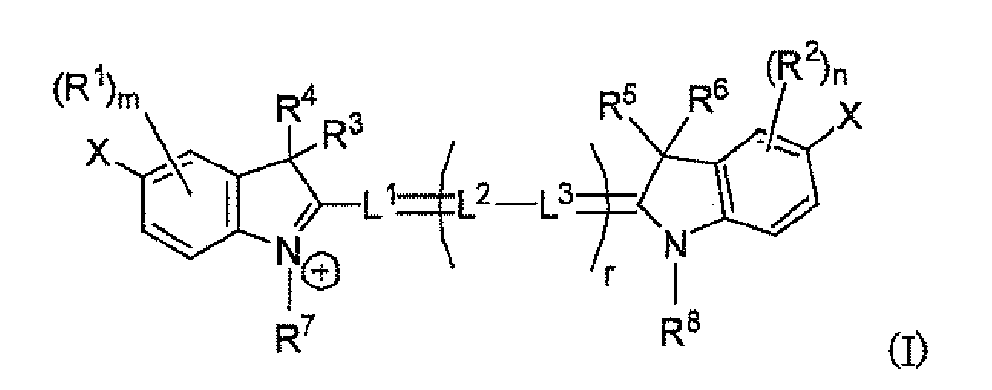
wherein X represents sulfonic acid group or phosphoric acid group; R1 and R2 represent substituents; R3 to R6 represent optionally substituted alkyl groups; R7 and R8 represent optionally substituted alkyl groups; L1 to L3 represent optionally substituted methine groups; r represents an integer of from 0 to 3, and when r is 2 or more, the plural L2 and the plural L3 may be the same or different, respectively; each of m and n represent integers of 0 to 3; at least one of the substituents is an acid group selected from sulfonic acid group, carboxylic acid group, and phosphonic acid group or a group comprising the acid group; and two or more of the acid groups and X are selected from carboxylic acid group and phosphonic acid group.
Description
- The present invention relates to a near infrared fluorescence imaging agent containing a novel compound.
- In the treatment of disease, morphological and functional changes that are caused by disease within an organism are important for detecting disease at an early stage. In the treatment of cancer, in particular, learning the position, size, and nature of a tumor early on is extremely important for determining a strategy and protocol. Examples of methods that have conventionally been employed for this purpose, in addition to biopsy by puncture and the like, are image diagnosis by X-ray imaging, MRI, PET, and ultrasound imaging. Biopsy is useful for making a diagnosis, but the burden on the patient is great and it is unsuitable for tracking the progression of lesions over time. X-ray imaging, MRI, and PET necessarily expose the patient to radiation and electromagnetic waves. Further, in conventional imaging diagnosis such as that mentioned above, complex operations and long periods are required for measurement. From the perspective of the size and shape of the device, it is difficult to perform surgery while navigating using these methods during surgical operations.
- Fluorescence imaging is an imaging diagnostic method that solves these problems. In this method, a substance that generates fluorescence when exposed to stimulating light of a specific wavelength is employed as an imaging agent. Further, this method comprises the steps of irradiating an excitation beam from outside the organism and detecting the fluorescence that is released by the fluorescent material within the organism.
- Cyanine compounds are typical compounds that can be used in the fluorescence imaging method. In practice, indocyanine green (abbreviated as "ICG" hereinafter) is currently employed to test liver function and in ophthalmic angiography. However, ICG dissolves readily, and must be employed in formulations to which iodine is added. There is thus a problem in that it cannot be used in patients who are allergic to iodine.
- The compound (denoted as "SF-64" hereinafter) that is described in Claim 1 of Japanese Patent No.
3,507,060 - The object of the present invention is to provide a novel compound that is useful as an imaging component in near infrared fluorescence imaging agent.
- The present inventors conducted extensive research on the mechanisms by which cyanine compounds accumulate in tumors using SF-64. As a result, they discovered that the cyanine compounds and the derivatives of the cyanine compounds form complexes with albumin in plasma. Based on this knowledge, they discovered a new group of cyanine compounds with actually enhanced imaging function relative to SF-64 in terms of the tumor outlining time period. They also discovered that the new group of cyanine compounds exhibit little difference of tumor outlining ability among the animal species. Therefore, the result that will be obtained when the test compound is administered to human can be easily predicted from the result of the animal test, and thus a compound that has high ability to outline a tumor in human can be selected at an early stage of a research. The present invention was devised based on this discovery. The present invention was achieved on the basis of these findings. The present invention thus provides [1] to [11] below.
- [1] A compound represented by general formula (I) below, or a pharmacologically acceptable salt thereof:

- [2] The compound according to [1] represented by general formula (II) below, or a pharmacologically acceptable salt thereof:

- [3] The compound according to [2], or a pharmacologically acceptable salt thereof, wherein R9 represents hydrogen atom, methyl group, or phenyl group.
- [4] The compound according to [2] or [3], or a pharmacologically acceptable salt thereof, wherein each of R10 and R11 represents an alkyl group substituted with sulfonic acid group or phosphonic acid group.
- [5] The compound according to [2] or [3], or a pharmacologically acceptable salt thereof, wherein each of R10 and R11 represents an alkyl group substituted with phosphonic acid group.
- [6] The compound according to any one of [1] to [5], or a pharmacologically acceptable salt thereof, wherein X represents sulfonic acid group.
- [7] The compound according to any one of [1] to [6], or a pharmacologically acceptable salt thereof, wherein one or more of carboxylic acid group, sulfonic acid group, and phosphonic acid group form salts with sodium ions.
- [8] A near infrared fluorescence imaging agent comprising the compound, or pharmacologically acceptable salt thereof, according to any one of [1] to [7].
- [9] The near infrared fluorescence imaging agent according to [8], which is used to image a tumor.
- [10] The near infrared fluorescence imaging agent according to [9], which is used to image a tumor of a type expressing a high level of SPARC.
- [11] The near infrared fluorescence imaging agent according to [9] or [10], which is used to image tumors occurring in the mouth cavity, pharynx, digestive organs, respiratory organs, bones, joints, soft tissue, skin, breasts, genitalia, urinary system, eyes, eyeball sockets, brain, central nervous system, or endocrine system.
From additional perspectives, the present invention provides the use of the above compounds for manufacture of a fluorescence imaging agent; a fluorescence imaging method comprising the step of fluorescence imaging after administering the above compound to a mammal, including a human; and a tumor imaging method comprising the step of fluorescence imaging after administering the above compound to a mammal, including a human. - Modes of Carrying Out the Invention
- In the present specification, the term "substituent," or the substituent meant by the use of the term "optionally substituted" or "substituted or unsubstituted," can be selected from the group of substituents listed below by way of example:
- Substituent group: halogen atoms, alkyl groups, alkenyl groups, alkynyl groups, aryl groups, heterocyclic groups, cyano groups, hydroxyl groups, nitro groups, carboxylic acid groups (carboxyl groups), alkoxy groups, aryloxy groups, silyloxy groups, heterocyclic oxy groups, acyloxy groups, carbamoyloxy groups, alkoxycarbonyloxy groups, aryloxycarbonyloxy groups, amino groups, alkylamino groups, arylamino groups, acylamino groups, aminocarbonylamino groups, alkoxycarbonylamino groups, aryloxycarbonylamino groups, sulfamoylamino groups, alkyl and arylsulfonylamino groups, mercapto groups, alkylthio groups, arylthio groups, heterocyclic thio groups, sulfamoyl groups, sulfonic acid groups (sulfo groups), alkylsulfinyl groups, arylsulfinyl groups, alkylsulfonyl groups, arylsulfonyl groups, acyl groups, aryloxycarbonyl groups, alkoxycarbonyl groups, carbamoyl groups, arylazo groups, heterocyclic azo groups, imide groups, phosphonic acid groups (phosphoric acid groups), phosphino groups, phosphinyl groups, phosphinyloxy groups, phosphinylamino groups, and silyl groups.
- Those among these groups that are capable of forming salts, and all that are capable of forming salts by dissociation of one or more hydrogen ions, may be in the form of salts. The counter ions of these salts are, for example, positive charge or negative charge that may be present in the compound of the present invention, an alkali metal ion and an alkaline earth metal ion.
- Examples of the halogen atom include chlorine atom, bromine atom, and iodine atom.
- Alkyl groups may be linear, branched, cyclic alkyl groups, or any combination thereof. Examples include linear alkyl groups having 1 to 30 carbon atoms (such as methyl, ethyl, n-propyl, isopropyl, t-butyl, n-octyl, eicosyl, and 2-ethylhexyl), cycloalkyl groups having 3 to 30 carbon atoms (such as cyclohexyl, cyclopentyl, 4-n-dodecylcyclohexyl), bicycloalkyl groups having 5 to 30 carbon atoms (monovalent groups obtained by removing a single hydrogen atom from a bicycloalkane having 5 to 30 carbon atoms, such as bicyclo[1,2,2]heptane,2-yl and bicyclo[2,2,2]octane-3-yl, and alkyl groups having structures with even more rings, such as tricyclo structures.
- Unless specifically stated otherwise, the alkyl moieties of substituents on alkyl moieties are identical to the above alkyl groups.
- Alkenyl groups may be linear, branched, or cyclic alkenyl groups. Examples include linear alkenyl groups having from 2 to 30 carbon atoms (such as vinyl, allyl, prenyl, geranyl, and oleyl), cycloalkenyl groups having 3 to 30 carbon atoms (monovalent groups obtained by removing a single hydrogen atom from a cycloalkene having 3 to 30 carbon atoms, such as 2-cyclopentene-1-yl and 2-cyclohexene-1-yl), and bicycloalkenyl groups having 5 to 30 carbon atoms (monovalent groups obtained by removing a single hydrogen atom from a bicycloalkane having a single double bond, such as bicyclo[2,2,1]hepto-2-ene-1-yl and bicyclo[2,2,2]octo-2-ene-4-yl). Preferable examples of alkynyl groups include alkynyl groups having 2 to 30 carbon atoms (such as ethynyl and propargyl). Preferable examples of aryl groups include aryl groups having 6 to 30 carbon atoms, such as phenyl, p-tolyl, and naphthyl.
- Heterocyclic groups are preferably five or six-membered heterocyclic groups, and can be monovalent groups obtained by removing a single hydrogen atom from an aromatic or non-aromatic heterocyclic compound. Preferable examples include five or six-membered aromatic heterocyclic groups having 3 to 30 carbon atoms, such as 2-furyl, 2-thienyl, 2-pyrimidinyl, and 2-benzothiazolyl. Preferable examples of alkoxy groups include alkoxy groups having 1 to 30 carbon atoms, such as methoxy, ethoxy, isopropoxy, t-butoxy, and n-octyloxy. Preferable examples of aryloxy groups include aryloxy groups having 6 to 30 carbon atoms, such as phenoxy groups. Preferable examples of silyloxy groups include silyloxy groups having 3 to 20 carbon atoms, such as trimethylsilyloxy and t-butyldimethylsilyloxy.
- Preferable examples of heteroeyclicoxy groups include heterocyclicoxy groups having 2 to 30 carbon atoms, such as tetrazole-5-oxy and 2-tetrahydropyranyloxy. Examples of acyloxyl groups include formyloxy groups, alkylcarbonyloxy groups having 2 to 30 carbon atoms, and arylcarbonyloxy groups having 6 to 30 carbon atoms, such as formyloxy, acetyloxy, pivaloyloxy, stearoyloxy, benzoyloxy, and phenylcarbonyloxy. Preferable examples of carbamoyloxy groups include carbamoyloxy groups having 1 to 30 carbon atoms, such as N,N-dimethylcarbamoyloxy, N,N-diethylcarbamoyloxy, marphalinocarbonyloxy, N,N-di-n-octylaminocarbonyloxy, and N-n-octylcarbamoyloxy. Preferable examples of alkoxycarbonyloxy groups are alkoxycarbonyloxy groups having 2 to 30 carbon atoms, such as methoxycarbonyloxy, ethoxycarbonyloxy, t-butoxycarbonyloxy, and n-octylcarbonyloxy.
- Preferable examples of aryloxycarbonyloxy groups include aryloxycarbonyloxy groups having 7 to 30 carbon atoms, such as phenoxycarbonyloxy. Examples of alkylamino groups include alkylamino groups having 1 to 30 carbon atoms, such as methylamino and dimethylamino. Preferable examples of arylamino groups include arylamino groups having 6 to 30 carbon atoms, such as anilino and diphenylamino. Preferable examples of acylamino groups include formylamino groups, alkylcarbonylamino groups having 1 to 30 carbon atoms, and arylcarbonylamino groups having 6 to 30 carbon atoms, such as formylamino, acetylamino, pivaloylamino, lauroylamino, benzoylamino, and 3,4,5-tri-n-octyloxyphenylearbonylamino. Preferable examples of aminocarbonylamino groups include azninacarbanylamino groups having 1 to 30 carbon atoms, such as carbamoylamino, N,N-dimethylaminocarbonylamino, N,N-diethylaminocarbonylamino, and morpholinocarbonylamino.
- Preferable examples of alkoxycarbonylamino groups include alkoxycarbonylamino groups having 2 to 30 carbon atoms, such as methoxycarbonylamino, ethoxycarbonylamino, t-butoxycarbonylamino, and n-octadecyloxycarbonylamino. Preferable examples of aryloxycarbonylamino groups include aryloxycarbonylamino groups having 7 to 30 carbon atoms, such as phenoxycarbonylamino. Preferable examples of sulfamoylamino groups include sulfamoylamino groups having 0 to 30 carbon atoms, such as sulfamoylamino, N,N-dimethylaminosulfonylamino, and N-n-octylaminosulfonylamino. Preferable examples of alkyl- and arylsulfonylamino groups include alkylsulfonylamino groups having 1 to 30 carbon atoms and arylsulfonylamino groups having 6 to 30 carbon atoms, such as methylsulfonylamino, butylsulfonylamino, and phenylsulfonylamino. Preferable examples of alkylthio groups include alkylthio groups having 1 to 30 carbon atoms, such as methylthio, ethylthio, and n-lsexadecylthio. Preferable examples of arylthio groups include arylthio groups having 6 to 30 carbon atoms, such as phenylthio. Preferable examples of heterocyclicthio groups are heterocyclicthio groups having 2 to 30 carbon atoms, such as 2-benzothiazolylthio and tetrazole-5-ylthio.
- Preferable examples of sulfamoyl groups are substituted or unsubstituted sulfamoyl groups having 0 to 30 carbon atoms, such as N-ethylsulfaxnoyl, N-(3-dodecyloxypropyl)sulfamoyl, N,N-dzznetbylsulfamoyl, N-acetylsulfamoyl, N-benzoylsulfamoyl, and N-(N'-phenylcarbamoyl)sulfamoyl. Preferable examples of alkylsulfinyl groups and arylsulfinyl groups include alkyl sulfinyl groups having 1 to 30 carbon atoms and arylsulfinyl groups having 6 to 30 carbon atoms, such as methylsulfinyl, ethylsulfinyl, and phenylsulfinyl. Preferable examples of alliyl- and arylsulfonyl groups include alkylsulfonyl groups having 1 to 30 carbon atoms, and arylsulfonyl groups having 6 to 30 carbon atoms, such as methylsulfonyl, ethylsulfonyl, and phenylsulfonyl. Preferable examples of acyl groups include formyl groups, alkylcarbonyl groups having 2 to 30 carbon atoms, arylcarbonyl groups having 7 to 30 carbon atoms, and heterocyclic carbonyl groups, having 4 to 30 carbon atoms, that are bonded to carbonyl groups, such as acetyl, pivaloyl, stearoyl, benzoyl, 2-pyridylcarbonyl, and 2-furylcarbonyl. Preferable examples of aryloxycarbonyl groups include aryloxycarbonyl groups having 7 to 30 carbon atoms, such as phenoxycarbonyl.
- Preferable examples of alkoxycarbonyl groups include alkoxycarbonyl groups having 2 to 30 carbon atoms, such as methoxycarbonyl, ethoxycarbonyl, t-butoxycarbonyl, and n-octadecyloxycarbonyl. Preferable examples of carbamoyl groups include carbamoyl groups having 1 to 30 carbon atoms, such as carbamoyl, N-methylearbamoyl, N,N-dimethylcarbamoyl, N,N-di-n-octylearbamoyl, and N-(methylsulfonyl)carbamoyl. Preferable examples of arylazo groups and heterocyclic azo groups include arylazo groups having 6 to 30 carbon atoms and heterocyclic azo groups having 3 to 30 carbon atoms, such as phenylazo and 1,3,4-thiadiazole-2-ylazo. Preferable examples of imide groups include N-succinimide and N-phthalimide. Preferable examples of phosphino groups include phosphino groups having 2 to 30 carbon atoms, such as dimethylphosphino, diphenylphosphino, and methylphenoxyphosphino. Preferable examples of phospbinyl groups include phosphinyl groups having 2 to 30 carbon atoms, such as phosphinyl, dioctyloxyphosphinyl, and diethoxyphosphinyl. Preferable examples of phosphinyloxy groups include phosphinyloxy groups having 2 to 30 carbon atoms, such as diphenoxyphosphinyloxy and dioctylaxyphosphinyloxy. Preferable examples of phosphinylamino groups include phosphinylamino groups having 2 to 30 carbon atoms, such as dimethoxyphosphinylamino and dimethylaminophospbinylamino. Preferable examples of silyl groups include silyl groups having 3 to 30 carbon atoms, such as trimethylsilyl, t-butyldimethylsilyl, and phenyldimethylsilyl.
- The above substituents may themselves be substituted with the above substituents. Examples of such substituents include arylalkyl groups, acylaminoaryloxy groups, alkylcarbonylaminosulfonyl groups, arylcarbonylaminosulfonyl groups, alkylsulfonylaminocarbonyl groups, and arylsulfonylaminacarbonyl group. Specific examples include methylsulfonylaminocarbonyl, p-methylphenylsulfonylami-nocarbonyl, acetylaminosulfonyl, and henzoylaminosulfonyl.
- The compound represented by general formula (I) will be described in detail below.
- The compound represented by general formula (I) comprises in the molecule three or more acid groups selected from sulfonic acid group, carboxylic acid group, and phosphonic acid group. Further, two or more of the acid groups are selected from carboxylic acid group and phosphonic acid group. The substituents X in general formula (I) are acid groups, but neither of X is carboxylic acid group. Acid groups may be in the form of groups forming salts through the dissociation of protons.
- In general formula (1), each of R1 and R2 independently represents a substituent. These substituents can be selected from the above-described group of substituents. Each of R1 and R2 preferably represents a halogen atom, alkyl group (including a linear, branched, or cyclic alkyl group), aryl group, heterocyclic group, cyano group, carboxylic acid group, alkoxy group, aryloxy group, heterocyclic oxy group, amino groups (including an anilino group), acylamino group, aminocarbonylamino group, alkoxycarbonylamino group, aryloxycarbonylamino group, sulfamoylamino group, alkyl or arylsulfonylamino group, alkylthio group, arylthio group, heterocyclic thio group, sulfamoyl group, sulfonic acid group, alkyl or arylsulfonyl group, acyl group, alkoxycarbonyl group, carbamoyl group, or imide group. The substituent of more preference is a halogen atom, alkyl group (including a linear, branched, or cyclic alkyl group), aryl group, heterocyclic group, carboxylic acid group, alkoxy group, amino group (including an anilino group), acylamino group, sulfamoyl group, sulfonic acid group, carbamoyl group, or imide group. The substituent of even greater preference is a halogen atom, linear, branched, or cyclic alkyl group having 1 to 6 carbon atoms, aryl group having 6 to 10 carbon atoms, heterocyclic group having 1 to 10 carbon atoms, carboxylic acid group, or sulfonic acid group. The substituent of still greater preference is a bromine atom, iodine atom, methyl group, ethyl group, phenyl group, naphthyl group, thienyl group, furyl group, or pyridyl group.
- In general formula (I), m and n represent integers of 0 to 3. When m and n represent 2 or 3, the multiple instances of R1 and R2 may be identical or different. It is preferable for m and n to represent 0 or 1, and preferably for them to represent 0.
- In general formula (I), R3 to R6 may be identical or different. Each represents a substituted or unsubstituted alkyl group. This alkyl group is identically defined with the alkyl groups at R1 and R2; when it comprises a substituent, the substituent can be selected from the above-described group of substituents. Each of R8 to R6 preferably independently represents an alkyl group with 1 to 20 total carbon atoms, more preferably an alkyl group with 1 to 15 total carbon atoms, further preferably an alkyl group with 1 to 10 total carbon atoms, and still further preferably, an alkyl group with 1 to 3 total carbon atoms. Each of R3 to R6 preferably independently represents an unsubstituted alkyl group, with a methyl group being preferred.
- In general formula (I), R7 and R8 may be identical or different; each represents a substituted or unsubstituted alkyl group. The alkyl group may be a linear alkyl group (preferably a linear alkyl group having 1 to 30 carbon atoms), a branched alkyl group (preferably a branched alkyl group having 3 to 30 carbon atoms), or a cyclic alkyl group (including an alkyl group having a tricyclic structure, preferably a cycloalkyl group having 3 to 30 carbon atoms or a bicyclic alkyl group having 5 to 30 carbon atoms (a monovalent group obtained by removing a single hydrogen atom from a bicycloalkane having 5 to 30 carbon atoms)). Examples include methyl, ethyl, n-propyl, isopropyl, t-butyl, n-octyl, eicosyl, 2-ethylhexyl, cyclohexyl, cyclopentyl, 4-n-dodecylcyclohexyl, bicyclo[1,2,2]heptane-2-yl, and bicyclo[2,2,2]octane-3-yl.
- Of these, a linear alkyl group having 1 to 20 carbon atoms is preferable, a linear alkyl group having 1 to 10 carbon atoms, is more preferred, and a linear alkyl group having 1 to 5 carbon atoms is further more preferred.
- The types, number, and positions of substituents on substituted alkyl groups represented by R7 and R8 are not specifically limited. When R7 or R8 is a substituted alkyl group, the substituent is preferably a halogen atom, carboxylic acid group, sulfonic acid group, phosphonic acid group, alkylthio group, arylthio group, or heterocyclic thio group; more preferably a carboxylic acid group, sulfonic acid group, or phosphonic acid group; further preferably a carboxylic acid group or phosphonic acid group; moat preferably a phosphonic acid group. A group forming a salt after dissociation of a proton in the acid group is similarly preferable. When the substituted alkyl group is a substituted linear alkyl group, the substitution site is preferably a site located two or more carbon atoms away from the nitrogen atom to which the substituted linear alkyl group substitutes as R7 or R8, and preferably the terminal carbon atom. The number of substituents is preferably 1.
- Each of L1 to L8, which may be identical or different, represents a substituted or unsubstituted methine group. r represents an integer of 0 to 3. When r is 2 or greater, the multiple instances of L2 and L3 may be identical or different. When L1 to L3 represent substituted methine groups, the substituents may be selected from the above-described group of substituents. When any two or more from among L1 to L3 represent substituted methine groups, the substituents may be bonded together to form a ring.
- Specific examples of substituents and specific examples of cases where the substituents bond together to form rings are given below. The examples given below show structures of the polymethine group moiety represented by L1 to L3 wherein r = 2 and L8 is sandwiched between two instances of L2 and contains a substituent. An "*" indicates a a position bonding to one of the other two partial structures.


- When an acid group is in the form of group forming a salt, it preferably forms a salt with a negative charge, or a salt with an alkali metal or alkaline earth metal. Preferable alkali metals and alkaline earth metals are Na and K, with Na being more preferred.
- The positive charge of the compound represented by general formula (I) is neutralized by a counter anion either inside or outside the molecule. Examples of such counter anions are: halogen ions such as chlorine ions, bromine ions, and iodine ions; carboxylate ions such as acetate ions, oxalate ions, fumarate ions, and benzoate ions; sulfonate ions such as p-toluene sulfonate, methane sulfonate, butane sulfonate, and benzene sulfonate; sulfuric acid ions; perchloric acid ions; carbonic acid ions; and nitric acid ions. When a group having a negative charge, such as a carboxylate group or sulfonate group, is present within the molecule, it may form an intramolecular salt with a positively charged compound. Preferable examples of extramolecular counter anions include halogen ions, methane sulfonate ions, and sulfuric acid ions. More preferred examples are chloro ions, bromo ions, and methane sulfonate ions.
- The compound represented by general formula (I) preferably is the compound represented by general formula (II) above.
- When R9 in general formula (II) represents an alkyl group, the alkyl group preferably comprises a total of 1 to 20 carbon atoms, more preferably 1 to 15 carbon atoms, and further preferably, 1 to 10 carbon atoms. Specific preferred examples include methyl group, ethyl group, n-propyl group, 2-propyl group, and cyclopropyl group; examples of greater preference include methyl group, ethyl group, n-propyl group, 2-propyl group, and cyclopropyl group.
- When R9 represents an aryl group, the aryl group preferably comprises a total of 5 to 20 carbon atoms, preferably 5 to 15 carbon atoms, and more preferably, 5 to 10 carbon atoms. Specific preferred examples are a phenyl group, 4-methylphenyl group, 4-phenylphenyl group, and naphthyl group.
- When R9 represents an arylalkyl group, the arylalkyl group preferably comprises a total of 7 to 30 carbon atoms, more preferably 7 to 20 carbon atoms, and further preferably, 7 to 10 carbon atoms. Specific preferred examples include a benzyl group, phenylethyl group, and phenylpropyl group.
- When R9 represents a heterocyclic group, the heterocyclic group preferably comprises a total of 1 to 20 carbon atoms, more preferably 1 to 15 carbon atoms, and further preferably, 1 to 10 carbon atoms. Specific preferred examples include a 4-pyridyl group, 2-furyl group, 2-thienyl group, and 2-oxopyrrolidine-1-yl group.
- When R9 represents an acylamino group, the acylamino group preferably comprises a total of 1 to 20 carbon atoms, more preferably 1 to 15 carbon atoms, and further preferably, 1 to 10 carbon atoms. Specific preferred examples include an acetylamino group, benzoylamino group, pivaloylamino group, and 4-phenylbenzoylamino group.
- When R9 represents an arylamino group, the arylamino group preferably comprises a total of 1 to 20 carbon atoms, more preferably 1 to 15 carbon atoms, and further preferably, 1 to 10 carbon atoms. Specific preferred examples include an N-phenylamino group, N-tolylamino group, and N,N-diphenylamino group.
- When R9 represents an N-aryl-N-alkylamino group, the N-aryl-N-alkylamino group preferably comprises a total of 7 to 30 carbon atoms, more preferably 7 to 20 carbon atoms, and more preferably, 7 to 15 carbon atoms. Specific preferred examples include an N-phenyl-N-methylamino group and N-tolyl-N-methylamino group.
- When R9 represents an arylthio group, the arylthio group preferably comprises a total of 1 to 20 carbon atoms, more preferably 1 to 15 carbon atoms, and further preferably, 1 to 10 carbon atoms. Specific preferred examples include a phenylthio group, tolylthio group, 4-phenylphenylthio group, and naphthylthio group.
- When R9 represents an aryloxy group, the aryloxy group preferably comprises a total of 1 to 20 carbon atoms, more preferably 1 to 15 carbon atoms, and further preferably, 1 to 10 carbon atoms. Specific preferred examples include a phenyloxy group, 4-acetylaminophenyloxy group, 4-phenylphenyloxy group, and naphthyloxy group.
- When R9 represents an acylaminoaryloxy group, the acylaminoaryloxy group preferably comprises a total of 7 to 30 carbon atoms, more preferably 7 to 20 carbon atoms, and further preferably, 7 to 15 carbon atoms. A specific preferred example includes a benzoylaminophenyloxy group.
- Each of R10 and R11 independently represents an alkyl group substituted with a carboxylic acid group, sulfonic acid group, or phosphonic acid group. In R10 and R11, which may be identical or different, it suffices for the alkyl group to be a linear alkyl group (preferably a linear alkyl group having 1 to 30 carbon atoms), branched alkyl group (a branched alkyl group having 3 to 30 carbon atoms), or a cyclic alkyl group (including one having a tricyclic structure, preferably a cycloalkyl group having 3 to 30 carbon atoms, or a bicyclic alkyl group having 5 to 30 carbon atoms (a monovalent group obtained by removing one hydrogen atom from a bicycloalkane having 5 to 30 carbon atoms)). Examples include methyl, ethyl, n-propyl isopropyl, t-brxtyl, n-octyl, eicosyl, 2-ethylhexyl, cyclohexyl, cyclopentyl, 4-n-dodecylcyclohexyl, bicycio[1,2,2]heptane-2-yl, and bicyclo[2,2,2]octane-3-yl. Of these, a linear alkyl group with 1 to 20 carbon atoms is preferable, a linear alkyl group with 1 to 10 carbon atoms is more preferred, and a linear alkyl group with 1 to 5 carbon atoms is further preferred.
- In R10 and R11, neither the number nor position of the carboxylic acid group, sulfonic acid group, or phosphonic acid group is specifically limited. However, each of R10 and R11 preferably represents an alkyl groups having carboxylic acid group or phosphonic acid group, and more preferably represents an alkyl group having phosphonic acid group. The acid groups may form salts through the dissociation of hydrogen atoms.
- When R10 and R11 are substituted with the above groups, the position of the substituent is preferably two or more carbon atoms away from the nitrogen atom to which each of R10 and R11 substitutes, preferably the terminal carbon atom.
- It is particularly necessary for a fluorescence imaging agent for use within an organism to be water soluble. The water solubility of the near infrared fluorescence imaging agent of the present invention is markedly improved by incorporating three or more acid groups selected from carboxylic acid group, sulfonic acid group, and phosphonic acid group into the above compound. To achieve good water solubility, the total number of sulfonic acid groups, carboxylic acid groups, and phosphonic acid groups is preferably four or more. To facilitate synthesis, the number of sulfonic acid groups, carboxylic acid groups, and phosphonic acid groups is 10 or fewer, preferably 8 or fewer. The improvement in water solubility can be checked by measuring the partition coefficient of the individual compound. For example, the partition coefficient can be checked by measurement in a butanol/water two-phase system. More specifically, the incorporation of three or more sulfonic acid groups yields an n-butanol/water partition coefficient log Po/w of -1.00 or lower.
- Water solubility within an organism can be determined based on an index of whether or not the compound settles out or precipitates over time at 36°C when dissolved in physiological saline.
- The substance contained as an imaging component in the near infrared fluorescence imaging agent of the present invention is not limited other than that it be the compound represented by general formula (I) or a pharmacologically acceptable salt thereof. Such compounds can be synthesized by the known manufacturing methods for cyanine dye compounds disclosed in "Cyanine Dyes and Related Compounds," F. M. Hamer, John Wiley and Sons, New York, 1964; Cytometry, 10, 3-10 (1989); Cytometry, 11, 418-430 (1990); Cytometry, 12, 723-730 (1990); Bioconjugate Chem. 4, 105-111 (1993), Anal. Biochem., 217, 197-204 (1994); Tetrahedron, 45, 4845-4866 (1989);
EP-A-0591820A1 EP-A-0580145A1 - Specific examples of the present invention are given below.


- The above compounds, which should be in the near infrared fluorescence imaging agent according to the present invention, exhibit absorption and fluorescence in the near infrared light region of 700 to 1,300 nm, particularly about 700 to 900 nm, and have a molar absorption coefficient of 100,000 or greater.
- The near infrared fluorescence imaging agent of the present invention is not specifically limited other than that it comprise the compound represented by general formula (I) and/or a pharmacologically acceptable salt thereof. The compound or salt thereof may be employed singly or in combination in the imaging agent.
- Specifically, the imaging agent contains the above compound or a pharmacologically acceptable salt thereof, or the above compound suspended or dissolved in a solvent such as injection-use distilled water, physiological saline, or Ringer's solution. As needed, pharmacologically acceptable additives, such as a support or an excipient, can be added. Examples of these additives include pharmacologically acceptable electrolytes, buffers, substances such as cleansing agents, and substances that enhance stability and solubility by adjusting the osmotic pressure (such as cyclodextrin and ribosomes). Various additives generally employed in related fields can be employed. The near infrared fluorescence imaging agent of the present invention is preferably manufactured for pharmacological use by means of a sterile process.
- The imaging agent can be administered to an organism by injection, by spraying, by coating, by intravascular administration (veins, arteries), oral administration, intraperitoneal administration, transdermal administration, subdermal administration, intravesical administration, or intrabronchial administration. The present imaging agent is preferably administered in the form of an aqueous agent, emulsion, or suspension into a blood vessel.
- The dose of the near infrared fluorescence imaging agent of the present invention that is employed is not specifically limited other than that the dose employed permit detection of the site to be finally diagnosed, and is suitably adjusted based on the type of compound releasing the near infrared light that is employed, or age, weight, target organ of administration, and the like. Typically, the dose is 0.01 to 100 mg/kg of body weight, preferably 0.01 to 20 mg/kg of body weight, based on the quantity of compound. The imaging agent of the present invention can be suitably employed in various animals in addition to humans. The form, route, and dose administered are suitably determined based on the body weight and conditions of the subject animal.
- The compound represented by general formula (I), and, preferably, the compound represented by general formula (II), have a marked tendency to accumulate in tumor tissue. Utilizing this characteristic, it is possible to use the fluorescence imaging agent of the present invention to specifically image tumor tissue. Further, the compound of the present invention has a long half-life in serum, making it possible to anticipate good functioning as a blood vessel imaging agent, as well.
- The near infrared fluorescence imaging agent of the present invention can be employed in fluorescence imaging. This method is implemented by a known method. Various parameters such as the excitation wavelength and fluorescence wavelength to be detected are suitably determined to permit optimal imaging and evaluation based on the type of near infrared fluorescence imaging agent being administered and the subject of administration. The time required from when the near infrared fluorescence imaging agent of the present invention is administered to the measurement subject to when measurement by the fluorescence imaging method of the present invention begins varies depending on the type of the near infrared fluorescence imaging agent employed and the subject of administration. For example, when the compound represented by general formula (I) is incorporated into an imaging agent for the purpose of tumor imaging, the time elapsing after administration is considered to be about 4 to 120 hours. In particular, in the case of the compound represented by general formula (II), the time elapsing after administration is considered to be about 24 to 120 hours. When the time elapsed is too short, the fluorescence is excessively strong, making it impossible to clearly distinguish between the target site and other sites. When excessively long, the imaging agent is sometimes discharged from the body.
- Research by the present inventors based on SF-64 revealed for the first time that cyanine compounds form complexes with albumin in plasma, thereby accumulating in tumors. The compound represented by general formula (I) having two or more of acid groups selected from carboxylic acid group and phosphonic acid group has a higher ability to bind albumin than SF-64.
- Due to the high ability to bind albumin of the compound of the present invention, it can bind to albumin-binding proteins such as SPARC, cubilin, and TGF-beta, Thus, the compound of the present invention can be employed as an imaging agent in the course of imaging disease in which albumin-binding proteins play primary roles and are expressed in greater amounts than in normal tissue. The albumin-binding protein is preferably selected from among SPAR, cubilin, and TGF-beta, and is preferably SPAR.
- The compound of the present invention or a pharmacologically acceptable salt thereof thus functions as a detecting agent for SPARC-expressing tissue and can be employed as a diagnostic drug for all pathology relating to SPARC. The pathology for which the compound of the present invention can be employed as an imaging agent includes abnormal reproductive states, tissue reconstruction, overformation, and excessive wound healing in any physical tissue including soft tissue, connective tissue, bone, solid organs, and blood vessels. Specific examples include cancer, diabetes and related retinal disorders, inflammation, arthritis, restenosis in blood vessel, sections of artificial vascular transplants, and intravascular devices.
- The types of tumors that are detected by the compound of the present invention are those that are generally observed in mammals, including humans. These tumors can be generated by inoculation of test animals and the like. The tumors are also known as "neoplasms," and come in many types and forms. The tumors to which the compound of the present invention is applied as an imaging agent are not limited, and may be any specific type or form of tumor. The compound of the present invention is useful for imaging tumor cells, related interstitial cells, solid tumors, and tumors relating to soft tissue, such as human soft tissue sarcomas. The tumor or cancer can be located in the mouth cavity, pharynx, digestive organs, respiratory organs, bones, joints (such as bone metastasis), soft tissue, skin (such as melanoma), breasts, genitalia, urinary system, eyes, eyeball sockets, brain, central nervous system (such as gliomas), or the endocrine system (such as the thyroid gland), and are not limited to primary tumors or cancers. Examples of tissues relating to the mouth cavity include tongue and mouth tissues. Cancers can occur in digestive system tissue, including the esophagus, stomach, duodenum, small intestine, colon, rectum, anus, liver, gall bladder, and pancreas. Respiratory cancers can occur in the pharynx, lungs, and bronchia. Tumors can occur in the cervix, uterus, ovaries, vulva, vagina, prostate, testicles, and penis, constituting the male and female genitalia, as well as in the bladder, kidneys, renal pelvis, and urethra, constituting the urinary system. Tumors and cancers can occur in the head and/or cervix. Tumors and cancers can also occur within the lymph tissue system. Examples thereof include Hodgkin's disease and non-Hodgkin's lymphomas. Tumors and cancers can occur in the hematogenic system. Examples thereof include multiple myeloma and leukemia, such as acute lympholeukemia, chronic lymphocytic leukemia, acute myelitic leukemia, and chronic myelitic leukemia. The tumor is preferably positioned in the bladder, liver, pancreas, ovaries, kidneys, esophagus, stomach, intestines, brain, skin, or breasts.
- Albumin has affinity for SPARC. Accordingly, the compound of the present invention accumulates at lesion area expressing SPARC while accumulating little or not at all in healthy tissue.
- The expression of SPARC protein in samples can be detected and quantified by any suitable method that is known in the field. Examples of suitable methods for detecting and quantifying proteins are the western blot method, enzyme-linked immunosorbent assay (ELISA), silver dye method, BCA assay (described in Smith et al., Anal. Biochem., 150, 76-85 (1985)), the Lowry protein assay, which is a form of protein-copper complex-based colorimetric analysis (described, for example, in Lowry et al., J. Biol. Chem., 193, 265-275 (1951)), and Bradford protein analysis based on the absorbance change of Coomassie blue G-250 in the course of protein binding (described, for example, in Bradford et al., Anal. Biochem., 72, 248 1976)). Tumor biopsies can be conducted by any conventional method, or conducted immunohistologically using anti-SPARC antibody (either monoclonal or polyclonal) in combination with a suitable visualization system (that is, HRP substrate and HRP-coupled secondary antibodies).
- The present invention will be described more specifically below through examples. However, the scope of the present invention is not limited to the examples set forth below. The compound numbers given in the examples below correspond to the above-described compound examples. The names of the compounds indicated in the embodiments below do not necessarily conform to IUPAC naming conventions.
- In the examples below, the serial numbers of the compounds and the compound structures correspond to the numbers of the compounds given by way of example above.
- Intermediates for synthesizing the compound of the present invention were obtained by the following procedure.
- 5-Sulfo-2,3,3-trimethylindoleine was prepared by a known synthesis method (Japanese Unexamined Patent Publication (KOKAI) Heisei No.
2-233658 
- Intermediate 1 (a heterocyclic quaternary salt compound) was prepared by a method described in the patent literature (Published Japanese Translation (TOKUHYO) No.
2002-526458 WO00/16810 - That is, 2-cbloroethanesulfononyl chloride was added dropwise over two hours while stirring at room temperature to 5-sulfo-2,3,3-trimethylincioleine dissolved in DMAC, then the mixture was stirred for another three hours. Methanol was added dropwise over 30 minutes, then an aqueous sodium hydroxide solution was added dropwise over one hour and stirred for another hour at room temperature. When the reaction was completed, acetonitrile was added dropwise over two hours and the mixture was left standing overnight at room temperature to allow crystals to precipitate. The crystals were collected by filtration, washed with a DMAc/methanol/water/acetonitrile = 5/4/4/40 solution followed by acetonitrile, and dried under reduced pressure to obtain intermediate 1.


- Intermediate 3 was obtained in a similar manner to that of intermediate 2 by using 5-sulfo-2,3,3-trimethylindoleine and2-bromopropionic acid.

- Intermediate 4 was obtained in a similar manner to that of intermediate 2 by using 5-sulfo-2,3,3-trimethylindoleine and 4-bromo-n-butyric acid.

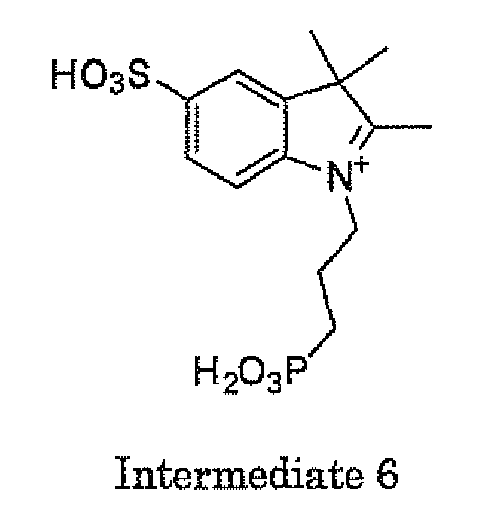

- Specifically, 4-bromophenyl hydrazine monohydrochloride and 3-methyl-2-butanone are dissolved in ethanol. The obtained solution was added with concentrated sulfuric acid dropwise and reflexed under stirring for 6 hours. After completion of the reaction, the solvent was concentrated under reduced pressure. The resultant was added with aqueous sodium hydroxide to achieve pH 8 and the oil layer was extracted with ethyl acetate. The oil layer was washed with saturated brine, dried over sodium sulfate, and purified by silica gel column chromatography (hexane: ethyl acetate=3:1) to obtain intermediate 7 as brown liquid. MS(ESI+) 238 [M+1]+

- Intermediate 7 (1 equivalent), diethylphosphonate (1.1 equivalents), triethylamine (1.1 equivalents), and tetrakis(triphenylphosphirle)palladium (0.06 equivalents) were added to toluene. The obtained solution was stirred at 95°C under nitrogen atmosphere for 6 hours. After completion of the reaction, excess ethyl acetate was added to the solution, and the generated precipitate was removed by filtration, and the solvent was evaporated. The obtained intermediate 8 was dissolved in acetonitrile. The solution was added with trimethylsilyl bromide (6 equivalents) and stirred at room temperature for 5 hours. The excess trimethylsilyl bromide and the solvent were evaporated under reduced pressure. The residue was added with acetonitrile:water=2:1 and stirred at room temperature for 12 hours. The solvent was evaporated under reduced pressure. The obtained crude product was added with methanol. The generated insoluble matter was removed by filtration. The filtrate was added with ethyl acetate. The generated oil was collected by separation treatment, and the oil was dried under reduced pressure to obtain intermediate 9.
- Intermediate 9: 1H NMR (300MHz, MeOD) δ1.50 (s, 6H), 3.34 (s, 3H), 7.72-7.98 (m, 1H), 7.85-7.99 (m, 2H), MS(ESI+) 240 [M+1]+

- Intermediate 9 was added with DMAc and triethylamine (1 equivalent). The solution was added with 2-chloroethane sulfonyl chloride (3 equivalents) dropwise, while being kept at room temperature. The solution was stirred for 4 hours, and added with aqueous 1N sodium hydroxide. The solution was stirred at room temperature for one hour and added with large excess acetone dropwise. The obtained oil was collected by separation treatment. The oil was dissolved in methanol again. The solution was added to acetone dropwise and the precipitated powder was collected by filtration to obtain intermediate 10. MS(ESI+) 348 [M+1]+


- The dianil compounds indicated below were obtained or synthesized by the method described in the patent literature (Published Japanese Translation (TOKUHYO) No.
2008-526802 WO2006/072580 
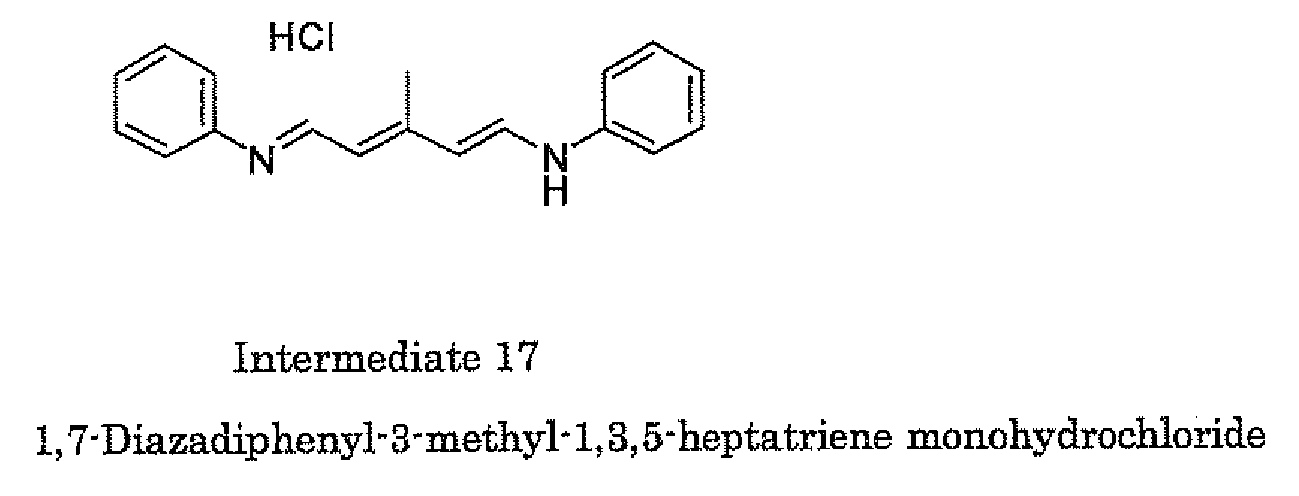

- The compounds and salts thereof indicated below were manufactured by the methods indicated below, for example, using the above heteroquaternary salt compounds and dianil compounds or benzthiazole compounds.
- A known heteroquaternary compound (5 moles), or one synthesized by a known method or the above-described synthesis method, and a known dianil compound (10 mmol), or one synthesized by a known method or the above-described synthesis method, or a benzthiazole compound (10 mmoles), is stirred for four hours at room temperature in a methanol solution in the presence of triethylamine (25 mmol) and acetic anhydride (45 mmol). To the reaction mixture is added sodium acetate (33 mmol) and the mixture is stirred for 30 minutes at room temperature. The crystals generated are removed by filtration and washed with methanol. When the presence of products other than the target compound is observed by reverse-phase thin layer chromatography, purification is conducted by size exclusion chromatography with methanol as the developing solvent or by reverse phase chromatography with a water/methanol mixed solvent as the developing solvent.
- The condition for the HPLC analysis is as follows.
- HPLC Column: TOSOH TSKgel ODS-100V, 150 X 4.6mm
- Column temperature: 40 °C
- Flow rate 1.0 mL/min
- eluent: A) water/acetic acid/triethylamine (100/0.1/0.1), B) acetonitrilelacetic acid/triethylamine (100/0.110.1)
- gradient: 0-100%B(0-30 min)
- Detection: Absorbance at 254 nm and 780 nm
- Compound 4: Prepared by the above synthesis method using intermediates 2 and 16.
- 1H NMR (400MHz, D2O) δ 1.68 (s, 12H), 4.60 (s, 4H), 6.11 (d, 2H), 6.54 (dd, 2H), 7.33 (d, 2H), 7.49 (dd, 1H), 7.74-7.92 (m,6H), HPLC 10.7min, λ max=744nm Compound 5: Prepared by the above synthesis method using intermediates 2 and 17.
- 1H NMR (400MHz, D2O) δ 1.68 (s, 12H), 2.30 (s, 3H), 4.60 (s, 4H), 6.25 (d, 2H), 6.54 (dd, 2H), 7.25 (d, 2H), 7.74-7.92 (m,6H) HPLC 12.2min, λmax=759nm Compound 6: Prepared by the above synthesis method using intermediates 4 and 16.
- 1H NMR (400MHz, D2O) δ 1.60 (s, 12H), 1.90-2.05 (m, 8H), 2.90 (s, 4H), 4.60 (s, 4H), 6.11 (d, 2H), 6.54 (dd, 2H), 7.33 (d, 2H), 7.49 (dd, 1H), 7.74-7.92 (m,6H), λ max=759nm Compound 7: Prepared by the above synthesis method using intermediates 4 and 17.
- 1H NMR (400MHz, D2O) δ 1.65 (s, 12H), 1.90-2.20 (m, 8H), 2.90 (s, 4H), 4.60 (s, 4H), 6.11 (d, 2H), 6.54 (dd, 2H), 7.33 (d, 2H), 7.49 (dd, 1H), 7.74-7.92 (m,6H), λ max=752nm Compound 8: Prepared by the above synthesis method using intermediates 2 and 15.
- 1H NMR (400MHz, D2O) δ 1.21 (s, 12H), 4.58 (s, 4H), 6.15 (d, 2H), 6.68 (d, 2H), 6.85-6.95 (m, 2H), 7.10 (d, 2H), 7.28 (dd, 2H), 7.46-7.56 (m, 3H), 7.65-7.72 (m, 4H), MS(ESI+) 733 [M+1]+, HPLC 12.4min, λmax=785nm
- Compound 9: Prepared by the above synthesis method using intermediates 5 and 16.
- 1H NMR (400MHz, D2O) δ 1.60 (s, 12H), 2.07 (m, 4H), 4.28-4.33 (m, 4H), 6.27 (d, 2H), 6.57 (dd, 2H), 6.33 (d, 2H), 7.45 (dd, 1H), 7.74-7.88 (m,6H), MS(ESI+) 758 [M+1]+, HPLC 10.3min, λmax=773nm
- Compound 10: Prepared by the above synthesis method using intermediates 6 and 16.
- 1H NMR (400MHz, D2O) δ 1.23 (s, 12H), 1.7-1.9 (m, 4H), 3.2-3.4 (m, 4H), 4.0-4.2 (m, 4H), 6.27 (d, 2H), 6.57 (dd, 2H), 6.33 (d, 2H), 7.45 (dd, 1H), 7.74-7.88 (m,6H), HPLC 10.5min, λ max=775nm
- Compound 11: Prepared by the above synthesis method using intermediates 5 and 15.
- 1H NMR (400MHz, D2O) δ 1.07 (s, 12H), 1.92-2.10 (m, 4H), 4.15-4.28 (m, 4H), 6.40 (d, 2H), 6.69 (dd, 2H), 7.19 (dd, 2H), 7.45-7.57 (m, 5H), 7.58-7.69 (m, 6H), HPLC 13.6min, λ max=786nm
- Compound 12: Prepared by the above synthesis method using intermediates 6 and 15.
- 1H NMR (400MHz, D2O) δ 1.23 (s, 12H), 1.7-1.9 (m, 4H), 3.2-3.4 (m, 4H), 4.0-4.2 (m, 4H), 6.26-6.44 (m, 4H), 6.74-6.84 (m, 2H), 7.15-7.71 (m, 13H), HPLC 12.8min, λ max=783nm Compound 13: Prepared by the above synthesis method using intermediates 11 and 16. 1H NMR (400MHz, D2O) δ 1.59 (s, 12H), 2.61 (t, 4H), 4.20-4.40 (m, 4H), 6.26 (d, 2H), 6.53 (dd, 2H), 7.254 (d, 2H), 7.45 (dd, 1H), 7.55-7.95 (m, 6H), λ max=781nm Compound 14: Prepared by the above synthesis method using intermediates 10 and 16. 1H NMR (300MHz, D2O) δ 1.64 (s, 12H), 3.35 (t, 4H), 4.43 (t, 4H), 6.30 (d, 2H), 6.53-6.66 (m, 2H), 7.26-7.33 (m, 2H), 7.45-7.59 (m, 1H), 7.64-7.79 (m, 4H), 7.86-7.99 (m, 2H), HPLC 11.0min, λ max=776nm
- Compound 15: Prepared by the above synthesis method using intermediates 10 and 15. 1H NMR (400MHz, D2O) δ 1.33 (s, 12H), 3.15-3.22 (m, 4H), 4.38-4.45 (m, 4H), 6.48 (dd, 2H), 6.83 (d, 2H), 7.30-7.39 (m, 4H), 7.47 (dd, 2H), 7.61-7.69 (m, 3H), 7.73 (dd, 2H), 7.78-7.86 (m, 4H), HPLC 10.8min, λ max=788nm
- Compound 16: Prepared by the above synthesis method using intermediates 11 and 15.
- 1H NMR (400MHz, D2O) δ 1.32 (s, 12H), 2.65-2.73 (m, 4H), 4.29-4.41 (m, 4H), 6.44 (dd, 2H), 6.79 (d, 2H), 7.26-7.37 (m, 4H), 7.47 (dd, 2H), 7.61-7.69 (m, 3H), 7.70-7.85 (m, 4H), λ max=792nm
- Compound 17: Prepared by the above synthesis method using intermediates 11 and 17. 1H NMR (400MHz, D2O) δ 1.75 (s, 12H), 2.38 (s, 3H), 3.65 (t, 4H), 4.34 (t, 4H), 6.43 (dd, 2H), 6.64 (d, 2H), 7.33 (dd, 2H), 7.84 (dd, 4H), 8.08 (dd, 2H), λ max=791nm Compound 18: Prepared by the above synthesis method using intermediates 10 and 17. 1H NMR (400MHz, D2O) δ 1.72 (s, 12H), 2.40 (s, 3H), 3.23 (t, 4H), 4.46 (t, 4H), 6.43 (dd, 2H), 6.68 (d, 2H), 7.31 (dd, 2H), 7.87 (dd, 4H), 8.10 (dd, 2H), λ max=789nm Compound 19: Prepared by the above synthesis method using intermediates 11 and 18. 1H NMR (400MHz, D2O) δ 1.32 (s, 12H), 2.65-2.73 (m, 4H), 4.29-4.41 (m, 4H), 6.44 (dd, 2H), 6.79 (d, 2H), 7.26-7.37 (m, 4H), 7.47 (dd, 2H), 7.61-7.69 (m, 3H), 7.70-7.85 (m, 4H), λ max=813nm
- Compound A as below was prepared from intermediates 1 and 16 in accordance with the above method and used as a comparative compound.
- Compound B (SF-64) was prepared from intermediates 1 and 17 as described in paragraph [0058] of Japanese Patent
3,507,060 

- Serum protein binding rate test by ultracentrifugation
- The test substance was dissolved to 5 µg/mL in calf serum, vibrated for 20 minutes at 37°C, and subjected to density gradient centrifugation (1,000,000 x g, 24 h) using NaBr. Following the centrifugation, the dye concentrations in the albumin fraction, lipoprotein fraction, and the remaining fractions were quantified by HPLC. The results are given in Table 1.
Table 1 Compound Level Protein binding rate (%) Albumin lipoprotein other Compound B Comparative Example 60 1 39 ICG Comparative Example 18 81 1 Compound 4 Invention 76 2 21 Compound 5 Invention 83 2 15 Compound 6 Invention 72 2 26 Compound 7 Invention 75 2 23 Compound 8 Invention 86 2 12 Compound 9 Invention 77 2 21 - From Table 1, it is clear that the compounds of the present invention having the structure shown in general formula (I) exhibit high binding rates for albumin in particular among the protein components present in serum. It is also clear that compounds with poor water solubility, such as ICG, bonded to lipoprotein among the protein components in serum.
- Plasma protein binding rate test by equilibrium dialysis method
- Plasma protein binding rates of the compounds were determined by equilibrium dialysis method (W. Lindner et al, J.Chromatography, 1996, 677, 1-28). Each test compound was dissolved in distilled water at concentration of 200 µM. The solution was added to the plasma of mouse, dog, rabbit, monkey and human respectively, at the amount to obtain the final concentration of 5 µ M. This solution(300 µ L) and PBS solution (500 µ L ) were added to each dialysis cell of equilibrium dialysis unit RED device (Pierce Biotechnology), and the cells were shaken at 100 rpm at 37°C. After 4 hours, samples of plasma and the buffer were collected, and the fluorescence intensity of each was measured by EnVision(GE Corporation). After the concentrations were calculated from a calibration curve, the concentrations (%) of free test compound in plasma were determined. The results are shown in Tables 2 and 3.
Table 2 Compound Plasma protein binding rate (%) mouse rabbit dog monkey human Invention Compound 4 57 67 50 71 74 Invention Compound 6 65 88 59 79 88 Invention Compound 9 46 61 50 67 56 Invention Compound 10 53 65 52 65 62 Invention Compound 11 91 98 83 97 98 Invention Compound 12 91 95 82 93 95 Invention Compound 13 60 87 70 90 89 Invention Compound 14 65 87 71 95 94 Invention Compound 15 70 94 74 96 93 Invention Compound 16 77 95 77 92 95 Invention Compound 17 63 79 59 91 93 Invention Compound 18 59 82 65 95 96 Invention Compound 19 90 93 88 98 98 Comparative Example Compound B 60 88 61 93 92 Comparative Example Compound A 27 79 29 87 82 Table 3 Compound Standard deviation of the binding rate among animal species ( σ ) Invention Compound 4 9.0 Invention Compound 6 12 Invention Compound 9 7.5 Invention Compound 10 5.7 Invention Compound 11 4.2 Invention Compound 12 4.8 Invention Compound 13 12 Invention Compound 14 12 Invention Compound 15 11 Invention Compound 16 8.4 Invention Compound 17 14 Invention Compound 18 15 Invention Compound 19 4.1 Comparative Example Compound B 15 Comparative Example Compound A 27 - Tables 2 and 3 show that the compounds of the present invention represented by the general fomula (I) exhibit smaller difference in the plasma protein binding rate among animal species compared to that of SF-64. It will be understood that difference in the plasma protein binding rate among animal species tends to get smaller by replacing sulfonic acid group at X with phosphonic acid group from a comparison of the standard deviation of compound A and compound 15 in Table 3, and by replacing sulfonic acid group at the acid group substituted in R7 group and R8 group in the compound represented by the general fomula (I) with carboxylic acid group, and further with phosphonic acid group from a comparison of the standard deviation of compound A, 4, 6, 9, and 10 in Table 3.
- The present invention provides a novel cyanine compound. The cyanine compound tends to accumulate in diseased parts, such as tumors, and is suitable as an imaging component in a near infrared fluorescence imaging agent. The above cyanine compound exhibit little difference of tumor outlining ability among the animal species, and thus the result that will be obtained when the test compound is administered to human can be easily predicted from the result of the animal test, The near infrared fluorescence imaging agent containing the compound of the present invention is characterized by outlining tumors for extended periods.
Claims (11)
- A compound represented by general formula (I) below, or a pharmacologically acceptable salt thereof:

- The compound according to claim 1 represented by general formula (II) below, or a pharmacologically acceptable salt thereof

- The compound according to claim 2, or a pharmacologically acceptable salt thereof, wherein R9 represents hydrogen atom, methyl group, or phenyl group.
- The compound according to claim 2 or 3, or a pharmacologically acceptable salt thereof, wherein each of R10 and R11 represents an alkyl group substituted with sulfonic acid group or phosphonic acid group.
- The compound according to claim 2 or 3, or a pharmacologically acceptable salt thereof, wherein each of R10 and R11 represents an alkyl group substituted with phosphonic acid group.
- The compound according to any one of claims 1 to 5, or a pharmacologically acceptable salt thereof, wherein X represents sulfonic acid group.
- The compound according to any one of claims 1 to 6, or a pharmacologically acceptable salt thereof, wherein one or more of carboxylic acid group, sulfonic acid group, and phosphonic acid group form salts with sodium ions.
- A near infrared fluorescence imaging agent comprising the compound, or pharmacologically acceptable salt thereof, according to any one of claims 1 to 7.
- The near infrared fluorescence imaging agent according to claim 8, which is used to image a tumor.
- The near infrared fluorescence imaging agent according to claim 9, which is used to image a tumor of a type expressing a high level of SPARC.
- The near infrared fluorescence imaging agent according to claim 9 or 10, which is used to image tumors occurring in the mouth cavity, pharynx, digestive organs, respiratory organs, bones, joints, soft tissue, skin, breasts, genitalia, urinary system, eyes, eyeball sockets, brain, central nervous system, or endocrine system.
Applications Claiming Priority (1)
| Application Number | Priority Date | Filing Date | Title |
|---|---|---|---|
| JP2009197726A JP2011046662A (en) | 2009-08-28 | 2009-08-28 | Near infrared fluorescent imaging agent |
Publications (1)
| Publication Number | Publication Date |
|---|---|
| EP2289563A1 true EP2289563A1 (en) | 2011-03-02 |
Family
ID=43066703
Family Applications (1)
| Application Number | Title | Priority Date | Filing Date |
|---|---|---|---|
| EP10174113A Withdrawn EP2289563A1 (en) | 2009-08-28 | 2010-08-26 | Near infrared fluorescent imaging agent |
Country Status (3)
| Country | Link |
|---|---|
| US (1) | US20110054188A1 (en) |
| EP (1) | EP2289563A1 (en) |
| JP (1) | JP2011046662A (en) |
Cited By (3)
| Publication number | Priority date | Publication date | Assignee | Title |
|---|---|---|---|---|
| CN107266929A (en) * | 2017-06-21 | 2017-10-20 | 四川大学 | One class is using Cyanine Dyes Fluorescence group as near infrared fluorescent dye of precursor skeleton structure and preparation method and application |
| WO2024196805A1 (en) | 2023-03-17 | 2024-09-26 | Beckman Coulter, Inc. | Benzothienopyrrole cyanine dyes |
| US12312437B2 (en) | 2016-04-15 | 2025-05-27 | Beckman Coulter, Inc. | Photoactive macromolecules and uses thereof |
Families Citing this family (7)
| Publication number | Priority date | Publication date | Assignee | Title |
|---|---|---|---|---|
| JP6711601B2 (en) * | 2015-12-09 | 2020-06-17 | キヤノン株式会社 | Contrast agent for photoacoustic imaging |
| JP6752582B2 (en) * | 2016-02-08 | 2020-09-09 | キヤノン株式会社 | Contrast agent for photoacoustic imaging |
| WO2018147894A1 (en) * | 2017-02-08 | 2018-08-16 | The General Hospital Corporation | Nanoprobe-metal chelator complexes |
| WO2018187295A1 (en) | 2017-04-03 | 2018-10-11 | Massachusetts Institute Of Technology | Near and shortwave infrared polymethine dyes |
| JP7470357B2 (en) * | 2019-08-26 | 2024-04-18 | 国立大学法人高知大学 | Pyrene fluorescent dye |
| EP4476214A1 (en) * | 2022-02-07 | 2024-12-18 | The Regents Of The University Of California | Water-soluble heterocyclyl polymethine chromophores |
| CN116731708A (en) * | 2023-07-03 | 2023-09-12 | 吉林大学第一医院 | Composition of cyanine dye and albumin, and preparation method and application thereof |
Citations (12)
| Publication number | Priority date | Publication date | Assignee | Title |
|---|---|---|---|---|
| JPH02233658A (en) | 1989-03-06 | 1990-09-17 | Mitsubishi Paper Mills Ltd | Method for producing sulfoindolenine derivatives |
| EP0580145A2 (en) | 1992-07-22 | 1994-01-26 | Fuji Photo Film Co., Ltd. | Silver halide photographic material |
| EP0591820A1 (en) | 1992-10-05 | 1994-04-13 | E.I. Du Pont De Nemours And Company | Near-infrared absorbing dyes prepared from Stenhouse salts |
| US5310630A (en) * | 1989-04-27 | 1994-05-10 | Fuji Photo Film Co., Ltd. | Silver halide color photosensitive materials |
| WO2000016810A1 (en) | 1998-09-18 | 2000-03-30 | Schering Aktiengesellschaft | Near infrared fluorescent contrast agent and fluorescence imaging |
| WO2003074091A2 (en) * | 2002-03-07 | 2003-09-12 | Fuji Photo Film Co., Ltd. | Near infrared fluorescent contrast agent and method for fluorescence imaging |
| JP3507060B2 (en) | 1998-09-18 | 2004-03-15 | シエーリング アクチエンゲゼルシャフト | Near-infrared fluorescent contrast agent and fluorescence imaging |
| WO2006072580A1 (en) | 2005-01-07 | 2006-07-13 | Bayer Schering Pharma Aktiengesellschaft | Use of cyanine dyes for the diagnosis of proliferative diseases |
| WO2007002332A2 (en) * | 2005-06-21 | 2007-01-04 | Mallinckrodt Inc. | Optical imaging contrast agents |
| WO2007005222A2 (en) * | 2005-06-30 | 2007-01-11 | Li-Cor, Inc. | Cyanine dyes and methods of use in biological applications |
| WO2007028118A2 (en) * | 2005-09-02 | 2007-03-08 | Visen Medical, Inc. | Nicotinic acid and picolinic acid derived near-infrared fluorophores |
| US7547721B1 (en) * | 1998-09-18 | 2009-06-16 | Bayer Schering Pharma Ag | Near infrared fluorescent contrast agent and fluorescence imaging |
Family Cites Families (16)
| Publication number | Priority date | Publication date | Assignee | Title |
|---|---|---|---|---|
| JPH04358143A (en) * | 1991-05-23 | 1992-12-11 | Konica Corp | Silver halide photographic sensitive material |
| JP3253820B2 (en) * | 1995-03-27 | 2002-02-04 | 松下電器産業株式会社 | Cyanine-labeled dye and method for synthesizing the same, and cyanine-labeled protein and method for producing the same |
| US6008373A (en) * | 1995-06-07 | 1999-12-28 | Carnegie Mellon University | Fluorescent labeling complexes with large stokes shift formed by coupling together cyanine and other fluorochromes capable of resonance energy transfer |
| US6002003A (en) * | 1998-04-14 | 1999-12-14 | Beckman Instruments, Inc. | Cyanine dye activating group with improved coupling selectivity |
| DE19957007A1 (en) * | 1999-11-26 | 2001-05-31 | Few Chemicals Gmbh Wolfen | New cyanine dyes, used as fluorescent marking dyes, e.g. for analysis of clinical, biological, biochemical or chemical substance, have sulfoaryl and N-sulfoalkyl groups, meso-halo-methine chain and reactive binding group |
| DE10018199A1 (en) * | 2000-04-12 | 2001-10-31 | Few Chemicals Gmbh | Fluorescent marker |
| US6939975B2 (en) * | 2000-08-08 | 2005-09-06 | Fuji Photo Film Co., Ltd. | Cyanine dyes |
| JP2003034695A (en) * | 2001-07-19 | 2003-02-07 | Fuji Photo Film Co Ltd | Fluorescent nucleotide and labeling method using the same |
| CA2488819A1 (en) * | 2002-03-28 | 2003-11-06 | Rutgers, The State University Of New Jersey | Bis-transition-metal-chelate-probes |
| WO2004003510A2 (en) * | 2002-07-01 | 2004-01-08 | Guava Technologies, Inc. | Fluorescent dyes, energy transfer couples and methods |
| US7465810B2 (en) * | 2004-10-25 | 2008-12-16 | Anaspec, Inc. | Reactive 1,3′-crosslinked carbocyanine |
| US7868157B2 (en) * | 2005-07-07 | 2011-01-11 | Biosearch Technologies, Inc. | Water soluble fluorescent compounds |
| EP2129788B1 (en) * | 2007-01-30 | 2014-09-03 | SETA BioMedicals, LLC | Luminescent compounds |
| FR2913424B1 (en) * | 2007-03-09 | 2009-07-24 | Cis Bio Internat Sa | CYANINE DERIVATIVES, FLUORESCENT CONJUGATES CONTAINING SAME AND USE THEREOF |
| US8431714B2 (en) * | 2007-04-16 | 2013-04-30 | University Of Southern California | Synthesis of drug conjugates via reaction with epoxide-containing linkers |
| US8552027B2 (en) * | 2009-01-15 | 2013-10-08 | Seta Biomedicals, Llc | Luminescent compounds |
-
2009
- 2009-08-28 JP JP2009197726A patent/JP2011046662A/en not_active Abandoned
-
2010
- 2010-08-26 US US12/869,336 patent/US20110054188A1/en not_active Abandoned
- 2010-08-26 EP EP10174113A patent/EP2289563A1/en not_active Withdrawn
Patent Citations (14)
| Publication number | Priority date | Publication date | Assignee | Title |
|---|---|---|---|---|
| JPH02233658A (en) | 1989-03-06 | 1990-09-17 | Mitsubishi Paper Mills Ltd | Method for producing sulfoindolenine derivatives |
| US5310630A (en) * | 1989-04-27 | 1994-05-10 | Fuji Photo Film Co., Ltd. | Silver halide color photosensitive materials |
| EP0580145A2 (en) | 1992-07-22 | 1994-01-26 | Fuji Photo Film Co., Ltd. | Silver halide photographic material |
| EP0591820A1 (en) | 1992-10-05 | 1994-04-13 | E.I. Du Pont De Nemours And Company | Near-infrared absorbing dyes prepared from Stenhouse salts |
| US7547721B1 (en) * | 1998-09-18 | 2009-06-16 | Bayer Schering Pharma Ag | Near infrared fluorescent contrast agent and fluorescence imaging |
| WO2000016810A1 (en) | 1998-09-18 | 2000-03-30 | Schering Aktiengesellschaft | Near infrared fluorescent contrast agent and fluorescence imaging |
| JP2002526458A (en) | 1998-09-18 | 2002-08-20 | シエーリング アクチエンゲゼルシャフト | Near-infrared fluorescent contrast agent and fluorescence imaging |
| JP3507060B2 (en) | 1998-09-18 | 2004-03-15 | シエーリング アクチエンゲゼルシャフト | Near-infrared fluorescent contrast agent and fluorescence imaging |
| WO2003074091A2 (en) * | 2002-03-07 | 2003-09-12 | Fuji Photo Film Co., Ltd. | Near infrared fluorescent contrast agent and method for fluorescence imaging |
| JP2008526802A (en) | 2005-01-07 | 2008-07-24 | バイエル・シエーリング・ファーマ アクチエンゲゼルシャフト | Use of cyanine dyes for the diagnosis of proliferative diseases |
| WO2006072580A1 (en) | 2005-01-07 | 2006-07-13 | Bayer Schering Pharma Aktiengesellschaft | Use of cyanine dyes for the diagnosis of proliferative diseases |
| WO2007002332A2 (en) * | 2005-06-21 | 2007-01-04 | Mallinckrodt Inc. | Optical imaging contrast agents |
| WO2007005222A2 (en) * | 2005-06-30 | 2007-01-11 | Li-Cor, Inc. | Cyanine dyes and methods of use in biological applications |
| WO2007028118A2 (en) * | 2005-09-02 | 2007-03-08 | Visen Medical, Inc. | Nicotinic acid and picolinic acid derived near-infrared fluorophores |
Non-Patent Citations (14)
| Title |
|---|
| ANAL. BIOCHEM., vol. 217, 1994, pages 197 - 204 |
| BALLOU B ET AL: "TUMOR LABELING IN VIVO USING CYANINE-CONJUGATED MONOCLONAL ANTIBODIES", CANCER IMMUNOLOGY AND IMMUNOTHERAPY, SPRINGER-VERLAG, BERLIN, DE, vol. 41, 1 January 1995 (1995-01-01), pages 257 - 263, XP008042440, ISSN: 0340-7004, DOI: 10.1007/BF01517001 * |
| BIOCONJUGATE CHEM., vol. 18, 2007, pages 2178 - 2190 |
| BIOCONJUGATE CHEM., vol. 4, 1993, pages 105 - 111 |
| BRADFORD ET AL., ANAL. BIOCHEM., vol. 72, 1976, pages 248 |
| CYTOMETRY, vol. 10, 1989, pages 3 - 10 |
| CYTOMETRY, vol. 11, 1990, pages 418 - 430 |
| CYTOMETRY, vol. 12, 1990, pages 723 - 730 |
| F. M. HAMER: "Cyanine Dyes and Related Compounds", 1964, JOHN WILEY AND SONS |
| LOWRY ET AL., J. BIOL. CHEM., vol. 193, 1951, pages 265 - 275 |
| REDDINGTON M V: "Synthesis and properties of phosphonic acid containing cyanine and squaraine dyes for use as fluorescent labels", BIOCONJUGATE CHEMISTRY 200711 US LNKD- DOI:10.1021/BC070090Y, vol. 18, no. 6, November 2007 (2007-11-01), pages 2178 - 2190, XP002614569, ISSN: 1043-1802 * |
| SMITH ET AL., ANAL. BIOCHEM., vol. 150, 1985, pages 76 - 85 |
| TETRAHEDRON, vol. 45, 1989, pages 4845 - 4866 |
| W. LINDNER ET AL., J.CHROMATOGRAPHY, vol. 677, 1996, pages 1 - 28 |
Cited By (4)
| Publication number | Priority date | Publication date | Assignee | Title |
|---|---|---|---|---|
| US12312437B2 (en) | 2016-04-15 | 2025-05-27 | Beckman Coulter, Inc. | Photoactive macromolecules and uses thereof |
| CN107266929A (en) * | 2017-06-21 | 2017-10-20 | 四川大学 | One class is using Cyanine Dyes Fluorescence group as near infrared fluorescent dye of precursor skeleton structure and preparation method and application |
| CN107266929B (en) * | 2017-06-21 | 2019-10-29 | 四川大学 | One kind is using Cyanine Dyes Fluorescence group as near infrared fluorescent dye of precursor skeleton structure and the preparation method and application thereof |
| WO2024196805A1 (en) | 2023-03-17 | 2024-09-26 | Beckman Coulter, Inc. | Benzothienopyrrole cyanine dyes |
Also Published As
| Publication number | Publication date |
|---|---|
| US20110054188A1 (en) | 2011-03-03 |
| JP2011046662A (en) | 2011-03-10 |
Similar Documents
| Publication | Publication Date | Title |
|---|---|---|
| EP2289563A1 (en) | Near infrared fluorescent imaging agent | |
| JP7181875B2 (en) | A fluorescent compound comprising a fluorophore conjugated to a pH-trigger polypeptide | |
| RU2350355C2 (en) | Fluorescent contrasting near infrared agent and method of fluorescent tomography | |
| US9801960B2 (en) | Probe for a biological specimen and labelling method and screening method using the probe | |
| CN103146220B (en) | Symmetric pentamethyl cyanine dye and application thereof to molecular imaging | |
| AU2017234681B2 (en) | CA IX-target NIR dyes and their uses | |
| JP2026042845A (en) | Novel fluorescent compounds for labeling tumor tissue | |
| US8916137B2 (en) | Monofunctional carbocyanine dyes for in vivo and in vitro imaging | |
| US20260061080A1 (en) | Fluorescent compound based on new indocyanine green ir820, and preparation and use thereof | |
| CN113597547B (en) | Fluorescent imaging reagents for lipid droplets in cells and tissues | |
| EP2289562A1 (en) | Near infrared fluorescent imaging agent | |
| CN109796444B (en) | Near-infrared dual-fluorescence probe compound, preparation method and application | |
| US10350315B2 (en) | Quinoline-3-carboxamide compounds and their use in diagnosis | |
| WO2026081650A1 (en) | Targeted near-infrared fluorescent compound, preparation method therefor, and use thereof | |
| JP2010203966A (en) | Near-infrared fluorescent probe for imaging low-oxygen region | |
| US20250352675A1 (en) | Ca-ix targeting fluorescent probes | |
| CN114249696B (en) | Luminol compound, preparation method and application thereof, and pharmaceutical composition | |
| CN115337409B (en) | Albumin-binding near-infrared fluorescent probe-fatty acid conjugate and preparation method and application thereof | |
| RU2847417C1 (en) | New fluorescent compounds for labelling tumour tissue | |
| CN119365549A (en) | Fluorescent probe targeting CA-IX | |
| WO2023074778A1 (en) | Fluorescence imaging reagent for lipid droplets in tissues and cells | |
| KR20250118764A (en) | Composition for diagnosing tumor and/or tumor microenvironment and use thereof | |
| KR20260060223A (en) | Novel near infrared fluorescent compound and uses thereof | |
| CN117658993A (en) | Letrozole modified compound, preparation method thereof and application in preparing drugs for treating pancreatic ductal adenocarcinoma | |
| CN118005709A (en) | CDDO-Me/Ozanimod co-prodrug based on azo reductase activation as well as preparation method and application thereof |
Legal Events
| Date | Code | Title | Description |
|---|---|---|---|
| PUAI | Public reference made under article 153(3) epc to a published international application that has entered the european phase |
Free format text: ORIGINAL CODE: 0009012 |
|
| AK | Designated contracting states |
Kind code of ref document: A1 Designated state(s): AL AT BE BG CH CY CZ DE DK EE ES FI FR GB GR HR HU IE IS IT LI LT LU LV MC MK MT NL NO PL PT RO SE SI SK SM TR |
|
| AX | Request for extension of the european patent |
Extension state: BA ME RS |
|
| 17P | Request for examination filed |
Effective date: 20110826 |
|
| STAA | Information on the status of an ep patent application or granted ep patent |
Free format text: STATUS: THE APPLICATION HAS BEEN WITHDRAWN |
|
| 18W | Application withdrawn |
Effective date: 20131203 |