EP2289560A2 - Polypeptide protracting tags comprising a tetrazole moiety - Google Patents
Polypeptide protracting tags comprising a tetrazole moiety Download PDFInfo
- Publication number
- EP2289560A2 EP2289560A2 EP20100176012 EP10176012A EP2289560A2 EP 2289560 A2 EP2289560 A2 EP 2289560A2 EP 20100176012 EP20100176012 EP 20100176012 EP 10176012 A EP10176012 A EP 10176012A EP 2289560 A2 EP2289560 A2 EP 2289560A2
- Authority
- EP
- European Patent Office
- Prior art keywords
- xaa
- glp
- acid
- peptide
- ethoxy
- Prior art date
- Legal status (The legal status is an assumption and is not a legal conclusion. Google has not performed a legal analysis and makes no representation as to the accuracy of the status listed.)
- Granted
Links
- 108090000765 processed proteins & peptides Proteins 0.000 title claims description 178
- 102000004196 processed proteins & peptides Human genes 0.000 title claims description 99
- 229920001184 polypeptide Polymers 0.000 title claims description 87
- 125000003831 tetrazolyl group Chemical group 0.000 title description 9
- 150000001875 compounds Chemical class 0.000 claims abstract description 216
- 238000000034 method Methods 0.000 claims abstract description 103
- -1 MeCONH- Chemical group 0.000 claims description 88
- KDXKERNSBIXSRK-UHFFFAOYSA-N Lysine Natural products NCCCCC(N)C(O)=O KDXKERNSBIXSRK-UHFFFAOYSA-N 0.000 claims description 73
- KDXKERNSBIXSRK-YFKPBYRVSA-N L-lysine Chemical compound NCCCC[C@H](N)C(O)=O KDXKERNSBIXSRK-YFKPBYRVSA-N 0.000 claims description 66
- 150000001413 amino acids Chemical group 0.000 claims description 48
- DHMQDGOQFOQNFH-UHFFFAOYSA-N Glycine Chemical compound NCC(O)=O DHMQDGOQFOQNFH-UHFFFAOYSA-N 0.000 claims description 46
- 150000001408 amides Chemical class 0.000 claims description 38
- 239000003814 drug Substances 0.000 claims description 38
- 239000008194 pharmaceutical composition Substances 0.000 claims description 38
- 125000000217 alkyl group Chemical group 0.000 claims description 24
- 125000002924 primary amino group Chemical group [H]N([H])* 0.000 claims description 24
- 125000003118 aryl group Chemical group 0.000 claims description 23
- 125000000539 amino acid group Chemical group 0.000 claims description 21
- 210000000227 basophil cell of anterior lobe of hypophysis Anatomy 0.000 claims description 21
- HNDVDQJCIGZPNO-YFKPBYRVSA-N L-histidine Chemical compound OC(=O)[C@@H](N)CC1=CN=CN1 HNDVDQJCIGZPNO-YFKPBYRVSA-N 0.000 claims description 19
- 125000003545 alkoxy group Chemical group 0.000 claims description 18
- 125000001589 carboacyl group Chemical group 0.000 claims description 18
- JUFFVKRROAPVBI-PVOYSMBESA-N chembl1210015 Chemical group C([C@@H](C(=O)N[C@@H]([C@@H](C)CC)C(=O)N[C@@H](CCC(O)=O)C(=O)N[C@@H](CC=1C2=CC=CC=C2NC=1)C(=O)N[C@@H](CC(C)C)C(=O)N[C@@H](CCCCN)C(=O)N[C@@H](CC(=O)N[C@H]1[C@@H]([C@@H](O)[C@H](O[C@H]2[C@@H]([C@@H](O)[C@@H](O)[C@@H](CO[C@]3(O[C@@H](C[C@H](O)[C@H](O)CO)[C@H](NC(C)=O)[C@@H](O)C3)C(O)=O)O2)O)[C@@H](CO)O1)NC(C)=O)C(=O)NCC(=O)NCC(=O)N1[C@@H](CCC1)C(=O)N[C@@H](CO)C(=O)N[C@@H](CO)C(=O)NCC(=O)N[C@@H](C)C(=O)N1[C@@H](CCC1)C(=O)N1[C@@H](CCC1)C(=O)N1[C@@H](CCC1)C(=O)N[C@@H](CO)C(N)=O)NC(=O)[C@H](CC(C)C)NC(=O)[C@H](CCCNC(N)=N)NC(=O)[C@@H](NC(=O)[C@H](C)NC(=O)[C@H](CCC(O)=O)NC(=O)[C@H](CCC(O)=O)NC(=O)[C@H](CCC(O)=O)NC(=O)[C@H](CCSC)NC(=O)[C@H](CCC(N)=O)NC(=O)[C@H](CCCCN)NC(=O)[C@H](CO)NC(=O)[C@H](CC(C)C)NC(=O)[C@H](CC(O)=O)NC(=O)[C@H](CO)NC(=O)[C@@H](NC(=O)[C@H](CC=1C=CC=CC=1)NC(=O)[C@@H](NC(=O)CNC(=O)[C@H](CCC(O)=O)NC(=O)CNC(=O)[C@@H](N)CC=1NC=NC=1)[C@@H](C)O)[C@@H](C)O)C(C)C)C1=CC=CC=C1 JUFFVKRROAPVBI-PVOYSMBESA-N 0.000 claims description 18
- 125000001072 heteroaryl group Chemical group 0.000 claims description 18
- 125000002887 hydroxy group Chemical group [H]O* 0.000 claims description 18
- 125000000449 nitro group Chemical group [O-][N+](*)=O 0.000 claims description 18
- FUOOLUPWFVMBKG-UHFFFAOYSA-N 2-Aminoisobutyric acid Chemical compound CC(C)(N)C(O)=O FUOOLUPWFVMBKG-UHFFFAOYSA-N 0.000 claims description 17
- 125000004093 cyano group Chemical group *C#N 0.000 claims description 17
- 229910052736 halogen Inorganic materials 0.000 claims description 17
- 150000002367 halogens Chemical group 0.000 claims description 17
- 125000000753 cycloalkyl group Chemical group 0.000 claims description 16
- 108010011459 Exenatide Proteins 0.000 claims description 15
- 229960001519 exenatide Drugs 0.000 claims description 15
- 238000002360 preparation method Methods 0.000 claims description 14
- 125000000998 L-alanino group Chemical group [H]N([*])[C@](C([H])([H])[H])([H])C(=O)O[H] 0.000 claims description 13
- 229960002885 histidine Drugs 0.000 claims description 12
- 125000003396 thiol group Chemical group [H]S* 0.000 claims description 12
- 125000000732 arylene group Chemical group 0.000 claims description 11
- 125000005549 heteroarylene group Chemical group 0.000 claims description 11
- PAJPWUMXBYXFCZ-UHFFFAOYSA-N 1-aminocyclopropanecarboxylic acid Chemical compound OC(=O)C1(N)CC1 PAJPWUMXBYXFCZ-UHFFFAOYSA-N 0.000 claims description 10
- 208000011580 syndromic disease Diseases 0.000 claims description 10
- AGPKZVBTJJNPAG-WHFBIAKZSA-N L-isoleucine Chemical compound CC[C@H](C)[C@H](N)C(O)=O AGPKZVBTJJNPAG-WHFBIAKZSA-N 0.000 claims description 9
- 230000003247 decreasing effect Effects 0.000 claims description 9
- 229910052760 oxygen Inorganic materials 0.000 claims description 9
- 229910052717 sulfur Inorganic materials 0.000 claims description 9
- 208000001072 type 2 diabetes mellitus Diseases 0.000 claims description 9
- 125000003588 lysine group Chemical group [H]N([H])C([H])([H])C([H])([H])C([H])([H])C([H])([H])C([H])(N([H])[H])C(*)=O 0.000 claims description 8
- 125000001360 methionine group Chemical group N[C@@H](CCSC)C(=O)* 0.000 claims description 8
- OQQDUMSNEFAJOO-MRVPVSSYSA-N (2r)-2-amino-2-(1h-imidazol-5-ylmethyl)-3-oxobutanoic acid Chemical compound CC(=O)[C@@](N)(C(O)=O)CC1=CN=CN1 OQQDUMSNEFAJOO-MRVPVSSYSA-N 0.000 claims description 7
- CNMAQBJBWQQZFZ-LURJTMIESA-N (2s)-2-(pyridin-2-ylamino)propanoic acid Chemical compound OC(=O)[C@H](C)NC1=CC=CC=N1 CNMAQBJBWQQZFZ-LURJTMIESA-N 0.000 claims description 7
- WTKYBFQVZPCGAO-LURJTMIESA-N (2s)-2-(pyridin-3-ylamino)propanoic acid Chemical compound OC(=O)[C@H](C)NC1=CC=CN=C1 WTKYBFQVZPCGAO-LURJTMIESA-N 0.000 claims description 7
- SAAQPSNNIOGFSQ-LURJTMIESA-N (2s)-2-(pyridin-4-ylamino)propanoic acid Chemical compound OC(=O)[C@H](C)NC1=CC=NC=C1 SAAQPSNNIOGFSQ-LURJTMIESA-N 0.000 claims description 7
- KQMBIBBJWXGSEI-ROLXFIACSA-N (2s)-2-amino-3-hydroxy-3-(1h-imidazol-5-yl)propanoic acid Chemical compound OC(=O)[C@@H](N)C(O)C1=CNC=N1 KQMBIBBJWXGSEI-ROLXFIACSA-N 0.000 claims description 7
- AJFGLTPLWPTALJ-SSDOTTSWSA-N (2s)-2-azaniumyl-2-(fluoromethyl)-3-(1h-imidazol-5-yl)propanoate Chemical compound FC[C@@](N)(C(O)=O)CC1=CN=CN1 AJFGLTPLWPTALJ-SSDOTTSWSA-N 0.000 claims description 7
- MSECZMWQBBVGEN-LURJTMIESA-N (2s)-2-azaniumyl-4-(1h-imidazol-5-yl)butanoate Chemical compound OC(=O)[C@@H](N)CCC1=CN=CN1 MSECZMWQBBVGEN-LURJTMIESA-N 0.000 claims description 7
- HNDVDQJCIGZPNO-RXMQYKEDSA-N D-histidine Chemical compound OC(=O)[C@H](N)CC1=CN=CN1 HNDVDQJCIGZPNO-RXMQYKEDSA-N 0.000 claims description 7
- 229930195721 D-histidine Natural products 0.000 claims description 7
- HRRYYCWYCMJNGA-ZETCQYMHSA-N alpha-methyl-L-histidine Chemical compound OC(=O)[C@](N)(C)CC1=CN=CN1 HRRYYCWYCMJNGA-ZETCQYMHSA-N 0.000 claims description 7
- ZCKYOWGFRHAZIQ-UHFFFAOYSA-N dihydrourocanic acid Chemical compound OC(=O)CCC1=CNC=N1 ZCKYOWGFRHAZIQ-UHFFFAOYSA-N 0.000 claims description 7
- SQZJBKPSJIVZHK-UHFFFAOYSA-N n-[2-[2-[2-[2-[2-(2-amino-2-oxoethoxy)ethoxy]ethylamino]-2-oxoethoxy]ethoxy]ethyl]-16-(2h-tetrazol-5-yl)hexadecanamide Chemical compound NC(=O)COCCOCCNC(=O)COCCOCCNC(=O)CCCCCCCCCCCCCCCC1=NN=NN1 SQZJBKPSJIVZHK-UHFFFAOYSA-N 0.000 claims description 6
- 230000002265 prevention Effects 0.000 claims description 6
- FVTVMQPGKVHSEY-UHFFFAOYSA-N 1-AMINOCYCLOBUTANE CARBOXYLIC ACID Chemical compound OC(=O)C1(N)CCC1 FVTVMQPGKVHSEY-UHFFFAOYSA-N 0.000 claims description 5
- WOXWUZCRWJWTRT-UHFFFAOYSA-N 1-amino-1-cyclohexanecarboxylic acid Chemical compound OC(=O)C1(N)CCCCC1 WOXWUZCRWJWTRT-UHFFFAOYSA-N 0.000 claims description 5
- IINRZEIPFQHEAP-UHFFFAOYSA-N 1-aminocycloheptane-1-carboxylic acid Chemical compound OC(=O)C1(N)CCCCCC1 IINRZEIPFQHEAP-UHFFFAOYSA-N 0.000 claims description 5
- NILQLFBWTXNUOE-UHFFFAOYSA-N 1-aminocyclopentanecarboxylic acid Chemical compound OC(=O)C1(N)CCCC1 NILQLFBWTXNUOE-UHFFFAOYSA-N 0.000 claims description 5
- PJSQECUPWDUIBT-UHFFFAOYSA-N 1-azaniumylcyclooctane-1-carboxylate Chemical compound OC(=O)C1(N)CCCCCCC1 PJSQECUPWDUIBT-UHFFFAOYSA-N 0.000 claims description 5
- UYEGXSNFZXWSDV-UHFFFAOYSA-N 2-amino-3-(2-amino-1h-imidazol-5-yl)propanoic acid Chemical compound OC(=O)C(N)CC1=CN=C(N)N1 UYEGXSNFZXWSDV-UHFFFAOYSA-N 0.000 claims description 5
- WQZGKKKJIJFFOK-GASJEMHNSA-N Glucose Natural products OC[C@H]1OC(O)[C@H](O)[C@@H](O)[C@@H]1O WQZGKKKJIJFFOK-GASJEMHNSA-N 0.000 claims description 5
- 208000008589 Obesity Diseases 0.000 claims description 5
- 206010067584 Type 1 diabetes mellitus Diseases 0.000 claims description 5
- 208000037265 diseases, disorders, signs and symptoms Diseases 0.000 claims description 5
- 208000035475 disorder Diseases 0.000 claims description 5
- 230000037406 food intake Effects 0.000 claims description 5
- 235000012631 food intake Nutrition 0.000 claims description 5
- 239000008103 glucose Substances 0.000 claims description 5
- 201000001421 hyperglycemia Diseases 0.000 claims description 5
- 230000002757 inflammatory effect Effects 0.000 claims description 5
- 235000020824 obesity Nutrition 0.000 claims description 5
- 208000024172 Cardiovascular disease Diseases 0.000 claims description 4
- 206010061818 Disease progression Diseases 0.000 claims description 4
- 208000032928 Dyslipidaemia Diseases 0.000 claims description 4
- 208000002705 Glucose Intolerance Diseases 0.000 claims description 4
- 206010020772 Hypertension Diseases 0.000 claims description 4
- 206010020919 Hypervolaemia Diseases 0.000 claims description 4
- 208000017170 Lipid metabolism disease Diseases 0.000 claims description 4
- 208000007107 Stomach Ulcer Diseases 0.000 claims description 4
- 208000006011 Stroke Diseases 0.000 claims description 4
- 230000006907 apoptotic process Effects 0.000 claims description 4
- 208000010877 cognitive disease Diseases 0.000 claims description 4
- 208000029078 coronary artery disease Diseases 0.000 claims description 4
- 230000005750 disease progression Effects 0.000 claims description 4
- 201000006549 dyspepsia Diseases 0.000 claims description 4
- 208000010125 myocardial infarction Diseases 0.000 claims description 4
- 201000009104 prediabetes syndrome Diseases 0.000 claims description 4
- 230000008929 regeneration Effects 0.000 claims description 4
- 238000011069 regeneration method Methods 0.000 claims description 4
- 230000035945 sensitivity Effects 0.000 claims description 4
- 230000004936 stimulating effect Effects 0.000 claims description 4
- 231100000331 toxic Toxicity 0.000 claims description 4
- 230000002588 toxic effect Effects 0.000 claims description 4
- 125000000151 cysteine group Chemical group N[C@@H](CS)C(=O)* 0.000 claims description 3
- 239000000546 pharmaceutical excipient Substances 0.000 claims description 2
- GCYXWQUSHADNBF-AAEALURTSA-N preproglucagon 78-108 Chemical class C([C@@H](C(=O)N[C@@H]([C@@H](C)CC)C(=O)N[C@@H](C)C(=O)N[C@@H](CC=1C2=CC=CC=C2NC=1)C(=O)N[C@@H](CC(C)C)C(=O)N[C@@H](C(C)C)C(=O)N[C@@H](CCCCN)C(=O)NCC(=O)N[C@@H](CCCNC(N)=N)C(=O)NCC(O)=O)NC(=O)[C@H](CCC(O)=O)NC(=O)[C@H](CCCCN)NC(=O)[C@H](C)NC(=O)[C@H](C)NC(=O)[C@H](CCC(N)=O)NC(=O)CNC(=O)[C@H](CCC(O)=O)NC(=O)[C@H](CC(C)C)NC(=O)[C@H](CC=1C=CC(O)=CC=1)NC(=O)[C@H](CO)NC(=O)[C@H](CO)NC(=O)[C@@H](NC(=O)[C@H](CC(O)=O)NC(=O)[C@H](CO)NC(=O)[C@@H](NC(=O)[C@H](CC=1C=CC=CC=1)NC(=O)[C@@H](NC(=O)CNC(=O)[C@H](CCC(O)=O)NC(=O)[C@H](C)NC(=O)[C@@H](N)CC=1N=CNC=1)[C@@H](C)O)[C@@H](C)O)C(C)C)C1=CC=CC=C1 GCYXWQUSHADNBF-AAEALURTSA-N 0.000 description 161
- 239000000203 mixture Substances 0.000 description 118
- XLYOFNOQVPJJNP-UHFFFAOYSA-N water Substances O XLYOFNOQVPJJNP-UHFFFAOYSA-N 0.000 description 96
- WEVYAHXRMPXWCK-UHFFFAOYSA-N Acetonitrile Chemical compound CC#N WEVYAHXRMPXWCK-UHFFFAOYSA-N 0.000 description 90
- YMWUJEATGCHHMB-UHFFFAOYSA-N Dichloromethane Chemical compound ClCCl YMWUJEATGCHHMB-UHFFFAOYSA-N 0.000 description 65
- 101800004266 Glucagon-like peptide 1(7-37) Proteins 0.000 description 54
- 239000000047 product Substances 0.000 description 54
- SECXISVLQFMRJM-UHFFFAOYSA-N N-Methylpyrrolidone Chemical compound CN1CCCC1=O SECXISVLQFMRJM-UHFFFAOYSA-N 0.000 description 53
- 239000011347 resin Substances 0.000 description 51
- 229920005989 resin Polymers 0.000 description 51
- IAZDPXIOMUYVGZ-UHFFFAOYSA-N Dimethylsulphoxide Chemical compound CS(C)=O IAZDPXIOMUYVGZ-UHFFFAOYSA-N 0.000 description 50
- 238000004128 high performance liquid chromatography Methods 0.000 description 49
- DTQVDTLACAAQTR-UHFFFAOYSA-N Trifluoroacetic acid Chemical compound OC(=O)C(F)(F)F DTQVDTLACAAQTR-UHFFFAOYSA-N 0.000 description 47
- ZMXDDKWLCZADIW-UHFFFAOYSA-N N,N-Dimethylformamide Chemical compound CN(C)C=O ZMXDDKWLCZADIW-UHFFFAOYSA-N 0.000 description 45
- 108090000623 proteins and genes Proteins 0.000 description 45
- ODKSFYDXXFIFQN-BYPYZUCNSA-N L-arginine Chemical compound OC(=O)[C@@H](N)CCCN=C(N)N ODKSFYDXXFIFQN-BYPYZUCNSA-N 0.000 description 43
- DTHNMHAUYICORS-KTKZVXAJSA-N Glucagon-like peptide 1 Chemical class C([C@@H](C(=O)N[C@@H]([C@@H](C)CC)C(=O)N[C@@H](C)C(=O)N[C@@H](CC=1C2=CC=CC=C2NC=1)C(=O)N[C@@H](CC(C)C)C(=O)N[C@@H](C(C)C)C(=O)N[C@@H](CCCCN)C(=O)NCC(=O)N[C@@H](CCCNC(N)=N)C(N)=O)NC(=O)[C@H](CCC(O)=O)NC(=O)[C@H](CCCCN)NC(=O)[C@H](C)NC(=O)[C@H](C)NC(=O)[C@H](CCC(N)=O)NC(=O)CNC(=O)[C@H](CCC(O)=O)NC(=O)[C@H](CC(C)C)NC(=O)[C@H](CC=1C=CC(O)=CC=1)NC(=O)[C@H](CO)NC(=O)[C@H](CO)NC(=O)[C@@H](NC(=O)[C@H](CC(O)=O)NC(=O)[C@H](CO)NC(=O)[C@@H](NC(=O)[C@H](CC=1C=CC=CC=1)NC(=O)[C@@H](NC(=O)CNC(=O)[C@H](CCC(O)=O)NC(=O)[C@H](C)NC(=O)[C@@H](N)CC=1N=CNC=1)[C@@H](C)O)[C@@H](C)O)C(C)C)C1=CC=CC=C1 DTHNMHAUYICORS-KTKZVXAJSA-N 0.000 description 42
- 229940024606 amino acid Drugs 0.000 description 42
- 238000004895 liquid chromatography mass spectrometry Methods 0.000 description 42
- 101100335894 Caenorhabditis elegans gly-8 gene Proteins 0.000 description 41
- 235000001014 amino acid Nutrition 0.000 description 40
- 238000009472 formulation Methods 0.000 description 40
- 102000004169 proteins and genes Human genes 0.000 description 40
- 239000000243 solution Substances 0.000 description 39
- LFQSCWFLJHTTHZ-UHFFFAOYSA-N Ethanol Chemical compound CCO LFQSCWFLJHTTHZ-UHFFFAOYSA-N 0.000 description 38
- VEXZGXHMUGYJMC-UHFFFAOYSA-N Hydrochloric acid Chemical compound Cl VEXZGXHMUGYJMC-UHFFFAOYSA-N 0.000 description 37
- HEMHJVSKTPXQMS-UHFFFAOYSA-M Sodium hydroxide Chemical compound [OH-].[Na+] HEMHJVSKTPXQMS-UHFFFAOYSA-M 0.000 description 36
- 235000018102 proteins Nutrition 0.000 description 36
- OKKJLVBELUTLKV-UHFFFAOYSA-N Methanol Chemical compound OC OKKJLVBELUTLKV-UHFFFAOYSA-N 0.000 description 33
- WHUUTDBJXJRKMK-VKHMYHEASA-N L-glutamic acid Chemical compound OC(=O)[C@@H](N)CCC(O)=O WHUUTDBJXJRKMK-VKHMYHEASA-N 0.000 description 31
- XEKOWRVHYACXOJ-UHFFFAOYSA-N Ethyl acetate Chemical compound CCOC(C)=O XEKOWRVHYACXOJ-UHFFFAOYSA-N 0.000 description 30
- 125000001301 ethoxy group Chemical group [H]C([H])([H])C([H])([H])O* 0.000 description 30
- NOESYZHRGYRDHS-UHFFFAOYSA-N insulin Chemical compound N1C(=O)C(NC(=O)C(CCC(N)=O)NC(=O)C(CCC(O)=O)NC(=O)C(C(C)C)NC(=O)C(NC(=O)CN)C(C)CC)CSSCC(C(NC(CO)C(=O)NC(CC(C)C)C(=O)NC(CC=2C=CC(O)=CC=2)C(=O)NC(CCC(N)=O)C(=O)NC(CC(C)C)C(=O)NC(CCC(O)=O)C(=O)NC(CC(N)=O)C(=O)NC(CC=2C=CC(O)=CC=2)C(=O)NC(CSSCC(NC(=O)C(C(C)C)NC(=O)C(CC(C)C)NC(=O)C(CC=2C=CC(O)=CC=2)NC(=O)C(CC(C)C)NC(=O)C(C)NC(=O)C(CCC(O)=O)NC(=O)C(C(C)C)NC(=O)C(CC(C)C)NC(=O)C(CC=2NC=NC=2)NC(=O)C(CO)NC(=O)CNC2=O)C(=O)NCC(=O)NC(CCC(O)=O)C(=O)NC(CCCNC(N)=N)C(=O)NCC(=O)NC(CC=3C=CC=CC=3)C(=O)NC(CC=3C=CC=CC=3)C(=O)NC(CC=3C=CC(O)=CC=3)C(=O)NC(C(C)O)C(=O)N3C(CCC3)C(=O)NC(CCCCN)C(=O)NC(C)C(O)=O)C(=O)NC(CC(N)=O)C(O)=O)=O)NC(=O)C(C(C)CC)NC(=O)C(CO)NC(=O)C(C(C)O)NC(=O)C1CSSCC2NC(=O)C(CC(C)C)NC(=O)C(NC(=O)C(CCC(N)=O)NC(=O)C(CC(N)=O)NC(=O)C(NC(=O)C(N)CC=1C=CC=CC=1)C(C)C)CC1=CN=CN1 NOESYZHRGYRDHS-UHFFFAOYSA-N 0.000 description 30
- 101710198884 GATA-type zinc finger protein 1 Proteins 0.000 description 27
- WHUUTDBJXJRKMK-UHFFFAOYSA-N Glutamic acid Natural products OC(=O)C(N)CCC(O)=O WHUUTDBJXJRKMK-UHFFFAOYSA-N 0.000 description 27
- 102100040918 Pro-glucagon Human genes 0.000 description 27
- RTZKZFJDLAIYFH-UHFFFAOYSA-N Diethyl ether Chemical compound CCOCC RTZKZFJDLAIYFH-UHFFFAOYSA-N 0.000 description 26
- 0 CCC(CC)(**)******C(NN=NC)=C(C)CC Chemical compound CCC(CC)(**)******C(NN=NC)=C(C)CC 0.000 description 24
- 239000000872 buffer Substances 0.000 description 23
- 239000007787 solid Substances 0.000 description 22
- GSNUFIFRDBKVIE-UHFFFAOYSA-N DMF Natural products CC1=CC=C(C)O1 GSNUFIFRDBKVIE-UHFFFAOYSA-N 0.000 description 21
- 230000015572 biosynthetic process Effects 0.000 description 21
- 229940124597 therapeutic agent Drugs 0.000 description 21
- 239000002253 acid Substances 0.000 description 20
- 210000004027 cell Anatomy 0.000 description 20
- QTBSBXVTEAMEQO-UHFFFAOYSA-N Acetic acid Chemical compound CC(O)=O QTBSBXVTEAMEQO-UHFFFAOYSA-N 0.000 description 19
- FERIUCNNQQJTOY-UHFFFAOYSA-N Butyric acid Natural products CCCC(O)=O FERIUCNNQQJTOY-UHFFFAOYSA-N 0.000 description 19
- 238000001914 filtration Methods 0.000 description 19
- 238000005160 1H NMR spectroscopy Methods 0.000 description 18
- JGFZNNIVVJXRND-UHFFFAOYSA-N N,N-diisopropylethylamine Substances CCN(C(C)C)C(C)C JGFZNNIVVJXRND-UHFFFAOYSA-N 0.000 description 18
- 239000000556 agonist Substances 0.000 description 17
- 150000002148 esters Chemical class 0.000 description 17
- 108090001061 Insulin Proteins 0.000 description 16
- PXIPVTKHYLBLMZ-UHFFFAOYSA-N Sodium azide Chemical compound [Na+].[N-]=[N+]=[N-] PXIPVTKHYLBLMZ-UHFFFAOYSA-N 0.000 description 16
- 238000006243 chemical reaction Methods 0.000 description 16
- 239000013598 vector Substances 0.000 description 16
- QAAFNMQOMNTKDD-UHFFFAOYSA-N 16-(2h-tetrazol-5-yl)hexadecanoic acid Chemical compound OC(=O)CCCCCCCCCCCCCCCC1=NN=NN1 QAAFNMQOMNTKDD-UHFFFAOYSA-N 0.000 description 15
- 102000004877 Insulin Human genes 0.000 description 15
- 125000003277 amino group Chemical group 0.000 description 15
- 229940125396 insulin Drugs 0.000 description 15
- 230000002829 reductive effect Effects 0.000 description 15
- IAZDPXIOMUYVGZ-WFGJKAKNSA-N Dimethyl sulfoxide Chemical compound [2H]C([2H])([2H])S(=O)C([2H])([2H])[2H] IAZDPXIOMUYVGZ-WFGJKAKNSA-N 0.000 description 14
- OAKJQQAXSVQMHS-UHFFFAOYSA-N Hydrazine Chemical compound NN OAKJQQAXSVQMHS-UHFFFAOYSA-N 0.000 description 14
- 108091028043 Nucleic acid sequence Proteins 0.000 description 14
- BWHMMNNQKKPAPP-UHFFFAOYSA-L potassium carbonate Chemical compound [K+].[K+].[O-]C([O-])=O BWHMMNNQKKPAPP-UHFFFAOYSA-L 0.000 description 14
- MTCFGRXMJLQNBG-REOHCLBHSA-N (2S)-2-Amino-3-hydroxypropansäure Chemical compound OC[C@H](N)C(O)=O MTCFGRXMJLQNBG-REOHCLBHSA-N 0.000 description 13
- NQRYJNQNLNOLGT-UHFFFAOYSA-N Piperidine Chemical compound C1CCNCC1 NQRYJNQNLNOLGT-UHFFFAOYSA-N 0.000 description 13
- 230000010933 acylation Effects 0.000 description 13
- 238000005917 acylation reaction Methods 0.000 description 13
- 125000004397 aminosulfonyl group Chemical group NS(=O)(=O)* 0.000 description 13
- 239000002904 solvent Substances 0.000 description 13
- 238000003860 storage Methods 0.000 description 13
- 150000003536 tetrazoles Chemical class 0.000 description 13
- 102400000324 Glucagon-like peptide 1(7-37) Human genes 0.000 description 12
- FFEARJCKVFRZRR-BYPYZUCNSA-N L-methionine Chemical compound CSCC[C@H](N)C(O)=O FFEARJCKVFRZRR-BYPYZUCNSA-N 0.000 description 12
- 238000010828 elution Methods 0.000 description 12
- OBNCKNCVKJNDBV-UHFFFAOYSA-N ethyl butyrate Chemical compound CCCC(=O)OCC OBNCKNCVKJNDBV-UHFFFAOYSA-N 0.000 description 12
- 229960004452 methionine Drugs 0.000 description 12
- 150000003839 salts Chemical class 0.000 description 12
- KJUGUADJHNHALS-UHFFFAOYSA-N 1H-tetrazole Chemical compound C=1N=NNN=1 KJUGUADJHNHALS-UHFFFAOYSA-N 0.000 description 11
- PEDCQBHIVMGVHV-UHFFFAOYSA-N Glycerine Chemical compound OCC(O)CO PEDCQBHIVMGVHV-UHFFFAOYSA-N 0.000 description 11
- VYPSYNLAJGMNEJ-UHFFFAOYSA-N Silicium dioxide Chemical compound O=[Si]=O VYPSYNLAJGMNEJ-UHFFFAOYSA-N 0.000 description 11
- ZMANZCXQSJIPKH-UHFFFAOYSA-N Triethylamine Chemical compound CCN(CC)CC ZMANZCXQSJIPKH-UHFFFAOYSA-N 0.000 description 11
- 229930182817 methionine Natural products 0.000 description 11
- 238000000746 purification Methods 0.000 description 11
- 238000004007 reversed phase HPLC Methods 0.000 description 11
- 238000003756 stirring Methods 0.000 description 11
- 239000000725 suspension Substances 0.000 description 11
- VHYFNPMBLIVWCW-UHFFFAOYSA-N 4-Dimethylaminopyridine Chemical compound CN(C)C1=CC=NC=C1 VHYFNPMBLIVWCW-UHFFFAOYSA-N 0.000 description 10
- CSNNHWWHGAXBCP-UHFFFAOYSA-L Magnesium sulfate Chemical compound [Mg+2].[O-][S+2]([O-])([O-])[O-] CSNNHWWHGAXBCP-UHFFFAOYSA-L 0.000 description 10
- 125000002777 acetyl group Chemical group [H]C([H])([H])C(*)=O 0.000 description 10
- 239000003153 chemical reaction reagent Substances 0.000 description 10
- 239000003795 chemical substances by application Substances 0.000 description 10
- 239000007857 degradation product Substances 0.000 description 10
- 238000003786 synthesis reaction Methods 0.000 description 10
- 101000930822 Giardia intestinalis Dipeptidyl-peptidase 4 Proteins 0.000 description 9
- ROHFNLRQFUQHCH-YFKPBYRVSA-N L-leucine Chemical compound CC(C)C[C@H](N)C(O)=O ROHFNLRQFUQHCH-YFKPBYRVSA-N 0.000 description 9
- YXFVVABEGXRONW-UHFFFAOYSA-N Toluene Chemical compound CC1=CC=CC=C1 YXFVVABEGXRONW-UHFFFAOYSA-N 0.000 description 9
- ODKSFYDXXFIFQN-UHFFFAOYSA-N arginine Natural products OC(=O)C(N)CCCNC(N)=N ODKSFYDXXFIFQN-UHFFFAOYSA-N 0.000 description 9
- 239000002738 chelating agent Substances 0.000 description 9
- 239000012634 fragment Substances 0.000 description 9
- 239000007788 liquid Substances 0.000 description 9
- 239000003755 preservative agent Substances 0.000 description 9
- 239000000523 sample Substances 0.000 description 9
- 125000003088 (fluoren-9-ylmethoxy)carbonyl group Chemical group 0.000 description 8
- VSRXCXMAKRXNAO-UHFFFAOYSA-N 4-[16-(2h-tetrazol-5-yl)hexadecanoylsulfamoyl]butanoic acid Chemical compound OC(=O)CCCS(=O)(=O)NC(=O)CCCCCCCCCCCCCCCC1=NN=NN1 VSRXCXMAKRXNAO-UHFFFAOYSA-N 0.000 description 8
- 239000004475 Arginine Substances 0.000 description 8
- 102100025012 Dipeptidyl peptidase 4 Human genes 0.000 description 8
- 101000976075 Homo sapiens Insulin Proteins 0.000 description 8
- ODKSFYDXXFIFQN-BYPYZUCNSA-P L-argininium(2+) Chemical compound NC(=[NH2+])NCCC[C@H]([NH3+])C(O)=O ODKSFYDXXFIFQN-BYPYZUCNSA-P 0.000 description 8
- ZDXPYRJPNDTMRX-VKHMYHEASA-N L-glutamine Chemical compound OC(=O)[C@@H](N)CCC(N)=O ZDXPYRJPNDTMRX-VKHMYHEASA-N 0.000 description 8
- 239000004472 Lysine Substances 0.000 description 8
- CDBYLPFSWZWCQE-UHFFFAOYSA-L Sodium Carbonate Chemical compound [Na+].[Na+].[O-]C([O-])=O CDBYLPFSWZWCQE-UHFFFAOYSA-L 0.000 description 8
- FAPWRFPIFSIZLT-UHFFFAOYSA-M Sodium chloride Chemical compound [Na+].[Cl-] FAPWRFPIFSIZLT-UHFFFAOYSA-M 0.000 description 8
- 229960003121 arginine Drugs 0.000 description 8
- 235000009697 arginine Nutrition 0.000 description 8
- PBGKTOXHQIOBKM-FHFVDXKLSA-N insulin (human) Chemical compound C([C@@H](C(=O)N[C@@H](CC(C)C)C(=O)N[C@H]1CSSC[C@H]2C(=O)N[C@H](C(=O)N[C@@H](CO)C(=O)N[C@H](C(=O)N[C@H](C(N[C@@H](CO)C(=O)N[C@@H](CC(C)C)C(=O)N[C@@H](CC=3C=CC(O)=CC=3)C(=O)N[C@@H](CCC(N)=O)C(=O)N[C@@H](CC(C)C)C(=O)N[C@@H](CCC(O)=O)C(=O)N[C@@H](CC(N)=O)C(=O)N[C@@H](CC=3C=CC(O)=CC=3)C(=O)N[C@@H](CSSC[C@H](NC(=O)[C@H](C(C)C)NC(=O)[C@H](CC(C)C)NC(=O)[C@H](CC=3C=CC(O)=CC=3)NC(=O)[C@H](CC(C)C)NC(=O)[C@H](C)NC(=O)[C@H](CCC(O)=O)NC(=O)[C@H](C(C)C)NC(=O)[C@H](CC(C)C)NC(=O)[C@H](CC=3NC=NC=3)NC(=O)[C@H](CO)NC(=O)CNC1=O)C(=O)NCC(=O)N[C@@H](CCC(O)=O)C(=O)N[C@@H](CCCNC(N)=N)C(=O)NCC(=O)N[C@@H](CC=1C=CC=CC=1)C(=O)N[C@@H](CC=1C=CC=CC=1)C(=O)N[C@@H](CC=1C=CC(O)=CC=1)C(=O)N[C@@H]([C@@H](C)O)C(=O)N1[C@@H](CCC1)C(=O)N[C@@H](CCCCN)C(=O)N[C@@H]([C@@H](C)O)C(O)=O)C(=O)N[C@@H](CC(N)=O)C(O)=O)=O)CSSC[C@@H](C(N2)=O)NC(=O)[C@H](CCC(N)=O)NC(=O)[C@H](CCC(O)=O)NC(=O)[C@H](C(C)C)NC(=O)[C@@H](NC(=O)CN)[C@@H](C)CC)[C@@H](C)CC)[C@@H](C)O)NC(=O)[C@H](CCC(N)=O)NC(=O)[C@H](CC(N)=O)NC(=O)[C@@H](NC(=O)[C@@H](N)CC=1C=CC=CC=1)C(C)C)C1=CN=CN1 PBGKTOXHQIOBKM-FHFVDXKLSA-N 0.000 description 8
- 230000002473 insulinotropic effect Effects 0.000 description 8
- 239000007951 isotonicity adjuster Substances 0.000 description 8
- 235000018977 lysine Nutrition 0.000 description 8
- 229960003646 lysine Drugs 0.000 description 8
- 230000002335 preservative effect Effects 0.000 description 8
- 239000000126 substance Substances 0.000 description 8
- DLSRMDHPNWJNNZ-UHFFFAOYSA-N 16-[4-[4-(2h-tetrazol-5-yl)phenyl]phenoxy]hexadecanoic acid Chemical compound C1=CC(OCCCCCCCCCCCCCCCC(=O)O)=CC=C1C1=CC=C(C=2NN=NN=2)C=C1 DLSRMDHPNWJNNZ-UHFFFAOYSA-N 0.000 description 7
- KZSNJWFQEVHDMF-UHFFFAOYSA-N Valine Chemical compound CC(C)C(N)C(O)=O KZSNJWFQEVHDMF-UHFFFAOYSA-N 0.000 description 7
- 238000001212 derivatisation Methods 0.000 description 7
- 239000003112 inhibitor Substances 0.000 description 7
- 239000003921 oil Substances 0.000 description 7
- 230000003647 oxidation Effects 0.000 description 7
- 238000007254 oxidation reaction Methods 0.000 description 7
- 125000001312 palmitoyl group Chemical group O=C([*])C([H])([H])C([H])([H])C([H])([H])C([H])([H])C([H])([H])C([H])([H])C([H])([H])C([H])([H])C([H])([H])C([H])([H])C([H])([H])C([H])([H])C([H])([H])C([H])([H])C([H])([H])[H] 0.000 description 7
- 229910000027 potassium carbonate Inorganic materials 0.000 description 7
- 238000002953 preparative HPLC Methods 0.000 description 7
- 238000010992 reflux Methods 0.000 description 7
- 239000003381 stabilizer Substances 0.000 description 7
- 150000005846 sugar alcohols Chemical class 0.000 description 7
- 239000004094 surface-active agent Substances 0.000 description 7
- JFLSOKIMYBSASW-UHFFFAOYSA-N 1-chloro-2-[chloro(diphenyl)methyl]benzene Chemical compound ClC1=CC=CC=C1C(Cl)(C=1C=CC=CC=1)C1=CC=CC=C1 JFLSOKIMYBSASW-UHFFFAOYSA-N 0.000 description 6
- XQPYRJIMPDBGRW-UHFFFAOYSA-N 2-[2-[2-(9h-fluoren-9-ylmethoxycarbonylamino)ethoxy]ethoxy]acetic acid Chemical compound C1=CC=C2C(COC(=O)NCCOCCOCC(=O)O)C3=CC=CC=C3C2=C1 XQPYRJIMPDBGRW-UHFFFAOYSA-N 0.000 description 6
- CSCPPACGZOOCGX-UHFFFAOYSA-N Acetone Chemical compound CC(C)=O CSCPPACGZOOCGX-UHFFFAOYSA-N 0.000 description 6
- QGZKDVFQNNGYKY-UHFFFAOYSA-N Ammonia Chemical compound N QGZKDVFQNNGYKY-UHFFFAOYSA-N 0.000 description 6
- CKLJMWTZIZZHCS-REOHCLBHSA-N L-aspartic acid Chemical compound OC(=O)[C@@H](N)CC(O)=O CKLJMWTZIZZHCS-REOHCLBHSA-N 0.000 description 6
- 239000005557 antagonist Substances 0.000 description 6
- 239000007864 aqueous solution Substances 0.000 description 6
- 229960005261 aspartic acid Drugs 0.000 description 6
- 125000004063 butyryl group Chemical group O=C([*])C([H])([H])C([H])([H])C([H])([H])[H] 0.000 description 6
- 230000015556 catabolic process Effects 0.000 description 6
- 238000005119 centrifugation Methods 0.000 description 6
- 238000002144 chemical decomposition reaction Methods 0.000 description 6
- 238000006731 degradation reaction Methods 0.000 description 6
- 238000010511 deprotection reaction Methods 0.000 description 6
- 229960004132 diethyl ether Drugs 0.000 description 6
- 238000001035 drying Methods 0.000 description 6
- 230000002209 hydrophobic effect Effects 0.000 description 6
- 238000011068 loading method Methods 0.000 description 6
- 230000003248 secreting effect Effects 0.000 description 6
- QZAYGJVTTNCVMB-UHFFFAOYSA-N serotonin Chemical compound C1=C(O)C=C2C(CCN)=CNC2=C1 QZAYGJVTTNCVMB-UHFFFAOYSA-N 0.000 description 6
- 235000000346 sugar Nutrition 0.000 description 6
- LMDZBCPBFSXMTL-UHFFFAOYSA-N 1-ethyl-3-(3-dimethylaminopropyl)carbodiimide Chemical compound CCN=C=NCCCN(C)C LMDZBCPBFSXMTL-UHFFFAOYSA-N 0.000 description 5
- GQHTUMJGOHRCHB-UHFFFAOYSA-N DBU Substances C1CCCCN2CCCN=C21 GQHTUMJGOHRCHB-UHFFFAOYSA-N 0.000 description 5
- 101001015516 Homo sapiens Glucagon-like peptide 1 receptor Proteins 0.000 description 5
- AYFVYJQAPQTCCC-GBXIJSLDSA-N L-threonine Chemical compound C[C@@H](O)[C@H](N)C(O)=O AYFVYJQAPQTCCC-GBXIJSLDSA-N 0.000 description 5
- OUYCCCASQSFEME-QMMMGPOBSA-N L-tyrosine Chemical compound OC(=O)[C@@H](N)CC1=CC=C(O)C=C1 OUYCCCASQSFEME-QMMMGPOBSA-N 0.000 description 5
- 108010076504 Protein Sorting Signals Proteins 0.000 description 5
- 150000001299 aldehydes Chemical class 0.000 description 5
- 150000001412 amines Chemical class 0.000 description 5
- 238000004458 analytical method Methods 0.000 description 5
- 235000003704 aspartic acid Nutrition 0.000 description 5
- OQFSQFPPLPISGP-UHFFFAOYSA-N beta-carboxyaspartic acid Natural products OC(=O)C(N)C(C(O)=O)C(O)=O OQFSQFPPLPISGP-UHFFFAOYSA-N 0.000 description 5
- 230000004071 biological effect Effects 0.000 description 5
- 210000000170 cell membrane Anatomy 0.000 description 5
- 238000003776 cleavage reaction Methods 0.000 description 5
- 238000013270 controlled release Methods 0.000 description 5
- 238000001514 detection method Methods 0.000 description 5
- 239000000284 extract Substances 0.000 description 5
- 239000012458 free base Substances 0.000 description 5
- 125000000524 functional group Chemical group 0.000 description 5
- HNDVDQJCIGZPNO-UHFFFAOYSA-N histidine Natural products OC(=O)C(N)CC1=CN=CN1 HNDVDQJCIGZPNO-UHFFFAOYSA-N 0.000 description 5
- 235000014304 histidine Nutrition 0.000 description 5
- 229940088597 hormone Drugs 0.000 description 5
- 239000005556 hormone Substances 0.000 description 5
- 238000011065 in-situ storage Methods 0.000 description 5
- 229910052943 magnesium sulfate Inorganic materials 0.000 description 5
- 239000002609 medium Substances 0.000 description 5
- 229910052757 nitrogen Inorganic materials 0.000 description 5
- IJGRMHOSHXDMSA-UHFFFAOYSA-N nitrogen Substances N#N IJGRMHOSHXDMSA-UHFFFAOYSA-N 0.000 description 5
- 239000002244 precipitate Substances 0.000 description 5
- 230000007017 scission Effects 0.000 description 5
- 239000000377 silicon dioxide Substances 0.000 description 5
- 229940126586 small molecule drug Drugs 0.000 description 5
- 125000006850 spacer group Chemical group 0.000 description 5
- 230000001225 therapeutic effect Effects 0.000 description 5
- LENZDBCJOHFCAS-UHFFFAOYSA-N tris Chemical compound OCC(N)(CO)CO LENZDBCJOHFCAS-UHFFFAOYSA-N 0.000 description 5
- 230000000007 visual effect Effects 0.000 description 5
- XXMFJKNOJSDQBM-UHFFFAOYSA-N 2,2,2-trifluoroacetic acid;hydrate Chemical compound [OH3+].[O-]C(=O)C(F)(F)F XXMFJKNOJSDQBM-UHFFFAOYSA-N 0.000 description 4
- HZAXFHJVJLSVMW-UHFFFAOYSA-N 2-Aminoethan-1-ol Chemical compound NCCO HZAXFHJVJLSVMW-UHFFFAOYSA-N 0.000 description 4
- HGQQOPLLLHIECT-UHFFFAOYSA-N 2-[2-[2-[4-[16-(2h-tetrazol-5-yl)hexadecanoylsulfamoyl]butanoylamino]ethoxy]ethoxy]acetic acid Chemical compound OC(=O)COCCOCCNC(=O)CCCS(=O)(=O)NC(=O)CCCCCCCCCCCCCCCC1=NN=NN1 HGQQOPLLLHIECT-UHFFFAOYSA-N 0.000 description 4
- 229960000549 4-dimethylaminophenol Drugs 0.000 description 4
- 239000004471 Glycine Substances 0.000 description 4
- DCXYFEDJOCDNAF-REOHCLBHSA-N L-asparagine Chemical compound OC(=O)[C@@H](N)CC(N)=O DCXYFEDJOCDNAF-REOHCLBHSA-N 0.000 description 4
- BAVYZALUXZFZLV-UHFFFAOYSA-N Methylamine Chemical compound NC BAVYZALUXZFZLV-UHFFFAOYSA-N 0.000 description 4
- 239000004793 Polystyrene Substances 0.000 description 4
- UIIMBOGNXHQVGW-UHFFFAOYSA-M Sodium bicarbonate Chemical compound [Na+].OC([O-])=O UIIMBOGNXHQVGW-UHFFFAOYSA-M 0.000 description 4
- 239000004473 Threonine Substances 0.000 description 4
- 239000007983 Tris buffer Substances 0.000 description 4
- 108060008682 Tumor Necrosis Factor Proteins 0.000 description 4
- 102000000852 Tumor Necrosis Factor-alpha Human genes 0.000 description 4
- 230000002411 adverse Effects 0.000 description 4
- 239000002585 base Substances 0.000 description 4
- 239000012267 brine Substances 0.000 description 4
- 229910052794 bromium Inorganic materials 0.000 description 4
- 239000002775 capsule Substances 0.000 description 4
- 150000001732 carboxylic acid derivatives Chemical class 0.000 description 4
- 229910052801 chlorine Inorganic materials 0.000 description 4
- 230000008878 coupling Effects 0.000 description 4
- 238000010168 coupling process Methods 0.000 description 4
- 238000005859 coupling reaction Methods 0.000 description 4
- XUJNEKJLAYXESH-UHFFFAOYSA-N cysteine Natural products SCC(N)C(O)=O XUJNEKJLAYXESH-UHFFFAOYSA-N 0.000 description 4
- 238000010790 dilution Methods 0.000 description 4
- 239000012895 dilution Substances 0.000 description 4
- 230000000694 effects Effects 0.000 description 4
- 239000000706 filtrate Substances 0.000 description 4
- 235000011187 glycerol Nutrition 0.000 description 4
- 229960002449 glycine Drugs 0.000 description 4
- 238000000589 high-performance liquid chromatography-mass spectrometry Methods 0.000 description 4
- NPZTUJOABDZTLV-UHFFFAOYSA-N hydroxybenzotriazole Substances O=C1C=CC=C2NNN=C12 NPZTUJOABDZTLV-UHFFFAOYSA-N 0.000 description 4
- 229910052740 iodine Inorganic materials 0.000 description 4
- 229960000310 isoleucine Drugs 0.000 description 4
- 239000012528 membrane Substances 0.000 description 4
- ZYTQDEJMRYPSHE-UHFFFAOYSA-N methyl 16-bromohexadecanoate Chemical compound COC(=O)CCCCCCCCCCCCCCCBr ZYTQDEJMRYPSHE-UHFFFAOYSA-N 0.000 description 4
- DNIAPMSPPWPWGF-UHFFFAOYSA-N monopropylene glycol Natural products CC(O)CO DNIAPMSPPWPWGF-UHFFFAOYSA-N 0.000 description 4
- 239000012074 organic phase Substances 0.000 description 4
- 229920001223 polyethylene glycol Polymers 0.000 description 4
- 229920002223 polystyrene Polymers 0.000 description 4
- 239000011541 reaction mixture Substances 0.000 description 4
- 229960001153 serine Drugs 0.000 description 4
- 235000004400 serine Nutrition 0.000 description 4
- 229910000029 sodium carbonate Inorganic materials 0.000 description 4
- 239000011780 sodium chloride Substances 0.000 description 4
- HPALAKNZSZLMCH-UHFFFAOYSA-M sodium;chloride;hydrate Chemical compound O.[Na+].[Cl-] HPALAKNZSZLMCH-UHFFFAOYSA-M 0.000 description 4
- 125000001424 substituent group Chemical group 0.000 description 4
- XOAAWQZATWQOTB-UHFFFAOYSA-N taurine Chemical compound NCCS(O)(=O)=O XOAAWQZATWQOTB-UHFFFAOYSA-N 0.000 description 4
- JADVWWSKYZXRGX-UHFFFAOYSA-M thioflavine T Chemical group [Cl-].C1=CC(N(C)C)=CC=C1C1=[N+](C)C2=CC=C(C)C=C2S1 JADVWWSKYZXRGX-UHFFFAOYSA-M 0.000 description 4
- 229960002898 threonine Drugs 0.000 description 4
- 235000008521 threonine Nutrition 0.000 description 4
- 239000003643 water by type Substances 0.000 description 4
- ASOKPJOREAFHNY-UHFFFAOYSA-N 1-Hydroxybenzotriazole Chemical compound C1=CC=C2N(O)N=NC2=C1 ASOKPJOREAFHNY-UHFFFAOYSA-N 0.000 description 3
- FPIRBHDGWMWJEP-UHFFFAOYSA-N 1-hydroxy-7-azabenzotriazole Chemical compound C1=CN=C2N(O)N=NC2=C1 FPIRBHDGWMWJEP-UHFFFAOYSA-N 0.000 description 3
- ZDXZWDLHLLRNOE-UHFFFAOYSA-N 16-[4,5-bis(2h-tetrazol-5-yl)imidazol-1-yl]hexadecanoic acid Chemical compound N=1N=NNC=1C=1N(CCCCCCCCCCCCCCCC(=O)O)C=NC=1C1=NN=NN1 ZDXZWDLHLLRNOE-UHFFFAOYSA-N 0.000 description 3
- BNRQMOIBBQNBRP-UHFFFAOYSA-N 16-[4-(2h-tetrazol-5-yl)phenoxy]hexadecanoic acid Chemical compound C1=CC(OCCCCCCCCCCCCCCCC(=O)O)=CC=C1C1=NN=NN1 BNRQMOIBBQNBRP-UHFFFAOYSA-N 0.000 description 3
- LVWRUWAMKJSNFJ-UHFFFAOYSA-N 17,17-bis(2h-tetrazol-5-yl)heptadecanoic acid Chemical compound N=1N=NNC=1C(CCCCCCCCCCCCCCCC(=O)O)C1=NN=NN1 LVWRUWAMKJSNFJ-UHFFFAOYSA-N 0.000 description 3
- SUOGHRZPSHTYNT-UHFFFAOYSA-N 2-[2-[2-[16-(2h-tetrazol-5-yl)hexadecanoylamino]ethoxy]ethoxy]acetic acid Chemical compound OC(=O)COCCOCCNC(=O)CCCCCCCCCCCCCCCC1=NN=NN1 SUOGHRZPSHTYNT-UHFFFAOYSA-N 0.000 description 3
- MYDGVVZJGLFQIF-UHFFFAOYSA-N 4-[4-[4-[5-[4-(2h-tetrazol-5-yl)phenyl]-1,2,4-oxadiazol-3-yl]phenyl]phenoxy]butanoic acid Chemical compound C1=CC(OCCCC(=O)O)=CC=C1C1=CC=C(C=2N=C(ON=2)C=2C=CC(=CC=2)C=2NN=NN=2)C=C1 MYDGVVZJGLFQIF-UHFFFAOYSA-N 0.000 description 3
- UCRKLEVEDWNAFS-UHFFFAOYSA-N 5-[(2-methylpropan-2-yl)oxy]-5-oxo-4-[16-(2h-tetrazol-5-yl)hexadecanoylamino]pentanoic acid Chemical compound CC(C)(C)OC(=O)C(CCC(O)=O)NC(=O)CCCCCCCCCCCCCCCC=1N=NNN=1 UCRKLEVEDWNAFS-UHFFFAOYSA-N 0.000 description 3
- 239000000275 Adrenocorticotropic Hormone Substances 0.000 description 3
- 102100023804 Coagulation factor VII Human genes 0.000 description 3
- 102100021752 Corticoliberin Human genes 0.000 description 3
- 101800000414 Corticotropin Proteins 0.000 description 3
- 108010022152 Corticotropin-Releasing Hormone Proteins 0.000 description 3
- 239000000055 Corticotropin-Releasing Hormone Substances 0.000 description 3
- 229920000858 Cyclodextrin Polymers 0.000 description 3
- KCXVZYZYPLLWCC-UHFFFAOYSA-N EDTA Chemical compound OC(=O)CN(CC(O)=O)CCN(CC(O)=O)CC(O)=O KCXVZYZYPLLWCC-UHFFFAOYSA-N 0.000 description 3
- 102000004190 Enzymes Human genes 0.000 description 3
- 108090000790 Enzymes Proteins 0.000 description 3
- LYCAIKOWRPUZTN-UHFFFAOYSA-N Ethylene glycol Chemical compound OCCO LYCAIKOWRPUZTN-UHFFFAOYSA-N 0.000 description 3
- 108010023321 Factor VII Proteins 0.000 description 3
- 102000002265 Human Growth Hormone Human genes 0.000 description 3
- 108010000521 Human Growth Hormone Proteins 0.000 description 3
- 239000000854 Human Growth Hormone Substances 0.000 description 3
- 102000015696 Interleukins Human genes 0.000 description 3
- 108010063738 Interleukins Proteins 0.000 description 3
- QEFRNWWLZKMPFJ-ZXPFJRLXSA-N L-methionine (R)-S-oxide Chemical compound C[S@@](=O)CC[C@H]([NH3+])C([O-])=O QEFRNWWLZKMPFJ-ZXPFJRLXSA-N 0.000 description 3
- QEFRNWWLZKMPFJ-UHFFFAOYSA-N L-methionine sulphoxide Natural products CS(=O)CCC(N)C(O)=O QEFRNWWLZKMPFJ-UHFFFAOYSA-N 0.000 description 3
- KZSNJWFQEVHDMF-BYPYZUCNSA-N L-valine Chemical compound CC(C)[C@H](N)C(O)=O KZSNJWFQEVHDMF-BYPYZUCNSA-N 0.000 description 3
- 239000000637 Melanocyte-Stimulating Hormone Substances 0.000 description 3
- 108010007013 Melanocyte-Stimulating Hormones Proteins 0.000 description 3
- 101710151321 Melanostatin Proteins 0.000 description 3
- 102400000064 Neuropeptide Y Human genes 0.000 description 3
- 229920003171 Poly (ethylene oxide) Polymers 0.000 description 3
- 229920001213 Polysorbate 20 Polymers 0.000 description 3
- 101000886298 Pseudoxanthomonas mexicana Dipeptidyl aminopeptidase 4 Proteins 0.000 description 3
- RWRDLPDLKQPQOW-UHFFFAOYSA-N Pyrrolidine Chemical compound C1CCNC1 RWRDLPDLKQPQOW-UHFFFAOYSA-N 0.000 description 3
- 102000034527 Retinoid X Receptors Human genes 0.000 description 3
- 108010038912 Retinoid X Receptors Proteins 0.000 description 3
- MTCFGRXMJLQNBG-UHFFFAOYSA-N Serine Natural products OCC(N)C(O)=O MTCFGRXMJLQNBG-UHFFFAOYSA-N 0.000 description 3
- 108010071390 Serum Albumin Proteins 0.000 description 3
- 102000007562 Serum Albumin Human genes 0.000 description 3
- DBMJMQXJHONAFJ-UHFFFAOYSA-M Sodium laurylsulphate Chemical compound [Na+].CCCCCCCCCCCCOS([O-])(=O)=O DBMJMQXJHONAFJ-UHFFFAOYSA-M 0.000 description 3
- 229930006000 Sucrose Natural products 0.000 description 3
- NINIDFKCEFEMDL-UHFFFAOYSA-N Sulfur Chemical group [S] NINIDFKCEFEMDL-UHFFFAOYSA-N 0.000 description 3
- AYFVYJQAPQTCCC-UHFFFAOYSA-N Threonine Natural products CC(O)C(N)C(O)=O AYFVYJQAPQTCCC-UHFFFAOYSA-N 0.000 description 3
- 230000002378 acidificating effect Effects 0.000 description 3
- 239000013543 active substance Substances 0.000 description 3
- 150000001298 alcohols Chemical class 0.000 description 3
- 150000001336 alkenes Chemical class 0.000 description 3
- 229910021529 ammonia Inorganic materials 0.000 description 3
- BFNBIHQBYMNNAN-UHFFFAOYSA-N ammonium sulfate Chemical compound N.N.OS(O)(=O)=O BFNBIHQBYMNNAN-UHFFFAOYSA-N 0.000 description 3
- 229910052921 ammonium sulfate Inorganic materials 0.000 description 3
- 235000011130 ammonium sulphate Nutrition 0.000 description 3
- WQZGKKKJIJFFOK-VFUOTHLCSA-N beta-D-glucose Chemical compound OC[C@H]1O[C@@H](O)[C@H](O)[C@@H](O)[C@@H]1O WQZGKKKJIJFFOK-VFUOTHLCSA-N 0.000 description 3
- 230000003115 biocidal effect Effects 0.000 description 3
- 150000001735 carboxylic acids Chemical class 0.000 description 3
- KRKNYBCHXYNGOX-UHFFFAOYSA-N citric acid Chemical class OC(=O)CC(O)(C(O)=O)CC(O)=O KRKNYBCHXYNGOX-UHFFFAOYSA-N 0.000 description 3
- IDLFZVILOHSSID-OVLDLUHVSA-N corticotropin Chemical compound C([C@@H](C(=O)N[C@@H](CO)C(=O)N[C@@H](CCSC)C(=O)N[C@@H](CCC(O)=O)C(=O)N[C@@H](CC=1NC=NC=1)C(=O)N[C@@H](CC=1C=CC=CC=1)C(=O)N[C@@H](CCCNC(N)=N)C(=O)N[C@@H](CC=1C2=CC=CC=C2NC=1)C(=O)NCC(=O)N[C@@H](CCCCN)C(=O)N1[C@@H](CCC1)C(=O)N[C@@H](C(C)C)C(=O)NCC(=O)N[C@@H](CCCCN)C(=O)N[C@@H](CCCCN)C(=O)N[C@@H](CCCNC(N)=N)C(=O)N[C@@H](CCCNC(N)=N)C(=O)N1[C@@H](CCC1)C(=O)N[C@@H](C(C)C)C(=O)N[C@@H](CCCCN)C(=O)N[C@@H](C(C)C)C(=O)N[C@@H](CC=1C=CC(O)=CC=1)C(=O)N1[C@@H](CCC1)C(=O)N[C@@H](CC(N)=O)C(=O)NCC(=O)N[C@@H](C)C(=O)N[C@@H](CCC(O)=O)C(=O)N[C@@H](CC(O)=O)C(=O)N[C@@H](CCC(O)=O)C(=O)N[C@@H](CO)C(=O)N[C@@H](C)C(=O)N[C@@H](CCC(O)=O)C(=O)N[C@@H](C)C(=O)N[C@@H](CC=1C=CC=CC=1)C(=O)N1[C@@H](CCC1)C(=O)N[C@@H](CC(C)C)C(=O)N[C@@H](CCC(O)=O)C(=O)N[C@@H](CC=1C=CC=CC=1)C(O)=O)NC(=O)[C@@H](N)CO)C1=CC=C(O)C=C1 IDLFZVILOHSSID-OVLDLUHVSA-N 0.000 description 3
- 229960000258 corticotropin Drugs 0.000 description 3
- 230000001419 dependent effect Effects 0.000 description 3
- 239000006185 dispersion Substances 0.000 description 3
- 238000004090 dissolution Methods 0.000 description 3
- GUVUOGQBMYCBQP-UHFFFAOYSA-N dmpu Chemical compound CN1CCCN(C)C1=O GUVUOGQBMYCBQP-UHFFFAOYSA-N 0.000 description 3
- 229940079593 drug Drugs 0.000 description 3
- 238000012377 drug delivery Methods 0.000 description 3
- 239000000839 emulsion Substances 0.000 description 3
- 238000006911 enzymatic reaction Methods 0.000 description 3
- 229940088598 enzyme Drugs 0.000 description 3
- 238000011067 equilibration Methods 0.000 description 3
- SFWNPULLGIVYGI-UHFFFAOYSA-N ethyl 4-[4-(4-bromophenyl)phenoxy]butanoate Chemical compound C1=CC(OCCCC(=O)OCC)=CC=C1C1=CC=C(Br)C=C1 SFWNPULLGIVYGI-UHFFFAOYSA-N 0.000 description 3
- 229940012413 factor vii Drugs 0.000 description 3
- 239000000499 gel Substances 0.000 description 3
- 229920000159 gelatin Polymers 0.000 description 3
- 235000019322 gelatine Nutrition 0.000 description 3
- 229960002989 glutamic acid Drugs 0.000 description 3
- 239000003102 growth factor Substances 0.000 description 3
- RAXXELZNTBOGNW-UHFFFAOYSA-N imidazole Natural products C1=CNC=N1 RAXXELZNTBOGNW-UHFFFAOYSA-N 0.000 description 3
- 238000011534 incubation Methods 0.000 description 3
- 239000004615 ingredient Substances 0.000 description 3
- 238000002347 injection Methods 0.000 description 3
- 239000007924 injection Substances 0.000 description 3
- AGPKZVBTJJNPAG-UHFFFAOYSA-N isoleucine Natural products CCC(C)C(N)C(O)=O AGPKZVBTJJNPAG-UHFFFAOYSA-N 0.000 description 3
- 235000014705 isoleucine Nutrition 0.000 description 3
- 239000003446 ligand Substances 0.000 description 3
- 125000005647 linker group Chemical group 0.000 description 3
- NDAWSIAUXMEKLL-UHFFFAOYSA-N methyl 16-[4-[4-(2h-tetrazol-5-yl)phenyl]phenoxy]hexadecanoate Chemical compound C1=CC(OCCCCCCCCCCCCCCCC(=O)OC)=CC=C1C1=CC=C(C=2NN=NN=2)C=C1 NDAWSIAUXMEKLL-UHFFFAOYSA-N 0.000 description 3
- HLSQSLJCKOJRRM-UHFFFAOYSA-N methyl 2-[4-(4-cyanophenyl)phenoxy]hexadecanoate Chemical compound C1=CC(OC(CCCCCCCCCCCCCC)C(=O)OC)=CC=C1C1=CC=C(C#N)C=C1 HLSQSLJCKOJRRM-UHFFFAOYSA-N 0.000 description 3
- 239000000693 micelle Substances 0.000 description 3
- 239000004005 microsphere Substances 0.000 description 3
- 230000004048 modification Effects 0.000 description 3
- 238000012986 modification Methods 0.000 description 3
- URPYMXQQVHTUDU-OFGSCBOVSA-N nucleopeptide y Chemical compound C([C@@H](C(=O)N[C@@H]([C@@H](C)CC)C(=O)N[C@@H](CC(N)=O)C(=O)N[C@@H](CC(C)C)C(=O)N[C@@H]([C@@H](C)CC)C(=O)N[C@@H]([C@@H](C)O)C(=O)N[C@@H](CCCNC(N)=N)C(=O)N[C@@H](CCC(N)=O)C(=O)N[C@@H](CCCNC(N)=N)C(=O)N[C@@H](CC=1C=CC(O)=CC=1)C(N)=O)NC(=O)[C@H](CC=1NC=NC=1)NC(=O)[C@H](CCCNC(N)=N)NC(=O)[C@H](CC(C)C)NC(=O)[C@H](C)NC(=O)[C@H](CO)NC(=O)[C@H](CC=1C=CC(O)=CC=1)NC(=O)[C@H](CC=1C=CC(O)=CC=1)NC(=O)[C@H](CCCNC(N)=N)NC(=O)[C@H](C)NC(=O)[C@H](CC(C)C)NC(=O)[C@H](CC(O)=O)NC(=O)[C@H](CCC(O)=O)NC(=O)[C@H](C)NC(=O)[C@H]1N(CCC1)C(=O)[C@H](C)NC(=O)[C@H](CC(O)=O)NC(=O)[C@H](CCC(O)=O)NC(=O)CNC(=O)[C@H]1N(CCC1)C(=O)[C@H](CC(N)=O)NC(=O)[C@H](CC(O)=O)NC(=O)[C@H]1N(CCC1)C(=O)[C@H](CCCCN)NC(=O)[C@H](CO)NC(=O)[C@H]1N(CCC1)C(=O)[C@@H](N)CC=1C=CC(O)=CC=1)C1=CC=C(O)C=C1 URPYMXQQVHTUDU-OFGSCBOVSA-N 0.000 description 3
- 239000002674 ointment Substances 0.000 description 3
- 238000007911 parenteral administration Methods 0.000 description 3
- 239000012071 phase Substances 0.000 description 3
- 125000000951 phenoxy group Chemical group [H]C1=C([H])C([H])=C(O*)C([H])=C1[H] 0.000 description 3
- 125000001997 phenyl group Chemical group [H]C1=C([H])C([H])=C(*)C([H])=C1[H] 0.000 description 3
- 229920000642 polymer Polymers 0.000 description 3
- 239000000256 polyoxyethylene sorbitan monolaurate Substances 0.000 description 3
- 235000010486 polyoxyethylene sorbitan monolaurate Nutrition 0.000 description 3
- 229920002451 polyvinyl alcohol Polymers 0.000 description 3
- 239000000843 powder Substances 0.000 description 3
- 238000001556 precipitation Methods 0.000 description 3
- 125000006239 protecting group Chemical group 0.000 description 3
- 102000005962 receptors Human genes 0.000 description 3
- 108020003175 receptors Proteins 0.000 description 3
- 230000001105 regulatory effect Effects 0.000 description 3
- 239000003488 releasing hormone Substances 0.000 description 3
- 230000010076 replication Effects 0.000 description 3
- 229940076279 serotonin Drugs 0.000 description 3
- 150000003384 small molecules Chemical class 0.000 description 3
- 235000019333 sodium laurylsulphate Nutrition 0.000 description 3
- 238000001694 spray drying Methods 0.000 description 3
- 239000005720 sucrose Substances 0.000 description 3
- HNKJADCVZUBCPG-UHFFFAOYSA-N thioanisole Chemical compound CSC1=CC=CC=C1 HNKJADCVZUBCPG-UHFFFAOYSA-N 0.000 description 3
- ZGYICYBLPGRURT-UHFFFAOYSA-N tri(propan-2-yl)silicon Chemical compound CC(C)[Si](C(C)C)C(C)C ZGYICYBLPGRURT-UHFFFAOYSA-N 0.000 description 3
- 125000002221 trityl group Chemical group [H]C1=C([H])C([H])=C([H])C([H])=C1C([*])(C1=C(C(=C(C(=C1[H])[H])[H])[H])[H])C1=C([H])C([H])=C([H])C([H])=C1[H] 0.000 description 3
- 238000000825 ultraviolet detection Methods 0.000 description 3
- PUPZLCDOIYMWBV-UHFFFAOYSA-N (+/-)-1,3-Butanediol Chemical compound CC(O)CCO PUPZLCDOIYMWBV-UHFFFAOYSA-N 0.000 description 2
- UYEGXSNFZXWSDV-BYPYZUCNSA-N (2s)-3-(2-amino-1h-imidazol-5-yl)-2-azaniumylpropanoate Chemical compound OC(=O)[C@@H](N)CC1=CNC(N)=N1 UYEGXSNFZXWSDV-BYPYZUCNSA-N 0.000 description 2
- NGJOFQZEYQGZMB-KTKZVXAJSA-N (4S)-5-[[2-[[(2S,3R)-1-[[(2S)-1-[[(2S,3R)-1-[[(2S)-1-[[(2S)-1-[[(2S)-1-[[(2S)-1-[[(2S)-1-[[(2S)-1-[[(2S)-1-[[(2S)-1-[[2-[[(2S)-5-amino-1-[[(2S)-1-[[(2S)-1-[[(2S)-6-amino-1-[[(2S)-1-[[(2S)-1-[[(2S,3S)-1-[[(2S)-1-[[(2S)-1-[[(2S)-1-[[(2S)-1-[[(2S)-6-amino-1-[[2-[[(1S)-4-carbamimidamido-1-carboxybutyl]amino]-2-oxoethyl]amino]-1-oxohexan-2-yl]amino]-3-methyl-1-oxobutan-2-yl]amino]-4-methyl-1-oxopentan-2-yl]amino]-3-(1H-indol-3-yl)-1-oxopropan-2-yl]amino]-1-oxopropan-2-yl]amino]-3-methyl-1-oxopentan-2-yl]amino]-1-oxo-3-phenylpropan-2-yl]amino]-4-carboxy-1-oxobutan-2-yl]amino]-1-oxohexan-2-yl]amino]-1-oxopropan-2-yl]amino]-1-oxopropan-2-yl]amino]-1,5-dioxopentan-2-yl]amino]-2-oxoethyl]amino]-4-carboxy-1-oxobutan-2-yl]amino]-4-methyl-1-oxopentan-2-yl]amino]-3-(4-hydroxyphenyl)-1-oxopropan-2-yl]amino]-3-hydroxy-1-oxopropan-2-yl]amino]-3-hydroxy-1-oxopropan-2-yl]amino]-3-methyl-1-oxobutan-2-yl]amino]-3-carboxy-1-oxopropan-2-yl]amino]-3-hydroxy-1-oxopropan-2-yl]amino]-3-hydroxy-1-oxobutan-2-yl]amino]-1-oxo-3-phenylpropan-2-yl]amino]-3-hydroxy-1-oxobutan-2-yl]amino]-2-oxoethyl]amino]-4-[[(2S)-2-[[(2S)-2-amino-3-(1H-imidazol-4-yl)propanoyl]amino]propanoyl]amino]-5-oxopentanoic acid Chemical compound C([C@@H](C(=O)N[C@@H]([C@@H](C)CC)C(=O)N[C@@H](C)C(=O)N[C@@H](CC=1C2=CC=CC=C2NC=1)C(=O)N[C@@H](CC(C)C)C(=O)N[C@@H](C(C)C)C(=O)N[C@@H](CCCCN)C(=O)NCC(=O)N[C@@H](CCCNC(N)=N)C(O)=O)NC(=O)[C@H](CCC(O)=O)NC(=O)[C@H](CCCCN)NC(=O)[C@H](C)NC(=O)[C@H](C)NC(=O)[C@H](CCC(N)=O)NC(=O)CNC(=O)[C@H](CCC(O)=O)NC(=O)[C@H](CC(C)C)NC(=O)[C@H](CC=1C=CC(O)=CC=1)NC(=O)[C@H](CO)NC(=O)[C@H](CO)NC(=O)[C@@H](NC(=O)[C@H](CC(O)=O)NC(=O)[C@H](CO)NC(=O)[C@@H](NC(=O)[C@H](CC=1C=CC=CC=1)NC(=O)[C@@H](NC(=O)CNC(=O)[C@H](CCC(O)=O)NC(=O)[C@H](C)NC(=O)[C@@H](N)CC=1NC=NC=1)[C@@H](C)O)[C@@H](C)O)C(C)C)C1=CC=CC=C1 NGJOFQZEYQGZMB-KTKZVXAJSA-N 0.000 description 2
- PORPENFLTBBHSG-MGBGTMOVSA-N 1,2-dihexadecanoyl-sn-glycerol-3-phosphate Chemical compound CCCCCCCCCCCCCCCC(=O)OC[C@H](COP(O)(O)=O)OC(=O)CCCCCCCCCCCCCCC PORPENFLTBBHSG-MGBGTMOVSA-N 0.000 description 2
- BDNKZNFMNDZQMI-UHFFFAOYSA-N 1,3-diisopropylcarbodiimide Chemical compound CC(C)N=C=NC(C)C BDNKZNFMNDZQMI-UHFFFAOYSA-N 0.000 description 2
- RYHBNJHYFVUHQT-UHFFFAOYSA-N 1,4-Dioxane Chemical compound C1COCCO1 RYHBNJHYFVUHQT-UHFFFAOYSA-N 0.000 description 2
- UUUHXMGGBIUAPW-UHFFFAOYSA-N 1-[1-[2-[[5-amino-2-[[1-[5-(diaminomethylideneamino)-2-[[1-[3-(1h-indol-3-yl)-2-[(5-oxopyrrolidine-2-carbonyl)amino]propanoyl]pyrrolidine-2-carbonyl]amino]pentanoyl]pyrrolidine-2-carbonyl]amino]-5-oxopentanoyl]amino]-3-methylpentanoyl]pyrrolidine-2-carbon Chemical compound C1CCC(C(=O)N2C(CCC2)C(O)=O)N1C(=O)C(C(C)CC)NC(=O)C(CCC(N)=O)NC(=O)C1CCCN1C(=O)C(CCCN=C(N)N)NC(=O)C1CCCN1C(=O)C(CC=1C2=CC=CC=C2NC=1)NC(=O)C1CCC(=O)N1 UUUHXMGGBIUAPW-UHFFFAOYSA-N 0.000 description 2
- KPEKEIILZWTQGR-UHFFFAOYSA-N 1-o-tert-butyl 5-o-(2,5-dioxopyrrolidin-1-yl) 2-[16-(2h-tetrazol-5-yl)hexadecanoylamino]pentanedioate Chemical compound N1=NNN=C1CCCCCCCCCCCCCCCC(=O)NC(C(=O)OC(C)(C)C)CCC(=O)ON1C(=O)CCC1=O KPEKEIILZWTQGR-UHFFFAOYSA-N 0.000 description 2
- PFNCOYVEMJYEED-UHFFFAOYSA-N 16-bromohexadecanoic acid Chemical compound OC(=O)CCCCCCCCCCCCCCCBr PFNCOYVEMJYEED-UHFFFAOYSA-N 0.000 description 2
- HOZZVEPRYYCBTO-UHFFFAOYSA-N 2-(9h-fluoren-9-ylmethoxycarbonylamino)-2-methylpropanoic acid Chemical compound C1=CC=C2C(COC(=O)NC(C)(C)C(O)=O)C3=CC=CC=C3C2=C1 HOZZVEPRYYCBTO-UHFFFAOYSA-N 0.000 description 2
- QKNYBSVHEMOAJP-UHFFFAOYSA-N 2-amino-2-(hydroxymethyl)propane-1,3-diol;hydron;chloride Chemical compound Cl.OCC(N)(CO)CO QKNYBSVHEMOAJP-UHFFFAOYSA-N 0.000 description 2
- WRMNZCZEMHIOCP-UHFFFAOYSA-N 2-phenylethanol Chemical compound OCCC1=CC=CC=C1 WRMNZCZEMHIOCP-UHFFFAOYSA-N 0.000 description 2
- QXZBMSIDSOZZHK-DOPDSADYSA-N 31362-50-2 Chemical compound C([C@@H](C(=O)N[C@@H](CC(C)C)C(=O)N[C@@H](CCSC)C(N)=O)NC(=O)CNC(=O)[C@@H](NC(=O)[C@H](C)NC(=O)[C@H](CC=1C2=CC=CC=C2NC=1)NC(=O)[C@H](CCC(N)=O)NC(=O)[C@H](CC(N)=O)NC(=O)CNC(=O)[C@H](CC(C)C)NC(=O)[C@H](CCCNC(N)=N)NC(=O)[C@H](CCC(N)=O)NC(=O)[C@H]1NC(=O)CC1)C(C)C)C1=CNC=N1 QXZBMSIDSOZZHK-DOPDSADYSA-N 0.000 description 2
- ZRMIETZFPZGBEB-UHFFFAOYSA-N 4-(4-hydroxyphenyl)benzonitrile Chemical group C1=CC(O)=CC=C1C1=CC=C(C#N)C=C1 ZRMIETZFPZGBEB-UHFFFAOYSA-N 0.000 description 2
- VVJXIHILLDWWOX-UHFFFAOYSA-N 4-[4-(4-cyanophenyl)phenoxy]butanoic acid Chemical compound C1=CC(OCCCC(=O)O)=CC=C1C1=CC=C(C#N)C=C1 VVJXIHILLDWWOX-UHFFFAOYSA-N 0.000 description 2
- WFJCOIPKPBJMNF-UHFFFAOYSA-N 4-[4-[4-(n'-hydroxycarbamimidoyl)phenyl]phenoxy]butanoic acid Chemical compound C1=CC(C(=N)NO)=CC=C1C1=CC=C(OCCCC(O)=O)C=C1 WFJCOIPKPBJMNF-UHFFFAOYSA-N 0.000 description 2
- LIOZMZWSRKECIJ-UHFFFAOYSA-N 4-[4-[4-[5-(4-cyanophenyl)-1,2,4-oxadiazol-3-yl]phenyl]phenoxy]butanoic acid Chemical compound C1=CC(OCCCC(=O)O)=CC=C1C1=CC=C(C=2N=C(ON=2)C=2C=CC(=CC=2)C#N)C=C1 LIOZMZWSRKECIJ-UHFFFAOYSA-N 0.000 description 2
- CFKMVGJGLGKFKI-UHFFFAOYSA-N 4-chloro-m-cresol Chemical compound CC1=CC(O)=CC=C1Cl CFKMVGJGLGKFKI-UHFFFAOYSA-N 0.000 description 2
- MZKRRPQDGSMWJD-UHFFFAOYSA-N 5-o-benzyl 1-o-tert-butyl 2-[16-(2h-tetrazol-5-yl)hexadecanoylamino]pentanedioate Chemical compound N1=NNN=C1CCCCCCCCCCCCCCCC(=O)NC(C(=O)OC(C)(C)C)CCC(=O)OCC1=CC=CC=C1 MZKRRPQDGSMWJD-UHFFFAOYSA-N 0.000 description 2
- VHUUQVKOLVNVRT-UHFFFAOYSA-N Ammonium hydroxide Chemical compound [NH4+].[OH-] VHUUQVKOLVNVRT-UHFFFAOYSA-N 0.000 description 2
- 108010039627 Aprotinin Proteins 0.000 description 2
- 102000013585 Bombesin Human genes 0.000 description 2
- 108010051479 Bombesin Proteins 0.000 description 2
- OKTJSMMVPCPJKN-UHFFFAOYSA-N Carbon Chemical compound [C] OKTJSMMVPCPJKN-UHFFFAOYSA-N 0.000 description 2
- 101800001982 Cholecystokinin Proteins 0.000 description 2
- 102100025841 Cholecystokinin Human genes 0.000 description 2
- 102400000739 Corticotropin Human genes 0.000 description 2
- 102100032165 Corticotropin-releasing factor-binding protein Human genes 0.000 description 2
- FBPFZTCFMRRESA-KVTDHHQDSA-N D-Mannitol Chemical compound OC[C@@H](O)[C@@H](O)[C@H](O)[C@H](O)CO FBPFZTCFMRRESA-KVTDHHQDSA-N 0.000 description 2
- SRBFZHDQGSBBOR-IOVATXLUSA-N D-xylopyranose Chemical compound O[C@@H]1COC(O)[C@H](O)[C@H]1O SRBFZHDQGSBBOR-IOVATXLUSA-N 0.000 description 2
- 108020004414 DNA Proteins 0.000 description 2
- 229920002307 Dextran Polymers 0.000 description 2
- 102000003951 Erythropoietin Human genes 0.000 description 2
- 108090000394 Erythropoietin Proteins 0.000 description 2
- VZCYOOQTPOCHFL-OWOJBTEDSA-N Fumaric acid Chemical compound OC(=O)\C=C\C(O)=O VZCYOOQTPOCHFL-OWOJBTEDSA-N 0.000 description 2
- 108010052343 Gastrins Proteins 0.000 description 2
- 239000001828 Gelatine Substances 0.000 description 2
- 108700028146 Genetic Enhancer Elements Proteins 0.000 description 2
- 102000051325 Glucagon Human genes 0.000 description 2
- 108060003199 Glucagon Proteins 0.000 description 2
- 101800004295 Glucagon-like peptide 1(7-36) Proteins 0.000 description 2
- 101800000221 Glucagon-like peptide 2 Proteins 0.000 description 2
- 102000018997 Growth Hormone Human genes 0.000 description 2
- 108010051696 Growth Hormone Proteins 0.000 description 2
- 241001622557 Hesperia Species 0.000 description 2
- SQUHHTBVTRBESD-UHFFFAOYSA-N Hexa-Ac-myo-Inositol Natural products CC(=O)OC1C(OC(C)=O)C(OC(C)=O)C(OC(C)=O)C(OC(C)=O)C1OC(C)=O SQUHHTBVTRBESD-UHFFFAOYSA-N 0.000 description 2
- WTDHULULXKLSOZ-UHFFFAOYSA-N Hydroxylamine hydrochloride Chemical compound Cl.ON WTDHULULXKLSOZ-UHFFFAOYSA-N 0.000 description 2
- QNAYBMKLOCPYGJ-REOHCLBHSA-N L-alanine Chemical compound C[C@H](N)C(O)=O QNAYBMKLOCPYGJ-REOHCLBHSA-N 0.000 description 2
- 125000000174 L-prolyl group Chemical group [H]N1C([H])([H])C([H])([H])C([H])([H])[C@@]1([H])C(*)=O 0.000 description 2
- QIVBCDIJIAJPQS-VIFPVBQESA-N L-tryptophane Chemical compound C1=CC=C2C(C[C@H](N)C(O)=O)=CNC2=C1 QIVBCDIJIAJPQS-VIFPVBQESA-N 0.000 description 2
- 102000016267 Leptin Human genes 0.000 description 2
- 108010092277 Leptin Proteins 0.000 description 2
- TWRXJAOTZQYOKJ-UHFFFAOYSA-L Magnesium chloride Chemical compound [Mg+2].[Cl-].[Cl-] TWRXJAOTZQYOKJ-UHFFFAOYSA-L 0.000 description 2
- 229930195725 Mannitol Natural products 0.000 description 2
- 108010008364 Melanocortins Proteins 0.000 description 2
- 102100040200 Mitochondrial uncoupling protein 2 Human genes 0.000 description 2
- FXHOOIRPVKKKFG-UHFFFAOYSA-N N,N-Dimethylacetamide Chemical compound CN(C)C(C)=O FXHOOIRPVKKKFG-UHFFFAOYSA-N 0.000 description 2
- SEQKRHFRPICQDD-UHFFFAOYSA-N N-tris(hydroxymethyl)methylglycine Chemical compound OCC(CO)(CO)[NH2+]CC([O-])=O SEQKRHFRPICQDD-UHFFFAOYSA-N 0.000 description 2
- 239000007832 Na2SO4 Substances 0.000 description 2
- KDLHZDBZIXYQEI-UHFFFAOYSA-N Palladium Chemical compound [Pd] KDLHZDBZIXYQEI-UHFFFAOYSA-N 0.000 description 2
- 102000035195 Peptidases Human genes 0.000 description 2
- 108091005804 Peptidases Proteins 0.000 description 2
- 102000004270 Peptidyl-Dipeptidase A Human genes 0.000 description 2
- 108090000882 Peptidyl-Dipeptidase A Proteins 0.000 description 2
- ISWSIDIOOBJBQZ-UHFFFAOYSA-N Phenol Chemical compound OC1=CC=CC=C1 ISWSIDIOOBJBQZ-UHFFFAOYSA-N 0.000 description 2
- 102000010780 Platelet-Derived Growth Factor Human genes 0.000 description 2
- 108010038512 Platelet-Derived Growth Factor Proteins 0.000 description 2
- 239000002202 Polyethylene glycol Substances 0.000 description 2
- 239000004372 Polyvinyl alcohol Substances 0.000 description 2
- JUJWROOIHBZHMG-UHFFFAOYSA-N Pyridine Chemical compound C1=CC=NC=C1 JUJWROOIHBZHMG-UHFFFAOYSA-N 0.000 description 2
- 240000004808 Saccharomyces cerevisiae Species 0.000 description 2
- 235000014680 Saccharomyces cerevisiae Nutrition 0.000 description 2
- PMZURENOXWZQFD-UHFFFAOYSA-L Sodium Sulfate Chemical compound [Na+].[Na+].[O-]S([O-])(=O)=O PMZURENOXWZQFD-UHFFFAOYSA-L 0.000 description 2
- 229920002472 Starch Polymers 0.000 description 2
- CZMRCDWAGMRECN-UGDNZRGBSA-N Sucrose Chemical compound O[C@H]1[C@H](O)[C@@H](CO)O[C@@]1(CO)O[C@@H]1[C@H](O)[C@@H](O)[C@H](O)[C@@H](CO)O1 CZMRCDWAGMRECN-UGDNZRGBSA-N 0.000 description 2
- 239000005864 Sulphur Substances 0.000 description 2
- 102000036693 Thrombopoietin Human genes 0.000 description 2
- 108010041111 Thrombopoietin Proteins 0.000 description 2
- 102000011923 Thyrotropin Human genes 0.000 description 2
- 108010061174 Thyrotropin Proteins 0.000 description 2
- 102000003978 Tissue Plasminogen Activator Human genes 0.000 description 2
- 108090000373 Tissue Plasminogen Activator Proteins 0.000 description 2
- 102000004887 Transforming Growth Factor beta Human genes 0.000 description 2
- 108090001012 Transforming Growth Factor beta Proteins 0.000 description 2
- 102400001320 Transforming growth factor alpha Human genes 0.000 description 2
- 101800004564 Transforming growth factor alpha Proteins 0.000 description 2
- QIVBCDIJIAJPQS-UHFFFAOYSA-N Tryptophan Natural products C1=CC=C2C(CC(N)C(O)=O)=CNC2=C1 QIVBCDIJIAJPQS-UHFFFAOYSA-N 0.000 description 2
- XSQUKJJJFZCRTK-UHFFFAOYSA-N Urea Chemical compound NC(N)=O XSQUKJJJFZCRTK-UHFFFAOYSA-N 0.000 description 2
- 108010073929 Vascular Endothelial Growth Factor A Proteins 0.000 description 2
- 102000005789 Vascular Endothelial Growth Factors Human genes 0.000 description 2
- 108010019530 Vascular Endothelial Growth Factors Proteins 0.000 description 2
- 108010003205 Vasoactive Intestinal Peptide Proteins 0.000 description 2
- 102400000015 Vasoactive intestinal peptide Human genes 0.000 description 2
- 108010004977 Vasopressins Proteins 0.000 description 2
- 102000002852 Vasopressins Human genes 0.000 description 2
- 238000010521 absorption reaction Methods 0.000 description 2
- 125000000738 acetamido group Chemical group [H]C([H])([H])C(=O)N([H])[*] 0.000 description 2
- DZBUGLKDJFMEHC-UHFFFAOYSA-N acridine Chemical compound C1=CC=CC2=CC3=CC=CC=C3N=C21 DZBUGLKDJFMEHC-UHFFFAOYSA-N 0.000 description 2
- 150000001266 acyl halides Chemical class 0.000 description 2
- 239000000654 additive Substances 0.000 description 2
- 230000000996 additive effect Effects 0.000 description 2
- 238000012382 advanced drug delivery Methods 0.000 description 2
- 230000002776 aggregation Effects 0.000 description 2
- 238000004220 aggregation Methods 0.000 description 2
- 229960003767 alanine Drugs 0.000 description 2
- 150000001345 alkine derivatives Chemical class 0.000 description 2
- 230000002152 alkylating effect Effects 0.000 description 2
- 125000002947 alkylene group Chemical group 0.000 description 2
- 235000011114 ammonium hydroxide Nutrition 0.000 description 2
- 239000001166 ammonium sulphate Substances 0.000 description 2
- 229960004405 aprotinin Drugs 0.000 description 2
- 239000013011 aqueous formulation Substances 0.000 description 2
- 125000004104 aryloxy group Chemical group 0.000 description 2
- 238000003556 assay Methods 0.000 description 2
- 239000012131 assay buffer Substances 0.000 description 2
- WPYMKLBDIGXBTP-UHFFFAOYSA-N benzoic acid Chemical compound OC(=O)C1=CC=CC=C1 WPYMKLBDIGXBTP-UHFFFAOYSA-N 0.000 description 2
- 235000010233 benzoic acid Nutrition 0.000 description 2
- 229920001222 biopolymer Polymers 0.000 description 2
- 229920001400 block copolymer Polymers 0.000 description 2
- 238000009835 boiling Methods 0.000 description 2
- 210000004899 c-terminal region Anatomy 0.000 description 2
- DWKPZOZZBLWFJX-UHFFFAOYSA-L calcium;1,4-bis(2-ethylhexoxy)-1,4-dioxobutane-2-sulfonate Chemical compound [Ca+2].CCCCC(CC)COC(=O)CC(S([O-])(=O)=O)C(=O)OCC(CC)CCCC.CCCCC(CC)COC(=O)CC(S([O-])(=O)=O)C(=O)OCC(CC)CCCC DWKPZOZZBLWFJX-UHFFFAOYSA-L 0.000 description 2
- 125000002837 carbocyclic group Chemical group 0.000 description 2
- 125000003178 carboxy group Chemical group [H]OC(*)=O 0.000 description 2
- AOXOCDRNSPFDPE-UKEONUMOSA-N chembl413654 Chemical compound C([C@H](C(=O)NCC(=O)N[C@H](CC=1C2=CC=CC=C2NC=1)C(=O)N[C@H](CCSC)C(=O)N[C@H](CC(O)=O)C(=O)N[C@H](CC=1C=CC=CC=1)C(N)=O)NC(=O)[C@@H](C)NC(=O)[C@@H](CCC(O)=O)NC(=O)[C@@H](CCC(O)=O)NC(=O)[C@@H](CCC(O)=O)NC(=O)[C@H](CCC(O)=O)NC(=O)[C@H](CCC(O)=O)NC(=O)[C@H](CC(C)C)NC(=O)[C@H](CC=1C2=CC=CC=C2NC=1)NC(=O)[C@H]1N(CCC1)C(=O)CNC(=O)[C@@H](N)CCC(O)=O)C1=CC=C(O)C=C1 AOXOCDRNSPFDPE-UKEONUMOSA-N 0.000 description 2
- OSASVXMJTNOKOY-UHFFFAOYSA-N chlorobutanol Chemical compound CC(C)(O)C(Cl)(Cl)Cl OSASVXMJTNOKOY-UHFFFAOYSA-N 0.000 description 2
- 229940107137 cholecystokinin Drugs 0.000 description 2
- ZPUCINDJVBIVPJ-LJISPDSOSA-N cocaine Chemical compound O([C@H]1C[C@@H]2CC[C@@H](N2C)[C@H]1C(=O)OC)C(=O)C1=CC=CC=C1 ZPUCINDJVBIVPJ-LJISPDSOSA-N 0.000 description 2
- 239000002299 complementary DNA Substances 0.000 description 2
- 238000009833 condensation Methods 0.000 description 2
- 230000005494 condensation Effects 0.000 description 2
- 108010083720 corticotropin releasing factor-binding protein Proteins 0.000 description 2
- 239000012043 crude product Substances 0.000 description 2
- 238000002425 crystallisation Methods 0.000 description 2
- 230000008025 crystallization Effects 0.000 description 2
- 229940097362 cyclodextrins Drugs 0.000 description 2
- 235000014113 dietary fatty acids Nutrition 0.000 description 2
- BGRWYRAHAFMIBJ-UHFFFAOYSA-N diisopropylcarbodiimide Natural products CC(C)NC(=O)NC(C)C BGRWYRAHAFMIBJ-UHFFFAOYSA-N 0.000 description 2
- 235000019329 dioctyl sodium sulphosuccinate Nutrition 0.000 description 2
- 231100000673 dose–response relationship Toxicity 0.000 description 2
- 229940105423 erythropoietin Drugs 0.000 description 2
- OFMKRKUDYWSOMR-UHFFFAOYSA-N ethyl 4-[4-(4-cyanophenyl)phenoxy]butanoate Chemical compound C1=CC(OCCCC(=O)OCC)=CC=C1C1=CC=C(C#N)C=C1 OFMKRKUDYWSOMR-UHFFFAOYSA-N 0.000 description 2
- XBPOBCXHALHJFP-UHFFFAOYSA-N ethyl 4-bromobutanoate Chemical compound CCOC(=O)CCCBr XBPOBCXHALHJFP-UHFFFAOYSA-N 0.000 description 2
- DEFVIWRASFVYLL-UHFFFAOYSA-N ethylene glycol bis(2-aminoethyl)tetraacetic acid Chemical compound OC(=O)CN(CC(O)=O)CCOCCOCCN(CC(O)=O)CC(O)=O DEFVIWRASFVYLL-UHFFFAOYSA-N 0.000 description 2
- 238000001704 evaporation Methods 0.000 description 2
- 230000008020 evaporation Effects 0.000 description 2
- 238000000605 extraction Methods 0.000 description 2
- 229930195729 fatty acid Natural products 0.000 description 2
- 239000000194 fatty acid Substances 0.000 description 2
- 229910052731 fluorine Inorganic materials 0.000 description 2
- 238000004108 freeze drying Methods 0.000 description 2
- 230000002068 genetic effect Effects 0.000 description 2
- BRZYSWJRSDMWLG-CAXSIQPQSA-N geneticin Chemical compound O1C[C@@](O)(C)[C@H](NC)[C@@H](O)[C@H]1O[C@@H]1[C@@H](O)[C@H](O[C@@H]2[C@@H]([C@@H](O)[C@H](O)[C@@H](C(C)O)O2)N)[C@@H](N)C[C@H]1N BRZYSWJRSDMWLG-CAXSIQPQSA-N 0.000 description 2
- MASNOZXLGMXCHN-ZLPAWPGGSA-N glucagon Chemical compound C([C@@H](C(=O)N[C@H](C(=O)N[C@@H](CCC(N)=O)C(=O)N[C@@H](CC=1C2=CC=CC=C2NC=1)C(=O)N[C@@H](CC(C)C)C(=O)N[C@@H](CCSC)C(=O)N[C@@H](CC(N)=O)C(=O)N[C@@H]([C@@H](C)O)C(O)=O)C(C)C)NC(=O)[C@H](CC(O)=O)NC(=O)[C@H](CCC(N)=O)NC(=O)[C@H](C)NC(=O)[C@H](CCCNC(N)=N)NC(=O)[C@H](CCCNC(N)=N)NC(=O)[C@H](CO)NC(=O)[C@H](CC(O)=O)NC(=O)[C@H](CC(C)C)NC(=O)[C@H](CC=1C=CC(O)=CC=1)NC(=O)[C@H](CCCCN)NC(=O)[C@H](CO)NC(=O)[C@H](CC=1C=CC(O)=CC=1)NC(=O)[C@H](CC(O)=O)NC(=O)[C@H](CO)NC(=O)[C@@H](NC(=O)[C@H](CC=1C=CC=CC=1)NC(=O)[C@@H](NC(=O)CNC(=O)[C@H](CCC(N)=O)NC(=O)[C@H](CO)NC(=O)[C@@H](N)CC=1NC=NC=1)[C@@H](C)O)[C@@H](C)O)C1=CC=CC=C1 MASNOZXLGMXCHN-ZLPAWPGGSA-N 0.000 description 2
- 229960004666 glucagon Drugs 0.000 description 2
- 108010063245 glucagon-like peptide 1 (7-36)amide Proteins 0.000 description 2
- 229960002743 glutamine Drugs 0.000 description 2
- 150000004676 glycans Chemical class 0.000 description 2
- KWIUHFFTVRNATP-UHFFFAOYSA-N glycine betaine Chemical compound C[N+](C)(C)CC([O-])=O KWIUHFFTVRNATP-UHFFFAOYSA-N 0.000 description 2
- YMAWOPBAYDPSLA-UHFFFAOYSA-N glycylglycine Chemical compound [NH3+]CC(=O)NCC([O-])=O YMAWOPBAYDPSLA-UHFFFAOYSA-N 0.000 description 2
- 239000000122 growth hormone Substances 0.000 description 2
- 239000001963 growth medium Substances 0.000 description 2
- 150000002390 heteroarenes Chemical class 0.000 description 2
- 239000008241 heterogeneous mixture Substances 0.000 description 2
- IPCSVZSSVZVIGE-UHFFFAOYSA-N hexadecanoic acid Chemical compound CCCCCCCCCCCCCCCC(O)=O IPCSVZSSVZVIGE-UHFFFAOYSA-N 0.000 description 2
- 238000000265 homogenisation Methods 0.000 description 2
- 150000002429 hydrazines Chemical class 0.000 description 2
- 230000007062 hydrolysis Effects 0.000 description 2
- 238000006460 hydrolysis reaction Methods 0.000 description 2
- 230000002163 immunogen Effects 0.000 description 2
- 238000010348 incorporation Methods 0.000 description 2
- 238000001802 infusion Methods 0.000 description 2
- ZPNFWUPYTFPOJU-LPYSRVMUSA-N iniprol Chemical compound C([C@H]1C(=O)NCC(=O)NCC(=O)N[C@H]2CSSC[C@H]3C(=O)N[C@@H](CCCCN)C(=O)N[C@@H](C)C(=O)N[C@@H](CCCNC(N)=N)C(=O)N[C@H](C(N[C@H](C(=O)N[C@@H](CCCNC(N)=N)C(=O)N[C@@H](CC=4C=CC(O)=CC=4)C(=O)N[C@@H](CC=4C=CC=CC=4)C(=O)N[C@@H](CC=4C=CC(O)=CC=4)C(=O)N[C@@H](CC(N)=O)C(=O)N[C@@H](C)C(=O)N[C@@H](CCCCN)C(=O)N[C@@H](C)C(=O)NCC(=O)N[C@@H](CC(C)C)C(=O)N[C@@H](CSSC[C@H](NC(=O)[C@H](CC(O)=O)NC(=O)[C@H](CCC(O)=O)NC(=O)[C@H](C)NC(=O)[C@H](CO)NC(=O)[C@H](CCCCN)NC(=O)[C@H](CC=4C=CC=CC=4)NC(=O)[C@H](CC(N)=O)NC(=O)[C@H](CC(N)=O)NC(=O)[C@H](CCCNC(N)=N)NC(=O)[C@H](CCCCN)NC(=O)[C@H](C)NC(=O)[C@H](CCCNC(N)=N)NC2=O)C(=O)N[C@@H](CCSC)C(=O)N[C@@H](CCCNC(N)=N)C(=O)N[C@@H]([C@@H](C)O)C(=O)N[C@@H](CSSC[C@H](NC(=O)[C@H](CC=2C=CC=CC=2)NC(=O)[C@H](CC(O)=O)NC(=O)[C@H]2N(CCC2)C(=O)[C@@H](N)CCCNC(N)=N)C(=O)N[C@@H](CC(C)C)C(=O)N[C@@H](CCC(O)=O)C(=O)N2[C@@H](CCC2)C(=O)N2[C@@H](CCC2)C(=O)N[C@@H](CC=2C=CC(O)=CC=2)C(=O)N[C@@H]([C@@H](C)O)C(=O)NCC(=O)N2[C@@H](CCC2)C(=O)N3)C(=O)NCC(=O)NCC(=O)N[C@@H](C)C(O)=O)C(=O)N[C@@H](CCC(N)=O)C(=O)N[C@H](C(=O)N[C@@H](CC=2C=CC=CC=2)C(=O)N[C@H](C(=O)N1)C(C)C)[C@@H](C)O)[C@@H](C)CC)=O)[C@@H](C)CC)C1=CC=C(O)C=C1 ZPNFWUPYTFPOJU-LPYSRVMUSA-N 0.000 description 2
- CDAISMWEOUEBRE-GPIVLXJGSA-N inositol Chemical compound O[C@H]1[C@H](O)[C@@H](O)[C@H](O)[C@H](O)[C@@H]1O CDAISMWEOUEBRE-GPIVLXJGSA-N 0.000 description 2
- 229960000367 inositol Drugs 0.000 description 2
- 230000003993 interaction Effects 0.000 description 2
- VBUWHHLIZKOSMS-RIWXPGAOSA-N invicorp Chemical compound C([C@@H](C(=O)N[C@@H](CC(C)C)C(=O)N[C@@H](CC(N)=O)C(=O)N[C@@H](CO)C(=O)N[C@@H]([C@@H](C)CC)C(=O)N[C@@H](CC(C)C)C(=O)N[C@@H](CC(N)=O)C(O)=O)NC(=O)[C@H](CCCCN)NC(=O)[C@H](CCCCN)NC(=O)[C@@H](NC(=O)[C@H](C)NC(=O)[C@H](CCSC)NC(=O)[C@H](CCC(N)=O)NC(=O)[C@H](CCCCN)NC(=O)[C@H](CCCNC(N)=N)NC(=O)[C@H](CC(C)C)NC(=O)[C@H](CCCNC(N)=N)NC(=O)[C@@H](NC(=O)[C@H](CC=1C=CC(O)=CC=1)NC(=O)[C@H](CC(N)=O)NC(=O)[C@H](CC(O)=O)NC(=O)[C@@H](NC(=O)[C@H](CC=1C=CC=CC=1)NC(=O)[C@@H](NC(=O)[C@H](C)NC(=O)[C@H](CC(O)=O)NC(=O)[C@H](CO)NC(=O)[C@@H](N)CC=1NC=NC=1)C(C)C)[C@@H](C)O)[C@@H](C)O)C(C)C)C1=CC=C(O)C=C1 VBUWHHLIZKOSMS-RIWXPGAOSA-N 0.000 description 2
- 238000004255 ion exchange chromatography Methods 0.000 description 2
- FZWBNHMXJMCXLU-BLAUPYHCSA-N isomaltotriose Chemical compound O[C@@H]1[C@@H](O)[C@H](O)[C@@H](CO)O[C@@H]1OC[C@@H]1[C@@H](O)[C@H](O)[C@@H](O)[C@@H](OC[C@@H](O)[C@@H](O)[C@H](O)[C@@H](O)C=O)O1 FZWBNHMXJMCXLU-BLAUPYHCSA-N 0.000 description 2
- 238000011031 large-scale manufacturing process Methods 0.000 description 2
- 229940039781 leptin Drugs 0.000 description 2
- NRYBAZVQPHGZNS-ZSOCWYAHSA-N leptin Chemical compound O=C([C@H](CO)NC(=O)[C@H](CC(C)C)NC(=O)[C@H](CC(O)=O)NC(=O)[C@H](CC(C)C)NC(=O)[C@H](CCC(N)=O)NC(=O)[C@H](CC=1C2=CC=CC=C2NC=1)NC(=O)[C@H](CC(C)C)NC(=O)[C@@H](NC(=O)[C@H](CC(O)=O)NC(=O)[C@H](CCC(N)=O)NC(=O)[C@H](CC(C)C)NC(=O)[C@H](CO)NC(=O)CNC(=O)[C@H](CCC(N)=O)NC(=O)[C@@H](N)CC(C)C)CCSC)N1CCC[C@H]1C(=O)NCC(=O)N[C@@H](CS)C(O)=O NRYBAZVQPHGZNS-ZSOCWYAHSA-N 0.000 description 2
- 229960003136 leucine Drugs 0.000 description 2
- 230000000670 limiting effect Effects 0.000 description 2
- 239000004973 liquid crystal related substance Substances 0.000 description 2
- RLSSMJSEOOYNOY-UHFFFAOYSA-N m-cresol Chemical compound CC1=CC=CC(O)=C1 RLSSMJSEOOYNOY-UHFFFAOYSA-N 0.000 description 2
- 230000014759 maintenance of location Effects 0.000 description 2
- 239000000594 mannitol Substances 0.000 description 2
- 235000010355 mannitol Nutrition 0.000 description 2
- 239000003550 marker Substances 0.000 description 2
- 239000000463 material Substances 0.000 description 2
- 238000005259 measurement Methods 0.000 description 2
- 230000001404 mediated effect Effects 0.000 description 2
- 239000002865 melanocortin Substances 0.000 description 2
- HEBKCHPVOIAQTA-UHFFFAOYSA-N meso ribitol Natural products OCC(O)C(O)C(O)CO HEBKCHPVOIAQTA-UHFFFAOYSA-N 0.000 description 2
- SCGUXXSWCCZKIG-UHFFFAOYSA-N methyl 16-(4,5-dicyanoimidazol-1-yl)hexadecanoate Chemical compound COC(=O)CCCCCCCCCCCCCCCN1C=NC(C#N)=C1C#N SCGUXXSWCCZKIG-UHFFFAOYSA-N 0.000 description 2
- BPFLJQXGTPEJJN-UHFFFAOYSA-N methyl 17,17-bis(2h-tetrazol-5-yl)heptadecanoate Chemical compound N=1N=NNC=1C(CCCCCCCCCCCCCCCC(=O)OC)C1=NN=NN1 BPFLJQXGTPEJJN-UHFFFAOYSA-N 0.000 description 2
- QQUPJKQPYUWNDI-UHFFFAOYSA-N methyl 17,17-dicyanoheptadecanoate Chemical compound COC(=O)CCCCCCCCCCCCCCCC(C#N)C#N QQUPJKQPYUWNDI-UHFFFAOYSA-N 0.000 description 2
- 230000007935 neutral effect Effects 0.000 description 2
- 150000002825 nitriles Chemical class 0.000 description 2
- 239000002736 nonionic surfactant Substances 0.000 description 2
- QWVGKYWNOKOFNN-UHFFFAOYSA-N o-cresol Chemical compound CC1=CC=CC=C1O QWVGKYWNOKOFNN-UHFFFAOYSA-N 0.000 description 2
- WWZKQHOCKIZLMA-UHFFFAOYSA-N octanoic acid Chemical compound CCCCCCCC(O)=O WWZKQHOCKIZLMA-UHFFFAOYSA-N 0.000 description 2
- XSXHWVKGUXMUQE-UHFFFAOYSA-N osmium dioxide Inorganic materials O=[Os]=O XSXHWVKGUXMUQE-UHFFFAOYSA-N 0.000 description 2
- CTSLXHKWHWQRSH-UHFFFAOYSA-N oxalyl chloride Chemical compound ClC(=O)C(Cl)=O CTSLXHKWHWQRSH-UHFFFAOYSA-N 0.000 description 2
- IWDCLRJOBJJRNH-UHFFFAOYSA-N p-cresol Chemical compound CC1=CC=C(O)C=C1 IWDCLRJOBJJRNH-UHFFFAOYSA-N 0.000 description 2
- 230000020477 pH reduction Effects 0.000 description 2
- 230000037361 pathway Effects 0.000 description 2
- 238000010647 peptide synthesis reaction Methods 0.000 description 2
- 150000003904 phospholipids Chemical class 0.000 description 2
- 229920001983 poloxamer Polymers 0.000 description 2
- 229920001282 polysaccharide Polymers 0.000 description 2
- 239000005017 polysaccharide Substances 0.000 description 2
- 235000019422 polyvinyl alcohol Nutrition 0.000 description 2
- CACRHRQTJDKAPJ-UHFFFAOYSA-M potassium;1,4-bis(2-ethylhexoxy)-1,4-dioxobutane-2-sulfonate Chemical compound [K+].CCCCC(CC)COC(=O)CC(S([O-])(=O)=O)C(=O)OCC(CC)CCCC CACRHRQTJDKAPJ-UHFFFAOYSA-M 0.000 description 2
- OXCMYAYHXIHQOA-UHFFFAOYSA-N potassium;[2-butyl-5-chloro-3-[[4-[2-(1,2,4-triaza-3-azanidacyclopenta-1,4-dien-5-yl)phenyl]phenyl]methyl]imidazol-4-yl]methanol Chemical compound [K+].CCCCC1=NC(Cl)=C(CO)N1CC1=CC=C(C=2C(=CC=CC=2)C2=N[N-]N=N2)C=C1 OXCMYAYHXIHQOA-UHFFFAOYSA-N 0.000 description 2
- 230000008569 process Effects 0.000 description 2
- 230000002035 prolonged effect Effects 0.000 description 2
- AQHHHDLHHXJYJD-UHFFFAOYSA-N propranolol Chemical compound C1=CC=C2C(OCC(O)CNC(C)C)=CC=CC2=C1 AQHHHDLHHXJYJD-UHFFFAOYSA-N 0.000 description 2
- 229960004063 propylene glycol Drugs 0.000 description 2
- 235000013772 propylene glycol Nutrition 0.000 description 2
- 235000019833 protease Nutrition 0.000 description 2
- 230000002685 pulmonary effect Effects 0.000 description 2
- 150000003254 radicals Chemical class 0.000 description 2
- 238000007127 saponification reaction Methods 0.000 description 2
- CDAISMWEOUEBRE-UHFFFAOYSA-N scyllo-inosotol Natural products OC1C(O)C(O)C(O)C(O)C1O CDAISMWEOUEBRE-UHFFFAOYSA-N 0.000 description 2
- 238000000926 separation method Methods 0.000 description 2
- 125000003607 serino group Chemical group [H]N([H])[C@]([H])(C(=O)[*])C(O[H])([H])[H] 0.000 description 2
- 230000000697 serotonin reuptake Effects 0.000 description 2
- IZTQOLKUZKXIRV-YRVFCXMDSA-N sincalide Chemical compound C([C@@H](C(=O)N[C@@H](CCSC)C(=O)NCC(=O)N[C@@H](CC=1C2=CC=CC=C2NC=1)C(=O)N[C@@H](CCSC)C(=O)N[C@@H](CC(O)=O)C(=O)N[C@@H](CC=1C=CC=CC=1)C(N)=O)NC(=O)[C@@H](N)CC(O)=O)C1=CC=C(OS(O)(=O)=O)C=C1 IZTQOLKUZKXIRV-YRVFCXMDSA-N 0.000 description 2
- 229910000030 sodium bicarbonate Inorganic materials 0.000 description 2
- MNWBNISUBARLIT-UHFFFAOYSA-N sodium cyanide Chemical compound [Na+].N#[C-] MNWBNISUBARLIT-UHFFFAOYSA-N 0.000 description 2
- APSBXTVYXVQYAB-UHFFFAOYSA-M sodium docusate Chemical compound [Na+].CCCCC(CC)COC(=O)CC(S([O-])(=O)=O)C(=O)OCC(CC)CCCC APSBXTVYXVQYAB-UHFFFAOYSA-M 0.000 description 2
- 229910052938 sodium sulfate Inorganic materials 0.000 description 2
- 239000007921 spray Substances 0.000 description 2
- 238000010561 standard procedure Methods 0.000 description 2
- 239000008107 starch Substances 0.000 description 2
- 235000019698 starch Nutrition 0.000 description 2
- 239000007858 starting material Substances 0.000 description 2
- 239000012258 stirred mixture Substances 0.000 description 2
- UCSJYZPVAKXKNQ-HZYVHMACSA-N streptomycin Chemical compound CN[C@H]1[C@H](O)[C@@H](O)[C@H](CO)O[C@H]1O[C@@H]1[C@](C=O)(O)[C@H](C)O[C@H]1O[C@@H]1[C@@H](NC(N)=N)[C@H](O)[C@@H](NC(N)=N)[C@H](O)[C@H]1O UCSJYZPVAKXKNQ-HZYVHMACSA-N 0.000 description 2
- 238000007920 subcutaneous administration Methods 0.000 description 2
- 238000013268 sustained release Methods 0.000 description 2
- 239000012730 sustained-release form Substances 0.000 description 2
- 239000003826 tablet Substances 0.000 description 2
- 229960003080 taurine Drugs 0.000 description 2
- 125000005931 tert-butyloxycarbonyl group Chemical group [H]C([H])([H])C(OC(*)=O)(C([H])([H])[H])C([H])([H])[H] 0.000 description 2
- ZRKFYGHZFMAOKI-QMGMOQQFSA-N tgfbeta Chemical compound C([C@H](NC(=O)[C@H](C(C)C)NC(=O)CNC(=O)[C@H](CCC(O)=O)NC(=O)[C@H](CCCNC(N)=N)NC(=O)[C@H](CC(N)=O)NC(=O)[C@H](CC(C)C)NC(=O)[C@H]([C@@H](C)O)NC(=O)[C@H](CCC(O)=O)NC(=O)[C@H]([C@@H](C)O)NC(=O)[C@H](CC(C)C)NC(=O)CNC(=O)[C@H](C)NC(=O)[C@H](CO)NC(=O)[C@H](CCC(N)=O)NC(=O)[C@@H](NC(=O)[C@H](C)NC(=O)[C@H](C)NC(=O)[C@@H](NC(=O)[C@H](CC(C)C)NC(=O)[C@@H](N)CCSC)C(C)C)[C@@H](C)CC)C(=O)N[C@@H]([C@@H](C)O)C(=O)N[C@@H](C(C)C)C(=O)N[C@@H](CC=1C=CC=CC=1)C(=O)N[C@@H](C)C(=O)N1[C@@H](CCC1)C(=O)N[C@@H]([C@@H](C)O)C(=O)N[C@@H](CC(N)=O)C(=O)N[C@@H](CCC(O)=O)C(=O)N[C@@H](C)C(=O)N[C@@H](CC=1C=CC=CC=1)C(=O)N[C@@H](CCCNC(N)=N)C(=O)N[C@@H](C)C(=O)N[C@@H](CC(C)C)C(=O)N1[C@@H](CCC1)C(=O)N1[C@@H](CCC1)C(=O)N[C@@H](CCCNC(N)=N)C(=O)N[C@@H](CCC(O)=O)C(=O)N[C@@H](CCCNC(N)=N)C(=O)N[C@@H](CO)C(=O)N[C@@H](CCCNC(N)=N)C(=O)N[C@@H](CC(C)C)C(=O)N[C@@H](CC(C)C)C(O)=O)C1=CC=C(O)C=C1 ZRKFYGHZFMAOKI-QMGMOQQFSA-N 0.000 description 2
- CWERGRDVMFNCDR-UHFFFAOYSA-N thioglycolic acid Chemical compound OC(=O)CS CWERGRDVMFNCDR-UHFFFAOYSA-N 0.000 description 2
- 229960000187 tissue plasminogen activator Drugs 0.000 description 2
- VZCYOOQTPOCHFL-UHFFFAOYSA-N trans-butenedioic acid Natural products OC(=O)C=CC(O)=O VZCYOOQTPOCHFL-UHFFFAOYSA-N 0.000 description 2
- 238000013518 transcription Methods 0.000 description 2
- 230000035897 transcription Effects 0.000 description 2
- 230000002103 transcriptional effect Effects 0.000 description 2
- PYOKUURKVVELLB-UHFFFAOYSA-N trimethyl orthoformate Chemical compound COC(OC)OC PYOKUURKVVELLB-UHFFFAOYSA-N 0.000 description 2
- RIOQSEWOXXDEQQ-UHFFFAOYSA-N triphenylphosphine Chemical compound C1=CC=CC=C1P(C=1C=CC=CC=1)C1=CC=CC=C1 RIOQSEWOXXDEQQ-UHFFFAOYSA-N 0.000 description 2
- 229960004799 tryptophan Drugs 0.000 description 2
- 229960004441 tyrosine Drugs 0.000 description 2
- 235000002374 tyrosine Nutrition 0.000 description 2
- 238000000108 ultra-filtration Methods 0.000 description 2
- 229960004295 valine Drugs 0.000 description 2
- 238000011179 visual inspection Methods 0.000 description 2
- 238000005406 washing Methods 0.000 description 2
- HDTRYLNUVZCQOY-UHFFFAOYSA-N α-D-glucopyranosyl-α-D-glucopyranoside Natural products OC1C(O)C(O)C(CO)OC1OC1C(O)C(O)C(O)C(CO)O1 HDTRYLNUVZCQOY-UHFFFAOYSA-N 0.000 description 1
- DNIAPMSPPWPWGF-VKHMYHEASA-N (+)-propylene glycol Chemical compound C[C@H](O)CO DNIAPMSPPWPWGF-VKHMYHEASA-N 0.000 description 1
- HMJIYCCIJYRONP-UHFFFAOYSA-N (+-)-Isradipine Chemical compound COC(=O)C1=C(C)NC(C)=C(C(=O)OC(C)C)C1C1=CC=CC2=NON=C12 HMJIYCCIJYRONP-UHFFFAOYSA-N 0.000 description 1
- FRQWVAWXEBTURS-UHFFFAOYSA-N (2-nitrophenyl) carbamate Chemical compound NC(=O)OC1=CC=CC=C1[N+]([O-])=O FRQWVAWXEBTURS-UHFFFAOYSA-N 0.000 description 1
- YPTNAIDIXCOZAJ-LHEWISCISA-N (2s)-2-(9h-fluoren-9-ylmethoxycarbonylamino)-6-[[(4-methylphenyl)-diphenylmethyl]amino]hexanoic acid Chemical compound C1=CC(C)=CC=C1C(C=1C=CC=CC=1)(C=1C=CC=CC=1)NCCCC[C@@H](C(O)=O)NC(=O)OCC1C2=CC=CC=C2C2=CC=CC=C21 YPTNAIDIXCOZAJ-LHEWISCISA-N 0.000 description 1
- BUVCJVSDXCCEOY-LURJTMIESA-N (2s)-5-(diaminomethylideneamino)-2-(ethylamino)pentanoic acid Chemical compound CCN[C@H](C(O)=O)CCCNC(N)=N BUVCJVSDXCCEOY-LURJTMIESA-N 0.000 description 1
- BIDNLKIUORFRQP-XYGFDPSESA-N (2s,4s)-4-cyclohexyl-1-[2-[[(1s)-2-methyl-1-propanoyloxypropoxy]-(4-phenylbutyl)phosphoryl]acetyl]pyrrolidine-2-carboxylic acid Chemical compound C([P@@](=O)(O[C@H](OC(=O)CC)C(C)C)CC(=O)N1[C@@H](C[C@H](C1)C1CCCCC1)C(O)=O)CCCC1=CC=CC=C1 BIDNLKIUORFRQP-XYGFDPSESA-N 0.000 description 1
- ASWBNKHCZGQVJV-UHFFFAOYSA-N (3-hexadecanoyloxy-2-hydroxypropyl) 2-(trimethylazaniumyl)ethyl phosphate Chemical class CCCCCCCCCCCCCCCC(=O)OCC(O)COP([O-])(=O)OCC[N+](C)(C)C ASWBNKHCZGQVJV-UHFFFAOYSA-N 0.000 description 1
- BHQCQFFYRZLCQQ-UHFFFAOYSA-N (3alpha,5alpha,7alpha,12alpha)-3,7,12-trihydroxy-cholan-24-oic acid Natural products OC1CC2CC(O)CCC2(C)C2C1C1CCC(C(CCC(O)=O)C)C1(C)C(O)C2 BHQCQFFYRZLCQQ-UHFFFAOYSA-N 0.000 description 1
- RUDATBOHQWOJDD-UHFFFAOYSA-N (3beta,5beta,7alpha)-3,7-Dihydroxycholan-24-oic acid Natural products OC1CC2CC(O)CCC2(C)C2C1C1CCC(C(CCC(O)=O)C)C1(C)CC2 RUDATBOHQWOJDD-UHFFFAOYSA-N 0.000 description 1
- MZOFCQQQCNRIBI-VMXHOPILSA-N (3s)-4-[[(2s)-1-[[(2s)-1-[[(1s)-1-carboxy-2-hydroxyethyl]amino]-4-methyl-1-oxopentan-2-yl]amino]-5-(diaminomethylideneamino)-1-oxopentan-2-yl]amino]-3-[[2-[[(2s)-2,6-diaminohexanoyl]amino]acetyl]amino]-4-oxobutanoic acid Chemical compound OC[C@@H](C(O)=O)NC(=O)[C@H](CC(C)C)NC(=O)[C@H](CCCN=C(N)N)NC(=O)[C@H](CC(O)=O)NC(=O)CNC(=O)[C@@H](N)CCCCN MZOFCQQQCNRIBI-VMXHOPILSA-N 0.000 description 1
- CEBAHYWORUOILU-UHFFFAOYSA-N (4-cyanophenyl)boronic acid Chemical compound OB(O)C1=CC=C(C#N)C=C1 CEBAHYWORUOILU-UHFFFAOYSA-N 0.000 description 1
- NMWKYTGJWUAZPZ-WWHBDHEGSA-N (4S)-4-[[(4R,7S,10S,16S,19S,25S,28S,31R)-31-[[(2S)-2-[[(1R,6R,9S,12S,18S,21S,24S,27S,30S,33S,36S,39S,42R,47R,53S,56S,59S,62S,65S,68S,71S,76S,79S,85S)-47-[[(2S)-2-[[(2S)-4-amino-2-[[(2S)-2-[[(2S)-2-[[(2S)-2-[[(2S)-2-[[(2S)-2-amino-3-methylbutanoyl]amino]-3-methylbutanoyl]amino]-3-hydroxypropanoyl]amino]-3-(1H-imidazol-4-yl)propanoyl]amino]-3-phenylpropanoyl]amino]-4-oxobutanoyl]amino]-3-carboxypropanoyl]amino]-18-(4-aminobutyl)-27,68-bis(3-amino-3-oxopropyl)-36,71,76-tribenzyl-39-(3-carbamimidamidopropyl)-24-(2-carboxyethyl)-21,56-bis(carboxymethyl)-65,85-bis[(1R)-1-hydroxyethyl]-59-(hydroxymethyl)-62,79-bis(1H-imidazol-4-ylmethyl)-9-methyl-33-(2-methylpropyl)-8,11,17,20,23,26,29,32,35,38,41,48,54,57,60,63,66,69,72,74,77,80,83,86-tetracosaoxo-30-propan-2-yl-3,4,44,45-tetrathia-7,10,16,19,22,25,28,31,34,37,40,49,55,58,61,64,67,70,73,75,78,81,84,87-tetracosazatetracyclo[40.31.14.012,16.049,53]heptaoctacontane-6-carbonyl]amino]-3-methylbutanoyl]amino]-7-(3-carbamimidamidopropyl)-25-(hydroxymethyl)-19-[(4-hydroxyphenyl)methyl]-28-(1H-imidazol-4-ylmethyl)-10-methyl-6,9,12,15,18,21,24,27,30-nonaoxo-16-propan-2-yl-1,2-dithia-5,8,11,14,17,20,23,26,29-nonazacyclodotriacontane-4-carbonyl]amino]-5-[[(2S)-1-[[(2S)-1-[[(2S)-3-carboxy-1-[[(2S)-1-[[(2S)-1-[[(1S)-1-carboxyethyl]amino]-4-methyl-1-oxopentan-2-yl]amino]-4-methyl-1-oxopentan-2-yl]amino]-1-oxopropan-2-yl]amino]-1-oxopropan-2-yl]amino]-3-(1H-imidazol-4-yl)-1-oxopropan-2-yl]amino]-5-oxopentanoic acid Chemical compound CC(C)C[C@H](NC(=O)[C@H](CC(C)C)NC(=O)[C@H](CC(O)=O)NC(=O)[C@H](C)NC(=O)[C@H](Cc1c[nH]cn1)NC(=O)[C@H](CCC(O)=O)NC(=O)[C@@H]1CSSC[C@H](NC(=O)[C@@H](NC(=O)[C@@H]2CSSC[C@@H]3NC(=O)[C@H](Cc4ccccc4)NC(=O)[C@H](CCC(N)=O)NC(=O)[C@@H](NC(=O)[C@H](Cc4c[nH]cn4)NC(=O)[C@H](CO)NC(=O)[C@H](CC(O)=O)NC(=O)[C@@H]4CCCN4C(=O)[C@H](CSSC[C@H](NC(=O)[C@@H](NC(=O)CNC(=O)[C@H](Cc4c[nH]cn4)NC(=O)[C@H](Cc4ccccc4)NC3=O)[C@@H](C)O)C(=O)N[C@@H](CCCNC(N)=N)C(=O)N[C@@H](Cc3ccccc3)C(=O)N[C@@H](CC(C)C)C(=O)N[C@@H](C(C)C)C(=O)N[C@@H](CCC(N)=O)C(=O)N[C@@H](CCC(O)=O)C(=O)N[C@@H](CC(O)=O)C(=O)N[C@@H](CCCCN)C(=O)N3CCC[C@H]3C(=O)N[C@@H](C)C(=O)N2)NC(=O)[C@H](CC(O)=O)NC(=O)[C@H](CC(N)=O)NC(=O)[C@H](Cc2ccccc2)NC(=O)[C@H](Cc2c[nH]cn2)NC(=O)[C@H](CO)NC(=O)[C@@H](NC(=O)[C@@H](N)C(C)C)C(C)C)[C@@H](C)O)C(C)C)C(=O)N[C@@H](Cc2c[nH]cn2)C(=O)N[C@@H](CO)C(=O)NCC(=O)N[C@@H](Cc2ccc(O)cc2)C(=O)N[C@@H](C(C)C)C(=O)NCC(=O)N[C@@H](C)C(=O)N[C@@H](CCCNC(N)=N)C(=O)N1)C(=O)N[C@@H](C)C(O)=O NMWKYTGJWUAZPZ-WWHBDHEGSA-N 0.000 description 1
- FWIXUFOFDNZXLS-QFIPXVFZSA-N (4s)-4-[16-[4,5-bis(2h-tetrazol-5-yl)imidazol-1-yl]hexadecanoylamino]-5-[(2-methylpropan-2-yl)oxy]-5-oxopentanoic acid Chemical compound N=1N=NNC=1C=1N(CCCCCCCCCCCCCCCC(=O)N[C@@H](CCC(O)=O)C(=O)OC(C)(C)C)C=NC=1C1=NN=NN1 FWIXUFOFDNZXLS-QFIPXVFZSA-N 0.000 description 1
- FDLDMPUIUIQZJT-MHZLTWQESA-N (4s)-5-[(2-methylpropan-2-yl)oxy]-5-oxo-4-[16-[4-(2h-tetrazol-5-yl)phenoxy]hexadecanoylamino]pentanoic acid Chemical compound C1=CC(OCCCCCCCCCCCCCCCC(=O)N[C@@H](CCC(O)=O)C(=O)OC(C)(C)C)=CC=C1C1=NN=NN1 FDLDMPUIUIQZJT-MHZLTWQESA-N 0.000 description 1
- CTPUEBGGNFGCEB-XIFFEERXSA-N (4s)-5-[(2-methylpropan-2-yl)oxy]-5-oxo-4-[16-[4-[4-(2h-tetrazol-5-yl)phenyl]phenoxy]hexadecanoylamino]pentanoic acid Chemical compound C1=CC(OCCCCCCCCCCCCCCCC(=O)N[C@@H](CCC(O)=O)C(=O)OC(C)(C)C)=CC=C1C1=CC=C(C=2NN=NN=2)C=C1 CTPUEBGGNFGCEB-XIFFEERXSA-N 0.000 description 1
- 125000004169 (C1-C6) alkyl group Chemical group 0.000 description 1
- WRIDQFICGBMAFQ-UHFFFAOYSA-N (E)-8-Octadecenoic acid Natural products CCCCCCCCCC=CCCCCCCC(O)=O WRIDQFICGBMAFQ-UHFFFAOYSA-N 0.000 description 1
- DNIAPMSPPWPWGF-GSVOUGTGSA-N (R)-(-)-Propylene glycol Chemical compound C[C@@H](O)CO DNIAPMSPPWPWGF-GSVOUGTGSA-N 0.000 description 1
- METKIMKYRPQLGS-GFCCVEGCSA-N (R)-atenolol Chemical compound CC(C)NC[C@@H](O)COC1=CC=C(CC(N)=O)C=C1 METKIMKYRPQLGS-GFCCVEGCSA-N 0.000 description 1
- KWTSXDURSIMDCE-QMMMGPOBSA-N (S)-amphetamine Chemical compound C[C@H](N)CC1=CC=CC=C1 KWTSXDURSIMDCE-QMMMGPOBSA-N 0.000 description 1
- BJEPYKJPYRNKOW-REOHCLBHSA-N (S)-malic acid Chemical compound OC(=O)[C@@H](O)CC(O)=O BJEPYKJPYRNKOW-REOHCLBHSA-N 0.000 description 1
- TWBNMYSKRDRHAT-RCWTXCDDSA-N (S)-timolol hemihydrate Chemical compound O.CC(C)(C)NC[C@H](O)COC1=NSN=C1N1CCOCC1.CC(C)(C)NC[C@H](O)COC1=NSN=C1N1CCOCC1 TWBNMYSKRDRHAT-RCWTXCDDSA-N 0.000 description 1
- 125000004502 1,2,3-oxadiazolyl group Chemical group 0.000 description 1
- 125000004511 1,2,3-thiadiazolyl group Chemical group 0.000 description 1
- 125000004529 1,2,3-triazinyl group Chemical group N1=NN=C(C=C1)* 0.000 description 1
- 125000001399 1,2,3-triazolyl group Chemical group N1N=NC(=C1)* 0.000 description 1
- 125000004504 1,2,4-oxadiazolyl group Chemical group 0.000 description 1
- 125000004514 1,2,4-thiadiazolyl group Chemical group 0.000 description 1
- 125000004530 1,2,4-triazinyl group Chemical group N1=NC(=NC=C1)* 0.000 description 1
- 125000001376 1,2,4-triazolyl group Chemical group N1N=C(N=C1)* 0.000 description 1
- 125000004506 1,2,5-oxadiazolyl group Chemical group 0.000 description 1
- 125000004517 1,2,5-thiadiazolyl group Chemical group 0.000 description 1
- KILNVBDSWZSGLL-KXQOOQHDSA-N 1,2-dihexadecanoyl-sn-glycero-3-phosphocholine Chemical compound CCCCCCCCCCCCCCCC(=O)OC[C@H](COP([O-])(=O)OCC[N+](C)(C)C)OC(=O)CCCCCCCCCCCCCCC KILNVBDSWZSGLL-KXQOOQHDSA-N 0.000 description 1
- 150000000180 1,2-diols Chemical class 0.000 description 1
- TZCPCKNHXULUIY-RGULYWFUSA-N 1,2-distearoyl-sn-glycero-3-phosphoserine Chemical compound CCCCCCCCCCCCCCCCCC(=O)OC[C@H](COP(O)(=O)OC[C@H](N)C(O)=O)OC(=O)CCCCCCCCCCCCCCCCC TZCPCKNHXULUIY-RGULYWFUSA-N 0.000 description 1
- 125000001781 1,3,4-oxadiazolyl group Chemical group 0.000 description 1
- 125000004520 1,3,4-thiadiazolyl group Chemical group 0.000 description 1
- 125000003363 1,3,5-triazinyl group Chemical group N1=C(N=CN=C1)* 0.000 description 1
- YPFDHNVEDLHUCE-UHFFFAOYSA-N 1,3-propanediol Substances OCCCO YPFDHNVEDLHUCE-UHFFFAOYSA-N 0.000 description 1
- 125000004958 1,4-naphthylene group Chemical group 0.000 description 1
- ZPDQFUYPBVXUKS-YADHBBJMSA-N 1-stearoyl-sn-glycero-3-phosphoserine Chemical compound CCCCCCCCCCCCCCCCCC(=O)OC[C@@H](O)COP(O)(=O)OC[C@H](N)C(O)=O ZPDQFUYPBVXUKS-YADHBBJMSA-N 0.000 description 1
- OWEGMIWEEQEYGQ-UHFFFAOYSA-N 100676-05-9 Natural products OC1C(O)C(O)C(CO)OC1OCC1C(O)C(O)C(O)C(OC2C(OC(O)C(O)C2O)CO)O1 OWEGMIWEEQEYGQ-UHFFFAOYSA-N 0.000 description 1
- GWQPZRVGTYDCOY-UHFFFAOYSA-N 16-cyanohexadecanoic acid Chemical compound OC(=O)CCCCCCCCCCCCCCCC#N GWQPZRVGTYDCOY-UHFFFAOYSA-N 0.000 description 1
- YBYIRNPNPLQARY-UHFFFAOYSA-N 1H-indene Natural products C1=CC=C2CC=CC2=C1 YBYIRNPNPLQARY-UHFFFAOYSA-N 0.000 description 1
- XGDRLCRGKUCBQL-UHFFFAOYSA-N 1h-imidazole-4,5-dicarbonitrile Chemical compound N#CC=1N=CNC=1C#N XGDRLCRGKUCBQL-UHFFFAOYSA-N 0.000 description 1
- HEWZVZIVELJPQZ-UHFFFAOYSA-N 2,2-dimethoxypropane Chemical compound COC(C)(C)OC HEWZVZIVELJPQZ-UHFFFAOYSA-N 0.000 description 1
- LDGWQMRUWMSZIU-LQDDAWAPSA-M 2,3-bis[(z)-octadec-9-enoxy]propyl-trimethylazanium;chloride Chemical compound [Cl-].CCCCCCCC\C=C/CCCCCCCCOCC(C[N+](C)(C)C)OCCCCCCCC\C=C/CCCCCCCC LDGWQMRUWMSZIU-LQDDAWAPSA-M 0.000 description 1
- SGTNSNPWRIOYBX-UHFFFAOYSA-N 2-(3,4-dimethoxyphenyl)-5-{[2-(3,4-dimethoxyphenyl)ethyl](methyl)amino}-2-(propan-2-yl)pentanenitrile Chemical compound C1=C(OC)C(OC)=CC=C1CCN(C)CCCC(C#N)(C(C)C)C1=CC=C(OC)C(OC)=C1 SGTNSNPWRIOYBX-UHFFFAOYSA-N 0.000 description 1
- IEQAICDLOKRSRL-UHFFFAOYSA-N 2-[2-[2-[2-[2-[2-[2-[2-[2-[2-[2-[2-[2-[2-[2-[2-[2-[2-[2-[2-[2-[2-(2-dodecoxyethoxy)ethoxy]ethoxy]ethoxy]ethoxy]ethoxy]ethoxy]ethoxy]ethoxy]ethoxy]ethoxy]ethoxy]ethoxy]ethoxy]ethoxy]ethoxy]ethoxy]ethoxy]ethoxy]ethoxy]ethoxy]ethoxy]ethanol Chemical compound CCCCCCCCCCCCOCCOCCOCCOCCOCCOCCOCCOCCOCCOCCOCCOCCOCCOCCOCCOCCOCCOCCOCCOCCOCCOCCOCCO IEQAICDLOKRSRL-UHFFFAOYSA-N 0.000 description 1
- JKMHFZQWWAIEOD-UHFFFAOYSA-N 2-[4-(2-hydroxyethyl)piperazin-1-yl]ethanesulfonic acid Chemical compound OCC[NH+]1CCN(CCS([O-])(=O)=O)CC1 JKMHFZQWWAIEOD-UHFFFAOYSA-N 0.000 description 1
- PWKSKIMOESPYIA-UHFFFAOYSA-N 2-acetamido-3-sulfanylpropanoic acid Chemical compound CC(=O)NC(CS)C(O)=O PWKSKIMOESPYIA-UHFFFAOYSA-N 0.000 description 1
- QDGAVODICPCDMU-UHFFFAOYSA-N 2-amino-3-[3-[bis(2-chloroethyl)amino]phenyl]propanoic acid Chemical compound OC(=O)C(N)CC1=CC=CC(N(CCCl)CCCl)=C1 QDGAVODICPCDMU-UHFFFAOYSA-N 0.000 description 1
- OMVNPBMPDKCFCO-UHFFFAOYSA-N 2-hydroxy-3-(2-phenylphenyl)benzonitrile Chemical compound C(#N)C=1C(=C(C=CC=1)C=1C(=CC=CC=1)C1=CC=CC=C1)O OMVNPBMPDKCFCO-UHFFFAOYSA-N 0.000 description 1
- UOVXTEFPYVCQKI-UHFFFAOYSA-N 2-hydroxy-3-phenylbenzonitrile Chemical compound OC1=C(C#N)C=CC=C1C1=CC=CC=C1 UOVXTEFPYVCQKI-UHFFFAOYSA-N 0.000 description 1
- CHZCERSEMVWNHL-UHFFFAOYSA-N 2-hydroxybenzonitrile Chemical compound OC1=CC=CC=C1C#N CHZCERSEMVWNHL-UHFFFAOYSA-N 0.000 description 1
- WBBPRCNXBQTYLF-UHFFFAOYSA-N 2-methylthioethanol Chemical compound CSCCO WBBPRCNXBQTYLF-UHFFFAOYSA-N 0.000 description 1
- QCDWFXQBSFUVSP-UHFFFAOYSA-N 2-phenoxyethanol Chemical compound OCCOC1=CC=CC=C1 QCDWFXQBSFUVSP-UHFFFAOYSA-N 0.000 description 1
- AOYOBWSGCQMROU-UHFFFAOYSA-N 2-sulfanylbenzonitrile Chemical compound SC1=CC=CC=C1C#N AOYOBWSGCQMROU-UHFFFAOYSA-N 0.000 description 1
- FNHOXBWIFBRJKI-UHFFFAOYSA-N 2-sulfonyl-1,3-dihydroimidazole Chemical compound O=S(=O)=C1NC=CN1 FNHOXBWIFBRJKI-UHFFFAOYSA-N 0.000 description 1
- LQJBNNIYVWPHFW-UHFFFAOYSA-N 20:1omega9c fatty acid Natural products CCCCCCCCCCC=CCCCCCCCC(O)=O LQJBNNIYVWPHFW-UHFFFAOYSA-N 0.000 description 1
- JMTMSDXUXJISAY-UHFFFAOYSA-N 2H-benzotriazol-4-ol Chemical class OC1=CC=CC2=C1N=NN2 JMTMSDXUXJISAY-UHFFFAOYSA-N 0.000 description 1
- APIXJSLKIYYUKG-UHFFFAOYSA-N 3 Isobutyl 1 methylxanthine Chemical compound O=C1N(C)C(=O)N(CC(C)C)C2=C1N=CN2 APIXJSLKIYYUKG-UHFFFAOYSA-N 0.000 description 1
- FPQQSJJWHUJYPU-UHFFFAOYSA-N 3-(dimethylamino)propyliminomethylidene-ethylazanium;chloride Chemical compound Cl.CCN=C=NCCCN(C)C FPQQSJJWHUJYPU-UHFFFAOYSA-N 0.000 description 1
- TVZRAEYQIKYCPH-UHFFFAOYSA-N 3-(trimethylsilyl)propane-1-sulfonic acid Chemical compound C[Si](C)(C)CCCS(O)(=O)=O TVZRAEYQIKYCPH-UHFFFAOYSA-N 0.000 description 1
- TUBRCQBRKJXJEA-UHFFFAOYSA-N 3-[hexadecyl(dimethyl)azaniumyl]propane-1-sulfonate Chemical compound CCCCCCCCCCCCCCCC[N+](C)(C)CCCS([O-])(=O)=O TUBRCQBRKJXJEA-UHFFFAOYSA-N 0.000 description 1
- HJBLUNHMOKFZQX-UHFFFAOYSA-N 3-hydroxy-1,2,3-benzotriazin-4-one Chemical compound C1=CC=C2C(=O)N(O)N=NC2=C1 HJBLUNHMOKFZQX-UHFFFAOYSA-N 0.000 description 1
- XDXPTWCKKOEWIN-UHFFFAOYSA-N 3-hydroxybenzene-1,2-dicarbonitrile Chemical compound OC1=CC=CC(C#N)=C1C#N XDXPTWCKKOEWIN-UHFFFAOYSA-N 0.000 description 1
- UIAGMCDKSXEBJQ-IBGZPJMESA-N 3-o-(2-methoxyethyl) 5-o-propan-2-yl (4s)-2,6-dimethyl-4-(3-nitrophenyl)-1,4-dihydropyridine-3,5-dicarboxylate Chemical compound COCCOC(=O)C1=C(C)NC(C)=C(C(=O)OC(C)C)[C@H]1C1=CC=CC([N+]([O-])=O)=C1 UIAGMCDKSXEBJQ-IBGZPJMESA-N 0.000 description 1
- ARUBXNBYMCVENE-UHFFFAOYSA-N 4-(4-bromophenyl)phenol Chemical compound C1=CC(O)=CC=C1C1=CC=C(Br)C=C1 ARUBXNBYMCVENE-UHFFFAOYSA-N 0.000 description 1
- SWLAMJPTOQZTAE-UHFFFAOYSA-N 4-[2-[(5-chloro-2-methoxybenzoyl)amino]ethyl]benzoic acid Chemical class COC1=CC=C(Cl)C=C1C(=O)NCCC1=CC=C(C(O)=O)C=C1 SWLAMJPTOQZTAE-UHFFFAOYSA-N 0.000 description 1
- FZTIWOBQQYPTCJ-UHFFFAOYSA-N 4-[4-(4-carboxyphenyl)phenyl]benzoic acid Chemical compound C1=CC(C(=O)O)=CC=C1C1=CC=C(C=2C=CC(=CC=2)C(O)=O)C=C1 FZTIWOBQQYPTCJ-UHFFFAOYSA-N 0.000 description 1
- DCGHZQWPDFCRRL-UHFFFAOYSA-N 4-[4-[4-[4-(2h-tetrazol-5-yl)phenyl]phenyl]phenoxy]butanoic acid Chemical compound C1=CC(OCCCC(=O)O)=CC=C1C1=CC=C(C=2C=CC(=CC=2)C=2NN=NN=2)C=C1 DCGHZQWPDFCRRL-UHFFFAOYSA-N 0.000 description 1
- 125000004042 4-aminobutyl group Chemical group [H]C([*])([H])C([H])([H])C([H])([H])C([H])([H])N([H])[H] 0.000 description 1
- USEDMAWWQDFMFY-UHFFFAOYSA-N 4-cyanobenzoyl chloride Chemical compound ClC(=O)C1=CC=C(C#N)C=C1 USEDMAWWQDFMFY-UHFFFAOYSA-N 0.000 description 1
- DUVVGYBLYHSFMV-YGEZULPYSA-N 4-methyl-n-[[(2r,3r,4s,5s,6r)-3,4,5-trihydroxy-6-(hydroxymethyl)oxan-2-yl]carbamoyl]benzamide Chemical compound C1=CC(C)=CC=C1C(=O)NC(=O)N[C@H]1[C@H](O)[C@@H](O)[C@H](O)[C@@H](CO)O1 DUVVGYBLYHSFMV-YGEZULPYSA-N 0.000 description 1
- RZTAMFZIAATZDJ-HNNXBMFYSA-N 5-o-ethyl 3-o-methyl (4s)-4-(2,3-dichlorophenyl)-2,6-dimethyl-1,4-dihydropyridine-3,5-dicarboxylate Chemical compound CCOC(=O)C1=C(C)NC(C)=C(C(=O)OC)[C@@H]1C1=CC=CC(Cl)=C1Cl RZTAMFZIAATZDJ-HNNXBMFYSA-N 0.000 description 1
- MOPSSGDKIYOZNS-UHFFFAOYSA-N 6-[16-(2h-tetrazol-5-yl)hexadecanoylsulfamoyl]hexanoic acid Chemical compound OC(=O)CCCCCS(=O)(=O)NC(=O)CCCCCCCCCCCCCCCC1=NN=NN1 MOPSSGDKIYOZNS-UHFFFAOYSA-N 0.000 description 1
- QSBYPNXLFMSGKH-UHFFFAOYSA-N 9-Heptadecensaeure Natural products CCCCCCCC=CCCCCCCCC(O)=O QSBYPNXLFMSGKH-UHFFFAOYSA-N 0.000 description 1
- DBTMQODRSDEGRZ-UHFFFAOYSA-N 9h-fluoren-9-ylmethyl n-(2-oxoethyl)carbamate Chemical compound C1=CC=C2C(COC(=O)NCC=O)C3=CC=CC=C3C2=C1 DBTMQODRSDEGRZ-UHFFFAOYSA-N 0.000 description 1
- HRPVXLWXLXDGHG-UHFFFAOYSA-N Acrylamide Chemical compound NC(=O)C=C HRPVXLWXLXDGHG-UHFFFAOYSA-N 0.000 description 1
- NIXOWILDQLNWCW-UHFFFAOYSA-M Acrylate Chemical compound [O-]C(=O)C=C NIXOWILDQLNWCW-UHFFFAOYSA-M 0.000 description 1
- 102000055025 Adenosine deaminases Human genes 0.000 description 1
- 108700040115 Adenosine deaminases Proteins 0.000 description 1
- 102400001318 Adrenomedullin Human genes 0.000 description 1
- 101800004616 Adrenomedullin Proteins 0.000 description 1
- 108010088751 Albumins Proteins 0.000 description 1
- 102000009027 Albumins Human genes 0.000 description 1
- 102000002260 Alkaline Phosphatase Human genes 0.000 description 1
- 108020004774 Alkaline Phosphatase Proteins 0.000 description 1
- GUBGYTABKSRVRQ-XLOQQCSPSA-N Alpha-Lactose Chemical compound O[C@@H]1[C@@H](O)[C@@H](O)[C@@H](CO)O[C@H]1O[C@@H]1[C@@H](CO)O[C@H](O)[C@H](O)[C@H]1O GUBGYTABKSRVRQ-XLOQQCSPSA-N 0.000 description 1
- QGZKDVFQNNGYKY-UHFFFAOYSA-O Ammonium Chemical compound [NH4+] QGZKDVFQNNGYKY-UHFFFAOYSA-O 0.000 description 1
- ATRRKUHOCOJYRX-UHFFFAOYSA-N Ammonium bicarbonate Chemical compound [NH4+].OC([O-])=O ATRRKUHOCOJYRX-UHFFFAOYSA-N 0.000 description 1
- 102000001049 Amyloid Human genes 0.000 description 1
- 108010094108 Amyloid Proteins 0.000 description 1
- 102000009840 Angiopoietins Human genes 0.000 description 1
- 108010009906 Angiopoietins Proteins 0.000 description 1
- 102000004452 Arginase Human genes 0.000 description 1
- 108700024123 Arginases Proteins 0.000 description 1
- 102000015790 Asparaginase Human genes 0.000 description 1
- 108010024976 Asparaginase Proteins 0.000 description 1
- NOWKCMXCCJGMRR-UHFFFAOYSA-N Aziridine Chemical compound C1CN1 NOWKCMXCCJGMRR-UHFFFAOYSA-N 0.000 description 1
- 101710154607 Azurocidin Proteins 0.000 description 1
- 102100030009 Azurocidin Human genes 0.000 description 1
- 108010001478 Bacitracin Proteins 0.000 description 1
- 241000894006 Bacteria Species 0.000 description 1
- 108010027612 Batroxobin Proteins 0.000 description 1
- XPCFTKFZXHTYIP-PMACEKPBSA-N Benazepril Chemical compound C([C@@H](C(=O)OCC)N[C@@H]1C(N(CC(O)=O)C2=CC=CC=C2CC1)=O)CC1=CC=CC=C1 XPCFTKFZXHTYIP-PMACEKPBSA-N 0.000 description 1
- 239000005711 Benzoic acid Substances 0.000 description 1
- 241000212384 Bifora Species 0.000 description 1
- 229940123208 Biguanide Drugs 0.000 description 1
- 108010015428 Bilirubin oxidase Proteins 0.000 description 1
- 108091003079 Bovine Serum Albumin Proteins 0.000 description 1
- LVDKZNITIUWNER-UHFFFAOYSA-N Bronopol Chemical compound OCC(Br)(CO)[N+]([O-])=O LVDKZNITIUWNER-UHFFFAOYSA-N 0.000 description 1
- QFOHBWFCKVYLES-UHFFFAOYSA-N Butylparaben Chemical compound CCCCOC(=O)C1=CC=C(O)C=C1 QFOHBWFCKVYLES-UHFFFAOYSA-N 0.000 description 1
- YNXLOPYTAAFMTN-SBUIBGKBSA-N C([C@H](N)C(=O)N1CCC[C@H]1C(=O)N[C@@H]([C@@H](C)CC)C(=O)N[C@@H](CCCCN)C(=O)N1[C@@H](CCC1)C(=O)N[C@@H](CCC(O)=O)C(=O)N[C@@H](C)C(=O)N1[C@@H](CCC1)C(=O)NCC(=O)N[C@@H](CCC(O)=O)C(=O)N[C@@H](CC(O)=O)C(=O)N[C@@H](C)C(=O)N[C@@H](CO)C(=O)N1[C@@H](CCC1)C(=O)N[C@@H](CCC(O)=O)C(=O)N[C@@H](CCC(O)=O)C(=O)N[C@@H](CC(C)C)C(=O)N[C@@H](CC(N)=O)C(=O)N[C@@H](CCCNC(N)=N)C(=O)N[C@@H](CC=1C=CC(O)=CC=1)C(=O)N[C@@H](CC=1C=CC(O)=CC=1)C(=O)N[C@@H](C)C(=O)N[C@@H](CO)C(=O)N[C@@H](CC(C)C)C(=O)N[C@@H](CCCNC(N)=N)C(=O)N[C@@H](CC=1NC=NC=1)C(=O)N[C@@H](CC=1C=CC(O)=CC=1)C(=O)N[C@@H](CC(C)C)C(=O)N[C@@H](CC(N)=O)C(=O)N[C@@H](CC(C)C)C(=O)N[C@@H](C(C)C)C(=O)N[C@@H]([C@@H](C)O)C(=O)N[C@@H](CCCNC(N)=N)C(=O)N[C@@H](CCC(N)=O)C(=O)N[C@@H](CCCNC(N)=N)C(=O)N[C@@H](CC=1C=CC(O)=CC=1)C(N)=O)C1=CC=C(O)C=C1 Chemical compound C([C@H](N)C(=O)N1CCC[C@H]1C(=O)N[C@@H]([C@@H](C)CC)C(=O)N[C@@H](CCCCN)C(=O)N1[C@@H](CCC1)C(=O)N[C@@H](CCC(O)=O)C(=O)N[C@@H](C)C(=O)N1[C@@H](CCC1)C(=O)NCC(=O)N[C@@H](CCC(O)=O)C(=O)N[C@@H](CC(O)=O)C(=O)N[C@@H](C)C(=O)N[C@@H](CO)C(=O)N1[C@@H](CCC1)C(=O)N[C@@H](CCC(O)=O)C(=O)N[C@@H](CCC(O)=O)C(=O)N[C@@H](CC(C)C)C(=O)N[C@@H](CC(N)=O)C(=O)N[C@@H](CCCNC(N)=N)C(=O)N[C@@H](CC=1C=CC(O)=CC=1)C(=O)N[C@@H](CC=1C=CC(O)=CC=1)C(=O)N[C@@H](C)C(=O)N[C@@H](CO)C(=O)N[C@@H](CC(C)C)C(=O)N[C@@H](CCCNC(N)=N)C(=O)N[C@@H](CC=1NC=NC=1)C(=O)N[C@@H](CC=1C=CC(O)=CC=1)C(=O)N[C@@H](CC(C)C)C(=O)N[C@@H](CC(N)=O)C(=O)N[C@@H](CC(C)C)C(=O)N[C@@H](C(C)C)C(=O)N[C@@H]([C@@H](C)O)C(=O)N[C@@H](CCCNC(N)=N)C(=O)N[C@@H](CCC(N)=O)C(=O)N[C@@H](CCCNC(N)=N)C(=O)N[C@@H](CC=1C=CC(O)=CC=1)C(N)=O)C1=CC=C(O)C=C1 YNXLOPYTAAFMTN-SBUIBGKBSA-N 0.000 description 1
- AOJOOZCYZCPBBZ-UHFFFAOYSA-N CC(CCCCCCCCCCCCCCCC(NC)=N)O Chemical compound CC(CCCCCCCCCCCCCCCC(NC)=N)O AOJOOZCYZCPBBZ-UHFFFAOYSA-N 0.000 description 1
- OQNKIQBTANIPNM-DEOSSOPVSA-N CCCN[C@@H](CCCCNC(CCCCCCCCCCCCCCCC1=NNN(C)N1)=O)C(N)=O Chemical compound CCCN[C@@H](CCCCNC(CCCCCCCCCCCCCCCC1=NNN(C)N1)=O)C(N)=O OQNKIQBTANIPNM-DEOSSOPVSA-N 0.000 description 1
- 108010029697 CD40 Ligand Proteins 0.000 description 1
- 102100032937 CD40 ligand Human genes 0.000 description 1
- ITIVBECTQBBLER-UHFFFAOYSA-N COS(NC(CCCCCCCCCCCCCCCc1nnn[nH]1)=O)=O Chemical compound COS(NC(CCCCCCCCCCCCCCCc1nnn[nH]1)=O)=O ITIVBECTQBBLER-UHFFFAOYSA-N 0.000 description 1
- 102000055006 Calcitonin Human genes 0.000 description 1
- 108060001064 Calcitonin Proteins 0.000 description 1
- 229940127291 Calcium channel antagonist Drugs 0.000 description 1
- 239000005635 Caprylic acid (CAS 124-07-2) Substances 0.000 description 1
- KXDHJXZQYSOELW-UHFFFAOYSA-M Carbamate Chemical compound NC([O-])=O KXDHJXZQYSOELW-UHFFFAOYSA-M 0.000 description 1
- 239000004215 Carbon black (E152) Substances 0.000 description 1
- 102000005367 Carboxypeptidases Human genes 0.000 description 1
- 108010006303 Carboxypeptidases Proteins 0.000 description 1
- 102000014914 Carrier Proteins Human genes 0.000 description 1
- 108010078791 Carrier Proteins Proteins 0.000 description 1
- 102100035882 Catalase Human genes 0.000 description 1
- 108010053835 Catalase Proteins 0.000 description 1
- LZZYPRNAOMGNLH-UHFFFAOYSA-M Cetrimonium bromide Chemical compound [Br-].CCCCCCCCCCCCCCCC[N+](C)(C)C LZZYPRNAOMGNLH-UHFFFAOYSA-M 0.000 description 1
- GHXZTYHSJHQHIJ-UHFFFAOYSA-N Chlorhexidine Chemical compound C=1C=C(Cl)C=CC=1NC(N)=NC(N)=NCCCCCCN=C(N)N=C(N)NC1=CC=C(Cl)C=C1 GHXZTYHSJHQHIJ-UHFFFAOYSA-N 0.000 description 1
- 101710089098 Cholecystokinins Proteins 0.000 description 1
- 229920001268 Cholestyramine Polymers 0.000 description 1
- 239000004380 Cholic acid Substances 0.000 description 1
- 108010062540 Chorionic Gonadotropin Proteins 0.000 description 1
- 102000011022 Chorionic Gonadotropin Human genes 0.000 description 1
- KRKNYBCHXYNGOX-UHFFFAOYSA-K Citrate Chemical compound [O-]C(=O)CC(O)(CC([O-])=O)C([O-])=O KRKNYBCHXYNGOX-UHFFFAOYSA-K 0.000 description 1
- 102100035932 Cocaine- and amphetamine-regulated transcript protein Human genes 0.000 description 1
- 229920002911 Colestipol Polymers 0.000 description 1
- 102000007644 Colony-Stimulating Factors Human genes 0.000 description 1
- 108010071942 Colony-Stimulating Factors Proteins 0.000 description 1
- 241000699800 Cricetinae Species 0.000 description 1
- 241000699802 Cricetulus griseus Species 0.000 description 1
- 208000011231 Crohn disease Diseases 0.000 description 1
- 102000004127 Cytokines Human genes 0.000 description 1
- 108090000695 Cytokines Proteins 0.000 description 1
- FBPFZTCFMRRESA-FSIIMWSLSA-N D-Glucitol Natural products OC[C@H](O)[C@H](O)[C@@H](O)[C@H](O)CO FBPFZTCFMRRESA-FSIIMWSLSA-N 0.000 description 1
- CKLJMWTZIZZHCS-UHFFFAOYSA-N D-OH-Asp Natural products OC(=O)C(N)CC(O)=O CKLJMWTZIZZHCS-UHFFFAOYSA-N 0.000 description 1
- QNAYBMKLOCPYGJ-UHFFFAOYSA-N D-alpha-Ala Natural products CC([NH3+])C([O-])=O QNAYBMKLOCPYGJ-UHFFFAOYSA-N 0.000 description 1
- HEBKCHPVOIAQTA-QWWZWVQMSA-N D-arabinitol Chemical compound OC[C@@H](O)C(O)[C@H](O)CO HEBKCHPVOIAQTA-QWWZWVQMSA-N 0.000 description 1
- FBPFZTCFMRRESA-JGWLITMVSA-N D-glucitol Chemical compound OC[C@H](O)[C@@H](O)[C@H](O)[C@H](O)CO FBPFZTCFMRRESA-JGWLITMVSA-N 0.000 description 1
- WQZGKKKJIJFFOK-QTVWNMPRSA-N D-mannopyranose Chemical compound OC[C@H]1OC(O)[C@@H](O)[C@@H](O)[C@@H]1O WQZGKKKJIJFFOK-QTVWNMPRSA-N 0.000 description 1
- XUIIKFGFIJCVMT-GFCCVEGCSA-N D-thyroxine Chemical compound IC1=CC(C[C@@H](N)C(O)=O)=CC(I)=C1OC1=CC(I)=C(O)C(I)=C1 XUIIKFGFIJCVMT-GFCCVEGCSA-N 0.000 description 1
- 239000004375 Dextrin Substances 0.000 description 1
- 229920001353 Dextrin Polymers 0.000 description 1
- FEWJPZIEWOKRBE-JCYAYHJZSA-N Dextrotartaric acid Chemical compound OC(=O)[C@H](O)[C@@H](O)C(O)=O FEWJPZIEWOKRBE-JCYAYHJZSA-N 0.000 description 1
- BWGNESOTFCXPMA-UHFFFAOYSA-N Dihydrogen disulfide Chemical compound SS BWGNESOTFCXPMA-UHFFFAOYSA-N 0.000 description 1
- 108010016626 Dipeptides Proteins 0.000 description 1
- 101710156525 Dipeptidyl aminopeptidase 4 Proteins 0.000 description 1
- 239000006144 Dulbecco’s modified Eagle's medium Substances 0.000 description 1
- 108010061435 Enalapril Proteins 0.000 description 1
- 108010049140 Endorphins Proteins 0.000 description 1
- 102000009025 Endorphins Human genes 0.000 description 1
- 102000002045 Endothelin Human genes 0.000 description 1
- 108050009340 Endothelin Proteins 0.000 description 1
- 108010092674 Enkephalins Proteins 0.000 description 1
- YQYJSBFKSSDGFO-UHFFFAOYSA-N Epihygromycin Natural products OC1C(O)C(C(=O)C)OC1OC(C(=C1)O)=CC=C1C=C(C)C(=O)NC1C(O)C(O)C2OCOC2C1O YQYJSBFKSSDGFO-UHFFFAOYSA-N 0.000 description 1
- 241000588724 Escherichia coli Species 0.000 description 1
- IAYPIBMASNFSPL-UHFFFAOYSA-N Ethylene oxide Chemical compound C1CO1 IAYPIBMASNFSPL-UHFFFAOYSA-N 0.000 description 1
- CTKXFMQHOOWWEB-UHFFFAOYSA-N Ethylene oxide/propylene oxide copolymer Chemical compound CCCOC(C)COCCO CTKXFMQHOOWWEB-UHFFFAOYSA-N 0.000 description 1
- PIICEJLVQHRZGT-UHFFFAOYSA-N Ethylenediamine Chemical compound NCCN PIICEJLVQHRZGT-UHFFFAOYSA-N 0.000 description 1
- HTQBXNHDCUEHJF-XWLPCZSASA-N Exenatide Chemical compound C([C@@H](C(=O)N[C@@H]([C@@H](C)CC)C(=O)N[C@@H](CCC(O)=O)C(=O)N[C@@H](CC=1C2=CC=CC=C2NC=1)C(=O)N[C@@H](CC(C)C)C(=O)N[C@@H](CCCCN)C(=O)N[C@@H](CC(N)=O)C(=O)NCC(=O)NCC(=O)N1[C@@H](CCC1)C(=O)N[C@@H](CO)C(=O)N[C@@H](CO)C(=O)NCC(=O)N[C@@H](C)C(=O)N1[C@@H](CCC1)C(=O)N1[C@@H](CCC1)C(=O)N1[C@@H](CCC1)C(=O)N[C@@H](CO)C(N)=O)NC(=O)[C@H](CC(C)C)NC(=O)[C@H](CCCNC(N)=N)NC(=O)[C@@H](NC(=O)[C@H](C)NC(=O)[C@H](CCC(O)=O)NC(=O)[C@H](CCC(O)=O)NC(=O)[C@H](CCC(O)=O)NC(=O)[C@H](CCSC)NC(=O)[C@H](CCC(N)=O)NC(=O)[C@H](CCCCN)NC(=O)[C@H](CO)NC(=O)[C@H](CC(C)C)NC(=O)[C@H](CC(O)=O)NC(=O)[C@H](CO)NC(=O)[C@@H](NC(=O)[C@H](CC=1C=CC=CC=1)NC(=O)[C@@H](NC(=O)CNC(=O)[C@H](CCC(O)=O)NC(=O)CNC(=O)[C@@H](N)CC=1NC=NC=1)[C@@H](C)O)[C@@H](C)O)C(C)C)C1=CC=CC=C1 HTQBXNHDCUEHJF-XWLPCZSASA-N 0.000 description 1
- 101710163305 Fibril protein Proteins 0.000 description 1
- 229930091371 Fructose Natural products 0.000 description 1
- 239000005715 Fructose Substances 0.000 description 1
- RFSUNEUAIZKAJO-ARQDHWQXSA-N Fructose Chemical compound OC[C@H]1O[C@](O)(CO)[C@@H](O)[C@@H]1O RFSUNEUAIZKAJO-ARQDHWQXSA-N 0.000 description 1
- 241000233866 Fungi Species 0.000 description 1
- IECPWNUMDGFDKC-UHFFFAOYSA-N Fusicsaeure Chemical class C12C(O)CC3C(=C(CCC=C(C)C)C(O)=O)C(OC(C)=O)CC3(C)C1(C)CCC1C2(C)CCC(O)C1C IECPWNUMDGFDKC-UHFFFAOYSA-N 0.000 description 1
- 102400001370 Galanin Human genes 0.000 description 1
- 101800002068 Galanin Proteins 0.000 description 1
- 102400000921 Gastrin Human genes 0.000 description 1
- 108010010803 Gelatin Proteins 0.000 description 1
- HEMJJKBWTPKOJG-UHFFFAOYSA-N Gemfibrozil Chemical compound CC1=CC=C(C)C(OCCCC(C)(C)C(O)=O)=C1 HEMJJKBWTPKOJG-UHFFFAOYSA-N 0.000 description 1
- 102400000326 Glucagon-like peptide 2 Human genes 0.000 description 1
- 229920001503 Glucan Polymers 0.000 description 1
- FAEKWTJYAYMJKF-QHCPKHFHSA-N GlucoNorm Chemical compound C1=C(C(O)=O)C(OCC)=CC(CC(=O)N[C@@H](CC(C)C)C=2C(=CC=CC=2)N2CCCCC2)=C1 FAEKWTJYAYMJKF-QHCPKHFHSA-N 0.000 description 1
- 102000004366 Glucosidases Human genes 0.000 description 1
- 108010056771 Glucosidases Proteins 0.000 description 1
- JZNWSCPGTDBMEW-UHFFFAOYSA-N Glycerophosphorylethanolamin Natural products NCCOP(O)(=O)OCC(O)CO JZNWSCPGTDBMEW-UHFFFAOYSA-N 0.000 description 1
- ZWZWYGMENQVNFU-UHFFFAOYSA-N Glycerophosphorylserin Natural products OC(=O)C(N)COP(O)(=O)OCC(O)CO ZWZWYGMENQVNFU-UHFFFAOYSA-N 0.000 description 1
- 108010008488 Glycylglycine Proteins 0.000 description 1
- 108010017213 Granulocyte-Macrophage Colony-Stimulating Factor Proteins 0.000 description 1
- 102100039620 Granulocyte-macrophage colony-stimulating factor Human genes 0.000 description 1
- 239000007995 HEPES buffer Substances 0.000 description 1
- 229940121710 HMGCoA reductase inhibitor Drugs 0.000 description 1
- 229920003114 HPC-L Polymers 0.000 description 1
- 229920003115 HPC-SL Polymers 0.000 description 1
- 101000715592 Homo sapiens Cocaine- and amphetamine-regulated transcript protein Proteins 0.000 description 1
- 101100207070 Homo sapiens TNFSF8 gene Proteins 0.000 description 1
- 102000003864 Human Follicle Stimulating Hormone Human genes 0.000 description 1
- 108010082302 Human Follicle Stimulating Hormone Proteins 0.000 description 1
- 108091006905 Human Serum Albumin Proteins 0.000 description 1
- 102000008100 Human Serum Albumin Human genes 0.000 description 1
- UFHFLCQGNIYNRP-UHFFFAOYSA-N Hydrogen Chemical compound [H][H] UFHFLCQGNIYNRP-UHFFFAOYSA-N 0.000 description 1
- 229920001612 Hydroxyethyl starch Polymers 0.000 description 1
- 229920002153 Hydroxypropyl cellulose Polymers 0.000 description 1
- 206010061217 Infestation Diseases 0.000 description 1
- 108090000723 Insulin-Like Growth Factor I Proteins 0.000 description 1
- 102000014150 Interferons Human genes 0.000 description 1
- 108010050904 Interferons Proteins 0.000 description 1
- 102000013691 Interleukin-17 Human genes 0.000 description 1
- 108050003558 Interleukin-17 Proteins 0.000 description 1
- 108010002350 Interleukin-2 Proteins 0.000 description 1
- 108090000978 Interleukin-4 Proteins 0.000 description 1
- 108010002616 Interleukin-5 Proteins 0.000 description 1
- 108090001005 Interleukin-6 Proteins 0.000 description 1
- 108010002335 Interleukin-9 Proteins 0.000 description 1
- 108010041872 Islet Amyloid Polypeptide Proteins 0.000 description 1
- 102000036770 Islet Amyloid Polypeptide Human genes 0.000 description 1
- 238000006000 Knoevenagel condensation reaction Methods 0.000 description 1
- LKDRXBCSQODPBY-AMVSKUEXSA-N L-(-)-Sorbose Chemical compound OCC1(O)OC[C@H](O)[C@@H](O)[C@@H]1O LKDRXBCSQODPBY-AMVSKUEXSA-N 0.000 description 1
- QNAYBMKLOCPYGJ-UWTATZPHSA-N L-Alanine Natural products C[C@@H](N)C(O)=O QNAYBMKLOCPYGJ-UWTATZPHSA-N 0.000 description 1
- CKLJMWTZIZZHCS-UWTATZPHSA-N L-Aspartic acid Natural products OC(=O)[C@H](N)CC(O)=O CKLJMWTZIZZHCS-UWTATZPHSA-N 0.000 description 1
- FFEARJCKVFRZRR-UHFFFAOYSA-N L-Methionine Natural products CSCCC(N)C(O)=O FFEARJCKVFRZRR-UHFFFAOYSA-N 0.000 description 1
- AHLPHDHHMVZTML-BYPYZUCNSA-N L-Ornithine Chemical compound NCCC[C@H](N)C(O)=O AHLPHDHHMVZTML-BYPYZUCNSA-N 0.000 description 1
- ONIBWKKTOPOVIA-BYPYZUCNSA-N L-Proline Chemical compound OC(=O)[C@@H]1CCCN1 ONIBWKKTOPOVIA-BYPYZUCNSA-N 0.000 description 1
- 229930064664 L-arginine Natural products 0.000 description 1
- 235000014852 L-arginine Nutrition 0.000 description 1
- 229930182816 L-glutamine Natural products 0.000 description 1
- 229930182844 L-isoleucine Natural products 0.000 description 1
- 239000004395 L-leucine Substances 0.000 description 1
- 235000019454 L-leucine Nutrition 0.000 description 1
- 229930195722 L-methionine Natural products 0.000 description 1
- FBOZXECLQNJBKD-ZDUSSCGKSA-N L-methotrexate Chemical compound C=1N=C2N=C(N)N=C(N)C2=NC=1CN(C)C1=CC=C(C(=O)N[C@@H](CCC(O)=O)C(O)=O)C=C1 FBOZXECLQNJBKD-ZDUSSCGKSA-N 0.000 description 1
- COLNVLDHVKWLRT-QMMMGPOBSA-N L-phenylalanine Chemical compound OC(=O)[C@@H](N)CC1=CC=CC=C1 COLNVLDHVKWLRT-QMMMGPOBSA-N 0.000 description 1
- XNSAINXGIQZQOO-UHFFFAOYSA-N L-pyroglutamyl-L-histidyl-L-proline amide Natural products NC(=O)C1CCCN1C(=O)C(NC(=O)C1NC(=O)CC1)CC1=CN=CN1 XNSAINXGIQZQOO-UHFFFAOYSA-N 0.000 description 1
- GUBGYTABKSRVRQ-QKKXKWKRSA-N Lactose Natural products OC[C@H]1O[C@@H](O[C@H]2[C@H](O)[C@@H](O)C(O)O[C@@H]2CO)[C@H](O)[C@@H](O)[C@H]1O GUBGYTABKSRVRQ-QKKXKWKRSA-N 0.000 description 1
- URLZCHNOLZSCCA-VABKMULXSA-N Leu-enkephalin Chemical class C([C@@H](C(=O)N[C@@H](CC(C)C)C(O)=O)NC(=O)CNC(=O)CNC(=O)[C@@H](N)CC=1C=CC(O)=CC=1)C1=CC=CC=C1 URLZCHNOLZSCCA-VABKMULXSA-N 0.000 description 1
- ROHFNLRQFUQHCH-UHFFFAOYSA-N Leucine Natural products CC(C)CC(N)C(O)=O ROHFNLRQFUQHCH-UHFFFAOYSA-N 0.000 description 1
- GDBQQVLCIARPGH-UHFFFAOYSA-N Leupeptin Natural products CC(C)CC(NC(C)=O)C(=O)NC(CC(C)C)C(=O)NC(C=O)CCCN=C(N)N GDBQQVLCIARPGH-UHFFFAOYSA-N 0.000 description 1
- 239000004367 Lipase Substances 0.000 description 1
- 102000004882 Lipase Human genes 0.000 description 1
- 108090001060 Lipase Proteins 0.000 description 1
- YSDQQAXHVYUZIW-QCIJIYAXSA-N Liraglutide Chemical compound C([C@@H](C(=O)N[C@@H](CC(C)C)C(=O)N[C@@H](CCC(O)=O)C(=O)NCC(=O)N[C@@H](CCC(N)=O)C(=O)N[C@@H](C)C(=O)N[C@@H](C)C(=O)N[C@@H](CCCCNC(=O)CC[C@H](NC(=O)CCCCCCCCCCCCCCC)C(O)=O)C(=O)N[C@@H](CCC(O)=O)C(=O)N[C@@H](CC=1C=CC=CC=1)C(=O)N[C@@H]([C@@H](C)CC)C(=O)N[C@@H](C)C(=O)N[C@@H](CC=1C2=CC=CC=C2NC=1)C(=O)N[C@@H](CC(C)C)C(=O)N[C@@H](C(C)C)C(=O)N[C@@H](CCCNC(N)=N)C(=O)NCC(=O)N[C@@H](CCCNC(N)=N)C(=O)NCC(O)=O)NC(=O)[C@H](CO)NC(=O)[C@H](CO)NC(=O)[C@@H](NC(=O)[C@H](CC(O)=O)NC(=O)[C@H](CO)NC(=O)[C@@H](NC(=O)[C@H](CC=1C=CC=CC=1)NC(=O)[C@@H](NC(=O)CNC(=O)[C@H](CCC(O)=O)NC(=O)[C@H](C)NC(=O)[C@@H](N)CC=1NC=NC=1)[C@@H](C)O)[C@@H](C)O)C(C)C)C1=CC=C(O)C=C1 YSDQQAXHVYUZIW-QCIJIYAXSA-N 0.000 description 1
- 108010007859 Lisinopril Proteins 0.000 description 1
- 108090000542 Lymphotoxin-alpha Proteins 0.000 description 1
- 102000004083 Lymphotoxin-alpha Human genes 0.000 description 1
- 108090000362 Lymphotoxin-beta Proteins 0.000 description 1
- 102000003959 Lymphotoxin-beta Human genes 0.000 description 1
- GUBGYTABKSRVRQ-PICCSMPSSA-N Maltose Natural products O[C@@H]1[C@@H](O)[C@H](O)[C@@H](CO)O[C@@H]1O[C@@H]1[C@@H](CO)OC(O)[C@H](O)[C@H]1O GUBGYTABKSRVRQ-PICCSMPSSA-N 0.000 description 1
- 241000124008 Mammalia Species 0.000 description 1
- CERQOIWHTDAKMF-UHFFFAOYSA-M Methacrylate Chemical compound CC(=C)C([O-])=O CERQOIWHTDAKMF-UHFFFAOYSA-M 0.000 description 1
- UUIQMZJEGPQKFD-UHFFFAOYSA-N Methyl butyrate Chemical compound CCCC(=O)OC UUIQMZJEGPQKFD-UHFFFAOYSA-N 0.000 description 1
- 101710112393 Mitochondrial uncoupling protein 2 Proteins 0.000 description 1
- PCZOHLXUXFIOCF-UHFFFAOYSA-N Monacolin X Natural products C12C(OC(=O)C(C)CC)CC(C)C=C2C=CC(C)C1CCC1CC(O)CC(=O)O1 PCZOHLXUXFIOCF-UHFFFAOYSA-N 0.000 description 1
- 101100207071 Mus musculus Tnfsf8 gene Proteins 0.000 description 1
- FSVCELGFZIQNCK-UHFFFAOYSA-N N,N-bis(2-hydroxyethyl)glycine Chemical compound OCCN(CCO)CC(O)=O FSVCELGFZIQNCK-UHFFFAOYSA-N 0.000 description 1
- NQTADLQHYWFPDB-UHFFFAOYSA-N N-Hydroxysuccinimide Chemical compound ON1C(=O)CCC1=O NQTADLQHYWFPDB-UHFFFAOYSA-N 0.000 description 1
- FKWOLOWDEPHKLX-UHFFFAOYSA-N NCC(C(CC1)CC1C(CC1)CC1C1C(C=C2)=C1CC2OCCCC(NCCCCC(C(O)O)N)O)NN Chemical compound NCC(C(CC1)CC1C(CC1)CC1C1C(C=C2)=C1CC2OCCCC(NCCCCC(C(O)O)N)O)NN FKWOLOWDEPHKLX-UHFFFAOYSA-N 0.000 description 1
- 238000005481 NMR spectroscopy Methods 0.000 description 1
- 108020001621 Natriuretic Peptide Proteins 0.000 description 1
- 102000004571 Natriuretic peptide Human genes 0.000 description 1
- 229930193140 Neomycin Natural products 0.000 description 1
- 102000003797 Neuropeptides Human genes 0.000 description 1
- 108090000189 Neuropeptides Proteins 0.000 description 1
- ZBBHBTPTTSWHBA-UHFFFAOYSA-N Nicardipine Chemical compound COC(=O)C1=C(C)NC(C)=C(C(=O)OCCN(C)CC=2C=CC=CC=2)C1C1=CC=CC([N+]([O-])=O)=C1 ZBBHBTPTTSWHBA-UHFFFAOYSA-N 0.000 description 1
- 239000005642 Oleic acid Substances 0.000 description 1
- ZQPPMHVWECSIRJ-UHFFFAOYSA-N Oleic acid Natural products CCCCCCCCC=CCCCCCCCC(O)=O ZQPPMHVWECSIRJ-UHFFFAOYSA-N 0.000 description 1
- 108020005187 Oligonucleotide Probes Proteins 0.000 description 1
- 102000002512 Orexin Human genes 0.000 description 1
- AHLPHDHHMVZTML-UHFFFAOYSA-N Orn-delta-NH2 Natural products NCCCC(N)C(O)=O AHLPHDHHMVZTML-UHFFFAOYSA-N 0.000 description 1
- UTJLXEIPEHZYQJ-UHFFFAOYSA-N Ornithine Natural products OC(=O)C(C)CCCN UTJLXEIPEHZYQJ-UHFFFAOYSA-N 0.000 description 1
- 241000283973 Oryctolagus cuniculus Species 0.000 description 1
- 102400000050 Oxytocin Human genes 0.000 description 1
- 101800000989 Oxytocin Proteins 0.000 description 1
- XNOPRXBHLZRZKH-UHFFFAOYSA-N Oxytocin Natural products N1C(=O)C(N)CSSCC(C(=O)N2C(CCC2)C(=O)NC(CC(C)C)C(=O)NCC(N)=O)NC(=O)C(CC(N)=O)NC(=O)C(CCC(N)=O)NC(=O)C(C(C)CC)NC(=O)C1CC1=CC=C(O)C=C1 XNOPRXBHLZRZKH-UHFFFAOYSA-N 0.000 description 1
- 229910019142 PO4 Inorganic materials 0.000 description 1
- 235000021314 Palmitic acid Nutrition 0.000 description 1
- 108090000526 Papain Proteins 0.000 description 1
- 108090000445 Parathyroid hormone Proteins 0.000 description 1
- 102000003982 Parathyroid hormone Human genes 0.000 description 1
- 229930182555 Penicillin Natural products 0.000 description 1
- JGSARLDLIJGVTE-MBNYWOFBSA-N Penicillin G Chemical compound N([C@H]1[C@H]2SC([C@@H](N2C1=O)C(O)=O)(C)C)C(=O)CC1=CC=CC=C1 JGSARLDLIJGVTE-MBNYWOFBSA-N 0.000 description 1
- 102100029909 Peptide YY Human genes 0.000 description 1
- 108010088847 Peptide YY Proteins 0.000 description 1
- 108060006002 Perilipin Proteins 0.000 description 1
- 102000001406 Perilipin Human genes 0.000 description 1
- 108010022233 Plasminogen Activator Inhibitor 1 Proteins 0.000 description 1
- 108090000614 Plasminogen Activator Inhibitor 2 Proteins 0.000 description 1
- 102100039418 Plasminogen activator inhibitor 1 Human genes 0.000 description 1
- 102100039419 Plasminogen activator inhibitor 2 Human genes 0.000 description 1
- RVGRUAULSDPKGF-UHFFFAOYSA-N Poloxamer Chemical compound C1CO1.CC1CO1 RVGRUAULSDPKGF-UHFFFAOYSA-N 0.000 description 1
- 239000004698 Polyethylene Chemical class 0.000 description 1
- 229920002562 Polyethylene Glycol 3350 Polymers 0.000 description 1
- 229920002565 Polyethylene Glycol 400 Polymers 0.000 description 1
- 229920000954 Polyglycolide Polymers 0.000 description 1
- 229920001214 Polysorbate 60 Polymers 0.000 description 1
- 102000004257 Potassium Channel Human genes 0.000 description 1
- TUZYXOIXSAXUGO-UHFFFAOYSA-N Pravastatin Natural products C1=CC(C)C(CCC(O)CC(O)CC(O)=O)C2C(OC(=O)C(C)CC)CC(O)C=C21 TUZYXOIXSAXUGO-UHFFFAOYSA-N 0.000 description 1
- 101710101148 Probable 6-oxopurine nucleoside phosphorylase Proteins 0.000 description 1
- 108010057464 Prolactin Proteins 0.000 description 1
- 102000003946 Prolactin Human genes 0.000 description 1
- ONIBWKKTOPOVIA-UHFFFAOYSA-N Proline Natural products OC(=O)C1CCCN1 ONIBWKKTOPOVIA-UHFFFAOYSA-N 0.000 description 1
- OFOBLEOULBTSOW-UHFFFAOYSA-N Propanedioic acid Natural products OC(=O)CC(O)=O OFOBLEOULBTSOW-UHFFFAOYSA-N 0.000 description 1
- GOOHAUXETOMSMM-UHFFFAOYSA-N Propylene oxide Chemical compound CC1CO1 GOOHAUXETOMSMM-UHFFFAOYSA-N 0.000 description 1
- 239000004365 Protease Substances 0.000 description 1
- 229940124158 Protease/peptidase inhibitor Drugs 0.000 description 1
- 108010094028 Prothrombin Proteins 0.000 description 1
- 239000004373 Pullulan Substances 0.000 description 1
- 229920001218 Pullulan Polymers 0.000 description 1
- 102000030764 Purine-nucleoside phosphorylase Human genes 0.000 description 1
- 108020004511 Recombinant DNA Proteins 0.000 description 1
- 108090000103 Relaxin Proteins 0.000 description 1
- 102000003743 Relaxin Human genes 0.000 description 1
- 102000006382 Ribonucleases Human genes 0.000 description 1
- 108010083644 Ribonucleases Proteins 0.000 description 1
- GGLZPLKKBSSKCX-UHFFFAOYSA-N S-ethylhomocysteine Chemical compound CCSCCC(N)C(O)=O GGLZPLKKBSSKCX-UHFFFAOYSA-N 0.000 description 1
- RYMZZMVNJRMUDD-UHFFFAOYSA-N SJ000286063 Natural products C12C(OC(=O)C(C)(C)CC)CC(C)C=C2C=CC(C)C1CCC1CC(O)CC(=O)O1 RYMZZMVNJRMUDD-UHFFFAOYSA-N 0.000 description 1
- 108010086019 Secretin Proteins 0.000 description 1
- 102100037505 Secretin Human genes 0.000 description 1
- VMHLLURERBWHNL-UHFFFAOYSA-M Sodium acetate Chemical group [Na+].CC([O-])=O VMHLLURERBWHNL-UHFFFAOYSA-M 0.000 description 1
- 239000004288 Sodium dehydroacetate Substances 0.000 description 1
- 102000013275 Somatomedins Human genes 0.000 description 1
- 241000282887 Suidae Species 0.000 description 1
- QAOWNCQODCNURD-UHFFFAOYSA-N Sulfuric acid Chemical compound OS(O)(=O)=O QAOWNCQODCNURD-UHFFFAOYSA-N 0.000 description 1
- 102000019197 Superoxide Dismutase Human genes 0.000 description 1
- 108010012715 Superoxide dismutase Proteins 0.000 description 1
- UZMAPBJVXOGOFT-UHFFFAOYSA-N Syringetin Natural products COC1=C(O)C(OC)=CC(C2=C(C(=O)C3=C(O)C=C(O)C=C3O2)O)=C1 UZMAPBJVXOGOFT-UHFFFAOYSA-N 0.000 description 1
- FEWJPZIEWOKRBE-UHFFFAOYSA-N Tartaric acid Natural products [H+].[H+].[O-]C(=O)C(O)C(O)C([O-])=O FEWJPZIEWOKRBE-UHFFFAOYSA-N 0.000 description 1
- 229920002359 Tetronic® Polymers 0.000 description 1
- 108010046075 Thymosin Proteins 0.000 description 1
- 102000007501 Thymosin Human genes 0.000 description 1
- 108010071769 Thyroid Hormone Receptors beta Proteins 0.000 description 1
- 239000000627 Thyrotropin-Releasing Hormone Substances 0.000 description 1
- 101800004623 Thyrotropin-releasing hormone Proteins 0.000 description 1
- 102400000336 Thyrotropin-releasing hormone Human genes 0.000 description 1
- 108060008539 Transglutaminase Proteins 0.000 description 1
- HDTRYLNUVZCQOY-WSWWMNSNSA-N Trehalose Natural products O[C@@H]1[C@@H](O)[C@@H](O)[C@@H](CO)O[C@@H]1O[C@@H]1[C@H](O)[C@@H](O)[C@@H](O)[C@@H](CO)O1 HDTRYLNUVZCQOY-WSWWMNSNSA-N 0.000 description 1
- 239000007997 Tricine buffer Substances 0.000 description 1
- 239000013504 Triton X-100 Substances 0.000 description 1
- 229920004890 Triton X-100 Polymers 0.000 description 1
- 102000004142 Trypsin Human genes 0.000 description 1
- 108090000631 Trypsin Proteins 0.000 description 1
- 102100032100 Tumor necrosis factor ligand superfamily member 8 Human genes 0.000 description 1
- 108010021111 Uncoupling Protein 2 Proteins 0.000 description 1
- 102000008200 Uncoupling Protein 3 Human genes 0.000 description 1
- 108010021098 Uncoupling Protein 3 Proteins 0.000 description 1
- ICMGLRUYEQNHPF-UHFFFAOYSA-N Uraprene Chemical compound COC1=CC=CC=C1N1CCN(CCCNC=2N(C(=O)N(C)C(=O)C=2)C)CC1 ICMGLRUYEQNHPF-UHFFFAOYSA-N 0.000 description 1
- 108010092464 Urate Oxidase Proteins 0.000 description 1
- 102000005630 Urocortins Human genes 0.000 description 1
- 108010059705 Urocortins Proteins 0.000 description 1
- 108090000435 Urokinase-type plasminogen activator Proteins 0.000 description 1
- 102000003990 Urokinase-type plasminogen activator Human genes 0.000 description 1
- GXBMIBRIOWHPDT-UHFFFAOYSA-N Vasopressin Natural products N1C(=O)C(CC=2C=C(O)C=CC=2)NC(=O)C(N)CSSCC(C(=O)N2C(CCC2)C(=O)NC(CCCN=C(N)N)C(=O)NCC(N)=O)NC(=O)C(CC(N)=O)NC(=O)C(CCC(N)=O)NC(=O)C1CC1=CC=CC=C1 GXBMIBRIOWHPDT-UHFFFAOYSA-N 0.000 description 1
- 239000003875 Wang resin Substances 0.000 description 1
- TVXBFESIOXBWNM-UHFFFAOYSA-N Xylitol Natural products OCCC(O)C(O)C(O)CCO TVXBFESIOXBWNM-UHFFFAOYSA-N 0.000 description 1
- DGEZNRSVGBDHLK-UHFFFAOYSA-N [1,10]phenanthroline Chemical compound C1=CN=C2C3=NC=CC=C3C=CC2=C1 DGEZNRSVGBDHLK-UHFFFAOYSA-N 0.000 description 1
- NERFNHBZJXXFGY-UHFFFAOYSA-N [4-[(4-methylphenyl)methoxy]phenyl]methanol Chemical compound C1=CC(C)=CC=C1COC1=CC=C(CO)C=C1 NERFNHBZJXXFGY-UHFFFAOYSA-N 0.000 description 1
- CLZISMQKJZCZDN-UHFFFAOYSA-N [benzotriazol-1-yloxy(dimethylamino)methylidene]-dimethylazanium Chemical compound C1=CC=C2N(OC(N(C)C)=[N+](C)C)N=NC2=C1 CLZISMQKJZCZDN-UHFFFAOYSA-N 0.000 description 1
- 210000001015 abdomen Anatomy 0.000 description 1
- 238000002835 absorbance Methods 0.000 description 1
- 238000009825 accumulation Methods 0.000 description 1
- PQLVXDKIJBQVDF-UHFFFAOYSA-N acetic acid;hydrate Chemical compound O.CC(O)=O PQLVXDKIJBQVDF-UHFFFAOYSA-N 0.000 description 1
- GCPWJFKTWGFEHH-UHFFFAOYSA-N acetoacetamide Chemical class CC(=O)CC(N)=O GCPWJFKTWGFEHH-UHFFFAOYSA-N 0.000 description 1
- 125000000641 acridinyl group Chemical group C1(=CC=CC2=NC3=CC=CC=C3C=C12)* 0.000 description 1
- 230000003213 activating effect Effects 0.000 description 1
- 239000008186 active pharmaceutical agent Substances 0.000 description 1
- 125000002252 acyl group Chemical group 0.000 description 1
- 108091005647 acylated proteins Proteins 0.000 description 1
- 102000030621 adenylate cyclase Human genes 0.000 description 1
- 108060000200 adenylate cyclase Proteins 0.000 description 1
- ULCUCJFASIJEOE-NPECTJMMSA-N adrenomedullin Chemical compound C([C@@H](C(=O)N[C@@H](CCC(N)=O)C(=O)NCC(=O)N[C@@H]([C@@H](C)CC)C(=O)N[C@@H](CCCNC(N)=N)C(=O)N[C@@H](CO)C(=O)N[C@@H](CC=1C=CC=CC=1)C(=O)NCC(=O)N[C@@H]1C(N[C@@H](CCCNC(N)=N)C(=O)N[C@@H](CC=2C=CC=CC=2)C(=O)NCC(=O)N[C@H](C(=O)N[C@@H](CSSC1)C(=O)N[C@@H]([C@@H](C)O)C(=O)N[C@@H](C(C)C)C(=O)N[C@@H](CCC(N)=O)C(=O)N[C@@H](CCCCN)C(=O)N[C@@H](CC(C)C)C(=O)N[C@@H](C)C(=O)N[C@@H](CC=1NC=NC=1)C(=O)N[C@@H](CCC(N)=O)C(=O)N[C@@H]([C@@H](C)CC)C(=O)N[C@@H](CC=1C=CC(O)=CC=1)C(=O)N[C@@H](CCC(N)=O)C(=O)N[C@@H](CC=1C=CC=CC=1)C(=O)N[C@@H]([C@@H](C)O)C(=O)N[C@@H](CC(O)=O)C(=O)N[C@@H](CCCCN)C(=O)N[C@@H](CC(O)=O)C(=O)N[C@@H](CCCCN)C(=O)N[C@@H](CC(O)=O)C(=O)N[C@@H](CC(N)=O)C(=O)N[C@@H](C(C)C)C(=O)N[C@@H](C)C(=O)N1[C@@H](CCC1)C(=O)N[C@@H](CCCNC(N)=N)C(=O)N[C@@H](CO)C(=O)N[C@@H](CCCCN)C(=O)N[C@@H]([C@@H](C)CC)C(=O)N[C@@H](CO)C(=O)N1[C@@H](CCC1)C(=O)N[C@@H](CCC(N)=O)C(=O)NCC(=O)N[C@@H](CC=1C=CC(O)=CC=1)C(N)=O)[C@@H](C)O)=O)NC(=O)[C@H](CC(N)=O)NC(=O)[C@H](CC(N)=O)NC(=O)[C@H](CCSC)NC(=O)[C@H](CO)NC(=O)[C@H](CCC(N)=O)NC(=O)[C@H](CCCNC(N)=N)NC(=O)[C@@H](N)CC=1C=CC(O)=CC=1)C1=CC=CC=C1 ULCUCJFASIJEOE-NPECTJMMSA-N 0.000 description 1
- 239000000443 aerosol Substances 0.000 description 1
- 238000001042 affinity chromatography Methods 0.000 description 1
- 238000013019 agitation Methods 0.000 description 1
- 238000007605 air drying Methods 0.000 description 1
- 235000004279 alanine Nutrition 0.000 description 1
- 238000006668 aldol addition reaction Methods 0.000 description 1
- 150000003973 alkyl amines Chemical class 0.000 description 1
- 125000005907 alkyl ester group Chemical group 0.000 description 1
- 150000001350 alkyl halides Chemical class 0.000 description 1
- 150000008052 alkyl sulfonates Chemical class 0.000 description 1
- 230000029936 alkylation Effects 0.000 description 1
- 238000005804 alkylation reaction Methods 0.000 description 1
- 239000002160 alpha blocker Substances 0.000 description 1
- HDTRYLNUVZCQOY-LIZSDCNHSA-N alpha,alpha-trehalose Chemical compound O[C@@H]1[C@@H](O)[C@H](O)[C@@H](CO)O[C@@H]1O[C@@H]1[C@H](O)[C@@H](O)[C@H](O)[C@@H](CO)O1 HDTRYLNUVZCQOY-LIZSDCNHSA-N 0.000 description 1
- 229940124308 alpha-adrenoreceptor antagonist Drugs 0.000 description 1
- BJEPYKJPYRNKOW-UHFFFAOYSA-N alpha-hydroxysuccinic acid Natural products OC(=O)C(O)CC(O)=O BJEPYKJPYRNKOW-UHFFFAOYSA-N 0.000 description 1
- 229960002213 alprenolol Drugs 0.000 description 1
- PAZJSJFMUHDSTF-UHFFFAOYSA-N alprenolol Chemical compound CC(C)NCC(O)COC1=CC=CC=C1CC=C PAZJSJFMUHDSTF-UHFFFAOYSA-N 0.000 description 1
- 125000003368 amide group Chemical group 0.000 description 1
- 150000003862 amino acid derivatives Chemical class 0.000 description 1
- HAMNKKUPIHEESI-UHFFFAOYSA-N aminoguanidine Chemical compound NNC(N)=N HAMNKKUPIHEESI-UHFFFAOYSA-N 0.000 description 1
- 239000001099 ammonium carbonate Substances 0.000 description 1
- 229940059913 ammonium carbonate Drugs 0.000 description 1
- 235000012501 ammonium carbonate Nutrition 0.000 description 1
- 229940025084 amphetamine Drugs 0.000 description 1
- AVKUERGKIZMTKX-NJBDSQKTSA-N ampicillin Chemical compound C1([C@@H](N)C(=O)N[C@H]2[C@H]3SC([C@@H](N3C2=O)C(O)=O)(C)C)=CC=CC=C1 AVKUERGKIZMTKX-NJBDSQKTSA-N 0.000 description 1
- 229960000723 ampicillin Drugs 0.000 description 1
- 239000003392 amylase inhibitor Substances 0.000 description 1
- 150000008064 anhydrides Chemical class 0.000 description 1
- 125000000129 anionic group Chemical group 0.000 description 1
- 125000002178 anthracenyl group Chemical group C1(=CC=CC2=CC3=CC=CC=C3C=C12)* 0.000 description 1
- 239000000883 anti-obesity agent Substances 0.000 description 1
- 239000003146 anticoagulant agent Substances 0.000 description 1
- 229940127219 anticoagulant drug Drugs 0.000 description 1
- 229940125708 antidiabetic agent Drugs 0.000 description 1
- 239000003472 antidiabetic agent Substances 0.000 description 1
- 229940030600 antihypertensive agent Drugs 0.000 description 1
- 239000002220 antihypertensive agent Substances 0.000 description 1
- 239000003524 antilipemic agent Substances 0.000 description 1
- 229940125710 antiobesity agent Drugs 0.000 description 1
- 239000003963 antioxidant agent Substances 0.000 description 1
- 230000036528 appetite Effects 0.000 description 1
- 235000019789 appetite Nutrition 0.000 description 1
- 238000013459 approach Methods 0.000 description 1
- 239000008346 aqueous phase Substances 0.000 description 1
- 239000007900 aqueous suspension Substances 0.000 description 1
- PYMYPHUHKUWMLA-UHFFFAOYSA-N arabinose Natural products OCC(O)C(O)C(O)C=O PYMYPHUHKUWMLA-UHFFFAOYSA-N 0.000 description 1
- 150000001483 arginine derivatives Chemical class 0.000 description 1
- KBZOIRJILGZLEJ-LGYYRGKSSA-N argipressin Chemical compound C([C@H]1C(=O)N[C@@H](CCC(N)=O)C(=O)N[C@@H](CC(N)=O)C(=O)N[C@@H](CSSC[C@@H](C(N[C@@H](CC=2C=CC(O)=CC=2)C(=O)N1)=O)N)C(=O)N1[C@@H](CCC1)C(=O)N[C@@H](CCCN=C(N)N)C(=O)NCC(N)=O)C1=CC=CC=C1 KBZOIRJILGZLEJ-LGYYRGKSSA-N 0.000 description 1
- 125000006615 aromatic heterocyclic group Chemical group 0.000 description 1
- 150000004945 aromatic hydrocarbons Chemical class 0.000 description 1
- 210000001367 artery Anatomy 0.000 description 1
- 150000001499 aryl bromides Chemical class 0.000 description 1
- 150000001502 aryl halides Chemical class 0.000 description 1
- 150000001503 aryl iodides Chemical class 0.000 description 1
- 125000005110 aryl thio group Chemical group 0.000 description 1
- 229960003272 asparaginase Drugs 0.000 description 1
- DCXYFEDJOCDNAF-UHFFFAOYSA-M asparaginate Chemical compound [O-]C(=O)C(N)CC(N)=O DCXYFEDJOCDNAF-UHFFFAOYSA-M 0.000 description 1
- 229960001230 asparagine Drugs 0.000 description 1
- 125000000613 asparagine group Chemical group N[C@@H](CC(N)=O)C(=O)* 0.000 description 1
- 229960002274 atenolol Drugs 0.000 description 1
- 239000012298 atmosphere Substances 0.000 description 1
- QVGXLLKOCUKJST-UHFFFAOYSA-N atomic oxygen Chemical group [O] QVGXLLKOCUKJST-UHFFFAOYSA-N 0.000 description 1
- XYOVOXDWRFGKEX-UHFFFAOYSA-N azepine Chemical compound N1C=CC=CC=C1 XYOVOXDWRFGKEX-UHFFFAOYSA-N 0.000 description 1
- 125000002785 azepinyl group Chemical group 0.000 description 1
- HONIICLYMWZJFZ-UHFFFAOYSA-N azetidine Chemical compound C1CNC1 HONIICLYMWZJFZ-UHFFFAOYSA-N 0.000 description 1
- 150000001540 azides Chemical class 0.000 description 1
- 125000000852 azido group Chemical group *N=[N+]=[N-] 0.000 description 1
- 238000006149 azo coupling reaction Methods 0.000 description 1
- 125000003828 azulenyl group Chemical group 0.000 description 1
- 229960003071 bacitracin Drugs 0.000 description 1
- 229930184125 bacitracin Natural products 0.000 description 1
- CLKOFPXJLQSYAH-ABRJDSQDSA-N bacitracin A Chemical compound C1SC([C@@H](N)[C@@H](C)CC)=N[C@@H]1C(=O)N[C@@H](CC(C)C)C(=O)N[C@H](CCC(O)=O)C(=O)N[C@@H]([C@@H](C)CC)C(=O)N[C@@H]1C(=O)N[C@H](CCCN)C(=O)N[C@@H]([C@@H](C)CC)C(=O)N[C@H](CC=2C=CC=CC=2)C(=O)N[C@@H](CC=2N=CNC=2)C(=O)N[C@H](CC(O)=O)C(=O)N[C@@H](CC(N)=O)C(=O)NCCCC1 CLKOFPXJLQSYAH-ABRJDSQDSA-N 0.000 description 1
- 150000007656 barbituric acids Chemical class 0.000 description 1
- OGBUMNBNEWYMNJ-UHFFFAOYSA-N batilol Chemical class CCCCCCCCCCCCCCCCCCOCC(O)CO OGBUMNBNEWYMNJ-UHFFFAOYSA-N 0.000 description 1
- 229960002210 batroxobin Drugs 0.000 description 1
- 229960004530 benazepril Drugs 0.000 description 1
- SRSXLGNVWSONIS-UHFFFAOYSA-N benzenesulfonic acid Chemical compound OS(=O)(=O)C1=CC=CC=C1 SRSXLGNVWSONIS-UHFFFAOYSA-N 0.000 description 1
- 229940092714 benzenesulfonic acid Drugs 0.000 description 1
- UREZNYTWGJKWBI-UHFFFAOYSA-M benzethonium chloride Chemical compound [Cl-].C1=CC(C(C)(C)CC(C)(C)C)=CC=C1OCCOCC[N+](C)(C)CC1=CC=CC=C1 UREZNYTWGJKWBI-UHFFFAOYSA-M 0.000 description 1
- 229960001950 benzethonium chloride Drugs 0.000 description 1
- 125000003785 benzimidazolyl group Chemical group N1=C(NC2=C1C=CC=C2)* 0.000 description 1
- 125000004604 benzisothiazolyl group Chemical group S1N=C(C2=C1C=CC=C2)* 0.000 description 1
- 125000004603 benzisoxazolyl group Chemical group O1N=C(C2=C1C=CC=C2)* 0.000 description 1
- 125000004618 benzofuryl group Chemical group O1C(=CC2=C1C=CC=C2)* 0.000 description 1
- 229960004365 benzoic acid Drugs 0.000 description 1
- 150000001559 benzoic acids Chemical class 0.000 description 1
- 125000001164 benzothiazolyl group Chemical group S1C(=NC2=C1C=CC=C2)* 0.000 description 1
- 125000004196 benzothienyl group Chemical group S1C(=CC2=C1C=CC=C2)* 0.000 description 1
- 125000004541 benzoxazolyl group Chemical group O1C(=NC2=C1C=CC=C2)* 0.000 description 1
- KKBIUAUSZKGNOA-HNAYVOBHSA-N benzyl (2s)-2-[[(2s)-2-(acetylsulfanylmethyl)-3-(1,3-benzodioxol-5-yl)propanoyl]amino]propanoate Chemical compound O=C([C@@H](NC(=O)[C@@H](CSC(C)=O)CC=1C=C2OCOC2=CC=1)C)OCC1=CC=CC=C1 KKBIUAUSZKGNOA-HNAYVOBHSA-N 0.000 description 1
- 125000001797 benzyl group Chemical group [H]C1=C([H])C([H])=C(C([H])=C1[H])C([H])([H])* 0.000 description 1
- 229940125388 beta agonist Drugs 0.000 description 1
- 239000002876 beta blocker Substances 0.000 description 1
- 229940097320 beta blocking agent Drugs 0.000 description 1
- SRBFZHDQGSBBOR-UHFFFAOYSA-N beta-D-Pyranose-Lyxose Natural products OC1COC(O)C(O)C1O SRBFZHDQGSBBOR-UHFFFAOYSA-N 0.000 description 1
- GUBGYTABKSRVRQ-QUYVBRFLSA-N beta-maltose Chemical compound OC[C@H]1O[C@H](O[C@H]2[C@H](O)[C@@H](O)[C@H](O)O[C@@H]2CO)[C@H](O)[C@@H](O)[C@@H]1O GUBGYTABKSRVRQ-QUYVBRFLSA-N 0.000 description 1
- 229960003237 betaine Drugs 0.000 description 1
- 239000007998 bicine buffer Substances 0.000 description 1
- 150000004283 biguanides Chemical class 0.000 description 1
- 239000003613 bile acid Substances 0.000 description 1
- 230000008512 biological response Effects 0.000 description 1
- 210000004369 blood Anatomy 0.000 description 1
- 239000008280 blood Substances 0.000 description 1
- 230000023555 blood coagulation Effects 0.000 description 1
- OZVBMTJYIDMWIL-AYFBDAFISA-N bromocriptine Chemical compound C1=CC(C=2[C@H](N(C)C[C@@H](C=2)C(=O)N[C@]2(C(=O)N3[C@H](C(N4CCC[C@H]4[C@]3(O)O2)=O)CC(C)C)C(C)C)C2)=C3C2=C(Br)NC3=C1 OZVBMTJYIDMWIL-AYFBDAFISA-N 0.000 description 1
- 229960002802 bromocriptine Drugs 0.000 description 1
- 210000003123 bronchiole Anatomy 0.000 description 1
- 229960003168 bronopol Drugs 0.000 description 1
- 239000007853 buffer solution Substances 0.000 description 1
- 239000004067 bulking agent Substances 0.000 description 1
- BBBFJLBPOGFECG-VJVYQDLKSA-N calcitonin Chemical compound N([C@H](C(=O)N[C@@H](CC(C)C)C(=O)NCC(=O)N[C@@H](CCCCN)C(=O)N[C@@H](CC(C)C)C(=O)N[C@@H](CO)C(=O)N[C@@H](CCC(N)=O)C(=O)N[C@@H](CCC(O)=O)C(=O)N[C@@H](CC(C)C)C(=O)N[C@@H](CC=1NC=NC=1)C(=O)N[C@@H](CCCCN)C(=O)N[C@@H](CC(C)C)C(=O)N[C@@H](CCC(N)=O)C(=O)N[C@@H]([C@@H](C)O)C(=O)N[C@@H](CC=1C=CC(O)=CC=1)C(=O)N1[C@@H](CCC1)C(=O)N[C@@H](CCCNC(N)=N)C(=O)N[C@@H]([C@@H](C)O)C(=O)N[C@@H](CC(N)=O)C(=O)N[C@@H]([C@@H](C)O)C(=O)NCC(=O)N[C@@H](CO)C(=O)NCC(=O)N[C@@H]([C@@H](C)O)C(=O)N1[C@@H](CCC1)C(N)=O)C(C)C)C(=O)[C@@H]1CSSC[C@H](N)C(=O)N[C@@H](CO)C(=O)N[C@@H](CC(N)=O)C(=O)N[C@@H](CC(C)C)C(=O)N[C@@H](CO)C(=O)N[C@@H]([C@@H](C)O)C(=O)N1 BBBFJLBPOGFECG-VJVYQDLKSA-N 0.000 description 1
- 229960004015 calcitonin Drugs 0.000 description 1
- 239000000480 calcium channel blocker Substances 0.000 description 1
- 229960000830 captopril Drugs 0.000 description 1
- FAKRSMQSSFJEIM-RQJHMYQMSA-N captopril Chemical compound SC[C@@H](C)C(=O)N1CCC[C@H]1C(O)=O FAKRSMQSSFJEIM-RQJHMYQMSA-N 0.000 description 1
- 239000004202 carbamide Substances 0.000 description 1
- 125000000609 carbazolyl group Chemical group C1(=CC=CC=2C3=CC=CC=C3NC12)* 0.000 description 1
- 150000001720 carbohydrates Chemical class 0.000 description 1
- 235000014633 carbohydrates Nutrition 0.000 description 1
- 235000011089 carbon dioxide Nutrition 0.000 description 1
- 150000001244 carboxylic acid anhydrides Chemical class 0.000 description 1
- 150000001731 carboxylic acid azides Chemical class 0.000 description 1
- 125000002843 carboxylic acid group Chemical group 0.000 description 1
- 239000000969 carrier Substances 0.000 description 1
- 239000004359 castor oil Substances 0.000 description 1
- 235000019438 castor oil Nutrition 0.000 description 1
- 230000006652 catabolic pathway Effects 0.000 description 1
- 230000003197 catalytic effect Effects 0.000 description 1
- 239000003093 cationic surfactant Substances 0.000 description 1
- 239000001913 cellulose Substances 0.000 description 1
- 229920002678 cellulose Polymers 0.000 description 1
- 229940106189 ceramide Drugs 0.000 description 1
- 150000001783 ceramides Chemical class 0.000 description 1
- 229960001927 cetylpyridinium chloride Drugs 0.000 description 1
- YMKDRGPMQRFJGP-UHFFFAOYSA-M cetylpyridinium chloride Chemical compound [Cl-].CCCCCCCCCCCCCCCC[N+]1=CC=CC=C1 YMKDRGPMQRFJGP-UHFFFAOYSA-M 0.000 description 1
- 238000012512 characterization method Methods 0.000 description 1
- 150000005829 chemical entities Chemical class 0.000 description 1
- 229960005091 chloramphenicol Drugs 0.000 description 1
- WIIZWVCIJKGZOK-RKDXNWHRSA-N chloramphenicol Chemical compound ClC(Cl)C(=O)N[C@H](CO)[C@H](O)C1=CC=C([N+]([O-])=O)C=C1 WIIZWVCIJKGZOK-RKDXNWHRSA-N 0.000 description 1
- 229960003260 chlorhexidine Drugs 0.000 description 1
- 229960004926 chlorobutanol Drugs 0.000 description 1
- 229960002242 chlorocresol Drugs 0.000 description 1
- MXOAEAUPQDYUQM-UHFFFAOYSA-N chlorphenesin Chemical compound OCC(O)COC1=CC=C(Cl)C=C1 MXOAEAUPQDYUQM-UHFFFAOYSA-N 0.000 description 1
- 235000019416 cholic acid Nutrition 0.000 description 1
- BHQCQFFYRZLCQQ-OELDTZBJSA-N cholic acid Chemical compound C([C@H]1C[C@H]2O)[C@H](O)CC[C@]1(C)[C@@H]1[C@@H]2[C@@H]2CC[C@H]([C@@H](CCC(O)=O)C)[C@@]2(C)[C@@H](O)C1 BHQCQFFYRZLCQQ-OELDTZBJSA-N 0.000 description 1
- 229960002471 cholic acid Drugs 0.000 description 1
- OEYIOHPDSNJKLS-UHFFFAOYSA-N choline Chemical compound C[N+](C)(C)CCO OEYIOHPDSNJKLS-UHFFFAOYSA-N 0.000 description 1
- 229960001231 choline Drugs 0.000 description 1
- 229940015047 chorionic gonadotropin Drugs 0.000 description 1
- 238000004587 chromatography analysis Methods 0.000 description 1
- 230000002759 chromosomal effect Effects 0.000 description 1
- 210000000349 chromosome Anatomy 0.000 description 1
- 229940001468 citrate Drugs 0.000 description 1
- 229960001214 clofibrate Drugs 0.000 description 1
- KNHUKKLJHYUCFP-UHFFFAOYSA-N clofibrate Chemical compound CCOC(=O)C(C)(C)OC1=CC=C(Cl)C=C1 KNHUKKLJHYUCFP-UHFFFAOYSA-N 0.000 description 1
- 238000000975 co-precipitation Methods 0.000 description 1
- 238000005354 coacervation Methods 0.000 description 1
- 229910017052 cobalt Inorganic materials 0.000 description 1
- 239000010941 cobalt Substances 0.000 description 1
- GUTLYIVDDKVIGB-UHFFFAOYSA-N cobalt atom Chemical compound [Co] GUTLYIVDDKVIGB-UHFFFAOYSA-N 0.000 description 1
- AGVAZMGAQJOSFJ-WZHZPDAFSA-M cobalt(2+);[(2r,3s,4r,5s)-5-(5,6-dimethylbenzimidazol-1-yl)-4-hydroxy-2-(hydroxymethyl)oxolan-3-yl] [(2r)-1-[3-[(1r,2r,3r,4z,7s,9z,12s,13s,14z,17s,18s,19r)-2,13,18-tris(2-amino-2-oxoethyl)-7,12,17-tris(3-amino-3-oxopropyl)-3,5,8,8,13,15,18,19-octamethyl-2 Chemical compound [Co+2].N#[C-].[N-]([C@@H]1[C@H](CC(N)=O)[C@@]2(C)CCC(=O)NC[C@@H](C)OP(O)(=O)O[C@H]3[C@H]([C@H](O[C@@H]3CO)N3C4=CC(C)=C(C)C=C4N=C3)O)\C2=C(C)/C([C@H](C\2(C)C)CCC(N)=O)=N/C/2=C\C([C@H]([C@@]/2(CC(N)=O)C)CCC(N)=O)=N\C\2=C(C)/C2=N[C@]1(C)[C@@](C)(CC(N)=O)[C@@H]2CCC(N)=O AGVAZMGAQJOSFJ-WZHZPDAFSA-M 0.000 description 1
- 229960003920 cocaine Drugs 0.000 description 1
- 229960002604 colestipol Drugs 0.000 description 1
- GMRWGQCZJGVHKL-UHFFFAOYSA-N colestipol Chemical compound ClCC1CO1.NCCNCCNCCNCCN GMRWGQCZJGVHKL-UHFFFAOYSA-N 0.000 description 1
- 238000004040 coloring Methods 0.000 description 1
- 238000004440 column chromatography Methods 0.000 description 1
- 210000000795 conjunctiva Anatomy 0.000 description 1
- 238000007796 conventional method Methods 0.000 description 1
- 238000001816 cooling Methods 0.000 description 1
- 229920001577 copolymer Polymers 0.000 description 1
- 238000012258 culturing Methods 0.000 description 1
- 125000004122 cyclic group Chemical group 0.000 description 1
- 230000006240 deamidation Effects 0.000 description 1
- 230000007547 defect Effects 0.000 description 1
- 230000007812 deficiency Effects 0.000 description 1
- 239000000412 dendrimer Substances 0.000 description 1
- 229920000736 dendritic polymer Polymers 0.000 description 1
- 229960003964 deoxycholic acid Drugs 0.000 description 1
- KXGVEGMKQFWNSR-UHFFFAOYSA-N deoxycholic acid Natural products C1CC2CC(O)CCC2(C)C2C1C1CCC(C(CCC(O)=O)C)C1(C)C(O)C2 KXGVEGMKQFWNSR-UHFFFAOYSA-N 0.000 description 1
- 230000000368 destabilizing effect Effects 0.000 description 1
- 239000003599 detergent Substances 0.000 description 1
- 235000019425 dextrin Nutrition 0.000 description 1
- 229960001767 dextrothyroxine Drugs 0.000 description 1
- 206010012601 diabetes mellitus Diseases 0.000 description 1
- 229940099371 diacetylated monoglycerides Drugs 0.000 description 1
- 125000005265 dialkylamine group Chemical group 0.000 description 1
- 125000002576 diazepinyl group Chemical group N1N=C(C=CC=C1)* 0.000 description 1
- 150000005690 diesters Chemical class 0.000 description 1
- KCFYHBSOLOXZIF-UHFFFAOYSA-N dihydrochrysin Natural products COC1=C(O)C(OC)=CC(C2OC3=CC(O)=CC(O)=C3C(=O)C2)=C1 KCFYHBSOLOXZIF-UHFFFAOYSA-N 0.000 description 1
- UAOMVDZJSHZZME-UHFFFAOYSA-N diisopropylamine Chemical compound CC(C)NC(C)C UAOMVDZJSHZZME-UHFFFAOYSA-N 0.000 description 1
- HSUGRBWQSSZJOP-RTWAWAEBSA-N diltiazem Chemical compound C1=CC(OC)=CC=C1[C@H]1[C@@H](OC(C)=O)C(=O)N(CCN(C)C)C2=CC=CC=C2S1 HSUGRBWQSSZJOP-RTWAWAEBSA-N 0.000 description 1
- 229960004166 diltiazem Drugs 0.000 description 1
- 239000003085 diluting agent Substances 0.000 description 1
- 239000000539 dimer Substances 0.000 description 1
- FRKBLBQTSTUKOV-UHFFFAOYSA-N diphosphatidyl glycerol Natural products OP(O)(=O)OCC(OP(O)(O)=O)COP(O)(O)=O FRKBLBQTSTUKOV-UHFFFAOYSA-N 0.000 description 1
- BNIILDVGGAEEIG-UHFFFAOYSA-L disodium hydrogen phosphate Chemical compound [Na+].[Na+].OP([O-])([O-])=O BNIILDVGGAEEIG-UHFFFAOYSA-L 0.000 description 1
- 125000002228 disulfide group Chemical group 0.000 description 1
- VHJLVAABSRFDPM-QWWZWVQMSA-N dithiothreitol Chemical compound SC[C@@H](O)[C@H](O)CS VHJLVAABSRFDPM-QWWZWVQMSA-N 0.000 description 1
- 229940018614 docusate calcium Drugs 0.000 description 1
- 229940018600 docusate potassium Drugs 0.000 description 1
- 229960000878 docusate sodium Drugs 0.000 description 1
- QBHFVMDLPTZDOI-UHFFFAOYSA-N dodecylphosphocholine Chemical compound CCCCCCCCCCCCOP([O-])(=O)OCC[N+](C)(C)C QBHFVMDLPTZDOI-UHFFFAOYSA-N 0.000 description 1
- 239000002552 dosage form Substances 0.000 description 1
- 229960001389 doxazosin Drugs 0.000 description 1
- RUZYUOTYCVRMRZ-UHFFFAOYSA-N doxazosin Chemical compound C1OC2=CC=CC=C2OC1C(=O)N(CC1)CCN1C1=NC(N)=C(C=C(C(OC)=C2)OC)C2=N1 RUZYUOTYCVRMRZ-UHFFFAOYSA-N 0.000 description 1
- 239000006196 drop Substances 0.000 description 1
- 229940000406 drug candidate Drugs 0.000 description 1
- 239000003937 drug carrier Substances 0.000 description 1
- 229940112141 dry powder inhaler Drugs 0.000 description 1
- 239000000975 dye Substances 0.000 description 1
- 230000002500 effect on skin Effects 0.000 description 1
- 230000009881 electrostatic interaction Effects 0.000 description 1
- 230000008030 elimination Effects 0.000 description 1
- 238000003379 elimination reaction Methods 0.000 description 1
- 239000003480 eluent Substances 0.000 description 1
- 238000004945 emulsification Methods 0.000 description 1
- 239000003995 emulsifying agent Substances 0.000 description 1
- GBXSMTUPTTWBMN-XIRDDKMYSA-N enalapril Chemical compound C([C@@H](C(=O)OCC)N[C@@H](C)C(=O)N1[C@@H](CCC1)C(O)=O)CC1=CC=CC=C1 GBXSMTUPTTWBMN-XIRDDKMYSA-N 0.000 description 1
- 229960000873 enalapril Drugs 0.000 description 1
- 238000005538 encapsulation Methods 0.000 description 1
- ZUBDGKVDJUIMQQ-UBFCDGJISA-N endothelin-1 Chemical compound C([C@@H](C(=O)N[C@@H](CC(C)C)C(=O)N[C@@H](CC(O)=O)C(=O)N[C@@H]([C@@H](C)CC)C(=O)N[C@@H]([C@@H](C)CC)C(=O)N[C@@H](CC=1C2=CC=CC=C2NC=1)C(O)=O)NC(=O)[C@H]1NC(=O)[C@H](CC=2C=CC=CC=2)NC(=O)[C@@H](CC=2C=CC(O)=CC=2)NC(=O)[C@H](C(C)C)NC(=O)[C@H]2CSSC[C@@H](C(N[C@H](CO)C(=O)N[C@@H](CO)C(=O)N[C@H](CC(C)C)C(=O)N[C@@H](CCSC)C(=O)N[C@H](CC(O)=O)C(=O)N[C@@H](CCCCN)C(=O)N[C@@H](CCC(O)=O)C(=O)N2)=O)NC(=O)[C@@H](CO)NC(=O)[C@H](N)CSSC1)C1=CNC=N1 ZUBDGKVDJUIMQQ-UBFCDGJISA-N 0.000 description 1
- 238000005516 engineering process Methods 0.000 description 1
- 230000007613 environmental effect Effects 0.000 description 1
- 230000002255 enzymatic effect Effects 0.000 description 1
- 229940031098 ethanolamine Drugs 0.000 description 1
- 150000002169 ethanolamines Chemical class 0.000 description 1
- 239000004403 ethyl p-hydroxybenzoate Substances 0.000 description 1
- 235000010228 ethyl p-hydroxybenzoate Nutrition 0.000 description 1
- 229940043351 ethyl-p-hydroxybenzoate Drugs 0.000 description 1
- HXQVQGWHFRNKMS-UHFFFAOYSA-M ethylmercurithiosalicylic acid Chemical compound CC[Hg]SC1=CC=CC=C1C(O)=O HXQVQGWHFRNKMS-UHFFFAOYSA-M 0.000 description 1
- NUVBSKCKDOMJSU-UHFFFAOYSA-N ethylparaben Chemical compound CCOC(=O)C1=CC=C(O)C=C1 NUVBSKCKDOMJSU-UHFFFAOYSA-N 0.000 description 1
- 210000003527 eukaryotic cell Anatomy 0.000 description 1
- 238000000105 evaporative light scattering detection Methods 0.000 description 1
- 230000005284 excitation Effects 0.000 description 1
- 230000029142 excretion Effects 0.000 description 1
- 238000002474 experimental method Methods 0.000 description 1
- 239000013604 expression vector Substances 0.000 description 1
- 238000001125 extrusion Methods 0.000 description 1
- 239000003889 eye drop Substances 0.000 description 1
- 229940012356 eye drops Drugs 0.000 description 1
- 239000003885 eye ointment Substances 0.000 description 1
- 229960003580 felodipine Drugs 0.000 description 1
- 238000000855 fermentation Methods 0.000 description 1
- 230000004151 fermentation Effects 0.000 description 1
- 239000012894 fetal calf serum Substances 0.000 description 1
- 239000012467 final product Substances 0.000 description 1
- 239000012530 fluid Substances 0.000 description 1
- 125000003983 fluorenyl group Chemical group C1(=CC=CC=2C3=CC=CC=C3CC12)* 0.000 description 1
- 239000007850 fluorescent dye Substances 0.000 description 1
- 239000006260 foam Substances 0.000 description 1
- 150000003948 formamides Chemical class 0.000 description 1
- 125000002485 formyl group Chemical group [H]C(*)=O 0.000 description 1
- 229960002490 fosinopril Drugs 0.000 description 1
- 239000001530 fumaric acid Substances 0.000 description 1
- 235000011087 fumaric acid Nutrition 0.000 description 1
- 125000002541 furyl group Chemical group 0.000 description 1
- 229960004675 fusidic acid Drugs 0.000 description 1
- IECPWNUMDGFDKC-MZJAQBGESA-N fusidic acid Chemical class O[C@@H]([C@@H]12)C[C@H]3\C(=C(/CCC=C(C)C)C(O)=O)[C@@H](OC(C)=O)C[C@]3(C)[C@@]2(C)CC[C@@H]2[C@]1(C)CC[C@@H](O)[C@H]2C IECPWNUMDGFDKC-MZJAQBGESA-N 0.000 description 1
- FBPFZTCFMRRESA-GUCUJZIJSA-N galactitol Chemical compound OC[C@H](O)[C@@H](O)[C@@H](O)[C@H](O)CO FBPFZTCFMRRESA-GUCUJZIJSA-N 0.000 description 1
- BTCSSZJGUNDROE-UHFFFAOYSA-N gamma-aminobutyric acid Chemical compound NCCCC(O)=O BTCSSZJGUNDROE-UHFFFAOYSA-N 0.000 description 1
- 150000002270 gangliosides Chemical class 0.000 description 1
- OKGNKPYIPKMGLR-ZPCKCTIPSA-N gastrins Chemical class C([C@@H](C(=O)N[C@@H](CC(C)C)C(=O)N[C@H](C(=O)N[C@@H](C)C(=O)N[C@@H](CC(O)=O)C(=O)N[C@@H](CC(C)C)C(=O)N[C@@H](C)C(=O)N[C@@H](CCCCN)C(=O)N[C@@H](CCCCN)C(=O)N[C@@H](CCC(N)=O)C(=O)NCC(=O)N1CCC[C@H]1C(=O)N[C@@H](CC=1C2=CC=CC=C2NC=1)C(=O)N[C@@H](CCSC)C(=O)N[C@@H](CCC(O)=O)C(=O)N[C@@H](CCC(O)=O)C(=O)N[C@@H](CCC(O)=O)C(=O)N[C@@H](CCC(O)=O)C(=O)N[C@@H](CCC(O)=O)C(=O)N[C@@H](C)C(=O)N[C@@H](CC=1C=CC(O)=CC=1)C(=O)NCC(=O)N[C@@H](CC=1C2=CC=CC=C2NC=1)C(=O)N[C@@H](CCSC)C(=O)N[C@@H](CC(O)=O)C(=O)N[C@@H](CC=1C=CC=CC=1)C(N)=O)C(C)C)NC(=O)[C@H]1N(CCC1)C(=O)[C@H]1N(CCC1)C(=O)CNC(=O)[C@H](CCC(N)=O)NC(=O)[C@H](CC(C)C)NC(=O)CNC(=O)[C@H](CC(C)C)NC(=O)[C@H]1N(CCC1)C(=O)[C@H]1NC(=O)CC1)C1=CN=CN1 OKGNKPYIPKMGLR-ZPCKCTIPSA-N 0.000 description 1
- 238000001641 gel filtration chromatography Methods 0.000 description 1
- 239000008273 gelatin Substances 0.000 description 1
- 235000011852 gelatine desserts Nutrition 0.000 description 1
- 229960003627 gemfibrozil Drugs 0.000 description 1
- TWSALRJGPBVBQU-PKQQPRCHSA-N glucagon-like peptide 2 Chemical compound C([C@@H](C(=O)N[C@H](C(=O)N[C@@H](CC(N)=O)C(=O)N[C@@H](CC=1C2=CC=CC=C2NC=1)C(=O)N[C@@H](CC(C)C)C(=O)N[C@@H]([C@@H](C)CC)C(=O)N[C@@H](CCC(N)=O)C(=O)N[C@@H]([C@@H](C)O)C(=O)N[C@@H](CCCCN)C(=O)N[C@@H]([C@@H](C)CC)C(=O)N[C@@H]([C@@H](C)O)C(=O)N[C@@H](CC(O)=O)C(O)=O)[C@@H](C)CC)NC(=O)[C@H](CC(O)=O)NC(=O)[C@H](CCCNC(N)=N)NC(=O)[C@H](C)NC(=O)[C@H](C)NC(=O)[C@H](CC(C)C)NC(=O)[C@H](CC(N)=O)NC(=O)[C@H](CC(O)=O)NC(=O)[C@H](CC(C)C)NC(=O)[C@@H](NC(=O)[C@@H](NC(=O)[C@H](CC(N)=O)NC(=O)[C@H](CCSC)NC(=O)[C@H](CCC(O)=O)NC(=O)[C@H](CC(O)=O)NC(=O)[C@H](CO)NC(=O)[C@H](CC=1C=CC=CC=1)NC(=O)[C@H](CO)NC(=O)CNC(=O)[C@H](CC(O)=O)NC(=O)[C@H](C)NC(=O)[C@@H](N)CC=1NC=NC=1)[C@@H](C)O)[C@@H](C)CC)C1=CC=CC=C1 TWSALRJGPBVBQU-PKQQPRCHSA-N 0.000 description 1
- 230000004190 glucose uptake Effects 0.000 description 1
- 235000013922 glutamic acid Nutrition 0.000 description 1
- 239000004220 glutamic acid Substances 0.000 description 1
- ZDXPYRJPNDTMRX-UHFFFAOYSA-N glutamine Natural products OC(=O)C(N)CCC(N)=O ZDXPYRJPNDTMRX-UHFFFAOYSA-N 0.000 description 1
- 125000000404 glutamine group Chemical group N[C@@H](CCC(N)=O)C(=O)* 0.000 description 1
- 125000005456 glyceride group Chemical group 0.000 description 1
- ZEMPKEQAKRGZGQ-XOQCFJPHSA-N glycerol triricinoleate Natural products CCCCCC[C@@H](O)CC=CCCCCCCCC(=O)OC[C@@H](COC(=O)CCCCCCCC=CC[C@@H](O)CCCCCC)OC(=O)CCCCCCCC=CC[C@H](O)CCCCCC ZEMPKEQAKRGZGQ-XOQCFJPHSA-N 0.000 description 1
- 150000002327 glycerophospholipids Chemical class 0.000 description 1
- 230000004116 glycogenolysis Effects 0.000 description 1
- 229940043257 glycylglycine Drugs 0.000 description 1
- 125000001475 halogen functional group Chemical group 0.000 description 1
- 230000002440 hepatic effect Effects 0.000 description 1
- 125000005842 heteroatom Chemical group 0.000 description 1
- 125000000623 heterocyclic group Chemical group 0.000 description 1
- 125000003104 hexanoyl group Chemical group O=C([*])C([H])([H])C([H])([H])C([H])([H])C([H])([H])C([H])([H])[H] 0.000 description 1
- 229920006158 high molecular weight polymer Polymers 0.000 description 1
- 239000003395 histamine H3 receptor antagonist Substances 0.000 description 1
- 229940099816 human factor vii Drugs 0.000 description 1
- 238000009396 hybridization Methods 0.000 description 1
- 125000000717 hydrazino group Chemical group [H]N([*])N([H])[H] 0.000 description 1
- 150000007857 hydrazones Chemical class 0.000 description 1
- 229930195733 hydrocarbon Natural products 0.000 description 1
- 150000002430 hydrocarbons Chemical class 0.000 description 1
- 239000000017 hydrogel Substances 0.000 description 1
- 239000001257 hydrogen Substances 0.000 description 1
- 229910052739 hydrogen Inorganic materials 0.000 description 1
- 238000004191 hydrophobic interaction chromatography Methods 0.000 description 1
- 230000005661 hydrophobic surface Effects 0.000 description 1
- 229940050526 hydroxyethylstarch Drugs 0.000 description 1
- 150000002443 hydroxylamines Chemical class 0.000 description 1
- 239000002471 hydroxymethylglutaryl coenzyme A reductase inhibitor Substances 0.000 description 1
- 229920003088 hydroxypropyl methyl cellulose Polymers 0.000 description 1
- 235000010979 hydroxypropyl methyl cellulose Nutrition 0.000 description 1
- 150000007928 imidazolide derivatives Chemical class 0.000 description 1
- 150000002462 imidazolines Chemical class 0.000 description 1
- 125000002883 imidazolyl group Chemical group 0.000 description 1
- ZCTXEAQXZGPWFG-UHFFFAOYSA-N imidurea Chemical compound O=C1NC(=O)N(CO)C1NC(=O)NCNC(=O)NC1C(=O)NC(=O)N1CO ZCTXEAQXZGPWFG-UHFFFAOYSA-N 0.000 description 1
- 229940113174 imidurea Drugs 0.000 description 1
- 230000028993 immune response Effects 0.000 description 1
- 239000007943 implant Substances 0.000 description 1
- 125000003392 indanyl group Chemical group C1(CCC2=CC=CC=C12)* 0.000 description 1
- 125000003453 indazolyl group Chemical group N1N=C(C2=C1C=CC=C2)* 0.000 description 1
- 125000003454 indenyl group Chemical group C1(C=CC2=CC=CC=C12)* 0.000 description 1
- 125000003387 indolinyl group Chemical group N1(CCC2=CC=CC=C12)* 0.000 description 1
- 125000001041 indolyl group Chemical group 0.000 description 1
- 239000003978 infusion fluid Substances 0.000 description 1
- 230000002401 inhibitory effect Effects 0.000 description 1
- 230000010354 integration Effects 0.000 description 1
- 229940079322 interferon Drugs 0.000 description 1
- 210000000936 intestine Anatomy 0.000 description 1
- 230000003834 intracellular effect Effects 0.000 description 1
- 238000007918 intramuscular administration Methods 0.000 description 1
- 238000007912 intraperitoneal administration Methods 0.000 description 1
- 238000010253 intravenous injection Methods 0.000 description 1
- 239000012948 isocyanate Substances 0.000 description 1
- 150000002513 isocyanates Chemical class 0.000 description 1
- 125000000904 isoindolyl group Chemical group C=1(NC=C2C=CC=CC12)* 0.000 description 1
- QXJSBBXBKPUZAA-UHFFFAOYSA-N isooleic acid Natural products CCCCCCCC=CCCCCCCCCC(O)=O QXJSBBXBKPUZAA-UHFFFAOYSA-N 0.000 description 1
- 125000002183 isoquinolinyl group Chemical group C1(=NC=CC2=CC=CC=C12)* 0.000 description 1
- 125000001786 isothiazolyl group Chemical group 0.000 description 1
- 125000000842 isoxazolyl group Chemical group 0.000 description 1
- 229960004427 isradipine Drugs 0.000 description 1
- 229960000318 kanamycin Drugs 0.000 description 1
- 229930027917 kanamycin Natural products 0.000 description 1
- SBUJHOSQTJFQJX-NOAMYHISSA-N kanamycin Chemical compound O[C@@H]1[C@@H](O)[C@H](O)[C@@H](CN)O[C@@H]1O[C@H]1[C@H](O)[C@@H](O[C@@H]2[C@@H]([C@@H](N)[C@H](O)[C@@H](CO)O2)O)[C@H](N)C[C@@H]1N SBUJHOSQTJFQJX-NOAMYHISSA-N 0.000 description 1
- 229930182823 kanamycin A Natural products 0.000 description 1
- 125000000468 ketone group Chemical group 0.000 description 1
- 150000002576 ketones Chemical class 0.000 description 1
- 210000003734 kidney Anatomy 0.000 description 1
- 239000008101 lactose Substances 0.000 description 1
- 125000000400 lauroyl group Chemical group O=C([*])C([H])([H])C([H])([H])C([H])([H])C([H])([H])C([H])([H])C([H])([H])C([H])([H])C([H])([H])C([H])([H])C([H])([H])C([H])([H])[H] 0.000 description 1
- PYIDGJJWBIBVIA-UYTYNIKBSA-N lauryl glucoside Chemical compound CCCCCCCCCCCCO[C@@H]1O[C@H](CO)[C@@H](O)[C@H](O)[C@H]1O PYIDGJJWBIBVIA-UYTYNIKBSA-N 0.000 description 1
- GDBQQVLCIARPGH-ULQDDVLXSA-N leupeptin Chemical compound CC(C)C[C@H](NC(C)=O)C(=O)N[C@@H](CC(C)C)C(=O)N[C@H](C=O)CCCN=C(N)N GDBQQVLCIARPGH-ULQDDVLXSA-N 0.000 description 1
- 108010052968 leupeptin Proteins 0.000 description 1
- 235000019421 lipase Nutrition 0.000 description 1
- 230000037356 lipid metabolism Effects 0.000 description 1
- 239000002502 liposome Substances 0.000 description 1
- 229960002394 lisinopril Drugs 0.000 description 1
- RLAWWYSOJDYHDC-BZSNNMDCSA-N lisinopril Chemical compound C([C@H](N[C@@H](CCCCN)C(=O)N1[C@@H](CCC1)C(O)=O)C(O)=O)CC1=CC=CC=C1 RLAWWYSOJDYHDC-BZSNNMDCSA-N 0.000 description 1
- 150000004668 long chain fatty acids Chemical class 0.000 description 1
- 229960004844 lovastatin Drugs 0.000 description 1
- PCZOHLXUXFIOCF-BXMDZJJMSA-N lovastatin Chemical compound C([C@H]1[C@@H](C)C=CC2=C[C@H](C)C[C@@H]([C@H]12)OC(=O)[C@@H](C)CC)C[C@@H]1C[C@@H](O)CC(=O)O1 PCZOHLXUXFIOCF-BXMDZJJMSA-N 0.000 description 1
- QLJODMDSTUBWDW-UHFFFAOYSA-N lovastatin hydroxy acid Natural products C1=CC(C)C(CCC(O)CC(O)CC(O)=O)C2C(OC(=O)C(C)CC)CC(C)C=C21 QLJODMDSTUBWDW-UHFFFAOYSA-N 0.000 description 1
- 229910001629 magnesium chloride Inorganic materials 0.000 description 1
- VZCYOOQTPOCHFL-UPHRSURJSA-N maleic acid Chemical compound OC(=O)\C=C/C(O)=O VZCYOOQTPOCHFL-UPHRSURJSA-N 0.000 description 1
- 239000011976 maleic acid Substances 0.000 description 1
- 239000001630 malic acid Substances 0.000 description 1
- 235000011090 malic acid Nutrition 0.000 description 1
- 150000002690 malonic acid derivatives Chemical class 0.000 description 1
- CUONGYYJJVDODC-UHFFFAOYSA-N malononitrile Chemical compound N#CCC#N CUONGYYJJVDODC-UHFFFAOYSA-N 0.000 description 1
- 238000004519 manufacturing process Methods 0.000 description 1
- 229950004994 meglitinide Drugs 0.000 description 1
- 230000002503 metabolic effect Effects 0.000 description 1
- 229910052751 metal Inorganic materials 0.000 description 1
- 239000002184 metal Substances 0.000 description 1
- 229910021645 metal ion Inorganic materials 0.000 description 1
- 229940071648 metered dose inhaler Drugs 0.000 description 1
- 150000002741 methionine derivatives Chemical class 0.000 description 1
- 229960000485 methotrexate Drugs 0.000 description 1
- OKGHUVNCEBPCLY-UHFFFAOYSA-N methyl 4-sulfamoylbutanoate Chemical compound COC(=O)CCCS(N)(=O)=O OKGHUVNCEBPCLY-UHFFFAOYSA-N 0.000 description 1
- KPNBUPJZFJCCIQ-LURJTMIESA-N methyl L-lysinate Chemical compound COC(=O)[C@@H](N)CCCCN KPNBUPJZFJCCIQ-LURJTMIESA-N 0.000 description 1
- 150000004702 methyl esters Chemical class 0.000 description 1
- 125000002496 methyl group Chemical group [H]C([H])([H])* 0.000 description 1
- 239000004292 methyl p-hydroxybenzoate Substances 0.000 description 1
- 235000010270 methyl p-hydroxybenzoate Nutrition 0.000 description 1
- 229940073584 methylene chloride Drugs 0.000 description 1
- LXCFILQKKLGQFO-UHFFFAOYSA-N methylparaben Chemical compound COC(=O)C1=CC=C(O)C=C1 LXCFILQKKLGQFO-UHFFFAOYSA-N 0.000 description 1
- IUBSYMUCCVWXPE-UHFFFAOYSA-N metoprolol Chemical compound COCCC1=CC=C(OCC(O)CNC(C)C)C=C1 IUBSYMUCCVWXPE-UHFFFAOYSA-N 0.000 description 1
- 229960002237 metoprolol Drugs 0.000 description 1
- 239000004530 micro-emulsion Substances 0.000 description 1
- 238000002156 mixing Methods 0.000 description 1
- 108091005601 modified peptides Proteins 0.000 description 1
- 238000010369 molecular cloning Methods 0.000 description 1
- SLZIZIJTGAYEKK-CIJSCKBQSA-N molport-023-220-247 Chemical compound C([C@@H](C(=O)N[C@@H](C)C(=O)N[C@@H]([C@@H](C)CC)C(=O)N[C@@H](CC(O)=O)C(=O)N[C@@H](CC(N)=O)C(=O)N[C@@H](CC=1N=CNC=1)C(=O)N[C@@H](CCCNC(N)=N)C(=O)N[C@@H](CO)C(=O)N[C@@H](CC=1C=CC=CC=1)C(=O)N[C@@H](CC=1N=CNC=1)C(=O)N[C@@H](CC(O)=O)C(=O)N[C@@H](CCCCN)C(=O)N[C@@H](CC=1C=CC(O)=CC=1)C(=O)NCC(=O)N[C@@H](CC(C)C)C(=O)N[C@@H](C)C(N)=O)NC(=O)[C@H]1N(CCC1)C(=O)CNC(=O)[C@H](CC(C)C)NC(=O)[C@H](CC(C)C)NC(=O)[C@H](CC=1C=CC(O)=CC=1)NC(=O)CNC(=O)[C@H](C)NC(=O)[C@H](CO)NC(=O)[C@H](CC(N)=O)NC(=O)[C@H](CC(C)C)NC(=O)[C@@H](NC(=O)[C@H](CC=1C2=CC=CC=C2NC=1)NC(=O)CN)[C@@H](C)O)C1=CNC=N1 SLZIZIJTGAYEKK-CIJSCKBQSA-N 0.000 description 1
- 238000012544 monitoring process Methods 0.000 description 1
- 229910000403 monosodium phosphate Inorganic materials 0.000 description 1
- 235000019799 monosodium phosphate Nutrition 0.000 description 1
- PJUIMOJAAPLTRJ-UHFFFAOYSA-N monothioglycerol Chemical compound OCC(O)CS PJUIMOJAAPLTRJ-UHFFFAOYSA-N 0.000 description 1
- 239000012452 mother liquor Substances 0.000 description 1
- 210000003205 muscle Anatomy 0.000 description 1
- 125000001419 myristoyl group Chemical group O=C([*])C([H])([H])C([H])([H])C([H])([H])C([H])([H])C([H])([H])C([H])([H])C([H])([H])C([H])([H])C([H])([H])C([H])([H])C([H])([H])C([H])([H])C([H])([H])[H] 0.000 description 1
- 239000002105 nanoparticle Substances 0.000 description 1
- 125000001624 naphthyl group Chemical group 0.000 description 1
- 125000004593 naphthyridinyl group Chemical group N1=C(C=CC2=CC=CN=C12)* 0.000 description 1
- 239000000692 natriuretic peptide Substances 0.000 description 1
- 239000006199 nebulizer Substances 0.000 description 1
- 229960004927 neomycin Drugs 0.000 description 1
- 229960001783 nicardipine Drugs 0.000 description 1
- HYIMSNHJOBLJNT-UHFFFAOYSA-N nifedipine Chemical compound COC(=O)C1=C(C)NC(C)=C(C(=O)OC)C1C1=CC=CC=C1[N+]([O-])=O HYIMSNHJOBLJNT-UHFFFAOYSA-N 0.000 description 1
- 229960001597 nifedipine Drugs 0.000 description 1
- 229960000715 nimodipine Drugs 0.000 description 1
- QJGQUHMNIGDVPM-UHFFFAOYSA-N nitrogen group Chemical group [N] QJGQUHMNIGDVPM-UHFFFAOYSA-N 0.000 description 1
- 125000006501 nitrophenyl group Chemical group 0.000 description 1
- 230000002474 noradrenergic effect Effects 0.000 description 1
- 230000000966 norepinephrine reuptake Effects 0.000 description 1
- 238000000655 nuclear magnetic resonance spectrum Methods 0.000 description 1
- 235000015097 nutrients Nutrition 0.000 description 1
- 229960002446 octanoic acid Drugs 0.000 description 1
- ZQPPMHVWECSIRJ-KTKRTIGZSA-N oleic acid Chemical compound CCCCCCCC\C=C/CCCCCCCC(O)=O ZQPPMHVWECSIRJ-KTKRTIGZSA-N 0.000 description 1
- 239000002751 oligonucleotide probe Substances 0.000 description 1
- 229940005483 opioid analgesics Drugs 0.000 description 1
- 108060005714 orexin Proteins 0.000 description 1
- 229960003104 ornithine Drugs 0.000 description 1
- 125000000160 oxazolidinyl group Chemical group 0.000 description 1
- 125000005968 oxazolinyl group Chemical group 0.000 description 1
- 125000002971 oxazolyl group Chemical group 0.000 description 1
- 150000002923 oximes Chemical class 0.000 description 1
- 239000001301 oxygen Chemical group 0.000 description 1
- XNOPRXBHLZRZKH-DSZYJQQASA-N oxytocin Chemical compound C([C@H]1C(=O)N[C@H](C(N[C@@H](CCC(N)=O)C(=O)N[C@@H](CC(N)=O)C(=O)N[C@@H](CSSC[C@H](N)C(=O)N1)C(=O)N1[C@@H](CCC1)C(=O)N[C@@H](CC(C)C)C(=O)NCC(N)=O)=O)[C@@H](C)CC)C1=CC=C(O)C=C1 XNOPRXBHLZRZKH-DSZYJQQASA-N 0.000 description 1
- 229960001723 oxytocin Drugs 0.000 description 1
- 229910052763 palladium Inorganic materials 0.000 description 1
- YJVFFLUZDVXJQI-UHFFFAOYSA-L palladium(ii) acetate Chemical compound [Pd+2].CC([O-])=O.CC([O-])=O YJVFFLUZDVXJQI-UHFFFAOYSA-L 0.000 description 1
- 229940055729 papain Drugs 0.000 description 1
- 235000019834 papain Nutrition 0.000 description 1
- 239000000199 parathyroid hormone Substances 0.000 description 1
- 229960001319 parathyroid hormone Drugs 0.000 description 1
- 239000002245 particle Substances 0.000 description 1
- 239000006072 paste Substances 0.000 description 1
- 229940049954 penicillin Drugs 0.000 description 1
- JLFNLZLINWHATN-UHFFFAOYSA-N pentaethylene glycol Chemical compound OCCOCCOCCOCCOCCO JLFNLZLINWHATN-UHFFFAOYSA-N 0.000 description 1
- 229950000964 pepstatin Drugs 0.000 description 1
- 108010091212 pepstatin Proteins 0.000 description 1
- FAXGPCHRFPCXOO-LXTPJMTPSA-N pepstatin A Chemical compound OC(=O)C[C@H](O)[C@H](CC(C)C)NC(=O)[C@H](C)NC(=O)C[C@H](O)[C@H](CC(C)C)NC(=O)[C@H](C(C)C)NC(=O)[C@H](C(C)C)NC(=O)CC(C)C FAXGPCHRFPCXOO-LXTPJMTPSA-N 0.000 description 1
- 239000000813 peptide hormone Substances 0.000 description 1
- 239000000137 peptide hydrolase inhibitor Substances 0.000 description 1
- 238000012510 peptide mapping method Methods 0.000 description 1
- KHIWWQKSHDUIBK-UHFFFAOYSA-N periodic acid Chemical compound OI(=O)(=O)=O KHIWWQKSHDUIBK-UHFFFAOYSA-N 0.000 description 1
- 229940083254 peripheral vasodilators imidazoline derivative Drugs 0.000 description 1
- 230000000144 pharmacologic effect Effects 0.000 description 1
- 238000005191 phase separation Methods 0.000 description 1
- 125000001792 phenanthrenyl group Chemical group C1(=CC=CC=2C3=CC=CC=C3C=CC12)* 0.000 description 1
- 150000002989 phenols Chemical class 0.000 description 1
- 229960005323 phenoxyethanol Drugs 0.000 description 1
- WVDDGKGOMKODPV-ZQBYOMGUSA-N phenyl(114C)methanol Chemical compound O[14CH2]C1=CC=CC=C1 WVDDGKGOMKODPV-ZQBYOMGUSA-N 0.000 description 1
- 229960005190 phenylalanine Drugs 0.000 description 1
- COLNVLDHVKWLRT-UHFFFAOYSA-N phenylalanine Natural products OC(=O)C(N)CC1=CC=CC=C1 COLNVLDHVKWLRT-UHFFFAOYSA-N 0.000 description 1
- JLXXLCJERIYMQG-UHFFFAOYSA-N phenylcyanamide Chemical compound N#CNC1=CC=CC=C1 JLXXLCJERIYMQG-UHFFFAOYSA-N 0.000 description 1
- 239000010452 phosphate Substances 0.000 description 1
- WTJKGGKOPKCXLL-RRHRGVEJSA-N phosphatidylcholine Chemical compound CCCCCCCCCCCCCCCC(=O)OC[C@H](COP([O-])(=O)OCC[N+](C)(C)C)OC(=O)CCCCCCCC=CCCCCCCCC WTJKGGKOPKCXLL-RRHRGVEJSA-N 0.000 description 1
- 150000008105 phosphatidylcholines Chemical class 0.000 description 1
- 150000008104 phosphatidylethanolamines Chemical class 0.000 description 1
- 150000003905 phosphatidylinositols Chemical class 0.000 description 1
- 230000010399 physical interaction Effects 0.000 description 1
- 229960002508 pindolol Drugs 0.000 description 1
- PHUTUTUABXHXLW-UHFFFAOYSA-N pindolol Chemical compound CC(C)NCC(O)COC1=CC=CC2=NC=C[C]12 PHUTUTUABXHXLW-UHFFFAOYSA-N 0.000 description 1
- 239000013612 plasmid Substances 0.000 description 1
- 229920001993 poloxamer 188 Polymers 0.000 description 1
- 229940044519 poloxamer 188 Drugs 0.000 description 1
- 229920001992 poloxamer 407 Polymers 0.000 description 1
- 229940044476 poloxamer 407 Drugs 0.000 description 1
- 229920001987 poloxamine Polymers 0.000 description 1
- 229920000747 poly(lactic acid) Polymers 0.000 description 1
- 230000008488 polyadenylation Effects 0.000 description 1
- 229920000573 polyethylene Chemical class 0.000 description 1
- 239000004633 polyglycolic acid Substances 0.000 description 1
- 239000004626 polylactic acid Substances 0.000 description 1
- 238000012667 polymer degradation Methods 0.000 description 1
- 238000003752 polymerase chain reaction Methods 0.000 description 1
- 235000010482 polyoxyethylene sorbitan monooleate Nutrition 0.000 description 1
- 229920000136 polysorbate Polymers 0.000 description 1
- 229920000053 polysorbate 80 Polymers 0.000 description 1
- 229920000166 polytrimethylene carbonate Polymers 0.000 description 1
- 239000001267 polyvinylpyrrolidone Substances 0.000 description 1
- 229920000036 polyvinylpyrrolidone Polymers 0.000 description 1
- 235000013855 polyvinylpyrrolidone Nutrition 0.000 description 1
- 239000011148 porous material Substances 0.000 description 1
- 230000018656 positive regulation of gluconeogenesis Effects 0.000 description 1
- 108020001213 potassium channel Proteins 0.000 description 1
- TUZYXOIXSAXUGO-PZAWKZKUSA-N pravastatin Chemical compound C1=C[C@H](C)[C@H](CC[C@@H](O)C[C@@H](O)CC(O)=O)[C@H]2[C@@H](OC(=O)[C@@H](C)CC)C[C@H](O)C=C21 TUZYXOIXSAXUGO-PZAWKZKUSA-N 0.000 description 1
- 229960002965 pravastatin Drugs 0.000 description 1
- 229960001289 prazosin Drugs 0.000 description 1
- IENZQIKPVFGBNW-UHFFFAOYSA-N prazosin Chemical compound N=1C(N)=C2C=C(OC)C(OC)=CC2=NC=1N(CC1)CCN1C(=O)C1=CC=CO1 IENZQIKPVFGBNW-UHFFFAOYSA-N 0.000 description 1
- 230000001376 precipitating effect Effects 0.000 description 1
- 239000002243 precursor Substances 0.000 description 1
- 229960003912 probucol Drugs 0.000 description 1
- FYPMFJGVHOHGLL-UHFFFAOYSA-N probucol Chemical compound C=1C(C(C)(C)C)=C(O)C(C(C)(C)C)=CC=1SC(C)(C)SC1=CC(C(C)(C)C)=C(O)C(C(C)(C)C)=C1 FYPMFJGVHOHGLL-UHFFFAOYSA-N 0.000 description 1
- 229940097325 prolactin Drugs 0.000 description 1
- 229960002429 proline Drugs 0.000 description 1
- 229960003712 propranolol Drugs 0.000 description 1
- 239000004405 propyl p-hydroxybenzoate Substances 0.000 description 1
- 235000010232 propyl p-hydroxybenzoate Nutrition 0.000 description 1
- QELSKZZBTMNZEB-UHFFFAOYSA-N propylparaben Chemical compound CCCOC(=O)C1=CC=C(O)C=C1 QELSKZZBTMNZEB-UHFFFAOYSA-N 0.000 description 1
- 230000004845 protein aggregation Effects 0.000 description 1
- 238000000159 protein binding assay Methods 0.000 description 1
- XNSAINXGIQZQOO-SRVKXCTJSA-N protirelin Chemical compound NC(=O)[C@@H]1CCCN1C(=O)[C@@H](NC(=O)[C@H]1NC(=O)CC1)CC1=CN=CN1 XNSAINXGIQZQOO-SRVKXCTJSA-N 0.000 description 1
- 125000001042 pteridinyl group Chemical group N1=C(N=CC2=NC=CN=C12)* 0.000 description 1
- 235000019423 pullulan Nutrition 0.000 description 1
- 125000000561 purinyl group Chemical group N1=C(N=C2N=CNC2=C1)* 0.000 description 1
- 125000004309 pyranyl group Chemical group O1C(C=CC=C1)* 0.000 description 1
- 125000003373 pyrazinyl group Chemical group 0.000 description 1
- 125000002755 pyrazolinyl group Chemical group 0.000 description 1
- 125000002098 pyridazinyl group Chemical group 0.000 description 1
- UMJSCPRVCHMLSP-UHFFFAOYSA-N pyridine Natural products COC1=CC=CN=C1 UMJSCPRVCHMLSP-UHFFFAOYSA-N 0.000 description 1
- 125000004076 pyridyl group Chemical group 0.000 description 1
- 125000000714 pyrimidinyl group Chemical group 0.000 description 1
- 125000001422 pyrrolinyl group Chemical group 0.000 description 1
- 125000000168 pyrrolyl group Chemical group 0.000 description 1
- JSDRRTOADPPCHY-HSQYWUDLSA-N quinapril Chemical compound C([C@@H](C(=O)OCC)N[C@@H](C)C(=O)N1[C@@H](CC2=CC=CC=C2C1)C(O)=O)CC1=CC=CC=C1 JSDRRTOADPPCHY-HSQYWUDLSA-N 0.000 description 1
- 229960001455 quinapril Drugs 0.000 description 1
- 125000002294 quinazolinyl group Chemical group N1=C(N=CC2=CC=CC=C12)* 0.000 description 1
- 125000002943 quinolinyl group Chemical group N1=C(C=CC2=CC=CC=C12)* 0.000 description 1
- 125000001567 quinoxalinyl group Chemical group N1=C(C=NC2=CC=CC=C12)* 0.000 description 1
- 239000002287 radioligand Substances 0.000 description 1
- HDACQVRGBOVJII-JBDAPHQKSA-N ramipril Chemical compound C([C@@H](C(=O)OCC)N[C@@H](C)C(=O)N1[C@@H](C[C@@H]2CCC[C@@H]21)C(O)=O)CC1=CC=CC=C1 HDACQVRGBOVJII-JBDAPHQKSA-N 0.000 description 1
- 229960003401 ramipril Drugs 0.000 description 1
- 108010043277 recombinant soluble CD4 Proteins 0.000 description 1
- 238000001953 recrystallisation Methods 0.000 description 1
- 230000009467 reduction Effects 0.000 description 1
- 230000013878 renal filtration Effects 0.000 description 1
- 229960002354 repaglinide Drugs 0.000 description 1
- 230000003362 replicative effect Effects 0.000 description 1
- 230000004044 response Effects 0.000 description 1
- 230000002441 reversible effect Effects 0.000 description 1
- 108010073863 saruplase Proteins 0.000 description 1
- HFHDHCJBZVLPGP-UHFFFAOYSA-N schardinger α-dextrin Chemical compound O1C(C(C2O)O)C(CO)OC2OC(C(C2O)O)C(CO)OC2OC(C(C2O)O)C(CO)OC2OC(C(O)C2O)C(CO)OC2OC(C(C2O)O)C(CO)OC2OC2C(O)C(O)C1OC2CO HFHDHCJBZVLPGP-UHFFFAOYSA-N 0.000 description 1
- 238000002821 scintillation proximity assay Methods 0.000 description 1
- 238000012216 screening Methods 0.000 description 1
- 125000000467 secondary amino group Chemical group [H]N([*:1])[*:2] 0.000 description 1
- 229960002101 secretin Drugs 0.000 description 1
- OWMZNFCDEHGFEP-NFBCVYDUSA-N secretin human Chemical compound C([C@@H](C(=O)N[C@H](C(=O)N[C@@H](CO)C(=O)N[C@@H](CCC(O)=O)C(=O)N[C@@H](CC(C)C)C(=O)N[C@@H](CO)C(=O)N[C@@H](CCCNC(N)=N)C(=O)N[C@@H](CC(C)C)C(=O)N[C@@H](CCCNC(N)=N)C(=O)N[C@@H](CCC(O)=O)C(=O)NCC(=O)N[C@@H](C)C(=O)N[C@@H](CCCNC(N)=N)C(=O)N[C@@H](CC(C)C)C(=O)N[C@@H](CCC(N)=O)C(=O)N[C@@H](CCCNC(N)=N)C(=O)N[C@@H](CC(C)C)C(=O)N[C@@H](CC(C)C)C(=O)N[C@@H](CCC(N)=O)C(=O)NCC(=O)N[C@@H](CC(C)C)C(=O)N[C@@H](C(C)C)C(N)=O)[C@@H](C)O)NC(=O)[C@@H](NC(=O)CNC(=O)[C@H](CC(O)=O)NC(=O)[C@H](CO)NC(=O)[C@@H](N)CC=1NC=NC=1)[C@@H](C)O)C1=CC=CC=C1 OWMZNFCDEHGFEP-NFBCVYDUSA-N 0.000 description 1
- 238000011894 semi-preparative HPLC Methods 0.000 description 1
- UQDJGEHQDNVPGU-UHFFFAOYSA-N serine phosphoethanolamine Chemical compound [NH3+]CCOP([O-])(=O)OCC([NH3+])C([O-])=O UQDJGEHQDNVPGU-UHFFFAOYSA-N 0.000 description 1
- 150000003355 serines Chemical class 0.000 description 1
- 230000002295 serotoninergic effect Effects 0.000 description 1
- 238000010008 shearing Methods 0.000 description 1
- RYMZZMVNJRMUDD-HGQWONQESA-N simvastatin Chemical compound C([C@H]1[C@@H](C)C=CC2=C[C@H](C)C[C@@H]([C@H]12)OC(=O)C(C)(C)CC)C[C@@H]1C[C@@H](O)CC(=O)O1 RYMZZMVNJRMUDD-HGQWONQESA-N 0.000 description 1
- 229960002855 simvastatin Drugs 0.000 description 1
- 238000003998 size exclusion chromatography high performance liquid chromatography Methods 0.000 description 1
- 239000011734 sodium Substances 0.000 description 1
- IFGCUJZIWBUILZ-UHFFFAOYSA-N sodium 2-[[2-[[hydroxy-(3,4,5-trihydroxy-6-methyloxan-2-yl)oxyphosphoryl]amino]-4-methylpentanoyl]amino]-3-(1H-indol-3-yl)propanoic acid Chemical compound [Na+].C=1NC2=CC=CC=C2C=1CC(C(O)=O)NC(=O)C(CC(C)C)NP(O)(=O)OC1OC(C)C(O)C(O)C1O IFGCUJZIWBUILZ-UHFFFAOYSA-N 0.000 description 1
- 239000001632 sodium acetate Substances 0.000 description 1
- 235000017281 sodium acetate Nutrition 0.000 description 1
- 229960004249 sodium acetate Drugs 0.000 description 1
- 229960005480 sodium caprylate Drugs 0.000 description 1
- 229940001593 sodium carbonate Drugs 0.000 description 1
- NRHMKIHPTBHXPF-TUJRSCDTSA-M sodium cholate Chemical compound [Na+].C([C@H]1C[C@H]2O)[C@H](O)CC[C@]1(C)[C@@H]1[C@@H]2[C@@H]2CC[C@H]([C@@H](CCC([O-])=O)C)[C@@]2(C)[C@@H](O)C1 NRHMKIHPTBHXPF-TUJRSCDTSA-M 0.000 description 1
- 235000019259 sodium dehydroacetate Nutrition 0.000 description 1
- 229940079839 sodium dehydroacetate Drugs 0.000 description 1
- FHHPUSMSKHSNKW-SMOYURAASA-M sodium deoxycholate Chemical compound [Na+].C([C@H]1CC2)[C@H](O)CC[C@]1(C)[C@@H]1[C@@H]2[C@@H]2CC[C@H]([C@@H](CCC([O-])=O)C)[C@@]2(C)[C@@H](O)C1 FHHPUSMSKHSNKW-SMOYURAASA-M 0.000 description 1
- AJPJDKMHJJGVTQ-UHFFFAOYSA-M sodium dihydrogen phosphate Chemical compound [Na+].OP(O)([O-])=O AJPJDKMHJJGVTQ-UHFFFAOYSA-M 0.000 description 1
- OABYVIYXWMZFFJ-ZUHYDKSRSA-M sodium glycocholate Chemical compound [Na+].C([C@H]1C[C@H]2O)[C@H](O)CC[C@]1(C)[C@@H]1[C@@H]2[C@@H]2CC[C@H]([C@@H](CCC(=O)NCC([O-])=O)C)[C@@]2(C)[C@@H](O)C1 OABYVIYXWMZFFJ-ZUHYDKSRSA-M 0.000 description 1
- BYKRNSHANADUFY-UHFFFAOYSA-M sodium octanoate Chemical compound [Na+].CCCCCCCC([O-])=O BYKRNSHANADUFY-UHFFFAOYSA-M 0.000 description 1
- 239000001488 sodium phosphate Substances 0.000 description 1
- 229910000162 sodium phosphate Inorganic materials 0.000 description 1
- 235000011008 sodium phosphates Nutrition 0.000 description 1
- JAJWGJBVLPIOOH-IZYKLYLVSA-M sodium taurocholate Chemical compound [Na+].C([C@H]1C[C@H]2O)[C@H](O)CC[C@]1(C)[C@@H]1[C@@H]2[C@@H]2CC[C@H]([C@@H](CCC(=O)NCCS([O-])(=O)=O)C)[C@@]2(C)[C@@H](O)C1 JAJWGJBVLPIOOH-IZYKLYLVSA-M 0.000 description 1
- DSOWAKKSGYUMTF-GZOLSCHFSA-M sodium;(1e)-1-(6-methyl-2,4-dioxopyran-3-ylidene)ethanolate Chemical compound [Na+].C\C([O-])=C1/C(=O)OC(C)=CC1=O DSOWAKKSGYUMTF-GZOLSCHFSA-M 0.000 description 1
- IWQPOPSAISBUAH-VOVMJQHHSA-M sodium;2-[[(2z)-2-[(3r,4s,5s,8s,9s,10s,11r,13r,14s,16s)-16-acetyl-3,11-dihydroxy-4,8,10,14-tetramethyl-2,3,4,5,6,7,9,11,12,13,15,16-dodecahydro-1h-cyclopenta[a]phenanthren-17-ylidene]-6-methylheptanoyl]amino]ethanesulfonate Chemical compound [Na+].C1C[C@@H](O)[C@@H](C)[C@@H]2CC[C@]3(C)[C@@]4(C)C[C@H](C(C)=O)/C(=C(C(=O)NCCS([O-])(=O)=O)/CCCC(C)C)[C@@H]4C[C@@H](O)[C@H]3[C@]21C IWQPOPSAISBUAH-VOVMJQHHSA-M 0.000 description 1
- 239000007790 solid phase Substances 0.000 description 1
- 238000010532 solid phase synthesis reaction Methods 0.000 description 1
- 238000000935 solvent evaporation Methods 0.000 description 1
- 239000000600 sorbitol Substances 0.000 description 1
- 241000894007 species Species 0.000 description 1
- 239000006076 specific stabilizer Substances 0.000 description 1
- 230000000087 stabilizing effect Effects 0.000 description 1
- 210000000130 stem cell Anatomy 0.000 description 1
- 230000000638 stimulation Effects 0.000 description 1
- 210000002784 stomach Anatomy 0.000 description 1
- 229960005322 streptomycin Drugs 0.000 description 1
- WPLOVIFNBMNBPD-ATHMIXSHSA-N subtilin Chemical compound CC1SCC(NC2=O)C(=O)NC(CC(N)=O)C(=O)NC(C(=O)NC(CCCCN)C(=O)NC(C(C)CC)C(=O)NC(=C)C(=O)NC(CCCCN)C(O)=O)CSC(C)C2NC(=O)C(CC(C)C)NC(=O)C1NC(=O)C(CCC(N)=O)NC(=O)C(CC(C)C)NC(=O)C(NC(=O)C1NC(=O)C(=C/C)/NC(=O)C(CCC(N)=O)NC(=O)C(CC(C)C)NC(=O)C(C)NC(=O)CNC(=O)C(NC(=O)C(NC(=O)C2NC(=O)CNC(=O)C3CCCN3C(=O)C(NC(=O)C3NC(=O)C(CC(C)C)NC(=O)C(=C)NC(=O)C(CCC(O)=O)NC(=O)C(NC(=O)C(CCCCN)NC(=O)C(N)CC=4C5=CC=CC=C5NC=4)CSC3)C(C)SC2)C(C)C)C(C)SC1)CC1=CC=CC=C1 WPLOVIFNBMNBPD-ATHMIXSHSA-N 0.000 description 1
- KDYFGRWQOYBRFD-UHFFFAOYSA-L succinate(2-) Chemical compound [O-]C(=O)CCC([O-])=O KDYFGRWQOYBRFD-UHFFFAOYSA-L 0.000 description 1
- 125000000185 sucrose group Chemical group 0.000 description 1
- 150000008163 sugars Chemical class 0.000 description 1
- 229940124530 sulfonamide Drugs 0.000 description 1
- 150000003456 sulfonamides Chemical class 0.000 description 1
- 150000003461 sulfonyl halides Chemical class 0.000 description 1
- 239000011593 sulfur Chemical group 0.000 description 1
- 235000011149 sulphuric acid Nutrition 0.000 description 1
- 239000006228 supernatant Substances 0.000 description 1
- 239000013589 supplement Substances 0.000 description 1
- 239000000829 suppository Substances 0.000 description 1
- 230000002459 sustained effect Effects 0.000 description 1
- 239000011975 tartaric acid Substances 0.000 description 1
- 235000002906 tartaric acid Nutrition 0.000 description 1
- VCKUSRYTPJJLNI-UHFFFAOYSA-N terazosin Chemical compound N=1C(N)=C2C=C(OC)C(OC)=CC2=NC=1N(CC1)CCN1C(=O)C1CCCO1 VCKUSRYTPJJLNI-UHFFFAOYSA-N 0.000 description 1
- 229960001693 terazosin Drugs 0.000 description 1
- OFVLGDICTFRJMM-WESIUVDSSA-N tetracycline Chemical compound C1=CC=C2[C@](O)(C)[C@H]3C[C@H]4[C@H](N(C)C)C(O)=C(C(N)=O)C(=O)[C@@]4(O)C(O)=C3C(=O)C2=C1O OFVLGDICTFRJMM-WESIUVDSSA-N 0.000 description 1
- 229930101283 tetracycline Natural products 0.000 description 1
- 238000010257 thawing Methods 0.000 description 1
- 230000000930 thermomechanical effect Effects 0.000 description 1
- 125000004525 thiadiazinyl group Chemical group S1NN=C(C=C1)* 0.000 description 1
- 150000003548 thiazolidines Chemical class 0.000 description 1
- 125000000335 thiazolyl group Chemical group 0.000 description 1
- 125000001544 thienyl group Chemical group 0.000 description 1
- 150000003573 thiols Chemical class 0.000 description 1
- 150000003588 threonines Chemical class 0.000 description 1
- LCJVIYPJPCBWKS-NXPQJCNCSA-N thymosin Chemical compound SC[C@@H](N)C(=O)N[C@H](CO)C(=O)N[C@H](CC(O)=O)C(=O)N[C@@H](C)C(=O)N[C@@H](C)C(=O)N[C@H](C(C)C)C(=O)N[C@H](CC(O)=O)C(=O)N[C@H](C(C)C)C(=O)N[C@H](CO)C(=O)N[C@H](CO)C(=O)N[C@H](CCC(O)=O)C(=O)N[C@H]([C@@H](C)CC)C(=O)N[C@H]([C@H](C)O)C(=O)N[C@H](C(C)C)C(=O)N[C@H](CCCCN)C(=O)N[C@H](CC(O)=O)C(=O)N[C@H](CC(C)C)C(=O)N[C@H](CCCCN)C(=O)N[C@H](CCC(O)=O)C(=O)N[C@H](CCCCN)C(=O)N[C@H](CCCCN)C(=O)N[C@H](CCC(O)=O)C(=O)N[C@H](C(C)C)C(=O)N[C@H](C(C)C)C(=O)N[C@H](CCC(O)=O)C(=O)N[C@H](CCC(O)=O)C(=O)N[C@@H](C)C(=O)N[C@H](CCC(O)=O)C(O)=O LCJVIYPJPCBWKS-NXPQJCNCSA-N 0.000 description 1
- 229940034199 thyrotropin-releasing hormone Drugs 0.000 description 1
- 229960004605 timolol Drugs 0.000 description 1
- 125000005147 toluenesulfonyl group Chemical group C=1(C(=CC=CC1)S(=O)(=O)*)C 0.000 description 1
- 239000008181 tonicity modifier Substances 0.000 description 1
- 230000000699 topical effect Effects 0.000 description 1
- 238000007056 transamidation reaction Methods 0.000 description 1
- 230000009466 transformation Effects 0.000 description 1
- 230000001131 transforming effect Effects 0.000 description 1
- 102000003601 transglutaminase Human genes 0.000 description 1
- ILWRPSCZWQJDMK-UHFFFAOYSA-N triethylazanium;chloride Chemical compound Cl.CCN(CC)CC ILWRPSCZWQJDMK-UHFFFAOYSA-N 0.000 description 1
- RYFMWSXOAZQYPI-UHFFFAOYSA-K trisodium phosphate Chemical compound [Na+].[Na+].[Na+].[O-]P([O-])([O-])=O RYFMWSXOAZQYPI-UHFFFAOYSA-K 0.000 description 1
- 239000012588 trypsin Substances 0.000 description 1
- OUYCCCASQSFEME-UHFFFAOYSA-N tyrosine Natural products OC(=O)C(N)CC1=CC=C(O)C=C1 OUYCCCASQSFEME-UHFFFAOYSA-N 0.000 description 1
- 150000003668 tyrosines Chemical class 0.000 description 1
- 229960001130 urapidil Drugs 0.000 description 1
- 210000002700 urine Anatomy 0.000 description 1
- VBEQCZHXXJYVRD-GACYYNSASA-N uroanthelone Chemical compound C([C@@H](C(=O)N[C@H](C(=O)N[C@@H](CS)C(=O)N[C@@H](CC(N)=O)C(=O)N[C@@H](CS)C(=O)N[C@H](C(=O)N[C@@H]([C@@H](C)CC)C(=O)NCC(=O)N[C@@H](CC=1C=CC(O)=CC=1)C(=O)N[C@@H](CO)C(=O)NCC(=O)N[C@@H](CC(O)=O)C(=O)N[C@@H](CCCNC(N)=N)C(=O)N[C@@H](CS)C(=O)N[C@@H](CCC(N)=O)C(=O)N[C@@H]([C@@H](C)O)C(=O)N[C@@H](CCCNC(N)=N)C(=O)N[C@@H](CC(O)=O)C(=O)N[C@@H](CC(C)C)C(=O)N[C@@H](CCCNC(N)=N)C(=O)N[C@@H](CC=1C2=CC=CC=C2NC=1)C(=O)N[C@@H](CC=1C2=CC=CC=C2NC=1)C(=O)N[C@@H](CCC(O)=O)C(=O)N[C@@H](CC(C)C)C(=O)N[C@@H](CCCNC(N)=N)C(O)=O)C(C)C)[C@@H](C)O)NC(=O)[C@H](CO)NC(=O)[C@H](CC(O)=O)NC(=O)[C@H](CC(C)C)NC(=O)[C@H](CO)NC(=O)[C@H](CCC(O)=O)NC(=O)[C@@H](NC(=O)[C@H](CC=1NC=NC=1)NC(=O)[C@H](CCSC)NC(=O)[C@H](CS)NC(=O)[C@@H](NC(=O)CNC(=O)CNC(=O)[C@H](CC(N)=O)NC(=O)[C@H](CC(C)C)NC(=O)[C@H](CS)NC(=O)[C@H](CC=1C=CC(O)=CC=1)NC(=O)CNC(=O)[C@H](CC(O)=O)NC(=O)[C@H](CC=1C=CC(O)=CC=1)NC(=O)[C@H](CO)NC(=O)[C@H](CO)NC(=O)[C@H]1N(CCC1)C(=O)[C@H](CS)NC(=O)CNC(=O)[C@H]1N(CCC1)C(=O)[C@H](CC=1C=CC(O)=CC=1)NC(=O)[C@H](CO)NC(=O)[C@@H](N)CC(N)=O)C(C)C)[C@@H](C)CC)C1=CC=C(O)C=C1 VBEQCZHXXJYVRD-GACYYNSASA-N 0.000 description 1
- 239000000777 urocortin Substances 0.000 description 1
- 229960005356 urokinase Drugs 0.000 description 1
- RUDATBOHQWOJDD-UZVSRGJWSA-N ursodeoxycholic acid Chemical compound C([C@H]1C[C@@H]2O)[C@H](O)CC[C@]1(C)[C@@H]1[C@@H]2[C@@H]2CC[C@H]([C@@H](CCC(O)=O)C)[C@@]2(C)CC1 RUDATBOHQWOJDD-UZVSRGJWSA-N 0.000 description 1
- 229960001661 ursodiol Drugs 0.000 description 1
- 239000006213 vaginal ring Substances 0.000 description 1
- 239000004474 valine Substances 0.000 description 1
- 229960003726 vasopressin Drugs 0.000 description 1
- 239000003981 vehicle Substances 0.000 description 1
- 210000003462 vein Anatomy 0.000 description 1
- 229960001722 verapamil Drugs 0.000 description 1
- 235000008979 vitamin B4 Nutrition 0.000 description 1
- 239000011534 wash buffer Substances 0.000 description 1
- 239000000080 wetting agent Substances 0.000 description 1
- 239000000811 xylitol Substances 0.000 description 1
- HEBKCHPVOIAQTA-SCDXWVJYSA-N xylitol Chemical compound OC[C@H](O)[C@@H](O)[C@H](O)CO HEBKCHPVOIAQTA-SCDXWVJYSA-N 0.000 description 1
- 235000010447 xylitol Nutrition 0.000 description 1
- 229960002675 xylitol Drugs 0.000 description 1
- 239000002888 zwitterionic surfactant Substances 0.000 description 1
Classifications
-
- C—CHEMISTRY; METALLURGY
- C07—ORGANIC CHEMISTRY
- C07K—PEPTIDES
- C07K14/00—Peptides having more than 20 amino acids; Gastrins; Somatostatins; Melanotropins; Derivatives thereof
- C07K14/435—Peptides having more than 20 amino acids; Gastrins; Somatostatins; Melanotropins; Derivatives thereof from animals; from humans
- C07K14/575—Hormones
- C07K14/61—Growth hormone [GH], i.e. somatotropin
-
- A—HUMAN NECESSITIES
- A61—MEDICAL OR VETERINARY SCIENCE; HYGIENE
- A61K—PREPARATIONS FOR MEDICAL, DENTAL OR TOILETRY PURPOSES
- A61K31/00—Medicinal preparations containing organic active ingredients
- A61K31/33—Heterocyclic compounds
- A61K31/395—Heterocyclic compounds having nitrogen as a ring hetero atom, e.g. guanethidine or rifamycins
- A61K31/41—Heterocyclic compounds having nitrogen as a ring hetero atom, e.g. guanethidine or rifamycins having five-membered rings with two or more ring hetero atoms, at least one of which being nitrogen, e.g. tetrazole
- A61K31/4164—1,3-Diazoles
-
- A—HUMAN NECESSITIES
- A61—MEDICAL OR VETERINARY SCIENCE; HYGIENE
- A61K—PREPARATIONS FOR MEDICAL, DENTAL OR TOILETRY PURPOSES
- A61K31/00—Medicinal preparations containing organic active ingredients
- A61K31/33—Heterocyclic compounds
- A61K31/395—Heterocyclic compounds having nitrogen as a ring hetero atom, e.g. guanethidine or rifamycins
- A61K31/41—Heterocyclic compounds having nitrogen as a ring hetero atom, e.g. guanethidine or rifamycins having five-membered rings with two or more ring hetero atoms, at least one of which being nitrogen, e.g. tetrazole
-
- A—HUMAN NECESSITIES
- A61—MEDICAL OR VETERINARY SCIENCE; HYGIENE
- A61K—PREPARATIONS FOR MEDICAL, DENTAL OR TOILETRY PURPOSES
- A61K38/00—Medicinal preparations containing peptides
- A61K38/16—Peptides having more than 20 amino acids; Gastrins; Somatostatins; Melanotropins; Derivatives thereof
- A61K38/17—Peptides having more than 20 amino acids; Gastrins; Somatostatins; Melanotropins; Derivatives thereof from animals; from humans
- A61K38/22—Hormones
- A61K38/27—Growth hormone [GH], i.e. somatotropin
-
- A—HUMAN NECESSITIES
- A61—MEDICAL OR VETERINARY SCIENCE; HYGIENE
- A61K—PREPARATIONS FOR MEDICAL, DENTAL OR TOILETRY PURPOSES
- A61K47/00—Medicinal preparations characterised by the non-active ingredients used, e.g. carriers or inert additives; Targeting or modifying agents chemically bound to the active ingredient
- A61K47/50—Medicinal preparations characterised by the non-active ingredients used, e.g. carriers or inert additives; Targeting or modifying agents chemically bound to the active ingredient the non-active ingredient being chemically bound to the active ingredient, e.g. polymer-drug conjugates
- A61K47/51—Medicinal preparations characterised by the non-active ingredients used, e.g. carriers or inert additives; Targeting or modifying agents chemically bound to the active ingredient the non-active ingredient being chemically bound to the active ingredient, e.g. polymer-drug conjugates the non-active ingredient being a modifying agent
- A61K47/54—Medicinal preparations characterised by the non-active ingredients used, e.g. carriers or inert additives; Targeting or modifying agents chemically bound to the active ingredient the non-active ingredient being chemically bound to the active ingredient, e.g. polymer-drug conjugates the non-active ingredient being a modifying agent the modifying agent being an organic compound
-
- A—HUMAN NECESSITIES
- A61—MEDICAL OR VETERINARY SCIENCE; HYGIENE
- A61K—PREPARATIONS FOR MEDICAL, DENTAL OR TOILETRY PURPOSES
- A61K47/00—Medicinal preparations characterised by the non-active ingredients used, e.g. carriers or inert additives; Targeting or modifying agents chemically bound to the active ingredient
- A61K47/50—Medicinal preparations characterised by the non-active ingredients used, e.g. carriers or inert additives; Targeting or modifying agents chemically bound to the active ingredient the non-active ingredient being chemically bound to the active ingredient, e.g. polymer-drug conjugates
- A61K47/51—Medicinal preparations characterised by the non-active ingredients used, e.g. carriers or inert additives; Targeting or modifying agents chemically bound to the active ingredient the non-active ingredient being chemically bound to the active ingredient, e.g. polymer-drug conjugates the non-active ingredient being a modifying agent
- A61K47/54—Medicinal preparations characterised by the non-active ingredients used, e.g. carriers or inert additives; Targeting or modifying agents chemically bound to the active ingredient the non-active ingredient being chemically bound to the active ingredient, e.g. polymer-drug conjugates the non-active ingredient being a modifying agent the modifying agent being an organic compound
- A61K47/545—Heterocyclic compounds
-
- A—HUMAN NECESSITIES
- A61—MEDICAL OR VETERINARY SCIENCE; HYGIENE
- A61P—SPECIFIC THERAPEUTIC ACTIVITY OF CHEMICAL COMPOUNDS OR MEDICINAL PREPARATIONS
- A61P1/00—Drugs for disorders of the alimentary tract or the digestive system
-
- A—HUMAN NECESSITIES
- A61—MEDICAL OR VETERINARY SCIENCE; HYGIENE
- A61P—SPECIFIC THERAPEUTIC ACTIVITY OF CHEMICAL COMPOUNDS OR MEDICINAL PREPARATIONS
- A61P1/00—Drugs for disorders of the alimentary tract or the digestive system
- A61P1/04—Drugs for disorders of the alimentary tract or the digestive system for ulcers, gastritis or reflux esophagitis, e.g. antacids, inhibitors of acid secretion, mucosal protectants
-
- A—HUMAN NECESSITIES
- A61—MEDICAL OR VETERINARY SCIENCE; HYGIENE
- A61P—SPECIFIC THERAPEUTIC ACTIVITY OF CHEMICAL COMPOUNDS OR MEDICINAL PREPARATIONS
- A61P25/00—Drugs for disorders of the nervous system
-
- A—HUMAN NECESSITIES
- A61—MEDICAL OR VETERINARY SCIENCE; HYGIENE
- A61P—SPECIFIC THERAPEUTIC ACTIVITY OF CHEMICAL COMPOUNDS OR MEDICINAL PREPARATIONS
- A61P25/00—Drugs for disorders of the nervous system
- A61P25/28—Drugs for disorders of the nervous system for treating neurodegenerative disorders of the central nervous system, e.g. nootropic agents, cognition enhancers, drugs for treating Alzheimer's disease or other forms of dementia
-
- A—HUMAN NECESSITIES
- A61—MEDICAL OR VETERINARY SCIENCE; HYGIENE
- A61P—SPECIFIC THERAPEUTIC ACTIVITY OF CHEMICAL COMPOUNDS OR MEDICINAL PREPARATIONS
- A61P29/00—Non-central analgesic, antipyretic or antiinflammatory agents, e.g. antirheumatic agents; Non-steroidal antiinflammatory drugs [NSAID]
-
- A—HUMAN NECESSITIES
- A61—MEDICAL OR VETERINARY SCIENCE; HYGIENE
- A61P—SPECIFIC THERAPEUTIC ACTIVITY OF CHEMICAL COMPOUNDS OR MEDICINAL PREPARATIONS
- A61P3/00—Drugs for disorders of the metabolism
-
- A—HUMAN NECESSITIES
- A61—MEDICAL OR VETERINARY SCIENCE; HYGIENE
- A61P—SPECIFIC THERAPEUTIC ACTIVITY OF CHEMICAL COMPOUNDS OR MEDICINAL PREPARATIONS
- A61P3/00—Drugs for disorders of the metabolism
- A61P3/04—Anorexiants; Antiobesity agents
-
- A—HUMAN NECESSITIES
- A61—MEDICAL OR VETERINARY SCIENCE; HYGIENE
- A61P—SPECIFIC THERAPEUTIC ACTIVITY OF CHEMICAL COMPOUNDS OR MEDICINAL PREPARATIONS
- A61P3/00—Drugs for disorders of the metabolism
- A61P3/06—Antihyperlipidemics
-
- A—HUMAN NECESSITIES
- A61—MEDICAL OR VETERINARY SCIENCE; HYGIENE
- A61P—SPECIFIC THERAPEUTIC ACTIVITY OF CHEMICAL COMPOUNDS OR MEDICINAL PREPARATIONS
- A61P3/00—Drugs for disorders of the metabolism
- A61P3/08—Drugs for disorders of the metabolism for glucose homeostasis
-
- A—HUMAN NECESSITIES
- A61—MEDICAL OR VETERINARY SCIENCE; HYGIENE
- A61P—SPECIFIC THERAPEUTIC ACTIVITY OF CHEMICAL COMPOUNDS OR MEDICINAL PREPARATIONS
- A61P3/00—Drugs for disorders of the metabolism
- A61P3/08—Drugs for disorders of the metabolism for glucose homeostasis
- A61P3/10—Drugs for disorders of the metabolism for glucose homeostasis for hyperglycaemia, e.g. antidiabetics
-
- A—HUMAN NECESSITIES
- A61—MEDICAL OR VETERINARY SCIENCE; HYGIENE
- A61P—SPECIFIC THERAPEUTIC ACTIVITY OF CHEMICAL COMPOUNDS OR MEDICINAL PREPARATIONS
- A61P5/00—Drugs for disorders of the endocrine system
-
- A—HUMAN NECESSITIES
- A61—MEDICAL OR VETERINARY SCIENCE; HYGIENE
- A61P—SPECIFIC THERAPEUTIC ACTIVITY OF CHEMICAL COMPOUNDS OR MEDICINAL PREPARATIONS
- A61P9/00—Drugs for disorders of the cardiovascular system
-
- A—HUMAN NECESSITIES
- A61—MEDICAL OR VETERINARY SCIENCE; HYGIENE
- A61P—SPECIFIC THERAPEUTIC ACTIVITY OF CHEMICAL COMPOUNDS OR MEDICINAL PREPARATIONS
- A61P9/00—Drugs for disorders of the cardiovascular system
- A61P9/10—Drugs for disorders of the cardiovascular system for treating ischaemic or atherosclerotic diseases, e.g. antianginal drugs, coronary vasodilators, drugs for myocardial infarction, retinopathy, cerebrovascula insufficiency, renal arteriosclerosis
-
- A—HUMAN NECESSITIES
- A61—MEDICAL OR VETERINARY SCIENCE; HYGIENE
- A61P—SPECIFIC THERAPEUTIC ACTIVITY OF CHEMICAL COMPOUNDS OR MEDICINAL PREPARATIONS
- A61P9/00—Drugs for disorders of the cardiovascular system
- A61P9/12—Antihypertensives
-
- C—CHEMISTRY; METALLURGY
- C07—ORGANIC CHEMISTRY
- C07D—HETEROCYCLIC COMPOUNDS
- C07D257/00—Heterocyclic compounds containing rings having four nitrogen atoms as the only ring hetero atoms
- C07D257/02—Heterocyclic compounds containing rings having four nitrogen atoms as the only ring hetero atoms not condensed with other rings
- C07D257/04—Five-membered rings
-
- C—CHEMISTRY; METALLURGY
- C07—ORGANIC CHEMISTRY
- C07K—PEPTIDES
- C07K1/00—General methods for the preparation of peptides, i.e. processes for the organic chemical preparation of peptides or proteins of any length
- C07K1/006—General methods for the preparation of peptides, i.e. processes for the organic chemical preparation of peptides or proteins of any length of peptides containing derivatised side chain amino acids
-
- C—CHEMISTRY; METALLURGY
- C07—ORGANIC CHEMISTRY
- C07K—PEPTIDES
- C07K1/00—General methods for the preparation of peptides, i.e. processes for the organic chemical preparation of peptides or proteins of any length
- C07K1/107—General methods for the preparation of peptides, i.e. processes for the organic chemical preparation of peptides or proteins of any length by chemical modification of precursor peptides
- C07K1/113—General methods for the preparation of peptides, i.e. processes for the organic chemical preparation of peptides or proteins of any length by chemical modification of precursor peptides without change of the primary structure
Definitions
- the present invention relates to compounds comprising a heterocyclic carboxylic acid bioisostere, methods for preparing the compounds and the medical applications of such compounds.
- Endogenous peptides are, however, not always suitable as drug candidates because these peptides often have half-lives of few minutes due to rapid degradation by peptidases and/or due to renal filtration and excretion in the urine.
- the half-life of polypeptides in human plasma varies strongly (from a few minutes to more than one week).
- the half-life of small molecule drugs is also highly variable. The reason for this strong variability of plasma half-lives of peptides, proteins, or other compounds is, however, not well understood.
- Serum albumin has a half-life of more than one week, and one approach to increasing the plasma half-life of peptides has been to derivatised the peptides with a chemical entity that binds to serum albumin.
- a method for increasing the plasma half-life of a molecule comprising covalently linking this molecule to a heterocyclic carboxylic acid bioisostere.
- the present invention also relates to a method for increasing the plasma half-life of a molecule, comprising covalently linking this molecule to a 1H-tetrazole.
- the present invention also provides a compound according to formula (I), wherein G, X and Y are all a bond.
- the present invention also provides a compound according to formula (I), wherein G, X and Y are all selected from -(CH 2 ) 1-10 -.
- the present invention also provides a compound according to formula (I), wherein t is 1.
- polyradical means a molecule or molecular moiety with more than one unshared electron.
- a polyradical according to this definition may be used to covalently link two or more (mono-)radicals together.
- small molecule drug means a therapeutic agent with a molecular weight ⁇ 1500 g/mol.
- therapeutic agent means a peptide, protein, small molecule drug, or any other type of compound, able to elicit a biological response.
- plasma half-life means the time required for the concentration of a given compound present in the plasma of a living mammal, such as a human, to decrease to one half of its original concentration.
- analog refers to a polypeptide in which less than 30% of the amino acids of the original polypeptide have been removed or replaced by other amino acids (including stereoisomeric, unnatural or chemically modified amino acids) or have been chemically modified, for instance by acylation or alkylation of the side chain.
- analog also refers to polypeptides in which the N-terminal amino group has been removed, alkylated with lower alkyl, or acylated with lower alkanoic, arylalkanoic, heteroarylalkanoic, or benzoic acids.
- analog also includes polypeptides in which the C-terminal carboxyl group has been removed or converted to an amide by condensation with ammonia, lower alkyl amines, lower dialkyl amines, aziridine, azetidine, pyrrolidine, piperidine, or azepine.
- analog also includes polypeptides in which the disulfide functionalities between two or more cystein groups have been reduced or the connectivity between two or more cystein groups has been modified.
- derivative as used herein in relation to a peptide means a chemically modified peptide or an analogue thereof, wherein at least one substituent is not present in the unmodified peptide or an analogue thereof, i.e. a peptide which has been covalently modified. Typical modifications are amides, carbohydrates, alkyl groups, acyl groups, esters and the like.
- An example of a derivative of GLP-1 (7-37) is Arg 34 Lys 26 (N ⁇ -( ⁇ -Glu(N ⁇ -hexadecanoyl)))-GLP-1(7-37).
- unnatural amino acid refers to any compound comprising at least one primary or secondary amino group and at least one carboxyl group, without being L-alanine, L-arginine, L-asparagine, L-aspartic acid, L-cysteine, L-glutamine, L-glutamic acid, L-glycine, L-histidine, L-isoleucine, L-leucine, L-lysine, L-methionine, L-phenylalanine, proline, L-serine, L-threonine, L-tryptophan, L-tyrosine, or L-valine.
- GLP-1 (7-37) refers to a peptide with the amino acid sequence HAEGTFTSDVSSYLEGQAAKEFIAWLVKGRG (SEQ ID No. 1).
- GLP-1 peptide as used herein means GLP-1 (7-37), a GLP-1 analog, a GLP-1 derivative or a derivative of a GLP-1 analog. In one embodiment the GLP-1 peptide is an insulinotropic agent.
- exendin-4(1-39) refers to a peptide with the amino acid sequence HGEGTFTSDLSKQMEEEAVRLFIEWLKNGGPSSGAPPPS (SEQ ID No. 2).
- insulinotropic agent means a compound which is an agonist of the human GLP-1 receptor, i.e. a compound which stimulates the formation of cAMP in a suitable medium containing the human GLP-1 receptor.
- the potency of an insulinotropic agent is determined by calculating the EC 50 value from the dose-response curve as described below.
- Baby hamster kidney (BHK) cells expressing the cloned human GLP-1 receptor (BHK-467-12A) were grown in DMEM media with the addition of 100 IU/mL penicillin, 100 ⁇ L/mL streptomycin, 10% fetal calf serum and 1 mg/mL Geneticin G-418 (Life Technologies).
- Plasma membranes were prepared by homogenisation in buffer (10 mM Tris-HCl, 30 mM NaCl and 1 mM dithiothreitol, pH 7.4, containing, in addition, 5 mg/L leupeptin (Sigma, St.
- the functional receptor assay was carried out by measuring cAMP as a response to stimulation by the insulinotropic agent. Incubation were carried out in 96-well microtiter plates in a total volume of 140 ⁇ L and with the following final concentrations: 50 mM Tris-HCl, 1 mM EGTA, 1.5 mM MgSO 4 , 1.7 mM ATP, 20 mM GTP, 2 mM 3-isobutyl-1-methylxanthine (IBMX), 0.01 % Tween-20, pH 7.4. Compounds to be tested for agonist activity were dissolved and diluted in buffer.
- GTP was freshly prepared for each experiment: 2.5 ⁇ g of membrane was added to each well and the mixture was incubated for 90 min at room temperature in the dark with shaking. The reaction was stopped by the addition of 25 ⁇ L of 0.5 M HCl. Formed CAMP was measured by a scintillation proximity assay (RPA 542, Amersham, UK). Dose-response curves were plotted for the individual compounds and EC 50 values calculated using GraphPad Prism software.
- DPP-IV protected as used herein referring to a polypeptide means a polypeptide which has been chemically modified in order to render said compound resistant to the plasma peptidase dipeptidyl aminopeptidase-4 (DPP-IV).
- DPP-IV enzyme in plasma is known to be involved in the degradation of several peptide hormones, e.g. GLP-1, GLP-2, Exendin-4 etc.
- GLP-1, GLP-2, Exendin-4 etc e.g. GLP-1, GLP-2, Exendin-4 etc.
- Peptides and their degradation products may be monitored by their absorbance at 220 nm (peptide bonds) or 280 nm (aromatic amino acids), and are quantified by integration of their peak areas related to those of standards.
- the rate of hydrolysis of a peptide by dipeptidyl aminopeptidase IV is estimated at incubation times which result in less than 10% of the peptide being hydrolysed.
- factor VII refers to the human factor VII of the blood clotting cascade.
- bioisostere refers to a molecular fragment capable of mimicking the biological properties of another molecular fragment.
- Typical bioisosteres of carboxylic acids include tetrazoles, phenols, N-acylsulfonamides, or other compounds with an acidic NH- or OH-group.
- halogen means F, Cl, Br or I.
- alkyl as used herein is intended to mean straight, branched, or cyclic Cry10 alkyl.
- lower alkyl refers to C 1 -C 6 alkyl.
- aryl as used herein is intended to include carbocyclic aromatic ring systems such as phenyl, biphenylyl, naphthyl, anthracenyl, phenanthrenyl, fluorenyl, indenyl, pentalenyl, azulenyl and the like.
- Aryl is also intended to include the partially hydrogenated derivatives of the carbocyclic systems enumerated above. Non-limiting examples of such partially hydrogenated derivatives are 1,2,3,4-tetrahydronaphthyl, 1,4-dihydronaphthyl and the like.
- arylene as used herein is intended to include arene-derived diradicals such as 1,2-phenylene, 1,3-phenylene, 1,4-phenylene, 1,2-naphthylene, 1,4-naphthylene, 4,4'-biphenylene, 4,4"-terphenylene, 4,4"'-quaterphenylene, and the like.
- heteroarylene as used herein is intended to include heteroarene-derived diradicals, such as 1,2,4-pyrazol-2,5-diyl, imidazol-1,2-diyl, thiazol-2,4-diyl, and the like, as well as combinations of arylene with heteroarylene diradicals, such as (4-phenylimidazole)-4,1'-diyl, (3,5-diphenyl-1,2,4-oxadiazole)-4,4"-diyl, and the like.
- aryloxy refers to the radical -O-aryl where aryl is as defined above.
- Non-limiting examples are phenoxy, naphthoxy, anthracenyloxy, phenanthrenyloxy, fluorenyloxy, indenyloxy and the like.
- heteroaryl as used herein is intended to include heterocyclic aromatic ring systems containing one or more heteroatoms selected from nitrogen, oxygen and sulfur such as furyl, thienyl, pyrrolyl, oxazolyl, thiazolyl, imidazolyl, isoxazolyl, isothiazolyl, 1,2,3-triazolyl, 1,2,4-triazolyl, pyranyl, pyridyl, pyridazinyl, pyrimidinyl, pyrazinyl, 1,2,3-triazinyl, 1,2,4-triazinyl, 1,3,5- triazinyl, 1,2,3-oxadiazolyl, 1,2,4-oxadiazolyl, 1,2,5-oxadiazolyl, 1,3,4-oxadiazolyl, 1,2,3-thiadiazolyl, 1,2,4-thiadiazolyl, 1,2,5-thiadiazolyl, 1,3,4-thiadiazolyl, 1,2,3-
- Heteroaryl is also intended to include the partially hydrogenated derivatives of the heterocyclic systems enumerated above.
- Non-limiting examples of such partially hydrogenated derivatives are 2,3-dihydrobenzofuranyl, pyrrolinyl, pyrazolinyl, indanyl, indolinyl, oxazolidinyl, oxazolinyl, oxazepinyl and the like.
- Certain of the above defined terms may occur more than once in the structural formulae, and upon such occurrence each term shall be defined independently of the other.
- the term "optionally substituted” as used herein means that the groups in question are either unsubstituted or substituted with one or more of the substituents specified. When the groups in question are substituted with more than one substituent the substituents may be the same or different.
- the present invention provides a method for increasing the plasma half-life of a molecule, comprising covalently linking this molecule to a heterocyclic carboxylic acid bioisostere.
- the present invention provides a method for increasing the plasma half-life of a molecule, comprising covalently linking this molecule to a 1H-tetrazole.
- the present invention provides a method for increasing the plasma half-life of a molecule, comprising converting said molecule into a compound of the general formula (I): wherein
- Tetrazoles are slightly more lipophilic than carboxylic acids, but are resistant to many of the metabolic degradation pathways which befall carboxylic acids. Because tetrazoles cannot act as acylating reagents no protective group is required when acylating a protein with an ⁇ -(tetrazol-5-yl)carboxylic acid. We have found that the derivatization of polypeptides with tetrazole-containing molecular entities is readily performed, and that, surprisingly, the resulting protein-tetrazole conjugates show highly improved biological and pharmacological properties.
- an optional spacer i.e. a divalent or polyvalent molecular fragment able to covalently connect one or several tetrazoles to the molecule.
- This divalent or polyvalent molecular fragment may also have an influence on the biological properties of the conjugate compound-tetrazole(s), and structural modifications of this spacer may be used to adjust and improve the properties of the conjugate.
- This spacer may be a combination of one or several different structural elements selected from but not limited to alkylene chains, partially or fully fluorinated alkylene chains, arylenes, heteroarylenes, oligo(ethylene glycol), amide bonds, lysine, short peptides, short oligoamides, and other, similar fragments.
- polypeptides contain amino groups (e.g. the N-terminal amino group or lysine-side-chain amino groups), which can be acylated by a suitable acylating reagent, such as a carboxylic acid in the presence of a coupling reagent, a carboxylic acid O-hydroxysuccinimidyl ester, hydroxybenzotriazole esters, carboxylic acid anhydrides, carboxylic acid halides, carboxylic acid azides, nitrophenyl esters, mixed carboxylic carbonic anhydrides, mixed carboxylic sulfonic anhydrides, imidazolides, and the like.
- a suitable acylating reagent such as a carboxylic acid in the presence of a coupling reagent, a carboxylic acid O-hydroxysuccinimidyl ester, hydroxybenzotriazole esters, carboxylic acid anhydrides, carboxylic acid halides, carboxylic acid azides, nitrophenyl esters
- amino-group bearing polypeptides may be derivatized by conversion into a carbamate by treatment with an alkyl haloformiate, an O-succinimidylcarbonate, an alkyl azidoformiate, or a related reagent.
- amino-group bearing polypeptides may be derivatized by conversion into a urea by treatment with an isocyanate, a carbamoyl halide, a nitrophenyl carbamate, or a related reagent.
- amino-group bearing polypeptides may be derivatized by conversion into a sulfonamide by treatment with a sulfonyl halide or sulfonyl imidazolide.
- polypeptides contain thiol groups, which can be alkylated by treatment with a suitable alkylating reagent, such as an alkyl halide, an alkyl sulfonate, an N-alkylmaleimide, an acrylamide, or a related alkylating reagent, to covalently bind the tetrazole-bearing fragment to the polypeptide.
- a suitable alkylating reagent such as an alkyl halide, an alkyl sulfonate, an N-alkylmaleimide, an acrylamide, or a related alkylating reagent
- thiol groups may also be arylated by treatment with a suitable arylating reagent, such as an aryl halide, an aryl iodonium salt, an aryldiazonium salt or a similar reagent.
- Polypeptides with N-terminal serine or a related functional group can be oxidized by treatment with periodate to an aldehyde.
- This aldehyde reacts with O-alkylhydroxylamines to yield oximes, and may therefore be used to attach an O-alkylhydroxylamine-containing tetrazole to the polypeptide.
- aldehyde formed by oxidation of N-terminal serine also reacts with 2-aminoethylthiols (HS-C-C-NH) to yield thiazolidines, or with hydrazines to yield hydrazones, and these reactions may also be used for the attachment of a tetrazole-bearing fragment to a polypeptide.
- Aldehydes also react with C,H-acidic compounds such as 1,3-diketones, 3-oxobutyramides, malonodinitriles, barbituric acid derivatives, malonic acid derivatives, and the like to yield alcohols (aldol addition) or alkenes (Knoevenagel condensation). These reactions may also be used to attach tetrazoles to polypeptides.
- Enzymes enable the selective derivatization of polypeptides.
- carboxypeptidases can be used to form amides from amines and the C-terminal carboxylic acid group of a polypeptide.
- Transglutaminases may be used to form new amides from amines and the side chain of glutamine. If these enzymatic reactions are performed with a tetrazole-bearing amine, compounds as claimed in this invention will result. Alternatively, these enzymatic reactions may also be conducted with an amine which contains a functional group which enables a selective covalent attachment of a tetrazole-bearing fragment in a second operation.
- Such functional groups may be aldehydes, ketones, hydroxylamines, alkoxylamines, hydrazines, thiols, azides, 2-aminoethylthiols, 3-aminopropylthiols, 2-hydroxyethylthiols, 3-hydroxypropylthiols, alkynes, alkenes, nitriles, C,H-acidic compounds, or other functional groups which enable the selective covalent attachment of a tetrazole-bearing fragment. Treatment of an amine containing one or several of these functional groups will yield a polypeptide, which can be selectively derivatized.
- ⁇ could, for instance, be amino acids containing a formyl group, a keto group, an azido group, a mercapto group, an alkoxylamino group, a hydrazino group, an alkyne, an alkene, an aryl iodide, or an aryl bromide.
- the resulting protein, containing this unnatural amino acid may then be converted into a tetrazole-containing protein by covalent binding of a suitable tetrazole derivative to the side chain of the unnatural amino acid.
- Polypeptides may contain one or several tyrosines. These may be selectively derivatized by azocoupling with an aryldiazonium salt. This technique may also be used to prepare compound according to the present invention, by treating said tyrosine-containing polypeptide with a tetrazole-containing aryldiazonium salt.
- the present invention provides a compound of the general formula (I): wherein
- the invention provides a compound according to formula (I), wherein G, X and Y are all a bond.
- the invention provides a compound according to formula (I), wherein G, X and Y are all selected from -(CH 2 ) 1-10 -.
- the invention provides a compound according to formula (I), wherein t is 1.
- the invention provides a compound according to formula (I), wherein is 16-(5-tetrazolyl)hexadecanoyl, 4-[N-(16- ⁇ 5-tetrazolyl ⁇ hexadecanoyl)sulfamoyl]butyryl, 2-(2-(2-(16-(tetrazol-5-yl)(hexadecanoylamino)ethoxy)ethoxy)acetyl) or 16-(1H-tetrazol-5-yl)hexadecanoic acid [2-(2- ⁇ [2-(2-carbamoylmethoxyethoxy)ethylcarbamoyl]methoxy ⁇ ethoxy)ethyl]amide.
- the invention provides a compound according to formula (I), wherein the molecule is covalently linked to R via the ⁇ -amino group of a lysine residue.
- the invention provides a compound according to formula (I), wherein the molecule is covalently linked to R via the thiol group of a cysteine residue.
- the invention provides a compound according to formula (I), wherein the molecule is a therapeutic agent.
- the invention provides a compound according to formula (I), wherein the therapeutic agent is a biopolymer.
- the invention provides a compound according to formula (I), wherein the therapeutic agent is a polypeptide.
- the invention provides a compound according to formula (I), wherein the therapeutic agent is a small molecule drug.
- the present invention provides a compound according to formula (I), wherein the molecule is a polypeptide which is an insulinotropic peptide.
- the invention provides a compound according to formula (I), wherein the molecule is a polypeptide which is GLP-1 (7-37) or a variant thereof.
- the invention provides a compound according to formula (I), wherein the molecule is a polypeptide which is GLP-1 (7-37) or an analog thereof.
- the invention provides a compound according to formula (I), wherein the molecule is a polypeptide comprising the amino acid sequence of the formula (IV):
- the invention provides a compound according to formula (I), wherein the molecule is a polypeptide comprising the amino acid sequence of formula (V):
- the invention provides a compound according to formula (I), wherein the molecule is a polypeptide selected from GLP-1 (7-35), GLP-1 (7-36), GLP-1 (7-36)-amide, GLP-1 (7-37), GLP-1 (7-38), GLP-1 (7-39), GLP-1 (7-40), GLP-1 (7-41) or an analog thereof.
- the invention provides a compound according to formula (I), wherein the molecule is a polypeptide comprising no more than fifteen amino acid residues which have been exchanged, added or deleted as compared to GLP-1(7-37) (SEQ ID No. 1), or no more than ten amino acid residues which have been exchanged, added or deleted as compared to GLP-1(7-37) (SEQ ID No. 1).
- the invention provides a compound according to formula (I), wherein the molecule is a polypeptide comprising no more than six amino acid residues which have been exchanged, added or deleted as compared to GLP-1 (7-37) (SEQ ID No. 1).
- the invention provides a compound according to formula (I), wherein the molecule is a polypeptide comprising no more than 4 amino acid residues which are not encoded by the genetic code.
- the invention provides a compound according to formula (I), wherein the molecule is a polypeptide which is a DPP-IV protected insulinotropic peptide.
- the invention provides a compound according to formula (I), wherein the molecule is a polypeptide comprising an Aib residue in position 8.
- the invention provides a compound according to formula (I), wherein the molecule is a GLP-1 (7-37) analog wherein the amino acid residue in position 7 of said polypeptide is selected from the group consisting of D-histidine, desamino-histidine, 2-amino-3-(2-aminoimidazol-4-yl)propionic acid, ⁇ -hydroxy-histidine, homohistidine, N ⁇ -acetyl-histidine, ⁇ -fluoromethyl-histidine, ⁇ -methyl-histidine, 3-pyridylalanine, 2-pyridylalanine and 4-pyridylalanine.
- the amino acid residue in position 7 of said polypeptide is selected from the group consisting of D-histidine, desamino-histidine, 2-amino-3-(2-aminoimidazol-4-yl)propionic acid, ⁇ -hydroxy-histidine, homohistidine, N ⁇ -acetyl-histidine, ⁇
- the invention provides a compound according to formula (I), wherein the molecule is a GLP-1 (7-37) analog selected from the group consisting of Arg 34 GLP-1 (7-37), Lys 38 Arg 26,34 GLP-1(7-38), Lys 38 Arg 26,34 GLP-1(7-38)-OH, Lys 36 Arg 26,34 GLP-1 (7-36), Aib 8,22,35 GLP-1 (7-37), Aib 8,35 GLP-1 (7-37), Aib 8,22 GLP-1 (7-37), Aib 8,22,35 Arg 26,34 Lys 38 GLP-1 (7-38), Aib 8 , 35 Arg 26 , 34 Lys 38 GLP-1 (7-38), Aib 8,22 Arg 26,34 Lys 38 GLP-1 (7-38), Aib 8,22,35 Arg 26,34 Lys 38 GLP-1 (7-38), Aib 8,35 Arg 26,34 Lys 38 GLP-1 (7-38), Aib 8,35 Arg 26,34 Lys 38 GLP-1 (7-38), Ai
- the invention provides a compound according to formula (I), wherein the molecule is GLP-1 (7-37) or an analog thereof which is attached to R via the amino acid residue in position 23, 26, 34, 36 or 38 relative to the amino acid sequence SEQ ID No:1.
- the present invention provides a compound according to formula (I), wherein the molecule is exendin-4(1-39) or an analog thereof.
- the invention provides a compound according to formula (I), wherein the molecule is an exendin-4 analog comprising no more than twelve amino acid residues which have been exchanged, added or deleted as compared to exendin-4(1-39) (SEQ ID No. 2), or no more than eight amino acid residues which have been exchanged, added or deleted as compared to exendin-4(1-39) (SEQ ID No. 2).
- the invention provides a compound according to formula (I), wherein the molecule is ZP-10, i.e. HGEGTFTSDLSKQMEEEAVRLFIEWLKNGGPSSGAPPSKKKKKK-amide (SEQ ID No. 5).
- the invention provides a compound according to formula (I), wherein said compound is selected from the group consisting of N- ⁇ -26-(16-[5-tetrazolyl]hexadecanoyl)Arg 34 GLP-1-(7-37), Gly 8 ,Arg 26,34 GLP-1(7-37)Lys(16-(5-tetrazolyl)hexadecanoyl), Gly 8 ,Arg 26,34 GLP-1(7-37)Lys ⁇ 4-[N-(16- ⁇ 5-tetrazolyl ⁇ hexadecanoyl)sulfamoyl]butyryl ⁇ , N- ⁇ -26- ⁇ 4-[N-(16- ⁇ 5-tetrazolyl ⁇ hexadecanoyl)sulfamoyl]butyryl ⁇ Arg 34 GLP-1 (7-37), N- ⁇ -37-(2-(2-(2-(16-(tetrazol-5-yl)(hexadecano)(
- the present invention provides a compound according to formula (I), wherein the molecule is human growth hormone or an analog thereof.
- the present invention provides a compound according to formula (I), wherein the molecule is human insulin or an analog thereof.
- the present invention provides a compound according to formula (I), wherein the molecule is factor VII or an analog thereof.
- the present invention provides a compound according to formula (I), wherein the molecule is parathyroid hormone or an analog thereof.
- the present invention provides a compound according to formula (I), wherein the molecule is human follicle stimulating hormone or an analog thereof.
- the present invention provides a compound according to formula (I), wherein the molecule has a molar weight of less than 100 kDa, less than 50 kDa, or less than 10 kDa.
- the present invention provides a compound according to formula (I), wherein the molecule is selected from the group consisting of a growth factor such as platelet-derived growth factor (PDGF), transforming growth factor ⁇ (TGF- ⁇ ), transforming growth factor ⁇ (TGF- ⁇ ), epidermal growth factor (EGF), vascular endothelial growth factor (VEGF), a somatomedin such as insulin growth factor I (IGF-I), insulin growth factor II (IFG-II), erythropoietin (EPO), thrombopoietin (TPO) or angiopoietin, interferon, pro-urokinase, urokinase, tissue plasminogen activator (t-PA), plasminogen activator inhibitor 1, plasminogen activator inhibitor 2, von Willebrandt factor, a cytokine, e.g.
- a growth factor such as platelet-derived growth factor (PDGF), transforming growth factor ⁇ (TGF- ⁇ ), transforming
- interleukin such as interleukin (IL) 1, I L-1 Ra, IL-2, IL-4, IL-5, IL-6, IL-9, I L-11, IL-12, IL-13, IL-15, IL-16, IL-17, IL-18, IL-20 or IL-21
- IL interleukin
- CFS colony stimulating factor
- stem cell factor such as GM-CSF
- tumor necrosis factor such as TNF- ⁇ , lymphotoxin- ⁇ , lymphotoxin- ⁇ , CD40L, or CD30L
- protease inhibitor e.g.
- aprotinin an enzyme such as superoxide dismutase, asparaginase, arginase, arginine deaminase, adenosine deaminase, ribonuclease, catalase, uricase, bilirubin oxidase, trypsin, papain, alkaline phosphatase, ⁇ -glucoronidase, purine nucleoside phosphorylase or batroxobin, an opioid, e.g. endorphins, enkephalins or non-natural opioids, a hormone or neuropeptide, e.g.
- an opioid e.g. endorphins, enkephalins or non-natural opioids
- a hormone or neuropeptide e.g.
- calcitonin glucagon, gastrins, adrenocorticotropic hormone (ACTH), cholecystokinins, lutenizing hormone, gonadotropin-releassing hormone, chorionic gonadotropin, corticotrophin-releasing factor, vasopressin, oxytocin, antidiuretic hormones, thyroid-stimulating hormone, thyrotropin-releasing hormone, relaxin, prolactin, peptide YY, neuropeptide Y, pancreastic polypeptide, leptin, CART (cocaine and amphetamine regulated transcript), a CART related peptide, perilipin, melanocortins (melanocyte-stimulating hormones) such as MC-4, melanin-concentrating hormones, natriuretic peptides, adrenomedullin, endothelin, secretin, amylin, vasoactive intestinal peptide (VIP),
- the present invention provides a compound of the general formula (II) wherein G, X, Y, Z, A, Q, and R represent groups as defined in claim 3, and Lg is a leaving group, such as Cl, Br, I, OH, -OSO 2 Me, -OSO 2 CF 3 , -OTs, -SMe 2 + , -OSu, -OBt, -OAt, -OPh, or -O(4-NO 2 )Ph.
- Lg is a leaving group, such as Cl, Br, I, OH, -OSO 2 Me, -OSO 2 CF 3 , -OTs, -SMe 2 + , -OSu, -OBt, -OAt, -OPh, or -O(4-NO 2 )Ph.
- the present invention provides the use of a compound according to formula (II) for the synthesis of a compound according to formula (I).
- the therapeutic polypeptides can be produced by classical peptide synthesis, e.g. solid phase peptide synthesis using t-Boc or F-Moc chemistry or other well established techniques., see e.g. Green and Wuts, "Protecting Groups in Organic Synthesis", Jogn Wiley & Sons, 1999 .
- the therapeutic polypeptides can also be produced by a method which comprises culturing a host cell containing a DNA sequence encoding the polypeptide and capable of expressing the polypeptide in a suitable nutrient medium under conditions permitting the expression of the peptide, after which the resulting peptide is recovered from the culture.
- the medium used to culture the cells may be any conventional medium suitable for growing the host cells, such as minimal or complex media containing appropriate supplements. Suitable media are available from commercial suppliers or may be prepared according to published recipes (e.g. in catalogues of the American Type Culture Collection).
- the peptide produced by the cells may then be recovered from the culture medium by conventional procedures including separating the host cells from the medium by centrifugation or filtration. For extracellular products the proteinaceous components of the supernatant are isolated by filtration, column chromatography or precipitation, e.g. microfiltation, ultrafiltration, isoelectric precipitation, purification by a variety of chromatographic procedures, e.g.
- ion exchange chromatography hydrophobic interaction chromatography, gel filtration chromatography, affinity chromatography, or the like, dependent on the type of polypeptide in question.
- the cells isolated from the culture medium are disintegrated or permeabilised and extracted to recover the product polypeptide or precursor thereof.
- the DNA sequence encoding the therapeutic polypeptide may suitably be of genomic or cDNA origin, for instance obtained by preparing a genomic or cDNA library and screening for DNA sequences coding for all or part of the peptide by hybridisation using synthetic oligonucleotide probes in accordance with standard techniques (see, for example, Sambrook, J, Fritsch, EF and Maniatis, T, Molecular Cloning: A Laboratory Manual, Cold Spring Harbor Laboratory Press, New York, 1989 ).
- the DNA sequence encoding the polypeptide may also be prepared synthetically by established standard methods, e.g.
- the DNA sequence may also be prepared by polymerase chain reaction using specific primers, for instance as described in US 4,683,202 or Saiki et al., Science 239 (1988), 487 - 491 .
- the DNA sequence may be inserted into any vector which may conveniently be subjected to recombinant DNA procedures, and the choice of vector will often depend on the host cell into which it is to be introduced.
- the vector may be an autonomously replicating vector, i.e . a vector which exists as an extrachromosomal entity, the replication of which is independent of chromosomal replication, e.g. a plasmid.
- the vector may be one which, when introduced into a host cell, is integrated into the host cell genome and replicated together with the chromosome(s) into which it has been integrated.
- the vector is preferably an expression vector in which the DNA sequence encoding the polypeptide is operably linked to additional segments required for transcription of the DNA, such as a promoter.
- the promoter may be any DNA sequence which shows transcriptional activity in the host cell of choice and may be derived from genes encoding proteins either homologous or heterologous to the host cell. Examples of suitable promoters for directing the transcription of the DNA encoding the peptide of the invention in a variety of host cells are well known in the art, cf. for instance Sambrook et al., supra.
- the DNA sequence encoding the polypeptide may also, if necessary, be operably connected to a suitable terminator, polyadenylation signals, transcriptional enhancer sequences, and translational enhancer sequences.
- the recombinant vector of the invention may further comprise a DNA sequence enabling the vector to replicate in the host cell in question.
- the vector may also comprise a selectable marker, e.g. a gene the product of which complements a defect in the host cell or one which confers resistance to a drug, e.g. ampicillin, kanamycin, tetracyclin, chloramphenicol, neomycin, hygromycin or methotrexate.
- a selectable marker e.g. a gene the product of which complements a defect in the host cell or one which confers resistance to a drug, e.g. ampicillin, kanamycin, tetracyclin, chloramphenicol, neomycin, hygromycin or methotrexate.
- the selectable marker preferably is not antibiotic resistance, e.g. antibiotic resistance genes in the vector are preferably excised when the vector is used for large scale manufacture. Methods for eliminating antibiotic resistance genes from vectors are known in the art, see e.g. US 6,358,705 which is incorporated herein by reference.
- a secretory signal sequence (also known as a leader sequence, prepro sequence or pre sequence) may be provided in the recombinant vector.
- the secretory signal sequence is joined to the DNA sequence encoding the peptide in the correct reading frame.
- Secretory signal sequences are commonly positioned 5' to the DNA sequence encoding the peptide.
- the secretory signal sequence may be that normally associated with the peptide or may be from a gene encoding another secreted protein.
- the host cell into which the DNA sequence or the recombinant vector is introduced may be any cell which is capable of producing the present peptide and includes bacteria, yeast, fungi and higher eukaryotic cells.
- suitable host cells well known and used in the art are, without limitation, E. coli, Saccharomyces cerevisiae, or mammalian BHK or CHO cell lines.
- compositions containing a compound according to the present invention may be prepared by conventional techniques, e.g. as described in Remington's Pharmaceutical Sciences, 1985 or in Remington: The Science and Practice of Pharmacy, 19th edition, 1995 .
- One object of the present invention is to provide a pharmaceutical formulation comprising a compound according to the present invention which is present in a concentration from about 0.1 mg/ml to about 25 mg/ml, and wherein said formulation has a pH from 2.0 to 10.0.
- the formulation may further comprise a buffer system, preservative(s), isotonicity agent(s), chelating agent(s), stabilizers and surfactants.
- the pharmaceutical formulation is an aqueous formulation, i.e. formulation comprising water. Such formulation is typically a solution or a suspension.
- the pharmaceutical formulation is an aqueous solution.
- aqueous formulation is defined as a formulation comprising at least 50 %w/w water.
- aqueous solution is defined as a solution comprising at least 50 %w/w water
- aqueous suspension is defined as a suspension comprising at least 50 %w/w water.
- the pharmaceutical formulation is a freeze-dried formulation, whereto the physician or the patient adds solvents and/or diluents prior to use.
- the pharmaceutical formulation is a dried formulation (e.g. freeze-dried or spray-dried) ready for use without any prior dissolution.
- the invention in a further aspect relates to a pharmaceutical formulation
- a pharmaceutical formulation comprising an aqueous solution of a compound according to the present invention, and a buffer, wherein said compound is present in a concentration from 0.1 mg/ml or above, and wherein said formulation has a pH from about 2.0 to about 10.0.
- the invention in a further aspect relates to a pharmaceutical formulation
- a pharmaceutical formulation comprising an aqueous solution of a compound according to the present invention, and a buffer, wherein said compound is present in a concentration from about 1 mg/ml or above, and wherein said formulation has a pH from about 7.0 to about 8.5.
- the pH of the formulation is selected from the list consisting of 2.0, 2.1, 2.2, 2.3, 2.4, 2.5, 2.6, 2.7, 2.8, 2.9, 3.0, 3.1, 3.2, 3.3, 3.4, 3.5, 3.6, 3.7, 3.8, 3.9, 4.0, 4.1, 4.2, 4.3, 4.4, 4.5, 4.6, 4.7, 4.8, 4.9, 5.0, 5.1, 5.2, 5.3, 5.4, 5.5, 5.6, 5.7, 5.8, 5.9, 6.0, 6.1, 6.2, 6.3, 6.4, 6.5, 6.6, 6.7, 6.8, 6.9, 7.0, 7.1, 7.2, 7.3, 7.4, 7.5, 7.6, 7.7, 7.8, 7.9, 8.0, 8.1, 8.2, 8.3, 8.4, 8.5, 8.6, 8.7, 8.8, 8.9, 9.0, 9.1, 9.2, 9.3, 9.4, 9.5, 9.6, 9.7, 9.8, 9.9, and 10.0.
- the buffer is selected from the group consisting of sodium acetate, sodium carbonate, citrate, glycylglycine, histidine, glycine, lysine, arginin, sodium dihydrogen phosphate, disodium hydrogen phosphate, sodium phosphate, and tris(hydroxymethyl)-aminomethan, bicine, tricine, malic acid, succinate, maleic acid, fumaric acid, tartaric acid, aspartic acid or mixtures thereof.
- Each one of these specific buffers constitutes an alternative embodiment of the invention.
- the formulation further comprises a pharmaceutically acceptable preservative.
- the preservative is selected from the group consisting of phenol, o-cresol, m-cresol, p-cresol, methyl p-hydroxybenzoate, propyl p-hydroxybenzoate, 2-phenoxyethanol, butyl p-hydroxybenzoate, 2-phenylethanol, benzyl alcohol, chlorobutanol, and thiomerosal, bronopol, benzoic acid, imidurea, chlorohexidine, sodium dehydroacetate, chlorocresol, ethyl p-hydroxybenzoate, benzethonium chloride, chlorphenesine (3p-chlorphenoxypropane-1,2-diol) or mixtures thereof.
- the preservative is present in a concentration from 0.1 mg/ml to 20 mg/ml. In a further embodiment of the invention the preservative is present in a concentration from 0.1 mg/ml to 5 mg/ml. In a further embodiment of the invention the preservative is present in a concentration from 5 mg/ml to 10 mg/ml. In a further embodiment of the invention the preservative is present in a concentration from 10 mg/ml to 20 mg/ml. Each one of these specific preservatives constitutes an alternative embodiment of the invention.
- the use of a preservative in pharmaceutical compositions is well-known to the skilled person. For convenience reference is made to Remington: The Science and Practice of Pharmacy, 19th edition, 1995 .
- the formulation further comprises an isotonic agent.
- the isotonic agent is selected from the group consisting of a salt (e.g. sodium chloride), a sugar or sugar alcohol, an amino acid (e.g. L-glycine, L-histidine, arginine, lysine, isoleucine, aspartic acid, tryptophan, threonine), an alditol (e.g. glycerol (glycerine), 1,2-propanediol (propyleneglycol), 1,3-propanediol, 1,3-butanediol) polyethyleneglycol (e.g. PEG400), or mixtures thereof.
- a salt e.g. sodium chloride
- a sugar or sugar alcohol e.g. L-glycine, L-histidine, arginine, lysine, isoleucine, aspartic acid, tryptophan, threonine
- Any sugar such as mono-, di-, or polysaccharides, or water-soluble glucans, including for example fructose, glucose, mannose, sorbose, xylose, maltose, lactose, sucrose, trehalose, dextran, pullulan, dextrin, cyclodextrin, soluble starch, hydroxyethyl starch and carboxymethylcellulose-Na may be used.
- the sugar additive is sucrose.
- Sugar alcohol is defined as a C4-C8 hydrocarbon having at least one --OH group and includes, for example, mannitol, sorbitol, inositol, galacititol, dulcitol, xylitol, and arabitol.
- the sugar alcohol additive is mannitol.
- the sugars or sugar alcohols mentioned above may be used individually or in combination. There is no fixed limit to the amount used, as long as the sugar or sugar alcohol is soluble in the liquid preparation and does not adversely effect the stabilizing effects achieved using the methods of the invention.
- the sugar or sugar alcohol concentration is between about 1 mg/ml and about 150 mg/ml.
- the isotonic agent is present in a concentration from 1 mg/ml to 50 mg/ml. In a further embodiment of the invention the isotonic agent is present in a concentration from 1 mg/ml to 7 mg/ml. In a further embodiment of the invention the isotonic agent is present in a concentration from 8 mg/ml to 24 mg/ml. In a further embodiment of the invention the isotonic agent is present in a concentration from 25 mg/ml to 50 mg/ml. Each one of these specific isotonic agents constitutes an alternative embodiment of the invention.
- the use of an isotonic agent in pharmaceutical compositions is well-known to the skilled person. For convenience reference is made to Remington: The Science and Practice of Pharmacy, 19th edition, 1995 .
- the formulation further comprises a chelating agent.
- the chelating agent is selected from salts of ethylenediaminetetraacetic acid (EDTA), citric acid, and aspartic acid, and mixtures thereof.
- the chelating agent is present in a concentration from 0.1 mg/ml to 5mg/ml.
- the chelating agent is present in a concentration from 0.1 mg/ml to 2mg/ml.
- the chelating agent is present in a concentration from 2mg/ml to 5mg/ml.
- Each one of these specific chelating agents constitutes an alternative embodiment of the invention.
- the use of a chelating agent in pharmaceutical compositions is well-known to the skilled person. For convenience reference is made to Remington: The Science and Practice of Pharmacy, 19th edition, 1995 .
- the formulation further comprises a stabiliser.
- a stabilizer in pharmaceutical compositions is well-known to the skilled person. For convenience reference is made to Remington: The Science and Practice of Pharmacy, 19th edition, 1995 .
- compositions of the invention are stabilized liquid pharmaceutical compositions whose therapeutically active components include a polypeptide that possibly exhibits aggregate formation during storage in liquid pharmaceutical formulations.
- aggregate formation is intended a physical interaction between the polypeptide molecules that results in formation of oligomers, which may remain soluble, or large visible aggregates that precipitate from the solution.
- during storage is intended a liquid pharmaceutical composition or formulation once prepared, is not immediately administered to a subject. Rather, following preparation, it is packaged for storage, either in a liquid form, in a frozen state, or in a dried form for later reconstitution into a liquid form or other form suitable for administration to a subject.
- liquid pharmaceutical composition or formulation is dried either by freeze drying (i.e., lyophilization; see, for example, Williams and Polli (1984) J. Parenteral Sci. Technol. 38:48-59 ), spray drying (see Masters (1991) in Spray-Drying Handbook (5th ed; Longman Scientific and Technical, Essez, U.K.), pp. 491-676 ; Broadhead et al. (1992) Drug Devel. Ind. Pharm. 18:1169-1206 ; and Mumenthaler et al. (1994) Pharm. Res. 11:12-20 ), or air drying ( Carpenter and Crowe (1988) Cryobiology 25:459-470 ; and Roser (1991) Biopharm.
- Aggregate formation by a polypeptide during storage of a liquid pharmaceutical composition can adversely affect biological activity of that polypeptide, resulting in loss of therapeutic efficacy of the pharmaceutical composition. Furthermore, aggregate formation may cause other problems such as blockage of tubing, membranes, or pumps when the polypeptide-containing pharmaceutical composition is administered using an infusion system.
- compositions of the invention may further comprise an amount of an amino acid base sufficient to decrease aggregate formation by the polypeptide during storage of the composition.
- amino acid base is intended an amino acid or a combination of amino acids, where any given amino acid is present either in its free base form or in its salt form. Where a combination of amino acids is used, all of the amino acids may be present in their free base forms, all may be present in their salt forms, or some may be present in their free base forms while others are present in their salt forms.
- amino acids to use in preparing the compositions of the invention are those carrying a charged side chain, such as arginine, lysine, aspartic acid, and glutamic acid. Any stereoisomer (i.e.
- R or S-isomers - or L, D or DL-isomer) of a particular amino acid e.g. alanine, methionine methionine, histidine, imidazole, arginine, lysine, isoleucine, aspartic acid, tryptophan, threonine and mixtures thereof
- a particular amino acid e.g. alanine, methionine methionine, histidine, imidazole, arginine, lysine, isoleucine, aspartic acid, tryptophan, threonine and mixtures thereof
- the L-stereoisomer is used, which denotes the most abundant form of aminoacids.
- the L-form may be an R or an S isomer dependent on the specific aminoacid.
- compositions of the invention may also be formulated with analogues of these amino acids.
- amino acid analogue is intended a derivative of the naturally occurring amino acid that brings about the desired effect of decreasing aggregate formation by the polypeptide during storage of the liquid pharmaceutical compositions of the invention.
- suitable arginine analogues include, for example, aminoguanidine, ornithine and N-monoethyl L-arginine
- suitable methionine analogues include S-ethyl homocysteine and S-butyl homocysteine
- suitable cystein analogues include S-methyl-L cystein.
- the amino acid analogues are incorporated into the compositions in either their free base form or their salt form.
- the amino acids or amino acid analogues are used in a concentration, which is sufficient to prevent or delay aggregation of the protein.
- methionine (or other sulphur containing amino acids or amino acid analogous) may be added to inhibit oxidation of methionine residues to methionine sulfoxide when the polypeptide acting as the therapeutic agent is a polypeptide comprising at least one methionine residue susceptible to such oxidation.
- inhibitor is intended minimal accumulation of methionine oxidized species over time. Inhibiting methionine oxidation results in greater retention of the polypeptide in its proper molecular form. Any stereoisomer of methionine (L, D, or DL isomer) or combinations thereof can be used.
- the amount to be added should be an amount sufficient to inhibit oxidation of the methionine residues such that the amount of methionine sulfoxide is acceptable to regulatory agencies. Typically, this means that the composition contains no more than about 10% to about 30% methionine sulfoxide. Generally, this can be achieved by adding methionine such that the ratio of methionine added to methionine residues ranges from about 1:1 to about 1000:1, such as 10:1 to about 100:1.
- the formulation further comprises a stabiliser selected from the group of high molecular weight polymers or low molecular compounds.
- the stabilizer is selected from polyethylene glycol (e.g. PEG 3350), polyvinylalcohol (PVA), polyvinylpyrrolidone, carboxy-/hydroxycellulose or derivates thereof (e.g. HPC, HPC-SL, HPC-L and HPMC), cyclodextrins, sulphur-containing substances as monothioglycerol, thioglycolic acid and 2-methylthioethanol, and different salts (e.g. sodium chloride).
- PEG 3350 polyethylene glycol
- PVA polyvinylalcohol
- PVpyrrolidone polyvinylpyrrolidone
- carboxy-/hydroxycellulose or derivates thereof e.g. HPC, HPC-SL, HPC-L and HPMC
- cyclodextrins e.g. sulphur-containing substances as monothiogly
- compositions may also comprise additional stabilizing agents, which further enhance stability of a therapeutically active polypeptide therein.
- Stabilizing agents of particular interest to the present invention include, but are not limited to, methionine and EDTA, which protect the polypeptide against methionine oxidation, and a nonionic surfactant, which protects the polypeptide against aggregation associated with freeze-thawing or mechanical shearing.
- the formulation further comprises a surfactant.
- the surfactant is selected from a detergent, ethoxylated castor oil, polyglycolyzed glycerides, acetylated monoglycerides, sorbitan fatty acid esters, polyoxypropylene-polyoxyethylene block polymers (eg. poloxamers such as Pluronic ® F68, poloxamer 188 and 407, Triton X-100), polyoxyethylene sorbitan fatty acid esters, polyoxyethylene and polyethylene derivatives such as alkylated and alkoxylated derivatives (tweens, e.g.
- Tween-20, Tween-40, Tween-80 and Brij-35 monoglycerides or ethoxylated derivatives thereof, diglycerides or polyoxyethylene derivatives thereof, alcohols, glycerol, lecitins and phospholipids (eg. phosphatidyl serine, phosphatidyl choline, phosphatidyl ethanolamine, phosphatidyl inositol, diphosphatidyl glycerol and sphingomyelin), derivates of phospholipids (eg. dipalmitoyl phosphatidic acid) and lysophospholipids (eg.
- phospholipids eg. dipalmitoyl phosphatidic acid
- lysophospholipids eg.
- ceramides e.g. sodium tauro-dihydrofusidate etc.
- C6-C12 e.g.
- acylcarnitines and derivatives N ⁇ -acylated derivatives of lysine, arginine or histidine, or side-chain acylated derivatives of lysine or arginine, N ⁇ -acylated derivatives of dipeptides comprising any combination of lysine, arginine or histidine and a neutral or acidic amino acid, N ⁇ -acylated derivative of a tripeptide comprising any combination of a neutral amino acid and two charged amino acids, DSS (docusate sodium, CAS registry no [577-11-7]), docusate calcium, CAS registry no [128-49-4]), docusate potassium, CAS registry no [7491-09-0]), SDS (sodium dodecyl sulfate or sodium lauryl sulfate), sodium caprylate, cholic acid or derivatives thereof, bile acids and salts thereof and glycine or taurine
- N-alkyl-N,N-dimethylammonio-1-propanesulfonates 3-cholamido-1-propyldimethylammonio-1-propanesulfonate
- cationic surfactants quarternary ammonium bases
- cetyltrimethylammonium bromide cetylpyridinium chloride
- non-ionic surfactants eg. dodecyl ⁇ -D-glucopyranoside
- poloxamines eg. Tetronic's
- the surfactant may be selected from the group of imidazoline derivatives, or mixtures thereof.
- Each one of these specific surfactants constitutes an alternative embodiment of the invention.
- Such additional ingredients may include wetting agents, emulsifiers, antioxidants, bulking agents, tonicity modifiers, chelating agents, metal ions, oleaginous vehicles, proteins (e.g., human serum albumin, gelatin or proteins) and a zwitterion (e.g., an amino acid such as betaine, taurine, arginine, glycine, lysine and histidine).
- additional ingredients should not adversely affect the overall stability of the pharmaceutical formulation of the present invention.
- compositions containing a compound according to the present invention may be administered to a patient in need of such treatment at several sites, for example, at topical sites, for example, skin and mucosal sites, at sites which bypass absorption, for example, administration in an artery, in a vein, in the heart, and at sites which involve absorption, for example, administration in the skin, under the skin, in a muscle or in the abdomen.
- topical sites for example, skin and mucosal sites
- sites which bypass absorption for example, administration in an artery, in a vein, in the heart
- sites which involve absorption for example, administration in the skin, under the skin, in a muscle or in the abdomen.
- Administration of pharmaceutical compositions according to the invention may be through several routes of administration, for example, lingual, sublingual, buccal, in the mouth, oral, in the stomach and intestine, nasal, pulmonary, for example, through the bronchioles and alveoli or a combination thereof, epidermal, dermal, transdermal, vaginal, rectal, ocular, for examples through the conjunctiva, uretal, and parenteral to patients in need of such a treatment.
- routes of administration for example, lingual, sublingual, buccal, in the mouth, oral, in the stomach and intestine, nasal, pulmonary, for example, through the bronchioles and alveoli or a combination thereof, epidermal, dermal, transdermal, vaginal, rectal, ocular, for examples through the conjunctiva, uretal, and parenteral to patients in need of such a treatment.
- compositions of the current invention may be administered in several dosage forms, for example, as solutions, suspensions, emulsions, microemulsions, multiple emulsion, foams, salves, pastes, plasters, ointments, tablets, coated tablets, rinses, capsules, for example, hard gelatine capsules and soft gelatine capsules, suppositories, rectal capsules, drops, gels, sprays, powder, aerosols, inhalants, eye drops, ophthalmic ointments, ophthalmic rinses, vaginal pessaries, vaginal rings, vaginal ointments, injection solution, in situ transforming solutions, for example in situ gelling, in situ setting, in situ precipitating, in situ crystallization, infusion solution, and implants.
- solutions for example, suspensions, emulsions, microemulsions, multiple emulsion, foams, salves, pastes, plasters, ointments, tablets, coated tablets, rinses,
- compositions of the invention may further be compounded in, or attached to, for example through covalent, hydrophobic and electrostatic interactions, a drug carrier, drug delivery system and advanced drug delivery system in order to further enhance stability of the compound, increase bioavailability, increase solubility, decrease adverse effects, achieve chronotherapy well known to those skilled in the art, and increase patient compliance or any combination thereof.
- carriers, drug delivery systems and advanced drug delivery systems include, but are not limited to, polymers, for example cellulose and derivatives, polysaccharides, for example dextran and derivatives, starch and derivatives, poly(vinyl alcohol), acrylate and methacrylate polymers, polylactic and polyglycolic acid and block co-polymers thereof, polyethylene glycols, carrier proteins, for example albumin, gels, for example, thermogelling systems, for example block co-polymeric systems well known to those skilled in the art, micelles, liposomes, microspheres, nanoparticulates, liquid crystals and dispersions thereof, L2 phase and dispersions there of, well known to those skilled in the art of phase behaviour in lipid-water systems, polymeric micelles, multiple emulsions, self-emulsifying, self-microemulsifying, cyclodextrins and derivatives thereof, and dendrimers.
- polymers for example cellulose and derivatives, polysaccharides, for example dextran and derivative
- compositions of the current invention are useful in the formulation of solids, semisolids, powder and solutions for pulmonary administration of the compound, using, for example a metered dose inhaler, dry powder inhaler and a nebulizer, all being devices well known to those skilled in the art.
- compositions of the current invention are specifically useful in the formulation of controlled, sustained, protracting, retarded, and slow release drug delivery systems. More specifically, but not limited to, compositions are useful in formulation of parenteral controlled release and sustained release systems (both systems leading to a many-fold reduction in number of administrations), well known to those skilled in the art. Even more preferably, are controlled release and sustained release systems administered subcutaneous.
- examples of useful controlled release system and compositions are hydrogels, oleaginous gels, liquid crystals, polymeric micelles, microspheres, nanoparticles,
- Methods to produce controlled release systems useful for compositions of the current invention include, but are not limited to, crystallization, condensation, co-cystallization, precipitation, co-precipitation, emulsification, dispersion, high pressure homogenization, encapsulation, spray drying, microencapsulation, coacervation, phase separation, solvent evaporation to produce microspheres, extrusion and supercritical fluid processes.
- General reference is made to Handbook of Pharmaceutical Controlled Release (Wise, D.L., ed. Marcel Dekker, New York, 2000 ) and Drug and the Pharmaceutical Sciences vol. 99: Protein Formulation and Delivery (MacNally, E.J., ed. Marcel Dekker, New York, 2000 ).
- Parenteral administration may be performed by subcutaneous, intramuscular, intraperitoneal or intravenous injection by means of a syringe, optionally a pen-like syringe.
- parenteral administration can be performed by means of an infusion pump.
- a further option is a composition which may be a solution or suspension for the administration of the compound according to the present invention in the form of a nasal or pulmonal spray.
- the pharmaceutical compositions containing the compound of the invention can also be adapted to transdermal administration, e.g. by needle-free injection or from a patch, optionally an iontophoretic patch, or transmucosal, e.g. buccal, administration.
- stabilized formulation refers to a formulation with increased physical stability, increased chemical stability or increased physical and chemical stability.
- physical stability of the protein formulation as used herein refers to the tendency of the protein to form biologically inactive and/or insoluble aggregates of the protein as a result of exposure of the protein to thermo-mechanical stresses and/or interaction with interfaces and surfaces that are destabilizing, such as hydrophobic surfaces and interfaces.
- Physical stability of the aqueous protein formulations is evaluated by means of visual inspection and/or turbidity measurements after exposing the formulation filled in suitable containers (e.g. cartridges or vials) to mechanical/physical stress (e.g. agitation) at different temperatures for various time periods. Visual inspection of the formulations is performed in a sharp focused light with a dark background.
- the turbidity of the formulation is characterized by a visual score ranking the degree of turbidity for instance on a scale from 0 to 3 (a formulation showing no turbidity corresponds to a visual score 0, and a formulation showing visual turbidity in daylight corresponds to visual score 3).
- a formulation is classified physical unstable with respect to protein aggregation, when it shows visual turbidity in daylight.
- the turbidity of the formulation can be evaluated by simple turbidity measurements well-known to the skilled person.
- Physical stability of the aqueous protein formulations can also be evaluated by using a spectroscopic agent or probe of the conformational status of the protein.
- the probe is preferably a small molecule that preferentially binds to a non-native conformer of the protein.
- Thioflavin T is a fluorescent dye that has been widely used for the detection of amyloid fibrils. In the presence of fibrils, and perhaps other protein configurations as well, Thioflavin T gives rise to a new excitation maximum at about 450 nm and enhanced emission at about 482 nm when bound to a fibril protein form. Unbound Thioflavin T is essentially non-fluorescent at the wavelengths.
- hydrophobic patch probes that bind preferentially to exposed hydrophobic patches of a protein.
- the hydrophobic patches are generally buried within the tertiary structure of a protein in its native state, but become exposed as a protein begins to unfold or denature.
- these small molecular, spectroscopic probes are aromatic, hydrophobic dyes, such as antrhacene, acridine, phenanthroline or the like.
- spectroscopic probes are metal-amino acid complexes, such as cobalt metal complexes of hydrophobic amino acids, such as phenylalanine, leucine, isoleucine, methionine, and valine, or the like.
- chemical stability of the protein formulation refers to chemical covalent changes in the protein structure leading to formation of chemical degradation products with potential less biological potency and/or potential increased immunogenic properties compared to the native protein structure.
- chemical degradation products can be formed depending on the type and nature of the native protein and the environment to which the protein is exposed. Elimination of chemical degradation can most probably not be completely avoided and increasing amounts of chemical degradation products is often seen during storage and use of the protein formulation as well-known by the person skilled in the art.
- Most proteins are prone to deamidation, a process in which the side chain amide group in glutaminyl or asparaginyl residues is hydrolysed to form a free carboxylic acid.
- a “stabilized formulation” refers to a formulation with increased physical stability, increased chemical stability or increased physical and chemical stability.
- a formulation must be stable during use and storage (in compliance with recommended use and storage conditions) until the expiration date is reached.
- the pharmaceutical formulation comprising the compound according to the present invention is stable for more than 6 weeks of usage and for more than 3 years of storage.
- the pharmaceutical formulation comprising the compound according to the present invention is stable for more than 4 weeks of usage and for more than 3 years of storage.
- the pharmaceutical formulation comprising the compound according to the present invention is stable for more than 4 weeks of usage and for more than two years of storage.
- the pharmaceutical formulation comprising the compound is stable for more than 2 weeks of usage and for more than two years of storage.
- the present invention relates to the use of a compound according to the invention for the preparation of a medicament.
- a compound according to the invention wherein the therapeutic agent is a GLP-1 peptide is used for the preparation of a medicament for the treatment or prevention of hyperglycemia, type 2 diabetes, impaired glucose tolerance, type 1 diabetes, obesity, hypertension, syndrome X, dyslipidemia,disorders associated with toxic hypervolemia, cognitive disorders, atheroschlerosis, myocardial infarction, coronary heart disease, stroke and other cardiovascular disorders, inflammatory bowel syndrome, dyspepsia and gastric ulcers.
- a compound according to the invention wherein the therapeutic agent is a GLP-1 peptide is used for the preparation of a medicament for delaying or preventing disease progression in type 2 diabetes.
- a compound according to the invention wherein the therapeutic agent is a GLP-1 peptide is used for the preparation of a medicament for decreasing food intake, decreasing ⁇ -cell apoptosis, increasing ⁇ -cell function and ⁇ -cell mass, stimulating ⁇ -cell regeneration, and/or for restoring glucose sensitivity to ⁇ -cells.
- the present invention relates to the use of a compound according to the invention wherein the therapeutic agent is a GLP-2 peptide for the preparation of a medicament for the treatment of small bowel syndrome, inflammatory bowel syndrome or Crohns disease.
- the present invention relates to the use of a compound according to the invention wherein the therapeutic agent is an insulin peptide for the preparation of a medicament for the treatment of hyperglycemia, type 1 diabetes, type 2 diabetes or ⁇ -cell deficiency.
- the treatment with a compound according to the present invention may also be combined with combined with a second or more pharmacologically active substances, e.g. selected from antidiabetic agents, antiobesity agents, appetite regulating agents, antihypertensive agents, agents for the treatment and/or prevention of complications resulting from or associated with diabetes and agents for the treatment and/or prevention of complications and disorders resulting from or associated with obesity.
- a second or more pharmacologically active substances e.g. selected from antidiabetic agents, antiobesity agents, appetite regulating agents, antihypertensive agents, agents for the treatment and/or prevention of complications resulting from or associated with diabetes and agents for the treatment and/or prevention of complications and disorders resulting from or associated with obesity.
- Examples of these pharmacologically active substances are : Insulin, GLP-1 agonists, sulphonylureas, biguanides, meglitinides, glucosidase inhibitors, glucagon antagonists, DPP-IV (dipeptidyl peptidase-IV) inhibitors, inhibitors of hepatic enzymes involved in stimulation of gluconeogenesis and/or glycogenolysis, glucose uptake modulators, compounds modifying the lipid metabolism such as antihyperlipidemic agents as HMG CoA inhibitors (statins), compounds lowering food intake, RXR agonists and agents acting on the ATP-dependent potassium channel of the ⁇ -cells; Cholestyramine, colestipol, clofibrate, gemfibrozil, lovastatin, pravastatin, simvastatin, probucol, dextrothyroxine, neteglinide, repaglinide; ⁇ -blockers such as alprenolol
- HPLC-systems from Merck-Hitachi HibarTM RT 250-4, LichrosorbTM RP 18, 5.0 ⁇ m, 4.0 x 250 mm, gradient elution, 20% to 80% acetonitrile in water within 30 min, 1.0 ml/min, detection at 254 nm
- Waters SymmetryTM, C18, 3.5 ⁇ m, 3.0 x 150 mm, gradient elution, 5% to 90% acetonitrile in water within 15 min, 1.0 ml/min, detection at 214 nm
- the reverse phase analysis was performed using UV detections at 214, 254, 276 and 301 nm on a 218TP54 4.6 mm x 150 mm C-18 silica column, which was eluted at 1 ml/min at 42 °C.
- the column was equilibrated with 5% acetonitrile, 85% water and 10% of a solution of 0.5% trifluoroacetic acid in water and eluted by a linear gradient from 5% acetonitrile, 85% water and 10% of a solution of 0.5% trifluoroacetic acid to 90% acetonitrile and 10% of a solution of 0.5% trifluoroacetic acid over 15 min.
- HPLC method A The RP-analysis was performed using a Waters 2690 systems fitted with a Waters 996 diode array detector. UV detections were collected at 214, 254, 276, and 301 nm on a 218TP54 4.6 mm x 250 mm 5 ⁇ C-18 silica column (The Seperations Group, Hesperia), which was eluted at 1 ml/min at 42°C. The column was equilibrated with 5% acetonitrile (+ 0.1 % TFA) in an aqueous solution of TFA in water (0.1 %). After injection, the sample was eluted by a gradient of 0% to 90% acetonitrile (+ 0.1 % TFA) in an aqueous solution of TFA in water (0.1%) during 50 min.
- the compounds of formula (I) according to the invention may be prepared by the general procedure (A):
- a molecule of which a prolonged halflife in plasma is required and which contains at least one acylable amino group is dissolved in a suitable solvent (water, alcohols, DMF, DMSO, DMPU, or mixtures thereof) and a solution or suspension of (II) in DMF or DMSO is added.
- a suitable solvent water, alcohols, DMF, DMSO, DMPU, or mixtures thereof
- a solution or suspension of (II) in DMF or DMSO is added.
- the mixture is stirred at room temperature and the progress of the reaction is followed by HPLC. If the reaction proceeds too slowly catalytic amounts of DMAP may be added.
- the product is isolated by preparative HPLC of the whole reaction mixture.
- a ⁇ -haloalkanoic acid or ester is treated with a slight excess of NaCN or KCN in a suitable solvent, such as DMF, DMSO, acetone, or an alcohol until complete conversion to the nitrile has taken place.
- a suitable solvent such as DMF, DMSO, acetone, or an alcohol.
- the reaction is followed by analyzing samples by 1H NMR.
- the resulting ⁇ -cyanoalkanoic acid or ester is isolated by dilution with water and extraction with AcOEt or DCM.
- the general procedure (B) may also be conducted with an ⁇ -halo alkanoic ester instead of an acid. Saponification of the resulting ⁇ -(tetrazol-5-yl)alkanoic ester to the corresponding acid can be performed by treatment with an excess KOH or NaOH in a mixture of water and ethanol.
- An ⁇ -(5-tetrazolyl)alkanoic acid is converted into an acyl halide or N-hydroxysuccinimidyl ester, and then coupled to lysine methyl ester. Saponification of the resulting product yields N, N'-bis(w-(5-tetrazolyl)alkanoyl)lysine.
- a ⁇ -haloalkanoic acid or ester is treated with a cyanophenol, cyanothiophenol, dicyanophenol, cyanobiphenylol, cyanoterphenylol, cyanoaniline, cyanohydroxyheteroarene, or a related reagent containing at least one cyano group and one arene- or heteroarene-bound hydroxyl group in the presence of a base such as K 2 CO 3 or DBU in a suitable solvent, such as DMF, DMSO, acetone, or an alcohol until complete conversion to the aryl or heteroarylether, -thioether, or -amine has taken place.
- a base such as K 2 CO 3 or DBU
- a suitable solvent such as DMF, DMSO, acetone, or an alcohol until complete conversion to the aryl or heteroarylether, -thioether, or -amine has taken place.
- the reaction is followed by analyzing samples by 1H NMR.
- ⁇ -aryloxy-, ⁇ -arylthio-, or ⁇ -arylaminoalkanoic acid or ester is isolated by dilution with water and extraction with AcOEt or DCM.
- Treatment of this product with NaN 3 in the presence of AcOH and NEt 3 in DMF at 140 °C until all the starting material is consumed (as determined by 1H NMR) yields the corresponding ⁇ -(5-tetrazolyl)aryloxy-, ⁇ -(5-tetrazolyl)arylthio-, or ⁇ -(5-tetrazolyl)arylaminoalkanoic acid or ester.
- ester In the case of the ester, it is converted to the acid by treatment with an excess of NaOH or KOH in a mixture of water and an alcohol. Evaporation of the alcohol and addition of dilute aqueous HCl yields the ⁇ -(5-tetrazolyl)aryl functionalized alkanoic acid, which can be isolated by filtration.
- An ⁇ -(5-tetrazolyl)alkanoic or related acid is converted into an acyl halide, and then treated with 4-(sulfamoyl)butyric acid methyl ester and DMAP in a suitable solvent, such as DCM or DCE.
- a suitable solvent such as DCM or DCE.
- the resulting 4-(N-( ⁇ -(5-tetrazolyl)alkanoyl)sulfamoyl)butyric acid methyl ester is saponified to the corresponding acid by treatment with an excess of KOH or NaOH in a mixture of water and methanol.
- the peptides were synthesized on Fmoc protected Rink amide resin (Novabiochem), Fmoc protected Wang resin or chlorotrityl resin using Fmoc strategy on an Applied Biosystems 433A peptide synthesizer in 0.25 mmol scale using the manufacturer supplied FastMoc UV protocols which employ HBTU mediated couplings in NMP and UV monitoring of the deprotection of the Fmoc protection group.
- the protected amino acid derivatives used were standard Fmoc-amino acids (Anaspec) supplied in preweighed cartridges suitable for the ABI 433A synthesizer with the exception of unnatural aminoacids such as Fmoc-Aib-OH (Fmoc-aminoisobutyric acid).
- the amino acid (4 molar equivalents relative to resin) was dissolved in NMP (10 ml). HOBt (4 molar equivalents relative to resin) and diisopropylcarbodiimide (4 molar equivalents relative to resin) were added and the solution was stirred for 15 min. The solution was added to the resin and DIPEA (4 molar equivalents relative to resin) was added. The resin was shaken 24 hours at room temperature. The resin was washed with NMP (2 x 20 ml), NMR/DCM (1:1; 2 x 20ml) and DCM (2 x 20 ml).
- the peptide was cleaved from the resin by stirring for 180 min at room temperature with a mixture of TFA, water and triisopropylsilane (95:2.5:2.5). The cleavage mixture was filtered and the filtrate was concentrated to an oil by a stream of nitrogen. The crude peptide was precipitated from this oil with 45 ml diethyl ether and washed 3 times with 45 ml diethyl ether.
- the crude peptide was purified by semipreparative HPLC on a 25 mm x 250 mm column packed with 5 ⁇ C-18 silica.
- the RP-HPLC analysis was performed using UV detection at 214 nm and a Vydac 218TP54 4.6 mm x 250 mm 5 ⁇ C-18 silica column (The Separations Group, Hesperia, USA) which was eluted at 1 ml/min at 42 °C. Two different elution conditions were used:
- LCMS was performed on a setup consisting of Hewlett Packard series 1100 G1312A Bin Pump, Hewlett Packard series 1100 Column compartment, Hewlett Packard series 1100 G1315A DAD diode array detector, Hewlett Packard series 1100 MSD and Sedere 75 Evaporative Light Scattering detectorcontrolled by HP Chemstation software.
- the HPLC pump is connected to two eluent reservoirs containing:
- the analysis was performed at 23 °C by injecting an appropriate volume of the sample (preferably 20 ⁇ l) onto the column which is eluted with a gradient of A and B.
- a resin (Fmoc-Gly-Wang resin, 0.6 mmol/g Novabiochem 0.25 mmole) was used to produce the primary sequence on an ABI 433A machine according to manufacturers guidelines.
- the resin (0.25 mmole) was placed in a manual shaker/filtration apparatus and treated with 2% hydrazine in NMP in (2x12 min. 2x20 ml) to remove the Dde group.
- the resin was washed with NMP (4x20 ml).
- Fmoc-8-amino-3,6-dioxaoctanoic acid (Neosystem FA03202) (4 molar equivalents relative to resin) was dissolved in NMP/DCM (1:1, 20 ml).
- the solution was added to the resin and DIPEA (4 molar equivalents relative to resin) was added.
- the resin was shaken 24 hours at room temperature.
- the resin was washed with NMP (2x20 ml), NMP/DCM (1:1) (2x20ml) and DCM (2x20 ml).
- the peptide was cleaved from the resin by stirring for 180 min at room temperature with a mixture of TFA, water and triisopropylsilane (95:2.5:2.5; 15 ml).
- the cleavage mixture was filtered and the filtrate was concentrated to an oil in vaccuum.
- the crude peptide was precipitated from this oil with 45 ml diethyl ether and washed 3 times with 45 ml diethyl ether.
- the crude peptide was purified by preparative HPLC on a 20 mm x 250 mm column packed with 7 ⁇ C-18 silica.
- the crude peptide was dissolved in 5 ml 50% acetic acid in water and diluted to 20 ml with H2O and injected on the column which then was eluted with a gradient of 40-60 % (CH3CN in water with 0.1 % TFA) 10 ml/min during 50 min at 40 °C.
- the peptide containing fractions were collected.
- the purified peptide was lyophilized after dilution of the eluate with water.
- the binding assay was performed with purified plasma membranes containing the human GLP-1 receptor.
- the plasma membranes containing the receptors were purified from stably expressing BHK tk-ts 13 cells.
- Membranes in the presence of 0.05 nM [ 121 I]GLP-1, unlabelled ligands in increasing concentrations and different HSA concentrations (0.005%, 0.05%, and 2%) were incubated 2 hr at 30°C. After incubation, unbound ligands were separated from bound ligands by filtration through a vacuum-manifold followed by 2X100 ⁇ l washing with ice cold assaybuffer. The filters were dried overnight at RT, punched out and quantified in a ⁇ -counter.
- This product was mixed with DMF (150 ml), AcOH (10.0 ml, 174.8 mmol), NEt 3 (25 ml, 180 mmol), and NaN 3 (11.83 g, 182 mmol), and the mixture was stirred at 120 °C for 80 h, while following the conversion by 1 H NMR.
- the mixture was concentrated under reduced pressure, and to the residue water (250 ml) and concentrated HCl (25 ml) were added.
- the acidic mixture was stirred at room temperature for 2 d, filtered, and the solid recrystallized from MeCN (approx 300 ml). 7.60 g (65%) of the title compound was obtained.
- This compound was prepared by acylation with 16-[5-tetrazolyl]hexadecanoic acid (Example 1) of unprotected Arg 34 GLP-1-(7-37) peptide in solution.
- the succinimidyl ester of 16-[5-tetrazolyl]hexadecanoic acid was prepared by mixing the acid (29 mg) with THF (0.9 ml), DIPEA (17 microliter), and TSTU (30 mg), and stirring the resulting mixture at room temperature for 1 h.
- Gly 8 ,Arg 26,34 GLP-1-(7-37) was prepared on a 433A peptide synthesizer using standard Fmoc-methodology and using Fmoc-Lys(Boc)-trityl polystyrene (0.88 g, loading: 0.79 mmol/g) as starting resin. After purification by preparative HPLC 25 mg of Gly 8 ,Arg 26,34 GLP-1(7-37) peptide was obtained.
- Human growth hormone 100 mg, hGH was dissolved in H 2 O (6 ml), DIEA (7.5 ⁇ l), and NMP (6 ml) and cooled to 0 °C. 16-(Tetrazol-5-yl)hexadecanoyl-ONSu (3.5 mg, 2 eq), dissolved in NMP (100 ⁇ l), was added. The reaction mixture was stirred for 1 h and purified by ion exchange chromatography.
- the crude reaction mixture was diluted five times in 50 mM Tris pH 8.5 and applied to a Mono Q column.
- a 10 ml 10/10 Mono Q column from Amersham Pharmcia was used for purification of 6 ml crude reaction mixture .
- a 1000 CV gradient was used to separate the native, monoacylated in position 30/45/70, monoacylated in position 140/145, diacylated and triacylated hGH.
- a steep gradient was used to elute dimeric hGH.
- As eluting buffer 50 mM Tris, 2 M NaCl, pH 8.5 was used.
- the purification was performed at 4 °C.
- fractions containing monoacylated hGH (peak 2) was pooled and subsequently ultrafiltrated using a Amicon with a YM10 filter.
- the washing buffer was 50 mM Ammoniumcarbonate pH 8.0.
- the acylated protein was lyophillised.
- GLP-1-(7-37) peptide was prepared on an Advanced Chemtech APEX 348 peptide synthesizer using standard Fmoc methodology and using 2-chlorotrityl chloride resin (0.400 g, loading: 1.4 mmol/g) as starting resin. Lys38 was protected as Fmoc-Lys(ivDde)-OH.
- GLP-1 (7-37) peptide was prepared on an Advanced ChemTech APEX 348 peptide synthesizer using standard Fmoc methodology and using 2-chlorotrityl chloride resin (0.400 g, loading: 1.4 mmol/g) as starting resin. Lys37 was protected as Fmoc-Lys(ivDde)-OH.
- the peptide was cleaved from the support (90% TFA, 5% Tis, 2% thioanisol, 3% water, 2 h), precipitated with Et 2 O, lyophilized, and purified by preparative RP-HPLC (gradient elution 0-5 min: 80% A, 20% B; 5-45 min to 40% A, 60% B; A: water + 0.1 % TFA; B: MeCN + 0.07% TFA).
- LCMS 4005. Calculated: 4005.6
- the peptide was cleaved from the support (90% TFA, 5% Tis, 2% thioanisol, 3% water, 2 h), precipitated with Et 2 O, lyophilized, and purified by preparative RP-HPLC (gradient elution 0-5 min: 80% A, 20% B; 5-45 min to 40% A, 60% B; A: water + 0.1 % TFA; B: MeCN + 0.07% TFA).
- [3-(4-Imidazolyl)Propionyl7,Aib22,35,Arg26,34,Lys37]GLP- (7-37) peptide was prepared on a 433A peptide synthesizer using standard Fmoc-methodology and using Fmoc-Lys(Boc)-trityl polystyrene (0.51 g, loading: 0.50 mmol/g) as starting resin. After purification by preparative HPLC 159 mg of [3-(4-imidazolyl)propionyl7,Aib22,35,Arg26,34,Lys37]GLP-1 (7-37) peptide was obtained.
- Step 1 Synthesis of 2-(16-2 H -Tetrazol-5-yl-hexadecanoylamino)pentanedioic acid 1-tert-butyl ester
- 16-(2H-Tetrazol-5-yl)hexadecanoic acid (433 mg, 1.34 mmol) was heated in toluene (5 mL) and 2,2-dimethoxypropane (2 mL, 16 mmol) to reflux for to minutes. The solvent was removed in vacuo. Ethyl acetate (10 mL) was added, followed by N -(3-dimethylaminopropyl)- N '-ethylcarbodiimide hydrochloride (359 mg, 1.87 mmol) and 1 hydroxybenzotriazol (281 mg, 2 mmol).
- Step 2 Synthesis of 2-(16-2 H -Tetrazol-5-yl-hexadecanoylamino)pentanedioic acid 1-tert-butyl ester 5-(2,5-dioxopyrrolidin-1-yl) ester.
- Step 3 Synthesis of N ⁇ B29 -(16-2 H -Tetrazol-5-yl-hexadecanoyl) gamma-Glu-des(B30) human insulin
- A1B1BocBoc des(B30) insulin ( Kurtzhals P; Havelund S; Jonassen I; Kiehr B; Larsen UD; Ribel U; Markussen J Biochemical Journal, 1995, 312, 725-731 ) (0.2 g, 0.034 mmol) was dissolved in DMSO (3 mL).
- Triethylamine (0.047 mL, 0.34 mmol) and a solution of 2-(16-2 H -tetrazol-5-yl-hexadecanoylamino)pentanedioic acid 1-tert-butyl ester 5-(2,5-dioxo-pyrrolidin-1-yl) ester (58 mg, 0.096 mmol) in DMSO (1mL) were added, and the mixture was shaken at room temperature for 1 hour. The mixture was cooled with an icebath (the DMSO froze), water (10 mL) was added and the frozen mixture was allowed to melt. The pH was adjusted to 5.2 with 1 N HCl.
- N B29 ⁇ -4-[4"-(1H-Tetrazol-5-yl)[1,1';4',1"]terphenyl-4-yloxy]butyroyl des(B30) insulin was purified by RP-HPLC on C4-column, buffer A: 20% EtOH + 0.1 % TFA, buffer B: 80% EtOH + 0.1 % TFA; gradient 15-60% B, followed by HPLC on C4-column, buffer A: 10 mM Tris + 15 mM ammonium sulphate in 20% EtOH, pH 7.3, buffer B: 80% EtOH, gradient 15-60% B.
- 16-(4'-(5-Tetrazolyl)biphenyl-4-yloxy)hexadecanoic acid (309 mg, 0.63 mmol) was suspended in DMF (4 ml) and treated with TSTU (227 mg, 0.75 mmol) and DIEA (127 ⁇ L, 0.75 mmol). The mixture was stirred overnight. The solvent was removed in vacuo and the residue was partitioned between ethyl acetate and 0.1 M HCl.
- N B29 ⁇ -16-[4'-(1H-Tetrazol-5-yl)biphenyl-4-yloxy]hexadecanoyl des(B30) insulin was purified by RP-HPLC on C4-column, buffer A: 20% EtOH + 0.1 % TFA, buffer B: 80% EtOH + 0.1 % TFA; gradient 15-60% B, followed by HPLC on C4-column, buffer A: 10 mM Tris + 15 mM ammonium sulphate in 20% EtOH, pH 7.3, buffer B: 80% EtOH, gradient 15-60% B.
- the resin was treated with a 20%-solution of piperidine in DMF (2 ⁇ 10 min), and washed extensively with DMF and dichloromethane.
- the resin was then extensively washed with DMF, dichloromethane and methanol, and suspended in a mixture of trifluoroacetic acid and dichloromethane (25:75; vol). After 0.5 h the resin was filtered, rinsed with dichloromethane, the combined filtrates were concentrated and the residue recrystallized from MeCN to yield 0.26 g of the title compound.
- This compound was prepared on 2-chlorotrityl chloride resin as described for the synthesis of (2-(2-(16-(5-tetrazolyl)hexadecanoylamino)ethoxy)ethoxy)acetic acid.
Landscapes
- Health & Medical Sciences (AREA)
- Chemical & Material Sciences (AREA)
- Life Sciences & Earth Sciences (AREA)
- Organic Chemistry (AREA)
- Medicinal Chemistry (AREA)
- General Health & Medical Sciences (AREA)
- Veterinary Medicine (AREA)
- Public Health (AREA)
- Animal Behavior & Ethology (AREA)
- Pharmacology & Pharmacy (AREA)
- Bioinformatics & Cheminformatics (AREA)
- Engineering & Computer Science (AREA)
- General Chemical & Material Sciences (AREA)
- Chemical Kinetics & Catalysis (AREA)
- Nuclear Medicine, Radiotherapy & Molecular Imaging (AREA)
- Endocrinology (AREA)
- Epidemiology (AREA)
- Diabetes (AREA)
- Proteomics, Peptides & Aminoacids (AREA)
- Obesity (AREA)
- Hematology (AREA)
- Molecular Biology (AREA)
- Biochemistry (AREA)
- Genetics & Genomics (AREA)
- Biophysics (AREA)
- Gastroenterology & Hepatology (AREA)
- Zoology (AREA)
- Cardiology (AREA)
- Neurology (AREA)
- Neurosurgery (AREA)
- Heart & Thoracic Surgery (AREA)
- Biomedical Technology (AREA)
- Analytical Chemistry (AREA)
- Immunology (AREA)
- Emergency Medicine (AREA)
- Toxicology (AREA)
- Hospice & Palliative Care (AREA)
- Child & Adolescent Psychology (AREA)
- Vascular Medicine (AREA)
- Rheumatology (AREA)
Abstract
Description
- The present invention relates to compounds comprising a heterocyclic carboxylic acid bioisostere, methods for preparing the compounds and the medical applications of such compounds.
- It is often desirable to maintain well-defined concentrations of a given compound in the blood stream for a long time. This would for instance be the case when an immunogen is administered and a strong immune response is desired, or when a therapeutic target has to be exposed continuously to a therapeutic agent for a long time. Currently there are no universally applicable strategies to enhance the plasma half-life of any type of compound. The number of known endogenous polypeptides with interesting biological activities is growing rapidly, also as a result of the ongoing exploration of the human genome. Due to their biological activities, many of these polypeptides could in principle be used as therapeutic agents. Endogenous peptides are, however, not always suitable as drug candidates because these peptides often have half-lives of few minutes due to rapid degradation by peptidases and/or due to renal filtration and excretion in the urine. The half-life of polypeptides in human plasma varies strongly (from a few minutes to more than one week). Similarly, the half-life of small molecule drugs is also highly variable. The reason for this strong variability of plasma half-lives of peptides, proteins, or other compounds is, however, not well understood.
- Serum albumin has a half-life of more than one week, and one approach to increasing the plasma half-life of peptides has been to derivatised the peptides with a chemical entity that binds to serum albumin.
- Knudsen et al. (J. Med. Chem. 2000, 43, 1664-1669) have shown that acylated GLP-1 peptides exhibit high receptor potency and a tenfold increase of plasma half-life in pigs. Zobel et al. (Bioorg. Med. Chem. Lett. 2003, 13, 1513-1515) have shown that the plasma half-life of an anticoagulant peptide in rabbits increased by 10-50 fold on derivatisation of the amino terminus with phosphate ester based small molecules binding to serum albumin.
- According to the present invention there is provided a method for increasing the plasma half-life of a molecule, comprising covalently linking this molecule to a heterocyclic carboxylic acid bioisostere.
- The present invention also relates to a method for increasing the plasma half-life of a molecule, comprising covalently linking this molecule to a 1H-tetrazole.
- According to the present invention there is also provided a method for increasing the plasma half-life of a molecule, comprising converting said molecule into a compound of the general formula (I):

- G, X, and Y independently represent
a bond, -S-, -O-, -NH-, -(CH2)1-10-, or
arylene, optionally substituted with one or more alkyl, amino, cycloalkyl, aryl, heteroaryl, halogen, nitro, lower alkoxy, hydroxy, MeCONH-, alkanoyl, or cyano, or
heteroarylene, optionally substituted with one or more alkyl, amino, cycloalkyl, aryl, heteroaryl, halogen, nitro, lower alkoxy, hydroxy, MeCONH-, alkanoyl, or cyano, and Z represents a bond or
-(CH2)n-, -O-(CH2)n-, -S-(CH2)n-, -(OCH2CH2)n-, -(CF2)n-, -O-CH2-(CF2)n-, -S-CH2-(CF2)n-, wherein n is 1-40, and - A represents
-C(=O)-, -O-C(=O)-, -NH-C(=O)-, -C(C=O)NH-S(=O)2-, -S(=O)2NH-C(=O)-, -(CH2)1-5-, - O-(CH2)1-5-, or -O-(CH2)1-5-C(=O)-, and - Q represents a bond or
-[NH-(CH2CH2O)m-(CH2)p-E-C(=O)]q-, or
-O-(CH2CH2O)m-(CH2)p-E-C(=O)-, or
-S-(CH2CH2O)m-(CH2)p-E-C(=O)-, wherein E is a bond, O, S, or NH, and m, p, and q independently are 1-40, and - R represents a bond or a polyradical, such as [-NH(CH2)4CH(NH-)-C(=O)-]1-5, and
- t is 1-40, and
- The present invention thus provides compounds of the general formula (I):

- G, X, and Y independently represent
a bond, -S-, -O-, -NH-, -(CH2)1-10-, or
arylene, optionally substituted with one or more alkyl, amino, cycloalkyl, aryl, heteroaryl, halogen, nitro, lower alkoxy, hydroxy, MeCONH-, alkanoyl, or cyano, or
heteroarylene, optionally substituted with one or more alkyl, amino, cycloalkyl, aryl, heteroaryl, halogen, nitro, lower alkoxy, hydroxy, MeCONH-, alkanoyl, or cyano, and - Z represents a bond or
-(CH2)n-, -O-(CH2)n-, -S-(CH2)n-, -(OCH2CH2)n-, -(CF2)n-, -O-CH2-(CF2)n-, -S-CH2-(CF2)n-, wherein n is 1-40, and - A represents
-C(=O)-, -O-C(=O)-, -NH-C(=O)-, -C(C=O)NH-S(=O)2-, -S(=O)2NH-C(=O)-, -(CH2)1-5-, - O-(CH2)1-5-, or -O-(CH2)1-5-C(=O)-, and - Q represents a bond or
-[NH-(CH2CH2O)m-(CH2)p-E-C(=O)]q-, or
-O-(CH2CH2O)m-(CH2)p-E-C(=O)-, or
-S-(CH2CH2O)m-(CH2)p-E-C(=O)-, wherein E is a bond, O, S, or NH, and m, p, and q independently are 1-40, and - R represents a bond or a polyradical, such as [-NH(CH2)4CH(NH-)-C(=O)-]1-5, and
- t is 1-40, and
- The present invention also provides a compound according to formula (I), wherein G, X and Y are all a bond.
- The present invention also provides a compound according to formula (I), wherein G, X and Y are all selected from -(CH2)1-10-.
- The present invention also provides a compound according to formula (I), wherein t is 1.
- In the present specification, the following terms have the indicated meaning:
- The term "polyradical" means a molecule or molecular moiety with more than one unshared electron. A polyradical according to this definition may be used to covalently link two or more (mono-)radicals together.
- The term "small molecule drug" means a therapeutic agent with a molecular weight < 1500 g/mol.
- The term "therapeutic agent" means a peptide, protein, small molecule drug, or any other type of compound, able to elicit a biological response.
- The term "plasma half-life" means the time required for the concentration of a given compound present in the plasma of a living mammal, such as a human, to decrease to one half of its original concentration.
- The term "analog" refers to a polypeptide in which less than 30% of the amino acids of the original polypeptide have been removed or replaced by other amino acids (including stereoisomeric, unnatural or chemically modified amino acids) or have been chemically modified, for instance by acylation or alkylation of the side chain. The term "analog" also refers to polypeptides in which the N-terminal amino group has been removed, alkylated with lower alkyl, or acylated with lower alkanoic, arylalkanoic, heteroarylalkanoic, or benzoic acids. The term "analog" also includes polypeptides in which the C-terminal carboxyl group has been removed or converted to an amide by condensation with ammonia, lower alkyl amines, lower dialkyl amines, aziridine, azetidine, pyrrolidine, piperidine, or azepine. The term "analog" also includes polypeptides in which the disulfide functionalities between two or more cystein groups have been reduced or the connectivity between two or more cystein groups has been modified.
- The term "derivative" as used herein in relation to a peptide means a chemically modified peptide or an analogue thereof, wherein at least one substituent is not present in the unmodified peptide or an analogue thereof, i.e. a peptide which has been covalently modified. Typical modifications are amides, carbohydrates, alkyl groups, acyl groups, esters and the like. An example of a derivative of GLP-1 (7-37) is Arg34Lys26(Nε-(γ-Glu(Nα-hexadecanoyl)))-GLP-1(7-37).
- The term "unnatural amino acid" refers to any compound comprising at least one primary or secondary amino group and at least one carboxyl group, without being L-alanine, L-arginine, L-asparagine, L-aspartic acid, L-cysteine, L-glutamine, L-glutamic acid, L-glycine, L-histidine, L-isoleucine, L-leucine, L-lysine, L-methionine, L-phenylalanine, proline, L-serine, L-threonine, L-tryptophan, L-tyrosine, or L-valine.
- The term "GLP-1 (7-37)" refers to a peptide with the amino acid sequence HAEGTFTSDVSSYLEGQAAKEFIAWLVKGRG (SEQ ID No. 1).
- The term "GLP-1 peptide" as used herein means GLP-1 (7-37), a GLP-1 analog, a GLP-1 derivative or a derivative of a GLP-1 analog. In one embodiment the GLP-1 peptide is an insulinotropic agent.
- The term "exendin-4(1-39)" refers to a peptide with the amino acid sequence HGEGTFTSDLSKQMEEEAVRLFIEWLKNGGPSSGAPPPS (SEQ ID No. 2).
- The term "insulinotropic agent" as used herein means a compound which is an agonist of the human GLP-1 receptor, i.e. a compound which stimulates the formation of cAMP in a suitable medium containing the human GLP-1 receptor. The potency of an insulinotropic agent is determined by calculating the EC50 value from the dose-response curve as described below.
- Baby hamster kidney (BHK) cells expressing the cloned human GLP-1 receptor (BHK-467-12A) were grown in DMEM media with the addition of 100 IU/mL penicillin, 100 µL/mL streptomycin, 10% fetal calf serum and 1 mg/mL Geneticin G-418 (Life Technologies). Plasma membranes were prepared by homogenisation in buffer (10 mM Tris-HCl, 30 mM NaCl and 1 mM dithiothreitol, pH 7.4, containing, in addition, 5 mg/L leupeptin (Sigma, St. Louis, MO, USA), 5 mg/L pepstatin (Sigma), 100 mg/L bacitracin (Sigma), and 16 mg/L aprotinin (Calbiochem-Novabiochem, La Jolla, CA). The homogenate was centrifuged on top of a layer of 41 w/v% sucrose. The white band between the two layers was diluted in buffer and centrifuged. Plasma membranes were stored at -80°C until used.
- The functional receptor assay was carried out by measuring cAMP as a response to stimulation by the insulinotropic agent. Incubation were carried out in 96-well microtiter plates in a total volume of 140 µL and with the following final concentrations: 50 mM Tris-HCl, 1 mM EGTA, 1.5 mM MgSO4, 1.7 mM ATP, 20 mM GTP, 2 mM 3-isobutyl-1-methylxanthine (IBMX), 0.01 % Tween-20, pH 7.4. Compounds to be tested for agonist activity were dissolved and diluted in buffer. GTP was freshly prepared for each experiment: 2.5 µg of membrane was added to each well and the mixture was incubated for 90 min at room temperature in the dark with shaking. The reaction was stopped by the addition of 25 µL of 0.5 M HCl. Formed CAMP was measured by a scintillation proximity assay (RPA 542, Amersham, UK). Dose-response curves were plotted for the individual compounds and EC50 values calculated using GraphPad Prism software.
- The term "DPP-IV protected" as used herein referring to a polypeptide means a polypeptide which has been chemically modified in order to render said compound resistant to the plasma peptidase dipeptidyl aminopeptidase-4 (DPP-IV). The DPP-IV enzyme in plasma is known to be involved in the degradation of several peptide hormones, e.g. GLP-1, GLP-2, Exendin-4 etc. Thus, a considerable effort is being made to develop analogues and derivatives of the polypeptides susceptible to DPP-IV mediated hydrolysis in order to reduce the rate of degradation by DPP-IV.
- Resistance of a peptide to degradation by dipeptidyl aminopeptidase IV is determined by the following degradation assay :
- Aliquots of the peptide (5 nmol) are incubated at 37 °C with 1 µL of purified dipeptidyl aminopeptidase IV corresponding to an enzymatic activity of 5 mU for 10-180 minutes in 100 µL of 0.1 M triethylamine-HCl buffer, pH 7.4. Enzymatic reactions are terminated by the addition of 5 µL of 10% trifluoroacetic acid, and the peptide degradation products are separated and quantified using HPLC analysis. One method for performing this analysis is : The mixtures are applied onto a Vydac C18 widepore (30 nm pores, 5 µm particles) 250 x 4.6 mm column and eluted at a flow rate of 1 ml/min with linear stepwise gradients of acetonitrile in 0.1% trifluoroacetic acid (0% acetonitrile for 3 min, 0-24% acetonitrile for 17 min, 24-48% acetonitrile for 1 min) according to Siegel et al., Regul. Pept. 1999;79:93-102 and Mentlein et al. Eur. J. Biochem. 1993;214:829-35. Peptides and their degradation products may be monitored by their absorbance at 220 nm (peptide bonds) or 280 nm (aromatic amino acids), and are quantified by integration of their peak areas related to those of standards. The rate of hydrolysis of a peptide by dipeptidyl aminopeptidase IV is estimated at incubation times which result in less than 10% of the peptide being hydrolysed.
- The term "factor VII" refers to the human factor VII of the blood clotting cascade.
- The term "bioisostere" refers to a molecular fragment capable of mimicking the biological properties of another molecular fragment. Typical bioisosteres of carboxylic acids include tetrazoles, phenols, N-acylsulfonamides, or other compounds with an acidic NH- or OH-group.
- The term "halogen" means F, Cl, Br or I.
- The term "alkyl" as used herein is intended to mean straight, branched, or cyclic Cry10 alkyl. The term "lower alkyl" refers to C1-C6 alkyl.
- The term "aryl" as used herein is intended to include carbocyclic aromatic ring systems such as phenyl, biphenylyl, naphthyl, anthracenyl, phenanthrenyl, fluorenyl, indenyl, pentalenyl, azulenyl and the like. Aryl is also intended to include the partially hydrogenated derivatives of the carbocyclic systems enumerated above. Non-limiting examples of such partially hydrogenated derivatives are 1,2,3,4-tetrahydronaphthyl, 1,4-dihydronaphthyl and the like.
- The term "arylene" as used herein is intended to include arene-derived diradicals such as 1,2-phenylene, 1,3-phenylene, 1,4-phenylene, 1,2-naphthylene, 1,4-naphthylene, 4,4'-biphenylene, 4,4"-terphenylene, 4,4"'-quaterphenylene, and the like.
- The term "heteroarylene" as used herein is intended to include heteroarene-derived diradicals, such as 1,2,4-pyrazol-2,5-diyl, imidazol-1,2-diyl, thiazol-2,4-diyl, and the like, as well as combinations of arylene with heteroarylene diradicals, such as (4-phenylimidazole)-4,1'-diyl, (3,5-diphenyl-1,2,4-oxadiazole)-4,4"-diyl, and the like.
- The term "aryloxy" as used herein refers to the radical -O-aryl where aryl is as defined above. Non-limiting examples are phenoxy, naphthoxy, anthracenyloxy, phenanthrenyloxy, fluorenyloxy, indenyloxy and the like.
- The term "heteroaryl" as used herein is intended to include heterocyclic aromatic ring systems containing one or more heteroatoms selected from nitrogen, oxygen and sulfur such as furyl, thienyl, pyrrolyl, oxazolyl, thiazolyl, imidazolyl, isoxazolyl, isothiazolyl, 1,2,3-triazolyl, 1,2,4-triazolyl, pyranyl, pyridyl, pyridazinyl, pyrimidinyl, pyrazinyl, 1,2,3-triazinyl, 1,2,4-triazinyl, 1,3,5- triazinyl, 1,2,3-oxadiazolyl, 1,2,4-oxadiazolyl, 1,2,5-oxadiazolyl, 1,3,4-oxadiazolyl, 1,2,3-thiadiazolyl, 1,2,4-thiadiazolyl, 1,2,5-thiadiazolyl, 1,3,4-thiadiazolyl, tetrazolyl, thiadiazinyl, indolyl, isoindolyl, benzofuryl, benzothienyl, indazolyl, benzimidazolyl, benzthiazolyl, benzisothiazolyl, benzoxazolyl, benzisoxazolyl, purinyl, quinazolinyl, quinolizinyl, quinolinyl, isoquinolinyl, quinoxalinyl, naphthyridinyl, pteridinyl, carbazolyl, azepinyl, diazepinyl, acridinyl and the like. Heteroaryl is also intended to include the partially hydrogenated derivatives of the heterocyclic systems enumerated above. Non-limiting examples of such partially hydrogenated derivatives are 2,3-dihydrobenzofuranyl, pyrrolinyl, pyrazolinyl, indanyl, indolinyl, oxazolidinyl, oxazolinyl, oxazepinyl and the like. Certain of the above defined terms may occur more than once in the structural formulae, and upon such occurrence each term shall be defined independently of the other. The term "optionally substituted" as used herein means that the groups in question are either unsubstituted or substituted with one or more of the substituents specified. When the groups in question are substituted with more than one substituent the substituents may be the same or different.
-
- 1. A method for increasing the plasma half-life of a molecule, comprising covalently linking this molecule to a heterocyclic carboxylic acid bioisostere.
- 2. A method for increasing the plasma half-life of a molecule, comprising covalently linking this molecule to a 1H-tetrazole.
- 3. A method for increasing the plasma half-life of a molecule, comprising converting said molecule into a compound of the general formula (I):

- G, X, and Y independently represent
a bond, -S-, -O-, -NH-, -(CH2)1-15-, -C(O)NH-, or
arylene, optionally substituted with one or more alkyl, amino, cycloalkyl, aryl, heteroaryl, halogen, nitro, lower alkoxy, hydroxy, MeCONH-, alkanoyl, or cyano, or
heteroarylene, optionally substituted with one or more alkyl, amino, cycloalkyl, aryl, heteroaryl, halogen, nitro, lower alkoxy, hydroxy, MeCONH-, alkanoyl, or cyano, and - Z represents a bond or
-(CH2)n-, -O-(CH2)n-, -S-(CH2)n-, -(OCH2CH2)n-, -(CF2)n-, -O-CH2-(CF2)n-, -S-CH2-(CF2)n-, wherein n is 1-40, and - A represents
-C(=O)-, -O-C(=O)-, -NH-C(=O)-, -C(C=O)NH-S(=O)2-, -S(=O)2NH-C(=O)-, -(CH2)1-5-, - O-(CH2)1-5-, or -O-(CH2)1-5-C(=O)-, and - Q represents a bond or
-[NH-(CH2CH2O)m-(CH2)p-E-C(=O)]q-, or
-O-(CH2CH2O)m-(CH2)p-E-C(=O)-, or
-S-(CH2CH2O)m-(CH2)p-E-C(=O)-, wherein E is a bond, O, S, or NH, and m, p, and q independently are 1-40, and - R represents a bond or a polyradical, such as [-NH(CH2)4CH(NH-)-C(=O)-]1-5, and
- t is 1-40, and
- G, X, and Y independently represent
- 4. A compound of the general formula (I):

- G, X, and Y independently represent
a bond, -S-, -O-, -NH-, -(CH2)1-10-, or
arylene, optionally substituted with one or more alkyl, amino, cycloalkyl, aryl, heteroaryl, halogen, nitro, lower alkoxy, hydroxy, MeCONH-, alkanoyl, or cyano, or
heteroarylene, optionally substituted with one or more alkyl, amino, cycloalkyl, aryl, heteroaryl, halogen, nitro, lower alkoxy, hydroxy, MeCONH-, alkanoyl, or cyano, and - Z represents a bond or
-(CH2)n-, -O-(CH2)n-, -S-(CH2)n-, -(OCH2CH2)n-, -(CF2)n-, -O-CH2-(CF2)n-, -S-CH2-(CF2)n-, wherein n is 1-40, and - A represents
-C(=O)-, -O-C(=O)-, -NH-C(=O)-, -C(C=O)NH-S(=O)2-, -S(=O)2NH-C(=O)-, -(CH2)1-5-, - O-(CH2)1-5-, or -O-(CH2)1-5-C(=O)-, and - Q represents a bond or
-[NH-(CH2CH2O)m-(CH2)p-E-C(=O)]q-, or
-O-(CH2CH2O)m-(CH2)p-E-C(=O)-, or
-S-(CH2CH2O)m-(CH2)p-E-C(=O)-, wherein E is a bond, O, S, or NH, and m, p, and q independently are 1-40, and - R represents a bond or a polyradical, such as [-NH(CH2)4CH(NH-)-C(=O)-]1-5, and
- t is 1-40, and
- G, X, and Y independently represent
- 5. A compound according to embodiment 4, wherein G, X and Y are all a bond.
- 6. A compound according to embodiment 4, wherein G, X and Y are all selected from - (CH2)1-10-.
- 7. A compound according to any one of embodiments 4-6, wherein t is 1.
- 8. A compound according to embodiment 7, wherein

- 9. A compound according to any one of embodiments 4-8, wherein the molecule is covalently linked to R via the ε-amino group of a lysine residue.
- 10. A compound according to any one of embodiments 4-8, wherein the molecule is covalently linked to R via the thiol group of a cysteine residue.
- 11. A compound according to any one of embodiments 4-10, wherein the molecule is a therapeutic agent.
- 12. A compound according to embodiment 11, wherein the therapeutic agent is a biopolymer.
- 13. A compound according to embodiment 11, wherein the therapeutic agent is a polypeptide.
- 14. A compound according to embodiment 11, wherein the therapeutic agent is a small molecule drug.
- 15. A compound according to embodiment 13, wherein the polypeptide is an insulinotropic peptide.
- 16. A compound according to embodiment 15, wherein the polypeptide is GLP-1 (7-37) or a variant thereof.
- 17. A compound according to embodiment 15, wherein the polypeptide is GLP-1 (7-37) or an analog thereof.
- 18. A compound according to any one of embodiments 16-17, wherein said polypeptide comprises the amino acid sequence of the formula (IV):
- Xaa7-Xaa8-Glu-Gly-Thr-Phe-Thr-Ser-Asp-Xaa16-Ser-Xaa18-Xaa19-Xaa20-Glu-Xaa22-Xaa23-Ala-Xaa25-Xaa26-Xaa27-Phe-Ile-Xaa3o-Trp-Leu-Xaa33-Xaa34-Xaa35-Xaa36-Xaa37-Xaa38-Xaa39-Xaa40-Xaa41 -Xaa42-Xaa43-Xaa44-Xaa45-Xaa46
Formula (III) (SEQ ID No: 3)
wherein- Xaa7 is L-histidine, D-histidine, desamino-histidine, 2-amino-3-(2-aminoimidazol-4-yl)propionic acid, β-hydroxy-histidine, homohistidine, Nα-acetyl-histidine, α-fluoromethyl-histidine, α-methyl-histidine, 3-pyridylalanine, 2-pyridylalanine or 4-pyridylalanine;
- Xaa8 is Ala, Gly, Val, Leu, Ile, Lys, Aib, 1-aminocyclopropanecarboxylic acid, 1-aminocyclobutanecarboxylic acid, 1-aminocyclopentanecarboxylic acid, 1-aminocyclohexanecarboxylic acid, 1-aminocycloheptanecarboxylic acid, or 1-aminocyclooctanecarboxylic acid;
- Xaa16 is Val or Leu;
- Xaa18 is Ser, Lys or Arg;
- Xaa19 is Tyr or Gln;
- Xaa20 is Leu or Met;
- Xaa22 is Gly, Glu or Aib;
- Xaa23 is Gln, Glu, Lys or Arg;
- Xaa25 is Ala or Val;
- Xaa26 is Lys, Glu or Arg;
- Xaa27 is Glu or Leu;
- Xaa30 is Ala, Glu or Arg;
- Xaa33 is Val or Lys;
- Xaa34 is Lys, Glu, Asn or Arg;
- Xaa35 is Gly or Aib;
- Xaa36 is Arg, Gly or Lys;
- Xaa37 is Gly, Ala, Glu, Pro, Lys, amide or is absent;
- Xaa38 is Lys, Ser, amide or is absent;
- Xaa39 is Ser, Lys, amide or is absent;
- Xaa40 is Gly, amide or is absent;
- Xaa41 is Ala, amide or is absent;
- Xaa42 is Pro, amide or is absent;
- Xaa43 is Pro, amide or is absent;
- Xaa44 is Pro, amide or is absent;
- Xaa45 is Ser, amide or is absent;
- Xaa46 is amide or is absent ;
- Xaa7-Xaa8-Glu-Gly-Thr-Phe-Thr-Ser-Asp-Xaa16-Ser-Xaa18-Xaa19-Xaa20-Glu-Xaa22-Xaa23-Ala-Xaa25-Xaa26-Xaa27-Phe-Ile-Xaa3o-Trp-Leu-Xaa33-Xaa34-Xaa35-Xaa36-Xaa37-Xaa38-Xaa39-Xaa40-Xaa41 -Xaa42-Xaa43-Xaa44-Xaa45-Xaa46
- 19. A compound according to embodiment 18, wherein said polypeptide comprises the amino acid sequence of formula (V):
- Xaa7-Xaa8-Glu-Gly-Thr-Phe-Thr-Ser-Asp-Val-Ser-Xaa18-Tyr-Leu-Glu-Xaa22-Xaa23-Ala-Ala-Xaa26-Glu-Phe-Ile-Xaa30-Trp-Leu-Val-Xaa34-Xaa35-Xaa36-Xaa37-Xaa38
Formula (IV) (SEQ ID No: 4)
wherein- Xaa7 is L-histidine, D-histidine, desamino-histidine, 2-aminohistidine, β-hydroxy-histidine, homohistidine, Nα-acetyl-histidine, α-fluoromethyl-histidine, α-methyl-histidine, 3-pyridylalanine, 2-pyridylalanine or 4-pyridylalanine;
- Xaa8 is Ala, Gly, Val, Leu, Ile, Lys, Aib, 1-aminocyclopropanecarboxylic acid, 1-aminocyclobutanecarboxylic acid, 1-aminocyclopentanecarboxylic acid, 1-aminocyclohexanecarboxylic acid, 1-aminocycloheptanecarboxylic acid, or 1-aminocyclooctanecarboxylic acid;
- Xaa18 is Ser, Lys or Arg;
- Xaa22 is Gly, Glu or Aib;
- Xaa23 is Gln, Glu, Lys or Arg;
- Xaa26 is Lys, Glu or Arg;
- Xaa3o is Ala, Glu or Arg;
- Xaa34 is Lys, Glu or Arg;
- Xaa35 is Gly or Aib;
- Xaa36 is Arg or Lys;
- Xaa37 is Gly, Ala, Glu or Lys;
- Xaa38 is Lys, amide or is absent.
- Xaa7-Xaa8-Glu-Gly-Thr-Phe-Thr-Ser-Asp-Val-Ser-Xaa18-Tyr-Leu-Glu-Xaa22-Xaa23-Ala-Ala-Xaa26-Glu-Phe-Ile-Xaa30-Trp-Leu-Val-Xaa34-Xaa35-Xaa36-Xaa37-Xaa38
- 20. A compound according to any one of embodiments 17-19, wherein said polypeptide is selected from GLP-1 (7-35), GLP-1 (7-36), GLP-1 (7-36)-amide, GLP-1 (7-37), GLP-1 (7-38), GLP-1 (7-39), GLP-1 (7-40), GLP-1 (7-41) or an analogue thereof.
- 21. A compound according to any one of embodiments 17-20, wherein said polypeptide comprises no more than fifteen amino acid residues which have been exchanged, added or deleted as compared to GLP-1(7-37) (SEQ ID No. 1), or no more than ten amino acid residues which have been exchanged, added or deleted as compared to GLP-1 (7-37) (SEQ ID No. 1).
- 22. A compound according to embodiment 21, wherein said polypeptide comprises no more than six amino acid residues which have been exchanged, added or deleted as compared to GLP-1(7-37) (SEQ ID No. 1).
- 23. A compound according to any one of embodiments 21-22, wherein said polypeptide comprises no more than 4 amino acid residues which are not encoded by the genetic code.
- 24. A compound according to embodiment 17, wherein said polypeptide is a DPP-IV protected insulinotropic peptide.
- 25. A compound according to any one of embodiments 17-24, wherein said polypeptide comprises an Aib residue in position 8.
- 26. A compound according to any one of embodiments 17-25, wherein the amino acid residue in position 7 of said polypeptide is selected from the group consisting of D-histidine, desamino-histidine, 2-amino-3-(2-aminoimidazol-4-yl)propionic acid, β-hydroxy-histidine, homohistidine, Nα-acetyl-histidine, α-fluoromethyl-histidine, α-methyl-histidine, 3-pyridylalanine, 2-pyridylalanine and 4-pyridylalanine.
- 27. A compound according to any one of embodiments 17-26, wherein said polypeptide is selected from the group consisting of Arg34GLP-1(7-37),
- Lys38Arg26,34GLP-1(7-38), Lys38Arg26,34GLP-1(7-38)-OH, Lys36Arg26,34GLP-1 (7-36),
- Aib8,22,35GLP-1 (7-37), Aib8,35GLP-1 (7-37), Aib8,22GLP-1 (7-37),
- Aib8,22,35Arg26,34Lys38GLP-1 (7-38), Aib8,35Arg26,34Lys38GLP-1 (7-38),
- Aib8,22Arg26,34Lys38GLP-1 (7-38), Aib8,22,35Arg26,34Lys38GLP-1 (7-38),
- Aib8,35Arg26,34Lys38GLP-1 (7-38), Aib8,22,35Arg26Lys38GLP-1 (7-38),
- Aib8,35Arg26Lys38GLP-1 (7-38), Aib8,22Arg26Lys38GLP-1 (7-38),
- Aib8,22,35Arg34Lys38GLP-1 (7-38), Aib8,35Arg34Lys38GLP-1 (7-38), Aib8,22Arg34Lys38GLP-1 (7-38),
- Aib8,22,35Ala37Lys38GLP-1 (7-38), Aib8,35Ala37Lys38GLP-1 (7-38), Aib8,22Ala37Lys38GLP-1 (7-38),
- Aib8,22,35Lys37GLP-1 (7-37), Aib8,35Lys37 GLP-1 (7-37) and Aib8,22Lys37 GLP-1 (7 -38).
- 28. A compound according to any one of embodiments 17-27, wherein said polypeptide is attached to R via the amino acid residue in position 23, 26, 34, 36 or 38 relative to the amino acid sequence SEQ ID No:1.
- 29. A compound according to any one of embodiments 13 and 15, wherein said polypeptide is exendin-4 or an analogue thereof.
- 30. A compound according to embodiment 29, wherein said polypeptide is an exendin-4 analogue comprising no more than twelve amino acid residues which have been exchanged, added or deleted as compared to exendin-4(1-39) (SEQ ID No. 2), or no more than eight amino acid residues which have been exchanged, added or deleted as compared to exendin-4(1-39) (SEQ ID No. 2).
- 31. A compound according to any one of embodiments 13, 15 or 30, wherein said polypeptide is ZP-10, i.e.
- HGEGTFTSDLSKQMEEEAVRLFIEWLKNGGPSSGAPPSKKKKKK-amide (SEQ ID No. 5).
- 32. A compound according to embodiment 4, wherein said compound is selected from the group consisting of
- N-ε-26-(16-[5-tetrazolyl]hexadecanoyl)Arg34GLP-1 -(7-37),
- Gly8,Arg26,34GLP-1(7-37)Lys(16-(5-tetrazolyl)hexadecanoyl),Gly8,Arg26,34GLP-1(7-37)Lys{4-[N-(16-{5-tetrazolyl}hexadecanoyl)sulfamoyl]butyryl}, N-ε-26-{4-[N-(16-{5-tetrazolyl}hexadecanoyl)sulfamoyl]butyryl} Arg34GLP-1 (7-37),
- N-ε-37-(2-(2-(2-(16-(tetrazol-5-yl)(hexadecanoylamino)ethoxy)ethoxy)acetyl)) Aib8,22,35Lys37 GLP-1 (7-37),
- Gly8,Glu22,23,30 Arg18,26,34GLP-1(7-37)Lys(16-(1H-tetrazol-5-yl)hexadecanoic acid [2-(2-{[2-(2-carbamoylmethoxyethoxy)ethylcarbamoyl]methoxy}ethoxy)ethyl]amide)-NH2, and
- Gly8Arg26,34GLP-1(7-37)Lys(4-(4-(4-(4-(5-tetrazolyl)phenyl)phenyl)phenoxy)butyryl). N-ε38-(2-(2-(2-(16-(4-(5-tetrazolyl)phenoxy)hexadecanoyl)ethoxy)ethoxy)acetyl) [Gly8,Arg26,34, Lys38]GLP-1 (7-37) peptide

- N-epsilon37-(2-(2-(2-(16-(4-(5-Tetrazolyl)phenoxy)hexadecanoyl)ethoxy)ethoxy)acetyl)[Aib8,22,35,Lys37]GLP-1 (7-37)

- Nε38-(2-(2-(2-(16-(Tetrazol-5-yl)hexadecanoyl)ethoxy)ethoxy)acetyl) [Aib8,Arg26,34,Lys38]GLP-1(7-37) peptide

- Nε38-(4-(N-(16-(Tetrazol-5-yl)hexadecanoyl)sulfamoyl)butyryl) [Aib8,Arg26,34,Lys38]GLP-1(7-37) peptide
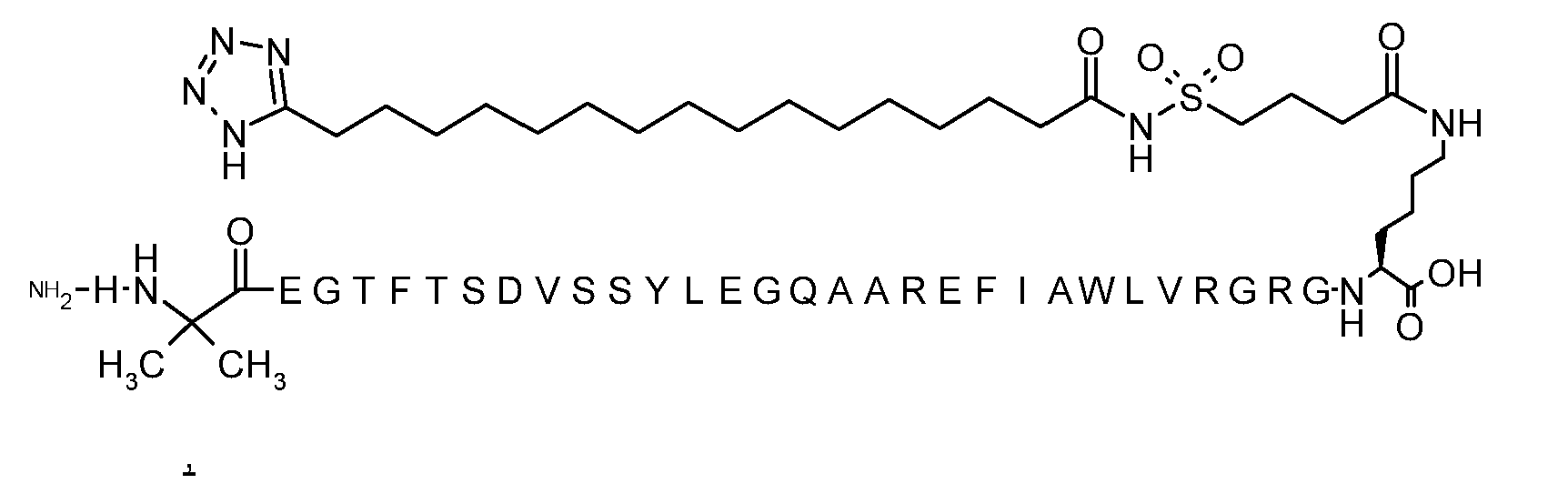
- N-epsilon32-(4-[N-(16-{5-Tetrazolyl}hexadecanoyl)sulfamoyl]butyryl)-[Lys32]Exendin[1-39] peptide

- N-epsilon37-(16-(4'-(Tetrazol-5-yl)biphenyl)-4-yloxy)hexadecanoyl) [3-(4-imidazolyl)propionyl7,Aib22,35,Arg26,34,Lys37]GLP-1 (7-37) peptide

- N-epsilon37-(16-(Tetrazol-5-yl)hexadecanoyl) [3-(4-imidazolyl)propionyl7,Aib22,35,Arg26,34,Lys37]GLP-1 (7-37)

- N-epsilon37-(16-(4-(Tetrazol-5-yl)phenoxy)hexadecanoyl) [3-(4-imidazolyl)propionyl7,Aib22,35,Arg26,34,Lys37]GLP-1 (7-37)

- N-epsilon37-(4-(4-(Tetrazol-5-yl)[1,1',4',1"]terphenyl-4"yloxy)butyroyl) [3-(4-imidazolyl)propionyl7,Aib22,35,Arg26,34,Lys37]GLP-1 (7-37)

- N-epsilon37-(2-(2-(2-(16-(Tetrazol-5-yl)hexadecanoyl)amino)ethoxy)ethoxy)acetyl)[Aib8,22,35,Arg26,34,Lys37] GLP-1 (7-37)

- N-epsilon37-(2-(2-(2-(16-(Tetrazol-5-yl)
- (hexadecanoylamino)ethoxy)ethoxy)acetyl))[3-(4-imidazolyl)propionyl7,Aib22,35,Arg26,34,Lys37] GLP-1 (7-37) peptide
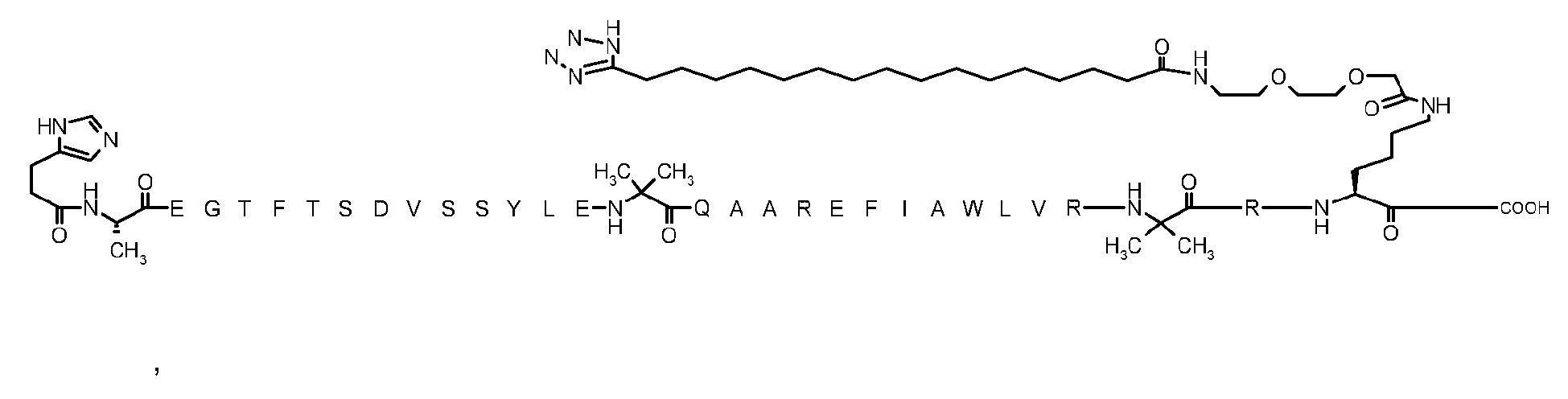
- N-epsilon37-(2-(2-(2-(16-(Tetrazol-5-yl)hexadecanoyl)amino)ethoxy)ethoxy)acetyl))[3-(4-imidazolyl)propionyl7,Aib8,22,35,Arg26,34,Lys37] GLP-1 (7-37) peptide

- N-epsilon20-(2-(2-(2-(2-(2-(2-(2-(2-(2-(16-(Tetrazol-5-yl)hexadecanoylamino)ethoxy)ethoxy)acetylamino)ethoxy)ethoxy)acetylamino)ethoxy)ethoxy )acetyl)[Lys20] Exendin-4 (1-39)amide

- NεB29-(16-2H-Tetrazol-5-yl-hexadecanoyl) gamma-Glu-des(B30) human insulin,
- NB29ε-4-[4"-(1H-Tetrazol-5-yl)-[1,1';4',1"]terphenyl-4-yloxy]-butyroyl des(B30) insulin

- NB29ε-16-[4'-(1H-tetrazol-5-yl)-biphenyl-4-yloxy]-hexadecanoyl des(B30) insulin

- Nε37-16-(4-(4-(5-Tetrazolyl)phenyl)phenyloxy)hexadecanoyl)-[Gly8,Arg26,34]GLP-1-(7-37) peptide

- Nε37-(4-(4-(4-(4-(5-Tetrazolyl)phenyl)phenyl)phenoxy)butyryl)[Gly8,Arg26,34]GLP-1-(7-37) peptide

- Nε37-(17,17-Bis(5-tetrazolyl)heptadecanoyl)[Gly8,Arg26,34]GLP-1-(7-37) peptide

- Nε37-(4-(4'-{5-[4-(5-Tetrazolyl)phenyl]-[1,2,4]oxadiazol-3-yl}biphenyl-4-yloxy)butyryl)[GIyB,Arg26,34]GLP-1-(7-37) peptide
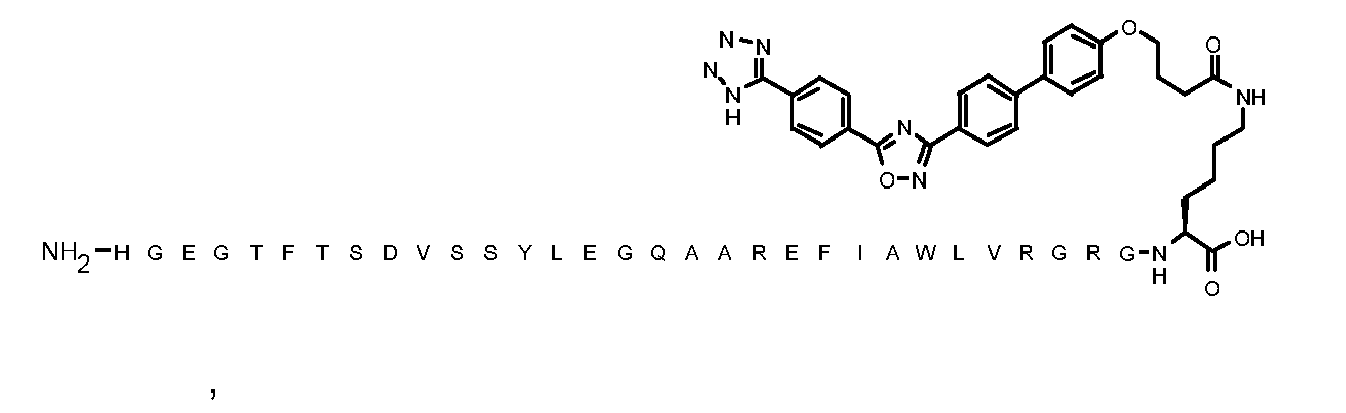
- Nε37-(16-(4,5-Bis(5-Tetrazolyl)imidazol-1-yl)hexadecanoyl)[Gly8,Arg26,34]GLP-1-(7-37) peptide

- Nε37-((2-(2-(16-(5-Tetrazolyl)hexadecanoylamino)
- ethoxy)ethoxy)acetyl)[Gly8,Arg26,34]GLP-1-(7-37) peptide

- Nε37-(4-{16-(Tetrazol-5-yl)hexadecanoylsulfamoyl}butyryl)[(3-(4-imidazolyl)propionyl7,Arg34]GLP-1-(7-37) peptide


- Nε34-(16-{Tetrazol-5-yl}hexadecanoyl)-[Gly8, Arg26] GLP-1 (7-34) peptideamide

- Nε26-({2-[2-(4-(16-(Tetrazol-5-yl)hexadecanoylsulfamoyl)butyrylamino)ethoxy]ethoxy}acetyl)-[Arg34] GLP-1 (7-37) peptide

- Nε34-({2-[2-(4-(16-(Tetrazol-5-yl)hexadecanoylsulfamoyl)butyrylamino)ethoxy]ethoxy}acetyl)-[Arg26] GLP-1 (7-34) peptideamide

- Nε26-({2-[2-(4-(16-(Tetrazol-5-yl)hexadecanoylsulfamoyl)butyrylamino)ethoxy]ethoxy}acetyl)-[(3-(4-imidazolyl)propionyl)7,Arg34]GLP-1 (7-37) peptide

- Nε26-(4-(16-(Tetrazol-5-yl)hexadecanoylsulfamoyl)butyryl)-[Aib8,Arg34]GLP-1-(7-37) peptide

- Nα7(Me)Nε26-(4-(16-(Tetrazol-5-yl)hexadecanoylsulfamoyl)butyryl)-[Arg34]GLP-1-(7-37) peptide

- Nε26-(4-(16-(Tetrazol-5-yl)hexadecanoylsulfamoyl)butyryl)-[Gly8,Arg34]GLP-1-(7-37) peptide

- Nε14-(4-(16-(Tetrazol-5-yl)hexadecanoylsulfamoyl)butyryl)[Lys14;Arg26,34]GLP-1-(7-37) peptide

- Nε18-(4-(16-(Tetrazol-5-yl)hexadecanoylsulfamoyl)butyryl)[Lys18;Arg26,34]GLP-1-(7-37) peptide

- Nε18-(4-(16-(Tetrazol-5-yl)hexadecanoylsulfamoyl)butyryl)[Gly8;Lys18;Arg26,34]GLP-1-(7-37) peptide

- Nε18-(4-(16-(Tetrazol-5-yl)hexadecanoylsulfamoyl)butyryl)[Aib8,Lys18;Arg26,34]GLP-1-(7-37) peptide

- Nε18-(4-(16-(Tetrazol-5-yl)hexadecanoylsulfamoyl)butyryl)[3-(4-imidazolyl)propionyl7;Lys18;Arg26,34]GLP-1-(7-37) peptide


- Nε26-(4-(16-(Tetrazol-5-yl)hexadecanoylsulfamoyl)butyryl)[Lys18;Arg26]GLP-1-(7-33) peptideamide

- Nε26-((2-(2-(2-(2-(2-(4-(16-(Tetrazol-5-yl)hexadecanoylsulfamoyl)butyryl)ethoxy)ethoxy)acetylamino)ethoxy)ethoxy)acetyl)-[Arg34]GLP-1-(7-37) peptide

- Nε26-((2-(2-(2-(2-(2-(4-(16-(Tetrazol-5-yl)hexadecanoylsulfamoyl)butyryl)ethoxy)ethoxy)acetylamino)ethoxy)ethoxy)acetyl)[Gly8,Arg 34]GLP-1-(7-37) peptide

- Nε26-((2-(2-(2-(2-(2-(4-(16-(Tetrazol-5-yl)hexadecanoylsulfamoyl)butyryl)ethoxy)ethoxy)acetylamino)ethoxy)ethoxy)acetyl)-[Alb8,Arg34]GLP-1-(7-37) peptide


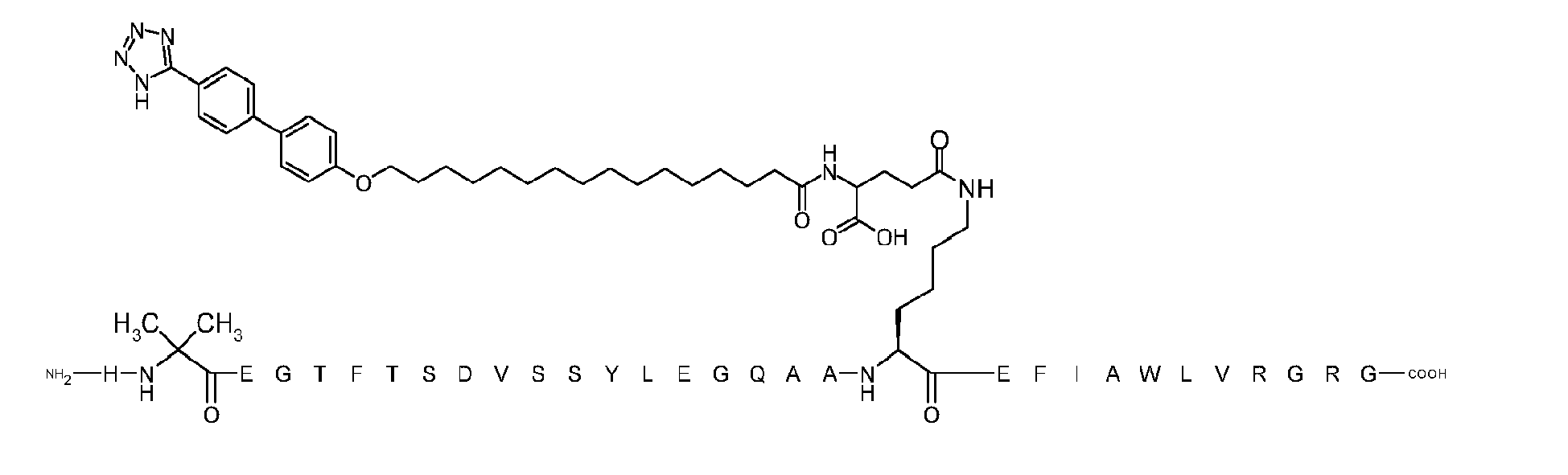


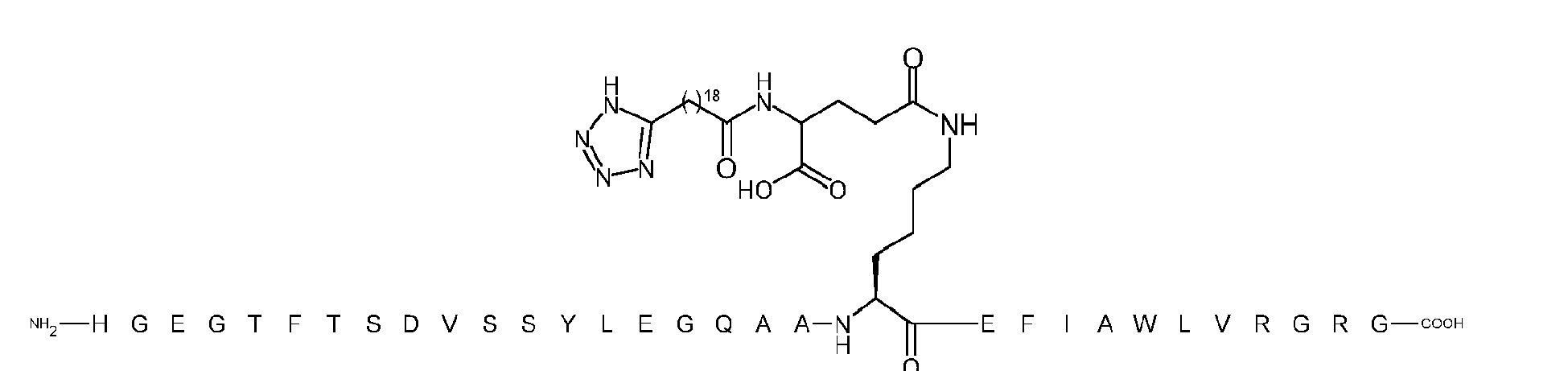
- Nε26-(4-(19-(Tetrazol-5-yl)nonadecanoylsulfamoyl)butyryl)[Arg34]GLP-1-(7-37) peptide


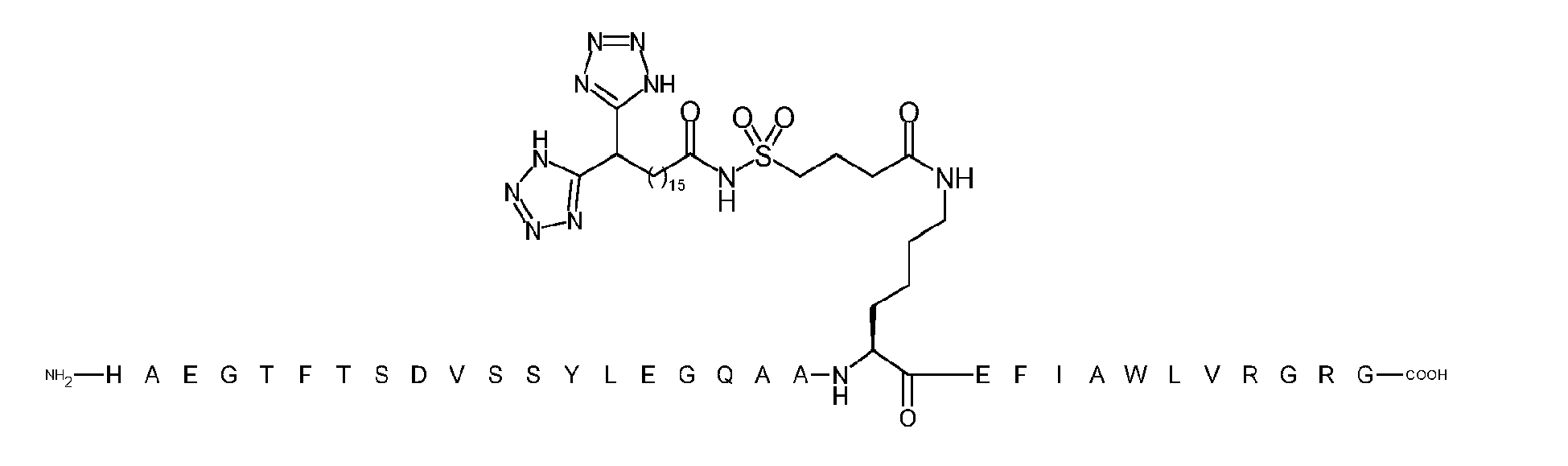
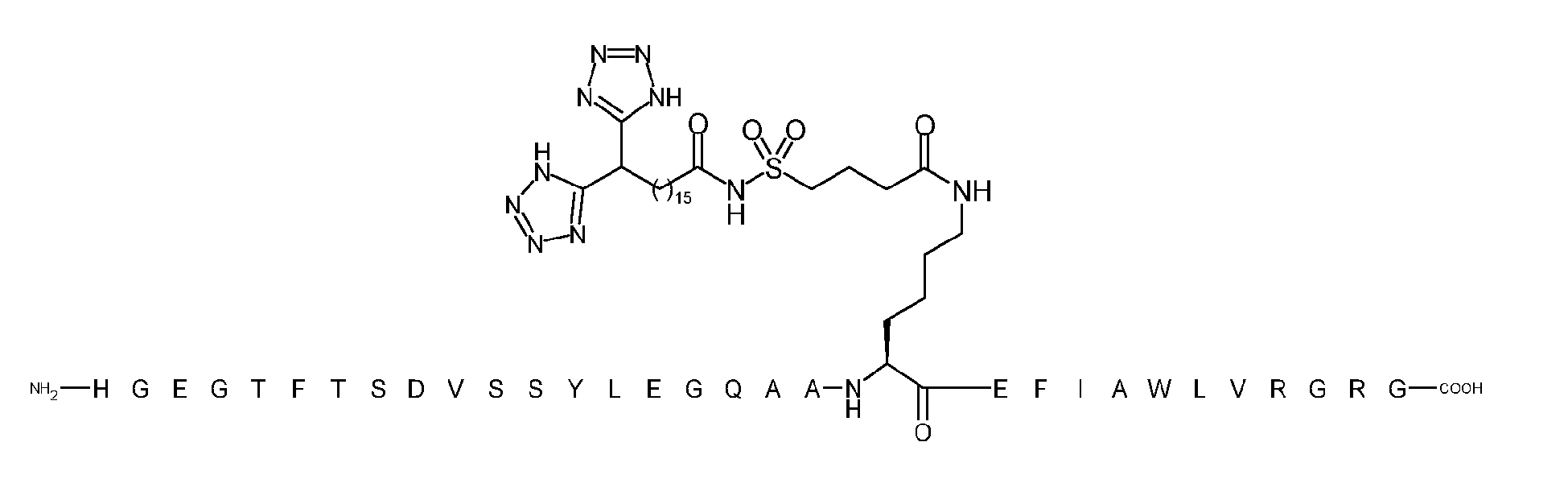


- 33. A compound according to embodiment 13, wherein the therapeutic agent is human growth hormone or an analog thereof.
- 34. A compound according to the embodiment 13, wherein the therapeutic agent is human insulin or an analog thereof.
- 35. A compound according to embodiment 13, wherein the therapeutic agent is factor VII or an analog thereof.
- 36. A compound of the general formula (II)

- 37. Use of a compound according to embodiment 36 for the synthesis of a compound according to any one of embodiments 4-35.
- 38. A pharmaceutical composition comprising a compound according to any one of embodiments 4-35, and a pharmaceutically acceptable excipient.
- 39. The pharmaceutical composition according to embodiment 38, which is suited for parenteral administration.
- 40. Use of a compound according to any one of the embodiments 15-32 for the preparation of a medicament for the treatment or prevention of hyperglycemia, type 2 diabetes, impaired glucose tolerance, type 1 diabetes, obesity, hypertension, syndrome X, dyslipidemia, disorders associated with toxic hypervolemia, cognitive disorders, atheroschlerosis, myocardial infarction, coronary heart disease, stroke and other cardiovascular disorders, inflammatory bowel syndrome, dyspepsia and gastric ulcers.
- 41. Use of a compound according to any one of the embodiments 15-32 for the preparation of a medicament for delaying or preventing disease progression in type 2 diabetes.
- 42. Use of a compound according to any one of the embodiments 15-32 for the preparation of a medicament for decreasing food intake, decreasing β-cell apoptosis, increasing β-cell function and β-cell mass, stimulating -cell regeneration and/or for restoring glucose sensitivity to β-cells.
- In one aspect the present invention provides a method for increasing the plasma half-life of a molecule, comprising covalently linking this molecule to a heterocyclic carboxylic acid bioisostere.
- In another aspect the present invention provides a method for increasing the plasma half-life of a molecule, comprising covalently linking this molecule to a 1H-tetrazole. In
- In another aspect the present invention provides a method for increasing the plasma half-life of a molecule, comprising converting said molecule into a compound of the general formula (I):

- G, X, and Y independently represent
a bond, -S-, -O-, -NH-, -(CH2)1-10-, or
arylene, optionally substituted with one or more alkyl, amino, cycloalkyl, aryl, heteroaryl, halogen, nitro, lower alkoxy, hydroxy, MeCONH-, alkanoyl, or cyano, or
heteroarylene, optionally substituted with one or more alkyl, amino, cycloalkyl, aryl, heteroaryl, halogen, nitro, lower alkoxy, hydroxy, MeCONH-, alkanoyl, or cyano, and - Z represents a bond or
-(CH2)n-, -O-(CH2)n-, -S-(CH2)n-, -(OCH2CH2)n-, -(CF2)n-, -O-CH2-(CF2)n-, -S-CH2-(CF2)n-, wherein n is 1-40, and - A represents
-C(=O)-, -O-C(=O)-, -NH-C(=O)-, -C(C=O)NH-S(=O)2-, -S(=O)2NH-C(=O)-, -(CH2)1-5-, - O-(CH2)1-5-, or -O-(CH2)1-5-C(=O)-, and - Q represents a bond or
-[NH-(CH2CH2O)m-(CH2)p-E-C(=O)]q-, or
-O-(CH2CH2O)m-(CH2)p-E-C(=O)-, or
-S-(CH2CH2O)m-(CH2)p-E-C(=O)-, wherein E is a bond, O, S, or NH, and m, p, and q independently are 1-40, and - R represents a bond or a polyradical, such as [-NH(CH2)4CH(NH-)-C(=O)-]1-5, and
- t is 1-40, and
- Tetrazoles are slightly more lipophilic than carboxylic acids, but are resistant to many of the metabolic degradation pathways which befall carboxylic acids. Because tetrazoles cannot act as acylating reagents no protective group is required when acylating a protein with an ω-(tetrazol-5-yl)carboxylic acid.
We have found that the derivatization of polypeptides with tetrazole-containing molecular entities is readily performed, and that, surprisingly, the resulting protein-tetrazole conjugates show highly improved biological and pharmacological properties. - As illustrated by the examples below, between the tetrazole and the molecule of which a prolonged half-life in plasma is required there may be an optional spacer, i.e. a divalent or polyvalent molecular fragment able to covalently connect one or several tetrazoles to the molecule. This divalent or polyvalent molecular fragment may also have an influence on the biological properties of the conjugate compound-tetrazole(s), and structural modifications of this spacer may be used to adjust and improve the properties of the conjugate. This spacer may be a combination of one or several different structural elements selected from but not limited to alkylene chains, partially or fully fluorinated alkylene chains, arylenes, heteroarylenes, oligo(ethylene glycol), amide bonds, lysine, short peptides, short oligoamides, and other, similar fragments.
- For connecting the tetrazole-bearing spacer to a compound of interest, such as a therapeutically relevant protein or peptide, various different strategies may be envisioned. Many polypeptides contain amino groups (e.g. the N-terminal amino group or lysine-side-chain amino groups), which can be acylated by a suitable acylating reagent, such as a carboxylic acid in the presence of a coupling reagent, a carboxylic acid O-hydroxysuccinimidyl ester, hydroxybenzotriazole esters, carboxylic acid anhydrides, carboxylic acid halides, carboxylic acid azides, nitrophenyl esters, mixed carboxylic carbonic anhydrides, mixed carboxylic sulfonic anhydrides, imidazolides, and the like. Alternatively, amino-group bearing polypeptides may be derivatized by conversion into a carbamate by treatment with an alkyl haloformiate, an O-succinimidylcarbonate, an alkyl azidoformiate, or a related reagent. Alternatively, amino-group bearing polypeptides may be derivatized by conversion into a urea by treatment with an isocyanate, a carbamoyl halide, a nitrophenyl carbamate, or a related reagent. Alternatively, amino-group bearing polypeptides may be derivatized by conversion into a sulfonamide by treatment with a sulfonyl halide or sulfonyl imidazolide.
- All these derivatization reactions can be conducted without the need of any protective group for the tetrazole ring, and are therefore particularly well suited for the derivatization of sensitive polypeptides. Non-limiting, illustrative derivatization procedures of an amino-group-bearing molecule with specific tetrazole derivatives are sketched below:


- Many polypeptides contain thiol groups, which can be alkylated by treatment with a suitable alkylating reagent, such as an alkyl halide, an alkyl sulfonate, an N-alkylmaleimide, an acrylamide, or a related alkylating reagent, to covalently bind the tetrazole-bearing fragment to the polypeptide. Alternatively, thiol groups may also be arylated by treatment with a suitable arylating reagent, such as an aryl halide, an aryl iodonium salt, an aryldiazonium salt or a similar reagent.
- Polypeptides with N-terminal serine or a related functional group (a 1,2-diol, a 2-aminoethanol) can be oxidized by treatment with periodate to an aldehyde. This aldehyde reacts with O-alkylhydroxylamines to yield oximes, and may therefore be used to attach an O-alkylhydroxylamine-containing tetrazole to the polypeptide. The aldehyde formed by oxidation of N-terminal serine also reacts with 2-aminoethylthiols (HS-C-C-NH) to yield thiazolidines, or with hydrazines to yield hydrazones, and these reactions may also be used for the attachment of a tetrazole-bearing fragment to a polypeptide. Aldehydes also react with C,H-acidic compounds such as 1,3-diketones, 3-oxobutyramides, malonodinitriles, barbituric acid derivatives, malonic acid derivatives, and the like to yield alcohols (aldol addition) or alkenes (Knoevenagel condensation). These reactions may also be used to attach tetrazoles to polypeptides.
- Enzymes enable the selective derivatization of polypeptides. Thus, carboxypeptidases can be used to form amides from amines and the C-terminal carboxylic acid group of a polypeptide. Transglutaminases may be used to form new amides from amines and the side chain of glutamine. If these enzymatic reactions are performed with a tetrazole-bearing amine, compounds as claimed in this invention will result. Alternatively, these enzymatic reactions may also be conducted with an amine which contains a functional group which enables a selective covalent attachment of a tetrazole-bearing fragment in a second operation. Such functional groups may be aldehydes, ketones, hydroxylamines, alkoxylamines, hydrazines, thiols, azides, 2-aminoethylthiols, 3-aminopropylthiols, 2-hydroxyethylthiols, 3-hydroxypropylthiols, alkynes, alkenes, nitriles, C,H-acidic compounds, or other functional groups which enable the selective covalent attachment of a tetrazole-bearing fragment. Treatment of an amine containing one or several of these functional groups will yield a polypeptide, which can be selectively derivatized.
- A methodology for the production of proteins containing unnatural amino acids by fermentation has recently been described (for instance L. Alfonta et al., J. Am. Chem. Soc. 2003, 125, 14662-14663; Z. Zhang et al., Biochemistry, 2003, 42, 6735-6746). This methodology may also be used to prepare proteins with tetrazole-containing amino acids directly or proteins with an unnatural amino acid which enables facile chemical derivatization. These could, for instance, be amino acids containing a formyl group, a keto group, an azido group, a mercapto group, an alkoxylamino group, a hydrazino group, an alkyne, an alkene, an aryl iodide, or an aryl bromide. The resulting protein, containing this unnatural amino acid, may then be converted into a tetrazole-containing protein by covalent binding of a suitable tetrazole derivative to the side chain of the unnatural amino acid.
- Polypeptides may contain one or several tyrosines. These may be selectively derivatized by azocoupling with an aryldiazonium salt. This technique may also be used to prepare compound according to the present invention, by treating said tyrosine-containing polypeptide with a tetrazole-containing aryldiazonium salt.
- In another aspect the present invention provides a compound of the general formula (I):
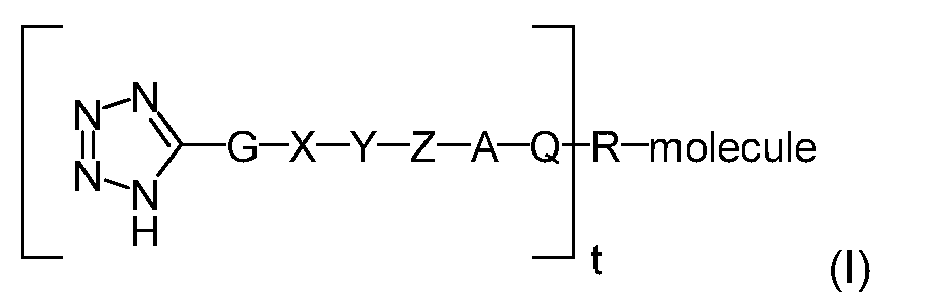
- G, X, and Y independently represent
a bond, -S-, -O-, -NH-, -(CH2)1-10-, or
arylene, optionally substituted with one or more alkyl, amino, cycloalkyl, aryl, heteroaryl, halogen, nitro, lower alkoxy, hydroxy, MeCONH-, alkanoyl, or cyano, or
heteroarylene, optionally substituted with one or more alkyl, amino, cycloalkyl, aryl, heteroaryl, halogen, nitro, lower alkoxy, hydroxy, MeCONH-, alkanoyl, or cyano, and - Z represents a bond or
-(CH2)n-, -O-(CH2)n-, -S-(CH2)n-, -(OCH2CH2)n-, -(CF2)n-, -O-CH2-(CF2)n-, -S-CH2-(CF2)n-, wherein n is 1-40, and - A represents
-C(=O)-, -O-C(=O)-, -NH-C(=O)-, -C(C=O)NH-S(=O)2-, -S(=O)2NH-C(=O)-, -(CH2)1-5-, - O-(CH2)1-5-, or -O-(CH2)1-5-C(=O)-, and - Q represents a bond or
-[NH-(CH2CH2O)m-(CH2)p-E-C(=O)]q-, or
-O-(CH2CH2O)m-(CH2)p-E-C(=O)-, or
-S-(CH2CH2O)m-(CH2)p-E-C(=O)-, wherein E is a bond, O, S, or NH, and m, p, and q independently are 1-40, and - R represents a bond or a polyradical, such as [-NH(CH2)4CH(NH-)-C(=O)-]1-5, and
- t is 1-40, and
- In one embodiment the invention provides a compound according to formula (I), wherein G, X and Y are all a bond.
- In another embodiment the invention provides a compound according to formula (I), wherein G, X and Y are all selected from -(CH2)1-10-.
- In another embodiment the invention provides a compound according to formula (I), wherein t is 1.
- In another embodiment the invention provides a compound according to formula (I), wherein

4-[N-(16-{5-tetrazolyl}hexadecanoyl)sulfamoyl]butyryl,
2-(2-(2-(16-(tetrazol-5-yl)(hexadecanoylamino)ethoxy)ethoxy)acetyl) or
16-(1H-tetrazol-5-yl)hexadecanoic acid [2-(2-{[2-(2-carbamoylmethoxyethoxy)ethylcarbamoyl]methoxy}ethoxy)ethyl]amide. - In another embodiment the invention provides a compound according to formula (I), wherein the molecule is covalently linked to R via the ε-amino group of a lysine residue.
- In another embodiment the invention provides a compound according to formula (I), wherein the molecule is covalently linked to R via the thiol group of a cysteine residue.
- In another embodiment the invention provides a compound according to formula (I), wherein the molecule is a therapeutic agent.
- In another aspect the invention provides a compound according to formula (I), wherein the therapeutic agent is a biopolymer.
- In another aspect the invention provides a compound according to formula (I), wherein the therapeutic agent is a polypeptide.
- In another aspect the invention provides a compound according to formula (I), wherein the therapeutic agent is a small molecule drug.
- In another aspect the present invention provides a compound according to formula (I), wherein the molecule is a polypeptide which is an insulinotropic peptide.
- In one embodiment the invention provides a compound according to formula (I), wherein the molecule is a polypeptide which is GLP-1 (7-37) or a variant thereof.
- In another embodiment the invention provides a compound according to formula (I), wherein the molecule is a polypeptide which is GLP-1 (7-37) or an analog thereof.
- In another embodiment the invention provides a compound according to formula (I), wherein the molecule is a polypeptide comprising the amino acid sequence of the formula (IV):
- Xaa7-Xaa8-Glu-Gly-Thr-Phe-Thr-Ser-Asp-Xaa16-Ser-Xaa18-Xaa19-Xaa20-Glu-Xaa22-Xaa23-Ala-Xaa25-Xaa26-Xaa27-Phe-lle-Xaa30-Trp-Leu-Xaa33-Xaa34-Xaa35-Xaa36-Xaa37-Xaa38-Xaa39-Xaa40-Xaa41 -Xaa42-Xaa43-Xaa44-Xaa45-Xaa46
Formula (III) (SEQ ID No: 3)
wherein- Xaa7 is L-histidine, D-histidine, desamino-histidine, 2-amino-3-(2-aminoimidazol-4-yl)propionic acid, β-hydroxy-histidine, homohistidine, Nα-acetyl-histidine, α-fluoromethyl-histidine, α-methyl-histidine, 3-pyridylalanine, 2-pyridylalanine or 4-pyridylalanine;
- Xaa8 is Ala, Gly, Val, Leu, Ile, Lys, Aib, 1-aminocyclopropanecarboxylic acid, 1-aminocyclobutanecarboxylic acid, 1-aminocyclopentanecarboxylic acid, 1-aminocyclohexanecarboxylic acid, 1-aminocycloheptanecarboxylic acid, or 1-aminocyclooctanecarboxylic acid;
- Xaa16 is Val or Leu;
- Xaa18 is Ser, Lys or Arg;
- Xaa19 is Tyr or Gln;
- Xaa20 is Leu or Met;
- Xaa22 is Gly, Glu or Aib;
- Xaa23 is Gln, Glu, Lys or Arg;
- Xaa25 is Ala or Val;
- Xaa26 is Lys, Glu or Arg;
- Xaa27 is Glu or Leu;
- Xaa30 is Ala, Glu or Arg;
- Xaa33 is Val or Lys;
- Xaa34 is Lys, Glu, Asn or Arg;
- Xaa35 is Gly or Aib;
- Xaa36 is Arg, Gly or Lys;
- Xaa37 is Gly, Ala, Glu, Pro, Lys, amide or is absent;
- Xaa38 is Lys, Ser, amide or is absent;
- Xaa39 is Ser, Lys, amide or is absent;
- Xaa40 is Gly, amide or is absent;
- Xaa41 is Ala, amide or is absent;
- Xaa42 is Pro, amide or is absent;
- Xaa43 is Pro, amide or is absent;
- Xaa44 is Pro, amide or is absent;
- Xaa45 is Ser, amide or is absent;
- Xaa46 is amide or is absent ;
- provided that if Xaa38, Xaa39, Xaa40, Xaa41, Xaa42, Xaa43, Xaa44, Xaa45 or Xaa46 is absent then each amino acid residue downstream is also absent.
- In another embodiment the invention provides a compound according to formula (I), wherein the molecule is a polypeptide comprising the amino acid sequence of formula (V):
- Xaa7-Xaa8-Glu-Gly-Thr-Phe-Thr-Ser-Asp-Val-Ser-Xaa18-Tyr-Leu-Glu-Xaa22-Xaa23-Ala-Ala-Xaa26-Glu-Phe-lle-Xaa30-Trp-Leu-Val-Xaa34-Xaa35-Xaa36-Xaa37-Xaa38
Formula (IV) (SEQ ID No: 4)
wherein- Xaa7 is L-histidine, D-histidine, desamino-histidine, 2-aminohistidine, β-hydroxy-histidine, homohistidine, Nα-acetyl-histidine, α-fluoromethyl-histidine, α-methyl-histidine, 3-pyridylalanine, 2-pyridylalanine or 4-pyridylalanine;
- Xaa8 is Ala, Gly, Val, Leu, Ile, Lys, Aib, 1-aminocyclopropanecarboxylic acid, 1-aminocyclobutanecarboxylic acid, 1-aminocyclopentanecarboxylic acid, 1-aminocyclohexanecarboxylic acid, 1-aminocycloheptanecarboxylic acid, or 1-aminocyclooctanecarboxylic acid;
- Xaa18 is Ser, Lys or Arg;
- Xaa22 is Gly, Glu or Aib;
- Xaa23 is Gln, Glu, Lys or Arg;
- Xaa26 is Lys, Glu or Arg;
- Xaa30 is Ala, Glu or Arg;
- Xaa34 is Lys, Glu or Arg;
- Xaa35 is Gly or Aib;
- Xaa36 is Arg or Lys;
- Xaa37 is Gly, Ala, Glu or Lys;
- Xaa38 is Lys, amide or is absent.
- In another embodiment the invention provides a compound according to formula (I), wherein the molecule is a polypeptide selected from GLP-1 (7-35), GLP-1 (7-36), GLP-1 (7-36)-amide, GLP-1 (7-37), GLP-1 (7-38), GLP-1 (7-39), GLP-1 (7-40), GLP-1 (7-41) or an analog thereof.
- In another embodiment the invention provides a compound according to formula (I), wherein the molecule is a polypeptide comprising no more than fifteen amino acid residues which have been exchanged, added or deleted as compared to GLP-1(7-37) (SEQ ID No. 1), or no more than ten amino acid residues which have been exchanged, added or deleted as compared to GLP-1(7-37) (SEQ ID No. 1).
- In another embodiment the invention provides a compound according to formula (I), wherein the molecule is a polypeptide comprising no more than six amino acid residues which have been exchanged, added or deleted as compared to GLP-1 (7-37) (SEQ ID No. 1).
- In another embodiment the invention provides a compound according to formula (I), wherein the molecule is a polypeptide comprising no more than 4 amino acid residues which are not encoded by the genetic code.
- In another embodiment the invention provides a compound according to formula (I), wherein the molecule is a polypeptide which is a DPP-IV protected insulinotropic peptide.
- In another embodiment the invention provides a compound according to formula (I), wherein the molecule is a polypeptide comprising an Aib residue in position 8.
- In another embodiment the invention provides a compound according to formula (I), wherein the molecule is a GLP-1 (7-37) analog wherein the amino acid residue in position 7 of said polypeptide is selected from the group consisting of D-histidine, desamino-histidine, 2-amino-3-(2-aminoimidazol-4-yl)propionic acid, β-hydroxy-histidine, homohistidine, Nα-acetyl-histidine, α-fluoromethyl-histidine, α-methyl-histidine, 3-pyridylalanine, 2-pyridylalanine and 4-pyridylalanine.
- In another embodiment the invention provides a compound according to formula (I), wherein the molecule is a GLP-1 (7-37) analog selected from the group consisting of Arg34GLP-1 (7-37), Lys38Arg26,34GLP-1(7-38), Lys38Arg26,34GLP-1(7-38)-OH, Lys36Arg26,34GLP-1 (7-36), Aib8,22,35 GLP-1 (7-37), Aib8,35 GLP-1 (7-37), Aib8,22 GLP-1 (7-37), Aib8,22,35 Arg26,34Lys38GLP-1 (7-38), Aib8,35 Arg26,34Lys38GLP-1 (7-38), Aib8,22 Arg26,34Lys38GLP-1 (7-38), Aib8,22,35 Arg26,34Lys38GLP-1 (7-38), Aib8,35 Arg26,34Lys38GLP-1 (7-38), Aib8,22,35 Arg26,34Lys38GLP-1 (7-38), Aib8,35 Arg26Lys38GLP-1 (7-38), Aib8,22 Arg26Lys38GLP-1 (7-38), Aib8,22,35 Arg34Lys38GLP-1 (7-38), Aib8,35 Arg34Lys38GLP-1 (7-38), Aib8,22 Arg34Lys38GLP-1 (7-38), Aib8,22,35Ala37Lys38GLP-1 (7-38), Aib8,35Ala37Lys38GLP-1 (7-38), Aib8,22Ala37Lys38GLP-1 (7-38), Aib8,22,35 Lys37GLP-1 (7-37), Aib8,35Lys37 GLP-1 (7-37) and Aib8,22Lys37 GLP-1 (7-38).
- In another embodiment the invention provides a compound according to formula (I), wherein the molecule is GLP-1 (7-37) or an analog thereof which is attached to R via the amino acid residue in position 23, 26, 34, 36 or 38 relative to the amino acid sequence SEQ ID No:1.
- In another aspect the present invention provides a compound according to formula (I), wherein the molecule is exendin-4(1-39) or an analog thereof.
- In one embodiment the invention provides a compound according to formula (I), wherein the molecule is an exendin-4 analog comprising no more than twelve amino acid residues which have been exchanged, added or deleted as compared to exendin-4(1-39) (SEQ ID No. 2), or no more than eight amino acid residues which have been exchanged, added or deleted as compared to exendin-4(1-39) (SEQ ID No. 2).
- In another embodiment the invention provides a compound according to formula (I), wherein the molecule is ZP-10, i.e. HGEGTFTSDLSKQMEEEAVRLFIEWLKNGGPSSGAPPSKKKKKK-amide (SEQ ID No. 5). In another embodiment the invention provides a compound according to formula (I), wherein said compound is selected from the group consisting of N-ε-26-(16-[5-tetrazolyl]hexadecanoyl)Arg34 GLP-1-(7-37), Gly8,Arg26,34 GLP-1(7-37)Lys(16-(5-tetrazolyl)hexadecanoyl), Gly8,Arg26,34 GLP-1(7-37)Lys{4-[N-(16-{5-tetrazolyl}hexadecanoyl)sulfamoyl]butyryl}, N-ε-26-{4-[N-(16-{5-tetrazolyl}hexadecanoyl)sulfamoyl]butyryl} Arg34GLP-1 (7-37), N-ε-37-(2-(2-(2-(16-(tetrazol-5-yl)(hexadecanoylamino)ethoxy)ethoxy)acetyl)) Aib8,22,35Lys37 GLP-1 (7-37), Gly8,Glu22,23,30Arg18,26,34 GLP-1 (7-37)Lys(16-(1H-tetrazol-5-yl)hexadecanoic acid [2-(2-{[2-(2-carbamoylmethoxyethoxy)ethylcarbamoyl]methoxy}ethoxy)ethyl]amide)-NH2, andGly8Arg26,34GLP-1 (7-37)Lys(4-(4-(4-(4-(5-tetrazolyl)phenyl)phenyl)phenoxy)butyryl). N-ε38-(2-(2-(2-(16-(4-(5-tetrazolyl)phenoxy)hexadecanoyl)ethoxy)ethoxy)acetyl) [Gly8,Arg26,34, Lys38]GLP-1 (7-37) peptide

- N-epsilon37-(2-(2-(2-(16-(4-(5-Tetrazolyl)phenoxy)hexadecanoyl)ethoxy)ethoxy)acetyl)[Aib8,22,35,Lys37]GLP-1 (7-37)

- Nε38-(2-(2-(2-(16-(Tetrazol-5-yl)hexadecanoyl)ethoxy)ethoxy)acetyl) [Aib8,Arg26,34,Lys38]GLP-1(7-37) peptide

- Nε38-(4-(N-(16-(Tetrazol-5-yl)hexadecanoyl)sulfamoyl)butyryl) [Aib8,Arg26,34,Lys38]GLP-1(7-37) peptide

- N-epsilon32-(4-[N-(16-{5-Tetrazolyl}hexadecanoyl)sulfamoyl]butyryl)-[Lys32]Exendin[1-39] peptide

- N-epsilon37-(16-(4'-(Tetrazol-5-yl)biphenyl)-4-yloxy)hexadecanoyl) [3-(4-imidazolyl)propionyl7,Aib22,35,Arg26,34,Lys37]GLP-1 (7-37) peptide

- N-epsilon37-(16-(Tetrazol-5-yl)hexadecanoyl) [3-(4-imidazolyl)propionyl7,Aib22,35,Arg26,34,Lys37]GLP-1 (7-37)

- N-epsilon37-(16-(4-(Tetrazol-5-yl)phenoxy)hexadecanoyl) [3-(4-imidazolyl)propionyl7,Aib22,35,Arg26,34,Lys37]GLP-1 (7-37)

- N-epsilon37-(4-(4-(Tetrazol-5-yl)[1,1',4',1"]terphenyl-4"yloxy)butyroyl) [3-(4-imidazolyl)propionyl7,Aib22,35,Arg26,34,Lys37]GLP-1 (7-37)
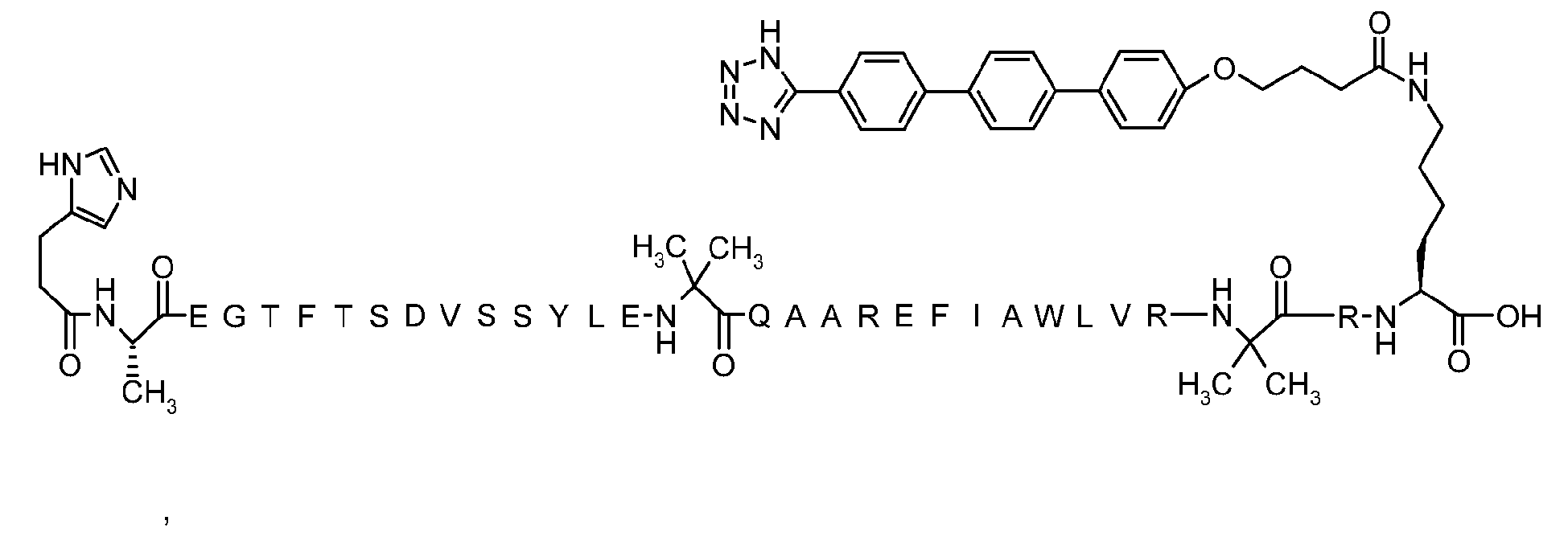
- N-epsilon37-(2-(2-(2-(16-(Tetrazol-5-yl)hexadecanoyl)amino)ethoxy)ethoxy)acetyl)[Aib8,22,35,Arg26,34,Lys37] GLP-1 (7-37)

- N-epsilon37-(2-(2-(2-(16-(Tetrazol-5-yl)
- (hexadecanoylamino)ethoxy)ethoxy)acetyl))[3-(4-imidazolyl)propionyl7,Aib22,35,Arg26,34,Lys37] GLP-1 (7-37) peptide

- N-epsilon37-(2-(2-(2-(16-(Tetrazol-5-yl)hexadecanoyl)amino)ethoxy)ethoxy)acetyl))[3-(4-imidazolyl)propionyl7,Aib8,22,35,Arg26,34,Lys37] GLP-1 (7-37) peptide

- N-epsilon20-(2-(2-(2-(2-(2-(2-(2-(2-(2-(16-(Tetrazol-5-yl)hexadecanoylamino)ethoxy)ethoxy)acetylamino)ethoxy)ethoxy)acetylamino)ethoxy)ethoxy )acetyl)[Lys20] Exendin-4 (1-39)amide

- NεB29-(16-2H-Tetrazol-5-yl-hexadecanoyl) gamma-Glu-des(B30) human insulin,
- NB29ε-4-[4"-(1H-Tetrazol-5-yl)-[1,1';4',1"]terphenyl-4-yloxy]-butyroyl des(B30) insulin

- NB29ε-16-[4'-(1H-tetrazol-5-yl)-biphenyl-4-yloxy]-hexadecanoyl des(B30) insulin

- Nε37-16-(4-(4-(5-Tetrazolyl)phenyl)phenyloxy)hexadecanoyl)-[Gly8,Arg26,34]GLP-1 - (7-37) peptide

- Nε37-(4-(4-(4-(4-(5-Tetrazolyl)phenyl)phenyl)phenoxy)butyryl)[Gly8,Arg26,34]GLP-1-(7-37) peptide

- Nε37-(17,17-Bis(5-tetrazolyl)heptadecanoyl)[Gly8,Arg26,34]GLP-1-(7-37) peptide

- Nε37-(4-(4'-{5-[4-(5-Tetrazolyl)phenyl]-[1,2,4]oxadiazol-3-yl}biphenyl-4-yloxy)butyryl)[Gly8,Arg26,34]GLP-1-(7-37) peptide

- Nε37-(16-(4,5-Bis(5-Tetrazolyl)imidazol-1-yl)hexadecanoyl)[Gly8,Arg26,34]GLP-1-(7-37) peptide

- Nε37-((2-(2-(16-(5-Tetrazolyl)hexadecanoylamino)
- ethoxy)ethoxy)acetyl)[Gly8,Arg26,34]GLP-1-(7-37) peptide

- Nε26-(4-{16-(Tetrazol-5-yl)hexadecanoylsulfamoyl}butyryl)[(3-(4-imidazolyl)propionyl7,Arg34]GLP-1-(7-37) peptide

- Nε34-(16-{Tetrazol-5-yl}hexadecanoyl)-[Gly8, Arg26] GLP-1 (7-34) peptideamide

- Nε26-({2-[2-(4-(16-(Tetrazol-5-yl)hexadecanoylsulfamoyl)butyrylamino)ethoxy]ethoxy}acetyl)-[Arg34] GLP-1 (7-37) peptide

- Nε34-({2-[2-(4-(16-(Tetrazol-5-yl)hexadecanoylsulfamoyl)butyrylamino)ethoxy]ethoxy}acetyl)-[Arg26] GLP-1 (7-34) peptideamide

- Nε26-({2-[2-(4-(16-(Tetrazol-5-yl)hexadecanoylsulfamoyl)butyrylamino)ethoxy]ethoxy}acetyl)-[(3-(4-imidazolyl)propionyl)7,Arg34]GLP-1 (7-37) peptide

- Nε26-(4-(16-(Tetrazol-5-yl)hexadecanoylsulfamoyl)butyryl)-[Aib8,Arg34]GLP-1-(7-37) peptide

- Na7(Me)Nε26-(4-(16-(Tetrazol-5-yl)hexadecanoylsulfamoyl)butyryl)-[Arg34]GLP-1-(7-37) peptide

- Nε26-(4-(16-(Tetrazol-5-yl)hexadecanoylsulfamoyl)butyryl)-[Gly8,Arg34]GLP-1-(7-37) peptide

- Nε14-(4-(16-(Tetrazol-5-yl)hexadecanoylsulfamoyl)butyryl)[Lys14;Arg26,34 ]GLP-1-(7-37) peptide

- Nε18-(4-(16-(Tetrazol-5-yl)hexadecanoylsulfamoyl)butyryl)[Lys18;Arg26,34]GLP-1-(7-37) peptide

- Nε18-(4-(16-(Tetrazol-5-yl)hexadecanoylsulfamoyl)butyryl)[Gly8;Lys18;Arg26,34]GLP-1-(7-37) peptide

- Nε18-(4-(16-(Tetrazol-5-yl)hexadecanoylsulfamoyl)butyryl)[Aib8,Lys18;Arg26,34]GLP-1-(7-37) peptide

- Nε18-(4-(16-(Tetrazol-5-yl)hexadecanoylsulfamoyl)butyryl)[3-(4-imidazolyl)propionyl7;Lys18;Arg26,34]GLP-1-(7-37) peptide

- Nε18-(4-(16-(Tetrazol-5-yl)hexadecanoylsulfamoyl)butyryl)[Lys18;Arg26]GLP-1-(7-33) peptideamide

- Nε26-((2-(2-(2-(2-(2-(4-(16-(Tetrazol-5-yl)hexadecanoylsulfamoyl)butyryl)ethoxy)ethoxy)acetylamino)ethoxy)ethoxy)acetyl)-[Arg34]GLP-1-(7-37) peptide

- Nε26-((2-(2-(2-(2-(2-(4-(16-(Tetrazol-5-yl)hexadecanoylsulfamoyl)butyryl)ethoxy)ethoxy)acetylamino)ethoxy)ethoxy)acetyl)[Gly8,Arg 34]GLP-1-(7-37) peptide

- Nε26-((2-(2-(2-(2-(2-(4-(16-(Tetrazol-5-yl)hexadecanoylsulfamoyl)butyryl)ethoxy)ethoxy)acetylamino)ethoxy)ethoxy)acetyl)-[Aib8,Arg34]GLP-1-(7-37) peptide
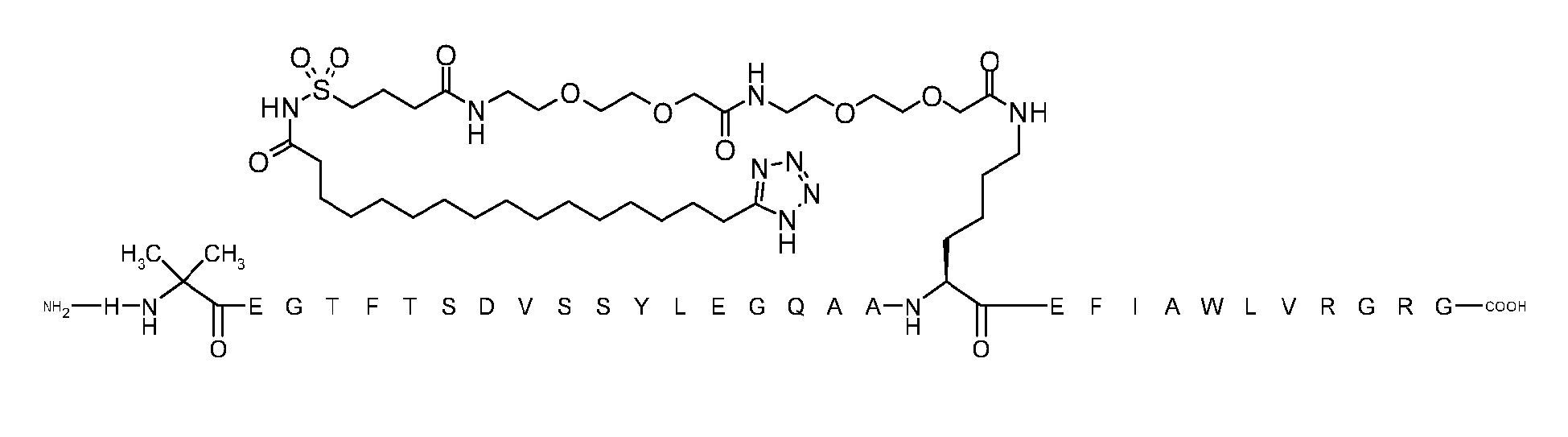


- Nε26-(4-(19-(Tetrazol-5-yl)nonadecanoylsulfamoyl)butyryl)[Arg34]GLP-1-(7-37) peptide
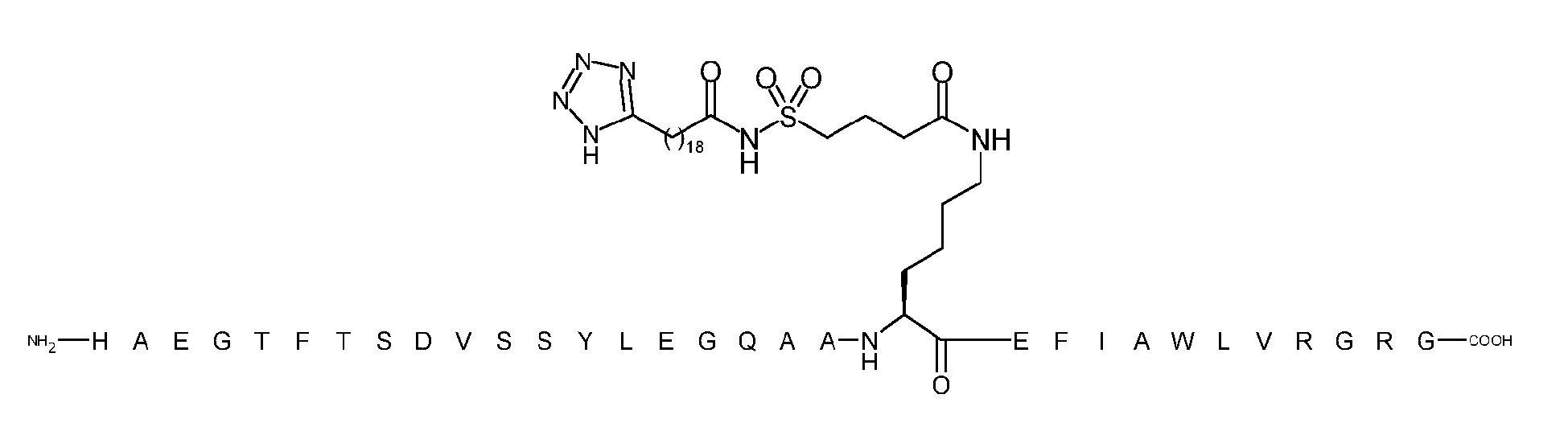


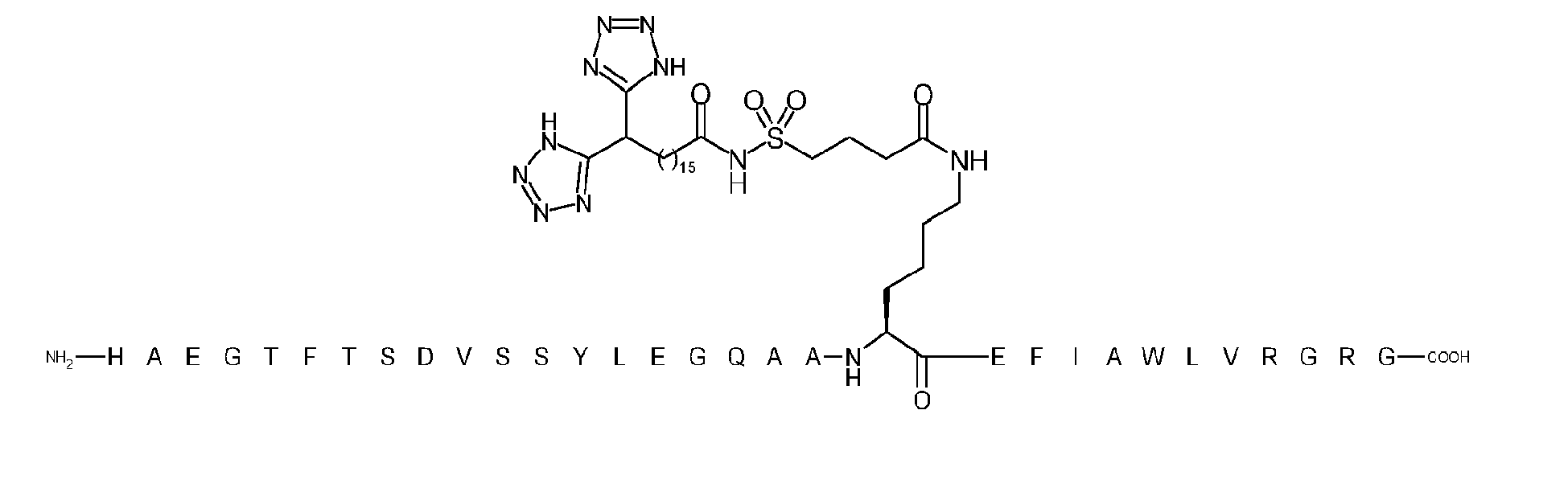


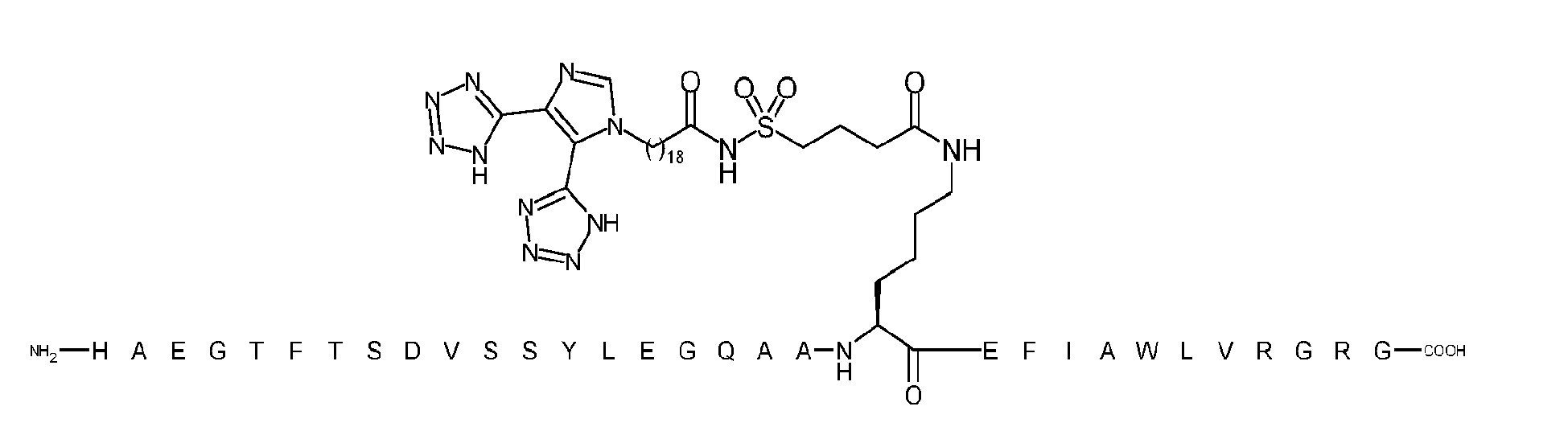


- In another aspect the present invention provides a compound according to formula (I), wherein the molecule is human growth hormone or an analog thereof.
- In another aspect the present invention provides a compound according to formula (I), wherein the molecule is human insulin or an analog thereof.
- In another aspect the present invention provides a compound according to formula (I), wherein the molecule is factor VII or an analog thereof.
- In another aspect the present invention provides a compound according to formula (I), wherein the molecule is parathyroid hormone or an analog thereof.
- In another aspect the present invention provides a compound according to formula (I), wherein the molecule is human follicle stimulating hormone or an analog thereof.
- In another embodiment the present invention provides a compound according to formula (I), wherein the molecule has a molar weight of less than 100 kDa, less than 50 kDa, or less than 10 kDa.
- In other aspects the present invention provides a compound according to formula (I), wherein the molecule is selected from the group consisting of a growth factor such as platelet-derived growth factor (PDGF), transforming growth factor α (TGF-α), transforming growth factor β (TGF-β), epidermal growth factor (EGF), vascular endothelial growth factor (VEGF), a somatomedin such as insulin growth factor I (IGF-I), insulin growth factor II (IFG-II), erythropoietin (EPO), thrombopoietin (TPO) or angiopoietin, interferon, pro-urokinase, urokinase, tissue plasminogen activator (t-PA), plasminogen activator inhibitor 1, plasminogen activator inhibitor 2, von Willebrandt factor, a cytokine, e.g. an interleukin such as interleukin (IL) 1, I L-1 Ra, IL-2, IL-4, IL-5, IL-6, IL-9, I L-11, IL-12, IL-13, IL-15, IL-16, IL-17, IL-18, IL-20 or IL-21, a colony stimulating factor (CFS) such as GM-CSF, stem cell factor, a tumor necrosis factor such as TNF-α, lymphotoxin-α, lymphotoxin-β, CD40L, or CD30L, a protease inhibitor e.g. aprotinin, an enzyme such as superoxide dismutase, asparaginase, arginase, arginine deaminase, adenosine deaminase, ribonuclease, catalase, uricase, bilirubin oxidase, trypsin, papain, alkaline phosphatase, β-glucoronidase, purine nucleoside phosphorylase or batroxobin, an opioid, e.g. endorphins, enkephalins or non-natural opioids, a hormone or neuropeptide, e.g. calcitonin, glucagon, gastrins, adrenocorticotropic hormone (ACTH), cholecystokinins, lutenizing hormone, gonadotropin-releassing hormone, chorionic gonadotropin, corticotrophin-releasing factor, vasopressin, oxytocin, antidiuretic hormones, thyroid-stimulating hormone, thyrotropin-releasing hormone, relaxin, prolactin, peptide YY, neuropeptide Y, pancreastic polypeptide, leptin, CART (cocaine and amphetamine regulated transcript), a CART related peptide, perilipin, melanocortins (melanocyte-stimulating hormones) such as MC-4, melanin-concentrating hormones, natriuretic peptides, adrenomedullin, endothelin, secretin, amylin, vasoactive intestinal peptide (VIP), pituary adenylate cyclase activating polypeptide (PACAP), bombesin, bombesin-like peptides, thymosin, heparin-binding protein, soluble CD4, hypothalmic releasing factor, melanotonins and analogs thereof.
- In another aspect the present invention provides a compound of the general formula (II)

- In another aspect the present invention provides the use of a compound according to formula (II) for the synthesis of a compound according to formula (I).
- The therapeutic polypeptides can be produced by classical peptide synthesis, e.g. solid phase peptide synthesis using t-Boc or F-Moc chemistry or other well established techniques., see e.g. Green and Wuts, "Protecting Groups in Organic Synthesis", Jogn Wiley & Sons, 1999.
- The therapeutic polypeptides can also be produced by a method which comprises culturing a host cell containing a DNA sequence encoding the polypeptide and capable of expressing the polypeptide in a suitable nutrient medium under conditions permitting the expression of the peptide, after which the resulting peptide is recovered from the culture.
- The medium used to culture the cells may be any conventional medium suitable for growing the host cells, such as minimal or complex media containing appropriate supplements. Suitable media are available from commercial suppliers or may be prepared according to published recipes (e.g. in catalogues of the American Type Culture Collection). The peptide produced by the cells may then be recovered from the culture medium by conventional procedures including separating the host cells from the medium by centrifugation or filtration. For extracellular products the proteinaceous components of the supernatant are isolated by filtration, column chromatography or precipitation, e.g. microfiltation, ultrafiltration, isoelectric precipitation, purification by a variety of chromatographic procedures, e.g. ion exchange chromatography, hydrophobic interaction chromatography, gel filtration chromatography, affinity chromatography, or the like, dependent on the type of polypeptide in question. For intracellular or periplasmic products the cells isolated from the culture medium are disintegrated or permeabilised and extracted to recover the product polypeptide or precursor thereof.
- The DNA sequence encoding the therapeutic polypeptide may suitably be of genomic or cDNA origin, for instance obtained by preparing a genomic or cDNA library and screening for DNA sequences coding for all or part of the peptide by hybridisation using synthetic oligonucleotide probes in accordance with standard techniques (see, for example, Sambrook, J, Fritsch, EF and Maniatis, T, Molecular Cloning: A Laboratory Manual, Cold Spring Harbor Laboratory Press, New York, 1989). The DNA sequence encoding the polypeptide may also be prepared synthetically by established standard methods, e.g. the phosphoamidite method described by Beaucage and Caruthers, Tetrahedron Letters 22 (1981), 1859 - 1869, or the method described by Matthes et al., EMBO Journal 3 (1984), 801 - 805. The DNA sequence may also be prepared by polymerase chain reaction using specific primers, for instance as described in
US 4,683,202 or Saiki et al., Science 239 (1988), 487 - 491. - The DNA sequence may be inserted into any vector which may conveniently be subjected to recombinant DNA procedures, and the choice of vector will often depend on the host cell into which it is to be introduced. Thus, the vector may be an autonomously replicating vector, i.e. a vector which exists as an extrachromosomal entity, the replication of which is independent of chromosomal replication, e.g. a plasmid. Alternatively, the vector may be one which, when introduced into a host cell, is integrated into the host cell genome and replicated together with the chromosome(s) into which it has been integrated.
- The vector is preferably an expression vector in which the DNA sequence encoding the polypeptide is operably linked to additional segments required for transcription of the DNA, such as a promoter. The promoter may be any DNA sequence which shows transcriptional activity in the host cell of choice and may be derived from genes encoding proteins either homologous or heterologous to the host cell. Examples of suitable promoters for directing the transcription of the DNA encoding the peptide of the invention in a variety of host cells are well known in the art, cf. for instance Sambrook et al., supra.
- The DNA sequence encoding the polypeptide may also, if necessary, be operably connected to a suitable terminator, polyadenylation signals, transcriptional enhancer sequences, and translational enhancer sequences. The recombinant vector of the invention may further comprise a DNA sequence enabling the vector to replicate in the host cell in question.
- The vector may also comprise a selectable marker, e.g. a gene the product of which complements a defect in the host cell or one which confers resistance to a drug, e.g. ampicillin, kanamycin, tetracyclin, chloramphenicol, neomycin, hygromycin or methotrexate. For large scale manufacture the selectable marker preferably is not antibiotic resistance, e.g. antibiotic resistance genes in the vector are preferably excised when the vector is used for large scale manufacture. Methods for eliminating antibiotic resistance genes from vectors are known in the art, see e.g.
US 6,358,705 which is incorporated herein by reference. - To direct a parent peptide of the present invention into the secretory pathway of the host cells, a secretory signal sequence (also known as a leader sequence, prepro sequence or pre sequence) may be provided in the recombinant vector. The secretory signal sequence is joined to the DNA sequence encoding the peptide in the correct reading frame. Secretory signal sequences are commonly positioned 5' to the DNA sequence encoding the peptide. The secretory signal sequence may be that normally associated with the peptide or may be from a gene encoding another secreted protein.
- The procedures used to ligate the DNA sequences coding for the present peptide, the promoter and optionally the terminator and/or secretory signal sequence, respectively, and to insert them into suitable vectors containing the information necessary for replication, are well known to persons skilled in the art (cf., for instance, Sambrook et al.., supra).
- The host cell into which the DNA sequence or the recombinant vector is introduced may be any cell which is capable of producing the present peptide and includes bacteria, yeast, fungi and higher eukaryotic cells. Examples of suitable host cells well known and used in the art are, without limitation, E. coli, Saccharomyces cerevisiae, or mammalian BHK or CHO cell lines.
- Pharmaceutical compositions containing a compound according to the present invention may be prepared by conventional techniques, e.g. as described in Remington's Pharmaceutical Sciences, 1985 or in Remington: The Science and Practice of Pharmacy, 19th edition, 1995.
- One object of the present invention is to provide a pharmaceutical formulation comprising a compound according to the present invention which is present in a concentration from about 0.1 mg/ml to about 25 mg/ml, and wherein said formulation has a pH from 2.0 to 10.0. The formulation may further comprise a buffer system, preservative(s), isotonicity agent(s), chelating agent(s), stabilizers and surfactants. In one embodiment of the invention the pharmaceutical formulation is an aqueous formulation, i.e. formulation comprising water. Such formulation is typically a solution or a suspension. In a further embodiment of the invention the pharmaceutical formulation is an aqueous solution. The term "aqueous formulation" is defined as a formulation comprising at least 50 %w/w water. Likewise, the term "aqueous solution" is defined as a solution comprising at least 50 %w/w water, and the term "aqueous suspension" is defined as a suspension comprising at least 50 %w/w water.
- In another embodiment the pharmaceutical formulation is a freeze-dried formulation, whereto the physician or the patient adds solvents and/or diluents prior to use.
- In another embodiment the pharmaceutical formulation is a dried formulation (e.g. freeze-dried or spray-dried) ready for use without any prior dissolution.
- In a further aspect the invention relates to a pharmaceutical formulation comprising an aqueous solution of a compound according to the present invention, and a buffer, wherein said compound is present in a concentration from 0.1 mg/ml or above, and wherein said formulation has a pH from about 2.0 to about 10.0.
- In a further aspect the invention relates to a pharmaceutical formulation comprising an aqueous solution of a compound according to the present invention, and a buffer, wherein said compound is present in a concentration from about 1 mg/ml or above, and wherein said formulation has a pH from about 7.0 to about 8.5.
- In a another embodiment of the invention the pH of the formulation is selected from the list consisting of 2.0, 2.1, 2.2, 2.3, 2.4, 2.5, 2.6, 2.7, 2.8, 2.9, 3.0, 3.1, 3.2, 3.3, 3.4, 3.5, 3.6, 3.7, 3.8, 3.9, 4.0, 4.1, 4.2, 4.3, 4.4, 4.5, 4.6, 4.7, 4.8, 4.9, 5.0, 5.1, 5.2, 5.3, 5.4, 5.5, 5.6, 5.7, 5.8, 5.9, 6.0, 6.1, 6.2, 6.3, 6.4, 6.5, 6.6, 6.7, 6.8, 6.9, 7.0, 7.1, 7.2, 7.3, 7.4, 7.5, 7.6, 7.7, 7.8, 7.9, 8.0, 8.1, 8.2, 8.3, 8.4, 8.5, 8.6, 8.7, 8.8, 8.9, 9.0, 9.1, 9.2, 9.3, 9.4, 9.5, 9.6, 9.7, 9.8, 9.9, and 10.0.
- In a further embodiment of the invention the buffer is selected from the group consisting of sodium acetate, sodium carbonate, citrate, glycylglycine, histidine, glycine, lysine, arginin, sodium dihydrogen phosphate, disodium hydrogen phosphate, sodium phosphate, and tris(hydroxymethyl)-aminomethan, bicine, tricine, malic acid, succinate, maleic acid, fumaric acid, tartaric acid, aspartic acid or mixtures thereof. Each one of these specific buffers constitutes an alternative embodiment of the invention.
- In a further embodiment of the invention the formulation further comprises a pharmaceutically acceptable preservative. In a further embodiment of the invention the preservative is selected from the group consisting of phenol, o-cresol, m-cresol, p-cresol, methyl p-hydroxybenzoate, propyl p-hydroxybenzoate, 2-phenoxyethanol, butyl p-hydroxybenzoate, 2-phenylethanol, benzyl alcohol, chlorobutanol, and thiomerosal, bronopol, benzoic acid, imidurea, chlorohexidine, sodium dehydroacetate, chlorocresol, ethyl p-hydroxybenzoate, benzethonium chloride, chlorphenesine (3p-chlorphenoxypropane-1,2-diol) or mixtures thereof. In a further embodiment of the invention the preservative is present in a concentration from 0.1 mg/ml to 20 mg/ml. In a further embodiment of the invention the preservative is present in a concentration from 0.1 mg/ml to 5 mg/ml. In a further embodiment of the invention the preservative is present in a concentration from 5 mg/ml to 10 mg/ml. In a further embodiment of the invention the preservative is present in a concentration from 10 mg/ml to 20 mg/ml. Each one of these specific preservatives constitutes an alternative embodiment of the invention. The use of a preservative in pharmaceutical compositions is well-known to the skilled person. For convenience reference is made to Remington: The Science and Practice of Pharmacy, 19th edition, 1995.
- In a further embodiment of the invention the formulation further comprises an isotonic agent. In a further embodiment of the invention the isotonic agent is selected from the group consisting of a salt (e.g. sodium chloride), a sugar or sugar alcohol, an amino acid (e.g. L-glycine, L-histidine, arginine, lysine, isoleucine, aspartic acid, tryptophan, threonine),
an alditol (e.g. glycerol (glycerine), 1,2-propanediol (propyleneglycol), 1,3-propanediol, 1,3-butanediol) polyethyleneglycol (e.g. PEG400), or mixtures thereof. Any sugar such as mono-, di-, or polysaccharides, or water-soluble glucans, including for example fructose, glucose, mannose, sorbose, xylose, maltose, lactose, sucrose, trehalose, dextran, pullulan, dextrin, cyclodextrin, soluble starch, hydroxyethyl starch and carboxymethylcellulose-Na may be used. In one embodiment the sugar additive is sucrose. Sugar alcohol is defined as a C4-C8 hydrocarbon having at least one --OH group and includes, for example, mannitol, sorbitol, inositol, galacititol, dulcitol, xylitol, and arabitol. In one embodiment the sugar alcohol additive is mannitol. The sugars or sugar alcohols mentioned above may be used individually or in combination. There is no fixed limit to the amount used, as long as the sugar or sugar alcohol is soluble in the liquid preparation and does not adversely effect the stabilizing effects achieved using the methods of the invention. In one embodiment, the sugar or sugar alcohol concentration is between about 1 mg/ml and about 150 mg/ml. In a further embodiment of the invention the isotonic agent is present in a concentration from 1 mg/ml to 50 mg/ml. In a further embodiment of the invention the isotonic agent is present in a concentration from 1 mg/ml to 7 mg/ml. In a further embodiment of the invention the isotonic agent is present in a concentration from 8 mg/ml to 24 mg/ml. In a further embodiment of the invention the isotonic agent is present in a concentration from 25 mg/ml to 50 mg/ml. Each one of these specific isotonic agents constitutes an alternative embodiment of the invention. The use of an isotonic agent in pharmaceutical compositions is well-known to the skilled person. For convenience reference is made to Remington: The Science and Practice of Pharmacy, 19th edition, 1995. - In a further embodiment of the invention the formulation further comprises a chelating agent. In a further embodiment of the invention the chelating agent is selected from salts of ethylenediaminetetraacetic acid (EDTA), citric acid, and aspartic acid, and mixtures thereof. In a further embodiment of the invention the chelating agent is present in a concentration from 0.1 mg/ml to 5mg/ml. In a further embodiment of the invention the chelating agent is present in a concentration from 0.1 mg/ml to 2mg/ml. In a further embodiment of the invention the chelating agent is present in a concentration from 2mg/ml to 5mg/ml. Each one of these specific chelating agents constitutes an alternative embodiment of the invention. The use of a chelating agent in pharmaceutical compositions is well-known to the skilled person. For convenience reference is made to Remington: The Science and Practice of Pharmacy, 19th edition, 1995.
- In a further embodiment of the invention the formulation further comprises a stabiliser. The use of a stabilizer in pharmaceutical compositions is well-known to the skilled person. For convenience reference is made to Remington: The Science and Practice of Pharmacy, 19th edition, 1995.
- More particularly, compositions of the invention are stabilized liquid pharmaceutical compositions whose therapeutically active components include a polypeptide that possibly exhibits aggregate formation during storage in liquid pharmaceutical formulations. By "aggregate formation" is intended a physical interaction between the polypeptide molecules that results in formation of oligomers, which may remain soluble, or large visible aggregates that precipitate from the solution. By "during storage" is intended a liquid pharmaceutical composition or formulation once prepared, is not immediately administered to a subject. Rather, following preparation, it is packaged for storage, either in a liquid form, in a frozen state, or in a dried form for later reconstitution into a liquid form or other form suitable for administration to a subject. By "dried form" is intended the liquid pharmaceutical composition or formulation is dried either by freeze drying (i.e., lyophilization; see, for example, Williams and Polli (1984) J. Parenteral Sci. Technol. 38:48-59), spray drying (see Masters (1991) in Spray-Drying Handbook (5th ed; Longman Scientific and Technical, Essez, U.K.), pp. 491-676; Broadhead et al. (1992) Drug Devel. Ind. Pharm. 18:1169-1206; and Mumenthaler et al. (1994) Pharm. Res. 11:12-20), or air drying (Carpenter and Crowe (1988) Cryobiology 25:459-470; and Roser (1991) Biopharm. 4:47-53). Aggregate formation by a polypeptide during storage of a liquid pharmaceutical composition can adversely affect biological activity of that polypeptide, resulting in loss of therapeutic efficacy of the pharmaceutical composition. Furthermore, aggregate formation may cause other problems such as blockage of tubing, membranes, or pumps when the polypeptide-containing pharmaceutical composition is administered using an infusion system.
- The pharmaceutical compositions of the invention may further comprise an amount of an amino acid base sufficient to decrease aggregate formation by the polypeptide during storage of the composition. By "amino acid base" is intended an amino acid or a combination of amino acids, where any given amino acid is present either in its free base form or in its salt form. Where a combination of amino acids is used, all of the amino acids may be present in their free base forms, all may be present in their salt forms, or some may be present in their free base forms while others are present in their salt forms. In one embodiment, amino acids to use in preparing the compositions of the invention are those carrying a charged side chain, such as arginine, lysine, aspartic acid, and glutamic acid. Any stereoisomer (i.e. R or S-isomers - or L, D or DL-isomer) of a particular amino acid (e.g. alanine, methionine methionine, histidine, imidazole, arginine, lysine, isoleucine, aspartic acid, tryptophan, threonine and mixtures thereof) or combinations of these stereoisomers, may be present in the pharmaceutical compositions of the invention so long as the particular amino acid is present either in its free base form or its salt form. In one embodiment the L-stereoisomer is used, which denotes the most abundant form of aminoacids. The L-form may be an R or an S isomer dependent on the specific aminoacid. Compositions of the invention may also be formulated with analogues of these amino acids. By "amino acid analogue" is intended a derivative of the naturally occurring amino acid that brings about the desired effect of decreasing aggregate formation by the polypeptide during storage of the liquid pharmaceutical compositions of the invention. Suitable arginine analogues include, for example, aminoguanidine, ornithine and N-monoethyl L-arginine, suitable methionine analogues include S-ethyl homocysteine and S-butyl homocysteine and suitable cystein analogues include S-methyl-L cystein. As with the other amino acids, the amino acid analogues are incorporated into the compositions in either their free base form or their salt form. In a further embodiment of the invention the amino acids or amino acid analogues are used in a concentration, which is sufficient to prevent or delay aggregation of the protein.
- In a further embodiment of the invention methionine (or other sulphur containing amino acids or amino acid analogous) may be added to inhibit oxidation of methionine residues to methionine sulfoxide when the polypeptide acting as the therapeutic agent is a polypeptide comprising at least one methionine residue susceptible to such oxidation. By "inhibit" is intended minimal accumulation of methionine oxidized species over time. Inhibiting methionine oxidation results in greater retention of the polypeptide in its proper molecular form. Any stereoisomer of methionine (L, D, or DL isomer) or combinations thereof can be used. The amount to be added should be an amount sufficient to inhibit oxidation of the methionine residues such that the amount of methionine sulfoxide is acceptable to regulatory agencies. Typically, this means that the composition contains no more than about 10% to about 30% methionine sulfoxide. Generally, this can be achieved by adding methionine such that the ratio of methionine added to methionine residues ranges from about 1:1 to about 1000:1, such as 10:1 to about 100:1.
- In a further embodiment of the invention the formulation further comprises a stabiliser selected from the group of high molecular weight polymers or low molecular compounds. In a further embodiment of the invention the stabilizer is selected from polyethylene glycol (e.g. PEG 3350), polyvinylalcohol (PVA), polyvinylpyrrolidone, carboxy-/hydroxycellulose or derivates thereof (e.g. HPC, HPC-SL, HPC-L and HPMC), cyclodextrins, sulphur-containing substances as monothioglycerol, thioglycolic acid and 2-methylthioethanol, and different salts (e.g. sodium chloride). Each one of these specific stabilizers constitutes an alternative embodiment of the invention.
- The pharmaceutical compositions may also comprise additional stabilizing agents, which further enhance stability of a therapeutically active polypeptide therein. Stabilizing agents of particular interest to the present invention include, but are not limited to, methionine and EDTA, which protect the polypeptide against methionine oxidation, and a nonionic surfactant, which protects the polypeptide against aggregation associated with freeze-thawing or mechanical shearing.
- In a further embodiment of the invention the formulation further comprises a surfactant. In a further embodiment of the invention the surfactant is selected from a detergent, ethoxylated castor oil, polyglycolyzed glycerides, acetylated monoglycerides, sorbitan fatty acid esters, polyoxypropylene-polyoxyethylene block polymers (eg. poloxamers such as Pluronic® F68, poloxamer 188 and 407, Triton X-100), polyoxyethylene sorbitan fatty acid esters, polyoxyethylene and polyethylene derivatives such as alkylated and alkoxylated derivatives (tweens, e.g. Tween-20, Tween-40, Tween-80 and Brij-35), monoglycerides or ethoxylated derivatives thereof, diglycerides or polyoxyethylene derivatives thereof, alcohols, glycerol, lecitins and phospholipids (eg. phosphatidyl serine, phosphatidyl choline, phosphatidyl ethanolamine, phosphatidyl inositol, diphosphatidyl glycerol and sphingomyelin), derivates of phospholipids (eg. dipalmitoyl phosphatidic acid) and lysophospholipids (eg. palmitoyl lysophosphatidyl-L-serine and 1-acyl-sn-glycero-3-phosphate esters of ethanolamine, choline, serine or threonine) and alkyl, alkoxyl (alkyl ester), alkoxy (alkyl ether)- derivatives of lysophosphatidyl and phosphatidylcholines, e.g. lauroyl and myristoyl derivatives of lysophosphatidylcholine, dipalmitoylphosphatidylcholine, and modifications of the polar head group, that is cholines, ethanolamines, phosphatidic acid, serines, threonines, glycerol, inositol, and the positively charged DODAC, DOTMA, DCP, BISHOP, lysophosphatidylserine and lysophosphatidylthreonine, and glycerophospholipids (eg. cephalins), glyceroglycolipids (eg. galactopyransoide), sphingoglycolipids (eg. ceramides, gangliosides), dodecylphosphocholine, hen egg lysolecithin, fusidic acid derivatives- (e.g. sodium tauro-dihydrofusidate etc.), long-chain fatty acids and salts thereof C6-C12 (eg. oleic acid and caprylic acid), acylcarnitines and derivatives, Nα-acylated derivatives of lysine, arginine or histidine, or side-chain acylated derivatives of lysine or arginine, Nα-acylated derivatives of dipeptides comprising any combination of lysine, arginine or histidine and a neutral or acidic amino acid, Nα-acylated derivative of a tripeptide comprising any combination of a neutral amino acid and two charged amino acids, DSS (docusate sodium, CAS registry no [577-11-7]), docusate calcium, CAS registry no [128-49-4]), docusate potassium, CAS registry no [7491-09-0]), SDS (sodium dodecyl sulfate or sodium lauryl sulfate), sodium caprylate, cholic acid or derivatives thereof, bile acids and salts thereof and glycine or taurine conjugates, ursodeoxycholic acid, sodium cholate, sodium deoxycholate, sodium taurocholate, sodium glycocholate, N-hexadecyl-N,N-dimethyl-3-ammonio-1-propanesulfonate, anionic (alkyl-aryl-sulphonates) monovalent surfactants, zwitterionic surfactants (e.g. N-alkyl-N,N-dimethylammonio-1-propanesulfonates, 3-cholamido-1-propyldimethylammonio-1-propanesulfonate, cationic surfactants (quarternary ammonium bases) (e.g. cetyltrimethylammonium bromide, cetylpyridinium chloride), non-ionic surfactants (eg. dodecyl β-D-glucopyranoside), poloxamines (eg. Tetronic's), which are tetrafunctional block copolymers derived from sequential addition of propylene oxide and ethylene oxide to ethylenediamine, or the surfactant may be selected from the group of imidazoline derivatives, or mixtures thereof. Each one of these specific surfactants constitutes an alternative embodiment of the invention.
- The use of a surfactant in pharmaceutical compositions is well-known to the skilled person. For convenience reference is made to Remington: The Science and Practice of Pharmacy, 19th edition, 1995.
- It is possible that other ingredients may be present in the peptide pharmaceutical formulation of the present invention. Such additional ingredients may include wetting agents, emulsifiers, antioxidants, bulking agents, tonicity modifiers, chelating agents, metal ions, oleaginous vehicles, proteins (e.g., human serum albumin, gelatin or proteins) and a zwitterion (e.g., an amino acid such as betaine, taurine, arginine, glycine, lysine and histidine). Such additional ingredients, of course, should not adversely affect the overall stability of the pharmaceutical formulation of the present invention.
- Pharmaceutical compositions containing a compound according to the present invention may be administered to a patient in need of such treatment at several sites, for example, at topical sites, for example, skin and mucosal sites, at sites which bypass absorption, for example, administration in an artery, in a vein, in the heart, and at sites which involve absorption, for example, administration in the skin, under the skin, in a muscle or in the abdomen.
- Administration of pharmaceutical compositions according to the invention may be through several routes of administration, for example, lingual, sublingual, buccal, in the mouth, oral, in the stomach and intestine, nasal, pulmonary, for example, through the bronchioles and alveoli or a combination thereof, epidermal, dermal, transdermal, vaginal, rectal, ocular, for examples through the conjunctiva, uretal, and parenteral to patients in need of such a treatment.
- Compositions of the current invention may be administered in several dosage forms, for example, as solutions, suspensions, emulsions, microemulsions, multiple emulsion, foams, salves, pastes, plasters, ointments, tablets, coated tablets, rinses, capsules, for example, hard gelatine capsules and soft gelatine capsules, suppositories, rectal capsules, drops, gels, sprays, powder, aerosols, inhalants, eye drops, ophthalmic ointments, ophthalmic rinses, vaginal pessaries, vaginal rings, vaginal ointments, injection solution, in situ transforming solutions, for example in situ gelling, in situ setting, in situ precipitating, in situ crystallization, infusion solution, and implants.
- Compositions of the invention may further be compounded in, or attached to, for example through covalent, hydrophobic and electrostatic interactions, a drug carrier, drug delivery system and advanced drug delivery system in order to further enhance stability of the compound, increase bioavailability, increase solubility, decrease adverse effects, achieve chronotherapy well known to those skilled in the art, and increase patient compliance or any combination thereof. Examples of carriers, drug delivery systems and advanced drug delivery systems include, but are not limited to, polymers, for example cellulose and derivatives, polysaccharides, for example dextran and derivatives, starch and derivatives, poly(vinyl alcohol), acrylate and methacrylate polymers, polylactic and polyglycolic acid and block co-polymers thereof, polyethylene glycols, carrier proteins, for example albumin, gels, for example, thermogelling systems, for example block co-polymeric systems well known to those skilled in the art, micelles, liposomes, microspheres, nanoparticulates, liquid crystals and dispersions thereof, L2 phase and dispersions there of, well known to those skilled in the art of phase behaviour in lipid-water systems, polymeric micelles, multiple emulsions, self-emulsifying, self-microemulsifying, cyclodextrins and derivatives thereof, and dendrimers.
- Compositions of the current invention are useful in the formulation of solids, semisolids, powder and solutions for pulmonary administration of the compound, using, for example a metered dose inhaler, dry powder inhaler and a nebulizer, all being devices well known to those skilled in the art.
- Compositions of the current invention are specifically useful in the formulation of controlled, sustained, protracting, retarded, and slow release drug delivery systems. More specifically, but not limited to, compositions are useful in formulation of parenteral controlled release and sustained release systems (both systems leading to a many-fold reduction in number of administrations), well known to those skilled in the art. Even more preferably, are controlled release and sustained release systems administered subcutaneous. Without limiting the scope of the invention, examples of useful controlled release system and compositions are hydrogels, oleaginous gels, liquid crystals, polymeric micelles, microspheres, nanoparticles,
- Methods to produce controlled release systems useful for compositions of the current invention include, but are not limited to, crystallization, condensation, co-cystallization, precipitation, co-precipitation, emulsification, dispersion, high pressure homogenization, encapsulation, spray drying, microencapsulation, coacervation, phase separation, solvent evaporation to produce microspheres, extrusion and supercritical fluid processes. General reference is made to Handbook of Pharmaceutical Controlled Release (Wise, D.L., ed. Marcel Dekker, New York, 2000) and Drug and the Pharmaceutical Sciences vol. 99: Protein Formulation and Delivery (MacNally, E.J., ed. Marcel Dekker, New York, 2000).
- Parenteral administration may be performed by subcutaneous, intramuscular, intraperitoneal or intravenous injection by means of a syringe, optionally a pen-like syringe. Alternatively, parenteral administration can be performed by means of an infusion pump. A further option is a composition which may be a solution or suspension for the administration of the compound according to the present invention in the form of a nasal or pulmonal spray. As a still further option, the pharmaceutical compositions containing the compound of the invention can also be adapted to transdermal administration, e.g. by needle-free injection or from a patch, optionally an iontophoretic patch, or transmucosal, e.g. buccal, administration.
- The term "stabilized formulation" refers to a formulation with increased physical stability, increased chemical stability or increased physical and chemical stability.
- The term "physical stability" of the protein formulation as used herein refers to the tendency of the protein to form biologically inactive and/or insoluble aggregates of the protein as a result of exposure of the protein to thermo-mechanical stresses and/or interaction with interfaces and surfaces that are destabilizing, such as hydrophobic surfaces and interfaces. Physical stability of the aqueous protein formulations is evaluated by means of visual inspection and/or turbidity measurements after exposing the formulation filled in suitable containers (e.g. cartridges or vials) to mechanical/physical stress (e.g. agitation) at different temperatures for various time periods. Visual inspection of the formulations is performed in a sharp focused light with a dark background. The turbidity of the formulation is characterized by a visual score ranking the degree of turbidity for instance on a scale from 0 to 3 (a formulation showing no turbidity corresponds to a visual score 0, and a formulation showing visual turbidity in daylight corresponds to visual score 3). A formulation is classified physical unstable with respect to protein aggregation, when it shows visual turbidity in daylight. Alternatively, the turbidity of the formulation can be evaluated by simple turbidity measurements well-known to the skilled person. Physical stability of the aqueous protein formulations can also be evaluated by using a spectroscopic agent or probe of the conformational status of the protein. The probe is preferably a small molecule that preferentially binds to a non-native conformer of the protein. One example of a small molecular spectroscopic probe of protein structure is Thioflavin T. Thioflavin T is a fluorescent dye that has been widely used for the detection of amyloid fibrils. In the presence of fibrils, and perhaps other protein configurations as well, Thioflavin T gives rise to a new excitation maximum at about 450 nm and enhanced emission at about 482 nm when bound to a fibril protein form. Unbound Thioflavin T is essentially non-fluorescent at the wavelengths.
- Other small molecules can be used as probes of the changes in protein structure from native to non-native states. For instance the "hydrophobic patch" probes that bind preferentially to exposed hydrophobic patches of a protein. The hydrophobic patches are generally buried within the tertiary structure of a protein in its native state, but become exposed as a protein begins to unfold or denature. Examples of these small molecular, spectroscopic probes are aromatic, hydrophobic dyes, such as antrhacene, acridine, phenanthroline or the like. Other spectroscopic probes are metal-amino acid complexes, such as cobalt metal complexes of hydrophobic amino acids, such as phenylalanine, leucine, isoleucine, methionine, and valine, or the like.
- The term "chemical stability" of the protein formulation as used herein refers to chemical covalent changes in the protein structure leading to formation of chemical degradation products with potential less biological potency and/or potential increased immunogenic properties compared to the native protein structure. Various chemical degradation products can be formed depending on the type and nature of the native protein and the environment to which the protein is exposed. Elimination of chemical degradation can most probably not be completely avoided and increasing amounts of chemical degradation products is often seen during storage and use of the protein formulation as well-known by the person skilled in the art. Most proteins are prone to deamidation, a process in which the side chain amide group in glutaminyl or asparaginyl residues is hydrolysed to form a free carboxylic acid. Other degradations pathways involves formation of high molecular weight transformation products where two or more protein molecules are covalently bound to each other through transamidation and/or disulfide interactions leading to formation of covalently bound dimer, oligomer and polymer degradation products (Stability of Protein Pharmaceuticals, Ahern. T.J. & Manning M.C., Plenum Press, New York 1992). Oxidation (of for instance methionine residues) can be mentioned as another variant of chemical degradation. The chemical stability of the protein formulation can be evaluated by measuring the amount of the chemical degradation products at various time-points after exposure to different environmental conditions (the formation of degradation products can often be accelerated by for instance increasing temperature). The amount of each individual degradation product is often determined by separation of the degradation products depending on molecule size and/or charge using various chromatography techniques (e.g. SEC-HPLC and/or RP-HPLC).
- Hence, as outlined above, a "stabilized formulation" refers to a formulation with increased physical stability, increased chemical stability or increased physical and chemical stability. In general, a formulation must be stable during use and storage (in compliance with recommended use and storage conditions) until the expiration date is reached.
- In one embodiment of the invention the pharmaceutical formulation comprising the compound according to the present invention is stable for more than 6 weeks of usage and for more than 3 years of storage.
- In another embodiment of the invention the pharmaceutical formulation comprising the compound according to the present invention is stable for more than 4 weeks of usage and for more than 3 years of storage.
- In a further embodiment of the invention the pharmaceutical formulation comprising the compound according to the present invention is stable for more than 4 weeks of usage and for more than two years of storage.
- In an even further embodiment of the invention the pharmaceutical formulation comprising the compound is stable for more than 2 weeks of usage and for more than two years of storage.
- In another aspect the present invention relates to the use of a compound according to the invention for the preparation of a medicament.
- In one embodiment of the invention a compound according to the invention wherein the therapeutic agent is a GLP-1 peptide is used for the preparation of a medicament for the treatment or prevention of hyperglycemia, type 2 diabetes, impaired glucose tolerance, type 1 diabetes, obesity, hypertension, syndrome X, dyslipidemia,disorders associated with toxic hypervolemia, cognitive disorders, atheroschlerosis, myocardial infarction, coronary heart disease, stroke and other cardiovascular disorders, inflammatory bowel syndrome, dyspepsia and gastric ulcers.
- In another embodiment of the invention a compound according to the invention wherein the therapeutic agent is a GLP-1 peptide is used for the preparation of a medicament for delaying or preventing disease progression in type 2 diabetes.
- In another embodiment of the invention a compound according to the invention wherein the therapeutic agent is a GLP-1 peptide is used for the preparation of a medicament for decreasing food intake, decreasing β-cell apoptosis, increasing β-cell function and β-cell mass, stimulating β-cell regeneration, and/or for restoring glucose sensitivity to β-cells.
- In another embodiment the present invention relates to the use of a compound according to the invention wherein the therapeutic agent is a GLP-2 peptide for the preparation of a medicament for the treatment of small bowel syndrome, inflammatory bowel syndrome or Crohns disease.
- In another embodiment the present invention relates to the use of a compound according to the invention wherein the therapeutic agent is an insulin peptide for the preparation of a medicament for the treatment of hyperglycemia, type 1 diabetes, type 2 diabetes or β-cell deficiency.
- The treatment with a compound according to the present invention may also be combined with combined with a second or more pharmacologically active substances, e.g. selected from antidiabetic agents, antiobesity agents, appetite regulating agents, antihypertensive agents, agents for the treatment and/or prevention of complications resulting from or associated with diabetes and agents for the treatment and/or prevention of complications and disorders resulting from or associated with obesity. Examples of these pharmacologically active substances are : Insulin, GLP-1 agonists, sulphonylureas, biguanides, meglitinides, glucosidase inhibitors, glucagon antagonists, DPP-IV (dipeptidyl peptidase-IV) inhibitors, inhibitors of hepatic enzymes involved in stimulation of gluconeogenesis and/or glycogenolysis, glucose uptake modulators, compounds modifying the lipid metabolism such as antihyperlipidemic agents as HMG CoA inhibitors (statins), compounds lowering food intake, RXR agonists and agents acting on the ATP-dependent potassium channel of the β-cells; Cholestyramine, colestipol, clofibrate, gemfibrozil, lovastatin, pravastatin, simvastatin, probucol, dextrothyroxine, neteglinide, repaglinide; β-blockers such as alprenolol, atenolol, timolol, pindolol, propranolol and metoprolol, ACE (angiotensin converting enzyme) inhibitors such as benazepril, captopril, enalapril, fosinopril, lisinopril, alatriopril, quinapril and ramipril, calcium channel blockers such as nifedipine, felodipine, nicardipine, isradipine, nimodipine, diltiazem and verapamil, and α-blockers such as doxazosin, urapidil, prazosin and terazosin; CART (cocaine amphetamine regulated transcript) agonists, NPY (neuropeptide Y) antagonists, MC4 (melanocortin 4) agonists, orexin antagonists, TNF (tumor necrosis factor) agonists, CRF (corticotropin releasing factor) agonists, CRF BP (corticotropin releasing factor binding protein) antagonists, urocortin agonists, β3 agonists, MSH (melanocyte-stimulating hormone) agonists, MCH (melanocyte-concentrating hormone) antagonists, CCK (cholecystokinin) agonists, serotonin re-uptake inhibitors, serotonin and noradrenaline re-uptake inhibitors, mixed serotonin and noradrenergic compounds, 5HT (serotonin) agonists, bombesin agonists, galanin antagonists, growth hormone, growth hormone releasing compounds, TRH (thyreotropin releasing hormone) agonists, UCP 2 or 3 (uncoupling protein 2 or 3) modulators, leptin agonists, DA agonists (bromocriptin, doprexin), lipase/amylase inhibitors, RXR (retinoid X receptor) modulators, TR β agonists; histamine H3 antagonists, gastrin and gastrin analogs.
- It should be understood that any suitable combination of the compounds according to the invention with one or more of the above-mentioned compounds and optionally one or more further pharmacologically active substances are considered to be within the scope of the present invention.
- The present invention is further illustrated by the following examples which, however, are not to be construed as limiting the scope of protection. The features disclosed in the foregoing description and in the following examples may, both separately and in any combination thereof, be material for realising the invention in diverse forms thereof.
- In the examples the following terms are intended to have the following, general meanings:
- Boc:
- tert-butyloxycarbonyl
- Bt:
- 1-benzotriazolyl
- DBU:
- 1,8-diazabicyclo[5.4.0]undec-7-ene
- DCM:
- dichloromethane, methylenechloride
- Dde:
- 1-(4,4-dimethyl-2,6-dioxocyclohexylidene)ethyl
- DIC:
- diisopropylcarbodiimide
- DMA:
- N,N-dimethylacetamide
- DMF:
- N,N-dimethyl formamide
- DMSO:
- dimethyl sulfoxide
- DMAP:
- 4-dimethylaminopyridine
- DMPU:
- 1,3-dimethyltetrahydropyrimidin-2-one
- EDC or EDAC
- N-ethyl-N'-(3-dimethylaminopropyl)carbodiimide hydrochloride
- Fmoc:
- 9-fluorenylmethyloxycarbonyl
- HBTU:
- 2-(1H-Benzotriazol-1-yl-)-1,1,3,3 tetramethyluronium hexafluorophosphate
- HOAt:
- 3-hydroxy-3H-[1,2,3]triazolo[4,5-b]pyridine, 4-aza-3-hydroxybenzotriazole
- HOBt:
- N-hydroxybenzotriazole, 1-hydroxybenzotriazole
- HONSu:
- N-hydroxysuccinimide
- NMP:
- N-methylpyrrolidone
- HPLC:
- high pressure liquid chromatography
- Pmc
- 2,2,5,7,8-pentamethylchroman-6-sulfonyl
- r.t.
- room temperature
- Su:
- succinimidyl
- TIS
- triisopropylsilane
- Trt:
- trityl, triphenylmethyl
- Ts:
- toluenesulfonyl
- TSTU
- O-(1-succinimidyl)-N,N,N',N'-tetramethyluronium hexafluorophosphate
- DIEA
- diisopropylethylamine
- H2O
- water
- CH3CN
- acetonitrile
- OtBu
- tert butyl ester
- tBu
- tert butyl
- Trt
- triphenylmethyl
- Pmc
- 2,2,5,7,8-Pentamethyl-chroman-6-sulfonyl
- Dde
- 1-(4,4-Dimethyl-2,6-dioxocyclohexylidene)ethyl
- DCM
- dichloromethane
- TFA :
- trifluoroacetic acid
- Et2O:
- diethylether
- NMR spectra were recorded on Bruker 300 MHz and 400 MHz instruments. HPLC-MS was performed on a Perkin Elmer instrument (API 100).
- HPLC-systems from Merck-Hitachi (Hibar™ RT 250-4, Lichrosorb™ RP 18, 5.0 µm, 4.0 x 250 mm, gradient elution, 20% to 80% acetonitrile in water within 30 min, 1.0 ml/min, detection at 254 nm) and Waters (Symmetry™, C18, 3.5 µm, 3.0 x 150 mm, gradient elution, 5% to 90% acetonitrile in water within 15 min, 1.0 ml/min, detection at 214 nm) were used. Furthermore, where stated the following HPLC method h8 was used:
- The reverse phase analysis was performed using UV detections at 214, 254, 276 and 301 nm on a 218TP54 4.6 mm x 150 mm C-18 silica column, which was eluted at 1 ml/min at 42 °C. The column was equilibrated with 5% acetonitrile, 85% water and 10% of a solution of 0.5% trifluoroacetic acid in water and eluted by a linear gradient from 5% acetonitrile, 85% water and 10% of a solution of 0.5% trifluoroacetic acid to 90% acetonitrile and 10% of a solution of 0.5% trifluoroacetic acid over 15 min.
- Furthermore, where stated the following HPLC method A was used: The RP-analysis was performed using a Waters 2690 systems fitted with a Waters 996 diode array detector. UV detections were collected at 214, 254, 276, and 301 nm on a 218TP54 4.6 mm x 250 mm 5µ C-18 silica column (The Seperations Group, Hesperia), which was eluted at 1 ml/min at 42°C. The column was equilibrated with 5% acetonitrile (+ 0.1 % TFA) in an aqueous solution of TFA in water (0.1 %). After injection, the sample was eluted by a gradient of 0% to 90% acetonitrile (+ 0.1 % TFA) in an aqueous solution of TFA in water (0.1%) during 50 min.
- The compounds of formula (I) according to the invention may be prepared by the general procedure (A):

- A molecule of which a prolonged halflife in plasma is required and which contains at least one acylable amino group is dissolved in a suitable solvent (water, alcohols, DMF, DMSO, DMPU, or mixtures thereof) and a solution or suspension of (II) in DMF or DMSO is added. The mixture is stirred at room temperature and the progress of the reaction is followed by HPLC. If the reaction proceeds too slowly catalytic amounts of DMAP may be added. The product is isolated by preparative HPLC of the whole reaction mixture.
- The compounds of formula (II) according to the invention may be prepared by the general procedure (B):

- A ω-haloalkanoic acid or ester is treated with a slight excess of NaCN or KCN in a suitable solvent, such as DMF, DMSO, acetone, or an alcohol until complete conversion to the nitrile has taken place. The reaction is followed by analyzing samples by 1H NMR. The resulting ω-cyanoalkanoic acid or ester is isolated by dilution with water and extraction with AcOEt or DCM. Treatment of this ω-cyanoalkanoic acid or ester with NaN3 in the presence of AcOH and NEt3 in DMF at 140 °C until all the starting material is consumed (as determined by 1H NMR) yields the corresponding ω-(5-tetrazolyl)alkanoic acid or ester. In the case of the ester, it is converted to the acid by treatment with an excess of NaOH or KOH in a mixture of water and an alcohol. Evaporation of the alcohol and addition of dilute aqueous HCl yields the ω-(5-tetrazolyl)alkanoic acid, which can be isolated by filtration.
- Alternatively, the general procedure (B) may also be conducted with an ω-halo alkanoic ester instead of an acid. Saponification of the resulting ω-(tetrazol-5-yl)alkanoic ester to the corresponding acid can be performed by treatment with an excess KOH or NaOH in a mixture of water and ethanol.
- The compounds of formula (II) according to the invention may also be prepared by the general procedure (C):

- An ω-(5-tetrazolyl)alkanoic acid is converted into an acyl halide or N-hydroxysuccinimidyl ester, and then coupled to lysine methyl ester. Saponification of the resulting product yields N, N'-bis(w-(5-tetrazolyl)alkanoyl)lysine.
- The compounds of formula (II) according to the invention may also be prepared by the general procedure (D):

- A ω-haloalkanoic acid or ester is treated with a cyanophenol, cyanothiophenol, dicyanophenol, cyanobiphenylol, cyanoterphenylol, cyanoaniline, cyanohydroxyheteroarene, or a related reagent containing at least one cyano group and one arene- or heteroarene-bound hydroxyl group in the presence of a base such as K2CO3 or DBU in a suitable solvent, such as DMF, DMSO, acetone, or an alcohol until complete conversion to the aryl or heteroarylether, -thioether, or -amine has taken place. The reaction is followed by analyzing samples by 1H NMR. The resulting ω-aryloxy-, ω-arylthio-, or ω-arylaminoalkanoic acid or ester is isolated by dilution with water and extraction with AcOEt or DCM. Treatment of this product with NaN3 in the presence of AcOH and NEt3 in DMF at 140 °C until all the starting material is consumed (as determined by 1H NMR) yields the corresponding ω-(5-tetrazolyl)aryloxy-, ω-(5-tetrazolyl)arylthio-, or ω-(5-tetrazolyl)arylaminoalkanoic acid or ester. In the case of the ester, it is converted to the acid by treatment with an excess of NaOH or KOH in a mixture of water and an alcohol. Evaporation of the alcohol and addition of dilute aqueous HCl yields the ω-(5-tetrazolyl)aryl functionalized alkanoic acid, which can be isolated by filtration.
- The compounds of formula (II) according to the invention may also be prepared by the general procedure (E):
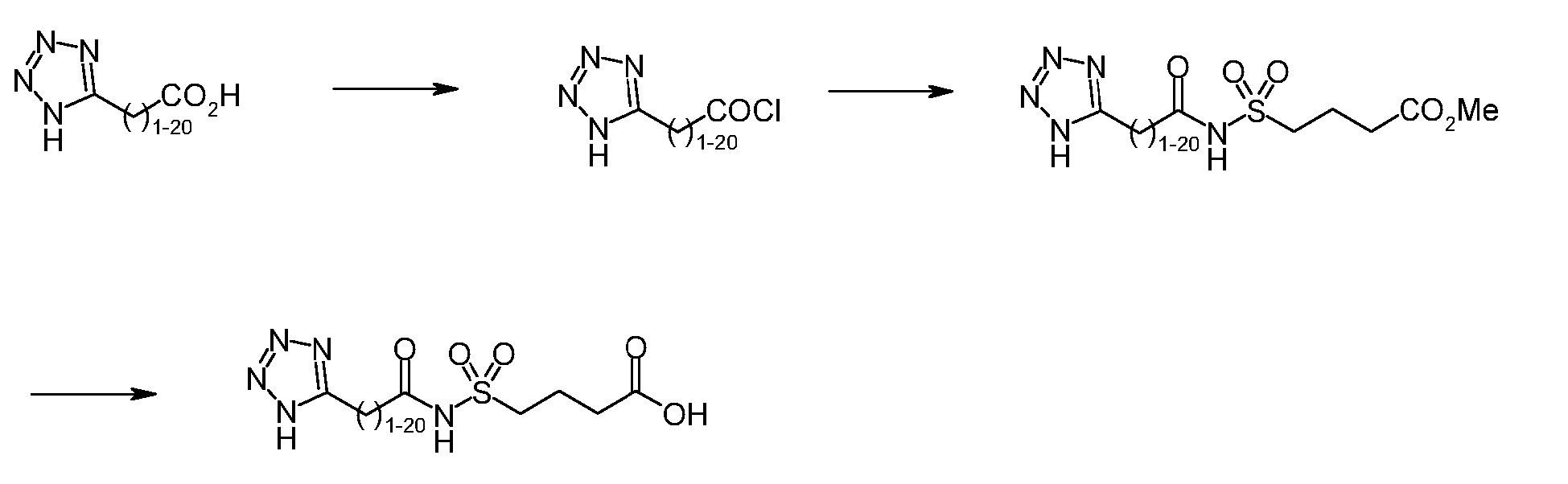
- An ω-(5-tetrazolyl)alkanoic or related acid is converted into an acyl halide, and then treated with 4-(sulfamoyl)butyric acid methyl ester and DMAP in a suitable solvent, such as DCM or DCE. The resulting 4-(N-(ω-(5-tetrazolyl)alkanoyl)sulfamoyl)butyric acid methyl ester is saponified to the corresponding acid by treatment with an excess of KOH or NaOH in a mixture of water and methanol.
- General procedure (F): Solid phase synthesis, purification and characterization of peptides and derivatized peptides:
- The peptides were synthesized on Fmoc protected Rink amide resin (Novabiochem), Fmoc protected Wang resin or chlorotrityl resin using Fmoc strategy on an Applied Biosystems 433A peptide synthesizer in 0.25 mmol scale using the manufacturer supplied FastMoc UV protocols which employ HBTU mediated couplings in NMP and UV monitoring of the deprotection of the Fmoc protection group. The protected amino acid derivatives used were standard Fmoc-amino acids (Anaspec) supplied in preweighed cartridges suitable for the ABI 433A synthesizer with the exception of unnatural aminoacids such as Fmoc-Aib-OH (Fmoc-aminoisobutyric acid).
- The attachment of sidechains and linkers to specific lysine residues on the crude resin bound protected peptide was carried out in a specific position by incorporation of Fmoc-Lys(Dde)-OH during automated synthesis followed by selective deprotection with hydrazine.
- Procedure for removal of Dde-protection. The resin (0.25 mmol) was placed in a manual shaker/filtration apparatus and treated with 2% hydrazine in NMP (20 ml, 2 x 12 min) to remove the DDE group and wash with NMP (4x20 ml).
- Procedure for attachment of sidechains to Lysine residues.
- The amino acid (4 molar equivalents relative to resin) was dissolved in NMP (10 ml). HOBt (4 molar equivalents relative to resin) and diisopropylcarbodiimide (4 molar equivalents relative to resin) were added and the solution was stirred for 15 min. The solution was added to the resin and DIPEA (4 molar equivalents relative to resin) was added. The resin was shaken 24 hours at room temperature. The resin was washed with NMP (2 x 20 ml), NMR/DCM (1:1; 2 x 20ml) and DCM (2 x 20 ml).
- Procedure for removal of Fmoc-protection: The resin (0.25 mmol) was placed in a filter flask in a manual shaking apparatus and treated with NMP/DCM (1:1) (2 x 20 ml) and with NMP (20 ml), a solution of 20% piperidine in NMP (3 x 20 ml, 10 min each). The resin was washed with NMP (2 x 20 ml), NMP/DCM (1:1) (2 x 20ml) and DCM (2 x 20 ml).
- The peptide was cleaved from the resin by stirring for 180 min at room temperature with a mixture of TFA, water and triisopropylsilane (95:2.5:2.5). The cleavage mixture was filtered and the filtrate was concentrated to an oil by a stream of nitrogen. The crude peptide was precipitated from this oil with 45 ml diethyl ether and washed 3 times with 45 ml diethyl ether.
- After drying the crude peptide was dissolved in 5 ml 50% acetic acid H2O and diluted to 20 ml with H2O and injected on the column which then was eluted with a gradient of 40-60 % CH3CN in 0.1 % TFA 10 ml/min during 50 min at 40 °C. The peptide containing fractions were collected. The purified peptide was lyophilized after dilution of the eluate with water. The final product obtained was characterised by analytical RP-HPLC (retention time) and by
- The RP-HPLC analysis was performed using UV detection at 214 nm and a Vydac 218TP54 4.6 mm x 250 mm 5µ C-18 silica column (The Separations Group, Hesperia, USA) which was eluted at 1 ml/min at 42 °C. Two different elution conditions were used:
- A1: Equilibration of the column with in a buffer consisting of 0.1M (NH4)2SO4, which was adjusted to pH 2.5 with concentrated H2SO4 and elution by a gradient of 0% to 60% CH3CN in the same buffer during 50 min.
- B1: Equilibration of the column with 0.1 % TFA / H2O and elution by a gradient of 0% CH3CN / 0.1 % TFA / H2O to 60% CH3CN / 0.1 % TFA / H2O during 50 min.
- B6: Equilibration of the column with 0.1 % TFA / H2O and elution by a gradient of 0% CH3CN / 0.1 % TFA / H2O to 90% CH3CN / 0.1 % TFA / H2O during 50 min.
- LCMS was performed on a setup consisting of Hewlett Packard series 1100 G1312A Bin Pump, Hewlett Packard series 1100 Column compartment, Hewlett Packard series 1100 G1315A DAD diode array detector, Hewlett Packard series 1100 MSD and Sedere 75 Evaporative Light Scattering detectorcontrolled by HP Chemstation software. The HPLC pump is connected to two eluent reservoirs containing:
- A: 10mM NH4OH in water
- B: 10mM NH4OH in 90% acetonitrile
- The analysis was performed at 23 °C by injecting an appropriate volume of the sample (preferably 20 µl) onto the column which is eluted with a gradient of A and B.
- The HPLC conditions, detector settings and mass spectrometer settings used are giving in the following table.
Column: Waters Xterra MS C-18 X 3 mm id 5 µm Gradient: 5% - 100% acetonitrile linear during 6.5 min at 1.5ml/min Detection: 210 nm (analogue output from DAD) ELS: analogue output from ELS MS ionisation mode API-ES. Scan 100-1000 amu step 0.1 amu - A resin (Fmoc-Gly-Wang resin, 0.6 mmol/g Novabiochem 0.25 mmole) was used to produce the primary sequence on an ABI 433A machine according to manufacturers guidelines. The resin (0.25 mmole) was placed in a manual shaker/filtration apparatus and treated with 2% hydrazine in NMP in (2x12 min. 2x20 ml) to remove the Dde group. The resin was washed with NMP (4x20 ml). Fmoc-8-amino-3,6-dioxaoctanoic acid (Neosystem FA03202) (4 molar equivalents relative to resin) was dissolved in NMP/DCM (1:1, 20 ml). HOBt (4 molar equivalents relative to resin) and DIC (4 molar equivalents relative to resin) was added and the solution was stirred for 15 min. The solution was added to the resin and DIPEA (4 molar equivalents relative to resin) was added. The resin was shaken 24 hours at room temperature. The resin was washed with NMP (4x20 ml). A solution of 20% piperidine in NMP (3x20 ml, 10 min each) was added to the resin while shaking. The resin was washed with NMP (4x20 ml). 16-(Tetrazol-5-yl)hexadecanoyl-ONSu ester (4 molar equivalents relative to resin) was dissolved in NMP (20 ml). The solution was added to the resin and DIPEA (4 molar equivalents relative to resin) was added. The resin was shaken 24 hours at room temperature. The resin was washed with NMP (2x20 ml), NMP/DCM (1:1) (2x20ml) and DCM (2x20 ml). The peptide was cleaved from the resin by stirring for 180 min at room temperature with a mixture of TFA, water and triisopropylsilane (95:2.5:2.5; 15 ml). The cleavage mixture was filtered and the filtrate was concentrated to an oil in vaccuum. The crude peptide was precipitated from this oil with 45 ml diethyl ether and washed 3 times with 45 ml diethyl ether. The crude peptide was purified by preparative HPLC on a 20 mm x 250 mm column packed with 7µ C-18 silica. The crude peptide was dissolved in 5 ml 50% acetic acid in water and diluted to 20 ml with H2O and injected on the column which then was eluted with a gradient of 40-60 % (CH3CN in water with 0.1 % TFA) 10 ml/min during 50 min at 40 °C. The peptide containing fractions were collected. The purified peptide was lyophilized after dilution of the eluate with water.
- The binding assay was performed with purified plasma membranes containing the human GLP-1 receptor. The plasma membranes containing the receptors were purified from stably expressing BHK tk-ts 13 cells. The membranes were diluted in Assay Buffer (50 mM HEPES, 5 mM EGTA, 5 mM MgCl2, 0.005% Tween 20, pH=7.4) to a final concentration of 0.2 mg/ml of protein and destributed to 96-well microtiter plates precoated with 0.3 % PEI. Membranes in the presence of 0.05 nM [121I]GLP-1, unlabelled ligands in increasing concentrations and different HSA concentrations (0.005%, 0.05%, and 2%) were incubated 2 hr at 30°C. After incubation, unbound ligands were separated from bound ligands by filtration through a vacuum-manifold followed by 2X100 µl washing with ice cold assaybuffer. The filters were dried overnight at RT, punched out and quantified in a γ-counter.
-

- A mixture of 16-bromohexadecanoic acid (16.61 g, 49.5 mmol), DMSO (150 ml), NaCN (12.5 g, 255 mmol), and Nal (1.92 g, 12.8 mmol) was stirred at 120 °C for 20 h. The mixture was allowed to cool to room temperature, and was then poured into a stirred mixture of water (1.7 1) and concentrated HCl (30 ml). Rinsing with water (100 ml). The resulting suspension was stirred at room temperature overnight. The product was filtered and washed with water (2 x 100 ml), and the solid was recrystallized twice from MeCN (90 ml and 50 ml). 10.1 g (72%) of 16-cyanohexadecanoic acid was obtained.
- 1H NMR (DMSO) δ 1.20-1.39 (m, 22H), 1.50 (m, 4H), 2.18 (t, J = 7 Hz, 2H), 2.48 (t, J = 7 Hz, 2H), 11.95 (s, 1H).
- This product was mixed with DMF (150 ml), AcOH (10.0 ml, 174.8 mmol), NEt3 (25 ml, 180 mmol), and NaN3 (11.83 g, 182 mmol), and the mixture was stirred at 120 °C for 80 h, while following the conversion by 1H NMR. The mixture was concentrated under reduced pressure, and to the residue water (250 ml) and concentrated HCl (25 ml) were added. The acidic mixture was stirred at room temperature for 2 d, filtered, and the solid recrystallized from MeCN (approx 300 ml). 7.60 g (65%) of the title compound was obtained.
- 1H NMR (DMSO) δ 1.24 (m, 22H), 1.48 (m, 2H), 1.68 (m, 2H), 2.18 (t, J = 7 Hz, 2H), 2.84 (t, J = 7 Hz, 2H), 11.95 (s, 1H).
-

- To a suspension of 16-(5-tetrazolyl)hexadecanoic acid (3.25 g, 10.0 mmol) in DCM (40 ml) was added oxalyl chloride (1.2 ml, 14.0 mmol). The mixture was stirred at room temperature for 42 h, concentrated, coevaporated once with PhMe, and to the residue were added a solution of methyl 4-sulfamoyl butyrate (1.66 g, 9.16 mmol) in DCM (35 ml) and then DMAP (3.67 g, 30.0 mmol). The heterogenous mixture was stirred at room temperature for 6.5 h and then concentrated. To the residue was added a mixture of water (50 ml) and 1 N HCl (50 ml), and the resulting mixture was stirred at room temperature for 5 d. The product was filtered, washed with water (100 ml), and recyrstallized from MeCN (25 ml), to yield 1.84 g
- (41%) of the N-acylsulfonamide methyl ester. To this ester (1.06 g, 2.17 mmol) in MeOH (15 ml) was added a solution of NaOH (0.38 g, 9.5 mmol, 4.4 eq) in water (1.5 ml). After stirring at room temperature for 1.5 h the mixture was poured into a mixture of water (80 ml) and 1 N HCl (20 ml). The mixture was stirred for 3 h, filtered, and the product was dried under reduced pressure. 1.09 g (100%) of the title compound was obtained.
- 1H NMR (DMSO) δ 1.24 (m, 20H), 1.49 (m, 4H), 1.69 (m, 2H), 1.85 (m, 2H), 2.27 (t, J = 7 Hz, 2H), 2.39 (t, J = 7 Hz, 2H), 2.86 (t, J = 7 Hz, 2H), 3.38 (m, 2H), 11.59 (s, 1H).
-

- A mixture of 16-bromohexadecanoic acid (15.5 g, 46.2 mmol), MeOH (100 ml), PhMe (30 ml), trimethylorthoformate (30 ml), and polystyrene-bound benzenesulfonic acid (3.6 g) was stirred at 55 °C. After 69 h the mixture was filtered through celite and the filtrate was concentrated to yield 16.85 g of an oil (100% yield).
- A mixture of 16-bromohexadecanoic acid methyl ester (4.86 g, 13.9 mmol), MeCN (20 ml), 4-cyano-4'-hydroxybiphenyl (3.16 g, 16.2 mmol), and K2CO3 (2.45 g, 17.7 mmol) was stirred at 82 °C. After 17 h satd aquous NaHCO3 (150 ml) was added, and the product was filtered, washed with water, and recrystallized from boiling MeCN (approx 80 ml). Filtration and drying under reduced pressure yielded 5.40 g (84%) of (4'-cyanobiphenyl-4-yloxy)hexadecanoic acid methyl ester colorless needles.
- A mixture of (4'-cyanobiphenyl-4-yloxy)hexadecanoic acid methyl ester (2.75 g, 5.93 mmol), DMF (7.0 ml), NEt3 (4.0 ml, 28.9 mmol), AcOH (1.75 ml, 29.1 mmol), and NaN3 (2.50 g, 38.5 mmol) was stirred at 140 °C. After 17 h water (50 ml) and 1 N HCl (50 ml) were added, followed by acidification with conc. HCl (approx 2 ml). The product was filtered and recrystallized from MeCN/PhMe (approx 60 + 60 ml). Filtration and drying under reduced pressure yielded 2.87 g (96%) of 16-(4'-(5-tetrazolyl)biphenyl-4-yloxy)hexadecanoic acid methyl ester.
- A mixture of 16-(4'-(5-tetrazolyl)biphenyl-4-yloxy)hexadecanoic acid methyl ester (2.87 g, 5.66 mmol), MeOH (30 ml), and a solution of NaOH (1.51 g, 37.8 mmol) in water (2.0 ml) was stirred at 70 °C. After 4 d water (100 ml) and 1N HCl (50 ml) were added, and the product was filtered, washed with water, coevaporated with MeCN/PhMe, and dried under reduced pressure. 2.68 g (96%) of 16-(4'-(5-tetrazolyl)biphenyl-4-yloxy)hexadecanoic acid was obtained.
- 1H NMR (DMSO) δ 1.20-1.50 (m, 24H), 1.72 (m, 2H), 2.18 (t, J = 7 Hz, 2H), 4.02 (t, J = 6 Hz, 2H), 7.04 (d, J = 8 Hz, 2H), 7.71 (d, J = 8 Hz, 2H), 7.87 (d, J = 8 Hz, 2H), 8.09 (d, J = 8 Hz, 2H), 11.95 (br s, 1H).
-

- A mixture of 4-(4-bromophenyl)phenol (3.74 g, 15.0 mmol), MeCN (20 ml), ethyl 4-bromobutyrate (4.42 g, 22.7 mmol), and K2CO3 (3.12 g, 22.6 mmol) was stirred at 80 °C. After 16 h water (100 ml) and 1 N HCl (40 ml) were added, and the product was extracted (3 x AcOEt), the combined extracts were washed with brine (2 x), dried (MgSO4) and concentrated. The residue was recrystallized from EtOH (40 ml) to yield 4.35 g (80%) of 4-(4'-bromobiphenyl-4-yloxy)butyric acid ethyl ester as colorless plates.
- To 4-(4'-bromobiphenyl-4-yloxy)butyric acid ethyl ester (2.03 g, 5.59 mmol) in toluene (30 ml) and EtOH (20 ml) were added triphenylphosphine (0.17 g, 0.65 mmol), 4-cyanophenylboronic acid (1.23 g, 8.37 mmol), Pd(OAc)2 (65 mg, 0.29 mmol), and a solution of Na2CO3 (2.33 g, 22.0 mmol) in water (10 ml). The mixture is stirred at 70 °C (oil-bath temperature). After 66 h water (100 ml) and 1N HCl (50 ml) were added and the product was extracted (3 x DCM). The combined extracts were washed with water, then with satd. aqueous NaHCO3, dried and concentrated to yield 2.33 g of a gray solid, which is washed with hot EtOH and dried under reduced pressure to yield 0.81 g (38%) of 4-(4-cyano-[1,1',4',1"]-terphenyl-4"-yloxy)butyric acid ethyl ester. From the ethanol washings more product (0.48 g, 22%) precipitated.
- A mixture of 4-(4-cyano-[1,1',4',1"]-terphenyl-4"-yloxy)butyric acid ethyl ester (1.29 g, 3.35 mmol), DMF (4.0 ml), NEt3 (2.3 ml, 16.6 mmol), AcOH (1.0 ml, 16.7 mmol), and NaN3 (1.32 g, 20.3 mmol) was stirred at 140 °C. After 20 h water (50 ml) and 1N HCl (50 ml) were added and the product is isolated by filtration, washed with hot MeCN and dried under reduced pressure to yield 1.16 g (81 %) of 4-(4-(5-tetrazolyl)-[1,1',4',1 "]-terphenyl-4"-yloxy)butyric acid ethyl ester as a gray solid.
- A heterogenous mixture of 4-(4-(5-tetrazolyl)-[1,1',4',1"]-terphenyl-4"-yloxy)butyric acid ethyl ester (1.16 g, 2.71 mmol), EtOH (10 ml), NaOH (0.75 g, 18.8 mmol), and water (1.5 ml) was stirred at 80 °C. After 18 h water (50 ml) and 1N HCl (50 ml) were added. After stirring for 0.5 h the product was filtered, washed with water, and the solid was coevaporated with MeCN and PhMe to yield 0.79 g (73%) of 4-(4-(5-tetrazolyl)-[1,1',4',1"]-terphenyl-4"-yloxy)butyric acid as a light-brown powder.
- 1H NMR (DMSO) δ 1.98 (quint, J = 7 Hz, 2H), 2.41 (t, J = 7 Hz, 2H), 4.03 (t, J = 7 Hz, 2H), 7.04 (d, J = 8 Hz, 2H), 7.69 (d, J = 8 Hz, 2H), 7.77 (d, J = 8 Hz, 2H), 7.85 (d, J = 8 Hz, 2H), 7.98 (d, J = 8 Hz, 2H), 8.14 (d, J = 8 Hz, 2H), 12.19 (br s, 1H).
-

- This compound was prepared by acylation with 16-[5-tetrazolyl]hexadecanoic acid (Example 1) of unprotected Arg34GLP-1-(7-37) peptide in solution. The succinimidyl ester of 16-[5-tetrazolyl]hexadecanoic acid was prepared by mixing the acid (29 mg) with THF (0.9 ml), DIPEA (17 microliter), and TSTU (30 mg), and stirring the resulting mixture at room temperature for 1 h. Arg34GLP-1-(7-37) (0.33 g, 30% pure) was dissolved in water (5 ml) and DIPEA (50 microliter), and the solution of the succinimidyl ester (0.3 ml) was added. After stirring at room temperature for 20 min the excess succinimidyl ester was quenched by addition of an excess glycine, and the product was purified by preparative HPLC. 38 mg of the title compound were obtained.
HPLC: (method B6): RT= 9.36 min (100%)
LCMS: m/z = 1231 (MH3 3+). Calculated for (MH3 3+): 1231 -

- Gly8,Arg26,34GLP-1-(7-37) was prepared on a 433A peptide synthesizer using standard Fmoc-methodology and using Fmoc-Lys(Boc)-trityl polystyrene (0.88 g, loading: 0.79 mmol/g) as starting resin. After purification by preparative HPLC 25 mg of Gly8,Arg26,34GLP-1(7-37) peptide was obtained.
- The title compound was prepared by acylation of Gly8,Arg26,34GLP-1(7-37) peptide (25 mg) with 16-(5-tetrazolyl)hexadecanoic acid (23 mg) as described for Example 5. 14.6 mg of the title compound were obtained.
HPLC: (method B6): RT= 9.02 min (99%)
LCMS: m/z = 1279 (MH3 3+). Calculated for (MH3 3+): 1279 -

- The title compound was prepared as Example 6 from {4-[N-(16-{5-tetrazolyl}hexadecanoyl)sulfamoyl]butyric acid (21 mg; Example 2) and Gly8,Arg26,14 GLP-1 (7-37) (25 mg). 1.5 mg of the title compound was obtained.
HPLC: (method B6): RT= 9.05 min (95%)
LCMS: m/z = 1328 (MH3 3+). Calculated for (MH3 3+): 1328 -

- This compound was prepared as Example 5 from {4-[N-(16-{5-tetrazolyl}hexadecanoyl)sulfamoyl]butyric acid (21 mg; Example 2) and Arg34GLP-1(7-37) peptide (0.3 g, 30% pure). 10.1 mg of the title compound was obtained.
HPLC: (method B6): RT= 9.35 min (94%)
LCMS: m/z = 1281 (MH3 3+). Calculated for (MH3 3+): 1281 -

- Prepared as described in the 'Typical Procedure'.
HPLC: (method B6): RT = 31.8 min (98%), (method A1): RT = 41.5 min
LCMS: m/z = 988.7 (MH4)4+, 1317.8 (MH3)3+. Calculated (MH)+: 3949.6 - Human growth hormone (100 mg, hGH) was dissolved in H2O (6 ml), DIEA (7.5 µl), and NMP (6 ml) and cooled to 0 °C. 16-(Tetrazol-5-yl)hexadecanoyl-ONSu (3.5 mg, 2 eq), dissolved in NMP (100 µl), was added. The reaction mixture was stirred for 1 h and purified by ion exchange chromatography.
- Purification of monoacylated hGH in position 140 or 145.
- The crude reaction mixture was diluted five times in 50 mM Tris pH 8.5 and applied to a Mono Q column. For purification of 6 ml crude reaction mixture a 10 ml 10/10 Mono Q column from Amersham Pharmcia was used. A 1000 CV gradient was used to separate the native, monoacylated in position 30/45/70, monoacylated in position 140/145, diacylated and triacylated hGH. Shortly after elution of the triacylated hGH, a steep gradient was used to elute dimeric hGH. As eluting buffer 50 mM Tris, 2 M NaCl, pH 8.5 was used. The purification was performed at 4 °C.
- After elution, fractions containing monoacylated hGH (peak 2) was pooled and subsequently ultrafiltrated using a Amicon with a YM10 filter. The washing buffer was 50 mM Ammoniumcarbonate pH 8.0. After ultrafiltration, the acylated protein was lyophillised.
- Chromatograms depicting A280 nm and A254 nm both exhibited five distinct peaks which were characterised by peptide mapping :
- Peak 1 contains native hGH
- Peak 2 contains monoacylated hGH in position 38 or 45 or 70.
- Peak 3 contains monoacylated hGH in position 140 or 145
- Peak 4 contains diacylated hGH
- Peak 5 contains triacylated hGH
-
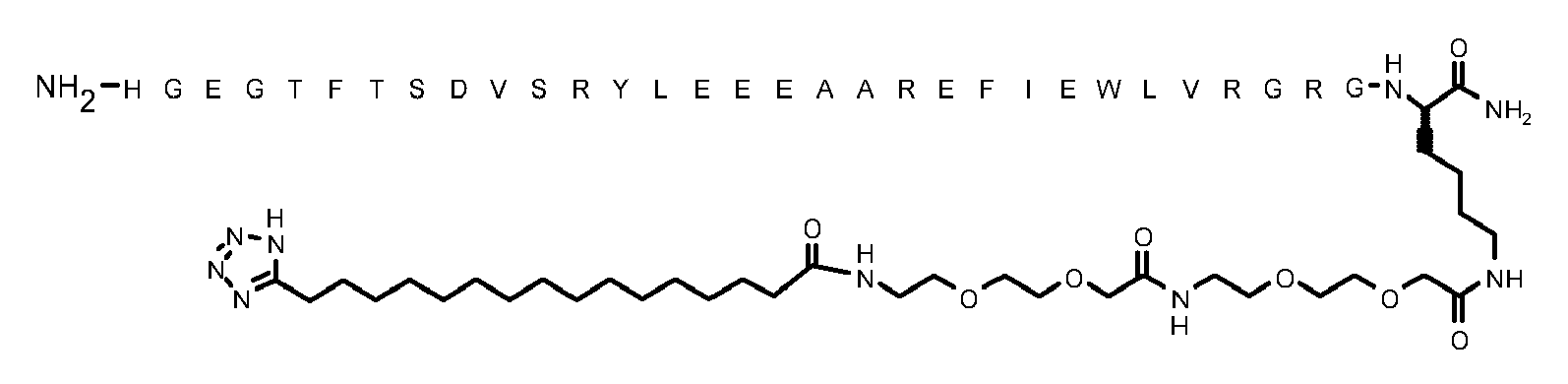
- Prepared as described in the 'Typical Procedure'.
HPLC: (method B6): RT = 30.283 min (96%)
LCMS: m/z = 1441.8 (MH3)3+. Calculated (MH3)3+: 1439.6 -

- Prepared as described in the 'Typical Procedure'.
HPLC: (method B4): RT= 10.89 min (100%)
LCMS: m/z = 1304 (MH3)3+. Calculated (MH3)3+: 1304 -

- [Gly8,Arg26,34,Lys38] GLP-1-(7-37) peptide was prepared on an Advanced Chemtech APEX 348 peptide synthesizer using standard Fmoc methodology and using 2-chlorotrityl chloride resin (0.400 g, loading: 1.4 mmol/g) as starting resin. Lys38 was protected as Fmoc-Lys(ivDde)-OH.
- IvDde was removed with 3% hydrazine and 3% piperidine in NMP for 60 min. The title compound was prepared by acylation with N-Fmoc (2-(2-aminoethoxy)ethoxy)acetic acid (0.56 mmol), followed by Fmoc-group removal and acylation with 0.62 mmol of 16-(4-(5-tetrazolyl)phenoxy)hexadecanoic acid. After cleavage from the support the peptide was purified by preparative HPLC (gradient elution 0-5 min = 30% MeCN, 5-40 min = 30-65% MeCN; Xterra prep. Ms C18).
RT=26.1 min
Maldi: m/z = 4071; Calculated: 4069.6 -

- [Aib 8,22,35,Lys37] GLP-1 (7-37) peptide was prepared on an Advanced ChemTech APEX 348 peptide synthesizer using standard Fmoc methodology and using 2-chlorotrityl chloride resin (0.400 g, loading: 1.4 mmol/g) as starting resin. Lys37 was protected as Fmoc-Lys(ivDde)-OH.
- IvDde was removed with 3% hydrazine and 3% piperidin in NMP for 60 min. After this deprotection, the resin-bound peptide was acylated with N-Fmoc (2-(2-aminoethoxy)ethoxy)acetic acid (0.59 mmol), followed by Fmoc-group removal and acylation with 0.62 mmol of 16-(4-(5-tetrazolyl)phenoxy)hexadecanoic acid. The peptide was cleaved from the support (90% TFA, 5% Tis, 2% thioanisol, 3% water, 2 h), precipitated with Et2O, lyophilized, and purified by preparative HPLC (gradient elution 0-5 min = 30% MeCN, 5-40 min = 30-65% MeCN; Xterra prep. Ms C18).
RT = 26.85 min
Maldi: m/z = 4042. Calculated: 4040.7 -
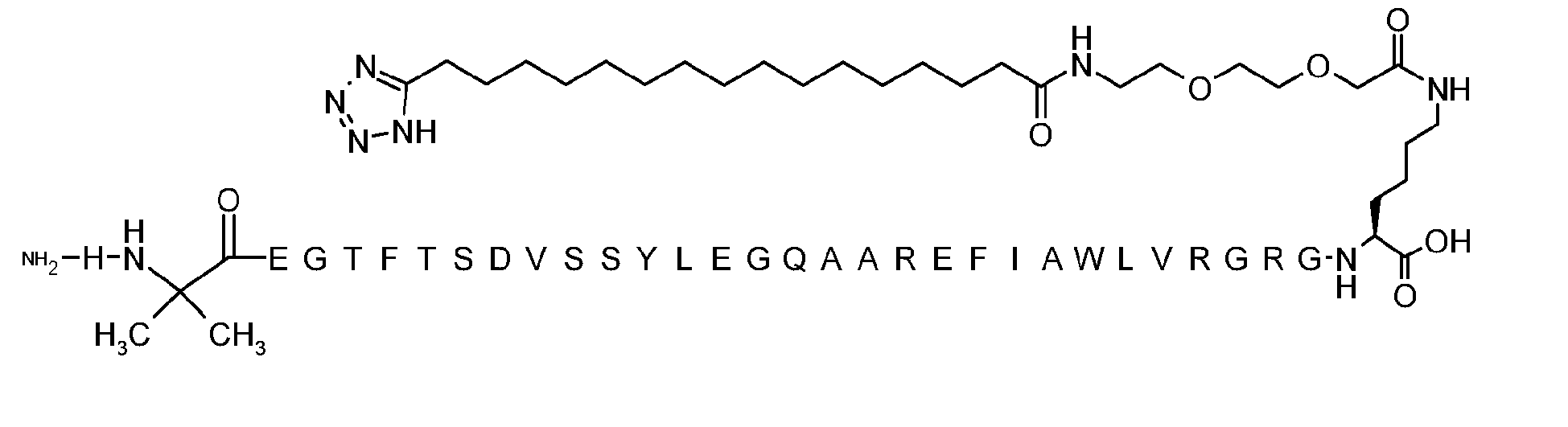
- [Aib8,Arg26,34, Lys38]GLP-1 (7-37) peptide was prepared on the Advanced ChemTech APEX 348 peptide synthesizer using standard Fmoc methodology and 2-chlorotrityl chloride resin (0.150 g, loading: 1.4 mmol/g) as starting resin. Lys38 was protected as Fmoc-Lys(ivDde)-OH.
- IvDde was removed with 3% hydrazine and 3% piperidin in NMP for 60 min. After this deprotection, the resin-bound peptide was acylated with N-Fmoc (2-(2-aminoethoxy)ethoxy)acetic acid (0.35 mmol), followed by Fmoc-group removal and acylation with 0.32 mmol of 16-(5-tetrazolyl)hexadecanoic acid. The peptide was cleaved from the support (90% TFA, 5% Tis, 2% thioanisol, 3% water, 2 h), precipitated with Et2O, lyophilized, and purified by preparative RP-HPLC (gradient elution 0-5 min: 80% A, 20% B; 5-45 min to 40% A, 60% B; A: water + 0.1 % TFA; B: MeCN + 0.07% TFA).
LCMS: 4005. Calculated: 4005.6 -

- The title compound was prepared as example 6. 8 mg of the title compound was obtained.
RT: 32 min.
Maldi: m/z = 4007. Calculated: 4009 -

- [Lys32]Exendin[1-39] peptide was prepared on the Advanced ChemTech APEX 348 peptide synthesizer using standard Fmoc methodology and 2-chlorotrityl chloride resin (0.150 g, loading: 1.4 mmol/g) as starting resin. Lys38 was protected as Fmoc-Lys(ivDde)-OH.
- IvDde protection was removed with 3% hydrazine and 3% piperidin in NMP for 60 min. After this deprotection, the resin-bound peptide was acylated with N-Fmoc (2-(2-aminoethoxy)ethoxy)acetic acid (0.35 mmol), followed by Fmoc-group removal and acylation with 0.32 mmol of 4-(16-(5-tetrazolyl)hexadecanoyl)sulfamoylbutyric acid. The peptide was cleaved from the support (90% TFA, 5% Tis, 2% thioanisol, 3% water, 2 h), precipitated with Et2O, lyophilized, and purified by preparative RP-HPLC (gradient elution 0-5 min: 80% A, 20% B; 5-45 min to 40% A, 60% B; A: water + 0.1 % TFA; B: MeCN + 0.07% TFA).
-

- [3-(4-Imidazolyl)Propionyl7,Aib22,35,Arg26,34,Lys37]GLP- (7-37) peptide was prepared on a 433A peptide synthesizer using standard Fmoc-methodology and using Fmoc-Lys(Boc)-trityl polystyrene (0.51 g, loading: 0.50 mmol/g) as starting resin. After purification by preparative HPLC 159 mg of [3-(4-imidazolyl)propionyl7,Aib22,35,Arg26,34,Lys37]GLP-1 (7-37) peptide was obtained.
- The title compound was prepared by acylation of [3-(4-imidazolyl)propionyl7,Aib22,35,Arg26,34,Lys37]GLP-1 (7-37) peptide (18 mg) with 16-(4'-(tetrazol-5-yl)biphenyl)-4-yloxy)hexadecanoic acid (10 mg) as described for Example 5. 4.74 mg of the title compound was obtained.
HPLC: (method B6): RT = 38.4 min (97%)
LCMS: m/z = 1333.7 (MH3 3+). Calculated for (MH3 3+): 1334.2 -

- [3-(4-Imidazolyl)propionyl7,Aib22,35,Arg26,34,Lys37]GLP-1 (7-37) peptide was prepared as described in Example 17.
- The title compound was prepared by acylation of [3-(4-imidazolyl)propionyl7,Aib22,35,Arg26,34,Lys37]GLP-1 (7-37) peptide (18 mg) with 16-(tetrazol-5-yl)hexadecanoic acid (8.5 mg) as described for Example 5. 7.32 mg of the title compound was obtained.
HPLC: (method B6): RT= 33.0 min (100%)
LCMS: m/z = 1277.9 (MH3 3+). Calculated for (MH3 3+): 1277.8 -

- [3-(4-Imidazolyl)propionyl7,Aib22,35,Arg26,34,Lys37]GLP-1 (7-37) peptide was prepared as described in example 17.
- The title compound was prepared by acylation of [3-(4-imidazolyl)propionyl7,Aib22,35,Arg26,34,Lys37]GLP-1 (7-37) peptide (18 mg) with 16-(4-(tetrazol-5-yl)phenoxy)hexadecanoic acid (8.0 mg) as described for Example 5. 2.59 mg of the title compound was obtained.
HPLC: (method B6): RT = 35.9 min (100%)
LCMS: m/z = 1309.2 (MH3 3+). Calculated for (MH3 3+): 1308.5 -

- [3-(4-Imidazolyl)propionyl7,Aib22,35,Arg26,34,Lys37]GLP-1 (7-37) peptide was prepared as described in Example 17.
- The title compound was prepared by acylation of [3-(4-imidazolyl)propionyl7,Aib22,35,Arg26,34,Lys37] GLP-1 (7-37) peptide (18 mg) with (4-(4-(tetrazol-5-yl)[1,1',4',1"]terphenyl-4"yloxy)butyric acid (8.0 mg) as described for Example 5. 0.83 mg of the title compound was obtained.
HPLC: (method B6): RT = 31.9 min (100%)
LCMS: m/z = 1303.3 (MH3 3+). Calculated for (MH3 3+): 1303.1 -

- The attachment of the linker and sidechain to the specific lysine residue was done on a DDE-Lys(FMOC)-2-Cl-Trityl resin by Procedure for removal of the Fmoc-protection, followed by the Procedure for attachment of sidechains to Lysine residues and then the Procedure for removal of Dde-protection. This was followed by synthesis of the peptide to the N-terminus followed by cleavage of the peptide from the resin and purification.
HPLC: (method B6): RT = 32.0 min (100%)
LCMS: m/z = 1336.2 (MH3 3+). Calculated for (MH3 3+): 1335.9 -

- This compound was prepared as described in example 21.
HPLC: (method B6): RT = 32.8 min (99%)
LCMS: m/z = 1326.3 (MH3 3+). Calculated for (MH3 3+): 1326.2 -

- This compound was prepared as described in example 21.
HPLC: (method B6): RT = 33.0 min (100%)
LCMS: m/z = 1330.9 (MH3 3+). Calculated for (MH3 3+): 1330.9 -

- The attachment of sidechains and linkers to specific lysine residues on the crude resin bound protected peptide was carried out in a specific position by incorporation of Fmoc-Lys(Mtt)-OH during automated synthesis followed by selective deprotection with a batchwise treatment of the protected peptide resin with 1% TFA and 1% TIS in DCM until the yellow coloring had disappeared (after 1 h). This was followed by extensive wash with DMF, followed by attachment of the spacer and sidechain as described in example 21 and cleavage of the peptide from the resin and purification.
HPLC: (method B6): RT = 31.1 min (100%)
LCMS: m/z = 1634.3 (MH3 3+). Calculated for (MH3 3+): 1634.5 -

- 16-(2H-Tetrazol-5-yl)hexadecanoic acid (433 mg, 1.34 mmol) was heated in toluene (5 mL) and 2,2-dimethoxypropane (2 mL, 16 mmol) to reflux for to minutes. The solvent was removed in vacuo. Ethyl acetate (10 mL) was added, followed by N-(3-dimethylaminopropyl)-N'-ethylcarbodiimide hydrochloride (359 mg, 1.87 mmol) and 1 hydroxybenzotriazol (281 mg, 2 mmol). The reaction was stirred at room temperature for 30 min, and a mixture of L-glutamic acid alpha tert-butyl-gamma benzyl diester hydrochloride (661 mg, 2 mmol), diisopropylamin (0.34 mL, 2 mmol), and ethyl acetate (4 mL) was added. The mixture was stirred at room temperature overnight. The reaction was distributed between ethyl acetate (50 mL) and water (50 mL). The organic phase was dried (Na2SO4) and the solvent removed in vacuo. The crude 2-(16-2H-tetrazol-5-yl-hexadecanoylamino)pentanedioic acid 5-benzyl ester 1- tert-butyl ester was purified on C-18 RP-HPLC 5 cm × 20 cm, flow 20 ml/min using a acetonitrile/water 60-90% gradient containing 0.1% TFA. Fractions containing 2-(16-2H-tetrazol-5-yl-hexadecanoylamino)pentanedioic acid 5-benzyl ester 1- tert-butyl ester were collected and the solvent removed in vacuo. The residue was redissolved in ethyl acetate (10 mL), palladium on activated charcoal (200 mg) was added, and the mixture was stirred under a hydrogen atmosphere (1 atm) for 3 hours. The mixture was filtered and the solvent removed in vacou to yield 2-(16-2H-tetrazol-5-yl-hexadecanoylamino)pentanedioic acid 1-tert-butyl ester (100 mg).
HPLC-MS: m/z = 511; Rt= 4.17 min. -

- 2-(16-2H-Tetrazol-5-yl-hexadecanoylamino)-pentanedioic acid 1-tert-butyl ester (100 mg, 0.19 mmol) was dissolved in THF (10 mL). The mixture was cooled with an ice bath. Diisopropylethylamine (0.041 mL, 0.24 mmol) and O-(N-succinimidyl)-N,N,N',N'-tetramethyluronium tetrafluoroborate (71 mg, 0.24 mmol) was added. The mixture was stirred under nitrogen at 0 °C. After 30 minutes the ice cooling was removed and the mixture was stirred for an additional 3 hours. The solvent was removed in vacuo followed by coevaporation of the residue with toluene. The crude product was dissolved in ethyl acetate (30 mL), washed with water (2 × 20 mL), and the combined aqueous phases extracted once with ethyl acetate (30 mL). The combined organic phases were dried (Na2SO4), the solvent removed in vacuo to yield the title compound (83 mg), which was used in subsequent step without further purification.
HPLC-MS: m/z = 607; Rt = 4.73 min. -

- A1B1BocBoc des(B30) insulin (Kurtzhals P; Havelund S; Jonassen I; Kiehr B; Larsen UD; Ribel U; Markussen J Biochemical Journal, 1995, 312, 725-731) (0.2 g, 0.034 mmol) was dissolved in DMSO (3 mL). Triethylamine (0.047 mL, 0.34 mmol) and a solution of 2-(16-2H-tetrazol-5-yl-hexadecanoylamino)pentanedioic acid 1-tert-butyl ester 5-(2,5-dioxo-pyrrolidin-1-yl) ester (58 mg, 0.096 mmol) in DMSO (1mL) were added, and the mixture was shaken at room temperature for 1 hour. The mixture was cooled with an icebath (the DMSO froze), water (10 mL) was added and the frozen mixture was allowed to melt. The pH was adjusted to 5.2 with 1 N HCl. The product was allowed to precipitate for 1 hour at 5 °C. The precipitate was isolated by centrifugation and treated with TFA (10 mL) for 30 min. This solution was poured into ice-cooled diethylether (40 mL), and the crude product was isolated by centrifugation and purified on C-18 RP-HPLC 5 cm × 20 cm, flow 20 ml/min using an acetonitrile/water 25-45% gradient containing 0.1 % TFA. Fractions containing the product were combined and lyophilized. To the lyophilized material was added water (7.2 mL) and the pH adjusted to 8.98 with 1 N and 0.1 N NaOH. The pH was adjusted back to 5.2-5.5 with 0.1 N HCl. The precipitate was isolated by centrifugation and lyophilized to give the title compound.
HPLC-MS : m/z = 1536 (m/4), 1229 (m/5),1024 (m/6); Rt = 3.47 min. -

- 4-(4-(5-Tetrazolyl)-[1,1',4',1 1"]-terphenyl-4"-yloxy)butyric acid (166 mg, 0.42 mmol) was suspended in DMF (2 ml) and treated with TSTU (150 mg, 0.50 mmol) and DIEA (85 µL, 0.50 mmol). The mixture was stirred overnight. The solvent was removed in vacuo and the residue was partitioned between ethyl acetate and 0.1 M HCl. The organic phase/suspension was filtered and the solid was washed with ether and dried in vacuo to provide activated 4-(4-(5-tetrazolyl)-[1,1',4',1"]-terphenyl-4"-yloxy)butyric acid, 164 mg. Des(B30) human insulin (100 mg, 0.018 mmol) was dissolved in 100 mM Na2CO3 (1.3 ml, pH 10.2) at room temperature. Activated 4-(4-(5-tetrazolyl)-[1,1',4',1"]-terphenyl-4"-yloxy)butyric acid (10 mg, 0.022 mmol) was dissolved in DMSO (1.3 ml) and added to the insulin solution. After 30 min, 0.2 M methylamine (0.1 ml) was added. pH was adjusted to 5.5 with 1 M HCl, and the isoelectric precipitate was collected by centrifugation and dried in vacuo. The coupling yield was 75% (RP-HPLC, C4 column; buffer A: 10% MeCN in 0.1 % TFA-water, buffer B: 80% MeCN in 0.1% TFA-water; gradient 20% to 90% B in 16 minutes).
- NB29ε-4-[4"-(1H-Tetrazol-5-yl)[1,1';4',1"]terphenyl-4-yloxy]butyroyl des(B30) insulin was purified by RP-HPLC on C4-column, buffer A: 20% EtOH + 0.1 % TFA, buffer B: 80% EtOH + 0.1 % TFA; gradient 15-60% B, followed by HPLC on C4-column, buffer A: 10 mM Tris + 15 mM ammonium sulphate in 20% EtOH, pH 7.3, buffer B: 80% EtOH, gradient 15-60% B. The collected fractions were desalted on Sep-Pak with 70% acetonitrile + 0.1 % TFA, neutralized by addition of ammonia and freeze-dried. The unoptimized yield was 8 mg (7%). The purity as evaluated by HPLC was 98%. LCMS 6088, C276H394N68O77S6 requires 6089.
-

- 16-(4'-(5-Tetrazolyl)biphenyl-4-yloxy)hexadecanoic acid (309 mg, 0.63 mmol) was suspended in DMF (4 ml) and treated with TSTU (227 mg, 0.75 mmol) and DIEA (127 µL, 0.75 mmol). The mixture was stirred overnight. The solvent was removed in vacuo and the residue was partitioned between ethyl acetate and 0.1 M HCl. The organic phase/suspension was filtered and the solid was washed with ether and dried in vacuo to provide activated 16-(4'-(5-tetrazolyl)biphenyl-4-yloxy)hexadecanoic acid, 290 mg. Des(B30) human insulin (100 mg, 0.018 mmol) was dissolved in 100 mM Na2CO3 (1.3 ml, pH 10.2) at room temperature. Activated 16-(4'-(5-tetrazolyl)biphenyl-4-yloxy)hexadecanoic acid (12 mg, 0.022 mmol) was dissolved in DMSO (1.3 ml) and added to the insulin solution. After 30 min, 0.2 M methylamine (0.1 ml) was added. pH was adjusted to 5.5 with 1 M HCl, and the isoelectric precipitate was collected by centrifugation and dried in vacuo. The coupling yield was 37% (RP-HPLC, C4 column; buffer A: 10% MeCN in 0.1 % TFA-water, buffer B: 80% MeCN in 0.1 % TFA-water; gradient 20% to 90% B in 16 minutes).
- NB29ε-16-[4'-(1H-Tetrazol-5-yl)biphenyl-4-yloxy]hexadecanoyl des(B30) insulin was purified by RP-HPLC on C4-column, buffer A: 20% EtOH + 0.1 % TFA, buffer B: 80% EtOH + 0.1 % TFA; gradient 15-60% B, followed by HPLC on C4-column, buffer A: 10 mM Tris + 15 mM ammonium sulphate in 20% EtOH, pH 7.3, buffer B: 80% EtOH, gradient 15-60% B. The collected fractions were desalted on Sep-Pak with 70% acetonitrile + 0.1 % TFA, neutralized by addition of ammonia and freeze-dried. The unoptimized yield was 5 mg (7%). The purity as evaluated by HPLC was 98%. LCMS 6180, C282H414N68O77S6 requires 6181.
-
- A: acetonitril
- B: water
- D: 1.0% TFA in water
- Gradient: 5 -->95% A, 15 min, 1.0 ml/min
- Symmetry 300, C18, 5 µm, 3.9 × 150 mm column
- Column oven temperature = 42 °C; detection at 214 nm.
-

- The title compound was prepared as example 6 from 16-(4-(4-(5-tetrazolyl)phenyl)phenyloxy)hexadecanoic acid and [Gly8,Arg26,34]GLP-1-(7-37) peptide (25 mg). 6.1 mg of the title product was obtained.
HPLC (method B4): RT = 13.07 min (94%)
LCMS: m/z = 1335 (MH3 3+). Calculated for (MH3 3+): 1334 -

- The title compound was prepared as example 6 from 4-(4-(4-(4-(5-tetrazolyl)phenyl)phenyl)phenoxy)butyric acid and [Gly8,Arg26,34]GLP-1-(7-37) peptide (30 mg). 3.8 mg of the title product was obtained.
HPLC (method B4): RT = 10.84 min (86%)
LCMS: m/z = 1303 (MH3 3+). Calculated for (MH3 3+): 1303 -

- To 16-bromohexadecanoic acid methyl ester (1.40 g, 4.0 mmol) in MeCN (20 ml) were added malonodinitrile (1.01 g, 15.3 mmol) and K2CO3 (0.92 g, 6.64 mmol). The mixture was stirred at 80 °C for 18.5 h. Water (50 ml) and 1 N HCl (50 ml) were added, and the product was extracted with AcOEt. The combined extracts were washed with brine, dried over MgSO4, and concentrated under reduced pressure. 1.87 g (100%) of an oil was obtained which crystallized completely after some hours.
- 1H NMR (DMSO-d6): δ 1.24 (m, 22H), 1.36-1.55 (m, 4H), 1.96 (m, 2H), 2.28 (t, J = 7 Hz, 2H), 3.57 (s, 3H), 4.80 (t, J = 7 Hz, 1H).
- To 17,17-dicyanoheptadecanoic acid methyl ester (2.25 g, 6.73 mmol) were added DMF (12 ml), AcOH (4.1 ml, 68.3 mmol), NEt3 (9.0 ml, 64.9 mmol), and NaN3 (5.25 g, 80.8 mmol). The resulting mixture was stirred at 140 °C for 19 h. Water (90 ml) and 1N HCl (60 ml) were added, and the mixture was acidified by addition of concentrated hydrochloric acid. The solid was filtered off, washed with water, and recrystallized from hot methanol, to yield 1.70 g (60%) of the title compound as a solid.
- 1H NMR (DMSO-d6): δ 1.21 (br s, 24H), 1.51 (m, 2H), 2.19 (m, 2H), 2.28 (t, J = 7 Hz, 2H), 3.57 (s, 3H), 4.94 (t, J = 7 Hz, 1H).
- 17,17-Bis(5-tetrazolyl)heptadecanoic acid methyl ester (1.70 g, 4.04 mmol) was dissolved in MeOH (40 ml), and a solution of NaOH (1.17 g, 29 mmol) in water (3 ml) was added. After stirring at room temperature for 19 h no more starting ester could be detected by 1H NMR, and the mixture was diluted with a mixture of water (130 ml) and 1 N HCl (50 ml). The product was isolated by filtration, washed with water, and recrystallized from boiling MeCN (40 ml), to yield 0.53 g (32%) of the title compound as a solid. From the mother liquor more product (0.39 g) could be obtained. Total yield: 0.92 g, 56%.
- 1H NMR (DMSO-d6): δ 1.21 (m, 24H), 1.48 (m, 2H), 2.18 (m, 4H), 4.94 (t, J = 7 Hz, 1H).
-

- The title compound was prepared as example 6 from 17,17-bis(5-tetrazolyl)heptadecanoic acid and [Gly8,Arg26,34]GLP-1-(7-37) peptide (45 mg). 12.5 mg of the title product was obtained.
HPLC (method B4): RT = 11.37 min (91 %)
LCMS: m/z = 1306 (MH3 3+), 1959 (MH2 2+). Calculated for (MH3 3+): 1306 -

- A mixture of 4'-cyano-4-hydroxybiphenyl (4.0 g, 20.5 mmol), MeCN (30 ml), ethyl 4-bromobutyrate (3.75 ml, 5.11 g, 26.2 mmol), and K2CO3 (3.86 g, 27.9 mmol) was stirred at 85 °C. After 20 h water (150 ml) was added, and the product was extracted with AcOEt. The combined extracts were washed with brine, dried over MgSO4, and concentrated, to yield 6.91 g (100%) of 4-(4'-cyanobiphenyl-4-yloxy)butyric acid ethyl ester as an oil.
- To a solution of 4-(4'-cyanobiphenyl-4-yloxy)butyric acid ethyl ester (3.78 g, 12.7 mmol) in THF (50 ml) was added a solution of NaOH (1.0 g, 25 mmol) in water (1.5 ml). The mixture was stirred at room temperature for 1.5 h and then at 67 °C for 3 h. More NaOH (1 g) in water (1 ml) was added, and stirring at room temperature was contiuned for 15 h. MeOH (10 ml) was added, and after stirring at room temperature for 1.5 h the mixture was diluted with water (150 ml) and acidified with concentrated, aqueous HCl (6.6 ml). The product was isolated by filtration and washed with water (approx 20 ml). The solid was suspended in MeCN (50 ml), heated to reflux (no dissolution) and allowed to cool to room temperature. Filtration and drying under reduced pressure yielded 2.70 g (76%) of 4-(4'-cyanobiphenyl-4-yloxy)butyric acid as a colorless solid.
- A mixture of 4-(4'-cyanobiphenyl-4-yloxy)butyric acid (2.70 g, 9.60 mmol), EtOH (10 ml), THF (15 ml), K2CO3 (3.35 g, 24.2 mmol), and hydroxylamine hydrochloride (1.50 g, 21.6 mmol) was stirred at room temperature for 3.5 d, and then at 80 °C for 24 h. Water (100 ml) and 1 N HCl (50 ml) were added, and the product was isolated by filtration and washed with water. The solid was suspended in MeCN (70 ml), heated to reflux, kept at room temp overnight, filtratered off, and dried under reduced pressure to yield 3.23 g (100%) of 4-(4'-(N-hydroxycarbamimidoyl)biphenyl-4-yloxy)butyric acid.
- A solution of 4-cyanobenzoyl chloride (2.29 g, 13.8 mmol) in dioxane (10 ml) was added to a suspension of 4-(4'-(N-hydroxycarbamimidoyl)biphenyl-4-yloxy)butyric acid (3.23 g, 9.6 mmol) in dioxane (50 ml) and pyridine (2.5 ml, 31.6 mmol). The mixture was stirred at room temperature for 4 h, and then heated to 100 °C for 22 h. The mixture was concentrated to 1/2 of its original volume, diluted with water (100 ml), and acidified by addition of concentrated hydrochloric acid (3 ml). The product was isolated by filtration and washed with water (50 ml). The solid was suspended in MeCN (70 ml), heated to reflux, allowed to cool, filtered off, and dried under reduced pressure to yield 3.17 g (54%) of 4-(4'-{5-[4-cyanophenyl]-[1,2,4]oxadiazol-3-yl}biphenyl-4-yloxy)butyric acid as a solid.
- A mixture of 4-(4'-{5-[4-cyanophenyl]-[1,2,4]oxadiazol-3-yl}biphenyl-4-yloxy)butyric acid (3.17 g, 7.45 mmol), DMF (15 ml), AcOH (2.25 ml, 37.5 mmol), NEt3 (5.0 ml, 36 mmol), and NaN3 (2.89 g, 44.5 mmol) was stirred at 140 °C. After 24 h water (150 ml) and concentrated hydrochloric acid (6 ml) were added. The product was isolated by filtration, washed with water, resuspended in MeCN (100 ml), heated to reflux (it did not dissolve completely), homogenized, and allowed to cool to room temperature. Filtration yielded 2.50 g (72%) of 4-(4'-{5-[4-(5-tetrazolyl)phenyl]-[1,2,4]oxadiazol-3-yl}biphenyl-4-yloxy)butyric acid as a solid.
- 1H NMR (DMSO-d6): δ 1.98 (m, 2H), 2.41 (t, J = 7 Hz, 2H), 4.06 (t, J = 7 Hz, 2H), 7.07 (d, J = 8 Hz, 2H), 7.72 (d, J = 8 Hz, 2H), 7.88 (d, J = 8 Hz, 2H), 8.16 (d, J = 8 Hz, 2H), 8.32 (d, J = 8 Hz, 2H), 8.41 (d, J = 8 Hz, 2H).
-

- The title compound was prepared as example 6 from 4-(4'-{5-[4-(5-tetrazolyl)phenyl]-[1,2,4]oxadiazol-3-yl}biphenyl-4-yloxy)butyric acid and [Gly8,Arg26,34]GLP-1-(7-37) peptide (60 mg). 1.8 mg of the title product was obtained.
HPLC (method B4): RT = 11.26 min (99%)
LCMS: m/z = 1326 (MH3 3+). Calculated for (MH3 3+): 1326 -

- A mixture of 16-bromohexadecanoic acid methyl ester (3.50 g, 10.02 mmol), 4,5-dicyanoimidazole (1.52 g, 12.87 mmol), MeCN (30 ml), and K2CO3 (1.95 g, 14.1 mmol) was stirred at 80 °C for 66 h.
- Water (100 ml) and 1 N HCl (40 ml) were added, and the product was extracted twice with AcOEt. The combined extracts were washed with brine, dried over MgSO4, and concentrated under reduced pressure. Recrystallization from MeOH (10 ml) yielded 3.41 g (88%) of 16-(4,5-dicyanoimidazol-1-yl)hexadecanoic acid methyl ester as a colorless solid.
- A mixture of 16-(4,5-dicyanoimidazol-1-yl)hexadecanoic acid methyl ester (3.86 g, 10 mmol), DMF (8 ml), AcOH (6.2 ml, 103 mmol), NEt3 (13.8 ml, 100 mmol), and NaN3 (7.98 g, 123 mmol) was stirred at 140 °C. More DMF (9 ml) was added after 20 h. After 44 h water (100 ml) was added, followed by acidification with concentrated hydrochloric acid (approx 12 ml). The product was filtered off, washed with water, resuspended in MeCN (100 ml), heated to reflux (no complete dissolution), and allowed to cool. Filtration and drying under reduced pressure yielded 4.57 g (97%) of 16-(4,5-bis(5-tetrazolyl)imidazol-1-yl)hexadecanoic acid as a brown solid. This solid (4.57 g, 9.67 mmol) was mixed with MeOH (50 ml) and a solution of NaOH (4.01 g, 100 mmol) in water (10 ml). The resulting clear solution was stirred at 60 °C for 22 h, and poured into a stirred mixture of water (400 ml) and concentrated hydrochloric acid (12M, 20 ml). The solid was filtered off, washed with water, resuspended in MeCN (150 ml), heated to reflux, and allowed to stand at room temperature overnight. Filtration and drying under reduced pressure yielded 3.71 g (84%) of the title acid as a brown solid.
- 1H NMR (DMSO-d6): δ 1.20 (m, 22H), 1.48 (m, 2H), 1.65 (m, 2H), 2.19 (t, J = 7 Hz, 2H), 4.24 (t, J = 7 Hz, 2H), 8.38 (s, 1H).
-

- The title compound was prepared as example 6 from 16-(4,5-bis(5-tetrazolyl)imidazol-1-yl)hexadecanoic acid and [Gly8,Arg26,34]GLP-1-(7-37) peptide (60 mg). 8 mg of the title product was obtained.
HPLC (method B4): RT = 11.61 min (98%)
LCMS: m/z = 1323 (MH3 3+). Calculated for (MH3 3+): 1323 -

- To a suspension of 2-chlorotrityl chloride resin (2 g; crosslinked polystyrene) in dichloromethane were added a solution of (2-(2-(9H-fluoren-9-ylmethoxycarbonylamino)ethoxy)ethoxy)acetic acid (0.55 g, 1.43 mmol) in dichloromethane (15 ml) and then a solution of DIPEA (0.65 ml) in dichloromethane (7 ml). After stirring at room temperature for 20 min methanol (2 ml) was added, and stirring was continued for 10 min. The resin was filtered, washed twice with dichloromethane and once with DMF. The resin was treated with a 20%-solution of piperidine in DMF (2 × 10 min), and washed extensively with DMF and dichloromethane. A solution of 16-(5-tetrazolyl)hexadecanoic acid (1.0 g, 3.08 mmol), 3-hydroxy-3,4-dihydro-1,2,3-benzotriazin-4-one (0.49 g, 3.0 mmol), and EDC (0.58 g, 3.03 mmol) in dichloromethane (25 ml) was added to the resin, and the mixture was shaken for 60 h. The resin was then extensively washed with DMF, dichloromethane and methanol, and suspended in a mixture of trifluoroacetic acid and dichloromethane (25:75; vol). After 0.5 h the resin was filtered, rinsed with dichloromethane, the combined filtrates were concentrated and the residue recrystallized from MeCN to yield 0.26 g of the title compound.
- 1H NMR (DMSO-d6): δ 1.23 (m, 22H), 1.46 (m, 2H), 1.67 (m, 2H), 2.04 (t, J = 7 Hz, 2H), 2.85 (t, J = 7 Hz, 2H), 3.18 (m, 2H), 3.38 (m, 2H), 3.51 (m, 2H), 3.58 (m, 2H), 4.01 (s, 2H).
-
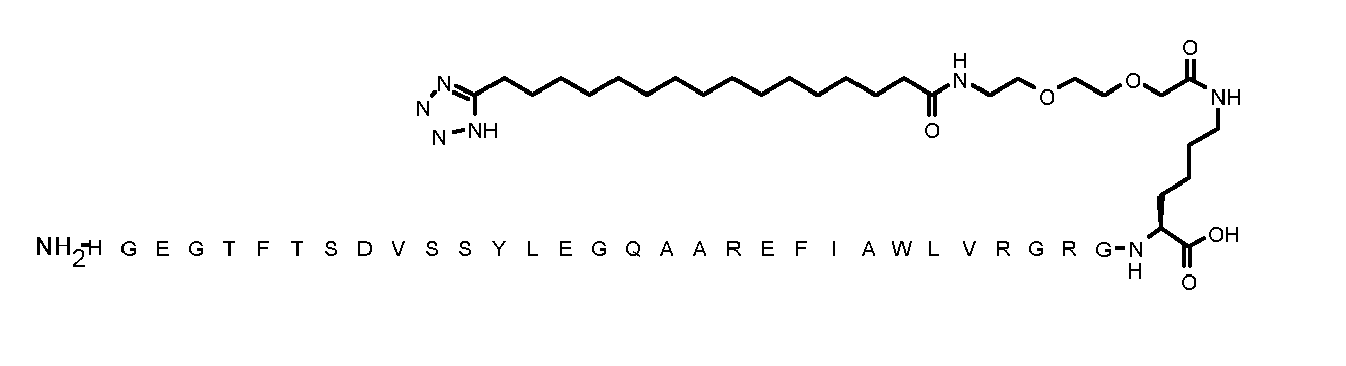
- The title compound was prepared as example 6 from (2-(2-(16-(5-tetrazolyl)hexadecanoylamino)ethoxy)ethoxy)acetic acid and [Gly8,Arg26,34]GLP-1-(7-37) peptide (85 mg). 28 mg of the title product was obtained.
HPLC (method B4): RT = 11.35 min (95%)
LCMS: m/z = 1327 (MH3 3+). Calculated for (MH3 3+): 1327 -

- This compound was prepared as example 5 from 4-(16-(5-tetrazolyl)hexadecanoylaminosulfonyl)butyric acid acid and [(3-(4-imidazolyl)propionyl7,Arg34]GLP-1-(7-37) peptide (50 mg). 13.3 mg of the title compound was obtained.
HPLC (method B4): RT = 11.61 min (98%)
LCMS: m/z = 1276 (MH3 3+). Calculated for (MH3 3+): 1276 -

- The title compound was prepared as example 6 from 16-(5-tetrazolyl)hexadecanoic acid and [Gly8, Arg26] GLP-1 (7-34) peptideamide (50 mg). 17 mg of the title product was obtained.
HPLC (method B4): RT = 12.53 min (100%)
LCMS: m/z = 1136 (MH3 3+). Calculated for (MH3 3+): 1136 -

- This compound was prepared on 2-chlorotrityl chloride resin as described for the synthesis of (2-(2-(16-(5-tetrazolyl)hexadecanoylamino)ethoxy)ethoxy)acetic acid.
- 1H NMR (DMSO-d6): δ 1.23 (m, 22H), 1.49 (m, 2H), 1.68 (m, 2H), 1.85 (m, 2H), 2.23 (m, 4H), 2.85 (t, J = 7 Hz, 2H), 3.19 (m, 2H), 3.35 (m, 4H), 3.52 (m, 2H), 3.59 (m, 2H), 4.01 (s, 2H), 7.91 (br t, J = 6 Hz, 1H), 11.55 (br s, 1H).
-

- The title compound was prepared as example 6 from (2-(2-(4-(16-(5-tetrazolyl)hexadecanoylaminosulfonyl)butyrylamino)ethoxy)ethoxy)acetic acid and [Arg34]GLP-1-(7-37) peptide (350 mg). 35 mg of the title product was obtained.
HPLC (method B4): RT = 11.63 min (99%)
LCMS: m/z = 1329 (MH3 3+). Calculated for (MH3 3+): 1329 -
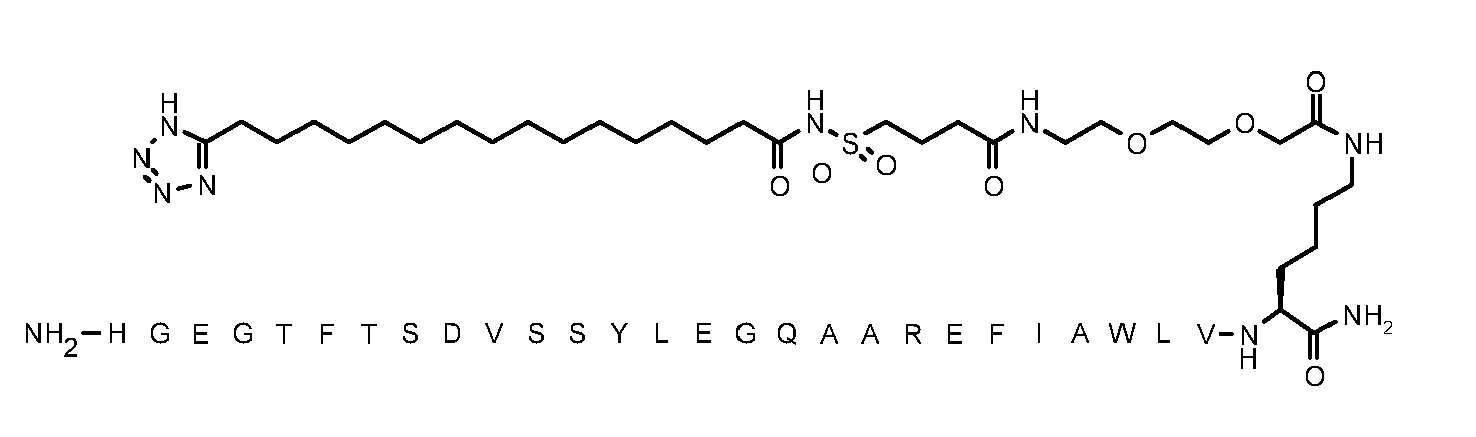
- The title compound was prepared as example 6 from (2-(2-(4-(16-(5-tetrazolyl)hexadecanoylaminosulfonyl)butyrylamino)ethoxy)ethoxy)acetic acid and [Arg26]GLP-1-(7-34) peptide (40 mg). 6.5 mg of the title product was obtained.
HPLC (method B4): RT = 12.44 min (100%)
LCMS: m/z = 1234 (MH3 3+). Calculated for (MH3 3+): 1234 -

- The title compound was prepared as example 6 from (2-(2-(4-(16-(5-tetrazolyl)hexadecanoylaminosulfonyl)butyrylamino)ethoxy)ethoxy)acetic acid and [(3-(4-imidazolyl)propionyl)7,Arg34]GLP-1-(7-37) peptide (27 mg). 9.5 mg of the title product was obtained.
HPLC (method B4): RT = 11.85 min (96%)
LCMS: m/z = 1324 (MH3 3+). Calculated for (MH3 3+): 1324 -
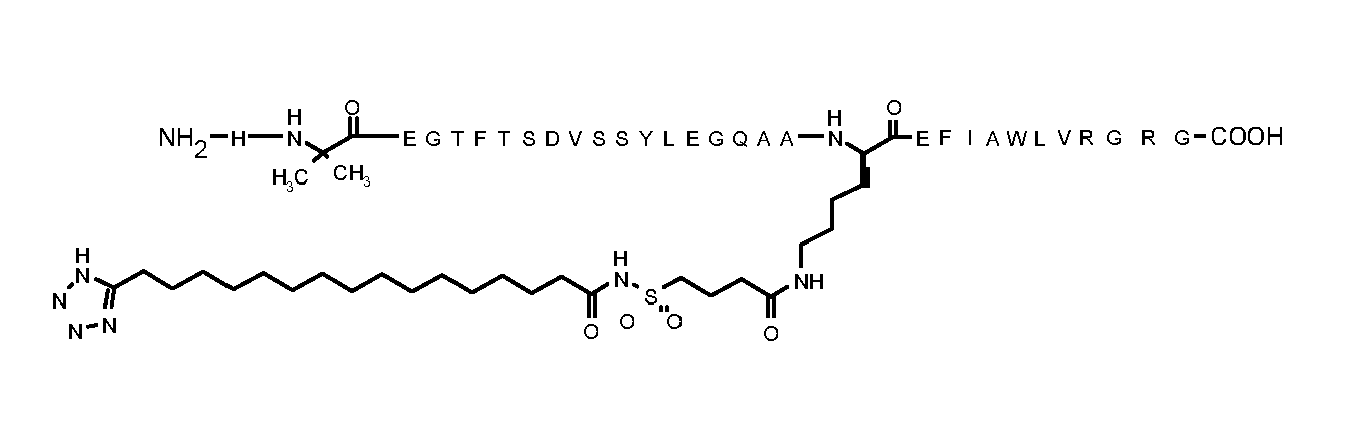
- The title compound was prepared as example 6 from (4-(16-(5-tetrazolyl)hexadecanoylaminosulfonyl)butyric acid and [Aib8,Arg34]GLP-1-(7-37) peptide (50 mg). 18.4 mg of the title product was obtained.
HPLC (method B4): RT = 11.87 min (95%)
LCMS: m/z = 1285 (MH3 3+). Calculated for (MH3 3+): 1285 -

- The title compound was prepared as example 6 from (4-(16-(5-tetrazolyl)hexadecanoylaminosulfonyl)butyric acid and Na7(Me)[Arg34]GLP-1-(7-37) peptide (35 mg). 2.5 mg of the title product was obtained.
HPLC (method B4): RT = 11.76 min (96%)
LCMS: m/z = 1286 (MH3 3+). Calculated for (MH3 3+): 1285 -

- The title compound was prepared as example 6 from (4-(16-(5-tetrazolyl)hexadecanoylaminosulfonyl)butyric acid and [Gly8,Arg34]GLP-1-(7-37) peptide (15 mg). 3.2 mg of the title product was obtained.
HPLC (method B4): RT = 11.74 min (95%)
LCMS: m/z = 1276 (MH3 3+). Calculated for (MH3 3+): 1276 -

- The title compound was prepared as example 6 from 4-(16-(5-tetrazolyl)hexadecanoylaminosulfonyl)butyric acid and [Lys14;Arg26,34]GLP-1-(7-37) peptide (65 mg). 19 mg of the title product was obtained.
HPLC (method B4): RT = 11.54 min (98%)
LCMS: m/z = 1304 (MH3 3+). Calculated for (MH3 3+): 1304 - Compounds which are planned to be synthesised along the procedures described above are:
-

- The title compound was prepared as example 6 from 4-(16-(5-tetrazolyl)hexadecanoylaminosulfonyl)butyric acid and [Lys18;Arg26,34]GLP-1-(7-37) peptide (80 mg). 14.5 mg of the title product was obtained.
HPLC (method B4): RT = 9.11 min (100%)
LCMS: m/z = 1304 (MH3 3+). Calculated for (MH3 3+): 1304 -

-

-

-

-

-

-

-

- The title compound was prepared as example 6 from 4-(16-(4-(4-(5-tetrazolyl)phenyl)phenyloxy)hexadecanoylamino)-(4S)-4-tert-butoxycarbonylbutyric acid and [Arg34]GLP-1-(7-37) peptide (75 mg). 6.9 mg of the title product was obtained.
HPLC (method B4): RT = 10.57 min (100%)
LCMS: m/z = 1330 (MH3 3+). Calculated for (MH3 3+): 1330 -

-

-

- The title compound was prepared as example 6 from (4-{16-[4-(1H-tetrazol-5-yl)phenoxy]hexadecanoylamino}-(4S)-4-tert-butoxycarbonylbutyric acid and [Arg34]GLP-1-(7-37) peptide. 1.6 mg of the title product was obtained.
HPLC (method B4): RT = 9.96 min (100%)
LCMS: m/z = 1305 (MH3 3+). Calculated for (MH3 3+): 1305 -

-

-

- The title compound was prepared as example 6 from {4-[17,17-bis-(1-H-tetrazol-5-yl)heptadecanoylamino]-(4S)-4-tert-butoxycarbonylbutyric acid and [Arg34]GLP-1-(7-37) peptide (150 mg). 7.8 mg of the title product was obtained.
HPLC (method B4): RT = 10.25 min (92%)
LCMS: m/z = 1301 (MH3 3+). Calculated for (MH3 3+): 1301 -

-

-

- The title compound was prepared as example 6 from (4-{16-[4,5-bis(1H-tetrazol-5-yl)imidazol-1-yl]hexadecanoylamino}-(4S)-4-tert-butoxycarbonylbutyric acid and [Arg34]GLP-1-(7-37) peptide (100 mg). 7.2 mg of the title product was obtained.
HPLC (method B4): RT = 13.91 min (97%)
LCMS: m/z = 1319 (MH3 3+). Calculated for (MH3 3+): 1319 -

-

-

-

-

-

-

-

-

-

-

-
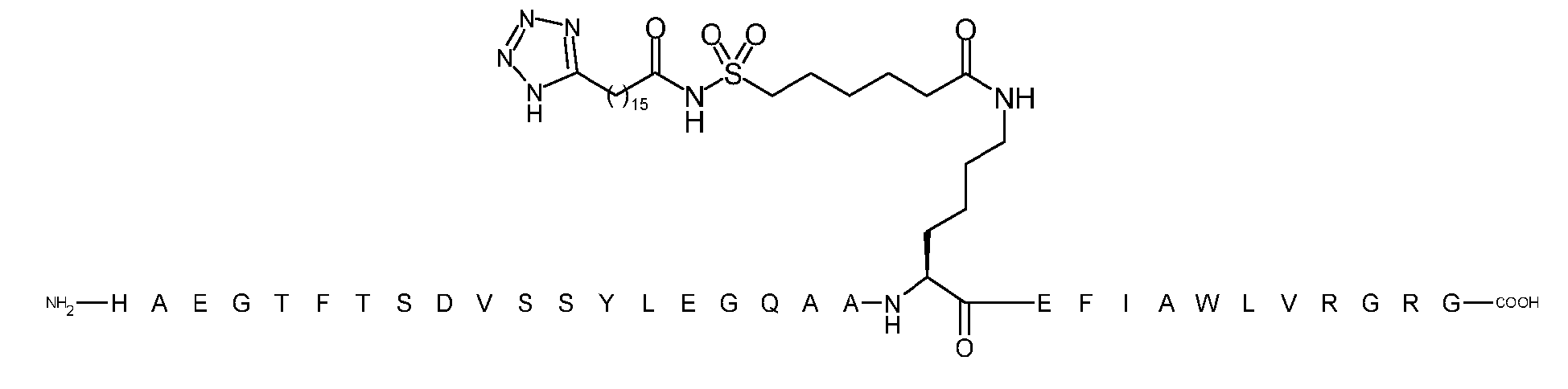
- The title compound was prepared as example 6 from (6-{16-[1H-tetrazol-5-yl]hexadecanoyl}sulfamoylhexanoic acid and [Arg34]GLP-1-(7-37) peptide. 67.5 mg of the title product was obtained.
HPLC (method B4): RT = 11.08 min (98%)
LCMS: m/z = 1290 (MH3 3+). Calculated for (MH3 3+): 1290 -

-

-

-

-

-

-

-

-

-
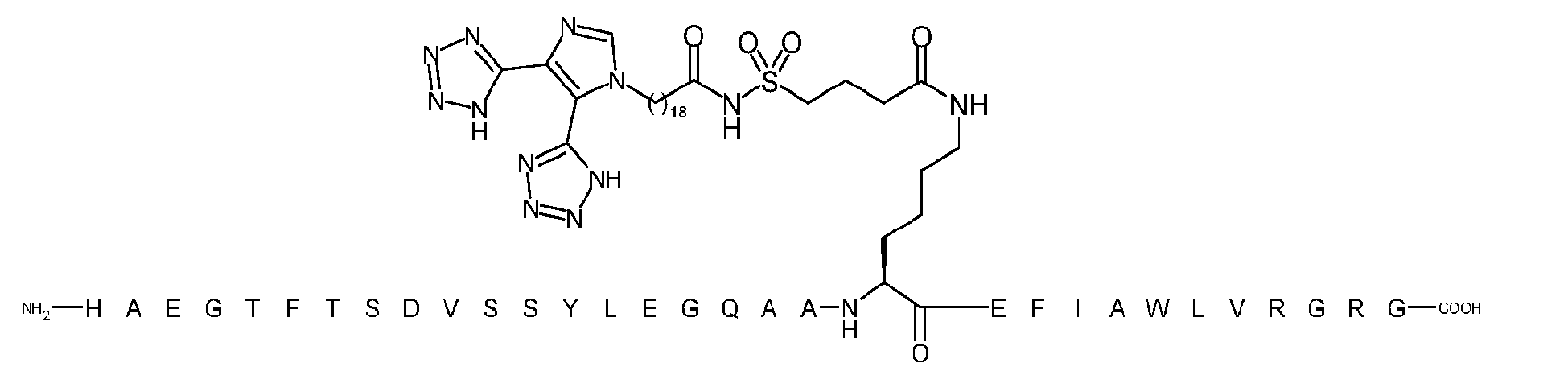
-

-

-

-

-

-

-

-

-
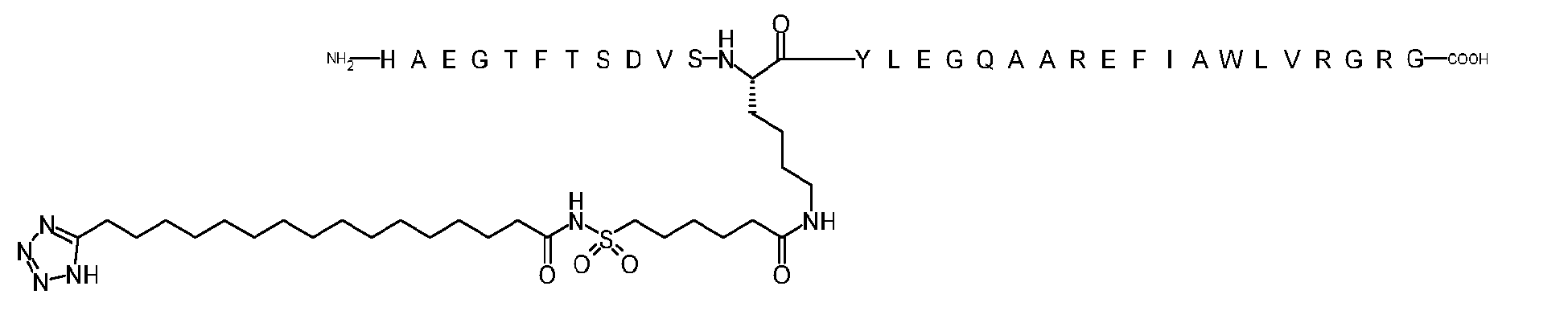
- The title compound was prepared as example 6 from 18-(6-{16-[1H-tetrazol-5-yl]hexadecanoylsulfamoyl}hexanoic acid and [Arg26,34, Lys18]GLP-1-(7-37)-peptide. 26.3 mg of the title product was obtained.
HPLC (method B4): RT = 10.83 min (98.3%)
LCMS: m/z = 1313 (MH3 3+). Calculated for (MH3 3+): 1313 - According to the procedures above the following compounds were prepared:
- Nε26-[4(S)-4-(16-{4-[4-(1-H-tetrazol-5-yl)phenyl]phenoxy}hexadecanoylamino)-4-carboxybutyryl] [Aib8,Arg34] GLP-1 (7-37)

- Nε26-[4(S)-4-(19-(1-H-tetrazol-5-yl)nonadecanoylamino)-4-carboxybutyryl] [Aib8,Arg34] GLP-1(7-37)

- Nε26-[4(S)-4-(2-(2-(2-(4-(N-(16-(1-H-tetrazol-5-yl)hexadecanoyl)sulfamoyl)butyrylamino)ethoxy)ethoxy)acetylamino)-4-carboxybutyryl] [AibB,Arg34] GLP-1(7-37)
or - Nε26-[4(S)-4-(2-(2-(2-(6-(N-(16-(1-H-tetrazol-5-yl)hexadecanoyl)sulfamoyl)hexanoylamino)ethoxy)ethoxy)acetylamino)-4-carboxybutyryl] [Aib8,Arg34] GLP-1(7-37)

- Nε26-[4(S)-4-(2-(2-(2-(2-(2-(2-(4-(N-(16-(1-H-tetrazol-5-yl)hexadecanoyl)sulfamoyl)butyrylamino)ethoxy)ethoxy)acetylamino)ethoxy)ethoxy)acetylami no)-4-carboxybutyryl] [Aib8,Arg34] GLP-1(7-37)
or - Nε26-[4(S)-4-(2-(2-(2-(2-(2-(2-(6-(N-(16-(1-H-tetrazol-5-yl)hexadecanoyl)sulfamoyl)hexanoylamino)ethoxy)ethoxy)acetylamino)ethoxy)ethoxy)acetyla mino)-4-carboxybutyryl] [Aib8,Arg34] GLP-1 (7-37)

- Nε18-6-(16-[1-H-tetrazol-5-yl]hexadecanoylsulfamoyl)hexanoyl [Aib8,Arg26,34] GLP-1(7-37)

- Nε18-[4(S)-4-(16-{4-[4-(1-H-tetrazol-5-yl)phenyl]phenoxy}hexadecanoylamino)-4-carboxybutyryl] [Aib8,Arg26,34] GLP-1 (7-37)

Claims (15)
- A compound of the general formula (1):
 G, X, and Y independently represent
a bond, -S-, -O-, -NH-, -(CH2)1-10-, or
arylene, optionally substituted with one or more alkyl, amino, cycloalkyl, aryl, heteroaryl, halogen, nitro, lower alkoxy, hydroxy, MeCONH-, alkanoyl, or cyano, or
heteroarylene, optionally substituted with one or more alkyl, amino, cycloalkyl, aryl, heteroaryl, halogen, nitro, lower alkoxy, hydroxy, MeCONH-, alkanoyl, or cyano, andZ represents a bond or
-(CH2)n-, -O-(CH2)n-, -S-(CH2)n-, -(OCH2CH2)n-, -(CF2)n-, -O-CH2-(CF2)n-, -S-CH2-(CF2)n-, wherein n is 1-40, andA represents
-C(=O)-, -O-C(=O)-, -NH-C(=O)-, -C(C=O)NH-S(=O)2-, -S(=O)2NH-C(=O)-, -(CH2)1-5-, -O-(CH2)1-5-, or -O-(CH2)1-5-C(=O)-, andQ represents a bond or
-[NH-(CH2CH2O)m-(CH2)p-E-C(=O)]q-, or
-O-(CH2CH2O)m-(CH2)p-E-C(=O)-, or
-S-(CH2CH2O)m-(CH2)p-E-C(=O)-, wherein E is a bond, O, S, or NH, and m, p, and q independently are 1-40, andR represents a bond or a polyradical, such as [-NH(CH2)4CH(NH-)-C(=O)-]1-5, andt is 1-40, andthe molecule is exendin-4 or an analogue thereof. - A compound according to claim 1, wherein G, X and Y are all a bond.
- A compound according to claim 1, wherein G, X and Y are all selected from -(CH2)1-10-.
- A compound according to any one of claims 1-3, wherein t is 1.
- A compound according to claim 4, wherein

- A compound according to any one of claims 1-5, wherein the molecule is covalently linked to R via the ε-amino group of a lysine residue.
- A compound according to any one of claims 1-5, wherein the molecule is covalently linked to R via the thiol group of a cysteine residue.
- A compound according to any one of claims 1-7, wherein said polypeptide comprises the amino acid sequence of the formula (IV):Xaa7-Xaa8-Glu-Gly-Thr-Phe-Thr-Ser-Asp-Xaa16-Ser-Xaa18-Xaa19-Xaa20-Glu-Xaa22-Xaa23-Ala-Xaa25-Xaa26-Xaa27-Phe-Ile-Xaa30-Trp-Leu-Xaa33-Xaa34-Xaa35-Xaa36-Xaa37-Xaa38-Xaa39-Xaa40-Xaa41-Xaa42-Xaa43-Xaa44-Xaa45-Xaa46
Formula (III) (SEQ ID No: 3)
whereinXaa7 is L-histidine, D-histidine, desamino-histidine, 2-amino-3-(2-aminoimidazol-4-yl)propionic acid, β-hydroxy-histidine, homohistidine, Nα-acetyl-histidine, α-fluoromethyl-histidine, α-methyl-histidine, 3-pyridylalanine, 2-pyridylalanine or 4-pyridylalanine;Xaa8 is Ala, Gly, Val, Leu, Ile, Lys, Aib, 1-aminocyclopropanecarboxylic acid, 1-aminocyclobutanecarboxylic acid, 1-aminocyclopentanecarboxylic acid, 1-aminocyclohexanecarboxylic acid, 1-aminocycloheptanecarboxylic acid, or 1-aminocyclooctanecarboxylic acid;Xaa16 is Val or Leu;Xaa18 is Ser, Lys or Arg;Xaa19 is Tyr or Gln;Xaa20 is Leu or Met;Xaa22 is Gly, Glu or Aib;Xaa23 is Gln, Glu, Lys or Arg;Xaa25 is Ala or Val;Xaa26 is Lys, Glu or Arg;Xaa27 is Glu or Leu;Xaa30 is Ala, Glu or Arg;Xaa33 is Val or Lys;Xaa34 is Lys, Glu, Asn or Arg;Xaa35 is Gly or Aib;Xaa36 is Arg, Gly or Lys;Xaa37 is Gly, Ala, Glu, Pro, Lys, amide or is absent;Xaa38 is Lys, Ser, amide or is absent;Xaa39 is Ser, Lys, amide or is absent;Xaa40 is Gly, amide or is absent;Xaa41 is Ala, amide or is absent;Xaa42 is Pro, amide or is absent;Xaa43 is Pro, amide or is absent;Xaa44 is Pro, amide or is absent;Xaa45 is Ser, amide or is absent;Xaa46 is amide or is absent;provided that if Xaa38, Xaa39, Xaa40, Xaa41, Xaa42, Xaa43, Xaa44, Xaa45 or Xaa46 is absent then each amino acid residue downstream is also absent. - A compound according to claim 1, wherein the exendin-4 analogue comprising no more than twelve amino acid residues which have been exchanged, added or deleted as compared to exendin-4(1-39) (SEQ ID No. 2), or no more than eight amino acid residues which have been exchanged, added or deleted as compared to exendin-4(1-39) (SEQ ID No. 2).
- A compound according to any one of claims 1 and 9, wherein said polypeptide is ZP-10, i.e. HGEGTFTSDLSKQMEEEAVRLFIEWLKNGGPSSGAPPSKKKKKK-amide (SEQ ID No. 5).
- A pharmaceutical composition comprising a compound according to any one of claims 1-10, and a pharmaceutically acceptable excipient.
- Use of a compound according to any one of the claims 1-10 for the preparation of a medicament for the treatment or prevention of hyperglycemia, type 2 diabetes, impaired glucose tolerance, type 1 diabetes, obesity, hypertension, syndrome X, dyslipidemia, disorders associated with toxic hypervolemia, cognitive disorders, atheroschlerosis, myocardial infarction, coronary heart disease, stroke and other cardiovascular disorders, inflammatory bowel syndrome, dyspepsia and gastric ulcers; for the preparation of a medicament for delaying or preventing disease progression in type 2 diabetes; and/or for the preparation of a medicament for decreasing food intake, decreasing β-cell apoptosis, increasing β-cell function and β-cell mass, stimulating β-cell regeneration and/or for restoring glucose sensitivity to β-cells.
- A compound according to any one of claims 1-10 for use as a medicament.
- A compound according to any one of claims 1-10 for use for in the treatment or prevention of hyperglycemia, type 2 diabetes, impaired glucose tolerance, type 1 diabetes, obesity, hypertension, syndrome X, dyslipidemia, disorders associated with toxic hypervolemia, cognitive disorders, atheroschlerosis, myocardial infarction, coronary heart disease, stroke and other cardiovascular disorders, inflammatory bowel syndrome, dyspepsia and gastric ulcers; for delaying or preventing disease progression in type 2 diabetes; and/or for decreasing food intake, decreasing β-cell apoptosis, increasing β-cell function and β-cell mass, stimulating β-cell regeneration and/or for restoring glucose sensitivity to β-cells.
- A method for increasing the plasma half-life of a molecule, comprising converting said molecule into a compound of the general formula (1):
 G, X, and Y independently represent
a bond, -S-, -O-, -NH-, -(CH2)1-15-, -C(O)NH-, or
arylene, optionally substituted with one or more alkyl, amino, cycloalkyl, aryl, heteroaryl, halogen, nitro, lower alkoxy, hydroxy, MeCONH-, alkanoyl, or cyano, or
heteroarylene, optionally substituted with one or more alkyl, amino, cycloalkyl, aryl, heteroaryl, halogen, nitro, lower alkoxy, hydroxy, MeCONH-, alkanoyl, or cyano, andZ represents a bond or
-(CH2)n-, -O-(CH2)n-, -S-(CH2)n-, -(OCH2CH2)n-, -(CF2)n-, -O-CH2-(CF2)n-, -S-CH2-(CF2)n-, wherein n is 1-40, andA represents
-C(=O)-, -O-C(=O)-, -NH-C(=O)-, -C(C=O)NH-S(=O)2-, -S(=O)2NH-C(=O)-, -(CH2)1-5-, -O-(CH2)1-5-, or -O-(CH2)1-5-C(=O)-, andQ represents a bond or
-[NH-(CH2CH2O)m-(CH2)p-E-C(=O)]q-, or
-O-(CH2CH2O)m-(CH2)p-E-C(=O)-, or
-S-(CH2CH2O)m-(CH2)p-E-C(=O)-, wherein E is a bond, O, S, or NH, and m, p, and q independently are 1-40, andR represents a bond or a polyradical, such as [-NH(CH2)4CH(NH-)-C(=O)-]1-5, andt is 1-40, andthe molecule is exendin-4 or an analogue thereof.
Priority Applications (1)
| Application Number | Priority Date | Filing Date | Title |
|---|---|---|---|
| EP20100176012 EP2289560B1 (en) | 2004-07-08 | 2005-06-21 | Polypeptide protracting tags comprising a tetrazole moiety |
Applications Claiming Priority (4)
| Application Number | Priority Date | Filing Date | Title |
|---|---|---|---|
| DKPA200401083 | 2004-07-08 | ||
| EP05102167 | 2005-03-18 | ||
| EP05754105.4A EP1765408B1 (en) | 2004-07-08 | 2005-06-21 | Polypeptide protracting tags comprising a tetrazole moiety |
| EP20100176012 EP2289560B1 (en) | 2004-07-08 | 2005-06-21 | Polypeptide protracting tags comprising a tetrazole moiety |
Related Parent Applications (3)
| Application Number | Title | Priority Date | Filing Date |
|---|---|---|---|
| EP05754105.4 Division | 2005-06-21 | ||
| EP05754105.4A Division-Into EP1765408B1 (en) | 2004-07-08 | 2005-06-21 | Polypeptide protracting tags comprising a tetrazole moiety |
| EP05754105.4A Division EP1765408B1 (en) | 2004-07-08 | 2005-06-21 | Polypeptide protracting tags comprising a tetrazole moiety |
Publications (3)
| Publication Number | Publication Date |
|---|---|
| EP2289560A2 true EP2289560A2 (en) | 2011-03-02 |
| EP2289560A3 EP2289560A3 (en) | 2011-10-19 |
| EP2289560B1 EP2289560B1 (en) | 2015-04-22 |
Family
ID=35453538
Family Applications (3)
| Application Number | Title | Priority Date | Filing Date |
|---|---|---|---|
| EP05754105.4A Expired - Lifetime EP1765408B1 (en) | 2004-07-08 | 2005-06-21 | Polypeptide protracting tags comprising a tetrazole moiety |
| EP20100176012 Expired - Lifetime EP2289560B1 (en) | 2004-07-08 | 2005-06-21 | Polypeptide protracting tags comprising a tetrazole moiety |
| EP20100179209 Withdrawn EP2292272A3 (en) | 2004-07-08 | 2005-06-21 | Polypeptide protracting tags comprising a tetrazole moiety |
Family Applications Before (1)
| Application Number | Title | Priority Date | Filing Date |
|---|---|---|---|
| EP05754105.4A Expired - Lifetime EP1765408B1 (en) | 2004-07-08 | 2005-06-21 | Polypeptide protracting tags comprising a tetrazole moiety |
Family Applications After (1)
| Application Number | Title | Priority Date | Filing Date |
|---|---|---|---|
| EP20100179209 Withdrawn EP2292272A3 (en) | 2004-07-08 | 2005-06-21 | Polypeptide protracting tags comprising a tetrazole moiety |
Country Status (12)
| Country | Link |
|---|---|
| US (2) | US20090111730A1 (en) |
| EP (3) | EP1765408B1 (en) |
| JP (1) | JP2008507477A (en) |
| KR (1) | KR20070029247A (en) |
| CN (1) | CN101005857A (en) |
| AU (1) | AU2005261740A1 (en) |
| BR (1) | BRPI0512988A (en) |
| CA (1) | CA2572770A1 (en) |
| ES (2) | ES2542228T3 (en) |
| MX (1) | MXPA06015049A (en) |
| RU (1) | RU2006144821A (en) |
| WO (1) | WO2006005667A2 (en) |
Families Citing this family (75)
| Publication number | Priority date | Publication date | Assignee | Title |
|---|---|---|---|---|
| ES2484796T3 (en) * | 2005-03-18 | 2014-08-12 | Novo Nordisk A/S | Extended GLP-1 Compounds |
| TWI362392B (en) | 2005-03-18 | 2012-04-21 | Novo Nordisk As | Acylated glp-1 compounds |
| CN100374462C (en) * | 2005-11-21 | 2008-03-12 | 大连帝恩生物工程有限公司 | Truncated glucagon-like peptide 1 (sGLP-1), preparation method and application |
| CN101400698A (en) * | 2006-03-15 | 2009-04-01 | 诺沃-诺迪斯克有限公司 | Amylin derivatives |
| US20090318353A1 (en) * | 2006-08-25 | 2009-12-24 | Novo Nordisk A/S | Acylated Exendin-4 Compounds |
| US20100022446A1 (en) * | 2007-01-18 | 2010-01-28 | Novo Nordisk A/S | Use of Peptides in Combination with Surgical Intervention for the Treatment of Obesity |
| US20100016237A1 (en) * | 2007-01-18 | 2010-01-21 | Novo Nordisk A/S | Novel Peptides for Use in the Treatment of Obesity |
| US20100016238A1 (en) * | 2007-01-18 | 2010-01-21 | Novo Nordisk A/S | Peptides for Use in the Treatment of Obesity |
| US20100056433A1 (en) * | 2007-01-18 | 2010-03-04 | Novo Nordisk A/S | Novel Peptides for Use in the Treatment of Obesity |
| JP2010516654A (en) * | 2007-01-18 | 2010-05-20 | ノボ・ノルデイスク・エー/エス | Novel peptides used in the treatment of obesity |
| US20100261637A1 (en) | 2007-09-05 | 2010-10-14 | Novo Nordisk A/S | Peptides derivatized with a-b-c-d- and their therapeutical use |
| EP2190872B1 (en) | 2007-09-05 | 2018-03-14 | Novo Nordisk A/S | Glucagon-like peptide-1 derivatives and their pharmaceutical use |
| US20100292133A1 (en) | 2007-09-05 | 2010-11-18 | Novo Nordisk A/S | Truncated glp-1 derivaties and their therapeutical use |
| US20100317057A1 (en) | 2007-12-28 | 2010-12-16 | Novo Nordisk A/S | Semi-recombinant preparation of glp-1 analogues |
| CN101981050A (en) * | 2008-01-23 | 2011-02-23 | 诺沃-诺迪斯克保健股份有限公司 | New blood coagulation factor inhibitors |
| HUE032284T2 (en) | 2008-03-18 | 2017-09-28 | Novo Nordisk As | Protease stabilized, acylated insulin analogues |
| RU2504550C2 (en) * | 2008-05-16 | 2014-01-20 | Ново Нордиск А/С | Long-acting agonists of receptors y2 and(or) y4 |
| WO2009141392A1 (en) * | 2008-05-22 | 2009-11-26 | Novo Nordisk A/S | Process |
| WO2010015668A1 (en) | 2008-08-06 | 2010-02-11 | Novo Nordisk A/S | Conjugated proteins with prolonged in vivo efficacy |
| WO2010046357A1 (en) | 2008-10-21 | 2010-04-29 | Novo Nordisk A/S | Amylin derivatives |
| BRPI0923853A2 (en) * | 2008-12-29 | 2016-01-12 | Panacea Biotec Ltd | gpl-1 analogs and uses thereof. |
| JP5816097B2 (en) | 2009-01-22 | 2015-11-18 | ノヴォ・ノルディスク・ヘルス・ケア・アーゲー | Stable growth hormone compound |
| CN102361647B (en) | 2009-01-23 | 2018-02-16 | 诺沃-诺迪斯克有限公司 | FGF21 derivatives and its application with albumin combination agent A B C D E |
| WO2011015649A1 (en) | 2009-08-06 | 2011-02-10 | Novo Nordisk Health Care Ag | Growth hormones with prolonged in-vivo efficacy |
| CN102573888A (en) * | 2009-09-18 | 2012-07-11 | 诺和诺德公司 | Long-acting Y2 receptor agonists |
| EP2498800A1 (en) * | 2009-11-13 | 2012-09-19 | Novo Nordisk A/S | Long-acting y2 receptor agonists |
| US20120329711A1 (en) | 2009-12-16 | 2012-12-27 | Nordisk A/S | Glp-1 receptor agonist compounds with a modified n-terminus |
| PL2525834T3 (en) | 2010-01-22 | 2020-10-19 | Novo Nordisk Health Care Ag | Growth hormones with prolonged in-vivo efficacy |
| RU2012134974A (en) | 2010-01-22 | 2014-02-27 | Ново Нордиск Хелс Кеа Аг | STABILIZED GROWTH HORMONE COMPOUND |
| WO2011131646A1 (en) | 2010-04-20 | 2011-10-27 | Novo Nordisk A/S | Long-acting gastrin derivatives |
| CN103415300B (en) | 2010-07-20 | 2018-02-23 | 诺沃—诺迪斯克有限公司 | FGF21 compounds end modified N |
| MX377589B (en) | 2010-12-16 | 2025-03-10 | Novo Nordisk As | Solid compositions comprising a glp-1 agonist and a salt of n-(8-(2-hydroxybenzoyl)amino)caprylic acid |
| AU2012241894B2 (en) | 2011-04-12 | 2015-12-03 | Novo Nordisk A/S | Double-acylated GLP-1 derivatives |
| CN110041399B (en) | 2011-12-29 | 2023-12-12 | 诺沃—诺迪斯克有限公司 | Dipeptides containing non-proteinogenic amino acids |
| ES2715308T3 (en) | 2012-03-22 | 2019-06-03 | Novo Nordisk As | Compositions comprising a supply agent and its preparation |
| HUE064694T2 (en) | 2012-03-22 | 2024-04-28 | Novo Nordisk As | Compositions comprising a delivery agent and preparation thereof |
| KR102072202B1 (en) | 2012-03-22 | 2020-01-31 | 노보 노르디스크 에이/에스 | Compositions of glp-1 peptides and preparation thereof |
| WO2013189988A1 (en) | 2012-06-20 | 2013-12-27 | Novo Nordisk A/S | Tablet formulation comprising a peptide and a delivery agent |
| WO2014060472A1 (en) | 2012-10-17 | 2014-04-24 | Novo Nordisk A/S | Fatty acid acylated amino acids for oral peptide delivery |
| ES2841123T3 (en) | 2013-04-05 | 2021-07-07 | Formulacion Del Compuesto De La Hormona De Crecimiento | Growth hormone compound formulation |
| RS58039B1 (en) | 2013-05-02 | 2019-02-28 | Novo Nordisk As | Oral dosing of glp-1 compounds |
| CN103304499B (en) * | 2013-06-02 | 2015-03-04 | 张远强 | Anti-diabetic compound, as well as preparation method and application thereof |
| CN103304501B (en) * | 2013-06-02 | 2015-03-04 | 张远强 | Anti-diabetic compound, as well as preparation method and application thereof |
| CN103304503B (en) * | 2013-06-02 | 2015-03-04 | 张远强 | Anti-diabetic compound, as well as preparation method and application thereof |
| CN103304502B (en) * | 2013-06-02 | 2015-03-04 | 张远强 | Anti-diabetic compound, as well as preparation method and application thereof |
| PT3013796T (en) * | 2013-06-27 | 2020-03-26 | Lg Chemical Ltd | Biaryl derivatives as gpr120 agonists |
| WO2015071355A1 (en) | 2013-11-15 | 2015-05-21 | Novo Nordisk A/S | Selective pyy compounds and uses thereof |
| US10583172B2 (en) | 2013-11-15 | 2020-03-10 | Novo Nordisk A/S | HPYY(1-36) having a beta-homoarginine substitution at position 35 |
| DK3006045T3 (en) | 2014-10-07 | 2017-07-17 | Cyprumed Gmbh | Pharmaceutical formulations for oral administration of peptide or protein drugs |
| RS59154B1 (en) | 2014-12-23 | 2019-10-31 | Novo Nordisk As | Fgf21 derivatives and uses thereof |
| MX392572B (en) | 2015-06-12 | 2025-03-24 | Novo Nordisk As | SELECTIVE PEPTIDE YY (PYY) COMPOUNDS AND THEIR USES. |
| EP3359181A1 (en) | 2015-10-07 | 2018-08-15 | Cyprumed GmbH | Pharmaceutical formulations for the oral delivery of peptide drugs |
| WO2018065634A1 (en) | 2016-10-07 | 2018-04-12 | Cyprumed Gmbh | Pharmaceutical compositions for the nasal delivery of peptide or protein drugs |
| CN107589246B (en) * | 2017-03-07 | 2019-10-01 | 上海原科实业发展有限公司 | A kind of fibrin activator, preparation method, the kit including the activator and the detection method using the kit |
| MA49617A (en) | 2017-07-19 | 2020-05-27 | Novo Nordisk As | EGF (A) ANALOGUES, PREPARATION, FORMULATIONS AND RELATED USES |
| WO2019098254A1 (en) * | 2017-11-14 | 2019-05-23 | 千寿製薬株式会社 | Pacap stabilized peptide |
| AR114353A1 (en) | 2018-02-02 | 2020-08-26 | Novo Nordisk As | SOLID COMPOSITIONS INCLUDING A GLP-1 AGONIST AND A SALT OF CAPRYLIC N- (8- (2-HYDROXIBENZOYL) AMINO) |
| US20210087250A1 (en) | 2018-04-06 | 2021-03-25 | Cyprumed Gmbh | Pharmaceutical compositions for the transmucosal delivery of therapeutic peptides and proteins |
| TWI829687B (en) | 2018-05-07 | 2024-01-21 | 丹麥商諾佛 儂迪克股份有限公司 | Solid compositions comprising a glp-1 agonist and a salt of n-(8-(2-hydroxybenzoyl)amino)caprylic acid |
| WO2019229242A1 (en) | 2018-05-31 | 2019-12-05 | Novo Nordisk A/S | Derivatives comprising an apelin analogue and uses thereof |
| TW202039437A (en) | 2018-12-11 | 2020-11-01 | 法商賽諾菲公司 | Peptide binder |
| AU2020418207A1 (en) * | 2019-12-30 | 2022-08-25 | Gan & Lee Pharmaceuticals Co., Ltd. | Long-acting GLP-1 compound |
| CN111333714A (en) * | 2020-03-05 | 2020-06-26 | 成都奥达生物科技有限公司 | A long-acting GLP-1 compound |
| CN115461044B (en) | 2020-04-29 | 2025-06-10 | 诺和诺德股份有限公司 | Solid compositions comprising GLP-1 agonist and histidine |
| WO2022049310A1 (en) | 2020-09-07 | 2022-03-10 | Cyprumed Gmbh | Improved pharmaceutical formulations of glp-1 receptor agonists |
| WO2023012263A1 (en) | 2021-08-04 | 2023-02-09 | Novo Nordisk A/S | Solid oral peptide formulations |
| CN121001710A (en) | 2022-12-30 | 2025-11-21 | 阿尔吉法玛公司 | Compositions and methods for improving the systemic bioavailability of oral peptide therapeutic agents |
| WO2024165571A2 (en) | 2023-02-06 | 2024-08-15 | E-Therapeutics Plc | Inhibitors of expression and/or function |
| CN120731085A (en) * | 2023-03-02 | 2025-09-30 | 甘李药业股份有限公司 | Medical use of a GLP-1 compound |
| WO2025125576A2 (en) | 2023-12-15 | 2025-06-19 | E-Therapeutics Plc | Inhibitors of expression and/or function |
| EP4686757A1 (en) | 2024-07-31 | 2026-02-04 | e-therapeutics PLC | Inhibitors of expression and/or function |
| AU2024408289A1 (en) | 2023-12-22 | 2026-08-06 | Tangram Therapeutics Plc | Inhibitors of expression and/or function |
| WO2025196502A1 (en) | 2024-03-20 | 2025-09-25 | North Carolina Agricultural & Technical State University | Choline kinase inhibitors as a therapeutic treatment for obesity |
| GB202418179D0 (en) | 2024-12-11 | 2025-01-22 | Algipharma As | Compositions and methods |
| GB202418172D0 (en) | 2024-12-11 | 2025-01-22 | Algipharma As | Compositions and methods |
Citations (2)
| Publication number | Priority date | Publication date | Assignee | Title |
|---|---|---|---|---|
| US4683202A (en) | 1985-03-28 | 1987-07-28 | Cetus Corporation | Process for amplifying nucleic acid sequences |
| US6358705B1 (en) | 1998-07-16 | 2002-03-19 | Novo Nordisk A/S | Method of making proteins in transformed yeast cells |
Family Cites Families (40)
| Publication number | Priority date | Publication date | Assignee | Title |
|---|---|---|---|---|
| US3869437A (en) * | 1970-05-08 | 1975-03-04 | Nat Res Dev | Mono-, di, and N{HD A1{B , N{HU B1{B , N{HU B29{B -tri-acylated insulin |
| US4423224A (en) * | 1980-09-08 | 1983-12-27 | Sds Biotech Corporation | 4-Me-1-(2-(1H-tetrazol-5-yl)ethyl)benzene sulfonate and N-2-(1H-tetrazol-5-yl)ethyl methanesulfonamide |
| JPS604165A (en) * | 1983-06-21 | 1985-01-10 | Taiho Yakuhin Kogyo Kk | Sulfonium derivatives |
| DE3626130A1 (en) * | 1986-08-01 | 1988-02-11 | Merck Patent Gmbh | AMINO ACID DERIVATIVES |
| WO1992001476A1 (en) | 1990-07-26 | 1992-02-06 | University Of Iowa Research Foundation | Novel drug delivery systems for proteins and peptides using albumin as a carrier molecule |
| US6492531B1 (en) * | 1992-02-18 | 2002-12-10 | Warner-Lambert Company | Method of treating cognitive disorders |
| TW289757B (en) * | 1993-05-08 | 1996-11-01 | Hoechst Ag | |
| US5776927A (en) * | 1994-04-18 | 1998-07-07 | Corvas International, Inc. | Methionine sulfone and S-substituted cysteine sulfone derivatives as enzyme inhibitors |
| US5883107A (en) * | 1994-06-17 | 1999-03-16 | Corvas International, Inc. | Arginine mimic derivatives as enzyme inhibitors |
| US5789434A (en) * | 1994-11-15 | 1998-08-04 | Bayer Corporation | Derivatives of substituted 4-biarylbutyric acid as matrix metalloprotease inhibitors |
| US5693609A (en) | 1994-11-17 | 1997-12-02 | Eli Lilly And Company | Acylated insulin analogs |
| DE19521653A1 (en) * | 1995-06-14 | 1996-12-19 | Hoechst Schering Agrevo Gmbh | Substituted tetrazoles, processes for their preparation and their use as herbicides and plant growth regulators |
| JPH09136878A (en) | 1995-09-12 | 1997-05-27 | Ono Pharmaceut Co Ltd | Tetrazole derivative |
| EP0761680A3 (en) * | 1995-09-12 | 1999-05-06 | Ono Pharmaceutical Co., Ltd. | Tetrazole compounds having Interleukin-1beta converting enzyme inhibitory activity |
| US5905140A (en) * | 1996-07-11 | 1999-05-18 | Novo Nordisk A/S, Novo Alle | Selective acylation method |
| WO1999058518A2 (en) | 1998-05-12 | 1999-11-18 | American Home Products Corporation | Biphenyl oxo-acetic acids useful in the treatment of insulin resistance and hyperglycemia |
| US6337340B1 (en) * | 1998-08-14 | 2002-01-08 | Gpi Nil Holdings, Inc. | Carboxylic acids and isosteres of heterocyclic ring compounds having multiple heteroatoms for vision and memory disorders |
| JP2002538084A (en) * | 1999-01-14 | 2002-11-12 | アミリン・ファーマシューティカルズ,インコーポレイテッド | How to control glucagon |
| WO2002058690A2 (en) * | 2001-01-26 | 2002-08-01 | Chugai Seiyaku Kabushiki Kaisha | Methods for the treatment of diseases using malonyl-coa decarbox ylase inhibitors |
| NZ526883A (en) * | 2001-02-20 | 2005-11-25 | Chugai Pharmaceutical Co Ltd | Azoles as malonyl-coa decarboxylase inhibitors useful as metabolic modulators |
| AU2002344820B2 (en) * | 2001-06-20 | 2006-12-14 | Merck & Co., Inc. | Dipeptidyl peptidase inhibitors for the treatment of diabetes |
| WO2003013573A1 (en) * | 2001-08-10 | 2003-02-20 | Epix Medical, Inc. | Polypeptide conjugates with extended circulating half-lives |
| ATE363278T1 (en) * | 2001-09-14 | 2007-06-15 | Novo Nordisk As | NEW LIGANDS FOR THE HISB10 ZN2+ SITES OF THE INSULIN HEXAMER IN THE R CONFORMATION |
| AU2002348948A1 (en) * | 2001-11-30 | 2003-06-10 | Pfizer Products Inc. | Pharmaceutical compositions and methods for administering EP2 receptors selective agonists |
| EP1469863A2 (en) * | 2002-01-18 | 2004-10-27 | Merck & Co., Inc. | Selective s1p1/edg1 receptor agonists |
| ATE448193T1 (en) * | 2002-01-18 | 2009-11-15 | Merck & Co Inc | ßN-(BENZYL)AMINOALKYL CARBOXYLATE, PHOSPHINATES, PHOSPHONATES AND TETRAZOLES AS EDG RECEPTOR AGONISTSß |
| TW200400035A (en) * | 2002-03-28 | 2004-01-01 | Glaxo Group Ltd | Novel compounds |
| UA80131C2 (en) * | 2002-05-28 | 2007-08-27 | Dimensional Pharm Inc | Thiophene amidines, compositions thereof, and methods of treating complement-mediated diseases and conditions |
| JP2005533774A (en) | 2002-06-07 | 2005-11-10 | ランバクシー ラボラトリーズ リミテッド | Divalproexodium release retardant |
| US20060154926A1 (en) * | 2002-06-11 | 2006-07-13 | Elan Pharmaceuticals, Inc. | Methods of treating alzheimer's disease using aryl alkanoic acid amides |
| CA2506741A1 (en) | 2002-11-27 | 2004-06-17 | Artesian Therapeutics, Inc. | Compounds with mixed pde-inhibitory and .beta.-adrenergic antagonist or partial agonist activity for treatment of heart failure |
| CA2505893A1 (en) * | 2002-12-03 | 2004-06-17 | Ciba Specialty Chemicals Holding Inc. | Oxime ester photoinitiators with heteroaromatic groups |
| WO2004056347A2 (en) | 2002-12-20 | 2004-07-08 | Novo Nordisk A/S | Pharmaceutical compositions comprising insulin and legends of insulin hexamer |
| JP2007523842A (en) | 2003-03-11 | 2007-08-23 | ノボ ノルディスク アクティーゼルスカブ | Pharmaceutical formulation containing acid stabilized insulin |
| EP1670515A2 (en) * | 2003-09-19 | 2006-06-21 | Novo Nordisk A/S | Albumin-binding derivatives of therapeutic peptides |
| TW200522976A (en) * | 2003-09-19 | 2005-07-16 | Novo Nordisk As | Novel plasma protein affinity tags |
| US20050096466A1 (en) * | 2003-09-19 | 2005-05-05 | Schwinden Mark D. | Process for the preparation of tetrazol-derived compounds as growth hormone secretagogues |
| CN101665538A (en) * | 2003-12-18 | 2010-03-10 | 诺沃挪第克公司 | Novel GLP-1 analogues linked to albumin-like agents |
| WO2006082204A1 (en) * | 2005-02-02 | 2006-08-10 | Novo Nordisk A/S | Insulin derivatives |
| MX354705B (en) * | 2011-09-23 | 2018-03-16 | Novo Nordisk As | Novel glucagon analogues. |
-
2005
- 2005-06-21 ES ES10176012.2T patent/ES2542228T3/en not_active Expired - Lifetime
- 2005-06-21 EP EP05754105.4A patent/EP1765408B1/en not_active Expired - Lifetime
- 2005-06-21 CN CNA2005800274689A patent/CN101005857A/en active Pending
- 2005-06-21 EP EP20100176012 patent/EP2289560B1/en not_active Expired - Lifetime
- 2005-06-21 KR KR20077000466A patent/KR20070029247A/en not_active Withdrawn
- 2005-06-21 RU RU2006144821/04A patent/RU2006144821A/en unknown
- 2005-06-21 WO PCT/EP2005/052874 patent/WO2006005667A2/en not_active Ceased
- 2005-06-21 BR BRPI0512988-5A patent/BRPI0512988A/en not_active IP Right Cessation
- 2005-06-21 ES ES05754105.4T patent/ES2564167T3/en not_active Expired - Lifetime
- 2005-06-21 MX MXPA06015049A patent/MXPA06015049A/en unknown
- 2005-06-21 JP JP2007519766A patent/JP2008507477A/en active Pending
- 2005-06-21 EP EP20100179209 patent/EP2292272A3/en not_active Withdrawn
- 2005-06-21 AU AU2005261740A patent/AU2005261740A1/en not_active Abandoned
- 2005-06-21 US US11/631,889 patent/US20090111730A1/en not_active Abandoned
- 2005-06-21 CA CA 2572770 patent/CA2572770A1/en not_active Abandoned
-
2011
- 2011-12-15 US US13/327,378 patent/US9061067B2/en not_active Expired - Fee Related
Patent Citations (3)
| Publication number | Priority date | Publication date | Assignee | Title |
|---|---|---|---|---|
| US4683202A (en) | 1985-03-28 | 1987-07-28 | Cetus Corporation | Process for amplifying nucleic acid sequences |
| US4683202B1 (en) | 1985-03-28 | 1990-11-27 | Cetus Corp | |
| US6358705B1 (en) | 1998-07-16 | 2002-03-19 | Novo Nordisk A/S | Method of making proteins in transformed yeast cells |
Non-Patent Citations (22)
| Title |
|---|
| "Handbook of Pharmaceutical Controlled Release", 2000, MARCEL DEKKER |
| "Protein Formulation and Delivery", vol. 99, 2000, MARCEL DEKKER, article "Drug and the Pharmaceutical Sciences" |
| "Remington: The Science and Practice of Pharmacy", 1995 |
| AHERN. T. J.; MANNING M.C.: "Stability of Protein Pharmaceuticals", 1992, PLENUM PRESS |
| BEAUCAGE; CARUTHERS, TETRAHEDRON LETTERS, vol. 22, 1981, pages 1859 - 1869 |
| BROADHEAD ET AL., DRUG DEVEL. IND. PHARM., vol. 18, 1992, pages 1169 - 1206 |
| CARPENTER; CROWE, CRYOBIOLOGY, vol. 25, 1988, pages 459 - 470 |
| KNUDSEN ET AL., J. MED. CHEM., vol. 43, 2000, pages 1664 - 1669 |
| KURTZHALS P; HAVELUND S; JONASSEN I; KIEHR B; LARSEN UD; RIBEL U; MARKUSSEN J, BIOCHEMICAL JOURNAL, vol. 312, 1995, pages 725 - 731 |
| L. ALFONTA ET AL., J. AM. CHEM. SOC., vol. 125, 2003, pages 14662 - 14663 |
| MASTERS: "Spray-Drying Handbook", 1991, LONGMAN SCIENTIFIC AND TECHNICAL, pages: 491 - 676 |
| MATTHES ET AL., EMBO JOURNAL, vol. 3, 1984, pages 801 - 805 |
| MENTLEIN ET AL., EUR. J. BIOCHEM., vol. 214, 1993, pages 829 - 35 |
| MUMENTHALER ET AL., PHARM. RES., vol. 11, 1994, pages 12 - 20 |
| REMINGTON'S PHARMACEUTICAL SCIENCES, 1985 |
| ROSER, BIOPHARM., vol. 4, 1991, pages 47 - 53 |
| SAIKI ET AL., SCIENCE, vol. 239, 1988, pages 487 - 491 |
| SAMBROOK, J; FRITSCH, EF; MANIATIS, T: "Molecular Cloning: A Laboratory Manual", 1989, COLD SPRING HARBOR LABORATORY PRESS |
| SIEGEL ET AL., REGUL. PEPT., vol. 79, 1999, pages 93 - 102 |
| WILLIAMS; POLLI, J. PARENTERAL SCI. TECHNOL., vol. 38, 1984, pages 48 - 59 |
| Z. ZHANG ET AL., BIOCHEMISTRY, vol. 42, 2003, pages 6735 - 6746 |
| ZOBEL ET AL., BIOORG. MED. CHEM. LETT., vol. 13, 2003, pages 1513 - 1515 |
Also Published As
| Publication number | Publication date |
|---|---|
| WO2006005667A2 (en) | 2006-01-19 |
| ES2564167T3 (en) | 2016-03-18 |
| WO2006005667A3 (en) | 2006-10-12 |
| EP2292272A2 (en) | 2011-03-09 |
| ES2542228T3 (en) | 2015-08-03 |
| EP1765408A2 (en) | 2007-03-28 |
| US9061067B2 (en) | 2015-06-23 |
| EP1765408B1 (en) | 2015-12-09 |
| RU2006144821A (en) | 2008-08-20 |
| MXPA06015049A (en) | 2007-02-08 |
| EP2289560B1 (en) | 2015-04-22 |
| KR20070029247A (en) | 2007-03-13 |
| AU2005261740A1 (en) | 2006-01-19 |
| BRPI0512988A (en) | 2008-04-22 |
| US20120088716A1 (en) | 2012-04-12 |
| CN101005857A (en) | 2007-07-25 |
| EP2292272A3 (en) | 2011-10-26 |
| US20090111730A1 (en) | 2009-04-30 |
| JP2008507477A (en) | 2008-03-13 |
| EP2289560A3 (en) | 2011-10-19 |
| CA2572770A1 (en) | 2006-01-19 |
Similar Documents
| Publication | Publication Date | Title |
|---|---|---|
| EP2289560B1 (en) | Polypeptide protracting tags comprising a tetrazole moiety | |
| US7897560B2 (en) | Plasma protein affinity tags | |
| JP5209463B2 (en) | Acylated GLP-1 compounds | |
| AU2004273573B2 (en) | Albumin-binding derivatives of therapeutic peptides | |
| ES2532116T3 (en) | Peptides derived with A-B-C-D and their therapeutic uses | |
| EP2330126B1 (en) | Protracted exendin-4 compounds | |
| ES2672770T3 (en) | Derivatives of glucagon-like peptide-1 and its pharmaceutical use | |
| US20090005312A1 (en) | Novel glp-1 analogues linked to albumin-like agents | |
| EP1799710A2 (en) | Protracted glp-1 compounds | |
| JP2008516621A (en) | Growth hormone conjugate |
Legal Events
| Date | Code | Title | Description |
|---|---|---|---|
| PUAI | Public reference made under article 153(3) epc to a published international application that has entered the european phase |
Free format text: ORIGINAL CODE: 0009012 |
|
| AC | Divisional application: reference to earlier application |
Ref document number: 1765408 Country of ref document: EP Kind code of ref document: P |
|
| AK | Designated contracting states |
Kind code of ref document: A2 Designated state(s): AT BE BG CH CY CZ DE DK EE ES FI FR GB GR HU IE IS IT LI LT LU MC NL PL PT RO SE SI SK TR |
|
| PUAL | Search report despatched |
Free format text: ORIGINAL CODE: 0009013 |
|
| AK | Designated contracting states |
Kind code of ref document: A3 Designated state(s): AT BE BG CH CY CZ DE DK EE ES FI FR GB GR HU IE IS IT LI LT LU MC NL PL PT RO SE SI SK TR |
|
| RIC1 | Information provided on ipc code assigned before grant |
Ipc: A61P 3/08 20060101ALI20110915BHEP Ipc: A61P 3/10 20060101ALI20110915BHEP Ipc: A61K 47/48 20060101AFI20110915BHEP |
|
| 17P | Request for examination filed |
Effective date: 20120419 |
|
| GRAP | Despatch of communication of intention to grant a patent |
Free format text: ORIGINAL CODE: EPIDOSNIGR1 |
|
| INTG | Intention to grant announced |
Effective date: 20140808 |
|
| RIN1 | Information on inventor provided before grant (corrected) |
Inventor name: SCHIOEDT, CHRISTINE BRUUN Inventor name: KRUSE, THOMAS Inventor name: MADSEN, KJELD Inventor name: DOERWALD, FLORENCIO ZARAGOZA |
|
| GRAJ | Information related to disapproval of communication of intention to grant by the applicant or resumption of examination proceedings by the epo deleted |
Free format text: ORIGINAL CODE: EPIDOSDIGR1 |
|
| INTC | Intention to grant announced (deleted) | ||
| GRAP | Despatch of communication of intention to grant a patent |
Free format text: ORIGINAL CODE: EPIDOSNIGR1 |
|
| INTG | Intention to grant announced |
Effective date: 20141031 |
|
| GRAS | Grant fee paid |
Free format text: ORIGINAL CODE: EPIDOSNIGR3 |
|
| GRAA | (expected) grant |
Free format text: ORIGINAL CODE: 0009210 |
|
| AC | Divisional application: reference to earlier application |
Ref document number: 1765408 Country of ref document: EP Kind code of ref document: P |
|
| AK | Designated contracting states |
Kind code of ref document: B1 Designated state(s): AT BE BG CH CY CZ DE DK EE ES FI FR GB GR HU IE IS IT LI LT LU MC NL PL PT RO SE SI SK TR |
|
| REG | Reference to a national code |
Ref country code: GB Ref legal event code: FG4D |
|
| REG | Reference to a national code |
Ref country code: CH Ref legal event code: EP |
|
| REG | Reference to a national code |
Ref country code: AT Ref legal event code: REF Ref document number: 722803 Country of ref document: AT Kind code of ref document: T Effective date: 20150515 |
|
| REG | Reference to a national code |
Ref country code: IE Ref legal event code: FG4D |
|
| REG | Reference to a national code |
Ref country code: DE Ref legal event code: R096 Ref document number: 602005046425 Country of ref document: DE Effective date: 20150603 |
|
| REG | Reference to a national code |
Ref country code: ES Ref legal event code: FG2A Ref document number: 2542228 Country of ref document: ES Kind code of ref document: T3 Effective date: 20150803 |
|
| REG | Reference to a national code |
Ref country code: NL Ref legal event code: VDEP Effective date: 20150422 |
|
| REG | Reference to a national code |
Ref country code: AT Ref legal event code: MK05 Ref document number: 722803 Country of ref document: AT Kind code of ref document: T Effective date: 20150422 |
|
| REG | Reference to a national code |
Ref country code: LT Ref legal event code: MG4D |
|
| PG25 | Lapsed in a contracting state [announced via postgrant information from national office to epo] |
Ref country code: NL Free format text: LAPSE BECAUSE OF FAILURE TO SUBMIT A TRANSLATION OF THE DESCRIPTION OR TO PAY THE FEE WITHIN THE PRESCRIBED TIME-LIMIT Effective date: 20150422 |
|
| PG25 | Lapsed in a contracting state [announced via postgrant information from national office to epo] |
Ref country code: FI Free format text: LAPSE BECAUSE OF FAILURE TO SUBMIT A TRANSLATION OF THE DESCRIPTION OR TO PAY THE FEE WITHIN THE PRESCRIBED TIME-LIMIT Effective date: 20150422 Ref country code: LT Free format text: LAPSE BECAUSE OF FAILURE TO SUBMIT A TRANSLATION OF THE DESCRIPTION OR TO PAY THE FEE WITHIN THE PRESCRIBED TIME-LIMIT Effective date: 20150422 Ref country code: PT Free format text: LAPSE BECAUSE OF FAILURE TO SUBMIT A TRANSLATION OF THE DESCRIPTION OR TO PAY THE FEE WITHIN THE PRESCRIBED TIME-LIMIT Effective date: 20150824 |
|
| PG25 | Lapsed in a contracting state [announced via postgrant information from national office to epo] |
Ref country code: IS Free format text: LAPSE BECAUSE OF FAILURE TO SUBMIT A TRANSLATION OF THE DESCRIPTION OR TO PAY THE FEE WITHIN THE PRESCRIBED TIME-LIMIT Effective date: 20150822 Ref country code: AT Free format text: LAPSE BECAUSE OF FAILURE TO SUBMIT A TRANSLATION OF THE DESCRIPTION OR TO PAY THE FEE WITHIN THE PRESCRIBED TIME-LIMIT Effective date: 20150422 Ref country code: GR Free format text: LAPSE BECAUSE OF FAILURE TO SUBMIT A TRANSLATION OF THE DESCRIPTION OR TO PAY THE FEE WITHIN THE PRESCRIBED TIME-LIMIT Effective date: 20150723 |
|
| REG | Reference to a national code |
Ref country code: DE Ref legal event code: R097 Ref document number: 602005046425 Country of ref document: DE |
|
| PG25 | Lapsed in a contracting state [announced via postgrant information from national office to epo] |
Ref country code: DK Free format text: LAPSE BECAUSE OF FAILURE TO SUBMIT A TRANSLATION OF THE DESCRIPTION OR TO PAY THE FEE WITHIN THE PRESCRIBED TIME-LIMIT Effective date: 20150422 Ref country code: EE Free format text: LAPSE BECAUSE OF FAILURE TO SUBMIT A TRANSLATION OF THE DESCRIPTION OR TO PAY THE FEE WITHIN THE PRESCRIBED TIME-LIMIT Effective date: 20150422 Ref country code: MC Free format text: LAPSE BECAUSE OF FAILURE TO SUBMIT A TRANSLATION OF THE DESCRIPTION OR TO PAY THE FEE WITHIN THE PRESCRIBED TIME-LIMIT Effective date: 20150422 |
|
| REG | Reference to a national code |
Ref country code: CH Ref legal event code: PL |
|
| PLBE | No opposition filed within time limit |
Free format text: ORIGINAL CODE: 0009261 |
|
| STAA | Information on the status of an ep patent application or granted ep patent |
Free format text: STATUS: NO OPPOSITION FILED WITHIN TIME LIMIT |
|
| PG25 | Lapsed in a contracting state [announced via postgrant information from national office to epo] |
Ref country code: LU Free format text: LAPSE BECAUSE OF FAILURE TO SUBMIT A TRANSLATION OF THE DESCRIPTION OR TO PAY THE FEE WITHIN THE PRESCRIBED TIME-LIMIT Effective date: 20150621 Ref country code: SK Free format text: LAPSE BECAUSE OF FAILURE TO SUBMIT A TRANSLATION OF THE DESCRIPTION OR TO PAY THE FEE WITHIN THE PRESCRIBED TIME-LIMIT Effective date: 20150422 Ref country code: CZ Free format text: LAPSE BECAUSE OF FAILURE TO SUBMIT A TRANSLATION OF THE DESCRIPTION OR TO PAY THE FEE WITHIN THE PRESCRIBED TIME-LIMIT Effective date: 20150422 Ref country code: RO Free format text: LAPSE BECAUSE OF NON-PAYMENT OF DUE FEES Effective date: 20150422 Ref country code: PL Free format text: LAPSE BECAUSE OF FAILURE TO SUBMIT A TRANSLATION OF THE DESCRIPTION OR TO PAY THE FEE WITHIN THE PRESCRIBED TIME-LIMIT Effective date: 20150422 |
|
| REG | Reference to a national code |
Ref country code: IE Ref legal event code: MM4A |
|
| 26N | No opposition filed |
Effective date: 20160125 |
|
| PG25 | Lapsed in a contracting state [announced via postgrant information from national office to epo] |
Ref country code: LI Free format text: LAPSE BECAUSE OF NON-PAYMENT OF DUE FEES Effective date: 20150630 Ref country code: IE Free format text: LAPSE BECAUSE OF NON-PAYMENT OF DUE FEES Effective date: 20150621 Ref country code: CH Free format text: LAPSE BECAUSE OF NON-PAYMENT OF DUE FEES Effective date: 20150630 |
|
| REG | Reference to a national code |
Ref country code: FR Ref legal event code: PLFP Year of fee payment: 12 |
|
| PG25 | Lapsed in a contracting state [announced via postgrant information from national office to epo] |
Ref country code: SI Free format text: LAPSE BECAUSE OF FAILURE TO SUBMIT A TRANSLATION OF THE DESCRIPTION OR TO PAY THE FEE WITHIN THE PRESCRIBED TIME-LIMIT Effective date: 20150422 |
|
| PGFP | Annual fee paid to national office [announced via postgrant information from national office to epo] |
Ref country code: GB Payment date: 20160527 Year of fee payment: 12 Ref country code: DE Payment date: 20160524 Year of fee payment: 12 Ref country code: ES Payment date: 20160525 Year of fee payment: 12 |
|
| PG25 | Lapsed in a contracting state [announced via postgrant information from national office to epo] |
Ref country code: BE Free format text: LAPSE BECAUSE OF FAILURE TO SUBMIT A TRANSLATION OF THE DESCRIPTION OR TO PAY THE FEE WITHIN THE PRESCRIBED TIME-LIMIT Effective date: 20150422 |
|
| PGFP | Annual fee paid to national office [announced via postgrant information from national office to epo] |
Ref country code: IT Payment date: 20160525 Year of fee payment: 12 Ref country code: FR Payment date: 20160526 Year of fee payment: 12 |
|
| REG | Reference to a national code |
Ref country code: DE Ref legal event code: R079 Ref document number: 602005046425 Country of ref document: DE Free format text: PREVIOUS MAIN CLASS: A61K0047480000 Ipc: A61K0047500000 |
|
| PG25 | Lapsed in a contracting state [announced via postgrant information from national office to epo] |
Ref country code: HU Free format text: LAPSE BECAUSE OF FAILURE TO SUBMIT A TRANSLATION OF THE DESCRIPTION OR TO PAY THE FEE WITHIN THE PRESCRIBED TIME-LIMIT; INVALID AB INITIO Effective date: 20050621 Ref country code: BG Free format text: LAPSE BECAUSE OF FAILURE TO SUBMIT A TRANSLATION OF THE DESCRIPTION OR TO PAY THE FEE WITHIN THE PRESCRIBED TIME-LIMIT Effective date: 20150422 |
|
| PG25 | Lapsed in a contracting state [announced via postgrant information from national office to epo] |
Ref country code: CY Free format text: LAPSE BECAUSE OF FAILURE TO SUBMIT A TRANSLATION OF THE DESCRIPTION OR TO PAY THE FEE WITHIN THE PRESCRIBED TIME-LIMIT Effective date: 20150422 Ref country code: SE Free format text: LAPSE BECAUSE OF FAILURE TO SUBMIT A TRANSLATION OF THE DESCRIPTION OR TO PAY THE FEE WITHIN THE PRESCRIBED TIME-LIMIT Effective date: 20150422 |
|
| PG25 | Lapsed in a contracting state [announced via postgrant information from national office to epo] |
Ref country code: TR Free format text: LAPSE BECAUSE OF FAILURE TO SUBMIT A TRANSLATION OF THE DESCRIPTION OR TO PAY THE FEE WITHIN THE PRESCRIBED TIME-LIMIT Effective date: 20150422 |
|
| REG | Reference to a national code |
Ref country code: DE Ref legal event code: R119 Ref document number: 602005046425 Country of ref document: DE |
|
| GBPC | Gb: european patent ceased through non-payment of renewal fee |
Effective date: 20170621 |
|
| REG | Reference to a national code |
Ref country code: FR Ref legal event code: ST Effective date: 20180228 |
|
| PG25 | Lapsed in a contracting state [announced via postgrant information from national office to epo] |
Ref country code: DE Free format text: LAPSE BECAUSE OF NON-PAYMENT OF DUE FEES Effective date: 20180103 Ref country code: GB Free format text: LAPSE BECAUSE OF NON-PAYMENT OF DUE FEES Effective date: 20170621 |
|
| PG25 | Lapsed in a contracting state [announced via postgrant information from national office to epo] |
Ref country code: IT Free format text: LAPSE BECAUSE OF NON-PAYMENT OF DUE FEES Effective date: 20170621 Ref country code: FR Free format text: LAPSE BECAUSE OF NON-PAYMENT OF DUE FEES Effective date: 20170630 |
|
| REG | Reference to a national code |
Ref country code: ES Ref legal event code: FD2A Effective date: 20181113 |
|
| PG25 | Lapsed in a contracting state [announced via postgrant information from national office to epo] |
Ref country code: ES Free format text: LAPSE BECAUSE OF NON-PAYMENT OF DUE FEES Effective date: 20170622 |