EP2287157A1 - Method for obtaining cinatrins c3 and c1 - Google Patents
Method for obtaining cinatrins c3 and c1 Download PDFInfo
- Publication number
- EP2287157A1 EP2287157A1 EP09742184A EP09742184A EP2287157A1 EP 2287157 A1 EP2287157 A1 EP 2287157A1 EP 09742184 A EP09742184 A EP 09742184A EP 09742184 A EP09742184 A EP 09742184A EP 2287157 A1 EP2287157 A1 EP 2287157A1
- Authority
- EP
- European Patent Office
- Prior art keywords
- formula
- compound
- alkyl group
- mixtures
- stereoisomers
- Prior art date
- Legal status (The legal status is an assumption and is not a legal conclusion. Google has not performed a legal analysis and makes no representation as to the accuracy of the status listed.)
- Withdrawn
Links
- 238000000034 method Methods 0.000 title claims abstract description 36
- 229930195304 Cinatrin Natural products 0.000 title abstract description 24
- 150000001875 compounds Chemical class 0.000 claims abstract description 199
- 230000015572 biosynthetic process Effects 0.000 claims abstract description 31
- 238000003786 synthesis reaction Methods 0.000 claims abstract description 28
- 230000008569 process Effects 0.000 claims abstract description 24
- 239000000203 mixture Substances 0.000 claims description 74
- -1 trialkylsilyl halide Chemical class 0.000 claims description 32
- 125000000217 alkyl group Chemical group 0.000 claims description 20
- HBAQYPYDRFILMT-UHFFFAOYSA-N 8-[3-(1-cyclopropylpyrazol-4-yl)-1H-pyrazolo[4,3-d]pyrimidin-5-yl]-3-methyl-3,8-diazabicyclo[3.2.1]octan-2-one Chemical class C1(CC1)N1N=CC(=C1)C1=NNC2=C1N=C(N=C2)N1C2C(N(CC1CC2)C)=O HBAQYPYDRFILMT-UHFFFAOYSA-N 0.000 claims description 19
- 125000003837 (C1-C20) alkyl group Chemical group 0.000 claims description 18
- 239000002585 base Substances 0.000 claims description 17
- 125000003178 carboxy group Chemical group [H]OC(*)=O 0.000 claims description 17
- 239000002253 acid Substances 0.000 claims description 10
- 125000004665 trialkylsilyl group Chemical group 0.000 claims description 10
- 125000006273 (C1-C3) alkyl group Chemical group 0.000 claims description 9
- 238000005906 dihydroxylation reaction Methods 0.000 claims description 7
- 125000001997 phenyl group Chemical group [H]C1=C([H])C([H])=C(*)C([H])=C1[H] 0.000 claims description 7
- 125000004185 ester group Chemical group 0.000 claims description 6
- 239000003795 chemical substances by application Substances 0.000 claims description 5
- 238000004519 manufacturing process Methods 0.000 claims description 5
- NHQDETIJWKXCTC-UHFFFAOYSA-N 3-chloroperbenzoic acid Chemical compound OOC(=O)C1=CC=CC(Cl)=C1 NHQDETIJWKXCTC-UHFFFAOYSA-N 0.000 claims description 4
- MUBZPKHOEPUJKR-UHFFFAOYSA-N Oxalic acid Natural products OC(=O)C(O)=O MUBZPKHOEPUJKR-UHFFFAOYSA-N 0.000 claims description 4
- 239000003513 alkali Substances 0.000 claims description 4
- 229910052784 alkaline earth metal Inorganic materials 0.000 claims description 4
- 238000006735 epoxidation reaction Methods 0.000 claims description 4
- UEZVMMHDMIWARA-UHFFFAOYSA-M phosphonate Chemical compound [O-]P(=O)=O UEZVMMHDMIWARA-UHFFFAOYSA-M 0.000 claims description 4
- JQWHASGSAFIOCM-UHFFFAOYSA-M sodium periodate Chemical compound [Na+].[O-]I(=O)(=O)=O JQWHASGSAFIOCM-UHFFFAOYSA-M 0.000 claims description 4
- LFTLOKWAGJYHHR-UHFFFAOYSA-N N-methylmorpholine N-oxide Chemical compound CN1(=O)CCOCC1 LFTLOKWAGJYHHR-UHFFFAOYSA-N 0.000 claims description 3
- 229910052736 halogen Inorganic materials 0.000 claims description 3
- 150000002367 halogens Chemical group 0.000 claims description 3
- 229910000489 osmium tetroxide Inorganic materials 0.000 claims description 3
- 150000002978 peroxides Chemical class 0.000 claims description 3
- 239000012429 reaction media Substances 0.000 claims description 3
- 230000001131 transforming effect Effects 0.000 claims description 3
- WEVYAHXRMPXWCK-UHFFFAOYSA-N Acetonitrile Chemical compound CC#N WEVYAHXRMPXWCK-UHFFFAOYSA-N 0.000 claims description 2
- 229910001854 alkali hydroxide Inorganic materials 0.000 claims description 2
- 229910001860 alkaline earth metal hydroxide Inorganic materials 0.000 claims description 2
- 229910052801 chlorine Inorganic materials 0.000 claims description 2
- 230000003301 hydrolyzing effect Effects 0.000 claims description 2
- 239000012285 osmium tetroxide Substances 0.000 claims description 2
- 235000006408 oxalic acid Nutrition 0.000 claims description 2
- 230000001590 oxidative effect Effects 0.000 claims description 2
- 239000012286 potassium permanganate Substances 0.000 claims description 2
- 125000000686 lactone group Chemical group 0.000 claims 1
- 239000000543 intermediate Substances 0.000 abstract description 11
- 230000033444 hydroxylation Effects 0.000 abstract 1
- 238000005805 hydroxylation reaction Methods 0.000 abstract 1
- HEDRZPFGACZZDS-MICDWDOJSA-N Trichloro(2H)methane Chemical compound [2H]C(Cl)(Cl)Cl HEDRZPFGACZZDS-MICDWDOJSA-N 0.000 description 40
- VLKZOEOYAKHREP-UHFFFAOYSA-N n-Hexane Chemical compound CCCCCC VLKZOEOYAKHREP-UHFFFAOYSA-N 0.000 description 27
- 125000002496 methyl group Chemical group [H]C([H])([H])* 0.000 description 23
- 125000000956 methoxy group Chemical group [H]C([H])([H])O* 0.000 description 22
- 239000000243 solution Substances 0.000 description 18
- 239000002904 solvent Substances 0.000 description 17
- YMWUJEATGCHHMB-UHFFFAOYSA-N Dichloromethane Chemical compound ClCCl YMWUJEATGCHHMB-UHFFFAOYSA-N 0.000 description 16
- XEKOWRVHYACXOJ-UHFFFAOYSA-N Ethyl acetate Chemical compound CCOC(C)=O XEKOWRVHYACXOJ-UHFFFAOYSA-N 0.000 description 16
- 238000005160 1H NMR spectroscopy Methods 0.000 description 15
- FAPWRFPIFSIZLT-UHFFFAOYSA-M Sodium chloride Chemical compound [Na+].[Cl-] FAPWRFPIFSIZLT-UHFFFAOYSA-M 0.000 description 14
- HEMHJVSKTPXQMS-UHFFFAOYSA-M Sodium hydroxide Chemical compound [OH-].[Na+] HEMHJVSKTPXQMS-UHFFFAOYSA-M 0.000 description 12
- 239000000047 product Substances 0.000 description 12
- YYAODTFONAOLHT-KFWWJZLASA-N (2s,3r,4r)-2-dodecoxycarbonyl-4-hydroxy-5-oxooxolane-3-carboperoxoic acid Chemical compound CCCCCCCCCCCCOC(=O)[C@H]1OC(=O)[C@H](O)[C@H]1C(=O)OO YYAODTFONAOLHT-KFWWJZLASA-N 0.000 description 11
- 238000002360 preparation method Methods 0.000 description 11
- NFUSNACHMOKOQN-UHFFFAOYSA-N 4-dodecyl-3,4-dihydroxy-5-oxooxolane-2,3-dicarboxylic acid Chemical class CCCCCCCCCCCCC1(O)C(=O)OC(C(O)=O)C1(O)C(O)=O NFUSNACHMOKOQN-UHFFFAOYSA-N 0.000 description 10
- 238000006243 chemical reaction Methods 0.000 description 10
- OKKJLVBELUTLKV-UHFFFAOYSA-N Methanol Chemical compound OC OKKJLVBELUTLKV-UHFFFAOYSA-N 0.000 description 9
- 0 *[C@@](C(*)=O)(C(C(O)=N)=CC(*)=N)O Chemical compound *[C@@](C(*)=O)(C(C(O)=N)=CC(*)=N)O 0.000 description 8
- OKKJLVBELUTLKV-MZCSYVLQSA-N Deuterated methanol Chemical compound [2H]OC([2H])([2H])[2H] OKKJLVBELUTLKV-MZCSYVLQSA-N 0.000 description 8
- YNAVUWVOSKDBBP-UHFFFAOYSA-N Morpholine Chemical compound C1COCCN1 YNAVUWVOSKDBBP-UHFFFAOYSA-N 0.000 description 8
- WMFOQBRAJBCJND-UHFFFAOYSA-M Lithium hydroxide Chemical compound [Li+].[OH-] WMFOQBRAJBCJND-UHFFFAOYSA-M 0.000 description 7
- 239000007864 aqueous solution Substances 0.000 description 7
- IZCRYEMHTCVUBK-UHFFFAOYSA-N dimethyl 4-dodecyl-3,4-dihydroxy-5-oxooxolane-2,3-dicarboxylate Chemical compound CCCCCCCCCCCCC1(O)C(=O)OC(C(=O)OC)C1(O)C(=O)OC IZCRYEMHTCVUBK-UHFFFAOYSA-N 0.000 description 7
- 125000002887 hydroxy group Chemical group [H]O* 0.000 description 7
- 239000011780 sodium chloride Substances 0.000 description 7
- 230000009466 transformation Effects 0.000 description 7
- YXFVVABEGXRONW-UHFFFAOYSA-N Toluene Chemical compound CC1=CC=CC=C1 YXFVVABEGXRONW-UHFFFAOYSA-N 0.000 description 6
- ZMANZCXQSJIPKH-UHFFFAOYSA-N Triethylamine Chemical compound CCN(CC)CC ZMANZCXQSJIPKH-UHFFFAOYSA-N 0.000 description 6
- 230000002378 acidificating effect Effects 0.000 description 6
- 230000007062 hydrolysis Effects 0.000 description 6
- 238000006460 hydrolysis reaction Methods 0.000 description 6
- 239000003921 oil Substances 0.000 description 6
- 229910000104 sodium hydride Inorganic materials 0.000 description 6
- VEXZGXHMUGYJMC-UHFFFAOYSA-N Hydrochloric acid Chemical compound Cl VEXZGXHMUGYJMC-UHFFFAOYSA-N 0.000 description 5
- 239000007832 Na2SO4 Substances 0.000 description 5
- VYPSYNLAJGMNEJ-UHFFFAOYSA-N Silicium dioxide Chemical compound O=[Si]=O VYPSYNLAJGMNEJ-UHFFFAOYSA-N 0.000 description 5
- KEAYESYHFKHZAL-UHFFFAOYSA-N Sodium Chemical compound [Na] KEAYESYHFKHZAL-UHFFFAOYSA-N 0.000 description 5
- PMZURENOXWZQFD-UHFFFAOYSA-L Sodium Sulfate Chemical compound [Na+].[Na+].[O-]S([O-])(=O)=O PMZURENOXWZQFD-UHFFFAOYSA-L 0.000 description 5
- 239000008346 aqueous phase Substances 0.000 description 5
- 229910052799 carbon Inorganic materials 0.000 description 5
- PZEYDPHDVOUWNO-UHFFFAOYSA-N dimethyl 2-dodecyl-3-oxo-2-phenylselanylbutanedioate Chemical compound CCCCCCCCCCCCC(C(=O)C(=O)OC)(C(=O)OC)[Se]C1=CC=CC=C1 PZEYDPHDVOUWNO-UHFFFAOYSA-N 0.000 description 5
- KRLSWFNLOCHRTN-UHFFFAOYSA-N dimethyl 2-dodecyl-3-oxobutanedioate Chemical compound CCCCCCCCCCCCC(C(=O)OC)C(=O)C(=O)OC KRLSWFNLOCHRTN-UHFFFAOYSA-N 0.000 description 5
- 239000012071 phase Substances 0.000 description 5
- 239000012312 sodium hydride Substances 0.000 description 5
- 229910052938 sodium sulfate Inorganic materials 0.000 description 5
- 239000007787 solid Substances 0.000 description 5
- 239000000725 suspension Substances 0.000 description 5
- NICMWOIWCWGYTP-WUKNDPDISA-N trimethyl (z)-3-hydroxypentadec-1-ene-1,2,3-tricarboxylate Chemical compound CCCCCCCCCCCCC(O)(C(=O)OC)C(\C(=O)OC)=C\C(=O)OC NICMWOIWCWGYTP-WUKNDPDISA-N 0.000 description 5
- GQHTUMJGOHRCHB-UHFFFAOYSA-N 2,3,4,6,7,8,9,10-octahydropyrimido[1,2-a]azepine Chemical compound C1CCCCN2CCCN=C21 GQHTUMJGOHRCHB-UHFFFAOYSA-N 0.000 description 4
- OKTJSMMVPCPJKN-UHFFFAOYSA-N Carbon Chemical compound [C] OKTJSMMVPCPJKN-UHFFFAOYSA-N 0.000 description 4
- 125000001797 benzyl group Chemical group [H]C1=C([H])C([H])=C(C([H])=C1[H])C([H])([H])* 0.000 description 4
- 125000004432 carbon atom Chemical group C* 0.000 description 4
- 150000002596 lactones Chemical class 0.000 description 4
- NTNUDYROPUKXNA-UHFFFAOYSA-N methyl 2-(triphenyl-$l^{5}-phosphanylidene)acetate Chemical group C=1C=CC=CC=1P(C=1C=CC=CC=1)(=CC(=O)OC)C1=CC=CC=C1 NTNUDYROPUKXNA-UHFFFAOYSA-N 0.000 description 4
- 239000012074 organic phase Substances 0.000 description 4
- 230000020477 pH reduction Effects 0.000 description 4
- LCEFEIBEOBPPSJ-UHFFFAOYSA-N phenyl selenohypobromite Chemical compound Br[Se]C1=CC=CC=C1 LCEFEIBEOBPPSJ-UHFFFAOYSA-N 0.000 description 4
- MHAJPDPJQMAIIY-UHFFFAOYSA-N Hydrogen peroxide Chemical compound OO MHAJPDPJQMAIIY-UHFFFAOYSA-N 0.000 description 3
- KWYUFKZDYYNOTN-UHFFFAOYSA-M Potassium hydroxide Chemical compound [OH-].[K+] KWYUFKZDYYNOTN-UHFFFAOYSA-M 0.000 description 3
- 125000002252 acyl group Chemical group 0.000 description 3
- 239000003153 chemical reaction reagent Substances 0.000 description 3
- ZOZVHOCPOZMZNS-UHFFFAOYSA-N dimethyl 2-[tert-butyl(dimethyl)silyl]oxy-3-dodecylbut-2-enedioate Chemical compound CCCCCCCCCCCCC(C(=O)OC)=C(C(=O)OC)O[Si](C)(C)C(C)(C)C ZOZVHOCPOZMZNS-UHFFFAOYSA-N 0.000 description 3
- FYOFORAXAVCYEI-UHFFFAOYSA-N dimethyl 2-dodecyl-2-hydroxy-3-oxobutanedioate Chemical compound CCCCCCCCCCCCC(O)(C(=O)OC)C(=O)C(=O)OC FYOFORAXAVCYEI-UHFFFAOYSA-N 0.000 description 3
- SIGOIUCRXKUEIG-UHFFFAOYSA-N methyl 2-dimethoxyphosphorylacetate Chemical compound COC(=O)CP(=O)(OC)OC SIGOIUCRXKUEIG-UHFFFAOYSA-N 0.000 description 3
- 150000003335 secondary amines Chemical class 0.000 description 3
- 230000000707 stereoselective effect Effects 0.000 description 3
- 125000001981 tert-butyldimethylsilyl group Chemical group [H]C([H])([H])[Si]([H])(C([H])([H])[H])[*]C(C([H])([H])[H])(C([H])([H])[H])C([H])([H])[H] 0.000 description 3
- WPMIQLLYMMRIFD-FCQUAONHSA-N trimethyl (e)-1-phenylselanylpentadec-2-ene-1,2,3-tricarboxylate Chemical compound CCCCCCCCCCCC\C(C(=O)OC)=C(C(=O)OC)/C(C(=O)OC)[Se]C1=CC=CC=C1 WPMIQLLYMMRIFD-FCQUAONHSA-N 0.000 description 3
- VCWBQLMDSMSVRL-UHFFFAOYSA-M (2-methoxy-2-oxoethyl)-triphenylphosphanium;bromide Chemical compound [Br-].C=1C=CC=CC=1[P+](C=1C=CC=CC=1)(CC(=O)OC)C1=CC=CC=C1 VCWBQLMDSMSVRL-UHFFFAOYSA-M 0.000 description 2
- CSCPPACGZOOCGX-UHFFFAOYSA-N Acetone Chemical compound CC(C)=O CSCPPACGZOOCGX-UHFFFAOYSA-N 0.000 description 2
- IAZDPXIOMUYVGZ-WFGJKAKNSA-N Dimethyl sulfoxide Chemical compound [2H]C([2H])([2H])S(=O)C([2H])([2H])[2H] IAZDPXIOMUYVGZ-WFGJKAKNSA-N 0.000 description 2
- KRHYYFGTRYWZRS-UHFFFAOYSA-N Fluorane Chemical compound F KRHYYFGTRYWZRS-UHFFFAOYSA-N 0.000 description 2
- DGAQECJNVWCQMB-PUAWFVPOSA-M Ilexoside XXIX Chemical compound C[C@@H]1CC[C@@]2(CC[C@@]3(C(=CC[C@H]4[C@]3(CC[C@@H]5[C@@]4(CC[C@@H](C5(C)C)OS(=O)(=O)[O-])C)C)[C@@H]2[C@]1(C)O)C)C(=O)O[C@H]6[C@@H]([C@H]([C@@H]([C@H](O6)CO)O)O)O.[Na+] DGAQECJNVWCQMB-PUAWFVPOSA-M 0.000 description 2
- CSNNHWWHGAXBCP-UHFFFAOYSA-L Magnesium sulfate Chemical compound [Mg+2].[O-][S+2]([O-])([O-])[O-] CSNNHWWHGAXBCP-UHFFFAOYSA-L 0.000 description 2
- JUJWROOIHBZHMG-UHFFFAOYSA-N Pyridine Chemical compound C1=CC=NC=C1 JUJWROOIHBZHMG-UHFFFAOYSA-N 0.000 description 2
- DTQVDTLACAAQTR-UHFFFAOYSA-N Trifluoroacetic acid Chemical compound OC(=O)C(F)(F)F DTQVDTLACAAQTR-UHFFFAOYSA-N 0.000 description 2
- WLLIXJBWWFGEHT-UHFFFAOYSA-N [tert-butyl(dimethyl)silyl] trifluoromethanesulfonate Chemical group CC(C)(C)[Si](C)(C)OS(=O)(=O)C(F)(F)F WLLIXJBWWFGEHT-UHFFFAOYSA-N 0.000 description 2
- 239000012300 argon atmosphere Substances 0.000 description 2
- 125000004429 atom Chemical group 0.000 description 2
- 239000012230 colorless oil Substances 0.000 description 2
- WNTCJXBSVNBWDU-UHFFFAOYSA-N dimethyl 2-[tert-butyl(dimethyl)silyl]oxy-3-dodecyloxirane-2,3-dicarboxylate Chemical compound CCCCCCCCCCCCC1(C(=O)OC)OC1(O[Si](C)(C)C(C)(C)C)C(=O)OC WNTCJXBSVNBWDU-UHFFFAOYSA-N 0.000 description 2
- 125000000118 dimethyl group Chemical group [H]C([H])([H])* 0.000 description 2
- 150000002148 esters Chemical class 0.000 description 2
- 150000004820 halides Chemical class 0.000 description 2
- 229910052739 hydrogen Inorganic materials 0.000 description 2
- 239000001257 hydrogen Substances 0.000 description 2
- 125000004435 hydrogen atom Chemical group [H]* 0.000 description 2
- 238000005984 hydrogenation reaction Methods 0.000 description 2
- 239000000463 material Substances 0.000 description 2
- ZAZKJZBWRNNLDS-UHFFFAOYSA-N methyl tetradecanoate Chemical compound CCCCCCCCCCCCCC(=O)OC ZAZKJZBWRNNLDS-UHFFFAOYSA-N 0.000 description 2
- 125000001624 naphthyl group Chemical group 0.000 description 2
- BWHMMNNQKKPAPP-UHFFFAOYSA-L potassium carbonate Chemical compound [K+].[K+].[O-]C([O-])=O BWHMMNNQKKPAPP-UHFFFAOYSA-L 0.000 description 2
- 125000006239 protecting group Chemical group 0.000 description 2
- 238000007363 ring formation reaction Methods 0.000 description 2
- 239000000741 silica gel Substances 0.000 description 2
- 229910002027 silica gel Inorganic materials 0.000 description 2
- 229910052708 sodium Inorganic materials 0.000 description 2
- 239000011734 sodium Substances 0.000 description 2
- 238000006467 substitution reaction Methods 0.000 description 2
- 125000000037 tert-butyldiphenylsilyl group Chemical group [H]C1=C([H])C([H])=C([H])C([H])=C1[Si]([H])([*]C(C([H])([H])[H])(C([H])([H])[H])C([H])([H])[H])C1=C([H])C([H])=C([H])C([H])=C1[H] 0.000 description 2
- 125000000025 triisopropylsilyl group Chemical group C(C)(C)[Si](C(C)C)(C(C)C)* 0.000 description 2
- 125000000026 trimethylsilyl group Chemical group [H]C([H])([H])[Si]([*])(C([H])([H])[H])C([H])([H])[H] 0.000 description 2
- RIOQSEWOXXDEQQ-UHFFFAOYSA-N triphenylphosphine Chemical compound C1=CC=CC=C1P(C=1C=CC=CC=1)C1=CC=CC=C1 RIOQSEWOXXDEQQ-UHFFFAOYSA-N 0.000 description 2
- SZUVGFMDDVSKSI-WIFOCOSTSA-N (1s,2s,3s,5r)-1-(carboxymethyl)-3,5-bis[(4-phenoxyphenyl)methyl-propylcarbamoyl]cyclopentane-1,2-dicarboxylic acid Chemical compound O=C([C@@H]1[C@@H]([C@](CC(O)=O)([C@H](C(=O)N(CCC)CC=2C=CC(OC=3C=CC=CC=3)=CC=2)C1)C(O)=O)C(O)=O)N(CCC)CC(C=C1)=CC=C1OC1=CC=CC=C1 SZUVGFMDDVSKSI-WIFOCOSTSA-N 0.000 description 1
- FDNNUUDWWYILJQ-JEBQAFNWSA-N (2r,3s,4s)-2-dodecyl-3,4-dihydroxy-5-oxooxolane-2,3-dicarboxylic acid Chemical compound CCCCCCCCCCCC[C@@]1(C(O)=O)OC(=O)[C@@H](O)[C@@]1(O)C(O)=O FDNNUUDWWYILJQ-JEBQAFNWSA-N 0.000 description 1
- NFUSNACHMOKOQN-MORSLUCNSA-N (2r,3s,4s)-4-dodecyl-3,4-dihydroxy-5-oxooxolane-2,3-dicarboxylic acid Chemical compound CCCCCCCCCCCC[C@@]1(O)C(=O)O[C@@H](C(O)=O)[C@@]1(O)C(O)=O NFUSNACHMOKOQN-MORSLUCNSA-N 0.000 description 1
- IWZSHWBGHQBIML-ZGGLMWTQSA-N (3S,8S,10R,13S,14S,17S)-17-isoquinolin-7-yl-N,N,10,13-tetramethyl-2,3,4,7,8,9,11,12,14,15,16,17-dodecahydro-1H-cyclopenta[a]phenanthren-3-amine Chemical compound CN(C)[C@H]1CC[C@]2(C)C3CC[C@@]4(C)[C@@H](CC[C@@H]4c4ccc5ccncc5c4)[C@@H]3CC=C2C1 IWZSHWBGHQBIML-ZGGLMWTQSA-N 0.000 description 1
- 125000004178 (C1-C4) alkyl group Chemical group 0.000 description 1
- 125000004169 (C1-C6) alkyl group Chemical group 0.000 description 1
- 125000004209 (C1-C8) alkyl group Chemical group 0.000 description 1
- SGUVLZREKBPKCE-UHFFFAOYSA-N 1,5-diazabicyclo[4.3.0]-non-5-ene Chemical compound C1CCN=C2CCCN21 SGUVLZREKBPKCE-UHFFFAOYSA-N 0.000 description 1
- UNILWMWFPHPYOR-KXEYIPSPSA-M 1-[6-[2-[3-[3-[3-[2-[2-[3-[[2-[2-[[(2r)-1-[[2-[[(2r)-1-[3-[2-[2-[3-[[2-(2-amino-2-oxoethoxy)acetyl]amino]propoxy]ethoxy]ethoxy]propylamino]-3-hydroxy-1-oxopropan-2-yl]amino]-2-oxoethyl]amino]-3-[(2r)-2,3-di(hexadecanoyloxy)propyl]sulfanyl-1-oxopropan-2-yl Chemical compound O=C1C(SCCC(=O)NCCCOCCOCCOCCCNC(=O)COCC(=O)N[C@@H](CSC[C@@H](COC(=O)CCCCCCCCCCCCCCC)OC(=O)CCCCCCCCCCCCCCC)C(=O)NCC(=O)N[C@H](CO)C(=O)NCCCOCCOCCOCCCNC(=O)COCC(N)=O)CC(=O)N1CCNC(=O)CCCCCN\1C2=CC=C(S([O-])(=O)=O)C=C2CC/1=C/C=C/C=C/C1=[N+](CC)C2=CC=C(S([O-])(=O)=O)C=C2C1 UNILWMWFPHPYOR-KXEYIPSPSA-M 0.000 description 1
- 125000004343 1-phenylethyl group Chemical group [H]C1=C([H])C([H])=C(C([H])=C1[H])C([H])(*)C([H])([H])[H] 0.000 description 1
- ZIIUUSVHCHPIQD-UHFFFAOYSA-N 2,4,6-trimethyl-N-[3-(trifluoromethyl)phenyl]benzenesulfonamide Chemical compound CC1=CC(C)=CC(C)=C1S(=O)(=O)NC1=CC=CC(C(F)(F)F)=C1 ZIIUUSVHCHPIQD-UHFFFAOYSA-N 0.000 description 1
- 125000001731 2-cyanoethyl group Chemical group [H]C([H])(*)C([H])([H])C#N 0.000 description 1
- FDNNUUDWWYILJQ-UHFFFAOYSA-N 2-dodecyl-3,4-dihydroxy-5-oxooxolane-2,3-dicarboxylic acid Chemical compound CCCCCCCCCCCCC1(C(O)=O)OC(=O)C(O)C1(O)C(O)=O FDNNUUDWWYILJQ-UHFFFAOYSA-N 0.000 description 1
- JYLNVJYYQQXNEK-UHFFFAOYSA-N 3-amino-2-(4-chlorophenyl)-1-propanesulfonic acid Chemical compound OS(=O)(=O)CC(CN)C1=CC=C(Cl)C=C1 JYLNVJYYQQXNEK-UHFFFAOYSA-N 0.000 description 1
- ZCYVEMRRCGMTRW-UHFFFAOYSA-N 7553-56-2 Chemical compound [I] ZCYVEMRRCGMTRW-UHFFFAOYSA-N 0.000 description 1
- ZAMOUSCENKQFHK-UHFFFAOYSA-N Chlorine atom Chemical compound [Cl] ZAMOUSCENKQFHK-UHFFFAOYSA-N 0.000 description 1
- 241000112156 Circinotrichum Species 0.000 description 1
- YZCKVEUIGOORGS-OUBTZVSYSA-N Deuterium Chemical compound [2H] YZCKVEUIGOORGS-OUBTZVSYSA-N 0.000 description 1
- YXHKONLOYHBTNS-UHFFFAOYSA-N Diazomethane Chemical compound C=[N+]=[N-] YXHKONLOYHBTNS-UHFFFAOYSA-N 0.000 description 1
- SNRUBQQJIBEYMU-UHFFFAOYSA-N Dodecane Natural products CCCCCCCCCCCC SNRUBQQJIBEYMU-UHFFFAOYSA-N 0.000 description 1
- 102000004190 Enzymes Human genes 0.000 description 1
- 108090000790 Enzymes Proteins 0.000 description 1
- 244000286663 Ficus elastica Species 0.000 description 1
- KRHYYFGTRYWZRS-UHFFFAOYSA-M Fluoride anion Chemical compound [F-] KRHYYFGTRYWZRS-UHFFFAOYSA-M 0.000 description 1
- 238000001157 Fourier transform infrared spectrum Methods 0.000 description 1
- 241000233866 Fungi Species 0.000 description 1
- 230000005526 G1 to G0 transition Effects 0.000 description 1
- 244000043261 Hevea brasiliensis Species 0.000 description 1
- UFHFLCQGNIYNRP-UHFFFAOYSA-N Hydrogen Chemical compound [H][H] UFHFLCQGNIYNRP-UHFFFAOYSA-N 0.000 description 1
- FEWJPZIEWOKRBE-JCYAYHJZSA-L L-tartrate(2-) Chemical compound [O-]C(=O)[C@H](O)[C@@H](O)C([O-])=O FEWJPZIEWOKRBE-JCYAYHJZSA-L 0.000 description 1
- WHXSMMKQMYFTQS-UHFFFAOYSA-N Lithium Chemical compound [Li] WHXSMMKQMYFTQS-UHFFFAOYSA-N 0.000 description 1
- LOMVENUNSWAXEN-UHFFFAOYSA-N Methyl oxalate Chemical compound COC(=O)C(=O)OC LOMVENUNSWAXEN-UHFFFAOYSA-N 0.000 description 1
- 238000006751 Mitsunobu reaction Methods 0.000 description 1
- 102000015439 Phospholipases Human genes 0.000 description 1
- 108010064785 Phospholipases Proteins 0.000 description 1
- ZLMJMSJWJFRBEC-UHFFFAOYSA-N Potassium Chemical compound [K] ZLMJMSJWJFRBEC-UHFFFAOYSA-N 0.000 description 1
- ONIBWKKTOPOVIA-UHFFFAOYSA-N Proline Natural products OC(=O)C1CCCN1 ONIBWKKTOPOVIA-UHFFFAOYSA-N 0.000 description 1
- 235000018734 Sambucus australis Nutrition 0.000 description 1
- 244000180577 Sambucus australis Species 0.000 description 1
- BUGBHKTXTAQXES-UHFFFAOYSA-N Selenium Chemical group [Se] BUGBHKTXTAQXES-UHFFFAOYSA-N 0.000 description 1
- DKGAVHZHDRPRBM-UHFFFAOYSA-N Tert-Butanol Chemical compound CC(C)(C)O DKGAVHZHDRPRBM-UHFFFAOYSA-N 0.000 description 1
- RTAQQCXQSZGOHL-UHFFFAOYSA-N Titanium Chemical compound [Ti] RTAQQCXQSZGOHL-UHFFFAOYSA-N 0.000 description 1
- YZCKVEUIGOORGS-NJFSPNSNSA-N Tritium Chemical compound [3H] YZCKVEUIGOORGS-NJFSPNSNSA-N 0.000 description 1
- DHKHKXVYLBGOIT-UHFFFAOYSA-N acetaldehyde Diethyl Acetal Natural products CCOC(C)OCC DHKHKXVYLBGOIT-UHFFFAOYSA-N 0.000 description 1
- 230000009471 action Effects 0.000 description 1
- 238000005575 aldol reaction Methods 0.000 description 1
- 229910052783 alkali metal Inorganic materials 0.000 description 1
- 150000001340 alkali metals Chemical class 0.000 description 1
- 125000002877 alkyl aryl group Chemical group 0.000 description 1
- 150000001412 amines Chemical class 0.000 description 1
- 230000003110 anti-inflammatory effect Effects 0.000 description 1
- 125000003118 aryl group Chemical group 0.000 description 1
- RQPZNWPYLFFXCP-UHFFFAOYSA-L barium dihydroxide Chemical compound [OH-].[OH-].[Ba+2] RQPZNWPYLFFXCP-UHFFFAOYSA-L 0.000 description 1
- 229910001863 barium hydroxide Inorganic materials 0.000 description 1
- TUMGCEIAYMZKEM-UHFFFAOYSA-N benzyl tetradecanoate Chemical compound CCCCCCCCCCCCCC(=O)OCC1=CC=CC=C1 TUMGCEIAYMZKEM-UHFFFAOYSA-N 0.000 description 1
- 210000004556 brain Anatomy 0.000 description 1
- 244000309464 bull Species 0.000 description 1
- FJDQFPXHSGXQBY-UHFFFAOYSA-L caesium carbonate Chemical compound [Cs+].[Cs+].[O-]C([O-])=O FJDQFPXHSGXQBY-UHFFFAOYSA-L 0.000 description 1
- 229910000024 caesium carbonate Inorganic materials 0.000 description 1
- 150000001721 carbon Chemical class 0.000 description 1
- 239000011203 carbon fibre reinforced carbon Substances 0.000 description 1
- 125000005518 carboxamido group Chemical group 0.000 description 1
- 150000001733 carboxylic acid esters Chemical class 0.000 description 1
- 239000003054 catalyst Substances 0.000 description 1
- 230000009920 chelation Effects 0.000 description 1
- PBAYDYUZOSNJGU-UHFFFAOYSA-N chelidonic acid Natural products OC(=O)C1=CC(=O)C=C(C(O)=O)O1 PBAYDYUZOSNJGU-UHFFFAOYSA-N 0.000 description 1
- 238000000451 chemical ionisation Methods 0.000 description 1
- 239000007795 chemical reaction product Substances 0.000 description 1
- 239000000460 chlorine Substances 0.000 description 1
- 238000004440 column chromatography Methods 0.000 description 1
- 229940126543 compound 14 Drugs 0.000 description 1
- 229940125810 compound 20 Drugs 0.000 description 1
- 230000008878 coupling Effects 0.000 description 1
- 238000010168 coupling process Methods 0.000 description 1
- 238000005859 coupling reaction Methods 0.000 description 1
- 125000004093 cyano group Chemical group *C#N 0.000 description 1
- 125000002704 decyl group Chemical group [H]C([H])([H])C([H])([H])C([H])([H])C([H])([H])C([H])([H])C([H])([H])C([H])([H])C([H])([H])C([H])([H])C([H])([H])* 0.000 description 1
- 229910052805 deuterium Inorganic materials 0.000 description 1
- HPNMFZURTQLUMO-UHFFFAOYSA-N diethylamine Chemical compound CCNCC HPNMFZURTQLUMO-UHFFFAOYSA-N 0.000 description 1
- 125000005982 diphenylmethyl group Chemical group [H]C1=C([H])C([H])=C(C([H])=C1[H])C([H])(*)C1=C([H])C([H])=C([H])C([H])=C1[H] 0.000 description 1
- ITWOKJQQGHCDBL-HTQZYQBOSA-N ditert-butyl (2r,3r)-2,3-dihydroxybutanedioate Chemical compound CC(C)(C)OC(=O)[C@H](O)[C@@H](O)C(=O)OC(C)(C)C ITWOKJQQGHCDBL-HTQZYQBOSA-N 0.000 description 1
- 125000003438 dodecyl group Chemical group [H]C([H])([H])C([H])([H])C([H])([H])C([H])([H])C([H])([H])C([H])([H])C([H])([H])C([H])([H])C([H])([H])C([H])([H])C([H])([H])C([H])([H])* 0.000 description 1
- 238000000921 elemental analysis Methods 0.000 description 1
- 125000003700 epoxy group Chemical group 0.000 description 1
- 230000032050 esterification Effects 0.000 description 1
- 238000005886 esterification reaction Methods 0.000 description 1
- 125000001495 ethyl group Chemical group [H]C([H])([H])C([H])([H])* 0.000 description 1
- 239000000284 extract Substances 0.000 description 1
- 238000003818 flash chromatography Methods 0.000 description 1
- 230000014509 gene expression Effects 0.000 description 1
- 238000007429 general method Methods 0.000 description 1
- JAXFJECJQZDFJS-XHEPKHHKSA-N gtpl8555 Chemical compound OC(=O)C[C@H](N)C(=O)N[C@@H](CCC(O)=O)C(=O)N[C@@H](C(C)C)C(=O)N[C@@H](C(C)C)C(=O)N1CCC[C@@H]1C(=O)N[C@H](B1O[C@@]2(C)[C@H]3C[C@H](C3(C)C)C[C@H]2O1)CCC1=CC=C(F)C=C1 JAXFJECJQZDFJS-XHEPKHHKSA-N 0.000 description 1
- FFUAGWLWBBFQJT-UHFFFAOYSA-N hexamethyldisilazane Chemical class C[Si](C)(C)N[Si](C)(C)C FFUAGWLWBBFQJT-UHFFFAOYSA-N 0.000 description 1
- 238000004128 high performance liquid chromatography Methods 0.000 description 1
- 150000002430 hydrocarbons Chemical group 0.000 description 1
- IKGLACJFEHSFNN-UHFFFAOYSA-N hydron;triethylazanium;trifluoride Chemical compound F.F.F.CCN(CC)CC IKGLACJFEHSFNN-UHFFFAOYSA-N 0.000 description 1
- 238000002347 injection Methods 0.000 description 1
- 239000007924 injection Substances 0.000 description 1
- 150000007529 inorganic bases Chemical class 0.000 description 1
- 238000003402 intramolecular cyclocondensation reaction Methods 0.000 description 1
- 239000011630 iodine Substances 0.000 description 1
- 229910052740 iodine Inorganic materials 0.000 description 1
- 238000002955 isolation Methods 0.000 description 1
- 125000001449 isopropyl group Chemical group [H]C([H])([H])C([H])(*)C([H])([H])[H] 0.000 description 1
- 238000007273 lactonization reaction Methods 0.000 description 1
- 238000004895 liquid chromatography mass spectrometry Methods 0.000 description 1
- 229910052744 lithium Inorganic materials 0.000 description 1
- YNESATAKKCNGOF-UHFFFAOYSA-N lithium bis(trimethylsilyl)amide Chemical compound [Li+].C[Si](C)(C)[N-][Si](C)(C)C YNESATAKKCNGOF-UHFFFAOYSA-N 0.000 description 1
- OVEHNNQXLPJPPL-UHFFFAOYSA-N lithium;n-propan-2-ylpropan-2-amine Chemical compound [Li].CC(C)NC(C)C OVEHNNQXLPJPPL-UHFFFAOYSA-N 0.000 description 1
- 229910052943 magnesium sulfate Inorganic materials 0.000 description 1
- 238000001819 mass spectrum Methods 0.000 description 1
- 230000001404 mediated effect Effects 0.000 description 1
- 238000002844 melting Methods 0.000 description 1
- 230000008018 melting Effects 0.000 description 1
- OJURWUUOVGOHJZ-UHFFFAOYSA-N methyl 2-[(2-acetyloxyphenyl)methyl-[2-[(2-acetyloxyphenyl)methyl-(2-methoxy-2-oxoethyl)amino]ethyl]amino]acetate Chemical compound C=1C=CC=C(OC(C)=O)C=1CN(CC(=O)OC)CCN(CC(=O)OC)CC1=CC=CC=C1OC(C)=O OJURWUUOVGOHJZ-UHFFFAOYSA-N 0.000 description 1
- YDCHPLOFQATIDS-UHFFFAOYSA-N methyl 2-bromoacetate Chemical compound COC(=O)CBr YDCHPLOFQATIDS-UHFFFAOYSA-N 0.000 description 1
- 125000001421 myristyl group Chemical group [H]C([*])([H])C([H])([H])C([H])([H])C([H])([H])C([H])([H])C([H])([H])C([H])([H])C([H])([H])C([H])([H])C([H])([H])C([H])([H])C([H])([H])C([H])([H])C([H])([H])[H] 0.000 description 1
- 125000004108 n-butyl group Chemical group [H]C([H])([H])C([H])([H])C([H])([H])C([H])([H])* 0.000 description 1
- 229930014626 natural product Natural products 0.000 description 1
- 238000000655 nuclear magnetic resonance spectrum Methods 0.000 description 1
- 125000002524 organometallic group Chemical group 0.000 description 1
- 230000003647 oxidation Effects 0.000 description 1
- 238000007254 oxidation reaction Methods 0.000 description 1
- 239000002245 particle Substances 0.000 description 1
- 125000002958 pentadecyl group Chemical group [H]C([*])([H])C([H])([H])C([H])([H])C([H])([H])C([H])([H])C([H])([H])C([H])([H])C([H])([H])C([H])([H])C([H])([H])C([H])([H])C([H])([H])C([H])([H])C([H])([H])C([H])([H])[H] 0.000 description 1
- 229910052700 potassium Inorganic materials 0.000 description 1
- 239000011591 potassium Substances 0.000 description 1
- IUBQJLUDMLPAGT-UHFFFAOYSA-N potassium bis(trimethylsilyl)amide Chemical compound C[Si](C)(C)N([K])[Si](C)(C)C IUBQJLUDMLPAGT-UHFFFAOYSA-N 0.000 description 1
- 229910000027 potassium carbonate Inorganic materials 0.000 description 1
- 239000002243 precursor Substances 0.000 description 1
- 125000001436 propyl group Chemical group [H]C([*])([H])C([H])([H])C([H])([H])[H] 0.000 description 1
- 238000000425 proton nuclear magnetic resonance spectrum Methods 0.000 description 1
- 238000000746 purification Methods 0.000 description 1
- GRJJQCWNZGRKAU-UHFFFAOYSA-N pyridin-1-ium;fluoride Chemical compound F.C1=CC=NC=C1 GRJJQCWNZGRKAU-UHFFFAOYSA-N 0.000 description 1
- UMJSCPRVCHMLSP-UHFFFAOYSA-N pyridine Natural products COC1=CC=CN=C1 UMJSCPRVCHMLSP-UHFFFAOYSA-N 0.000 description 1
- 230000008707 rearrangement Effects 0.000 description 1
- 238000001953 recrystallisation Methods 0.000 description 1
- 238000010992 reflux Methods 0.000 description 1
- 229910052711 selenium Inorganic materials 0.000 description 1
- 239000011669 selenium Substances 0.000 description 1
- AKHNMLFCWUSKQB-UHFFFAOYSA-L sodium thiosulfate Chemical compound [Na+].[Na+].[O-]S([O-])(=O)=S AKHNMLFCWUSKQB-UHFFFAOYSA-L 0.000 description 1
- 238000001228 spectrum Methods 0.000 description 1
- 239000000126 substance Substances 0.000 description 1
- 125000000547 substituted alkyl group Chemical group 0.000 description 1
- 229940095064 tartrate Drugs 0.000 description 1
- 125000000999 tert-butyl group Chemical group [H]C([H])([H])C(*)(C([H])([H])[H])C([H])([H])[H] 0.000 description 1
- 150000003509 tertiary alcohols Chemical class 0.000 description 1
- 239000010936 titanium Substances 0.000 description 1
- 229910052719 titanium Inorganic materials 0.000 description 1
- 125000003944 tolyl group Chemical group 0.000 description 1
- 125000002889 tridecyl group Chemical group [H]C([*])([H])C([H])([H])C([H])([H])C([H])([H])C([H])([H])C([H])([H])C([H])([H])C([H])([H])C([H])([H])C([H])([H])C([H])([H])C([H])([H])C([H])([H])[H] 0.000 description 1
- 150000005691 triesters Chemical group 0.000 description 1
- WKIOUMCZOCAUSK-ZCXUNETKSA-N trimethyl (z)-pentadec-2-ene-1,2,3-tricarboxylate Chemical compound CCCCCCCCCCCC\C(C(=O)OC)=C(C(=O)OC)/CC(=O)OC WKIOUMCZOCAUSK-ZCXUNETKSA-N 0.000 description 1
- 229910052722 tritium Inorganic materials 0.000 description 1
- 125000002221 trityl group Chemical group [H]C1=C([H])C([H])=C([H])C([H])=C1C([*])(C1=C(C(=C(C(=C1[H])[H])[H])[H])[H])C1=C([H])C([H])=C([H])C([H])=C1[H] 0.000 description 1
- 125000002948 undecyl group Chemical group [H]C([*])([H])C([H])([H])C([H])([H])C([H])([H])C([H])([H])C([H])([H])C([H])([H])C([H])([H])C([H])([H])C([H])([H])C([H])([H])[H] 0.000 description 1
Images
Classifications
-
- C—CHEMISTRY; METALLURGY
- C07—ORGANIC CHEMISTRY
- C07C—ACYCLIC OR CARBOCYCLIC COMPOUNDS
- C07C69/00—Esters of carboxylic acids; Esters of carbonic or haloformic acids
- C07C69/34—Esters of acyclic saturated polycarboxylic acids having an esterified carboxyl group bound to an acyclic carbon atom
- C07C69/40—Succinic acid esters
-
- C—CHEMISTRY; METALLURGY
- C07—ORGANIC CHEMISTRY
- C07C—ACYCLIC OR CARBOCYCLIC COMPOUNDS
- C07C391/00—Compounds containing selenium
-
- C—CHEMISTRY; METALLURGY
- C07—ORGANIC CHEMISTRY
- C07C—ACYCLIC OR CARBOCYCLIC COMPOUNDS
- C07C67/00—Preparation of carboxylic acid esters
- C07C67/30—Preparation of carboxylic acid esters by modifying the acid moiety of the ester, such modification not being an introduction of an ester group
- C07C67/313—Preparation of carboxylic acid esters by modifying the acid moiety of the ester, such modification not being an introduction of an ester group by introduction of doubly bound oxygen containing functional groups, e.g. carboxyl groups
-
- C—CHEMISTRY; METALLURGY
- C07—ORGANIC CHEMISTRY
- C07C—ACYCLIC OR CARBOCYCLIC COMPOUNDS
- C07C67/00—Preparation of carboxylic acid esters
- C07C67/30—Preparation of carboxylic acid esters by modifying the acid moiety of the ester, such modification not being an introduction of an ester group
- C07C67/333—Preparation of carboxylic acid esters by modifying the acid moiety of the ester, such modification not being an introduction of an ester group by isomerisation; by change of size of the carbon skeleton
- C07C67/343—Preparation of carboxylic acid esters by modifying the acid moiety of the ester, such modification not being an introduction of an ester group by isomerisation; by change of size of the carbon skeleton by increase in the number of carbon atoms
-
- C—CHEMISTRY; METALLURGY
- C07—ORGANIC CHEMISTRY
- C07C—ACYCLIC OR CARBOCYCLIC COMPOUNDS
- C07C69/00—Esters of carboxylic acids; Esters of carbonic or haloformic acids
- C07C69/52—Esters of acyclic unsaturated carboxylic acids having the esterified carboxyl group bound to an acyclic carbon atom
- C07C69/593—Dicarboxylic acid esters having only one carbon-to-carbon double bond
- C07C69/60—Maleic acid esters; Fumaric acid esters
-
- C—CHEMISTRY; METALLURGY
- C07—ORGANIC CHEMISTRY
- C07C—ACYCLIC OR CARBOCYCLIC COMPOUNDS
- C07C69/00—Esters of carboxylic acids; Esters of carbonic or haloformic acids
- C07C69/52—Esters of acyclic unsaturated carboxylic acids having the esterified carboxyl group bound to an acyclic carbon atom
- C07C69/604—Polycarboxylic acid esters, the acid moiety containing more than two carboxyl groups
-
- C—CHEMISTRY; METALLURGY
- C07—ORGANIC CHEMISTRY
- C07C—ACYCLIC OR CARBOCYCLIC COMPOUNDS
- C07C69/00—Esters of carboxylic acids; Esters of carbonic or haloformic acids
- C07C69/66—Esters of carboxylic acids having esterified carboxylic groups bound to acyclic carbon atoms and having any of the groups OH, O—metal, —CHO, keto, ether, acyloxy, groups, groups, or in the acid moiety
- C07C69/67—Esters of carboxylic acids having esterified carboxylic groups bound to acyclic carbon atoms and having any of the groups OH, O—metal, —CHO, keto, ether, acyloxy, groups, groups, or in the acid moiety of saturated acids
- C07C69/716—Esters of keto-carboxylic acids or aldehydo-carboxylic acids
-
- C—CHEMISTRY; METALLURGY
- C07—ORGANIC CHEMISTRY
- C07C—ACYCLIC OR CARBOCYCLIC COMPOUNDS
- C07C69/00—Esters of carboxylic acids; Esters of carbonic or haloformic acids
- C07C69/66—Esters of carboxylic acids having esterified carboxylic groups bound to acyclic carbon atoms and having any of the groups OH, O—metal, —CHO, keto, ether, acyloxy, groups, groups, or in the acid moiety
- C07C69/73—Esters of carboxylic acids having esterified carboxylic groups bound to acyclic carbon atoms and having any of the groups OH, O—metal, —CHO, keto, ether, acyloxy, groups, groups, or in the acid moiety of unsaturated acids
- C07C69/732—Esters of carboxylic acids having esterified carboxylic groups bound to acyclic carbon atoms and having any of the groups OH, O—metal, —CHO, keto, ether, acyloxy, groups, groups, or in the acid moiety of unsaturated acids of unsaturated hydroxy carboxylic acids
-
- C—CHEMISTRY; METALLURGY
- C07—ORGANIC CHEMISTRY
- C07C—ACYCLIC OR CARBOCYCLIC COMPOUNDS
- C07C69/00—Esters of carboxylic acids; Esters of carbonic or haloformic acids
- C07C69/66—Esters of carboxylic acids having esterified carboxylic groups bound to acyclic carbon atoms and having any of the groups OH, O—metal, —CHO, keto, ether, acyloxy, groups, groups, or in the acid moiety
- C07C69/73—Esters of carboxylic acids having esterified carboxylic groups bound to acyclic carbon atoms and having any of the groups OH, O—metal, —CHO, keto, ether, acyloxy, groups, groups, or in the acid moiety of unsaturated acids
- C07C69/734—Ethers
-
- C—CHEMISTRY; METALLURGY
- C07—ORGANIC CHEMISTRY
- C07D—HETEROCYCLIC COMPOUNDS
- C07D303/00—Compounds containing three-membered rings having one oxygen atom as the only ring hetero atom
- C07D303/02—Compounds containing oxirane rings
- C07D303/48—Compounds containing oxirane rings with hetero atoms or with carbon atoms having three bonds to hetero atoms with at the most one bond to halogen, directly attached to ring carbon atoms, e.g. ester or nitrile radicals
-
- C—CHEMISTRY; METALLURGY
- C07—ORGANIC CHEMISTRY
- C07D—HETEROCYCLIC COMPOUNDS
- C07D307/00—Heterocyclic compounds containing five-membered rings having one oxygen atom as the only ring hetero atom
- C07D307/02—Heterocyclic compounds containing five-membered rings having one oxygen atom as the only ring hetero atom not condensed with other rings
- C07D307/26—Heterocyclic compounds containing five-membered rings having one oxygen atom as the only ring hetero atom not condensed with other rings having one double bond between ring members or between a ring member and a non-ring member
- C07D307/30—Heterocyclic compounds containing five-membered rings having one oxygen atom as the only ring hetero atom not condensed with other rings having one double bond between ring members or between a ring member and a non-ring member with hetero atoms or with carbon atoms having three bonds to hetero atoms with at the most one bond to halogen, e.g. ester or nitrile radicals, directly attached to ring carbon atoms
- C07D307/32—Oxygen atoms
- C07D307/33—Oxygen atoms in position 2, the oxygen atom being in its keto or unsubstituted enol form
-
- C—CHEMISTRY; METALLURGY
- C07—ORGANIC CHEMISTRY
- C07B—GENERAL METHODS OF ORGANIC CHEMISTRY; APPARATUS THEREFOR
- C07B2200/00—Indexing scheme relating to specific properties of organic compounds
- C07B2200/07—Optical isomers
Definitions
- the present invention relates to processes for the synthesis of cinatrins C 1 and C 3 and to intermediates of said synthesis. It also relates to the use of said intermediates in the synthesis of cinatrins C 1 and C 3 .
- Cinatrins C3 and C1 were isolated in the year 1992 from the fungus Circinotrichum falcatisporum Pirozynsky (RF-641), isolated from living leaves of the India rubber tree (Ficus elastica).
- the structural elucidation of Cinatrins C3 and C1 was carried out by Dr. Itazaki's group in 1992 [ Itazaki, H.; Nagashima, K.; Kawamura, Y.; Matsumoto, K.; Nakai, H.; Terui, Y. J. Antibiot. 1992, 45, 38-49 .]. They also synthesized the dimethyl esters of cinatrins C 1 and C 3 from the natural compounds extracted from the fungus. However, the assignment of the absolute configuration performed by these authors is incorrect, and in the case of the dimethylated derivative of cinatrin C3 the following configuration was proposed:
- Cinatrins C 1 and C 3 inhibit the action of the Phospholipase A 2 (PLA 2 ) enzyme and therefore have anti-inflammatory activity ( Farooqui, A. A.; Litski, M. L.; Farooqui, T.; Horrocks, L. Brain Res. Bull. 1999, 49, 139-153 ; Pi ⁇ ón, P.; Kaski, J. C. Rev. Esp. Cardiol. 2006, 59, 247-258 ).
- Cinatrins C 3 and C 1 Cuzzupe, A. N.; Di Florio, R.; White, J. M.; Rizzacasa, M. A. Org. Biomol. Chem. 2003, 1, 3572-3577 describes the second synthesis described to date for Cinatrins C 3 and C 1 .
- the key step comprises the chelation-controlled addition of an organometallic reagent to an ⁇ -hydroxyketone in the presence of an ester, whereby the C4 quaternary stereogenic center of Cinatrin C 3 is generated. From the hydrolysis of the dimethyl ester of Cinatrin C 1 with sodium hydroxide, a mixture of Cinatrins C 3 and C 1 in a 1:1 ratio is obtained.
- the synthesis is linear, it comprises 18 steps and has an overall yield of 0.95%.
- EP 0 405 864A2 , US 5,120,647 and US 5,099,034 also describe obtaining cinatrins by means of isolation from the culture of Circinotricum falcatisporum RF-641, the subsequent hydrolysis thereof with sodium hydroxide to form the seco acid and esterification of the cinatrins to form their dimethyl esters by means of reaction with diazomethane.
- a first aspect of the present invention relates to a process for the synthesis of a compound of formula (II), an intermediate in the synthesis of the compounds of formula (Ia) and (Ib), including cinatrins C 1 and C 3 , their stereoisomers, or mixtures thereof, from a compound of formula (III).
- An additional aspect relates to the compounds of formula (III), an intermediate of the synthesis of the compounds of formula (Ia) and (Ib), their stereoisomers, or mixtures thereof, and to processes for obtaining them.
- Another additional aspect relates to a process for obtaining the compounds of formula (Ia) and (Ib), their stereoisomers, or mixtures thereof, from a compound of formula (III).
- Another additional aspect relates to a process for obtaining a compound of formula (Ia), its stereoisomers, or mixtures thereof, from a compound of formula (III).
- Another additional aspect is aimed at a compound of formula (II) and to its use in the synthesis of the compounds of formula (Ia) or (Ib), their stereoisomers, or mixtures thereof.
- An additional aspect relates to the use of at least one compound of formula (III), (V), (VI), (VII), (X), (XI) and (XIII) for the synthesis of cinatrins C 1 and C 3 , their stereoisomers, especially enantiomers, or mixtures thereof, as well as mixtures of cinatrins C 1 and C 3 or mixtures of their stereoisomers, especially enantiomers.
- the present invention is aimed at a process for obtaining a compound of formula (II), an immediate precursor of cinatrins C 1 and C 3 , wherein
- the process of the invention for obtaining the compounds of formula (II) first comprises a dihydroxylation of the carbon-carbon double bond of the compound of formula (III), followed by an intramolecular cyclization giving rise to the compound of formula (II).
- the stereochemistry of the dihydroxylation is directed by the hydroxyl in C3 of the compound of formula (III), therefore, depending on the stereochemistry in this carbon ((R) or (S)), different stereoisomers of the compounds of formula (Ia) and (Ib) can then be obtained.
- the stereoselective dihydroxylation and the subsequent cyclization are achieved in a single step.
- the compound of formula (III) is in racemic form, it will be possible to obtain the compounds of formula (Ia) and (Ib) in racemic form, being able to be used as such or separated into each of their enantiomers according to the methods which are common general knowledge.
- the compound of formula (III) is a compound of formula (IIIa), or its enantiomers wherein R 1 , R 2 , R 3 and R 5 are as defined above; and the compound of formula (II) obtained is a compound of formula (IIa), or its enantiomers wherein R 2 , R 3 and R 5 are as defined above.
- the dihydroxylation reaction can be performed under conditions known by the skilled person, as described in Smith, M. B.; March, J. March's Advanced Organic Chemistry; John Wiley & Sons: New York, 2001. pp.: 1048-1051 .
- the dihydroxylation is performed in the presence of osmium tetroxide/ N -methylmorpholine- N -oxide or potassium permanganate.
- the preparation of the compound of formula (III) can be carried out by means of two alternative routes.
- the compound of formula (III) is prepared by
- the compound of formula (XII), a stabilized ylide reacts with the compound of formula (V) to yield the compound of formula (III).
- Said stabilized ylide can be prepared according to known methods ( Villa, M. J.; Warren, S. J. Chem. Soc. P. T 1 1994, 12, 1569-1572 ) or be commercially purchased.
- said ylide is [(methoxycarbonyl)methylene]triphenylphosphorane.
- the hydroxyl is introduced in C3 of the compound of formula (III) according to conditions known in the state of the art, for example with a peroxide, preferably hydrogen peroxide, or with sodium permanganate.
- Said introduction involves the sequence: (i) oxidation of the selenium atom, (ii) stereospecific 1,3-sigmatropic rearrangement, and (iii) release of the hydroxyl.
- oxidation of the selenium atom oxidation of the selenium atom
- stereospecific 1,3-sigmatropic rearrangement oxidation of the selenium atom
- release of the hydroxyl for example, see Nishiyama, H.; Narimatsu, S.; Itoh, K. Tetrahedron Lett. 1981, 22, 5289-5292 ; or Werkhoven, T.M.; Nisper, R.; Lugtenburg, J. J. Eur. J. Org. Chem. 1999, 11, 2909-2914 .
- the compound of formula (VI) is prepared by reacting a compound of formula (XIII) wherein
- said base is selected from the group formed by sodium hydride, lithium di- iso -propylamine, 1,8-diazabicyclo[5.4.0]undec-7-ene (DBU) and 1,5-diazabicyclo[4.3.0]non-5-ene (DBN), preferably sodium hydride.
- the phosphonate of formula (XIV) used is preferably methyl (dimethoxyphosphoryl)acetate.
- the compound of formula (XIII) is prepared by reacting in the presence of a base a compound of formula (VII) wherein
- Said base is preferably selected from the group formed by sodium hydride, a secondary amine such as morpholine, diethylamine, N-phthalimide or bis(trimethylsilyl)amides of alkali metals such as lithium (LiHMDS), sodium (NaHMDS) or potassium (KHMDS), preferably sodium hydride or morpholine.
- a secondary amine such as morpholine, diethylamine, N-phthalimide or bis(trimethylsilyl)amides of alkali metals such as lithium (LiHMDS), sodium (NaHMDS) or potassium (KHMDS), preferably sodium hydride or morpholine.
- Phenylselenyl bromide (PhSeBr) is preferably used as compound of formula (XV).
- Said reaction can be carried out following methods known in the state of the art. For example, it is possible to add the compound of formula (XV) on a solution of sodium enolate generated from the compound of formula (VII) (see Smith, M. B.; March, J. March's Advanced Organic Chemistry; John Wiley&Sons: New York, 2001. pp.: 548-556 .). Alternatively, it is possible to prepare a solution comprising an amine, for example morpholine, and the compound of formula (XV), and then add the compound of formula (VII) on said solution (see Boivin, S.; Outurquin, F.; Paulmier, C. Tetrahedron 1997, 53, 16767-16782 .).
- the base used is a chiral secondary amine, giving rise to an enantiomerically pure or enantiomerically enriched compound of formula (XIII). Therefore, known chiral secondary amines such as proline (see for example Vignola, N.; List, B. J. Am. Chem. Soc. 2004, 126, 450-451 ) allow obtaining the two enantiomers of the compounds of formula (XIII) or enantiomerically enriched mixtures thereof, and therefore the compounds of formula (VI), (III) and (II), and enantiomerically enriched or enantiomerically pure cinatrins C 1 and C 3 .
- proline see for example Vignola, N.; List, B. J. Am. Chem. Soc. 2004, 126, 450-451 .
- the compounds of formula (VI) can be prepared following a synthetic route which comprises
- the compound of formula (V) is prepared by reacting a compound capable of generating fluoride ions with a compound of formula (XI) wherein
- the epoxide group in the compound of formula (XI) opens regioselectively to form a compound of formula (V).
- General regioselective opening methods are known in the art, such as those described in Pujol, B.; Sabatier, R.; Driguez, P. A.; Doutheau, A. Tetrahedron Lett. 1992, 33, 1447-1450 .
- This opening is performed with a compound capable of generating fluoride ions.
- a compound capable of generating fluoride ions Preferably, the hydrofluoric acid-pyridine system, hydrofluoric acid in aqueous solution or a trihydrogen fluoride of formula NR 3 ⁇ 3HF, wherein R is independently selected from the group consisting of hydrogen and C 1 -C 8 alkyl, is used; more preferably, the compound used is triethylamine tris-hydrofluoride (Et 3 N ⁇ 3HF).
- Each of the two enantiomers of the compounds of formula (V) can be obtained by means of the regiospecific opening of the suitable enantiomer of the compound of formula (XI), when the latter is prepared by means of asymmetric epoxidation.
- the compound of formula (XI) is in racemic form
- the compound of formula (V) will also be obtained in its racemic form, being able to be used as such or separated into each of its enantiomers according to the methods which are common general knowledge.
- the compound of formula (XI) is obtained by reacting an epoxidizing agent with a compound of formula (X) wherein
- Non-limiting examples of conditions in which this transformation can be carried out can be found in, for example, a) Pujol, B.; Sabatier, R.; Driguez, P. A.; Doutheau, A. Tetrahedron Lett. 1992, 33, 1447-1450 ; or b) Lowinger, T. B.; Chu, J.; Spence, P. L. Tetrahedron Lett. 1995, 36, 8383-8386 . It is also possible to find a general explanation about these reactions in the following references: (a) Smith, M. B.; March, J. March's Advanced Organic Chemistry; John Wiley & Sons: New York, 2001, pp. 1051-1054 ; (b) Davis, F. A.; Sheppard, A.
- said epoxidizing agent is selected from the group consisting of m- CPBA, 2-sulfonyloxaziridines and the HOF ⁇ CH 3 CN complex; more preferably m -CPBA.
- the present invention also contemplates the methods for the asymmetric epoxidation of the compounds of formula (X) such as those described in the art by means of using chiral auxiliaries as described in Walkup, R. D.; Obeyesekere, N. U. J. Org. Chem. 1988, 53, 920-923 ; or by means of using chiral catalysts as described in Zhu, Y.; Tu, Y.; Yu, H.; Shi, Y. Tetrahedron Lett. 1998, 39, 7819-7822 .
- the compound of formula (X) is prepared by reacting a compound of formula (VII) wherein
- Non-limiting examples of conditions under which this transformation can be carried out can be found in, for example, Dalla, V.; Catteau, J. P. Tetrahedron 1999, 55, 6497-6510 , and the trialkylsilyl groups which can be used in this reaction, as well as reagents suitable for their introduction, are known for the person skilled in the art (for example see Greene, T. W.; Wuts, P. G. M. Greene's Protective Groups in Organic Synthesis; John Wiley & Sons: Hoboken, 2007. pp.: 189-196 .
- the trialkylsilyl group is selected from the group formed by trimethylsilyl, triethylsilyl, tri-iso-propylsilyl, dimethylisopropylsilyl, diethylisopropylsilyl, dimethylthexylsilyl, tert -butyldimethylsilyl and tert- butyldiphenylsilyl; and the preferred halides are selected from chlorine and iodine.
- the trialkylsilyl group is preferably tert -butyldimethylsilyl; and the preferred trialkylsilyl triflate is tert -butyldimethylsilyl trifluoromethanesulfonate.
- the reaction of the compounds of formula (VII) can give rise to two stereoisomers of the compounds of formula (X), according to the stereochemistry of the double bond in C2-C3 ((E) or (Z)).
- the compounds of formula (V) can be prepared following the synthetic route which comprises:
- the common intermediate is a compound of formula (VII).
- the compound of formula (VII) is prepared by reacting in the presence of a base a compound of formula (VIII) wherein
- said base is an inorganic base.
- inorganic base Non-limiting examples of conditions under which this transformation can be carried out can be found in, for example, Dubowchik, G. M.; Padilla, L.; Edinger, K.; Firestone, R. A. J. Org. Chem. 1996, 61, 4676-4684 .
- said base is sodium hydride.
- an additional aspect of the invention relates to a process for preparing compounds of formula (Ia) and (Ib), their stereoisomers, or mixtures thereof, or mixtures of the compounds of formula (Ia) and (Ib) or mixtures of their stereoisomers, which comprises
- a preferred embodiment of the present invention comprises the preparation of compounds of formula (Ia') and (Ib'), or their enantiomers wherein
- step (ii) and (iii)) of the compounds of formula (II) involves the hydrolysis of the carboxy ester groups of which R 3 and R 5 form part to give rise to the corresponding carboxy acids. Therefore, in order to carry out the transformation indicated above it is necessary for the carboxy esters of which R 3 and R 5 form part to be labile in basic medium.
- step (ii) of the process for preparing compounds of formula (Ia) and/or (Ib) involves the formation of a triacid, the lactonization of the hydroxyl of the C2 position of which with the carboxy acid group of the C4 position (see route A in scheme 2) would generate a compound of formula (Ia).
- the acidic medium used in step (iii) must allow the formation of a tertiary carbocation, generated by means of the loss of the OH group of the C4 position of the triester provided by the acidic medium used (see route B in scheme 2). The subsequent cyclization of the carboxy acid group of the C2 position with said carbocation in the C4 position would generate a compound of formula (Ib).
- Suitable bases for the hydrolysis of carboxylic esters and for opening the ring in the compounds of formula (II) (step (i)) are known by the skilled person, such as lithium hydroxide, sodium hydroxide, potassium hydroxide, potassium carbonate, cesium carbonate, barium hydroxide.
- any protic acid will allow closing the cycle to form cinatrins C 1 and C 3 (step (ii)), the acid used is preferably hydrochloric acid.
- Said process can give rise to mixtures of the corresponding compounds of formula (Ia) and (Ib), which can be separated into the corresponding essentially pure compounds by means of methods which are common general knowledge (for example, chromatographic column or recrystallization).
- an additional aspect of the present invention is a process for preparing a compound of formula (Ia) wherein R 2 is a C 10 -C 15 alkyl group; its stereoisomers, or mixtures thereof, which comprises (i) dihydroxylating the double bond of a compound of formula (III), as defined above, to obtain a compound of formula (II) wherein R 2 , R 3 and R 5 are as defined above; its stereoisomers, or mixtures thereof; and (ii) transforming under non-basic conditions the carboxy ester groups of the lactone ring of the compound of formula (II) to obtain the corresponding carboxy acid groups.
- Conditions under which it is possible to perform the transformation of step (ii) are generally those in which it is possible to transform the carboxy ester groups of which R 3 and R 5 form part into carboxy acid groups under conditions which do not given rise to the opening of the lactone.
- Carboxy ester groups which can be transformed into carboxy acid groups under non-basic conditions are known for the person skilled in the art. Non-limiting examples are esters derived from p-methoxybenzyl, 1-phenyl-ethyl, or trityl.
- R 3 and R 5 are benzyl groups (-(CH) 2 -phenyl).
- the hydrogenation of a compound of formula (II) wherein R 3 and R 5 are benzyl only provides a compound of formula (Ia), without significant amounts of compounds of formula (Ib) being obtained.
- R 3 and R 5 groups it is possible for the R 3 and R 5 groups to be labile in acidic medium.
- the acidification of the reaction medium removes said R 3 and R 5 groups to form the corresponding carboxy acids, without opening the lactone of the compound of formula (II), therefore providing a compound of formula (Ia), without the formation of significant amounts of a compound of formula (Ib) being observed.
- R 3 and R 5 are t-butyl, it is possible to obtain the corresponding carboxy acids in acidic medium (for example, with trifluoroacetic acid) without the ring being opened.
- acidic medium for example, with trifluoroacetic acid
- R 2 is n-dodecyl.
- R 1 is a C 1 -C 3 alkyl, preferably methyl.
- R 3 is a C 1 -C 3 alkyl, preferably methyl.
- R 5 is a C 1 -C 3 alkyl, preferably methyl.
- R 2 in the compounds of formula (III), (V), (VI), (VII), (X), (XI) and (XIII) is n-dodecyl.
- R 1 is methyl.
- R 3 is methyl.
- R 5 is methyl.
- Alkyl refers to a radical with a linear or branched hydrocarbon chain which consists of carbon and hydrogen atoms, which does not contain unsaturations and which is attached to the rest of the molecule by means of a single bond.
- the number of carbon atoms of the alkyl group is specified in each case.
- C 1 -C 4 alkyl refers to an alkyl group of one, two, three of four carbon atoms, i.e., methyl, ethyl, propyl, isopropyl or n-butyl.
- C 10 -C 15 alkyl refers to an alkyl group of ten, eleven, twelve, thirteen, fourteen or fifteen carbon atoms, such as decyl, undecyl, dodecyl, tridecyl, tetradecyl or pentadecyl.
- Halide or "halogen” means-F, -Cl, -Br or -I;
- a “stereoisomer” in the present application refers to compounds formed by the same atoms attached by the same sequence of bonds but having different three-dimensional structures which are not interchangeable.
- Enantiomer is understood as the mirror image of a stereoisomerically pure compound.
- an enantiomer can be considered as a mixture of two enantiomers having an enantiomeric excess greater than 95%, preferably
- Bn means benzyl (-(CH 2 )-phenyl).
- Trialkylsilyl is understood as a radical of formula -Si(R')(R")R"', wherein each of R', R" and R"' are independently selected from among a phenyl group and a C 1 -C 6 alkyl group.
- Non-limiting examples of trialkylsilyl groups can be trimethylsilyl, triethylsilyl, tri-iso-propylsilyl; dimethylisopropylsilyl, diethylisopropylsilyl, dimethylthexylsilyl, tert -butyldimethylsilyl, tert -butyldiphenylsilyl.
- substituted alkyl includes groups such as cyanoethyl, acetylmethyl, carboxamidomethyl (-CH 2 CONH 2 ), 2-trimethylsilylethyl, benzyl, diphenylmethyl.
- Aryl refers to a C 6 -C 14 aromatic hydrocarbon radical such as phenyl, naphthyl or anthracyl.
- the compounds of the invention also refer to those including compounds which differ only in the presence of one or more isotopically enriched atoms.
- the compounds having the present structures with the exception of the substitution of a hydrogen with a deuterium or with tritium, or the substitution of a carbon with a 13 C- or 14 C-enriched carbon, are within the scope of this invention.
- the 1 H-NMR spectra are described indicating the number of protons and the apparent multiplicity of each signal.
- the coupling constants ( J ) are the apparent ones and are expressed in Hz. The following abbreviations have been used: s (singlet), d (doublet), t (triplet), c (quadruplet), q (quintuplet) and m (multiplet).
- the melting points were measured in a Reichert brand Kofler microscope.
- the infrared (IR) spectra were recorded in the Perkin-Elmer spectrophotometer models 681 and FT-IR Spectrum One.
- the low resolution mass spectra were recorded: (1) by direct injection of the sample into a Hewlett Packard 5973 MSD spectrophotometer using the electron impact (EI) ionization technique; or (2) in a Hewlett Packard LCMS 1100 MSD spectrophotometer (an HPLC-coupled quadrupole analyzer) using the electrospray chemical ionization technique (API-ES) in positive or negative modes.
- EI electron impact
- API-ES electrospray chemical ionization technique
- MeOH (0.5 ml) was added at 0°C to a suspension ofNaH (1.08 g, 45.3 mmoles) in THF (19.5 ml). The mixture was stirred until it reached room temperature. Then, methyl myristate (10 g, 41.2 mmoles) and dimethyl oxalate (4.87 g, 41.2 mmoles) were added. The resulting mixture was heated under reflux for 3 hours. After that time, H 2 O (19 ml) was added at 0°C and the mixture was neutralized with an aqueous solution of 10% HCl. The phases were separated, and the aqueous phase was extracted with AcOEt (3 ⁇ 10 ml).
- TBDMSOTf (1.84 g, 6.96 mmoles) was added at 0°C to a solution of methyl rac -( S )-3-(methoxycarbonyl)-2-oxopentadecanoate (1.90 g, 5.80 mmoles) and Et 3 N (1.17 g, 11.6 mmoles) in CH 2 Cl 2 (48 ml). The mixture was stirred at room temperature for 24 hours. After that time, the solvent was removed under reduced pressure.
- m- CPBA (7.77 g, 45.0 mmoles) was added to a solution of methyl 2-( tert- butyldimethylsilyloxy)-3-(methoxycarbonyl)-2-pentadecenoate (9.96 g, 22.5 mmoles) in CH 2 Cl 2 (129 ml). The mixture was stirred at room temperature for 5 days. After that time, Celite was added and the solvent was removed under reduced pressure.
- Et 3 N ⁇ (HF) 3 (0.95 g, 5.90 mmoles) was added to a solution of methyl rac- (2 R ,3 R )-2-( tert -butyldimethylsilyloxy)-2,3-epoxy-3-(methoxycarbonyl)pentadecanoate (9.01 g, 19.66 mmoles) in MeOH (180 ml). The mixture was stirred at room temperature for 2.5 hours. After that time, AcOEt was added, and the mixture was washed with H 2 O (2 ⁇ 3 ml), dried with anhydrous Na 2 SO 4 , filtered and the solvent was removed under reduced pressure.
- the phases were separated, and the aqueous phase was extracted with AcOEt (3 ⁇ 30 ml).
- the organic phase was dried with anhydrous Na 2 SO 4 , filtered and the solvent was removed under reduced pressure.
- the product was purified by a chromatographic column (hexane/AcOEt, 10:1), obtaining (5.63 g, yield 65%) methyl rac-(R) -3-(phenylselenyl)-3-(methoxycarbonyl)-2-oxopentadecanoate, as a brown oil.
- Morpholine (0.221 g, 2.54 mmoles) was slowly added at room temperature to a solution of BrSePh (0.300 g, 1.27 mmoles) in CH 2 Cl 2 (12 ml). The resulting mixture was stirred at room temperature for 15 minutes. Then, a solution of methyl rac- ( S ) -3- (methoxycarbonyl)-2-oxopentadecanoate (0.417 g, 1.27 mmoles) in CH 2 Cl 2 (2 ml) was added. The resulting mixture was stirred at room temperature for 24 hours, during which time a solid in suspension gradually appeared. After that time, the solid was filtered under vacuum over Celite, and the solvent was removed under reduced pressure.
- the product was purified by a chromatographic column (hexane/AcOEt, 15:1), obtaining (4.53 g, yield 72%) a mixture in a 5:2 ratio of methyl rac -( E,R )-2-(phenylselenyl)-3,4-bis(methoxycarbonyl)-3-hexadecenoate ( trans , 51%) and methyl (Z)-3,4-bis(methoxycarbonyl)-3-hexadecenoate ( cis , 21%), as a brown oil.
- NMO (1.21 g, 9.99 mmoles) and OsO 4 (2.5% in tert -BuOH, 0.019 g, 0.075 mmoles) were added to a solution of methyl rac -( Z,R )-4-hydroxy-3,4-bis(methoxycarbonyl)-2-hexadecenoate (1 g, 2.50 mmoles) in a 5:1 acetone/H 2 O mixture (10.2 ml). The mixture was stirred at room temperature for 2 days. After that time, an aqueous solution of 10% Na 2 S 2 O 3 (0.2 ml) was added. The mixture was filtered through silica gel with MeOH and the solvent was removed under reduced pressure.
Landscapes
- Chemical & Material Sciences (AREA)
- Organic Chemistry (AREA)
- Organic Low-Molecular-Weight Compounds And Preparation Thereof (AREA)
- Epoxy Compounds (AREA)
Abstract
Description
- The present invention relates to processes for the synthesis of cinatrins C1 and C3 and to intermediates of said synthesis. It also relates to the use of said intermediates in the synthesis of cinatrins C1 and C3.
- Cinatrins C3 ((3S,4S,5R)-3,4-dihydroxy-3-dodecyl-4,5-dicarboxytetrahydro-2-furanone) and C1 ((3S,4S,5R)-3,4-dihydroxy-5-dodecyl-4,5-dicarboxytetrahydro-2-furanone) belong to the family of Cinatrins.

- They were isolated in the year 1992 from the fungus Circinotrichum falcatisporum Pirozynsky (RF-641), isolated from living leaves of the India rubber tree (Ficus elastica). The structural elucidation of Cinatrins C3 and C1 was carried out by Dr. Itazaki's group in 1992 [Itazaki, H.; Nagashima, K.; Kawamura, Y.; Matsumoto, K.; Nakai, H.; Terui, Y. J. Antibiot. 1992, 45, 38-49.]. They also synthesized the dimethyl esters of cinatrins C1 and C3 from the natural compounds extracted from the fungus. However, the assignment of the absolute configuration performed by these authors is incorrect, and in the case of the dimethylated derivative of cinatrin C3 the following configuration was proposed:

- Said configuration was reviewed and corrected by Prof. Evans's group in 1997 [Evans, D. A.; Trotter, B. W.; Barrow, J. C. Tetrahedron 1997, 53, 8779-8794.], demonstrating that it corresponds to the enantiomer configuration proposed by Dr. Itazaki shown above.
- Cinatrins C1 and C3 inhibit the action of the Phospholipase A2 (PLA2) enzyme and therefore have anti-inflammatory activity (Farooqui, A. A.; Litski, M. L.; Farooqui, T.; Horrocks, L. Brain Res. Bull. 1999, 49, 139-153; Piñón, P.; Kaski, J. C. Rev. Esp. Cardiol. 2006, 59, 247-258).
- Two enantioselective syntheses of Cinatrins C3 and C1 have been described in the literature to date. Evans, D. A.; Trotter, B. W.; Barrow, J. C. Tetrahedron 1997, 53, 8779-8794 describes the first synthesis of these compounds. The key step in said synthesis consists of the stereoselective titanium-mediated aldol reaction of a tartrate-derived silylketene acetal, generated from (R,R)-tartaric acid di-tert-butyl ester, and an achiral α-keto ester, prepared from myristic acid benzyl ester. This synthesis is convergent, it comprises 5 steps and provides an overall yield of 24% for Cinatrin C3 and 31% for Cinatrin C1. However, the materials used are expensive and use various types of protecting groups.
- Cuzzupe, A. N.; Di Florio, R.; White, J. M.; Rizzacasa, M. A. Org. Biomol. Chem. 2003, 1, 3572-3577 describes the second synthesis described to date for Cinatrins C3 and C1. The key step comprises the chelation-controlled addition of an organometallic reagent to an α-hydroxyketone in the presence of an ester, whereby the C4 quaternary stereogenic center of Cinatrin C3 is generated. From the hydrolysis of the dimethyl ester of Cinatrin C1 with sodium hydroxide, a mixture of Cinatrins C3 and C1 in a 1:1 ratio is obtained. The synthesis is linear, it comprises 18 steps and has an overall yield of 0.95%.
-
EP 0 405 864A2 ,US 5,120,647 andUS 5,099,034 also describe obtaining cinatrins by means of isolation from the culture of Circinotricum falcatisporum RF-641, the subsequent hydrolysis thereof with sodium hydroxide to form the seco acid and esterification of the cinatrins to form their dimethyl esters by means of reaction with diazomethane. - It is therefore necessary to provide an improved synthesis of cinatrins C1 and C3 in terms of efficiency, yield and cost.
-
-
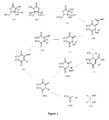
Figure 1 shows a retrosynthetic scheme of the sequence leading to the compounds of formula (Ia) and (Ib). - It has now been found that by following the synthetic sequence of the invention it is possible to obtain compounds of formula (Ia) and (Ib),including cinatrins C1 and C3, in a reduced number of steps and with a high yield. Said process has been made possible by means of using the new compounds of formula (II), (III), (V), (VI), (VII), (X), (XI) and (XIII).
- Therefore, a first aspect of the present invention relates to a process for the synthesis of a compound of formula (II), an intermediate in the synthesis of the compounds of formula (Ia) and (Ib), including cinatrins C1 and C3, their stereoisomers, or mixtures thereof, from a compound of formula (III).
- An additional aspect relates to the compounds of formula (III), an intermediate of the synthesis of the compounds of formula (Ia) and (Ib), their stereoisomers, or mixtures thereof, and to processes for obtaining them.
- Other aspects of the present invention relate to compounds of formula (V), (VI), (VII), (X), (XI) and (XIII), intermediates in the synthesis of the compounds of formula (Ia) and (Ib), their stereoisomers, or mixtures thereof.
- Another additional aspect relates to a process for obtaining the compounds of formula (Ia) and (Ib), their stereoisomers, or mixtures thereof, from a compound of formula (III).
- Another additional aspect relates to a process for obtaining a compound of formula (Ia), its stereoisomers, or mixtures thereof, from a compound of formula (III).
- Another additional aspect is aimed at a compound of formula (II) and to its use in the synthesis of the compounds of formula (Ia) or (Ib), their stereoisomers, or mixtures thereof.
- An additional aspect relates to the use of at least one compound of formula (III), (V), (VI), (VII), (X), (XI) and (XIII) for the synthesis of cinatrins C1 and C3, their stereoisomers, especially enantiomers, or mixtures thereof, as well as mixtures of cinatrins C1 and C3 or mixtures of their stereoisomers, especially enantiomers.
- According to a first aspect, the present invention is aimed at a process for obtaining a compound of formula (II), an immediate precursor of cinatrins C1 and C3,

- R2 is a C10-C15 alkyl group; and
- R3 and R5 are independently selected from a substituted or unsubstituted C1-C20 alkyl group;
- R2, R3 and R5 are as defined above; and
- R1 is selected from a substituted or unsubstituted C1-C20 alkyl group.
- Therefore, the process of the invention for obtaining the compounds of formula (II) first comprises a dihydroxylation of the carbon-carbon double bond of the compound of formula (III), followed by an intramolecular cyclization giving rise to the compound of formula (II). The stereochemistry of the dihydroxylation is directed by the hydroxyl in C3 of the compound of formula (III), therefore, depending on the stereochemistry in this carbon ((R) or (S)), different stereoisomers of the compounds of formula (Ia) and (Ib) can then be obtained. In other words, the stereoselective dihydroxylation and the subsequent cyclization are achieved in a single step. In any case, it is possible to invert the configuration of said hydroxyl by means of a Mitsunobu type reaction (for the specific case of inverting configuration of tertiary alcohols see Shi, Y. -J.; Hughes, D.L.; McNamara, J.M. Tetrahedron Lett. 2003, 44, 3609-3611; or Mukaiyama, T.; Shintou, T.; Fukumto, K. J. Am. Chem. Soc. 2003, 125, 10538-10539). Alternatively, if the compound of formula (III) is in racemic form, it will be possible to obtain the compounds of formula (Ia) and (Ib) in racemic form, being able to be used as such or separated into each of their enantiomers according to the methods which are common general knowledge.
- According to a preferred embodiment, the compound of formula (III) is a compound of formula (IIIa), or its enantiomers

and the compound of formula (II) obtained is a compound of formula (IIa), or its enantiomers
- The dihydroxylation reaction can be performed under conditions known by the skilled person, as described in Smith, M. B.; March, J. March's Advanced Organic Chemistry; John Wiley & Sons: New York, 2001. pp.: 1048-1051. According to a preferred embodiment, the dihydroxylation is performed in the presence of osmium tetroxide/N-methylmorpholine-N-oxide or potassium permanganate.
- As observed in
Figure 1 , the preparation of the compound of formula (III) can be carried out by means of two alternative routes. Thus, according to a preferred embodiment, the compound of formula (III) is prepared by - (a) reacting a compound of formula (V)

- R1, R2 and R3 are as defined above;

- R5 is as defined above;
- (b) oxidizing with a peroxide or with sodium periodate a compound of formula (VI)

- R1, R2, R3 and R5 are as defined above; and
- R6 is selected from the group formed by C1-C3 alkyl and phenyl.
- According to option a) the compound of formula (XII), a stabilized ylide, reacts with the compound of formula (V) to yield the compound of formula (III). Said stabilized ylide can be prepared according to known methods (Villa, M. J.; Warren, S. J. Chem. Soc. P. T 1 1994, 12, 1569-1572) or be commercially purchased. According to a preferred embodiment, said ylide is [(methoxycarbonyl)methylene]triphenylphosphorane. Following option b), the hydroxyl is introduced in C3 of the compound of formula (III) according to conditions known in the state of the art, for example with a peroxide, preferably hydrogen peroxide, or with sodium permanganate. Said introduction involves the sequence: (i) oxidation of the selenium atom, (ii) stereospecific 1,3-sigmatropic rearrangement, and (iii) release of the hydroxyl. For example, see Nishiyama, H.; Narimatsu, S.; Itoh, K. Tetrahedron Lett. 1981, 22, 5289-5292; or Werkhoven, T.M.; Nisper, R.; Lugtenburg, J. J. Eur. J. Org. Chem. 1999, 11, 2909-2914.
- According to a preferred embodiment, and following synthetic route b), the compound of formula (VI) is prepared by reacting a compound of formula (XIII)
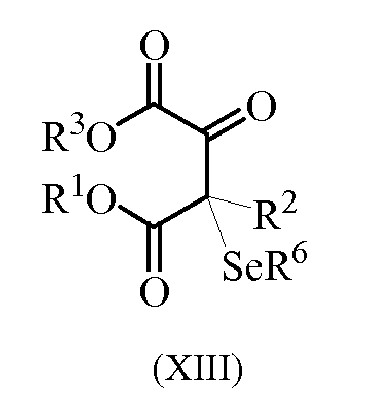
- R1, R2, R3 and R6 are as defined above;
- R5 is as defined above and R7 is a C1-C3 alkyl group.
- According to a preferred embodiment, said base is selected from the group formed by sodium hydride, lithium di-iso-propylamine, 1,8-diazabicyclo[5.4.0]undec-7-ene (DBU) and 1,5-diazabicyclo[4.3.0]non-5-ene (DBN), preferably sodium hydride. The phosphonate of formula (XIV) used is preferably methyl (dimethoxyphosphoryl)acetate.
- According to a preferred embodiment, the compound of formula (XIII) is prepared by reacting in the presence of a base a compound of formula (VII)

- R1, R2 and R3 are as defined above;
- R6 is as defined above, and
- X is a halogen selected from C1 and Br.
- Said base is preferably selected from the group formed by sodium hydride, a secondary amine such as morpholine, diethylamine, N-phthalimide or bis(trimethylsilyl)amides of alkali metals such as lithium (LiHMDS), sodium (NaHMDS) or potassium (KHMDS), preferably sodium hydride or morpholine.
- Phenylselenyl bromide (PhSeBr) is preferably used as compound of formula (XV).
- Said reaction can be carried out following methods known in the state of the art. For example, it is possible to add the compound of formula (XV) on a solution of sodium enolate generated from the compound of formula (VII) (see Smith, M. B.; March, J. March's Advanced Organic Chemistry; John Wiley&Sons: New York, 2001. pp.: 548-556.). Alternatively, it is possible to prepare a solution comprising an amine, for example morpholine, and the compound of formula (XV), and then add the compound of formula (VII) on said solution (see Boivin, S.; Outurquin, F.; Paulmier, C. Tetrahedron 1997, 53, 16767-16782.). According to a preferred embodiment, the base used is a chiral secondary amine, giving rise to an enantiomerically pure or enantiomerically enriched compound of formula (XIII). Therefore, known chiral secondary amines such as proline (see for example Vignola, N.; List, B. J. Am. Chem. Soc. 2004, 126, 450-451) allow obtaining the two enantiomers of the compounds of formula (XIII) or enantiomerically enriched mixtures thereof, and therefore the compounds of formula (VI), (III) and (II), and enantiomerically enriched or enantiomerically pure cinatrins C1 and C3.
- Therefore, according to route b), the compounds of formula (VI) can be prepared following a synthetic route which comprises
- (i) reacting a compound of formula (VII) with a compound of formula (XV) to obtain a compound of formula (XIII); and
- (ii) reacting said compound of formula (XIII), in the presence of a base, with a phosphonate of formula (XIV).
- Returning to route a) for obtaining the compounds of formula general (III), according to a preferred embodiment, the compound of formula (V) is prepared by reacting a compound capable of generating fluoride ions with a compound of formula (XI)

- R1, R2 and R3 are as defined above, and
- R4 is a trialkylsilyl group.
- As can be observed, the epoxide group in the compound of formula (XI) opens regioselectively to form a compound of formula (V). General regioselective opening methods are known in the art, such as those described in Pujol, B.; Sabatier, R.; Driguez, P. A.; Doutheau, A. Tetrahedron Lett. 1992, 33, 1447-1450.
- This opening is performed with a compound capable of generating fluoride ions. Preferably, the hydrofluoric acid-pyridine system, hydrofluoric acid in aqueous solution or a trihydrogen fluoride of formula NR3·3HF, wherein R is independently selected from the group consisting of hydrogen and C1-C8 alkyl, is used; more preferably, the compound used is triethylamine tris-hydrofluoride (Et3N·3HF).
- Each of the two enantiomers of the compounds of formula (V) can be obtained by means of the regiospecific opening of the suitable enantiomer of the compound of formula (XI), when the latter is prepared by means of asymmetric epoxidation. Alternatively, if the compound of formula (XI) is in racemic form, the compound of formula (V) will also be obtained in its racemic form, being able to be used as such or separated into each of its enantiomers according to the methods which are common general knowledge.
- According to a preferred embodiment, the compound of formula (XI) is obtained by reacting an epoxidizing agent with a compound of formula (X)

- R1, R2, R3 and R4 are as defined above.
- Non-limiting examples of conditions in which this transformation can be carried out can be found in, for example, a) Pujol, B.; Sabatier, R.; Driguez, P. A.; Doutheau, A. Tetrahedron Lett. 1992, 33, 1447-1450; or b) Lowinger, T. B.; Chu, J.; Spence, P. L. Tetrahedron Lett. 1995, 36, 8383-8386. It is also possible to find a general explanation about these reactions in the following references: (a) Smith, M. B.; March, J. March's Advanced Organic Chemistry; John Wiley & Sons: New York, 2001, pp. 1051-1054; (b) Davis, F. A.; Sheppard, A. C. J. Org. Chem. 1987, 52, 954-955; or (c) Dayan, S.; Bareket, Y.; Rozen, S. Tetrahedron 1999, 55, 3657-3664. According to a preferred embodiment, said epoxidizing agent is selected from the group consisting of m-CPBA, 2-sulfonyloxaziridines and the HOF·CH3CN complex; more preferably m-CPBA.
- As mentioned above, it is possible to perform the epoxidation of the compound of formula (X) in an asymmetric manner in order to obtain the compound of formula (XI) with an enantiomeric excess or in an enantiomerically pure manner, opening the route to compounds of formula (II), and therefore also to the compounds of formula (Ia) and (Ib), with an enantiomeric excess or in an enantiomerically pure manner.
- Therefore, the present invention also contemplates the methods for the asymmetric epoxidation of the compounds of formula (X) such as those described in the art by means of using chiral auxiliaries as described in Walkup, R. D.; Obeyesekere, N. U. J. Org. Chem. 1988, 53, 920-923; or by means of using chiral catalysts as described in Zhu, Y.; Tu, Y.; Yu, H.; Shi, Y. Tetrahedron Lett. 1998, 39, 7819-7822.
- According to a preferred embodiment, the compound of formula (X) is prepared by reacting a compound of formula (VII)

- R1, R2 and R3 are as defined above;
- Non-limiting examples of conditions under which this transformation can be carried out can be found in, for example, Dalla, V.; Catteau, J. P. Tetrahedron 1999, 55, 6497-6510, and the trialkylsilyl groups which can be used in this reaction, as well as reagents suitable for their introduction, are known for the person skilled in the art (for example see Greene, T. W.; Wuts, P. G. M. Greene's Protective Groups in Organic Synthesis; John Wiley & Sons: Hoboken, 2007. pp.: 189-196.
- According to a preferred embodiment, the trialkylsilyl group is selected from the group formed by trimethylsilyl, triethylsilyl, tri-iso-propylsilyl, dimethylisopropylsilyl, diethylisopropylsilyl, dimethylthexylsilyl, tert-butyldimethylsilyl and tert-butyldiphenylsilyl; and the preferred halides are selected from chlorine and iodine.
- The trialkylsilyl group is preferably tert-butyldimethylsilyl; and the preferred trialkylsilyl triflate is tert-butyldimethylsilyl trifluoromethanesulfonate.
- The reaction of the compounds of formula (VII) can give rise to two stereoisomers of the compounds of formula (X), according to the stereochemistry of the double bond in C2-C3 ((E) or (Z)). For the purposes of the present invention, it is irrelevant which of the two stereoisomers is formed. As has been mentioned above, it will be possible to invert the stereochemistry of the hydroxyl in the C3 position (for example, in compounds of (III) or (V)) by means of the Mitsunobu reaction, which allows obtaining any of the enantiomers of the compounds of formula (II), and therefore different stereoisomers of compounds of formula (Ia) and (Ib).
- Therefore, according to route a), the compounds of formula (V) can be prepared following the synthetic route which comprises:
- (i) reacting said compound of formula (VII) with a trialkylsilyl halide or with a trialkylsilyl triflate in the presence of a base to obtain a compound of formula (X);
- (ii) reacting said compound of formula (X) with an epoxidizing agent to obtain a compound of formula (XI); and
- (iii) reacting said compound of formula (XI) with a compound capable of generating fluoride ions.
- As can be seen, in both routes a) and b), the common intermediate is a compound of formula (VII). According to a preferred embodiment, the compound of formula (VII) is prepared by reacting in the presence of a base a compound of formula (VIII)

- R1 and R2 are as defined above;
- R3 is as defined above.
- According to a preferred embodiment, said base is an inorganic base. Non-limiting examples of conditions under which this transformation can be carried out can be found in, for example, Dubowchik, G. M.; Padilla, L.; Edinger, K.; Firestone, R. A. J. Org. Chem. 1996, 61, 4676-4684. According to a preferred embodiment, said base is sodium hydride.
- As mentioned above, the compounds of formula (Ia) and (Ib) can be prepared from the compounds of formula (III) by means of dihydroxylation followed by hydrolysis of the compound of formula (II) obtained in the presence of a base and subsequent acidification. Therefore, an additional aspect of the invention relates to a process for preparing compounds of formula (Ia) and (Ib), their stereoisomers, or mixtures thereof, or mixtures of the compounds of formula (Ia) and (Ib) or mixtures of their stereoisomers, which comprises
- (i) dihydroxylating the double bond of a compound of formula (III) to obtain a compound of formula (II), its stereoisomers, or mixtures thereof;
- (ii) hydrolyzing said compound of formula (II) in the presence of an alkali or alkaline earth metal hydroxide, or of an alkali or alkaline earth metal carbonate; and
- (iii) acidifying the reaction medium;
- As has been described throughout the present document, the synthesis of the compounds of formula (II), and therefore also of the compounds of formula (Ia) and (Ib), can be chiral by means of the synthesis of enantiomerically pure or enantiomerically enriched intermediates.
- Therefore, a preferred embodiment of the present invention comprises the preparation of compounds of formula (Ia') and (Ib'), or their enantiomers

- R2 is as defined above;
- As can be observed, the hydrolysis in basic medium and subsequent acidification (steps (ii) and (iii)) of the compounds of formula (II) involves the hydrolysis of the carboxy ester groups of which R3 and R5 form part to give rise to the corresponding carboxy acids. Therefore, in order to carry out the transformation indicated above it is necessary for the carboxy esters of which R3 and R5 form part to be labile in basic medium. Without wishing to be bound by theory, it seems that the step (ii) of the process for preparing compounds of formula (Ia) and/or (Ib) involves the formation of a triacid, the lactonization of the hydroxyl of the C2 position of which with the carboxy acid group of the C4 position (see route A in scheme 2) would generate a compound of formula (Ia). In addition, it seems that the acidic medium used in step (iii) must allow the formation of a tertiary carbocation, generated by means of the loss of the OH group of the C4 position of the triester provided by the acidic medium used (see route B in scheme 2). The subsequent cyclization of the carboxy acid group of the C2 position with said carbocation in the C4 position would generate a compound of formula (Ib).

- Suitable bases for the hydrolysis of carboxylic esters and for opening the ring in the compounds of formula (II) (step (i)) are known by the skilled person, such as lithium hydroxide, sodium hydroxide, potassium hydroxide, potassium carbonate, cesium carbonate, barium hydroxide.
- Any protic acid will allow closing the cycle to form cinatrins C1 and C3 (step (ii)), the acid used is preferably hydrochloric acid.
- Similar conditions for this reaction can be found in Cuzzupe, A. N.; Di Florio, R.; White, J. M.; Rizzacasa, M. A. Org. Biomol. Chem. 2003, 1, 3572-3577.
- Said process can give rise to mixtures of the corresponding compounds of formula (Ia) and (Ib), which can be separated into the corresponding essentially pure compounds by means of methods which are common general knowledge (for example, chromatographic column or recrystallization).
- Alternatively, it is possible to directly obtain the compounds of formula (Ia) from compounds of formula (II) and (III) without needing to form compounds of formula (Ib). This can be achieved by transforming the carboxy ester groups of which R3 and R5 form part into carboxy acid groups under conditions which do not give rise to the opening of the lactone and therefore under conditions which do not allow the formation of the aforementioned triacid (see Scheme 2), the origin of the formation of both compounds of formula (Ia) and of formula (Ib). Consequently, an additional aspect of the present invention is a process for preparing a compound of formula (Ia)


- Conditions under which it is possible to perform the transformation of step (ii) are generally those in which it is possible to transform the carboxy ester groups of which R3 and R5 form part into carboxy acid groups under conditions which do not given rise to the opening of the lactone. Carboxy ester groups which can be transformed into carboxy acid groups under non-basic conditions (for example, by hydrogenation or in acidic medium) are known for the person skilled in the art. Non-limiting examples are esters derived from p-methoxybenzyl, 1-phenyl-ethyl, or trityl.
- According to a preferred embodiment, R3 and R5 are benzyl groups (-(CH)2-phenyl). The hydrogenation of a compound of formula (II) wherein R3 and R5 are benzyl only provides a compound of formula (Ia), without significant amounts of compounds of formula (Ib) being obtained. For similar conditions, see for example the transformation of compound 20 into compound 14 in Evans, D. A.; Trotter, B. W.; Barrow, J. C. Tetrahedron 1997, 53, 8779-8794, incorporated in its entirety to the description of the present invention. According to another preferred embodiment, it is possible for the R3 and R5 groups to be labile in acidic medium. The acidification of the reaction medium removes said R3 and R5 groups to form the corresponding carboxy acids, without opening the lactone of the compound of formula (II), therefore providing a compound of formula (Ia), without the formation of significant amounts of a compound of formula (Ib) being observed. For example, if R3 and R5 are t-butyl, it is possible to obtain the corresponding carboxy acids in acidic medium (for example, with trifluoroacetic acid) without the ring being opened. For example, see the transformation of compound 19 into compound 13 in Evans, D. A.; Trotter, B. W.; Barrow, J. C. Tetrahedron 1997, 53, 8779-8794.
- According to a preferred embodiment, R2 is n-dodecyl. According to another preferred embodiment, R1 is a C1-C3 alkyl, preferably methyl. According to another preferred embodiment, R3 is a C1-C3 alkyl, preferably methyl. According to another preferred embodiment, R5 is a C1-C3 alkyl, preferably methyl.
- In view of what has been seen up until now, the compounds of formula (II) are intermediates in the synthesis of the present invention. Therefore, an additional aspect of the invention relates to a compound of formula (II)

- R2 is selected from a C10-C15 alkyl group;
- R3 and R5 are independently selected from a substituted or unsubstituted C1-C20 alkyl group;
- The use of the compounds of formula (II) defined above for the synthesis of compounds of formula (Ia) or (Ib), their stereoisomers, or mixtures thereof, as well as mixtures of compounds of formula (Ia) and (Ib) or mixtures of their stereoisomers, is also an aspect of the present invention.
- Other aspects of the present invention relate to compounds of formula (III), (V), (VI), (VII), (X), (XI) and (XIII), intermediates in the synthesis of the invention, their stereoisomers, or mixtures thereof.
- According to a preferred embodiment, R2 in the compounds of formula (III), (V), (VI), (VII), (X), (XI) and (XIII) is n-dodecyl. According to another preferred embodiment, R1 is methyl. According to another preferred embodiment, R3 is methyl. According to another preferred embodiment, R5 is methyl.
- The use of the compounds of formula (III), (V), (VI), (VII), (X), (XI) and (XIII) for the synthesis of compounds of formula (Ia) or (Ib), their stereoisomers, or mixtures thereof, as well as mixtures of compounds of formula (Ia) and (Ib) or mixtures of their stereoisomers, is also an aspect of the present invention.
- For the purpose of facilitating the understanding of the present invention, the meanings of several terms and expressions as they are used in the context of the invention are included herein.
- "Alkyl" refers to a radical with a linear or branched hydrocarbon chain which consists of carbon and hydrogen atoms, which does not contain unsaturations and which is attached to the rest of the molecule by means of a single bond. The number of carbon atoms of the alkyl group is specified in each case. For example, when "C1-C4 alkyl" is indicated it refers to an alkyl group of one, two, three of four carbon atoms, i.e., methyl, ethyl, propyl, isopropyl or n-butyl. For example, when "C10-C15 alkyl" is indicated it refers to an alkyl group of ten, eleven, twelve, thirteen, fourteen or fifteen carbon atoms, such as decyl, undecyl, dodecyl, tridecyl, tetradecyl or pentadecyl.
- "Halide" or "halogen" means-F, -Cl, -Br or -I;
- A "stereoisomer" in the present application refers to compounds formed by the same atoms attached by the same sequence of bonds but having different three-dimensional structures which are not interchangeable.
- "Enantiomer" is understood as the mirror image of a stereoisomerically pure compound. For the purposes of the invention, an enantiomer can be considered as a mixture of two enantiomers having an enantiomeric excess greater than 95%, preferably
- greater than 98%, more preferably greater than 99%, more preferably greater than 99.5%.
- "Bn" means benzyl (-(CH2)-phenyl).
- "Trialkylsilyl" is understood as a radical of formula -Si(R')(R")R"', wherein each of R', R" and R"' are independently selected from among a phenyl group and a C1-C6 alkyl group. Non-limiting examples of trialkylsilyl groups can be trimethylsilyl, triethylsilyl, tri-iso-propylsilyl; dimethylisopropylsilyl, diethylisopropylsilyl, dimethylthexylsilyl, tert-butyldimethylsilyl, tert-butyldiphenylsilyl.
- The references of the present document to substituted groups in the compounds of the present invention refer to the specified moiety which can be substituted in one, two or three available positions with one, two, three suitable groups, which are independently selected from the group consisting of cyano; alkanoyl, such as a C1-C6 alkanoyl group, such as acyl and the like; carboxamido (-(C=O)NH2); trialkylsilyl; carbocyclic aryl having 6 or more carbons, particularly phenyl or naphthyl and (C1-C3)alkylaryl such as tolyl. As a non-limiting example, "substituted alkyl" includes groups such as cyanoethyl, acetylmethyl, carboxamidomethyl (-CH2CONH2), 2-trimethylsilylethyl, benzyl, diphenylmethyl.
- "Aryl" refers to a C6-C14 aromatic hydrocarbon radical such as phenyl, naphthyl or anthracyl.
- Unless otherwise indicated, the compounds of the invention also refer to those including compounds which differ only in the presence of one or more isotopically enriched atoms. For example, the compounds having the present structures, with the exception of the substitution of a hydrogen with a deuterium or with tritium, or the substitution of a carbon with a 13C- or 14C-enriched carbon, are within the scope of this invention.
- The following examples illustrate different embodiments of the invention and must not be considered as limiting the scope thereof.
- All the reactions were performed under an argon atmosphere, except those indicated in each case. The solvents used were distilled and dried under an argon atmosphere. The reagents and solvents used are from the companies Aldrich, Fluka, Merck, Sigma, Acros, Lancaster, SDS or Scharlau, and were purified by usual processes when necessary. The purification of the reaction products was performed by column chromatography under pressure (flash chromatography), using 60 Merck silica gel (with a 230-400 mesh particle size) as a stationary phase.
- The (fully decoupled) 1H and 13C nuclear magnetic resonance spectra were performed at room temperature in the solvent indicated in each case (CDCl3 and CD3OD) using the following apparatuses: Varian Gemini-200 (200 MHz), Varian INOVA-300 (300 MHz), Bruker Avance-300 (300 MHz) and Varian INOVA-400 (400 MHz). The values of the chemical shifts are expressed in parts per million (δ, ppm), using as an internal reference the residual signal of the solvent: CDCl3, 7.26 ppm (1H-NMR) and 77.0 ppm (13C-NMR); CD3OD, 3.31 ppm (1H-NMR) and 49.0 ppm (13C-NMR). The 1H-NMR spectra are described indicating the number of protons and the apparent multiplicity of each signal. The coupling constants (J) are the apparent ones and are expressed in Hz. The following abbreviations have been used: s (singlet), d (doublet), t (triplet), c (quadruplet), q (quintuplet) and m (multiplet).
- The melting points (m.p.) were measured in a Reichert brand Kofler microscope. The infrared (IR) spectra were recorded in the Perkin-Elmer spectrophotometer models 681 and FT-IR Spectrum One. The low resolution mass spectra (LRMS) were recorded: (1) by direct injection of the sample into a Hewlett Packard 5973 MSD spectrophotometer using the electron impact (EI) ionization technique; or (2) in a Hewlett Packard LCMS 1100 MSD spectrophotometer (an HPLC-coupled quadrupole analyzer) using the electrospray chemical ionization technique (API-ES) in positive or negative modes. The elemental analyses (E.A.) were performed with the Perkin-Elmer 240C and Heraus CHN-O-Rapid analyzers.
- Unless otherwise indicated, all the products shown in the examples are racemic (rac).
-

- MeOH (0.5 ml) was added at 0°C to a suspension ofNaH (1.08 g, 45.3 mmoles) in THF (19.5 ml). The mixture was stirred until it reached room temperature. Then, methyl myristate (10 g, 41.2 mmoles) and dimethyl oxalate (4.87 g, 41.2 mmoles) were added. The resulting mixture was heated under reflux for 3 hours. After that time, H2O (19 ml) was added at 0°C and the mixture was neutralized with an aqueous solution of 10% HCl. The phases were separated, and the aqueous phase was extracted with AcOEt (3×10 ml). The organic phase was dried with anhydrous Na2SO4, filtered and the solvent was removed under reduced pressure. The product was purified by a chromatographic column (hexane/AcOEt, 20:1), obtaining (8.61 g, yield 64%) methyl rac-(S)-3-(methoxycarbonyl)-2-oxopentadecanoate, as a transparent oil.
1H-NMR (300 MHz, CDCl3). δ 4.01 (1H, t, J= 6.9 Hz, H-3), 3.88 (3H, s, -OCH3), 3.71 (3H, s, -OCH3), 1.88 (2H, m, H-4), 1.24 (20H, m, -CH2-), 0.86 (3H, m, -CH3). -

- TBDMSOTf (1.84 g, 6.96 mmoles) was added at 0°C to a solution of methyl rac-(S)-3-(methoxycarbonyl)-2-oxopentadecanoate (1.90 g, 5.80 mmoles) and Et3N (1.17 g, 11.6 mmoles) in CH2Cl2 (48 ml). The mixture was stirred at room temperature for 24 hours. After that time, the solvent was removed under reduced pressure. The product was purified by a chromatographic column (hexane/AcOEt, 12:1), obtaining (2.09 g, yield 82%) methyl 2-(tert-butyldimethylsilyloxy)-3-(methoxycarbonyl)-2-pentadecenoate, as a transparent oil.
IR (NaCl): v 3388, 2943, 2927, 2854, 1738, 1716, 1627, 1432, 1310, 1204, 1129, 1097, 840, 811, 784 cm-1.
1H-NMR (300 MHz, CDCl13). δ 3.79 (3H, s, -OCH3), 3.71 (3H, s, -OCH3), 2.29 (2H, m, -CH2-), 1.32 (20H, m, -CH2-), 0.94 (9H, s, tert-BuSi), 0.87 (3H, m, -CH3), 0.17 (6H, s, (CH3)2Si).
13C-NMR (75 MHz, CDCl3). δ 182.3, 168.6, 165.8, 118.2, 52.2, 51.7, 31.9, 29.6, 29.5, 29.4, 29.3, 28.2, 26.0, 25.4, 22.6, 18.3, 14.1, -4.6.
LRMS(EI): m/z 442(M+, 0), 441(M+-1, 1), 427(3), 411(3), 385(100).
E.A. (C24H46O5Si): Found: C, 65.00, H, 10.50; Calculated: C, 65.11, H, 10.47. -

IR (NaCl): v 3389, 2952, 2928, 2856, 1758, 1462, 1440, 1401, 1362, 1307, 1255, 1199, 1165, 1100, 1004, 843, 785 cm-1.
1H-NMR (300 MHz, CDCl3). δ 3.76 (3H, s, -OCH3), 3.75 (3H, s, -OCH3), 2.07 (1H, m, H-4), 1.78 (1H, m, H-4), 1.46 (2H, m, H-5), 1.24 (18H, Sbroad, -CH2-), 0.91 (9H, s, tert-BuSi), 0.87 (3H, m, -CH3), 0.20 (3H, s, (CH3)2Si), 0.15 (3H, s, (CH3)2Si).
13C-NMR (75 MHz, CDCl3). δ 168.1, 166.4, 82.0, 68.0, 52.8, 52.4, 31.8, 29.5, 29.5, 29.4, 29.3, 29.3, 28.1, 25.3, 24.4, 22.6, 17.9, 14.0, -4.0, -4.6.
LRMS(EI): m/z 458(M+, 0), 443(2), 427(0), 401(66), 399(9), 341(10), 313(3), 281(2), 233(100).
E.A. (C24H46O6Si): Found: C, 63.00, H, 10.00; Calculated: C, 62.84, H, 10.11. -

IR (NaCl): v 3473, 2955, 2925, 2854, 1740, 1438, 1259, 1138, 1074 cm-1.
1H-NMR (300 MHz, CDCl3). δ 3.87 (3H, s, -OCH3), 3.84 (3H, s, -OCH3), 1.95 (2H, m, H-4), 1.24 (20H, Sbroad, -CH2-), 0.87 (3H, t, J= 6.5 Hz, -CH3).
13C-NMR (75 MHz, CDCl3). δ 188.5, 170.7, 162.0, 80.5, 53.6, 53.0, 33.9, 31.8, 29.5, 29.5, 29.5, 29.4, 29.2, 22.6, 22.4, 14.0.
LRMS(EI): m/z 345(M++1,0), 313(1), 286(0), 257(14), 225(0), 197(100). -

IR (NaCl): v 3494, 2925, 2854, 1733, 1646, 1436, 1349, 1256, 1199, 1168, 1019 cm-1.
1H-NMR (300 MHz, CDCl3). δ 6.26 (1H, s, H-2), 3.80 (3H, s, -OCH3), 3.80 (3H, s, - OCH3), 3.71 (3H, s, -OCH3), 3.67 (1H, s, -OH), 1.91 (2H, m, -CH2-), 2.43 (2H, m, - CH2-), 1.22 (18H, m, -CH2-), 0.85 (3H, t, J = 6.8 Hz, -CH3).
13C-NMR (75 MHz, CDCl3). δ 173.0, 166.8, 164.9, 151.0, 120.3, 77.7, 53.6, 52.4, 52.0, 37.5, 31.8, 31.5, 29.5, 29.5, 29.4, 29.3, 29.3, 29.2, 23.1, 22.6, 14.0.
LRMS(EI): m/z 401(M++1,3), 383(1), 369(8), 341(28), 309(100), 249(18), 197(18).
E.A. (C21H36O7): Found: C, 63.00, H, 9.00; Calculated: C, 62.98, H, 9.06. -

1H-NMR (200MHz, CDCl3). δ 8.00-7.60 (15H, m, Ar-H), 5.62 (1H, d, JP,H = 15.5 Hz, H-1), 3.61 (3H, s, -OCH3). - An aqueous solution of 1.15 N NaOH (60 ml) was added at room temperature to a solution of [(methoxycarbonyl)methyl]triphenylphosphonium bromide (14.3 g, 34.6 mmoles, 1 eq.), obtained previously, in CH2Cl2 (90 ml). The resulting mixture was stirred vigorously at room temperature for 2 hours. After that time, the phases were separated. The aqueous phase was extracted with CH2Cl2 (3 × 10 ml). The organic phase was dried with anhydrous MgSO4, filtered and the solvent was removed under reduced pressure, obtaining (10.5 g, yield 90%) [(methoxycarbonyl)methylene]-triphenylphosphorane as a white solid.
1H-NMR (200MHz, CDCl3). δ 7.61 (15H, m, Ar-H), 5.62 (1H, m, H-1), 3.50 (3H, s, - OCH3). -

- A solution of methyl rac-(S)-3-(methoxycarbonyl)-2-oxopentadecanoate (6 g, 18.26 mmoles) in THF (17 ml) was added to a suspension of NaH (0.482 g, 20.09 mmoles) in THF (34 ml). The mixture was stirred at room temperature until H2 was no longer evolved (10 minutes). Then, the mixture was cooled at 0°C and a solution of BrSePh (4.74 g, 20.09 mmoles) in THF (17 ml) was added. The resulting mixture was stirred at room temperature for 24 hours. After that time, H2O (50 ml) was added. The phases were separated, and the aqueous phase was extracted with AcOEt (3 × 30 ml). The organic phase was dried with anhydrous Na2SO4, filtered and the solvent was removed under reduced pressure. The product was purified by a chromatographic column (hexane/AcOEt, 10:1), obtaining (5.63 g, yield 65%) methyl rac-(R)-3-(phenylselenyl)-3-(methoxycarbonyl)-2-oxopentadecanoate, as a brown oil.
-
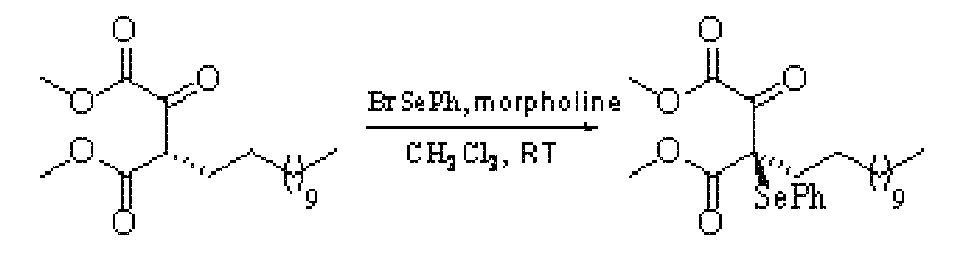
IR (NaCl): v 3057, 2925, 2854, 1736, 1713, 1577, 1438, 1299, 1232, 1129, 1064, 1020, 999, 743, 692 cm-1.
1H-NMR (200 MHz, CDCl3). δ 7.36 (5H, m, Ar-H), 3.95 (3H, s, -OCH3), 3.81 (3H, s, - OCH3), 1.70 (2H, m, -CH2-), 1.43-1.24 (20H, m, -CH2-), 0.88 (3H, m, -CH3).
13C-NMR (50 MHz, CDCl3). δ 179.6, 168.3, 161.2, 137.8, 130.1, 129.3, 129.0, 124.6, 64.9, 53.3, 53.2, 31.6, 30.7, 29.2, 29.0, 27.0, 25.4, 24.6, 24.3, 22.5, 22.2, 20.8, 14.0.
LRMS(EI) : m/z 484(M++1,96), 426(3), 397(100), 365(60), 337(50), 269(14), 235(12), 157(55).
E.A. (C24H36O5Se): Found: C, 59.70, H, 7.30; Calculated: C, 59.62, H, 7.50. -

- A solution of methyl (dimethoxyphosphoryl)acetate (2.33 g, 12.8 mmoles) in THF (8 ml) was added to a suspension ofNaH (0.307 g, 12.8 mmoles) in THF (91 ml). The mixture was stirred at room temperature until H2 was no longer evolved (10 minutes). Then, a solution of methyl rac-(R)-3-(phenylselenyl)-3-(methoxycarbonyl)-2-oxopentadecanoate (5.63 g, 11.64 mmoles) in THF (8 ml) was added. The resulting mixture was stirred at room temperature for 24 hours. After that time, the solvent was removed under reduced pressure. The product was purified by a chromatographic column (hexane/AcOEt, 15:1), obtaining (4.53 g, yield 72%) a mixture in a 5:2 ratio of methyl rac-(E,R)-2-(phenylselenyl)-3,4-bis(methoxycarbonyl)-3-hexadecenoate (trans, 51%) and methyl (Z)-3,4-bis(methoxycarbonyl)-3-hexadecenoate ( cis, 21%), as a brown oil.
IR (NaCl): v 2925, 2854, 1733, 1632, 1577, 1458, 1435, 1313, 1268, 1199, 1158, 1125, 1075, 1001, 742, 693 cm-1.
1H-NMR (200 MHz, CDCl3). δ 7.39 (5H, m, Ar-H trans), 4.64 (1H, s, H-2 trans), 3.71 (3H, s, -OCH3 cis), 3.69 (3H, s, -OCH3 trans), 3.68 (3H, s, -OCH3 trans), 3.67 (3H, s, - OCH3 trans), 3.65 (3H, s, -OCH3 cis), 3.61 (3H, s, -OCH3 cis), 3.33 (2H, s, H-2 cis), 2.23 (2H, m, H-5 cis), 1.83 (2H, m, H-5 trans), 1.13 (20H, m, -CH2- trans, cis), 1.17 (20H, m, -CH2- trans, cis), 0.79 (3H, m, -CH3 trans), 0.76 (3H, m, -CH3 cis).
13C-NMR (50 MHz, CDCl3). δ 169.9, 169.0, 166.2, 146.1, 143.1, 136.1, 129.8, 129.0, 128.8, 125.2, 52.9, 52.2, 52.1, 43.2, 33.5, 31.7, 31.2, 30.4, 29.4, 29.4, 29.3, 29.1, 29.1, 29.0, 27.3, 22.5, 20.8, 14.0, 13.9.
LRMS(EI): m/z 540(M++1,6), 508(33), 383(12), 351(100), 291(8), 197(25). -

- An aqueous solution of 33% H2O2 (5.99 ml) was added to a solution of methyl rac-(E,R)-2-(phenylselenyl)-3,4-bis(methoxycarbonyl)-3-hexadecenoate ( trans ) (4.53 g, 8.39 mmoles) and pyridine (1.32 g, 16.79 mmoles) in CH2Cl2 (70 ml). The mixture was stirred at room temperature for 24 hours. After that time, the solvent was removed under reduced pressure. The residue was dissolved in AcOEt (30 ml), and H2O (30 ml) was added. The phases were separated, and the aqueous phase was extracted with AcOEt (3 × 10 ml). The organic phase was dried with anhydrous Na2SO4, filtered and the solvent was removed under reduced pressure. The product was purified by a chromatographic column (hexane/AcOEt, 10:1), obtaining (2.2 g, yield 65%) methyl rac-(Z,R)-4-hydroxy-3,4-bis(methoxycarbonyl)-2-hexadecenoate as a colorless oil.
IR (NaCl): v 3494, 2925, 2854, 1733, 1646, 1436, 1349, 1256, 1199, 1168, 1019 cm-1.
1H-NMR (300 MHz, CDCl3). δ 6.26 (1H, s, H-2), 3.80 (3H, s, -OCH3), 3.80 (3H, s, - OCH3), 3.71 (3H, s, -OCH3), 3.67 (1H, s, -OH), 1.91 (2H, m, -CH2-), 2.43 (2H, m, - CH2-), 1.22 (18H, m, -CH2-), 0.85 (3H, t, J = 6.8 Hz, -CH3).
13C-NMR (75 MHz, CDCl3). δ 173.0, 166.8, 164.9, 151.0, 120.3, 77.7, 53.6, 52.4, 52.0, 37.5, 31.8, 31.5, 29.5, 29.5, 29.4, 29.3, 29.3, 29.2, 23.1, 22.6, 14.0.
LRMS(EI): m/z 401(M++1,3), 383(1), 369(8), 341(28), 309(100), 249(18), 197(18).
E.A. (C21H36O7): Found: C, 63.00, H, 9.00; Calculated: C, 62.98, H, 9.06. -
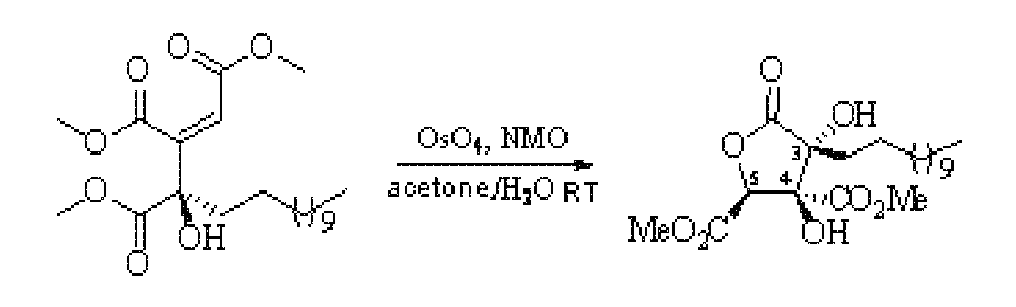
- NMO (1.21 g, 9.99 mmoles) and OsO4 (2.5% in tert-BuOH, 0.019 g, 0.075 mmoles) were added to a solution of methyl rac-(Z,R)-4-hydroxy-3,4-bis(methoxycarbonyl)-2-hexadecenoate (1 g, 2.50 mmoles) in a 5:1 acetone/H2O mixture (10.2 ml). The mixture was stirred at room temperature for 2 days. After that time, an aqueous solution of 10% Na2S2O3 (0.2 ml) was added. The mixture was filtered through silica gel with MeOH and the solvent was removed under reduced pressure. The product was purified by a chromatographic column (hexane/AcOEt, 3:1), obtaining (0.670 g, yield 67%) rac-(3R,4S,5S)-3,4-dihydroxy-3-dodecyl-4,5-bis(methoxycarbonyl)tetrahydro-2-furanone (IV) as a white solid.
m.p.: 74-76°C
IR (KBr): v 3400, 3339, 2956, 2918, 2851, 1785, 1775, 1714, 1467, 1445, 1364, 1307, 1226, 1155, 1133, 1061 cm-1.
1H-NMR (200 MHz, CDCl3). δ 5.21 (1H, s, H-5), 3.87 (3H, s, -OCH3), 3.78 (3H, s, - OCH3), 3.56 (1H, Sbroad, -OH), 2.90 (1H, Sbroad, -OH), 1.80 (2H, m, H-6), 1.21 (20H, Sbroad, -CH2-), 0.83 (3H, m, -CH3).
1H-NMR (300 MHz, DMSO-d6 ). δ 6.74 (1H, s, -OH), 6.41 (1H, s, -OH), 5.50 (1H, s, H-5), 3.72 (3H, s, -OCH3), 3.65 (3H, s, -OCH3), 1.68 (2H, m, H-6), 1.39 (2H, m, H-7), 1.23 (18H, Sbroad, -CH2-), 0.84 (3H, m, -CH3).
13C-NMR (50 MHz, CDCl3). δ 173.9, 170.6, 166.4, 81.0, 78.5, 54.0, 52.7, 31.7, 29.6, 29.5, 29.4, 29.2, 29.2, 22.5, 21.5, 13.9.
LRMS(EI): m/z 402(M+, 0), 315(2), 285(2), 234(2), 216(0), 197(11), 160(30), 101 (100).
E.A. (C20H34O8): Found: C, 59.70, H, 8.50; Calculated: C, 59.68, H, 8.51. -

- An aqueous solution of 1N LiOH (0.104 g, 2.48 mmoles, 2.5 ml) was added to a solution of rac-(3R,4S,5S)-3,4-dihydroxy-3-dodecyl-4,5-bis(methoxycarbonyl)tetrahydro-2-furanone (IV) (0.050 g, 0.12 mmoles) in THF (5 ml). The mixture was stirred at room temperature for 2 hours. After that time, the phases were separated. The aqueous phase was washed with AcOEt (2 × 2 ml), treated with an aqueous solution of 10% HCl (until acidic pH) and extracted with AcOEt (3 × 3 ml). The extracts were dried with anhydrous Na2SO4, filtered and the solvent was removed under reduced pressure, obtaining (0.026 g, yield 56%) a mixture in a 1:1 ratio of rac-(3R,4S,5S)-3,4-dihydroxy-3-dodecyl-4,5-dicarboxytetrahydro-2-furanone (Cinatrin C3) and rac-(3S,4S,5R)-3,4-dihydroxy-5-dodecyl-4,5-dicarboxytetrahydro-2-furanone (Cinatrin C1) as a white solid.
1H-NMR (300 MHz, CD3OD). δ 5.39 (1H, s, H-5, Cinatrin C3), 4.70 (1H, s, H-3 Cinatrin C1), 2.16 (1H, m, H-6 Cinatrin C1), 1.82 (2H, m, H-6 Cinatrin C3), 1.68 (1H, m, H-6 Cinatrin C1), 1.50 (1H, m, H-7 Cinatrin C1), 1.46 (2H, m, H-7 Cinatrin C3), 1.36 (1H, m, H-7 Cinatrin C1), 1.29 (18H, Sbroad, -CH2- Cinatrin C3, Cinatrin C1), 0.88 (3H, m, -CH3 Cinatrin C3, Cinatrin C1).
13C-NMR (75 MHz, CD3OD). Cinatrin C3: δ 176.8, 172.6, 170.3, 82.1, 81.2, 80.8, 33.2, 32.1, 31.4, 30.8, 30.7, 30.5, 30.4, 23.6, 22.6, 14.5; Cinatrin C1: δ 175.8, 172.0, 88.6, 85.7, 74.8, 33.4, 32.3, 31.6, 30.5, 30.4, 30.3, 30.1, 23.8, 22.4, 14.3.
LRMS(EI): m/z 374(M+, 0), 355(1), 331(1), 297(3), 267(3), 249(3), 207(5), 197(93), 57(100).
which process comprises dihydroxylating the double bond of a compound of formula (III)

wherein

R6SeX (XV)
wherein

with the proviso that the compound of formula (II) is not

Claims (23)
- A process for obtaining a compound of formula (II)
 R2 is aC10-C15 alkyl group; andR3 and R5 are independently selected from a substituted or unsubstituted C1-C20 alkyl group;its stereoisomers, or mixtures thereof;
which process comprises dihydroxylating the double bond of a compound of formula (III) R2, R3 and R5 have the previously mentioned meaning; andR1 is selected from a substituted or unsubstituted C1-C20 alkyl group.
 - The process according to claim 1, wherein the compound of formula (III) is a compound of formula (IIIa), or its enantiomers

and the compound of formula (II) obtained is a compound of formula (IIa), or its enantiomers
- The process according to any of the previous claims, wherein the dihydroxylation is performed in the presence of osmium tetroxide/N-methylmorpholine-N-oxide or potassium permanganate.
- A compound of formula (III)
 R1, R3 and R5 are independently selected from a substituted or unsubstituted C1-C20 alkyl group; andR2 is selected from a C10-C15 alkyl group;its stereoisomers, or mixtures thereof.
 - A process for the synthesis of a compound of formula (III)
 R1, R3 and R5 are independently selected from a substituted or unsubstituted C1-C20 alkyl group; andR2 is a C10-C15 alkyl group;its stereoisomers, or mixtures thereof;
which comprises(a) reacting a compound of formula (V) R1, R2 and R3 are as defined above;in the presence of a compound of formula (XII)
 R5 is as defined above;or(b) oxidizing with a peroxide or with sodium periodate a compound of formula (VI)
 R1, R2, R3 and R5 are as defined above; andR6 is selected from the group formed by C1-C3 alkyl and phenyl.
 - The process according to claim 5, wherein the compound of formula (VI) is prepared by(i) reacting in the presence of a base a compound of formula (VII)
 R1, R2 and R3 are defined as in claim 5;with a compound of formula (XV)
R6SeX (XV)
whereinR6 is defined as in claim 5; andX is a halogen selected from Cl and Br;to obtain a compound of formula (XIII) R1, R2, R3 and R6 are defined as in claim 5; and(ii) reacting said compound of formula (XIII) in the presence of a base with a phosphonate of formula (XIV)
 R5 is defined as in claim 5; andR7 is a C1-C3 alkyl group.
 - The process according to claim 5, wherein the compound of formula (V) is prepared by(i) reacting a compound of formula (VII)
 R1, R2 and R3 are defined as in claim 5;with a trialkylsilyl halide or with a trialkylsilyl triflate in the presence of a base to obtain a compound of formula (X)
 R1, R2 and R3 are defined as in claim 5; andR4 is a trialkylsilyl group;(ii) reacting said compound of formula (X) with an epoxidizing agent to obtain a compound of formula (XI)
 R1, R2 and R3 are defined as in claim 5; andR4 is as defined above; and(iii) reacting said compound of formula (XI) with a compound capable of generating fluoride ions.
 - The process according to claim 7, wherein said epoxidizing agent is selected from the group formed by 3-chloroperoxybenzoic acid, 2-sulfonyloxaziridines and the HOF·CH3CN complex.
- The process according to claim 7, wherein the epoxidation is asymmetric.
- The process according to any of claims 6-9, wherein the compound of formula (VII) is prepared by reacting in the presence of a base a compound of formula (VIII)
 R1 and R2 are defined as in claim 6;with an oxalic acid diester of formula (IX)
 R3 is defined as in claim 6.
 - A compound of formula (V)
 R1 and R3 are independently selected from a substituted or unsubstituted C1-C20 alkyl group; andR2 is selected from a C10-C15 alkyl group;its stereoisomers, or mixtures thereof.
 - A compound of formula (XI)
 R1 and R3 are independently selected from a substituted or unsubstituted C1-C20 alkyl group;R2 is selected from a C10-C15 alkyl group; andR4 is a trialkylsilyl group;its stereoisomers, or mixtures thereof.
 - A compound of formula (X)
 R1 and R3 are independently selected from a substituted or unsubstituted C1-C20 alkyl group;R2 is selected from a C10-C15 alkyl group; andR4 is a trialkylsilyl groupits stereoisomers or mixtures thereof.
 - A compound of formula (VI)
 R1, R3 and R5 are independently selected from a substituted or unsubstituted C1-C20 alkyl group;R2 is selected from a C10-C15 alkyl group; andR6 is selected from the group formed by C1-C3 alkyl and phenyl;its stereoisomers, or mixtures thereof.
 - A compound of formula (XIII)
 R1 and R3 are independently selected from a substituted or unsubstituted C1-C20 alkyl group;R2 is selected from a C10-C15 alkyl group; andR6 is selected from the group formed by C1-C3 alkyl and phenyl;its stereoisomers, or mixtures thereof.
 - A compound of formula (VII)
 R1 and R3 are independently selected from a substituted or unsubstituted C1-C20 alkyl group; andR2 is selected from a C10-C15 alkyl group;its stereoisomers, or mixtures thereof.
 - The compound according to any one of claims 11 to 16, wherein R1 = R3 = Me and R2 = n-dodecyl.
- A process for preparing compounds of formula (Ia) and/or (Ib)
 R2 is a C10-C15 alkyl group;their stereoisomers, or mixtures thereof, or mixtures of the compounds of formula (Ia) and (Ib) or mixtures of their stereoisomers,
which comprises(i) dihydroxylating the double bond of a compound of formula (III) R1 is selected from a substituted or unsubstituted C1-C20 alkyl group;R2 is as defined above; andR3 and R5 are independently selected from a substituted or unsubstituted C1-C20 alkyl group;to obtain a compound of formula (II)
 R2, R3 and R5 are as defined above;its stereoisomers, or mixtures thereof;(ii) hydrolyzing said compound of formula (II) in the presence of an alkali or alkaline earth metal hydroxide, or of an alkali or alkaline earth metal carbonate; and(iii) acidifying the reaction medium;
wherein the R3 and R5 groups are labile under the basic conditions of step (ii). - The process according to claim 18, for preparing compounds of formula (Ia') and (Ib'), or their enantiomers
 R2 is as defined in claim 18;the compound of formula (III) is a compound of formula (IIIa), or its enantiomers
the compound of formula (II) is a compound of formula (IIa), or its enantiomers
- A process for preparing a compound of formula (Ia)
 R2 is a C10-C15 alkyl group;its stereoisomers, or mixtures thereof,
which comprises(i) dihydroxylating the double bond of a compound of formula (III) R1 is selected from a substituted or unsubstituted C1-C20 alkyl group;R2 is as defined above; andR3 and R5 are independently selected from a substituted or unsubstituted C1-C20 alkyl group;to obtain a compound of formula (II)
 R2, R3 and R5 are as defined above;its stereoisomers, or mixtures thereof; and(ii) transforming under non-basic conditions the carboxy ester groups of the lactone ring of the compound of formula (II) to obtain the corresponding carboxy acid groups.
 - A compound of formula (II)
 R2 is selected from a C10-C15 s alkyl group;R3 and R5 are independently selected from a substituted or unsubstituted C1-C20 alkyl group;its stereoisomers, especially enantiomers, or mixtures thereof;
with the proviso that the compound of formula (II) is not
- Use of a compound of formula (II) as defined in claim 21, for the synthesis of compounds of formula (Ia) and/or (Ib), their stereoisomers, or mixtures thereof, as well as mixtures of compounds of formula (Ia) and (Ib) or mixtures of their stereoisomers.
- Use of at least one compound of formula (III), (V), (VI), (VII), (X), (XI) and (XIII) as defined in the previous claims for the synthesis of compounds of formula (Ia) and/or (Ib), their stereoisomers, or mixtures thereof, as well as mixtures of compounds of formula (Ia) and (Ib) or mixtures of their stereoisomers.
Applications Claiming Priority (2)
| Application Number | Priority Date | Filing Date | Title |
|---|---|---|---|
| ES200801305A ES2328214B1 (en) | 2008-05-06 | 2008-05-06 | PROCEDURE FOR OBTAINING CINATRINES C3 AND C1. |
| PCT/ES2009/070139 WO2009135978A1 (en) | 2008-05-06 | 2009-05-05 | Method for obtaining cinatrins c3 and c1 |
Publications (2)
| Publication Number | Publication Date |
|---|---|
| EP2287157A1 true EP2287157A1 (en) | 2011-02-23 |
| EP2287157A4 EP2287157A4 (en) | 2011-08-31 |
Family
ID=41226503
Family Applications (1)
| Application Number | Title | Priority Date | Filing Date |
|---|---|---|---|
| EP09742184A Withdrawn EP2287157A4 (en) | 2008-05-06 | 2009-05-05 | PROCESS FOR OBTAINING CINATRINE C3 AND C1 |
Country Status (7)
| Country | Link |
|---|---|
| US (1) | US20110275838A1 (en) |
| EP (1) | EP2287157A4 (en) |
| JP (1) | JP2011523631A (en) |
| CN (1) | CN102066350A (en) |
| AU (1) | AU2009245668A1 (en) |
| ES (1) | ES2328214B1 (en) |
| WO (1) | WO2009135978A1 (en) |
Families Citing this family (3)
| Publication number | Priority date | Publication date | Assignee | Title |
|---|---|---|---|---|
| CN102503825A (en) * | 2011-11-11 | 2012-06-20 | 上海华谊(集团)公司 | Preparation method of medicine intermediate butanone diacid diester compound |
| CN115141199B (en) * | 2022-06-28 | 2023-04-07 | 江西师范大学 | Novel method for synthesizing rutaecarpine |
| CN116354907B (en) * | 2023-04-12 | 2026-01-09 | 智仑新材料科技(西安)有限公司 | A fluorinated epoxy resin, its preparation method, and its applications |
Family Cites Families (1)
| Publication number | Priority date | Publication date | Assignee | Title |
|---|---|---|---|---|
| JPH03108490A (en) | 1989-06-30 | 1991-05-08 | Shionogi & Co Ltd | Phospholipase a2 inhibitor |
-
2008
- 2008-05-06 ES ES200801305A patent/ES2328214B1/en not_active Expired - Fee Related
-
2009
- 2009-05-05 JP JP2011507950A patent/JP2011523631A/en not_active Withdrawn
- 2009-05-05 AU AU2009245668A patent/AU2009245668A1/en not_active Abandoned
- 2009-05-05 EP EP09742184A patent/EP2287157A4/en not_active Withdrawn
- 2009-05-05 US US12/991,523 patent/US20110275838A1/en not_active Abandoned
- 2009-05-05 CN CN2009801240480A patent/CN102066350A/en active Pending
- 2009-05-05 WO PCT/ES2009/070139 patent/WO2009135978A1/en not_active Ceased
Non-Patent Citations (2)
| Title |
|---|
| No further relevant documents disclosed * |
| See also references of WO2009135978A1 * |
Also Published As
| Publication number | Publication date |
|---|---|
| US20110275838A1 (en) | 2011-11-10 |
| ES2328214A1 (en) | 2009-11-10 |
| WO2009135978A1 (en) | 2009-11-12 |
| CN102066350A (en) | 2011-05-18 |
| AU2009245668A1 (en) | 2009-11-12 |
| JP2011523631A (en) | 2011-08-18 |
| ES2328214B1 (en) | 2010-07-23 |
| EP2287157A4 (en) | 2011-08-31 |
Similar Documents
| Publication | Publication Date | Title |
|---|---|---|
| CA2873280C (en) | Improved process for the preparation of treprostinil and derivatives thereof | |
| EA010883B1 (en) | Method for the preparation of hexahydro-furo[2,3-b]furan-3-ol | |
| WO2001009079A1 (en) | 2-alkyl-5-halogen-pent-4-ene carboxylic acids and their production | |
| JP2014514262A (en) | Synthesis of intermediates for the production of treprostinil. | |
| EP0385733A2 (en) | Process for preparing optically active 6-t-butoxy-3,5-dihydroxyhexanoic esters | |
| Breit et al. | Substrate‐Directed Diastereoselective Hydroformylation: Key Step for the Assembly of Polypropionate Subunits | |
| US20110275838A1 (en) | Method for obtaining cinatrins c3 and c1 | |
| JP7109029B2 (en) | PGE1 core block derivative and method for producing same | |
| Seto et al. | Preparation of (±)-2-(2, 3-2H2) jasmonic acid and its methyl ester, methyl (±)-2-(2, 3-2H2) jasmonate | |
| EP0585104B1 (en) | A method of preparing a saturated monocyclic hydrocarbon compound and an intermediate therefor | |
| KASHIHARA et al. | A new synthetic route to optically active α, β-and β', γ'-unsaturated alcohols, and its application to the synthesis of a fungitoxic C-18 hydroxy unsaturated fatty acid | |
| JP2006248992A (en) | Method for producing phosphorylcholines | |
| ES2328213B1 (en) | PROCEDURE FOR OBTAINING THE ZARAGOCIIC ACID AND DERIVED FROM IT. | |
| Jeong et al. | Chirospecific synthesis of D-erythro-and L-threo-sphinganines from sugars | |
| JP3266701B2 (en) | Method for producing 2,3-dihydropolyprenol | |
| Okazaki et al. | Total Synthesis and Absolute Configuration Revision of Biofloranate F | |
| US5113014A (en) | Processes for preparing prostaglandins | |
| JPH0559115B2 (en) | ||
| JP2673478B2 (en) | Ceramide derivative, its production method and intermediate | |
| EP2287146A1 (en) | Method for preparing oreganic acid | |
| CS266349B2 (en) | Process for preparing new intermediate produts of prostaglandine | |
| 樫原宏 et al. | A new synthetic route to optically active. ALPHA.,. BETA.-and. BETA.',. GAMMA.'-unsaturated alcohols, and its application to the synthesis of a fungitoxic C-18 hydroxy unsaturated fatty acid. | |
| Kurihara et al. | Я0: О" XI | |
| Anderson | The development of a practical chiral auxiliary for hydroxyalkyl radicals | |
| JPH0643415B2 (en) | Process for producing optically active δ-lactone compound |
Legal Events
| Date | Code | Title | Description |
|---|---|---|---|
| PUAI | Public reference made under article 153(3) epc to a published international application that has entered the european phase |
Free format text: ORIGINAL CODE: 0009012 |
|
| 17P | Request for examination filed |
Effective date: 20101125 |
|
| AK | Designated contracting states |
Kind code of ref document: A1 Designated state(s): AT BE BG CH CY CZ DE DK EE ES FI FR GB GR HR HU IE IS IT LI LT LU LV MC MK MT NL NO PL PT RO SE SI SK TR |
|
| AX | Request for extension of the european patent |
Extension state: AL BA RS |
|
| DAX | Request for extension of the european patent (deleted) | ||
| A4 | Supplementary search report drawn up and despatched |
Effective date: 20110728 |
|
| RIC1 | Information provided on ipc code assigned before grant |
Ipc: C07C 67/343 20060101ALI20110722BHEP Ipc: C07C 67/313 20060101ALI20110722BHEP Ipc: C07C 69/734 20060101ALI20110722BHEP Ipc: C07C 391/00 20060101ALI20110722BHEP Ipc: C07C 69/732 20060101ALI20110722BHEP Ipc: C07D 303/48 20060101ALI20110722BHEP Ipc: C07C 69/716 20060101ALI20110722BHEP Ipc: C07D 307/33 20060101AFI20110722BHEP |
|
| STAA | Information on the status of an ep patent application or granted ep patent |
Free format text: STATUS: THE APPLICATION IS DEEMED TO BE WITHDRAWN |
|
| 18D | Application deemed to be withdrawn |
Effective date: 20131203 |