EP2287141A1 - Method for producing unsaturated organic compound - Google Patents
Method for producing unsaturated organic compound Download PDFInfo
- Publication number
- EP2287141A1 EP2287141A1 EP09742770A EP09742770A EP2287141A1 EP 2287141 A1 EP2287141 A1 EP 2287141A1 EP 09742770 A EP09742770 A EP 09742770A EP 09742770 A EP09742770 A EP 09742770A EP 2287141 A1 EP2287141 A1 EP 2287141A1
- Authority
- EP
- European Patent Office
- Prior art keywords
- group
- substituted
- unsubstituted
- nickel
- formula
- Prior art date
- Legal status (The legal status is an assumption and is not a legal conclusion. Google has not performed a legal analysis and makes no representation as to the accuracy of the status listed.)
- Granted
Links
- 0 *c(cccc1)c1F Chemical compound *c(cccc1)c1F 0.000 description 2
- JNSXQCXLNYLQQS-UHFFFAOYSA-N Cc1ccc(C)c(-c2ccccc2C)c1 Chemical compound Cc1ccc(C)c(-c2ccccc2C)c1 JNSXQCXLNYLQQS-UHFFFAOYSA-N 0.000 description 1
- VDXLAYAQGYCQEO-UHFFFAOYSA-N Cc1cccc(C)c1Cl Chemical compound Cc1cccc(C)c1Cl VDXLAYAQGYCQEO-UHFFFAOYSA-N 0.000 description 1
- IGZGUYVVBABKOY-UHFFFAOYSA-N FC(c(cccc1)c1I)(F)F Chemical compound FC(c(cccc1)c1I)(F)F IGZGUYVVBABKOY-UHFFFAOYSA-N 0.000 description 1
Classifications
-
- C—CHEMISTRY; METALLURGY
- C07—ORGANIC CHEMISTRY
- C07C—ACYCLIC OR CARBOCYCLIC COMPOUNDS
- C07C1/00—Preparation of hydrocarbons from one or more compounds, none of them being a hydrocarbon
- C07C1/32—Preparation of hydrocarbons from one or more compounds, none of them being a hydrocarbon starting from compounds containing hetero-atoms other than or in addition to oxygen or halogen
- C07C1/321—Preparation of hydrocarbons from one or more compounds, none of them being a hydrocarbon starting from compounds containing hetero-atoms other than or in addition to oxygen or halogen the hetero-atom being a non-metal atom
-
- C—CHEMISTRY; METALLURGY
- C07—ORGANIC CHEMISTRY
- C07B—GENERAL METHODS OF ORGANIC CHEMISTRY; APPARATUS THEREFOR
- C07B37/00—Reactions without formation or introduction of functional groups containing hetero atoms, involving either the formation of a carbon-to-carbon bond between two carbon atoms not directly linked already or the disconnection of two directly linked carbon atoms
- C07B37/04—Substitution
-
- C—CHEMISTRY; METALLURGY
- C07—ORGANIC CHEMISTRY
- C07C—ACYCLIC OR CARBOCYCLIC COMPOUNDS
- C07C17/00—Preparation of halogenated hydrocarbons
- C07C17/26—Preparation of halogenated hydrocarbons by reactions involving an increase in the number of carbon atoms in the skeleton
- C07C17/263—Preparation of halogenated hydrocarbons by reactions involving an increase in the number of carbon atoms in the skeleton by condensation reactions
-
- C—CHEMISTRY; METALLURGY
- C07—ORGANIC CHEMISTRY
- C07C—ACYCLIC OR CARBOCYCLIC COMPOUNDS
- C07C209/00—Preparation of compounds containing amino groups bound to a carbon skeleton
- C07C209/68—Preparation of compounds containing amino groups bound to a carbon skeleton from amines, by reactions not involving amino groups, e.g. reduction of unsaturated amines, aromatisation, or substitution of the carbon skeleton
-
- C—CHEMISTRY; METALLURGY
- C07—ORGANIC CHEMISTRY
- C07C—ACYCLIC OR CARBOCYCLIC COMPOUNDS
- C07C253/00—Preparation of carboxylic acid nitriles
- C07C253/30—Preparation of carboxylic acid nitriles by reactions not involving the formation of cyano groups
-
- C—CHEMISTRY; METALLURGY
- C07—ORGANIC CHEMISTRY
- C07C—ACYCLIC OR CARBOCYCLIC COMPOUNDS
- C07C41/00—Preparation of ethers; Preparation of compounds having groups, groups or groups
- C07C41/01—Preparation of ethers
- C07C41/18—Preparation of ethers by reactions not forming ether-oxygen bonds
- C07C41/30—Preparation of ethers by reactions not forming ether-oxygen bonds by increasing the number of carbon atoms, e.g. by oligomerisation
-
- C—CHEMISTRY; METALLURGY
- C07—ORGANIC CHEMISTRY
- C07C—ACYCLIC OR CARBOCYCLIC COMPOUNDS
- C07C45/00—Preparation of compounds having >C = O groups bound only to carbon or hydrogen atoms; Preparation of chelates of such compounds
- C07C45/61—Preparation of compounds having >C = O groups bound only to carbon or hydrogen atoms; Preparation of chelates of such compounds by reactions not involving the formation of >C = O groups
- C07C45/67—Preparation of compounds having >C = O groups bound only to carbon or hydrogen atoms; Preparation of chelates of such compounds by reactions not involving the formation of >C = O groups by isomerisation; by change of size of the carbon skeleton
- C07C45/68—Preparation of compounds having >C = O groups bound only to carbon or hydrogen atoms; Preparation of chelates of such compounds by reactions not involving the formation of >C = O groups by isomerisation; by change of size of the carbon skeleton by increase in the number of carbon atoms
-
- C—CHEMISTRY; METALLURGY
- C07—ORGANIC CHEMISTRY
- C07C—ACYCLIC OR CARBOCYCLIC COMPOUNDS
- C07C51/00—Preparation of carboxylic acids or their salts, halides or anhydrides
-
- C—CHEMISTRY; METALLURGY
- C07—ORGANIC CHEMISTRY
- C07D—HETEROCYCLIC COMPOUNDS
- C07D215/00—Heterocyclic compounds containing quinoline or hydrogenated quinoline ring systems
- C07D215/02—Heterocyclic compounds containing quinoline or hydrogenated quinoline ring systems having no bond between the ring nitrogen atom and a non-ring member or having only hydrogen atoms or carbon atoms directly attached to the ring nitrogen atom
- C07D215/04—Heterocyclic compounds containing quinoline or hydrogenated quinoline ring systems having no bond between the ring nitrogen atom and a non-ring member or having only hydrogen atoms or carbon atoms directly attached to the ring nitrogen atom with only hydrogen atoms or radicals containing only hydrogen and carbon atoms, directly attached to the ring carbon atoms
-
- C—CHEMISTRY; METALLURGY
- C07—ORGANIC CHEMISTRY
- C07D—HETEROCYCLIC COMPOUNDS
- C07D215/00—Heterocyclic compounds containing quinoline or hydrogenated quinoline ring systems
- C07D215/02—Heterocyclic compounds containing quinoline or hydrogenated quinoline ring systems having no bond between the ring nitrogen atom and a non-ring member or having only hydrogen atoms or carbon atoms directly attached to the ring nitrogen atom
- C07D215/16—Heterocyclic compounds containing quinoline or hydrogenated quinoline ring systems having no bond between the ring nitrogen atom and a non-ring member or having only hydrogen atoms or carbon atoms directly attached to the ring nitrogen atom with hetero atoms or with carbon atoms having three bonds to hetero atoms with at the most one bond to halogen, e.g. ester or nitrile radicals, directly attached to ring carbon atoms
- C07D215/18—Halogen atoms or nitro radicals
-
- C—CHEMISTRY; METALLURGY
- C07—ORGANIC CHEMISTRY
- C07D—HETEROCYCLIC COMPOUNDS
- C07D333/00—Heterocyclic compounds containing five-membered rings having one sulfur atom as the only ring hetero atom
- C07D333/02—Heterocyclic compounds containing five-membered rings having one sulfur atom as the only ring hetero atom not condensed with other rings
- C07D333/04—Heterocyclic compounds containing five-membered rings having one sulfur atom as the only ring hetero atom not condensed with other rings not substituted on the ring sulphur atom
- C07D333/06—Heterocyclic compounds containing five-membered rings having one sulfur atom as the only ring hetero atom not condensed with other rings not substituted on the ring sulphur atom with only hydrogen atoms, hydrocarbon or substituted hydrocarbon radicals, directly attached to the ring carbon atoms
- C07D333/08—Hydrogen atoms or radicals containing only hydrogen and carbon atoms
-
- C—CHEMISTRY; METALLURGY
- C07—ORGANIC CHEMISTRY
- C07D—HETEROCYCLIC COMPOUNDS
- C07D333/00—Heterocyclic compounds containing five-membered rings having one sulfur atom as the only ring hetero atom
- C07D333/02—Heterocyclic compounds containing five-membered rings having one sulfur atom as the only ring hetero atom not condensed with other rings
- C07D333/04—Heterocyclic compounds containing five-membered rings having one sulfur atom as the only ring hetero atom not condensed with other rings not substituted on the ring sulphur atom
- C07D333/26—Heterocyclic compounds containing five-membered rings having one sulfur atom as the only ring hetero atom not condensed with other rings not substituted on the ring sulphur atom with hetero atoms or with carbon atoms having three bonds to hetero atoms with at the most one bond to halogen, e.g. ester or nitrile radicals, directly attached to ring carbon atoms
- C07D333/28—Halogen atoms
-
- C—CHEMISTRY; METALLURGY
- C07—ORGANIC CHEMISTRY
- C07C—ACYCLIC OR CARBOCYCLIC COMPOUNDS
- C07C2603/00—Systems containing at least three condensed rings
- C07C2603/02—Ortho- or ortho- and peri-condensed systems
- C07C2603/04—Ortho- or ortho- and peri-condensed systems containing three rings
- C07C2603/22—Ortho- or ortho- and peri-condensed systems containing three rings containing only six-membered rings
- C07C2603/24—Anthracenes; Hydrogenated anthracenes
Definitions
- the present invention relates to a method for producing an unsaturated organic compound.
- Unsaturated organic compounds are useful compounds as medicines, agrichemicals, liquid crystal materials, organic EL materials and synthetic intermediates thereof, and among them, the demand for compounds having a biaryl structure is increasing.
- a method for producing an unsaturated organic compound having a biaryl structure a method of coupling a aryl halide with a boron compound using a palladium catalyst or a nickel catalyst has been known. Especially, from the viewpoint that a nickel catalyst is cheaper, a development of a coupling reaction using a nickel catalyst is desired industrially.
- Tetrahedron Letters, 1999, 40, 2323-2326 discloses a coupling reaction of an arylboric acid and an aryl chloride using NiCl 2 (dppe) catalyst.
- the present invention provides:
- R 1 represents a substituted or unsubstituted m-valent aromatic group, a substituted or unsubstituted m-valent heteroaromatic group, or a substituted or unsubstituted m-valent aliphatic hydrocarbon group having at least one double bond
- X 1 independently represents a leaving group bonded to a sp 2 carbon
- m represents 1 or 2.
- m-valent aromatic group examples include a C6-C16 m-valent aromatic group having one to three aromatic rings. Specific examples thereof include a monovalent aromatic group such as a phenyl group, a naphthyl group, an anthryl group, a phenanthryl group, an indenyl group and a fluorenyl group, and a divalent aromatic group such as a phenylene group, a naphthalenediyl group, an anthracenediyl group, a phenanthrendiyl group, an indenediyl group and a fluorenediyl group.
- a monovalent aromatic group such as a phenyl group, a naphthyl group, an anthryl group, a phenanthryl group, an indenyl group and a fluorenyl group
- divalent aromatic group such as a phenylene group, a naphthalenediyl group, an anthracenediyl group,
- the m-valent aromatic group may have a substituent, and examples thereof include a fluorine atom; a C1-C10 alkyl group which may have a fluorine atom such as a methyl group, an ethyl group, an n-propyl group, an isopropyl group, an n-butyl group and a trifluoromethyl group; a C3-C10 cycloalkyl group such as a cyclohexyl group; a hydroxyl group; a C1-C20 alkoxy group such as a methoxy group, an ethoxy group and a tert-butoxy group; a substituted or unsubstituted C6-C20 aryl group such as a phenyl group; a substituted or unsubstituted C6-C20 aryloxy group such as a phenoxy group; a substituted or unsubstituted C6-C20 arylthio group such as
- Examples of the substituents of the substituted aryl group, the substituted aryloxy group, the substituted arylthio group and the substituted heteroaryl group include the same as those of the above-mentioned m-valent aromatic group.
- substituted amino group examples include an amino group substituted with a C1-C10 alkyl group such as a dimethylamino group and a diethylamino group, an amino group substituted with a C3-C10 cycloalkyl group such as a cyclohexylamino group, an amino group substituted with a C6-C20 aryl group such as a phenylamino group and a diphenylamino group, an amino group substituted with a C2-C10 alkoxycarbonyl group such as a methoxycarbonylamino group and a tert-butoxycarbonylamino group, an amino group substituted with a C6-C20 aryloxycarbonyl group such as a phenoxycarbonylamino group, and a morpholino group.
- a C1-C10 alkyl group such as a dimethylamino group and a diethylamino group
- substituted aminocarboxy group examples include an aminocarboxy group substituted with a C1-C10 alkyl group or a C6-C20 aryl group such as an N,N-dimethylaminocarboxy group, an N-methylaminocarboxy group, an N-tert-butylaminocarboxy group and an N-phenylaminocarboxy group.
- N-substituted imino group examples include an imino group substituted with a C1-C10 alkyl group such as N-methylimino group, and an imino group substituted with a C6-C20 aryl group such as N-phenylimino group.
- substituted aminosulfonyl group examples include an aminosulfonyl group substituted with a C1-C10 alkyl group such as an N-methylaminosulfonyl group and an N,N-dimethylaminosulfonyl group, and an aminosulfonyl group substituted with a C6-C20 aryl group such as an N-phenylaminosulfonyl group.
- substituted carbamoyl group examples include a carbamoyl group substituted with a C1-C10 alkyl group such as an N-methylcarbamoyl group and an N,N-dimethylcarbamoyl group, and an aminocarbamoyl group substituted with a C6-C20 aryl group such as an N-phenylcarbamoyl group.
- substituents may be bonded to the neighboring substituent to a ring together with the carbon atom to which they are bonded.
- the m-valent heteroaromatic group examples include a five- to seven-membered heteroaromatic group containing one to three heteroatoms selected from the group consisting of a nitrogen atom, an oxygen atom and a sulfur atom.
- a monovalent heteroaromatic group such as a pyridyl group, a furyl group, a thienyl group, a pyrrolyl group, an imidazolyl group, a benzoxazolyl group and a benzothienyl group
- a divalent heteroaromatic group such as a pyridinediyl group, a furandiyl group, a thiophenediyl group, a pyrrolediyl group, an imidazolediyl group and a benzoxazolediyl group.
- the m-valent heteroaromatic group may also have a substituent and examples of the substituent include the same as those of the above-mentioned m-valent aromatic
- Examples of the m-valent aliphatic hydrocarbon group having at least one double bond include a C2-C10 alkenyl group such as a vinyl group and a 1-propenyl group, a C5-C8 cycloalkenyl group such as a cyclohexenyl group and a cyclopentenyl group, a C2-C10 alkenediyl group such as an ethylenediyl group, a C4-C10 alkadienyl group such as a butadienediyl group, and a C5-C8 cycloalkadienyl group such as a cyclohexadienyl group.
- a C2-C10 alkenyl group such as a vinyl group and a 1-propenyl group
- a C5-C8 cycloalkenyl group such as a cyclohexenyl group and a cyclopentenyl group
- the m-valent aliphatic hydrocarbon group may also have a substituent and examples of the substituent include an oxo group and the same as those of the m-valent aromatic group.
- substituents include an oxo group and the same as those of the m-valent aromatic group.
- Specific examples of the aliphatic hydrocarbon group having the substituent include a 1,4-benzoquinon-2-yl group, a 6-oxo-1-cyclohexen-1-yl group, a 5-oxo-1-cyclopenten-1-yl group and a 2-phenylvinyl group.
- the leaving group is bonded to a sp 2 carbon of the m-valent aromatic group, the m-valent heteroaromatic group or the m-valent aliphatic hydrocarbon group.
- the compound (1) usually has a counter anion such as a tetrafluoroborate anion.
- Examples of the compound (1) include phenyl bromide, o-tolyl bromide, 4-tert-butylphenyl bromide, 2,6-dimethylphenyl bromide, 3,5-dimethylphenyl bromide, 2-(2-hydroxyethyl)phenyl bromide, 4-cyclohexylphenyl bromide, 3-bromobenzotrifluoride, ⁇ -brornostyrene, 3-bromo-4-chlorobenzotrifluoride, 2-naphthyl bromide, 9-bromoanthracene, 9,10-dibromoanthracene, 1,3-dibromobenzene, m-methoxyphenyl bromide, 4-bromobenzaldehyde, 1,4-dibromo-2-fluorobenzene, methyl 2-bromophenylacetate, methyl 3-bromophenylacetate, ethyl 4-bromopheny
- R 5 and R 6 each independently represent a hydrogen atom, a fluorine atom, a C1-C10 alkyl group which may have a fluorine atom, a C3-C10 cycloalkyl group, a hydroxyl group, a C1-C20 alkoxy group, a substituted or unsubstituted C6-C20 aryl group, a substituted or unsubstituted C6-C20 aryloxy group, a substituted or unsubstituted heteroaryl group, a substituted or unsubstituted C6-C20 arylthio group, a cyano group, a substituted or unsubstituted amino group, a substituted or unsubstituted aminocarboxy group, a C1-C10 alkylsulfonylamino group, a C6-
- a commercially available compound (1) may be used, and one produced according to known methods may be used.
- R 2 represents a substituted or unsubstituted n-valent aromatic group, a substituted or unsubstituted n-valent heteroaromatic group, or a substituted or unsubstituted n-valent aliphatic hydrocarbon group having at least one double bond
- X 2 independently represents a hydroxyl group or an alkoxy group, or two X 2 may be bonded to a ring containing a boron atom, and a group represented by -B (X 2 )2 are bonded to a sp 2 carbon
- n represents 1 or 2, with the proviso that when m is 2, n is 1.
- Examples of the above-mentioned substituted or unsubstituted n-valent aromatic group include the same as the substituted or unsubstituted m-valent aromatic group.
- Examples of the substituted or unsubstituted n-valent heteroaromatic group include the same as the above-mentioned substituted or unsubstituted m-valent heteroaromatic group.
- Examples of the substituted or unsubstituted n-valent aliphatic hydrocarbon group having at least one double bond include the same as the above-mentioned substituted or unsubstituted m-valent aliphatic hydrocarbon group having at least one double bond.
- Examples of the alkoxy group represented by X 2 include a C1-C10 alkoxy group such as a methoxy group and an ethoxy group.
- Examples of the group represented by -B(X 2 ) 2 include the groups represented by the followings.
- X 2 is preferably a hydroxyl group.
- the compound (2) may be an anhydride form represented by the following formula.
- Examples of the compound (2) include phenylboronic acid, o-tolylboronic acid, m-tolylboronic acid, p-tolylboronic acid, 2,3-dimethylphenylboronic acid, 2,4-dimethylphenylboronic acid, 2, 5-dimethylphenylboronic acid, 2,6-dimethylphenylboronic acid, 2,4,6-trimethylphenylboronic acid, 2,3,5,6-tetramethylphenylboronic acid, 2-ethylphenylboronic acid, 4-n-propylphenylboronic acid, 4-isopropylphenylboronic acid, 4-n-butylphenylboronic acid, 4-tert-butylphenylboronic acid, 1-naphthylboronic acid, 2-naphthylboronic acid, 2-biphenylboronic acid, 3-biphenylboronic acid, 4-biphenylboronic acid, 2-fluoro-4-biphenyl
- R 8 represents a hydrogen atom, a fluorine atom, a C1-C10 alkyl group which may have a fluorine atom, a C3-C10 cycloalkyl group, a hydroxyl group, a C1-C20 alkoxy group, a substituted or unsubstituted C6-C20 aryl group, a substituted or unsubstituted C6-C20 aryloxy group, a substituted or unsubstituted heteroaryl group, a substituted or unsubstituted C6-C20 arylthio group, a cyano group, a substituted or unsubstituted amino group, a substituted or unsubstituted aminocarboxy group, a C1-C10 alkylsulfonylamino group, a C6-C20 aryls
- a commercially available compound (2) may be used, and one produced according to known methods may be used.
- reaction of the compound (1) and the compound (2) is carried out in the presence of
- nickel carboxylate examples include a C2-C20 nickel carboxylate such as nickel acetate, nickel stearate, nickel cyclohexanebutyrate, nickel 2-ethylhexanoate and nickel naphthenate, and examples of the nickel halide include nickel chloride and nickel bromide.
- nickel compound (a) a C2-C12 nickel carboxylate is preferable, and nickel acetate, nickel stearate, nickel cyclohexanebutyrate, nickel 2-ethylhexanoate and nickel naphthenate are more preferable.
- the nickel compound (a) may be its anhydride or its hydrate. Additionally, the nickel compound (a) may be supported on a support such as carbon, silica and alumina.
- Two or more kinds of the nickel compound (a) may be used in combination.
- the amount of the nickel compound (a) to be used is usually 0.001 to 100 mol% per 1 mole of the compound (1), and preferably 0.001 to 20 mol%.
- R 3 is independently in each occurrence a C3-C7 alkyl group or a C3-C7 cycloalkyl group, and p represents 2, 3 or 4.
- Examples of the C3-C7 alkyl group include an n-propyl group, an isopropyl group, an n-butyl group, a tert-butyl group and an n-hexyl group, and examples of the C3-C7 cycloalkyl group include a cyclopentyl group, a cyclohexyl group and a 2-norbornyl group. Among them, preferred is a C3-C7 cycloalkyl group, and more preferred is a cyclohexyl group.
- the phosphine (A) wherein p is 4 is preferable.
- phosphine (A) 1,2-bis(dicyclohexylphosphino)ethane, 1,3-bis(dicyclohexylphosphino)propane and 1,4-bis(dicyclohexylphosphino)butane are preferable, and 1,4-bis(dicyclohexylphosphino)butane is more preferable.
- Two or more kinds of the phosphine (A) may be used in combination.
- the amount of the phosphine (A) to be used is usually 0.05 to 4 moles per 1 mole of nickel atom, and preferably 0.1 to 3 moles.
- aliphatic primary amine means a compound wherein one hydrogen atom of ammonia is replaced by linear or branched chain aliphatic hydrocarbon group which may have a substituent or an alicyclic hydrocarbon group which may have a substituent.
- substituent include a C6-C20 aryl group such as a phenyl group and a di-substituted amino group such as a dimethylamino group.
- aliphatic primary amine a C1-C20 aliphatic primary amine is preferable, and examples thereof include ethylamine, n-propylamine, isopropylamine, n-butylamine, isobutylamine, sec-butylamine, tert-butylamine, n-pentylamine, isopentylamine, neopentylamine, sec-pentylamine, n-hexylamine, tert-octylamine, n-undecylamine, 4-phenylbutylamine, cyclohexylamine, benzylamine and N,N-dimethyl-1,2-ethanediamine.
- examples of the substituted or unsubstituted C1-C10 alkyl group include a methyl group, an ethyl group, an n-propyl group, an isopropyl group and an n-butyl group.
- Examples of the amine (B) include N,N,N',N'-tetramethylmethanediamine, N,N,N',N'-tetraethylmethanediamine, N,N,N',N'-tetramethyl-1,2-ethanediamine, N,N,N',N'-tetraethyl-1,2-ethanediamine, N,N,N',N'-tetra-n-propyl-1,2-ethanediamine, N,N,N',N'-tetraisopropyl-1,2-ethanediamine, N,N,N',N'-tetra-n-butyl-1,2-ethanediamine, N,N,N',N'-tetramethyl-1,3-propanediamine, N,N,N',N'-tetraethyl-1,3-propanediamine, N,N,N',N'-tetramethyl-1,4-butanediamine, N,N,N
- amine (c) an aliphatic primary amine is preferable, and n-butylamine is more preferable.
- Two or more kinds of the aliphatic primary amine may be used in combination, two or more kinds of the amine (B) may be used in combination, and one or more aliphatic primary amines may be used in combination with one or more amine (B).
- the amount of the amine (c) to be used is usually 0.1 to 30 moles per 1 mole of nickel atom, and preferably 0.3 to 15 moles.
- Examples of the inorganic base include an alkali metal hydroxide, an alkaline earth metal hydroxide, an alkali metal carbonate, an alkaline earth metal carbonate, an alkali metal hydrogen carbonate, an alkali metal phosphate, an alkaline earth metal phosphate, an alkali metal carboxylate, an alkaline earth metal carboxylate, an alkali metal alkoxide and an alkaline earth metal alkoxide.
- Examples of the alkali metal hydroxide include lithium hydroxide, sodium hydroxide and potassium hydroxide.
- Examples of the alkaline earth metal hydroxide include calcium hydroxide, magnesium hydroxide and barium hydroxide.
- Examples of the alkali metal carbonate include lithium carbonate, sodium carbonate, potassium carbonate and cesium carbonate.
- Examples of the alkaline earth metal carbonate include calcium carbonate and barium carbonate.
- Examples of the alkali metal hydrogen carbonate include sodium hydrogen carbonate and potassium hydrogen carbonate.
- Examples of the alkali metal phosphate include lithium phosphate, sodium phosphate and potassium phosphate.
- Examples of the alkaline earth metal phosphate include calcium phosphate.
- Examples of the alkali metal carboxylate include sodium acetate.
- Examples of the alkaline earth metal carboxylate include calcium carbonate.
- Examples of the alkali metal alkoxide include sodium methoxide, sodium tert-butoxide and potassium tert-butoxide.
- Examples of the alkaline earth metal alkoxide include magnesium ethoxide.
- an alkali metal hydroxide preferred are an alkali metal hydroxide, an alkaline earth metal hydroxide, an alkali metal carbonate, an alkaline earth metal carbonate, an alkali metal hydrogen carbonate, an alkali metal phosphate, an alkaline earth metal phosphate, an alkali metal carboxylate and an alkaline earth metal carboxylate, more preferred are an alkali metal hydroxide, an alkaline earth metal hydroxide, an alkali metal carbonate, an alkaline earth metal carbonate, an alkali metal phosphate and an alkaline earth metal phosphate, and especially preferred is an alkali metal phosphate.
- Two or more kinds of the inorganic base may be used in combination.
- the amount of the inorganic base to be used is usually 0.1 to 15 moles per 1 mole of the compound (2), and preferably 1 to 10 moles.
- the compound (2) wherein the amount of the boron atom in the compound (2) is 1 mole or more per 1 mole of the leaving group in the compound (1) may be used, and the compound (1) wherein the amount of the leaving group in the compound (1) is 1 mole or more per 1 mole of the boron atom in the compound (2) may be used.
- the compound (2) wherein the amount of the boron atom in the compound (2) is 1 mole or more per 1 mole of the leaving group in the compound (1) is preferably used, and the compound (2) wherein the amount of the boron atom in the compound (2) is 1 to 2 moles is more preferably used.
- the reaction of the compound (1) and the compound (2) is usually conducted in a solvent.
- the solvent include water and an organic solvent, and the organic solvent is preferable.
- the organic layer include an alcohol solvent such as methanol and ethanol, an aprotic polar solvent such as N-methylpyrrolidone, N,N-dimethylformamide, N,N-dimethylacetamide, acetonitrile, benzonitrile and dimethylsulfoxide, an ether solvent such as diethyl ether, tert-butyl methyl ether, 1,2-dimethoxyethane, 1,4-dioxane, tetrahydrofuran and anisole, an aromatic hydrocarbon solvent such as benzene, toluene and xylene, and an aliphatic hydrocarbon solvent such as hexane and heptane.
- an ether solvent Two or more kinds of the solvent may be used in combination.
- the amount of the solvent to be used is usually 0.5 to 700 parts by weight per 1 part by weight of the compound (1), and preferably 1 to 500 parts by weight.
- the reaction temperature is usually 0 to 200°C and preferably 20 to 180°C.
- reaction pressure is not limited, it is usually normal pressure.
- the reaction time is not limited, and the point where either the compound (1) or the compound (2) is disappeared can be set as the ending point of the reaction. It is usually 1 minute to 72 hours.
- the reaction is preferably conducted under an atmosphere of an inert gas such as nitrogen and argon.
- the reaction is usually carried out by mixing the compound (1), the compound (2), the nickel compound (a), the phosphine (A), the amine (c), the inorganic base and if necessary, the solvent, and the mixing order is not limited.
- the nickel compound (a) may be perfectly dissolved or be suspended in the reaction mixture.
- an unsaturated organic compound represented by the formula (3) (Y 1 ) m - 1 -R 1 -R 2 -(y 2 ) n - 1 (3) wherein R 1 , R 2 , m and n are the same as defined above, Y 1 represents R 2 or X 1 , Y 2 represents R 1 or B(X 2 ) 2 , X 1 and X 2 are the same as defined above (hereinafter, simply referred to as the compound (3)) can be isolated, for example, by acidifying the obtained reaction mixture using an acidic aqueous solution such as diluted hydrochloric acid, diluted sulfuric acid and an aqueous ammonium chloride solution, extracting if necessary, by adding an water-insoluble organic solvent and washing the obtained organic layer followed by concentration.
- the isolated compound (3) may be further purified by a conventional purification means such as distillation, recrystallization and various chromatography.
- water-insoluble organic solvent examples include an aromatic hydrocarbon solvent such as toluene and xylene, an ester solvent such as ethyl acetate, an ether solvent such as diethyl ether, a ketone solvent such as methyl tert-butyl ketone, and a halogenated hydrocarbon solvent such as chloroform, dichloromethane and dichloroethane, and the amount thereof to be used is not limited.
- aromatic hydrocarbon solvent such as toluene and xylene
- an ester solvent such as ethyl acetate
- an ether solvent such as diethyl ether
- a ketone solvent such as methyl tert-butyl ketone
- a halogenated hydrocarbon solvent such as chloroform, dichloromethane and dichloroethane
- Examples of the compound (3) include biphenyl, 2,5-dimethylbiphenyl, 4-methoxybiphenyl, 4-methoxy-2'-methylbiphenyl, 4-methoxy-3'-methylbiphenyl, 4-methoxy-4'-methylbiphenyl, 4-tert-butyl-3'-methylbiphenyl, methyl 3-(3,5-difluorophenyl)phenylacetate, 4-isopropyl-4'-methylbiphenyl, 3-ethoxycarbonyl-4'-acetylbiphenyl, 4-methoxy-3'-methoxybiphenyl, 4-(N,N-dimethylamino)-3'-trifluorobiphenyl, 3,5-difluoro-3',5'-dimethylbiphenyl, 4-formylbiphenyl, 2,4-difluorobiphenyl, 2-methylstyrene, 2-ethoxy-3'-carboxybiphen
- the obtained mixture was heated and stirred at 100°C for 8 hours, and then, the reaction mixture was cooled down to room temperature, and 50 mL of aqueous saturated ammonium chloride solution and 50 mL of ethyl acetate were added thereto.
- the obtained mixture was separated to an organic layer and an aqueous layer.
- the obtained organic layer was washed with 50 mL of aqueous saturated sodium chloride solution.
- the obtained organic layer was dried over anhydrous magnesium sulfate and then, the filtration was conducted to obtain a solution containing 2,6,2'-trimethylbiphenyl.
- the obtained mixture was heated and stirred at 50°C for 8 hours.
- the obtained mixture was cooled down to room temperature, and 7 mL of aqueous saturated ammonium chloride solution was added thereto followed by extracting three times with 20 mL of diethyl ether.
- the obtained organic layers were mixed to wash with 20 mL of aqueous saturated sodium chloride solution.
- the obtained organic layer was dried over anhydrous magnesium sulfate and then, the filtration was conducted to obtain a solution.
- the solution was analyzed with gas chromatography internal standard method (internal standard: n-undecane) and the generation of 2, 6, 2'-trimethylbiphenyl was not able to be confirmed.
- Example 2 The reaction was conducted according to the same manner as Example 1 except that 14.5 mg of nickel nitrate hexahydrate was used in place of nickel acetate tetrahydrate to obtain a solution containing 2,6,2'-trimethylbiphenyl. Yield: 51%.
- Example 2 The reaction was conducted according to the same manner as Example 1 except that 31.3 mg of nickel stearate was used in place of nickel acetate tetrahydrate to obtain a solution containing 2,6,2'-trimethylbiphenyl. Yield: 61%.
- Example 2 The reaction was conducted according to the same manner as Example 1 except that 6.5 mg of nickel chloride was used in place of nickel acetate tetrahydrate to obtain a solution containing 2,6,2'-trimethylbiphenyl. Yield: 56%.
- Example 2 The reaction was conducted according to the same manner as Example 1 except that 12.3 mg of nickel bromide hydrate, which was a mixture of monohydrate and dihydrate, was used in place of nickel acetate tetrahydrate to obtain a solution containing 2,6,2'-trimethylbiphenyl. Yield: 55%.
- Example 15 except that the heating and stirring time was 3 hours to obtain a solution containing 2,6,2'-trimethylbiphenyl. Yield: 63%.
- the obtained reaction mixture was cooled down to room temperature, and 50 mL of aqueous saturated ammonium chloride solution and 50 mL of ethyl acetate were added thereto.
- the obtained mixture was separated to an organic layer and an aqueous layer.
- the obtained organic layer was washed with 50 mL of aqueous saturated sodium chloride solution, and then, dried over anhydrous magnesium sulfate followed by conducting the filtration to obtain a solution containing the desired compound (3).
- the yield of the compound (3) was calculated by analyzing the obtained solution as it is with gas chromatography internal standard method or by concentrating the obtained solution followed by purifying the obtained crude product with silica gel chromatography. The results are shown in Table 1 and Table 2.
- Example Compound (1) Compound (2) Compound (3) Yield (%) 17 56 18 73 19 32 20 69 21 100 22 57 23 90 24 100 25 91 26 96 27 66
- Example Compound (1) Compound (2) Compound (3) Yield (%) 28 95 29 81 30 85 31 69 32 93 33 84 34 67 35 78
- the obtained reaction mixture was cooled down to room temperature, and 60 mL of aqueous saturated ammonium chloride solution and 60 mL of ethyl acetate were added thereto.
- the obtained mixture was separated to an organic layer and an aqueous layer.
- the obtained organic layer was washed with 60 mL of aqueous saturated sodium chloride solution and then, was dried over anhydrous magnesium sulfate followed by conducting the filtration to obtain a solution.
- the solution was analyzed with gas chromatography internal standard method (internal standard: n-undecane), but the generation of 2,6,2'-trimethylbiphenyl was not confirmed.
- an unsaturated organic compound can be produced in a good yield. Especially, even if a compound having a substituent(s) at either ortho position or both ortho positions of the leaving group X 1 or a compound having a substituent at ortho position of the group represented by -B(X 2 ) 2 is used, the desired unsaturated organic compound can be obtained in a good yield, and therefore, the method of the present invention is industrially advantageous.
Landscapes
- Chemical & Material Sciences (AREA)
- Organic Chemistry (AREA)
- Chemical Kinetics & Catalysis (AREA)
- Engineering & Computer Science (AREA)
- Oil, Petroleum & Natural Gas (AREA)
- Organic Low-Molecular-Weight Compounds And Preparation Thereof (AREA)
- Quinoline Compounds (AREA)
- Low-Molecular Organic Synthesis Reactions Using Catalysts (AREA)
- Disinfection, Sterilisation Or Deodorisation Of Air (AREA)
- Fats And Perfumes (AREA)
Abstract
(Y1)m-1-R1-R2-(Y2)n-1 (3)
wherein Y1represents R2 or X1, and Y2 represents R1 or B (X2) 2, which comprises reacting a compound represented by the formula (1) :
R1(X1)m (1)
wherein R1 represents an aromatic group or the like, X1 represents a leaving group and m represents 1 or 2, with a compound represented by the formula (2):
R2{B(X2)2}n (2)
wherein R2 represents an aromatic group or the like, X2 represents a hydroxyl group or the like, and n represents 1 or 2,
in the presence of
(a) a nickel compound selected from a nickel carboxylate, nickel nitrate and a nickel halide,
(b) a phosphine compound such as 1,4-bis(dicyclohexylphosphino)butane,
(c) an amine selected from a primary amine and a diamine such as N,N,N',N'-tetramethyl-1,2-ethanediamine, and
(d) an inorganic base.
Description
- The present invention relates to a method for producing an unsaturated organic compound.
- Unsaturated organic compounds are useful compounds as medicines, agrichemicals, liquid crystal materials, organic EL materials and synthetic intermediates thereof, and among them, the demand for compounds having a biaryl structure is increasing. As the method for producing an unsaturated organic compound having a biaryl structure, a method of coupling a aryl halide with a boron compound using a palladium catalyst or a nickel catalyst has been known. Especially, from the viewpoint that a nickel catalyst is cheaper, a development of a coupling reaction using a nickel catalyst is desired industrially.
- For example, Tetrahedron Letters, 1999, 40, 2323-2326 discloses a coupling reaction of an arylboric acid and an aryl chloride using NiCl2 (dppe) catalyst.
- The present invention provides:
- <1> A method for producing an unsaturated organic compound represented by the formula (3):
(Y1)m-1 _R1_R2_(Y2)n-1 (3)
wherein R1 represents a substituted or unsubstituted m-valent aromatic group, a substituted or unsubstituted m-valent heteroaromatic group, or a substituted or unsubstituted m-valent aliphatic hydrocarbon group having at least one double bond, R2 represents a substituted or unsubstituted n-valent aromatic group, a substituted or unsubstituted n-valent heteroaromatic group, or a substituted or unsubstituted n-valent aliphatic hydrocarbon group having at least one double bond, m represents 1 or 2, n represents 1 or 2, with the proviso that when m is 2, n is 1, Y1 represents R2 or X1, Y2 represents R1 or B (X2) 2, X1 independently represents a leaving group bonded to a Sp2 carbon, X2 independently represents a hydroxyl group or an alkoxy group, or two X2 are bonded to a ring containing a boron atom, and a group represented by -B(X2)2 are bonded to a sp2 carbon, which comprises reacting a compound represented by the formula (1) :
R1(X1)m (1)
wherein R1, X1 and m are the same as defined above, with a compound represented by the formula (2):
R2{B(X2)2}n (2)
wherein R2, X2 and n are the same as defined above,
in the presence of- (a) at least one nickel compound selected from the group consisting of a nickel carboxylate, nickel nitrate and a nickel halide,
- (b) a phosphine compound represented by the formula (A):

- (c) at least one amine selected from the group consisting of a primary amine and an amine represented by the formula (B):

- (d) an inorganic base;
- <2> The method according to <1>, wherein the compound represented by the formula (1) is a compound represented by the formula (4):

R7 is independently in each occurrence a fluorine atom, a C1-C10 alkyl group which may have a fluorine atom, a C3-C10 cycloalkyl group, a hydroxyl group, a C1-C20 alkoxy group, a substituted or unsubstituted C6-C20 aryl group, a substituted or unsubstituted C6-C20 aryloxy group, a substituted or unsubstituted heteroaryl group, a substituted or unsubstituted C6-C20 arylthio group, a cyano group, a substituted or unsubstituted amino group, a substituted or unsubstituted aminocarboxy group, a C1-C10 alkylsulfonylamino group, a C6-C20 arylsulfonylamino group, a C2-C10 alkyl group having an N-substituted imino group at 1-position, a C7-C20 aralkyl group having an N-substituted imino group, an imido group, a C1-C20 aliphatic or aromatic acyl group, a carboxyl group, a C2-C20 alkoxycarbonyl group, a C6-C10 aryloxycarbonyl group, a substituted or unsubstituted aminosulfonyl group or a substituted or unsubstituted carbamoyl group,
q represents an integer of 0 to (4-m), and herein, R5, R6 or R7 may be bonded with the neighboring substituent to form a ring together with the carbon atom to which it is bonded; - <3> The method according to <1> or <2>, wherein the compound represented by the formula (2) is a compound represented by the formula (5):

R9 represents a fluorine atom, a C1-C10 alkyl group which may have a fluorine atom, a C3-C10 cycloalkyl group, a hydroxyl group, a C1-C20 alkoxy group, a substituted or unsubstituted C6-C20 aryl group, a substituted or unsubstituted C6-C20 aryloxy group, a substituted or unsubstituted heteroaryl group, a substituted or unsubstituted C6-C20 arylthio group, a cyano group, a substituted or unsubstituted amino group, a substituted or unsubstituted aminocarboxy group, a C1-C10 alkylsulfonylamino group, a C6-C20 arylsulfonylamino group, a C2-C10 alkyl group having an N-substituted imino group at 1-position, a C7-C20 aralkyl group having an N-substituted imino group, an imido group, a C1-C20 aliphatic or aromatic acyl group, a carboxyl group, a C2-C20 alkoxycarbonyl group, a C6-C10 aryloxycarbonyl group, a substituted or unsubstituted aminosulfonyl group or a substituted or unsubstituted carbamoyl group,
s represents an integer of 0 to (4-n), and herein, R8 or R9 may be bonded with the neighboring substituent to form a ring together with the carbon atom to which it is bonded; - <4> The method according to any one of <1> to <3>, wherein the nickel carboxylate is nickel acetate and the nickel halide is nickel chloride or nickel bromide;
- <5> The method according to any one of <1> to <4>, wherein R3 is a C3-C7 cycloalkyl group;
- <6> The method according to <5>, wherein R3 is a cyclohexyl group;
- <7> The method according to any one of <1> to <6>, wherein p is 4;
- <8> The method according to any one of <1> to <7>, wherein at least one amine selected from the group consisting of a primary amine and an amine represented by the formula (B) is an aliphatic primary amine.
- In the formula of the compound represented by the formula (1) :
R1(X1)m (1)
(hereinafter, simply referred to as the compound (1)), R1 represents a substituted or unsubstituted m-valent aromatic group, a substituted or unsubstituted m-valent heteroaromatic group, or a substituted or unsubstituted m-valent aliphatic hydrocarbon group having at least one double bond, and X1 independently represents a leaving group bonded to a sp2 carbon, and m represents 1 or 2. - Examples of the m-valent aromatic group include a C6-C16 m-valent aromatic group having one to three aromatic rings. Specific examples thereof include a monovalent aromatic group such as a phenyl group, a naphthyl group, an anthryl group, a phenanthryl group, an indenyl group and a fluorenyl group, and a divalent aromatic group such as a phenylene group, a naphthalenediyl group, an anthracenediyl group, a phenanthrendiyl group, an indenediyl group and a fluorenediyl group.
- The m-valent aromatic group may have a substituent, and examples thereof include a fluorine atom; a C1-C10 alkyl group which may have a fluorine atom such as a methyl group, an ethyl group, an n-propyl group, an isopropyl group, an n-butyl group and a trifluoromethyl group; a C3-C10 cycloalkyl group such as a cyclohexyl group; a hydroxyl group; a C1-C20 alkoxy group such as a methoxy group, an ethoxy group and a tert-butoxy group; a substituted or unsubstituted C6-C20 aryl group such as a phenyl group; a substituted or unsubstituted C6-C20 aryloxy group such as a phenoxy group; a substituted or unsubstituted C6-C20 arylthio group such as a phenylthio group; a cyano group; a substituted or unsubstituted amino group; a substituted or unsubstituted aminocarboxy group; a C1-C10 alkylsulfonylamino group such as a methylsulfonylamino group; a C6-C20 arylsulfonylamino group such as a phenylsulfonylamino group; a C2-C10 alkyl group having an N-substituted imino group at 1-position such as a 1-(N-methylimino)-1-ethyl group and a 1-(N-phenylimino)-1-ethyl group; a C7-C20 aralkyl group having an N-substituted imino group such as a 1-(N-methylimino)-1-phenylmethyl group and a 1-(N-phenylimino)-1-phenylmethyl group; an imido group such as a phthalimido group, a C1-C20 aliphatic or aromatic acyl group such as a formyl group, an acetyl group and a benzoyl group; a carboxyl group; a C2-C20 alkoxycarbonyl group such as a methoxycarbonyl group; a C7-C10 aryloxycarbonyl group such as a phenoxycarbonyl group; a substituted or unsubstituted aminosulfonyl group or a substituted or unsubstituted carbamoyl group; and a substituted or unsubstituted five- to seven-membered heteroaryl group containing one to three heteroatoms selected from the group consisting of a nitrogen atom, an oxygen atom and a sulfur atom such as a pyridyl group, a quinazolyl group, a pyrimidyl group, a furyl group, a thienyl group, a pyrrolyl group and an imidazolyl group.
- Examples of the substituents of the substituted aryl group, the substituted aryloxy group, the substituted arylthio group and the substituted heteroaryl group include the same as those of the above-mentioned m-valent aromatic group.
- Examples of the substituted amino group include an amino group substituted with a C1-C10 alkyl group such as a dimethylamino group and a diethylamino group, an amino group substituted with a C3-C10 cycloalkyl group such as a cyclohexylamino group, an amino group substituted with a C6-C20 aryl group such as a phenylamino group and a diphenylamino group, an amino group substituted with a C2-C10 alkoxycarbonyl group such as a methoxycarbonylamino group and a tert-butoxycarbonylamino group, an amino group substituted with a C6-C20 aryloxycarbonyl group such as a phenoxycarbonylamino group, and a morpholino group.
- Examples of the substituted aminocarboxy group include an aminocarboxy group substituted with a C1-C10 alkyl group or a C6-C20 aryl group such as an N,N-dimethylaminocarboxy group, an N-methylaminocarboxy group, an N-tert-butylaminocarboxy group and an N-phenylaminocarboxy group.
- Examples of the N-substituted imino group include an imino group substituted with a C1-C10 alkyl group such as N-methylimino group, and an imino group substituted with a C6-C20 aryl group such as N-phenylimino group.
- Examples of the substituted aminosulfonyl group include an aminosulfonyl group substituted with a C1-C10 alkyl group such as an N-methylaminosulfonyl group and an N,N-dimethylaminosulfonyl group, and an aminosulfonyl group substituted with a C6-C20 aryl group such as an N-phenylaminosulfonyl group.
- Examples of the substituted carbamoyl group include a carbamoyl group substituted with a C1-C10 alkyl group such as an N-methylcarbamoyl group and an N,N-dimethylcarbamoyl group, and an aminocarbamoyl group substituted with a C6-C20 aryl group such as an N-phenylcarbamoyl group.
- These substituents may be bonded to the neighboring substituent to a ring together with the carbon atom to which they are bonded.
- Examples of the m-valent heteroaromatic group include a five- to seven-membered heteroaromatic group containing one to three heteroatoms selected from the group consisting of a nitrogen atom, an oxygen atom and a sulfur atom. Specific examples thereof include a monovalent heteroaromatic group such as a pyridyl group, a furyl group, a thienyl group, a pyrrolyl group, an imidazolyl group, a benzoxazolyl group and a benzothienyl group, and a divalent heteroaromatic group such as a pyridinediyl group, a furandiyl group, a thiophenediyl group, a pyrrolediyl group, an imidazolediyl group and a benzoxazolediyl group. The m-valent heteroaromatic group may also have a substituent and examples of the substituent include the same as those of the above-mentioned m-valent aromatic group.
- Examples of the m-valent aliphatic hydrocarbon group having at least one double bond include a C2-C10 alkenyl group such as a vinyl group and a 1-propenyl group, a C5-C8 cycloalkenyl group such as a cyclohexenyl group and a cyclopentenyl group, a C2-C10 alkenediyl group such as an ethylenediyl group, a C4-C10 alkadienyl group such as a butadienediyl group, and a C5-C8 cycloalkadienyl group such as a cyclohexadienyl group. The m-valent aliphatic hydrocarbon group may also have a substituent and examples of the substituent include an oxo group and the same as those of the m-valent aromatic group. Specific examples of the aliphatic hydrocarbon group having the substituent include a 1,4-benzoquinon-2-yl group, a 6-oxo-1-cyclohexen-1-yl group, a 5-oxo-1-cyclopenten-1-yl group and a 2-phenylvinyl group.
- Examples of the leaving group include a chlorine atom, a bromine atom, an iodine atom, a C1-C6 alkylsulfonyloxy group such as a methanesulfonyloxy group, a C1-C6 fulorine-substituted alkylsulfonyloxy group such as a trifluoromethanesulfonyloxy group, a C6-C10 arylsulfonyloxy group such as a p-toluenesulfonyloxy group, and -N=N1. The leaving group is bonded to a sp2 carbon of the m-valent aromatic group, the m-valent heteroaromatic group or the m-valent aliphatic hydrocarbon group. When the leaving group is -N=N+, the compound (1) usually has a counter anion such as a tetrafluoroborate anion.
- Examples of the compound (1) include phenyl bromide, o-tolyl bromide, 4-tert-butylphenyl bromide, 2,6-dimethylphenyl bromide, 3,5-dimethylphenyl bromide, 2-(2-hydroxyethyl)phenyl bromide, 4-cyclohexylphenyl bromide, 3-bromobenzotrifluoride, β-brornostyrene, 3-bromo-4-chlorobenzotrifluoride, 2-naphthyl bromide, 9-bromoanthracene, 9,10-dibromoanthracene, 1,3-dibromobenzene, m-methoxyphenyl bromide, 4-bromobenzaldehyde, 1,4-dibromo-2-fluorobenzene, methyl 2-bromophenylacetate, methyl 3-bromophenylacetate, ethyl 4-bromophenylacetate, methyl 3-bromocinnamate, methyl 5-bromosalicylate, 4-bromobenzamide, 4-bromobenzonitrile, 9-bromophenanthrene, 2-bromofluorene, 5-bromoindanone, 2,7-dibromofluorene, 6-bromo-2-naphthol, 4,4'-dibromobiphenyl, 2-pyridyl bromide, 2-bromofuran, 3-bromofuran, 2-bromothiphene, 4-bromopyrazole, 2-bromothiazole, 2-methyl-5-bromobenzothiazole, 5-bromouracil, 8-bromoquinoline, 4-bromoisoquinoline, 1-benzyl-5-bromotetrazole, phenyl chloride, o-tolyl chloride, 4-tert-butylphenyl chloride, 3-chlorotoluene, 4-chlorotoluene, 2,6-dimethylphenyl chloride, 3,5-dimethylphenyl chloride, 4-cyclohexyl chloride, 2-chloroacetophenone, 4-chloroacetophenone, 2-chloro-4-fluorotoluene, methyl 2-chlorophenylacetate, methyl 3-chlorophenylacetate, ethyl 4-chlorophenylacetate, 3-chlorobenzophenone, 4-chloro-1-naphthol, 4-chloro-N,N-dimethylaniline, 4-chloro-N,N-diphenylaniline, 5-chloro-N,N-dimethylaniline, 5-chloro-2-methoxyaniline, methyl 2-chlorobenzoate, ethyl 4-chlorobenzoate, phenyl 2-chlorobenzoate, N-(2-chlorophenyl)acetamide, N-(4-chlorophenyl)acetamide, 2-chlorobenzyl cyanide, 1-naphthyl chloride, 2-naphthyl chloride, 9-chloroanthracene, 9,10-dichloroanthracene, 1,3-dichlorobenzene, 2-methoxyphenyl chloride, 3-methoxyphenyl chloride, 4-methoxyphenyl chloride, 3,5-dimethoxy-2-chlorotoluene, 3-chlorobenzonitrile, 2,7-dichloro-9-fluorenone, 2-chloro-3-morpholino-1,4-naphthoquinone, 3-chlorobenzaldehyde, 1,4-dichloro-2-fluorobenzene, 2-pyridyl chloride, 2-chloro-6-trifluoropyridine, 2-chloro-3-picoline, 2-(3-chlorophenyl)-3-methyl-2-pyrazolin-5-ane, 3-chlorothiophene, 2-chloro-3-methylthiophene, 5-chloro-1-methylimidazole, 5-chloro-1-methylbenzotriazole, 5-chloro-1-phenyl-1H-tetrazole, 4-chloro-1-methylindole, 2-chlorobenzimidazole, 8-chloro-5-methoxyquinoline, 2-chlorobenzoxazole, 2-methyl-5-chlorobenzoxazole, 2-chlorobenzothiazole, 2-methyl-5-chlorobenzothiazole, 2,6-dichloropyridine, 3,5-dichloropyridine, 6-chloro-9-methyl-9H-purine, 2-chloropyrazine, 1,4-dichlorophtharazine, 2,4-dichloropyrimidine, phenyl iodide, o-tolyl iodide, 4-tert-butylphenyl iodide, 2,6-dimethylphenyl iodide, 3,5-dimethylphenyl iodide, 4-iodoacetophenone, ethyl 2-iodobenzoate, 2-naphthyl iodide, 9-iodoanthracene, 9,10-diiodoanthracene, 1,3-diiodobenzene, 3-methoxyphenyl iodide, N-tert-butoxycarbonyl-4-iodo-phenylalanine methyl ester, 4,4'-diiodobiphenyl, 2-methyl-5-iodobenzoxazole, 2-methyl-5-iodobenzothiazole, 1,4-diodo-2-fluorobenzene, 1-bromo-4-chlorobenzene, 4-chloroiodobenzene, 2-bromo-6-chlorotoluene, 2-pyridyl iodide, vinyl bromide, vinyl chloride, 1,2-ethylene dichloride, 1-bromo-1-cyclohexene, 1-chloro-1-cyclopentene, 2-methyl-5-(p-toluenesulfonyloxy)benzoxazole, 2,6-dimethylphenyl trifluromethanesulfonate, 2-pyridyl trifluromethanesulfonate, 2,2'-bis(trifluromethanesulfonyloxy)-1,1'-binaphthalene, 1,2,2-trimethylvinyl trifluromethanesuifonate, 1-trifluromethanesulfonyloxy-1-cyclohexene, 2-methyl-5-(trifluromethanesulfonyloxy)benzoxazole, 2-methyl-5-(trifluromethanesulfonyloxy)benzothiazole, 4-bromophenyl trifluromethanesulfonate, 2-methyl-5-(methanesulfonyloxy)benzoxazole, 2-methyl-5-(methanesulfonyloxy)benzothiazole, and phenyldiazonium tetrafluoroborate.
- As the compound (1), preferred is a compound represented by the formula (4):

R7 is independently in each occurrence a fluorine atom, a C1-C10 alkyl group which may have a fluorine atom, a C3-C10 cycloalkyl group, a hydroxyl group, a C1-C20 alkoxy group, a substituted or unsubstituted C6-C20 aryl group, a substituted or unsubstituted C6-C20 aryloxy group, a substituted or unsubstituted heteroaryl group, a substituted or unsubstituted C6-C20 arylthio group, a cyano group, a substituted or unsubstituted amino group, a substituted or unsubstituted aminocarboxy group, a C1-C10 alkylsulfonylamino group, a C6-C20 arylsulfonylamino group, a C2-C10 alkyl group having an N-substituted imino group at 1-position, a C7-C20 aralkyl group having an N-substituted imino group, an imido group, a C1-C20 aliphatic or aromatic acyl group, a carboxyl group, a C2-C20 alkoxycarbonyl group, a C6-C10 aryloxycarbonyl group, a substituted or unsubstituted aminosulfonyl group or a substituted or unsubstituted carbamoyl group,
q represents an integer of 0 to (4-m), and herein, R5, R6 or R7 may be bonded with the neighboring substituent to form a ring together with the carbon atom to which it is bonded. In the method of the present invention, if even a compound having a substituent (s) at either ortho position or both ortho positions of the leaving group X1 is used, the coupling reaction successfully proceeds. - In the formula (4) , Examples of the C1-C10 alkyl group which may have a fluorine atom, the C3-C10 cycloalkyl group, the hydroxyl group, the C1-C20 alkoxy group, the substituted or unsubstituted C6-C20 aryl group, the substituted or unsubstituted C6-C20 aryloxy group, the substituted or unsubstituted heteroaryl group, the substituted or unsubstituted C6-C20 arylthio group, the cyano group, the substituted or unsubstituted amino group, the substituted or unsubstituted aminocarboxy group, the C1-C10 alkylsulfonylamino group, the C6-C20 arylsulfonylamino group, the C2-C10 alkyl group having an N-substituted imino group at 1-position, the C7-C20 aralkyl group having an N-substituted imino group, the imido group, the C1-C20 aliphatic or aromatic acyl group, the carboxyl group, the C2-C20 alkoxycarbonyl group, the C6-C10 aryloxycarbonyl group, the substituted or unsubstituted aminosulfonyl group and the substituted or unsubstituted carbamoyl group include the same as described above, respectively.
- A commercially available compound (1) may be used, and one produced according to known methods may be used.
- In the formula of the compound represented by the formula (2) :
R2{B(X2)2}n (2)
(hereinafter, simply referred to as the compound (2)), R2 represents a substituted or unsubstituted n-valent aromatic group, a substituted or unsubstituted n-valent heteroaromatic group, or a substituted or unsubstituted n-valent aliphatic hydrocarbon group having at least one double bond, X2 independently represents a hydroxyl group or an alkoxy group, or two X2 may be bonded to a ring containing a boron atom, and a group represented by -B (X2)2 are bonded to a sp2 carbon, n represents 1 or 2, with the proviso that when m is 2, n is 1. - Examples of the above-mentioned substituted or unsubstituted n-valent aromatic group include the same as the substituted or unsubstituted m-valent aromatic group. Examples of the substituted or unsubstituted n-valent heteroaromatic group include the same as the above-mentioned substituted or unsubstituted m-valent heteroaromatic group. Examples of the substituted or unsubstituted n-valent aliphatic hydrocarbon group having at least one double bond include the same as the above-mentioned substituted or unsubstituted m-valent aliphatic hydrocarbon group having at least one double bond.
- Examples of the alkoxy group represented by X2 include a C1-C10 alkoxy group such as a methoxy group and an ethoxy group. When two X2 are bonded to a ring containing a boron atom, Examples of the group represented by -B(X2)2 include the groups represented by the followings.


- X2 is preferably a hydroxyl group.
- When X2 is a hydroxyl group, the compound (2) may be an anhydride form represented by the following formula.

- Examples of the compound (2) include phenylboronic acid, o-tolylboronic acid, m-tolylboronic acid, p-tolylboronic acid, 2,3-dimethylphenylboronic acid, 2,4-dimethylphenylboronic acid, 2, 5-dimethylphenylboronic acid, 2,6-dimethylphenylboronic acid, 2,4,6-trimethylphenylboronic acid, 2,3,5,6-tetramethylphenylboronic acid, 2-ethylphenylboronic acid, 4-n-propylphenylboronic acid, 4-isopropylphenylboronic acid, 4-n-butylphenylboronic acid, 4-tert-butylphenylboronic acid, 1-naphthylboronic acid, 2-naphthylboronic acid, 2-biphenylboronic acid, 3-biphenylboronic acid, 4-biphenylboronic acid, 2-fluoro-4-biphenylboronic acid, 2-fluorenylboronic acid, 9-phenanthrenylboronic acid, 9-anthracenylboronic acid, 1-pyrenylboronic acid, 2-trifluoromethylphenylboronic acid, 3-trifluoromethylphenylboronic acid, 4-trifluoromethylphenylboronic acid, 3,5-bis(trifluoromethyl)phenylboronic acid, 2-methoxyphenylboronic acid, 3-methoxyphenylboronic acid, 4-methoxyphenylboronic acid, 2,4-dimethoxyphenylboronic acid, 2,5-dimethoxyphenylboronic acid, 2,6-dimethoxyphenylboronic acid, 3,4-dimethoxyphenylboronic acid, 2-ethoxyphenylboronic acid, 3-ethoxyphenylboronic acid, 4-ethoxyphenylboronic acid, 2-(benzyloxy)phenylboronic acid, 2-phenoxyphenylboronic acid, 4-phenoxyphenylboronic acid, 3,4-methylenedioxyphenylboronic acid, 2-fluorophenylboronic acid, 3-fluorophenylboronic acid, 4-fluorophenylboronic acid, 2,4-difluorophenylboronic acid, 2, 5-difluorophenylboronic acid, 2,6-difluorophenylboronic acid, 3,4-difluorophenylboronic acid, 3,5-difluorophenylboronic acid, 2-formylphenylboronic acid, 3-formylphenylboronic acid, 4-formylphenylboronic acid, 3-formyl-4-methoxyphenylboronic acid, 2-cyanophenylboronic acid, 3-cyanophenylboronic acid, 4-cyanophenylboronic acid, 2-acetylphenylboronic acid, 3-acetylphenylboronic acid, 4-acetylphenylboronic acid, 4-vinylphenylboronic acid, 3-carboxylphenylboronic acid, 4-carbozyphenylboronic acid, 3-aminophenylboronic acid, 2-(N,N-dimethylamino)phenylboronic acid, 3-(N,N-dimethylamino)phenylboronic acid, 4-(N,N-dimethylamino)phenylboronic acid, 2-(N,N-diethylamino)phenylboronic acid, 3-(N,N-diethylamino)phenylboronic acid, 4-(N,N-diethylamino)phenylboronic acid, 2-(N,N-diethylaminomethyl)phenylboronic acid, furan-2-boronic acid, furan-3-boronic acid, 5-formylfuran-2-boronic acid, 3-formylfuran-2-boronic acid, benzofuran-2-boronic acid, dibenzofuran-4-boronic acid, thiophene-2-boronic acid, thiophene-3-boronic acid, 4-methylthiophene-2-boronic acid, 5-methylthiophene-2-boronic acid, 5-chlorothiophene-2-boronic acid, 2-acetylthiophene-5-boronic acid, 3-formylthiophene-2-boronic acid, benzothiophene-2-boronic acid, dibenzothiophene-4-boronic acid, pyrazole-4-boronic acid, 3-methylpyrazole-4-boronic acid, 3,5-dimethylpyrazole-4-boronic acid, thiazole-2-boronic acid, pyridine-3-boronic acid, pyridine-4-boronic acid, pyrimidine-5-boronic acid, quinoline-8-boronic acid, isoquinoline-4-boronic acid, 1,4-benzenediboronic acid, 4,4'-biphenyldiboronic acid, vinylboronic acid and 3-methyl-2-beten-2-ylboronic acid.
- As the compound (2), a compound represented by the formula (5) :

R9 represents a fluorine atom, a C1-C10 alkyl group which may have a fluorine atom, a C3-C10 cycloalkyl group, a hydroxyl group, a C1-C20 alkoxy group, a substituted or unsubstituted C6-C20 aryl group, a substituted or unsubstituted C6-C20 aryloxy group, a substituted or unsubstituted heteroaryl group, a substituted or unsubstituted C6-C20 arylthio group, a cyano group, a substituted or unsubstituted amino group, a substituted or unsubstituted aminocarboxy group, a C1-C10 alkylsulfonylamino group, a C6-C20 arylsulfonylamino group, a C2-C10 alkyl group having an N-substituted imino group at 1-position, a C7-C20 aralkyl group having an N-substituted imino group, an imido group, a C1-C20 aliphatic or aromatic acyl group, a carboxyl group, a C2-C20 alkoxycarbonyl group, a C6-C10 aryloxycarbonyl group, a substituted or unsubstituted aminosulfonyl group or a substituted or unsubstituted carbamoyl group,
s represents an integer of 0 to (4-n), and herein, R8 or R9 may be bonded with the neighboring substituent to form a ring together with the carbon atom to which it is bonded, is preferable. In the method of the present invention, even if a compound having a substituent at ortho position of the group represented by -B(X2)2 is used, the coupling reaction successfully proceeds. - In the formula (5) , examples of the C1-C10 alkyl group which may have a fluorine atom, the C3-C10 cycloalkyl group, the C1-C20 alkoxy group, the substituted or unsubstituted C6-C20 aryl group, the substituted or unsubstituted C6-C20 aryloxy group, the substituted or unsubstituted heteroaryl group, the substituted or unsubstituted C6-C20 arylthio group, the substituted or unsubstituted amino group, the substituted or unsubstituted aminocarboxy group, the C1-C10 alkylsulfonylamino group, the C6-C20 arylsulfonylamino group, the C2-C10 alkyl group having an N-substituted imino group at 1-position, the C7-C20 aralkyl group having an N-substituted amino group, the imido group, the C1-C20 aliphatic or aromatic acyl group, the C2-C20 alkoxycarbonyl group, the C6-C10 aryloxycarbonyl group, the substituted or unsubstituted aminosulfonyl group and the substituted or unsubstituted carbamoyl group include the same as described above, respectively.
- A commercially available compound (2) may be used, and one produced according to known methods may be used.
- The reaction of the compound (1) and the compound (2) is carried out in the presence of
- (a) at least one nickel compound selected from the group consisting of a nickel carboxylate, nickel nitrate and a nickel halide (hereinafter, simply referred to as the nickel compound (a)),
- (b) a phosphine compound represented by the formula (A):

- (c) at least one amine (hereinafter, simply referred to as the amine (c)) selected from the group consisting of a primary amine and an amine represented by the formula (B):

- (d) an inorganic base.
- Examples of the nickel carboxylate include a C2-C20 nickel carboxylate such as nickel acetate, nickel stearate, nickel cyclohexanebutyrate, nickel 2-ethylhexanoate and nickel naphthenate, and examples of the nickel halide include nickel chloride and nickel bromide.
- As the nickel compound (a), a C2-C12 nickel carboxylate is preferable, and nickel acetate, nickel stearate, nickel cyclohexanebutyrate, nickel 2-ethylhexanoate and nickel naphthenate are more preferable.
- The nickel compound (a) may be its anhydride or its hydrate. Additionally, the nickel compound (a) may be supported on a support such as carbon, silica and alumina.
- Two or more kinds of the nickel compound (a) may be used in combination.
- The amount of the nickel compound (a) to be used is usually 0.001 to 100 mol% per 1 mole of the compound (1), and preferably 0.001 to 20 mol%.
- In the formula of the phosphine (A) , R3 is independently in each occurrence a C3-C7 alkyl group or a C3-C7 cycloalkyl group, and p represents 2, 3 or 4.
- Examples of the C3-C7 alkyl group include an n-propyl group, an isopropyl group, an n-butyl group, a tert-butyl group and an n-hexyl group, and examples of the C3-C7 cycloalkyl group include a cyclopentyl group, a cyclohexyl group and a 2-norbornyl group. Among them, preferred is a C3-C7 cycloalkyl group, and more preferred is a cyclohexyl group. The phosphine (A) wherein p is 4 is preferable.
- As the phosphine (A), 1,2-bis(dicyclohexylphosphino)ethane, 1,3-bis(dicyclohexylphosphino)propane and 1,4-bis(dicyclohexylphosphino)butane are preferable, and 1,4-bis(dicyclohexylphosphino)butane is more preferable. Two or more kinds of the phosphine (A) may be used in combination.
- The amount of the phosphine (A) to be used is usually 0.05 to 4 moles per 1 mole of nickel atom, and preferably 0.1 to 3 moles.
- In the present invention, "aliphatic primary amine" means a compound wherein one hydrogen atom of ammonia is replaced by linear or branched chain aliphatic hydrocarbon group which may have a substituent or an alicyclic hydrocarbon group which may have a substituent. Examples of the substituent include a C6-C20 aryl group such as a phenyl group and a di-substituted amino group such as a dimethylamino group.
- As the aliphatic primary amine, a C1-C20 aliphatic primary amine is preferable, and examples thereof include ethylamine, n-propylamine, isopropylamine, n-butylamine, isobutylamine, sec-butylamine, tert-butylamine, n-pentylamine, isopentylamine, neopentylamine, sec-pentylamine, n-hexylamine, tert-octylamine, n-undecylamine, 4-phenylbutylamine, cyclohexylamine, benzylamine and N,N-dimethyl-1,2-ethanediamine.
- In the formula (B), examples of the substituted or unsubstituted C1-C10 alkyl group include a methyl group, an ethyl group, an n-propyl group, an isopropyl group and an n-butyl group.
- Examples of the amine (B) include N,N,N',N'-tetramethylmethanediamine, N,N,N',N'-tetraethylmethanediamine, N,N,N',N'-tetramethyl-1,2-ethanediamine, N,N,N',N'-tetraethyl-1,2-ethanediamine, N,N,N',N'-tetra-n-propyl-1,2-ethanediamine, N,N,N',N'-tetraisopropyl-1,2-ethanediamine, N,N,N',N'-tetra-n-butyl-1,2-ethanediamine, N,N,N',N'-tetramethyl-1,3-propanediamine, N,N,N',N'-tetraethyl-1,3-propanediamine, N,N,N',N'-tetramethyl-1,4-butanediamine, N,N,N',N'-tetramethyl-1,5-pentanediamine, N,N,N',N'-tetramethyl-1,6-hexanediamine and N,N,N',N'-tetrabutyl-1,6-hexanediamine.
- As the amine (c), an aliphatic primary amine is preferable, and n-butylamine is more preferable.
- Two or more kinds of the aliphatic primary amine may be used in combination, two or more kinds of the amine (B) may be used in combination, and one or more aliphatic primary amines may be used in combination with one or more amine (B).
- The amount of the amine (c) to be used is usually 0.1 to 30 moles per 1 mole of nickel atom, and preferably 0.3 to 15 moles.
- Examples of the inorganic base include an alkali metal hydroxide, an alkaline earth metal hydroxide, an alkali metal carbonate, an alkaline earth metal carbonate, an alkali metal hydrogen carbonate, an alkali metal phosphate, an alkaline earth metal phosphate, an alkali metal carboxylate, an alkaline earth metal carboxylate, an alkali metal alkoxide and an alkaline earth metal alkoxide.
- Examples of the alkali metal hydroxide include lithium hydroxide, sodium hydroxide and potassium hydroxide. Examples of the alkaline earth metal hydroxide include calcium hydroxide, magnesium hydroxide and barium hydroxide. Examples of the alkali metal carbonate include lithium carbonate, sodium carbonate, potassium carbonate and cesium carbonate. Examples of the alkaline earth metal carbonate include calcium carbonate and barium carbonate. Examples of the alkali metal hydrogen carbonate include sodium hydrogen carbonate and potassium hydrogen carbonate. Examples of the alkali metal phosphate include lithium phosphate, sodium phosphate and potassium phosphate. Examples of the alkaline earth metal phosphate include calcium phosphate. Examples of the alkali metal carboxylate include sodium acetate. Examples of the alkaline earth metal carboxylate include calcium carbonate. Examples of the alkali metal alkoxide include sodium methoxide, sodium tert-butoxide and potassium tert-butoxide. Examples of the alkaline earth metal alkoxide include magnesium ethoxide.
- Among them, preferred are an alkali metal hydroxide, an alkaline earth metal hydroxide, an alkali metal carbonate, an alkaline earth metal carbonate, an alkali metal hydrogen carbonate, an alkali metal phosphate, an alkaline earth metal phosphate, an alkali metal carboxylate and an alkaline earth metal carboxylate, more preferred are an alkali metal hydroxide, an alkaline earth metal hydroxide, an alkali metal carbonate, an alkaline earth metal carbonate, an alkali metal phosphate and an alkaline earth metal phosphate, and especially preferred is an alkali metal phosphate. Two or more kinds of the inorganic base may be used in combination.
- The amount of the inorganic base to be used is usually 0.1 to 15 moles per 1 mole of the compound (2), and preferably 1 to 10 moles.
- In the present reaction, the compound (2) wherein the amount of the boron atom in the compound (2) is 1 mole or more per 1 mole of the leaving group in the compound (1) may be used, and the compound (1) wherein the amount of the leaving group in the compound (1) is 1 mole or more per 1 mole of the boron atom in the compound (2) may be used. The compound (2) wherein the amount of the boron atom in the compound (2) is 1 mole or more per 1 mole of the leaving group in the compound (1) is preferably used, and the compound (2) wherein the amount of the boron atom in the compound (2) is 1 to 2 moles is more preferably used.
- The reaction of the compound (1) and the compound (2) is usually conducted in a solvent. Examples of the solvent include water and an organic solvent, and the organic solvent is preferable. Examples of the organic layer include an alcohol solvent such as methanol and ethanol, an aprotic polar solvent such as N-methylpyrrolidone, N,N-dimethylformamide, N,N-dimethylacetamide, acetonitrile, benzonitrile and dimethylsulfoxide, an ether solvent such as diethyl ether, tert-butyl methyl ether, 1,2-dimethoxyethane, 1,4-dioxane, tetrahydrofuran and anisole, an aromatic hydrocarbon solvent such as benzene, toluene and xylene, and an aliphatic hydrocarbon solvent such as hexane and heptane. Among them, preferred is an ether solvent. Two or more kinds of the solvent may be used in combination.
- The amount of the solvent to be used is usually 0.5 to 700 parts by weight per 1 part by weight of the compound (1), and preferably 1 to 500 parts by weight.
- The reaction temperature is usually 0 to 200°C and preferably 20 to 180°C.
- While the reaction pressure is not limited, it is usually normal pressure.
- The reaction time is not limited, and the point where either the compound (1) or the compound (2) is disappeared can be set as the ending point of the reaction. It is usually 1 minute to 72 hours.
- The reaction is preferably conducted under an atmosphere of an inert gas such as nitrogen and argon.
- The reaction is usually carried out by mixing the compound (1), the compound (2), the nickel compound (a), the phosphine (A), the amine (c), the inorganic base and if necessary, the solvent, and the mixing order is not limited. The nickel compound (a) may be perfectly dissolved or be suspended in the reaction mixture.
- After completion of the reaction, an unsaturated organic compound represented by the formula (3):
(Y1)m-1-R1-R2-(y2)n-1 (3)
wherein R1, R2, m and n are the same as defined above, Y1 represents R2 or X1, Y2 represents R1 or B(X2)2, X1 and X2 are the same as defined above (hereinafter, simply referred to as the compound (3)) can be isolated, for example, by acidifying the obtained reaction mixture using an acidic aqueous solution such as diluted hydrochloric acid, diluted sulfuric acid and an aqueous ammonium chloride solution, extracting if necessary, by adding an water-insoluble organic solvent and washing the obtained organic layer followed by concentration. The isolated compound (3) may be further purified by a conventional purification means such as distillation, recrystallization and various chromatography. - Examples of the water-insoluble organic solvent include an aromatic hydrocarbon solvent such as toluene and xylene, an ester solvent such as ethyl acetate, an ether solvent such as diethyl ether, a ketone solvent such as methyl tert-butyl ketone, and a halogenated hydrocarbon solvent such as chloroform, dichloromethane and dichloroethane, and the amount thereof to be used is not limited.
- Examples of the compound (3) include biphenyl, 2,5-dimethylbiphenyl, 4-methoxybiphenyl, 4-methoxy-2'-methylbiphenyl, 4-methoxy-3'-methylbiphenyl, 4-methoxy-4'-methylbiphenyl, 4-tert-butyl-3'-methylbiphenyl, methyl 3-(3,5-difluorophenyl)phenylacetate, 4-isopropyl-4'-methylbiphenyl, 3-ethoxycarbonyl-4'-acetylbiphenyl, 4-methoxy-3'-methoxybiphenyl, 4-(N,N-dimethylamino)-3'-trifluorobiphenyl, 3,5-difluoro-3',5'-dimethylbiphenyl, 4-formylbiphenyl, 2,4-difluorobiphenyl, 2-methylstyrene, 2-ethoxy-3'-carboxybiphenyl, 2-fluoro-4-phenyl-4'-tert-butylbiphenyl, 3-methoxy-2',4',6'-trimethylbiphenyl, 2,6-dimethoxybiphenyl, 2-methoxy-3'-trifluoromethylbiphenyl, 2,6-dimethoxy-3-(N,N-diethylamino)biphenyl, 2-(2-ethoxyphenyl)benzonitrile, 3-fluoro-2',4',6'-trimethylbiphenyl, 2,5-dimethyl-4'-carboxylbiphenyl, 2,5-dimethyl-2'-cyanobiphenyl, 2,5-dimethyl-4'-trifluoromethylbiphenyl, 2-methoxy-2'-cyanobiphenyl, 2,6-dimethoxy-4'-trifluoromethylbiphenyl, 2-phenylbenzofuran, 2-(3,5-difluorophenyl)naphthalene, 2-vinylnaphthalene, 2-(2,4,6-trimethylphenyl)naphthalene, 9,10-diphenylanthracene, 9-(3-cyanophenyl)-10-(2-ethoxyphenyl)anthracene, 2-(2-ethoxyphenyl)fluorene, 4-(2,5-difluorophenyl)benzaldehyde, 2,4,6-trimethylbiphenyl, 2,6,2'-trimethylbiphenyl, 2,6,2'-triethylbiphenyl, 2-ethyl-2',6'-dimethylbiphenyl, 2,6-dimethyl-2'-methoxybiphenyl, 2,6-dimethyl-2'-ethaxybiphenyl, 2-fluoro-2',6'-dimethylbiphenyl, 2,4-difluoro-2',6'-dimethylbiphenyl, 2-cyano-2',6'-dimethylbiphenyl, 2-cyano-4-benzyl-2',6'-dimethylbiphenyl, 2-trifluoro-2',6'-dimethylbiphenyl, 2-trifluoro-3-formyl-2',6'-dimethylbiphenyl, 2-phenyl-2',6'-dimethylbiphenyl, 2-(3-(N,N-diethylamino)phenyl)-2',6'-dimethylbiphenyl, 2-(3-(N,N-dimethylamino)phenyl)toluene, 2-(3-thienyl)-2',6'-dimethylbiphenyl, 2-(2,6-dimethylphenyl)acetophenone, 2-(2-ethyl-6-methylphenyl)acetophenone, 2-(2-ethoxy-6-methylphenyl)-4-(3-pyridyl)acetophenone, 2-(2-fluoro-6-methoxyphenyl)benzophenone, 2-(2-cyano-6-methoxyphenyl)-5-formylbenzophenone, 2,6-dimethyl-2'-methoxy-4'-(3-pyridyl)biphenyl, 2-ethyl-6-ethoxy-2'-methylbiphenyl, 2-ethyl-6-ethoxy-2',3'-dimethylbiphenyl, 2,4,6-trimethyl-4'-trifluoromethylbiphenyl, 1-(2,6-dimethylphenyl)naphthalene, 2-(2,6-dimethylphenyl)naphthalene, 1-methyl-4-(2,6-dimethylphenyl)imidazole, 1-phenyl-5-(2,4-diethyl-6-fluorophenyl) imidazole, 2-(2,6-dimethylphenyl)thiophene, 3-(2,6-diethylphenyl)thiophene, 2-(2,6-dimethylphenyl)benzothiophene, 3-(2-ethyl-6-methylphenyl)benzothiophene, 2-(2,6-dimethylphenyl)furan, 3-(2,6-dimethoxyphenyl)furan, 2-(2-ethyl-6-methylphenyl)benzofuran, 3-(2,6-dimethylphenyl)benzofuran, 2-ethyl-3-(2,6-dimethylphenyl)pyridine, 2-phenyl-3-(2,6-dimethylphenyl)pyridine, 2-cyano-3-(2,6-dimethylphenyl)pyridine, 3-(2,6-diethylphenyl)-4-picoline, 3-(2,6-diethylphenyl)-4-cyanopyridine, 2-phenyl-3-picoline, 2-(3-cyanophenyl)pyridine, 2-vinyl-6-(2-methylphenyl)pyridine, 3-phenyl-5-(3-carboxyphenyl)pyridine, 5-phenyl-1-methylimidazole, 5-(N,N-dimethylaminophenyl)-1-methylimidazole, 1-methyl-5-(3-pyridyl)imidazole, 2-(4-acetylphenyl)thiophene, 2-(3-pyridyl)benzothiophene and 1-vinyl-2,5-difluorobenzene.
- The present invention will be illustrated below by Examples in more detail, but the present invention is not limited to these Examples.
- To a glass reaction container equipped with a condenser, 12.4 mg of nickel acetate tetrahydrate, 22.5 mg of 1, 4-bis (dicyclohexylphosphino) butane, 21.9mgof n-butylamine, 140.6 mg of 1-chloro-2,6-dimethylbenzene, 176.8 mg of o-tolylboronic acid, 424. 6 mg of potassium phosphate and 3.5 mL of 1,2-dimethoxyethane were added. The obtained mixture was heated and stirred at 100°C for 8 hours, and then, the reaction mixture was cooled down to room temperature, and 50 mL of aqueous saturated ammonium chloride solution and 50 mL of ethyl acetate were added thereto. The obtained mixture was separated to an organic layer and an aqueous layer. The obtained organic layer was washed with 50 mL of aqueous saturated sodium chloride solution. The obtained organic layer was dried over anhydrous magnesium sulfate and then, the filtration was conducted to obtain a solution containing 2,6,2'-trimethylbiphenyl. The solution was analyzed with gas chromatography internal standard method (internal standard: n-undecane) to find that the yield of 2,6,2'-trimethylbiphenyl was 76%.
1H-NMR (δ: ppm, CDCl3) 7.00-7.27 (c, 7H), 1.97 (s, 3H), 1.94 (s, 6H)
GC-MS (m/z) 196 (M+) - The reaction was conducted according to the same manner as Example 1 except that 30.4 mg of n-hexylamine was used in place of n-butylamine to obtain a solution containing 2,6,2'-trimethylbiphenyl. Yield: 76%.
- The reaction was conducted according to the same manner as Example 1 except that 47.2 mg of n-decylamine was used in place of n-butylamine to obtain a solution containing 2,6,2'-trimethylbiphenyl. Yield: 77%.
- The reaction was conducted according to the same manner as Example 1 except that 51.4 mg of n-undecylamine was used in place of n-butylamine to obtain a solution containing 2,6,2'-trimethylbiphenyl. Yield: 74%.
- The reaction was conducted according to the same manner as Example 1 except that 44.8 mg of 4-phenylbutylamine was used in place of n-butylamine to obtain a solution containing 2,6,2'-trimethylbiphenyl. Yield: 63%.
- The reaction was conducted according to the same manner as Example 1 except that 38.8 mg of N,N-dimethyl-1,2-ethanediamine was used in place of n-butylamine to obtain a solution containing 2,6,2'-trimethylbiphenyl. Yield: 62%.
- Under argon flow, to a Schlenk tube, 473 mg of 30% by weight aqueous sodium triphenylphosphinotrimethasulfonate solution, 16.4 mg of zinc powder, 26.4 mg of dichloro[1,2-bis(diphenylphosphino)ethane] nickel and 0.3 mL of water were added. The obtained mixture was heated and stirred at 80°C for 2 hours. The obtained mixture was cooled down to 50°C, and 1 mL of a 1,4-dioxane solution containing 74.8 mg of o-tolylboronic acid, 70.3 mg of 1-chloro-2,6-dimethylbenzene and 0.4 mL of 3.7 M aqueous potassium phosphate solution were added thereto. The obtained mixture was heated and stirred at 50°C for 8 hours. The obtained mixture was cooled down to room temperature, and 7 mL of aqueous saturated ammonium chloride solution was added thereto followed by extracting three times with 20 mL of diethyl ether. The obtained organic layers were mixed to wash with 20 mL of aqueous saturated sodium chloride solution. The obtained organic layer was dried over anhydrous magnesium sulfate and then, the filtration was conducted to obtain a solution. The solution was analyzed with gas chromatography internal standard method (internal standard: n-undecane) and the generation of 2, 6, 2'-trimethylbiphenyl was not able to be confirmed.
- The reaction was conducted according to the same manner as Example 1 except that n-butylamine was not used, but 2,6,2'-trimethylbiphenyl was not generated.
- The reaction was conducted according to the same manner as Example 1 except that 1,4-bis(dicyclohexylphosphino)butane was not used, but 2,6,2'-trimethylbiphenyl was not generated.
- The reaction was conducted according to the same manner as Example 1 except that potassium phosphate was not used, and a solution containing 2,6,2'-trimethylbiphenyl was obtained. Yield: 3%.
- The reaction was conducted according to the same manner as Example 1 except that heating and stirring time was 3 hours, and a solution containing 2,6,2'-trimethylbiphenyl was obtained. Yield: 57%.
- The reaction was conducted according to the same manner as Example 7 except that 38.8 mg of di(n-butyl)amine was used in place of n-butylamine to obtain a solution containing 2,6,2'-trimethylbiphenyl. Yield: 4%.
- The reaction was conducted according to the same manner as Example 7 except that 55.6 mg of tri(n-butyl)amine was used in place of n-butylamine to obtain a solution containing 2,6,2'-trimethylbiphenyl. Yield: 2%.
- The reaction was conducted according to the same manner as Example 7 except that n-butylamine was not used, but 2,6,2'-trimethylbiphenyl was not generated.
- The reaction was conducted according to the same manner as Example 7 except that 26.2 mg of triphenylphosphine was used in place of 1,4-bis(dicyclohexylphosphino)butane to obtain a solution containing 2,6,2'-trimethylbiphenyl. Yield: 3%.
- The reaction was conducted according to the same manner as Example 7 except that 28.0 mg of tricyclohexylphosphine was used in place of 1,4-bis(dicyclohexylphosphino)butane to obtain a solution containing 2,6,2'-trimethylbiphenyl. Yield: 11%.
- The reaction was conducted according to the same manner as Example 1 except that 14.5 mg of nickel nitrate hexahydrate was used in place of nickel acetate tetrahydrate to obtain a solution containing 2,6,2'-trimethylbiphenyl. Yield: 51%.
- The reaction was conducted according to the same manner as Example 1 except that 31.3 mg of nickel stearate was used in place of nickel acetate tetrahydrate to obtain a solution containing 2,6,2'-trimethylbiphenyl. Yield: 61%.
- The reaction was conducted according to the same manner as Example 1 except that 6.5 mg of nickel chloride was used in place of nickel acetate tetrahydrate to obtain a solution containing 2,6,2'-trimethylbiphenyl. Yield: 56%.
- The reaction was conducted according to the same manner as Example 1 except that 12.3 mg of nickel bromide hydrate, which was a mixture of monohydrate and dihydrate, was used in place of nickel acetate tetrahydrate to obtain a solution containing 2,6,2'-trimethylbiphenyl. Yield: 55%.
- The reaction was conducted according to the same manner as Example 1 except that 15.4 mg of nickel bromide-ethylene glycol dimethyl ether complex was used in place of nickel acetate tetrahydrate to obtain a solution containing 2,6,2'-trimethylbiphenyl. Yield: 49%.
- The reaction was conducted according to the same manner as Example 1 except that 3.5 mL of anisole was used in place of 1,2-dimethoxyethane to obtain a solution containing 2,6,2'-trimethylbiphenyl. Yield: 54%.
- The reaction was conducted according to the same manner as Example 1 except that the amount of o-tolylboronic acid was 203.9 mg to obtain a solution containing 2,6,2'-trimethylbiphenyl. Yield: 82%.
- The reaction was conducted according to the same manner as Example 1 except that 254.2 mg of 2,6-dimethylphenyl trifluoromethanesulfonate was used in place of 1-chloro-2,6-dimethylbenzene to obtain a solution containing 2,6,2'-trimethylbiphenyl. Yield: 87%.
- The reaction was conducted according to the same manner as
- Example 15 except that the heating and stirring time was 3 hours to obtain a solution containing 2,6,2'-trimethylbiphenyl. Yield: 63%.
- To a glass reaction container equipped with a condenser, 0.05 mmol of nickel acetate tetrahydrate, 0.05 mmol of 1,4-bis(dicyclohexylphosphino)butane, 0.3 mmol of n-butylamine, 1 mmol of the compound (1) represented in Table 1 and Table 2, 1.3 mmol of the compound (2) represented in Table 1 and Table 2, 2 mmol of potassium phosphate and 3.5 mL of 1,2-dimethoxyethane were added. The obtained mixture was heated and stirred at 100°C for 8 hours. The obtained reaction mixture was cooled down to room temperature, and 50 mL of aqueous saturated ammonium chloride solution and 50 mL of ethyl acetate were added thereto. The obtained mixture was separated to an organic layer and an aqueous layer. The obtained organic layer was washed with 50 mL of aqueous saturated sodium chloride solution, and then, dried over anhydrous magnesium sulfate followed by conducting the filtration to obtain a solution containing the desired compound (3). The yield of the compound (3) was calculated by analyzing the obtained solution as it is with gas chromatography internal standard method or by concentrating the obtained solution followed by purifying the obtained crude product with silica gel chromatography. The results are shown in Table 1 and Table 2.
[Table 1] Example Compound (1) Compound (2) Compound (3) Yield (%) 17 


56 18 

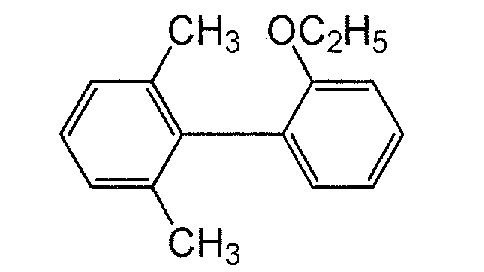
73 19 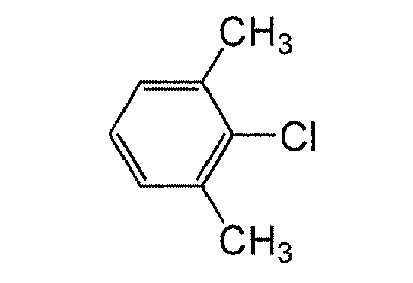


32 20 


69 21 


100 22 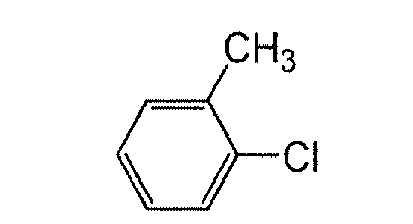


57 23 


90 24 


100 25 


91 26 


96 27 


66 [Table 2] Example Compound (1) Compound (2) Compound (3) Yield (%) 28 


95 29 


81 30 
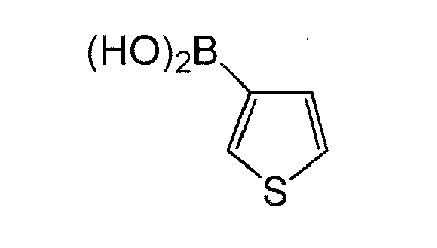

85 31 
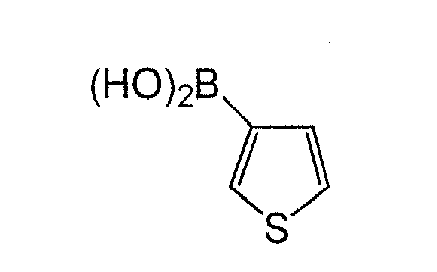

69 32 


93 33 


84 34 
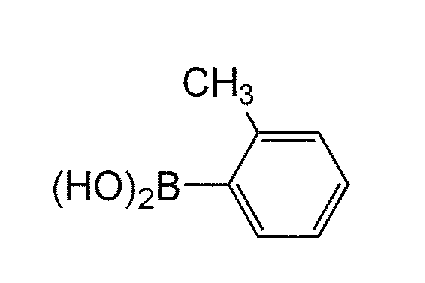

67 35 


78 - The spectral data of the compound (3) obtained in Example 17 is as followed:
- 1H-NMR (δ: ppm, CDCl3) 7.34 (m, 1H) , 7.03-7.19 (c, 3H), 6. 96-7. 03 (c, 3H), 3.73 (s, 3H), 2.01 (s, 6H)
- 13 C-NMR (δ: ppm, CDCl3 156.50, 138.19, 136.58, 130.64, 129.49, 128.35, 127.04, 127.00, 120.65, 110.84, 55.41, 20.44
- GC-MS (m/z) 212 (M+)
- The spectral data of the compound (3) obtained in Example 18 is as followed:
- 1H-NMR (δ: ppm, CDCl3) 7.27-7.34 (m, 1H) , 6.95-7.18 (c, 6H), 3.99 (q, 2H), 2.02 (s, 6H), 1.21 (t, 3H)
- 13C-NMR (δ: ppm, CDCl3) 155.76, 138.43, 136.55, 130.83, 130.00, 128.20, 126.88, 126.79, 120.52, 112.23, 63.53, 20.47, 14.70
- GC-MS (m/z) 226 (M+)
- The spectral data of the compound (3) obtained in Example 19 is as followed:
- 1H-NMR (δ: ppm, CDCl3) 7.10-7.38 (c, 7H), 2.05 (s, 6H)
- GC-MS (m/z) 200 (M+)
- The spectral data of the compound (3) obtained in Example 20 is as followed:
- 1H-NMR (δ: ppm, CDCl3) 7.84-7.92 (c, 2H), 7.16-7.57 (c, 8H), 1.90 (s, 6H)
- GC-MS (m/z) 232 (M+)
- The spectral data of the compound (3) obtained in Example 21 is as followed:
- 1H-NMR (δ: ppm, CDCl3) 7.05-7.26 (c, 6H), 6.92 (s, 1H), 2.33 (s, 3H), 2.06 (s, 3H), 2.01 (s, 3H)
- GC-MS (m/z) 196 (M+)
- The spectral data of the compound (3) obtained in Example 22 is as followed:
- 1H-NMR (δ: ppm, CDCl3) 6.99-7.47 (c, 13H), 1.90 (s, 3H)
- GC-MS (m/z) 244 (M+)
- The spectral data of the compound (3) obtained in Example 23 is as followed:
- 1H-NMR (δ: ppm, CDCl3) 7.07-7.31 (c, 8H), 2.38 (m, 2H), 2.05 (s, 3H), 1.03 (t, 3H)
- GC-MS (m/z) 168 (M+-28)
- The spectral data of the compound (3) obtained in Example 32 and 33 is as followed:
- 1H-NMR (δ: ppm, CDCl3) 8.49 (s, 1H), 8.05 (d, 2H), 7.24-7.51 (c, 10H), 1.86 (s, 3H)
- GC-MS (m/z) 268 (M+)
- The spectral data of the compound (3) obtained in Example 34 is as followed:
- 1H-NMR (δ: ppm, CDCl3) 7.21-7.27 (c, 5H), 6.19 (d, 1H), 2.20 (s, 3H), 2.04 (s, 3H)
- GC-MS (m/z) 188 (M+)
- The spectral data of the compound (3) obtained in Example 35 is as followed:
- 1H-NMR (δ: ppm, CDCl3) 8.90 (m, 1H), 8.19 (dd, 1H), 7.83 (m, 1H), 7.57-7.60 (c, 2H), 7.29-7.39 (c, 5H), 2.04 (s, 3H)
- GC-MS (m/z) 219 (M+)
- To a glass reaction container equipped with a condenser, 12.4 mg of nickel acetate tetrahydrate, 22.5 mg of 1,4-bis(dicyclohexylphosphino)butane and 1 mL of 1,2-dimethoxyethane were added. The obtained mixture was stirred at 20°C for 30 minutes, and then, 21.9 mg of n-butylamine and 0.5 mL of 1,2-dimethoxyethane were added thereto. The obtained mixture was heated and stirred at 100°C for 30 minutes to obtain a solution (A).
- To a glass reaction container equipped with a condenser, 176.8 mg of o-tolylboronic acid, 424.6 mg of potassium phosphate and 2 mL of 1, 2-dimethoxyethane were added. The obtained mixture was stirred at 100°C for 1 hour, and then, 140.6 mg of 1-chloro-2,6-dimethylbenzene was added thereto and the solution (A) was further added thereto. The obtained mixture was heated and stirred at 100°C for 8 hours. The obtained reaction mixture was cooled down to room temperature, and 50 mL of aqueous saturated ammonium chloride solution and 50 mL of ethyl acetate were added thereto. The obtained mixture was separated to an organic layer and an aqueous layer. The obtained organic layer was washed with 50 mL of aqueous saturated sodium chloride solution and then, was dried over anhydrous magnesium sulfate followed by conducting the filtration to obtain a solution containing 2,6,2'-trimethylbiphenyl. Yield: 66%.
- The reaction was conducted according to the same manner as Example 36 except that the heating and stirring time after addition of the solution (A) was 3 hours to obtain a solution containing 2,6,2'-trimethylbiphenyl. Yield: 45%.
- The reaction was conducted according to the same manner as Example 37 except that 17.4 mg of N,N,N',N'-tetramethyl-1,2-ethanediamine was used in place of n-butylamine to obtain a solution containing 2,6,2'-trimethylbiphenyl. Yield: 28%.
- The substitution inside of a 50 mL flask equipped with a condenser with nitrogen was conducted, and then, 9.7 mg of nickel chloride, 26.7 mg of N,N,N',N'-tetramethyl-1,2-ethanediamine, 78.7 mg of triphenylphosphine and 11.0 g of tetrahydrofuran were added thereto. The obtained mixture was heated under reflux for 30 minutes. The obtained mixture was cooled down to room temperature, and 448.7 mg of o-tolylboronic acid, 421.8 mg of 1-chloro-2,6-dimethylbenzene and 1.24 g of potassium carbonate were added thereto. The obtained mixture was heated under reflux for 3 hours. The obtained reaction mixture was cooled down to room temperature, and 60 mL of aqueous saturated ammonium chloride solution and 60 mL of ethyl acetate were added thereto. The obtained mixture was separated to an organic layer and an aqueous layer. The obtained organic layer was washed with 60 mL of aqueous saturated sodium chloride solution and then, was dried over anhydrous magnesium sulfate followed by conducting the filtration to obtain a solution. The solution was analyzed with gas chromatography internal standard method (internal standard: n-undecane), but the generation of 2,6,2'-trimethylbiphenyl was not confirmed.
- According to the present invention, an unsaturated organic compound can be produced in a good yield. Especially, even if a compound having a substituent(s) at either ortho position or both ortho positions of the leaving group X1 or a compound having a substituent at ortho position of the group represented by -B(X2)2 is used, the desired unsaturated organic compound can be obtained in a good yield, and therefore, the method of the present invention is industrially advantageous.
Claims (8)
- A method for producing an unsaturated organic compound represented by the formula (3):
(Y1)m-1-R1- R2-(Y2)n-1 (3)
wherein R1 represents a substituted or unsubstituted m-valent aromatic group, a substituted or unsubstituted m-valent heteroaromatic group, or a substituted or unsubstituted m-valent aliphatic hydrocarbon group having at least one double bond, R2 represents a substituted or unsubstituted n-valent aromatic group, a substituted or unsubstituted n-valent heteroaromatic group, or a substituted or unsubstituted n-valent aliphatic hydrocarbon group having at least one double bond, m represents 1 or 2, n represents 1 or 2, with the proviso that when m is 2, n is 1, Y1 represents R2 or X1, Y2 represents R1 or B(X2)2, X1 independently represents a leaving group bonded to a sp2 carbon, X2 independently represents a hydroxyl group or an alkoxy group, or two X2 are bonded to a ring containing a boron atom, and a group represented by -B(X2)2 are bonded to a sp2 carbon, which comprises reacting a compound represented by the formula (1) :
R1(X1)m (1)
wherein R1, X1 and m are the same as defined above, with a compound represented by the formula (2):
R2{B(X2)2}n (2)
wherein R2, X2 and n are the same as defined above,
in the presence of(a) at least one nickel compound selected from the group consisting of a nickel carboxylate, nickel nitrate and a nickel halide,(b) a phosphine compound represented by the formula (A): (c) at least one amine selected from the group consisting of a primary amine and an amine represented by the formula (B):
 (d) an inorganic base.
 - The method according to claim 1, wherein the compound represented by the formula (1) is a compound represented by the formula (4):

R7 is independently in each occurrence a fluorine atom, a C1-C10 alkyl group which may have a fluorine atom, a C3-C10 cycloalkyl group, a hydroxyl group, a C1-C20 alkoxy group, a substituted or unsubstituted C6-C20 aryl group, a substituted or unsubstituted C6-C20 aryloxy group, a substituted or unsubstituted heteroaryl group, a substituted or unsubstituted C6-C20 arylthio group, a cyano group, a substituted or unsubstituted amino group, a substituted or unsubstituted aminocarboxy group, a C1-C10 alkylsulfonylamino group, a C6-C20 arylsulfonylamino group, a C2-C10 alkyl group having an N-substituted imino group at 1-position, a C7-C20 aralkyl group having an N-substituted imino group, an imido group, a C1-C20 aliphatic or aromatic acyl group, a carboxyl group, a C2-C20 alkoxycarbonyl group, a C6-C10 aryloxycarbonyl group, a substituted or unsubstituted aminosulfonyl group or a substituted or unsubstituted carbamoyl group,
q represents an integer of 0 to (4-m), and herein, R5, R6 or R7 may be bonded with the neighboring substituent to form a ring together with the carbon atom to which it is bonded. - The method according to claim 1 or 2, wherein the compound represented by the formula (2) is a compound represented by the formula (5):

R9 represents a fluorine atom, a C1-C10 alkyl group which may have a fluorine atom, a C3-C10 cycloalkyl group, a hydroxyl group, a C1-C20 alkoxy group, a substituted or unsubstituted C6-C20 aryl group, a substituted or unsubstituted C6-C20 aryloxy group, a substituted or unsubstituted heteroaryl group, a substituted or unsubstituted C6-C20 arylthio group, a cyano group, a substituted or unsubstituted amino group, a substituted or unsubstituted aminocarboxy group, a C1-C10 alkylsulfonylamino group, a C6-C20 arylsulfonylamino group, a C2-C10 alkyl group having an N-substituted imino group at 1-position, a C7-C20 aralkyl group having an N-substituted imino group, an imido group, a C1-C20 aliphatic or aromatic acyl group, a carboxyl group, a C2-C20 alkoxycarbonyl group, a C6-C10 aryloxycarbonyl group, a substituted or unsubstituted aminosulfonyl group or a substituted or unsubstituted carbamoyl group,
s represents an integer of 0 to (4-n), and herein, R8 or R9 may be bonded with the neighboring substituent to form a ring together with the carbon atom to which it is bonded. - The method according to claim 1, wherein the nickel carboxylate is nickel acetate and the nickel halide is nickel chloride or nickel bromide.
- The method according to claim 1, wherein R3 is a C3-C7 cycloalkyl group.
- The method according to claim 5, wherein R3 is a cyclohexyl group.
- The method according to claim 1, wherein p is 4.
- The method according to claim 1, wherein at least one amine selected from the group consisting of a primary amine and an amine represented by the formula (B) is an aliphatic primary amine.
Applications Claiming Priority (2)
| Application Number | Priority Date | Filing Date | Title |
|---|---|---|---|
| JP2008122021 | 2008-05-08 | ||
| PCT/JP2009/058726 WO2009136646A1 (en) | 2008-05-08 | 2009-04-28 | Method for producing unsaturated organic compound |
Publications (3)
| Publication Number | Publication Date |
|---|---|
| EP2287141A1 true EP2287141A1 (en) | 2011-02-23 |
| EP2287141A4 EP2287141A4 (en) | 2012-08-22 |
| EP2287141B1 EP2287141B1 (en) | 2015-10-21 |
Family
ID=41264698
Family Applications (1)
| Application Number | Title | Priority Date | Filing Date |
|---|---|---|---|
| EP09742770.2A Not-in-force EP2287141B1 (en) | 2008-05-08 | 2009-04-28 | Method for producing unsaturated organic compound |
Country Status (5)
| Country | Link |
|---|---|
| US (1) | US8237002B2 (en) |
| EP (1) | EP2287141B1 (en) |
| JP (1) | JP5446436B2 (en) |
| CN (1) | CN102015585B (en) |
| WO (1) | WO2009136646A1 (en) |
Families Citing this family (6)
| Publication number | Priority date | Publication date | Assignee | Title |
|---|---|---|---|---|
| JO3598B1 (en) | 2006-10-10 | 2020-07-05 | Infinity Discovery Inc | Boronic acids and esters as inhibitors of fatty acid amide hydrolase |
| CA2721060A1 (en) | 2008-04-09 | 2009-10-15 | Infinity Pharmaceuticals, Inc. | Inhibitors of fatty acid amide hydrolase |
| WO2010118159A1 (en) | 2009-04-07 | 2010-10-14 | Infinity Pharmaceuticals, Inc. | Inhibitors of fatty acid amide hydrolase |
| WO2010118155A1 (en) | 2009-04-07 | 2010-10-14 | Infinity Pharmaceuticals, Inc. | Inhibitors of fatty acid amide hydrolase |
| RU2015143910A (en) | 2010-02-03 | 2018-12-28 | Инфинити Фармасьютикалз, Инк. | FATTY ACID AMID HYDROLASE INHIBITORS |
| WO2023044364A1 (en) | 2021-09-15 | 2023-03-23 | Enko Chem, Inc. | Protoporphyrinogen oxidase inhibitors |
Family Cites Families (6)
| Publication number | Priority date | Publication date | Assignee | Title |
|---|---|---|---|---|
| JP4581321B2 (en) * | 2001-10-23 | 2010-11-17 | 住友化学株式会社 | Method for producing unsaturated organic compound derivative |
| JP4232518B2 (en) * | 2002-07-11 | 2009-03-04 | 住友化学株式会社 | Method for producing coupling compound |
| JP4321131B2 (en) * | 2003-06-20 | 2009-08-26 | 住友化学株式会社 | Method for producing coupling compound |
| US7521581B2 (en) | 2005-03-30 | 2009-04-21 | Tosoh Corporation | Catalyst composition and process for producing cross-coupled compound using same |
| JP4940721B2 (en) * | 2005-03-30 | 2012-05-30 | 東ソー株式会社 | Catalyst composition and method for producing cross-coupling compound using the same |
| JP4864342B2 (en) * | 2005-04-27 | 2012-02-01 | 北興化学工業株式会社 | Method for producing biaryl compound |
-
2009
- 2009-04-28 US US12/989,900 patent/US8237002B2/en not_active Expired - Fee Related
- 2009-04-28 CN CN2009801168806A patent/CN102015585B/en not_active Expired - Fee Related
- 2009-04-28 WO PCT/JP2009/058726 patent/WO2009136646A1/en not_active Ceased
- 2009-04-28 EP EP09742770.2A patent/EP2287141B1/en not_active Not-in-force
- 2009-05-08 JP JP2009113359A patent/JP5446436B2/en not_active Expired - Fee Related
Non-Patent Citations (11)
| Title |
|---|
| BUNNAI SAITO ET AL: "Alkyl-Alkyl Suzuki Cross-Couplings of Unactivated Secondary Alkyl Halides at Room Temperature", JOURNAL OF THE AMERICAN CHEMICAL SOCIETY, AMERICAN CHEMICAL SOCIETY, WASHINGTON, DC; US, vol. 129, no. 31, 8 August 2007 (2007-08-08), pages 9602-9603, XP002590077, ISSN: 0002-7863, DOI: 10.1021/JA074008L [retrieved on 2007-07-12] * |
| BUNNAI SAITO ET AL: "Enantioselective Alkyl-Alkyl Suzuki Cross-Couplings of Unactivated Homobenzylic Halides", JOURNAL OF THE AMERICAN CHEMICAL SOCIETY, vol. 130, no. 21, 1 May 2008 (2008-05-01), pages 6694-6695, XP55032866, ISSN: 0002-7863, DOI: 10.1021/ja8013677 * |
| FRANCISCO GONZÁLEZ-BOBES ET AL: "Amino Alcohols as Ligands for Nickel-Catalyzed Suzuki Reactions of Unactivated Alkyl Halides, Including Secondary Alkyl Chlorides, with Arylboronic Acids", JOURNAL OF THE AMERICAN CHEMICAL SOCIETY, vol. 128, no. 16, 1 April 2006 (2006-04-01), pages 5360-5361, XP55032870, ISSN: 0002-7863, DOI: 10.1021/ja0613761 * |
| GALLAND J-C ET AL: "Cross-Coupling of Chloroarenes with Boronic Acids using a Water-Soluble Nickel Catalyst", TETRAHEDRON LETTERS, ELSEVIER, AMSTERDAM, NL, vol. 40, no. 12, 19 March 1999 (1999-03-19), pages 2323-2326, XP004157463, ISSN: 0040-4039, DOI: 10.1016/S0040-4039(99)00239-7 * |
| GRIFFITHS C ET AL: "Palladium and nickel catalysed Suzuki cross-coupling of sterically hindered aryl bromides with phenylboronic acid", TETRAHEDRON LETTERS, ELSEVIER, AMSTERDAM, NL, vol. 41, no. 14, 1 April 2000 (2000-04-01) , pages 2487-2490, XP004193795, ISSN: 0040-4039, DOI: 10.1016/S0040-4039(00)00186-6 * |
| INDOLESE A F ET AL: "Suzuki-Type Coupling of Chloroarenes with Arylboronic Acids Catalysed by Nickel complexes", TETRAHEDRON LETTERS, ELSEVIER, AMSTERDAM, NL, vol. 38, no. 20, 1 January 1997 (1997-01-01), pages 3513-3516, XP002570570, ISSN: 0040-4039 * |
| JIANRONG (STEVE) ZHOU ET AL: "Suzuki Cross-Couplings of Unactivated Secondary Alkyl Bromides and Iodides", JOURNAL OF THE AMERICAN CHEMICAL SOCIETY, vol. 126, no. 5, 1 February 2004 (2004-02-01), pages 1340-1341, XP55032867, ISSN: 0002-7863, DOI: 10.1021/ja039889k * |
| SAITO S ET AL: "A Synthesis of Biaryls via Nickel(0)-Catalyzed Cross-Coupling Reaction of Chloroarenes with Phenylboronic Acids", 22 April 1996 (1996-04-22), TETRAHEDRON LETTERS, ELSEVIER, AMSTERDAM, NL, PAGE(S) 2993 - 2996, XP004029700, ISSN: 0040-4039 * entries 10-12; page 2994; table 1 * * entries 6, 7; page 13081; table 2 * * |
| See also references of WO2009136646A1 * |
| UEDA M ET AL: "Synthesis of Biaryls via Nickel-Catalyzed Cross-Coupling Reaction of Arylboronic Acids and Aryl Mesylates", 22 October 1998 (1998-10-22), TETRAHEDRON, ELSEVIER SCIENCE PUBLISHERS, AMSTERDAM, NL, PAGE(S) 13079 - 13086, XP004139322, ISSN: 0040-4020 * entry 17; page 2295; table 2 * * |
| ZHEN-YU TANG ET AL: "Triphenylphosphine as a Ligand for Room-Temperature Ni(0)-Catalyzed Cross-Coupling Reactions of Aryl Chlorides with Arylboronic Acids", THE JOURNAL OF ORGANIC CHEMISTRY, vol. 71, no. 5, 1 March 2006 (2006-03-01), pages 2167-2169, XP55032868, ISSN: 0022-3263, DOI: 10.1021/jo052369i * |
Also Published As
| Publication number | Publication date |
|---|---|
| US8237002B2 (en) | 2012-08-07 |
| CN102015585A (en) | 2011-04-13 |
| EP2287141A4 (en) | 2012-08-22 |
| US20110046380A1 (en) | 2011-02-24 |
| WO2009136646A1 (en) | 2009-11-12 |
| JP2009292814A (en) | 2009-12-17 |
| CN102015585B (en) | 2013-06-19 |
| JP5446436B2 (en) | 2014-03-19 |
| EP2287141B1 (en) | 2015-10-21 |
Similar Documents
| Publication | Publication Date | Title |
|---|---|---|
| EP2287141B1 (en) | Method for producing unsaturated organic compound | |
| Alonso et al. | A copper-and amine-free Sonogashira-type coupling procedure catalyzed by oxime palladacycles | |
| Edwin Raja et al. | Nickel-catalyzed Hiyama-type decarboxylative coupling of propiolic acids and organosilanes | |
| EP3315486B1 (en) | Method for producing aromatic compound | |
| Ghorai et al. | Silver-catalyzed selective multicomponent coupling reactions of arynes with nitriles and isonitriles | |
| JP4581321B2 (en) | Method for producing unsaturated organic compound derivative | |
| US7041856B2 (en) | Coupling catalyst and process using the same | |
| CN105085208B (en) | A kind of preparation method using palladium as catalyst benzfluorene ketone compounds | |
| Sarmah et al. | Urea as mild and efficient additive for palladium catalyzed Sonogashira cross coupling reaction | |
| Murugan et al. | An efficient preparation of N-acetyl enamides catalyzed by Ru (II) complexes | |
| JP4321131B2 (en) | Method for producing coupling compound | |
| JP4232518B2 (en) | Method for producing coupling compound | |
| CN104003895B (en) | A kind of method of cascade reaction synthesis Terphenyls compound of palladium chtalyst | |
| Wu et al. | A highly active cobalt catalyst system for Kumada Biaryl cross-coupling | |
| Singh et al. | Reductive carbonylation of aryl and heteroaryl iodides using Pd (acac) 2/dppm as an efficient catalyst | |
| EP2949655B1 (en) | Reaction catalyst for cross coupling and method for manufacturing aromatic compound | |
| Lemhadri et al. | Alkynylation of aryl bromides with propargylamines catalyzed by a palladium-tetraphosphine complex | |
| Luo et al. | Efficient and ligand free palladium catalyst for Suzuki and Heck cross-coupling reactions | |
| CN105418600B (en) | A kind of method for synthesizing polysubstituted 4 carbonyl quinine class compound | |
| JP2004083566A (en) | Method for producing stereoisomer-enriched 4-aryl-4-hydroxybutanoic acid derivative | |
| JP4802379B2 (en) | Method for producing biaryl compound | |
| JP2018140985A (en) | Method for production of aromatic compound | |
| JP6238290B2 (en) | Method for producing N-vinylazoles | |
| JP6238290B6 (en) | Method for producing N-vinylazoles | |
| CN116462570A (en) | A kind of α-difluoromethylstyrene derivative and its preparation method |
Legal Events
| Date | Code | Title | Description |
|---|---|---|---|
| PUAI | Public reference made under article 153(3) epc to a published international application that has entered the european phase |
Free format text: ORIGINAL CODE: 0009012 |
|
| 17P | Request for examination filed |
Effective date: 20101201 |
|
| AK | Designated contracting states |
Kind code of ref document: A1 Designated state(s): AT BE BG CH CY CZ DE DK EE ES FI FR GB GR HR HU IE IS IT LI LT LU LV MC MK MT NL NO PL PT RO SE SI SK TR |
|
| AX | Request for extension of the european patent |
Extension state: AL BA RS |
|
| DAX | Request for extension of the european patent (deleted) | ||
| A4 | Supplementary search report drawn up and despatched |
Effective date: 20120723 |
|
| RIC1 | Information provided on ipc code assigned before grant |
Ipc: C07C 15/24 20060101ALI20120717BHEP Ipc: C07C 47/546 20060101ALI20120717BHEP Ipc: C07C 41/30 20060101ALI20120717BHEP Ipc: C07C 211/45 20060101ALI20120717BHEP Ipc: C07C 45/68 20060101ALI20120717BHEP Ipc: C07D 215/04 20060101ALI20120717BHEP Ipc: C07C 1/32 20060101AFI20120717BHEP Ipc: C07C 255/50 20060101ALI20120717BHEP Ipc: C07C 253/30 20060101ALI20120717BHEP Ipc: C07C 43/205 20060101ALI20120717BHEP Ipc: C07C 25/18 20060101ALI20120717BHEP Ipc: C07C 209/68 20060101ALI20120717BHEP Ipc: C07C 15/14 20060101ALI20120717BHEP Ipc: C07D 333/10 20060101ALI20120717BHEP Ipc: C07C 17/263 20060101ALI20120717BHEP |
|
| REG | Reference to a national code |
Ref country code: DE Ref legal event code: R079 Ref document number: 602009034352 Country of ref document: DE Free format text: PREVIOUS MAIN CLASS: C07C0001320000 Ipc: C07B0037040000 |
|
| RIC1 | Information provided on ipc code assigned before grant |
Ipc: C07C 209/68 20060101ALI20140829BHEP Ipc: C07C 41/30 20060101ALI20140829BHEP Ipc: C07C 253/30 20060101ALI20140829BHEP Ipc: C07D 215/04 20060101ALI20140829BHEP Ipc: C07B 37/04 20060101AFI20140829BHEP Ipc: C07D 333/28 20060101ALI20140829BHEP Ipc: C07D 215/18 20060101ALI20140829BHEP Ipc: C07C 17/263 20060101ALI20140829BHEP Ipc: C07C 1/32 20060101ALI20140829BHEP Ipc: C07C 45/68 20060101ALI20140829BHEP Ipc: C07C 51/00 20060101ALI20140829BHEP Ipc: C07D 333/08 20060101ALI20140829BHEP |
|
| GRAP | Despatch of communication of intention to grant a patent |
Free format text: ORIGINAL CODE: EPIDOSNIGR1 |
|
| INTG | Intention to grant announced |
Effective date: 20150317 |
|
| GRAS | Grant fee paid |
Free format text: ORIGINAL CODE: EPIDOSNIGR3 |
|
| GRAP | Despatch of communication of intention to grant a patent |
Free format text: ORIGINAL CODE: EPIDOSNIGR1 |
|
| INTG | Intention to grant announced |
Effective date: 20150821 |
|
| GRAA | (expected) grant |
Free format text: ORIGINAL CODE: 0009210 |
|
| AK | Designated contracting states |
Kind code of ref document: B1 Designated state(s): AT BE BG CH CY CZ DE DK EE ES FI FR GB GR HR HU IE IS IT LI LT LU LV MC MK MT NL NO PL PT RO SE SI SK TR |
|
| REG | Reference to a national code |
Ref country code: GB Ref legal event code: FG4D Ref country code: NL Ref legal event code: MP Effective date: 20151021 |
|
| REG | Reference to a national code |
Ref country code: CH Ref legal event code: EP |
|
| REG | Reference to a national code |
Ref country code: AT Ref legal event code: REF Ref document number: 756484 Country of ref document: AT Kind code of ref document: T Effective date: 20151115 |
|
| REG | Reference to a national code |
Ref country code: IE Ref legal event code: FG4D |
|
| REG | Reference to a national code |
Ref country code: DE Ref legal event code: R096 Ref document number: 602009034352 Country of ref document: DE |
|
| REG | Reference to a national code |
Ref country code: LT Ref legal event code: MG4D |
|
| REG | Reference to a national code |
Ref country code: AT Ref legal event code: MK05 Ref document number: 756484 Country of ref document: AT Kind code of ref document: T Effective date: 20151021 |
|
| PG25 | Lapsed in a contracting state [announced via postgrant information from national office to epo] |
Ref country code: LT Free format text: LAPSE BECAUSE OF FAILURE TO SUBMIT A TRANSLATION OF THE DESCRIPTION OR TO PAY THE FEE WITHIN THE PRESCRIBED TIME-LIMIT Effective date: 20151021 Ref country code: HR Free format text: LAPSE BECAUSE OF FAILURE TO SUBMIT A TRANSLATION OF THE DESCRIPTION OR TO PAY THE FEE WITHIN THE PRESCRIBED TIME-LIMIT Effective date: 20151021 Ref country code: NO Free format text: LAPSE BECAUSE OF FAILURE TO SUBMIT A TRANSLATION OF THE DESCRIPTION OR TO PAY THE FEE WITHIN THE PRESCRIBED TIME-LIMIT Effective date: 20160121 Ref country code: NL Free format text: LAPSE BECAUSE OF FAILURE TO SUBMIT A TRANSLATION OF THE DESCRIPTION OR TO PAY THE FEE WITHIN THE PRESCRIBED TIME-LIMIT Effective date: 20151021 Ref country code: IT Free format text: LAPSE BECAUSE OF FAILURE TO SUBMIT A TRANSLATION OF THE DESCRIPTION OR TO PAY THE FEE WITHIN THE PRESCRIBED TIME-LIMIT Effective date: 20151021 Ref country code: IS Free format text: LAPSE BECAUSE OF FAILURE TO SUBMIT A TRANSLATION OF THE DESCRIPTION OR TO PAY THE FEE WITHIN THE PRESCRIBED TIME-LIMIT Effective date: 20160221 Ref country code: ES Free format text: LAPSE BECAUSE OF FAILURE TO SUBMIT A TRANSLATION OF THE DESCRIPTION OR TO PAY THE FEE WITHIN THE PRESCRIBED TIME-LIMIT Effective date: 20151021 |
|
| PG25 | Lapsed in a contracting state [announced via postgrant information from national office to epo] |
Ref country code: SE Free format text: LAPSE BECAUSE OF FAILURE TO SUBMIT A TRANSLATION OF THE DESCRIPTION OR TO PAY THE FEE WITHIN THE PRESCRIBED TIME-LIMIT Effective date: 20151021 Ref country code: PL Free format text: LAPSE BECAUSE OF FAILURE TO SUBMIT A TRANSLATION OF THE DESCRIPTION OR TO PAY THE FEE WITHIN THE PRESCRIBED TIME-LIMIT Effective date: 20151021 Ref country code: PT Free format text: LAPSE BECAUSE OF FAILURE TO SUBMIT A TRANSLATION OF THE DESCRIPTION OR TO PAY THE FEE WITHIN THE PRESCRIBED TIME-LIMIT Effective date: 20160222 Ref country code: AT Free format text: LAPSE BECAUSE OF FAILURE TO SUBMIT A TRANSLATION OF THE DESCRIPTION OR TO PAY THE FEE WITHIN THE PRESCRIBED TIME-LIMIT Effective date: 20151021 Ref country code: FI Free format text: LAPSE BECAUSE OF FAILURE TO SUBMIT A TRANSLATION OF THE DESCRIPTION OR TO PAY THE FEE WITHIN THE PRESCRIBED TIME-LIMIT Effective date: 20151021 Ref country code: LV Free format text: LAPSE BECAUSE OF FAILURE TO SUBMIT A TRANSLATION OF THE DESCRIPTION OR TO PAY THE FEE WITHIN THE PRESCRIBED TIME-LIMIT Effective date: 20151021 Ref country code: GR Free format text: LAPSE BECAUSE OF FAILURE TO SUBMIT A TRANSLATION OF THE DESCRIPTION OR TO PAY THE FEE WITHIN THE PRESCRIBED TIME-LIMIT Effective date: 20160122 |
|
| REG | Reference to a national code |
Ref country code: DE Ref legal event code: R097 Ref document number: 602009034352 Country of ref document: DE |
|
| PG25 | Lapsed in a contracting state [announced via postgrant information from national office to epo] |
Ref country code: CZ Free format text: LAPSE BECAUSE OF FAILURE TO SUBMIT A TRANSLATION OF THE DESCRIPTION OR TO PAY THE FEE WITHIN THE PRESCRIBED TIME-LIMIT Effective date: 20151021 |
|
| PLBE | No opposition filed within time limit |
Free format text: ORIGINAL CODE: 0009261 |
|
| STAA | Information on the status of an ep patent application or granted ep patent |
Free format text: STATUS: NO OPPOSITION FILED WITHIN TIME LIMIT |
|
| PG25 | Lapsed in a contracting state [announced via postgrant information from national office to epo] |
Ref country code: BE Free format text: LAPSE BECAUSE OF NON-PAYMENT OF DUE FEES Effective date: 20160430 Ref country code: RO Free format text: LAPSE BECAUSE OF FAILURE TO SUBMIT A TRANSLATION OF THE DESCRIPTION OR TO PAY THE FEE WITHIN THE PRESCRIBED TIME-LIMIT Effective date: 20151021 Ref country code: DK Free format text: LAPSE BECAUSE OF FAILURE TO SUBMIT A TRANSLATION OF THE DESCRIPTION OR TO PAY THE FEE WITHIN THE PRESCRIBED TIME-LIMIT Effective date: 20151021 Ref country code: SK Free format text: LAPSE BECAUSE OF FAILURE TO SUBMIT A TRANSLATION OF THE DESCRIPTION OR TO PAY THE FEE WITHIN THE PRESCRIBED TIME-LIMIT Effective date: 20151021 Ref country code: EE Free format text: LAPSE BECAUSE OF FAILURE TO SUBMIT A TRANSLATION OF THE DESCRIPTION OR TO PAY THE FEE WITHIN THE PRESCRIBED TIME-LIMIT Effective date: 20151021 |
|
| 26N | No opposition filed |
Effective date: 20160722 |
|
| PG25 | Lapsed in a contracting state [announced via postgrant information from national office to epo] |
Ref country code: SI Free format text: LAPSE BECAUSE OF FAILURE TO SUBMIT A TRANSLATION OF THE DESCRIPTION OR TO PAY THE FEE WITHIN THE PRESCRIBED TIME-LIMIT Effective date: 20151021 |
|
| REG | Reference to a national code |
Ref country code: CH Ref legal event code: PL |
|
| GBPC | Gb: european patent ceased through non-payment of renewal fee |
Effective date: 20160428 |
|
| PG25 | Lapsed in a contracting state [announced via postgrant information from national office to epo] |
Ref country code: BE Free format text: LAPSE BECAUSE OF FAILURE TO SUBMIT A TRANSLATION OF THE DESCRIPTION OR TO PAY THE FEE WITHIN THE PRESCRIBED TIME-LIMIT Effective date: 20151021 Ref country code: LU Free format text: LAPSE BECAUSE OF FAILURE TO SUBMIT A TRANSLATION OF THE DESCRIPTION OR TO PAY THE FEE WITHIN THE PRESCRIBED TIME-LIMIT Effective date: 20160428 |
|
| REG | Reference to a national code |
Ref country code: IE Ref legal event code: MM4A |
|
| REG | Reference to a national code |
Ref country code: FR Ref legal event code: ST Effective date: 20161230 |
|
| PG25 | Lapsed in a contracting state [announced via postgrant information from national office to epo] |
Ref country code: CH Free format text: LAPSE BECAUSE OF NON-PAYMENT OF DUE FEES Effective date: 20160430 Ref country code: LI Free format text: LAPSE BECAUSE OF NON-PAYMENT OF DUE FEES Effective date: 20160430 Ref country code: FR Free format text: LAPSE BECAUSE OF NON-PAYMENT OF DUE FEES Effective date: 20160502 Ref country code: GB Free format text: LAPSE BECAUSE OF NON-PAYMENT OF DUE FEES Effective date: 20160428 |
|
| PG25 | Lapsed in a contracting state [announced via postgrant information from national office to epo] |
Ref country code: IE Free format text: LAPSE BECAUSE OF NON-PAYMENT OF DUE FEES Effective date: 20160428 |
|
| PGFP | Annual fee paid to national office [announced via postgrant information from national office to epo] |
Ref country code: DE Payment date: 20170426 Year of fee payment: 9 |
|
| PG25 | Lapsed in a contracting state [announced via postgrant information from national office to epo] |
Ref country code: CY Free format text: LAPSE BECAUSE OF FAILURE TO SUBMIT A TRANSLATION OF THE DESCRIPTION OR TO PAY THE FEE WITHIN THE PRESCRIBED TIME-LIMIT Effective date: 20151021 Ref country code: HU Free format text: LAPSE BECAUSE OF FAILURE TO SUBMIT A TRANSLATION OF THE DESCRIPTION OR TO PAY THE FEE WITHIN THE PRESCRIBED TIME-LIMIT; INVALID AB INITIO Effective date: 20090428 |
|
| PG25 | Lapsed in a contracting state [announced via postgrant information from national office to epo] |
Ref country code: MT Free format text: LAPSE BECAUSE OF NON-PAYMENT OF DUE FEES Effective date: 20160430 Ref country code: TR Free format text: LAPSE BECAUSE OF FAILURE TO SUBMIT A TRANSLATION OF THE DESCRIPTION OR TO PAY THE FEE WITHIN THE PRESCRIBED TIME-LIMIT Effective date: 20151021 Ref country code: MK Free format text: LAPSE BECAUSE OF FAILURE TO SUBMIT A TRANSLATION OF THE DESCRIPTION OR TO PAY THE FEE WITHIN THE PRESCRIBED TIME-LIMIT Effective date: 20151021 Ref country code: MC Free format text: LAPSE BECAUSE OF FAILURE TO SUBMIT A TRANSLATION OF THE DESCRIPTION OR TO PAY THE FEE WITHIN THE PRESCRIBED TIME-LIMIT Effective date: 20151021 |
|
| PG25 | Lapsed in a contracting state [announced via postgrant information from national office to epo] |
Ref country code: BG Free format text: LAPSE BECAUSE OF FAILURE TO SUBMIT A TRANSLATION OF THE DESCRIPTION OR TO PAY THE FEE WITHIN THE PRESCRIBED TIME-LIMIT Effective date: 20151021 |
|
| REG | Reference to a national code |
Ref country code: DE Ref legal event code: R119 Ref document number: 602009034352 Country of ref document: DE |
|
| PG25 | Lapsed in a contracting state [announced via postgrant information from national office to epo] |
Ref country code: DE Free format text: LAPSE BECAUSE OF NON-PAYMENT OF DUE FEES Effective date: 20181101 |