EP2286824A1 - Non-covalent crosslinking agent for collagen - Google Patents
Non-covalent crosslinking agent for collagen Download PDFInfo
- Publication number
- EP2286824A1 EP2286824A1 EP09742723A EP09742723A EP2286824A1 EP 2286824 A1 EP2286824 A1 EP 2286824A1 EP 09742723 A EP09742723 A EP 09742723A EP 09742723 A EP09742723 A EP 09742723A EP 2286824 A1 EP2286824 A1 EP 2286824A1
- Authority
- EP
- European Patent Office
- Prior art keywords
- collagen
- crosslinking agent
- groups
- spacer
- arm
- Prior art date
- Legal status (The legal status is an assumption and is not a legal conclusion. Google has not performed a legal analysis and makes no representation as to the accuracy of the status listed.)
- Granted
Links
Images

Classifications
-
- A—HUMAN NECESSITIES
- A61—MEDICAL OR VETERINARY SCIENCE; HYGIENE
- A61K—PREPARATIONS FOR MEDICAL, DENTAL OR TOILETRY PURPOSES
- A61K38/00—Medicinal preparations containing peptides
- A61K38/16—Peptides having more than 20 amino acids; Gastrins; Somatostatins; Melanotropins; Derivatives thereof
- A61K38/17—Peptides having more than 20 amino acids; Gastrins; Somatostatins; Melanotropins; Derivatives thereof from animals; from humans
- A61K38/39—Connective tissue peptides, e.g. collagen, elastin, laminin, fibronectin, vitronectin, cold insoluble globulin [CIG]
-
- A—HUMAN NECESSITIES
- A61—MEDICAL OR VETERINARY SCIENCE; HYGIENE
- A61P—SPECIFIC THERAPEUTIC ACTIVITY OF CHEMICAL COMPOUNDS OR MEDICINAL PREPARATIONS
- A61P27/00—Drugs for disorders of the senses
- A61P27/02—Ophthalmic agents
Definitions
- the present invention relates to a collagen crosslinking agent, in particular to a noncovalent collagen crosslinking agent.
- Conical cornea is a disease that a corneal parenchymal layer thins and a central region protrudes. Its reason is not yet understood and there is currently no treatment method other than suppression of the protrusion with a contact lens or transplantation of cornea.
- Non-patent Document 1 In a study for treatment of conical cornea, there is reported a method of crosslinking collagen in the corneal parenchymal layer by adding riboflavin (vitamin B2) dropwise into the eye and irradiating the eye with ultraviolet ray (for examples, Non-patent Document 1).
- riboflavin vitamin B2
- UV irradiation for examples, Non-patent Document 1
- Crosslinking agents that crosslink collagen by chemical bondings are known.
- a photoreactive gelatin-polyethylene glycol (PEG) diacrylate crosslinking agent developed by Matsuda et al. (Non-patent Document 2)
- a succinimidated citric acid crosslinking agents developed by Taguchi et al.
- an aldehyde group-containing polymeric micelle crosslinking agent developed by Murakami et al. (Non-patent Document 4);
- succinimidated PEGS developed by Wallance et al. (Non-patent Document 5) and others.
- there is concern about toxicity by residual monomers and unreacted functional groups and there is also a problem of stability.
- An object of the present invention is to provide a collagen crosslinking agent superior in biocompatibility that is free from bad influences by UV irradiation and also from problems of toxicity caused by residual monomers or unreacted functional groups.
- the present invention provides a noncovalent collagen crosslinking agent, comprising a spacer of a polyvalent alcohol having two or more OH groups at terminals and arms of collagen peptides formed of repetitions of three amino acids, the arms being bound to the spacer via the OH groups.
- the crosslinking agent according to the present invention is superior in biocompatibility and the driving force thereof for crosslinking is caused from formation of triple helix.
- the crosslinking agent according to the present invention is administered to the body.
- the collagen crosslinking agent according to the present invention has a spacer and arms extending from the spacer.
- the spacer which has a role to control the distance between arms and provide hydrophilicity, is a base for connection with the arms described below. Specifically, it is a multiply branching polyvalent alcohol having two or more OH groups at the terminals.
- terminal Two or more OH groups may be present at the terminals.
- terminal means that the compound may have OH groups at positions other than the terminals of branching chains, but such OH groups are not included in the number of OH groups specified in the present invention. Only terminal OH groups are included, for the purpose of controlling the distance between arms.
- the maximum number of the OH groups is not particularly limited, from the viewpoints of solubility and steric repulsion of the arms is a polyvalent alcohol having 2 to 512 OH groups, preferably 3 to 16 OH groups, more preferably 4 to 16 OH groups, and still more preferably 4 to 8 OH groups, and particularly 4 OH groups.
- polyvalent alcohols having two or more OH groups at the terminals include bivalent alcohols such as ethylene glycol, propylene glycol, butylene glycol, diethylene glycol, erythritol, threitol, ribitol, xylitol, mannitol, catechol, catechin and bisphenol A; trivalent alcohols such as glycerol and trihydroxybenzene; tetravalent alcohols such as pentaerythritol, diglycerin, pentaerythritol polyethylene glycol ether, for example, pentaerythritol tetrapolyethylene glycol ether; hexavalent alcohols such as dipentaerythritol and inositol; octavalent alcohols such as hexaglycerol polyethylene glycol ether, for example, hexaglycerol octapolyethylene glycol ether; 16-valent alcohols such as bivalent alcohol
- the arms may be extended, for example, with an alkylene glycol or a polyalkyleneoxide such as polyethylene glycol, polypropylene glycol or polyethyleneoxide, and the OH groups of the polyvalent alcohol are given at chain-extended terminals as terminal OH groups (hereinafter, the chain-extended alcohol may be referred to as "chain-extended polyvalent alcohol", and in the present invention, such chain-extended polyvalent alcohols are also included in the "polyvalent alcohols").
- chain-extended polyvalent alcohol chain-extended polyvalent alcohol
- the polyvalent alcohol may be soluble in solution, in an amount of about 0.1 to 500 mg (0.01 to 50 wt %) in 1 ml of the solution.
- a high-molecular weight polyvalent alcohol can also be used, if it satisfies the conditions above, and the molecular weight thereof is not limited.
- the ones containing much a biological component or a compound or component superior in biocompatibility are used preferably for improvement of biological safety.
- polyvalent alcohols examples include bivalent alcohols such as polyethylene glycol, polypropylene glycol, polyethyleneoxide, erythritol, threitol, ribitol, xylitol, mannitol, catechol and catechin; trivalent alcohols such as glycerol; tetravalent alcohols such as pentaerythritol, diglycerin and pentaerythritol polyethylene glycol ether; hexavalent alcohols such as dipentaerythritol and inositol; octavalent alcohols such as hexaglycerol polyethylene glycol ether; monosaccharides such as glucose, fructose and galactose; disaccharides and oligosaccharides and polysaccharides thereof.
- bivalent alcohols such as polyethylene glycol, polypropylene glycol, polyethyleneoxide, erythritol, threitol, rib
- Polyvalent alcohol preferably used in the present invention may be selected from the viewpoints of the number of terminal OH groups, hydrophilicity and biological safety, but should be selected properly with steric repulsion by arms and distance between arms taken into consideration. It is preferable, however, to have three or more arms, in order to obtain a collagen gel having a sufficiently high mechanical strength and thus, the polyvalent alcohol for use is preferably a trivalent or higher alcohol.
- the arm is constituted of a collagen peptide or a collagen model peptide, formed of repetitions of three amino acids.
- the collagen model peptide means a peptide formed of repetitions of amino acids similar to collagen peptide.
- the arms form triple helix with collagen molecules, crosslinking the collagen molecules.
- the arms, which are made of amino acids, are superior in biocompatibility.
- the arm is represented by the following General Formula (I) having peptide bonds: (Y-X-G)n (I) wherein, G represents glycine (Gly) residue; X and Y each independently represent an amino acid residue such as alanine (Ala) residue (A), proline (Pro) residue (P), hydroxyproline (Hyp) residue (O), and glycine (Gly) residue (G), preferably alanine (Ala) residue (A), proline (Pro) residue (P) or hydroxyproline (Hyp) residue (O), particularly preferably proline (Pro) residue (P) or hydroxyproline (Hyp) residue (O).
- G represents glycine (Gly) residue
- X and Y each independently represent an amino acid residue such as alanine (Ala) residue (A), proline (Pro) residue (P), hydroxyproline (Hyp) residue (O), and glycine (Gly) residue (G), preferably alanine (Ala)
- X and Y may be chemically modified with a methyl group, an isobutyl group or a fluorine atom, and examples of such groups include N-isobutyl glycine, N-methyl alanine, and 4-fluoroproline.
- the word of n is an integer or 1 to 50, preferably of 5 to 20.
- Preferable (Y-X-G) is (P-O-G), (P-P-G), (P-A-G), (P-N-isobutyl glycine (Nleu)-G), (P-N-methylalanine (meA)-G) or (P-fluoroproline (Flp)-G), more preferably (P-O-G), (P-P-G) or (P-A-G) , and still more preferably (P-O-G) from the viewpoint of the stability of triple helix.
- the arm represented by the Formula above can be prepared by those who are skilled in the art, for example by liquid-phase peptide synthesis method, solid-phase peptide synthesis method or genetic engineering method.
- (P-O-G) 10 can be prepared by solid-phase peptide synthesis method.
- (P-O-G) 10 is also available commercially under the trade name of (Pro-Hyp-Gly) 10 -20H 2 O from Peptide Institute, Inc.
- the arm is bound to the spacer.
- the bonding form changes, depending on whether the carboxyl group (COOH) terminal or the amino group (>NH or NH 2 ) terminal of the arm is used.
- ester bonds formed between the carboxyl group (COOH) thereof and the OH groups of the spacer may be carried out by a method commonly used, such as an active esterification method of carboxyl groups or a method of using a condensing agent.
- the arm and the spacer may be bound to each other by using an amide bond-forming reaction, for example, by chemically modifying the spacer terminals to form N-hydroxysuccinimide-ester for coupling reaction.
- the arm and the spacer may be bound to each other, by esterification of the spacer terminal OH group, such as mesylation, tosylation, or para-nitrophenyl esterification.
- a commercially avail able product may be used as the spacer.
- bivalent alcohol spacers for use include 2-arm type polyethylene glycol (2-arm-PEG) (molecular weight (MW): 3000 to 20000) available as SUNBRIGHT DE series from NOF Corporation, 4-arm type polyethylene glycol (4-arm-PEG) (molecular weight (MW): 10000 to 20000) available as SONBRIGHT PTE series from NOF Corporation, and 8-arm type polyethylene glycol (8-arm-PEG) (molecular weight MW): 20000) available as SUNBRIGHT HGEO series from NOF Corporation.
- the products in the above series are polyvalent alcohols previously esterified to N-hydroxysuccinimide-esters.
- Other commercially available terminal succinimide-esterified branching polyethylene glycol any others are also usable as the spacer for the crosslinking agent according to the present invention.
- Particles such as gold particles may be used as the spacer.
- the Y terminal in General formula (I) is bound to an amino acid having a -SH bond, such as cysteine residue. It is because Au-S bonds are formed with gold (Au), trus making it possible to bind the spacer with the arm.
- an amino acid having a functional group that forms a bond with the particle (lysine in the case of the polystyrene particle) may be used as the Y terminal.
- the size of the particles is preferably as small as about 1 to 100 nm. The particle size is preferably smaller. Particle size of more than 100 nm may be larger than collagen fiber diameter, causing a problem of inhibiting mutual approach between collagen fibers.
- the arm can be bound to the gold particles, for example by a method of incubation at room temperature.
- the collagen crosslinking agent according to the present invention When added to an aqueous collagen solution, the collagen crosslinking agent according to the present invention forms crosslinkages with the triple helix formation between the collagen crosslinking agent and the collagen molecules used as a driving force. The collagen molecules are then crosslinked through noncovalent bonds.
- Formation of the triple helix between the collagen crosslinking agent and the collagen molecules can be confirmed by circular dichroism spectrum (CD spectrum) and also by collagen gel formation by mixing.
- the collagen to which the collagen crosslinking agent according to the present invention is applicable is not particularly limited, and examples thereof include one of proteins constituting skin, ligaments, sinews, bones, cartilages, cornea, blood vessel, basal layers and internal organs, which is known as a major component of extracellular substrates (extracellular matrixes) of multicellular animals; collagens chemically treated, for example, with acid, alkali or enzyme; chemically-modified collagens and synthetic collagens.
- the collagens crosslinking agent according to the present invention can be used favorably for fibrous protein collagens among the collagens above.
- How to use the collagen crosslinking agent according to the present invention and the collagen includes mixing both the aqueous solutions each other.
- a mixing ratio thereof may be determined properly according to applications for use, but is set to 1/100 to 1/1, preferably 1/10 to 1/2 (by weight) from the viewpoint of gel strength.
- the collagen crosslinking agent according to the present invention which can be constituted with biocompatible components, may be applicable to treatment, for example, of conical cornea, a disease of thinning and protruding of the cornea caused by deterioration of crosslinking of the collagen constituting the cornea.
- (POG) 10 was introduced to the terminals of 4-arm-PEG, by treating succinimide-esterified 4-arm-PEG (NHS) and (POG) 10 (CMP) in condensation reaction in the amounts and the molar ratio shown in the Table below in 6 ml of sodium carbonate buffer (50 mM, pH: 8.2) in the presence of a condensing agent 1-ethyl-3-(3-dimethylaminopropyl)carbodiimide (WSC) and an auxiliary 1-hydroxybenzotriazole (HOBt) for 24 hours (see the following reaction formula).
- the introduction rate of (POG) 10 was determined by 1 H-NMR spectrum measurement, showing that the introduction rate of the POG chain was approximately 80%. The yield was 80% or more, indicating that the reaction proceeded almost quantitatively.
- the succinimide-esterified 4-arm-PEG used was SUNBRIGHT PTE-100GS (product name) (MW: 10000, produced by NOF Corporation).
- (pots) 10 means (Pro-Hyp-Gly) 10 and specifically, the product name (Pro-Hyp-Gly) 10 -20H 2 O (produced by Watanabe Chemical Industries, Ltd.) was used.
- (POG) 10 was introduced to the terminals of 2-arm-PEG by treating 8.2 ⁇ mol of succinimide-esterified 2-arm-PEG (NHS) and 16.4 ⁇ mol of (POG) 10 (CMP) in condensation reaction in 6 ml of sodium carbonate buffer (50 mM, pH: 8.2) in the presence of 32.8 ⁇ mol of WSC and HOBt for 24 hours.
- the introduction rate of (POG) 10 was determined by 1 H-NMR spectrum measurement, showing that the introduction rate of POG chain was approximately 80%. The yield was 90% or more, indicating that the reaction proceeded almost quantitatively.
- (POG) 10 was introduced to the terminals of 8-arm-PEG by treating 2.1 ⁇ mol of succinimide-esterified 8-arm-PEG (NHS) and 16.4 ⁇ mol of (POG) 10 (CMP) in condensation reaction in 6 ml of sodium carbonate buffer (50 mM, pH: 8.2) in the presence of 32.8 ⁇ mol of WSC and HOBt for 24 hours.
- the introduction rate of (POG) 10 was determined by 1 H-NMR spectrum measurement, showing that the introduction rate of POG chain was approximately 80%. The yield was 90%, indicating that the reaction proceeded almost quantitatively.
- porcine skin-derived type-I atelocollagen manufactured by Nippon Meat Packers, Inc.
- 10 mg of porcine skin-derived type-I atelocollagen was dissolved in 1 ml of 50 mM sodium carbonate buffer solution (pH: 8.2), and the mixture was diluted 1000 times with sodium carbonate buffer, to give a 10 ⁇ g/ml solution.
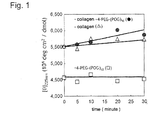
- the 22 ⁇ g/ml 4-arm-PEG-(POG) 10 solution thus prepared (Run No.2 in Table 1) and the collagen solution were mixed with each other in the same amount and the CD spectrum ([ ⁇ ] 225nm ) and the change ([ ⁇ ] 225nm ) thereof were measure. Results are shown in Fig. 1 .
- Fig. 1 shows variation with time of [ ⁇ ] 225nm after mixing of the crosslinking agent and collagen (temperature: 25°C).
- Fig. 1 additionally shows the results for comparison obtained by measurement by using only 4-arm-PEG-(POG) 10 or collagen used above.
- Fig. 1 demonstrate that addition of the 4-arm-PEG- (POG) 10 to collagen lead to increase of ⁇ 225 , indicating that triple helix was formed by the collagen and the crosslinking agent.
- the 2-arm-PEG-(POG) 10 and the 8-arm-PEG-(POG) 10 prepared in Examples 2 and 3 were mixed with collagen in a manner similar to the above. Gells were also formed.
- Such gel formation indicates that 2-, 4- or 8-arm-PEG-(POG) 10 forms triple helix with collagen molecules, resulting in crosslinking collagen molecules with each other.
- the gel obtained was stable and transparent, and the results suggest a possibility to application to the ophthalmic field for treatment of conical cornea.
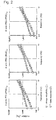
- the dynamic viscoelasticity of the collagen gels with 2-, 4- or 8-arm-PEG-(POG) 10 obtained in the test for collagen gelation ability was measured.
- storage modulus and loss modulus were determined, by placing the gel over the entire sampling face and the pressurizing face at a position 0.5 mm above the gel surface and then starting the measurement. Results are shown in Fig. 2 .
- porcine skin-derived type-1 atelocollagen manufactured by Nippon Meat Packers, Inc.
- acetate buffer solution 100 mg of porcine skin-derived type-1 atelocollagen (manufactured by Nippon Meat Packers, Inc.) was dissolved in 1 ml of acetate buffer solution.
- the solution was mixed with 100 ⁇ l of acetatebuffer solution containing 4 mg of WSC and 2 mg of N-hydroxy succinimide (NHS) dissolved therein, and the resulting solution was fed dropwise onto a glass plate surface, the droplet was surrounded by silicone rubber spacer having a thickness of 300 ⁇ m and covered with another glass plate, and allowed to react at 25°C for 24 hours, to give a collagen gel.
- NHS N-hydroxy succinimide
- the gel obtained was immersed in phosphate-buffered physiological saline (PBS) overnight, to be washed. The gel was then cut out with a punch having a diameter of 1.6 cm, to give a collagen disk gel having a diameter of 1,6 cm and a thickness of 300 ⁇ m.
- 20 mg of the 4-arm-PEG-(FOG) 10 (Run No. 2 in Table 1) was dissolved in 100 ⁇ l of PBS, and the solution was fed dropwise on the disk gel surface and incubated at 4°C for 12 hours. After incubation, the disk gel was immersed in PBS to be washed, and the breaking strength thereof was measured in a puncture test by using an EZ test small tabletop tester (manufactured by Shimadzu Corporation). Results are shown in Fig. 3A .
- Fig. 3B shows the results of breaking strength obtained after incubation under the same conditions, except that only PBS in an amount of 100 ⁇ l was added dropwise instead of the crosslinking agent.
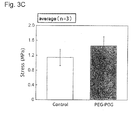
- Fig. 3C is a bar chart showing the results of average breaking strength obtained in three tests.
- the parenchymal layer of biogenic cornea is made of type-I collagen and that the parenchymal layer becomes thin and weak, resulting in such a disease as conical cornea.
- the crosslinking agent according to the present invention is dropped onto the eyes, it is expected that the parenchymal layer of cornea is strengthened and to have a therapeutic effect to a diseases of the parenchymal layer.
- a fluorescence labeling agent Alexa488 (produced by Invitrogen Corporation) was bound to the 4-arm-PEG- (POG) 10 (Run No.2 in Table 1) in condensation reaction by using WSC and NHS, to give a fluorescent-labeled crosslinking agent.
- 1 mg of the crosslinking agent was dissolved in 1 ml of PBS and the mixture was dropped on the corneoscleral piece of the rabbit and incubated at room temperature for 24 hours. After washed with PBS, the cell nucleus was stained with Hoechst. Observation under fluorescence microscope showed strong fluorescence on one face of the corneal parenchymal layer, indicating that fluorescent-labeled crosslinking agent was adsorbed on the cornea.
- the crosslinking agent according to the present invention is useful as a biogenic crosslinking agent, in particular as a collagen crosslinking agent, and the crosslinking agent according to the present invention can be used for gelation of collagen solution and reinforcement of the intensity of collagen gel by using the characteristics described above.
- the crosslinking agent according to the present invention is also be applicable, for example, for treatment of conical cornea. It is also applicable as a tissue adhesive, in addition to application to the ophthalmic field, and thus may be used in general surgical operations. For that reason, the present invention has a large economical effects and also a large repercussion effects.
Landscapes
- Health & Medical Sciences (AREA)
- Life Sciences & Earth Sciences (AREA)
- Engineering & Computer Science (AREA)
- Bioinformatics & Cheminformatics (AREA)
- Chemical & Material Sciences (AREA)
- Veterinary Medicine (AREA)
- Public Health (AREA)
- Medicinal Chemistry (AREA)
- General Health & Medical Sciences (AREA)
- Animal Behavior & Ethology (AREA)
- Pharmacology & Pharmacy (AREA)
- Gastroenterology & Hepatology (AREA)
- Zoology (AREA)
- Epidemiology (AREA)
- Proteomics, Peptides & Aminoacids (AREA)
- Immunology (AREA)
- Biomedical Technology (AREA)
- Chemical Kinetics & Catalysis (AREA)
- Ophthalmology & Optometry (AREA)
- Organic Chemistry (AREA)
- General Chemical & Material Sciences (AREA)
- Nuclear Medicine, Radiotherapy & Molecular Imaging (AREA)
- Materials For Medical Uses (AREA)
- Medicines That Contain Protein Lipid Enzymes And Other Medicines (AREA)
- Peptides Or Proteins (AREA)
Abstract
Description
- The present invention relates to a collagen crosslinking agent, in particular to a noncovalent collagen crosslinking agent.
- Conical cornea is a disease that a corneal parenchymal layer thins and a central region protrudes. Its reason is not yet understood and there is currently no treatment method other than suppression of the protrusion with a contact lens or transplantation of cornea.
- In a study for treatment of conical cornea, there is reported a method of crosslinking collagen in the corneal parenchymal layer by adding riboflavin (vitamin B2) dropwise into the eye and irradiating the eye with ultraviolet ray (for examples, Non-patent Document 1). However, it is difficult to stop progress of conical cornea completely and the damage due to UV irradiation also causes a problem.
- Crosslinking agents that crosslink collagen by chemical bondings are known. For example, known in Japan are a photoreactive gelatin-polyethylene glycol (PEG) diacrylate crosslinking agent, developed by Matsuda et al. (Non-patent Document 2), a succinimidated citric acid crosslinking agents, developed by Taguchi et al. (Non-patent Document 3) and an aldehyde group-containing polymeric micelle crosslinking agent, developed by Murakami et al. (Non-patent Document 4); and known abroad are succinimidated PEGS, developed by Wallance et al. (Non-patent Document 5) and others. However, there is concern about toxicity by residual monomers and unreacted functional groups and there is also a problem of stability.
-
- [Non-patent Document 1] T. Seiler et al., Am. J. Ophthalmol., 135, 620 (2003)
- [Non-patent Document 2] J. Biomed. Mater. Res. 1999
- [Non-patent Document 3] Mater. Sci. Eng. C2004
- [Non-patent Document 4] J. Biomed. Mater. Res. 2007
- [Non-patent Document 5] J. Biomed. Mater. Res. 2001
- The present inventions were made under the circumstances above. An object of the present invention is to provide a collagen crosslinking agent superior in biocompatibility that is free from bad influences by UV irradiation and also from problems of toxicity caused by residual monomers or unreacted functional groups.
- The present invention provides a noncovalent collagen crosslinking agent, comprising a spacer of a polyvalent alcohol having two or more OH groups at terminals and arms of collagen peptides formed of repetitions of three amino acids, the arms being bound to the spacer via the OH groups.
- The crosslinking agent according to the present invention is superior in biocompatibility and the driving force thereof for crosslinking is caused from formation of triple helix. Thus, there is no need for UV irradiation, and there is no concern about adverse reactions caused by UV irradiation, even if the crosslinking agent according to the present invention is administered to the body. There is also no concern about generation of toxicity caused by residual monomers or reactive functional groups, its problem being associated with conventional chemical crosslinking agents.
-
-
Fig. 1 Fig. 1 is a graph showing a change with time of [θ]225nm in CD spectra out a crosslinking agent according to the present invention and collagen. -
Fig. 2 Fig. 2 includes graphs showing dynamic viscoelasticity of gel formed from the crosslinking agent according to the present invention and collagen. -
Fig. 3A Fig. 3A is a graph showing breaking strength of a collagen disk gel (cornea model) when aqueous crosslinking agent solution according to the present invention is added thereto for crosslinking. -
Fig. 3B Fig. 3B is a graph showing breaking strength of a collagen disk gel (model cornea) when only the same amount of phosphate-buffered physiological saline (PBS) was added thereto for comparison. -
Fig. 3C Fig. 3C is a graph comparing breaking strengths of collagen disk gels (average of three measurements) when a crosslinking agent according to the present invention was added and not added thereto. - The collagen crosslinking agent according to the present invention has a spacer and arms extending from the spacer.
- The spacer, which has a role to control the distance between arms and provide hydrophilicity, is a base for connection with the arms described below. Specifically, it is a multiply branching polyvalent alcohol having two or more OH groups at the terminals.
- Two or more OH groups may be present at the terminals. The term "terminal" above means that the compound may have OH groups at positions other than the terminals of branching chains, but such OH groups are not included in the number of OH groups specified in the present invention. Only terminal OH groups are included, for the purpose of controlling the distance between arms.
- Although the maximum number of the OH groups is not particularly limited, from the viewpoints of solubility and steric repulsion of the arms is a polyvalent alcohol having 2 to 512 OH groups, preferably 3 to 16 OH groups, more preferably 4 to 16 OH groups, and still more preferably 4 to 8 OH groups, and particularly 4 OH groups.
- Specific examples of the polyvalent alcohols having two or more OH groups at the terminals include bivalent alcohols such as ethylene glycol, propylene glycol, butylene glycol, diethylene glycol, erythritol, threitol, ribitol, xylitol, mannitol, catechol, catechin and bisphenol A; trivalent alcohols such as glycerol and trihydroxybenzene; tetravalent alcohols such as pentaerythritol, diglycerin, pentaerythritol polyethylene glycol ether, for example, pentaerythritol tetrapolyethylene glycol ether; hexavalent alcohols such as dipentaerythritol and inositol; octavalent alcohols such as hexaglycerol polyethylene glycol ether, for example, hexaglycerol octapolyethylene glycol ether; 16-valent alcohols such as hydroxylated polyamide amine dendrimer (generation number: 2); 32-valent alcohols such as hydroxylated polyamide amine dendrimer (generation number: 3); 64-valent alcohols such as hydroxylated polyamide amine dendrimer (generation number: 4); 128-valent alcohols such as hydroxylated polyamide amine dendrimer (generation number: 5); 256-valent alcohols such as hydroxylated polyamide amine dendrimer (generation number: 6); 512-valent alcohols such as hydroxylated polyamide amine dendrimer ((generation number: 7); monosaccharides such as glucose, fructose and galactose; disaccharides and the oligosaccharides and polysaccharides thereof.
- From the viewpoint of biological safety, the arms may be extended, for example, with an alkylene glycol or a polyalkyleneoxide such as polyethylene glycol, polypropylene glycol or polyethyleneoxide, and the OH groups of the polyvalent alcohol are given at chain-extended terminals as terminal OH groups (hereinafter, the chain-extended alcohol may be referred to as "chain-extended polyvalent alcohol", and in the present invention, such chain-extended polyvalent alcohols are also included in the "polyvalent alcohols").
- From the viewpoint of crosslinking, the polyvalent alcohol may be soluble in solution, in an amount of about 0.1 to 500 mg (0.01 to 50 wt %) in 1 ml of the solution. A high-molecular weight polyvalent alcohol can also be used, if it satisfies the conditions above, and the molecular weight thereof is not limited.
- Among the polyvalent alcohols, the ones containing much a biological component or a compound or component superior in biocompatibility are used preferably for improvement of biological safety.
- Examples of such polyvalent alcohols include bivalent alcohols such as polyethylene glycol, polypropylene glycol, polyethyleneoxide, erythritol, threitol, ribitol, xylitol, mannitol, catechol and catechin; trivalent alcohols such as glycerol; tetravalent alcohols such as pentaerythritol, diglycerin and pentaerythritol polyethylene glycol ether; hexavalent alcohols such as dipentaerythritol and inositol; octavalent alcohols such as hexaglycerol polyethylene glycol ether; monosaccharides such as glucose, fructose and galactose; disaccharides and oligosaccharides and polysaccharides thereof.
- Polyvalent alcohol preferably used in the present invention may be selected from the viewpoints of the number of terminal OH groups, hydrophilicity and biological safety, but should be selected properly with steric repulsion by arms and distance between arms taken into consideration. It is preferable, however, to have three or more arms, in order to obtain a collagen gel having a sufficiently high mechanical strength and thus, the polyvalent alcohol for use is preferably a trivalent or higher alcohol.
- All of the polyvalent alcohols above are commercially available and can be prepared by those who are skilled in the art.
- The arm is constituted of a collagen peptide or a collagen model peptide, formed of repetitions of three amino acids. The collagen model peptide means a peptide formed of repetitions of amino acids similar to collagen peptide. The arms form triple helix with collagen molecules, crosslinking the collagen molecules. The arms, which are made of amino acids, are superior in biocompatibility.
- The arm is represented by the following General Formula (I) having peptide bonds:
(Y-X-G)n (I)
wherein, G represents glycine (Gly) residue; X and Y each independently represent an amino acid residue such as alanine (Ala) residue (A), proline (Pro) residue (P), hydroxyproline (Hyp) residue (O), and glycine (Gly) residue (G), preferably alanine (Ala) residue (A), proline (Pro) residue (P) or hydroxyproline (Hyp) residue (O), particularly preferably proline (Pro) residue (P) or hydroxyproline (Hyp) residue (O). X and Y may be chemically modified with a methyl group, an isobutyl group or a fluorine atom, and examples of such groups include N-isobutyl glycine, N-methyl alanine, and 4-fluoroproline. The word of n is an integer or 1 to 50, preferably of 5 to 20. - Preferable (Y-X-G) is (P-O-G), (P-P-G), (P-A-G), (P-N-isobutyl glycine (Nleu)-G), (P-N-methylalanine (meA)-G) or (P-fluoroproline (Flp)-G), more preferably (P-O-G), (P-P-G) or (P-A-G) , and still more preferably (P-O-G) from the viewpoint of the stability of triple helix.
- The arm represented by the Formula above can be prepared by those who are skilled in the art, for example by liquid-phase peptide synthesis method, solid-phase peptide synthesis method or genetic engineering method. For example, (P-O-G)10 can be prepared by solid-phase peptide synthesis method. In addition, (P-O-G)10 is also available commercially under the trade name of (Pro-Hyp-Gly)10-20H2O from Peptide Institute, Inc.
- The arm is bound to the spacer. The bonding form changes, depending on whether the carboxyl group (COOH) terminal or the amino group (>NH or NH2) terminal of the arm is used.
- When the carboxyl group terminal of the arm is used, the arm and the spacer are bound to each other, via ester bonds formed between the carboxyl group (COOH) thereof and the OH groups of the spacer. Such an ester bond-forming reaction may be carried out by a method commonly used, such as an active esterification method of carboxyl groups or a method of using a condensing agent.
- When the amino group-terminal of the arm is used, it is difficult to form a bond by direct reaction of the amino groups of the arm with the hydroxyl groups of the spacer. Therefore, the arm and the spacer may be bound to each other by using an amide bond-forming reaction, for example, by chemically modifying the spacer terminals to form N-hydroxysuccinimide-ester for coupling reaction. Alternatively, the arm and the spacer may be bound to each other, by esterification of the spacer terminal OH group, such as mesylation, tosylation, or para-nitrophenyl esterification.
- It is not needed to make the arm bound to all OH groups of the spacer, and the terminal OH groups of at least two spacers are bound to the arms. Increase in the number of spacer-arm bonds leads to increase of crosslinking points during crosslinking of the collagen molecules. The number of the arms bound to the spacer may be adjusted properly depending on application, desirable crosslinking strength or the like.
- A commercially avail able product may be used as the spacer. Examples of bivalent alcohol spacers for use include 2-arm type polyethylene glycol (2-arm-PEG) (molecular weight (MW): 3000 to 20000) available as SUNBRIGHT DE series from NOF Corporation, 4-arm type polyethylene glycol (4-arm-PEG) (molecular weight (MW): 10000 to 20000) available as SONBRIGHT PTE series from NOF Corporation, and 8-arm type polyethylene glycol (8-arm-PEG) (molecular weight MW): 20000) available as SUNBRIGHT HGEO series from NOF Corporation. The products in the above series are polyvalent alcohols previously esterified to N-hydroxysuccinimide-esters. Other commercially available terminal succinimide-esterified branching polyethylene glycol any others are also usable as the spacer for the crosslinking agent according to the present invention.
- Particles such as gold particles may be used as the spacer. When gold particles are used, the Y terminal in General formula (I) is bound to an amino acid having a -SH bond, such as cysteine residue. It is because Au-S bonds are formed with gold (Au), trus making it possible to bind the spacer with the arm. In the case of other particles (for example, polystyrene particles having carboxyl groups on the surface), an amino acid having a functional group that forms a bond with the particle (lysine in the case of the polystyrene particle) may be used as the Y terminal. The size of the particles is preferably as small as about 1 to 100 nm. The particle size is preferably smaller. Particle size of more than 100 nm may be larger than collagen fiber diameter, causing a problem of inhibiting mutual approach between collagen fibers.
- The arm can be bound to the gold particles, for example by a method of incubation at room temperature.
- When added to an aqueous collagen solution, the collagen crosslinking agent according to the present invention forms crosslinkages with the triple helix formation between the collagen crosslinking agent and the collagen molecules used as a driving force. The collagen molecules are then crosslinked through noncovalent bonds.
- Formation of the triple helix between the collagen crosslinking agent and the collagen molecules can be confirmed by circular dichroism spectrum (CD spectrum) and also by collagen gel formation by mixing.
- The collagen to which the collagen crosslinking agent according to the present invention is applicable is not particularly limited, and examples thereof include one of proteins constituting skin, ligaments, sinews, bones, cartilages, cornea, blood vessel, basal layers and internal organs, which is known as a major component of extracellular substrates (extracellular matrixes) of multicellular animals; collagens chemically treated, for example, with acid, alkali or enzyme; chemically-modified collagens and synthetic collagens. The collagens crosslinking agent according to the present invention can be used favorably for fibrous protein collagens among the collagens above.
- How to use the collagen crosslinking agent according to the present invention and the collagen includes mixing both the aqueous solutions each other. A mixing ratio thereof may be determined properly according to applications for use, but is set to 1/100 to 1/1, preferably 1/10 to 1/2 (by weight) from the viewpoint of gel strength.
- The collagen crosslinking agent according to the present invention, which can be constituted with biocompatible components, may be applicable to treatment, for example, of conical cornea, a disease of thinning and protruding of the cornea caused by deterioration of crosslinking of the collagen constituting the cornea.
- (POG)10 was introduced to the terminals of 4-arm-PEG, by treating succinimide-esterified 4-arm-PEG (NHS) and (POG)10 (CMP) in condensation reaction in the amounts and the molar ratio shown in the Table below in 6 ml of sodium carbonate buffer (50 mM, pH: 8.2) in the presence of a condensing agent 1-ethyl-3-(3-dimethylaminopropyl)carbodiimide (WSC) and an auxiliary 1-hydroxybenzotriazole (HOBt) for 24 hours (see the following reaction formula).
The introduction rate of (POG)10 was determined by 1H-NMR spectrum measurement, showing that the introduction rate of the POG chain was approximately 80%. The yield was 80% or more, indicating that the reaction proceeded almost quantitatively. - The succinimide-esterified 4-arm-PEG used was SUNBRIGHT PTE-100GS (product name) (MW: 10000, produced by NOF Corporation).
(pots)10 means (Pro-Hyp-Gly)10 and specifically, the product name (Pro-Hyp-Gly)10-20H2O (produced by Watanabe Chemical Industries, Ltd.) was used. -

-
[Table 1] run No. 4-arm-PEG-NHS (POG)10 WSC HOBt molar ratio yield introduction rate (µmol) (µmol) (µmol) (µmol) NHS: (POG)10 :WSC:HOBt (%) (%) 1 4.1 16.4 0 0 1:1:0:0 77 67 2 4.1 16.4 32.8 32.8 1:1:2:2 87 80 3 8.2 32.8 65.6 65.6 1:1:2:2 82 81 - (POG)10 was introduced to the terminals of 2-arm-PEG by treating 8.2 µmol of succinimide-esterified 2-arm-PEG (NHS) and 16.4 µmol of (POG)10 (CMP) in condensation reaction in 6 ml of sodium carbonate buffer (50 mM, pH: 8.2) in the presence of 32.8 µmol of WSC and HOBt for 24 hours.
The introduction rate of (POG)10 was determined by 1H-NMR spectrum measurement, showing that the introduction rate of POG chain was approximately 80%. The yield was 90% or more, indicating that the reaction proceeded almost quantitatively. - (POG)10 was introduced to the terminals of 8-arm-PEG by treating 2.1 µmol of succinimide-esterified 8-arm-PEG (NHS) and 16.4 µmol of (POG)10 (CMP) in condensation reaction in 6 ml of sodium carbonate buffer (50 mM, pH: 8.2) in the presence of 32.8 µmol of WSC and HOBt for 24 hours.
The introduction rate of (POG) 10 was determined by 1H-NMR spectrum measurement, showing that the introduction rate of POG chain was approximately 80%. The yield was 90%, indicating that the reaction proceeded almost quantitatively. - 2.2 mg of the 4-arm-PEG- (POG) 10 obtained (Run No. 2 in Table 1) was dissolved in 1 ml of 50 mM sodium carbonate buffer solution (pH: 8.2), and the mixture was diluted 100 times with sodium carbonate buffer, to give a 22 µg/ml solution. The concentration was so adjusted that the concentration of (POG)10 became 10 µg/ml in the solution. CD spectrum measurement at 25°C temperature confirmed presence of a positive peak at 225 nm. It is a peak due to the triple helix, indicating that 4-arm-PEG-(POG)10 formed triple helix.
- 10 mg of porcine skin-derived type-I atelocollagen (manufactured by Nippon Meat Packers, Inc.) was dissolved in 1 ml of 50 mM sodium carbonate buffer solution (pH: 8.2), and the mixture was diluted 1000 times with sodium carbonate buffer, to give a 10 µg/ml solution. The 22 µg/ml 4-arm-PEG-(POG)10 solution thus prepared (Run No.2 in Table 1) and the collagen solution were mixed with each other in the same amount and the CD spectrum ([θ]225nm) and the change ([θ]225nm) thereof were measure. Results are shown in
Fig. 1 . -
Fig. 1 shows variation with time of [θ]225nm after mixing of the crosslinking agent and collagen (temperature: 25°C).Fig. 1 additionally shows the results for comparison obtained by measurement by using only 4-arm-PEG-(POG)10 or collagen used above. - The results shown in
Fig. 1 demonstrate that addition of the 4-arm-PEG- (POG)10 to collagen lead to increase of θ225, indicating that triple helix was formed by the collagen and the crosslinking agent. - 1 ml of a solution containing 4-arm-PEG- (POG)10 (Run No.2 in Table 1) dissolved in an acetate buffer solution at a concentration of 20 wt % was mixed with 0.1 ml of a 10 wt % aqueous solution of porcine type-I collagen, to give a collagen/acetate buffer solution. A gel was formed within 1 minute.
- The 2-arm-PEG-(POG)10 and the 8-arm-PEG-(POG)10 prepared in Examples 2 and 3 were mixed with collagen in a manner similar to the above. Gells were also formed.
- Such gel formation indicates that 2-, 4- or 8-arm-PEG-(POG)10 forms triple helix with collagen molecules, resulting in crosslinking collagen molecules with each other.
- The gel obtained was stable and transparent, and the results suggest a possibility to application to the ophthalmic field for treatment of conical cornea.
- The dynamic viscoelasticity of the collagen gels with 2-, 4- or 8-arm-PEG-(POG)10 obtained in the test for collagen gelation ability was measured. In measurement, storage modulus and loss modulus were determined, by placing the gel over the entire sampling face and the pressurizing face at a position 0.5 mm above the gel surface and then starting the measurement. Results are shown in
Fig. 2 . - Because the storage modulus was higher than the loss modulus, all of the 2-, 4- and 8-arm-PEG (POG)10 were shown to form gel. The results also suggest that 2-, 4- or 8-arm-PEG-(POG)10 forms triple helix with collagen molecules, resulting in crosslinking collagen molecules with each other.
- 100 mg of porcine skin-derived type-1 atelocollagen (manufactured by Nippon Meat Packers, Inc.) was dissolved in 1 ml of acetate buffer solution. The solution was mixed with 100 µl of acetatebuffer solution containing 4 mg of WSC and 2 mg of N-hydroxy succinimide (NHS) dissolved therein, and the resulting solution was fed dropwise onto a glass plate surface, the droplet was surrounded by silicone rubber spacer having a thickness of 300 µm and covered with another glass plate, and allowed to react at 25°C for 24 hours, to give a collagen gel.
- The gel obtained was immersed in phosphate-buffered physiological saline (PBS) overnight, to be washed. The gel was then cut out with a punch having a diameter of 1.6 cm, to give a collagen disk gel having a diameter of 1,6 cm and a thickness of 300µm. 20 mg of the 4-arm-PEG-(FOG)10 (Run No. 2 in Table 1) was dissolved in 100 µl of PBS, and the solution was fed dropwise on the disk gel surface and incubated at 4°C for 12 hours. After incubation, the disk gel was immersed in PBS to be washed, and the breaking strength thereof was measured in a puncture test by using an EZ test small tabletop tester (manufactured by Shimadzu Corporation). Results are shown in
Fig. 3A . -
Fig. 3B shows the results of breaking strength obtained after incubation under the same conditions, except that only PBS in an amount of 100 µl was added dropwise instead of the crosslinking agent.Fig. 3C is a bar chart showing the results of average breaking strength obtained in three tests. - It was confirmed that addition of the crosslinking agent lead to increase in breaking strength. It is known that the parenchymal layer of biogenic cornea is made of type-I collagen and that the parenchymal layer becomes thin and weak, resulting in such a disease as conical cornea. When the crosslinking agent according to the present invention is dropped onto the eyes, it is expected that the parenchymal layer of cornea is strengthened and to have a therapeutic effect to a diseases of the parenchymal layer.
- A fluorescence labeling agent Alexa488 (produced by Invitrogen Corporation) was bound to the 4-arm-PEG- (POG)10 (Run No.2 in Table 1) in condensation reaction by using WSC and NHS, to give a fluorescent-labeled crosslinking agent. 1 mg of the crosslinking agent was dissolved in 1 ml of PBS and the mixture was dropped on the corneoscleral piece of the rabbit and incubated at room temperature for 24 hours. After washed with PBS, the cell nucleus was stained with Hoechst. Observation under fluorescence microscope showed strong fluorescence on one face of the corneal parenchymal layer, indicating that fluorescent-labeled crosslinking agent was adsorbed on the cornea.
- The crosslinking agent according to the present invention is useful as a biogenic crosslinking agent, in particular as a collagen crosslinking agent, and the crosslinking agent according to the present invention can be used for gelation of collagen solution and reinforcement of the intensity of collagen gel by using the characteristics described above. The crosslinking agent according to the present invention is also be applicable, for example, for treatment of conical cornea. It is also applicable as a tissue adhesive, in addition to application to the ophthalmic field, and thus may be used in general surgical operations. For that reason, the present invention has a large economical effects and also a large repercussion effects.
Claims (8)
- A noncovalent collagen crosslinking agent, comprising:a spacer of a polyvalent alcohol having two or more OH groups at terminals and arms of collagen peptides formed of repetitions of three amino acids, the arms being bound via the OH groups to the spacer.
- A noncovalent collagen crosslinking agent, comprising:a spacer of gold particle and arms of a collagen peptide or a collagen model peptide constituted repetitions of three amino acids, the arms being bound to the spacer.
- The noncovalent collagen crosslinking agent according to Claim 1, wherein the polyvalent alcohol has 3 to 16 OH groups.
- The noncovalent collagen crosslinking agent according to Claim 1, wherein the polyvalent alcohol has four OH groups.
- The noncovalent collagen crosslinking agent according to Claim 1, wherein the polyvalent alcohol is a tetravalent alcohol of pentaerythritol tetrapolyethylene glycol ether or an octavalent alcohol of hexaglycerol octapolyethylene glycol ether.
- The noncovalent collagen crosslinking agent according to Claim 1, wherein the arm is represented by the following General Formula (I):
(Y-X-G)n (I)
(wherein, G represents glycine (Gly) residue; X and Y each independently represent an amino acid residue selected from the group consisting of alanine (Ala) residue (A), proline (Pro) residue (P) and hydroxyproline (Hyp) residue (O); and n is an integer of 1 to 50). - The noncovalent collagen crosslinking agent according to Claim 6, wherein the arm is represented by (P-O-G).
- The noncovalent collagen crosslinking agent according to Claim 1, wherein the arms of Claim 7 are bound to the spacer of the polyvalent alcohol of Claim 5.
Applications Claiming Priority (2)
| Application Number | Priority Date | Filing Date | Title |
|---|---|---|---|
| JP2008121073 | 2008-05-07 | ||
| PCT/JP2009/058554 WO2009136599A1 (en) | 2008-05-07 | 2009-05-01 | Non-covalent crosslinking agent for collagen |
Publications (3)
| Publication Number | Publication Date |
|---|---|
| EP2286824A1 true EP2286824A1 (en) | 2011-02-23 |
| EP2286824A4 EP2286824A4 (en) | 2012-06-06 |
| EP2286824B1 EP2286824B1 (en) | 2013-08-14 |
Family
ID=41264655
Family Applications (1)
| Application Number | Title | Priority Date | Filing Date |
|---|---|---|---|
| EP09742723.1A Not-in-force EP2286824B1 (en) | 2008-05-07 | 2009-05-01 | Non-covalent crosslinking agent for collagen |
Country Status (4)
| Country | Link |
|---|---|
| US (1) | US8389686B2 (en) |
| EP (1) | EP2286824B1 (en) |
| JP (1) | JP5311508B2 (en) |
| WO (1) | WO2009136599A1 (en) |
Families Citing this family (6)
| Publication number | Priority date | Publication date | Assignee | Title |
|---|---|---|---|---|
| US9622911B2 (en) | 2010-09-30 | 2017-04-18 | Cxl Ophthalmics, Llc | Ophthalmic treatment device, system, and method of use |
| EP2830627B1 (en) | 2012-03-29 | 2024-05-01 | Epion Therapeutics, Inc. | Ocular treatment solutions, delivery devices and delivery augmentation methods |
| US9566301B2 (en) | 2012-03-29 | 2017-02-14 | Cxl Ophthalmics, Llc | Compositions and methods for treating or preventing diseases associated with oxidative stress |
| EP2830554A1 (en) | 2012-03-29 | 2015-02-04 | CXL Ophthalmics, LLC | Ocular cross-linking system and method for sealing corneal wounds |
| US20200308568A1 (en) * | 2019-03-27 | 2020-10-01 | Biohybrid Solutions Llc | Alcohol stable enzymes |
| CN113773379B (en) * | 2021-09-13 | 2023-08-01 | 熹微(苏州)生物医药科技有限公司 | A method for preparing pegylated collagen-like protein and its application |
Family Cites Families (9)
| Publication number | Priority date | Publication date | Assignee | Title |
|---|---|---|---|---|
| GB0003082D0 (en) * | 2000-02-10 | 2000-03-29 | Glaxo Group Ltd | Vaccine |
| CA2373958C (en) * | 2000-03-13 | 2004-10-19 | Matsushita Electric Industrial Co., Ltd. | Reproducing apparatus |
| DE60139959D1 (en) * | 2000-11-27 | 2009-10-29 | Powderject Vaccines Inc | NUKLEINSÄUREADJUVANTIEN |
| JP5070442B2 (en) * | 2002-02-28 | 2012-11-14 | 株式会社Phg | Novel polypeptide and method for producing the same |
| ATE491471T1 (en) | 2002-03-19 | 2011-01-15 | Powderject Res Ltd | ADJUVANTS FOR DNA VACCINES BASED ON IMIDAZOCINOLINE |
| US7157428B2 (en) * | 2003-11-26 | 2007-01-02 | Histogenics, Corp. | Method for treatment and repair of meniscal injuries |
| JP2007112924A (en) * | 2005-10-21 | 2007-05-10 | National Institute For Materials Science | Polymer cross-linking agent and liposome or cell cross-linked product using this cross-linking agent |
| US7566437B2 (en) | 2006-03-31 | 2009-07-28 | Umicore Ag & Co. Kg | Process for manufacture of silver-based composite powders for electrical contact materials and composite powders so produced |
| WO2007120457A2 (en) * | 2006-04-13 | 2007-10-25 | Euclid Systems Corporation | Composition and method for stabilizing corneal tissue after refractive surgery |
-
2009
- 2009-05-01 EP EP09742723.1A patent/EP2286824B1/en not_active Not-in-force
- 2009-05-01 WO PCT/JP2009/058554 patent/WO2009136599A1/en not_active Ceased
- 2009-05-01 JP JP2010511068A patent/JP5311508B2/en not_active Expired - Fee Related
- 2009-05-01 US US12/990,897 patent/US8389686B2/en not_active Expired - Fee Related
Also Published As
| Publication number | Publication date |
|---|---|
| EP2286824A4 (en) | 2012-06-06 |
| US20110060129A1 (en) | 2011-03-10 |
| JPWO2009136599A1 (en) | 2011-09-08 |
| EP2286824B1 (en) | 2013-08-14 |
| US8389686B2 (en) | 2013-03-05 |
| JP5311508B2 (en) | 2013-10-09 |
| WO2009136599A1 (en) | 2009-11-12 |
Similar Documents
| Publication | Publication Date | Title |
|---|---|---|
| KR101428898B1 (en) | Cross-linked oxidated hyaluronic acid for use as a vitreous substitute | |
| US9546235B2 (en) | Peptide-hydrogel composite | |
| KR101054023B1 (en) | Synthetic Matrix to Control Intracellular Proliferation and Tissue Regeneration | |
| EP2286824B1 (en) | Non-covalent crosslinking agent for collagen | |
| US20130129710A1 (en) | Hemostatic compositions | |
| US20070264227A1 (en) | Synthetic Matrix for Controlled Cell Ingrowth and Tissue Regeneration | |
| US20240050586A1 (en) | Compositions and methods for making and using double network hydrogels | |
| WO2021173698A9 (en) | Compositions and methods for in situ-forming gels for wound healing and tissue regeneration | |
| WO2023035719A1 (en) | Pegylated collagen-like protein, and preparation method therefor and application thereof | |
| CN114466869B (en) | Hydrogel compositions and uses thereof | |
| Sundaram et al. | Recombinant hyaluronic acid-incorporated self-healing injectable hydrogels for cartilage tissue engineering: a case study on effects of molecular weight | |
| US20050276858A1 (en) | Bifunctional-modified hydrogels | |
| CA2762228C (en) | Crosslinked polymers with the crosslinker as therapeutic for sustained release | |
| Trujillo et al. | Cytocompatibility evaluation of PEG-methylsulfone hydrogels | |
| US20110287068A1 (en) | Fibrin and fibrinogen matrices and uses of same | |
| WO2023035720A1 (en) | Method for preparing pegylated collagen-like protein and use thereof | |
| RU2744694C2 (en) | Hemostatic compositions | |
| WO2025152860A1 (en) | Hydrogel for exosome delivery, method for preparing same, and use thereof | |
| CN117447717B (en) | Strong wet tissue adhesion hydrogel and preparation method and application thereof | |
| JP2005075815A (en) | Hemostatic tissue-repairing material | |
| JP7863314B2 (en) | Composition and adhesive | |
| Pupkaite | Collagen Hydrogels for Regenerative Medicine | |
| WO2026046282A1 (en) | Cross-linked polyamide hydrogel material and preparation method therefor | |
| TW202506207A (en) | Adhesive composition | |
| JP2026510738A (en) | Molecular linker |
Legal Events
| Date | Code | Title | Description |
|---|---|---|---|
| PUAI | Public reference made under article 153(3) epc to a published international application that has entered the european phase |
Free format text: ORIGINAL CODE: 0009012 |
|
| 17P | Request for examination filed |
Effective date: 20101105 |
|
| AK | Designated contracting states |
Kind code of ref document: A1 Designated state(s): AT BE BG CH CY CZ DE DK EE ES FI FR GB GR HR HU IE IS IT LI LT LU LV MC MK MT NL NO PL PT RO SE SI SK TR |
|
| AX | Request for extension of the european patent |
Extension state: AL BA RS |
|
| DAX | Request for extension of the european patent (deleted) | ||
| A4 | Supplementary search report drawn up and despatched |
Effective date: 20120509 |
|
| RIC1 | Information provided on ipc code assigned before grant |
Ipc: A61K 38/39 20060101AFI20120503BHEP Ipc: A61P 27/02 20060101ALI20120503BHEP |
|
| REG | Reference to a national code |
Ref country code: DE Ref legal event code: R079 Ref document number: 602009017999 Country of ref document: DE Free format text: PREVIOUS MAIN CLASS: A61K0038000000 Ipc: A61K0038390000 |
|
| RIC1 | Information provided on ipc code assigned before grant |
Ipc: A61P 27/02 20060101ALI20130117BHEP Ipc: A61K 38/39 20060101AFI20130117BHEP |
|
| GRAP | Despatch of communication of intention to grant a patent |
Free format text: ORIGINAL CODE: EPIDOSNIGR1 |
|
| GRAS | Grant fee paid |
Free format text: ORIGINAL CODE: EPIDOSNIGR3 |
|
| GRAA | (expected) grant |
Free format text: ORIGINAL CODE: 0009210 |
|
| AK | Designated contracting states |
Kind code of ref document: B1 Designated state(s): AT BE BG CH CY CZ DE DK EE ES FI FR GB GR HR HU IE IS IT LI LT LU LV MC MK MT NL NO PL PT RO SE SI SK TR |
|
| REG | Reference to a national code |
Ref country code: GB Ref legal event code: FG4D |
|
| REG | Reference to a national code |
Ref country code: AT Ref legal event code: REF Ref document number: 626399 Country of ref document: AT Kind code of ref document: T Effective date: 20130815 Ref country code: CH Ref legal event code: EP |
|
| REG | Reference to a national code |
Ref country code: CH Ref legal event code: NV Representative=s name: BOHEST AG, CH |
|
| REG | Reference to a national code |
Ref country code: IE Ref legal event code: FG4D |
|
| REG | Reference to a national code |
Ref country code: DE Ref legal event code: R096 Ref document number: 602009017999 Country of ref document: DE Effective date: 20131010 |
|
| REG | Reference to a national code |
Ref country code: AT Ref legal event code: MK05 Ref document number: 626399 Country of ref document: AT Kind code of ref document: T Effective date: 20130814 Ref country code: NL Ref legal event code: VDEP Effective date: 20130814 |
|
| REG | Reference to a national code |
Ref country code: LT Ref legal event code: MG4D |
|
| PG25 | Lapsed in a contracting state [announced via postgrant information from national office to epo] |
Ref country code: IS Free format text: LAPSE BECAUSE OF FAILURE TO SUBMIT A TRANSLATION OF THE DESCRIPTION OR TO PAY THE FEE WITHIN THE PRESCRIBED TIME-LIMIT Effective date: 20131214 Ref country code: LT Free format text: LAPSE BECAUSE OF FAILURE TO SUBMIT A TRANSLATION OF THE DESCRIPTION OR TO PAY THE FEE WITHIN THE PRESCRIBED TIME-LIMIT Effective date: 20130814 Ref country code: AT Free format text: LAPSE BECAUSE OF FAILURE TO SUBMIT A TRANSLATION OF THE DESCRIPTION OR TO PAY THE FEE WITHIN THE PRESCRIBED TIME-LIMIT Effective date: 20130814 Ref country code: CY Free format text: LAPSE BECAUSE OF FAILURE TO SUBMIT A TRANSLATION OF THE DESCRIPTION OR TO PAY THE FEE WITHIN THE PRESCRIBED TIME-LIMIT Effective date: 20130918 Ref country code: SE Free format text: LAPSE BECAUSE OF FAILURE TO SUBMIT A TRANSLATION OF THE DESCRIPTION OR TO PAY THE FEE WITHIN THE PRESCRIBED TIME-LIMIT Effective date: 20130814 Ref country code: PT Free format text: LAPSE BECAUSE OF FAILURE TO SUBMIT A TRANSLATION OF THE DESCRIPTION OR TO PAY THE FEE WITHIN THE PRESCRIBED TIME-LIMIT Effective date: 20131216 Ref country code: HR Free format text: LAPSE BECAUSE OF FAILURE TO SUBMIT A TRANSLATION OF THE DESCRIPTION OR TO PAY THE FEE WITHIN THE PRESCRIBED TIME-LIMIT Effective date: 20130814 Ref country code: NO Free format text: LAPSE BECAUSE OF FAILURE TO SUBMIT A TRANSLATION OF THE DESCRIPTION OR TO PAY THE FEE WITHIN THE PRESCRIBED TIME-LIMIT Effective date: 20131114 |
|
| PG25 | Lapsed in a contracting state [announced via postgrant information from national office to epo] |
Ref country code: PL Free format text: LAPSE BECAUSE OF FAILURE TO SUBMIT A TRANSLATION OF THE DESCRIPTION OR TO PAY THE FEE WITHIN THE PRESCRIBED TIME-LIMIT Effective date: 20130814 Ref country code: FI Free format text: LAPSE BECAUSE OF FAILURE TO SUBMIT A TRANSLATION OF THE DESCRIPTION OR TO PAY THE FEE WITHIN THE PRESCRIBED TIME-LIMIT Effective date: 20130814 Ref country code: SI Free format text: LAPSE BECAUSE OF FAILURE TO SUBMIT A TRANSLATION OF THE DESCRIPTION OR TO PAY THE FEE WITHIN THE PRESCRIBED TIME-LIMIT Effective date: 20130814 Ref country code: GR Free format text: LAPSE BECAUSE OF FAILURE TO SUBMIT A TRANSLATION OF THE DESCRIPTION OR TO PAY THE FEE WITHIN THE PRESCRIBED TIME-LIMIT Effective date: 20131115 Ref country code: BE Free format text: LAPSE BECAUSE OF FAILURE TO SUBMIT A TRANSLATION OF THE DESCRIPTION OR TO PAY THE FEE WITHIN THE PRESCRIBED TIME-LIMIT Effective date: 20130814 Ref country code: LV Free format text: LAPSE BECAUSE OF FAILURE TO SUBMIT A TRANSLATION OF THE DESCRIPTION OR TO PAY THE FEE WITHIN THE PRESCRIBED TIME-LIMIT Effective date: 20130814 |
|
| PG25 | Lapsed in a contracting state [announced via postgrant information from national office to epo] |
Ref country code: CY Free format text: LAPSE BECAUSE OF FAILURE TO SUBMIT A TRANSLATION OF THE DESCRIPTION OR TO PAY THE FEE WITHIN THE PRESCRIBED TIME-LIMIT Effective date: 20130814 |
|
| PG25 | Lapsed in a contracting state [announced via postgrant information from national office to epo] |
Ref country code: CZ Free format text: LAPSE BECAUSE OF FAILURE TO SUBMIT A TRANSLATION OF THE DESCRIPTION OR TO PAY THE FEE WITHIN THE PRESCRIBED TIME-LIMIT Effective date: 20130814 Ref country code: SK Free format text: LAPSE BECAUSE OF FAILURE TO SUBMIT A TRANSLATION OF THE DESCRIPTION OR TO PAY THE FEE WITHIN THE PRESCRIBED TIME-LIMIT Effective date: 20130814 Ref country code: EE Free format text: LAPSE BECAUSE OF FAILURE TO SUBMIT A TRANSLATION OF THE DESCRIPTION OR TO PAY THE FEE WITHIN THE PRESCRIBED TIME-LIMIT Effective date: 20130814 Ref country code: DK Free format text: LAPSE BECAUSE OF FAILURE TO SUBMIT A TRANSLATION OF THE DESCRIPTION OR TO PAY THE FEE WITHIN THE PRESCRIBED TIME-LIMIT Effective date: 20130814 Ref country code: NL Free format text: LAPSE BECAUSE OF FAILURE TO SUBMIT A TRANSLATION OF THE DESCRIPTION OR TO PAY THE FEE WITHIN THE PRESCRIBED TIME-LIMIT Effective date: 20130814 Ref country code: RO Free format text: LAPSE BECAUSE OF FAILURE TO SUBMIT A TRANSLATION OF THE DESCRIPTION OR TO PAY THE FEE WITHIN THE PRESCRIBED TIME-LIMIT Effective date: 20130814 |
|
| RAP2 | Party data changed (patent owner data changed or rights of a patent transferred) |
Owner name: OSAKA UNIVERSITY |
|
| PG25 | Lapsed in a contracting state [announced via postgrant information from national office to epo] |
Ref country code: IT Free format text: LAPSE BECAUSE OF FAILURE TO SUBMIT A TRANSLATION OF THE DESCRIPTION OR TO PAY THE FEE WITHIN THE PRESCRIBED TIME-LIMIT Effective date: 20130814 Ref country code: ES Free format text: LAPSE BECAUSE OF FAILURE TO SUBMIT A TRANSLATION OF THE DESCRIPTION OR TO PAY THE FEE WITHIN THE PRESCRIBED TIME-LIMIT Effective date: 20130814 |
|
| PLBE | No opposition filed within time limit |
Free format text: ORIGINAL CODE: 0009261 |
|
| STAA | Information on the status of an ep patent application or granted ep patent |
Free format text: STATUS: NO OPPOSITION FILED WITHIN TIME LIMIT |
|
| 26N | No opposition filed |
Effective date: 20140515 |
|
| REG | Reference to a national code |
Ref country code: CH Ref legal event code: PCAR Free format text: NEW ADDRESS: HOLBEINSTRASSE 36-38, 4051 BASEL (CH) |
|
| REG | Reference to a national code |
Ref country code: DE Ref legal event code: R097 Ref document number: 602009017999 Country of ref document: DE Effective date: 20140515 |
|
| REG | Reference to a national code |
Ref country code: DE Ref legal event code: R119 Ref document number: 602009017999 Country of ref document: DE |
|
| PG25 | Lapsed in a contracting state [announced via postgrant information from national office to epo] |
Ref country code: LU Free format text: LAPSE BECAUSE OF FAILURE TO SUBMIT A TRANSLATION OF THE DESCRIPTION OR TO PAY THE FEE WITHIN THE PRESCRIBED TIME-LIMIT Effective date: 20140501 |
|
| REG | Reference to a national code |
Ref country code: CH Ref legal event code: PL |
|
| GBPC | Gb: european patent ceased through non-payment of renewal fee |
Effective date: 20140501 |
|
| PG25 | Lapsed in a contracting state [announced via postgrant information from national office to epo] |
Ref country code: MC Free format text: LAPSE BECAUSE OF FAILURE TO SUBMIT A TRANSLATION OF THE DESCRIPTION OR TO PAY THE FEE WITHIN THE PRESCRIBED TIME-LIMIT Effective date: 20130814 Ref country code: CH Free format text: LAPSE BECAUSE OF NON-PAYMENT OF DUE FEES Effective date: 20140531 Ref country code: LI Free format text: LAPSE BECAUSE OF NON-PAYMENT OF DUE FEES Effective date: 20140531 |
|
| REG | Reference to a national code |
Ref country code: IE Ref legal event code: MM4A |
|
| REG | Reference to a national code |
Ref country code: FR Ref legal event code: ST Effective date: 20150130 |
|
| REG | Reference to a national code |
Ref country code: DE Ref legal event code: R119 Ref document number: 602009017999 Country of ref document: DE Effective date: 20141202 |
|
| PG25 | Lapsed in a contracting state [announced via postgrant information from national office to epo] |
Ref country code: DE Free format text: LAPSE BECAUSE OF NON-PAYMENT OF DUE FEES Effective date: 20141202 Ref country code: IE Free format text: LAPSE BECAUSE OF NON-PAYMENT OF DUE FEES Effective date: 20140501 |
|
| PG25 | Lapsed in a contracting state [announced via postgrant information from national office to epo] |
Ref country code: GB Free format text: LAPSE BECAUSE OF NON-PAYMENT OF DUE FEES Effective date: 20140501 Ref country code: FR Free format text: LAPSE BECAUSE OF NON-PAYMENT OF DUE FEES Effective date: 20140602 |
|
| PG25 | Lapsed in a contracting state [announced via postgrant information from national office to epo] |
Ref country code: MT Free format text: LAPSE BECAUSE OF FAILURE TO SUBMIT A TRANSLATION OF THE DESCRIPTION OR TO PAY THE FEE WITHIN THE PRESCRIBED TIME-LIMIT Effective date: 20130814 |
|
| PG25 | Lapsed in a contracting state [announced via postgrant information from national office to epo] |
Ref country code: BG Free format text: LAPSE BECAUSE OF FAILURE TO SUBMIT A TRANSLATION OF THE DESCRIPTION OR TO PAY THE FEE WITHIN THE PRESCRIBED TIME-LIMIT Effective date: 20130814 |
|
| PG25 | Lapsed in a contracting state [announced via postgrant information from national office to epo] |
Ref country code: HU Free format text: LAPSE BECAUSE OF FAILURE TO SUBMIT A TRANSLATION OF THE DESCRIPTION OR TO PAY THE FEE WITHIN THE PRESCRIBED TIME-LIMIT; INVALID AB INITIO Effective date: 20090501 Ref country code: TR Free format text: LAPSE BECAUSE OF FAILURE TO SUBMIT A TRANSLATION OF THE DESCRIPTION OR TO PAY THE FEE WITHIN THE PRESCRIBED TIME-LIMIT Effective date: 20130814 |
|
| PG25 | Lapsed in a contracting state [announced via postgrant information from national office to epo] |
Ref country code: MK Free format text: LAPSE BECAUSE OF FAILURE TO SUBMIT A TRANSLATION OF THE DESCRIPTION OR TO PAY THE FEE WITHIN THE PRESCRIBED TIME-LIMIT Effective date: 20130814 |