EP2285787B1 - 3-substituted propanamine compounds - Google Patents
3-substituted propanamine compounds Download PDFInfo
- Publication number
- EP2285787B1 EP2285787B1 EP09758543.4A EP09758543A EP2285787B1 EP 2285787 B1 EP2285787 B1 EP 2285787B1 EP 09758543 A EP09758543 A EP 09758543A EP 2285787 B1 EP2285787 B1 EP 2285787B1
- Authority
- EP
- European Patent Office
- Prior art keywords
- amine
- propyl
- tetrazol
- methyl
- phenyl
- Prior art date
- Legal status (The legal status is an assumption and is not a legal conclusion. Google has not performed a legal analysis and makes no representation as to the accuracy of the status listed.)
- Not-in-force
Links
- ADHSDRROVBDBGM-NETXQHHPSA-N CC(C1)[C@]1(C=C1CC1)N(C)N=N Chemical compound CC(C1)[C@]1(C=C1CC1)N(C)N=N ADHSDRROVBDBGM-NETXQHHPSA-N 0.000 description 1
- CLJZQPJZEDKCTQ-UHFFFAOYSA-N CN(C)CCC(c(cc1)c(cccc2)c2c1F)[n]1nncn1 Chemical compound CN(C)CCC(c(cc1)c(cccc2)c2c1F)[n]1nncn1 CLJZQPJZEDKCTQ-UHFFFAOYSA-N 0.000 description 1
- LPKGSGBIJZZVOA-UHFFFAOYSA-N CN(C)CCC(c(cc1)cc(Cl)c1Cl)[n]1nccn1 Chemical compound CN(C)CCC(c(cc1)cc(Cl)c1Cl)[n]1nccn1 LPKGSGBIJZZVOA-UHFFFAOYSA-N 0.000 description 1
- FPPNHIXXGXMMGO-UHFFFAOYSA-N CN(C)CCC(c(cc1)cc(Cl)c1Cl)[n]1nnc(-c2ccccc2)n1 Chemical compound CN(C)CCC(c(cc1)cc(Cl)c1Cl)[n]1nnc(-c2ccccc2)n1 FPPNHIXXGXMMGO-UHFFFAOYSA-N 0.000 description 1
- CJRNYQHCKVAJLV-UHFFFAOYSA-N CN(C)CCC(c(cc1)cc(F)c1F)[n]1nncc1 Chemical compound CN(C)CCC(c(cc1)cc(F)c1F)[n]1nncc1 CJRNYQHCKVAJLV-UHFFFAOYSA-N 0.000 description 1
- QTDBPOFWKJPDQU-UHFFFAOYSA-N CN(C)CCC(c(cc1)cc(OC)c1OC)[n]1nncn1 Chemical compound CN(C)CCC(c(cc1)cc(OC)c1OC)[n]1nncn1 QTDBPOFWKJPDQU-UHFFFAOYSA-N 0.000 description 1
- MDHBZKYHRYQZLB-UHFFFAOYSA-N CN(C)CCC(c1cc2ccccc2cc1)[n]1nc(cccc2)c2n1 Chemical compound CN(C)CCC(c1cc2ccccc2cc1)[n]1nc(cccc2)c2n1 MDHBZKYHRYQZLB-UHFFFAOYSA-N 0.000 description 1
- HHYQVAKHZDAFLC-UHFFFAOYSA-N CN(C)CCC(c1cccc(Cl)c1)[n]1nncn1 Chemical compound CN(C)CCC(c1cccc(Cl)c1)[n]1nncn1 HHYQVAKHZDAFLC-UHFFFAOYSA-N 0.000 description 1
- NJVBMFYWSGSOLM-UHFFFAOYSA-N CN(C)CCC(c1cccc2ccccc12)[n]1nncn1 Chemical compound CN(C)CCC(c1cccc2ccccc12)[n]1nncn1 NJVBMFYWSGSOLM-UHFFFAOYSA-N 0.000 description 1
- ZETREDFPVNTUBS-UHFFFAOYSA-N CNCCC(c(cc1)ccc1Cl)[n]1nncn1 Chemical compound CNCCC(c(cc1)ccc1Cl)[n]1nncn1 ZETREDFPVNTUBS-UHFFFAOYSA-N 0.000 description 1
- CXKOSUYLXNWFEE-UHFFFAOYSA-N CNCCC(c1cc(cccc2)c2[o]1)[n]1nncn1 Chemical compound CNCCC(c1cc(cccc2)c2[o]1)[n]1nncn1 CXKOSUYLXNWFEE-UHFFFAOYSA-N 0.000 description 1
- SPMJMOVTZZYUKI-UHFFFAOYSA-N CNCCC(c1cc2ccccc2cc1)[n]1nc(cccc2)c2n1 Chemical compound CNCCC(c1cc2ccccc2cc1)[n]1nc(cccc2)c2n1 SPMJMOVTZZYUKI-UHFFFAOYSA-N 0.000 description 1
- DKLPATDCBOSBMT-UHFFFAOYSA-N CNCCC(c1cc2ccccc2cc1)[n]1nncn1 Chemical compound CNCCC(c1cc2ccccc2cc1)[n]1nncn1 DKLPATDCBOSBMT-UHFFFAOYSA-N 0.000 description 1
- 0 CNCCCC(c(cc1)cc(*)c1Cl)N(N)N=* Chemical compound CNCCCC(c(cc1)cc(*)c1Cl)N(N)N=* 0.000 description 1
- LDNUZFNQUMVXIX-UHFFFAOYSA-N Cc1n[n](C(CCN(C)C)c(ccc(Cl)c2Cl)c2Cl)nn1 Chemical compound Cc1n[n](C(CCN(C)C)c(ccc(Cl)c2Cl)c2Cl)nn1 LDNUZFNQUMVXIX-UHFFFAOYSA-N 0.000 description 1
- VGFRDAVTQUJOEG-UHFFFAOYSA-N Cc1n[n](C(CCNC)c(cc2)cc(F)c2F)nn1 Chemical compound Cc1n[n](C(CCNC)c(cc2)cc(F)c2F)nn1 VGFRDAVTQUJOEG-UHFFFAOYSA-N 0.000 description 1
- SDPJDYYHTDYKLI-UHFFFAOYSA-N Cc1n[n](C(CCNC)c2c(cccc3)c3c(C)cc2)nn1 Chemical compound Cc1n[n](C(CCNC)c2c(cccc3)c3c(C)cc2)nn1 SDPJDYYHTDYKLI-UHFFFAOYSA-N 0.000 description 1
- MGURNBDIUXGJTO-UHFFFAOYSA-N Cc1n[n](C(CCNC)c2ccc(cc(cc3)F)c3c2)nn1 Chemical compound Cc1n[n](C(CCNC)c2ccc(cc(cc3)F)c3c2)nn1 MGURNBDIUXGJTO-UHFFFAOYSA-N 0.000 description 1
- ZYCNIYLRWTVEPW-UHFFFAOYSA-N Cc1nnn[n]1C(CCNC)c1ccc2OCOc2c1 Chemical compound Cc1nnn[n]1C(CCNC)c1ccc2OCOc2c1 ZYCNIYLRWTVEPW-UHFFFAOYSA-N 0.000 description 1
Classifications
-
- C—CHEMISTRY; METALLURGY
- C07—ORGANIC CHEMISTRY
- C07D—HETEROCYCLIC COMPOUNDS
- C07D257/00—Heterocyclic compounds containing rings having four nitrogen atoms as the only ring hetero atoms
- C07D257/02—Heterocyclic compounds containing rings having four nitrogen atoms as the only ring hetero atoms not condensed with other rings
- C07D257/04—Five-membered rings
-
- A—HUMAN NECESSITIES
- A61—MEDICAL OR VETERINARY SCIENCE; HYGIENE
- A61K—PREPARATIONS FOR MEDICAL, DENTAL OR TOILETRY PURPOSES
- A61K31/00—Medicinal preparations containing organic active ingredients
- A61K31/33—Heterocyclic compounds
- A61K31/395—Heterocyclic compounds having nitrogen as a ring hetero atom, e.g. guanethidine or rifamycins
- A61K31/41—Heterocyclic compounds having nitrogen as a ring hetero atom, e.g. guanethidine or rifamycins having five-membered rings with two or more ring hetero atoms, at least one of which being nitrogen, e.g. tetrazole
-
- A—HUMAN NECESSITIES
- A61—MEDICAL OR VETERINARY SCIENCE; HYGIENE
- A61P—SPECIFIC THERAPEUTIC ACTIVITY OF CHEMICAL COMPOUNDS OR MEDICINAL PREPARATIONS
- A61P25/00—Drugs for disorders of the nervous system
-
- A—HUMAN NECESSITIES
- A61—MEDICAL OR VETERINARY SCIENCE; HYGIENE
- A61P—SPECIFIC THERAPEUTIC ACTIVITY OF CHEMICAL COMPOUNDS OR MEDICINAL PREPARATIONS
- A61P25/00—Drugs for disorders of the nervous system
- A61P25/04—Centrally acting analgesics, e.g. opioids
-
- A—HUMAN NECESSITIES
- A61—MEDICAL OR VETERINARY SCIENCE; HYGIENE
- A61P—SPECIFIC THERAPEUTIC ACTIVITY OF CHEMICAL COMPOUNDS OR MEDICINAL PREPARATIONS
- A61P25/00—Drugs for disorders of the nervous system
- A61P25/22—Anxiolytics
-
- A—HUMAN NECESSITIES
- A61—MEDICAL OR VETERINARY SCIENCE; HYGIENE
- A61P—SPECIFIC THERAPEUTIC ACTIVITY OF CHEMICAL COMPOUNDS OR MEDICINAL PREPARATIONS
- A61P25/00—Drugs for disorders of the nervous system
- A61P25/24—Antidepressants
-
- A—HUMAN NECESSITIES
- A61—MEDICAL OR VETERINARY SCIENCE; HYGIENE
- A61P—SPECIFIC THERAPEUTIC ACTIVITY OF CHEMICAL COMPOUNDS OR MEDICINAL PREPARATIONS
- A61P29/00—Non-central analgesic, antipyretic or antiinflammatory agents, e.g. antirheumatic agents; Non-steroidal antiinflammatory drugs [NSAID]
-
- C—CHEMISTRY; METALLURGY
- C07—ORGANIC CHEMISTRY
- C07D—HETEROCYCLIC COMPOUNDS
- C07D233/00—Heterocyclic compounds containing 1,3-diazole or hydrogenated 1,3-diazole rings, not condensed with other rings
- C07D233/54—Heterocyclic compounds containing 1,3-diazole or hydrogenated 1,3-diazole rings, not condensed with other rings having two double bonds between ring members or between ring members and non-ring members
- C07D233/56—Heterocyclic compounds containing 1,3-diazole or hydrogenated 1,3-diazole rings, not condensed with other rings having two double bonds between ring members or between ring members and non-ring members with only hydrogen atoms or radicals containing only hydrogen and carbon atoms, attached to ring carbon atoms
- C07D233/58—Heterocyclic compounds containing 1,3-diazole or hydrogenated 1,3-diazole rings, not condensed with other rings having two double bonds between ring members or between ring members and non-ring members with only hydrogen atoms or radicals containing only hydrogen and carbon atoms, attached to ring carbon atoms with only hydrogen atoms or radicals containing only hydrogen and carbon atoms, attached to ring nitrogen atoms
-
- C—CHEMISTRY; METALLURGY
- C07—ORGANIC CHEMISTRY
- C07D—HETEROCYCLIC COMPOUNDS
- C07D249/00—Heterocyclic compounds containing five-membered rings having three nitrogen atoms as the only ring hetero atoms
- C07D249/02—Heterocyclic compounds containing five-membered rings having three nitrogen atoms as the only ring hetero atoms not condensed with other rings
- C07D249/04—1,2,3-Triazoles; Hydrogenated 1,2,3-triazoles
-
- C—CHEMISTRY; METALLURGY
- C07—ORGANIC CHEMISTRY
- C07D—HETEROCYCLIC COMPOUNDS
- C07D249/00—Heterocyclic compounds containing five-membered rings having three nitrogen atoms as the only ring hetero atoms
- C07D249/16—Heterocyclic compounds containing five-membered rings having three nitrogen atoms as the only ring hetero atoms condensed with carbocyclic rings or ring systems
- C07D249/18—Benzotriazoles
-
- C—CHEMISTRY; METALLURGY
- C07—ORGANIC CHEMISTRY
- C07D—HETEROCYCLIC COMPOUNDS
- C07D401/00—Heterocyclic compounds containing two or more hetero rings, having nitrogen atoms as the only ring hetero atoms, at least one ring being a six-membered ring with only one nitrogen atom
- C07D401/02—Heterocyclic compounds containing two or more hetero rings, having nitrogen atoms as the only ring hetero atoms, at least one ring being a six-membered ring with only one nitrogen atom containing two hetero rings
- C07D401/06—Heterocyclic compounds containing two or more hetero rings, having nitrogen atoms as the only ring hetero atoms, at least one ring being a six-membered ring with only one nitrogen atom containing two hetero rings linked by a carbon chain containing only aliphatic carbon atoms
-
- C—CHEMISTRY; METALLURGY
- C07—ORGANIC CHEMISTRY
- C07D—HETEROCYCLIC COMPOUNDS
- C07D403/00—Heterocyclic compounds containing two or more hetero rings, having nitrogen atoms as the only ring hetero atoms, not provided for by group C07D401/00
- C07D403/02—Heterocyclic compounds containing two or more hetero rings, having nitrogen atoms as the only ring hetero atoms, not provided for by group C07D401/00 containing two hetero rings
- C07D403/06—Heterocyclic compounds containing two or more hetero rings, having nitrogen atoms as the only ring hetero atoms, not provided for by group C07D401/00 containing two hetero rings linked by a carbon chain containing only aliphatic carbon atoms
-
- C—CHEMISTRY; METALLURGY
- C07—ORGANIC CHEMISTRY
- C07D—HETEROCYCLIC COMPOUNDS
- C07D405/00—Heterocyclic compounds containing both one or more hetero rings having oxygen atoms as the only ring hetero atoms, and one or more rings having nitrogen as the only ring hetero atom
- C07D405/02—Heterocyclic compounds containing both one or more hetero rings having oxygen atoms as the only ring hetero atoms, and one or more rings having nitrogen as the only ring hetero atom containing two hetero rings
- C07D405/06—Heterocyclic compounds containing both one or more hetero rings having oxygen atoms as the only ring hetero atoms, and one or more rings having nitrogen as the only ring hetero atom containing two hetero rings linked by a carbon chain containing only aliphatic carbon atoms
-
- C—CHEMISTRY; METALLURGY
- C07—ORGANIC CHEMISTRY
- C07D—HETEROCYCLIC COMPOUNDS
- C07D409/00—Heterocyclic compounds containing two or more hetero rings, at least one ring having sulfur atoms as the only ring hetero atoms
- C07D409/02—Heterocyclic compounds containing two or more hetero rings, at least one ring having sulfur atoms as the only ring hetero atoms containing two hetero rings
- C07D409/06—Heterocyclic compounds containing two or more hetero rings, at least one ring having sulfur atoms as the only ring hetero atoms containing two hetero rings linked by a carbon chain containing only aliphatic carbon atoms
Definitions
- the present invention relates, in general, to racemic or enantiomerically enriched novel 3-substituted propanamine derivatives and pharmaceutically useful salts thereof, a pharmaceutical composition comprising an effective amount of racemic or enantiomerically enriched novel 3-substituted propanamine derivatives as monoamine neurotransmitter re-uptake inhibitors to treat central nervous system diseases and a method of treating central nervous system diseases in a mammal. More particularly, the present invention relates to racemic or enantiomerically enriched novel 3-substituted propanamine derivatives having various azole moieties and pharmaceutically useful salts thereof, useful to treat the diseases of the central nervous system such as depression, anxiety and pain disorder.
- 3-substituted propanamine compounds are effectively used for controlling various central nervous system (CNS) disorders.
- CNS central nervous system
- International Patent Application No. WO 04/43931 discloses 3-substituted propanamine derivatives that are suitable for treating anxiety, depression, sleep disorder.
- heteroaryloxy 3-substituted propanamine is disclosed in U.S. Pat. No. 7037932 and 3-Amino-1-arylpropyl indole derivatives are disclosed in International Patent Application No. WO 05/118539 as monoamine reuptake inhibitor for the treatment of various central nervous system disorders.
- a principal object of the present invention is to provide 3-substituted propanamine derivatives, represented by the following structural formula (1) : or any of its isomers or pharmaceutically acceptable salts thereof wherein
- the present 3-substituted propanamine compounds represented by the above formula (I) comprise racemic of enantiomerically enriched compounds represented by the following structural formula (III) : wherein A, B, R 1 and R 2 are as defined therein and each of R 3 through R 6 is hydrogen.
- the present 3-substituted propanamine compounds represented by the above formula (III) comprise any of its enantiomeric isomers represented by the following structural formula (IV) and (V): wherein A, B, R 1 and R 2 are as defined above.
- the present 3-substituted propanamine compounds represented by the above formula (I) comprise racemic of enantiomerically enriched compounds represented by the following structural formula (XI) wherein A, B are as defined therein, each of R 3 through R 6 is hydrogen and one of R 1 and R 2 is hydrogen and the other is methyl
- It is another object of the present invention to provide a pharmaceutical composition comprising an effective amount of racemic or enantiomerically enriched 3-substituted propanamine compounds represented by the above structural formula (I), in particular, the compounds represented by the above structural formula (III), (IV) and (V) for treating disorders of central nervous system such as depression, anxiety and pain disorder.
- the compound represented by the structural formula (I) and pharmaceutical acceptable salts thereof can be prepared by techniques and procedures readily available to one of ordinary skill in the art, for example by following the procedures as set forth in the following schemes. These schemes are not intended to limit the scope of the invention in any way. All substituents, unless otherwise indicated, are previously defined. The reagents and starting materials are readily available to one of ordinary skill in the art.
- the compounds of this invention represented by the structural formula (I), (III), (IV) and (V) and pharmaceutically acceptable salts thereof can be prepared by the following steps starting from readily available starting materials represented by the following general formula (VI) wherein A is selected from the group consisting of phenyl, naphthyl, benzothienyl, pyridyl, quinolyl, isoquinolyl, benzodioxolyl, benzodioxinyl, indolyl,fluorenyl and benzofuranyl, which can be substituted with one or more identical or different substituents selected from the group consisting of hydrogen, halogen, straight or branched chain alkyl of from 1 to 4 carbon atoms, straight or branched chain alkoxy of from 1 to 3 carbon atoms, phenyl, phenyloxy, nitro, cyano, trifluoromethyl, trifluoromethoxy, methanesulfonyl and thieny
- the compound of formula (IX) is reacted with triphenylphosphine, diisopropyl azodicarboxylate and azole compounds such as imidazole, triazole, tetrazole, 5-methyltetrazole, 5-phenyltetrazole, benzotriazole represented by the structural formula (II) to give the compound represented by the general formula (III).
- azole compounds such as imidazole, triazole, tetrazole, 5-methyltetrazole, 5-phenyltetrazole, benzotriazole represented by the structural formula (II) to give the compound represented by the general formula (III).
- reaction condition described in reaction scheme I Details of the reaction condition described in reaction scheme I are as follows.
- the concentration of the starting material (VI) is about to 0.005 to 3 moles with paraformaldehyde ranging from about 3.0 to 5.0 equivalents, amine (VII) ranging from about 3.0 to 5.0 equivalents and aq. RCl.
- the reaction is carried out at temperature about 90?.
- sodium borohydride ranging from about 1.0 to 2.5 equivalents is used in methanol.
- the resulting compound is treated with 1.5 equivalents of PPh3, diisopropyl azodicarboxylate and azole compound to give the compound (III).
- the compounds of formula (III) may be converted into pharmaceutically acceptable salts (X) by treating the compound (III) with acid as described in the reaction scheme I.
- HX represents an acid capable of forming a pharmacologically useful salt with the basic nitrogen atom.
- anhydrous acid used for the preparation of the compound (X) from the compound (III) include hydrochloric acid, hydrobromic acid, sulfuric acid, phosphoric acid, acetic acid, benzoic acid, carbonic acid, citric acid, malonic acid, salicylic acid, malic acid, fumaric acid, oxalic acid, succinic acid, tartaric acid, lactic acid, gluconic acid, ascorbic acid, maleic acid, aspartic acid, camphorsulfonic acid, p-toluenesulfonic acid, benzene sulfonic acid, methane sulfonic acid, ethane sulfonic acid, hydroxymethane sulfonic acid and hydroxyethane sulfonic acid and the like.
- Additional acids can refer to " Pharmaceutical Salts", J. Pharm. Sci., 1977; 66(1): 1-19 .
- This preparation is executed in a reaction media which can be exemplified by an ethereal solvent such as THF, an alcoholic solvent such as methanol, an ester solvent such as ethyl acetate, and aromatic solvent, and any compositional mixture thereof.
- An ethereal solvent is recommended as an addition solution, including ethyl ether, propyl ether, isopropyl ether, butyl ether, isobutyl ether.
- the concentration of the compound (III) is on the order of about 0.01 to 5 moles.
- the compound of formula (XI) may be converted into pharmaceutically acceptable salt (XII) as described above.
- reaction condition described in reaction scheme II Details of the reaction condition described in reaction scheme II are as follows. For the conversion of compound(III) in which R 1 and R 2 are methyl, to the compound (XI), ethyl chloroformate ranging from 10 to 15 equivalents, sodium bicarbonate ranging from 20 to 25 equivalents and similar amount of potassium hydroxide are used at temperature about 100°C.
- HX represents an acid capable of forming a pharmacologically useful salt with the basic nitrogen atom as described above.
- Enantiomeric isomers represented by the structural formula (IV) and (V) are obtained from racemic mixture (III) by means of chiral preparative Liquid Chromatography ("Prep-LC"). The methods for preparing the general formula (IV) and (V) will be described below.
- the racemic mixture (III) is dissolved in a small amount of isopropylalcohol and separated by chiral preparative Liquid Chromatography. Separation is performed by using a CHIRALPACK OD-H column (manufactured by Daicel Chemical Industries, Ltd.) as the Prep-LC column, at a column temperature of 25°C, with n-hexane / isopropylalcohol including 0.1% triethylamine (90:10) as the eluent.
- Enantiomeric isomers represented by the structural formula (IV) and (V) can be obtained in the ratio of 1:1 from the racemic mixture (III).
- HX represents an acid capable of forming a pharmacologically useful salt with the basic nitrogen atom as described above.
- the compounds of formula (IV) and (V) may be converted into pharmaceutically acceptable salts (XIII) and (XIV) as described above.
- the compounds prepared according to the above methods include the following compounds.
- the compound or pharmaceutically acceptable salt thereof according to the present invention can be used for treating CNS disorders such as depression, anxiety and pain disorder.
- the compounds of the present invention are administered to patients at a dosage of from 0.7 to 7,000mg per day.
- a dosage of 0.01 to 100mg per kg of body weight For a normal human adult with a body weight of approximately 70kg, the administration amount is translated into a daily dose of 0.01 to 100mg per kg of body weight.
- the specific dosage employed may vary depending upon the requirements of the patient, the severity of patient's condition and the activity of the compound. The determination of optimum dosages for a particular situation must clinically be done and is within the skill of the art.
- the compounds represented by general structural formula (I), (III), (IV) and (V) can be administered in any form or mode which makes the compound bioavailable in effective amounts, including the oral, rectal, transdermal, subcutaneous, intravenous, intramuscular or intranasal routs. However it is preferred to administer the compounds orally. Since the compounds absorb well orally, it usually will not be necessary to resort to parenteral administration.
- the compounds having the general formula (I), (III), (IV) and (V) is preferably combined with a pharmaceutical carrier.
- the ratio of the carrier to the compound of structural formula (I), (III), (IV) and (V) is not critical to express the effects of the medicine on the central nervous system, and they can vary considerably depending on whether the composition is to be filled into capsules or formed into tablets.
- various edible pharmaceutical carriers or the mixture thereof can be used.
- a suitable carriers for example, are a mixture of lactose, diabasic calcium phosphate and/or corn starch.
- Other pharmaceutically acceptable ingredients can be further added, including lubricants such as magnesium stearate.
- the present invention includes compositions of the compounds of structural formula (I), (III), (IV) and (V) for use in methods of treating depression, anxiety and pain disorder in a mammal which comprises administering the composition to a mammal in need of therapy
- Example 1 The procedure given in Example 1 was followed using benzotriazole as a reactant, instead of tetrazole, to give [3-Benzotriazol-2-yl-3-(3,4-dichloro-phenyl)-propyl]-dimethyl-amine.
- Example 1 The procedure given in Example 1 was followed using 2-acetonaphthone and 1 H- 1,2,3-triazole as reactants, instead of 3,4-dichloroacetophenone and 1 H -tetrazole, to give Dimethyl-(3-naphthalen-2-yl-3-[1,2,3]triazol-2-yl-propyl)-amine.
- Example 1 The procedure given in Example 1 was followed using 2-acetonaphthone as a reactant, instead of 3,4-dichloroacetophenone, to give Dimethyl-(3-naphthalen-2-yl-3-tetrazol-2-yl-propyl)-amine.
- Example 1 The procedure given in Example 1 was followed using 2-acetonaphthone and benzotriazole as reactants, instead of 3,4-dichloroacetophenone and 1 H -tetrazole, to give (3-Benzotriazol-2-yl-3-naphthalen-2-yl-propyl)-dimethyl-amine.
- Example 1 The procedure given in Example 1 was followed using 2-acetonaphthone and 5-methyl-1 H -tetrazole as reactants, instead of 3,4-dichloroacetophenone and 1 H- tetrazole, to give Dimethyl-[3-(5-methyl-tetrazol-2-yl)-3-naphthalen-2-yl-propyl]-amine.
- Example 1 The procedure given in Example 1 was followed using 6-Chloro-2-acetonaphthone as a reactant, instead of 3,4-dichloroacetophenone, to give [3-(6-Chloro-naphthalen-2-yl)-3-tetrazol-1-yl-propyl]-dimethyl-amine.
- Example 1 The procedure given in Example 1 was followed using 4-phenoxyacetophenone as a reactant, instead of 3,4-dichloroacetophenone, to give Dimethyl-[3-(4-phenoxy-phenyl)-3-tetrazol-2-yl-propyl]-amine.
- Example 1 The procedure given in Example 1 was followed using 4-phenoxyacetophenone as a reactant, instead of 3,4-dichloroacetophenone, to give Dimethyl-[3-(4-phenoxy-phenyl)-3-tetrazol-1-yl-propyl]-amine.
- Example 1 The procedure given in Example 1 was followed using 6-Chloro-2-acetonaphthone and 1 H -1,2,3-triazole as reactants, instead of 3,4-dichloroacetophenone and 1 H- tetrazole, to give [3-(6-Chloro-naphthalen-2-yl)-3-[1,2,3]triazol-2-yl-propyl]-dimethyl-amine.
- Example 1 The procedure given in Example 1 was followed using 6-Chloro-2-acetonaphthone and 1 H -1,2,3-triazole as reactants, instead of 3,4-dichloroacetophenone and 1H- tetrazole, to give [3-(6-Chloro-naphthalen-2-yl)-3-[1,2,3]triazol-1-yl-propyl]-dimethyl-amine.
- Example 1 The procedure given in Example 1 was followed using 6-Chloro-2-acetonaphthone as a reactant, instead of 3,4-dichloroacetophenone, to give [3-(6-Chloro-naphthalen-2-yl)-3-tetrazol-2-yl-propyl]-dimethyl-amine.
- Example 1 The procedure given in Example 1 was followed using 4-methoxyacetophenone and 1 H -1,2,3-triazole as reactants, instead of 3,4-dichloroacetophenone and 1 H -tetrazole, to give [3-(4-Methoxy-phenyl)-3-[1,2,3]triazol-2-yl-propyl]-dimethyl-amine.
- Example 1 The procedure given in Example 1 was followed using 3-phenylacetophenone as a reactant, instead of 3,4-dichloroacetophenone, to give (3-Biphenyl-3-yl-3-tetrazol-2-yl-propyl)-dimethyl-amine.
- Example 1 The procedure given in Example 1 was followed using 4-benzyloxyacetophenone as a reactant, instead of 3,4-dichloroacetophenone, to give [3-(4-Benzyloxy-phenyl)-3-tetrazol-2-yl-propyl]-dimethyl-amine.
- Example 1 The procedure given in Example 1 was followed using 4-phenylacetophenone as a reactant, instead of 3,4-dichloroacetophenone, to give (3-Biphenyl-4-yl-3-tetrazol-2-yl-propyl)-dimethyl-amine.
- Example 1 The procedure given in Example 1 was followed using 2-acetonaphthone and 5-Methyl-1 H -tetrazole as reactants, instead of 3,4-dichloroacetophenone and 1 H- tetrazole, to give Dimethyl-[3-naphthalen-2-yl-3-(5-phenyl-tetrazol-2-yl)-propyl]-amine.
- Example 1 The procedure given in Example 1 was followed using 6-Methylacetonaphthone as a reactant, instead of 3,4-dichloroacetophenone, to give Dimethyl-[3-(6-methyl-naphthalen-2-yl)-3-(5-methyl-tetrazol-2-yl)-propyl]-amine.
- Example 1 The procedure given in Example 1 was followed using 6-Methoxyacetonaphthone as a reactant, instead of 3,4-dichloroacetophenone, to give [3-(6-Methoxy-naphthalen-2-yl)-3-tetrazol-2-yl-propyl]-dimethyl-amine.
- Example 1 The procedure given in Example 1 was followed using 6-Methoxyacetonaphthone and 1 H -1,2,3-triazole as reactants, instead of 3,4-dichloroacetophenone and 1 H- tetrazole, to give [3-(6-Methoxy-naphthalen-2-yl)-3-[1,2,3]triazol-2-yl-propyl]-dimethyl-amine.
- Example 1 The procedure given in Example 1 was followed using benzotriazole as a reactant, instead of 1 H -tetrazole, to give [3-Benzotriazol-1-yl-3-(3,4-dichloro-phenyl)-propyl]-dimethyl-amine.
- Example 2 The procedure given in Example 1 was followed using pyrrolidine and 1 H- 1,2,3-triazole as reactants, instead of dimethylamine and 1 H -tetrazole, to give 2-[1-(3,4-Dichloro-phenyl)-3-pyrrolidin-1-yl-propyl]-2H-[1,2,3]triazole.
- Example 1 The procedure given in Example 1 was followed using diethylamine and 1 H- 1,2,3-triazole as reactants, instead of dimethylamine and 1 H -tetrazole, to give [3-(3,4-Dichloro-phenyl)-3-[1,2,3]triazol-2-yl-propyl]-diethyl-amine.
- Example 1 The procedure given in Example 1 was followed using diethylamine as a reactant, instead of dimethylamine, to give [3-(3,4-Dichloro-phenyl)-3-tetrazol-2-yl-propyl]-diethyl-amine.
- Example 2 The procedure given in Example 1 was followed using pyrrolidine as a reactant, instead of dimethylamine, to give 2-[1-(3,4-Dichloro-phenyl)-3-pyrrolidin-1-yl-propyl]-2H-tetrazole.
- Example 1 The procedure given in Example 1 was followed using 1-acetonaphthone as a reactant, instead of 3,4-dichloroacetophenone, to give Dimethyl-(3-naphthalen-1-yl-3-tetrazol-2-yl-propyl)-amine.
- Example 1 The procedure given in Example 1 was followed using 1-acetonaphthone and 1 H- 1,2,3-triazole as reactants, instead of 3,4-dichloroacetophenone and 1 H -tetrazole, to give Dimethyl-(3-naphthalen-1-yl-3-[1,2,3]triazol-2-yl-propyl)-amine.
- Example 1 The procedure given in Example 1 was followed using 5-methyl-1 H -tetrazole e as a reactant, instead of 1 H -tetrazole, to give [3-(3,4-Dichloro-phenyl)-3-(5-methyl-tetrazol-2-yl)-propyl]-dimethyl-amine.
- Example 1 The procedure given in Example 1 was followed using 5-phenyl-1 H -tetrazole as a reactant, instead of 1 H -tetrazole, to give [3-(3,4-Dichloro-phenyl)-3-(5-phenyl-tetrazol-2-yl)-propyl]-dimethyl-amine.
- Example 1 The procedure given in Example 1 was followed using 3,4-difluoroacetophenone as a reactant, instead of 3,4-dichloroacetophenone, to give [3-(3,4-Difluoro-phenyl)-3-tetrazol-1-yl-propyl]-dimethyl-amine.
- Example 1 The procedure given in Example 1 was followed using 3,4-difluoroacetophenone as a reactant, instead of 3,4-dichloroacetophenone, to give [3-(3,4-Difluoro-phenyl)-3-tetrazol-2-yl-propyl]-dimethyl-amine.
- Example 1 The procedure given in Example 1 was followed using 3,4-difluoroacetophenone and 1 H -1,2,3-triazole as reactants, instead of 3,4-dichloroacetophenone and 1 H -tetrazole, to give [3-(3,4-Difluoro-phenyl)-3-[1,2,3]triazol-1-yl-propyl]-dimethyl-amine.
- Example 1 The procedure given in Example 1 was followed using 3,4-difluoroacetophenone and 1 H -1,2,3-triazole as reactants, instead of 3,4-dichloroacetophenone and 1 H -tetrazole, to give [3-(3,4-Difluoro-phenyl)-3-[1,2,3]triazol-2-yl-propyl]-dimethyl-amine.
- Example 1 The procedure given in Example 1 was followed using 3,4-dimethylacetophenone and 1 H -1,2,3-triazole as reactant, instead of 3,4-dichloroacetophenone, and 1 H- tetrazole to give [3-(3,4-Dimethyl-phenyl)-3-[1,2,3]triazol-1-yl-propyl]-dimethyl-amine.
- Example 1 The procedure given in Example 1 was followed using 3,4-dimethylacetophenone and 1 H -1,2,3-triazole as reactants, instead of 3,4-dichloroacetophenone and 1 H- tetrazole, to give [3-(3,4-Dimethyl-phenyl)-3-[1,2,3]triazol-2-yl-propyl]-dimethyl-amine.
- Example 1 The procedure given in Example 1 was followed using 3,4-dimethylacetophenone as a reactant, instead of 3,4-dichloroacetophenone, to give [3-(3,4-Dimethyl-phenyl)-3-tetrazol-1-yl-propyl]-dimethyl-amine.
- Example 1 The procedure given in Example 1 was followed using 3,4-dimethylacetophenone as a reactant, instead of 3,4-dichloroacetophenone, to give [3-(3,4-Dimethyl-phenyl)-3-tetrazol-2-yl-propyl]-dimethyl-amine.
- Example 1 The procedure given in Example 1 was followed using 4-chloroacetophenone as a reactant, instead of 3,4-dichloroacetophenone, to give [3-(4-Chloro-phenyl)-3-tetrazol-1-yl-propyl]-dimethyl-amine.
- Example 1 The procedure given in Example 1 was followed using 4-chloroacetophenone as a reactant, instead of 3,4-dichloroacetophenone, to give [3-(4-Chloro-phenyl)-3-tetrazol-2-yl-propyl]-dimethyl-amine.
- Example 1 The procedure given in Example 1 was followed using acetophenone and 1 H- 1,2,3-triazole as reactants, instead of 3,4-dichloroacetophenone and 1 H -tetrazole, to give Dimethyl-(3-phenyl-3-[1,2,3]triazol-1-yl-propyl)-amine.
- Example 1 The procedure given in Example 1 was followed using acetophenone and 1 H- 1,2,3-triazole as reactants, instead of 3,4-dichloroacetophenone and 1 H -tetrazole, to give Dimethyl-(3-phenyl-3-[1,2,3]triazol-2-yl-propyl)-amine.
- Example 1 The procedure given in Example 1 was followed using 4-chloroacetophenone and 1 H -1,2,3-triazole as reactant, instead of 3,4-dichloroacetophenone and 1 H -tetrazole, to give [3-(4-Chloro-phenyl)-3-[1,2,3]triazol-1-yl-propyl]-dimethyl-amine.
- Example 1 The procedure given in Example 1 was followed using 4-chloroacetophenone and 1 H -1,2,3-triazole as reactants, instead of 3,4-dichloroacetophenone and 1 H -tetrazole, to give [3-(4-Chloro-phenyl)-3-[1,2,3]triazol-2-yl-propyl]-dimethyl-amine.
- Example 1 The procedure given in Example 1 was followed using 1 H -1,2,3-triazole as a reactant, instead of 1 H -tetrazole, to give [3-(3,4-Dichloro-phenyl)-3-[1,2,3]triazol-2-yl-propyl]-dimethyl-amine.
- Example 1 The procedure given in Example 1 was followed using imidazole as a reactant, instead of 1 H -tetrazole, to give [3-(3,4-Dichloro-phenyl)-3-imidazol-1-yl-propyl]-dimethyl-amine.
- Example 1 The procedure given in Example 1 was followed using 1-(3-Methoxy-naphthalen-2-yl)-ethanone as reactants, instead of 3,4-dichloroacetophenone, to give [3-(3-Methoxy-naphthalen-2-yl)-3-tetrazol-2-yl-propyl]-dimethyl-amine.
- Example 1 The procedure given in Example 1 was followed using 1-(3-Methoxy-naphthalen-2-yl)-ethanone and 5-Methyl-1 H -tetrazole as reactants, instead of 3,4-dichloroacetophenone and 1 H -tetrazole, to give [3-(3-Methoxy-naphthalen-2-yl)-3-(5-methyl-tetrazol-2-yl)-propyl]-dimethyl-amine.
- Example 1 The procedure given in Example 1 was followed using 1-(6-Fluoro-naphthalen-2-yl)-ethanone as reactants, instead of 3,4-dichloroacetophenone, to give [3-(6-Fluoro-naphthalen-2-yl)-3-tetrazol-2-yl-propyl]-dimethyl-amine.
- Example 1 The procedure given in Example 1 was followed using 1-(6-Fluoro-naphthalen-2-yl)-ethanone and 5-Me-1 H -tetrazole as reactants, instead of 3,4-dichloroacetophenone and 1 H -tetrazole, to give [3-(6-Fluoro-naphthalen-2-yl)-3-(5-methyl-tetrazol-2-yl)-propyl]-dimethyl-amine.
- Example 1 The procedure given in Example 1 was followed using 1-(1,4-Dimethoxy-naphthalen-2-yl)-ethanone as reactants, instead of 3,4-dichloroacetophenone, to give [3-(1,4-Dimethoxy-naphthalen-2-yl)-3-tetrazol-2-yl-propyl]-dimethyl-amine.
- Example 1 The procedure given in Example 1 was followed using 1-(1,4-Dimethoxy-naphthalen-2-yl)-ethanone and 5-Me-1 H -tetrazole as reactants, instead of 3,4-dichloroacetophenone and 1 H -tetrazole, to give [3-(1,4-Dimethoxy-naphthalen-2-yl)-3-(5-methyl-tetrazol-2-yl)-propyl]-dimethyl-amin e.
- Example 1 The procedure given in Example 1 was followed using 1-(3,5-Dimethoxy-naphthalen-2-yl)-ethanone as reactants, instead of 3,4-dichloroacetophenone, to give [3-(3,5-Dimethoxy-naphthalen-2-yl)-3-tetrazol-2-yl-propyl]-dimethyl-amine.
- Example 1 The procedure given in Example 1 was followed using 1-(3,5-Dimethoxy-naphthalen-2-yl)-ethanone and 5-Me-1 H -tetrazole as reactants, instead of 3,4-dichloroacetophenone and 1 H -tetrazole, to give [3-(3,5-Dimethoxy-naphthalen-2-yl)-3-(5-methyl-tetrazol-2-yl)-propyl]-dimethyl-amin e.
- Example 1 The procedure given in Example 1 was followed using 1-(3,5-Dimethoxy-naphthalen-2-yl)-ethanone as reactants, instead of 3,4-dichloroacetophenone, to give [3-(3,5-Dimethoxy-naphthalen-2-yl)-3-tetrazol-1-yl-propyl]-dimethyl-amine.
- Example 1 The procedure given in Example 1 was followed using 1-(4-Methyl-naphthalen-1-yl)-ethanone as reactants, instead of 3,4-dichloroacetophenone, to give Dimethyl-[3-(4-methyl-naphthalen-1-yl)-3-tetrazol-2-yl-propyl]-amine.
- Example 1 The procedure given in Example 1 was followed using 1-(4-Methyl-naphthalen-1-yl)-ethanone and 5-Me-1 H -tetrazole as reactants, instead of 3,4-dichloroacetophenone and 1 H -tetrazole, to give Dimethyl-[3-(4-methyl-naphthalen-1-yl)-3-(5-methyl-tetrazol-2-yl)-propyl]-amine.
- Example 1 The procedure given in Example 1 was followed using 1-(4-Fluoro-naphthalen-1-yl)-ethanone as reactants, instead of 3,4-dichloroacetophenone, to give [3-(4-Fluoro-naphthalen-1-yl)-3-tetrazol-2-yl-propyl]-dimethyl-amine.
- Example 1 The procedure given in Example 1 was followed using 1-(4-Methyl-naphthalen-1-yl)-ethanone and 5-Me-1 H -tetrazole as reactants, instead of 3,4-dichloroacetophenone and 1 H -tetrazole, to give [3-(4-Fluoro-naphthalen-1-yl)-3-(5-methyl-tetrazol-2-yl)-propyl]-dimethyl-amine.
- Example 1 The procedure given in Example 1 was followed using 1-Isoquinolin-1-yl-ethanone as reactants, instead of 3,4-dichloroacetophenone, to give (3-Isoquinolin-1-yl-3-tetrazol-2-yl-propyl)-dimethyl-amine.
- Example 1 The procedure given in Example 1 was followed using 1-Isoquinolin-1-yl-ethanone and 5-Me-1 H -tetrazole as reactants, instead of 3,4-dichloroacetophenone and 1 H- tetrazole, to give [3-Isoquinolin-1-yl-3-(5-methyl-tetrazol-2-yl)-propyl]-dimethyl-amine.
- Example 1 The procedure given in Example 1 was followed using 1-Benzo[1,3]dioxol-5-yl-ethanone as reactants, instead of 3,4-dichloroacetophenone, to give (3-Benzo[1,3]dioxol-5-yl-3-tetrazol-2-yl-propyl)-dimethyl-amine.
- Example 1 The procedure given in Example 1 was followed using l-Benzo[1,3]dioxol-5-yl-ethanone and 5-Me-1 H -tetrazole as reactants, instead of 3,4-dichloroacetophenone and 1 H -tetrazole, to give [3-Benzo[1,3]dioxol-5-yl-3-(5-methyl-tetrazol-2-yl)-propyl]-dimethyl-amine.
- Example 1 The procedure given in Example 1 was followed using 1-Benzo[1,3]dioxol-5-yl-ethanone and 5-Me-1 H -tetrazole as reactants, instead of 3,4-dichloroacetophenone and 1 H -tetrazole, to give [3-Benzo[1,3]dioxol-5-yl-3-(5-methyl-tetrazol-1-yl)-propyl]-dimethyl-amine.
- Example 1 The procedure given in Example 1 was followed using 1-(3,4-Dimethoxy-phenyl)-ethanone as reactants, instead of 3,4-dichloroacetophenone, to give [3-(3,4-Dimethoxy-phenyl)-3-tetrazol-2-yl-propyl]-dimethyl-amine.
- Example 1 The procedure given in Example 1 was followed using 1-(2,3-Dihydro-benzo[1,4]dioxin-2-yl)-ethanone as reactants, instead of 3,4-dichloroacetophenone, to give [3-(2,3-Dihydro-benzo[1,4]dioxin-2-yl)-3-tetrazol-2-yl-propyl]-dimethyl-amine.
- Example 1 The procedure given in Example 1 was followed using 1-(2,3-Dihydro-benzo[1,4]dioxin-2-yl)-ethanone and 5-Me-1 H -tetrazole as reactants, instead of 3,4-dichloroacetophenone and 1 H -tetrazole, to give [3-(2,3-Dihydro-benzo[1,4]dioxin-2-yl)-3-(5-methyl-tetrazol-2-yl)-propyl]-dimethyl-a mine.
- Example 1 The procedure given in Example 1 was followed using 1-Quinolin-2-yl-ethanone as reactants, instead of 3,4-dichloroacetophenone, to give Dimethyl-(3-quinolin-2-yl-3-tetrazol-2-yl-propyl)-amine.
- Example 1 The procedure given in Example 1 was followed using 1-Quinolin-2-yl-ethanone and 5-Me-1 H -tetrazole as reactants, instead of 3,4-dichloroacetophenone and 1 H -tetrazole, to give Dimethyl-[3-(5-methyl-tetrazol-2-yl)-3-quinolin-2-yl-propyl]-amine.
- Example 1 The procedure given in Example 1 was followed using 1-(1-Methyl-1H-indol-2-yl)-ethanone as reactants, instead of 3,4-dichloroacetophenone, to give Dimethyl-[3-(1-methyl-1H-indol-2-yl)-3-tetrazol-2-yl-propyl]-amine.
- Example 1 The procedure given in Example 1 was followed using 1-(1-Methyl-1H-indol-2-yl)-ethanone and 5-Me-1 H -tetrazole as reactants, instead of 3,4-dichloroacetophenone and 1 H -tetrazole, to give Dimethyl-[3-(1-methyl-1H-indol-2-yl)-3-(5-methyl-tetrazol-2-yl)-propyl]-amine.
- Example 1 The procedure given in Example 1 was followed using 1-(1,2,3,4-Tetrahydro-naphthalen-2-yl)-ethanone as reactants, instead of 3,4-dichloroacetophenone, to give Dimethyl-[3-(1,2,3,4-tetrahydro-naphthalen-2-yl)-3-tetrazol-2-yl-propyl]-amine.
- Example 1 The procedure given in Example 1 was followed using 1-(6-Chloro-pyridin-3-yl)-ethanone as reactants, instead of 3,4-dichloroacetophenone, to give [3-(6-Chloro-pyridin-3-yl)-3-tetrazol-2-yl-propyl]-dimethyl-amine.
- Example 1 The procedure given in Example 1 was followed using 1-Benzo[b]thiophen-2-yl-ethanone as reactants, instead of 3,4-dichloroacetophenone, to give (3-Benzo[b]thiophen-2-yl-3-tetrazol-2-yl-propyl)-dimethyl-amine.
- Example 1 The procedure given in Example 1 was followed using 1-Benzo[b]thiophen-2-yl-ethanone and 5-Me-1 H -tetrazole as reactants, instead of 3,4-dichloroacetophenone and 1 H -tetrazole, to give [3-Benzo[b]thiophen-2-yl-3-(5-methyl-tetrazol-2-yl)-propyl]-dimethyl-amine.
- Example 1 The procedure given in Example 1 was followed using 1-Benzofuran-2-yl-ethanone as reactants, instead of 3,4-dichloroacetophenone, to give (3-Benzofuran-2-yl-3-tetrazol-2-yl-propyl)-dimethyl-amine.
- Example 1 The procedure given in Example 1 was followed using 1-Benzofuran-2-yl-ethanone and 5-Me-1 H -tetrazole as reactants, instead of 3,4-dichloroacetophenone and 1 H- tetrazole, to give [3-Benzofuran-2-yl-3-(5-methyl-tetrazol-2-yl)-propyl]-dimethyl-amine.
- Example 1 The procedure given in Example 1 was followed using 1-Benzofuran-2-yl-ethanone as reactants, instead of 3,4-dichloroacetophenone, to give (3-Benzofuran-2-yl-3-tetrazol-1-yl-propyl)-dimethyl-amine.
- Example 1 The procedure given in Example 1 was followed using 1-Benzofuran-2-yl-ethanone and 5-Me-1 H -tetrazole as reactants, instead of 3,4-dichloroacetophenone and 1 H- tetrazole, to give [3-(3,4-Difluoro-phenyl)-3-(5-methyl-tetrazol-2-yl)-propyl]-dimethyl-amine.
- Example 1 The procedure given in Example 1 was followed using 1-(2,4,5-Trifluoro-phenyl)-ethanone as reactants, instead of 3,4-dichloroacetophenone, to give Dimethyl-[3-tetrazol-2-yl-3-(2,4,5-trifluoro-phenyl)-propyl]-amine.
- Example 1 The procedure given in Example 1 was followed using 1-(2,4,5-Trifluoro-phenyl)-ethanone and 5-Me-1 H -tetrazole as reactants, instead of 3,4-dichloroacetophenone and 1 H -tetrazole, to give Dimethyl-[3-(5-methyl-tetrazol-2-yl)-3-(2,4,5-trifluoro-phenyl)-propyl]-amine.
- Example 1 The procedure given in Example 1 was followed using 1-(3-Bromo-4-fluoro-phenyl)-ethanone as reactants, instead of 3,4-dichloroacetophenone, to give [3-(3-Bromo-4-fluoro-phenyl)-3-tetrazol-2-yl-propyl]-dimethyl-amine.
- Example 1 The procedure given in Example 1 was followed using 1-(3-Bromo-4-fluoro-phenyl)-ethanone and 5-Me-1 H -tetrazole as reactants, instead of 3,4-dichloroacetophenone and 1 H -tetrazole, to give [3-(3-Bromo-4-fluoro-phenyl)-3-(5-methyl-tetrazol-2-yl)-propyl]-dimethyl-amine.
- Example 1 The procedure given in Example 1 was followed using 1-(6-Methoxy-naphthalen-2-yl)-ethanone and 5-Me-1 H -tetrazole as reactants, instead of 3,4-dichloroacetophenone and 1 H -tetrazole, to give [3-(6-Methoxy-naphthalen-2-yl)-3-(5-methyl-tetrazol-2-yl)-propyl]-dimethyl-amine.
- Example 1 The procedure given in Example 1 was followed using 1-(4-Phenoxy-phenyl)-ethanone and 5-Me-1 H -tetrazole as reactants, instead of 3,4-dichloroacetophenone and 1 H -tetrazole, to give Dimethyl-[3-(5-methyl-tetrazol-2-yl)-3-(4-phenoxy-phenyl)-propyl]-amine.
- Example 1 The procedure given in Example 1 was followed using 1-(4-Bromo-phenyl)-ethanone as reactants, instead of 3,4-dichloroacetophenone, to give [3-(4-Bromo-phenyl)-3-tetrazol-2-yl-propyl]-dimethyl-amine.
- Example 1 The procedure given in Example 1 was followed using 1-(4-Bromo-phenyl)-ethanone and 5-Me-1 H -tetrazole as reactants, instead of 3,4-dichloroacetophenone and 1 H - tetrazole, to give [3-(4-Bromo-phenyl)-3-(5-methyl-tetrazol-2-yl)-propyl]-dimethyl-amine.
- Example 1 The procedure given in Example 1 was followed using 1-(4-Trifluoromethyl-phenyl)-ethanone as reactants, instead of 3,4-dichloroacetophenone, to give Dimethyl-[3-tetrazol-2-yl-3-(4-trifluoromethyl-phenyl)-propyl]-amine.
- Example 1 The procedure given in Example 1 was followed using 1-(4-Trifluoromethyl-phenyl)-ethanone and 5-Me-1 H -tetrazole as reactants, instead of 3,4-dichloroacetophenone and 1 H -tetrazole, to give Dimethyl-[3-(5-methyl-tetrazol-2-yl)-3-(4-trifluoromethyl-phenyl)-propyl]-amine.
- Example 1 The procedure given in Example 1 was followed using 1-(2,3,4-Trichloro-phenyl)-ethanone as reactants, instead of 3,4-dichloroacetophenone, to give Dimethyl-[3-tetrazol-2-yl-3-(2,3,4-trichloro-phenyl)-propyl]-amine.
- Example 1 The procedure given in Example 1 was followed using 1-(2,3,4-Trichloro-phenyl)-ethanone and 5-Me-1 H -tetrazole as reactants, instead of 3,4-dichloroacetophenone and 1 H -tetrazole, to give Dimethyl-[3-(5-methyl-tetrazol-2-yl)-3-(2,3,4-trichloro-phenyl)-propyl]-amine.
- Example 1 The procedure given in Example 1 was followed using 1-(3-Chloro-4-methoxy-phenyl)-ethanone as reactants, instead of 3,4-dichloroacetophenone, to give [3-(3-Chloro-4-methoxy-phenyl)-3-tetrazol-2-yl-propyl]-dimethyl-amine.
- Example 1 The procedure given in Example 1 was followed using 1-(3-Chloro-4-methoxy-phenyl)-ethanone and 5-Me-1 H -tetrazole as reactants, instead of 3,4-dichloroacetophenone and 1 H -tetrazole, to give [3-(3-Chloro-4-methoxy-phenyl)-3-(5-methyl-tetrazol-2-yl)-propyl]-dimethyl-amine.
- Example 1 The procedure given in Example 1 was followed using 1-(4-tert-Butyl-phenyl)-ethanone and 5-Me-1 H -tetrazole as reactants, instead of 3,4-dichloroacetophenone and 1 H -tetrazole, to give [3-(4-tert-Butyl-phenyl)-3-(5-methyl-tetrazol-2-yl)-propyl]-dimethyl-amine.
- Example 1 The procedure given in Example 1 was followed using 1-(2,5-Difluoro-phenyl)-ethanone and 5-Me-1 H -tetrazole as reactants, instead of 3,4-dichloroacetophenone and 1 H -tetrazole, to give [3-(2,5-Difluoro-phenyl)-3-(5-methyl-tetrazol-2-yl)-propyl]-dimethyl-amine.
- Example 1 The procedure given in Example 1 was followed using 1-(2,4-Dichloro-phenyl)-ethanone and 5-Me-1 H -tetrazole as reactants, instead of 3,4-dichloroacetophenone and 1 H -tetrazole, to give [3-(2,4-Dichloro-phenyl)-3-(5-methyl-tetrazol-2-yl)-propyl]-dimethyl-amine.
- Example 1 The procedure given in Example 1 was followed using 1-(3-Chloro-phenyl)-ethanone and 5-Me-1 H -tetrazole as reactants, instead of 3,4-dichloroacetophenone and 1 H- tetrazole, to give [3-(3-Chloro-phenyl)-3-(5-methyl-tetrazol-2-yl)-propyl]-dimethyl-amine.
- Example 1 The procedure given in Example 1 was followed using 1-(2-Chloro-phenyl)-ethanone and 5-Me-1 H -tetrazole as reactants, instead of 3,4-dichloroacetophenone and 1 H- tetrazole, to give [3-(2-Chloro-phenyl)-3-(5-methyl-tetrazol-2-yl)-propyl]-dimethyl-amine.
- Example 1 The procedure given in Example 1 was followed using 1-(2,5-Difluoro-phenyl)-ethanone as reactants, instead of 3,4-dichloroacetophenone, to give [3-(2-5-difluoro-phenyl)-3-tetrazol-2-yl-propyl]-dimethyl-amine.
- Example 1 The procedure given in Example 1 was followed using 1-(2,4-Dichloro-phenyl)-ethanone as reactants, instead of 3,4-dichloroacetophenone, to give [3-(2,4-dichloro-phenyl)-3-tetrazol-2-yl-propyl]-dimethyl-amine.
- Example 1 The procedure given in Example 1 was followed using 1-(3-Chloro-phenyl)-ethanone as reactants, instead of 3,4-dichloroacetophenone, to give [3-(3-Chloro-phenyl)-3-tetrazol-2-yl-propyl]-dimethyl-amine.
- Example 1 The procedure given in Example 1 was followed using 1-(4-Trifluoromethoxy-phenyl)-ethanone and 5-Me-1 H -tetrazole as reactants, instead of 3,4-dichloroacetophenone and 1 H -tetrazole, to give Dimethyl-[3-(5-methyl-tetrazol-2-yl)-3-(4-trifluoromethoxy-phenyl)-propyl]-amine.
- Example 1 The procedure given in Example 1 was followed using 1-(3-Bromo-4-methyl-phenyl)-ethanone and 5-Me-1 H -tetrazole as reactants, instead of 3,4-dichloroacetophenone and 1 H -tetrazole, to give [3-(3-Bromo-4-methyl-phenyl)-3-(5-methyl-tetrazol-2-yl)-propyl]-dimethyl-amine.
- Example 1 The procedure given in Example 1 was followed using 1-(4-Trifluoromethoxy-phenyl)-ethanone as reactants, instead of 3,4-dichloroacetophenone, to give Dimethyl-[3-tetrazol-2-yl-3-(4-trifluoromethoxy-phenyl)-propyl]-amine.
- Example 1 The procedure given in Example 1 was followed using 1-(3-Bromo-4-methyl-phenyl)-ethanone as reactants, instead of 3,4-dichloroacetophenone, to give [3-(4-Bromo-3-methyl-phenyl)-3-tetrazol-2-yl-propyl]-dimethyl-amine.
- Example 1 The procedure given in Example 1 was followed using 1-(4-Methanesulfonyl-phenyl)-ethanone and 5-Me-1 H -tetrazole as reactants, instead of 3,4-dichloroacetophenone and 1 H -tetrazole, to give [3-(4-Methanesulfonyl-phenyl)-3-(5-methyl-tetrazol-2-yl)-propyl]-dimethyl-amine.
- Example 1 The procedure given in Example 1 was followed using 1-(4-Isopropyl-phenyl)-ethanone and 5-Me-1 H -tetrazole as reactants, instead of 3,4-dichloroacetophenone and 1 H -tetrazole, to give [3-(4-Isopropyl-phenyl)-3-(5-methyl-tetrazol-2-yl)-propyl]-dimethyl-amine.
- Example 1 The procedure given in Example 1 was followed using 1-(9H-Fluoren-2-yl)-ethanone and 5-Me-1 H -tetrazole as reactants, instead of 3,4-dichloroacetophenone and 1 H - tetrazole, to give [3-(9H-Fluoren-2-yl)-3-(5-methyl-tetrazol-2-yl)-propyl]-dimethyl-amine.
- Example 2 The procedure given in Example 2 was followed using dimethyl-(3-naphthalen-2-yl-3-[1,2,3]triazol-2-yl-propyl)-amine as a reactant, instead of [3-(3,4-Dichloro-phenyl)-3-tetrazol-2-yl-propyl]-dimethyl-amine, to give Methyl-(3-naphthalen-2-yl-3-[1,2,3]triazol-2-yl-propyl)-amine.
- Example 2 The procedure given in Example 2 was followed using [3-benzotriazol-2-yl-3-(3,4-dichloro-phenyl)-propyl]-dimethyl-amineas a reactant, instead of [3-(3,4-Dichloro-phenyl)-3-tetrazol-2-yl-propyl]-dimethyl-amine, to give [3-Benzotriazol-2-yl-3-(3,4-dichloro-phenyl)-propyl]-methyl-amine.
- Example 2 The procedure given in Example 2 was followed using [dimethyl-[3-(5-methyl-tetrazol-2-yl)-3-naphthalen-2-yl-propyl]-amine a reactant, instead of [3-(3,4-dichloro-phenyl)-3-tetrazol-2-yl-propyl]-dimethyl-amine, to give methyl-[3-(5-methyl-tetrazol-2-yl)-3-naphthalen-2-yl-propyl]-amine.
- Example 2 The procedure given in Example 2 was followed using (3-benzotriazol-2-yl-3-naphthalen-2-yl-propyl)-dimethyl-amine as a reactant, instead of [3-(3,4-dichloro-phenyl)-3-tetrazol-2-yl-propyl]-dimethyl-amine, to give (3-benzotriazol-2-yl-3-naphthalen-2-yl-propyl)-methyl-amine.
- Example 2 The procedure given in Example 2 was followed using (3-biphenyl-4-yl-3-tetrazol-2-yl-propyl)-dimethyl-amine as a reactant, instead of [3-(3,4-dichloro-phenyl)-3-tetrazol-2-yl-propyl]-dimethyl-amine, to give (3-Biphenyl-4-yl-3-tetrazol-2-yl-propyl)-methyl-amine.
- Example 2 The procedure given in Example 2 was followed using [3-(3,4-dichloro-phenyl)-3-(5-methyl-tetrazol-2-yl)-propyl]-dimethyl-amine as a reactant, instead of [3-(3,4-dichloro-phenyl)-3-tetrazol-2-yl-propyl]-dimethyl-amine, to give [3-(3,4-dichloro-phenyl)-3-(5-methyl-tetrazol-2-yl)-propyl]-methyl-amine.
- Example 2 The procedure given in Example 2 was followed using [3-(4-chloro-phenyl)-3-tetrazol-2-yl-propyl]-dimethyl-amine as a reactant, instead of [3-(3,4-dichloro-phenyl)-3-tetrazol-2-yl-propyl]-dimethyl-amine, to give [3-(4-chloro-phenyl)-3-tetrazol-2-yl-propyl]-methyl-amine.
- Example 2 The procedure given in Example 2 was followed using [3-(3,4-dichloro-phenyl)-3-[1,2,3]triazol-2-yl-propyl]-dimethyl-amine as a reactant, instead of [3-(3,4-dichloro-phenyl)-3-tetrazol-2-yl-propyl]-dimethyl-amine, to give [3-(3,4-dichloro-phenyl)-3-[1,2,3]triazol-2-yl-propyl]-methyl-amine.
- Example 2 The procedure given in Example 2 was followed using [3-(3,4-dichloro-phenyl)-3-tetrazol-2-yl-propyl]-dimethyl-amine as a reactant, instead of [3-(3,4-dichloro-phenyl)-3-tetrazol-2-yl-propyl]-dimethyl-amine, to give [3-(3,4-dichloro-phenyl)-3-tetrazol-2-yl-propyl]-methyl-amine.
- Example 2 The procedure given in Example 2 was followed using dimethyl-(3-naphthalen-2-yl-3-tetrazol-2-yl-propyl)-amine as a reactant, instead of [3-(3,4-dichloro-phenyl)-3-tetrazol-2-yl-propyl]-dimethyl-amine, to give methyl-(3-naphthalen-2-yl-3-tetrazol-2-yl-propyl)-amine.
- Example 2 The procedure given in Example 2 was followed using [3-(6-chloro-naphthalen-2-yl)-3-tetrazol-2-yl-propyl]-dimethyl-amine as a reactant, instead of [3-(3,4-dichloro-phenyl)-3-tetrazol-2-yl-propyl]-dimethyl-amine, to give [3-(6-Chloro-naphthalen-2-yl)-3-tetrazol-2-yl-propyl]-methyl-amine.
- Example 2 The procedure given in Example 2 was followed using Dimethyl-(3-naphthalen-1-yl-3-tetrazol-2-yl-propyl)-amine as a reactant, instead of [3-(3,4-dichloro-phenyl)-3-tetrazol-2-yl-propyl]-dimethyl-amine, to give methyl-(3-naphthalen-1-yl-3-tetrazol-2-yl-propyl)-amine.
- Example 2 The procedure given in Example 2 was followed using Dimethyl-[3-(6-methyl-naphthalen-2-yl)-3-tetrazol-2-yl-propyl]-amine as a reactant, instead of [3-(3,4-dichloro-phenyl)-3-tetrazol-2-yl-propyl]-dimethyl-amine, to give methyl-[3-(6-methyl-naphthalen-2-yl)-3-tetrazol-2-yl-propyl]-amine.
- Example 2 The procedure given in Example 2 was followed using Dimethyl-[3-naphthalen-2-yl-3-(5-phenyl-tetrazol-2-yl)-propyl]-amine as a reactant, instead of [3-(3,4-dichloro-phenyl)-3-tetrazol-2-yl-propyl]-dimethyl-amine, to give methyl-[3-naphthalen-2-yl-3-(5-phenyl-tetrazol-2-yl)-propyl]-amine.
- Example 3 The procedure given in Example 3 was followed using [3-(3,4-Dichloro-phenyl)-3-tetrazol-2-yl-propyl]-methyl-amine, instead of [3-(3,4-Dichloro-phenyl)-3-tetrazol-2-yl-propyl]-methyl-amine, to give (3S)-3-(3,4-Dichloro-phenyl)-3-tetrazol-2-yl-propyl]-methyl-amine.
- Example 3 The procedure given in Example 3 was followed using [3-(3,4-Dichloro-phenyl)-3-tetrazol-2-yl-propyl]-methyl-amine, instead of [3-(3,4-Dichloro-phenyl)-3-tetrazol-2-yl-propyl]-methyl-amine, to give 3R-3-(3,4-Dichloro-phenyl)-3-tetrazol-2-yl-propyl]-methyl-amine.
- Example 3 The procedure given in Example 3 was followed using [3-Benzotriazol-2-yl-3-(3,4-dichloro-phenyl)-propyl]-methyl-amine, instead of [3-(3,4-Dichloro-phenyl)-3-tetrazol-2-yl-propyl]-methyl-amine, to give S-[3-Benzotriazol-2-yl-3-(3,4-dichloro-phenyl)-propyl]-methyl-amine.
- Example 3 The procedure given in Example 3 was followed using [3-Benzotriazol-2-yl-3-(3,4-dichloro-phenyl)-propyl]-methyl-amine, instead of [3-(3,4-Dichloro-phenyl)-3-tetrazol-2-yl-propyl]-methyl-amine, to give R-[3-Benzotriazol-2-yl-3-(3,4-dichloro-phenyl)-propyl]-methyl-amine.
- Example 3 The procedure given in Example 3 was followed using [3-(3,4-Dichloro-phenyl)-3-[1,2,3]triazol-2-yl-propyl]-methyl-amine, instead of [3-(3,4-Dichloro-phenyl)-3-tetrazol-2-yl-propyl]-methyl-amine, to give S-[3-(3,4-Dichloro-phenyl)-3-[1,2,3]triazol-2-yl-propyl]-methyl-amine.
- Example 3 The procedure given in Example 3 was followed using [3-(3,4-Dichloro-phenyl)-3-(4-methyl-[1,2,3]triazol-2-yl)-propyl]-methyl-amine, instead of [3-(3,4-Dichloro-phenyl)-3-tetrazol-2-yl-propyl]-methyl-amine, to give S-[3-(3,4-Dichloro-phenyl)-3-(4-methyl-[1,2,3]triazol-2-yl)-propyl]-methyl-amine.
- Example 3 The procedure given in Example 3 was followed using [3-(3,4-Dichloro-phenyl)-3-(4-methyl-[1,2,3] triazol-2-yl)-propyl]-methyl-amine, instead of [3-(3,4-Dichloro-phenyl)-3-tetrazol-2-yl-propyl]-methyl-amine, to give R-[3-(3,4-Dichloro-phenyl)-3-(4-methyl-[1,2,3]triazol-2-yl)-propyl]-methyl-amine.
- Example 3 The procedure given in Example 3 was followed using [3-(3,4-Dichloro-phenyl)-3-[1,2,3]triazol-2-yl-propyl]-methyl-amine, instead of [3-(3,4-Dichloro-phenyl)-3-tetrazol-2-yl-propyl]-methyl-amine, to give R-[3-(3,4-Dichloro-phenyl)-3-[1,2,3]triazol-2-yl-propyl]-methyl-amine.
- Example 3 The procedure given in Example 3 was followed using Methyl-(3-naphthalen-2-yl-3-tetrazol-2-yl-propyl)-amine, instead of [3-(3,4-Dichloro-phenyl)-3-tetrazol-2-yl-propyl]-methyl-amine, to give R-Methyl-(3-naphthalen-2-yl-3-tetrazol-2-yl-propyl)-amine.
- Example 3 The procedure given in Example 3 was followed using Methyl-(3-naphthalen-2-yl-3-tetrazol-2-yl-propyl)-amine, instead of [3-(3,4-Dichloro-phenyl)-3-tetrazol-2-yl-propyl]-methyl-amine, to give S-Methyl-(3-naphthalen-2-yl-3-tetrazol-2-yl-propyl)-amine.
- Example 2 The procedure given in Example 2 was followed using [3-(3-Methoxy-naphthalen-2-yl)-3-tetrazol-2-yl-propyl]-dimethyl-amine as a reactant, instead of [3-(3,4-Dichloro-phenyl)-3-tetrazol-2-yl-propyl]-dimethyl-amine, to give [3-(3-Methoxy-naphthalen-2-yl)-3-tetrazol-2-yl-propyl]-methyl-amine.
- Example 2 The procedure given in Example 2 was followed using [3-(3-Methoxy-naphthalen-2-yl)-3-(5-methyl-tetrazol-2-yl)-propyl]-dimethyl-amine as a reactant, instead of [3-(3,4-Dichloro-phenyl)-3-tetrazol-2-yl-propyl]-dimethyl-amine, to give [3-(3-Methoxy-naphthalen-2-yl)-3-(5-methyl-tetrazol-2-yl)-propyl]-methyl-amine.
- Example 2 The procedure given in Example 2 was followed using [3-(6-Fluoro-naphthalen-2-yl)-3-tetrazol-2-yl-propyl]-dimethyl-amine as a reactant, instead of [3-(3,4-Dichloro-phenyl)-3-tetrazol-2-yl-propyl]-dimethyl-amine, to give [3-(6-Fluoro-naphthalen-2-yl)-3-tetrazol-2-yl-propyl]-methyl-amine.
- Example 2 The procedure given in Example 2 was followed using [3-(6-Fluoro-naphthalen-2-yl)-3-(5-methyl-tetrazol-2-yl)-propyl]-dimethyl-amine as a reactant, instead of [3-(3,4-Dichloro-phenyl)-3-tetrazol-2-yl-propyl]-dimethyl-amine, to give [3-(6-Fluoro-naphthalen-2-yl)-3-(5-methyl-tetrazol-2-yl)-propyl]-methyl-amine.
- Example 2 The procedure given in Example 2 was followed using [3-(1,4-Dimethoxy-naphthalen-2-yl)-3-tetrazol-2-yl-propyl]-dimethyl-amine as a reactant, instead of [3-(3,4-Dichloro-phenyl)-3-tetrazol-2-yl-propyl]-dimethyl-amine, to give [3-(1,4-Dimethoxy-naphthalen-2-yl)-3-tetrazol-2-yl-propyl]-methyl-amine.
- Example 2 The procedure given in Example 2 was followed using [3-(1,4-Dimethoxy-naphthalen-2-yl)-3-(5-methyl-tetrazol-2-yl)-propyl]-dimethyl-amin e as a reactant, instead of [3-(3,4-Dichloro-phenyl)-3-tetrazol-2-yl-propyl]-dimethyl-amine, to give [3-(1,4-Dimethoxy-naphthalen-2-yl)-3-(5-methyl-tetrazol-2-yl)-propyl]-methyl-amine.
- Example 2 The procedure given in Example 2 was followed using [3-(3,5-Dimethoxy-naphthalen-2-yl)-3-tetrazol-2-yl-propyl]-dimethyl-amineas a reactant, instead of [3-(3,4-Dichloro-phenyl)-3-tetrazol-2-yl-propyl]-dimethyl-amine, to give [3-(3,5-Dimethoxy-naphthalen-2-yl)-3-tetrazol-2-yl-propyl]-methyl-amine.
- Example 2 The procedure given in Example 2 was followed using [3-(3,5-Dimethoxy-naphthalen-2-yl)-3-(5-methyl-tetrazol-2-yl)-propyl]-dimethyl-amin e as a reactant, instead of [3-(3,4-Dichloro-phenyl)-3-tetrazol-2-yl-propyl]-dimethyl-amine, to give [3-(3,5-Dimethoxy-naphthalen-2-yl)-3-(5-methyl-tetrazol-2-yl)-propyl]-methyl-amine.
- Example 2 The procedure given in Example 2 was followed [3-(3,5-Dimethoxy-naphthalen-2-yl)-3-tetrazol-1-yl-propyl]-dimethyl-amine as a reactant, instead of [3-(3,4-Dichloro-phenyl)-3-tetrazol-2-yl-propyl]-dimethyl-amine, to give [3-(3,5-Dimethoxy-naphthalen-2-yl)-3-tetrazol-1-yl-propyl]-methyl-amine.
- Example 2 Dimethyl-[3-(4-methyl-naphthalen-1-yl)-3-tetrazol-2-yl-propyl]-amine as a reactant, instead of [3-(3,4-Dichloro-phenyl)-3-tetrazol-2-yl-propyl]-dimethyl-amine, to give Methyl-[3-(4-methyl-naphthalen-1-yl)-3-tetrazol-2-yl-propyl]-amine.
- Example 2 Dimethyl-[3-(4-methyl-naphthalen-1-yl)-3-(5-methyl-tetrazol-2-yl)-propyl]-amine as a reactant, instead of [3-(3,4-Dichloro-phenyl)-3-tetrazol-2-yl-propyl]-dimethyl-amine, to give Methyl-[3-(4-methyl-naphthalen-1-yl)-3-(5-methyl-tetrazol-2-yl)-propyl]-amine.
- Example 2 The procedure given in Example 2 was followed [3-(4-Fluoro-naphthalen-1-yl)-3-tetrazol-2-yl-propyl]-dimethyl-amine as a reactant, instead of [3-(3,4-Dichloro-phenyl)-3-tetrazol-2-yl-propyl]-dimethyl-amine, to give [3-(4-Fluoro-naphthalen-1-yl)-3-tetrazol-2-yl-propyl]-methyl-amine.
- Example 2 The procedure given in Example 2 was followed [3-(4-Fluoro-naphthalen-1-yl)-3-(5-methyl-tetrazol-2-yl)-propyl]-dimethyl-amine as a reactant, instead of [3-(3,4-Dichloro-phenyl)-3-tetrazol-2-yl-propyl]-dimethyl-amine, to give [3-(4-Fluoro-naphthalen-1-yl)-3-(5-methyl-tetrazol-2-yl)-propyl]-methyl-amine.
- Example 2 The procedure given in Example 2 was followed (3-Benzo[1,3]dioxol-5-yl-3-tetrazol-2-yl-propyl)-dimethyl-amine as a reactant, instead of [3-(3,4-Dichloro-phenyl)-3-tetrazol-2-yl-propyl]-dimethyl-amine, to give (3-Benzo[1,3]dioxol-5-yl-3-tetrazol-2-yl-propyl)-methyl-amine.
- Example 2 The procedure given in Example 2 was followed [3-Benzo[1,3]dioxol-5-yl-3-(5-methyl-tetrazol-2-yl)-propyl]-dimethyl-amine as a reactant, instead of [3-(3,4-Dichloro-phenyl)-3-tetrazol-2-yl-propyl]-dimethyl-amine, to give [3-Benzo[1,3]dioxol-5-yl-3-(5-methyl-tetrazol-2-yl)-propyl]-methyl-amine.
- Example 2 The procedure given in Example 2 was followed [3-Benzo[1,3]dioxol-5-yl-3-(5-methyl-tetrazol-1-yl)-propyl]-dimethyl-amine as a reactant, instead of [3-(3,4-Dichloro-phenyl)-3-tetrazol-2-yl-propyl]-dimethyl-amine, to give [3-Benzo[1,3]dioxol-5-yl-3-(5-methyl-tetrazol-1-yl)-propyl]-methyl-amine.
- Example 2 The procedure given in Example 2 was followed [3-(3,4-Dimethoxy-phenyl)-3-tetrazol-2-yl-propyl]-dimethyl-amine as a reactant, instead of [3-(3,4-Dichloro-phenyl)-3-tetrazol-2-yl-propyl]-dimethyl-amine, to give [3-(3,4-Dimethoxy-phenyl)-3-tetrazol-2-yl-propyl]-methyl-amine.
- Example 2 The procedure given in Example 2 was followed [3-(2,3-Dihydro-benzo[1,4]dioxin-2-yl)-3-tetrazol-2-yl-propyl]-dimethyl-amine as a reactant, instead of [3-(3,4-Dichloro-phenyl)-3-tetrazol-2-yl-propyl]-dimethyl-amine, to give [3-(2,3-Dihydro-benzo[1,4]dioxin-2-yl)-3-tetrazol-2-yl-propyl]-methyl-amine.
- Example 2 The procedure given in Example 2 was followed [3-(2,3-Dihydro-benzo[1,4]dioxin-2-yl)-3-(5-methyl-tetrazol-2-yl)-propyl]-dimethyl-a mine as a reactant, instead of [3-(3,4-Dichloro-phenyl)-3-tetrazol-2-yl-propyl]-dimethyl-amine, to give [3-(2,3-Dihydro-benzo[1,4]dioxin-2-yl)-3-(5-methyl-tetrazol-2-yl)-propyl]-methyl-ami ne.
- Example 2 Dimethyl-[3-(1,2,3,4-tetrahydro-naphthalen-2-yl)-3-tetrazol-2-yl-propyl]-amine as a reactant, instead of [3-(3,4-Dichloro-phenyl)-3-tetrazol-2-yl-propyl]-dimethyl-amine, to give Methyl-[3-(1,2,3,4-tetrahydro-naphthalen-2-yl)-3-tetrazol-2-yl-propyl]-amine.
- Example 2 The procedure given in Example 2 was followed [3-(6-Chloro-pyridin-3-yl)-3-tetrazol-2-yl-propyl]-dimethyl-amine as a reactant, instead of [3-(3,4-Dichloro-phenyl)-3-tetrazol-2-yl-propyl]-dimethyl-amine, to give [3-(6-Chloro-pyridin-3-yl)-3-tetrazol-2-yl-propyl]-methyl-amine.
- Example 2 The procedure given in Example 2 was (3-Benzo[b]thiophen-2-yl-3-tetrazol-2-yl-propyl)-dimethyl-amine as a reactant, instead of [3-(3,4-Dichloro-phenyl)-3-tetrazol-2-yl-propyl]-dimethyl-amine, to give (3-Benzo[b]thiophen-2-yl-3-tetrazol-2-yl-propyl)-methyl-amine.
- Example 2 The procedure given in Example 2 was [3-Benzo[b]thiophen-2-yl-3-(5-methyl-tetrazol-2-yl)-propyl]-dimethyl-amine as a reactant, instead of [3-(3,4-Dichloro-phenyl)-3-tetrazol-2-yl-propyl]-dimethyl-amine, to give [3-Benzo[b]thiophen-2-yl-3-(5-methyl-tetrazol-2-yl)-propyl]-methyl-amine.
- Example 2 The procedure given in Example 2 was (3-Benzofuran-2-yl-3-tetrazol-2-yl-propyl)-dimethyl-amine as a reactant, instead of [3-(3,4-Dichloro-phenyl)-3-tetrazol-2-yl-propyl]-dimethyl-amine, to give (3-Benzofuran-2-yl-3-tetrazol-2-yl-propyl)-methyl-amine.
- Example 2 The procedure given in Example 2 was [3-Benzofuran-2-yl-3-(5-methyl-tetrazol-2-yl)-propyl]-dimethyl-amine as a reactant, instead of [3-(3,4-Dichloro-phenyl)-3-tetrazol-2-yl-propyl]-dimethyl-amine, to give [3-Benzofuran-2-yl-3-(5-methyl-tetrazol-2-yl)-propyl]-methyl-amine.
- Example 2 The procedure given in Example 2 was (3-Benzofuran-2-yl-3-tetrazol-1-yl-propyl)-dimethyl-amine as a reactant, instead of [3-(3,4-Dichloro-phenyl)-3-tetrazol-2-yl-propyl]-dimethyl-amine, to give (3-Benzofuran-2-yl-3-tetrazol-1-yl-propyl)-methyl-amine.
- Example 2 The procedure given in Example 2 was [3-(3,4-Difluoro-phenyl)-3-tetrazol-2-yl-propyl]-dimethyl-amine as a reactant, instead of [3-(3,4-Dichloro-phenyl)-3-tetrazol-2-yl-propyl]-dimethyl-amine, to give [3-(3,4-Difluoro-phenyl)-3-tetrazol-2-yl-propyl]-methyl-amine.
- Example 2 The procedure given in Example 2 was [3-(3,4-Difluoro-phenyl)-3-(5-methyl-tetrazol-2-yl)-propyl]-dimethyl-amine as a reactant, instead of [3-(3,4-Dichloro-phenyl)-3-tetrazol-2-yl-propyl]-dimethyl-amine, to give [3-(3,4-Difluoro-phenyl)-3-(5-methyl-tetrazol-2-yl)-propyl]-methyl-amine.
- Example 2 The procedure given in Example 2 was Dimethyl-[3-tetrazol-2-yl-3-(2,4,5-trifluoro-phenyl)-propyl]-amine as a reactant, instead of [3-(3,4-Dichloro-phenyl)-3-tetrazol-2-yl-propyl]-dimethyl-amine, to give Methyl-[3-tetrazol-2-yl-3-(2,4,5-trifluoro-phenyl)-propyl]-amine.
- Example 2 The procedure given in Example 2 was Dimethyl-[3-(5-methyl-tetrazol-2-yl)-3-(2,4,5-trifluoro-phenyl)-propyl]-amineas a reactant, instead of [3-(3,4-Dichloro-phenyl)-3-tetrazol-2-yl-propyl]-dimethyl-amine, to give Methyl-[3-(5-methyl-tetrazol-2-yl)-3-(2,4,5-trifluoro-phenyl)-propyl]-amine.
- Example 2 The procedure given in Example 2 was [3-(3-Bromo-4-fluoro-phenyl)-3-tetrazol-2-yl-propyl]-dimethyl-amine as a reactant, instead of [3-(3,4-Dichloro-phenyl)-3-tetrazol-2-yl-propyl]-dimethyl-amine, to give [3-(3-Bromo-4-fluoro-phenyl)-3-tetrazol-2-yl-propyl]-methyl-amine.
- Example 2 The procedure given in Example 2 was [3-(3-Bromo-4-fluoro-phenyl)-3-(5-methyl-tetrazol-2-yl)-propyl]-dimethyl-amine as a reactant, instead of [3-(3,4-Dichloro-phenyl)-3-tetrazol-2-yl-propyl]-dimethyl-amine, to give [3-(3-Bromo-4-fluoro-phenyl)-3-(5-methyl-tetrazol-2-yl)-propyl]-methyl-amine.
- Example 2 The procedure given in Example 2 was [3-(6-Methoxy-naphthalen-2-yl)-3-tetrazol-2-yl-propyl]-dimethyl-amine as a reactant, instead of [3-(3,4-Dichloro-phenyl)-3-tetrazol-2-yl-propyl]-dimethyl-amine, to give [3-(6-Methoxy-naphthalen-2-yl)-3-tetrazol-2-yl-propyl]-methyl-amine.
- Example 2 The procedure given in Example 2 was [3-(6-Methoxy-naphthalen-2-yl)-3-(5-methyl-tetrazol-2-yl)-propyl]-dimethyl-amine as a reactant, instead of [3-(3,4-Dichloro-phenyl)-3-tetrazol-2-yl-propyl]-dimethyl-amine, to give [3-(6-Methoxy-naphthalen-2-yl)-3-(5-methyl-tetrazol-2-yl)-propyl]-methyl-amine.
- Example 2 The procedure given in Example 2 was Dimethyl-[3-(4-phenoxy-phenyl)-3-tetrazol-2-yl-propyl]-amine as a reactant, instead of [3-(3,4-Dichloro-phenyl)-3-tetrazol-2-yl-propyl]-dimethyl-amine, to give Methyl-[3-(4-phenoxy-phenyl)-3-tetrazol-2-yl-propyl]-amine.
- Example 2 The procedure given in Example 2 was Dimethyl-[3-(5-methyl-tetrazol-2-yl)-3-(4-phenoxy-phenyl)-propyl]-amine as a reactant, instead of [3-(3,4-Dichloro-phenyl)-3-tetrazol-2-yl-propyl]-dimethyl-amine, to give Methyl-[3-(5-methyl-tetrazol-2-yl)-3-(4-phenoxy-phenyl)-propyl]-amine.
- Example 2 The procedure given in Example 2 was [3-(4-Bromo-phenyl)-3-tetrazol-2-yl-propyl]-dimethyl-amine as a reactant, instead of [3-(3,4-Dichloro-phenyl)-3-tetrazol-2-yl-propyl]-dimethyl-amine, to give [3-(4-Bromo-phenyl)-3-tetrazol-2-yl-propyl]-methyl-amine.
- Example 2 The procedure given in Example 2 was [3-(4-Bromo-phenyl)-3-(5-methyl-tetrazol-2-yl)-propyl]-dimethyl-amine as a reactant, instead of [3-(3,4-Dichloro-phenyl)-3-tetrazol-2-yl-propyl]-dimethyl-amine, to give [3-(4-Bromo-phenyl)-3-(5-methyl-tetrazol-2-yl)-propyl]-methyl-amine.
- Example 2 The procedure given in Example 2 was Dimethyl-[3-tetrazol-2-yl-3-(4-trifluoromethyl-phenyl)-propyl]-amine as a reactant, instead of [3-(3,4-Dichloro-phenyl)-3-tetrazol-2-yl-propyl]-dimethyl-amine, to give Methyl-[3-tetrazol-2-yl-3-(4-trifluoromethyl-phenyl)-propyl]-amine.
- Example 2 The procedure given in Example 2 was Dimethyl-[3-(5-methyl-tetrazol-2-yl)-3-(4-trifluoromethyl-phenyl)-propyl]-amine as a reactant, instead of [3-(3,4-Dichloro-phenyl)-3-tetrazol-2-yl-propyl]-dimethyl-amine, to give Methyl-[3-(5-methyl-tetrazol-2-yl)-3-(4-trifluoromethyl-phenyl)-propyl]-amine.
- Example 2 The procedure given in Example 2 was Dimethyl-[3-tetrazol-2-yl-3-(2,3,4-trichloro-phenyl)-propyl]-amine as a reactant, instead of [3-(3,4-Dichloro-phenyl)-3-tetrazol-2-yl-propyl]-dimethyl-amine, to give Methyl-[3-tetrazol-2-yl-3-(2,3,4-trichloro-phenyl)-propyl]-amine.
- Example 2 The procedure given in Example 2 was Dimethyl-[3-(5-methyl-tetrazol-2-yl)-3-(2,3,4-trichloro-phenyl)-propyl]-amine as a reactant, instead of [3-(3,4-Dichloro-phenyl)-3-tetrazol-2-yl-propyl]-dimethyl-amine, to give Methyl-[3-(5-methyl-tetrazol-2-yl)-3-(2,3,4-trichloro-phenyl)-propyl]-amine.
- Example 2 The procedure given in Example 2 was [3-(3-Chloro-4-methoxy-phenyl)-3-tetrazol-2-yl-propyl]-dimethyl-amine as a reactant, instead of [3-(3,4-Dichloro-phenyl)-3-tetrazol-2-yl-propyl]-dimethyl-amine, to give [3-(3-Chloro-4-methoxy-phenyl)-3-tetrazol-2-yl-propyl]-methyl-amine.
- Example 2 The procedure given in Example 2 was [3-(3-Chloro-4-methoxy-phenyl)-3-(5-methyl-tetrazol-2-yl)-propyl]-dimethyl-amine as a reactant, instead of [3-(3,4-Dichloro-phenyl)-3-tetrazol-2-yl-propyl]-dimethyl-amine, to give [3-(3-Chloro-4-methoxy-phenyl)-3-(5-methyl-tetrazol-2-yl)-propyl]-methyl-amine.
- Example 2 The procedure given in Example 2 was [3-(2-Chloro-phenyl)-3-(5-methyl-tetrazol-2-yl)-propyl]-dimethyl-amine as a reactant, instead of [3-(3,4-Dichloro-phenyl)-3-tetrazol-2-yl-propyl]-dimethyl-amine, to give [3-(2-Chloro-phenyl)-3-(5-methyl-tetrazol-2-yl)-propyl]-methyl-amine.
- Example 2 The procedure given in Example 2 was [3-(3-Chloro-phenyl)-3-(5-methyl-tetrazol-2-yl)-propyl]-dimethyl-amine as a reactant, instead of [3-(3,4-Dichloro-phenyl)-3-tetrazol-2-yl-propyl]-dimethyl-amine, to give [3-(3-Chloro-phenyl)-3-(5-methyl-tetrazol-2-yl)-propyl]-methyl-amine.
- Example 2 The procedure given in Example 2 was [3-(2,4-Dichloro-phenyl)-3-(5-methyl-tetrazol-2-yl)-propyl]-dimethyl-amine as a reactant, instead of [3-(3,4-Dichloro-phenyl)-3-tetrazol-2-yl-propyl]-dimethyl-amine, to give [3-(2,4-Dichloro-phenyl)-3-(5-methyl-tetrazol-2-yl)-propyl]-methyl-amine.
- Example 2 The procedure given in Example 2 was [3-(2,5-Difluoro-phenyl)-3-(5-methyl-tetrazol-2-yl)-propyl]-dimethyl-amine as a reactant, instead of [3-(3,4-Dichloro-phenyl)-3-tetrazol-2-yl-propyl]-dimethyl-amine, to give [3-(2,5-Difluoro-phenyl)-3-(5-methyl-tetrazol-2-yl)-propyl]-methyl-amine.
- Example 2 The procedure given in Example 2 was [3-(3-Chloro-phenyl)-3-tetrazol-2-yl-propyl]-dimethyl-amine as a reactant, instead of [3-(3,4-Dichloro-phenyl)-3-tetrazol-2-yl-propyl]-dimethyl-amine, to give [3-(3-Chloro-phenyl)-3-tetrazol-2-yl-propyl]-methyl-amine.
- Example 2 The procedure given in Example 2 was [3-(2,4-Dichloro-phenyl)-3-tetrazol-2-yl-propyl]-dimethyl-amine as a reactant, instead of [3-(3,4-Dichloro-phenyl)-3-tetrazol-2-yl-propyl]-dimethyl-amine, to give [3-(2,4-Dichloro-phenyl)-3-tetrazol-2-yl-propyl]-methyl-amine.
- Example 2 The procedure given in Example 2 was [3-(2-Chloro-phenyl)-3-tetrazol-2-yl-propyl]-dimethyl-amine as a reactant, instead of [3-(3,4-Dichloro-phenyl)-3-tetrazol-2-yl-propyl]-dimethyl-amine, to give [3-(2,5-Difluoro-phenyl)-3-tetrazol-2-yl-propyl]-methyl-amine.
- Example 2 The procedure given in Example 2 was [3-(4-Methanesulfonyl-phenyl)-3-(5-methyl-tetrazol-2-yl)-propyl]-dimethyl-amine as a reactant, instead of [3-(3,4-Dichloro-phenyl)-3-tetrazol-2-yl-propyl]-dimethyl-amine, to give [3-(4-Methanesulfonyl-phenyl)-3-(5-methyl-tetrazol-2-yl)-propyl]-methyl-amine.
- Example 2 The procedure given in Example 2 was [3-(4-Isopropyl-phenyl)-3-(5-methyl-tetrazol-2-yl)-propyl]-dimethyl-amine as a reactant, instead of [3-(3,4-Dichloro-phenyl)-3-tetrazol-2-yl-propyl]-dimethyl-amine, to give [3-(4-Isopropyl-phenyl)-3-(5-methyl-tetrazol-2-yl)-propyl]-methyl-amine.
- Example 2 The procedure given in Example 2 was [3-(9H-Fluoren-2-yl)-3-(5-methyl-tetrazol-2-yl)-propyl]-dimethyl-amine as a reactant, instead of [3-(3,4-Dichloro-phenyl)-3-tetrazol-2-yl-propyl]-dimethyl-amine, to give [3-(9H-Fluoren-2-yl)-3-(5-methyl-tetrazol-2-yl)-propyl]-methyl-amine.
- Example 3 The procedure given in Example 3 was followed using Methyl-[3-(5-methyl-tetrazol-2-yl)-3-naphthalen-2-yl-propyl]-amine, instead of [3-(3,4-Dichloro-phenyl)-3-tetrazol-2-yl-propyl]-methyl-amine, to give (3S)-Methyl-[3-(5-methyl-tetrazol-2-yl)-3-naphthalen-2-yl-propyl]-amine.
- Example 3 The procedure given in Example 3 was followed using Methyl-[3-naphthalen-2-yl-3-(5-phenyl-tetrazol-2-yl)-propyl]-amine, instead of [3-(3,4-Dichloro-phenyl)-3-tetrazol-2-yl-propyl]-methyl-amine, to give (3S)-Methyl-[3-naphthalen-2-yl-3-(5-phenyl-tetrazol-2-yl)-propyl]-amine.
- Example 3 The procedure given in Example 3 was followed using Methyl-[3-(5-methyl-tetrazol-2-yl)-3-naphthalen-2-yl-propyl]-amine, instead of [3-(3,4-Dichloro-phenyl)-3-tetrazol-2-yl-propyl]-methyl-amine, to give (3R)-Methyl-[3-(5-methyl-tetrazol-2-yl)-3-naphthalen-2-yl-propyl]-amine.
- Example 3 The procedure given in Example 3 was followed using Methyl-[3-naphthalen-2-yl-3-(5-phenyl-tetrazol-2-yl)-propyl]-amine, instead of [3-(3,4-Dichloro-phenyl)-3-tetrazol-2-yl-propyl]-methyl-amine, to give (3R)-Methyl-[3-naphthalen-2-yl-3-(5-phenyl-tetrazol-2-yl)-propyl]-amine.
- Example 3 The procedure given in Example 3 was followed using [3-(6-Fluoro-naphthalen-2-yl)-3-(5-methyl-tetrazol-2-yl)-propyl]-methyl-amine, instead of [3-(3,4-Dichloro-phenyl)-3-tetrazol-2-yl-propyl]-methyl-amine, to give (3R)-[3-(6-Fluoro-naphthalen-2-yl)-3-(5-methyl-tetrazol-2-yl)-propyl]-methyl-amine.
- Example 3 The procedure given in Example 3 was followed using [3-(6-Fluoro-naphthalen-2-yl)-3-(5-methyl-tetrazol-2-yl)-propyl]-methyl-amine, instead of [3-(3,4-Dichloro-phenyl)-3-tetrazol-2-yl-propyl]-methyl-amine, to give (3S)-[3-(6-Fluoro-naphthalen-2-yl)-3-(5-methyl-tetrazol-2-yl)-propyl]-methyl-amine.
- Test compounds described in table 1 were pre-incubated with cells (2 x 10 5 /ml) in modified Tris-HEPES buffer pH 7.1 for 20 minutes at 25°C and then they were incubated for additional 10 minutes after 65 nM of [ 3 H]Serotonin was added. Bound cells were filtered and counted to determine [ 3 H]Serotonin uptake. Reduction of [ 3 H] Serotonin uptake by 50 percent or more ( ⁇ 50%) relative to 10 ⁇ M fluoxetine indicates significant inhibitory activity. Compounds were screened at 10, 1, 0.1, 0.01 and 0.001 ⁇ M for IC50s.
- Norepinephrine transporter reuptake inhibition assay used the method described by Galli A. et al., J Exp Biol.,1995, 198, p2197 ⁇ 2212 .
- MDCK cells with stably expressed human recombinant norepinephrine transporter were plated one day.
- Test compounds were pre-incubated with cells (2 x 10 5 /ml) in modified Tris-HEPES buffer pH 7.1 for 20 minutes at 25°C and then they were incubated for additional 10 minutes after 25 nM of [ 3 H]Norepinephrine was added.
- a lysate was obtained from solubilized cells and the filtered lysate was counted to determine [ 3 H]Norepinephrine uptake.
- Reduction of [ 3 H]Norepinephrine uptake by 50 percent or more ( ⁇ 50%) relative to 10 ⁇ M desipramine indicates significant inhibitory activity.
- Compounds were screened at 10, 1, 0.1, 0.01 and 0.001 ⁇ M to determine their IC50s.
- CHO-K1 cells with human recombinant dopamine transporter were plated.
- Test compounds were pre-incubated with cells (4 x 10 5 /ml) in modified Tris-HEPES buffer pH 7.1 for 20 minutes at 25°C and then they were incubated for additional 10 minutes after 50 nM of [ 3 H]Dopamine was added.
- a lysate is obtained from solubilized cells and counted to determine [ 3 H]Dopamine uptake.
- Reduction of [ 3 H]Dopamine uptake by 50 percent or more ( ⁇ 50%) relative to 10 mM nomifensine indicates significant inhibitory activity.
- Compounds were tested at 10, 1, 0.1, 0.01 and 0.001 ⁇ M for IC50s.
- the Forced swimming test is an animal model based on the rodent's behavioral repertoire for screening drugs with potential antidepressant activity. As in several other models used for this goal, an uncontrollable stress stimulus produces behavioral changes that are sensitive to antidepressant treatment.
- mice were intraperitoneally treated with the test compound with an injection volume of 10 mg/kg.
- the group treated with 30% PEG400 served as a control group.
- mice were individually forced to swim in a transparent glass vessel (14 cm high, 11.5 cm in diameter) filled with 10 cm of water at 25°C.
- the total duration of immobility (second) was measured during the last 4 minutes of a single 6-min test session. Mice were considered immobile when they made no further attempts to escape other than the movements necessary to keep their heads above the water.
- the potent ability of the compounds was determined as percent value of reduction in the duration of immobility comparing to the control group.
Landscapes
- Chemical & Material Sciences (AREA)
- Organic Chemistry (AREA)
- Health & Medical Sciences (AREA)
- Veterinary Medicine (AREA)
- Medicinal Chemistry (AREA)
- Public Health (AREA)
- General Health & Medical Sciences (AREA)
- Animal Behavior & Ethology (AREA)
- Life Sciences & Earth Sciences (AREA)
- Pharmacology & Pharmacy (AREA)
- General Chemical & Material Sciences (AREA)
- Chemical Kinetics & Catalysis (AREA)
- Nuclear Medicine, Radiotherapy & Molecular Imaging (AREA)
- Neurology (AREA)
- Biomedical Technology (AREA)
- Bioinformatics & Cheminformatics (AREA)
- Neurosurgery (AREA)
- Engineering & Computer Science (AREA)
- Pain & Pain Management (AREA)
- Psychiatry (AREA)
- Rheumatology (AREA)
- Epidemiology (AREA)
- Pharmaceuticals Containing Other Organic And Inorganic Compounds (AREA)
- Plural Heterocyclic Compounds (AREA)
- Organic Low-Molecular-Weight Compounds And Preparation Thereof (AREA)
Description
- The present invention relates, in general, to racemic or enantiomerically enriched novel 3-substituted propanamine derivatives and pharmaceutically useful salts thereof, a pharmaceutical composition comprising an effective amount of racemic or enantiomerically enriched novel 3-substituted propanamine derivatives as monoamine neurotransmitter re-uptake inhibitors to treat central nervous system diseases and a method of treating central nervous system diseases in a mammal. More particularly, the present invention relates to racemic or enantiomerically enriched novel 3-substituted propanamine derivatives having various azole moieties and pharmaceutically useful salts thereof, useful to treat the diseases of the central nervous system such as depression, anxiety and pain disorder.
- The three biogenic amines, serotonin, norepinephrein and dopamine are most closely linked to CNS disorders such as depression. The majority of antidepressants in current use selectively inhibit the reuptake of serotonin and/or norepinephrine. Although a strong dopamine re-uptake inhibiting activity is considered with the risk of undesirable central stimulation effects, many reports have disclosed that the triple monoamine neurotransmitter, i.e serotonin, norepinephrine and dopamine, re-uptake inhibitors are useful for the treatment of CNS disorders such as depression, anxiety, attention deficit hyperactivity disorder, obesity, drug addiction and pain disorder. For example, International Patent Application No.
WO 2004/072071 discloses the novel 8-aza-bicyclo[3,2,1]octane derivatives useful as monoamine neurotransmitter re-uptake inhibitors. - 3-substituted propanamine compounds are effectively used for controlling various central nervous system (CNS) disorders. For example, International Patent Application No.
WO 04/43931 U.S. Pat. No. 7037932 and 3-Amino-1-arylpropyl indole derivatives are disclosed in International Patent Application No.WO 05/118539 - Active research and development efforts have continued to be directed to the application of 3-substituted propanamine compounds for the treatment of CNS disorders.
- A principal object of the present invention is to provide 3-substituted propanamine derivatives, represented by the following structural formula (1) :

wherein - A is selected from the group consisting of phenyl, naphthyl, benzothienyl, pyridyl, quinolyl, isoquinolyl, benzodioxolyl, benzodioxinyl, indolyl, fluorenyl and benzofuranyl, which can be substituted with one or more identical or different substituents selected from the group consisting of hydrogen, halogen, straight or branched C1∼4 alkyl, straight or branched C1∼3 alkoxy, phenyl, phenyloxy, nitro, cyano, trifluo- romethyl, trifluoromethoxy, methanesulfonyl and thienyl;
- R1 and R2 are same or different and independently selected from the group consisting of hydrogen, straight or branched C1∼4 alkyl and substituted or unsubstituted phenyl C1∼4 alkyl; or
- R1 and R2 are fused with nitrogen atom to form cyclic group which has 4 to 7 carbon atoms;
- R3, R4, R5 and R6 are same or different and independently selected from the group consisting of hydrogen, straight or branched C1∼4 alkyl and substituted or unsubstituted phenyl;
- B is an azole selected from the group consisting of triazole, benzotriazole, tetrazole, 5-methyl tetrazole and 5-phenyl tetrazole which are linked by nitrogen as represented by the following structural formula (II) :


- More specifically, the present 3-substituted propanamine compounds represented by the above formula (I) comprise racemic of enantiomerically enriched compounds represented by the following structural formula (III) :

- More specifically, the present 3-substituted propanamine compounds represented by the above formula (III) comprise any of its enantiomeric isomers represented by the following structural formula (IV) and (V):

A, B, R1 and R2 are as defined above. - More specifically, the present 3-substituted propanamine compounds represented by the above formula (I) comprise racemic of enantiomerically enriched compounds represented by the following structural formula (XI)

- It is another object of the present invention to provide a pharmaceutical composition comprising an effective amount of racemic or enantiomerically enriched 3-substituted propanamine compounds represented by the above structural formula (I), in particular, the compounds represented by the above structural formula (III), (IV) and (V) for treating disorders of central nervous system such as depression, anxiety and pain disorder.
- It is still another object of the present invention to provide racemic or enantiomerically enriched 3-substituted propanamine compounds represented by the above structural formula (I), in particular, the compounds represented by the above structural formula (III), (IV) and (V) and a pharmaceutical acceptable carrier, for use in a method of treating disorders of central nervous system such as depression, anxiety and pain disorder in a mammal by administering an effective amount to a mammal in need thereof.
- In accordance with the present invention, the compound represented by the structural formula (I) and pharmaceutical acceptable salts thereof can be prepared by techniques and procedures readily available to one of ordinary skill in the art, for example by following the procedures as set forth in the following schemes. These schemes are not intended to limit the scope of the invention in any way. All substituents, unless otherwise indicated, are previously defined. The reagents and starting materials are readily available to one of ordinary skill in the art.
- In accordance with the present invention, the compounds of this invention represented by the structural formula (I), (III), (IV) and (V) and pharmaceutically acceptable salts thereof can be prepared by the following steps starting from readily available starting materials represented by the following general formula (VI)

A is selected from the group consisting of phenyl, naphthyl, benzothienyl, pyridyl, quinolyl, isoquinolyl, benzodioxolyl, benzodioxinyl, indolyl,fluorenyl and benzofuranyl, which can be substituted with one or more identical or different substituents selected from the group consisting of hydrogen, halogen, straight or branched chain alkyl of from 1 to 4 carbon atoms, straight or branched chain alkoxy of from 1 to 3 carbon atoms, phenyl, phenyloxy, nitro, cyano, trifluoromethyl, trifluoromethoxy, methanesulfonyl and thienyl; - The method for preparing the novel compounds of the general formula (III) will be described below in detail.
- Initially, the starting material represented by the above general formula (VI) is reacted with readily available amine (VII) and paraformaldehyde
HNR1R2 (VII)
wherein - R1 and R2 are same or different and independently selected from the group consisting of hydrogen, lower alkyl of from 1 to 4 carbon atoms, substituted or unsubstituted phenyl-C1-4 alkyl or R1 and R2 are fused with nitrogen atom to form cyclic group which has 4 to 7 carbon atoms;
- to synthesize 1,3-aminoketone compound represented by the general formula (VIII).
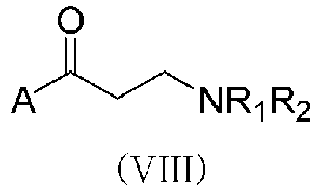
A, R1 and R2 are the same as defined above. - The compound of formula (VIII) is followed by the treatment with sodium borohydride in methanol to yield the corresponding 1,3-diaminoalchol compound represented by the general formula (IX).

- The compound of formula (IX) is reacted with triphenylphosphine, diisopropyl azodicarboxylate and azole compounds such as imidazole, triazole, tetrazole, 5-methyltetrazole, 5-phenyltetrazole, benzotriazole represented by the structural formula (II) to give the compound represented by the general formula (III).
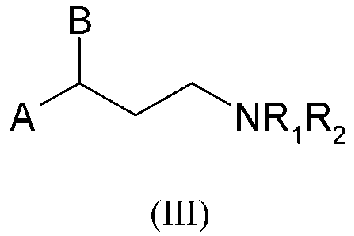
- A and Bare the same as defined above.
- R1 and R2 are same and different and independently selected from the group consisting of hydrogen, lower alkyl of from 1 to 4 carbon atoms, substituted or unsubstituted phenyl-C1-4 alkyl or R1 and R2 are fused to form cyclic group with nitrogen atom;
- This procedure is summarized as set forth in Reaction Scheme I below.

- Details of the reaction condition described in reaction scheme I are as follows.
- In the first step, the concentration of the starting material (VI) is about to 0.005 to 3 moles with paraformaldehyde ranging from about 3.0 to 5.0 equivalents, amine (VII) ranging from about 3.0 to 5.0 equivalents and aq. RCl. The reaction is carried out at temperature about 90?. For the conversion of the compound (VIII) to the compound (IX), sodium borohydride ranging from about 1.0 to 2.5 equivalents is used in methanol. The resulting compound is treated with 1.5 equivalents of PPh3, diisopropyl azodicarboxylate and azole compound to give the compound (III).
- Additionally, the compounds of formula (III) may be converted into pharmaceutically acceptable salts (X) by treating the compound (III) with acid as described in the reaction scheme I. In the reaction scheme I, HX represents an acid capable of forming a pharmacologically useful salt with the basic nitrogen atom. Specific examples of the anhydrous acid used for the preparation of the compound (X) from the compound (III) include hydrochloric acid, hydrobromic acid, sulfuric acid, phosphoric acid, acetic acid, benzoic acid, carbonic acid, citric acid, malonic acid, salicylic acid, malic acid, fumaric acid, oxalic acid, succinic acid, tartaric acid, lactic acid, gluconic acid, ascorbic acid, maleic acid, aspartic acid, camphorsulfonic acid, p-toluenesulfonic acid, benzene sulfonic acid, methane sulfonic acid, ethane sulfonic acid, hydroxymethane sulfonic acid and hydroxyethane sulfonic acid and the like. Additional acids can refer to "Pharmaceutical Salts", J. Pharm. Sci., 1977; 66(1): 1-19. This preparation is executed in a reaction media which can be exemplified by an ethereal solvent such as THF, an alcoholic solvent such as methanol, an ester solvent such as ethyl acetate, and aromatic solvent, and any compositional mixture thereof. An ethereal solvent is recommended as an addition solution, including ethyl ether, propyl ether, isopropyl ether, butyl ether, isobutyl ether. The concentration of the compound (III) is on the order of about 0.01 to 5 moles.
- The methods for preparing the compounds of the general formula (III) in which R1 is hydrogen and R2 is methyl, i.e. the compounds of the general formular (XI), will be described below.
- The compounds of general formula (III) wherein R1 and R2 are methyl is treated with ethyl chloroformate, sodium bicarbonate and potassium hydroxide to yield the monomethyl amine compound represented by the structural formula (XI).

A and Bare the same as defined above. - The compound of formula (XI) may be converted into pharmaceutically acceptable salt (XII) as described above.
- This procedure of preparing the compounds of general formula (XI) and pharmaceutically acceptable salts thereof is summarized as set forth in Reaction Scheme II below.

- Details of the reaction condition described in reaction scheme II are as follows. For the conversion of compound(III) in which R1 and R2 are methyl, to the compound (XI), ethyl chloroformate ranging from 10 to 15 equivalents, sodium bicarbonate ranging from 20 to 25 equivalents and similar amount of potassium hydroxide are used at temperature about 100°C.
- In reaction scheme II, HX represents an acid capable of forming a pharmacologically useful salt with the basic nitrogen atom as described above.
- Enantiomeric isomers represented by the structural formula (IV) and (V) are obtained from racemic mixture (III) by means of chiral preparative Liquid Chromatography ("Prep-LC"). The methods for preparing the general formula (IV) and (V) will be described below.
- The racemic mixture (III) is dissolved in a small amount of isopropylalcohol and separated by chiral preparative Liquid Chromatography. Separation is performed by using a CHIRALPACK OD-H column (manufactured by Daicel Chemical Industries, Ltd.) as the Prep-LC column, at a column temperature of 25°C, with n-hexane / isopropylalcohol including 0.1% triethylamine (90:10) as the eluent. Enantiomeric isomers represented by the structural formula (IV) and (V) can be obtained in the ratio of 1:1 from the racemic mixture (III).
- This procedure is summarized as set forth in reaction scheme III below.

- In reaction scheme III, HX represents an acid capable of forming a pharmacologically useful salt with the basic nitrogen atom as described above.
- The compounds of formula (IV) and (V) may be converted into pharmaceutically acceptable salts (XIII) and (XIV) as described above.
- The compounds prepared according to the above methods include the following compounds.
- [3-(3,4-Dichloro-phenyl)-3-tetrazol-2-yl-propyl]-dimethyl-amine
- [3-(3,4-Dichloro-phenyl)-3-tetrazol-2-yl-propyl]-methyl-amine
- S-[3-(3,4-Dichloro-phenyl)-3-tetrazol-2-yl-propyl]-methyl-amine
- [3-Benzotriazol-2-yl-3-(3,4-dichloro-phenyl)-propyl]-dimethyl-amine
- Dimethyl-(3-naphthalen-2-yl-3-[1,2,3]triazol-2-yl-propyl)-amine
- Dimethyl-(3-naphthalen-2-yl-3-tetrazol-2-yl-propyl)-amine
- (3-Benzotriazol-2-yl-3-naphthalen-2-yl-propyl)-dimethyl-amine
- Dimethyl-[3-(5-methyl-tetrazol-2-yl)-3-naphthalen-2-yl-propyl]-amine
- [3-(6-Chloro- naphthalen- 2- yl)- 3- tetrazol-l-yl- propyl] -dimethyl-amine
- Dimethyl-[3-(4-phenoxy-phenyl)-3-tetrazol-2-yl-propyl]-amine
- Dimethyl-[3-(4-phenoxy-phenyl)-3-tetrazol-1-yl-propyl]-amine
- [3-(6-Chloro-naphthalen-2-yl)-3-[1,2,3]triazol-2-yl-propyl]-dimethyl-amine
- [3-(6-Chloro-naphthalen-2-yl)-3-[1,2,3] triazol-1-yl-propyl]-dimethyl-amine
- [3-(6-Chloro-naphthalen-2-yl)-3-tetrazol-2-yl-propyl]-dimethyl-amine
- [3-(4-Methoxy-phenyl)-3-1,2,3]triazol-2-yl-propyl]-dimethyl-amine
- (3-Biphenyl-3-yl-3-tetrazol-2-yl-propyl)-dimethyl-amine
- [3-(4-Benzyloxy-phenyl)-3-tetrazol-2-yl-propyl]-dimethyl-amine
- (3-Biphenyl-4-yl-3-tetrazol-2-yl-propyl)-dimethyl-amine
- Dimethyl-[3-naphthalen-2-yl-3-(5-phenyl-tetrazol-2-yl)-propyl]-amine
- Dimethyl-[3-(6-methyl-naphthalen-2-yl)-3-tetrazol-2-yl-propyl]-amine
- [3-(6-Methoxy-naphthalen-2-yl)-3-tetrazol-2-yl-propyl]-dimethyl-amine
- [3-(6-Methoxy-naphthalen-2-yl)-3-[1,2,3]triazol-2-yl-propyl]-dimethyl-amine
- [3-Benzotriazol-l-yl-3-(3,4-dichloro-phenyl)-propyl]-dimethyl-amine
- 2-[1-(3,4-Dichloro-phenyl)-3-pyrrolidin-1-yl-propyl]-2H-[1,2,3] triazole
- [3-(3,4-Dichloro-phenyl)-3-[1,2,3]triazol-2-yl-propyl]-diethyl-amine
- [3-(3,4-Dichloro-phenyl)-3-tetrazol-2-yl-propyl]-diethyl-amine
- 2-[1-(3,4-Dichloro-phenyl)-3-pyrrolidin-1-yl-propyl]-2H-tetrazole
- Dimethyl-(3-naphthalen-1-yl-3-tetrazol-2-yl-propyl)-amine
- Dimethyl-(3-naphthalen-1-yl-3-[1,2,3]triazol-2-yl-propyl)-amine
- [3-(3,4-Dichloro-phenyl)-3-(5-methyl-tetrazol-2-yl)-propyl]-dimethyl-amine
- [3-(3,4-Dichloro-phenyl)-3-(5-phenyl-tetrazol-2-yl)-propyl]-dimethyl-amine
- [3-(3,4-Difluoro-phenyl)-3-tetrazol-1-yl-propyl]-dimethyl-amine
- [3-(3,4-Difluoro-phenyl)-3-tetrazol-2-yl-propyl]-dimethyl-amine
- [3-(3,4-Difluoro-phenyl)-3-[1,2,3]triazol-1-yl-propyl]-dimethyl-amine
- [3-(3,4-Difluoro-phenyl)-3-[1,2,3]triazol-2-yl-propyl]-dimethyl-amine
- [3-(3,4-Dimethyl-phenyl)-3-[1,2,3]triazol-1-yl-propyl]-dimethyl-amine
- [3-(3,4-Dimethyl-phenyl)-3-[1,2,3]triazol-2-yl-propyl]-dimethyl-amine
- [3-(3,4-Dimethyl-phenyl)-3-tetrazol-1-yl-propyl]-dimethyl-amine
- [3-(3,4-Dimethyl-phenyl)-3-tetrazol-2-yl-propyl]-dimethyl-amine
- [3-(4-Chloro-phenyl)-3-tetrazol-1-yl-propyl]-dimethyl-amine
- [3-(4-Chloro-phenyl)-3-tetrazol-2-yl-propyl]-dimethyl-amine
- Dimethyl-(3-phenyl-3-[1,2,3]triazol-1-yl-propyl)-amine
- Dimethyl-(3-phenyl-3-[1,2,3]triazol-2-yl-propyl)-amine
- [3-(4-Chloro-phenyl)-3-[1,2,3]triazol-1-yl-propyl]-dimethyl-amine
- [3-(4-Chloro-phenyl)-3-[1,2,3]triazol-2-yl-propyl]-dimethyl-amine
- [3-(3,4-Dichloro-phenyl)-3-[1,2,3]triazol-2-yl-propyl]-dimethyl-amine
- [3-(3,4-Dichloro-phenyl)-3-imidazol-1-yl-propyl]-dimethyl-amine
- [3-(3-Methoxy-naphthalen-2-yl)-3-tetrazol-2-yl-propyl]-dimethyl-amine
- [3-(3-Methoxy-naphthalen-2-yl)-3-(5-methyl-tetrazol-2-yl)-propyl]-dimethyl-amine
- [3-(6-Fluoro-naphthalen-2-yl)-3-tetrazol-2-yl-propyl]-dimethyl-amine
- [3-(6-Fluoro-naphthalen-2-yl)-3-(5-methyl-tetrazol-2-yl)-propyl]-dimethyl-amine
- [3-(1,4-Dimethoxy-naphthalen-2-yl)-3-tetrazol-2-yl-propyl]-dimethyl-amine
- [3-(1,4-Dimethoxy-naphthalen-2-yl)-3-(5-methyl-tetrazol-2-yl)-propyl]-dimethyl-ami ne
- [3-(3,5-Dimethoxy-naphthalen-2-yl)-3-tetrazol-2-yl-propyl]-dimethyl-amine
- [3-(3,5-Dimethoxy-naphthalen-2-yl)-3-(5-methyl-tetrazol-2-yl)-propyl]-dimethyl-ami ne
- [3-(3,5-Dimethoxy-naphthalen-2-yl)-3-tetrazol-1-yl-propyl]-dimethyl-amine
- Dimethyl-[3-(4-methyl-naphthalen-1-yl)-3-tetrazol-2-yl-propyl]-amine
- Dimethyl-[3-(4-methyl-naphthalen-1-yl)-3-(5-methyl-tetrazol-2-yl)-propyl]-amine
- [3-(4-Fluoro-naphthalen-1-yl)-3-tetrazol-2-yl-propyl]-dimethyl-amine
- [3-(4-Fluoro-naphthalen-1-yl)-3-(5-methyl-tetrazol-2-yl)-propyl]-dimethyl-amine
- (3-Isoquinolin-l-yl-3-tetrazol-2-yl-propyl)-dimethyl-amine
- [3-Isoquinolin-1-yl-3-(5-methyl-tetrazol-2-yl)-propyl]-dimethyl-amine
- (3-Benzo[1,3]dioxol-5-yl-3-tetrazol-2-yl-propyl)-dimethyl-amine
- [3-Benzo[1,3]dioxol-5-yl-3-(5-methyl-tetrazol-2-yl)-propyl]-dimethyl-amine
- [3-Benzo[1,3]dioxol-5-yl-3-(5-methyl-tetrazol-1-yl)-propyl]-dimethyl-amine
- [3-(3,4-Dimethoxy-phenyl)-3-tetrazol-2-yl-propyl]-dimethyl-amine
- [3-(2,3-Dihydro-benzo[1,4]dioxin-2-yl)-3-tetrazol-2-yl-propyl]-dimethyl-amine
- [3-(2,3-Dihydro-benzo[1,4]dioxin-2-yl)-3-(5-methyl-tetrazol-2-yl)-propyl]-dimethylamine
- Dimethyl-(3-quinolin-2-yl-3-tetrazol-2-yl-propyl)-amine
- Dimethyl-[3-(5-methyl-tetrazol-2-yl)-3-quinolin-2-yl-propyl]-amine
- Dimethyl-[3-(1-methyl-1H-indol-2-yl)-3-tetrazol-2-yl-propyl]-amine
- Dimethyl-[3-(1-methyl-1H-indol-2-yl)-3-(5-methyl-tetrazol-2-yl)-propyl]-amine
- Dimethyl-[3-(1,2,3,4-tetrahydro-naphthalen-2-yl)-3-tetrazol-2-yl-propyl]-amine
- [3-(6-Chloro-pyridin-3-yl)-3-tetrazol-2-yl-propyl]-dimethyl-amine
- (3-Benzo[b]thiophen-2-yl-3-tetrazol-2-yl-propyl)-dimethyl-amine
- [3-Benzo[b]thiophen-2-yl-3-(5-methyl-tetrazol-2-yl)-propyl]-dimethyl-amine
- (3-Benzofuran-2-yl-3-tetrazol-2-yl-propyl)-dimethyl-amine
- [3-Benzofuran-2-yl-3-(5-methyl-tetrazol-2-yl)-propyl]-dimethyl-amine
- (3-Benzofuran-2-yl-3-tetrazol-1-yl-propyl)-dimethyl-amine
- [3-(3,4-Difluoro-phenyl)-3-(5-methyl-tetrazol-2-yl)-propyl]-dimethyl-amine
- Dimethyl-[3-tetrazol-2-yl-3-(2,4,5-trifluoro-phenyl)-propyl]-amine
- Dimethyl-[3-(5-methyl-tetrazol-2-yl)-3-(2,4,5-trifluoro-phenyl)-propyl]-amine
- [3-(3-Bromo-4-fluoro-phenyl)-3-tetrazol-2-yl-propyl]-dimethyl-amine
- [3-(3-Bromo-4-fluoro-phenyl)-3-(5-methyl-tetrazol-2-yl)-propyl]-dimethyl-amine
- [3-(6-Methoxy-naphthalen-2-yl)-3-(5-methyl-tetrazol-2-yl)-propyl]-dimethyl-amine
- Dimethyl-[3-(5-methyl-tetrazol-2-yl)-3-(4-phenoxy-phenyl)-propyl]-amine
- [3-(4-Bromo-phenyl)-3-tetrazol-2-yl-propyl]-dimethyl-amine
- [3-(4-Bromo-phenyl)-3-(5-methyl-tetrazol-2-yl)-propyl]-dimethyl-amine
- Dimethyl-[3-tetrazol-2-yl-3-(4-trifluoromethyl-phenyl)-propyl]-amine
- Dimethyl-[3-(5-methyl-tetrazol-2-yl)-3-(4-trifluoromethyl-phenyl)-propyl]-amine
- Dimethyl-[3-tetrazol-2-yl-3-(2,3,4-trichloro-phenyl)-propyl]-amine
- Dimethyl-[3-(5-methyl-tetrazol-2-yl)-3-(2,3,4-trichloro-phenyl)-propyl]-amine
- [3-(3-Chloro-4-methoxy-phenyl)-3-tetrazol-2-yl-propyl]-dimethyl-amine
- [3-(3-Chloro-4-methoxy-phenyl)-3-(5-methyl-tetrazol-2-yl)-propyl]-dimethyl-amine
- [3-(4-tert-Butyl-phenyl)-3-(5-methyl-tetrazol-2-yl)-propyl]-dimethyl-amine
- [3-(2,5-Difluoro-phenyl)-3-(5-methyl-tetrazol-2-yl)-propyl]-dimethyl-amine
- [3-(2,4-Dichloro-phenyl)-3-(5-methyl-tetrazol-2-yl)-propyl]-dimethyl-amine
- [3-(3-Chloro-phenyl)-3-(5-methyl-tetrazol-2-yl)-propyl]-dimethyl-amine
- [3-(2-Chloro-phenyl)-3-(5-methyl-tetrazol-2-yl)-propyl]-dimethyl-amine
- [3-(2,5-Difluoro-phenyl)-3-tetrazol-2-yl-propyl]-dimethyl-amine
- [3-(2,4-Dichloro-phenyl)-3-tetrazol-2-yl-propyl]-dimethyl-amine
- [3-(3-Chloro-phenyl)-3-tetrazol-2-yl-propyl]-dimethyl-amine
- Dimethyl-[3-(5-methyl-tetrazol-2-yl)-3-(4-trifluoromethoxy-phenyl)-propyl]-amine
- [3-(3-Bromo-4-methyl-phenyl)-3-(5-methyl-tetrazol-2-yl)-propyl]-dimethyl-amine
- Dimethyl-[3-tetrazol-2-yl-3-(4-trifluoromethoxy-phenyl)-propyl]-amine
- [3-(4-Bromo-3-methyl-phenyl)-3-tetrazol-2-yl-propyl]-dimethyl-amine
- [3-(4-Methanesulfonyl-phenyl)-3-(5-methyl-tetrazol-2-yl)-propyl]-dimethyl-amine
- [3-(4-Isopropyl-phenyl)-3-(5-methyl-tetrazol-2-yl)-propyl]-dimethyl-amine
- [3-(9H-Fluoren-2-yl)-3-(5-methyl-tetrazol-2-yl)-propyl]-dimethyl-amine
- Methyl-(3-naphthalen-2-yl-3-[1,2,3]triazol-2-yl-propyl)-amine
- [3-Benzotriazol-2-yl-3-(3,4-dichloro-phenyl)-propyl]-methyl-amine
- Methyl-[3-(5-methyl-tetrazol-2-yl)-3-naphthalen-2-yl-propyl]-amine
- (3-Benzotriazol-2-yl-3-naphthalen-2-yl-propyl)-methyl-amine
- (3-Biphenyl-4-yl-3-tetrazol-2-yl-propyl)-methyl-amine
- [3-(3,4-Dichloro-phenyl)-3-(5-methyl-tetrazol-2-yl)-propyl]-methyl-amine
- [3-(4-Chloro-phenyl)-3-tetrazol-2-yl-propyl]-methyl-amine
- [3-(3,4-Dichloro-phenyl)-3-[1,2,3]triazol-2-yl-propyl]-methyl-amine
- [3-(3,4-Dichloro-phenyl)-3-tetrazol-2-yl-propyl]-methyl-amine
- Methyl-(3-naphthalen-2-yl-3-tetrazol-2-yl-propyl)-amine
- [3-(6-Chloro-naphthalen-2-yl)-3-tetrazol-2-yl-propyl]-methyl-amine
- Methyl-(3-naphthalen-1-yl-3-tetrazol-2-yl-propyl)-amine
- Methyl-[3-(6-methyl-naphthalen-2-yl)-3-tetrazol-2-yl-propyl]-amine
- Methyl-[3-naphthalen-2-yl-3-(5-phenyl-tetrazol-2-yl)-propyl]-amine
- (3S)-3-(3,4-dichlorophenyl)-N-methyl-3-(2H-tetrazol-2-yl)propan-1-amine
- (3R)-3-(3,4-dichlorophenyl)-N-methyl-3-(2H-tetrazol-2-yl)propan-1-amine
- (3S)-3-(2H-benzotriazol-2-yl)-3-(3,4-dichlorophenyl)-N-methylpropan-1-amine
- (3R)-3-(2H-benzotriazol-2-yl)-3-(3,4-dichlorophenyl)-N-methylpropan-1-amine
- (3S)-3-(3,4-dichlorophenyl)-N-methyl-3-(2H-1,2,3-triazol-2-yl)propan-1-amine
- (3S)-3-(3,4-dichlorophenyl)-N-methyl-3-(5-methyl-2H-tetrazol-2-yl)propan-1-amine
- (3R)-3-(3,4-dichlorophenyl)-N-methyl-3-(5-methyl-2H-tetrazol-2-yl)propan-1-amine
- (3R)-3-(3,4-dichlorophenyl)-N-methyl-3-(2H-1,2,3-triazol-2-yl)propan-1-amine
- (3R)-N-methyl-3-(2-naphthyl)-3-(2H-tetrazol-2-yl)propan-1-amine
- (3S)-N-methyl-3-(2-naphthyl)-3-(2H-tetrazol-2-yl)propan-1-amine
- [3-(3-Methoxy-naphthalen-2-yl)-3-tetrazol-2-yl-propyl]-methyl-amine
- [3-(3-Methoxy-naphthalen-2-yl)-3-(5-methyl-tetrazol-2-yl)-propyl]-methyl-amine
- [3-(6-Fluoro-naphthalen-2-yl)-3-tetrazol-2-yl-propyl]-methyl-amine
- [3-(6-Fluoro-naphthalen-2-yl)-3-(5-methyl-tetrazol-2-yl)-propyl]-methyl-amine
- [3-(1,4-Dimethoxy-naphthalen-2-yl)-3-tetrazol-2-yl-propyl]-methyl-amine
- [3-(1,4-Dimethoxy-naphthalen-2-yl)-3-(5-methyl-tetrazol-2-yl)-propyl]-methyl-amin e
- [3-(3,5-Dimethoxy-naphthalen-2-yl)-3-tetrazol-2-yl-propyl]-methyl-amine
- [3-(3,5-Dimethoxy-naphthalen-2-yl)-3-(5-methyl-tetrazol-2-yl)-propyl]-methyl-amin e
- [3-(3,5-Dimethoxy-naphthalen-2-yl)-3-tetrazol-1-yl-propyl]-methyl-amine
- Methyl-[3-(4-methyl-naphthalen-1-yl)-3-tetrazol-2-yl-propyl]-amine
- Methyl-[3-(4-methyl-naphthalen-1-yl)-3-(5-methyl-tetrazol-2-yl)-propyl]-amine
- [3-(4-Fluoro-naphthalen-1-yl)-3-tetrazol-2-yl-propyl]-methyl-amine
- [3-(4-Fluoro-naphthalen-1-yl)-3-(5-methyl-tetrazol-2-yl)-propyl]-methyl-amine
- (3-Benzo[1,3]dioxol-5-yl-3-tetrazol-2-yl-propyl)-methyl-amine
- [3-Benzo[1,3]dioxol-5-yl-3-(5-methyl-tetrazol-2-yl)-propyl]-methyl-amine
- [3-Benzo[1,3]dioxol-5-yl-3-(5-methyl-tetrazol-1-yl)-propyl]-methyl-amine
- [3-(3,4-Dimethoxy-phenyl)-3-tetrazol-2-yl-propyl]-methyl-amine
- [3-(2,3-Dihydro-benzo[1,4]dioxin-2-yl)-3-tetrazol-2-yl-propyl]-methyl-amine
- [3-(2,3-Dihydro-benzo[1,4]dioxin-2-yl)-3-(5-methyl-tetrazol-2-yl)-propyl]-methyl-a mine
- Methyl-[3-(1,2,3,4-tetrahydro-naphthalen-2-yl)-3-tetrazol-2-yl-propyl]-amine
- [3-(6-Chloro-pyridin-3-yl)-3-tetrazol-2-yl-propyl]-methyl-amine
- (3-Benzo[b]thiophen-2-yl-3-tetrazol-2-yl-propyl)-methyl-amine
- [3-Benzo[b]thiophen-2-yl-3-(5-methyl-tetrazol-2-yl)-propyl]-methyl-amine
- (3-Benzofuran-2-yl-3-tetrazol-2-yl-propyl)-methyl-amine
- [3-Benzofuran-2-yl-3-(5-methyl-tetrazol-2-yl)-propyl]-methyl-amine
- (3-Benzofuran-2-yl-3-tetrazol-1-yl-propyl)-methyl-amine
- [3-(3,4-Difluoro-phenyl)-3-tetrazol-2-yl-propyl]-methyl-amine
- [3-(3,4-Difluoro-phenyl)-3-(5-methyl-tetrazol-2-yl)-propyl]-methyl-amine
- Methyl-[3-tetrazol-2-yl-3-(2,4,5-trifluoro-phenyl)-propyl]-amine
- Methyl-[3-(5-methyl-tetrazol-2-yl)-3-(2,4,5-trifluoro-phenyl)-propyl]-amine
- [3-(3-Bromo-4-fluoro-phenyl)-3-tetrazol-2-yl-propyl]-methyl-amine
- [3-(3-Bromo-4-fluoro-phenyl)-3-(5-methyl-tetrazol-2-yl)-propyl]-methyl-amine
- [3-(6-Methoxy-naphthalen-2-yl)-3-tetrazol-2-yl-propyl]-methyl-amine
- [3-(6-Methoxy-naphthalen-2-yl)-3-(5-methyl-tetrazol-2-yl)-propyl]-methyl-amine
- Methyl-[3-(4-phenoxy-phenyl)-3-tetrazol-2-yl-propyl]-amine
- Methyl-[3-(5-methyl-tetrazol-2-yl)-3-(4-phenoxy-phenyl)-propyl]-amine
- [3-(4-Bromo-phenyl)-3-tetrazol-2-yl-propyl]-methyl-amine
- [3-(4-Bromo-phenyl)-3-(5-methyl-tetrazol-2-yl)-propyl]-methyl-amine
- Methyl-[3-tetrazol-2-yl-3-(4-trifluoromethyl-phenyl)-propyl]-amine
- Methyl-[3-(5-methyl-tetrazol-2-yl)-3-(4-trifluoromethyl-phenyl)-propyl]-amine
- Methyl-[3-tetrazol-2-yl-3-(2,3,4-trichloro-phenyl)-propyl]-amine
- Methyl-[3-(5-methyl-tetrazol-2-yl)-3-(2,3,4-trichloro-phenyl)-propyl]-amine
- [3-(3-Chloro-4-methoxy-phenyl)-3-tetrazol-2-yl-propyl]-methyl-amine
- [3-(3-Chloro-4-methoxy-phenyl)-3-(5-methyl-tetrazol-2-yl)-propyl]-methyl-amine
- [3-(2-Chloro-phenyl)-3-(5-methyl-tetrazol-2-yl)-propyl]-methyl-amine
- [3-(3-Chloro-phenyl)-3-(5-methyl-tetrazol-2-yl)-propyl]-methyl-amine
- [3-(2,4-Dichloro-phenyl)-3-(5-methyl-tetrazol-2-yl)-propyl]-methyl-amine
- [3-(2,5-Difluoro-phenyl)-3-(5-methyl-tetrazol-2-yl)-propyl]-methyl-amine
- [3-(3-Chloro-phenyl)-3-tetrazol-2-yl-propyl]-methyl-amine
- [3-(2,4-Dichloro-phenyl)-3-tetrazol-2-yl-propyl]-methyl-amine
- [3-(2,5-Difluoro-phenyl)-3-tetrazol-2-yl-propyl]-methyl-amine
- [3-(4-Methanesulfonyl-phenyl)-3-(5-methyl-tetrazol-2-yl)-propyl]-methyl-amine
- [3-(4-Isopropyl-phenyl)-3-(5-methyl-tetrazol-2-yl)-propyl]-methyl-amine
- [3-(9H-Fluoren-2-yl)-3-(5-methyl-tetrazol-2-yl)-propyl]-methyl-amine
- (3S)-Methyl-[3-(5-methyl-tetrazol-2-yl)-3-naphthalen-2-yl-propyl]-amine
- (3S)-Methyl-[3-naphthalen-2-yl-3-(5-phenyl-tetrazol-2-yl)-propyl]-amine
- (3R)-Methyl-[3-(5-methyl-tetrazol-2-yl)-3-naphthalen-2-yl-propyl]-amine
- (3R)-Methyl-[3-naphthalen-2-yl-3-(5-phenyl-tetrazol-2-yl)-propyl] -amine
- (3R)-[3-(6-Fluoro-naphthalen-2-yl)-3-(5-methyl-tetrazol-2-yl)-propyl]-methyl-amine
- (3S)-[3-(6-Fluoro-naphthalen-2-yl)-3-(5-methyl-tetrazol-2-yl)-propyl]-methyl-amine
- The compound or pharmaceutically acceptable salt thereof according to the present invention can be used for treating CNS disorders such as depression, anxiety and pain disorder.
- In therapeutic use as agents for various CNS disorders such as depression, anxiety and pain disorder, the compounds of the present invention, alone or in combination with pharmaceutically acceptable carrier, are administered to patients at a dosage of from 0.7 to 7,000mg per day. For a normal human adult with a body weight of approximately 70kg, the administration amount is translated into a daily dose of 0.01 to 100mg per kg of body weight. The specific dosage employed, however, may vary depending upon the requirements of the patient, the severity of patient's condition and the activity of the compound. The determination of optimum dosages for a particular situation must clinically be done and is within the skill of the art.
- In utilizing the compounds of the present invention for the central nervous system, the compounds represented by general structural formula (I), (III), (IV) and (V) can be administered in any form or mode which makes the compound bioavailable in effective amounts, including the oral, rectal, transdermal, subcutaneous, intravenous, intramuscular or intranasal routs. However it is preferred to administer the compounds orally. Since the compounds absorb well orally, it usually will not be necessary to resort to parenteral administration. For oral administration, the compounds having the general formula (I), (III), (IV) and (V) is preferably combined with a pharmaceutical carrier. The ratio of the carrier to the compound of structural formula (I), (III), (IV) and (V) is not critical to express the effects of the medicine on the central nervous system, and they can vary considerably depending on whether the composition is to be filled into capsules or formed into tablets. In tableting, various edible pharmaceutical carriers or the mixture thereof can be used. A suitable carriers, for example, are a mixture of lactose, diabasic calcium phosphate and/or corn starch. Other pharmaceutically acceptable ingredients can be further added, including lubricants such as magnesium stearate.
- The present invention includes compositions of the compounds of structural formula (I), (III), (IV) and (V) for use in methods of treating depression, anxiety and pain disorder in a mammal which comprises administering the composition to a mammal in need of therapy
- A better understanding of the present invention may be obtained in light of following examples which are set forth to illustrate, but are not to be construed to limit, the present invention.
-

- To a solution of 3,4-dichloroacetophenone(2mmol) in ethanol was added dimethylamine (5 equiv.), paraformaldehyde (5 equiv.) and aq. HCl. After 12h, the solvent was removed and ethyl acetate and 1N NaOH were added and organic layer was extracted 3 times. It was dried over MgSO4, filtered, evaporated and the filtrate was concentrated at reduced pressure. The residue was purified by column chromatography eluting with ethyl acetate and hexane. The product was dissolved in methanol and added NaBH4 (2 equiv.). After 2h, sat. NaHCO3 and ethyl acetate were added and the organic layer was extracted 3 times with ethyl acetate. It was dried over MgSO4, filtered, evaporated and the filtrate was concentrated at reduced pressure. The residue was purified by column chromatography eluting with ethyl acetate and methanol. The resulting residue was dissolved in THF and was added 1H-tetrazole (1.5equiv.), triphenylphosphine (1.5equiv.) and diisopropyl azodicarboxylate (1.5equiv.) dropwise at 0°C and warmed to room temperature. After 2h, the solvent was removed and the residue was purified by column chromatography eluting with ethyl acetate and methanol. : Yield 35%
- 1H-NMR(CDC13, 200MHz) δ2.2(m, 7H), 2.6(m, 2H), 6.0(t, 1H), 7.2(dd, 1H), 7.4(dd, 1H), 7.5(d, 1H), 8.5(s, 1H)
-

- To a solution of [3-(3,4-Dichloro-phenyl)-3-tetrazol-2-yl-propyl]-dimethyl-amine(2mmol) in chloroform was added ethylchloroformate(>10 equiv.) and NaHCO3(>20 equiv.) and this solution was refluxed for 3h. After that, chloroform was evaporated and ethyl acetate was added and then this organic layer was washed with water 3 times. It was dried over MgSO4, filtered, evaporated and the filtrate was concentrated at reduced pressure. The residue was dissolved in ethanol and potassium hydroxide(>20 equiv.) dissolved in water was added and refluxed for 3 days. After that, ethyl acetate and sat. NaHCO3 were added and the organic layer was extracted. It was dried over MgSO4, filtered, evaporated and the filtrate was concentrated at reduced pressure. The residue was purified by column chromatography eluting with ethyl acetate and methanol. : Yield 80%
- 1H-NMR(CDC13, 200MHz) δ2.4(m, 3H), 2.5(m, 3H), 2.7(m, 1H), 6.2(m, 1H), 7.2(m, 1H), 7.4(m, 1H), 7.5(s, 1H), 8.5(s, 1H)
-

- S-[3-(3,4-Dichloro-phenyl)-3-tetrazol-2-yl-propyl]-methyl-amine was obtained from the [3-(3,4-Dichloro-phenyl)-3-tetrazol-2-yl-propyl]-methyl-amine using a CHIRALPACK OD-H column(manufactured by Daicel Chemical Industries, Ltd.) as the Prep-LC column, at a column temperature of 25°C, with n-hexane/isopropylalcohol including 0.1% triethylamine(90:10) as the eluent.
- 1H-NMR(CDC13, 200MHz) δ2.4(m, 3H), 2.5(m, 3H), 2.7(m, 1H), 6.2(m, 1H), 7.2(m, 1H), 7.4(m, 1H), 7.5(s, 1H), 8.5(s, 1H)
-

- The procedure given in Example 1 was followed using benzotriazole as a reactant, instead of tetrazole, to give [3-Benzotriazol-2-yl-3-(3,4-dichloro-phenyl)-propyl]-dimethyl-amine.
- 1H-NMR(CDC13, 200MHz) δ2.2(s, 8H), 2.5(m, 1H), 2.8(m, 1H), 6.1(m, 1H), 7.4(m, 4H), 7.6(t, 1H), 7.9(m, 2H)
-

- The procedure given in Example 1 was followed using 2-acetonaphthone and 1H-1,2,3-triazole as reactants, instead of 3,4-dichloroacetophenone and 1H-tetrazole, to give Dimethyl-(3-naphthalen-2-yl-3-[1,2,3]triazol-2-yl-propyl)-amine.
- 1H-NMR(CDC13, 200MHz) δ2.2(s, 8H), 2.5(m, 1H), 2.8(m, 1H), 6.1(m, 1H), 7.4(m, 3H), 7.6(d, 2H), 7.8(m, 5H)
-

- The procedure given in Example 1 was followed using 2-acetonaphthone as a reactant, instead of 3,4-dichloroacetophenone, to give Dimethyl-(3-naphthalen-2-yl-3-tetrazol-2-yl-propyl)-amine.
- 1H-NMR(CDC13, 200MHz) δ2.2(s, 8H), 2.5(m, 1H), 2.8(m, 1H), 6.1(m, 1H), 7.5(m, 3H), 7.8(m,4H), 8.5(s, 1H)
-

- The procedure given in Example 1 was followed using 2-acetonaphthone and benzotriazole as reactants, instead of 3,4-dichloroacetophenone and 1H-tetrazole, to give (3-Benzotriazol-2-yl-3-naphthalen-2-yl-propyl)-dimethyl-amine.
- 1H-NMR(CDC13, 200MHz) δ2.2(s, 8H), 2.5(m, 1H), 2.8(m, 1H), 6.1(m, 1H), 7.4(m, 5H), 7.5(d, 1H), 7.8(m, 6H)
-
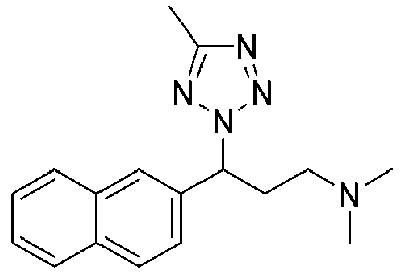
- The procedure given in Example 1 was followed using 2-acetonaphthone and 5-methyl-1H-tetrazole as reactants, instead of 3,4-dichloroacetophenone and 1H-tetrazole, to give Dimethyl-[3-(5-methyl-tetrazol-2-yl)-3-naphthalen-2-yl-propyl]-amine.
- 1H-NMR(CDC13, 200MHz) δ2.2(s, 8H), 2.5(m, 1H), 2.8(m, 1H), 6.1(m, 4H), 7.5(d, 3H), 7.8(d, 4H)
-

- The procedure given in Example 1 was followed using 6-Chloro-2-acetonaphthone as a reactant, instead of 3,4-dichloroacetophenone, to give [3-(6-Chloro-naphthalen-2-yl)-3-tetrazol-1-yl-propyl]-dimethyl-amine.
- 1H-NMR(CDC13, 200MHz) δ2.2(s, 8H), 2.5(m, 1H), 2.8(m, 1H), 6.7(m, 1H), 7.5(m, 3H), 7.8(dd, 2H), 8.1(s, 1H), 8.6(s, 1H)
-
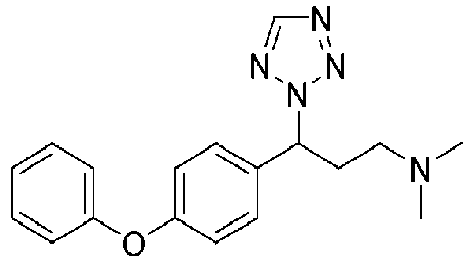
- The procedure given in Example 1 was followed using 4-phenoxyacetophenone as a reactant, instead of 3,4-dichloroacetophenone, to give Dimethyl-[3-(4-phenoxy-phenyl)-3-tetrazol-2-yl-propyl]-amine.
- 1H-NMR(CDC13, 200MHz) δ2.2(s, 8H), 2.5(m, 1H), 2.8(m, 1H), 6.1(m,1H), 6.9(m, 4H), 7.1(m, 1H), 7.4(m, 4H), 8.5(s, 1H)
-

- The procedure given in Example 1 was followed using 4-phenoxyacetophenone as a reactant, instead of 3,4-dichloroacetophenone, to give Dimethyl-[3-(4-phenoxy-phenyl)-3-tetrazol-1-yl-propyl]-amine.
- 1H-NMR(CDC13, 200MHz) δ2.2(s, 8H), 2.5(m, 1H), 2.8(m, 1H), 5.8(m,1H), 6.9(m, 4H), 7.1(m, 1H), 7.4(m, 4H), 8.5(s, 1H)
-

- The procedure given in Example 1 was followed using 6-Chloro-2-acetonaphthone and 1H-1,2,3-triazole as reactants, instead of 3,4-dichloroacetophenone and 1H-tetrazole, to give [3-(6-Chloro-naphthalen-2-yl)-3-[1,2,3]triazol-2-yl-propyl]-dimethyl-amine.
- 1H-NMR(CDC13, 200MHz) δ2.2(s, 8H), 2.5(m, 1H), 2.8(m, 1H), 6.7(m,1H), 7.4(m, 3H), 7.6(m, 2H), 7.8(m, 2H), 8.4(s, 1H)
-

- The procedure given in Example 1 was followed using 6-Chloro-2-acetonaphthone and 1H-1,2,3-triazole as reactants, instead of 3,4-dichloroacetophenone and 1H-tetrazole, to give [3-(6-Chloro-naphthalen-2-yl)-3-[1,2,3]triazol-1-yl-propyl]-dimethyl-amine.
- 1H-NMR(CDC13, 200MHz) δ2.2(s, 8H), 2.5(m, 1H), 2.8(m, 1H), 6.7(m,1H), 7.4(m, 3H), 7.6(m, 2H), 7.8(m, 2H), 8.2(s, 1H)
-

- The procedure given in Example 1 was followed using 6-Chloro-2-acetonaphthone as a reactant, instead of 3,4-dichloroacetophenone, to give [3-(6-Chloro-naphthalen-2-yl)-3-tetrazol-2-yl-propyl]-dimethyl-amine.
- 1H-NMR(CDC13, 200MHz) δ2.2(s, 8H), 2.5(m, 1H), 2.8(m, 1H), 6.7(m, 1H), 7.5(m, 3H), 7.8(dd, 2H), 8.3(s, 1H), 8.5(s, 1H)
-

- The procedure given in Example 1 was followed using 4-methoxyacetophenone and 1H-1,2,3-triazole as reactants, instead of 3,4-dichloroacetophenone and 1H-tetrazole, to give [3-(4-Methoxy-phenyl)-3-[1,2,3]triazol-2-yl-propyl]-dimethyl-amine.
- 1H-NMR(CDC13, 200MHz) δ2.2(s, 8H), 2.5(m, 2H), 2.8(m, 1H), 5.7(m, 1H), 6.8(dd, 2H), 7.3(dd, 2H), 7.6(s, 2H)
-

- The procedure given in Example 1 was followed using 3-phenylacetophenone as a reactant, instead of 3,4-dichloroacetophenone, to give (3-Biphenyl-3-yl-3-tetrazol-2-yl-propyl)-dimethyl-amine.
- 1H-NMR(CDCl3, 200MHz) δ2.2(s, 8H), 2.5(m, 1H), 2.8(m, 1H), 6.2(m, 1H), 7.5(m, 9H), 8.5(s, 1H)
-

- The procedure given in Example 1 was followed using 4-benzyloxyacetophenone as a reactant, instead of 3,4-dichloroacetophenone, to give [3-(4-Benzyloxy-phenyl)-3-tetrazol-2-yl-propyl]-dimethyl-amine.
- 1H-NMR(CDC13, 200MHz) δ2.2(s, 8H), 2.5(m, 1H), 2.8(m, 1H), 5.0(s, 2H), 6.1(m, 1H), 7.0(m, 2H), 7.4(m, 7H), 8.5(s, 1H)
-

- The procedure given in Example 1 was followed using 4-phenylacetophenone as a reactant, instead of 3,4-dichloroacetophenone, to give (3-Biphenyl-4-yl-3-tetrazol-2-yl-propyl)-dimethyl-amine.
- 1H-NMR(CDCl3, 200MHz) 62.2(s, 8H), 2.5(m, 1H), 2.8(m, 1H), 6.1(m, 1H), 7.4(m, 9H), 8.5(s, 1H)
-

- The procedure given in Example 1 was followed using 2-acetonaphthone and 5-Methyl-1H-tetrazole as reactants, instead of 3,4-dichloroacetophenone and 1H-tetrazole, to give Dimethyl-[3-naphthalen-2-yl-3-(5-phenyl-tetrazol-2-yl)-propyl]-amine.
- 1H-NMR(CDCl3, 200MHz) δ2.2(s, 8H), 2.5(m, 1H), 2.8(m, 1H), 6.1(m, 1H), 7.5(m, 5H), 7.6(m, 1H), 7.8(m, 3H), 8.0(s, 1H), 8.2(m, 2H)
-

- The procedure given in Example 1 was followed using 6-Methylacetonaphthone as a reactant, instead of 3,4-dichloroacetophenone, to give Dimethyl-[3-(6-methyl-naphthalen-2-yl)-3-(5-methyl-tetrazol-2-yl)-propyl]-amine.
- 1H-NMR(CDCl3, 200MHz) δ2.2(s, 8H), 2.5(m, 3H), 2.8(m, 1H), 6.1(m, 1H), 7.3(dd, 1H), 7.5(m, 2H), 7.7(dd, 2H), 7.9(s, 1H), 8.5(s, 1H)
-

- The procedure given in Example 1 was followed using 6-Methoxyacetonaphthone as a reactant, instead of 3,4-dichloroacetophenone, to give [3-(6-Methoxy-naphthalen-2-yl)-3-tetrazol-2-yl-propyl]-dimethyl-amine.
- 1H-NMR(CDCl3, 200MHz) δ2.2(s, 8H), 2.5(m, 1H), 2.8(m, 1H), 3.9(s, 3H), 6.1(m, 1H), 7.3(dd, 1H), 7.5(m, 2H), 7.7(dd, 2H), 7.9(s, 1H), 8.5(s, 1H)
-

- The procedure given in Example 1 was followed using 6-Methoxyacetonaphthone and 1H-1,2,3-triazole as reactants, instead of 3,4-dichloroacetophenone and 1H-tetrazole, to give [3-(6-Methoxy-naphthalen-2-yl)-3-[1,2,3]triazol-2-yl-propyl]-dimethyl-amine.
- 1H-NMR(CDCl3, 200MHz) δ2.2(s, 8H), 2.5(m, 1H), 2.8(m, 1H), 3.9(s, 3H), 6.1(m, 1H), 7.3(dd, 1H), 7.5(m, 2H), 7.7(dd, 2H), 7.9(s, 1H), 8.5(s, 2H)
-

- The procedure given in Example 1 was followed using benzotriazole as a reactant, instead of 1H-tetrazole, to give [3-Benzotriazol-1-yl-3-(3,4-dichloro-phenyl)-propyl]-dimethyl-amine.
- 1H-NMR(CDCl3, 200MHz) δ2.2(s, 8H), 2.5(m, 1H), 2.8(m, 1H), 6.0(m, 1H), 7.4(m, 6H), 8.0(t, 1H)
-

- The procedure given in Example 1 was followed using pyrrolidine and 1H-1,2,3-triazole as reactants, instead of dimethylamine and 1H-tetrazole, to give 2-[1-(3,4-Dichloro-phenyl)-3-pyrrolidin-1-yl-propyl]-2H-[1,2,3]triazole.
- 1H-NMR(CDC13, 200MHz) δ1.84(m, 4H), 2.2(m, 7H), 2.7(m, 1H), 6.0(m, 1H), 7.2(m, 3H), 7.6(m, 2H)
-

- The procedure given in Example 1 was followed using diethylamine and 1H-1,2,3-triazole as reactants, instead of dimethylamine and 1H-tetrazole, to give [3-(3,4-Dichloro-phenyl)-3-[1,2,3]triazol-2-yl-propyl]-diethyl-amine.
- 1H-NMR(CDC13, 200MHz) δ1.0(m, 6H), 2.3(m, 7H), 2.6(m, 1H), 6.0(m, 1H), 7.2(m, 3H), 7.6(m, 2H)
-

- The procedure given in Example 1 was followed using diethylamine as a reactant, instead of dimethylamine, to give [3-(3,4-Dichloro-phenyl)-3-tetrazol-2-yl-propyl]-diethyl-amine.
- 1H-NMR(CDC13, 200MHz) δ1.0(m, 6H), 2.3(m, 7H), 2.6(m, 1H), 6.0(m, 1H), 7.2(dd, 1H), 7.4(dd, 1H), 7.6(t, 1H), 8.5(s, 1H)
-

- The procedure given in Example 1 was followed using pyrrolidine as a reactant, instead of dimethylamine, to give 2-[1-(3,4-Dichloro-phenyl)-3-pyrrolidin-1-yl-propyl]-2H-tetrazole.
- 1H-NMR(CDCl3, 200MHz) δ1.8(m, 4H), 2.4(m, 7H), 2.8(m, 1H), 6.1(m, 1H), 7.2(dd, 1H), 7.4(dd, 1H), 7.6(t, 1H), 8.5(s, 1H)
-

- The procedure given in Example 1 was followed using 1-acetonaphthone as a reactant, instead of 3,4-dichloroacetophenone, to give Dimethyl-(3-naphthalen-1-yl-3-tetrazol-2-yl-propyl)-amine.
- 1H-NMR(CDCl3, 200MHz) δ2.2(m, 8H), 2.6(m, 1H), 2.9(m, 1H), 7.0(m, 1H), 7.5(m, 4H), 7.9(t, 2H), 8.3(d, 1H), 8.5(s, 1H)
-
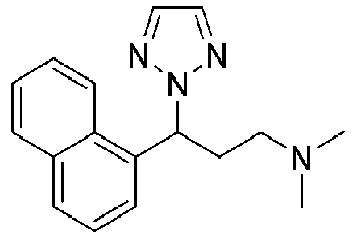
- The procedure given in Example 1 was followed using 1-acetonaphthone and 1H-1,2,3-triazole as reactants, instead of 3,4-dichloroacetophenone and 1H-tetrazole, to give Dimethyl-(3-naphthalen-1-yl-3-[1,2,3]triazol-2-yl-propyl)-amine.
- 1H-NMR(CDCl3, 200MHz) δ2.2(m, 8H), 2.6(m, 1H), 2.9(m, 1H), 7.0(m, 1H), 7.5(m, 4H), 7.9(t, 2H), 8.3(d, 1H)
-

- The procedure given in Example 1 was followed using 5-methyl-1H-tetrazole e as a reactant, instead of 1H-tetrazole, to give [3-(3,4-Dichloro-phenyl)-3-(5-methyl-tetrazol-2-yl)-propyl]-dimethyl-amine.
- 1H-NMR(CDC13, 200MHz) δ2.2(m, 9H), 2.6(m, 3H), 2.9(m, 3H), 6.0(t, 1H), 7.2(dd, 1H), 7.4(dd, 1H), 7.5(s, 1H)
-

- The procedure given in Example 1 was followed using 5-phenyl-1H-tetrazole as a reactant, instead of 1H-tetrazole, to give [3-(3,4-Dichloro-phenyl)-3-(5-phenyl-tetrazol-2-yl)-propyl]-dimethyl-amine.
- 1H-NMR(CDC13, 200MHz) δ2.2(m, 9H), 2.6(m, 3H), 2.9(m, 3H), 6.0(t, 1H), 7.4(m, 5H), 8.1(m, 2H)
-

- The procedure given in Example 1 was followed using 3,4-difluoroacetophenone as a reactant, instead of 3,4-dichloroacetophenone, to give [3-(3,4-Difluoro-phenyl)-3-tetrazol-1-yl-propyl]-dimethyl-amine.
- 1H-NMR(CDC13, 200MHz) δ2.2(m, 8H), 2.6(m, 2H), 2.9(m, 1H), 6.0(t, 1H), 7.4(m, 4H), 8.7(s, 1H)
-

- The procedure given in Example 1 was followed using 3,4-difluoroacetophenone as a reactant, instead of 3,4-dichloroacetophenone, to give [3-(3,4-Difluoro-phenyl)-3-tetrazol-2-yl-propyl]-dimethyl-amine.
- 1H-NMR(CDC13, 200MHz) δ2.2(m, 8H), 2.6(m, 2H), 2.9(m, 1H), 6.0(t, 1H), 7.4(m, 4H), 8.4(s, 1H)
-

- The procedure given in Example 1 was followed using 3,4-difluoroacetophenone and 1H-1,2,3-triazole as reactants, instead of 3,4-dichloroacetophenone and 1H-tetrazole, to give [3-(3,4-Difluoro-phenyl)-3-[1,2,3]triazol-1-yl-propyl]-dimethyl-amine.
- 1H-NMR(CDC13, 200MHz) δ2.2(m, 8H), 2.6(m, 2H), 2.9(m, 1H), 6.0(t, 1H), 7.4(m, 3H),7.5(s, 1H), 7.7(s, 1H)
-

- The procedure given in Example 1 was followed using 3,4-difluoroacetophenone and 1H-1,2,3-triazole as reactants, instead of 3,4-dichloroacetophenone and 1H-tetrazole, to give [3-(3,4-Difluoro-phenyl)-3-[1,2,3]triazol-2-yl-propyl]-dimethyl-amine.
- 1H-NMR(CDC13, 200MHz) δ2.2(m, 8H), 2.6(m, 2H), 2.9(m, 1H), 6.0(t, 1H), 7.4(m, 3H),7.6(s, 2H)
-

- The procedure given in Example 1 was followed using 3,4-dimethylacetophenone and 1H-1,2,3-triazole as reactant, instead of 3,4-dichloroacetophenone, and 1H-tetrazole to give [3-(3,4-Dimethyl-phenyl)-3-[1,2,3]triazol-1-yl-propyl]-dimethyl-amine.
- 1H-NMR(CDC13, 200MHz) δ2.2(m, 14H), 2.6(m, 2H), 2.9(m, 2H), 6.0(t, 1H), 7.4(m, 3H), 7.5(s, 1H), 7.7(s, 1H)
-

- The procedure given in Example 1 was followed using 3,4-dimethylacetophenone and 1H-1,2,3-triazole as reactants, instead of 3,4-dichloroacetophenone and 1H-tetrazole, to give [3-(3,4-Dimethyl-phenyl)-3-[1,2,3]triazol-2-yl-propyl]-dimethyl-amine.
- 1H-NMR(CDC13, 200MHz) δ2.2(m, 14H), 2.6(m, 2H), 2.9(m, 2H), 6.0(t, 1H), 7.4(m, 3H), 7.5(t, 2H)
-

- The procedure given in Example 1 was followed using 3,4-dimethylacetophenone as a reactant, instead of 3,4-dichloroacetophenone, to give [3-(3,4-Dimethyl-phenyl)-3-tetrazol-1-yl-propyl]-dimethyl-amine.
- 1H-NMR(CDC13, 200MHz) δ2.2(m, 14H), 2.6(m, 2H), 2.9(m, 2H), 6.0(t, 1H), 7.4(m, 3H), 8.5(s, 1H)
-
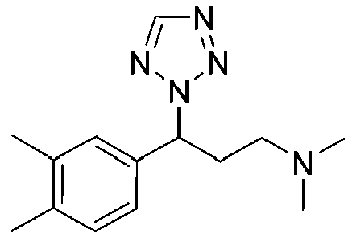
- The procedure given in Example 1 was followed using 3,4-dimethylacetophenone as a reactant, instead of 3,4-dichloroacetophenone, to give [3-(3,4-Dimethyl-phenyl)-3-tetrazol-2-yl-propyl]-dimethyl-amine.
- 1H-NMR(CDC13, 200MHz) δ2.2(m, 14H), 2.6(m, 2H), 2.9(m, 2H), 6.0(t, 1H), 7.4(m, 3H), 8.3(s, 1H)
-

- The procedure given in Example 1 was followed using 4-chloroacetophenone as a reactant, instead of 3,4-dichloroacetophenone, to give [3-(4-Chloro-phenyl)-3-tetrazol-1-yl-propyl]-dimethyl-amine.
- 1H-NMR(CDC13, 200MHz) δ2.2(m, 7H), 2.6(m, 2H), 2.9(m, 2H), 6.0(t, 1H), 7.4(m, 4H), 8.7(s, 1H)
-

- The procedure given in Example 1 was followed using 4-chloroacetophenone as a reactant, instead of 3,4-dichloroacetophenone, to give [3-(4-Chloro-phenyl)-3-tetrazol-2-yl-propyl]-dimethyl-amine.
- 1H-NMR(CDC13, 200MHz) δ2.2(m, 7H), 2.6(m, 2H), 2.9(m, 2H), 6.0(t, 1H), 7.4(m, 4H), 8.7(s, 1H)
-

- The procedure given in Example 1 was followed using acetophenone and 1H-1,2,3-triazole as reactants, instead of 3,4-dichloroacetophenone and 1H-tetrazole, to give Dimethyl-(3-phenyl-3-[1,2,3]triazol-1-yl-propyl)-amine.
- 1H-NMR(CDC13, 200MHz) δ2.2(m, 7H), 2.6(m, 2H), 2.9(m, 2H), 6.0(t, 1H), 7.2(m, 5H), 7.4(s, 1H), 7.6(s, 1H)
-

- The procedure given in Example 1 was followed using acetophenone and 1H-1,2,3-triazole as reactants, instead of 3,4-dichloroacetophenone and 1H-tetrazole, to give Dimethyl-(3-phenyl-3-[1,2,3]triazol-2-yl-propyl)-amine.
- 1H-NMR(CDC13, 200MHz) δ2.2(m, 7H), 2.6(m, 2H), 6.0(t, 1H), 7.2(m, 5H), 7.4(s, 2H)
-

- The procedure given in Example 1 was followed using 4-chloroacetophenone and 1H -1,2,3-triazole as reactant, instead of 3,4-dichloroacetophenone and 1H-tetrazole, to give [3-(4-Chloro-phenyl)-3-[1,2,3]triazol-1-yl-propyl]-dimethyl-amine.
- 1H-NMR(CDC13, 200MHz) δ2.2(m, 7H), 2.6(m, 2H), 6.0(t, 1H), 7.2(m, 4H), 7.5(s, 1H), 7.7(s, 1H)
-

- The procedure given in Example 1 was followed using 4-chloroacetophenone and 1H -1,2,3-triazole as reactants, instead of 3,4-dichloroacetophenone and 1H-tetrazole, to give [3-(4-Chloro-phenyl)-3-[1,2,3]triazol-2-yl-propyl]-dimethyl-amine.
- 1H-NMR(CDCl3, 200MHz) δ2.2(m, 7H), 2.6(m, 2H), 6.0(t, 1H), 7.2(m, 4H), 7.6(s, 2H)
-

- The procedure given in Example 1 was followed using 1H-1,2,3-triazole as a reactant, instead of 1H-tetrazole, to give [3-(3,4-Dichloro-phenyl)-3-[1,2,3]triazol-2-yl-propyl]-dimethyl-amine.
- 1H-NMR(CDC13, 200MHz) δ2.2(m, 7H), 2.4(m, 2H), 2.6(m, 2H), 6.0(t, 1H), 7.2(dd, 1H), 7.4(dd, 2H), 7.6(s, 2H)
-
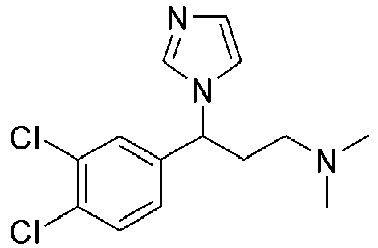
- The procedure given in Example 1 was followed using imidazole as a reactant, instead of 1H-tetrazole, to give [3-(3,4-Dichloro-phenyl)-3-imidazol-1-yl-propyl]-dimethyl-amine.
- 1H-NMR(CDC13, 200MHz) δ2.2(br, 10H), 5.3(t, 1H), 7.2(dd, 1H), 7.4(dd, 2H), 7.6(s, 2H)
-

- The procedure given in Example 1 was followed using 1-(3-Methoxy-naphthalen-2-yl)-ethanone as reactants, instead of 3,4-dichloroacetophenone, to give [3-(3-Methoxy-naphthalen-2-yl)-3-tetrazol-2-yl-propyl]-dimethyl-amine.
- 1H-NMR(CDCl3, 200MHz) δ2.4(m, 13H), 6.2(m, 1H), 7.5(m, 3H), 7.8(m, 4H), 8.5(s, 1H)
-

- The procedure given in Example 1 was followed using 1-(3-Methoxy-naphthalen-2-yl)-ethanone and 5-Methyl-1H-tetrazole as reactants, instead of 3,4-dichloroacetophenone and 1H-tetrazole, to give [3-(3-Methoxy-naphthalen-2-yl)-3-(5-methyl-tetrazol-2-yl)-propyl]-dimethyl-amine.
- 1H-NMR(CDC13, 200MHz) δ2.4(m, 9H), 2.5(m, 5H), 2.8(m, 1H), 4.0(s, 3H), 6.6(m, 1H), 7.5(m, 3H), 7.8(m, 4H)
-

- The procedure given in Example 1 was followed using 1-(6-Fluoro-naphthalen-2-yl)-ethanone as reactants, instead of 3,4-dichloroacetophenone, to give [3-(6-Fluoro-naphthalen-2-yl)-3-tetrazol-2-yl-propyl]-dimethyl-amine.
- 1H-NMR(CDCl3, 200MHz) δ2.4(m, 12H), 2.5(m, 1H), 2.8(m, 1H), 6.2(m, 1H), 7.2(m, 1H), 7.4(m, 1H), 7.5(m, 1H), 7.8(m, 3H), 8.5(s, 1H)
-
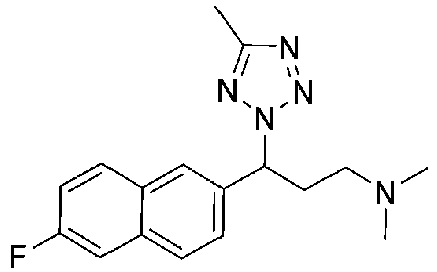
- The procedure given in Example 1 was followed using 1-(6-Fluoro-naphthalen-2-yl)-ethanone and 5-Me-1H-tetrazole as reactants, instead of 3,4-dichloroacetophenone and 1H-tetrazole, to give [3-(6-Fluoro-naphthalen-2-yl)-3-(5-methyl-tetrazol-2-yl)-propyl]-dimethyl-amine.
- 1H-NMR(CDCl3, 200MHz) δ2.4(m, 9H), 2.5(m, 4H), 2.8(m, 1H), 6.2(t, 1H), 7.2(m, 1H), 7.4(m, 1H), 7.5(m, 1H), 7.8(m, 3H)
-

- The procedure given in Example 1 was followed using 1-(1,4-Dimethoxy-naphthalen-2-yl)-ethanone as reactants, instead of 3,4-dichloroacetophenone, to give [3-(1,4-Dimethoxy-naphthalen-2-yl)-3-tetrazol-2-yl-propyl]-dimethyl-amine.
- 1H-NMR(CDC13, 200MHz) δ2.4(m, 12H), 2.5(m, 1H), 2.8(m, 1H), 4.0(d, 6H), 6.2(m, 1H), 7.2(m, 1H), 7.4(m, 1H), 7.5(m, 1H), 7.8(m, 2H), 8.5(s, 1H)
-

- The procedure given in Example 1 was followed using 1-(1,4-Dimethoxy-naphthalen-2-yl)-ethanone and 5-Me-1H-tetrazole as reactants, instead of 3,4-dichloroacetophenone and 1H-tetrazole, to give [3-(1,4-Dimethoxy-naphthalen-2-yl)-3-(5-methyl-tetrazol-2-yl)-propyl]-dimethyl-amin e.
- 1H-NMR(CDCl3, 200MHz) δ2.4(m, 12H), 2.5(m, 1H), 2.8(m, 1H), 4.0(d, 6H), 6.2(m, 1H), 6.9(s, 1H), 7.5(m, 2H), 8.0(s, 1H), 8.2(d, 1H)
-

- The procedure given in Example 1 was followed using 1-(3,5-Dimethoxy-naphthalen-2-yl)-ethanone as reactants, instead of 3,4-dichloroacetophenone, to give [3-(3,5-Dimethoxy-naphthalen-2-yl)-3-tetrazol-2-yl-propyl]-dimethyl-amine.
- 1H-NMR(CDCl3, 200MHz) δ2.4(m, 12H), 2.5(m, 1H), 2.8(m, 1H), 4.0(m, 6H), 6.8(m, 1H), 7.3(s, 6H), 7.5(m, 2H), 8.5(s, 1H)
-

- The procedure given in Example 1 was followed using 1-(3,5-Dimethoxy-naphthalen-2-yl)-ethanone and 5-Me-1H-tetrazole as reactants, instead of 3,4-dichloroacetophenone and 1H-tetrazole, to give [3-(3,5-Dimethoxy-naphthalen-2-yl)-3-(5-methyl-tetrazol-2-yl)-propyl]-dimethyl-amin e.
- 1H-NMR(CDC13, 200MHz) δ2.4(m, 9H), 2.5(m, 4H), 2.8(m, 1H), 4.0(m, 6H), 6.6(m, 1H), 6.8(m, 1H), 7.2(s, 3H), 7.5(s, 1H), 7.7(s, 1H)
-

- The procedure given in Example 1 was followed using 1-(3,5-Dimethoxy-naphthalen-2-yl)-ethanone as reactants, instead of 3,4-dichloroacetophenone, to give [3-(3,5-Dimethoxy-naphthalen-2-yl)-3-tetrazol-1-yl-propyl]-dimethyl-amine.
- 1H-NMR(CDCl3, 200MHz) δ2.4(m, 12H), 2.5(m, 1H), 2.8(m, 1H), 4.0(m, 6H), 6.6(m, 1H), 6.8(m, 1H), 7.2(s, 3H), 7.5(s, 1H), 7.7(s, 1H), 8.7(s, 1H)
-

- The procedure given in Example 1 was followed using 1-(4-Methyl-naphthalen-1-yl)-ethanone as reactants, instead of 3,4-dichloroacetophenone, to give Dimethyl-[3-(4-methyl-naphthalen-1-yl)-3-tetrazol-2-yl-propyl]-amine.
- 1H-NMR(CDC13, 200MHz) δ2.2(m, 10H), 2.4(m, 1H), 2.8(m, 4H), 3.0(m, 1H), 7.0(m, 1H), 7.2(m, 1H), 7.5(m, 4H), 8.0(m, 1H), 8.3(m, 1H), 8.5(s, 1H)
-

- The procedure given in Example 1 was followed using 1-(4-Methyl-naphthalen-1-yl)-ethanone and 5-Me-1H-tetrazole as reactants, instead of 3,4-dichloroacetophenone and 1H-tetrazole, to give Dimethyl-[3-(4-methyl-naphthalen-1-yl)-3-(5-methyl-tetrazol-2-yl)-propyl]-amine.
- 1H-NMR(CDC13, 200MHz) δ2.2(m, 9H), 2.4(m, 3H), 2.8(m, 3H), 3.0(m, 1H), 7.0(m, 1H), 7.2(m, 1H), 7.5(m, 4H), 8.0(m, 1H), 8.3(m, 1H)
-

- The procedure given in Example 1 was followed using 1-(4-Fluoro-naphthalen-1-yl)-ethanone as reactants, instead of 3,4-dichloroacetophenone, to give [3-(4-Fluoro-naphthalen-1-yl)-3-tetrazol-2-yl-propyl]-dimethyl-amine.
- 1H-NMR(CDC13, 200MHz) δ2.2(m, 12H), 2.4(m, 1H), 2.8(m, 1H), 7.0(m, 1H), 7.2(m, 1H), 7.5(m, 4H), 8.0(m, 1H), 8.3(m, 1H), 8.5(s, 1H)
-

- The procedure given in Example 1 was followed using 1-(4-Methyl-naphthalen-1-yl)-ethanone and 5-Me-1H-tetrazole as reactants, instead of 3,4-dichloroacetophenone and 1H-tetrazole, to give [3-(4-Fluoro-naphthalen-1-yl)-3-(5-methyl-tetrazol-2-yl)-propyl]-dimethyl-amine.
- 1H-NMR(CDC13, 200MHz) δ2.2(m, 9H), 2.4(m, 4H), 2.8(m, 1H), 7.0(m, 1H), 7.2(m, 1H), 7.5(m, 3H), 8.1(m, 1H), 8.3(m, 1H)
-

- The procedure given in Example 1 was followed using 1-Isoquinolin-1-yl-ethanone as reactants, instead of 3,4-dichloroacetophenone, to give (3-Isoquinolin-1-yl-3-tetrazol-2-yl-propyl)-dimethyl-amine.
- 1H-NMR(CDC13, 200MHz) δ2.2(m, 9H), 2.4(m, 1H), 2.8(m, 1H), 7.2(m, 1H), 7.6(m, 2H), 7.8(m, 2H), 8.4(m, 1H), 8.5(m, 1H), 9.1(s, 1H)
-

- The procedure given in Example 1 was followed using 1-Isoquinolin-1-yl-ethanone and 5-Me-1H-tetrazole as reactants, instead of 3,4-dichloroacetophenone and 1H-tetrazole, to give [3-Isoquinolin-1-yl-3-(5-methyl-tetrazol-2-yl)-propyl]-dimethyl-amine.
- 1H-NMR(CDC13, 200MHz) δ2.2(m, 9H), 2.5(m, 3H), 2.8(m, 3H), 7.2(m, 1H), 7.6(m, 2H), 7.8(m, 2H), 8.4(m, 1H), 8.5(m, 1H)
-
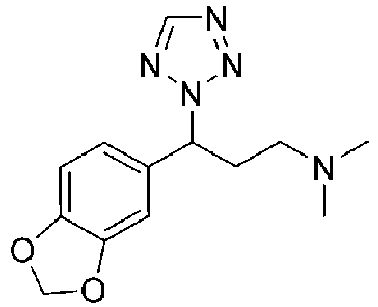
- The procedure given in Example 1 was followed using 1-Benzo[1,3]dioxol-5-yl-ethanone as reactants, instead of 3,4-dichloroacetophenone, to give (3-Benzo[1,3]dioxol-5-yl-3-tetrazol-2-yl-propyl)-dimethyl-amine.
- 1H-NMR(CDC13, 200MHz) 52.2(m, 9H), 2.5(m, 1H), 2.8(m, 1H), 6.0(s, 2H), 6.1(m, 1H), 6.8(d, 1H), 7.0(d, 2H), 8.5(m, 1H)
-

- The procedure given in Example 1 was followed using l-Benzo[1,3]dioxol-5-yl-ethanone and 5-Me-1H-tetrazole as reactants, instead of 3,4-dichloroacetophenone and 1H-tetrazole, to give [3-Benzo[1,3]dioxol-5-yl-3-(5-methyl-tetrazol-2-yl)-propyl]-dimethyl-amine.
- 1H-NMR(CDC13, 200MHz) 62.2(m, 15H), 2.8(m, 1H), 6.0(s, 2H), 6.1(m, 1H), 6.8(d, 1H), 7.0(d, 2H), 8.5(m, 1H)
-

- The procedure given in Example 1 was followed using 1-Benzo[1,3]dioxol-5-yl-ethanone and 5-Me-1H-tetrazole as reactants, instead of 3,4-dichloroacetophenone and 1H-tetrazole, to give [3-Benzo[1,3]dioxol-5-yl-3-(5-methyl-tetrazol-1-yl)-propyl]-dimethyl-amine.
- 1H-NMR(CDC13, 200MHz) δ2.2(m, 9H), 2.4(m, 1H), 2.5(s, 3H), 2.8(m, 1H), 5.5(t, 2H), 6.1(s, 2H), 6.8(m, 3H)
-

- The procedure given in Example 1 was followed using 1-(3,4-Dimethoxy-phenyl)-ethanone as reactants, instead of 3,4-dichloroacetophenone, to give [3-(3,4-Dimethoxy-phenyl)-3-tetrazol-2-yl-propyl]-dimethyl-amine.
- 1H-NMR(CDC13, 200MHz) δ2.2(s, 12H), 2.4(m, 1H), 2.8(m, 1H), 4.0(s, 6H), 6.1(s, 2H), 6.8(d, 1H), 7.0(d, 2H), 8.5(s, 1H)
-

- The procedure given in Example 1 was followed using 1-(2,3-Dihydro-benzo[1,4]dioxin-2-yl)-ethanone as reactants, instead of 3,4-dichloroacetophenone, to give [3-(2,3-Dihydro-benzo[1,4]dioxin-2-yl)-3-tetrazol-2-yl-propyl]-dimethyl-amine.
- 1H-NMR(CDC13, 200MHz) δ2.2(s, 12H), 2.4(m, 3H), 3.8(m, 1H), 4.6(m, 1H), 5.4(m, 1H), 7.0(s, 5H), 8.5(s, 1H)
-

- The procedure given in Example 1 was followed using 1-(2,3-Dihydro-benzo[1,4]dioxin-2-yl)-ethanone and 5-Me-1H-tetrazole as reactants, instead of 3,4-dichloroacetophenone and 1H-tetrazole, to give [3-(2,3-Dihydro-benzo[1,4]dioxin-2-yl)-3-(5-methyl-tetrazol-2-yl)-propyl]-dimethyl-a mine.
- 1H-NMR(CDC13, 200MHz) δ2.2(s, 10H), 2.4(m, 3H), 2.8(m, 4H), 3.8(m, 1H), 4.0(m, 1H), 4.8(m, 1H), 5.3(m, 1H), 7.0(s, 4H)
-

- The procedure given in Example 1 was followed using 1-Quinolin-2-yl-ethanone as reactants, instead of 3,4-dichloroacetophenone, to give Dimethyl-(3-quinolin-2-yl-3-tetrazol-2-yl-propyl)-amine.
- 1H-NMR(CDC13, 200MHz) δ2.2(s, 10H), 2.8(m, 2H), 6.5(t, 1H), 7.3(m, 2H), 7.5(m, 1H), 7.8(m, 2H), 8.0(t, 2H), 8.5(s, 1H)
-

- The procedure given in Example 1 was followed using 1-Quinolin-2-yl-ethanone and 5-Me-1H-tetrazole as reactants, instead of 3,4-dichloroacetophenone and 1H-tetrazole, to give Dimethyl-[3-(5-methyl-tetrazol-2-yl)-3-quinolin-2-yl-propyl]-amine.
- 1H-NMR(CDC13, 200MHz) δ2.2(s, 10H), 2.5(s, 3H), 2.8(m, 2H), 6.5(t, 1H), 7.3(m, 2H), 7.5(m, 1H), 7.8(m, 2H), 8.0(t, 2H), 8.5(s, 1H)
-

- The procedure given in Example 1 was followed using 1-(1-Methyl-1H-indol-2-yl)-ethanone as reactants, instead of 3,4-dichloroacetophenone, to give Dimethyl-[3-(1-methyl-1H-indol-2-yl)-3-tetrazol-2-yl-propyl]-amine.
- 1H-NMR(CDC13, 200MHz) δ2.2(s, 10H), 2.5(s, 3H), 2.8(m, 2H), 6.5(t, 1H), 7.3(m, 2H), 7.5(m, 1H), 7.8(m, 2H), 8.0(t, 2H), 8.5(s, 1H)
-

- The procedure given in Example 1 was followed using 1-(1-Methyl-1H-indol-2-yl)-ethanone and 5-Me-1H-tetrazole as reactants, instead of 3,4-dichloroacetophenone and 1H-tetrazole, to give Dimethyl-[3-(1-methyl-1H-indol-2-yl)-3-(5-methyl-tetrazol-2-yl)-propyl]-amine.
- 1H-NMR(CDC13, 200MHz) δ2.2(s, 8H), 2.5(s, 3H), 2.8(m, 2H), 3.8(s, 2H), 6.5(t, 1H), 6.8(s, 1H), 7.3(m, 1H), 7.5(m, 2H), 7.8(m, 2H)
-

- The procedure given in Example 1 was followed using 1-(1,2,3,4-Tetrahydro-naphthalen-2-yl)-ethanone as reactants, instead of 3,4-dichloroacetophenone, to give Dimethyl-[3-(1,2,3,4-tetrahydro-naphthalen-2-yl)-3-tetrazol-2-yl-propyl]-amine.
- 1H-NMR(CDC13, 200MHz) δ2.2(s, 11H), 2.8(m, 8H), 5.0(m, 1H), 7.0(m, 4H), 8.5(s, 1H)
-

- The procedure given in Example 1 was followed using 1-(6-Chloro-pyridin-3-yl)-ethanone as reactants, instead of 3,4-dichloroacetophenone, to give [3-(6-Chloro-pyridin-3-yl)-3-tetrazol-2-yl-propyl]-dimethyl-amine.
- 1H-NMR(CDC13, 200MHz) δ2.2(m, 10H), 2.5(m, 1H), 2.8(m, 1H), 6.2(m, 1H), 7.2(m, 1H), 7.8(m, 1H), 8.5(s, 1H)
-

- The procedure given in Example 1 was followed using 1-Benzo[b]thiophen-2-yl-ethanone as reactants, instead of 3,4-dichloroacetophenone, to give (3-Benzo[b]thiophen-2-yl-3-tetrazol-2-yl-propyl)-dimethyl-amine.
- 1H-NMR(CDC13, 200MHz) δ2.2(m, 10H), 2.8(m, 1H), 6.5(m, 1H), 7.4(m, 3H), 7.8(m, 2H), 8.5(s, 1H)
-

- The procedure given in Example 1 was followed using 1-Benzo[b]thiophen-2-yl-ethanone and 5-Me-1H-tetrazole as reactants, instead of 3,4-dichloroacetophenone and 1H-tetrazole, to give [3-Benzo[b]thiophen-2-yl-3-(5-methyl-tetrazol-2-yl)-propyl]-dimethyl-amine.
- 1H-NMR(CDC13, 200MHz) δ2.2(m, 9H), 2.8(m, 5H), 6.5(m, 1H), 7.4(m, 3H), 7.8(m, 2H)
-

- The procedure given in Example 1 was followed using 1-Benzofuran-2-yl-ethanone as reactants, instead of 3,4-dichloroacetophenone, to give (3-Benzofuran-2-yl-3-tetrazol-2-yl-propyl)-dimethyl-amine.
- 1H-NMR(CDC13, 200MHz) δ2.2(m, 10H), 2.8(m, 2H), 6.5(m, 1H), 7.4(m, 3H), 7.8(m, 2H), 8.5(s, 1H)
-

- The procedure given in Example 1 was followed using 1-Benzofuran-2-yl-ethanone and 5-Me-1H-tetrazole as reactants, instead of 3,4-dichloroacetophenone and 1H-tetrazole, to give [3-Benzofuran-2-yl-3-(5-methyl-tetrazol-2-yl)-propyl]-dimethyl-amine.
- 1H-NMR(CDC13, 200MHz) δ2.2(m, 10H), 2.8(m, 2H), 6.5(m, 1H), 7.4(m, 3H), 7.8(m, 2H)
-

- The procedure given in Example 1 was followed using 1-Benzofuran-2-yl-ethanone as reactants, instead of 3,4-dichloroacetophenone, to give (3-Benzofuran-2-yl-3-tetrazol-1-yl-propyl)-dimethyl-amine.
- 1H-NMR(CDC13, 200MHz) δ2.2(m, 10H), 2.8(m, 2H), 6.2(m, 1H), 7.4(m, 3H), 7.8(m, 2H)
-

- The procedure given in Example 1 was followed using 1-Benzofuran-2-yl-ethanone and 5-Me-1H-tetrazole as reactants, instead of 3,4-dichloroacetophenone and 1H-tetrazole, to give [3-(3,4-Difluoro-phenyl)-3-(5-methyl-tetrazol-2-yl)-propyl]-dimethyl-amine.
- 1H-NMR(CDC13, 200MHz) δ2.2(m, 10H), 2.8(m, 4H), 6.2(m, 1H), 7.4(m, 4H)
-

- The procedure given in Example 1 was followed using 1-(2,4,5-Trifluoro-phenyl)-ethanone as reactants, instead of 3,4-dichloroacetophenone, to give Dimethyl-[3-tetrazol-2-yl-3-(2,4,5-trifluoro-phenyl)-propyl]-amine.
- 1H-NMR(CDCl3, 200MHz) δ2.2(m, 12H), 2.8(m, 2H), 6.5(m, 1H), 7.0(m, 1H), 7.4(m, 1H), 8.6(s, 1H)
-

- The procedure given in Example 1 was followed using 1-(2,4,5-Trifluoro-phenyl)-ethanone and 5-Me-1H-tetrazole as reactants, instead of 3,4-dichloroacetophenone and 1H-tetrazole, to give Dimethyl-[3-(5-methyl-tetrazol-2-yl)-3-(2,4,5-trifluoro-phenyl)-propyl]-amine.
- 1H-NMR(CDC13, 200MHz) δ2.2(m, 12H), 2.8(m, 4H), 6.5(m, 1H), 7.0(m, 1H), 7.4(m, 1H)
-

- The procedure given in Example 1 was followed using 1-(3-Bromo-4-fluoro-phenyl)-ethanone as reactants, instead of 3,4-dichloroacetophenone, to give [3-(3-Bromo-4-fluoro-phenyl)-3-tetrazol-2-yl-propyl]-dimethyl-amine.
- 1H-NMR(CDC13, 200MHz) δ2.2(m, 10H), 2.4(m, 2H), 2.8(m, 1H), 6.5(m, 1H), 7.0(m, 1H), 7.4(m, 1H), 7.8(m, 1H), 8.5(s, 1H)
-

- The procedure given in Example 1 was followed using 1-(3-Bromo-4-fluoro-phenyl)-ethanone and 5-Me-1H-tetrazole as reactants, instead of 3,4-dichloroacetophenone and 1H-tetrazole, to give [3-(3-Bromo-4-fluoro-phenyl)-3-(5-methyl-tetrazol-2-yl)-propyl]-dimethyl-amine.
- 1H-NMR(CDC13, 200MHz) δ2.2(m, 10H), 2.4(m, 2H), 2.8(m, 1H), 6.5(m, 1H), 7.0(m, 1H), 7.4(m, 1H), 7.8(m, 1H)
-

- The procedure given in Example 1 was followed using 1-(6-Methoxy-naphthalen-2-yl)-ethanone and 5-Me-1H-tetrazole as reactants, instead of 3,4-dichloroacetophenone and 1H-tetrazole, to give [3-(6-Methoxy-naphthalen-2-yl)-3-(5-methyl-tetrazol-2-yl)-propyl]-dimethyl-amine.
- 1H-NMR(CDC13, 200MHz) 62.2(m, 11H), 2.4(m, 2H), 2.8(m, 1H), 4.0(s, 3H), 6.3(m, 1H), 7.1(m, 3H), 7.4(m, 1H), 7.8(m, 1H)
-

- The procedure given in Example 1 was followed using 1-(4-Phenoxy-phenyl)-ethanone and 5-Me-1H-tetrazole as reactants, instead of 3,4-dichloroacetophenone and 1H-tetrazole, to give Dimethyl-[3-(5-methyl-tetrazol-2-yl)-3-(4-phenoxy-phenyl)-propyl]-amine.
- 1H-NMR(CDC13, 200MHz) δ2.2(m, 8H), 2.4(m, 6H), 2.8(m, 1H), 6.2(m, 1H), 7.1(m, 4H), 7.4(m, 4H)
-

- The procedure given in Example 1 was followed using 1-(4-Bromo-phenyl)-ethanone as reactants, instead of 3,4-dichloroacetophenone, to give [3-(4-Bromo-phenyl)-3-tetrazol-2-yl-propyl]-dimethyl-amine.
- 1H-NMR(CDC13, 200MHz) δ2.2(m, 10H), 2.4(m, 1H), 2.8(m, 1H), 6.2(m, 1H), 7.3(m, 2H), 7.5(m, 2H), 8.5(s, 1H)
-

- The procedure given in Example 1 was followed using 1-(4-Bromo-phenyl)-ethanone and 5-Me-1H-tetrazole as reactants, instead of 3,4-dichloroacetophenone and 1H - tetrazole, to give [3-(4-Bromo-phenyl)-3-(5-methyl-tetrazol-2-yl)-propyl]-dimethyl-amine.
- 1H-NMR(CDC13, 200MHz) 52.2(m, 9H), 2.3(m, 1H), 2.5(s, 3H), 2.8(m, 1H), 6.0(m, 1H), 7.3(m, 2H), 7.5(m, 2H)
-

- The procedure given in Example 1 was followed using 1-(4-Trifluoromethyl-phenyl)-ethanone as reactants, instead of 3,4-dichloroacetophenone, to give Dimethyl-[3-tetrazol-2-yl-3-(4-trifluoromethyl-phenyl)-propyl]-amine.
- 1H-NMR(CDC13, 200MHz) 62.2(m, 9H), 2.3(m, 1H), 2.8(m, 1H), 6.2(m, 1H), 7.3(m, 2H), 7.5(m, 2H), 8.5(s, 1H)
-

- The procedure given in Example 1 was followed using 1-(4-Trifluoromethyl-phenyl)-ethanone and 5-Me-1H-tetrazole as reactants, instead of 3,4-dichloroacetophenone and 1H-tetrazole, to give Dimethyl-[3-(5-methyl-tetrazol-2-yl)-3-(4-trifluoromethyl-phenyl)-propyl]-amine.
- 1H-NMR(CDC13, 200MHz) δ2.2(m, 9H), 2.3(m, 1H), 2.5(s, 3H), 2.8(m, 1H), 6.0(m, 1H), 7.6(m, 4H)
-
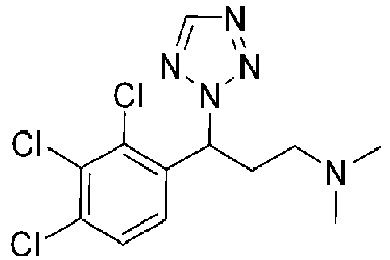
- The procedure given in Example 1 was followed using 1-(2,3,4-Trichloro-phenyl)-ethanone as reactants, instead of 3,4-dichloroacetophenone, to give Dimethyl-[3-tetrazol-2-yl-3-(2,3,4-trichloro-phenyl)-propyl]-amine.
- 1H-NMR(CDC13, 200MHz) 62.2(m, 9H), 2.3(m, 1H), 2.8(m, 1H), 6.2(m, 1H), 7.3(m, 3H), 8.5(s, 1H)
-

- The procedure given in Example 1 was followed using 1-(2,3,4-Trichloro-phenyl)-ethanone and 5-Me-1H-tetrazole as reactants, instead of 3,4-dichloroacetophenone and 1H-tetrazole, to give Dimethyl-[3-(5-methyl-tetrazol-2-yl)-3-(2,3,4-trichloro-phenyl)-propyl]-amine.
- 1H-NMR(CDC13, 200MHz) δ2.2(m, 9H), 2.3(m, 1H), 2.5(s, 3H), 2.8(m, 1H), 6.0(m, 1H), 7.2(m, 2H)
-
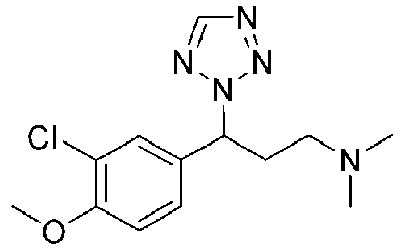
- The procedure given in Example 1 was followed using 1-(3-Chloro-4-methoxy-phenyl)-ethanone as reactants, instead of 3,4-dichloroacetophenone, to give [3-(3-Chloro-4-methoxy-phenyl)-3-tetrazol-2-yl-propyl]-dimethyl-amine.
- 1H-NMR(CDC13, 200MHz) δ2.2(m, 10H), 2.3(m, 1H), 2.8(m, 1H), 4.0(s, 3H), 6.1(m, 1H), 6.9(d, 1H), 7.3(d, 1H), 7.5(s, 1H), 8.5(s, 1H)
-
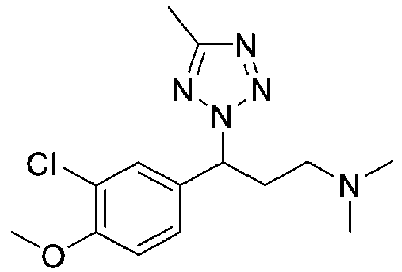
- The procedure given in Example 1 was followed using 1-(3-Chloro-4-methoxy-phenyl)-ethanone and 5-Me-1H-tetrazole as reactants, instead of 3,4-dichloroacetophenone and 1H-tetrazole, to give [3-(3-Chloro-4-methoxy-phenyl)-3-(5-methyl-tetrazol-2-yl)-propyl]-dimethyl-amine.
- 1H-NMR(CDC13, 200MHz) δ2.2(m, 10H), 2.3(m, 1H), 2.8(m, 1H), 4.0(s, 3H), 6.1(m, 1H), 6.9(d, 1H), 7.3(d, 1H), 7.5(s, 1H)
-

- The procedure given in Example 1 was followed using 1-(4-tert-Butyl-phenyl)-ethanone and 5-Me-1H-tetrazole as reactants, instead of 3,4-dichloroacetophenone and 1H-tetrazole, to give [3-(4-tert-Butyl-phenyl)-3-(5-methyl-tetrazol-2-yl)-propyl]-dimethyl-amine.
- 1H-NMR(CDC13, 200MHz) δ1.2(s, 9H), 2.4(m, 3H), 2.5(m, 6H), 2.7(m, 1H), 6.2(m, 1H), 7.4(m, 4H)
-
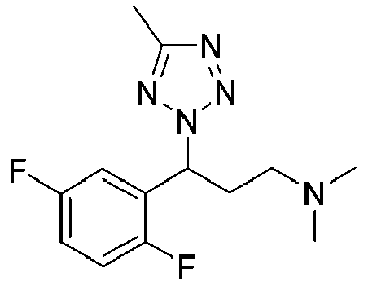
- The procedure given in Example 1 was followed using 1-(2,5-Difluoro-phenyl)-ethanone and 5-Me-1H-tetrazole as reactants, instead of 3,4-dichloroacetophenone and 1H-tetrazole, to give [3-(2,5-Difluoro-phenyl)-3-(5-methyl-tetrazol-2-yl)-propyl]-dimethyl-amine.
- 1H-NMR(CDC13, 200MHz) δ2.4(m, 10H), 2.5(m, 3H), 2.7(m, 1H), 6.4(m, 1H), 7.4(m, 3H)
-

- The procedure given in Example 1 was followed using 1-(2,4-Dichloro-phenyl)-ethanone and 5-Me-1H-tetrazole as reactants, instead of 3,4-dichloroacetophenone and 1H-tetrazole, to give [3-(2,4-Dichloro-phenyl)-3-(5-methyl-tetrazol-2-yl)-propyl]-dimethyl-amine.
- 1H-NMR(CDC13, 200MHz) δ2.4(m, 10H), 2.5(m, 3H), 2.7(m, 1H), 6.4(m, 1H), 7.4(m, 3H)
-

- The procedure given in Example 1 was followed using 1-(3-Chloro-phenyl)-ethanone and 5-Me-1H-tetrazole as reactants, instead of 3,4-dichloroacetophenone and 1H-tetrazole, to give [3-(3-Chloro-phenyl)-3-(5-methyl-tetrazol-2-yl)-propyl]-dimethyl-amine.
- 1H-NMR(CDC13, 200MHz) δ2.4(m, 10H), 2.5(m, 3H), 2.7(m, 1H), 6.4(m, 1H), 7.4(m, 4H)
-
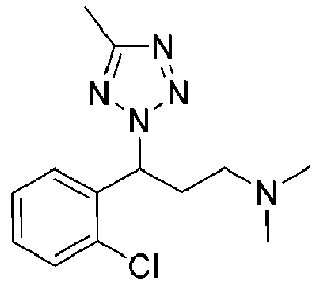
- The procedure given in Example 1 was followed using 1-(2-Chloro-phenyl)-ethanone and 5-Me-1H-tetrazole as reactants, instead of 3,4-dichloroacetophenone and 1H-tetrazole, to give [3-(2-Chloro-phenyl)-3-(5-methyl-tetrazol-2-yl)-propyl]-dimethyl-amine.
- 1H-NMR(CDC13, 200MHz) δ2.4(m, 10H), 2.5(m, 3H), 2.7(m, 1H), 6.4(m, 1H), 7.4(m, 4H)
-

- The procedure given in Example 1 was followed using 1-(2,5-Difluoro-phenyl)-ethanone as reactants, instead of 3,4-dichloroacetophenone, to give [3-(2-5-difluoro-phenyl)-3-tetrazol-2-yl-propyl]-dimethyl-amine.
- 1H-NMR(CDC13, 200MHz) δ2.4(m, 10H), 2.5(m, 1H), 2.7(m, 1H), 6.4(m, 1H), 7.4(m, 3H), 8.5(s, 1H)
-

- The procedure given in Example 1 was followed using 1-(2,4-Dichloro-phenyl)-ethanone as reactants, instead of 3,4-dichloroacetophenone, to give [3-(2,4-dichloro-phenyl)-3-tetrazol-2-yl-propyl]-dimethyl-amine.
- 1H-NMR(CDC13, 200MHz) δ2.4(m, 10H), 2.5(m, 1H), 2.7(m, 1H), 6.4(m, 1H), 7.4(m, 3H), 8.5(s, 1H)
-

- The procedure given in Example 1 was followed using 1-(3-Chloro-phenyl)-ethanone as reactants, instead of 3,4-dichloroacetophenone, to give [3-(3-Chloro-phenyl)-3-tetrazol-2-yl-propyl]-dimethyl-amine.
- 1H-NMR(CDC13, 200MHz) δ2.4(m, 10H), 2.5(m, 1H), 2.7(m, 1H), 6.4(m, 1H), 7.4(m, 4H), 8.5(s, 1H)
-

- The procedure given in Example 1 was followed using 1-(4-Trifluoromethoxy-phenyl)-ethanone and 5-Me-1H-tetrazole as reactants, instead of 3,4-dichloroacetophenone and 1H-tetrazole, to give Dimethyl-[3-(5-methyl-tetrazol-2-yl)-3-(4-trifluoromethoxy-phenyl)-propyl]-amine.
- 1H-NMR(CDC13, 200MHz) δ2.4(m, 10H), 2.5(m, 3H), 2.7(m, 1H), 6.4(m, 1H), 7.2(m, 2H),7.4(m, 2H)
-

- The procedure given in Example 1 was followed using 1-(3-Bromo-4-methyl-phenyl)-ethanone and 5-Me-1H-tetrazole as reactants, instead of 3,4-dichloroacetophenone and 1H-tetrazole, to give [3-(3-Bromo-4-methyl-phenyl)-3-(5-methyl-tetrazol-2-yl)-propyl]-dimethyl-amine.
- 1H-NMR(CDC13, 200MHz) δ2.4(m, 10H), 2.5(m, 3H), 2.7(m, 1H), 6.4(m, 1H), 7.4(m, 3H)
-

- The procedure given in Example 1 was followed using 1-(4-Trifluoromethoxy-phenyl)-ethanone as reactants, instead of 3,4-dichloroacetophenone, to give Dimethyl-[3-tetrazol-2-yl-3-(4-trifluoromethoxy-phenyl)-propyl]-amine.
- 1H-NMR(CDC13, 200MHz) δ2.4(m, 10H), 2.5(m, 1H), 2.7(m, 1H), 6.4(m, 1H), 7.2(m, 2H),7.4(m, 2H), 8.5(s, 1H)
-

- The procedure given in Example 1 was followed using 1-(3-Bromo-4-methyl-phenyl)-ethanone as reactants, instead of 3,4-dichloroacetophenone, to give [3-(4-Bromo-3-methyl-phenyl)-3-tetrazol-2-yl-propyl]-dimethyl-amine.
- 1H-NMR(CDC13, 200MHz) δ2.4(m, 10H), 2.5(m, 1H), 2.7(m, 1H), 6.4(m, 1H), 7.4(m, 3H), 8.5(s, 1H)
-

- The procedure given in Example 1 was followed using 1-(4-Methanesulfonyl-phenyl)-ethanone and 5-Me-1H-tetrazole as reactants, instead of 3,4-dichloroacetophenone and 1H-tetrazole, to give [3-(4-Methanesulfonyl-phenyl)-3-(5-methyl-tetrazol-2-yl)-propyl]-dimethyl-amine.
- 1H-NMR(CDC13, 200MHz) δ2.4(m, 10H), 2.5(m, 3H), 2.7(m, 1H), 3.0(m, 3H), 6.4(m, 1H), 7.2(m, 2H),7.4(m, 2H)
-

- The procedure given in Example 1 was followed using 1-(4-Isopropyl-phenyl)-ethanone and 5-Me-1H-tetrazole as reactants, instead of 3,4-dichloroacetophenone and 1H-tetrazole, to give [3-(4-Isopropyl-phenyl)-3-(5-methyl-tetrazol-2-yl)-propyl]-dimethyl-amine.
- 1H-NMR(CDC13, 200MHz) δ1.0(s, 6H), 2.4(m, 10H), 2.7(m, 1H), 3.0(m, 3H), 6.4(m, 1H), 7.2(m, 2H),7.4(m, 2H)
-

- The procedure given in Example 1 was followed using 1-(9H-Fluoren-2-yl)-ethanone and 5-Me-1H-tetrazole as reactants, instead of 3,4-dichloroacetophenone and 1H - tetrazole, to give [3-(9H-Fluoren-2-yl)-3-(5-methyl-tetrazol-2-yl)-propyl]-dimethyl-amine.
- 1H-NMR(CDC13, 200MHz) δ2.4(m, 10H), 2.5(m, 3H), 2.7(m, 1H), 4.0(m, 3H), 6.4(m, 1H), 7.2(m, 2H),7.4(m, 2H)
-

- The procedure given in Example 2 was followed using dimethyl-(3-naphthalen-2-yl-3-[1,2,3]triazol-2-yl-propyl)-amine as a reactant, instead of [3-(3,4-Dichloro-phenyl)-3-tetrazol-2-yl-propyl]-dimethyl-amine, to give Methyl-(3-naphthalen-2-yl-3-[1,2,3]triazol-2-yl-propyl)-amine.
- 1H-NMR(CDC13, 200MHz) δ2.4(m, 3H), 2.5(m, 6H), 2.7(m, 1H), 6.2(m, 1H), 7.2(m, 3H), 7.6(d, 2H), 7.8(m, 4H)
-

- The procedure given in Example 2 was followed using [3-benzotriazol-2-yl-3-(3,4-dichloro-phenyl)-propyl]-dimethyl-amineas a reactant, instead of [3-(3,4-Dichloro-phenyl)-3-tetrazol-2-yl-propyl]-dimethyl-amine, to give [3-Benzotriazol-2-yl-3-(3,4-dichloro-phenyl)-propyl]-methyl-amine.
- 1H-NMR(CDC13, 200MHz) δ2.4(m, 3H), 2.5(m, 3H), 2.7(m, 1H), 6.2(m, 1H), 7.2(m, 4H), 7.6(s, 1H), 7.9(m, 2H)
-

- The procedure given in Example 2 was followed using [dimethyl-[3-(5-methyl-tetrazol-2-yl)-3-naphthalen-2-yl-propyl]-amine a reactant, instead of [3-(3,4-dichloro-phenyl)-3-tetrazol-2-yl-propyl]-dimethyl-amine, to give methyl-[3-(5-methyl-tetrazol-2-yl)-3-naphthalen-2-yl-propyl]-amine.
- 1H-NMR(CDC13, 200MHz) δ2.4(s, 1H), 2.6(m, 6H), 2.8(m, 1H), 6.2(m, 1H), 7.5(m, 3H), 7.8(m, 4H)
-

- The procedure given in Example 2 was followed using (3-benzotriazol-2-yl-3-naphthalen-2-yl-propyl)-dimethyl-amine as a reactant, instead of [3-(3,4-dichloro-phenyl)-3-tetrazol-2-yl-propyl]-dimethyl-amine, to give (3-benzotriazol-2-yl-3-naphthalen-2-yl-propyl)-methyl-amine.
- 1H-NMR(CDC13, 200MHz) δ2.4(s, 1H), 2.6(m, 6H), 2.8(m, 1H), 6.2(m, 1H), 7.4(m, 4H), 7.6(d, 1H), 7.9(m, 6H)
-

- The procedure given in Example 2 was followed using (3-biphenyl-4-yl-3-tetrazol-2-yl-propyl)-dimethyl-amine as a reactant, instead of [3-(3,4-dichloro-phenyl)-3-tetrazol-2-yl-propyl]-dimethyl-amine, to give (3-Biphenyl-4-yl-3-tetrazol-2-yl-propyl)-methyl-amine.
- 1H-NMR(CDC13, 200MHz) δ2.4(s, 1H), 2.6(m, 6H), 2.8(m, 1H), 6.2(m, 1H), 7.4(m 9H), 8.5(s, 1H)
-

- The procedure given in Example 2 was followed using [3-(3,4-dichloro-phenyl)-3-(5-methyl-tetrazol-2-yl)-propyl]-dimethyl-amine as a reactant, instead of [3-(3,4-dichloro-phenyl)-3-tetrazol-2-yl-propyl]-dimethyl-amine, to give [3-(3,4-dichloro-phenyl)-3-(5-methyl-tetrazol-2-yl)-propyl]-methyl-amine.
- 1H-NMR(CDC13, 200MHz) δ2.4(m, 3H), 2.5(m, 6H), 2.7(m, 1H), 6.2(m, 1H), 7.2(m, 1H), 7.4(m, 1H), 7.5(s, 1H)
-
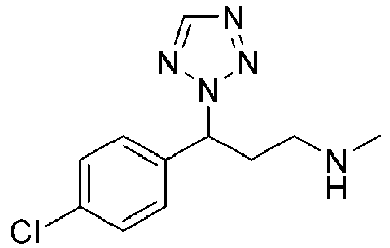
- The procedure given in Example 2 was followed using [3-(4-chloro-phenyl)-3-tetrazol-2-yl-propyl]-dimethyl-amine as a reactant, instead of [3-(3,4-dichloro-phenyl)-3-tetrazol-2-yl-propyl]-dimethyl-amine, to give [3-(4-chloro-phenyl)-3-tetrazol-2-yl-propyl]-methyl-amine.
- 1H-NMR(CDC13, 200MHz) δ2.4(m, 3H), 2.5(m, 6H), 2.7(m, 1H), 6.2(m, 1H), 7.3(m, 4H), 8.5(s, 1H)
-

- The procedure given in Example 2 was followed using [3-(3,4-dichloro-phenyl)-3-[1,2,3]triazol-2-yl-propyl]-dimethyl-amine as a reactant, instead of [3-(3,4-dichloro-phenyl)-3-tetrazol-2-yl-propyl]-dimethyl-amine, to give [3-(3,4-dichloro-phenyl)-3-[1,2,3]triazol-2-yl-propyl]-methyl-amine.
- 1H-NMR(CDC13, 200MHz) δ2.4(m, 3H), 2.5(m, 3H), 2.7(m, 1H), 6.2(m, 1H), 7.2(m, 1H), 7.4(m, 1H), 7.5(s, 1H), 7.6(d, 2H)
-

- The procedure given in Example 2 was followed using [3-(3,4-dichloro-phenyl)-3-tetrazol-2-yl-propyl]-dimethyl-amine as a reactant, instead of [3-(3,4-dichloro-phenyl)-3-tetrazol-2-yl-propyl]-dimethyl-amine, to give [3-(3,4-dichloro-phenyl)-3-tetrazol-2-yl-propyl]-methyl-amine.
- 1H-NMR(CDC13, 200MHz) δ2.4(m, 3H), 2.5(m, 3H), 2.7(m, 1H), 6.2(m, 1H), 7.2(m, 1H), 7.4(m, 1H), 7.5(s, 1H), 8.5(s, 1H)
-

- The procedure given in Example 2 was followed using dimethyl-(3-naphthalen-2-yl-3-tetrazol-2-yl-propyl)-amine as a reactant, instead of [3-(3,4-dichloro-phenyl)-3-tetrazol-2-yl-propyl]-dimethyl-amine, to give methyl-(3-naphthalen-2-yl-3-tetrazol-2-yl-propyl)-amine.
- 1H-NMR(CDC13, 200MHz) δ2.4(m, 3H), 2.5(m, 3H), 2.7(m, 1H), 6.2(m, 1H), 7.5(m, 3H), 7.8(m, 4H), 8.5(s, 1H)
-

- The procedure given in Example 2 was followed using [3-(6-chloro-naphthalen-2-yl)-3-tetrazol-2-yl-propyl]-dimethyl-amine as a reactant, instead of [3-(3,4-dichloro-phenyl)-3-tetrazol-2-yl-propyl]-dimethyl-amine, to give [3-(6-Chloro-naphthalen-2-yl)-3-tetrazol-2-yl-propyl]-methyl-amine.
- 1H-NMR(CDC13, 200MHz) δ2.4(m, 3H), 2.5(m, 3H), 2.7(m, 1H), 7.0(m, 1H), 7.5(m, 3H), 7.8(m, 2H), 8.3(s, 1H), 8.5(s, 1H)
-

- The procedure given in Example 2 was followed using Dimethyl-(3-naphthalen-1-yl-3-tetrazol-2-yl-propyl)-amine as a reactant, instead of [3-(3,4-dichloro-phenyl)-3-tetrazol-2-yl-propyl]-dimethyl-amine, to give methyl-(3-naphthalen-1-yl-3-tetrazol-2-yl-propyl)-amine.
- 1H-NMR(CDC13, 200MHz) δ2.4(m, 3H), 2.5(m, 3H), 2.7(m, 1H), 7.5(m, 4H), 7.9(t, 2H), 8.3(d, 1H), 8.5(s, 1H)
-

- The procedure given in Example 2 was followed using Dimethyl-[3-(6-methyl-naphthalen-2-yl)-3-tetrazol-2-yl-propyl]-amine as a reactant, instead of [3-(3,4-dichloro-phenyl)-3-tetrazol-2-yl-propyl]-dimethyl-amine, to give methyl-[3-(6-methyl-naphthalen-2-yl)-3-tetrazol-2-yl-propyl]-amine.
- 1H-NMR(CDC13, 200MHz) δ2.4(s, 3H), 2.5(m, 6H), 2.8(m, 1H), 6.3(m,1H), 7.3(dd, 1H), 7.5(m, 2H), 7.7(dd, 2H), 7.8(s, 1H), 8.5(s, 1H)
-

- The procedure given in Example 2 was followed using Dimethyl-[3-naphthalen-2-yl-3-(5-phenyl-tetrazol-2-yl)-propyl]-amine as a reactant, instead of [3-(3,4-dichloro-phenyl)-3-tetrazol-2-yl-propyl]-dimethyl-amine, to give methyl-[3-naphthalen-2-yl-3-(5-phenyl-tetrazol-2-yl)-propyl]-amine.
- 1H-NMR(CDC13, 200MHz) δ2.4(m, 3H), 2.5(m, 3H), 2.7(m, 1H), 6.3(m, 1H), 7.5(m, 5H), 7.6(dd, 1H), 7.8(m, 3H), 7.9(s, 1H), 8.2(m, 2H)
-

- The procedure given in Example 3 was followed using [3-(3,4-Dichloro-phenyl)-3-tetrazol-2-yl-propyl]-methyl-amine, instead of [3-(3,4-Dichloro-phenyl)-3-tetrazol-2-yl-propyl]-methyl-amine, to give (3S)-3-(3,4-Dichloro-phenyl)-3-tetrazol-2-yl-propyl]-methyl-amine.
- 1H-NMR(CDC13, 200MHz) δ2.4(m, 3H), 2.5(m, 3H), 2.7(m, 1H), 6.2(m, 1H), 7.2(m, 1H), 7.4(m, 1H), 7.5(s, 1H), 8.5(s, 1H)
-

- The procedure given in Example 3 was followed using [3-(3,4-Dichloro-phenyl)-3-tetrazol-2-yl-propyl]-methyl-amine, instead of [3-(3,4-Dichloro-phenyl)-3-tetrazol-2-yl-propyl]-methyl-amine, to give 3R-3-(3,4-Dichloro-phenyl)-3-tetrazol-2-yl-propyl]-methyl-amine.
- 1H-NMR(CDC13, 200MHz) δ2.4(m, 3H), 2.5(m, 3H), 2.7(m, 1H), 6.2(m, 1H), 7.2(m, 1H), 7.4(m, 1H), 7.5(s, 1H), 8.5(s, 1H)
-

- The procedure given in Example 3 was followed using [3-Benzotriazol-2-yl-3-(3,4-dichloro-phenyl)-propyl]-methyl-amine, instead of [3-(3,4-Dichloro-phenyl)-3-tetrazol-2-yl-propyl]-methyl-amine, to give S-[3-Benzotriazol-2-yl-3-(3,4-dichloro-phenyl)-propyl]-methyl-amine.
- 1H-NMR(CDC13, 200MHz) δ2.4(m, 3H), 2.5(m, 3H), 2.7(m, 1H), 6.2(m, 1H), 7.2(m, 4H), 7.6(s, 1H), 7.9(m, 2H)
-
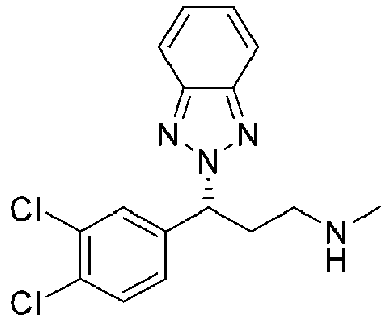
- The procedure given in Example 3 was followed using [3-Benzotriazol-2-yl-3-(3,4-dichloro-phenyl)-propyl]-methyl-amine, instead of [3-(3,4-Dichloro-phenyl)-3-tetrazol-2-yl-propyl]-methyl-amine, to give R-[3-Benzotriazol-2-yl-3-(3,4-dichloro-phenyl)-propyl]-methyl-amine.
- 1H-NMR(CDC13, 200MHz) δ2.4(m, 3H), 2.5(m, 3H), 2.7(m, 1H), 6.2(m, 1H), 7.2(m, 4H), 7.6(s, 1H), 7.9(m, 2H)
-

- The procedure given in Example 3 was followed using [3-(3,4-Dichloro-phenyl)-3-[1,2,3]triazol-2-yl-propyl]-methyl-amine, instead of [3-(3,4-Dichloro-phenyl)-3-tetrazol-2-yl-propyl]-methyl-amine, to give S-[3-(3,4-Dichloro-phenyl)-3-[1,2,3]triazol-2-yl-propyl]-methyl-amine.
- 1H-NMR(CDC13, 200MHz) δ2.4(m, 3H), 2.5(m, 3H), 2.7(m, 1H), 6.2(m, 1H), 7.2(m, 1H), 7.4(m, 1H), 7.5(s, 1H), 7.6(d, 2H)
-

- The procedure given in Example 3 was followed using [3-(3,4-Dichloro-phenyl)-3-(4-methyl-[1,2,3]triazol-2-yl)-propyl]-methyl-amine, instead of [3-(3,4-Dichloro-phenyl)-3-tetrazol-2-yl-propyl]-methyl-amine, to give S-[3-(3,4-Dichloro-phenyl)-3-(4-methyl-[1,2,3]triazol-2-yl)-propyl]-methyl-amine.
- 1H-NMR(CDC13, 200MHz) δ2.4(m, 3H), 2.5(m, 6H), 2.7(m, 1H), 6.2(m, 1H), 7.2(m, 1H), 7.4(m, 1H), 7.5(s, 1H)
-

- The procedure given in Example 3 was followed using [3-(3,4-Dichloro-phenyl)-3-(4-methyl-[1,2,3] triazol-2-yl)-propyl]-methyl-amine, instead of [3-(3,4-Dichloro-phenyl)-3-tetrazol-2-yl-propyl]-methyl-amine, to give R-[3-(3,4-Dichloro-phenyl)-3-(4-methyl-[1,2,3]triazol-2-yl)-propyl]-methyl-amine.
- 1H-NMR(CDC13, 200MHz) δ2.4(m, 3H), 2.5(m, 6H), 2.7(m, 1H), 6.2(m, 1H), 7.2(m, 1H), 7.4(m, 1H), 7.5(s, 1H)
-

- The procedure given in Example 3 was followed using [3-(3,4-Dichloro-phenyl)-3-[1,2,3]triazol-2-yl-propyl]-methyl-amine, instead of [3-(3,4-Dichloro-phenyl)-3-tetrazol-2-yl-propyl]-methyl-amine, to give R-[3-(3,4-Dichloro-phenyl)-3-[1,2,3]triazol-2-yl-propyl]-methyl-amine.
- 1H-NMR(CDC13, 200MHz) δ2.4(m, 3H), 2.5(m, 3H), 2.7(m, 1H), 6.2(m, 1H), 7.2(m, 1H), 7.4(m, 1H), 7.5(s, 1H), 7.6(d, 2H)
-

- The procedure given in Example 3 was followed using Methyl-(3-naphthalen-2-yl-3-tetrazol-2-yl-propyl)-amine, instead of [3-(3,4-Dichloro-phenyl)-3-tetrazol-2-yl-propyl]-methyl-amine, to give R-Methyl-(3-naphthalen-2-yl-3-tetrazol-2-yl-propyl)-amine.
- 1H-NMR(CDC13, 200MHz) δ2.4(m, 3H), 2.5(m, 3H), 2.7(m, 1H), 6.2(m, 1H), 7.5(m, 3H), 7.8(m, 4H), 8.5(s, 1H)
-

- The procedure given in Example 3 was followed using Methyl-(3-naphthalen-2-yl-3-tetrazol-2-yl-propyl)-amine, instead of [3-(3,4-Dichloro-phenyl)-3-tetrazol-2-yl-propyl]-methyl-amine, to give S-Methyl-(3-naphthalen-2-yl-3-tetrazol-2-yl-propyl)-amine.
- 1H-NMR(CDC13, 200MHz) δ2.4(m, 3H), 2.5(m, 3H), 2.7(m, 1H), 6.2(m, 1H), 7.5(m, 3H), 7.8(m, 4H), 8.5(s, 1H)
-
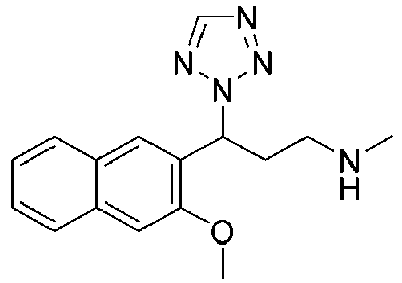
- The procedure given in Example 2 was followed using [3-(3-Methoxy-naphthalen-2-yl)-3-tetrazol-2-yl-propyl]-dimethyl-amine as a reactant, instead of [3-(3,4-Dichloro-phenyl)-3-tetrazol-2-yl-propyl]-dimethyl-amine, to give [3-(3-Methoxy-naphthalen-2-yl)-3-tetrazol-2-yl-propyl]-methyl-amine.
- 1H-NMR(CDC13, 200MHz) δ2.4(m, 10),6.2(m, 1H), 7.5(m, 3H), 7.8(m, 4H), 8.5(s, 1H)
-

- The procedure given in Example 2 was followed using [3-(3-Methoxy-naphthalen-2-yl)-3-(5-methyl-tetrazol-2-yl)-propyl]-dimethyl-amine as a reactant, instead of [3-(3,4-Dichloro-phenyl)-3-tetrazol-2-yl-propyl]-dimethyl-amine, to give [3-(3-Methoxy-naphthalen-2-yl)-3-(5-methyl-tetrazol-2-yl)-propyl]-methyl-amine.
- 1H-NMR(CDC13, 200MHz) δ2.4(m, 9H), 2.5(m, 5H), 2.8(m, 1H), 4.0(s, 3H), 6.6(m, 1H), 7.5(m, 3H), 7.8(m, 4H)
-

- The procedure given in Example 2 was followed using [3-(6-Fluoro-naphthalen-2-yl)-3-tetrazol-2-yl-propyl]-dimethyl-amine as a reactant, instead of [3-(3,4-Dichloro-phenyl)-3-tetrazol-2-yl-propyl]-dimethyl-amine, to give [3-(6-Fluoro-naphthalen-2-yl)-3-tetrazol-2-yl-propyl]-methyl-amine.
- 1H-NMR(CDC13, 200MHz) δ2.4(m, 9H), 2.5(m, 1H), 2.8(m, 1H), 6.2(m, 1H), 7.2(m, 1H), 7.4(m, 1H), 7.5(m, 1H), 7.8(m, 3H), 8.5(s, 1H)
-

- The procedure given in Example 2 was followed using [3-(6-Fluoro-naphthalen-2-yl)-3-(5-methyl-tetrazol-2-yl)-propyl]-dimethyl-amine as a reactant, instead of [3-(3,4-Dichloro-phenyl)-3-tetrazol-2-yl-propyl]-dimethyl-amine, to give [3-(6-Fluoro-naphthalen-2-yl)-3-(5-methyl-tetrazol-2-yl)-propyl]-methyl-amine.
- 1H-NMR(CDC13, 200MHz) δ2.4(m, 6H), 2.5(m, 2H), 2.8(m, 1H), 6.2(t, 1H), 7.2(m, 1H), 7.4(m, 1H), 7.5(m, 1H), 7.8(m, 3H)
-

- The procedure given in Example 2 was followed using [3-(1,4-Dimethoxy-naphthalen-2-yl)-3-tetrazol-2-yl-propyl]-dimethyl-amine as a reactant, instead of [3-(3,4-Dichloro-phenyl)-3-tetrazol-2-yl-propyl]-dimethyl-amine, to give [3-(1,4-Dimethoxy-naphthalen-2-yl)-3-tetrazol-2-yl-propyl]-methyl-amine.
- 1H-NMR(CDC13, 200MHz) δ2.4(m, 9H), 2.5(m, 1H), 2.8(m, 1H), 4.0(d, 6H), 6.2(m, 1H), 7.2(m, 1H), 7.4(m, 1H), 7.5(m, 1H), 7.8(m, 2H), 8.5(s, 1H)
-

- The procedure given in Example 2 was followed using [3-(1,4-Dimethoxy-naphthalen-2-yl)-3-(5-methyl-tetrazol-2-yl)-propyl]-dimethyl-amin e as a reactant, instead of [3-(3,4-Dichloro-phenyl)-3-tetrazol-2-yl-propyl]-dimethyl-amine, to give [3-(1,4-Dimethoxy-naphthalen-2-yl)-3-(5-methyl-tetrazol-2-yl)-propyl]-methyl-amine.
- 1H-NMR(CDC13, 200MHz) δ2.4(m, 9H), 2.5(m, 1H), 2.8(m, 1H), 4.0(d, 6H), 6.2(m, 1H), 6.9(s, 1H), 7.5(m, 2H), 8.0(s, 1H), 8.2(d, 1H)
-

- The procedure given in Example 2 was followed using [3-(3,5-Dimethoxy-naphthalen-2-yl)-3-tetrazol-2-yl-propyl]-dimethyl-amineas a reactant, instead of [3-(3,4-Dichloro-phenyl)-3-tetrazol-2-yl-propyl]-dimethyl-amine, to give [3-(3,5-Dimethoxy-naphthalen-2-yl)-3-tetrazol-2-yl-propyl]-methyl-amine.
- 1H-NMR(CDC13, 200MHz) δ2.4(m, 9H), 2.5(m, 1H), 2.8(m, 1H), 4.0(m, 6H), 6.8(m, 1H), 7.3(s, 6H), 7.5(m, 2H), 8.5(s, 1H)
-

- The procedure given in Example 2 was followed using [3-(3,5-Dimethoxy-naphthalen-2-yl)-3-(5-methyl-tetrazol-2-yl)-propyl]-dimethyl-amin e as a reactant, instead of [3-(3,4-Dichloro-phenyl)-3-tetrazol-2-yl-propyl]-dimethyl-amine, to give [3-(3,5-Dimethoxy-naphthalen-2-yl)-3-(5-methyl-tetrazol-2-yl)-propyl]-methyl-amine.
- 1H-NMR(CDC13, 200MHz) δ2.0(s, 6H), 2.4(m, 6H), 2.5(m, 2H), 2.8(m, 1H), 4.0(m, 6H), 6.6(m, 1H), 6.8(m, 1H), 7.2(s, 3H), 7.7(d, 2H)
-

- The procedure given in Example 2 was followed [3-(3,5-Dimethoxy-naphthalen-2-yl)-3-tetrazol-1-yl-propyl]-dimethyl-amine as a reactant, instead of [3-(3,4-Dichloro-phenyl)-3-tetrazol-2-yl-propyl]-dimethyl-amine, to give [3-(3,5-Dimethoxy-naphthalen-2-yl)-3-tetrazol-1-yl-propyl]-methyl-amine.
- 1H-NMR(CDC13, 200MHz) δ2.4(m, 9H), 2.5(m, 4H), 2.8(m, 1H), 4.0(m, 6H), 6.6(m, 1H), 6.8(m, 1H), 7.2(s, 3H), 7.5(s, 1H), 7.7(s, 1H), 8.7(s, 1H)
-

- The procedure given in Example 2 was followed Dimethyl-[3-(4-methyl-naphthalen-1-yl)-3-tetrazol-2-yl-propyl]-amine as a reactant, instead of [3-(3,4-Dichloro-phenyl)-3-tetrazol-2-yl-propyl]-dimethyl-amine, to give Methyl-[3-(4-methyl-naphthalen-1-yl)-3-tetrazol-2-yl-propyl]-amine.
- 1H-NMR(CDC13, 200MHz) δ2.2(m, 9H), 2.4(m, 1H), 2.8(m, 4H), 3.0(m, 1H), 7.0(m, 1H), 7.2(m, 1H), 7.5(m, 4H), 8.0(m, 1H), 8.3(m, 1H), 8.5(s, 1H)
-

- The procedure given in Example 2 was followed Dimethyl-[3-(4-methyl-naphthalen-1-yl)-3-(5-methyl-tetrazol-2-yl)-propyl]-amine as a reactant, instead of [3-(3,4-Dichloro-phenyl)-3-tetrazol-2-yl-propyl]-dimethyl-amine, to give Methyl-[3-(4-methyl-naphthalen-1-yl)-3-(5-methyl-tetrazol-2-yl)-propyl]-amine.
- 1H-NMR(CDC13, 200MHz) δ2.2(m, 6H), 2.4(m, 3H), 2.8(m, 3H), 3.0(m, 1H), 7.0(m, 1H), 7.2(m, 1H), 7.5(m, 4H), 8.0(m, 1H), 8.3(m, 1H)
-

- The procedure given in Example 2 was followed [3-(4-Fluoro-naphthalen-1-yl)-3-tetrazol-2-yl-propyl]-dimethyl-amine as a reactant, instead of [3-(3,4-Dichloro-phenyl)-3-tetrazol-2-yl-propyl]-dimethyl-amine, to give [3-(4-Fluoro-naphthalen-1-yl)-3-tetrazol-2-yl-propyl]-methyl-amine.
- 1H-NMR(CDC13, 200MHz) δ2.2(m, 9H), 2.4(m, 1H), 2.8(m, 1H), 7.0(m, 1H), 7.2(m, 1H), 7.5(m, 4H), 8.0(m, 1H), 8.3(m, 1H), 8.5(s, 1H)
-

- The procedure given in Example 2 was followed [3-(4-Fluoro-naphthalen-1-yl)-3-(5-methyl-tetrazol-2-yl)-propyl]-dimethyl-amine as a reactant, instead of [3-(3,4-Dichloro-phenyl)-3-tetrazol-2-yl-propyl]-dimethyl-amine, to give [3-(4-Fluoro-naphthalen-1-yl)-3-(5-methyl-tetrazol-2-yl)-propyl]-methyl-amine.
- 1H-NMR(CDC13, 200MHz) δ2.2(m, 4H), 2.4(m, 6H), 2.8(m, 1H), 7.0(m, 1H), 7.2(m, 1H), 7.5(m, 3H), 8.1(m, 1H), 8.3(m, 1H)
-

- The procedure given in Example 2 was followed (3-Benzo[1,3]dioxol-5-yl-3-tetrazol-2-yl-propyl)-dimethyl-amine as a reactant, instead of [3-(3,4-Dichloro-phenyl)-3-tetrazol-2-yl-propyl]-dimethyl-amine, to give (3-Benzo[1,3]dioxol-5-yl-3-tetrazol-2-yl-propyl)-methyl-amine.
- 1H-NMR(CDC13, 200MHz) δ2.2(m, 6H), 2.5(m, 1H), 2.8(m, 1H), 6.0(s, 2H), 6.1(m, 1H), 6.8(d, 1H), 7.0(d, 2H), 8.5(m, 1H)
-

- The procedure given in Example 2 was followed [3-Benzo[1,3]dioxol-5-yl-3-(5-methyl-tetrazol-2-yl)-propyl]-dimethyl-amine as a reactant, instead of [3-(3,4-Dichloro-phenyl)-3-tetrazol-2-yl-propyl]-dimethyl-amine, to give [3-Benzo[1,3]dioxol-5-yl-3-(5-methyl-tetrazol-2-yl)-propyl]-methyl-amine.
- 1H-NMR(CDC13, 200MHz) δ2.2(m, 12H), 2.8(m, 1H), 6.0(s, 2H), 6.1(m, 1H), 6.8(d, 1H), 7.0(d, 2H), 8.5(m, 1H)
-

- The procedure given in Example 2 was followed [3-Benzo[1,3]dioxol-5-yl-3-(5-methyl-tetrazol-1-yl)-propyl]-dimethyl-amine as a reactant, instead of [3-(3,4-Dichloro-phenyl)-3-tetrazol-2-yl-propyl]-dimethyl-amine, to give [3-Benzo[1,3]dioxol-5-yl-3-(5-methyl-tetrazol-1-yl)-propyl]-methyl-amine.
- 1H-NMR(CDC13, 200MHz) δ2.2(m, 6H), 2.4(m, 1H), 2.5(s, 3H), 2.8(m, 1H), 5.5(t, 2H), 6.1(s, 2H), 6.8(m, 3H)
-

- The procedure given in Example 2 was followed [3-(3,4-Dimethoxy-phenyl)-3-tetrazol-2-yl-propyl]-dimethyl-amine as a reactant, instead of [3-(3,4-Dichloro-phenyl)-3-tetrazol-2-yl-propyl]-dimethyl-amine, to give [3-(3,4-Dimethoxy-phenyl)-3-tetrazol-2-yl-propyl]-methyl-amine.
- 1H-NMR(CDC13, 200MHz) δ2.2(s, 9H), 2.4(m, 1H), 2.8(m, 1H), 4.0(s, 6H), 6.1(s, 2H), 6.8(d, 1H), 7.0(d, 2H), 8.5(s, 1H)
-

- The procedure given in Example 2 was followed [3-(2,3-Dihydro-benzo[1,4]dioxin-2-yl)-3-tetrazol-2-yl-propyl]-dimethyl-amine as a reactant, instead of [3-(3,4-Dichloro-phenyl)-3-tetrazol-2-yl-propyl]-dimethyl-amine, to give [3-(2,3-Dihydro-benzo[1,4]dioxin-2-yl)-3-tetrazol-2-yl-propyl]-methyl-amine.
- 1H-NMR(CDC13, 200MHz) δ2.2(s, 9H), 2.4(m, 3H), 3.8(m, 1H), 4.6(m, 1H), 5.4(m, 1H), 7.0(s, 5H), 8.5(s, 1H)
-

- The procedure given in Example 2 was followed [3-(2,3-Dihydro-benzo[1,4]dioxin-2-yl)-3-(5-methyl-tetrazol-2-yl)-propyl]-dimethyl-a mine as a reactant, instead of [3-(3,4-Dichloro-phenyl)-3-tetrazol-2-yl-propyl]-dimethyl-amine, to give [3-(2,3-Dihydro-benzo[1,4]dioxin-2-yl)-3-(5-methyl-tetrazol-2-yl)-propyl]-methyl-ami ne.
- 1H-NMR(CDC13, 200MHz) δ2.2(s, 7H), 2.4(m, 3H), 2.8(m, 4H), 3.8(m, 1H), 4.0(m, 1H), 4.8(m, 1H), 5.3(m, 1H), 7.0(s, 4H)
-

- The procedure given in Example 2 was followed Dimethyl-[3-(1,2,3,4-tetrahydro-naphthalen-2-yl)-3-tetrazol-2-yl-propyl]-amine as a reactant, instead of [3-(3,4-Dichloro-phenyl)-3-tetrazol-2-yl-propyl]-dimethyl-amine, to give Methyl-[3-(1,2,3,4-tetrahydro-naphthalen-2-yl)-3-tetrazol-2-yl-propyl]-amine.
- 1H-NMR(CDC13, 200MHz) δ2.2(s, 8H), 2.8(m, 8H), 5.0(m, 1H), 7.0(m, 4H), 8.5(s, 1H)
-

- The procedure given in Example 2 was followed [3-(6-Chloro-pyridin-3-yl)-3-tetrazol-2-yl-propyl]-dimethyl-amine as a reactant, instead of [3-(3,4-Dichloro-phenyl)-3-tetrazol-2-yl-propyl]-dimethyl-amine, to give [3-(6-Chloro-pyridin-3-yl)-3-tetrazol-2-yl-propyl]-methyl-amine.
- 1H-NMR(CDC13, 200MHz) δ2.2(m, 7H), 2.5(m, 1H), 2.8(m, 1H), 6.2(m, 1H), 7.2(m, 1H), 7.8(m, 1H), 8.5(s, 1H)
-

- The procedure given in Example 2 was (3-Benzo[b]thiophen-2-yl-3-tetrazol-2-yl-propyl)-dimethyl-amine as a reactant, instead of [3-(3,4-Dichloro-phenyl)-3-tetrazol-2-yl-propyl]-dimethyl-amine, to give (3-Benzo[b]thiophen-2-yl-3-tetrazol-2-yl-propyl)-methyl-amine.
- 1H-NMR(CDC13, 200MHz) δ2.2(m, 7H), 2.8(m, 1H), 6.5(m, 1H), 7.4(m, 3H), 7.8(m, 2H), 8.5(s, 1H)
-

- The procedure given in Example 2 was [3-Benzo[b]thiophen-2-yl-3-(5-methyl-tetrazol-2-yl)-propyl]-dimethyl-amine as a reactant, instead of [3-(3,4-Dichloro-phenyl)-3-tetrazol-2-yl-propyl]-dimethyl-amine, to give [3-Benzo[b]thiophen-2-yl-3-(5-methyl-tetrazol-2-yl)-propyl]-methyl-amine.
- 1H-NMR(CDC13, 200MHz) δ2.2(m, 6H), 2.8(m, 5H), 6.5(m, 1H), 7.4(m, 3H), 7.8(m, 2H)
-

- The procedure given in Example 2 was (3-Benzofuran-2-yl-3-tetrazol-2-yl-propyl)-dimethyl-amine as a reactant, instead of [3-(3,4-Dichloro-phenyl)-3-tetrazol-2-yl-propyl]-dimethyl-amine, to give (3-Benzofuran-2-yl-3-tetrazol-2-yl-propyl)-methyl-amine.
- 1H-NMR(CDC13, 200MHz) δ2.2(m, 7H), 2.8(m, 2H), 6.5(m, 1H), 7.4(m, 3H), 7.8(m, 2H), 8.5(s, 1H)
-

- The procedure given in Example 2 was [3-Benzofuran-2-yl-3-(5-methyl-tetrazol-2-yl)-propyl]-dimethyl-amine as a reactant, instead of [3-(3,4-Dichloro-phenyl)-3-tetrazol-2-yl-propyl]-dimethyl-amine, to give [3-Benzofuran-2-yl-3-(5-methyl-tetrazol-2-yl)-propyl]-methyl-amine.
- 1H-NMR(CDC13, 200MHz) δ2.2(m, 7H), 2.8(m, 2H), 6.5(m, 1H), 7.4(m, 3H), 7.8(m, 2H)
-

- The procedure given in Example 2 was (3-Benzofuran-2-yl-3-tetrazol-1-yl-propyl)-dimethyl-amine as a reactant, instead of [3-(3,4-Dichloro-phenyl)-3-tetrazol-2-yl-propyl]-dimethyl-amine, to give (3-Benzofuran-2-yl-3-tetrazol-1-yl-propyl)-methyl-amine.
- 1H-NMR(CDC13, 200MHz) δ2.2(m, 7H), 2.8(m, 2H), 6.2(m, 1H), 7.4(m, 3H), 7.8(m, 2H)
-

- The procedure given in Example 2 was [3-(3,4-Difluoro-phenyl)-3-tetrazol-2-yl-propyl]-dimethyl-amine as a reactant, instead of [3-(3,4-Dichloro-phenyl)-3-tetrazol-2-yl-propyl]-dimethyl-amine, to give [3-(3,4-Difluoro-phenyl)-3-tetrazol-2-yl-propyl]-methyl-amine.
- 1H-NMR(CDC13, 200MHz) δ2.2(m, 12H), 6.2(m, 1H), 7.4(m, 4H), 8.5(s, 1H)
-

- The procedure given in Example 2 was [3-(3,4-Difluoro-phenyl)-3-(5-methyl-tetrazol-2-yl)-propyl]-dimethyl-amine as a reactant, instead of [3-(3,4-Dichloro-phenyl)-3-tetrazol-2-yl-propyl]-dimethyl-amine, to give [3-(3,4-Difluoro-phenyl)-3-(5-methyl-tetrazol-2-yl)-propyl]-methyl-amine.
- 1H-NMR(CDC13, 200MHz) δ2.2(m, 7H), 2.8(m, 4H), 6.2(m, 1H), 7.4(m, 4H)
-

- The procedure given in Example 2 was Dimethyl-[3-tetrazol-2-yl-3-(2,4,5-trifluoro-phenyl)-propyl]-amine as a reactant, instead of [3-(3,4-Dichloro-phenyl)-3-tetrazol-2-yl-propyl]-dimethyl-amine, to give Methyl-[3-tetrazol-2-yl-3-(2,4,5-trifluoro-phenyl)-propyl]-amine.
- 1H-NMR(CDC13, 200MHz) δ2.2(m, 9H), 2.8(m, 2H), 6.5(m, 1H), 7.0(m, 1H), 7.4(m, 1H), 8.6(s, 1H)
-

- The procedure given in Example 2 was Dimethyl-[3-(5-methyl-tetrazol-2-yl)-3-(2,4,5-trifluoro-phenyl)-propyl]-amineas a reactant, instead of [3-(3,4-Dichloro-phenyl)-3-tetrazol-2-yl-propyl]-dimethyl-amine, to give Methyl-[3-(5-methyl-tetrazol-2-yl)-3-(2,4,5-trifluoro-phenyl)-propyl]-amine.
- 1H-NMR(CDC13, 200MHz) δ2.2(m, 12H), 6.4(m, 1H), 7.0(m, 1H), 7.4(m, 1H)
-
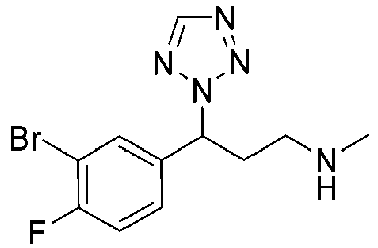
- The procedure given in Example 2 was [3-(3-Bromo-4-fluoro-phenyl)-3-tetrazol-2-yl-propyl]-dimethyl-amine as a reactant, instead of [3-(3,4-Dichloro-phenyl)-3-tetrazol-2-yl-propyl]-dimethyl-amine, to give [3-(3-Bromo-4-fluoro-phenyl)-3-tetrazol-2-yl-propyl]-methyl-amine.
- 1H-NMR(CDC13, 200MHz) δ2.2(m, 7H), 2.4(m, 2H), 2.8(m, 1H), 6.5(m, 1H), 7.0(m, 1H), 7.4(m, 1H), 7.8(m, 1H), 8.5(s, 1H)
-

- The procedure given in Example 2 was [3-(3-Bromo-4-fluoro-phenyl)-3-(5-methyl-tetrazol-2-yl)-propyl]-dimethyl-amine as a reactant, instead of [3-(3,4-Dichloro-phenyl)-3-tetrazol-2-yl-propyl]-dimethyl-amine, to give [3-(3-Bromo-4-fluoro-phenyl)-3-(5-methyl-tetrazol-2-yl)-propyl]-methyl-amine.
- 1H-NMR(CDC13, 200MHz) δ2.2(m, 7H), 2.4(m, 2H), 2.8(m, 1H), 6.5(m, 1H), 7.0(m, 1H), 7.4(m, 1H), 7.8(m, 1H)
-

- The procedure given in Example 2 was [3-(6-Methoxy-naphthalen-2-yl)-3-tetrazol-2-yl-propyl]-dimethyl-amine as a reactant, instead of [3-(3,4-Dichloro-phenyl)-3-tetrazol-2-yl-propyl]-dimethyl-amine, to give [3-(6-Methoxy-naphthalen-2-yl)-3-tetrazol-2-yl-propyl]-methyl-amine.
- 1H-NMR(CDC13, 200MHz) δ2.2(m, 5H), 2.4(m, 2H), 2.8(m, 1H), 4.0(s, 3H), 6.3(m, 1H), 7.1(m, 3H), 7.4(m, 1H), 7.8(m, 1H), 8.5(s, 1H)
-

- The procedure given in Example 2 was [3-(6-Methoxy-naphthalen-2-yl)-3-(5-methyl-tetrazol-2-yl)-propyl]-dimethyl-amine as a reactant, instead of [3-(3,4-Dichloro-phenyl)-3-tetrazol-2-yl-propyl]-dimethyl-amine, to give [3-(6-Methoxy-naphthalen-2-yl)-3-(5-methyl-tetrazol-2-yl)-propyl]-methyl-amine.
- 1H-NMR(CDC13, 200MHz) δ2.2(m, 8H), 2.4(m, 2H), 2.8(m, 1H), 4.0(s, 3H), 6.3(m, 1H), 7.1(m, 3H), 7.4(m, 1H), 7.8(m, 1H)
-

- The procedure given in Example 2 was Dimethyl-[3-(4-phenoxy-phenyl)-3-tetrazol-2-yl-propyl]-amine as a reactant, instead of [3-(3,4-Dichloro-phenyl)-3-tetrazol-2-yl-propyl]-dimethyl-amine, to give Methyl-[3-(4-phenoxy-phenyl)-3-tetrazol-2-yl-propyl]-amine.
- 1H-NMR(CDCl3, 200MHz) δ2.2(m, 7H), 2.4(m, 1H), 2.8(m, 1H), 6.2(m, 1H), 7.1(m, 3H), 7.4(m, 1H), 7.6(m, 4H), 8.5(s, 1H)
-
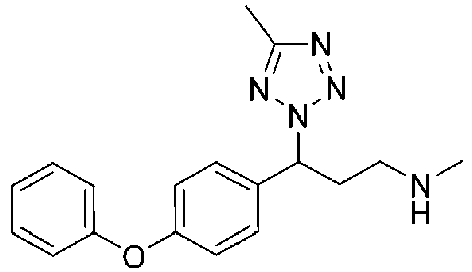
- The procedure given in Example 2 was Dimethyl-[3-(5-methyl-tetrazol-2-yl)-3-(4-phenoxy-phenyl)-propyl]-amine as a reactant, instead of [3-(3,4-Dichloro-phenyl)-3-tetrazol-2-yl-propyl]-dimethyl-amine, to give Methyl-[3-(5-methyl-tetrazol-2-yl)-3-(4-phenoxy-phenyl)-propyl]-amine.
- 1H-NMR(CDC13, 200MHz) δ2.2(m, 5H), 2.4(m, 6H), 2.8(m, 1H), 6.2(m, 1H), 7.1(m, 4H), 7.4(m, 4H)
-

- The procedure given in Example 2 was [3-(4-Bromo-phenyl)-3-tetrazol-2-yl-propyl]-dimethyl-amine as a reactant, instead of [3-(3,4-Dichloro-phenyl)-3-tetrazol-2-yl-propyl]-dimethyl-amine, to give [3-(4-Bromo-phenyl)-3-tetrazol-2-yl-propyl]-methyl-amine.
- 1H-NMR(CDCl3, 200MHz) δ2.2(m, 7H), 2.4(m, 1H), 2.8(m, 1H), 6.2(m, 1H), 7.3(m, 2H), 7.5(m, 2H), 8.5(s, 1H)
-

- The procedure given in Example 2 was [3-(4-Bromo-phenyl)-3-(5-methyl-tetrazol-2-yl)-propyl]-dimethyl-amine as a reactant, instead of [3-(3,4-Dichloro-phenyl)-3-tetrazol-2-yl-propyl]-dimethyl-amine, to give [3-(4-Bromo-phenyl)-3-(5-methyl-tetrazol-2-yl)-propyl]-methyl-amine.
- 1H-NMR(CDC13, 200MHz) δ2.2(m, 6H), 2.3(m, 1H), 2.5(s, 3H), 2.8(m, 1H), 6.0(m, 1H), 7.3(m, 2H), 7.5(m, 2H)
-

- The procedure given in Example 2 was Dimethyl-[3-tetrazol-2-yl-3-(4-trifluoromethyl-phenyl)-propyl]-amine as a reactant, instead of [3-(3,4-Dichloro-phenyl)-3-tetrazol-2-yl-propyl]-dimethyl-amine, to give Methyl-[3-tetrazol-2-yl-3-(4-trifluoromethyl-phenyl)-propyl]-amine.
- 1H-NMR(CDCl3, 200MHz) δ2.2(m, 6H), 2.3(m, 1H), 2.8(m, 1H), 6.2(m, 1H), 7.3(m, 2H), 7.5(m, 2H), 8.5(s, 1H)
-

- The procedure given in Example 2 was Dimethyl-[3-(5-methyl-tetrazol-2-yl)-3-(4-trifluoromethyl-phenyl)-propyl]-amine as a reactant, instead of [3-(3,4-Dichloro-phenyl)-3-tetrazol-2-yl-propyl]-dimethyl-amine, to give Methyl-[3-(5-methyl-tetrazol-2-yl)-3-(4-trifluoromethyl-phenyl)-propyl]-amine.
- 1H-NMR(CDC13, 200MHz) δ2.2(m, 6H), 2.3(m, 1H), 2.5(s, 3H), 2.8(m, 1H), 6.0(m, 1H), 7.6(m, 4H)
-

- The procedure given in Example 2 was Dimethyl-[3-tetrazol-2-yl-3-(2,3,4-trichloro-phenyl)-propyl]-amine as a reactant, instead of [3-(3,4-Dichloro-phenyl)-3-tetrazol-2-yl-propyl]-dimethyl-amine, to give Methyl-[3-tetrazol-2-yl-3-(2,3,4-trichloro-phenyl)-propyl]-amine.
- 1H-NMR(CDCl3, 200MHz) δ2.2(m, 6H), 2.3(m, 1H), 2.8(m, 1H), 6.2(m, 1H), 7.3(m, 2H), 8.5(s, 1H)
-

- The procedure given in Example 2 was Dimethyl-[3-(5-methyl-tetrazol-2-yl)-3-(2,3,4-trichloro-phenyl)-propyl]-amine as a reactant, instead of [3-(3,4-Dichloro-phenyl)-3-tetrazol-2-yl-propyl]-dimethyl-amine, to give Methyl-[3-(5-methyl-tetrazol-2-yl)-3-(2,3,4-trichloro-phenyl)-propyl]-amine.
- 1H-NMR(CDC13, 200MHz) δ2.2(m, 6H), 2.3(m, 1H), 2.5(s, 3H), 2.8(m, 1H), 6.0(m, 1H), 7.2(m, 2H)
-

- The procedure given in Example 2 was [3-(3-Chloro-4-methoxy-phenyl)-3-tetrazol-2-yl-propyl]-dimethyl-amine as a reactant, instead of [3-(3,4-Dichloro-phenyl)-3-tetrazol-2-yl-propyl]-dimethyl-amine, to give [3-(3-Chloro-4-methoxy-phenyl)-3-tetrazol-2-yl-propyl]-methyl-amine.
- 1H-NMR(CDCl3, 200MHz) δ2.2(m, 7H), 2.3(m, 1H), 2.8(m, 1H), 4.0(s, 3H), 6.1(m, 1H), 6.9(d, 1H), 7.3(d, 1H), 7.5(s, 1H), 8.5(s, 1H)
-
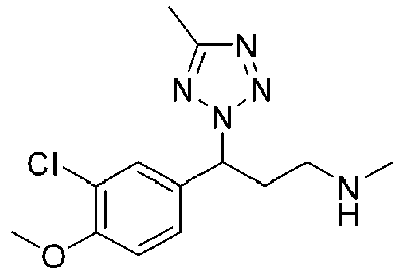
- The procedure given in Example 2 was [3-(3-Chloro-4-methoxy-phenyl)-3-(5-methyl-tetrazol-2-yl)-propyl]-dimethyl-amine as a reactant, instead of [3-(3,4-Dichloro-phenyl)-3-tetrazol-2-yl-propyl]-dimethyl-amine, to give [3-(3-Chloro-4-methoxy-phenyl)-3-(5-methyl-tetrazol-2-yl)-propyl]-methyl-amine.
- 1H-NMR(CDCl3, 200MHz) δ2.2(m, 7H), 2.3(m, 1H), 2.8(m, 1H), 4.0(s, 3H), 6.1(m, 1H), 6.9(d, 1H), 7.3(d, 1H), 7.5(s, 1H)
-

- The procedure given in Example 2 was [3-(2-Chloro-phenyl)-3-(5-methyl-tetrazol-2-yl)-propyl]-dimethyl-amine as a reactant, instead of [3-(3,4-Dichloro-phenyl)-3-tetrazol-2-yl-propyl]-dimethyl-amine, to give [3-(2-Chloro-phenyl)-3-(5-methyl-tetrazol-2-yl)-propyl]-methyl-amine.
- 1H-NMR(CDC13, 200MHz) δ2.2(m, 6H), 2.3(m, 3H), 2.5(m, 1H), 2.8(m, 1H), 7.2(m, 2H), 7.4(m, 2H)
-

- The procedure given in Example 2 was [3-(3-Chloro-phenyl)-3-(5-methyl-tetrazol-2-yl)-propyl]-dimethyl-amine as a reactant, instead of [3-(3,4-Dichloro-phenyl)-3-tetrazol-2-yl-propyl]-dimethyl-amine, to give [3-(3-Chloro-phenyl)-3-(5-methyl-tetrazol-2-yl)-propyl]-methyl-amine.
- 1H-NMR(CDC13, 200MHz) δ2.2(m, 6H), 2.3(m, 3H), 2.5(m, 1H), 2.8(m, 1H), 7.2(m, 2H), 7.4(m, 2H)
-

- The procedure given in Example 2 was [3-(2,4-Dichloro-phenyl)-3-(5-methyl-tetrazol-2-yl)-propyl]-dimethyl-amine as a reactant, instead of [3-(3,4-Dichloro-phenyl)-3-tetrazol-2-yl-propyl]-dimethyl-amine, to give [3-(2,4-Dichloro-phenyl)-3-(5-methyl-tetrazol-2-yl)-propyl]-methyl-amine.
- 1H-NMR(CDC13, 200MHz) δ2.2(m, 6H), 2.3(m, 3H), 2.5(m, 1H), 2.8(m, 1H), 7.2(m, 3H)
-

- The procedure given in Example 2 was [3-(2,5-Difluoro-phenyl)-3-(5-methyl-tetrazol-2-yl)-propyl]-dimethyl-amine as a reactant, instead of [3-(3,4-Dichloro-phenyl)-3-tetrazol-2-yl-propyl]-dimethyl-amine, to give [3-(2,5-Difluoro-phenyl)-3-(5-methyl-tetrazol-2-yl)-propyl]-methyl-amine.
- 1H-NMR(CDC13, 200MHz) δ2.2(m, 6H), 2.3(m, 3H), 2.5(m, 1H), 2.8(m, 1H), 7.2(m, 3H)
-

- The procedure given in Example 2 was [3-(3-Chloro-phenyl)-3-tetrazol-2-yl-propyl]-dimethyl-amine as a reactant, instead of [3-(3,4-Dichloro-phenyl)-3-tetrazol-2-yl-propyl]-dimethyl-amine, to give [3-(3-Chloro-phenyl)-3-tetrazol-2-yl-propyl]-methyl-amine.
- 1H-NMR(CDC13, 200MHz) δ2.2(m, 6H), 2.5(m, 1H), 2.8(m, 1H), 7.2(m, 2H), 7.4(m, 2H)
-

- The procedure given in Example 2 was [3-(2,4-Dichloro-phenyl)-3-tetrazol-2-yl-propyl]-dimethyl-amine as a reactant, instead of [3-(3,4-Dichloro-phenyl)-3-tetrazol-2-yl-propyl]-dimethyl-amine, to give [3-(2,4-Dichloro-phenyl)-3-tetrazol-2-yl-propyl]-methyl-amine.
- 1H-NMR(CDC13, 200MHz) δ2.2(m, 6H), 2.3(m, 3H), 2.5(m, 1H), 2.8(m, 1H), 7.2(m, 3H)
-

- The procedure given in Example 2 was [3-(2-Chloro-phenyl)-3-tetrazol-2-yl-propyl]-dimethyl-amine as a reactant, instead of [3-(3,4-Dichloro-phenyl)-3-tetrazol-2-yl-propyl]-dimethyl-amine, to give [3-(2,5-Difluoro-phenyl)-3-tetrazol-2-yl-propyl]-methyl-amine.
- 1H-NMR(CDC13, 200MHz) δ2.2(m, 6H), 2.3(m, 3H), 2.5(m, 1H), 2.8(m, 1H), 7.2(m, 3H)
-

- The procedure given in Example 2 was [3-(4-Methanesulfonyl-phenyl)-3-(5-methyl-tetrazol-2-yl)-propyl]-dimethyl-amine as a reactant, instead of [3-(3,4-Dichloro-phenyl)-3-tetrazol-2-yl-propyl]-dimethyl-amine, to give [3-(4-Methanesulfonyl-phenyl)-3-(5-methyl-tetrazol-2-yl)-propyl]-methyl-amine.
- 1H-NMR(CDC13, 200MHz) δ2.2(m, 6H), 2.3(m, 3H), 2.5(m, 1H), 2.8(m, 1H), 3.0(s, 3H), 7.2(m, 3H)
-
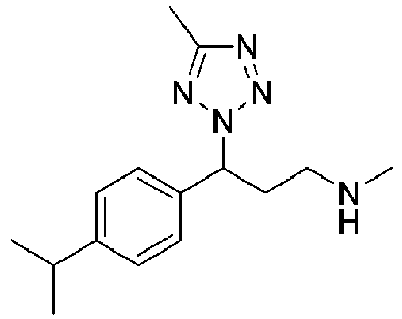
- The procedure given in Example 2 was [3-(4-Isopropyl-phenyl)-3-(5-methyl-tetrazol-2-yl)-propyl]-dimethyl-amine as a reactant, instead of [3-(3,4-Dichloro-phenyl)-3-tetrazol-2-yl-propyl]-dimethyl-amine, to give [3-(4-Isopropyl-phenyl)-3-(5-methyl-tetrazol-2-yl)-propyl]-methyl-amine.
- 1H-NMR(CDC13, 200MHz) δ2.2(m, 6H), 2.3(m, 3H), 2.5(m, 1H), 2.8(m, 1H), 4.0(s, 6H), 7.2(m, 3H)
-

- The procedure given in Example 2 was [3-(9H-Fluoren-2-yl)-3-(5-methyl-tetrazol-2-yl)-propyl]-dimethyl-amine as a reactant, instead of [3-(3,4-Dichloro-phenyl)-3-tetrazol-2-yl-propyl]-dimethyl-amine, to give [3-(9H-Fluoren-2-yl)-3-(5-methyl-tetrazol-2-yl)-propyl]-methyl-amine.
- 1H-NMR(CDC13, 200MHz) δ2.2(m, 6H), 2.3(m, 3H), 2.5(m, 1H), 2.8(m, 1H), 4.2(s, 2H), 7.2(m, 3H)
-

- The procedure given in Example 3 was followed using Methyl-[3-(5-methyl-tetrazol-2-yl)-3-naphthalen-2-yl-propyl]-amine, instead of [3-(3,4-Dichloro-phenyl)-3-tetrazol-2-yl-propyl]-methyl-amine, to give (3S)-Methyl-[3-(5-methyl-tetrazol-2-yl)-3-naphthalen-2-yl-propyl]-amine.
- 1H-NMR(CDC13, 200MHz) δ2.2(m, 9H), 2.3(m, 3H), 2.5(m, 1H), 2.8(m, 1H), 4.2(s, 2H), 7.4(m, 3H), 7.8(m, 4H)
-
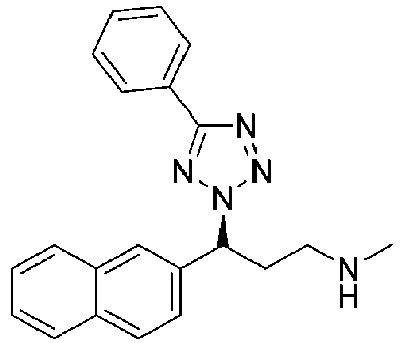
- The procedure given in Example 3 was followed using Methyl-[3-naphthalen-2-yl-3-(5-phenyl-tetrazol-2-yl)-propyl]-amine, instead of [3-(3,4-Dichloro-phenyl)-3-tetrazol-2-yl-propyl]-methyl-amine, to give (3S)-Methyl-[3-naphthalen-2-yl-3-(5-phenyl-tetrazol-2-yl)-propyl]-amine.
- 1H-NMR(CDCl3, 200MHz) δ2.2(m, 9H), 2.3(m, 3H), 2.5(m, 1H), 2.8(m, 1H), 4.2(s, 2H), 7.4(m, 10H), 7.8(m, 4H)
-

- The procedure given in Example 3 was followed using Methyl-[3-(5-methyl-tetrazol-2-yl)-3-naphthalen-2-yl-propyl]-amine, instead of [3-(3,4-Dichloro-phenyl)-3-tetrazol-2-yl-propyl]-methyl-amine, to give (3R)-Methyl-[3-(5-methyl-tetrazol-2-yl)-3-naphthalen-2-yl-propyl]-amine.
- 1H-NMR(CDC13, 200MHz) δ2.2(m, 9H), 2.3(m, 3H), 2.5(m, 1H), 2.8(m, 1H), 4.2(s, 2H), 7.4(m, 3H), 7.8(m, 4H)
-

- The procedure given in Example 3 was followed using Methyl-[3-naphthalen-2-yl-3-(5-phenyl-tetrazol-2-yl)-propyl]-amine, instead of [3-(3,4-Dichloro-phenyl)-3-tetrazol-2-yl-propyl]-methyl-amine, to give (3R)-Methyl-[3-naphthalen-2-yl-3-(5-phenyl-tetrazol-2-yl)-propyl]-amine.
- 1H-NMR(CDCl3, 200MHz) δ2.2(m, 9H), 2.3(m, 3H), 2.5(m, 1H), 2.8(m, 1H), 4.2(s, 2H), 7.4(m, 10H), 7.8(m, 4H)
-

- The procedure given in Example 3 was followed using [3-(6-Fluoro-naphthalen-2-yl)-3-(5-methyl-tetrazol-2-yl)-propyl]-methyl-amine, instead of [3-(3,4-Dichloro-phenyl)-3-tetrazol-2-yl-propyl]-methyl-amine, to give (3R)-[3-(6-Fluoro-naphthalen-2-yl)-3-(5-methyl-tetrazol-2-yl)-propyl]-methyl-amine.
- 1H-NMR(CDCl3, 200MHz) δ2.2(m, 9H), 2.3(m, 3H), 2.5(m, 1H), 2.8(m, 1H), 4.2(s, 2H), 7.4(m, 3H), 7.8(m, 4H)
-

- The procedure given in Example 3 was followed using [3-(6-Fluoro-naphthalen-2-yl)-3-(5-methyl-tetrazol-2-yl)-propyl]-methyl-amine, instead of [3-(3,4-Dichloro-phenyl)-3-tetrazol-2-yl-propyl]-methyl-amine, to give (3S)-[3-(6-Fluoro-naphthalen-2-yl)-3-(5-methyl-tetrazol-2-yl)-propyl]-methyl-amine.
- 1H-NMR(CDC13, 200MHz) δ2.2(m, 9H), 2.3(m, 3H), 2.5(m, 1H), 2.8(m, 1H), 4.2(s, 2H), 7.4(m, 3H), 7.8(m, 4H)
- The method to test the ability of compounds to inhibit transporters from reuptake of serotonin followed Gu H. et al., J Biol Chem., 1994, 269, p7214∼7130.
- The recombinant HEK-293 cells with human serotonin transporter were plated. Test compounds described in table 1 were pre-incubated with cells (2 x 10⁵/ml) in modified Tris-HEPES buffer pH 7.1 for 20 minutes at 25°C and then they were incubated for additional 10 minutes after 65 nM of [3H]Serotonin was added. Bound cells were filtered and counted to determine [3H]Serotonin uptake. Reduction of [3H] Serotonin uptake by 50 percent or more (≥50%) relative to 10µM fluoxetine indicates significant inhibitory activity. Compounds were screened at 10, 1, 0.1, 0.01 and 0.001µM for IC50s.
- Norepinephrine transporter reuptake inhibition assay used the method described by Galli A. et al., J Exp Biol.,1995, 198, p2197∼2212.
- MDCK cells with stably expressed human recombinant norepinephrine transporter were plated one day. Test compounds were pre-incubated with cells (2 x 10⁵/ml) in modified Tris-HEPES buffer pH 7.1 for 20 minutes at 25°C and then they were incubated for additional 10 minutes after 25 nM of [3H]Norepinephrine was added. A lysate was obtained from solubilized cells and the filtered lysate was counted to determine [3H]Norepinephrine uptake. Reduction of [3H]Norepinephrine uptake by 50 percent or more (≥50%) relative to 10µM desipramine indicates significant inhibitory activity. Compounds were screened at 10, 1, 0.1, 0.01 and 0.001µM to determine their IC50s.
- The assay followed the method modified from Pristupa Z.B. et al., Mol Pharmacol., 1994, p125∼135.
- CHO-K1 cells with human recombinant dopamine transporter were plated. Test compounds were pre-incubated with cells (4 x 10⁵/ml) in modified Tris-HEPES buffer pH 7.1 for 20 minutes at 25°C and then they were incubated for additional 10 minutes after 50 nM of [3H]Dopamine was added. A lysate is obtained from solubilized cells and counted to determine [3H]Dopamine uptake. Reduction of [3H]Dopamine uptake by 50 percent or more (≥50%) relative to 10 mM nomifensine indicates significant inhibitory activity. Compounds were tested at 10, 1, 0.1, 0.01 and 0.001µM for IC50s.
- The results obtained by testing compounds of the invention are given in the following table 1:
[Table 1] Test Compound Inhibition % at 100nM 5-HT reuptake NE reuptake DA reuptake Example 1 27% 37% 58% Example 2 35% 56% 48% Example 6 41% 30% 20% Example 14 46% 32% 18% Example 21 44% 39% 36% Example 50 61% 12% 7% Example 51 61% 10% 6% Example 119 78% 84% 10% Example 122 93% 55% 3% Example 129 43% 84% 62% Example 135 47% 17% -1% Example 136 59% 25% 6% Example 137 58% 39% 10% Example 166 88% 70% 4% Example 167 82% 84% 3% Example 188 82% 79% 7% - The data in Table 1 show that racemic or enantiomerically enriched 3-substituted propanamine derivatives, the compounds of the invention have a significantly high inhibition potency of the serotonin, norepinephrine, dopamine transporter reuptake. This inhibition of serotonin, norepinephrine, dopamine transporter reuptake has been associated with the treatment of one or more of the CNS disorders such as depression, anxiety and pain disorder.
- The Forced swimming test is an animal model based on the rodent's behavioral repertoire for screening drugs with potential antidepressant activity. As in several other models used for this goal, an uncontrollable stress stimulus produces behavioral changes that are sensitive to antidepressant treatment.
- The mice were intraperitoneally treated with the test compound with an injection volume of 10 mg/kg. The group treated with 30% PEG400 served as a control group. Thirty minutes following administration, mice were individually forced to swim in a transparent glass vessel (14 cm high, 11.5 cm in diameter) filled with 10 cm of water at 25°C. The total duration of immobility (second) was measured during the last 4 minutes of a single 6-min test session. Mice were considered immobile when they made no further attempts to escape other than the movements necessary to keep their heads above the water. The potent ability of the compounds was determined as percent value of reduction in the duration of immobility comparing to the control group.
- The results obtained by testing compounds of the invention are given in the following table 2 :
[Table 2] Test Compound Reduction % at 30ip FST Example 1 249% Example 2 82.4% Example 6 41.4% Example 50 35.0% Example 51 24.5% Example 119 43.2% Example 122 43.7% Example 129 36.7% Example 166 28.9% Example 167 17.9% Example 188 36.7% - Specially the results of forced swimming test(FST) in mice as noted in Table 2 show the compounds of the invention are related to the treatment of depression.
- The Marble burying test is a screening tool for putative anxiolytics. In this test, control mice naturally bury glass marbles in the cage bedding and the administration of anxiolytic compounds, including Diazepam, reduces the number of buried marbles. Positive compounds in the marble burying test including selective serotonin reuptake inhibitor may be especially beneficial to obsessive-compulsive disorder.
- A group of mice was intraperitoneally treated with test compound dissolved in 30% PEG400 with an injection volume of 10 ml/kg. The group treated with only 30% PEG400 served as a control group. Thirty minutes after the treatment, the animals were individually placed in a polycarbonate cage which was same as used for animal housing with an open top located within a quiet room. Each cage consisted of 1/8 inch corn bedding 5 cm deep. Twenty four clean glass marbles (15 mm diameter) were evenly spaced in four rows of six on top of the bedding. Each mouse was left in the cage for 30 minutes and the number of marbles buried (buried more than 1/2 or 2/3) was counted. The potent ability of the compounds was determined as percent value of reduction in the number of marbles buried comparing to the control group.
- The results obtained by testing compounds of the invention are given in the following table 3 :
[Table 3] Test Compound Reduction % at 30ip Example 1 54.8% Example 2 100% Example 6 87.7% Example 50 86.2% Example 51 72.4% Example 129 94.3% Example 167 56.9% (at 10ip) Example 188 70.7% - Specially the results of Marble burying test(MB) in mice as noted in Table 3 show the compounds of the invention are related to the treatment of anxiety.
- The Acetic acid-induced writhing test is a well-established nociceptive test using a chemical stimulus. Although several animal models of nociceptive tests have been developed to examine and compare the anti-nociceptive effects of different drugs, the anti-nociceptive effects of antidepressants appear to be test-dependent. Indeed, the acetic acid-induced writhing test is more sensitive to antidepressants than other tests using thermal, mechanical or electrical stimuli.
- The animals were subcutaneously treated with the test compound with an injection volume of 10 ml/kg. The group treated with 30% PEG400 or saline served as a control group. Thirty minutes later, the mice were intraperitoneally treated with 0.8 %(v/v) acetic acid. Each mouse was then placed in a cage for individual observation. The writhing numbers for 10 minutes were counted. The writhe is operationally defined as a contraction of the abdomen followed by stretching of the hind limbs. The potent ability of the compounds was determined as percent value of reduction in the number of writhing comparing to the control group.
- The results obtained by testing compounds of the invention are given in the following table 4 :
[Table 4] Test Compound Reduction % at 30sc Example 1 55.3% Example 2 50.3% Example 6 60.2% Example 50 53.8% Example 51 51.4% Example 129 94.4% Example 167 52.1% Example 188 39.5%, - Specially the results of Acetic acid induced writhing test(AA writhing test) in mice as noted in Table 4 show the compounds of the invention are related to the treatment of pain.
Claims (11)
- A racemic or enantiomerically enriched 3-substituted propanamine compound represented by the following structural formula (I):
 A is selected from the group consisting of phenyl, naphthyl, benzothienyl, pyridyl, quinolyl, isoquinolyl, benzodioxolyl, benzodioxinyl, indolyl, fluorenyl and benzofuranyl, which can be substituted with one or more identical or different substituents selected from the group consisting of hydrogen, halogen, straight- or branched-chain C1-4alkyl, straight- or branched-chain C1-3alkoxy, phenyl, phenyloxy, nitro, cyano, trifluoromethyl, trifluoromethoxy, methanesulfonyl and thienyl;R1 and R2 are same or different and independently selected from the group consisting of hydrogen, lower alkyl of from 1 to 4 carbon atoms, substituted or unsubstituted phenyl-C1-4 alkyl or R1 and R2 are fused with nitrogen atom to form a cyclic group which has 4 to 7 carbon atoms;R3, R4, R5 and R6 are same or different and independently selected from the group consisting of hydrogen, C1-4alkyl and substituted or unsubstituted phenyl;B is an azole selected from the group consisting of triazole, benzotriazole, tetrazole, 5-methyl tetrazole and 5-phenyl tetrazole which are linked by nitrogen as represented by the following structural formulae (II):

- A racemic or enantiomerically enriched 3-substituted propanamine compound in accordance with claim 1 wherein A, B, R1 and R2 are as defined therein and each of R3 through R6 is hydrogen, said compound being represented by the following structural formula (III):

- A racemic or enantiomerically enriched 3-substituted propanamine compound in accordance with claim 1 wherein A, B are as defined therein, each of R3 through R6 is hydrogen and one of R1 and R2 is hydrogen and the other is methyl, said compound being represented by the following structural formula (XI):

- 3-Substituted propanamine compounds in accordance with claim 2 wherein said compounds are selected from the group consisting of:[3-(3,4-Dichloro-phenyl)-3-tetrazol-2-yl-propyl]-methyl-amineS-[3-(3,4-Dichloro-phenyl)-3-tetrazol-2-yl-propyl]-methyl-amine[3-Benzotriazol-2-yl-3-(3,4-dichloro-phenyl)-propyl]-dimethyl-amineDimethyl-(3-naphthalen-2-yl-3-[1,2,3]triazol-2-yl-propyl)-amineDimethyl-(3-naphthalen-2-yl-3-tetrazol-2-yl-propyl)-amine(3-Benzotriazol-2-yl-3-naphthalen-2-yl-propyl)-dimethyl-amineDimethyl-[3-(5-methyl-tetrazol-2-yl)-3-naphthalen-2-yl-propyl]-amine[3-(6-Chloro-naphthalen-2-yl)-3-tetrazol-1-yl-propyl]-dimethyl-amineDimethyl-[3-(4-phenoxy-phenyl)-3-tetrazol-2-yl-propyl]-amineDimethyl-[3-(4-phenoxy-phenyl)-3-tetrazol-1-yl-propyl]-amine[3-(6-Chloro-naphthalen-2-yl)-3-[1,2,3]triazol-2-yl-propyl]-dimethyl-amine[3-(6-Chloro-naphthalen-2-yl)-3-[1,2,3]triazol-1-yl-propyl]-dimethyl-amine[3-(6-Chloro-naphthalen-2-yl)-3-tetrazol-2-yl-propyl]-dimethyl-amine[3-(4-Methoxy-phenyl)-3-[1,2,3]triazol-2-yl-propyl]-dimethyl-amine(3-Biphenyl-3-yl-3-tetrazol-2-yl-propyl)-dimethyl-amine[3-(4-Benzyloxy-phenyl)-3-tetrazol-2-yl-propyl]-dimethyl-amine(3-Biphenyl-4-yl-3-tetrazol-2-yl-propyl)-dimethyl-amineDimethyl-[3-naphthalen-2-yl-3-(5-phenyl-tetrazol-2-yl)-propyl]-amineDimethyl-[3-(6-methyl-naphthalen-2-yl)-3-tetrazol-2-yl-propyl]-amine[3-(6-Methoxy-naphthalen-2-yl)-3-tetrazol-2-yl-propyl]-dimethyl-amine[3-(6-Methoxy-naphthalen-2-yl)-3-[1,2,3]triazol-2-yl-propyl]-dimethyl-amine[3-Benzotriazol-1-yl-3-(3,4-dichloro-phenyl)-propyl]-dimethyl-amine2-[1-(3,4-Dichloro-phenyl)-3-pyrrolidin-1-yl-propyl]-2H-[1,2,3]triazole[3-(3,4-Dichloro-phenyl)-3-[1,2,3]triazol-2-yl-propyl]-diethyl-amine[3-(3,4-Dichloro-phenyl)-3-tetrazol-2-yl-propyl]-diethyl-amine2-[1-(3,4-Dichloro-phenyl)-3-pyrrolidin-1-yl-propyl]-2H-tetrazoleDimethyl-(3-naphthalen-1-yl-3-tetrazol-2-yl-propyl)-amineDimethyl-(3-naphthalen-1-yl-3-[1,2,3]triazol-2-yl-propyl)-amine[3-(3,4-Dichloro-phenyl)-3-(5-methyl-tetrazol-2-yl)-propyl]-dimethyl-amine[3-(3,4-Dichloro-phenyl)-3-(5-phenyl-tetrazol-2-yl)-propyl]-dimethyl-amine[3-(3,4-Difluoro-phenyl)-3-tetrazol-1-yl-propyl]-dimethyl-amine[3-(3,4-Difluoro-phenyl)-3-tetrazol-2-yl-propyl]-dimethyl-amine[3-(3,4-Difluoro-phenyl)-3-[1,2,3]triazo1-1-yl-propyl]-dimethyl-amine[3-(3,4-Difluoro-phenyl)-3-[1,2,3]triazo1-2-yl-propyl]-dimethyl-amine[3-(3,4-Dimethyl-phenyl)-3-[1,2,3]triazol-1-yl-propyl]-dimethyl-amine[3-(3,4-Dimethyl-phenyl)-3-[1,2,3]triazol-2-yl-propyl]-dimethyl-amine[3-(3,4-Dimethyl-phenyl)-3-tetrazol-1-yl-propyl]-dimethyl-amine[3-(3,4-Dimethyl-phenyl)-3-tetrazol-2-yl-propyl]-dimethyl-amine[3-(4-Chloro-phenyl)-3-tetrazol-1-yl-propyl]-dimethyl-amine[3-(4-Chloro-phenyl)-3-tetrazol-2-yl-propyl]-dimethyl-amineDimethyl-(3-phenyl-3-[1,2,3]triazol-1-yl-propyl)-amineDimethyl-(3-phenyl-3-[1,2,3]triazol-2-yl-propyl)-amine[3-(4-Chloro-phenyl)-3-[1,2,3]triazol-1-yl-propyl]-dimethyl-amine[3-(4-Chloro-phenyl)-3-[1,2,3]triazol-2-yl-propyl]-dimethyl-amine[3-(3,4-Dichloro-phenyl)-3-[1,2,3]triazol-2-yl-propyl]-dimethyl-amine[3-(3-Methoxy-naphthalen-2-yl)-3-tetrazol-2-yl-propyl]-dimethyl-amine[3-(3-Methoxy-naphthalen-2-yl)-3-(5-methyl-tetrazol-2-yl)-propyl]-dimethyl-amine[3-(6-Fluoro-naphthalen-2-yl)-3-tetrazol-2-yl-propyl]-dimethyl-amine[3-(6-Fluoro-naphthalen-2-yl)-3-(5-methyl-tetrazol-2-yl)-propyl]-dimethyl-amine[3-(1,4-Dimethoxy-naphthalen-2-yl)-3-tetrazol-2-yl-propyl]-dimethyl-amine[3-(1,4-Dimethoxy-naphthalen-2-yl)-3-(5-methyl-tetrazol-2-yl)-propyl]-dimethyl-amine[3-(3,5-Dimethoxy-naphthalen-2-yl)-3-tetrazol-2-yl-propyl]-dimethyl-amine[3-(3,5-Dimethoxy-naphthalen-2-yl)-3-(5-methyl-tetrazol-2-yl)-propyl]-dimethyl-amine[3-(3,5-Dimethoxy-naphthalen-2-yl)-3-tetrazol-1-yl-propyl]-dimethyl-amineDimethyl-[3-(4-methyl-naphthalen-1-yl)-3-tetrazol-2-yl-propyl]-amineDimethyl-[3-(4-methyl-naphthalen-1-yl)-3-(5-methyl-tetrazol-2-yl)-propyl]-amine[3-(4-Fluoro-naphthalen-1-yl)-3-tetrazol-2-yl-propyl]-dimethyl-amine[3-(4-Fluoro-naphthalen-1-yl)-3-(5-methyl-tetrazol-2-yl)-propyl]-dimethyl-amine(3-Isoquinolin-1-yl-3-tetrazol-2-yl-propyl)-dimethyl-amine[3-Isoquinolin-1-yl-3-(5-methyl-tetrazol-2-yl)-propyl]-dimethyl-amine(3-Benzo[1,3]dioxol-5-yl-3-tetrazol-2-yl-propyl)-dimethyl-amine[3-Benzo[1,3]dioxol-5-yl-3-(5-methyl-tetrazol-2-yl)-propyl]-dimethyl-amine[3-Benzo[1,3]dioxol-5-yl-3-(5-methyl-tetrazol-1-yl)-propyl]-dimethyl-amine[3-(3,4-Dimethoxy-phenyl)-3-tetrazol-2-yl-propyl]-dimethyl-amine[3-(2,3-Dihydro-benzo[1,4]dioxin-2-yl)-3-tetrazol-2-yl-propyl]-dimethyl-amine[3-(2,3-Dihydro-benzo[1,4]dioxin-2-yl)-3-(5-methyl-tetrazol-2-yl)-propyl]-dimethyl-amineDimethyl-(3-quinolin-2-yl-3-tetrazol-2-yl-propyl)-amineDimethyl-[3-(5-methyl-tetrazol-2-yl)-3-quinolin-2-yl-propyl]-amineDimethyl-[3-(1-methyl-1H-indol-2-yl)-3-tetrazol-2-yl-propyl]-amineDimethyl-[3-(1-methyl-1H-indol-2-yl)-3-(5-methyl-tetrazol-2-yl)-propyl]-amineDimethyl-[3-(1,2,3,4-tetrahydro-naphthalen-2-yl)-3-tetrazol-2-yl-propyl]-amine[3-(6-Chloro-pyridin-3-yl)-3-tetrazol-2-yl-propyl]-dimethyl-amine(3-Benzo[b]thiophen-2-yl-3-tetrazol-2-yl-propyl)-dimethyl-amine[3-Benzo[b]thiophen-2-yl-3-(5-methyl-tetrazol-2-yl)-propyl]-dimethyl-amine(3-Benzofuran-2-yl-3-tetrazol-2-yl-propyl)-dimethyl-amine[3-Benzofuran-2-yl-3-(5-methyl-tetrazol-2-yl)-propyl]-dimethyl-amine(3-Benzofuran-2-yl-3-tetrazol-1-yl-propyl)-dimethyl-amine[3-(3,4-Difluoro-phenyl)-3-(5-methyl-tetrazol-2-yl)-propyl]-dimethyl-amineDimethyl-[3-tetrazol-2-yl-3-(2,4,5-trifluoro-phenyl)-propyl]-amineDimethyl-[3-(5-methyl-tetrazol-2-yl)-3-(2,4,5-trifluoro-phenyl)-propyl]-amine[3-(3-Bromo-4-fluoro-phenyl)-3-tetrazol-2-yl-propyl]-dimethyl-amine[3-(3-Bromo-4-fluoro-phenyl)-3-(5-methyl-tetrazol-2-yl)-propyl]-dimethyl-amine[3-(6-Methoxy-naphthalen-2-yl)-3-(5-methyl-tetrazol-2-yl)-propyl]-dimethyl-amineDimethyl-[3-(5-methyl-tetrazol-2-yl)-3-(4-phenoxy-phenyl)-propyl]-amine[3-(4-Bromo-phenyl)-3-tetrazol-2-yl-propyl]-dimethyl-amine[3-(4-Bromo-phenyl)-3-(5-methyl-tetrazol-2-yl)-propyl]-dimethyl-amineDimethyl-[3-tetrazol-2-yl-3-(4-trifluoromethyl-phenyl)-propyl]-amineDimethyl-[3-(5-methyl-tetrazol-2-yl)-3-(4-trifluoromethyl-phenyl)-propyl]-amineDimethyl-[3-tetrazol-2-yl-3-(2,3,4-trichloro-phenyl)-propyl]-amineDimethyl-[3-(5-methyl-tetrazol-2-yl)-3-(2,3,4-trichloro-phenyl)-propyl]-amine[3-(3-Chloro-4-methoxy-phenyl)-3-tetrazol-2-yl-propyl]-dimethyl-amine[3-(3-Chloro-4-methoxy-phenyl)-3-(5-methyl-tetrazol-2-yl)-propyl]-dimethyl-amine[3-(4-tert-Butyl-phenyl)-3-(5-methyl-tetrazol-2-yl)-propyl]-dimethyl-amine[3-(2,5-Difluoro-phenyl)-3-(5-methyl-tetrazol-2-yl)-propyl]-dimethyl-amine[3-(2,4-Dichloro-phenyl)-3-(5-methyl-tetrazol-2-yl)-propyl]-dimethyl-amine[3-(3-Chloro-phenyl)-3-(5-methyl-tetrazol-2-yl)-propyl]-dimethyl-amine[3-(2-Chloro-phenyl)-3-(5-methyl-tetrazol-2-yl)-propyl]-dimethyl-amine[3-(2,5-Difluoro-phenyl)-3-tetrazol-2-yl-propyl]-dimethyl-amine[3-(2,4-Dichloro-phenyl)-3-tetrazol-2-yl-propyl]-dimethyl-amine[3-(3-Chloro-phenyl)-3-tetrazol-2-yl-propyl]-dimethyl-amineDimethyl-[3-(5-methyl-tetrazol-2-yl)-3-(4-trifluoromethoxy-phenyl)-propyl]-amine[3-(3-Bromo-4-methyl-phenyl)-3-(5-methyl-tetrazol-2-yl)-propyl]-dimethyl-amineDimethyl-[3-tetrazol-2-yl-3-(4-trifluoromethoxy-phenyl)-propyl]-amine[3-(4-Bromo-3-methyl-phenyl)-3-tetrazol-2-yl-propyl]-dimethyl-amine[3-(4-Methanesulfonyl-phenyl)-3-(5-methyl-tetrazol-2-yl)-propyl]-dimethyl-amine[3-(4-Isopropyl-phenyl)-3-(5-methyl-tetrazol-2-yl)-propyl]-dimethyl-amine[3-(9H-Fluoren-2-yl)-3-(5-methyl-tetrazol-2-yl)-propyl]-dimethyl-amineMethyl-(3-naphthalen-2-yl-3-[1,2,3]triazol-2-yl-propyl)-amine[3-Benzotriazol-2-yl-3-(3,4-dichloro-phenyl)-propyl]-methyl-amineMethyl-[3-(5-methyl-tetrazol-2-yl)-3-naphthalen-2-yl-propyl]-amine(3-Benzotriazol-2-yl-3-naphthalen-2-yl-propyl)-methyl-amine(3-Biphenyl-4-yl-3-tetrazol-2-yl-propyl)-methyl-amine[3-(3,4-Dichloro-phenyl)-3-(5-methyl-tetrazol-2-yl)-propyl]-methyl-amine[3-(4-Chloro-phenyl)-3-tetrazol-2-yl-propyl]-methyl-amine[3-(3,4-Dichloro-phenyl)-3-[1,2,3]triazol-2-yl-propyl]-methyl-amine[3-(3,4-Dichloro-phenyl)-3-tetrazol-2-yl-propyl]-methyl-amineMethyl-(3-naphthalen-2-yl-3-tetrazol-2-yl-propyl)-amine[3-(6-Chloro-naphthalen-2-yl)-3-tetrazol-2-yl-propyl]-methyl-amineMethyl-(3-naphthalen-1-yl-3-tetrazol-2-yl-propyl)-amineMethyl-[3-(6-methyl-naphthalen-2-yl)-3-tetrazol-2-yl-propyl]-amineMethyl-[3-naphthalen-2-yl-3-(5-phenyl-tetrazol-2-yl)-propyl]-amine(3S)-3-(3,4-dichlorophenyl)-N-methyl-3-(2H-tetrazol-2-yl)propan-1-amine(3R)-3-(3,4-dichlorophenyl)-N-methyl-3-(2H-tetrazol-2-yl)propan-1-amine(3S)-3-(2H-benzotriazol-2-yl)-3-(3,4-dichlorophenyl)-N-methylpropan-1-amine(3R)-3-(2H-benzotriazol-2-yl)-3-(3,4-dichlorophenyl)-N-methylpropan-1-amine(3S)-3-(3,4-dichlorophenyl)-N-methyl-3-(2H-1,2,3-triazol-2-yl)propan-1-amine(3S)-3-(3,4-dichlorophenyl)-N-methyl-3-(5-methyl-2H-tetrazol-2-yl)propan-1-amine(3R)-3-(3,4-dichlorophenyl)-N-methyl-3-(5-methyl-2H-tetrazol-2-yl)propan-1-amine(3R)-3-(3,4-dichlorophenyl)-N-methyl-3-(2H-1,2,3-triazol-2-yl)propan-1-amine(3R)-N-methyl-3-(2-naphthyl)-3-(2H-tetrazol-2-yl)propan-1-amine(3S)-N-methyl-3-(2-naphthyl)-3-(2H-tetrazol-2-yl)propan-1-amine[3-(3-Methoxy-naphthalen-2-yl)-3-tetrazol-2-yl-propyl]-methyl-amine[3-(3-Methoxy-naphthalen-2-yl)-3-(5-methyl-tetrazol-2-yl)-propyl]-methyl-amine[3-(6-Fluoro-naphthalen-2-yl)-3-tetrazol-2-yl-propyl]-methyl-amine[3-(6-Fluoro-naphthalen-2-yl)-3-(5-methyl-tetrazol-2-yl)-propyl]-methyl-amine[3-(1,4-Dimethoxy-naphthalen-2-yl)-3-tetrazol-2-yl-propyl]-methyl-amine[3-(1,4-Dimethoxy-naphthalen-2-yl)-3-(5-methyl-tetrazol-2-yl)-propyl]-methyl-amine[3-(3,5-Dimethoxy-naphthalen-2-yl)-3-tetrazol-2-yl-propyl]-methyl-amine[3-(3,5-Dimethoxy-naphthalen-2-yl)-3-(5-methyl-tetrazol-2-yl)-propyl]-methyl-amine[3-(3,5-Dimethoxy-naphthalen-2-yl)-3-tetrazol-1-yl-propyl]-methyl-amineMethyl-[3-(4-methyl-naphthalen-1-yl)-3-tetrazol-2-yl-propyl]-amineMethyl-[3-(4-methyl-naphthalen-1-yl)-3-(5-methyl-tetrazol-2-yl)-propyl]-amine[3-(4-Fluoro-naphthalen-1-yl)-3-tetrazol-2-yl-propyl]-methyl-amine[3-(4-Fluoro-naphthalen-1-yl)-3-(5-methyl-tetrazol-2-yl)-propyl]-methyl-amine(3-Benzo[1,3]dioxol-5-yl-3-tetrazol-2-yl-propyl)-methyl-amine[3-Benzo[1,3]dioxol-5-yl-3-(5-methyl-tetrazol-2-yl)-propyl]-methyl-amine[3-Benzo[1,3]dioxol-5-yl-3-(5-methyl-tetrazol-1-yl)-propyl]-methyl-amine[3-(3,4-Dimethoxy-phenyl)-3-tetrazol-2-yl-propyl]-methyl-amine[3-(2,3-Dihydro-benzo[1,4]dioxin-2-yl)-3-tetrazol-2-yl-propyl]-methyl-amine[3-(2,3-Dihydro-benzo[1,4]dioxin-2-yl)-3-(5-methyl-tetrazol-2-yl)-propyl]-methyl-amineMethyl-[3-(1,2,3,4-tetrahydro-naphthalen-2-yl)-3-tetrazol-2-yl-propyl]-amine[3-(6-Chloro-pyridin-3-yl)-3-tetrazol-2-yl-propyl]-methyl-amine(3-Benzo[b]thiophen-2-yl-3-tetrazol-2-yl-propyl)-methyl-amine[3-Benzo[b]thiophen-2-yl-3-(5-methyl-tetrazol-2-yl)-propyl]-methyl-amine(3-Benzofuran-2-yl-3-tetrazol-2-yl-propyl)-methyl-amine[3-Benzofuran-2-yl-3-(5-methyl-tetrazol-2-yl)-propyl]-methyl-amine(3-Benzofuran-2-yl-3-tetrazol-1-yl-propyl)-methyl-amine[3-(3,4-Difluoro-phenyl)-3-tetrazol-2-yl-propyl]-methyl-amine[3-(3,4-Difluoro-phenyl)-3-(5-methyl-tetrazol-2-yl)-propyl]-methyl-amineMethyl-[3-tetrazol-2-yl-3-(2,4,5-trifluoro-phenyl)-propyl]-amineMethyl-[3-(5-methyl-tetrazol-2-yl)-3-(2,4,5-trifluoro-phenyl)-propyl]-amine[3-(3-Bromo-4-fluoro-phenyl)-3-tetrazol-2-yl-propyl]-methyl-amine[3-(3-Bromo-4-fluoro-phenyl)-3-(5-methyl-tetrazol-2-yl)-propyl]-methyl-amine[3-(6-Methoxy-naphthalen-2-yl)-3-tetrazol-2-yl-propyl]-methyl-amine[3-(6-Methoxy-naphthalen-2-yl)-3-(5-methyl-tetrazol-2-yl)-propyl]-methyl-amineMethyl-[3-(4-phenoxy-phenyl)-3-tetrazol-2-yl-propyl]-amineMethyl-[3-(5-methyl-tetrazol-2-yl)-3-(4-phenoxy-phenyl)-propyl]-amine[3-(4-Bromo-phenyl)-3-tetrazol-2-yl-propyl]-methyl-amine[3-(4-Bromo-phenyl)-3-(5-methyl-tetrazol-2-yl)-propyl]-methyl-amineMethyl-[3-tetrazol-2-yl-3-(4-trifluoromethyl-phenyl)-propyl]-amineMethyl-[3-(5-methyl-tetrazol-2-yl)-3-(4-trifluoromethyl-phenyl)-propyl]-amineMethyl-[3-tetrazol-2-yl-3-(2,3,4-trichloro-phenyl)-propyl]-amineMethyl-[3-(5-methyl-tetrazol-2-yl)-3-(2,3,4-trichloro-phenyl)-propyl]-amine[3-(3-Chloro-4-methoxy-phenyl)-3-tetrazol-2-yl-propyl]-methyl-amine[3-(3-Chloro-4-methoxy-phenyl)-3-(5-methyl-tetrazol-2-yl)-propyl]-methyl-amine[3-(2-Chloro-phenyl)-3-(5-methyl-tetrazol-2-yl)-propyl]-methyl-amine[3-(3-Chloro-phenyl)-3-(5-methyl-tetrazol-2-yl)-propyl]-methyl-amine[3-(2,4-Dichloro-phenyl)-3-(5-methyl-tetrazol-2-yl)-propyl]-methyl-amine[3-(2,5-Difluoro-phenyl)-3-(5-methyl-tetrazol-2-yl)-propyl]-methyl-amine[3-(3-Chloro-phenyl)-3-tetrazol-2-yl-propyl]-methyl-amine[3-(2,4-Dichloro-phenyl)-3-tetrazol-2-yl-propyl]-methyl-amine[3-(2,5-Difluoro-phenyl)-3-tetrazol-2-yl-propyl]-methyl-amine[3-(4-Methanesulfonyl-phenyl)-3-(5-methyl-tetrazol-2-yl)-propyl]-methyl-amine[3-(4-Isopropyl-phenyl)-3-(5-methyl-tetrazol-2-yl)-propyl]-methyl-amine[3-(9H-Fluoren-2-yl)-3-(5-methyl-tetrazol-2-yl)-propyl]-methyl-amine(3S)-Methyl-[3-(5-methyl-tetrazol-2-yl)-3-naphthalen-2-yl-propyl]-amine(3S)-Methyl-[3-naphthalen-2-yl-3-(5-phenyl-tetrazol-2-yl)-propyl]-amine(3R)-Methyl-[3-(5-methyl-tetrazol-2-yl)-3-naphthalen-2-yl-propyl]-amine(3R)-Methyl-[3-naphthalen-2-yl-3-(5-phenyl-tetrazol-2-yl)-propyl]-amine(3R)-[3-(6-Fluoro-naphthalen-2-yl)-3-(5-methyl-tetrazol-2-yl)-propyl]-methyl-amine and(3S)-[3-(6-Fluoro-naphthalen-2-yl)-3-(5-methyl-tetrazol-2-yl)-propyl]-methyl-amine.
- A compound in accordance with claim 3 wherein said compound is selected from the group consisting of:[3-(3,4-Dichloro-phenyl)-3-tetrazol-2-yl-propyl]-methyl-amine,(R)-[3-(3,4-Dichloro-phenyl)-3-tetrazol-2-yl-propyl]-methyl-amine,(S)-[3-(3,4-Dichloro-phenyl)-3-tetrazol-2-yl-propyl]-methyl-amine,[3-(3,4-Dichloro-phenyl)-3-(5-methyl-tetrazol-2-yl)-propyl]-methyl-amine,(R)-[3-(3,4-Dichloro-phenyl)-3-(5-methyl-tetrazol-2-yl)-propyl]-methyl-amine,(S)-[3-(3,4-Dichloro-phenyl)-3-(5-methyl-tetrazol-2-yl)-propyl]-methyl-amine,[3-(3,4-Dichloro-phenyl)-3-[1,2,3]triazol-2-yl-propyl]-methyl-amine,(R)-[3-(3,4-Dichloro-phenyl)-3-[1,2,3]triazol-2-yl-propyl]-methyl-amine,(S)-[3-(3,4-Dichloro-phenyl)-3-[1,2,3]triazol-2-yl-propyl]-methyl-amine,Methyl-(3-naphthalen-2-yl-3-tetrazol-2-yl-propyl)-amine,(R)-Methyl-(3-naphthalen-2-yl-3-tetrazol-2-yl-propyl)-amine, and(S)-Methyl-(3-naphthalen-2-yl-3-tetrazol-2-yl-propyl)-amine.
- A pharmaceutical composition which comprises an amount of a racemic or enantiomerically enriched compound of formula (I) in accordance with claim 1 effective for use in treating depression, anxiety and pain disorders.
- A pharmaceutical composition which comprises an amount of a racemic or enantiomerically enriched compound of formula (III) in accordance with claim 2 effective for use in treating depression, anxiety and pain disorders.
- A pharmaceutical composition which comprises an amount of a racemic or enantiomerically enriched compound of formula (XI) in accordance with claim 3 effective for use treating depression, anxiety and pain disorders.
- Racemic or enantiomerically enriched compound of formula (I) according to claim 1, for use in a method of treating depression, anxiety and pain disorders in a mammal in need thereof
- Racemic or enantiomerically enriched compound of formula (III) according to claim 2, for use in a method of treating depression anxiety and pain disorders, in a mammal in need thereof
- Racemic or enantiomerically enriched compound of formula (XI) according to claim 3, for use in a method of treating depression, anxiety and pain disorders in a mammal in need thereof.
Applications Claiming Priority (2)
| Application Number | Priority Date | Filing Date | Title |
|---|---|---|---|
| US5910908P | 2008-06-05 | 2008-06-05 | |
| PCT/KR2009/003041 WO2009148290A2 (en) | 2008-06-05 | 2009-06-05 | 3-substituted propanamine compounds |
Publications (3)
| Publication Number | Publication Date |
|---|---|
| EP2285787A2 EP2285787A2 (en) | 2011-02-23 |
| EP2285787A4 EP2285787A4 (en) | 2012-04-25 |
| EP2285787B1 true EP2285787B1 (en) | 2015-08-26 |
Family
ID=41398694
Family Applications (1)
| Application Number | Title | Priority Date | Filing Date |
|---|---|---|---|
| EP09758543.4A Not-in-force EP2285787B1 (en) | 2008-06-05 | 2009-06-05 | 3-substituted propanamine compounds |
Country Status (6)
| Country | Link |
|---|---|
| EP (1) | EP2285787B1 (en) |
| JP (1) | JP5527668B2 (en) |
| KR (1) | KR101603487B1 (en) |
| CN (1) | CN102026988B (en) |
| CA (1) | CA2725740C (en) |
| WO (1) | WO2009148290A2 (en) |
Families Citing this family (5)
| Publication number | Priority date | Publication date | Assignee | Title |
|---|---|---|---|---|
| CA2785898C (en) * | 2009-12-31 | 2018-07-03 | Viamet Pharmaceuticals, Inc. | Metalloenzyme inhibitor compounds |
| EA201390876A1 (en) | 2010-12-13 | 2013-12-30 | Вайамет Фармасьютикалс, Инк. | METALLIC ENZYME INHIBITING COMPOUNDS |
| WO2014150044A1 (en) * | 2013-03-15 | 2014-09-25 | Concert Pharmaceuticals Inc. | Amine reuptake inhibitors |
| CN107151241B (en) * | 2016-03-03 | 2020-12-04 | 中国人民解放军军事医学科学院毒物药物研究所 | Novel amine compounds and their use in the treatment of depression |
| EP3735398B1 (en) | 2018-01-03 | 2022-02-16 | Ecolab Usa Inc. | Benzotriazole derivatives as corrosion inhibitors |
Family Cites Families (14)
| Publication number | Priority date | Publication date | Assignee | Title |
|---|---|---|---|---|
| US4293561A (en) * | 1979-03-09 | 1981-10-06 | Syntex (U.S.A.) Inc. | 1-(Naphthyl-n-propyl)imidazole derivatives |
| DE2948206A1 (en) * | 1979-11-30 | 1981-06-25 | Basf Ag, 6700 Ludwigshafen | FUNGICIDE (GAMMA) AZOLYL COMPOUNDS, THEIR PRODUCTION AND USE |
| US4710502A (en) * | 1985-11-04 | 1987-12-01 | American Cyanamid Company | 3-heteroarylalkyl-4-quinazolinones |
| DE3820775A1 (en) * | 1988-06-20 | 1989-12-21 | Thomae Gmbh Dr K | NEW 4,5,7,8-TETRAHYDRO-6H-THIAZOLO (5,4, -D) AZEPINES, THEIR PREPARATION AND THEIR USE AS DRUGS |
| AU1345697A (en) * | 1995-12-22 | 1997-07-17 | Du Pont Merck Pharmaceutical Company, The | Novel integrin receptor antagonists |
| AU5719598A (en) * | 1996-12-30 | 1998-07-31 | Merck & Co., Inc. | Inhibitors of farnesyl-protein transferase |
| WO1999043656A1 (en) * | 1998-02-25 | 1999-09-02 | Maruho Kabushikikaisha | Propylamine derivatives and use thereof |
| BRPI0511722A (en) * | 2004-06-01 | 2008-01-08 | Hoffmann La Roche | 3-amino-1-arylpropylindoles as monoamine reuptake inhibitors |
| US7598279B2 (en) * | 2005-04-22 | 2009-10-06 | Sk Holdings Co., Ltd. | Neurotherapeutic azole compounds |
| CA2511683C (en) * | 2005-07-08 | 2013-09-10 | Apotex Pharmachem Inc. | An efficient method for preparing 3-aryloxy-3-arylpropylamines and their optical stereoisomers |
| CA2624220A1 (en) * | 2005-09-29 | 2007-04-12 | Wyeth | 1- (1h- indol- 1-yl) -3- (methylamino) -1- phenylpropan-2-ol derivatives and related compounds as modulators of the monoamine reuptake for the treatment of vasomotor symptoms (vms) |
| JP2009517432A (en) * | 2005-11-30 | 2009-04-30 | エフ.ホフマン−ラ ロシュ アーゲー | 3-Amino-2-arylpropyl azaindole and uses thereof |
| AU2008251259B2 (en) * | 2007-05-14 | 2013-02-14 | Sk Biopharmaceuticals Co., Ltd. | Novel carbamoyloxy arylalkanoyl arylpiperazine compound, pharmaceutical compositions comprising the compound and method for treating pain, anxiety and depression by administering the compound |
| US8642772B2 (en) * | 2008-10-14 | 2014-02-04 | Sk Biopharmaceuticals Co., Ltd. | Piperidine compounds, pharmaceutical composition comprising the same and its use |
-
2009
- 2009-06-05 WO PCT/KR2009/003041 patent/WO2009148290A2/en not_active Ceased
- 2009-06-05 KR KR1020117000225A patent/KR101603487B1/en not_active Expired - Fee Related
- 2009-06-05 JP JP2011512387A patent/JP5527668B2/en not_active Expired - Fee Related
- 2009-06-05 EP EP09758543.4A patent/EP2285787B1/en not_active Not-in-force
- 2009-06-05 CN CN2009801184508A patent/CN102026988B/en not_active Expired - Fee Related
- 2009-06-05 CA CA2725740A patent/CA2725740C/en not_active Expired - Fee Related
Also Published As
| Publication number | Publication date |
|---|---|
| CA2725740A1 (en) | 2009-12-10 |
| KR101603487B1 (en) | 2016-03-17 |
| JP5527668B2 (en) | 2014-06-18 |
| WO2009148290A2 (en) | 2009-12-10 |
| CN102026988A (en) | 2011-04-20 |
| EP2285787A2 (en) | 2011-02-23 |
| CN102026988B (en) | 2013-07-03 |
| WO2009148290A3 (en) | 2010-03-11 |
| EP2285787A4 (en) | 2012-04-25 |
| JP2012528788A (en) | 2012-11-15 |
| KR20110015050A (en) | 2011-02-14 |
| CA2725740C (en) | 2016-10-04 |
Similar Documents
| Publication | Publication Date | Title |
|---|---|---|
| TWI306859B (en) | Muscarinic agonists | |
| KR101286499B1 (en) | Neurotherapeutic azole compounds | |
| EP3027602B1 (en) | Novel derivatives of indole and pyrrole, method for the production thereof and pharmaceutical compositions containing same | |
| KR20090004950A (en) | Enzyme inhibitor | |
| CA2725740C (en) | 3-substituted propanamine compounds | |
| US8404730B2 (en) | 3-substituted propanamine compounds | |
| EP2283000B1 (en) | 3- or 4-substituted piperidine compounds | |
| EP1250336B1 (en) | Piperidine derivatives and their use as serotonin receptor antagonists | |
| EP1699778B1 (en) | (4-phenylpiperazin-1-yl)acylpiperidine derivatives, preparation thereof and application of same in therapeutics | |
| FR2837201A1 (en) | NOVEL COMPOUNDS DERIVED FROM QUINAZOLINE, THEIR PREPARATION PROCESS AND THE PHARMACEUTICAL COMPOSITIONS CONTAINING THEM | |
| KR19990087131A (en) | 2- (aryl) butyl (2-pyrrolidin-2-yl) amino] piperidine useful in the treatment of allergic diseases. ) Benzamide | |
| JP2000505083A (en) | Novel substituted N-methyl-N- (4- (4- (1H-benzimidazol-2-yl) [1,4] diazepan-1-yl) -2- (aryl) useful for treating allergic diseases ) Butyl) benzamide | |
| EP1644000A1 (en) | Compositions containing a serotonin selective reuptake inhibitor and a 5-ht2a receptor antagonist | |
| US6835733B2 (en) | Tropane linked benzofuran derivatives | |
| KR101380181B1 (en) | (1S,3aR,9bS)-1-Phenyl-2,3,3a,4,5,9b-hexahydro-1H-benzo[e]indole derivatives and 3,4-diarylpyrrolidin-2-one derivatives having inhibition of monoamine reuptake | |
| FR2835254A1 (en) | THIAZOLE DERIVATIVES IN THE TREATMENT OF NEUROLOGICAL DISEASES | |
| HK1019734B (en) | Novel substituted n-methyl-n-(4-(4-(1h-benzimidazol-2-yl-amino)piperidin-1-yl)-2-(aryl)butyl)benzamides useful for the treatment of allergic diseases | |
| EP3015459A1 (en) | Benzylhydroxyde derivatives, preparation thereof and therapeutic use thereof |
Legal Events
| Date | Code | Title | Description |
|---|---|---|---|
| PUAI | Public reference made under article 153(3) epc to a published international application that has entered the european phase |
Free format text: ORIGINAL CODE: 0009012 |
|
| 17P | Request for examination filed |
Effective date: 20101203 |
|
| AK | Designated contracting states |
Kind code of ref document: A2 Designated state(s): AT BE BG CH CY CZ DE DK EE ES FI FR GB GR HR HU IE IS IT LI LT LU LV MC MK MT NL NO PL PT RO SE SI SK TR |
|
| AX | Request for extension of the european patent |
Extension state: AL BA RS |
|
| DAX | Request for extension of the european patent (deleted) | ||
| RAP1 | Party data changed (applicant data changed or rights of an application transferred) |
Owner name: SK BIOPHARMACEUTICALS CO., LTD. |
|
| A4 | Supplementary search report drawn up and despatched |
Effective date: 20120327 |
|
| RIC1 | Information provided on ipc code assigned before grant |
Ipc: A61K 31/4174 20060101ALI20120316BHEP Ipc: A61P 25/00 20060101ALI20120316BHEP Ipc: C07D 405/06 20060101ALI20120316BHEP Ipc: C07D 409/06 20060101ALI20120316BHEP Ipc: C07D 401/06 20060101ALI20120316BHEP Ipc: C07D 403/06 20060101ALI20120316BHEP Ipc: C07D 257/04 20060101AFI20120316BHEP Ipc: A61K 31/4192 20060101ALI20120316BHEP Ipc: C07D 249/04 20060101ALI20120316BHEP Ipc: A61P 25/04 20060101ALI20120316BHEP Ipc: C07D 233/58 20060101ALI20120316BHEP Ipc: C07D 249/18 20060101ALI20120316BHEP Ipc: A61P 25/22 20060101ALI20120316BHEP Ipc: A61K 31/41 20060101ALI20120316BHEP Ipc: A61K 31/4418 20060101ALI20120316BHEP Ipc: A61P 25/24 20060101ALI20120316BHEP |
|
| 17Q | First examination report despatched |
Effective date: 20140312 |
|
| GRAP | Despatch of communication of intention to grant a patent |
Free format text: ORIGINAL CODE: EPIDOSNIGR1 |
|
| INTG | Intention to grant announced |
Effective date: 20150323 |
|
| GRAS | Grant fee paid |
Free format text: ORIGINAL CODE: EPIDOSNIGR3 |
|
| GRAA | (expected) grant |
Free format text: ORIGINAL CODE: 0009210 |
|
| AK | Designated contracting states |
Kind code of ref document: B1 Designated state(s): AT BE BG CH CY CZ DE DK EE ES FI FR GB GR HR HU IE IS IT LI LT LU LV MC MK MT NL NO PL PT RO SE SI SK TR |
|
| REG | Reference to a national code |
Ref country code: GB Ref legal event code: FG4D |
|
| REG | Reference to a national code |
Ref country code: CH Ref legal event code: EP |
|
| REG | Reference to a national code |
Ref country code: AT Ref legal event code: REF Ref document number: 745115 Country of ref document: AT Kind code of ref document: T Effective date: 20150915 |
|
| REG | Reference to a national code |
Ref country code: IE Ref legal event code: FG4D |
|
| REG | Reference to a national code |
Ref country code: DE Ref legal event code: R096 Ref document number: 602009033200 Country of ref document: DE |
|
| REG | Reference to a national code |
Ref country code: AT Ref legal event code: MK05 Ref document number: 745115 Country of ref document: AT Kind code of ref document: T Effective date: 20150826 |
|
| REG | Reference to a national code |
Ref country code: LT Ref legal event code: MG4D |
|
| PG25 | Lapsed in a contracting state [announced via postgrant information from national office to epo] |
Ref country code: GR Free format text: LAPSE BECAUSE OF FAILURE TO SUBMIT A TRANSLATION OF THE DESCRIPTION OR TO PAY THE FEE WITHIN THE PRESCRIBED TIME-LIMIT Effective date: 20151127 Ref country code: LT Free format text: LAPSE BECAUSE OF FAILURE TO SUBMIT A TRANSLATION OF THE DESCRIPTION OR TO PAY THE FEE WITHIN THE PRESCRIBED TIME-LIMIT Effective date: 20150826 Ref country code: LV Free format text: LAPSE BECAUSE OF FAILURE TO SUBMIT A TRANSLATION OF THE DESCRIPTION OR TO PAY THE FEE WITHIN THE PRESCRIBED TIME-LIMIT Effective date: 20150826 Ref country code: NO Free format text: LAPSE BECAUSE OF FAILURE TO SUBMIT A TRANSLATION OF THE DESCRIPTION OR TO PAY THE FEE WITHIN THE PRESCRIBED TIME-LIMIT Effective date: 20151126 Ref country code: FI Free format text: LAPSE BECAUSE OF FAILURE TO SUBMIT A TRANSLATION OF THE DESCRIPTION OR TO PAY THE FEE WITHIN THE PRESCRIBED TIME-LIMIT Effective date: 20150826 |
|
| REG | Reference to a national code |
Ref country code: NL Ref legal event code: MP Effective date: 20150826 |
|
| PG25 | Lapsed in a contracting state [announced via postgrant information from national office to epo] |
Ref country code: AT Free format text: LAPSE BECAUSE OF FAILURE TO SUBMIT A TRANSLATION OF THE DESCRIPTION OR TO PAY THE FEE WITHIN THE PRESCRIBED TIME-LIMIT Effective date: 20150826 Ref country code: HR Free format text: LAPSE BECAUSE OF FAILURE TO SUBMIT A TRANSLATION OF THE DESCRIPTION OR TO PAY THE FEE WITHIN THE PRESCRIBED TIME-LIMIT Effective date: 20150826 Ref country code: SE Free format text: LAPSE BECAUSE OF FAILURE TO SUBMIT A TRANSLATION OF THE DESCRIPTION OR TO PAY THE FEE WITHIN THE PRESCRIBED TIME-LIMIT Effective date: 20150826 Ref country code: PT Free format text: LAPSE BECAUSE OF FAILURE TO SUBMIT A TRANSLATION OF THE DESCRIPTION OR TO PAY THE FEE WITHIN THE PRESCRIBED TIME-LIMIT Effective date: 20151228 Ref country code: PL Free format text: LAPSE BECAUSE OF FAILURE TO SUBMIT A TRANSLATION OF THE DESCRIPTION OR TO PAY THE FEE WITHIN THE PRESCRIBED TIME-LIMIT Effective date: 20150826 Ref country code: ES Free format text: LAPSE BECAUSE OF FAILURE TO SUBMIT A TRANSLATION OF THE DESCRIPTION OR TO PAY THE FEE WITHIN THE PRESCRIBED TIME-LIMIT Effective date: 20150826 Ref country code: IS Free format text: LAPSE BECAUSE OF FAILURE TO SUBMIT A TRANSLATION OF THE DESCRIPTION OR TO PAY THE FEE WITHIN THE PRESCRIBED TIME-LIMIT Effective date: 20151226 |
|
| PG25 | Lapsed in a contracting state [announced via postgrant information from national office to epo] |
Ref country code: NL Free format text: LAPSE BECAUSE OF FAILURE TO SUBMIT A TRANSLATION OF THE DESCRIPTION OR TO PAY THE FEE WITHIN THE PRESCRIBED TIME-LIMIT Effective date: 20150826 |
|
| PG25 | Lapsed in a contracting state [announced via postgrant information from national office to epo] |
Ref country code: IT Free format text: LAPSE BECAUSE OF FAILURE TO SUBMIT A TRANSLATION OF THE DESCRIPTION OR TO PAY THE FEE WITHIN THE PRESCRIBED TIME-LIMIT Effective date: 20150826 Ref country code: DK Free format text: LAPSE BECAUSE OF FAILURE TO SUBMIT A TRANSLATION OF THE DESCRIPTION OR TO PAY THE FEE WITHIN THE PRESCRIBED TIME-LIMIT Effective date: 20150826 Ref country code: CZ Free format text: LAPSE BECAUSE OF FAILURE TO SUBMIT A TRANSLATION OF THE DESCRIPTION OR TO PAY THE FEE WITHIN THE PRESCRIBED TIME-LIMIT Effective date: 20150826 Ref country code: SK Free format text: LAPSE BECAUSE OF FAILURE TO SUBMIT A TRANSLATION OF THE DESCRIPTION OR TO PAY THE FEE WITHIN THE PRESCRIBED TIME-LIMIT Effective date: 20150826 Ref country code: EE Free format text: LAPSE BECAUSE OF FAILURE TO SUBMIT A TRANSLATION OF THE DESCRIPTION OR TO PAY THE FEE WITHIN THE PRESCRIBED TIME-LIMIT Effective date: 20150826 |
|
| REG | Reference to a national code |
Ref country code: DE Ref legal event code: R097 Ref document number: 602009033200 Country of ref document: DE |
|
| PG25 | Lapsed in a contracting state [announced via postgrant information from national office to epo] |
Ref country code: RO Free format text: LAPSE BECAUSE OF FAILURE TO SUBMIT A TRANSLATION OF THE DESCRIPTION OR TO PAY THE FEE WITHIN THE PRESCRIBED TIME-LIMIT Effective date: 20150826 |
|
| REG | Reference to a national code |
Ref country code: FR Ref legal event code: PLFP Year of fee payment: 8 |
|
| PLBE | No opposition filed within time limit |
Free format text: ORIGINAL CODE: 0009261 |
|
| STAA | Information on the status of an ep patent application or granted ep patent |
Free format text: STATUS: NO OPPOSITION FILED WITHIN TIME LIMIT |
|
| 26N | No opposition filed |
Effective date: 20160530 |
|
| PG25 | Lapsed in a contracting state [announced via postgrant information from national office to epo] |
Ref country code: SI Free format text: LAPSE BECAUSE OF FAILURE TO SUBMIT A TRANSLATION OF THE DESCRIPTION OR TO PAY THE FEE WITHIN THE PRESCRIBED TIME-LIMIT Effective date: 20150826 |
|
| PG25 | Lapsed in a contracting state [announced via postgrant information from national office to epo] |
Ref country code: BE Free format text: LAPSE BECAUSE OF FAILURE TO SUBMIT A TRANSLATION OF THE DESCRIPTION OR TO PAY THE FEE WITHIN THE PRESCRIBED TIME-LIMIT Effective date: 20150826 |
|
| PG25 | Lapsed in a contracting state [announced via postgrant information from national office to epo] |
Ref country code: MC Free format text: LAPSE BECAUSE OF FAILURE TO SUBMIT A TRANSLATION OF THE DESCRIPTION OR TO PAY THE FEE WITHIN THE PRESCRIBED TIME-LIMIT Effective date: 20150826 |
|
| REG | Reference to a national code |
Ref country code: CH Ref legal event code: PL |
|
| PG25 | Lapsed in a contracting state [announced via postgrant information from national office to epo] |
Ref country code: CH Free format text: LAPSE BECAUSE OF NON-PAYMENT OF DUE FEES Effective date: 20160630 Ref country code: LI Free format text: LAPSE BECAUSE OF NON-PAYMENT OF DUE FEES Effective date: 20160630 |
|
| PG25 | Lapsed in a contracting state [announced via postgrant information from national office to epo] |
Ref country code: IE Free format text: LAPSE BECAUSE OF NON-PAYMENT OF DUE FEES Effective date: 20160605 |
|
| REG | Reference to a national code |
Ref country code: FR Ref legal event code: PLFP Year of fee payment: 9 |
|
| PG25 | Lapsed in a contracting state [announced via postgrant information from national office to epo] |
Ref country code: HU Free format text: LAPSE BECAUSE OF FAILURE TO SUBMIT A TRANSLATION OF THE DESCRIPTION OR TO PAY THE FEE WITHIN THE PRESCRIBED TIME-LIMIT; INVALID AB INITIO Effective date: 20090605 Ref country code: CY Free format text: LAPSE BECAUSE OF FAILURE TO SUBMIT A TRANSLATION OF THE DESCRIPTION OR TO PAY THE FEE WITHIN THE PRESCRIBED TIME-LIMIT Effective date: 20150826 |
|
| REG | Reference to a national code |
Ref country code: FR Ref legal event code: PLFP Year of fee payment: 10 |
|
| PG25 | Lapsed in a contracting state [announced via postgrant information from national office to epo] |
Ref country code: TR Free format text: LAPSE BECAUSE OF FAILURE TO SUBMIT A TRANSLATION OF THE DESCRIPTION OR TO PAY THE FEE WITHIN THE PRESCRIBED TIME-LIMIT Effective date: 20150826 Ref country code: MT Free format text: LAPSE BECAUSE OF NON-PAYMENT OF DUE FEES Effective date: 20160630 Ref country code: LU Free format text: LAPSE BECAUSE OF NON-PAYMENT OF DUE FEES Effective date: 20160605 Ref country code: MK Free format text: LAPSE BECAUSE OF FAILURE TO SUBMIT A TRANSLATION OF THE DESCRIPTION OR TO PAY THE FEE WITHIN THE PRESCRIBED TIME-LIMIT Effective date: 20150826 |
|
| PG25 | Lapsed in a contracting state [announced via postgrant information from national office to epo] |
Ref country code: BG Free format text: LAPSE BECAUSE OF FAILURE TO SUBMIT A TRANSLATION OF THE DESCRIPTION OR TO PAY THE FEE WITHIN THE PRESCRIBED TIME-LIMIT Effective date: 20150826 |
|
| PGFP | Annual fee paid to national office [announced via postgrant information from national office to epo] |
Ref country code: FR Payment date: 20200626 Year of fee payment: 12 |
|
| PGFP | Annual fee paid to national office [announced via postgrant information from national office to epo] |
Ref country code: GB Payment date: 20200630 Year of fee payment: 12 |
|
| PGFP | Annual fee paid to national office [announced via postgrant information from national office to epo] |
Ref country code: DE Payment date: 20200827 Year of fee payment: 12 |
|
| REG | Reference to a national code |
Ref country code: DE Ref legal event code: R119 Ref document number: 602009033200 Country of ref document: DE |
|
| GBPC | Gb: european patent ceased through non-payment of renewal fee |
Effective date: 20210605 |
|
| PG25 | Lapsed in a contracting state [announced via postgrant information from national office to epo] |
Ref country code: GB Free format text: LAPSE BECAUSE OF NON-PAYMENT OF DUE FEES Effective date: 20210605 Ref country code: DE Free format text: LAPSE BECAUSE OF NON-PAYMENT OF DUE FEES Effective date: 20220101 |
|
| PG25 | Lapsed in a contracting state [announced via postgrant information from national office to epo] |
Ref country code: FR Free format text: LAPSE BECAUSE OF NON-PAYMENT OF DUE FEES Effective date: 20210630 |