EP2285147A2 - Verfahren zur Übertragung einer Nachricht an eine Mobilstation - Google Patents
Verfahren zur Übertragung einer Nachricht an eine Mobilstation Download PDFInfo
- Publication number
- EP2285147A2 EP2285147A2 EP10184320A EP10184320A EP2285147A2 EP 2285147 A2 EP2285147 A2 EP 2285147A2 EP 10184320 A EP10184320 A EP 10184320A EP 10184320 A EP10184320 A EP 10184320A EP 2285147 A2 EP2285147 A2 EP 2285147A2
- Authority
- EP
- European Patent Office
- Prior art keywords
- message
- mobile station
- area
- mobile
- location
- Prior art date
- Legal status (The legal status is an assumption and is not a legal conclusion. Google has not performed a legal analysis and makes no representation as to the accuracy of the status listed.)
- Withdrawn
Links
- 238000000034 method Methods 0.000 title claims abstract description 32
- 238000012544 monitoring process Methods 0.000 claims abstract description 15
- 238000010295 mobile communication Methods 0.000 claims description 27
- 230000004044 response Effects 0.000 claims description 5
- 230000005540 biological transmission Effects 0.000 claims description 4
- 238000005259 measurement Methods 0.000 description 11
- 238000010586 diagram Methods 0.000 description 6
- 230000001419 dependent effect Effects 0.000 description 2
- 101150080339 BTS1 gene Proteins 0.000 description 1
- 238000001514 detection method Methods 0.000 description 1
- 230000009977 dual effect Effects 0.000 description 1
- 238000012986 modification Methods 0.000 description 1
- 230000004048 modification Effects 0.000 description 1
- 230000001360 synchronised effect Effects 0.000 description 1
Images


Classifications
-
- H—ELECTRICITY
- H04—ELECTRIC COMMUNICATION TECHNIQUE
- H04W—WIRELESS COMMUNICATION NETWORKS
- H04W4/00—Services specially adapted for wireless communication networks; Facilities therefor
- H04W4/12—Messaging; Mailboxes; Announcements
-
- H—ELECTRICITY
- H04—ELECTRIC COMMUNICATION TECHNIQUE
- H04M—TELEPHONIC COMMUNICATION
- H04M3/00—Automatic or semi-automatic exchanges
- H04M3/42—Systems providing special services or facilities to subscribers
- H04M3/50—Centralised arrangements for answering calls; Centralised arrangements for recording messages for absent or busy subscribers ; Centralised arrangements for recording messages
- H04M3/53—Centralised arrangements for recording incoming messages, i.e. mailbox systems
- H04M3/533—Voice mail systems
-
- H—ELECTRICITY
- H04—ELECTRIC COMMUNICATION TECHNIQUE
- H04M—TELEPHONIC COMMUNICATION
- H04M2242/00—Special services or facilities
- H04M2242/30—Determination of the location of a subscriber
-
- H—ELECTRICITY
- H04—ELECTRIC COMMUNICATION TECHNIQUE
- H04M—TELEPHONIC COMMUNICATION
- H04M3/00—Automatic or semi-automatic exchanges
- H04M3/42—Systems providing special services or facilities to subscribers
- H04M3/50—Centralised arrangements for answering calls; Centralised arrangements for recording messages for absent or busy subscribers ; Centralised arrangements for recording messages
- H04M3/53—Centralised arrangements for recording incoming messages, i.e. mailbox systems
- H04M3/5322—Centralised arrangements for recording incoming messages, i.e. mailbox systems for recording text messages
Definitions
- the present invention relates to a method for transmitting a message to a mobile station, which method comprises the steps of: storing a predetermined message in a memory means, and specifying a receiver for the message stored, the receiver consisting of one or more mobile stations. Furthermore, the invention relates to a mobile communication system comprising a mobile services switching centre, radio means having a data transmission connection to the mobile services switching centre for setting up a connection to mobile stations by radio signals, and memory means for storing a message designated for one or more mobile stations.
- GSM Global System for Mobile Communications
- short messages in the form of text can be transmitted to a subscriber, the system transmitting the messages to the receiver almost immediately after the sender has sent the message.
- An object of the present invention is to improve the user-friendliness of known mobile communication systems and to provide a wider range of opportunities for the subscribers of a mobile communication system for transmitting messages to other subscribers of the system or to the subscribers themselves.
- This objective is achieved by the method of the invention, the method being characterized by comprising the steps of: specifying an area corresponding to the message stored, monitoring the location of the receiver specified for the message, and retrieving said message from the memory means and transmitting the message to the user of a receiving mobile station when the receiving mobile station arrives in said area.
- the invention is based on the idea that the user-friendliness of the mobile communication system is dramatically improved when the subscribers are given the option of specifying a reception area for messages they have transmitted.
- a message designated for a receiver is not transmitted to the user of a receiving mobile station until a mobile station specified as the receiver of the message arrives in the reception area. This may take place either by the mobile communication system not transmitting the message to the receiving mobile station until the receiving mobile station arrives in the reception area or, alternatively, by the mobile communication system transmitting the message at an earlier stage to the receiving mobile station, when it arrives in the radio cell in which the reception area of the message is located, for example.
- the receiving mobile station then transmits the message it has received to the user by a user interface not until the mobile station has arrived in the reception area.
- the mobile station does not need to transmit its location co-ordinates to other parts of the system, but it can itself monitor when its location co-ordinates correspond to the reception area co-ordinates included in the message it has received.
- the invention enables the subscribers of a system to store reception-area-dependent messages which are transmitted to a receiver not until/if the receiver arrives in the reception area. This opens up totally new opportunities for the use of short messages, for example.
- the short messages can be utilized in the following ways, for example:
- the location of a mobile station can be detected by using any solution.
- the solution used for detecting the location then affects the accuracy with which the reception area can be specified.
- the mobile station can be arranged to transmit location information at given intervals to other parts of the system in accordance with the invention, and the location detection of the mobile station can then be based on this information.
- the location of a mobile station can be detected by utilizing timing advance assigned to it by a base station, the timing advance being directly proportional to the distance between the mobile station and the base station.
- the mobile station can be located by combining information on the timing advance with some other information, on the sector of the base station in which the mobile station is located, for example.
- a GSM mobile station can be located using measurement results it has reported.
- the mobile station of the GSM system informs, at given intervals, other parts of the system of the signal strength at which it receives the signals transmitted on a broadcast channel by the six base stations it receives best. The location of the base station can then be estimated on the basis of this information.
- a mobile station can also be located on the basis of measuring the propagation delay of the signals the mobile station has received from the base stations.
- the location of the mobile station can be detected by measuring the time it takes for the mobile station to receive the signals of different base stations.
- the mobile station can be located by determining the propagation delay to several base stations.
- the most significant advantages of the method of the invention include dramatically improved user-friendliness and a wider range of opportunities to transmit messages to other users of the system, providing entirely new opportunities for the use of short messages, for example.
- specifying the area corresponding to the message comprises the steps of: entering said area, storing the message in the memory means from said area by using a mobile station, and in connection with storing the message, storing in the memory means information indicating the location of the mobile station used.
- the embodiment of the invention enables the reception area to be specified in an extremely simple manner which does not require map co-ordinates to be fed, for example, or the use of other auxiliary devices together with the mobile station.
- the invention relates to a mobile communication system to which the method of the invention can be applied.
- the mobile communication system of the invention is characterized in that the system comprises: means for storing in the memory means information indicating a reception area corresponding to the message stored in the memory means, monitor means for monitoring the location of at least one mobile station, for which mobile station a message is stored in the memory means, and transmitter means which are responsive to the monitor means for transmitting the message stored in the memory means to the mobile station monitored when said mobile station is located within the reception area corresponding to the message in question.
- Figure 1 shows a flow diagram of a first preferred embodiment of the method of the invention.
- a message is stored in a memory in block A of Figure 1 .
- the message in question may be a text message, such as a short message of the GSM system, for example, or, alternatively, a voice message dictated by a person who stores the message.
- the memory in which the message is stored can be located in connection with a mobile services switching centre.
- a receiver is specified for the message. This can take place, for example, in such a way that the person storing the message dials the telephone number of the receiver using his telephone, whereupon the dialled number is also stored in the memory in connection with the message.
- a reception area is specified for the message. If the subscriber leaving the message is then located in the area which he wishes to specify as the reception area and, in addition, the subscriber is storing the message using his mobile station, then the mobile communication system locates the subscriber and stores information on the location in the memory means in connection with the message.
- the location of the receiver of the stored message is monitored.
- a base station controller checks from the memory located in connection with the mobile services switching centre if therein is stored a message, the specified receiver of which is the mobile station in question and the reception area of which is located in the radio cell in question. If a stored message of this kind exists, the base station controller or some other network element starts monitoring the location of the mobile station, and if the mobile station enters the reception area, the base station controller directs the base station of the radio cell in question to transmit the message to the mobile station.
- Figure 2 shows a block diagram of a first preferred embodiment of the mobile communication system of the invention.
- the system of Figure 2 can be based on the GSM system that has been modified in accordance with the invention, for example.
- a service unit 1 and a database 2 in which a message can be stored which is designated for a particular subscriber in accordance with the invention.
- the message can be stored, for example, in such a way that the subscriber of a fixed telephone network PSTN calls using his telephone 3 to a given service number, whereupon his call is connected to the service unit 1.
- Voice messages are transmitted from the service unit to the telephone 3.
- the user of the telephone 3 has the opportunity to dial the telephone number of a message receiver, i.e. in the case of Figure 2 , the telephone number of a mobile station MS, by DTMF signals (Dual Tone Multi-Frequency),for example.
- DTMF signals Dual Tone Multi-Frequency
- the user can store the message in the service unit database using a computer terminal, for example.
- the user can specify the co-ordinates of the reception area, for example, by a map user interface by using a mouse for pointing on the map at the location he wishes to specify as the reception area.
- the service unit 1 checks from a home location register HLR of the mobile services switching centre MSC in which cell the receiver of the message, i.e. the mobile station MS is located.
- HLR home location register
- the mobile station MS is located at a location MS(1) in a cell 6 of a base station BTS at a given time, i.e. in another radio cell than the one in which the reception area 4 is located.
- the service unit 1 informs a base station controller BSC of a radio cell 5 in which the reception area 4 is located about the stored message.
- a control unit 7 of the base station controller then stores in a memory 8 information on the fact that for the mobile station MS a message exists, and the reception area of the message is in the cell 5. In addition, it stores in the memory 8 the co-ordinates of the reception area.
- the mobile station MS comprises a GPS receiver or a receiver of some other navigation system and transmits its location co-ordinates at regular intervals in radio messages 9 via the base station BTS to other parts of the system.
- the mobile station When the mobile station moves from the cell 6 to a location MS(2) in the cell 5, it transmits a location update to the base station BTS. In addition, it also transmits its location co-ordinates in the radio message 9.
- the control unit of the base station controller BSC detects on the basis of the location update that the mobile station MS which has arrived in the cell 5 has, according to information stored in the memory 8, a message with a reception area in the cell 5.
- the control unit 7 of the base station activates a monitor unit to monitor the location co-ordinates transmitted by the mobile station MS in the radio message 9 and to compare them with the co-ordinates stored in the memory 8.
- the monitor unit can send a message 11 to the mobile station MS over a radio path, requesting the mobile station to transmit its location co-ordinates more frequently in the radio message 9.
- a monitor unit 10 detects this in such a way that the co-ordinates transmitted by the mobile station over the radio path correspond to the co-ordinates of the reception area stored in the memory 8. The monitor unit 10 then transmits a message to the service unit 1.
- the service unit identifies the mobile station in question on the basis of the message of the monitor unit 10 and retrieves the message stored in the database 2. Since the message is a voice message, the mobile services switching centre sets up a call between the service unit 1 and the mobile station MS, and the user of the mobile station MS hears the voice message stored for him in the reception area 4.
- a text message instead of a voice message is stored in the service unit 1 database, there is no need to set up a call between the service unit 1 and the mobile station MS, but the message can in that case be transmitted to the mobile station MS in a short message, for example.
- the embodiment described in connection with Figure 2 can also be applied to a satellite-based mobile communication system.
- the mobile station instead of using the base station BTS of Figure 2 , the mobile station communicates directly with a satellite, and the above-described transmission of messages takes place between the satellite and the mobile station.
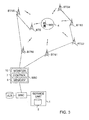
- Figure 3 shows a block diagram of a second preferred embodiment of the mobile communication system of the invention.
- the mobile communication system of Figure 3 can be a GSM system, for example.
- the owner of a mobile station MS' is leaving a message for another mobile station, whereby the reception area of the message is the area 4, i.e. the same area in which the mobile station MS' is located.
- the mobile station MS' continuously performs field strength (RSSI) measurements of the broadcast control channel BCCH of neighbouring cells BTS1 to BTS6.
- the mobile station MS' transmits measurement results in a manner known per se via the base station BTS to other parts of the network. In accordance with the invention, these measurement results can be utilized for locating the mobile station.
- the owner of the mobile station MS' stores a message for some other mobile station by using the mobile station MS'
- the message is stored by transmitting a short message to the service unit 1 via the base station BTS.
- the short message includes information on for whom the message is designated, in other words, the telephone number of the mobile station MS, for example, and the text message.
- the service unit 1 When the service unit 1 receives the short message transmitted to it, it detects that the message concerned is a short message for which a reception area is to be specified, In that case, the service unit 1 transmits a message to the mobile services switching centre, asking the mobile services switching centre to transmit the latest measurement report received from the mobile station MS' to the service unit, the measurement report indicating the identifiers of the six neighbouring base stations whose signals can be best received by the mobile station MS', and the signal strength at which the mobile station MS' has received the signals of the neighbouring base stations. The service unit stores the information in question in the database 2 as information indicating the location of the mobile station. Next, the service unit 1 informs the base station controller BSC of the radio cell in which the reception area 4 is located about the message stored.
- the control unit 7 of the base station controller then stores in the memory 8 information indicating that for the mobile station MS a message exists, the reception area of which is in the cell 5. In addition, it stores in the memory 8 information indicating the location of the reception area, the information in this embodiment being composed of the measurement report.
- the base station controller BSC operates in such a way that when the mobile station MS, being specified as the receiver of the message, performs a location update to the radio cell of the base station BTS, the monitor unit 10 of the base station controller BSC starts monitoring the measurement reports transmitted by the mobile station MS.
- the monitor unit 10 finally observes the measurement report transmitted by the mobile station MS, the report making reference to the same neighbouring base stations which are also referred to in the measurement report stored in the memory 8 and in which report the strength of the signals or the relations thereof correspond with a certain accuracy to the values of the measurement report stored in the memory 8, the control unit detects that the mobile station is located in the reception area. In that case the control unit 7 transmits a message to the service unit which retrieves from the database 2 the text message designated for the mobile station MS and transmits it in a short message to the mobile station MS.
- the system of Figure 3 operates in the above-described manner with the exception that the monitor unit 10 of the base station controller monitors all the mobile stations arriving in the radio cell of the base station, whereby the text message stored is correspondingly transmitted to all the mobile stations arriving in the reception area 4.
- the control unit preferably keeps a record of the ones to whom the text message is already transmitted, so that the same text message is not repeatedly transmitted to the same mobile station.
- monitor unit 10 which, on grounds of keeping the record, takes care of not retransmitting the same message to a particular mobile station until after an hour or, alternatively, not until the receiving mobile station has been out of the radio cell of the base station BTS.
- a method for transmitting a message to a mobile station comprises the steps of:
- the method may be characterized in that said message consists of a text message, preferably of a short message.
- the method may be characterized in that said message is composed of a voice message, whereby the method comprises the steps of:
- the method may be characterized in that the area corresponding to the message is specified by:
- a mobile communication system comprising
- the mobile communication system may be characterized in that the monitor means (1,7) comprise means for transmitting a predetermined message to the monitored mobile station (MS) which is approaching the reception area (4) and that said mobile station (MS) is arranged to transmit information indicating its location more frequently in response to the reception of said message.
- the monitor means (1,7) comprise means for transmitting a predetermined message to the monitored mobile station (MS) which is approaching the reception area (4) and that said mobile station (MS) is arranged to transmit information indicating its location more frequently in response to the reception of said message.
Landscapes
- Engineering & Computer Science (AREA)
- Signal Processing (AREA)
- Computer Networks & Wireless Communication (AREA)
- Mobile Radio Communication Systems (AREA)
- Nitrogen And Oxygen Or Sulfur-Condensed Heterocyclic Ring Systems (AREA)
- Preparation Of Compounds By Using Micro-Organisms (AREA)
Applications Claiming Priority (2)
| Application Number | Priority Date | Filing Date | Title |
|---|---|---|---|
| FI974147A FI108771B (fi) | 1997-11-05 | 1997-11-05 | Menetelmä viestin lähettämiseksi matkaviestimelle |
| EP98952771A EP1033042B1 (de) | 1997-11-05 | 1998-11-04 | Verfahren zur übertragung einer nachricht zu einer mobilstation |
Related Parent Applications (1)
| Application Number | Title | Priority Date | Filing Date |
|---|---|---|---|
| EP98952771.8 Division | 1998-11-04 |
Publications (2)
| Publication Number | Publication Date |
|---|---|
| EP2285147A2 true EP2285147A2 (de) | 2011-02-16 |
| EP2285147A3 EP2285147A3 (de) | 2012-05-02 |
Family
ID=8549876
Family Applications (2)
| Application Number | Title | Priority Date | Filing Date |
|---|---|---|---|
| EP98952771A Expired - Lifetime EP1033042B1 (de) | 1997-11-05 | 1998-11-04 | Verfahren zur übertragung einer nachricht zu einer mobilstation |
| EP10184320A Withdrawn EP2285147A3 (de) | 1997-11-05 | 1998-11-04 | Verfahren zur Übertragung einer Nachricht an eine Mobilstation |
Family Applications Before (1)
| Application Number | Title | Priority Date | Filing Date |
|---|---|---|---|
| EP98952771A Expired - Lifetime EP1033042B1 (de) | 1997-11-05 | 1998-11-04 | Verfahren zur übertragung einer nachricht zu einer mobilstation |
Country Status (6)
| Country | Link |
|---|---|
| US (1) | US6684068B1 (de) |
| EP (2) | EP1033042B1 (de) |
| AT (1) | ATE554609T1 (de) |
| AU (1) | AU1034699A (de) |
| FI (1) | FI108771B (de) |
| WO (1) | WO1999026431A1 (de) |
Families Citing this family (30)
| Publication number | Priority date | Publication date | Assignee | Title |
|---|---|---|---|---|
| GB2377342A (en) * | 2001-07-02 | 2003-01-08 | Nokia Corp | Reminder note transmission for mobiles |
| US6510323B1 (en) | 1999-03-05 | 2003-01-21 | Telefonaktiebolaget Lm Ericsson (Publ) | Method and system for providing general information to users in a mobile radio network |
| US6091959A (en) * | 1999-06-02 | 2000-07-18 | Motorola, Inc. | Method and apparatus in a two-way wireless communication system for location-based message transmission |
| FI108906B (fi) * | 1999-06-03 | 2002-04-15 | Elisa Comm Oyj | Menetelmä kommunikaatiopalvelun toteuttamiseksi |
| GB0008908D0 (en) | 2000-04-11 | 2000-05-31 | Hewlett Packard Co | Shopping assistance service |
| GB0008888D0 (en) * | 2000-04-11 | 2000-05-31 | Hewlett Packard Co | Monitoring of location-associated events |
| FR2809923B1 (fr) * | 2000-05-09 | 2002-12-13 | France Telecom | Systeme d'acquittement de lecture d'un message recu sur un terminal mobile |
| NL1015593C2 (nl) * | 2000-07-03 | 2002-01-04 | Koninkl Kpn Nv | Berichtensysteem. |
| WO2002021334A1 (en) * | 2000-09-07 | 2002-03-14 | Telefonaktiebolaget Lm Ericsson (Publ) | Information supply system and control method thereof |
| FI20002440L (fi) * | 2000-11-08 | 2002-05-09 | Mikko Kalervo Vaeaenaenen | Paikannus- ja viestintämenetelmä ja laite |
| US6377793B1 (en) | 2000-12-06 | 2002-04-23 | Xybernaut Corporation | System and method of accessing and recording messages at coordinate way points |
| US6681107B2 (en) | 2000-12-06 | 2004-01-20 | Xybernaut Corporation | System and method of accessing and recording messages at coordinate way points |
| WO2003009610A1 (en) * | 2001-07-18 | 2003-01-30 | Telcontar | System and method for initiating responses to location-based events |
| US7369825B2 (en) * | 2001-08-06 | 2008-05-06 | Hewlett-Packard Development Company, L.P. | Selection of radio station based on preferred program content |
| EP1289220A1 (de) * | 2001-09-03 | 2003-03-05 | Alcatel | Lokal begrenzte offene Kommunikation |
| DE10145490B4 (de) * | 2001-09-14 | 2006-08-31 | Siemens Ag | Verfahren zum Austausch von Nachrichten in einer Chatgruppe |
| US7024195B2 (en) * | 2001-10-24 | 2006-04-04 | Motorola, Inc. | Location based grouping for wireless network coverage area |
| US7192235B2 (en) * | 2001-11-01 | 2007-03-20 | Palm, Inc. | Temporary messaging address system and method |
| FR2833133B1 (fr) * | 2001-11-30 | 2004-02-13 | Orange France Sa | Systeme et procede de localisation d'un terminal mobile |
| US7236799B2 (en) | 2002-06-14 | 2007-06-26 | Cingular Wireless Ii, Llc | Apparatus and systems for providing location-based services within a wireless network |
| US20050143097A1 (en) * | 2002-06-14 | 2005-06-30 | Cingular Wireless Ii, Llc | System for providing location-based services in a wireless network, such as providing notification regarding meetings, destination arrivals, and the like |
| US7373181B2 (en) * | 2003-10-24 | 2008-05-13 | Motorola, Inc. | Method and apparatus for sender controllable modalities |
| US7917153B2 (en) * | 2004-03-31 | 2011-03-29 | France Telecom | Method and apparatus for creating, directing, storing and automatically delivering a message to an intended recipient upon arrival of a specified mobile object at a designated location |
| US7353034B2 (en) | 2005-04-04 | 2008-04-01 | X One, Inc. | Location sharing and tracking using mobile phones or other wireless devices |
| US20070268864A1 (en) * | 2006-05-22 | 2007-11-22 | Motorola, Inc. | Method and system to enhance social networking through random location connectivity |
| US9140552B2 (en) | 2008-07-02 | 2015-09-22 | Qualcomm Incorporated | User defined names for displaying monitored location |
| US9031583B2 (en) * | 2007-04-11 | 2015-05-12 | Qualcomm Incorporated | Notification on mobile device based on location of other mobile device |
| US20080254811A1 (en) | 2007-04-11 | 2008-10-16 | Palm, Inc. | System and method for monitoring locations of mobile devices |
| AU2008363468B2 (en) * | 2008-10-28 | 2011-08-25 | Fujitsu Limited | Wireless base station device using cooperative HARQ communication method, wireless terminal device, wireless communication system, and wireless communication method |
| US20110161427A1 (en) * | 2009-12-28 | 2011-06-30 | Nokia Corporation | Method and apparatus for location-aware messaging |
Family Cites Families (15)
| Publication number | Priority date | Publication date | Assignee | Title |
|---|---|---|---|---|
| US5787357A (en) * | 1991-10-17 | 1998-07-28 | Nokia Telecommunications Oy | Short message processing in a mobile exchange |
| US5539810A (en) * | 1992-01-27 | 1996-07-23 | Highwaymaster Communications, Inc. | Data messaging in a communications network |
| US5343512A (en) * | 1992-03-27 | 1994-08-30 | Motorola, Inc. | Call setup method for use with a network having mobile end users |
| BR9405399A (pt) * | 1993-06-14 | 1999-09-08 | Motorola Inc | Radiotelefone celular remoto, sistema de comunicação e processo para operar transceptor de localização remota |
| NZ276005A (en) * | 1993-11-01 | 1997-12-19 | Ericsson Telefon Ab L M | Mobile telephone network: messages with appended function indicators |
| DE69535840D1 (de) * | 1994-11-04 | 2008-10-23 | Ntt Docomo Inc | Mobilkommunikationssystem und -verfahren mit Nachrichtspeicherfunktionalität |
| JP2586347B2 (ja) * | 1994-11-15 | 1997-02-26 | 日本電気株式会社 | 移動無線電話システム |
| ES2110360B1 (es) * | 1995-06-15 | 1998-10-01 | Segurmap Sa | Sistema de seguridad para vehiculos. |
| US5802468A (en) * | 1995-06-28 | 1998-09-01 | Mci Corporation | System and method for identifying calling areas within a communication system |
| JP3743037B2 (ja) * | 1995-11-01 | 2006-02-08 | 株式会社日立製作所 | 移動端末への情報提供方法、情報提供システム及び移動端末 |
| JP3743988B2 (ja) * | 1995-12-22 | 2006-02-08 | ソニー株式会社 | 情報検索システムおよび方法、並びに情報端末 |
| AUPN955096A0 (en) * | 1996-04-29 | 1996-05-23 | Telefonaktiebolaget Lm Ericsson (Publ) | Telecommunications information dissemination system |
| US5903726A (en) * | 1996-06-26 | 1999-05-11 | Mci Communications Corporation | System using portion of a short message payload to identify short message service types and delivering the message if user subscribes to the services |
| US6052591A (en) * | 1996-08-19 | 2000-04-18 | Ericsson Inc. | Broadcasting messages to mobile stations within a geographic area |
| JPH10294967A (ja) * | 1997-04-21 | 1998-11-04 | Casio Comput Co Ltd | 情報提供システム及び情報提供処理プログラムを記録した記録媒体 |
-
1997
- 1997-11-05 FI FI974147A patent/FI108771B/fi not_active IP Right Cessation
-
1998
- 1998-11-04 EP EP98952771A patent/EP1033042B1/de not_active Expired - Lifetime
- 1998-11-04 WO PCT/FI1998/000856 patent/WO1999026431A1/en not_active Ceased
- 1998-11-04 AU AU10346/99A patent/AU1034699A/en not_active Abandoned
- 1998-11-04 AT AT98952771T patent/ATE554609T1/de active
- 1998-11-04 EP EP10184320A patent/EP2285147A3/de not_active Withdrawn
-
2000
- 2000-04-27 US US09/559,980 patent/US6684068B1/en not_active Expired - Lifetime
Non-Patent Citations (1)
| Title |
|---|
| None |
Also Published As
| Publication number | Publication date |
|---|---|
| EP1033042B1 (de) | 2012-04-18 |
| FI974147L (fi) | 1999-05-06 |
| EP1033042A1 (de) | 2000-09-06 |
| EP2285147A3 (de) | 2012-05-02 |
| US6684068B1 (en) | 2004-01-27 |
| ATE554609T1 (de) | 2012-05-15 |
| WO1999026431A1 (en) | 1999-05-27 |
| AU1034699A (en) | 1999-06-07 |
| FI108771B (fi) | 2002-03-15 |
| FI974147A0 (fi) | 1997-11-05 |
Similar Documents
| Publication | Publication Date | Title |
|---|---|---|
| US6684068B1 (en) | Method for transmitting a message to a mobile station | |
| US6292666B1 (en) | System and method for displaying country on mobile stations within satellite systems | |
| JP2586347B2 (ja) | 移動無線電話システム | |
| US6240069B1 (en) | System and method for location-based group services | |
| US6002936A (en) | System and method for informing network of terminal-based positioning method capabilities | |
| US6138026A (en) | Method and apparatus for locating a wireless communication device | |
| US6463288B1 (en) | System and method for monitoring positioning requests for mobile subscribers | |
| US6839022B1 (en) | Network support for subscriber access to mobile caller location information | |
| US6225944B1 (en) | Manual reporting of location data in a mobile communications network | |
| US6411811B2 (en) | System and method for provisioning assistance global positioning system information to a mobile station | |
| CA2329479C (en) | System and method for defining location services | |
| US7366492B1 (en) | Method and system for mobile location detection using handoff information | |
| WO1998000988A2 (en) | Method and apparatus for communicating information on mobile station position within a cellular telephone network | |
| JPH04360328A (ja) | 移動通信システム | |
| KR100547806B1 (ko) | 이동단말기의 위치 측정을 위한 장치 및 방법 | |
| WO2003026325A2 (en) | Telephone call routing system and method | |
| US5991620A (en) | Positioning busy indicator and queuing mechanism | |
| JPH09252485A (ja) | 無線通信システム及び無線通信装置 | |
| US20040203920A1 (en) | Position information transmitting method of mobile communication terminal | |
| KR100282956B1 (ko) | 특정 지역에 위치한 단말기에 메시지를 전송하기 위한 장치 및방법 | |
| US6522882B1 (en) | Method and apparatus for locating a mobile transceiver in conversation state | |
| JP4602877B2 (ja) | 通信装置の位置情報を利用する通信システム | |
| US8275391B2 (en) | Enhancing cell resolution mobile positioning estimates via signal strength measurement reported by mobile station | |
| EP1199902A1 (de) | Technik zur Benachrichtigung mobiler Endgeräte mittels geografischer Koordinaten | |
| KR100488177B1 (ko) | 위치정보 제공 시스템 및 방법 |
Legal Events
| Date | Code | Title | Description |
|---|---|---|---|
| PUAI | Public reference made under article 153(3) epc to a published international application that has entered the european phase |
Free format text: ORIGINAL CODE: 0009012 |
|
| AC | Divisional application: reference to earlier application |
Ref document number: 1033042 Country of ref document: EP Kind code of ref document: P |
|
| AK | Designated contracting states |
Kind code of ref document: A2 Designated state(s): AT BE CH CY DE DK ES FI FR GB GR IE IT LI LU MC NL PT SE |
|
| PUAL | Search report despatched |
Free format text: ORIGINAL CODE: 0009013 |
|
| AK | Designated contracting states |
Kind code of ref document: A3 Designated state(s): AT BE CH CY DE DK ES FI FR GB GR IE IT LI LU MC NL PT SE |
|
| RIC1 | Information provided on ipc code assigned before grant |
Ipc: H04W 4/12 20090101AFI20120328BHEP Ipc: H04M 3/53 20060101ALN20120328BHEP Ipc: H04M 3/533 20060101ALN20120328BHEP |
|
| 17P | Request for examination filed |
Effective date: 20121011 |
|
| 17Q | First examination report despatched |
Effective date: 20140204 |
|
| RAP1 | Party data changed (applicant data changed or rights of an application transferred) |
Owner name: NOKIA CORPORATION |
|
| RAP1 | Party data changed (applicant data changed or rights of an application transferred) |
Owner name: NOKIA TECHNOLOGIES OY |
|
| STAA | Information on the status of an ep patent application or granted ep patent |
Free format text: STATUS: THE APPLICATION IS DEEMED TO BE WITHDRAWN |
|
| 18D | Application deemed to be withdrawn |
Effective date: 20170224 |