EP2284792A1 - Framework und Ausführungsmodul für gebrauch darin - Google Patents
Framework und Ausführungsmodul für gebrauch darin Download PDFInfo
- Publication number
- EP2284792A1 EP2284792A1 EP09167429A EP09167429A EP2284792A1 EP 2284792 A1 EP2284792 A1 EP 2284792A1 EP 09167429 A EP09167429 A EP 09167429A EP 09167429 A EP09167429 A EP 09167429A EP 2284792 A1 EP2284792 A1 EP 2284792A1
- Authority
- EP
- European Patent Office
- Prior art keywords
- data
- buffer
- functional unit
- framework
- data structure
- Prior art date
- Legal status (The legal status is an assumption and is not a legal conclusion. Google has not performed a legal analysis and makes no representation as to the accuracy of the status listed.)
- Ceased
Links
Images

Classifications
-
- G—PHYSICS
- G06—COMPUTING OR CALCULATING; COUNTING
- G06F—ELECTRIC DIGITAL DATA PROCESSING
- G06F9/00—Arrangements for program control, e.g. control units
- G06F9/06—Arrangements for program control, e.g. control units using stored programs, i.e. using an internal store of processing equipment to receive or retain programs
- G06F9/46—Multiprogramming arrangements
- G06F9/54—Interprogram communication
- G06F9/541—Interprogram communication via adapters, e.g. between incompatible applications
-
- G—PHYSICS
- G06—COMPUTING OR CALCULATING; COUNTING
- G06T—IMAGE DATA PROCESSING OR GENERATION, IN GENERAL
- G06T1/00—General purpose image data processing
Definitions
- the present invention is related to a framework for the development of a software application. It further relates to an execution module for use in such a framework.
- GPUs graphical processing units
- CPU central processing unit
- GPUs Some vendors of GPUs have started software and hardware developments which allow programmers to utilize the computing power offered by the GPU for general processing (GPGPU). To that end, the GPU itself must support this new functionality.
- GPGPU An example of GPGPU is CUDA from Nvidia.
- GPUs were already equipped with hardware implemented functionality to accelerate the graphics pipeline. This functionality was exposed to software developers in the form of an application programming interface (API) such as DirectX from Microsoft or OpenGL from the Khronos group.
- API application programming interface
- a software developer wants to realize a given functionality in a program.
- a user selects a programming language which offers the necessary tools or libraries. If the user needs access to the functionality offered by the GPU, he must make sure that the API supports the selected programming language. Hence, the software developer is limited in choice for a programming language.
- Another important aspect is that a software developer may want to use the functionality of different APIs within one program. For instance, a programmer may want to combine DirectX and CUDA. Some functionality of the APIs involves operating on data arranged in a buffer which has a predefined data structure. Unfortunately, this data structure may differ between APIs.
- this object is achieved with a framework for the development of a software program which comprises an execution module for managing a function call (FC) to a first API functional unit (AFU1) during run-time of the software program, wherein AFU1 is comprised by a first application programming interface (API1) and is provided with an input accepting input data placed in a buffer.
- AFU1 can be called by the function call from within the software program and AFU1 is arranged to work with a predefined data structure of the data in the buffer.
- the execution module comprises a type converter (ATC) for automatically converting the input data to match the predefined data structure when AFU1 is called by the function call during run-time.
- ATC type converter
- the conversion between different data structures is performed by the ATC residing in the execution module.
- the ATC is automatically activated whenever a function call is detected. Consequently, the developer need not worry about incompatibility between different data structures expected by different AFUs.
- the execution module can be considered as an added layer in between the software program and the processing core.
- the framework is adapted to be executed on an application virtual machine (AVM).
- AVM application virtual machine
- the AVM is arranged for executing code that has been compiled by a compiler into a common language from at least one of a plurality of languages supported by the compiler and the AVM.
- the software program is in a supported language, and the framework is available for each of the plurality of supported languages.
- a function call within the software program which typically is made available through a library, is compiled into the common language.
- AFU1 Upon execution by the application virtual machine and under management of the execution module, AFU1 is called. Because both the software program and API1 are supported by the common language, not only the function call can be directed to AFU1 upon execution but also a pointer to the input data. Hence, AFU1 is able to operate on the input data. Moreover, this data is converted according to the predefined data structure by the ATC. As such, a software developer need not worry whether his data is organized according to the predefined data structure dictated by AFU1.
- API1 can be written in a language which is not supported by the AVM.
- the API is provided with a wrapper to enable the functional units in the API to be called from within a supported language.
- the API should be accessible from within the software program.
- the buffer may be coupled to an allocated region of a memory of a computer. In case of an AVM, this buffer is accessible by the compiled code in the common language.
- a buffer may be accessible directly, wherein individual content, e.g. bytes, of the buffer can be accessed individually, or it may be accessible indirectly, for instance when the buffer does not reside in the main memory of a computer but in the memory of the GPU.
- a DirectX function e.g. AFU1
- This data is organized in a buffer residing in the main memory of the computer.
- a CUDA functional unit is called which should also operate on this same data.
- the data itself has to be re-organized by the ATC. Additionally, the data may be moved or copied or a pointer to the data in the main memory can be passed onto the CUDA functional unit.
- Examples of a data structure are the type and location of the data in the buffer.
- data pertaining to the 1024 x 768 image could consist of 3 subsequent color fields, each color field comprising 1 byte to indicate the color component, e.g. R(ed), G(reen) or B(lue) for a specific pixel in the image.
- Other APIs may expect data to be organized in a different fashion, for instance an arrangement in which for each pixel the red, green, and blue color components are given.
- the type converter may be adapted to either re-arrange the data already in the buffer, or to re-arrange the data prior to placing the re-arranged data in the buffer.
- AFU1 may be provided with an output for outputting data operated on by AFU1 in a buffer.
- the software program may further comprise a function call to a second API functional unit (AFU2) which is comprised by a second application programming interface (API2).
- AFU2 may have an input accepting data placed in a buffer. Similar to AFU1, AFU2 is arranged to work with a predefined data structure of the data in the buffer. In this case, the ATC is further arranged to convert the data in the output buffer of AFU1 to match the data structure of the input buffer of AFU2.
- AFU1 accepts data at its input and outputs data at its output. This data is arranged in an input buffer and an output buffer and must be arranged in accordance with a predefined data structure.
- the input buffer and output buffer of AFU1 may be coupled to different allocated regions of a memory of a computer. Additionally or alternatively, the predefined data structure of the input and output buffer of AFU1 may be different.
- the ATC may be arranged to convert data in the output buffer of AFU1 to match the data structure of the input buffer of AFU2. This allows serial or cascaded operation of AFU1 and AFU2. Again, the software developer need not worry about any different data structure which may apply for the various functional units.
- the ATC may comprise a first and second intermediate converter.
- the first intermediate converter is arranged to convert data to match a predefined generic data structure.
- the second intermediate converter is arranged to convert and or re-arrange data according to the predefined generic data structure to match any of the predefined data structures of the input and or output buffer.
- Using a generic buffer reduces the efforts of constructing the type converter.
- a new API must be supported by the type converter, it is normally required to implement conversion between any of the existing predefined data structures to the data structure of the new API.
- intermediate converters one only needs to implement the conversion between the new data structure and the generic data structure.
- the output of the first intermediate converter may be stored in a separate buffer, not being an input or output of an AFU.
- the execution module is part of a common library accessible from within the software program. If an AVM is used, the common library could be made accessible to each of the plurality of supported languages.
- the ATC can be arranged to first detect the data structure of the input and or output buffer of AFU1 and or AFU2, and to then convert the data in accordance with the detected data structure.
- the first and second APIs may be application programming interfaces for a graphical processing unit (GPU).
- GPU graphical processing unit
- the framework can be based on the .NET framework.
- APIs in this framework can be one of the group consisting of CUDA.NET, OpenCV, DirectX, CUDA, CUDA.NET, Emgu.CV, and SlimDX.
- the software program may comprise a first and second function call which have identical functionality but which invoke a different API functional unit.
- the execution module can be arranged to switch between the first and second function call during run-time in accordance with predefined rules or determined performance statistics.
- the software program may comprise the first function call for implementing a desired functionality offered by a given API.
- a second function call could have been used that offers a similar functionality though by means of a different API.
- Both APIs require data to be organized differently.
- the execution module is arranged to switch between these function calls during run-time in accordance with predefined rules or determined performance statistics. This is made possible by the ATC which allows the interchangeability of function calls. In case of a common language, the switching could involve the actual replacement of code pertaining to the function call at the level of the common language. Also in this case, this is made possible by the execution module which operates as a management layer in between the software program in the supported language and the AVM.
- Changing between function calls during run-time allows optimization of the process flow. For instance, it may be determined that a certain resource, such as a GPU, is heavily loaded, or it may be determined that a given implementation of a FU is faster. Based on this information, the execution module may switch between implementations.
- AFU1_1 and AFU1_2 are functionally interchangeable.
- a software program can be constructed using generic function calls. It can then be left up to the execution module to choose for an actual implementation (FC1_1 or FC1_2) based on predefined rules or performance statistics.
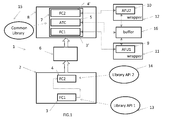
- the execution module of the framework enables a conversion between the data structures of the data at the output of FC1 3 and the input of FC2 4 by means of an automatic type converter (ATC) 5.
- ATC automatic type converter
- the AFUs can be accessed from the common language code 7 during run-time by means of suitable wrappers 11, 12.
- AFU1 9 is a functional unit inside CUDA which itself is written in a language that may not be supported by the framework. Still, the AFU may be accessed from within the framework through invocation of an associated compiled library, such as a dynamic link library. Alternatively, the CUDA.net wrapper 11 could be used to implement the same functionality.
- AFU2 10 is a functional unit in DirectX made accessible through invocation or alternatively written using the SlimDX wrapper library 12.
- the software developer can construct a program by making use of the associated function calls FC1 3 and FC2 4.
- a user may select these function calls from libraries 13, 14 associated with the wrappers.
- libraries 13, 14 associated with the wrappers.
- a user has access to a common library 15, e.g. the base class library BCL, which comprises various general functions accessible by each supported programming language.
- BCL base class library
- ATC 5 itself may be part of such a common library.
- software program 2 is constructed such that data in buffer 16 is operated on by AFU1 9, after which AFU2 10 should realize a further operation. Due to the different data structures used by AFU1 9 and AFU2 10, ATC 5 converts the data outputted by AFU1 9, which was called by means of function call 3', prior to invoking AFU2 10 by means of function call 4'. In most cases, this involves rearranging the data. It should be noted here that function calls 3' and 4' are the common language equivalents of function calls 3 and 4, respectively.
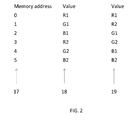
- Figure 2 schematically illustrates how data can be arranged inside a buffer.
- This buffer represents an allocated region 17 in the memory of a computer.
- the buffer represents part of a RGB description of an image.
- the second column 18 shows a data arrangement on a pixel-by-pixel basis. For every pixel, values for the color components red (R), blue (B), and green (G) are stored consecutively.
- the third column 19 depicts a different arrangement based on a frame-by-frame basis. Here, all the color components for a given color are stored consecutively. Essentially, a red, green, and blue color frame is stored.
- the type converter according to the invention makes sure that the data is arranged according to the arrangement expected by the AFU which is to access the data next.
- FIG. 3A shows a schematic overview of the desired functionality of a further software program.
- FC1 3' and FC2 4' are cascaded by means of type converter 5 at the level of the common language.
- a generic data structure is used. Both the starting data, i.e. the input data for FC2 4', and the output data, i.e. the output data of FC1 3', are arranged according to a predefined generic data structure.
- Figure 3B shows a more detailed overview of the software program of figure 3A .
- data in the buffer which is arranged according to a generic data structure is converted to comply with the predefined data structure expected by AFU1 9 by means of intermediate converter 20.
- the output of FC1 3' is converted back to the generic data structure by means of intermediate converter 21.
- FC 4' can be connected to FC1 3 by repeating the previous steps, albeit adapted to cope with the different data structure needed for AFU2 10.
- type converter 5 comprises two intermediate converters 20, 21 to convert back and forth between the generic data structure.
- FC1 3' and the two adjacent intermediate converters 20, 21 could refer to the combination of FC1 3' and the two adjacent intermediate converters 20, 21 as a single function call 22.
- wrappers 11, 12 or libraries 13, 14 could be modified to include these intermediate converters.
- FC2 4' and the two adjacent intermediate converters 23, 24 can be considered as a single function call 25.
- the combination of the two inner intermediate converters 21, 23 can be considered to be the ATC 5.
- a user can select from a plurality of function calls, which, although offered by different APIs, display similar functionality. Consequently, a user may optimize his program by selecting the appropriate API, for instance by optimizing the work load distribution between CPU and GPU.
- This aspect can also be implemented in execution module.
- a user may select generic function calls which only describe the desired functionality, but which are associated with specific function calls that are linked to specific AFUs.
- the execution module decides on the actual implementation of the generic function call. In other words, during run-time the generic function call description is replaced by an actual specific function call implementation. As previously mentioned, this replacement could involve the actual replacement of function calls at the level of the common language.
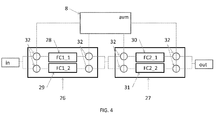
- Figure 4 illustrates how a generic description of a function call can be implemented in the framework according to the invention. It should be noted that figure 4 is illustrated at the level of the common language.
- Generic function call 26 is represented as a parallel configuration of switchable implementations of specific function calls.
- generic FC 26 can be implemented by FC1_1 28 and FC1_2 29, which each are linked to different AFUs which could also be linked to different processing cores (CPU/GPU).
- generic FC 27 is represented as a parallel configuration of FC2_1 30 and FC2_2 31.
- the execution module decides on the actual implementation. This is illustrated schematically by the switches 32 in figure 4 that are used to select between the different implementations. This switching between different implementations, the so-called "hot swapping" can be based on predictive analysis of the run-time performance of the program within the framework. It may additionally or alternatively be based on load statistics of the various processing cores (GPU/CPU) during run-time. For instance, the execution module may decide to implement a certain generic FC in a FC linked to the DirectX API instead of a CUDA implementation because the GPU load during run-time would prevent sufficient performance to be achieved. As such, the program becomes adaptive and is able to respond to differences in the computing environment such as changes in the load of a CPU due to other programs during run-time.
- the principles of the present invention can also be applied to systems that do not employ virtual machines.
- a software program may be developed in the C language whereas the APIs needed are constructed in the C++ language.
- suitable wrappers must be written to allow the AFUs to be called from within the C program.
- the execution module in this situation could be in the form of a dynamical-link library (dll) which would still offer the same functionality as previously discussed. Also in this situation, the execution module would take care of the automatic conversion between different data structures in case a specific AFU is called.
Landscapes
- Engineering & Computer Science (AREA)
- Theoretical Computer Science (AREA)
- Physics & Mathematics (AREA)
- General Physics & Mathematics (AREA)
- Software Systems (AREA)
- General Engineering & Computer Science (AREA)
- Devices For Executing Special Programs (AREA)
Priority Applications (1)
| Application Number | Priority Date | Filing Date | Title |
|---|---|---|---|
| EP09167429A EP2284792A1 (de) | 2009-08-07 | 2009-08-07 | Framework und Ausführungsmodul für gebrauch darin |
Applications Claiming Priority (1)
| Application Number | Priority Date | Filing Date | Title |
|---|---|---|---|
| EP09167429A EP2284792A1 (de) | 2009-08-07 | 2009-08-07 | Framework und Ausführungsmodul für gebrauch darin |
Publications (1)
| Publication Number | Publication Date |
|---|---|
| EP2284792A1 true EP2284792A1 (de) | 2011-02-16 |
Family
ID=41090339
Family Applications (1)
| Application Number | Title | Priority Date | Filing Date |
|---|---|---|---|
| EP09167429A Ceased EP2284792A1 (de) | 2009-08-07 | 2009-08-07 | Framework und Ausführungsmodul für gebrauch darin |
Country Status (1)
| Country | Link |
|---|---|
| EP (1) | EP2284792A1 (de) |
Citations (2)
| Publication number | Priority date | Publication date | Assignee | Title |
|---|---|---|---|---|
| US5999196A (en) * | 1996-07-01 | 1999-12-07 | Sun Microsystems, Inc. | System and method for data multiplexing within geometry processing units of a three-dimensional graphics accelerator |
| US20060274966A1 (en) * | 2005-06-03 | 2006-12-07 | Fuji Xerox Co., Ltd. | Image processing device, method, and storage medium which stores a program |
-
2009
- 2009-08-07 EP EP09167429A patent/EP2284792A1/de not_active Ceased
Patent Citations (2)
| Publication number | Priority date | Publication date | Assignee | Title |
|---|---|---|---|---|
| US5999196A (en) * | 1996-07-01 | 1999-12-07 | Sun Microsystems, Inc. | System and method for data multiplexing within geometry processing units of a three-dimensional graphics accelerator |
| US20060274966A1 (en) * | 2005-06-03 | 2006-12-07 | Fuji Xerox Co., Ltd. | Image processing device, method, and storage medium which stores a program |
Similar Documents
| Publication | Publication Date | Title |
|---|---|---|
| US12282756B2 (en) | Method and system of command buffer between a CPU and GPU | |
| US8719839B2 (en) | Two way communication support for heterogenous processors of a computer platform | |
| US9727338B2 (en) | System and method for translating program functions for correct handling of local-scope variables and computing system incorporating the same | |
| CN105242962B (zh) | 基于异构众核的轻量级线程快速触发方法 | |
| JP5043922B2 (ja) | グラフィックオペレーションのための高レベルプログラムインターフェース | |
| US8037474B2 (en) | Task manager with stored task definition having pointer to a memory address containing required code data related to the task for execution | |
| EP3043269A1 (de) | Gemeinsame nutzung von virtuellen funktionen bei einem gemeinsamen virtuellen speicher zwischen heterogenen prozessoren einer computerplattform | |
| US9043768B2 (en) | System and method for efficient compilation and invocation of function type calls | |
| TWI442235B (zh) | 記憶體交易群組 | |
| US20110302563A1 (en) | Program structure recovery using multiple languages | |
| JP2014521183A (ja) | シェーダ動作の同期化 | |
| CN106327420A (zh) | 数据处理系统 | |
| JP2590045B2 (ja) | 分散処理制御方法及び分散処理システム | |
| US20170147299A1 (en) | System and method for optimizing multiple invocations of graphics processing unit programs in java | |
| US9760282B2 (en) | Assigning home memory addresses to function call parameters | |
| US20160132246A1 (en) | Conditional stack frame allocation | |
| EP0564388A2 (de) | Verallgemeinerte Steuerung zum Starten von Tasks (Prozessen und Programmteilen) | |
| EP0521486A2 (de) | Prozessor mit hierarchischer Struktur | |
| CN120122957B (zh) | 代码编译方法、电子设备和存储介质 | |
| US7586493B1 (en) | System and method for offloading application tasks in a multi-processor environment utilizing a driver | |
| CN119440672B (zh) | 函数库链接方法、装置、设备、存储介质及程序产品 | |
| JP2018180706A (ja) | 支援装置、プログラム | |
| CN107861807A (zh) | 程序调用的优化方法及装置 | |
| US20100077384A1 (en) | Parallel processing of an expression | |
| JP6817827B2 (ja) | アクセラレータ処理管理装置、ホスト装置、アクセラレータ処理実行システム、方法およびプログラム |
Legal Events
| Date | Code | Title | Description |
|---|---|---|---|
| PUAI | Public reference made under article 153(3) epc to a published international application that has entered the european phase |
Free format text: ORIGINAL CODE: 0009012 |
|
| AK | Designated contracting states |
Kind code of ref document: A1 Designated state(s): AT BE BG CH CY CZ DE DK EE ES FI FR GB GR HR HU IE IS IT LI LT LU LV MC MK MT NL NO PL PT RO SE SI SK SM TR |
|
| AX | Request for extension of the european patent |
Extension state: AL BA RS |
|
| STAA | Information on the status of an ep patent application or granted ep patent |
Free format text: STATUS: THE APPLICATION HAS BEEN REFUSED |
|
| 18R | Application refused |
Effective date: 20110307 |