EP2284174B1 - Intermediates for the preparation of benzoxazine derivatives and process for their preparation - Google Patents
Intermediates for the preparation of benzoxazine derivatives and process for their preparation Download PDFInfo
- Publication number
- EP2284174B1 EP2284174B1 EP10191758.1A EP10191758A EP2284174B1 EP 2284174 B1 EP2284174 B1 EP 2284174B1 EP 10191758 A EP10191758 A EP 10191758A EP 2284174 B1 EP2284174 B1 EP 2284174B1
- Authority
- EP
- European Patent Office
- Prior art keywords
- compound
- group
- formula
- compound represented
- iii
- Prior art date
- Legal status (The legal status is an assumption and is not a legal conclusion. Google has not performed a legal analysis and makes no representation as to the accuracy of the status listed.)
- Expired - Lifetime
Links
- 0 C*CNc1c(*)c(*)c(*)cc1 Chemical compound C*CNc1c(*)c(*)c(*)cc1 0.000 description 11
Classifications
-
- C—CHEMISTRY; METALLURGY
- C07—ORGANIC CHEMISTRY
- C07D—HETEROCYCLIC COMPOUNDS
- C07D498/00—Heterocyclic compounds containing in the condensed system at least one hetero ring having nitrogen and oxygen atoms as the only ring hetero atoms
- C07D498/02—Heterocyclic compounds containing in the condensed system at least one hetero ring having nitrogen and oxygen atoms as the only ring hetero atoms in which the condensed system contains two hetero rings
- C07D498/06—Peri-condensed systems
-
- A—HUMAN NECESSITIES
- A61—MEDICAL OR VETERINARY SCIENCE; HYGIENE
- A61P—SPECIFIC THERAPEUTIC ACTIVITY OF CHEMICAL COMPOUNDS OR MEDICINAL PREPARATIONS
- A61P31/00—Antiinfectives, i.e. antibiotics, antiseptics, chemotherapeutics
- A61P31/04—Antibacterial agents
-
- C—CHEMISTRY; METALLURGY
- C07—ORGANIC CHEMISTRY
- C07B—GENERAL METHODS OF ORGANIC CHEMISTRY; APPARATUS THEREFOR
- C07B57/00—Separation of optically-active compounds
-
- C—CHEMISTRY; METALLURGY
- C07—ORGANIC CHEMISTRY
- C07C—ACYCLIC OR CARBOCYCLIC COMPOUNDS
- C07C213/00—Preparation of compounds containing amino and hydroxy, amino and etherified hydroxy or amino and esterified hydroxy groups bound to the same carbon skeleton
-
- C—CHEMISTRY; METALLURGY
- C07—ORGANIC CHEMISTRY
- C07C—ACYCLIC OR CARBOCYCLIC COMPOUNDS
- C07C227/00—Preparation of compounds containing amino and carboxyl groups bound to the same carbon skeleton
- C07C227/04—Formation of amino groups in compounds containing carboxyl groups
- C07C227/06—Formation of amino groups in compounds containing carboxyl groups by addition or substitution reactions, without increasing the number of carbon atoms in the carbon skeleton of the acid
- C07C227/08—Formation of amino groups in compounds containing carboxyl groups by addition or substitution reactions, without increasing the number of carbon atoms in the carbon skeleton of the acid by reaction of ammonia or amines with acids containing functional groups
-
- C—CHEMISTRY; METALLURGY
- C07—ORGANIC CHEMISTRY
- C07C—ACYCLIC OR CARBOCYCLIC COMPOUNDS
- C07C227/00—Preparation of compounds containing amino and carboxyl groups bound to the same carbon skeleton
- C07C227/30—Preparation of optical isomers
- C07C227/34—Preparation of optical isomers by separation of optical isomers
-
- C—CHEMISTRY; METALLURGY
- C07—ORGANIC CHEMISTRY
- C07C—ACYCLIC OR CARBOCYCLIC COMPOUNDS
- C07C227/00—Preparation of compounds containing amino and carboxyl groups bound to the same carbon skeleton
- C07C227/36—Racemisation of optical isomers
-
- C—CHEMISTRY; METALLURGY
- C07—ORGANIC CHEMISTRY
- C07C—ACYCLIC OR CARBOCYCLIC COMPOUNDS
- C07C229/00—Compounds containing amino and carboxyl groups bound to the same carbon skeleton
- C07C229/02—Compounds containing amino and carboxyl groups bound to the same carbon skeleton having amino and carboxyl groups bound to acyclic carbon atoms of the same carbon skeleton
- C07C229/04—Compounds containing amino and carboxyl groups bound to the same carbon skeleton having amino and carboxyl groups bound to acyclic carbon atoms of the same carbon skeleton the carbon skeleton being acyclic and saturated
- C07C229/06—Compounds containing amino and carboxyl groups bound to the same carbon skeleton having amino and carboxyl groups bound to acyclic carbon atoms of the same carbon skeleton the carbon skeleton being acyclic and saturated having only one amino and one carboxyl group bound to the carbon skeleton
- C07C229/18—Compounds containing amino and carboxyl groups bound to the same carbon skeleton having amino and carboxyl groups bound to acyclic carbon atoms of the same carbon skeleton the carbon skeleton being acyclic and saturated having only one amino and one carboxyl group bound to the carbon skeleton the nitrogen atom of the amino group being further bound to carbon atoms of six-membered aromatic rings
-
- C—CHEMISTRY; METALLURGY
- C07—ORGANIC CHEMISTRY
- C07C—ACYCLIC OR CARBOCYCLIC COMPOUNDS
- C07C229/00—Compounds containing amino and carboxyl groups bound to the same carbon skeleton
- C07C229/02—Compounds containing amino and carboxyl groups bound to the same carbon skeleton having amino and carboxyl groups bound to acyclic carbon atoms of the same carbon skeleton
- C07C229/30—Compounds containing amino and carboxyl groups bound to the same carbon skeleton having amino and carboxyl groups bound to acyclic carbon atoms of the same carbon skeleton the carbon skeleton being acyclic and unsaturated
-
- C—CHEMISTRY; METALLURGY
- C07—ORGANIC CHEMISTRY
- C07D—HETEROCYCLIC COMPOUNDS
- C07D265/00—Heterocyclic compounds containing six-membered rings having one nitrogen atom and one oxygen atom as the only ring hetero atoms
- C07D265/28—1,4-Oxazines; Hydrogenated 1,4-oxazines
- C07D265/34—1,4-Oxazines; Hydrogenated 1,4-oxazines condensed with carbocyclic rings
- C07D265/36—1,4-Oxazines; Hydrogenated 1,4-oxazines condensed with carbocyclic rings condensed with one six-membered ring
-
- C—CHEMISTRY; METALLURGY
- C12—BIOCHEMISTRY; BEER; SPIRITS; WINE; VINEGAR; MICROBIOLOGY; ENZYMOLOGY; MUTATION OR GENETIC ENGINEERING
- C12P—FERMENTATION OR ENZYME-USING PROCESSES TO SYNTHESISE A DESIRED CHEMICAL COMPOUND OR COMPOSITION OR TO SEPARATE OPTICAL ISOMERS FROM A RACEMIC MIXTURE
- C12P13/00—Preparation of nitrogen-containing organic compounds
- C12P13/001—Amines; Imines
-
- C—CHEMISTRY; METALLURGY
- C12—BIOCHEMISTRY; BEER; SPIRITS; WINE; VINEGAR; MICROBIOLOGY; ENZYMOLOGY; MUTATION OR GENETIC ENGINEERING
- C12P—FERMENTATION OR ENZYME-USING PROCESSES TO SYNTHESISE A DESIRED CHEMICAL COMPOUND OR COMPOSITION OR TO SEPARATE OPTICAL ISOMERS FROM A RACEMIC MIXTURE
- C12P13/00—Preparation of nitrogen-containing organic compounds
- C12P13/02—Amides, e.g. chloramphenicol or polyamides; Imides or polyimides; Urethanes, i.e. compounds comprising N-C=O structural element or polyurethanes
-
- C—CHEMISTRY; METALLURGY
- C12—BIOCHEMISTRY; BEER; SPIRITS; WINE; VINEGAR; MICROBIOLOGY; ENZYMOLOGY; MUTATION OR GENETIC ENGINEERING
- C12P—FERMENTATION OR ENZYME-USING PROCESSES TO SYNTHESISE A DESIRED CHEMICAL COMPOUND OR COMPOSITION OR TO SEPARATE OPTICAL ISOMERS FROM A RACEMIC MIXTURE
- C12P13/00—Preparation of nitrogen-containing organic compounds
- C12P13/04—Alpha- or beta- amino acids
-
- C—CHEMISTRY; METALLURGY
- C12—BIOCHEMISTRY; BEER; SPIRITS; WINE; VINEGAR; MICROBIOLOGY; ENZYMOLOGY; MUTATION OR GENETIC ENGINEERING
- C12P—FERMENTATION OR ENZYME-USING PROCESSES TO SYNTHESISE A DESIRED CHEMICAL COMPOUND OR COMPOSITION OR TO SEPARATE OPTICAL ISOMERS FROM A RACEMIC MIXTURE
- C12P41/00—Processes using enzymes or microorganisms to separate optical isomers from a racemic mixture
- C12P41/003—Processes using enzymes or microorganisms to separate optical isomers from a racemic mixture by ester formation, lactone formation or the inverse reactions
- C12P41/005—Processes using enzymes or microorganisms to separate optical isomers from a racemic mixture by ester formation, lactone formation or the inverse reactions by esterification of carboxylic acid groups in the enantiomers or the inverse reaction
-
- C—CHEMISTRY; METALLURGY
- C07—ORGANIC CHEMISTRY
- C07B—GENERAL METHODS OF ORGANIC CHEMISTRY; APPARATUS THEREFOR
- C07B2200/00—Indexing scheme relating to specific properties of organic compounds
- C07B2200/07—Optical isomers
-
- Y—GENERAL TAGGING OF NEW TECHNOLOGICAL DEVELOPMENTS; GENERAL TAGGING OF CROSS-SECTIONAL TECHNOLOGIES SPANNING OVER SEVERAL SECTIONS OF THE IPC; TECHNICAL SUBJECTS COVERED BY FORMER USPC CROSS-REFERENCE ART COLLECTIONS [XRACs] AND DIGESTS
- Y02—TECHNOLOGIES OR APPLICATIONS FOR MITIGATION OR ADAPTATION AGAINST CLIMATE CHANGE
- Y02P—CLIMATE CHANGE MITIGATION TECHNOLOGIES IN THE PRODUCTION OR PROCESSING OF GOODS
- Y02P20/00—Technologies relating to chemical industry
- Y02P20/50—Improvements relating to the production of bulk chemicals
- Y02P20/55—Design of synthesis routes, e.g. reducing the use of auxiliary or protecting groups
Definitions
- the present invention relates to intermediates which are useful in producing antibacterial compounds and processes for producing the same.
- JP-B-7-20946 the term "JP-B” as used herein means an "examined Japanese patent publication) , furthermore, it is needed to explore the reuse of the unnecessary isomer which is formed theoretically at a ratio of 50%.
- the present invention relates to processes by which the compound (VI-a) important as intermediate in the production of levofloxacin can be economically synthesized within a short period and which are thus industrially favorable production process.
- the present inventors have found out that the object can be achieved by producing an intermediate of levoflaxacin in accordance with the following synthesis pathways, thus completing the present invention.
- the following figure shows the processes according to the present invention for producing the compound (VI) from the compound (I).
- the present invention provides processes for industrially advantageously producing compound represented by the formula (VI-a) which is an intermediate for industrially advantageously producing levofloxacin:
- the present invention relates the following processes.
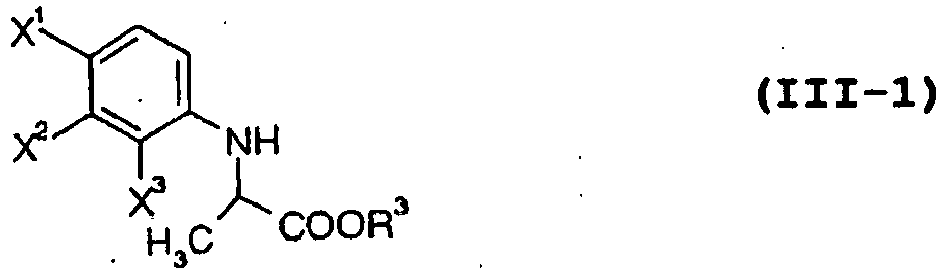
- the present invention relates to a process for producing a compound represented by the formula (III-1) : which is characterized by reacting a compound represented by formula (I-0): (wherein Z represents a nitro group or an amino group;
- X 1 , X 2 and X 3 each independently represents a halogen atom; and R 3 represents a hydrogen atom or a carboxyl-protective group
- the present invention further relates to a process for producing a compound represented by formula (IV-a): which is characterized by treating a compound represented by formula (III-1-a): in an aprotic solvent with a metal borohydride compound and an alcohol; a process for producing a compound represented by the formula (IV-a) as described above wherein the compound represented by the formula (III-1-a) is an ester compound; a process for producing a compound represented by the formula (IV-a) as described above wherein R 3 and R 7 are each an alkyl group having 1 to 6 carbon atoms; a process for producing a compound represented by the formula (IV-a) as described above wherein R 3 and R 7 are each a methyl group; a process for producing a compound represented by the formula (IV-a) as described above wherein R 3 and R 7 are each an ethyl group; each process for producing a compound represented by the formula: (IV-a) as described above wherein the aprotic solvent is a solvent selected from the compounds
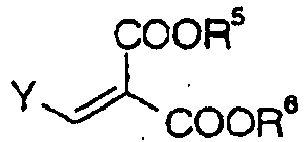
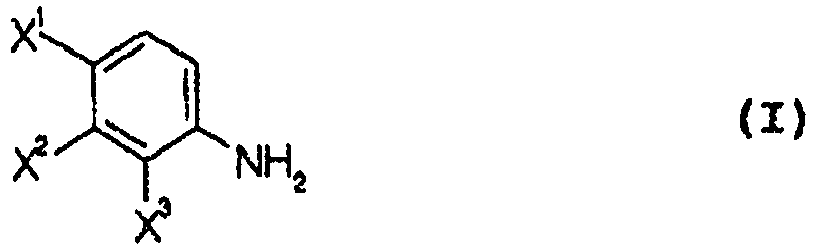
- Aprocess which comprises reacting a compound represented by formula (I): with a compound represented by formula (II-1-a) in the presence of a base: to give a compound represented by formula (III-1-a): reducing this compound into a compound represented by formula (IV-a): reacting this compound with a compound represented by the following formula: to give a compound represented by formula (V-a): and then treating this compound in the presence of a base.
- a process which comprises reacting a compound represented by the following formula: or by the following formula: with a compound represented by the following formula in the presence of a metal catalyst under a hydrogen gas atmosphere, optionally in the presence of a dehydrating agent or an acid: CH 3 COCOOR 3 to give a compound represented by formula (III-1): and then subjecting this compound to the following Method 1 or 2;
- a process which comprises reacting a compound represented by the following formula: or by the following formula: with a compound represented by the following formula in the presence of a metal catalyst under a hydrogen gas atmosphere, optionally in the presence of a dehydrating agent or an acid: CH 3 COCOOR 3 to give a compound represented by formula (III-1): and then subjecting this compound to the following Method 1 or 2;
- a carboxylic acid compound represented by the following formula: can be produced by treating an ester compound among the compounds represented by formula (III-1): with an enzyme capable of asymmetrically hydrolyzing an ester or a liquid culture medium of a microorganism, cells of this microorganism or processed cells of this microorganism and then isolating the product from the treated liquid mixture.
- a carboxylic acid compound represented by the following formula: can be produced by treating an ester compound among the compounds represented by formula (III-1): with an enzyme capable of asymmetrically hydrolyzing an ester or a liquid culture medium of a microorganism, cells of this microorganism or processed cells of this microorganism and then removing a compound represented by formula (III-1-b) from the treated liquid mixture;
- An ester compound among the compounds represented by fonnula (III-1-a) can be produced by treating an ester compound among the compounds represented by formula (III-1): with an enzyme capable of asymmetrically hydrolyzing an ester or a liquid culture medium of a microorganism, cells of this microorganism or processed cells of this microorganism and then isolating the product from the treated liquid mixture.
- An ester compound among the compounds represented by formula (III-1-a) can be produced by treating an ester compound among the compounds represented by formula (III-1): with an enzyme capable of asymmetrically hydrolyzing an ester or a liquid culture medium of a microorganism, cells of this microorganism or processed cells of this microorganism and then removing a carboxylic acid compound represented by the following formula from the treated liquid mixture;
- R 3 can be a methyl group.
- R 3 can be an ethyl group.
- the enzyme to be used in the treatment can be esterase, protease or chymotrypsin.
- the microorganism can be a microorganism selected from among bacteria belonging to the genera Bacillus, Micrococcus and Actinomyces.
- the microorganism can be a microorganism selected from among fungi belonging to the genera Aspergillus, Rhizopus, Nannizia and Penicillium.
- the microorganism can be a microorganism selected from among yeasts belonging to the genera Candida, Saccharomyces and Zygoascus.
- a 2-(2,3,4-trihalogenoanilino)propionic acid composed of a single optical isomer can be produced by optically resolving a compound represented by the following formula: by using an optically active organic base.
- a 2-(2,3,4-trihalogenoanilino)propionic acid composed of a single optical isomer can be produced by treating a compound represented by the following formula: with an optically active organic base to give a diastereomeric salt of one of the optical isomers of 2-(2,3,4-trihalogenoanilino)propionic acid and the optically active organic base and then treating this diastereomeric salt with an acid.
- the optically active organic base can be a compound represented by the following formula: (wherein Aryl represents an aryl group optionally having a halogen atom, a nitro group, a cyano group, a carbamoyl group, an alkyl group having 1 to 6 carbon atoms or an alkoxy group having 1 to 6 carbon atoms; and
- R 8 , R 9 and R 10 each independently represents:
- the optically active organic base can be 1-phenylethylamine.
- the optically active organic base can be 1-(p-tolyl)ethylamine.
- the optically active organic base can be 1-phenyl-2-(tolyl)-ethylamine.
- An ester compound represented by the following formula: can be produced by treating a carboxylic acid compound represented by the following formula: in the presence of a compound represented by the following formula: R 7 -OH and an acid catalyst.
- An ester compound represented by the following formula: can be produced by treating a carboxylic acid compound represented by the following formula: in the presence of a compound represented by the following formula: R 7 -OH and an acid catalyst.
- An ester compound in an racemate represented by formula (III-1): can be produced by treating an ester compound among the compounds represented by formula (III-1-b): in the presence of a base.
- the base can be a nitrogen-containing heterocyclic compound.
- the base in a process for producing an ester compound as described above, can be 1,8-diazabicyclo[5.4.0]undec-7-ene (DBU) or 1,8-diazabicyclo[4.3.0]undec-5-ene (DBN).
- DBU 1,8-diazabicyclo[5.4.0]undec-7-ene
- DBN 1,8-diazabicyclo[4.3.0]undec-5-ene
- the base can be an alkali metal or alkaline earth metal carbonate.
- the base can be potassium carbonate.
- a racemic carboxylic acid compound represented by the following formula: can be produced by racemizing an ester compound among the compounds represented by the following formula (III-1-b) by treating in the presence of a base: and then hydrolyzing.
- the base can be a metal alkoxide.
- the base can be potassium tertiary butoxide.
- the base in a process for producing a racemic carboxylic acid compound as described above, can be an alkali metal or alkaline earth metal carbonate.
- the base in a process for producing a racemic carboxylic acid compound as described above, can be potassium carbonate.
- the present invention relates to the following compounds concerning the above Processes and steps.
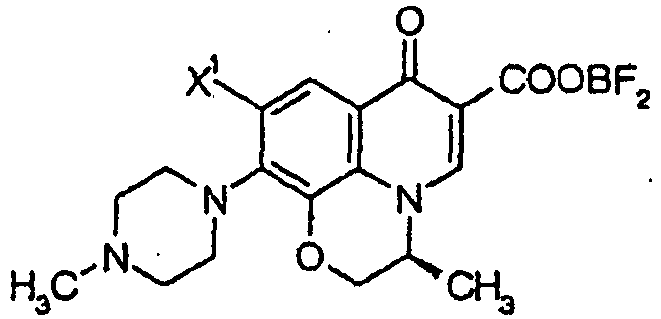
- the compound (levofloxacin) represented by the following formula: can be produced by a method which is characterized by involving the following steps of preparing a compound represented by formula (VI-a) by any of Processes A, C, E, F, G, H, I and J: treating this compound with a boron trifluoride compound to thereby convert it into a boron chelate compound represented by the following formula: reacting this compound with 4-methylpiperazine to give a compound represented by the following formula: and then cleaving off the boron chelate of this compound.
- X 1 , and X 3 each independently represents a halogen atom, preferably a fluorine atom.
- R 1 represents a leaving group.
- the leaving group halogen atoms, optionally substituted alkylsulfonyloxy groups, and optionally substituted arylsulfonyloxy groups can be cited.
- alkylsulfonyloxy groups methanesulfonyloxy group, ethanesulfonyloxy group, propanesulfonyloxy group, butanesulfonyloxy group, isobutanesulfonyloxy group, t-butanesulfonyloxy group and trifluoromethanesulfonyloxy group can be cited.
- arylsulfonyloxy groups examples include benzenesulfonyloxy group, p-toluenesulfonyloxy group, m-toluenesulfonyloxy group, p-nitrobenzenesulfonyloxy group, m-nitrobenzenesulfonyloxy group, p-methoxybenzenesulfonyloxy group, p-chlorobenzenesulfonyloxy group, m-chlorobenzenesulfonyloxy group, 2,4-dimethylbenzenesulfonyloxy group and 3,5-dinitrobenzenesulfonyloxy group can be cited.
- substituted sulfonyloxy groups and halogen atoms are preferable and trifluoromethanesulfonyloxy group, methanesulfonyloxy group, p-toluenesulfonyloxy group, and chlorine atom are still preferable.
- R 1 represents -COOR 3 or -CH 2 OR 4 .
- R 3 represents a hydrogen atom or a carboxyl-protective group.
- the carboxyl-group may be those ordinarily used in the art. Particular examples thereof include aralkyl groups, and alkyl groups.
- aralkyl groups means groups composed of an alkyl group having 1 to 6 carbon atoms and an aryl group. Particular examples thereof include benzyl group, and naphthyl methyl group.
- the alkyl group may be a linear, branched or cyclic alkyl group having 1 to 6 carbon atoms. Particular examples thereof include methyl group, ethyl group, propyl group, cyclobutyl group, cyclopentyl group, and cyclohexyl group.
- alkyl groups having 1 to 6 carbon atoms are preferable and methyl group, ethyl group and isopropyl group are particularly preferable.
- R 4 represents a hydroxyl-protective group.
- hydroxyl-protective group optionally substituted alkyl groups, optionally substituted aryl groups, optionally substituted aralkyl groups, and optionally substituted acyl groups can be cited.
- aryl group phenyl group, dimethoxyphenyl group, and p-methoxyphenyl group can be cited.
- ⁇ -phenylethyl group ⁇ -phenylethyl group, benzyl group, trityl group, and tolyl group.
- benzyl group trityl group, and tolyl group.
- acyl groups acetyl group, methoxyacetyl group, trifluoroacetyl group, chloroacetyl group, pivaloyl group, formyl group, benzoyl group, p-methoxybenzyl group, and p-nitrobenzoyl group can be cited.
- R 4 optionally substituted acyl groups are preferable and p-nitrobenzoyl group is particularly preferable.
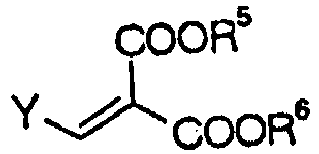
- R 5 and R 6 independently represent an alkyl group and methyl group and ethyl group are preferable therefor.
- R 7 represents a carboxyl-protective group which may be the same as the groups cited above concerning R 3 .
- Y represents an alkoxy group, a halogen atom or a dialkylamino group (wherein the alkyl groups may be either the same or different (still preferably the same) and each has 1 to 6 carbon atoms) .
- alkoxy groups are preferable.
- the alkoxy groups may be alkyl groups having 1 to 6 carbon atoms and methoxy group and ethoxy group are preferable therefor.
- the compound (III-1) can be obtained by reacting a compound (I-0): (wherein X 1 , X 2 and X 3 each independently represents a halogen atom; and Z represents an amino group or a nitro group); with pyruvic acid (the acid or an ester): CH 3 COCOOR 3 (wherein R 3 represents a hydrogen atom or an alkyl group); in a solvent in the presence of a metal catalyst under a hydrogen gas atmosphere.
- the metal catalyst to be used in this production process is not particularly restricted, so long as it is usable in a catalytic hydrogenation reaction.
- Such catalysts palladium-carbon, Raney nickel andRaney cobalt are preferable.
- a dehydrating agent may be added to promote the reaction.
- the dehydrating agent is not particularly restricted, so long as it exerts no effect on the reaction.
- use may be made of anhydrous magnesium sulfate, anhydrous sodium sulfate, or a molecular sieve.
- anhydrous magnesium sulfate and anhydrous sodium sulfate are preferable.
- the reaction between the compound (I-0) and pyruvic acid can be more conveniently performed by adding a catalytic amount of an acid and carrying out the hydrogenation reaction under elevated pressure.
- the acid to be added may be either an organic acid or an inorganic acid. Examples thereof include inorganic acids such as hydrochloric acid, nitric acid, sulfuric acid and phosphoric acid; and organic acids such as substituted carboxylic acid compounds and substituted sulfonic acid compounds. Examples of the substituted carboxylic acids include acetic acid, trifluoroacetic acid and fumaric acid.
- substituted sulfinic acid examples include methanesulfonic acid, trifluoromethanesulfonic acid, benzenesulfonic acid and toluenesulfonic acid.
- inorganic acid to be added hydrochloric acid and sulfuric acid are preferable.
- the acid to be added such an acid as described above may be added.
- pyruvic acid per se CH 3 COCOOH
- the acid may be added in a catalytic amount.
- an acid other than pyruvic acid it may be added in an amount of from 1 to 30% (by mol) based on the molar number of the compound (I-0).
- pyruvic acid per se it may be added in an equimolar amount to the molar number of the compound (I-0).
- an effect of promoting the reaction can be achieved by further adding it in small excess.
- pyruvic acid may be added in an amount of from about 1 to 5% by mol.
- any solvent which exerts no effect on the reaction may be used without restriction.
- examples thereof include alcohol solvents such as methanol, ethanol, propanol and isopropanol; ether solvents such as diethyl ether, tetrahydrofuran and 1,4-dioxane; halogenated hydrocarbon solvents such as dichloromethane and chloroform; amide solvents such as N,N-dimethylformamide and N,N-dimethylacetamide; dimethyl sulfoxide, acetonitrile, acetone, acetic acid esters, and water. It is also possible to use mixtures of these solvents.
- alcohol solvents are preferable and methanol, ethanol and isopropanol are still preferable.
- reaction temperature varies depending on the solvent used, it usually ranges from -78°C to the boiling point of the solvent, preferably from room temperature to the boiling point of the solvent.
- the reaction time ranges from 1 to 24 hours. Usually, the reaction is completed within 1 to 16 hours.
- the hydrogen gas pressure may usually range form 0.1 to 10 MPa, preferably from 0.1 to 5 Mpa.
- the compound (III-1) is usually obtained as a racemate.
- the imine compound formed by the reaction of the compound (I-0) with the pyruvic acid compound is reduced under asymmetrically reductive conditions.
- the asymmetric reduction reaction of the imine can be achieved by using the following reaction conditions:
- a carboxylic acid compound (see the following structural formula): can be obtained by treating an ester compound of the corresponding compound with an enzyme capable of asymmetrically hydrolyzing an ester or a liquid culture medium of a microorganism, cells of this microorganism or processed cells of this microorganism.
- the ester compound (racemate) of the compound (III-1) is suspended in an appropriate buffer and then an enzyme capable of asymmetrically hydrolyzing an ester or a liquid culture medium of a microorganism, cells of this microorganism or processed cells of this microorganism are added followed by stirring.
- the enzyme, etc. usable in this reaction is not particularly restricted, so long as it is capable of asymmetrically hydrolyzing an ester.
- the enzyme include marketed enzyme preparations originating in microorganisms, animals and plants. For example, use can be made of various esterases, proteases or chymotrypsins.
- microorganism use can be made of bacteria belonging to the genera Bacillus, Micrococcus and Actinomyces; fungi belonging to the genera Aspergillus, Rhizopus, Nannizia and Penicillium; and yeasts belonging to the genera Candida, Saccharomyces and Zygoascus.
- the ester moiety of one of the isomers (enantiomers) of the compound (III-1) is hydrolyzed to give a carboxylic acid. Further, this product is converted into a carboxylic acid salt and thus dissolved in the treatment liquor. At this point, the treatment liquor is extracted with an organic solvent such as ethyl acetate, chloroform, diisopropyl ether (IPE) or methyl t-butyl ether.
- an ester compound see the following structural formula which is the unnecessary isomer (enantiomer) of the compound (III-1-b): can be isolated and collected.
- the treatment liquor is acidified and then extracted with an organic solvent such as diisopropyl ether, methyl t-butyl ether or ethyl acetate.
- an organic solvent such as diisopropyl ether, methyl t-butyl ether or ethyl acetate.
- the treatment with the enzyme, microbial cells, etc. may be carried out usually at a temperature of from 5°C to 60°C, preferably from 20°C to 40°C.
- the pH value of this treatment liquor may range from 4 to 9, preferably from 6 to 8.
- the treatment with the enzyme, microbial cells, etc. may be carried out for from 4 hours to 7 days, preferably from 8 hours to 50 hours.
- the concentration of the compound (III-1) in the treatment liquor usually ranges from 0.1% to 20% on the weight basis, preferably from 0.5% to 5%.
- the amount of the enzyme or the liquid culture medium of a microorganism, cells of this microorganism or processed cells of this microorganism is not particularly restricted. In general, it is preferably used in an amount of from 0.05 to 0.5 times by weight as much as the compound (III-1) on the dry weight basis.
- a carboxylic acid compound of the racemic compound (III-1) can be obtained by separating the isomers (enantiomers) by forming diastereomeric salts with an optically active organic base and crystallizing them. By further recrystallizing the thus obtained salt by using an appropriate solvent, a salt having a higher stereoisomeric purity can be obtained.
- the carboxylic compounds of the compound (III-1-a) and the compound (III-1-b) can be separated.
- the term "comprises a single (optical) isomer” as used herein means not only a case in which it is completely free from the other (optical) isomer but also a case in which the other isomer may be present in such a degree that it does not exert influences upon physical constants.
- stereoisomerically pure salt has the following meaning.
- an acid and a base constituting a salt have stereoisomers, namely, a salt formed by an acid comprised of a single stereoisomer and a base similarly comprised of a single stereoisomer is referred to a stereoisomerically pure salt. That is to say, it means a salt wherein the constituting acid and base are each comprised of a single stereoisomer.
- the term “comprises a single stereoisomer” as used herein may be considered as the state of substantially being free from other isomer.
- optically active organic base which can be used in forming such salts involve optically active ethylamine derivatives aryl-substituted at the 1-position (1-arylethylamine derivatives) represented by the following formula: (wherein Aryl represents an aryl group optionally having a halogen atom, a nitro group, a cyano group, a carbamoyl group, an alkyl group having 1 to 6 carbon atoms or an alkoxy group having 1 to 6 carbon atoms; and
- R 8 , R 9 and R 10 each independently represents:
- aryl group examples include phenyl group and naphthyl group.
- the aromatic rings of these aryl groups may have one or more substituents such as halogen atoms, nitro group, cyano group, carbamoyl group, alkyl groups having 1 to 6 carbon atoms and alkoxy groups having 1 to 6 carbon atoms, or one or more types of these substituents.
- optically active bases 1-phenylethylamine, 1-(p-tolyl)ethylamine and 1-phenyl-2-(p-tolyl)ethylamine may be cited.
- optically active bases capable of advantageously forming a salt in combination with the carboxylic acid compound of the compounds (III-1-a) include (R)-(+)-1-phenylethylamine, (R)-(+)-1-(p-tolyl)ethylamine and (S)-(+)-1-phenyl-2-(p-tolyl)ethylamine.
- optically active bases capable of advantageously forming a salt in combination with the carboxylic acid compound of the compounds (III-1-b) include (S)-(+)-1-phenylethylamine, (S)-(+)-1-(p-tolyl)ethylamine and (R)-(+)-1-phenyl-2-(p-tolyl)ethylamine.
- the aromatic rings of the 1-arylethylamine derivatives are not restricted to hydrocarbyl aromatic rings but involve aromatic heterocycles containing sulfur atom, nitrogen atom, and/or oxygen atom.
- aromatic heterocycles containing sulfur atom, nitrogen atom, and/or oxygen atom examples thereof include thiophene, benzothiophene, pyridine, quinoline, isoquinoline, furan, and benzofuran.
- the optically active base may be used usually in an equimolar amount or less to the molar number of the carboxylic acid compound.
- solvents As the solvent for crystallizing or recrystallizing the target salt, various solvents may be used.
- solvents usable herein include aliphatic or aromatic hydrocarbon solvents such as n-hexane, n-pentane, benzene, toluene and xylene; alcohol solvents such as methanol, ethanol, propanol, isopropanol, n-butanol and t-butanol; ether solvents such as diethyl ether, diisopropyl ether, methyl t-butyl ether, tetrahydrofuran, 1,2-dimethoxyethane and 1,4-dioxane; amide solvents such as N,N-dimethylformamide and N,N-dimethylacetamide; and halogenated hydrocarbon solvents such as chloroform, methylene chloride and 1,2-dichloroethane (EDC).
- EDC 1,2-dichloroethane
- the solvent may be usually used in an amount of from 1 to 100 times by weight, preferably from about 2 to 50 times by weight.
- temperature conditions usually used may be selected. More particularly speaking, it may be performed within a temperature range from ice-cooling to the boiling point of the solvent used.
- the reaction time usually ranges from 1 to 24 hours.
- the carboxylic acid salt may be converted into the free carboxylic acid by treating with an acid. Namely, the carboxylic acid salt is treated with an inorganic acid such as hydrochloric acid or sulfuric acid followed by isolation by, for example, extraction with an organic solvent.
- an inorganic acid such as hydrochloric acid or sulfuric acid
- the isomer (enantiomer) tobe used in the production of levofloxacin is the compound (III-1-a)
- the other compound (III-1-b) has no utility value as such.
- An ester compound of this compound (III-1-b) can be racemized by treating in the presence of a base.
- the unnecessary isomer can be converted into the necessary isomer by this method.
- solvents can be cited.
- examples thereof include aliphatic or aromatic hydrocarbon solvents such as n-hexane, n-pentane, benzene, toluene and xylene; alcohol solvents such as methanol, ethanol, propanol, isopropanol, n-butanol and t-butanol; ether solvents such as diethyl ether, diisopropyl ether, methyl t-butyl ether, tetrahydrofuran, 1,2-dimethoxyethane and 1,4-dioxane; amide solvents such as N,N-dimethylformamide and N,N-dimethylacetamide; and halogenated hydrocarbon solvents such as chloroform, methylene chloride and 1,2-dichloroethane.
- use can be also made of water, acetonitrile, acetic acid esters, and
- aromatic hydrocarbons such as toluene and amides such as N,N-dimethylformamide and N,N-dimethylacetamide are preferable.
- reaction temperature varies depending on the solvent used, it usually ranges from -78°C to the boiling point of the solvent, preferably from room temperature to the boiling point of the solvent.
- the reaction time ranges from 1 to 24 hours, preferably from 1 to 16 hours.
- the base may be either an organic base or an inorganic base.
- use can be made of hydroxides, carbonates, hydrogencarbonates and alkoxides of alkali metals and alkaline earth metals such as sodium, potassium, lithium, magnesium and calcium; metal hydrides such as sodium hydride, potassium hydride and lithium hydride; alkyl lithium reagents such as n-butyl lithium, methyl lithium and lithium diisopropylamide; tertiary amines such as triethylamine and N,N-diisopropylethylamine; nitrogen-containing heterocyclic compounds such as 1,8-diazabicyclo[5.4.0]undec-7-ene (DBU), 1,8-diazabicyclo[4.3.0]non-5-ene (DBN) and N-methylmorpholine; and N,N-dialkylanilines such as dimethylaniline and diethylaniline.
- DBU 1,8-diazabicyclo[5.4.0]
- nitrogen-containing heterocyclic compounds such as 1,8-diazabicyclo[5.4.0]undec-7-ene (DBU); alkali metal or alkaline earth metal carbonates such as potassium carbonate; or alkali metal or alkaline earth metal metal alkoxides such as potassium tertiary-butoxide (t-BuOK).
- DBU 1,8-diazabicyclo[5.4.0]undec-7-ene
- alkali metal or alkaline earth metal carbonates such as potassium carbonate
- alkali metal or alkaline earth metal alkoxides such as potassium tertiary-butoxide (t-BuOK).
- the base may be used in an amount of from 0.1 to 15 times by mol, preferably from 1 to 5 times, as much based on the molar number of the ester compound of the compound (III-1-b).
- the reaction may be carried out in the presence of a quaternary ammonium salt such as tetrabutylammonium bromide or benzyltriethylammonium chloride; an alkali metal or alkaline earth metal iodide such as potassium iodide or sodium iodide; or a crown ether.
- a quaternary ammonium salt such as tetrabutylammonium bromide or benzyltriethylammonium chloride
- an alkali metal or alkaline earth metal iodide such as potassium iodide or sodium iodide
- a crown ether such as sodium iodide, sodium iodide.
- the compound (III-1-b) can be converted into a carboxylic acid compound of the compound (II-1) by racemizing by treating with a base and then hydrolyzing it.
- solvent use can be made of various solvents, for example, aliphatic or aromatic hydrocarbon solvents such as n-hexane, n-pentane, benzene, toluene and xylene; alcohol solvents such as methanol, ethanol, propanol, isopropanol, n-butanol and t-butanol; ether solvents such as diethyl ether, diisopropyl ether, methyl t-butyl ether, tetrahydrofuran, 1,2-dimethoxyethane and 1,4-dioxane; amide solvents such as N,N-dimethylformamide and N,N-dimethylacetamide; and halogenated hydrocarbon solvents such as chloroform, methylene chloride and 1,2-dichloroethane.
- solvents for example, aliphatic or aromatic hydrocarbon solvents such as n-hexane, n-pentane, benz
- aromatic hydrocarbon solvents such as toluene and N,N-dimethylformamide and N,N-dimethylacetamide are preferable.
- reaction temperature varies depending on the solvent used, it usually ranges from -78°C to the boiling point of the solvent, preferably from room temperature to the boiling point of the solvent.
- the reaction time ranges from 1 to 24 hours. Usually, the reaction is completed within 1 to 16 hours.
- the base may be either an organic base or an inorganic base.
- use can be made of hydroxides, carbonates, hydrogencarbonates and alkoxides of alkali metals and alkaline earth metals such as sodium, potassium, lithium, magnesium and calcium; metal hydrides such as sodium hydride, potassium hydride and lithium hydride; alkyl lithium reagents such as n-butyl lithium, methyl lithium and lithium diisopropylamide; tertiary amines such as triethylamine and N,N-diisopropylethylamine; nitrogen-containing heterocyclic compounds such as 1,8-diazabicyclo[5.4.0]undec-7-ene (DBU), 1,8-diazabicyclo[4.3.0]non-5-ene (DBN) and N-methylmorpholine; and N,N-dialkylanilines such as dimethylaniline and diethylaniline.
- DBU 1,8-diazabicyclo[5.4.0]
- alkali metal alkoxides such as potassium tertiary-butoxide or alkali metal or alkaline earth metal carbonates such as potassium carbonate.
- the base may be used in an amount of from 0.1 to 15 times by mol, preferably from 1 to 5 times, as much based on the molar number of the ester compound of the compound (III-1-b).
- the reaction may be carried out in the presence of a quaternary ammonium salt such as tetrabutylammonium bromide or benzyltriethylammonium chloride; an alkali metal or alkaline earth metal iodide such as potassium iodide or sodium iodide; or a crown ether.
- a quaternary ammonium salt such as tetrabutylammonium bromide or benzyltriethylammonium chloride
- an alkali metal or alkaline earth metal iodide such as potassium iodide or sodium iodide
- a crown ether such as sodium iodide, sodium iodide.
- the ester is hydrolyzed by using an acid or a base.
- an acid such as hydrochloric acid or sulfuric acid.
- a base for example, an alkali metal hydroxide such as sodium hydroxide or potassium hydroxide; an alkali metal carbonate such as sodium carbonate or potassium carbonate; or an alkali metal hydrogencarbonate such as sodium hydrogencarbonate or potassium hydrogencarbonate.
- the base is usually used in the form of an aqueous solution.
- the carboxylic acid compound in the compound (III-a), which is obtained by the hydrolysis with the use of the enzyme, the liquid culture medium of the microorganism, the microbial cells or the processed microbial cells or the hydrolysis under acidic or basic conditions, can be converted into an ester compound in a conventional manner. Namely, it may be reacted with the following alcohol in the presence of an acid catalyst: R 7 -OH.
- Examples of the alcohol usable herein include methanol, ethanol, propanol, isopropanol and n-butanol. By using such an alcohol, esterification toward an ester corresponding to the alcohol proceeds. Although the reaction temperature varies depending on the alcohol used, it usually ranges from -78°C to the boiling point of the alcohol, preferably from room temperature to the boiling point of the alcohol.
- Examples of the acid usable herein include hydrochloric acid, sulfuric acid and phosphoric acid. As another esterification method, use can be also made of the esterification by preparing an acid chloride followed by the treatment with an alcohol.
- the carboxylic acid compound among the compounds (III-a) obtained by the asymmetric hydrolysis of the ester or the hydrolysis of the ester in the presence of an acid or a base can be purified by forming salts with various amines.
- the amine usable in this purification it is preferable to select a highly lipophilic amine and examples thereof include cyclic alkylamines such as cyclohexylamine; and aralkylamines such as benzylamine and phenethylamine. Among these amines, cyclohexylamine and benzylamine are preferable and cyclohexylamine is still preferable.
- a salt of such an amine can be purified by recrystallization in a conventional manner.
- the conditions for the purification the conditions for the optical resolution as described above can be appropriately used.
- the amine salt of the carboxylic acid compound among the compounds (III-1) thus obtained can be converted into a free compound by treating with an acid. Subsequently, it can be esterified by the above-described method. It is also possible to carry out the esterification while omitting the procedure for obtaining the free compound by using an acid for the esterification in excess based on the molar number of the carboxylic acid salt.
- the compound (IV) can be obtained by reducing the compound (III-1). This reaction may be carried out by treating the compound (III-1) in a solvent in the presence of a reducing agent.
- a reducing agent As the compound (III-1) to be used in this reduction, one wherein the COOR 3 moiety is an ester is particularly preferable.
- the reducing agent examples include borohydride reducing agents such as sodiumborohydride, lithiumborohydride, calcium borohydride, zinc borohydride, magnesium borohydride and sodium cyano borohydride cyanide; and aluminum hydride reducing agents such as lithium aluminum hydride.
- borohydride reducing agents are preferable and sodium borohydride is particularly preferable.
- the reducing agent may be used in an amount from 1.1 to 2 .5 times by mol, preferably from 1.1 to 1.5 time, as much based on the molar number of the compound (III-1).
- the solvent usable herein is not particularly restricted so long as it exerts no effect on the reaction.
- examples thereof include alcohol solvents such as methanol, ethanol, isopropanol and t-butanol; ether solvents such as diethyl ether and tetrahydrofuran; etc.
- alcohol solvents are preferable and isopropanol is still preferable.
- the reaction can be promoted by adding methanol in an amount from 0.5 to 5 times by mol, preferably from 0.5 to 2 times, as much based on the molar number of the compound (III-1).
- the reaction temperature may be a temperature exerting no undesirable effect on the reaction. It preferably ranges from 0 to 60°C, still preferably from room temperature to 50°C.
- the reaction time may range from 1 hour to 20 hours.
- metal hydride compound use can be made of a metal borohydride compound or a metal aluminum hydride compound.
- metal borohydride compounds such as sodium borohydride, lithium borohydride, calcium borohydride, potassium borohydride, zinc borohydride, magnesium borohydride and sodium cyano borohydride cyanide; and metal aluminum hydride compounds such as lithium aluminum hydride.
- metal borohydride compounds are preferable and sodium borohydride is particularly preferable.
- the reducing amount may be used in an amount from 1 to 5 times by mol, preferably from about 1.1 to 2 times, as much based on the molar number of the compound (III-1-a) or (III-1-b).
- an aprotic solvent examples include linear and branched aliphatic hydrocarbon solvents such as n-hexane, n-pentane, cyclohexane and cyclopentane; aromatic hydrocarbon solvents such as benzene, toluene and xylene; ether solvents such as diethyl ether, diisopropyl ether, methyl t-butyl ether, tetrahydrofuran, 1,2-dimethoxyethane and 1,4-dioxane; and halogenated hydrocarbon solvents such as chloroform, methylene chloride and 1,2-dichloroethane.
- aliphatic hydrocarbon solvents such as n-hexane and cyclohexane
- ether solvents such as diisopropyl ether and methyl t-butyl ether
- aromatic hydrocarbon solvents such as toluene
- the alcohol may be used in an amount of from 3 to 20 times, preferably from about 4 to 15 times, as much based on the compound (III-1-a) or (III-1-b).
- reaction temperature varies depending on the solvent used, it usually ranges from -78°C to the boiling point of the solvent, preferably from 10°C to the boiling point of the solvent.
- the reaction time ranges from 1 to 24 hours. Usually, the reaction is completed within about 2 to 16 hours.
- the compound (III-1-a) or (III-1-b) and the reducing agent are added to the aprotic solvent and then the alcohol is added thereto (under stirring).
- 2,3,4-Trifluoroaniline 100 mg was dissolved in toluene (1 ml). After adding potassium carbonate (188 mg), methyl (2R)-2-[[(4-methylphenyl)sulfonyl]oxy]propionate (193 mg) and tetrahexylammonium chloride (40 mg), the mixture was stirred under heating and refluxing for 15.5 hours. After treating as in Example 1, the obtained product was analyzed by reversed phase HPLC with the use of the compound of Example 1 as a specimen. As a result, the product corresponded to 41 mg (26%) of the title compound.
- Example 2 In accordance with the process of Example 2, a condensation reaction was performed by using 2,3,4-trifluoroaniline (100 mg), potassium carbonate (188 mg), methyl (2R)-2-[(methanesulfonyl)oxy]propionate (78 mg) and tetrahexylammonium chloride (40 mg) to give the title compound as an oily substance.
- the product corresponded to 38 mg (24%) of the title compound.
- Example 2 In accordance with the process of Example 2, a condensation reaction was performed by using 2,3,4-trifluoroaniline (100 mg), potassium carbonate (188 mg), methyl (2R)-chloropropionate (92 mg) and tetrahexylammonium chloride (40 mg). As the result of the analysis by reversed phase HPLC with the use of the compound of Example 1 as a specimen, the product corresponded to 56 mg (36%) of the title compound.
- 1 H-NMR (CDCl 3 ) d: 6.92-6.74 (m, 2H), 5.09 (brs, 1H), 3.84 (s, 3H), 3.24 (s, 3H), 1.65 (s, 3H)
- Methyl 2-(2,3,4-trifluoroanilino)propionate (46.64 g) was dissolved in methanol (130 ml) and an aqueous solution (3 mol/l; 100 ml) of lithium hydroxide was slowly added thereto at 0°C. After stirring at room temperature for 3 hours, the solvent was evaporated. After adding water, the residue was washed with chloroform. Next, hydrochloric acid (6 mol/l) was slowly added to the aqueous layer until pH value reached 1. Then the aqueous layer was extracted with diisopropyl ether (IPE) .
- IPE diisopropyl ether
- (2S)-2-(2,3,4-trifluoroanilino)propionic acid (1.1 g; 99%ee) was dissolved in methanol (10 ml) and hydrochloric acid (5 mol/l; 1 ml) was added thereto at room temperature. The liquid reaction mixture was heated under reflux for 6 hours and then the solvent was evaporated. To the obtained residue was added chloroform (10 ml). Next, the organic layer was washed with a saturated aqueous solution of sodium chloride and water and dried over anhydrous magnesium sulfate.
- Methyl2-(2,3,4-trifluoroanilino)propionate (2.0g) was suspended in a 0.1 M phosphate buffer solution (pH 6.5; 400 ml). After adding Protease N (manufactured by Amano Seiyaku, originating in a bacterium belonging to the genus Bacillus; 0.4 g), the mixture was gently stirred. The mixture was further stirred for 14 hours while maintaining at 30°C. After adding methylene chloride, the liquid reaction mixture was filtered through celite to eliminate denatured protein and then separated.
- Protease N manufactured by Amano Seiyaku, originating in a bacterium belonging to the genus Bacillus
- Methyl 2-(2,3,4-trifluoroanilino)propionate (1.0 g) was suspended in a 0.1 M phosphate buffer solution (pH 6.5; 200 ml). After adding ⁇ -chymotrypsin (manufactured by Sigma; 0.2 g), the mixture was gently stirred. The mixture was further stirred for 16 hours while maintaining at 30°C. After adding methylene chloride, the liquid reaction mixture was filtered through celite to eliminate denaturedprotein and then separated. The organic layer was washed with a 5% aqueous solution of sodium hydrogencarbonate and a saturated aqueous solution of sodium chloride and then dried over anhydrous magnesium sulfate.
- Microbial cells (IAM-1623; Bacillus subtilis ) were cultured in a bouillon medium (pH 7.0; 50 ml) at 30°C for 14 hours. After removing the medium by centrifugation from the culture thus obtained, the cells are freeze-dried to give freeze-dried cells.
- Methyl 2-(2,3,4-trifluoroanilino)propionate (2.0 g) was suspended in a 0.1 M phosphate buffer solution (pH 6.5; 100 ml). Then the above-described freeze-driedmicrobial cells (0.2 g) were added thereto and gently stirred. The mixture was stirred for additional 6 hours while maintaining at 30°C.
- Microbial cells IFO-1575; Zygoascus hellenicus were cultured in an MY medium (pH 6.0; 50 ml) at 30°C for 48 hours.
- Methyl 2-(2,3,4-trifluoroanilino)propionate 1.0 g was suspended in a 0.1 M phosphate buffer solution (pH 6.5; 90 ml) . Then the above-described liquid culture (10 ml) was added thereto and gently stirred. The mixture was stirred for additional 16 hours while maintaining at 30°C.
- Methyl (2R)-2-(2,3,4-trifluoroanilino)propionate (100 mg, 38%ee) was dissolved in toluene (2 ml) and 1,8-diazabicyclo[5.4.0]undec-7-ene (DBU; 71.8 mg) was added thereto at room temperature. Then the liquid reaction mixture was stirred at 110°C for 16 hours. After adding hydrochloric acid (1 mol/l; 1 ml) to the liquid reaction mixture, the aqueous layer was extracted with toluene. The organic layer was washed with water and a saturated aqueous solution of sodium chloride and dried over anhydrous magnesium sulfate.
- DBU 1,8-diazabicyclo[5.4.0]undec-7-ene
- Methyl (2R)-2-(2,3,4-trifluoroanilino)propionate 50 mg, 57%ee was dissolved in N,N-dimethylformamide (DMF; 1 ml) and potassium carbonate (63.2 mg) was added thereto at room temperature. Then the liquid reaction mixture was stirred at 110°C for 19 hours. After adding water to the liquid reaction mixture, the aqueous layer was extracted with ethyl acetate. The organic layer was washed with water and dried over anhydrous magnesium sulfate.
- DMF N,N-dimethylformamide
- Methyl (2R)-2-(2,3,4-trifluoroanilino)propionate 200 mg, 57%ee was dissolved in dimethylacetamide (DMAc; 3 ml) and potassium carbonate (474.1 mg) was added thereto at room temperature. Then the liquid reaction mixture was stirred at 95°C for 19 hours. After adding water to the liquid reaction mixture, the aqueous layer was extracted with ethyl acetate. The organic layer was washed with water and dried over anhydrous magnesium sulfate.
- DMAc dimethylacetamide
- potassium carbonate 474.1 mg
- Example 51 To the compound (103 mg) obtained in Example 51 was added diethyl ethoxymethylenemalonate (127 mg). Then the obtained mixture was stirred for 1 hour while heating to 100°C under atmospheric pressure. Further, it was stirred at the same temperature for 1.5 hour under reduced pressure and then under atmospheric pressure for additional 16 hours. By analyzing reversed phase HPLC with the use of the compound of Example 63 as a specimen, the obtained product corresponded to 142 mg (78%) of the title compound.
- Example 51 The compound (103 mg) obtained in Example 51 and dimethyl ethoxymethylenemalonate (87 mg) were dissolved in toluene (3 ml) and the mixture was heated under reflux for 21 hours. Then the residue was filtered off and the solvent was evaporated. The obtained residue was subjected to silica gel column chromatography to give 125 mg (72%) of the title compound as colorless crystals.
- dichloromethane (10 ml) was added to the solution followed by washing with water (10 ml).
- the dichloromethane layer was concentrated under reduced pressure and the obtained residue was separated and purified by silica gel column chromatography to thereby give 159.4 mg (45%) of the title compound as yellow crystals.
- the carboxylic acid (14.3 g) obtained above was suspended in diethyl ether (600 ml). After adding boron trifluoride diethyl ether complex (70 ml), the mixture was stirred at room temperature for 5 hours. After discarding the supernatant by decantation, the residue was collected by filtration by adding diethyl ether and washed with diethyl ether followed by drying. Then it was dissolved in dimethyl sulfoxide (100 ml). After adding triethylamine (14.2ml) andN-methylpiperazine (7.3 ml), the mixture was stirred at room temperature for 18 hours. After evaporating the solvent under reduced pressure, diethyl ether was added to the residue.
- the yellow powder thus collected by filtration was suspended in 95% methanol (400 ml) and triethylamine (25 ml) was added thereto. After heating under reflux for 25 hours, the solvent was evaporated under reduced pressure. The residue was dissolved in 10% hydrochloric acid (500 ml), washed with chloroform thrice and then adjusted to pH 11 with an aqueous solution of sodium hydroxide (4 mol/l). Next, it was adjusted again to pH 7.3 with hydrochloric acid (1 mol/l), extracted with chloroform (2000 ml X 3) and dried over mirabilite.
- This chelate compound (310 mg) was dissolved in dimethyl sulfoxide (6 ml) and triethylamine (0.32 ml) and N-methylpiperazine (0.13ml) were added thereto. The resultant mixture was stirred at room temperature for 17 hours and then solidified to dryness under reduced pressure. The residue was washed with diethyl ether and dissolved in 95% ethanol (20 ml) containing triethylamine (0.5 ml) followed by heating under reflux for 8 hours. After cooling, the residue obtained by solidifying to dryness was dissolved in dilute hydrochloric acid 5%) and separated by shaking together with chloroform.
- Example 101 (3S)-9,10-Difluoro-3-methyl-7-oxo-2,3-dihydro-7H-pyrido[1,2,3-de][1,4]benzoxazine-6-carboxylic acid boron difluoride chelate complex
- Example 102 (3S)-(-)-9-Fluoro-3-methyl-10-(4-methyl-1-piperazinyl)-7-oxo-2,3-dihydro-7H-pyrido[1,2,3-de][1,4]benzoxazine-6-carboxylic acid (levofloxacin)
Landscapes
- Chemical & Material Sciences (AREA)
- Organic Chemistry (AREA)
- Life Sciences & Earth Sciences (AREA)
- Zoology (AREA)
- Wood Science & Technology (AREA)
- Engineering & Computer Science (AREA)
- Chemical Kinetics & Catalysis (AREA)
- Health & Medical Sciences (AREA)
- General Chemical & Material Sciences (AREA)
- General Health & Medical Sciences (AREA)
- Biotechnology (AREA)
- Biochemistry (AREA)
- Genetics & Genomics (AREA)
- General Engineering & Computer Science (AREA)
- Bioinformatics & Cheminformatics (AREA)
- Microbiology (AREA)
- Analytical Chemistry (AREA)
- Proteomics, Peptides & Aminoacids (AREA)
- Medicinal Chemistry (AREA)
- Pharmacology & Pharmacy (AREA)
- Oncology (AREA)
- Animal Behavior & Ethology (AREA)
- Nuclear Medicine, Radiotherapy & Molecular Imaging (AREA)
- Veterinary Medicine (AREA)
- Public Health (AREA)
- Communicable Diseases (AREA)
- Organic Low-Molecular-Weight Compounds And Preparation Thereof (AREA)
- Heterocyclic Carbon Compounds Containing A Hetero Ring Having Nitrogen And Oxygen As The Only Ring Hetero Atoms (AREA)
- Preparation Of Compounds By Using Micro-Organisms (AREA)
- Nitrogen And Oxygen Or Sulfur-Condensed Heterocyclic Ring Systems (AREA)
- Pharmaceuticals Containing Other Organic And Inorganic Compounds (AREA)
- Low-Molecular Organic Synthesis Reactions Using Catalysts (AREA)
Description
- The present invention relates to intermediates which are useful in producing antibacterial compounds and processes for producing the same.
- (3S)-(-)9-fluoro-3-methyl-10-(4-methyl-1-piperazinyl)-7-oxo-2,3-dihydro-7H-pyrido[1,2,3-de][1,4]benzoxazine-6-carboxylic acid (levoflaxacin, LVFX:
JP-A-62-252790 
- As intermediates in the production of this levofloxacin, compounds represented by formula (VI-a) (hereinafter referred to as compounds (VI-a); the same will apply to compounds represented by other formulae) are also useful:

- As intermediates for racemic 9-fluoro-3-methyl-10-(4-methyl-1-piperazinyl)-7-oxo-2,3-dihydro-7H-pyrido[1,2,3-de][1,4]benzoxazine-6-carboxylic acid (oflxacin, OFLX):


- Conventional processes for producing the compound (VI-a) are as follows.

- The production process reported by Japanese Patent No.
2 , 612 , 327 - In the process reported by Japanese Patent No.
2,771,871 - Further, the process reported by Japanese Patent No.
2,573,269 - In the optical resolution method reported by
JP-B-7-20946 - The production process reported by
U.S. Patent 5, 644, 056 relates to a reaction of a racemate. To produce levofloxacin by this process, therefore, it is required to optically resolve the obtained product and the unnecessary isomer should be racemized or inverted. In addition, the specification of this patent discloses no experimental example of optically active compound. - The process reported by the Chinese document (Chinese Chemical Letters Vol.6, No.10, 857-860 (1995)) suffers from a problem that an additional step is needed for the deprotection of the p-toluenesulfonyloxy group used as a protective group.
- A process for obtaining benzoxazines for the synthesis of ofloxacin, levofloxacin and derivatives thereof is described in
EP 0 619 311 A1 . - A method for reductive N-alkylation of aniline derivatives is described in Fache et al. (Tetrahedron 52(29): 9777-9784, 1996).
- Anderson et al. (Tetrahedron Asymmetry 9: 3461-3490, 1998) describes inter alia the formation an alcohol by lithium aluminium hydride reduction of a methyl ether.
- The present invention relates to processes by which the compound (VI-a) important as intermediate in the production of levofloxacin can be economically synthesized within a short period and which are thus industrially favorable production process. As a result of intensive studies, the present inventors have found out that the object can be achieved by producing an intermediate of levoflaxacin in accordance with the following synthesis pathways, thus completing the present invention. The following figure shows the processes according to the present invention for producing the compound (VI) from the compound (I).

- Accordingly, the present invention provides processes for industrially advantageously producing compound represented by the formula (VI-a) which is an intermediate for industrially advantageously producing levofloxacin:

- Namely, the present invention relates the following processes.
- The present invention relates to a process for producing a compound represented by the formula (III-1) :


- X1, X2 and X3, each independently represents a halogen atom; and R3 represents a hydrogen atom or a carboxyl-protective group)
- with a compound represented by the following formula;
CH3COCOOR3
optionally in the presence of an acid acceptor or an acid, in the presence of a metal catalyst under a hydrogen gas atmosphere ;
the above process for producing a compound represented by the formula (III-1) wherein R3 is a hydrogen atom;
the above process for producing a compound represented by the formula (III-1) wherein R3 is a methyl group;
the above process for producing a compound represented by the formula (III-1) wherein R3 is an ethyl group;
the above process for producing a compound represented by the formula (III-1) wherein Z is an amino group;
the above process for producing a compound represented by the formula (III-1), wherein Z is a nitro group;
the above process for producing a compound represented by the formula (III-1) wherein Z is an amino group and R3 is a hydrogen atom;
the above process for producing a compound represented by the formula (III-1) wherein Z is an amino group and R3 is a methyl group;
the above process for producing a compound represented by the formula (III-1) wherein Z is an amino group and R3 is an ethyl group;
the above process for producing a compound represented by the formula (III-1) wherein Z is a nitro group and R3 is a hydrogen atom;
the above process for producing a compound represented by the formula (III-1) wherein Z is a nitro group and R3 is a methyl group; and
the above process for producing a compound represented by the formula (III-1) wherein Z is a nitro group and R3 is an ethyl group. - The present invention further relates to a process for producing a compound represented by formula (IV-a):
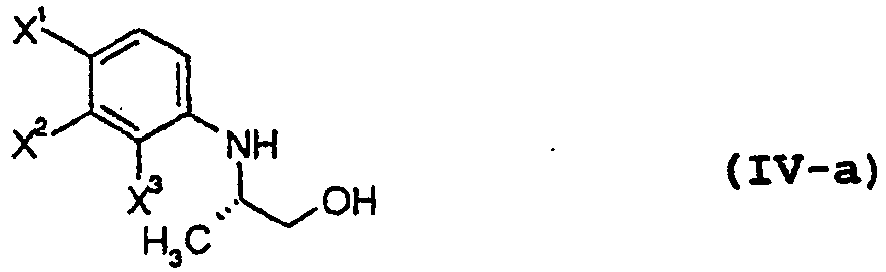

a process for producing a compound represented by the formula (IV-a) as described above wherein the compound represented by the formula (III-1-a) is an ester compound;
a process for producing a compound represented by the formula (IV-a) as described above wherein R3 and R7 are each an alkyl group having 1 to 6 carbon atoms;
a process for producing a compound represented by the formula (IV-a) as described above wherein R3 and R7 are each a methyl group;
a process for producing a compound represented by the formula (IV-a) as described above wherein R3 and R7 are each an ethyl group;
each process for producing a compound represented by the formula: (IV-a) as described above wherein the aprotic solvent is a solvent selected from the compounds of the group consisting of aromatic hydrocarbons, alkanes, cycloalkanes, ethers, halogenated hydrocarbons and acetic acid esters;
each process for producing a compound represented by the formula (IV-a) as described above wherein the aprotic solvent is an aromatic hydrocarbon;
each process for producing a compound represented by the formula (IV-a) as described above wherein the aprotic solvent is an alkane;
each process for producing a compound represented by the formula (IV-a) as described above wherein the aprotic solvent is a cycloalkalne;
each process for producing a compound represented by the formula (IV-a) as described above wherein the aprotic solvent is an ether;
each process for producing a compound represented by the formula (IV-a) as described above wherein the aprotic solvent is a halogenated hydrocarbon;
each process for producing a compound represented by the formula (IV-a) as described above wherein the aprotic solvent is an acetic acid ester;
each process for producing a compound represented by the formula (IV-a) as described above wherein the alcohol is a primary alcohol;
each process for producing a compound represented by the formula (IV-a) as described above wherein primary alcohol is methanol;
each process for producing a compound represented by the formula (IV-a) as described above wherein the metal borohydride compound is sodium borohydride; and
each process for producing a compound represented by the formula (IV-a) as described above wherein X1, X2 and X3 are each a fluorine atom. - The process of the present invention for producing a compound represented by formula (III-1) is useful in Processes G and H described below.
- The process of the present invention for producing a compound represented by formula (IV-a) is useful in Processes A, C, E, F, G, H, I and J described below.
- Aprocess which comprises reacting a compound represented by formula (I):



- A process which compreses reacting a compound represented by formula (I) :


- A process which comprises reacting a compound represented by the formula (I):


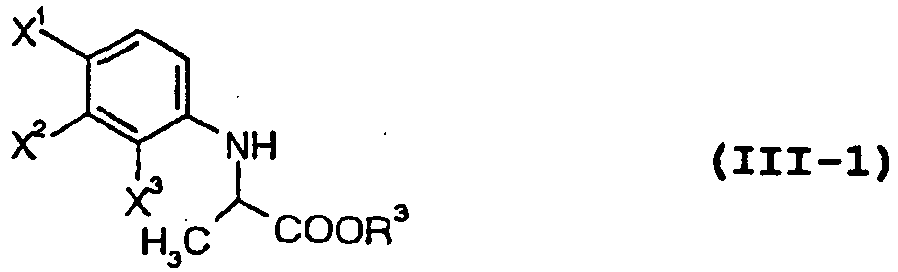
- in case of the compound represented by the formula (III-1) where R3 is not a hydrogen atom, a method which comprises treating this compound with an enzyme capable of asymmetrically hydrolyzing an ester or a liquid culture medium of a microorganism, cells of this microorganism or processed cells of this microorganism and, after the completion of this treatment, isolating the product from the treated liquid mixture;
- in case of the compound represented by the formula (III-I) where R3 is a hydrogen atom, a method which comprises optically resolving this compound by reacting with an optically active organic base;
to obtain a carboxylic acid compound representedby the following formula:
R7-OH
to give an ester compound represented by the following formula:


- A process which comprises reacting a compound represented by formula (I):


- in case of the compound represented by the formula (III-1) where R3 is not a hydrogen atom, a method which comprises treating this compound with an enzyme capable of asymmetrically hydrolyzing an ester or a liquid culture medium of a microorganism, cells of this microorganism or processed cells of this microorganism and, after the completion of this treatment, isolating the product from the treated liquid mixture;
- in case of the compound represented by the formula (III-1) where R3 is a hydrogen atom, a method which comprises optically resolving this compound by reacting with an optically active organic base;
to obtain a carboxylic acid compound represented by the following formula:
R7-OH
to give an ester compound represented by the following formula:


- A process which comprises reacting a compound represented by the following formula:


CH3COCOOR3
to give a compound represented by formula (III-1):
- in case of the compound represented by the formula (III-1) where R3 is not a hydrogen atom, a method which comprises treating this compound with an enzyme capable of asymmetrically hydrolyzing an ester or a liquid culture medium of a microorganism, cells of this microorganism or processed cells of thismicroorganismand, after the completion of this treatment, isolating the product from the treated liquid mixture;
- in case of the compound represented by the formula (III-I) where R3 is a hydrogen atom, a method which comprises optically resolving this compound by reacting with an optically active organic base;
to obtain a carboxylic acid compound representedby the following formula:
R7-OH
to give an ester compound represented by the following formula: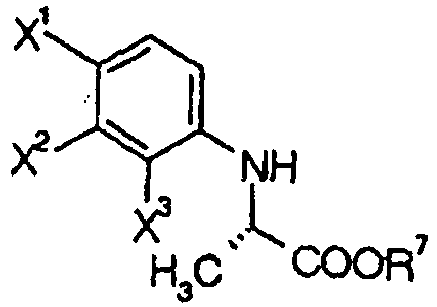


- A process which comprises reacting a compound represented by the following formula:

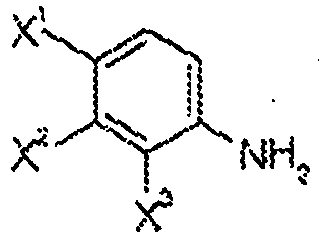
CH3COCOOR3
to give a compound represented by formula (III-1):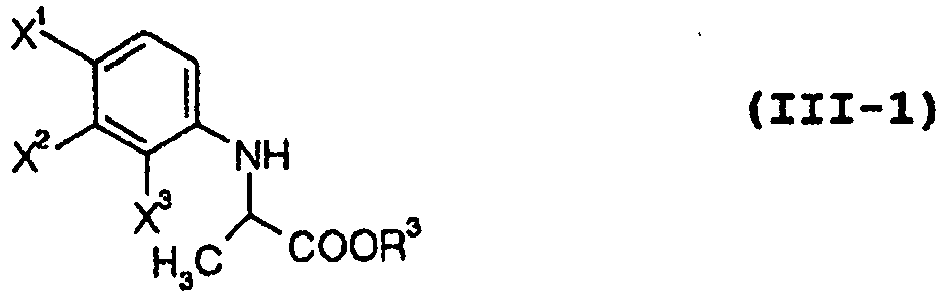
- in case of the compound representedby the formula (III-1) where R3 is not a hydrogen atom, a method which comprises treating this compound with an enzyme capable of asymmetrically hydrolyzing an ester or a liquid culture medium of a microorganism, cells of this microorganism or processed cells of this microorganism and, after the completion of this treatment, isolating the product from the treated liquid mixture;
- in case of the compound represented by the formula (III-1) where R3 is a hydrogen atom, a method which comprises optically resolving this compound by reacting with an optically active organic base;
to obtain a carboxylic acid compound represented by the following formula:
R7-OH
to give an ester compound represented by the following formula:


- A process which comprises reacting a compoundrepresented by the following formula:

CH3COCOOR3
to give a compound represented by the following formula:


- A process which comprises reacting a compound represented by the following formula:

CH3COCOOR3
to give a compound represented by the following formula:


- A carboxylic acid compound represented by the following formula:


- A carboxylic acid compound represented by the following formula:


- An ester compound among the compounds represented by fonnula (III-1-a)


- An ester compound among the compounds represented by formula (III-1-a)


- In the above-described production processes, R3 can be a methyl group.
- In the above-described production processes, R3 can be an ethyl group.
- In the above-described production processes, the enzyme to be used in the treatment can be esterase, protease or chymotrypsin.
- In the above-described production processes, the microorganism can be a microorganism selected from among bacteria belonging to the genera Bacillus, Micrococcus and Actinomyces.
- In the above-described production processes, the microorganism can be a microorganism selected from among fungi belonging to the genera Aspergillus, Rhizopus, Nannizia and Penicillium.
- In the above-described production processes, the microorganism can be a microorganism selected from among yeasts belonging to the genera Candida, Saccharomyces and Zygoascus.
- A 2-(2,3,4-trihalogenoanilino)propionic acid composed of a single optical isomer can be produced by optically resolving a compound represented by the following formula:

- A 2-(2,3,4-trihalogenoanilino)propionic acid composed of a single optical isomer can be produced by treating a compound represented by the following formula:

- In the above-described processes for producing a single optical isomer, the optically active organic base can be a compound represented by the following formula:

- R8, R9 and R10, each independently represents:
- (1) a phenyl group optionally having a halogen atom, an alkyl group having 1 to 6 carbon atoms, a halogenoalkyl group having 1 to 6 carbon atoms, an alkoxy group having 1 to 6 carbon atoms, a nitro group, a carbamoyl group or a cyano group;
- (2) a benzyl group optionally having a halogen atom, an alkyl group having 1 to 6 carbon atoms, a halogenoalkyl group having 1 to 6 carbon atoms, an alkoxy group having 1 to 6 carbon atoms, a nitro group, a carbamoyl group or a cyano group;
- (3) an alkyl group having 1 to 6 carbon atoms; or
- (4) a hydrogen atom).
- In the above-described processes for producing a single optical isomer, the optically active organic base can be 1-phenylethylamine.
- In the above-described processes for producing a single optical isomer, the optically active organic base can be 1-(p-tolyl)ethylamine.
- In the above-described processes for producing a single optical isomer, the optically active organic base can be 1-phenyl-2-(tolyl)-ethylamine.
- An ester compound represented by the following formula:


R7-OH
and an acid catalyst. - An ester compound represented by the following formula:


R7-OH
and an acid catalyst. - An ester compound in an racemate represented by formula (III-1):

- In a process for producing an ester compound as described above, the base can be a nitrogen-containing heterocyclic compound.
- In a process for producing an ester compound as described above, the base can be 1,8-diazabicyclo[5.4.0]undec-7-ene (DBU) or 1,8-diazabicyclo[4.3.0]undec-5-ene (DBN).
- In a process for producing an ester compound as described above, the base can be an alkali metal or alkaline earth metal carbonate.
- In a process for producing an ester compound as described above, the base can be potassium carbonate.
- A racemic carboxylic acid compound represented by the following formula:


- In a process for producing a racemic carboxylic acid compound as described above, the base can be a metal alkoxide.
- In a process for producing a racemic carboxylic acid compound as described above, the base can be potassium tertiary butoxide.
- In a process for producing a racemic carboxylic acid compound as described above, the base can be an alkali metal or alkaline earth metal carbonate.
- In a process for producing a racemic carboxylic acid compound as described above, the base can be potassium carbonate..
- Moreover, the present invention relates to the following compounds concerning the above Processes and steps.
- Compounds represented by formula (III-1):

compounds represented by formula (III-1-a):
compounds represented by formula (III-1-b):
each of the compounds of the formula (III-1), (III-1-a) or (III-1-b) wherein R3 is a hydrogen atom;
each of the compounds of the formula (III-1), (III-1-a) or (III-1-b) wherein R3 is a methyl group;
each of the compounds of the formula (III-1), (III-1-a) or (III-1-b) wherein R3 is an ethyl group, - The compound (levofloxacin) represented by the following formula:


- Now, the present invention will be illustrated in greater detail. First, substituents used in the present description will be described.
- X1, and X3, each independently represents a halogen atom, preferably a fluorine atom.
- R1 represents a leaving group. As the leaving group, halogen atoms, optionally substituted alkylsulfonyloxy groups, and optionally substituted arylsulfonyloxy groups can be cited.
- Examples of the optionally substituted alkylsulfonyloxy groups, methanesulfonyloxy group, ethanesulfonyloxy group, propanesulfonyloxy group, butanesulfonyloxy group, isobutanesulfonyloxy group, t-butanesulfonyloxy group and trifluoromethanesulfonyloxy group can be cited.
- Examples of the optionally substituted arylsulfonyloxy groups, benzenesulfonyloxy group, p-toluenesulfonyloxy group, m-toluenesulfonyloxy group, p-nitrobenzenesulfonyloxy group, m-nitrobenzenesulfonyloxy group, p-methoxybenzenesulfonyloxy group, p-chlorobenzenesulfonyloxy group, m-chlorobenzenesulfonyloxy group, 2,4-dimethylbenzenesulfonyloxy group and 3,5-dinitrobenzenesulfonyloxy group can be cited.
- As the leaving group, substituted sulfonyloxy groups and halogen atoms are preferable and trifluoromethanesulfonyloxy group, methanesulfonyloxy group, p-toluenesulfonyloxy group, and chlorine atom are still preferable.
- R1 represents -COOR3 or -CH2OR4.
- R3 represents a hydrogen atom or a carboxyl-protective group.
- The carboxyl-group may be those ordinarily used in the art. Particular examples thereof include aralkyl groups, and alkyl groups.
- The term aralkyl groups means groups composed of an alkyl group having 1 to 6 carbon atoms and an aryl group. Particular examples thereof include benzyl group, and naphthyl methyl group.
- The alkyl group may be a linear, branched or cyclic alkyl group having 1 to 6 carbon atoms. Particular examples thereof include methyl group, ethyl group, propyl group, cyclobutyl group, cyclopentyl group, and cyclohexyl group.
- As R3 , alkyl groups having 1 to 6 carbon atoms are preferable and methyl group, ethyl group and isopropyl group are particularly preferable.
- R4 represents a hydroxyl-protective group. As the hydroxyl-protective group,optionally substituted alkyl groups, optionally substituted aryl groups, optionally substituted aralkyl groups, and optionally substituted acyl groups can be cited.
- As the optionally substituted alkyl groups, methoxymethyl group, methoxyethyl group, etc. can be cited.
- As the optionally substituted aryl groups, phenyl group, dimethoxyphenyl group, and p-methoxyphenyl group can be cited.
- As the optionally substituted aralkyl groups, α-phenylethyl group, benzyl group, trityl group, and tolyl group. can be cited.
- As the optionally substituted acyl groups, acetyl group, methoxyacetyl group, trifluoroacetyl group, chloroacetyl group, pivaloyl group, formyl group, benzoyl group, p-methoxybenzyl group, and p-nitrobenzoyl group can be cited.
- As R4, optionally substituted acyl groups are preferable and p-nitrobenzoyl group is particularly preferable.
- R5 and R6 independently represent an alkyl group and methyl group and ethyl group are preferable therefor.
- R7 represents a carboxyl-protective group which may be the same as the groups cited above concerning R3.
- Y represents an alkoxy group, a halogen atom or a dialkylamino group (wherein the alkyl groups may be either the same or different (still preferably the same) and each has 1 to 6 carbon atoms) . Among all, alkoxy groups are preferable. The alkoxy groups may be alkyl groups having 1 to 6 carbon atoms and methoxy group and ethoxy group are preferable therefor.
- In the above reaction scheme, a process for producing one of the isomers is exclusively presented. However, the other isomer can be similarly synthesized by using the compound having the oposed configuration to compound (II-a) . By using the racemic compound (II), it is also possible to obtain the compound (VI) in the form of a racemate.
- Now, each step of the present invention will be illustrated in detail.
-

- The compound (III-1) can be obtained by reacting a compound (I-0):

CH3COCOOR3
(wherein R3 represents a hydrogen atom or an alkyl group); in a solvent in the presence of a metal catalyst under a hydrogen gas atmosphere. - The metal catalyst to be used in this production process is not particularly restricted, so long as it is usable in a catalytic hydrogenation reaction. Among such catalysts, palladium-carbon, Raney nickel andRaney cobalt are preferable.
- In this reaction, a dehydrating agent may be added to promote the reaction. The dehydrating agent is not particularly restricted, so long as it exerts no effect on the reaction. For example, use may be made of anhydrous magnesium sulfate, anhydrous sodium sulfate, or a molecular sieve.
- Among these dehydrating agents, anhydrous magnesium sulfate and anhydrous sodium sulfate are preferable.
- The reaction between the compound (I-0) and pyruvic acid can be more conveniently performed by adding a catalytic amount of an acid and carrying out the hydrogenation reaction under elevated pressure. The acid to be addedmay be either an organic acid or an inorganic acid. Examples thereof include inorganic acids such as hydrochloric acid, nitric acid, sulfuric acid and phosphoric acid; and organic acids such as substituted carboxylic acid compounds and substituted sulfonic acid compounds. Examples of the substituted carboxylic acids include acetic acid, trifluoroacetic acid and fumaric acid. Examples of the substituted sulfinic acid include methanesulfonic acid, trifluoromethanesulfonic acid, benzenesulfonic acid and toluenesulfonic acid. As the inorganic acid to be added, hydrochloric acid and sulfuric acid are preferable.
- As the acid to be added, such an acid as described above may be added. Alternatively, it is also possible to select pyruvic acid per se (CH3COCOOH) as the pyruvic acid derivative used as the reactant, thereby making the pyruvic acid to serve both as the reactant and the acid for promoting the reaction.
- The acid may be added in a catalytic amount. In case of using an acid other than pyruvic acid, it may be added in an amount of from 1 to 30% (by mol) based on the molar number of the compound (I-0). In case of using pyruvic acid per se as a reaction promoter, it may be added in an equimolar amount to the molar number of the compound (I-0). However, an effect of promoting the reaction can be achieved by further adding it in small excess. To achieve the catalytic effect, pyruvic acid may be added in an amount of from about 1 to 5% by mol.
- As the solvent, any solvent which exerts no effect on the reaction may be used without restriction. Examples thereof include alcohol solvents such as methanol, ethanol, propanol and isopropanol; ether solvents such as diethyl ether, tetrahydrofuran and 1,4-dioxane; halogenated hydrocarbon solvents such as dichloromethane and chloroform; amide solvents such as N,N-dimethylformamide and N,N-dimethylacetamide; dimethyl sulfoxide, acetonitrile, acetone, acetic acid esters, and water. It is also possible to use mixtures of these solvents.
- Among these solvents, alcohol solvents are preferable and methanol, ethanol and isopropanol are still preferable.
- Although the reaction temperature varies depending on the solvent used, it usually ranges from -78°C to the boiling point of the solvent, preferably from room temperature to the boiling point of the solvent.
- The reaction time ranges from 1 to 24 hours. Usually, the reaction is completed within 1 to 16 hours.
- Thisprocess is carriedoutunder a hydrogen gas atmosphere. The hydrogen gas pressure may usually range form 0.1 to 10 MPa, preferably from 0.1 to 5 Mpa.
- In case where this reaction is performed by using a nitrobenzene derivative (Z=NO2), the nitro group is first reduced into an amino group (an aniline derivative) . Then this amino group reacts with the carbonyl group in pyruvic acid to give an imine compound:

- By the production process of reacting the compound (I-0) with a pyruvic acid compound under reductive conditions, the compound (III-1) is usually obtained as a racemate. To obtain the optically active compound (III-1-a), the imine compound formed by the reaction of the compound (I-0) with the pyruvic acid compound is reduced under asymmetrically reductive conditions.
- The asymmetric reduction reaction of the imine can be achieved by using the following reaction conditions:
- (1) reduction reactions using boron and an aluminum compound reported in K. Yamada, J. Chem. Soc., Perkin Trans. 1, 265 (1983) ; S. Ituno, Bull. Chem. Soc. Jpn., 60, 395( 1987); S. Ituno, J. Chem. Soc., Perkin Trans. 1, 1859 (1990); B.T. Cho, TetrahedronAsymmetry, 3, 1583 (1992) ; T. Sakai, Synlett., 753 (1995); M. Shimizu, Tetrahedron Lett., 36, 8607 (1995); C. Bolm, Synlett., 655 (1994) ; J.M.Brunel, Synlett. , 177 (1996) ; and R.O. Hutchins, J. Org. Chem., 52, 704 (1987);
- (2) hydrosilylation reactions reported in N. Langlois, Tetrahedron Lett., 4865 (1973) ; H.B. Kagan, J. Organomet. Chem., 90, 353 (1975); and X. Verdaguer, J. Am. Chem. Soc., 118, 6784 (1996);
- (3) catalytic hydrogenation reactions reported in the following documents and the like (Rh catalyst: A. Levi, J. Chem. Soc., Chem. Commun., 6 (1975); S. Vastag, J. Mol. Catal., 22, 283 (1984); G.-K. Kang, J. Chem. Soc., Chem. Commun., 1466 (1988); W.R. Cullen, J. Mol. Catal., 62, 243 (1990); A.G. Becalski, Inorg. Chem., 30, 5002 (1991); J. Bakos, J. Organomet. Chem., 279, 23 (1985) ; J. Bakos, J. Organomet. Chem., 370, 263 (1989); J. Bakos, J.Chem. Soc., Chem. Commun., 1684 (1991); C. Lensink, Tetrahedron Asymmetry, 3, 235 (1992) ; C. Lensink, Tetrahedron Asymmetry, 4, 215 (1993); J.M. Buriak, Organometallics, 15, 3161 (1996) ; M. J. Murk, J. Am. Chem. Soc. , 114, 6266 (1992) ; M. J. Burk, Tetrahedron, 50, 4399 (1994); Ir catalyst: F. Spindler, Angew. Chem., Int. Ed. Engl., 29, 558 (1990); A. Togni., Angew. Chem., Int. Ed. Engl. , 35, 1475 (1996); T. Morimoto, Chem. Pharm. Bull., 42, 1951 (1994); T. Morimoto, Tetrahedron Asymmetry, 6, 2661 (1995); T. Morimoro, Synlett., 748 (1995); K. Tani, Chem. Lett., 955 (1995); K. Satoh, Tetrahedron Asymmetry, 9, 2657 (1998); Y. Ng C. Chan, J. Chem. Soc., Chem. Commun., 869 (1990); Y. Ng C. Chan, J. Am. Chem. Soc., 112, 9400 (1990); R. Sablong, Tetrahedron. Lett., 37, 4937 (1996); Ti catalyst: C.A. Willoughby, J. Am. Chem. Soc., 114, 7562 (1992); C.A. Willoughby, J. Org. Chem., 58, 7627 (1993); C.A. Willoughby, J. Am. Chem. Soc., 116, 8952 (1994); C.A. Willoughby, J. Am. Chem. Soc., 116, 11703 (1994); Ru catalyst: C. Botteghi, Chimia, 29, 256 (1975); W. Oppolzer, Tetrahedron Lett., 31, 4117 (1990); D.E. Fogg, Inorg. Chim. Acta., 222, 85 (1984); and
- (4) hydrogen-transfer reduction reactions reported in S. Hashiguchi, J. Am. Chem., Soc., 117, 7562 (1995); A. Fujii, J. Am. Chem. Soc., 118, 2521 (1996); and N. Uematsu, J. Am. Chem. Soc., 118, 4916 (1996).
- In the optically active compounds (III-1-a), a carboxylic acid compound (see the following structural formula):

- To accomplish asymmetrically hydrolyzing of the ester, the ester compound (racemate) of the compound (III-1) is suspended in an appropriate buffer and then an enzyme capable of asymmetrically hydrolyzing an ester or a liquid culture medium of a microorganism, cells of this microorganism or processed cells of this microorganism are added followed by stirring. The enzyme, etc. usable in this reaction is not particularly restricted, so long as it is capable of asymmetrically hydrolyzing an ester. Examples of the enzyme include marketed enzyme preparations originating in microorganisms, animals and plants. For example, use can be made of various esterases, proteases or chymotrypsins. As the microorganism, use can be made of bacteria belonging to the genera Bacillus, Micrococcus and Actinomyces; fungi belonging to the genera Aspergillus, Rhizopus, Nannizia and Penicillium; and yeasts belonging to the genera Candida, Saccharomyces and Zygoascus.
- By the treatment with the above-described enzyme, microbial cells, etc., the ester moiety of one of the isomers (enantiomers) of the compound (III-1) is hydrolyzed to give a carboxylic acid. Further, this product is converted into a carboxylic acid salt and thus dissolved in the treatment liquor. At this point, the treatment liquor is extracted with an organic solvent such as ethyl acetate, chloroform, diisopropyl ether (IPE) or methyl t-butyl ether. Thus, an ester compound (see the following structural formula) which is the unnecessary isomer (enantiomer) of the compound (III-1-b):

- Prior to the extraction of the compound (III-1-b), it is favorable to eliminate the enzyme, microbial cells, etc. by, for example, filtration. After extracting the compound (III-1-b), the treatment liquor is acidified and then extracted with an organic solvent such as diisopropyl ether, methyl t-butyl ether or ethyl acetate. Thus, a carboxylic compound of the compound (III-1-a) which is a free compound can be obtained.
- The treatment with the enzyme, microbial cells, etc. may be carried out usually at a temperature of from 5°C to 60°C, preferably from 20°C to 40°C.
- The pH value of this treatment liquor may range from 4 to 9, preferably from 6 to 8.
- The treatment with the enzyme, microbial cells, etc. may be carried out for from 4 hours to 7 days, preferably from 8 hours to 50 hours.
- The concentration of the compound (III-1) in the treatment liquor usually ranges from 0.1% to 20% on the weight basis, preferably from 0.5% to 5%.
- The amount of the enzyme or the liquid culture medium of a microorganism, cells of this microorganism or processed cells of this microorganism is not particularly restricted. In general, it is preferably used in an amount of from 0.05 to 0.5 times by weight as much as the compound (III-1) on the dry weight basis.
- It is also possible to obtain a carboxylic acid compound of the compound (III-1-b) by using an enzyme or the liquid culture medium of a microorganism having the reverse asymmetric recognition ability to the cleavage of the ester of the compound (III-1-a) and conversion into a carboxyl group, cells of this microorganism or processed cells of this microorganism.
- A carboxylic acid compound of the racemic compound (III-1) can be obtained by separating the isomers (enantiomers) by forming diastereomeric salts with an optically active organic base and crystallizing them. By further recrystallizing the thus obtained salt by using an appropriate solvent, a salt having a higher stereoisomeric purity can be obtained.

- By treating the thus formed diastereomeric salts with an acid, the carboxylic compounds of the compound (III-1-a) and the compound (III-1-b) can be separated.
- The term "comprises a single (optical) isomer" as used herein means not only a case in which it is completely free from the other (optical) isomer but also a case in which the other isomer may be present in such a degree that it does not exert influences upon physical constants.
- The term "stereoisomerically pure salt" as used herein has the following meaning. In case where an acid and a base constituting a salt have stereoisomers, namely, a salt formed by an acid comprised of a single stereoisomer and a base similarly comprised of a single stereoisomer is referred to a stereoisomerically pure salt. That is to say, it means a salt wherein the constituting acid and base are each comprised of a single stereoisomer. The term "comprises a single stereoisomer" as used herein may be considered as the state of substantially being free from other isomer.
- Examples of the optically active organic base which can be used in forming such salts involve optically active ethylamine derivatives aryl-substituted at the 1-position (1-arylethylamine derivatives) represented by the following formula:

- R8, R9 and R10 each independently represents:
- (1) a phenyl group optionally having a halogen atom, an alkyl group having 1 to 6 carbon atoms, a halogenoalkyl group having 1 to 6 carbon atoms, an alkoxy group having 1 to 6 carbon atoms, a nitro group, a carbamoyl group or a cyano group;
- (2) a benzyl group optionally having a halogen atom, an alkyl group having 1 to 6 carbon atoms, a halogenoalkyl group having 1 to 6 carbon atoms, an alkoxy group having 1 to 6 carbon atoms, a nitro group, a carbamoyl group or a cyano group;
- (3) an alkyl group having 1 to 6 carbon atoms; or
- (4) a hydrogen atom).
- Examples of the aryl group include phenyl group and naphthyl group. The aromatic rings of these aryl groups may have one or more substituents such as halogen atoms, nitro group, cyano group, carbamoyl group, alkyl groups having 1 to 6 carbon atoms and alkoxy groups having 1 to 6 carbon atoms, or one or more types of these substituents.
- As examples of these optically active bases, 1-phenylethylamine, 1-(p-tolyl)ethylamine and 1-phenyl-2-(p-tolyl)ethylamine may be cited.
- Among these bases, examples of optically active bases capable of advantageously forming a salt in combination with the carboxylic acid compound of the compounds (III-1-a) include (R)-(+)-1-phenylethylamine, (R)-(+)-1-(p-tolyl)ethylamine and (S)-(+)-1-phenyl-2-(p-tolyl)ethylamine.
- Examples of optically active bases capable of advantageously forming a salt in combination with the carboxylic acid compound of the compounds (III-1-b) include (S)-(+)-1-phenylethylamine, (S)-(+)-1-(p-tolyl)ethylamine and (R)-(+)-1-phenyl-2-(p-tolyl)ethylamine.
- On the other hand, the aromatic rings of the 1-arylethylamine derivatives are not restricted to hydrocarbyl aromatic rings but involve aromatic heterocycles containing sulfur atom, nitrogen atom, and/or oxygen atom. Examples thereof include thiophene, benzothiophene, pyridine, quinoline, isoquinoline, furan, and benzofuran.
- The optically active base may be used usually in an equimolar amount or less to the molar number of the carboxylic acid compound.
- As the solvent for crystallizing or recrystallizing the target salt, various solvents may be used. Examples of solvents usable herein include aliphatic or aromatic hydrocarbon solvents such as n-hexane, n-pentane, benzene, toluene and xylene; alcohol solvents such as methanol, ethanol, propanol, isopropanol, n-butanol and t-butanol; ether solvents such as diethyl ether, diisopropyl ether, methyl t-butyl ether, tetrahydrofuran, 1,2-dimethoxyethane and 1,4-dioxane; amide solvents such as N,N-dimethylformamide and N,N-dimethylacetamide; and halogenated hydrocarbon solvents such as chloroform, methylene chloride and 1,2-dichloroethane (EDC). In addition, use canbe also made of water, acetonitrile, acetic acid esters, and acetone. Either one of these solvents or a mixture of several types thereof may be used.
- The solvent may be usually used in an amount of from 1 to 100 times by weight, preferably from about 2 to 50 times by weight.
- Although the temperature for the crystallization or recrystallization of the desired salt is not definite, temperature conditions usually used may be selected. More particularly speaking, it may be performed within a temperature range from ice-cooling to the boiling point of the solvent used.
- The reaction time usually ranges from 1 to 24 hours.
- The carboxylic acid salt may be converted into the free carboxylic acid by treating with an acid. Namely, the carboxylic acid salt is treated with an inorganic acid such as hydrochloric acid or sulfuric acid followed by isolation by, for example, extraction with an organic solvent.
- Since the isomer (enantiomer) tobe used in the production of levofloxacin is the compound (III-1-a), the other compound (III-1-b) has no utility value as such. An ester compound of this compound (III-1-b) can be racemized by treating in the presence of a base. Thus, the unnecessary isomer can be converted into the necessary isomer by this method.
- As the solvent usable in this isomerization reaction, various solvents can be cited. Examples thereof include aliphatic or aromatic hydrocarbon solvents such as n-hexane, n-pentane, benzene, toluene and xylene; alcohol solvents such as methanol, ethanol, propanol, isopropanol, n-butanol and t-butanol; ether solvents such as diethyl ether, diisopropyl ether, methyl t-butyl ether, tetrahydrofuran, 1,2-dimethoxyethane and 1,4-dioxane; amide solvents such as N,N-dimethylformamide and N,N-dimethylacetamide; and halogenated hydrocarbon solvents such as chloroform, methylene chloride and 1,2-dichloroethane. In addition, use can be also made of water, acetonitrile, acetic acid esters, and acetone. Either one of these solvents or a mixture of several types thereof may be used.
- Among these solvents, aromatic hydrocarbons such as toluene and amides such as N,N-dimethylformamide and N,N-dimethylacetamide are preferable.
- Although the reaction temperature varies depending on the solvent used, it usually ranges from -78°C to the boiling point of the solvent, preferably from room temperature to the boiling point of the solvent.
- The reaction time ranges from 1 to 24 hours, preferably from 1 to 16 hours.
- The base may be either an organic base or an inorganic base. For example, use can be made of hydroxides, carbonates, hydrogencarbonates and alkoxides of alkali metals and alkaline earth metals such as sodium, potassium, lithium, magnesium and calcium; metal hydrides such as sodium hydride, potassium hydride and lithium hydride; alkyl lithium reagents such as n-butyl lithium, methyl lithium and lithium diisopropylamide; tertiary amines such as triethylamine and N,N-diisopropylethylamine; nitrogen-containing heterocyclic compounds such as 1,8-diazabicyclo[5.4.0]undec-7-ene (DBU), 1,8-diazabicyclo[4.3.0]non-5-ene (DBN) and N-methylmorpholine; and N,N-dialkylanilines such as dimethylaniline and diethylaniline.
- Among these bases, it is preferable to use nitrogen-containing heterocyclic compounds such as 1,8-diazabicyclo[5.4.0]undec-7-ene (DBU); alkali metal or alkaline earth metal carbonates such as potassium carbonate; or alkali metal or alkaline earth metal metal alkoxides such as potassium tertiary-butoxide (t-BuOK).
- The base may be used in an amount of from 0.1 to 15 times by mol, preferably from 1 to 5 times, as much based on the molar number of the ester compound of the compound (III-1-b).
- To promote the reaction, the reaction may be carried out in the presence of a quaternary ammonium salt such as tetrabutylammonium bromide or benzyltriethylammonium chloride; an alkali metal or alkaline earth metal iodide such as potassium iodide or sodium iodide; or a crown ether.
- The compound (III-1-b) can be converted into a carboxylic acid compound of the compound (II-1) by racemizing by treating with a base and then hydrolyzing it.
- As the solvent, use can be made of various solvents, for example, aliphatic or aromatic hydrocarbon solvents such as n-hexane, n-pentane, benzene, toluene and xylene; alcohol solvents such as methanol, ethanol, propanol, isopropanol, n-butanol and t-butanol; ether solvents such as diethyl ether, diisopropyl ether, methyl t-butyl ether, tetrahydrofuran, 1,2-dimethoxyethane and 1,4-dioxane; amide solvents such as N,N-dimethylformamide and N,N-dimethylacetamide; and halogenated hydrocarbon solvents such as chloroform, methylene chloride and 1,2-dichloroethane. In addition, use can be also made of water, acetonitrile, acetic acid esters, and acetone.
- Either one of these solvents or a mixture of several types thereof may be used.
- Among these solvent, aromatic hydrocarbon solvents such as toluene and N,N-dimethylformamide and N,N-dimethylacetamide are preferable.
- Although the reaction temperature varies depending on the solvent used, it usually ranges from -78°C to the boiling point of the solvent, preferably from room temperature to the boiling point of the solvent.
- The reaction time ranges from 1 to 24 hours. Usually, the reaction is completed within 1 to 16 hours.
- The base may be either an organic base or an inorganic base. For example, use can be made of hydroxides, carbonates, hydrogencarbonates and alkoxides of alkali metals and alkaline earth metals such as sodium, potassium, lithium, magnesium and calcium; metal hydrides such as sodium hydride, potassium hydride and lithium hydride; alkyl lithium reagents such as n-butyl lithium, methyl lithium and lithium diisopropylamide; tertiary amines such as triethylamine and N,N-diisopropylethylamine; nitrogen-containing heterocyclic compounds such as 1,8-diazabicyclo[5.4.0]undec-7-ene (DBU), 1,8-diazabicyclo[4.3.0]non-5-ene (DBN) and N-methylmorpholine; and N,N-dialkylanilines such as dimethylaniline and diethylaniline.
- Among these bases, it is preferable to use alkali metal alkoxides such as potassium tertiary-butoxide or alkali metal or alkaline earth metal carbonates such as potassium carbonate.
- The base may be used in an amount of from 0.1 to 15 times by mol, preferably from 1 to 5 times, as much based on the molar number of the ester compound of the compound (III-1-b).
- To promote the reaction, the reaction may be carried out in the presence of a quaternary ammonium salt such as tetrabutylammonium bromide or benzyltriethylammonium chloride; an alkali metal or alkaline earth metal iodide such as potassium iodide or sodium iodide; or a crown ether.
- The ester is hydrolyzed by using an acid or a base. In the acidic hydrolysis, use is made of an acid such as hydrochloric acid or sulfuric acid. In the basic hydrolysis, use is made of a base, for example, an alkali metal hydroxide such as sodium hydroxide or potassium hydroxide; an alkali metal carbonate such as sodium carbonate or potassium carbonate; or an alkali metal hydrogencarbonate such as sodium hydrogencarbonate or potassium hydrogencarbonate. The base is usually used in the form of an aqueous solution.
- The carboxylic acid compound in the compound (III-a), which is obtained by the hydrolysis with the use of the enzyme, the liquid culture medium of the microorganism, the microbial cells or the processed microbial cells or the hydrolysis under acidic or basic conditions, can be converted into an ester compound in a conventional manner. Namely, it may be reacted with the following alcohol in the presence of an acid catalyst:
R7-OH.
- Examples of the alcohol usable herein include methanol, ethanol, propanol, isopropanol and n-butanol. By using such an alcohol, esterification toward an ester corresponding to the alcohol proceeds. Although the reaction temperature varies depending on the alcohol used, it usually ranges from -78°C to the boiling point of the alcohol, preferably from room temperature to the boiling point of the alcohol. Examples of the acid usable herein include hydrochloric acid, sulfuric acid and phosphoric acid. As another esterification method, use can be also made of the esterification by preparing an acid chloride followed by the treatment with an alcohol.
- The carboxylic acid compound among the compounds (III-a) obtained by the asymmetric hydrolysis of the ester or the hydrolysis of the ester in the presence of an acid or a base can be purified by forming salts with various amines. As the amine usable in this purification, it is preferable to select a highly lipophilic amine and examples thereof include cyclic alkylamines such as cyclohexylamine; and aralkylamines such as benzylamine and phenethylamine. Among these amines, cyclohexylamine and benzylamine are preferable and cyclohexylamine is still preferable. A salt of such an amine can be purified by recrystallization in a conventional manner. As the conditions for the purification, the conditions for the optical resolution as described above can be appropriately used. The amine salt of the carboxylic acid compound among the compounds (III-1) thus obtained can be converted into a free compound by treating with an acid. Subsequently, it can be esterified by the above-described method. It is also possible to carry out the esterification while omitting the procedure for obtaining the free compound by using an acid for the esterification in excess based on the molar number of the carboxylic acid salt.
- The compound (IV) can be obtained by reducing the compound (III-1). This reaction may be carried out by treating the compound (III-1) in a solvent in the presence of a reducing agent. As the compound (III-1) to be used in this reduction, one wherein the COOR3 moiety is an ester is particularly preferable.
- Examples of the reducing agent include borohydride reducing agents such as sodiumborohydride, lithiumborohydride, calcium borohydride, zinc borohydride, magnesium borohydride and sodium cyano borohydride cyanide; and aluminum hydride reducing agents such as lithium aluminum hydride. As the reducing agent, borohydride reducing agents are preferable and sodium borohydride is particularly preferable.
- The reducing agent may be used in an amount from 1.1 to 2 .5 times by mol, preferably from 1.1 to 1.5 time, as much based on the molar number of the compound (III-1).
- The solvent usable herein is not particularly restricted so long as it exerts no effect on the reaction. Examples thereof include alcohol solvents such as methanol, ethanol, isopropanol and t-butanol; ether solvents such as diethyl ether and tetrahydrofuran; etc. As the solvent, alcohol solvents are preferable and isopropanol is still preferable. In case of using isopropanol, the reaction can be promoted by adding methanol in an amount from 0.5 to 5 times by mol, preferably from 0.5 to 2 times, as much based on the molar number of the compound (III-1).
- The reaction temperature may be a temperature exerting no undesirable effect on the reaction. It preferably ranges from 0 to 60°C, still preferably from room temperature to 50°C. The reaction time may range from 1 hour to 20 hours.
- As the results of the inventors' examination on this reduction reaction, it is found out that, in case where an optically active compound among the compounds of the formula (III-1) is subjected to the reduction reaction, it is favorable to select a non-alcohol solvent (an aprotic solvent) as the solvent and use a metal hydride compound as the reducing agent for the reaction. Namely, it is clarified that in case where the reaction of reducing an optically active compound in this process is performed in a protic solvent, the steric structure is partly inverted and thus the optical purity is lowered.
- As the metal hydride compound, use can be made of a metal borohydride compound or a metal aluminum hydride compound. Particular examples thereof include metal borohydride compounds such as sodium borohydride, lithium borohydride, calcium borohydride, potassium borohydride, zinc borohydride, magnesium borohydride and sodium cyano borohydride cyanide; and metal aluminum hydride compounds such as lithium aluminum hydride. Among these compounds, metal borohydride compounds are preferable and sodium borohydride is particularly preferable.
- The reducing amount may be used in an amount from 1 to 5 times by mol, preferably from about 1.1 to 2 times, as much based on the molar number of the compound (III-1-a) or (III-1-b).
- It this step, it is particularly preferable to use an aprotic solvent. Examples of the aprotic solvent usable herein include linear and branched aliphatic hydrocarbon solvents such as n-hexane, n-pentane, cyclohexane and cyclopentane; aromatic hydrocarbon solvents such as benzene, toluene and xylene; ether solvents such as diethyl ether, diisopropyl ether, methyl t-butyl ether, tetrahydrofuran, 1,2-dimethoxyethane and 1,4-dioxane; and halogenated hydrocarbon solvents such as chloroform, methylene chloride and 1,2-dichloroethane. In addition, use canbe alsomadeofaceticacidesters, etc. Either one of these solvents or a mixture of several types thereof may be used.
- Among these solvents, aliphatic hydrocarbon solvents such as n-hexane and cyclohexane, ether solvents such as diisopropyl ether and methyl t-butyl ether, and aromatic hydrocarbon solvents such as toluene are preferable.
- As the alcohol added herein, primary alcohols are preferable and methanol is particularly preferable. The alcohol may be used in an amount of from 3 to 20 times, preferably from about 4 to 15 times, as much based on the compound (III-1-a) or (III-1-b).
- Although the reaction temperature varies depending on the solvent used, it usually ranges from -78°C to the boiling point of the solvent, preferably from 10°C to the boiling point of the solvent.
- The reaction time ranges from 1 to 24 hours. Usually, the reaction is completed within about 2 to 16 hours.
- To perform the reduction reaction in this step without isomerizing the optically active compound, it is preferable that the compound (III-1-a) or (III-1-b) and the reducing agent are added to the aprotic solvent and then the alcohol is added thereto (under stirring).
- Now, the present invention will be illustrated in greater detail by reference to the following Examples.
- Under ice-cooling, methyl D-lactate (8.5 g) and 2,6-lutidine (11.4 g) were dissolved in dichloromethane (100 ml). After dropping anhydrous trifluoromethanesulfonic acid (25.4 g), the mixture was heated to room temperature and stirred for 30 minutes. Then it was cooled to 0°C again and a solution (30 ml) of 2,3,4-trifluoroaniline (12.0 g) in dichloromethane was dropped thereinto. The mixture was stirred at the same temperature for 17 hours. To the resultant solution, hydrochloric acid (0.5 mol/l) was added and the mixture was extracted with dichloromethane. The extract was washed with a saturated aqueous solution of sodium chloride, dried over magnesium sulfate and filtered. After evaporating the solvent, the residue thus obtained was subjected to silica gel column chromatography. Thus, 17.1 g (90%) of the title compound was obtained as an oily substance. The optical purity determined by HPLC was 97%ee.
1H-MM (CDCl3, 270MHz) δ: 1.51 (d, J=6.9Hz, 3H), 3.73 (s, 3H), 4.07-4.13 (m, 1H), 4.22 (brs, 1H), 6.22-6.31 (m, 1H), 6.73-6.85 (m, 1H)
IR (nujol): 3407, 2994, 2956, 1739 cm-1
MS;m/z: 233 (M+) - 2,3,4-Trifluoroaniline (100 mg) was dissolved in toluene (1 ml). After adding potassium carbonate (188 mg), methyl (2R)-2-[[(4-methylphenyl)sulfonyl]oxy]propionate (193 mg) and tetrahexylammonium chloride (40 mg), the mixture was stirred under heating and refluxing for 15.5 hours. After treating as in Example 1, the obtained product was analyzed by reversed phase HPLC with the use of the compound of Example 1 as a specimen. As a result, the product corresponded to 41 mg (26%) of the title compound.
- In accordance with the process of Example 2, a condensation reaction was performed by using 2,3,4-trifluoroaniline (100 mg), potassium carbonate (188 mg), methyl (2R)-2-[(methanesulfonyl)oxy]propionate (78 mg) and tetrahexylammonium chloride (40 mg) to give the title compound as an oily substance. As the result of the analysis by reversed phase HPLC with the use of the compound of Example 1 as a specimen, the product corresponded to 38 mg (24%) of the title compound.
- In accordance with the process of Example 2, a condensation reaction was performed by using 2,3,4-trifluoroaniline (100 mg), potassium carbonate (188 mg), methyl (2R)-chloropropionate (92 mg) and tetrahexylammonium chloride (40 mg). As the result of the analysis by reversed phase HPLC with the use of the compound of Example 1 as a specimen, the product corresponded to 56 mg (36%) of the title compound.
- 2,3,4-Trifluoronitrobenzene (100 g) and methyl pyruvate (57.6 g) were dissolved in methanol (1000 ml). After adding 5% Pd-C (20.0 g) and anhydrous magnesium sulfate (90 g), the mixture was stirred at room temperature in a hydrogen atmosphere for 16 hours. Then the liquid reaction mixture was filtered through celite to thereby eliminate Pd-C and magnesium sulfate. The obtained filtrate was concentrated under reduced pressure and Florisil (100 g) and diethyl ether (700 ml) were added to the residue. After stirring for 2 hours, the liquid reaction mixture was filtered. The obtained organic layer was evaporated and the crystals thus precipitated were filtered while washing with hexane. Thus the title compound (128.2 g) was obtained as slightly yellowish crystals.
Melting point: 41 to 43°C
1H-NMR (CDCl3) δ: 1.51 (d, J=6.9Hz, 3H), 3.74 (s, 3H), 4.0-4.3 (m, 2H), 6.2-6.4 (m, 1H), 6.7-6.9 (m, 1H)
IR (KBr): 3357, 1719, 1510 cm-1
Elemental analysis as C10H10NO2F3Calculated (%) : C, 51.51; H, 4.32; N, 6.01 Found (%) : C, 51.65; H, 4.31; N, 5.99 - 2,3,4-Trifluoroaniline (2.94 g) and methyl pyruvate (2.04 g) were dissolved in methanol (30 ml). After adding 5% Pd-C (2.0 g) and anhydrous magnesium sulfate (2.65 g), the mixture was stirred at 50°C in a hydrogen atmosphere for 16 hours. After filtering off Pd-C and magnesium sulfate, the obtained filtrate was concentrated under reduced pressure. The crystals thus precipitated were filtered while washing with hexane. Thus the title compound (4.44 g) was obtained as slightly yellowish crystals. Various spectral data of this product was identical with those obtained in Example 5.
- 2,3,4-Trifluoronitrobenzene (3.54 g) and methyl pyruvate (2.32 g) were dissolved in ethanol (30 ml). After adding 5% Pd-C (2.0 g) and anhydrous magnesium sulfate (2.65 g), the mixture was stirred at 50°C in a hydrogen atmosphere for 16 hours. After filtering off Pd-C and magnesium sulfate, the obtained filtrate was concentrated under reduced pressure. The residue thus obtained was subjected to silica gel column chromatography (ethyl acetate-normal hexane=1:4) to give the title compound (4.84 g) as a pale yellow oily substance.
1H-NMR (CDCl3) δ: 1.25 (t, J=7.1Hz, 3H), 1.50 (d, J=7.1Hz, 3H), 4.0-4.3 (m, 2H), 4.19 (dd, J=7.3, 10.9Hz, 3H), 6.2-6.9 (m, 1H), 6.7-6.9 (m, 1H)
IR (cm-1) : 1737, 1524, 909 - 2,3,4-Trifluoroaniline (2.94 g) and ethyl pyruvate (2.32 g) were dissolved in methanol (30 ml). After adding 5% Pd-C (2.0 g) and anhydrous magnesium sulfate (2.65 g), the mixture was stirred at 50°C in a hydrogen atmosphere for 16 hours. After filtering off Pd-C and magnesium sulfate, the obtained filtrate was concentrated under reducedpressure. The obtained residue was subjected to silica gel column chromatography (ethyl acetate-normal hexane=1:4) to thereby give the title compound (4.69 g) as a pale yellow oily substance. Various spectral data of this product was identical with those obtained in Example 7.
- 2,3,4-Trifluoroaniline (1.01 g) and methyl pyruvate (0.87 g) were dissolved in methanol (8 ml). After adding 5% Pd-C (0.11 g) and conc. hydrochloric acid (0.03 g), the mixture was stirred at 40°C under a hydrogen gas pressure of 2.94 MPa (converted from 30 kgf/cm2) for 2 hours. After filtering off Pd-C, the obtained filtrate was concentrated under reduced pressure. Thus the title compound (1.31 g) was obtained as slightly yellowish crystals. Various spectral data of this product was identical with those obtained in Example 5.
- 2,3,4-Trifluoronitrobenzene (1.01 g) and ethyl pyruvate (1.15 g) were dissolved in ethanol (8 ml). After adding 5% Pd-C (0.11 g) and conc. hydrochloric acid (0.03 g), the mixture was stirred at 40°C under a hydrogen gas pressure of 2.94 MPa for 3 hours. After filtering off Pd-C, the obtained filtrate was concentrated under reduced pressure. Thus the title compound (1.38 g) was obtained as slightly yellow oily substance. Various spectral data of this product was identical with those obtained in Example 7.
- 2,3,4-Trifluoroaniline (0.83 g) and methyl pyruvate (0.87 g) were dissolved in methanol (8 ml). After adding 5% Pd-C (0.11 g) and conc. hydrochloric acid (0.03 g), the mixture was stirred at 40°C under a hydrogen gas pressure of 2.94 MPa for 2 hours. After filtering off Pd-C, the obtained filtrate was concentrated under reduced pressure. Thus the title compound (1.26 g) was obtained as slightly yellowish crystals. Various spectral data of this product was identical with those obtained in Example 5.
- 2,3,4-Trifluoroaniline (0. 83 g) and ethyl pyruvate (1.15 g) were dissolved in ethanol (8 ml). After adding 5% Pd-C (0.11 g) and conc. hydrochloric acid (0.03 g), the mixture was stirred at 40°C under a hydrogen gas pressure of 2.94 MPa for 3 hours. After filtering off Pd-C, the obtained filtrate was concentrated under reduced pressure. Thus the title compound (1.32 g) was obtained as slightly yellow oily substance. Various spectral data of this product was identical with those obtained in Example 7.
- 2,3,4-Trifluoronitrobenzene (5.03 g) and pyruvic acid (2.75 g) were dissolved in isopropanol (IPA; 40 ml). After adding 10% Pd-C (0.21 g), the mixture was stirred at 40°C under atmospheric pressure in a hydrogen atmosphere for 3 hours. After filtering off Pd-C, the obtained filtrate was concentrated under reduced pressure. Thus the title compound (6.11 g) was obtained as colorless crystals. Various spectral data of this product was identical with those of a specimen synthesized separately.
- 2,3,4-Trifluoronitrobenzene (5.03 g) and pyruvic acid (2.75 g) were dissolved in IPA (40 ml). After adding 10% Pd-C (0.21 g), the mixture was stirred at 40°C under a hydrogen gas pressure of 2.94 MPa for 3 hours. After filtering off Pd-C, the obtained filtrate was concentrated under reduced pressure. Thus the title compound (6.09 g) was obtained as colorless crystals. Various spectral data of this product was identical with those of a specimen synthesized separately.
- 2,3,4-Trifluoronitrobenzene (1.01 g) and pyruvic acid (0.75 g) were dissolved in methanol (8 ml). After adding 5% Pd-C (0.11 g), the mixture was stirred at 40°C under a hydrogen gas pressure of 4. 9 MPa (converted from 50 kgf/cm2) for 5 hours. After filtering off Pd-C, the obtained filtrate was concentrated under reduced pressure. Thus the title compound (1.20 g) was obtained as colorless crystals. Various spectral data of this product was identical with those of a specimen synthesized separately.
- 2,3,4-Trifluoroaniline (4.18 g) and pyruvic acid (2.75 g) were dissolved in IPA (40 ml). After adding 10% Pd-C (0.21 g), the mixture was stirred at 40°C under atmospheric pressure in a hydrogen atmosphere for 3 hours. After filtering off Pd-C, the obtained filtrate was concentrated under reduced pressure. Thus the title compound (5.69 g) was obtained as colorless crystals. Various spectral data of this product was identical with those of a specimen synthesized separately.
- Trifluoroaniline (1 g) and magnesium sulfate (1.36 g) were stirred in methanol (5 ml) at room temperature. After adding methyl pyruvate (1. 27 g) thereto, the mixture was heated to 40°C and stirred for 20 hours. After the completion of the reaction, magnesium sulfate was filtered off. The filtrate thus obtained was concentrated under reduced pressure and the residue was subjected to silica gel column chromatography (hexane-diethyl ether=1:3) to thereby give the title compound (552 mg) as methanol crystals.
1H-NMR (CDCl3) d: 6.92-6.74 (m, 2H), 5.09 (brs, 1H), 3.84 (s, 3H), 3.24 (s, 3H), 1.65 (s, 3H) - Chloro-1,5-cyclooctadiene iridium dimer (12.8 mg) and (2S,4S)-BCPM (23.6 mg) were dissolved in IPA (2 ml) under an argon gas stream and stirred at room temperature for 1 hour. To this liquid reaction mixture was added a solution of N-(1-methoxycarbonylethylidene)-2,3,4-tirfluoroaniline mono-methanol crystal (50mg) in IPA (2 ml). The liquid reaction mixture was transferred into an autoclave and a hydrogenpressure of 50 kg/cm2 was applied. Then the liquid reaction mixture was stirred at 10°C for 15 hours. The chemical yield and optical purity of the title compound contained in the final liquid reaction mixture measured by high performance liquid chromatography were 70% and 50% ee (S-compound) respectively.
- By altering the optically active ligand, imino compounds were asymmetrically reduced by the same method as the reaction described above. The results of these Examples are summarized in the following Table.
Table Ex. Optically active ligand Additive Reaction temp. (°C) Reaction time (h) Chemical Yield (%) Asymmetric yield (ee%) 19 (S) - (R) - JOSIPHOS none 10 15.5 19.4 63.0 20 (2S, 4S)- BCPM KI/SiO2 20 18.5 17.1 71.7 21 (4R,5R)- MOD-DIOP none 10 14.5 97.4 20.7 22 (2S,4S)- BCPM zeolite 4A 20 16 79.5 50.5
(2S,4S)-N-(t-butoxycarbonyl)-4-(dicyclohexylphosphino)-2-[(diphenylphosphino)methyl]pyrrolidine
(S) - (R) -JOSIPHOS:
(S) -1-[(R)-2-(diphenylphosphino)ferrocenyl]ethyldicyclohexylphosphine (4R,5R)-MOD-DIOP:
(4R,5R)-4,5-bis[[bis(4'-methoxy-3',5'-dimethylphenyl)phosphino]methyl]-2,2-dimethyl-1,3-dioxolane - Methyl 2-(2,3,4-trifluoroanilino)propionate (46.64 g) was dissolved in methanol (130 ml) and an aqueous solution (3 mol/l; 100 ml) of lithium hydroxide was slowly added thereto at 0°C. After stirring at room temperature for 3 hours, the solvent was evaporated. After adding water, the residue was washed with chloroform. Next, hydrochloric acid (6 mol/l) was slowly added to the aqueous layer until pH value reached 1. Then the aqueous layer was extracted with diisopropyl ether (IPE) . The organic layer was dried over anhydrous magnesium sulfate and then the solvent was evaporated to give the title compound (43.7 g) as colorless crystals.
Melting point: 114 to 119°C
1H-NMR (CDCl3) δ: 1.57 (d, J=6.9Hz, 3H), 4.11 (dd, J=6.9, 10.3Hz, 1H), 6.2-6.4 (m, 1H), 6.7-6.9 (m, 1H)
IR (cm-1) : 3357, 1725, 1524, 1195
Elemental analysis as C9H8NO2F3calculated (%) : C, 49.32; H, 3.68; N, 6.39 Found (%) : C, 49.33; H, 3.65; N, 6.34 - Ethyl 2-(2,3,4-trifluoroanilino)propionate (2.97 g) was dissolved in ethanol (40 ml) and an aqueous solution (3 mol/l; 10 ml) of sodium hydroxide was slowly added thereto at 0°C. After stirring at room temperature for 3 hours, the solvent was evaporated. After adding water, the residue was washed with chloroform. Next, hydrochloric acid (6 mol/l) was slowly added to the aqueous layer until pH value reached 1. Then the aqueous layer was extracted with IPE. The organic layer was dried over anhydrous magnesium sulfate and then the solvent was evaporated to give the title compound (2.19 g) as colorless crystals. Various spectral data of this product was identical with those obtained in Example 23.
- 2-(2,3,4-Trifluoroanilino)propionic acid (1.1 g) was dissolved in a solvent mixture (15 ml; methanol-IPE=1 :20). At room temperature, a solution (15 ml) of (R)-1-phenylethylamine (333.2 mg) in a solvent mixture (methanol-IPE=1:20) was slowly added thereto. The obtained suspension was stirred at room temperature for additional 2 hours and then filtered while washing with IPE. Thus, the title compound was obtained as colorless crystals (802 mg). Theopticalpurityofthisproduct was 80%ee. Subsequently, chloroform was added to the obtained salt and the mixture was stirred at 50°C for 18 hours. Then the suspension was filtered while washing with IPE to give 703 mg of the title compound as colorless crystals. The optical purity of this product was 99%ee.
[α]D=5.7° (c=0.386, methanol)
Melting point (decomposition): 189 to 197°C
1H-NMR (CD3OD) δ: 1.41 (d, J=6.9Hz, 3H), 1.61 (d, J=6.9Hz, 3H), 3.80 (dd, J=6.9, 15.4Hz, 1H), 4.42 (dd, J=6.9, 10.0Hz, 1H), 6.3-6.5 (m, 1H), 6.7-6.9(m, 1H), 7.3-7.5 (m, 5H)
Elemental analysis as C17H19NO2F3Calculated (%) : C, 60.86; H, 5.96; N, 7.91 Found (%) : C, 61.01; H, 5.97; N, 7.85 - 2-(2,3,4-Trifluoroanilino)propionic acid (1.1 g) was dissolved in a solvent mixture (15 ml; methanol-IPE=1:20) . At room temperature, a solution (15 ml) of (R)-1-tolylethylamine (371.8 mg) in a solvent mixture (methanol-IPE=1:20) was slowly added thereto. The obtained suspension was stirred at room temperature for additional 2 hours and then filtered while washing with IPE. Thus, the title compound was obtained as colorless crystals (860mg) . The optical purity of this product was 52%ee. Subsequently, chloroform was added to the obtained salt and the mixture was stirred at 50°C for 18 hours. Then the suspension was filtered while washing with IPE to give 591 mg of the title compound as colorless crystals. The optical purity of this product was 99%ee.
[α]D=-2.0° (c=0.197, methanol)
Melting point (decomposition): 190 to 197°C
1H-NMR (CD3OD) δ: 1.41 (d, J=6.9Hz, 3H), 1.59 (d, J=6.9Hz, 3H), 2.35 (s, 3H), 3.80 (dd, J=6.9, 12.0Hz, 1H), 4.38 (dd, J=6.9, 12.0Hz, 1H), 6.3-6.5 (m, 1H), 6.7-6.9 (m, 1H), 7.2-7.3 (m, 4H)
Elemental analysis as C18H21NO2F3Calculated (%) : C, 59.99; H, 5.63; N, 8.23 Found (%) : C, 59.96; H, 5.67; N, 8.16 - 2-(2,3,4-Trifluoroanilino)propionic acid (1.1 g) was dissolved in a solvent mixture (15 ml; methanol-IPE=1:20) . At room temperature, a solution (15 ml) of (R) -1-p-tolylethylamine (581.8 mg) in a solvent mixture (methanol-IPE=1:20) was slowly added thereto. The obtained suspension was stirred at room temperature for additional 2 hours and then filtered while washing with IPE. Thus, the title compound was obtained as 1.1 g of colorless crystals. The optical purity of this product was 79%ee. Subsequently, chloroform was added to the obtained salt and the mixture was stirred at 50°C for 18 hours. Then the suspension was filtered while washing with IPE to give 923 mg of the title compound as colorless crystals. The optical purity of this product was 99%ee.
[α]D=-5.6° (c=0.386, methanol)
Melting point (decomposition): 187 to 193°C
1H-NMR (CD3OD) δ: 1.41 (d, J=6.9Hz, 3H), 2.26 (s 3H), 3.0-3.3 (m, 2H), 3.81 (dd, J=6.9, 11.7Hz, 1H), 4.43 (dd, J=6.6, 8.3Hz), 6.3-6.5 (m, 1H), 6.7-6.9 (m, 1H), 7.00 (dd, J=7.9, 21.0Hz), 7.2-7.3 (m, 5H)
Elemental analysis as C23H23O2F3Calculated (%) : C, 66.96; H, 5.85; N, 6.51 Found (%) : C, 56.85; H, 5.89; N, 6.44 - To (2S)-2-(2,3,4-trifluoroanilino)propionic acid (S) -1-phenylethylamine salt (1.0 g; 99%ee) were added IPE (20 ml) and hydrochloric acid (1 mol/l) until the pH value reached 1 and the resultant mixture was stirred at room temperature for 1 hour. The organic layer was dried over anhydrous magnesium sulfate. After evaporating the solvent, 618 mg of the title compound was obtained as colorless crystals. The optical purity of this product was 99%ee. The 1H-NMR and IR spectral data of this product was identical with those of the compound obtained in Example 23.
- To (2S)-2-(2,3,4-trifluoroanilino)propionic acid (S)-1-triethylamine salt (1.0 g; 99%ee) were added IPE (22 ml) and hydrochloric acid (1 mol/l) until the pH value reached 1 and the resultant mixture was stirred at room temperature for 1 hour. The organic layer was dried over anhydrous magnesium sulfate. After evaporating the solvent, 645 mg of the title compound was obtained as colorless crystals. The optical purity of this product was 99%ee. The 1H-NMR and IR spectral data of this product was identical with those of the compound obtained in Example 23.
- To (2S)-2-(2,3,4-trifluoroanilino)propionic acid (R) -1-phenyl-2-p-triethylamine salt (1.0 g; 99%ee) were added IPE (25 ml) and hydrochloric acid (1 mol/l) until the pH value reached 1 and the resultant mixture was stirred at room temperature for 1 hour. The organic layer was dried over anhydrous magnesium sulfate. After evaporating the solvent, 510 mg of the title compound was obtained as colorless crystals. The optical purity of this product was 99%ee. The 1H-NMR and IR spectral data of this product was identical with those of the compound obtained in Example 23.
- (2S)-2-(2,3,4-trifluoroanilino)propionic acid (1.1 g; 99%ee) was dissolved in methanol (10 ml) and hydrochloric acid (5 mol/l; 1 ml) was added thereto at room temperature. The liquid reaction mixture was heated under reflux for 6 hours and then the solvent was evaporated. To the obtained residue was added chloroform (10 ml). Next, the organic layer was washed with a saturated aqueous solution of sodium chloride and water and dried over anhydrous magnesium sulfate. After evaporating the solvent, the obtained residue was subjected to silica gel column chromatography (ethyl acetate-normal hexane=1:4) to give the title compound (1.17 g) as an oily substance. The optical purity of the product was 99%ee. The 1H-NMR and IR spectral data of this product was identical with those of the compound obtained in Example 5.
[α]D=-49.4° (c=0.119, methanol) - (2R)-2-(2,3,4-trifluoroanilino)propionic acid (1.1 g; 98%ee) was dissolved in methanol (10 ml) and hydrochloric acid (5 mol/l; 1 ml) was added thereto at room temperature. The liquid reaction mixture was heated under reflux for 6 hours and then the solvent was evaporated. To the obtained residue was added chloroform (10 ml). Next, the organic layer was washed with a saturated aqueous solution of sodium chloride and water and dried over anhydrous magnesium sulfate. After evaporating the solvent, the obtained residue was subjected to silica gel column chromatography (ethyl acetate-normal hexane=1:4) to give the title compound (1.17 g) as an oily substance. The optical purity of the product was 99%ee. The 1H-NMR and IR spectral data of this product was identical with those of the compound obtained in Example 5.
- (2S)-2-(2,3,4-trifluoroanilino)propionic acid (219 mg; 99%ee) was dissolved in ethanol (2 ml) and hydrochloric acid (5 mol/l; 0.2 ml) was added thereto at room temperature. The liquid reaction mixture was heated under reflux for 6 hours and then the solvent was evaporated. To the obtained residue was added chloroform. Next, the organic layer was washed with a saturated aqueous solution of sodium chloride and water and dried over anhydrous magnesium sulfate. After evaporating the solvent, the obtained residue was subjected to silica gel column chromatography (ethyl acetate-normal hexane=1:4) to give the title compound (246 mg) as a pale yellow oily substance. The optical purity of the product was 99%ee. The 1H-NMR and IR spectral data of this product was identical with those of the compound obtained in Example 7.
[α]D=-57.2° (c=0.352, methanol) - (2R)-2-(2,3,4-trifluoroanilino)propionic acid (219 mg; 99%ee) was dissolved in ethanol (2 ml) and hydrochloric acid (5 mol/l; 0.2 ml) was added thereto at room temperature. The liquid reaction mixture was heated under reflux for 6 hours and then the solvent was evaporated. To the obtained residue was added chloroform (10ml). Next, the organic layer was washed with a saturated aqueous solution of sodium chloride and water and dried over anhydrous magnesium sulfate. After evaporating the solvent, the obtained residue was subjected to silica gel column chromatography (ethyl acetate-normal hexane=1:4) to give the title compound (245 mg) as a pale yellow oily substance. The optical purity of the product was 98%ee. The 1H-NMR and IR spectral data of this product was identical with those of the compound obtained in Example 7.
- Methyl2-(2,3,4-trifluoroanilino)propionate (2.0g) was suspended in a 0.1 M phosphate buffer solution (pH 6.5; 400 ml). After adding Protease N (manufactured by Amano Seiyaku, originating in a bacterium belonging to the genus Bacillus; 0.4 g), the mixture was gently stirred. The mixture was further stirred for 14 hours while maintaining at 30°C. After adding methylene chloride, the liquid reaction mixture was filtered through celite to eliminate denatured protein and then separated. The organic layer was washed with a 5% aqueous solution of sodium hydrogencarbonate and a saturated aqueous solution of sodium chloride and then dried over anhydrous magnesium sulfate. Next, the solvent was evaporated under reduced pressure to thereby give methyl (2R)-2-(2,3,4-trifluoroanilino)propionate (0.94 g). The optical purity of this product was 98%ee. On the other hand, the all aqueous layers obtained by the separation were combined and adjusted to pH 2 with 10% hydrochloric acid followed by extraction with IPE. The organic layer was dried over anhydrous magnesium sulfate and evaporated. Thus, the title compound was obtained as a crude product (0. 96 g). The optical purity of this product was 96%ee. Further, the crude product was recrystallized from a solvent mixture of isopropyl ether with hexane. Thus, the title compound of 100% ee was obtained.
The 1H-NMR and IR spectral data of this product was identical with those of the compound obtained in Example 28. - Methyl 2-(2,3,4-trifluoroanilino)propionate (1.0 g) was suspended in a 0.1 M phosphate buffer solution (pH 6.5; 200 ml). After adding α-chymotrypsin (manufactured by Sigma; 0.2 g), the mixture was gently stirred. The mixture was further stirred for 16 hours while maintaining at 30°C. After adding methylene chloride, the liquid reaction mixture was filtered through celite to eliminate denaturedprotein and then separated. The organic layer was washed with a 5% aqueous solution of sodium hydrogencarbonate and a saturated aqueous solution of sodium chloride and then dried over anhydrous magnesium sulfate. Next, the solvent was evaporated under reduced pressure to thereby give methyl (2S)-2-(2,3,4-trifluoroanilino)propionate (0.43 g). The optical purity of this product was 98%ee. On the other hand, the all aqueous layers obtained by the separation were combined and adjusted to pH 2 with 10% hydrochloric acid followed by extraction with IPE. The organic layer was dried over anhydrous magnesium sulfate and evaporated. Thus, the title compound was obtained as a crude product (0.47 g). The optical purity of this product was 92%ee. Further, the crude product was recrystallized from a solvent mixture of isopropyl ether with hexane. Thus, the title compound of 100% ee was obtained.
The 1H-NMR and IR spectral data of this product was identical with those of the compound obtained in Example 29. - Reactions were performed as in Example 36 but using various substrates and catalysts (enzymes and microorganism) subjected to the asymmetric hydrolysis reaction.
Table Ex. Substrate Enzyme Origin Reaction rate (%) Optical purity e.e. (%) Carboxylic acid Ester 19 Methyl ester Protease Rhizopus sp. 47 92(S) 96(R) 20 Methyl ester Protease Streptomyces sp. 53 88(S) 97(R) 21 Ethyl ester Protease N Bacillus sp. 46 93(S) 99(R) 22 Ethyl ester α-Chymotrypsin Bovine pancreas 48 86 (R) 96(S) 23 Ethyl ester Protease Rhizopus sp. 52 90(S) 98(R) 24 Ethyl ester Protease Streptomyces sp. 48 91(S) 97(R) - Microbial cells (IAM-1623; Bacillus subtilis) were cultured in a bouillon medium (pH 7.0; 50 ml) at 30°C for 14 hours. After removing the medium by centrifugation from the culture thus obtained, the cells are freeze-dried to give freeze-dried cells. Methyl 2-(2,3,4-trifluoroanilino)propionate (2.0 g) was suspended in a 0.1 M phosphate buffer solution (pH 6.5; 100 ml). Then the above-described freeze-driedmicrobial cells (0.2 g) were added thereto and gently stirred. The mixture was stirred for additional 6 hours while maintaining at 30°C. After adding methylene chloride, the liquid reaction mixture was filtered through celite to thereby eliminate denatured protein and then separated. The organic layer was washed with a 5% aqueous solution of sodium hydrogencarbonate and a saturated aqueous solution of sodium chloride and dried over anhydrous magnesium sulfate. Then the solvent was evaporated under reduced pressure to thereby give methyl (2R)-2-(2,3,4-trifluoroanilino)propionic acid (0.92 g). The optical purity of this product was 97%ee. On the other hand, all of the aqueous layers obtained by the separation were combined and adjusted to pH 2 with 10% hydrochloric acid followed by extraction with IPE. The organic layer was dried over anhydrous magnesium sulfate and evaporated to thereby give the title compound as 0.97 g of colorless crystals of a crude product. The optical purity of this product was 96%ee. Further, the crude product was recrystallized from a solvent mixture of isopropyl ether with hexane. Thus, the title compound of 100% ee was obtained. The 1H-NMR and IR spectral data of this product was identical with those of the compound obtained in Example 28.
- Microbial cells (IFO-1575; Zygoascus hellenicus) were cultured in an MY medium (pH 6.0; 50 ml) at 30°C for 48 hours. Methyl 2-(2,3,4-trifluoroanilino)propionate (1.0 g) was suspended in a 0.1 M phosphate buffer solution (pH 6.5; 90 ml) . Then the above-described liquid culture (10 ml) was added thereto and gently stirred. The mixture was stirred for additional 16 hours while maintaining at 30°C. Then it was treated as in Example 43 to thereby give methyl (2R)-2-(2,3,4-trifluoroanilino)propionate (0.39 g, optical purity 91%ee) and the title compound (0.45 g, optical purity 84%ee).
- When the same asymmetric hydrolysis reaction as the one as described above was performed by using IFO8306:Nannizia gypsea as the microbial cells, the title compound was obtained at a reaction ratio of 55% (carboxylic acid 80%ee (S), ester 80%ee (R)).
- Similarly, the title compound was obtained at a reaction ratio of 42% (carboxylic acid 92%ee (S), ester 60%ee (R)) by using IFO-12883:Actinomyces leporis. Also, the title compound was obtained at a reaction ratio of 37% (carboxylic acid 91%ee (S), ester 50%ee (R)) by using NRIC1271:Penicilliumchrysogenum. The 1H-NMR and IR spectral data of each product was identical with those of the compound obtained in Example 28.
- Methyl (2R)-2-(2,3,4-trifluoroanilino)propionate (100 mg, 38%ee) was dissolved in toluene (2 ml) and 1,8-diazabicyclo[5.4.0]undec-7-ene (DBU; 71.8 mg) was added thereto at room temperature. Then the liquid reaction mixture was stirred at 110°C for 16 hours. After adding hydrochloric acid (1 mol/l; 1 ml) to the liquid reaction mixture, the aqueous layer was extracted with toluene. The organic layer was washed with water and a saturated aqueous solution of sodium chloride and dried over anhydrous magnesium sulfate. After evaporating the solvent, the obtained residue was subjected to silica gel column chromatography (ethyl acetate-normal hexane=1:4) to thereby give the title compound (86.8 mg) as colorless crystals. The optical purity of this product was 0%ee. The 1H-NMR and IR spectral data of this product was identical with those of the compound obtained in Example 5.
- Methyl (2R)-2-(2,3,4-trifluoroanilino)propionate (50 mg, 57%ee) was dissolved in N,N-dimethylformamide (DMF; 1 ml) and potassium carbonate (63.2 mg) was added thereto at room temperature. Then the liquid reaction mixture was stirred at 110°C for 19 hours. After adding water to the liquid reaction mixture, the aqueous layer was extracted with ethyl acetate. The organic layer was washed with water and dried over anhydrous magnesium sulfate. After evaporating the solvent, the obtained residue was subjected to silica gel column chromatography (ethyl acetate-normal hexane=1:4) to thereby give the title compound (42.5 mg) as colorless crystals. The optical purity of this product was 0%ee. The 1H-NMR and IR spectral data of this product was identical with those of the compound obtained in Example 5.
- Methyl (2R)-2-(2,3,4-trifluoroanilino)propionate (200 mg, 57%ee) was dissolved in dimethylacetamide (DMAc; 3 ml) and potassium carbonate (474.1 mg) was added thereto at room temperature. Then the liquid reaction mixture was stirred at 95°C for 19 hours. After adding water to the liquid reaction mixture, the aqueous layer was extracted with ethyl acetate. The organic layer was washed with water and dried over anhydrous magnesium sulfate. After evaporating the solvent, the obtained residue was subjected to silica gel column chromatography (ethyl acetate-normal hexane=1:4) to thereby give the title compound (179 mg) as colorless crystals. The optical purity of this product was 0%ee. The 1H-NMR and IR spectral data of this product was identical with those of the compound obtained in Example 5.
- Potassium tertiary-butoxide (123.4 mg) was suspended in DMAc (2 ml). Under ice-cooling, a solution of methyl (2R)-2-(2,3,4-trifluoroanilino)propionate (223 mg, 91%ee) in DMAc (2 ml) was added thereto. The liquid reaction mixture was stirred at the same temperature for 1 hour. Then an aqueous solution of sodium hydroxide (3 mol/1; 2 ml) was added and the mixture was stirred for 1 hour. The liquid reaction mixture was adjusted to pH 2 with an aqueous solution of hydrochloric acid (3 mol/l) and then extracted with IPE. The organic layer was dried over anhydrous magnesium sulfate and evaporated. The crude product thus obtained was recrystallized from a solvent mixture of methylene chloride with normal hexane to thereby give the title compound (206 mg) as colorless crystals. The optical purity of this product was 0%ee. Various spectral data of this product was identical with those obtained in Example 23.
- Methyl (2R)-2-(2,3,4-trifluoroanilino)propionate (223 mg, 91%ee) was dissolved in DMAc (3 ml) and potassium carbonate (474.1 mg) was added thereto at room temperature. The liquid reaction mixture was stirred at 95°C for 19 hours. After adding an aqueous solution of sodium hydroxide (3 mol/l), the liquid reaction mixture was stirred for 1 hour and then adjusted to pH 2 with hydrochloric acid (3 mol/l) followed by extraction with IPE. Next, it was dried over anhydrous magnesium sulfate. After evaporating the solvent, the crude product thus obtained was recrystallized from a solvent mixture of methylene chloride with normal hexane to thereby give the title compound (198 mg) as colorless crystals. The optical purity of this product was 0%ee. Various spectral data of this product was identical with those obtained in Example 23.
- Potassium carbonate (1.66 g) was suspended in DMAc (18 ml). Then, a solution (5 ml) of methyl (2R)-2-(2,3,4-trifluoroanilino)propionate (2.33 g, 54%ee) in DMAc was added dropped thereinto. The liquid reaction mixture was stirred at the same temperature for 2 hours. Then an aqueous solution of potassium hydroxide (3 mol/l; 2 ml) was added and the mixture was stirred for 15 minutes. The liquid reaction mixture was adjusted to pH 2 with hydrochloric acid (6 mol/l), then extracted with methyl t-butyl ether and dried over anhydrous magnesium sulfate. After evaporating the solvent, the crude product thus obtained was dissolved in ethyl acetate (12 ml) and dropped into a solution (10 ml) of cyclohexylamine (991. 8 mg) in ethyl acetate at 60°C over 30 minutes. Then the liquid reaction mixture was stirred at the same temperature for 2 hours and the 2- (2,3,4-trifluoroanilino)propionic acid cyclohexylamine salt (2.74 g) thus precipitated was collected by filtration.
- The data of the 2-(2,3,4-trifluoroanilino)propionic acid cyclohexylamine salt are as follows.
Elemental analysis as C15H21F3N2O2Calculated (%) : C, 56.59; H, 6.65; N, 8.80 Found (%) : C, 56.52; H, 6.67; N, 8.77 - Subsequently, hydrochloric acid (6 mol/l) was added to this cyclohexylamine salt and the mixture was extracted with methyl t-butyl ether (MTBE) and dried over anhydrous magnesium sulfate. After evaporating the solvent, the title compound (1.92 g) was obtained as colorless crystals. Its optical purity was 0%ee.
- Under ice-cooling, sodium borohydride (1.2 g) was dissolved in IPA (50 ml). After adding methanol (5 ml), a solution of the compound (5.0 g) obtained in Example 1 in IPA was dropped thereinto. Then the liquid reaction mixture was heated to 50°C and stirred for 1 hour. Next, hydrochloric acid (1 mol/l) was added and the mixture was stirred for a while. Then a saturated aqueous solution of sodium hydrogencarbonate was added and the mixture was extracted with ethyl acetate. The extract was washed with water, dried over anhydrous magnesium sulfate and filtered. After evaporating the solvent, the obtained residue was subjected to silica gel column chromatography to give 3.7 g (84%) of the title compound as an oily substance.
1H-NMR (CDCl3, 270MHz,) δ : 1.21 (d, J=6.3Hz, 3H), 1.77 (brs, 1H), 3.55-3.71 (m, 4H), 6.39-6.48 (m, 1H), 6.75-6.87 (m, 1H) IR: 3394, 2967, 2933 cm-1
MS;m/z:205 (M+) - At room temperature, sodium borohydride (35.7 mg) was suspended in toluene (0.2 ml). Then a solution (0.8 ml) of methyl (2S)-2-(2,3,4-trifluoroanilino)propionate (200mg, 99.8%ee) in toluene was added to the solution. After adding methanol (137.4 mg), the liquid reaction mixture was stirred for 6 hours. Then water was added to the liquid reaction mixture followed by extraction with ethyl acetate. The organic layer was washed with water and a saturated aqueous solution of ammonium chloride and dried over anhydrous magnesium sulfate. After evaporating the solvent, the obtained residue was subjected to silica gel column chromatography to thereby give 162.9 mg (99.8%ee) of the title compound as an oily substance. The 1H-NMR and IR spectral data of this product was identical with those of the compound obtained in Example 51.
- At room temperature, sodium borohydride (35.7 mg) was suspended in chlorobenzene (0.2 ml). Then a solution (0.8 ml) of methyl (2S)-2-(2,3,4-trifluoroanilino)propionate (200mg, 99.8%ee) in chlorobenzene was added to the solution. After adding methanol (137.4 mg, the liquid reaction mixture was stirred for 6 hours. Then water was added to the liquid reaction mixture followed by extraction with ethyl acetate. The organic layer was washed with water and a saturated aqueous solution of ammonium chloride and dried over anhydrous magnesium sulfate. After evaporating the solvent, the obtained residue was subjected to silica gel column chromatography to thereby give 162.9 mg (99.8%ee) of the title compound as an oily substance. The 1H-NMR and IR spectral data of this product was identical with those of the compound obtained in Example 51.
- At room temperature, sodium borohydride (35.7 mg) was suspended in hexane (0.2 ml). Then a solution (0.8 ml) of methyl (2S)-2-(2,3,4-trifluoroanilino)propionate (200mg, 99.8%ee) in hexane was added to the solution. After adding methanol (137.4 mg), the liquid reaction mixture was stirred for 1 hour. Then water was added to the liquid reaction mixture followed by extraction with ethyl acetate. The organic layer was washed with water and a saturated aqueous solution of ammonium chloride and dried over anhydrous magnesium sulfate. After evaporating the solvent, the obtained residue was subjected to silica gel column chromatography to thereby give 176 mg (99.8%ee) of the title compound as an oily substance. The 1H-NMR and IR spectral data of this product was identical with those of the compound obtained in Example 51.
- At room temperature, sodium borohydride (35.7 mg) was suspended in cyclohexane (0.2 ml). Then a solution (0.8 ml) of methyl (2S)-2-(2,3,4-trifluoroanilino)propionate (200mg, 99.8%ee) in cyclohexane was added to the solution. After adding methanol (137.4 mg), the liquid reaction mixture was stirred for 6 hours. Then water was added to the liquid reaction mixture followed by extraction with ethyl acetate. The organic layer was washed with water and a saturated aqueous solution of ammonium chloride and dried over anhydrous magnesium sulfate. After evaporating the solvent, the obtained residue was subjected to silica gel column chromatography to thereby give 176 mg (99.8%ee) of the title compound as an oily substance. The 1H-NMR and IR spectral data of this product was identical with those of the compound obtained in Example 51.
- At room temperature, sodium borohydride (35.7 mg) was suspended in IPE (0.2 ml). Then a solution (0.8 ml) of methyl (2S)-2-(2,3,4-trifluoroanilino)propionate (200mg, 99.8%ee) in IPE was added to the solution. After adding methanol (137. 4 mg), the liquid reaction mixture was stirred for 2 hours. Then water was added to the liquid reaction mixture followed by extraction with ethyl acetate. The organic layer was washed with water and a saturated aqueous solution of ammonium chloride and dried over anhydrous magnesium sulfate. After evaporating the solvent, the obtained residue was subjected to silica gel column chromatography to thereby give 176 mg (99.8%ee) of the title compound as an oily substance. The 1H-NMR and IR spectral data of this product was identical with those of the compound obtained in Example 51.
- At room temperature, sodium borohydride (35.7 mg) was suspended in methyl t-butyl ether (0.2 ml). Then a solution (0.8 ml) of methyl (2S) -2- (2,3,4-trifluoroanilino)propionate (200mg, 99.8%ee) in methyl t-butyl ether was added to the solution. After adding methanol (137.4 mg), the liquid reaction mixture was stirred for 1 hour. Then water was added to the liquid reaction mixture followed by extraction with ethyl acetate. The organic layer was washed with water and a saturated aqueous solution of ammonium chloride and dried over anhydrous magnesium sulfate. After evaporating the solvent, the obtained residue was subjected to silica gel column chromatography to thereby give 176 mg (99.8%ee) of the title compound as an oily substance. The 1H-NMR and IR spectral data of this product was identical with those of the compound obtained in Example 51.
- At room temperature, sodium borohydride (35.7 mg) was suspended in THF (0.2 ml). Then a solution (0.8 ml) of methyl (2S)-2-(2,3,4-trifluoroanilino)propionate (200mg, 99.8%ee) in THF was added to the solution. After adding methanol (137.4 mg), the liquid reaction mixture was stirred for 1 hour. Then water was added to the liquid reaction mixture followed by extraction with ethyl acetate. The organic layer was washed with water and a saturated aqueous solution of ammonium chloride and dried over anhydrous magnesium sulfate. After evaporating the solvent, the obtained residue was subjected to silica gel column chromatography to thereby give 176 mg (99.8%ee) of the title compound as an oily substance. The 1H-NMR and IR spectral data of this product was identical with those of the compound obtained in Example 51.
- At room temperature, sodium borohydride (35.7 mg) was suspended in 1,2-dimethoxyethane (0.2 ml). Then a solution (0.8 ml) of methyl (2S)-2-(2,3,4-trifluoroanilino)propionate (200mg, 99.8%ee) in DME was added to the solution. After adding methanol (137.4 mg), the liquid reaction mixture was stirred for 1 hour. Then water was added to the liquid reaction mixture followed by extraction with ethyl acetate. The organic layer was washed with water and a saturated aqueous solution of ammonium chloride and dried over anhydrous magnesium sulfate. After evaporating the solvent, the obtained residue was subjected to silica gel column chromatography to thereby give 176 mg (99.8%ee) of the title compound as an oily substance. The 1H-NMR and IR spectral data of this product was identical with those of the compound obtained in Example 51.
- At room temperature, sodium borohydride (35.7 mg) was suspended in chloroform (0.2 ml). Then a solution (0.8 ml) of methyl (2S)-2-(2,3,4-trifluoroanilino)propionate (200mg, 99.8%ee) in chloroform was added to the solution. After adding methanol (137.4 mg), the liquid reaction mixture was stirred for 6 hours. Then water was added to the liquid reaction mixture followed by extraction with ethyl acetate. The organic layer was washed with water and a saturated aqueous solution of ammonium chloride and dried over anhydrous magnesium sulfate. After evaporating the solvent, the obtained residue was subjected to silica gel column chromatography to thereby give 137.3 mg (99.8%ee) of the title compound as an oily substance. The 1H-NMR and IR spectral data of this product was identical with those of the compound obtained in Example 51.
- At room temperature, sodium borohydride (35.7 mg) was suspended in methylene chloride (0.2 ml). Then a solution (0.8 ml) of methyl (2S)-2-(2,3,4-trifluoroanilino)propionate (200mg, 99.8%ee) in metylene chloride was added to the solution. After adding methanol (137.4 mg), the liquid reaction mixture was stirred for 1 hour. Then water was added to the liquid reaction mixture followed by extraction with ethyl acetate. The organic layer was washed with water and a saturated aqueous solution of ammonium chloride and dried over anhydrous magnesium sulfate. After evaporating the solvent, the obtained residue was subjected to silica gel column chromatography to thereby give 159.8 mg (99.8%ee) of the title compound as an oily substance. The 1H-NMR and IR spectral data of this product was identical with those of the compound obtained in Example 51.
- At room temperature, sodium borohydride (35.7 mg) was suspended in 1, 2-dichloroethane (EDC, 0.2 ml). Then a solution (0.8 ml) of methyl (2S) -2- (2,3,4-trifluoroanilino)propionate (200mg, 99. 8%ee) in EDC was added to the solution. After adding methanol (137.4 mg), the liquid reaction mixture was stirred for 1 hour. Then water was added to the liquid reaction mixture followed by extraction with ethyl acetate. The organic layer was washed with water and a saturated aqueous solution of ammonium chloride and dried over anhydrous magnesium sulfate. After evaporating the solvent, the obtained residue was subjected to silica gel column chromatography to thereby give 159.8 mg (99.8%ee) of the title compound as an oily substance. The 1N-NMR and IR spectral data of this product was identical with those of the compound obtained in Example 51.
- The compound (300 mg) obtained in Example 51, diethyl ethoxymethylenemalonate (632 mg) and tetrahexylammonium chloride (57 mg) were dissolved in acetone (3 ml). After adding potassium carbonate (445 mg), the mixture was stirred at room temperature for 4.5 hours. After the completion of the reaction, the solvent was evaporated. Then the residue thus obtained was subjected to silica gel column chromatography to thereby give 338 mg (84%) of the title compound as a colorless solid. 1H-MR (CDCl3, 270MHz) δ : 1.13 (t, J=7.26Hz, 3H), 1.23 (t, J=7.26Hz, 3H), 2.34 (brs, 1H), 3.62-3.81 (m, 5H), 4.16 (q, J=7.26, 2H), 6.87-7.11 (m, 2H), 7.70 (s, 1H)
IR (KBr): 3451, 3093, 2989, 1706, 1678 cm-1
MS;m/z: 375(M+) - The compound (1.03 mg) obtained in Example 51, diethyl ethoxymethylenemalonate (108 mg) and tetrahexylammonium chloride (29 mg) were dissolved in dichloromethane (1 ml). After adding potassium carbonate (138 mg), the mixture was stirred at room temperature for 22 hours. After the completion of the reaction, the residue was filtered off and the solvent was evaporated. Then the residue thus obtained was subjected to silica gel column chromatography to thereby give 147 mg (78%) of the title compound as a colorless solid. The 1H-NMR and IR spectral data of this product was identical with those of the compound obtained in Example 63.
- Potassium tertiary-butoxide (62 mg) was added to DMF (2 ml) and cooled to 0°C. Then a solution of the compound (100 mg) obtained in Example 51 in DMF (200 µl) was dropped thereinto. After stirring for 15 minutes, diethyl ethoxymethylenemalonate was dropped thereinto and the resultant mixture was stirred for 8 hours at room temperature. After treating in a conventional manner, it was subjected to silica gel column chromatography to thereby give 137 mg (75%) of the title compound as a colorless solid. The 1H-NMR and IR spectral data of this product was identical with those of the compound obtained in Example 63.
- To the compound (103 mg) obtained in Example 51 was added diethyl ethoxymethylenemalonate (127 mg). Then the obtained mixture was stirred for 1 hour while heating to 100°C under atmospheric pressure. Further, it was stirred at the same temperature for 1.5 hour under reduced pressure and then under atmospheric pressure for additional 16 hours. By analyzing reversed phase HPLC with the use of the compound of Example 63 as a specimen, the obtained product corresponded to 142 mg (78%) of the title compound.
- The compound (103 mg) obtained in Example 51 and dimethyl ethoxymethylenemalonate (87 mg) were dissolved in toluene (3 ml) and the mixture was heated under reflux for 21 hours. Then the residue was filtered off and the solvent was evaporated. The obtained residue was subjected to silica gel column chromatography to give 125 mg (72%) of the title compound as colorless crystals.
1H-NMR (CDCl3, 270MHz) δ : 1.22-1.25 (m, 3H), 3.27 (s, 1H), 3.57-3.82 (m, 8H), 6.96-7.10 (m, 2H), 7.76 (s, 1H)
IR (KBr): 3452, 2954, 1722 cm-1
MS;m/z: 347 (M+), 316, 284 - At room temperature, potassium hydroxide (330 mg) and tetrahexylammonium chloride (190.1 mg) were dissolved in DMF (15 ml). After adding a solution (5 ml) of (2S)-2-(2,3,4-trifluoroanilino)propanol (1 g, 99.8%ee) and diethyl ethoxymethylenemalonate (2.09 g) in DMF, the resultant mixture was stirred for 1 hour. After adding water, the liquid reaction mixture was extracted with a solvent mixture of ethyl acetate and n-hexane (3:2) . The organic layer was washed with water and dried over anhydrous magnesium sulfate. After evaporating the solvent, IPE was added to the obtained residue and the mixture was stirred at 0°C for 1 hour. The crystals thus precipitated were collected by filtration and the moist product thus obtained was dried under reduced pressure. Thus, the title compound (1.65 g, 99.8%ee) was obtained as colorless crystals. The 1H-NMR and IR spectral data of this product was identical with those of the compound obtained in Example 63.
- At room temperature, potassium hydroxide (330 mg) and tetrabutylammonium hydrogensulfate (82.7 mg) were dissolved in DMF (15 ml). After adding a solution (5 ml) of (2S)-2-(2,3,4-trifluoroanilino)propanol (1 g, 99.8%ee) and diethyl ethoxymethylenemalonate (2.09 g) in DMF, the resultant mixture was stirred for 1 hour. After adding water, the liquid reaction mixture was extracted with a solvent mixture of ethyl acetate and n-hexane (3 : 2). The organic layer was washed with water and dried over anhydrous magnesium sulfate. After evaporating the solvent, IPE was added to the obtained residue and the mixture was stirred at 0°C for 1 hour. The crystals thus precipitated were collected by filtration and the moist product thus obtained was dried under reduced pressure. Thus, the title compound (1.7 g, 99.8%ee) was obtained as colorless crystals. The 1H-NMR and IR spectral data of this product was identical with those of the compound obtained in Example 63.
- At room temperature, potassium hydroxide (330 mg) and tetrabutylammonium hydrogensulfate (82.7 mg) were dissolved in DMF (15 ml). After adding a solution (5 ml) of (2S)-2-(2,3,4-trifluoroanilino)propanol (1 g, 99.8%ee) and diethyl ethoxymethylenemalonate (2.09 g) in DMF, the resultant mixture was stirred for 1 hour. After adding water, the liquid reaction mixture was extracted with a solvent mixture of ethyl acetate and n-hexane (3 : 2). The organic layer was washed with water and dried over anhydrous magnesium sulfate. After evaporating the solvent, IPE was added to the obtained residue and the mixture was stirred at 0°C for 1 hour. The crystals thus precipitated were collected by filtration and the moist product thus obtained was dried under reduced pressure. Thus, the title compound (1.65 g, 99.8%ee) was obtained as colorless crystals. The 1H-NMR and IR spectral data of this product was identical with those of the compound obtained in Example 63.
- To DMF (5 ml) was added potassium tertiary-butoxide (74 mg) under ice-cooling. After dropping a solution of the compound (200 mg) obtained in Example 63 in DMF (1 ml), the resultant mixture was stirred at 60°C for 18 hours. After treating in a conventional manner, the obtained residue was subjected to silica gel column chromatography to thereby give 149 mg (79%) of the title compound. The physical constants of the obtained compounds was identical with those described in Japanese Patent No.
2,769,174 - To DMF (2 ml) was added potassium tertiary-butoxide (226 mg) under ice-cooling. After dropping a solution of the compound (100 mg) obtained in Example 51 and diethyl ethoxymethylenemalonate (293 mg) in DMF (0.5 ml), the resultant mixture was stirred at room temperature for 18 hours. After treating in a conventional manner, the obtained residue was subjected to silica gel column chromatography to thereby give 113 mg (65%) of the title compound. The physical constants of the obtained compounds was identical with those described in Japanese Patent No.
2,769,174 - Potassium hydroxide (180 mg) and tetrabutylammonium hydrogensulfate (90.4 mg) were dissolved in DMF (15 ml) by heating to 60°C anda solution of diethyl [2,3,4-trifluoro(1S)-2-hydroxy-1-methylethyl]anilino]methylenemalonate (1g, 99.8%ee) and diethyl ethoxymethylenemalonate (120 mg) in DMF 85 ml) was added thereto. The obtained mixture was stirred at the same temperature for 2 hours. After adding water, the liquid reaction mixture was extracted with ethyl acetate. The organic layer was dried over anhydrous magnesium sulfate. After evaporating the solvent, the obtained residue was subjected to silica gel column chromatography. Thus, 852 mg (99.8%ee) of the title compound was obtained as a yellow oily substance. Various spectral data was identical with those described in Japanese Patent No.
2,769,174 - Potassium hydroxide (180 mg) and benzyl trimethylammonium chloride (49.5 mg) were dissolved in DMF (15 ml) by heating to 70°C and a solution of diethyl [2,3,4-trifluoro[(1S)-2-hydroxy-1-methylethyl]anilino]methylenemalonate (1g, 99.8%ee) and diethyl ethoxymethylenemalonate (120 mg) in DMF (5 ml) was added thereto. The obtained mixture was stirred at the same temperature for 4 hours. After adding water, the liquid reaction mixture was extracted with ethyl acetate. The organic layer was dried over anhydrous magnesium sulfate. After evaporating the solvent, the obtained residue was subjected to silica gel column chromatography. Thus, 871 mg (99.8%ee) of the title compound was obtained as a yellow oily substance. Various spectral data was identical with those described in Japanese Patent No.
2,769,174 - Potassium hydroxide (180 mg) and benzyl trimethylammonium chloride (60.7 mg) were dissolved in DMF (15 ml) by heating to 60°C and a solution (5 ml) of diethyl [2,3,4-trifluoro[(1S)-2-hydroxy-1-methylethyl]anilino]methylenemalonate (1g, 99.8%ee) and diethyl ethoxymethylenemalonate (120 mg) in DMF was added thereto. The obtained mixture was stirred at the same temperature for 7 hours. After adding water, the liquid reaction mixture was extracted with ethyl acetate. The organic layer was dried over anhydrous magnesium sulfate. After evaporating the solvent, the obtained residue was subjected to silica gel column chromatography. Thus, 899 mg (99.8%ee) of the title compound was obtained as a yellow oily substance. Various spectral data was identical with those described in Japanese Patent No.
2,769,174 - At room temperature, KOH (330 mg) and tetrahexylammonium chloride (190.1 mg) were dissolved in DMF (15 ml) . After adding a solution (5 ml) of (2S)-2-(2,3,4-trifluoroanilino)propanol (1 g, 99.8%ee) and diethyl ethoxymethylenemalonate (2.09 g) in DMF, the mixture was stirred for 1 hour. Next, it was heated to 60°C and a solution (5 ml) of KOH (330 mg) and diethyl ethoxymethylenemalonate (120 mg) in DMF was added thereto. The resultant mixture was stirred at the same temperature for 5 hours. After adding water, the liquid reaction mixture was extracted with ethyl acetate. The organic layer was dried over anhydrous magnesium sulfate. After evaporating the solvent, the obtained residue was subjected to silica gel column chromatography. Thus, 1.37 g (99.8%ee) of the title compound was obtained as a yellow oily substance. Various spectral data was identical with those described in Japanese Patent No.
2,769,174 - At room temperature, KOH (330 mg) and tetrabutylammonium hydrogensulfate (82.7 mg) were dissolved in DMF (15 ml). After adding a solution (5 ml) of (2S)-2-(2,3,4-trifluoroanilino)propanol (1 g, 99.8%ee) and diethyl ethoxymethylenemalonate (2.09g) inDMF, themixturewas stirred for 1 hour. Next, it was heated to 60°C and a solution (5 ml) of KOH (330 mg) and diethyl ethoxymethylenemalonate (120 mg) in DMF was added thereto. The resultant mixture was stirred at the same temperature for 5 hours. After adding water, the liquid reaction mixture was extracted with ethyl acetate. The organic layer was dried over anhydrous magnesium sulfate. After evaporating the solvent, the obtained residue was subjected to silica gel column chromatography. Thus, 1.3 g (99.8%ee) of the title compound was obtained as a yellow oily substance. Various spectral data was identical with those described in Japanese Patent No.
2,769,174 - To DMF (2 ml) was added sodium hydride (39 mg) and the mixture was heated to 60°C in an oil bath. Next, a solution of the compound (100 mg) obtained in Example 51 in DMF was dropped thereinto and the obtainedmixture was stirred for 1 hour. After treating in a conventional manner, the mixture was subjected to silica gel column chromatography to give 60 mg (66%) of the title compound. The optical purity determined by HPCL was >94%ee. Various spectral data was identical with those of a specimen synthesized separately.
- To DMF (2 ml) was added potassium tertiary-butoxide (110 mg) under ice-cooling. Next, a solution of the compound (100 mg) obtained in Example 51 in DMF was dropped thereinto and the obtained mixture was stirred for 30 minutes. After treating in a conventional manner, the mixture was subjected to silica gel column chromatography to give 72 mg (79%) of the title compound. The optical purity determined by HPCL was >94%ee. Various spectral data was identical with those of a specimen synthesized separately.
- To sodium tertiary-butoxide (t-BuONa; 748 mg) was added DMAc (8 ml) . After dissolving by heating at 80°C, a solution of (2S)-2-(2,3,4-trifluoroanilino)propanol (1.0 g; 99.8%ee) in DMAc (2 ml) was added thereto at the same temperature. After stirring for 30 minutes and cooling by allowing to stand, water (30 ml) was added at room temperature. The resultant mixture was extracted with ethyl acetate (AcOEt; 20 ml) thrice. The organic layer thus extracted was concentrated under reduced pressure. The obtained solution was dropped into a solution of p-toluenesulfonic acid monohydrate (927.5 mg) in AcOEt (10 ml) . After stirring at room temperature for additional 1 hour, crystals were collected by filtration while washing with AcOEt (7 ml). The moist product thus obtained was dried under reduced pressure to give the title compound (1.6 g) as colorless crystals.
1H-NMR (CD3OD) δ: 1.43 (d, 3H, J=5.7Hz), 2.34 (d, 3H, J=12.2Hz), 3.85-3.89 (m, 1H), 4.09-4.17 (m, 1H), 7.22-7.32 (m, 1H), 6.77-6.89 (m, 1H)
Melting point: 131 to 133°C (decomposition)
Elemental analysis as C16H17NO4SCalculated (%) : C, 53.77; H, 4.79; N, 3.92% Found (%) : C, 53.80; H, 4.81; N, 3.86% - To potassium tertiary-butoxide (t-BuOK; 1. 24 g) was added DMF (18 ml). After dissolving by heating at 80°C, a solution of (2S)-2-(2,3,4-trifluoroanilino)propanol (1.0 g; 99.8%ee) in DMF (2 ml) was added thereto at the same temperature. After stirring for 30 minutes and cooling by allowing to stand, water (40 ml) was added at room temperature. The resultant mixture was extracted with AcOEt (20 ml) thrice. The organic layer thus extracted was concentrated under reduced pressure. The obtained solution was dropped into a solution of p-toluenesulfonic acid monohydrate (927.5 mg) in AcOEt (10 ml) . After stirring at room temperature for additional 1 hour, crystals were collected by filtration while washing with AcOEt (7 ml). The crystals thus obtained were dried under reduced pressure to give the title compound (1.39 g) as colorless crystals. Various spectral data was identical with those obtained in Example 80.
- To sodium hydride (NaH; 262 mg) was added DMF (18 ml). After dissolving by heating at 80°C, a solution of (2S)-2-(2,3,4-trifluoroanilino)propanol (1.0 g; 99.8%ee) in DMF (2 ml) was added thereto at the same temperature. After stirring for 30 minutes and cooling by allowing to stand, water (40 ml) was added at room temperature. The resultant mixture was extracted with AcOEt (20 ml) thrice. The organic layer thus extracted was concentrated under reduced pressure. The obtained solution was dropped into a solution of p-toluenesulfonic acid monohydrate (927.5 mg) in AcOEt (10ml). After stirring at room temperature for additional 1 hour, crystals were collected by filtration while washing with AcOEt (7 ml). The crystals thus obtained were dried under reduced pressure to give the title compound (1.14 g) as colorless crystals. Various spectral data was identical with those obtained in Example 80.
- (3S)-7,8-Difluoro-3-methyl-3,4-dihydro-2H-[1,4]benzoxazine·p-toluenesulfonate (1 g) was suspended in AcOEt (10 ml) and then an aqueous solution of sodium hdyrogencarbonate (NaHCO3; 10 ml) was added thereto. After stirring at room temperature for 1 hour, the mixture was extracted with AcOEt. The organic layer was dried over anhydrous magnesium sulfate and concentrated under reduced pressure to thereby give the title compound (516 mg, 99.8%ee) as a yellow oily substance.
1H-NMR (270 MHz, CDCl3) δ: 2.16 (s, 3H), 4.60 (s, 2H), 6.28 (ddd, 1H, J=2.3, 4.7, 8.9Hz), 6.50-6.80 (m, 1H) - To t-BuONa (748 mg) was added DMAc (8 ml). After dissolving by heating to 80°C, a solution of (2S)-2-(2,3,4-trifluoroanilino)propanol (1.0 g, 99.8%ee) in DMAc (2 ml) was added thereto at the same temperature. After stirring for 30 minutes and cooling by allowing to stand, water (30 ml) was added thereto at room temperature. The resultant mixture was extracted with AcOEt (20 ml) thrice. The organic layers were combined and concentrated under reduced pressure. The obtained solution was added to a solution of methanesulfonic acid (468.4 mg) in AcOEt (5 ml). After stirring for additional 1 hour at room temperature, crystals were collected by filtration while washing with AcOEt (5ml). The moist product thus obtained was dried to give the title compound (960.4 mg) as colorless crystals.
1H-NMR (270 MHz, CD3OD) δ: 1.45 (d, 3H, J=6.8Hz), 2.68 (s, 3H), 3.89-3.93 (m, 1H), 4.17 (dd, 1H, J=8.9, 12.2Hz)), 4.57 (dd, 1H, J=2.7, 11.9 Hz), 6.96-7.15 (m, 2H)
Melting point: 131 to 133°C (decomposition)
Elemental analysis as C10H13F2NO4SCalculated (%) : C, 42.70; H, 4.66%; N, 4.98% Found (%) : C, 42.70; H, 4.66%; N, 4.92% - To t-BuOK (1.24 g) was added DMF (18 ml). After dissolving by heating at 80°C, a solution of (2S)-2-(2,3,4-trifluoroanilino)propanol (1.0 g; 99.8%ee) in DMF (2 ml) was added thereto at the same temperature. After stirring for 30 minutes and cooling by allowing to stand, water (30 ml) was added at room temperature. The resultant mixture was extracted with AcOEt (20 ml) thrice. The organic layers were combined and concentrated under reduced pressure. The obtained solution was dropped into a solution of methanesulfonic acid (468.4 mg) in AcOEt (5 ml). After stirring at room temperature for additional 1 hour, crystals were collected by filtration while washing with AcOEt (5 ml). The moist product thus obtained was dried under reduced pressure to give the title compound (875 mg) as colorless crystals. Various spectral data was identical with those obtained in Example 84.
- To NaH (262 mg) was added DMF (18 ml). After dissolving by heating at 80°C, a solution of (2S)-2-(2,3,4-trifluoroanilino)propanol (1.0 g; 99.8%ee) in DMF (2 ml) was added thereto at the same temperature. After stirring for 30 minutes and cooling by allowing to stand, water (30 ml) was added at room temperature. The resultant mixture was extracted with AcOEt (20 ml) thrice. The organic layers were combined and concentrated under reduced pressure. The obtained solution was dropped into a solution ofmethanesulfonic acid (468.4 mg) in AcOEt (5 ml). After stirring at room temperature for additional 1 hour, crystals were collected by filtration while washing with AcOEt (5 ml). The moist product thus obtained was dried under reduced pressure to give the title compound (894 mg) as colorless crystals. Various spectral data was identical with those obtained in Example 84.
- (3S)-7,8-Difluoro-3-methyl-3,4-dihydro-2H-[1,4]benzo xazine·p-toluenesulfonate (1 g) was suspended in AcOEt (10 ml) and then an aqueous solution of NaHCO3 (10 ml) was added thereto. After stirring at room temperature for 1 hour, the mixture was extracted with AcOEt. The organic layer was dried over anhydrous magnesium sulfate and concentrated under reduced pressure to thereby give the title compound (645.2 mg, 99.8%ee) as a yellow oily substance. Various spectral data was identical with those obtained in Example 83.
- To t-BuONa (748 mg) was added DMAc (8 ml). After dissolving by heating at 80°C, a solution of (2S)-2-(2,3,4-trifluoroanilino)propanol (1.0 g; 99.8%ee) in DMAc (2 ml) was added thereto at the same temperature. After stirring for 30 minutes and cooling by allowing to stand, water (30 ml) was added at room temperature. The resultant mixture was extracted with AcOEt (20 ml) thrice. The organic layers were combined and concentrated under reduced pressure. The obtained solution was dropped into a solution of (±)-camphorsulfonic acid (1.137 g) in 5% EtOH (ethanol) /AcOEt (7 ml). After stirring at room temperature for additional 1 hour, crystals were collected by filtration while washing with AcOEt (7 ml). The moist product thus obtained was dried under reduced pressure to give the title compound (1.8 g) as colorless crystals.
1H-NMR (270 MHz, CD3OD) : 0. 613 (s, 3H), 0.847 (s, 3H), 1.36-1.46 (m, 1H), 1.45 (d, 3H, J=6.5Hz), 1.55-1.65 (m, 1H), 1.88 (d, 1H, J=18.4Hz), 1.98-2.06 (m, 2H), 2.76 (d, 1H, J=14.6Hz), 3.27 (d, 1H, J=14.6Hz), 3.85-3.97 (m, 1H), 4.18 (dd, 1H, J=8.6, 12.2Hz), 4.57 (dd, 1H, J=2.7, 11.9Hz), 6.49-7.19 (m, 2H) Melting point: 232 to 236°C (decomposition)
Elemental analysis as C19H25NO5SCalculated (%) : C, 54.66; H, 6.04; N, 3.36% Found (%) : C, 54.63; H, 6.04; N, 3.29% - To t-BuOK (1.24g) was added DMF (18ml). After dissolving by heating at 80°C, a solution of (2S)-2-(2,3,4-trifluoroanilino)propanol (1.0 g; 99.8%ee) in DMF (2 ml) was added thereto at the same temperature. After stirring for 30 minutes and cooling by allowing to stand, water (30 ml) was added at room temperature. The resultant mixture was extracted with AcOEt (20 ml) thrice. The organic layers were combined and concentrated under reduced pressure. The obtained solution was dropped into a solution of (±)-camphorsulfonic acid (1.137 g) in 5% EtOH/AcOEt (7 ml). After stirring at room temperature for additional 1 hour, crystals were collected by filtration while washing with AcOEt (7ml). The moist product thus obtained was dried under reduced pressure to give the title compound (1.72 g) as colorless crystals. Various spectral data was identical with those obtained in Example 88.
- To NaH (242 mg) was added DMF (18 ml). After dissolving by heating at 80°C, a solution of (2S)-2-(2,3,4-trifluoroanilino)propanol (1.0 g; 99.8%ee) in DMF (2 ml) was added thereto at the same temperature. After stirring for 30 minutes and cooling by allowing to stand, water (30 ml) was added at room temperature. The resultant mixture was extracted with AcOEt (20 ml) thrice. The organic layer thus extracted was concentrated under reduced pressure. The obtained solution was dropped into a solution of (±)-camphorsulfonic acid (1.137 g) in 5% EtOH/AcOEt (7 ml). After stirring at room temperature for additional 1 hour, crystals were collected by filtration while washing with AcOEt (7ml). The moist product thus obtained was dried under reduced pressure to give the title compound (1.41 g) as colorless crystals. Various spectral data was identical with those obtained in Example 88.
- (3S)-7,8-Difluoro-3-methyl-3,4-dihydro-2H-[1,4]benzoxazine·p-toluenesulfonate (1 g) was suspended in AcOEt (10 ml) and then an aqueous solution of NaHCO3 (10 ml) was added thereto. After stirring at room temperature for 1 hour, the mixture was extracted with AcOEt. The organic layer was dried over anhydrous magnesium sulfate and concentrated under reduced pressure to thereby give the title compound (438.9 mg, 99.8%ee) as a yellow oily substance. Various spectral data was identical with those obtained in Example 83.
- To DMF (2.5 ml) was added potassium tertiary-butoxide (75 mg) under ice-cooling. After dropping a solution of the compound (100 mg) obtained in Example 78 and diethyl ethoxymethylenemalonate (233 mg) in DMF (0.5 ml), the resultant mixture was stirred for 2 hours. After treating in a conventional manner, the obtained residue was subjected to silica gel column chromatography to thereby give 153 mg (88%) of the title compound as an oily product. The physical constants of the obtained compounds was identical with those described in Japanese Patent No.
2,769,174 - 1.20 g (99.8%ee) of (3S)-7,8-difluoro-3-methyl-3,4-dihydro-2H- [1,4]benzoxazine was dissolved in toluene (0.5 ml). After adding diethyl ethoxymethylenemalonate (1.92 g), the mixture was stirred at 120 for 30 minutes and then at 140°C under reduced pressure for 30 minutes. The residue was subjected to silica gel column chromatography. Thus, 2.19 g (99.8%ee) of the title compound was obtained as a yellow oily product. The physical constants of the obtained compounds was identical with those described in Japanese Patent No.
2,769,174 - 2-Hydroxypropyl 4-nitrobenzoate (225 mg) was dissolved in dichloromethane (1 ml) by stirring. At -50°C, a solution of trifluoromethanesulfonic anhydride (339 mg) dissolved in dichloromethane (1 ml) was added thereto. After stirring at the same temperature for 30 minutes, dichloromethane was evaporated under reduced pressure at 0°C. After dissolving the residue in dichloromethane (1 ml), a solution of 2,3,4-trifluoroaniline (147.1 mg) dissolvedindichloromethane (1 ml) was dropped thereinto at 0°C and the resultant mixture was stirred at the same temperature for 30 minutes. Next, dichloromethane (10 ml) was added to the solution followed by washing with water (10 ml). The dichloromethane layer was concentrated under reduced pressure and the obtained residue was separated and purified by silica gel column chromatography to thereby give 159.4 mg (45%) of the title compound as yellow crystals.
1H-NMR (27OMHz, CDCl3) δ: 1.38 (d, 6.6Hz, 3H), 3.76-3.92 (m, 2H), 4.30 (dd, J=5.3, 11.2Hz, 1H), 4.49 (dd, J=5.3, 11.2Hz, 1H), 6.46-6.55 (m, 1H), 6.77-6.88 (m, 1H), 8.17 (dd, J=2.0, 6.9Hz, 2H), 8.29 (dd, J=2.0, 6.9Hz, 1H) - 2-(2,3,4-Trifluoroanilino)propyl 4-nitrobenzoate (50 mg) and potassium hydroxide (11.8 mg) were added to methanol (2 ml) and dissolved by stirring. Then the mixture was stirred at room temperature for 18 hours. After evaporating methanol under reduced pressure, chloroform (5 ml) and water (5 ml) were added and the resultant mixture was separated. The chloroform layer was concentrated and purified by silica gel column chromatography to thereby give 19.8 mg (69.1%) of the title compound as a colorless oily product.
1H-NMR (270MHz, CDCl3) δ: 1.22 (d, J=5.9Hz, 3H), 3.55-3.74 (m, 4H), 6.3-6.5 (m, 1H), 6.76-6.87 (m, 1H). - 2-Hydroxypropanol (4.57 g) was dissolved in toluene (80 ml) by stirring and triethylamine (6. 68 g) was dropped thereinto at 0°C. After stirring at the same temperature for 30 minutes, a solution of p-nitrobenzoyl chloride (11.4 g) dissolved in toluene (12ml) was slowly added there to. The resultant mixture was heated to room temperature and stirred for 2 hours. Next, dichloromethane (50 ml) was added and the crystals thus precipitated were dissolved. The solution was washed with an dilute aqueous solution of sodium hydrogencarbonate (100 ml) and then with an aqueous solution of hydrochloric acid (0.5 mol/l). The organic layer thus obtained was concentrated and the residue was dissolved in toluene (45 ml) by heating. Then it was cooled by allowed to stand at room temperature for crystallization. The crystals thus precipitated were collected by filtration and dried under reduced pressure to give 6.90 g (51%) of the title compound as yellow crystals. 1H-NMR (270MHz, CDCl3) δ: 1.32 (d, 3.6Hz, 3H), 4.24-4.42 (m, 3H), 8.22-8.33 (m, 4H)
- To S-(-)-7,8-difluoro-3-methyl-2,3-dihydro-4H-[1,4]benzoxazine (15.8 g) was added diethyl ethoxymethylenemalonate (24.0 g) and the mixture was stirred under reducedpressure at 130 to 140°C for 1 hour. After cooling, the liquid reaction mixture was dissolved in acetic anhydride (50 ml). Under ice-cooling and stirring, a liquid mixture (80 ml) of acetic anhydride-concentrated sulfuric acid (2:1, V/V) was added in portions thereto. After stirring at room temperature for 1 hour, it was stirred at a bath temperature of 50 to 60°C for 30 minutes. After adding ice water, the liquid reaction mixture was neutralized by adding powdery potassium carbonate and extracted with chloroform. The extract was washed successively with a saturated aqueous solution of sodium hydrogencarbonate and a saturated aqueous solution of sodium chloride and dried over mirabilite. After evaporating chloroform, diethyl ether was added to the residue. The crystals were collected by filtration to give 20.0 g of the title compound.
Melting point: 257 to 258°C
[α]D=-68.1° (c=0.250, acetic acid) - The ester compound (19.5 g) obtained above was dissolved in acetic acid (150 ml). After adding conc. hydrochloric acid (400 ml), the mixture was refluxed for 3 hours. After cooling, the crystals thus precipitated were collected by filtration and washed successively with water, ethanol and diethyl ether followed by drying to give 16.2 g of the title carboxylic acid. Melting point > 300°C.
[α]D=-65.6° (c=0.985, DMSO) - The carboxylic acid (14.3 g) obtained above was suspended in diethyl ether (600 ml). After adding boron trifluoride diethyl ether complex (70 ml), the mixture was stirred at room temperature for 5 hours. After discarding the supernatant by decantation, the residue was collected by filtration by adding diethyl ether and washed with diethyl ether followed by drying. Then it was dissolved in dimethyl sulfoxide (100 ml). After adding triethylamine (14.2ml) andN-methylpiperazine (7.3 ml), the mixture was stirred at room temperature for 18 hours. After evaporating the solvent under reduced pressure, diethyl ether was added to the residue. The yellow powder thus collected by filtration was suspended in 95% methanol (400 ml) and triethylamine (25 ml) was added thereto. After heating under reflux for 25 hours, the solvent was evaporated under reduced pressure. The residue was dissolved in 10% hydrochloric acid (500 ml), washed with chloroform thrice and then adjusted to pH 11 with an aqueous solution of sodium hydroxide (4 mol/l). Next, it was adjusted again to pH 7.3 with hydrochloric acid (1 mol/l), extracted with chloroform (2000 ml X 3) and dried over mirabilite. After evaporating the chloroform, the crystalline solid thus obtained was recrystallized from ethanol-diethyl ether to thereby give 12.0 g of the title compound (levofloxacin).
Melting point: 226 to 230°C (decomposition)
[α]D=-76.9° (c=0.655, NaOH (0.05 mol/l)) - (S)-(-)-9,10-Difluoro-3-methyl-7-oxo-2,3-dihydro-7H-pyrido[1,2,3-de][1,4]benzoxazine-6-carboxylic acid (281 mg) was dissolved in diethyl ether (30 ml). Under stirring at room temperature, boron trifluoride diethyl ether complex in large excess was added thereto and the mixture was reacted for 45 minutes. The precipitate was collected by filtration, washed with diethyl ether and dried under reduced pressure to thereby give a boron chelate compound.
Decomposition point >300°C
[α]D=-9.4° (c=0.490, DMSO)
Elemental analysis as C13H8BF4NO4Calculated (%) : C, 47.46; H, 2.46; N, 4.26 Found (%) : C, 47.68; H, 2.59; N, 4.32 - This chelate compound (310 mg) was dissolved in dimethyl sulfoxide (6 ml) and triethylamine (0.32 ml) and N-methylpiperazine (0.13ml) were added thereto. The resultant mixture was stirred at room temperature for 17 hours and then solidified to dryness under reduced pressure. The residue was washed with diethyl ether and dissolved in 95% ethanol (20 ml) containing triethylamine (0.5 ml) followed by heating under reflux for 8 hours. After cooling, the residue obtained by solidifying to dryness was dissolved in dilute hydrochloric acid 5%) and separated by shaking together with chloroform. The aqueous layer was adjusted to pH 11 with sodium hydroxide (1 mol/l) and then to pH 7.4 with hydrochloric acid (1 mol/l) Then it was extracted with chloroform (50 ml X 3) and dried overmirabilite. After evaporating chloroform, the powder thus obtained was recrystallized from ethanol-diethyl ether to thereby give 120 mg of the title compound as transparent fine needles.
Melting point: 225 to 227°C (decomposition)
Elemental analysis as C18H20FN3O4Calculated (%) : C, 58.37; H, 5.72; N, 11.35 Found (%) : C, 58.17; H, 5.58; N, 11.27 - (S)-Diethyl (7,8-difluoro-3-methyl-3,4-dihydro-2H-[1,4]benzoxazin-4-yl)methylenemalonate (2 g) was mixed with acetic anhydride (2 ml). At 140°C, 47% boron trifluoride/tetrahydrofruan complex (0. 8 ml) was added thereto and the resultant mixture was stirred under heating at the same temperature for 1 hour. After evaporating the low-boiling matters thus formed, the liquid reaction mixture was cooled to room temperature. After adding acetone (10 ml), the liquid reaction mixture was stirred at the same temperature for 30 minutes. The crystals thus precipitated were collected and washed with acetone to give 1.55 g of the title compound.
- (S)-(-)-9,10-Difluoro-3-methyl-7-oxo-2,3-dihydro-7H-pyrido[1,2,3-de][1,4]benzoxazine-6-carboxylic acid (21 mg) and N-methylpiperazine (30 mg) were dissolved in anhydrous dimethyl sulfoxide (3 ml) and stirred at 130 to 140°C for 1 hour. After evaporating the solvent, ethanol (2 ml) was added to the residue. The solid thus precipitated was collected by filtration and washed successively with a small amountof ethanol and ether. 14 mg of the obtained powder was subjected to silica gel column chromatography with the use of 5 g of silica gel and eluted with a lower layer solution of chloroform-methanol-water (7:3:1) to thereby give (S)-(-)-9-fluoro-3-methyl-10-(4-methyl-1-piperazinyl)-7-oxo-2,3-dihydro-7H-pyrido[1,2,3-de][1,4]benzoxazine-6-carboxylic acid. The above-described filtration mother liquor was fractioned and subjected to thin layer chromatography (silica gel, 20X20 cm, 0.5 mm), thereby purifying by developing with a lower layer solution of chloroform-methanol-water (15:3:1). The products were combined to thereby give 14 mg of crystals of the target compound. Meltingpoint: 220 to 228°C (decomposition).
Elemental analysis as C18H20FN3O4Calculated (%) : C, 59.82; H, 5.58; N, 11.63 Found (%) : C, 60.01; H, 5.69; N, 11.53
1H-NMR (CDCl3) δ (ppm): 1.63 (3H, d, J=7Hz), 2.38 (3H, s), 2.54-2.60 (4H, m), 3.40-3.44 (4H, m), 4.35-4.52 (3H, m), 7.76 (1H, d), 8.64 (1H, s)
Claims (16)
- A process for producing a compound represented by formula (III-1):


CH3COCOOR3
in the presence of a metal catalyst under a hydrogen gas atmosphere, optionally in the presence of an acid acceptor or an acid;
in each of the above formulae, X1, X2 and X3, each independently represents a halogen atom; R3 represents a hydrogen atom or a carboxyl-protective group; and Z represents a nitro group or an amino group. - The process as claimed in claim 1 wherein R3 is a hydrogen atom, a methyl group or an ethyl group.
- The process as claimed in claims 1 or 2 wherein Z is an amino group or a nitro group.
- A process for producing a compound represented by formula (IV-a):


wherein X1, X2 and X3, each independently represents a halogen atom; and R3 represents a hydrogen atom or a carboxyl-protective group. - The process as claimed in claim 4 wherein the compound represented by the formula (III-1-a) is an ester compound.
- The process as claimed in claim 5 wherein R3 is an alkyl group having from 1 to 6 carbon atoms.
- The process as claimed in any of claims 4 to 6 wherein R3 is a methyl group or an ethyl group.
- The process as claimed in any of claims 4 to 7 wherein the aprotic solvent is a solvent selected from the compounds of the group consisting of aromatic hydrocarbons, alkanes, cycloalkanes, ethers, halogenated hydrocarbons and acetic acid esters.
- The process as claimed in any of claims 4 to 8 wherein the alcohol is a primary alcohol.
- The process as claimed in claim 9 wherein the primary alcohol is methanol.
- The process as claimed in any of claims 4 to 10 wherein the methal borohydride compound is sodium borohydride.
- The process as claimed in any of claims 4 to 11 wherein X1, X2 and X3 are each a fluorine atom.
- A compound represented by formula (III-1):
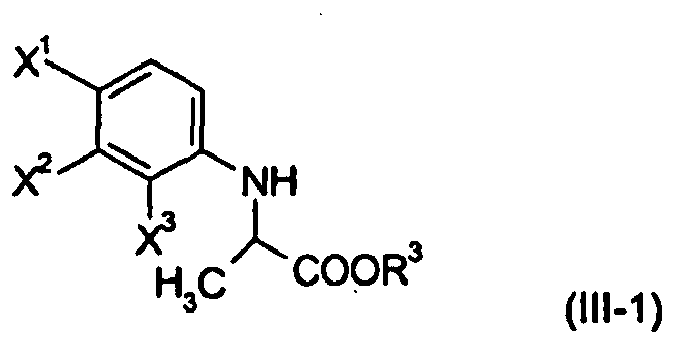
- A compound represented by formula (III-1-a):

- A compound represented by formula (III-1-b):
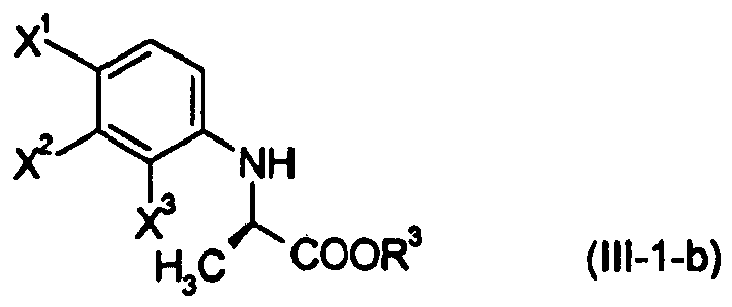
- The compound as claimed in any of claims 13 to 15 wherein R3 is a hydrogen atom, a methyl group or an ethyl group.
Applications Claiming Priority (5)
| Application Number | Priority Date | Filing Date | Title |
|---|---|---|---|
| JP25395899 | 1999-09-08 | ||
| JP27801999 | 1999-09-30 | ||
| JP2000239262 | 2000-08-08 | ||
| JP2000239256 | 2000-08-08 | ||
| EP00957001.1A EP1211254B1 (en) | 1999-09-08 | 2000-09-07 | Process for the preparation of benzoxazine derivatives and intermediates therefor |
Related Parent Applications (2)
| Application Number | Title | Priority Date | Filing Date |
|---|---|---|---|
| EP00957001.1A Division EP1211254B1 (en) | 1999-09-08 | 2000-09-07 | Process for the preparation of benzoxazine derivatives and intermediates therefor |
| EP00957001.1A Division-Into EP1211254B1 (en) | 1999-09-08 | 2000-09-07 | Process for the preparation of benzoxazine derivatives and intermediates therefor |
Publications (2)
| Publication Number | Publication Date |
|---|---|
| EP2284174A1 EP2284174A1 (en) | 2011-02-16 |
| EP2284174B1 true EP2284174B1 (en) | 2014-03-05 |
Family
ID=27478308
Family Applications (4)
| Application Number | Title | Priority Date | Filing Date |
|---|---|---|---|
| EP00957001.1A Expired - Lifetime EP1211254B1 (en) | 1999-09-08 | 2000-09-07 | Process for the preparation of benzoxazine derivatives and intermediates therefor |
| EP10163547.2A Expired - Lifetime EP2218722B9 (en) | 1999-09-08 | 2000-09-07 | Process for producing benzoxazine derivative and production intermediate thereof |
| EP10191758.1A Expired - Lifetime EP2284174B1 (en) | 1999-09-08 | 2000-09-07 | Intermediates for the preparation of benzoxazine derivatives and process for their preparation |
| EP11166796.0A Expired - Lifetime EP2360160B1 (en) | 1999-09-08 | 2000-09-07 | Intermediates and their use for producing benzoxazine derivative |
Family Applications Before (2)
| Application Number | Title | Priority Date | Filing Date |
|---|---|---|---|
| EP00957001.1A Expired - Lifetime EP1211254B1 (en) | 1999-09-08 | 2000-09-07 | Process for the preparation of benzoxazine derivatives and intermediates therefor |
| EP10163547.2A Expired - Lifetime EP2218722B9 (en) | 1999-09-08 | 2000-09-07 | Process for producing benzoxazine derivative and production intermediate thereof |
Family Applications After (1)
| Application Number | Title | Priority Date | Filing Date |
|---|---|---|---|
| EP11166796.0A Expired - Lifetime EP2360160B1 (en) | 1999-09-08 | 2000-09-07 | Intermediates and their use for producing benzoxazine derivative |
Country Status (12)
| Country | Link |
|---|---|
| US (3) | US6872823B1 (en) |
| EP (4) | EP1211254B1 (en) |
| JP (5) | JP4302350B2 (en) |
| KR (3) | KR100914396B1 (en) |
| CN (2) | CN1195759C (en) |
| AU (1) | AU6873700A (en) |
| CA (3) | CA2660917C (en) |
| ES (4) | ES2472240T3 (en) |
| HK (1) | HK1043131B (en) |
| NO (2) | NO329330B1 (en) |
| TW (1) | TWI254048B (en) |
| WO (1) | WO2001018005A1 (en) |
Families Citing this family (15)
| Publication number | Priority date | Publication date | Assignee | Title |
|---|---|---|---|---|
| KR100914396B1 (en) * | 1999-09-08 | 2009-08-31 | 다이이찌 산쿄 가부시키가이샤 | Process for the preparation of benzoxazine derivatives and intermediates therefor |
| US7425628B2 (en) * | 2001-10-03 | 2008-09-16 | Teva Pharmaceutical Industries Ltd. | Methods for the purification of levofloxacin |
| US7629458B2 (en) | 2001-10-03 | 2009-12-08 | Teva Pharmaceutical Industries Ltd. | Preparation of levofloxacin and hemihydrate thereof |
| US20090156577A1 (en) * | 2004-09-09 | 2009-06-18 | Benjamin Davis | 7-amino alkylidenyl-heterocyclic quinolones and naphthyridones |
| CN100580009C (en) * | 2005-12-31 | 2010-01-13 | 四川东材科技集团股份有限公司 | A kind of preparation method of boron-containing benzoxazine resin |
| US7902227B2 (en) | 2007-07-27 | 2011-03-08 | Janssen Pharmaceutica Nv. | C-7 isoxazolinyl quinolone / naphthyridine derivatives useful as antibacterial agents |
| CN101659669B (en) * | 2009-09-04 | 2011-07-20 | 诚达药业股份有限公司 | Method for preparing levofloxacin |
| CN101768167B (en) * | 2010-01-15 | 2012-07-04 | 浙江东亚药业有限公司 | Method for synthesizing piperazine of levofloxacin |
| CN101836993B (en) | 2010-05-20 | 2011-06-22 | 山东大学 | Application of 2,3-dihydro-3-hydroxymethyl-6-amino-[1,4]-benzoxazine in the preparation of drugs for inducing embryonic stem cells to differentiate into vascular endothelial cells |
| US10209243B2 (en) | 2010-08-05 | 2019-02-19 | Koninklijke Philips N.V. | Cardiomyocyte containing device, manufacturing method and measuring method |
| CN103360409B (en) * | 2012-04-06 | 2016-02-10 | 天方药业有限公司 | Oxygen carboxylic acid fluoride preparation method |
| KR20160003641A (en) * | 2013-04-30 | 2016-01-11 | 쓰리엠 이노베이티브 프로퍼티즈 컴파니 | Process for preparing poly(benzoxazines) |
| WO2016209063A2 (en) * | 2015-06-25 | 2016-12-29 | 고려대학교 산학협력단 | Average-density-adjustable structure, and material change and selective bonding process using same |
| US20180324299A1 (en) * | 2017-05-08 | 2018-11-08 | T-Mobile Usa, Inc. | Network-controlled robocall and scam call handling |
| CN112877217B (en) * | 2020-12-10 | 2022-04-15 | 贵州大学 | Montania fulva strain and application thereof in degrading chicken feather |
Family Cites Families (19)
| Publication number | Priority date | Publication date | Assignee | Title |
|---|---|---|---|---|
| JPS56417B2 (en) * | 1973-07-05 | 1981-01-08 | ||
| JPS5829789A (en) * | 1981-08-17 | 1983-02-22 | Dai Ichi Seiyaku Co Ltd | Pyridobenzoxazine derivative and its preparation |
| JPS5872588A (en) * | 1981-10-27 | 1983-04-30 | Dai Ichi Seiyaku Co Ltd | Production of pyrido(1,2,3-de)-1,4-benzoxazine derivative |
| NO166131C (en) * | 1985-06-20 | 1991-06-05 | Daiichi Seiyaku Co | ANALOGUE PROCEDURE FOR THE PREPARATION OF S (-) - PYRIDOBENZOKSAZINE COMPOUNDS. |
| JPH0720946B2 (en) | 1985-10-11 | 1995-03-08 | 第一製薬株式会社 | Optically active 3-methylbenzoxazine derivative and process for producing the same |
| ZA864518B (en) * | 1985-06-20 | 1987-03-25 | Daiichi Seiyaku Co | Optically active pyridobenzoxazine derivatives and intermediates thereof |
| JP2573269B2 (en) | 1986-12-25 | 1997-01-22 | 第一製薬株式会社 | Optically active benzoxazine |
| NO172846C (en) * | 1987-12-25 | 1993-09-15 | Daiichi Seiyaku Co | PROCEDURE FOR PREPARING 7,8-DIHALOGEN-3-METHYL-2,3-DIHYDRO-2M-BENZOCSAZINE DERIVATIVES AND PROPOXYBENZEN DERIVATIVES FOR EXERCISING THE PROCEDURE. |
| JP2612327B2 (en) | 1987-12-25 | 1997-05-21 | 第一製薬株式会社 | Propoxybenzene derivatives and their preparation |
| JP2769174B2 (en) | 1987-12-28 | 1998-06-25 | 第一製薬株式会社 | Production method of condensed oxazine |
| ES2014560A6 (en) * | 1988-12-30 | 1990-07-16 | Marga Investigacion | A new organosilylpolyphosphoric reagent, its preparation and application to the process of synthesis of 3-carboxyquinolones or azaquinolones and their salts. |
| JP2771871B2 (en) | 1989-12-13 | 1998-07-02 | 第一製薬株式会社 | Preparation of optically active propoxybenzene derivatives |
| KR920004385A (en) * | 1990-08-09 | 1992-03-27 | 와꾸나가 기스께 | New tricyclic compounds or salts thereof, preparation method thereof and antimicrobial agent containing same |
| DK0508307T3 (en) * | 1991-04-08 | 1995-12-27 | Sumitomo Chemical Co | Optically active secondary amine compounds, process for preparing an optically active secondary amine compound and process for producing an optically active carboxylic acid using this compound |
| JPH07501835A (en) * | 1992-10-07 | 1995-02-23 | デリバドス・デル・エチロ・ソシエダッド・アノニマ | Process for producing benzoxazine used in the synthesis of ofloxazine, levofloxazine and derivatives |
| CN1066136C (en) * | 1994-07-21 | 2001-05-23 | 中国医药研究开发中心 | Intermediate of pyrido-benzoxazine derivative and prepn. method |
| US5644056A (en) | 1995-06-07 | 1997-07-01 | Hoechst Celanese Corporation | Method of preparing 7,8-difluoro-2,3-dihydro-3-methyl-4H-1, 4-benzoxazine |
| WO1998022441A2 (en) * | 1996-11-22 | 1998-05-28 | Elan Pharmaceuticals, Inc. | N-(aryl/heteroaryl) amino acid esters, pharmaceutical compositions, and methods for inhibiting beta-amyloid peptide and/or its synthesis |
| KR100914396B1 (en) * | 1999-09-08 | 2009-08-31 | 다이이찌 산쿄 가부시키가이샤 | Process for the preparation of benzoxazine derivatives and intermediates therefor |
-
2000
- 2000-09-07 KR KR1020027003135A patent/KR100914396B1/en not_active Expired - Fee Related
- 2000-09-07 US US10/070,556 patent/US6872823B1/en not_active Expired - Fee Related
- 2000-09-07 CA CA2660917A patent/CA2660917C/en not_active Expired - Fee Related
- 2000-09-07 JP JP2001522228A patent/JP4302350B2/en not_active Expired - Lifetime
- 2000-09-07 EP EP00957001.1A patent/EP1211254B1/en not_active Expired - Lifetime
- 2000-09-07 HK HK02105100.4A patent/HK1043131B/en not_active IP Right Cessation
- 2000-09-07 ES ES00957001.1T patent/ES2472240T3/en not_active Expired - Lifetime
- 2000-09-07 EP EP10163547.2A patent/EP2218722B9/en not_active Expired - Lifetime
- 2000-09-07 ES ES10191758.1T patent/ES2458545T3/en not_active Expired - Lifetime
- 2000-09-07 CA CA2380359A patent/CA2380359C/en not_active Expired - Fee Related
- 2000-09-07 WO PCT/JP2000/006094 patent/WO2001018005A1/en not_active Ceased
- 2000-09-07 KR KR1020097024164A patent/KR100947758B1/en not_active Expired - Fee Related
- 2000-09-07 CN CNB008143838A patent/CN1195759C/en not_active Expired - Fee Related
- 2000-09-07 AU AU68737/00A patent/AU6873700A/en not_active Abandoned
- 2000-09-07 CA CA2685440A patent/CA2685440C/en not_active Expired - Fee Related
- 2000-09-07 ES ES10163547T patent/ES2409383T3/en not_active Expired - Lifetime
- 2000-09-07 EP EP10191758.1A patent/EP2284174B1/en not_active Expired - Lifetime
- 2000-09-07 EP EP11166796.0A patent/EP2360160B1/en not_active Expired - Lifetime
- 2000-09-07 KR KR1020097013092A patent/KR100954299B1/en not_active Expired - Fee Related
- 2000-09-07 CN CNB2004100323555A patent/CN100537519C/en not_active Expired - Fee Related
- 2000-09-07 ES ES11166796T patent/ES2424813T3/en not_active Expired - Lifetime
- 2000-09-08 TW TW089118428A patent/TWI254048B/en not_active IP Right Cessation
-
2002
- 2002-03-06 NO NO20021124A patent/NO329330B1/en not_active IP Right Cessation
-
2004
- 2004-08-23 US US10/922,832 patent/US7087778B2/en not_active Expired - Fee Related
-
2005
- 2005-09-14 US US11/225,058 patent/US7189847B2/en not_active Expired - Fee Related
-
2009
- 2009-03-17 JP JP2009064974A patent/JP4358296B2/en not_active Expired - Lifetime
- 2009-03-17 JP JP2009064973A patent/JP4358295B2/en not_active Expired - Lifetime
- 2009-05-18 JP JP2009120140A patent/JP5149238B2/en not_active Expired - Lifetime
- 2009-05-18 JP JP2009120139A patent/JP5106478B2/en not_active Expired - Lifetime
-
2010
- 2010-05-07 NO NO20100667A patent/NO330090B1/en not_active IP Right Cessation
Also Published As
Similar Documents
| Publication | Publication Date | Title |
|---|---|---|
| JP4358296B2 (en) | Process for producing benzoxazine derivative and its intermediate | |
| JPWO2001018005A1 (en) | Method for producing benzoxazine derivatives and intermediates therefor | |
| EP1367132B1 (en) | Process for preparation of optically active propoxyaniline derivatives | |
| CN100432060C (en) | Process for producing benzoxazine derivative and production intermediate thereof | |
| RU2258069C2 (en) | Methods for preparing benzoxazine derivative, methods for preparing its intermediate compound and intermediate compounds | |
| CN101321875B (en) | Preparation of (R)- and (S)-4-(1- Ammonium ethyl) methyl benzoate sulfate method | |
| JP2001163841A (en) | Method for producing optically active 2-(2,3,4- trihalogenoanilino)-propionic acid derivative | |
| JP2009114065A (en) | Method for producing (2r,3r) and (2s,3s)-3-phenylisoserine derivative |
Legal Events
| Date | Code | Title | Description |
|---|---|---|---|
| PUAI | Public reference made under article 153(3) epc to a published international application that has entered the european phase |
Free format text: ORIGINAL CODE: 0009012 |
|
| AC | Divisional application: reference to earlier application |
Ref document number: 1211254 Country of ref document: EP Kind code of ref document: P |
|
| AK | Designated contracting states |
Kind code of ref document: A1 Designated state(s): AT BE CH CY DE DK ES FI FR GB GR IE IT LI LU MC NL PT SE |
|
| 17P | Request for examination filed |
Effective date: 20110616 |
|
| GRAP | Despatch of communication of intention to grant a patent |
Free format text: ORIGINAL CODE: EPIDOSNIGR1 |
|
| RIC1 | Information provided on ipc code assigned before grant |
Ipc: A61K 31/5383 20060101ALI20130123BHEP Ipc: A61P 31/04 20060101ALI20130123BHEP Ipc: C07C 227/34 20060101ALI20130123BHEP Ipc: C07C 215/16 20060101ALI20130123BHEP Ipc: C07D 265/36 20060101ALI20130123BHEP Ipc: C07C 213/00 20060101ALI20130123BHEP Ipc: C07D 498/06 20060101AFI20130123BHEP Ipc: C12P 13/00 20060101ALI20130123BHEP Ipc: C07C 229/18 20060101ALI20130123BHEP Ipc: C07C 229/30 20060101ALI20130123BHEP Ipc: C07C 227/06 20060101ALI20130123BHEP |
|
| 17Q | First examination report despatched |
Effective date: 20130625 |
|
| GRAP | Despatch of communication of intention to grant a patent |
Free format text: ORIGINAL CODE: EPIDOSNIGR1 |
|
| INTG | Intention to grant announced |
Effective date: 20130903 |
|
| GRAS | Grant fee paid |
Free format text: ORIGINAL CODE: EPIDOSNIGR3 |
|
| GRAA | (expected) grant |
Free format text: ORIGINAL CODE: 0009210 |
|
| AC | Divisional application: reference to earlier application |
Ref document number: 1211254 Country of ref document: EP Kind code of ref document: P |
|
| AK | Designated contracting states |
Kind code of ref document: B1 Designated state(s): AT BE CH CY DE DK ES FI FR GB GR IE IT LI LU MC NL PT SE |
|
| REG | Reference to a national code |
Ref country code: GB Ref legal event code: FG4D |
|
| REG | Reference to a national code |
Ref country code: CH Ref legal event code: EP |
|
| REG | Reference to a national code |
Ref country code: AT Ref legal event code: REF Ref document number: 654811 Country of ref document: AT Kind code of ref document: T Effective date: 20140315 |
|
| REG | Reference to a national code |
Ref country code: IE Ref legal event code: FG4D |
|
| REG | Reference to a national code |
Ref country code: DE Ref legal event code: R096 Ref document number: 60048471 Country of ref document: DE Effective date: 20140417 |
|
| REG | Reference to a national code |
Ref country code: ES Ref legal event code: FG2A Ref document number: 2458545 Country of ref document: ES Kind code of ref document: T3 Effective date: 20140506 |
|
| REG | Reference to a national code |
Ref country code: CH Ref legal event code: NV Representative=s name: BOVARD AG, CH |
|
| REG | Reference to a national code |
Ref country code: AT Ref legal event code: MK05 Ref document number: 654811 Country of ref document: AT Kind code of ref document: T Effective date: 20140305 |
|
| REG | Reference to a national code |
Ref country code: NL Ref legal event code: VDEP Effective date: 20140305 |
|
| PG25 | Lapsed in a contracting state [announced via postgrant information from national office to epo] |
Ref country code: AT Free format text: LAPSE BECAUSE OF FAILURE TO SUBMIT A TRANSLATION OF THE DESCRIPTION OR TO PAY THE FEE WITHIN THE PRESCRIBED TIME-LIMIT Effective date: 20140305 Ref country code: CY Free format text: LAPSE BECAUSE OF FAILURE TO SUBMIT A TRANSLATION OF THE DESCRIPTION OR TO PAY THE FEE WITHIN THE PRESCRIBED TIME-LIMIT Effective date: 20140305 Ref country code: SE Free format text: LAPSE BECAUSE OF FAILURE TO SUBMIT A TRANSLATION OF THE DESCRIPTION OR TO PAY THE FEE WITHIN THE PRESCRIBED TIME-LIMIT Effective date: 20140305 Ref country code: FI Free format text: LAPSE BECAUSE OF FAILURE TO SUBMIT A TRANSLATION OF THE DESCRIPTION OR TO PAY THE FEE WITHIN THE PRESCRIBED TIME-LIMIT Effective date: 20140305 |
|
| PG25 | Lapsed in a contracting state [announced via postgrant information from national office to epo] |
Ref country code: BE Free format text: LAPSE BECAUSE OF FAILURE TO SUBMIT A TRANSLATION OF THE DESCRIPTION OR TO PAY THE FEE WITHIN THE PRESCRIBED TIME-LIMIT Effective date: 20140305 Ref country code: NL Free format text: LAPSE BECAUSE OF FAILURE TO SUBMIT A TRANSLATION OF THE DESCRIPTION OR TO PAY THE FEE WITHIN THE PRESCRIBED TIME-LIMIT Effective date: 20140305 |
|
| PGFP | Annual fee paid to national office [announced via postgrant information from national office to epo] |
Ref country code: CH Payment date: 20140903 Year of fee payment: 15 |
|
| PGFP | Annual fee paid to national office [announced via postgrant information from national office to epo] |
Ref country code: FR Payment date: 20140811 Year of fee payment: 15 Ref country code: GB Payment date: 20140903 Year of fee payment: 15 |
|
| REG | Reference to a national code |
Ref country code: DE Ref legal event code: R097 Ref document number: 60048471 Country of ref document: DE |
|
| PG25 | Lapsed in a contracting state [announced via postgrant information from national office to epo] |
Ref country code: PT Free format text: LAPSE BECAUSE OF FAILURE TO SUBMIT A TRANSLATION OF THE DESCRIPTION OR TO PAY THE FEE WITHIN THE PRESCRIBED TIME-LIMIT Effective date: 20140707 |
|
| PLBE | No opposition filed within time limit |
Free format text: ORIGINAL CODE: 0009261 |
|
| STAA | Information on the status of an ep patent application or granted ep patent |
Free format text: STATUS: NO OPPOSITION FILED WITHIN TIME LIMIT |
|
| PG25 | Lapsed in a contracting state [announced via postgrant information from national office to epo] |
Ref country code: DK Free format text: LAPSE BECAUSE OF FAILURE TO SUBMIT A TRANSLATION OF THE DESCRIPTION OR TO PAY THE FEE WITHIN THE PRESCRIBED TIME-LIMIT Effective date: 20140305 |
|
| PGFP | Annual fee paid to national office [announced via postgrant information from national office to epo] |
Ref country code: DE Payment date: 20140930 Year of fee payment: 15 |
|
| 26N | No opposition filed |
Effective date: 20141208 |
|
| REG | Reference to a national code |
Ref country code: DE Ref legal event code: R097 Ref document number: 60048471 Country of ref document: DE Effective date: 20141208 |
|
| PG25 | Lapsed in a contracting state [announced via postgrant information from national office to epo] |
Ref country code: LU Free format text: LAPSE BECAUSE OF FAILURE TO SUBMIT A TRANSLATION OF THE DESCRIPTION OR TO PAY THE FEE WITHIN THE PRESCRIBED TIME-LIMIT Effective date: 20140907 Ref country code: MC Free format text: LAPSE BECAUSE OF FAILURE TO SUBMIT A TRANSLATION OF THE DESCRIPTION OR TO PAY THE FEE WITHIN THE PRESCRIBED TIME-LIMIT Effective date: 20140305 |
|
| REG | Reference to a national code |
Ref country code: DE Ref legal event code: R119 Ref document number: 60048471 Country of ref document: DE |
|
| REG | Reference to a national code |
Ref country code: CH Ref legal event code: PL |
|
| GBPC | Gb: european patent ceased through non-payment of renewal fee |
Effective date: 20150907 |
|
| PG25 | Lapsed in a contracting state [announced via postgrant information from national office to epo] |
Ref country code: GR Free format text: LAPSE BECAUSE OF FAILURE TO SUBMIT A TRANSLATION OF THE DESCRIPTION OR TO PAY THE FEE WITHIN THE PRESCRIBED TIME-LIMIT Effective date: 20140606 |
|
| REG | Reference to a national code |
Ref country code: FR Ref legal event code: ST Effective date: 20160531 |
|
| PG25 | Lapsed in a contracting state [announced via postgrant information from national office to epo] |
Ref country code: DE Free format text: LAPSE BECAUSE OF NON-PAYMENT OF DUE FEES Effective date: 20160401 Ref country code: CH Free format text: LAPSE BECAUSE OF NON-PAYMENT OF DUE FEES Effective date: 20150930 Ref country code: LI Free format text: LAPSE BECAUSE OF NON-PAYMENT OF DUE FEES Effective date: 20150930 Ref country code: GB Free format text: LAPSE BECAUSE OF NON-PAYMENT OF DUE FEES Effective date: 20150907 |
|
| PG25 | Lapsed in a contracting state [announced via postgrant information from national office to epo] |
Ref country code: FR Free format text: LAPSE BECAUSE OF NON-PAYMENT OF DUE FEES Effective date: 20150930 |
|
| PGFP | Annual fee paid to national office [announced via postgrant information from national office to epo] |
Ref country code: IT Payment date: 20160921 Year of fee payment: 17 Ref country code: IE Payment date: 20160909 Year of fee payment: 17 |
|
| PGFP | Annual fee paid to national office [announced via postgrant information from national office to epo] |
Ref country code: ES Payment date: 20160810 Year of fee payment: 17 |
|
| REG | Reference to a national code |
Ref country code: IE Ref legal event code: MM4A |
|
| PG25 | Lapsed in a contracting state [announced via postgrant information from national office to epo] |
Ref country code: IE Free format text: LAPSE BECAUSE OF NON-PAYMENT OF DUE FEES Effective date: 20170907 |
|
| PG25 | Lapsed in a contracting state [announced via postgrant information from national office to epo] |
Ref country code: IT Free format text: LAPSE BECAUSE OF NON-PAYMENT OF DUE FEES Effective date: 20170907 |
|
| REG | Reference to a national code |
Ref country code: ES Ref legal event code: FD2A Effective date: 20181019 |
|
| PG25 | Lapsed in a contracting state [announced via postgrant information from national office to epo] |
Ref country code: ES Free format text: LAPSE BECAUSE OF NON-PAYMENT OF DUE FEES Effective date: 20170908 |