EP0619311A1 - Process for obtaining benzoxazines useful for the synthesis of ofloxacin, levofloxacin and derivatives thereof - Google Patents
Process for obtaining benzoxazines useful for the synthesis of ofloxacin, levofloxacin and derivatives thereof Download PDFInfo
- Publication number
- EP0619311A1 EP0619311A1 EP93921930A EP93921930A EP0619311A1 EP 0619311 A1 EP0619311 A1 EP 0619311A1 EP 93921930 A EP93921930 A EP 93921930A EP 93921930 A EP93921930 A EP 93921930A EP 0619311 A1 EP0619311 A1 EP 0619311A1
- Authority
- EP
- European Patent Office
- Prior art keywords
- formula
- methyl
- difluoro
- solvent
- adequate
- Prior art date
- Legal status (The legal status is an assumption and is not a legal conclusion. Google has not performed a legal analysis and makes no representation as to the accuracy of the status listed.)
- Withdrawn
Links
- 238000000034 method Methods 0.000 title claims abstract description 31
- GSDSWSVVBLHKDQ-UHFFFAOYSA-N 9-fluoro-3-methyl-10-(4-methylpiperazin-1-yl)-7-oxo-2,3-dihydro-7H-[1,4]oxazino[2,3,4-ij]quinoline-6-carboxylic acid Chemical compound FC1=CC(C(C(C(O)=O)=C2)=O)=C3N2C(C)COC3=C1N1CCN(C)CC1 GSDSWSVVBLHKDQ-UHFFFAOYSA-N 0.000 title claims abstract description 10
- 229960001699 ofloxacin Drugs 0.000 title claims abstract description 8
- 150000005130 benzoxazines Chemical class 0.000 title claims abstract description 7
- GSDSWSVVBLHKDQ-JTQLQIEISA-N Levofloxacin Chemical compound C([C@@H](N1C2=C(C(C(C(O)=O)=C1)=O)C=C1F)C)OC2=C1N1CCN(C)CC1 GSDSWSVVBLHKDQ-JTQLQIEISA-N 0.000 title claims abstract description 6
- 230000015572 biosynthetic process Effects 0.000 title abstract description 24
- 238000003786 synthesis reaction Methods 0.000 title abstract description 19
- 229960003376 levofloxacin Drugs 0.000 title abstract 3
- 150000001875 compounds Chemical class 0.000 claims abstract description 28
- 238000006243 chemical reaction Methods 0.000 claims abstract description 23
- 125000004432 carbon atom Chemical group C* 0.000 claims abstract description 13
- RIOQSEWOXXDEQQ-UHFFFAOYSA-N triphenylphosphine Chemical compound C1=CC=CC=C1P(C=1C=CC=CC=1)C1=CC=CC=C1 RIOQSEWOXXDEQQ-UHFFFAOYSA-N 0.000 claims abstract description 11
- 125000003118 aryl group Chemical group 0.000 claims abstract description 6
- 125000001495 ethyl group Chemical group [H]C([H])([H])C([H])([H])* 0.000 claims abstract description 6
- 125000005843 halogen group Chemical group 0.000 claims abstract description 6
- 125000000217 alkyl group Chemical group 0.000 claims abstract description 3
- 239000002904 solvent Substances 0.000 claims description 20
- WFDIJRYMOXRFFG-UHFFFAOYSA-N Acetic anhydride Chemical compound CC(=O)OC(C)=O WFDIJRYMOXRFFG-UHFFFAOYSA-N 0.000 claims description 12
- 125000002496 methyl group Chemical group [H]C([H])([H])* 0.000 claims description 9
- SLFZEYOJLHGFNL-UHFFFAOYSA-N OC(=O)C(=C)C(O)=O.CCN(CC)C1=CC=C(F)C(F)=C1O Chemical compound OC(=O)C(=C)C(O)=O.CCN(CC)C1=CC=C(F)C(F)=C1O SLFZEYOJLHGFNL-UHFFFAOYSA-N 0.000 claims description 8
- PVOAHINGSUIXLS-UHFFFAOYSA-N 1-Methylpiperazine Chemical compound CN1CCNCC1 PVOAHINGSUIXLS-UHFFFAOYSA-N 0.000 claims description 6
- 239000003054 catalyst Substances 0.000 claims description 6
- 239000002253 acid Substances 0.000 claims description 5
- -1 diethyl (7,8-difluoro-3(S)-methyl-2,3-dihydro-4H-[1,4]benzoxazine-4-yl) methylenmalonate Chemical compound 0.000 claims description 4
- 229910052731 fluorine Inorganic materials 0.000 claims description 4
- 239000011737 fluorine Substances 0.000 claims description 4
- 239000012442 inert solvent Substances 0.000 claims description 4
- MHCFAGZWMAWTNR-UHFFFAOYSA-M lithium perchlorate Chemical compound [Li+].[O-]Cl(=O)(=O)=O MHCFAGZWMAWTNR-UHFFFAOYSA-M 0.000 claims description 4
- 229910001486 lithium perchlorate Inorganic materials 0.000 claims description 4
- 239000002798 polar solvent Substances 0.000 claims description 4
- 230000002378 acidificating effect Effects 0.000 claims description 3
- QQONPFPTGQHPMA-UHFFFAOYSA-N propylene Natural products CC=C QQONPFPTGQHPMA-UHFFFAOYSA-N 0.000 claims description 3
- 125000004805 propylene group Chemical group [H]C([H])([H])C([H])([*:1])C([H])([H])[*:2] 0.000 claims description 3
- 239000002841 Lewis acid Substances 0.000 claims description 2
- KEAYESYHFKHZAL-UHFFFAOYSA-N Sodium Chemical compound [Na] KEAYESYHFKHZAL-UHFFFAOYSA-N 0.000 claims description 2
- FAMRKDQNMBBFBR-BQYQJAHWSA-N diethyl azodicarboxylate Chemical compound CCOC(=O)\N=N\C(=O)OCC FAMRKDQNMBBFBR-BQYQJAHWSA-N 0.000 claims description 2
- 150000007517 lewis acids Chemical class 0.000 claims description 2
- OTCKOJUMXQWKQG-UHFFFAOYSA-L magnesium bromide Chemical compound [Mg+2].[Br-].[Br-] OTCKOJUMXQWKQG-UHFFFAOYSA-L 0.000 claims description 2
- 229910001623 magnesium bromide Inorganic materials 0.000 claims description 2
- 239000012312 sodium hydride Substances 0.000 claims description 2
- 229910000104 sodium hydride Inorganic materials 0.000 claims description 2
- 150000002118 epoxides Chemical class 0.000 claims 3
- WTEOIRVLGSZEPR-UHFFFAOYSA-N boron trifluoride Chemical compound FB(F)F WTEOIRVLGSZEPR-UHFFFAOYSA-N 0.000 claims 2
- VNDYJBBGRKZCSX-UHFFFAOYSA-L zinc bromide Chemical compound Br[Zn]Br VNDYJBBGRKZCSX-UHFFFAOYSA-L 0.000 claims 2
- 229910015900 BF3 Inorganic materials 0.000 claims 1
- FSUQLIXTGFKZHW-UHFFFAOYSA-N C=C(C(=O)O)C(=O)O.C(C)N(C1=C(C(=C(C=C1)F)F)OCC(C)O)CC Chemical compound C=C(C(=O)O)C(=O)O.C(C)N(C1=C(C(=C(C=C1)F)F)OCC(C)O)CC FSUQLIXTGFKZHW-UHFFFAOYSA-N 0.000 claims 1
- YCKRFDGAMUMZLT-UHFFFAOYSA-N Fluorine atom Chemical compound [F] YCKRFDGAMUMZLT-UHFFFAOYSA-N 0.000 claims 1
- 238000005903 acid hydrolysis reaction Methods 0.000 claims 1
- FAMRKDQNMBBFBR-UHFFFAOYSA-N ethyl n-ethoxycarbonyliminocarbamate Chemical compound CCOC(=O)N=NC(=O)OCC FAMRKDQNMBBFBR-UHFFFAOYSA-N 0.000 claims 1
- 229940102001 zinc bromide Drugs 0.000 claims 1
- 239000000543 intermediate Substances 0.000 abstract description 7
- 239000004599 antimicrobial Substances 0.000 abstract description 2
- 239000004593 Epoxy Substances 0.000 abstract 2
- 125000002947 alkylene group Chemical group 0.000 abstract 1
- 125000005604 azodicarboxylate group Chemical group 0.000 abstract 1
- 239000012467 final product Substances 0.000 abstract 1
- 229910052736 halogen Inorganic materials 0.000 abstract 1
- 229960001180 norfloxacin Drugs 0.000 abstract 1
- IMNFDUFMRHMDMM-UHFFFAOYSA-N N-Heptane Chemical compound CCCCCCC IMNFDUFMRHMDMM-UHFFFAOYSA-N 0.000 description 21
- VLKZOEOYAKHREP-UHFFFAOYSA-N n-Hexane Chemical compound CCCCCC VLKZOEOYAKHREP-UHFFFAOYSA-N 0.000 description 20
- RTZKZFJDLAIYFH-UHFFFAOYSA-N Diethyl ether Chemical compound CCOCC RTZKZFJDLAIYFH-UHFFFAOYSA-N 0.000 description 18
- 239000000047 product Substances 0.000 description 17
- 239000000243 solution Substances 0.000 description 17
- HEDRZPFGACZZDS-MICDWDOJSA-N Trichloro(2H)methane Chemical compound [2H]C(Cl)(Cl)Cl HEDRZPFGACZZDS-MICDWDOJSA-N 0.000 description 14
- WYURNTSHIVDZCO-UHFFFAOYSA-N Tetrahydrofuran Chemical compound C1CCOC1 WYURNTSHIVDZCO-UHFFFAOYSA-N 0.000 description 11
- CFLBIADORGSMCX-UHFFFAOYSA-N 2h-1,4-benzoxazine-6-carboxylic acid Chemical compound O1CC=NC2=CC(C(=O)O)=CC=C21 CFLBIADORGSMCX-UHFFFAOYSA-N 0.000 description 9
- ZMANZCXQSJIPKH-UHFFFAOYSA-N Triethylamine Chemical compound CCN(CC)CC ZMANZCXQSJIPKH-UHFFFAOYSA-N 0.000 description 9
- KRURHZHJEDNBCM-UHFFFAOYSA-N 6-amino-2,3-difluorophenol Chemical compound NC1=CC=C(F)C(F)=C1O KRURHZHJEDNBCM-UHFFFAOYSA-N 0.000 description 8
- CSNNHWWHGAXBCP-UHFFFAOYSA-L Magnesium sulfate Chemical compound [Mg+2].[O-][S+2]([O-])([O-])[O-] CSNNHWWHGAXBCP-UHFFFAOYSA-L 0.000 description 8
- 239000000203 mixture Substances 0.000 description 8
- XNIVKSPSCYJKBL-UHFFFAOYSA-N 2h-1,2-benzoxazine-6-carboxylic acid Chemical compound O1NC=CC2=CC(C(=O)O)=CC=C21 XNIVKSPSCYJKBL-UHFFFAOYSA-N 0.000 description 7
- 150000002924 oxiranes Chemical class 0.000 description 7
- 239000002244 precipitate Substances 0.000 description 7
- 239000011541 reaction mixture Substances 0.000 description 7
- VOLGAXAGEUPBDM-UHFFFAOYSA-N $l^{1}-oxidanylethane Chemical compound CC[O] VOLGAXAGEUPBDM-UHFFFAOYSA-N 0.000 description 6
- 238000005160 1H NMR spectroscopy Methods 0.000 description 6
- HEDRZPFGACZZDS-UHFFFAOYSA-N Chloroform Chemical compound ClC(Cl)Cl HEDRZPFGACZZDS-UHFFFAOYSA-N 0.000 description 6
- IAZDPXIOMUYVGZ-UHFFFAOYSA-N Dimethylsulphoxide Chemical compound CS(C)=O IAZDPXIOMUYVGZ-UHFFFAOYSA-N 0.000 description 6
- XEKOWRVHYACXOJ-UHFFFAOYSA-N Ethyl acetate Chemical compound CCOC(C)=O XEKOWRVHYACXOJ-UHFFFAOYSA-N 0.000 description 6
- HEMHJVSKTPXQMS-UHFFFAOYSA-M Sodium hydroxide Chemical compound [OH-].[Na+] HEMHJVSKTPXQMS-UHFFFAOYSA-M 0.000 description 6
- 125000003277 amino group Chemical group 0.000 description 6
- 229960001760 dimethyl sulfoxide Drugs 0.000 description 6
- WIUZQRIAAKGULG-UHFFFAOYSA-N tert-butyl n-(3,4-difluorophenyl)carbamate Chemical compound CC(C)(C)OC(=O)NC1=CC=C(F)C(F)=C1 WIUZQRIAAKGULG-UHFFFAOYSA-N 0.000 description 6
- XLYOFNOQVPJJNP-UHFFFAOYSA-N water Substances O XLYOFNOQVPJJNP-UHFFFAOYSA-N 0.000 description 6
- FLGXVDIVLMMNJY-UHFFFAOYSA-N 3,4-difluoro-2-hydroxy-n-[(2-methylpropan-2-yl)oxy]benzamide Chemical compound CC(C)(C)ONC(=O)C1=CC=C(F)C(F)=C1O FLGXVDIVLMMNJY-UHFFFAOYSA-N 0.000 description 5
- QTBSBXVTEAMEQO-UHFFFAOYSA-N Acetic acid Chemical compound CC(O)=O QTBSBXVTEAMEQO-UHFFFAOYSA-N 0.000 description 5
- VEXZGXHMUGYJMC-UHFFFAOYSA-N Hydrochloric acid Chemical compound Cl VEXZGXHMUGYJMC-UHFFFAOYSA-N 0.000 description 5
- 125000004177 diethyl group Chemical group [H]C([H])([H])C([H])([H])* 0.000 description 5
- 238000000746 purification Methods 0.000 description 5
- UUFQTNFCRMXOAE-UHFFFAOYSA-N 1-methylmethylene Chemical compound C[CH] UUFQTNFCRMXOAE-UHFFFAOYSA-N 0.000 description 4
- PAYRUJLWNCNPSJ-UHFFFAOYSA-N Aniline Chemical compound NC1=CC=CC=C1 PAYRUJLWNCNPSJ-UHFFFAOYSA-N 0.000 description 4
- LFQSCWFLJHTTHZ-UHFFFAOYSA-N Ethanol Chemical compound CCO LFQSCWFLJHTTHZ-UHFFFAOYSA-N 0.000 description 4
- GLUUGHFHXGJENI-UHFFFAOYSA-N Piperazine Chemical compound C1CNCCN1 GLUUGHFHXGJENI-UHFFFAOYSA-N 0.000 description 4
- 230000000845 anti-microbial effect Effects 0.000 description 4
- 229910052943 magnesium sulfate Inorganic materials 0.000 description 4
- 235000019341 magnesium sulphate Nutrition 0.000 description 4
- 239000012044 organic layer Substances 0.000 description 4
- 239000007787 solid Substances 0.000 description 4
- AXNUZKSSQHTNPZ-UHFFFAOYSA-N 3,4-difluoroaniline Chemical compound NC1=CC=C(F)C(F)=C1 AXNUZKSSQHTNPZ-UHFFFAOYSA-N 0.000 description 3
- HBAQYPYDRFILMT-UHFFFAOYSA-N 8-[3-(1-cyclopropylpyrazol-4-yl)-1H-pyrazolo[4,3-d]pyrimidin-5-yl]-3-methyl-3,8-diazabicyclo[3.2.1]octan-2-one Chemical class C1(CC1)N1N=CC(=C1)C1=NNC2=C1N=C(N=C2)N1C2C(N(CC1CC2)C)=O HBAQYPYDRFILMT-UHFFFAOYSA-N 0.000 description 3
- WEVYAHXRMPXWCK-UHFFFAOYSA-N Acetonitrile Chemical compound CC#N WEVYAHXRMPXWCK-UHFFFAOYSA-N 0.000 description 3
- PXGOKWXKJXAPGV-UHFFFAOYSA-N Fluorine Chemical compound FF PXGOKWXKJXAPGV-UHFFFAOYSA-N 0.000 description 3
- OKKJLVBELUTLKV-UHFFFAOYSA-N Methanol Chemical compound OC OKKJLVBELUTLKV-UHFFFAOYSA-N 0.000 description 3
- 230000001351 cycling effect Effects 0.000 description 3
- 238000004821 distillation Methods 0.000 description 3
- 238000003818 flash chromatography Methods 0.000 description 3
- 238000010438 heat treatment Methods 0.000 description 3
- 238000002360 preparation method Methods 0.000 description 3
- PSZAEHPBBUYICS-UHFFFAOYSA-N 2-methylidenepropanedioic acid Chemical compound OC(=O)C(=C)C(O)=O PSZAEHPBBUYICS-UHFFFAOYSA-N 0.000 description 2
- QTBSBXVTEAMEQO-UHFFFAOYSA-M Acetate Chemical compound CC([O-])=O QTBSBXVTEAMEQO-UHFFFAOYSA-M 0.000 description 2
- YMWUJEATGCHHMB-UHFFFAOYSA-N Dichloromethane Chemical compound ClCCl YMWUJEATGCHHMB-UHFFFAOYSA-N 0.000 description 2
- SMWDFEZZVXVKRB-UHFFFAOYSA-N Quinoline Chemical group N1=CC=CC2=CC=CC=C21 SMWDFEZZVXVKRB-UHFFFAOYSA-N 0.000 description 2
- PMZURENOXWZQFD-UHFFFAOYSA-L Sodium Sulfate Chemical compound [Na+].[Na+].[O-]S([O-])(=O)=O PMZURENOXWZQFD-UHFFFAOYSA-L 0.000 description 2
- UIIMBOGNXHQVGW-UHFFFAOYSA-M Sodium bicarbonate Chemical compound [Na+].OC([O-])=O UIIMBOGNXHQVGW-UHFFFAOYSA-M 0.000 description 2
- QAOWNCQODCNURD-UHFFFAOYSA-N Sulfuric acid Chemical compound OS(O)(=O)=O QAOWNCQODCNURD-UHFFFAOYSA-N 0.000 description 2
- 229960000583 acetic acid Drugs 0.000 description 2
- 230000007059 acute toxicity Effects 0.000 description 2
- 231100000403 acute toxicity Toxicity 0.000 description 2
- 238000013019 agitation Methods 0.000 description 2
- 239000012300 argon atmosphere Substances 0.000 description 2
- 238000000354 decomposition reaction Methods 0.000 description 2
- 238000010511 deprotection reaction Methods 0.000 description 2
- ZFTFAPZRGNKQPU-UHFFFAOYSA-N dicarbonic acid Chemical compound OC(=O)OC(O)=O ZFTFAPZRGNKQPU-UHFFFAOYSA-N 0.000 description 2
- LTMHNWPUDSTBKD-UHFFFAOYSA-N diethyl 2-(ethoxymethylidene)propanedioate Chemical compound CCOC=C(C(=O)OCC)C(=O)OCC LTMHNWPUDSTBKD-UHFFFAOYSA-N 0.000 description 2
- 238000001914 filtration Methods 0.000 description 2
- 235000011167 hydrochloric acid Nutrition 0.000 description 2
- 230000007062 hydrolysis Effects 0.000 description 2
- 238000006460 hydrolysis reaction Methods 0.000 description 2
- 238000007122 ortho-metalation reaction Methods 0.000 description 2
- 238000010992 reflux Methods 0.000 description 2
- WRECIMRULFAWHA-UHFFFAOYSA-N trimethyl borate Chemical compound COB(OC)OC WRECIMRULFAWHA-UHFFFAOYSA-N 0.000 description 2
- ZQXCQTAELHSNAT-UHFFFAOYSA-N 1-chloro-3-nitro-5-(trifluoromethyl)benzene Chemical compound [O-][N+](=O)C1=CC(Cl)=CC(C(F)(F)F)=C1 ZQXCQTAELHSNAT-UHFFFAOYSA-N 0.000 description 1
- MEKOFIRRDATTAG-UHFFFAOYSA-N 2,2,5,8-tetramethyl-3,4-dihydrochromen-6-ol Chemical compound C1CC(C)(C)OC2=C1C(C)=C(O)C=C2C MEKOFIRRDATTAG-UHFFFAOYSA-N 0.000 description 1
- CMLFRMDBDNHMRA-UHFFFAOYSA-N 2h-1,2-benzoxazine Chemical class C1=CC=C2C=CNOC2=C1 CMLFRMDBDNHMRA-UHFFFAOYSA-N 0.000 description 1
- FGUUSXIOTUKUDN-IBGZPJMESA-N C1(=CC=CC=C1)N1C2=C(NC([C@H](C1)NC=1OC(=NN=1)C1=CC=CC=C1)=O)C=CC=C2 Chemical compound C1(=CC=CC=C1)N1C2=C(NC([C@H](C1)NC=1OC(=NN=1)C1=CC=CC=C1)=O)C=CC=C2 FGUUSXIOTUKUDN-IBGZPJMESA-N 0.000 description 1
- OOQVBBNTNKHXSN-UHFFFAOYSA-N CC1C(C)C(C)C(C)CC1 Chemical compound CC1C(C)C(C)C(C)CC1 OOQVBBNTNKHXSN-UHFFFAOYSA-N 0.000 description 1
- BQNSKGIZNUXKRR-UHFFFAOYSA-K F[Zn](F)F.Br Chemical compound F[Zn](F)F.Br BQNSKGIZNUXKRR-UHFFFAOYSA-K 0.000 description 1
- 241000699670 Mus sp. Species 0.000 description 1
- MZRVEZGGRBJDDB-UHFFFAOYSA-N N-Butyllithium Chemical compound [Li]CCCC MZRVEZGGRBJDDB-UHFFFAOYSA-N 0.000 description 1
- ISWSIDIOOBJBQZ-UHFFFAOYSA-N Phenol Chemical compound OC1=CC=CC=C1 ISWSIDIOOBJBQZ-UHFFFAOYSA-N 0.000 description 1
- XBDQKXXYIPTUBI-UHFFFAOYSA-N Propionic acid Chemical compound CCC(O)=O XBDQKXXYIPTUBI-UHFFFAOYSA-N 0.000 description 1
- GOOHAUXETOMSMM-UHFFFAOYSA-N Propylene oxide Chemical compound CC1CO1 GOOHAUXETOMSMM-UHFFFAOYSA-N 0.000 description 1
- GOOHAUXETOMSMM-GSVOUGTGSA-N R-propylene oxide Chemical compound C[C@@H]1CO1 GOOHAUXETOMSMM-GSVOUGTGSA-N 0.000 description 1
- 150000007513 acids Chemical class 0.000 description 1
- 150000001335 aliphatic alkanes Chemical group 0.000 description 1
- 150000001336 alkenes Chemical group 0.000 description 1
- 238000004458 analytical method Methods 0.000 description 1
- 230000000844 anti-bacterial effect Effects 0.000 description 1
- 239000000010 aprotic solvent Substances 0.000 description 1
- 239000007864 aqueous solution Substances 0.000 description 1
- 239000002981 blocking agent Substances 0.000 description 1
- 238000009835 boiling Methods 0.000 description 1
- 244000309464 bull Species 0.000 description 1
- 229910052799 carbon Inorganic materials 0.000 description 1
- 238000010959 commercial synthesis reaction Methods 0.000 description 1
- 239000013078 crystal Substances 0.000 description 1
- 238000010908 decantation Methods 0.000 description 1
- AOBOMOUUYYHMOX-UHFFFAOYSA-N diethylboron Chemical compound CC[B]CC AOBOMOUUYYHMOX-UHFFFAOYSA-N 0.000 description 1
- 239000003814 drug Substances 0.000 description 1
- 229940079593 drug Drugs 0.000 description 1
- 230000000694 effects Effects 0.000 description 1
- 238000010931 ester hydrolysis Methods 0.000 description 1
- 150000002148 esters Chemical class 0.000 description 1
- 239000012259 ether extract Substances 0.000 description 1
- 125000001033 ether group Chemical group 0.000 description 1
- 150000002170 ethers Chemical class 0.000 description 1
- JXMLAPZRDDWRRV-UHFFFAOYSA-N ethyl n-(ethoxycarbonylamino)carbamate Chemical compound CCOC(=O)NNC(=O)OCC JXMLAPZRDDWRRV-UHFFFAOYSA-N 0.000 description 1
- 239000000284 extract Substances 0.000 description 1
- 238000000605 extraction Methods 0.000 description 1
- 239000012362 glacial acetic acid Substances 0.000 description 1
- 238000001990 intravenous administration Methods 0.000 description 1
- 125000001449 isopropyl group Chemical group [H]C([H])([H])C([H])(*)C([H])([H])[H] 0.000 description 1
- 239000010410 layer Substances 0.000 description 1
- 239000007788 liquid Substances 0.000 description 1
- 238000012986 modification Methods 0.000 description 1
- 230000004048 modification Effects 0.000 description 1
- 239000003960 organic solvent Substances 0.000 description 1
- 230000003647 oxidation Effects 0.000 description 1
- 238000007254 oxidation reaction Methods 0.000 description 1
- 125000001997 phenyl group Chemical group [H]C1=C([H])C([H])=C(*)C([H])=C1[H] 0.000 description 1
- 239000000843 powder Substances 0.000 description 1
- 150000008383 propoxybenzenes Chemical class 0.000 description 1
- 125000001436 propyl group Chemical group [H]C([*])([H])C([H])([H])C([H])([H])[H] 0.000 description 1
- 125000006239 protecting group Chemical group 0.000 description 1
- 150000007660 quinolones Chemical class 0.000 description 1
- 238000001953 recrystallisation Methods 0.000 description 1
- 238000011160 research Methods 0.000 description 1
- 235000017557 sodium bicarbonate Nutrition 0.000 description 1
- 229910000030 sodium bicarbonate Inorganic materials 0.000 description 1
- 229910052938 sodium sulfate Inorganic materials 0.000 description 1
- 235000011152 sodium sulphate Nutrition 0.000 description 1
- DYHSDKLCOJIUFX-UHFFFAOYSA-N tert-butoxycarbonyl anhydride Chemical compound CC(C)(C)OC(=O)OC(=O)OC(C)(C)C DYHSDKLCOJIUFX-UHFFFAOYSA-N 0.000 description 1
- 125000005931 tert-butyloxycarbonyl group Chemical group [H]C([H])([H])C(OC(*)=O)(C([H])([H])[H])C([H])([H])[H] 0.000 description 1
- 230000001988 toxicity Effects 0.000 description 1
- 231100000419 toxicity Toxicity 0.000 description 1
- FIQMHBFVRAXMOP-UHFFFAOYSA-N triphenylphosphane oxide Chemical compound C=1C=CC=CC=1P(C=1C=CC=CC=1)(=O)C1=CC=CC=C1 FIQMHBFVRAXMOP-UHFFFAOYSA-N 0.000 description 1
Classifications
-
- C—CHEMISTRY; METALLURGY
- C07—ORGANIC CHEMISTRY
- C07D—HETEROCYCLIC COMPOUNDS
- C07D265/00—Heterocyclic compounds containing six-membered rings having one nitrogen atom and one oxygen atom as the only ring hetero atoms
- C07D265/28—1,4-Oxazines; Hydrogenated 1,4-oxazines
- C07D265/34—1,4-Oxazines; Hydrogenated 1,4-oxazines condensed with carbocyclic rings
- C07D265/36—1,4-Oxazines; Hydrogenated 1,4-oxazines condensed with carbocyclic rings condensed with one six-membered ring
-
- A—HUMAN NECESSITIES
- A61—MEDICAL OR VETERINARY SCIENCE; HYGIENE
- A61P—SPECIFIC THERAPEUTIC ACTIVITY OF CHEMICAL COMPOUNDS OR MEDICINAL PREPARATIONS
- A61P31/00—Antiinfectives, i.e. antibiotics, antiseptics, chemotherapeutics
- A61P31/04—Antibacterial agents
Definitions
- This invention describes a new process for the synthesis of benzoxazine derivatives of general formula (I) where:
- the formula of the Ofloxacine [9-fluoro-3-methyl-10-(4-methyl-1-piperazinyl)-7-oxo-2,3 dihydro-7H-pyrid(1,2,3-de) (1,4)-benzoxazine-6-carboxylic acid] is: It is described in Patents: Japanese no. 1,444,043; U.S. no. 4,382,892 and European no. EP-B-0,047,005.
- the Ofloxazine is an excellent synthetical antimicrobial agent as mentioned in the application for Japanese Patent no. 46986/92 (OPI) which has been marketed in many countries.
- the Ofloxazine has an asymmetric carbon atom in position 3 and is normally obtained as racemate through processes already known. However, through the process of this invention, it is possible to directly obtain any of its optically active forms without the need to carry out any resolution stage.
- the 3-(S)- isomer of the Ofloxazine known as Levofloxazine
- Levofloxazine has (1) an antimicrobial activity twice higher than that of the racemic thus confirming the statements of European patent no. EP-A-0,206,283 and (ii) an acute toxicity (LD50) weaker than that of the racemic compound which has been determined in mice through intravenous administration.
- LD50 acute toxicity
- the isomer (R) presents (i) an antimicrobial activity between ten and one hundred times lower than that of the racemic compound and (ii) it has an acute toxicity basically similar to that of such racemic one.
- the Spanish Patent no. 553520 describes a process to obtain the Ofloxacine by hydrolysis of the preceding nitrile9-fluorine-3-methyl-10-(4-methyl-1-piperazinyl)-7-oxo-2,3-dihydro-7H-pyrid(1,2,3-de)-(1,4)-benzoxazine-6-carbonitrile.
- This invention provides a process to prepare bezoxazine derivatives of formula (I): where:
- alkyl radical of up to 6 carbon atoms shall be understood - as used in this description - as any radical derived from a lineal or ramified alkane chain of up to 6 carbon atoms inclusive such as methyl, ethyl, propyl, isopropyl.
- alkenyl radical of up to 6 carbon atoms shall be understood as any radical derived from a lineal or ramified alkene chain of up 6 carbon atoms inclusive which has one or more unsaturation degrees in any position of the chain.
- aryl shall be understood as a phenyl group, optionally replaced by one or more alkyl groups or one or more halogen atoms.
- One of the objects of this invention is to obtain this formula (I) intermediates through a new synthetic way which enables to obtain racemic Ofloxazine and its enantiomers.
- An additional object of this invention is the preparation of these intermediates through a new process for its use in the synthesis of the abovementioned antimicrobial compounds.
- Another object of this invention is the use of racemic or enantiomerically pure epoxides which, in the specific and preferred case of this invention, can be (R,S)-propylene oxide or (R)-propylene oxide in one of the synthesis stages which, in a specific and preferred situation, will enable the preparation of the intermediate (3,4diofluoro-2-(2-hydroxypropoxy)aniline) methylenmalonate of diethyl enantiomerically pure which incorporated into the synthetic route of the Ofloxacina will enable the formation of Levofloxacina without the need of an enantiomer resolution stage.
- the 3,4-difluoroaniline compound can be converted into benzoxazine derivatives (identified as compound [6] in the reaction scheme, it corresponds to a compound of formula (I) where Xb is F and R1 is a methyl, and subsequently in Ofloxacine and other quinolones structurally related through a series of reactions that are shown in the attached scheme.
- a mixture of 1.45 g (10.02 mmol) of the compound [3] and 2.03 ml (10.02 mmol) of diethyl ethoxymethylenmalonate of diethyl is heated at 110o C dor 60 minutes. Then it is cooled at room temperature and hexane added until a precipitate is obtained which is filtered in vacuum and washed with more hexane. 2.60 g (80%) of the product [4] are obtained and it does not need to be subject to a subsequent purification treatment.
- 14.3 g of the compound [8] are suspended in 600 ml of ethyl ether and 70 ml of trifluoride of etherate diethyl boron, and kept agitating at room temperature for 5 hours.
- the floating liquid is eliminated by decantation and added to the ethylic ether residue and filtered.
- the solid is washed with ethyl ether and dried.
- the product obtained is solved in 100 ml of DMSO, and 14.2 ml of triethylamine and 7.3 ml of 4-methyl-piperazine are added to the solution. The mixture is agitated for 18 hours at room temperature and the solvent is eliminated by distillation. Ethyl ether is added to the residue and filtered. The yellow powder obtained is suspended in 400 ml of methanol at 95%, and then 25 ml of triethylamine are added. The mixture is reflux heated for 25 hours and the solvent is eliminated by distillation at reduced pressure. The residue is solved in 500 ml of chlorhydric acid at 10% and washed three times with chloroform. The pH of the washed solution is adjusted at 11 with an aqueous solution of 4N sodium hydroxide and then it is taken to pH 7.3 with 1N HCL.
Landscapes
- Chemical & Material Sciences (AREA)
- Organic Chemistry (AREA)
- Health & Medical Sciences (AREA)
- Communicable Diseases (AREA)
- Oncology (AREA)
- Chemical Kinetics & Catalysis (AREA)
- General Chemical & Material Sciences (AREA)
- Medicinal Chemistry (AREA)
- Nuclear Medicine, Radiotherapy & Molecular Imaging (AREA)
- Pharmacology & Pharmacy (AREA)
- Life Sciences & Earth Sciences (AREA)
- Animal Behavior & Ethology (AREA)
- General Health & Medical Sciences (AREA)
- Public Health (AREA)
- Veterinary Medicine (AREA)
- Heterocyclic Carbon Compounds Containing A Hetero Ring Having Nitrogen And Oxygen As The Only Ring Hetero Atoms (AREA)
- Nitrogen And Oxygen Or Sulfur-Condensed Heterocyclic Ring Systems (AREA)
- Pharmaceuticals Containing Other Organic And Inorganic Compounds (AREA)
- Organic Low-Molecular-Weight Compounds And Preparation Thereof (AREA)
Abstract
Process for obtaining benzoxazines useful for the synthesis of ofloxacin, levofloxacin and derivatives thereof. The benzoxazines (I) wherein Xb is halogen and R1 is H, alkyl or alkylene up to 6 C atoms or aryl, may be obtained by cyclazation of a compound having the formula (II) by reaction with triphenylphosphin and azodicarboxylate of ethyl. The compounds of formula (II) may be obtained by reaction of a compound (III) with an appropriate epoxy. By using the appropriate chiral epoxy, the enantiomerically desired intermediate may be obtained, and consequently it is possible to selectively obtain the desired final product with the appropriate enantiomer form without having to go through a resolution step. The compounds (I) are valuable and key intermediates for the synthesis of antimicrobial agents such as floxacin and levofloxacin. <CHEM>
Description
- This invention describes a new process for the synthesis of benzoxazine derivatives of general formula (I)

where: - R₁
- is H, an alkyl radical of up to 6 carbon atoms, preferably methyl, an alkenyl radical of up to 6 carbon atoms or an aryl group; and
- Xb
- is an halogen atom.
- These compounds of formula (I) are advanced and key intermediates for the commercial synthesis of antibacterial compounds such as the Ofloxazine (racemate) and its enantiomerically pure forms, among them the levofloxacine.
- The formula of the Ofloxacine [9-fluoro-3-methyl-10-(4-methyl-1-piperazinyl)-7-oxo-2,3 dihydro-7H-pyrid(1,2,3-de) (1,4)-benzoxazine-6-carboxylic acid] is:

It is described in Patents: Japanese no. 1,444,043; U.S. no. 4,382,892 and European no. EP-B-0,047,005. The Ofloxazine is an excellent synthetical antimicrobial agent as mentioned in the application for Japanese Patent no. 46986/92 (OPI) which has been marketed in many countries. - The Ofloxazine has an asymmetric carbon atom in position 3 and is normally obtained as racemate through processes already known. However, through the process of this invention, it is possible to directly obtain any of its optically active forms without the need to carry out any resolution stage.
- The researches made by the authors of this invention have shown that the 3-(S)- isomer of the Ofloxazine, known as Levofloxazine, has (1) an antimicrobial activity twice higher than that of the racemic thus confirming the statements of European patent no. EP-A-0,206,283 and (ii) an acute toxicity (LD₅₀) weaker than that of the racemic compound which has been determined in mice through intravenous administration. Furthermore, it has been possible to assess that the isomer (R) presents (i) an antimicrobial activity between ten and one hundred times lower than that of the racemic compound and (ii) it has an acute toxicity basically similar to that of such racemic one. Consequently, the (S) form of Ofloxazine (Levofloxazine) presents very interesting properties, such as an increased antimicrobial activity and a reduced toxicity. Therefore it can be assumed that this compound will be - from a pharmaceutical point of view - more useful than the racemic one.
- Indeed, it has been possible to determine that the water solubility of both the (R)-Ofloxazine form and the (S)-Ofloxazine form in free form is higher than that of the (R,S) compound and, therefore, it can be used for injectable preparations.
- The description of the Ofloxazine and of the Levofloxazine as well as their application to human and veterinary clinics appear in the German Patents no. DE 3522406 A1 and DE 3639465 A1 respectively.
- The Spanish Patent no. 553520 describes a process to obtain the Ofloxacine by hydrolysis of the preceding nitrile9-fluorine-3-methyl-10-(4-methyl-1-piperazinyl)-7-oxo-2,3-dihydro-7H-pyrid(1,2,3-de)-(1,4)-benzoxazine-6-carbonitrile.
- In general terms, all the synthesis processes of the Ofloxacine and of the Levofloxazine normally used are based on expensive products and call for a resolution stage to separate the pure enantiomers. On the contrary, the procedure of this invention offers the following advantages when compared with the previous technique:
- a) direct access to both optically-active enantiomer forms of the Ofloxazine without the need of a resolution stage; and
- b) the use of an initial product (3,4-difluorineanili ne) easier and cheaper than that used in other previous patents (2,3-difluorine-6-nitrophenol).
- This invention provides a process to prepare bezoxazine derivatives of formula (I):

where: - R₁
- is H, an alkyl radical of up to 6 carbon atoms, preferably methyl, an alkenyl radical of up to 6 carbon atoms or an aryl group; and
- Xb
- is an halogen atom, preferably fluorine.
- The term "alkyl radical of up to 6 carbon atoms" shall be understood - as used in this description - as any radical derived from a lineal or ramified alkane chain of up to 6 carbon atoms inclusive such as methyl, ethyl, propyl, isopropyl.
- Analogically, the term "alkenyl radical of up to 6 carbon atoms" shall be understood as any radical derived from a lineal or ramified alkene chain of up 6 carbon atoms inclusive which has one or more unsaturation degrees in any position of the chain.
- Similarly, the term "aryl" shall be understood as a phenyl group, optionally replaced by one or more alkyl groups or one or more halogen atoms.
- To carry out the synthesis of the benzoxazines (I) mentioned above, it is necessary to synthesize the oxibenzenes derivatives of general formula (II)

which can be obtained through the reaction between an epoxide
R₁ and a compound of formula (III)
where, in all formulae considered, R₁ and Xb have the meaning described above. - One of the objects of this invention is to obtain this formula (I) intermediates through a new synthetic way which enables to obtain racemic Ofloxazine and its enantiomers. An additional object of this invention is the preparation of these intermediates through a new process for its use in the synthesis of the abovementioned antimicrobial compounds.
- Another object of this invention is the use of racemic or enantiomerically pure epoxides which, in the specific and preferred case of this invention, can be (R,S)-propylene oxide or (R)-propylene oxide in one of the synthesis stages which, in a specific and preferred situation, will enable the preparation of the intermediate (3,4diofluoro-2-(2-hydroxypropoxy)aniline) methylenmalonate of diethyl enantiomerically pure which incorporated into the synthetic route of the Ofloxacina will enable the formation of Levofloxacina without the need of an enantiomer resolution stage.
- Now, we will described in detail the synthesis of the compounds of formula (I) offered by this invention as well as those of the Ofloxazine in their racemic and enantiomerically pure forms. The reaction scheme included in this description includes the sequence of the reactions involved in an especially preferred execution of this invention. Specifically, the scheme shows the steps and reactives necessary to obtain the benzoxiazine [6] derivative used as intermediate in the synthesis of the ofloxazine [9]. Other compounds of formula (I) included within the scope of this invention can be easily prepared by an average expert in this field just by making the relevant modifications.
- The compounds of formula (I) of this invention can be prepared through the process that, applied to the specific case mentioned above, is described hereafter.
- Among the different oxibenzene derivatives of formula (II) that can be obtained through this invention, one of the most important compound groups are the 2,3-difluorine-6-aminopropoxybenzenes of formula [5] shown in the reaction scheme. These compounds can be obtained from the 3,4-difluoroaniline compound which is commercially available.
- The 3,4-difluoroaniline compound can be converted into benzoxazine derivatives (identified as compound [6] in the reaction scheme, it corresponds to a compound of formula (I) where Xb is F and R₁ is a methyl, and subsequently in Ofloxacine and other quinolones structurally related through a series of reactions that are shown in the attached scheme.
- The sequence of reactions is as follows:
- a) protection of the amino group
- b) Regioselective orthometalation and reaction with boric compounds
- c) Deprotection of the amino group
- d) Methylenmalonation of the amino group
- e) Formation of the propoxybenzene derivative through the opening of epoxides
- f) Cycling to benzoxazine derivatives
- g) Formation of the chinoline ring
- h) Hydrolysis of the ethyl carboxylate
- i) Replacement of fluorine by N-methylpiperazine
- Step a. The protection of the amino group of the 3,4-difluoroaniline is carried out through an adequate protecting group such as (B=C)₂O (ditertbutyldicarbonate) in little polar solvents such as ethers, chlorinated solvents and similar ones at temperatures ranging between 30º and 100ºC. The BOC group acts not only as a blocking agent but also to achieve an "ortho-directing" effect which the amino group does not have as such. Additionally, this stage can also be advantageously and preferably carried out using n-heptane as solvent and heating it at the counterflow temperature of the solvent.
- Step b. The execution of this step calls for a strong base, generally alkyllithium to provoke the orthometalation which is completely regioselective at position 2 and low temperatures. The sequence continues by adding trimethyl borate also at low temperatures. In general terms, this step can be carried out at a temperature ranging between -50º and -90ºC, preferably at -78ºC. Subsequently, the oxidation of the arylborate in an acidic medium with oxygenated water enables to obtain the relevant phenol [2]. In the reaction, inert and poor polar solvents are used.
- Step c. The deprotection of the amino group is carried out in a conventional way - known as per se - for instance, through a treatment with diluted acids.
- Step d. This step is carried out through the reaction of 6-amino-2,3-difluorophenol [3] with a compound of the type:
Y-CH=C-(COOEt)₂
where Y represents an alcoxyl group.
The reaction can be carried out in the absence or in the presence of inert solvents such as n-hexane or other similar ones.
The reaction can be performed within a temperature ranging between 90º and 180ºC in the absence of a solvent, or at temperatures close to the boiling temperature of the solvent in the presence of solvents.
The preferred way to perform this stage implies the use of n-heptane as solvent and the heating of the n-heptane at counterflow temperature. - Step e. Formation of the oxibenzene derivative (II) through the opening of epoxides of formula

R₁ is the one defined above (in the specific case shown in the reaction scheme, R₁ is methyl).
It consists of a reaction in which a catalyzed opening of the epoxide is produced in a mild temperature and adequate catalyst proportions. In general terms, this step can be performed at a temperature ranging between 0º and 60ºC, preferably between 20º and 50ºC, and even more preferably at 40ºC, in the presence of a catalyst which can be a Lewis acid such as the boric trifluoro, zinc bromide, magnesium bromide, lithium perchlorate, and in the presence of a base preferably sodium hydride. The molar ratios of the reactives (initial product/catalyst/epoxide) involved in this step can be 1-1.5/2-6/1-5-3, respectively.
In this reaction step, if the optically pure and adequate chiral epoxide is used, the formation of the enantiomerically pure compound [5] is obtained and, following the synthetic way, it offers the two Ofloxazine enantiomers. Therefore, this method does not require a resolution stage. In general, this reaction step can be performed in an aprotic solvent. - Step f. The cycling of the oxibenzene derivative [5] is performed stereoselectively by using triphenylphosphine (TPP) and ethyl azodicarboxylate as reactives with an inert, little polar and organic solvent such as the tetrahydrofurane, at a temperature ranging between 0º and 60ºC, preferably between 20º and 30ºC, and even better at a room temperature, for a period of time of 12-30 hours, preferably 18 hours.
- Steps g, h. These are described in the application for the European Patent no. EP 0206283 A2 which enables to obtain the chinolone core and the Ofloxazine. Additionally, it is possible to obtain chinoline derivatives (optionally replaced in position 7 by piperazine) from the methylenmalonate derivatives following the Gould-Jacobs sequence (thermal or catalysed cycling followed by the ester hydrolysis and the replacement of fluorine by piperazine) [Hayakawa et al., Chem. Pharm. Bull., 1984, 32, 4907; Koga et al., J. Med. Chem., 1980, 23, 1358; Albrecht R.,, prog. Drug. Res., 1977, 21, 9-104].
- Step i. The 9-fluoro-3-methyl-7-oxo-2,3 dihydro-7H-pyrid[1,2,3-de]benzoxazine-6-carboxylic acid [8] obtained is subject to N-methylpiperazine in an adequate polar inert solvent such as DMSO (dimethylsulphoxide), or aceto nitrile, preferably DMSO, at a temperature ranging between 50º and 150ºC, preferably at a temperature ranging between 100º and 120ºC and, optionally, in the presence of a base such as triethylamine, the Ofloxacine [9] can be obtained which can be in a racemic form if the propylene (R,S)-oxide or its pure enantiomer forms have been used such as, for instance, the 3-(S)- form or Levofloxazine if the Propylene (R)-oxide has been used.
Alternatively, this step (i) can be advantageously performed, in the absence of a base, by using DMSO as solvent, and heating it at a temperature of approx. 100ºC for two hours.
The invention is profusely illustrated by means of the following examples, it being understood that they do not limit the scope of this invention. - 2,42 g (11.1 mmol) of dicarbonate ditertbutyl are added to a solution of 1.30 g (10.1 mmol) of 3,4-difluoroaniline in 10 ml of THF. The mixture is heated at 60ºC for 15 hours, the solvent is eliminated and the brown solid obtained is solved in ethyl acetate (15 ml) and is washed several times with 1% HCl (2x3 ml) and 5% NaHCO₃ 5% (2X3 ml). The organic stage is dried with MgSO₄ and the solvent is eliminated. 2,28 g (99%) of the product are obtained [1] which is recrystallised with hexane, finally obtaining 2,24 g (97%) of pure compound [1].
- 8,89 g (40,79 mmol) of dicarbonate ditertbutyl are added to a solution of 5,00 g (38.85 mmol) of 3,4-difluoroaniline in 40 ml of n-heptane. The reaction mixture is heated at counterflow for 3.5 hours. Then, it is cooled at room temperature until a precipitate appears which is filtered in vacuum and washed with 20 ml of n-heptane. 8.7 g (98%) of pure 3,4-difluoro-N-(tert-butoxycarbonyl)-aniline [1] is obtained.
- m.p. 135-137°C;
¹H NMR (CDCl₃) δ: 7.43 (ddd, 1H, J= 12.3, 7.5 and 2.6 Hz, ArH), 7.05 (m, 1H, ArH), 6.90 (m, 1H, ArH), 6.48 (s wide, 1H, NH) and 1.52 (s, 9H, ¹Bu) ppm;
IR (nujol) ν: 3300, 2880, 2800, 1690, 1610, 1430, 1390, 1370, 1290 and 1170 cm⁻¹;
MS m/e: 229 (M⁺, 10), 173 (37), 129 (43), 101 (13), 86 (18), 84 (22), 59 (20), 57 (100);
Analysis calculated for C₁₁H₁₃F₂NO₂: C, 57.64; H, 5.67; N, 6.11; found C, 57.63; H, 5.56; N, 6.06. - 16.4 ml (26.24 mmol) of a solution 1.6M 'BuLi' in hexane are added slowly at -78ºC and under an argon atmosphere to 3.0 g (13.12 mmol) of the compound [1] solved in 45 ml of anhydrous THF. The reaction mixture is kept at -78ºC for 1 hour and, afterwards, 2.25 ml (19.68 mmol) of trimethyl borate are slowly added. After 5 hours at -78ºC, 1.2 ml of glacial acetic acid are added, and then - drop by drop - 3 ml of H₂O₂ at 30%. The reaction mixture is heated at room temperature and kept agitating the overnight. 15 ml of H₂O are added. The organic layer is separated and the aqueous one is extracted with CH₂Cl₂ (3-15 ml). The organic layers combination is dried on MgSO₄ and the solvent is eliminated. The gross product of the reaction is purified by means of FLASH chromatography (ethyl:hexane acetate 1:15), thus obtaining 2.85 g (89%) of the product [2].
- ¹H NMR (CDCl₃) δ: 8.15 (s wide, 1H, OH); 7.01 (ddd, 1H, J= 9.2, 5.1 and 2.3 Hz, ArH), 6.73 (s wide, 1H, NH), 6.65 (m, 1H, ArH) and 1.53 (s, 9H, ¹Bu) ppm.
- 60 ml of concentrated HCl, at room temperature and subject to magnetic agitation, are added to a solution of 2.85 g (11.66 mmol) of the compound [2] in 126 ml of ethylic ether. After 90 minutes, a solution of NaOH up to pH=6 is slowly added to the reaction mixture. The organic layer is separated and the aqueous one is extracted with more ethylic ether (3 x 25 ml). The combined ether extracts are washed with water (2 x 15 ml), dried on MgSO₄ and the solvent is eliminated. 1.45 g (86%) of product [3] are obtained which can be used in the following stage without the need of a previous purification.
- ¹H NMR (CDCl₃): 6.54 (m, 1H, ArH); 6.42 (ddd, 1H, J= 8.8, 4.8 and 1.9 Hz, ArH) and 4.2 (s wide, 2H, NH) ppm.
-
- A mixture of 1.45 g (10.02 mmol) of the compound [3] and 2.03 ml (10.02 mmol) of diethyl ethoxymethylenmalonate of diethyl is heated at 110º C dor 60 minutes. Then it is cooled at room temperature and hexane added until a precipitate is obtained which is filtered in vacuum and washed with more hexane. 2.60 g (80%) of the product [4] are obtained and it does not need to be subject to a subsequent purification treatment.
- ¹H NMR (CDCl₃) δ: 11.07 (d, 1H, J= 13.8 Hz, NH); 8.47 (d, 1H, J= 13.8 Hz, HC=C); 6.94 (m, 1H, ArH); 6.6 (s wide, 1H, OH); 6.74 (m, 1H, ArH); 4.33 (c, 2H, J= 7.1 Hz, OCH₂); 4.26 (c, 2H, J= 7.1 Hz, OCH₂); 1.38 (t, 3H, J= 7.1 Hz, CH₃) and 1.33 (t, 3H, J= 7.1 Hz, CH₃) ppm.
- 13.44 ml (66.34 mmol) of diethyl ethoxymethylenmalonate of are added to a solution of 9.6 g (66.34 mmol) of 3,4-difluoro-2-hydroxy-aniline [3] in 50 ml of n-heptane. The reaction mixture is reflux heated for 1 hour and then cooled at room temperature until a precipitate is obtained which is filtered at vacuum and washed with 20 ml of n-heptane. 17.5 g (81%) of diethyl (3,4-difluoro-2-hydroxyaniline)-methylenmalonate [4] are obtained and it does not need to be subject to a subsequent purification treatment.
- 2,9 mgr (0,06 mmol) of HNa at 60%, 161 mgr (1,26 mmol) of LiClO₄ anhydrous and 51 ml (0,32 mmol) of propylene oxide are added to a solution of 100 mgr )0,32 mmol) of the compound [4] in 0,33 ml of THF. The reaction mixture is heated at 40º C for two days and then 2 ml of water are added. The aqueous layer is extracted with ACOEt, ethyl acetate, (2 x 5 ml). The combination of the organic layers is dried with MgSO₄ and the solvent is eliminated thus obtaining 77 mgr (65%) of the desired product [5].
- ¹HRMN (CDCl₃) δ: 11.44 (d, 1H, J= 13.8 Hz, NH); 8.47 (d, 1H, J= 13.8 Hz, HC=C); 7.1-6.8 (m, 2H, ArH); 4.4-3.9 (m, 7H, CH₂CH and CH₃CH₂O); 1.27 (d, 3H, J= 6.7 Hz, CH₃CH) and 1.37 (t, 3H, J= 7.2 Hz, CH₃CH₂O).
- Slowly and with the help of a perfuser, at room temperature, under an argon atmosphere and for 18 hours, a solution of 47 microlitres of diethyl axodicarboxylate (0,26 mmol) in 0.5 ml of THF is added to a solution of 50 mg (0.13 mmol) of the compound [5] and 48 mg of triphenylphosphine (0.26 mmol) in 1.2 ml of anydrous THF. Then the solvent is eliminated at a reduced pressure and the residue is treated with ethylic ether until a precipitate is obtained (formed by diethyl hydrazocarboxylate and triphenylphosphine oxide) which is separated by filtration. The ether solution is concentrated until an oil is obtained which is purified by flash chromatography (ethyl:hexane acetate 1:5) thus obtaining 30 mg (79%) of the product [6] pure.
-
¹HRMN (CDCl₃) δ: 11.44 (d, 1H, J= 13.8 Hz, NH); 8.47 (d, 1H, J= 13.8 Hz, HC=C); 7.1-6.8 (m, 2H, ArH); 4.4-39 (m, 7H, CH₂CH and CH₃CH₂O); 1.27 (d, 3H, J= 6.7 Hz, CH₃CH) and 1.37 (t, 3H, J= 7.2 Hz, CH₃CH₂O) - Slowly and under magnetic agitation, 0.15 ml of a mixture of acetic anhydride and sulfuric acid at a ratio of 1:2 are added to a solution, cooled at 0º C, of 30 mg (0.08 mmol) of the product [6] in 0.06 ml of acetic anhydride. The reaction mixture is heated at 50º C for 45 minutes. Then ice is added to the mixture and the mixture is vigorously agitated until a large quantity of precipitate is obtained. The solid is filtered and washed several times with ethyl ether. 19 mg (73%) of product [7] are obtained which can be used in the following stage without the need of a previous purification.
- ¹H NMR (CDCl₃) δ: 8.41 (s, 1H, HC=C); 7.85 (dd, 1H, J= 10.8 and 7.8 Hz, ArH); 4.5-4.3 (m, 5H, CH₂CH and CH₃CH₂O); 1.61 (d, 3H, J= 6.7 Hz, CH₃CH) and 1.41 (t, 3H, J= 7.2 Hz, CH₃CH₂O) ppm.
- A solution of 19 mg (0.06 mmol) of the ester [7] in 0.27 ml of a mixture of concentrated hydrochloric acid and acetic acid at a ratio of 1:4 respectively is heated at 110º C for 16 hours. Then it is cooled at room temperature until a large quantity of precipitate is obtained. The solid is filtered and 11 mg (68%) of product [8] are obtained which can be used in the following stage without the need of a previous purification.
- ¹H NMR (CF₃CO₂D) δ: 9.32 (s, 1H, HC=C); 8.01 (dd, 1H, J= 9.2 and 7.1 Hz, ArH); 5.3-4.4 (m, 3H, CH₂CH) and 1.75 (d, 3H, J= 6.9 Hz, CH₃CH) ppm.
- 14.3 g of the compound [8] are suspended in 600 ml of ethyl ether and 70 ml of trifluoride of etherate diethyl boron, and kept agitating at room temperature for 5 hours. The floating liquid is eliminated by decantation and added to the ethylic ether residue and filtered. The solid is washed with ethyl ether and dried.
- The product obtained is solved in 100 ml of DMSO, and 14.2 ml of triethylamine and 7.3 ml of 4-methyl-piperazine are added to the solution. The mixture is agitated for 18 hours at room temperature and the solvent is eliminated by distillation. Ethyl ether is added to the residue and filtered. The yellow powder obtained is suspended in 400 ml of methanol at 95%, and then 25 ml of triethylamine are added. The mixture is reflux heated for 25 hours and the solvent is eliminated by distillation at reduced pressure. The residue is solved in 500 ml of chlorhydric acid at 10% and washed three times with chloroform. The pH of the washed solution is adjusted at 11 with an aqueous solution of 4N sodium hydroxide and then it is taken to pH 7.3 with 1N HCL.
- The solution is extracted three times with portions of 2 litres of chloroform and the combined extract is dried on sodium sulphate. The chloroform is eliminated by distillation and the resulting crystals will be recrystallised from ethanol/ethylic ether to obtain 12 g of the product [9] (m.p. 226º-230º C with decomposition).
- 46 ml (0.42 mmol) of N-methylpiperazine are added, at room temperature, to a solution of 70 mg (0.21 mmol) of 9,10-difluoro-2,3dihydro-3-methyl-7-oxo-7H-pyrid(1,2,3-de) (1,4)-benzoxazine-6-carboxylic acid [8] in 1.5 ml of DMSO. The solution is heated at 100º C for 2 hours. Then the solvent is eliminated at reduced pressure and 2 ml of ethanol are added to the bulk of the reaction thus obtaining a precipitate that, after filtering, provides 75 mg (79%) of the desired product, Ofloxacina or 9-fluoro-2,3dihydro-3-methyl-10-(4-methyl-1-piperazynil)-7-oxo-7H-pyrid(1,2,3-de) (1,4)-benzoxazine-6-carboxylic acid [9] (m.p. 226º-230º C with decomposition).


Claims (10)
- A process to obtain benzoxazine derivatives of general formula (I)
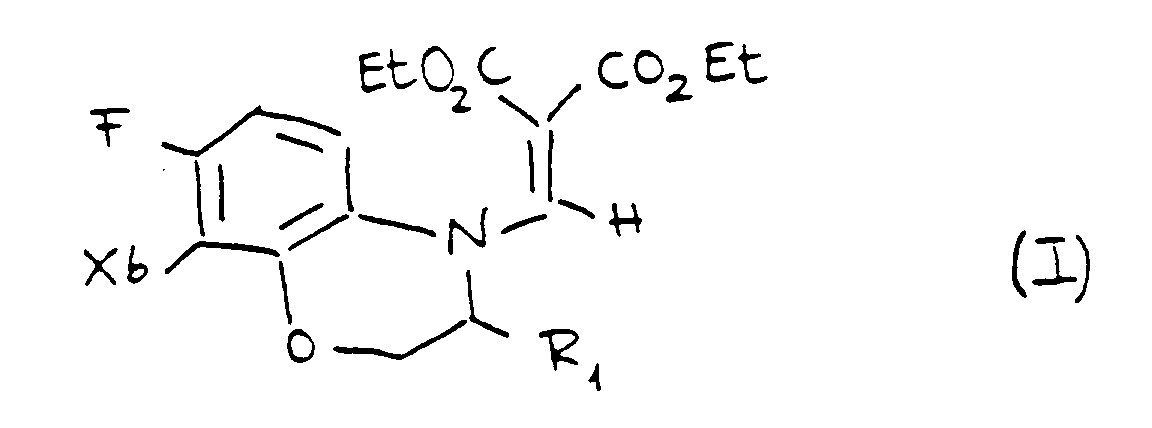 R₁ is H, an alkyl radical of up to 6 carbon atoms, preferably methyl, an alkenyl radical of up to 6 carbon atoms or an aryl group; andXb is an halogen atom, preferably fluorinecharacterized in that an oxibenzene derivative of general formula (II) is cycled
through a reaction with triphenylphosphine and ethyl azodicarboxylate with the adequate solvent. - A process according to claim 1, characterized in that it is performed in the presence of a poor polar inert solvent.
- A process according to claim 1, characterized in that it is performed at a temperature ranging between 0º and 60º C, preferably at room temperature.
- A process to obtain oxibenzene derivatives of general formula (II)
 R₁ is H, an alkyl or alkenyl radical of up to 6 carbon atoms, or an aryl group; andXb is an halogen atom.characterized in that it reacts a compound of general formula (III)

- A process according to claim 4, characterized in that it is performed in the presence of a poor polar inert solvent.
- A process according to claim 4, characterized in that it is performed at a temperature ranging between 0º and 60º C, preferably at 40º C.
- A process according to claim 4, characterized in that it is performed in the presence of a catalyst selected among different Lewis acids such as the boron trifluoride, zinc bromide, magnesium bromide, lithium perchlorate, preferably lithium perchlorate, and in the presence of a base preferably sodium hydride.
- A process according to claim 4, characterized in that the epoxide used is the (R) or (S) optically pure and adequate chiral epoxide or the relevant racemic.
- A process to obtain Ofloxazine of formula
 a) a benzoxiazine of formula (I) is reacted where Xb is F and R₁ is methyl obtained in accordance with the process of claims 1 to 3, with acetic anhydride in an acidic medium at a temperature ranging between 20º and 100º C, to obtain a chinolone of formula [7]
 b) the hydrolysation - in an acidic medium - of the chinolone [7) previously obtained, thus obtaining the relevant acid of formula [8]
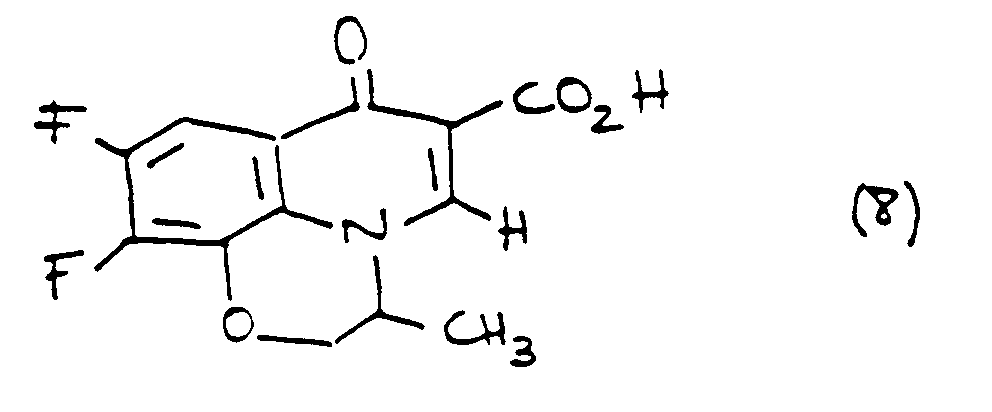 c) the reaction of the acid [8] previously obtained with N-methylpiperazine in an adequate polar solvent, at a temperature ranging between 50º and 150º C, optionally in the presence of a base.
 - A process to obtain the 3-(S)- isomer of Ofloxazine (Levofloxazine) characterized in that(i) diethyl (3,4-difluoro-2-hydroxyaniline) methylenmalonate is reacted with (R)-oxide of propylene in an adequate solvent and in the presence of a base and an adequate catalyst to obtain the diethyl [3,4-difluoro-2-(2-hydroxypropoxy)aniline] methylenmalonate that(ii) is reacted with triphenylphosphine and diethyl azodicarboxilate to obtain the diethyl (7,8-difluoro-3(S)-methyl-2,3-dihydro-4H-[1,4]benzoxazine-4-yl) methylenmalonate that(iii) is cycled by adding the acetic anhydride in an acid medium to perform the ethyl 9,10-difluoro-3-(S)-methyl-7-oxo-2,3-dihydro-7H-pyrid[1,2,3-de]benzoxazine-6-carboxilate that, then,(iv) it is subject to an acid hydrolysis to obtain the relevant 9,10-difluoro-3-(S)-methyl-7-oxo-2,3-dihydro-7H-pyrid[1,2,3-de]benzoxazine-6-carboxilic acid that(v) treated with N-methylpiperazine so that the 3-(S)- of Ofloxacine (Levofloxacine) isomer is obtained.
Applications Claiming Priority (5)
| Application Number | Priority Date | Filing Date | Title |
|---|---|---|---|
| ES9201983 | 1992-10-07 | ||
| ES9201983A ES2055656B1 (en) | 1992-10-07 | 1992-10-07 | PROCEDURE FOR OBTAINING USEFUL BENZOXAZINES FOR SYNTHESIS OF OFLOXACIN, LEVOFLOXACIN AND DERIVATIVES. |
| ES9302080 | 1993-10-04 | ||
| ES9302080A ES2069500B1 (en) | 1992-10-07 | 1993-10-04 | IMPROVEMENTS INTRODUCED IN THE PURPOSE OF THE SPANISH PATENT N 9201983 FOR "PROCEDURE TO OBTAIN USEFUL BENZOXAZINES FOR THE SYNTHESIS OF OFLEXACINE, LEVOFLOXACIN AND DERIVATIVES. |
| PCT/ES1993/000080 WO1994007873A1 (en) | 1992-10-07 | 1993-10-06 | Process for obtaining benzoxazines useful for the synthesis of ofloxacin, levofloxacin and derivatives thereof |
Publications (1)
| Publication Number | Publication Date |
|---|---|
| EP0619311A1 true EP0619311A1 (en) | 1994-10-12 |
Family
ID=26154661
Family Applications (1)
| Application Number | Title | Priority Date | Filing Date |
|---|---|---|---|
| EP93921930A Withdrawn EP0619311A1 (en) | 1992-10-07 | 1993-10-06 | Process for obtaining benzoxazines useful for the synthesis of ofloxacin, levofloxacin and derivatives thereof |
Country Status (7)
| Country | Link |
|---|---|
| US (1) | US5521310A (en) |
| EP (1) | EP0619311A1 (en) |
| JP (1) | JPH07501835A (en) |
| KR (1) | KR0131914B1 (en) |
| AU (2) | AU674542B2 (en) |
| CA (1) | CA2125287A1 (en) |
| WO (1) | WO1994007873A1 (en) |
Cited By (4)
| Publication number | Priority date | Publication date | Assignee | Title |
|---|---|---|---|---|
| KR100320772B1 (en) * | 1998-12-16 | 2002-01-17 | 유현식 | Process for Preparation of (S)-Benzoxazine Derivatives and Process for Racemization of (R)-Benzoxazine Derivatives |
| EP1211254A4 (en) * | 1999-09-08 | 2006-05-03 | Daiichi Seiyaku Co | PROCESS FOR THE PREPARATION OF BENZOXAZINE DERIVATIVES AND THEIR INTERMEDIATES |
| US7629458B2 (en) | 2001-10-03 | 2009-12-08 | Teva Pharmaceutical Industries Ltd. | Preparation of levofloxacin and hemihydrate thereof |
| CN109627407A (en) * | 2018-12-26 | 2019-04-16 | 四川理工学院 | A kind of preparation method and products thereof of in-situ reducing graphene oxide/benzoxazine composite material |
Families Citing this family (9)
| Publication number | Priority date | Publication date | Assignee | Title |
|---|---|---|---|---|
| FR2698361B1 (en) * | 1992-11-20 | 1995-01-13 | Rhone Poulenc Rorer Sa | Process for the preparation of an oxazolidine-1,3 carboxylic-5 acid. |
| CN1055927C (en) * | 1997-11-18 | 2000-08-30 | 中国科学院上海药物研究所 | Synthetizing and application of laevo-rotation ofloxacin analogue |
| US7425628B2 (en) * | 2001-10-03 | 2008-09-16 | Teva Pharmaceutical Industries Ltd. | Methods for the purification of levofloxacin |
| KR100440192B1 (en) * | 2001-11-22 | 2004-07-12 | 이수화학 주식회사 | Method of preparing optical active quinolonecarboxylic acid derivatives |
| EP1460997A4 (en) * | 2001-11-29 | 2005-06-15 | Teva Pharma | Methods for the purification of levofloxacin |
| US7902227B2 (en) | 2007-07-27 | 2011-03-08 | Janssen Pharmaceutica Nv. | C-7 isoxazolinyl quinolone / naphthyridine derivatives useful as antibacterial agents |
| CN102101865A (en) * | 2009-12-22 | 2011-06-22 | 江苏九寿堂生物制品有限公司 | Crystal form of carbostyril compound hydrochlorides |
| CN101880288B (en) * | 2010-07-12 | 2012-02-22 | 浙江东亚药业有限公司 | Synthesis method for ofloxacin |
| CN105037388A (en) * | 2015-08-28 | 2015-11-11 | 安徽环球药业股份有限公司 | Preparing method for antofloxacin |
Family Cites Families (6)
| Publication number | Priority date | Publication date | Assignee | Title |
|---|---|---|---|---|
| JPS5746986A (en) * | 1980-09-02 | 1982-03-17 | Dai Ichi Seiyaku Co Ltd | Pyrido(1,2,3-de)(1,4)benzoxazine derivative |
| NO166131C (en) * | 1985-06-20 | 1991-06-05 | Daiichi Seiyaku Co | ANALOGUE PROCEDURE FOR THE PREPARATION OF S (-) - PYRIDOBENZOKSAZINE COMPOUNDS. |
| DE3522406A1 (en) * | 1985-06-22 | 1987-01-02 | Bayer Ag | METHOD FOR PRODUCING 1,8-BRIDGED 4-CHINOLON-3-CARBONIC ACIDS |
| DE3639465A1 (en) * | 1986-11-18 | 1988-05-19 | Hoechst Ag | OPTICALLY ACTIVE GYRASE INHIBITORS, THEIR PRODUCTION AND USE AS ANTIBIOTICS |
| NO172846C (en) * | 1987-12-25 | 1993-09-15 | Daiichi Seiyaku Co | PROCEDURE FOR PREPARING 7,8-DIHALOGEN-3-METHYL-2,3-DIHYDRO-2M-BENZOCSAZINE DERIVATIVES AND PROPOXYBENZEN DERIVATIVES FOR EXERCISING THE PROCEDURE. |
| JP2857760B2 (en) * | 1989-02-17 | 1999-02-17 | 第一製薬株式会社 | Production method of propoxynitrobenzenes |
-
1993
- 1993-10-06 JP JP6508738A patent/JPH07501835A/en active Pending
- 1993-10-06 US US08/244,455 patent/US5521310A/en not_active Expired - Fee Related
- 1993-10-06 EP EP93921930A patent/EP0619311A1/en not_active Withdrawn
- 1993-10-06 KR KR1019940701925A patent/KR0131914B1/en not_active Expired - Fee Related
- 1993-10-06 CA CA002125287A patent/CA2125287A1/en not_active Abandoned
- 1993-10-06 AU AU51118/93A patent/AU674542B2/en not_active Ceased
- 1993-10-06 WO PCT/ES1993/000080 patent/WO1994007873A1/en not_active Ceased
-
1996
- 1996-09-27 AU AU65878/96A patent/AU686955B2/en not_active Expired - Fee Related
Non-Patent Citations (1)
| Title |
|---|
| See references of WO9407873A1 * |
Cited By (10)
| Publication number | Priority date | Publication date | Assignee | Title |
|---|---|---|---|---|
| KR100320772B1 (en) * | 1998-12-16 | 2002-01-17 | 유현식 | Process for Preparation of (S)-Benzoxazine Derivatives and Process for Racemization of (R)-Benzoxazine Derivatives |
| EP1211254A4 (en) * | 1999-09-08 | 2006-05-03 | Daiichi Seiyaku Co | PROCESS FOR THE PREPARATION OF BENZOXAZINE DERIVATIVES AND THEIR INTERMEDIATES |
| US7087778B2 (en) | 1999-09-08 | 2006-08-08 | Daiichi Pharmaceutical Co., Ltd. | Process for producing benzoxazine derivative and production intermediate thereof |
| US7189847B2 (en) | 1999-09-08 | 2007-03-13 | Daiichi Pharmaceutical Co., Ltd. | Process for producing benzoxazine derivative and production intermediate thereof |
| EP2284174A1 (en) * | 1999-09-08 | 2011-02-16 | Daiichi Sankyo Company, Limited | Intermediates for the preparation of benzoxazine derivatives and process for their preparation |
| EP2218722A3 (en) * | 1999-09-08 | 2011-05-11 | Daiichi Sankyo Company, Limited | Process for producing benzoxazine derivative and production intermediate thereof |
| EP2360160A1 (en) * | 1999-09-08 | 2011-08-24 | Daiichi Sankyo Company, Limited | Intermediates and their use for producing benzoxazine derivative |
| US7629458B2 (en) | 2001-10-03 | 2009-12-08 | Teva Pharmaceutical Industries Ltd. | Preparation of levofloxacin and hemihydrate thereof |
| CN109627407A (en) * | 2018-12-26 | 2019-04-16 | 四川理工学院 | A kind of preparation method and products thereof of in-situ reducing graphene oxide/benzoxazine composite material |
| CN109627407B (en) * | 2018-12-26 | 2021-03-23 | 四川理工学院 | Preparation method of in-situ reduction graphene oxide/benzoxazine composite material and product thereof |
Also Published As
| Publication number | Publication date |
|---|---|
| US5521310A (en) | 1996-05-28 |
| CA2125287A1 (en) | 1994-04-14 |
| AU5111893A (en) | 1994-04-26 |
| JPH07501835A (en) | 1995-02-23 |
| WO1994007873A1 (en) | 1994-04-14 |
| KR0131914B1 (en) | 1998-04-17 |
| AU6587896A (en) | 1996-12-12 |
| AU686955B2 (en) | 1998-02-12 |
| AU674542B2 (en) | 1997-01-02 |
Similar Documents
| Publication | Publication Date | Title |
|---|---|---|
| US5521310A (en) | Process to obtain benzoxazines to be used for the synthesis of ofloxazine, levofloxazine and derivatives | |
| KR0125115B1 (en) | Method for preparing (-) piperazine benzoxazine derivative | |
| KR100309871B1 (en) | Process for Preparing (-)Pyridobenzoxazine Carboxylic Acid Derivatives | |
| KR900004145B1 (en) | Process for preparation of tricyclic compounds | |
| Stadlbauer et al. | Ring closure and rearrangement reactions of 4‐azido‐2‐oxoquinoline‐3‐carboxylates and 4‐azidocoumarin‐3‐carboxylates | |
| US4895944A (en) | Benzoxazine intermediates | |
| US4826985A (en) | Intermediates for preparation of racemate and optically active ofloxacin and related derivatives | |
| KR100880654B1 (en) | Process for preparing photochromic oxazine compound | |
| KR100494881B1 (en) | Ethyl 2-[2,3,5-trifluoro-4-(4-methyl-1-piperazinyl)]benzoyl-3(S)-(1-hydroxyprop-2-ylamino)acrylate and a process for preparing thereof | |
| KR960004825B1 (en) | Novel quinolone compound and preparation method thereof (III) | |
| KR940009792B1 (en) | Process for preparing benzoxazine carboxylic acid derivatives | |
| AU2002354049A1 (en) | Photochromic oxazine compounds and methods for their manufacture | |
| KR100355756B1 (en) | Method for manufacturing a S-ofloxacin | |
| KR100245982B1 (en) | Novel quinolone carboxylic derivative | |
| EP0675880B1 (en) | Quinoline disulfides as intermediates | |
| KR100230132B1 (en) | Pyridobenzoxazine Carboxylic Acid Derivatives And Methods For Preparing Intermediates thereof | |
| KR0159511B1 (en) | New quinoline derivatives and preparation method thereof | |
| KR101086177B1 (en) | Antibacterial agent (-)-9-Fluoro-2,3-dihydro-3 (S) -methyl-10- (4-methyl-1-piperazinyl) -7-oxo-7H-pyrido [1, New preparation of 2,3-dec] -1,4-benzoxazine-6-carboxylic acid | |
| IE903566A1 (en) | 1,4-dihydro-4-oxo-3-quinolone derivatives as selectively toxic mammalian antibacterial agents | |
| EP0310969A2 (en) | Pyrido-benzothiazine derivatives having high antibacterial activity and high bioavailability to tissues | |
| JPH0413356B2 (en) | ||
| JPH04316579A (en) | New production of pyrido(1,2-a)pyrimidine derivative |
Legal Events
| Date | Code | Title | Description |
|---|---|---|---|
| PUAI | Public reference made under article 153(3) epc to a published international application that has entered the european phase |
Free format text: ORIGINAL CODE: 0009012 |
|
| 17P | Request for examination filed |
Effective date: 19940627 |
|
| AK | Designated contracting states |
Kind code of ref document: A1 Designated state(s): AT BE CH DE DK FR GB GR IE IT LI LU MC NL PT SE |
|
| 17Q | First examination report despatched |
Effective date: 19970530 |
|
| STAA | Information on the status of an ep patent application or granted ep patent |
Free format text: STATUS: THE APPLICATION IS DEEMED TO BE WITHDRAWN |
|
| 18D | Application deemed to be withdrawn |
Effective date: 19980915 |