EP2281704A1 - Refrigeration circuit - Google Patents
Refrigeration circuit Download PDFInfo
- Publication number
- EP2281704A1 EP2281704A1 EP09738795A EP09738795A EP2281704A1 EP 2281704 A1 EP2281704 A1 EP 2281704A1 EP 09738795 A EP09738795 A EP 09738795A EP 09738795 A EP09738795 A EP 09738795A EP 2281704 A1 EP2281704 A1 EP 2281704A1
- Authority
- EP
- European Patent Office
- Prior art keywords
- refrigerant
- circuit
- condenser
- refrigeration circuit
- vehicle
- Prior art date
- Legal status (The legal status is an assumption and is not a legal conclusion. Google has not performed a legal analysis and makes no representation as to the accuracy of the status listed.)
- Withdrawn
Links
Images


Classifications
-
- F—MECHANICAL ENGINEERING; LIGHTING; HEATING; WEAPONS; BLASTING
- F25—REFRIGERATION OR COOLING; COMBINED HEATING AND REFRIGERATION SYSTEMS; HEAT PUMP SYSTEMS; MANUFACTURE OR STORAGE OF ICE; LIQUEFACTION SOLIDIFICATION OF GASES
- F25B—REFRIGERATION MACHINES, PLANTS OR SYSTEMS; COMBINED HEATING AND REFRIGERATION SYSTEMS; HEAT PUMP SYSTEMS
- F25B9/00—Compression machines, plants or systems, in which the refrigerant is air or other gas of low boiling point
- F25B9/002—Compression machines, plants or systems, in which the refrigerant is air or other gas of low boiling point characterised by the refrigerant
-
- B—PERFORMING OPERATIONS; TRANSPORTING
- B60—VEHICLES IN GENERAL
- B60H—ARRANGEMENTS OF HEATING, COOLING, VENTILATING OR OTHER AIR-TREATING DEVICES SPECIALLY ADAPTED FOR PASSENGER OR GOODS SPACES OF VEHICLES
- B60H1/00—Heating, cooling or ventilating devices
- B60H1/00642—Control systems or circuits; Control members or indication devices for heating, cooling or ventilating devices
- B60H1/00978—Control systems or circuits characterised by failure of detection or safety means; Diagnostic methods
-
- B—PERFORMING OPERATIONS; TRANSPORTING
- B60—VEHICLES IN GENERAL
- B60H—ARRANGEMENTS OF HEATING, COOLING, VENTILATING OR OTHER AIR-TREATING DEVICES SPECIALLY ADAPTED FOR PASSENGER OR GOODS SPACES OF VEHICLES
- B60H1/00—Heating, cooling or ventilating devices
- B60H1/32—Cooling devices
- B60H1/3204—Cooling devices using compression
- B60H1/3205—Control means therefor
- B60H1/3217—Control means therefor for high pressure, inflamable or poisonous refrigerants causing danger in case of accidents
-
- F—MECHANICAL ENGINEERING; LIGHTING; HEATING; WEAPONS; BLASTING
- F25—REFRIGERATION OR COOLING; COMBINED HEATING AND REFRIGERATION SYSTEMS; HEAT PUMP SYSTEMS; MANUFACTURE OR STORAGE OF ICE; LIQUEFACTION SOLIDIFICATION OF GASES
- F25B—REFRIGERATION MACHINES, PLANTS OR SYSTEMS; COMBINED HEATING AND REFRIGERATION SYSTEMS; HEAT PUMP SYSTEMS
- F25B2500/00—Problems to be solved
- F25B2500/22—Preventing, detecting or repairing leaks of refrigeration fluids
- F25B2500/221—Preventing leaks from developing
Definitions
- the present invention relates to a refrigeration circuit of an automotive air conditioning system which can be used safely even when a certain new-type refrigerant is utilized.
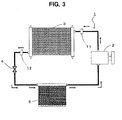
- a refrigeration circuit used for an air conditioning system for vehicles has basic configuration as shown in Fig. 3 .
- refrigeration circuit 1 is provided with compressor 2 for compressing refrigerant, condenser 3 for condensing compressed refrigerant, expansion valve 4 as a pressure-reduction/expansion means for reducing in pressure as expanding condensed refrigerant, and evaporator 5 for evaporating refrigerant which is reduced in pressure as being expanded.
- the refrigerant is circulated in refrigeration circuit 1 as changing in state.
- a typical refrigerant such as R134a, is used at present.
- Non-patent document 1 Refrigeration, Vol. 83, No. 965, March issue, 2008
- an object of the present invention is, focusing on such a possibility and demand to prevent from it, to provide a refrigeration circuit of an automotive air conditioning system which can immediately minimize the refrigeration leakage from the circuit caused by an excessive shock, so as to reduce the possibility of fire-breaking when particularly a conventional refrigerant is replaced by the new-type refrigerant R1234yf.
- a shut-off valve is operated based on the excessive acceleration signal, so as to shut instantaneously at upstream and downstream positions of the condenser.
- the damage or destruction of the condenser is most suspected as a reason of the refrigerant leakage caused by the excessive impact. Therefore even if the condenser is damaged or destructed, the circuit is instantaneously closed at the positions of upstream and downstream thereto, keeping a minimum leakage of refrigerant, so as to prevent from more leakage, or excessive leakage.
- the fire-breaking possibility derived from a leak of the new-type refrigerant R1234yf can be minimized, and a desirable purpose can be achieved.
- the excessive acceleration signal is a signal from an acceleration sensor mounted on the vehicle or that the excessive acceleration signal is a signal from a collision sensor provided on an airbag.
- shut-off valves 11,12 are electromagnetic valves, such as a normal closed type, a normal opened type.
- the signal from an acceleration sensor mounted on the vehicle can be used, as well as the signal from a collision sensor provided on an air bag.
- An example of the control circuitry is shown in Fig. 1 and Fig. 2 .
- symbol 21 implies an acceleration sensor which is mounted on the vehicle
- symbol 22 implies a power source provided on the vehicle.
- the signal is transmitted to microcontroller 23 and processed, so as to be transmitted to electromagnetic drive section 25 of shut-off valves 11 and 12 through output circuit 24.
- Shut-off valves 11,12 as electromagnetic valves are operated by this signal, and anteroposterior part of the refrigeration circuit of condenser 3 is instantaneously shut, so that the refrigerant leakage can be minimized even if condenser 3 might be damaged.
- the signal transmitted from output circuit 24 to shut-off valves 11,12 can be used for a signal to operate air bag 26.
- the signal transmitted from electronic controlling unit 27 including microcontroller 23 and output circuit 24 operates electromagnetic drive section 25, and shut-off valve 11 between compressor 2 and condenser 3, and shut-off valve 12 between condenser 3 and expansion valve 4, are operated to shut, so that the anteroposterior part of refrigeration circuit is cut off instantly.
- the new-type refrigerant R1234yf is regarded as a superior refrigerant aimed at improvement such as the global warming potential (GWP).
- GWP global warming potential
- the refrigeration circuit for a vehicle air-conditioning system according to the present invention is applicable basically for every refrigeration circuit for a vehicle air-conditioning system which uses the new-type refrigerant R1234yf.
Landscapes
- Engineering & Computer Science (AREA)
- Physics & Mathematics (AREA)
- Thermal Sciences (AREA)
- Mechanical Engineering (AREA)
- General Engineering & Computer Science (AREA)
- Air-Conditioning For Vehicles (AREA)
Abstract
Description
- The present invention relates to a refrigeration circuit of an automotive air conditioning system which can be used safely even when a certain new-type refrigerant is utilized.
- A refrigeration circuit used for an air conditioning system for vehicles has basic configuration as shown in
Fig. 3 . InFig. 3 , refrigeration circuit 1 is provided withcompressor 2 for compressing refrigerant,condenser 3 for condensing compressed refrigerant,expansion valve 4 as a pressure-reduction/expansion means for reducing in pressure as expanding condensed refrigerant, andevaporator 5 for evaporating refrigerant which is reduced in pressure as being expanded. The refrigerant is circulated in refrigeration circuit 1 as changing in state. In such refrigeration circuit 1, a typical refrigerant, such as R134a, is used at present. - Instead of the typical refrigerant such as R134a, research and development to find a new-type refrigerant are being performed in order to improve Global Warming Potential (GWP), as disclosed in non-patent document 1. R1234yf has been announced recently as a new refrigerant aiming at such an improvement, and it is becoming possible that it is examined and studied for applying to refrigeration circuits used for an automotive air conditioning system, etc.
- Non-patent document 1: Refrigeration, Vol. 83, No. 965, March issue, 2008
- Since conventional refrigerant is usually nonflammable, basically combustion preventive measures have not had to be taken against the refrigeration leakage which might be brought when the vehicle is impacted excessively for example. However, molecular structure of the new-type refrigerant R1234yf described above is CF3-CF = CH2 which includes two Hs, and therefore is a little flammable. So it is preferable that a combustion preventive measure is taken in case that a great amount of refrigerant might be leaked.
- When the new refrigerant R1234yf is used, if fires derived from R1234yf can be caused they are most likely to break out through the following steps: vehicular crash -> damage or destruction of condenser -> refrigerant leakage -> ignition in the high-temperature engine exhaust manifold. Therefore, this ignition possibility is desired to be reduced.
- Accordingly, an object of the present invention is, focusing on such a possibility and demand to prevent from it, to provide a refrigeration circuit of an automotive air conditioning system which can immediately minimize the refrigeration leakage from the circuit caused by an excessive shock, so as to reduce the possibility of fire-breaking when particularly a conventional refrigerant is replaced by the new-type refrigerant R1234yf.
- To achieve the above described object, a refrigeration circuit according to the present invention is a refrigeration circuit for a vehicle air-conditioning system comprising a compressor for compressing refrigerant, a condenser for condensing compressed refrigerant, a pressure reduction and expansion means for reducing in pressure and expanding condensed refrigerant, and an evaporator for evaporating pressure-reduced and expanded refrigerant in this order, characterized in that R1234yf is used as refrigerant and a shut-off valve for shutting off the circuit based on an excessive acceleration signal of the vehicle is provided at a position in the circuit each of upstream and downstream of the condenser. That makes it possible that an excessive impact is detected as an excessive acceleration signal, and a shut-off valve is operated based on the excessive acceleration signal, so as to shut instantaneously at upstream and downstream positions of the condenser. As described above, the damage or destruction of the condenser is most suspected as a reason of the refrigerant leakage caused by the excessive impact. Therefore even if the condenser is damaged or destructed, the circuit is instantaneously closed at the positions of upstream and downstream thereto, keeping a minimum leakage of refrigerant, so as to prevent from more leakage, or excessive leakage. As a result, the fire-breaking possibility derived from a leak of the new-type refrigerant R1234yf can be minimized, and a desirable purpose can be achieved.
- In the refrigeration circuit for a vehicle air-conditioning system according to the present invention, it is possible either that the excessive acceleration signal is a signal from an acceleration sensor mounted on the vehicle or that the excessive acceleration signal is a signal from a collision sensor provided on an airbag.
- Thus in the refrigeration circuit for a vehicle air-conditioning system, when the refrigerant used is changed to R1234yf, which is a new-type refrigerant, it is possible to instantaneously minimize refrigerant leakage from the circuit in the event applied with an excessive impact, and to reduce the possibility of a fire starting or the like. As a result, it can be promoted to use the new-type refrigerant R1234yf in order to improve the Global Warming Potential (GWP) and so on.
-
- [
Fig. 1] Fig. 1 is a schematic framework showing an example of a control circuit configuration of a refrigeration circuit of a vehicle air-conditioning system according to the present invention. - [
Fig. 2] Fig. 2 is a schematic framework showing the circuit inFig. 1 , together with the refrigeration circuit. - [
Fig. 3] Fig. 3 is a schematic framework showing a basic equipment layout of a refrigeration circuit of a vehicle air-conditioning system as an object of the present invention. - Hereinafter, a desirable embodiment of the present invention will be explained as referring to figures.
As described above, the basic equipment layout of the refrigeration circuit of a vehicle air-conditioning system as an object of the present invention is shown inFig. 3 . In the present invention, R1234yf is used as a refrigerant, and shut-offvalves condenser 3. It is preferable that shut-offvalves - As the excessive acceleration signal, the signal from an acceleration sensor mounted on the vehicle can be used, as well as the signal from a collision sensor provided on an air bag. An example of the control circuitry is shown in
Fig. 1 andFig. 2 . - In
Fig. 1 ,symbol 21 implies an acceleration sensor which is mounted on the vehicle, andsymbol 22 implies a power source provided on the vehicle. When the excessive acceleration is detected byacceleration sensor 21, the signal is transmitted tomicrocontroller 23 and processed, so as to be transmitted toelectromagnetic drive section 25 of shut-offvalves output circuit 24. Shut-offvalves condenser 3 is instantaneously shut, so that the refrigerant leakage can be minimized even ifcondenser 3 might be damaged. The signal transmitted fromoutput circuit 24 to shut-offvalves air bag 26. - As shown in
Fig. 2 , the signal transmitted from electronic controllingunit 27 includingmicrocontroller 23 andoutput circuit 24 operateselectromagnetic drive section 25, and shut-offvalve 11 betweencompressor 2 andcondenser 3, and shut-offvalve 12 betweencondenser 3 andexpansion valve 4, are operated to shut, so that the anteroposterior part of refrigeration circuit is cut off instantly. - Consequently, when the new-type refrigerant R1234yf is used, even when impacted excessively the refrigerant leakage from the circuit can be minimized, and the possibility of a fire starting or the like can be kept extremely low. The new-type refrigerant R1234yf is regarded as a superior refrigerant aimed at improvement such as the global warming potential (GWP). The use or examination thereof for the new-type refrigerant R1234yf can be promoted by suppressing the possibility for the fire-outbreak and so on caused by the leak described above.
- The refrigeration circuit for a vehicle air-conditioning system according to the present invention is applicable basically for every refrigeration circuit for a vehicle air-conditioning system which uses the new-type refrigerant R1234yf.
-
- 1:
- refrigeration circuit
- 2:
- compressor
- 3:
- condenser
- 4:
- expansion valve as a pressure reduction and expansion means
- 5:
- evaporator
- 11,12:
- shut-off valve
- 21:
- acceleration sensor
- 22:
- power source for vehicle
- 23:
- microcontroller
- 24:
- output circuit
- 25:
- electromagnetic drive section
- 26:
- air bag
- 27:
- electronic controlling unit
Claims (3)
- A refrigeration circuit for a vehicle air-conditioning system comprising a compressor for compressing refrigerant, a condenser for condensing compressed refrigerant, a pressure reduction and expansion means for reducing in pressure and expanding condensed refrigerant, and an evaporator for evaporating pressure-reduced and expanded refrigerant in this order, characterized in that R1234yf is used as refrigerant and a shut-off valve for shutting off said circuit based on an excessive acceleration signal of said vehicle is provided at a position in said circuit each of upstream and downstream of said condenser.
- The refrigeration circuit for a vehicle air-conditioning system according to claim 1, wherein said excessive acceleration signal is a signal from an acceleration sensor mounted on said vehicle.
- The refrigeration circuit for a vehicle air-conditioning system according to claim 1, wherein said excessive acceleration signal is a signal from a collision sensor provided on an airbag.
Applications Claiming Priority (2)
| Application Number | Priority Date | Filing Date | Title |
|---|---|---|---|
| JP2008118606A JP2009269411A (en) | 2008-04-30 | 2008-04-30 | Refrigeration circuit |
| PCT/JP2009/058289 WO2009133858A1 (en) | 2008-04-30 | 2009-04-27 | Refrigeration circuit |
Publications (2)
| Publication Number | Publication Date |
|---|---|
| EP2281704A1 true EP2281704A1 (en) | 2011-02-09 |
| EP2281704A4 EP2281704A4 (en) | 2011-04-27 |
Family
ID=41255074
Family Applications (1)
| Application Number | Title | Priority Date | Filing Date |
|---|---|---|---|
| EP09738795A Withdrawn EP2281704A4 (en) | 2008-04-30 | 2009-04-27 | Refrigeration circuit |
Country Status (5)
| Country | Link |
|---|---|
| US (1) | US20110056231A1 (en) |
| EP (1) | EP2281704A4 (en) |
| JP (1) | JP2009269411A (en) |
| CN (1) | CN102015340A (en) |
| WO (1) | WO2009133858A1 (en) |
Cited By (2)
| Publication number | Priority date | Publication date | Assignee | Title |
|---|---|---|---|---|
| DE102017130204A1 (en) | 2017-12-15 | 2019-06-19 | Hanon Systems | Refrigerant circuit with a safety device and method for operating the refrigerant circuit |
| FR3157524A1 (en) * | 2023-12-22 | 2025-06-27 | Valeo Systemes Thermiques | Thermal regulation system |
Families Citing this family (4)
| Publication number | Priority date | Publication date | Assignee | Title |
|---|---|---|---|---|
| CN103906983A (en) * | 2011-10-21 | 2014-07-02 | 丰田自动车株式会社 | Cooling device and method for controlling the cooling device |
| DE102016216619A1 (en) * | 2016-09-02 | 2018-03-08 | Continental Automotive Gmbh | Combined cooling and extinguishing system |
| CN107650619A (en) * | 2017-10-19 | 2018-02-02 | 天津商业大学 | A kind of automotive air-conditioning system of safety and environmental protection |
| CN118991366B (en) * | 2024-08-15 | 2025-09-30 | 一汽解放汽车有限公司 | Thermal management system control method, thermal management system, vehicle and storage medium |
Family Cites Families (5)
| Publication number | Priority date | Publication date | Assignee | Title |
|---|---|---|---|---|
| JP3339268B2 (en) * | 1995-09-12 | 2002-10-28 | 株式会社デンソー | Vehicle air conditioner |
| JP3355548B2 (en) * | 1998-09-03 | 2002-12-09 | 株式会社デンソー | Vehicle refrigeration equipment |
| US6796578B2 (en) * | 2002-11-08 | 2004-09-28 | Key Safety Systems, Inc. | Airbag with bag mounted sensor |
| JP2004351985A (en) * | 2003-05-27 | 2004-12-16 | Sanden Corp | Air conditioner for vehicle |
| JP2007315663A (en) * | 2006-05-25 | 2007-12-06 | Sanden Corp | Refrigeration system |
-
2008
- 2008-04-30 JP JP2008118606A patent/JP2009269411A/en active Pending
-
2009
- 2009-04-27 EP EP09738795A patent/EP2281704A4/en not_active Withdrawn
- 2009-04-27 WO PCT/JP2009/058289 patent/WO2009133858A1/en not_active Ceased
- 2009-04-27 US US12/990,294 patent/US20110056231A1/en not_active Abandoned
- 2009-04-27 CN CN2009801159050A patent/CN102015340A/en active Pending
Cited By (3)
| Publication number | Priority date | Publication date | Assignee | Title |
|---|---|---|---|---|
| DE102017130204A1 (en) | 2017-12-15 | 2019-06-19 | Hanon Systems | Refrigerant circuit with a safety device and method for operating the refrigerant circuit |
| DE102017130204B4 (en) | 2017-12-15 | 2019-09-19 | Hanon Systems | Refrigerant circuit with a safety device and method for operating the refrigerant circuit |
| FR3157524A1 (en) * | 2023-12-22 | 2025-06-27 | Valeo Systemes Thermiques | Thermal regulation system |
Also Published As
| Publication number | Publication date |
|---|---|
| JP2009269411A (en) | 2009-11-19 |
| CN102015340A (en) | 2011-04-13 |
| EP2281704A4 (en) | 2011-04-27 |
| US20110056231A1 (en) | 2011-03-10 |
| WO2009133858A1 (en) | 2009-11-05 |
Similar Documents
| Publication | Publication Date | Title |
|---|---|---|
| EP2281704A1 (en) | Refrigeration circuit | |
| US9791196B2 (en) | Air conditioning apparatus | |
| JP3339268B2 (en) | Vehicle air conditioner | |
| EP2309205B1 (en) | Refrigeration circuit | |
| EP2055516A1 (en) | Air conditioner for vehicle | |
| JP5610674B2 (en) | Refrigeration equipment | |
| US6334324B1 (en) | Expansion device | |
| JP2006162122A (en) | Vehicular air conditioner | |
| EP1654505B1 (en) | Method of ventilating an air conditioning system | |
| JP4338539B2 (en) | Air conditioner for vehicles | |
| JP2001071741A (en) | Air conditioning device for vehicle | |
| JP3355548B2 (en) | Vehicle refrigeration equipment | |
| EP4610582A1 (en) | Control system, moving body, control method, and control program | |
| JP2006329540A (en) | Control device for refrigerating cycle | |
| JPH10175426A (en) | Vehicle air conditioner | |
| JP2015038390A (en) | In-vehicle air conditioning device | |
| JP5500008B2 (en) | Cooling system | |
| US10293662B2 (en) | Vehicle having a refrigerant circuit | |
| US20260054547A1 (en) | Method for operating a refrigeration system with heat pump function for a motor vehicle based on the refrigerant mass flow and refrigeration system with control unit for carrying out the method | |
| KR20040078942A (en) | Device for protecting supercritical refrigerating cycle | |
| JP2005153712A (en) | Vehicular air-conditioner | |
| KR20080027692A (en) | Safety device of vehicle air conditioning system | |
| KR100450117B1 (en) | Airconditioning system for vehicle | |
| JP4735265B2 (en) | Air conditioner for vehicles | |
| JP2005238871A (en) | Fail control device |
Legal Events
| Date | Code | Title | Description |
|---|---|---|---|
| PUAI | Public reference made under article 153(3) epc to a published international application that has entered the european phase |
Free format text: ORIGINAL CODE: 0009012 |
|
| 17P | Request for examination filed |
Effective date: 20101129 |
|
| AK | Designated contracting states |
Kind code of ref document: A1 Designated state(s): AT BE BG CH CY CZ DE DK EE ES FI FR GB GR HR HU IE IS IT LI LT LU LV MC MK MT NL NO PL PT RO SE SI SK TR |
|
| AX | Request for extension of the european patent |
Extension state: AL BA RS |
|
| A4 | Supplementary search report drawn up and despatched |
Effective date: 20110329 |
|
| DAX | Request for extension of the european patent (deleted) | ||
| 17Q | First examination report despatched |
Effective date: 20121105 |
|
| STAA | Information on the status of an ep patent application or granted ep patent |
Free format text: STATUS: THE APPLICATION IS DEEMED TO BE WITHDRAWN |
|
| 18D | Application deemed to be withdrawn |
Effective date: 20130316 |