EP2281114B1 - Rocket motor with pellet and bulk solid propellants - Google Patents
Rocket motor with pellet and bulk solid propellants Download PDFInfo
- Publication number
- EP2281114B1 EP2281114B1 EP09739312A EP09739312A EP2281114B1 EP 2281114 B1 EP2281114 B1 EP 2281114B1 EP 09739312 A EP09739312 A EP 09739312A EP 09739312 A EP09739312 A EP 09739312A EP 2281114 B1 EP2281114 B1 EP 2281114B1
- Authority
- EP
- European Patent Office
- Prior art keywords
- propellant
- pellets
- rocket motor
- solid fuel
- pellet
- Prior art date
- Legal status (The legal status is an assumption and is not a legal conclusion. Google has not performed a legal analysis and makes no representation as to the accuracy of the status listed.)
- Active
Links
- 239000008188 pellet Substances 0.000 title claims description 165
- 239000004449 solid propellant Substances 0.000 title claims description 59
- 239000003380 propellant Substances 0.000 claims description 210
- 238000002485 combustion reaction Methods 0.000 claims description 25
- 239000000446 fuel Substances 0.000 claims description 22
- 239000007789 gas Substances 0.000 claims description 15
- 239000000567 combustion gas Substances 0.000 claims description 9
- 230000007935 neutral effect Effects 0.000 claims description 8
- 230000000750 progressive effect Effects 0.000 claims description 8
- 230000001373 regressive effect Effects 0.000 claims description 6
- ZOKXTWBITQBERF-UHFFFAOYSA-N Molybdenum Chemical compound [Mo] ZOKXTWBITQBERF-UHFFFAOYSA-N 0.000 claims description 3
- 239000000956 alloy Substances 0.000 claims description 3
- 229910045601 alloy Inorganic materials 0.000 claims description 3
- XTVVROIMIGLXTD-UHFFFAOYSA-N copper(II) nitrate Chemical compound [Cu+2].[O-][N+]([O-])=O.[O-][N+]([O-])=O XTVVROIMIGLXTD-UHFFFAOYSA-N 0.000 claims description 3
- 229910052750 molybdenum Inorganic materials 0.000 claims description 3
- 239000011733 molybdenum Substances 0.000 claims description 3
- 230000002829 reductive effect Effects 0.000 claims description 3
- NDEMNVPZDAFUKN-UHFFFAOYSA-N guanidine;nitric acid Chemical compound NC(N)=N.O[N+]([O-])=O.O[N+]([O-])=O NDEMNVPZDAFUKN-UHFFFAOYSA-N 0.000 claims description 2
- 239000000463 material Substances 0.000 description 23
- 239000007800 oxidant agent Substances 0.000 description 14
- 239000004615 ingredient Substances 0.000 description 9
- 239000007788 liquid Substances 0.000 description 9
- 230000007613 environmental effect Effects 0.000 description 8
- 239000000203 mixture Substances 0.000 description 8
- 239000000020 Nitrocellulose Substances 0.000 description 7
- 230000007423 decrease Effects 0.000 description 7
- 238000000034 method Methods 0.000 description 7
- 229920001220 nitrocellulos Polymers 0.000 description 7
- 239000004014 plasticizer Substances 0.000 description 7
- 238000004088 simulation Methods 0.000 description 7
- 239000011230 binding agent Substances 0.000 description 5
- 239000002131 composite material Substances 0.000 description 3
- 230000003247 decreasing effect Effects 0.000 description 3
- 230000009969 flowable effect Effects 0.000 description 3
- 239000003999 initiator Substances 0.000 description 3
- 238000004519 manufacturing process Methods 0.000 description 3
- 230000000717 retained effect Effects 0.000 description 3
- 239000007787 solid Substances 0.000 description 3
- 230000002459 sustained effect Effects 0.000 description 3
- BSYNRYMUTXBXSQ-UHFFFAOYSA-N Aspirin Chemical compound CC(=O)OC1=CC=CC=C1C(O)=O BSYNRYMUTXBXSQ-UHFFFAOYSA-N 0.000 description 2
- ZRALSGWEFCBTJO-UHFFFAOYSA-N Guanidine Chemical compound NC(N)=N ZRALSGWEFCBTJO-UHFFFAOYSA-N 0.000 description 2
- SNIOPGDIGTZGOP-UHFFFAOYSA-N Nitroglycerin Chemical compound [O-][N+](=O)OCC(O[N+]([O-])=O)CO[N+]([O-])=O SNIOPGDIGTZGOP-UHFFFAOYSA-N 0.000 description 2
- 229960001138 acetylsalicylic acid Drugs 0.000 description 2
- 238000005266 casting Methods 0.000 description 2
- 239000003085 diluting agent Substances 0.000 description 2
- 230000000694 effects Effects 0.000 description 2
- 229960003711 glyceryl trinitrate Drugs 0.000 description 2
- 238000005057 refrigeration Methods 0.000 description 2
- 239000002904 solvent Substances 0.000 description 2
- IDCPFAYURAQKDZ-UHFFFAOYSA-N 1-nitroguanidine Chemical compound NC(=N)N[N+]([O-])=O IDCPFAYURAQKDZ-UHFFFAOYSA-N 0.000 description 1
- 235000015842 Hesperis Nutrition 0.000 description 1
- 235000012633 Iberis amara Nutrition 0.000 description 1
- CHJJGSNFBQVOTG-UHFFFAOYSA-N N-methyl-guanidine Natural products CNC(N)=N CHJJGSNFBQVOTG-UHFFFAOYSA-N 0.000 description 1
- 229910002651 NO3 Inorganic materials 0.000 description 1
- NHNBFGGVMKEFGY-UHFFFAOYSA-N Nitrate Chemical compound [O-][N+]([O-])=O NHNBFGGVMKEFGY-UHFFFAOYSA-N 0.000 description 1
- CPTCUNLUKFTXKF-UHFFFAOYSA-N [Ti].[Zr].[Mo] Chemical compound [Ti].[Zr].[Mo] CPTCUNLUKFTXKF-UHFFFAOYSA-N 0.000 description 1
- 230000001133 acceleration Effects 0.000 description 1
- XYODKMYYACGWBN-UHFFFAOYSA-N aminoazanium;nitroformate Chemical compound [NH3+]N.[O-]C(=O)[N+]([O-])=O XYODKMYYACGWBN-UHFFFAOYSA-N 0.000 description 1
- UFMZWBIQTDUYBN-UHFFFAOYSA-N cobalt dinitrate Chemical compound [Co+2].[O-][N+]([O-])=O.[O-][N+]([O-])=O UFMZWBIQTDUYBN-UHFFFAOYSA-N 0.000 description 1
- 229910001981 cobalt nitrate Inorganic materials 0.000 description 1
- 230000001419 dependent effect Effects 0.000 description 1
- 125000005442 diisocyanate group Chemical group 0.000 description 1
- SWSQBOPZIKWTGO-UHFFFAOYSA-N dimethylaminoamidine Natural products CN(C)C(N)=N SWSQBOPZIKWTGO-UHFFFAOYSA-N 0.000 description 1
- 239000003814 drug Substances 0.000 description 1
- 229920001971 elastomer Polymers 0.000 description 1
- 239000000806 elastomer Substances 0.000 description 1
- 230000003628 erosive effect Effects 0.000 description 1
- 239000000945 filler Substances 0.000 description 1
- 239000010419 fine particle Substances 0.000 description 1
- 238000009472 formulation Methods 0.000 description 1
- ZRALSGWEFCBTJO-UHFFFAOYSA-O guanidinium Chemical compound NC(N)=[NH2+] ZRALSGWEFCBTJO-UHFFFAOYSA-O 0.000 description 1
- 239000000017 hydrogel Substances 0.000 description 1
- 238000011068 loading method Methods 0.000 description 1
- 238000003754 machining Methods 0.000 description 1
- 239000011159 matrix material Substances 0.000 description 1
- 229910052751 metal Inorganic materials 0.000 description 1
- 239000002184 metal Substances 0.000 description 1
- 239000007769 metal material Substances 0.000 description 1
- YGZIDGORJKNFDL-UHFFFAOYSA-M nitronium perchlorate Chemical compound O=[N+]=O.[O-]Cl(=O)(=O)=O YGZIDGORJKNFDL-UHFFFAOYSA-M 0.000 description 1
- 239000002245 particle Substances 0.000 description 1
- 239000004033 plastic Substances 0.000 description 1
- 229920001228 polyisocyanate Polymers 0.000 description 1
- 239000005056 polyisocyanate Substances 0.000 description 1
- 229920000642 polymer Polymers 0.000 description 1
- 238000001556 precipitation Methods 0.000 description 1
- 239000002243 precursor Substances 0.000 description 1
- 230000035945 sensitivity Effects 0.000 description 1
- 230000035939 shock Effects 0.000 description 1
- 239000000126 substance Substances 0.000 description 1
- 229920003051 synthetic elastomer Polymers 0.000 description 1
- 239000005061 synthetic rubber Substances 0.000 description 1
- 230000002123 temporal effect Effects 0.000 description 1
- 239000002341 toxic gas Substances 0.000 description 1
- 230000007704 transition Effects 0.000 description 1
Images




Classifications
-
- F—MECHANICAL ENGINEERING; LIGHTING; HEATING; WEAPONS; BLASTING
- F02—COMBUSTION ENGINES; HOT-GAS OR COMBUSTION-PRODUCT ENGINE PLANTS
- F02K—JET-PROPULSION PLANTS
- F02K9/00—Rocket-engine plants, i.e. plants carrying both fuel and oxidant therefor; Control thereof
- F02K9/08—Rocket-engine plants, i.e. plants carrying both fuel and oxidant therefor; Control thereof using solid propellants
-
- F—MECHANICAL ENGINEERING; LIGHTING; HEATING; WEAPONS; BLASTING
- F02—COMBUSTION ENGINES; HOT-GAS OR COMBUSTION-PRODUCT ENGINE PLANTS
- F02K—JET-PROPULSION PLANTS
- F02K9/00—Rocket-engine plants, i.e. plants carrying both fuel and oxidant therefor; Control thereof
- F02K9/08—Rocket-engine plants, i.e. plants carrying both fuel and oxidant therefor; Control thereof using solid propellants
- F02K9/10—Shape or structure of solid propellant charges
-
- F—MECHANICAL ENGINEERING; LIGHTING; HEATING; WEAPONS; BLASTING
- F02—COMBUSTION ENGINES; HOT-GAS OR COMBUSTION-PRODUCT ENGINE PLANTS
- F02K—JET-PROPULSION PLANTS
- F02K9/00—Rocket-engine plants, i.e. plants carrying both fuel and oxidant therefor; Control thereof
- F02K9/08—Rocket-engine plants, i.e. plants carrying both fuel and oxidant therefor; Control thereof using solid propellants
- F02K9/24—Charging rocket engines with solid propellants; Methods or apparatus specially adapted for working solid propellant charges
-
- F—MECHANICAL ENGINEERING; LIGHTING; HEATING; WEAPONS; BLASTING
- F02—COMBUSTION ENGINES; HOT-GAS OR COMBUSTION-PRODUCT ENGINE PLANTS
- F02K—JET-PROPULSION PLANTS
- F02K9/00—Rocket-engine plants, i.e. plants carrying both fuel and oxidant therefor; Control thereof
- F02K9/08—Rocket-engine plants, i.e. plants carrying both fuel and oxidant therefor; Control thereof using solid propellants
- F02K9/32—Constructional parts; Details not otherwise provided for
- F02K9/34—Casings; Combustion chambers; Liners thereof
- F02K9/346—Liners, e.g. inhibitors
Definitions
- This disclosure relates to solid fuel rocket motors, and to fast response motors suitable for use as attitude control thrusters.
- Solid fuel rocket motors are commonly used in various configurations to propel rockets and missiles. Small solid fuel rocket motors may also be used to control the attitude and steering of a missile, rocket, or other projectile. Small solid fuel rocket motors used to control attitude are commonly called attitude thrusters or divert thrusters. Solid fuel rocket motors may also be used to turn a vertically-launched missile or rocket into near-horizontal flight. Such rocket motors are commonly called pitch-over thrusters.
- the thrust or force produced by a rocket motor is given by the equation for an ideally expanded nozzle.
- F m p * U e
- m p propellant mass flow rate
- U e gas velocity
- the propellant surface area A p , the propellant burn rate R b and the propellant density P p are important factors that may be used to determine the thrust produced by a solid fuel rocket.
- the force produced by a rocket motor results in a linear or angular acceleration of the missile or other body propelled by the rocket motor.
- the net change in the linear or angular velocity of the missile or other body is proportional to the force produced by the motor integrated over time.
- the time integral of the force produced by a rocket motor is commonly called the "impulse" of the motor.
- US 2 986 001 discloses a solid fuel rocket motor comprising a combustion chamber and exhaust nozzle; a solid grain propellant within the chamber leaving an annular space between the grain and the chamber wall; a layer of dilatant liquid in said annular space for absorbing the shock of grain ignition; an igniter in the forward end of the combustion chamber; and a yieldable diaphragm around said igniter, the dilatant liquid also filling the space between the forward end of the grain and said diaphragm, the diaphragm absorbing expansion of said dilatant liquid.
- US 4 249 673 discloses a device comprising a perforated housing containing therein pellets of a chemical composition which undergoes self-sustaining combustion with generation of a combustion gas and an initiator attached to the housing to ignite the pellets.
- a hollow and resilient retainer member is placed in the housing such that the initiator is exposed to the interior of the retainer and that the pellets are spaced from the initiator by the retainer and held under a compressive force by the resiliency of the retainer.
- the retainer has openings which allow a gas to pass but do not allow the pellets to pass.
- a helical spring and a perforated bellows are examples of the retainer.
- US 6 352 030 discloses gas generating eject motor includes a case containing an ignitable low temperature gas generant material that does not produce toxic gases upon the combustion thereof.
- the gas generant material is generally contained with a screen enclosure housed within the case.
- An igniter is disposed within the gas generant material for selectively igniting the gas generant to thereby generate combustion gases.
- a nozzle is disposed within an open aft end of the case for focusing and directing the combustion gases generated by the ignited gas generant material.
- the case is constructed and arranged to be separably attached to the aft end of a rocket to be launched from a launch platform, so that, upon ignition of the gas generant, the combustion gases focused by the nozzle will apply a thrust to the rocket and thereby propel, or eject, the rocket from the launch platform, at which time the combustible propellant of the rocket motor will ignite and the eject motor will be separated from the rocket.
- US 2002/0157557 discloses an oxidizer package for use in a solid fuel propellant system.
- the oxidizer package comprises a solid oxidizer in the form of discrete pellets of predetermined geometric shape.
- the pellets are arranged in an array with spaces amongst the pellets.
- a holder is provided for maintaining the pellets in the array for receipt of a binder introduced to spaces amongst the array of pellets.
- Preferred propellants include hydrazinium nitroformate and nitronium perchlorate. This arrangement for the pellets can achieve loadings as high as 85% by weight for the pellets.
- US 6 692 655 discloses a method for making multi-base propellants, in which pelletized nitrocellulose is coated with an electrostatically insensitive liquid elastomer precursor or non-plasticizer while wetted in a non-solvent diluent, preferably in the absence of plasticizers.
- the non-solvent diluent is then substantially, if not completely, removed from the coated nitrocellulose.
- the coated pelletized nitrocellulose is mixed with a plasticizer and optionally other ingredients and fillers, including energetic fuels such as nitroguanidine.
- the propellant formulation is then cast, and optionally cured with an acceptable curative, such as a diisocyanate or polyisocyanate.
- the resulting material may be visually (i.e., to the naked eye) homogeneous.
- the coated nitrocellulose pellets present during processing have reduced sensitivity to electrostatic discharge.
- US 2001/0003294 discloses a method for preparing a flowable solid propellant wherein liquid oxidizer is added to a tank, and pellets of cross-linked hydrogel polymer are added to the liquid oxidizer in the tank so that liquid oxidizer is absorbed into the pellets to form flowable combustible pellets.
- the combustible pellets are then flowed into a combustion chamber of a vehicle to combust and the combustion products flow out the propulsion nozzle of the vehicle. Also provided are the liquid oxidizer absorbed flowable combustible pellets so made.
- GB 1 605 168 discloses a multiple chamber rocket engine which comprises a cylindrical shell in which two or more propellent charges of solid propellant are placed one behind another. These charges are made up in the form of star-shaped internal combustion charges, isolated from one another by means of separating means. Separate means of refrigeration, arranged at the transition point between the propellent charges or in a cavity of the head end propellent charge, are provided, these means of refrigeration being gas-permeable and lending themselves to manufacture and assembly separately from the propellent charges.
- the invention provides a solid fuel rocket motor according to claim 1.
- the dependent claims set out optional features.
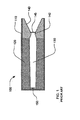
- FIG. 1 is a cross-sectional side view of a conventional solid fuel rocket motor.
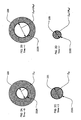
- FIG. 2A is a cross-sectional end view of a propellant charge at ignition.
- FIG. 2B is a cross-sectional end view of a propellant charge at a time t after ignition.
- FIG. 2C is a cross-sectional end view of a propellant pellet at ignition.
- FIG. 2D is a cross-sectional end view of a propellant pellet at a time t after ignition.
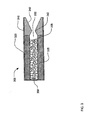
- FIG. 3 is a cross-sectional side view of an exemplary hybrid solid fuel rocket motor.
- FIG. 4A is a chart of simulation results showing the thrust of an exemplary hybrid solid fuel rocket motor.
- FIG. 4B is a chart of simulation results comparing internal pressures for propellant, pellet propellant, and hybrid solid fuel rocket motors.
- FIG. 5 is a cross-sectional end view of a propellant solid fuel rocket motor.
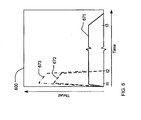
- FIG. 6 is a chart of simulation results showing the thrust of an exemplary hybrid solid fuel rocket motor.
- FIG. 7A is a cross-sectional end view of a propellant charge having a star-shaped center perforation.
- FIG. 7B is a cross-sectional end view of a propellant charge having a finocyl center perforation.
- FIG. 8A is a cross-sectional side view of an exemplary hybrid solid fuel rocket motor.
- FIG. 8B is a cross-sectional side view of an exemplary hybrid solid fuel rocket motor.
- a conventional solid fuel rocket motor 100 may include a case 110, a propellant charge 120 having a longitudinal opening 130, a nozzle 140, and an igniter 150.
- the propellant charge 120 may commonly be called the "grain". Note that the term “grain” is used to describe the propellant charge 120 as a whole, but does not refer to the weight of the propellant charge, the particle size of the material composing the propellant charge, or the surface texture of the propellant charge. Note that the propellant charge 120 may not be a single continuous mass of propellant material. For example, for ease of fabrication, the propellant charge 120 may be fabricated as two or pieces that are bonded or otherwise assembled within the rocket motor 100.
- the propellant charge 120 may be any material including at least one fuel ingredient and at least one oxidizer ingredient.
- the propellant charge may be a so-called “single-base” material, such as nitrocellulose, where the same ingredient serves as both the fuel and oxidizer components.
- the propellant charge may be a so-called “double base” material, such as a mixture of nitrocellulose and nitroglycerine, having two or more ingredients that serve as both the fuel and oxidizer components.
- the propellant charge may be a so-called “composite” material wherein the fuel ingredient and the oxidizer ingredient may be in the form of fine particles held in a matrix of a synthetic rubber or plastic binder.
- a composite propellant charge may include other ingredients such as a plasticizer.
- the binder and plasticizer may include energetic materials such as nitrocellulose, nitroglycerine, or other energetic materials.
- the propellant charge 120 may be formed by casting the selected material directly within the case 110.
- the propellant charge may be formed by casting or machining external to the case and may then be bonded or otherwise assembled into the case.
- a variety of propellant compositions are known. Exemplary propellant compositions are described in Chapter 12 of Rocket Propulsion Elements, by George Sutton and Oscar Biblarz (John Wiley & Sons, 2001 ).
- a longitudinal cavity 130 may be formed in the propellant charge 120.
- the longitudinal cavity 130 may commonly be centered on the longitudinal axis of the case 110.
- the igniter 150 may be a small charge of flammable material that, when burned, releases a predetermined amount of hot combustion gases.
- the combustion of the igniter may be initiated, for example, by an electric current flowing through a heater wire adjacent to, or embedded in, the flammable igniter material.
- the temperature and pressure of the gases produced by the igniter 150 may need to exceed predetermined values.
- the cavity 130 may be sealed by an environmental seal 145.
- the environmental seal 145 may also serve to protect the rocket motor 100 from environmental effects, such as humidity and precipitation.
- the environmental seal 145 may be designed to rupture or blow free from the motor after the pressure within the cavity 130 exceeds a predetermined pressure level, which may be, for example, between 100 and 500 pounds per square inch (PSI).
- a predetermined pressure level which may be, for example, between 100 and 500 pounds per square inch (PSI).
- PSI pounds per square inch
- the environmental seal may be retained in the nozzle by means of shear pins that fracture when the pressure exceeds the predetermined level.
- the environmental seal may be a burst disc having intentional structural weakness that allows the burst disc to rupture in a controlled manner when the pressure exceeds the predetermined level.
- the environmental seal 145 may be disposed at or near the portion of the nozzle 140 having the smallest cross-sectional area, commonly termed the throat 142.
- the environmental seal 145 may be disposed at other locations within the nozzle 140.
- the longitudinal cavity may be tapered slightly, as shown in FIG. 1 , to maintain a relatively constant core velocity and minimize erosive burning.
- the longitudinal cavity 130 may be shaped as a cylinder or slightly tapered cylinder.
- the thrust provided by a solid fuel rocket motor having a cylindrical longitudinal cavity may increase continuously as the grain is burned.
- FIG. 2A shows a cross sectional end view of an exemplary solid fuel rocket motor including a propellant charge 220 with a cylindrical longitudinal cavity.
- the burning surface of the propellant charge 220, immediately after ignition, is shown by the heavy line 222A.
- the area of the burning surface 222A of the propellant charge 220 is given by ⁇ ( L c )( D c0 ), where L c is the length of the propellant charge 220 normal to the plane of FIG. 2 , and D c0 is the initial diameter of the longitudinal cavity.
- FIG. 2B shows a cross sectional end view of the exemplary solid fuel rocket motor of FIG. 2A at a time t after ignition.
- the burning surface of the propellant charge 220 is indicated by the heavy line 222B.
- the diameter of the burning surface 222B is equal to D c0 +2R bc t, where R bc is the burn rate of the propellant charge.
- R bc is the burn rate of the propellant charge.
- the thrust of the solid fuel rocket motor at time t will be increased in proportion to the increase in the burning surface area.
- FIG. 2A and FIG. 2B shows that the thrust of a solid fuel rocket motor having a propellant charge with a cylindrical longitudinal cavity will increase continuously as the propellant charge is burned.
- a propellant structure where the burning surface area increases as the result of combustion is said to have a "progressive burn".
- FIG. 2C shows a cross sectional end view of an exemplary propellant pellet 225, which, for example, may be shaped as cylindrical disc having an initial diameter D p0 .
- FIG. 2C and FIG. 2D are not drawn to the same scale as FIG. 2A and FIG. 2B .
- the size of the pellet 225 is exaggerated with respect to the size of the propellant charge 220.
- the circumferential burning surface of the propellant pellet, immediately after ignition, is shown by the heavy line 222C.
- the total area of the pellet burning surface consists of surface 222C and the two circular faces of the propellant pellet 225.
- the total burning surface area of a disc shaped pellet is given by ⁇ ( L p )( D p0 ) + 0.5( ⁇ )( D p0 ) 2 , where Lp is the length of the propellant pellet 225 normal to the plane of FIG. 2 .
- FIG. 2D shows a cross sectional view of the exemplary propellant pellet 225 at a time t after ignition.
- the circumferential burning surface of the propellant pellet 225 is shown by the heavy line 222D.
- the diameter of the burning disc is equal to D p0 - 2R bpt , where R bp is the burn rate of the propellant pellets.
- R bp is the burn rate of the propellant pellets.
- 2D shows that the thrust of a solid fuel rocket motor using only propellant pellets will decrease continuously, after an initial ignition period, as the propellant pellets are burned.
- a fuel structure where the burning surface area decreases as the result of combustion is said to have a "regressive burn”.
- a solid fuel rocket motor 300 may include a case 310, a propellant charge 320, a plurality of propellant pellets 325, a nozzle 340, and an igniter 350.
- a rocket motor having both a bulk propellant charge and propellant pellets will be referred to as a "hybrid solid fuel rocket motor”. This term must be not be confused with the term “hybrid rocket motor” commonly used to describe a rocket motor where either one of the fuel or oxidizer ingredients is a solid and the other is a liquid.
- the term “bulk" propellant may be employed to distinguish the propellant charge 320 from the propellant pellets 325.
- the hybrid solid fuel rocket motor 300 may include a large plurality (hundreds or thousands) of propellant pellets 325.
- the propellant pellets 325 may be disposed within a central cavity in the propellant charge, as shown, or elsewhere within the case 310.
- the solid fuel pellets 325 may be, for example, gas generator pellets that are produced in large quantities for use in automobile air bags.
- Each of the plurality of propellant pellet 325 may be formed in a shape similar to that of a medicine tablet such as an aspirin.
- Each propellant pellet 325 may be formed in a short, generally cylindrical, shape with convex faces similar to an aspirin tablet.
- the convex faces may minimize the contact area between adjacent propellant pellets and thus prevent the propellant pellets from stacking or agglomerating.
- the convex faces may thus ensure that the plurality of propellant pellets 325 will have a very large total burnable surface area.
- Each propellant pellet may be formed in other shapes including flat discs, spheres, elongated cylinders, elongated cylinders with rounded ends, and other shapes.
- Each propellant pellet 325 may be composed of at least some of an energetic fuel material and an oxidizer material.
- Each propellant pellet may contain additional binder and/or plasticizer material.
- the binder material and the plasticizer material may be reactive and may serve as a fuel material and/or an oxidizer material.
- Suitable compositions for propellant pellets are well known. Suitable compositions used for propellant pellets include, for example, compositions that are predominantly guanidine (or guanidinium) nitrate and basic copper nitrate, cobalt nitrate, and combinations thereof, as described in U.S. Patent 5,608,183 . At least 60% of the total mass of the propellant pellets 325 may be composed of guanidine nitrate and basic copper nitrate.
- the propellant pellets 325 may have a combustion temperature, for example between 1500°C and 1800°C, less than the combustion temperature of the propellant charge 320.
- the average temperature of the combustion gasses may be an average of the combustion temperatures of the composite and pellet propellants.
- the relative size of the propellant charge and the quantity of propellant pellets may be selected such that the average temperature of the combustion gasses is low enough (less than about 2500°C) to allow components of the rocket motor that are exposed to the combustion products to be fabricated from Molybdenum or TZM (Titanium-Zirconium-Molybdenum) alloy.
- the propellant pellets 325 may be randomly disposed within the rocket motor as shown in FIG. 3 .
- the propellant pellets 325 may be stacked in an ordered manner. Many stacking arrangements may be possible depending on the size of rocket motor and the size of the propellant pellets.
- the rocket motor may include rods, guides, or other structure (not shown in FIG. 3 ) to position and retain the stacked pellets.
- the propellant pellets 325 are retained within the rocket motor by means of a perforated pellet retainer 335.
- the term "perforated” is intended to encompass any type or shape of openings in the structure of the pellet retainer, and does not imply any particular method of forming or creating the openings.
- the pellet retainer prevents the unburned pellets from being ejected through the nozzle 340 while allowing passage of the exhaust gases produced when the propellant pellets 325 and the propellant charge 320 are ignited.
- the pellet retainer 335 may be formed of a thin metal material with machined or chemically formed perforations.
- the pellet retainer 335 may be formed of a woven or etched screen or mesh.
- the pellet retainer 335 may be formed as a single physical element, or may include a plurality of physical pieces such as, for example, a plurality of closely spaced metal discs, wires, or rods. However the pellet retainer is formed, the pellet retainer 335 will provide perforations or passages for the exhaust gases to flow to the nozzle 340.
- the perforations may be circular, square, rectangular, or elongated slits, or any other shape that allows passage for the combustion products while retaining the fuel pellets.
- the perforations may be adapted to retain burning fuel pellets within the rocket motor until combustion has reduced the size of the pellets to less than a predetermined size.
- at least one dimension of the perforations or openings in the pellet retainer 335 may be significantly smaller than any dimension of the unburned fuel pellets 325, such that a fuel pellet may not pass through the pellet retainer until combustion of the fuel pellet is nearly complete.
- combustion of the fuel pellets 325 is nearly complete, at least some of the fuel pellets may be swept through the perforations in the pellet retainer 335 into the nozzle 340 by the flow of the combustion gases.
- the pellet retainer 335 may be positioned to form a cavity 332 between the pellet retainer 335 and the throat 342 of the nozzle 340.
- the cavity 332 may be initially devoid of propellant pellets.
- the length of the cavity 332 may be such that at least a portion of the partially burned fuel pellets passing through the pellet retainer are completely burned before the fuel pellets pass through the throat 342.
- Fuel pellets that are completely burned before passing through the throat 342 may fully contribute to the thrust of the rocket motor.
- Each fuel pellet that is still burning as it is ejected through the throat 342 may result in an incremental reduction in the total thrust provided by the rocket motor.
- pellet retainer 335 restricts the flow of combustion gases from the burning fuel pellets 325 and the propellant charge 325 to the nozzle 340. To ensure that the pressure within the rocket motor is governed by the cross-sectional area of the throat 342, the total cross-sectional area of the perforations in the pellet retainer 335 is larger than the cross-section area of the throat 342.
- An igniter 350 is disposed within the case to ignite the propellant charge 320 and the plurality of propellant pellets 325. Note that the igniter may directly ignite only a portion of the propellant charge 320 and/or the plurality of propellant pellets 325. The hot combustion gases from the ignited propellant may then rapidly ignite the remaining propellant.
- FIG. 4A shows the thrust, as a function of time, produced by three rocket motors using different propellants.
- the graph 400A plots results from simulations of the three different rocket motors.
- the solid line 471 is a plot of the thrust produced by a propellant charge, which is presumed to have a cylindrical longitudinal cavity.
- the surface of the propellant charge may be fully ignited at approximately 0.002 seconds.
- the thrust produced by the propellant charge may increase linearly from 0.002 seconds to 0.016 seconds due to a continuous increase in the burnable surface area.
- the propellant charge with a cylindrical longitudinal cavity exhibits a progressive burn. At 0.016 seconds, the propellant may be consumed, and the thrust may rapidly decrease.
- the solid line 471 represents the result of a simulation of the burn of an idealized propellant charge. Minor localized variations in the burning rate of the propellant charge and end effects may cause the thrust produced by a real rocket motor to deviate from the ideal.
- the dashed line 472 is a plot of the thrust produced by a plurality of propellant pellets.
- the surface of the propellant pellets may be fully ignited at about 0.004 seconds.
- the thrust produced by the propellant pellets may then decrease, roughly linearly, from 0.004 seconds to about 0.016 seconds due to a continuous decrease in the burnable surface area.
- the dashed line 472 demonstrates that propellant pellets provide a regressive burn. At about 0.016 seconds, the propellant pellets may be consumed.
- the simulation assumed the propellant pellets were shaped as short cylindrical tablets, where the thickness of the tablet is smaller than the radius of the cylinder.
- the decreased in thrust between 0.004 seconds and 0.016 seconds is due to the reduction in the diameter and thickness of the cylinder as the pellets burn.
- the burn out at 0.016 seconds occurs when the combustion bums through the thickness of the pellets.
- the rate of decrease of the thrust produced by other types of propellant pellets may be determined by the shape of the pellets, and may not be linear in time.
- the broken line 473 is a plot of the total thrust produced by an exemplary hybrid solid fuel rocket motor.
- the total thrust of the hybrid solid fuel rocket motor is essentially constant from about 0.006 seconds to 0.016 seconds.
- the interval of essentially constant total thrust occurs because the regressive burn (the reduction in thrust over time) of the pellet propellant effectively compensates for the progressive burn (the increase in thrusts over time) of the propellant charge during this time interval.
- a rocket motor where the thrust is essentially constant with time after the initial ignition period is described as having a "neutral burn".
- FIG. 4B shows the internal pressure of the three rocket motors.
- the graph 400B plots additional results from simulations that produced the data previously shown in FIG. 4A .
- the solid line 474 is a plot of the internal pressure of the motor using a propellant charge.
- the maximum internal pressure, which occurs near the end of the progressive burn, is over 10,000 PSIA (pounds per square inch absolute).
- the dashed line 475 is a plot of the internal pressure of the rocket motor using a plurality of propellant pellets.
- the maximum internal pressure, which occurs early in the burn when the pellets are fully ignited is over 11,000 PSIA.
- the broken line 476 is a plot of the internal pressure of the exemplary hybrid solid fuel rocket motor.
- the maximum internal pressure is about 8000 PSIA.
- FIG. 4B illustrates the principle that, for equal total impulse, a rocket motor with a neutral propellant burn will have a maximum internal pressure that is lower than a rocket motor having either a progressive or regressive propellant burn.
- the external case of a rocket motor must be able to contain the maximum internal pressure.
- a rocket motor having either a progressive or regressive burn may require a stronger, and potentially heavier and more costly, case than a rocket motor having a neutral propellant burn.
- a hybrid solid fuel rocket motor may include a cylindrical propellant charge with a cylindrical central cavity and a plurality of pellets shaped as discs, where the thickness of each disc is substantially less that its diameter.
- the burn time of the propellant charge may be approximately ( D c , max - D c0 )/(2 R bc ), where D c , max is the outside diameter of the propellant charge.
- the burn time of the propellant pellets may be approximately d p /( 2R bp ), where dp is the thickness for a disc-shaped a propellant pellet.
- F c force produced by the propellant charge
- R bc propellant charge burn rate
- P pc propellant charge density
- a c ( t ) propellant charge burning surface area as a function of time.
- F p force produced by the propellant charge
- N the number of propellant pellets
- R bp propellant pellet burn rate
- P pp propellant pellet density
- a p ( t ) Propellant pellet burning surface area as a function of time.
- a hybrid solid fuel rocket motor may have a neutral burn if the following relationship is satisfied: R bc * P pc * d ⁇ A c t / d ⁇ t ⁇ - N * R bp * P pp * d ⁇ A p t / d ⁇ t .
- FIG. 5 shows an exemplary rocket motor which combines a propellant charge 520 and a plurality of propellant pellets 525 to provide an initial period of high thrust followed by a period of sustained lower thrust.
- This type of rocket motor commonly called a "dual-burn" motor may be useful to quickly accelerate a missile to a cruising speed that may then be sustained.
- the propellant pellets 525 are shown as being smaller than the propellant pellets shown in FIG. 3 to imply that the propellant pellets 525 burn for a shorter period of time. However, as previously discussed, the burn time will be determined by both the shape and the burn rate of the propellant pellets 525.
- the propellant pellets in a dual-burn hybrid solid fuel rocket motor may be smaller than, larger than, or the same size as the propellant pellets in a neutral burn hybrid solid fuel rocket motor.
- FIG. 6 shows a graph 600 which plots the thrust, as a function of time, produced by a hypothetical dual-burn hybrid solid fuel rocket motor.
- the solid line 671 is a plot of the thrust produced by a propellant charge, which is adapted to provide a neutral burn.
- the propellant charge may have a star-shaped center perforation, as shown in FIG. 7A , or a finocyl perforation, as shown in FIG. 7B .
- the propellant charge is assumed to be fully ignited by time tl and to provide constant thrust until a later time t3.
- the solid line 671 represents a hypothetical result for an idealized propellant charge. Minor localized variations in the burning rate of the propellant charge and end effects may cause the thrust produced by a real rocket motor to deviate from the ideal.
- the dashed line 672 is a plot of the thrust produced by an plurality of propellant pellets.
- the surface of the propellant pellets is assumed to be fully ignited at time t1.
- the propellant pellets then provide high thrust until they are consumed at time t2.
- the burn time, from time t1 to time t2, of the propellant pellets may be substantially shorter than the burn time, from time t1 to time t3, of the propellant charge.
- the broken line 673 is a plot of the total thrust produced by the hypothetical hybrid solid fuel rocket motor.
- the hypothetical hybrid solid fuel rocket motor provides high thrust from an initial period from t1 to t2, followed by sustained lower thrust from time t2 to time t3.
- FIG. 8A and FIG. 8B show two additional exemplary hybrid solid fuel rocket motors.
- Each rocket motor 800A,B may include a propellant charge 820A,B and a plurality of propellant pellets 825A,B.
- Each plurality of propellant pellets 825A,B may be retained within the respective rocket motor by an appropriately formed pellet retainer 835A,B.
- the rocket motors of FIGS. 3 , 5 , 8A, and 8B are examples and that a propellant charge and propellant pellets may be integrated within a hybrid solid fuel rocket motor in many other configurations.
- the means are not intended to be limited to the means disclosed herein for performing the recited function, but are intended to cover in scope any means, known now or later developed, for performing the recited function.
- a "set" of items may include one or more of such items.
Landscapes
- Engineering & Computer Science (AREA)
- Chemical & Material Sciences (AREA)
- Combustion & Propulsion (AREA)
- Mechanical Engineering (AREA)
- General Engineering & Computer Science (AREA)
- Testing Of Engines (AREA)
- Solid-Fuel Combustion (AREA)
Applications Claiming Priority (2)
| Application Number | Priority Date | Filing Date | Title |
|---|---|---|---|
| US12/053,475 US7685940B1 (en) | 2008-03-21 | 2008-03-21 | Rocket motor with pellet and bulk solid propellants |
| PCT/US2009/033694 WO2009134510A2 (en) | 2008-03-21 | 2009-02-10 | Rocket motor with pellet and bulk solid propellants |
Publications (2)
| Publication Number | Publication Date |
|---|---|
| EP2281114A2 EP2281114A2 (en) | 2011-02-09 |
| EP2281114B1 true EP2281114B1 (en) | 2012-11-07 |
Family
ID=41255646
Family Applications (1)
| Application Number | Title | Priority Date | Filing Date |
|---|---|---|---|
| EP09739312A Active EP2281114B1 (en) | 2008-03-21 | 2009-02-10 | Rocket motor with pellet and bulk solid propellants |
Country Status (4)
| Country | Link |
|---|---|
| US (1) | US7685940B1 (enExample) |
| EP (1) | EP2281114B1 (enExample) |
| JP (1) | JP5016134B2 (enExample) |
| WO (1) | WO2009134510A2 (enExample) |
Families Citing this family (16)
| Publication number | Priority date | Publication date | Assignee | Title |
|---|---|---|---|---|
| US20090000268A1 (en) * | 2007-03-20 | 2009-01-01 | Yurash Greg J | Thermonuclear plasma reactor for rocket thrust and electrical generation |
| US8127534B2 (en) * | 2008-02-19 | 2012-03-06 | Raytheon Company | Pellet loaded attitude control rocket motor |
| US20100011742A1 (en) * | 2008-07-17 | 2010-01-21 | Cavalleri Robert J | Rocket Motor Containing Multiple Pellet Cells |
| US8242422B2 (en) * | 2009-02-23 | 2012-08-14 | Raytheon Company | Modular divert and attitude control system |
| US8667776B2 (en) | 2009-02-23 | 2014-03-11 | Raytheon Company | Pellet-loaded multiple impulse rocket motor |
| US20110024165A1 (en) * | 2009-07-31 | 2011-02-03 | Raytheon Company | Systems and methods for composite structures with embedded interconnects |
| US8713912B2 (en) * | 2010-07-12 | 2014-05-06 | Raytheon Company | Solid propellant rocket motors employing tungsten alloy burst discs and methods for the manufacture thereof |
| US8826640B2 (en) | 2010-11-12 | 2014-09-09 | Raytheon Company | Flight vehicles including electrically-interconnective support structures and methods for the manufacture thereof |
| US20120304620A1 (en) * | 2011-06-01 | 2012-12-06 | Aerojet-General Corporation | Catalyst, gas generator, and thruster with improved thermal capability and corrosion resistance |
| US8683933B1 (en) | 2012-01-29 | 2014-04-01 | Mario Placido Portela | Solid rocket braking system |
| FR2995364A1 (fr) * | 2012-09-13 | 2014-03-14 | Astrium Sas | Dispositif de propulsion hybride anaerobie a carburant presente sous de forme de solides divises |
| CN104747319B (zh) * | 2014-01-01 | 2019-05-21 | 冯石文 | 一种固体燃料火箭发动机 |
| US10563617B2 (en) * | 2016-09-23 | 2020-02-18 | Raytheon Company | Electrically operated propellant for solid rocket motor thrust management |
| ES2901239T3 (es) * | 2018-12-10 | 2022-03-21 | Tecnesis 3000 Sl | Dispositivo de energía con base en la reacción de álcali-agua |
| CN114060168B (zh) * | 2021-11-05 | 2024-01-19 | 江西洪都航空工业集团有限责任公司 | 一种大初始推力端燃装药固体火箭发动机 |
| CN115559829B (zh) * | 2022-10-28 | 2024-07-12 | 中北大学 | 一种可重复装填多脉冲固体火箭发动机 |
Family Cites Families (30)
| Publication number | Priority date | Publication date | Assignee | Title |
|---|---|---|---|---|
| US2986001A (en) | 1956-08-16 | 1961-05-30 | Aerojet General Co | Shock absorbing means for rocket propellant grains |
| US3107487A (en) * | 1960-08-12 | 1963-10-22 | Aerojet General Co | Rocket motor |
| DE2456721C2 (de) | 1974-11-30 | 1983-07-07 | Dynamit Nobel Ag, 5210 Troisdorf | Mehrkammer-Raketentriebwerk |
| JPS5476812A (en) * | 1977-11-30 | 1979-06-19 | Aerojet General Co | Production of double propelling type rocket motor |
| JPS581333B2 (ja) | 1978-03-02 | 1983-01-11 | 日産自動車株式会社 | 燃焼器 |
| JPS55107039A (en) * | 1979-02-09 | 1980-08-16 | Nissan Motor Co Ltd | Rocket motor |
| US4539910A (en) * | 1983-09-19 | 1985-09-10 | Morton Thiokol, Inc. | Igniter pellet cup |
| JPS60216054A (ja) * | 1984-04-12 | 1985-10-29 | Takeshi Umehara | 各々に異つた粒子度を持つ、管状グレインを充てんしたロケツト |
| US4738100A (en) * | 1984-12-06 | 1988-04-19 | Werkzeugmaschinenfabrik Oerlikon Buehrle Ag | Boost-sustain-boost rocket |
| JPS61218756A (ja) * | 1985-03-25 | 1986-09-29 | Nissan Motor Co Ltd | ロケツト弾 |
| US5024160A (en) * | 1986-08-18 | 1991-06-18 | Thiokol Corporation | Rapid burning propellant charge for automobile air bag inflators, rocket motors, and igniters therefor |
| US5440993A (en) * | 1990-12-07 | 1995-08-15 | Osofsky; Irving B. | High velocity impulse rocket |
| EP0767872B1 (en) * | 1994-04-29 | 2000-06-28 | Cordant Technologies Inc. | Solid propellant dual phase rocket motor |
| US5959235A (en) * | 1995-02-16 | 1999-09-28 | Royal Ordnance Public Limited Company | Fire mitigation device |
| US5608183A (en) * | 1996-03-15 | 1997-03-04 | Morton International, Inc. | Gas generant compositions containing amine nitrates plus basic copper (II) nitrate and/or cobalt(III) triammine trinitrate |
| CA2190233A1 (en) * | 1996-11-13 | 1998-05-13 | D. Lee Manner | Combustion fuel source |
| US6352030B1 (en) * | 1998-11-12 | 2002-03-05 | Cordant Technologies Inc. | Gas generating eject motor |
| US6361629B2 (en) | 1998-11-12 | 2002-03-26 | The United States Of America As Represented By The Secretary Of The Air Force | Flowable solid propellant |
| US6357357B1 (en) * | 1999-01-05 | 2002-03-19 | Alliant Techsystems Inc. | Propulsion system |
| EP1080338A4 (en) * | 1999-03-25 | 2006-04-05 | Rafael Armament Dev Authority | PANZER-BREAKING STOREY |
| US6647888B1 (en) * | 1999-05-06 | 2003-11-18 | Anthony Joseph Cesaroni | Oxidizer package for propellant system for rockets |
| US6554936B1 (en) * | 1999-09-08 | 2003-04-29 | Alliant Techsystems Inc. | Method of constructing insulated metal dome structure for a rocket motor |
| US6503350B2 (en) * | 1999-11-23 | 2003-01-07 | Technanogy, Llc | Variable burn-rate propellant |
| US6692655B1 (en) | 2000-03-10 | 2004-02-17 | Alliant Techsystems Inc. | Method of making multi-base propellants from pelletized nitrocellulose |
| CA2367192A1 (en) * | 2001-01-10 | 2002-07-10 | Cesaroni Technology Incorporated | Propellant system for solid fuel rocket |
| US6968676B1 (en) * | 2001-11-01 | 2005-11-29 | Krishnan Vinu B | Propulsion from combustion of solid propellant pellet-projectiles |
| US6739121B2 (en) * | 2002-01-22 | 2004-05-25 | Environmental Areoscience Corp. | Flame holder for a hybrid rocket motor |
| FR2844557B1 (fr) * | 2002-09-12 | 2006-03-03 | Snecma Propulsion Solide | Systeme et procede de controle des oscillations de pression d'origine hydrodynamique pour propulseur a propergol solide |
| US7565797B2 (en) * | 2004-02-27 | 2009-07-28 | Ghkn Engineering Llc | Systems and methods for varying the thrust of rocket motors and engines while maintaining higher efficiency using moveable plug nozzles |
| US7194852B1 (en) * | 2005-01-07 | 2007-03-27 | Krishnan Vinu B | Propulsion from combustion of solid propellant pellet-projectiles |
-
2008
- 2008-03-21 US US12/053,475 patent/US7685940B1/en active Active
-
2009
- 2009-02-10 EP EP09739312A patent/EP2281114B1/en active Active
- 2009-02-10 WO PCT/US2009/033694 patent/WO2009134510A2/en not_active Ceased
- 2009-02-10 JP JP2011500828A patent/JP5016134B2/ja active Active
Also Published As
| Publication number | Publication date |
|---|---|
| EP2281114A2 (en) | 2011-02-09 |
| US20100064925A1 (en) | 2010-03-18 |
| WO2009134510A3 (en) | 2010-01-21 |
| JP5016134B2 (ja) | 2012-09-05 |
| US7685940B1 (en) | 2010-03-30 |
| WO2009134510A2 (en) | 2009-11-05 |
| JP2011515614A (ja) | 2011-05-19 |
Similar Documents
| Publication | Publication Date | Title |
|---|---|---|
| EP2281114B1 (en) | Rocket motor with pellet and bulk solid propellants | |
| EP0767872B1 (en) | Solid propellant dual phase rocket motor | |
| US8443731B1 (en) | Reactive material enhanced projectiles, devices for generating reactive material enhanced projectiles and related methods | |
| US3677010A (en) | Rocket motor and method | |
| US8667776B2 (en) | Pellet-loaded multiple impulse rocket motor | |
| US6619029B2 (en) | Rocket motors with insensitive munitions systems | |
| US9605932B2 (en) | Gas generators, launch tubes including gas generators and related systems and methods | |
| EP2245291B1 (en) | Pellet loaded attitude control rocket motor | |
| US20170122259A1 (en) | Solid rocket motors including flight termination systems, and related multi-stage solid rocket motor assemblies and methods | |
| EP2422162B1 (en) | Low foreign object damage (fod) weighted nose decoy flare | |
| US5220783A (en) | Foamed in place igniter and aft-end assembly for rocket motor comprising the same | |
| US9791249B2 (en) | Kinetic fireball incendiary munition | |
| US20100011742A1 (en) | Rocket Motor Containing Multiple Pellet Cells | |
| US3070014A (en) | Jet propulsion device | |
| US10035489B2 (en) | Pyrotechnic charge and gas generator comprising such a charge | |
| US20130019587A1 (en) | Thruster devices and methods of making thruster devices for use with thrust vector control systems | |
| Kumar et al. | Nanotechnology-driven explosives and propellants | |
| US4170875A (en) | Caseless rocket design | |
| EP0477482A1 (en) | Foamed in place igniter and aft-end assembly for rocket motor comprising the same | |
| US20140137539A1 (en) | Thrust-producing device with detonation motor | |
| US10281248B2 (en) | Gas generators, launch tube assemblies including gas generators, and related systems and methods | |
| JP7415512B2 (ja) | 端面燃焼型ロケットモータ用点火装置 | |
| Krishnan | Propulsion from the pulse detonation of solid propellant pellet-projectiles | |
| EP1440233A1 (en) | Rocket motors with insensitive munitions systems | |
| JPH0660601B2 (ja) | 複数推進薬固体ロケットエンジン |
Legal Events
| Date | Code | Title | Description |
|---|---|---|---|
| PUAI | Public reference made under article 153(3) epc to a published international application that has entered the european phase |
Free format text: ORIGINAL CODE: 0009012 |
|
| 17P | Request for examination filed |
Effective date: 20101013 |
|
| AK | Designated contracting states |
Kind code of ref document: A2 Designated state(s): AT BE BG CH CY CZ DE DK EE ES FI FR GB GR HR HU IE IS IT LI LT LU LV MC MK MT NL NO PL PT RO SE SI SK TR |
|
| AX | Request for extension of the european patent |
Extension state: AL BA RS |
|
| DAX | Request for extension of the european patent (deleted) | ||
| REG | Reference to a national code |
Ref country code: DE Ref legal event code: R079 Ref document number: 602009011024 Country of ref document: DE Free format text: PREVIOUS MAIN CLASS: F02K0009100000 Ipc: F02K0009080000 |
|
| GRAP | Despatch of communication of intention to grant a patent |
Free format text: ORIGINAL CODE: EPIDOSNIGR1 |
|
| RIC1 | Information provided on ipc code assigned before grant |
Ipc: F02K 9/34 20060101ALI20120214BHEP Ipc: F02K 9/10 20060101ALI20120214BHEP Ipc: F02K 9/24 20060101ALI20120214BHEP Ipc: F02K 9/08 20060101AFI20120214BHEP |
|
| RAP1 | Party data changed (applicant data changed or rights of an application transferred) |
Owner name: RAYTHEON COMPANY |
|
| GRAS | Grant fee paid |
Free format text: ORIGINAL CODE: EPIDOSNIGR3 |
|
| GRAA | (expected) grant |
Free format text: ORIGINAL CODE: 0009210 |
|
| AK | Designated contracting states |
Kind code of ref document: B1 Designated state(s): AT BE BG CH CY CZ DE DK EE ES FI FR GB GR HR HU IE IS IT LI LT LU LV MC MK MT NL NO PL PT RO SE SI SK TR |
|
| REG | Reference to a national code |
Ref country code: GB Ref legal event code: FG4D |
|
| REG | Reference to a national code |
Ref country code: CH Ref legal event code: EP Ref country code: AT Ref legal event code: REF Ref document number: 583117 Country of ref document: AT Kind code of ref document: T Effective date: 20121115 |
|
| REG | Reference to a national code |
Ref country code: IE Ref legal event code: FG4D |
|
| REG | Reference to a national code |
Ref country code: DE Ref legal event code: R096 Ref document number: 602009011024 Country of ref document: DE Effective date: 20130103 |
|
| REG | Reference to a national code |
Ref country code: AT Ref legal event code: MK05 Ref document number: 583117 Country of ref document: AT Kind code of ref document: T Effective date: 20121107 |
|
| REG | Reference to a national code |
Ref country code: NL Ref legal event code: VDEP Effective date: 20121107 |
|
| REG | Reference to a national code |
Ref country code: LT Ref legal event code: MG4D |
|
| PG25 | Lapsed in a contracting state [announced via postgrant information from national office to epo] |
Ref country code: SE Free format text: LAPSE BECAUSE OF FAILURE TO SUBMIT A TRANSLATION OF THE DESCRIPTION OR TO PAY THE FEE WITHIN THE PRESCRIBED TIME-LIMIT Effective date: 20121107 Ref country code: FI Free format text: LAPSE BECAUSE OF FAILURE TO SUBMIT A TRANSLATION OF THE DESCRIPTION OR TO PAY THE FEE WITHIN THE PRESCRIBED TIME-LIMIT Effective date: 20121107 Ref country code: HR Free format text: LAPSE BECAUSE OF FAILURE TO SUBMIT A TRANSLATION OF THE DESCRIPTION OR TO PAY THE FEE WITHIN THE PRESCRIBED TIME-LIMIT Effective date: 20121107 Ref country code: IS Free format text: LAPSE BECAUSE OF FAILURE TO SUBMIT A TRANSLATION OF THE DESCRIPTION OR TO PAY THE FEE WITHIN THE PRESCRIBED TIME-LIMIT Effective date: 20130307 Ref country code: LT Free format text: LAPSE BECAUSE OF FAILURE TO SUBMIT A TRANSLATION OF THE DESCRIPTION OR TO PAY THE FEE WITHIN THE PRESCRIBED TIME-LIMIT Effective date: 20121107 Ref country code: NL Free format text: LAPSE BECAUSE OF FAILURE TO SUBMIT A TRANSLATION OF THE DESCRIPTION OR TO PAY THE FEE WITHIN THE PRESCRIBED TIME-LIMIT Effective date: 20121107 Ref country code: NO Free format text: LAPSE BECAUSE OF FAILURE TO SUBMIT A TRANSLATION OF THE DESCRIPTION OR TO PAY THE FEE WITHIN THE PRESCRIBED TIME-LIMIT Effective date: 20130207 |
|
| PG25 | Lapsed in a contracting state [announced via postgrant information from national office to epo] |
Ref country code: SI Free format text: LAPSE BECAUSE OF FAILURE TO SUBMIT A TRANSLATION OF THE DESCRIPTION OR TO PAY THE FEE WITHIN THE PRESCRIBED TIME-LIMIT Effective date: 20121107 Ref country code: PT Free format text: LAPSE BECAUSE OF FAILURE TO SUBMIT A TRANSLATION OF THE DESCRIPTION OR TO PAY THE FEE WITHIN THE PRESCRIBED TIME-LIMIT Effective date: 20130307 Ref country code: LV Free format text: LAPSE BECAUSE OF FAILURE TO SUBMIT A TRANSLATION OF THE DESCRIPTION OR TO PAY THE FEE WITHIN THE PRESCRIBED TIME-LIMIT Effective date: 20121107 Ref country code: PL Free format text: LAPSE BECAUSE OF FAILURE TO SUBMIT A TRANSLATION OF THE DESCRIPTION OR TO PAY THE FEE WITHIN THE PRESCRIBED TIME-LIMIT Effective date: 20121107 Ref country code: BE Free format text: LAPSE BECAUSE OF FAILURE TO SUBMIT A TRANSLATION OF THE DESCRIPTION OR TO PAY THE FEE WITHIN THE PRESCRIBED TIME-LIMIT Effective date: 20121107 Ref country code: GR Free format text: LAPSE BECAUSE OF FAILURE TO SUBMIT A TRANSLATION OF THE DESCRIPTION OR TO PAY THE FEE WITHIN THE PRESCRIBED TIME-LIMIT Effective date: 20130208 |
|
| PG25 | Lapsed in a contracting state [announced via postgrant information from national office to epo] |
Ref country code: AT Free format text: LAPSE BECAUSE OF FAILURE TO SUBMIT A TRANSLATION OF THE DESCRIPTION OR TO PAY THE FEE WITHIN THE PRESCRIBED TIME-LIMIT Effective date: 20121107 |
|
| PG25 | Lapsed in a contracting state [announced via postgrant information from national office to epo] |
Ref country code: CZ Free format text: LAPSE BECAUSE OF FAILURE TO SUBMIT A TRANSLATION OF THE DESCRIPTION OR TO PAY THE FEE WITHIN THE PRESCRIBED TIME-LIMIT Effective date: 20121107 Ref country code: BG Free format text: LAPSE BECAUSE OF FAILURE TO SUBMIT A TRANSLATION OF THE DESCRIPTION OR TO PAY THE FEE WITHIN THE PRESCRIBED TIME-LIMIT Effective date: 20130207 Ref country code: SK Free format text: LAPSE BECAUSE OF FAILURE TO SUBMIT A TRANSLATION OF THE DESCRIPTION OR TO PAY THE FEE WITHIN THE PRESCRIBED TIME-LIMIT Effective date: 20121107 Ref country code: DK Free format text: LAPSE BECAUSE OF FAILURE TO SUBMIT A TRANSLATION OF THE DESCRIPTION OR TO PAY THE FEE WITHIN THE PRESCRIBED TIME-LIMIT Effective date: 20121107 Ref country code: EE Free format text: LAPSE BECAUSE OF FAILURE TO SUBMIT A TRANSLATION OF THE DESCRIPTION OR TO PAY THE FEE WITHIN THE PRESCRIBED TIME-LIMIT Effective date: 20121107 |
|
| PG25 | Lapsed in a contracting state [announced via postgrant information from national office to epo] |
Ref country code: RO Free format text: LAPSE BECAUSE OF FAILURE TO SUBMIT A TRANSLATION OF THE DESCRIPTION OR TO PAY THE FEE WITHIN THE PRESCRIBED TIME-LIMIT Effective date: 20121107 Ref country code: IT Free format text: LAPSE BECAUSE OF FAILURE TO SUBMIT A TRANSLATION OF THE DESCRIPTION OR TO PAY THE FEE WITHIN THE PRESCRIBED TIME-LIMIT Effective date: 20121107 |
|
| PLBE | No opposition filed within time limit |
Free format text: ORIGINAL CODE: 0009261 |
|
| STAA | Information on the status of an ep patent application or granted ep patent |
Free format text: STATUS: NO OPPOSITION FILED WITHIN TIME LIMIT |
|
| PG25 | Lapsed in a contracting state [announced via postgrant information from national office to epo] |
Ref country code: MC Free format text: LAPSE BECAUSE OF NON-PAYMENT OF DUE FEES Effective date: 20130228 |
|
| REG | Reference to a national code |
Ref country code: CH Ref legal event code: PL |
|
| 26N | No opposition filed |
Effective date: 20130808 |
|
| PG25 | Lapsed in a contracting state [announced via postgrant information from national office to epo] |
Ref country code: LI Free format text: LAPSE BECAUSE OF NON-PAYMENT OF DUE FEES Effective date: 20130228 Ref country code: CH Free format text: LAPSE BECAUSE OF NON-PAYMENT OF DUE FEES Effective date: 20130228 Ref country code: ES Free format text: LAPSE BECAUSE OF FAILURE TO SUBMIT A TRANSLATION OF THE DESCRIPTION OR TO PAY THE FEE WITHIN THE PRESCRIBED TIME-LIMIT Effective date: 20130218 |
|
| PG25 | Lapsed in a contracting state [announced via postgrant information from national office to epo] |
Ref country code: CY Free format text: LAPSE BECAUSE OF FAILURE TO SUBMIT A TRANSLATION OF THE DESCRIPTION OR TO PAY THE FEE WITHIN THE PRESCRIBED TIME-LIMIT Effective date: 20121107 |
|
| REG | Reference to a national code |
Ref country code: IE Ref legal event code: MM4A |
|
| REG | Reference to a national code |
Ref country code: DE Ref legal event code: R097 Ref document number: 602009011024 Country of ref document: DE Effective date: 20130808 |
|
| PG25 | Lapsed in a contracting state [announced via postgrant information from national office to epo] |
Ref country code: IE Free format text: LAPSE BECAUSE OF NON-PAYMENT OF DUE FEES Effective date: 20130210 |
|
| PG25 | Lapsed in a contracting state [announced via postgrant information from national office to epo] |
Ref country code: MT Free format text: LAPSE BECAUSE OF FAILURE TO SUBMIT A TRANSLATION OF THE DESCRIPTION OR TO PAY THE FEE WITHIN THE PRESCRIBED TIME-LIMIT Effective date: 20121107 |
|
| PG25 | Lapsed in a contracting state [announced via postgrant information from national office to epo] |
Ref country code: TR Free format text: LAPSE BECAUSE OF FAILURE TO SUBMIT A TRANSLATION OF THE DESCRIPTION OR TO PAY THE FEE WITHIN THE PRESCRIBED TIME-LIMIT Effective date: 20121107 |
|
| PG25 | Lapsed in a contracting state [announced via postgrant information from national office to epo] |
Ref country code: LU Free format text: LAPSE BECAUSE OF NON-PAYMENT OF DUE FEES Effective date: 20130210 Ref country code: HU Free format text: LAPSE BECAUSE OF FAILURE TO SUBMIT A TRANSLATION OF THE DESCRIPTION OR TO PAY THE FEE WITHIN THE PRESCRIBED TIME-LIMIT; INVALID AB INITIO Effective date: 20090210 Ref country code: MK Free format text: LAPSE BECAUSE OF FAILURE TO SUBMIT A TRANSLATION OF THE DESCRIPTION OR TO PAY THE FEE WITHIN THE PRESCRIBED TIME-LIMIT Effective date: 20121107 |
|
| REG | Reference to a national code |
Ref country code: FR Ref legal event code: PLFP Year of fee payment: 8 |
|
| REG | Reference to a national code |
Ref country code: FR Ref legal event code: PLFP Year of fee payment: 9 |
|
| REG | Reference to a national code |
Ref country code: FR Ref legal event code: PLFP Year of fee payment: 10 |
|
| P01 | Opt-out of the competence of the unified patent court (upc) registered |
Effective date: 20230530 |
|
| PGFP | Annual fee paid to national office [announced via postgrant information from national office to epo] |
Ref country code: DE Payment date: 20250122 Year of fee payment: 17 |
|
| PGFP | Annual fee paid to national office [announced via postgrant information from national office to epo] |
Ref country code: FR Payment date: 20250121 Year of fee payment: 17 |
|
| PGFP | Annual fee paid to national office [announced via postgrant information from national office to epo] |
Ref country code: GB Payment date: 20250123 Year of fee payment: 17 |