EP2280353A2 - Phrasenbasierte statistische Übersetzung neu dargelegt als ein allgemeines Problem des Handlungsreisenden - Google Patents
Phrasenbasierte statistische Übersetzung neu dargelegt als ein allgemeines Problem des Handlungsreisenden Download PDFInfo
- Publication number
- EP2280353A2 EP2280353A2 EP10170129A EP10170129A EP2280353A2 EP 2280353 A2 EP2280353 A2 EP 2280353A2 EP 10170129 A EP10170129 A EP 10170129A EP 10170129 A EP10170129 A EP 10170129A EP 2280353 A2 EP2280353 A2 EP 2280353A2
- Authority
- EP
- European Patent Office
- Prior art keywords
- graph
- gtsp
- cost
- tour
- phrase
- Prior art date
- Legal status (The legal status is an assumption and is not a legal conclusion. Google has not performed a legal analysis and makes no representation as to the accuracy of the status listed.)
- Ceased
Links
Images






Classifications
-
- G—PHYSICS
- G06—COMPUTING OR CALCULATING; COUNTING
- G06F—ELECTRIC DIGITAL DATA PROCESSING
- G06F40/00—Handling natural language data
- G06F40/40—Processing or translation of natural language
- G06F40/42—Data-driven translation
- G06F40/44—Statistical methods, e.g. probability models
Definitions
- the subject application relates to statistical machine translation (SMT) in computing systems. While the systems and methods described herein relate to statistical machine translation, it will be appreciated that the described techniques may find application in other translation systems, other statistical mapping applications, and/or other translation methods.
- SMT statistical machine translation
- integer programming approaches which contrast with conventional beam-search approaches
- GTSP traveling salesman problem
- Such integer programming approaches which are very generic, are also often very inefficient.
- integer programming formulations are typically suited to cases where exact optimal solutions are requested, which is much more demanding in terms of computing resources than when approximate solutions are sought.
- a single GTSP formulation allows for employing either exact solvers or approximate well-adapted solvers.
- such integer programming approaches only incorporate bigram language models, and not trigram or n-gram language models.
- N-gram language models are a type of probabilistic model for predicting the next item in a sequence. N -grams are used in various areas of statistical natural language processing and genetic sequence analysis. An n-gram is a sub-sequence of n items from a given sequence. The items in question can be phonemes, syllables, letters, words, base pairs, etc.
- SMT Statistical Machine Translation
- biphrase library e.g., a database
- a bi-phrase library may contain the following entries: les plus courtes - the shortest, thank- are, Center - always, and so forth.
- the ordering of the target sentence may be different from that of the source. For instance, while plaisanteries appears before les plus courtes in the source sentence, shortest appears after jokes in the target sentence.
- the sequence of biphrases is: les - the, les plus courtes - shortest, plaisanteries - jokes, thank Cincinnati - are always, and les wit - the best. It will be noted that the order of this sequence is defined by reference to the target side: a bi-phrase b precedes a bi-phrase b ' in the alignment if and only if the target side of b precedes the target side of b ' in the target t .
- the ⁇ k 's are weights and Z s is a normalization factor that guarantees that p(t,a
- features that are local to biphrases include (without being limited to): the forward and reverse conditional probability features log p ( t ⁇ s ⁇ ) and log p(s ⁇
- the language model feature log p ( t ) which computes the probability of the target sentence associated with the translation candidate, typically according to an n-gram language model estimated over a large target language corpus
- the distortion feature which measures how much the sequence of biphrases used in the candidate translation deviates from the "monotonic" order, namely the order that would be imposed if the target sides of the biphrases were sequenced in the same order as their source-sides.
- the role of the decoder is to find a pair (t,a) that maximizes the conditional probability p ( t,a
- Classical systems are based on some variant of a heuristic left-to-right search, that is, they attempt to build a candidate translation (t,a) incrementally, from left to right, extending the current partial translation at each step with a new biphrase, and computing two scores: a score for the known elements of the partial translation so far, and a heuristic estimate of the remaining cost for completing the translation.
- the variant which is most often used is a form of beam-search, where several partial candidates are maintained in parallel, and candidates for which the current estimate is too low are pruned in favor of candidates that are more promising.
- a method of translating two languages using statistical machine translation (SMT) and a generalized asymmetric traveling salesman problem (GTSP) graph comprises defining a SMT as a GTSP, and translating blocks of an input sentence using bi-phrases corresponding to nodes in a GTSP graph that represents the GTSP.
- the method further comprises solving the GTSP; and outputting the translated blocks in an order defined by the GTSP solution.
- a system that facilitates phrase-based statistical machine translation comprises a processor that defines a PBSMT as a GTSP, and translates blocks of an input sentence using bi-phrases corresponding to nodes in a GTSP graph that represents the GTSP.
- the processor further solves the GTSP, and outputs the translated blocks in an order defined by the GTSP solution.
- Yet another feature relates to a method of phrase-based statistical machine translation (PBSMT), comprising defining a PBSMT task as a generalized traveling salesman problem (GTSP), generating a graph of the GTSP comprising a plurality of nodes, and generating an optimal tour of the graph.
- the method further comprises computing a true cost C t of the optimal tour, computing an apparent cost C a of the optimal tour, determining a difference D between the true cost C t and an apparent cost C a , and determining whether the difference D is less than a predetermined threshold ⁇ .
- the method comprises outputting the optimal tour as a solution to the GSTP if D is less than the predetermined threshold ⁇ , and translating the input sentence from a first language to a second language using the output GSTP solution.
- the method further comprises iteratively computing the true cost C t and apparent cost C a for one or more refined graphs, determining the difference D there between, and comparing the difference D to the predetermined threshold ⁇ until D is less than ⁇ .
- the optimal tour visits each node exactly once, wherein edges between nodes in the optimal tour are each associated with a respective bigram weight.
- the apparent cost C a of the optimal tour is computed by summing the bigram weights of all edges in the tour.
- the true cost C t of the optimal tour is computed using trigram costs.
- the method further comprises:
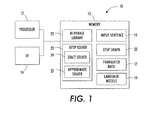
- FIGURE 1 a system is illustrated, which facilitates performing phrase-based SMT using a generalized traveling salesman (GTSP) approach to generate a graph for use in translating between languages.
- GTSP traveling salesman
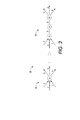
- FIGURE 2 illustrates a first transformation for transforming an ATSP into a standard TSP, with a plurality of edges labeled 0-6 according to their respective "costs.”
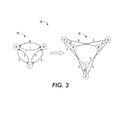
- FIGURE 3 illustrates a second transformation for transforming an ATSP into a standard TSP, which may be used in conjunction with the various systems and methods described herein.
- FIGURE 4 illustrates a transformation that transforms an GTSP into an ATSP.
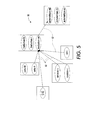
- FIGURE 5 illustrates a transition graph for the source sentence cette traduction formula est cur MUST, in which only a subset of the existing edges is shown, namely all those edges entering or exiting the node traduction-mt.
- FIGURES 6A and 6B illustrate two GSTP tours, corresponding to two respective outputs.
- FIGURE 7 illustrates a graph in which only the bi-phrase "i” has been eliminated, where only some of the extended biphrases that now encapsulate "i" are shown with edges defining one valid tour through the graph.
- FIGURE 8 illustrates selective on-demand refinement.
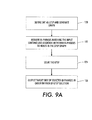
- FIGURE 9A illustrates a method for performing phrase-based statistical machine translation as a traveling salesman problem, in accordance with various aspects described herein.
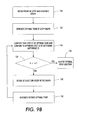
- FIGURE 9B illustrates an alternate method for performing phrase-based statistical machine translation as a traveling salesman problem, in accordance with various aspects described herein.
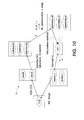
- FIGURE 10 illustrates a graph for performing phrase-based translation using a trigram language model, in accordance with various aspects described herein.
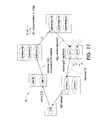
- FIGURE 11 shows a graph that is obtained if the difference is larger than or equal to ⁇ , using the procedure described with regard to Figures 7 and 9 , applied to at least one triple of nodes (a,b,c) on the identified tour.
- FIGURE 12 illustrates a histogram showing the distribution of sentence lengths in an experimental test data set.
- FIGURE 13 shows a graph illustrating language model score as a function of time for a bigram language model.
- FIGURE 14 illustrates a graph showing BLEU score as a function of time for a bigram model.
- FIGURE 15 illustrates a graph showing language model score as a function of time for a trigram language model.
- FIGURE 16 illustrates a graph showing BLEU score as a function of time for a trigram language model.
- FIGURE 17 illustrates a graph showing average value of the decoder score over 500 test sentences as a function of total time to translate the sentences.
- FIGURE 18 illustrates a graph showing average value of the BLEU score (over 500 test sentences) as a function of time.
- bi-phrases are modeled as nodes in a graph. Additionally, construction of a translation is modeled as a "tour" amongst the nodes of the graph, that is, a path that visits each node exactly once. The overall cost of a tour is computed by adding the costs associated with the edges traversed during the tour.
- the described systems and methods map the SMT problem directly into a GTSP problem, rather than simply noting some similarities of the SMT problem with the Traveling Salesman Problem and then actually implementing some small-sized instances of SMT through related techniques of a more generic, but much less efficient, nature (e.g., general integer programming algorithms) than the TSP or GTSP.
- the described systems and methods additionally express phrase-based translation as a GTSP.
- the present disclosure presents examples that show the usefulness of the GTSP formulation on realistic test data.
- the described approach to decoding involves phrase-based SMT models in conjunction with formulating the translation as a GTSP, which is not dependent on a left-to-right organization of the search and has various advantages over conventional techniques.
- a system 10 which facilitates performing phrase-based SMT using a generalized traveling salesman (GTSP) approach.
- the system includes a processor 12 that executes, and a memory 13 that stores, computer-executable instructions for carrying out the various techniques, methods, applications, algorithms, etc., described herein.
- the memory 13 may comprise a computer program product that may be executed on a computer.
- the computer program product may be a computer-readable recording medium (e.g., memory 13) on which a control program is recorded, such as a disk, hard drive, or the like.
- Common forms of computer-readable media include, for example, floppy disks, flexible disks, hard disks, magnetic tape, or any other magnetic storage medium, CD-ROM, DVD, or any other optical medium, a RAM, a PROM, an EPROM, a FLASH-EPROM, or other memory chip or cartridge, or any other tangible medium from which a computer can read and use.
- control program is embodied as a data signal using transmission media, such as acoustic or light waves, such as those generated during radio wave and infrared data communications, and the like.
- the described techniques may be implemented on one or more general purpose computers, special purpose computer(s), a programmed microprocessor or microcontroller and peripheral integrated circuit elements, an ASIC or other integrated circuit, a digital signal processor, a hardwired electronic or logic circuit such as a discrete element circuit, a programmable logic device such as a PLD, PLA, FPGA, Graphical card CPU (GPU), or PAL, or the like.
- the system 10 further comprises a user interface 14 into which a user can enter input sentence 15, such as a sentence to be translated, for translation by the system using one or more of the techniques or methods described herein.
- the input sentence 15 is processed by the processor 12 using one or more computer-executable algorithms, and optionally passes through one or more stages of intermediate data until translated data 17 (e.g., the translated sentence) is output to the user interface 14.
- the memory 13 additionally stores various components (e.g., computer-executable instructions or the like) for translating the input sentence 15. Additionally, pre-generated bi-phrases are stored in a bi-phrase library 20.
- the processor 12 Upon receiving an input sentence for translation, the processor 12 retrieves the bi-phrases from the bi-phrase library 20 that are compatible with the input sentence; It also accesses the language model 19 and constructs a GTSP graph 22 exploiting the retrieved bi-phrases and the language model.
- the processor executes a TSP solver 23, which may be one or more of an exact solver algorithm 24, an approximate solver algorithm 25, etc.
- the system 10 facilitates phrase-based statistical machine translation (PBSMT) of the input sentence by applying the GTSP graph 22 to the input sentence 15.
- the processor 12 defines a PBSMT task as a generalized traveling salesman problem (GTSP).
- GTSP traveling salesman problem
- the processor retrieves one or more bi-phrases consistent with the input sentence from the bi-phrase library 20, and generates the GTSP graph 22 comprising a plurality of nodes, each of which corresponds to a bi-phrase.
- the TSP solver 23 is executed to generate an optimal tour of the GTSP graph 22.
- the processor when using an n-gram language model (with n larger than 2) instead of a bigram language model, the processor computes a true cost C t of the optimal tour, an apparent cost C a of the optimal tour, and determines a difference D between the true cost C t and an apparent cost C a .
- the processor outputs the optimal tour as a solution to the GSTP if D is less than a predetermined threshold ⁇ , and translates the input sentence from a first language to a second language using the output GSTP solution.
- the processor 12 refines at least one node in the GTSP graph 22 if D is greater than or equal to the predetermined threshold ⁇ , and generates a refined graph comprising the refined node.
- the processor continues to iteratively compute the true cost C t and apparent cost C a for each refinement of the graph, determines the difference D there between, and compares the difference D to the predetermined threshold ⁇ , until D is less than ⁇ .
- Traveling salesman problem (TSP) models include four main variants, which are described as follows.
- the symmetric TSP (STSP) involves a non-directed graph G on N nodes, where the edges (lines) carry real-valued costs, with + ⁇ an allowed cost.
- the STSP problem consists in finding a "tour" of minimal total cost, where the tour (also called a Hamiltonian Circuit) is a "circular" sequence of nodes X 1 , X 2 ,..., X N , X 1 visiting each node of the graph exactly once, and where the total cost of the tour is computed by adding the contribution of the corresponding edges.
- the Asymmetric TSP is the variant of the STSP where the underlying graph G is directed and where, for two nodes of the graph a and b, the edges (a,b) and (b,a) may carry different costs.
- the Generalized Symmetric TSP involves a non-oriented graph G of N nodes with edges carrying real-valued costs. Given a partition of these N nodes into M non-empty, disjoint, subsets (called clusters), the object is to find a circular sequence of M nodes X 1 , X 2 ,..., X M , X 1 of minimal total cost, where each cluster is visited exactly once.
- the Generalized Asymmetric TSP, or GTSP is similar to the SGTSP, but the graph G is a directed graph. As used herein, where a GTSP is described, it will be understood to be an asymmetric GTSP, unless otherwise indicated.
- TSP The STSP is often simply denoted TSP, and is known to be NP-hard; however there has been enormous interest in developing efficient exact and approximate solvers for it, where the "efficiency” is measured by the time required for solving large benchmark examples such as provided in the so-called TSPLIB library.
- the ATSP, SGTSP and GTSP can all be mapped by simple (e.g., polynomial or linear increase in the size of the problem instances) transformations into STSP.
- two "transformers" e.g., programs stored in the memory and executed by the processor
- one for a GTSP-to-ATSP transformation and one for an ATSP-to-TSP transformation. Two such transformations are described with regard to the following figures.
- FIGURE 2 illustrates a first transformation 30 with a plurality of edges labeled 0-6 according to their respective "costs.”
- An example of this type of transformation is described by Applegate et al., The Traveling Salesman Problem: A Computational Study, Princeton UP, 2006., p. 126, which is hereby incorporated by reference.
- Each node A of an original directed graph 32 is replaced by three nodes A, A', A" of the transformed undirected graph 34, with two "0-cost" edges added.
- any optimal tour of the undirected graph 34 corresponds to an optimal tour of the original graph 32.
- FIGURE 3 illustrates a second transformation 50, which may be used in conjunction with the various systems and methods described herein, and which has the advantage of only introducing two nodes to replace one node of the original graph, but at the cost of introducing large artificial weights on some of the edges.
- Each node X e.g., nodes A, B, and C
- Each node X e.g., nodes A, B, and C
- Each node X e.g., nodes A, B, and C
- X' e.g., nodes A, B, and C
- the cost of the directed edge (X,Y) in the original graph is reproduced on the edge (X',Y) in the transformed graph 54.
- any optimal tour in the undirected graph 54 will prefer traversing the (X,X') edges to any other configuration, because not traversing any of these edges means losing at least K units of cost.
- FIGURE 4 illustrates a transformation 70 that transforms the GTSP into the ATSP.
- An example of this transformation is described by Noon et al, in "An efficient transformation of the generalized traveling salesman problem," INFOR 31 (1993), pp. 39-44 , which is hereby incorporated by reference.
- Y 1 ,..., Y k are the nodes of a given cluster 72 in an original graph 74, while X and Z are arbitrary nodes belonging to other clusters.
- edges 78 are introduced between the Y i 's in order to form a cycle as shown in the figure, where each edge has a large negative cost -K.
- the solver for the transformed ATSP graph will tend to traverse as many -K edges as possible, meaning that it will traverse exactly k-1 such edges, e.g. all but one of the edges associated with the cluster (the solver does not traverse all such edges because then it could not find a tour for the whole graph). That is, it will produce a tour that is an encoding of some feasible tour of the GTSP problem.
- the graph clusters will be the subsets of the graph nodes that share a common source word w; the node $$ will be the only node in the cluster associated with the source word $.
- the costs of a transition between nodes M and N of the graph are defined in the following manner: If M is of the form (w,b) and N of the form (w',b), in which b is a single bi-phrase, and w and w' are consecutive words in b, then the transition cost is 0 (no cost to the transition). Intuitively, once committed to using the first word of b, there is no additional cost for traversing the other source words covered by b.
- the transition cost corresponds to the actual cost of selecting the bi-phrase b' just after having selected the bi-phrase b. Seen from the source sentence, this corresponds to "consuming" the source side of b' after having consumed the source side of b (whatever their relative positions in the source sentence), and seen from the target side, this corresponds to producing the target side of b' directly after having produced the target side of b.
- the transition cost is then the addition of several contributions, including the static cost associated with b in the bi-phrase library 20 ( Fig. 1 ).
- This cost corresponds to such component as forward and reverse conditional probabilities, number of target words in the bi-phrase, and the like (see description in the Introduction).
- the "distortion" cost is associated to the choice of consuming the source word w' just after having consumed the source word w. In the case where w' is the word that directly follows w in the source sentence, this cost is zero, and corresponds to the situation where the consecutivity of the target sides of b and b' is preserved by their targets.
- the cost is computed as the absolute value of (pos(w)+1 - pos(w')), where pos(w) and pos(w') are the positions of w and w' in the source sentence.
- the "language model" cost is the cost of producing the target words of b' in the context of just having produced the target words of b. If a bigram language model is assumed, this cost can be precomputed as soon as b and b' are known, because b contains at least one word on its target side, which allows computation of the contribution of the first target word of b' knowing the last target word of b. As for the second, third, etc., target words of b', their contributions are computed on the basis of b' alone. Note that this restriction to bigram models can be overcome using other techniques discussed herein.
- FIGURE 5 illustrates a transition graph 80 for the source sentence cette traduction MAY est cur MUST, in which only a subset of the existing edges is shown, namely all those edges 82 entering or exiting the node traduction-mt. Note that the only successor to transtion-mt is YOU-mt, and that cette-ht is not a predecessor of transtion-mt. Alternatively, the edges could be drawn from any-m and MUST-a to transtion-mt, but such edges in fact cannot be traversed because the only exit from traduction-mt is tomati-mt, and this node is in exclusion with other nodes in its cluster.
- FIGURES 6A and 6B illustrate two GSTP tours, corresponding to the two outputs indicated.
- the tour 90 results in the output h.mt.i.s.
- the tour 92 results in the output ht.s.i.a.
- the model described with regard to the preceding figures corresponds to an asymmetric version of the Generalized TSP.
- algorithms specifically designed for GTSP may be used; an GTSP may be transformed into an ATSP and algorithms designed for ATSP may be used; and/or an ATSP may be transformed into an STSP and algorithms for STSP may be used.
- Each option has its own advantages and disadvantages.
- existing efficient solvers for TSP such as a Concorde solver (see, e.g., www.tsp.gatech.edu/concorde)
- the STSP formulation is employed.
- the ATSP is transformed into an STSP, the number of vertices in the TSP graph doubles.
- the passage from GTSP to ATSP is a potential source of inefficiency, because a more general formulation is employed. Therefore, it may be desirable to use the STSP reformulation along with the Concorde technique.
- the exact solution is desired or whether an approximate solution may be sufficient.
- the exact solution e.g., a Concorde solver
- an approximate algorithm e.g., a Lin-Kernighan heuristic
- the cost of a path is additive relative to the costs of the transitions between two consecutive nodes on the path.
- the cost of the translation candidate this.machine translation.is.strange can only take into account the conditional probability of the word strange relative to the word is, but not relative to the words translation and is.
- the power of the model is extended from using bigram language models to using more powerful n-gram language models, such as 3-gram language models, and several approaches can be applied.
- the first approach comprises “compiling out " all biphrases in which the target side only contains one word, in order to only retain biphrases that have a target side of at least two words. In this manner, when the target sides of two biphrases b and b' are concatenated, the trigram language model has enough context to compute the contribution of b' relative to b, because b contains at least two words.
- a path in the graph that enters a node of the form (w,b) (w, [( s ⁇ 1 , t ⁇ 1 ),( s ⁇ 2 , t ⁇ 2 ).....( s ⁇ k , t ⁇ k )]), w being the first word in s ⁇ 1 , must traverse all the words of s ⁇ 1 , in order, then traverse all the words of s ⁇ 2 , ..., and finally traverse the words of s ⁇ k before it can "leave" the extended bi-phrase b (at which point there is a real choice, namely selecting the next extended biphrase).
- the costs "internal" to the extended bi-phrase[( s ⁇ 1 , t ⁇ 1 ).( s ⁇ 2 , t ⁇ 2 ).....( s ⁇ k , t ⁇ k )] can be precompiled by adding the costs (including the distortion costs) that would have been incurred when transitioning from ( s ⁇ 1 , t ⁇ 1 )to ( s ⁇ 2, t ⁇ 2 ), etc.
- it is straightforward to compute the cost of a path across extended biphrases by "recovering" the cost incurred by considering the corresponding path across the component elementary biphrases.
- the following steps are performed: remove from the bi-phrase library the bi-phrase i, which has a single word target; and add to the library the extended biphrases mti, ti, si, etc., (e.g., all the extended biphrases consisting of the concatenation of a bi-phrase in the library with i).
- These extended biphrases provide enough context to compute a trigram probability for the target word produced immediately next (in the examples given, for the words strange, automatic and automatic respectively).
- these steps are performed exhaustively for all biphrases (relevant for the source sentence at hand) similar to i, namely that have a single-word target, a representation is obtained that allows a trigram language model to be computed at each point.
- FIGURE 7 illustrates a graph 100 in which only the bi-phrase "I” has been eliminated, where only some of the extended biphrases that now encapsulate "I” are shown with edges 102 defining one valid circuit or tour through the graph. It will be noted that the edge connecting the two nodes (est,mti) and (cur MUST,s) is now associated with a trigram cost p (strange
- FIGURE 8 illustrates a second approach involving selective on-demand refinement. While the exhaustive "compiling out" method just described works in principle, if for the sentence to be translated, there are m relevant biphrases, among which k have single-word targets, then k.m extended biphrases will be created, which may represent a significant overhead for the TSP solver as soon as k is large relative to m. This effect may be exacerbated if the compiling out method is extended to n-gram languages models with n > 3.
- the second approach uses selective refinement, which has two components.
- the first component is the ability to refine the context of chosen nodes in the graph, rather than refining the context of all nodes respecting some broad criterion (such as having a target side of length one).
- Such refinements then provide a trigram context for a minority of nodes in the graph, but only a bigram context for the rest of the nodes.
- the second component consists of the maintenance of certain bounding inequalities between the optimal TSP solutions for such refinements and the "true" optimal solution that would be reached if trigram contexts were used for all nodes in the graph, which guarantees a convergence of the refinement process to the true optimal solution.
- FIG 8 selective refinement in a GTSP graph 110 is illustrated.
- a, b and c are nodes in the graph, belonging to different clusters, where some of the edges (lines connecting nodes) entering and exiting node b are shown. Additionally, a cost or weight for each edge is shown, labeled ⁇ , ⁇ , y, ⁇ , ⁇ , and ⁇ .
- the node b has been replaced by two "clone" nodes b1 and b2, which belong to the same cluster as b (and are thus mutually exclusive), are identical in all respects to b, but have different incident edges; the edges incident on a (of which only one is shown) have not changed, while a new incoming edge to c has been added.
- the node b1 can now be interpreted as "b in the context of being the immediate successor to a", while b2 is interpreted as "b in any other context”.
- a well-formed tour ⁇ relative to the graph is considered.
- a ccording to the given weights on the edges of the GTSP graph, ⁇ has a certain cost, which is its apparent cost.
- the same tour ⁇ may actually have a different cost, which is its true cost.
- An example of this situation occurs when the GTSP edges carry bigram costs for the language model, while the true score should be computed according to trigram knowledge. More generally, the true cost of the tour may depend on some less local property of the tour than can be accounted by weights local to the edges of the graph.
- the costs on the edges of the GTSP graph may be defined as "optimistic” if an only if, for any well-formed tour ⁇ relative to the graph, the apparent cost of the tour is less than or equal to its true cost.
- the notion of "optimism” bears some similarity to the notion of admissible heuristic (e.g. A*) in tree search; as in that case, optimistic edge costs that are "realistic" are of interest.
- FIGURE 9A illustrates a method for performing phrase-based statistical machine translation as a traveling salesman problem, in accordance with various aspects described herein.
- an SMT is defined as a GTSP
- a GSTP graph is generated.
- bi-phrases are retrieved that match the source sentence, wherein the bi-phrases respectively correspond to nodes in the GTSP graph.
- Each bi-phrase includes a first language phrase (e.g., a phrase matching a phrase in the input or source sentence, in the language of the input sentence), and a second language phrase (e.g., the input phrase translated into the second or target language).
- the GTSP is solved. Bi-phrases are selected as a function of the GTSP solution and target or second language phrases of the selected bi-phrases are output in an order defined by the GTSP solution, at 126.
- solving the GTSP includes transforming the GTSP into an ATSP, transforming the ATSP into a standard TSP, and solving the TSP to translate the blocks of the input sentence. Solving the TSP is performed using a Concorde solver or a Lin-Kernighan heuristic or the like.
- FIGURE 9B illustrates an alternative or additional method for performing phrase-based statistical machine translation as a traveling salesman problem, in accordance with various aspects described herein.
- a GTSP solver application e.g., TSP solver 23 of Fig. 1
- an optimal tour ⁇ i relative to this graph is obtained (or an approximation of such an optimal tour if an approximate solver is used).
- the true cost C t of ⁇ i is computed (e.g., since all edges of ⁇ i are known). Because G i is optimistic, the true cost will be larger than an apparent cost C a of ⁇ i relative to G i .
- the apparent cost of ⁇ i is a lower bound of the true cost of the true optimal tour ⁇ true in the original graph, namely that tour whose true cost is minimal over true costs of all tours.
- true_cost( ⁇ ) ⁇ true_cost( ⁇ true ) for all tours ⁇ (by definition of ⁇ true ) true_cost( ⁇ true ) ⁇ apparent_cost( ⁇ i ): because ⁇ i is optimal over an optimistic specification of the cost of all tours, and in particular, true_cost( ⁇ true ) ⁇ apparent_cost( ⁇ true ) ⁇ apparent_cost( ⁇ i ).
- the termination properties of the algorithm depend on two facts: the graph cannot be refined indefinitely, because there are only a finite number of possible refinements; and when the nodes on a given tour become sufficiently refined, then the apparent cost of the tour (depending on such refined weights as ⁇ 1 and ⁇ 2 ) will be equal to its true cost.
- the methods illustrated in FIGURES 9A and 9B may be implemented in a computer program product that may be executed on a computer.
- the computer program product may be a computer-readable recording medium (e.g., the memory 13) on which a control program is recorded, such as a disk, hard drive, or the like.
- Common forms of computer-readable media include, for example, floppy disks, flexible disks, hard disks, magnetic tape, or any other magnetic storage medium, CD-ROM, DVD, or any other optical medium, a RAM, a PROM, an EPROM, a FLASH-EPROM, or other memory chip or cartridge, or any other tangible medium from which a computer can read and use.
- the method may be implemented in a transmittable carrier wave in which the control program is embodied as a data signal using transmission media, such as acoustic or light waves, such as those generated during radio wave and infrared data communications, and the like.
- the exemplary method may be implemented (e.g., by the processor 12) on one or more general purpose computers, special purpose computer(s), a programmed microprocessor or microcontroller and peripheral integrated circuit elements, an ASIC or other integrated circuit, a digital signal processor, a hardwired electronic or logic circuit such as a discrete element circuit, a programmable logic device such as a PLD, PLA, FPGA, Graphical card CPU (GPU), or PAL, or the like.
- any device capable of implementing a finite state machine that is in turn capable of implementing the flowcharts shown in FIGURES 9A and 9B , can be used to implement the method for performing phrase-based SMT using a GSTP model.
- FIGURE 10 illustrates a graph 150 for performing phrase-based translation using a trigram language model, in accordance with various aspects described herein. It will be appreciated that the same approach could straightforwardly apply to 4-grams, 5-grams, and so on.
- the trigram language model facilitates a procedure that provides us with an estimate p (z
- the language model internally stores all triples (x,y,z) along with their probabilities.
- the language model stores corpus counts for certain trigrams, bigrams and unigrams explicitly, and relies on smoothing techniques for computing p ( z
- edges of the initial graph need not be labeled with trigram costs tri(z
- y ⁇ ⁇ ⁇ min x - log ⁇ p z xy
- y) is the estimate for the cost of the transition between y and z that is maximally optimistic relative to the word x that may precede y.
- y) - log p (z
- the graph 150 of Figure 10 is obtained by starting with a GTSP graph identical with that of Figure 5 , where the language model costs on the edges are as specific as possible given the context available on these edges, that is, which are either of the form tri(z
- An example is given by the graph 150, where all the edges for a certain tour are shown, and in addition, are informally indicating (dotted lines) the incident edges on the node est-i, on which the explanation focuses.
- a TSP solver is launched to obtain an apparent optimal tour, using certain bi costs, but also some tri costs.
- the true cost of the tour in the graph 150 is computed, which involves computing all the true trigram costs tri(this
- the true cost is compared with the (smaller) apparent cost, and if the difference is smaller than ⁇ , no further action need be taken.
- FIGURE 11 shows a graph 160 that is obtained if the difference is larger than or equal to ⁇ , using the procedure described with regard to Figures 7 and 9 , applied to at least one triple of nodes (a,b,c) on the identified tour.
- the TSP solver is re-launched and the procedure is performed iteratively.
- the new apparent optimal tour contains the edge (est-i-1, curska-s)
- the cost of this edge will be more accurate than it was previously.
- the approach that simply consists of refining just one triplet on the apparent optimal tour at each iteration will terminate at some point, because otherwise at some point the apparent optimal tour would necessarily have all its edges carrying tri costs, and hence its apparent cost would be equal to its true cost, and hence would satisfy the ⁇ threshold criterion.
- the new apparent tour shares some sub-paths with the previous apparent tour, as is likely to happen in an SMT context, then it will capitalize on the refined knowledge on these paths. Note that it is possible that the new tour is actually identical with the previous tour, even if the ⁇ -threshold condition was not met by the previous tour; this is because the costs other than the language model costs may more than compensate the loss associated from moving from bi costs to tri costs on this path.
- the following description provides a number of examples of the manner in which the generalized TSP approach is applied using a phrased-based translation technique.
- the artificial task of reconstructing the original word order e.g., monolingual word reordering
- words in English sentences can be randomly permuted, and the original word order can be reconstructed by maximizing the language model score over all possible permutations.
- the reconstruction procedure may be seen as a translation problem from "Bad English" to "Good English.”
- the language model score is used as one component of a more complex decoder score that also includes bi-phrase and distortion scores.
- the language model score may be used to compare the performance of different decoding algorithms.
- three different algorithms are compared: classical beam-search; decoder based on the exact TSP solver (proposed transformation plus Concorde solver); and decoder based on an approximate TSP solver (Lin-Kernighan-heuristic or LK-heuristic, proposed transformation + LK implemented in the Concorde solver, etc.).
- the beam-search and the LK-based TSP solver are algorithms in which the trade-off between the approximation quality and the running time can be controlled.
- the first score is the language model score; all three algorithms try to maximize this score, so a natural evaluation procedure is to plot the language model score value versus the elapsed time.
- the second score is the bi-lingual evaluation understudy (BLEU) score, where the value of the BLEU score between the reconstructed and the original sentences is used to measure the algorithm's reconstruction quality.
- BLEU bi-lingual evaluation understudy
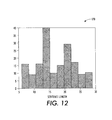
- FIGURE 12 illustrates a histogram 170 showing the distribution of sentence lengths in an experimental test data set.
- a training data set for learning the language model consists of 50000 sentences, and a test dataset for word reordering consists of 170 sentences. Only sentences of length less than 30 words were selected, and the average length of test sentences is equal to 17 words.
- FIGURE 13 shows a graph 180 illustrating language model score as a function of time for a bigram language model.
- a bi-gram language model is considered, and the algorithms try to find the optimal re-ordering that maximizes the language model score.
- An exact TSP solver 24 ( Fig. 1 ) is used in this example, that is it finds the optimal tour.
- the x axis corresponds to the cumulative time for processing the 170 sentences of the test set; the y axis corresponds to the mean difference (over all sentences) between the language model score of the output and the language model score of the reference (N is the length of each sentence, which corresponds to reporting language model scores per word).
- the line corresponds to using a beam-search technique with different thresholds, which result in different processing times and performances.
- the cross TSP corresponds to using the exact-TSP decoder (in this case the time to the optimal solution is not under user's control).
- TSP cross labeled "TSP" and several points on the beam search line have positive y coordinates.
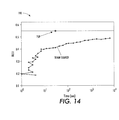
- FIGURE 14 illustrates a graph 190 showing BLEU score as a function of time for a bigram model.
- the increase in the language model score of the beam-search with time is steady but very slow, and never reaches the level of performance obtained with the exact-TSP procedure, even when increasing the time by several orders of magnitude relative to that required by exact-TSP.
- the solution obtained by the exact TSP solver is very likely the optimum, which is less likely the case of the beam-search procedure.
- the BLEU score of the re-ordered sentences in the test set is shown relative to the original reference sentences.
- the exact-TSP outputs are closer to the references in terms of BLEU than the beam-search solutions.
- the TSP output does not recover the reference sentences (it produces sentences with a slightly higher language model score than the references), it does reconstruct the references better than the beam-search.
- FIGURE 15 illustrates a graph 200 showing language model score as a function of time for a trigram language model.
- a tri-gram based language model is considered, and the reordering algorithms try to find the optimal reordering by maximizing the language model score.
- the trigram model used was a variant of the exhaustive compiling-out procedure described in with regard to Figure 7 . Again, an exact TSP solver 24 ( Fig. 1 ) is used to generate the graph 200.
- FIGURE 16 illustrates a graph 210 showing BLEU score as a function of time for a trigram language model. Experiments with trigram language models show similar trends to those with bigrams.
- FIGURE 17 illustrates a graph 220 showing average value of the decoder score over 500 test sentences as a function of total time to translate the sentences.
- the graph considers a real translation task, namely, translation from English to French on the basis of a bi-phraselibrary trained on, for instance, the European Parliement corpus Europarl.
- the training set was approximately 2.81e+6 sentences, and the test set was 500 sentences.
- the graph 220 shows a plurality of points 222 corresponding to a TSO solver (LK algorithm) iterated a particular number of times.
- a line 224 corresponds to a Beam-search algorithm executed and different thresholds.
- the trade-off between quality and time in the case of an LK decoder is controlled by the number of iterations (e.g., more iterations imply longer time and better quality).
- the trade-off between quality and time in the case of Beam-search is controlled by varying the beam threshold.
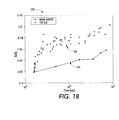
- FIGURE 18 illustrates a graph 230 showing average value of the BLEU score (over 500 test sentences) as a function of time.
- a plurality of points 232 correspond to a TSO solver (LK algorithm) iterated a particular number of times.
- a line 234 corresponds to a Beam-search algorithm executed and different thresholds.
- the trade-off between quality and time in the case of an LK decoder is controlled by the number of iterations (e.g., more iterations imply longer time and better quality).
- the trade-off between quality and time in the case of Beam-search is controlled by varying the beam threshold.
- the approximate LK algorithm e.g., approximate solver 25 of Figure 1
- the efficiency of the LK algorithm can be significantly increased by using a good initialization.
- the technique uses rough initial solution produced by the Beam-Search algorithm using a small value for the stack size, and then use the initial solution as an initial point for the LK and further Beam-Search optimization (where the thresholds of the Beam-Search are varied in order to trade quality relative to time).
- LK outperforms Beam-Search in terms of the decoder score, as well as in terms of the BLEU score.
- the difference between the two algorithms in terms of the BLEU score and of the decoder score) increases steeply at the beginning, which means that the quality of the Beam-Search solution by can be significantly increased using the LK algorithm.
Landscapes
- Engineering & Computer Science (AREA)
- Theoretical Computer Science (AREA)
- Physics & Mathematics (AREA)
- Computational Linguistics (AREA)
- Artificial Intelligence (AREA)
- Audiology, Speech & Language Pathology (AREA)
- Health & Medical Sciences (AREA)
- General Health & Medical Sciences (AREA)
- General Engineering & Computer Science (AREA)
- General Physics & Mathematics (AREA)
- Probability & Statistics with Applications (AREA)
- Machine Translation (AREA)
- Management, Administration, Business Operations System, And Electronic Commerce (AREA)
Applications Claiming Priority (1)
| Application Number | Priority Date | Filing Date | Title |
|---|---|---|---|
| US12/509,633 US8504353B2 (en) | 2009-07-27 | 2009-07-27 | Phrase-based statistical machine translation as a generalized traveling salesman problem |
Publications (2)
| Publication Number | Publication Date |
|---|---|
| EP2280353A2 true EP2280353A2 (de) | 2011-02-02 |
| EP2280353A3 EP2280353A3 (de) | 2011-02-23 |
Family
ID=42670534
Family Applications (1)
| Application Number | Title | Priority Date | Filing Date |
|---|---|---|---|
| EP10170129A Ceased EP2280353A3 (de) | 2009-07-27 | 2010-07-20 | Phrasenbasierte statistische Übersetzung neu dargelegt als ein allgemeines Problem des Handlungsreisenden |
Country Status (3)
| Country | Link |
|---|---|
| US (1) | US8504353B2 (de) |
| EP (1) | EP2280353A3 (de) |
| JP (1) | JP5705472B2 (de) |
Families Citing this family (22)
| Publication number | Priority date | Publication date | Assignee | Title |
|---|---|---|---|---|
| US8260615B1 (en) * | 2011-04-25 | 2012-09-04 | Google Inc. | Cross-lingual initialization of language models |
| US8855997B2 (en) * | 2011-07-28 | 2014-10-07 | Microsoft Corporation | Linguistic error detection |
| US20150161109A1 (en) * | 2012-01-13 | 2015-06-11 | Google Inc. | Reordering words for machine translation |
| US9026425B2 (en) * | 2012-08-28 | 2015-05-05 | Xerox Corporation | Lexical and phrasal feature domain adaptation in statistical machine translation |
| US9235567B2 (en) | 2013-01-14 | 2016-01-12 | Xerox Corporation | Multi-domain machine translation model adaptation |
| US9047274B2 (en) | 2013-01-21 | 2015-06-02 | Xerox Corporation | Machine translation-driven authoring system and method |
| US8972244B2 (en) | 2013-01-25 | 2015-03-03 | Xerox Corporation | Sampling and optimization in phrase-based machine translation using an enriched language model representation |
| JP2015010948A (ja) * | 2013-06-28 | 2015-01-19 | キヤノン株式会社 | 物品処理装置、生成方法、およびプログラム |
| US9652453B2 (en) | 2014-04-14 | 2017-05-16 | Xerox Corporation | Estimation of parameters for machine translation without in-domain parallel data |
| US9606988B2 (en) | 2014-11-04 | 2017-03-28 | Xerox Corporation | Predicting the quality of automatic translation of an entire document |
| US9367541B1 (en) | 2015-01-20 | 2016-06-14 | Xerox Corporation | Terminological adaptation of statistical machine translation system through automatic generation of phrasal contexts for bilingual terms |
| US9767091B2 (en) * | 2015-01-23 | 2017-09-19 | Microsoft Technology Licensing, Llc | Methods for understanding incomplete natural language query |
| CN106383818A (zh) * | 2015-07-30 | 2017-02-08 | 阿里巴巴集团控股有限公司 | 一种机器翻译方法及装置 |
| US10025779B2 (en) | 2015-08-13 | 2018-07-17 | Xerox Corporation | System and method for predicting an optimal machine translation system for a user based on an updated user profile |
| US9690777B1 (en) * | 2015-12-10 | 2017-06-27 | Webinterpret | Translating website listings and propagating the translated listings to listing websites in other regions |
| US20170308526A1 (en) * | 2016-04-21 | 2017-10-26 | National Institute Of Information And Communications Technology | Compcuter Implemented machine translation apparatus and machine translation method |
| CN107680587A (zh) * | 2017-09-29 | 2018-02-09 | 百度在线网络技术(北京)有限公司 | 声学模型训练方法和装置 |
| US11341340B2 (en) * | 2019-10-01 | 2022-05-24 | Google Llc | Neural machine translation adaptation |
| US11550997B2 (en) * | 2020-05-26 | 2023-01-10 | Tencent America LLC | Structural information preserving for graph-to-text generation |
| EP4429913A4 (de) | 2022-07-19 | 2026-05-20 | Make My Day Ltd | Verfahren und vorrichtung zur planung einer elektrischen fahrzeugreise |
| CN122374752A (zh) * | 2023-12-11 | 2026-07-10 | 三菱电机株式会社 | 信息处理装置和信息处理方法 |
| CN117890486B (zh) * | 2024-03-15 | 2024-05-14 | 四川吉利学院 | 基于稀疏切空间投影的磁瓦内部缺陷检测方法 |
Family Cites Families (4)
| Publication number | Priority date | Publication date | Assignee | Title |
|---|---|---|---|---|
| US7177792B2 (en) * | 2001-05-31 | 2007-02-13 | University Of Southern California | Integer programming decoder for machine translation |
| JP2004102946A (ja) * | 2002-09-13 | 2004-04-02 | Advanced Telecommunication Research Institute International | 統計的機械翻訳におけるデコーディング方法 |
| JP4829685B2 (ja) * | 2006-06-07 | 2011-12-07 | 日本電信電話株式会社 | 翻訳フレーズペア生成装置、統計的機械翻訳装置、翻訳フレーズペア生成方法、統計的機械翻訳方法、翻訳フレーズペア生成プログラム、統計的機械翻訳プログラム、および、記憶媒体 |
| US20080154577A1 (en) * | 2006-12-26 | 2008-06-26 | Sehda,Inc. | Chunk-based statistical machine translation system |
-
2009
- 2009-07-27 US US12/509,633 patent/US8504353B2/en not_active Expired - Fee Related
-
2010
- 2010-07-20 EP EP10170129A patent/EP2280353A3/de not_active Ceased
- 2010-07-26 JP JP2010166695A patent/JP5705472B2/ja not_active Expired - Fee Related
Non-Patent Citations (4)
| Title |
|---|
| APPLEGATE ET AL., THE TRAVELING SALESMAN PROBLEM: A COMPUTATIONAL STUDY, PRINCETON UP, 2006, pages 126 |
| LOPEZ, A.: "Statistical Machine Translation", ACM COMPUT. SURV., vol. 40, no. 3, August 2008 (2008-08-01), pages 1 - 49, XP058172381, DOI: doi:10.1145/1380584.1380586 |
| NOON ET AL.: "An efficient transformation of the generalized traveling salesman problem", INFOR, vol. 31, 1993, pages 39 - 44 |
| THE TRAVELING SALESMAN PROBLEM AND ITS VARIATIONS, 2002, pages 609 - 662 |
Also Published As
| Publication number | Publication date |
|---|---|
| US8504353B2 (en) | 2013-08-06 |
| JP5705472B2 (ja) | 2015-04-22 |
| US20110022380A1 (en) | 2011-01-27 |
| JP2011028754A (ja) | 2011-02-10 |
| EP2280353A3 (de) | 2011-02-23 |
Similar Documents
| Publication | Publication Date | Title |
|---|---|---|
| US8504353B2 (en) | Phrase-based statistical machine translation as a generalized traveling salesman problem | |
| Yan et al. | A semantic and emotion‐based dual latent variable generation model for a dialogue system | |
| Jianqiang et al. | Deep convolution neural networks for twitter sentiment analysis | |
| Cha et al. | Language modeling by clustering with word embeddings for text readability assessment | |
| Zhang et al. | Probabilistic graph-based dependency parsing with convolutional neural network | |
| Israr et al. | Neural machine translation models with attention-based dropout layer | |
| Peng et al. | AMR parsing with cache transition systems | |
| Song et al. | Research on feature fusion and multimodal patent text based on graph attention network | |
| Adi et al. | Analysis of sentence embedding models using prediction tasks in natural language processing | |
| Qian et al. | A joint model for named entity recognition with sentence-level entity type attentions | |
| Baxi et al. | Recent advancements in computational morphology: A comprehensive survey | |
| Wang | Semantic analysis technology of English translation based on deep neural network | |
| EP2759945A2 (de) | Stichprobenentnahme und Optimierung von satzbasierter Maschinenübersetzung unter Verwendung einer angereicherten Sprachmodelldarstellung | |
| Kandi | Language modelling for handling out-of-vocabulary words in natural language processing | |
| Xiong et al. | Linguistically Motivated Statistical Machine Translation | |
| Ling et al. | Context representation for named entity linking | |
| Du et al. | Sentiment classification via recurrent convolutional neural networks | |
| Zhou et al. | Cross‐domain sequence labelling using language modelling and parameter generating | |
| CN117422075A (zh) | 一种基于单词删除的同声传译方法及系统 | |
| Alnajran et al. | A word embedding model learned from political tweets | |
| Papagiannopoulou et al. | Social media text summarization: A survey towards a transformer-based system design | |
| JP4113204B2 (ja) | 機械翻訳装置、その方法およびプログラム | |
| De Cao | Entity centric neural models for natural language processing | |
| Duan et al. | Mutual‐Attention Net: A Deep Attentional Neural Network for Keyphrase Generation | |
| Baaniya | Myaamia Translator: Using Neural Machine Translation With Attention to Translate a Low-resource Language |
Legal Events
| Date | Code | Title | Description |
|---|---|---|---|
| PUAI | Public reference made under article 153(3) epc to a published international application that has entered the european phase |
Free format text: ORIGINAL CODE: 0009012 |
|
| PUAL | Search report despatched |
Free format text: ORIGINAL CODE: 0009013 |
|
| AK | Designated contracting states |
Kind code of ref document: A2 Designated state(s): AL AT BE BG CH CY CZ DE DK EE ES FI FR GB GR HR HU IE IS IT LI LT LU LV MC MK MT NL NO PL PT RO SE SI SK SM TR |
|
| AX | Request for extension of the european patent |
Extension state: BA ME RS |
|
| AK | Designated contracting states |
Kind code of ref document: A3 Designated state(s): AL AT BE BG CH CY CZ DE DK EE ES FI FR GB GR HR HU IE IS IT LI LT LU LV MC MK MT NL NO PL PT RO SE SI SK SM TR |
|
| AX | Request for extension of the european patent |
Extension state: BA ME RS |
|
| 17P | Request for examination filed |
Effective date: 20110823 |
|
| 17Q | First examination report despatched |
Effective date: 20131106 |
|
| STAA | Information on the status of an ep patent application or granted ep patent |
Free format text: STATUS: THE APPLICATION HAS BEEN REFUSED |
|
| 18R | Application refused |
Effective date: 20180325 |