EP2280232A2 - Bathing installation heater assembly - Google Patents
Bathing installation heater assembly Download PDFInfo
- Publication number
- EP2280232A2 EP2280232A2 EP20100251301 EP10251301A EP2280232A2 EP 2280232 A2 EP2280232 A2 EP 2280232A2 EP 20100251301 EP20100251301 EP 20100251301 EP 10251301 A EP10251301 A EP 10251301A EP 2280232 A2 EP2280232 A2 EP 2280232A2
- Authority
- EP
- European Patent Office
- Prior art keywords
- heater
- terminal end
- heater assembly
- assembly according
- terminal
- Prior art date
- Legal status (The legal status is an assumption and is not a legal conclusion. Google has not performed a legal analysis and makes no representation as to the accuracy of the status listed.)
- Withdrawn
Links
Images




Classifications
-
- H—ELECTRICITY
- H05—ELECTRIC TECHNIQUES NOT OTHERWISE PROVIDED FOR
- H05B—ELECTRIC HEATING; ELECTRIC LIGHT SOURCES NOT OTHERWISE PROVIDED FOR; CIRCUIT ARRANGEMENTS FOR ELECTRIC LIGHT SOURCES, IN GENERAL
- H05B3/00—Ohmic-resistance heating
- H05B3/02—Details
- H05B3/06—Heater elements structurally combined with coupling elements or holders
-
- F—MECHANICAL ENGINEERING; LIGHTING; HEATING; WEAPONS; BLASTING
- F24—HEATING; RANGES; VENTILATING
- F24H—FLUID HEATERS, e.g. WATER OR AIR HEATERS, HAVING HEAT-GENERATING MEANS, e.g. HEAT PUMPS, IN GENERAL
- F24H1/00—Water heaters, e.g. boilers, continuous-flow heaters or water-storage heaters
- F24H1/10—Continuous-flow heaters, i.e. heaters in which heat is generated only while the water is flowing, e.g. with direct contact of the water with the heating medium
- F24H1/101—Continuous-flow heaters, i.e. heaters in which heat is generated only while the water is flowing, e.g. with direct contact of the water with the heating medium using electric energy supply
- F24H1/102—Continuous-flow heaters, i.e. heaters in which heat is generated only while the water is flowing, e.g. with direct contact of the water with the heating medium using electric energy supply with resistance
- F24H1/103—Continuous-flow heaters, i.e. heaters in which heat is generated only while the water is flowing, e.g. with direct contact of the water with the heating medium using electric energy supply with resistance with bare resistances in direct contact with the fluid
-
- F—MECHANICAL ENGINEERING; LIGHTING; HEATING; WEAPONS; BLASTING
- F24—HEATING; RANGES; VENTILATING
- F24H—FLUID HEATERS, e.g. WATER OR AIR HEATERS, HAVING HEAT-GENERATING MEANS, e.g. HEAT PUMPS, IN GENERAL
- F24H1/00—Water heaters, e.g. boilers, continuous-flow heaters or water-storage heaters
- F24H1/54—Water heaters for bathtubs or pools; Water heaters for reheating the water in bathtubs or pools
-
- H—ELECTRICITY
- H05—ELECTRIC TECHNIQUES NOT OTHERWISE PROVIDED FOR
- H05B—ELECTRIC HEATING; ELECTRIC LIGHT SOURCES NOT OTHERWISE PROVIDED FOR; CIRCUIT ARRANGEMENTS FOR ELECTRIC LIGHT SOURCES, IN GENERAL
- H05B3/00—Ohmic-resistance heating
- H05B3/40—Heating elements having the shape of rods or tubes
- H05B3/42—Heating elements having the shape of rods or tubes non-flexible
- H05B3/44—Heating elements having the shape of rods or tubes non-flexible heating conductor arranged within rods or tubes of insulating material
-
- H—ELECTRICITY
- H05—ELECTRIC TECHNIQUES NOT OTHERWISE PROVIDED FOR
- H05B—ELECTRIC HEATING; ELECTRIC LIGHT SOURCES NOT OTHERWISE PROVIDED FOR; CIRCUIT ARRANGEMENTS FOR ELECTRIC LIGHT SOURCES, IN GENERAL
- H05B3/00—Ohmic-resistance heating
- H05B3/78—Heating arrangements specially adapted for immersion heating
- H05B3/82—Fixedly-mounted immersion heaters
-
- A—HUMAN NECESSITIES
- A61—MEDICAL OR VETERINARY SCIENCE; HYGIENE
- A61H—PHYSICAL THERAPY APPARATUS, e.g. DEVICES FOR LOCATING OR STIMULATING REFLEX POINTS IN THE BODY; ARTIFICIAL RESPIRATION; MASSAGE; BATHING DEVICES FOR SPECIAL THERAPEUTIC OR HYGIENIC PURPOSES OR SPECIFIC PARTS OF THE BODY
- A61H2201/00—Characteristics of apparatus not provided for in the preceding codes
- A61H2201/02—Characteristics of apparatus not provided for in the preceding codes heated or cooled
- A61H2201/0207—Characteristics of apparatus not provided for in the preceding codes heated or cooled heated
-
- A—HUMAN NECESSITIES
- A61—MEDICAL OR VETERINARY SCIENCE; HYGIENE
- A61H—PHYSICAL THERAPY APPARATUS, e.g. DEVICES FOR LOCATING OR STIMULATING REFLEX POINTS IN THE BODY; ARTIFICIAL RESPIRATION; MASSAGE; BATHING DEVICES FOR SPECIAL THERAPEUTIC OR HYGIENIC PURPOSES OR SPECIFIC PARTS OF THE BODY
- A61H2201/00—Characteristics of apparatus not provided for in the preceding codes
- A61H2201/02—Characteristics of apparatus not provided for in the preceding codes heated or cooled
- A61H2201/0221—Mechanism for heating or cooling
- A61H2201/0228—Mechanism for heating or cooling heated by an electric resistance element
-
- A—HUMAN NECESSITIES
- A61—MEDICAL OR VETERINARY SCIENCE; HYGIENE
- A61H—PHYSICAL THERAPY APPARATUS, e.g. DEVICES FOR LOCATING OR STIMULATING REFLEX POINTS IN THE BODY; ARTIFICIAL RESPIRATION; MASSAGE; BATHING DEVICES FOR SPECIAL THERAPEUTIC OR HYGIENIC PURPOSES OR SPECIFIC PARTS OF THE BODY
- A61H33/00—Bathing devices for special therapeutic or hygienic purposes
- A61H33/60—Components specifically designed for the therapeutic baths of groups A61H33/00
Definitions
- Bathing installations typically include a heater assembly connected in a recirculating water flow path, with a pump to circulate water through the heater and typically a filter.
- the heater assembly may include an electrically powered heater element, such as a resistive wire embedded within a heater rod immersed within a heater chamber. With the heater element exposed to the water flow, heater failures due to corrosion can occur.
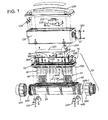
- FIG. 1 is an exploded diagrammatic view of an exemplary embodiment of a heater assembly.
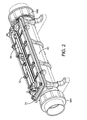
- FIG. 2 is an isometric view of features of the heater assembly of FIG. 1 , with the housing and cover plate assembled together, and exclusive of a cover and controller board.
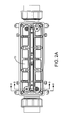
- FIG. 2A is a top view of the heater assembly of FIG. 2 .
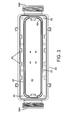
- FIG. 3 is a top view of a heater housing structure for the heater assembly of FIG. 1 .
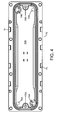
- FIG. 4 is a bottom view of a cover plate for the heater assembly of FIG. 1 .
- FIG. 5 is a top view of the cover plate of FIG. 4 .
- FIG. 6 is a partial exploded view of the heater assembly of FIG. 1 , showing the heater element and temperature sensors.
- FIG. 7A is a side view of the housing structure of FIG 2 .
- FIG. 7B is a partial cross-sectional view, taken along line 7B-7B of FIG. 7A.
- FIG. 7C is an isometric view illustrating one of the current collectors of the heater assembly of FIG. 1 .
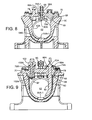
- FIGS. 8 and 9 are respective cross-sectional views of the heater assembly of FIG. 2A , taken along lines 8-8 and 9-9.
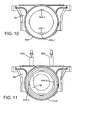
- FIG. 10 is an end view of the housing structure of FIG. 3 .
- FIG. 11 is an end view of the heater assembly of FIG. 3 , with the heater element in place.
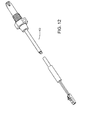
- FIG. 12 is an isometric view of an exemplary embodiment of a temperature sensor mounted in the heater assembly of FIG. 1 .
- FIGS. 13A, 13B, 13C and 13D illustrate features of an exemplary embodiment of a tailpiece adapter fitting for the heater assembly of FIG. 1 .
- FIGS. 14 and 15 are isometric views of another embodiment of a tailpiece adapter structure.
- FIG. 16 is an isometric view of a heater assembly as in FIG. 1 directly connected to a pump.
- Exemplary embodiments of a heater assembly may provide improved reliability over previously used heaters in the bathing installation field.
- a resistive heater element is mounted in a heater chamber within a housing structure, which may be fabricated of a plastic material, and its terminal ends passed through openings formed in the housing structure and sealed in place by use of seal members.
- the heater element is fabricated without any brazed or welded bulkhead members. This eliminates a source of corrosion.
- the heater element may include a coil portion with a relatively low watt density characteristic, as compared to traditional, shorter, heating elements of the same power rating.
- the watt density characteristic may be defined as the power (watts) divided by the effective heater element surface area (square inches).
- Terminal ends of the heater element are passed through ports formed in the housing structure, and the pass through connection is sealed from a non-wetted side of the housing structure.
- Current collectors are also free of any brazed or welded bulkhead members, and terminal ends are passed through ports formed in the housing structure and sealed from a non-wetted side of the housing structure.
- Temperature sensors are mounted in ports in the housing assembly, in thermal communication with a heater chamber within the housing structure.
- the heater housing structure may be fabricated from metal, or a combination of metal and plastic material.
- the heater assembly includes a housing assembly including housing 60, and a cover plate 70.
- the housing is a generally trough shaped elongated member defining an open trough region and having first and second opposed ends.
- the housing structure and cover plate define an elongated heater chamber 62, with a generally U-shaped cross-sectional configuration.
- First and second ports 64A, 64B are integrally formed respectively in the first and second ends of the housing and are threaded to attach to exemplary adapters 94, 96.
- the trough shaped member has an open top region circumscribed by a peripheral flange portion 66.
- the cover plate 70 is configured for attachment to the peripheral flange portion of the housing and has a wetted surface 70A facing the trough region and a non-wetted surface 70B on an opposed side of the plate.
- the plate can be attached to the peripheral flange portion by threaded fasteners 72 received in threaded receptacles 63 in the flange portion of the housing.
- An o-ring seal 68 ( FIG. 8 ) provides a fluid seal between the cover plate and the housing.
- the o-ring can be fabricated of silicone, for example.
- the housing 60 and cover plate 70 are fabricated, e.g., by injection molding, from a thermoplastic material selected to resist the high temperatures created by operation of the heater, and impervious to the water flowing through the heater assembly.
- a thermoplastic material selected to resist the high temperatures created by operation of the heater, and impervious to the water flowing through the heater assembly.
- PPS polyphenolsulfide
- the housing and/or cover plate may be fabricated of metal.
- the o-ring 68 may be fabricated of an elastomeric material, such as silicone rubber.
- a resistive heating element 80 is disposed within the heating chamber of the housing assembly, and includes an elongated coil portion 80A and opposed terminal end portions 82A and 82B.
- the heating element position within the heating chamber is fixed by a lower spring clip or bracket 84A and an upper spring clip or bracket 84B.
- the bracket 84A spaces the coil portion 80A from the bottom of the trough portion of the housing 70, and the upper bracket 84B provides a resilient spring force pressing the coil portion down and into contact with the bracket 84A when the cover plate is attached to the housing in an assembled condition.
- the heating element may be rated at 4000 watts, have an axial length of about ten inches, a coil diameter of about 2 inches, and 12 coil turns.
- the heater element in an exemplary embodiment includes a resistive wire potted with a heat resistance dielectric potting compound, within an outer shield.
- the terminal end portions of the heater element are configured for connection to line voltage to drive the heater.
- the terminal ends may be threaded, for direct mechanical and electrical attachment to conductive pads on a controller circuit board 200 ( FIG. 1 ), in an embodiment in which the controller board is integrated with the heater, as in FIG. 1 , or to line voltage wiring in an embodiment in which the heater is located remotely from the controller system.
- the use of a coil heater element provides greater heater element length for a given heater enclosure length.
- the coil heater element can be provided in different wattages, with different watt densities, to accommodate different application requirements.
- a 5500 watt heater with a coil heater element may be provided with a watt density of 90.96 watts/sq. in. and a 1500 watt heater may be provided with a watt density of 20.71 watts/sq. in.
- a commercially available 5500 watt heater with a conventional loop heater element has a watt density of 164.97 watts/sq. in.
- a 1500 watt heater with a loop heater element has a watt density of 44.99 watts/sq. in.
- the heater assembly may employ a loop-type heater element.
- the terminal end portions of the heating element 80 are passed through respective openings or ports 74A and 74B formed in the cover plate 70 at opposite ends thereof, and on opposite sides of the longitudinal center line of the cover plate.
- FIG. 9 illustrates exemplary port 74A and terminal end portion 82A of the heater element.
- the ports include threaded bosses extending from the non-wetted surface of the plate. Seals are provided by o-rings 88A and 88B.
- the terminal end portions of the heating element extend through tube nuts 86A, 86B, which engage the threaded bosses, and compress the o-ring seals against the terminal ends of the heating elements.
- Brackets 85A, 85B may be crimped onto the heating element near the terminal ends to register the position of the terminal ends relative to the wetted surface of the plate 70.
- the brackets may be omitted for some embodiments.
- the brackets 85A and 85B may be made from stainless steel or other corrosion-resistant metal, such as the heater element sheath material, typically Incoloy® or titanium. There is some compressive force exerted on the terminal ends of the heating element by the o-rings and tube nuts as well. With the secure positioning of the heater element to reduce or eliminate vibration or rattles, the heater assembly can be used in high water flow rate applications, e.g. 250 gallons per minute or higher for some applications, as well as in lower flow rate applications.
- the heater assembly 50 may be provided with temperature sensors 102, 104 respectively positioned adjacent the heater ports 64A, 64B.
- the sensors are fitted into respective cover ports 76A, 76B, each of which includes a threaded boss.
- FIG. 9 illustrates exemplary sensor 76A, received in port 76A and secured by engagement of threads on the outer periphery of the sensor body with the threads formed in the port.
- a fluid seal is provided by an o-ring seal 106A.
- the exemplary sensor 102 includes a temperature sensing solid state device 102A, e.g. a thermistor, at its distal end within the heater chamber 62.
- FIGS. 10 and 11 are end views of the housing structure 60, depicting features of the port 64A.
- the port includes four slots or relieved areas 64A-2, in this embodiment located at 90 degree spacing around the periphery of the port 64A.
- the slots provide radial position registration features for a tailpiece adapter, allowing the adapter to be fitted at four different predetermined radial or clock positions relative to the port, as will be described more fully below.
- the particular angular spacing may be varied to provide different radial positions.
- the heater housing is a plastic, electrically non-conductive structure
- providing a stray current collector function is a issue.
- the stray currents may exist due to a failure in the heater element, for example, and may pass through conductive paths including the bathing installation water.
- a robust stray current collection capability is provided by current collector structures 90 and 92, illustrated in detail in FIGS. 7A, 7B and 7C .
- These current collector structures each are defined by unitary one-piece metal structures including a coil portion fitted within a heater port and a terminal portion which extends through a port in the cover plate. The exposed terminal ends of the terminal portion of the respective current collectors is connected to a ground conductor bar 96 ( FIG. 2 ) which is connected to earth ground when the heater is installed in a bathing installation.
- the current collector structures are fabricated from 1/8 (.125) inch diameter stainless steel wire.
- the heater ports 64A and 64B have generally tubular or cylindrical interior configurations, opening into the heater cavity 62.
- FIG. 7B illustrates port 64A, for example.
- the coil portions of the current collector structures 90, 92 have a nominal outer diameter which is slightly larger than the inner diameter of the heater ports.
- the coil portion of the collector may be fitted into the heater ports by pulling on the distal ends of the coil portions to temporarily compress the diameter of the coil portion, with the slight oversizing of the diameter tending to hold the coil portion in position in the port, even in the presence of high volume water flow through the heater.
- a small protrusion or bump extends from the bottom of the port wall.
- FIG. 7B and 8 illustrate an exemplary protrusion 64A-1 against which the coil portion 90A of collector 90 is positioned, with the terminal portion 90B of the current collector passed upwardly through a port 78A formed in the cover plate 70.
- the port 78A on the non-wetted surface of the plate has a threaded recess 78A-1, into which an o-ring seal 98A-1 is positioned.
- a tube nut 98A with the terminal portion 90B passed through its center opening engages the threaded recess and compresses the o-ring to provide a fluid seal on the non-wetted side of the cover plate.
- the port 78A and the corresponding port (not visible in FIG. 8 ) for current collector 92 are formed along the longitudinal center line of the cover plate.
- the grounding bar 96 includes pressure connectors 96A, 96B at each end to receive the exposed ends of the current collector terminal portions, and make electrical connection to the current collectors.
- the grounding bar 96 is connected to a bond lug of terminal block 232 on the outside of the plastic enclosure 230 via a solid copper wire 97 ( FIG. 1 ) that is routed from the ground connector 96C on the grounding bar, under the circuit board 200, through a hole in the plastic enclosure 230 and into the ground terminal block 232.
- a metal boss 96D protrudes from the grounding bar 96 upwardly, and is connected to a ground pad on the circuit board 200 to provide a ground for the circuit board.
- the current collector system does not have any wetted connections that would be subject to corrosion. This provides enhanced reliability of the heater system.
- a further advantage of the heater system is that the heater system can be installed in a water flow path in either direction.
- port 64A can be on the inlet side, or on the outlet side, providing flexibility to the bathing installation designer. The flexibility is a result of the use of temperature sensors adjacent each port, the current collectors at each port, and the secure positioning of the heater element within the heater chamber, reducing or eliminating vibration of the heater element due to the volume of water pumped through the heater.
- Exemplary embodiments of the heater system may be disassembled and serviced in the field. This provides a significant advantage over conventional systems which are sealed, e.g. by adhesive or potting material, and can only be replaced in the event of a malfunction.
- the cover plate 70 is mounted to the housing 60 by threaded fasteners 72 which are received in threaded receptacles in the flange region of the housing.
- a fluid seal between the housing and the cover plate is provided by an o-ring 68 ( FIGS. 8 and 9 ) positioned at a peripheral shoulder or raceway 69 formed in the flange region of the housing.
- the cover plate 70 has a corresponding peripheral shoulder or raceway 79. As the cover plate is positioned on the housing, the shoulder 79 exerts a radial seal force on the o-ring 68, comprising the o-ring between the shoulders 69 and 79.
- tabs 75 FIG.
- cover plate seals for the heater element terminal end portions, the current collector terminals and the temperature sensors are all secured by removable, threaded fasteners, these fasteners may be removed in the field, the fasteners 72 removed, and the cover plate removed from the housing.
- the heater element, temperature sensors and the current collectors may be removed if needed from the housing for service or replacement.
- the various seals can also be replaced as needed.
- the heater assembly 50 can be configured for use in an embodiment in which the bathing installation controller is co-located with the heater, as illustrated in FIG. 1 and FIG. 14 .
- a controller printed circuit board 200 has a microcomputer mounted thereon, with printed wiring circuit traces, relays, switches and other circuit elements.
- the circuit board is spaced above the cover plate 70 by spacers 202.
- An auxiliary circuit board 220 is in turn mounted above the controller circuit board by spacers, and has a voltage transformer 222 mounted thereon to transform AC line voltage into low voltage power.
- the top housing 230 is secured to the housing structure 60 by threaded fasteners, and a cover 236 is removably attached to the top housing by threaded fasteners as well.
- the ground terminal block 232 is mounted to one end surface of the top housing, and wiring to controlled devices such as a pump, lighting, blowers and the like can be secured by wiring clamp 234 at the opposite end surface of the top housing.
- Line voltage wiring is attached to line voltage connector 210 by pressure connectors.
- the top housing can be reduced in height, since the circuit boards would not be needed.
- Line voltage wiring can be directed connected to the heater element terminal ends, or to a line voltage connector block.
- the tailpiece adapter 94B ( FIGS. 1 and 13A-13D ) can be employed to connect the heater assembly 50 to a threaded fitting, e.g. on another device in the bathing installation recirculating flow path, and perform a male thread to female thread conversion.
- the tailpiece adapter 94B may be employed to directly connect to a pump such as a circulation pump 250, as illustrated in FIG. 16 .
- the electrical supply wiring 252 for the pump may be connected to a connector on the controller circuit board 200, through a relay or triac switch mounted on the board 200 to line voltage.
- the direct connection of the pump reduces the installation time and cost, since intermediate piping is not needed, and also reduces the space utilized by the heater and the pump. The available space is typically limited in a bathing installation such as a spa.
- the tailpiece adapter 94B is shown in detail in FIGS. 13A-13D , and includes a threaded nut 94-1 ( FIG. 13D ) and an adapter 94B-1 ( FIGS. 13A-13C ).
- the nut has an inner flange portion 94-1 A at one end, and an interior threaded portion 94-1 B at the opposite end.
- the threaded portion is configured to engage the threads on the housing port 64B, and the flange portion captures the corresponding outer flange portion 94B-1A on the adapter 94B-1.
- the adapter As the nut is tightened on the threads of the port 64B, the adapter is brought into sealing engagement with the port end surface, and an o-ring captured in groove 94B-1 B of the adapter provides a liquid seal.
- the distal end of the adapter from the flange portion is provided with interior threads 94B-1C to engage with threads on the pump 250 to make the connection between the heater assembly 50 and the pump.
- the tailpiece adapter set 94A may be connected directly to a rigid pipe or a pipe fitting by adhesive connection, for example.
- the tailpiece adapter set 94A is illustrated in FIGS. 13D and 1 .
- the set includes a threaded nut such as the nut 94-1 ( FIG. 13D ), and a fitting 286 ( FIG. 15 ) which can be secured to the heater port such as port 64A by the nut 94-1.
- the fitting 272 includes a cover plate surface 272A for covering a portion of the port opening 64B, for example, with a tubular barbed port portion 272B extending from the surface about opening 272C.
- the fitting performs a size reducing function in this embodiment, say from a 2 inch port opening size for the port, to a one inch diameter tube size.
- This fitting may be used to connect the heater to a flexible tubing, for example, to a 1 inch diameter tube size.
- An o-ring groove 272E accepts a o-ring seal.
- the fitting 272 may be connected to the port opening by a nut 94-1.
- the fitting 272 further includes registration tabs 272D, which are spaced to enter the slots formed in the ports, e.g. slots 64A-2 ( FIG. 10 ) in housing port 64A.
- This allows the fitting 272 to be positioned at any one of four radial positions relative to the housing 60, determined by the slots in the ports. This provides flexibility to the installer to best position the tubular portion to connect to the flow path tubing. Further, this "clocking" feature allows the flexibility to position the port 272B at the highest elevation (of the four possible clock positions), whether the heater assembly is mounted with the mount struts 240 secured to either a horizontal surface or to a vertical surface, with the linear axis of the heater assembly disposed along the horizontal. This positioning of the port 272B tends to prevent air from being trapped in the cavity, which can lead to problems in pump operation. When the pump is not operating, any air in the cavity can drift out the port 272B.
Landscapes
- Engineering & Computer Science (AREA)
- Physics & Mathematics (AREA)
- Thermal Sciences (AREA)
- Chemical & Material Sciences (AREA)
- Combustion & Propulsion (AREA)
- Mechanical Engineering (AREA)
- General Engineering & Computer Science (AREA)
- Instantaneous Water Boilers, Portable Hot-Water Supply Apparatuses, And Control Of Portable Hot-Water Supply Apparatuses (AREA)
- Resistance Heating (AREA)
- Structures Of Non-Positive Displacement Pumps (AREA)
Abstract
Description
- Bathing installations typically include a heater assembly connected in a recirculating water flow path, with a pump to circulate water through the heater and typically a filter. The heater assembly may include an electrically powered heater element, such as a resistive wire embedded within a heater rod immersed within a heater chamber. With the heater element exposed to the water flow, heater failures due to corrosion can occur.
- Exemplary bathing systems with heaters and electronic controllers are disclosed in
US 6,282,370 andUS 7,030,343 , the entire contents of which are incorporated herein by this reference. - Features and advantages of the disclosure will readily be appreciated by persons skilled in the art from the following detailed description when read in conjunction with the drawing wherein:
-
FIG. 1 is an exploded diagrammatic view of an exemplary embodiment of a heater assembly. -
FIG. 2 is an isometric view of features of the heater assembly ofFIG. 1 , with the housing and cover plate assembled together, and exclusive of a cover and controller board.FIG. 2A is a top view of the heater assembly ofFIG. 2 . -
FIG. 3 is a top view of a heater housing structure for the heater assembly ofFIG. 1 . -
FIG. 4 is a bottom view of a cover plate for the heater assembly ofFIG. 1 . -
FIG. 5 is a top view of the cover plate ofFIG. 4 . -
FIG. 6 is a partial exploded view of the heater assembly ofFIG. 1 , showing the heater element and temperature sensors. -
FIG. 7A is a side view of the housing structure ofFIG 2 .FIG. 7B is a partial cross-sectional view, taken alongline 7B-7B ofFIG. 7A. FIG. 7C is an isometric view illustrating one of the current collectors of the heater assembly ofFIG. 1 . -
FIGS. 8 and 9 are respective cross-sectional views of the heater assembly ofFIG. 2A , taken along lines 8-8 and 9-9. -
FIG. 10 is an end view of the housing structure ofFIG. 3 . -
FIG. 11 is an end view of the heater assembly ofFIG. 3 , with the heater element in place. -
FIG. 12 is an isometric view of an exemplary embodiment of a temperature sensor mounted in the heater assembly ofFIG. 1 . -
FIGS. 13A, 13B, 13C and13D illustrate features of an exemplary embodiment of a tailpiece adapter fitting for the heater assembly ofFIG. 1 . -
FIGS. 14 and 15 are isometric views of another embodiment of a tailpiece adapter structure. -
FIG. 16 is an isometric view of a heater assembly as inFIG. 1 directly connected to a pump. - In the following detailed description and in the several figures of the drawing, like elements are identified with like reference numerals. The figures are not to scale, and relative feature sizes may be exaggerated for illustrative purposes.
- Exemplary embodiments of a heater assembly may provide improved reliability over previously used heaters in the bathing installation field. A resistive heater element is mounted in a heater chamber within a housing structure, which may be fabricated of a plastic material, and its terminal ends passed through openings formed in the housing structure and sealed in place by use of seal members. In an exemplary embodiment, the heater element is fabricated without any brazed or welded bulkhead members. This eliminates a source of corrosion. The heater element may include a coil portion with a relatively low watt density characteristic, as compared to traditional, shorter, heating elements of the same power rating. In this regard, the watt density characteristic may be defined as the power (watts) divided by the effective heater element surface area (square inches). The ability to utilize a longer element section with the same power consumption translates into cooler operational temperatures and less stress on the heater element. Terminal ends of the heater element are passed through ports formed in the housing structure, and the pass through connection is sealed from a non-wetted side of the housing structure. Current collectors are also free of any brazed or welded bulkhead members, and terminal ends are passed through ports formed in the housing structure and sealed from a non-wetted side of the housing structure. Temperature sensors are mounted in ports in the housing assembly, in thermal communication with a heater chamber within the housing structure. In other embodiments, the heater housing structure may be fabricated from metal, or a combination of metal and plastic material.
- Referring now to
FIG. 1 , an exemplary embodiment of aheater assembly 50 is illustrated in exploded isometric view. The heater assembly includes a housingassembly including housing 60, and acover plate 70. The housing is a generally trough shaped elongated member defining an open trough region and having first and second opposed ends. The housing structure and cover plate define anelongated heater chamber 62, with a generally U-shaped cross-sectional configuration. First andsecond ports exemplary adapters 94, 96. The trough shaped member has an open top region circumscribed by aperipheral flange portion 66. - The
cover plate 70 is configured for attachment to the peripheral flange portion of the housing and has a wettedsurface 70A facing the trough region and anon-wetted surface 70B on an opposed side of the plate. The plate can be attached to the peripheral flange portion by threadedfasteners 72 received in threadedreceptacles 63 in the flange portion of the housing. An o-ring seal 68 (FIG. 8 ) provides a fluid seal between the cover plate and the housing. The o-ring can be fabricated of silicone, for example. - In an exemplary embodiment, the
housing 60 andcover plate 70 are fabricated, e.g., by injection molding, from a thermoplastic material selected to resist the high temperatures created by operation of the heater, and impervious to the water flowing through the heater assembly. One exemplary plastic suitable for a bathing installation application is polyphenolsulfide (PPS), one example of which is marketed as Ryton® polyphenylene sulfide (PPS) by Chevron Phillips Chemical Company. For other applications, the housing and/or cover plate may be fabricated of metal. The o-ring 68 may be fabricated of an elastomeric material, such as silicone rubber. - In an exemplary embodiment, a
resistive heating element 80 is disposed within the heating chamber of the housing assembly, and includes an elongated coil portion 80A and opposedterminal end portions bracket 84A and an upper spring clip orbracket 84B. Thebracket 84A spaces the coil portion 80A from the bottom of the trough portion of thehousing 70, and theupper bracket 84B provides a resilient spring force pressing the coil portion down and into contact with thebracket 84A when the cover plate is attached to the housing in an assembled condition. In an exemplary embodiment, the heating element may be rated at 4000 watts, have an axial length of about ten inches, a coil diameter of about 2 inches, and 12 coil turns. The heater element in an exemplary embodiment includes a resistive wire potted with a heat resistance dielectric potting compound, within an outer shield. The terminal end portions of the heater element are configured for connection to line voltage to drive the heater. The terminal ends may be threaded, for direct mechanical and electrical attachment to conductive pads on a controller circuit board 200 (FIG. 1 ), in an embodiment in which the controller board is integrated with the heater, as inFIG. 1 , or to line voltage wiring in an embodiment in which the heater is located remotely from the controller system. - The use of a coil heater element provides greater heater element length for a given heater enclosure length. The coil heater element can be provided in different wattages, with different watt densities, to accommodate different application requirements. For example, a 5500 watt heater with a coil heater element may be provided with a watt density of 90.96 watts/sq. in. and a 1500 watt heater may be provided with a watt density of 20.71 watts/sq. in. In comparison, a commercially available 5500 watt heater with a conventional loop heater element has a watt density of 164.97 watts/sq. in. and a 1500 watt heater with a loop heater element has a watt density of 44.99 watts/sq. in. These higher watt densities are quite typical for the industry, though not universal. In other embodiment, the heater assembly may employ a loop-type heater element.
- The terminal end portions of the
heating element 80 are passed through respective openings orports cover plate 70 at opposite ends thereof, and on opposite sides of the longitudinal center line of the cover plate.FIG. 9 illustratesexemplary port 74A andterminal end portion 82A of the heater element. The ports include threaded bosses extending from the non-wetted surface of the plate. Seals are provided by o-rings tube nuts - The position of the heating element within the housing structure is fixed primarily by the spring clips 84A, 84B, which space the coil portion from the housing structure and the cover plate, so that the coil portion does not physically contact the housing structure.
Brackets plate 70. The brackets may be omitted for some embodiments. Thebrackets - In an exemplary embodiment, the
heater assembly 50 may be provided withtemperature sensors heater ports respective cover ports FIG. 9 illustratesexemplary sensor 76A, received inport 76A and secured by engagement of threads on the outer periphery of the sensor body with the threads formed in the port. A fluid seal is provided by an o-ring seal 106A. Theexemplary sensor 102 includes a temperature sensingsolid state device 102A, e.g. a thermistor, at its distal end within theheater chamber 62. An exemplary sensor suitable for the purpose is described in co-pending application 12/509,343, entitled OVERMOLDED TEMPERATURE SENSOR AND METHOD OF FABRICATING A SENSOR, attorney docket 2182, the entire contents of which are incorporated herein by this reference. -
FIGS. 10 and 11 are end views of thehousing structure 60, depicting features of theport 64A. The port includes four slots orrelieved areas 64A-2, in this embodiment located at 90 degree spacing around the periphery of theport 64A. The slots provide radial position registration features for a tailpiece adapter, allowing the adapter to be fitted at four different predetermined radial or clock positions relative to the port, as will be described more fully below. Of course, the particular angular spacing may be varied to provide different radial positions. - For the exemplary embodiment in which the heater housing is a plastic, electrically non-conductive structure, providing a stray current collector function is a issue. The stray currents may exist due to a failure in the heater element, for example, and may pass through conductive paths including the bathing installation water. A robust stray current collection capability is provided by
current collector structures FIGS. 7A, 7B and 7C . These current collector structures, in an exemplary embodiment, each are defined by unitary one-piece metal structures including a coil portion fitted within a heater port and a terminal portion which extends through a port in the cover plate. The exposed terminal ends of the terminal portion of the respective current collectors is connected to a ground conductor bar 96 (FIG. 2 ) which is connected to earth ground when the heater is installed in a bathing installation. In an exemplary embodiment, the current collector structures are fabricated from 1/8 (.125) inch diameter stainless steel wire. - In an exemplary embodiment, the
heater ports heater cavity 62.FIG. 7B illustratesport 64A, for example. The coil portions of thecurrent collector structures cavity 62 due to the force of water flow, a small protrusion or bump extends from the bottom of the port wall.FIGS. 7B and8 illustrate anexemplary protrusion 64A-1 against which thecoil portion 90A ofcollector 90 is positioned, with theterminal portion 90B of the current collector passed upwardly through aport 78A formed in thecover plate 70. Theport 78A on the non-wetted surface of the plate has a threadedrecess 78A-1, into which an o-ring seal 98A-1 is positioned. Atube nut 98A with theterminal portion 90B passed through its center opening engages the threaded recess and compresses the o-ring to provide a fluid seal on the non-wetted side of the cover plate. In an exemplary embodiment, theport 78A and the corresponding port (not visible inFIG. 8 ) forcurrent collector 92 are formed along the longitudinal center line of the cover plate. - The grounding
bar 96 includespressure connectors bar 96 is connected to a bond lug ofterminal block 232 on the outside of theplastic enclosure 230 via a solid copper wire 97 (FIG. 1 ) that is routed from theground connector 96C on the grounding bar, under thecircuit board 200, through a hole in theplastic enclosure 230 and into theground terminal block 232. Ametal boss 96D protrudes from the groundingbar 96 upwardly, and is connected to a ground pad on thecircuit board 200 to provide a ground for the circuit board. - In an exemplary embodiment, the current collector system does not have any wetted connections that would be subject to corrosion. This provides enhanced reliability of the heater system.
- A further advantage of the heater system is that the heater system can be installed in a water flow path in either direction. Thus,
port 64A can be on the inlet side, or on the outlet side, providing flexibility to the bathing installation designer. The flexibility is a result of the use of temperature sensors adjacent each port, the current collectors at each port, and the secure positioning of the heater element within the heater chamber, reducing or eliminating vibration of the heater element due to the volume of water pumped through the heater. - Exemplary embodiments of the heater system may be disassembled and serviced in the field. This provides a significant advantage over conventional systems which are sealed, e.g. by adhesive or potting material, and can only be replaced in the event of a malfunction.
- In an exemplary embodiment, the
cover plate 70 is mounted to thehousing 60 by threadedfasteners 72 which are received in threaded receptacles in the flange region of the housing. A fluid seal between the housing and the cover plate is provided by an o-ring 68 (FIGS. 8 and 9 ) positioned at a peripheral shoulder orraceway 69 formed in the flange region of the housing. Thecover plate 70 has a corresponding peripheral shoulder orraceway 79. As the cover plate is positioned on the housing, theshoulder 79 exerts a radial seal force on the o-ring 68, comprising the o-ring between theshoulders FIG. 1 ) extending downwardly from the periphery of the longitudinal sides of the cover plate enter correspondingslots 65 formed in the periphery of the flange portion of thehousing 60. The tab and slot features work together to maintain proper relationship of the o-ring 68 relative to thecover 70 andhousing 60. Thetabs 75, with their engagement in theslots 65, will not allow the long flat surfaces of the housing to be pressed outwardly to the point that the o-ring is not properly compressed, causing the seal to leak. - Since the cover plate seals for the heater element terminal end portions, the current collector terminals and the temperature sensors are all secured by removable, threaded fasteners, these fasteners may be removed in the field, the
fasteners 72 removed, and the cover plate removed from the housing. The heater element, temperature sensors and the current collectors may be removed if needed from the housing for service or replacement. The various seals can also be replaced as needed. - As noted above, the
heater assembly 50 can be configured for use in an embodiment in which the bathing installation controller is co-located with the heater, as illustrated inFIG. 1 andFIG. 14 . In this embodiment, a controller printedcircuit board 200 has a microcomputer mounted thereon, with printed wiring circuit traces, relays, switches and other circuit elements. The circuit board is spaced above thecover plate 70 byspacers 202. Anauxiliary circuit board 220 is in turn mounted above the controller circuit board by spacers, and has avoltage transformer 222 mounted thereon to transform AC line voltage into low voltage power. Thetop housing 230 is secured to thehousing structure 60 by threaded fasteners, and acover 236 is removably attached to the top housing by threaded fasteners as well. Theground terminal block 232 is mounted to one end surface of the top housing, and wiring to controlled devices such as a pump, lighting, blowers and the like can be secured by wiringclamp 234 at the opposite end surface of the top housing. Line voltage wiring is attached toline voltage connector 210 by pressure connectors. - In an embodiment configured for location remote from the controller, the top housing can be reduced in height, since the circuit boards would not be needed. Line voltage wiring can be directed connected to the heater element terminal ends, or to a line voltage connector block.
- The
tailpiece adapter 94B (FIGS. 1 and13A-13D )) can be employed to connect theheater assembly 50 to a threaded fitting, e.g. on another device in the bathing installation recirculating flow path, and perform a male thread to female thread conversion. For example, thetailpiece adapter 94B may be employed to directly connect to a pump such as acirculation pump 250, as illustrated inFIG. 16 . Theelectrical supply wiring 252 for the pump may be connected to a connector on thecontroller circuit board 200, through a relay or triac switch mounted on theboard 200 to line voltage. The direct connection of the pump reduces the installation time and cost, since intermediate piping is not needed, and also reduces the space utilized by the heater and the pump. The available space is typically limited in a bathing installation such as a spa. - The
tailpiece adapter 94B is shown in detail inFIGS. 13A-13D , and includes a threaded nut 94-1 (FIG. 13D ) and anadapter 94B-1 (FIGS. 13A-13C ). The nut has an inner flange portion 94-1 A at one end, and an interior threaded portion 94-1 B at the opposite end. The threaded portion is configured to engage the threads on thehousing port 64B, and the flange portion captures the correspondingouter flange portion 94B-1A on theadapter 94B-1. As the nut is tightened on the threads of theport 64B, the adapter is brought into sealing engagement with the port end surface, and an o-ring captured ingroove 94B-1 B of the adapter provides a liquid seal. The distal end of the adapter from the flange portion is provided withinterior threads 94B-1C to engage with threads on thepump 250 to make the connection between theheater assembly 50 and the pump. - The tailpiece adapter set 94A may be connected directly to a rigid pipe or a pipe fitting by adhesive connection, for example. The tailpiece adapter set 94A is illustrated in
FIGS. 13D and1 . The set includes a threaded nut such as the nut 94-1 (FIG. 13D ), and a fitting 286 (FIG. 15 ) which can be secured to the heater port such asport 64A by the nut 94-1. - The fitting 272 includes a
cover plate surface 272A for covering a portion of theport opening 64B, for example, with a tubularbarbed port portion 272B extending from the surface about opening 272C. The fitting performs a size reducing function in this embodiment, say from a 2 inch port opening size for the port, to a one inch diameter tube size. This fitting may be used to connect the heater to a flexible tubing, for example, to a 1 inch diameter tube size. An o-ring groove 272E accepts a o-ring seal. The fitting 272 may be connected to the port opening by a nut 94-1. - The fitting 272 further includes
registration tabs 272D, which are spaced to enter the slots formed in the ports,e.g. slots 64A-2 (FIG. 10 ) inhousing port 64A. This allows the fitting 272 to be positioned at any one of four radial positions relative to thehousing 60, determined by the slots in the ports. This provides flexibility to the installer to best position the tubular portion to connect to the flow path tubing. Further, this "clocking" feature allows the flexibility to position theport 272B at the highest elevation (of the four possible clock positions), whether the heater assembly is mounted with the mount struts 240 secured to either a horizontal surface or to a vertical surface, with the linear axis of the heater assembly disposed along the horizontal. This positioning of theport 272B tends to prevent air from being trapped in the cavity, which can lead to problems in pump operation. When the pump is not operating, any air in the cavity can drift out theport 272B. - Although the foregoing has been a description and illustration of specific embodiments of the subject matter, various modifications and changes thereto can be made by persons skilled in the art without departing from the scope and spirit of the invention as defined by the following claims.
Claims (15)
- A heater assembly (50) for a bathing installation including a water flow path and a pump for pumping water through the water flow path, comprising:a heater housing structure (60, 70) defining an elongated heater chamber (62) having a first port (64A) and a second port (64B) and defining a wetted side on the interior of the heater chamber and a non-wetted side on the exterior of the heater chamber;a resistive heater element (80), including a coil portion (80A) having a diameter smaller than an inner dimension of the heater chamber and a first terminal end (82A) and a second terminal end (82B), the heater element being free of any brazed or welded bulkhead members;the housing structure including a first heater terminal opening (74A) and a second heater terminal opening (74B), the first terminal end of the heater element passed through the first terminal opening from the wetted side to the non-wetted side, and the second terminal end of the heater element passed through the second terminal opening from the wetted side to the non-wetted side;first and second seal members (88A, 88B) disposed on said non-wetted side respectively onto the first terminal end and the second terminal end and in contact with respective first and second seal surfaces defined on the housing structure;first and second fastener members (86A, 86B) respectively arranged to engage the first terminal end and the second terminal end and the first and second seal members.
- A heater assembly according to Claim 1, wherein the heater structure is fabricated of an electrically non-conductive plastic material.
- A heater assembly according to any preceding claim, wherein the heater structure comprises:a generally trough shaped elongated member (60) defining an open trough region and having first and second opposed end surfaces, and wherein said first and second ports are formed respectively in the first and second end surfaces, the trough shaped member having an open top region circumscribed by a peripheral flange portion (66);a cover plate (70) configured for attached to said peripheral flange portion and having a wetted surface (70A) facing the trough region and a non-wetted surface (70B) on an opposed side of the plate; anda seal member (68) for providing a liquid seal between the cover plate and the flange portion.
- A heater assembly according to Claim 3, wherein the seal member is an o-ring, and the cover plate and peripheral flange portion are configured to provide a radial seal force on the o-ring in an assembled condition.
- A heater assembly according to Claim 3 or Claim 4, wherein the first and second seal surfaces are formed by first and second recesses formed in said non-wetted surface of said plate, and wherein the first and second recesses have respective first and second threaded portions, and wherein said first and second fasteners are arranged to threadingly engage the respective first and second portions of said recesses, each of the first and second fasteners having an opening formed therein to allow the respective first and second terminal ends to pass therethough, and wherein the first and second fasteners compress the first and second seal members in the respective first and second recesses against the first and second terminal ends to provide a liquid seal.
- A heater assembly according to any preceding claim, further comprising:first and second current collector structures (90, 92) disposed at or adjacent opposed ends of the heater chamber, each having a collector terminal end, each collector structure free of any brazed or welded bulkhead members.
- A heater assembly according to Claim 6, wherein the housing structure further includes including a third terminal opening (78A) and a fourth terminal opening (78B), the collector terminal end of the first collector structure passed through the third terminal opening from the wetted side to the non-wetted side, and the collector terminal end of the second collector structure passed through the fourth terminal opening from the wetted side to the non-wetted side;
third (98A-1) and fourth seal members disposed on said non-wetted side respectively onto the collector terminal end of the first collector structure and the collector terminal end of the second collector structure and in contact with respective third and fourth seal surfaces defined on the housing structure;
third (98A) and fourth fastener members respectively arranged to engage the collector terminal end of the first current collector structure and the collector terminal end of the second current collector and the third and fourth seal members. - A heater assembly according to Claim 6 or Claim 7, wherein said first and second current collector structures each comprise:a unitary wire-form structure having a wire coil portion (90A) and a terminal end portion (90B), and wherein the terminal end portion is passed through a collector terminal opening (78A) formed in the housing structure.
- A heater assembly according to any of Claims 6-8, wherein the first and second ports include generally tubular portions, and respective coil portions of the first and second current collector structures are disposed in the respective tubular portions of the first and second ports.
- A heater assembly according to any of Claims 6-9, wherein respective coil portions have a nominal coil diameter slightly larger than a diameter of the generally tubular portion, and respective tabular portions of the first and second ports includes a stop shoulder region to register a position of a current collector coil portion.
- A heater assembly according to any of Claims 6-10, further comprising a grounding conductor strap (96) connecting the respective collector terminal ends.
- A heater assembly according to any preceding claim, further comprising an adapter structure (94B) for directly connecting a port of a pump to one of said first or second ports of the housing structure.
- A heater assembly according to any preceding claim, further comprising a tailpiece member (272) adapted for engagement with said first or second port of said housing structure, said tailpiece member including a reduced diameter tailpiece port (272B) and a set of registration features (272D) allowing the tailpiece member to be engaged to said first or second port at any one of a plurality of radial positions.
- A heater assembly according to any preceding claim, further comprising at least a first sensor port (64A) formed in said housing structure in fluid communication with the heater chamber, and a first temperature sensor disposed in said first sensor port.
- A heater assembly according to any preceding claim, further comprising bracket structure (84A, 84B) positioned between said heating element and adjacent wetted surfaces of said heater chamber to secure the heating element in position against forces applied by water moving through the heating chamber at high velocity.
Applications Claiming Priority (1)
| Application Number | Priority Date | Filing Date | Title |
|---|---|---|---|
| US12/509,286 US8396356B2 (en) | 2009-07-24 | 2009-07-24 | Bathing installation heater assembly |
Publications (2)
| Publication Number | Publication Date |
|---|---|
| EP2280232A2 true EP2280232A2 (en) | 2011-02-02 |
| EP2280232A3 EP2280232A3 (en) | 2014-10-22 |
Family
ID=42668461
Family Applications (1)
| Application Number | Title | Priority Date | Filing Date |
|---|---|---|---|
| EP10251301.7A Withdrawn EP2280232A3 (en) | 2009-07-24 | 2010-07-22 | Bathing installation heater assembly |
Country Status (2)
| Country | Link |
|---|---|
| US (1) | US8396356B2 (en) |
| EP (1) | EP2280232A3 (en) |
Cited By (1)
| Publication number | Priority date | Publication date | Assignee | Title |
|---|---|---|---|---|
| EP4422347A1 (en) * | 2023-02-23 | 2024-08-28 | Valeo Systemes Thermiques | Heating device |
Families Citing this family (8)
| Publication number | Priority date | Publication date | Assignee | Title |
|---|---|---|---|---|
| DE202009015187U1 (en) * | 2008-11-14 | 2010-06-24 | Koninklijke Philips Electronics N.V. | Insert for a water heater |
| US8392027B2 (en) * | 2009-09-28 | 2013-03-05 | Balboa Instruments, Inc. | Spa control system with improved flow monitoring |
| US20150147054A1 (en) * | 2013-11-25 | 2015-05-28 | Ironman Valve Heaters, Llc | Heater and Heating System |
| US20190021944A1 (en) * | 2017-07-19 | 2019-01-24 | Jerrell Penn Hollaway | Spa control wtih novel heater management system |
| WO2021116563A1 (en) * | 2019-12-12 | 2021-06-17 | Valeo Systemes Thermiques | Electrical heating device, in particular for a motor vehicle |
| US12209774B2 (en) | 2020-09-30 | 2025-01-28 | Bradford White Corporation | Water heater |
| US12574257B2 (en) | 2023-03-06 | 2026-03-10 | Balboa Water Group, Llc | Smart heater system for bathing installations including spas |
| WO2026085260A2 (en) | 2024-10-16 | 2026-04-23 | Balboa Water Group, Llc | Smart electric heater for bathing installations |
Citations (2)
| Publication number | Priority date | Publication date | Assignee | Title |
|---|---|---|---|---|
| US6282370B1 (en) | 1998-09-03 | 2001-08-28 | Balboa Instruments, Inc. | Control system for bathers |
| US7030343B2 (en) | 2002-10-03 | 2006-04-18 | Balboa Instruments, Inc. | Controller system for bathing installation |
Family Cites Families (20)
| Publication number | Priority date | Publication date | Assignee | Title |
|---|---|---|---|---|
| US5361215A (en) | 1987-05-27 | 1994-11-01 | Siege Industries, Inc. | Spa control system |
| US4924069A (en) * | 1987-11-19 | 1990-05-08 | Teledyne Industries, Inc. | Hot water supply for tubs |
| US4855569A (en) * | 1988-02-17 | 1989-08-08 | Wiedemann Martin F | Water heater for preformed spas and baptismal pools |
| AU687581B2 (en) * | 1994-10-27 | 1998-02-26 | Watkins Manufacturing Corporation | Cartridge heater system |
| US5526538A (en) * | 1995-05-04 | 1996-06-18 | Hurrican Products Incorporated | Water circulation and heating system for spas |
| US5892888A (en) * | 1996-05-28 | 1999-04-06 | Piscine Service Anjou Sa | Means for electrically heating a circulating fluid in a basin or pool |
| FR2770895B1 (en) * | 1997-11-07 | 1999-12-31 | Anjou Piscine Service | HEATING APPARATUS FOR HEATING A FLOWING FLUID AND HEATING ELEMENT FOR SUCH AN APPARATUS |
| US6253121B1 (en) | 1998-09-03 | 2001-06-26 | Balboa Instruments, Inc. | Control system for bathers with ground continuity and ground fault detection |
| US6080973A (en) | 1999-04-19 | 2000-06-27 | Sherwood-Templeton Coal Company, Inc. | Electric water heater |
| US6175689B1 (en) * | 1999-06-10 | 2001-01-16 | Byron Blanco, Jr. | In-line tankless electrical resistance water heater |
| US6295980B1 (en) | 2000-01-12 | 2001-10-02 | Pacfab, Inc. | Composite polymer manifold for water heating unit |
| US7057140B2 (en) | 2000-06-30 | 2006-06-06 | Balboa Instruments, Inc. | Water heater |
| US6591063B2 (en) * | 2001-03-20 | 2003-07-08 | Alpha-Western Corporation | Bath temperature maintenance heater |
| US6643454B1 (en) * | 2001-03-20 | 2003-11-04 | Alpha-Western Corporation | Bath temperature maintenance heater |
| US7822326B2 (en) * | 2004-02-05 | 2010-10-26 | Graco Minnesota, Inc. | Hybrid heater |
| US7779790B2 (en) * | 2004-08-06 | 2010-08-24 | Eemax, Inc. | Electric tankless water heater |
| US7461416B2 (en) | 2005-05-20 | 2008-12-09 | Stover John J | Portable spa heater |
| US20070058315A1 (en) | 2005-09-09 | 2007-03-15 | Maddox Harold D | Controlling spas |
| US7514652B2 (en) * | 2005-11-16 | 2009-04-07 | Elnar Joseph G | Spa with circuit for detecting excessive ground current |
| US8112164B2 (en) | 2007-09-27 | 2012-02-07 | Balboa Instruments, Inc. | Low maintenance spa control system |
-
2009
- 2009-07-24 US US12/509,286 patent/US8396356B2/en not_active Expired - Fee Related
-
2010
- 2010-07-22 EP EP10251301.7A patent/EP2280232A3/en not_active Withdrawn
Patent Citations (2)
| Publication number | Priority date | Publication date | Assignee | Title |
|---|---|---|---|---|
| US6282370B1 (en) | 1998-09-03 | 2001-08-28 | Balboa Instruments, Inc. | Control system for bathers |
| US7030343B2 (en) | 2002-10-03 | 2006-04-18 | Balboa Instruments, Inc. | Controller system for bathing installation |
Cited By (2)
| Publication number | Priority date | Publication date | Assignee | Title |
|---|---|---|---|---|
| EP4422347A1 (en) * | 2023-02-23 | 2024-08-28 | Valeo Systemes Thermiques | Heating device |
| WO2024175353A1 (en) * | 2023-02-23 | 2024-08-29 | Valeo Systemes Thermiques | Heating device |
Also Published As
| Publication number | Publication date |
|---|---|
| US20110019983A1 (en) | 2011-01-27 |
| US8396356B2 (en) | 2013-03-12 |
| EP2280232A3 (en) | 2014-10-22 |
Similar Documents
| Publication | Publication Date | Title |
|---|---|---|
| EP2280232A2 (en) | Bathing installation heater assembly | |
| US9768672B2 (en) | Integrated system of traction motor and inverter and method for integrating traction motor and inverter | |
| CN104124563A (en) | Connector | |
| US6547529B2 (en) | Dry tank shutdown system for pumps | |
| CN114375528A (en) | Contact pin with cooling channel system and electrical plug with such contact pin | |
| US8721371B2 (en) | Conduit adaptor | |
| CN101270714B (en) | Electric heating diesel fuel filter | |
| US10090655B1 (en) | Universal inlet conduit box and method for coupling a sensor to cables | |
| CN1761845B (en) | Instantaneous heater | |
| CN104703305A (en) | Electric heater | |
| JP2024130133A (en) | Power Conversion Equipment | |
| CN211182089U (en) | Hanging stove on-off controller | |
| EP4286758B1 (en) | Sensor device and condensate water removal device | |
| CN222527964U (en) | Heating device and bathroom equipment | |
| CN114424072A (en) | Pressing device for pressing a measuring sensor and for transmitting an electrical measuring signal | |
| CN221008935U (en) | Heat sink, power device module and vehicle | |
| CN207568882U (en) | A kind of integral structure of electric pump and controller | |
| CN109826827B (en) | Integrated heating device and household appliance | |
| KR102912184B1 (en) | Power conversion apparatus | |
| EP2450607B1 (en) | Fluidic device unit structure | |
| WO2009013593A1 (en) | Fluid-tight electric connection device, in particular for supplying and controlling a submerged pump | |
| US11735363B2 (en) | In lead capacitor | |
| TWM678739U (en) | Variable frequency constant pressure water pump connection device | |
| CN119468499A (en) | Electric heating device | |
| CN108039811B (en) | Heat dissipation device and electric equipment having the same |
Legal Events
| Date | Code | Title | Description |
|---|---|---|---|
| PUAI | Public reference made under article 153(3) epc to a published international application that has entered the european phase |
Free format text: ORIGINAL CODE: 0009012 |
|
| AK | Designated contracting states |
Kind code of ref document: A2 Designated state(s): AL AT BE BG CH CY CZ DE DK EE ES FI FR GB GR HR HU IE IS IT LI LT LU LV MC MK MT NL NO PL PT RO SE SI SK SM TR |
|
| AX | Request for extension of the european patent |
Extension state: BA ME RS |
|
| PUAL | Search report despatched |
Free format text: ORIGINAL CODE: 0009013 |
|
| AK | Designated contracting states |
Kind code of ref document: A3 Designated state(s): AL AT BE BG CH CY CZ DE DK EE ES FI FR GB GR HR HU IE IS IT LI LT LU LV MC MK MT NL NO PL PT RO SE SI SK SM TR |
|
| AX | Request for extension of the european patent |
Extension state: BA ME RS |
|
| RIC1 | Information provided on ipc code assigned before grant |
Ipc: F24H 1/00 20060101ALI20140918BHEP Ipc: F24H 1/14 20060101AFI20140918BHEP Ipc: F24H 1/10 20060101ALI20140918BHEP Ipc: A61H 33/00 20060101ALI20140918BHEP |
|
| 17P | Request for examination filed |
Effective date: 20150422 |
|
| RBV | Designated contracting states (corrected) |
Designated state(s): AL AT BE BG CH CY CZ DE DK EE ES FI FR GB GR HR HU IE IS IT LI LT LU LV MC MK MT NL NO PL PT RO SE SI SK SM TR |
|
| 17Q | First examination report despatched |
Effective date: 20160302 |
|
| STAA | Information on the status of an ep patent application or granted ep patent |
Free format text: STATUS: THE APPLICATION IS DEEMED TO BE WITHDRAWN |
|
| 18D | Application deemed to be withdrawn |
Effective date: 20200303 |