EP2275458A1 - Charge-transporting polymer compound and organic electroluminescent device using the same - Google Patents
Charge-transporting polymer compound and organic electroluminescent device using the same Download PDFInfo
- Publication number
- EP2275458A1 EP2275458A1 EP09734343A EP09734343A EP2275458A1 EP 2275458 A1 EP2275458 A1 EP 2275458A1 EP 09734343 A EP09734343 A EP 09734343A EP 09734343 A EP09734343 A EP 09734343A EP 2275458 A1 EP2275458 A1 EP 2275458A1
- Authority
- EP
- European Patent Office
- Prior art keywords
- group
- polymerizable compound
- polymerizable
- charge
- polymer compound
- Prior art date
- Legal status (The legal status is an assumption and is not a legal conclusion. Google has not performed a legal analysis and makes no representation as to the accuracy of the status listed.)
- Withdrawn
Links
- 0 CCC(CC1)CCC1C(CC1)CCC1C(CC1CC(CC2)CCC2C2CCC(*N)CC2)CC(C(C*2)=CCC2C(CC2)=CCC2NC)C1=C Chemical compound CCC(CC1)CCC1C(CC1)CCC1C(CC1CC(CC2)CCC2C2CCC(*N)CC2)CC(C(C*2)=CCC2C(CC2)=CCC2NC)C1=C 0.000 description 18
- AIGOAHIDIXDVAT-UHFFFAOYSA-N C1C2C3C2C3C1 Chemical compound C1C2C3C2C3C1 AIGOAHIDIXDVAT-UHFFFAOYSA-N 0.000 description 1
- UAOODKMNHMYSBK-UHFFFAOYSA-N C=Cc(cc1c2c3cccc2)ccc1[n]3-c(cc1)ccc1-c(cc1)ccc1-[n]1c2ccccc2c2c1cccc2 Chemical compound C=Cc(cc1c2c3cccc2)ccc1[n]3-c(cc1)ccc1-c(cc1)ccc1-[n]1c2ccccc2c2c1cccc2 UAOODKMNHMYSBK-UHFFFAOYSA-N 0.000 description 1
- RBRUWSYXIHZUIT-UHFFFAOYSA-N Cc1cc(-[n]2c(cccc3)c3c3c2cccc3)ccc1-c(cc1)c(C)cc1-[n]1c2ccc(C=C)cc2c2ccccc12 Chemical compound Cc1cc(-[n]2c(cccc3)c3c3c2cccc3)ccc1-c(cc1)c(C)cc1-[n]1c2ccc(C=C)cc2c2ccccc12 RBRUWSYXIHZUIT-UHFFFAOYSA-N 0.000 description 1
Images
Classifications
-
- C—CHEMISTRY; METALLURGY
- C09—DYES; PAINTS; POLISHES; NATURAL RESINS; ADHESIVES; COMPOSITIONS NOT OTHERWISE PROVIDED FOR; APPLICATIONS OF MATERIALS NOT OTHERWISE PROVIDED FOR
- C09K—MATERIALS FOR MISCELLANEOUS APPLICATIONS, NOT PROVIDED FOR ELSEWHERE
- C09K11/00—Luminescent materials, e.g. electroluminescent or chemiluminescent
- C09K11/06—Luminescent materials, e.g. electroluminescent or chemiluminescent containing organic luminescent materials
-
- C—CHEMISTRY; METALLURGY
- C08—ORGANIC MACROMOLECULAR COMPOUNDS; THEIR PREPARATION OR CHEMICAL WORKING-UP; COMPOSITIONS BASED THEREON
- C08F—MACROMOLECULAR COMPOUNDS OBTAINED BY REACTIONS ONLY INVOLVING CARBON-TO-CARBON UNSATURATED BONDS
- C08F12/00—Homopolymers and copolymers of compounds having one or more unsaturated aliphatic radicals, each having only one carbon-to-carbon double bond, and at least one being terminated by an aromatic carbocyclic ring
- C08F12/02—Monomers containing only one unsaturated aliphatic radical
- C08F12/04—Monomers containing only one unsaturated aliphatic radical containing one ring
- C08F12/14—Monomers containing only one unsaturated aliphatic radical containing one ring substituted by hetero atoms or groups containing heteroatoms
- C08F12/26—Nitrogen
-
- C—CHEMISTRY; METALLURGY
- C08—ORGANIC MACROMOLECULAR COMPOUNDS; THEIR PREPARATION OR CHEMICAL WORKING-UP; COMPOSITIONS BASED THEREON
- C08F—MACROMOLECULAR COMPOUNDS OBTAINED BY REACTIONS ONLY INVOLVING CARBON-TO-CARBON UNSATURATED BONDS
- C08F12/00—Homopolymers and copolymers of compounds having one or more unsaturated aliphatic radicals, each having only one carbon-to-carbon double bond, and at least one being terminated by an aromatic carbocyclic ring
- C08F12/02—Monomers containing only one unsaturated aliphatic radical
- C08F12/32—Monomers containing only one unsaturated aliphatic radical containing two or more rings
-
- C—CHEMISTRY; METALLURGY
- C09—DYES; PAINTS; POLISHES; NATURAL RESINS; ADHESIVES; COMPOSITIONS NOT OTHERWISE PROVIDED FOR; APPLICATIONS OF MATERIALS NOT OTHERWISE PROVIDED FOR
- C09D—COATING COMPOSITIONS, e.g. PAINTS, VARNISHES OR LACQUERS; FILLING PASTES; CHEMICAL PAINT OR INK REMOVERS; INKS; CORRECTING FLUIDS; WOODSTAINS; PASTES OR SOLIDS FOR COLOURING OR PRINTING; USE OF MATERIALS THEREFOR
- C09D125/00—Coating compositions based on homopolymers or copolymers of compounds having one or more unsaturated aliphatic radicals, each having only one carbon-to-carbon double bond, and at least one being terminated by an aromatic carbocyclic ring; Coating compositions based on derivatives of such polymers
- C09D125/18—Homopolymers or copolymers of aromatic monomers containing elements other than carbon and hydrogen
-
- H—ELECTRICITY
- H10—SEMICONDUCTOR DEVICES; ELECTRIC SOLID-STATE DEVICES NOT OTHERWISE PROVIDED FOR
- H10K—ORGANIC ELECTRIC SOLID-STATE DEVICES
- H10K50/00—Organic light-emitting devices
- H10K50/10—OLEDs or polymer light-emitting diodes [PLED]
- H10K50/11—OLEDs or polymer light-emitting diodes [PLED] characterised by the electroluminescent [EL] layers
-
- H—ELECTRICITY
- H10—SEMICONDUCTOR DEVICES; ELECTRIC SOLID-STATE DEVICES NOT OTHERWISE PROVIDED FOR
- H10K—ORGANIC ELECTRIC SOLID-STATE DEVICES
- H10K50/00—Organic light-emitting devices
- H10K50/10—OLEDs or polymer light-emitting diodes [PLED]
- H10K50/14—Carrier transporting layers
-
- H—ELECTRICITY
- H10—SEMICONDUCTOR DEVICES; ELECTRIC SOLID-STATE DEVICES NOT OTHERWISE PROVIDED FOR
- H10K—ORGANIC ELECTRIC SOLID-STATE DEVICES
- H10K85/00—Organic materials used in the body or electrodes of devices covered by this subclass
- H10K85/10—Organic polymers or oligomers
- H10K85/141—Organic polymers or oligomers comprising aliphatic or olefinic chains, e.g. poly N-vinylcarbazol, PVC or PTFE
-
- H—ELECTRICITY
- H10—SEMICONDUCTOR DEVICES; ELECTRIC SOLID-STATE DEVICES NOT OTHERWISE PROVIDED FOR
- H10K—ORGANIC ELECTRIC SOLID-STATE DEVICES
- H10K85/00—Organic materials used in the body or electrodes of devices covered by this subclass
- H10K85/10—Organic polymers or oligomers
- H10K85/151—Copolymers
-
- H—ELECTRICITY
- H10—SEMICONDUCTOR DEVICES; ELECTRIC SOLID-STATE DEVICES NOT OTHERWISE PROVIDED FOR
- H10K—ORGANIC ELECTRIC SOLID-STATE DEVICES
- H10K85/00—Organic materials used in the body or electrodes of devices covered by this subclass
- H10K85/30—Coordination compounds
- H10K85/341—Transition metal complexes, e.g. Ru(II)polypyridine complexes
- H10K85/342—Transition metal complexes, e.g. Ru(II)polypyridine complexes comprising iridium
-
- H—ELECTRICITY
- H10—SEMICONDUCTOR DEVICES; ELECTRIC SOLID-STATE DEVICES NOT OTHERWISE PROVIDED FOR
- H10K—ORGANIC ELECTRIC SOLID-STATE DEVICES
- H10K85/00—Organic materials used in the body or electrodes of devices covered by this subclass
- H10K85/60—Organic compounds having low molecular weight
- H10K85/631—Amine compounds having at least two aryl rest on at least one amine-nitrogen atom, e.g. triphenylamine
-
- H—ELECTRICITY
- H10—SEMICONDUCTOR DEVICES; ELECTRIC SOLID-STATE DEVICES NOT OTHERWISE PROVIDED FOR
- H10K—ORGANIC ELECTRIC SOLID-STATE DEVICES
- H10K85/00—Organic materials used in the body or electrodes of devices covered by this subclass
- H10K85/60—Organic compounds having low molecular weight
- H10K85/649—Aromatic compounds comprising a hetero atom
- H10K85/654—Aromatic compounds comprising a hetero atom comprising only nitrogen as heteroatom
-
- H—ELECTRICITY
- H10—SEMICONDUCTOR DEVICES; ELECTRIC SOLID-STATE DEVICES NOT OTHERWISE PROVIDED FOR
- H10K—ORGANIC ELECTRIC SOLID-STATE DEVICES
- H10K2101/00—Properties of the organic materials covered by group H10K85/00
- H10K2101/10—Triplet emission
-
- Y—GENERAL TAGGING OF NEW TECHNOLOGICAL DEVELOPMENTS; GENERAL TAGGING OF CROSS-SECTIONAL TECHNOLOGIES SPANNING OVER SEVERAL SECTIONS OF THE IPC; TECHNICAL SUBJECTS COVERED BY FORMER USPC CROSS-REFERENCE ART COLLECTIONS [XRACs] AND DIGESTS
- Y10—TECHNICAL SUBJECTS COVERED BY FORMER USPC
- Y10S—TECHNICAL SUBJECTS COVERED BY FORMER USPC CROSS-REFERENCE ART COLLECTIONS [XRACs] AND DIGESTS
- Y10S428/00—Stock material or miscellaneous articles
- Y10S428/917—Electroluminescent
Definitions
- the present invention relates to a charge-transporting polymer compound containing one heterocyclic ring selected from the group consisting of a pyridine ring, a pyrimidine ring and a pyrazine ring. More specifically, the present invention relates to a charge-transporting polymer compound containing one charge-transporting heterocyclic ring selected from the group consisting of a pyridine ring, a pyrimidine ring and a pyrazine ring which compound is suitably used for organic electroluminescence elements (hereinafter optionally referred to organic EL elements).
- organic electroluminescence elements hereinafter optionally referred to organic EL elements
- An electroluminescence element using an organic thin film namely, organic EL element usually has, on a substrate, an anode, a cathode and an organic layer at least containing a light-emitting layer formed between the anode and cathode.
- a positive hole-injecting layer anode buffer layer
- a positive hole-transporting layer a positive hole-blocking layer
- an electron-transporting layer an electron-injecting layer and the like
- these layers are laminated between an anode and a cathode to form an organic EL element.
- Patent document 1 discloses, as a charge-transporting material used for phosphorescent organic EL elements, an organic compound having a pyridine ring, a pyrazine ring, a pyrimidine ring or a triazine ring as a skeleton and plural carbazolyl groups as a substituent. Such an organic compound is used without polymerization, has both of positive hole-transporting properties and electron-transporting properties and is sometimes referred to "the organic compound having charge-transporting properties”.
- Patent document 2 discloses a composition for organic EL elements capable of driving at a low voltage which composition comprises a phosphorescent material, an ion radical and a charge-transporting material.
- the present inventors have been studied earnestly in order to solve the above subjects and found that when a charge-transporting polymer compound, which comprises a constituting unit derived from a specific polymerizable compound, is used as an organic layer of organic EL elements, the organic EL elements have low driving voltage and also high light-emitting efficiency and high luminance. Thus, the present invention has been accomplished.
- the present invention relates to the following characteristics [1] to [9].
- R 1 to R 3 are each independently hydrogen atom or an aromatic group optionally having a heteroatom as a ring-constituting atom; provided that at least one R 1 , at least one R 2 and at least one R 3 each represent an aromatic group having a substituent with a polymerizable functional group and optionally having a heteroatom as a ring-constituting atom.
- R 4 to R 6 are each independently hydrogen atom, a halogen atom, an alkyl group having 1 to 12 carbon atoms or an aromatic group optionally having a heteroatom as a ring-constituting atom; provided that at least one R 4 , at least one R 5 and at least one R 6 each represent an aromatic group having a substituent with a polymerizable functional group and optionally having a heteroatom as a ring-constituting atom.
- the use of the charge-transporting polymer compound according to the present invention can prepare organic EL elements having low driving voltage, high light-emitting efficiency and high luminance.
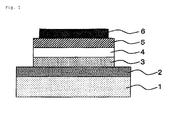
- Fig. 1 is a sectional view showing an example of the organic EL element of the present invention.
- charge-transporting properties and positive hole-transporting properties are inclusively referred to "charge-transporting properties" or “carrier-transporting properties”.
- the polymer compound (I) of the present invention (Embodiment 1) comprises a constituting unit derived from at least one polymerizable compound having charge-transporting properties selected from those represented by the above formulas (1) to (3), preferably (4) to (6), more preferably (1-1) to (3-7), and is obtainable by polymerizing at least one polymerizable compound having charge-transporting properties selected from those represented by the above formulas (1) to (3), preferably (4) to (6), more preferably (1-1) to (3-7).
- R 1 to R 3 are each independently hydrogen atom or an aromatic group optionally having a heteroatom as a ring-constituting atom; provided that at least one R 1 , at least one R 2 and at least one R 3 each represent an aromatic group having a substituent with a polymerizable functional group and optionally having a heteroatom as a ring-constituting atom.
- R 4 to R 6 are each independently hydrogen atom, a halogen atom, an alkyl group having 1 to 12 carbon atoms or an aromatic group optionally having a heteroatom as a ring-constituting atom, provided that at least one R 4 , at least one R 5 and at least one R 6 each represent an aromatic group having a substituent with a polymerizable functional group and optionally having a heteroatom as a ring-constituting atom.
- halogen atom examples are a fluorine atom, a chlorine atom, a bromine atom and an iodine atom.
- alkyl group having 1 to 12 carbon atoms examples are methyl group, ethyl group, propyl group, isopropyl group, butyl group, isobutyl group, t-butyl group, amyl group, hexyl group, octyl group, decyl group, 2-ethylhexyl group and dodecyl group.
- examples of the aromatic group are phenyl group, biphenylyl group, pyridyl group and pyrimidyl group.
- the polymerizable functional group may be any one of radical polymerizable, cation polymerizable, anion polymerizable, addition polymerizable and condensation polymerizable functional groups. Of these groups, the radical polymerizable functional group is preferred because the polymer production is easy. Specifically, substituents represented by the formula (7) are preferred as the substituent having a polymerizable functional group.
- R 701 is hydrogen or an alkyl group having 1 to 12 carbon atoms.
- alkyl group having 1 to 12 carbon atoms may include methyl group, ethyl group, propyl group, isopropyl group, butyl group, isobutyl group, t-butyl group, amyl group, hexyl group, octyl group, decyl group, 2-ethylhexyl group and dodecyl group.
- R 701 is preferably hydrogen because of having excellent carrier-transporting properties.
- X 7 is a single bond or a group represented by any one of the formulas (X71) to (X74).
- R X71 is a single bond or an alkylene group having 1 to 12 carbon atoms
- R X72 is a single bond, an alkylene group having 1 to 12 carbon atoms or a phenylene group.
- the alkylene group having 1 to 12 carbon atoms may include methylene group, ethylene group, trimethylene group, tetraethylene group, octaethylene group, decaethylene group and dodecaethylene group.
- R X71 preferably bonds to an aromatic group and R X72 preferably bonds to a vinyl group.
- X 7 is preferably a single bond or an alkylene group having 1 to 20 carbon atoms, more preferably a single bond.
- X 7 dose not contain a heteroatom, it is possible to prepare organic EL elements having higher light-emitting efficiency.
- R 1 to R 6 may have each a substituent other than the substituent having a polymerizable functional group.
- substituents are a cyano group, an amyl group, an alkyl group having 1 to 12 carbon atoms and an alkoxy group having 1 to 12 carbon atoms.
- alkyl group having 1 to 12 carbon atoms may include methyl group, ethyl group, propyl group, isopropyl group butyl group, isobutyl group, t-butyl group, amyl group, hexyl group, octyl group, decyl group, 2-ethylhexyl group and dodecyl group.
- alkoxy group having 1 to 12 carbon atoms may include methoxy group, ethoxy group, propoxy group, isopropoxy group, butoxy group, isobutoxy group, t-butoxy group, hexyloxy group, 2-ethylhexyloxy group, decyloxy group and dodecyloxy group.
- polymerizable compounds having charge-transporting properties are polymerizable compounds represented by the following formulas (1-1) to (3-7) because the polymerizable compound has excellent solubility and excellent carrier-transporting ability, the synthesis of the polymerizable compound is easy and thereby the polymerizable compound has a symmetric structure.
- "Me” represents methyl group
- " t Bu” represents t-butyl group.
- the polymerizable compound having charge-transporting properties represented by any one of the formulas (1) to (3), preferably the formulas (4) to (6), more preferably (1-1) to (3-7) may be used singly or two or more may be combined for use.
- the polymerizable compounds having carrier-transporting properties can be prepared by cyclizing an acetophenone derivative with a bromobenzealdehyde using Lewis acid and thereafter coupling with Suzuki coupling method.
- the production of the polymer compound (I) may be carried out using the above polymerizable compounds by any one of radical polymerization, cation polymerization, anion polymerization and addition polymerization and it is carried out preferably by radical polymerization.
- polymerizable compounds In producing the polymer compound (I), other polymerizable compounds may be used.
- the polymerizable compounds are compounds having no carrier-transporting properties, for example, (meth) acrylic acid alkyl esters such as methyl acrylate, methyl methacrylate and the like, styrene and derivatives thereof.
- the polymer compound (I) has a weight average molecular weight of preferably 1,000 to 2,000,000, more preferably 5,000 to 500,000.
- the polymer compound (I) preferably has a weight average molecular weight in the above range because it is soluble in an organic solvent and can prepare a uniform thin film.
- the weight average molecular weight is a value determined by using tetrahydrofuran as a solvent at 40°C with the gel permeation chromatography (GPC) method.
- the solubility of the polymer compound (I) in an organic solvent such as toluene, chloroform, etc
- 1 part by mass of the polymer compound (I) is dissolved in preferably 0.1 to 200 parts by mass, more preferably 1 to 50 parts by mass of the organic solvent.
- the solubility thereof is preferably in the above range because organic EL elements are easily prepared by the coating method.
- the polymer compound (II) of the present invention comprises a constituting unit derived from at least one polymerizable compound having charge-transporting properties selected from those represented by the above formulas (1) to (3), preferably the formulas (4) to (6), more preferably the formulas (1-1) to (3-7), and a constituting unit derived from a polymerizable compound having light-emitting properties.
- the polymer compound (II) is obtainable by polymerizing at least one polymerizable compound having charge-transporting properties selected from those represented by the formulas (1) to (3), preferably the formulas (4) to (6), more preferably the formulas (1-1) to (3-7), and the polymerizable compound having light-emitting properties.
- the polymerizable compound having charge-transporting properties represented by at least one of the above formulas (1) to (3), preferably the formulas (4) to (6), more preferably the formulas (1-1) to (3-7) has the same meanings as those of the polymerizable compound having charge-transporting properties used in the embodiment 1 and the preferred reasons thereof are similar to the embodiment 1.
- the polymerizable compound having light-emitting properties preferably has phosphorescent properties, is more preferably a transition metal complex having a substituent with a polymerizable functional group, furthermore preferably an iridium complex having a substituent with a polymerizable functional group.
- iridium complexes represented by the following formulas (8) to (10). These polymerizable compounds have a vinyl group, which is a polymerizable functional group.
- R 201 to R 215 are each independently an atom or a substituent selected from the group consisting of hydrogen atom, a halogen atom, a cyano group, an alkyl group having 1 to 10 carbon atoms, an aryl group having 6 to 10 carbon atoms, an amino group optionally substituted with an alkyl group having 1 to 10 carbon atoms, an alkoxy group having 1 to 10 carbon atoms and a silyl group.
- halogen atom examples are a fluorine atom, a chlorine atom, a boron atom and an iodine atom.
- alkyl group having 1 to 10 carbon atoms examples are methyl group, ethyl group, propyl group, isopropyl group, butyl group, isobutyl group, t-butyl group, amyl group, hexyl group, octyl group and decyl group.
- Examples of the aryl group having 6 to 10 carbon atoms are phenyl group, tolyl group, xylyl group, mesityl group and naphthyl group.
- Examples of the amino groups optionally substituted with an alkyl group having 1 to 10 carbon atoms are amino group, dimethylamino group, diethylamino group and dibutylamino group.
- alkoxy group having 1 to 10 carbon atoms examples include methoxy group, ethoxy group, propoxy group, isopropoxy group, butoxy group, isobutoxy group, t-butoxy group, hexyloxy group, 2-ethylhexyloxy group and decyloxy group.
- Examples of the silyl group are trimethyl silyl group, triethyl silyl group, t-butyl dimethyl silyl group and trimethoxy silyl group.
- R 201 to R 215 are each preferably hydrogen atom, a fluorine atom, cyano group, methyl group, t-butyl group, dimethylamino group, butoxy group or 2-ethyl hexyloxy group, more preferably R 202 is t-butyl group and R 201 to R 215 excluding R 202 are each hydrogen atom.
- each ring of R 201 to R 204 , R 205 to R 208 , R 209 to R 211 and R 212 to R 215 two groups, which are adjacent through two carbon atoms, may bond each other to form a condensed ring.
- R 216 is hydrogen atom or an alkyl group having 1 to 12 carbon atoms. Examples of the alkyl group having 1 to 12 carbon atoms are the above-described alkyl groups. Of these, R 216 is preferably hydrogen atom because the carrier-transporting properties of the polymerizable compound are excellent.
- X 2 is a single bond or a group represented by any of the following formulas (X21) to (X24).
- R X21 is a single bond or an alkylene having 1 to 12 carbon atoms
- R X22 is a single bond, an alkylene having 1 to 12 carbon atoms or a phenylene group.
- R X21 preferably bonds to a benzene ring and R X22 preferably bonds to a vinyl group.
- organic EL elements having higher light-emitting efficiency can be prepared.
- R 301 to R 308 are each independently the same atom or substituent as those of R 201 .
- R 309 to R 310 are each independently the same atom or substituent as those of R 201 (excluding a halogen atom).
- R 301 to R 310 are preferably each independently hydrogen atom, a fluorine atom, cyano group, methyl group, t-butyl group, dimethylamino group, butoxy group or 2-ethyl hexyloxy group, and more preferably R 302 is t-butyl group and R 301 to R 310 excluding R 302 are each hydrogen atom.
- R 311 is hydrogen atom or an alkyl group having 1 to 12 carbon atoms similar to R 216 .
- Examples of the alkyl group having 1 to 12 carbon atoms may include the alkyl groups as described above. Of these, R 311 is preferably hydrogen atom because the carrier-transporting ability of the polymerizable compound is excellent.
- X 3 is a single bond or a group represented by any of the following formulas (X31) to (X34).
- R X31 is a single bond or an alkylene group having 1 to 12 carbon atoms
- R X32 is a single bond, an alkylene group having 1 to 12 carbon atoms or a phenylene group.
- the preferable embodiment and the reason of X 3 are similar to those in X 2 .
- R 401 to R 411 are each independently the same atom or substituent as those of R 201 .
- R 401 to R 411 are preferably each independently hydrogen atom, a fluorine atom, cyano group, methyl group, t-butyl group, dimethylamino group, butoxy group or 2-ethyl hexyloxy group, and more preferably R 402 is t-butyl group and R 401 to R 411 excluding R 402 are each independently hydrogen atom.
- R 412 is the same atom or substituent as those of R 216 , and the preferable embodiment and the reason thereof are similar to those in R 216 .
- X 4 is a single bond or a group represented by any of the following formulas (X41) to (X44).
- R X41 is a single bond or an alkylene group having 1 to 12 carbon atoms
- R X42 is a single bond, an alkylene group having 1 to 12 carbon atoms or a phenylene group.
- the preferable embodiment of X 4 and the reason thereof are similar to those in X 2 .
- Non-limiting examples of the polymerizable phosphorescent compound used in the present invention may include the compounds as described in JP-A-2003-119179 , JP-A-2003-113246 , JP-A-2003-206320 , JP-A-2003-147021 , JP-A-2003-171391 , JP-A-2004-346312 , JP-A-2006-008996 , JP-A-2007-023269 and JP-A-2007-084612 .
- polymerizable phosphorescent compound preferably include the following compounds.
- the above polymerizable phosphorescent compound may be used singly or two or more may be combined for use.
- the polymerizable phosphorescent compound can be prepared by, for example, allowing iridium chloride to react with a phenyl pyridine derivative, thereby preparing a dinuclear complex of iridium, and allowing it to react with a ligand having a polymerizable functional group (a ligand coordinated in the right side of Ir in the above formulas (8) to (10)).
- examples of the other polymerizable compounds optionally used are similar to those in the embodiment 1.
- the production of the polymer compound (II) is carried out using the above-described polymerizable compounds by any of radical polymerization, cation polymerization, anion polymerization and addition polymerization, preferably radical polymerization.
- the weight average molecular weight of the polymer compound (II) is similar to that in the embodiment 1.
- the solubility of the polymer compound (II) in an organic solvent is similar to that in the embodiment 1.
- the proportion of the constituting units derived from the polymerizable phosphorescent compound to all the constituting units namely, the value of m/(m+n) is preferably 0.001 to 0.5, more preferably 0.001 to 0.2.
- organic EL elements having high carrier mobility, low influence by concentration quenching and high light-emitting efficiency can be prepared.
- the proportion of each constituting unit of the above polymer compound is determined by ICP element analysis and 13 C-NMR measurement.
- the polymerization is carried out, to prepare the polymer compound (II) having a desired structure.
- the polymer compound (II) may be any one of a random copolymer, a block copolymer and an alternating copolymer.
- the polymer compound (III) of the present invention (Embodiment 3) comprises a constituting unit derived from at least one polymerizable compound having charge-transporting properties selected from the compounds represented by the above formulas (1) to (3), preferably the formulas (4) to (6), more preferably the formulas (1-1) to (3-7), a constituting unit derived from a polymerizable compound having light-emitting properties and a constituting unit derived from a polymerizable compound having positive hole-transporting properties.
- the polymer compound (III) is obtainable by polymerizing at least one polymerizable compound having charge-transporting properties selected from the compounds represented by the formulas (1) to (3), preferably the formulas (4) to (6), more preferably the formulas (1-1) to (3-7), the polymerizable compound having light-emitting properties and the polymerizable compound having positive hole-transporting properties.
- the polymerizable compound having charge-transporting properties selected from those represented by the above formulas (1) to (3), preferably (4) to (6), more preferably (1-1) to (3-7) has the same meanings as those of the polymerizable compound having charge-transporting properties used in the embodiment 1 and the polymerizable compound having light-emitting properties has the same meanings as those of the polymerizable compound having light-emitting properties used in the embodiment 2, and further, the preferred embodiments and the reasons thereof are also similar.
- the polymerizable compound having positive hole-transporting properties are a carbazole derivative and a triaryl amine derivative each containing a substituent having a polymerizable functional group.
- the carbazole derivative and triaryl amine derivative each containing a substituent having a polymerizable functional group may include N,N'-diphenyl-N,N'-(3-methylphenyl)-1,1'-biphenyl-4,4'-diamin e (TPD), N,N,N',N'-tetrakis(3-methylphenyl)-1,1'-(3,3'-dimethyl)biphen yl-4,4'-diamine (HMTPD), 4,4',4"-tris(3-methylphenylphenylamino)triphenylamine (m-MTDATA), 4,4'-biscarbazolyl biphenyl(CBP), 4,4'-biscarbazolyl-2,2'-dimethyl
- the polymerizable compound having positive hole-transporting properties may be used singly or two or more may be combined for use.
- the polymerizable compound having positive hole-transporting properties represented by the following formulas (11) or (12) is suitable for the present invention because of having excellent carrier-transporting ability and excellent photo physical properties.
- R 501 to R 524 is a substituent having a polymerizable functional group
- R 501 to R 524 which are not the substituents having a polymerizable functional group, are each independently an atom or a substituent selected from the group consisting of hydrogen atom, a halogen atom, a cyano group, an alkyl group having 1 to 10 carbon atoms, an aryl group having 6 to 10 carbon atoms, an amino group optionally substituted with an alkyl group having 1 to 10 carbon atoms, an alkoxy group having 1 to 10 carbon atoms, a carbazolyl group and a silyl group.
- Examples of the atom or the substituent may include the same as those described on halogen atom, the alkyl group having 1 to 10 carbon atoms, the aryl group having 6 to 10 carbon atoms, the alkyl group having 1 to 10 carbon atoms, the alkoxy group having 1 to 10 carbon atoms.
- the carbazolyl group may have a substituent such as methyl group, ethyl group, t-butyl group or methoxy group.
- R 501 to R 505 R 506 to R 510 , R 511 to R 515 , R 516 to R 520 and R 521 to R 523 , adjacent two groups through two carbon atoms, which form a ring, may bond each other to form a condensed ring.
- R 601 to R 633 is a substituent having a polymerizable functional group
- R 601 to R 633 which are not the substituents having a polymerizable functional group, are each independently an atom or a substituent selected from the group consisting of hydrogen atom, a halogen atom, a cyano group, an alkyl group having 1 to 10 carbon atoms, an aryl group having 6 to 10 carbon atoms, an amino group optionally substituted with an alkyl group having 1 to 10 carbon atoms, an alkoxy group having 1 to 10 carbon atoms and a silyl group.
- Examples of the atom or the substituent may include the same atom or the substituents as those of the halogen atom, the alkyl group having 1 to 10 carbon atoms, the aryl group having 6 to 10 carbon atoms, the alkyl group having 1 to 10 carbon atoms and the alkoxy group having 1 to 10 carbon atoms as described above.
- R 601 to R 605 R 606 to R 610 , R 611 to R 615 , R 616 to R 620 , R 621 to R 625 and R 626 to R 630 , adjacent two groups through two carbon atoms, which form a ring, may bond each other to form a condensed ring.
- each of R 501 to R 505 , R 506 to R 510 , R 511 to R 515 and R 516 to R 520 at least one is preferably the atom other than hydrogen atom or the substituent.
- R 501 to R 524 other than the polymerizable functional group the atom or the substituent are hydrogen atoms.
- each of R 601 to R 605 , R 606 to R 610 , R 611 to R 615 , R 616 to R 620 , R 621 to R 625 and R 626 to R 630 at least one is preferably the atom other than hydrogen atom or the substituent.
- R 601 to R 633 other than the polymerizable functional group, the atom or the substituent are hydrogen atoms.
- R 701 is hydrogen atom or an alkyl group having 1 to 12 carbon atoms. Concerning to R 701 , the preferable range and the reason thereof are similar to those as described in the polymerizable compound having charge-transporting properties in the embodiment 1.
- X 7 is a single bond or a group represented by any of the formulas (X71) to (X74). Concerning to X 7 , the preferable range and the reason thereof are similar to those as described in the polymerizable compound having charge-transporting properties in the embodiment 1.
- polymerizable compound having positive hole-transporting properties may include compounds represented by the following formulas (15-1) to (15-10).
- the polymerizable compound having positive hole-transporting properties may be used singly or two or more may be combined for use.
- the compound represented by the formula (11) can be prepared by, for example, palladium catalyst substitution reaction of a m-phenylene diamine derivative and halogenated aryl or palladium catalyst substitution reaction of diarylamine and a m-dibromobenzene derivative.
- the method for substitution reaction is disclosed in, for example, Tetrahedron Letters, 1998, Vol. 39, p. 2367 .
- the compound represented by the formula (12) can be prepared by, for example, palladium catalyst substitution reaction of 1,3,5-triaminobenzene and halogenated aryl or palladium catalyst substitution reaction of diarylamine and 1,3,5-trihalogenated benzene.
- the method for substitution reaction is disclosed in, for example, Tetrahedron Letters, 1998, Vol. 39, p. 2367 .
- polymer compound (III) other polymerizable compounds further optionally used are the same compounds as in the embodiment 1.
- the production of the polymer compound (III) may be carried out using the above polymerizable compounds by any of radical polymerization, cation polymerization, anion polymerization and addition polymerization, preferably by radical polymerization.
- the weight average molecular weight of the polymer compound (III) is similar to that in the embodiment 1. Furthermore, the solubility of the polymer compound (III) in an organic solvent is similar to that in the embodiment 1.
- the proportion of the constituting units derived from the polymerizable compound having phosphorescent properties to all the constituting units namely, the value of m/(m+n) is preferably 0.001 to 0.5, more preferably 0.001 to 0.2.
- the proportion of the number of the constituting unit derived from the polymerizable compound having carrier-transporting properties to the number of the constituting unit derived from the polymerizable compound having positive hole-transporting properties x/n and the proportion of the number of the constituting unit derived from the polymerizable compound having carrier-transporting properties to the number of the constituting unit derived from the polymerizable compound having charge-transporting properties y/n, the optimum values are determined by the charge-transporting ability and concentration of each constituting unit.
- the values of x/n and y/n are each in the range of preferably 0.05 to 0.95, more preferably 0.20 to 0.80.
- x/n + y/n 1.
- the proportion of each constituting unit of the polymer compounds is determined by ICP element analysis and 13 C-NMR measurement.
- the polymer compound (III) having a desired structure can be prepared.
- the polymer compound (III) may be any one of a random copolymer, a block copolymer and an alternating copolymer.
- one light-emitting layer which comprises the polymer compound (I) and a polymer compound (I'), is provided between an anode and a cathode, wherein the polymer compound (I') has the constituting units derived from a light-emitting compound and a polymerizable compound having positive hole-transporting properties.
- the light-emitting layer contains the light-emitting compound in an amount of 0.1 to 50 parts by mass, more preferably 0.5 to 30 parts by mass and the polymer compound (I') in an amount of 10 to 200 parts by mass, more preferably 50 to 150 parts by mass based on 100 parts by mass of the polymer compound (I).
- organic EL elements having high light-emitting efficiency can be prepared even if other organic material layers are not provided.
- Examples of the light-emitting compound are preferably phosphorescent compounds, more preferably an iridium complex.
- iridium complex are the following complexes (E-1) to (E-39).
- the light-emitting compound may be used singly and two or more may be combined for use.
- the polymer compound (I') is obtainable by polymerizing the polymerizable compound having positive hole-transporting properties.
- the above polymerizable compound having positive hole-transporting properties has the same meaning as the polymerizable compound having positive hole-transporting properties used in the embodiment 3, and the preferred range and the reason thereof are similar to those in the embodiment 3.
- the polymer compound (I') may be produced using the above-described polymerizable compounds by any of radical polymerization, cation polymerization, anion polymerization and addition polymerization, preferably radical polymerization.
- the polymer compound (I') has a weight average molecular weight of usually 1, 000 to 2, 000, 000, preferably 5, 000 to 500,000.
- the polymer compound (I') preferably has a weight average molecular weight in the above range, because the polymer compound (I') is soluble in an organic solvent and uniform thin films are prepared.
- the weight average molecular weight is a value determined by measuring at 40°C using tetrahydrofuran as a solvent with gel permeation chromatography (GPC) method.
- GPC gel permeation chromatography
- the organic EL element having one light-emitting layer which comprises the polymer compound (I), the light-emitting compound and the polymer compound (I'), between an anode and a cathode
- the light-emitting layer is usually formed on an anode provided on a substrate in the following manner. First, a solution in which the polymer compound (I), the light-emitting compound and the polymer compound (I') are dissolved is prepared.
- a solvent used in the preparation of the solution is not particularly limited, examples of the solvent are chlorine solvents such as chloroform, methylene chloride, dichloroethane etc; ether solvents such as tetrahydrofuran, anisole etc; aromatic hydrocarbon solvents such as toluene, xylene etc; ketone solvents such as acetone, methylethyl ketone etc; and ester solvents such as ethyl acetate, butyl acetate, ethyl cellosolve acetate etc.
- chlorine solvents such as chloroform, methylene chloride, dichloroethane etc
- ether solvents such as tetrahydrofuran, anisole etc
- aromatic hydrocarbon solvents such as toluene, xylene etc
- ketone solvents such as acetone, methylethyl ketone etc
- ester solvents such as ethyl acetate, butyl acetate, eth
- the solution thus prepared is applied on the substrate by wet film forming methods such as spin coating method, casting method, micro-gravure coating method, gravure coating method, bar coating method, roll coating method, wire bar coating method, dip coating method, spray coating method, screen printing method, flexographic printing method, offset printing method or ink jet printing method, to form a film.
- wet film forming methods such as spin coating method, casting method, micro-gravure coating method, gravure coating method, bar coating method, roll coating method, wire bar coating method, dip coating method, spray coating method, screen printing method, flexographic printing method, offset printing method or ink jet printing method, to form a film.
- the solution preferably contains the light-emitting compound in an amount of 0.5 to 30 parts by mass, the polymer compound (I') in an amount of 10 to 200 parts by mass and the solvent in an amount of 1000 to 20000 parts by mass based on 100 parts by mass of the polymer compound (I).
- the organic EL element of the embodiment 4 can be prepared.
- a transparent substrate having insulating properties against the emitting wavelength of the light-emitting material is favorably used.
- the substrate are glasses and transparent plastics such as PET (polyethylene terephthalate), polycarbonate etc.
- anode material used in the embodiment 4 it is preferred to use known transparent conductive materials, such as ITO (indium tin oxide), tin oxide, zinc oxide and conductive polymers such as polythiophene, polypyrol, polyaniline, etc.
- the electrode formed by the transparent conductive material has a surface resistance of preferably 1 to 50 ⁇ / ⁇ (ohm/square).
- the anode has a thickness of preferably 50 to 300 nm.
- the cathode material used in the embodiment 4 it is preferred to use known cathode materials, for example, alkali metals such as Li, Na, K, Cs, etc; alkali earth metals such as Mg, Ca, Ba, etc; Al; MgAg alloy; alloys of Al and an alkali metal or an alkali earth metal, such as AlLi, AlCa, etc.
- the cathode has a thickness of preferably 10 nm to 1 ⁇ m, more preferably 50 to 500 nm.
- the cathode has a thickness of preferably 0.1 to 100 nm, more preferably 0.5 to 50 nm.
- a metal layer stable to the air is laminated for protecting the cathode metal.
- the metal forming the metal layer may include Al, Ag, Au, Pt, Cu, Ni, Cr, etc.
- the metal layer has a thickness of preferably 10 nm to 1 ⁇ m, more preferably 50 to 500 nm.
- Examples of the film forming method using the anode material may include electron beam vapor deposition method, sputtering method, chemical reaction method and coating method, and examples of the film forming method using the cathode material may include resistance heat vapor deposition method, electron beam vapor deposition method, sputtering method and ion plating method.
- one light-emitting layer which comprises a specific polymer compound (II) and a polymer compound (I'), is provided between an anode and a cathode.
- the light-emitting layer contains the polymer compound (I') in an amount of preferably 10 to 200 parts by mass, more preferably 50 to 150 parts by mass based on 100 parts by mass of the polymer compound (II).
- organic EL elements having high light-emitting efficiency can be prepared even if other organic material layers are not provided.
- the light-emitting layer is usually formed on the anode provided on the substrate in the following way.
- a solution in which the polymer compound (II) and the positive hole-transporting compound are dissolved is prepared.
- the solvent used in the preparation of the solution is the same as that used in the embodiment 4.
- the film forming method of the solution is similar to that of the embodiment 4.
- the solution preferably contains the polymer compound (I') in an amount of 10 to 200 parts by mass and the solvent in an amount of 1000 to 20000 parts by mass based on 100 parts by mass of the polymer compound (II).
- the organic EL element of the embodiment 5 is prepared. Furthermore, the substrate, the anode material, the cathode material and the film forming methods using the anode material and the cathode material in the embodiment 5 are similar to those of the embodiment 4.
- one light-emitting layer which comprises a specific polymer compound (III) is provided between an anode and a cathode.
- a specific polymer compound (III) is provided between an anode and a cathode.
- organic EL elements having high light-emitting efficiency can be prepared even if other organic material layers are not provided.
- the embodiment 6 has a merit such that the production step can be more simplified because the light-emitting layer is formed from only the polymer compound (III).
- the light-emitting layer is usually formed on the anode provided on the substrate in the following way.
- a solution in which the polymer compound (III) is dissolved is prepared.
- the solvent used in the preparation of the solution is the same as that used in the embodiment 4.
- the film forming method of the solution is similar to that of the embodiment 4.
- the solution preferably contains the solvent in an amount of 1000 to 20000 parts by mass based on 100 parts by mass of the polymer compound (III) .
- the organic EL element of the embodiment 6 is prepared.
- the substrate, the anode material, the cathode material and the film forming methods using the anode material and the cathode material in the embodiment 6 are similar to those in the embodiment 4.
- the organic EL element of the present invention (Embodiment 7) comprises, between an anode and a cathode, the light-emitting layer as described in any one of the embodiments 4 to 6, and optionally comprises other organic layers.
- Examples of the other organic layers are a positive hole-transporting layer, a charge-transporting layer, a positive hole-block layer and a buffer layer. Providing these organic layers, the light-emitting efficiency can be further enhanced.
- One example of the structure of the organic EL element (Embodiment 7) according to the present invention is shown in Fig. 1 .
- Fig. 1 between an anode (2) and a cathode (6) provided on a transparent substrate (1), a positive hole-transporting layer (3), a light-emitting layer (4) as described in the embodiment 4 to 6, and an electron-transporting layer (5) are provided in this order.
- any one of 1) the positive hole-transporting layer/the light-emitting layer and 2) the light-emitting layer/ the electron-transporting layer may be provided.
- Each organic layer may be formed by mixing a polymer material and the like as a binder.
- the polymer material may include polymethyl methacrylate, polycarbonate, polyester, polysulfone and polyphenylene oxide.
- each layer may be formed by each singly using the compound having positive hole-transporting properties and the compound having electron-transporting properties used in the positive hole-transporting layer and the electron-transporting layer, or mixing the compounds with materials having different functions.
- Examples of the compound having positive hole-transporting properties used for forming the positive hole-transporting layer may include TPD (N,N'-dimethyl-N,N'-(3-methylphenyl)-1,1'-biphenyl-4,4'diamin e) ; ⁇ -NPD (4,4'-bis [N-(1-naphthyl)-N-phenylamino]biphenyl); low molecular triphenyl amine derivatives such as m-MTDATA (4,4',4"-tris(3-methylphenylphenylamino)triphenylamine etc; polyvinyl carbazole ; polymer compounds obtainable by introducing a polymerizable functional group to the above triphenyl amine derivative and polymerizing; fluorescent polymer compounds such as polyparaphenylene vinylene, polydialkylfluorene, etc.
- TPD N,N'-dimethyl-N,N'-(3-methylphenyl)-1,
- polymer compound examples are polymer compounds having a triphenyl amine skeleton as disclosed in JP-A-H8(1996)157575 .
- the compound having positive hole-transporting properties may be used singly or two or more may be mixed for use, and further, a different compound having positive hole-transporting properties may be laminated on them.
- the positive hole-transporting layer usually has a thickness, which depends on the conductivity of the positive hole-transporting layer, of preferably 1 nm to 5 ⁇ m, more preferably 5 nm to 1 ⁇ m, particularly preferably 10 nm to 500 nm.
- Examples of the compound having electron-transporting properties for forming the electron-transporting layer may include quinolinol derivative metal complexes such as Alq3 (aluminum trisquinolinolate) etc; low molecular compounds such as oxadiazole derivative, triazole derivative, imidazole derivative, triazine derivative, triaryl borane derivative, etc; and polymer compounds obtainable by introducing a polymerizable substituent to the above low molecule compound and polymerizing.
- Examples of the polymer compound may include poly PBD etc as disclosed in JP-A-H10(1998)-1665 .
- the compound having electron-transporting properties may be used singly or two or more may be mixed for use, and further a different compound having electron-transporting properties may be laminated on them.
- the electron-transporting layer usually has a thickness, which depends on the conductivity of the electron-transporting layer, of preferably 1 nm to 5 ⁇ m, more preferably 5 nm to 1 ⁇ m, particularly preferably 10 nm to 500 nm.
- a positive hole-blocking layer Adjacent to the cathode side of the light-emitting layer, a positive hole-blocking layer may be provided in order to depress passing of positive holes through the light-emitting layer and to re-combine positive holes with electrons efficiently in the light-emitting layer.
- known materials such as a triazole derivative, an oxadiazole derivative, a phenanethroline derivative, etc are used.
- a buffer layer may be provided between the anode and the positive hole-transporting layer, or between the anode and the organic layer laminated adjacently to the anode.
- a buffer layer known materials such as copper phthalocyanine, a mixture of polyethylene dioxythiophene and polystyrene sulfonate (PEDOT:PSS), etc are used.
- an insulating layer having a thickness of 0.1 to 10 nm may be provided in order to enhance the electron injecting efficiency.
- known materials such as lithium fluoride, sodium fluoride, magnesium fluoride, magnesium oxide, alumina, etc are used.
- the processes for forming the positive hole-transporting layer and the electron-transporting layer it is possible to use, for example, dry film forming methods such as resistance heat vapor deposition method, electron beam vapor deposition method or sputtering method; and wet film forming methods such as spin coating method, casting method, micro-gravure coating method, gravure coating method, bar coating method, roll coating method, wire bar coating method, dip coating method, spray coating method, screen printing method, flexographic printing method, offset printing method and ink jet printing method.
- dry film forming methods such as resistance heat vapor deposition method, electron beam vapor deposition method or sputtering method
- wet film forming methods such as spin coating method, casting method, micro-gravure coating method, gravure coating method, bar coating method, roll coating method, wire bar coating method, dip coating method, spray coating method, screen printing method, flexographic printing method, offset printing method and ink jet printing method.
- dry film forming methods such as resistance heat vapor deposition method, electron beam vapor deposition method or
- the organic EL element according to the present invention is favorable for image display devices as pixels by a matrix system or a segment system with known methods.
- the organic EL element is also favorable for a surface emitting light source without forming pixels.
- the organic EL element of the present invention is favorable for displays, back lights, electron photographs, illumination light sources, recording light sources, exposure light sources, reading light sources, marks, signboards, interiors, optical communication systems, etc.
- the organic layer was concentrated and a residue was eluted with hexane and chloroform in the proportion of 70 : 30 by silica gel column chromatography, to prepare the object 6 in an amount of 1.88 g in a yield of 77 mol%.
- the synthesis of the object 7 is described with reference to the schema 3.
- 1.08 g (1.50 mmol) of the object 6 0.27 g (1.80 mmol) of styryl boric acid, 2.07 g (15.0 mmol) of potassium carbonate, 0.29 g (0.90 mmol) of tetrabutylammonium bromide, 30 mg of ditertialbutyl cresol, 25 mL of toluene and 15 mL of water were fed and stirred under reflux in nitrogen for 1 hr.
- the organic layer was concentrated, and a residue was eluted with dichloromethane and diethyl ether in the proportion of 70 : 30 by silica gel column chromatography to prepare the object 8 in an amount of 3.17 g in a yield of 82 mol%.
- the synthesis of the compound 8 is described with reference to the schema 6.
- the object 14 was synthesized by the method as described in JP-A-2007-197426 .
- To a 100 mL 2-necked flask 1.39 g (3.00 mmol) of the object 14, 0.67 g (3.60 mmol) of vinyl boric acid dibutyl ester, 4.15 g (30.0 mmol) of potassium carbonate, 0.58 g (1.80 mmol) of tetrabutyl ammonium bromide, 40 mg of ditertialbutyl cresol, 25 mL of toluene and 15 mL of water were fed and stirred under reflux in nitrogen for 1 hr.
- the polymerizable compound 1 (333 mg) was fed and dehydrated toluene (10 mL) was added, and then a toluene solution of a radical polymerization initiator V-601 manufactured by Wako Pure Chemical Industries Ltd. (0.1 M, 100 ⁇ L) was added and freeze-deaeration procedure was repeated five times.
- the vessel was sealed in vacuo and stirring was carried out at 60°C for 60 hr. After the reaction, the reacted solution was dropped into acetone (250 mL) to prepare a precipitate. Furthermore, the precipitate was purified by repeating the precipitation-purification with toluene-acetone twice.
- the resulting copolymer had a weight average molecular weight (Mw), as measured by GPC in terms of polystyrene, of 42,000.
- viPBD represented by the following formula (16) (350 mg) was fed and dehydrated toluene (10 mL) was added, and then a toluene solution of a radical polymerization initiator V-601manufactured by Wako Pure Chemical Industries Ltd. (0.1 M, 100 ⁇ L) was added and freeze-deaeration procedure thereof was repeated five times.
- the vessel was sealed in vacuo and stirring was carried out at 60°C for 60 hr. After the reaction, the reacted solution was dropped into acetone (250 mL) to prepare a precipitate. Furthermore, the precipitate was purified by repeating precipitation-purification with toluene-acetone twice.
- the resulting copolymer has a weight average molecular weight (Mw), as measured by GPC in terms of polystyrene, of 67,000.
- the polymerizable compound 1 300 mg
- a light-emitting polymerizable compound 10 represented by the following formula (79 mg) were fed and dehydrated toluene (8 mL) was added, and then a toluene solution of a radical polymerization initiator V-601 manufactured by Wako Pure Chemical Industries Ltd. (0.1 M, 100 ⁇ L) was added and freeze-deaeration procedure was repeated five times.
- the vessel was sealed in vacuo and stirring was carried out at 60°C for 60 hr. After the reaction, the reacted solution was dropped into acetone (250 mL) to prepare a precipitate.
- the resulting precipitate was purified by repeating precipitation-purification with toluene-acetone twice. Thereafter the reactant was dried at 50°C in vacuo over night to prepare the copolymer 1 (341 mg) as a pale yellow solid.
- the resulting copolymer 1 had a weight average molecular weight (Mw) measured by GPC in terms of polystyrene of 70,000.
- the copolymer 1 had a copolymerization ratio (molar ratio), as determined by NMR measurement, of polymerizable compound 1 to polymerizable compound 10 of 91/9.
- copolymers 2 to 9 were prepared.
- the weight average molecular weight of each polymer is shown below.
- the polymerizable compound 1 150 mg
- the light-emitting polymerizable compound 10 79 mg
- a polymerizable compound 15-4 represented by the following formula (15-4) (269 mg)
- dehydrated toluene 8 mL
- a toluene solution of a radical polymerization initiator V-601 manufactured by Wako Pure Chemical Industries Ltd. 0.1 M, 100 ⁇ L
- freeze-deaeration procedure thereof was repeated five times.
- the vessel was sealed in vacuo and stirring was carried out at 60°C for 60 hr. After the reaction, the reacted solution was dropped into acetone (250 mL) to prepare a precipitate.
- the resulting precipitate was purified by repeating precipitation-purification with toluene-acetone twice. Thereafter the precipitate was dried at 50°C in vacuo over night to prepare the copolymer 10 (448 mg) as a pale yellow solid.
- the resulting copolymer 10 had a weight average molecular weight (Mw), as measured by GPC in terms of polystyrene, of 67,000.
- the copolymer 10 had a copolymerization ratio (molar ratio), as determined by NMR measurement, of polymerizable compound 1, polymerizable compound 10 and polymerizable compound 15-4 of 47/44/9.
- copolymers 11 to 18 were prepared.
- the weight average molecular weight of each polymer is shown below.
- the polymerization procedure of Synthetic Example 12 was repeated except for using viPBD (315 mg) in place of the polymerizable compound 1.
- the resulting copolymer 19 had a weight average molecular weight (Mw), as measured by GPC in terms of polystyrene, of 68,400.
- the copolymer 19 had a copolymerization ratio (molar ratio) of viPBD to polymerizable compound 10 of 91/9.
- the polymerization procedure of Synthetic Example 13 was repeated except for using viPBD (157 mg) in place of the polymerizable compound 1.
- the resulting copolymer 20 had a weight average molecular weight (Mw), as measured by GPC in terms of polystyrene, of 56,000.
- the copolymer 20 had a copolymerization ratio (molar ratio) polymerizable compound 10 and polymerizable compound 15-4 of 47/44/9.
- an organic EL element 1 was prepared.
- poly(3,4-ethylene dioxane thiophene) polystyrene sulfonic acid (Trade Name "Baytron P" manufactured by Bayer Co., Ltd.) was applied by a spin coating method at a rotation number of 3500 rpm for a coating time of 40 sec, and thereafter dried under reduced pressure at 60°C for 2 hr in a vacuum drying device to form an anode buffer layer.
- the anode buffer layer had a film thickness of about 50 nm.
- a coating solution was prepared for forming a layer, which comprises a light-emitting compound and a carrier-transporting compound.
- the homopolymer 1 45 mg
- 4,4',4"-tris(carbazole-9-yl)triphenylamine (TCTA) 45 mg
- an iridium complex E-2 represented by the following formula (E-2) (10 mg) was dissolved in toluene (manufactured by Wako Pure Chemical Industries Ltd., Special grade) (2910 mg) and the resulting solution was filtered off with a filter having a hole diameter of 0.2 ⁇ m to prepare the coating solution.
- the coating solution thus prepared was applied on the anode buffer layer by a spin coating method at a rotation number of 3000 rpm for a coating time of 30 sec, and thereafter dried at room temperature (25°C) for 30 min to form a light-emitting layer.
- the light-emitting layer had a film thickness of about 100 nm.
- the substrate having the light-emitting layer formed was placed in a vapor deposition device and cesium was vapor deposited at a vapor deposition rate of 0.01 nm/s to have a thickness of 2 nm (an alkali metal dispenser manufactured by SAES Getters was used as a cesium source) and successively, aluminum was vapor deposited at a vapor deposition rate of 1 nm/s as a cathode to have a thickness of 250 nm.
- the cesium and aluminum layers were formed in two strips having a width of 3 mm perpendicular to the extended direction of the anode.
- four organic EL elements 1 having a length of 4 mm x a width of 3 mm were prepared.
- the organic EL element was allowed to emit light by applying a voltage using a programmable direct current voltage/ current source TR6143 manufactured by ADVANTEST Corporation and the luminance was measured using a luminance measuring instrument BM-8 manufactured by TOPCON Corporation.
- the light-emitting initiation voltage, the maximum luminance and the external quantum efficiency in lighting at 100 cd/m 2 are shown in Table 2. Each value was determined by averaging the values of four organic EL elements 1.
- organic EL elements 2 to 21 were prepared using light-emitting materials and other materials as shown in Table 1 in the same manner as that of the organic EL element 1, and the luminance of each element was measured. In results, the light-emitting initiation voltage, the maximum luminance and the external quantum efficiency in lighting at 100 cd/m 2 are shown in Table 2.
- organic EL elements 22 to 24 were prepared using light-emitting materials and other materials as shown in Table 1 in the same manner as that of the organic EL element 1, and the luminance of each element was measured. In results, the light-emitting initiation voltage, the maximum luminance and the external quantum efficiency in lighting at 100 cd/m 2 are shown in Table 2.
- the organic EL elements 1 to 21 prepared using the polymer compound of the present invention in the electron-transporting site have higher maximum luminance and better external quantum efficiency as compared with the organic EL elements 22 to 24 prepared using viPBD in the electron-transporting site (Comparative examples 1 to 3).
Landscapes
- Chemical & Material Sciences (AREA)
- Engineering & Computer Science (AREA)
- Materials Engineering (AREA)
- Organic Chemistry (AREA)
- Polymers & Plastics (AREA)
- Physics & Mathematics (AREA)
- Health & Medical Sciences (AREA)
- Chemical Kinetics & Catalysis (AREA)
- Medicinal Chemistry (AREA)
- Wood Science & Technology (AREA)
- Life Sciences & Earth Sciences (AREA)
- Spectroscopy & Molecular Physics (AREA)
- Optics & Photonics (AREA)
- Crystallography & Structural Chemistry (AREA)
- Inorganic Chemistry (AREA)
- Electroluminescent Light Sources (AREA)
- Addition Polymer Or Copolymer, Post-Treatments, Or Chemical Modifications (AREA)
Abstract
Description
- The present invention relates to a charge-transporting polymer compound containing one heterocyclic ring selected from the group consisting of a pyridine ring, a pyrimidine ring and a pyrazine ring. More specifically, the present invention relates to a charge-transporting polymer compound containing one charge-transporting heterocyclic ring selected from the group consisting of a pyridine ring, a pyrimidine ring and a pyrazine ring which compound is suitably used for organic electroluminescence elements (hereinafter optionally referred to organic EL elements).
- An electroluminescence element using an organic thin film, namely, organic EL element usually has, on a substrate, an anode, a cathode and an organic layer at least containing a light-emitting layer formed between the anode and cathode. In addition to the light-emitting layer, a positive hole-injecting layer (anode buffer layer), a positive hole-transporting layer, a positive hole-blocking layer, an electron-transporting layer, an electron-injecting layer and the like are formed as the organic layer. In general, these layers are laminated between an anode and a cathode to form an organic EL element.
- Patent document 1 discloses, as a charge-transporting material used for phosphorescent organic EL elements, an organic compound having a pyridine ring, a pyrazine ring, a pyrimidine ring or a triazine ring as a skeleton and plural carbazolyl groups as a substituent. Such an organic compound is used without polymerization, has both of positive hole-transporting properties and electron-transporting properties and is sometimes referred to "the organic compound having charge-transporting properties".
-
Patent document 2 discloses a composition for organic EL elements capable of driving at a low voltage which composition comprises a phosphorescent material, an ion radical and a charge-transporting material. -
- Patent document 1:
JP-A-2006-188493 - Patent document 2:
JP-A-2007-100083 - However, in the organic EL element obtainable by using the organic compound as described in Patent document 1 and the organic EL element obtainable by using the organic EL element composition as described in
Patent document 2, there are room for improvement on luminance and luminous efficient. - Under the circumstances, it is an object of the present invention to provide a charge-transporting polymer compound capable of attaining high light-emitting efficiency and high luminance, and to provide organic EL elements having low driving voltage when using the charge-transporting polymer compound as an organic layer of the organic EL elements.
- The present inventors have been studied earnestly in order to solve the above subjects and found that when a charge-transporting polymer compound, which comprises a constituting unit derived from a specific polymerizable compound, is used as an organic layer of organic EL elements, the organic EL elements have low driving voltage and also high light-emitting efficiency and high luminance. Thus, the present invention has been accomplished.
- That is to say, the present invention relates to the following characteristics [1] to [9].
- [1] A charge-transporting polymer compound comprising a constituting unit derived from at least one polymerizable compound selected from the group consisting of a polymerizable compound represented by the following formula (1), a polymerizable compound represented by the following formula (2) and a polymerizable compound represented by the following formula (3).
-

- (In the formulas, R1 to R3 are each independently hydrogen atom or an aromatic group optionally having a heteroatom as a ring-constituting atom; provided that at least one R1, at least one R2 and at least one R3 each represent an aromatic group having a substituent with a polymerizable functional group and optionally having a heteroatom as a ring-constituting atom.)
- [2] The charge-transporting polymer compound according to [1] wherein the polymerizable compound of the formula (1) is a polymerizable compound represented by the following formula (4), the polymerizable compound of the formula (2) is a polymerizable compound represented by the following formula (5) and the polymerizable compound of the formula (3) is a polymerizable compound represented by the following formula (6).
-


- (In the formulas, R4 to R6 are each independently hydrogen atom, a halogen atom, an alkyl group having 1 to 12 carbon atoms or an aromatic group optionally having a heteroatom as a ring-constituting atom; provided that at least one R4, at least one R5 and at least one R6 each represent an aromatic group having a substituent with a polymerizable functional group and optionally having a heteroatom as a ring-constituting atom.)
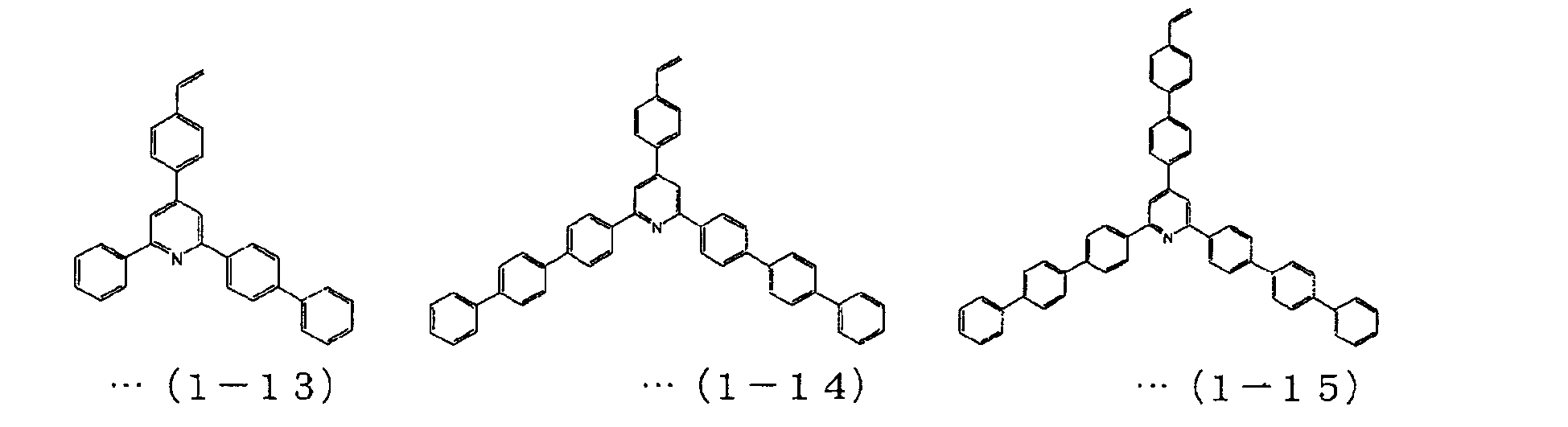
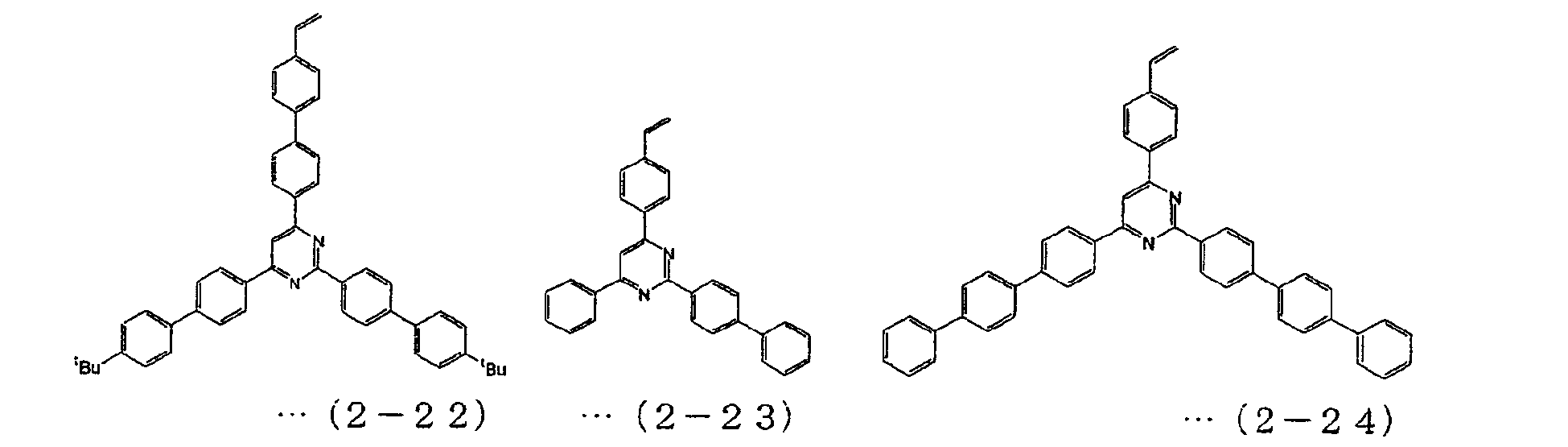
- [3] The charge-transporting polymer compound according to [2], wherein the polymerizable compound of the formula (4) is a polymerizable compound represented by any one of the following formulas (1-1) to (1-16), the polymerizable compound of the formula (5) is a polymerizable compound represented by any one of the following formulas (2-1) to (2-26) and the polymerizable compound of the formula (6) is a polymerizable compound represented by any one of the following formulas (3-1) to (3-7).
-



-


-



-


- (In the formulas, "Me" is a methyl group and "tBu" is a t-butyl group.)
- [4] The charge-transporting polymer compound according to any one of [1] to [3], which compound further comprises a constituting unit derived from a light-emitting polymerizable compound.
-
- [5] The charge-transporting polymer compound according to [4], wherein the light-emitting polymerizable compound has phosphorescent properties.
- [6] The charge-transporting polymer compound according to [5], wherein the light-emitting polymerizable compound is a transition metal complex having a substituent with a polymerizable functional group.
-
- [7] The charge-transporting polymer compound according to [6], wherein the transition metal complex is an iridium complex.
- [8] The charge-transporting polymer compound according to any one of [1] to [7], which compound further comprises a unit derived from a polymerizable compound having positive hole-transporting properties.
-
- [9] An organic electroluminescence element formed with a light-emitting layer between an anode and a cathode, wherein the light-emitting layer comprises the charge-transporting polymer compound according to any one of [1] to [8].
- The use of the charge-transporting polymer compound according to the present invention can prepare organic EL elements having low driving voltage, high light-emitting efficiency and high luminance.
-
Fig. 1 is a sectional view showing an example of the organic EL element of the present invention. - The present invention will be described in detail hereinafter. In the present specification, electron-transporting properties and positive hole-transporting properties are inclusively referred to "charge-transporting properties" or "carrier-transporting properties".
- The polymer compound (I) of the present invention (Embodiment 1) comprises a constituting unit derived from at least one polymerizable compound having charge-transporting properties selected from those represented by the above formulas (1) to (3), preferably (4) to (6), more preferably (1-1) to (3-7), and is obtainable by polymerizing at least one polymerizable compound having charge-transporting properties selected from those represented by the above formulas (1) to (3), preferably (4) to (6), more preferably (1-1) to (3-7).
- In the formulas (1) to (3), R1 to R3 are each independently hydrogen atom or an aromatic group optionally having a heteroatom as a ring-constituting atom; provided that at least one R1, at least one R2 and at least one R3 each represent an aromatic group having a substituent with a polymerizable functional group and optionally having a heteroatom as a ring-constituting atom.
- Examples of the aromatic group are a phenyl group, a biphenylyl group, a terphenylyl group, a pyridyl group and a pyrimidyl group.
In the formulas (4) to (6), R4 to R6 are each independently hydrogen atom, a halogen atom, an alkyl group having 1 to 12 carbon atoms or an aromatic group optionally having a heteroatom as a ring-constituting atom, provided that at least one R4, at least one R5 and at least one R6 each represent an aromatic group having a substituent with a polymerizable functional group and optionally having a heteroatom as a ring-constituting atom. - Examples of the halogen atom are a fluorine atom, a chlorine atom, a bromine atom and an iodine atom.
Examples of the alkyl group having 1 to 12 carbon atoms are methyl group, ethyl group, propyl group, isopropyl group, butyl group, isobutyl group, t-butyl group, amyl group, hexyl group, octyl group, decyl group, 2-ethylhexyl group and dodecyl group. - In the formulas (4) to (6), examples of the aromatic group are phenyl group, biphenylyl group, pyridyl group and pyrimidyl group.
The polymerizable functional group may be any one of radical polymerizable, cation polymerizable, anion polymerizable, addition polymerizable and condensation polymerizable functional groups. Of these groups, the radical polymerizable functional group is preferred because the polymer production is easy. Specifically, substituents represented by the formula (7) are preferred as the substituent having a polymerizable functional group. -

- In the formula (7), R701 is hydrogen or an alkyl group having 1 to 12 carbon atoms.
- Examples of the alkyl group having 1 to 12 carbon atoms may include methyl group, ethyl group, propyl group, isopropyl group, butyl group, isobutyl group, t-butyl group, amyl group, hexyl group, octyl group, decyl group, 2-ethylhexyl group and dodecyl group. Of these, R701 is preferably hydrogen because of having excellent carrier-transporting properties.
- In the formula (7), X7 is a single bond or a group represented by any one of the formulas (X71) to (X74).
-


- In the formulas, RX71 is a single bond or an alkylene group having 1 to 12 carbon atoms, and RX72 is a single bond, an alkylene group having 1 to 12 carbon atoms or a phenylene group.
Examples of the alkylene group having 1 to 12 carbon atoms may include methylene group, ethylene group, trimethylene group, tetraethylene group, octaethylene group, decaethylene group and dodecaethylene group. - In the formulas (X71) to (X74), RX71 preferably bonds to an aromatic group and RX72 preferably bonds to a vinyl group. According to such X7 , it is possible to prepare organic EL elements having low driving voltage, high light-emitting efficiency and high luminance.
Of these, X7 is preferably a single bond or an alkylene group having 1 to 20 carbon atoms, more preferably a single bond. As described above, when X7 dose not contain a heteroatom, it is possible to prepare organic EL elements having higher light-emitting efficiency. - In the formulas (1) to (6), R1 to R6 may have each a substituent other than the substituent having a polymerizable functional group. Examples of such a substituent are a cyano group, an amyl group, an alkyl group having 1 to 12 carbon atoms and an alkoxy group having 1 to 12 carbon atoms.
- Examples of the alkyl group having 1 to 12 carbon atoms may include methyl group, ethyl group, propyl group, isopropyl group butyl group, isobutyl group, t-butyl group, amyl group, hexyl group, octyl group, decyl group, 2-ethylhexyl group and dodecyl group.
- Examples of the alkoxy group having 1 to 12 carbon atoms may include methoxy group, ethoxy group, propoxy group, isopropoxy group, butoxy group, isobutoxy group, t-butoxy group, hexyloxy group, 2-ethylhexyloxy group, decyloxy group and dodecyloxy group.
- Preferable examples of the polymerizable compound having charge-transporting properties are polymerizable compounds represented by the following formulas (1-1) to (3-7) because the polymerizable compound has excellent solubility and excellent carrier-transporting ability, the synthesis of the polymerizable compound is easy and thereby the polymerizable compound has a symmetric structure. In the formulas, "Me" represents methyl group and "tBu" represents t-butyl group.
-


-


-


-


-


-


- The polymerizable compound having charge-transporting properties represented by any one of the formulas (1) to (3), preferably the formulas (4) to (6), more preferably (1-1) to (3-7) may be used singly or two or more may be combined for use.
- The polymerizable compounds having carrier-transporting properties can be prepared by cyclizing an acetophenone derivative with a bromobenzealdehyde using Lewis acid and thereafter coupling with Suzuki coupling method.
- The production of the polymer compound (I) may be carried out using the above polymerizable compounds by any one of radical polymerization, cation polymerization, anion polymerization and addition polymerization and it is carried out preferably by radical polymerization.
- In producing the polymer compound (I), other polymerizable compounds may be used. Non-limiting examples of the polymerizable compounds are compounds having no carrier-transporting properties, for example, (meth) acrylic acid alkyl esters such as methyl acrylate, methyl methacrylate and the like, styrene and derivatives thereof.
- The polymer compound (I) has a weight average molecular weight of preferably 1,000 to 2,000,000, more preferably 5,000 to 500,000. The polymer compound (I) preferably has a weight average molecular weight in the above range because it is soluble in an organic solvent and can prepare a uniform thin film. The weight average molecular weight is a value determined by using tetrahydrofuran as a solvent at 40°C with the gel permeation chromatography (GPC) method.
- With respect to the solubility of the polymer compound (I) in an organic solvent such as toluene, chloroform, etc, 1 part by mass of the polymer compound (I) is dissolved in preferably 0.1 to 200 parts by mass, more preferably 1 to 50 parts by mass of the organic solvent. The solubility thereof is preferably in the above range because organic EL elements are easily prepared by the coating method.
- The polymer compound (II) of the present invention (Embodiment 2) comprises a constituting unit derived from at least one polymerizable compound having charge-transporting properties selected from those represented by the above formulas (1) to (3), preferably the formulas (4) to (6), more preferably the formulas (1-1) to (3-7), and a constituting unit derived from a polymerizable compound having light-emitting properties. The polymer compound (II) is obtainable by polymerizing at least one polymerizable compound having charge-transporting properties selected from those represented by the formulas (1) to (3), preferably the formulas (4) to (6), more preferably the formulas (1-1) to (3-7), and the polymerizable compound having light-emitting properties.
- The polymerizable compound having charge-transporting properties represented by at least one of the above formulas (1) to (3), preferably the formulas (4) to (6), more preferably the formulas (1-1) to (3-7) has the same meanings as those of the polymerizable compound having charge-transporting properties used in the embodiment 1 and the preferred reasons thereof are similar to the embodiment 1.
- The polymerizable compound having light-emitting properties preferably has phosphorescent properties, is more preferably a transition metal complex having a substituent with a polymerizable functional group, furthermore preferably an iridium complex having a substituent with a polymerizable functional group.
- Preferable examples of the iridium complex used are complexes represented by the following formulas (8) to (10). These polymerizable compounds have a vinyl group, which is a polymerizable functional group.
-
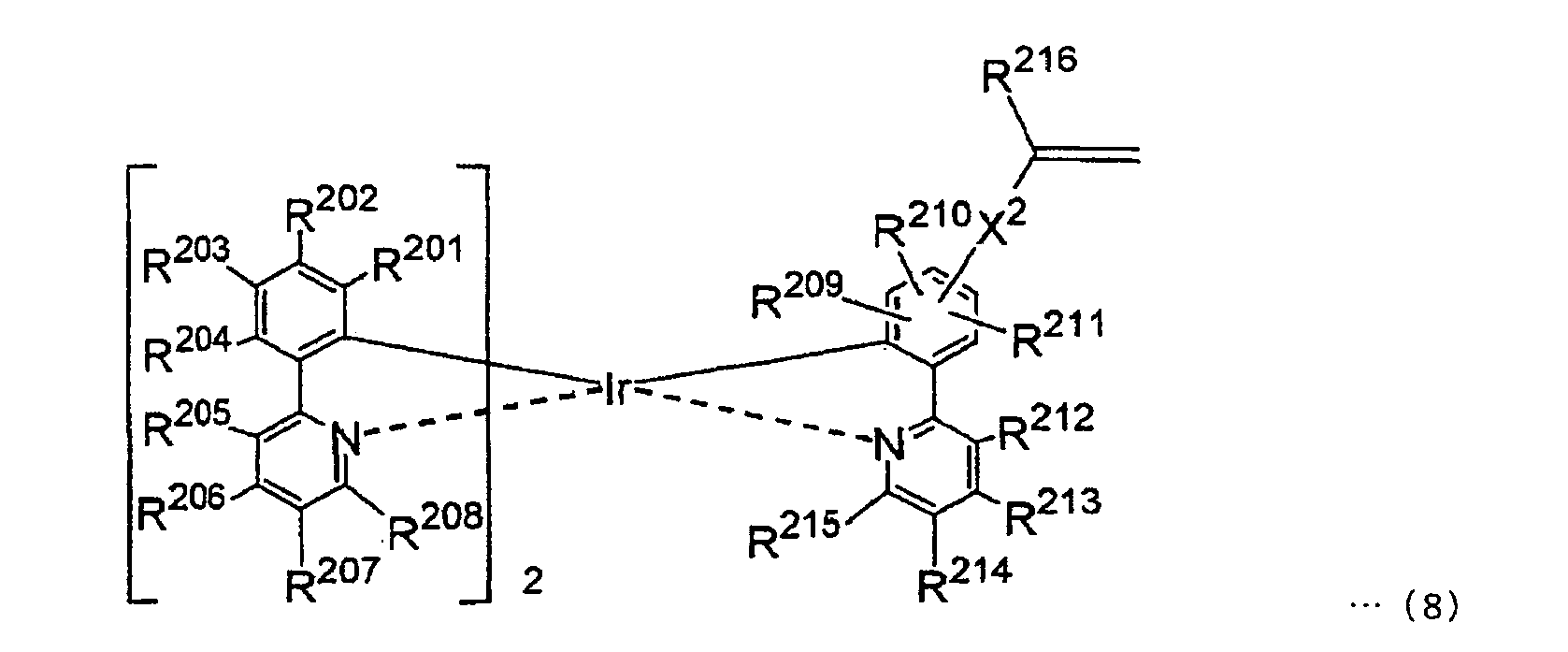
- In the formula (8), R201 to R215 are each independently an atom or a substituent selected from the group consisting of hydrogen atom, a halogen atom, a cyano group, an alkyl group having 1 to 10 carbon atoms, an aryl group having 6 to 10 carbon atoms, an amino group optionally substituted with an alkyl group having 1 to 10 carbon atoms, an alkoxy group having 1 to 10 carbon atoms and a silyl group.
- Examples of the halogen atom are a fluorine atom, a chlorine atom, a boron atom and an iodine atom.
Examples of the alkyl group having 1 to 10 carbon atoms are methyl group, ethyl group, propyl group, isopropyl group, butyl group, isobutyl group, t-butyl group, amyl group, hexyl group, octyl group and decyl group. - Examples of the aryl group having 6 to 10 carbon atoms are phenyl group, tolyl group, xylyl group, mesityl group and naphthyl group.
Examples of the amino groups optionally substituted with an alkyl group having 1 to 10 carbon atoms are amino group, dimethylamino group, diethylamino group and dibutylamino group. - Examples of the alkoxy group having 1 to 10 carbon atoms are methoxy group, ethoxy group, propoxy group, isopropoxy group, butoxy group, isobutoxy group, t-butoxy group, hexyloxy group, 2-ethylhexyloxy group and decyloxy group.
- Examples of the silyl group are trimethyl silyl group, triethyl silyl group, t-butyl dimethyl silyl group and trimethoxy silyl group.
Of these, because the phosphorescent properties of the polymerizable compound are excellent, R201 to R215 are each preferably hydrogen atom, a fluorine atom, cyano group, methyl group, t-butyl group, dimethylamino group, butoxy group or 2-ethyl hexyloxy group, more preferably R202 is t-butyl group and R201 to R215 excluding R202 are each hydrogen atom. - In each ring of R201 to R204, R205 to R208, R209 to R211 and R212 to R215, two groups, which are adjacent through two carbon atoms, may bond each other to form a condensed ring.
- R216 is hydrogen atom or an alkyl group having 1 to 12 carbon atoms. Examples of the alkyl group having 1 to 12 carbon atoms are the above-described alkyl groups. Of these, R216 is preferably hydrogen atom because the carrier-transporting properties of the polymerizable compound are excellent.
- X2 is a single bond or a group represented by any of the following formulas (X21) to (X24).
-


- In the formulas, RX21 is a single bond or an alkylene having 1 to 12 carbon atoms, RX22 is a single bond, an alkylene having 1 to 12 carbon atoms or a phenylene group. In the formula (8), RX21 preferably bonds to a benzene ring and RX22 preferably bonds to a vinyl group. When X2 does not contain a heteroatom, organic EL elements having higher light-emitting efficiency can be prepared.
-

- In the formula (9), R301 to R308 are each independently the same atom or substituent as those of R201.
R309 to R310 are each independently the same atom or substituent as those of R201 (excluding a halogen atom). - Of these, since the phosphorescent properties of the polymerizable compound are excellent, R301 to R310 are preferably each independently hydrogen atom, a fluorine atom, cyano group, methyl group, t-butyl group, dimethylamino group, butoxy group or 2-ethyl hexyloxy group, and more preferably R302 is t-butyl group and R301 to R310 excluding R302 are each hydrogen atom.
- In each ring of R301 to R304 and R305 to R308, two groups, which are adjacent through two carbon atoms, may bond each other to form a condensed ring. R311 is hydrogen atom or an alkyl group having 1 to 12 carbon atoms similar to R216. Examples of the alkyl group having 1 to 12 carbon atoms may include the alkyl groups as described above. Of these, R311 is preferably hydrogen atom because the carrier-transporting ability of the polymerizable compound is excellent.
- X3 is a single bond or a group represented by any of the following formulas (X31) to (X34).
-




- In the formulas, RX31 is a single bond or an alkylene group having 1 to 12 carbon atoms, and RX32 is a single bond, an alkylene group having 1 to 12 carbon atoms or a phenylene group. The preferable embodiment and the reason of X3 are similar to those in X2 .
-

- In the formula (10), R401 to R411 are each independently the same atom or substituent as those of R201. Of these, since the phosphorescent properties are excellent, R401 to R411 are preferably each independently hydrogen atom, a fluorine atom, cyano group, methyl group, t-butyl group, dimethylamino group, butoxy group or 2-ethyl hexyloxy group, and more preferably R402 is t-butyl group and R401 to R411 excluding R402 are each independently hydrogen atom.
- In each ring of R401 to R404, R405 to R408 and R409 to R411, two groups, which are adjacent through two carbon atoms, may bond each other to form a condensed ring.
R412 is the same atom or substituent as those of R216, and the preferable embodiment and the reason thereof are similar to those in R216. - X4 is a single bond or a group represented by any of the following formulas (X41) to (X44).
-


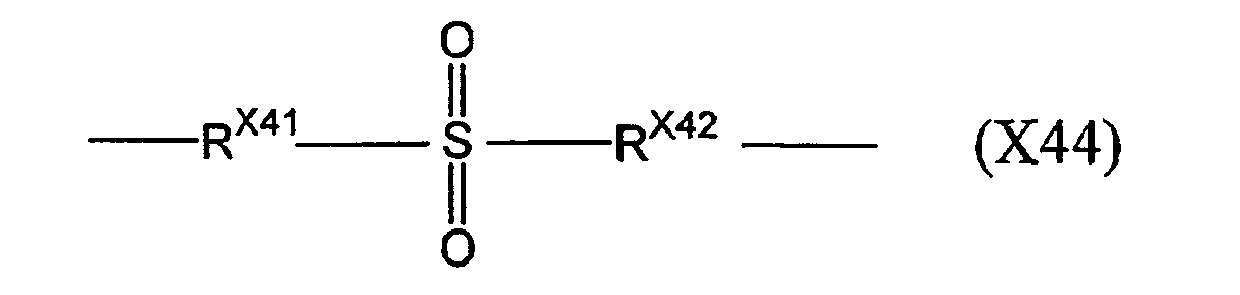
- In the formulas, RX41 is a single bond or an alkylene group having 1 to 12 carbon atoms, and RX42 is a single bond, an alkylene group having 1 to 12 carbon atoms or a phenylene group. The preferable embodiment of X4 and the reason thereof are similar to those in X2.
- Non-limiting examples of the polymerizable phosphorescent compound used in the present invention may include the compounds as described in
JP-A-2003-119179 JP-A-2003-113246 JP-A-2003-206320 JP-A-2003-147021 JP-A-2003-171391 JP-A-2004-346312 JP-A-2006-008996 JP-A-2007-023269 JP-A-2007-084612 - More specific examples of the polymerizable phosphorescent compound preferably include the following compounds.
-

- The above polymerizable phosphorescent compound may be used singly or two or more may be combined for use.
The polymerizable phosphorescent compound can be prepared by, for example, allowing iridium chloride to react with a phenyl pyridine derivative, thereby preparing a dinuclear complex of iridium, and allowing it to react with a ligand having a polymerizable functional group (a ligand coordinated in the right side of Ir in the above formulas (8) to (10)). In producing the polymer compound (II), examples of the other polymerizable compounds optionally used are similar to those in the embodiment 1. - The production of the polymer compound (II) is carried out using the above-described polymerizable compounds by any of radical polymerization, cation polymerization, anion polymerization and addition polymerization, preferably radical polymerization.
- The weight average molecular weight of the polymer compound (II) is similar to that in the embodiment 1. The solubility of the polymer compound (II) in an organic solvent is similar to that in the embodiment 1.
In the polymer compound (II), when the number of the constituting unit derived from the polymerizable phosphorescent compound is taken as m and the number of the constituting unit derived from the polymerizable compound having carrier-transporting properties is taken as n (m and n are integers of 1 or more), the proportion of the constituting units derived from the polymerizable phosphorescent compound to all the constituting units, namely, the value of m/(m+n) is preferably 0.001 to 0.5, more preferably 0.001 to 0.2. When the value of m/(m+n) is in the above range, organic EL elements having high carrier mobility, low influence by concentration quenching and high light-emitting efficiency can be prepared. The proportion of each constituting unit of the above polymer compound is determined by ICP element analysis and 13C-NMR measurement. - Appropriately regulating the proportion of the polymerizable compound having charge-transporting properties and the polymerizable phosphorescent compound in the above ranges, the polymerization is carried out, to prepare the polymer compound (II) having a desired structure. The polymer compound (II) may be any one of a random copolymer, a block copolymer and an alternating copolymer.
- The polymer compound (III) of the present invention (Embodiment 3) comprises a constituting unit derived from at least one polymerizable compound having charge-transporting properties selected from the compounds represented by the above formulas (1) to (3), preferably the formulas (4) to (6), more preferably the formulas (1-1) to (3-7), a constituting unit derived from a polymerizable compound having light-emitting properties and a constituting unit derived from a polymerizable compound having positive hole-transporting properties. The polymer compound (III) is obtainable by polymerizing at least one polymerizable compound having charge-transporting properties selected from the compounds represented by the formulas (1) to (3), preferably the formulas (4) to (6), more preferably the formulas (1-1) to (3-7), the polymerizable compound having light-emitting properties and the polymerizable compound having positive hole-transporting properties.
- The polymerizable compound having charge-transporting properties selected from those represented by the above formulas (1) to (3), preferably (4) to (6), more preferably (1-1) to (3-7) has the same meanings as those of the polymerizable compound having charge-transporting properties used in the embodiment 1 and the polymerizable compound having light-emitting properties has the same meanings as those of the polymerizable compound having light-emitting properties used in the
embodiment 2, and further, the preferred embodiments and the reasons thereof are also similar. - Preferable examples of the polymerizable compound having positive hole-transporting properties are a carbazole derivative and a triaryl amine derivative each containing a substituent having a polymerizable functional group.
Examples of the carbazole derivative and triaryl amine derivative each containing a substituent having a polymerizable functional group may include N,N'-diphenyl-N,N'-(3-methylphenyl)-1,1'-biphenyl-4,4'-diamin e (TPD), N,N,N',N'-tetrakis(3-methylphenyl)-1,1'-(3,3'-dimethyl)biphen yl-4,4'-diamine (HMTPD),
4,4',4"-tris(3-methylphenylphenylamino)triphenylamine (m-MTDATA), 4,4'-biscarbazolyl biphenyl(CBP),
4,4'-biscarbazolyl-2,2'-dimethylbiphenyl (CDBP) and 4,4',4"-tris(carbazolyl-9-yl)triphenylamine (TCTA). - The polymerizable compound having positive hole-transporting properties may be used singly or two or more may be combined for use.
The polymerizable compound having positive hole-transporting properties represented by the following formulas (11) or (12) is suitable for the present invention because of having excellent carrier-transporting ability and excellent photo physical properties. -

- In the formula (11), at least one of R501 to R524 is a substituent having a polymerizable functional group, and R501 to R524, which are not the substituents having a polymerizable functional group, are each independently an atom or a substituent selected from the group consisting of hydrogen atom, a halogen atom, a cyano group, an alkyl group having 1 to 10 carbon atoms, an aryl group having 6 to 10 carbon atoms, an amino group optionally substituted with an alkyl group having 1 to 10 carbon atoms, an alkoxy group having 1 to 10 carbon atoms, a carbazolyl group and a silyl group.
- Examples of the atom or the substituent may include the same as those described on halogen atom, the alkyl group having 1 to 10 carbon atoms, the aryl group having 6 to 10 carbon atoms, the alkyl group having 1 to 10 carbon atoms, the alkoxy group having 1 to 10 carbon atoms. The carbazolyl group may have a substituent such as methyl group, ethyl group, t-butyl group or methoxy group.
- In R501 to R505, R506 to R510, R511 to R515, R516 to R520 and R521 to R523, adjacent two groups through two carbon atoms, which form a ring, may bond each other to form a condensed ring.
-

- In the formulas (12), at least one of R601 to R633 is a substituent having a polymerizable functional group, and R601 to R633, which are not the substituents having a polymerizable functional group, are each independently an atom or a substituent selected from the group consisting of hydrogen atom, a halogen atom, a cyano group, an alkyl group having 1 to 10 carbon atoms, an aryl group having 6 to 10 carbon atoms, an amino group optionally substituted with an alkyl group having 1 to 10 carbon atoms, an alkoxy group having 1 to 10 carbon atoms and a silyl group.
- Examples of the atom or the substituent may include the same atom or the substituents as those of the halogen atom, the alkyl group having 1 to 10 carbon atoms, the aryl group having 6 to 10 carbon atoms, the alkyl group having 1 to 10 carbon atoms and the alkoxy group having 1 to 10 carbon atoms as described above.
- In R601 to R605, R606 to R610, R611 to R615, R616 to R620, R621 to R625 and R626 to R630, adjacent two groups through two carbon atoms, which form a ring, may bond each other to form a condensed ring.
- Concerning to the polymerizable compound represented by the formula (11), in each of R501 to R505, R506 to R510, R511 to R515 and R516 to R520, at least one is preferably the atom other than hydrogen atom or the substituent. In this case, R501 to R524 other than the polymerizable functional group, the atom or the substituent are hydrogen atoms. Furthermore, concerning to the polymerizable compound represented by the formula (12), in each of R601 to R605, R606 to R610, R611 to R615, R616 to R620, R621 to R625 and R626 to R630, at least one is preferably the atom other than hydrogen atom or the substituent. In this case, R601 to R633 other than the polymerizable functional group, the atom or the substituent are hydrogen atoms.
- As the substituent having the polymerizable functional group, a substituent represented by the formula (7) is preferred.
-

- R701 is hydrogen atom or an alkyl group having 1 to 12 carbon atoms. Concerning to R701, the preferable range and the reason thereof are similar to those as described in the polymerizable compound having charge-transporting properties in the embodiment 1.
- In the formula (7), X7 is a single bond or a group represented by any of the formulas (X71) to (X74). Concerning to X7, the preferable range and the reason thereof are similar to those as described in the polymerizable compound having charge-transporting properties in the embodiment 1.
-


- Specific examples of the polymerizable compound having positive hole-transporting properties may include compounds represented by the following formulas (15-1) to (15-10).
-


- The polymerizable compound having positive hole-transporting properties may be used singly or two or more may be combined for use.
The compound represented by the formula (11) can be prepared by, for example, palladium catalyst substitution reaction of a m-phenylene diamine derivative and halogenated aryl or palladium catalyst substitution reaction of diarylamine and a m-dibromobenzene derivative. The method for substitution reaction is disclosed in, for example, Tetrahedron Letters, 1998, Vol. 39, p. 2367. The compound represented by the formula (12) can be prepared by, for example, palladium catalyst substitution reaction of 1,3,5-triaminobenzene and halogenated aryl or palladium catalyst substitution reaction of diarylamine and 1,3,5-trihalogenated benzene. The method for substitution reaction is disclosed in, for example, Tetrahedron Letters, 1998, Vol. 39, p. 2367. - In producing the polymer compound (III), other polymerizable compounds further optionally used are the same compounds as in the embodiment 1.
The production of the polymer compound (III) may be carried out using the above polymerizable compounds by any of radical polymerization, cation polymerization, anion polymerization and addition polymerization, preferably by radical polymerization. - The weight average molecular weight of the polymer compound (III) is similar to that in the embodiment 1. Furthermore, the solubility of the polymer compound (III) in an organic solvent is similar to that in the embodiment 1.
- In the polymer compound (III), when the number of the constituting unit derived from the polymerizable compound having phosphorescent properties is taken as m and the number of the constituting unit derived from the polymerizable compound having carrier-transporting properties is taken as n (m and n are integers of 1 or more), the proportion of the constituting units derived from the polymerizable compound having phosphorescent properties to all the constituting units, namely, the value of m/(m+n) is preferably 0.001 to 0.5, more preferably 0.001 to 0.2. When the value of m/ (m+n) is in the above range, organic EL elements having high carrier mobility, low influence of concentration quenching and high light-emitting efficiency can be prepared.
- In the polymer compound (III), when the number of the constituting unit derived from the polymerizable compound having positive hole-transporting properties is taken as x and the number of the constituting unit derived from the polymerizable compound having charge-transporting properties is taken as y (x and y are integers of 1 or more), x, y and n described above satisfy the following relation n = x + y. Concerning the proportion of the number of the constituting unit derived from the polymerizable compound having carrier-transporting properties to the number of the constituting unit derived from the polymerizable compound having positive hole-transporting properties x/n, and the proportion of the number of the constituting unit derived from the polymerizable compound having carrier-transporting properties to the number of the constituting unit derived from the polymerizable compound having charge-transporting properties y/n, the optimum values are determined by the charge-transporting ability and concentration of each constituting unit. When the light-emitting layer of an organic EL element is formed by only the polymer compound (III), the values of x/n and y/n are each in the range of preferably 0.05 to 0.95, more preferably 0.20 to 0.80. Herein x/n + y/n = 1. The proportion of each constituting unit of the polymer compounds is determined by ICP element analysis and 13C-NMR measurement.
- When polymerization is carried out by appropriately regulating the proportion of the polymerizable compound having charge-transporting properties, the polymerizable compound having phosphorescent properties and the polymerizable compound having positive hole-transporting properties in the above range, the polymer compound (III) having a desired structure can be prepared. The polymer compound (III) may be any one of a random copolymer, a block copolymer and an alternating copolymer.
- In the organic EL element of the present invention (Embodiment 4), one light-emitting layer, which comprises the polymer compound (I) and a polymer compound (I'), is provided between an anode and a cathode, wherein the polymer compound (I') has the constituting units derived from a light-emitting compound and a polymerizable compound having positive hole-transporting properties. In this case, the light-emitting layer contains the light-emitting compound in an amount of 0.1 to 50 parts by mass, more preferably 0.5 to 30 parts by mass and the polymer compound (I') in an amount of 10 to 200 parts by mass, more preferably 50 to 150 parts by mass based on 100 parts by mass of the polymer compound (I). As described above, forming the light-emitting layer from the polymer compound (I), the light-emitting compound and the polymer compound having positive hole-transporting properties (I'), organic EL elements having high light-emitting efficiency can be prepared even if other organic material layers are not provided.
- Examples of the light-emitting compound are preferably phosphorescent compounds, more preferably an iridium complex. Preferably usable examples of the iridium complex are the following complexes (E-1) to (E-39).
-


-


-
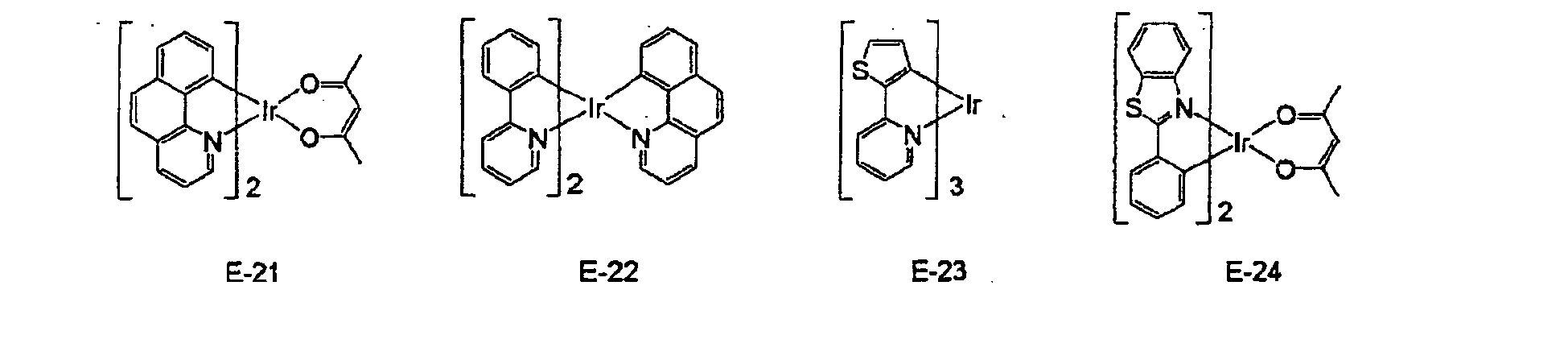


-


- The light-emitting compound may be used singly and two or more may be combined for use.
The polymer compound (I') is obtainable by polymerizing the polymerizable compound having positive hole-transporting properties. The above polymerizable compound having positive hole-transporting properties has the same meaning as the polymerizable compound having positive hole-transporting properties used in theembodiment 3, and the preferred range and the reason thereof are similar to those in theembodiment 3. - The polymer compound (I') may be produced using the above-described polymerizable compounds by any of radical polymerization, cation polymerization, anion polymerization and addition polymerization, preferably radical polymerization.
- The polymer compound (I') has a weight average molecular weight of usually 1, 000 to 2, 000, 000, preferably 5, 000 to 500,000. The polymer compound (I') preferably has a weight average molecular weight in the above range, because the polymer compound (I') is soluble in an organic solvent and uniform thin films are prepared. The weight average molecular weight is a value determined by measuring at 40°C using tetrahydrofuran as a solvent with gel permeation chromatography (GPC) method. The solubility of the polymer compound (I') in an organic solvent is the same as that in the embodiment 1.
- In the production of the organic EL element having one light-emitting layer, which comprises the polymer compound (I), the light-emitting compound and the polymer compound (I'), between an anode and a cathode, the light-emitting layer is usually formed on an anode provided on a substrate in the following manner. First, a solution in which the polymer compound (I), the light-emitting compound and the polymer compound (I') are dissolved is prepared. Although a solvent used in the preparation of the solution is not particularly limited, examples of the solvent are chlorine solvents such as chloroform, methylene chloride, dichloroethane etc; ether solvents such as tetrahydrofuran, anisole etc; aromatic hydrocarbon solvents such as toluene, xylene etc; ketone solvents such as acetone, methylethyl ketone etc; and ester solvents such as ethyl acetate, butyl acetate, ethyl cellosolve acetate etc. Next, the solution thus prepared is applied on the substrate by wet film forming methods such as spin coating method, casting method, micro-gravure coating method, gravure coating method, bar coating method, roll coating method, wire bar coating method, dip coating method, spray coating method, screen printing method, flexographic printing method, offset printing method or ink jet printing method, to form a film. For example, in the spin coating method or the dip coating method, depending on the compounds used and the film forming conditions, the solution preferably contains the light-emitting compound in an amount of 0.5 to 30 parts by mass, the polymer compound (I') in an amount of 10 to 200 parts by mass and the solvent in an amount of 1000 to 20000 parts by mass based on 100 parts by mass of the polymer compound (I).
- Providing a cathode on the light-emitting layer thus formed, the organic EL element of the
embodiment 4 can be prepared.
As the substrate used in theembodiment 4, a transparent substrate having insulating properties against the emitting wavelength of the light-emitting material is favorably used. Examples of the substrate are glasses and transparent plastics such as PET (polyethylene terephthalate), polycarbonate etc. - As an anode material used in the
embodiment 4, it is preferred to use known transparent conductive materials, such as ITO (indium tin oxide), tin oxide, zinc oxide and conductive polymers such as polythiophene, polypyrol, polyaniline, etc. The electrode formed by the transparent conductive material has a surface resistance of preferably 1 to 50 Ω/□ (ohm/square). The anode has a thickness of preferably 50 to 300 nm. - As the cathode material used in the
embodiment 4, it is preferred to use known cathode materials, for example, alkali metals such as Li, Na, K, Cs, etc; alkali earth metals such as Mg, Ca, Ba, etc; Al; MgAg alloy; alloys of Al and an alkali metal or an alkali earth metal, such as AlLi, AlCa, etc. The cathode has a thickness of preferably 10 nm to 1 µm, more preferably 50 to 500 nm. When a metal having high activity such as an alkali metal or an alkali earth metal is used, the cathode has a thickness of preferably 0.1 to 100 nm, more preferably 0.5 to 50 nm. In this case, on the cathode, a metal layer stable to the air is laminated for protecting the cathode metal. Examples of the metal forming the metal layer may include Al, Ag, Au, Pt, Cu, Ni, Cr, etc. The metal layer has a thickness of preferably 10 nm to 1 µm, more preferably 50 to 500 nm. - Examples of the film forming method using the anode material may include electron beam vapor deposition method, sputtering method, chemical reaction method and coating method, and examples of the film forming method using the cathode material may include resistance heat vapor deposition method, electron beam vapor deposition method, sputtering method and ion plating method.
- In the organic EL element of the present invention (Embodiment 5), one light-emitting layer, which comprises a specific polymer compound (II) and a polymer compound (I'), is provided between an anode and a cathode. In this case, the light-emitting layer contains the polymer compound (I') in an amount of preferably 10 to 200 parts by mass, more preferably 50 to 150 parts by mass based on 100 parts by mass of the polymer compound (II). In forming the light-emitting layer from the polymer compound having electron-transporting properties and light-emitting properties (1) and the polymer compound having positive hole-transporting properties (I'), organic EL elements having high light-emitting efficiency can be prepared even if other organic material layers are not provided.
- The light-emitting layer is usually formed on the anode provided on the substrate in the following way. First, a solution in which the polymer compound (II) and the positive hole-transporting compound are dissolved is prepared. The solvent used in the preparation of the solution is the same as that used in the
embodiment 4. The film forming method of the solution is similar to that of theembodiment 4. In the spin coating method or the dip coating method, depending on the compound used and the film forming conditions, for example, the solution preferably contains the polymer compound (I') in an amount of 10 to 200 parts by mass and the solvent in an amount of 1000 to 20000 parts by mass based on 100 parts by mass of the polymer compound (II). - Providing the cathode on the light-emitting layer thus formed, the organic EL element of the
embodiment 5 is prepared. Furthermore, the substrate, the anode material, the cathode material and the film forming methods using the anode material and the cathode material in theembodiment 5 are similar to those of theembodiment 4. - In the organic EL element of the present invention (Embodiment 6), one light-emitting layer, which comprises a specific polymer compound (III), is provided between an anode and a cathode. In forming the light-emitting layer by the use of the polymer compound having charge-transporting properties, phosphorescent properties and positive hole-transporting properties (III), organic EL elements having high light-emitting efficiency can be prepared even if other organic material layers are not provided. Furthermore, the embodiment 6 has a merit such that the production step can be more simplified because the light-emitting layer is formed from only the polymer compound (III).
- The light-emitting layer is usually formed on the anode provided on the substrate in the following way. First, a solution in which the polymer compound (III) is dissolved is prepared. The solvent used in the preparation of the solution is the same as that used in the
embodiment 4. The film forming method of the solution is similar to that of theembodiment 4. In the spin coating method or the dip coating method, depending on the compound used and the film forming conditions, for example, the solution preferably contains the solvent in an amount of 1000 to 20000 parts by mass based on 100 parts by mass of the polymer compound (III) . Providing the cathode on the light-emitting layer thus formed, the organic EL element of the embodiment 6 is prepared. - Furthermore, the substrate, the anode material, the cathode material and the film forming methods using the anode material and the cathode material in the embodiment 6 are similar to those in the
embodiment 4. - The organic EL element of the present invention (Embodiment 7) comprises, between an anode and a cathode, the light-emitting layer as described in any one of the
embodiments 4 to 6, and optionally comprises other organic layers. - Examples of the other organic layers are a positive hole-transporting layer, a charge-transporting layer, a positive hole-block layer and a buffer layer. Providing these organic layers, the light-emitting efficiency can be further enhanced.
One example of the structure of the organic EL element (Embodiment 7) according to the present invention is shown inFig. 1 . InFig. 1 , between an anode (2) and a cathode (6) provided on a transparent substrate (1), a positive hole-transporting layer (3), a light-emitting layer (4) as described in theembodiment 4 to 6, and an electron-transporting layer (5) are provided in this order.
In the embodiment 7, between the anode (2) and the cathode (6), any one of 1) the positive hole-transporting layer/the light-emitting layer and 2) the light-emitting layer/ the electron-transporting layer may be provided. - Each organic layer may be formed by mixing a polymer material and the like as a binder. Examples of the polymer material may include polymethyl methacrylate, polycarbonate, polyester, polysulfone and polyphenylene oxide.
- Furthermore, each layer may be formed by each singly using the compound having positive hole-transporting properties and the compound having electron-transporting properties used in the positive hole-transporting layer and the electron-transporting layer, or mixing the compounds with materials having different functions.
- Examples of the compound having positive hole-transporting properties used for forming the positive hole-transporting layer may include TPD (N,N'-dimethyl-N,N'-(3-methylphenyl)-1,1'-biphenyl-4,4'diamin e) ; α-NPD (4,4'-bis [N-(1-naphthyl)-N-phenylamino]biphenyl); low molecular triphenyl amine derivatives such as m-MTDATA (4,4',4"-tris(3-methylphenylphenylamino)triphenylamine etc; polyvinyl carbazole ; polymer compounds obtainable by introducing a polymerizable functional group to the above triphenyl amine derivative and polymerizing; fluorescent polymer compounds such as polyparaphenylene vinylene, polydialkylfluorene, etc. Examples of the polymer compound are polymer compounds having a triphenyl amine skeleton as disclosed in
JP-A-H8(1996)157575 - Examples of the compound having electron-transporting properties for forming the electron-transporting layer may include quinolinol derivative metal complexes such as Alq3 (aluminum trisquinolinolate) etc; low molecular compounds such as oxadiazole derivative, triazole derivative, imidazole derivative, triazine derivative, triaryl borane derivative, etc; and polymer compounds obtainable by introducing a polymerizable substituent to the above low molecule compound and polymerizing. Examples of the polymer compound may include poly PBD etc as disclosed in
JP-A-H10(1998)-1665 - Adjacent to the cathode side of the light-emitting layer, a positive hole-blocking layer may be provided in order to depress passing of positive holes through the light-emitting layer and to re-combine positive holes with electrons efficiently in the light-emitting layer. For forming the positive hole-blocking layer, known materials such as a triazole derivative, an oxadiazole derivative, a phenanethroline derivative, etc are used.
- Moreover, between the anode and the positive hole-transporting layer, or between the anode and the organic layer laminated adjacently to the anode, a buffer layer may be provided in order to buffer the injection barrier in positive hole injection. In order to form the buffer layer, known materials such as copper phthalocyanine, a mixture of polyethylene dioxythiophene and polystyrene sulfonate (PEDOT:PSS), etc are used.
- Furthermore, between the cathode and the electron-transporting layer, or between the cathode and the organic layer laminated adjacently to the cathode, an insulating layer having a thickness of 0.1 to 10 nm may be provided in order to enhance the electron injecting efficiency. For forming the insulating layer, known materials such as lithium fluoride, sodium fluoride, magnesium fluoride, magnesium oxide, alumina, etc are used.
- As the processes for forming the positive hole-transporting layer and the electron-transporting layer, it is possible to use, for example, dry film forming methods such as resistance heat vapor deposition method, electron beam vapor deposition method or sputtering method; and wet film forming methods such as spin coating method, casting method, micro-gravure coating method, gravure coating method, bar coating method, roll coating method, wire bar coating method, dip coating method, spray coating method, screen printing method, flexographic printing method, offset printing method and ink jet printing method. In the low molecular compound, it is preferred to use the dry film forming method, and in the polymer compound, it is preferred to use the wet film forming method.
- The organic EL element according to the present invention is favorable for image display devices as pixels by a matrix system or a segment system with known methods. The organic EL element is also favorable for a surface emitting light source without forming pixels.
- The organic EL element of the present invention is favorable for displays, back lights, electron photographs, illumination light sources, recording light sources, exposure light sources, reading light sources, marks, signboards, interiors, optical communication systems, etc.
- The present invention is further described in more detail with reference to the following examples hereinafter, but it is not limited by the examples. The methods for measuring various physical properties of synthesized compounds and the devices used in the measurements are shown below.
- JNM EX270 manufactured by JEOL
270 Mz, Solvent: Heavy chloroform - Column: Shodex KF-G + KF804L + KF802 + KF801
Elute: Tetrahydrofurane (THF)
Temperature: 40°C
Detector: RI (Showdex RI-71) - ICPS8000 manufactured by Shimadzu Corporation
-

- The synthesis of the object 1 is described with reference to the schema 1.
- To a 100 mL round bottom flask, 3.61 g (30 mmol) of acetophenone, 2.78 g (15 mmol) of 4-bromobenzaldehyde, 14.8 g (192 mmol) of ammonium acetate and 30 mL of acetic acid were fed, and stirred under reflux for 9 hr. After cooling, a solid deposited was filtered off and eluted with hexane and chloroform in the proportion of 80: 20 by silica gel column chromatography to prepare the object 1 in an amount of 1.22 g in a yield of 21 mol%.
- The synthesis of the
object 2 is described with reference to the schema 1. - To 100 mL of a 2-necked flask, 1.22 g (3.15 mmol) of the object 1, 0.70 g (3.78 mmol) of vinyl boric acid dibutyl ester, 4.35 g (31.5 mmol) of potassium carbonate, 0.61 g (1.89 mmol) of tetrabutyl ammonium bromide, 40 mg of ditertialbutyl cresol, 25 mL of toluene and 15 mL of water were fed and stirred under reflux in nitrogen for 1 hr. To this solution, 128 mg (0.112 mmol) of tetrakis (triphenyl phosphine palladium (O) was added and stirred under reflux in nitrogen for 1 hr. After cooling, to the mixture, ethyl acetate and water were added, and an organic layer was washed with water and saturated brine successively. After the organic layer was concentrated, a residue was eluted with hexane and chloroform in the proportion of 70 : 30 by silica gel column chromatography to prepare the
object 2 in an amount of 0.64 g in a yield of 61 mol%. -

- The synthesis of the
compound 2 is described with reference to theschema 2.
To a 100 mL 2-necked flask, 1.00 g (2.60 mmol) of the object 1, 0.46 g (3.12 mmol) of styryl boric acid, 3.59 g (26.0 mmol) of potassium carbonate, 0. 50 g (1.56 mmol) of tetrabutyl ammonium bromide, 30 mg of ditertialbutyl cresol, 25 mL of toluene and 15 mL of water were fed and stirred under reflux in nitrogen for 1 hr. To this solution, 120 mg (0.104 mmol) of tetrakis(triphenyl phosphine) palladium (O) was added and stirred under reflux in nitrogen for 1 hr. After cooling, to the mixture, ethyl acetate and water were added, and an organic layer was washed with water and saturated brine successively. After the organic layer was concentrated, a residue was eluted with hexane and chloroform in the proportion of 65 : 35 by silica gel column chromatography to prepare theobject 3 in an amount of 0.84 g in a yield of 78 mol%. -

- The synthesis of the
object 4 is described with reference to theschema 3. - To a 200 mL flask, 6.25 g (31.40 mmol) of 4'-bromoaceto phenone, 1.92 g (15.72 mmol) of 4-hydroxybenzaldehyde, 15.5 g (201.1 mmol) of ammonium acetate and 40 mL of acetic acid were fed and stirred under reflux for 8 hr. After cooling, a solid deposited was collected with filtration and washed with a small amount of methanol to prepare the
object 4 in an amount of 3.25 g in a yield of 43 mol%. - The synthesis of the
object 5 is described with reference to theschema 3.
To a 100 mL 2-necked flask, 3.24 g (6.73 mmol) of theobject 4, 2.64 g (14.8 mmol) of 4-tertialbutylphenyl boric acid, 9.31 g (67.33 mmol) of potassium carbonate, 1.33 g (4.00 mL) of
tetrabutyl ammonium bromide, 30 mL of toluene and 20 mL of water were fed and stirred under reflux in nitrogen for 1 hr. To this solution, 347 mg (0.40 mmol) of tetrakis(triphenyl phosphine) palladium (O) was added and stirred under reflux in nitrogen for 3 hr. After cooling, to the mixture, ethyl acetate and water were added, and an organic layer was washed with water and saturated brine successively. After the organic layer was concentrated, a residue was eluted with chloroform and ethyl acetate in the proportion of 98 : 2 by silica gel column chromatography to prepare theobject 5 in an amount of 2.40 g in a yield of 60 mol%. - The synthesis of the object 6 is described with reference to the
schema 3.
To a 200 mL flask, 1.99 g (3.39 mmol) of theobject 5, and 10 mL of pyridine were fed, and to the mixture, 0.7 mL (4.26 mmol) of trifluoromethane sulfonic acid anhydride was dropped under cooling with ice. After 1 hr, to the reaction solution, an appropriate amount of ice was added and 20 mL of 6N hydrochloric acid was added under cooling with ice. The solution was extracted with ethyl acetate, and an organic layer was washed with water and saturated brine successively. The organic layer was concentrated and a residue was eluted with hexane and chloroform in the proportion of 70 : 30 by silica gel column chromatography, to prepare the object 6 in an amount of 1.88 g in a yield of 77 mol%. - The synthesis of the object 7 is described with reference to the
schema 3.
To a 100 mL 2-necked flask, 1.08 g (1.50 mmol) of the object 6, 0.27 g (1.80 mmol) of styryl boric acid, 2.07 g (15.0 mmol) of potassium carbonate, 0.29 g (0.90 mmol) of tetrabutylammonium bromide, 30 mg of ditertialbutyl cresol, 25 mL of toluene and 15 mL of water were fed and stirred under reflux in nitrogen for 1 hr. To the solution, 69 mg (0.06 mmol) of tetrakis(triphenyl phosphine)palladium (O) was added and stirred under reflux in nitrogen for 1 hr. After cooling, to the reaction solution, ethyl acetate and water were added, and an organic layer was washed with water and saturated brine successively. The organic layer was concentrated and a residue was eluted with hexane and chloroform in the proportion of 65 : 35 by silica gel column chromatography, to prepare the object 7 in an amount of 0.81 g in a yield of 80 mol%. -

- The synthesis of the object 8 is described with reference to the
schema 4. - To a 100 mL round bottom flask, 3.2 g (11.4 mmol) of trifluoromethane sulfonic acid anhydride, 2.17 g (21 mmol) of benzonitrile and 10 mL of anhydrous dichloromethane were fed. To this solution, 10 mL of an anhydrous dichloromethane solution of 1.99 g (10 mmol) of 4'-bromoacetophenone was dropped. After stirring at room temperature for 22 hr, a saturated sodium hydrocarbon solution was added slowly and an organic layer was washed with water and saturated brine. The organic layer was concentrated, and a residue was eluted with dichloromethane and diethyl ether in the proportion of 70 : 30 by silica gel column chromatography to prepare the object 8 in an amount of 3.17 g in a yield of 82 mol%.
- The synthesis of the object 9 is described with reference to the
schema 4.
To a 100 mL 2-necked flask, 1.22 g (3.15 mmol) of the object 8, 0.70 g (3.78 mmol) of vinyl boric acid dibutyl ester, 4.35 g (31.5 mmol) of potassium carbonate, 0.61 g (1.89 mmol) of tetrabutyl ammonium bromide, 40 mg of ditertial butyl cresol, 25 mL of toluene and 15 mL of water were fed and stirred under reflux in nitrogen for 1 hr. To this solution, 128 mg (0.112 mmol) of tetrakis(triphenylphosphine)palladium (O) was added and stirred under reflux in nitrogen for 1 hr. After cooling, ethyl acetate and water were added and an organic layer was washed with water and saturated brine successively. The organic layer was concentrated, and a residue was eluted with hexane and chloroform in the proportion of 65 : 35 by silica gel column chromatography to prepare the object 9 in an amount of 0.88 g in a yield of 84 mol%. - The synthesis of the
compound 5 is described with reference to theschema 4.
To a 100 mL 2-necked flask, 1.20 g (3.10 mmol) of the object 8, 0.55 g (3.74 mmol) of styryl boric acid, 4.28 g (31.0 mmol) of potassium carbonate, 0.60 g (1.87 mmol) of tetrabutyl ammonium bromide, 40 mg of ditertialbutyl cresol, 25 mL of toluene and 15 mL of water were fed and stirred under reflux in nitrogen for 1 hr. To this solution, 144 mg (0.124 mmol) of tetrakis(triphenylphosphine)palladium (O) was added and stirred under reflux in nitrogen for 1 hr. After cooling, ethyl acetate and water were added and an organic layer was washed with water and saturated brine successively. The organic layer was concentrated, and a residue was eluted with hexane and chloroform in the proportion of 65 : 35 by silica gel column chromatography to prepare the object 10 (polymerizable compound 5) in an amount of 1.00 g in a yield of 77 mol%. -
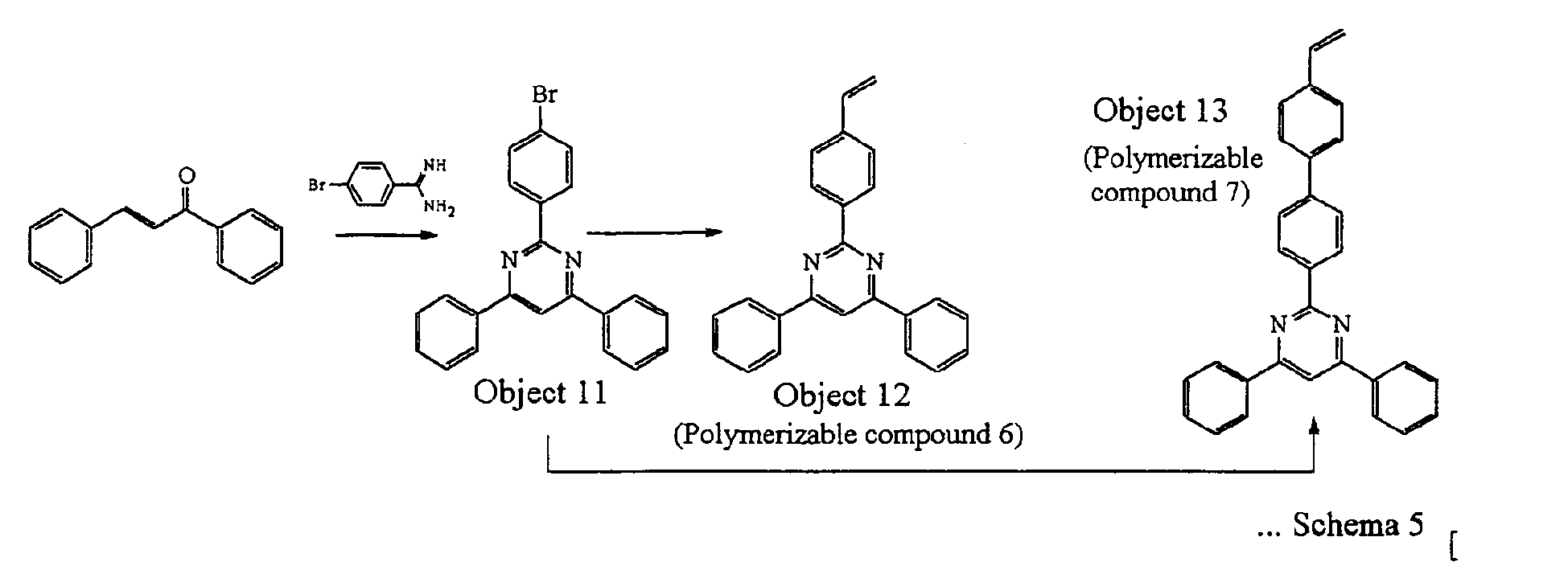
- The synthesis of the object 11 is described with reference to the
schema 5.
To a 100 mL round bottom flask, 4. 17 g (20 mmol) of chalcone, 1.99 g (10 mmol) of 4-bromobenzamidine and 300 mL of ethanol were fed. To this solution, 100 mL of an ethanol solution of 1.12 g (20 mmol) of potassium hydroxide was dropped. After stirring under reflux for 3 hr, the mixture was cooled to room temperature, a resulting precipitate was collected with filtration and washed with pure water. This crude product was re-crystallized with glacial acetic acid to prepare the object 11 in an amount of 3.29 g in a yield of 85 mol%. - The synthesis of the object 12 is described with reference to the
schema 5. - To a 100 mL 2-necked flask, 1.94 g (5 mmol) of the object 11, 1.10 g (6 mmol) of vinyl boric acid dibutyl ester, 6.91 g (50 mmol) of potassium carbonate, 0.61 g (3 mmol) of tetrabutyl ammonium bromide, 50 mg of ditertialbutyl cresol, 40 mL of toluene and 25 mL of water were fed and stirred under reflux in nitrogen for 1 hr. To this solution, 231 mg (0.2 mmol) of tetrakis(triphenylphosphine)palladium (O) was added and stirred under reflux in nitrogen for 1 hr. After cooling, ethyl acetate and water were added and an organic layer was washed with water and saturated brine successively. The organic layer was concentrated, and a residue was eluted with hexane and chloroform in the proportion of 60 : 40 by silica gel column chromatography to prepare the object 12 in an amount of 1.47 g in a yield of 88 mol%.
- The synthesis of the compound 7 is described with reference to the
schema 5.
To a 100 mL 2-necked flask, 1.94 g (5 mmol) of the object 11, 0.89 g (6 mmol) of styryl boric acid, 6.91 g (50 mmol) of potassium carbonate, 0.61 g (3 mmol) of tetrabutyl ammonium bromide, 50 mg of ditertialbutyl cresol, 40 mL of toluene and 25 mL of water were fed and stirred under reflux in nitrogen for 1 hr. To this solution, 231 mg (0.2 mmol) of tetrakis(triphenylphosphine)palladium (O) was added and stirred under reflux in nitrogen for 1 hr. After cooling, ethyl acetate and water were added and an organic layer was washed with water and saturated brine successively. The organic layer was concentrated, and a residue was eluted with hexane and chloroform in the proportion of 60 : 40 by silica gel column chromatography to prepare the object 13 (polymerizable compound 7) in an amount of 1.66 g in a yield of 81 mol%. -

- The synthesis of the compound 8 is described with reference to the schema 6.
The object 14 was synthesized by the method as described inJP-A-2007-197426
To a 100 mL 2-necked flask, 1.39 g (3.00 mmol) of the object 14, 0.67 g (3.60 mmol) of vinyl boric acid dibutyl ester, 4.15 g (30.0 mmol) of potassium carbonate, 0.58 g (1.80 mmol) of tetrabutyl ammonium bromide, 40 mg of ditertialbutyl cresol, 25 mL of toluene and 15 mL of water were fed and stirred under reflux in nitrogen for 1 hr. To this solution, 104 mg (0.09 mmol) of tetrakis(triphenylphosphine)palladium (O) was added and stirred under reflux in nitrogen for 1 hr. After being left for cooling, ethyl acetate and water were added and an organic layer was washed with water and saturated brine successively. The organic layer was concentrated, and a residue was eluted with hexane and chloroform in the proportion of 65 : 35 by silica gel column chromatography to prepare the object 15 (polymerizable compound 8) in an amount of 0.81 g in a yield of 66 mol%. -

- The synthesis of the compound 9 is described with reference to the schema 7.
To a 100 mL 2-necked flask, 1.39 g (3.00 mmol) of the object 14, 0.53 g (3.60 mmol) of styryl boric acid, 4.15 g (30.0 mmol) of potassium carbonate, 0.58 g (1.80 mmol) of tetrabutyl ammonium bromide, 40 mg of ditertialbutyl cresol, 25 mL of toluene and 15 mL of water were fed and stirred under reflux in nitrogen for 1 hr. To this solution, 104 mg (0.09 mmol) of tetrakis(triphenylphosphine)palladium (O) was added and stirred under reflux in nitrogen for 1 hr. After cooling, ethyl acetate and water were added and an organic layer was washed with water and saturated brine successively. The organic layer was concentrated, and a residue was eluted with hexane and chloroform in the proportion of 65 : 35 by silica gel column chromatography to prepare the object 16 (polymerizable compound 9) in an amount of 1.29 g in a yield of 80 mol%. - To a sealing vessel, the polymerizable compound 1 (333 mg) was fed and dehydrated toluene (10 mL) was added, and then a toluene solution of a radical polymerization initiator V-601 manufactured by Wako Pure Chemical Industries Ltd. (0.1 M, 100 µL) was added and freeze-deaeration procedure was repeated five times. The vessel was sealed in vacuo and stirring was carried out at 60°C for 60 hr. After the reaction, the reacted solution was dropped into acetone (250 mL) to prepare a precipitate. Furthermore, the precipitate was purified by repeating the precipitation-purification with toluene-acetone twice. Thereafter the resulting precipitate was dried at 50°C in vacuo over night to prepare the homopolymer 1 (300 mg) as a white solid. The resulting copolymer had a weight average molecular weight (Mw), as measured by GPC in terms of polystyrene, of 42,000.
- Similar to the above manner,
homopolymers 2 to 9 were prepared. The weight average molecular weight of each polymer is shown below. - Homopolymer 2 (Polymerization of Polymerizable compound 2)
(Mw) 58,000 - Homopolymer 3 (Polymerization of Polymerizable compound 3)
(Mw) 39,000 - Homopolymer 4 (Polymerization of Polymerizable compound 4)
(Mw) 41,000 - Homopolymer 5 (Polymerization of Polymerizable compound 5)
(Mw) 40,000 - Homopolymer 6 (Polymerization of Polymerizable compound 6)
(Mw) 51,000 - Homopolymer 7 (Polymerization of Polymerizable compound 7)
(Mw) 44,000 - Homopolymer 8 (Polymerization of Polymerizable compound 8)
(Mw) 43,000 - Homopolymer 9 (Polymerization of Polymerizable compound 9)
(Mw) 47,000 - To a sealing vessel, viPBD represented by the following formula (16) (350 mg) was fed and dehydrated toluene (10 mL) was added, and then a toluene solution of a radical polymerization initiator V-601manufactured by Wako Pure Chemical Industries Ltd. (0.1 M, 100 µL) was added and freeze-deaeration procedure thereof was repeated five times. The vessel was sealed in vacuo and stirring was carried out at 60°C for 60 hr. After the reaction, the reacted solution was dropped into acetone (250 mL) to prepare a precipitate. Furthermore, the precipitate was purified by repeating precipitation-purification with toluene-acetone twice.
Thereafter the resulting precipitate was dried at 50°C in vacuo over night to prepare the homopolymer 10 (300 mg) as a white solid. The resulting copolymer has a weight average molecular weight (Mw), as measured by GPC in terms of polystyrene, of 67,000. -

- To a sealing vessel, the polymerizable compound 1 (300 mg) and a light-emitting polymerizable compound 10 represented by the following formula (79 mg) were fed and dehydrated toluene (8 mL) was added, and then a toluene solution of a radical polymerization initiator V-601 manufactured by Wako Pure Chemical Industries Ltd. (0.1 M, 100 µL) was added and freeze-deaeration procedure was repeated five times. The vessel was sealed in vacuo and stirring was carried out at 60°C for 60 hr. After the reaction, the reacted solution was dropped into acetone (250 mL) to prepare a precipitate. Furthermore, the resulting precipitate was purified by repeating precipitation-purification with toluene-acetone twice. Thereafter the reactant was dried at 50°C in vacuo over night to prepare the copolymer 1 (341 mg) as a pale yellow solid. The resulting copolymer 1 had a weight average molecular weight (Mw) measured by GPC in terms of polystyrene of 70,000. The copolymer 1 had a copolymerization ratio (molar ratio), as determined by NMR measurement, of polymerizable compound 1 to polymerizable compound 10 of 91/9.
-

- Similar to the above manner,
copolymers 2 to 9 were prepared. The weight average molecular weight of each polymer is shown below. - Copolymer 2 (Polymerization of Polymerizable compounds 2
and 10) (Mw) 68,000 - Copolymer 3 (Polymerization of Polymerizable compounds 3
and 10) (Mw) 71,000 - Copolymer 4 (Polymerization of Polymerizable compounds 4 and 10) (Mw) 82,000
- Copolymer 5 (Polymerization of Polymerizable compounds 5 and 10) (Mw) 59,000
- Copolymer 6 (Polymerization of Polymerizable compounds 6 and 10) (Mw) 58,000
- Copolymer 7 (Polymerization of Polymerizable compounds 7 and 10) (Mw) 63,000
- Copolymer 8 (Polymerization of Polymerizable compounds 8 and 10) (Mw) 64,000
- Copolymer 9 (Polymerization of Polymerizable compounds 9 and 10) (Mw) 67,000
- To a sealing vessel, the polymerizable compound 1 (150 mg), the light-emitting polymerizable compound 10 (79 mg) and a polymerizable compound 15-4 represented by the following formula (15-4) (269 mg) were fed and dehydrated toluene (8 mL) was added, and then a toluene solution of a radical polymerization initiator V-601 manufactured by Wako Pure Chemical Industries Ltd. (0.1 M, 100 µL) was added and freeze-deaeration procedure thereof was repeated five times. The vessel was sealed in vacuo and stirring was carried out at 60°C for 60 hr. After the reaction, the reacted solution was dropped into acetone (250 mL) to prepare a precipitate. Furthermore, the resulting precipitate was purified by repeating precipitation-purification with toluene-acetone twice. Thereafter the precipitate was dried at 50°C in vacuo over night to prepare the copolymer 10 (448 mg) as a pale yellow solid. The resulting copolymer 10 had a weight average molecular weight (Mw), as measured by GPC in terms of polystyrene, of 67,000. The copolymer 10 had a copolymerization ratio (molar ratio), as determined by NMR measurement, of polymerizable compound 1, polymerizable compound 10 and polymerizable compound 15-4 of 47/44/9.
-

- Similar to the above manner, copolymers 11 to 18 were prepared. The weight average molecular weight of each polymer is shown below.
- Copolymer 11 (Polymerization of Polymerizable compounds 2,
10 and 15-4) (Mw) 64,000 - Copolymer 12 (Polymerization of Polymerizable compounds 3,
10 and 15-4) (Mw) 70,000 - Copolymer 13 (Polymerization of Polymerizable compounds 4,
10 and 15-4) (Mw) 78,000 - Copolymer 14 (Polymerization of Polymerizable compounds 5,
10 and 15-4) (Mw) 62,000 - Copolymer 15 (Polymerization of Polymerizable compounds 6,
10 and 15-4) (Mw) 72,000 - Copolymer 16 (Polymerization of Polymerizable compounds 7,
10 and 15-4) (Mw) 69,000 - Copolymer 17 (Polymerization of Polymerizable compounds 8,
10 and 15-4) (Mw) 66,000 - Copolymer 18 (Polymerization of Polymerizable compounds 9,
10 and 15-4) (Mw) 66,000 - The polymerization procedure of Synthetic Example 12 was repeated except for using viPBD (315 mg) in place of the polymerizable compound 1. The resulting copolymer 19 had a weight average molecular weight (Mw), as measured by GPC in terms of polystyrene, of 68,400. The copolymer 19 had a copolymerization ratio (molar ratio) of viPBD to polymerizable compound 10 of 91/9.
- The polymerization procedure of Synthetic Example 13 was repeated except for using viPBD (157 mg) in place of the polymerizable compound 1. The resulting copolymer 20 had a weight average molecular weight (Mw), as measured by GPC in terms of polystyrene, of 56,000. The copolymer 20 had a copolymerization ratio (molar ratio) polymerizable compound 10 and polymerizable compound 15-4 of 47/44/9.
- Using a substrate equipped with ITO that on one surface of a glass substrate having a size of 25 mm x 25 mm, two ITO (tin indium oxide) electrodes having a width of 4 mm are formed in a striped state as an anode (manufactured by Nippo Electric Co., LTD.), an organic EL element 1 was prepared.
- Firstly, on the ITO (anode electrode) of the substrate equipped with ITO, poly(3,4-ethylene dioxane thiophene) polystyrene sulfonic acid (Trade Name "Baytron P" manufactured by Bayer Co., Ltd.) was applied by a spin coating method at a rotation number of 3500 rpm for a coating time of 40 sec, and thereafter dried under reduced pressure at 60°C for 2 hr in a vacuum drying device to form an anode buffer layer. The anode buffer layer had a film thickness of about 50 nm.
- Next, a coating solution was prepared for forming a layer, which comprises a light-emitting compound and a carrier-transporting compound. The homopolymer 1 (45 mg), 4,4',4"-tris(carbazole-9-yl)triphenylamine (TCTA) (45 mg) and an iridium complex E-2 represented by the following formula (E-2) (10 mg) was dissolved in toluene (manufactured by Wako Pure Chemical Industries Ltd., Special grade) (2910 mg) and the resulting solution was filtered off with a filter having a hole diameter of 0.2 µm to prepare the coating solution. Subsequently, the coating solution thus prepared was applied on the anode buffer layer by a spin coating method at a rotation number of 3000 rpm for a coating time of 30 sec, and thereafter dried at room temperature (25°C) for 30 min to form a light-emitting layer. The light-emitting layer had a film thickness of about 100 nm.
-

- In the next step, the substrate having the light-emitting layer formed was placed in a vapor deposition device and cesium was vapor deposited at a vapor deposition rate of 0.01 nm/s to have a thickness of 2 nm (an alkali metal dispenser manufactured by SAES Getters was used as a cesium source) and successively, aluminum was vapor deposited at a vapor deposition rate of 1 nm/s as a cathode to have a thickness of 250 nm. The cesium and aluminum layers were formed in two strips having a width of 3 mm perpendicular to the extended direction of the anode. Per one glass substrate, four organic EL elements 1 having a length of 4 mm x a width of 3 mm were prepared.
- The organic EL element was allowed to emit light by applying a voltage using a programmable direct current voltage/ current source TR6143 manufactured by ADVANTEST Corporation and the luminance was measured using a luminance measuring instrument BM-8 manufactured by TOPCON Corporation. In results, the light-emitting initiation voltage, the maximum luminance and the external quantum efficiency in lighting at 100 cd/m2 are shown in Table 2. Each value was determined by averaging the values of four organic EL elements 1.
- In Examples 2 to 21,
organic EL elements 2 to 21 were prepared using light-emitting materials and other materials as shown in Table 1 in the same manner as that of the organic EL element 1, and the luminance of each element was measured. In results, the light-emitting initiation voltage, the maximum luminance and the external quantum efficiency in lighting at 100 cd/m2 are shown in Table 2. - In Comparative Examples 1 to 3, organic EL elements 22 to 24 were prepared using light-emitting materials and other materials as shown in Table 1 in the same manner as that of the organic EL element 1, and the luminance of each element was measured. In results, the light-emitting initiation voltage, the maximum luminance and the external quantum efficiency in lighting at 100 cd/m2 are shown in Table 2.
-

-

- As is clear from Table 2, the organic EL elements 1 to 21 prepared using the polymer compound of the present invention in the electron-transporting site (Examples 1 to 21) have higher maximum luminance and better external quantum efficiency as compared with the organic EL elements 22 to 24 prepared using viPBD in the electron-transporting site (Comparative examples 1 to 3).
-
- 1: Glass substrate
- 2: Anode
- 3: Positive hole-transporting layer
- 4: Light-emitting layer
- 5: Electron-transporting layer
- 6: Cathode
Claims (9)
- A charge-transporting polymer compound comprising a constituting unit derived from at least one polymerizable compound selected from the group consisting of a polymerizable compound represented by the following formula (1), a polymerizable compound represented by the following formula (2) and a polymerizable compound represented by the following formula (3);

provided that at least one R1, at least one R2 and at least one R3 each represent an aromatic group having a substituent with a polymerizable functional group and optionally having a heteroatom as a ring-constituting atom). - The charge-transporting polymer compound according to claim 1, wherein the polymerizable compound of the formula (1) is a polymerizable compound represented by the following formula (4),
the polymerizable compound of the formula (2) is a polymerizable compound represented by the following formula (5) and
the polymerizable compound of the formula (3) is a polymerizable compound represented by the following formula (6);
provided that at least one R4, at least one R5 and at least one R6 each represent an aromatic group having a substituent with a polymerizable functional group and optionally having a heteroatom as a ring-constituting atom). - The charge-transporting polymer compound according to claim 2, wherein the polymerizable compound of the formula (4) is a polymerizable compound represented by any one of the following formulas (1-1) to (1-16),
the polymerizable compound of the formula (5) is a polymerizable compound represented by any one of the following formulas (2-1) to (2-26) and
the polymerizable compound of the formula (6) is a polymerizable compound represented by any one of the following formulas (3-1) to (3-7);


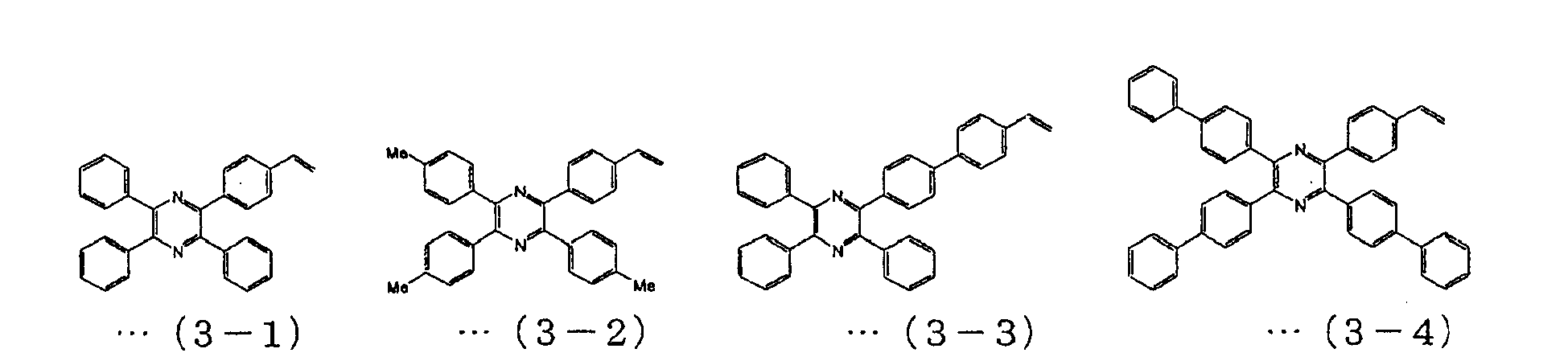

- The charge-transporting polymer compound according to any one of claims 1 to 3, which further comprises a constituting unit derived from a light-emitting polymerizable compound.
- The charge-transporting polymer compound according to claim 4, wherein the light-emitting polymerizable compound has phosphorescent properties.
- The charge-transporting polymer compound according to claim 5, wherein the light-emitting polymerizable compound is a transition metal complex having a substituent with a polymerizable functional group.
- The charge-transporting polymer compound according to claim 6, wherein the transition metal complex is an iridium complex.
- The charge-transporting polymer compound according to any one of claims 1 to 7, which further comprises a unit derived from a polymerizable compound having positive hole-transporting properties.
- An organic electroluminescence element formed with a light-emitting layer between an anode and a cathode, wherein the light-emitting layer comprises the charge-transporting polymer compound according to any one of claims 1 to 8.
Applications Claiming Priority (2)
| Application Number | Priority Date | Filing Date | Title |
|---|---|---|---|
| JP2008113905 | 2008-04-24 | ||
| PCT/JP2009/058043 WO2009131165A1 (en) | 2008-04-24 | 2009-04-23 | Charge-transporting polymer compound and organic electroluminescent device using the same |
Publications (2)
| Publication Number | Publication Date |
|---|---|
| EP2275458A1 true EP2275458A1 (en) | 2011-01-19 |
| EP2275458A4 EP2275458A4 (en) | 2013-04-17 |
Family
ID=41216894
Family Applications (1)
| Application Number | Title | Priority Date | Filing Date |
|---|---|---|---|
| EP09734343.8A Withdrawn EP2275458A4 (en) | 2008-04-24 | 2009-04-23 | Charge-transporting polymer compound and organic electroluminescent device using the same |
Country Status (7)
| Country | Link |
|---|---|
| US (1) | US20110042664A1 (en) |
| EP (1) | EP2275458A4 (en) |
| JP (1) | JP5496084B2 (en) |
| KR (1) | KR101224758B1 (en) |
| CN (1) | CN102015788B (en) |
| TW (1) | TW201008973A (en) |
| WO (1) | WO2009131165A1 (en) |
Cited By (1)
| Publication number | Priority date | Publication date | Assignee | Title |
|---|---|---|---|---|
| US11008510B2 (en) | 2011-08-25 | 2021-05-18 | Semiconductor Energy Laboratory Co., Ltd. | Light-emitting element, light-emitting device, electronic device, lighting device, and novel organic compound |
Families Citing this family (11)
| Publication number | Priority date | Publication date | Assignee | Title |
|---|---|---|---|---|
| WO2012015274A2 (en) * | 2010-07-30 | 2012-02-02 | 롬엔드하스전재재로코리아유한회사 | Organic electroluminescent device employing organic light emitting compound as light emitting material |
| JP5560155B2 (en) * | 2010-09-30 | 2014-07-23 | 富士フイルム株式会社 | Composition, film using the composition, charge transport layer, organic electroluminescent device, and method for forming charge transport layer |
| JP5664128B2 (en) * | 2010-10-29 | 2015-02-04 | 三菱化学株式会社 | Pyrimidine compound, material for organic electroluminescence device, composition for organic electroluminescence device, organic electroluminescence device, lighting device and display device |
| JP2012224626A (en) * | 2011-04-08 | 2012-11-15 | Showa Denko Kk | Phosphine oxide-based compound, organic electroluminescent element, production method therefor, and application of the same |
| JP2012224627A (en) * | 2011-04-08 | 2012-11-15 | Showa Denko Kk | Phosphine oxide-based compound, organic electroluminescent element, production method therefor and use of the same |
| CN104211637A (en) * | 2013-06-25 | 2014-12-17 | 四川大学 | Aromatic diamine containing triphenylpyridine and tert-butyl group, and preparation method thereof |
| CN104086488B (en) * | 2014-07-21 | 2016-04-27 | 河南师范大学 | A kind of synthetic method of 2,4,6-trisubstituted pyrimidine compounds |
| CN104447582B (en) * | 2014-10-24 | 2017-07-07 | 浙江大学 | Tetraphernl pyrazine small molecule derivative, tetraphernl pyrazine polymer and gathering induced luminescence material |
| JP6668152B2 (en) * | 2015-12-28 | 2020-03-18 | 株式会社Kyulux | Compound, light emitting material and organic light emitting device |
| JP6972912B2 (en) * | 2016-10-28 | 2021-11-24 | 住友化学株式会社 | Composition and light emitting device using it |
| CN113214226B (en) * | 2020-05-06 | 2022-12-23 | 广东聚华印刷显示技术有限公司 | Tetraphenylpyrazine compound, polymer and electroluminescent device |
Family Cites Families (35)
| Publication number | Priority date | Publication date | Assignee | Title |
|---|---|---|---|---|
| US4582881A (en) * | 1981-06-10 | 1986-04-15 | Ciba-Geigy Corporation | 2-substituted 5-vinylpyrimidines, polymer obtainable therefrom and preparation thereof |
| DE3269341D1 (en) * | 1981-06-10 | 1986-04-03 | Ciba Geigy Ag | 2-substituted 5-vinylpyrimidines, polymers to be prepared thereof and process for their preparation |
| JP4344494B2 (en) * | 2000-08-24 | 2009-10-14 | 富士フイルム株式会社 | Light emitting device and novel polymer element |
| JP4154139B2 (en) * | 2000-09-26 | 2008-09-24 | キヤノン株式会社 | Light emitting element |
| JP3893949B2 (en) | 2001-11-15 | 2007-03-14 | 昭和電工株式会社 | Polymerizable compound and method for producing the same |
| JP4212802B2 (en) | 2001-12-04 | 2009-01-21 | 昭和電工株式会社 | Polymerizable compound and method for producing the same |
| AU2002345362A1 (en) * | 2001-06-20 | 2003-01-08 | Showa Denko K.K. | Light emitting material and organic light-emitting device |
| JP4986004B2 (en) | 2001-08-09 | 2012-07-25 | 昭和電工株式会社 | Polymerizable iridium complex, polymer thereof and production method thereof |
| JP4035976B2 (en) | 2001-10-02 | 2008-01-23 | 昭和電工株式会社 | Polymerizable compound and method for producing the same |
| US7250226B2 (en) * | 2001-08-31 | 2007-07-31 | Nippon Hoso Kyokai | Phosphorescent compound, a phosphorescent composition and an organic light-emitting device |
| JP3951876B2 (en) | 2001-11-09 | 2007-08-01 | 昭和電工株式会社 | Polymerizable compound and method for producing the same |
| US7049011B2 (en) * | 2002-03-14 | 2006-05-23 | Tdk Corporation | Organic electroluminescent device |
| US7649077B2 (en) * | 2002-10-30 | 2010-01-19 | Ciba Specialty Chemicals Corporation | Polymers for use in optical devices |
| JP4666338B2 (en) | 2003-04-30 | 2011-04-06 | 昭和電工株式会社 | Organic polymer light emitting device material having gold complex structure and organic polymer light emitting device |
| CN100513514C (en) * | 2003-04-30 | 2009-07-15 | 昭和电工株式会社 | Organic polymer light-emitting element material having gold complex structure and organic polymer light-emitting element |
| KR100994083B1 (en) * | 2003-07-31 | 2010-11-12 | 미쓰비시 가가꾸 가부시키가이샤 | Compound, charge transport material and organic electroluminescent device |
| CN101638380A (en) * | 2003-07-31 | 2010-02-03 | 三菱化学株式会社 | Compound, charge transport material, and organic electroluminescent element |
| TW200528536A (en) * | 2003-12-19 | 2005-09-01 | Showa Denko Kk | Boron-containing polymer compound and organic light emitting device using the same |
| JP4854956B2 (en) * | 2003-12-19 | 2012-01-18 | 昭和電工株式会社 | Boron-containing polymer compound and organic light-emitting device using the same |
| KR101112012B1 (en) * | 2004-05-21 | 2012-02-15 | 쇼와 덴코 가부시키가이샤 | Polymer light-emitting material and organic light emitting element |
| JP5082230B2 (en) | 2004-12-10 | 2012-11-28 | パイオニア株式会社 | Organic compounds, charge transport materials, and organic electroluminescent devices |
| KR101388472B1 (en) * | 2004-12-10 | 2014-04-23 | 미쓰비시 가가꾸 가부시키가이샤 | Organic compound, charge-transporting material, and organic electroluminescent element |
| JP2006225428A (en) * | 2005-02-15 | 2006-08-31 | Tokyo Institute Of Technology | Copolymer having 1,3,5-triazine ring, production method thereof and use thereof |
| WO2006093466A1 (en) * | 2005-03-01 | 2006-09-08 | Agency For Science, Technology And Research | Solution processed organometallic complexes and their use in electroluminescent devices |
| US8025987B2 (en) * | 2005-06-14 | 2011-09-27 | Showa Denko K.K. | Light emitting polymer material, organic electroluminescence device and display device comprising light emitting polymer material |
| JP5031276B2 (en) | 2005-06-14 | 2012-09-19 | 昭和電工株式会社 | POLYMER LIGHT EMITTING MATERIAL, ORGANIC ELECTROLUMINESCENT ELEMENT AND DISPLAY DEVICE USING POLYMER LIGHT EMITTING MATERIAL |
| JP4823601B2 (en) * | 2005-07-29 | 2011-11-24 | 昭和電工株式会社 | Polymer light emitting material, organic electroluminescence element, and display device |
| JP2007100083A (en) | 2005-09-09 | 2007-04-19 | Mitsubishi Chemicals Corp | Composition for organic electroluminescent device and organic electroluminescent device |
| JP2007084612A (en) | 2005-09-20 | 2007-04-05 | Showa Denko Kk | Polymer light-emitting material, organic electroluminescence element, and display device |
| JP4896512B2 (en) * | 2005-12-22 | 2012-03-14 | 昭和電工株式会社 | Polymer light-emitting material, organic electroluminescence element, and display device |
| JP5227510B2 (en) | 2005-12-28 | 2013-07-03 | 株式会社半導体エネルギー研究所 | Pyrazine derivatives, and light-emitting elements, display devices, and electronic devices using the pyrazine derivatives |
| US8920941B2 (en) * | 2005-12-28 | 2014-12-30 | Semiconductor Energy Laboratory Co., Ltd. | Pyrazine derivative, and light emitting element, display device, electronic device using the pyrazine derivative |
| US20080061686A1 (en) * | 2006-03-22 | 2008-03-13 | Jie Liu | Phosphorescent light-emitting materials and methods of preparing |
| CN101469038B (en) * | 2007-12-25 | 2012-03-28 | 通用电气公司 | Polymer containing benzene pyridine unit |
| WO2009104708A1 (en) * | 2008-02-22 | 2009-08-27 | 昭和電工株式会社 | Polymer compound and organic electroluminescent device using the same |
-
2009
- 2009-04-23 CN CN2009801140251A patent/CN102015788B/en active Active
- 2009-04-23 JP JP2010509209A patent/JP5496084B2/en active Active
- 2009-04-23 WO PCT/JP2009/058043 patent/WO2009131165A1/en not_active Ceased
- 2009-04-23 EP EP09734343.8A patent/EP2275458A4/en not_active Withdrawn
- 2009-04-23 TW TW098113486A patent/TW201008973A/en unknown
- 2009-04-23 KR KR1020107026214A patent/KR101224758B1/en active Active
- 2009-04-23 US US12/989,637 patent/US20110042664A1/en not_active Abandoned
Cited By (3)
| Publication number | Priority date | Publication date | Assignee | Title |
|---|---|---|---|---|
| US11008510B2 (en) | 2011-08-25 | 2021-05-18 | Semiconductor Energy Laboratory Co., Ltd. | Light-emitting element, light-emitting device, electronic device, lighting device, and novel organic compound |
| US11773321B2 (en) | 2011-08-25 | 2023-10-03 | Semiconductor Energy Laboratory Co., Ltd. | Light-emitting element, light-emitting device, electronic device, lighting device, and novel organic compound |
| US12577456B2 (en) | 2011-08-25 | 2026-03-17 | Semiconductor Energy Laboratory Co., Ltd. | Light-emitting element, light-emitting device, electronic device, lighting device, and novel organic compound |
Also Published As
| Publication number | Publication date |
|---|---|
| EP2275458A4 (en) | 2013-04-17 |
| KR20100133503A (en) | 2010-12-21 |
| TW201008973A (en) | 2010-03-01 |
| CN102015788B (en) | 2012-12-12 |
| JP5496084B2 (en) | 2014-05-21 |
| WO2009131165A1 (en) | 2009-10-29 |
| CN102015788A (en) | 2011-04-13 |
| JPWO2009131165A1 (en) | 2011-08-18 |
| US20110042664A1 (en) | 2011-02-24 |
| KR101224758B1 (en) | 2013-01-21 |
Similar Documents
| Publication | Publication Date | Title |
|---|---|---|
| EP2246370B1 (en) | Polymer compound and organic electroluminescent device using the same | |
| JP5008835B2 (en) | Polymer light emitting material and organic light emitting device | |
| JP5496084B2 (en) | Charge transporting polymer compound and organic electroluminescence device using the same | |
| CN103797086B (en) | Light emitting polymer and device | |
| EP2172989A1 (en) | Organic light-emitting device using triazine ring-containing polymer compound | |
| EP2177549B1 (en) | Triazine ring-containing polymer compound and organic light-emitting device using the polymer compound | |
| JP5495783B2 (en) | Phosphorescent polymer compound and organic electroluminescence device using the same | |
| JP5461793B2 (en) | Phosphorescent polymer compound and organic electroluminescence device using the same | |
| KR101122613B1 (en) | Boron-containing polymer compound and organic light emitting device using the same | |
| JP5613941B2 (en) | Blue light-emitting polymer compound, organic electroluminescence device and use thereof | |
| JP4380433B2 (en) | Polymer copolymer containing metal coordination compound and organic electroluminescence device using the same | |
| US8257837B2 (en) | Organic light-emitting device | |
| JP5342103B2 (en) | Organic light emitting device | |
| JP4380431B2 (en) | Polymer copolymer containing metal coordination compound and organic electroluminescence device using the same | |
| JP5247024B2 (en) | Organic light emitting device | |
| JP5466747B2 (en) | High molecular compound |
Legal Events
| Date | Code | Title | Description |
|---|---|---|---|
| PUAI | Public reference made under article 153(3) epc to a published international application that has entered the european phase |
Free format text: ORIGINAL CODE: 0009012 |
|
| 17P | Request for examination filed |
Effective date: 20101124 |
|
| AK | Designated contracting states |
Kind code of ref document: A1 Designated state(s): AT BE BG CH CY CZ DE DK EE ES FI FR GB GR HR HU IE IS IT LI LT LU LV MC MK MT NL NO PL PT RO SE SI SK TR |
|
| AX | Request for extension of the european patent |
Extension state: AL BA RS |
|
| DAX | Request for extension of the european patent (deleted) | ||
| A4 | Supplementary search report drawn up and despatched |
Effective date: 20130314 |
|
| RIC1 | Information provided on ipc code assigned before grant |
Ipc: H01L 51/54 20060101ALI20130308BHEP Ipc: H01L 51/00 20060101AFI20130308BHEP |
|
| 17Q | First examination report despatched |
Effective date: 20130529 |
|
| STAA | Information on the status of an ep patent application or granted ep patent |
Free format text: STATUS: THE APPLICATION IS DEEMED TO BE WITHDRAWN |
|
| 18D | Application deemed to be withdrawn |
Effective date: 20131009 |