EP2274639B1 - Identitätsverfolgungsverfahren und -system - Google Patents
Identitätsverfolgungsverfahren und -system Download PDFInfo
- Publication number
- EP2274639B1 EP2274639B1 EP09742067.3A EP09742067A EP2274639B1 EP 2274639 B1 EP2274639 B1 EP 2274639B1 EP 09742067 A EP09742067 A EP 09742067A EP 2274639 B1 EP2274639 B1 EP 2274639B1
- Authority
- EP
- European Patent Office
- Prior art keywords
- model
- data
- target
- detected
- identity
- Prior art date
- Legal status (The legal status is an assumption and is not a legal conclusion. Google has not performed a legal analysis and makes no representation as to the accuracy of the status listed.)
- Active
Links
Images







Classifications
-
- G—PHYSICS
- G01—MEASURING; TESTING
- G01V—GEOPHYSICS; GRAVITATIONAL MEASUREMENTS; DETECTING MASSES OR OBJECTS; TAGS
- G01V1/00—Seismology; Seismic or acoustic prospecting or detecting
- G01V1/001—Acoustic presence detection
Definitions
- the invention relates to an identity tracking process and system. More specifically, but not exclusively the invention relates to a process whereby passive interceptions of emissions from sources acquired over a period of time may be used to distinguish and identify different sources.
- a system is described, for example, in US-A-5604 683 .
- Seismic sensors offer the potential of being able to detect, classify and track vehicles and people moving, in an environment cluttered by vegetation or buildings, at greater range than could be achieved with more conventional acoustic sensors. Seismic sensors measure the vibrations associated with such movements that propagate through the earth rather than through the air. Although the earth provides a stationary medium it is very inhomogeneous, anisotropic, dispersive and lossy. Detection of these vibrations using seismic sensors and subsequent processing of the data can enable identification and tracking of the source in question.
- data filtering is important in suppressing out of band data and zeroing any sensor offset. This might be done by many means but in particular it might be performed using a Kalman filter. There is a large amount of prior art relating to such filters, none of which detail a method of using such filters in the manner described below.
- a zero-crossing method for extracting frequency information is well known in the realm of natural language processing and speech recognition, see for example Ito M R and Donaldson R W. Zero-Crossing Measurements for Analysis and Recognition of Speech Sound. IEEE Transactions On Audio And Electroacoustics vol. AU-19 (1971 ) but is used here in a much more general context. While its usefulness in providing a fast and robust spectral analysis in that context is clearly demonstrated, its usefulness in more general signal processing has not been previously suspected. Indeed fast Fourier processing algorithms are generally the favoured method for frequency analysis. In our case the use of a zero crossing method is proposed not so much because of its speed but because of its unexpected and vastly superior performance.
- probabilistic data representations can be represented in terms of their sufficient statistics such as mean, variance, kurtosis, entropy, if only because they provide a more compact representation of the probabilities in at least Yan, R and Gao, R X. Approximate Entropy as a diagnostic tool for machine health monitoring. Mechanical Systems and Signal Processing 21, Issue 2, (2007 ).
- it is the whole cumulative probability distribution that is used as the feature vector even with discrete frequencies defined by the zero crossing process, this is a high-dimensional vector but rather than making some heuristic dimensional reduction choice at this stage this invention leaves the reduction to be driven by the data itself.
- the construction of mixture models for emission data represented in terms of the probability distribution of frequencies can be performed by a large number of methods.
- Gaussian mixtures might be constructed using the EM algorithm as shown in McLachlan, G J and Krishnan, T. The EM Algorithm and Extensions. Wiley Series in Probability and Statistics (1996 ).
- the essential innovation is not in the process of forming a mixture model but rather in the use of a mixture model to describe the range of emission characteristics, modified by disturbances and filtered by environmentally variable propagation characteristics.
- Identification is then performed on the basis of a conventional (maximum likelihood or maximum posterior probability) fitting of the model to a specific data sequence.
- a conventional (maximum likelihood or maximum posterior probability) fitting of the model to a specific data sequence it should be noted that although it may be expedient to use only a static model for each emitter taking account of only the mean occupancies of the component modes, it is necessary to retain some minimal dynamic behaviour in the form of identity switching to ensure numerical robustness in the presence of model imperfection.
- the process comprises a number of key features that enable it to process the data sufficiently fast for real-time applications but retaining a sufficiently high dimensional data representation that the process is resilient to systematic biases such as might be caused by variations in background noise differences in sensor placement and diverse weather conditions.
- the process described makes use of band-pass filtering to remove both high and low frequencies known not to be characteristic of the sources.
- this automatically removes DC sensor offsets.
- This filtered data is segmented into windows comprising several panes of data with the windows chosen to be short enough to correspond to essentially stationary emitter frequency information but long enough to comprise enough panes that the pane data is sufficient to provide not just mean frequency information but a measure of the variability of the information.
- extraction of representative frequency information in the filtered signal data is achieved by using a zero-crossing counting method that enables the extraction of the highest significant frequency of short sample panes.
- the method extracts data features in the form of the dominant frequency of the pane and the variability of this frequency between neighbouring panes. This captures the spectral characteristics of the data in a way that is much less sensitive to noise than more conventional spectral analysis methods, without using knowledge of the expected source as would be needed for such more conventional methods where similar insensitivity could only be achieved by having to tightly filter the data.
- the extracted data is represented in terms of feature vectors that are the discrete-frequency cumulative probability distributions of the frequencies samples obtained.
- This formation of cumulative probability distributions essentially constitutes a simple filtering of the raw probability data obtained by averaging over a very small number of sample panes.
- a more conventional approach might have been to use the sample of pane data to perform a Bayesian update of a prior expected probability. While this might provide similar performance it requires good prior expectations and it would certainly require much more computational effort.
- Probabilistic mixture models of the feature vectors are formed and collected for all the emitter sources of interest under a wide range of environmental conditions. This is on the assumption that the feature vectors are representative samples from this probabilistic model. In doing this, the model complexity is reduced by, firstly reducing the dimensionality of the model to capture the structure with as low a dimensional representation as practicable and secondly choosing a small number of mixture components to avoid over-fitting.
- the dimensional reduction is important in reducing the computational expense that necessarily accompanies a high dimensional model while the avoidance of modelling very narrow helps to ensure that the models are not overly sensitive to absence of fully representative data.
- Hidden Markov models are constructed for each emitter of interest with the hidden state representing the characteristic label of the emitter. In doing this it is important to include label mixing to accommodate modelling error and exit/entrance of emitters onto the scene.
- the above hidden Markov dynamic model is constructed using prior data to track emitter identity as the most probable identity given by the hidden states in the Markov model.
- the combination of the above steps provides a process which is effective in providing an identification of emission sources under conditions in which the signal is of lower strength than that noise and the emission propagation environment is unknown.
- it is not necessary to have any knowledge of the emission process.
- Such emissions and sources by way of example might be acoustic noise from vehicles on a track, microwave transmissions from different transmission equipments, or seismic vibrations detected at long range from some ground-based activity. However, it will be appreciated that any suitable emission or source may be detected in this manner.
- the disclosed process is a generally applicable one but it can be best understood by reference to a specific example.
- a particular embodiment in the field of seismic signal processing where the aim is to identify, and ultimately track, vehicles by their seismic signatures detected at several kilometres range over variable terrain, for any vehicle speed, without knowledge of the terrain or subsurface structure and for a wide range of weather conditions.
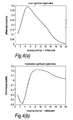
- Typical data collected at a rate of a kilo-sample per second is shown in Figure 1 .
- the most obvious characteristics are signal spikes resulting from the traversing of ruts and the systematic change in signal level as the vehicle approaches and recedes from the sensor location.
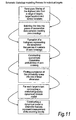
- the process sketched below involves two stages: firstly the modelling of data collected from multiple sources (vehicles in this case) and secondly the exploitation of this data to identify unknown vehicles. This modelling stage is described below.
- this raw data is first band-pass filtered and then analysed for dominant frequencies by considering the data 500 consecutive samples at a time and, rather that performing a Fourier transform, determining the time intervals between successive crossings through zero (the mean of the data, after filtering) in each 500 sample window.
- a Gaussian mixture model will only be useful if the number of components in the mixture is relatively small. Therefore, despite the picture presented above, the construction of the model must focus on obtaining a parsimonious representation. This is most easily done by using a blind clustering approach with the physical understanding only being used to check that the derived data decomposition makes reasonable sense.
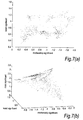
- Such a Gaussian mixture model can be constructed using the stochastic EM algorithm 13] for example and is illustrated in Figure 7 .
- P(r)and P(p) are just prior probabilities of likely ranges and soil-types.
- This mathematical picture has a relatively simple reality. We can simply perform this marginalisation by collecting data from all reasonable environments at all reasonable ranges and fitting a probabilistic model to this data.
- the model pictured in Figure 7 is a representation ofP(m), the probability of the measurements given that we know nothing about what generated them where they were or what the ground conditions were. Le. we have performed a weighted sum over all (only 3 in reality) possible sources.
- the extension of the Gaussian mixture model to incorporate Markovian dynamics is made by identifying the Gaussian mixture model as the measurement model for the hidden states that are the components of the Gaussian mixture.
- the probability models sketched in Figure 8 are to be interpreted as: P m
- s , g where the whole probability model for measurements Gaussian components and sources might be expressed as: P m s g P m
- This matrix can again be found from the data using the stochastic EM algorithm.
- the construction of the mixture model and dynamics might be performed in a single EM algorithm.
- That prior probability essentially encodes the expected classification based on past experience. Thus, it is appropriate to associate this explicitly with the results of previous measurements.
- This is illustrated in Figure 9b , where the horizontal arrows represent the conditional probabilities, P(g,,, Ig,s,,,) and P(s,,, Is,) for the Markovian dynamics of within the Gaussian mixture and the dynamics of the classification itself. This immediately raises the question as to what the latter probability should be.
- P(g,,, Ig,s,,,) and P(s,,, Is,) for the Markovian dynamics of within the Gaussian mixture and the dynamics of the classification itself. This immediately raises the question as to what the latter probability should be.
- This might expect this to be a 'delta function' since the class of a vehicle might be expected to be fixed.
- this simple model needs to incorporate a way of progressively forgetting old measurements, if only to avoid floating-point underflow absolutely zeroing the probability of classes for which there is currently little evidence.
- Equation (2) gives the joint probability of all the stochastic variables of the problem. In Classification, we are interested in the probability of the Source Class, given all the measurements. This is easily obtained (in iterative form) from equation (2) by applying Bayes rule: P ⁇ s , + 1 , g ⁇ 1 + 1
- M , + 1 Z g ⁇ ⁇ P ⁇ m , 11 ⁇ Sr + 1 , g ⁇ 1 + 1 ⁇ P ⁇ g ⁇ 1 + 1 , gl , s + 1 ⁇ P s , 1 , s e e . o P e .
Landscapes
- Physics & Mathematics (AREA)
- Acoustics & Sound (AREA)
- Life Sciences & Earth Sciences (AREA)
- Engineering & Computer Science (AREA)
- Environmental & Geological Engineering (AREA)
- Geology (AREA)
- Remote Sensing (AREA)
- General Life Sciences & Earth Sciences (AREA)
- General Physics & Mathematics (AREA)
- Geophysics (AREA)
- Measurement Of Mechanical Vibrations Or Ultrasonic Waves (AREA)
- Traffic Control Systems (AREA)
- Geophysics And Detection Of Objects (AREA)
- Management, Administration, Business Operations System, And Electronic Commerce (AREA)
Claims (12)
- Verfahren zum Identifizieren und Verfolgen von Zielobjekten, das die Schritte umfasst, dass durch das Zielobjekt ausgesendete Emissionen detektiert werden, die detektierten Emissionsdaten unter Verwendung einer Reihe von statistischen Bearbeitungen verarbeitet werden und das Zielobjekt identifiziert und verfolgt wird, wobei die detektierten Emissionen passiv durch Sensoren detektiert werden,
dadurch gekennzeichnet, dass die statistischen Bearbeitungen die Schritte umfassen, dass die detektierten seismischen Daten gefiltert werden; eine statistische Frequenzinformation extrahiert wird; ein statistisches Mischmodell konstruiert wird, das die Emissionscharakteristika des Zielobjekts beschreibt, die in einem Umfang an verschiedenen Umgebungen beobachtet werden; eine Konstruktion eines dynamischen Mischmodells basierend auf diesen existierenden bekannten Daten und einer Identifikation eines unbekannten Zielobjekts durch die Konvergenz dieses Modells hinsichtlich einer Zustandscharakteristik dieses Zielobjekts konstruiert wird. - Verfahren nach Anspruch 1,
wobei die detektierten Emissionen akustischer Natur sind und in einiger Distanz zu den Zielobjekten nach einem Durchgang der Schallschwingungen durch das dazwischen liegende feste, flüssige oder gasförmige Medium detektiert werden. - Verfahren nach Anspruch 2,
wobei die detektierten Emissionen seismischer Natur sind und passiv durch seismische Sensoren detektiert werden. - Verfahren nach Anspruch 1,
wobei die detektierten Emissionen elektromagnetischer Natur sind und passiv durch elektromagnetische Breitbandsensoren detektiert werden. - Verfahren nach einem der vorstehenden Ansprüche,
wobei die Konstruktion des dynamischen Modells zwei Teile aufweist; einen ersten Teil, der separate Modelle für einzelne Zielobjekte umfasst, und einen zweiten Teil, der ein dynamisches Modell umfasst, das ein stochastisches Wechseln zwischen den Modellen aller interessierenden Zielobjekte enthält. - Verfahren nach Anspruch 5,
wobei die Konstruktionen des Mischmodells und des dynamischen Modells offline an Daten durchgeführt werden, die von bekannten Beispielen von Zielobjekten unter einem Umfang an repräsentativen Bedingungen erfasst werden, und wobei die Identifikation online unter Verwendung dieser zuvor konstruierten Modelle und von Daten, die unter Umständen erfasst werden, bei denen das Zielobjekt unbekannt ist, durchgeführt wird. - Verfahren nach einem der vorstehenden Ansprüche,
wobei das dynamische Modell ein Hidden-Markov-Modell ist, wobei die verborgenen Zustände den einzelnen Zielobjektmodellen entsprechen und die Übergänge zwischen diesen Zuständen Änderungen der Zielobjektidentität entsprechen, wobei die tatsächliche Identität durch Vergleiche der Wahrscheinlichkeiten der Identitätszustände des Modells erhalten wird. - Verfahren nach Anspruch 7,
wobei die Zustände des dynamischen Markov-Modells den einzelnen Modellkomponenten zugehörig sind, und die Übergänge sowohl Identitätsänderungen als auch Komponentenänderungen umfassen, so dass die Identifikation hinsichtlich sowohl der Zielobjektidentität als auch des Zustands des Zielobjekts erfolgt, wobei sowohl eine Identifikation als auch eine allgemeine Verfolgung erzeugt werden. - Verfahren nach einem der vorstehenden Ansprüche,
wobei die statistische Frequenzinformation in Form einer kumulativen Wahrscheinlichkeitsdichte oder einer diskreten kumulativen Wahrscheinlichkeitsverteilung verwendet wird. - Verfahren nach Anspruch 10,
wobei die statistische Frequenzinformation durch Mittelwertbildung aus Vorkommnissen von Frequenzen, die durch Zählen von Nulldurchgängen erhalten werden, erhalten wird. - Verfahren nach einem der vorstehenden Ansprüche,
wobei die einzelnen Modellkomponenten in dem dynamischen Markov-Modell einer Bewegung des Fahrzeugs in unterschiedlichen Distanzen zu dem Sensor oder an unterschiedlichen Geländen zugehörig sind, so dass die Identifikation hinsichtlich sowohl der Zielobjektidentität als auch des Orts des Zielobjekts erfolgt. - Verfahren nach Anspruch 11,
wobei die Orts- und Identitätsinformation von einer Anordnung von Sensoren verwendet werden kann, um das detektierte Fahrzeug in einem Raum zu verfolgen, wobei möglicherweise Kartendaten verwendet werden, um eine Geländeinformation bereitzustellen, um jegliche Ambiguitäten zu entfernen.
Applications Claiming Priority (2)
| Application Number | Priority Date | Filing Date | Title |
|---|---|---|---|
| GBGB0808175.4A GB0808175D0 (en) | 2008-05-06 | 2008-05-06 | Identity tracking process and system |
| PCT/EP2009/055431 WO2009135849A2 (en) | 2008-05-06 | 2009-05-05 | Identity tracking process and system |
Publications (2)
| Publication Number | Publication Date |
|---|---|
| EP2274639A2 EP2274639A2 (de) | 2011-01-19 |
| EP2274639B1 true EP2274639B1 (de) | 2015-09-09 |
Family
ID=39537313
Family Applications (1)
| Application Number | Title | Priority Date | Filing Date |
|---|---|---|---|
| EP09742067.3A Active EP2274639B1 (de) | 2008-05-06 | 2009-05-05 | Identitätsverfolgungsverfahren und -system |
Country Status (7)
| Country | Link |
|---|---|
| US (1) | US8638642B2 (de) |
| EP (1) | EP2274639B1 (de) |
| AU (1) | AU2009245780B2 (de) |
| CA (1) | CA2723357C (de) |
| GB (1) | GB0808175D0 (de) |
| WO (1) | WO2009135849A2 (de) |
| ZA (1) | ZA201007957B (de) |
Families Citing this family (2)
| Publication number | Priority date | Publication date | Assignee | Title |
|---|---|---|---|---|
| US8219407B1 (en) | 2007-12-27 | 2012-07-10 | Great Northern Research, LLC | Method for processing the output of a speech recognizer |
| US10614299B2 (en) * | 2015-02-09 | 2020-04-07 | Carnegie Mellon University | Indoor identification of individuals through footstep induced structural vibration |
Family Cites Families (8)
| Publication number | Priority date | Publication date | Assignee | Title |
|---|---|---|---|---|
| US4081785A (en) | 1974-02-13 | 1978-03-28 | The United States Of America As Represented By The Secretary Of The Air Force | Dual class amphibious target discriminator |
| US5107250A (en) | 1980-01-07 | 1992-04-21 | The Secretary Of State For Defence In Her Britannic Majesty's Government Of The United Kingdom Of Great Britain And Northern Ireland | Detection of moving objects |
| US5604683A (en) * | 1991-09-12 | 1997-02-18 | Lockheed Martin Corporation | Evaluating target tracking when using multiple sensors |
| US5880691A (en) | 1995-11-07 | 1999-03-09 | California Institute Of Technology | Capacitively coupled successive approximation ultra low power analog-to-digital converter |
| DE19542871C1 (de) | 1995-11-17 | 1996-11-28 | Stn Atlas Elektronik Gmbh | Verfahren und Vorrichtung zur Detektion von Fußgängern |
| WO2001094975A1 (en) | 2000-06-06 | 2001-12-13 | Altratek Inc. | System and method for detection and tracking of targets |
| US7034716B2 (en) * | 2003-09-25 | 2006-04-25 | Bae Systems Information And Electronic Systems Integration Inc. | Passive real-time vehicle classification system utilizing unattended ground sensors |
| US7982662B2 (en) * | 2008-12-08 | 2011-07-19 | Intellex, Llc | Scanning array for obstacle detection and collision avoidance |
-
2008
- 2008-05-06 GB GBGB0808175.4A patent/GB0808175D0/en not_active Ceased
-
2009
- 2009-05-05 WO PCT/EP2009/055431 patent/WO2009135849A2/en not_active Ceased
- 2009-05-05 CA CA2723357A patent/CA2723357C/en not_active Expired - Fee Related
- 2009-05-05 EP EP09742067.3A patent/EP2274639B1/de active Active
- 2009-05-05 AU AU2009245780A patent/AU2009245780B2/en not_active Ceased
- 2009-05-05 US US12/991,084 patent/US8638642B2/en active Active
-
2010
- 2010-11-05 ZA ZA2010/07957A patent/ZA201007957B/en unknown
Also Published As
| Publication number | Publication date |
|---|---|
| AU2009245780A1 (en) | 2009-11-12 |
| US8638642B2 (en) | 2014-01-28 |
| GB0808175D0 (en) | 2008-06-11 |
| WO2009135849A2 (en) | 2009-11-12 |
| EP2274639A2 (de) | 2011-01-19 |
| WO2009135849A3 (en) | 2010-01-07 |
| CA2723357A1 (en) | 2009-11-12 |
| AU2009245780B2 (en) | 2014-07-10 |
| US20110098994A1 (en) | 2011-04-28 |
| CA2723357C (en) | 2016-01-12 |
| ZA201007957B (en) | 2011-07-27 |
Similar Documents
| Publication | Publication Date | Title |
|---|---|---|
| US11562224B2 (en) | 1D-CNN-based distributed optical fiber sensing signal feature learning and classification method | |
| US8405524B2 (en) | Seismic method for vehicle detection and vehicle weight classification | |
| US12051326B2 (en) | Road traffic extraction for unknown anomaly detection using distributed fiber optic sensing | |
| PL220849B1 (pl) | Sposób i system wykrywania obecności i identyfikacji zakłóceń w ruchu powietrznym | |
| CN111142085B (zh) | 一种基于航迹特征提取的外辐射源雷达目标分类识别方法 | |
| Sabour et al. | Deepflow: Abnormal traffic flow detection using siamese networks | |
| CN119625998B (zh) | 一种基于分布式光纤传感的高速公路车辆检测与识别方法 | |
| US20240249614A1 (en) | Vehicle sensing and classification based on vehicle-infrastructure interaction over existing telecom cables | |
| CN114415234B (zh) | 基于主动源面波频散和h/v确定浅地表横波速度的方法 | |
| Hammer et al. | Automatic detection of wet-snow avalanche seismic signals | |
| AU2009245780B2 (en) | Target identity tracking process and system | |
| US12584785B2 (en) | Distributed acoustic sensing (DAS) system for acoustic event detection based upon covariance matrices and related methods | |
| CN117452496A (zh) | 一种震声传感器目标探测识别方法 | |
| Gasparotti et al. | Convolutional neural network for highway bridge indirect structural health monitoring | |
| Draayer et al. | Pattern-of-life activity recognition in seismic data | |
| EP1480182B1 (de) | Berührungsloses Achszählsystem für den Strassenverkehr | |
| CN112071009B (zh) | 光纤管道预警系统及其方法 | |
| Joo et al. | Propagation of Positional Errors in Traffic Conflict Analysis | |
| CN120748151B (zh) | 基于低频与微波复合感应的入侵检测方法 | |
| Stracuzzi et al. | Measuring and Extracting Activity from Time Series Data | |
| Nuzzo et al. | Situational awareness with ubiquitous sensing: Towards real-time event detection & classification | |
| Catani et al. | Methodology to backcalculate individual speed data originally aggregated by road detectors | |
| Kopylova et al. | Statistical Algorithms for Analysis, Measurement, and Recognition of Transport Noises | |
| CN121811624A (zh) | 一种防挖盗预警方法、预警系统、存储介质及程序产品 | |
| CN121170968A (zh) | 一种高陡边坡安全监测系统及方法 |
Legal Events
| Date | Code | Title | Description |
|---|---|---|---|
| PUAI | Public reference made under article 153(3) epc to a published international application that has entered the european phase |
Free format text: ORIGINAL CODE: 0009012 |
|
| 17P | Request for examination filed |
Effective date: 20101022 |
|
| AK | Designated contracting states |
Kind code of ref document: A2 Designated state(s): AT BE BG CH CY CZ DE DK EE ES FI FR GB GR HR HU IE IS IT LI LT LU LV MC MK MT NL NO PL PT RO SE SI SK TR |
|
| AX | Request for extension of the european patent |
Extension state: AL BA RS |
|
| DAX | Request for extension of the european patent (deleted) | ||
| RAP1 | Party data changed (applicant data changed or rights of an application transferred) |
Owner name: SELEX ES LTD |
|
| GRAP | Despatch of communication of intention to grant a patent |
Free format text: ORIGINAL CODE: EPIDOSNIGR1 |
|
| INTG | Intention to grant announced |
Effective date: 20150427 |
|
| GRAS | Grant fee paid |
Free format text: ORIGINAL CODE: EPIDOSNIGR3 |
|
| GRAA | (expected) grant |
Free format text: ORIGINAL CODE: 0009210 |
|
| AK | Designated contracting states |
Kind code of ref document: B1 Designated state(s): AT BE BG CH CY CZ DE DK EE ES FI FR GB GR HR HU IE IS IT LI LT LU LV MC MK MT NL NO PL PT RO SE SI SK TR |
|
| REG | Reference to a national code |
Ref country code: GB Ref legal event code: FG4D |
|
| REG | Reference to a national code |
Ref country code: AT Ref legal event code: REF Ref document number: 748579 Country of ref document: AT Kind code of ref document: T Effective date: 20150915 Ref country code: CH Ref legal event code: EP |
|
| REG | Reference to a national code |
Ref country code: IE Ref legal event code: FG4D |
|
| REG | Reference to a national code |
Ref country code: DE Ref legal event code: R096 Ref document number: 602009033525 Country of ref document: DE |
|
| REG | Reference to a national code |
Ref country code: SE Ref legal event code: TRGR |
|
| REG | Reference to a national code |
Ref country code: NL Ref legal event code: MP Effective date: 20150909 |
|
| PG25 | Lapsed in a contracting state [announced via postgrant information from national office to epo] |
Ref country code: GR Free format text: LAPSE BECAUSE OF FAILURE TO SUBMIT A TRANSLATION OF THE DESCRIPTION OR TO PAY THE FEE WITHIN THE PRESCRIBED TIME-LIMIT Effective date: 20151210 Ref country code: FI Free format text: LAPSE BECAUSE OF FAILURE TO SUBMIT A TRANSLATION OF THE DESCRIPTION OR TO PAY THE FEE WITHIN THE PRESCRIBED TIME-LIMIT Effective date: 20150909 Ref country code: LT Free format text: LAPSE BECAUSE OF FAILURE TO SUBMIT A TRANSLATION OF THE DESCRIPTION OR TO PAY THE FEE WITHIN THE PRESCRIBED TIME-LIMIT Effective date: 20150909 Ref country code: LV Free format text: LAPSE BECAUSE OF FAILURE TO SUBMIT A TRANSLATION OF THE DESCRIPTION OR TO PAY THE FEE WITHIN THE PRESCRIBED TIME-LIMIT Effective date: 20150909 Ref country code: NO Free format text: LAPSE BECAUSE OF FAILURE TO SUBMIT A TRANSLATION OF THE DESCRIPTION OR TO PAY THE FEE WITHIN THE PRESCRIBED TIME-LIMIT Effective date: 20151209 |
|
| REG | Reference to a national code |
Ref country code: LT Ref legal event code: MG4D |
|
| REG | Reference to a national code |
Ref country code: AT Ref legal event code: MK05 Ref document number: 748579 Country of ref document: AT Kind code of ref document: T Effective date: 20150909 |
|
| PG25 | Lapsed in a contracting state [announced via postgrant information from national office to epo] |
Ref country code: HR Free format text: LAPSE BECAUSE OF FAILURE TO SUBMIT A TRANSLATION OF THE DESCRIPTION OR TO PAY THE FEE WITHIN THE PRESCRIBED TIME-LIMIT Effective date: 20150909 Ref country code: ES Free format text: LAPSE BECAUSE OF FAILURE TO SUBMIT A TRANSLATION OF THE DESCRIPTION OR TO PAY THE FEE WITHIN THE PRESCRIBED TIME-LIMIT Effective date: 20150909 |
|
| PG25 | Lapsed in a contracting state [announced via postgrant information from national office to epo] |
Ref country code: NL Free format text: LAPSE BECAUSE OF FAILURE TO SUBMIT A TRANSLATION OF THE DESCRIPTION OR TO PAY THE FEE WITHIN THE PRESCRIBED TIME-LIMIT Effective date: 20150909 |
|
| PG25 | Lapsed in a contracting state [announced via postgrant information from national office to epo] |
Ref country code: CZ Free format text: LAPSE BECAUSE OF FAILURE TO SUBMIT A TRANSLATION OF THE DESCRIPTION OR TO PAY THE FEE WITHIN THE PRESCRIBED TIME-LIMIT Effective date: 20150909 Ref country code: IS Free format text: LAPSE BECAUSE OF FAILURE TO SUBMIT A TRANSLATION OF THE DESCRIPTION OR TO PAY THE FEE WITHIN THE PRESCRIBED TIME-LIMIT Effective date: 20160109 Ref country code: EE Free format text: LAPSE BECAUSE OF FAILURE TO SUBMIT A TRANSLATION OF THE DESCRIPTION OR TO PAY THE FEE WITHIN THE PRESCRIBED TIME-LIMIT Effective date: 20150909 Ref country code: SK Free format text: LAPSE BECAUSE OF FAILURE TO SUBMIT A TRANSLATION OF THE DESCRIPTION OR TO PAY THE FEE WITHIN THE PRESCRIBED TIME-LIMIT Effective date: 20150909 |
|
| REG | Reference to a national code |
Ref country code: FR Ref legal event code: PLFP Year of fee payment: 8 |
|
| PG25 | Lapsed in a contracting state [announced via postgrant information from national office to epo] |
Ref country code: AT Free format text: LAPSE BECAUSE OF FAILURE TO SUBMIT A TRANSLATION OF THE DESCRIPTION OR TO PAY THE FEE WITHIN THE PRESCRIBED TIME-LIMIT Effective date: 20150909 Ref country code: RO Free format text: LAPSE BECAUSE OF FAILURE TO SUBMIT A TRANSLATION OF THE DESCRIPTION OR TO PAY THE FEE WITHIN THE PRESCRIBED TIME-LIMIT Effective date: 20150909 Ref country code: PT Free format text: LAPSE BECAUSE OF FAILURE TO SUBMIT A TRANSLATION OF THE DESCRIPTION OR TO PAY THE FEE WITHIN THE PRESCRIBED TIME-LIMIT Effective date: 20160111 Ref country code: PL Free format text: LAPSE BECAUSE OF FAILURE TO SUBMIT A TRANSLATION OF THE DESCRIPTION OR TO PAY THE FEE WITHIN THE PRESCRIBED TIME-LIMIT Effective date: 20150909 |
|
| REG | Reference to a national code |
Ref country code: DE Ref legal event code: R097 Ref document number: 602009033525 Country of ref document: DE |
|
| PLBE | No opposition filed within time limit |
Free format text: ORIGINAL CODE: 0009261 |
|
| STAA | Information on the status of an ep patent application or granted ep patent |
Free format text: STATUS: NO OPPOSITION FILED WITHIN TIME LIMIT |
|
| 26N | No opposition filed |
Effective date: 20160610 |
|
| PG25 | Lapsed in a contracting state [announced via postgrant information from national office to epo] |
Ref country code: DK Free format text: LAPSE BECAUSE OF FAILURE TO SUBMIT A TRANSLATION OF THE DESCRIPTION OR TO PAY THE FEE WITHIN THE PRESCRIBED TIME-LIMIT Effective date: 20150909 Ref country code: SI Free format text: LAPSE BECAUSE OF FAILURE TO SUBMIT A TRANSLATION OF THE DESCRIPTION OR TO PAY THE FEE WITHIN THE PRESCRIBED TIME-LIMIT Effective date: 20150909 Ref country code: BE Free format text: LAPSE BECAUSE OF NON-PAYMENT OF DUE FEES Effective date: 20160531 |
|
| REG | Reference to a national code |
Ref country code: DE Ref legal event code: R081 Ref document number: 602009033525 Country of ref document: DE Owner name: LEONARDO MW LTD., BASILDON, GB Free format text: FORMER OWNER: SELEX ES LTD., BASILDON, ESSEX, GB |
|
| PG25 | Lapsed in a contracting state [announced via postgrant information from national office to epo] |
Ref country code: BE Free format text: LAPSE BECAUSE OF FAILURE TO SUBMIT A TRANSLATION OF THE DESCRIPTION OR TO PAY THE FEE WITHIN THE PRESCRIBED TIME-LIMIT Effective date: 20150909 Ref country code: LU Free format text: LAPSE BECAUSE OF FAILURE TO SUBMIT A TRANSLATION OF THE DESCRIPTION OR TO PAY THE FEE WITHIN THE PRESCRIBED TIME-LIMIT Effective date: 20160505 |
|
| REG | Reference to a national code |
Ref country code: CH Ref legal event code: PL |
|
| PG25 | Lapsed in a contracting state [announced via postgrant information from national office to epo] |
Ref country code: LI Free format text: LAPSE BECAUSE OF NON-PAYMENT OF DUE FEES Effective date: 20160531 Ref country code: CH Free format text: LAPSE BECAUSE OF NON-PAYMENT OF DUE FEES Effective date: 20160531 |
|
| REG | Reference to a national code |
Ref country code: IE Ref legal event code: MM4A |
|
| REG | Reference to a national code |
Ref country code: FR Ref legal event code: CD Owner name: LEONARDO MW LTD, GB Effective date: 20170207 |
|
| PG25 | Lapsed in a contracting state [announced via postgrant information from national office to epo] |
Ref country code: IE Free format text: LAPSE BECAUSE OF NON-PAYMENT OF DUE FEES Effective date: 20160505 |
|
| REG | Reference to a national code |
Ref country code: FR Ref legal event code: PLFP Year of fee payment: 9 |
|
| REG | Reference to a national code |
Ref country code: FR Ref legal event code: PLFP Year of fee payment: 10 |
|
| PG25 | Lapsed in a contracting state [announced via postgrant information from national office to epo] |
Ref country code: HU Free format text: LAPSE BECAUSE OF FAILURE TO SUBMIT A TRANSLATION OF THE DESCRIPTION OR TO PAY THE FEE WITHIN THE PRESCRIBED TIME-LIMIT; INVALID AB INITIO Effective date: 20090505 Ref country code: CY Free format text: LAPSE BECAUSE OF FAILURE TO SUBMIT A TRANSLATION OF THE DESCRIPTION OR TO PAY THE FEE WITHIN THE PRESCRIBED TIME-LIMIT Effective date: 20150909 |
|
| PG25 | Lapsed in a contracting state [announced via postgrant information from national office to epo] |
Ref country code: MT Free format text: LAPSE BECAUSE OF NON-PAYMENT OF DUE FEES Effective date: 20160531 Ref country code: MK Free format text: LAPSE BECAUSE OF FAILURE TO SUBMIT A TRANSLATION OF THE DESCRIPTION OR TO PAY THE FEE WITHIN THE PRESCRIBED TIME-LIMIT Effective date: 20150909 Ref country code: TR Free format text: LAPSE BECAUSE OF FAILURE TO SUBMIT A TRANSLATION OF THE DESCRIPTION OR TO PAY THE FEE WITHIN THE PRESCRIBED TIME-LIMIT Effective date: 20150909 Ref country code: MC Free format text: LAPSE BECAUSE OF FAILURE TO SUBMIT A TRANSLATION OF THE DESCRIPTION OR TO PAY THE FEE WITHIN THE PRESCRIBED TIME-LIMIT Effective date: 20150909 |
|
| PG25 | Lapsed in a contracting state [announced via postgrant information from national office to epo] |
Ref country code: BG Free format text: LAPSE BECAUSE OF FAILURE TO SUBMIT A TRANSLATION OF THE DESCRIPTION OR TO PAY THE FEE WITHIN THE PRESCRIBED TIME-LIMIT Effective date: 20150909 |
|
| PGFP | Annual fee paid to national office [announced via postgrant information from national office to epo] |
Ref country code: DE Payment date: 20180522 Year of fee payment: 10 |
|
| REG | Reference to a national code |
Ref country code: DE Ref legal event code: R119 Ref document number: 602009033525 Country of ref document: DE |
|
| PG25 | Lapsed in a contracting state [announced via postgrant information from national office to epo] |
Ref country code: IT Free format text: LAPSE BECAUSE OF NON-PAYMENT OF DUE FEES Effective date: 20190505 Ref country code: DE Free format text: LAPSE BECAUSE OF NON-PAYMENT OF DUE FEES Effective date: 20191203 |
|
| PGFP | Annual fee paid to national office [announced via postgrant information from national office to epo] |
Ref country code: FR Payment date: 20250528 Year of fee payment: 17 |
|
| PGFP | Annual fee paid to national office [announced via postgrant information from national office to epo] |
Ref country code: SE Payment date: 20250521 Year of fee payment: 17 |
|
| PGFP | Annual fee paid to national office [announced via postgrant information from national office to epo] |
Ref country code: GB Payment date: 20260312 Year of fee payment: 18 |