EP2273941B1 - Surgical devices for an extra-articular mechanical energy absorbing apparatus - Google Patents
Surgical devices for an extra-articular mechanical energy absorbing apparatus Download PDFInfo
- Publication number
- EP2273941B1 EP2273941B1 EP09739249.2A EP09739249A EP2273941B1 EP 2273941 B1 EP2273941 B1 EP 2273941B1 EP 09739249 A EP09739249 A EP 09739249A EP 2273941 B1 EP2273941 B1 EP 2273941B1
- Authority
- EP
- European Patent Office
- Prior art keywords
- base
- joint
- component
- bone
- depicting
- Prior art date
- Legal status (The legal status is an assumption and is not a legal conclusion. Google has not performed a legal analysis and makes no representation as to the accuracy of the status listed.)
- Not-in-force
Links
Images
















Classifications
-
- A—HUMAN NECESSITIES
- A61—MEDICAL OR VETERINARY SCIENCE; HYGIENE
- A61B—DIAGNOSIS; SURGERY; IDENTIFICATION
- A61B17/00—Surgical instruments, devices or methods
- A61B17/16—Instruments for performing osteoclasis; Drills or chisels for bones; Trepans
- A61B17/17—Guides or aligning means for drills, mills, pins or wires
- A61B17/1739—Guides or aligning means for drills, mills, pins or wires specially adapted for particular parts of the body
- A61B17/1764—Guides or aligning means for drills, mills, pins or wires specially adapted for particular parts of the body for the knee
-
- A—HUMAN NECESSITIES
- A61—MEDICAL OR VETERINARY SCIENCE; HYGIENE
- A61B—DIAGNOSIS; SURGERY; IDENTIFICATION
- A61B17/00—Surgical instruments, devices or methods
- A61B17/56—Surgical instruments or methods for treatment of bones or joints; Devices specially adapted therefor
- A61B17/58—Surgical instruments or methods for treatment of bones or joints; Devices specially adapted therefor for osteosynthesis, e.g. bone plates, screws or setting implements
- A61B17/68—Internal fixation devices, including fasteners and spinal fixators, even if a part thereof projects from the skin
-
- A—HUMAN NECESSITIES
- A61—MEDICAL OR VETERINARY SCIENCE; HYGIENE
- A61B—DIAGNOSIS; SURGERY; IDENTIFICATION
- A61B17/00—Surgical instruments, devices or methods
- A61B17/56—Surgical instruments or methods for treatment of bones or joints; Devices specially adapted therefor
- A61B17/58—Surgical instruments or methods for treatment of bones or joints; Devices specially adapted therefor for osteosynthesis, e.g. bone plates, screws or setting implements
- A61B17/88—Osteosynthesis instruments; Methods or means for implanting or extracting internal or external fixation devices
-
- A—HUMAN NECESSITIES
- A61—MEDICAL OR VETERINARY SCIENCE; HYGIENE
- A61B—DIAGNOSIS; SURGERY; IDENTIFICATION
- A61B17/00—Surgical instruments, devices or methods
- A61B17/16—Instruments for performing osteoclasis; Drills or chisels for bones; Trepans
- A61B17/17—Guides or aligning means for drills, mills, pins or wires
- A61B17/1728—Guides or aligning means for drills, mills, pins or wires for holes for bone plates or plate screws
-
- A—HUMAN NECESSITIES
- A61—MEDICAL OR VETERINARY SCIENCE; HYGIENE
- A61B—DIAGNOSIS; SURGERY; IDENTIFICATION
- A61B17/00—Surgical instruments, devices or methods
- A61B17/56—Surgical instruments or methods for treatment of bones or joints; Devices specially adapted therefor
- A61B17/58—Surgical instruments or methods for treatment of bones or joints; Devices specially adapted therefor for osteosynthesis, e.g. bone plates, screws or setting implements
- A61B17/60—Surgical instruments or methods for treatment of bones or joints; Devices specially adapted therefor for osteosynthesis, e.g. bone plates, screws or setting implements for external osteosynthesis, e.g. distractors, contractors
- A61B17/64—Devices extending alongside the bones to be positioned
- A61B17/6425—Devices extending alongside the bones to be positioned specially adapted to be fitted across a bone joint
-
- A—HUMAN NECESSITIES
- A61—MEDICAL OR VETERINARY SCIENCE; HYGIENE
- A61B—DIAGNOSIS; SURGERY; IDENTIFICATION
- A61B17/00—Surgical instruments, devices or methods
- A61B17/56—Surgical instruments or methods for treatment of bones or joints; Devices specially adapted therefor
- A61B17/58—Surgical instruments or methods for treatment of bones or joints; Devices specially adapted therefor for osteosynthesis, e.g. bone plates, screws or setting implements
- A61B17/68—Internal fixation devices, including fasteners and spinal fixators, even if a part thereof projects from the skin
- A61B17/70—Spinal positioners or stabilisers, e.g. stabilisers comprising fluid filler in an implant
- A61B17/7001—Screws or hooks combined with longitudinal elements which do not contact vertebrae
- A61B17/7002—Longitudinal elements, e.g. rods
- A61B17/7019—Longitudinal elements having flexible parts, or parts connected together, such that after implantation the elements can move relative to each other
- A61B17/7023—Longitudinal elements having flexible parts, or parts connected together, such that after implantation the elements can move relative to each other with a pivot joint
-
- A—HUMAN NECESSITIES
- A61—MEDICAL OR VETERINARY SCIENCE; HYGIENE
- A61B—DIAGNOSIS; SURGERY; IDENTIFICATION
- A61B90/00—Instruments, implements or accessories specially adapted for surgery or diagnosis and not covered by any of the groups A61B1/00 - A61B50/00, e.g. for luxation treatment or for protecting wound edges
- A61B90/06—Measuring instruments not otherwise provided for
- A61B2090/061—Measuring instruments not otherwise provided for for measuring dimensions, e.g. length
-
- A—HUMAN NECESSITIES
- A61—MEDICAL OR VETERINARY SCIENCE; HYGIENE
- A61N—ELECTROTHERAPY; MAGNETOTHERAPY; RADIATION THERAPY; ULTRASOUND THERAPY
- A61N1/00—Electrotherapy; Circuits therefor
- A61N1/18—Applying electric currents by contact electrodes
- A61N1/32—Applying electric currents by contact electrodes alternating or intermittent currents
- A61N1/36—Applying electric currents by contact electrodes alternating or intermittent currents for stimulation
- A61N1/3605—Implantable neurostimulators for stimulating central or peripheral nerve system
- A61N1/3606—Implantable neurostimulators for stimulating central or peripheral nerve system adapted for a particular treatment
- A61N1/36071—Pain
Definitions
- the present disclosure is directed towards devices for implanting an extra-articular mechanical energy absorbing_ apparatus.
- vertebrata Both humans and other mammals belong to the subphylum known as vertebrata.
- the defining characteristic of a vertebrate is considered the backbone or spinal cord, a brain case, and an internal skeleton.
- the skeleton or skeletal system is the biological system providing physical support in living organisms. Skeletal systems are commonly divided into three types -external (an exoskeleton), internal (an endoskeleton), and fluid based (a hydrostatic skeleton).
- An internal skeletal system consists of rigid (or semi-rigid) structures, within the body, moved by the muscular system. If the structures are mineralized or ossified, as they are in humans and other mammals, they are referred to as bones.
- Cartilage is another common component of skeletal systems, supporting and supplementing the skeleton.
- the human ear and nose are shaped by cartilage.
- Some organisms have a skeleton consisting entirely of cartilage and without any calcified bones at all, for example sharks.
- the bones or other rigid structures are connected by ligaments and connected to the muscular system via tendons.
- a joint is the location at which two or more bones make contact. They are constructed to allow movement and provide mechanical support, and are classified structurally and functionally. Structural classification is determined by how the bones connected to each other, while functional classification is determined by the degree of movement between the articulating bones. In practice, there is significant overlap between the two types of classifications.
- Fibrous/Immovable joints are connected by dense connective tissue, consisting mainly of collagen.
- the fibrous joints are further divided into three types:
- Cartilaginous bones are connected entirely by cartilage (also known as “synchondroses"). Cartilaginous joints allow more movement between bones than a fibrous joint but less than the highly mobile synovial joint. Synovial joints have a space between the articulating bones for synovial fluid. This classification contains joints that are the most mobile of the three, and includes the knee and shoulder. These are further classified into ball and socket joints, condyloid joints, saddle joints, hinge joints, center of rotation joints, and gliding joints.
- Joints can also be classified functionally, by the degree of mobility they allow. Synarthrosis joints permit little or no mobility. They can be categorized by how the two bones are joined together. That is, synchrondoses are joints where the two bones are connected by a piece of cartilage. Synostoses are where two bones that are initially separated eventually fuse together as a child approaches adulthood. By contrast, amphiarthrosis joints permit slight mobility. The two bone surfaces at the joint are both covered in hyaline cartilage and joined by strands of fibrocartilage. Most amphiarthrosis joints are cartilaginous.
- diarthrosisjoints permit a variety of movements (e.g. flexion, adduction, pronation).
- flexion e.g. flexion, adduction, pronation
- Only synovial joints are diarthrodial and they can be divided into six classes: 1.ball and socket - such as the shoulder or the hip and femur; 2. hinge - such as the elbow; 3. center of rotation - such as the radius and ulna; 4. condyloidal (or ellipsoidal) - such as the wrist between radius and carps, or knee; 5. saddle -such as thejoint between carpal thumbs and metacarpals; and 6. gliding - such as between the carpals.
- Synovial joints are the most common and most moveable type of joints in the body. As with all other joints in the body, synovial joints achieve movement at the point of contact of the articulating bones. Structural and functional differences distinguish the synovial joints from the two other types of joints in the body, with the main structural difference being the existence of a cavity between the articulating bones and the occupation of a fluid in that cavity which aids movement.
- the whole of a diarthrosis is contained by a ligamentous sac, thejoint capsule or articular capsule.
- the surfaces of the two bones at thejoint are covered in cartilage. The thickness of the cartilage varies with each joint, and sometimes may be of uneven thickness.
- Articular cartilage is multi-layered.
- a thin superficial layer provides a smooth surface for the two bones to slide against each other. Of all the layers, it has the highest concentration of collagen and the lowest concentration of proteoglycans, making it very resistant to shear stresses. Deeper than that is an intermediate layer, which is mechanically designed to absorb shocks and distribute the load efficiently. The deepest layer is highly calcified, and anchors the articular cartilage to the bone. In joints where the two surfaces do not fit snugly together, a meniscus or multiple folds of fibre-cartilage within thejoint correct the fit, ensuring stability and the optimal distribution of load forces.
- the synovium is a membrane that covers all the non-cartilaginous surfaces within thejoint capsule. It secretes synovial fluid into the joint, which nourishes and lubricates the articular cartilage. The synovium is separated from the capsule by a layer of cellular tissue that contains blood vessels and nerves.
- Cartilage is a type of dense connective tissue and as shown above, it forms a critical part of the functionality of a body joint. It is composed of collagenous fibers and/or elastin fibers, and cells called chondrocytes, all of which are embedded in a firm gel-like ground substance called the matrix. Articular cartilage is avascular (contains no blood vessels) and nutrients are diffused through the matrix. Cartilage serves several functions, including providing a framework upon which bone deposition can begin and supplying smooth surfaces for the movement of articulating bones. Cartilage is found in many places in the body including the joints, the rib cage, the ear, the nose, the bronchial tubes and between intervertebral discs. There are three main types of cartilage: hyaline, elastic and fibrocartilage.
- Chondrocytes are the only cells found in cartilage. They produce and maintain the cartilaginous matrix. Experimental evidence indicates that cells are sensitive to their mechanical (stress-strain) state, and react directly to mechanical stimuli. The biosynthetic response of chondrocytes was found to be sensitive to the frequency and amplitude of loading (Wong et al., 1999 and Kurz et al., 2001). Recent experimental studies further indicate that excessive, repetitive loading may induce cell death, and cause morphological and cellular damage, as seen in degenerative joint disease (Lucchinetti et al., 2002 and Sauerland et al., 2003) . Islam et al.
- Cancellous bone (also known as trabecular, or spongy) is a type of osseous tissue which also forms an important aspect of a body joint.
- Cancellous bone has a low density and strength but very high surface area, that fills the inner cavity of long bones.
- the external layer of cancellous bone contains red bone marrow where the production of blood cellular components (known as hematopoiesis) takes place.
- Cancellous bone is also where most of the arteries and veins of bone organs are found.
- the second type of osseous tissue is known as cortical bone, forming the hard outer layer of bone organs.
- Arthritis is a group of conditions where there is damage caused to the joints of the body. Arthritis is the leading cause of disability in people over the age of 65.
- Rheumatoid arthritis and psoriatic arthritis are autoimmune diseases in which the body is attacking itself. Septic arthritis is caused by joint infection. Gouty arthritis is caused by deposition of uric acid prystals in the joint that results in subsequent inflammation. The most common form of arthritis, osteoarthritis is also known as degenerative joint disease and occurs following trauma to the joint, following an infection of the joint or simply as a result of aging.
- Osteoarthritis also known as degenerative arthritis or degenerative joint disease, and sometimes referred to as “arthrosis” or “osteoarthrosis” or in more colloquial terms “wear and tear”
- OA is a condition in which low-grade inflammation results in pain in the joints, caused by wearing of the cartilage that covers and acts as a cushion inside joints.
- the cartilage covers and acts as a cushion inside joints.
- the patient experiences pain upon weight bearing, including walking and standing. Due to decreased movement because of the pain, regional muscles may atrophy, and ligaments may become more lax.
- OA is the most common form of arthritis.
- osteoarthritis The main symptoms of osteoarthritis is chronic pain, causing loss of mobility and often stiffness. "Pain” is generally described as a sharp ache, or a burning sensation in the associated muscles and tendons. OA can cause a crackling noise (called “crepitus”) when the affected joint is moved or touched, and patients may experience muscle spasm and contractions in the tendons. Occasionally, the joints may also be filled with fluid. Humid weather increases the pain in many patients.
- OA commonly affects the hand, feet, spine, and the large weight-bearing joints, such as the hips and knees, although in theory, any joint in the body can be affected.
- the affected joints appear larger, are stiff and painful, and usually feel worse, the more they are used and loaded throughout the day, thus distinguishing it from rheumatoid arthritis.
- cartilage looses its viscoelastic properties and it's ability to absorb load.
- Arthrodeses are described as being reasonable alternatives for treating OA of small hand and foot joints as well as degenerative disorders of the spine, but were deemed to be rarely indicated in large weight-bearing joints such as the knee due to functional impairment of gait, cosmetic problems and further side-effects.
- Total joint replacement was characterized as an extremely effective treatment for severe joint disease.
- recently developed joint-preserving treatment modalities were identified as having a potential to stimulate the formation of a new articular surface in the future.
- it was concluded that such techniques do not presently predictably restore a durable articular surface to an osteoarthritic joint.
- the correction of mechanical abnormalities by osteotomy and joint debridement are still considered as treatment options in many patients.
- patients with limb malalignment, instability and intra-articular causes of mechanical dysfunction can benefit from an osteotomy to provide pain relief.
- the goal being the transfer of weight-bearing forces from arthritic portions to healthier locations of ajoint.
- Joint replacement is one of the most common and successful operations in modem orthopaedic surgery. It consists of replacing painful, arthritic, worn or diseased parts of the joint with artificial surfaces shaped in such a way as to allow joint movement. Such procedures are a last resort treatment as they are highly invasive and require substantial periods of recovery. Joint replacement sometimes called total joint replacement indicating that all joint surfaces are replaced. This contrasts with hemiarthroplasty (half arthroplasty) in which only one bone's joint surface is replaced and unincompartmental arthroplasty in which both surfaces of the knee, for example, are replaced but only on the inner or outer sides, not both.
- arthroplasty as a general term, is an operative procedure of orthopaedic surgery performed, in which the arthritic or dysfunctional j oint surface is replaced with something better or by remodeling or realigning the joint by osteotomy or some other procedure. These procedures are also characterized by relatively longrecovery times and their highly invasive procedures.
- the currently available therapies are not condro-protective.
- a popular form of arthroplasty was interpositional arthroplasty with interposition of some other tissue like skin, muscle or tendon to keep inflammatory surfaces apart or excisional arthroplasty in which the joint surface and bone was removed leaving scar tissue to fill in the gap.
- arthroplasty forms include resection(al) arthroplasty, resurfacing arthroplasty, mold arthroplasty, cup arthroplasty, silicone replacement arthroplasty, etc. Osteotomy to restore or modify joint congruity is also an arthroplasty.
- Osteotomy is a related surgical procedure involving cutting of bone to improve alignment.
- the goal of osteotomy is to relieve pain by equalizing forces across the joint as well as increase the lifespan of the joint. This procedure is often used in younger, more active or heavier patients.
- High tibial osteotomy (HTO) is associated with a decrease in pain and improved function.
- HTO does not address ligamentous instability - only mechanical alignment. HTO is associated with good early results, but results deteriorate over time.
- Certain other approaches to treating osteoarthritis contemplate external devices such as braces or fixators which control the motion of the bones at ajoint or apply cross-loads at a joint to shift load from one side of the joint to the other.
- Various of thse approaches have had some success in alleviating pain but suffer from patient compliance or lack an ability to facilitate and support the natural motion and function of the diseased joint.
- the motion of bones forming ajoint can be as distinctive as a finger print, and thus, each individual has his or her own unique set of problems to address. Therefore, mechanical approaches to treating osteoarthritis have had limited applications.
- Prior approaches to treating osteoarthritis have also been hinders in acknowledging all of the basic functions of the various structures of ajoint in combination with its unique movement. That is, in addition to addressing loads at ajoint and joint movement, there has not been an approach which also acknowledges the dampening and energy absorption functions of the anatomy, and taking a minimally invasive approach in implementing solutions.
- Publication WO 2003/039330 discloses a spinal stabilization system having a first bone anchor and a second bone anchor with a stabilization construct connecting the first bone anchor and the second bone anchor.
- the present invention satisfies these and other needs.
- the present disclosure is directed towards a surgical procedure for implanting a medical device, the surgical method or procedure is not part of the invention, but helps to understand the invention. More particularly, the procedure involves placement of an extra-articular mechanical energy absorbing apparatus across anatomy being treated. In one aspect, the energy absorbing apparatus is placed across an articulating joint.
- the contemplated approach involves one or more of patient preparation, identification of device position relative to anatomy, structure of proper device components and device implantation.
- Various devices and implantation aids are disclosed to accomplish effective and proper placement of a medical device.
- the position of the patient and treatment areas are selected for easy access and to achieve proper alignment at an implantation site.
- Use of vacuum lock supports and arch bed structure accomplishes desired treatment site stabilization and orientation.
- An adjustable surgical table also facilitates desired positioning.
- guide structures are configured adjacent a treatment site to aid in identifying a proper juxtapositional relationship between patient body anatomy and mechanical energy absorbing apparatus.
- guide structures can be embodied in a multi-directional center of rotation locator configured to identify a center ofrotation of an articulating limb.
- remote visualization as well as templates are contemplated for use in both identifying device-to-anatomy mounting locations as well as incision sites.
- anatomical references can be used to locate the center of rotation, and the target location can be manually positioned by referencing these anatomical references.
- proper size and configuration of components of the mechanical energy absorbing apparatus involves understanding the anatomy of the treatment area as well as the unique characteristics of the anatomy of the patient.
- the energy absorbing apparatus includes one or more bases which are to be fixed to a bone, such bases are selected to provide surfaces which approximate the bone to which it is to be attached and includes desired separation from the bone to provide connecting structure.
- remote sizing devices and a direct physical inspection of the anatomy is undertaken.
- fixed distance links, dummy links and base locating tools are employed to facilitate both selection of base implantation sites and proper component identification.
- Kirscher wires K-wires
- Steinmann pins are employed to help maintain alignment of components within the interventional site.
- K-wire K-wires
- Steinmann pins are generally used to refer to wires above 2mm in diameter.
- K-wire is used generically to cover both Kirscher wires and Steinmann pins. Both compression and locking screws are contemplated for fixation purposes.
- an elongated handle with a distal attachment to a component of an energy absorbing apparatus is contemplated to form a tunnel or other access area at an interventional site as well as to deliver components thereto.
- Devices and approaches are also contemplated for advancing components through the tunnel formed below a patient's skin and for both temporary fixation and permanent assembly of parts.
- Post-implanted and post operative examination is also contemplated to ensure proper operation .of the mechanical absorbing device.
- the mechanical energy absorbing apparatus has the capacity to absorb energy in addition to transfer energy from the joint.
- Various joints of the body can be treated employing the systems of the present invention.
- articulating bones involved in synovial joints can benefit from the present invention. Accordingly, there are contemplated applications to the joints in the knee, ankle, shoulder, hip, hand, wrist, elbow, mandible, and foot.
- the presently disclosed apparatus is embodied in a device utilizing an element, or elements functioning as a unit, which responds to bending or changes in elongation.
- the device is used to reduce the loading experienced by the articular surfaces of the tibiofemoral joint.
- the device is designed to reduce load on the joint during knee extension with energy absorption. Joint load reduction in this phase is governed by the compression of the device - increased compression yields greaterjoint reduction.
- the device is anchored in a position which ensures device elongation resulting from knee flexion. As the knee moves into flexion, the device is un-compressed and will cause little to nojoint load changes.
- the device may have other features which ensure correct device alignment, and prevent against buckling, as the device transitions into a compressed state.
- the device can also be configured to provide joint load reductions during flexion or throughout the nearly full range of motion.
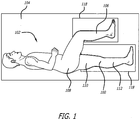
- FIG. 1 is a perspective view, depicting a patient position for an interventional procedure
- the described approach seeks to alleviate pain associated with the function of diseased or malaligned members forming a body joint.
- the present invention is particularly suited to address issues associated with osteoarthritis, the energy manipulation accomplished by the present invention lends itself well to broader applications.
- the present invention is particularly suited to treating synovial joints such as the knee, finger, wrist, ankle and shoulder.
- the presently disclosed method seeks to permit and complement the unique articulating motion of the members defining a body joint of a patient while simultaneously manipulating energy being experienced by both cartilage and osseous tissue (cancellous and cortical bone).
- Approaches involving varying energy absorption and transfer during the rotation of the joint and selecting a geometry for the energy absorption assembly to provide necessary flexibility are implemented into various embodiments of the present invention.
- Certain of the embodiments include geometry which accomplishes variable energy absorption designed to minimize and complement the dampening effect and energy absorption provided by the anatomy of the body, such as that found at a body joint. It has been postulated that to minimize pain, in an osteoarthritic joint absorption of 1-40% of forces, in varying degrees, may be necessary. Variable absorption in the range of 5-20% can be a target for certain applications. In certain specific applications, temporary distraction (e.g., less than 3 months) is employed in the energy manipulation approach.
- an implantable extra-articular absorber is designed to reduce medial compartment loads of the knee.
- the absorber system is comprised of two contoured base components, a kinematic load absorber and a set of bone screws.
- the implanted system is both extra articular and extra capsular and resides in the subcutaneous tissue on the medial aspect of the knee.
- the device is inserted through two small incisions superior to the medial femoral condyle and inferior to the tibial plateau.
- the contoured base components are fixed to the medial cortices of the femur and tibia using bone screws.
- the femoral and tibial base components are contoured to ensure optimal fit to the bony surfaces and are plasma sprayed and coated with hydroxyapatite on bone contacting surfaces to promote bony ingrowth and enhance osteointegration.
- the orthopedic bone screws provide immediate fixation of the base components to the bone during osteointegration.
- the kinematic absorber is attached to the base components between two mobile ball and socket joints. It is comprised of two helically wound springs on a sliding stabilizer. The springs act to absorb load from the medial compartment of the knee while the sliding stabilizer and the ball/sockets allow the device to accommodate full knee range of motion.
- the load bypassing knee support system is indicated for patients suffering with medial knee pain secondary to osteoarthritis who have failed medical treatments.
- the absorber system is supplied packaged in a set of individually sealed Tyvek/film pouches.
- the base components and absorber assemblies will each be individually packaged and labeled.
- the load bypassing knee support system and all its components are provided sterile and are not intended for reuse/re-sterilization by the user. These devices are sterilized using EtO. Surgical instruments, positioning and locking instruments must be sterilized using normal hospital orthopedic instrument sterilization methods.
- FIGS. 1-5 there are shown various apparatus for positioning a patient and preparing the patient for an interventional procedure.
- the disclosed apparatus can be configured for use in various procedures, for purposes of illustration, the apparatus have been depicted in conjunction with treatment of a leg 100 of a patient 102.
- the patient 102 is placed upon a surgical table 104 in a lateral decubitus position with the patient 102 laying generally on his or her side as shown in FIG. 1 .
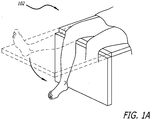
- the patient can be placed in a supine position with an ability to flex the knee (See FIG. IA).
- a top leg 106 of the patient 102 is flexed forward at the hip 108.
- a medial side 110 of the bottom leg 112 is exposed and in full extension. Fluoroscopic imagery is utilized to ensure that the knee is in full extension and in a true lateral position.
- the operating table may be airplaned and/or moved into slight trendelenberg or reverse trendelenberg to assist in obtaining and maintaining true lateral knee fluoroscopy. Any gap between the medial condyles of the articulating bone structure of the leg is closed by supporting a lateral side of the distal tibia of the bottom leg 112.
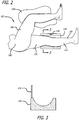
- an arch bed 114 can be provided to help properly align the bottom leg 112.
- the arch bed 114 can further include a post-116 to which interventional tools can be mounted.
- the patient and limb can be stabilized with a bean bag or peg board per physician preference.
- the upper leg 106 can be supported by a vacuum lock support 118.
- the vacuum lock support 118 can be configured to assume a desired shape and subsequently be locked into the desired shape during the interventional procedure.
- the vacuum lock support 118 structure can also be employed to support other areas of the patient including the lower leg 100 as shown in FIG. 1 . Where such structure is utilized, a femoral side of the lower leg 100 should be locked throughout the procedure, whereas the tibial side should be able to be locked and unlocked to allow for rotation.
- Various angulations of the limbs are necessary during tibial base component fixation and full flexion knee motions must be available.
- femoral condyles (not shown) are aligned by pivoting the table 104 with table adjustment controls and to again ensure a true lateral view.
- the table 104 can be rotated laterally to align posterior condyles and can be rotated longitudinally to align inferior condyles.
- the table 104 can also be rotated along a third axis of rotation to achieve proper leg position-to-remote viewing orientation.
- the flouroscopy can be rotated to ensure a true lateral view.
- the operative articulating knee joint and foot of the patient 102 should be completely exposed and configured outside a drape covering the patient 102.
- the knee should be free to flex and extend as needed and preferably up to 135° of flexion. Again, any medial condyle gap should be closed by supporting the lateral side of the distal tibia and/or ankle.
- an initial step in treatment involves identifying a patient's Blumensaat's line, which is a structural feature of a femur.
- a patient's Blumensaat's line which is a structural feature of a femur.
- fluoroscopy or other remote imaging techniques are used to view the anatomy of the lower leg 112.
- a leveling guide and platform assembly 122 is provided and clamped to the table 104.
- the platform 122 includes a bubble level 124 to aid in leveling the platform 122 relative to the leg 112. After proper orientation of the platform 122 is obtained, and a K-wire guide portion of the platform assembly is positioned as necessary above the patient's Blumensaat's line, the platform 122 is locked into position.
- the K-wire guide portion 126 of the platform assembly 122 is then employed as a guide through which a K-wire 130 (shown as a point in FIG. 6 ) is inserted and driven through tissue and into underlying bone at the Blumensaat's line.
- anatomical landmarks e.g., center of Blumensaat's line, inferior and posterior regions of the femoral condyles
- the center of rotation is assumed or determined to be at a midpoint of Blumensaat's line.
- Other approaches recognize that the center of rotation is displaced from the midpoint of Blumensaat's line.
- an acceptable region and target location 125 can be identified for placement of a center of a femoral socket (not shown).
- a femoral location for an energy manipulation device is identified. Palpation of the medial epicondyle allows a physician to find the recess/ sulcus of the epicondyle which is considered the center of rotation of the knee. Alternatively, you can find the insertion of the MCL and that is considered the center of the knee rotation.
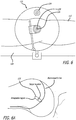
- a physician palpates the medial epicondyle and positions a K-wire antero proximal to the midpoint of Blumensaat's line 131 (See FIGS. 7 and 8 ). Using a bulls-eye instrument 133, a 2.4mm K-wire 135 is inserted perpendicular to the lateral view of a femur 137. Care is taken to achieve accuracy as poor positioning of K-wires may lead to inappropriate placement and malfunction of an implanted device.
- a femoral guide 139 is employed to accurately identify the femoral center ofrotation.
- a moveable hole 141 in the femoral guide 139 is slid over the implanted K-wire 135.
- a physician determines which arc 143 on the guide 139 best fits the inferior and posterior regions of the femoral condyle.
- the selected arc is then aligned with the condylar curve. If the condylar curve falls between two arcs, the larger arc is selected.
- a second K-wire 145 is drilled through a center hole 147 of the guide 139 (ee FIG. IOB).
- a circle guide can be used.
- the circle guide can be, but is not limited to, the following forms: a series of concentric full circles or a series of concentric arcs (e.g., 90 deg, 140 deg, 135 deg) designed to match the posterior & inferior femoral region of femoral condyle.
- circle guide is a laminate applied to the fluoroscopic screen that the physician is viewing. Once the lateral view is achieved, patient position is maintained, and a laminate guide is attached to the fluoroscopic screen. The arcs or curves or circles of the laminate are positioned to align with the posterior and inferior regions of the femoral condyle. Magnification of fluoro can aide in this process.
- the laminate directly identifies the target location, and the physician inserts a K-wire into this target location on the patient by matching the location of the K-wire on the patient's anatomy to achieve the designated location shown by the target marker on the fluoro screen laminate.
- the circle guide can be incorporated into the fluoroscopic screen (as part of the computer image) to simplify positioning of the arcs to the condyles on fluoro.
- a circle guide on the opposite side of the joint as that being operated provides an alternativeative means of finding the target location.
- This contralateral location provides the added benefit that distance of the guide from the joint (variable among patients due to the thickness of the soft tissue in this region) results in proportional magnification of the arcs relative to the condyles.
- a combination of top and bottom circle guides can be employed
- the femoral guide 139 is then rotated until a straight line 149 extending across a portion of the guide 139 is aligned parallel to the femoral shaft 137.
- a third K-wire 151 is next drilled into an offset hole 153.
- the previously placed K-wires 135, 147 are removed as is the femoral guide 139, leaving the third K-wire in situ.
- the position of the third K-wire is used subsequently for accurate placement of a femoral rotational component of an energy manipulation assembly.
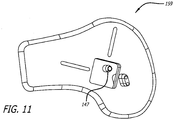
- FIG. 11 One specific approach to an alternate design of a guide is shown in FIG. 11 .
- the guide 159 is configured for a left knee but other embodiments can be employed for other anatomy such as the right knee.
- the guide 159 also includes a center hole for receiving a K-wire and further embodies arcs (not shown) which show up under flouroscopy.
- the arcs can similarly facilitate alignment with local anatomy and the ultimate positioning of a rotational component of an energy manipulation assembly.
- an initial step in an interventional procedure involving implanting a mechanical energy absorbing structure includes approximating a femoral location.
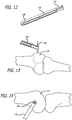
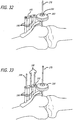
- an elongate handle 132 including an arm 134 configured at its distal end is provided and configured to engage a mid-section of a 2.4 mm K-wire 136 to ensure accurate trajectory.
- a proximal end 138 is mounted to the surgical table as described previously.
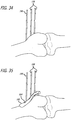
- the K-wire 136 is positioned perpendicularly and above a femur 137 (See FIG. 13 ) and is positioned in an upper left quadrant (See FIG. 14 ) of an image provided by a remote viewing device such as that described above.
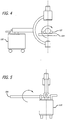
- the C-arm 134 is further equipped with a bulls-eye structure 140 to aid in properly positioning the K-wire within the desired quadrant.
- a fluoroscopic view of the bulls eye 140 and K-wire 136 is shown in FIG. 15 .
- the K-wire is then fixedly advanced within the femur 137 for use in further aspects of the center of rotation location procedure.
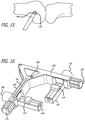
- a right-angle guide 142 is provided to cooperate with the K-wire 136.
- a left knee guide 142 is provided but it is to be understood that various other guides such as those for a right knee or for other articulating joints can also be implemented.
- the right angle guide 142 includes a pair of sliding members 144 each of which are received in respective channels 146 arranged orthogonally to arms 148 defining the guide 142. Knobs 150 are further provided to accomplish translating the sliding members 144 along the channels 146. Moreover, knobs 157 are provided to effect movement of the channels along arms 148. Additionally, the channels 146 include one component 152 of a cross-hair 154 while the sliding members 144 include a second component 156 of a cross-hair 156 (See FIG. 19 ).
- the guide 142 is also equipped with a K-wire receiving hole 158 arranged perpendicularly to front and back faces of the guide 142.
- tack-wire receiving hole 158 of the guide 142 is placed over the K-wire 136 so that the guide is placed adjacent the leg of the patient.
- the guide 142 is then rotated about the K-wire 136 to align the guide 142 with a longitudinal axis of the femur 137.
- An optional axis guide (not shown) can be used to aid in alignment with the longitudinal axis.
- a second K-wire 160 is placed in a second through hole 162 formed in the guide 142 to fix the rotation of the guide 142 (See FIGS. 17 and 18 ).
- the cross hairs 154 are then aligned tangent and coincident to posterior and inferior condyles of the bones of the articulation joint (See FIG. 19 ). This is accomplished by rotating knobs 150 and 157 to move the channel 146 and slider 144 within the channel 146. Proper positioning of the cross:-hair is accomplished through remote imaging techniques.
- a linkage 164 is selected from a line of available, variably dimensioned linkages and is placed into engagement with the sliders 144.
- the links define a generally right angle device with terminal ends equipped with holes for receiving posts 166 extending from the sliders 144 (See FIG. 21 ).
- the linkage 164 further includes a K-wire receiving through hole 168 positioned at a junction between arms which define the linkage 164. This through hole lies above the femoral center ofrotation. A further K-wire 170 is inserted through this hole 168 and fixedly attached to the femur 137 as shown in FIG. 22 . Thereafter the linkage assembly 164 is removed along with the previously placed K-wires 136, 160.
- Optimal position can be determined by moving the target location until the readout in extension and flexion provide the appropriate change. This can be aided using a set of rules guiding how to adjust position based on the readout results of the previous position.
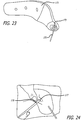
- a femoral base trial component 171 is slid over the remaining third K-wire 151 (See FIG. 23 ).
- the base trial 171 includes a connector mount 173 which references the K-wire 151.
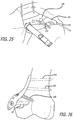
- a 3-5cm incision from the K-wire 151 extending along the posterior edge of the trial base component 171 is then made (See FIG. 24 ).
- blunt dissection the vastus medialus is elevated and retracted anteriorly and laterally to provide sufficient bone exposure to enable adequate removal of periosteum 177 and base component placement.
- a periosteum elevator 179 can be employed.
- the trial femoral base component 171 is slid over the K-wire 151 and the fit is checked to determine if a continuous apposition of the base to bone exists around edges. Efforts are made to avoid the application of excessive force to preserve registration of the distal end K-wire location.
- Various templates are utilized to select a preferred base component. Sizing and positioning can be confirmed by using remote imaging (fluoroscopy) as well as a gap sizing tool (not shown) to ensure that a majority of the base component edge is secured against the bone with an acceptable minimum distance in any gap areas.
- the base component should make intimate contact with the bone surface.
- the periostium in contacting regions of the femoral base can be removed using a blade, curette or the periosteal elevator 179. It is to be ensured that a sufficient region of periosteum is removed or retracted to provide intimate contact between an entire base component surface and bone. Further, when possible, the periostium should be pulled back so that it can be repositioned over the base component once the base has been attached. Here, measures are taken to avoid inadequate removal of periosteum as the same may prevent osteointegration of the bone into the base component. Moreover, excessive removal of periosteum beyond the base component margins should be avoided as that may reduce the bloody supply to the bone.
- a preferred base component is selected, it is removed from its packaging and visually inspected for any obvious defects. If visual defects are observed another like part is selected.
- the base component 190 is then placed on the prepared femoral bone 137 by sliding the ball and socket 191 over the femoral K-wire 151.
- a temporary ball and socket affixed to the base can be employed.
- two stabilizing K-wires are drilled into the available holes on the base component to maintain implant positioning. It is to be noted that slight adjustments in position of the base component at this point will assist in seating the base component on the bone and aid finding the best fit between the base component and the bone. Movements should be gently executed to preserve registration of the distal end K-wire location and protect the osteointegration surface.
- the fixation of the base components to bone can begin, starting with the proximal 3.5mm bicortical compression screws 193.
- An appropriate drill bit and drill guide are selected.
- screw length is determined by measuring drill holes with a depth gauge in standard fashion. In one approach, assurances should be made so that both cortices are captured by the compression screws 193.
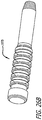
- a femoral placement guide 197a can be employed (See FIG. 26A ). The guide 197a is configured to be temporarily attached to the base 190 and later removed when the base attachment is completed.
- a gap sizing tool (not shown) can be used to ensure that the base 190 is properly positioned and that no new gaps have formed. If the gap sizing tool indicates an unacceptable gap, the base component must be repositioned or osteointegration may not occur properly.
- This procedure is repeated for the second 3.5mm bicortical 193 and 6.5mm unicortical compression 195 screws. All three compression screws are tightened to their final setting before initiating locking screw placement. The two K-wires are removed from the base component 190. A further verification is made at this time to ensure that the target K-wire 151 has not been bent or moved. It is to be noted that the compression screws 193, 195 should be inserted and fixed prior to initiation of the locking screws to ensure good compression of the base component 190 onto the femur 137, thereby maximizing osteointegration.
- the correct drill bit and threaded drill guide 197a are selected, such as for 5.0mm locking screws.
- the locking drill guide is threaded into the base component 190.
- a pilot hole is drilled while ensuring minimal disturbance to the base component 190.
- the locking screw 197 is then screwed in place to the specified tightness (such as 4 Nm torque). This procedure is repeated for the second locking screw 197.
- the locking screws are positioned in the area of the base component that is raised off of the bone surface. The locking of the screws to the base in this region and then extending into the bone create a rigid structure to minimize movement of the base.
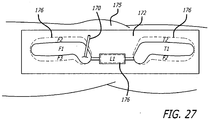
- a plastic template 172 is placed over the patient's leg 175 in the area where the interventional implantation procedure is to occur.
- Starting base component sizes F 1 and T 1 and a link component ci are roughly approximated to a patient's anatomy.
- a pen or other marker is used to outline appropriate base sizes 176. Perforated outlines can allow for directly marking a patient's skin. Incision lines (not shown) can also be made in the area.
- FIGS. 28 and 29 an alternative approach to a template 178 is depicted.
- This second approach involves an articulating assembly having a middle section 180 which approximates a link component, the middle section 180 having ends to which curved, elongate hoops 182, 184 are rotatably connected.
- the hoops 182, 184 have a length and shape approximating base components to be used on opposite sides of an articulating joint, such as a knee joint.
- a guide 184 having a through hole sized to receive the K-wire 120 placed at a patient's anatomy center of rotation.
- the articulating template 178 is placed adjacent a patient's skin in the area of the implantable site to thereby provide structure for facilitating selection of proper components for a mechanical energy absorbing assembly.
- marks 176 can be made on a patient's skin to map out a desired component shape and orientation, as well as to identify a location for initial incisions.
- tissue is dissected to the bone.
- the first incision 186 is made through skin and tissue coincident with the femur.
- the dissection is made vertically or longitudinally along the leg 175 and is made along natural tissue planes, posterior to the vastus medialus muscle (not shown).
- the underlying periostium is elevated and removed as necessary while employing standard surgical techniques and an effort is made to avoid disrupting the joint capsule.
- a scissor-action retractor 188 To prepare the implantation site, access is provided by a scissor-action retractor 188. When possible, the periosteum should be pulled back so that it can be repositioned over the base component once the base has been attached.
- a tissue dilator or the surgeon's finger can be used for blunt dissection of tissue from the periostium in an area where abase component would be placed and extending to and beyond the point where the K-wire 170 is affixed to bone.
- the femoral base component 190 is test fitted based upon contact area with the bone and clearance from periostium. In this way, the general contour of a desirable femoral base component can be identified. The base component 190 is then removed from the area.
- a next step can include employing a base trial 192 to create initial mounting holes for a base component 190.
- the base trial 192 to be used can be one of a number of available trials and the selected trial 192 will embody abase component portion 194 having a shape and size approximating that previously identified as being desirable.
- the base trial itself can be used in place of a previously described series of steps to identify proper contour of the base 190.
- Extending vertically from the base component portion 194 are a plurality of tubes 196, each sized to receive a single K-wire 198.
- Attached to upper ends of the tubes 196 is an arm, a laterally displaced end of which defines a disk 200 having a hole 202 extending therethrough and being sized to receive the K-wire placed, in the present example, at the femur center of rotation.
- This disk 210 allows the trial 192 to move in three dimensions.
- the base component portion 194 is placed adjacent bone.
- the K-wires 198 are inserted through the tubes 196 and fixedly inserted into the femur (See FIG. 34 ).
- the K-wire 120 placed at the center of rotation is then removed.
- the base trial 192 is then also removed from the interventional site and a properly sized base component 190 including holes for receiving the K-wires 198 is placed against bone using the K-wires 198 as a guide for proper placement.
- a K-wire with a non-round shape for example, triangular or square
- the non-round shape keeps the base component in the proper orientation.
- mounting access holes 204 formed in the bone component 190 are employed to drill holes into underlying bone. Screws (not shown) are then used to affix the base component 190 in the desired orientation and the K-wires 198 are removed from the area.
- a base component 190 can alternatively be placed against a cleared surface on the bone, guidance therefor being provided by the K-wire 170 placed at a center of rotation.
- a component clamping tool 206 is employed to affix a K-wire socket 208 to the base 190, in the event the base 190 lacks such structure.
- This component clamping tool 206 is contemplated to be used to also subsequently assemble other components of the mechanical energy absorbing device in situ.
- Various temporary K-wire sockets can be used to match the K-wire hole at the center of rotation dependent on where the base component 190 best fits on the bone.
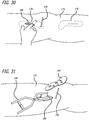
- a femoral drill guide 210 is then used to provide a guide for directly attaching holes through the base component 190 and into bone at desired angles (See Fig. 29 ). Such desired angles are selected to achieve necessary affixation of the base 190 to the bone as dictated by the patient's anatomy as well as load carrying requirements.
- the base component is then affixed to bone as shown in FIG. 30 .
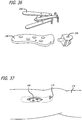
- a first step involves creating an absorber tunnel.
- a distance of approximately 60 mm is measured from the femoral K-wire 151 along the direction of the tibial shaft.
- a 2-4cm incision 191, beginning at the 60mm mark is made and extends inferior along the tibial shaft.
- blunt dissection such as by the physician's finger or a tissue dilator, an extracapsular tunnel 193 for an absorber unit is formed beneath the skin and through soft tissue that extends from femoral to tibial incisions.
- a clear and continuous channel should exist between the femoral base component an expected location for a tibial base component.
- the incision can be extended across the entire length to avoid tunneling.
- the energy manipulating system can be pushed or pulled through the tunnel between the two incisions.
- the energy manipulating system can be temporarily housed in a sheath or a dilating introducer.
- the infrapatellar branch of the saphenous nerve may be located in this region, care should be taken to prevent injury to this structure.
- the knee must be in full extension during tibial positioning and attachment and the gap between the femur and tibia should be closed by the physician by applying a varus stress on the leg for a medial placement, a valgus stress on the leg for a lateral placement, and an axial stress on the leg for a bilateral placement of an absorber(s). Failure to maintain this position may result in incorrect absorber length, inadequate device function, or device failure.
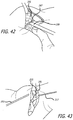
- the absorber unit 216 is positioned so that it is perpendicular to the tibial plateau (See FIG. 41 ).
- the absorber unit can be configured within a sheath and held in a compressed state, the ends of which can be folded during and held back for initial implantation.
- a K-wire can be drilled (not shown) at the neck of the ball to hold the absorber in this alignment.
- a tibial base component size is selected.
- the skin is retracted to provide sufficient bone exposure for placement of the tibial base component.
- a tibial trial base component (not shown) can be placed at the side to check the fit (continuous apposition of base to bone is desired around edges). Excessive force of placement should be avoided to preserve integrity of the mounting location.
- the preferred base component can be selected. Sizing should be confirmed to ensure that a majority of the base component edge is secured against the bone with an acceptable minimum distance in any gap areas. These steps are taken while ensuring that absorber alignment is maintained at all times.
- the periostium 197 is removed in contacting regions of the tibial base using a blade, curette or periosteal elevator 199.
- a sufficient region of periosteum should be removed or retracted to provide intimate contact between the entire base component surface and bone. It is to be recognized that inadequate removal of periosteum may prevent osteointegration of the bone into the base component. Moreover, excessive removal of periosteum beyond the base component margins may reduce blood supply to the bone. When possible, the periostium should be pulled back so that it can be repositioned over the base component once the base has been attached.
- a proper sized tibial base is selected, it is removed from its packaging and visually inspected for any obvious defects. If visual defects are observed, another component is selected.
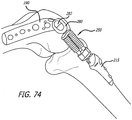
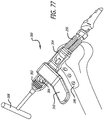
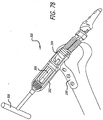
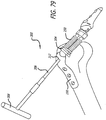
- the tibial base 215 is then attached to the absorber 195 using an assembly tool (See FIGS. 74-80 ).
- the base component 215 is then placed onto the prepared tibial bone and it is readjusted to find the optimal positioning.
- the knee should be in full extension with varus stress for a medial placement.
- varus or valgus stresses can be applied to close the gap between the joint members. In this way, the ultimate positioning of the second (tibial) base will then involve ensuring that there will be sufficient space between joint members when a complete extra-articular mechanical energy absorbing apparatus is placed across the joint.
- tibial base component 215 will assist in seating the base component on the bone and aid in finding the best fit between the base component and the bone. Alignment of the absorber 195 must be maintained at all times. Adjustments in base position should be gently executed to protect the osteointegration surface on the base component.
- One or more stabilization K-wires 217 can be drilled into the available holes on the tibial base component 215 to maintain position.
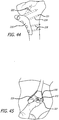
- the fixation of the tibial base component to the bone with distal 3.5mm compression screws 219 can now commence (See FIG. 44 ).
- An appropriate drill bit and drill guide (not shown) are selected and a pilot hole is drilled in the area.
- Appropriate screw lengths are then determined by measuring drill holes with a depth gauge in standard fashion. Steps are taken to ensure that both cortices are captured by the 3.5mm compression screws.
- a gap sizing tool (not shown) can be used to ensure that the base is properly positioned and that no new gaps have formed. If the gap sizing tool indicates an unacceptable gap, the base component should be repositioned. This procedure is repeated for the second 3.5mm bicortical 219 and the 6.5mm unicortical 221 compression screws. The three compression screws should be inserted and fixed prior to initiation of the 5.0mm locking screws 223 to ensure good compression of the base component onto the tibia, thereby maximizing osteointegration. All of the compression screws are then tightened to their final setting. The K-wire 217 is removed from the tibial base component. A verification is made that the target K-wire 151 has not bent or moved and that the absorber unit remains aligned perpendicular to the tibial plateau.
- the locking screws 223 are then selected. First, the correct drill bit and threaded drill guide to produce the correct hole size for the 5.0mm locking screws is also selected. A locking drill guide (not shown) is threaded into the tibial base component 715. A pilot hole is then drilled while ensuring minimal disturbance to the base component. The locking screws are screwed in place to the specified tightness (about 4 Nm torque). This procedure is repeated for the second locking screw 223.
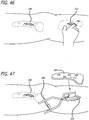
- the sheath 225 covering the internal components of the longitudinally compressed absorber 216 is now released from its folded back configuration.
- the absorber 216 is released by cutting structures such as retention sutures or wires (not shown) from the femoral side. This releases both the absorber and retracted ePTFE sheath. The knee should be in extension during absorber release.
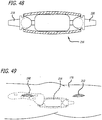
- the sheath is drawn over the mount and adjacent base region until an affixation point of the hole in the sheath aligns with the hole 227 in the base component.
- a split pin can be inserted into the aligned hole to secure the sheath onto the femoral base component. The procedure is repeated to attach sheath to the tibial base component.
- the knee should be rotated through deep flexion and full extension.
- the knee and device should be free to move normally. Motion of the device may be confirmed visually using fluoroscopy. If motion of the knee or device has been compromised in an unexpected manner as a result of the surgery, the device should be removed. If excessive soft tissue binding is observed, widening of the subcutaneous tunneled channel may be necessary.
- the bone is prepared for affixing a second base component 215.
- the surgeon's finger is used for blunt dissection and along natural tissue planes, and the periostium in the area is removed and displaced. Tissue is scraped to the bone to expose a white, bleeding bone area while being cautious not to disrupt the joint capsule.
- the retractor 188 can again be used to stretch the tissue forming the opening during implantation site preparation.
- one or more possible second base components 215, here the tibia base component are placed against the prepared bone to identify a desirable base-to-base component fit.
- remote viewing such as that provided by fluoroscopy is employed to aid in proper sizing and fit.
- the second base component 215 is removed from the site.
- a dummy link 216 including first and second tapered ends 218, 220 is inserted through the second incision 212 and is attached to a lower end of the first base 190 (where the K-wire socket structure 208 has been removed).
- the second base 215, the size and shape of which were previously described, is subsequently inserted through the second incision 212 and placed against bone.
- the second base component 215 is connected to the dummy link 216 so as to get a sense of the dimensions required for a proper link assembly to be attached to both bases and to span ajoint. This step can also help to confirm or select the optimum placement of the second base 215 to bone.
- a fixed distance link 222 having first and second ends 224, 226 can be utilized for proper link selection and for confirming and selecting the optimum second base position on a bone.
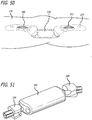
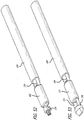
- the second end 226 of the fixed distance link 222 is releasably attached to a distal end of an insertion and tunneling tool 228.
- a cover 230 having a tapered profile is placed upon the first end portion of the fixed distance link.
- a second cover 232 (See FIG. 54 ) can be additionally provided to facilitate operation of the tunneling tool 228 within patient's anatomy.
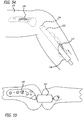
- the insertion and tunneling tool 228 is placed within the second incision 212 and is advanced toward the implanted first base component 190 (See FIG. 54 ).
- the tool 228 forms a tunnel between mounting locations without causing excessive tissue disruption.
- the knee is flexed to ensure the tunnel is established for all possible flexion/extension angles.
- the cover 230 is removed from the device and the first end 224 of the fixed distance link 222 is attached to the first base 190. If a second cover 232 is used, it is retracted to expose the fixed link 222.
- the previously described clamp 206 can be used to accomplish the connection between the components.
- the tunneling tool 228 is then removed.
- steps are taken to connect the second base to bone (See FIGS. 56 and 57 ).
- a direct guide 234 can where desirable" be placed over the second base component 215.
- support K-wires 236 are drilled through the guide 234, second base through holes 238 and into bone.
- compression screws or other fasteners are used to fix the second base component 215 to the bone. Verification of placement is confirmed through remote imaging.
- the K-wires 236 are removed from the second base component 215.
- the lower portion of the leg is flexed so that it forms an angle with the upper leg.
- the ends of the dummy or flexed length link 216, 222 are then disengaged from the bases 190, 215 and the link is removed from the interventional site.
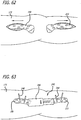
- a base location tool 240 including a pair of sliding halves 242, 244 which form a hoop structure can be placed between the first and second base components 190,215.
- This tool 240 can be used with bases that have been fixed to bone or prior to such fixation.
- a top side 246 resides on the outside of the patient's skin.
- the top portion 246 can include indicia 247 for identifying with certainty the space between the bases or the length of a proper link.
- a bottom portion includes a pair of oppositely located and spaced connection structures 248.
- the spaced connecting structures 248 are sized and shaped to releasably engage a respective one of the first and second bases 190, 215 and to permit a limited range of motion between the tool and bases. It is also contemplated that the height of the base locating tool can be modified for variations in patient skin and tissue thicknesses.
- K-wires 248 can be used to temporarily fix the bases in place (See FIG. 63 ).
- Various sized and shaped bases 190, 215 can be used to achieve proper fit.
- the patient's anatomy here the limbs forming the knee, are flexed to record the maximum link extension required. A check for bending of the components is made at this time both when the anatomy is in its flexed ( FIG. 64 ) and in its extended position ( FIG. 65 ).
- the bases are then affixed to bone (if not already done so) and the base locator tool (and K-wires 248) is removed from the site. In this way, proper position of the bases 190,215 and/or proper selection of a link is accomplished.
- an insertion and tunneling tool 228 is employed to complete the assembly of a mechanical energy absorbing device at the implantation site.
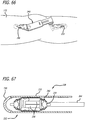
- the mechanical energy absorbing device can be held in a longitudinally compressed condition by wires or other delivery structures.
- wires or other delivery structures can operate on the spring assembly of the device or can be attached to other structure to accomplish the desired compression.
- the link assembly 250 includes first 252 and second 254 ends each with an articulatable tapered post. The posts are each sized to fixedly engage one base component 190, 215.
- the two part base/tapered post mounts provide a method (which is not part of the invention) for good attachment of the base to the bone and a more simple surgical technique for installing the link assembly. It also allows the sheath and/or wear components of the link/mount assembly to be removeable and/or replaceable without removing or replacing the base components. It further allows the wear components of the link/mount assembly and the base components to be different materials.
- the base components can be titanium or titanium alloy which promote osteo-integration and the wear components can be much harder materials such as cobalt chrome (e.g., Biodur CCM Plus), ceramic, or other durable materials that produce a minimal amount of particulate material or, if particulate material is generated, the smallest size of particulate material.
- the link assembly also includes energy absorbing and manipulating structure 256 as well as an extendable sheath 260 extending between a pair of spaced socket locks 262.
- the tunneling tool 228 further includes a push rod 264, a distal end of which releasably engages and stabilizes the link assembly 250 through a connection with the second tapered post structure 254.
- the tunneling device 228 loaded with a link assembly 250 is placed within the second incision 212 (an approach through the first incision can also be employed with a link assembly loaded in an opposite direction) and advanced as described above previously toward the first base component 190.
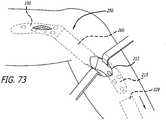
- the first end 252 of the link assembly is placed into complementary structure 266 of the base component (See FIG. 70 ).
- clamp 206 See FIG. 27
- a similar tool is utilized.
- a plastic barrier can be temporarily inserted to keep the soft tissues beneath the joint from interfering in connection of the link assembly and sheath to the base component.
- An adjacent socket lock 262 (See FIG. 71 ) is then manipulated to permit extending the sheath (See FIG. 72 ) over a portion of the first base component 190. Similar steps are taken to connect and cover the second base component 215 to the link assembly 250. Inspections are made to ensure proper connections and the tunneling tool is then removed from the site.
- the link assembly can be placed in a sheath like sheath 232 of tunneling tool 228 having a leading end closed by a suture (not shown).
- the sheath with a leading suture can be inserted through the second incision 212 and then through the space created between the incision 186,212, and thereafter, advanced toward the first incision 186 by pulling on the lead suture.
- one or more colored sutures can be employed for different functions, such as pulling the sheath through the site and holding a link assembly in a compressed state. In this way, the sheath acts like a protective poncho facilitating the advancement of the link assembly, being held in a longitudinally compressed state, through the interventional space.
- cutting the suture can release the link from the sheath so that the sheath can be removed from the site.
- a second suture can be severed when desired to permit the link device to assume a longitudinally expanded state.
- a socket holder 280 including a ringlet 282 is used to temporarily attach the link assembly 250 to a mount of the femoral base 190.
- the ringlet can be pulled by hand or another tool through a tunnel formed beneath the skin between the bases 190,215 or alternatively simply used to temporarily attach the link to the mount of the base.
- the temporary socket holder is replaced by a socket holder assembly 282 (See FIG.
- a taper lock tool assembly 288 is configured about the clamping arms 284, 286.
- the taper lock tool assembly 288 includes an activation arm 290 and a taper lock pusher block 292, each of which are guided by a pair of spaced shafts 294. Actuation of the activation arm results in the pusher block 292 accomplishing a locking engagement of the link assembly 250 to the femoral base 190.
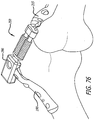
- temporary attachment of the link assembly 250 to the femoral base 190 as well as the advancement of the link assembly 250 within a patient's skin can be achieved by using the socket hook 296 shown in FIG. 76 .
- the tool 300 includes a socket loader 302 having a lead end configured to graspingly engage a mount 304 of a link assembly 250.
- the socket loader 302 is sized and shaped to receive a shaft 306 having a threaded portion for engagement with complementary structures formed in the socket loader.
- a back end of the shaft 306 includes a hex structure configured to receive a hex drive component 308.
- a counter torque handle 310 sized to grasp the socket loader 302 is further provided.
- the socket holder 302 is placed into engagement with a mount 304 and the hex drive 308 is turned to advance the shaft distally. As the shaft 306 is advanced, it engages a recess 312 or other convenient structure of the base 190. From this anchor position, the mount 304 is effectively drawn into locking engagement with the base 190.
- a locking tool 320 can further include such structure intended to prevent damage to an implant should a physician attempt to over tighten or use excessive force to accomplish a locking engagement between implant components.
- the tool 320 can embody a Belleville spring stack 322 configured to compress enough so that a shoulder on a hex 324 will advance against a body 326 of the tool 320 and thus absorb the excess forces rather than allow the same to be applied against the implant. Accordingly, turning the hex 324 will advance a threaded shaft 330 within the tool 320 to thereby move a top of a base/mount engagement member 332 against a mount placed within a recess 334 sized for receiving the mount. Again, any excessive forces employed to accomplish a locking engagement between implant components will be blocked by the Belleville stack 327.
- the first 186 and second 212 incisions made at the interventional site are then closed (See FIG. 81 ) and post-surgery clean-up is performed.
- two incisions are made above each end of the absorber and tissue is retracted to expose the absorber base coupling area and the sheath is retracted or cut back.
- the absorber is decoupled from each base component without permenant deformation of the base component and the absorber removed from within the tissue tunnel.
- Another absorber unit may be coupled to the remaining bases using previously described me,thods.
- the screws are removed and base components lifted fromt he bone surface. In this scenario the device assembly including absorber may be removed as a single unit.
- a removal instrument is inserted into the base socket access port.
- the instrument is levered to press on locked portion of the implant.
- Stimulation of the interventional sites in combination with implantation of a mechanical energy absorption device may facilitate treating conditions affecting a body joint, such as osteoarthritis, via a number of different mechanisms.
- Such stimulation means can form an integral part of the mechanical energy absorbing apparatus or can define separate structure.
- electrical stimulation may block the perception of pain associated with osteoarthritis.
- Electrical stimulation of ajoint affected by osteoarthritis, an intraarticular joint space of the affected joint, one or more peripheral nerves that innervate the affected joint, the spinal cord, spinal segments supplying somatic sensation at the affected joint, spinal segments supplying sympathetic control of the affected joint, the nucleus gracilis, one or more cranial nerves, one or more areas in the brain, the hypothalamus, the thalamus, the motor cortex, and/or any other stimulation site may effectively inhibit or relieve pain associated with osteoarthritis and help with the efficacy of the implantation procedure.
- Another contemplated approach involves the infusion of drugs, chemicals, and/or other substances designed to or known empirically to treat osteoarthritis. Infusing drugs, chemicals, and/or other substances directly into the local area of an affected joint or into nerves and/or arteries supplying thejoint may allow relatively high therapeutic doses.
- the infusion of drugs, chemicals, and/or other substances into ajoint affected by osteoarthritis, an intraarticular joint space of the affected joint, an artery supplying the affected joint, one or more peripheral nerves that innervate the affected joint, the spinal cord, spinal segments supplying somatic sensation at the affected joint, spinal segments supplying sympathetic control of the affected joint, the sympathetic ganglia, the nucleus gracilis, one or more cranial nerves, one or more areas in the brain, the hypothalamus, the thalamus, the motor cortex, and/or any other stimulation site may also effectively facilitate treatment.
- Stimulation can also involve proprioceptive pathways supplying ajoint with osteoarthritis. Stimulation of proprioceptive pathways supplying ajoint may improve patient proprioception through the phenomenon of stochastic resonance. Accordingly, stimulation of a joint affected by osteoarthritis, an intraarticular joint space of the affected joint, one or more peripheral nerves that innervate the affected joint, the spinal cord, spinal segments supplying sympathetic control of the affected joint, the nucleus gracilis, one or more cranial nerves, one or more areas in the brain, the hypothalamus, the thalamus, the motor cortex, and/or any other stimulation site may also lead to higher incidence of efficacy.
- modulating the blood supply to a joint or direct stimulation of the arteries supplying an affectedjoint may have beneficial results. Therefore, stimulation of an artery supplying the affected joint, one or more peripheral nerves that innervate the affectedjoint, the spinal cord, spinal segments supplying somatic sensation at the affectedjoint, spinal segments supplying sympathetic control of the affectedjoint, the sympathetic ganglia, the nucleus gracilis, one or more cranial nerves, and/or any other stimulation site is contemplated.
- the blood flow into ajoint may be decreased by exciting sympathetic drive responsible for generating vasoconstriction. Decreasing the blood flow into ajoint may reduce swelling in the affected joint and aid in joint improvement.
- the present disclosure provides a number of ways to treat body tissues and in particular, to implant absorb energy or manipulate forces to reduce pain.
- Various aspects of the disclosed approaches can be substituted for or used to complement other of the disclosed approaches.
- the present disclosure can be used throughout the body but have clear applications to articulating body structures such as joints.
Landscapes
- Health & Medical Sciences (AREA)
- Surgery (AREA)
- Orthopedic Medicine & Surgery (AREA)
- Life Sciences & Earth Sciences (AREA)
- Heart & Thoracic Surgery (AREA)
- Veterinary Medicine (AREA)
- Engineering & Computer Science (AREA)
- Biomedical Technology (AREA)
- Nuclear Medicine, Radiotherapy & Molecular Imaging (AREA)
- Medical Informatics (AREA)
- Molecular Biology (AREA)
- Animal Behavior & Ethology (AREA)
- General Health & Medical Sciences (AREA)
- Public Health (AREA)
- Neurology (AREA)
- Dentistry (AREA)
- Oral & Maxillofacial Surgery (AREA)
- Surgical Instruments (AREA)
- Prostheses (AREA)
Applications Claiming Priority (6)
| Application Number | Priority Date | Filing Date | Title |
|---|---|---|---|
| US4940308P | 2008-04-30 | 2008-04-30 | |
| US12/113,162 US8425616B2 (en) | 2007-07-09 | 2008-04-30 | Surgical implantation method and devices for an extra-articular mechanical energy absorbing apparatus |
| US12/113,164 US20090018665A1 (en) | 2007-07-09 | 2008-04-30 | Surgical implantation method and devices for an extra-articular mechanical energy absorbing apparatus |
| US12/113,160 US7632310B2 (en) | 2007-07-09 | 2008-04-30 | Surgical implantation method and devices for an extra-articular mechanical energy absorbing apparatus |
| US12/113,157 US7846211B2 (en) | 2007-07-09 | 2008-04-30 | Surgical implantation method and devices for an extra-articular mechanical energy absorbing apparatus |
| PCT/US2009/002722 WO2009134446A2 (en) | 2007-07-09 | 2009-04-30 | Surgical implantation method and devices for an extra-articular mechanical energy absorbing apparatus |
Publications (2)
| Publication Number | Publication Date |
|---|---|
| EP2273941A2 EP2273941A2 (en) | 2011-01-19 |
| EP2273941B1 true EP2273941B1 (en) | 2020-09-02 |
Family
ID=43333148
Family Applications (1)
| Application Number | Title | Priority Date | Filing Date |
|---|---|---|---|
| EP09739249.2A Not-in-force EP2273941B1 (en) | 2008-04-30 | 2009-04-30 | Surgical devices for an extra-articular mechanical energy absorbing apparatus |
Country Status (4)
| Country | Link |
|---|---|
| EP (1) | EP2273941B1 (enExample) |
| JP (1) | JP2011519304A (enExample) |
| AU (1) | AU2009241686B2 (enExample) |
| CA (1) | CA2725389A1 (enExample) |
Families Citing this family (3)
| Publication number | Priority date | Publication date | Assignee | Title |
|---|---|---|---|---|
| US20110112639A1 (en) * | 2009-11-06 | 2011-05-12 | Moximed, Inc. | Positioning Systems and Methods for Implanting an Energy Absorbing System |
| JP7257016B2 (ja) * | 2017-12-07 | 2023-04-13 | アルスロデザイン株式会社 | 患者適合型ガイド設置用器具 |
| CN113763340B (zh) * | 2021-08-25 | 2024-07-02 | 中国人民解放军空军军医大学 | 基于多任务深度学习强直性脊柱炎的自动分级方法 |
Family Cites Families (6)
| Publication number | Priority date | Publication date | Assignee | Title |
|---|---|---|---|---|
| US4246660A (en) * | 1978-12-26 | 1981-01-27 | Queen's University At Kingston | Artificial ligament |
| JP2532346B2 (ja) * | 1993-10-12 | 1996-09-11 | 良二 城 | 体外式人工関節 |
| SE510125C2 (sv) * | 1996-01-22 | 1999-04-19 | Handevelop Ab | Ledersättningsanordning |
| US7285121B2 (en) * | 2001-11-05 | 2007-10-23 | Warsaw Orthopedic, Inc. | Devices and methods for the correction and treatment of spinal deformities |
| EP2001382B1 (en) * | 2006-04-06 | 2015-07-29 | Synthes GmbH | Remotely adjustable tissue displacement device |
| US20080275567A1 (en) * | 2007-05-01 | 2008-11-06 | Exploramed Nc4, Inc. | Extra-Articular Implantable Mechanical Energy Absorbing Systems |
-
2009
- 2009-04-30 AU AU2009241686A patent/AU2009241686B2/en not_active Ceased
- 2009-04-30 CA CA2725389A patent/CA2725389A1/en not_active Abandoned
- 2009-04-30 EP EP09739249.2A patent/EP2273941B1/en not_active Not-in-force
- 2009-04-30 JP JP2011507473A patent/JP2011519304A/ja active Pending
Non-Patent Citations (1)
| Title |
|---|
| None * |
Also Published As
| Publication number | Publication date |
|---|---|
| AU2009241686A1 (en) | 2009-11-05 |
| AU2009241686A2 (en) | 2010-12-23 |
| CA2725389A1 (en) | 2009-11-05 |
| JP2011519304A (ja) | 2011-07-07 |
| EP2273941A2 (en) | 2011-01-19 |
| AU2009241686B2 (en) | 2015-01-22 |
Similar Documents
| Publication | Publication Date | Title |
|---|---|---|
| US7846211B2 (en) | Surgical implantation method and devices for an extra-articular mechanical energy absorbing apparatus | |
| US8425616B2 (en) | Surgical implantation method and devices for an extra-articular mechanical energy absorbing apparatus | |
| US7632310B2 (en) | Surgical implantation method and devices for an extra-articular mechanical energy absorbing apparatus | |
| US20090018665A1 (en) | Surgical implantation method and devices for an extra-articular mechanical energy absorbing apparatus | |
| AU2008275070B2 (en) | Extra-articular implantable mechanical energy absorbing systems and implantation method | |
| US9532804B2 (en) | Implantation approach and instrumentality for an energy absorbing system | |
| US9060867B2 (en) | Extra-articular implantable mechanical energy absorbing assemblies having a tension member, and methods | |
| EP2273941B1 (en) | Surgical devices for an extra-articular mechanical energy absorbing apparatus | |
| AU2014200703A1 (en) | Extra-articular implantable mechanical energy absorbing systems and implantation method |
Legal Events
| Date | Code | Title | Description |
|---|---|---|---|
| PUAI | Public reference made under article 153(3) epc to a published international application that has entered the european phase |
Free format text: ORIGINAL CODE: 0009012 |
|
| 17P | Request for examination filed |
Effective date: 20101103 |
|
| AK | Designated contracting states |
Kind code of ref document: A2 Designated state(s): AT BE BG CH CY CZ DE DK EE ES FI FR GB GR HR HU IE IS IT LI LT LU LV MC MK MT NL NO PL PT RO SE SI SK TR |
|
| AX | Request for extension of the european patent |
Extension state: AL BA RS |
|
| DAX | Request for extension of the european patent (deleted) | ||
| STAA | Information on the status of an ep patent application or granted ep patent |
Free format text: STATUS: EXAMINATION IS IN PROGRESS |
|
| 17Q | First examination report despatched |
Effective date: 20170831 |
|
| RAP1 | Party data changed (applicant data changed or rights of an application transferred) |
Owner name: MOXIMED, INC. |
|
| RIN1 | Information on inventor provided before grant (corrected) |
Inventor name: MAKOWER, JOSHUA Inventor name: CLIFFORD, ANTON G. Inventor name: SALIMAN, JUSTIN Inventor name: GABRIEL, STEFAN Inventor name: O'CONNELL, MARY Inventor name: TORNETTA, PAUL, III Inventor name: LANDRY, MICHAEL E. |
|
| REG | Reference to a national code |
Ref country code: DE Ref legal event code: R079 Ref document number: 602009062701 Country of ref document: DE Free format text: PREVIOUS MAIN CLASS: A61B0017680000 Ipc: A61B0017880000 |
|
| RIC1 | Information provided on ipc code assigned before grant |
Ipc: A61B 17/17 20060101ALI20191023BHEP Ipc: A61B 17/70 20060101ALI20191023BHEP Ipc: A61B 17/88 20060101AFI20191023BHEP |
|
| GRAP | Despatch of communication of intention to grant a patent |
Free format text: ORIGINAL CODE: EPIDOSNIGR1 |
|
| STAA | Information on the status of an ep patent application or granted ep patent |
Free format text: STATUS: GRANT OF PATENT IS INTENDED |
|
| INTG | Intention to grant announced |
Effective date: 20191220 |
|
| GRAJ | Information related to disapproval of communication of intention to grant by the applicant or resumption of examination proceedings by the epo deleted |
Free format text: ORIGINAL CODE: EPIDOSDIGR1 |
|
| STAA | Information on the status of an ep patent application or granted ep patent |
Free format text: STATUS: EXAMINATION IS IN PROGRESS |
|
| INTC | Intention to grant announced (deleted) | ||
| GRAR | Information related to intention to grant a patent recorded |
Free format text: ORIGINAL CODE: EPIDOSNIGR71 |
|
| GRAS | Grant fee paid |
Free format text: ORIGINAL CODE: EPIDOSNIGR3 |
|
| STAA | Information on the status of an ep patent application or granted ep patent |
Free format text: STATUS: GRANT OF PATENT IS INTENDED |
|
| GRAA | (expected) grant |
Free format text: ORIGINAL CODE: 0009210 |
|
| STAA | Information on the status of an ep patent application or granted ep patent |
Free format text: STATUS: THE PATENT HAS BEEN GRANTED |
|
| AK | Designated contracting states |
Kind code of ref document: B1 Designated state(s): AT BE BG CH CY CZ DE DK EE ES FI FR GB GR HR HU IE IS IT LI LT LU LV MC MK MT NL NO PL PT RO SE SI SK TR |
|
| INTG | Intention to grant announced |
Effective date: 20200728 |
|
| REG | Reference to a national code |
Ref country code: GB Ref legal event code: FG4D |
|
| REG | Reference to a national code |
Ref country code: AT Ref legal event code: REF Ref document number: 1307895 Country of ref document: AT Kind code of ref document: T Effective date: 20200915 Ref country code: CH Ref legal event code: EP |
|
| REG | Reference to a national code |
Ref country code: DE Ref legal event code: R096 Ref document number: 602009062701 Country of ref document: DE |
|
| REG | Reference to a national code |
Ref country code: IE Ref legal event code: FG4D |
|
| REG | Reference to a national code |
Ref country code: LT Ref legal event code: MG4D |
|
| PG25 | Lapsed in a contracting state [announced via postgrant information from national office to epo] |
Ref country code: FI Free format text: LAPSE BECAUSE OF FAILURE TO SUBMIT A TRANSLATION OF THE DESCRIPTION OR TO PAY THE FEE WITHIN THE PRESCRIBED TIME-LIMIT Effective date: 20200902 Ref country code: HR Free format text: LAPSE BECAUSE OF FAILURE TO SUBMIT A TRANSLATION OF THE DESCRIPTION OR TO PAY THE FEE WITHIN THE PRESCRIBED TIME-LIMIT Effective date: 20200902 Ref country code: BG Free format text: LAPSE BECAUSE OF FAILURE TO SUBMIT A TRANSLATION OF THE DESCRIPTION OR TO PAY THE FEE WITHIN THE PRESCRIBED TIME-LIMIT Effective date: 20201202 Ref country code: SE Free format text: LAPSE BECAUSE OF FAILURE TO SUBMIT A TRANSLATION OF THE DESCRIPTION OR TO PAY THE FEE WITHIN THE PRESCRIBED TIME-LIMIT Effective date: 20200902 Ref country code: NO Free format text: LAPSE BECAUSE OF FAILURE TO SUBMIT A TRANSLATION OF THE DESCRIPTION OR TO PAY THE FEE WITHIN THE PRESCRIBED TIME-LIMIT Effective date: 20201202 Ref country code: GR Free format text: LAPSE BECAUSE OF FAILURE TO SUBMIT A TRANSLATION OF THE DESCRIPTION OR TO PAY THE FEE WITHIN THE PRESCRIBED TIME-LIMIT Effective date: 20201203 Ref country code: LT Free format text: LAPSE BECAUSE OF FAILURE TO SUBMIT A TRANSLATION OF THE DESCRIPTION OR TO PAY THE FEE WITHIN THE PRESCRIBED TIME-LIMIT Effective date: 20200902 |
|
| REG | Reference to a national code |
Ref country code: NL Ref legal event code: MP Effective date: 20200902 |
|
| REG | Reference to a national code |
Ref country code: AT Ref legal event code: MK05 Ref document number: 1307895 Country of ref document: AT Kind code of ref document: T Effective date: 20200902 |
|
| PG25 | Lapsed in a contracting state [announced via postgrant information from national office to epo] |
Ref country code: PL Free format text: LAPSE BECAUSE OF FAILURE TO SUBMIT A TRANSLATION OF THE DESCRIPTION OR TO PAY THE FEE WITHIN THE PRESCRIBED TIME-LIMIT Effective date: 20200902 Ref country code: LV Free format text: LAPSE BECAUSE OF FAILURE TO SUBMIT A TRANSLATION OF THE DESCRIPTION OR TO PAY THE FEE WITHIN THE PRESCRIBED TIME-LIMIT Effective date: 20200902 |
|
| PG25 | Lapsed in a contracting state [announced via postgrant information from national office to epo] |
Ref country code: EE Free format text: LAPSE BECAUSE OF FAILURE TO SUBMIT A TRANSLATION OF THE DESCRIPTION OR TO PAY THE FEE WITHIN THE PRESCRIBED TIME-LIMIT Effective date: 20200902 Ref country code: CZ Free format text: LAPSE BECAUSE OF FAILURE TO SUBMIT A TRANSLATION OF THE DESCRIPTION OR TO PAY THE FEE WITHIN THE PRESCRIBED TIME-LIMIT Effective date: 20200902 Ref country code: RO Free format text: LAPSE BECAUSE OF FAILURE TO SUBMIT A TRANSLATION OF THE DESCRIPTION OR TO PAY THE FEE WITHIN THE PRESCRIBED TIME-LIMIT Effective date: 20200902 Ref country code: NL Free format text: LAPSE BECAUSE OF FAILURE TO SUBMIT A TRANSLATION OF THE DESCRIPTION OR TO PAY THE FEE WITHIN THE PRESCRIBED TIME-LIMIT Effective date: 20200902 Ref country code: PT Free format text: LAPSE BECAUSE OF FAILURE TO SUBMIT A TRANSLATION OF THE DESCRIPTION OR TO PAY THE FEE WITHIN THE PRESCRIBED TIME-LIMIT Effective date: 20210104 |
|
| PG25 | Lapsed in a contracting state [announced via postgrant information from national office to epo] |
Ref country code: AT Free format text: LAPSE BECAUSE OF FAILURE TO SUBMIT A TRANSLATION OF THE DESCRIPTION OR TO PAY THE FEE WITHIN THE PRESCRIBED TIME-LIMIT Effective date: 20200902 Ref country code: ES Free format text: LAPSE BECAUSE OF FAILURE TO SUBMIT A TRANSLATION OF THE DESCRIPTION OR TO PAY THE FEE WITHIN THE PRESCRIBED TIME-LIMIT Effective date: 20200902 Ref country code: IS Free format text: LAPSE BECAUSE OF FAILURE TO SUBMIT A TRANSLATION OF THE DESCRIPTION OR TO PAY THE FEE WITHIN THE PRESCRIBED TIME-LIMIT Effective date: 20210102 |
|
| REG | Reference to a national code |
Ref country code: DE Ref legal event code: R097 Ref document number: 602009062701 Country of ref document: DE |
|
| PG25 | Lapsed in a contracting state [announced via postgrant information from national office to epo] |
Ref country code: SK Free format text: LAPSE BECAUSE OF FAILURE TO SUBMIT A TRANSLATION OF THE DESCRIPTION OR TO PAY THE FEE WITHIN THE PRESCRIBED TIME-LIMIT Effective date: 20200902 |
|
| PLBE | No opposition filed within time limit |
Free format text: ORIGINAL CODE: 0009261 |
|
| STAA | Information on the status of an ep patent application or granted ep patent |
Free format text: STATUS: NO OPPOSITION FILED WITHIN TIME LIMIT |
|
| 26N | No opposition filed |
Effective date: 20210603 |
|
| PG25 | Lapsed in a contracting state [announced via postgrant information from national office to epo] |
Ref country code: DK Free format text: LAPSE BECAUSE OF FAILURE TO SUBMIT A TRANSLATION OF THE DESCRIPTION OR TO PAY THE FEE WITHIN THE PRESCRIBED TIME-LIMIT Effective date: 20200902 Ref country code: SI Free format text: LAPSE BECAUSE OF FAILURE TO SUBMIT A TRANSLATION OF THE DESCRIPTION OR TO PAY THE FEE WITHIN THE PRESCRIBED TIME-LIMIT Effective date: 20200902 |
|
| PG25 | Lapsed in a contracting state [announced via postgrant information from national office to epo] |
Ref country code: IT Free format text: LAPSE BECAUSE OF FAILURE TO SUBMIT A TRANSLATION OF THE DESCRIPTION OR TO PAY THE FEE WITHIN THE PRESCRIBED TIME-LIMIT Effective date: 20200902 |
|
| REG | Reference to a national code |
Ref country code: DE Ref legal event code: R119 Ref document number: 602009062701 Country of ref document: DE |
|
| PG25 | Lapsed in a contracting state [announced via postgrant information from national office to epo] |
Ref country code: MC Free format text: LAPSE BECAUSE OF FAILURE TO SUBMIT A TRANSLATION OF THE DESCRIPTION OR TO PAY THE FEE WITHIN THE PRESCRIBED TIME-LIMIT Effective date: 20200902 |
|
| GBPC | Gb: european patent ceased through non-payment of renewal fee |
Effective date: 20210430 |
|
| PG25 | Lapsed in a contracting state [announced via postgrant information from national office to epo] |
Ref country code: LU Free format text: LAPSE BECAUSE OF NON-PAYMENT OF DUE FEES Effective date: 20210430 |
|
| REG | Reference to a national code |
Ref country code: BE Ref legal event code: MM Effective date: 20210430 |
|
| PG25 | Lapsed in a contracting state [announced via postgrant information from national office to epo] |
Ref country code: DE Free format text: LAPSE BECAUSE OF NON-PAYMENT OF DUE FEES Effective date: 20211103 Ref country code: GB Free format text: LAPSE BECAUSE OF NON-PAYMENT OF DUE FEES Effective date: 20210430 Ref country code: FR Free format text: LAPSE BECAUSE OF NON-PAYMENT OF DUE FEES Effective date: 20210430 Ref country code: LI Free format text: LAPSE BECAUSE OF NON-PAYMENT OF DUE FEES Effective date: 20210430 Ref country code: CH Free format text: LAPSE BECAUSE OF NON-PAYMENT OF DUE FEES Effective date: 20210430 |
|
| PG25 | Lapsed in a contracting state [announced via postgrant information from national office to epo] |
Ref country code: IE Free format text: LAPSE BECAUSE OF NON-PAYMENT OF DUE FEES Effective date: 20210430 |
|
| PG25 | Lapsed in a contracting state [announced via postgrant information from national office to epo] |
Ref country code: IS Free format text: LAPSE BECAUSE OF FAILURE TO SUBMIT A TRANSLATION OF THE DESCRIPTION OR TO PAY THE FEE WITHIN THE PRESCRIBED TIME-LIMIT Effective date: 20210102 |
|
| PG25 | Lapsed in a contracting state [announced via postgrant information from national office to epo] |
Ref country code: BE Free format text: LAPSE BECAUSE OF NON-PAYMENT OF DUE FEES Effective date: 20210430 |
|
| PG25 | Lapsed in a contracting state [announced via postgrant information from national office to epo] |
Ref country code: HU Free format text: LAPSE BECAUSE OF FAILURE TO SUBMIT A TRANSLATION OF THE DESCRIPTION OR TO PAY THE FEE WITHIN THE PRESCRIBED TIME-LIMIT; INVALID AB INITIO Effective date: 20090430 Ref country code: CY Free format text: LAPSE BECAUSE OF FAILURE TO SUBMIT A TRANSLATION OF THE DESCRIPTION OR TO PAY THE FEE WITHIN THE PRESCRIBED TIME-LIMIT Effective date: 20200902 |
|
| PG25 | Lapsed in a contracting state [announced via postgrant information from national office to epo] |
Ref country code: MK Free format text: LAPSE BECAUSE OF FAILURE TO SUBMIT A TRANSLATION OF THE DESCRIPTION OR TO PAY THE FEE WITHIN THE PRESCRIBED TIME-LIMIT Effective date: 20200902 |
|
| PG25 | Lapsed in a contracting state [announced via postgrant information from national office to epo] |
Ref country code: MT Free format text: LAPSE BECAUSE OF FAILURE TO SUBMIT A TRANSLATION OF THE DESCRIPTION OR TO PAY THE FEE WITHIN THE PRESCRIBED TIME-LIMIT Effective date: 20200902 |
|
| PG25 | Lapsed in a contracting state [announced via postgrant information from national office to epo] |
Ref country code: TR Free format text: LAPSE BECAUSE OF FAILURE TO SUBMIT A TRANSLATION OF THE DESCRIPTION OR TO PAY THE FEE WITHIN THE PRESCRIBED TIME-LIMIT Effective date: 20200902 |