EP2273485A1 - Video transmitter apparatus and video receiver apparatus - Google Patents
Video transmitter apparatus and video receiver apparatus Download PDFInfo
- Publication number
- EP2273485A1 EP2273485A1 EP10250956A EP10250956A EP2273485A1 EP 2273485 A1 EP2273485 A1 EP 2273485A1 EP 10250956 A EP10250956 A EP 10250956A EP 10250956 A EP10250956 A EP 10250956A EP 2273485 A1 EP2273485 A1 EP 2273485A1
- Authority
- EP
- European Patent Office
- Prior art keywords
- video
- receiver
- receiver apparatus
- transmitter
- information
- Prior art date
- Legal status (The legal status is an assumption and is not a legal conclusion. Google has not performed a legal analysis and makes no representation as to the accuracy of the status listed.)
- Granted
Links
Images


Classifications
-
- H—ELECTRICITY
- H04—ELECTRIC COMMUNICATION TECHNIQUE
- H04N—PICTORIAL COMMUNICATION, e.g. TELEVISION
- H04N5/00—Details of television systems
- H04N5/44—Receiver circuitry for the reception of television signals according to analogue transmission standards
-
- H—ELECTRICITY
- H04—ELECTRIC COMMUNICATION TECHNIQUE
- H04N—PICTORIAL COMMUNICATION, e.g. TELEVISION
- H04N21/00—Selective content distribution, e.g. interactive television or video on demand [VOD]
- H04N21/20—Servers specifically adapted for the distribution of content, e.g. VOD servers; Operations thereof
- H04N21/23—Processing of content or additional data; Elementary server operations; Server middleware
- H04N21/236—Assembling of a multiplex stream, e.g. transport stream, by combining a video stream with other content or additional data, e.g. inserting a URL [Uniform Resource Locator] into a video stream, multiplexing software data into a video stream; Remultiplexing of multiplex streams; Insertion of stuffing bits into the multiplex stream, e.g. to obtain a constant bit-rate; Assembling of a packetised elementary stream
- H04N21/2368—Multiplexing of audio and video streams
-
- H—ELECTRICITY
- H04—ELECTRIC COMMUNICATION TECHNIQUE
- H04N—PICTORIAL COMMUNICATION, e.g. TELEVISION
- H04N21/00—Selective content distribution, e.g. interactive television or video on demand [VOD]
- H04N21/40—Client devices specifically adapted for the reception of or interaction with content, e.g. set-top-box [STB]; Operations thereof
- H04N21/41—Structure of client; Structure of client peripherals
- H04N21/4104—Peripherals receiving signals from specially adapted client devices
- H04N21/4112—Peripherals receiving signals from specially adapted client devices having fewer capabilities than the client, e.g. thin client having less processing power or no tuning capabilities
-
- H—ELECTRICITY
- H04—ELECTRIC COMMUNICATION TECHNIQUE
- H04N—PICTORIAL COMMUNICATION, e.g. TELEVISION
- H04N21/00—Selective content distribution, e.g. interactive television or video on demand [VOD]
- H04N21/40—Client devices specifically adapted for the reception of or interaction with content, e.g. set-top-box [STB]; Operations thereof
- H04N21/43—Processing of content or additional data, e.g. demultiplexing additional data from a digital video stream; Elementary client operations, e.g. monitoring of home network or synchronising decoder's clock; Client middleware
- H04N21/4302—Content synchronisation processes, e.g. decoder synchronisation
- H04N21/4307—Synchronising the rendering of multiple content streams or additional data on devices, e.g. synchronisation of audio on a mobile phone with the video output on the TV screen
- H04N21/43076—Synchronising the rendering of multiple content streams or additional data on devices, e.g. synchronisation of audio on a mobile phone with the video output on the TV screen of the same content streams on multiple devices, e.g. when family members are watching the same movie on different devices
-
- H—ELECTRICITY
- H04—ELECTRIC COMMUNICATION TECHNIQUE
- H04N—PICTORIAL COMMUNICATION, e.g. TELEVISION
- H04N21/00—Selective content distribution, e.g. interactive television or video on demand [VOD]
- H04N21/40—Client devices specifically adapted for the reception of or interaction with content, e.g. set-top-box [STB]; Operations thereof
- H04N21/43—Processing of content or additional data, e.g. demultiplexing additional data from a digital video stream; Elementary client operations, e.g. monitoring of home network or synchronising decoder's clock; Client middleware
- H04N21/434—Disassembling of a multiplex stream, e.g. demultiplexing audio and video streams, extraction of additional data from a video stream; Remultiplexing of multiplex streams; Extraction or processing of SI; Disassembling of packetised elementary stream
- H04N21/4341—Demultiplexing of audio and video streams
-
- H—ELECTRICITY
- H04—ELECTRIC COMMUNICATION TECHNIQUE
- H04N—PICTORIAL COMMUNICATION, e.g. TELEVISION
- H04N21/00—Selective content distribution, e.g. interactive television or video on demand [VOD]
- H04N21/40—Client devices specifically adapted for the reception of or interaction with content, e.g. set-top-box [STB]; Operations thereof
- H04N21/43—Processing of content or additional data, e.g. demultiplexing additional data from a digital video stream; Elementary client operations, e.g. monitoring of home network or synchronising decoder's clock; Client middleware
- H04N21/436—Interfacing a local distribution network, e.g. communicating with another STB or one or more peripheral devices inside the home
- H04N21/43615—Interfacing a Home Network, e.g. for connecting the client to a plurality of peripherals
-
- H—ELECTRICITY
- H04—ELECTRIC COMMUNICATION TECHNIQUE
- H04N—PICTORIAL COMMUNICATION, e.g. TELEVISION
- H04N21/00—Selective content distribution, e.g. interactive television or video on demand [VOD]
- H04N21/40—Client devices specifically adapted for the reception of or interaction with content, e.g. set-top-box [STB]; Operations thereof
- H04N21/43—Processing of content or additional data, e.g. demultiplexing additional data from a digital video stream; Elementary client operations, e.g. monitoring of home network or synchronising decoder's clock; Client middleware
- H04N21/436—Interfacing a local distribution network, e.g. communicating with another STB or one or more peripheral devices inside the home
- H04N21/4363—Adapting the video stream to a specific local network, e.g. a Bluetooth® network
-
- H—ELECTRICITY
- H04—ELECTRIC COMMUNICATION TECHNIQUE
- H04N—PICTORIAL COMMUNICATION, e.g. TELEVISION
- H04N21/00—Selective content distribution, e.g. interactive television or video on demand [VOD]
- H04N21/40—Client devices specifically adapted for the reception of or interaction with content, e.g. set-top-box [STB]; Operations thereof
- H04N21/43—Processing of content or additional data, e.g. demultiplexing additional data from a digital video stream; Elementary client operations, e.g. monitoring of home network or synchronising decoder's clock; Client middleware
- H04N21/442—Monitoring of processes or resources, e.g. detecting the failure of a recording device, monitoring the downstream bandwidth, the number of times a movie has been viewed, the storage space available from the internal hard disk
- H04N21/44231—Monitoring of peripheral device or external card, e.g. to detect processing problems in a handheld device or the failure of an external recording device
-
- H—ELECTRICITY
- H04—ELECTRIC COMMUNICATION TECHNIQUE
- H04N—PICTORIAL COMMUNICATION, e.g. TELEVISION
- H04N5/00—Details of television systems
- H04N5/76—Television signal recording
Definitions
- the present invention relates to a video transmitter apparatus and a video receiver apparatus being able to communicate with equipment at connection by using an interface, such as, on a radio or wireless.
- HDMI High-Definition Multimedia Interface:®
- the video transmitter apparatus reads the receiver apparatus information indicating the capacity and/or the specification of the video receiver apparatus (for example, EDID (Extended Display Identification Data)), when transmitting a video signal from the video transmitter apparatus to the video receiver apparatus, and thereby it is possible for the video transmitter apparatus to transmit video/audio signals of a format, which is suitable for a capacity and/or a specification of the video receiver apparatus.
- the receiver apparatus information indicating the capacity and/or the specification of the video receiver apparatus (for example, EDID (Extended Display Identification Data)
- EDID Extended Display Identification Data
- this EDID are described the followings; i.e., a physical address, which is defined under the HDMI ® regulation, for example, and a display delay-time, etc., and there are cases where this physical address changes depending on structures of connecting the equipments to the video receiver apparatus and the video transmitter apparatus, and the display delay-time changes depending on a signal processing method of the video receiver apparatus. For this reason, the video transmitter apparatus needs to read out, appropriately, depending on change of EDID of the video receiver apparatus; however, there is a problem of a transmission delay and/or a transmission capacity within an interface, such as, a wireless connection, etc., there are cases where the EDID cannot be read out quickly.
- Patent Document 1 In the Patent Document 1 is described that, for a source (i.e., the video transmitter apparatus) to read out EDID of a display (i.e., the video receiver apparatus), quickly, a master simulator on the display (the video receiver apparatus) side executes polling on change of a slave (i.e., EDID), continuously, so as to maintain the present condition within a shadow memory within a slave simulator on a source (i.e., the video transmitter apparatus) side, and thereby a readout process from a master (i.e., the video transmitter apparatus) can be executed directly, from the shadow memory of the slave simulator, but without detecting a wireless rink.
- a master simulator on the display (the video receiver apparatus) side executes polling on change of a slave (i.e., EDID), continuously, so as to maintain the present condition within a shadow memory within a slave simulator on a source (i.e., the video transmitter apparatus) side, and thereby a readout process from a master (i.
- Patent Document 2 when it is change relating to the EDID information, data of a corresponding item of the EDID information, which is stored within a rewritable memory, is rewritten corresponding to that change, and in addition thereto, an ID unique to a product within that EDID information is rewritten, and the EDID information stored within the rewritable memory is transmitted to a personal computer through a DDC communication function.
- a video interface such as, on a radio orwireless, etc., having transmission delay and being insufficient on communication capacity thereof
- an object of the present invention being accomplished by taking the drawbacks mentioned above into the consideration thereof, is to provide a technology for enabling to obtain the receiver apparatus information suitable for a case when the apparatus information of the video receiver apparatus changes, where the video transmitter apparatus and the video receiver apparatus are connected with, through a wireless interface.
- a memory portion for memorizing a history number which is altered depending on changes of receiver apparatus information of itself, is provided within a video receiver apparatus, while within a video transmitter apparatus is provided a memory portion for memorizing the receiver apparatus information form said video receiver apparatus and said history number thereof, when said video transmitter apparatus obtains the newest receiver apparatus information of said video receiver apparatus, it transmits the history number memorized in the memory portion of the video transmitter apparatus to the video receiver apparatus, while the video receiver apparatus compares between the history number transmitted from the video transmitter apparatus and the history number of itself, which is memorized in the memory portion thereof, wherein the newest receiver apparatus information and the newest history number (i.e., the history number memorized in a first memory portion) to the video transmitter apparatus.
- the video receiver apparatus since the video receiver apparatus transmits the newest receiver apparatus information to the video transmitter apparatus, when the history number from the video transmitter apparatus differs from, it is possible to bring an amount or volume of transmission for connecting between the video transmitter apparatus and the video receiver apparatus, down to the minimum. Therefore, according to the present invention, it is possible to obtain the receiver apparatus information, suitably in case when the apparatus information of the video receiver apparatus is changed.
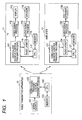
- Fig.1 attached is a configuration view for showing an example of a system, according to an embodiment of the present invention, wherein a video transmitter apparatus 10 is connected with a TV 11 and an amplifier 12, each being a video receiver apparatus, through a wireless interface.
- the video transmitter apparatus 10 may be, for example, a HDD player or a DVD player, etc. , and it has s signal source 101, a transmitter/receiver portion 102 for transmitting/receiving video/audio signals and a control signal, a memory portion 103, and a CPU 104.
- the TV being the video receiver apparatus, has a transmitter/receiver portion 111 for transmitting/receiving video/audio signals and a control signal, a video signal processor 112, a display portion 113, an audio delay or latency portion 114, an audio signal processor 115, a speaker 116, a CPU 117 and a memory portion 118.
- the amplifier 12 has a transmitter/receiver portion 121 for transmitting/receiving video/audio signals and a control signal, an audio delay or latency portion 124, an audio signal processor 125, a speaker 126, a CPU 127 and a memory portion 128.
- history information indicating a renewal history (i.e., version information) of that receiver apparatus information together with the receiver apparatus information, is memorized into the memory portion 118 of the video receiver apparatus, and this receiver apparatus information and the history information are transmitted to the video transmitter apparatus 10, to be memorized in the memory portion 103.
- the video transmitter apparatus 10 obtains new (i.e., being changed) receiver apparatus information, within the video receiver apparatus,the historyinformation,which is memorized within the memory portion 103 of the video transmitter apparatus 10, and the history information, which is memorized in the memory portion 118 of the video receiver apparatus, are compared with, and when they are inconsistent with, new receiver apparatus information is transmitted to the video transmitter apparatus 10.
- the historyinformation which is memorized within the memory portion 103 of the video transmitter apparatus 10
- the history information which is memorized in the memory portion 118 of the video receiver apparatus
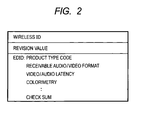
- the EDID includes, for example, a product code of that TV 11 and/or video/audio formats receivable, video/audio latency, a colorimetry, etc.
- the receiver apparatus information will be called "EDID".
- the TV 11 transmits or reports EDID memorized in the memory portion 118 to the video transmitter apparatus 10, via the transmitter/receiver portion 111 on the TV 11 side.
- the video transmitter apparatus 10 receives the EDID from the TV 11 with the transmitting/receiving function of the control signal within the transmitter/receiver portion 102, and memorizes all or a part of the EDID received, in the memory portion 103 within the video transmitter apparatus 10.
- the CPU 104 determines optimal video/audio transmission formats, by referring to a receiving capacity and a specification of the TV 11, which are described in the EDID memorized in the memory portion 103. And, the CPU 104 controls the signal source 101 in such that it produces a video signal and an audio signal corresponding to that video/audio formats determined.
- the video/audio signals outputted from the signal source 101 are transmitted from the transmitter/receiver portion 102, and are received by the transmitter/receiver portion 111 of the TV 11.
- the video/audio signals received by the transmitter/receiver portion 111 are reproduced on the display portion 113 and through the speaker 116, passing through the video signal processor 112 and the audio signal processor 115, respectively.
- the video signal processor 112 uses therein a frame memory, etc., since it needs a time for video processing, there may be a possibility that reproduction of the video is delayed with respect to the audio reproduced from the speaker.
- delay or the latency of the video accompanying with video processing within the video signal processor 112 may be compensated, and video and audio may be synchronized with, by entering the audio latency portion 114 therein.
- the memory portions 118 and 103 are connected with the transmitting/receiver portions 111 and 102 via the CPUs 117 and 104, respectively; however, the EDID may be transmitted/received, by connecting them directly, not passing through the CPUs.
- the amplifier 12 transmits or reports the EDID indicating the receiving capacity and/or the specification of that amplifier 12, which is/are memorized in the memory portion 128, passing through the transmitter/receiver portion 121 on the amplifier 12b side to the video transmitter apparatus 10.
- the video transmitter apparatus 10 receives the EDID from the amplifier 12 by the function of the transmitting/receiving portion 102 for transmitting/receiving the control signal(s), and memorizes all or a portion of the EDID received into the memory portion 103 within the video transmitter apparatus 10.
- the CPU 104 determines the optimal audio transmission format, by referring the receiving capacity and the specification of the amplifier 12, which are described in the EDID memorized in the memory portion 103. And, the CPU 104 controls the signal source 101 so as to produce the audio signal corresponding to the audio format that is determined.
- the audio signal outputted from the signal source 101 is transmitted from the transmitting/receiving portion 102, and it received by the transmitter/receiver portion 121 of the amplifier 12.
- the audio signal transmitted/received by the transmitter/receiver portion 121 is delayed by a time-period to be taken by the video processing within the video signal processor 112, depending on necessity thereof, by means of the audio latency portion 124.
- the memory portion 128 is connected with the transmitter/receiver portion 121 passing through the CPU 127, the EDID may be transmitted/received directly, not passing through the CPU, by connecting the transmitter/receiver portion 121 and the transmitting/receiving portion 102.
- the delay time mentioned above can be changed depending on contents of the video processing corresponding to a display mode of the TV 11. For example, in case of a mode displaying a signal of 60 Hz in the frame rate after converting into that of 240 Hz, much time is necessary to be produced for the video processing of such the conversion. On the other hand, it is so determined that no frame rate conversion mentioned above is executed for the purpose of preventing the video display from being delayed responding to the operation thereof, in case of "a game mode" for displaying the video signal from a game machine, and in the case of this mode, the delay time is shorten.
- the EDID mentioned above includes so-called real time information therein, which changes depending on a connecting structure and/or a video processing content (a display mode) of equipment, such as, the physical address mentioned above and/or the delay time (or latency) of video/audio, etc. For this reason, the video transmitter apparatus 10 needs to confirm on whether the EDID memorized in that memory portion 103 is a newest one or not. For such purpose thereof, within the present embodiment, a revision value is given to the EDID, in advance, for the video receiving apparatus, such as, the TV 11 or the amplifier 12.
- an initial value thereof is "0", for example, and it is executed with renewal, such as, increasing by one (1), for example, every time when the content of EDID is changed, etc.
- the video transmitter apparatus 10 needs the newest EDID (when obtaining)
- the video transmitter apparatus 10 after giving the revision value memorized in the memory portion 103, transmits or reports a request for obtaining the EDID to the video receiver apparatus.
- the video receiver apparatus makes comparison between the revision value from the video transmitter apparatus 10 and the revision value memorized in the memory portion 103 of the video receiver apparatus, and in case where they are inconsistent with, thus, only when changing is made, the (changed) EDID is transmitted from the video receiver apparatus to the video transmitter apparatus.
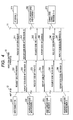
- FIG. 3 is a flowchart for showing communication messages between the video transmitter apparatus 10, according to the present embodiment, and the video receiver apparatus 11, such as, the TV, etc., and also changes of the contents memorized within the respective memory portions 103 and 118.
- the video transmitter apparatus 10 When the video transmitter apparatus 10 is connected with the video receiver apparatus (herein, the TV 11 is the example), firstly (a new connection condition 201), since there is no EDID memorized in the memory portion 103 of the video transmitter apparatus 10, a message 221 is transmitted to the video receiver apparatus 11, for requesting to obtain the EDID, which is added with the revision value "0". This message 221 may be transmitted, periodically.
- the revision value "0" may be used as a meaning of no EDIDmemorized.
- the video receiver apparatus 11 sets up the revision value, for example "2", other than "0", in advance, within the memory portion 118 (condition 211).
- the CPU 117 of the video receiver apparatus 11 reads out the revision value, which is memorized in the memory portion 118, and compares it with the revision value, which is added to the message 221 for requesting to obtain the EDID from the video transmitter apparatus 10.
- the CPU 117 determines that both are inconsistent with, since the revision value from the video transmitter apparatus 10 differs from the revision value, which is shown in the condition 211 of the memory portion 118, and it makes determination that there is necessity of transmitting the EDID to the video transmitter apparatus 10.
- the CPU 117 controls the transmitter/receiver portion 111, in such that the EDID memorized in the memory portion 118, and also renewal information thereof, the revision value "2", are transmitted to the video transmitter apparatus 10.
- the video transmitter apparatus 10 receives the EDID and "2" of the revision value, which are transmitted from the video receiver apparatus 11 by the transmitter/receiver portion 102 thereof, and the CPU 104 makes the memory portion 103 memorize the EDID and the revision value received memorized therein (condition 202).
- the CPU 104 of the video transmitter apparatus 10 controls the transmitter/receiver portion 102 in such that it reads out the revision value "2", which is memorized in the memory portion 103 thereof, to be added to an EDID requesting message 223, and thereby to transmit or report this to the video receiver apparatus 11.
- the CPU 117 reads out the revision value, which is memorized in the memory portion 118 of the video receiver apparatus 11 at present, and compares it with the revision value received.
- the CPU 117 controls the transmitter/receiver portion 111 in such that it transmits or reports a message 224 indicating that there is no change in the EDID to the video transmitter apparatus 10.
- the message 224 indicating that there is no change in the EDID is received by the transmitter/receiver portion 102, and upon basis of the message received, the CPU 104 of the video transmitter apparatus maintains the condition 203 memorized in the memory portion 103 (i.e., no change in the EDID), and uses the EDID memorized in that memory portion 103 as the newest EDID.
- the CPU 104 adds the revision value "2" memorized in the memory portion 103 to a message 225 requesting to obtain EDID, so as to transmit or report it to the video receiver apparatus 11 by the transmitter/receiver portion 102, and it is received by the transmitter/receiver portion 111 of the video receiver apparatus.
- the EDID thereof is changed, for example, by change of connecting structure of the equipment to the video receiver apparatus 11 (for example, a DVD player is newly connected to the TV 11, etc.), before receiving that message 225.
- the CPU 117 changes the revision value, which is memorized in the memory portion 118 of the video receiver apparatus 11 (i.e., "2" before change of EDID), to "3", by increasing it by "1" (condition 213) .
- the revision value of the video receiver apparatus 11 under that condition differs from the revision value "2" of the EDID requesting message 225 received by the transmitter/receiver portion 111.
- the CPU 117 of the video receiver apparatus 11 reads out the newest EDID and the revision value "3", which are changed, and transmits or reports them to the video transmitter apparatus 10 by means of the transmitter/receiver portion 111.
- the video transmitter apparatus 11 receives that newest EDID and the revision value "3" by the transmitter/receiver portion 102, and further memorizes the EDID and the revision value, which are received, into the memory portion 103 by means of the CPU 104 (i.e., rewriting the data of the memory portion 103) (condition 204).
- various controls such as, production of video/audio signals, etc., with using the EDID corresponding to the revision value "3", which is memorized in the memory portion 103, until the EDID of the video receiver apparatus 11 is changed, again.
- the revision value is increased, one by one, and when it reaches to the maximum value (for example, 255), it is preferable to increase it, sequentially, from "1", but jumping "0" indicating no memory. Also, in case where there is no effective EDID data because of any reason, it is also possible that the video receiver apparatus transmits or reports the revision value "0" omitting the EDID.
- comparison may be made in common, also upon a character data of the EDID, such as, a check sum included in the EDID, etc., to use the EDID memorized in the memory portion 103 of the video transmitter apparatus 10, only when both the revision value and the character data are consistent with, while no EDID is transmitted from the video receiver apparatus when either one of them is inconsistent with; thereby increasing the reliability of that data. Since the check sum within the EDID lies in each block, then the revision value may be also given for each block, so as to execute data comparison for each block.
- the character data may be used a CRC (Cyclic Redundancy Check) or a hash function, etc.
- the video transmitter apparatus 10 reads therein the EDID of the TV 11, being the video receiver apparatus; however, the similar processes or steps can be applied in case where the amplifier 12, being another video receiver apparatus, reads the EDID of the TV 11 therein.
- the video delay amount of the TV 11 mentioned above may be obtained as the EDID of the TV 11, and thereby delaying the audio within the audio latency portion 124 by an amount of the video delay obtained. With doing in this manner, it is effective for synchronizing the audio output of the amplifier 12 and the video display on the display portion 112 of the TV 11, when outputting the audio by means of the amplifier 12.
- Fig. 4 is a flowchart for showing the communication messages among three (3); i.e., the amplifier 12 - the video transmitter apparatus - the TV 11, and changes of memory contents of the memory portions 128 and 118, respectively.
- the memory portion 128 of the amplifier 12 has a function similar to that of the memory portion 103 of the video transmitter apparatus 10.
- the EDID request message and the EDID transmit message are transmitted or reported from the transmitting/receiving function portion for the control signals within the transmitter/receiver portion 121 of the amplifier 12, passing through the transmitting/receiving function portion for the control signals within the transmitter/receiver portion 102 of the video transmitter apparatus 10, to the transmitting/receiving function portion for the control signals within the transmitter/receiver portion 111 of the TV 11.
- the communication message from the TV 11 to the amplifier 12 is also transmitted or reported passing through the video transmitter apparatus 10, in the similar manner to that mentioned above.
- the video transmitter apparatus 10 executes only the role or function of relaying the communication between the amplifier 12 and the TV 11, but may have a function other than that.
- the video transmitter apparatus 10 may transmit or report, together with the EDID request message, the revision value, being replaced by a newer revision value than that the memory portion 103 has therein, in the place of the revision value received from the amplifier 12, if the revision value that the memory portion 103 thereof has is newer than the revision value received from the amplifier 12 (i.e., a numeral of the revision value that the memory portion 103 has therein is large), when transmitting or reporting the EDID request message attached with the revision value, which is received from the amplifier 12, to the TV 11.
- a flowchart shown in Fig. 5 An example of that will be shown in a flowchart shown in Fig. 5 .
- the EDID request message attached with the revision value "0" comes or arrives from the amplifier 12, when the revision value that the memory portion 103 of the video transmitter apparatus 10 has therein is "2" (condition 251), the CPU 104 of the video transmitter apparatus 10 determines that the revision value that the video transmitter apparatus has therein is new, and then the EDID request message 247 attached with the revision value "2" that the memory potion 103 has therein is transmitted to the TV 11 by means of the transmitter/receiver portion 102.
- the video transmitter apparatus 10 has no necessity of transmitting or reporting all of the EDID received from the TV 11 to the amplifier 12, and it is also possible to transmit or report only the information, for example, relating to the video delay or latency amount.
- the CPU 117 of the TV 11 compares between the revision value received and the revision value "2" that the memory portion 118 of the TV 11 has therein, and since both are equal to each other, then it turns a message 248 indicating no change of EDID back to the video transmitter apparatus 10 through the transmitter/receiver portion 11.
- the video transmitter portion 10 receiving the message 248 indicating no change of EDID, transmits or reports the EDID, which the memory portion 103 has, and the revision value "2", to the amplifier 12 by means of the EDID message.
- the amplifier 12 receives this EDID message 232 by the transmitter/receiver portion 121, and memorizes all or a portion of the EDID received into the memory portion 128 (condition 202). In this manner, with replacing the revision value from the amplifier 12 by the new revision value, which relay equipment (in this example, the video transmitter apparatus 10) has, there can be obtained an advantage of suppressing an amount or volume of communication between the TV 11 and the video transmitter apparatus 10.
- the video transmitter apparatus 10 receives the new EDID and the message 246 from the TV 11, the EDID of the memory portion 103 of the video transmitter apparatus 10 and the revision value are renewed (condition 252), and thereby there can be obtained an advantage of reducing the message relating to EDID between the video transmitter apparatus 10 and the TV 11, and minimize the transmission capacity and/or the transmission time.
- the explanation was give on the EDID, as the example of the receiver apparatus information; however it should not be limited to the EDID, but may be information unique to the video receiver apparatus, such as, a power consumption, a brightness of screen, a time tobe used, etc. Also, with the embodiment mentioned above, the explanation was given on the TV and the amplifier, as the video receiver apparatus, as the example thereof; however, the present invention should not be restricted to this, of course, and it is needless to say that it may be other equipments or apparatuses.
Landscapes
- Engineering & Computer Science (AREA)
- Multimedia (AREA)
- Signal Processing (AREA)
- Computer Networks & Wireless Communication (AREA)
- Automation & Control Theory (AREA)
- Databases & Information Systems (AREA)
- Two-Way Televisions, Distribution Of Moving Picture Or The Like (AREA)
- Mobile Radio Communication Systems (AREA)
Abstract
Description
- The present invention relates to a video transmitter apparatus and a video receiver apparatus being able to communicate with equipment at connection by using an interface, such as, on a radio or wireless.
- As an interface for conducting signal transmission between a video transmitter apparatus, such as, a HDD (Hard Disc Drive) recorder, a STB (Set Top Box), etc., and a video receiver apparatus, such as, a TV, a monitor, a projector, etc., is already known a HDMI (High-Definition Multimedia Interface:®), for example. Within the system applying the HDMI ®therein, the video transmitter apparatus reads the receiver apparatus information indicating the capacity and/or the specification of the video receiver apparatus (for example, EDID (Extended Display Identification Data)), when transmitting a video signal from the video transmitter apparatus to the video receiver apparatus, and thereby it is possible for the video transmitter apparatus to transmit video/audio signals of a format, which is suitable for a capacity and/or a specification of the video receiver apparatus.
- In this EDID are described the followings; i.e., a physical address, which is defined under the HDMI ® regulation, for example, and a display delay-time, etc., and there are cases where this physical address changes depending on structures of connecting the equipments to the video receiver apparatus and the video transmitter apparatus, and the display delay-time changes depending on a signal processing method of the video receiver apparatus. For this reason, the video transmitter apparatus needs to read out, appropriately, depending on change of EDID of the video receiver apparatus; however, there is a problem of a transmission delay and/or a transmission capacity within an interface, such as, a wireless connection, etc., there are cases where the EDID cannot be read out quickly.
- As the conventional arts for dissolving the problems relating to the transmission delay and the transmission capacity within the wireless interface are already known those, which are described in the following
Patent Documents - In the
Patent Document 1 is described that, for a source (i.e., the video transmitter apparatus) to read out EDID of a display (i.e., the video receiver apparatus), quickly, a master simulator on the display (the video receiver apparatus) side executes polling on change of a slave (i.e., EDID), continuously, so as to maintain the present condition within a shadow memory within a slave simulator on a source (i.e., the video transmitter apparatus) side, and thereby a readout process from a master (i.e., the video transmitter apparatus) can be executed directly, from the shadow memory of the slave simulator, but without detecting a wireless rink. - Also, in the
Patent Document 2 is described, when it is change relating to the EDID information, data of a corresponding item of the EDID information, which is stored within a rewritable memory, is rewritten corresponding to that change, and in addition thereto, an ID unique to a product within that EDID information is rewritten, and the EDID information stored within the rewritable memory is transmitted to a personal computer through a DDC communication function. -
- [Patent Document 1] Japanese
PCT Publication No. 2006-519549 (2006 - [Patent Document 2] Japanese Patent Laying-Open No.
2000-194346 (2000 - In case of applying a video interface, such as, on a radio orwireless, etc., having transmission delay and being insufficient on communication capacity thereof, it is preferable to obtain the receiver apparatus information within a time-period, being as short as possible, when needing the receiver apparatus information, such as, the EDID of the video transmitter apparatus and the video receiver apparatus, etc., and thereby to reduce an influence upon the video transmission while avoiding the communication of the receiver apparatus information when the receiver apparatus information is not needed.
- However, with a method of transmitting the change of EDID to the source side, periodically, as is described in the
Patent Document 1 mentioned above, there is necessity of executing the periodical EDID transmission, continuously, processes are generated, periodically, even when the EDID information is not necessary on the video transmitter apparatus side. Also, within that described in thePatent Document 2, there is an advantage that it is possible to detect presence/absence of change in the EDID information by only reading out the ID unique to the product; however, there is a case of losing the identification information, as being the ID unique to the product, originally. - Preferably an object of the present invention, being accomplished by taking the drawbacks mentioned above into the consideration thereof, is to provide a technology for enabling to obtain the receiver apparatus information suitable for a case when the apparatus information of the video receiver apparatus changes, where the video transmitter apparatus and the video receiver apparatus are connected with, through a wireless interface.
- Preferably according to the present invention, for accomplishing the object mentioned above, a memory portion for memorizing a history number, which is altered depending on changes of receiver apparatus information of itself, is provided within a video receiver apparatus, while within a video transmitter apparatus is provided a memory portion for memorizing the receiver apparatus information form said video receiver apparatus and said history number thereof, when said video transmitter apparatus obtains the newest receiver apparatus information of said video receiver apparatus, it transmits the history number memorized in the memory portion of the video transmitter apparatus to the video receiver apparatus, while the video receiver apparatus compares between the history number transmitted from the video transmitter apparatus and the history number of itself, which is memorized in the memory portion thereof, wherein the newest receiver apparatus information and the newest history number (i.e., the history number memorized in a first memory portion) to the video transmitter apparatus.
- Preferably according to the structure of the present invention, since the video receiver apparatus transmits the newest receiver apparatus information to the video transmitter apparatus, when the history number from the video transmitter apparatus differs from, it is possible to bring an amount or volume of transmission for connecting between the video transmitter apparatus and the video receiver apparatus, down to the minimum. Therefore, according to the present invention, it is possible to obtain the receiver apparatus information, suitably in case when the apparatus information of the video receiver apparatus is changed.
- Those and other objects, features and advantages of the present invention will become more readily apparent from the following detailed description when taken in conjunction with the accompanying drawings wherein:
-
Fig. 1 is a configuration view of a system, wirelessly connecting a video transmitter apparatus and a video receiver apparatus, according to an embodiment of the present invention; -
Fig. 2 is a view for showing an example of information, which is memorized in a memory portion of the video receiver apparatus, according to the embodiment of the present invention; -
Fig. 3 is a view for showing an example of a flowchart for showing communication steps between the video transmitter apparatus and the video receiver apparatus, according to the embodiment of the present invention; -
Fig. 4 is a view for showing other example of a flowchart for showing communication steps between the video transmitter apparatus and the video receiver apparatus, according to the embodiment of the present invention; and -
Fig. 5 is a view for showing further other example of a flowchart for showing communication steps between the video transmitter apparatus and the video receiver apparatus, according to the embodiment of the present invention. - Hereinafter, embodiments according to the present invention will be fully explained or mentioned by referring to the attached drawings.
-
Fig.1 attached is a configuration view for showing an example of a system, according to an embodiment of the present invention, wherein avideo transmitter apparatus 10 is connected with aTV 11 and anamplifier 12, each being a video receiver apparatus, through a wireless interface. Herein, thevideo transmitter apparatus 10 may be, for example, a HDD player or a DVD player, etc. , and it has ssignal source 101, a transmitter/receiver portion 102 for transmitting/receiving video/audio signals and a control signal, amemory portion 103, and aCPU 104. - On the other hand, the
TV 11, being the video receiver apparatus, has a transmitter/receiver portion 111 for transmitting/receiving video/audio signals and a control signal, avideo signal processor 112, adisplay portion 113, an audio delay orlatency portion 114, anaudio signal processor 115, aspeaker 116, aCPU 117 and amemory portion 118. Also, theamplifier 12 has a transmitter/receiver portion 121 for transmitting/receiving video/audio signals and a control signal, an audio delay orlatency portion 124, anaudio signal processor 125, aspeaker 126, aCPU 127 and amemory portion 128. - With the present embodiment, in the system having such structures as mentioned above, history information, indicating a renewal history (i.e., version information) of that receiver apparatus information together with the receiver apparatus information, is memorized into the
memory portion 118 of the video receiver apparatus, and this receiver apparatus information and the history information are transmitted to thevideo transmitter apparatus 10, to be memorized in thememory portion 103. And, it is characterized in that, when thevideo transmitter apparatus 10 obtains new (i.e., being changed) receiver apparatus information, within the video receiver apparatus,the historyinformation,which is memorized within thememory portion 103 of thevideo transmitter apparatus 10, and the history information, which is memorized in thememory portion 118 of the video receiver apparatus, are compared with, and when they are inconsistent with, new receiver apparatus information is transmitted to thevideo transmitter apparatus 10. First of all, explanation will be given, hereinafter, on a mechanism of transmitting the video/audio signals within the present embodiment. However, in the embodiment shown below, since a numerical value, which is incremented every time when EDID is renewed, is used therein, then "history information" will be called as "history number". - Within the
memory portion 118 of theTV 11 are memorized the followings; as is shown inFig. 2 , for example, a wireless ID and a history number, and the EDID indicating the capacity and/or the specification of that TV, as the receiver apparatus information. The EDID includes, for example, a product code of thatTV 11 and/or video/audio formats receivable, video/audio latency, a colorimetry, etc. However, hereinafter, the receiver apparatus information will be called "EDID". - The
TV 11 transmits or reports EDID memorized in thememory portion 118 to thevideo transmitter apparatus 10, via the transmitter/receiver portion 111 on theTV 11 side. Thevideo transmitter apparatus 10 receives the EDID from theTV 11 with the transmitting/receiving function of the control signal within the transmitter/receiver portion 102, and memorizes all or a part of the EDID received, in thememory portion 103 within thevideo transmitter apparatus 10. TheCPU 104 determines optimal video/audio transmission formats, by referring to a receiving capacity and a specification of theTV 11, which are described in the EDID memorized in thememory portion 103. And, theCPU 104 controls thesignal source 101 in such that it produces a video signal and an audio signal corresponding to that video/audio formats determined. The video/audio signals outputted from thesignal source 101 are transmitted from the transmitter/receiver portion 102, and are received by the transmitter/receiver portion 111 of theTV 11. The video/audio signals received by the transmitter/receiver portion 111 are reproduced on thedisplay portion 113 and through thespeaker 116, passing through thevideo signal processor 112 and theaudio signal processor 115, respectively. When thevideo signal processor 112 uses therein a frame memory, etc., since it needs a time for video processing, there may be a possibility that reproduction of the video is delayed with respect to the audio reproduced from the speaker. For the purpose of compensating an amount of this vide delay or latency, delay or the latency of the video accompanying with video processing within thevideo signal processor 112 may be compensated, and video and audio may be synchronized with, by entering theaudio latency portion 114 therein. However, thememory portions receiver portions CPUs - Also, in the place of the speaker built within the
TV 11, high quality sound may be reproduced by means of theamplifier 12. In this case, theamplifier 12 transmits or reports the EDID indicating the receiving capacity and/or the specification of thatamplifier 12, which is/are memorized in thememory portion 128, passing through the transmitter/receiver portion 121 on the amplifier 12b side to thevideo transmitter apparatus 10. Thevideo transmitter apparatus 10 receives the EDID from theamplifier 12 by the function of the transmitting/receivingportion 102 for transmitting/receiving the control signal(s), and memorizes all or a portion of the EDID received into thememory portion 103 within thevideo transmitter apparatus 10. TheCPU 104 determines the optimal audio transmission format, by referring the receiving capacity and the specification of theamplifier 12, which are described in the EDID memorized in thememory portion 103. And, theCPU 104 controls thesignal source 101 so as to produce the audio signal corresponding to the audio format that is determined. The audio signal outputted from thesignal source 101 is transmitted from the transmitting/receivingportion 102, and it received by the transmitter/receiver portion 121 of theamplifier 12. The audio signal transmitted/received by the transmitter/receiver portion 121 is delayed by a time-period to be taken by the video processing within thevideo signal processor 112, depending on necessity thereof, by means of theaudio latency portion 124. Thereafter, for example, a surround process, etc., is treated, depending on necessity thereof, within theaudio signal processor 125, and the sound is reproduced by one (1) or plural numbers of speakers, which is/are connected with theamplifier 12. However, although thememory portion 128 is connected with the transmitter/receiver portion 121 passing through theCPU 127, the EDID may be transmitted/received directly, not passing through the CPU, by connecting the transmitter/receiver portion 121 and the transmitting/receivingportion 102. - The delay time mentioned above can be changed depending on contents of the video processing corresponding to a display mode of the
TV 11. For example, in case of a mode displaying a signal of 60 Hz in the frame rate after converting into that of 240 Hz, much time is necessary to be produced for the video processing of such the conversion. On the other hand, it is so determined that no frame rate conversion mentioned above is executed for the purpose of preventing the video display from being delayed responding to the operation thereof, in case of "a game mode" for displaying the video signal from a game machine, and in the case of this mode, the delay time is shorten. - The EDID mentioned above includes so-called real time information therein, which changes depending on a connecting structure and/or a video processing content (a display mode) of equipment, such as, the physical address mentioned above and/or the delay time (or latency) of video/audio, etc. For this reason, the
video transmitter apparatus 10 needs to confirm on whether the EDID memorized in thatmemory portion 103 is a newest one or not. For such purpose thereof, within the present embodiment, a revision value is given to the EDID, in advance, for the video receiving apparatus, such as, theTV 11 or theamplifier 12. With such a revision value, an initial value thereof is "0", for example, and it is executed with renewal, such as, increasing by one (1), for example, every time when the content of EDID is changed, etc. When thevideo transmitter apparatus 10 needs the newest EDID (when obtaining), thevideo transmitter apparatus 10, after giving the revision value memorized in thememory portion 103, transmits or reports a request for obtaining the EDID to the video receiver apparatus. The video receiver apparatus makes comparison between the revision value from thevideo transmitter apparatus 10 and the revision value memorized in thememory portion 103 of the video receiver apparatus, and in case where they are inconsistent with, thus, only when changing is made, the (changed) EDID is transmitted from the video receiver apparatus to the video transmitter apparatus. With this, it is possible to delete the EDID transmission in many cases when no renewal is made. Since a relatively large transmission capacity is needed for the transmission of EDID, there may be a possibility that a necessary transmission capacity cannot be ensured or maintained for transmitting the video/audio signals when transmitting the EDID (i.e., the transmission capacity is divided for the EDID transmission, for the video/audio signals). However, according to the present embodiment, since no EDID is transmitted to the video receiver apparatus when no change is made on the EDID, there can be obtained an effect of avoiding influences upon the video/audio transmission. - Explanation will be given, hereinafter, upon a detailed example of a method of confirming and obtaining the newest EDID, with using the revision value in relation to the present embodiment, by referring to
Fig. 3 . ThisFig. 3 is a flowchart for showing communication messages between thevideo transmitter apparatus 10, according to the present embodiment, and thevideo receiver apparatus 11, such as, the TV, etc., and also changes of the contents memorized within therespective memory portions - When the
video transmitter apparatus 10 is connected with the video receiver apparatus (herein, theTV 11 is the example), firstly (a new connection condition 201), since there is no EDID memorized in thememory portion 103 of thevideo transmitter apparatus 10, amessage 221 is transmitted to thevideo receiver apparatus 11, for requesting to obtain the EDID, which is added with the revision value "0". Thismessage 221 may be transmitted, periodically. Preferably, the revision value "0" may be used as a meaning of no EDIDmemorized. On the other hand, thevideo receiver apparatus 11 sets up the revision value, for example "2", other than "0", in advance, within the memory portion 118 (condition 211). TheCPU 117 of thevideo receiver apparatus 11 reads out the revision value, which is memorized in thememory portion 118, and compares it with the revision value, which is added to themessage 221 for requesting to obtain the EDID from thevideo transmitter apparatus 10. TheCPU 117 determines that both are inconsistent with, since the revision value from thevideo transmitter apparatus 10 differs from the revision value, which is shown in thecondition 211 of thememory portion 118, and it makes determination that there is necessity of transmitting the EDID to thevideo transmitter apparatus 10. And, theCPU 117 controls the transmitter/receiver portion 111, in such that the EDID memorized in thememory portion 118, and also renewal information thereof, the revision value "2", are transmitted to thevideo transmitter apparatus 10. Thevideo transmitter apparatus 10 receives the EDID and "2" of the revision value, which are transmitted from thevideo receiver apparatus 11 by the transmitter/receiver portion 102 thereof, and theCPU 104 makes thememory portion 103 memorize the EDID and the revision value received memorized therein (condition 202). - Thereafter, when the
video transmitter apparatus 10 needs a newest EDID, theCPU 104 of thevideo transmitter apparatus 10 controls the transmitter/receiver portion 102 in such that it reads out the revision value "2", which is memorized in thememory portion 103 thereof, to be added to anEDID requesting message 223, and thereby to transmit or report this to thevideo receiver apparatus 11. Upon receipt of the EDID requesting message and the revision value "2" from thevideo receiver apparatus 11 by the transmitter/receiver portion 111 of thevideo receiver apparatus 11, further theCPU 117 reads out the revision value, which is memorized in thememory portion 118 of thevideo receiver apparatus 11 at present, and compares it with the revision value received. Since the revision value is "2" as it is, without change in the EDID memorized in the memory portion 118 (condition 212), and since it is coincident or consistent with the revision value, which is added to theEDID requesting message 223 received, then theCPU 117 controls the transmitter/receiver portion 111 in such that it transmits or reports amessage 224 indicating that there is no change in the EDID to thevideo transmitter apparatus 10. Themessage 224 indicating that there is no change in the EDID is received by the transmitter/receiver portion 102, and upon basis of the message received, theCPU 104 of the video transmitter apparatus maintains thecondition 203 memorized in the memory portion 103 (i.e., no change in the EDID), and uses the EDID memorized in thatmemory portion 103 as the newest EDID. - In case when the
video transmitter apparatus 10 needs the newest EDID, again, theCPU 104 adds the revision value "2" memorized in thememory portion 103 to amessage 225 requesting to obtain EDID, so as to transmit or report it to thevideo receiver apparatus 11 by the transmitter/receiver portion 102, and it is received by the transmitter/receiver portion 111 of the video receiver apparatus. Herein, it is assumed that, within thevideo receiver apparatus 11, the EDID thereof is changed, for example, by change of connecting structure of the equipment to the video receiver apparatus 11 (for example, a DVD player is newly connected to theTV 11, etc.), before receiving thatmessage 225. In this case, theCPU 117 changes the revision value, which is memorized in thememory portion 118 of the video receiver apparatus 11 (i.e., "2" before change of EDID), to "3", by increasing it by "1" (condition 213) . As a result thereof, the revision value of thevideo receiver apparatus 11 under that condition differs from the revision value "2" of theEDID requesting message 225 received by the transmitter/receiver portion 111. As a result thereof, theCPU 117 of thevideo receiver apparatus 11 reads out the newest EDID and the revision value "3", which are changed, and transmits or reports them to thevideo transmitter apparatus 10 by means of the transmitter/receiver portion 111. Thevideo transmitter apparatus 11 receives that newest EDID and the revision value "3" by the transmitter/receiver portion 102, and further memorizes the EDID and the revision value, which are received, into thememory portion 103 by means of the CPU 104 (i.e., rewriting the data of the memory portion 103) (condition 204). Hereinafter, within thevideo receiver apparatus 11 are executed various controls, such as, production of video/audio signals, etc., with using the EDID corresponding to the revision value "3", which is memorized in thememory portion 103, until the EDID of thevideo receiver apparatus 11 is changed, again. - In this manner, the revision value is increased, one by one, and when it reaches to the maximum value (for example, 255), it is preferable to increase it, sequentially, from "1", but jumping "0" indicating no memory. Also, in case where there is no effective EDID data because of any reason, it is also possible that the video receiver apparatus transmits or reports the revision value "0" omitting the EDID.
- As was mentioned above, since transmission of the EDID is generated only when the video transmitter apparatus needs the newest EDID and in case where the revision value differs, it is possible lower the transmission capacity and the transmission time necessary for the EDID communication down to the minimum.
- Also, in addition to the revision value, comparison may be made in common, also upon a character data of the EDID, such as, a check sum included in the EDID, etc., to use the EDID memorized in the
memory portion 103 of thevideo transmitter apparatus 10, only when both the revision value and the character data are consistent with, while no EDID is transmitted from the video receiver apparatus when either one of them is inconsistent with; thereby increasing the reliability of that data. Since the check sum within the EDID lies in each block, then the revision value may be also given for each block, so as to execute data comparison for each block. As the character data may be used a CRC (Cyclic Redundancy Check) or a hash function, etc. - Further, with conducting estimation, in common with, upon the consistence/inconsistence of a wireless ID, which is used when establishing the communication network of the radio, etc., it is possible to expect a further increase of the reliability thereof. In more details, while memorizing the wireless ID of the video receiver apparatus in the
memory portion 103 of thevideo transmitter apparatus 10, in advance, comparison is made between the wireless ID of thevideo receiver apparatus 11 memorized and the wireless ID of the video receiver apparatus, which is designated as a destination of transmission of the EDID request message, within thatvideo transmitter apparatus 10. This can be achieved by transmitting or reporting the revision value "0" indicating that there is no EDID memorized within thevideo transmitter apparatus 10 to thevideo receiver apparatus 11, when they are inconsistent with. - In the example mentioned above, it is the case where the
video transmitter apparatus 10 reads therein the EDID of theTV 11, being the video receiver apparatus; however, the similar processes or steps can be applied in case where theamplifier 12, being another video receiver apparatus, reads the EDID of theTV 11 therein. For example, in the example shown inFig. 1 , when reproducing the sound by the amplifier while muting the sound of the TV 11 (i.e., when outputting the audio by thespeaker 126, which is connected with the amplifier, in the place of thespeaker 116 built within the TV 11), the video delay amount of theTV 11 mentioned above may be obtained as the EDID of theTV 11, and thereby delaying the audio within theaudio latency portion 124 by an amount of the video delay obtained. With doing in this manner, it is effective for synchronizing the audio output of theamplifier 12 and the video display on thedisplay portion 112 of theTV 11, when outputting the audio by means of theamplifier 12. -
Fig. 4 is a flowchart for showing the communication messages among three (3); i.e., the amplifier 12 - the video transmitter apparatus - theTV 11, and changes of memory contents of thememory portions memory portion 128 of theamplifier 12 has a function similar to that of thememory portion 103 of thevideo transmitter apparatus 10. The EDID request message and the EDID transmit message are transmitted or reported from the transmitting/receiving function portion for the control signals within the transmitter/receiver portion 121 of theamplifier 12, passing through the transmitting/receiving function portion for the control signals within the transmitter/receiver portion 102 of thevideo transmitter apparatus 10, to the transmitting/receiving function portion for the control signals within the transmitter/receiver portion 111 of theTV 11. The communication message from theTV 11 to theamplifier 12 is also transmitted or reported passing through thevideo transmitter apparatus 10, in the similar manner to that mentioned above. Other than the communication message relay function by means of thevideo transmitter apparatus 10, they are same to the communications of the EDID and the message and the revision value between thevideo transmitter apparatus 10 and theTV 11 shown inFig. 3 . Thus, it is enough to read, the processes similar to those, which are executed by theCUP 104, the transmitter/receiver portion 102 and thememory portion 103 of thevideo transmitter apparatus 10, explained inFig. 3 , are executed, in the place thereof, by theCPU 127, the transmitter/receiver portion 121 and thememory portion 128 of the 12, inFig. 4 . In this example, there is no necessity of memorizing all EDID of theTV 11 into thememory portion 128, which are received by the transmitter/receiver portion 121 of theamplifier 12, and it is also possible to memorize only the information, for example, relating to the video delay amount. - In the example shown in
Fig. 4 , though thevideo transmitter apparatus 10 executes only the role or function of relaying the communication between theamplifier 12 and theTV 11, but may have a function other than that. For example, thevideo transmitter apparatus 10 may transmit or report, together with the EDID request message, the revision value, being replaced by a newer revision value than that thememory portion 103 has therein, in the place of the revision value received from theamplifier 12, if the revision value that thememory portion 103 thereof has is newer than the revision value received from the amplifier 12 (i.e., a numeral of the revision value that thememory portion 103 has therein is large), when transmitting or reporting the EDID request message attached with the revision value, which is received from theamplifier 12, to theTV 11. An example of that will be shown in a flowchart shown inFig. 5 . If the EDID request message attached with the revision value "0" comes or arrives from theamplifier 12, when the revision value that thememory portion 103 of thevideo transmitter apparatus 10 has therein is "2" (condition 251), theCPU 104 of thevideo transmitter apparatus 10 determines that the revision value that the video transmitter apparatus has therein is new, and then theEDID request message 247 attached with the revision value "2" that thememory potion 103 has therein is transmitted to theTV 11 by means of the transmitter/receiver portion 102. Also, thevideo transmitter apparatus 10 has no necessity of transmitting or reporting all of the EDID received from theTV 11 to theamplifier 12, and it is also possible to transmit or report only the information, for example, relating to the video delay or latency amount. - The
CPU 117 of theTV 11 compares between the revision value received and the revision value "2" that thememory portion 118 of theTV 11 has therein, and since both are equal to each other, then it turns amessage 248 indicating no change of EDID back to thevideo transmitter apparatus 10 through the transmitter/receiver portion 11. Thevideo transmitter portion 10, receiving themessage 248 indicating no change of EDID, transmits or reports the EDID, which thememory portion 103 has, and the revision value "2", to theamplifier 12 by means of the EDID message. Theamplifier 12 receives thisEDID message 232 by the transmitter/receiver portion 121, and memorizes all or a portion of the EDID received into the memory portion 128 (condition 202). In this manner, with replacing the revision value from theamplifier 12 by the new revision value, which relay equipment (in this example, the video transmitter apparatus 10) has, there can be obtained an advantage of suppressing an amount or volume of communication between theTV 11 and thevideo transmitter apparatus 10. - Also, when the
video transmitter apparatus 10 receives the new EDID and themessage 246 from theTV 11, the EDID of thememory portion 103 of thevideo transmitter apparatus 10 and the revision value are renewed (condition 252), and thereby there can be obtained an advantage of reducing the message relating to EDID between thevideo transmitter apparatus 10 and theTV 11, and minimize the transmission capacity and/or the transmission time. - Though the explanation was give on the EDID, as the example of the receiver apparatus information; however it should not be limited to the EDID, but may be information unique to the video receiver apparatus, such as, a power consumption, a brightness of screen, a time tobe used, etc. Also, with the embodiment mentioned above, the explanation was given on the TV and the amplifier, as the video receiver apparatus, as the example thereof; however, the present invention should not be restricted to this, of course, and it is needless to say that it may be other equipments or apparatuses.
- The present invention may be embodied in other specific forms without departing from the spirit or essential feature or characteristics thereof. The present embodiment(s) is/are therefore to be considered in all respects as illustrative and not restrictive, the scope of the invention being indicated by the appended claims rather than by the forgoing description and range of equivalency of the claims are therefore to be embraces therein.
Claims (14)
- A video receiver apparatus, for receiving video from a video transmitter apparatus, comprising:a memory portion, which is configured to memorize receiver apparatus information of said video receiver apparatus; anda transmitter/receiver portion, which is configured to receive a request for obtaining said receiver apparatus information transmitted from said video transmitter apparatus, and also to transmit the receiver apparatus information memorized in said memory portion responding to said obtaining request, whereinwithin said memory portion is memorized further history information, changing depending on alternation of said receiver apparatus information, andsaid receiver portion is able to receive the history information, which said video transmitter apparatus holds therein, as well as, said obtaining request from said video transmitter, and when the received history information from said video transmitter apparatus and the history information, which said video transmitter apparatus holds therein, are inconsistent with each other, said receiver apparatus information memorized in said memory portion is transmitted to said video transmitter apparatus.
- The video receiver apparatus, as described in the claim 1, wherein a message indicating there is no alternation of said receiver apparatus information is returned to said video transmitter apparatus, without transmitting said receiver apparatus information, when the history information received from said video transmitter apparatus and the history information memorized in said memory portion are consistent with each other.
- The video receiver apparatus, as described in the claim 1, wherein a predetermined history information is determined not be used in alternation of said revision value, and the history information are always inconsistent with, when said transmitter/receiver portion receives the predetermined history information from said video transmitter apparatus.
- The video receiver apparatus, as described in the claim 1, wherein said receiver apparatus information is EDID, and said transmitter/receiver portion receives character data of said EDID, in addition to said history information, and returns a signal indicating there is no alternation of EDID to said video transmitter apparatus, when both the history information received and the character data are consistent with the history information and said character data, which are memorized in said memory portion.
- The video receiver apparatus, as described in the claim 1, wherein it receives video on a radio from said video transmitter apparatus.
- A video transmitter apparatus, for transmitting video to a video receiver apparatus, comprising:a transmitter/receiver portion, which is configured to transmit a request for obtaining receiver apparatus information of said video receiver apparatus to said video receiver apparatus, being a destination of video transmission by said video transmitter apparatus, and also to receive the receiver apparatus information of said video receiver apparatus and history information of said receiver apparatus information; anda memory portion, which is configured to memorize said receiver apparatus information and said history information, which are received by said transmitter/receiver portion, whereinsaid transmitter/receiver portion transmits the request for obtaining said receiver apparatus information, as well as, said history information memorized in said memory portion, to said video receiver apparatus.
- The video transmitter apparatus, as described in the claim 6, wherein
said transmitter/receiver portion is able to receive a message transmitted from said video receiver apparatus responding to said history information transmitted by said transmitter/receiver portion,
when said message indicates that said history information transmitted is consistent with the history information held by said video receiver apparatus, said transmitter/receiver portion produces said video with using the receiver apparatus information memorized in said memory portion, and
when said message indicates that said history information transmitted is inconsistent with the history information held by said video receiver apparatus, said transmitter/receiver portion rewrites memory data of said memory portion by new receiver apparatus information and revision value, which are transmitted from said video receiver apparatus, and thereby producing said video with using said new receiver apparatus information rewritten. - The video transmitter apparatus, as described in the claim 6, wherein said transmitter/receiver portion transmits a predetermined revision value together with said obtaining request, and receives the message indicating said inconsistence and said receiver apparatus information, when no receiver apparatus information is memorized in said memory portion, and when said video receiver apparatus is connected with, first.
- The video transmitter apparatus, as described in the claim 6, wherein said receiver apparatus information is EDID, and said transmitter/receiver portion transmits character data of the EDID, in addition to said revision value.
- The video transmitter apparatus, as described in the claim 7, wherein it transmits video on a radio to said video receiver apparatus.
- A video receiver apparatus, for receiving either video or audio from a video transmitter apparatus, comprising:a transmitter/receiver portion, which is configured to receive a request for obtaining receiver apparatus information owned by other video receiver apparatus, which is connected with said video transmitter apparatus, and also to receive the receiver apparatus information owned by said other video receiver apparatus and renewal information thereof; anda memory portion, which is configured to memorize at least a part of the receiver apparatus information owned by said video receiver apparatus and history information thereof, which are received by said transmitter/receiver portion, whereinsaid transmitter/receiver portion transmits a request for obtaining said receiver apparatus information, and said history information memorized in said memory portion, as well.
- The video receiver apparatus, as described in the claim 11, wherein
said transmitter/receiver portion is able to receive a message, which is transmitted from said other video receiver apparatus responding to said history information transmitted by said transmitter/receiver portion,
the receiver apparatus information memorized in said memory portion is used, when said message indicates that said history information transmitted and the history information held by said video receiver apparatus are consistent with each other, and
memory data of said memory portion is re-written by new receiver apparatus information and history information, which are transmitted from said other video receiver apparatus, when said message indicates that said history information transmitted and the history information held by said video receiver apparatus are inconsistent with, whereby using the new receiver apparatus information re-written. - The video receiver apparatus, as described in the claim 11, wherein
said transmitter/receiver portion transmits the request for obtaining said video receiver apparatus information and said history information, passingthroughsaidvideo receiver apparatus, and further receives said receiver apparatus information and the history information thereof,and alsosaid message,passing through said video transmitter apparatus. - A video transmitting method, within a video transmitter apparatus for transmitting at least either video or audio signal, at least to first and second video receiver apparatuses, comprising the following steps of:Transmitting a request for obtaining receiver apparatus information owned by said second video receiver apparatus, which is received from said first video receiver apparatus; andTransmitting at least a part of the receiver apparatus information owned by said second video receiver apparatus, which is received from said second video receiver apparatus.
Applications Claiming Priority (1)
| Application Number | Priority Date | Filing Date | Title |
|---|---|---|---|
| JP2009158361A JP5506260B2 (en) | 2009-07-03 | 2009-07-03 | Video transmission device and video reception device |
Publications (2)
| Publication Number | Publication Date |
|---|---|
| EP2273485A1 true EP2273485A1 (en) | 2011-01-12 |
| EP2273485B1 EP2273485B1 (en) | 2017-08-30 |
Family
ID=42710753
Family Applications (1)
| Application Number | Title | Priority Date | Filing Date |
|---|---|---|---|
| EP10250956.9A Active EP2273485B1 (en) | 2009-07-03 | 2010-05-20 | Video transmitter apparatus and video receiver apparatus |
Country Status (4)
| Country | Link |
|---|---|
| US (3) | US11611718B2 (en) |
| EP (1) | EP2273485B1 (en) |
| JP (1) | JP5506260B2 (en) |
| CN (1) | CN101945241B (en) |
Families Citing this family (8)
| Publication number | Priority date | Publication date | Assignee | Title |
|---|---|---|---|---|
| JP2013102325A (en) * | 2011-11-08 | 2013-05-23 | Olympus Corp | Image transmission device, image transmission method, and program |
| KR102201617B1 (en) * | 2014-01-07 | 2021-01-12 | 삼성전자 주식회사 | Av device and control method thereof |
| WO2015168903A1 (en) * | 2014-05-08 | 2015-11-12 | Lattice Semiconductor Corporation | Caching of capabilities information of counterpart device for efficient handshaking operation |
| JP6054498B1 (en) * | 2015-11-19 | 2016-12-27 | 東芝エレベータ株式会社 | Elevator, and video processing apparatus and video processing method used therefor |
| CN106331846B (en) * | 2016-08-17 | 2019-04-12 | 青岛海信电器股份有限公司 | The method and device of audio transparent transmission |
| KR102586695B1 (en) * | 2018-02-09 | 2023-10-11 | 삼성전자주식회사 | Display apparatus and control method for the same |
| CN118921520A (en) | 2019-12-17 | 2024-11-08 | 索尼集团公司 | Receiving apparatus, method for controlling receiving apparatus, and transmitting/receiving system |
| KR102870106B1 (en) * | 2020-11-18 | 2025-10-16 | 엘지전자 주식회사 | Display device and method for changing edid information thereof |
Citations (6)
| Publication number | Priority date | Publication date | Assignee | Title |
|---|---|---|---|---|
| JP2000194346A (en) | 1998-12-28 | 2000-07-14 | Nec Home Electronics Ltd | Display device and computer system including the same |
| US20060095638A1 (en) * | 2004-11-03 | 2006-05-04 | Unger Robert A | Method and system for processing wireless digital multimedia |
| US20060129370A1 (en) * | 2004-12-13 | 2006-06-15 | Unger Robert A | Inter integrated circuit extension via shadow memory |
| JP2006519549A (en) | 2003-02-27 | 2006-08-24 | コーニンクレッカ フィリップス エレクトロニクス エヌ ヴィ | Generator for generating useful streams of audio and other media |
| US20070222779A1 (en) * | 2006-03-24 | 2007-09-27 | Radiospire Networks, Inc. | System, method, and apparatus for content delivery format control |
| US20080320539A1 (en) * | 2007-06-19 | 2008-12-25 | Kabushiki Kaisha Toshiba | Data Transmission Apparatus and Data Transmission Method |
Family Cites Families (23)
| Publication number | Priority date | Publication date | Assignee | Title |
|---|---|---|---|---|
| JPH05250239A (en) * | 1992-03-10 | 1993-09-28 | Sharp Corp | Computer network system |
| JPH10154121A (en) | 1996-11-25 | 1998-06-09 | Ricoh Co Ltd | Communications system |
| US6536041B1 (en) * | 1998-06-16 | 2003-03-18 | United Video Properties, Inc. | Program guide system with real-time data sources |
| CN1308828A (en) | 1998-06-30 | 2001-08-15 | 松下电器产业株式会社 | Network control system and method thereof |
| JP2001069475A (en) * | 1999-08-27 | 2001-03-16 | Pioneer Electronic Corp | Terminal equipment for cable television |
| US7069578B1 (en) * | 2000-02-04 | 2006-06-27 | Scientific-Atlanta, Inc. | Settop cable television control device and method including bootloader software and code version table for maintaining and updating settop receiver operating system software |
| US7305696B2 (en) * | 2000-04-17 | 2007-12-04 | Triveni Digital, Inc. | Three part architecture for digital television data broadcasting |
| US6584476B1 (en) * | 2000-04-22 | 2003-06-24 | Oracle Corp. | System and method for enforcing referential constraints between versioned database tables |
| US7162499B2 (en) * | 2000-06-21 | 2007-01-09 | Microsoft Corporation | Linked value replication |
| US8495679B2 (en) * | 2000-06-30 | 2013-07-23 | Thomson Licensing | Method and apparatus for delivery of television programs and targeted de-coupled advertising |
| JP4543513B2 (en) * | 2000-07-17 | 2010-09-15 | ソニー株式会社 | Bidirectional communication system, display device, base device, and bidirectional communication method |
| US20020085023A1 (en) * | 2001-01-02 | 2002-07-04 | Zustak Fred J. | Display of ancillary data on local network appliance |
| US20040003403A1 (en) * | 2002-06-19 | 2004-01-01 | Marsh David J. | Methods and systems for reducing information in electronic program guide and program recommendation systems |
| US7151575B1 (en) * | 2002-07-18 | 2006-12-19 | Entropic Communications, Inc. | Wireless extension for cable television signals |
| JP4026456B2 (en) * | 2002-09-13 | 2007-12-26 | 日本電気株式会社 | Computer system and information collection method |
| US20040187151A1 (en) * | 2003-03-21 | 2004-09-23 | Dunstan Robert A. | Method, apparatus and system for managing recorded personal video recorder content |
| US20050210501A1 (en) * | 2004-03-19 | 2005-09-22 | Microsoft Corporation | Method and apparatus for handling metadata |
| JP2006119399A (en) * | 2004-10-22 | 2006-05-11 | Seiko Epson Corp | Image display device |
| CN100511414C (en) | 2004-11-03 | 2009-07-08 | 索尼电子有限公司 | Method and system for processing wireless digital multimedia |
| JP4575324B2 (en) * | 2006-03-29 | 2010-11-04 | 株式会社東芝 | AV apparatus and control method thereof |
| JP4182997B2 (en) | 2006-08-15 | 2008-11-19 | ソニー株式会社 | Transmission system and transmitter / receiver |
| JP2008102786A (en) * | 2006-10-19 | 2008-05-01 | Sanyo Electric Co Ltd | Communication method, terminal device using the same, and communication system |
| JP4930278B2 (en) * | 2007-08-21 | 2012-05-16 | 船井電機株式会社 | Electronics |
-
2009
- 2009-07-03 JP JP2009158361A patent/JP5506260B2/en active Active
-
2010
- 2010-05-19 US US12/783,329 patent/US11611718B2/en active Active
- 2010-05-20 EP EP10250956.9A patent/EP2273485B1/en active Active
- 2010-05-24 CN CN2010101896371A patent/CN101945241B/en active Active
-
2023
- 2023-02-23 US US18/113,545 patent/US12160681B2/en active Active
-
2024
- 2024-09-09 US US18/828,492 patent/US20240430381A1/en active Pending
Patent Citations (6)
| Publication number | Priority date | Publication date | Assignee | Title |
|---|---|---|---|---|
| JP2000194346A (en) | 1998-12-28 | 2000-07-14 | Nec Home Electronics Ltd | Display device and computer system including the same |
| JP2006519549A (en) | 2003-02-27 | 2006-08-24 | コーニンクレッカ フィリップス エレクトロニクス エヌ ヴィ | Generator for generating useful streams of audio and other media |
| US20060095638A1 (en) * | 2004-11-03 | 2006-05-04 | Unger Robert A | Method and system for processing wireless digital multimedia |
| US20060129370A1 (en) * | 2004-12-13 | 2006-06-15 | Unger Robert A | Inter integrated circuit extension via shadow memory |
| US20070222779A1 (en) * | 2006-03-24 | 2007-09-27 | Radiospire Networks, Inc. | System, method, and apparatus for content delivery format control |
| US20080320539A1 (en) * | 2007-06-19 | 2008-12-25 | Kabushiki Kaisha Toshiba | Data Transmission Apparatus and Data Transmission Method |
Also Published As
| Publication number | Publication date |
|---|---|
| US20230209009A1 (en) | 2023-06-29 |
| JP5506260B2 (en) | 2014-05-28 |
| CN101945241B (en) | 2013-06-19 |
| US12160681B2 (en) | 2024-12-03 |
| EP2273485B1 (en) | 2017-08-30 |
| US20110004911A1 (en) | 2011-01-06 |
| JP2011015245A (en) | 2011-01-20 |
| US20240430381A1 (en) | 2024-12-26 |
| CN101945241A (en) | 2011-01-12 |
| US11611718B2 (en) | 2023-03-21 |
Similar Documents
| Publication | Publication Date | Title |
|---|---|---|
| US12160681B2 (en) | Video transmitter apparatus and video receiver apparatus | |
| US9674568B2 (en) | Audio/video signal synchronization method and apparatus | |
| US8738809B2 (en) | Electronic device, display system, transmission method and display method | |
| RU2475996C1 (en) | System of wireless transfer | |
| EP1936990A2 (en) | Digital broadcast receiving apparatus and synchronization method | |
| JP4879830B2 (en) | Wireless communication system | |
| US8582033B2 (en) | Movie reproduction system and movie reproduction method for reducing delay time of reproduced movie | |
| JPWO2007094347A1 (en) | Wireless communication system | |
| JP2008519549A (en) | Multimedia display system | |
| US9210299B2 (en) | Adaptor device for source device and control method of adaptor device for source device | |
| US8984324B2 (en) | Establishing clock speed for lengthy or non-compliant HDMI cables | |
| RU2472297C2 (en) | System of wireless transfer and method of wireless transfer | |
| US8312180B2 (en) | Address management method and video apparatus using the same | |
| US8965297B2 (en) | Wireless device and communication method | |
| KR20250082544A (en) | Sink device and operating method thereof | |
| US9137834B2 (en) | Transmitting apparatus | |
| US12267552B2 (en) | Transmission device | |
| KR20130087412A (en) | Source device, sink device and signal adjustment method | |
| KR100966500B1 (en) | Method and apparatus for transmitting / receiving data for controlling HDM device | |
| JP2013229760A (en) | Radio communication apparatus and radio system | |
| EP2713623A2 (en) | Communication control method | |
| JP2015039051A (en) | Information transmitting apparatus, information receiving apparatus, and information transmission method | |
| JP2009302970A (en) | Mobile broadcast receiving apparatus, broadcast recording apparatus, broadcast receiving method, broadcast recording method, broadcast receiving program, broadcast recording program, and recording medium | |
| JP2012191587A (en) | Electronic apparatus, network system and acquisition method of logical address by electronic apparatus | |
| JP2011239096A (en) | Transmission apparatus |
Legal Events
| Date | Code | Title | Description |
|---|---|---|---|
| PUAI | Public reference made under article 153(3) epc to a published international application that has entered the european phase |
Free format text: ORIGINAL CODE: 0009012 |
|
| 17P | Request for examination filed |
Effective date: 20100608 |
|
| AK | Designated contracting states |
Kind code of ref document: A1 Designated state(s): AL AT BE BG CH CY CZ DE DK EE ES FI FR GB GR HR HU IE IS IT LI LT LU LV MC MK MT NL NO PL PT RO SE SI SK SM TR |
|
| AX | Request for extension of the european patent |
Extension state: BA ME RS |
|
| 17Q | First examination report despatched |
Effective date: 20140630 |
|
| RAP1 | Party data changed (applicant data changed or rights of an application transferred) |
Owner name: HITACHI MAXELL, LTD. |
|
| REG | Reference to a national code |
Ref country code: DE Ref legal event code: R079 Ref document number: 602010044796 Country of ref document: DE Free format text: PREVIOUS MAIN CLASS: G09G0005000000 Ipc: H04N0005760000 |
|
| GRAP | Despatch of communication of intention to grant a patent |
Free format text: ORIGINAL CODE: EPIDOSNIGR1 |
|
| RIC1 | Information provided on ipc code assigned before grant |
Ipc: H04N 21/4363 20110101ALI20160929BHEP Ipc: H04N 21/43 20110101ALI20160929BHEP Ipc: H04N 5/76 20060101AFI20160929BHEP Ipc: H04N 21/442 20110101ALI20160929BHEP Ipc: H04N 21/436 20110101ALI20160929BHEP Ipc: H04N 21/2368 20110101ALI20160929BHEP Ipc: H04N 21/434 20110101ALI20160929BHEP Ipc: H04N 21/41 20110101ALI20160929BHEP Ipc: H04N 5/44 20060101ALI20160929BHEP |
|
| INTG | Intention to grant announced |
Effective date: 20161028 |
|
| GRAJ | Information related to disapproval of communication of intention to grant by the applicant or resumption of examination proceedings by the epo deleted |
Free format text: ORIGINAL CODE: EPIDOSDIGR1 |
|
| GRAS | Grant fee paid |
Free format text: ORIGINAL CODE: EPIDOSNIGR3 |
|
| GRAP | Despatch of communication of intention to grant a patent |
Free format text: ORIGINAL CODE: EPIDOSNIGR1 |
|
| INTC | Intention to grant announced (deleted) | ||
| INTG | Intention to grant announced |
Effective date: 20170322 |
|
| GRAA | (expected) grant |
Free format text: ORIGINAL CODE: 0009210 |
|
| AK | Designated contracting states |
Kind code of ref document: B1 Designated state(s): AL AT BE BG CH CY CZ DE DK EE ES FI FR GB GR HR HU IE IS IT LI LT LU LV MC MK MT NL NO PL PT RO SE SI SK SM TR |
|
| REG | Reference to a national code |
Ref country code: GB Ref legal event code: FG4D |
|
| REG | Reference to a national code |
Ref country code: CH Ref legal event code: EP |
|
| REG | Reference to a national code |
Ref country code: AT Ref legal event code: REF Ref document number: 924664 Country of ref document: AT Kind code of ref document: T Effective date: 20170915 |
|
| REG | Reference to a national code |
Ref country code: IE Ref legal event code: FG4D |
|
| REG | Reference to a national code |
Ref country code: DE Ref legal event code: R096 Ref document number: 602010044796 Country of ref document: DE |
|
| REG | Reference to a national code |
Ref country code: NL Ref legal event code: MP Effective date: 20170830 |
|
| REG | Reference to a national code |
Ref country code: LT Ref legal event code: MG4D |
|
| REG | Reference to a national code |
Ref country code: AT Ref legal event code: MK05 Ref document number: 924664 Country of ref document: AT Kind code of ref document: T Effective date: 20170830 |
|
| PG25 | Lapsed in a contracting state [announced via postgrant information from national office to epo] |
Ref country code: SE Free format text: LAPSE BECAUSE OF FAILURE TO SUBMIT A TRANSLATION OF THE DESCRIPTION OR TO PAY THE FEE WITHIN THE PRESCRIBED TIME-LIMIT Effective date: 20170830 Ref country code: LT Free format text: LAPSE BECAUSE OF FAILURE TO SUBMIT A TRANSLATION OF THE DESCRIPTION OR TO PAY THE FEE WITHIN THE PRESCRIBED TIME-LIMIT Effective date: 20170830 Ref country code: HR Free format text: LAPSE BECAUSE OF FAILURE TO SUBMIT A TRANSLATION OF THE DESCRIPTION OR TO PAY THE FEE WITHIN THE PRESCRIBED TIME-LIMIT Effective date: 20170830 Ref country code: FI Free format text: LAPSE BECAUSE OF FAILURE TO SUBMIT A TRANSLATION OF THE DESCRIPTION OR TO PAY THE FEE WITHIN THE PRESCRIBED TIME-LIMIT Effective date: 20170830 Ref country code: NO Free format text: LAPSE BECAUSE OF FAILURE TO SUBMIT A TRANSLATION OF THE DESCRIPTION OR TO PAY THE FEE WITHIN THE PRESCRIBED TIME-LIMIT Effective date: 20171130 Ref country code: AT Free format text: LAPSE BECAUSE OF FAILURE TO SUBMIT A TRANSLATION OF THE DESCRIPTION OR TO PAY THE FEE WITHIN THE PRESCRIBED TIME-LIMIT Effective date: 20170830 |
|
| RAP2 | Party data changed (patent owner data changed or rights of a patent transferred) |
Owner name: MAXELL, LTD. |
|
| PG25 | Lapsed in a contracting state [announced via postgrant information from national office to epo] |
Ref country code: LV Free format text: LAPSE BECAUSE OF FAILURE TO SUBMIT A TRANSLATION OF THE DESCRIPTION OR TO PAY THE FEE WITHIN THE PRESCRIBED TIME-LIMIT Effective date: 20170830 Ref country code: ES Free format text: LAPSE BECAUSE OF FAILURE TO SUBMIT A TRANSLATION OF THE DESCRIPTION OR TO PAY THE FEE WITHIN THE PRESCRIBED TIME-LIMIT Effective date: 20170830 Ref country code: GR Free format text: LAPSE BECAUSE OF FAILURE TO SUBMIT A TRANSLATION OF THE DESCRIPTION OR TO PAY THE FEE WITHIN THE PRESCRIBED TIME-LIMIT Effective date: 20171201 Ref country code: IS Free format text: LAPSE BECAUSE OF FAILURE TO SUBMIT A TRANSLATION OF THE DESCRIPTION OR TO PAY THE FEE WITHIN THE PRESCRIBED TIME-LIMIT Effective date: 20171230 Ref country code: BG Free format text: LAPSE BECAUSE OF FAILURE TO SUBMIT A TRANSLATION OF THE DESCRIPTION OR TO PAY THE FEE WITHIN THE PRESCRIBED TIME-LIMIT Effective date: 20171130 |
|
| PG25 | Lapsed in a contracting state [announced via postgrant information from national office to epo] |
Ref country code: NL Free format text: LAPSE BECAUSE OF FAILURE TO SUBMIT A TRANSLATION OF THE DESCRIPTION OR TO PAY THE FEE WITHIN THE PRESCRIBED TIME-LIMIT Effective date: 20170830 |
|
| REG | Reference to a national code |
Ref country code: DE Ref legal event code: R081 Ref document number: 602010044796 Country of ref document: DE Owner name: MAXELL, LTD., OYAMAZAKI, JP Free format text: FORMER OWNER: HITACHI MAXELL, LTD., IBARAKI, OSAKA, JP Ref country code: DE Ref legal event code: R081 Ref document number: 602010044796 Country of ref document: DE Owner name: MAXELL, LTD., JP Free format text: FORMER OWNER: HITACHI MAXELL, LTD., IBARAKI, OSAKA, JP |
|
| PG25 | Lapsed in a contracting state [announced via postgrant information from national office to epo] |
Ref country code: DK Free format text: LAPSE BECAUSE OF FAILURE TO SUBMIT A TRANSLATION OF THE DESCRIPTION OR TO PAY THE FEE WITHIN THE PRESCRIBED TIME-LIMIT Effective date: 20170830 Ref country code: CZ Free format text: LAPSE BECAUSE OF FAILURE TO SUBMIT A TRANSLATION OF THE DESCRIPTION OR TO PAY THE FEE WITHIN THE PRESCRIBED TIME-LIMIT Effective date: 20170830 Ref country code: RO Free format text: LAPSE BECAUSE OF FAILURE TO SUBMIT A TRANSLATION OF THE DESCRIPTION OR TO PAY THE FEE WITHIN THE PRESCRIBED TIME-LIMIT Effective date: 20170830 Ref country code: PL Free format text: LAPSE BECAUSE OF FAILURE TO SUBMIT A TRANSLATION OF THE DESCRIPTION OR TO PAY THE FEE WITHIN THE PRESCRIBED TIME-LIMIT Effective date: 20170830 |
|
| PG25 | Lapsed in a contracting state [announced via postgrant information from national office to epo] |
Ref country code: SK Free format text: LAPSE BECAUSE OF FAILURE TO SUBMIT A TRANSLATION OF THE DESCRIPTION OR TO PAY THE FEE WITHIN THE PRESCRIBED TIME-LIMIT Effective date: 20170830 Ref country code: IT Free format text: LAPSE BECAUSE OF FAILURE TO SUBMIT A TRANSLATION OF THE DESCRIPTION OR TO PAY THE FEE WITHIN THE PRESCRIBED TIME-LIMIT Effective date: 20170830 Ref country code: SM Free format text: LAPSE BECAUSE OF FAILURE TO SUBMIT A TRANSLATION OF THE DESCRIPTION OR TO PAY THE FEE WITHIN THE PRESCRIBED TIME-LIMIT Effective date: 20170830 Ref country code: EE Free format text: LAPSE BECAUSE OF FAILURE TO SUBMIT A TRANSLATION OF THE DESCRIPTION OR TO PAY THE FEE WITHIN THE PRESCRIBED TIME-LIMIT Effective date: 20170830 |
|
| REG | Reference to a national code |
Ref country code: DE Ref legal event code: R097 Ref document number: 602010044796 Country of ref document: DE |
|
| PLBE | No opposition filed within time limit |
Free format text: ORIGINAL CODE: 0009261 |
|
| STAA | Information on the status of an ep patent application or granted ep patent |
Free format text: STATUS: NO OPPOSITION FILED WITHIN TIME LIMIT |
|
| 26N | No opposition filed |
Effective date: 20180531 |
|
| PG25 | Lapsed in a contracting state [announced via postgrant information from national office to epo] |
Ref country code: SI Free format text: LAPSE BECAUSE OF FAILURE TO SUBMIT A TRANSLATION OF THE DESCRIPTION OR TO PAY THE FEE WITHIN THE PRESCRIBED TIME-LIMIT Effective date: 20170830 |
|
| REG | Reference to a national code |
Ref country code: DE Ref legal event code: R008 Ref document number: 602010044796 Country of ref document: DE Ref country code: DE Ref legal event code: R039 Ref document number: 602010044796 Country of ref document: DE |
|
| REG | Reference to a national code |
Ref country code: CH Ref legal event code: PL |
|
| REG | Reference to a national code |
Ref country code: BE Ref legal event code: MM Effective date: 20180531 |
|
| PG25 | Lapsed in a contracting state [announced via postgrant information from national office to epo] |
Ref country code: MC Free format text: LAPSE BECAUSE OF FAILURE TO SUBMIT A TRANSLATION OF THE DESCRIPTION OR TO PAY THE FEE WITHIN THE PRESCRIBED TIME-LIMIT Effective date: 20170830 |
|
| REG | Reference to a national code |
Ref country code: IE Ref legal event code: MM4A |
|
| PG25 | Lapsed in a contracting state [announced via postgrant information from national office to epo] |
Ref country code: LI Free format text: LAPSE BECAUSE OF NON-PAYMENT OF DUE FEES Effective date: 20180531 Ref country code: CH Free format text: LAPSE BECAUSE OF NON-PAYMENT OF DUE FEES Effective date: 20180531 |
|
| PG25 | Lapsed in a contracting state [announced via postgrant information from national office to epo] |
Ref country code: LU Free format text: LAPSE BECAUSE OF NON-PAYMENT OF DUE FEES Effective date: 20180520 |
|
| REG | Reference to a national code |
Ref country code: DE Ref legal event code: R040 Ref document number: 602010044796 Country of ref document: DE |
|
| PG25 | Lapsed in a contracting state [announced via postgrant information from national office to epo] |
Ref country code: IE Free format text: LAPSE BECAUSE OF NON-PAYMENT OF DUE FEES Effective date: 20180520 Ref country code: FR Free format text: LAPSE BECAUSE OF NON-PAYMENT OF DUE FEES Effective date: 20180531 |
|
| PG25 | Lapsed in a contracting state [announced via postgrant information from national office to epo] |
Ref country code: BE Free format text: LAPSE BECAUSE OF NON-PAYMENT OF DUE FEES Effective date: 20180531 |
|
| PG25 | Lapsed in a contracting state [announced via postgrant information from national office to epo] |
Ref country code: MT Free format text: LAPSE BECAUSE OF NON-PAYMENT OF DUE FEES Effective date: 20180520 |
|
| PG25 | Lapsed in a contracting state [announced via postgrant information from national office to epo] |
Ref country code: TR Free format text: LAPSE BECAUSE OF FAILURE TO SUBMIT A TRANSLATION OF THE DESCRIPTION OR TO PAY THE FEE WITHIN THE PRESCRIBED TIME-LIMIT Effective date: 20170830 |
|
| PG25 | Lapsed in a contracting state [announced via postgrant information from national office to epo] |
Ref country code: HU Free format text: LAPSE BECAUSE OF FAILURE TO SUBMIT A TRANSLATION OF THE DESCRIPTION OR TO PAY THE FEE WITHIN THE PRESCRIBED TIME-LIMIT; INVALID AB INITIO Effective date: 20100520 Ref country code: PT Free format text: LAPSE BECAUSE OF FAILURE TO SUBMIT A TRANSLATION OF THE DESCRIPTION OR TO PAY THE FEE WITHIN THE PRESCRIBED TIME-LIMIT Effective date: 20170830 |
|
| PG25 | Lapsed in a contracting state [announced via postgrant information from national office to epo] |
Ref country code: MK Free format text: LAPSE BECAUSE OF NON-PAYMENT OF DUE FEES Effective date: 20170830 Ref country code: CY Free format text: LAPSE BECAUSE OF FAILURE TO SUBMIT A TRANSLATION OF THE DESCRIPTION OR TO PAY THE FEE WITHIN THE PRESCRIBED TIME-LIMIT Effective date: 20170830 |
|
| PG25 | Lapsed in a contracting state [announced via postgrant information from national office to epo] |
Ref country code: AL Free format text: LAPSE BECAUSE OF FAILURE TO SUBMIT A TRANSLATION OF THE DESCRIPTION OR TO PAY THE FEE WITHIN THE PRESCRIBED TIME-LIMIT Effective date: 20170830 |
|
| REG | Reference to a national code |
Ref country code: DE Ref legal event code: R081 Ref document number: 602010044796 Country of ref document: DE Owner name: MAXELL, LTD., OYAMAZAKI, JP Free format text: FORMER OWNER: MAXELL, LTD., KYOTO, JP |
|
| REG | Reference to a national code |
Ref country code: DE Ref legal event code: R081 Ref document number: 602010044796 Country of ref document: DE Owner name: MAXELL, LTD., OYAMAZAKI, JP Free format text: FORMER OWNER: MAXELL HOLDINGS, LTD., OYAMAZAKI, KYOTO, JP |
|
| PGFP | Annual fee paid to national office [announced via postgrant information from national office to epo] |
Ref country code: GB Payment date: 20260521 Year of fee payment: 17 |
|
| PGFP | Annual fee paid to national office [announced via postgrant information from national office to epo] |
Ref country code: DE Payment date: 20260522 Year of fee payment: 17 |