EP2272837A1 - Liquid crystalline compound with negative dielectric anisotropy, liquid crystal composition, and liquid crystal display device - Google Patents
Liquid crystalline compound with negative dielectric anisotropy, liquid crystal composition, and liquid crystal display device Download PDFInfo
- Publication number
- EP2272837A1 EP2272837A1 EP09742659A EP09742659A EP2272837A1 EP 2272837 A1 EP2272837 A1 EP 2272837A1 EP 09742659 A EP09742659 A EP 09742659A EP 09742659 A EP09742659 A EP 09742659A EP 2272837 A1 EP2272837 A1 EP 2272837A1
- Authority
- EP
- European Patent Office
- Prior art keywords
- liquid crystal
- compound
- independently
- ring
- carbons
- Prior art date
- Legal status (The legal status is an assumption and is not a legal conclusion. Google has not performed a legal analysis and makes no representation as to the accuracy of the status listed.)
- Granted
Links
- 150000001875 compounds Chemical class 0.000 title claims abstract description 218
- 239000004973 liquid crystal related substance Substances 0.000 title claims abstract description 176
- 239000000203 mixture Substances 0.000 title claims abstract description 143
- 239000007788 liquid Substances 0.000 title description 4
- 125000000217 alkyl group Chemical group 0.000 claims description 47
- -1 -OCHF2 Chemical group 0.000 claims description 31
- 125000003342 alkenyl group Chemical group 0.000 claims description 28
- 125000004955 1,4-cyclohexylene group Chemical group [H]C1([H])C([H])([H])C([H])([*:1])C([H])([H])C([H])([H])C1([H])[*:2] 0.000 claims description 25
- 125000001140 1,4-phenylene group Chemical group [H]C1=C([H])C([*:2])=C([H])C([H])=C1[*:1] 0.000 claims description 24
- UFHFLCQGNIYNRP-UHFFFAOYSA-N Hydrogen Chemical compound [H][H] UFHFLCQGNIYNRP-UHFFFAOYSA-N 0.000 claims description 24
- 239000011737 fluorine Substances 0.000 claims description 24
- 229910052731 fluorine Inorganic materials 0.000 claims description 24
- 239000001257 hydrogen Substances 0.000 claims description 24
- 229910052739 hydrogen Inorganic materials 0.000 claims description 24
- PXGOKWXKJXAPGV-UHFFFAOYSA-N Fluorine Chemical compound FF PXGOKWXKJXAPGV-UHFFFAOYSA-N 0.000 claims description 22
- 125000005714 2,5- (1,3-dioxanylene) group Chemical group [H]C1([H])OC([H])([*:1])OC([H])([H])C1([H])[*:2] 0.000 claims description 5
- 125000000876 trifluoromethoxy group Chemical group FC(F)(F)O* 0.000 claims description 5
- ZAMOUSCENKQFHK-UHFFFAOYSA-N Chlorine atom Chemical group [Cl] ZAMOUSCENKQFHK-UHFFFAOYSA-N 0.000 claims description 4
- 239000002250 absorbent Substances 0.000 claims description 4
- 230000002745 absorbent Effects 0.000 claims description 4
- 239000003963 antioxidant agent Substances 0.000 claims description 4
- 230000003078 antioxidant effect Effects 0.000 claims description 4
- 239000000460 chlorine Chemical group 0.000 claims description 4
- 229910052801 chlorine Inorganic materials 0.000 claims description 4
- 229910052736 halogen Inorganic materials 0.000 claims description 4
- 150000002367 halogens Chemical class 0.000 claims description 4
- 125000005453 2,5-difluoro-1,4-phenylene group Chemical group [H]C1=C([*:1])C(F)=C([H])C([*:2])=C1F 0.000 claims description 2
- 125000001153 fluoro group Chemical group F* 0.000 claims description 2
- DHXVGJBLRPWPCS-UHFFFAOYSA-N Tetrahydropyran Chemical group C1CCOCC1 DHXVGJBLRPWPCS-UHFFFAOYSA-N 0.000 abstract 1
- 239000012071 phase Substances 0.000 description 50
- YXFVVABEGXRONW-UHFFFAOYSA-N Toluene Chemical compound CC1=CC=CC=C1 YXFVVABEGXRONW-UHFFFAOYSA-N 0.000 description 42
- 238000006243 chemical reaction Methods 0.000 description 34
- 239000002904 solvent Substances 0.000 description 30
- 239000000243 solution Substances 0.000 description 27
- XLYOFNOQVPJJNP-UHFFFAOYSA-N water Substances O XLYOFNOQVPJJNP-UHFFFAOYSA-N 0.000 description 27
- WYURNTSHIVDZCO-UHFFFAOYSA-N Tetrahydrofuran Chemical compound C1CCOC1 WYURNTSHIVDZCO-UHFFFAOYSA-N 0.000 description 26
- IJGRMHOSHXDMSA-UHFFFAOYSA-N Atomic nitrogen Chemical compound N#N IJGRMHOSHXDMSA-UHFFFAOYSA-N 0.000 description 24
- RTZKZFJDLAIYFH-UHFFFAOYSA-N Diethyl ether Chemical compound CCOCC RTZKZFJDLAIYFH-UHFFFAOYSA-N 0.000 description 21
- 238000000034 method Methods 0.000 description 21
- 230000001965 increasing effect Effects 0.000 description 18
- 238000003756 stirring Methods 0.000 description 18
- 230000003247 decreasing effect Effects 0.000 description 16
- YMWUJEATGCHHMB-UHFFFAOYSA-N Dichloromethane Chemical compound ClCCl YMWUJEATGCHHMB-UHFFFAOYSA-N 0.000 description 15
- CSNNHWWHGAXBCP-UHFFFAOYSA-L Magnesium sulfate Chemical compound [Mg+2].[O-][S+2]([O-])([O-])[O-] CSNNHWWHGAXBCP-UHFFFAOYSA-L 0.000 description 15
- 239000012074 organic phase Substances 0.000 description 15
- 125000000219 ethylidene group Chemical group [H]C(=[*])C([H])([H])[H] 0.000 description 14
- 238000010898 silica gel chromatography Methods 0.000 description 14
- 238000005259 measurement Methods 0.000 description 13
- HEMHJVSKTPXQMS-UHFFFAOYSA-M Sodium hydroxide Chemical compound [OH-].[Na+] HEMHJVSKTPXQMS-UHFFFAOYSA-M 0.000 description 12
- 239000012298 atmosphere Substances 0.000 description 12
- VLKZOEOYAKHREP-UHFFFAOYSA-N n-Hexane Chemical compound CCCCCC VLKZOEOYAKHREP-UHFFFAOYSA-N 0.000 description 12
- 229910052757 nitrogen Inorganic materials 0.000 description 12
- 230000007704 transition Effects 0.000 description 12
- VEXZGXHMUGYJMC-UHFFFAOYSA-N Hydrochloric acid Chemical compound Cl VEXZGXHMUGYJMC-UHFFFAOYSA-N 0.000 description 11
- 239000007864 aqueous solution Substances 0.000 description 10
- 239000011521 glass Substances 0.000 description 10
- 239000000126 substance Substances 0.000 description 9
- HEDRZPFGACZZDS-MICDWDOJSA-N Trichloro(2H)methane Chemical compound [2H]C(Cl)(Cl)Cl HEDRZPFGACZZDS-MICDWDOJSA-N 0.000 description 8
- 238000002360 preparation method Methods 0.000 description 8
- 0 CC(CC1)CCC1C(C)(C)* Chemical compound CC(CC1)CCC1C(C)(C)* 0.000 description 7
- 239000004990 Smectic liquid crystal Substances 0.000 description 7
- 238000004458 analytical method Methods 0.000 description 7
- 239000013078 crystal Substances 0.000 description 7
- 239000000758 substrate Substances 0.000 description 7
- NLXLAEXVIDQMFP-UHFFFAOYSA-N Ammonia chloride Chemical compound [NH4+].[Cl-] NLXLAEXVIDQMFP-UHFFFAOYSA-N 0.000 description 6
- LFQSCWFLJHTTHZ-UHFFFAOYSA-N Ethanol Chemical compound CCO LFQSCWFLJHTTHZ-UHFFFAOYSA-N 0.000 description 6
- IMNFDUFMRHMDMM-UHFFFAOYSA-N N-Heptane Chemical compound CCCCCCC IMNFDUFMRHMDMM-UHFFFAOYSA-N 0.000 description 6
- MUBZPKHOEPUJKR-UHFFFAOYSA-N Oxalic acid Chemical compound OC(=O)C(O)=O MUBZPKHOEPUJKR-UHFFFAOYSA-N 0.000 description 6
- 125000005647 linker group Chemical group 0.000 description 6
- 125000001147 pentyl group Chemical group C(CCCC)* 0.000 description 6
- BWHMMNNQKKPAPP-UHFFFAOYSA-L potassium carbonate Chemical compound [K+].[K+].[O-]C([O-])=O BWHMMNNQKKPAPP-UHFFFAOYSA-L 0.000 description 6
- 239000011541 reaction mixture Substances 0.000 description 6
- AQRLNPVMDITEJU-UHFFFAOYSA-N triethylsilane Chemical compound CC[SiH](CC)CC AQRLNPVMDITEJU-UHFFFAOYSA-N 0.000 description 6
- 238000005160 1H NMR spectroscopy Methods 0.000 description 5
- LCLQBQIYMIVIIQ-UHFFFAOYSA-N 2-ethenyl-5-[4-[(4-ethoxy-2,3-difluorophenoxy)methyl]cyclohexyl]oxane Chemical compound FC1=C(F)C(OCC)=CC=C1OCC1CCC(C2COC(CC2)C=C)CC1 LCLQBQIYMIVIIQ-UHFFFAOYSA-N 0.000 description 5
- JIGUQPWFLRLWPJ-UHFFFAOYSA-N Ethyl acrylate Chemical compound CCOC(=O)C=C JIGUQPWFLRLWPJ-UHFFFAOYSA-N 0.000 description 5
- 125000004051 hexyl group Chemical group [H]C([H])([H])C([H])([H])C([H])([H])C([H])([H])C([H])([H])C([H])([H])* 0.000 description 5
- PNJWIWWMYCMZRO-UHFFFAOYSA-N pent‐4‐en‐2‐one Natural products CC(=O)CC=C PNJWIWWMYCMZRO-UHFFFAOYSA-N 0.000 description 5
- 230000000704 physical effect Effects 0.000 description 5
- 125000000391 vinyl group Chemical group [H]C([*])=C([H])[H] 0.000 description 5
- CSCPPACGZOOCGX-UHFFFAOYSA-N Acetone Chemical compound CC(C)=O CSCPPACGZOOCGX-UHFFFAOYSA-N 0.000 description 4
- QIGBRXMKCJKVMJ-UHFFFAOYSA-N Hydroquinone Chemical compound OC1=CC=C(O)C=C1 QIGBRXMKCJKVMJ-UHFFFAOYSA-N 0.000 description 4
- MZRVEZGGRBJDDB-UHFFFAOYSA-N N-Butyllithium Chemical compound [Li]CCCC MZRVEZGGRBJDDB-UHFFFAOYSA-N 0.000 description 4
- 125000005452 alkenyloxyalkyl group Chemical group 0.000 description 4
- 125000004183 alkoxy alkyl group Chemical group 0.000 description 4
- 125000005082 alkoxyalkenyl group Chemical group 0.000 description 4
- 230000015572 biosynthetic process Effects 0.000 description 4
- 239000003054 catalyst Substances 0.000 description 4
- PAFZNILMFXTMIY-UHFFFAOYSA-N cyclohexylamine Chemical compound NC1CCCCC1 PAFZNILMFXTMIY-UHFFFAOYSA-N 0.000 description 4
- 238000013213 extrapolation Methods 0.000 description 4
- 239000007789 gas Substances 0.000 description 4
- 230000004044 response Effects 0.000 description 4
- 229920006395 saturated elastomer Polymers 0.000 description 4
- FJVGCSIANHUUCL-UHFFFAOYSA-N 5-[4-[(4-ethoxy-2,3-difluorophenoxy)methyl]cyclohexyl]-2-propyloxane Chemical compound C1OC(CCC)CCC1C1CCC(COC=2C(=C(F)C(OCC)=CC=2)F)CC1 FJVGCSIANHUUCL-UHFFFAOYSA-N 0.000 description 3
- DDNIJPLRAZIVRE-UHFFFAOYSA-N 5-[4-[(4-ethoxy-2,3-difluorophenoxy)methyl]cyclohexyl]oxan-2-one Chemical compound FC1=C(F)C(OCC)=CC=C1OCC1CCC(C2COC(=O)CC2)CC1 DDNIJPLRAZIVRE-UHFFFAOYSA-N 0.000 description 3
- WEVYAHXRMPXWCK-UHFFFAOYSA-N Acetonitrile Chemical compound CC#N WEVYAHXRMPXWCK-UHFFFAOYSA-N 0.000 description 3
- KZMGYPLQYOPHEL-UHFFFAOYSA-N Boron trifluoride etherate Chemical compound FB(F)F.CCOCC KZMGYPLQYOPHEL-UHFFFAOYSA-N 0.000 description 3
- OKKJLVBELUTLKV-UHFFFAOYSA-N Methanol Chemical compound OC OKKJLVBELUTLKV-UHFFFAOYSA-N 0.000 description 3
- ZMXDDKWLCZADIW-UHFFFAOYSA-N N,N-Dimethylformamide Chemical compound CN(C)C=O ZMXDDKWLCZADIW-UHFFFAOYSA-N 0.000 description 3
- 125000003545 alkoxy group Chemical group 0.000 description 3
- 235000019270 ammonium chloride Nutrition 0.000 description 3
- 238000009835 boiling Methods 0.000 description 3
- 230000007423 decrease Effects 0.000 description 3
- 239000002019 doping agent Substances 0.000 description 3
- 230000000694 effects Effects 0.000 description 3
- 238000004817 gas chromatography Methods 0.000 description 3
- 238000002156 mixing Methods 0.000 description 3
- 229910000027 potassium carbonate Inorganic materials 0.000 description 3
- LPNYRYFBWFDTMA-UHFFFAOYSA-N potassium tert-butoxide Chemical compound [K+].CC(C)(C)[O-] LPNYRYFBWFDTMA-UHFFFAOYSA-N 0.000 description 3
- 238000003786 synthesis reaction Methods 0.000 description 3
- ALLYUFRXFOWJQD-UHFFFAOYSA-N 1,4-dioxaspiro[4.5]dec-2-en-8-ylmethanol Chemical compound C1CC(CO)CCC21OC=CO2 ALLYUFRXFOWJQD-UHFFFAOYSA-N 0.000 description 2
- LAULHSVHFUIZQI-UHFFFAOYSA-N 1-ethoxy-2,3-difluoro-4-[[4-(2-methoxyethenyl)cyclohexyl]methoxy]benzene Chemical compound FC1=C(F)C(OCC)=CC=C1OCC1CCC(C=COC)CC1 LAULHSVHFUIZQI-UHFFFAOYSA-N 0.000 description 2
- YPARGLSOAWXERP-UHFFFAOYSA-N 1-ethoxy-2,3-difluoro-4-[[4-(methoxymethylidene)cyclohexyl]methoxy]benzene Chemical compound FC1=C(F)C(OCC)=CC=C1OCC1CCC(=COC)CC1 YPARGLSOAWXERP-UHFFFAOYSA-N 0.000 description 2
- DNMQKFBRUYMPBX-UHFFFAOYSA-N 2-[4-[(4-ethoxy-2,3-difluorophenoxy)methyl]cyclohexyl]acetaldehyde Chemical compound FC1=C(F)C(OCC)=CC=C1OCC1CCC(CC=O)CC1 DNMQKFBRUYMPBX-UHFFFAOYSA-N 0.000 description 2
- PMHJIZKHRUWLFS-UHFFFAOYSA-N 4-[(4-ethoxy-2,3-difluorophenoxy)methyl]cyclohexan-1-one Chemical compound FC1=C(F)C(OCC)=CC=C1OCC1CCC(=O)CC1 PMHJIZKHRUWLFS-UHFFFAOYSA-N 0.000 description 2
- AZIXEYZQEHBWTB-UHFFFAOYSA-N 4-[(4-ethoxy-2,3-difluorophenoxy)methyl]cyclohexane-1-carbaldehyde Chemical compound FC1=C(F)C(OCC)=CC=C1OCC1CCC(C=O)CC1 AZIXEYZQEHBWTB-UHFFFAOYSA-N 0.000 description 2
- JQCRHYKAGAGMPR-UHFFFAOYSA-N 5-[4-[(4-ethoxy-2,3-difluorophenoxy)methyl]cyclohexyl]-2-(2-trimethylsilylethynyl)oxan-2-ol Chemical compound FC1=C(F)C(OCC)=CC=C1OCC1CCC(C2COC(O)(CC2)C#C[Si](C)(C)C)CC1 JQCRHYKAGAGMPR-UHFFFAOYSA-N 0.000 description 2
- BJLSUAFMIZGDKN-UHFFFAOYSA-N 5-[4-[(4-ethoxy-2,3-difluorophenoxy)methyl]cyclohexyl]-2-ethynyloxane Chemical compound FC1=C(F)C(OCC)=CC=C1OCC1CCC(C2COC(CC2)C#C)CC1 BJLSUAFMIZGDKN-UHFFFAOYSA-N 0.000 description 2
- HJMBNHNOESXSIL-UHFFFAOYSA-N 5-[4-[(4-ethoxy-2,3-difluorophenoxy)methyl]cyclohexyl]-2-pentyloxane Chemical compound C1OC(CCCCC)CCC1C1CCC(COC=2C(=C(F)C(OCC)=CC=2)F)CC1 HJMBNHNOESXSIL-UHFFFAOYSA-N 0.000 description 2
- GTACYLZZJQYTIE-UHFFFAOYSA-N 5-[4-[(4-ethoxy-2,3-difluorophenoxy)methyl]cyclohexyl]-2-propyloxan-2-ol Chemical compound C1OC(CCC)(O)CCC1C1CCC(COC=2C(=C(F)C(OCC)=CC=2)F)CC1 GTACYLZZJQYTIE-UHFFFAOYSA-N 0.000 description 2
- IGBURXXSLWUORJ-UHFFFAOYSA-N 8-[(4-ethoxy-2,3-difluorophenoxy)methyl]-1,4-dioxaspiro[4.5]decane Chemical compound FC1=C(F)C(OCC)=CC=C1OCC1CCC2(OCCO2)CC1 IGBURXXSLWUORJ-UHFFFAOYSA-N 0.000 description 2
- BCWKBPCNPHCCQS-UHFFFAOYSA-N 8-methylidene-1,4-dioxaspiro[4.5]decane Chemical compound C1CC(=C)CCC21OCCO2 BCWKBPCNPHCCQS-UHFFFAOYSA-N 0.000 description 2
- HEDRZPFGACZZDS-UHFFFAOYSA-N Chloroform Chemical compound ClC(Cl)Cl HEDRZPFGACZZDS-UHFFFAOYSA-N 0.000 description 2
- MHAJPDPJQMAIIY-UHFFFAOYSA-N Hydrogen peroxide Chemical compound OO MHAJPDPJQMAIIY-UHFFFAOYSA-N 0.000 description 2
- KFZMGEQAYNKOFK-UHFFFAOYSA-N Isopropanol Chemical compound CC(C)O KFZMGEQAYNKOFK-UHFFFAOYSA-N 0.000 description 2
- JUJWROOIHBZHMG-UHFFFAOYSA-N Pyridine Chemical compound C1=CC=NC=C1 JUJWROOIHBZHMG-UHFFFAOYSA-N 0.000 description 2
- SMWDFEZZVXVKRB-UHFFFAOYSA-N Quinoline Chemical compound N1=CC=CC2=CC=CC=C21 SMWDFEZZVXVKRB-UHFFFAOYSA-N 0.000 description 2
- 239000002253 acid Substances 0.000 description 2
- 238000007259 addition reaction Methods 0.000 description 2
- 239000000654 additive Substances 0.000 description 2
- 230000000996 additive effect Effects 0.000 description 2
- 125000003302 alkenyloxy group Chemical group 0.000 description 2
- 125000005083 alkoxyalkoxy group Chemical group 0.000 description 2
- 230000008859 change Effects 0.000 description 2
- 230000000052 comparative effect Effects 0.000 description 2
- 238000005516 engineering process Methods 0.000 description 2
- CPRJVIAIQIACAE-UHFFFAOYSA-N ethyl 4-[4-[(4-ethoxy-2,3-difluorophenoxy)methyl]cyclohexyl]-5-oxopentanoate Chemical compound C1CC(C(C=O)CCC(=O)OCC)CCC1COC1=CC=C(OCC)C(F)=C1F CPRJVIAIQIACAE-UHFFFAOYSA-N 0.000 description 2
- 230000001747 exhibiting effect Effects 0.000 description 2
- 230000014509 gene expression Effects 0.000 description 2
- 239000005457 ice water Substances 0.000 description 2
- XBEREOHJDYAKDA-UHFFFAOYSA-N lithium;propane Chemical compound [Li+].CC[CH2-] XBEREOHJDYAKDA-UHFFFAOYSA-N 0.000 description 2
- 238000002844 melting Methods 0.000 description 2
- 230000008018 melting Effects 0.000 description 2
- BDAGIHXWWSANSR-UHFFFAOYSA-N methanoic acid Natural products OC=O BDAGIHXWWSANSR-UHFFFAOYSA-N 0.000 description 2
- 125000000956 methoxy group Chemical group [H]C([H])([H])O* 0.000 description 2
- SJFNDMHZXCUXSA-UHFFFAOYSA-M methoxymethyl(triphenyl)phosphanium;chloride Chemical compound [Cl-].C=1C=CC=CC=1[P+](C=1C=CC=CC=1)(COC)C1=CC=CC=C1 SJFNDMHZXCUXSA-UHFFFAOYSA-M 0.000 description 2
- 235000006408 oxalic acid Nutrition 0.000 description 2
- KJIFKLIQANRMOU-UHFFFAOYSA-N oxidanium;4-methylbenzenesulfonate Chemical compound O.CC1=CC=C(S(O)(=O)=O)C=C1 KJIFKLIQANRMOU-UHFFFAOYSA-N 0.000 description 2
- NFHFRUOZVGFOOS-UHFFFAOYSA-N palladium;triphenylphosphane Chemical compound [Pd].C1=CC=CC=C1P(C=1C=CC=CC=1)C1=CC=CC=C1.C1=CC=CC=C1P(C=1C=CC=CC=1)C1=CC=CC=C1.C1=CC=CC=C1P(C=1C=CC=CC=1)C1=CC=CC=C1.C1=CC=CC=C1P(C=1C=CC=CC=1)C1=CC=CC=C1 NFHFRUOZVGFOOS-UHFFFAOYSA-N 0.000 description 2
- 238000006116 polymerization reaction Methods 0.000 description 2
- 238000001953 recrystallisation Methods 0.000 description 2
- 230000002441 reversible effect Effects 0.000 description 2
- BEOOHQFXGBMRKU-UHFFFAOYSA-N sodium cyanoborohydride Chemical compound [Na+].[B-]C#N BEOOHQFXGBMRKU-UHFFFAOYSA-N 0.000 description 2
- 239000007858 starting material Substances 0.000 description 2
- 230000002194 synthesizing effect Effects 0.000 description 2
- 150000003527 tetrahydropyrans Chemical group 0.000 description 2
- 229920002554 vinyl polymer Polymers 0.000 description 2
- JIAARYAFYJHUJI-UHFFFAOYSA-L zinc dichloride Chemical compound [Cl-].[Cl-].[Zn+2] JIAARYAFYJHUJI-UHFFFAOYSA-L 0.000 description 2
- AQAGCHUHSHTBLP-AFBJXSTISA-N (4z,8z,13z)-11-hexyl-1-oxacyclopentadeca-4,8,13-trien-2-one Chemical compound CCCCCCC1C\C=C/CC\C=C/CC(=O)OC\C=C/C1 AQAGCHUHSHTBLP-AFBJXSTISA-N 0.000 description 1
- VKRKCBWIVLSRBJ-UHFFFAOYSA-N 1,4-dioxaspiro[4.5]decan-8-one Chemical compound C1CC(=O)CCC21OCCO2 VKRKCBWIVLSRBJ-UHFFFAOYSA-N 0.000 description 1
- 125000005450 2,3-difluoro-1,4-phenylene group Chemical group [H]C1=C([*:2])C(F)=C(F)C([*:1])=C1[H] 0.000 description 1
- 125000004200 2-methoxyethyl group Chemical group [H]C([H])([H])OC([H])([H])C([H])([H])* 0.000 description 1
- HDECRAPHCDXMIJ-UHFFFAOYSA-N 2-methylbenzenesulfonyl chloride Chemical compound CC1=CC=CC=C1S(Cl)(=O)=O HDECRAPHCDXMIJ-UHFFFAOYSA-N 0.000 description 1
- BMYNFMYTOJXKLE-UHFFFAOYSA-N 3-azaniumyl-2-hydroxypropanoate Chemical compound NCC(O)C(O)=O BMYNFMYTOJXKLE-UHFFFAOYSA-N 0.000 description 1
- OSWFIVFLDKOXQC-UHFFFAOYSA-N 4-(3-methoxyphenyl)aniline Chemical compound COC1=CC=CC(C=2C=CC(N)=CC=2)=C1 OSWFIVFLDKOXQC-UHFFFAOYSA-N 0.000 description 1
- PKIYFPSPIFCDDB-UHFFFAOYSA-N 4-ethoxy-2,3-difluorophenol Chemical compound CCOC1=CC=C(O)C(F)=C1F PKIYFPSPIFCDDB-UHFFFAOYSA-N 0.000 description 1
- ZYFYLABIKNEHDI-UHFFFAOYSA-N 5-[4-[(4-ethoxy-2,3-difluorophenoxy)methyl]cyclohexyl]-2-pentyloxane;2-pentyloxane Chemical compound CCCCCC1CCCCO1.C1OC(CCCCC)CCC1C1CCC(COC=2C(=C(F)C(OCC)=CC=2)F)CC1 ZYFYLABIKNEHDI-UHFFFAOYSA-N 0.000 description 1
- AMKGKYQBASDDJB-UHFFFAOYSA-N 9$l^{2}-borabicyclo[3.3.1]nonane Chemical compound C1CCC2CCCC1[B]2 AMKGKYQBASDDJB-UHFFFAOYSA-N 0.000 description 1
- FEJUGLKDZJDVFY-UHFFFAOYSA-N 9-borabicyclo[3.3.1]nonane Substances C1CCC2CCCC1B2 FEJUGLKDZJDVFY-UHFFFAOYSA-N 0.000 description 1
- MUKJGWIOUVFVHZ-UHFFFAOYSA-N CC(CC1)COC1c(ccc(C)c1F)c1F Chemical compound CC(CC1)COC1c(ccc(C)c1F)c1F MUKJGWIOUVFVHZ-UHFFFAOYSA-N 0.000 description 1
- ZNPJHPJPTHBGDM-UHFFFAOYSA-N CCC(CC1)CCC1C1OCC(COc(ccc(OC)c2F)c2F)CC1 Chemical compound CCC(CC1)CCC1C1OCC(COc(ccc(OC)c2F)c2F)CC1 ZNPJHPJPTHBGDM-UHFFFAOYSA-N 0.000 description 1
- DYZUOZSMHFXSTN-UHFFFAOYSA-N CCC(CC1)COC1C1CCC(COc(ccc(OC)c2F)c2F)CC1 Chemical compound CCC(CC1)COC1C1CCC(COc(ccc(OC)c2F)c2F)CC1 DYZUOZSMHFXSTN-UHFFFAOYSA-N 0.000 description 1
- MZZJOENPHGRIEC-UHFFFAOYSA-N CCC(CC1)COC1c(cc1)ccc1OCc(ccc(OCC)c1F)c1F Chemical compound CCC(CC1)COC1c(cc1)ccc1OCc(ccc(OCC)c1F)c1F MZZJOENPHGRIEC-UHFFFAOYSA-N 0.000 description 1
- BZAINUAQUDFXGB-UHFFFAOYSA-N CCC(CC1)OCC1C1CCC(COc(ccc(OCC)c2F)c2F)CC1 Chemical compound CCC(CC1)OCC1C1CCC(COc(ccc(OCC)c2F)c2F)CC1 BZAINUAQUDFXGB-UHFFFAOYSA-N 0.000 description 1
- RYJLVPPQOCSJIY-UHFFFAOYSA-N CCC1CCC(COC(CC2)OCC2c(ccc(OCC)c2F)c2F)CC1 Chemical compound CCC1CCC(COC(CC2)OCC2c(ccc(OCC)c2F)c2F)CC1 RYJLVPPQOCSJIY-UHFFFAOYSA-N 0.000 description 1
- WXZPYYZWPJTPGG-UHFFFAOYSA-N CCC1COC(COc(cc2)ccc2-c(ccc(OC)c2F)c2F)CC1 Chemical compound CCC1COC(COc(cc2)ccc2-c(ccc(OC)c2F)c2F)CC1 WXZPYYZWPJTPGG-UHFFFAOYSA-N 0.000 description 1
- FXJHVJOUOJIWCJ-UHFFFAOYSA-N CCC1COC(COc(cc2)ccc2-c(ccc(OCC)c2F)c2F)CC1 Chemical compound CCC1COC(COc(cc2)ccc2-c(ccc(OCC)c2F)c2F)CC1 FXJHVJOUOJIWCJ-UHFFFAOYSA-N 0.000 description 1
- ZORGRLOGVBVHDP-UHFFFAOYSA-N CCCC(CC1)CCC1C1OCC(COc(cc2)ccc2-c(ccc(OCC)c2F)c2F)CC1 Chemical compound CCCC(CC1)CCC1C1OCC(COc(cc2)ccc2-c(ccc(OCC)c2F)c2F)CC1 ZORGRLOGVBVHDP-UHFFFAOYSA-N 0.000 description 1
- DMFCADJTWYGBRL-UHFFFAOYSA-N CCCC(CC1)COC1C1CCC(COc(ccc(OCCC)c2F)c2F)CC1 Chemical compound CCCC(CC1)COC1C1CCC(COc(ccc(OCCC)c2F)c2F)CC1 DMFCADJTWYGBRL-UHFFFAOYSA-N 0.000 description 1
- KVCAICZXSSUELC-UHFFFAOYSA-N CCCC(CC1)COC1OCC(CC1)CCC1c(ccc(OCC)c1F)c1F Chemical compound CCCC(CC1)COC1OCC(CC1)CCC1c(ccc(OCC)c1F)c1F KVCAICZXSSUELC-UHFFFAOYSA-N 0.000 description 1
- WTIFLHRMCGEPSG-UHFFFAOYSA-N CCCC1COC(COC(CC2)CCC2C(CC2)CCC2c(ccc(OCC)c2F)c2F)CC1 Chemical compound CCCC1COC(COC(CC2)CCC2C(CC2)CCC2c(ccc(OCC)c2F)c2F)CC1 WTIFLHRMCGEPSG-UHFFFAOYSA-N 0.000 description 1
- DMPVTHUCAPLCGA-UHFFFAOYSA-N CCCC1COC(COc(cc2)ccc2-c(cc2)ccc2-c(ccc(OCC)c2F)c2F)CC1 Chemical compound CCCC1COC(COc(cc2)ccc2-c(cc2)ccc2-c(ccc(OCC)c2F)c2F)CC1 DMPVTHUCAPLCGA-UHFFFAOYSA-N 0.000 description 1
- LFTYAKXOMMKWGY-UHFFFAOYSA-N CCCC1COC(COc(cc2)ccc2-c(ccc(OC)c2F)c2F)CC1 Chemical compound CCCC1COC(COc(cc2)ccc2-c(ccc(OC)c2F)c2F)CC1 LFTYAKXOMMKWGY-UHFFFAOYSA-N 0.000 description 1
- FZLZHBNAZPHWJX-UHFFFAOYSA-N CCCCC(CC1)CCC1C1OCC(COc(ccc(OCC)c2F)c2F)CC1 Chemical compound CCCCC(CC1)CCC1C1OCC(COc(ccc(OCC)c2F)c2F)CC1 FZLZHBNAZPHWJX-UHFFFAOYSA-N 0.000 description 1
- OIMNZTUAOOZVED-UHFFFAOYSA-N CCCCC(CC1)COC1C1CCC(COc(ccc(OCC)c2F)c2F)CC1 Chemical compound CCCCC(CC1)COC1C1CCC(COc(ccc(OCC)c2F)c2F)CC1 OIMNZTUAOOZVED-UHFFFAOYSA-N 0.000 description 1
- BFCMEJNUSWUHOU-UHFFFAOYSA-N CCCCC(CC1)OCC1C1CCC(COc(ccc(OCCC)c2F)c2F)CC1 Chemical compound CCCCC(CC1)OCC1C1CCC(COc(ccc(OCCC)c2F)c2F)CC1 BFCMEJNUSWUHOU-UHFFFAOYSA-N 0.000 description 1
- CNPASFVEPMSZPU-UHFFFAOYSA-N CCCCC(CC1)OCC1OCc(cc1)ccc1-c(ccc(OCCCC)c1F)c1F Chemical compound CCCCC(CC1)OCC1OCc(cc1)ccc1-c(ccc(OCCCC)c1F)c1F CNPASFVEPMSZPU-UHFFFAOYSA-N 0.000 description 1
- HXGKPBBJKNZGGJ-UHFFFAOYSA-N CCCCC(CC1)OCC1c1ccc(COc(ccc(OCCC)c2F)c2F)cc1 Chemical compound CCCCC(CC1)OCC1c1ccc(COc(ccc(OCCC)c2F)c2F)cc1 HXGKPBBJKNZGGJ-UHFFFAOYSA-N 0.000 description 1
- QNHYSKVTIIGMOF-UHFFFAOYSA-N CCCCC1CCC(COC(CC2)OCC2c(ccc(OCC)c2F)c2F)CC1 Chemical compound CCCCC1CCC(COC(CC2)OCC2c(ccc(OCC)c2F)c2F)CC1 QNHYSKVTIIGMOF-UHFFFAOYSA-N 0.000 description 1
- JSMXHPNDMSVTAR-UHFFFAOYSA-N CCCCCC(CC1)OCC1C1CCC(COc(ccc(OCCCC)c2F)c2F)CC1 Chemical compound CCCCCC(CC1)OCC1C1CCC(COc(ccc(OCCCC)c2F)c2F)CC1 JSMXHPNDMSVTAR-UHFFFAOYSA-N 0.000 description 1
- PLGPDUBTEHIWRH-UHFFFAOYSA-N CCCCCCC(C)OC(c(cc1)ccc1OC(c(cc1)ccc1OCCCCCC)=O)=O Chemical compound CCCCCCC(C)OC(c(cc1)ccc1OC(c(cc1)ccc1OCCCCCC)=O)=O PLGPDUBTEHIWRH-UHFFFAOYSA-N 0.000 description 1
- AYPHMUBYQKCQDA-UHFFFAOYSA-N CCCCOc(ccc(-c1ccc(COC2COC(CC)CC2)cc1)c1F)c1F Chemical compound CCCCOc(ccc(-c1ccc(COC2COC(CC)CC2)cc1)c1F)c1F AYPHMUBYQKCQDA-UHFFFAOYSA-N 0.000 description 1
- GGOPZUHXYBHJDK-UHFFFAOYSA-N CCCCOc(ccc(-c1ccc(COC2OCC(CCC)CC2)cc1)c1F)c1F Chemical compound CCCCOc(ccc(-c1ccc(COC2OCC(CCC)CC2)cc1)c1F)c1F GGOPZUHXYBHJDK-UHFFFAOYSA-N 0.000 description 1
- GCZAJFIERJFQBQ-UHFFFAOYSA-N CCCCOc(ccc(C1COC(COC2CCC(CC)CC2)CC1)c1F)c1F Chemical compound CCCCOc(ccc(C1COC(COC2CCC(CC)CC2)CC1)c1F)c1F GCZAJFIERJFQBQ-UHFFFAOYSA-N 0.000 description 1
- KAIDPMFXTJEVHX-UHFFFAOYSA-N CCCCOc(ccc(COC(CC1)CCC1C(CC1)COC1C=C)c1F)c1F Chemical compound CCCCOc(ccc(COC(CC1)CCC1C(CC1)COC1C=C)c1F)c1F KAIDPMFXTJEVHX-UHFFFAOYSA-N 0.000 description 1
- XHVBOBMEKOUMCH-UHFFFAOYSA-N CCCCOc(ccc(COC(CC1)COC1C1CCC(CCC=C)CC1)c1F)c1F Chemical compound CCCCOc(ccc(COC(CC1)COC1C1CCC(CCC=C)CC1)c1F)c1F XHVBOBMEKOUMCH-UHFFFAOYSA-N 0.000 description 1
- VMIHZSXVIVXMDR-UHFFFAOYSA-N CCCCOc(ccc(COc1ccc(C(CC2)COC2C=C)cc1)c1F)c1F Chemical compound CCCCOc(ccc(COc1ccc(C(CC2)COC2C=C)cc1)c1F)c1F VMIHZSXVIVXMDR-UHFFFAOYSA-N 0.000 description 1
- ZJOBEWSPNWZFOI-UHFFFAOYSA-N CCCCOc(ccc(OCC(CC1)OCC1c1ccc(CCC)cc1)c1F)c1F Chemical compound CCCCOc(ccc(OCC(CC1)OCC1c1ccc(CCC)cc1)c1F)c1F ZJOBEWSPNWZFOI-UHFFFAOYSA-N 0.000 description 1
- VCIBGIICHAKDRE-UHFFFAOYSA-N CCCCc1ccc(C2OCC(COc(ccc(OC)c3F)c3F)CC2)cc1 Chemical compound CCCCc1ccc(C2OCC(COc(ccc(OC)c3F)c3F)CC2)cc1 VCIBGIICHAKDRE-UHFFFAOYSA-N 0.000 description 1
- SJFJBCGESLXUJG-UHFFFAOYSA-N CCCCc1ccc(COC(CC2)OCC2c(ccc(OC)c2F)c2F)cc1 Chemical compound CCCCc1ccc(COC(CC2)OCC2c(ccc(OC)c2F)c2F)cc1 SJFJBCGESLXUJG-UHFFFAOYSA-N 0.000 description 1
- VUXAAKLSWWKIKY-HWKANZROSA-N CCCOc(ccc(-c(cc1)ccc1OCC(CC1)COC1/C=C/C)c1F)c1F Chemical compound CCCOc(ccc(-c(cc1)ccc1OCC(CC1)COC1/C=C/C)c1F)c1F VUXAAKLSWWKIKY-HWKANZROSA-N 0.000 description 1
- BVFAZZRZOHTVGI-UHFFFAOYSA-N CCCOc(ccc(-c(cc1)ccc1OCC1COC(CCC=C)CC1)c1F)c1F Chemical compound CCCOc(ccc(-c(cc1)ccc1OCC1COC(CCC=C)CC1)c1F)c1F BVFAZZRZOHTVGI-UHFFFAOYSA-N 0.000 description 1
- FVJDCWYJQQEWJX-UHFFFAOYSA-N CCCOc(ccc(-c(cc1)ccc1OCC1OCC(CCC=C)CC1)c1F)c1F Chemical compound CCCOc(ccc(-c(cc1)ccc1OCC1OCC(CCC=C)CC1)c1F)c1F FVJDCWYJQQEWJX-UHFFFAOYSA-N 0.000 description 1
- UTKJVQAQQITQAA-UHFFFAOYSA-N CCCOc(ccc(C(CC1)COC1OCc1ccc(CCC=C)cc1)c1F)c1F Chemical compound CCCOc(ccc(C(CC1)COC1OCc1ccc(CCC=C)cc1)c1F)c1F UTKJVQAQQITQAA-UHFFFAOYSA-N 0.000 description 1
- SYGDZDKLGRSGRR-UHFFFAOYSA-N CCOc(ccc(-c(cc1)ccc1OCC(CC1)COC1C=C)c1F)c1F Chemical compound CCOc(ccc(-c(cc1)ccc1OCC(CC1)COC1C=C)c1F)c1F SYGDZDKLGRSGRR-UHFFFAOYSA-N 0.000 description 1
- JPZYPCLTTWQJNT-UHFFFAOYSA-N CCOc(ccc(-c1ccc(C(CC2)CCC2OCC(CC2)OCC2C=C)cc1)c1F)c1F Chemical compound CCOc(ccc(-c1ccc(C(CC2)CCC2OCC(CC2)OCC2C=C)cc1)c1F)c1F JPZYPCLTTWQJNT-UHFFFAOYSA-N 0.000 description 1
- BRBDOESSPJRHJP-HWKANZROSA-N CCOc(ccc(C(CC1)CCC1OCC(CC1)COC1/C=C/C)c1F)c1F Chemical compound CCOc(ccc(C(CC1)CCC1OCC(CC1)COC1/C=C/C)c1F)c1F BRBDOESSPJRHJP-HWKANZROSA-N 0.000 description 1
- DQYSHOWAIIIRAR-UHFFFAOYSA-N CCOc(ccc(C(CC1)COC1OCC(CC1)CCC1C(CC1)CCC1C=C)c1F)c1F Chemical compound CCOc(ccc(C(CC1)COC1OCC(CC1)CCC1C(CC1)CCC1C=C)c1F)c1F DQYSHOWAIIIRAR-UHFFFAOYSA-N 0.000 description 1
- LLEAZUFLMJCTSV-UHFFFAOYSA-N CCOc(ccc(C1COC(COc2ccc(C=C)cc2)CC1)c1F)c1F Chemical compound CCOc(ccc(C1COC(COc2ccc(C=C)cc2)CC1)c1F)c1F LLEAZUFLMJCTSV-UHFFFAOYSA-N 0.000 description 1
- YIHHCWMGJKHMTC-UHFFFAOYSA-N CCOc(ccc(OCC(CC1)CCC1C(CC1)CCC1C(CC1)CCC1C(CC1)OCC1C=C)c1F)c1F Chemical compound CCOc(ccc(OCC(CC1)CCC1C(CC1)CCC1C(CC1)CCC1C(CC1)OCC1C=C)c1F)c1F YIHHCWMGJKHMTC-UHFFFAOYSA-N 0.000 description 1
- ZPCKJCCXTCSRFJ-UHFFFAOYSA-N CCOc(ccc(OCC(CC1)CCC1C(CC1)CCC1C(CC1)OCC1C=C)c1F)c1F Chemical compound CCOc(ccc(OCC(CC1)CCC1C(CC1)CCC1C(CC1)OCC1C=C)c1F)c1F ZPCKJCCXTCSRFJ-UHFFFAOYSA-N 0.000 description 1
- AJLGQDAHFDYUGK-UHFFFAOYSA-N CCOc(ccc(OCC(CC1)CCC1C1OCC(CCC=C)CC1)c1F)c1F Chemical compound CCOc(ccc(OCC(CC1)CCC1C1OCC(CCC=C)CC1)c1F)c1F AJLGQDAHFDYUGK-UHFFFAOYSA-N 0.000 description 1
- TZVIUFKRFZRTGA-HWKANZROSA-N CCOc(ccc(OCC(CC1)COC1C(CC1)CCC1/C=C/C)c1F)c1F Chemical compound CCOc(ccc(OCC(CC1)COC1C(CC1)CCC1/C=C/C)c1F)c1F TZVIUFKRFZRTGA-HWKANZROSA-N 0.000 description 1
- UCHMTDYDVLTCRU-UHFFFAOYSA-N CCOc(ccc(OCC(CC1)COC1C(CC1)CCC1C(CC1)CCC1C=C)c1F)c1F Chemical compound CCOc(ccc(OCC(CC1)COC1C(CC1)CCC1C(CC1)CCC1C=C)c1F)c1F UCHMTDYDVLTCRU-UHFFFAOYSA-N 0.000 description 1
- LVCJEQVXONIFLI-UHFFFAOYSA-N CCOc(ccc(OCc(cc1)ccc1-c(cc1)ccc1-c1ccc(C(CC2)OCC2C=C)cc1)c1F)c1F Chemical compound CCOc(ccc(OCc(cc1)ccc1-c(cc1)ccc1-c1ccc(C(CC2)OCC2C=C)cc1)c1F)c1F LVCJEQVXONIFLI-UHFFFAOYSA-N 0.000 description 1
- IEKKLAQNRNQONC-UHFFFAOYSA-N CCOc(ccc(OCc1ccc(C(CC2)CCC2C(CC2)OCC2C(CC2)CCC2C=C)cc1)c1F)c1F Chemical compound CCOc(ccc(OCc1ccc(C(CC2)CCC2C(CC2)OCC2C(CC2)CCC2C=C)cc1)c1F)c1F IEKKLAQNRNQONC-UHFFFAOYSA-N 0.000 description 1
- FKQWANIDCBSING-UHFFFAOYSA-N COc(ccc(-c(cc1)ccc1OCC1COC(CCC=C)CC1)c1F)c1F Chemical compound COc(ccc(-c(cc1)ccc1OCC1COC(CCC=C)CC1)c1F)c1F FKQWANIDCBSING-UHFFFAOYSA-N 0.000 description 1
- KEPYRLOESSFIGR-UHFFFAOYSA-N COc(ccc(C(CC1)CCC1OCC(CC1)COC1C=C)c1F)c1F Chemical compound COc(ccc(C(CC1)CCC1OCC(CC1)COC1C=C)c1F)c1F KEPYRLOESSFIGR-UHFFFAOYSA-N 0.000 description 1
- PRMHSIQZVOCKPI-UHFFFAOYSA-N COc(ccc(OCC(CC1)OCC1C(CC1)CCC1C=C)c1F)c1F Chemical compound COc(ccc(OCC(CC1)OCC1C(CC1)CCC1C=C)c1F)c1F PRMHSIQZVOCKPI-UHFFFAOYSA-N 0.000 description 1
- JBKHCKVGHIAARM-UHFFFAOYSA-N COc(ccc(OCC(CC1)OCC1c1ccc(C=C)cc1)c1F)c1F Chemical compound COc(ccc(OCC(CC1)OCC1c1ccc(C=C)cc1)c1F)c1F JBKHCKVGHIAARM-UHFFFAOYSA-N 0.000 description 1
- BVKZGUZCCUSVTD-UHFFFAOYSA-L Carbonate Chemical compound [O-]C([O-])=O BVKZGUZCCUSVTD-UHFFFAOYSA-L 0.000 description 1
- DYSJQUQJVBYIOT-UHFFFAOYSA-N Cc(ccc(C)c1F)c1F Chemical compound Cc(ccc(C)c1F)c1F DYSJQUQJVBYIOT-UHFFFAOYSA-N 0.000 description 1
- 230000005526 G1 to G0 transition Effects 0.000 description 1
- 239000004988 Nematic liquid crystal Substances 0.000 description 1
- 239000004642 Polyimide Substances 0.000 description 1
- 239000004983 Polymer Dispersed Liquid Crystal Substances 0.000 description 1
- KEAYESYHFKHZAL-UHFFFAOYSA-N Sodium Chemical compound [Na] KEAYESYHFKHZAL-UHFFFAOYSA-N 0.000 description 1
- 125000005742 alkyl ethenyl group Chemical group 0.000 description 1
- PYKYMHQGRFAEBM-UHFFFAOYSA-N anthraquinone Natural products CCC(=O)c1c(O)c2C(=O)C3C(C=CC=C3O)C(=O)c2cc1CC(=O)OC PYKYMHQGRFAEBM-UHFFFAOYSA-N 0.000 description 1
- QVGXLLKOCUKJST-UHFFFAOYSA-N atomic oxygen Chemical compound [O] QVGXLLKOCUKJST-UHFFFAOYSA-N 0.000 description 1
- YNHIGQDRGKUECZ-UHFFFAOYSA-L bis(triphenylphosphine)palladium(ii) dichloride Chemical compound [Cl-].[Cl-].[Pd+2].C1=CC=CC=C1P(C=1C=CC=CC=1)C1=CC=CC=C1.C1=CC=CC=C1P(C=1C=CC=CC=1)C1=CC=CC=C1 YNHIGQDRGKUECZ-UHFFFAOYSA-L 0.000 description 1
- 239000012267 brine Substances 0.000 description 1
- 238000004364 calculation method Methods 0.000 description 1
- 239000012159 carrier gas Substances 0.000 description 1
- 239000003638 chemical reducing agent Substances 0.000 description 1
- 239000012230 colorless oil Substances 0.000 description 1
- 238000001816 cooling Methods 0.000 description 1
- 238000012937 correction Methods 0.000 description 1
- 238000010511 deprotection reaction Methods 0.000 description 1
- 239000011903 deuterated solvents Substances 0.000 description 1
- 239000010432 diamond Substances 0.000 description 1
- 125000005675 difluoroethenyl group Chemical group [H]C(*)=C(F)F 0.000 description 1
- 238000007865 diluting Methods 0.000 description 1
- 239000004205 dimethyl polysiloxane Substances 0.000 description 1
- 235000013870 dimethyl polysiloxane Nutrition 0.000 description 1
- 230000007613 environmental effect Effects 0.000 description 1
- 125000005670 ethenylalkyl group Chemical group 0.000 description 1
- 238000001914 filtration Methods 0.000 description 1
- 235000019253 formic acid Nutrition 0.000 description 1
- 239000001307 helium Substances 0.000 description 1
- 229910052734 helium Inorganic materials 0.000 description 1
- SWQJXJOGLNCZEY-UHFFFAOYSA-N helium atom Chemical compound [He] SWQJXJOGLNCZEY-UHFFFAOYSA-N 0.000 description 1
- 230000006872 improvement Effects 0.000 description 1
- 230000001939 inductive effect Effects 0.000 description 1
- 239000003112 inhibitor Substances 0.000 description 1
- 230000010354 integration Effects 0.000 description 1
- 150000002596 lactones Chemical group 0.000 description 1
- 230000014759 maintenance of location Effects 0.000 description 1
- 239000000463 material Substances 0.000 description 1
- 125000001160 methoxycarbonyl group Chemical group [H]C([H])([H])OC(*)=O 0.000 description 1
- LSEFCHWGJNHZNT-UHFFFAOYSA-M methyl(triphenyl)phosphanium;bromide Chemical compound [Br-].C=1C=CC=CC=1[P+](C=1C=CC=CC=1)(C)C1=CC=CC=C1 LSEFCHWGJNHZNT-UHFFFAOYSA-M 0.000 description 1
- 238000012986 modification Methods 0.000 description 1
- 230000004048 modification Effects 0.000 description 1
- 230000007935 neutral effect Effects 0.000 description 1
- 239000003921 oil Substances 0.000 description 1
- 150000002894 organic compounds Chemical class 0.000 description 1
- 125000000962 organic group Chemical group 0.000 description 1
- 239000001301 oxygen Substances 0.000 description 1
- 229910052760 oxygen Inorganic materials 0.000 description 1
- 125000001997 phenyl group Chemical group [H]C1=C([H])C([H])=C(*)C([H])=C1[H] 0.000 description 1
- 229920000435 poly(dimethylsiloxane) Polymers 0.000 description 1
- 229920001721 polyimide Polymers 0.000 description 1
- 229920000642 polymer Polymers 0.000 description 1
- 125000006239 protecting group Chemical group 0.000 description 1
- UMJSCPRVCHMLSP-UHFFFAOYSA-N pyridine Natural products COC1=CC=CN=C1 UMJSCPRVCHMLSP-UHFFFAOYSA-N 0.000 description 1
- 238000011160 research Methods 0.000 description 1
- 238000007142 ring opening reaction Methods 0.000 description 1
- 239000012279 sodium borohydride Substances 0.000 description 1
- 229910000033 sodium borohydride Inorganic materials 0.000 description 1
- 239000012312 sodium hydride Substances 0.000 description 1
- 229910000104 sodium hydride Inorganic materials 0.000 description 1
- HPALAKNZSZLMCH-UHFFFAOYSA-M sodium;chloride;hydrate Chemical compound O.[Na+].[Cl-] HPALAKNZSZLMCH-UHFFFAOYSA-M 0.000 description 1
- 239000007787 solid Substances 0.000 description 1
- 238000001228 spectrum Methods 0.000 description 1
- 229910001220 stainless steel Inorganic materials 0.000 description 1
- 239000010935 stainless steel Substances 0.000 description 1
- 125000001424 substituent group Chemical group 0.000 description 1
- YLQBMQCUIZJEEH-UHFFFAOYSA-N tetrahydrofuran Natural products C=1C=COC=1 YLQBMQCUIZJEEH-UHFFFAOYSA-N 0.000 description 1
- CZDYPVPMEAXLPK-UHFFFAOYSA-N tetramethylsilane Chemical compound C[Si](C)(C)C CZDYPVPMEAXLPK-UHFFFAOYSA-N 0.000 description 1
- 229920001187 thermosetting polymer Polymers 0.000 description 1
- 230000001052 transient effect Effects 0.000 description 1
- 238000002834 transmittance Methods 0.000 description 1
- FZMJEGJVKFTGMU-UHFFFAOYSA-N triethoxy(octadecyl)silane Chemical compound CCCCCCCCCCCCCCCCCC[Si](OCC)(OCC)OCC FZMJEGJVKFTGMU-UHFFFAOYSA-N 0.000 description 1
- CWMFRHBXRUITQE-UHFFFAOYSA-N trimethylsilylacetylene Chemical group C[Si](C)(C)C#C CWMFRHBXRUITQE-UHFFFAOYSA-N 0.000 description 1
- 239000011592 zinc chloride Substances 0.000 description 1
- 235000005074 zinc chloride Nutrition 0.000 description 1
Classifications
-
- C—CHEMISTRY; METALLURGY
- C07—ORGANIC CHEMISTRY
- C07D—HETEROCYCLIC COMPOUNDS
- C07D309/00—Heterocyclic compounds containing six-membered rings having one oxygen atom as the only ring hetero atom, not condensed with other rings
- C07D309/02—Heterocyclic compounds containing six-membered rings having one oxygen atom as the only ring hetero atom, not condensed with other rings having no double bonds between ring members or between ring members and non-ring members
- C07D309/04—Heterocyclic compounds containing six-membered rings having one oxygen atom as the only ring hetero atom, not condensed with other rings having no double bonds between ring members or between ring members and non-ring members with only hydrogen atoms, hydrocarbon or substituted hydrocarbon radicals, directly attached to ring carbon atoms
- C07D309/06—Radicals substituted by oxygen atoms
-
- C—CHEMISTRY; METALLURGY
- C07—ORGANIC CHEMISTRY
- C07D—HETEROCYCLIC COMPOUNDS
- C07D309/00—Heterocyclic compounds containing six-membered rings having one oxygen atom as the only ring hetero atom, not condensed with other rings
- C07D309/02—Heterocyclic compounds containing six-membered rings having one oxygen atom as the only ring hetero atom, not condensed with other rings having no double bonds between ring members or between ring members and non-ring members
- C07D309/08—Heterocyclic compounds containing six-membered rings having one oxygen atom as the only ring hetero atom, not condensed with other rings having no double bonds between ring members or between ring members and non-ring members with hetero atoms or with carbon atoms having three bonds to hetero atoms with at the most one bond to halogen, e.g. ester or nitrile radicals, directly attached to ring carbon atoms
- C07D309/10—Oxygen atoms
-
- C—CHEMISTRY; METALLURGY
- C09—DYES; PAINTS; POLISHES; NATURAL RESINS; ADHESIVES; COMPOSITIONS NOT OTHERWISE PROVIDED FOR; APPLICATIONS OF MATERIALS NOT OTHERWISE PROVIDED FOR
- C09K—MATERIALS FOR MISCELLANEOUS APPLICATIONS, NOT PROVIDED FOR ELSEWHERE
- C09K19/00—Liquid crystal materials
- C09K19/04—Liquid crystal materials characterised by the chemical structure of the liquid crystal components, e.g. by a specific unit
- C09K19/06—Non-steroidal liquid crystal compounds
- C09K19/34—Non-steroidal liquid crystal compounds containing at least one heterocyclic ring
- C09K19/3402—Non-steroidal liquid crystal compounds containing at least one heterocyclic ring having oxygen as hetero atom
-
- C—CHEMISTRY; METALLURGY
- C09—DYES; PAINTS; POLISHES; NATURAL RESINS; ADHESIVES; COMPOSITIONS NOT OTHERWISE PROVIDED FOR; APPLICATIONS OF MATERIALS NOT OTHERWISE PROVIDED FOR
- C09K—MATERIALS FOR MISCELLANEOUS APPLICATIONS, NOT PROVIDED FOR ELSEWHERE
- C09K19/00—Liquid crystal materials
- C09K19/04—Liquid crystal materials characterised by the chemical structure of the liquid crystal components, e.g. by a specific unit
- C09K19/0403—Liquid crystal materials characterised by the chemical structure of the liquid crystal components, e.g. by a specific unit the structure containing one or more specific, optionally substituted ring or ring systems
- C09K2019/0407—Liquid crystal materials characterised by the chemical structure of the liquid crystal components, e.g. by a specific unit the structure containing one or more specific, optionally substituted ring or ring systems containing a carbocyclic ring, e.g. dicyano-benzene, chlorofluoro-benzene or cyclohexanone
-
- C—CHEMISTRY; METALLURGY
- C09—DYES; PAINTS; POLISHES; NATURAL RESINS; ADHESIVES; COMPOSITIONS NOT OTHERWISE PROVIDED FOR; APPLICATIONS OF MATERIALS NOT OTHERWISE PROVIDED FOR
- C09K—MATERIALS FOR MISCELLANEOUS APPLICATIONS, NOT PROVIDED FOR ELSEWHERE
- C09K19/00—Liquid crystal materials
- C09K19/04—Liquid crystal materials characterised by the chemical structure of the liquid crystal components, e.g. by a specific unit
- C09K19/06—Non-steroidal liquid crystal compounds
- C09K19/34—Non-steroidal liquid crystal compounds containing at least one heterocyclic ring
- C09K19/3402—Non-steroidal liquid crystal compounds containing at least one heterocyclic ring having oxygen as hetero atom
- C09K2019/3422—Non-steroidal liquid crystal compounds containing at least one heterocyclic ring having oxygen as hetero atom the heterocyclic ring being a six-membered ring
-
- C—CHEMISTRY; METALLURGY
- C09—DYES; PAINTS; POLISHES; NATURAL RESINS; ADHESIVES; COMPOSITIONS NOT OTHERWISE PROVIDED FOR; APPLICATIONS OF MATERIALS NOT OTHERWISE PROVIDED FOR
- C09K—MATERIALS FOR MISCELLANEOUS APPLICATIONS, NOT PROVIDED FOR ELSEWHERE
- C09K2323/00—Functional layers of liquid crystal optical display excluding electroactive liquid crystal layer characterised by chemical composition
Definitions
- the present invention relates to a novel liquid crystal compound and a liquid crystal composition. More specifically, it relates to a liquid crystal compound having negative dielectric anisotropy ( ⁇ ), a liquid crystal composition containing the compound, and a liquid crystal display device containing the liquid crystal composition.
- ⁇ negative dielectric anisotropy
- a liquid crystal display device is classified into modes such as DS (dynamic scattering), TN (twisted nematic), GH (guest host), STN (super twisted nematic), IPS (in-plane switching), VA (vertical alignment) and OCB (optically compensated bend) according to the display mode.
- Desirable characteristics of a liquid crystal composition that is contained in the liquid crystal display devices commonly include the following, (1) to (6), in any display mode, although they may vary according to the display modes.
- liquid crystal compound that satisfies all of the characteristics (1) to (6) has not yet been found.
- a liquid crystal composition is generally used in which several kinds or a couple of dozen kinds of liquid crystal compounds are mixed.
- the liquid crystal compounds used as components of the composition necessarily have an excellent compatibility with each other for this purpose.
- a liquid crystal display device capable of being used in various environments, such as a very low temperature, has been demanded in recent years, and liquid crystal compounds exhibiting an excellent compatibility at a very low temperature are thus also demanded.
- liquid crystal composition having a negatively large dielectric anisotropy can decrease the driving voltage of a liquid crystal display device containing the liquid crystal composition (see the none-patent document No. 1). Accordingly, liquid crystal compounds as the constitutional components of the liquid crystal composition are also demanded to have a negatively larger dielectric anisotropy ( ⁇ ).
- R and R' are alkyl.
- liquid crystal compound that has a negatively much larger dielectric anisotropy ( ⁇ )
- a liquid crystal composition containing the compound and a liquid crystal display device containing the composition have been demanded for decreasing the driving voltage of a liquid crystal display device having the VA mode, the IPS mode or the like.
- Patent document No. 1 Japanese Patent No. 2,811,342 ; the patent document No. 2: JP H02-004725 A (1990 ); and the patent document No. 3: JP 2000-008040 A (2000 ).
- Non-patent document No. 1 Mol. Cryst. Liq. Cryst., vol. 12, p. 57 (1970 ).
- the first aim of the invention is to provide a liquid crystal compound that not only has a negatively large dielectric anisotropy ( ⁇ ), but also has at least one of characteristics such as the stability to heat, light and so forth, a high clearing point, a suitable refractive index anisotropy ( ⁇ n), a negatively large dielectric anisotropy ( ⁇ ) and an excellent compatibility with other liquid crystal compounds.
- the second aim of the invention is to provide a liquid crystal composition that contains the compound and has at least one of characteristics such as a low viscosity, a suitable refractive index anisotropy ( ⁇ n), a suitable and negative dielectric anisotropy ( ⁇ ), a low threshold voltage, a high maximum temperature of a nematic phase (a high transition temperature of the phase from a nematic phase to an isotropic phase) and a low minimum temperature of a nematic phase, or has a suitable balance among at least two of the characteristics.
- characteristics such as a low viscosity, a suitable refractive index anisotropy ( ⁇ n), a suitable and negative dielectric anisotropy ( ⁇ ), a low threshold voltage, a high maximum temperature of a nematic phase (a high transition temperature of the phase from a nematic phase to an isotropic phase) and a low minimum temperature of a nematic phase, or has a suitable balance among at least two of the characteristics.
- the third aim of the invention is to provide a liquid crystal display device that contains the composition and has at least one of characteristics such as a short response time, a small electric power consumption, a small driving voltage, a large contrast and a wide temperature range in which the device can be used, or has a suitable balance among at least two of the characteristics.
- R 1 is alkyl having 1 to 10 carbons or alkenyl having 2 to 10 carbons
- R 2 is alkyl having 1 to 10 carbons
- the ring G and the ring J are each independently 1,4-cyclohexylene or 1,4-phenylene.
- a liquid crystal composition comprising at least one of compounds according to any one of items [1] to [7], as a component A.
- liquid crystal composition according to any one of items [8] to [16], further comprising at least one optically active compound.
- liquid crystal composition according to any one of items [8] to [17], further comprising at least one antioxidant, or at least one ultraviolet absorbent, or at least each of an antioxidant and an ultraviolet absorbent.
- a liquid crystal display device comprising at least one of the liquid crystal compositions according to any one of items [8] to [18].
- a liquid crystal compound that not only has a negatively large dielectric anisotropy ( ⁇ ), but also has at least one of characteristics such as the stability to heat, light and so forth, a high clearing point, a suitable refractive index anisotropy ( ⁇ n) and an excellent compatibility with other liquid crystal compounds is obtained according to the invention.
- a liquid crystal composition that has at least one of characteristics such as a low viscosity, a suitable refractive index anisotropy ( ⁇ n), a suitable and negative dielectric anisotropy ( ⁇ ), a low threshold voltage, a high maximum temperature of a nematic phase and a low minimum temperature of a nematic phase is obtained according to the invention.
- a liquid crystal display device that has at least one of characteristics such as a short response time, a low electric power consumption, a low driving voltage, a large contrast and a wide temperature range in which the device can be used is obtained according to the invention.
- liquid crystal compound of the invention is represented by formula (1-1) or (1-2):
- R 1 and R 2 are each independently alkyl having 1 to 10 carbons.
- R 1 examples include alkyl having 1 to 10 carbons, alkoxy having 1 to 9 carbons, alkoxyalkyl having 2 to 9 carbons, alkoxyalkoxy having 2 to 8 carbons, alkenyl having 2 to 10 carbons, alkenyloxy having 2 to 9 carbons, alkenyloxyalkyl having 3 to 9 carbons and alkoxyalkenyl having 3 to 9 carbons.
- the alkyl chain in these groups is preferably straight.
- the temperature range of a liquid crystal phase is increased and the viscosity is decreased when the alkyl chain is straight.
- the alkenyl preferably has the double bond at an odd number position, and preferably has a trans configuration. When the alkenyl has a plurality of the double bonds, they are preferably not conjugated.
- alkyl examples include -CH 3 , -C 2 H 5 , -C 3 H 7 , -C 4 H 9 , -C 5 H 11 , -C 6 H 13 , -C 7 H 15 , -C 8 H 17 , -C 9 H 19 and -C 10 H 21 .
- alkoxy examples include -OCH 3 , -OC 2 H 5 , -OC 3 H 7 , -OC 4 H 9 , -OC 5 H 11 , -OC 6 H 13 , -OC 7 H 15 , -OC 8 H 17 and -OC 9 H 19 .
- alkoxyalkyl examples include -CH 2 OCH 3 , -CH 2 OC 2 H 5 , -(CH 2 ) 2 OCH 3 and -(CH 2 ) 2 OC 2 H 5 .
- alkoxyalkoxy examples include -OCH 2 OCH 3 , -OCH 2 OC 2 H 5 , -O(CH 2 ) 2 OCH 3 and -O(CH 2 ) 2 OC 2 H 5 .
- R 2 examples include alkyl having 1 to 10 carbons, alkoxyalkyl having 2 to 9 carbons, alkenyl having 2 to 10 carbons, alkenyloxyalkyl having 3 to 9 carbons and alkoxyalkenyl having 3 to 9 carbons.
- the alkyl chain in these groups is preferably straight.
- the temperature range of a liquid crystal phase is increased and the viscosity is decreased, when the alkyl chain is straight.
- the alkenyl preferably has a trans configuration.
- R 2 is preferably not alkoxy in view of the stability of the compound since two oxygens are adjacent to each other.
- alkyl examples include -CH 3 , -C 2 H 5 , -C 3 H 7 , -C 4 H 9 , -C 5 H 11 , -C 6 H 13 , -C 7 H 15 , -C 8 H 17 , -C 9 H 19 and -C 10 H 21 .
- alkoxyalkyl examples include -CH 2 OCH 3 , -CH 2 OC 2 H 5 , -(CH 2 ) 2 OCH 3 and -(CH 2 ) 2 OC 2 H 5 .
- R 2 are -CH 3 , -C 2 H 5 , -C 3 H 7 , -C 4 H 9 , -C 5 H 11 and -C 6 H 13 .
- the ring G and the ring J in formulae (1-1) and (1-2) are each independently 1,4-cyclohexylene or 1,4-phenylene.
- arbitrary -CH 2 - may be replaced by -O-, -S-, -CO- or -SiH 2 -
- the refractive index anisotropy ( ⁇ n) is decreased and the viscosity is decreased, when these rings are each 1,4-cyclohexylene, and the maximum temperature of a nematic phase of a liquid crystal composition is increased by the addition of this liquid crystal compound to the composition.
- the refractive index anisotropy ( ⁇ n) is relatively increased and the orientational order parameter is increased when the ring is 1,4-phenylene in which hydrogen may be replaced by halogen.
- Desirable ring G and ring J among these are 1,4-cyclohexylene, 1,4-cyclohexenylene, 1,3-dioxane-2,5-diyl, 1,4-phenylene, 2-fluoro-1,4-phenylene, 3-fluoro-1,4-phenylene, 2,3-difluoro-1,4-phenylene, 2-fluoro-3-chloro-1,4-phenylene, 2-chloro-3-fluoro-1,4-phenylene, 2,3-dichloro-1,4-phenylene and 1,3-pyrimidine-2,5-yl, and more desirable ring G and ring J are 1,4-cyclohexenylene and 1,4-phenylene.
- Z 1 , Z 2 and Z 3 are each independently a single bond, -CH 2 O- or -OCH 2 -, provided that at least one of Z 1 , Z 2 and Z 3 is -CH 2 O- or -OCH 2 -.
- Z 3 is preferably -CH 2 O- for increasing the absolute value of the dielectric anisotropy ( ⁇ ).
- Z 1 and Z 2 are each preferably a single bond for increasing the temperature range of a liquid crystal phase and for decreasing the viscosity.
- s and t are each independently 0, 1, 2 or 3, and the sum of s and t is 1, 2 or 3.
- the sum of s and t is preferably 1 or 2, since the compatibility with other liquid crystal compounds is decreased when the number of the rings is increased.
- a plurality of the ring G may be the same or different and a plurality of the bonding group Z 1 may be the same or different, when s is 2 or 3.
- a plurality of the ring J may be the same or different and a plurality of bonding group Z 2 may be the same or different, when t is 2 or 3.
- the absolute value of the dielectric anisotropy ( ⁇ ) is decreased when Z 3 is a single bond. This is because the oxygen in the tetrahydropyran ring is located at the opposite side of the fluorine on 2, 3-difluoro-1, 4-phenylene for a stable conformation in the structure of Figure (A), and thus the dielectric anisotropy ( ⁇ ) is decreased, because two dipole moments operated in reverse.
- Z 3 is preferably -CH 2 O- or -OCH 2 - when t is 0.
- the terminal groups R 1 and R 2 , the rings G and J, and the bonding groups Z 1 Z 2 and Z 3 can be appropriately selected from the aforementioned definitions, adjusting characteristics such as the refractive index anisotropy ( ⁇ n) and the dielectric anisotropy ( ⁇ ) to desired values.
- liquid crystal compound represented by formula (1-1) or (1-2) include compounds represented by formula (1-1-1) and (1-2-1): wherein R 1 is alkyl having 1 to 10 carbons or alkenyl having 2 to 10 carbons; R 2 is alkyl having 1 to 10 carbons; the ring J is independently 1,4-cyclohexylene or 1,4-phenylene; Z 2 and Z 3 are each independently a single bond, -CH 2 O- or -OCH 2 -, provided that at least one of Z 2 and Z 3 is -CH 2 O- or -OCH 2 -; and t is 1, 2 or 3.
- liquid crystal compound represented by formula (1-1) or (1-2) include compounds represented by formula (1-1-1-1) and (1-2-1-1): wherein R 1 and R 2 are each independently alkyl having 1 to 8 carbons; the ring J is 1,4-cyclohexylene or 1,4-phenylene; and Z 3 is -CH 2 O- or -OCH 2 -.
- the liquid crystal compound represented by formula (1-1) or (1-2) of the invention can be obtained by introducing appropriate groups at the position of R 1 , R 2 , the ring G, the ring J, Z 1 , Z 2 and Z 3 , and the groups can be introduced according to known and general synthetic organic methods.
- Representative examples of the synthesis include the methods described in " Vol. 14: Synthesis and Reaction of Organic Compounds” (1978) in New Experimental Chemistry Course (Shin Jikken Kagaku Kouza, in Japanese title; Maruzen Co., Ltd. ), or " Vol. 19 to Vol. 26: Organic Synthesis I to VIII" (1991) in Experimental Chemistry Course (Jikken Kagaku Kouza, in Japanese title; the fourth edition, Maruzen Co., Ltd. ).
- MSG 1 and MSG 2 are each a monovalent organic group having at least one ring.
- a plurality of MSG 1 (or MSG 2 ) used in the scheme may be the same or different.
- the compounds (1A) and (1B) in the scheme correspond to the liquid crystal compounds represented by formula (1-1) or (1-2).
- the compound (1A) is prepared by the reaction of the aryl borate (21) with the compound (22) that is prepared by a known method, in the presence of a catalyst such as an aqueous solution of carbonate and tetrakis (triphenylphosphine) palladium.
- a catalyst such as an aqueous solution of carbonate and tetrakis (triphenylphosphine) palladium.
- the compound (1A) can also be prepared by the reaction of the compound (23) that is prepared by a known method with n-butyllithium and then with zinc chloride, and by the reaction of the product with the compound (22) in the presence of a catalyst, such as dichlorobis(triphenylphosphine)palladium.
- the compound (24) is reduced with a reducing agent, such as sodium borohydride, to give the compound (25).
- the compound (25) is halogenated with hydrobromic acid to give the compound (26).
- the compound (26) is reacted with the compound (27) in the presence of potassium carbonate to give the compound (1B).
- a reducing agent such as sodium borohydride
- the compound (25) is halogenated with hydrobromic acid to give the compound (26).
- the compound (26) is reacted with the compound (27) in the presence of potassium carbonate to give the compound (1B).
- An example of methods for synthesizing the tetrahydropyran compound represented by formula (1-1) will be shown in the schemes. A scheme in which the synthetic intermediate (31) having a lactone moiety is prepared will be explained, and then an example of a method for preparing the tetrahydropyran compound (34) by using the synthetic intermediate (31) as a starting material will be described.
- Q 1 is a structural unit of formula (1-1).
- the structural unit is shown in the scheme.
- the symbols R 2 , J, Z 2 , Z 3 and t have the same meanings as described in formula (1-1) or (1-2).
- the compound (29) is prepared by the reaction of the compound (28) with cyclohexylamine.
- the reaction is preferably carried out in a solvent such as diethyl ether, in the presence of a base such as potassium carbonate at a temperature in the range of room temperature to the boiling point of the solvent.
- the compound (30) is prepared by the addition reaction of ethyl acrylate to the compound (29) and then by the deprotection of the protective group.
- ethyl acrylate itself is preferably used as a solvent, and a solvent, such as toluene, that does not react with the compound (29) or ethyl acrylate may be used.
- a polymerization inhibitor such as hydroquinone, is preferably added to prevent the polymerization of ethyl acrylate.
- the reaction is carried out in the temperature range of room temperature to the boiling point of the solvent when an ordinary glass reactor is employed, and the reaction may be carried out at a temperature higher than the boiling point of the solvent by using a pressure-proof reactor such as a stainless steel autoclave.
- an acid such as oxalic acid is added to the reaction mixture, eliminating cyclohexylamine and giving the compound (30).
- the compound (31) is prepared by means of the ring-opening reaction of the compound (30).
- the reaction is carried out preferably in a solvent, such as isopropanol, in the presence of sodium cyanoborohydride at around room temperature.
- An acid such as hydrochloric acid may be added to accelerate the reaction.
- the compound (28) that is a starting material can be easily prepared by a known method in synthetic organic chemistry.
- An example of methods for synthesizing the compound (34) is shown in the following scheme.
- Q 1 and Q 2 are each a structural unit of formula (1-1).
- the structural unit is shown in the scheme.
- the symbols R 1 , R 2 , G, J, Z 1 , Z 2 , Z 3 , s and t have the same meanings as described in formula (1-1) and (1-2).
- the compound (33) is prepared by the reaction of the compound (31) with the compound (32).
- the reaction is preferably carried out in a solvent such as tetrahydrofuran at a temperature of -30 °C.
- the compound (34) is prepared by the reaction of the compound (33) in a solvent such as dichloromethane in the presence of triethylsilane and boron trifluoride-diethyl ether complex at a temperature of -50 °C or lower.
- the compound (32) can be easily prepared by a method in synthetic organic chemistry.
- the tetrahydropyran compound represented by formula (1-2) can be prepared by a similar method.
- the liquid crystal composition of the invention necessarily contains the compound represented by formula (1-1) or (1-2) of the invention as a component A.
- the composition may contain only the component A or may contain the component A and another component that is not shown in this specification.
- the composition can exhibit various characteristics by the addition of the component B that is at least one compound selected from the group of the compounds represented by formulae (2), (3) and (4), the component C that is at least one compound selected from the group of the compounds represented by formula (5), the component D that is at least one compound selected from the group of the compounds represented by formulae (6), (7), (8), (9) and (10), and/or the component E that is at least one compound selected from the group of the compounds represented by formulae (11), (12) and (13).
- components may be arbitrarily combined according to objective characteristics or use, and examples of desirable combinations of the components include the components A and B, the components A and C, the components A and D, the components A, B and E, the components A, C and E, and the components A, D and E.
- the components of the liquid crystal composition of the invention may be analogues thereof containing isotopes of the elements constituting the components since there is no large physical difference among them.
- desirable examples of the compound represented by formula (2) include compounds represented by formulae (2-1) to (2-16), desirable examples of the compound represented by formula (3) include compounds represented by formulae (3-1) to (3-112), and desirable examples of the compound represented by formula (4) include compounds represented by formulae (4-1) to (4-52).
- R 3 and X 1 have the same meanings as described above.
- the compound represented by formulae (2) to (4), i.e., the component B is used in the preparation of a liquid crystal composition for a TFT mode device, since it has positive dielectric anisotropy ( ⁇ ) and is quite excellent in heat stability and chemical stability.
- the content of the component B in the liquid crystal composition of the invention is suitably in the range of 1% to 99% by weight, preferably of 10% to 97% by weight, and more preferably of 40% to 95% by weight, based on the total weight of the liquid crystal composition.
- the viscosity of the composition can be adjusted by further adding a compound represented by formulae (11) to (13) (component E).
- Desirable examples of the compound represented by formula (5), i.e., the component C, include compounds represented by formulae (5-1) to (5-64).
- R 4 and X 2 have the same meanings as described above.
- the compound represented by formula (5) i.e., the component C
- the threshold voltage of the composition can be decreased by adding the component C.
- the viscosity can be adjusted, the refractive index anisotropy ( ⁇ n) can be adjusted, and the temperature range of a liquid crystal phase can be increased by adding the component C.
- the component C can also be used for an improvement of the steepness.
- the content of the component C is suitably in the range of 0.1% to 99.9% by weight in the preparation of a liquid crystal composition for an STN mode device or a TN mode device.
- the content is preferably in the range of 10% to 97% by weight, and more preferably of 40% to 95% by weight.
- the threshold voltage, the temperature range of a liquid crystal phase, the refractive index anisotropy ( ⁇ n), the dielectric anisotropy ( ⁇ ), the viscosity and so forth can be adjusted by adding components that is described later.
- the component D that is at least one compound selected from the group of compounds represented by formulae (6) to (10) is desirable in the preparation of the liquid crystal composition of the invention, in which the dielectric anisotropy ( ⁇ ) is negative, for use in a vertical alignment (VA) mode device.
- Desirable examples of the compound represented by formulae (6) to (10), i.e., the component D, include compounds represented by formulae (6-1) to (6-5), (7-1) to (7-11), (8-1), (9-1) to (9-3), and (10-1) to (10-11).
- R 5 and R 6 have the same meanings as described above.
- the component D is used mainly in a liquid crystal composition in which the value of the dielectric anisotropy ( ⁇ ) is negative, for use in a VA mode device.
- the threshold voltage of the composition is decreased, but the viscosity is increased. Accordingly, the content of the component D is preferably smaller, if the demanded value of the threshold value is satisfied. Since the absolute value of the dielectric anisotropy ( ⁇ ) is around 5, there are cases where the device may not be driven with voltage when the content of the component is less than 40% by weight.
- the compound represented by formula (6) has two rings and thus is effective in adjusting the threshold voltage, adjusting the viscosity or adjusting the refractive index anisotropy ( ⁇ n).
- the compound represented by formulae (7) and (8) has three rings and thus is effective in increasing the clearing point, increasing the temperature range of a nematic phase, decreasing the threshold voltage, increasing the refractive index anisotropy ( ⁇ n), and so forth.
- the content of the component D in the preparation of a composition for a VA mode device is preferably 40% by weight or more, and more preferably in the range of 50% to 95% by weight, based on the total amount of the composition.
- the elastic constant which relates to the stability of orientation, can be adjusted and the voltage-transmittance curve of the composition can be adjusted by adding the component D.
- the content is preferably 30% by weight or less based on the total amount of the composition.
- the component E is used for adjusting the threshold voltage, the temperature range of a liquid crystal phase, the refractive index anisotropy ( ⁇ n), the dielectric anisotropy ( ⁇ ), the viscosity and so forth.
- Desirable examples of the compounds represented by formulas (11), (12) and (13), i.e., the component E, include compounds represented by formulae (11-1) to (11-11), (12-1) to (12-18) and (13-1) to (13-6).
- R 7 and R 8 have the same meanings as described above.
- the compound represented by formulae (11) to (13), i.e., the component E, has a small absolute value of dielectric anisotropy ( ⁇ ) that is to say, the compound is nearly neutral.
- the compound represented by formula (11) is effective mainly in adjusting the viscosity or adjusting the refractive index anisotropy ( ⁇ n), and the compound represented by formulae (12) and (13) is effective in increasing the temperature range of a nematic phase such as increasing the clearing point, or adjusting the refractive index anisotropy ( ⁇ n)
- the content of the component E is preferably 60% by weight or less, and more preferably 40% by weight or less, based on the total amount of the composition.
- the content of the component E is preferably 70% by weight or less, and more preferably 60% by weight or less, based on the total amount of the composition.
- the liquid crystal composition of the invention preferably contains at least one of compounds represented by formula (1-1) or (1-2) of the invention at a rate of 0.1% to 99% by weight for exhibiting excellent characteristics.
- the liquid crystal composition of the invention can be generally prepared by a known method, for example, by dissolving necessary components at an increased temperature.
- a liquid crystal composition can be prepared by the addition of an additive that is known to persons skilled in the art depending on the desired application.
- the liquid crystal composition (f) of the invention containing an optically active compound, which will be described below, and a liquid crystal composition for a GH mode device, in which a dichroic dye is added, can be prepared.
- the additive is well known by persons skilled in the art and is reported in detail in the literatures.
- the liquid crystal composition (f) of the invention further contains one or more optically active compounds in addition to the liquid crystal composition described above.
- a known chiral dopant may be added as the optically active compound.
- the chiral dopant is effective in inducing a helical structure in liquid crystals, adjusting a twist angle required and then preventing a reverse twist.
- Examples of the chiral dopant include the following optically active compounds represented by formulae (Op-1) to (Op-13).
- the helical pitch of the liquid crystal composition (f) of the invention is usually adjusted by adding the optically active compound.
- the helical pitch is preferably adjusted to the range of 40 ⁇ m to 200 ⁇ m in the liquid crystal composition for a TFT mode device or a TN mode device. It is preferably adjusted to the range of 6 ⁇ m to 20 ⁇ m in the liquid crystal composition for an STN mode device. It is preferably adjusted to the range of 1.5 ⁇ m to 4 ⁇ m in the liquid crystal composition for a bistable TN mode device.
- Two or more optically active compounds may be added for the purpose of adjusting the temperature dependence of the pitch.
- the liquid crystal composition of the invention can be used for a liquid crystal composition for a GH mode device by the addition of a dichroic dye, such as a merocyanine compound, a stylyl compound, an azo compound, an azomethine compound, an azoxy compound, a quinophthalone compound, an anthraquinone compound and a tetrazine compound.
- a dichroic dye such as a merocyanine compound, a stylyl compound, an azo compound, an azomethine compound, an azoxy compound, a quinophthalone compound, an anthraquinone compound and a tetrazine compound.
- the liquid crystal composition of the invention can be applied to a nematic curvilinear aligned phase (NCAP) device prepared by microcapsulating nematic liquid crystals and a polymer-dispersed liquid crystal display device (PDLCD) produced by forming a three-dimensional network polymer in liquid crystals, for example, a polymer network liquid crystal display device (PNLCD), and also to an electrically controlled birefringence (ECB) mode device and a dynamic scattering (DS) mode device.
- NCAP nematic curvilinear aligned phase
- PLCD polymer-dispersed liquid crystal display device
- ECB electrically controlled birefringence
- DS dynamic scattering
- Bruker DRX-500 (produced by Bruker BioSpin Co., Ltd.) was used for measurement.
- a sample synthesized in the examples and so forth was dissolved in a deuterated solvent such as CDCl 3 , in which the sample is soluble, and the measurement was carried out at room temperature and at 500 MHz with integration of 24.
- Tetramethylsilane (TMS) was used as a standard substance for the zero point of chemical shifts ⁇ .
- Gas Chromatograph Model GC-14B made by Shimadzu was used for measurement.
- Capillary column CBP1-M25-025 (length: 25 m, bore: 0.22 mm, film thickness: 0.25 ⁇ m, stationary phase: dimethylpolysiloxane, non-polar) produced by Shimadzu Corp. was used as a column.
- Helium was used as a carrier gas and adjusted to a flow rate of 1 ml/min.
- a temperature of the sample injector was 280 °C
- a temperature of the detector (FID) was 300 °C.
- the sample was dissolved in toluene to prepare a 1% by weight solution, and 1 ⁇ l of the resulting solution was injected into the sample injector.
- Chromatopac Model C-R6A produced by Shimadzu Corp., or its equivalent was used as a recorder.
- the resultant gas chromatogram showed the retention time of peaks and the values of peak areas corresponding to the component compounds.
- Solvents for diluting the sample may also be chloroform, hexane, and so forth.
- the following capillary columns may also be used: a capillary column DB-1, produced by Agilent Technologies Inc. (length: 30 m, bore: 0.32 mm, film thickness: 0.25 ⁇ m), a capillary column HP-1, produced by Agilent Technologies Inc. (length: 30 m, bore: 0.32 mm, film thickness: 0.25 ⁇ m), a capillary column Rtx-1, produced by Restek Corporation (length: 30 m, bore: 0.32 mm, film thickness: 0.25 ⁇ m), and a capillary column BP-1, produced by SGE International Pty. Ltd. (length: 30 m, bore: 0.32 mm, film thickness: 0.25 ⁇ m).
- An area ratio of each peak in the gas chromatogram corresponds to a ratio of each component compound.
- the percentages by weight of the component compounds of the analyzed sample are not exactly identical to the percentages by area of the peaks of the analyzed sample. According to the invention, however, the percentages by weight of the component compounds of the analyzed sample substantially correspond to the percentages by area of the peaks of the analyzed sample, because the correction coefficient is substantially 1 (one) when the aforementioned columns are used in the invention.
- Two kinds of samples are used for measuring physical properties of a liquid crystal compound: one is a compound itself, and the other is a mixture of the compound and mother liquid crystals.
- Extrapolated Value (100 x (measured value of sample) - (percentage by weight of mother liquid crystals) x (value measured for mother liquid crystals)) / (percentage by weight of liquid crystal compound)
- the ratio of the compound to the mother liquid crystals was changed step by step in the order of (10% by weight / 90% by weight), (5% by weight / 95% by weight) and (1% by weight / 99% by weight).
- the values of characteristics of the sample were measured at a ratio where a smectic phase or crystals were not deposited at 25 °C, and extrapolated values were calculated from the aforementioned equation, which were regarded as the values of characteristics of the liquid crystal compound.
- mother liquid crystals for the measurement, and the composition ratio of the mother liquid crystals A was as follows, for example.
- the liquid crystal composition itself was used.
- Measurement of characteristics was carried out according to the following methods. Most methods are described in the Standard of Electric Industries Association of Japan, EIAJ ED-2521 A or those with some modifications. A TFT was not attached to a TN device or a VA device used for measurement.
- crystals are denoted by “C”. Crystals that are distinguishable into two kinds are denoted by “C 1 " and “C 2 ".
- a smectic phase is denoted by “S”
- a nematic phase is denoted by “N.”
- a liquid (isotropic phase) is denoted by “Iso”.
- S B a smectic phase is distinguished into a smectic B phase and a smectic A phase
- S B a smectic A phase
- phase transition temperature for example, "C 50.0 N 100.0 Iso"
- the transition temperature from a crystal to a nematic phase that is, CN
- the transition temperature from a nematic phase to a liquid that is, NI
- a sample (a liquid crystal composition or a mixture of a liquid crystal compound and the mother liquid crystals) was placed on a hot plate (Hot Stage Model FP-52, produced by Mettler Co., Ltd.) in a melting point apparatus equipped with a polarizing microscope. While the sample was heated at the rate of 1 °C per minute, it was observed with the polarizing microscope.
- a temperature where a part of the sample was changed from a nematic phase to an isotropic liquid was expressed as a maximum temperature of a nematic phase.
- the maximum temperature of a nematic phase may be abbreviated to "the maximum temperature" in some cases.
- Samples were prepared by mixing the mother liquid crystals with a liquid crystal compound in order that the ratio of the liquid crystal compound was 20% by weight, 15% by weight, 10% by weight, 5% by weight, 3% by weight and 1% by weight, and then put in glass bottles.
- the glass bottles were kept in a freezer at -10 °C or -20 °C for a prescribed period of time, and then were observed as to whether or not crystals or a smectic phase was deposited.
- Viscosity ( ⁇ ; measured at 20 °C; mPa ⁇ s)
- Rotational viscosity was measured according to the method described in M. Imai, et al., Molecular Crystals and Liquid Crystals, vol. 259, p. 37 (1995 ).
- a sample (a liquid crystal composition or a mixture of a liquid crystal compound and mother liquid crystals) was put in a VA device in which the cell gap between two glass substrates was 20 ⁇ m.
- a voltage with an increment of 1 volt in the range of 30 V to 50 V was applied stepwise to the device. After a period of 0.2 second with no voltage, a voltage was applied repeatedly under the conditions of only one rectangular wave (rectangular pulse; 0.2 second) and no voltage (2 seconds).
- the peak current and the peak time of the transient current generated by the applied voltage were measured.
- the value of rotational viscosity was obtained from the measured values and the calculating equation (8) on page 40 of the paper presented by M. Imai, et al.
- the value of the dielectric anisotropy ( ⁇ ) necessary for the present calculation was obtained by the method under the heading "dielectric anisotropy ( ⁇ ) described below.
- Measurement was carried out by use of an Abbe refractometer with a polarizing plate mounted on the ocular at a temperature of 25 °C, on irradiation with light at a wavelength of 589 nm.
- the surface of the main prism was rubbed in one direction, and then a sample (a liquid crystal composition or a mixture of a liquid crystal compound and mother liquid crystals) was dropped on the main prism.
- a refractive index (n ⁇ ) was measured when the direction of polarized light was parallel to that of the rubbing.
- a refractive index (n ⁇ ) was measured when the direction of polarized light was perpendicular to that of the rubbing.
- a solution of octadecyltriethoxysilane (0.16 ml) in ethanol (20 ml) was coated on a glass substrate that had been fully cleaned.
- the glass substrate was spun with a spinner and then heated at 150 °C for 1 hour.
- a VA device in which the distance (cell gap) was 20 ⁇ m was set up with two sheets of the glass substrates.
- a polyimide alignment film was prepared on a glass substrate in the similar manner. The alignment film on the glass substrate was rubbed, and a TN device was set up in which the distance between two glass substrates was 9 ⁇ m and a twist angle was 80 degrees.
- a sample (a liquid crystal composition or a mixture of a liquid crystal compound and mother liquid crystals) was put in the VA device, and a voltage of 0.5 V (1 kHz, sine wave) was applied to the device, and then permittivity ( ⁇ ) in the major axis direction of the liquid crystal molecules was measured.
- the sample (the liquid crystal composition or a mixture of the liquid crystal compound and the mother liquid crystals) was put in the TN device, and a voltage of 0.5 V (1 kHz, sine wave) was applied to the device, and then permittivity ( ⁇ ) in the minor axis direction of the liquid crystal molecules was measured.
- THF (200 ml) was added under an atmosphere of nitrogen to methyltriphenylphosphonium bromide (41.2 g) in a reaction vessel, and the mixture was cooled to -20 °C, and t-BuOK (12.9 g) was added thereto and the stirring was continued for another 1 hour.
- a THF (200 ml) solution of 1, 4-dioxaspiro[4.5]decan-8-one (15.0 g) was added thereto dropwise and the stirring was continued at -20 °C for another 1 hour.
- the reaction mixture was warmed to room temperature, water (200 ml) was added thereto, and then the mixture was extracted in toluene (300 ml) three times.
- the resultant organic phase was washed with water, dried over anhydrous magnesium sulfate, and then concentrated under reduced pressure to a volume of about 200 ml.
- the concentrated solution was poured into n-hexane (1,000 ml) and deposits were filtered off.
- the solvent was evaporated from the resultant solution under reduced pressure and the residue was purified by silica gel-column chromatography to give 8-methylene-1,4-dioxaspiro[4.5]decane (10.6 g).
- the resultant organic phase was washed with water, dried over anhydrous magnesium sulfate, and then concentrated under reduced pressure to a volume of about 200 ml.
- the concentrated solution was poured into n-hexane (1,000 ml) and deposits were filtered off.
- the solvent was evaporated from the resultant solution under reduced pressure and the residue was purified by silica gel-column chromatography to give 1-ethoxy-2,3-difluoro-4-(4-methoxymethylenecyclohexylmethoxy)-benzene (8.3 g).
- the resultant organic phase was washed with water and dried over anhydrous magnesium sulfate, and then concentrated under reduced pressure to a volume of about 100 ml.
- the concentrated solution was poured into n-hexane (500 ml) and deposits were filtered off.
- the solvent was evaporated from the resultant solution under reduced pressure, and the residue was purified by silica gel-column chromatography to give 1-ethoxy-2,3-difluoro-4-[4-(2-methoxyvinyl)-cyclohexylmethoxy]-benzene (6.5 g).
- Ethanol (20 ml) and sodium cyanoborohydride (0.4 g) were added under an atmosphere of nitrogen to 4-[4-(4-ethoxy-2,3-difluorophenoxymethyl)-cyclohexyl]-5-oxo-pentanoic acid ethyl ester (5.4 g) prepared in Eleventh Step in a reaction vessel, and pH of the mixture was adjusted so as to be about 3 by the addition of hydrochloric acid (2M), and then the stirring was continued at room temperature for another 15 hours. Water (30 ml) was added thereto, and then the mixture was extracted in toluene (20 ml) three times.
- the combined organic phase was washed with water and dried over anhydrous magnesium sulfate, and the solvent was evaporated under reduced pressure.
- the residue was put in a flask equipped with a Dean-Stark apparatus, and toluene (100 ml) and p-Toluenesulfonic acid monohydrate (0.1 g) were added thereto, and then the mixture was refluxed for 1 hour while part of the solvent was distilled off with a Dean-Stark apparatus.
- the solution was cooled to room temperature, washed with water, and dried over anhydrous magnesium sulfate.
- reaction solution was warmed to 0 °C, ice-water (50 ml) was added thereto, and the mixture was extracted in diethyl ether (30 ml) three times. The combined organic phase was washed with water and dried over anhydrous magnesium sulfate. The solvent was evaporated under reduced pressure and the residue was purified by silica gel-column chromatography and by recrystallization to give 5-[4-(4-ethoxy-2,3-difluorophenoxymethyl)-cyclohexyl]-2-propyltetrahydropyran (2.0 g).
- phase transition temperature of the compound No. 9 was as follows. Phase transition temperature: C 59.4 N 126.6 Iso.
- phase transition temperature of the compound No. 11 was as follows. Phase transition temperature: C 47.3 N 126.2 Iso.
- Trimethylsilylacetylene (2.55 g) was dissolved in THF (20 ml) and n-butyllithium (1.66 M, in hexane; 15.7 ml) was added dropwise thereto at -70 °C, and the stirring was continued at the same temperature for another 1 hour.
- a THF (30 ml) solution of 5-[4-(4-ethoxy-2,3-difluorophenoxymethyl)-cyclohexyl]-tetrahydropyran-2-one (9.21 g) prepared in Twelfth Step of Example 1 was added dropwise thereto at -70 °C. The stirring was continued for another 1 hour, and then the mixture was gradually warmed to room temperature.
- the resultant brown residue was dissolved in dichloromethane (100 ml), and then methanol (100 ml) and an aqueous solution of sodium hydroxide (1M, 20 ml) were added thereto, and the stirring was continued at room temperature for another 2 hours.
- the mixture was neutralized by hydrochloric acid (1M) and extracted in diethyl ether.
- the organic phase was washed with water and concentrated under reduced pressure.
- the resultant brown residue was purified by silica gel-column chromatography to give 5-[4-(4-ethoxy-2,3-difluorophenoxymethyl)-cyclohexyl]-2-ethynyltetrahydropyran (7.55 g) as a yellow oil.
- the resultant colorless residue was purified by silica gel-column chromatography to give 5-[4-(4-ethoxy-2,3-difluorophenoxymethyl)-cyclohexyl]-2-vinyltetrahydropyran (7.4 g) as a colorless oil.
- the product was further purified by repeated recrystallization to give pure 5-[4-(4-ethoxy-2,3-difluorophenoxymethyl)-cyclohexyl]-2-vinyltetra hydropyran (2.6 g).
- phase transition temperature of the compound No. 12 was as follows. Phase transition temperature: C 70.4 N 126.2 Iso.
- Typical compositions of the invention are summarized in Examples 5 to 11. First, compounds that are the component of a composition and their amounts (weight %) are shown. The compounds are expressed as symbols of left-terminal groups, bonding groups, ring structures and right-terminal groups according to notation described in Table 1.
- the invention provides a liquid crystal compound that is excellent in compatibility with other liquid crystal materials and has a negatively large dielectric anisotropy ( ⁇ ).
- the invention also provides a novel liquid crystal composition that contains the liquid crystal compound as a component and has desired characteristics, by means of suitable selection of rings, substituents and so forth that constitute the compound, and further provides a liquid crystal display device that is constituted by using the liquid crystal composition.
Landscapes
- Chemical & Material Sciences (AREA)
- Organic Chemistry (AREA)
- Crystallography & Structural Chemistry (AREA)
- Engineering & Computer Science (AREA)
- Materials Engineering (AREA)
- Liquid Crystal Substances (AREA)
- Pyrane Compounds (AREA)
Abstract
Description
- The present invention relates to a novel liquid crystal compound and a liquid crystal composition. More specifically, it relates to a liquid crystal compound having negative dielectric anisotropy (Δε), a liquid crystal composition containing the compound, and a liquid crystal display device containing the liquid crystal composition.
- A liquid crystal display device is classified into modes such as DS (dynamic scattering), TN (twisted nematic), GH (guest host), STN (super twisted nematic), IPS (in-plane switching), VA (vertical alignment) and OCB (optically compensated bend) according to the display mode. Desirable characteristics of a liquid crystal composition that is contained in the liquid crystal display devices commonly include the following, (1) to (6), in any display mode, although they may vary according to the display modes.
- (1) The composition is stable to external environmental factors, such as water, air, heat and light.
- (2) The composition exhibits a liquid crystal phase in a wide temperature range centering around room temperature.
- (3) The composition has a small viscosity.
- (4) The composition has a low driving voltage when the display device is driven.
- (5) The composition has an optimum dielectric anisotropy (Δε).
- (6) The composition has optimum refractive index anisotropy (Δn).
- However, a liquid crystal compound that satisfies all of the characteristics (1) to (6) has not yet been found. Thus, a liquid crystal composition is generally used in which several kinds or a couple of dozen kinds of liquid crystal compounds are mixed. The liquid crystal compounds used as components of the composition necessarily have an excellent compatibility with each other for this purpose. A liquid crystal display device capable of being used in various environments, such as a very low temperature, has been demanded in recent years, and liquid crystal compounds exhibiting an excellent compatibility at a very low temperature are thus also demanded.
- In recent years, modes such as IPS, VA and OCB among the display modes have been receiving attention as a display mode capable of overcoming a narrow viewing angle of a liquid crystal display device, which is the greatest problem of a liquid crystal display device. In particular, a liquid crystal display device having the VA mode and the IPS mode among these modes has been studied earnestly, since it has an excellent responsivity in addition to a wide viewing angle, and is capable of providing high-contrast display. The liquid crystal composition used in the liquid crystal display device having these modes is characterized by having negative dielectric anisotropy (Δε). It has been known that a liquid crystal composition having a negatively large dielectric anisotropy (Δε) can decrease the driving voltage of a liquid crystal display device containing the liquid crystal composition (see the none-patent document No. 1). Accordingly, liquid crystal compounds as the constitutional components of the liquid crystal composition are also demanded to have a negatively larger dielectric anisotropy (Δε).
- Various liquid crystal compounds where hydrogen at a lateral position on a benzene ring is replaced by fluorine have been investigated as a component of a liquid crystal composition having negative dielectric anisotropy (Δε), (see the patent documents No. 1 and No. 2) . The following compound (a) had been reported, for example. However, although the compound (a) had negative dielectric anisotropy (Δε), the value was not necessarily large in some cases , and thus the compound (a) was not sufficient in some cases for decreasing the driving voltage of a liquid crystal display device having the VA mode, the IPS mode or the like.
-

- In view of the circumstances, there have been attempts to increase the absolute value of the negative dielectric anisotropy (Δε) of the compound having a 2,3-difluorophenylene moiety. For example, such a compound has been reported that is obtained by introducing a tetrahydropyran-2,5-diyl moiety to the compound having a 2,3-difluorophenylene moiety (see the patent document No. 3). The compound (b) has a negatively larger dielectric anisotropy (Δε) than the compound (a).
-

- Patent document No. 1: Japanese Patent No.
2,811,342 JP H02-004725 A (1990 JP 2000-008040 A (2000 - The first aim of the invention is to provide a liquid crystal compound that not only has a negatively large dielectric anisotropy (Δε), but also has at least one of characteristics such as the stability to heat, light and so forth, a high clearing point, a suitable refractive index anisotropy (Δn), a negatively large dielectric anisotropy (Δε) and an excellent compatibility with other liquid crystal compounds.
- The second aim of the invention is to provide a liquid crystal composition that contains the compound and has at least one of characteristics such as a low viscosity, a suitable refractive index anisotropy (Δn), a suitable and negative dielectric anisotropy (Δε), a low threshold voltage, a high maximum temperature of a nematic phase (a high transition temperature of the phase from a nematic phase to an isotropic phase) and a low minimum temperature of a nematic phase, or has a suitable balance among at least two of the characteristics.
- The third aim of the invention is to provide a liquid crystal display device that contains the composition and has at least one of characteristics such as a short response time, a small electric power consumption, a small driving voltage, a large contrast and a wide temperature range in which the device can be used, or has a suitable balance among at least two of the characteristics.
- As a result of research on the subject described above, it was found that synergy among the following three factors caused an excellent effect in which the value of the dielectric anisotropy (Δε) was increased negatively and that the subject can be solved by a suitable use of the effect. Thus, the invention has been completed.
- (1) a tetrahydropyran ring,
- (2) -CH2O- or -OCH2- and
- (3)

- The invention includes features of the following items [1] to [19]:
[1] A compound represented by formula (1-1) or (1-2):

R1 and R2 are each independently alkyl having 1 to 10 carbons; and in the alkyl arbitrary -CH2- may be replaced by -O-, -S-, -CO- or -SiH2-, where a plurality of -CH2- adjacent to each other are not replaced, and arbitrary -(CH2)2- may be replaced by -CH=CH- or -C≡C-;
the ring G and the ring J are each independently 1, 4-cyclohexylene or 1, 4-phenylene; and in the 1,4-cyclohexylene arbitrary -CH2- may be replaced by -O-, -S-, -CO- or -SiH2-, and arbitrary - (CH2)2- may be replaced by -CH=CH-, in the 1, 4-phenylene arbitrary -CH= may be replaced by -N=; and in these rings arbitrary hydrogen may be replaced by halogen, -CF3, -CHF2, -CH2F, -OCF3, -OCHF2 or -OCH2F;
Z1 Z2 and Z3 are each independently a single bond, -CH2O- or -OCH2-, provided that at least one of Z1, Z2 and Z3 is -CH2O- or -OCH2-; and
s and t are each independently 0, 1, 2 or 3, where the sum of s and t is 1, 2 or 3, provided that at least one of Z2 and Z3 is -CH2O- or -OCH2- when s = 0, that at least one of Z1 and Z3 is -CH2O- or -OCH2- when t = 0 in formula (1-1), and that Z3 is -CH2O- or -OCH2- when t = 0 in formula (1-2). - [2] The compound according to item [1], wherein in formulae (1-1) and (1-2), R1 is alkyl having 1 to 10 carbons or alkenyl having 2 to 10 carbons; R2 is alkyl having 1 to 10 carbons; and the ring G and the ring J are each independently 1,4-cyclohexylene or 1,4-phenylene.
- [3] The compound according to item [1] or [2], wherein in formulae (1-1) and (1-2), Z1 and Z2 are each a single bond; and Z3 is -CH2O-.
- [4] The compound according to any one of items [1] to [3], wherein the sum of s and t is 1 or 2.
- [5] A compound represented by formula (1-1-1) or (1-2-1):


- [6] A compound represented by formula (1-1-1-1):
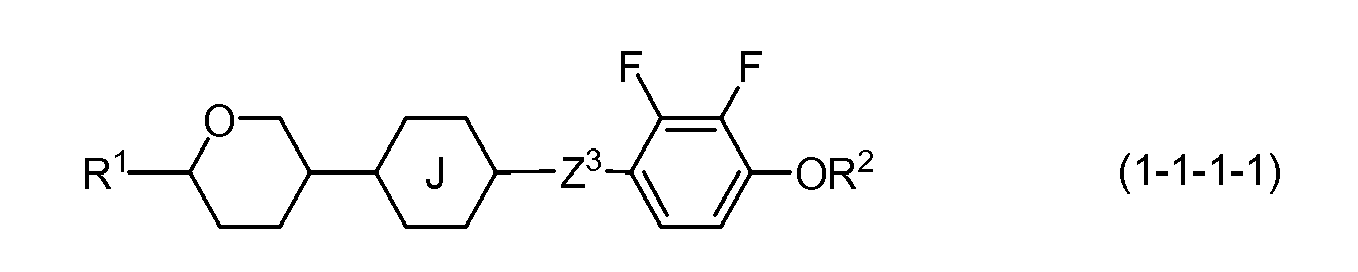
- [7] A compound represented by formula (1-2-1-1):

- [8] A liquid crystal composition comprising at least one of compounds according to any one of items [1] to [7], as a component A.
- [9] The liquid crystal composition according to item [8], further comprising at least one compound selected from the group of compounds represented by formulae (2), (3) and (4), as a component B:
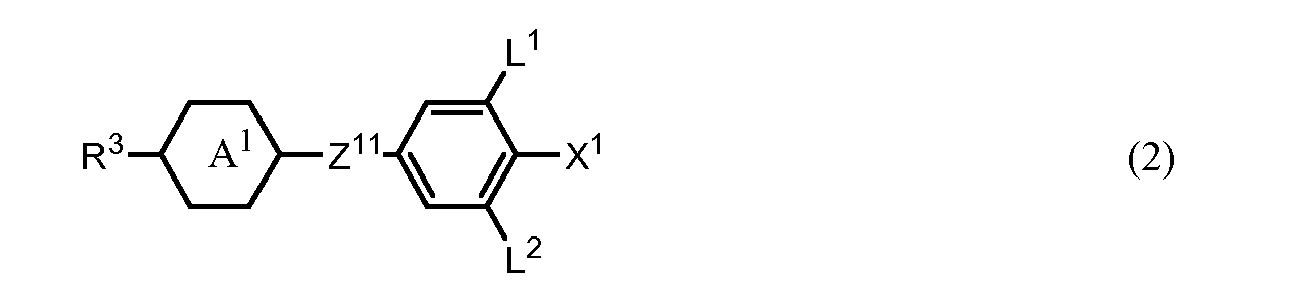


R3 is alkyl having 1 to 10 carbons or alkenyl having 2 to 10 carbons, and in the alkyl and the alkenyl, arbitrary hydrogen may be replaced by fluorine and arbitrary -CH2- may be replaced by -O-;
X1 is fluorine, chlorine, -OCF3, -OCHF2, -CF3, -CHF2, -CH2F, -OCF2CHF2 or -OCF2CHFCF3;
the ring A1, the ring A2 and the ring A3 are each independently 1,4-cyclohexylene, 1,3-dioxane-2,5-diyl, pyrimidine-2,5-diyl, 1-tetrahydropyran-2,5-diyl or 1,4-phenylene in which arbitrary hydrogen may be replaced by fluorine;
Z11, Z12, Z13, Z14 and Z15 are each independently -(CH2)2-, -(CH2)4-, -COO-, -CF2O-, -OCF2-, -CH=CH-, -C≡C-, -CH2O- or a single bond; and
L1 and L2 are each independently hydrogen or fluorine. - [10] The liquid crystal composition according to item [8], further comprising at least one compound selected from the group of compounds represented by formula (5), as a component C:

R4 is alkyl having 1 to 10 carbons or alkenyl having 2 to 10 carbons, and in the alkyl and the alkenyl, arbitrary hydrogen may be replaced by fluorine and arbitrary -CH2- may be replaced by -O-;
X2 is -C=N or -C=C-C=N;
the ring B1, the ring B2 and the ring B3 are each independently 1,4-cyclohexylene, 1,4-phenylene in which arbitrary hydrogen may be replaced by fluorine, 1,3-dioxane-2,5-diyl, 1-tetrahydropyran-2,5-diyl or pyrimidine-2,5-diyl;
Z16 is -(CH2)2-, -COO-, -CF2O-, -OCF2-, -C≡C-, -CH2O- or a single bond;
L3 and L4 are each independently hydrogen or fluorine; and
q is 0, 1 or 2 and r is 0 or 1. - [11] The liquid crystal composition according to item [8], further comprising at least one compound selected from the group of compounds represented by formulae (6), (7), (8), (9) and (10), as a component D:




R5 and R6 are each independently alkyl having 1 to 10 carbons or alkenyl having 2 to 10 carbons, and in the alkyl and the alkenyl, arbitrary hydrogen may be replaced by fluorine and arbitrary -CH2- may be replaced by -O-;
the ring C1, the ring C2, the ring C3 and the ring C4 are each independently 1,4-cyclohexylene, 1,4-cyclohexenylene, 1,4-phenylene in which arbitrary hydrogen may be replaced by fluorine or decahydro-2,6-naphthalene;
Z17, Z18, Z19, Z20, Z21, Z22, Z23, Z24, Z25, Z26, and Z27 are each independently -(CH2)2-, -COO-, -CH2O-, -OCF2-, -OCF2(CH2)2- or a single bond;
L5 and L6 are each independently chlorine or fluorine; and
j, k, 1, m and n are each independently 0 or 1, and the sum of k, 1, m and n is 1 or 2. - [12] The liquid crystal composition according to item [8], further comprising at least one compound selected from the group of compounds represented by formulae (11), (12) and (13), as a component E:



R7 and R8 are each independently alkyl having 1 to 10 carbons or alkenyl having 2 to 10 carbons, and in the alkyl and the alkenyl, arbitrary hydrogen may be replaced by fluorine and arbitrary -CH2- may be replaced by -O-;
the ring D1, the ring D2 and the ring D3 are each independently 1,4-cyclohexylene, pyrimidine-2,5-diyl, 1,4-phenylene, 2-fluoro-1,4-phenylene, 3-fluoro-1,4-phenylene or 2,5-difluoro-1,4-phenylene; and
Z28, Z29, Z30, Z31 and Z32 are each independently -C≡C-, -COO-, - (CH2)2-, -CH=CH- or a single bond. - [13] The liquid crystal composition according to item [9], further comprising at least one compound selected from the group of compounds represented by formula (5) according to item [10].
- [14] The liquid crystal composition according to item [9], further comprising at least one compound selected from the group of compounds represented by formulae (11), (12) and (13) according to item [12].
- [15] The liquid crystal composition according to item [10], further comprising at least one compound selected from the group of compounds represented by formulae (11), (12) and (13) according to item [12].
- [16] The liquid crystal composition according to item [11], further comprising at least one compound selected from the group of compounds represented by formulae (11), (12) and (13) according to item [12].
- [17] The liquid crystal composition according to any one of items [8] to [16], further comprising at least one optically active compound.
- [18] The liquid crystal composition according to any one of items [8] to [17], further comprising at least one antioxidant, or at least one ultraviolet absorbent, or at least each of an antioxidant and an ultraviolet absorbent.
- [19] A liquid crystal display device comprising at least one of the liquid crystal compositions according to any one of items [8] to [18].
- A liquid crystal compound that not only has a negatively large dielectric anisotropy (Δε), but also has at least one of characteristics such as the stability to heat, light and so forth, a high clearing point, a suitable refractive index anisotropy (Δn) and an excellent compatibility with other liquid crystal compounds is obtained according to the invention. A liquid crystal composition that has at least one of characteristics such as a low viscosity, a suitable refractive index anisotropy (Δn), a suitable and negative dielectric anisotropy (Δε), a low threshold voltage, a high maximum temperature of a nematic phase and a low minimum temperature of a nematic phase is obtained according to the invention. A liquid crystal display device that has at least one of characteristics such as a short response time, a low electric power consumption, a low driving voltage, a large contrast and a wide temperature range in which the device can be used is obtained according to the invention.
- The invention will be explained in detail below.
The liquid crystal compound of the invention is represented by formula (1-1) or (1-2): -


- In formulae (1-1) and (1-2), R1 and R2 are each independently alkyl having 1 to 10 carbons. In the alkyl, arbitrary -CH2- may be replaced by -O-, -S-, -CO- or -SiH2-, where a plurality of -CH2- adjacent to each other are not replaced, and arbitrary -(CH2)2- may be replaced by -CH=CH- or -C≡C-. In consideration of the stability of the compound, it is not desirable that two oxygens are adjacent to each other.
- Examples of R1 include alkyl having 1 to 10 carbons, alkoxy having 1 to 9 carbons, alkoxyalkyl having 2 to 9 carbons, alkoxyalkoxy having 2 to 8 carbons, alkenyl having 2 to 10 carbons, alkenyloxy having 2 to 9 carbons, alkenyloxyalkyl having 3 to 9 carbons and alkoxyalkenyl having 3 to 9 carbons. The alkyl chain in these groups is preferably straight. The temperature range of a liquid crystal phase is increased and the viscosity is decreased when the alkyl chain is straight. The alkenyl preferably has the double bond at an odd number position, and preferably has a trans configuration. When the alkenyl has a plurality of the double bonds, they are preferably not conjugated.
- Examples of the alkyl include -CH3, -C2H5, -C3H7, -C4H9, -C5H11, -C6H13, -C7H15, -C8H17, -C9H19 and -C10H21.
Examples of the alkoxy include -OCH3, -OC2H5, -OC3H7, -OC4H9, -OC5H11, -OC6H13, -OC7H15, -OC8H17 and -OC9H19.
Examples of the alkoxyalkyl include -CH2OCH3, -CH2OC2H5, -(CH2)2OCH3 and -(CH2)2OC2H5.
Examples of alkoxyalkoxy include -OCH2OCH3, -OCH2OC2H5, -O(CH2)2OCH3 and -O(CH2)2OC2H5.
Examples of the alkenyl include -CH=CH2, -CH=CHCH3, -CH=CHC2H5, - (CH2)2CH=CH2, -CH=CHC3H7, -(CH2)2CH=CHCH3, -(CH2)3CH=CH2, -CH=CH(CH2)2CH=CH2 and -(CH2)2CH=CH (CH2)2CH=CH2.
Examples of the alkenyloxy include -OCH2CH=CH2, -OCH2CH=CHCH3 and -OCH2CH=CHC2H5.
Examples of alkenyloxyalkyl include -CH2OCH2CH=CH2, -CH2OCH2CH=CHCH3, and -(CH2)2O(CH2)2CH=CH3.
Examples of the alkoxyalkenyl include -CH=CHCH2OCH3, -CH=CHCH2OC2H5 and -CH2CH=CHCH2OCH3. - Desirable R1 among these are -CH3, -C2H5, -C3H7, -C4H9, -C5H11, -C6H13, -C7H15, -C8H17, -C9H19, -C10H21, -OCH3, -OC2H5, -OC3H7, -OC4H9, -OC5H10, -OC6H13, -OC7H15, -OC8H17, -OC9H19, -CH=CH2, -CH=CHCH3, -CH=CHC2H5, -(CH2)2CH=CH2, -CH=CHC3H7, -(CH2)2CH=CHCH3, -(CH2)3CH=CH2, -CH=CH(CH2)2CH=CH2 and -(CH2)2CH=CH(CH2)2CH=CH2.
- More desirable R1 are -CH3, -C2H5, -C3H7, -C4H9, -C5H11, -C6H13-CH=CH2, -CH=CHCH3, -CH=CHC2H5, -(CH2)2CH=CH2, -CH=CHC3H7, -(CH2)2CH=CHCH3, -(CH2)3CH=CH2, -CH=CH(CH2)2CH=CH2 and -(CH2)2CH=CH(CH2)2CH=CH2.
- Examples of R2 include alkyl having 1 to 10 carbons, alkoxyalkyl having 2 to 9 carbons, alkenyl having 2 to 10 carbons, alkenyloxyalkyl having 3 to 9 carbons and alkoxyalkenyl having 3 to 9 carbons. The alkyl chain in these groups is preferably straight. The temperature range of a liquid crystal phase is increased and the viscosity is decreased, when the alkyl chain is straight. The alkenyl preferably has a trans configuration. R2 is preferably not alkoxy in view of the stability of the compound since two oxygens are adjacent to each other.
- Examples of the alkyl include -CH3, -C2H5, -C3H7, -C4H9, -C5H11, -C6H13, -C7H15, -C8H17, -C9H19 and -C10H21.
Examples of the alkoxyalkyl include -CH2OCH3, -CH2OC2H5, -(CH2)2OCH3 and -(CH2)2OC2H5.
Examples of the alkenyl include -CH=CH2, -CH=CHCH3, -CH2CH=CH2, -CH=CHC2H5, -CH2CH=CHCH3, -(CH2)2CH=CH2, -CH=CHC3H7, -CH2CH=CHC2H5, -(CH2)2CH=CHCH3 and -(CH2)3CH=CH2.
Examples of alkenyloxyalkyl include -CH2OCH2CH=CH2, -CH2OCH2CH=CHCH3 and -(CH2)2O(CH2)2CH=CH3.
Examples of the alkoxyalkenyl include -CH=CHCH2OCH3, -CH=CHCH2OC2H5 and -CH2CH=CHCH2OCH3.
Desirable R2 among these are -CH3, -C2H5, -C3H7, -C4H9, -C5H11, -C6H13, -C7H15, -C8H17, -C9H19, -C10H21, -CH2CH=CH2, -CH2CH=CHCH3, -(CH2)2CH=CH2, -CH2CH=CHC2H5, -(CH2)2CH=CHCH3 and -(CH2)3CH=CH2. - More desirable R2 are -CH3, -C2H5, -C3H7, -C4H9, -C5H11 and -C6H13.
- The ring G and the ring J in formulae (1-1) and (1-2) are each independently 1,4-cyclohexylene or 1,4-phenylene. In these rings, arbitrary -CH2- may be replaced by -O-, -S-, -CO- or -SiH2-, and arbitrary -(CH2)2- may be replaced by -CH=CH-. In the 1,4-phenylene arbitrary -CH= may be replaced by -N=, and in these rings, arbitrary hydrogen may be replaced by halogen, -CF3, -CHF2, -CH2F, -OCF3, -OCHF2 or -OCH2F.
- The refractive index anisotropy (Δn) is decreased and the viscosity is decreased, when these rings are each 1,4-cyclohexylene, and the maximum temperature of a nematic phase of a liquid crystal composition is increased by the addition of this liquid crystal compound to the composition.
- The refractive index anisotropy (Δn) is relatively increased and the orientational order parameter is increased when the ring is 1,4-phenylene in which hydrogen may be replaced by halogen.
- Desirable ring G and ring J among these are 1,4-cyclohexylene, 1,4-cyclohexenylene, 1,3-dioxane-2,5-diyl, 1,4-phenylene, 2-fluoro-1,4-phenylene, 3-fluoro-1,4-phenylene, 2,3-difluoro-1,4-phenylene, 2-fluoro-3-chloro-1,4-phenylene, 2-chloro-3-fluoro-1,4-phenylene, 2,3-dichloro-1,4-phenylene and 1,3-pyrimidine-2,5-yl, and more desirable ring G and ring J are 1,4-cyclohexenylene and 1,4-phenylene.
- In formulae (1-1) and (1-2), Z1, Z2 and Z3 are each independently a single bond, -CH2O- or -OCH2-, provided that at least one of Z1, Z2 and Z3 is -CH2O- or -OCH2-. Z3 is preferably -CH2O- for increasing the absolute value of the dielectric anisotropy (Δε). Z1 and Z2 are each preferably a single bond for increasing the temperature range of a liquid crystal phase and for decreasing the viscosity.
- s and t are each independently 0, 1, 2 or 3, and the sum of s and t is 1, 2 or 3. The sum of s and t is preferably 1 or 2, since the compatibility with other liquid crystal compounds is decreased when the number of the rings is increased.
- A plurality of the ring G may be the same or different and a plurality of the bonding group Z1 may be the same or different, when s is 2 or 3. A plurality of the ring J may be the same or different and a plurality of bonding group Z2 may be the same or different, when t is 2 or 3.
- In the case where t is 0 in formula (1-2), the absolute value of the dielectric anisotropy (Δε) is decreased when Z3 is a single bond. This is because the oxygen in the tetrahydropyran ring is located

- In the liquid crystal compound represented by formula (1-1) or (1-2), the terminal groups R1 and R2, the rings G and J, and the bonding groups Z1 Z2 and Z3 can be appropriately selected from the aforementioned definitions, adjusting characteristics such as the refractive index anisotropy (Δn) and the dielectric anisotropy (Δε) to desired values.
- Desirable examples of the liquid crystal compound represented by formula (1-1) or (1-2) include compounds represented by formula (1-1-1) and (1-2-1):


- More desirable examples of the liquid crystal compound represented by formula (1-1) or (1-2) include compounds represented by formula (1-1-1-1) and (1-2-1-1):


- The liquid crystal compound represented by formula (1-1) or (1-2) of the invention can be obtained by introducing appropriate groups at the position of R1, R2, the ring G, the ring J, Z1, Z2 and Z3, and the groups can be introduced according to known and general synthetic organic methods. Representative examples of the synthesis include the methods described in "Vol. 14: Synthesis and Reaction of Organic Compounds" (1978) in New Experimental Chemistry Course (Shin Jikken Kagaku Kouza, in Japanese title; Maruzen Co., Ltd.), or "Vol. 19 to Vol. 26: Organic Synthesis I to VIII" (1991) in Experimental Chemistry Course (Jikken Kagaku Kouza, in Japanese title; the fourth edition, Maruzen Co., Ltd.).
- An example of a method for forming the bonding groups Z1, Z2 and Z3 will be shown in the schemes, and the schemes will be then explained in the sections (I) and (II). In the schemes, MSG1 and MSG2 are each a monovalent organic group having at least one ring. A plurality of MSG1 (or MSG2) used in the scheme may be the same or different. The compounds (1A) and (1B) in the scheme correspond to the liquid crystal compounds represented by formula (1-1) or (1-2).
-

-
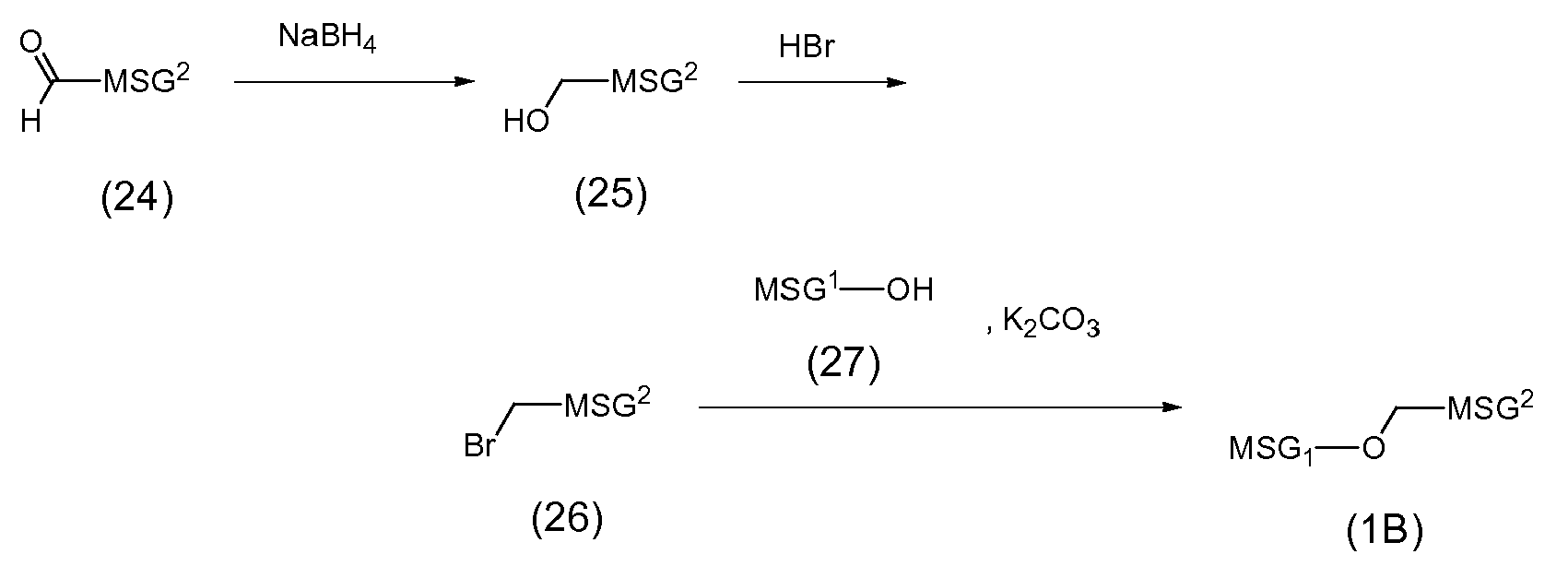
- The compound (1A) is prepared by the reaction of the aryl borate (21) with the compound (22) that is prepared by a known method, in the presence of a catalyst such as an aqueous solution of carbonate and tetrakis (triphenylphosphine) palladium. The compound (1A) can also be prepared by the reaction of the compound (23) that is prepared by a known method with n-butyllithium and then with zinc chloride, and by the reaction of the product with the compound (22) in the presence of a catalyst, such as dichlorobis(triphenylphosphine)palladium.
- The compound (24) is reduced with a reducing agent, such as sodium borohydride, to give the compound (25). The compound (25) is halogenated with hydrobromic acid to give the compound (26). The compound (26) is reacted with the compound (27) in the presence of potassium carbonate to give the compound (1B).
An example of methods for synthesizing the tetrahydropyran compound represented by formula (1-1) will be shown in the schemes. A scheme in which the synthetic intermediate (31) having a lactone moiety is prepared will be explained, and then an example of a method for preparing the tetrahydropyran compound (34) by using the synthetic intermediate (31) as a starting material will be described. -


- In the compounds (28) to (31), Q1 is a structural unit of formula (1-1). The structural unit is shown in the scheme. In these compounds, the symbols R2, J, Z2, Z3 and t have the same meanings as described in formula (1-1) or (1-2).
- Specifically, the compound (29) is prepared by the reaction of the compound (28) with cyclohexylamine. The reaction is preferably carried out in a solvent such as diethyl ether, in the presence of a base such as potassium carbonate at a temperature in the range of room temperature to the boiling point of the solvent. The compound (30) is prepared by the addition reaction of ethyl acrylate to the compound (29) and then by the deprotection of the protective group. In the reaction, ethyl acrylate itself is preferably used as a solvent, and a solvent, such as toluene, that does not react with the compound (29) or ethyl acrylate may be used. A polymerization inhibitor, such as hydroquinone, is preferably added to prevent the polymerization of ethyl acrylate. The reaction is carried out in the temperature range of room temperature to the boiling point of the solvent when an ordinary glass reactor is employed, and the reaction may be carried out at a temperature higher than the boiling point of the solvent by using a pressure-proof reactor such as a stainless steel autoclave. After the addition reaction has proceeded sufficiently, an acid such as oxalic acid is added to the reaction mixture, eliminating cyclohexylamine and giving the compound (30). The compound (31) is prepared by means of the ring-opening reaction of the compound (30). The reaction is carried out preferably in a solvent, such as isopropanol, in the presence of sodium cyanoborohydride at around room temperature. An acid such as hydrochloric acid may be added to accelerate the reaction.
- The compound (28) that is a starting material can be easily prepared by a known method in synthetic organic chemistry.
An example of methods for synthesizing the compound (34) is shown in the following scheme. -


- In the compounds (31) to (34), Q1 and Q2 are each a structural unit of formula (1-1). The structural unit is shown in the scheme. In these compounds, the symbols R1, R2, G, J, Z1, Z2, Z3, s and t have the same meanings as described in formula (1-1) and (1-2).
Specifically, the compound (33) is prepared by the reaction of the compound (31) with the compound (32). The reaction is preferably carried out in a solvent such as tetrahydrofuran at a temperature of -30 °C. The compound (34) is prepared by the reaction of the compound (33) in a solvent such as dichloromethane in the presence of triethylsilane and boron trifluoride-diethyl ether complex at a temperature of -50 °C or lower. - The compound (32) can be easily prepared by a method in synthetic organic chemistry.
The tetrahydropyran compound represented by formula (1-2) can be prepared by a similar method. - The liquid crystal composition of the invention necessarily contains the compound represented by formula (1-1) or (1-2) of the invention as a component A. The composition may contain only the component A or may contain the component A and another component that is not shown in this specification. The composition can exhibit various characteristics by the addition of the component B that is at least one compound selected from the group of the compounds represented by formulae (2), (3) and (4), the component C that is at least one compound selected from the group of the compounds represented by formula (5), the component D that is at least one compound selected from the group of the compounds represented by formulae (6), (7), (8), (9) and (10), and/or the component E that is at least one compound selected from the group of the compounds represented by formulae (11), (12) and (13).
- These components may be arbitrarily combined according to objective characteristics or use, and examples of desirable combinations of the components include the components A and B, the components A and C, the components A and D, the components A, B and E, the components A, C and E, and the components A, D and E.
- Even if an analogue that is composed of an isotope of each element is used as a component, there is no large difference in physical characteristics between the composition of the invention and that of the analogue. The components of the liquid crystal composition of the invention may be analogues thereof containing isotopes of the elements constituting the components since there is no large physical difference among them.
- In the component B, desirable examples of the compound represented by formula (2) include compounds represented by formulae (2-1) to (2-16), desirable examples of the compound represented by formula (3) include compounds represented by formulae (3-1) to (3-112), and desirable examples of the compound represented by formula (4) include compounds represented by formulae (4-1) to (4-52).
-

-

-

-

-

-

-

-

- In formulae (2-1) to (2-16), (3-1) to (3-112), and (4-1) to (4-52), R3 and X1 have the same meanings as described above.
The compound represented by formulae (2) to (4), i.e., the component B, is used in the preparation of a liquid crystal composition for a TFT mode device, since it has positive dielectric anisotropy (Δε) and is quite excellent in heat stability and chemical stability. The content of the component B in the liquid crystal composition of the invention is suitably in the range of 1% to 99% by weight, preferably of 10% to 97% by weight, and more preferably of 40% to 95% by weight, based on the total weight of the liquid crystal composition. The viscosity of the composition can be adjusted by further adding a compound represented by formulae (11) to (13) (component E). - Desirable examples of the compound represented by formula (5), i.e., the component C, include compounds represented by formulae (5-1) to (5-64).
-

-

-

- In formulae (5-1) to (5-64), R4 and X2 have the same meanings as described above.
The compound represented by formula (5), i.e., the component C, is used mainly in the preparation of a liquid crystal composition for an STN mode device or a TN mode device, since it has positive dielectric anisotropy (Δε) and its value is very large. The threshold voltage of the composition can be decreased by adding the component C. The viscosity can be adjusted, the refractive index anisotropy (Δn) can be adjusted, and the temperature range of a liquid crystal phase can be increased by adding the component C. The component C can also be used for an improvement of the steepness. - The content of the component C is suitably in the range of 0.1% to 99.9% by weight in the preparation of a liquid crystal composition for an STN mode device or a TN mode device. The content is preferably in the range of 10% to 97% by weight, and more preferably of 40% to 95% by weight. The threshold voltage, the temperature range of a liquid crystal phase, the refractive index anisotropy (Δn), the dielectric anisotropy (Δε), the viscosity and so forth can be adjusted by adding components that is described later.
- The component D that is at least one compound selected from the group of compounds represented by formulae (6) to (10) is desirable in the preparation of the liquid crystal composition of the invention, in which the dielectric anisotropy (Δε) is negative, for use in a vertical alignment (VA) mode device.
- Desirable examples of the compound represented by formulae (6) to (10), i.e., the component D, include compounds represented by formulae (6-1) to (6-5), (7-1) to (7-11), (8-1), (9-1) to (9-3), and (10-1) to (10-11).
-

- In formulae (6-1) to (6-5), (7-1) to (7-11), (8-1), (9-1) to (9-3), and (10-1) to (10-11), R5 and R6 have the same meanings as described above.
The component D is used mainly in a liquid crystal composition in which the value of the dielectric anisotropy (Δε) is negative, for use in a VA mode device. When the content of the component D increases, the threshold voltage of the composition is decreased, but the viscosity is increased. Accordingly, the content of the component D is preferably smaller, if the demanded value of the threshold value is satisfied. Since the absolute value of the dielectric anisotropy (Δε) is around 5, there are cases where the device may not be driven with voltage when the content of the component is less than 40% by weight. - In the component D, the compound represented by formula (6) has two rings and thus is effective in adjusting the threshold voltage, adjusting the viscosity or adjusting the refractive index anisotropy (Δn). The compound represented by formulae (7) and (8) has three rings and thus is effective in increasing the clearing point, increasing the temperature range of a nematic phase, decreasing the threshold voltage, increasing the refractive index anisotropy (Δn), and so forth.
- The content of the component D in the preparation of a composition for a VA mode device is preferably 40% by weight or more, and more preferably in the range of 50% to 95% by weight, based on the total amount of the composition. The elastic constant, which relates to the stability of orientation, can be adjusted and the voltage-transmittance curve of the composition can be adjusted by adding the component D. In the case where the component D is added to the composition having positive dielectric anisotropy (Δε), the content is preferably 30% by weight or less based on the total amount of the composition.
- The component E is used for adjusting the threshold voltage, the temperature range of a liquid crystal phase, the refractive index anisotropy (Δεn), the dielectric anisotropy (Δε), the viscosity and so forth.
- Desirable examples of the compounds represented by formulas (11), (12) and (13), i.e., the component E, include compounds represented by formulae (11-1) to (11-11), (12-1) to (12-18) and (13-1) to (13-6).
-

-


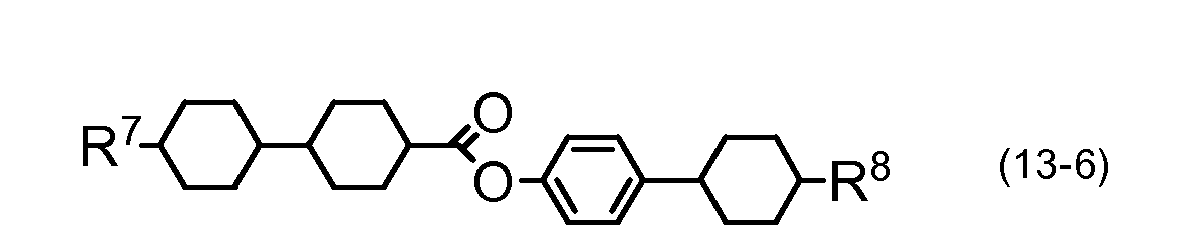
- In formulas (11-1) to (11-11), (12-1) to (12-18) and (13-1) to (13-6), R7 and R8 have the same meanings as described above.
The compound represented by formulae (11) to (13), i.e., the component E, has a small absolute value of dielectric anisotropy (Δε) that is to say, the compound is nearly neutral. The compound represented by formula (11) is effective mainly in adjusting the viscosity or adjusting the refractive index anisotropy (Δn), and the compound represented by formulae (12) and (13) is effective in increasing the temperature range of a nematic phase such as increasing the clearing point, or adjusting the refractive index anisotropy (Δn) - When the content of the compound of the component E increases, the threshold voltage of the liquid crystal composition is increased and the viscosity is decreased. Accordingly, the content is preferably larger if the demanded value of the threshold voltage of the liquid crystal composition is satisfied. In the case where a liquid crystal composition for a TFT mode device is prepared, the content of the component E is preferably 60% by weight or less, and more preferably 40% by weight or less, based on the total amount of the composition. In the case where a liquid crystal composition for an STN mode device or a TN mode device is prepared, the content of the component E is preferably 70% by weight or less, and more preferably 60% by weight or less, based on the total amount of the composition.
- The liquid crystal composition of the invention preferably contains at least one of compounds represented by formula (1-1) or (1-2) of the invention at a rate of 0.1% to 99% by weight for exhibiting excellent characteristics.
- The liquid crystal composition of the invention can be generally prepared by a known method, for example, by dissolving necessary components at an increased temperature. A liquid crystal composition can be prepared by the addition of an additive that is known to persons skilled in the art depending on the desired application. For example, the liquid crystal composition (f) of the invention containing an optically active compound, which will be described below, and a liquid crystal composition for a GH mode device, in which a dichroic dye is added, can be prepared. Usually, the additive is well known by persons skilled in the art and is reported in detail in the literatures.
- The liquid crystal composition (f) of the invention further contains one or more optically active compounds in addition to the liquid crystal composition described above.
A known chiral dopant may be added as the optically active compound. The chiral dopant is effective in inducing a helical structure in liquid crystals, adjusting a twist angle required and then preventing a reverse twist. Examples of the chiral dopant include the following optically active compounds represented by formulae (Op-1) to (Op-13). -


- The helical pitch of the liquid crystal composition (f) of the invention is usually adjusted by adding the optically active compound. The helical pitch is preferably adjusted to the range of 40 µm to 200 µm in the liquid crystal composition for a TFT mode device or a TN mode device. It is preferably adjusted to the range of 6 µm to 20 µm in the liquid crystal composition for an STN mode device. It is preferably adjusted to the range of 1.5 µm to 4 µm in the liquid crystal composition for a bistable TN mode device. Two or more optically active compounds may be added for the purpose of adjusting the temperature dependence of the pitch.
- The liquid crystal composition of the invention can be used for a liquid crystal composition for a GH mode device by the addition of a dichroic dye, such as a merocyanine compound, a stylyl compound, an azo compound, an azomethine compound, an azoxy compound, a quinophthalone compound, an anthraquinone compound and a tetrazine compound.
The liquid crystal composition of the invention can be applied to a nematic curvilinear aligned phase (NCAP) device prepared by microcapsulating nematic liquid crystals and a polymer-dispersed liquid crystal display device (PDLCD) produced by forming a three-dimensional network polymer in liquid crystals, for example, a polymer network liquid crystal display device (PNLCD), and also to an electrically controlled birefringence (ECB) mode device and a dynamic scattering (DS) mode device. - The invention will be explained in more detail by means of examples below, but the invention is not construed as being limited to the examples. The term "%" means "% by weight", unless otherwise noted.
The resulting compounds were identified on the basis of magnetic nuclear resonance spectra obtained by 1H-NMR analysis, gas chromatograms obtained by gas chromatography (GC) analysis, and so forth. Thus, the analysis methods will be first described. - Bruker DRX-500 (produced by Bruker BioSpin Co., Ltd.) was used for measurement. A sample synthesized in the examples and so forth was dissolved in a deuterated solvent such as CDCl3, in which the sample is soluble, and the measurement was carried out at room temperature and at 500 MHz with integration of 24. Tetramethylsilane (TMS) was used as a standard substance for the zero point of chemical shifts δ.
- Gas Chromatograph Model GC-14B made by Shimadzu was used for measurement. Capillary column CBP1-M25-025 (length: 25 m, bore: 0.22 mm, film thickness: 0.25 µm, stationary phase: dimethylpolysiloxane, non-polar) produced by Shimadzu Corp. was used as a column. Helium was used as a carrier gas and adjusted to a flow rate of 1 ml/min. A temperature of the sample injector was 280 °C, and a temperature of the detector (FID) was 300 °C.
- The sample was dissolved in toluene to prepare a 1% by weight solution, and 1 µl of the resulting solution was injected into the sample injector.
Chromatopac Model C-R6A, produced by Shimadzu Corp., or its equivalent was used as a recorder. The resultant gas chromatogram showed the retention time of peaks and the values of peak areas corresponding to the component compounds. - Solvents for diluting the sample may also be chloroform, hexane, and so forth. The following capillary columns may also be used: a capillary column DB-1, produced by Agilent Technologies Inc. (length: 30 m, bore: 0.32 mm, film thickness: 0.25 µm), a capillary column HP-1, produced by Agilent Technologies Inc. (length: 30 m, bore: 0.32 mm, film thickness: 0.25µm), a capillary column Rtx-1, produced by Restek Corporation (length: 30 m, bore: 0.32 mm, film thickness: 0.25 µm), and a capillary column BP-1, produced by SGE International Pty. Ltd. (length: 30 m, bore: 0.32 mm, film thickness: 0.25 µm).
- An area ratio of each peak in the gas chromatogram corresponds to a ratio of each component compound. In general, the percentages by weight of the component compounds of the analyzed sample are not exactly identical to the percentages by area of the peaks of the analyzed sample. According to the invention, however, the percentages by weight of the component compounds of the analyzed sample substantially correspond to the percentages by area of the peaks of the analyzed sample, because the correction coefficient is substantially 1 (one) when the aforementioned columns are used in the invention.
- Two kinds of samples are used for measuring physical properties of a liquid crystal compound: one is a compound itself, and the other is a mixture of the compound and mother liquid crystals.
- In the latter case where a sample is prepared by mixing the compound with mother liquid crystals, the measurement is carried out in the following manner. A sample was prepared by mixing 15% by weight of the compound with 85% by weight of mother liquid crystals. The values of characteristics of the compound were calculated by extrapolating values obtained by measurement.
- Extrapolated Value = (100 x (measured value of sample) - (percentage by weight of mother liquid crystals) x (value measured for mother liquid crystals)) / (percentage by weight of liquid crystal compound)
In the case where a smectic phase was exhibited at 25 °C or crystals were deposited at 25 °C at this ratio of the liquid crystal compound to the mother liquid crystals, the ratio of the compound to the mother liquid crystals was changed step by step in the order of (10% by weight / 90% by weight), (5% by weight / 95% by weight) and (1% by weight / 99% by weight). The values of characteristics of the sample were measured at a ratio where a smectic phase or crystals were not deposited at 25 °C, and extrapolated values were calculated from the aforementioned equation, which were regarded as the values of characteristics of the liquid crystal compound. - There are various kinds of mother liquid crystals for the measurement, and the composition ratio of the mother liquid crystals A was as follows, for example.
-

17.2% 
27.6% 
20.7% 
20.7% 
13.8% - As a sample for measuring characteristics of a liquid crystal composition, the liquid crystal composition itself was used.
- Measurement of characteristics was carried out according to the following methods. Most methods are described in the Standard of Electric Industries Association of Japan, EIAJ ED-2521 A or those with some modifications. A TFT was not attached to a TN device or a VA device used for measurement.
- Among measured values, the values obtained from a liquid crystal compound itself as a sample and the values obtained from a liquid crystal composition itself as a sample were described as experimental data. In the case where the values were obtained from the mixture of a compound and mother liquid crystals, the values obtained by use of extrapolation was regarded as extrapolated values.
- The measurement was carried out by the methods (1) and (2) below.
- (1) A compound was placed on a hot plate (Hot Stage Model FP-52, produced by Mettler Co., Ltd.) in a melting point apparatus equipped with a polarizing microscope, and while the compound was heated at the rate of 3 °C per minute, the state of the phase and its change were observed with the polarizing microscope to determine the kind of the phase.
- (2) A sample was heated and cooled at a rate of 3 °C per minute by using a scanning calorimeter, DSC-7 System or Diamond DSC System, produced by Perkin-Elmer, Inc., whereby a starting point of an endothermic peak or an exothermic peak caused by phase change of the sample was obtained by extrapolation (on set) to determine the phase transition temperature.
- In the following description, crystals are denoted by "C". Crystals that are distinguishable into two kinds are denoted by "C1" and "C2". A smectic phase is denoted by "S", and a nematic phase is denoted by "N." A liquid (isotropic phase) is denoted by "Iso". In the case where a smectic phase is distinguished into a smectic B phase and a smectic A phase, these are denoted by "SB" and "SA", respectively. The expression of the phase transition temperature, for example, "C 50.0 N 100.0 Iso", means that the transition temperature from a crystal to a nematic phase (that is, CN) is 50.0 °C, and the transition temperature from a nematic phase to a liquid (that is, NI) is 100.0 °C. The same rule applies to the other expressions.
- A sample (a liquid crystal composition or a mixture of a liquid crystal compound and the mother liquid crystals) was placed on a hot plate (Hot Stage Model FP-52, produced by Mettler Co., Ltd.) in a melting point apparatus equipped with a polarizing microscope. While the sample was heated at the rate of 1 °C per minute, it was observed with the polarizing microscope. A temperature where a part of the sample was changed from a nematic phase to an isotropic liquid was expressed as a maximum temperature of a nematic phase. The maximum temperature of a nematic phase may be abbreviated to "the maximum temperature" in some cases.
- Samples were prepared by mixing the mother liquid crystals with a liquid crystal compound in order that the ratio of the liquid crystal compound was 20% by weight, 15% by weight, 10% by weight, 5% by weight, 3% by weight and 1% by weight, and then put in glass bottles. The glass bottles were kept in a freezer at -10 °C or -20 °C for a prescribed period of time, and then were observed as to whether or not crystals or a smectic phase was deposited.
- There is a general tendency that the response time is decreased when the viscosity decreases.
The viscosity was measured by means of an E-type viscometer. - There is a general tendency that response time is decreased when rotational viscosity decreases.
Rotational viscosity was measured according to the method described in M. Imai, et al., Molecular Crystals and Liquid Crystals, vol. 259, p. 37 (1995). A sample (a liquid crystal composition or a mixture of a liquid crystal compound and mother liquid crystals) was put in a VA device in which the cell gap between two glass substrates was 20 µm. A voltage with an increment of 1 volt in the range of 30 V to 50 V was applied stepwise to the device. After a period of 0.2 second with no voltage, a voltage was applied repeatedly under the conditions of only one rectangular wave (rectangular pulse; 0.2 second) and no voltage (2 seconds). The peak current and the peak time of the transient current generated by the applied voltage were measured. The value of rotational viscosity was obtained from the measured values and the calculating equation (8) on page 40 of the paper presented by M. Imai, et al.
The value of the dielectric anisotropy (Δε) necessary for the present calculation was obtained by the method under the heading "dielectric anisotropy (Δε) described below. - Measurement was carried out by use of an Abbe refractometer with a polarizing plate mounted on the ocular at a temperature of 25 °C, on irradiation with light at a wavelength of 589 nm. The surface of the main prism was rubbed in one direction, and then a sample (a liquid crystal composition or a mixture of a liquid crystal compound and mother liquid crystals) was dropped on the main prism. A refractive index (n∥) was measured when the direction of polarized light was parallel to that of the rubbing. A refractive index (n⊥) was measured when the direction of polarized light was perpendicular to that of the rubbing. The value of refractive index anisotropy (Δn) was calculated from the equation: Δn = n∥ - n⊥.
- A solution of octadecyltriethoxysilane (0.16 ml) in ethanol (20 ml) was coated on a glass substrate that had been fully cleaned. The glass substrate was spun with a spinner and then heated at 150 °C for 1 hour. A VA device in which the distance (cell gap) was 20 µm was set up with two sheets of the glass substrates.
A polyimide alignment film was prepared on a glass substrate in the similar manner. The alignment film on the glass substrate was rubbed, and a TN device was set up in which the distance between two glass substrates was 9 µm and a twist angle was 80 degrees.
A sample (a liquid crystal composition or a mixture of a liquid crystal compound and mother liquid crystals) was put in the VA device, and a voltage of 0.5 V (1 kHz, sine wave) was applied to the device, and then permittivity (ε∥) in the major axis direction of the liquid crystal molecules was measured.
The sample (the liquid crystal composition or a mixture of the liquid crystal compound and the mother liquid crystals) was put in the TN device, and a voltage of 0.5 V (1 kHz, sine wave) was applied to the device, and then permittivity (ε⊥) in the minor axis direction of the liquid crystal molecules was measured.
The dielectric anisotropy (Δε) was calculated from the equation; (Δε) = (ε∥) - (ε⊥). -

- THF (200 ml) was added under an atmosphere of nitrogen to methyltriphenylphosphonium bromide (41.2 g) in a reaction vessel, and the mixture was cooled to -20 °C, and t-BuOK (12.9 g) was added thereto and the stirring was continued for another 1 hour. A THF (200 ml) solution of 1, 4-dioxaspiro[4.5]decan-8-one (15.0 g) was added thereto dropwise and the stirring was continued at -20 °C for another 1 hour. The reaction mixture was warmed to room temperature, water (200 ml) was added thereto, and then the mixture was extracted in toluene (300 ml) three times. The resultant organic phase was washed with water, dried over anhydrous magnesium sulfate, and then concentrated under reduced pressure to a volume of about 200 ml. The concentrated solution was poured into n-hexane (1,000 ml) and deposits were filtered off. The solvent was evaporated from the resultant solution under reduced pressure and the residue was purified by silica gel-column chromatography to give 8-methylene-1,4-dioxaspiro[4.5]decane (10.6 g).
- 8-Methylene-1,4-dioxaspiro[4.5]decane (10.6 g) prepared in First Step was dissolved in THF (50 ml) under an atmosphere of nitrogen in a reaction vessel, and the solution was cooled to 0 °C, and then 9-BBN (0.5 M, in THF; 150 ml) was added dropwise thereto. After 48 hours of stirring at room temperature, the mixture was cooled to 0 °C, and an aqueous solution of sodium hydroxide (6M, 40 ml) was added thereto. Hydrogen peroxide (35% aqueous solution) was added to the solution while being kept at 0 °C. The reaction solution was washed with brine, dried over anhydrous magnesium sulfate, and then the solvent was evaporated under reduced pressure. The residue was purified by silica gel-column chromatography to give (1,4-dioxaspiro[4.5]decen-8-yl)-methanol (7.3 g).
- (1,4-Dioxaspiro[4.5]decen-8-yl)-methanol (7.3 g) prepared in Second Step was dissolved in dichloromethane (50 ml) under an atmosphere of nitrogen in a reaction vessel, and toluenesulfonyl chloride (8.1 g) was added thereto. The reaction solution was cooled to 0 °C, and pyridine (6.7 g) was added thereto. The mixture was warmed to room temperature, and the stirring was continued at room temperature for another 2 hours. Toluene was added to the reaction solution and the mixture was washed successively with 2N-hydrochloric acid three times, an aqueous solution of sodium hydroxide and water. The organic phase was dried over anhydrous magnesium sulfate, the solvent was evaporated, and the residue was recrystallized from Solmix-heptane to give (1,4-dioxaspiro[4.5]decen-8-yl)-methanol-p-toluenesulfonic acid ester (13.0 g).
- (1,4-Dioxaspiro[4.5]decen-8-yl)-methanol-p-toluenesulfonic acid ester (13.0 g) prepared in Third Step and 4-ethoxy-2,3-difluorophenol (8.3 g) were dissolved in N,N-dimethylformamide (200 ml) under an atmosphere of nitrogen in a reaction vessel, and sodium hydride (55%; 2.83 g) was added thereto, and then the stirring was continued at 60 °C for another 3 hours. The reaction solution was cooled with ice, and water (100 ml) was slowly added thereto, separating into two phases. The water phase was extracted in diethyl ether (50 ml) three times, and the combined organic phase was washed with water and dried over anhydrous magnesium sulfate. The solvent was evaporated under reduced pressure, and the residue was purified by silica gel-column chromatography to give 8-(4-ethoxy-2,3-difluorophenoxymethyl)-1,4-dioxaspiro[4.5]decane (11.7 g).
- 8-(4-Ethoxy-2,3-difluorophenoxymethyl)-1,4-dioxaspiro[4.5]decane (11.7 g) prepared in Fourth Step was dissolved in toluene (100 ml) under an atmosphere of nitrogen in a reaction vessel, and formic acid (5 ml) was added thereto, and then the mixture was refluxed for 6 hours. The reaction solution was cooled to room temperature, washed with water, and then dried over anhydrous magnesium sulfate. The solvent was evaporated under reduced pressure and the residue was purified by silica gel-column chromatography to give 4-(4-ethoxy-2,3-difluorophenoxymethyl)-cyclohexanone (8.1 g).
- THF (50 ml) was added under an atmosphere of nitrogen to methoxymethyltriphenylphosphonium chloride (14.7g) in a reaction vessel and the solution was cooled to -20 °C. t-BuOK (4.8 g) was added thereto and the stirring was continued for another 1 hour. A THF (100 ml) solution of 4-(4-ethoxy-2,3-difluorophenoxymethyl)-cyclohexanone (8.1 g) prepared in Fifth Step was added thereto dropwise and the stirring was continued for another 1 hour. The reaction mixture was warmed to room temperature, water (200 ml) was added thereto, and then the mixture was extracted in toluene (300 ml) three times. The resultant organic phase was washed with water, dried over anhydrous magnesium sulfate, and then concentrated under reduced pressure to a volume of about 200 ml. The concentrated solution was poured into n-hexane (1,000 ml) and deposits were filtered off. The solvent was evaporated from the resultant solution under reduced pressure and the residue was purified by silica gel-column chromatography to give 1-ethoxy-2,3-difluoro-4-(4-methoxymethylenecyclohexylmethoxy)-benzene (8.3 g).
- 1-Ethoxy-2,3-difluoro-4-(4-methoxymethylenecyclohexylmethoxy)-benzene (8.3 g) prepared in Sixth Step was dissolved in acetone (100 ml), and hydrochloric acid (4M; 8 ml) was added thereto, and the stirring was continued at room temperature for another 1 hour. Water (100 ml) was added thereto, and then the mixture was extracted in toluene (50 ml) three times. The combined organic phase was washed with water, and dried over anhydrous magnesium sulfate. The solvent was evaporated under reduced pressure, and toluene (200 ml) and ethanol (200 ml) was added to the residue. Then, an aqueous solution of NaOH (20%; 30 ml) was added to the mixture on an ice bath, and the stirring was continued at room temperature for another 3 hours. The mixture was neutralized by the addition of a saturated aqueous solution of ammonium chloride, and extracted in toluene (100 ml) three times. The combined organic phase was washed with water and dried over anhydrous magnesium sulfate. The solvent was evaporated under reduced pressure, and the residue was purified by silica gel-column chromatography to give 4-(4-ethoxy-2,3-difluoro-phenoxymethyl)-cyclohexanecarboaldehyde (6.6 g).
- THF (30 ml) was added under an atmosphere of nitrogen to methoxymethyltriphenylphosphonium chloride (9.7 g) in a reaction vessel and cooled to -20 °C, t-BuOK (3.1 g) was added thereto, and the stirring was continued for another 1 hour. A THF (70 ml) solution of 4-(4-ethoxy-2,3-difluoro-phenoxymethyl)-cyclohexanecarboaldehyde (6.6 g) prepared in Seventh Step was added thereto dropwise and the stirring was continued for another 1 hour. The reaction mixture was warmed to room temperature, and water (100 ml) was added thereto, and then the mixture was extracted in toluene (100 ml) three times. The resultant organic phase was washed with water and dried over anhydrous magnesium sulfate, and then concentrated under reduced pressure to a volume of about 100 ml. The concentrated solution was poured into n-hexane (500 ml) and deposits were filtered off. The solvent was evaporated from the resultant solution under reduced pressure, and the residue was purified by silica gel-column chromatography to give 1-ethoxy-2,3-difluoro-4-[4-(2-methoxyvinyl)-cyclohexylmethoxy]-benzene (6.5 g).
- 1-Ethoxy-2,3-difluoro-4-[4-(2-methoxyvinyl)-cyclohexylmethoxy]-benzene (6.5 g) prepared in Eighth Step was dissolved in acetone (100 ml), and hydrochloric acid (4M; 8 ml) was added thereto, and then the stirring was continued at room temperature for another 1 hour. Water (100 ml) was added thereto, and then the mixture was extracted in toluene (50 ml) three times. The combined organic phase was washed with water and dried over anhydrous magnesium sulfate, and the solvent was evaporated under reduced pressure to give [4-(4-ethoxy-2,3-difluorophenoxymethyl)-cyclohexyl]-acetaldehyde (6.1 g).
- [4-(4-Ethoxy-2,3-difluorophenoxymethyl)-cyclohexyl]-acetaldehyde (6.1 g) prepared in Ninth Step was dissolved in THF (100 ml) under an atmosphere of nitrogen in a reaction vessel, and pyroridine (1.4 g) was added to the mixture under ice-cooling. Potassium carbonate (2.0 g) was added at room temperature and the stirring was continued for another 5 hours. The mixture was filtered and the solvent was evaporated under reduced pressure to give 1-{2-[4-(4-ethoxy-2,3-difluorophenoxymethyl)-cyclohexyl]-vinyl}-pyroridine (7.1 g).
- 1-{2-[4-(4-Ethoxy-2,3-difluorophenoxymethyl)-cyclohexyl]-vinyl}-pyroridine (7.1 g) prepared in Tenth Step was dissolved in toluene (20 ml) under an atmosphere of nitrogen in a reaction vessel, and then ethyl acrylate (5.9 g) and hydroquinone (0.3 g) were added. The reaction solution was stirred at 80 °C for another 5 hours, and cooled to room temperature, and a saturated aqueous solution of oxalic acid (50 ml) was added thereto. The mixture was extracted in diethyl ether (30 ml) three times, and the combined organic phase was washed with water and dried over anhydrous magnesium sulfate. The solvent was evaporated under reduced pressure and the residue was purified by silica gel-column chromatography to give 4-[4-(4-ethoxy-2,3-difluorophenoxymethyl)-cyclohexyl]-5-oxo-pentanoic acid ethylester (5.4 g).
- Ethanol (20 ml) and sodium cyanoborohydride (0.4 g) were added under an atmosphere of nitrogen to 4-[4-(4-ethoxy-2,3-difluorophenoxymethyl)-cyclohexyl]-5-oxo-pentanoic acid ethyl ester (5.4 g) prepared in Eleventh Step in a reaction vessel, and pH of the mixture was adjusted so as to be about 3 by the addition of hydrochloric acid (2M), and then the stirring was continued at room temperature for another 15 hours. Water (30 ml) was added thereto, and then the mixture was extracted in toluene (20 ml) three times. The combined organic phase was washed with water and dried over anhydrous magnesium sulfate, and the solvent was evaporated under reduced pressure. The residue was put in a flask equipped with a Dean-Stark apparatus, and toluene (100 ml) and p-Toluenesulfonic acid monohydrate (0.1 g) were added thereto, and then the mixture was refluxed for 1 hour while part of the solvent was distilled off with a Dean-Stark apparatus. The solution was cooled to room temperature, washed with water, and dried over anhydrous magnesium sulfate. The solvent was evaporated under reduced pressure and the residue was purified by silica gel-column chromatography to give 5-[4-(4-ethoxy-2,3-difluorophenoxymethyl)-cyclohexyl]-tetrahydropyran-2-one (4.5 g).
- THF (100 ml) was added under an atmosphere of nitrogen to 5-[4-(4-ethoxy-2,3-difluorophenoxymethyl)-cyclohexyl]-tetrahydropy ran-2-one (4.5 g) prepared in Twelfth Step in a reaction vessel, and the solution was cooled to -70 °C, and then n-propyllithium (about 1.0 mmol; 15 ml) was added dropwise thereto. The mixture was stirred at -70 °C for another 1 hour and warmed to room temperature. A saturated aqueous solution of ammonium chloride (50 ml) was added thereto and the mixture was separated into two phases. The water phase was extracted in diethyl ether (30 ml) three times and the combined organic phase was washed with water and dried over anhydrous magnesium sulfate. The solvent was evaporated under reduced pressure and the residue was purified by silica gel-column chromatography to give 5-[4-(4-ethoxy-2,3-difluorophenoxymethyl)-cyclohexyl]-2-propyltetrahydropyran-2-ol (3.6 g).
- Dichloromethane (100 ml) and acetonitrile (20 ml) were added under an atmosphere of nitrogen to 5-[4-(4-ethoxy-2,3-difluorophenoxymethyl)-cyclohexyl]-2-propyltetrahydropyran-2-ol (3.6 g) prepared in Thirteenth Step in a reaction vessel. After the solution had been cooled to -20 °C, triethylsilane (2.7 ml) was added dropwise, and boron trifluoride-ethyl ether complex (1.5 ml) was successively added dropwise. The reaction solution was warmed to 0 °C, ice-water (50 ml) was added thereto, and the mixture was extracted in diethyl ether (30 ml) three times. The combined organic phase was washed with water and dried over anhydrous magnesium sulfate. The solvent was evaporated under reduced pressure and the residue was purified by silica gel-column chromatography and by recrystallization to give 5-[4-(4-ethoxy-2,3-difluorophenoxymethyl)-cyclohexyl]-2-propyltetrahydropyran (2.0 g).
- The chemical shift (δ, ppm) in 1H-NMR analysis was described below, and the compound obtained was identified as 5-[4-(4-ethoxy-2,3-difluorophenoxymethyl)-cyclohexyl]-2-propyltetrahydropyran. The solvent for measurement was CDCl3.
- Chemical shift (δ, ppm); 6.60(m, 2H), 4.05(q, 2H), 4.00(m, 1H), 3.75(d, 2H), 3.17(m, 1H), 3.14(t, 2H), 2.0-1.6(m, 6H), 1.6-1.3(m, 8H), 1.20(m, 2H), 1.1-1.0(m, 5H) and 0.91(t, 3H).
- The phase transition temperature of the compound No. 9 was as follows.
Phase transition temperature: C 59.4 N 126.6 Iso. -

- 5-[4-(4-Ethoxy-2,3-difluorophenoxymethyl)-cyclohexyl]-2-pentyltetrahydropyran-2-pentyltetrahydropyran was prepared in the same manner as described in Thirteenth Step of Example 1, using n-pentyllithium instead of n-propyllithium.
- The chemical shift (δ, ppm) in 1H-NMR analysis was described below, and the compound obtained was identified as 5-[4-(4-ethoxy-2,3-difluorophenoxymethyl)-cyclohexyl]-2-pentyltetrahydropyran. The solvent for measurement was CDCl3.
- Chemical shift (δ, ppm); 6.60(m, 2H), 4.05(q, 2H), 4.00(m, 1H), 3.75(d, 2H), 3.14(m, 1H), 3.13(t, 2H), 2.0-1.6(m, 6H), 1.6-1.1(m, 14H), 1.1-1.0(m, 5H) and 0.91(t, 3H).
- The phase transition temperature of the compound No. 11 was as follows.
Phase transition temperature: C 47.3 N 126.2 Iso. -

- Trimethylsilylacetylene (2.55 g) was dissolved in THF (20 ml) and n-butyllithium (1.66 M, in hexane; 15.7 ml) was added dropwise thereto at -70 °C, and the stirring was continued at the same temperature for another 1 hour. A THF (30 ml) solution of 5-[4-(4-ethoxy-2,3-difluorophenoxymethyl)-cyclohexyl]-tetrahydropyran-2-one (9.21 g) prepared in Twelfth Step of Example 1 was added dropwise thereto at -70 °C. The stirring was continued for another 1 hour, and then the mixture was gradually warmed to room temperature. The reaction mixture was poured into a saturated aqueous solution of ammonium chloride (50 ml), and extracted in diethyl ether. The organic phase was washed with water and concentrated under reduced pressure. The resultant brown residue was purified by silica gel-column chromatography to give 5-[4-(4-ethoxy-2,3-difluorophenoxymethyl)-cyclohexyl]-2-trimethylsilanylethynyltetrahydropyran-2-ol (10.7 g) as brown solids.
- 5-[4-(4-Ethoxy-2,3-difluorophenoxymethyl)-cyclohexyl]-2-trimethylsilanylethynyltetrahydropyran-2-ol (10.7g) prepared in First Step was dissolved in dichloromethane (150 ml), and triethylsilane (5.5 ml) was added dropwise to the solution at -50 °C and boron trifluoride-diethyl ether complex (3.5 ml) was successively added dropwise. The mixture was gradually warmed to 0 °C, and then poured into ice-water (150 ml), and extracted in n-heptane. The organic phase was washed with water and was concentrated under reduced pressure. The resultant brown residue was dissolved in dichloromethane (100 ml), and then methanol (100 ml) and an aqueous solution of sodium hydroxide (1M, 20 ml) were added thereto, and the stirring was continued at room temperature for another 2 hours. The mixture was neutralized by hydrochloric acid (1M) and extracted in diethyl ether. The organic phase was washed with water and concentrated under reduced pressure. The resultant brown residue was purified by silica gel-column chromatography to give 5-[4-(4-ethoxy-2,3-difluorophenoxymethyl)-cyclohexyl]-2-ethynyltetrahydropyran (7.55 g) as a yellow oil.
- 5-[4-(4-Ethoxy-2,3-difluorophenoxymethyl)-cyclohexyl]-2-ethynyltetrahydropyran (7.55 g) prepared in Second Step was dissolved in n-heptane (200 ml), and quinoline (1.5 ml) and Lindlar's catalyst (0.15 g) were added thereto. After the pressure of a reaction vessel had been reduced with a vacuum pump, hydrogen under normal pressure was introduced and the stirring was continued over night at room temperature. The catalyst was removed from the reaction mixture by filtration and the mixture was concentrated under reduced pressure. The resultant colorless residue was purified by silica gel-column chromatography to give 5-[4-(4-ethoxy-2,3-difluorophenoxymethyl)-cyclohexyl]-2-vinyltetrahydropyran (7.4 g) as a colorless oil. The product was further purified by repeated recrystallization to give pure 5-[4-(4-ethoxy-2,3-difluorophenoxymethyl)-cyclohexyl]-2-vinyltetra hydropyran (2.6 g).
- The chemical shift (δ, ppm) in 1H-NMR analysis was described below, and the compound obtained was identified as 5-[4-(4-ethoxy-2,3-difluorophenoxymethyl)-cyclohexyl]-2-vinyltetrahydropyran. The solvent for measurement was CDCl3.
- Chemical shift (δ, ppm); 6.60(m, 2H), 5.85(m, 1H), 5.23(d, 1H), 5.09(d, 1H), 4.06(m, 3H), 3.76(d, 1H), 3.71(m, 1H), 3.21(t, 2H), 2.0-1.6(m, 7H), 1.5-1.3(m, 5H), 1.23(m, 1H) and 1.05(m, 5H).
- The phase transition temperature of the compound No. 12 was as follows.
Phase transition temperature: C 70.4 N 126.2 Iso. - The following compounds can be prepared according to the methods described in Examples 1 to 3 and the methods described before.
-
No. No. 1 
15 
2 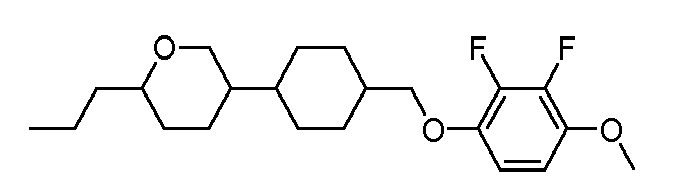
16 
3 
17 
4 
18 
5 
19 
6 
20 
7 
21 
8 
22 
9 
23 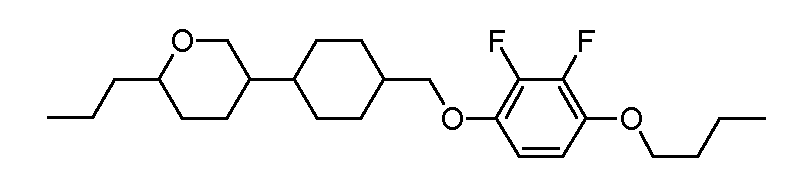
10 
24 
11 
25 
12 
26 
13 
27 
14 
28 
-
No. No. 29 
43 
30 
44 
31 
45 
32 
46 
33 
47 
34 
48 
35 
49 
36 
50 
37 
51 
38 
52 
39 
53 
40 
54 
41 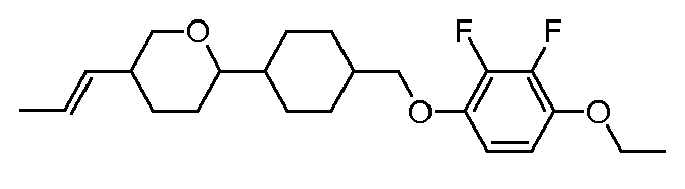
55 
42 
56 
-
No. No. 57 
71 
58 
72 
59 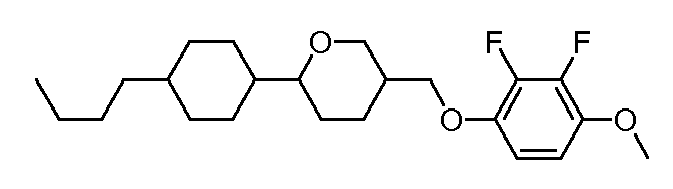
73 
60 
74 
61 
75 
62 
76 
63 
77 
64 
78 
65 
79 
66 
80 
67 
81 
68 
82 
69 
83 
70 
84 
-
No. No. 85 
99 
86 
100 
87 
101 
88 
102 
89 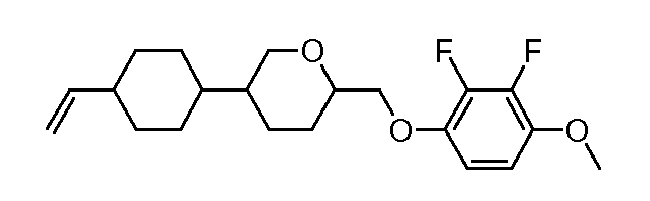
103 
90 
104 
91 
105 
92 
106 
93 
107 
94 
108 
95 
109 
96 
110 
97 
111 
98 
112 
-
No. No. 113 
127 
114 
128 
115 
129 
116 
130 
117 
131 
118 
132 
119 
133 
120 
134 
121 
135 
122 
136 
123 
137 
124 
138 
125 
139 
126 
140 
-
No. No. 141 
155 
142 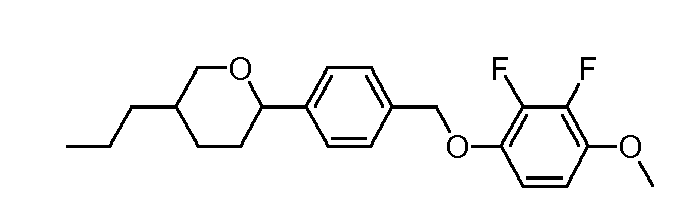
156 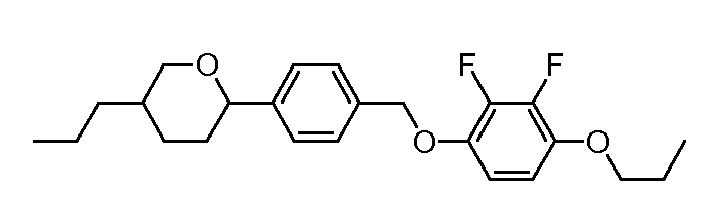
143 
157 
144 
158 
145 
159 
146 
160 
147 
161 
148 
162 
149 
163 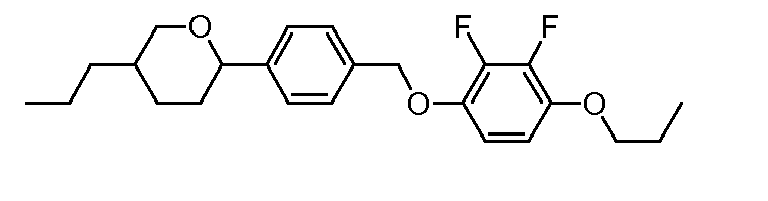
150 
164 
151 
165 
152 
166 
153 
167 
154 
168 
-
No. No. 169 
183 
170 
184 
171 
185 
172 
186 
173 
187 
174 
188 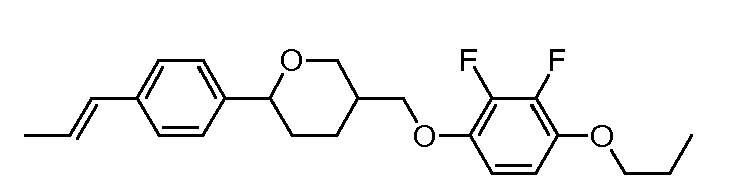
175 
189 
176 
190 
177 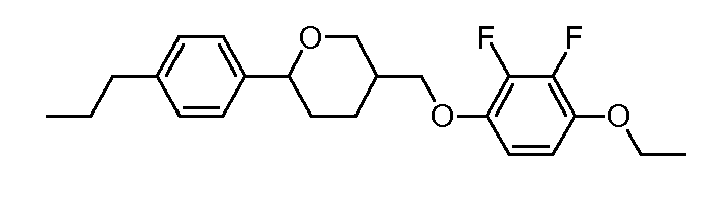
191 
178 
192 
179 
193 
180 
194 
181 
195 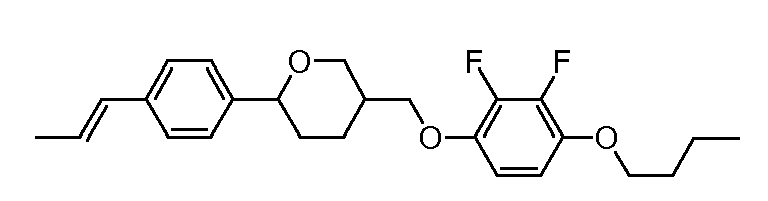
182 
196 
-
No. No. 197 
211 
198 
212 
199 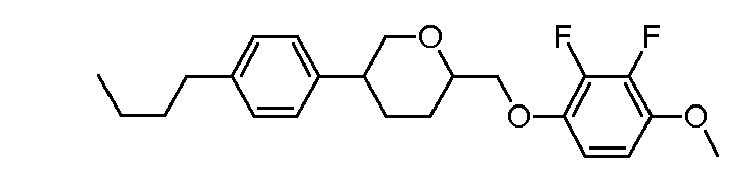
213 
200 
214 
201 
215 
202 
216 
203 
217 
204 
218 
205 
219 
206 
220 
207 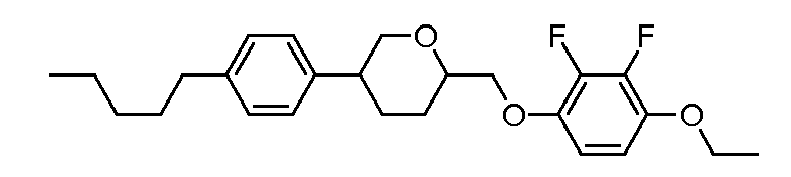
221 
208 
222 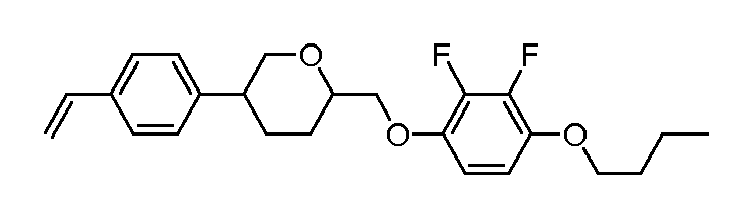
209 
223 
210 
224 
-
No. No. 225 
237 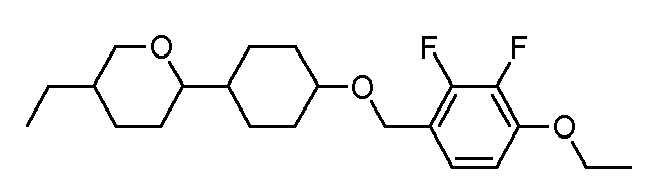
226 
238 
227 
239 
228 
240 
229 
241 
230 
242 
231 
243 
232 
244 
233 
245 
234 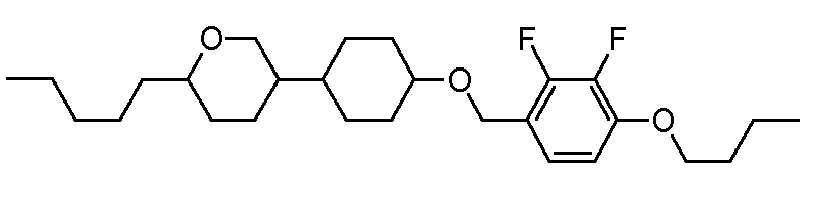
246 
235 
247 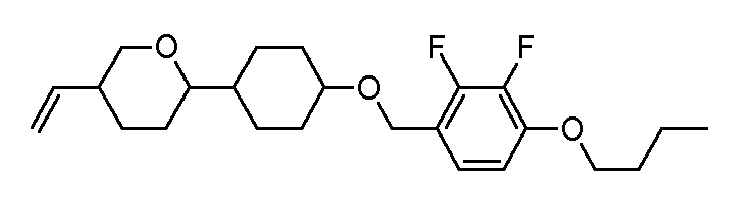
236 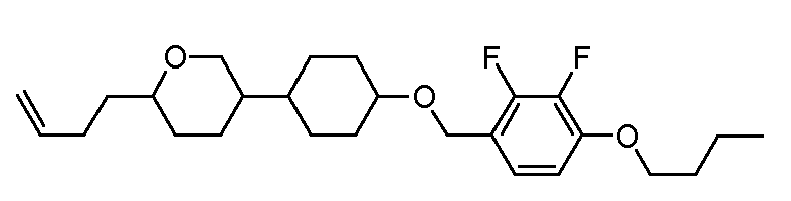
248 
-
No. No. 249 
251 
250 
252 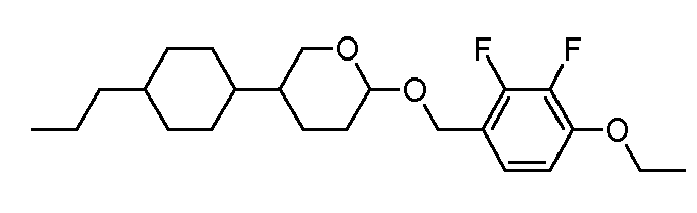
251 
253 
252 
254 
253 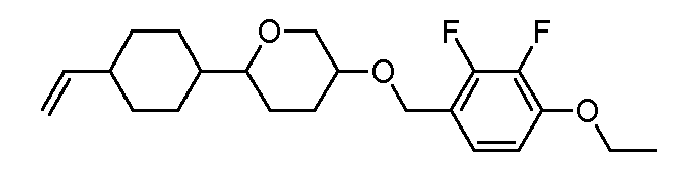
255 
254 
256 
255 
257 
256 
258 
257 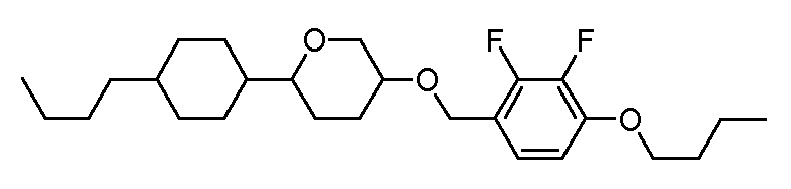
259 
258 
260 
259 
261 
260 
262 
-
No. No. 263 
275 
264 
276 
265 
277 
266 
278 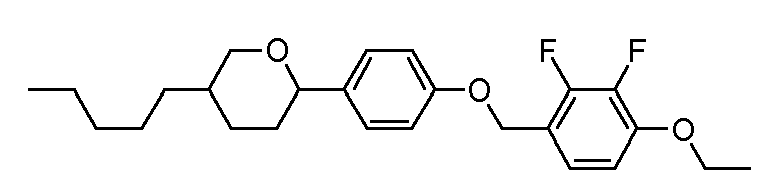
267 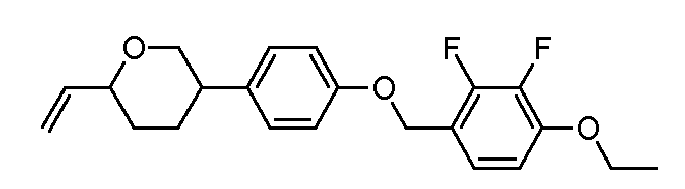
279 
268 
280 
269 
281 
270 
282 
271 
283 
272 
284 
273 
285 
274 
286 
-
No. No. 287 
299 
288 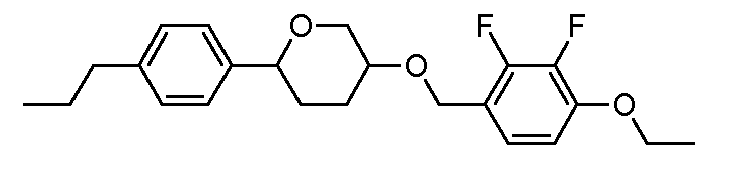
300 
289 
301 
290 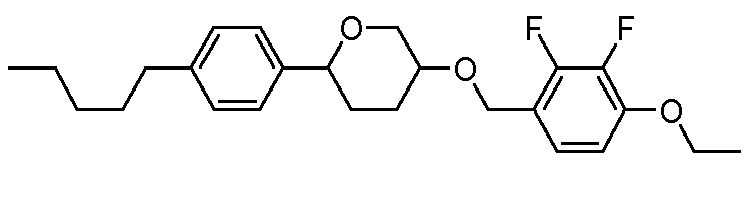
302 
291 
303 
292 
304 
293 
305 
294 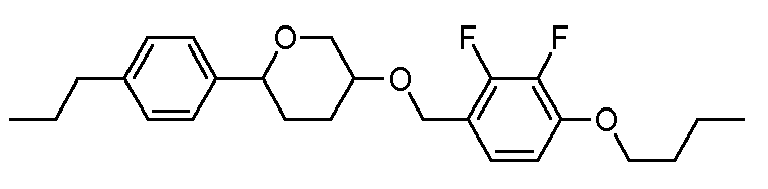
306 
295 
307 
296 
308 
297 
309 
298 
310 
-
No. No. 311 
325 
312 
326 
313 
327 
314 
328 
315 
329 
316 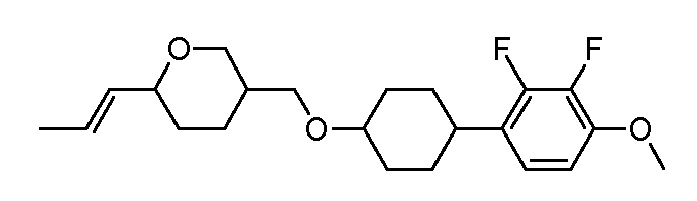
330 
317 
331 
318 
332 
319 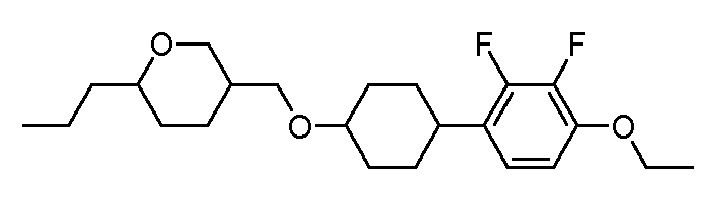
333 
320 
334 
321 
335 
322 
336 
323 
337 
324 
338 
-
No. No. 339 
353 
340 
354 
341 
355 
342 
356 
343 
357 
344 
358 
345 
359 
346 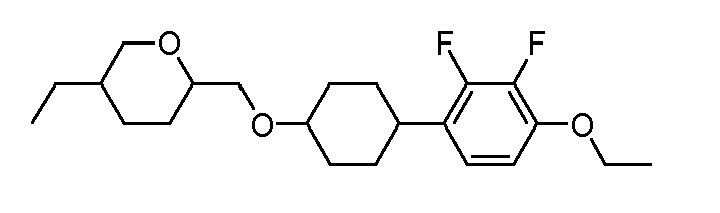
360 
347 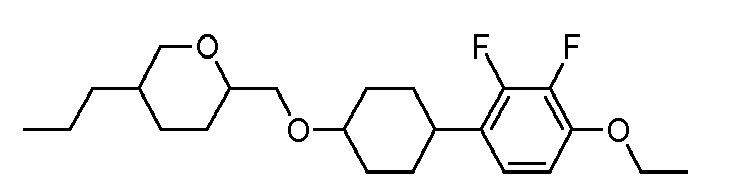
361 
348 
362 
349 
363 
350 
364 
351 
365 
352 
366 
-
No. No. 367 
381 
368 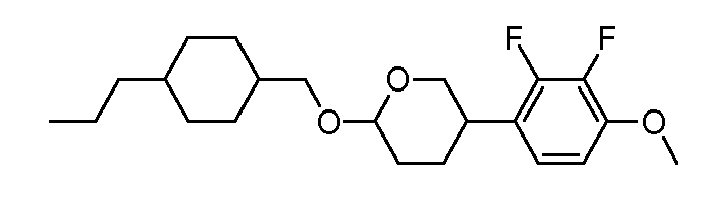
382 
369 
383 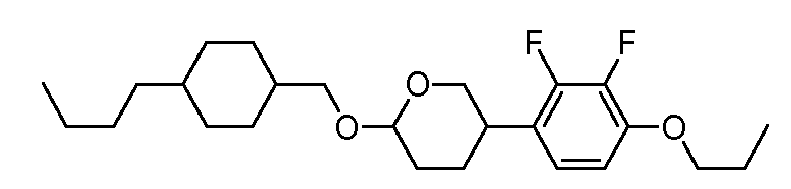
370 
384 
371 
385 
372 
386 
373 
38 
374 
388 
375 
389 
376 
390 
377 
39 
378 
392 
379 
393 
380 
394 
-
No. No. 395 
409 
396 
410 
397 
411 
398 
412 
399 
413 
400 
414 
401 
415 
402 
416 
403 
417 
404 
418 
405 
419 
406 
420 
407 
421 
408 
422 
-
No. No. 423 
437 
424 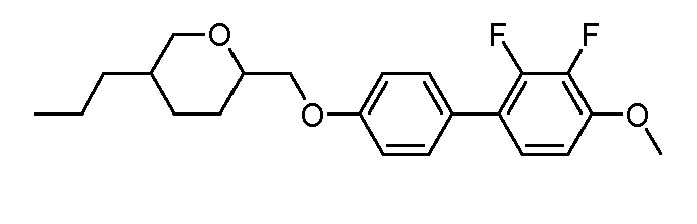
438 
425 
439 
426 
440 
427 
441 
428 
442 
429 
443 
430 
444 
431 
445 
432 
446 
433 
447 
434 
448 
435 
449 
436 
450 
-
No. No. 451 
465 
452 
466 
453 
467 
454 
468 
455 
469 
456 
460 
457 
461 
458 
462 
459 
463 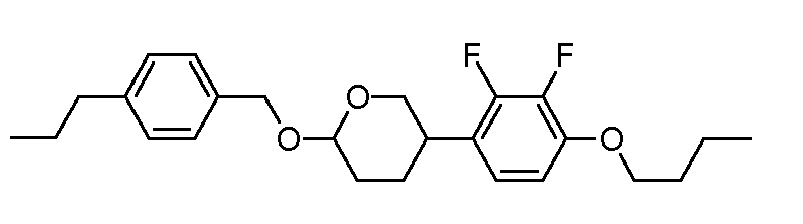
460 
464 
461 
465 
462 
466 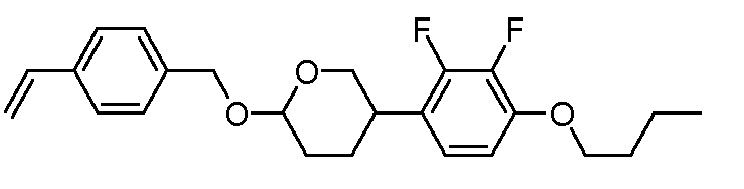
463 
467 
464 
468 
-
No. No. 469 
481 
470 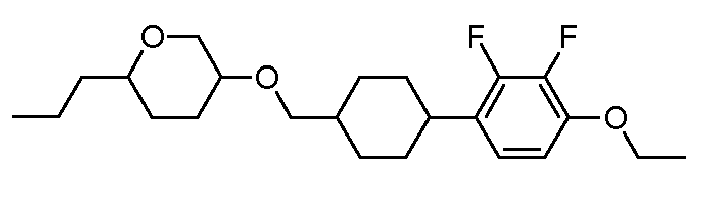
482 
471 
483 
472 
484 
473 
485 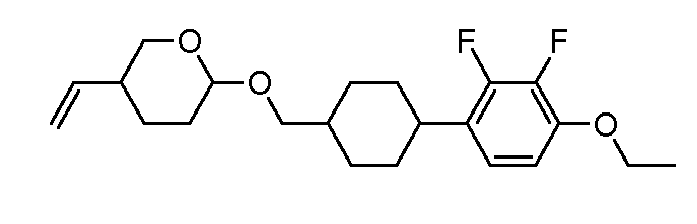
474 
486 
475 
487 
476 
488 
477 
489 
478 
490 
479 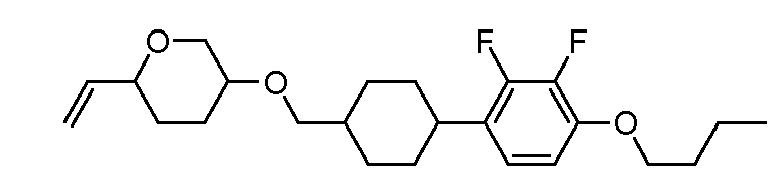
491 
480 
492 
-
No. No. 493 
505 
494 
506 
495 
507 
496 
508 
497 
509 
498 
510 
499 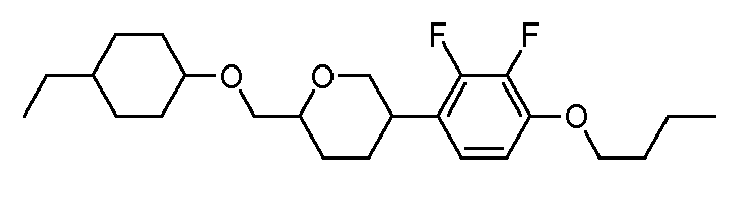
511 
500 
512 
501 
513 
502 
514 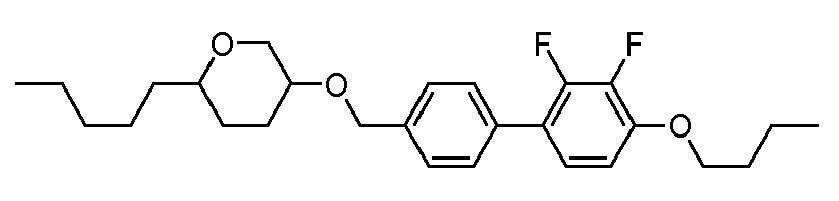
503 
515 
504 
516 
-
No. No. 517 
529 
518 
530 
519 
531 
520 
532 
521 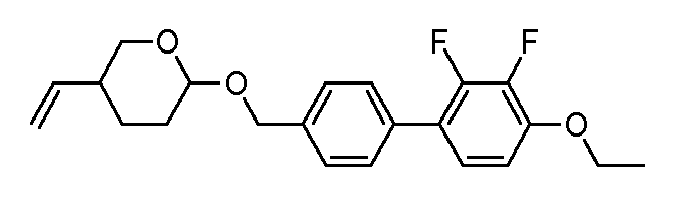
533 
522 
534 
523 
535 
524 
536 
525 
537 
526 
538 
527 
539 
528 
540 
-
No. 541 
542 
543 
544 
545 
546 
547 
548 
549 
550 
551 
552 
-
No. 553 
554 
555 
556 
557 
558 
559 
560 
561 
562 
563 
564 
-
No. 565 
566 
567 
568 
569 
570 
571 
572 
573 
574 
-
No. 575 
576 
577 
578 
579 
580 
581 
582 
583 
574 
585 
586 
-
No. 587 
588 
589 
590 
591 
592 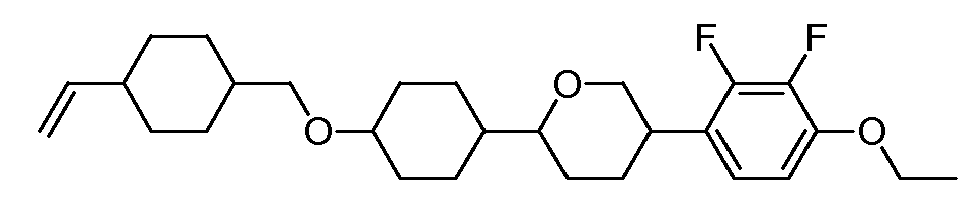
593 
594 
595 
596 
-
No. 597 
598 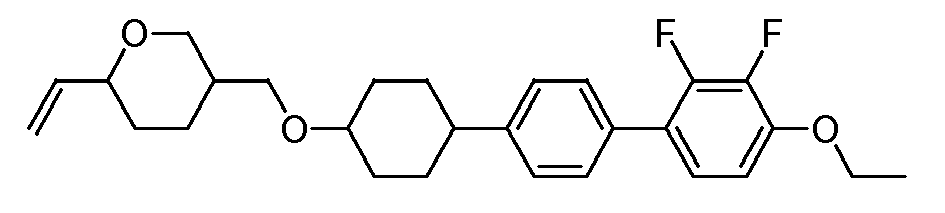
599 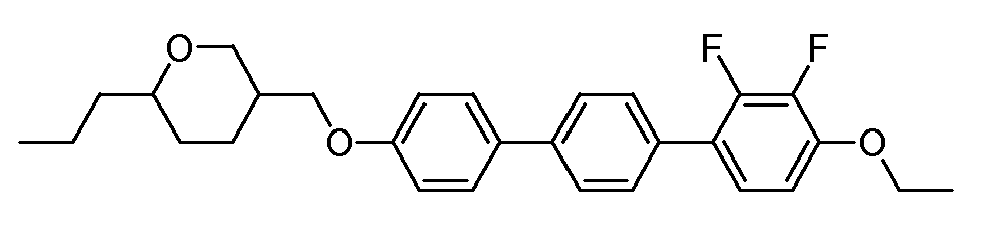
600 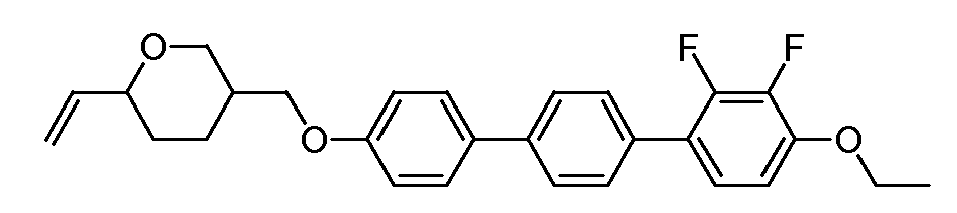
601 
602 
603 
604 
605 
606 
607 
608 
-
No. 609 
610 
611 
612 
613 
614 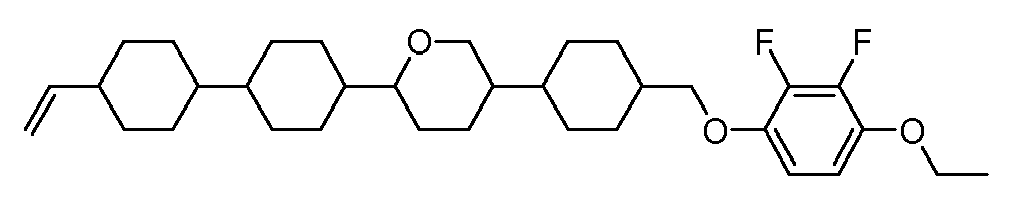
615 
616 
617 
618 
619 
620 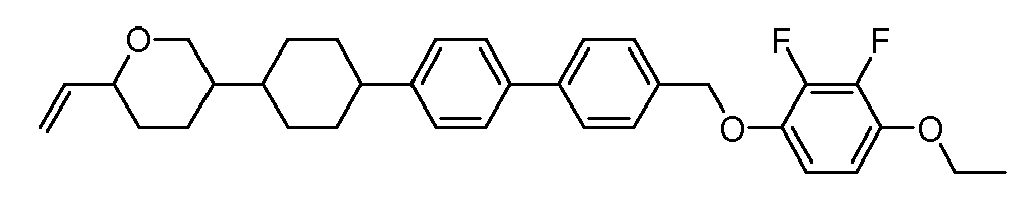
-
No. 621 
622 
623 
624 
625 
626 
627 
628 
629 
630 
631 
632 
-
No. 633 
634 
635 
636 
637 
638 
639 
640 
641 
642 
643 
644 
-
No. 645 
646 
647 
648 
- The liquid crystal composition B consisting of the compound (b) (15% by weight) that was prepared according to the patent document,
JP 2000-008040 A
Maximum temperature (NI) = 121.3 °C; Dielectric anisotropy (Δε) = -7.3; Refractive index anisotropy (Δn) = 0.107; Viscosity (η) = 61.4 mPa·s. - The liquid crystal composition C consisting of the compound No. 9 (15% by weight) and the mother liquid crystals A (85% by weight) was prepared. Physical properties of the resultant liquid crystal composition C were measured, and extrapolated values on physical properties of the compound No. 9 were calculated from the measured values, according to the extrapolation. The extrapolated values were as follows.
Maximum temperature (NI) = 116.6 °C; Dielectric anisotropy (Δε) = -8.5; Refractive index anisotropy (Δn) = 0.094; Viscosity (η) = 59.8 mPa·s.
It was found that the compound No. 9 of the invention in Example 1 was excellent in view of a negatively large dielectric anisotropy (Δε) and a low viscosity (η) in comparison with the compound (b) in - Typical compositions of the invention are summarized in Examples 5 to 11. First, compounds that are the component of a composition and their amounts (weight %) are shown. The compounds are expressed as symbols of left-terminal groups, bonding groups, ring structures and right-terminal groups according to notation described in Table 1.
-
Table. Method of Description of Compound using Symbols 
1) Left Terminal Group R- Symbol 4) Ring Structure -An- Symbol CnH2n+1- n- CnH2n+1O- nO- 
Dh CmH2m+1 OCnH2n- mOn- CH2=CH- V- 
dh CnH2n+1-CH=CH- nV- CH2=CH-CnH2n- Vn- 
H CmH2m+1-CH=CH-CnH2n- mVn- CF2=CH- VFF- 
Ch CF2=CH-CnH2n- VFFn- 2) Right Terminal Group -R' Symbol 
B -CnH2n+1 -n -OCnH2n+1 -On 
B(2F) -CH=CH2 -V -CH=CH-CnH2n+1 -Vn 
B(3F) -CnH2n-CH=CH2 -nV -CH=CF2 -VFF -COOCH3 -EMe 
B(2F,3F) 3) Bonding Group -Zn- Symbol 
B(2F,3Cl) -CnH2n- n -COO- E -CH=CH- V -CH2O- 1O -OCH2- O1 -SiH2- Si -CF2O- X 5) Example of Description Example 1. 3-DhH1OB(2F,3F)-O2 Example 2. 3-BB(3F)B-4 

Example 3. 5-HBB(3F)B-3 Example 4. 3-HBB(2F,3F)-02 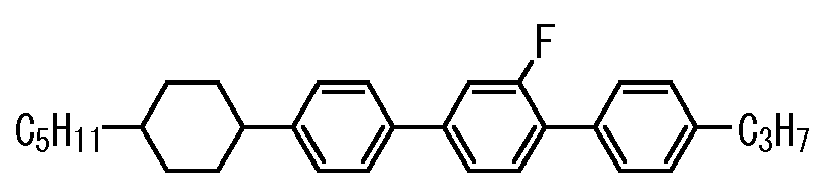

-
3-DhH1OB(2F,3F)-O2 15% 5-DhH1OB(2F,3F)-O2 15% 3-BB(3F)B-3 5% V2-BB(3F)B-1 7% 3-HB-O2 10% 5-HB-O2 9% 3-HB(2F,3F)-O2 5% V-HB(2F,3F)-O2 10% 3-DhB(2F,3F)-O2 8% 3-HDhB(2F,3F)-O2 8% 5-HDhB(2F,3F)-O2 8% NI = 76.0 °C; Δn = 0.109; η = 39.7 mPa·s; Δε = -5.4. -
3-DhH1OB(2F,3F)-O2 12% 5-DhH1OB(2F,3F)-O2 12% 2-BB(3F)B-3 5% 3-HB-O2 5% 3-HHB-1 5% V-HB(2F,3F)-O2 10% 3-H2B(2F,3F)-O2 15% 5-H2B(2F,3F)-O2 11% 5-HHB(2F,3Cl)-O2 5% 2-HBB(2F,3F)-O2 10% 5-HBB(2F,3F)-O2 10% NI = 81.2 °C; Δn = 0.111; η = 37.9 mPa·s; Δε = -5.4. -
3-DhH1OB(2F,3F)-O2 15% 5-DhH1OB(2F,3F)-O2 15% V2-BB-1 5% V-HHB-1 3% V2-HHB-1 3% 3-HBB-2 5% 3-HB(2F,3F)-O2 10% V-HB(2F,3F)-O2 10% 3-H2B(2F,3F)-O2 8% 5-HHB(2F,3F)-O2 3% V-HHB(2F,3F)-O2 3% 2-HBB(2F,3F)-O2 3% 1V2-HBB(2F,3F)-O2 7% 5-DhB(2F,3F)-O2 10% NI = 77.2 °C; Δn = 0.106; η = 37.3 mPa·s; Δε = -5.4. -
3-DhH1OB(2F,3F)-O2 15% 5-DhH1OB(2F,3F)-O2 15% 2-BB(3F)B-3 4% 5-HBB(3F)B-2 8% 5-HBB(3F)B-3 7% V2-BB-1 5% 3-HHB-1 5% V-HB(2F,3F)-O2 10% 3-DhB(2F,3F)-O2 10% 5-DhB(2F,3F)-O2 10% 3-Dh2B(2F,3F)-O4 11% NI = 84.7 °C; Δn = 0.117; η = 42.2 mPa·s; Δε = -5.4. -
3-DhH1OB(2F,3F)-O2 15% 5-DhH1OB(2F,3F)-O2 15% 2-BB(3F)B-3 5% 2-BB(3F)B-5 5% 3-HB-O2 7% 3-HHEH-3 3% 3-HHEBH-3 5% 1O1-HBBH-4 3% 3-HB(2F,3F)-O2 8% V-HB(2F,3F)-O2 5% 3-H2B(2F,3F)-O2 10% 3-Dh2B(2F,3F)-O4 10% 5-Dh2B(2F,3F)-O2 4% 5-BDhB(2F, 3F) -02 5% NI = 83.1 °C; Δn = 0.106; η = 37.3 mPa·s; Δε = -5.4. -
3-HDh1OB(2F,3F)-O2 10% 3-Hdh1OB(2F,3F)-O2 10% 3-dhH1OB(2F,3F)-O2 10% 3-Dh1OHB(2F,3F)-O2 8% 3-dh1OHB(2F,3F)-O2 8% 2-BB(3F)B-5 3% 5-HBB(3F)B-3 3% V-HHB-1 3% 1O1-HBBH-4 5% 3-HB(2F,3F)-O2 10% V-HB(2F,3F)-O2 10% 5-H2B(2F,3F)-O2 10% 5-HHB(2F,3Cl)-02 5% 3-HHB(2F,3F)-1 5% -
3-DhH1OB(2F,3F)-O3 10% 3-dh1OHB(2F,3F)-O2 10% 3-H1ODhB(2F,3F)-O2 10% 3-DhB1OB(2F,3F)-O2 10% 3-Dh1OBB(2F,3F)-O2 8% V2-BB(3F)B-1 5% 3-HB-02 10% 3-HHB-O1 5% 3-HHEBH-5 4% 3-HB(2F,3F)-O2 8% V-HB(2F,3F)-O2 8% 3-H2B(2F,3F)-O2 5% 5-HHB(2F,3F)-O2 7% - The invention provides a liquid crystal compound that is excellent in compatibility with other liquid crystal materials and has a negatively large dielectric anisotropy (Δε).
The invention also provides a novel liquid crystal composition that contains the liquid crystal compound as a component and has desired characteristics, by means of suitable selection of rings, substituents and so forth that constitute the compound, and further provides a liquid crystal display device that is constituted by using the liquid crystal composition.
Claims (19)
- A compound represented by formula (1-1) or (1-2):


R1 and R2 are each independently alkyl having 1 to 10 carbons; and in the alkyl arbitrary -CH2- may be replaced by -O-, -S-, -CO- or -SiH2-, where a plurality of -CH2- adjacent to each other are not replaced, and arbitrary -(CH2)2- may be replaced by -CH=CH- or -C≡C-;
the ring G and the ring J are each independently 1, 4-cyclohexylene or 1, 4-phenylene; and in the 1,4-cyclohexylene arbitrary -CH2- may be replaced by -O-, -S-, -CO- or -SiH2-, and arbitrary - (CH2)2- may be replaced by -CH=CH-, in the 1, 4-phenylene arbitrary -CH= may be replaced by -N=; and in these rings arbitrary hydrogen may be replaced by halogen, -CF3, -CHF2, -CH2F, -OCF3, -OCHF2 or -OCH2F;
Z1, Z2 and Z3 are each independently a single bond, -CH2O- or -OCH2-, provided that at least one of Z1, Z2 and Z3 is -CH2O- or -OCH2-; and
s and t are each independently 0, 1, 2 or 3, where the sum of s and t is 1, 2 or 3, provided that at least one of Z2 and Z3 is -CH2O- or -OCH2- when s = 0, that at least one of Z1 and Z3 is -CH2O- or -OCH2- when t = 0 in formula (1-1), and that Z3 is -CH2O- or -OCH2- when t = 0 in formula (1-2). - The compound according to claim 1, wherein in formulae (1-1) and (1-2), R1 is alkyl having 1 to 10 carbons or alkenyl having 2 to 10 carbons; R2 is alkyl having 1 to 10 carbons; and the ring G and the ring J are each independently 1,4-cyclohexylene or 1,4-phenylene.
- The compound according to claim 1 or 2, wherein in formulae (1-1) and (1-2), Z1 and Z2 are each a single bond; and Z3 is -CH2O-.
- The compound according to any one of claims 1 to 3, wherein the sum of s and t is 1 or 2.
- A compound represented by formula (1-1-1) or (1-2-1):


- A compound represented by formula (1-1-1-1):
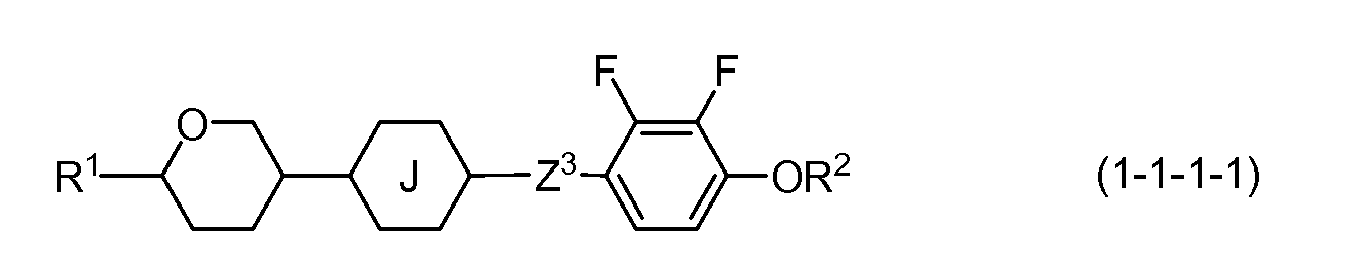
- A compound represented by formula (1-2-1-1):

- A liquid crystal composition comprising at least one of compounds according to any one of claims 1 to 7, as a component A.
- The liquid crystal composition according to claim 8, further comprising at least one compound selected from the group of compounds represented by formulae (2), (3) and (4), as a component B:


R3 is alkyl having 1 to 10 carbons or alkenyl having 2 to 10 carbons, and in the alkyl and the alkenyl, arbitrary hydrogen may be replaced by fluorine and arbitrary -CH2- may be replaced by -O-;
X1 is fluorine, chlorine, -OCF3, -OCHF2, -CF3, -CHF2, -CH2F, -OCF2CHF2 or -OCF2CHFCF3;
the ring A1, the ring A2 and the ring A3 are each independently 1,4-cyclohexylene, 1,3-dioxane-2,5-diyl, pyrimidine-2,5-diyl, 1-tetrahydropyran-2,5-diyl or 1,4-phenylene in which arbitrary hydrogen may be replaced by fluorine;
Z11, Z12, Z13, Z14 and Z15 are each independently - (CH2)2-, -(CH2)4-, -COO-, -CF2O-, -OCF2-, -CH=CH-, -C≡C-, -CH2O- or a single bond; and
L1 and L2 are each independently hydrogen or fluorine. - The liquid crystal composition according to claim 8, further comprising at least one compound selected from the group of compounds represented by formula (5), as a component C:

R4 is alkyl having 1 to 10 carbons or alkenyl having 2 to 10 carbons, and in the alkyl and the alkenyl, arbitrary hydrogen may be replaced by fluorine and arbitrary -CH2- may be replaced by -O-;
X2 is -C=N or -C=C-C=N;
the ring B1, the ring B2 and the ring B3 are each independently 1,4-cyclohexylene, 1,4-phenylene in which arbitrary hydrogen may be replaced by fluorine, 1,3-dioxane-2,5-diyl, 1-tetrahydropyran-2,5-diyl or pyrimidine-2,5-diyl;
Z16 is -(CH2)2-, -COO-, -CF2O-, -OCF2-, -C≡C-, -CH2O- or a single bond;
L3 and L4 are each independently hydrogen or fluorine; and
q is 0, 1 or 2 and r is 0 or 1. - The liquid crystal composition according to claim 8, further comprising at least one compound selected from the group of compounds represented by formulae (6), (7), (8), (9) and (10), as a component D:


R5 and R6 are each independently alkyl having 1 to 10 carbons or alkenyl having 2 to 10 carbons, and in the alkyl and the alkenyl, arbitrary hydrogen may be replaced by fluorine and arbitrary -CH2- may be replaced by -O-;
the ring C1, the ring C2, the ring C3 and the ring C4 are each independently 1,4-cyclohexylene, 1,4-cyclohexenylene, 1,4-phenylene in which arbitrary hydrogen may be replaced by fluorine or decahydro-2,6-naphthalene;
Z17, Z18, Z19, Z20, Z21, Z22, Z23, Z24, Z25, Z26 and Z27 are each independently -(CH2)2-, -COO-, -CH2O-, -OCF2-, -OCF2(CH2)2- or a single bond;
L5 and L6 are each independently chlorine or fluorine; and
j, k, l, m and n are each independently 0 or 1, and the sum of k, l, m and n is 1 or 2. - The liquid crystal composition according to claim 8, further comprising at least one compound selected from the group of compounds represented by formulae (11), (12) and (13), as a component E:



R7 and R8 are each independently alkyl having 1 to 10 carbons or alkenyl having 2 to 10 carbons, and in the alkyl and the alkenyl, arbitrary hydrogen may be replaced by fluorine and arbitrary -CH2- may be replaced by -O-;
the ring D1, the ring D2 and the ring D3 are each independently 1,4-cyclohexylene, pyrimidine-2,5-diyl, 1,4-phenylene, 2-fluoro-1,4-phenylene, 3-fluoro-1,4-phenylene or 2,5-difluoro-1,4-phenylene; and
Z28, Z29, Z30, Z31 and Z32 are each independently -C≡C-, -COO-, -(CH2)2-, -CH=CH- or a single bond. - The liquid crystal composition according to claim 9, further comprising at least one compound selected from the group of compounds represented by formula (5) according to claim 10.
- The liquid crystal composition according to claim 9, further comprising at least one compound selected from the group of compounds represented by formulae (11), (12) and (13) according to claim 12.
- The liquid crystal composition according to claim 10, further comprising at least one compound selected from the group of compounds represented by formulae (11), (12) and (13) according to claim 12.
- The liquid crystal composition according to claim 11, further comprising at least one compound selected from the group of compounds represented by formulae (11), (12) and (13) according to claim 12.
- The liquid crystal composition according to any one of claims 8 to 16, further comprising at least one optically active compound.
- The liquid crystal composition according to any one of claims 8 to 17, further comprising at least one antioxidant, or at least one ultraviolet absorbent, or at least each of an antioxidant and an ultraviolet absorbent.
- A liquid crystal display device comprising at least one of the liquid crystal compositions according to any one of claims 8 to 18.
Applications Claiming Priority (2)
| Application Number | Priority Date | Filing Date | Title |
|---|---|---|---|
| JP2008123171 | 2008-05-09 | ||
| PCT/JP2009/057585 WO2009136534A1 (en) | 2008-05-09 | 2009-04-15 | Liquid crystalline compound with negative dielectric anisotropy, liquid crystal composition, and liquid crystal display device |
Publications (3)
| Publication Number | Publication Date |
|---|---|
| EP2272837A1 true EP2272837A1 (en) | 2011-01-12 |
| EP2272837A4 EP2272837A4 (en) | 2012-06-06 |
| EP2272837B1 EP2272837B1 (en) | 2014-12-17 |
Family
ID=41264590
Family Applications (1)
| Application Number | Title | Priority Date | Filing Date |
|---|---|---|---|
| EP09742659.7A Not-in-force EP2272837B1 (en) | 2008-05-09 | 2009-04-15 | Liquid crystalline compound with negative dielectric anisotropy, liquid crystal composition, and liquid crystal display device |
Country Status (7)
| Country | Link |
|---|---|
| US (1) | US7914862B2 (en) |
| EP (1) | EP2272837B1 (en) |
| JP (1) | JP5585444B2 (en) |
| KR (1) | KR101668493B1 (en) |
| CN (1) | CN102015672A (en) |
| TW (1) | TWI437081B (en) |
| WO (1) | WO2009136534A1 (en) |
Cited By (1)
| Publication number | Priority date | Publication date | Assignee | Title |
|---|---|---|---|---|
| EP3228617A1 (en) * | 2016-04-08 | 2017-10-11 | JNC Corporation | Production method for tetrahydro-2h-pyran derivative |
Families Citing this family (10)
| Publication number | Priority date | Publication date | Assignee | Title |
|---|---|---|---|---|
| US8372306B2 (en) * | 2008-06-27 | 2013-02-12 | Jnc Corporation | Liquid crystal compound having negative dielectric anisotropy, liquid crystal composition, and liquid crystal display device |
| KR101617482B1 (en) * | 2008-09-17 | 2016-05-02 | 제이엔씨 석유 화학 주식회사 | Liquid crystal composition and liquid crystal display element |
| TWI509056B (en) * | 2009-09-29 | 2015-11-21 | Jnc Corp | Liquid crystal compositon and liquid crystal display divice |
| TWI518171B (en) * | 2010-06-03 | 2016-01-21 | 捷恩智股份有限公司 | Liquid crystal composition and liquid crystal display element |
| EP3260518B1 (en) * | 2011-03-29 | 2019-12-25 | Merck Patent GmbH | Liquid crystalline medium |
| CN102517037B (en) * | 2011-11-08 | 2013-09-25 | 江苏和成显示科技股份有限公司 | Liquid crystal medium for 2D/3D (two/three dimensional) display switch |
| KR101598791B1 (en) * | 2012-12-12 | 2016-03-02 | 디아이씨 가부시끼가이샤 | Nematic liquid crystal composition and liquid crystal display element using same |
| TWI507511B (en) | 2013-11-05 | 2015-11-11 | Ind Tech Res Inst | Negative dielectric anisotropic liquid crystal compound, liquid crystal display, and optoelectronic device |
| CN104003964B (en) * | 2014-06-06 | 2016-09-07 | 北京八亿时空液晶科技股份有限公司 | A kind of liquid-crystal compounds containing amylene oxide ring and application thereof |
| JP2017190323A (en) * | 2016-04-08 | 2017-10-19 | Jnc株式会社 | Method for producing tetrahydro-2H-pyran derivative |
Family Cites Families (12)
| Publication number | Priority date | Publication date | Assignee | Title |
|---|---|---|---|---|
| CH678334A5 (en) | 1988-03-10 | 1991-08-30 | Merck Patent Gmbh | |
| DE3807872A1 (en) | 1988-03-10 | 1989-09-21 | Merck Patent Gmbh | DIFLUORBENZENE DERIVATIVES |
| US5279764A (en) * | 1988-03-10 | 1994-01-18 | Merck Patent Gesellschaft Mit Beschrankter Haftung | Dihalogenobenzene derivatives |
| WO1998027036A1 (en) * | 1996-12-16 | 1998-06-25 | Chisso Corporation | Difluorophenyl derivatives, liquid-crystal compounds, and liquid-crystal composition |
| JP3975562B2 (en) * | 1998-06-25 | 2007-09-12 | チッソ株式会社 | Liquid crystal compound having negative dielectric anisotropy value, liquid crystal composition containing the liquid crystal compound, and liquid crystal display device using the liquid crystal composition |
| JP4802463B2 (en) * | 2004-07-30 | 2011-10-26 | Dic株式会社 | Nematic liquid crystal composition and liquid crystal display device using the same |
| WO2006038522A1 (en) * | 2004-10-04 | 2006-04-13 | Chisso Corporation | Tetrahydropyran compounds, liquid crystal compositions, and liquid crystal displays containing the compositions |
| KR101408393B1 (en) * | 2005-03-03 | 2014-06-17 | 제이엔씨 주식회사 | A chlorofluorobenzene liquid crystal compound, a liquid crystal composition, and a liquid crystal display element |
| JP5163019B2 (en) * | 2006-09-06 | 2013-03-13 | Jnc株式会社 | Cyclohexene derivative having alkenyl, liquid crystal composition, and liquid crystal display device |
| US7767278B2 (en) * | 2007-03-20 | 2010-08-03 | Chisso Corporation | Liquid crystal composition and liquid crystal display device |
| US7767279B2 (en) * | 2007-03-22 | 2010-08-03 | Chisso Petrochemical Corporation | Liquid crystal composition and liquid crystal display device |
| KR101540489B1 (en) * | 2007-09-06 | 2015-07-29 | 제이엔씨 석유 화학 주식회사 | Tetra-or penta-cyclic liquid crystalline compound having lateral fluorine, liquid crystal composition, and liquid crystal display element |
-
2009
- 2009-04-15 WO PCT/JP2009/057585 patent/WO2009136534A1/en not_active Ceased
- 2009-04-15 CN CN2009801160185A patent/CN102015672A/en active Pending
- 2009-04-15 EP EP09742659.7A patent/EP2272837B1/en not_active Not-in-force
- 2009-04-15 KR KR1020107024635A patent/KR101668493B1/en not_active Expired - Fee Related
- 2009-04-15 JP JP2010511037A patent/JP5585444B2/en not_active Expired - Fee Related
- 2009-05-04 US US12/434,859 patent/US7914862B2/en not_active Expired - Fee Related
- 2009-05-07 TW TW098115162A patent/TWI437081B/en not_active IP Right Cessation
Cited By (1)
| Publication number | Priority date | Publication date | Assignee | Title |
|---|---|---|---|---|
| EP3228617A1 (en) * | 2016-04-08 | 2017-10-11 | JNC Corporation | Production method for tetrahydro-2h-pyran derivative |
Also Published As
| Publication number | Publication date |
|---|---|
| KR20110008073A (en) | 2011-01-25 |
| TW200946651A (en) | 2009-11-16 |
| WO2009136534A1 (en) | 2009-11-12 |
| EP2272837A4 (en) | 2012-06-06 |
| KR101668493B1 (en) | 2016-10-21 |
| JPWO2009136534A1 (en) | 2011-09-08 |
| US7914862B2 (en) | 2011-03-29 |
| JP5585444B2 (en) | 2014-09-10 |
| US20090278088A1 (en) | 2009-11-12 |
| EP2272837B1 (en) | 2014-12-17 |
| TWI437081B (en) | 2014-05-11 |
| CN102015672A (en) | 2011-04-13 |
Similar Documents
| Publication | Publication Date | Title |
|---|---|---|
| EP2272837B1 (en) | Liquid crystalline compound with negative dielectric anisotropy, liquid crystal composition, and liquid crystal display device | |
| EP1903090B1 (en) | Cyclohexene derivative having alkenyl, liquid crystal composition and liquid crystal display device | |
| CN102056881B (en) | Liquid crystal compound, liquid crystal composition and liquid crystal display element | |
| EP2206695B1 (en) | Tetra- or penta-cyclic liquid crystalline compound having lateral fluorine, liquid crystal composition, and liquid crystal display element | |
| JP5652202B2 (en) | Tricyclic liquid crystalline compound having lateral fluorine, liquid crystal composition, and liquid crystal display device | |
| KR101408570B1 (en) | A chlorofluorobenzene-based liquid crystal compound, a liquid crystal composition, and a liquid crystal display element | |
| EP2484658B1 (en) | Liquid crystalline compound with negative dielectric anisotropy, liquid crystal composition using same, and liquid crystal display element | |
| EP2479162B1 (en) | Liquid crystalline compound, liquid crystal composition, and liquid crystal display element | |
| EP2468707B1 (en) | Decahydronaphthalene compounds, liquid crystal compositions containing the compounds, and liquid crystal display devices containing the liquid crystal compositions | |
| EP2199270A1 (en) | Liquid crystalline compound, liquid crystal composition, and liquid crystal display element | |
| JP5392256B2 (en) | Liquid crystal compound having negative dielectric anisotropy, liquid crystal composition, and liquid crystal display device | |
| EP2617701B1 (en) | Compound having propyl ether as bonding group, liquid crystal composition, and liquid crystal display element | |
| EP2468740B1 (en) | Tetrahydropyran compounds, liquid crystal compositions and liquid crystal display devices | |
| EP1491612B1 (en) | Chroman compound, liquid crystal composition including the compound and liquid crystal display element including the liquid crystal composition | |
| JP6052033B2 (en) | Liquid crystalline compound exhibiting negative dielectric anisotropy, liquid crystal composition, and liquid crystal display device | |
| EP1731493B1 (en) | Benzene derivative, liquid crystal composition and liquid crystal display |
Legal Events
| Date | Code | Title | Description |
|---|---|---|---|
| PUAI | Public reference made under article 153(3) epc to a published international application that has entered the european phase |
Free format text: ORIGINAL CODE: 0009012 |
|
| 17P | Request for examination filed |
Effective date: 20101014 |
|
| AK | Designated contracting states |
Kind code of ref document: A1 Designated state(s): AT BE BG CH CY CZ DE DK EE ES FI FR GB GR HR HU IE IS IT LI LT LU LV MC MK MT NL NO PL PT RO SE SI SK TR |
|
| AX | Request for extension of the european patent |
Extension state: AL BA RS |
|
| RAP1 | Party data changed (applicant data changed or rights of an application transferred) |
Owner name: JNC CORPORATION Owner name: CHISSO PETROCHEMICAL CORPORATION |
|
| DAX | Request for extension of the european patent (deleted) | ||
| RAP1 | Party data changed (applicant data changed or rights of an application transferred) |
Owner name: JNC CORPORATION Owner name: JNC PETROCHEMICAL CORPORATION |
|
| A4 | Supplementary search report drawn up and despatched |
Effective date: 20120507 |
|
| RIC1 | Information provided on ipc code assigned before grant |
Ipc: C09K 19/20 20060101ALI20120427BHEP Ipc: C09K 19/16 20060101ALI20120427BHEP Ipc: C09K 19/54 20060101ALI20120427BHEP Ipc: G02F 1/13 20060101ALI20120427BHEP Ipc: C07D 309/06 20060101AFI20120427BHEP Ipc: C09K 19/32 20060101ALI20120427BHEP Ipc: C09K 19/12 20060101ALI20120427BHEP Ipc: C09K 19/30 20060101ALI20120427BHEP Ipc: C09K 19/34 20060101ALI20120427BHEP Ipc: C09K 19/14 20060101ALI20120427BHEP Ipc: C09K 19/18 20060101ALI20120427BHEP Ipc: C07D 309/10 20060101ALI20120427BHEP |
|
| 17Q | First examination report despatched |
Effective date: 20140324 |
|
| REG | Reference to a national code |
Ref country code: DE Ref legal event code: R079 Ref document number: 602009028383 Country of ref document: DE Free format text: PREVIOUS MAIN CLASS: C07D0309060000 Ipc: C09K0019040000 |
|
| GRAP | Despatch of communication of intention to grant a patent |
Free format text: ORIGINAL CODE: EPIDOSNIGR1 |
|
| RIC1 | Information provided on ipc code assigned before grant |
Ipc: C09K 19/04 20060101AFI20140624BHEP Ipc: C07D 309/10 20060101ALI20140624BHEP Ipc: C09K 19/34 20060101ALI20140624BHEP Ipc: C07D 309/06 20060101ALI20140624BHEP |
|
| INTG | Intention to grant announced |
Effective date: 20140709 |
|
| GRAS | Grant fee paid |
Free format text: ORIGINAL CODE: EPIDOSNIGR3 |
|
| GRAA | (expected) grant |
Free format text: ORIGINAL CODE: 0009210 |
|
| AK | Designated contracting states |
Kind code of ref document: B1 Designated state(s): AT BE BG CH CY CZ DE DK EE ES FI FR GB GR HR HU IE IS IT LI LT LU LV MC MK MT NL NO PL PT RO SE SI SK TR |
|
| REG | Reference to a national code |
Ref country code: GB Ref legal event code: FG4D |
|
| REG | Reference to a national code |
Ref country code: CH Ref legal event code: EP |
|
| REG | Reference to a national code |
Ref country code: IE Ref legal event code: FG4D |
|
| REG | Reference to a national code |
Ref country code: AT Ref legal event code: REF Ref document number: 701926 Country of ref document: AT Kind code of ref document: T Effective date: 20150115 |
|
| REG | Reference to a national code |
Ref country code: DE Ref legal event code: R096 Ref document number: 602009028383 Country of ref document: DE Effective date: 20150205 |
|
| PG25 | Lapsed in a contracting state [announced via postgrant information from national office to epo] |
Ref country code: FI Free format text: LAPSE BECAUSE OF FAILURE TO SUBMIT A TRANSLATION OF THE DESCRIPTION OR TO PAY THE FEE WITHIN THE PRESCRIBED TIME-LIMIT Effective date: 20141217 Ref country code: NO Free format text: LAPSE BECAUSE OF FAILURE TO SUBMIT A TRANSLATION OF THE DESCRIPTION OR TO PAY THE FEE WITHIN THE PRESCRIBED TIME-LIMIT Effective date: 20150317 Ref country code: LT Free format text: LAPSE BECAUSE OF FAILURE TO SUBMIT A TRANSLATION OF THE DESCRIPTION OR TO PAY THE FEE WITHIN THE PRESCRIBED TIME-LIMIT Effective date: 20141217 |
|
| REG | Reference to a national code |
Ref country code: LT Ref legal event code: MG4D |
|
| PG25 | Lapsed in a contracting state [announced via postgrant information from national office to epo] |
Ref country code: LV Free format text: LAPSE BECAUSE OF FAILURE TO SUBMIT A TRANSLATION OF THE DESCRIPTION OR TO PAY THE FEE WITHIN THE PRESCRIBED TIME-LIMIT Effective date: 20141217 Ref country code: SE Free format text: LAPSE BECAUSE OF FAILURE TO SUBMIT A TRANSLATION OF THE DESCRIPTION OR TO PAY THE FEE WITHIN THE PRESCRIBED TIME-LIMIT Effective date: 20141217 Ref country code: GR Free format text: LAPSE BECAUSE OF FAILURE TO SUBMIT A TRANSLATION OF THE DESCRIPTION OR TO PAY THE FEE WITHIN THE PRESCRIBED TIME-LIMIT Effective date: 20150318 Ref country code: HR Free format text: LAPSE BECAUSE OF FAILURE TO SUBMIT A TRANSLATION OF THE DESCRIPTION OR TO PAY THE FEE WITHIN THE PRESCRIBED TIME-LIMIT Effective date: 20141217 |
|
| REG | Reference to a national code |
Ref country code: AT Ref legal event code: MK05 Ref document number: 701926 Country of ref document: AT Kind code of ref document: T Effective date: 20141217 |
|
| PG25 | Lapsed in a contracting state [announced via postgrant information from national office to epo] |
Ref country code: NL Free format text: LAPSE BECAUSE OF FAILURE TO SUBMIT A TRANSLATION OF THE DESCRIPTION OR TO PAY THE FEE WITHIN THE PRESCRIBED TIME-LIMIT Effective date: 20141217 |
|
| PG25 | Lapsed in a contracting state [announced via postgrant information from national office to epo] |
Ref country code: ES Free format text: LAPSE BECAUSE OF FAILURE TO SUBMIT A TRANSLATION OF THE DESCRIPTION OR TO PAY THE FEE WITHIN THE PRESCRIBED TIME-LIMIT Effective date: 20141217 Ref country code: RO Free format text: LAPSE BECAUSE OF FAILURE TO SUBMIT A TRANSLATION OF THE DESCRIPTION OR TO PAY THE FEE WITHIN THE PRESCRIBED TIME-LIMIT Effective date: 20141217 Ref country code: EE Free format text: LAPSE BECAUSE OF FAILURE TO SUBMIT A TRANSLATION OF THE DESCRIPTION OR TO PAY THE FEE WITHIN THE PRESCRIBED TIME-LIMIT Effective date: 20141217 Ref country code: CZ Free format text: LAPSE BECAUSE OF FAILURE TO SUBMIT A TRANSLATION OF THE DESCRIPTION OR TO PAY THE FEE WITHIN THE PRESCRIBED TIME-LIMIT Effective date: 20141217 Ref country code: SK Free format text: LAPSE BECAUSE OF FAILURE TO SUBMIT A TRANSLATION OF THE DESCRIPTION OR TO PAY THE FEE WITHIN THE PRESCRIBED TIME-LIMIT Effective date: 20141217 |
|
| PG25 | Lapsed in a contracting state [announced via postgrant information from national office to epo] |
Ref country code: IS Free format text: LAPSE BECAUSE OF FAILURE TO SUBMIT A TRANSLATION OF THE DESCRIPTION OR TO PAY THE FEE WITHIN THE PRESCRIBED TIME-LIMIT Effective date: 20150417 Ref country code: PL Free format text: LAPSE BECAUSE OF FAILURE TO SUBMIT A TRANSLATION OF THE DESCRIPTION OR TO PAY THE FEE WITHIN THE PRESCRIBED TIME-LIMIT Effective date: 20141217 Ref country code: AT Free format text: LAPSE BECAUSE OF FAILURE TO SUBMIT A TRANSLATION OF THE DESCRIPTION OR TO PAY THE FEE WITHIN THE PRESCRIBED TIME-LIMIT Effective date: 20141217 |
|
| REG | Reference to a national code |
Ref country code: DE Ref legal event code: R097 Ref document number: 602009028383 Country of ref document: DE |
|
| PLBE | No opposition filed within time limit |
Free format text: ORIGINAL CODE: 0009261 |
|
| STAA | Information on the status of an ep patent application or granted ep patent |
Free format text: STATUS: NO OPPOSITION FILED WITHIN TIME LIMIT |
|
| PG25 | Lapsed in a contracting state [announced via postgrant information from national office to epo] |
Ref country code: DK Free format text: LAPSE BECAUSE OF FAILURE TO SUBMIT A TRANSLATION OF THE DESCRIPTION OR TO PAY THE FEE WITHIN THE PRESCRIBED TIME-LIMIT Effective date: 20141217 |
|
| REG | Reference to a national code |
Ref country code: DE Ref legal event code: R119 Ref document number: 602009028383 Country of ref document: DE |
|
| 26N | No opposition filed |
Effective date: 20150918 |
|
| PG25 | Lapsed in a contracting state [announced via postgrant information from national office to epo] |
Ref country code: MC Free format text: LAPSE BECAUSE OF FAILURE TO SUBMIT A TRANSLATION OF THE DESCRIPTION OR TO PAY THE FEE WITHIN THE PRESCRIBED TIME-LIMIT Effective date: 20141217 Ref country code: LU Free format text: LAPSE BECAUSE OF FAILURE TO SUBMIT A TRANSLATION OF THE DESCRIPTION OR TO PAY THE FEE WITHIN THE PRESCRIBED TIME-LIMIT Effective date: 20150415 |
|
| REG | Reference to a national code |
Ref country code: CH Ref legal event code: PL |
|
| PG25 | Lapsed in a contracting state [announced via postgrant information from national office to epo] |
Ref country code: IT Free format text: LAPSE BECAUSE OF FAILURE TO SUBMIT A TRANSLATION OF THE DESCRIPTION OR TO PAY THE FEE WITHIN THE PRESCRIBED TIME-LIMIT Effective date: 20141217 |
|
| REG | Reference to a national code |
Ref country code: IE Ref legal event code: MM4A |
|
| PG25 | Lapsed in a contracting state [announced via postgrant information from national office to epo] |
Ref country code: CH Free format text: LAPSE BECAUSE OF NON-PAYMENT OF DUE FEES Effective date: 20150430 Ref country code: LI Free format text: LAPSE BECAUSE OF NON-PAYMENT OF DUE FEES Effective date: 20150430 Ref country code: DE Free format text: LAPSE BECAUSE OF NON-PAYMENT OF DUE FEES Effective date: 20151103 |
|
| REG | Reference to a national code |
Ref country code: FR Ref legal event code: ST Effective date: 20151231 |
|
| PG25 | Lapsed in a contracting state [announced via postgrant information from national office to epo] |
Ref country code: SI Free format text: LAPSE BECAUSE OF FAILURE TO SUBMIT A TRANSLATION OF THE DESCRIPTION OR TO PAY THE FEE WITHIN THE PRESCRIBED TIME-LIMIT Effective date: 20141217 Ref country code: FR Free format text: LAPSE BECAUSE OF NON-PAYMENT OF DUE FEES Effective date: 20150430 |
|
| PG25 | Lapsed in a contracting state [announced via postgrant information from national office to epo] |
Ref country code: IE Free format text: LAPSE BECAUSE OF NON-PAYMENT OF DUE FEES Effective date: 20150415 |
|
| PG25 | Lapsed in a contracting state [announced via postgrant information from national office to epo] |
Ref country code: BE Free format text: LAPSE BECAUSE OF FAILURE TO SUBMIT A TRANSLATION OF THE DESCRIPTION OR TO PAY THE FEE WITHIN THE PRESCRIBED TIME-LIMIT Effective date: 20141217 |
|
| PG25 | Lapsed in a contracting state [announced via postgrant information from national office to epo] |
Ref country code: MT Free format text: LAPSE BECAUSE OF FAILURE TO SUBMIT A TRANSLATION OF THE DESCRIPTION OR TO PAY THE FEE WITHIN THE PRESCRIBED TIME-LIMIT Effective date: 20141217 |
|
| PG25 | Lapsed in a contracting state [announced via postgrant information from national office to epo] |
Ref country code: HU Free format text: LAPSE BECAUSE OF FAILURE TO SUBMIT A TRANSLATION OF THE DESCRIPTION OR TO PAY THE FEE WITHIN THE PRESCRIBED TIME-LIMIT; INVALID AB INITIO Effective date: 20090415 Ref country code: BG Free format text: LAPSE BECAUSE OF FAILURE TO SUBMIT A TRANSLATION OF THE DESCRIPTION OR TO PAY THE FEE WITHIN THE PRESCRIBED TIME-LIMIT Effective date: 20141217 |
|
| PG25 | Lapsed in a contracting state [announced via postgrant information from national office to epo] |
Ref country code: CY Free format text: LAPSE BECAUSE OF FAILURE TO SUBMIT A TRANSLATION OF THE DESCRIPTION OR TO PAY THE FEE WITHIN THE PRESCRIBED TIME-LIMIT Effective date: 20141217 |
|
| PG25 | Lapsed in a contracting state [announced via postgrant information from national office to epo] |
Ref country code: PT Free format text: LAPSE BECAUSE OF FAILURE TO SUBMIT A TRANSLATION OF THE DESCRIPTION OR TO PAY THE FEE WITHIN THE PRESCRIBED TIME-LIMIT Effective date: 20150417 |
|
| PG25 | Lapsed in a contracting state [announced via postgrant information from national office to epo] |
Ref country code: TR Free format text: LAPSE BECAUSE OF FAILURE TO SUBMIT A TRANSLATION OF THE DESCRIPTION OR TO PAY THE FEE WITHIN THE PRESCRIBED TIME-LIMIT Effective date: 20141217 |
|
| PG25 | Lapsed in a contracting state [announced via postgrant information from national office to epo] |
Ref country code: MK Free format text: LAPSE BECAUSE OF FAILURE TO SUBMIT A TRANSLATION OF THE DESCRIPTION OR TO PAY THE FEE WITHIN THE PRESCRIBED TIME-LIMIT Effective date: 20141217 |
|
| PGFP | Annual fee paid to national office [announced via postgrant information from national office to epo] |
Ref country code: GB Payment date: 20210324 Year of fee payment: 13 |
|
| GBPC | Gb: european patent ceased through non-payment of renewal fee |
Effective date: 20220415 |
|
| PG25 | Lapsed in a contracting state [announced via postgrant information from national office to epo] |
Ref country code: GB Free format text: LAPSE BECAUSE OF NON-PAYMENT OF DUE FEES Effective date: 20220415 |