EP2272835A1 - Novel five-membered ring compound - Google Patents
Novel five-membered ring compound Download PDFInfo
- Publication number
- EP2272835A1 EP2272835A1 EP09734738A EP09734738A EP2272835A1 EP 2272835 A1 EP2272835 A1 EP 2272835A1 EP 09734738 A EP09734738 A EP 09734738A EP 09734738 A EP09734738 A EP 09734738A EP 2272835 A1 EP2272835 A1 EP 2272835A1
- Authority
- EP
- European Patent Office
- Prior art keywords
- pharmaceutically acceptable
- membered ring
- compound
- solvent
- acceptable salt
- Prior art date
- Legal status (The legal status is an assumption and is not a legal conclusion. Google has not performed a legal analysis and makes no representation as to the accuracy of the status listed.)
- Withdrawn
Links
- 0 Cc1cc(C2OC2N(C)O*)ccc1C[N+]1CCOCC1 Chemical compound Cc1cc(C2OC2N(C)O*)ccc1C[N+]1CCOCC1 0.000 description 2
- WRGFDWHKDDRSPM-UHFFFAOYSA-N CC(c(cc1)ccc1C(N(C)OC)=O)N1CCOCC1 Chemical compound CC(c(cc1)ccc1C(N(C)OC)=O)N1CCOCC1 WRGFDWHKDDRSPM-UHFFFAOYSA-N 0.000 description 1
- IVMHNKJWTRJTRU-UHFFFAOYSA-N COCCN=C=O Chemical compound COCCN=C=O IVMHNKJWTRJTRU-UHFFFAOYSA-N 0.000 description 1
- IWKGCDDBVLHXFR-BXVZCJGGSA-N Cc1cc(/N=C2\SC=C(c(ccc(CN3CCOCC3)c3)c3OC)N2CCNC(NC)=O)ccc1F Chemical compound Cc1cc(/N=C2\SC=C(c(ccc(CN3CCOCC3)c3)c3OC)N2CCNC(NC)=O)ccc1F IWKGCDDBVLHXFR-BXVZCJGGSA-N 0.000 description 1
Classifications
-
- C—CHEMISTRY; METALLURGY
- C07—ORGANIC CHEMISTRY
- C07D—HETEROCYCLIC COMPOUNDS
- C07D277/00—Heterocyclic compounds containing 1,3-thiazole or hydrogenated 1,3-thiazole rings
- C07D277/02—Heterocyclic compounds containing 1,3-thiazole or hydrogenated 1,3-thiazole rings not condensed with other rings
- C07D277/20—Heterocyclic compounds containing 1,3-thiazole or hydrogenated 1,3-thiazole rings not condensed with other rings having two or three double bonds between ring members or between ring members and non-ring members
-
- A—HUMAN NECESSITIES
- A61—MEDICAL OR VETERINARY SCIENCE; HYGIENE
- A61P—SPECIFIC THERAPEUTIC ACTIVITY OF CHEMICAL COMPOUNDS OR MEDICINAL PREPARATIONS
- A61P1/00—Drugs for disorders of the alimentary tract or the digestive system
- A61P1/04—Drugs for disorders of the alimentary tract or the digestive system for ulcers, gastritis or reflux esophagitis, e.g. antacids, inhibitors of acid secretion, mucosal protectants
-
- A—HUMAN NECESSITIES
- A61—MEDICAL OR VETERINARY SCIENCE; HYGIENE
- A61P—SPECIFIC THERAPEUTIC ACTIVITY OF CHEMICAL COMPOUNDS OR MEDICINAL PREPARATIONS
- A61P11/00—Drugs for disorders of the respiratory system
-
- A—HUMAN NECESSITIES
- A61—MEDICAL OR VETERINARY SCIENCE; HYGIENE
- A61P—SPECIFIC THERAPEUTIC ACTIVITY OF CHEMICAL COMPOUNDS OR MEDICINAL PREPARATIONS
- A61P11/00—Drugs for disorders of the respiratory system
- A61P11/02—Nasal agents, e.g. decongestants
-
- A—HUMAN NECESSITIES
- A61—MEDICAL OR VETERINARY SCIENCE; HYGIENE
- A61P—SPECIFIC THERAPEUTIC ACTIVITY OF CHEMICAL COMPOUNDS OR MEDICINAL PREPARATIONS
- A61P11/00—Drugs for disorders of the respiratory system
- A61P11/06—Antiasthmatics
-
- A—HUMAN NECESSITIES
- A61—MEDICAL OR VETERINARY SCIENCE; HYGIENE
- A61P—SPECIFIC THERAPEUTIC ACTIVITY OF CHEMICAL COMPOUNDS OR MEDICINAL PREPARATIONS
- A61P17/00—Drugs for dermatological disorders
-
- A—HUMAN NECESSITIES
- A61—MEDICAL OR VETERINARY SCIENCE; HYGIENE
- A61P—SPECIFIC THERAPEUTIC ACTIVITY OF CHEMICAL COMPOUNDS OR MEDICINAL PREPARATIONS
- A61P17/00—Drugs for dermatological disorders
- A61P17/04—Antipruritics
-
- A—HUMAN NECESSITIES
- A61—MEDICAL OR VETERINARY SCIENCE; HYGIENE
- A61P—SPECIFIC THERAPEUTIC ACTIVITY OF CHEMICAL COMPOUNDS OR MEDICINAL PREPARATIONS
- A61P19/00—Drugs for skeletal disorders
- A61P19/02—Drugs for skeletal disorders for joint disorders, e.g. arthritis, arthrosis
-
- A—HUMAN NECESSITIES
- A61—MEDICAL OR VETERINARY SCIENCE; HYGIENE
- A61P—SPECIFIC THERAPEUTIC ACTIVITY OF CHEMICAL COMPOUNDS OR MEDICINAL PREPARATIONS
- A61P25/00—Drugs for disorders of the nervous system
-
- A—HUMAN NECESSITIES
- A61—MEDICAL OR VETERINARY SCIENCE; HYGIENE
- A61P—SPECIFIC THERAPEUTIC ACTIVITY OF CHEMICAL COMPOUNDS OR MEDICINAL PREPARATIONS
- A61P27/00—Drugs for disorders of the senses
- A61P27/02—Ophthalmic agents
- A61P27/14—Decongestants or antiallergics
-
- A—HUMAN NECESSITIES
- A61—MEDICAL OR VETERINARY SCIENCE; HYGIENE
- A61P—SPECIFIC THERAPEUTIC ACTIVITY OF CHEMICAL COMPOUNDS OR MEDICINAL PREPARATIONS
- A61P29/00—Non-central analgesic, antipyretic or antiinflammatory agents, e.g. antirheumatic agents; Non-steroidal antiinflammatory drugs [NSAID]
-
- A—HUMAN NECESSITIES
- A61—MEDICAL OR VETERINARY SCIENCE; HYGIENE
- A61P—SPECIFIC THERAPEUTIC ACTIVITY OF CHEMICAL COMPOUNDS OR MEDICINAL PREPARATIONS
- A61P3/00—Drugs for disorders of the metabolism
- A61P3/08—Drugs for disorders of the metabolism for glucose homeostasis
- A61P3/10—Drugs for disorders of the metabolism for glucose homeostasis for hyperglycaemia, e.g. antidiabetics
-
- A—HUMAN NECESSITIES
- A61—MEDICAL OR VETERINARY SCIENCE; HYGIENE
- A61P—SPECIFIC THERAPEUTIC ACTIVITY OF CHEMICAL COMPOUNDS OR MEDICINAL PREPARATIONS
- A61P35/00—Antineoplastic agents
- A61P35/04—Antineoplastic agents specific for metastasis
-
- A—HUMAN NECESSITIES
- A61—MEDICAL OR VETERINARY SCIENCE; HYGIENE
- A61P—SPECIFIC THERAPEUTIC ACTIVITY OF CHEMICAL COMPOUNDS OR MEDICINAL PREPARATIONS
- A61P37/00—Drugs for immunological or allergic disorders
- A61P37/02—Immunomodulators
-
- A—HUMAN NECESSITIES
- A61—MEDICAL OR VETERINARY SCIENCE; HYGIENE
- A61P—SPECIFIC THERAPEUTIC ACTIVITY OF CHEMICAL COMPOUNDS OR MEDICINAL PREPARATIONS
- A61P37/00—Drugs for immunological or allergic disorders
- A61P37/02—Immunomodulators
- A61P37/06—Immunosuppressants, e.g. drugs for graft rejection
-
- A—HUMAN NECESSITIES
- A61—MEDICAL OR VETERINARY SCIENCE; HYGIENE
- A61P—SPECIFIC THERAPEUTIC ACTIVITY OF CHEMICAL COMPOUNDS OR MEDICINAL PREPARATIONS
- A61P37/00—Drugs for immunological or allergic disorders
- A61P37/08—Antiallergic agents
-
- A—HUMAN NECESSITIES
- A61—MEDICAL OR VETERINARY SCIENCE; HYGIENE
- A61P—SPECIFIC THERAPEUTIC ACTIVITY OF CHEMICAL COMPOUNDS OR MEDICINAL PREPARATIONS
- A61P43/00—Drugs for specific purposes, not provided for in groups A61P1/00-A61P41/00
-
- C—CHEMISTRY; METALLURGY
- C07—ORGANIC CHEMISTRY
- C07D—HETEROCYCLIC COMPOUNDS
- C07D277/00—Heterocyclic compounds containing 1,3-thiazole or hydrogenated 1,3-thiazole rings
- C07D277/02—Heterocyclic compounds containing 1,3-thiazole or hydrogenated 1,3-thiazole rings not condensed with other rings
- C07D277/20—Heterocyclic compounds containing 1,3-thiazole or hydrogenated 1,3-thiazole rings not condensed with other rings having two or three double bonds between ring members or between ring members and non-ring members
- C07D277/32—Heterocyclic compounds containing 1,3-thiazole or hydrogenated 1,3-thiazole rings not condensed with other rings having two or three double bonds between ring members or between ring members and non-ring members with hetero atoms or with carbon atoms having three bonds to hetero atoms with at the most one bond to halogen, e.g. ester or nitrile radicals, directly attached to ring carbon atoms
- C07D277/38—Nitrogen atoms
- C07D277/42—Amino or imino radicals substituted by hydrocarbon or substituted hydrocarbon radicals
-
- C—CHEMISTRY; METALLURGY
- C07—ORGANIC CHEMISTRY
- C07D—HETEROCYCLIC COMPOUNDS
- C07D417/00—Heterocyclic compounds containing two or more hetero rings, at least one ring having nitrogen and sulfur atoms as the only ring hetero atoms, not provided for by group C07D415/00
- C07D417/02—Heterocyclic compounds containing two or more hetero rings, at least one ring having nitrogen and sulfur atoms as the only ring hetero atoms, not provided for by group C07D415/00 containing two hetero rings
- C07D417/10—Heterocyclic compounds containing two or more hetero rings, at least one ring having nitrogen and sulfur atoms as the only ring hetero atoms, not provided for by group C07D415/00 containing two hetero rings linked by a carbon chain containing aromatic rings
Definitions
- the present invention relates to a novel 5-membered ring compound or a pharmaceutically acceptable salt thereof, and a pharmaceutical use thereof.
- the present invention relates to a novel 5-membered ring compound, which is effective for the treatment of various inflammations by binding to a specific binding site of L-threo-3-(3,4-dihydroxyphenyl)-N-[3-(4-fluorophenyl)propyl]serine pyrrolidine amide in vivo and inhibiting infiltration of leukocytes including eosinophils, lymphocytes, etc., or a pharmaceutically acceptable salt thereof and a pharmaceutical composition comprising the same.
- a method for causing immediate asthmatic response (IAR) by administering inhaled allergens to atopic asthma patients has been carried out as an experimental model for dyspnea in bronchial asthma. Specifically, when inhaled allergens have been administered to atopic asthma patients, the patients have had asthmatic response (i.e., bronchial spasm) about 20 minutes after administration and recovered about two hours thereafter. After a continuation of observations of the patients, it has been found that bronchial spasm has been caused again after 6 to 10 hours in about half of the patients who have had the immediate asthmatic response, which has been referred to as Late asthmatic response (LAR).
- LAR Late asthmatic response
- bronchial spasm response has long-continued in association with lung hyperinflation, which has been strongly suppressed by steroid drugs. Therefore, it has been recognized that the bronchial asthma caused by the allergens has been important as a clinical model for dyspnea in steroid-dependent severe bronchial asthma. It has been also recognized that an immediate response has been type I allergy caused as a result of the activation of mast cells by IgE antibody, and a late response has been T lymphocytic and eosinophilic allergy (i.e., eosinophilic inflammations). It has become evident that these immediate and late responses have been also caused by allergic rhinitis and dermatitis.
- Steroid drugs have been the only heroic drug against severe bronchial asthma and atopic dermatitis, which such drugs have had strong efficacies as well as adverse effects including hypertension, diabetes, obesity, immune suppression, cataract, mental diseases, atrophia cutis, etc..
- inhaled steroid drugs have been developed for the purpose of the reduction of the systemic adverse effects, concerns about the adverse effects inherent to inhaled steroid drugs have not been dispelled due to the difficulty in proving that the inhaled steroid drugs have not circulated throughout the body.
- anti IL-5 neutralizing antibody which has been an antibody that neutralizes interleukin 5 causing proliferation and differentiation of eosinophil precursors and extension of survival of mature eosinophils
- VLA-4 Very Late Antigen 4
- low-molecular antagonists to eosinophil-specific chemokine eotaxin receptor CCR3 causing eosinophil migration have been considered for trying to develop any drugs suppressing eosinophilic inflammations, but these have not been an alternative for steroid drugs.
- L-threo-3-(3,4-dihydroxyphenyl)-N-[3-(4-fluorophenyl)propyl]serine pyrrolidine amide has an inhibitory effect on eosinophil migration (Patent Document 1).
- a specific binding site of L-threo-3-(3,4-dihydroxyphenyl)-N-[3-(4-fluorophenyl)propyl]serine pyrrolidine amide in vivo has been a receptor-like membrane protein, which has been also referred to as SMBS protein (SMBP) (Patent Document 1).
- SMBS protein SMBS protein
- Patent Document 1 WO 98/26065 pamphlet
- the problem to be resolved by the present invention is to provide an effective compound as a therapeutic agent for various inflammations by inhibiting infiltration of leukocytes including eosinophils, lymphocytes, etc., which may be high safety in long-term administration, and a medicament comprising the same.
- Patent Document 2 in compounds with a structural feature that phenyl group substituted by morpholinoalkyl, morpholinocarbonyl, dialkylaminoalkyl or dialkylamino carbonyl is attached on 4-position of thiazoline, and have achieved the present invention.
- the present invention of the present application is as follows:
- R 1 is phenyl optionally substituted by a halogen atom, C 1 -C 3 alkyl or C 1 -C 3 alkoxy
- R 2 is C 1 -C 3 alkylene optionally substituted by C 1 -C 3 alkyl, or carbonyl
- R 3 is C 1 -C 3 alkyl
- R 4 and R 5 are each independently hydrogen atom or C 1 -C 3 alkyl; or -N(R 4 )R 5 may be morpholino optionally substituted by C 1 -C 3 alkyl
- Y 2 is C 2 -C 4 alkylene
- R 6 is hydrogen atom, a halogen atom, C 1 -C 3 alkyl or C 1 -C 3 alkoxy; or a pharmaceutically acceptable salt thereof.
- the 5-membered ring compound or a pharmaceutically acceptable salt thereof of the present invention inhibits infiltration of leukocytes including eosinophils, lymphocytes, etc., and therefore, it has been possible to provide a therapeutic agent for various inflammations.
- C 1 -C 3 alkyl includes straight- or branched-chain C 1 -C 3 alkyl, particularly methyl, ethyl, n-propyl, 2-propyl.
- a preferable one includes methyl, ethyl.
- C 1 -C 3 alkoxy includes straight- or branched-chain C 1 -C 3 alkoxy, particularly methoxy, ethoxy, n-propoxy, 2-propoxy.
- a preferable one includes methoxy, ethoxy.
- halogen atom includes fluorine, chlorine, bromine, iodine, preferably fluorine, chlorine, bromine, more preferably fluorine, chlorine.
- C 2 -C 4 alkylene includes straight- or branched-chain C 2 -C 4 alkylene, particularly ethylene, trimethylene, tetramethylene, methylethylene, 2-methyltrimethylene, etc.. A preferable one includes ethylene, trimethylene.
- R 1 is substituted by substituents, the substituents of R 1 are the same or different and the number of the substituents includes 1 to 3.
- the 5-membered ring compound of formula (1) of the present invention may be a pharmaceutically acceptable salt.
- the pharmaceutically acceptable salt includes an acid addition salt and a base addition salt.
- the acid addition salt includes an inorganic acid salt such as hydrochloride, hydrobromide, sulfate, and an organic acid salt such as citrate, oxalate, malate, tartrate, fumarate, maleate, etc..
- the compound encompassed in the present invention may have asymmetric centers or any substituents with asymmetric carbons, and may have any optical isomers and geometric isomers.
- the present invention includes a mixture of each isomer and an isolated one.
- the present invention also includes a solvate including hydrate of the 5-membered ring compound or a pharmaceutically acceptable salt thereof.
- the 5-membered ring compound of formula (1) of the present invention may be prepared according to the following methods and modifications thereof.
- Compound (1) is prepared by the following method.
- R 1 , R 2 , R 3 , R 4 , R 5 , R 6 and Y 2 have the same meanings as defined above.
- X 1 is a halogen atom such as chlorine, bromine.
- Thiourea compound (3) is reacted with ⁇ -haloketone compound (4) in a solvent in the presence or absence of a base to give compound (1).
- the solvent includes an alcohol solvent such as methanol, ethanol, 2-propanol, an ether solvent such as diethylether, tetrahydrofuran (THF), a halogenated hydrocarbon solvent such as dichloromethane, dichloroethane, chloroform, an aprotic solvent such as dimethylformamide, an aromatic solvent such as toluene, etc..
- the base includes an organic amine such as triethylamine, pyridine, 4-dimethylaminopyridine, an inorganic base such as potassium carbonate, sodium carbonate, etc..
- the reaction temperature is selected in the range of room temperature to a boiling point of a solvent.
- Compound (1) is also prepared according to the following method.
- the preparation is useful when a protecting group is needed in the introduction of R 3 .
- a conventional protecting group of amino group may be used as the protecting group, and the following preparations are illustrated by using 2-methyl-2-propyloxycarbonyl, which is referred to as Boc hereinafter, as the protecting group.
- R 1 , R 2 , R 3 , R 4 , R 5 , R 6 and Y 2 have the same meanings as defined above.
- X 1 is a halogen atom such as chlorine, bromine.
- Thiourea compound (5) is reacted with ⁇ -haloketone compound (4) in a solvent in the presence or absence of a base to give compound (6).
- the solvent includes an alcohol solvent such as methanol, ethanol, 2-propanol, an ether solvent such as diethylether, THF, a halogenated hydrocarbon solvent such as dichloromethane, dichloroethane, chloroform, an aprotic solvent such as dimethylformamide, an aromatic solvent such as toluene, etc..
- the base includes an organic amine such as triethylamine, pyridine, 4-dimethylaminopyridine, and an inorganic base such as potassium carbonate, sodium carbonate.
- the reaction temperature is selected in the range of room temperature to a boiling point of a solvent.
- compound (6) is deprotected in the presence of an acid in a solvent to give compound (7).
- the acid includes an inorganic acid such as hydrochloric acid, and an organic acid such as trifluoroacetic acid.
- the solvent includes an ether solvent such as diethylether, THF, dioxane, a halogenated hydrocarbon solvent such as dichloromethane, dichloroethane, chloroform, etc..
- the reaction temperature is selected in the range of about 0°C to a boiling point of a solvent.
- Compound (7) is reacted with a compound such as a corresponding isocyanate or carbamic acid ester in the presence or absence of a base in a solvent to give compound (1).
- a concrete example of the compound includes alkyl isocyanate, ethyl alkyl carbamate, etc.
- the solvent includes an ether solvent such as diethylether, THF, a halogenated hydrocarbon solvent such as dichloromethane, dichloroethane, chloroform, an aprotic solvent such as dimethylformamide, an aromatic solvent such as toluene, etc.
- the base includes an organic amine such as triethylamine, pyridine, 4-dimethylaminopyridine, an inorganic base such as potassium carbonate, sodium carbonate, etc..
- the reaction temperature is selected in the range of room temperature to a boiling point of a solvent.
- Compound (1) is also prepared according to the following method.
- R 1 , R 2 , R 3 , R 4 , R 5 , R 6 and Y 2 have the same meanings as defined above.
- R 10 is alkyl, or phenyl substituted by a halogen atom or nitro.
- Compound (7) is reacted with chloroformate (e.g., R 10 OCOCl wherein R 10 is the same as defined above) in a solvent in the presence or absence of a base to give compound (8).
- the solvent includes an ether solvent such as diethylether, THF, a halogenated hydrocarbon solvent such as dichloromethane, dichloroethane, chloroform, an aprotic solvent such as dimethylformamide, an aromatic solvent such as toluene, etc.
- the base includes an organic amine such as triethylamine, pyridine, 4-dimethylaminopyridine, and an inorganic base such as potassium carbonate, sodium carbonate.
- the reaction temperature is selected in the range of room temperature to a boiling point of a solvent.
- Compound (8) is reacted with an amine of R 3 NH 2 in a solvent in the presence or absence of a base to give compound (1).
- the solvent includes an ether solvent such as diethylether, THF, dioxane, a halogenated hydrocarbon solvent such as dichloromethane, dichloroethane, chloroform, etc..
- the base includes the base as described above.
- the reaction temperature is selected in the range of about 0°C to a boiling point of a solvent.
- Amine compound (12) may be reacted with isocyanate compound (13) or dithiocarbamic acid ester (14) in a solvent to give thiourea compound (3).
- the solvent includes an alcohol solvent such as methanol, ethanol, 2-propanol, an ether solvent such as diethylether, THF, a halogenated hydrocarbon solvent such as dichloromethane, dichloroethane, chloroform, an aprotic solvent such as dimethylformamide, an aromatic solvent such as toluene, etc.
- the reaction temperature is selected in the range of room temperature to a boiling point of a solvent.
- Amine compound (12) may be reacted with isocyanate compound (13) or dithiocarbamic acid ester (14) in a solvent to give thiourea compound (3).
- the solvent includes an alcohol solvent such as methanol, ethanol, 2-propanol, an ether solvent such as diethylether, THF, a halogenated hydrocarbon solvent such as dichloromethane, dichloroethane, chloroform, an aprotic solvent such as dimethylformamide, an aromatic solvent such as toluene, etc.
- the reaction temperature is selected in the range of room temperature to a boiling point of a solvent.
- Amine compound (15) may be reached with isocyanate compound (10) or dithiocarbamic acid ester (11) in a solvent to give thiourea compound (5).
- the solvent includes an alcohol solvent such as methanol, ethanol, 2-propanol, an ether solvent such as diethylether, THF, a halogenated hydrocarbon solvent such as dichloromethane, dichloroethane, chloroform, an aprotic solvent such as dimethylformamide, an aromatic solvent such as toluene, etc.
- the reaction temperature is selected in the range of room temperature to a boiling point of a solvent.
- Amine compound (12) may be reacted with isocyanate compound (16) or dithiocarbamic acid ester (17) in a solvent to give thiourea compound (5).
- the solvent includes an alcohol solvent such as methanol, ethanol, 2-propanol, an ether solvent such as diethylether, THF, a halogenated hydrocarbon solvent such as dichloromethane, dichloroethane, chloroform, an aprotic solvent such as dimethylformamide, an aromatic solvent such as toluene, etc.
- the reaction temperature is selected in the range of room temperature to a boiling point of a solvent.
- Isothiocyanate compounds (10), (13) and (16) are commercially available, or may be synthesized from corresponding amino compounds according to the methods of Synlett. 1997, 773-774 , J. Org. Chem., 1997, 62, 4539-4540 , or J. Med. Chem., 1984, 27, 1570-1574 , for example, and may be also synthesized from corresponding carboxylic acid compounds according to the methods of Synth. Commun. 1997, 27, 751-756 , or Indian, J. Chem., 1998, 1153-1156 , for example.
- Dithiocarbamic acid ester compounds (11), (14) and (17) are commercially available, or may be synthesized from corresponding amino compounds according to the methods of J. Chem. Soc. 1956, 1644-1649 , or Syn. Commun. 1984, 537-546 , for example.
- ⁇ -Haloketone compound (4) is commercially available, or may be synthesized from a corresponding keton compound according to the method of J. Med. Chem. 1987, 1497-1502 , Tetrahedoron Lett. 1998, 4987-4990 , or Acta Chim. Scand. 1986, B40, 700-702 , for example.
- the 5-membered ring compound (1) or an intermediate for preparing the same of the present invention may be purified in a conventional manner.
- the 5-membered ring compound (1) or an intermediate for preparing the same of the present invention with several isomers may be also purified in a similar manner.
- the compound may be purified by column chromatography, recrystallization, etc..
- a solvent for recrystallization includes an alcoholic solvent such as methanol, ethanol, 2-propanol, an ether solvent such as diethylether, an ester solvent such as ethyl acetate, an aromatic hydrocarbon solvent such as toluene, a ketone solvent such as acetone, a hydrocarbon solvent such as hexane, or a mixed solvent thereof, etc..
- a method for obtaining a pure optical isomer includes an optical resolution method.
- the optical resolution method includes a method for treating the present compound or an intermediate thereof which has a basic substituent such as amino group with an optically active acid (e.g., monocarboxylic acids such as mandelic acid, N-benzyloxyalanine, lactic acid, dicarboxylic acids such as tartaric acid, O-diisopropylidenetartaric acid, malic acid, sulfonic acids such as camphersulfonic acid, bromocamphersulfonic acid) in an inactive solvent (e.g., an alcoholic solvent such as methanol, ethanol, 2-propanol, an ether solvent such as diethylether, an ester solvent such as ethyl acetate, an aromatic hydrocarbon solvent such as toluene, acetonitrile, and a mixed solvent thereof) to form a salt.
- an optically active acid e.g., monocarboxy
- a method for treating the present compound or an intermediate thereof which has an acidic substituent such as carboxyl group with an optically active amine e.g., organic amines such as ⁇ -phenethylamine, kinin, quinidine, cinchonidine, cinchonine, strychnine
- an optically active amine e.g., organic amines such as ⁇ -phenethylamine, kinin, quinidine, cinchonidine, cinchonine, strychnine
- the reaction temperature in forming a salt in the optical resolution method includes the range of room temperature to a boiling point of a solvent. In order to improve the optical purity, the reaction temperature is preferably raised to around a boiling point of a solvent once. The yields may be optionally improved by cooling before the filtration of the precipitated salt, if necessary.
- the usage of the optically active acid or amine is appropriately in the range of about 0.5 to about 2.0 equivalents, preferably around 1 equivalent, to the substrate.
- the resulting crystal may be optionally recrystallized in an inactive solvent (e.g., an alcoholic solvent such as methanol, ethanol, 2-propanol, an ether solvent such as diethylether, an ester solvent such as ethyl acetate, an aromatic hydrocarbon solvent such as toluene, acetonitrile, and a mixed solvent thereof) to give an optically active salt in high yields.
- an inactive solvent e.g., an alcoholic solvent such as methanol, ethanol, 2-propanol, an ether solvent such as diethylether, an ester solvent such as ethyl acetate, an aromatic hydrocarbon solvent such as toluene, acetonitrile, and a mixed solvent thereof
- the resulting salt may be also optionally treated with an acid or a base in a conventional manner
- the 5-membered ring compound of formula (1) or a pharmaceutically acceptable salt thereof, or a prodrug thereof of the present invention is useful as a medicament, especially with an inhibitory effect on infiltration of leukocytes including eosinophils, lymphocytes, etc.. Due to the effect, the present invention is useful as a therapeutic agent for autoimmune inflammations, allergic inflammations, acute inflammations, other cell infiltrative inflammatory diseases, etc..
- the autoimmune inflammations include rheumatism, multiple sclerosis, inflammatory bowel diseases, type I diabetes, etc.
- the allergic inflammations include bronchial asthma, inflammatory bowel diseases, allergic rhinitis, atopic dermatitis, hives, allergic conjunctivitis, etc..
- the present 5-membered ring compound is especially useful for late asthma in bronchial asthma.
- the acute inflammations include inflammatory lung diseases, etc..
- the other inflammatory diseases include eosinophilia, eosinophilic angiitis, eosinophilic granuloma, transplantation rejection, tumor metastasis, etc..
- the present compound used as anti-inflammatory drugs may be administered in combination with steroid drugs as a therapeutic agent for inflammatory diseases, and the combination use may enhance the therapeutic effects of the present compound and allow for the reduction or elimination of steroid drugs with strong adverse effects.
- the present compound used as a therapeutic agent for allergy diseases may be administered in combination with an antiallergic agent (including an inhibitor of liberation of chemical messengers, antihistamine agent, antileukotriene agent, antithromboxane agent, etc.), and in bronchial asthma, a bronchodilator agent (including xanthine preparation including theophylline, ⁇ -stimulant), anticholinergic agents, steroid drugs.
- an antiallergic agent including an inhibitor of liberation of chemical messengers, antihistamine agent, antileukotriene agent, antithromboxane agent, etc.
- a bronchodilator agent including xanthine preparation including theophylline, ⁇ -stimulant
- anticholinergic agents steroid drugs.
- the present compound used as a therapeutic agent for autoimmune diseases including rheumatism may be administered in combination with nonsteroidal anti-inflammatory drugs including cyclooxygenase (COX) inhibitors.
- COX cyclooxygen
- the present 5-membered ring compound or a pharmaceutically acceptable salt thereof, or a prodrug thereof may be administered orally or parenterally.
- the oral administration may be carried out in the conventional dosage form.
- the parenteral administration may be carried out in the form of topical administration, injection, transdermal administration, transnasal administration, etc..
- a preparation for oral or rectal administration includes a capsule, a tablet, a pill, a powder, a cachet, a suppository, a solution, etc..
- the injection includes a sterile solution or a suspension, etc..
- the topical preparation includes a cream, an ointment, a lotion, a transdermal preparation (including a conventional patch, matrix), etc..
- the above dosage form is formulated using a pharmaceutically acceptable excipient and additive in a conventional manner.
- the pharmaceutically acceptable excipient and additive include a carrier, a binder, a perfume, a buffer, a thickener, a colorant, a stabilizer, an emulsifier, a dispersant, a suspending agent, a preservative agent, etc..
- the pharmaceutically acceptable carrier includes magnesium carbonate, magnesium stearate, talc, sugar, lactose, pectin, dextrin, starch, gelatin, tragacanth, methylcellulose, sodium carboxymethyl cellulose, low-melting wax, cocoa butter, etc..
- the capsule may be formulated by setting the present compound in a capsule together with a pharmaceutically acceptable carrier.
- the present compound may be set in a capsule by mixing with a pharmaceutically acceptable excipient, or without any excipient.
- the cachet may be also formulated in a similar manner.
- the powder is formulated together with a pharmaceutically acceptable powder base.
- the base includes talc, lactose, starch, etc..
- the drop may be formulated together with aqueous or nonaqueous base and one or more of a pharmaceutically acceptable diffusing agent, suspending agent, solubilizer, etc..
- the injectable solution includes a solution, a suspension, an emulsion, for example aqueous solution, water-propylene glycol solution, etc..
- the solution may contain water, and may be also prepared in the form of a solution of polyethylene glycol or/and propylene glycol.
- the appropriate solution for oral administration may be prepared by adding the present compound to water together with a colorant, a perfume, a stabilizing agent, a sweetening agent, a solubilizer, a thickener, etc., if necessary.
- the appropriate solution for oral administration may be also prepared by adding the present compound to water together with a dispersant to thicken.
- the thickener includes a pharmaccutically acceptable natural or synthetic gum, resin, methylcellulose, sodium carboxymethyl cellulose, or known suspending agent.
- the topical formulation includes the solution, and a cream, an aerosol, a spray, a powder, a lotion, an ointment, etc..
- the topical formulation may be prepared by mixing the present compound with a conventional pharmaceutically acceptable diluent and carrier.
- the ointment and cream may be formulated by adding a thickener and/or a gelator to an aqueous or oily base.
- the base includes water, liquid paraffin, vegetable oil (including peanut oil, castor oil).
- the thickener includes soft paraffin, aluminum stearate, cetostearyl alcohol, propyleneglycol, polyethylene glycol, lanolin, hydrogenated lanolin, bees wax, etc..
- one or more of a pharmaceutically acceptable stabilizer, suspending agent, emulsifier, diffusing agent, thickener, colorant, perfume, etc. may be added to an aqueous or oily base.
- the topical formulation may optionally contain an antiseptic, a cell-proliferation preventive agent including methyl hydroxybenzoate, propyl hydroxybenzoate, chlorocresol, benzalkonium chloride.
- the present compound may be also nasally administered in the form of a solution spray, a powder or a drop formulation.
- the dosage amounts and the number of doses may vary depending on conditions, ages, weights, dosage forms, and may be orally administered in the range of about I to about 1000 mg, preferably about 2 to about 500 mg, particularly preferably about 5 to about 100 mg, once or in several divided doses per day to an adult.
- the administration by injection may be in the range of about 0.1 to about 300 mg, preferably about 1 to about 200 mg, once or in several divided doses.
- N,O-dimethylhydroxylamine hydrochloride (0.63 g), 1-(3-dimethylaminopropyl)-3-ethylcarbodiimide hydrochloride (1.68 g), 1-hydroxybenzotriazole monohydrate (1.34 g) and triethylamine (2.1 ml), and the mixture was stirred at room temperature for 2 hours.
- the reaction mixture was poured into water (100 ml), and extracted with ethyl acetate. The organic layer was dried over sodium sulfate, and the solvent was evaporated under reduced pressure.
- Example R 1 Yields (%) Melting Point (°C) 42 3-fluorophenyl 33 oil 43 2,4-difluorophenyl 29 oil
- Example R 1 Yields (%) Melting Point (°C) 45 3-fluorophenyl 63 154-160 46 2, 3-difluorophenyl 58 155-164 47 2, 4-difluorophenyl 58 166-172
- Example R 1 Yields (%) Melting Point (°C) 49 3-fluorophenyl 52 oil 50 2,3-difluorophenyl 72 oil 51 2,4-difluorophcnyl 72 oil
- Example R 1 Yields (%) Melting Point (°C) 60 3-fluorophenyl ethyl 55 170-176 61 4-fluorophenyl ethyl 48 172-178 62 3,4-difluorophenyl ethyl 69 180-188 63 3-chlorophenyl ethyl 58 185-192 64 3-fluorophenyl cyclopropyl 63 179-185
- the resultant was homogenized by Hiscotron with ice-cold tris-saline buffer containing a homogenization buffer (1 mM ethylenediaminetetraacetic acid (EDTA), 1 mM 4-(2-aminoethyl)benzenesulfonyl fluoride (AEBSF), 5 ⁇ g/ml aprotinin, 5 ⁇ g/ml leupeptine) (maximum rate: 1 minute).
- the supernatant after low-speed centrifugation (1500 x g, 20 minutes, 4°C) was ultracentrifuged (100000 x g, 20 minutes, 4°C), and the pellet was suspended in tris-saline buffer to store at -80°C.
- the protein concentrations were determined by Bio-Rad Protein Assay Kit using bovine serum albumin (BSA) as a standard.
- test compounds were dissolved in 100% dimethyl sulfoxide solution, and thereto was added 2 ⁇ l (final DMSO concentration: 1%).
- final DMSO concentration 1%
- L-threo-3-(3,4-dihydroxyphenyl)-N-[3-(4-fluorophenyl)propyl]serine pyrrolidine amide 100 ⁇ M of the final concentration as an alternative to the test compounds.
- 100 ⁇ l of 0.3% polyethyleneimine (PEI)/tris-saline buffer was added to MultiScreen plate (96-well B glass fiber, Millipore Cat. No. MAFB NOB10), and incubated for over 30 minutes.
- PEI polyethyleneimine
- the resultant was filtered with aspiration (aspiration by the addition of 200 ⁇ l iced tris-saline buffer) to wash, and the reaction solutions on 96-well assay plate were filtered with aspiration to wash four times on MultiScreen plate B glass fiber filter paper at the bottom of MultiScreen plate was punched out, and ⁇ -ray doses of [ 125 I]-iodocyanopindolol trapped on the filter paper were determined as binding amounts.
- the binding amounts in the presence of DMSO were total binding amounts, and the binding amounts in the presence of 100 ⁇ M L-threo-3-(3,4-dihydroxyphenyl)-N-[3-(4-fluorophenyl)propyl]serine pyrrolidine amide were nonspecific binding amounts.
- the values subtracted the nonspecific binding amounts from the total binding amounts were the specific binding amounts.
- the binding activity of a compound was calculated according to the following formula, which was shown in the ratio of inhibiting the specific binding of [ 125 I]-iodocyanopindolol to rat lung membrane SMBS by the test compound.
- Binding Activity of Test compound % 1 - Binding Amounts in the Presence of Test compound - Nonspecific Binding Amounts Total Binding Amounts - Nonspecific Binding Amounts x 100
- Control examples 1 to 4 Control example I was Example 350 of Patent Document 2. Control examples 2 to 4 were synthesized according to Patent Document 2.
- Adrenal glands were taken out from rats, and removed excess connective tissues, adiposes and membranes in D-MEM.
- the adrenal glands were transferred to polytubes, and quickly segmentalized with scissors. Thereto was added D-MEM containing 1 mg/mL collagenase and 0.25 ⁇ L DNase I, and then the mixture was shaken at 37°C for 10 minutes in 80 times/minute. Then, the mixture was pipetted by 1 mL truncated pipette tip, and shaken again under the same condition. After 10 minutes, the mixture was pipetted again by 1 mL pipette tip, and the cell suspension was filtered through metal mesh. The filtrate was centrifuged at 4°C for 5 minutes in 500 g.
- the supernatant was removed, and thereto was added a mixed solution of 0.16 M NH 4 Cl and 0.17 M Tris-HCl in 3 mL. The mixture was let stand on ice for 5 minutes, and then centrifuged under the same condition. Then, the supernatant was removed and then thereto was added D-MEM. The cell suspension was prepared and centrifuged under the same condition. Again, the supernatant was removed and then thereto was added D-MEM to give a cell suspension. The cell suspension was filtered by Cell Strainer (BD Falcon®). The filtrate was centrifuged under the same condition.
- Test article concentrations were prepared in DMSO to 2000 ⁇ M, and D-MEM containing 20 ⁇ M test article in D-MEM was prepared. Cell-seeded plate was incubated overnight, and then the medium was removed and thereto was added D-MEM containing 20 ⁇ M test article in 50 ⁇ L/well. Then, to the mixture was promptly added D-MEM containing 20 ⁇ m cAMP in 50 ⁇ L/well so that the final concentration of the test article was 10 ⁇ M. After the addition of 2 types of D-MEM, the mixture was incubated at 37°C for 2 hours in CO 2 incubator. After 2 hours, the supernatant (50 ⁇ L) of the medium was collected.
- the cell toxicity of the test article was assessed according to a conventional method using Cell Titcr-Glo® (Promega).
- the Corticosterone concentration in the supernatant was determined according to a conventional method using Corticosterone EIA kit (Cayman).
- the inhibition rate of 10 ⁇ M test article to Corticosterone generation was calculated according to the following formula confirming that the cell toxicity by the test article was not recognized.
- Formula 2 Inhibition Rate % 100 - Corticosterone Concentration of Supernatant Exposed to Test Article Corticosterone Concentration of Supernatant Exposed to DMSO Only x 100
- Example 52 The assessment was carried out using a compound obtained in Example 52.
- Hartley male guinea pigs (commercially available from Japan SLC, Inc.) were pre-bred about 1 week after arrival, and then exposed by inhalation to 2% (w/v) ovalbumin (OA) saline in a plastic box (4 guniea pigs/box) for 5 minutes using a ultrasonic nebulizer (OMRON NE-U12, condition: maximum nebulizing amounts, maximum air volume), and sensitized (day 0). The same operation was carried out on day 7. On day 14 or 15, each guinea pig was administered 2% OA by inhalation for 5 minutes to initiate a response (challenge).
- OA ovalbumin
- an antihistamine agent pyrilamine maleate (dissolved in saline, 10 mg/2 ml/kg) was intraperitoneally administered.
- a test compound was suspended in 0.5% methylcellulose (MC), and was orally administered one hour before the antigen challenge in 3 mg/5 ml/kg 0.5% MC was administered to a control group in a similar manner.
- MC methylcellulose
- the respiratory function was determined before the antigen challenge (before drug administration) and 5 minutes and 1, 2, 3, 4, 5, 6, 7 and 8 hours after the antigen challenge, and wave profiles were imported using MacLab Chart v3.4 (AD Instruments) and analyzed later.
- the assessment was carried out on the basis of sRaw/TV by subtracting the former sRaw/TV value from sRaw/TV value for each animal at each point of time.
- the sRaw/TV values subtracting the former values were plotted against measured times, and each area under the curve (AUC 4-8hr ) of cach animal was calculated to compare each other in the range of 4 to 8 hours after the antigen challenge.
- the statistical analysis was carried out using SAS preclinical package Version 5.0. It was evaluated by Dunnett-type multiple comparison whether or not there were any significant differences between a control group and each drug administration group. The results are shown in Table 11.
- Example 52 had an improvement rate of 54%, and a significant difference was shown compared to the control group (p ⁇ 0.01; Dunnett's test).
- the 5-membercd ring compound or a pharmaceutically acceptable salt thereof of the present invention inhibits infiltration of leukocytes including eosinophils, lymphocytes, etc., and hence, is useful for the treatment of various inflammations.
Landscapes
- Health & Medical Sciences (AREA)
- Organic Chemistry (AREA)
- Chemical & Material Sciences (AREA)
- Pharmacology & Pharmacy (AREA)
- General Chemical & Material Sciences (AREA)
- Medicinal Chemistry (AREA)
- Nuclear Medicine, Radiotherapy & Molecular Imaging (AREA)
- Chemical Kinetics & Catalysis (AREA)
- Life Sciences & Earth Sciences (AREA)
- Animal Behavior & Ethology (AREA)
- General Health & Medical Sciences (AREA)
- Public Health (AREA)
- Veterinary Medicine (AREA)
- Engineering & Computer Science (AREA)
- Bioinformatics & Cheminformatics (AREA)
- Immunology (AREA)
- Pulmonology (AREA)
- Diabetes (AREA)
- Rheumatology (AREA)
- Dermatology (AREA)
- Pain & Pain Management (AREA)
- Ophthalmology & Optometry (AREA)
- Hematology (AREA)
- Obesity (AREA)
- Biomedical Technology (AREA)
- Neurology (AREA)
- Neurosurgery (AREA)
- Transplantation (AREA)
- Emergency Medicine (AREA)
- Endocrinology (AREA)
- Oncology (AREA)
- Orthopedic Medicine & Surgery (AREA)
- Physical Education & Sports Medicine (AREA)
- Otolaryngology (AREA)
- Pharmaceuticals Containing Other Organic And Inorganic Compounds (AREA)
- Thiazole And Isothizaole Compounds (AREA)
- Plural Heterocyclic Compounds (AREA)
Abstract

Description
- The present invention relates to a novel 5-membered ring compound or a pharmaceutically acceptable salt thereof, and a pharmaceutical use thereof. Specifically, the present invention relates to a novel 5-membered ring compound, which is effective for the treatment of various inflammations by binding to a specific binding site of L-threo-3-(3,4-dihydroxyphenyl)-N-[3-(4-fluorophenyl)propyl]serine pyrrolidine amide in vivo and inhibiting infiltration of leukocytes including eosinophils, lymphocytes, etc., or a pharmaceutically acceptable salt thereof and a pharmaceutical composition comprising the same.
- A method for causing immediate asthmatic response (IAR) by administering inhaled allergens to atopic asthma patients has been carried out as an experimental model for dyspnea in bronchial asthma. Specifically, when inhaled allergens have been administered to atopic asthma patients, the patients have had asthmatic response (i.e., bronchial spasm) about 20 minutes after administration and recovered about two hours thereafter. After a continuation of observations of the patients, it has been found that bronchial spasm has been caused again after 6 to 10 hours in about half of the patients who have had the immediate asthmatic response, which has been referred to as Late asthmatic response (LAR). In late asthma, bronchial spasm response has long-continued in association with lung hyperinflation, which has been strongly suppressed by steroid drugs. Therefore, it has been recognized that the bronchial asthma caused by the allergens has been important as a clinical model for dyspnea in steroid-dependent severe bronchial asthma. It has been also recognized that an immediate response has been type I allergy caused as a result of the activation of mast cells by IgE antibody, and a late response has been T lymphocytic and eosinophilic allergy (i.e., eosinophilic inflammations). It has become evident that these immediate and late responses have been also caused by allergic rhinitis and dermatitis. It has been reported that when the late asthmatic response has been caused by allergens in bronchial asthma patients, eosinophils have accumulated in the lungs. Since eosinophilia have been found in blood and expectorated sputum of many bronchial asthma patients, significant numbers of cosinophil infiltration have been found in the lung tissues of patients who have died of asthma, a deposition of major basic protein (MBP) which has been tissue injurious protein derived from eosinophils has been found in bronchial walls and mucus plugs of patients, etc., it has been believed that products derived from eosinophils have played an important role in injuries of airway epithelium associated with late asthma attack.
- Steroid drugs have been the only heroic drug against severe bronchial asthma and atopic dermatitis, which such drugs have had strong efficacies as well as adverse effects including hypertension, diabetes, obesity, immune suppression, cataract, mental diseases, atrophia cutis, etc.. Although inhaled steroid drugs have been developed for the purpose of the reduction of the systemic adverse effects, concerns about the adverse effects inherent to inhaled steroid drugs have not been dispelled due to the difficulty in proving that the inhaled steroid drugs have not circulated throughout the body. Recently, since the adverse effects of the inhaled steroid drugs have been reported in Europe and the United States, FDA has instructed to weave letters of warning about the risk of the adverse effects into the packaging insertions of the inhaled steroid drugs for the treatment of bronchial asthma and nasal steroid drugs for the treatment of allergic rhinitis.
- As mentioned above, infiltration of eosinophils into involved sites has played an important role in development and degradation of the late response of bronchial asthma as well as allergic dermatitis and rhinitis. However, a heroic drug for the treatment of allergy diseases including bronchial asthma by inhibiting infiltration and activation of eosinophils has been steroid drugs only, and orally-available anti-inflammatory drugs with fewer adverse effects which may be substituted for the steroid drugs have been desired in medical practice. For example, anti IL-5 neutralizing antibody which has been an antibody that neutralizes interleukin 5 causing proliferation and differentiation of eosinophil precursors and extension of survival of mature eosinophils, low-molecular inhibitors of cosinophil-specific adhesion factor Very Late Antigen 4 (VLA-4), and low-molecular antagonists to eosinophil-specific chemokine eotaxin receptor CCR3 causing eosinophil migration have been considered for trying to develop any drugs suppressing eosinophilic inflammations, but these have not been an alternative for steroid drugs.
- On the other hand, it has been known that L-threo-3-(3,4-dihydroxyphenyl)-N-[3-(4-fluorophenyl)propyl]serine pyrrolidine amide has an inhibitory effect on eosinophil migration (Patent Document 1). A specific binding site of L-threo-3-(3,4-dihydroxyphenyl)-N-[3-(4-fluorophenyl)propyl]serine pyrrolidine amide in vivo has been a receptor-like membrane protein, which has been also referred to as SMBS protein (SMBP) (Patent Document 1).
- Accordingly, it is possible to treat allergy diseases including asthma, chronic obstructive pulmonary diseases when eosinophil migration may be inhibited by binding to the SMBS protein.
It has been known that some low-molecular compounds have been useful as a therapeutic agent for allergy diseases including asthma by binding to the SMBS protein (Patent Documents 2, 3, 4). - [Patent Document 1]
WO 98/26065 - [Patent Document 2]
WO 02/002542 - [Patent Document 3]
WO 2003/057693 pamphlet - [Patent Document 4]
JP-A-2005-206515 - The problem to be resolved by the present invention is to provide an effective compound as a therapeutic agent for various inflammations by inhibiting infiltration of leukocytes including eosinophils, lymphocytes, etc., which may be high safety in long-term administration, and a medicament comprising the same.
- Since it has been believed that drugs for treating asthma, etc. are administered for long periods, the use of high safety drugs has been especially desired. It has been shown that compounds disclosed in Patent Document 2 have inhibitory effects on rat steroid hormone synthesis in significantly high compound concentrations.
In order to solve the problem, the present inventors have found compounds which are effective as a therapeutic agent for various inflammations by inhibiting infiltration of leukocytes including eosinophils, lymphocytes, etc. via binding to SMBS and significantly reduce inhibitory effects on the steroid hormone synthesis by screening using pharmacological tests and assessment tests for rat steroid hormone synthesis inhibition disclosed in Patent Document 2 in compounds with a structural feature that phenyl group substituted by morpholinoalkyl, morpholinocarbonyl, dialkylaminoalkyl or dialkylamino carbonyl is attached on 4-position of thiazoline, and have achieved the present invention. - The present invention of the present application is as follows:
- [1] A 5-membered ring compound of formula (1):
-

R2 is C1-C3 alkylene optionally substituted by C1-C3 alkyl, or carbonyl;
R3 is C1-C3 alkyl;
R4 and R5 are each independently hydrogen atom or C1-C3 alkyl; or -N(R4)R5 may be morpholino optionally substituted by C1-C3 alkyl;
Y2 is C2-C4 alkylene;
R6 is hydrogen atom, a halogen atom, C1-C3 alkyl or C1-C3 alkoxy; or a pharmaceutically acceptable salt thereof. - [2] The 5-membered ring compound of [1], wherein -N(R4)R5 is morpholino optionally substituted by C1-C3 alkyl, or a pharmaceutically acceptable salt thereof.
- [3] The 5-membered ring compound of [1], wherein -N(R4)R5 is morpholino, or a pharmaceutically acceptable salt thereof.
- [4] The 5-membered ring compound of [1], wherein R2 is methylene, or a pharmaceutically acceptable salt thereof.
- [5] The 5-membered ring compound of [1], wherein R1 is phenyl optionally substituted by a halogen atom, or a pharmaceutically acceptable salt thereof.
- [6] The 5-membered ring compound of [1] to [5], wherein R3 is methyl or ethyl, and Y2 is C2-C3 alkylene, or a pharmaceutically acceptable salt thereof.
- [7] The 5-membered ring compound of any one of [1] to [6], wherein the wavy line represents (Z)-coordination, or a pharmaceutically acceptable salt thereof.
- [8] A therapeutic agent for inflammations, comprising the 5-membered ring compound of any one of [1] to [7] or a pharmaceutically acceptable salt thereof.
- [9] A therapeutic agent for autoimmune inflammations or allergic inflammations, comprising the 5-membered ring compound of any one of [1] to [7] or a pharmaceutically acceptable salt thereof.
- [10] A therapeutic agent for chronic obstructive pulmonary diseases, comprising the 5-membered ring compound of any one of [1] to [7] or a pharmaceutically acceptable salt thereof.
- [11] A therapeutic agent for asthma, comprising the 5-membered ring compound of any one of [1] to [7] or a pharmaceutically acceptable salt thereof.
- [12] A therapeutic agent for rhinitis, comprising the 5-membered ring compound of any one of [1] to [7] or a pharmaceutically acceptable salt thereof.
- [13] A method for treating inflammations, comprising administering the 5-membered ring compound of any one of [1] to [7] or a pharmaceutically acceptable salt thereof to a patient in need thereof.
- [14] Use of the 5-membered ring compound of any one of [1] to [7] or a pharmaceutically acceptable salt thereof in the manufacture of a therapeutic agent for inflammations.
- The 5-membered ring compound or a pharmaceutically acceptable salt thereof of the present invention inhibits infiltration of leukocytes including eosinophils, lymphocytes, etc., and therefore, it has been possible to provide a therapeutic agent for various inflammations.
- Each substituent has the following meaning throughout the specification.
The "C1-C3 alkyl" includes straight- or branched-chain C1-C3 alkyl, particularly methyl, ethyl, n-propyl, 2-propyl. A preferable one includes methyl, ethyl. - The "C1-C3 alkoxy" includes straight- or branched-chain C1-C3 alkoxy, particularly methoxy, ethoxy, n-propoxy, 2-propoxy. A preferable one includes methoxy, ethoxy.
- The "halogen atom" includes fluorine, chlorine, bromine, iodine, preferably fluorine, chlorine, bromine, more preferably fluorine, chlorine.
- The "C2-C4 alkylene" includes straight- or branched-chain C2-C4 alkylene, particularly ethylene, trimethylene, tetramethylene, methylethylene, 2-methyltrimethylene, etc.. A preferable one includes ethylene, trimethylene.
When R1 is substituted by substituents, the substituents of R1 are the same or different and the number of the substituents includes 1 to 3. - The 5-membered ring compound of formula (1) of the present invention may be a pharmaceutically acceptable salt. The pharmaceutically acceptable salt includes an acid addition salt and a base addition salt. The acid addition salt includes an inorganic acid salt such as hydrochloride, hydrobromide, sulfate, and an organic acid salt such as citrate, oxalate, malate, tartrate, fumarate, maleate, etc..
The compound encompassed in the present invention may have asymmetric centers or any substituents with asymmetric carbons, and may have any optical isomers and geometric isomers. The present invention includes a mixture of each isomer and an isolated one. The present invention also includes a solvate including hydrate of the 5-membered ring compound or a pharmaceutically acceptable salt thereof. - The 5-membered ring compound of formula (1) of the present invention may be prepared according to the following methods and modifications thereof.
- Compound (1) is prepared by the following method.
-

Thiourea compound (3) is reacted with α-haloketone compound (4) in a solvent in the presence or absence of a base to give compound (1). The solvent includes an alcohol solvent such as methanol, ethanol, 2-propanol, an ether solvent such as diethylether, tetrahydrofuran (THF), a halogenated hydrocarbon solvent such as dichloromethane, dichloroethane, chloroform, an aprotic solvent such as dimethylformamide, an aromatic solvent such as toluene, etc.. The base includes an organic amine such as triethylamine, pyridine, 4-dimethylaminopyridine, an inorganic base such as potassium carbonate, sodium carbonate, etc.. The reaction temperature is selected in the range of room temperature to a boiling point of a solvent. - Compound (1) is also prepared according to the following method. The preparation is useful when a protecting group is needed in the introduction of R3. A conventional protecting group of amino group may be used as the protecting group, and the following preparations are illustrated by using 2-methyl-2-propyloxycarbonyl, which is referred to as Boc hereinafter, as the protecting group.
-

Thiourea compound (5) is reacted with α-haloketone compound (4) in a solvent in the presence or absence of a base to give compound (6). The solvent includes an alcohol solvent such as methanol, ethanol, 2-propanol, an ether solvent such as diethylether, THF, a halogenated hydrocarbon solvent such as dichloromethane, dichloroethane, chloroform, an aprotic solvent such as dimethylformamide, an aromatic solvent such as toluene, etc.. The base includes an organic amine such as triethylamine, pyridine, 4-dimethylaminopyridine, and an inorganic base such as potassium carbonate, sodium carbonate. The reaction temperature is selected in the range of room temperature to a boiling point of a solvent. - Then, compound (6) is deprotected in the presence of an acid in a solvent to give compound (7). The acid includes an inorganic acid such as hydrochloric acid, and an organic acid such as trifluoroacetic acid. The solvent includes an ether solvent such as diethylether, THF, dioxane, a halogenated hydrocarbon solvent such as dichloromethane, dichloroethane, chloroform, etc.. The reaction temperature is selected in the range of about 0°C to a boiling point of a solvent.
Compound (7) is reacted with a compound such as a corresponding isocyanate or carbamic acid ester in the presence or absence of a base in a solvent to give compound (1). A concrete example of the compound includes alkyl isocyanate, ethyl alkyl carbamate, etc.. The solvent includes an ether solvent such as diethylether, THF, a halogenated hydrocarbon solvent such as dichloromethane, dichloroethane, chloroform, an aprotic solvent such as dimethylformamide, an aromatic solvent such as toluene, etc.. The base includes an organic amine such as triethylamine, pyridine, 4-dimethylaminopyridine, an inorganic base such as potassium carbonate, sodium carbonate, etc.. The reaction temperature is selected in the range of room temperature to a boiling point of a solvent. - Compound (1) is also prepared according to the following method.
-

- Compound (7) is reacted with chloroformate (e.g., R10OCOCl wherein R10 is the same as defined above) in a solvent in the presence or absence of a base to give compound (8). The solvent includes an ether solvent such as diethylether, THF, a halogenated hydrocarbon solvent such as dichloromethane, dichloroethane, chloroform, an aprotic solvent such as dimethylformamide, an aromatic solvent such as toluene, etc.. The base includes an organic amine such as triethylamine, pyridine, 4-dimethylaminopyridine, and an inorganic base such as potassium carbonate, sodium carbonate. The reaction temperature is selected in the range of room temperature to a boiling point of a solvent.
- Compound (8) is reacted with an amine of R3NH2 in a solvent in the presence or absence of a base to give compound (1). The solvent includes an ether solvent such as diethylether, THF, dioxane, a halogenated hydrocarbon solvent such as dichloromethane, dichloroethane, chloroform, etc.. The base includes the base as described above. The reaction temperature is selected in the range of about 0°C to a boiling point of a solvent.
- Starting materials used in the above Preparations I to 3 are prepared according to the following methods.
-

- Amine compound (12) may be reacted with isocyanate compound (13) or dithiocarbamic acid ester (14) in a solvent to give thiourea compound (3). The solvent includes an alcohol solvent such as methanol, ethanol, 2-propanol, an ether solvent such as diethylether, THF, a halogenated hydrocarbon solvent such as dichloromethane, dichloroethane, chloroform, an aprotic solvent such as dimethylformamide, an aromatic solvent such as toluene, etc.. The reaction temperature is selected in the range of room temperature to a boiling point of a solvent.
-

- Amine compound (12) may be reacted with isocyanate compound (13) or dithiocarbamic acid ester (14) in a solvent to give thiourea compound (3). The solvent includes an alcohol solvent such as methanol, ethanol, 2-propanol, an ether solvent such as diethylether, THF, a halogenated hydrocarbon solvent such as dichloromethane, dichloroethane, chloroform, an aprotic solvent such as dimethylformamide, an aromatic solvent such as toluene, etc.. The reaction temperature is selected in the range of room temperature to a boiling point of a solvent.
- Thiourea compound (5) which is protected by 2-methyl-2-propyloxycarbonyl, etc. is obtained in the following method.
-

- Amine compound (15) may be reached with isocyanate compound (10) or dithiocarbamic acid ester (11) in a solvent to give thiourea compound (5). The solvent includes an alcohol solvent such as methanol, ethanol, 2-propanol, an ether solvent such as diethylether, THF, a halogenated hydrocarbon solvent such as dichloromethane, dichloroethane, chloroform, an aprotic solvent such as dimethylformamide, an aromatic solvent such as toluene, etc.. The reaction temperature is selected in the range of room temperature to a boiling point of a solvent.
-

- Amine compound (12) may be reacted with isocyanate compound (16) or dithiocarbamic acid ester (17) in a solvent to give thiourea compound (5). The solvent includes an alcohol solvent such as methanol, ethanol, 2-propanol, an ether solvent such as diethylether, THF, a halogenated hydrocarbon solvent such as dichloromethane, dichloroethane, chloroform, an aprotic solvent such as dimethylformamide, an aromatic solvent such as toluene, etc.. The reaction temperature is selected in the range of room temperature to a boiling point of a solvent.
- Isothiocyanate compounds (10), (13) and (16) are commercially available, or may be synthesized from corresponding amino compounds according to the methods of Synlett. 1997, 773-774, J. Org. Chem., 1997, 62, 4539-4540, or J. Med. Chem., 1984, 27, 1570-1574, for example, and may be also synthesized from corresponding carboxylic acid compounds according to the methods of Synth. Commun. 1997, 27, 751-756, or Indian, J. Chem., 1998, 1153-1156, for example.
- Dithiocarbamic acid ester compounds (11), (14) and (17) are commercially available, or may be synthesized from corresponding amino compounds according to the methods of J. Chem. Soc. 1956, 1644-1649, or Syn. Commun. 1984, 537-546, for example.
- α-Haloketone compound (4) is commercially available, or may be synthesized from a corresponding keton compound according to the method of J. Med. Chem. 1987, 1497-1502, Tetrahedoron Lett. 1998, 4987-4990, or Acta Chim. Scand. 1986, B40, 700-702, for example.
- The 5-membered ring compound (1) or an intermediate for preparing the same of the present invention may be purified in a conventional manner. The 5-membered ring compound (1) or an intermediate for preparing the same of the present invention with several isomers may be also purified in a similar manner. For example, the compound may be purified by column chromatography, recrystallization, etc.. A solvent for recrystallization includes an alcoholic solvent such as methanol, ethanol, 2-propanol, an ether solvent such as diethylether, an ester solvent such as ethyl acetate, an aromatic hydrocarbon solvent such as toluene, a ketone solvent such as acetone, a hydrocarbon solvent such as hexane, or a mixed solvent thereof, etc..
- A method for obtaining a pure optical isomer includes an optical resolution method. The optical resolution method includes a method for treating the present compound or an intermediate thereof which has a basic substituent such as amino group with an optically active acid (e.g., monocarboxylic acids such as mandelic acid, N-benzyloxyalanine, lactic acid, dicarboxylic acids such as tartaric acid, O-diisopropylidenetartaric acid, malic acid, sulfonic acids such as camphersulfonic acid, bromocamphersulfonic acid) in an inactive solvent (e.g., an alcoholic solvent such as methanol, ethanol, 2-propanol, an ether solvent such as diethylether, an ester solvent such as ethyl acetate, an aromatic hydrocarbon solvent such as toluene, acetonitrile, and a mixed solvent thereof) to form a salt. A method for treating the present compound or an intermediate thereof which has an acidic substituent such as carboxyl group with an optically active amine (e.g., organic amines such as α-phenethylamine, kinin, quinidine, cinchonidine, cinchonine, strychnine) to form a salt may be adopted. The reaction temperature in forming a salt in the optical resolution method includes the range of room temperature to a boiling point of a solvent. In order to improve the optical purity, the reaction temperature is preferably raised to around a boiling point of a solvent once. The yields may be optionally improved by cooling before the filtration of the precipitated salt, if necessary. The usage of the optically active acid or amine is appropriately in the range of about 0.5 to about 2.0 equivalents, preferably around 1 equivalent, to the substrate. The resulting crystal may be optionally recrystallized in an inactive solvent (e.g., an alcoholic solvent such as methanol, ethanol, 2-propanol, an ether solvent such as diethylether, an ester solvent such as ethyl acetate, an aromatic hydrocarbon solvent such as toluene, acetonitrile, and a mixed solvent thereof) to give an optically active salt in high yields. The resulting salt may be also optionally treated with an acid or a base in a conventional manner to give a free form.
- The 5-membered ring compound of formula (1) or a pharmaceutically acceptable salt thereof, or a prodrug thereof of the present invention is useful as a medicament, especially with an inhibitory effect on infiltration of leukocytes including eosinophils, lymphocytes, etc.. Due to the effect, the present invention is useful as a therapeutic agent for autoimmune inflammations, allergic inflammations, acute inflammations, other cell infiltrative inflammatory diseases, etc.. The autoimmune inflammations include rheumatism, multiple sclerosis, inflammatory bowel diseases, type I diabetes, etc.. The allergic inflammations include bronchial asthma, inflammatory bowel diseases, allergic rhinitis, atopic dermatitis, hives, allergic conjunctivitis, etc.. The present 5-membered ring compound is especially useful for late asthma in bronchial asthma. The acute inflammations include inflammatory lung diseases, etc.. The other inflammatory diseases include eosinophilia, eosinophilic angiitis, eosinophilic granuloma, transplantation rejection, tumor metastasis, etc.. The present compound used as anti-inflammatory drugs may be administered in combination with steroid drugs as a therapeutic agent for inflammatory diseases, and the combination use may enhance the therapeutic effects of the present compound and allow for the reduction or elimination of steroid drugs with strong adverse effects. The present compound used as a therapeutic agent for allergy diseases may be administered in combination with an antiallergic agent (including an inhibitor of liberation of chemical messengers, antihistamine agent, antileukotriene agent, antithromboxane agent, etc.), and in bronchial asthma, a bronchodilator agent (including xanthine preparation including theophylline, β-stimulant), anticholinergic agents, steroid drugs. The present compound used as a therapeutic agent for autoimmune diseases including rheumatism may be administered in combination with nonsteroidal anti-inflammatory drugs including cyclooxygenase (COX) inhibitors.
- The present 5-membered ring compound or a pharmaceutically acceptable salt thereof, or a prodrug thereof may be administered orally or parenterally. The oral administration may be carried out in the conventional dosage form. The parenteral administration may be carried out in the form of topical administration, injection, transdermal administration, transnasal administration, etc.. A preparation for oral or rectal administration includes a capsule, a tablet, a pill, a powder, a cachet, a suppository, a solution, etc.. The injection includes a sterile solution or a suspension, etc.. The topical preparation includes a cream, an ointment, a lotion, a transdermal preparation (including a conventional patch, matrix), etc..
- The above dosage form is formulated using a pharmaceutically acceptable excipient and additive in a conventional manner. The pharmaceutically acceptable excipient and additive include a carrier, a binder, a perfume, a buffer, a thickener, a colorant, a stabilizer, an emulsifier, a dispersant, a suspending agent, a preservative agent, etc..
- The pharmaceutically acceptable carrier includes magnesium carbonate, magnesium stearate, talc, sugar, lactose, pectin, dextrin, starch, gelatin, tragacanth, methylcellulose, sodium carboxymethyl cellulose, low-melting wax, cocoa butter, etc..
- The capsule may be formulated by setting the present compound in a capsule together with a pharmaceutically acceptable carrier. The present compound may be set in a capsule by mixing with a pharmaceutically acceptable excipient, or without any excipient. The cachet may be also formulated in a similar manner.
- The powder is formulated together with a pharmaceutically acceptable powder base. The base includes talc, lactose, starch, etc.. The drop may be formulated together with aqueous or nonaqueous base and one or more of a pharmaceutically acceptable diffusing agent, suspending agent, solubilizer, etc..
- The injectable solution includes a solution, a suspension, an emulsion, for example aqueous solution, water-propylene glycol solution, etc.. The solution may contain water, and may be also prepared in the form of a solution of polyethylene glycol or/and propylene glycol. The appropriate solution for oral administration may be prepared by adding the present compound to water together with a colorant, a perfume, a stabilizing agent, a sweetening agent, a solubilizer, a thickener, etc., if necessary. The appropriate solution for oral administration may be also prepared by adding the present compound to water together with a dispersant to thicken. The thickener includes a pharmaccutically acceptable natural or synthetic gum, resin, methylcellulose, sodium carboxymethyl cellulose, or known suspending agent.
- The topical formulation includes the solution, and a cream, an aerosol, a spray, a powder, a lotion, an ointment, etc.. The topical formulation may be prepared by mixing the present compound with a conventional pharmaceutically acceptable diluent and carrier. The ointment and cream may be formulated by adding a thickener and/or a gelator to an aqueous or oily base. The base includes water, liquid paraffin, vegetable oil (including peanut oil, castor oil). The thickener includes soft paraffin, aluminum stearate, cetostearyl alcohol, propyleneglycol, polyethylene glycol, lanolin, hydrogenated lanolin, bees wax, etc..
- For the lotion, one or more of a pharmaceutically acceptable stabilizer, suspending agent, emulsifier, diffusing agent, thickener, colorant, perfume, etc. may be added to an aqueous or oily base.
- The topical formulation may optionally contain an antiseptic, a cell-proliferation preventive agent including methyl hydroxybenzoate, propyl hydroxybenzoate, chlorocresol, benzalkonium chloride.
- The present compound may be also nasally administered in the form of a solution spray, a powder or a drop formulation.
- The dosage amounts and the number of doses may vary depending on conditions, ages, weights, dosage forms, and may be orally administered in the range of about I to about 1000 mg, preferably about 2 to about 500 mg, particularly preferably about 5 to about 100 mg, once or in several divided doses per day to an adult. The administration by injection may be in the range of about 0.1 to about 300 mg, preferably about 1 to about 200 mg, once or in several divided doses.
- The present invention is illustrated with Examples more specifically, but is not limited thereto. Reference Example 1
-

1H-NMR(CDCl3): δ 2.44(4H, m), 3.41-3.77(12H, m), 7.37(4H, m) -

1H-NMR(CDCl3): δ 2.45(4H, m), 2.60 (3H, s), 3.72(4H, m), 7.44(2H, d, J = 8.1), 7.92(2H, d, J = 8.1) -

-

1H-NMR(CDCl3): δ 1.13(6H, d J=6.0), 1.77(2H, t), 2.60(3H, s), 2.67(2H, td), 3.60(3H, s), 3.69(2H, m), 7.43(2H, d, J = 8.3Hz), 7.92(2H, d, J = 8.3Hz) -

- To a solution of 1-[4-(morpholin-4-ylmethyl)phenyl]ethanone (1.75 g) obtained in Reference Example 2 in chloroform (40 ml) was added dropwise bromine (1.92 g)-chloroform (12 ml) at room temperature, and the mixture was stirred for 1 hour at the same temperature. The solvent was evaporated under reduced pressure, and then thereto were added N-[2-({[(4-fluoro-3-methylphenyl)amino]carbonothioyl}amino)ethyl]-N'-methylurea (1.77 g) and ethanol (20 ml). The mixture was stirred at 70°C for 2 hours. Then, the mixture was stirred at room temperature overnight, and then the precipitated white solid was filtered and washed with ethanol (5 ml) three times. The resulting solid was dried under reduced pressure, and then thereto was added aqueous saturated sodium bicarbonate solution. The mixture was extracted with chloroform. The organic layer was dried over sodium sulfate, and then the solvent was evaporated under reduced pressure. Then, to the residue was added ethyl acetate (30 ml), and the mixture was stirred. The precipitated crystal was filtered and dried under reduced pressure to give the titled compound (1.25 g) as a colorless crystal.
Melting Point: 142-145°C
1H-NMR(CDCl3): δ 2.28(3H, s), 2.49(4H, m), 2.66(3H, d, J=4.8), 3.42(2H, q, J=6.4), 3.55(2H, s), 3.74(4H, m), 3,87(2H, t, J=6.4), 5.78(1H, s), 6.85-6.92(2H, m), 6.99(1H, t J=8.9), 7.31(2H, d, J=8.1), 7.43(2H, d, J=8.1) - The acetophenones obtained in Reference Examples 2 and 4 were reacted with various thioureas in a similar manner to Example I to give compounds shown in Table 1.
-
[Table 1] 
Example R1 R4(R5)N Yields (%) Melting Point (°C) 2 3-fluorophenyl morpholino 43 145-148 3 2,5-difluorophenyl morpholino 22 143-144 4 2,4-difluorophenyl morpholino 58 156-160 5 3,4-difluorophenyl morpholino 36 143-147 6 3,5-difluorophenyl morpholino 46 145-151 7 2,3-difluorophenyl morpholino 35 160-162 8 4-fluoro-2-methylphenyl morpholino 41 178-183 9 5-fluoro-2-methylphenyl morpholino 28 143-146 10 3-fluoro-2-methylphenyl morpholino 46 161-164 11 3-fluoro-4-methylphenyl morpholino 25 135-137 12 2,3-difluorophenyl cis-2,6-dimethylmorpholino 53 135-138 13 2,4-difluorophenyl cis-2,6-dimethylmorpholino 28 135-139 14 3-fluoro-2-methylphenyl cis-2,6-dimethylmorpholino 20 113-115 15 3-fluoro-4-methylphenyl cis-2,6-dimethylmorpholino 32 136-140 16 4-fluoro-2-methylphenyl cis-2,6-dimethylmorpholino 39 149-152 17 4-fluoro-3-methylphenyl cis-2,6-dimethylmorpholino 32 143-145 -

1H-NMR(CDCl3): δ 2.62(3H, s), 2.85(3H, s), 7.54(1H, d, J=8.6), 7.55(1H, s), 7.97(1H, d, J=8.6) -

Then, to a solution of 4-cyano-2-methylbenzoic acid (17.0 g) in DMF (400 ml) were added N,O-dimethylhydroxylamine hydrochloride (13.3 g), 1-(3-dimethylaminopropyl)-3-ethylcarbodiimide hydrochloride (30.2 g), 1-hydroxybenzotriazole monohydrate (24.1 g) and triethylamine (36.6 ml), and the mixture was stirred at room temperature overnight. The reaction mixture was poured into water (500 ml), and extracted with ethyl acetate. The organic layer was washed with water, then a saturated saline, and then dried over sodium sulfate, and the solvent was evaporated under reduced pressure. The residue was purified by silica gel column chromatography [50% hexane-chloroform] to give the titled compound (6.23 g) as a yellow oil.
1H-NMR(CDCl3): δ 2.37(3H, s), 3.39(6H, br), 7.37(1H, d, J=8.2), 7.52(2H, m) -

1H-NMR(CDCl3): δ 2.42(3H, s), 3.39(6H, br), 7.44(1H, d, J=8.1), 7.74(2H, m), 10.01(1H, s) -

1H-NMR(CDCl3): δ 2.33(3H, s), 2.44(4H, m), 3.30(3H, br), 3.47(2H, s), 3.52(3H, br), 3.71(4H, m),7.17(2H, m), 7.22(1H, d, J=7.7) -

1H-NMR(CDCl3) δ 2.45(4H, m), 2.54(3H, s), 2.58(3H, s), 3.49(2H, s), 3.72(4H, m), 7.21(1H, s,), 7.24(1H, d, J=7.9), 7.68(1H, d, J=7.9) -

Melting Point: 130-135°C
1H-NMR(CDCl3): δ 2.24(3H, s), 2.28(3H, s), 2.48(4H, m), 2.66(3H, d, J=4.7), 3.25(2H, br), 3.51(1H, br), 3.52(2H, s), 3.74(4H, m), 3.89(1H, br), 5.72(1H, s), 6.87-6.94(2H, m), 6.99(1H, t, J=8.9), 7.19-7.28(3H, m) -

1H-NMR(CDCl3): δ 2.61(3H, s), 3.95(3H, s), 7.68(1H, d, J=8.1), 7.93(1H, d, J=8.1), 8.00(1H, s), -

-

1H-NMR(CDCl3): δ 2.71(3H, s), 3.37(3H, s), 3.56(3H, s), 7.63(2H, m), 7.84(1H, d, J=7.9), 10.32(1H, s) -

1H-NMR(CDCl3): δ 2.39(3H, s),2.45(4H, m) 3.35(3H, s),3.47(2H, s) 3.58(3H, s),3.70(4H, m), 7.30(1H, d, J=7.6), 7.43-7.46(2H, m) -

1H-NMR(CDCl3): δ 2.42(3H, s), 2.45(4H, m), 2.59(3H, s), 3.50(2H, s), 3.70(4H, m), 7.39(1H, d, J=7.8),
7.73-7.76(2H, m) -

1H-NMR(CDCl3): δ 2.27(3H, s), 2.41(3H, s), 2.48(4H, m), 2.66(3H, d, J=4.7), 3.42(2H, q, J=6.4, 11.9), 3.49(2H, s), 3.72(4H, m), 3.87(2H, t, J=6.4), 5.76(1H, s), 6.84-6.91(2H, m), 6.99(1H, t, J=9.0), 7.12(2H, m), 7.37(1H, d, J=7.6) -

1H-NMR(CDCl3): δ 2.39(3H, s), 3.87(3H, s), 3.90(3H, s), 6.79(2H, m), 7.73(1H, d, J=8.4) -

-
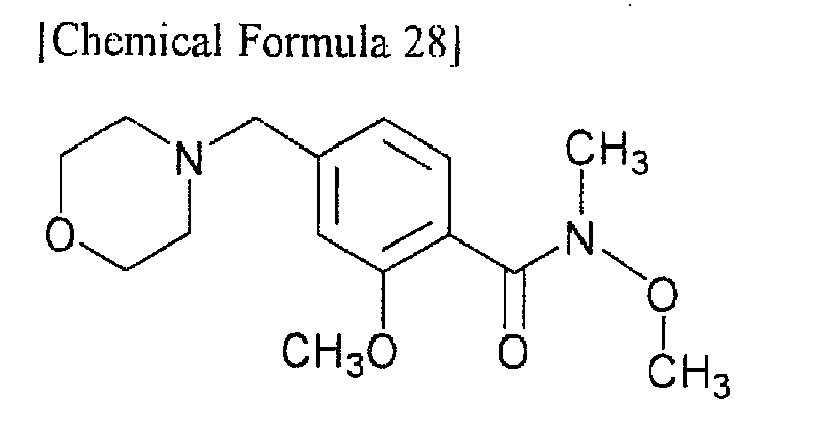
1H-NMR(CDCl3): δ 2.45(4H, m), 3.32-3.55(6H, br), 3.50(2H, s), 3.72(4H, m), 3.86(3H, s), 6.92-6.94(2H, m), 7.21(1H, d, J=7.3) -

1H-NMR(CDCl3): δ 2.45(4H, m), 2.61(3H, s), 3.51(2H, s), 3.73(4H, m), 3.93(3H, s), 6.95(2H, m), 7.70(1H, d, J=7.9) -

Melting Point: 158-162°C
1H-NMR(CDCl3): δ 2.27(3H, s), 2.49(4H, m), 2.66(3H, d, J=4.7), 3.33(2H, m), 3.54(2H, s), 3.70-3.76(6H, m), 3.86(3H, s), 5.73(1H, s), 6.86-7.00(5H, m), 7.18(1H, t, J=7.51) -

1H-NMR(CDCl3): δ 2.50(4H, m), 3.59(2H, s), 3.73(4H, m), 3.88(3H, s), 3.92(3H, s),7.46(1H, d, J=7.8), 7.52(1H, s), 7.63(1H, d, J=7.8) -

1H-NMR(CDCl3): δ 2.57(4H, m),3.36(3H, s), 3.59(3H, s),3.64(3H, s), 3.75(4H, m), 3.85(3H, s), 7.20(1H, s), 7.24(1H, d, J=7.8), 7.40(1H, d, J=7.8) -

1H-NMR(CDCl3): δ 2.52(4H, m), 2.61(3H, s), 3.60(2H, s), 3.74(4H, m), 3.89(3H, s), 7.48-7.55(3H, m) -

Melting Point: 152-154°C
1H-NMR(CDC13). δ 2.28(3H, s), 2.54(4H, m), 2.66(3H, d, J=4.7), 3.34(2H, m), 3.58(2H, s), 3.75(4H, m), 3.87-3.90(5H, m), 5.80(1H, s), 6.83-6.94(4H, m), 7.00(1H; t, J=8.9), 7.47(1H, d, J=7.7) - The acetophenones obtained in Reference Examples 9, 14, 18 and 21 were reacted with various thioureas in a similar manner to Example 1 to give compounds shown in Table 2.
-
[Table 2] 
Example R1 R3 R4 Yields (%) Melting Point (°C) 22 3-fluoro-4-methylphenyl Me H 44 171-174 23 3-fluorophenyl Me H 52 119-121 24 4-fluoro-2-methylphenyl Me H 30 122-125 25 2,4-difluorophenyl Me H 48 154-160 26 2,3-difluorophenyl Me H 37 132-135 27 3-fluorophenyl H Me 30 151-152 28 3-fluorophenyl OMe H 39 163-166 29 3-fluoro-4-methylphenyl OMe H 36 144-150 30 2,3-difluorophenyl OMe H 35 161-165 31 3-fluorophenyl H OMe 64 170-174 32 2,3-difluorophenyl H OMe 63 150-153 33 2,4-difluorophenyl H OMe 60 164-169 -

To a solution of the resulting residue in methylene chloride (20 ml) were added (3S,5S)-3,5-dimethylmorpholine hydrochloride (1.05 g) which was synthesized according to the method of Jan Runsink et al., Synthesis, 1994, 1, 66-72 and triethylamine (0.96 ml), then thereto were added sodium triacetoxyborohydride (4.39 g) and acetic acid (0.39 ml), and the mixture was stirred at room temperature overnight. The mixture was neutralized by aqueous saturated sodium bicarbonate solution, and then extracted with chloroform. The organic layer was dried over sodium sulfate, and the solvent was evaporated under reduced pressure. The residue was purified by silica gel column chromatography [0.5% methanol-chloroform to give the titled compound (0.52 g) as a colorless oil.
1H-NMR(CDCl3): δ 1.00(6H, d, J=6.5), 2.81(2H, m), 3.36(3H, s), 3.37-3,42(3H, m), 3.57(3H, s), 3.69(2H, dd, J=3.0, 10.8), 3,98(1H, d, J=14.1), 7.41(2H, d, J=8.2), 7.63(2H, d, J=8.2) -

1H-NMR(CDCl3): δ 1.00(6H, d, J=6.4), 2.60(3H, s), 2.81(2H, m), 3.37-3,47(3H, m), 3.70(2H, dd, J=3.0, 10.9), 3.99(1H, d, J=14.4), 7.48(2H, d, J=8.2), 7.90(2H, d, J=8.2) -

Melting Point: 11.6-119°C
1H-NMR(CDCl3): δ 1.03(6H, d, J=6.4), 2.28(3H, s), 2.66(3H, d, J=4.7), 2.85(2H, m), 3.39-3.46(5H, m), 3.71(2H, dd, J=3.0, 10.9), 3.86(2H, t, J=6.5), 4.00(1H, d, J=14.3), 5.77(1H, s), 6.84-6.92(2H, m), 6.99(1H, t, J=8.9), 7.27(2H, d, J=8.0), 7.48(2H, d, J=8.0) -

1H-NMR(CDCl3): δ 0.90(6H, d, J=6.2), 2.65(2H, m), 3.26(2H, t, J=10.7), 3.36 (3H, s), 3.57(3H, s), 3.70(2H, dd, J=2.8, 11.4), 3,81(2H, s), 7.41(2H, d, J=8.3), 7.63(2H, d, J=8.3) -

1H-NMR(CDCl3): δ 0.89(6H, d, J=6.2), 2.60(3H, s), 2.63(2H, m), 3.27(2H, t, J=10.3), 3.71(2H, dd, J=2.9, 11.5), 3,82(2H, s), 7.49(2H, d, J=8.4), 7.90(2H. d, J=8.4) - The acetophenones obtained in Reference Examples 23 and 25 were reacted with various thioureas in a similar manner to Example 1 to give compounds shown in Table 3.
-
[Table 3] 
Example R1 R4(R5)N Yields (%) Melting Point (°C) 35 3-fluoro-4-methylphenyl (3S, 5S)-3,5-dimethylmorpholino 47 137-140 36 3-fluorophenyl (3S, 5S)-3,5-dimethylmorpholino 60 128-130 37 2,3-difluorophenyl (3S, 5S)-3,5-dimethylmorpholino 57 131-133 38 4-fluoro-43-methylphenyl (3S, 5R)-3,5-dimethylmorpholino 65 139-142 39 3-fluoro-4-methylphenyl (3S, 5R)-3,5-dimethylmorpholino 58 155-157 40 2,3-difluorophenyl (3S, 5R)-3,5-dimethylmorpholino 69 156-160 -

1H-NMR(CDCl3): δ 2.45(4H. m), 3.54(2H, s), 3.71(4H, m), 3.92(3H, s), 7.40(1H, t, J=7.7), 7.55(1H d, J=7.7), 7.94(1H, td, J=1.4, 7.7), 7.99(1H, s) -

1H-NMR(CDCl3): δ 2.45(4H, m),3.36(3H, s), 3.53(2H, s), 3.56(3H, s), 3.71(4H, m), 7.35(1H, t, J=7.6), 7.45(1H d, J=7.6), 7.94(1H d, J=7.6), 7.63(1H, s) -
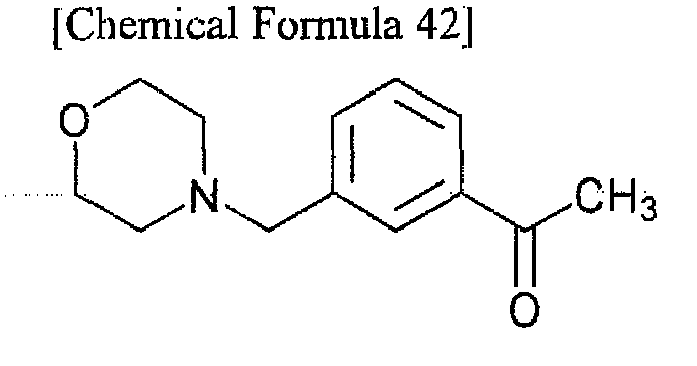
1H-NMR(CDCl3): δ 2.45(4H, m), 2.62(3H, s), 3.55(2H, s), 3.72(4H, m), 7.43(1H, t, J=7.7), 7.56(1H. d,
J=7.7), 7.85(1H, td, J=1.4, 7.7), 7.92(1H, s) -

- The acetophenone obtained in Reference Example 28 was reacted with various thioureas in a similar manner to Example 1 to give compounds shown in Table 4.
-
[Table 4] 
Example R1 Yields (%) Melting Point (°C) 42 3-fluorophenyl 33 oil 43 2,4-difluorophenyl 29 oil -

1H-NMR(CDCl3): δ 2.53(4H, m), 2.61(2H, m), 2.83(2H, m), 3.48-3.79(12H, m), 7.25(2H, d, J=8.1), 7.34(2H, d, J=8.1) -

1H-NMR(CDCl3): δ 2.53(4H, m), 2.59(3H, s), 2.63(2H, m), 2.86(2H, m), 3.74(4H, m), 7.30(2H, d, J=8.2), 7.90(2H, d, J=8.2) -

1H-NMR(CDCl3): δ 2.27(3H, s), 2.55(4H, m), 2.61-2.67(5H, m), 2.86(2H, m), 3.43(2H, q, J=6.4, 11.8), 3.77(4H, m), 3,86(2H, t, J=6.5), 5.80(1H, s), 6.84-6.92(2H, m), 6.99(1H, t J=9.0), 7.24-7.32(4H, m) - The acetophenone obtained in Reference Example 30 was reacted with various thioureas in a similar manner to Example 1 to give compounds shown in Table 5.
-
[Table 5] 
Example R1 Yields (%) Melting Point (°C) 45 3-fluorophenyl 63 154-160 46 2, 3-difluorophenyl 58 155-164 47 2, 4-difluorophenyl 58 166-172 -

1H-NMR(CDCl3): δ 2.64(3H, s),3.38(3H, s), 3.54(3H, s), 7.75(2H, dd, J=1.7, 6.7), 8.00(2H, dd, J=1.7, 6.7) -

1H-NMR(CDCl3): δ 1.34(3H, d, J=6.7), 2.35(2H, m), 2.49(2H, m), 3.33(1H, q, J=6.7)3.36(3H, s), 3.58(3H, s), 3.69(4H, m), 7.36(2H, d, J=8.2), 7.64(2H, d, J=8.2) -

1H-NMR(CDCl3): δ 1.34(3H, d, J=6.6), 2.35(2H, m), 2.49(2H, m), 2.60(3H, s), 3.36(1H, q, J=6.6),
3.69(4H, m), 7.43(2H, d, J=8.3), 7.92(2H, d, J=8.3) -

- The acetophenone obtained in Reference Example 33 was reacted with various thioureas in a similar manner to Example I to give compounds shown in Table 6.
-
[Table 6] 
Example R1 Yields (%) Melting Point (°C) 49 3-fluorophenyl 52 oil 50 2,3-difluorophenyl 72 oil 51 2,4-difluorophcnyl 72 oil -

1H-NMR(CDCl3): δ 2.63(3H, s), 3.40-3.80(8H, br), 7.50(2H, td, J=1.6, 1.9,8.4), 8.01(2H, td, J=1.6, 1.9, 8.4) -

- The acetophenone obtained in Reference Example 34 was reacted with various thioureas in a similar manner to Example I to give compound shown in Table 7.
-
[Table 7] 
Example R1 m n Yields(%) Melting Point (°C) 53 4-fluoro-3-methylphenyl 1 0 45 183-186 54 2,4-difluorophenyl 1 0 53 179-180 55 3-fluoro-4-methylphenyl 1 0 58 175-178 56 3-chlorophenyl 1 0 42 182-186 57 3-fluorophenyl 2 0 45 172-177 58 4-fluoro-3-methylphenyl 2 0 54 196-203 59 3-chlorophenyl 2 1 36 191-198 - 4-Acetylbenzoic acid was reacted with various amines in a similar manner to Reference Example 34 to give compounds shown in Table 8.
-
[Table 8] 
Reference Example R4 Yields (%) Melting Point (°C) 35 ethyl 68 oil 36 cyclopropyl 77 oil - The acetophenones obtained in Reference Examples 35 and 36 were reacted with various thioureas in a similar manner to Example 1 to give compounds shown in Table 9.
-
[Table 9] 
Example R1 R4 Yields (%) Melting Point (°C) 60 3-fluorophenyl ethyl 55 170-176 61 4-fluorophenyl ethyl 48 172-178 62 3,4-difluorophenyl ethyl 69 180-188 63 3-chlorophenyl ethyl 58 185-192 64 3-fluorophenyl cyclopropyl 63 179-185 - The assessment test was carried out according to the method of Sugasawa, T. et al., J. Biol. Chem., 272, 21244-21252 (1997).
- Lung taken out from SD male rat (7-week old under test, Charles River Laboratories Japan, Inc.) was removed trachea and blood vessels to shred and washed with iced tris-saline buffer (10 mM tris hydrochloric acid-154 mM sodium chloride, pH7.4). The resultant was homogenized by Hiscotron with ice-cold tris-saline buffer containing a homogenization buffer (1 mM ethylenediaminetetraacetic acid (EDTA), 1 mM 4-(2-aminoethyl)benzenesulfonyl fluoride (AEBSF), 5 µg/ml aprotinin, 5 µg/ml leupeptine) (maximum rate: 1 minute). The supernatant after low-speed centrifugation (1500 x g, 20 minutes, 4°C) was ultracentrifuged (100000 x g, 20 minutes, 4°C), and the pellet was suspended in tris-saline buffer to store at -80°C. The protein concentrations were determined by Bio-Rad Protein Assay Kit using bovine serum albumin (BSA) as a standard.
- To each well in protein-nonabsorptive round-bottom 96-well assay plate (commercially available from Iwaki Glass Co., Ltd.) were added tris-saline buffer (200 µl) containing 1 nM [125I]-iodocyanopindolol (commercially available from Amersham plc), 10 µM serotonine, 20 µm dl-propranolol, 10 µM phentolamine, 1.1 mM ascorbic acid and 100 µg lung membrane, and the mixture was pipetted to combine and then incubated at 37°C for 30 minutes. The test compounds were dissolved in 100% dimethyl sulfoxide solution, and thereto was added 2 µl (final DMSO concentration: 1%). In order to calculate nonspecific binding amounts, to the mixture was added L-threo-3-(3,4-dihydroxyphenyl)-N-[3-(4-fluorophenyl)propyl]serine pyrrolidine amide at 100 µM of the final concentration as an alternative to the test compounds. During this time, 100 µl of 0.3% polyethyleneimine (PEI)/tris-saline buffer was added to MultiScreen plate (96-well B glass fiber, Millipore Cat. No. MAFB NOB10), and incubated for over 30 minutes. The resultant was filtered with aspiration (aspiration by the addition of 200 µl iced tris-saline buffer) to wash, and the reaction solutions on 96-well assay plate were filtered with aspiration to wash four times on MultiScreen plate B glass fiber filter paper at the bottom of MultiScreen plate was punched out, and γ-ray doses of [125I]-iodocyanopindolol trapped on the filter paper were determined as binding amounts. The binding amounts in the presence of DMSO (final concentration: 1%) were total binding amounts, and the binding amounts in the presence of 100 µM L-threo-3-(3,4-dihydroxyphenyl)-N-[3-(4-fluorophenyl)propyl]serine pyrrolidine amide were nonspecific binding amounts. The values subtracted the nonspecific binding amounts from the total binding amounts were the specific binding amounts. The binding activity of a compound was calculated according to the following formula, which was shown in the ratio of inhibiting the specific binding of [125I]-iodocyanopindolol to rat lung membrane SMBS by the test compound.
-

-
- Cell Strainer (BD Falcon®)
- Cell Titer-Glo® (Promega)
- Collagenase from Clostridium histolyticum (Sigma-Aldrich)
- Corticosterone EIA kit (Cayman)
- Dimethylsulfoxide (referred to as DMSO hereinafter) (nacalai tesque)
- D-MEM (GIBCO)
- DNase I (Invitrogen)
- Fetal Bovine Serums (referred to as FBS hereinafter) (Bioflud)
- Multiple well plates for adhesive cell culture, 96 wells (IWAKI)
- N6,2'-0-Dibutyryladenosine 3',5'-cyclic monophosphatc sodium salt (referred to as cAMP hereinafter) (Sigma)
- Penicillin Streptomycin Mixed Solution (nacalai tesque)
- Control examples 1 to 4: Control example I was Example 350 of Patent Document 2. Control examples 2 to 4 were synthesized according to Patent Document 2.
- Adrenal glands were taken out from rats, and removed excess connective tissues, adiposes and membranes in D-MEM. The adrenal glands were transferred to polytubes, and quickly segmentalized with scissors. Thereto was added D-MEM containing 1 mg/mL collagenase and 0.25 µL DNase I, and then the mixture was shaken at 37°C for 10 minutes in 80 times/minute. Then, the mixture was pipetted by 1 mL truncated pipette tip, and shaken again under the same condition. After 10 minutes, the mixture was pipetted again by 1 mL pipette tip, and the cell suspension was filtered through metal mesh. The filtrate was centrifuged at 4°C for 5 minutes in 500 g. The supernatant was removed, and thereto was added a mixed solution of 0.16 M NH4Cl and 0.17 M Tris-HCl in 3 mL. The mixture was let stand on ice for 5 minutes, and then centrifuged under the same condition. Then, the supernatant was removed and then thereto was added D-MEM. The cell suspension was prepared and centrifuged under the same condition. Again, the supernatant was removed and then thereto was added D-MEM to give a cell suspension. The cell suspension was filtered by Cell Strainer (BD Falcon®). The filtrate was centrifuged under the same condition. After the completion of the centrifugation, the supernatant was removed, and thereto was added D-MEM containing 1% Penicillin Streptomycin Mixed Solution and 10% FBS. The mixture was seeded in Multiple well plate for adhesive cell culture, 96 wells (IWAKI) in 10000 cells/well, and incubated at 37°C overnight in CO2 incubator.
- Test article concentrations were prepared in DMSO to 2000 µM, and D-MEM containing 20 µM test article in D-MEM was prepared.
Cell-seeded plate was incubated overnight, and then the medium was removed and thereto was added D-MEM containing 20 µM test article in 50 µL/well. Then, to the mixture was promptly added D-MEM containing 20 µm cAMP in 50 µL/well so that the final concentration of the test article was 10 µM. After the addition of 2 types of D-MEM, the mixture was incubated at 37°C for 2 hours in CO2 incubator. After 2 hours, the supernatant (50 µL) of the medium was collected. For cells, the cell toxicity of the test article was assessed according to a conventional method using Cell Titcr-Glo® (Promega). For the collected supernatant, the Corticosterone concentration in the supernatant was determined according to a conventional method using Corticosterone EIA kit (Cayman).
The inhibition rate of 10 µM test article to Corticosterone generation was calculated according to the following formula confirming that the cell toxicity by the test article was not recognized. -

- The results of the above Tests 1 and 2 are shown in Table 10.
Binding Activities (Effects) and Steroid Synthesis Inhibition Rates (By-Effects) of Example Compounds -
[Table 10] 
Example R1 Y R6 Y2 R3 Binding Activity (%) (1 µM) Steroid Synthesis Inhibition Rate (%) (10 µM) Control Example 1 4-fluoro morpholino H ethylene methyl 88 57 Control Example 2 4-trifluoro-methyl morpholino H ethylene methyl 81 73 Control Example 3 diisopropyl morpholino H ethylene methyl 83 52 Control Example 4 3-fluoro morpholino 2.6-difluoro ethylene methyl 92 95 18 4 methylmethyl 4-morpholinomethyl 2-methyl ethylene methyl 88 28 21 4-fluoro-3-methyl 4-morpholinomethyl 3-methoxy ethylene methyl 82 8 52 3-fluoro 4- morpholinocarbonyl H ethylene methyl 59 0 59 3-chloro 4- morpholinocarbonyl H ethylene ethyl 66 7 61 4-fluoro 4- ethylaminocarbonyl H ethylene methyl 62 6 62 3,4-difluoro 4- ethylamillcarbonyl ethylaminocarbonyl H ethylene methyl 65 2 - The assessment was carried out using a compound obtained in Example 52.
- Hartley male guinea pigs (commercially available from Japan SLC, Inc.) were pre-bred about 1 week after arrival, and then exposed by inhalation to 2% (w/v) ovalbumin (OA) saline in a plastic box (4 guniea pigs/box) for 5 minutes using a ultrasonic nebulizer (OMRON NE-U12, condition: maximum nebulizing amounts, maximum air volume), and sensitized (day 0). The same operation was carried out on day 7. On day 14 or 15, each guinea pig was administered 2% OA by inhalation for 5 minutes to initiate a response (challenge). One hour before the challenge, an antihistamine agent pyrilamine maleate (dissolved in saline, 10 mg/2 ml/kg) was intraperitoneally administered. A test compound was suspended in 0.5% methylcellulose (MC), and was orally administered one hour before the antigen challenge in 3 mg/5 ml/kg 0.5% MC was administered to a control group in a similar manner.
A determination and analysis of respiratory function were carried out according to the method of Penny A. Hutson et al. Am Rev Respir Dis 1988 137, 548-557. The respiratory function was determined before the antigen challenge (before drug administration) and 5 minutes and 1, 2, 3, 4, 5, 6, 7 and 8 hours after the antigen challenge, and wave profiles were imported using MacLab Chart v3.4 (AD Instruments) and analyzed later. The assessment was carried out on the basis of sRaw/TV by subtracting the former sRaw/TV value from sRaw/TV value for each animal at each point of time. The sRaw/TV values subtracting the former values were plotted against measured times, and each area under the curve (AUC4-8hr) of cach animal was calculated to compare each other in the range of 4 to 8 hours after the antigen challenge. The statistical analysis was carried out using SAS preclinical package Version 5.0. It was evaluated by Dunnett-type multiple comparison whether or not there were any significant differences between a control group and each drug administration group.
The results are shown in Table 11. -
[Table 11] AUC4-8hr ((sRaw/TV)•h) Improvement Rate (%) Control Group 0.925 0 Example 52 Compound 0.427 54 - The 5-membercd ring compound or a pharmaceutically acceptable salt thereof of the present invention inhibits infiltration of leukocytes including eosinophils, lymphocytes, etc., and hence, is useful for the treatment of various inflammations.
Claims (14)
- A 5-membered ring compound of formula (1):

R2 is C1-C3 alkylene optionally substituted by C1-C3 alkyl, or carbonyl;
R3 is C1-C3 alkyl;
R4 and R5 are each independently hydrogen atom or C1-C3 alkyl; or -N(R4)R5 may be morpholino optionally substituted by C1-C3 alkyl;
Y2 is C2-C4 alkylene;
R6 is hydrogen atom, a halogen atom, C1-C3 alkyl or C1-C3 alkoxy; or a pharmaceutically acceptable salt thereof. - The 5-membered ring compound of claim 1, wherein -N(R4)R5 is morpholino optionally substituted by C1-C3 alkyl, or a pharmaceutically acceptable salt thereof.
- The 5-membered ring compound of claim 1, wherein -N(R4)R5 is morpholino, or a pharmaceutically acceptable salt thereof.
- The 5-membered ring compound of claim 1, wherein R2 is methylene, or a pharmaceutically acceptable salt thereof.
- The 5-membered ring compound of claim 1, wherein R1 is phenyl optionally substituted by a halogen atom, or a pharmaceutically acceptable salt thereof.
- The 5-membered ring compound of any one of claims I to 5, wherein R3 is methyl or ethyl, and Y2 is C2-C3 alkylene, or a pharmaceutically acceptable salt thereof.
- The 5-membered ring compound of any one of claims 1 to 6, wherein the wavy line represents (Z)-coordination, or a pharmaceutically acceptable salt thereof.
- A therapeutic agent for inflammations, comprising the 5-membered ring compound of any one of claims I to 7 or a pharmaceutically acceptable salt thereof.
- A therapeutic agent for autoimmune inflammations or allergic inflammations, comprising the 5-membered ring compound of any one of claims 1 to 7 or a pharmaceutically acceptable salt thereof.
- A therapeutic agent for chronic obstructive pulmonary diseases, comprising the 5-membered ring compound of any one of claims 1 to 7 or a pharmaceutically acceptable salt thereof.
- A therapeutic agent for bronchial asthma, comprising the 5-membered ring compound of any one of claims I to 7 or a pharmaceutically acceptable salt thereof.
- A therapeutic agent for rhinitis, comprising the 5-membered ring compound of any one of claims 1 to 7 or a pharmaceutically acceptable salt thereof.
- A method for treating inflammations, comprising administering the 5-membered ring compound of any one of claims 1 to 7 or a pharmaceutically acceptable salt thereof to a patient in need thereof.
- Use of the 5-membered ring compound of any one of claims 1 to 7 or a pharmaceutically acceptable salt thereof in the manufacture of a therapeutic agent for inflammations.
Applications Claiming Priority (2)
| Application Number | Priority Date | Filing Date | Title |
|---|---|---|---|
| JP2008115993 | 2008-04-25 | ||
| PCT/JP2009/058054 WO2009131171A1 (en) | 2008-04-25 | 2009-04-23 | Novel five-membered ring compound |
Publications (2)
| Publication Number | Publication Date |
|---|---|
| EP2272835A1 true EP2272835A1 (en) | 2011-01-12 |
| EP2272835A4 EP2272835A4 (en) | 2011-10-05 |
Family
ID=41216900
Family Applications (1)
| Application Number | Title | Priority Date | Filing Date |
|---|---|---|---|
| EP09734738A Withdrawn EP2272835A4 (en) | 2008-04-25 | 2009-04-23 | NEW CYCLIC COMPOUND WITH FIVE ELEMENTS |
Country Status (7)
| Country | Link |
|---|---|
| US (1) | US20110034466A1 (en) |
| EP (1) | EP2272835A4 (en) |
| JP (1) | JPWO2009131171A1 (en) |
| KR (1) | KR20100134688A (en) |
| CN (1) | CN102076672A (en) |
| CA (1) | CA2722041A1 (en) |
| WO (1) | WO2009131171A1 (en) |
Family Cites Families (7)
| Publication number | Priority date | Publication date | Assignee | Title |
|---|---|---|---|---|
| JPH075579B2 (en) * | 1986-09-01 | 1995-01-25 | 吉富製薬株式会社 | Aminothiazole compound |
| EP0848059A1 (en) * | 1996-12-12 | 1998-06-17 | Vetigen | Mammalian ICYP (Iodocyanopindolol) receptor and its applications |
| CN100369903C (en) * | 2000-06-30 | 2008-02-20 | 大日本住友制药株式会社 | five-membered ring compound |
| JP2003192591A (en) * | 2001-12-27 | 2003-07-09 | Sumitomo Pharmaceut Co Ltd | Pharmaceuticals consisting of 5-membered ring compounds |
| AU2002361117A1 (en) | 2001-12-28 | 2003-07-24 | Sumitomo Pharmaceuticals Co., Ltd. | 5-membered cyclic compounds |
| JP2005206515A (en) | 2004-01-22 | 2005-08-04 | Sumitomo Pharmaceut Co Ltd | 5-membered ring compounds |
| US8012971B2 (en) * | 2005-04-28 | 2011-09-06 | Dainippon Sumitomo Pharma Co., Ltd. | Therapeutic agent for chronic obstructive pulmonary disease |
-
2009
- 2009-04-23 KR KR1020107023684A patent/KR20100134688A/en not_active Withdrawn
- 2009-04-23 WO PCT/JP2009/058054 patent/WO2009131171A1/en not_active Ceased
- 2009-04-23 CN CN2009801240669A patent/CN102076672A/en active Pending
- 2009-04-23 JP JP2010509214A patent/JPWO2009131171A1/en not_active Withdrawn
- 2009-04-23 US US12/989,516 patent/US20110034466A1/en not_active Abandoned
- 2009-04-23 CA CA2722041A patent/CA2722041A1/en not_active Abandoned
- 2009-04-23 EP EP09734738A patent/EP2272835A4/en not_active Withdrawn
Non-Patent Citations (2)
| Title |
|---|
| No further relevant documents disclosed * |
| See also references of WO2009131171A1 * |
Also Published As
| Publication number | Publication date |
|---|---|
| WO2009131171A1 (en) | 2009-10-29 |
| EP2272835A4 (en) | 2011-10-05 |
| JPWO2009131171A1 (en) | 2011-08-18 |
| KR20100134688A (en) | 2010-12-23 |
| CN102076672A (en) | 2011-05-25 |
| US20110034466A1 (en) | 2011-02-10 |
| CA2722041A1 (en) | 2009-10-29 |
Similar Documents
| Publication | Publication Date | Title |
|---|---|---|
| US11945796B2 (en) | Substituted pyridine derivatives as SARM1 inhibitors | |
| CN102164920B (en) | Alkylthiazole carbamate derivatives, processes for their preparation and their use as FAAH enzyme inhibitors | |
| EP2407466B1 (en) | Piperazine compound capable of inhibiting prostaglandin d synthase | |
| JPH11193281A (en) | Adenosine a3 receptor antagonistic agent and thiazole compound | |
| US20130096160A1 (en) | Arylthiazolyl piperidines and related compounds as modulators of survival motor neuron (smn) protein production | |
| JP5404607B2 (en) | Aniline derivative having anti-RNA virus action | |
| KR100878421B1 (en) | Cyclic diamine compound having 5-membered cyclic group | |
| US8119812B2 (en) | Thiazolidinone derivative | |
| US20110263550A1 (en) | Therapeutic agent for chronic obstructive pulmonary disease | |
| JPWO2018016458A1 (en) | Piperazine derivative | |
| US20110034466A1 (en) | Novel five-membered ring compound | |
| HK1152523A (en) | Novel five-membered ring compound | |
| US20110039848A1 (en) | Five-membered ring compound | |
| HK1153456A (en) | Five-membered ring compound | |
| CN102803258A (en) | Alkyl-heterocyclic carbamate derivatives, their preparation and therapeutic use | |
| HK1107772A (en) | Therapeutic agent for chronic obstructive pulmonary disease |
Legal Events
| Date | Code | Title | Description |
|---|---|---|---|
| PUAI | Public reference made under article 153(3) epc to a published international application that has entered the european phase |
Free format text: ORIGINAL CODE: 0009012 |
|
| 17P | Request for examination filed |
Effective date: 20101102 |
|
| AK | Designated contracting states |
Kind code of ref document: A1 Designated state(s): AT BE BG CH CY CZ DE DK EE ES FI FR GB GR HR HU IE IS IT LI LT LU LV MC MK MT NL NO PL PT RO SE SI SK TR |
|
| AX | Request for extension of the european patent |
Extension state: AL BA RS |
|
| DAX | Request for extension of the european patent (deleted) | ||
| A4 | Supplementary search report drawn up and despatched |
Effective date: 20110901 |
|
| RIC1 | Information provided on ipc code assigned before grant |
Ipc: A61P 29/00 20060101ALI20110826BHEP Ipc: A61P 37/06 20060101ALI20110826BHEP Ipc: A61P 37/02 20060101ALI20110826BHEP Ipc: A61P 43/00 20060101ALI20110826BHEP Ipc: A61P 11/00 20060101ALI20110826BHEP Ipc: C07D 417/10 20060101ALI20110826BHEP Ipc: A61P 3/10 20060101ALI20110826BHEP Ipc: A61P 1/04 20060101ALI20110826BHEP Ipc: A61P 25/00 20060101ALI20110826BHEP Ipc: C07D 277/42 20060101ALI20110826BHEP Ipc: A61P 11/02 20060101ALI20110826BHEP Ipc: A61P 27/14 20060101ALI20110826BHEP Ipc: A61P 17/00 20060101ALI20110826BHEP Ipc: A61P 17/04 20060101ALI20110826BHEP Ipc: A61K 31/5377 20060101ALI20110826BHEP Ipc: A61P 19/02 20060101ALI20110826BHEP Ipc: A61P 35/04 20060101ALI20110826BHEP Ipc: A61K 31/426 20060101ALI20110826BHEP Ipc: A61P 37/08 20060101ALI20110826BHEP Ipc: A61P 11/06 20060101ALI20110826BHEP Ipc: C07D 277/20 20060101AFI20110826BHEP |
|
| REG | Reference to a national code |
Ref country code: HK Ref legal event code: DE Ref document number: 1152523 Country of ref document: HK |
|
| GRAP | Despatch of communication of intention to grant a patent |
Free format text: ORIGINAL CODE: EPIDOSNIGR1 |
|
| STAA | Information on the status of an ep patent application or granted ep patent |
Free format text: STATUS: THE APPLICATION IS DEEMED TO BE WITHDRAWN |
|
| 18D | Application deemed to be withdrawn |
Effective date: 20121205 |
|
| REG | Reference to a national code |
Ref country code: HK Ref legal event code: WD Ref document number: 1152523 Country of ref document: HK |