EP2272475A1 - Absorptive article - Google Patents
Absorptive article Download PDFInfo
- Publication number
- EP2272475A1 EP2272475A1 EP09738667A EP09738667A EP2272475A1 EP 2272475 A1 EP2272475 A1 EP 2272475A1 EP 09738667 A EP09738667 A EP 09738667A EP 09738667 A EP09738667 A EP 09738667A EP 2272475 A1 EP2272475 A1 EP 2272475A1
- Authority
- EP
- European Patent Office
- Prior art keywords
- moisture
- sheet
- visualizing elements
- barrier sheet
- moisture visualizing
- Prior art date
- Legal status (The legal status is an assumption and is not a legal conclusion. Google has not performed a legal analysis and makes no representation as to the accuracy of the status listed.)
- Withdrawn
Links
Images


Classifications
-
- A—HUMAN NECESSITIES
- A61—MEDICAL OR VETERINARY SCIENCE; HYGIENE
- A61F—FILTERS IMPLANTABLE INTO BLOOD VESSELS; PROSTHESES; DEVICES PROVIDING PATENCY TO, OR PREVENTING COLLAPSING OF, TUBULAR STRUCTURES OF THE BODY, e.g. STENTS; ORTHOPAEDIC, NURSING OR CONTRACEPTIVE DEVICES; FOMENTATION; TREATMENT OR PROTECTION OF EYES OR EARS; BANDAGES, DRESSINGS OR ABSORBENT PADS; FIRST-AID KITS
- A61F13/00—Bandages or dressings; Absorbent pads
- A61F13/15—Absorbent pads, e.g. sanitary towels, swabs or tampons for external or internal application to the body; Supporting or fastening means therefor; Tampon applicators
- A61F13/42—Absorbent pads, e.g. sanitary towels, swabs or tampons for external or internal application to the body; Supporting or fastening means therefor; Tampon applicators with wetness indicator or alarm
Definitions
- the present invention relates to absorbent articles and more particularly to absorbent articles such as disposable diapers, toilet-training pants or incontinent briefs.
- Leak indicator means adapted to indicate whether urination has occurred or not in disposable diapers is known, for example, from JP 2004-236826 A (PATENT DOCUMENT 1).
- the diaper comprises front and rear waist regions, a crotch region, an inner sheet facing the wearer's skin, an outer sheet facing a wearer's garment and an absorbent structure sandwiched between the inner and outer sheets.
- the outer sheet is provided on its side facing the absorbent structure with the leak indicator means.
- the leak indicator means is formed by water-soluble ink adapted to become invisible upon contact with moisture such as urine or to develop color change.
- the leak indicator means becomes partially invisible or develops color change, i.e., the leak indicator partially remains unchanged.
- the portions of the leak indicator means which has developed a change can be compared with the portions of the leak indicator means remaining unchanged and thereby it can be easily determined whether urination has occurred or not.
- the leak indicator means will fully become invisible or develop color change, making it impossible to compare the leak indicator means before such change occurs with the leak indicator means after such change has occurred. In other words, a problem has been left unsolved that it will be impossible to determine whether urination has occurred or not unless optical characteristic such as color is kept in mind.
- an improvement in an absorbent article having a longitudinal direction, a transverse direction, a side facing the wearer's skin, a side facing a wearer's garment, a front waist region, a rear waist region and a crotch region extending between the front and rear waist regions wherein these regions are contiguous one to another in the longitudinal direction, and comprising an inner sheet lying on the side facing wearer's skin, an outer sheet lying on the side facing wearer's garment, a liquid-absorbent structure sandwiched between the inner and outer sheets and occupying at least the crotch region and moisture visualizing elements formed on a side of the outer sheet facing the liquid-absorbent structure and adapted to develop change of optical effect upon contact with moisture.
- the improvement according to the present invention is characterized in that a barrier sheet of moisture-impervious is provided between the moisture visualizing elements and the liquid-absorbent structure so as to overlap a part of the moisture visualizing elements and thereby to restrain the moisture having been absorbed by the liquid-absorbent structure from coming in direct contact with the overlapped part of the moisture visualizing elements.
- the barrier sheet is provided in the crotch region on a side towards the front waist region.
- the barrier sheet comprises a pair of sheet slips spaced from each other in the transverse direction.
- the barrier sheet is placed so that a transverse middle of the barrier sheet coincides with a longitudinal center line bisecting a dimension of the absorbent article in the transverse direction.
- the barrier sheet has a length dimension of 10 mm or longer as measured in the transverse direction.
- a moisture-impervious barrier sheet is provided between said moisture visualizing elements and said liquid-absorbent structure so as to overlap a part of said moisture visualizing elements and thereby to define portions of the moisture visualizing elements which are free from contact with moisture.
- these portions free from contact with moisture substantially no change of the optical effect and therefore these portions can be used as a reference to compare the remaining portions of the moisture visualizing elements after contact with moisture with those before contact with moisture. In this way, any change of the optical effect developed by the moisture visualizing elements can be easily recognized.
- the barrier sheet is provided in said crotch region on one side towards said front waist region, urine (i.e., moisture) is normally discharged onto the spot in the crotch region on a side towards the front waist region in the upright posture on the assumption that the absorbent article is a diaper.
- urine i.e., moisture
- the placement of the barrier sheet coincides with the spot onto which urine is discharged and even a relatively small amount of urination can be reliably recognized.
- the barrier sheet comprises a pair of sheet slips spaced from each other in the transverse direction
- urine discharged onto a spot in the vicinity of the longitudinal center line bisecting the dimension of the absorbent article in the transverse direction comes in contact with the moisture visualizing elements. In consequence, it can be reliably determined whether urination has occurred or not.
- the barrier sheet is placed so that the transverse middle of the barrier sheet coincides with the longitudinal center line bisecting a dimension of the absorbent article in the transverse direction.
- Dimensioning the length dimension of the barrier sheet to 10 mm or longer as measured in the transverse direction is effective to constrain permeation of moisture into the barrier sheet from the periphery thereof and to constrain the portions overlapped by the barrier sheet from developing color change particularly immediately after urination.
- Figs. 1 through 3 illustrate a first embodiment of the invention wherein respective elastic members are shown as elasticity thereof being inactivated.
- Fig. 1 is a plan view showing a diaper 1 of so-called open-type flatly developed and partially cutaway for inconvenience of illustration and
- Fig. 2 is a sectional view taken along the line II-II in Fig. 1 .
- the diaper 1 comprises a chassis 2, waist elastic members 3 and leg elastic members 4.
- the chassis 2 comprises a front waist region 5, a rear waist region 6 and a crotch region 7 extending between the front and rear waist regions 5, 6, these regions 5, 6 and 7 being contiguous one to another in a longitudinal direction Y.
- the chassis 2 includes a liquid-pervious inner sheet 8 defining an inner side facing the wearer's skin and a liquid-impervious outer sheet 9 defining an outer side facing the wearer's garment.
- the chassis 2 is provided between these inner and outer sheets 8, 9 with a liquid-absorbent structure 10 at least occupying the crotch region 7.
- the liquid-absorbent structure 10 comprises a liquid-absorbent core 11 formed, for example, by fluff pulp and a dispersant sheet 12 such as tissue paper with which the liquid-absorbent core 11 is wrapped.
- the chassis 2 has front and rear ends 14, 15 opposed to each other in the longitudinal direction Y and extending in a transverse direction X along which respective waist elastic members 3 are attached to the chassis 2.
- Each of these waist-surrounding elastic members 3 is formed by an elasticized sheet attached to the chassis 2 under tension in the transverse direction X.
- the chassis 2 has a pair of side edges 17 opposed to each other in the transverse direction X and extending in the longitudinal direction Y.
- Each of these side edges 17 comprises a front side edge 18 extending in the front waist region 5, a rear side edge 19 extending in the rear waist region 6 and a leg side edge 20 extending in the crotch region 7.
- the opposite side edges 17 describe curvatures along the respective leg side edges 20 which are convex toward a longitudinal center line P-P bisecting a dimension of the diaper 1 in the transverse direction X so that the chassis 2 as a whole has a concaved-shape.
- the opposite side edges 17 are provided with a plurality of leg elastic members 4 extending along the leg side edges 20. Specifically, these leg elastic members 4 are attached to the chassis 2 under tension so as to be sandwiched between the inner and outer sheets 8, 9. The leg elastic members 4 bias the leg side edges 20 to fit around the wearer's legs and thereby prevent body waste such as urine from leaking beyond the leg side edges 20.
- the rear side edges 19 are provided on the side of the outer sheet 9 with fastener members 24 extending outward in the transverse direction 9 so that these fastener members 24 are engaged with the outer sheet 9 in the front waist region 5 to put the diaper 1 on the wearer's body.
- Fig. 3 is a plan view corresponding to Fig. 1 with the inner sheet 8 and the liquid-absorbent structure 10 eliminated therefrom.
- a moisture visualizing element 21 is provided on the side of the outer sheet 9 facing the wearer's skin, i.e., facing the liquid-absorbent structure 10.
- the moisture visualizing element 21 is formed by coating the outer sheet 9 with hot melt composition comprising pressure-sensitive adhesive ingredient mixed with pH indicator.
- the moisture visualizing element 21 formed in this manner develops a color change upon contact with moisture and thereby visualizes the presence of moisture through such change of color.
- Two or more stripes each forming the moisture visualizing element 21 extend in the longitudinal direction Y at least across the crotch region 7. In this first embodiment, these moisture visualizing elements 21 extend across the crotch region 7 further into the front and rear waist regions 5, 6.
- the barrier sheet 22 extends in the transverse direction X across a plurality of the moisture visualizing elements 21 arranged so as to be spaced one from another in the transverse direction X.
- the barrier sheet 22 has a dimension of about 10 mm in the longitudinal direction Y and is set in the crotch region 7 to one side of a transverse center line Q-Q toward the front waist region 5.
- the barrier sheet 22 is bonded to at least one of the outer sheet 9 and the liquid-absorbent structure 10.
- the barrier sheet 22 is formed by hydrophobic fibrous nonwoven fabric and therefore spots of the respective moisture visualizing elements 21 overlapped by the barrier sheet 22 are prevented from contacting with moisture deriving from urination.
- the moisture visualizing elements 21 Upon urination by the user wearing the diaper 1 composed as has been described, urine passes through the inner sheet 8 and is absorbed by the liquid-absorbent structure 10. Then a portion of urine absorbed by the liquid-absorbent structure 10 comes in contact with the moisture visualizing elements 21. Upon contact urine, the moisture visualizing elements 21 develop change of color. The moisture visualizing elements 21 are adapted to be visible through the outer sheet 9 and, if the wearer is a baby, a helper or a parent of this baby can perceive that urination has occurred by observing such change of color.
- the barrier sheet 22 is provided between the moisture visualizing elements 21 and the liquid-absorbent structure 10 and the portions of the moisture visualizing elements 21 overlapped by the barrier sheet 22 develop substantially no change of color even if urination occurs. With this unique arrangement, even if a large quantity of urine is discharged or urination occurs more than once and substantially most part of the moisture visualizing elements 21 come in contact with urine, no change of color is developed in the portions of the moisture visualizing elements 21 overlapped by the barrier sheet 22. Clear contrast with these portions developing no change of color, color change developing in remaining most part of the moisture visualizing element 21 can be easily recognized.
- the moisture visualizing elements 21 are formed in the crotch region 7 to one side of the transverse center line Q-Q toward the front waist region 5 and the middle one of these moisture visualizing element 21 lies on the longitudinal center line P-P.
- the moisture visualizing elements are positioned so as to be aligned with wearer's urethral orifice and the vicinity thereof. Consequentially, even when a voided volume is insufficient for all the moisture visualizing elements to develop change of color and an amount of color change gradually decreases toward the front and rear waist regions 5, 6, change of color reliably develops in the moisture visualizing elements around the wearer's urethral orifice in a clear contrast with the portions overlapped by the barrier sheet 22. In this way, even if the amount of color change developed in the moisture visualizing elements 21 gradually decrease in a gradation mode, it is easy for the helper or the parent to determine whether urination has occurred or not.
- the dimension of the barrier sheet 22 in the longitudinal direction Y is 10 mm in this first embodiment, the invention is not limited to this. It should be understood here that the barrier sheet 22 dimensioned to be less than 10 mm in the longitudinal direction Y will unacceptably lessen the color unchangeable portions of the moisture visualizing elements 21, making it difficult to compare these portions with the color changed portions. In addition, the barrier sheet 22 might be soaked with urine seeping beyond peripheral edges of the barrier sheet 22 and the color unchangeable portions of the moisture visualizing elements might develop change of color. Taking account of this, it is rather preferably to dimension the barrier sheet 22 in the longitudinal direction Y relatively large and thereby to broaden the total area overlapping the moisture visualizing elements 21.
- a basis weight of the barrier sheet 22 may be in a range of 10 to 30 g/m 2 and preferably in a range of 18 to 20 g/m 2 .
- the wearer might experience an incompatible feeling to wear, on one hand, and a joint effect between the barrier sheet 22 and the outer sheet 9 or the liquid-absorbent structure 10 might become unreliable, on the other hand.
- the first embodiment uses a hydrophobic nonwoven fabric as the barrier sheet 22, it is also possible to use a hydrophobic film or the like as the barrier sheet 22.
- the present invention uses hot melt composition comprising pressure-sensitive adhesive ingredient and pH indicator mixed therewith as the moisture visualizing elements
- the present invention is not limited to this and any other composition can be used as the moisture visualizing elements 21 so far as color development, color fade or color change occurs upon contact with moisture to suggest the presence of moisture.
- the hot melt composition it is also possible to print the moisture visualizing elements directly on the diaper 1 with appropriate ink or to interpose the moisture visualizing elements in the form of a separately prepared sheet.
- Fig. 4 illustrates a second embodiment of the invention.
- This second embodiment is similar to the first embodiment except the position at which the moisture visualizing elements are formed and the position at which the barrier sheet is attached to the diaper 1.
- the components corresponding to those in the first embodiment are designated with the reference numerals common to the first embodiment and details of these common components will not be described.
- a hot melt composition comprising pressure-sensitive adhesive ingredient and pH indicator mixed therewith is used as the moisture visualizing elements 21.
- the moisture visualizing elements 21 are formed by two or more stripes of hot melt composition extending in the transverse direction X with which the side of the outer sheet 9 is coated. As for placement of these moisture visualizing elements 21, they are formed in the crotch region 7 to one side of the transverse center line Q-Q toward the front waist region 5.
- the barrier sheet 22 is provided between the moisture visualizing elements 21 and the liquid-absorbent structure 10.
- the barrier sheet 22 comprises a pair of sheet slips 23 spaced from each other in the transverse direction X and extending in the longitudinal direction Y. These sheet slips 23 are attached to the diaper 1 symmetrically about the longitudinal center line P-P across the stripes of hot melt composition which is aligned in the longitudinal direction Y. A dimension of the sheet slip 23 in the transverse direction X is about 10 mm.
- the moisture visualizing elements 21 are formed in the crotch region 7 on a side towards the front waist region 5, i.e., substantially in alignment with the wearer's urethral orifice to ensure that the helper or the parent can reliably realize occurrence of urination.
- the sheet slips 23 are spaced from each other in the transverse direction X so as to intersect with, i.e., to overlap the moisture visualizing elements 21.
- the barrier sheet 22 is not present in the vicinity of the longitudinal center line P-P on which urination occurs and, in consequence, even a small amount of urination reliably causes the moisture visualizing elements 21 to develop sufficient change of color to recognize occurrence of urination.
- Such change of color may be compared with color of the barrier sheets 22 provided on both sides of the center line P-P to facilitate determination whether urination has occurred or not.
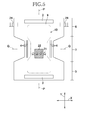
- Fig. 5 illustrates a third embodiment of the invention.
- This third embodiment is characterized in that the moisture visualizing elements 21 are formed by graphics.
- the components corresponding to those in the first embodiment are designated with the reference numerals common to the first embodiment and details of these common components will not be described.
- the moisture visualizing elements 21 are provided on the outer sheet 9 and these moisture visualizing elements 21 are formed by hot melt composition comprising pressure-sensitive adhesive ingredient and pH indicator mixed therewith. More specifically, the moisture visualizing elements 21 are defined by graphics printed with the hot melt composition and placed in the crotch region 7 on a side towards the front waist region 5. The graphics are intermittently arranged in the transverse direction X.
- the barrier sheet 22 Between the moisture visualizing elements 21 and the liquid-absorbent structure 10, there is provided the barrier sheet 22 so as to overlap a part of the moisture visualizing elements 21 and to have its transverse middle coinciding with the longitudinal center line P-P. More specifically, the barrier sheet 22 overlaps some of the moisture visualizing elements 21 spaced one from another and not the remaining moisture visualizing elements 21 so that the color changed graphics and the color unchanged graphics would appear or some of the moisture visualizing elements 21 would become visible but the other moisture visualizing elements 21 would remain invisible. It can be facilitated thereby to determine whether moisture is present or not. In this case, the area of the barrier sheet 22 may be appropriately dimensioned so that the barrier sheet 22 would overlap some of the individual graphics.
- the graphics Upon contact of the moisture with the moisture visualizing elements 21, the graphics develop change of color or partially fade away and partially make appearance, making it possible to determine whether moisture is present or not. It is also possible to create a kind of plot from a combination of the individual graphics before and after such change due to contact with moisture.
Landscapes
- Health & Medical Sciences (AREA)
- Epidemiology (AREA)
- Engineering & Computer Science (AREA)
- Biomedical Technology (AREA)
- Heart & Thoracic Surgery (AREA)
- Vascular Medicine (AREA)
- Life Sciences & Earth Sciences (AREA)
- Animal Behavior & Ethology (AREA)
- General Health & Medical Sciences (AREA)
- Public Health (AREA)
- Veterinary Medicine (AREA)
- Absorbent Articles And Supports Therefor (AREA)
- Orthopedics, Nursing, And Contraception (AREA)
Abstract
Description
- The present invention relates to absorbent articles and more particularly to absorbent articles such as disposable diapers, toilet-training pants or incontinent briefs.
- Leak indicator means adapted to indicate whether urination has occurred or not in disposable diapers is known, for example, from
JP 2004-236826 A - [PATENT DOCUMENT 1]
JP 2004-236826 A - When the amount of urination is relatively small or the frequency of urination is relatively low, the leak indicator means becomes partially invisible or develops color change, i.e., the leak indicator partially remains unchanged. In other words, the portions of the leak indicator means which has developed a change can be compared with the portions of the leak indicator means remaining unchanged and thereby it can be easily determined whether urination has occurred or not. However, if the amount of urination is relatively large, the leak indicator means will fully become invisible or develop color change, making it impossible to compare the leak indicator means before such change occurs with the leak indicator means after such change has occurred. In other words, a problem has been left unsolved that it will be impossible to determine whether urination has occurred or not unless optical characteristic such as color is kept in mind.
- It is an object of the present invention to provide an absorbent article enabling the presence of moisture, for example, derived from urination to be easily recognized.
- The object set forth above is achieved, according to the present invention, by an improvement in an absorbent article having a longitudinal direction, a transverse direction, a side facing the wearer's skin, a side facing a wearer's garment, a front waist region, a rear waist region and a crotch region extending between the front and rear waist regions wherein these regions are contiguous one to another in the longitudinal direction, and comprising an inner sheet lying on the side facing wearer's skin, an outer sheet lying on the side facing wearer's garment, a liquid-absorbent structure sandwiched between the inner and outer sheets and occupying at least the crotch region and moisture visualizing elements formed on a side of the outer sheet facing the liquid-absorbent structure and adapted to develop change of optical effect upon contact with moisture.
- The improvement according to the present invention is characterized in that a barrier sheet of moisture-impervious is provided between the moisture visualizing elements and the liquid-absorbent structure so as to overlap a part of the moisture visualizing elements and thereby to restrain the moisture having been absorbed by the liquid-absorbent structure from coming in direct contact with the overlapped part of the moisture visualizing elements.
- According to one preferred embodiment, the barrier sheet is provided in the crotch region on a side towards the front waist region.
- According to another preferred embodiment, the barrier sheet comprises a pair of sheet slips spaced from each other in the transverse direction.
- According to still another preferred embodiment, the barrier sheet is placed so that a transverse middle of the barrier sheet coincides with a longitudinal center line bisecting a dimension of the absorbent article in the transverse direction.
- According to yet another preferred embodiment, the barrier sheet has a length dimension of 10 mm or longer as measured in the transverse direction.
- According to the present invention, a moisture-impervious barrier sheet is provided between said moisture visualizing elements and said liquid-absorbent structure so as to overlap a part of said moisture visualizing elements and thereby to define portions of the moisture visualizing elements which are free from contact with moisture. In these portions free from contact with moisture, substantially no change of the optical effect and therefore these portions can be used as a reference to compare the remaining portions of the moisture visualizing elements after contact with moisture with those before contact with moisture. In this way, any change of the optical effect developed by the moisture visualizing elements can be easily recognized.
- According to the embodiment wherein the barrier sheet is provided in said crotch region on one side towards said front waist region, urine (i.e., moisture) is normally discharged onto the spot in the crotch region on a side towards the front waist region in the upright posture on the assumption that the absorbent article is a diaper. Thus, the placement of the barrier sheet coincides with the spot onto which urine is discharged and even a relatively small amount of urination can be reliably recognized.
- According to the embodiment wherein the barrier sheet comprises a pair of sheet slips spaced from each other in the transverse direction, urine discharged onto a spot in the vicinity of the longitudinal center line bisecting the dimension of the absorbent article in the transverse direction comes in contact with the moisture visualizing elements. In consequence, it can be reliably determined whether urination has occurred or not.
- The barrier sheet is placed so that the transverse middle of the barrier sheet coincides with the longitudinal center line bisecting a dimension of the absorbent article in the transverse direction. With such arrangement, even if the amount of urine discharged onto the spot in the vicinity of the longitudinal center line becomes gradually smaller with distance from the longitudinal center line and color change developed by the moisture visualizing elements becomes correspondingly unremarkable, the color change is reliably developed around the barrier sheet. Therefore it is easy to compare the color change with the color unchangeable portions overlapped by the barrier sheet. This means that urination can be recognized even if the amount of urination is relatively small.
- Dimensioning the length dimension of the barrier sheet to 10 mm or longer as measured in the transverse direction is effective to constrain permeation of moisture into the barrier sheet from the periphery thereof and to constrain the portions overlapped by the barrier sheet from developing color change particularly immediately after urination.
-
- [
FIG. 1 ] Plan view of a diaper according to a first embodiment. - [
FIG. 2 ] Sectional view taken along the line II-II inFig. 1 . - [
FIG. 3 ] Plan view corresponding toFig. 1 an inner sheet and a liquid-absorbent structure eliminated therefrom. - [
FIG. 4 ] View similar toFig. 3 , showing a second embodiment. - [
FIG. 5 ] View similar toFig. 4 , showing a third embodiment. -
- 1
- diaper
- 5
- front waist region
- 6
- rear waist region
- 7
- crotch region
- 8
- inner sheet
- 9
- outer sheet
- 10
- liquid-absorbent structure
- 21
- moisture visualizing element
- 22
- barrier sheet
- 23
- sheet slip
- Details of the present invention will be more fully understood from the following exemplary description given hereunder with respect to a disposable diaper as an embodiment of an absorbent article.
-
Figs. 1 through 3 illustrate a first embodiment of the invention wherein respective elastic members are shown as elasticity thereof being inactivated.Fig. 1 is a plan view showing a diaper 1 of so-called open-type flatly developed and partially cutaway for inconvenience of illustration andFig. 2 is a sectional view taken along the line II-II inFig. 1 . As illustrated, the diaper 1 comprises a chassis 2, waistelastic members 3 and legelastic members 4. The chassis 2 comprises afront waist region 5, arear waist region 6 and acrotch region 7 extending between the front andrear waist regions regions inner sheet 8 defining an inner side facing the wearer's skin and a liquid-imperviousouter sheet 9 defining an outer side facing the wearer's garment. The chassis 2 is provided between these inner andouter sheets absorbent structure 10 at least occupying thecrotch region 7. The liquid-absorbent structure 10 comprises a liquid-absorbent core 11 formed, for example, by fluff pulp and adispersant sheet 12 such as tissue paper with which the liquid-absorbent core 11 is wrapped. - The chassis 2 has front and
rear ends elastic members 3 are attached to the chassis 2. Each of these waist-surroundingelastic members 3 is formed by an elasticized sheet attached to the chassis 2 under tension in the transverse direction X. - The chassis 2 has a pair of side edges 17 opposed to each other in the transverse direction X and extending in the longitudinal direction Y. Each of these side edges 17 comprises a
front side edge 18 extending in thefront waist region 5, arear side edge 19 extending in therear waist region 6 and aleg side edge 20 extending in thecrotch region 7. The opposite side edges 17 describe curvatures along the respective leg side edges 20 which are convex toward a longitudinal center line P-P bisecting a dimension of the diaper 1 in the transverse direction X so that the chassis 2 as a whole has a concaved-shape. - The opposite side edges 17 are provided with a plurality of leg
elastic members 4 extending along the leg side edges 20. Specifically, these legelastic members 4 are attached to the chassis 2 under tension so as to be sandwiched between the inner andouter sheets elastic members 4 bias the leg side edges 20 to fit around the wearer's legs and thereby prevent body waste such as urine from leaking beyond the leg side edges 20. The rear side edges 19 are provided on the side of theouter sheet 9 withfastener members 24 extending outward in thetransverse direction 9 so that thesefastener members 24 are engaged with theouter sheet 9 in thefront waist region 5 to put the diaper 1 on the wearer's body. -
Fig. 3 is a plan view corresponding toFig. 1 with theinner sheet 8 and the liquid-absorbent structure 10 eliminated therefrom. As will be apparent fromFig. 3 , amoisture visualizing element 21 is provided on the side of theouter sheet 9 facing the wearer's skin, i.e., facing the liquid-absorbent structure 10. Themoisture visualizing element 21 is formed by coating theouter sheet 9 with hot melt composition comprising pressure-sensitive adhesive ingredient mixed with pH indicator. Themoisture visualizing element 21 formed in this manner develops a color change upon contact with moisture and thereby visualizes the presence of moisture through such change of color. Two or more stripes each forming themoisture visualizing element 21 extend in the longitudinal direction Y at least across thecrotch region 7. In this first embodiment, thesemoisture visualizing elements 21 extend across thecrotch region 7 further into the front andrear waist regions - There is provided a
barrier sheet 22 between themoisture visualizing elements 21 and the liquid-absorbent structure 10. Thebarrier sheet 22 extends in the transverse direction X across a plurality of themoisture visualizing elements 21 arranged so as to be spaced one from another in the transverse direction X. Thebarrier sheet 22 has a dimension of about 10 mm in the longitudinal direction Y and is set in thecrotch region 7 to one side of a transverse center line Q-Q toward thefront waist region 5. Thebarrier sheet 22 is bonded to at least one of theouter sheet 9 and the liquid-absorbent structure 10. Thebarrier sheet 22 is formed by hydrophobic fibrous nonwoven fabric and therefore spots of the respectivemoisture visualizing elements 21 overlapped by thebarrier sheet 22 are prevented from contacting with moisture deriving from urination. - Upon urination by the user wearing the diaper 1 composed as has been described, urine passes through the
inner sheet 8 and is absorbed by the liquid-absorbent structure 10. Then a portion of urine absorbed by the liquid-absorbent structure 10 comes in contact with themoisture visualizing elements 21. Upon contact urine, themoisture visualizing elements 21 develop change of color. Themoisture visualizing elements 21 are adapted to be visible through theouter sheet 9 and, if the wearer is a baby, a helper or a parent of this baby can perceive that urination has occurred by observing such change of color. - The
barrier sheet 22 is provided between themoisture visualizing elements 21 and the liquid-absorbent structure 10 and the portions of themoisture visualizing elements 21 overlapped by thebarrier sheet 22 develop substantially no change of color even if urination occurs. With this unique arrangement, even if a large quantity of urine is discharged or urination occurs more than once and substantially most part of themoisture visualizing elements 21 come in contact with urine, no change of color is developed in the portions of themoisture visualizing elements 21 overlapped by thebarrier sheet 22. Clear contrast with these portions developing no change of color, color change developing in remaining most part of themoisture visualizing element 21 can be easily recognized. If the portions developing no change of color are not provided, it would be very difficult for the helper or the parent to determine whether all the moisture visualizing elements have changed color or not unless the helper or the parent previously stores the initial color of thesemoisture visualizing elements 21 in his or her memory. - According to this first embodiment, the
moisture visualizing elements 21 are formed in thecrotch region 7 to one side of the transverse center line Q-Q toward thefront waist region 5 and the middle one of thesemoisture visualizing element 21 lies on the longitudinal center line P-P. In other words, the moisture visualizing elements are positioned so as to be aligned with wearer's urethral orifice and the vicinity thereof. Consequentially, even when a voided volume is insufficient for all the moisture visualizing elements to develop change of color and an amount of color change gradually decreases toward the front andrear waist regions barrier sheet 22. In this way, even if the amount of color change developed in themoisture visualizing elements 21 gradually decrease in a gradation mode, it is easy for the helper or the parent to determine whether urination has occurred or not. - While the dimension of the
barrier sheet 22 in the longitudinal direction Y is 10 mm in this first embodiment, the invention is not limited to this. It should be understood here that thebarrier sheet 22 dimensioned to be less than 10 mm in the longitudinal direction Y will unacceptably lessen the color unchangeable portions of themoisture visualizing elements 21, making it difficult to compare these portions with the color changed portions. In addition, thebarrier sheet 22 might be soaked with urine seeping beyond peripheral edges of thebarrier sheet 22 and the color unchangeable portions of the moisture visualizing elements might develop change of color. Taking account of this, it is rather preferably to dimension thebarrier sheet 22 in the longitudinal direction Y relatively large and thereby to broaden the total area overlapping themoisture visualizing elements 21. By dimensioning thebarrier sheet 22 in this manner, the portions of themoisture visualizing elements 21 overlapped by thebarrier sheet 22 can be maintained color unchangeable for a long period against urine tending to seep into the portions of thebarrier sheet 22 overlapping themoisture visualizing elements 21 and facilitate comparison of these portions with the color changed portions. However, if thebarrier sheet 22 completely covers themoisture visualizing elements 21, no portion of themoisture visualizing elements 21 will be direct in contact with moisture. It is essential for the intended cooperation of themoisture visualizing elements 21 with thebarrier sheet 22 that these two components should overlap each other not completely but partially. A basis weight of thebarrier sheet 22 may be in a range of 10 to 30 g/m2 and preferably in a range of 18 to 20 g/m2. Excessively high basis weight leads to excessively high stiffness. Consequentially, the wearer might experience an incompatible feeling to wear, on one hand, and a joint effect between thebarrier sheet 22 and theouter sheet 9 or the liquid-absorbent structure 10 might become unreliable, on the other hand. While the first embodiment uses a hydrophobic nonwoven fabric as thebarrier sheet 22, it is also possible to use a hydrophobic film or the like as thebarrier sheet 22. - While this embodiment uses hot melt composition comprising pressure-sensitive adhesive ingredient and pH indicator mixed therewith as the moisture visualizing elements, the present invention is not limited to this and any other composition can be used as the
moisture visualizing elements 21 so far as color development, color fade or color change occurs upon contact with moisture to suggest the presence of moisture. Instead of using the hot melt composition, it is also possible to print the moisture visualizing elements directly on the diaper 1 with appropriate ink or to interpose the moisture visualizing elements in the form of a separately prepared sheet. -
Fig. 4 illustrates a second embodiment of the invention. This second embodiment is similar to the first embodiment except the position at which the moisture visualizing elements are formed and the position at which the barrier sheet is attached to the diaper 1. The components corresponding to those in the first embodiment are designated with the reference numerals common to the first embodiment and details of these common components will not be described. - In this embodiment also, a hot melt composition comprising pressure-sensitive adhesive ingredient and pH indicator mixed therewith is used as the
moisture visualizing elements 21. As will be apparent fromFig. 4 , themoisture visualizing elements 21 are formed by two or more stripes of hot melt composition extending in the transverse direction X with which the side of theouter sheet 9 is coated. As for placement of thesemoisture visualizing elements 21, they are formed in thecrotch region 7 to one side of the transverse center line Q-Q toward thefront waist region 5. - The
barrier sheet 22 is provided between themoisture visualizing elements 21 and the liquid-absorbent structure 10. Thebarrier sheet 22 comprises a pair of sheet slips 23 spaced from each other in the transverse direction X and extending in the longitudinal direction Y. These sheet slips 23 are attached to the diaper 1 symmetrically about the longitudinal center line P-P across the stripes of hot melt composition which is aligned in the longitudinal direction Y. A dimension of thesheet slip 23 in the transverse direction X is about 10 mm. - According to this second embodiment, the
moisture visualizing elements 21 are formed in thecrotch region 7 on a side towards thefront waist region 5, i.e., substantially in alignment with the wearer's urethral orifice to ensure that the helper or the parent can reliably realize occurrence of urination. The sheet slips 23 are spaced from each other in the transverse direction X so as to intersect with, i.e., to overlap themoisture visualizing elements 21. This means that thebarrier sheet 22 is not present in the vicinity of the longitudinal center line P-P on which urination occurs and, in consequence, even a small amount of urination reliably causes themoisture visualizing elements 21 to develop sufficient change of color to recognize occurrence of urination. Such change of color may be compared with color of thebarrier sheets 22 provided on both sides of the center line P-P to facilitate determination whether urination has occurred or not. -
Fig. 5 illustrates a third embodiment of the invention. This third embodiment is characterized in that themoisture visualizing elements 21 are formed by graphics. The components corresponding to those in the first embodiment are designated with the reference numerals common to the first embodiment and details of these common components will not be described. As will be apparent fromFig. 5 , themoisture visualizing elements 21 are provided on theouter sheet 9 and thesemoisture visualizing elements 21 are formed by hot melt composition comprising pressure-sensitive adhesive ingredient and pH indicator mixed therewith. More specifically, themoisture visualizing elements 21 are defined by graphics printed with the hot melt composition and placed in thecrotch region 7 on a side towards thefront waist region 5. The graphics are intermittently arranged in the transverse direction X. - Between the
moisture visualizing elements 21 and the liquid-absorbent structure 10, there is provided thebarrier sheet 22 so as to overlap a part of themoisture visualizing elements 21 and to have its transverse middle coinciding with the longitudinal center line P-P. More specifically, thebarrier sheet 22 overlaps some of themoisture visualizing elements 21 spaced one from another and not the remainingmoisture visualizing elements 21 so that the color changed graphics and the color unchanged graphics would appear or some of themoisture visualizing elements 21 would become visible but the othermoisture visualizing elements 21 would remain invisible. It can be facilitated thereby to determine whether moisture is present or not. In this case, the area of thebarrier sheet 22 may be appropriately dimensioned so that thebarrier sheet 22 would overlap some of the individual graphics. - Upon contact of the moisture with the
moisture visualizing elements 21, the graphics develop change of color or partially fade away and partially make appearance, making it possible to determine whether moisture is present or not. It is also possible to create a kind of plot from a combination of the individual graphics before and after such change due to contact with moisture.
Claims (5)
- An absorbent article having a longitudinal direction, a transverse direction, a side facing the wearer's skin, a side facing a wearer's garment, a front waist region, a rear waist region and a crotch region extending between said front and rear waist regions wherein said front and rear waist regions and said crotch region are contiguous one to another in said longitudinal direction, and comprising an inner sheet lying on said side facing the wearer's skin, an outer sheet lying on said side facing a wearer's garment, a liquid-absorbent structure sandwiched between said inner and outer sheets and occupying at least said crotch region and moisture visualizing elements formed on a side of said outer sheet facing said liquid-absorbent structure and adapted to develop change of optical effect upon contact with moisture, said absorbent article being characterized in that:a barrier sheet of moisture-impervious is provided between said moisture visualizing elements and said liquid-absorbent structure so as to overlap a part of said moisture visualizing elements and thereby to restrain the moisture having been absorbed by said liquid-absorbent structure from coming in direct contact with said part of said moisture visualizing elements.
- The absorbent article according to Claim 1, wherein said barrier sheet is provided in said crotch region on a side towards said front waist region.
- The absorbent article according to Claim 1, wherein said barrier sheet comprises a pair of sheet slips spaced from each other in said transverse direction.
- The absorbent article according to Claim 1, wherein said barrier sheet is placed so that a transverse middle of said barrier sheet coincides with a longitudinal center line bisecting a dimension of said absorbent article in said transverse direction.
- The absorbent article according to any one of Claims 1 through 4, wherein said barrier sheet has a length dimension of 10 mm or longer as measured in said transverse direction.
Applications Claiming Priority (2)
| Application Number | Priority Date | Filing Date | Title |
|---|---|---|---|
| JP2008119992A JP5112943B2 (en) | 2008-05-01 | 2008-05-01 | Absorbent articles |
| PCT/JP2009/055578 WO2009133730A1 (en) | 2008-05-01 | 2009-03-23 | Absorptive article |
Publications (2)
| Publication Number | Publication Date |
|---|---|
| EP2272475A1 true EP2272475A1 (en) | 2011-01-12 |
| EP2272475A4 EP2272475A4 (en) | 2012-12-19 |
Family
ID=41254953
Family Applications (1)
| Application Number | Title | Priority Date | Filing Date |
|---|---|---|---|
| EP09738667A Withdrawn EP2272475A4 (en) | 2008-05-01 | 2009-03-23 | Absorptive article |
Country Status (10)
| Country | Link |
|---|---|
| US (1) | US8822753B2 (en) |
| EP (1) | EP2272475A4 (en) |
| JP (1) | JP5112943B2 (en) |
| KR (1) | KR20110003369A (en) |
| CN (1) | CN102014832B (en) |
| AR (1) | AR071521A1 (en) |
| AU (1) | AU2009241102B2 (en) |
| CL (1) | CL2009000971A1 (en) |
| TW (1) | TW201012442A (en) |
| WO (1) | WO2009133730A1 (en) |
Cited By (1)
| Publication number | Priority date | Publication date | Assignee | Title |
|---|---|---|---|---|
| WO2014087276A1 (en) * | 2012-12-05 | 2014-06-12 | Kimberly-Clark Worldwide, Inc. | Liquid detection system having a signaling device and an absorbent article with graphics |
Families Citing this family (14)
| Publication number | Priority date | Publication date | Assignee | Title |
|---|---|---|---|---|
| US8552250B2 (en) | 2008-12-30 | 2013-10-08 | The Procter & Gamble Company | Absorbent articles with multiple indicating widths |
| JP5624800B2 (en) * | 2010-05-20 | 2014-11-12 | 花王株式会社 | Absorbent articles |
| JP5624801B2 (en) * | 2010-05-20 | 2014-11-12 | 花王株式会社 | Absorbent articles |
| DE102012015571B4 (en) * | 2011-08-12 | 2017-01-26 | Gelest Technologies, Inc. | Dual functional linear siloxanes, polymers resulting from stepwise increasing polymerization growth, and methods of making these polymers |
| EP3316919A1 (en) * | 2015-06-30 | 2018-05-09 | The Procter and Gamble Company | Wetness indicator with two colorants and two stabilizers |
| WO2017053034A1 (en) * | 2015-09-22 | 2017-03-30 | The Procter & Gamble Company | Absorbent articles having a three-dimensional material on the wearer-facing side |
| US11015694B2 (en) | 2016-06-09 | 2021-05-25 | Contitech Antriebssysteme Gmbh | Bushing and hub to prevent back-rotation |
| US10989293B2 (en) | 2016-06-09 | 2021-04-27 | Contitech Antriebssysteme Gmbh | Non-metal sprocket and bushing apparatus |
| US10865868B2 (en) | 2016-06-09 | 2020-12-15 | Contitech Antriebssysteme Gmbh | Non-metal sprocket |
| JP6283136B2 (en) * | 2017-03-29 | 2018-02-21 | 大王製紙株式会社 | Disposable paper diapers |
| JP7440234B2 (en) * | 2019-09-26 | 2024-02-28 | 大王製紙株式会社 | disposable diapers |
| US11585423B2 (en) | 2020-10-03 | 2023-02-21 | Contitech Antriebssysteme Gmbh | Composite sprocket |
| US20230416551A1 (en) | 2022-06-24 | 2023-12-28 | Chromatic Technologies, Inc. | Compositions for Wetness Indication |
| CN119604262A (en) | 2022-07-28 | 2025-03-11 | 尤妮佳股份有限公司 | Absorbent articles |
Family Cites Families (17)
| Publication number | Priority date | Publication date | Assignee | Title |
|---|---|---|---|---|
| US4192311A (en) * | 1977-12-05 | 1980-03-11 | Felfoldi James J | Disposable diaper with wetness indicator |
| DK151393C (en) | 1978-12-06 | 1988-05-16 | Foss Electric As N | PROCEDURE FOR QUANTITATIVE DETERMINATION OF FAT IN A WATER FAT EMULSION |
| US4231370A (en) * | 1979-06-18 | 1980-11-04 | The Procter & Gamble Company | Disposable diaper type garment having wetness indicator |
| US4507121A (en) * | 1983-05-02 | 1985-03-26 | Leung Martin C | Disposable diaper with isolated wetness indicator |
| US5252374A (en) * | 1992-02-18 | 1993-10-12 | Paper-Pak Products, Inc. | Underpad for incontinent patients |
| US5354289A (en) * | 1993-07-23 | 1994-10-11 | Principle Business Enterprises Inc. | Absorbent product including super absorbent material and a fluid absorption capacity monitor |
| FR2733146A1 (en) * | 1995-04-18 | 1996-10-25 | Carriel Jean Claude | Saturation indicator for absorbent material, e.g. baby's nappy |
| JP3558828B2 (en) * | 1997-06-16 | 2004-08-25 | 花王株式会社 | Absorbent articles |
| CN2587397Y (en) * | 2002-12-18 | 2003-11-26 | 陶 | Urinating vision indicated diaper |
| JP3947715B2 (en) * | 2003-02-05 | 2007-07-25 | 大王製紙株式会社 | Disposable diapers |
| JP2005021389A (en) * | 2003-07-02 | 2005-01-27 | Kao Corp | Absorbent articles |
| US20060069361A1 (en) * | 2004-09-29 | 2006-03-30 | Kimberly-Clark Worldwide, Inc. | Absorbent article component having applied graphic, and process for making same |
| JP4709646B2 (en) * | 2005-12-28 | 2011-06-22 | 大王製紙株式会社 | Disposable paper diapers |
| JP2007236885A (en) * | 2006-03-06 | 2007-09-20 | Morizane Kanda | Scum remover of hot-pot cooking |
| JP4771840B2 (en) * | 2006-03-13 | 2011-09-14 | 花王株式会社 | Absorbent articles |
| US8053625B2 (en) * | 2006-12-14 | 2011-11-08 | Kimberly-Clark Worldwide, Inc. | Absorbent articles including a body fluid signaling device |
| US20090157024A1 (en) * | 2007-12-14 | 2009-06-18 | Kimberly-Clark Worldwide, Inc. | Hydration Test Devices |
-
2008
- 2008-05-01 JP JP2008119992A patent/JP5112943B2/en not_active Expired - Fee Related
-
2009
- 2009-03-23 CN CN2009801156669A patent/CN102014832B/en not_active Expired - Fee Related
- 2009-03-23 US US12/990,291 patent/US8822753B2/en not_active Expired - Fee Related
- 2009-03-23 WO PCT/JP2009/055578 patent/WO2009133730A1/en not_active Ceased
- 2009-03-23 KR KR1020107025420A patent/KR20110003369A/en not_active Withdrawn
- 2009-03-23 AU AU2009241102A patent/AU2009241102B2/en not_active Expired - Fee Related
- 2009-03-23 EP EP09738667A patent/EP2272475A4/en not_active Withdrawn
- 2009-04-23 CL CL2009000971A patent/CL2009000971A1/en unknown
- 2009-04-29 AR ARP090101526A patent/AR071521A1/en unknown
- 2009-04-30 TW TW098114427A patent/TW201012442A/en unknown
Cited By (2)
| Publication number | Priority date | Publication date | Assignee | Title |
|---|---|---|---|---|
| WO2014087276A1 (en) * | 2012-12-05 | 2014-06-12 | Kimberly-Clark Worldwide, Inc. | Liquid detection system having a signaling device and an absorbent article with graphics |
| US9301884B2 (en) | 2012-12-05 | 2016-04-05 | Kimberly-Clark Worldwide, Inc. | Liquid detection system having a signaling device and an absorbent article with graphics |
Also Published As
| Publication number | Publication date |
|---|---|
| AU2009241102A1 (en) | 2009-11-05 |
| WO2009133730A1 (en) | 2009-11-05 |
| US20110112497A1 (en) | 2011-05-12 |
| AR071521A1 (en) | 2010-06-23 |
| TW201012442A (en) | 2010-04-01 |
| US8822753B2 (en) | 2014-09-02 |
| KR20110003369A (en) | 2011-01-11 |
| JP5112943B2 (en) | 2013-01-09 |
| JP2009268598A (en) | 2009-11-19 |
| EP2272475A4 (en) | 2012-12-19 |
| CN102014832A (en) | 2011-04-13 |
| CN102014832B (en) | 2013-08-28 |
| CL2009000971A1 (en) | 2010-08-27 |
| AU2009241102B2 (en) | 2014-02-27 |
Similar Documents
| Publication | Publication Date | Title |
|---|---|---|
| US8822753B2 (en) | Absorbent article | |
| EP2598096B1 (en) | Disposable absorbent article | |
| US8251968B2 (en) | Absorbent article with a checking function for elastic elongation | |
| EP2258329A1 (en) | Wearing article | |
| AU2009241103B2 (en) | Absorbent Article | |
| JP2023528926A (en) | Absorbent article with fastening system | |
| US20080255532A1 (en) | Multiple barrier leg cuff | |
| AU2479601A (en) | Disposable pull-on undergarment | |
| EP2269549A1 (en) | Absorptive article | |
| AU1849200A (en) | Disposable undergarment | |
| US8377026B2 (en) | Absorbent wearing article and method for making the same | |
| WO2021084893A1 (en) | Absorbent product | |
| WO2020105653A1 (en) | Absorbent article | |
| JP2000316906A (en) | Disposable absorbent articles | |
| WO2021085428A1 (en) | Absorbent product | |
| JP2021069870A (en) | Absorbent article | |
| JP2021069871A (en) | Absorbent article | |
| WO2020246383A1 (en) | Absorbent article |
Legal Events
| Date | Code | Title | Description |
|---|---|---|---|
| PUAI | Public reference made under article 153(3) epc to a published international application that has entered the european phase |
Free format text: ORIGINAL CODE: 0009012 |
|
| 17P | Request for examination filed |
Effective date: 20101028 |
|
| AK | Designated contracting states |
Kind code of ref document: A1 Designated state(s): AT BE BG CH CY CZ DE DK EE ES FI FR GB GR HR HU IE IS IT LI LT LU LV MC MK MT NL NO PL PT RO SE SI SK TR |
|
| AX | Request for extension of the european patent |
Extension state: AL BA RS |
|
| DAX | Request for extension of the european patent (deleted) | ||
| A4 | Supplementary search report drawn up and despatched |
Effective date: 20121121 |
|
| RIC1 | Information provided on ipc code assigned before grant |
Ipc: A61F 13/42 20060101AFI20121115BHEP Ipc: A61F 13/49 20060101ALI20121115BHEP |
|
| GRAP | Despatch of communication of intention to grant a patent |
Free format text: ORIGINAL CODE: EPIDOSNIGR1 |
|
| INTG | Intention to grant announced |
Effective date: 20130822 |
|
| STAA | Information on the status of an ep patent application or granted ep patent |
Free format text: STATUS: THE APPLICATION IS DEEMED TO BE WITHDRAWN |
|
| 18D | Application deemed to be withdrawn |
Effective date: 20140103 |