EP2270101A1 - Synthetic resin composition, and automotive interior/exterior material comprising the same - Google Patents
Synthetic resin composition, and automotive interior/exterior material comprising the same Download PDFInfo
- Publication number
- EP2270101A1 EP2270101A1 EP09718860A EP09718860A EP2270101A1 EP 2270101 A1 EP2270101 A1 EP 2270101A1 EP 09718860 A EP09718860 A EP 09718860A EP 09718860 A EP09718860 A EP 09718860A EP 2270101 A1 EP2270101 A1 EP 2270101A1
- Authority
- EP
- European Patent Office
- Prior art keywords
- carbon atoms
- synthetic resin
- group
- general formula
- resin composition
- Prior art date
- Legal status (The legal status is an assumption and is not a legal conclusion. Google has not performed a legal analysis and makes no representation as to the accuracy of the status listed.)
- Granted
Links
- 0 CC*(*)ONC1(*)COC(CC2(C)C)(CC(C)(C)N2[O+]*)OC1 Chemical compound CC*(*)ONC1(*)COC(CC2(C)C)(CC(C)(C)N2[O+]*)OC1 0.000 description 3
- ASXTVMFJPFZJMW-UHFFFAOYSA-N CCC1C(C2)C2CC1 Chemical compound CCC1C(C2)C2CC1 ASXTVMFJPFZJMW-UHFFFAOYSA-N 0.000 description 1
Classifications
-
- C—CHEMISTRY; METALLURGY
- C08—ORGANIC MACROMOLECULAR COMPOUNDS; THEIR PREPARATION OR CHEMICAL WORKING-UP; COMPOSITIONS BASED THEREON
- C08K—Use of inorganic or non-macromolecular organic substances as compounding ingredients
- C08K5/00—Use of organic ingredients
- C08K5/16—Nitrogen-containing compounds
- C08K5/34—Heterocyclic compounds having nitrogen in the ring
- C08K5/3412—Heterocyclic compounds having nitrogen in the ring having one nitrogen atom in the ring
- C08K5/3432—Six-membered rings
-
- C—CHEMISTRY; METALLURGY
- C08—ORGANIC MACROMOLECULAR COMPOUNDS; THEIR PREPARATION OR CHEMICAL WORKING-UP; COMPOSITIONS BASED THEREON
- C08K—Use of inorganic or non-macromolecular organic substances as compounding ingredients
- C08K5/00—Use of organic ingredients
- C08K5/0008—Organic ingredients according to more than one of the "one dot" groups of C08K5/01 - C08K5/59
- C08K5/005—Stabilisers against oxidation, heat, light, ozone
-
- C—CHEMISTRY; METALLURGY
- C07—ORGANIC CHEMISTRY
- C07D—HETEROCYCLIC COMPOUNDS
- C07D211/00—Heterocyclic compounds containing hydrogenated pyridine rings, not condensed with other rings
- C07D211/04—Heterocyclic compounds containing hydrogenated pyridine rings, not condensed with other rings with only hydrogen or carbon atoms directly attached to the ring nitrogen atom
- C07D211/06—Heterocyclic compounds containing hydrogenated pyridine rings, not condensed with other rings with only hydrogen or carbon atoms directly attached to the ring nitrogen atom having no double bonds between ring members or between ring members and non-ring members
- C07D211/36—Heterocyclic compounds containing hydrogenated pyridine rings, not condensed with other rings with only hydrogen or carbon atoms directly attached to the ring nitrogen atom having no double bonds between ring members or between ring members and non-ring members with hetero atoms or with carbon atoms having three bonds to hetero atoms with at the most one bond to halogen, e.g. ester or nitrile radicals, directly attached to ring carbon atoms
- C07D211/40—Oxygen atoms
- C07D211/44—Oxygen atoms attached in position 4
-
- C—CHEMISTRY; METALLURGY
- C07—ORGANIC CHEMISTRY
- C07D—HETEROCYCLIC COMPOUNDS
- C07D211/00—Heterocyclic compounds containing hydrogenated pyridine rings, not condensed with other rings
- C07D211/92—Heterocyclic compounds containing hydrogenated pyridine rings, not condensed with other rings with a hetero atom directly attached to the ring nitrogen atom
- C07D211/94—Oxygen atom, e.g. piperidine N-oxide
-
- C—CHEMISTRY; METALLURGY
- C07—ORGANIC CHEMISTRY
- C07D—HETEROCYCLIC COMPOUNDS
- C07D401/00—Heterocyclic compounds containing two or more hetero rings, having nitrogen atoms as the only ring hetero atoms, at least one ring being a six-membered ring with only one nitrogen atom
- C07D401/02—Heterocyclic compounds containing two or more hetero rings, having nitrogen atoms as the only ring hetero atoms, at least one ring being a six-membered ring with only one nitrogen atom containing two hetero rings
- C07D401/12—Heterocyclic compounds containing two or more hetero rings, having nitrogen atoms as the only ring hetero atoms, at least one ring being a six-membered ring with only one nitrogen atom containing two hetero rings linked by a chain containing hetero atoms as chain links
-
- C—CHEMISTRY; METALLURGY
- C07—ORGANIC CHEMISTRY
- C07D—HETEROCYCLIC COMPOUNDS
- C07D491/00—Heterocyclic compounds containing in the condensed ring system both one or more rings having oxygen atoms as the only ring hetero atoms and one or more rings having nitrogen atoms as the only ring hetero atoms, not provided for by groups C07D451/00 - C07D459/00, C07D463/00, C07D477/00 or C07D489/00
- C07D491/02—Heterocyclic compounds containing in the condensed ring system both one or more rings having oxygen atoms as the only ring hetero atoms and one or more rings having nitrogen atoms as the only ring hetero atoms, not provided for by groups C07D451/00 - C07D459/00, C07D463/00, C07D477/00 or C07D489/00 in which the condensed system contains two hetero rings
- C07D491/10—Spiro-condensed systems
- C07D491/113—Spiro-condensed systems with two or more oxygen atoms as ring hetero atoms in the oxygen-containing ring
-
- C—CHEMISTRY; METALLURGY
- C08—ORGANIC MACROMOLECULAR COMPOUNDS; THEIR PREPARATION OR CHEMICAL WORKING-UP; COMPOSITIONS BASED THEREON
- C08K—Use of inorganic or non-macromolecular organic substances as compounding ingredients
- C08K3/00—Use of inorganic substances as compounding ingredients
- C08K3/34—Silicon-containing compounds
-
- C—CHEMISTRY; METALLURGY
- C08—ORGANIC MACROMOLECULAR COMPOUNDS; THEIR PREPARATION OR CHEMICAL WORKING-UP; COMPOSITIONS BASED THEREON
- C08K—Use of inorganic or non-macromolecular organic substances as compounding ingredients
- C08K5/00—Use of organic ingredients
- C08K5/0008—Organic ingredients according to more than one of the "one dot" groups of C08K5/01 - C08K5/59
- C08K5/0041—Optical brightening agents, organic pigments
-
- C—CHEMISTRY; METALLURGY
- C08—ORGANIC MACROMOLECULAR COMPOUNDS; THEIR PREPARATION OR CHEMICAL WORKING-UP; COMPOSITIONS BASED THEREON
- C08K—Use of inorganic or non-macromolecular organic substances as compounding ingredients
- C08K5/00—Use of organic ingredients
- C08K5/04—Oxygen-containing compounds
- C08K5/09—Carboxylic acids; Metal salts thereof; Anhydrides thereof
- C08K5/098—Metal salts of carboxylic acids
-
- C—CHEMISTRY; METALLURGY
- C08—ORGANIC MACROMOLECULAR COMPOUNDS; THEIR PREPARATION OR CHEMICAL WORKING-UP; COMPOSITIONS BASED THEREON
- C08K—Use of inorganic or non-macromolecular organic substances as compounding ingredients
- C08K5/00—Use of organic ingredients
- C08K5/04—Oxygen-containing compounds
- C08K5/10—Esters; Ether-esters
-
- C—CHEMISTRY; METALLURGY
- C08—ORGANIC MACROMOLECULAR COMPOUNDS; THEIR PREPARATION OR CHEMICAL WORKING-UP; COMPOSITIONS BASED THEREON
- C08K—Use of inorganic or non-macromolecular organic substances as compounding ingredients
- C08K5/00—Use of organic ingredients
- C08K5/16—Nitrogen-containing compounds
- C08K5/17—Amines; Quaternary ammonium compounds
-
- C—CHEMISTRY; METALLURGY
- C08—ORGANIC MACROMOLECULAR COMPOUNDS; THEIR PREPARATION OR CHEMICAL WORKING-UP; COMPOSITIONS BASED THEREON
- C08K—Use of inorganic or non-macromolecular organic substances as compounding ingredients
- C08K5/00—Use of organic ingredients
- C08K5/16—Nitrogen-containing compounds
- C08K5/34—Heterocyclic compounds having nitrogen in the ring
- C08K5/3412—Heterocyclic compounds having nitrogen in the ring having one nitrogen atom in the ring
- C08K5/3432—Six-membered rings
- C08K5/3435—Piperidines
-
- C—CHEMISTRY; METALLURGY
- C08—ORGANIC MACROMOLECULAR COMPOUNDS; THEIR PREPARATION OR CHEMICAL WORKING-UP; COMPOSITIONS BASED THEREON
- C08K—Use of inorganic or non-macromolecular organic substances as compounding ingredients
- C08K5/00—Use of organic ingredients
- C08K5/36—Sulfur-, selenium-, or tellurium-containing compounds
-
- C—CHEMISTRY; METALLURGY
- C08—ORGANIC MACROMOLECULAR COMPOUNDS; THEIR PREPARATION OR CHEMICAL WORKING-UP; COMPOSITIONS BASED THEREON
- C08K—Use of inorganic or non-macromolecular organic substances as compounding ingredients
- C08K5/00—Use of organic ingredients
- C08K5/36—Sulfur-, selenium-, or tellurium-containing compounds
- C08K5/37—Thiols
- C08K5/372—Sulfides, e.g. R-(S)x-R'
-
- C—CHEMISTRY; METALLURGY
- C08—ORGANIC MACROMOLECULAR COMPOUNDS; THEIR PREPARATION OR CHEMICAL WORKING-UP; COMPOSITIONS BASED THEREON
- C08K—Use of inorganic or non-macromolecular organic substances as compounding ingredients
- C08K5/00—Use of organic ingredients
- C08K5/49—Phosphorus-containing compounds
-
- C—CHEMISTRY; METALLURGY
- C08—ORGANIC MACROMOLECULAR COMPOUNDS; THEIR PREPARATION OR CHEMICAL WORKING-UP; COMPOSITIONS BASED THEREON
- C08L—COMPOSITIONS OF MACROMOLECULAR COMPOUNDS
- C08L23/00—Compositions of homopolymers or copolymers of unsaturated aliphatic hydrocarbons having only one carbon-to-carbon double bond; Compositions of derivatives of such polymers
-
- C—CHEMISTRY; METALLURGY
- C08—ORGANIC MACROMOLECULAR COMPOUNDS; THEIR PREPARATION OR CHEMICAL WORKING-UP; COMPOSITIONS BASED THEREON
- C08L—COMPOSITIONS OF MACROMOLECULAR COMPOUNDS
- C08L23/00—Compositions of homopolymers or copolymers of unsaturated aliphatic hydrocarbons having only one carbon-to-carbon double bond; Compositions of derivatives of such polymers
- C08L23/02—Compositions of homopolymers or copolymers of unsaturated aliphatic hydrocarbons having only one carbon-to-carbon double bond; Compositions of derivatives of such polymers not modified by chemical after-treatment
Definitions
- the present invention relates to a synthetic resin composition and an automotive interior/exterior material comprising the same, more particularly, to a synthetic resin composition, whose weather resistance is highly improved, as well as an automotive interior/exterior material containing the same.
- the hindered amine compound is added to the synthetic resin in order to improve weather resistance.
- Various hindered amine compounds in addition to the exemplified compounds disclosed in the following Patent Documents 1 to 6, have been proposed.
- Patent Document 7 a synthetic resin containing a phenolic compound and a sulfur-containing compound is disclosed in the following Patent Document 7.
- an object of the present invention is to provide a synthetic resin composition having more excellent weather resistance, and an automotive interior/exterior material using the same.
- the present inventors have intensively studied to meet the object, and have finally found that blending a certain hindered amine compound in combination with a sulfur-containing antioxidant to a resin can confer more excellent weather resistance, thereby completing the present invention.
- the n represents 1 and the R 1 is a group represented by the following general formula (III): (wherein R represents an alkyl group having 10 to 22 carbon atoms). It is also preferable that in the general formula (I), the R represents an alkyl group having 4 to 22 carbon atoms, the n represents 2, and R 1 represents an alkylene group having 2 to 12 carbon atoms.
- the sulfur-containing antioxidant contains a compound represented by the following general formula (IV): (wherein R 4 represents an alkyl groups having 4 to 20 carbon atoms).
- the synthetic resin is a polyolefin resin and that the polyolefin resin is a polyethylene resin, a polypropylene resin, or an ethylene-propylene copolymer resin.
- An automotive interior/exterior material according to the present invention is obtained by using the synthetic resin composition.
- the present invention can provide a synthetic resin composition having more excellent weather resistance, and an automotive interior/exterior material using the same.
- Examples of a synthetic resin to be used according to the present invention include in the form of a thermoplastic resin: polyolefins or copolymers thereof, including ⁇ -olefin polymers, such as polypropylene, high density polyethylene, low density polyethylene, linear low density polyethylene, polybutene-1 and poly-4-methylpentene, ethylene-vinyl acetate copolymers and ethylene-propylene copolymers; halogen-containing resins, such as polyvinyl chloride, polyvinylidene chloride, chlorinated polyethylene, chlorinated polypropylene, polyvinylidene fluoride, chlorinated rubber, vinyl chloride-vinyl acetate copolymers, vinyl chloride-ethylene copolymers, vinyl chloride-vinylidene chloride copolymers, vinyl chloride-vinylidene chloride-vinyl acetate terpolymers, vinyl chloride-acrylic acid ester copolymers, vinyl chloride-maleic acid ester
- thermosetting resin phenol resins, urea resins, melamine resins, epoxy resins, and unsaturated polyester resins.
- elastomers such as isoprene rubbers, butadiene rubbers, acrylonitrile-butadiene copolymer rubbers, and styrene-butadiene copolymer rubbers, may be used.
- synthetic resins polyolefin resins, such as polyethylene, polypropylene, and ethylene-propylene copolymer resins, are preferable for the synthetic resin composition according to the present invention.
- the synthetic resins can be used irrespective of the specific gravity, average molecular weight, melt viscosity, monomer composition, insoluble rate in a solvent, existence or nonexistence or type of stereoregularity, shape and size at the completion of the polymerization, type of a catalyst used for the polymerization, existence or nonexistence or method of a residual catalyst deactivation or removal treatment, existence or nonexistence, type, or concentration of a residual metal or acid component in the resin originated from a catalyst.
- the hindered amine compound as the Component (A) in the present invention has a carbonate skeleton represented by the general formula (I) or (II).
- alkyl group having 1 to 30 carbon atoms represented by R in the general formulae (I) and (II) examples include linear or branched alkyl groups, such as methyl, ethyl, propyl, isopropyl, butyl, isobutyl, sec-butyl, tert-butyl, pentyl, sec-pentyl, tert-pentyl, hexyl, heptyl, octyl, isooctyl, 2-ethylhexyl, tert-octyl, nonyl, isononyl, decyl, undecyl, dodecyl, tridecyl, tetradecyl, pentadecyl, hexadecyl, heptadecyl, and octadecyl, and cycloalkyl groups, such as cyclohexyl groups.
- examples of the hydroxyalkyl group having 1 to 30 carbon atoms represented by R in the general formulae (I) and (II) include 2-hydroxyethyl, 2-hydroxypropyl, 2-hydroxybutyl, and 2-hydroxy-2-methylpropyl.
- examples of the alkenyl group having 2 to 30 carbon atoms represented by R in the general formulae (I) and (II) include alkenyl groups that correspond to the above-exemplified alkyl groups, such as vinyl, allyl, butenyl, pentenyl, and oleyl.
- the R's in n units may be the same as or different from each other per unit.
- R 1 represents an alkyl group having 1 to 22 carbon atoms, an alkenyl group having 2 to 22 carbon atoms, or a group represented by the general formula (III).
- examples of the alkyl group having 1 to 22 carbon atoms represented by the R 1 include methyl, ethyl, propyl, isopropyl, butyl, isobutyl, sec-butyl, tert-butyl, pentyl, sec-pentyl, tert-pentyl, hexyl, heptyl, octyl, isooctyl, 2-ethylhexyl, tert-octyl, nonyl, isononyl, decyl, undecyl, dodecyl, tridecyl, tetradecyl, pentadecyl, hexadecyl, heptadecyl, octadecyl, and behenyl.
- examples of the alkenyl group having 2 to 22 carbon atoms represented by the R 1 include alkenyl groups that correspond to the above-exemplified alkyl groups, such as vinyl, allyl, butenyl, pentenyl, and oleyl.
- the R in the general formula (III) may be the same as or different from the R in the general formula (I).
- examples of the n-valent organic group having 2 to 20 carbon atoms represented by the R 1 include residues of n-valent polyvalent hydroxy compound except for hydroxyl group.
- polyvalent hydroxy compound examples include ethylene glycol, propylene glycol, 1,3-propanediol, 1,2-butanediol, 1,3-butanediol, 1,4-butanediol, neopentyl glycol, 1,6-hexanediol, 1,3-cyclohexanediol, 1,4-cyclohexanediol, hydrogenated product of bisphenol A, hydrogenated product of bisphenol F, diethylene glycol, triethylene glycol, glycerine, trimethylolpropane, pentaerythritol, and dipentaerythritol.
- the n is 2, the R is an alkyl group having 4 to 22 carbon atoms, and the R 1 is an alkylene group having 2 to 12 carbon atoms.
- R 2 represents a hydrogen atom, an alkyl group having 1 to 22 carbon atoms, or an alkenyl group having 2 to 22 carbon atoms.
- alkyl group having 1 to 22 carbon atoms represented by the R 2 include the groups satisfying the number of carbon atoms among those given above for the R.
- examples of alkenyl group having 2 to 22 carbon atoms represented by the R 2 include the groups satisfying the number of carbon atoms among those given above for the R.
- the R 2 's in n units may be the same as or different from each other per unit.
- the A represents a single bond, a linear or branched alkylene group having 1 to 12 carbon atoms, or a linear or branched alkylene group having 1 to 12 carbon atoms and an ether bond.
- examples of the linear or branched alkylene group having 1 to 12 carbon atoms represented by the A include methylene, 1,2-ethylene, 1,2-propylene, 1,3-propylene, tetramethylene, 1,2-butylene, 1,3-butylene, pentamethylene, 2,2-dimethyltrimethylene, hexamethylene, and octamethylene.
- examples of the linear or branched alkylene group having 1 to 12 carbon atoms and an ether bond represented by the A include -CH 2 CH 2 -O-CH 2 CH 2 -, -CH 2 CH(CH 3 )-O-CH 2 CH(CH 3 )-, and -CH 2 CH 2 -O-CH 2 -CH 2 -O-CH 2 CH 2 -.
- the A's in n units may be the same as or different from each other per unit.
- examples of the compound represented by the general formulae (I) and (II) include the following compounds No. 1 to No. 7 and No. 8 to No. 13, respectively, provided that the present invention should not be construed to be limited by the following compounds in any manner.
- the synthetic process of the compounds represented by the general formula (I) is not particularly restricted, and the compounds can be synthesized by usual organic synthesis processes shown in Examples below.
- the purification method distillation, recrystallization, reprecipitation, a method in which a filtering material or absorption material is used, and the like, may appropriately be employed.
- the Compound No. 1 is preferable in view of especially high imparting activity of weather resistance.
- the Component (B) in the present invention is a sulfur-containing antioxidant.
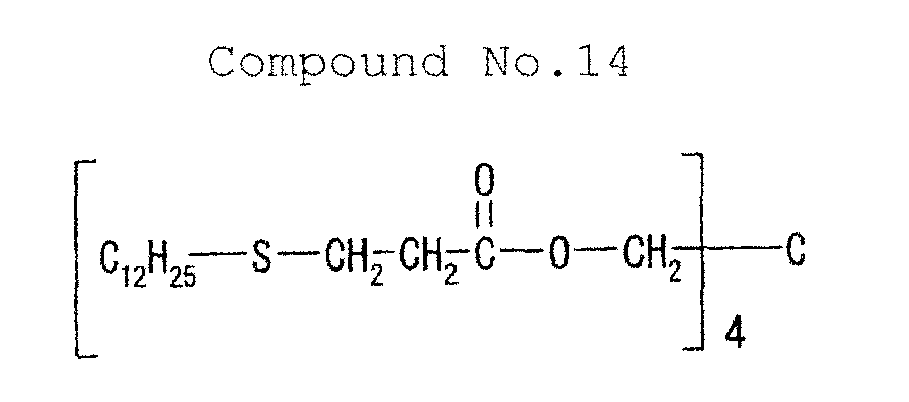
- the sulfur-containing antioxidant conventionally known sulfur-containing antioxidant may be used. Particularly, it is preferable to use a sulfur-containing compound represented by the general formula (IV) in view of imparting weather resistance.
- examples of the alkyl group having 4 to 20 carbon atoms represented by the R 4 include linear or branched alkyl groups, such as butyl, isobutyl, sec-butyl, tert-butyl, pentyl, sec-pentyl, tert-pentyl, hexyl, heptyl, octyl, isooctyl, 2-ethylhexyl, tert-octyl, nonyl, isononyl, decyl, undecyl, dodecyl, tridecyl, tetradecyl, pentadecyl, hexadecyl, heptadecyl, and octadecyl, and cycloalkyl groups, such as cyclohexyl groups.
- the R 4 's in 4 units may be the same as or different from each other per unit.
- examples of the alkyl group having 4 to 20 carbon atoms represented by the R 5 include linear or branched alkyl groups, such as butyl, isobutyl, sec-butyl, tert-butyl, pentyl, sec-pentyl, tert-pentyl, hexyl, heptyl, octyl, isooctyl, 2-ethylhexyl, tert-octyl, nonyl, isononyl, decyl, undecyl, dodecyl, tridecyl, tetradecyl, pentadecyl, hexadecyl, heptadecyl, and octadecyl, and cycloalkyl groups, such as cyclohexyl groups.
- the R 5 's in 2 units may be the same as or different from each other per unit.
- examples of the compound represented by the general formula (V) include sulfur compounds of Compounds No.15 to 18.
- Component (B) examples include the following Compounds Neo.19 to No. 23 which are sulfur compounds. (wherein R 6 represents an alkyl group having 12 to 14 carbon atoms and denote the groups satisfying the number of carbon atom among those given above for the R.) Compound No.23 C 18 H 37 -S-S-C 18 H 37
- the synthetic resin composition of the present invention comprises, per 100 parts by mass of the synthetic resin, as Component (A) a hindered amine compound in an amount of 0.01 to 20 parts by mass, preferably 0.05 to 10 parts by mass, and more preferably 0.1 to 5 parts by mass, and as Component (B) a sulfur-containing antioxidant in an amount of 0.01 to 20 parts by mass, preferably 0.05 to 10 parts by mass, and more preferably 0.1 to 5 parts by mass.
- Component (A) a hindered amine compound in an amount of 0.01 to 20 parts by mass, preferably 0.05 to 10 parts by mass, and more preferably 0.1 to 5 parts by mass
- Component (B) a sulfur-containing antioxidant in an amount of 0.01 to 20 parts by mass, preferably 0.05 to 10 parts by mass, and more preferably 0.1 to 5 parts by mass.
- the Component (A) is less than 0.01 part by mass, there is no sufficient weather resistance, and in case it is beyond 20 parts by mass, the appearance of the resin composition may be deteriorated by blooming and there is hardly an improvement of stabilizing activity.
- Component (B) is less than 0.01 part by mass, there is no sufficient weather resistance, and in case it is beyond 20 parts by mass, the physical properties of the resin may be debased, or the appearance of the resin composition may be deteriorated by blooming.
- Mass ratio of the Components (A) and (B) is preferably 1 : 0.05 to 1 : 5, more preferably 1 : : 0.5 to 1 : 4, and most preferably 1 : 1 to 1 : 3. In case the Component (B) is less than 0.05 time to the Component (A), the improving activity of weather resistance may not be exhibited.
- the synthetic resin composition according to the present invention may contain, as necessary, other additives, such as a phenolic antioxidant, a phosphorus-containing antioxidant, an ultraviolet absorber, a hindered amine compound except the Component (A), a nucleating agent, a fire retardant, a fire retardant aid, a lubricant, a processing aid, a pigment, a filler, a plasticizer, a metallic soap, hydrotalcites, an antistatic agent, an antibacterial agent, and a compatibilizer.
- additives such as a phenolic antioxidant, a phosphorus-containing antioxidant, an ultraviolet absorber, a hindered amine compound except the Component (A), a nucleating agent, a fire retardant, a fire retardant aid, a lubricant, a processing aid, a pigment, a filler, a plasticizer, a metallic soap, hydrotalcites, an antistatic agent, an antibacterial agent, and a compatibilizer.
- phenolic antioxidant examples include 2, 6-di-tert-butyl-p-cre sol, 2,6-diphenyl-4-octadecyloxyphenol, stearyl(3,5-di-tert-butyl-4-hydroxyphenyl)propionate, distearyl(3,5-di-tert-butyl-4-hydroxybenzyl)phosphonate, tridecyl ⁇ 3,5-di-tert-butyl-4-hydroxybenzylthioacetate, thiodiethylene bis[(3,5-di-tert-butyl-4-hydroxyphenyl) propionate], 4,4'-thio-bis(6-tert-butyl-m-cresol), 2-octylthic-4,6-di(3,5-dl-tert-butyl-4-hydroxyphenaxy)-s-triazine, 2,2'-methylene-bis(4-methyl-6-tert-butylpenol), bis[3,
- Examples of the phosphorus-containing antioxidant include triphenyl phosphite, tris(2,4-di-tert-butylphenyl)phosphite, tris(2,5-di-tert-butylphenyl)phosphite, tris(nonylphenyl) phosphite, tris(dinonylphenyl) phosphite, tris(mono- and di-nonylphenyl)phosphite, diphenyl acid phosphite, 2,2'-methylene bis(4,6-di-tert-butylphenyl)octyl phosphite, diphenyl decyl phosphite, diphenyl octyl phosphite, di(nonylphenyl)pentaerythritol diphosphite, phenyldiisodecyl phosphite,
- Examples of the ultraviolet absorber include 2-hydroxy benzophenones, such as 2,4-dihydroxy benzophenone, 2-hydroxy-4-methoxy benzophenone, 2-hydroxy-4-octoxy benzophenone, and 5,5'-methylene bis(2-hydroxy-4-methoxy benzophenone); 2-(2'-hydroxyphenyl)benzotriazoles, such as 2-(2'-hydroxy-5'-methylphenyl)benzotriazole, 2-(2'-hydroxy-3',5'-di-tert-butylphenyl)-5-chlorobenzotriazole, 2-(2'-hydroxy-3'-tert-butyl-5'-methylphenyl)-5-chlorobenzotriazole, 2-(2'-hydroxy-5'-tert-octylphenyl)benzot-riazole, 2-(2'-hydroxy-3',5'-dicumylphenyl)benzotriazole, and 2-(2'-hydroxy-3'-tert-butyl
- Examples of another hindered amine compound include 2,2,6,6-tetramethyl-4-piperidyl-1-oxy, 2,2,6,6-tetramethyl-4-piperidyl stearate, 1,2,2,6,6-pentamethyl-4-piperidyl stearate, 2,2,6,6-tetramethyl-4-piperidyl benzoate, bis(2,2,6,6-tetramethyl-4-piperidyl)sebacate, bis(1,2,2,6,5-pentamethyl-4-piperidyl)sebacate, tetrakis(2,2,6,6-tetramethyl-4-piperidyl) butanetetracarboxylate, tetrakis(1,2,2,6,6-pentamethyl-4-piperidyl butanetetracarboxylate, bis(2,2,6,6-tetramethyl-4-piperidyl) ⁇ di(tridecyl)-1,2,3,4-butanetetracarboxylate, bis(1,2,2,6,6-
- nucleating agent examples include metal salts of an aromatic carboxylic acid, such as aluminum p-tert-butyl benzoate, and sodium benzoate; metal salts of an acidic phosphate ester, such as sodium bis(2,4-di-tert-butylphenyl)phosphate, lithium bis(2,4-di-tert-butylphenyl)phosphate, and sodium-2, 2'-methylene-bis(4,6-di-tert-butylphenyl)phosphate; and polyhydric alcohol derivatives, such as dibenzylidene sorbitol, and bis(methylbenzylidene)sorbitol.
- metal salts of an aromatic carboxylic acid such as aluminum p-tert-butyl benzoate, and sodium benzoate
- metal salts of an acidic phosphate ester such as sodium bis(2,4-di-tert-butylphenyl)phosphate, lithium bis(2,4-di-tert-butylpheny
- the fire retardant examples include halogen type fire retardants, such as tetrabromobisphenol A, and decabromodiphenyl ether; phosphorus type fire retardants based on inorganic phosphorus compounds, such as red phosphorus and melamine phosphate, and phosphoric ester compounds, such as triphenyl phosphate, a phenol / resorcinol / phosphoric acid condensate, and a bisphenol A / 2,6-xylenol / phosphoric acid condensate; inorganic fire retardants, such as magnesium hydroxide, and aluminum hydroxide; and nitrogen-containing compounds, such as melamine cyanurate.
- the fire retardant should preferably be used in combination with a fire retardant aid, such as antimony oxide, or a drip-preventing agent, such as a fluorine-contained resin, and a silicone resin.
- the pigment may be organic as well as inorganic, and examples thereof include white pigments, such as titanium oxide, and zinc sulfide; black pigments, such as carbon black; green pigments, such as chromium oxide, chrome green, zinc green, chlorinated copper phthalocyanine green, phthalocyanine green, naphthol green, and malachite green lake; blue pigments, such as ultramarine, iron blue, copper phthalocyanine blue, cobalt blue, phthalocyanine blue, fast sky blue, and indanthrene blue; red pigments, such as red lead, red iron oxide, basic zinc chromate, chrome vermilion, cadmium red, rose red, brilliant carmine, brilliant scarlet, quinacridone red, lithol red, vermilion, thioindigo red, and mingamiya red; and yellow pigments, such as chrome yellow, zinc yellow, yellow iron oxide, titan yellow, fast yellow, hansa yellow, auramine lake, benzidine yellow, and indanthrene yellow.
- fillers are used glass fibers, talc, silica, calcium carbonate, etc.
- the surfaces of the fillers are preferably treated by a titanium-based or silane-based surface treatment agent to improve compatibility with resin.
- the metallic soap are used salts between a metal, such as magnesium, calcium, aluminum, and zinc, and a saturated or unsaturated fatty acid, such as lauric acid, myristic acid, palmitic acid, stearic acid, behenic acid, and oleic acid.
- the soap can be used irrespective of the water content, melting point, particle size, composition of the fatty acids, selection of the production process between a metathetical process by a reaction of an alkali metal salt of a fatty acid with a metal oxide or hydroxide, and a direct process by a neutralization reaction of a fatty acid with a metal oxide or hydroxide in the presence or absence of a solvent, or whether either of the fatty acid or the metal is in excess.
- hydrotalcites both natural products and synthetic products can be used, and products modified by an alkali metal such as lithium can be also used.
- the product can be used irrespective of the existence or nonexistence of crystal water or surface treatment.
- smaller size is preferable insofar as the properties of the hydrotalcite should not be lost. If the particle size is large, dispersibility becomes inadequate to decrease stabilizing activity, and the physical properties of a resulted product resin composition, such as mechanical strengths and transparency, will be compromised.
- lubricant examples include fatty acid amides, such as laurylamide, myristylamide, stearylamide and behenylamide; ethylene-bis-stearylamide; polyethylene wax; metal soaps, such as calcium stearate and magnesium stearate; and phosphoric acid ester metal salts, such as magnesium distearylphosphate and magnesium stearylphosphate.
- fatty acid amides such as laurylamide, myristylamide, stearylamide and behenylamide
- ethylene-bis-stearylamide polyethylene wax
- metal soaps such as calcium stearate and magnesium stearate
- phosphoric acid ester metal salts such as magnesium distearylphosphate and magnesium stearylphosphate.
- the contents and qualities thereof are selected appropriately in accordance with the resin types, process conditions and end uses.
- Addition of the Components (A) and (B) and the other ingredients above into a resin may be carried out according to a conventional process, such as a process in which each ingredient is mixed independently into the resin by, for example, a Henschel mixer and supplied to a processing machine; a process in which ingredients other than the resin are mixed preliminarily in a given combination, formed into powder or granule and added to the resin; a process in which master pellets containing high concentration ingredients in a resin are added to the resin; and a process in which ingredients are fed to the resin through a feeding port different from the port for the resin using an extruder having a plurality of feeding ports.
- a conventional process such as a process in which each ingredient is mixed independently into the resin by, for example, a Henschel mixer and supplied to a processing machine; a process in which ingredients other than the resin are mixed preliminarily in a given combination, formed into powder or granule and added to the resin; a process in which master pellets
- the synthetic resin composition according to the present invention can be molded by a conventional process, such as extrusion molding, injection molding, compression molding, and laminate molding.
- the synthetic resin composition according to the present invention can be used for general interior/exterior materials, preferably for interior/exterior materials of transport vehicle, and further preferably for the use exposed to outdoor radiation, such as automotive interior/exterior materials to be subjected to severe environments.
- automotive interior/exterior materials include exterior materials for a bumper, a spoiler, a side visor, a cowl vent grille, a radiator grille, a side molding and a rear panel garnish, and interior materials for an instrument panel, a ceiling, a door, a seat and a luggage room.
- the obtained reaction solution was a mixture of 4-hydroxy-l-undecanoxy-2,2,6,6-tetramethylpiperidine, 1-undecanoxy-2,2,6,6-tetramethylpiperidine-4-one, lauric acid, and solvent.
- 50 g of hexane was added to the reaction solution.
- the solution was washed by adding 53.9 g (98 mmol) of 7.3 % sodium hydroxide solution and 25 g of methanol, and further washed twice with 30 g of water to remove lauric acid.
- the solution was dried with anhydrous magnesium sulfate, filtered to remove the magnesium sulfate, evaporated under reduced pressure to remove solvent by an evaporator, and then a condensation was obtained.
- composition described in Tables 1 and 2 the Compound No.1 obtained by the method described in the Synthesis Example and the above Compound No. 14 (ADKSTAB AO-412S, produced by ADEKA CORPORATION) were used as the Component (A) and (B), respectively.
- the following Comparative Compounds-1 and -2 were used to compare with the Component (A) which is a hindered amine compound.
- the weather resistance of a test piece was evaluated by means of the time to cracking (hr), the residual rate of gloss (%) and the color difference ( ⁇ E) by a xenon irradiation test (conditions: UV irradiation intensity 0.55W/m 2 , wavelength 340 nm, black panel temperature 89 °C, and with a quartz filter).
- the gloss (unitless) was measured by Gloss Meter, Model TC-108D (produced by Tokyo Denshoku CO., LTD.). The obtained results are shown in the following Tables 1 and 2.
- the synthetic resin composition of the present invention exhibits excellent weather resistance, due to the addition of a hindered amine compound of Component (A) and a sulfur-containing antioxidant of Component (B), indicating a noticeable effect thereof. It is further clear that such noticeable effect can be attained only by a combination of the hindered amine compound of the Component (A) according to the present invention and a sulfur-containing antioxidant of the Component (B), while there is no such improvement of weather resistance for a combination of a hindered amine compound which is not the Component (A) according to the present invention and the sulfur-containing antioxidant.
Landscapes
- Chemical & Material Sciences (AREA)
- Organic Chemistry (AREA)
- Health & Medical Sciences (AREA)
- Chemical Kinetics & Catalysis (AREA)
- Medicinal Chemistry (AREA)
- Polymers & Plastics (AREA)
- Compositions Of Macromolecular Compounds (AREA)
- Vehicle Interior And Exterior Ornaments, Soundproofing, And Insulation (AREA)
Abstract


and an automotive interior/exterior material comprising the synthetic resin composition.
Description
- The present invention relates to a synthetic resin composition and an automotive interior/exterior material comprising the same, more particularly, to a synthetic resin composition, whose weather resistance is highly improved, as well as an automotive interior/exterior material containing the same.
- It has been known that a synthetic resin is not endurable for a long-term use, since it is degraded by the effects of heat and light, which causes discoloration and deterioration in mechanical strength. As a countermeasure, for the purpose of preventing from the degradation of the synthetic resin, stabilization by adding a hindered amine compound, an ultraviolet absorber, an antioxidant or the like is prevailing.
- Particularly, the hindered amine compound is added to the synthetic resin in order to improve weather resistance. Various hindered amine compounds, in addition to the exemplified compounds disclosed in the following Patent Documents 1 to 6, have been proposed.
- On the other hand, it has been known that a sulfur-containing antioxidant can be used to improve heat resistance. For example, a synthetic resin containing a phenolic compound and a sulfur-containing compound is disclosed in the following Patent Document 7.
- Patent Document 1: Japanese Examined Patent Application Publication No.
46-42618 - Patent Document 2: Japanese Unexamined Patent Application Publication No.
48-65180 - Patent Document 3: Japanese Unexamined Patent Application Publication No.
59-62651 - Patent Document 4: Japanese Unexamined Patent Application Publication No.
1-113368 - Patent Document 5: Japanese Unexamined Patent Application Publication No.
2-166138 - Patent Document 6: International Publication No.
WO02005/082852 - Patent Dolucment 7: Japanese Unexamined Patent Application Publication No.
60-197747 - However, recently, requirements of high stability and weather resistance for a synthetic resin have become severe in the field of automotive parts and the like, and a satisfactory composition has not been obtained from the use of the hindered amine compounds described in Patent Documents 1 to 6 and various conventional additives and from the combinations of them, and therefore there are needs for further improvement. Additionally, in a method of blending a sulfur-containing antioxidant like that described in Patent Document 7, a sulfur-containing antioxidant produces acidic substance in the process of stabilization, and therefore there is a problem that an antagonistic action occurs and the weather resistance deteriorates when a hindered amine compound is used together.
- Under such circumstances, an object of the present invention is to provide a synthetic resin composition having more excellent weather resistance, and an automotive interior/exterior material using the same.
- The present inventors have intensively studied to meet the object, and have finally found that blending a certain hindered amine compound in combination with a sulfur-containing antioxidant to a resin can confer more excellent weather resistance, thereby completing the present invention.
- That is, a synthetic resin composition according to the present invention comprises, per 100 parts by mass of a synthetic resin, as Component (A) a hindered amine compound represented by the following general formula (I):


or represented by the following general formula (II):
and as Component (B) a sulfur-containing antioxidant in an amount of 0.01 to 20 parts by mass. - Additionally, in the synthetic resin composition according to the present invention, it is preferable that in the general formula (I), the n represents 1 and the R1 is a group represented by the following general formula (III):

- Further, in the synthetic resin composition according to the present invention, it is preferable that the sulfur-containing antioxidant contains a compound represented by the following general formula (IV):

- Furthermore, in the synthetic resin composition according to the present invention, it is preferable that the synthetic resin is a polyolefin resin and that the polyolefin resin is a polyethylene resin, a polypropylene resin, or an ethylene-propylene copolymer resin.
- An automotive interior/exterior material according to the present invention is obtained by using the synthetic resin composition.
- The present invention can provide a synthetic resin composition having more excellent weather resistance, and an automotive interior/exterior material using the same.
- The present invention will be described in more details below.
- Examples of a synthetic resin to be used according to the present invention include in the form of a thermoplastic resin: polyolefins or copolymers thereof, including α-olefin polymers, such as polypropylene, high density polyethylene, low density polyethylene, linear low density polyethylene, polybutene-1 and poly-4-methylpentene, ethylene-vinyl acetate copolymers and ethylene-propylene copolymers; halogen-containing resins, such as polyvinyl chloride, polyvinylidene chloride, chlorinated polyethylene, chlorinated polypropylene, polyvinylidene fluoride, chlorinated rubber, vinyl chloride-vinyl acetate copolymers, vinyl chloride-ethylene copolymers, vinyl chloride-vinylidene chloride copolymers, vinyl chloride-vinylidene chloride-vinyl acetate terpolymers, vinyl chloride-acrylic acid ester copolymers, vinyl chloride-maleic acid ester copolymers, and vinyl chloride-cyclohexyl maleimide copolymers; petroleum resins; coumarone resins; polystyrene; polyvinyl acetate; acrylic resins; copolymers of either or both of styrene and α-methylstyrene with other monomer (s), (e.g. maleic anhydride, phenylmaleimide, methyl methacrylate, butadiene, and acrylonitrile), such as AS resins, ABS resins, MBS resins, and heat resistant ABS resins; polymethyl methacrylate; polyvinyl alcohol; polyvinyl formal; polyvinyl butyral; linear polyesters, such as polyethylene terephthalate and polytetramethylene terephthalate; polyphenylene oxide; polyamides, such as polycaprolactam and polyhexamethylene adipamide; polycarbonate; branched polycarbonate; polyacetal; polyphenylene sulfide; polyurethane; and cellulosic resins; and mixtures thereof;
as well as in the form of a thermosetting resin: phenol resins, urea resins, melamine resins, epoxy resins, and unsaturated polyester resins. Furthermore, elastomers, such as isoprene rubbers, butadiene rubbers, acrylonitrile-butadiene copolymer rubbers, and styrene-butadiene copolymer rubbers, may be used. Among the afore-listed synthetic resins, polyolefin resins, such as polyethylene, polypropylene, and ethylene-propylene copolymer resins, are preferable for the synthetic resin composition according to the present invention. - The synthetic resins can be used irrespective of the specific gravity, average molecular weight, melt viscosity, monomer composition, insoluble rate in a solvent, existence or nonexistence or type of stereoregularity, shape and size at the completion of the polymerization, type of a catalyst used for the polymerization, existence or nonexistence or method of a residual catalyst deactivation or removal treatment, existence or nonexistence, type, or concentration of a residual metal or acid component in the resin originated from a catalyst.
- Next, the Component (A) in the present invention will be described.
- The hindered amine compound as the Component (A) in the present invention has a carbonate skeleton represented by the general formula (I) or (II).
- Examples of the alkyl group having 1 to 30 carbon atoms represented by R in the general formulae (I) and (II) include linear or branched alkyl groups, such as methyl, ethyl, propyl, isopropyl, butyl, isobutyl, sec-butyl, tert-butyl, pentyl, sec-pentyl, tert-pentyl, hexyl, heptyl, octyl, isooctyl, 2-ethylhexyl, tert-octyl, nonyl, isononyl, decyl, undecyl, dodecyl, tridecyl, tetradecyl, pentadecyl, hexadecyl, heptadecyl, and octadecyl, and cycloalkyl groups, such as cyclohexyl groups.
- In addition, examples of the hydroxyalkyl group having 1 to 30 carbon atoms represented by R in the general formulae (I) and (II) include 2-hydroxyethyl, 2-hydroxypropyl, 2-hydroxybutyl, and 2-hydroxy-2-methylpropyl.
- Further, examples of the alkenyl group having 2 to 30 carbon atoms represented by R in the general formulae (I) and (II) include alkenyl groups that correspond to the above-exemplified alkyl groups, such as vinyl, allyl, butenyl, pentenyl, and oleyl.
- The R's in n units may be the same as or different from each other per unit.
- In the general formula (I), when n = 1, R1 represents an alkyl group having 1 to 22 carbon atoms, an alkenyl group having 2 to 22 carbon atoms, or a group represented by the general formula (III).
- In the general formula (I), when n = 1, examples of the alkyl group having 1 to 22 carbon atoms represented by the R1 include methyl, ethyl, propyl, isopropyl, butyl, isobutyl, sec-butyl, tert-butyl, pentyl, sec-pentyl, tert-pentyl, hexyl, heptyl, octyl, isooctyl, 2-ethylhexyl, tert-octyl, nonyl, isononyl, decyl, undecyl, dodecyl, tridecyl, tetradecyl, pentadecyl, hexadecyl, heptadecyl, octadecyl, and behenyl.
- In addition, in the general formula (I), when n =1, examples of the alkenyl group having 2 to 22 carbon atoms represented by the R1 include alkenyl groups that correspond to the above-exemplified alkyl groups, such as vinyl, allyl, butenyl, pentenyl, and oleyl.
- Further, in the general formula (I), when n = 1. and the R1 represents a group represented by the general formula (III), examples of the R in the general formula (III) are the same as those recited above for R in the general formula (I). The R in the general formula (III) may be the same as or different from the R in the general formula (I). Moreover, in the general formula (I), when n = 1, it is preferable that the R is an alkyl group having 10 to 22 carbon atoms.
- In the general formula (I), when n = 2 to 6, examples of the n-valent organic group having 2 to 20 carbon atoms represented by the R1 include residues of n-valent polyvalent hydroxy compound except for hydroxyl group.
- Examples of the polyvalent hydroxy compound include ethylene glycol, propylene glycol, 1,3-propanediol, 1,2-butanediol, 1,3-butanediol, 1,4-butanediol, neopentyl glycol, 1,6-hexanediol, 1,3-cyclohexanediol, 1,4-cyclohexanediol, hydrogenated product of bisphenol A, hydrogenated product of bisphenol F, diethylene glycol, triethylene glycol, glycerine, trimethylolpropane, pentaerythritol, and dipentaerythritol.
- In addition, in the general formula (I), it is preferable that the n is 2, the R is an alkyl group having 4 to 22 carbon atoms, and the R1 is an alkylene group having 2 to 12 carbon atoms.
- In the general formula (II), R2 represents a hydrogen atom, an alkyl group having 1 to 22 carbon atoms, or an alkenyl group having 2 to 22 carbon atoms.
- Examples of alkyl group having 1 to 22 carbon atoms represented by the R2 include the groups satisfying the number of carbon atoms among those given above for the R.
- In addition, in the general formula (II), examples of alkenyl group having 2 to 22 carbon atoms represented by the R2 include the groups satisfying the number of carbon atoms among those given above for the R.
- The R2's in n units may be the same as or different from each other per unit.
- In the general formula (II), the A represents a single bond, a linear or branched alkylene group having 1 to 12 carbon atoms, or a linear or branched alkylene group having 1 to 12 carbon atoms and an ether bond.
- In the general formula (II), examples of the linear or branched alkylene group having 1 to 12 carbon atoms represented by the A include methylene, 1,2-ethylene, 1,2-propylene, 1,3-propylene, tetramethylene, 1,2-butylene, 1,3-butylene, pentamethylene, 2,2-dimethyltrimethylene, hexamethylene, and octamethylene.
- Additionally, in the general formula (II), examples of the linear or branched alkylene group having 1 to 12 carbon atoms and an ether bond represented by the A include
-CH2CH2-O-CH2CH2-,
-CH2CH(CH3)-O-CH2CH(CH3)-, and
-CH2CH2-O-CH2-CH2-O-CH2CH2-.
- In the general formula (II), the A's in n units (n is 2 to 6) may be the same as or different from each other per unit.
- In the general formula (II), the X represents -C(=O)-, a linear or branched alkylene group having 4 to 40 carbon atoms and -C(=O)O- at terminal, a linear or branched alkylene group having 4 to 40 carbon atoms, -C(=O)O- at terminal, and an ether bond in the middle, a linear or branched alkylene group having 4 to 40 carbon atoms and a carbonate ester bond, or an organic group having 6 to 30 carbon atoms and 3 to 6 groups of -O-C(=O)-at terminal
- In the general formula (II), the alkylene group having 4 to 40 carbon atoms and -C(=O)-O- at terminal represented by the X include
-C(=O)-O-(CH2)p-O-C(=O)-
(wherein p is a number of 2 to 40),
and may have cycloalkylene group in the middle. - In the general formula (II), the linear or branched alkylene group having 4 to 40 carbon atoms, -C(=O)O- at terminal and an ether bond in the middle represented by the X include
-C(=O)-O-(CH2)q-O-(CH2)q-O-C(=O)-
(wherein q is a number of 2 to 20). - In addition, in the general formula (II), the linear or branched alkylene group having 4 to 40 carbon atoms and a carbonate ester bond represented by the X include
-C(=O)-R3-O-C(=O)-O-R3-C(=O)-
(wherein R3 represents an alkylene group having 2 to 18 carbon atoms). - Further, in the general formula (II), the organic group having 6 to 30 carbon atoms and 3 to 6 groups of -O-C(=O)- at terminal represented by the X include the following groups:


- More particularly, examples of the compound represented by the general formulae (I) and (II) include the following compounds No. 1 to No. 7 and No. 8 to No. 13, respectively, provided that the present invention should not be construed to be limited by the following compounds in any manner.


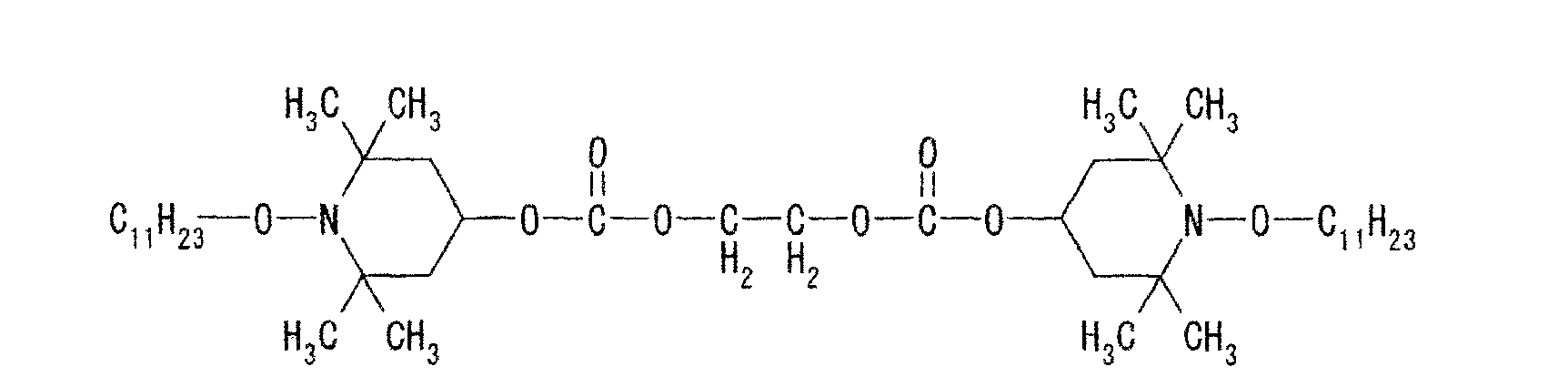


- The synthetic process of the compounds represented by the general formula (I) is not particularly restricted, and the compounds can be synthesized by usual organic synthesis processes shown in Examples below. As the purification method, distillation, recrystallization, reprecipitation, a method in which a filtering material or absorption material is used, and the like, may appropriately be employed.
- In addition, among the above-described specific examples, the Compound No. 1 is preferable in view of especially high imparting activity of weather resistance.
- Next, the Component (B) in the present invention will be described.
- The Component (B) in the present invention is a sulfur-containing antioxidant. As the sulfur-containing antioxidant, conventionally known sulfur-containing antioxidant may be used. Particularly, it is preferable to use a sulfur-containing compound represented by the general formula (IV) in view of imparting weather resistance.
- In the general formula (IV), examples of the alkyl group having 4 to 20 carbon atoms represented by the R4 include linear or branched alkyl groups, such as butyl, isobutyl, sec-butyl, tert-butyl, pentyl, sec-pentyl, tert-pentyl, hexyl, heptyl, octyl, isooctyl, 2-ethylhexyl, tert-octyl, nonyl, isononyl, decyl, undecyl, dodecyl, tridecyl, tetradecyl, pentadecyl, hexadecyl, heptadecyl, and octadecyl, and cycloalkyl groups, such as cyclohexyl groups.
- Here, the R4's in 4 units may be the same as or different from each other per unit.
- As a specific preferable example of a compound represented by the general formula (IV), the following Compound No.14 is examplified in view of imparting weather resistance.
- Additionally, a sulfur-containing compound represented by the following general formula (V):

- In the general formula (V), examples of the alkyl group having 4 to 20 carbon atoms represented by the R5 include linear or branched alkyl groups, such as butyl, isobutyl, sec-butyl, tert-butyl, pentyl, sec-pentyl, tert-pentyl, hexyl, heptyl, octyl, isooctyl, 2-ethylhexyl, tert-octyl, nonyl, isononyl, decyl, undecyl, dodecyl, tridecyl, tetradecyl, pentadecyl, hexadecyl, heptadecyl, and octadecyl, and cycloalkyl groups, such as cyclohexyl groups.
- Here, the R5's in 2 units may be the same as or different from each other per unit.
- More particularly, examples of the compound represented by the general formula (V) include sulfur compounds of Compounds No.15 to 18.


- Furthermore, specific examples of the Component (B) include the following Compounds Neo.19 to No. 23 which are sulfur compounds.


Compound No.23 C18H37-S-S-C18H37
- Next, the synthetic resin composition in the present invention will be described in more details below.
- The synthetic resin composition of the present invention comprises, per 100 parts by mass of the synthetic resin, as Component (A) a hindered amine compound in an amount of 0.01 to 20 parts by mass, preferably 0.05 to 10 parts by mass, and more preferably 0.1 to 5 parts by mass, and as Component (B) a sulfur-containing antioxidant in an amount of 0.01 to 20 parts by mass, preferably 0.05 to 10 parts by mass, and more preferably 0.1 to 5 parts by mass. By containing the Components (A) and (B), the synthetic resin composition of the present invention exhibits excellent weather resistance.
- In case the Component (A) is less than 0.01 part by mass, there is no sufficient weather resistance, and in case it is beyond 20 parts by mass, the appearance of the resin composition may be deteriorated by blooming and there is hardly an improvement of stabilizing activity.
- Additionally, in case the Component (B) is less than 0.01 part by mass, there is no sufficient weather resistance, and in case it is beyond 20 parts by mass, the physical properties of the resin may be debased, or the appearance of the resin composition may be deteriorated by blooming.
- Mass ratio of the Components (A) and (B) is preferably 1 : 0.05 to 1 : 5, more preferably 1 : : 0.5 to 1 : 4, and most preferably 1 : 1 to 1 : 3. In case the Component (B) is less than 0.05 time to the Component (A), the improving activity of weather resistance may not be exhibited.
- Besides the Components (A) and (B), the synthetic resin composition according to the present invention may contain, as necessary, other additives, such as a phenolic antioxidant, a phosphorus-containing antioxidant, an ultraviolet absorber, a hindered amine compound except the Component (A), a nucleating agent, a fire retardant, a fire retardant aid, a lubricant, a processing aid, a pigment, a filler, a plasticizer, a metallic soap, hydrotalcites, an antistatic agent, an antibacterial agent, and a compatibilizer.
- Examples of the phenolic antioxidant include 2, 6-di-tert-butyl-p-cre sol, 2,6-diphenyl-4-octadecyloxyphenol, stearyl(3,5-di-tert-butyl-4-hydroxyphenyl)propionate, distearyl(3,5-di-tert-butyl-4-hydroxybenzyl)phosphonate, tridecyl·3,5-di-tert-butyl-4-hydroxybenzylthioacetate, thiodiethylene bis[(3,5-di-tert-butyl-4-hydroxyphenyl) propionate], 4,4'-thio-bis(6-tert-butyl-m-cresol), 2-octylthic-4,6-di(3,5-dl-tert-butyl-4-hydroxyphenaxy)-s-triazine, 2,2'-methylene-bis(4-methyl-6-tert-butylpenol), bis[3,3-bis(4-hydroxy-3-tert-butylphenyl)butyric acid]glycol ester, 4,4'-butylidene-bis(2,6-di-tert-butylphenol), 4,4'-butylidene-bis(6-tert-butyl-3-methylphenol), 2,2'-ethylidene-bis(4,6-di-tert-butylphenol), 1,1,3-tris(2-methyl-4-hydroxy-5-tert-butylphenyl)butane, bis[2-tert-butyl-4-methyl-6-(2-hydroxy-3-tert-butyl-5-methyl benzyl)phenyl]terephthalate, 1,3,5-tris(2,6-dimethyl-3-hydroxy-4-tert-butylbenzyl)isocyanurate, 1,3,5-trims (3,5-di-tert-butyl-4-hydroxybenzyl)isocyanurate, 1,3,5-tris(3,5-di-tert-butyl-4-hydroxybenzyl)-2,4,6-trimethylbenzene, 1,3,5-tris[(3,5-di-tert-butyl-4-hydroxyphenyl)propionyl-oxyethyl]isocyanurate, tetrakis[metgtkene-3-(3',5'-di-tert-butyl-4'-hydroxyphenyl) propionate]methane, 2-tert-butyl-4-methyl-6-(2-acryloyloxy -3-tert-butyl-5-methylbenzyl)phenol, 3,9-bis[2-(3-tert-butyl-4-hydroxy-5-methylhydrocinnamoyloxy) -l,i-dimethylethyl]-2,4,8,10-tetraoxaspiro[5.5]undecane, triethylene glycol bis[-β-tert-butyl-4-hydroxy-5-methylphenyl)propionate, and tocopherol.
- Examples of the phosphorus-containing antioxidant include triphenyl phosphite, tris(2,4-di-tert-butylphenyl)phosphite, tris(2,5-di-tert-butylphenyl)phosphite, tris(nonylphenyl) phosphite, tris(dinonylphenyl) phosphite, tris(mono- and di-nonylphenyl)phosphite, diphenyl acid phosphite, 2,2'-methylene bis(4,6-di-tert-butylphenyl)octyl phosphite, diphenyl decyl phosphite, diphenyl octyl phosphite, di(nonylphenyl)pentaerythritol diphosphite, phenyldiisodecyl phosphite, tributyl phosphite, tris(2-ethylhexyl)phosphite, tridecyl phosphite, trilauryl phosphite, dibutyl acid phosphite, dilauryl acid phosphite, trilauryl trithiophosphite, bis(neopentyl glycol)-1,4-cyclohexane dimethyl diphosphite, bis(2,4-di-tert-butylphenyl)pentaerythritol diphosphite, bis(2,5-di-tert-butylphenyl)pentaerythritol diphosphite, bis(2,6-di-tert-butyl-4-methylphenyl)pentaerythritol diphosphite, bis(2,4-dicumylphenyl)pentaerythritol diphosphite, distearyl pentaerythritol diphosphite, tetra(C12-C15 mixed alkyl)-4,4'-isopropylidene diphenyl phosphite, bis[2,2'-methylenebis(4,6-diamylphenyl)]· isopropylidene diphenyl phosphite, tetra tridecyl·4,4'-butylidenebis(2-tert-butyl-5-methylphenol)diphosphite, hexa(tridecyl)·1,1,3-tris(2-methyl-5-tert-butyl-4-hydroxyphenyl)butane·triphosphite, tetrakis(2,4-di-tert-butylphenyl)biphenylene diphosphonite, tris(2-[(2,4,7,9-tetrakis-tert-butyldibenzo[d,f][1,3,2] dioxaphosphepin-6-yl)oxy]ethyl)amine, 2-(1,1-dimethylethyl)-6-methyl-4-[3-[[2,4,8,10-tetrakis(1,1-dimethylethyl)dibenzo[d,f][1,3,2]dioxaphosphepin-6-yl]oxy] propyl]phenol, 9,10-dihydro-9-oxa-10-phosphaphenanthrene-10-oxide, and 2-butyl-2-ethylpropanedio1·2,4,6-tri-tertbutylphenol monophosphite.
- Examples of the ultraviolet absorber include 2-hydroxy benzophenones, such as 2,4-dihydroxy benzophenone, 2-hydroxy-4-methoxy benzophenone, 2-hydroxy-4-octoxy benzophenone, and 5,5'-methylene bis(2-hydroxy-4-methoxy benzophenone); 2-(2'-hydroxyphenyl)benzotriazoles, such as 2-(2'-hydroxy-5'-methylphenyl)benzotriazole, 2-(2'-hydroxy-3',5'-di-tert-butylphenyl)-5-chlorobenzotriazole, 2-(2'-hydroxy-3'-tert-butyl-5'-methylphenyl)-5-chlorobenzotriazole, 2-(2'-hydroxy-5'-tert-octylphenyl)benzot-riazole, 2-(2'-hydroxy-3',5'-dicumylphenyl)benzotriazole, and 2-(2'-hydroxy-3'-tert-butyl-5'-carboxyphenyl)benzotriazole; bernzoates, such as phenyl salicylate, resorcinol monobenzoate, 2,4-di-tert-butylphenyl-3,5-di-tert-butyl-4-hydroxybenzoate, 2,4-di-tert-amylphenyl-3,5-di-tert-butyl-4-hydroxybenzoate, and hexadecyl-3,5-di-tert-butyl-4-hydroxybenzoate; substituted oxanilides, such as 2-ethyl-2'-ethoxyoxanilide, and 2-ethoxy-4'-dodecyloxanilide; cyanoacrylates, such as ethyl-α-cyano-β,β-diphenyl acrylate and methyl-2-cyano-3-methyl-3-(p-methoxyphenyl)acrylate; triaryltriazines, such as 2-(2-hydroxy-4-octoxyphenyl)-4,6-bis(2,4-di-tert-butylphenyl)-s-triazine, 2-(2-hydroxy-4-methoxyphenyl)-4,6-diphenyl-s-triazine, and 2-(2-hydroxy-4-propoxy-5-methylphenyl)-4,6-bis(2,4-di-tert-butylphenyl)-s-triazine.
- Examples of another hindered amine compound include 2,2,6,6-tetramethyl-4-piperidyl-1-oxy, 2,2,6,6-tetramethyl-4-piperidyl stearate, 1,2,2,6,6-pentamethyl-4-piperidyl stearate, 2,2,6,6-tetramethyl-4-piperidyl benzoate, bis(2,2,6,6-tetramethyl-4-piperidyl)sebacate, bis(1,2,2,6,5-pentamethyl-4-piperidyl)sebacate, tetrakis(2,2,6,6-tetramethyl-4-piperidyl) butanetetracarboxylate, tetrakis(1,2,2,6,6-pentamethyl-4-piperidyl butanetetracarboxylate, bis(2,2,6,6-tetramethyl-4-piperidyl)·di(tridecyl)-1,2,3,4-butanetetracarboxylate, bis(1,2,2,6,6-pentamethyl-4-piperidyl)-di(tridecyl)-1,2,3,4-butanetetracarboxylate, bis(1,2,2,6,6-pentamethyl-4-piperidyl)-2-butyl-2-(3,5-di-tert-butyl-4-hydroxybenzyl) malonate, a 1-(2-hydroxyethyl)-2,2,6,6-tetramethyl-4-piperidinolidiethyl succinate polycondensate, a 1,6-bis(2,2,6,6-tetramethyl-4-piperidylamino) hexane/dibromoethane polycondensate, a 1,6-bis(2,2,6,6-tetramethyl-4-piperidylamino)hexane/2,4-dichloro-6-morpholino-s-triazine polycondensate, a 1,6-bis(2,2,6,6-tetramethyl-4-piperidylamino)hexane/2,4-dichloro-6-tert-octylamino-s-triazine polycondensate, 1,5,8,12-tetrakis[2,4-bis(N-butyl-N-(2,2,6,6-tetramethyl-4-piperidyl)amino)-s-triazin-6-yl]-1,5,8,12-tetraazadodecane, 1,5,8,12-tetrakis[2,4-bis(N-butyl-N-(1,2,2,6,6-pentamethyl-4 -piperidyl)amino)-s- triazin-6-yl]-1,5,8,12-tetraazadodecane, 1,6,11-tris[2,4-bis(N-butyl-N-(2,2,6,6-tetramethyl-4-piperidyl)amino)-s-triazin-6-ylaminoundecane, and 1,6,11--tris[2,4-bis(N-butyl-N-(1,2,2,6,6-pentamethyl-4-piperidyl)amino)-s-triazine-6-ylaminoundecane.
- Examples of the nucleating agent include metal salts of an aromatic carboxylic acid, such as aluminum p-tert-butyl benzoate, and sodium benzoate; metal salts of an acidic phosphate ester, such as sodium bis(2,4-di-tert-butylphenyl)phosphate, lithium bis(2,4-di-tert-butylphenyl)phosphate, and sodium-2, 2'-methylene-bis(4,6-di-tert-butylphenyl)phosphate; and polyhydric alcohol derivatives, such as dibenzylidene sorbitol, and bis(methylbenzylidene)sorbitol.
- Examples of the fire retardant include halogen type fire retardants, such as tetrabromobisphenol A, and decabromodiphenyl ether; phosphorus type fire retardants based on inorganic phosphorus compounds, such as red phosphorus and melamine phosphate, and phosphoric ester compounds, such as triphenyl phosphate, a phenol / resorcinol / phosphoric acid condensate, and a bisphenol A / 2,6-xylenol / phosphoric acid condensate; inorganic fire retardants, such as magnesium hydroxide, and aluminum hydroxide; and nitrogen-containing compounds, such as melamine cyanurate. The fire retardant should preferably be used in combination with a fire retardant aid, such as antimony oxide, or a drip-preventing agent, such as a fluorine-contained resin, and a silicone resin.
- The pigment may be organic as well as inorganic, and examples thereof include white pigments, such as titanium oxide, and zinc sulfide; black pigments, such as carbon black; green pigments, such as chromium oxide, chrome green, zinc green, chlorinated copper phthalocyanine green, phthalocyanine green, naphthol green, and malachite green lake; blue pigments, such as ultramarine, iron blue, copper phthalocyanine blue, cobalt blue, phthalocyanine blue, fast sky blue, and indanthrene blue; red pigments, such as red lead, red iron oxide, basic zinc chromate, chrome vermilion, cadmium red, rose red, brilliant carmine, brilliant scarlet, quinacridone red, lithol red, vermilion, thioindigo red, and mingamiya red; and yellow pigments, such as chrome yellow, zinc yellow, yellow iron oxide, titan yellow, fast yellow, hansa yellow, auramine lake, benzidine yellow, and indanthrene yellow.
- As the fillers are used glass fibers, talc, silica, calcium carbonate, etc. The surfaces of the fillers are preferably treated by a titanium-based or silane-based surface treatment agent to improve compatibility with resin.
- As the metallic soap, are used salts between a metal, such as magnesium, calcium, aluminum, and zinc, and a saturated or unsaturated fatty acid, such as lauric acid, myristic acid, palmitic acid, stearic acid, behenic acid, and oleic acid. The soap can be used irrespective of the water content, melting point, particle size, composition of the fatty acids, selection of the production process between a metathetical process by a reaction of an alkali metal salt of a fatty acid with a metal oxide or hydroxide, and a direct process by a neutralization reaction of a fatty acid with a metal oxide or hydroxide in the presence or absence of a solvent, or whether either of the fatty acid or the metal is in excess.
- As the hydrotalcites, both natural products and synthetic products can be used, and products modified by an alkali metal such as lithium can be also used. Especially, the product having a composition represented by the following general formula (VI),
ZnxMgyAl2(OH)2(x+y+2) CO3•nH2O (VI)
(wherein x is 0 to 3, y is 1 to 6, x+y is 4 to 6, and n is 0 to 10) is preferable. The product can be used irrespective of the existence or nonexistence of crystal water or surface treatment. Although there is no particular restriction on the particle size, smaller size is preferable insofar as the properties of the hydrotalcite should not be lost. If the particle size is large, dispersibility becomes inadequate to decrease stabilizing activity, and the physical properties of a resulted product resin composition, such as mechanical strengths and transparency, will be compromised. - Examples of the lubricant include fatty acid amides, such as laurylamide, myristylamide, stearylamide and behenylamide; ethylene-bis-stearylamide; polyethylene wax; metal soaps, such as calcium stearate and magnesium stearate; and phosphoric acid ester metal salts, such as magnesium distearylphosphate and magnesium stearylphosphate.
- For the respective ingredients, the contents and qualities thereof are selected appropriately in accordance with the resin types, process conditions and end uses.
- Addition of the Components (A) and (B) and the other ingredients above into a resin may be carried out according to a conventional process, such as a process in which each ingredient is mixed independently into the resin by, for example, a Henschel mixer and supplied to a processing machine; a process in which ingredients other than the resin are mixed preliminarily in a given combination, formed into powder or granule and added to the resin; a process in which master pellets containing high concentration ingredients in a resin are added to the resin; and a process in which ingredients are fed to the resin through a feeding port different from the port for the resin using an extruder having a plurality of feeding ports.
- There is no particular restriction on a processing process for the synthetic resin composition according to the present invention, and an appropriate conventional process is selected depending on a resin to be used, existence of fillers, etc. More particularly, the synthetic resin composition according to the present invention can be molded by a conventional process, such as extrusion molding, injection molding, compression molding, and laminate molding.
- Although there is no particular restriction on the use of the synthetic resin composition according to the present invention, it can be used for general interior/exterior materials, preferably for interior/exterior materials of transport vehicle, and further preferably for the use exposed to outdoor radiation, such as automotive interior/exterior materials to be subjected to severe environments. Examples of automotive interior/exterior materials include exterior materials for a bumper, a spoiler, a side visor, a cowl vent grille, a radiator grille, a side molding and a rear panel garnish, and interior materials for an instrument panel, a ceiling, a door, a seat and a luggage room.
- The present invention will be described in more detail by way of examples thereof. However, the present invention should not be construed to be limited by the examples.
- First, 17.0 g (98.1 mmol) of 4-hydroxy-1-oxy-2,2,6,6-tetramethyl piperidine was dissolved in 40.0 g of chlorobenzene and a solution prepared by dissolving 31. 3 g (78.5 mmol) of dilauroyl peroxide in 125 g of chlorobenzene at 7C °C was added thereto dropwise in 3 hours. A reaction in the mixture proceeded at the same temperature for 6 hours. The obtained reaction solution was analyzed by gas chromatography and disappearance of raw materials was confirmed. The obtained reaction solution was a mixture of 4-hydroxy-l-undecanoxy-2,2,6,6-tetramethylpiperidine, 1-undecanoxy-2,2,6,6-tetramethylpiperidine-4-one, lauric acid, and solvent. To the reaction solution, 50 g of hexane was added. The solution was washed by adding 53.9 g (98 mmol) of 7.3 % sodium hydroxide solution and 25 g of methanol, and further washed twice with 30 g of water to remove lauric acid. The solution was dried with anhydrous magnesium sulfate, filtered to remove the magnesium sulfate, evaporated under reduced pressure to remove solvent by an evaporator, and then a condensation was obtained. To the condensation, 70 ml of ethanol was added, and then 20 ml of ethanol solution containing 0.57 g (15 mmol) of sodium borohydride was added dropwise in 20 minutes. Moreover, a reaction in the solution proceeded for 1 hour and disappearance of 1-undecanoxy-2,2,6,6-tetramethylpiperidine-4-one was confirmed. The solution was evaporated under reduced pressure to remove solvent, 50 ml of toluene was added thereto, and washing with 30 ml of water was repeated five times. Then, dehydrating under reflux and reduced pressure and removing solvent under reduced pressure were performed at 40 °C, and 23.0 g of 4-hydroxy-1-undecanoxy-2,2,6,6-tetramethylpiperidine (68.8 % yield) was obtained as colorless liquid, of which purity is 96.1 % based on area ratio by gas chromatography.
- In 100 ml of mineral spirit, 12.0 g (35.17 mmol) of the obtained 4-hydroxy-1-undecanoxy-2,2, 6, 6-tetramethylpiperidine with 96.1 % purity, 4.19 g (19.34 mmol) of diphenyl carbonate, and 0.6 g of potassium carbonate were dispersed, and a reaction therein proceeded at 170 to 180 °C for 8 hours to remove phenol. The mixture was cooled to 40 °C and washed with 30 ml of water three times. The mixture was dehydrated under reflux and reduced pressure at 60 °C, removed solvent under reduced pressure by an evaporaor, and then a condensation was obtained. The condensation was purified by silica gel chromatography (developing solution: toluene). Then, bis(1-undecanoxy-2,2,6,6-tetramethylpiperidine-4-yl)carbonate (55.5 % yield) (Compound No.1) was obtained as colorless liquid, of which purity is 99.9 % based on area ratio by gas chromatography.
- Analysis results of the obtained Compound No.1 is described below.
IR spectrum
2800 to 3050 cm-1, 1740 cm-1, 1450 cm-1, 1380 cm-1, 1360 cm-1, 1310 cm-1, 1270 cm-1, 1240 cm-1, 1190 cm-1, 1000 cm-1
1H-NMR, spectrum (H: is measured value of proton number and value in [ ] is calculated value)
δ 0.75 to 2.05 (H: of CH3 and C-CH2-C is 72.8 [74])
δ 3.55 to 3.85 (H: of CH2-O is 4.2 [4])
δ 4.60 to 5.10 (H: of CH-O is 2.0 [2]) - 85 parts by mass of an ethylene-propylene copolymer resin (MFR = 25, density = 0.90 g/cm3, flexural modulus = 1, 700 MPa), 15 parts by mass of talc, 3.0 parts by mass of a gray pigment, 0.1 part by mass of tetrakis[methylene-3-(3',5'-di-tert-butyl-4'-hydroxyphenyl)propionate)]methane, 0.1 part by mass of tris (2, 4-di-tert-butylphenyl)phosphite, 0.1 part by mass of calcium stearate, and a hindered amine compound and a sulfur-containing antioxidant as set forth in the following Tables 1 and 2 (the unit of amount in Table 1 is part by mass) were extruded at 230 °C to pellets. The yielded pellets were injection-molded at 230 °C to 2 mm-thick test pieces.
- In composition described in Tables 1 and 2, the Compound No.1 obtained by the method described in the Synthesis Example and the above Compound No. 14 (ADKSTAB AO-412S, produced by ADEKA CORPORATION) were used as the Component (A) and (B), respectively. In addition, the following Comparative Compounds-1 and -2 were used to compare with the Component (A) which is a hindered amine compound.


- The weather resistance of a test piece was evaluated by means of the time to cracking (hr), the residual rate of gloss (%) and the color difference (ΔE) by a xenon irradiation test (conditions: UV irradiation intensity 0.55W/m2, wavelength 340 nm, black panel temperature 89 °C, and with a quartz filter). The gloss (unitless) was measured by Gloss Meter, Model TC-108D (produced by Tokyo Denshoku CO., LTD.). The obtained results are shown in the following Tables 1 and 2.


- It is obvious from the results shown in Tables 1 and 2, that the synthetic resin composition of the present invention exhibits excellent weather resistance, due to the addition of a hindered amine compound of Component (A) and a sulfur-containing antioxidant of Component (B), indicating a noticeable effect thereof. It is further clear that such noticeable effect can be attained only by a combination of the hindered amine compound of the Component (A) according to the present invention and a sulfur-containing antioxidant of the Component (B), while there is no such improvement of weather resistance for a combination of a hindered amine compound which is not the Component (A) according to the present invention and the sulfur-containing antioxidant.
Claims (9)
- A synthetic resin composition comprising, per 100 parts by mass of a synthetic resin, as Component (A) a hindered amine compound represented by the following general formula (I):


or represented by the following general formula (II):
and as Component (B) a sulfur-containing antioxidant in an amount of 0.01 to 20 parts by mass. - The synthetic resin composition according to claim 1, wherein, in the general formula (I), the n represents 1 and the R1 is a group represented by the following general formula (III):

- The synthetic resin composition according to claim 1, wherein, in the general formula (I), the R represents an alkyl group having 4 to 22 carbon atoms, the n represents 2, and R1 represents an alkylene group having 2 to 12 carbon atoms.
- The synthetic resin composition according to claim 1, wherein the sulfur-containing antioxidant contains a compound represented by the following general formula (IV):

- The synthetic resin composition according to claim 1, wherein the synthetic resin is a polyolefin resin.
- The synthetic resin composition according to claim 4, wherein the synthetic resin is a polyolefin resin.
- The synthetic resin composition according to claim 5, wherein the polyolefin resin is a polyethylene resin, a polypropylene resin, or an ethylene-propylene copolymer resin.
- The synthetic resin composition according to claim 6, wherein the polyolefin resin is a polyethylene resin, a polypropylene resin, or an ethylene-propylene copolymer resin.
- An automotive interior/exterior material, which is obtained by using the synthetic resin composition according to claim 1.
Applications Claiming Priority (2)
| Application Number | Priority Date | Filing Date | Title |
|---|---|---|---|
| JP2008059576 | 2008-03-10 | ||
| PCT/JP2009/053341 WO2009113389A1 (en) | 2008-03-10 | 2009-02-25 | Synthetic resin composition, and automotive interior/exterior material comprising the same |
Publications (3)
| Publication Number | Publication Date |
|---|---|
| EP2270101A1 true EP2270101A1 (en) | 2011-01-05 |
| EP2270101A4 EP2270101A4 (en) | 2013-06-05 |
| EP2270101B1 EP2270101B1 (en) | 2016-01-13 |
Family
ID=41065058
Family Applications (1)
| Application Number | Title | Priority Date | Filing Date |
|---|---|---|---|
| EP09718860.1A Active EP2270101B1 (en) | 2008-03-10 | 2009-02-25 | Synthetic resin composition, and automotive interior/exterior material comprising the same |
Country Status (6)
| Country | Link |
|---|---|
| US (1) | US8785527B2 (en) |
| EP (1) | EP2270101B1 (en) |
| JP (1) | JP5469056B2 (en) |
| KR (1) | KR101602750B1 (en) |
| CN (1) | CN101965382B (en) |
| WO (1) | WO2009113389A1 (en) |
Families Citing this family (9)
| Publication number | Priority date | Publication date | Assignee | Title |
|---|---|---|---|---|
| KR101135833B1 (en) | 2004-03-02 | 2012-04-16 | 가부시키가이샤 아데카 | Weakly basic hindered amines having carbonate skeletons, synthetic resin compositions, and coating compositions |
| JP5478012B2 (en) * | 2007-11-15 | 2014-04-23 | 株式会社Adeka | Resin composition and resin molded product |
| JP2010209238A (en) * | 2009-03-11 | 2010-09-24 | Adeka Corp | Vinyl chloride-based resin composition |
| JP5626856B2 (en) * | 2010-06-11 | 2014-11-19 | 日本化薬株式会社 | Curable resin composition and cured product thereof |
| JP6188734B2 (en) * | 2012-03-16 | 2017-08-30 | ビーエーエスエフ ソシエタス・ヨーロピアBasf Se | NOR-HALS compounds as flame retardants |
| JP5974676B2 (en) * | 2012-06-28 | 2016-08-23 | 東ソー株式会社 | Acid-modified petroleum resin composition and method for producing the same |
| CN105330974B (en) * | 2015-12-01 | 2017-08-11 | 芜湖豫新世通汽车空调有限公司 | Air conditioning for automobiles regulation switch and preparation method thereof |
| US11001698B2 (en) | 2016-10-14 | 2021-05-11 | Basf Se | Stabilizer composition |
| CN114213708B (en) * | 2021-11-15 | 2023-09-26 | 金发科技股份有限公司 | Application of phenolic compounds as heat stabilizers in the preparation of polymethylmethacrylate compositions |
Family Cites Families (14)
| Publication number | Priority date | Publication date | Assignee | Title |
|---|---|---|---|---|
| US4021432A (en) | 1971-11-30 | 1977-05-03 | Ciba-Geigy Corporation | Piperidine derivatives |
| US4049647A (en) | 1971-11-30 | 1977-09-20 | Ciba-Geigy Corporation | Bis piperidyl carboxylates |
| US4046737A (en) | 1971-11-30 | 1977-09-06 | Ciba-Geigy Corporation | Piperidine derivatives |
| BE792043A (en) | 1971-11-30 | 1973-05-29 | Ciba Geigy | PIPERIDINE DERIVATIVES USED TO STABILIZE ORGANIC MATERIALS |
| JPS5962651A (en) | 1982-10-02 | 1984-04-10 | Adeka Argus Chem Co Ltd | Light stabilizer for high polymer material |
| JPS60197747A (en) | 1984-03-19 | 1985-10-07 | Sumitomo Chem Co Ltd | Stabilizer for synthetic resin |
| DE3852742T3 (en) | 1987-09-21 | 2005-02-10 | Ciba Speciality Chemicals Holding Inc. | N-substituted hindered amine stabilizers. |
| EP0365481A1 (en) | 1988-10-19 | 1990-04-25 | Ciba-Geigy Ag | Polymeric substrates stabilized with N-substituted hindered amines |
| JP4993421B2 (en) * | 2001-06-07 | 2012-08-08 | 株式会社Adeka | Synthetic resin composition |
| JP4421326B2 (en) * | 2004-02-25 | 2010-02-24 | 株式会社Adeka | Stabilized synthetic resin composition and agricultural film |
| KR101135833B1 (en) * | 2004-03-02 | 2012-04-16 | 가부시키가이샤 아데카 | Weakly basic hindered amines having carbonate skeletons, synthetic resin compositions, and coating compositions |
| JP5432425B2 (en) | 2005-02-01 | 2014-03-05 | 株式会社プライムポリマー | Resin composition, transparent elastic recovery film or sheet, and wrap film |
| JP5224497B2 (en) | 2007-02-22 | 2013-07-03 | 株式会社Adeka | Resin composition |
| JP5478012B2 (en) * | 2007-11-15 | 2014-04-23 | 株式会社Adeka | Resin composition and resin molded product |
-
2009
- 2009-02-25 WO PCT/JP2009/053341 patent/WO2009113389A1/en not_active Ceased
- 2009-02-25 CN CN2009801082523A patent/CN101965382B/en active Active
- 2009-02-25 KR KR1020107022367A patent/KR101602750B1/en active Active
- 2009-02-25 US US12/921,740 patent/US8785527B2/en active Active
- 2009-02-25 EP EP09718860.1A patent/EP2270101B1/en active Active
- 2009-02-25 JP JP2010502758A patent/JP5469056B2/en active Active
Also Published As
| Publication number | Publication date |
|---|---|
| CN101965382A (en) | 2011-02-02 |
| KR20100125391A (en) | 2010-11-30 |
| EP2270101A4 (en) | 2013-06-05 |
| EP2270101B1 (en) | 2016-01-13 |
| US8785527B2 (en) | 2014-07-22 |
| KR101602750B1 (en) | 2016-03-11 |
| JP5469056B2 (en) | 2014-04-09 |
| WO2009113389A1 (en) | 2009-09-17 |
| JPWO2009113389A1 (en) | 2011-07-21 |
| US20110028611A1 (en) | 2011-02-03 |
| CN101965382B (en) | 2013-05-08 |
Similar Documents
| Publication | Publication Date | Title |
|---|---|---|
| US8785527B2 (en) | Synthetic resin composition and automotive interior/exterior material comprising the same | |
| EP2204420B1 (en) | Synthetic resin composition and automotive interior/exterior material | |
| KR101135833B1 (en) | Weakly basic hindered amines having carbonate skeletons, synthetic resin compositions, and coating compositions | |
| KR102181957B1 (en) | Resin composition | |
| EP2272918B1 (en) | Woody synthetic resin composition having improved weather resistance and molded body thereof | |
| EP2980129B1 (en) | Resin additive masterbatch and polyolefin resin composition to which said resin additive masterbatch has been admixed | |
| EP2223960A1 (en) | Olefin elastic resin composition | |
| KR20160090792A (en) | Light stabilizer composition and resin composition containing same | |
| JP4462867B2 (en) | Synthetic resin composition with improved weather resistance and interior / exterior materials | |
| EP2210918B1 (en) | Resin composition and resin molded article | |
| EP0953596B1 (en) | Automobile interior or exterior trim material | |
| JP4530327B2 (en) | Synthetic resin composition containing zinc sulfide with improved weather resistance | |
| EP1889871B1 (en) | Resin composition containing aluminum pigment | |
| JP2005239839A (en) | Stabilized synthetic resin composition and agricultural film |
Legal Events
| Date | Code | Title | Description |
|---|---|---|---|
| PUAI | Public reference made under article 153(3) epc to a published international application that has entered the european phase |
Free format text: ORIGINAL CODE: 0009012 |
|
| 17P | Request for examination filed |
Effective date: 20101008 |
|
| AK | Designated contracting states |
Kind code of ref document: A1 Designated state(s): AT BE BG CH CY CZ DE DK EE ES FI FR GB GR HR HU IE IS IT LI LT LU LV MC MK MT NL NO PL PT RO SE SI SK TR |
|
| AX | Request for extension of the european patent |
Extension state: AL BA RS |
|
| DAX | Request for extension of the european patent (deleted) | ||
| A4 | Supplementary search report drawn up and despatched |
Effective date: 20130506 |
|
| RIC1 | Information provided on ipc code assigned before grant |
Ipc: C07D 211/94 20060101ALI20130426BHEP Ipc: C07D 211/44 20060101ALI20130426BHEP Ipc: C08K 5/372 20060101ALI20130426BHEP Ipc: B60R 13/02 20060101ALI20130426BHEP Ipc: C08L 101/00 20060101AFI20130426BHEP Ipc: C08L 23/00 20060101ALI20130426BHEP Ipc: C07D 491/113 20060101ALI20130426BHEP Ipc: C08K 5/3435 20060101ALI20130426BHEP Ipc: B60R 13/04 20060101ALI20130426BHEP |
|
| RAP1 | Party data changed (applicant data changed or rights of an application transferred) |
Owner name: ADEKA CORPORATION |
|
| 17Q | First examination report despatched |
Effective date: 20131220 |
|
| GRAP | Despatch of communication of intention to grant a patent |
Free format text: ORIGINAL CODE: EPIDOSNIGR1 |
|
| INTG | Intention to grant announced |
Effective date: 20150813 |
|
| GRAS | Grant fee paid |
Free format text: ORIGINAL CODE: EPIDOSNIGR3 |
|
| GRAA | (expected) grant |
Free format text: ORIGINAL CODE: 0009210 |
|
| AK | Designated contracting states |
Kind code of ref document: B1 Designated state(s): AT BE BG CH CY CZ DE DK EE ES FI FR GB GR HR HU IE IS IT LI LT LU LV MC MK MT NL NO PL PT RO SE SI SK TR |
|
| REG | Reference to a national code |
Ref country code: GB Ref legal event code: FG4D |
|
| REG | Reference to a national code |
Ref country code: CH Ref legal event code: EP |
|
| REG | Reference to a national code |
Ref country code: FR Ref legal event code: PLFP Year of fee payment: 8 |
|
| REG | Reference to a national code |
Ref country code: IE Ref legal event code: FG4D |
|
| REG | Reference to a national code |
Ref country code: AT Ref legal event code: REF Ref document number: 770505 Country of ref document: AT Kind code of ref document: T Effective date: 20160215 |
|
| REG | Reference to a national code |
Ref country code: DE Ref legal event code: R096 Ref document number: 602009035813 Country of ref document: DE |
|
| REG | Reference to a national code |
Ref country code: LT Ref legal event code: MG4D |
|
| REG | Reference to a national code |
Ref country code: NL Ref legal event code: MP Effective date: 20160113 |
|
| PG25 | Lapsed in a contracting state [announced via postgrant information from national office to epo] |
Ref country code: BE Free format text: LAPSE BECAUSE OF NON-PAYMENT OF DUE FEES Effective date: 20160229 |
|
| REG | Reference to a national code |
Ref country code: AT Ref legal event code: MK05 Ref document number: 770505 Country of ref document: AT Kind code of ref document: T Effective date: 20160113 |
|
| PG25 | Lapsed in a contracting state [announced via postgrant information from national office to epo] |
Ref country code: NL Free format text: LAPSE BECAUSE OF FAILURE TO SUBMIT A TRANSLATION OF THE DESCRIPTION OR TO PAY THE FEE WITHIN THE PRESCRIBED TIME-LIMIT Effective date: 20160113 |
|
| PG25 | Lapsed in a contracting state [announced via postgrant information from national office to epo] |
Ref country code: HR Free format text: LAPSE BECAUSE OF FAILURE TO SUBMIT A TRANSLATION OF THE DESCRIPTION OR TO PAY THE FEE WITHIN THE PRESCRIBED TIME-LIMIT Effective date: 20160113 Ref country code: GR Free format text: LAPSE BECAUSE OF FAILURE TO SUBMIT A TRANSLATION OF THE DESCRIPTION OR TO PAY THE FEE WITHIN THE PRESCRIBED TIME-LIMIT Effective date: 20160414 Ref country code: ES Free format text: LAPSE BECAUSE OF FAILURE TO SUBMIT A TRANSLATION OF THE DESCRIPTION OR TO PAY THE FEE WITHIN THE PRESCRIBED TIME-LIMIT Effective date: 20160113 Ref country code: IT Free format text: LAPSE BECAUSE OF FAILURE TO SUBMIT A TRANSLATION OF THE DESCRIPTION OR TO PAY THE FEE WITHIN THE PRESCRIBED TIME-LIMIT Effective date: 20160113 Ref country code: NO Free format text: LAPSE BECAUSE OF FAILURE TO SUBMIT A TRANSLATION OF THE DESCRIPTION OR TO PAY THE FEE WITHIN THE PRESCRIBED TIME-LIMIT Effective date: 20160413 Ref country code: FI Free format text: LAPSE BECAUSE OF FAILURE TO SUBMIT A TRANSLATION OF THE DESCRIPTION OR TO PAY THE FEE WITHIN THE PRESCRIBED TIME-LIMIT Effective date: 20160113 |
|
| PG25 | Lapsed in a contracting state [announced via postgrant information from national office to epo] |
Ref country code: LV Free format text: LAPSE BECAUSE OF FAILURE TO SUBMIT A TRANSLATION OF THE DESCRIPTION OR TO PAY THE FEE WITHIN THE PRESCRIBED TIME-LIMIT Effective date: 20160113 Ref country code: LT Free format text: LAPSE BECAUSE OF FAILURE TO SUBMIT A TRANSLATION OF THE DESCRIPTION OR TO PAY THE FEE WITHIN THE PRESCRIBED TIME-LIMIT Effective date: 20160113 Ref country code: PL Free format text: LAPSE BECAUSE OF FAILURE TO SUBMIT A TRANSLATION OF THE DESCRIPTION OR TO PAY THE FEE WITHIN THE PRESCRIBED TIME-LIMIT Effective date: 20160113 Ref country code: AT Free format text: LAPSE BECAUSE OF FAILURE TO SUBMIT A TRANSLATION OF THE DESCRIPTION OR TO PAY THE FEE WITHIN THE PRESCRIBED TIME-LIMIT Effective date: 20160113 Ref country code: PT Free format text: LAPSE BECAUSE OF FAILURE TO SUBMIT A TRANSLATION OF THE DESCRIPTION OR TO PAY THE FEE WITHIN THE PRESCRIBED TIME-LIMIT Effective date: 20160513 Ref country code: IS Free format text: LAPSE BECAUSE OF FAILURE TO SUBMIT A TRANSLATION OF THE DESCRIPTION OR TO PAY THE FEE WITHIN THE PRESCRIBED TIME-LIMIT Effective date: 20160513 Ref country code: SE Free format text: LAPSE BECAUSE OF FAILURE TO SUBMIT A TRANSLATION OF THE DESCRIPTION OR TO PAY THE FEE WITHIN THE PRESCRIBED TIME-LIMIT Effective date: 20160113 |
|
| REG | Reference to a national code |
Ref country code: CH Ref legal event code: PL |
|
| REG | Reference to a national code |
Ref country code: DE Ref legal event code: R097 Ref document number: 602009035813 Country of ref document: DE |
|
| PG25 | Lapsed in a contracting state [announced via postgrant information from national office to epo] |
Ref country code: DK Free format text: LAPSE BECAUSE OF FAILURE TO SUBMIT A TRANSLATION OF THE DESCRIPTION OR TO PAY THE FEE WITHIN THE PRESCRIBED TIME-LIMIT Effective date: 20160113 Ref country code: LI Free format text: LAPSE BECAUSE OF NON-PAYMENT OF DUE FEES Effective date: 20160229 Ref country code: EE Free format text: LAPSE BECAUSE OF FAILURE TO SUBMIT A TRANSLATION OF THE DESCRIPTION OR TO PAY THE FEE WITHIN THE PRESCRIBED TIME-LIMIT Effective date: 20160113 Ref country code: CH Free format text: LAPSE BECAUSE OF NON-PAYMENT OF DUE FEES Effective date: 20160229 Ref country code: MC Free format text: LAPSE BECAUSE OF FAILURE TO SUBMIT A TRANSLATION OF THE DESCRIPTION OR TO PAY THE FEE WITHIN THE PRESCRIBED TIME-LIMIT Effective date: 20160113 |
|
| PLBE | No opposition filed within time limit |
Free format text: ORIGINAL CODE: 0009261 |
|
| STAA | Information on the status of an ep patent application or granted ep patent |
Free format text: STATUS: NO OPPOSITION FILED WITHIN TIME LIMIT |
|
| PG25 | Lapsed in a contracting state [announced via postgrant information from national office to epo] |
Ref country code: SK Free format text: LAPSE BECAUSE OF FAILURE TO SUBMIT A TRANSLATION OF THE DESCRIPTION OR TO PAY THE FEE WITHIN THE PRESCRIBED TIME-LIMIT Effective date: 20160113 Ref country code: RO Free format text: LAPSE BECAUSE OF FAILURE TO SUBMIT A TRANSLATION OF THE DESCRIPTION OR TO PAY THE FEE WITHIN THE PRESCRIBED TIME-LIMIT Effective date: 20160113 Ref country code: CZ Free format text: LAPSE BECAUSE OF FAILURE TO SUBMIT A TRANSLATION OF THE DESCRIPTION OR TO PAY THE FEE WITHIN THE PRESCRIBED TIME-LIMIT Effective date: 20160113 |
|
| REG | Reference to a national code |
Ref country code: IE Ref legal event code: MM4A |
|
| 26N | No opposition filed |
Effective date: 20161014 |
|
| GBPC | Gb: european patent ceased through non-payment of renewal fee |
Effective date: 20160413 |
|
| PG25 | Lapsed in a contracting state [announced via postgrant information from national office to epo] |
Ref country code: BE Free format text: LAPSE BECAUSE OF FAILURE TO SUBMIT A TRANSLATION OF THE DESCRIPTION OR TO PAY THE FEE WITHIN THE PRESCRIBED TIME-LIMIT Effective date: 20160113 |
|
| PG25 | Lapsed in a contracting state [announced via postgrant information from national office to epo] |
Ref country code: IE Free format text: LAPSE BECAUSE OF NON-PAYMENT OF DUE FEES Effective date: 20160225 Ref country code: GB Free format text: LAPSE BECAUSE OF NON-PAYMENT OF DUE FEES Effective date: 20160413 |
|
| REG | Reference to a national code |
Ref country code: FR Ref legal event code: PLFP Year of fee payment: 9 |
|
| PG25 | Lapsed in a contracting state [announced via postgrant information from national office to epo] |
Ref country code: BG Free format text: LAPSE BECAUSE OF FAILURE TO SUBMIT A TRANSLATION OF THE DESCRIPTION OR TO PAY THE FEE WITHIN THE PRESCRIBED TIME-LIMIT Effective date: 20160413 Ref country code: SI Free format text: LAPSE BECAUSE OF FAILURE TO SUBMIT A TRANSLATION OF THE DESCRIPTION OR TO PAY THE FEE WITHIN THE PRESCRIBED TIME-LIMIT Effective date: 20160113 |
|
| PG25 | Lapsed in a contracting state [announced via postgrant information from national office to epo] |
Ref country code: MT Free format text: LAPSE BECAUSE OF FAILURE TO SUBMIT A TRANSLATION OF THE DESCRIPTION OR TO PAY THE FEE WITHIN THE PRESCRIBED TIME-LIMIT Effective date: 20160113 |
|
| REG | Reference to a national code |
Ref country code: FR Ref legal event code: PLFP Year of fee payment: 10 |
|
| PG25 | Lapsed in a contracting state [announced via postgrant information from national office to epo] |
Ref country code: HU Free format text: LAPSE BECAUSE OF FAILURE TO SUBMIT A TRANSLATION OF THE DESCRIPTION OR TO PAY THE FEE WITHIN THE PRESCRIBED TIME-LIMIT; INVALID AB INITIO Effective date: 20090225 Ref country code: CY Free format text: LAPSE BECAUSE OF FAILURE TO SUBMIT A TRANSLATION OF THE DESCRIPTION OR TO PAY THE FEE WITHIN THE PRESCRIBED TIME-LIMIT Effective date: 20160113 |
|
| PGFP | Annual fee paid to national office [announced via postgrant information from national office to epo] |
Ref country code: FR Payment date: 20180223 Year of fee payment: 10 |
|
| PG25 | Lapsed in a contracting state [announced via postgrant information from national office to epo] |
Ref country code: MK Free format text: LAPSE BECAUSE OF FAILURE TO SUBMIT A TRANSLATION OF THE DESCRIPTION OR TO PAY THE FEE WITHIN THE PRESCRIBED TIME-LIMIT Effective date: 20160113 Ref country code: LU Free format text: LAPSE BECAUSE OF NON-PAYMENT OF DUE FEES Effective date: 20160225 Ref country code: TR Free format text: LAPSE BECAUSE OF FAILURE TO SUBMIT A TRANSLATION OF THE DESCRIPTION OR TO PAY THE FEE WITHIN THE PRESCRIBED TIME-LIMIT Effective date: 20160113 Ref country code: MT Free format text: LAPSE BECAUSE OF FAILURE TO SUBMIT A TRANSLATION OF THE DESCRIPTION OR TO PAY THE FEE WITHIN THE PRESCRIBED TIME-LIMIT Effective date: 20160229 |
|
| PG25 | Lapsed in a contracting state [announced via postgrant information from national office to epo] |
Ref country code: FR Free format text: LAPSE BECAUSE OF NON-PAYMENT OF DUE FEES Effective date: 20190228 |
|
| P01 | Opt-out of the competence of the unified patent court (upc) registered |
Effective date: 20230522 |
|
| PGFP | Annual fee paid to national office [announced via postgrant information from national office to epo] |
Ref country code: DE Payment date: 20250218 Year of fee payment: 17 |