EP2269998A2 - Process for the rectification of mixtures of high-boiling air- and/or temperature-sensitive useful products - Google Patents
Process for the rectification of mixtures of high-boiling air- and/or temperature-sensitive useful products Download PDFInfo
- Publication number
- EP2269998A2 EP2269998A2 EP10181695A EP10181695A EP2269998A2 EP 2269998 A2 EP2269998 A2 EP 2269998A2 EP 10181695 A EP10181695 A EP 10181695A EP 10181695 A EP10181695 A EP 10181695A EP 2269998 A2 EP2269998 A2 EP 2269998A2
- Authority
- EP
- European Patent Office
- Prior art keywords
- column
- take
- vea
- stream
- product
- Prior art date
- Legal status (The legal status is an assumption and is not a legal conclusion. Google has not performed a legal analysis and makes no representation as to the accuracy of the status listed.)
- Withdrawn
Links
- 238000000034 method Methods 0.000 title claims abstract description 48
- 230000008569 process Effects 0.000 title claims abstract description 42
- 238000009835 boiling Methods 0.000 title claims abstract description 34
- 239000000203 mixture Substances 0.000 title claims abstract description 16
- 238000000746 purification Methods 0.000 claims abstract description 28
- 239000000126 substance Substances 0.000 claims abstract description 14
- ZAKOWWREFLAJOT-CEFNRUSXSA-N D-alpha-tocopherylacetate Chemical compound CC(=O)OC1=C(C)C(C)=C2O[C@@](CCC[C@H](C)CCC[C@H](C)CCCC(C)C)(C)CCC2=C1C ZAKOWWREFLAJOT-CEFNRUSXSA-N 0.000 claims description 79
- 229940042585 tocopherol acetate Drugs 0.000 claims description 79
- ZAKOWWREFLAJOT-UHFFFAOYSA-N d-alpha-Tocopheryl acetate Natural products CC(=O)OC1=C(C)C(C)=C2OC(CCCC(C)CCCC(C)CCCC(C)C)(C)CCC2=C1C ZAKOWWREFLAJOT-UHFFFAOYSA-N 0.000 claims description 78
- 238000012856 packing Methods 0.000 claims description 24
- 238000010992 reflux Methods 0.000 claims description 15
- 238000009833 condensation Methods 0.000 claims description 9
- 230000005494 condensation Effects 0.000 claims description 9
- 238000004821 distillation Methods 0.000 claims description 7
- 239000011552 falling film Substances 0.000 claims description 6
- 230000001174 ascending effect Effects 0.000 claims description 5
- 238000000926 separation method Methods 0.000 abstract description 12
- 239000000047 product Substances 0.000 description 62
- WFDIJRYMOXRFFG-UHFFFAOYSA-N Acetic anhydride Chemical compound CC(=O)OC(C)=O WFDIJRYMOXRFFG-UHFFFAOYSA-N 0.000 description 26
- QTBSBXVTEAMEQO-UHFFFAOYSA-N Acetic acid Chemical compound CC(O)=O QTBSBXVTEAMEQO-UHFFFAOYSA-N 0.000 description 13
- GVJHHUAWPYXKBD-UHFFFAOYSA-N (±)-α-Tocopherol Chemical compound OC1=C(C)C(C)=C2OC(CCCC(C)CCCC(C)CCCC(C)C)(C)CCC2=C1C GVJHHUAWPYXKBD-UHFFFAOYSA-N 0.000 description 10
- 239000010409 thin film Substances 0.000 description 7
- 229930003427 Vitamin E Natural products 0.000 description 5
- WIGCFUFOHFEKBI-UHFFFAOYSA-N gamma-tocopherol Natural products CC(C)CCCC(C)CCCC(C)CCCC1CCC2C(C)C(O)C(C)C(C)C2O1 WIGCFUFOHFEKBI-UHFFFAOYSA-N 0.000 description 5
- 229940046009 vitamin E Drugs 0.000 description 5
- 239000011709 vitamin E Substances 0.000 description 5
- 235000019165 vitamin E Nutrition 0.000 description 5
- 239000002184 metal Substances 0.000 description 3
- 238000002360 preparation method Methods 0.000 description 3
- 230000021736 acetylation Effects 0.000 description 2
- 238000006640 acetylation reaction Methods 0.000 description 2
- 230000008901 benefit Effects 0.000 description 2
- 239000006227 byproduct Substances 0.000 description 2
- 239000007795 chemical reaction product Substances 0.000 description 2
- NNBZCPXTIHJBJL-AOOOYVTPSA-N cis-decalin Chemical compound C1CCC[C@H]2CCCC[C@H]21 NNBZCPXTIHJBJL-AOOOYVTPSA-N 0.000 description 2
- 238000013461 design Methods 0.000 description 2
- 239000004744 fabric Substances 0.000 description 2
- 239000012535 impurity Substances 0.000 description 2
- 239000007788 liquid Substances 0.000 description 2
- 238000010327 methods by industry Methods 0.000 description 2
- 238000000199 molecular distillation Methods 0.000 description 2
- 238000004064 recycling Methods 0.000 description 2
- 239000002904 solvent Substances 0.000 description 2
- 238000012360 testing method Methods 0.000 description 2
- NNBZCPXTIHJBJL-UHFFFAOYSA-N trans-decahydronaphthalene Natural products C1CCCC2CCCCC21 NNBZCPXTIHJBJL-UHFFFAOYSA-N 0.000 description 2
- NNBZCPXTIHJBJL-MGCOHNPYSA-N trans-decalin Chemical compound C1CCC[C@@H]2CCCC[C@H]21 NNBZCPXTIHJBJL-MGCOHNPYSA-N 0.000 description 2
- 230000032258 transport Effects 0.000 description 2
- 238000011144 upstream manufacturing Methods 0.000 description 2
- ZAMOUSCENKQFHK-UHFFFAOYSA-N Chlorine atom Chemical compound [Cl] ZAMOUSCENKQFHK-UHFFFAOYSA-N 0.000 description 1
- 230000002411 adverse Effects 0.000 description 1
- 238000004458 analytical method Methods 0.000 description 1
- 238000006243 chemical reaction Methods 0.000 description 1
- 229910052801 chlorine Inorganic materials 0.000 description 1
- 239000000460 chlorine Substances 0.000 description 1
- 230000000052 comparative effect Effects 0.000 description 1
- 238000011109 contamination Methods 0.000 description 1
- 238000005260 corrosion Methods 0.000 description 1
- 230000007797 corrosion Effects 0.000 description 1
- 238000007872 degassing Methods 0.000 description 1
- 230000001419 dependent effect Effects 0.000 description 1
- 238000010586 diagram Methods 0.000 description 1
- 230000000694 effects Effects 0.000 description 1
- 230000008030 elimination Effects 0.000 description 1
- 238000003379 elimination reaction Methods 0.000 description 1
- 230000032050 esterification Effects 0.000 description 1
- 238000005886 esterification reaction Methods 0.000 description 1
- 238000001704 evaporation Methods 0.000 description 1
- 230000008020 evaporation Effects 0.000 description 1
- 239000010408 film Substances 0.000 description 1
- 235000013373 food additive Nutrition 0.000 description 1
- 239000002778 food additive Substances 0.000 description 1
- -1 for example Substances 0.000 description 1
- 238000011835 investigation Methods 0.000 description 1
- 238000011068 loading method Methods 0.000 description 1
- 239000000463 material Substances 0.000 description 1
- 235000016709 nutrition Nutrition 0.000 description 1
- 230000035764 nutrition Effects 0.000 description 1
- 230000008520 organization Effects 0.000 description 1
- 238000011321 prophylaxis Methods 0.000 description 1
- 239000011541 reaction mixture Substances 0.000 description 1
- 230000035945 sensitivity Effects 0.000 description 1
- 238000000526 short-path distillation Methods 0.000 description 1
- 238000012546 transfer Methods 0.000 description 1
- 238000011282 treatment Methods 0.000 description 1
- 108010004350 tyrosine-rich amelogenin polypeptide Proteins 0.000 description 1
- 239000002699 waste material Substances 0.000 description 1
Images


Classifications
-
- B—PERFORMING OPERATIONS; TRANSPORTING
- B01—PHYSICAL OR CHEMICAL PROCESSES OR APPARATUS IN GENERAL
- B01D—SEPARATION
- B01D3/00—Distillation or related exchange processes in which liquids are contacted with gaseous media, e.g. stripping
- B01D3/14—Fractional distillation or use of a fractionation or rectification column
- B01D3/143—Fractional distillation or use of a fractionation or rectification column by two or more of a fractionation, separation or rectification step
-
- B—PERFORMING OPERATIONS; TRANSPORTING
- B01—PHYSICAL OR CHEMICAL PROCESSES OR APPARATUS IN GENERAL
- B01D—SEPARATION
- B01D3/00—Distillation or related exchange processes in which liquids are contacted with gaseous media, e.g. stripping
- B01D3/14—Fractional distillation or use of a fractionation or rectification column
-
- B—PERFORMING OPERATIONS; TRANSPORTING
- B01—PHYSICAL OR CHEMICAL PROCESSES OR APPARATUS IN GENERAL
- B01D—SEPARATION
- B01D3/00—Distillation or related exchange processes in which liquids are contacted with gaseous media, e.g. stripping
- B01D3/14—Fractional distillation or use of a fractionation or rectification column
- B01D3/32—Other features of fractionating columns ; Constructional details of fractionating columns not provided for in groups B01D3/16 - B01D3/30
-
- B—PERFORMING OPERATIONS; TRANSPORTING
- B01—PHYSICAL OR CHEMICAL PROCESSES OR APPARATUS IN GENERAL
- B01D—SEPARATION
- B01D5/00—Condensation of vapours; Recovering volatile solvents by condensation
- B01D5/0057—Condensation of vapours; Recovering volatile solvents by condensation in combination with other processes
- B01D5/006—Condensation of vapours; Recovering volatile solvents by condensation in combination with other processes with evaporation or distillation
- B01D5/0063—Reflux condensation
-
- C—CHEMISTRY; METALLURGY
- C07—ORGANIC CHEMISTRY
- C07D—HETEROCYCLIC COMPOUNDS
- C07D311/00—Heterocyclic compounds containing six-membered rings having one oxygen atom as the only hetero atom, condensed with other rings
- C07D311/02—Heterocyclic compounds containing six-membered rings having one oxygen atom as the only hetero atom, condensed with other rings ortho- or peri-condensed with carbocyclic rings or ring systems
- C07D311/04—Benzo[b]pyrans, not hydrogenated in the carbocyclic ring
- C07D311/58—Benzo[b]pyrans, not hydrogenated in the carbocyclic ring other than with oxygen or sulphur atoms in position 2 or 4
- C07D311/70—Benzo[b]pyrans, not hydrogenated in the carbocyclic ring other than with oxygen or sulphur atoms in position 2 or 4 with two hydrocarbon radicals attached in position 2 and elements other than carbon and hydrogen in position 6
- C07D311/72—3,4-Dihydro derivatives having in position 2 at least one methyl radical and in position 6 one oxygen atom, e.g. tocopherols
-
- F—MECHANICAL ENGINEERING; LIGHTING; HEATING; WEAPONS; BLASTING
- F25—REFRIGERATION OR COOLING; COMBINED HEATING AND REFRIGERATION SYSTEMS; HEAT PUMP SYSTEMS; MANUFACTURE OR STORAGE OF ICE; LIQUEFACTION SOLIDIFICATION OF GASES
- F25J—LIQUEFACTION, SOLIDIFICATION OR SEPARATION OF GASES OR GASEOUS OR LIQUEFIED GASEOUS MIXTURES BY PRESSURE AND COLD TREATMENT OR BY BRINGING THEM INTO THE SUPERCRITICAL STATE
- F25J3/00—Processes or apparatus for separating the constituents of gaseous or liquefied gaseous mixtures involving the use of liquefaction or solidification
- F25J3/02—Processes or apparatus for separating the constituents of gaseous or liquefied gaseous mixtures involving the use of liquefaction or solidification by rectification, i.e. by continuous interchange of heat and material between a vapour stream and a liquid stream
Definitions
- the invention relates to a process for the rectification of mixtures of high-boiling air- and/or temperature-sensitive substances, in particular the rectification of tocopherol acetate - also referred to as vitamin E acetate (VEA) - for separating lower-boiling and higher-boiling impurities from the useful product.
- VSA vitamin E acetate
- the VEA obtained by esterification of vitamin E with acetic anhydride can be freed from the substantial residues of acetic acid and acetic anhydride and other impurities, for example, by multistage distillation steps in falling-film evaporators, thin-film evaporators, etc.
- a reaction mixture then contains about 94 % by weight of VEA, 1-2 % by weight of low-boiling substances (chiefly phytadienes), about 2-3 % by weight of unspecified isomers of the useful product (VEA) and 1-2 % by weight of high-boiling secondary components.
- cascades of short-path evaporators are used.
- a separation of the low-boiling substances from the product stream flowing to the cascade of short-path evaporators is decisive for the dimensioning and the operation of the short-path evaporators and the vacuum system at the required, very low pressures.
- a thin-film evaporator usually operated at about 1 mbar and intended for removing the low boilers is therefore connected upstream of the cascade of short-path evaporators.
- the vapour stream produced in the thin-film evaporator contains substantially phytadienes, vitamin E acetate and residues of acetic acid and acetic anhydride and is virtually completely condensed in a downstream condenser system. Owing to the high content of low boilers, the condensate obtained cannot be further used and is discarded. Because of the position of the phase equilibrium, the proportion of VEA in this vapour stream is about 13 % by weight and the loss of VEA is about 2.7 %, based on the inflowing amount of VEA. A low boiler fraction of, usually, about 2 % by weight remains in the useful product (bottom product of the thin-film evaporator). The bottom product of the thin-film evaporator is fed to the cascade of short-path evaporators, in which the VEA is further enriched by repeated evaporation and condensation.
- VEA useful product
- a part of the useful product (VEA) passes out of the thin-film evaporator via the gas phase to the downstream condenser system and is finally lost.
- only parts of the low boilers are separated off in the thin-film evaporator, which is per se a relatively complicated and expensive apparatus, and the rest remains in the useful product and has to be separated off later on by a complicated procedure.
- this process also includes recycled streams which have to be fed back to the process by a relatively complicated procedure.
- VEA quality required for these intended uses, also referred to below as "pharma grade” (PG) quality, is defined as follows:
- VEA obtained from the process described above has a purity of ⁇ 97 % by weight. With a purity of > 92 % by weight, it fulfils the condition which is set for the so-called “technical grade” (TG) quality of the useful product but not the requirements of a PG quality. For use as a food additive or for medical applications, it must therefore be subjected to further purification steps.
- TG technical grade
- the process should also permit the use of separation apparatuses which are simple in terms of process engineering and should make it possible to prepare two end products in different and optionally variable proportions, which end products differ in their purity. It is also considered advantageous to develop a process without recycling for treatment of the products under milder conditions.
- Claim 1 proposes a process for the rectification of mixtures of high-boiling air- and/or temperature-sensitive substances which require high separation efficiency, in particular a process for working up a VE- or VEA-containing product stream, which is characterized in that , in a first purification stage, low-boiling products are separated from the product stream virtually without loss of useful product, and unspecified isomers of the useful product are taken off, and that, in a second purification stage, the useful product is removed in one stream with a purity of > 97 % by weight and in a further stream with a purity of > 92 % by weight.
- VEA temperature-sensitive substances
- pure waste streams low boilers, i.e. streams of low-boiling substances/streams comprising unspecified isomers of the useful product/streams of high-boiling byproducts, in each case having a very low VEA content
- pure product streams form.
- a preferred embodiment of the process serves for working up VEA, in which the loss of the useful product in the first purification stage is less than 5 %, based on the amount of VEA in the feed which is added to the purification stage per unit time.
- the first purification stage may comprise a rectification column, from the top of which the low-boiling products and the unspecified isomers of VEA are taken off, a stream containing the useful product in purified form being taken off at the side and/or at the bottom of the column.
- the side take-off or the bottom take-off of the first rectification column can then be fed, in the second purification stage, to a second rectification column, from which VEA is then removed either
- a particularly suitable structured packing is the OPTIFLOW packing from Sulzer AG.
- at least the side take-off is effected at the second column by partial condensation in a manner such that the product to be separated off leaves the column as condensate and not as a product stream in vapour form.
- the columns incorporate important design details which are important for the condensation process.
- the product stream is passed for degassing into a falling-film evaporator in which in particular the low-boiling substances, such as, for example, solvent residues, and any remaining traces of acetic acid and acetic anhydride are removed.
- the falling-film evaporator can also be designed thereby in such a way that it also serves for reducing the total chlorine content in the crude VEA, in order thereby to avoid any disadvantageous corrosion in the following stages.
- the remaining low-boiling substances and the unspecified isomers of the useful product are then separated off at the top, and the VEA is removed as a side take-off in vapour form with a content of > 96 %.
- the side take-off stream of the first column is rectified again in the second column.
- the "pharma grade” quality is taken off as a side take-off.
- the bottom product from the first column is squeezed out in a short-path evaporator and gives the VEA-TG as a distillate together with the top product of the second column.
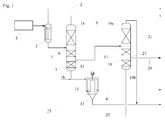
- the procedure shown in Figure 1 for the preparation of VEA has the following organization.
- the crude VEA originating from the acetylation stage 5 conversion of vitamin E into VEA, including separating off the main portion of acetic acid and acetic anhydride
- the degasser 3 falling-film evaporator.
- the remaining low-boiling components such as, for example, acetic acid or acetic anhydride, are removed via the line 2.
- the degassed crude VEA obtained at the bottom of the degasser 3 is added as feed approximately in the middle of the rectification column 1.
- the loss of the useful product VEA via the top take-off of the first rectification column 1 is ⁇ 5 %, preferably ⁇ 1 % and ideally ⁇ 0.5 %, based on that amount of VEA in the feed which is added to the column per unit time.
- the column 1 furthermore has a side take-off 15 which is present below the column feed.
- the side take-off of the column 1 is connected via the line 17 to a second rectification column 19, here too the feed being arranged approximately in the middle of the column.
- the bottom take-off formed at the bottom 19b of the column 19 is fed to the short-path evaporator 13 via the line 23 together with the bottom take-off of the column 1 via the line 11.
- a residue stream 4 and a distillate stream 25 are obtained.
- the distillate stream 25 is mixed with the top take-off obtained at the top 19a of the column 19.
- the column 19 also has a side take-off 27, as described in more detail below. Furthermore, both columns 1 and 19 each have a condenser arranged in the top 1a and 19a, respectively, and an evaporator provided in the bottom 1b and 19b, respectively.
- These components which as such are conventional and customary for rectification columns are generally known to a person skilled in the art and are therefore neither described in detail nor shown in the drawing.
- the principle of the process according to Figure 1 is distinguished by the fact that the remaining traces of low-boiling components, such as, for example, acetic acid, acetic anhydride or solvent residues from the product stream arriving from the acetylation, are removed from the crude VEA in the upstream degasser 3 and are transported away via the line 2.
- low-boiling components such as, for example, acetic acid, acetic anhydride or solvent residues from the product stream arriving from the acetylation
- the remaining lower-boiling components and also the unspecified isomers of the useful product are then separated off at the top 1 a, and a VEA having a content of > 96 % by weight is removed at the side take-off point 15 by partial condensation.
- the column 1 is operated as follows:
- the latter can be operated so that the VEA content in the side take-off is well above 95 % by weight and that in the top take-off is substantially below 20 % by weight.
- the side take-off of the first column 1 is fed via the line 17 to the second column 19 in order to prepare VEA-PG.
- the take-off of this quality is in turn effected as a side take-off by partial condensation at position 27 and is removed from the plant via product line 29.
- the bottom product emerging from the bottom 1b of the first column 1 is squeezed out together with the bottom product of the second column 19 in the short-path evaporator 13 and gives a distillate which, together with the product of the second column 19, emerging from the top 19a of the second column 19, forms the VEA-TG.
- the countercurrent flow is characterized by the descending reflux stream 31 and ascending vapour stream 33 in the rectification column, in the region of the side take-off point the vapour flowing through the packings and separating elements of the side take-off from bottom to top, and the reflux flowing inside a guide pipe from top to bottom.
- a distributor 35 which redistributes the reflux from the collector bed 37 above the side take-off is present in the lower region of the side take-off point.
- a half layer of Mellapak 250X is installed as a splash guard 39.
- the collector 41 for the side take-off is provided.
- the collector 41 empties, for example, into a trap 43 which opens into an outlet 45 intended for removal of the vapour condensate to be separated off.
- a side take-off partial condenser 47 which, for example, is in the form of a U-tube bundle heat exchanger and serves for producing the vapour condensate.
- a total take-off collector 37 which transports the reflux - as already mentioned - from the upper part of the side take-off point past the partial condenser 47 into the lower distributor 35 is preferably present as the uppermost element. It is advantageous that the collector 37 carries out a total take-off so that the side take-off is not contaminated by the reflux or adversely affects the colour of the side take-off.
- the side take-off is effected by partial condensation of the vapour phase ascending in the column.
- Synthetically prepared crude VEA having a content of about 90 to 92 % of VEA, about 2-3 % of low-boiling components (chiefly phytadienes), about 2-3 % of unspecified isomers of the useful product (VEA) and about 3-4 % of high-boiling components is degassed in a falling-film evaporator at 185 °C and about 3 mbar.
- the degassed crude VEA is fed in at a temperature of between 180 and 250 °C approximately in the middle of the rectification column 1 with a packing height of 6-8 m of the Sulzer Optiflow C36 type.
- the pressure at the top of the column is about 0.5 to 1 mbar.
- the column 1 At the top of the column 1, about 4 % by mass of the feed stream is removed as a top take-off with a content of about 3 % of VEA.
- the column 1 is operated at a reflux ratio of about 10 to 20.
- the side take-off point is about 2 to 3 m of packing height below the feed inflow point.
- About 75 % of the feed stream having a VEA content of about 96-97 % are removed at the side take-off.
- the desired flow rate is set by regulation of the partial condenser forward flow temperature.
- the product obtained at the bottom of the column 1 at a temperature of 260 to 270 °C still contains about 80-82 % of VEA.
- the side take-off of the column 1 having a VEA content of about 96 to 97 % is then added at a temperature between 180 and 250 °C as feed approximately in the middle of the rectification column 19 having a packing height of 6 to 8 m of the Sulzer Optiflow C36 type.
- the pressure at the top of the column 19 is about 0.5 to 1 mbar.
- the column 19 is operated at a reflux ratio of about 15 to 30.
- the side take-off point is about 2 to 3 m of packing height below the feed inflow point.
- the desired flow rate is established by regulation of the partial condenser forward flow temperature.
- the product obtained at the bottom of the column 19 at a temperature of 260 to 270 °C still contains about 90 to 95 % of VEA, depending on the split ratio set.
- the bottom products of the columns 1 and 19 are now fed to the short-path evaporator 13, which is operated at a pressure of about 0.1 to 0.2 mbar.
- the residue still contains about 2 to 5 % of VEA, while the VEA content in the distillate is about 92 %.
- the distillate is mixed together with the top take-off of the column 19 to give VEA TG.
- Synthetically prepared crude VEA having a content of about 90 to 92 % of VEA, about 2 to 3 % of low-boiling components (chiefly phytadienes), about 2 to 3 % of unspecified isomers of the useful product (VEA) and about 3 to 4 % of high-boiling components is degassed in a falling to film evaporator at 185 °C and about 3 mbar.
- the degassed crude VEA is fed in at a temperature of between 180 and 250 °C approximately in the middle of the rectification column 1 with a packing height of 6 to 8 m of the Sulzer Optiflow C36 type.
- the pressure at the top of the column is about 0.5 to 1 mbar.
- the column 1 At the top of the column 1, about 4 % by mass of the feed stream is removed as a top take-off with a content of about 3 % of VEA.
- the column 1 is operated at a reflux ratio of about 10 to 20.
- the product obtained at the bottom of the column 1 at a temperature of 260 to 270 °C contains about 93 to 95 % of VEA.
- the bottom take-off of the column 1 having a VEA content of about 93 to 95 % is then added at a temperature between 180 and 250 °C as feed approximately in the middle of the rectification column 19 having a packing height of 6 to 8 m of the Sulzer Optiflow C36 type.
- the pressure at the top of the column 19 is about 0.5 to 1 mbar.
- the column 19 is operated at a reflux ratio of about 15 to 30.
- the side take-off point is about 2 to 3 m of packing height below the feed inflow point.
- the desired flow rate is established by regulation of the partial condenser forward flow temperature.
- the product obtained at the bottom of the column 19 at a temperature of 260 to 270 °C still contains about 82 to 87 % of VEA, depending on the split ratio set.
- the bottom product of the columns 19 is now fed to the short-path evaporator 13, which is operated at a pressure of about 0.1 to 0.2 mbar.
- the residue still contains about 2 to 5 % of VEA, while the VEA content in the distillate is about 92 to 95 %, depending on the split.
- the distillate is mixed together with the top take-off of the column 19 to give VEA TG.
Landscapes
- Chemical & Material Sciences (AREA)
- Organic Chemistry (AREA)
- Chemical Kinetics & Catalysis (AREA)
- Engineering & Computer Science (AREA)
- Physics & Mathematics (AREA)
- Mechanical Engineering (AREA)
- Thermal Sciences (AREA)
- General Engineering & Computer Science (AREA)
- Organic Low-Molecular-Weight Compounds And Preparation Thereof (AREA)
- Vaporization, Distillation, Condensation, Sublimation, And Cold Traps (AREA)
- Pyrane Compounds (AREA)
- Steroid Compounds (AREA)
Abstract
Description
- The invention relates to a process for the rectification of mixtures of high-boiling air- and/or temperature-sensitive substances, in particular the rectification of tocopherol acetate - also referred to as vitamin E acetate (VEA) - for separating lower-boiling and higher-boiling impurities from the useful product.
- The VEA obtained by esterification of vitamin E with acetic anhydride, also referred to below as crude VEA, can be freed from the substantial residues of acetic acid and acetic anhydride and other impurities, for example, by multistage distillation steps in falling-film evaporators, thin-film evaporators, etc. Usually, such a reaction mixture then contains about 94 % by weight of VEA, 1-2 % by weight of low-boiling substances (chiefly phytadienes), about 2-3 % by weight of unspecified isomers of the useful product (VEA) and 1-2 % by weight of high-boiling secondary components.
- In the industrial purification of a VEA-containing product stream, for example, cascades of short-path evaporators are used. As complete as possible a separation of the low-boiling substances from the product stream flowing to the cascade of short-path evaporators is decisive for the dimensioning and the operation of the short-path evaporators and the vacuum system at the required, very low pressures. A thin-film evaporator usually operated at about 1 mbar and intended for removing the low boilers is therefore connected upstream of the cascade of short-path evaporators. The vapour stream produced in the thin-film evaporator contains substantially phytadienes, vitamin E acetate and residues of acetic acid and acetic anhydride and is virtually completely condensed in a downstream condenser system. Owing to the high content of low boilers, the condensate obtained cannot be further used and is discarded. Because of the position of the phase equilibrium, the proportion of VEA in this vapour stream is about 13 % by weight and the loss of VEA is about 2.7 %, based on the inflowing amount of VEA. A low boiler fraction of, usually, about 2 % by weight remains in the useful product (bottom product of the thin-film evaporator). The bottom product of the thin-film evaporator is fed to the cascade of short-path evaporators, in which the VEA is further enriched by repeated evaporation and condensation.
- The process described above and intended for obtaining VEA has the following disadvantages. As already mentioned, a part of the useful product (VEA) passes out of the thin-film evaporator via the gas phase to the downstream condenser system and is finally lost. Furthermore, only parts of the low boilers are separated off in the thin-film evaporator, which is per se a relatively complicated and expensive apparatus, and the rest remains in the useful product and has to be separated off later on by a complicated procedure. At the same time, owing to the incomplete separation of the main product from the byproducts in the respective purification steps, this process also includes recycled streams which have to be fed back to the process by a relatively complicated procedure.
- Since VEA is being used to an increasing extent for human nutrition or prophylaxis in healthcare, the purity of this product has to meet increasingly high requirements. The VEA quality required for these intended uses, also referred to below as "pharma grade" (PG) quality, is defined as follows:
- Purity ≥ 97.5 % by weight
- Colourless to slightly greenish yellow
- VEA obtained from the process described above has a purity of < 97 % by weight. With a purity of > 92 % by weight, it fulfils the condition which is set for the so-called "technical grade" (TG) quality of the useful product but not the requirements of a PG quality. For use as a food additive or for medical applications, it must therefore be subjected to further purification steps.
- It is known that, in the working up of product mixtures by distillation, the best results are generally obtained when so-called countercurrent distillation (also referred to as rectification) is used, i.e. a special distillation process with countercurrent flow of descending reflux and ascending vapour in rectification columns. It is usual to use columns in which the mixture to be separated is introduced in the middle part of the column, the vapour becomes enriched with more readily volatile components on its way through the column from bottom to top and the reflux becomes enriched with more sparingly volatile components from top to bottom. The transport of material and heat is intensified by elements installed in the column, such as column trays, random packings or structured packings, which ensure a sufficient contact time of the phases and a sufficiently large phase boundary.
- It is furthermore known that, for the separation of high-boiling, temperature-sensitive mixtures of substances which require a high separation efficiency, which also includes the mixture present here (crude VEA), it is preferable to use rectification columns which have packings composed systematically in a regular geometry and having defined passage regions for countercurrent phases. This is the case in particular because, compared with random packings, regularly structured packings are distinguished by a higher load capacity and a better separation effect, have a smaller specific pressure drop and require a smaller volume of packings and therefore also permit a smaller mass and heat transfer height. Structured packings are therefore used in all vacuum rectifications, in which, owing to the temperature sensitivity of the mixture to be separated, a limitation of the column pressure drop is particularly important. Column packings known for this intended use are metal fabric packings of the BX and CY type from Sulzer, expanded metal packings of the Optiflow or Mellapak type and Rhombopak type from Sulzer and Kühni, respectively, and similarly effective metal fabric packings from other companies, such as Montz GmbH.
The rectification of a VEA-containing mixture is disclosed, for example, inWO 97/02880 - In spite of the use of the high vacuum, in general only purities of 97.3 % (
DE-A 27 43 920 ), 98 % (DE-A 42 08 477 andJP-B-58 011 869 US-A 3 459 773 ) or 98.5 to 99 % (DE-A 21 60 103 ) are achieved according to the prior art. Purities above 99 % were achieved only by molecular distillation, namely purities of 99.3 % according toJP-A 51/14671 JP-A-62/226976 - It is the object of the invention to provide a process for the rectification of mixtures of high-boiling air- and/or temperature-sensitive useful products, but in particular a process for working up a VEA-containing product stream, which process does not have the above-mentioned disadvantages and which permits an economical method, which is simple in terms of process engineering, for separating off the useful product in high purity and high yield. In addition, the process should also permit the use of separation apparatuses which are simple in terms of process engineering and should make it possible to prepare two end products in different and optionally variable proportions, which end products differ in their purity. It is also considered advantageous to develop a process without recycling for treatment of the products under milder conditions.
- This object is achieved by a process having the features of
Patent Claim 1. - Advantageous embodiments of the invention form the subject of the dependent Claims.
-
Claim 1 proposes a process for the rectification of mixtures of high-boiling air- and/or temperature-sensitive substances which require high separation efficiency, in particular a process for working up a VE- or VEA-containing product stream, which is characterized in that, in a first purification stage, low-boiling products are separated from the product stream virtually without loss of useful product, and unspecified isomers of the useful product are taken off, and that, in a second purification stage, the useful product is removed in one stream with a purity of > 97 % by weight and in a further stream with a purity of > 92 % by weight. - According to the invention, a completely novel concept for the purification of high-boiling air- and/or temperature-sensitive substances, for example VEA, was developed. Only pure waste streams (low boilers, i.e. streams of low-boiling substances/streams comprising unspecified isomers of the useful product/streams of high-boiling byproducts, in each case having a very low VEA content) and pure product streams form. Thus, no streams which require further working-up are produced, which also permits the elimination of disadvantageous recycling.
- A preferred embodiment of the process serves for working up VEA, in which the loss of the useful product in the first purification stage is less than 5 %, based on the amount of VEA in the feed which is added to the purification stage per unit time. In this particular case, the first purification stage may comprise a rectification column, from the top of which the low-boiling products and the unspecified isomers of VEA are taken off, a stream containing the useful product in purified form being taken off at the side and/or at the bottom of the column.
- The side take-off or the bottom take-off of the first rectification column can then be fed, in the second purification stage, to a second rectification column, from which VEA is then removed either
- as a bottom take-off having a purity of > 97 % by weight and as a top take-off having a purity of > 92 % by weight, or
- as a side take-off having a purity of > 97 % by weight and as a mixture consisting of top take-off and distillate of the bottom take-off having a purity of > 92 % by weight.
- According to the invention, the two rectification columns have structured packings having a ratio of separation efficiency to pressure drop of, preferably, > 15 theoretical plates per mbar of pressure drop (basis: F factor = 1 Pa0.5,
column diameter 1 metre, test mixture cis-/trans-decalin). A particularly suitable structured packing is the OPTIFLOW packing from Sulzer AG. According to the invention, at least the side take-off is effected at the second column by partial condensation in a manner such that the product to be separated off leaves the column as condensate and not as a product stream in vapour form. For this purpose, the columns incorporate important design details which are important for the condensation process. - The advantages of the preferred processes according to the invention are the following:
- A sharp separation in one column is achieved. Usually, a plurality of columns is required for this purpose.
- In particular the first column has a high separation efficiency in combination with a small pressure drop.
- The losses of products are very small.
- The purity of the pharma grade product is very high, with a VEA content of ≥ 97 % by weight.
- The process is very flexible with regard to the amounts of product to be produced in PG or TG quality.
- In a further preferred embodiment of the invention, before crude VEA is fed to the first column, the product stream is passed for degassing into a falling-film evaporator in which in particular the low-boiling substances, such as, for example, solvent residues, and any remaining traces of acetic acid and acetic anhydride are removed. The falling-film evaporator can also be designed thereby in such a way that it also serves for reducing the total chlorine content in the crude VEA, in order thereby to avoid any disadvantageous corrosion in the following stages. In the first column, the remaining low-boiling substances and the unspecified isomers of the useful product are then separated off at the top, and the VEA is removed as a side take-off in vapour form with a content of > 96 %. For the preparation of the "pharma grade" quality, the side take-off stream of the first column is rectified again in the second column. According to the invention, the "pharma grade" quality is taken off as a side take-off. The bottom product from the first column is squeezed out in a short-path evaporator and gives the VEA-TG as a distillate together with the top product of the second column.
- The invention is explained in more detail below with reference to the drawing.
-
- Figure 1
- shows a schematic diagram of the process according to the invention, designed for working up VEA,
- Figure 2
- shows an alternative method of carrying out the process according to
Figure 1 and - Figure 3
- shows a side take-off point as provided according to the invention in the second and, if required, first rectification column.
- The procedure shown in
Figure 1 for the preparation of VEA has the following organization. The crude VEA originating from the acetylation stage 5 (conversion of vitamin E into VEA, including separating off the main portion of acetic acid and acetic anhydride) is fed to the degasser 3 (falling-film evaporator). There, the remaining low-boiling components, such as, for example, acetic acid or acetic anhydride, are removed via theline 2. The degassed crude VEA obtained at the bottom of thedegasser 3 is added as feed approximately in the middle of therectification column 1. At the top 1a of thecolumn 1, lower-boiling components and unspecified isomers of the useful product are removed via theline 9 virtually without loss of useful product. The bottom take-off obtained at the bottom 1 b of thecolumn 1 is fed via theline 11 to the short-path evaporator 13. The loss of the useful product VEA via the top take-off of thefirst rectification column 1 is < 5 %, preferably < 1 % and ideally < 0.5 %, based on that amount of VEA in the feed which is added to the column per unit time. - The
column 1 furthermore has a side take-off 15 which is present below the column feed. The side take-off of thecolumn 1 is connected via theline 17 to asecond rectification column 19, here too the feed being arranged approximately in the middle of the column. The bottom take-off formed at the bottom 19b of thecolumn 19 is fed to the short-path evaporator 13 via theline 23 together with the bottom take-off of thecolumn 1 via theline 11. In the short-path distillation, aresidue stream 4 and adistillate stream 25 are obtained. Thedistillate stream 25 is mixed with the top take-off obtained at the top 19a of thecolumn 19. - According to the invention, the
column 19 also has a side take-off 27, as described in more detail below. Furthermore, bothcolumns column diameter 1 metre, test mixture cis-/trans-decalin). The principle of the process according toFigure 1 is distinguished by the fact that the remaining traces of low-boiling components, such as, for example, acetic acid, acetic anhydride or solvent residues from the product stream arriving from the acetylation, are removed from the crude VEA in theupstream degasser 3 and are transported away via theline 2. - In the
first column 1, the remaining lower-boiling components and also the unspecified isomers of the useful product are then separated off at the top 1 a, and a VEA having a content of > 96 % by weight is removed at the side take-off point 15 by partial condensation. - According to the invention, the
column 1 is operated as follows: - The side take-off comprises about 75 % by weight, based on the feed stream added, this having as high a VEA content as possible with a small amount of unspecified isomers of the useful product and high-boiling components.
- The top take-off comprises about 2-5 % by weight, based on the feed stream.
- The top condenser arranged in the top 105a virtually completely condenses the incoming vapour stream to give reflux and top take-off.
- The pressure at the top of the column is preferably about 0.5 to 1 mbar and is as far as possible kept constant, and the column temperatures are between 190 and 280°C, depending on the loading of the column.
- On maintaining these guide parameters, and depending on the established reflux ratio of
column 1, the latter can be operated so that the VEA content in the side take-off is well above 95 % by weight and that in the top take-off is substantially below 20 % by weight. - The side take-off of the
first column 1 is fed via theline 17 to thesecond column 19 in order to prepare VEA-PG. The take-off of this quality is in turn effected as a side take-off by partial condensation atposition 27 and is removed from the plant viaproduct line 29. - The bottom product emerging from the bottom 1b of the
first column 1 is squeezed out together with the bottom product of thesecond column 19 in the short-path evaporator 13 and gives a distillate which, together with the product of thesecond column 19, emerging from the top 19a of thesecond column 19, forms the VEA-TG. - In the alternative method of carrying out the process for the preparation or purification of the VEA products, shown in
Figure 2 , there is no side take-off from thefirst column 1. Instead, the bottom product of thecolumn 1 is transported via theproduct stream line 11 directly and completely to thesecond column 19. As a result of this, the feed to the short-path evaporator consists only of the bottom take-off of thecolumn 19, and in this case the VEA-TG is formed only from the mixture of the top product and the distillate of the bottom product of thesecond column 19. - The side take-off by partial condensation in the
columns 19 and/or 1 is decisive for carrying out the preferred process according to the invention. This side take-off will therefore be explained in more detail before the purification of VEA is described in more detail with reference to two specific examples. - In the section of the two
rectification columns Figure 3 , the countercurrent flow is characterized by the descending reflux stream 31 and ascendingvapour stream 33 in the rectification column, in the region of the side take-off point the vapour flowing through the packings and separating elements of the side take-off from bottom to top, and the reflux flowing inside a guide pipe from top to bottom. - A
distributor 35 which redistributes the reflux from thecollector bed 37 above the side take-off is present in the lower region of the side take-off point. In order to avoid contamination of the (vapour) side take-off with liquid, a half layer of Mellapak 250X is installed as asplash guard 39. Directly above thislayer 39, thecollector 41 for the side take-off is provided. Thecollector 41 empties, for example, into atrap 43 which opens into anoutlet 45 intended for removal of the vapour condensate to be separated off. Above thecollector 41 there follows a side take-offpartial condenser 47 which, for example, is in the form of a U-tube bundle heat exchanger and serves for producing the vapour condensate. A total take-off collector 37, which transports the reflux - as already mentioned - from the upper part of the side take-off point past thepartial condenser 47 into thelower distributor 35 is preferably present as the uppermost element. It is advantageous that thecollector 37 carries out a total take-off so that the side take-off is not contaminated by the reflux or adversely affects the colour of the side take-off. - According to the invention, the side take-off is effected by partial condensation of the vapour phase ascending in the column. This has the advantage that a vapour condensate, i.e. not a product stream in vapour form, is taken off as a side take-off, with the result that the pressure drop caused by the take-off and owing to the smaller volume streams of the liquids can be significantly reduced. Since the take-off involves a partial condensation, an additional purification stage is furthermore obtained, which also proves to be particularly advantageous.
- It should be pointed out here that the process described with reference to
Figures 1 and2 represents only one working example of the invention and that in particular the design of the plant which serves for carrying out the process can vary in different respects within the scope of protection defined byClaim 1. Thus, the process according to the invention and the partial side take-off can also be used for the purification of vitamin E (VE) and of course also for the working-up or purification of other substances which, like VE and VEA, are high-boiling and temperature-sensitive and are usually purified by means of rectification columns. - The processes described above with reference to
Figures 1 and2 will now be described in detail by means of two specific examples. - Synthetically prepared crude VEA having a content of about 90 to 92 % of VEA, about 2-3 % of low-boiling components (chiefly phytadienes), about 2-3 % of unspecified isomers of the useful product (VEA) and about 3-4 % of high-boiling components is degassed in a falling-film evaporator at 185 °C and about 3 mbar. The degassed crude VEA is fed in at a temperature of between 180 and 250 °C approximately in the middle of the
rectification column 1 with a packing height of 6-8 m of the Sulzer Optiflow C36 type. The pressure at the top of the column is about 0.5 to 1 mbar. At the top of thecolumn 1, about 4 % by mass of the feed stream is removed as a top take-off with a content of about 3 % of VEA. Thecolumn 1 is operated at a reflux ratio of about 10 to 20. The side take-off point is about 2 to 3 m of packing height below the feed inflow point. About 75 % of the feed stream having a VEA content of about 96-97 % are removed at the side take-off. The desired flow rate is set by regulation of the partial condenser forward flow temperature. The product obtained at the bottom of thecolumn 1 at a temperature of 260 to 270 °C still contains about 80-82 % of VEA. - The side take-off of the
column 1 having a VEA content of about 96 to 97 % is then added at a temperature between 180 and 250 °C as feed approximately in the middle of therectification column 19 having a packing height of 6 to 8 m of the Sulzer Optiflow C36 type. The pressure at the top of thecolumn 19 is about 0.5 to 1 mbar. At the top of thecolumn 19, about 5 to 15 % by mass of the feed stream are removed as a top take-off having a content of about 92 to 95 % of VEA. Thecolumn 19 is operated at a reflux ratio of about 15 to 30. The side take-off point is about 2 to 3 m of packing height below the feed inflow point. At the side take-off, depending on the desired amount of PG, between 50 and 78 % (the latter corresponds to 60 % of the VEA used in the form of PG) of the feed stream with a VEA content of more than 97 % are removed. The desired flow rate is established by regulation of the partial condenser forward flow temperature. The product obtained at the bottom of thecolumn 19 at a temperature of 260 to 270 °C still contains about 90 to 95 % of VEA, depending on the split ratio set. - The bottom products of the
columns path evaporator 13, which is operated at a pressure of about 0.1 to 0.2 mbar. The residue still contains about 2 to 5 % of VEA, while the VEA content in the distillate is about 92 %. The distillate is mixed together with the top take-off of thecolumn 19 to give VEA TG. - Synthetically prepared crude VEA having a content of about 90 to 92 % of VEA, about 2 to 3 % of low-boiling components (chiefly phytadienes), about 2 to 3 % of unspecified isomers of the useful product (VEA) and about 3 to 4 % of high-boiling components is degassed in a falling to film evaporator at 185 °C and about 3 mbar. The degassed crude VEA is fed in at a temperature of between 180 and 250 °C approximately in the middle of the
rectification column 1 with a packing height of 6 to 8 m of the Sulzer Optiflow C36 type. The pressure at the top of the column is about 0.5 to 1 mbar. At the top of thecolumn 1, about 4 % by mass of the feed stream is removed as a top take-off with a content of about 3 % of VEA. Thecolumn 1 is operated at a reflux ratio of about 10 to 20. The product obtained at the bottom of thecolumn 1 at a temperature of 260 to 270 °C contains about 93 to 95 % of VEA. - The bottom take-off of the
column 1 having a VEA content of about 93 to 95 % is then added at a temperature between 180 and 250 °C as feed approximately in the middle of therectification column 19 having a packing height of 6 to 8 m of the Sulzer Optiflow C36 type. The pressure at the top of thecolumn 19 is about 0.5 to 1 mbar. At the top of thecolumn 19, about 5 to 15 % by mass of the feed stream are removed as a top take-off having a content of about 92 to 95 % of VEA. Thecolumn 19 is operated at a reflux ratio of about 15 to 30. The side take-off point is about 2 to 3 m of packing height below the feed inflow point. At the side take-off, depending on the desired amount of PG, between 40 and 60 % (the latter corresponds to 60 % of the VEA used in the form of PG) of the feed stream with a VEA content of more than 97 % are removed. The desired flow rate is established by regulation of the partial condenser forward flow temperature. The product obtained at the bottom of thecolumn 19 at a temperature of 260 to 270 °C still contains about 82 to 87 % of VEA, depending on the split ratio set. - The bottom product of the
columns 19 is now fed to the short-path evaporator 13, which is operated at a pressure of about 0.1 to 0.2 mbar. The residue still contains about 2 to 5 % of VEA, while the VEA content in the distillate is about 92 to 95 %, depending on the split. The distillate is mixed together with the top take-off of thecolumn 19 to give VEA TG.
Claims (12)
- Process for the working-up of high-boiling air- and/or temperature-sensitive substances, in particular vitamin E acetate, characterized in that, in a first purification stage, low-boiling products and unspecified isomers of vitamin E acetate are taken off from the product stream virtually without loss of useful substance and that, in a second purification stage, the useful product is removed in one stream with a purity of > 97 % by weight and a further stream with a purity of > 92 % by weight.
- Process according to Claim 1, characterized in that the loss of useful product in the first purification stage is less than 5 %, based on that amount of VEA in the feed which is added to the purification stage per unit time.
- Process according to Claim 1 or 2, characterized in that, in the first purification stage, the product stream is fed to a rectification column (1), the low-boiling products and the unspecified isomers of the useful product being taken off at the top (1 a) of this column, and a stream containing the useful product in purified form being taken off at the side (15) and/or at the bottom (1 b) of the column (1).
- Process according to Claim 3, characterized in that the side take-off or the bottom take-off of the first rectification column is fed in the second purification stage to a second rectification column, and that the useful product is removed from the second column as a bottom take-off with a purity of > 97 % by weight and as a top take-off with a purity of > 92 % by weight.
- Process according to Claim 3, characterized in that the side take-off or the bottom take-off of the first rectification column (1) is fed in the second purification stage to a second rectification column (19), and that the useful product is removed from the second column (19) as a side take-off with a purity of > 97 % by weight and as a mixture consisting of top take-off and distillate of the bottom take-off with a purity of > 92 % by weight.
- Process according to Claim 4 or 5, characterized in that the bottom take-off of the second column is distilled before it is mixed with the top take-off of the same column.
- Process according to any of Claims 4 to 6, characterized in that the product stream is degassed in a falling-film evaporator (3) before it is added to the first column (1).
- Process according to any of Claims 4 to 7, the side take-off of the first column (1) being passed into the second column (19), characterized in that the bottom take-offs of both columns (1, 19) are mixed with one another and are distilled and, together with the top take-off of the second column, form the useful product having a purity of > 92 % by weight.
- Process according to any of Claims 4 to 8, characterized in that the distillation is effected in a short-path evaporator (13).
- Process, in particular according to any of Claims 4 to 6, characterized in that the side take-off is effected by partial condensation of the vapour phase ascending in the column (1, 19) and the laterally emerging product stream is removed as vapour condensate from the column.
- Process according to Claim 10, characterized in that the vapour condensate has a purity of > 97 % by weight.
- Rectification column (1, 19) for carrying out a side take-off according to Claim 10 or 11, comprising a descending reflux stream (31) and ascending vapour stream (33) in the rectification column (1, 19) and packings installed in the column (1, 19) for intensifying the mass and heat transport, characterized by a side take-off section comprising:- a product stream distributor (35) which redistributes the reflux from the collector bed (37) above the side take-off,- a splash guard (39) above the product stream distributor (35),- a product stream collector (41) which is intended for the side take-off and opens into a lateral vapour condensate outlet (45),- a side take-off partial condenser (47) arranged above the collector (41)
and- a collector (37), preferably a total take-off collector above the side take-off partial condenser (47).
Applications Claiming Priority (2)
| Application Number | Priority Date | Filing Date | Title |
|---|---|---|---|
| CH13652004 | 2004-08-19 | ||
| EP05779332A EP1778664B1 (en) | 2004-08-19 | 2005-08-13 | Process for the rectification of vitamin e acetate |
Related Parent Applications (1)
| Application Number | Title | Priority Date | Filing Date |
|---|---|---|---|
| EP05779332.5 Division | 2005-08-13 |
Publications (2)
| Publication Number | Publication Date |
|---|---|
| EP2269998A2 true EP2269998A2 (en) | 2011-01-05 |
| EP2269998A3 EP2269998A3 (en) | 2011-03-30 |
Family
ID=34973797
Family Applications (2)
| Application Number | Title | Priority Date | Filing Date |
|---|---|---|---|
| EP05779332A Expired - Lifetime EP1778664B1 (en) | 2004-08-19 | 2005-08-13 | Process for the rectification of vitamin e acetate |
| EP10181695A Withdrawn EP2269998A3 (en) | 2004-08-19 | 2005-08-13 | Process for the rectification of mixtures of high-boiling air- and/or temperature-sensitive useful products |
Family Applications Before (1)
| Application Number | Title | Priority Date | Filing Date |
|---|---|---|---|
| EP05779332A Expired - Lifetime EP1778664B1 (en) | 2004-08-19 | 2005-08-13 | Process for the rectification of vitamin e acetate |
Country Status (9)
| Country | Link |
|---|---|
| US (3) | US7858813B2 (en) |
| EP (2) | EP1778664B1 (en) |
| JP (1) | JP5006194B2 (en) |
| KR (1) | KR101182978B1 (en) |
| CN (1) | CN100564372C (en) |
| AT (1) | ATE502931T1 (en) |
| DE (1) | DE602005027081D1 (en) |
| ES (1) | ES2363092T3 (en) |
| WO (1) | WO2006018256A2 (en) |
Cited By (3)
| Publication number | Priority date | Publication date | Assignee | Title |
|---|---|---|---|---|
| WO2014097172A1 (en) | 2012-12-18 | 2014-06-26 | Dsm Ip Assets B.V. | Nitrogen monoxide as cis/trans isomerization catalysts for unsaturated compounds |
| WO2014097171A1 (en) | 2012-12-18 | 2014-06-26 | Dsm Ip Assets B.V. | Polythiols as cis/trans isomerization catalysts for unsaturated compounds |
| WO2014096107A1 (en) | 2012-12-18 | 2014-06-26 | Dsm Ip Assets B.V. | Using mixtures of e/z isomers to obtain quantitatively specific products by combining asymmetric hydrogenation and isomerization |
Families Citing this family (8)
| Publication number | Priority date | Publication date | Assignee | Title |
|---|---|---|---|---|
| ATE502931T1 (en) * | 2004-08-19 | 2011-04-15 | Dsm Ip Assets Bv | METHOD FOR RECTIFICATION OF VITAMIN E ACETATE |
| WO2006018310A2 (en) * | 2004-08-19 | 2006-02-23 | Dsm Ip Assets B.V. | Process for the working-up of a vitamin e- and vitamin e-acetate and rectification colum suitable therefore |
| BRPI0600553A (en) * | 2006-02-24 | 2007-11-20 | Siemens Ltda | process and system for the production of alcohol by multiple effect distillation |
| DE102010035230A1 (en) * | 2010-08-24 | 2012-03-01 | Linde Aktiengesellschaft | Process for separating nitrogen from natural gas |
| WO2012048792A1 (en) * | 2010-10-13 | 2012-04-19 | Cognis Ip Management Gmbh | Device and method for distilling temperature-sensitive substances |
| CN108568131B (en) * | 2018-05-13 | 2023-11-28 | 四川久远化工技术有限公司 | Stripping liquid regeneration device and stripping liquid regeneration process |
| CN110292786A (en) * | 2019-07-29 | 2019-10-01 | 潍坊益华化工有限公司 | A kind of isooctyl thioglycolate continuous rectification apparatus and technique |
| CN112321555B (en) * | 2019-08-05 | 2022-05-31 | 浙江医药股份有限公司新昌制药厂 | Method for removing plasticizer from natural tocopherol |
Citations (8)
| Publication number | Priority date | Publication date | Assignee | Title |
|---|---|---|---|---|
| US3459773A (en) | 1966-12-27 | 1969-08-05 | Takasago Perfumery Co Ltd | Process for producing alpha-tocopherol and its esters |
| DE2160103A1 (en) | 1971-01-11 | 1972-08-03 | F. Hoffmann-La Roche & Co Ag, Basel (Schweiz) | Process for the production of chroman derivatives |
| JPS5114671A (en) | 1974-07-27 | 1976-02-05 | Shin Meiwa Ind Co Ltd | BUTSUTAIKAKUNOSOCHINO JIDOSEIGYOSHISUTEMU |
| DE2743920A1 (en) | 1976-09-29 | 1978-03-30 | Nisshin Flour Milling Co | Dl-alpha-tocopherol prodn. - by reacting tri:methyl-hydroquinone with phytol in presence of silica or alumina gel, zinc chloride and a protic acid |
| JPS5811869B2 (en) | 1972-11-27 | 1983-03-04 | 株式会社クラレ | Purification method of tocopherol |
| JPS62226976A (en) | 1986-03-28 | 1987-10-05 | Eisai Co Ltd | Production of dl-alpha-tocopherol |
| DE4208477A1 (en) | 1992-03-17 | 1993-09-23 | Basf Ag | METHOD FOR PRODUCING VITAMIN E |
| WO1997002880A1 (en) | 1995-07-08 | 1997-01-30 | Basf Aktiengesellschaft | Process for extracting pure substances from mixtures of high-boiling air and/or temperature-sensitive substances requiring high separative power by rectification in a fine vacuum and columns suitable for this process |
Family Cites Families (19)
| Publication number | Priority date | Publication date | Assignee | Title |
|---|---|---|---|---|
| GB867166A (en) | 1958-10-24 | 1961-05-03 | Hoffmann La Roche | A process for the manufacture of alpha tocopherol and its acetate |
| US5582692A (en) * | 1994-10-07 | 1996-12-10 | Artisan Industries, Inc. | Method for the purification of vitamin E |
| US5512691A (en) | 1994-11-07 | 1996-04-30 | Eastman Chemical Company | Process for the production of tocopherol concentrates |
| GB9519275D0 (en) | 1995-09-21 | 1995-11-22 | Univ Dundee | Substances and their therapeutic use |
| US5660691A (en) | 1995-11-13 | 1997-08-26 | Eastman Chemical Company | Process for the production of tocotrienol/tocopherol blend concentrates |
| DE19733503A1 (en) | 1997-08-01 | 1999-02-04 | Basf Ag | Preparation of alpha-tocopherol or alpha-tocopheryl acetate |
| AU753015B2 (en) | 1998-03-04 | 2002-10-03 | Cyclacel Limited | Cyclin dependent kinase inhibitor |
| US6703395B2 (en) | 1998-03-04 | 2004-03-09 | Institute Of Experimental Botany Of The Academy Of Sciences Of The Czech Republic | Cyclin dependent kinase inhibitor |
| FR2784104B1 (en) * | 1998-09-18 | 2002-12-27 | Rhone Poulenc Nutrition Animal | PROCESS FOR THE PREPARATION OF VITAMIN E |
| DE10005750C2 (en) * | 2000-02-09 | 2002-01-17 | Siemens Axiva Gmbh & Co Kg | Column for the separation of mixtures consisting of at least 3 different components |
| CN100355751C (en) | 2000-03-29 | 2007-12-19 | 西克拉塞尔有限公司 | 2-substd. 4-heteroaryl-pyrimidines and their use in treatment of proliferative disorders |
| GB2362648A (en) | 2000-05-23 | 2001-11-28 | Univerzita Palackeho V Olomouc | Triterpenoid derivatives |
| WO2002022605A1 (en) | 2000-09-15 | 2002-03-21 | Vertex Pharmaceuticals Incorporated | Pyrazole compounds useful as protein kinase inhibitors |
| CN1205200C (en) | 2000-11-22 | 2005-06-08 | 巴斯福股份公司 | Method for continuously acylating chromanol ester derivatives |
| DE60205376T2 (en) | 2001-06-27 | 2006-04-06 | Cyclacel Ltd. | 2,6,9-SUBSTITUTED PURINE DERIVATIVES AND THEIR USE IN THE TREATMENT OF PROLIFERATIVE DISEASES |
| DE10135714A1 (en) * | 2001-07-21 | 2003-02-06 | Basf Ag | Processing of vitamin E-acetate containing product stream, comprises use of thin film evaporator, falling film evaporator or flash evaporator with at least two step partial condensation |
| GB0219746D0 (en) | 2002-08-23 | 2002-10-02 | Inst Of Ex Botany Ascr | Azapurine derivatives |
| WO2006018310A2 (en) | 2004-08-19 | 2006-02-23 | Dsm Ip Assets B.V. | Process for the working-up of a vitamin e- and vitamin e-acetate and rectification colum suitable therefore |
| ATE502931T1 (en) * | 2004-08-19 | 2011-04-15 | Dsm Ip Assets Bv | METHOD FOR RECTIFICATION OF VITAMIN E ACETATE |
-
2005
- 2005-08-13 AT AT05779332T patent/ATE502931T1/en not_active IP Right Cessation
- 2005-08-13 JP JP2007526367A patent/JP5006194B2/en not_active Expired - Lifetime
- 2005-08-13 EP EP05779332A patent/EP1778664B1/en not_active Expired - Lifetime
- 2005-08-13 ES ES05779332T patent/ES2363092T3/en not_active Expired - Lifetime
- 2005-08-13 EP EP10181695A patent/EP2269998A3/en not_active Withdrawn
- 2005-08-13 CN CNB2005800274886A patent/CN100564372C/en not_active Expired - Lifetime
- 2005-08-13 WO PCT/EP2005/008822 patent/WO2006018256A2/en not_active Ceased
- 2005-08-13 US US11/660,103 patent/US7858813B2/en active Active
- 2005-08-13 DE DE602005027081T patent/DE602005027081D1/en not_active Expired - Lifetime
- 2005-08-13 KR KR1020077003771A patent/KR101182978B1/en not_active Expired - Lifetime
-
2010
- 2010-10-25 US US12/911,200 patent/US8420838B2/en not_active Expired - Lifetime
-
2013
- 2013-04-01 US US13/854,704 patent/US8747621B2/en not_active Expired - Lifetime
Patent Citations (8)
| Publication number | Priority date | Publication date | Assignee | Title |
|---|---|---|---|---|
| US3459773A (en) | 1966-12-27 | 1969-08-05 | Takasago Perfumery Co Ltd | Process for producing alpha-tocopherol and its esters |
| DE2160103A1 (en) | 1971-01-11 | 1972-08-03 | F. Hoffmann-La Roche & Co Ag, Basel (Schweiz) | Process for the production of chroman derivatives |
| JPS5811869B2 (en) | 1972-11-27 | 1983-03-04 | 株式会社クラレ | Purification method of tocopherol |
| JPS5114671A (en) | 1974-07-27 | 1976-02-05 | Shin Meiwa Ind Co Ltd | BUTSUTAIKAKUNOSOCHINO JIDOSEIGYOSHISUTEMU |
| DE2743920A1 (en) | 1976-09-29 | 1978-03-30 | Nisshin Flour Milling Co | Dl-alpha-tocopherol prodn. - by reacting tri:methyl-hydroquinone with phytol in presence of silica or alumina gel, zinc chloride and a protic acid |
| JPS62226976A (en) | 1986-03-28 | 1987-10-05 | Eisai Co Ltd | Production of dl-alpha-tocopherol |
| DE4208477A1 (en) | 1992-03-17 | 1993-09-23 | Basf Ag | METHOD FOR PRODUCING VITAMIN E |
| WO1997002880A1 (en) | 1995-07-08 | 1997-01-30 | Basf Aktiengesellschaft | Process for extracting pure substances from mixtures of high-boiling air and/or temperature-sensitive substances requiring high separative power by rectification in a fine vacuum and columns suitable for this process |
Cited By (3)
| Publication number | Priority date | Publication date | Assignee | Title |
|---|---|---|---|---|
| WO2014097172A1 (en) | 2012-12-18 | 2014-06-26 | Dsm Ip Assets B.V. | Nitrogen monoxide as cis/trans isomerization catalysts for unsaturated compounds |
| WO2014097171A1 (en) | 2012-12-18 | 2014-06-26 | Dsm Ip Assets B.V. | Polythiols as cis/trans isomerization catalysts for unsaturated compounds |
| WO2014096107A1 (en) | 2012-12-18 | 2014-06-26 | Dsm Ip Assets B.V. | Using mixtures of e/z isomers to obtain quantitatively specific products by combining asymmetric hydrogenation and isomerization |
Also Published As
| Publication number | Publication date |
|---|---|
| US20110036702A1 (en) | 2011-02-17 |
| CN100564372C (en) | 2009-12-02 |
| US20130284581A1 (en) | 2013-10-31 |
| KR101182978B1 (en) | 2012-09-18 |
| JP2008509954A (en) | 2008-04-03 |
| JP5006194B2 (en) | 2012-08-22 |
| DE602005027081D1 (en) | 2011-05-05 |
| US7858813B2 (en) | 2010-12-28 |
| US20080194846A1 (en) | 2008-08-14 |
| US8747621B2 (en) | 2014-06-10 |
| CN101006069A (en) | 2007-07-25 |
| EP2269998A3 (en) | 2011-03-30 |
| WO2006018256A2 (en) | 2006-02-23 |
| KR20070051861A (en) | 2007-05-18 |
| ATE502931T1 (en) | 2011-04-15 |
| EP1778664A2 (en) | 2007-05-02 |
| ES2363092T3 (en) | 2011-07-20 |
| EP1778664B1 (en) | 2011-03-23 |
| WO2006018256A3 (en) | 2006-06-29 |
| US8420838B2 (en) | 2013-04-16 |
Similar Documents
| Publication | Publication Date | Title |
|---|---|---|
| US8420838B2 (en) | Process for the rectification of mixtures of high-boiling air- and/or temperature-sensitive useful products | |
| US5831124A (en) | Purification of acrylic acid and methacrylic acid | |
| US6846389B2 (en) | Method for distillative separation of mixtures containing tetrahydrofuran, γ-butyrolactone and/or 1,4-butanediol | |
| JP4350937B2 (en) | Process for recovering acrolein or propionaldehyde from dilute aqueous streams | |
| CN110845327A (en) | Process for purifying benzoic acid | |
| EP2872473B1 (en) | Process for the production of methylbutynol | |
| US8414850B2 (en) | Process for the working-up of a vitamin E- and vitamin E-acetate-containing mixture or product stream | |
| US5582692A (en) | Method for the purification of vitamin E | |
| US20240376063A1 (en) | Simplified ethylene oxide purification methods | |
| EP2637998B1 (en) | Process for refining crude acetyls mixture | |
| US20040182692A1 (en) | Method for treating a product stream containing vitamin e acetate | |
| CN116283556B (en) | Rectification separation process of crude 2-butenoic acid product |
Legal Events
| Date | Code | Title | Description |
|---|---|---|---|
| PUAI | Public reference made under article 153(3) epc to a published international application that has entered the european phase |
Free format text: ORIGINAL CODE: 0009012 |
|
| AC | Divisional application: reference to earlier application |
Ref document number: 1778664 Country of ref document: EP Kind code of ref document: P |
|
| AK | Designated contracting states |
Kind code of ref document: A2 Designated state(s): AT BE BG CH CY CZ DE DK EE ES FI FR GB GR HU IE IS IT LI LT LU LV MC NL PL PT RO SE SI SK TR |
|
| PUAL | Search report despatched |
Free format text: ORIGINAL CODE: 0009013 |
|
| AK | Designated contracting states |
Kind code of ref document: A3 Designated state(s): AT BE BG CH CY CZ DE DK EE ES FI FR GB GR HU IE IS IT LI LT LU LV MC NL PL PT RO SE SI SK TR |
|
| RIC1 | Information provided on ipc code assigned before grant |
Ipc: B01D 5/00 20060101ALI20110224BHEP Ipc: B01D 3/14 20060101ALI20110224BHEP Ipc: F25J 3/02 20060101ALI20110224BHEP Ipc: B01D 3/32 20060101ALI20110224BHEP Ipc: C07D 311/72 20060101AFI20101125BHEP |
|
| STAA | Information on the status of an ep patent application or granted ep patent |
Free format text: STATUS: THE APPLICATION IS DEEMED TO BE WITHDRAWN |
|
| 18D | Application deemed to be withdrawn |
Effective date: 20111001 |