EP2269979A1 - Diamino acid derivative starting material, manufacturing method thereof, and diamino acid derivative manufacturing method - Google Patents
Diamino acid derivative starting material, manufacturing method thereof, and diamino acid derivative manufacturing method Download PDFInfo
- Publication number
- EP2269979A1 EP2269979A1 EP09720699A EP09720699A EP2269979A1 EP 2269979 A1 EP2269979 A1 EP 2269979A1 EP 09720699 A EP09720699 A EP 09720699A EP 09720699 A EP09720699 A EP 09720699A EP 2269979 A1 EP2269979 A1 EP 2269979A1
- Authority
- EP
- European Patent Office
- Prior art keywords
- group
- diamino acid
- hydrocarbon group
- unsubstituted
- manufacturing
- Prior art date
- Legal status (The legal status is an assumption and is not a legal conclusion. Google has not performed a legal analysis and makes no representation as to the accuracy of the status listed.)
- Granted
Links
- 0 CC(C)COC(CN=*1c2ccccc2-c2ccccc12)=O Chemical compound CC(C)COC(CN=*1c2ccccc2-c2ccccc12)=O 0.000 description 5
- IHSXFAZHMHYNBJ-UHFFFAOYSA-N CC(C)(C)OC(C(C(c1ccc[o]1)NC(OC(C)(C)C)=O)/N=C1/c(cccc2)c2-c2ccccc12)=O Chemical compound CC(C)(C)OC(C(C(c1ccc[o]1)NC(OC(C)(C)C)=O)/N=C1/c(cccc2)c2-c2ccccc12)=O IHSXFAZHMHYNBJ-UHFFFAOYSA-N 0.000 description 1
- JZABPYZKIQRDPG-ZCXUNETKSA-N CC(CC=C1)C2=C1c1ccccc1/C2=N/CC(OC)=O Chemical compound CC(CC=C1)C2=C1c1ccccc1/C2=N/CC(OC)=O JZABPYZKIQRDPG-ZCXUNETKSA-N 0.000 description 1
- PQTOLHHWLUCKSB-UHFFFAOYSA-N COC(CN=C(c1ccccc1)c1ccccc1)=O Chemical compound COC(CN=C(c1ccccc1)c1ccccc1)=O PQTOLHHWLUCKSB-UHFFFAOYSA-N 0.000 description 1
Classifications
-
- B—PERFORMING OPERATIONS; TRANSPORTING
- B01—PHYSICAL OR CHEMICAL PROCESSES OR APPARATUS IN GENERAL
- B01J—CHEMICAL OR PHYSICAL PROCESSES, e.g. CATALYSIS OR COLLOID CHEMISTRY; THEIR RELEVANT APPARATUS
- B01J31/00—Catalysts comprising hydrides, coordination complexes or organic compounds
- B01J31/02—Catalysts comprising hydrides, coordination complexes or organic compounds containing organic compounds or metal hydrides
- B01J31/0215—Sulfur-containing compounds
- B01J31/0222—Sulfur-containing compounds comprising sulfonyl groups
-
- C—CHEMISTRY; METALLURGY
- C07—ORGANIC CHEMISTRY
- C07F—ACYCLIC, CARBOCYCLIC OR HETEROCYCLIC COMPOUNDS CONTAINING ELEMENTS OTHER THAN CARBON, HYDROGEN, HALOGEN, OXYGEN, NITROGEN, SULFUR, SELENIUM OR TELLURIUM
- C07F9/00—Compounds containing elements of Groups 5 or 15 of the Periodic Table
- C07F9/02—Phosphorus compounds
- C07F9/28—Phosphorus compounds with one or more P—C bonds
- C07F9/38—Phosphonic acids [RP(=O)(OH)2]; Thiophosphonic acids ; [RP(=X1)(X2H)2(X1, X2 are each independently O, S or Se)]
- C07F9/40—Esters thereof
- C07F9/4003—Esters thereof the acid moiety containing a substituent or a structure which is considered as characteristic
- C07F9/4056—Esters of arylalkanephosphonic acids
-
- B—PERFORMING OPERATIONS; TRANSPORTING
- B01—PHYSICAL OR CHEMICAL PROCESSES OR APPARATUS IN GENERAL
- B01J—CHEMICAL OR PHYSICAL PROCESSES, e.g. CATALYSIS OR COLLOID CHEMISTRY; THEIR RELEVANT APPARATUS
- B01J31/00—Catalysts comprising hydrides, coordination complexes or organic compounds
- B01J31/02—Catalysts comprising hydrides, coordination complexes or organic compounds containing organic compounds or metal hydrides
- B01J31/0234—Nitrogen-, phosphorus-, arsenic- or antimony-containing compounds
- B01J31/0235—Nitrogen containing compounds
- B01J31/0237—Amines
-
- B—PERFORMING OPERATIONS; TRANSPORTING
- B01—PHYSICAL OR CHEMICAL PROCESSES OR APPARATUS IN GENERAL
- B01J—CHEMICAL OR PHYSICAL PROCESSES, e.g. CATALYSIS OR COLLOID CHEMISTRY; THEIR RELEVANT APPARATUS
- B01J31/00—Catalysts comprising hydrides, coordination complexes or organic compounds
- B01J31/02—Catalysts comprising hydrides, coordination complexes or organic compounds containing organic compounds or metal hydrides
- B01J31/0234—Nitrogen-, phosphorus-, arsenic- or antimony-containing compounds
- B01J31/0235—Nitrogen containing compounds
- B01J31/0245—Nitrogen containing compounds being derivatives of carboxylic or carbonic acids
- B01J31/0251—Guanidides (R2N-C(=NR)-NR2)
-
- B—PERFORMING OPERATIONS; TRANSPORTING
- B01—PHYSICAL OR CHEMICAL PROCESSES OR APPARATUS IN GENERAL
- B01J—CHEMICAL OR PHYSICAL PROCESSES, e.g. CATALYSIS OR COLLOID CHEMISTRY; THEIR RELEVANT APPARATUS
- B01J31/00—Catalysts comprising hydrides, coordination complexes or organic compounds
- B01J31/02—Catalysts comprising hydrides, coordination complexes or organic compounds containing organic compounds or metal hydrides
- B01J31/0234—Nitrogen-, phosphorus-, arsenic- or antimony-containing compounds
- B01J31/0271—Nitrogen-, phosphorus-, arsenic- or antimony-containing compounds also containing elements or functional groups covered by B01J31/0201 - B01J31/0231
-
- B—PERFORMING OPERATIONS; TRANSPORTING
- B01—PHYSICAL OR CHEMICAL PROCESSES OR APPARATUS IN GENERAL
- B01J—CHEMICAL OR PHYSICAL PROCESSES, e.g. CATALYSIS OR COLLOID CHEMISTRY; THEIR RELEVANT APPARATUS
- B01J31/00—Catalysts comprising hydrides, coordination complexes or organic compounds
- B01J31/16—Catalysts comprising hydrides, coordination complexes or organic compounds containing coordination complexes
- B01J31/18—Catalysts comprising hydrides, coordination complexes or organic compounds containing coordination complexes containing nitrogen, phosphorus, arsenic or antimony as complexing atoms, e.g. in pyridine ligands, or in resonance therewith, e.g. in isocyanide ligands C=N-R or as complexed central atoms
- B01J31/1805—Catalysts comprising hydrides, coordination complexes or organic compounds containing coordination complexes containing nitrogen, phosphorus, arsenic or antimony as complexing atoms, e.g. in pyridine ligands, or in resonance therewith, e.g. in isocyanide ligands C=N-R or as complexed central atoms the ligands containing nitrogen
-
- C—CHEMISTRY; METALLURGY
- C07—ORGANIC CHEMISTRY
- C07B—GENERAL METHODS OF ORGANIC CHEMISTRY; APPARATUS THEREFOR
- C07B53/00—Asymmetric syntheses
-
- C—CHEMISTRY; METALLURGY
- C07—ORGANIC CHEMISTRY
- C07C—ACYCLIC OR CARBOCYCLIC COMPOUNDS
- C07C251/00—Compounds containing nitrogen atoms doubly-bound to a carbon skeleton
- C07C251/02—Compounds containing nitrogen atoms doubly-bound to a carbon skeleton containing imino groups
- C07C251/24—Compounds containing nitrogen atoms doubly-bound to a carbon skeleton containing imino groups having carbon atoms of imino groups bound to carbon atoms of six-membered aromatic rings
-
- C—CHEMISTRY; METALLURGY
- C07—ORGANIC CHEMISTRY
- C07C—ACYCLIC OR CARBOCYCLIC COMPOUNDS
- C07C271/00—Derivatives of carbamic acids, i.e. compounds containing any of the groups, the nitrogen atom not being part of nitro or nitroso groups
- C07C271/06—Esters of carbamic acids
- C07C271/08—Esters of carbamic acids having oxygen atoms of carbamate groups bound to acyclic carbon atoms
- C07C271/10—Esters of carbamic acids having oxygen atoms of carbamate groups bound to acyclic carbon atoms with the nitrogen atoms of the carbamate groups bound to hydrogen atoms or to acyclic carbon atoms
- C07C271/22—Esters of carbamic acids having oxygen atoms of carbamate groups bound to acyclic carbon atoms with the nitrogen atoms of the carbamate groups bound to hydrogen atoms or to acyclic carbon atoms to carbon atoms of hydrocarbon radicals substituted by carboxyl groups
-
- C—CHEMISTRY; METALLURGY
- C07—ORGANIC CHEMISTRY
- C07D—HETEROCYCLIC COMPOUNDS
- C07D307/00—Heterocyclic compounds containing five-membered rings having one oxygen atom as the only ring hetero atom
- C07D307/02—Heterocyclic compounds containing five-membered rings having one oxygen atom as the only ring hetero atom not condensed with other rings
- C07D307/34—Heterocyclic compounds containing five-membered rings having one oxygen atom as the only ring hetero atom not condensed with other rings having two or three double bonds between ring members or between ring members and non-ring members
- C07D307/38—Heterocyclic compounds containing five-membered rings having one oxygen atom as the only ring hetero atom not condensed with other rings having two or three double bonds between ring members or between ring members and non-ring members with substituted hydrocarbon radicals attached to ring carbon atoms
- C07D307/52—Radicals substituted by nitrogen atoms not forming part of a nitro radical
-
- C—CHEMISTRY; METALLURGY
- C07—ORGANIC CHEMISTRY
- C07F—ACYCLIC, CARBOCYCLIC OR HETEROCYCLIC COMPOUNDS CONTAINING ELEMENTS OTHER THAN CARBON, HYDROGEN, HALOGEN, OXYGEN, NITROGEN, SULFUR, SELENIUM OR TELLURIUM
- C07F9/00—Compounds containing elements of Groups 5 or 15 of the Periodic Table
- C07F9/02—Phosphorus compounds
- C07F9/28—Phosphorus compounds with one or more P—C bonds
- C07F9/38—Phosphonic acids [RP(=O)(OH)2]; Thiophosphonic acids ; [RP(=X1)(X2H)2(X1, X2 are each independently O, S or Se)]
- C07F9/40—Esters thereof
- C07F9/4003—Esters thereof the acid moiety containing a substituent or a structure which is considered as characteristic
- C07F9/4006—Esters of acyclic acids which can have further substituents on alkyl
-
- C—CHEMISTRY; METALLURGY
- C07—ORGANIC CHEMISTRY
- C07F—ACYCLIC, CARBOCYCLIC OR HETEROCYCLIC COMPOUNDS CONTAINING ELEMENTS OTHER THAN CARBON, HYDROGEN, HALOGEN, OXYGEN, NITROGEN, SULFUR, SELENIUM OR TELLURIUM
- C07F9/00—Compounds containing elements of Groups 5 or 15 of the Periodic Table
- C07F9/02—Phosphorus compounds
- C07F9/547—Heterocyclic compounds, e.g. containing phosphorus as a ring hetero atom
- C07F9/655—Heterocyclic compounds, e.g. containing phosphorus as a ring hetero atom having oxygen atoms, with or without sulfur, selenium, or tellurium atoms, as the only ring hetero atoms
- C07F9/65515—Heterocyclic compounds, e.g. containing phosphorus as a ring hetero atom having oxygen atoms, with or without sulfur, selenium, or tellurium atoms, as the only ring hetero atoms the oxygen atom being part of a five-membered ring
-
- C—CHEMISTRY; METALLURGY
- C07—ORGANIC CHEMISTRY
- C07F—ACYCLIC, CARBOCYCLIC OR HETEROCYCLIC COMPOUNDS CONTAINING ELEMENTS OTHER THAN CARBON, HYDROGEN, HALOGEN, OXYGEN, NITROGEN, SULFUR, SELENIUM OR TELLURIUM
- C07F9/00—Compounds containing elements of Groups 5 or 15 of the Periodic Table
- C07F9/02—Phosphorus compounds
- C07F9/547—Heterocyclic compounds, e.g. containing phosphorus as a ring hetero atom
- C07F9/6553—Heterocyclic compounds, e.g. containing phosphorus as a ring hetero atom having sulfur atoms, with or without selenium or tellurium atoms, as the only ring hetero atoms
- C07F9/655345—Heterocyclic compounds, e.g. containing phosphorus as a ring hetero atom having sulfur atoms, with or without selenium or tellurium atoms, as the only ring hetero atoms the sulfur atom being part of a five-membered ring
-
- B—PERFORMING OPERATIONS; TRANSPORTING
- B01—PHYSICAL OR CHEMICAL PROCESSES OR APPARATUS IN GENERAL
- B01J—CHEMICAL OR PHYSICAL PROCESSES, e.g. CATALYSIS OR COLLOID CHEMISTRY; THEIR RELEVANT APPARATUS
- B01J2231/00—Catalytic reactions performed with catalysts classified in B01J31/00
- B01J2231/30—Addition reactions at carbon centres, i.e. to either C-C or C-X multiple bonds
- B01J2231/34—Other additions, e.g. Monsanto-type carbonylations, addition to 1,2-C=X or 1,2-C-X triplebonds, additions to 1,4-C=C-C=X or 1,4-C=-C-X triple bonds with X, e.g. O, S, NH/N
- B01J2231/341—1,2-additions, e.g. aldol or Knoevenagel condensations
- B01J2231/346—Mannich type reactions, i.e. nucleophilic addition of C-H acidic compounds, their R3Si- or metal complex analogues to aldimines or ketimines
-
- B—PERFORMING OPERATIONS; TRANSPORTING
- B01—PHYSICAL OR CHEMICAL PROCESSES OR APPARATUS IN GENERAL
- B01J—CHEMICAL OR PHYSICAL PROCESSES, e.g. CATALYSIS OR COLLOID CHEMISTRY; THEIR RELEVANT APPARATUS
- B01J2531/00—Additional information regarding catalytic systems classified in B01J31/00
- B01J2531/20—Complexes comprising metals of Group II (IIA or IIB) as the central metal
-
- B—PERFORMING OPERATIONS; TRANSPORTING
- B01—PHYSICAL OR CHEMICAL PROCESSES OR APPARATUS IN GENERAL
- B01J—CHEMICAL OR PHYSICAL PROCESSES, e.g. CATALYSIS OR COLLOID CHEMISTRY; THEIR RELEVANT APPARATUS
- B01J2531/00—Additional information regarding catalytic systems classified in B01J31/00
- B01J2531/20—Complexes comprising metals of Group II (IIA or IIB) as the central metal
- B01J2531/21—Beryllium
-
- B—PERFORMING OPERATIONS; TRANSPORTING
- B01—PHYSICAL OR CHEMICAL PROCESSES OR APPARATUS IN GENERAL
- B01J—CHEMICAL OR PHYSICAL PROCESSES, e.g. CATALYSIS OR COLLOID CHEMISTRY; THEIR RELEVANT APPARATUS
- B01J2531/00—Additional information regarding catalytic systems classified in B01J31/00
- B01J2531/20—Complexes comprising metals of Group II (IIA or IIB) as the central metal
- B01J2531/22—Magnesium
-
- B—PERFORMING OPERATIONS; TRANSPORTING
- B01—PHYSICAL OR CHEMICAL PROCESSES OR APPARATUS IN GENERAL
- B01J—CHEMICAL OR PHYSICAL PROCESSES, e.g. CATALYSIS OR COLLOID CHEMISTRY; THEIR RELEVANT APPARATUS
- B01J2531/00—Additional information regarding catalytic systems classified in B01J31/00
- B01J2531/20—Complexes comprising metals of Group II (IIA or IIB) as the central metal
- B01J2531/23—Calcium
-
- B—PERFORMING OPERATIONS; TRANSPORTING
- B01—PHYSICAL OR CHEMICAL PROCESSES OR APPARATUS IN GENERAL
- B01J—CHEMICAL OR PHYSICAL PROCESSES, e.g. CATALYSIS OR COLLOID CHEMISTRY; THEIR RELEVANT APPARATUS
- B01J2531/00—Additional information regarding catalytic systems classified in B01J31/00
- B01J2531/20—Complexes comprising metals of Group II (IIA or IIB) as the central metal
- B01J2531/24—Strontium
-
- B—PERFORMING OPERATIONS; TRANSPORTING
- B01—PHYSICAL OR CHEMICAL PROCESSES OR APPARATUS IN GENERAL
- B01J—CHEMICAL OR PHYSICAL PROCESSES, e.g. CATALYSIS OR COLLOID CHEMISTRY; THEIR RELEVANT APPARATUS
- B01J2531/00—Additional information regarding catalytic systems classified in B01J31/00
- B01J2531/20—Complexes comprising metals of Group II (IIA or IIB) as the central metal
- B01J2531/25—Barium
-
- C—CHEMISTRY; METALLURGY
- C07—ORGANIC CHEMISTRY
- C07B—GENERAL METHODS OF ORGANIC CHEMISTRY; APPARATUS THEREFOR
- C07B2200/00—Indexing scheme relating to specific properties of organic compounds
- C07B2200/07—Optical isomers
-
- C—CHEMISTRY; METALLURGY
- C07—ORGANIC CHEMISTRY
- C07C—ACYCLIC OR CARBOCYCLIC COMPOUNDS
- C07C2601/00—Systems containing only non-condensed rings
- C07C2601/12—Systems containing only non-condensed rings with a six-membered ring
- C07C2601/14—The ring being saturated
-
- C—CHEMISTRY; METALLURGY
- C07—ORGANIC CHEMISTRY
- C07C—ACYCLIC OR CARBOCYCLIC COMPOUNDS
- C07C2603/00—Systems containing at least three condensed rings
- C07C2603/02—Ortho- or ortho- and peri-condensed systems
- C07C2603/04—Ortho- or ortho- and peri-condensed systems containing three rings
- C07C2603/06—Ortho- or ortho- and peri-condensed systems containing three rings containing at least one ring with less than six ring members
- C07C2603/10—Ortho- or ortho- and peri-condensed systems containing three rings containing at least one ring with less than six ring members containing five-membered rings
- C07C2603/12—Ortho- or ortho- and peri-condensed systems containing three rings containing at least one ring with less than six ring members containing five-membered rings only one five-membered ring
- C07C2603/18—Fluorenes; Hydrogenated fluorenes
Definitions
- the present invention relates to starting materials of diamino acid derivatives, a manufacturing method thereof, and a manufacturing method of diamino acid derivatives.
- ⁇ , ⁇ -diamino acid is an important compound as a chemical product and a pharmaceutical product.
- the foregoing ⁇ , ⁇ -diamino acid has two asymmetric points in its backbone.
- asymmetric synthesis of the ⁇ , ⁇ -diamino acid is an important task to be studied/researched.
- the Mannich-type reaction carbon-carbon bond forming reaction
- an ⁇ -anion equivalent of glycine and imine (or an imine equivalent) is the most efficient technique (Scheme 2-1-1).
- Scheme 2-1-1 the reason is that the two asymmetric points being generated can be simultaneously controlled.
- the reason is that the ⁇ , ⁇ -diamino acid backbone having desired configurations can be structured at a time.
- Williams et al. reported the diastereoselective reaction using glycine derivatives derived from chiral oxazinone.
- the chiral source was introduced into the glycine derivatives, being a nucleophile.
- Viso et al. and Davis et al. reported an example of introducing the chiral source into an electrophile (the reaction using chiral sulfinimine as a substituent on nitrogen).
- Davis et al. can manufactures a syn-compound and an anti-compound at will by changing a protecting group on nitrogen of glycine derivatives (Scheme 2-1-3).
- This glycine Schiff base derived from benzophenone (the pKa value of ⁇ -position hydrogen is approximately 18.7) is easily deprotonated with KOH that is used together with the phase transfer catalyst ( Figure 2-1-1). However, the dialkylation of the Schiff base derived from alanine is suppressed because the pKa value thereof is approximately 22.8.
- the asymmetric Mannich-type reaction as well using this glycine Schiff base derived from benzophenone has been developed. Its example is shown below.
- This inventor et al. as well has studied the Mannich-type reaction using the glycine Schiff base (Scheme 2-1-8). With this reaction, the deprotonation is conducted with enamine (having the Lewis acid activated glycine Schiff base as a substrate). And, enolate is generated. This reaction is a reaction of conducting a nucleophilic addition reaction for iminium that is co-generated (a reaction requiring no external base). Further, this inventor et al. conducted the development into the asymmetric reaction with Me-DUPHOS defined as a chiral ligand. This reaction has a problem that should be solved, namely, a problem of the diastereoselectivity.
- the obtained target product exhibits the high enantioselectivity. It was reported that applying this reaction to a three-component Mannich-type reaction allowed the obtained adduct to exhibit the high diastereoselectivity. In this reaction, the anti-product is obtained as a main product differently from the other Mannich-type reactions. And, it is of interest from a viewpoint of the reaction mechanism.
- Fluorene is more stable in terms of the conjugate base after the deprotonation as compared with diphenylmethane. And, acidity of the 9-position hydrogen is very high ( Figure 2-1-2).
- Carpino et al. reported a Fmoc group as a protecting group of the amino group by utilizing this properties. While this Fmoc group is not broken under the acid condition that is used at the moment of breaking a Boc group, it is easily broken with the relative weak base such as secondly amine. And, the Fmoc group is used in not only solid-phase synthesis of peptides but also synthesis of natural products because it is selectively deprotectable (Scheme 2-1-11).
- This inventor thought that the reactivity of the substrate was able to be raised by utilizing a unique property that this methine anion is stable.
- ⁇ -position hydrogen of the glycine alkyl ester derived from benzophenone exhibits very high acidity as compared with ⁇ -position hydrogen of the general esters ( Figure 2-1-3). This is owing to an electron withdrawing effect of the ⁇ -position Schiff base portion.
- this inventor used the glycine Schiff base derived from fluorenone (which is thought to be stable due to a contribution by the resonance structure having flatness, and having 14 ⁇ -electron aromaticity) for the corresponding conjugate base. That is, it was thought that the glycine Schiff base derived from fluorenone promoted the deprotonation of the ⁇ -position hydrogen all the more, and developed the Mannich-type reaction more smoothly than the base derived from benzophenone ( Figure 2-1-4).
- an object of the present invention is to provide a technology for efficiently synthesizing the diamino acids (diamino acid derivatives (derivatives such as diamino acid ester and diamino phosphonic acid ester)).
- the foregoing R 1 is a substituted hydrocarbon group or an unsubstituted hydrocarbon group.
- the foregoing R 2 is a substituted hydrocarbon group or an unsubstituted hydrocarbon group. All of R 2 may be identical to each other, and may differ from each other.
- the foregoing R 3 is a substituted hydrocarbon group, a substituted heterocyclic group, an unsubstituted hydrocarbon group, or an unsubstituted heterocyclic group.
- the foregoing R 4 is an electron-withdrawing group.
- the foregoing fluorenyl group is a ring-substituted fluorenyl group or a ring-unsubstituted fluorenyl group.
- the compounds of the general formula [II] or the general formula [IV] can be efficiently obtained because the compounds of the general formula [I] or the general formula [III] having the fluorenyl group are used.
- a catalyst amount of the base allows the reaction to progress.
- the derivatives such diamino acid ester and diamino phosphonic acid ester can be efficiently obtained.
- the diamino acid derivatives are efficiently obtained by thereafter removing the fluorenyl group.
- the present invention relates to diamino acid derivative starting materials.
- the foregoing starting material is a compound represented by the foregoing general formula [I].
- the foregoing starting material is a compound represented by the foregoing general formula [II].
- the foregoing starting material is a compound represented by the foregoing general formula [III].
- the foregoing starting material is a compound represented by the foregoing general formula [IV].
- the present invention relates to a manufacturing method of diamino acid derivative starting materials.
- the foregoing method is a method of reacting the compound represented by the foregoing general formula [I] with the compound represented by the foregoing general formula [V].
- the foregoing method is a method of reacting the compound represented by the foregoing general formula [III] with the compound represented by the foregoing general formula [V].
- an optically active basic catalyst at the moment of the reaction between each of the foregoing compound [I] and the foregoing compound [III] and the foregoing compound [V] allows the optically active diamino acid derivative starting material to be obtained.
- an optically active guanidine compound can be listed.
- an optically active basic catalyst configured using MX 2 (M is Be, Mg, Ca, Sr, Ba, or Ra. X is an arbitrary group) and the compound represented by the following general formula [VI] can be listed. And, a catalyst amount of the base allows the reaction to progress.
- R 7 , R 8 , R 9 , and R 10 each represents a substituted cyclic group or an unsubstituted cyclic group. R 9 and R 10 form a ring in some cases, and they do not form a ring in some cases.
- the present invention relates to a manufacturing method of diamino acid derivatives.
- the foregoing method is a method of removing the fluorenyl group of the diamino acid derivative starting material represented by the foregoing general formula [II].
- the foregoing method is a method of removing the fluorenyl group of the diamino acid derivative starting material represented by the foregoing general formula [VI].
- the foregoing fluorenyl group is preferably removed with an acid process.
- the foregoing R 1 is a substituted hydrocarbon group or an unsubstituted hydrocarbon group.
- the preferable R 1 is a hydrocarbon group having a carbon number of 1 to 8.
- the foregoing R 2 is a substituted hydrocarbon group or an unsubstituted hydrocarbon group.
- the preferable R 2 is a hydrocarbon group having a carbon number of 1 to 8. All of R 2 may be identical to each other, and may differ from each other.
- the foregoing R 3 is a substituted hydrocarbon group, a substituted heterocyclic group, an unsubstituted hydrocarbon group, or an unsubstituted heterocyclic group.
- the preferable R 3 is a hydrocarbon group having a carbon number of 1 to 8.
- the foregoing R 4 is an electron-withdrawing group.
- the preferable electron-withdrawing group is, for example, an alkoxycarbonyl group, an acyl group, an arylsulfonyl group, or an alkylsulfonyl group.
- the foregoing fluorenyl group is a ring-substituted fluorenyl group or a ring-unsubstituted fluorenyl group
- the reaction time was also investigated. For example, when the reaction stopped after one hour elapsed, the target product was obtained. No dimer thereof was obtained. When the reaction stopped after five hours elapsed, the target product was obtained at an excellent yield (Scheme 2-2-2). Also in the synthesis of this substrate, the filtering/cleaning were conducted after the reaction, similarly to the case of the glycine Schiff base derived from benzophenone. And, the recrystallization was conducted. With this, the target product was obtained.
- the obtained target product exhibits the high diastereoselectivity (entry 7).
- the substrate derived from benzophenone (7b) was used under this condition, the reaction did not progressed (entry 8).
- LiOPMP is also effective as a catalyst, and the obtained target product exhibited the high yield (short time)/high diastereoselectivity (entry 9).
- the syn-type product was a main product in the case of using any of 8a and 8b ( Figure 2-2-3). Table 2-2-1.
- reaction was conducted under the identical conditions by using the substrate (8b) derived from benzophenone.
- the target product was hardly obtained even though the reaction temperature was raised to 80°C (Scheme 2-2-6).
- the ⁇ , ⁇ -diamino phosphonic acid is a medicinally/chemically interesting product.
- the Mannich-type reaction between the ⁇ -anion equivalent of the glycine Schiff base phosphonic acid analogues (Gly P Schiff base) and the imine (imine equivalent) was thinkable (Scheme 2-3-1).
- Kim et aI. reported the Michael reaction using the phase transfer catalyst (Scheme 2-3-3-above). The Michael adduct was obtained at a high yield for various acrylate esters. Jaszay et al. reported the asymmetric Michael reaction (Scheme 2-3-3-down). However, one equivalent of the asymmetric sources was required, and the room for further improvement was left hereto in terms of the enantioselectivity. In any of these examples, one equivalent of the bases or more was used. And, the development of the high-reactivity substrate was desired.
- Gajda et al. reported the reaction affording the ⁇ , ⁇ -diamino phosphonic acid (the Mannich-type reaction using isothiocyanate phosphonic acid ester (Scheme 2-3-4). One equivalent of the bases or more was required also in this case. Yet, the above reaction requires use of mercury at the time of converting the product. For this, it is not satisfactory. When the imine derived from the aliphatic aldehyde was used, the yield was in a middle level. And, the room for further improvement was left hereto also in terms of the substrate generality,
- the substrate generality was investigated because the optimum conditions were obtained (Table 2-3-5).
- the aromatic imine was used, the reaction progressed smoothly. And, the obtained target product showed the high yield/high diastereoselectivity.
- the target product was obtained at an excellent yield when two equivalents of the imines as an electrophile were used.
- entry R t (h) yield (%) syn / anti 1 Ph 1 98 >50 / 1 2 p -MeOC 6 H 4 16 91 >50 / 1 3 p -FC 6 H 4 16 96 13.7 / 1 4 2-Furyl 1 99 28.4 / 1 5 b Ph(CH 2 ) 2 16 84 4.0 / 1 a 1,1,3,3-Tetramethylguanidine. b 2.0 equiv of imine. entry R yield (%) syn / anti 1 Ph(CH 2 ) 2 98 9.1 / 1 2 Cyclohexyl quant 11.9 / 1 a Lithium p -methoxyphenoxide.
- the depressurized, dried, and heated reactor with a capacity of 10 mL was argon-substituted.
- This reactor was carried into a glove-box. And, ligand (0.018 mmol), molecular sieves 4A (50 mg), and Ca(O i Pr) 2 (0.015 mmol) were sequentially measured.
- the toluene (0.15 mL) was poured with a gastight syringe. Thereafter, it was stirred for two hours at room temperature. With this, the catalyst was prepared.
- the fluorenone (4.0 g, 22.2 mmol) was stirred in an autoclave of 110°C for three days in an ammonia atmosphere (7 to 8 atm). After the reaction, it was allowed to dissolve in diethyl ether. And, hydrogen chloride was blown into it. It was stirred for one hour at room temperature. The obtained suspension was filtered, and the filtrate was cleaned with the diethyl ether. With this, fluorenone imine hydrochloride (3.4 g, 71%) was obtained. This hydrochloride was allowed to decompose with an ammonia aqueous solution. And, it was recrystallized by using the methylene chloride and hexane.
- the fluorenone imine (1.52 g, 8.48 mmol) and the glycine tert-butylester hydrochloride (1.42 g, 8.48 mmol) were stirred in the methylene chloride for five hours at room temperature.
- the reaction solution was filtered with celite, and the solvent was removed by the distillation under reduced pressure.
- the obtained residual was allowed to dissolve in the diethyl ether. And, it was filtered with the celite.
- the obtained ether solution was cleaned with water and a saturated sodium chloride aqueous solution. And, it was dried over sodium sulfate. After the filtering and the concentration under reduced pressure were conducted, the obtained crude product was refined with the diethyl ether/hexane (recrystallization). And, (Fluoren-9-ylideneamino)-acetic acid tert-butyl ester (1.18 g, 66%) was obtained.
- a THF solution (0.40 mL) of the glycine Schiff base (58.7 mg, 0.2 mmol) was stirred at - 20°C.
- Fluorene imine hydrochloride (5.0 g, 46.7 mmol) and aminomethyl phosphonic acid ester (7.8 g, 46.7 mmol) were stirred in the methylene chloride for 24 hours at room temperature.
- the reaction solution was filtered with the celite. Thereafter, the solvent was removed by the distillation under reduced pressure. The obtained residual was allowed to dissolve in the diethyl ether. And, it was filtered with the celite.
- a THF solution (0.4 mL) of the glycine Schiff base phosphorus analogues (0.2 mmol) was stirred at 0°C under an argon atmosphere.
- the stirring-up was conducted for 10 minutes at 0°C. Thereafter, the reaction was stopped by adding a saturated ammonium chloride aqueous solution. And, the temperature was raised (to the room temperature).
- the extraction from the water phase was carried out with the methylene chloride three times.
Landscapes
- Chemical & Material Sciences (AREA)
- Organic Chemistry (AREA)
- Engineering & Computer Science (AREA)
- Materials Engineering (AREA)
- Chemical Kinetics & Catalysis (AREA)
- Life Sciences & Earth Sciences (AREA)
- Health & Medical Sciences (AREA)
- Biochemistry (AREA)
- General Health & Medical Sciences (AREA)
- Molecular Biology (AREA)
- Inorganic Chemistry (AREA)
- Organic Low-Molecular-Weight Compounds And Preparation Thereof (AREA)
- Catalysts (AREA)
Abstract
Description
- The present invention relates to starting materials of diamino acid derivatives, a manufacturing method thereof, and a manufacturing method of diamino acid derivatives.
- α, β-diamino acid is an important compound as a chemical product and a pharmaceutical product. The foregoing α, β-diamino acid has two asymmetric points in its backbone. And, asymmetric synthesis of the α, β-diamino acid is an important task to be studied/researched. By the way, the Mannich-type reaction (carbon-carbon bond forming reaction) between an α-anion equivalent of glycine and imine (or an imine equivalent) is the most efficient technique (Scheme 2-1-1). The reason is that the two asymmetric points being generated can be simultaneously controlled. Yet, the reason is that the α, β-diamino acid backbone having desired configurations can be structured at a time.
- A typified example of the Mannich-type reactions using the α-anion equivalent of glycine is shown below.

- Soloshonok, Avilov et al. reported the diastereoselective reaction using chiral auxiliaries (a stoichiometric amount of a chiral source). Optically active nickel composites derived from glycine are used for this reaction. And, the highly diastereoselective reaction was realized. The substrate generality is lacking. However, the product can be induced into syn α, β-diamino acid

- Williams et al. reported the diastereoselective reaction using glycine derivatives derived from chiral oxazinone. In any of these examples, the chiral source was introduced into the glycine derivatives, being a nucleophile.
- Viso et al. and Davis et al. reported an example of introducing the chiral source into an electrophile (the reaction using chiral sulfinimine as a substituent on nitrogen).
- Davis et al. can manufactures a syn-compound and an anti-compound at will by changing a protecting group on nitrogen of glycine derivatives (Scheme 2-1-3).

- After O'Donnel et al. synthesized the glycine Schiff base derived from stable benzophenone, the various reactions using this substrate as prochiral glycine derivatives have been rapidly developed. The mono-alkylated products were obtained by using the glycine Schiff base derived from benzophenone. The mono-alkylated products are hardly obtained with the glycine Schiff base derived from aldimines. In addition, putting stability in water into practical use allowed a large number of optically active phase transfer catalysts to be developed. And, it has become possible to manufacture both of D and L-optically active amino acid derivatives at will (Scheme 2-1-4).
This glycine Schiff base derived from benzophenone (the pKa value of α-position hydrogen is approximately 18.7) is easily deprotonated with KOH that is used together with the phase transfer catalyst (Figure 2-1-1).
However, the dialkylation of the Schiff base derived from alanine is suppressed because the pKa value thereof is approximately 22.8.
The asymmetric Mannich-type reaction as well using this glycine Schiff base derived from benzophenone has been developed. Its example is shown below.
- Jorgensen et al. reported the addition reaction to N-tosylimines using triethylamine as a base in the presence of a copper complex having a chiral ligand (Scheme 2-1-5).
Herein, effectiveness is demonstrated in not only aromatic imines but also imines derived from aliphatic aldehydes. In either case, the obtained α, β-diamino acid derivatives exhibits the high enantioselectivity. However, using the aromatic imines causes the diastereoselectivity to decline slightly. As a rule, it is difficult to remove a tosyl group, being a protecting group of the amino group.
- Maruoka et al. reported the various reactions (for example, the asymmetric alkylation of the glycine Schiff base derived from benzophenone) using the chiral phase transfer catalyst developed on their own. For example, the Mannich-type reaction for α-iminoester was reported (Scheme 2-1-6). This reaction affords 3-amino aspartic acid derivatives. However, the active α-iminoester has to be used as an electrophile. For this, the problem remains in terms of the substrate generality.

- Shibasaki, et al. reported the Mannich-type reaction (the phase transfer catalyst: an optically active diammonium salt derived from tartaric acid) for N-Boc imine (Scheme 2-1-7). Not only the aromatic imines but also the imines derived from aliphatic aldehydes were reported herein. And, the wide-range substrate generality is shown. In this reaction, syn α, β-diaminoester derivatives are highly selectively obtained.

- This inventor et al. as well has studied the Mannich-type reaction using the glycine Schiff base (Scheme 2-1-8).
With this reaction, the deprotonation is conducted with enamine (having the Lewis acid activated glycine Schiff base as a substrate). And, enolate is generated. This reaction is a reaction of conducting a nucleophilic addition reaction for iminium that is co-generated (a reaction requiring no external base). Further, this inventor et al. conducted the development into the asymmetric reaction with Me-DUPHOS defined as a chiral ligand. This reaction has a problem that should be solved, namely, a problem of the diastereoselectivity. However, the obtained target product exhibits the high enantioselectivity. It was reported that applying this reaction to a three-component Mannich-type reaction allowed the obtained adduct to exhibit the high diastereoselectivity. In this reaction, the anti-product is obtained as a main product differently from the other Mannich-type reactions. And, it is of interest from a viewpoint of the reaction mechanism.
- Above, examples of the reports of the catalytically asymmetric Mannich-type reactions using the glycine Schiff base derived from benzophenone were mentioned.
However, the room for further improvement is left hereto in terms of the selectivity, the substrate generality, etc.
One equivalent of the metal bases or more such as KOH used together with the phase transfer catalyst is used. Thus, the above reaction is not satisfactory as an environment-friendly reaction. - Jorgensen et al. reported that the deprotonation was difficult with a catalyst amount of organic amines (tertiary amines) (Scheme 2-1-9).

- There are many reactions other than the Mannich-type reactions where the deprotonation is rate-limited. Ishikawa et al. reported the Michael reaction using chiral guanidine (Scheme 2-1-10). This reaction exhibits the high enantioselectivity. And, the catalyst is collected. However, the excessive substrate has to be used. Further, a progress of the reaction is slow. Thus, the development of the high reactive substrate is desired.

- Fluorene is more stable in terms of the conjugate base after the deprotonation as compared with diphenylmethane. And, acidity of the 9-position hydrogen is very high (Figure 2-1-2).
Carpino et al. reported a Fmoc group as a protecting group of the amino group by utilizing this properties. While this Fmoc group is not broken under the acid condition that is used at the moment of breaking a Boc group, it is easily broken with the relative weak base such as secondly amine. And, the Fmoc group is used in not only solid-phase synthesis of peptides but also synthesis of natural products because it is selectively deprotectable (Scheme 2-1-11). - This inventor thought that the reactivity of the substrate was able to be raised by utilizing a unique property that this methine anion is stable.

- At first, a concept of the glycine Schiff base derived from fluorenone imine will be described.
- α-position hydrogen of the glycine alkyl ester derived from benzophenone exhibits very high acidity as compared with α-position hydrogen of the general esters (Figure 2-1-3).

- It is thought that the electron withdrawing of the Schiff base portion has a correlation with stability of a resonance structure of the methine anion.
- Thereupon, this inventor used the glycine Schiff base derived from fluorenone (which is thought to be stable due to a contribution by the resonance structure having flatness, and having 14π-electron aromaticity) for the corresponding conjugate base. That is, it was thought that the glycine Schiff base derived from fluorenone promoted the deprotonation of the α-position hydrogen all the more, and developed the Mannich-type reaction more smoothly than the base derived from benzophenone (Figure 2-1-4).

- As a matter of fact, as shown below, some reports say that the acidity of the α-position hydrogen of the fluorenone imine is very higher than that of the benzophenone imine (The former differs from the latter by approximately ten times in terms of the pKa value in a DMSO solution (Figure 2-1-5).

- Non-patent document 1: Viso, A.; Fernandez de la Pradilla, R.; Garcia, A.; Flores, A. Chem. Rev. 2005, 105,3167.
- Non-patent document 2: Lucet, D.; Gall, T. L.; Mioskowski, C. Angew. Chem., Int. Ed. Engl. 1998, 37, 2580.
- Non-patent document 3: Soloshonok, V. A.; Avilov, D. V.; Kukhar, V. P.; Meervelt, L. V.; Mischenko, N.Tetrahedron Lett. 1997, 38, 4671.
- Non-patent document 4: DeMong, D. E.; Williams, R. M. Tetrahedron Lett. 2001, 42, 3529.
- Non-patent document 5: DeMong, D. E.; Williams, R. M. J. Am. Chem. Soc. 2003, 125, 8561.
- Non-patent document 6: Viso, A.; Fernandez de la Pradilla, R.; Guerrero-Strachan, C.; Alonso, M.; Martinez-Ripoll, M.; Andre, I. J. Org. Chem. 1997, 62, 2316.
- Non-patent document 7: Viso, A.; Fernandez de la Pradilla, R.; Garcia, A.; Alonso, M.; Guerrero-Strachan, C.; Fonseca, I. Synlett 1999, 1543.
- Non-patent document 8: Viso, A.; Fernandez de la Pradilla, R.; Lopez-Rodriguez, M. L.; Garcia, A.; Tortosa, M. Synlett 2002, 755.
- Non-patent document 9: Viso, A.; Fernandez de la Pradilla, R.; Garcia, A.; Guerrero-Strachan, C.; Alonso, M.; Tortosa, M.; Flores, A.; Martinez-Ripoll, M.; Fonseca, I.; Andre, I.; Rodriguez, A. Chem. Eur. J. 2003, 9, 2867.
- Non-patent document 10: Viso, A.; Fernandez de la Pradilla, R.; Lopez-Rodriguez, M. L.: Garcia, A.; Flores, A.; Alonso, M. J. Org. Chem. 2004, 69, 1542.
- Non-patent document 11: Davis, F. A.; Deng, J. Org. Lett. 2004, 6, 2789.
- Non-patent document 12: Davis, F. A.; Deng, J. Org. Lett. 2005, 7, 621.
- Non-patent document 13: O'Donnel, M. J.; Boniece, J. M.; Earp, S. E. Tetrahedron Lett. 1978, 30, 2641.
- Non-patent document 14: O'Donnel, M. J.; Eckrich, T. M. Tetrahedron Lett. 1978, 30, 4625.
- Non-patent document 15: Maruoka, K.; Ooi, T. Chem. Rev. 2003, 103, 3013.
- Non-patent document 16: O'Donnel, M. J. Acc. Chem. Res. 2004, 37, 506.
- Non-patent document 17: Lygo, B.; Andrews, B. I. Acc. Chem. Res. 2004, 37, 518.
- Non-patent document 18: Maruoka, K.; Hashimoto, T. Chem. Rev. 2007, 107, 5656.
- Non-patent document 19: O'Donnel, M. J.; Bennett, W. D.; Bruder, W. A.; Jacobsen, W. N.; Knuth, K.; LeClef, B.; Plot, R. L.; Bordwell, F. G; Mrozack, S. R.; Cripe, T. A. J. Org. Chem. 1988, 110, 8520.
- Non-patent document 20: Bernardi, L.; Gothelf, A. S.; Hazell, R. G; Jorgensen, K. A. J. Org. Chem. 2003, 68, 2583.
- Non-patent document 21: Ooi, T.; Kameda, M.; Fujii, J.; Maruoka, K. Org. Lett. 2004, 6, 2397.
- Non-patent document 22: Okada, A.; Shibuguchi, T.; Ohshima, T.; Masu, H.; Yamaguchi, K.; Shibasaki, M. Angew. Chem., Int. Ed. 2005, 44, 4564.
- Non-patent document 23: Shibuguchi, T.; Mihara, H.; Kuramochi, A.; Ohshima, T.; Shibasaki, M. Chem. Asian J. 2007, 2, 794.
- Non-patent document 24: Kobayashi, J.; Yamashita, Y.; Kobayashi, S. Chem. Lett. 2005, 34, 268.
- Non-patent document 25: Salter, M. M.; Kobayashi, J.; Shimizu, Y; Kobayashi, S. Org. Lett. 2006, 8, 3533.
- Non-patent document 26: Ishikawa, T.; Araki, Y.; Kumamoto, T.; Seki, H.; Fukuda, K.; Isobe, T. Chem. Commun. 2001, 245.
- Non-patent document 27: Matthew, W. S.; Bares, J. E.; Bartmess, J .E.; Bordwell, F. G.; Cornforth, F.J.; Drucker ,G. E.; Margolin, Z.; McCallum, R. J.; Vanier, N. R. J. Am. Chem. Soc. 1975, 97, 7006
- Non-patent document 28: Carpino, A. L.; Han, G. Y. J. Am. Chem. Soc. 1970, 92, 5748.
- Non-patent document 29: Carpino, A. L.; Han, G. Y. J. Org. Chem. 1972, 37, 3404.
- Non-patent document 30: O'Donnel, M. J.; Plot, R. L. J. Org. Chem. 1982, 47, 2663.
- Non-patent document 31: O'Donnel, M. J.; Lawley, L. K.; Pushpavanam, P. B.; Burger, A.; Bordwell, F. G.; Zhang, X. Tetrahedron Lett. 1994, 35, 6421
- Non-patent document 32: Genet, J. P.; Uziel, J.; Touzin, A. M.; Juge, S. Synthesis 1990, 41.
- Non-patent document 33: Kim, D. Y.; Suh, K. H.; Huh, S. C.; Lee, K. Synth. Commun. 2000, 31, 3315.
- Non-patent document 34: Jaszay, Z. M.; Nemeth, G.; Pham, T. S.; Petnehazy, I.; Grun, A.; Toke, L. Tetrahedron Asymmetry 2005, 16, 3837.
- Non-patent document 35: Blaszczyk, R.; Gajda, T. Tetrahedron Lett. 2007, 48, 5859.
- Non-patent document 36: Takamura, M.; Hamashima, Y.; Usuda, H.; Kanai, M.; Shibasaki, M. Angew. Chem., Int. Ed. 2000, 39, 1650.
- By the way, with conventional proposed arts, the diamino acid derivatives cannot be efficiently obtained.
- Thus, a task that the present invention is to solve, that is, an object of the present invention is to provide a technology for efficiently synthesizing the diamino acids (diamino acid derivatives (derivatives such as diamino acid ester and diamino phosphonic acid ester)).
- The foregoing problems are solved by a manufacturing method of starting materials of diamino acid derivatives represented by the following general formula [II] that is characterized in reacting a compound represented by the following general formula [I] with a compound represented by the following general formula [V].
- The foregoing problems are solved by a diamino acid derivative starting material that is characterized in being a compound represented by the following general formula [I].
- The foregoing problems are solved by a diamino acid derivative starting material that is characterized in being a compound represented by the following general formula [II].
- The foregoing problems are solved by a manufacturing method of diamino acid derivatives that is characterized in removing a fluorenyl group of the diamino acid derivative starting material represented by the following general formula [II].
- The foregoing problems are solved by a manufacturing method of starting materials of diamino acid derivatives represented by the following general formula [IV] that is characterized in reacting a compound represented by the following general formula [III] with a compound represented by the following general formula [V].
- The foregoing problems are solved by a diamino acid derivative starting material that is characterized in being a compound represented by the following general formula [III].
- The foregoing problems are solved by a diamino acid derivative starting material that is characterized in being a compound represented by the following general formula [IV].
- The foregoing problems are solved by a manufacturing method of diamino acid derivatives that is characterized in removing a fluorenyl group of the diamino acid derivative starting material represented by the following general formula [IV].
-


The foregoing R2 is a substituted hydrocarbon group or an unsubstituted hydrocarbon group. All of R2 may be identical to each other, and may differ from each other.
The foregoing R3 is a substituted hydrocarbon group, a substituted heterocyclic group, an unsubstituted hydrocarbon group, or an unsubstituted heterocyclic group.
The foregoing R4 is an electron-withdrawing group.
The foregoing fluorenyl group is a ring-substituted fluorenyl group or a ring-unsubstituted fluorenyl group. - The compounds of the general formula [II] or the general formula [IV] can be efficiently obtained because the compounds of the general formula [I] or the general formula [III] having the fluorenyl group are used.
- In particular, a catalyst amount of the base allows the reaction to progress.
- Further, the asymmetric reaction is also possible.
- And, for example, the derivatives such diamino acid ester and diamino phosphonic acid ester can be efficiently obtained. The diamino acid derivatives are efficiently obtained by thereafter removing the fluorenyl group.
- The present invention relates to diamino acid derivative starting materials. The foregoing starting material is a compound represented by the foregoing general formula [I]. Or the foregoing starting material is a compound represented by the foregoing general formula [II]. Or the foregoing starting material is a compound represented by the foregoing general formula [III]. Or the foregoing starting material is a compound represented by the foregoing general formula [IV].
- The present invention relates to a manufacturing method of diamino acid derivative starting materials. The foregoing method is a method of reacting the compound represented by the foregoing general formula [I] with the compound represented by the foregoing general formula [V]. Or, the foregoing method is a method of reacting the compound represented by the foregoing general formula [III] with the compound represented by the foregoing general formula [V]. Using an optically active basic catalyst at the moment of the reaction between each of the foregoing compound [I] and the foregoing compound [III] and the foregoing compound [V] allows the optically active diamino acid derivative starting material to be obtained. As the foregoing catalyst, for example, an optically active guanidine compound can be listed. Or, an optically active basic catalyst configured using MX2 (M is Be, Mg, Ca, Sr, Ba, or Ra. X is an arbitrary group) and the compound represented by the following general formula [VI] can be listed. And, a catalyst amount of the base allows the reaction to progress.

- The present invention relates to a manufacturing method of diamino acid derivatives. The foregoing method is a method of removing the fluorenyl group of the diamino acid derivative starting material represented by the foregoing general formula [II]. Or the foregoing method is a method of removing the fluorenyl group of the diamino acid derivative starting material represented by the foregoing general formula [VI]. The foregoing fluorenyl group is preferably removed with an acid process.
- The foregoing R1 is a substituted hydrocarbon group or an unsubstituted hydrocarbon group. The preferable R1 is a hydrocarbon group having a carbon number of 1 to 8.
The foregoing R2 is a substituted hydrocarbon group or an unsubstituted hydrocarbon group. The preferable R2 is a hydrocarbon group having a carbon number of 1 to 8. All of R2 may be identical to each other, and may differ from each other.
The foregoing R3 is a substituted hydrocarbon group, a substituted heterocyclic group, an unsubstituted hydrocarbon group, or an unsubstituted heterocyclic group. The preferable R3 is a hydrocarbon group having a carbon number of 1 to 8.
The foregoing R4 is an electron-withdrawing group. The preferable electron-withdrawing group is, for example, an alkoxycarbonyl group, an acyl group, an arylsulfonyl group, or an alkylsulfonyl group.
The foregoing fluorenyl group is a ring-substituted fluorenyl group or a ring-unsubstituted fluorenyl group - Next, the Mannich-type reaction using the glycine Schiff base is described (Scheme 2-1-12).

- Further, the Mannich-type reaction using the glycine Schiff base phosphorus analogues (α-anion equivalent) is described (Scheme 2-1-13).

- O'Donnel et al. reported the glycine Schiff base derived from benzophenone (the glycine Schiff base using glycine ester hydrochloride and the benzophenone imine) (Scheme 2-2-1).

Thereupon, the various conditions were changed for investigation. However, only the dimer was obtained. The aftertreatment (the cleaning by the base, the acid, a buffer solution, etc.) was conducted; however no target product was obtained.
- The reaction time was also investigated. For example, when the reaction stopped after one hour elapsed, the target product was obtained. No dimer thereof was obtained. When the reaction stopped after five hours elapsed, the target product was obtained at an excellent yield (Scheme 2-2-2).
Also in the synthesis of this substrate, the filtering/cleaning were conducted after the reaction, similarly to the case of the glycine Schiff base derived from benzophenone. And, the recrystallization was conducted. With this, the target product was obtained.
- Methyl ester and tert-butyl ester were synthesized. And, they are employed for the following investigation (Figure 2-2-2).

- A comparison between the reactivity of the Schiff base derived from benzophenone (7a) and that of the Schiff base derived from fluorenone (8a) was conducted in the presence of triethylamine by using N-tosylimine (Scheme 2-2-3).
When the Schiff base derived from fluorenone (8a) was used, the reaction progressed quantitatively. When the Schiff base derived from benzophenone (7a) was used, the yield was low.
It was known from the above result that the Schiff base derived from fluorenone was abundant in the reactivity. It was suggested that the rate-determining stage of the reaction was a stage of generating the nucleophiles by the deprotonation.
- When the N-tosylimine was used, the diastereoselectivity was low. Thereupon, the diastereoselectivity was greatly improved as a result of using the imine having the Boc group (Table 2-2-l, entry 1). Continuously, the organic bases were screened (entries 2 to 6). When DBU was used, the reaction time was shortened; however, a decline in the diastereoselectivity was confirmed (entry 3). When the reaction temperature was -20°C, no improvement was confirmed (entry 4). When tetramethylguanidine was used, both of the reaction time and the selectivity were excellent (entry 5). When the reaction temperature was lowered, an improvement in the selectivity was recognized (entry 6). When the substrate (8b) having a bulky tert-butyl ester group was used, the obtained target product (adduct) exhibits the high diastereoselectivity (entry 7). When the substrate derived from benzophenone (7b) was used under this condition, the reaction did not progressed (entry 8). LiOPMP is also effective as a catalyst, and the obtained target product exhibited the high yield (short time)/high diastereoselectivity (entry 9). Additionally, with an X-ray crystal structure analysis, it was known that the syn-type product was a main product in the case of using any of 8a and 8b (Figure 2-2-3).
Table 2-2-1. Investigation of catalyst and conditions 
entry Gly base T (°C) t (h) yield (%) syn / anti 1 8a Et3N rt 36 quant 13.9 / 1 2 8a Pr2NEt rt 36 83 4.6 / 1 3 8a DBU rt 0.5 quant 1.8 / 1 4 8a DBU -20 0.5 quant 2.1 / 1 5 8a Guanidine a rt 0.5 quant 4.9 / 1 6 8a Guanidine a -20 0.5 72 9.2 / 1 7 8b Guanidine a -20 1 98 >50 / 1 8 7b Guanidine a -20 16 trace - 9 8a LIOPMP b -20 0.5 quant >99 / 1 a 1,1,3,3-Tetramethylguanidine. b Lithium p-methoxyphenoxide. 
- Thereupon, the substrate generality was investigated in the case of using the tetramethylguanidine as a catalyst (Table 2-2-2). When the aromatic imine was used, the obtained target product exhibited the high yield/high diastereoselectivity (entries 1 to 4). When the imine derived from the aliphatic aldehyde was used, the adduct was obtained at an excellent yield. However, the diastereoselectivity declined greatly (entry 5).
Table 2-2-2. Substrate scope 
entry R t (h) yield (%) syn / anti 1 Ph 1 98 >50 / 1 2 p-MeOC8H4 16 91 >50 / 1 3 p-FC6H4 16 96 13.7/1 4 2-Furyl 1 99 28.4 / 1 5 b Ph(CH2)2 16 84 4.0 / 1 a 1,1,3,3-Tetramethylguanidine. b 2.0 equiv of imine. - When the imine derived from the alphatic aldehyde was used, the diastereoselectivity was in a middle level. Thereupon, in the case of using the substrate (8a) having the methylester, the LiOPMP, which afforded the excellent result, was used (Table 2-2-3). The reaction progressed smoothly. And, the obtained adduct exhibited the excellent diastereoselectivity.
Table 2-2-3. Mannich-type reactions using imine derived from aliphatic aldehyde 
entry R yield (%) syn / anti 1 Ph(CH2)2 98 9.1 / 1 2 Cyclohexyl quant 11.9 / 1 a Lithium p-methoxyphenoxide. - The excellent result was obtained when the tetramethylguanidine was used. Thereupon, the development into the asymmetric reaction was conducted by using chiral guanidine.
The reaction using the chiral guanidine (the Michael reaction using the glycine Schiff base derived from benzophenone and the acrylate ester) was reported by Ishikawa et al. (Scheme 2-2-4). This rection allows the enolate to be efficiently formed by a hydroxyl group introduced by the chiral guanidine (9). And, the obtained Michael adduct exhibited the high enantioselectivity. The deprotonation of the glycine Schiff base is slow. For this, it is necessary to use an excessive amount of the substrate. Thereupon, it was thought that using the glycine Schiff base derived from fluorenone, which was more easily deprotonated, enabled these problems to be alleviated.
- The reaction conditions were investigated with N-Boc imine 8a derived from benzaldehyde defined as a model substrate (Table 2-2-4). The reaction progressed smoothly when THF was used as a solvent. However, the enantioselectivity was hardly recognized (entry 1). When the toluene (non-polar solvent) was used, the enantioselectivity was greatly improved (entry 2). Thereupon, the toluene was used as a solvent, and the reaction temperature was investigated. With the reaction at -45°C, a decline in the diastereoselectivity was confirmed. However, the obtained adduct exhibited the high enantioselectivity (entry 3). With the reaction at low temperature, a remarkable decline in the yield was confirmed. The diastereoselectivity furthermore declined (entry 4). When methylene chloride was used, the enantioselectivity was reversed (entry 5).
Table 2-2-4. Asymmetric Mannich-type reactions 
entry solvent T X yield(%) syn / anti ee % (syn / anti) 1 THF -20 0.07 quant 18.9 / 1 10 / 26 2 Toluene -20 0.07 quant 8.1 / 1 80 / 61 3 Toluene -45 0.20 quant 5.9 / 1 92 / 82 4 Toluene -78 0.20 <28 1.8 / 1 91 / 85 5 CH2Cl2 -45 0.20 quant 20.0 / 1 -57 / -81 - The reaction using the substrate (8b) having the tert-butyl ester group was conducted (Scheme 2-2-5). The reaction progressed smoothly, and the obtained target product exhibited the high yield/high diastereoselectivity/high enantioselectivity.

- Likewise, the reaction was conducted under the identical conditions by using the substrate (8b) derived from benzophenone. However, the target product was hardly obtained even though the reaction temperature was raised to 80°C (Scheme 2-2-6).

- The α, β-diamino phosphonic acid is a medicinally/chemically interesting product. As a technique of synthesizing this α, β-diamino phosphonic acid, similarly to the case of the glycine alkyl ester, the Mannich-type reaction between the α-anion equivalent of the glycine Schiff base phosphonic acid analogues (GlyP Schiff base) and the imine (imine equivalent) was thinkable (Scheme 2-3-1).

- However, the acidity of the α-position hydrogen is low as compared with that of the glycine Schiff base. For this, the number of the reaction examples is very few (Figure 2-3-1). Hereinafter, its reaction example is shown.

- Genet et al. reported the alkylation using the phase transfer catalyst of the liquid (Scheme 2-3-2). They reported that when TBAB was used as a solvent, the yield was in a middle level, and potassium carbonate was not satisfactory as a base.

- Kim et aI. reported the Michael reaction using the phase transfer catalyst (Scheme 2-3-3-above). The Michael adduct was obtained at a high yield for various acrylate esters. Jaszay et al. reported the asymmetric Michael reaction (Scheme 2-3-3-down). However, one equivalent of the asymmetric sources was required, and the room for further improvement was left hereto in terms of the enantioselectivity. In any of these examples, one equivalent of the bases or more was used. And, the development of the high-reactivity substrate was desired.

- Gajda et al. reported the reaction affording the α, β-diamino phosphonic acid (the Mannich-type reaction using isothiocyanate phosphonic acid ester (Scheme 2-3-4). One equivalent of the bases or more was required also in this case. Yet, the above reaction requires use of mercury at the time of converting the product. For this, it is not satisfactory. When the imine derived from the aliphatic aldehyde was used, the yield was in a middle level. And, the room for further improvement was left hereto also in terms of the substrate generality,

- The reactions using various bases were conducted with N-tosylimine defined as an electrophile (Table 2-3-1). While DBU, KOtBu, etc. each having the high deprotonation ability as an organic base were used, the reaction did not progress at all (entries 1 to 5). In the case of using the N-Boc imine that gave the excellent result in the glycine Schiff base, a small amount of the adduct was obtained when triethylamine was used (entry 6). When DBU and LiOPMP were used, the adduct was obtained at a high yield (entries 7 and 8).
Table 2-3-1. 
entry R base (mol%) solvent yield (%) dr 1 Ts Et3N (10) THF N.R. - 2 Ts CuOTf + Et3N (10) THF N.R. - 3 Ts DBU (10) THF N.R. - 4 Ts DBU (30) DMF N.R. - 5 Ts KOtBu (30) DMF N.R. - 6 Boc NEt3 (10) DMF low N.D. 7 Boc DBU (10) DMF 97 2.21 / 1 8 Boc LiOPMP (10) THF quant 6.41 / 1 - When LiOPMP was used, the adduct exhibiting the excellent diastereoselectivity was obtained for a short time. Thereupon, the comparison of the reactivity with substrates (11) and (12) derived from benzophenone, and the investigation of the temperature conditions were conducted (Table 2-3-2). In a case of using 10a, the reaction finished quickly, and the adduct was obtained quantitatively (entry 1). In a case of using 11, while the reaction time was prolonged, the yield was in a middle level (entry 2). In a case of using 12, while the reactivity was relatively high (entry 3), the adduct was hardly obtained at -78°C (entry 6). In a case of using 10a, the reaction progressed smoothly even at -78°C (entry 5). The target product was obtained quantitatively (entry 7) even though the amount of the catalyst was reduced to 2 mol %. It was known from the above result that the substrate (10a) derived from fluorenone was high in the acidity of the α-position hydrogen and was easily deprotonated as compared with the substrate (12) derived from benzophenone having the strong electron-withdrawing group such as CF3.

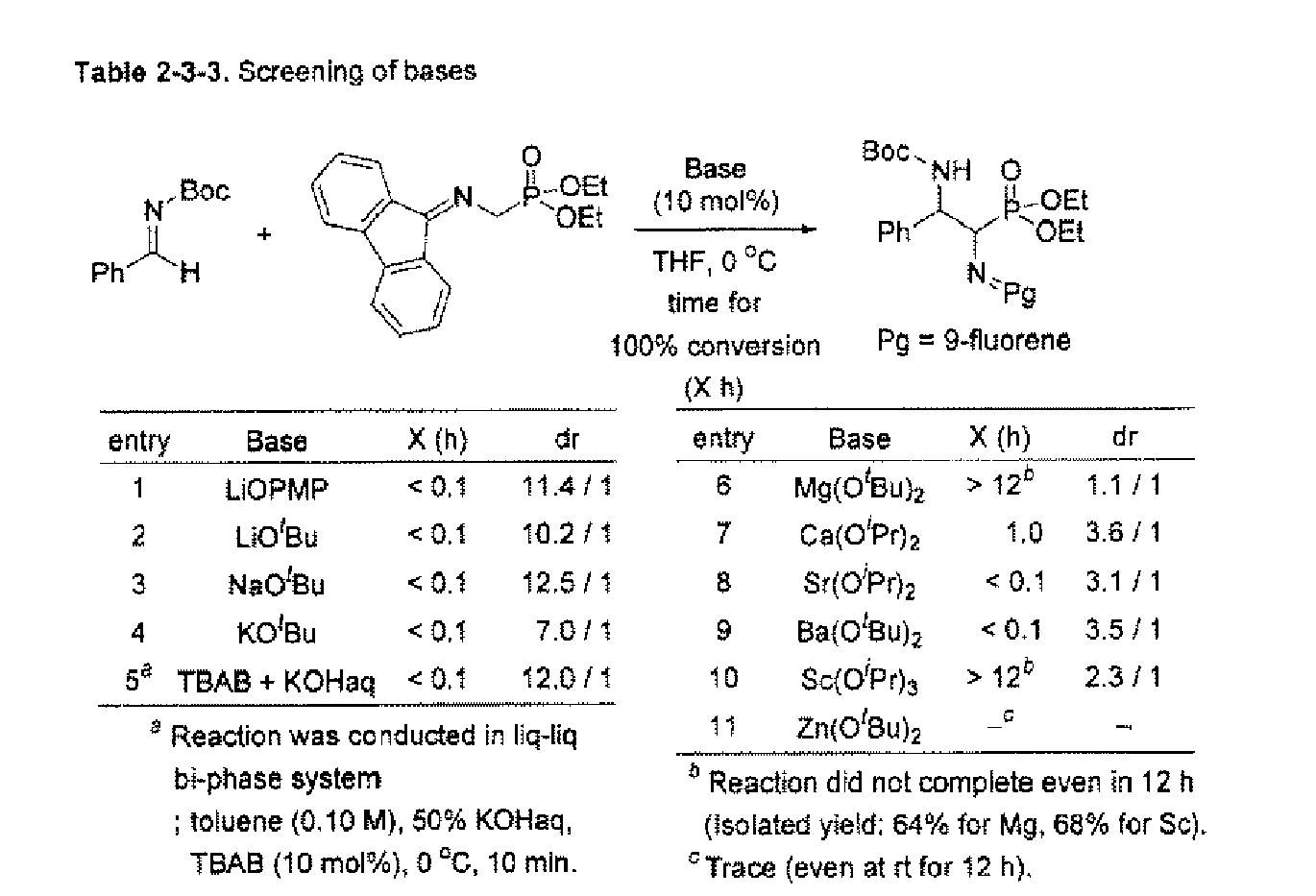
- Next, the catalysts were screened with a time (Xh) required until a conversion rate reaches 100% and the diastereoselectivity defined as a marker, respectively (Table 2-3-3). A large change in the selectivity by a counter anion of a lithium salt was not recognized (entries 1 and 2). When NaOtBu and the phase transfer catalyst were used, the diastereoselectivity was improved (entries 3 and 5). When various alkaline earth metals were used, the reaction progressed smoothly. However, the diastereoselectivity was low (entries 6 to 9). When Sc(OiPr)3 and Zn(OtBu)2 were used, the satisfactory result was not obtained (entries 10 and 11).
- So as to enhance the selectivity, the investigation was conducted by using the substrate (10b) having the bulky isopropylester (Table 2-3-4). When LiOPMP was used, the diastereoselectivity was improved remarkably (entry 4). When the reaction was conducted by using NaOtBu, at 0°C, the obtained adduct exhibited the high diastereoselectivity (entry 5). At - 20°C, the yield declined slightly (entry 6). The X-ray crystal structure analysis demonstrated that the syn-type product was a main product even with the reaction using 10b (Figure 2-3-3).
Table 2-3-4. Effect of ester group 
entry R base (mol%) T(°C) Yield (%) syn / anti 1 Et LiOPMP (10) 0 quant 11.4 / 1 2 Et LiOPMP(10) -78 82 23.0 / 1 3 Et NaOtBu (10) 0 94 12.5 / 1 4 'Pr LiOPMP (10) 0 quant 27.6 / 1 5 'Pr NaOtBu (2) 0 95 >50 / 1 6 'Pr NaOtBu (2) -20 86 >50 / 1 
- The substrate generality was investigated because the optimum conditions were obtained (Table 2-3-5). When the aromatic imine was used, the reaction progressed smoothly. And, the obtained target product showed the high yield/high diastereoselectivity. In the imines derived from the aliphatic aldehyde, the target product was obtained at an excellent yield when two equivalents of the imines as an electrophile were used.

- So as to show usefulness of the product, the investigation for removing the fluorenyl group was conducted. The deprotection was easily conducted under a mild acidic condition. For example, the deprotected product was obtained as a hydrochloride (Scheme 2-3-4). Additionally, the Boc group was not removed under this condition.

-

entry R t (h) yield (%) syn / anti 1 Ph 1 98 >50 / 1 2 p-MeOC6H4 16 91 >50 / 1 3 p-FC6H4 16 96 13.7 / 1 4 2-Furyl 1 99 28.4 / 1 5b Ph(CH2)2 16 84 4.0 / 1 a 1,1,3,3-Tetramethylguanidine. b 2.0 equiv of imine. 
entry R yield (%) syn / anti 1 Ph(CH2)2 98 9.1 / 1 2 Cyclohexyl quant 11.9 / 1 a Lithium p-methoxyphenoxide. 
entry Gly catalyst temp/°C time/h yield/% synlanti 1 1 Guanidinea -20 16 trace 2 2b Guanidine -20 1 98 >99/1 3 2a LiOPMP -20 0.5 quant >99/1 a1,1,3,3-Tetramethylguanidine. 
- The depressurized, dried, and heated reactor with a capacity of 10 mL was argon-substituted. This reactor was carried into a glove-box. And, ligand (0.018 mmol), molecular sieves 4A (50 mg), and Ca(OiPr)2 (0.015 mmol) were sequentially measured. After the reactor was taken out from the glove-box, the toluene (0.15 mL) was poured with a gastight syringe. Thereafter, it was stirred for two hours at room temperature. With this, the catalyst was prepared. After preparing the catalyst, a toluene solution (0.2 mL) of a fluoren protective tert-butylglycine ester (0.15 mmol) and a toluene solution (0.3 mL) of the Boc imine are sequentially added at 40°C with the gastight syringe. And, after the finishing of the reaction was confirmed with TLC (developing solvent: hexane/acetone=4/1), a saturated ammonium chloride aqueous solution (5 mL) was added, and the reaction was stopped. Thereafter, the extraction was conducted four times with methylene chloride (10 mL). It was dried over anhydrous sodium sulfate. After filtering, concentration under reduced pressure was conducted. The crude product obtained in such a manner was refined with a silica gel thin-layer chromatography, and the target product (α, β-diamino acid derivatives) was obtained.
- The yield was 78%. The diastereoselectivity was syn/anti=1.5/1. With the enantioselectivity, the syn-type product was obtained at rate of 71%. Additionally, the diastereoselectivity and the enantioselectivity were determined with HLPC.
1H NMR (CDCl3): δ : 1.45 (s, 9H), 1. 49 (s, 9H), 5. 20 (s, 1H), 5. 64 (d, J = 7.9 Hz, 1H), 6.37 (d, J = 7.9 Hz, 1H), 7,13-7.58 (m, 12H), 7.89 (d, J = 7.4 Hz, 1H).
13C NMR (CDCl3): δ : 27.9, 28.4, 56.7, 56.8, 68. 9, 79. 3, 82.8, 119. 3, 120.5, 123.1, 126.5, 127.0, 127.1, 127.8, 128.2, 128.4, 131.4, 131. 7, 131.8, 141.2, 144.0, 155.3, 166.8, 168.3.
HPLC Daicel Chiralpak AD-H, Hexane/ i PrOH = 4/1, Flow rate = 1.00mL/min, Detection wavelength = 254 nm: syn isomer: tR = 5.1 min (major), tR = 32.2 min (minor). anti isomer: tR = 6.7 min (major), tR = 11.3 min (minor). - It was synthesized in accordance with the foregoing Non-patent documents. The imine derived from the aliphatic aldehyde was also synthesized in accordance with the foregoing Non-patent documents. And, it was quickly used for the reactions.
-

- The fluorenone (4.0 g, 22.2 mmol) was stirred in an autoclave of 110°C for three days in an ammonia atmosphere (7 to 8 atm). After the reaction, it was allowed to dissolve in diethyl ether. And, hydrogen chloride was blown into it. It was stirred for one hour at room temperature. The obtained suspension was filtered, and the filtrate was cleaned with the diethyl ether. With this, fluorenone imine hydrochloride (3.4 g, 71%) was obtained. This hydrochloride was allowed to decompose with an ammonia aqueous solution. And, it was recrystallized by using the methylene chloride and hexane. And, Fluoren-9-ylideneamine (2.3 g, 58%) was obtained.
1H NMR (CDCl3): δ 7.31 (dt, J = 1.1, 7.4 Hz, 2H), 7.44 (dt, J = 1.1, 7.4 Hz, 2H), 7.54 (d, J = 7.4 Hz, 2H), 7.73 (br d, J = 7.4 Hz, 2H), 10.3 (s,1H).
13C NMR (CDCl3): δ 120.1, 122.2, 128.20, 132.19, 132.20, 142.2, 173.2. - The fluorenone imine (1.52 g, 8.48 mmol) and the glycine tert-butylester hydrochloride (1.42 g, 8.48 mmol) were stirred in the methylene chloride for five hours at room temperature. The reaction solution was filtered with celite, and the solvent was removed by the distillation under reduced pressure. The obtained residual was allowed to dissolve in the diethyl ether. And, it was filtered with the celite. The obtained ether solution was cleaned with water and a saturated sodium chloride aqueous solution. And, it was dried over sodium sulfate. After the filtering and the concentration under reduced pressure were conducted, the obtained crude product was refined with the diethyl ether/hexane (recrystallization). And, (Fluoren-9-ylideneamino)-acetic acid tert-butyl ester (1.18 g, 66%) was obtained.
-

IR(KBr): 2981, 1751, 1605, 1606, 1451, 1143 cm-1. 1H NMR (CDCl3): δ 1.54 (s, 9H), 4.87 (s, 2H), 7.27-7.31 (m, 2H), 7.39-7.45 (m, 2H), 7.56 (d, J = 7.4 Hz, 1H), 7.65 (d, J = 7.4 Hz, 1H), 7.75 (d, J = 7.9 Hz,
1H), 7.90 (d, J = 7.4 Hz, 1H),
13C NMR (CDCl3): δ 28.15, 28.16, 55.6, 81.6, 119.3, 120.5, 123.1, 127.3, 128.0, 128.4, 131.2, 131.7, 131.9, 141.1, 143.9, 165.5, 170.0.
ESI-HRMS mlz calcd for C19H19NO2: 294.1494 [M+H]+; found:294.1475. Anal. Calcd for C19H19NO2: C, 77.79; H, 6.53; N, 4.77. found: C, 77.66; H, 6.64; N, 4.74. - Likewise, (Fluoren-9-ylideneamino)-acetic acid methyl ester was obtained.
-

IR(KBr): 3052, 2951, 1726, 1448, 1268, 1013 cm-1.
1H NMR (CDCl3): δ 3.86 (s, 3H), 4.96 (s, 2H), 7.26-7.31 (m, 2H), 7.41 (t, J = 7.6 Hz, 1H), 7.45 (t, J = 7.6 Hz, 1H), 7.55 (d, J = 7.6 Hz, 1H), 7.65 (d, J = 7.6 Hz, 1H), 7.73 (d, J = 7.6 Hz, 1H), 7.88 (d, J = 7.6 Hz, 1H).
13C NMR (CDCl3): δ 52.3, 55.0, 119.4, 120.6, 123.1, 127.2, 128.1, 131.3, 131.7, 131.8, 137.9, 141.1, 143.9, 165.6, 171.0.
ESI-HRMS m/z calcd for C16H13NO2: 252.1025 [M+H]+; found:252.1020. Anal. Calcd for C6H13NO2: C, 76.48; H, 5.21; N, 5.57. found: C, 76.29; H, 5.36; N, 5.39 - A THF solution (0.40 mL) of the glycine Schiff base (58.7 mg, 0.2 mmol) was stirred at - 20°C. A solution (0.1 mL) containing THF and tetramethylguanidine (tetramethylguanidine:THF=6.2 mmol:1.0 mL), and a THF solution (0.50 mL) of the imine (49.3 mg, 0.24 mmol) were sequentially added. And, the stirring-up was conducted for one hour with the temperature kept at -20°C. Thereafter, a saturated ammonium chloride aqueous solution was added, and the reaction was stopped. Thereafter, the temperature was raised (to the room temperature). The extraction from the water phase was carried out with the methylene chloride three times. And, the organic phase was collected, and dried over anhydrous sodium sulfate. After the filtering and the concentration under reduced pressure, the obtained crude product was refined with the thin-layer silica gel chromatography (hexane/acetone=4/1). With this, the target product was obtained. The diastereomer ratio was determined with the HPLC analysis.
-

IR(KBr): 3441, 2976, 1718, 1492, 1171 cm-1.
1H NMR (CDCl3): δ 1.46 (s, 9H), 3.78 (s, 3H), 5.32 (s, 1H), 5.62 (d, J = 7.6 Hz, 1H), 6.35 (d, J = 6.2 Hz, 1H), 7.14-7.26 (m, 4H), 7.31-7.45 (m, 6H), 7.52 (d, J = 7.6 Hz, 1H), 7.58 (d, J = 7.6 Hz, 1H), 7.90 (d, J = 7.6 Hz, 1H).
13C NMR (CDCl3): δ 28.3, 28.37, 28.43, 52.7, 56.87, 56.90, 68.3, 79.6, 119.4, 120.6, 123.2, 126.5, 126.9, 127.3, 128.1, 128.3, 128.4, 128.4, 131.56, 131.61, 131.9, 138.0, 141.21, 141.23, 144.1, 155.4, 167.1, 170.2.
FAB-HRMS m/z calcd for C28H28N2O4: 457.2127 [M+H]+; found: 457.2146. Anal. Calcd for C28H28N2O4: C, 73.66; H, 6.18; N, 6.14. found: C, 73.54; H, 6.28; N, 6.05.
HPLC (Daicel Chiralcel AD-H, hexane/iPrOH = 4/1, flow rate = 1.00 mL/min) syn isomer: tR = 5.5 min (minor), tR = 21.0 min (major). Anti isomer: tR = 8.6 min, tR = 12.7 min. -

IR(KBr): 3425, 2976, 1714, 1495, 1169 cm-1.
1H NMR (CDCl3): δ 1.48 (s, 9H), 1.82-1.85 (m, 1H), 1.88-1.92 (m, 1H), 2.65-2.70 (m, 1H), 2.74-2.79 (m, 1H), 3.72 (s, 2H), 4.49-4.51(m, 1H), 5.09 (s, 1H), 5.61 (d, J = 10.3 Hz, 1H), 7.10-7.32 (m, 7H), 7.42 (t,
J = 7.6 Hz, 2H), 7.53 (d, J = 7.6 Hz, 1H), 7.56 (d, J = 7.6 Hz, 1H), 7.64 (d, J = 7.6 Hz, 1H), 7.88 (d, J = 6.9 Hz, 1H).
13C NMR (CDCl3): δ 28.4, 32.6, 35.6, 52.5, 53.4, 66.7, 119.4, 120.6, 123.2, 125.8, 126.6, 128.2, 128.3, 128.4, 131.6, 131.9, 138.1, 141.6, 155.8, 170.6. FAB-HRMS m/z calcd for C30H32N2O4: 485.2440 [M+H]+; found:485.2438. -

IR(KBr): 3426, 2927, 1730, 1429, 1171 cm-1.
1H NMR (CDCl3): δ 1.08 (m ,6H), 1.46 (s, 9H), 1.57-1.95 (m, 5H), 3.72 (s, 3H), 4.16 (t, J = 10.0 Hz, 1H), 5.31 (s, 1H), 5.62 (d, J = 10.3 Hz, 1H), 7.26 (d, J = 7.2 Hz, 1H), 7.32 (d, J = 7.2 Hz, 1H), 7.42-7.45 (m, 2H), 7.55-7.58 (m, 2H), 7.65 (d, J = 7.6 Hz, 1H), 7.88 (d, J = 6.9 Hz, 1H).
13C NMR (CDCl3): δ 26.0, 26.2, 28.4, 29.66, 29.72, 40.2, 52.4, 58.1, 64.1, 79.0, 119.4, 120.6, 123.3, 126.5, 128.3, 128.4, 131.5,131.6, 131.9, 138.1, 141.3, 144.1, 156.0, 166.6, 171.1.
FAB-HRMS m/z calcd for C28H34N2O4: 463.2597 [M+H]+; found:463.2617. -

IR(KBr): 3435, 2974, 1737, 1713, 1490, 1146 cm-1.
1H NMR (CDCl3): δ 1.45 (s, 9H), 1.49 (s, 9H), 5.20 (s, 1H), 5.64 (d, J = 7.9 Hz, 1H), 6.37 (d, J = 7.9 Hz, 1H), 7.13-7.58 (m ,12H), 7.89 (d, J = 7.4 Hz, 1H).
13C NMR (CDCl3): δ 27.9, 28.4, 56.7, 56.8, 68.9, 79.3, 82.8, 119.3, 120.5, 123.1, 126.5, 127.0, 127.1, 127.8, 128.2, 128.4, 131.4, 131.7, 131.8, 138.1, 141.2, 144.0, 155.3, 166.8, 168.3.
ESI-HRMS m/z calcd for C31H34N2O4: 499.2597 [M+H]+; found:499.2599. Anal. Calcd for C31H34N2O4: C, 74.67; H, 6.87; N, 5.62. found: C, 74.54; H, 7.01; N, 5.51.
HPLC (Daicel Chiralcel AD-H, hexane/iPrOH = 4/1, flow rate = 1.00 mL/min) syn isomer: tR = 5.1 min (minor), tR = 32.2 min (major). Anti isomer: tR = 6.7 min , tR = 11.3 min. -

IR(KBr): 3442, 2977, 1719, 1491, 1164 cm-1.
1H NMR (CDCl3): δ 1.44 (s, 9H), 1.48 (s, 9H), 3.70 (s, 3H), 5.17 (s, 1H), 5.58 (d, J = 6.9 Hz, 1H), 6.32 (d, J = 6.2 Hz, 1H), 6.76 (d, J = 8.9 Hz, 2H), 7.18 (t, J = 7.6 Hz, 1H), 7.30-7.59 (m, 8H), 7.90 (d, J = 7.6 Hz, 1H),
13C NMR (CDCl3): δ 22.7, 27.76, 27.80, 28.1, 28.4, 55.16, 55.23, 56.2, 69.1, 79.3, 82.7, 113.5, 113.6, 119.3, 120.5, 123.1, 126.6, 127.9, 128.0, 128.2, 128.4, 131.4, 131.8, 141.2, 144.0, 155.2, 158.7, 166.8, 168.4.
ESI-HRMS m/z calcd for C32H36N2O5: 529.2702 [M+H]+; found:529.2694. -

IR(KBr): 3445, 2979, 1722, 1490, 1158 cm-1.
1H NMR (CDCl3): δ 1.45 (s, 9H), 1.48 (s, 9H), 5.16 (s, 1H), 5.60 (d, J = 6.9 Hz, 1H), 6.34 (d, J = 6.9 Hz, 1H), 6.92 (t, J = 8.6 Hz, 2H), 7.17-7.60 (m, 9H), 7.88 (d, J = 7.6 Hz, 1H).
13C NMR (CDCl3): δ 27.9, 28.2, 28.4, 56.2, 68.9, 79.5, 82.9, 115.0, 115.1, 119.4, 120.6, 123.0, 126.5, 127.9, 128.4, 128.6, 128.7, 131.5, 131.7, 131.9, 137.0, 138.0, 141.2, 144.1, 155.2, 161.2, 162.8, 167.0, 168.2.
ESI-HRMS m/z calcd for C31H33N2O4: 517.2503 [M+H]+; found:517.2499. -

IR(KBr): 3400, 2978, 1718, 1492, 1149 cm-1.
1H NMR (CDCl3): δ 1.47 (s, 9H), 1.48 (s, 9H), 5.45 (s, 1H), 5.73 (d, J = 8.9 Hz, 1H), 6.08 (d, J = 8.2 Hz, 1H), 6.18 (t, J = 6.9 Hz, 2H), 7.21-7.26 (m, 9H), 7.83 (d, J = 7.6 Hz, 1H).
13C NMR (CDCl3): δ 27.9, 28.4, 51.9, 66.4, 79.6, 82.9, 106.6, 110.3, 119.3, 120.5, 123.2, 126.7, 128.0, 128.3, 131.4, 131.8, 138.1, 141.2, 141.7, 144.1, 154.0, 155.2, 166.8, 167.8.
FAB-HRMS m/z calcd for C29H32N2O5: 489.2389 [M+H]+; found:489.2421. -

IR(KBr): 3430, 2978, 1721, 1492, 1167 cm-1.
1H NMR (CDCl3): δ 1.47 (s, 18H), 1.81 (t, J = 5.2 Hz, 1H), 1.91 (t, J = 5.2 Hz, 1H), 2.70 (q, J = 5.5 Hz, 1H), 2.74 (t, J = 5.3 Hz, 1H), 4.56 (d, J = 5.5 Hz, 1H), 4.98 (d, J = 1.1 Hz, 1H), 5.70 (t, J = 9.6 Hz, 1H), 7.31 (m, 7H), 7.40-7.43 (m, 2H), 7.53-7.56 (m, 2H), 7.64 (d, J = 7.6 Hz, 1H), 7.88 (d, J = 7.6 Hz, 1H).
13C NMR (CDCl3): δ 27.9, 28.3, 28.4, 32.6, 36.2, 53.3, 6.2, 79.0, 82.5, 119.3, 120.5, 123.2, 125.7, 126.6, 127.9, 128.3, 128.35, 128.43, 128.47, 131.4, 131.7, 131.8, 138.1, 141.2, 141.9, 144.1, 155.6, 166.8, 168.7.
ESI-HRMS m/z calcd for C33H38N2O4: 527.2910 [M+H]+; found: 527.2936. -


entry R1 temp/°C time/h yield/% syn/anti ee (syn) 1 Ph -45 12 quant >99/1 96 (2S,3R) 2 Ph -60 12 quant >99/1 95 (2S,3R) 3 p-MeOC6H4 -45 48 76 36/1 90 4 2-Furyl -45 36 88 9/1 98 5 Ph(CH2)2 -45 24 87 29/1 92 6 c-C6H11 -45 48 84 11/1 96 - Chiral guanidine derivatives (8.0 mg, 0.020 mmol) and a toluene solution (0.60 mL) of the glycine Schiff base (58.7 mg, 0.20 mmol) were stirred at -45°C. A toluene solution (0.40 mL) of the imine (49.3 mg, 0.24 mmol) was added during this stirring-up. And, the stirring-up was conducted for 16 hours at -45°C. Thereafter, the saturated ammonium chloride aqueous solution was added, and the reaction was stopped. And, the temperature was raised (to the room temperature). Thereafter, the extraction from the water phase was carried out with the methylene chloride three times. And, the organic phase was collected, and dried by using the anhydrous sodium sulfate. After the filtering and the concentration under reduced pressure, the obtained crude product was refined with the thin-layer silica gel chromatography (hexane/acetone=4/1). With this, the target product was obtained. The diastereomer ratio was determined with the HPLC analysis.
-


entry GlyP R1 catalyst (mol%) yield/% syn/antib 1 3a Ph NaO t Bu (10) 94 13/1 2 3b Ph NaO t Bu (2) 95 >99/1 3 3b o-MeC6H4 NaO t Bu (2) 99 >99/1 4 3b m-vinylC6H4 NaO t Bu (2) quant >99/1 5 3b 2-Furyl NaO t Bu (2) quant 23/1 6 3b 2-Thienyl NaO t Bu (2) quant 33/1 7 3b Ph(CH2)2 NaO t Bu (2) 88 >99/1 8 3b C-C6H11 NaO t Bu (2) quant >99/1 - Fluorene imine hydrochloride (5.0 g, 46.7 mmol) and aminomethyl phosphonic acid ester (7.8 g, 46.7 mmol) were stirred in the methylene chloride for 24 hours at room temperature. The reaction solution was filtered with the celite. Thereafter, the solvent was removed by the distillation under reduced pressure. The obtained residual was allowed to dissolve in the diethyl ether. And, it was filtered with the celite. The obtained ether solution was cleaned with water and a saturated sodium chloride aqueous solution. And, it was dried over the sodium sulfate. After the filtering and the concentration under reduced pressure, the obtained crude product was refined with a neutral silica gel column chromatography (hexane/acetone=4/1). (Fluoren-9-ylideneaminomethyl)-phosphonic acid diethyl ester (6.3 g, 61%) was obtained with the cleaning by the hexane.
-

IR(KBr): 2979, 1646, 1452, 1243, 1031, 974 cm-1.
1H NMR (CDCl3): δ 1.35 (t, J = 7.1 Hz, 6H), 4.27 (m, 4H), 4.71 (d, J = 16.4 Hz, 2H), 7.22-7.30 (m, 2H), 7.40-7.44 (m, 2H), 7.56 (d, J = 7.4 Hz, 1H), 7.65 (d, J = 7.4 Hz, 1H), 7.79 (d, J = 7.4 Hz, 1H), 7.91 (d, J = 7.9 Hz, 1H).
13C NMR (CDCl3): δ 16.5, 16.6, 50.1, 51.4, 62.7, 62.8, 119.3, 120.5, 122.9, 127.46, 127.48, 128.1, 128.4, 131.2, 131.7, 131.8, 138.2, 138.3, 141.0, 143.9, 166.1, 166.2.
31P NMR (CDCl3 H3PO4 δ 0.00): δ 22.7
ESI-HRMS m/z calcd for C18H20NO3P: 330.1259 [M+H]+; found:330.1251. -

IR(KBr): 2986, 1648, 1602, 1450, 1221, 987 cm-1.
1H NMR (CDCl3): δ 1.34-1.37 (m, 12H), 4.66 (d, J = 16.5 Hz, 2H), 4.87-4.90 (m, 2H), 7.29 (t, J = 7.6 Hz, 2H), 7.40 (t, J = 7.6 Hz, 1H), 7.44 (t, J = 7.6 Hz, 1H), 7.56 (d, J = 7.6 Hz, 1H), 7.65 (d, J = 7.6 Hz, 1H), 7.79 (d, J = 7.6 Hz, 1H), 7.93 (d, J = 8.2 Hz, 1H).
13C NMR (CDCl3): δ 24.0, 24.1, 24.18, 24.20, 50.8, 51.9, 71.29, 71.33, 119.3, 120.4, 122.9, 127.5, 128.0, 128.3, 131.1, 131.7, 131.8, 138.4, 141.0, 143.8, 165.8, 165.9.
31P NMR (CDCl3 H3PO4 δ 0.00): δ 21.0
ESI-HRMS m/z calcd for C20H24NO3P:358. 1572 [M+H]+; fond:358.1567. -

IR(KBr): 2982, 1635, 1325 cm-1.
1H NMR (CDCl3): δ 1.35 (t, J = 7.2 Hz, 3H), 3.92 (d, J = 17.9 Hz, 2H), 4.18-4.20 (m, 4H), 7.41 (d, J = 7.6 Hz, 2H), 7.61 (d, J = 8.2 Hz, 2H), 7.72 (d, J = 8.2 Hz, 2H), 7.79 (d, J = 8.2 Hz, 2H).
13C NMR (CDCl3): δ 16.3, 16.39, 16.43, 16.51, 16.54, 16.6, 51.2, 51.3, 52.4, 62.37, 62.42, 62.5, 62.6, 62.68, 62.71, 122.9, 125.1, 125.2, 125.9, 128.4, 128.5, 128.6, 128.8, 131.2, 132.2, 132.4, 138.3, 141.6, 169.1, 169.2.
31P NMR (CDCl3 H3PO4 δ 0.00): δ 22.5
ESI-HRMS m/z calcd for C32H38FN2O5P: 581.2575 [M+H]+; found:581.2570. -

Bp: 115 °C (0.30 mmHg).
1H NMR (CDCl3): δ 7.53-7.84 (m, 8H), 10.1 (s, 1H).
13C NMR (CDCl3): δ 123.8 (q, J = 278.9 Hz), 125.4, 125.9, 127.9, 129.5, 132.2-132.9 (m), 140.9, 142.9, 175.9. - A THF solution (0.4 mL) of the glycine Schiff base phosphorus analogues (0.2 mmol) was stirred at 0°C under an argon atmosphere. A solution (0.1 mL) containing THF and NaOtBu (NaOtBu:THF=0.04 mmol:1.0 mL), and a THF solution (0.50 mL) of the imines (0.24 mmol) were sequentially added. The stirring-up was conducted for 10 minutes at 0°C. Thereafter, the reaction was stopped by adding a saturated ammonium chloride aqueous solution. And, the temperature was raised (to the room temperature). The extraction from the water phase was carried out with the methylene chloride three times. And, the organic phase was collected, and dried by using the anhydrous sodium sulfate. After the filtering and the concentration under reduced pressure, the obtained crude product was refined with the thin-layer silica gel chromatography (hexane/acetone=2/1). With this, the target product was obtained. The diastereomer ratio was determined with a 31P-NMR ratio.
-

IR(KBr): 2976, 1713, 1250, 1171, 1018 cm-1.
1H NMR (DMSO-d6) syn isomer: δ 0.97(t, J = 7.2 Hz, 3H), 1.03 (t, J = 7.2 Hz, 3H), 1.32 (s, 9H), 3.79-3.89 (m, 3H), 3.91-3.94 (m, 1H), 5.37-5.43 (m, 2H), 7.15 (t, J = 7.2 Hz, 1H), 7.24 (t, J = 7.9 Hz, 3H), 7.32-7.36 (m, 2H), 7.39-7.40 (m, 2H), 7.47-7.50 (m, 2H), 7.76 (d, J = 6.9 Hz, 1H), 7.83 (d, J = 7.6 Hz, 1H), 7.86 (t, J = 6.9 Hz, 2H).
anti isomer: δ 1.07-1.10 (m, 6H), 1.37 (s, 9H), 3.92-4.01 (m, 4H), 5.33 (d, J = 11.0 Hz, 1H), 5.53-5.56 (m, 1H), 7.02 (t, J = 7.2 Hz, 1H), 7.10 (t, J = 7.9 Hz, 2H), 7.28 (t, J = 7.2 Hz, 1H), 7.36 (t, J = 8.2 Hz, 3H), 7.42 (t, J = 7.6 Hz, 1H), 7.47-7.52 (m, 2H), 7.61 (d, J = 8.9 Hz, 1H), 7.70 (d, J = 7.6 Hz, 1H), 7.79 (d, J = 7.6 Hz, 1H), 8.08 (d, J = 7.6 Hz, 1H).
13C NMR (DMSO-d6) syn isomer: δ 15.89, 15.91, 27.9, 28.1, 55.8, 61.77, 61.81, 62.09, 62.13, 64.4, 65.3, 77.9, 119.7, 120.5, 122.7, 126.9, 127.1, 127.3, 127.7, 127.8, 127.9, 128.1, 128.3, 131.1, 131.5, 131.8, 137.6, 140.2, 141.08, 141.12, 143.1, 154.6, 164.5, 164.6.
anti isomer (detectable peaks): δ 16.0, 28.1, 56.1, 59.1, 61.88, 61.92, 62.1, 62.2, 63.3, 63.9, 64.3, 72.8, 77.8, 81.1, 119.7, 120.6, 122.1, 126.7, 127.3, 127.7, 128.1, 128.3, 131.1, 131.3, 131.7, 137.5, 140.0, 142.3, 154.3.
31P NMR (DMSO-d6 H3PO4 δ 0.00): δ 20.5 (major), 21.1 (minor) FAB-HRMS m/z calcd for C30H36N2O5P: 535.2362 [M+H]+; found:535.2372. Anal. Calcd for C30H35N2O5P: C, 67.40; H, 6.60; N, 5.24. found: C, 65.43; H, 6.91; N, 4.61. -

IR(KBr): 3428, 2979, 1724, 1488, 987 cm-1.
1H NMR (DMSO-d6): δ 0.92 (d, J = 5.5 Hz, 3H), 1.09-1.15 (m, 9H), 1.33 (s, 9H), 4.42-4.48 (m, 2H), 5.31 (dd, J = 5.5, 15.1 Hz, 2H), 5.42 (d, J = 6.2 Hz, 1H), 7.10-7.15 (m, 2H), 7.72 (t, J = 7.6 Hz, 2H), 7.30-7.38 (m ,4H), 7.46-7.49 (m, 2H), 7.76 (d, J = 7.6 Hz, 1H), 7.77-85 (m, 3H).
13C NMR (DMSO-d6): δ 23.15, 23.19, 23.23, 23.7, 23.8, 27.9, 28.1, 55.9, 64.6, 65.6, 70.57, 70.62, 70.66, 70.71, 77.8, 119.7, 120.5, 122.6, 126.8, 127.2, 127.3, 127.7, 127.8, 127.97, 128.04, 128.3, 131.2, 131.4, 131.8, 137.6, 140.2, 141.27, 141.31, 143.1, 154.5, 164.5, 164.6.
31P NMR (DMSO-d6 H3PO4 δ 0.00): δ 18.6 (major), 19.7 (minor) ESI-HRMS m/z calcd for C32H39N2O5P: 563.2669 [M+H]+; found:563.2638. Anal. Calcd for C32H39N2O5P: C,68.31; H, 6.99; N, 4.98. fond: C, 68.27; H, 7.11; N, 4.88. -

IR(KBr): 3436, 2978, 1717, 987 cm-1.
1H NMR (DMSO-d6): δ 0.92 (d, J = 6.2 Hz, 3H), 1.10-1.15 (m, 9H), 1.32 (s, 9H), 3.65 (s, 3H), 4.42-4.49 (m, 2H), 5.27 (dd, J = 5.5, 15.1 Hz, 1H), 5.37 (d, J = 6.2 Hz, 1H), 6.79 (d, J = 8.2 Hz, 2H), 7.08 (d, J = 8.9 Hz, 1H), 7.27-7.37 (m, 4H), 7.46-7.50 (m, 2H), 7.76-7.86 (m, 4H).
13C NMR (DMSO-d6): δ 23.3, 23.8, 23.9, 28.2, 54.9, 55.3, 64.9, 65.9, 70.6, 70.69, 70.74, 77.8, 112.7, 113.3, 119.8, 120.6, 122.6, 128.1, 128.4, 128.5, 131.3, 131.5, 131.8, 133.4, 137.7, 140.2, 143.2, 154.6, 158.2, 164.46, 164.55.
31P NMR (DMSO-d6 H3PO4 δ 0,00): δ 18.8 (major), 19.8 (minor) ESI-HRMS m/z calcd for C33H41N2O6P: 593.2775 [M+H]+; found:593.2788. - [2-tert-Butoxycarbonylamino-1-(fLuoren-9-ylideneamino)-2-(4-fluoro-phenyl)-ethyl]-phosphonic acid diisopropyl ester

IR(KBr): 3435, 2979, 1717, 1489, 986 cm-1.
1H NMR (DMSO-d6): δ 0.89-1.15 (m, 12H), 1.15 (s, 9H), 4.42-4.48 (m, 2H), 5.28-5.41 (m, 1H), 5.42 (d, J = 6.9 Hz, 1H), 7.06-7.09 (m, 2H), 7.19 (d, J = 11.1 Hz, 1H), 7.32-7.51 (m, 6H), 7.77-7.86 (m, 4H).
13C NMR (DMSO-d6): δ 23.18, 23.24, 23.7, 23.8, 28.1, 55.6, 64.7, 65.7, 70.6, 70.79, 70.83, 77.9, 114.5, 114.6, 119.8, 120.6, 122.6, 128.1, 128.4, 129.56, 129.61, 131.3, 131.5, 131.9, 137.5, 137.7, 140.2, 143.2, 154.6, 160.5, 162.1, 164.6, 164.7.
31P NMR (DMSO-d6 H3PO4 δ 0.00): δ 8.6 (major), 19.4 (minor) ESI-HRMS m/z calcd for C32H38FN2O5P: 581.2575 [M+H]+; found:581.2570. -

IR(KBr): 3437, 2978, 1717, 1489, 958 cm-1.
1H NMR (DMSO-d6): δ 0.93 (d, J = 5.5 Hz, 3H), 1.10-1.16 (m, 9H), 1.33 (s, 9H), 2.19 (s, 3H), 4.43-4.49 (m, 2H), 5.28 (dd, J = 5.5, 14.4 Hz, 1H), 5.38 (d, J = 6.2 Hz, 1H), 6.94 (d, J = 7.6 Hz, 1H), 7.06-7.19 (m ,4H), 7.30-7.37 (m, 2H), 7.46-7.49 (m, 2H), 7.76 (d, J = 7.6 Hz, 1H), 7.81-7.85 (m, 3H).
13C NMR (DMSO-d6): δ 21.0, 23.3, 23.7, 23.9, 28.2, 55.9, 64.6, 65.6, 70.7, 77.9, 119.8, 120.6, 122.6, 124.3, 127.5, 127.8, 128.0, 128.1, 128.2, 128.4, 131.2, 131.5, 131,8, 136.7, 137.7, 140.2, 141.3, 143.1, 154.6, 164.5 164.6.
31P NMR (DMSO-d6 H3PO4 δ 0.00): δ 18.7 (major), 19.8 (minor) ESI-HRMS m/z calcd for C33H41N2O5P: 577.2826 [M+H]+; fond:577.2832. -

IR(KBr): 3435, 2978, 1716, 1488, 984 cm-1.
1H NMR (DMSO-d6): δ 0.90 (d, J = 5.5 Hz, 3H), 1.10-1.24 (m, 9H), 1.33 (s, 9H), 4.43-4.50 (m ,2H), 5.21 (dd, J = 5.2, 14.8 Hz, 1H), 5.74-5.76 (m, 1H), 6.99-7.03 (m, 2H), 7.08-7.11 (m, 2H), 7.29-7.38 (m, 3H), 7.46-7.50 (m, 2H), 7.73-7.88 (m, 4H).
13C NMR (DMSO-d6): δ 19.1, 23.3, 23.7, 23.9, 28.2, 51.4, 63.4, 64.4, 70.7, 70.8, 77.9, 119.8, 120.6, 122.7, 125.5, 126.7, 127.2, 127.8, 128.2, 128.5, 129.8, 131.3, 131.6, 131.9, 134.5, 137.7, 140.0, 140.3, 143.2, 154.7, 164.86, 164.94.
31P NMR (DMSO-d6 H3PO4 δ 0.00): δ 18.7 (major), 20.1 (minor) ESI-HRMS m/z calcd for C33H41N2O5P: 577.2826 [M+H]+; found:577.2843. -

IR(KBr): 3430, 2979, 1719, 1489, 986 cm-1,
1H NMR (DMSO-d6): δ 0.93 (d, J = 6.2 Hz, 3H), 1.14-1.15 (m, 9H), 1.33 (s, 9H), 4.42-4.50 (m, 2H), 5.18 (d, J = 11.0 Hz, 1H), 5.31 (dd, J = 5.5, 15.1 Hz, 1H), 5.40-5.42 (m, 1H), 5.71 (d, J = 17.9 Hz, 1H), 6.63 (dd, J = 11.0, 17.2 Hz, 1H), 7.15-7.24 (m, 3H), 7.28-7.36 (m ,3H), 7.46-7.51 (m, 3H), 7.75-7.88 (m, 4H).
13C NMR (DMSO-d6): δ 23.2, 23.6, 23.7, 28.1, 55.8, 64.5, 65.5, 70.57, 70.63, 70.7, 77.8, 114.0, 119.7, 120.5, 122.6, 124.9 , 125.2, 126.9, 128.0, 128.1, 128.3, 131.2, 131.4, 131.8, 136.5, 137.6, 140.1, 141.5, 141.6, 143.1, 154.6, 164.5, 164.6.
31P NMR (DMSO-d6 H3PO4 δ 0.00): δ 18.6 (major)
ESI-HRMS m/z calcd for C34H41N2O5P: 589.282[M+H]+; found:589.2840. -

IR(KBr): 3437, 2979, 1719, 1491, 987 cm·1.
1H NMR (DMSO-d6): δ 1.00(d, J = 6.2 Hz, 3H), 1.15-1.28 (m, 9H), 1.34 (s, 9H), 4.49-4.52 (m, 2H), 5.41 (dd, J = 5.2, 14.8 Hz, 1H), 5.50 (br s, 1H), 6.17 (d, J = 2.7 Hz, 1H), 6.28 (t, J = 2.4 Hz, 1H), 7.01 (d, J = 8.9 Hz, 1H), 7.32-7.39 (m ,2H), 7.47-7.53 (m, 3H), 7.77-7.78 (m, 2H), 7.86 (d, J = 7.6 Hz, 1H), 7.91 (d, J = 8.2 Hz, 1H).
13C NMR (DMSO-d6): δ 22.6, 23.3, 23.4, 23.7, 23.8, 28.0, 50.0, 62.2, 63.2, 70.7, 70.71, 70.84, 70.9 ,78.0, 106.7, 110.3, 119.8, 120.6, 122.7, 127.9, 128.2, 128.3, 131.2, 131.5, 131.9, 137.6, 140.2, 141.8, 143.2, 153.4, 153.46, 153.50, 154.6, 164.7, 164.8.
31P NMR (DMSO-d6 H3PO4 δ 0.00):δ 18.0 (major), 19.3 (minor) ESI-HRMS mlz calcd for C30H37N2O6P: 653.2462[M+H]+; found:553.2480. -
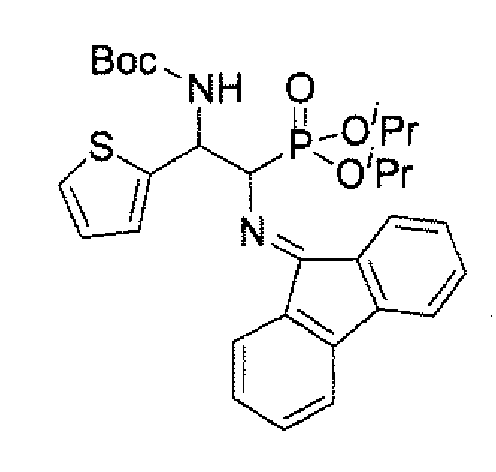
IR(KBr): 3437, 1719, 1491, 987cm-1.
1H NMR (DMSO-d6): δ 1.03(d, J = 6.2 Hz, 3H), 1.16-1.20 (m, 9H), 1.38 (s, 9H), 4.51-4.55 (m, 2H), 5.44 (dd, J = 4.1, 15.8 Hz, 1H), 5.67 (br d, J = 3.4 Hz, 1H), 6.84-6.86 (m, 1H ), 7.00 (d, J = 4.1 Hz, 2H), 7.25 (d, J = 4.8 Hz, 1H), 7.32-7.37 (m ,2H), 7.47-7.51 (m, 2H), 7.77 (d, J = 7.6 Hz, 1H), 7.82-7.85 (m, 2H), 7.98 (d, J = 8.2 Hz, 1H).
13C NNIR (DMSO-d6): δ 23.4, 23.8, 23.9, 28.1, 51.4, 64.3, 65.3, 70.9, 70.91, 71.00, 71.05, 78.3, 119.9, 120.6, 122.8, 124.7, 124.8, 126.5, 128.2, 128.5, 131.2, 131.7, 132.1, 137.6, 140.3, 143.3, 145.2, 145.3, 154.5, 165.1, 165.2.
31P NMR (DMSO-d6 H3PO4 δ 0.00): δ 17.9 (major), 19.0 (minor) ESI-HRMS m/z calcd for C30H37N2O5PS: 569.2234[M+H]+; fond:569.2237. -

IR(KBr): 3292, 2978, 1711, 990 cm-1.
1H NMR (DMSO-d6): δ 1.01 ((d, J = 6.2 Hz, 3H), 1.16-1.21 (m, 9H), 1.30 (s, 9H), 1.79 (br, 1H), 2.01 (br, 1H), 2.01 (br, 1H), 2.63 (br, 1H), 4.21 (s, 1H), 4.55 (d, J = 5.5 Hz, 2H), 5.10 (d, J = 6.6 Hz, 3H), 6.45 (d, J = 8.9 Hz, 1H), 7.12-7.53 (m, 9H), 7.73 (d, J = 7.6 Hz, 1H), 7.78 (d, J = 7.6 Hz, 1H), 7.87 (d, J = 7.6 Hz, 1H), 8.04 (d, J = 8.2 Hz, 1H).
13C NMR (DMSO-d6): δ 23.36, 23.41, 23.8, 23.9, 28.0, 28.1, 28.2, 28.3, 31.9, 34.5, 51.8, 51.9, 70.6, 70.7, 70.8, 77.5, 99.4, 119.7, 119.80, 120.6, 122.6, 122.7, 125.5, 125.7, 128.07, 128.12, 128.30, 128.33, 131.2, 131.3, 131.8, 131.9, 137.8, 140.3, 141.7, 143.2, 155.1, 164.0, 164.1.
31P NMR (DMSO-d6 H3PO4 δ 0.00):δ 19.6 (major)
ESI-HRMS m/z calcd for C34H43N2O5P: 591.2982[M+H]+; found:591.2992. -

IR(HBr): 3438, 2978, 1716, 1492, 986 cm-1.
1H NMR (DMSO-d6): δ 0.85-1.69 (m, 32H), 4.12-4.17 (m, 1H), 4.51-4.58 (m, 2H), 5.18 (dd, J = 4.8, 16.5 Hz, 1H), 6.29 (d, J = 9.6 Hz, 1H), 7.33-7.54 (m, 4H), 7.74-7.97 (m, 4H).
13C NMR (DMSO-d6): δ 23.48 23.5, 23.8, 23.9, 25.5, 25.7, 25.9, 27.8, 28.1, 28.2, 29.7, 40.39, 40.43, 55.7, 60.3, 61.3, 70.7, 77.4, 119.9, 120.7, 122.6, 128.1, 128.3, 128.4, 131.4, 131.5, 131.9, 137.7, 140.3, 143.2, 155.3, 164.2.
31P NMR (DMSO-d6 H3PO4 δ 0.00): δ19.8 (major)
ESI-HRMS m/z calcd for C32H45N2O5P: 569.3139[M+H]+; fond:569.3149. - This application is based upon and claims the benefit of priority from Japanese patent application No.
2308-58993, filed on March 10, 2008
Claims (37)
- A manufacturing method of starting materials of diamino acid derivatives represented by the following general formula [II], said manufacturing method comprising reacting a compound represented by the following general formula [I] with a compound represented by the following general formula [V].


- A manufacturing method of the diamino acid derivative starting materials according to claim 1, wherein said R2 is a hydrocarbon group having a carbon number of 1 to 8.
- A manufacturing method of the diamino acid derivative starting materials according to claim 1, wherein said R3 is a hydrocarbon group having a carbon number of 1 to 8 or a heterocyclic group having a carbon number of 1 to 8.
- A manufacturing method of the diamino acid derivative starting materials according to claim 1, wherein said electron-withdrawing group is an alkoxycarbonyl group, an acyl group, an arylsulfonyl group, or an alkylsulfonyl group.
- A manufacturing method of the diamino acid derivative starting materials according to claim 1, wherein a reaction between the compound represented by said general formula [I] and the compound represented by said general formula [V] is conducted in the presence of an optically active basic catalyst.
- A manufacturing method of the diamino acid derivative starting materials according to claim 5, wherein said optically active basic catalyst is any member selected from a group of optically active guanidine compounds.
- A manufacturing method of the diamino acid derivative starting materials according to claim 5, wherein said optically active basic catalyst is any member selected from a group of optically active basic catalysts configured using MX2 (M is Be, Mg, Ca, Sr, Ba or Ra. X is an arbitrary group) and compounds represented by the following general formula [VI].


- A diamino acid derivative starting material, said diamino acid derivative starting material being a compound represented by the following general formula [I].

- A diamino acid derivative starting material according to claim 8, wherein said R2 is a hydrocarbon group having a carbon number of 1 to 8.
- A diamino acid derivative starting material, said diamino acid derivative starting material being a compound represented by the following general formula [II].


- A diamino acid derivative starting material according to claim 10, wherein said R2 is a hydrocarbon group having a carbon number of 1 to 8.
- A diamino acid derivative starting material according to claim 10, wherein said R3 is a hydrocarbon group having a carbon number of 1 to 8 or a heterocyclic group having a carbon number of 1 to 8.
- A diamino acid derivative starting material according to claim 10, wherein said electron-withdrawing group is an alkoxycarbonyl group, an acyl group, an arylsulfonyl group, or an alkylsulfonyl group.
- A manufacturing method of diamino acid derivatives, said manufacturing method comprising removing a fluorenyl group of a diamino acid derivative starting material represented by the following general formula [II].


- A manufacturing method of the diamino acid derivatives according to claim 14, wherein said fluorenyl group is removed with an acidic process.
- A manufacturing method of the diamino acid derivatives according to claim 14, wherein said R2 is a hydrocarbon group having a carbon number of 1 to 8.
- A manufacturing method of the diamino acid derivatives according to claim 14, wherein said R3 is a hydrocarbon group having a carbon number of 1 to 8 or a heterocyclic group having a carbon number of 1 to 8.
- A manufacturing method of the diamino acid derivatives according to claim 14, wherein said electron-withdrawing group is an alkoxycarbonyl group, an acyl group, an arylsulfonyl group, or an alkylsulfonyl group.
- A manufacturing method of starting materials of diamino acid derivatives represented by the following general formula [IV], said manufacturing method comprising reacting a compound represented by the following general formula [III] with a compound represented by the following general formula [V].


- A manufacturing method of the diamino acid derivative starting materials according to claim 19, wherein said R1 is a hydrocarbon group having a carbon number of I to 8.
- A manufacturing method of the diamino acid derivative starting materials according to claim 19, wherein said R2 is a hydrocarbon group having a carbon number of 1 to 8.
- A manufacturing method of the diamino acid derivative starting materials according to claim 19, wherein said R3 is a hydrocarbon group having a carbon number of 1 to 8 or a heterocyclic group having a carbon number of 1 to 8.
- A manufacturing method of the diamino acid derivative starting materials according to claim 19, wherein said electron-withdrawing group is an alkoxycarbonyl group, an acyl group, an arylsulfonyl group, or an alkylsulfonyl group.
- A manufacturing method of the diamino acid derivative starting materials according to claim 19, wherein a reaction between the compound represented by said general formula [III] and the compound represented by said general formula [V] is conducted in the presence or an optically active basic catalyst.
- A manufacturing method of the diamino acid derivative starting materials according to claim 24, wherein said optically active basic catalyst is any member selected from a group of optically active guanidine compounds.
- A manufacturing method of the diamino acid derivative starting materials according to claim 24, wherein said optically active basic catalyst is any member selected from a group of optically active basic catalysts configured using MX2 (M is Be, Mg, Ca, Sr, Ba or Ra. X is an arbitrary group) and compounds represented by the following general formula [VI].

- A diamino acid derivative starting material, said diamino acid derivative starting material being a compound represented by the following general formula [III].

- A diamino acid derivative starting material according to claim 27, wherein said R1 is a hydrocarbon group having a carbon number of 1 to 8.
- A diamino acid derivative starting material, said diamino acid derivative starting material being a compound represented by the following general formula [IV].

- A diamino acid derivative starting material according to claim 29, wherein said R1 is a hydrocarbon group having a carbon number of 1 to 8.
- A diamino acid derivative starting material according to claim 29, wherein said R3 is a hydrocarbon group having a carbon number of 1 to 8 or a heterocyclic group having a carbon number of 1 to 8.
- A diamino acid derivative starting material according to claim 29, wherein said electron-withdrawing group is an alkoxycarbonyl group, an acyl group, an arylsulfonyl group, or an alkylsulfonyl group.
- A manufacturing method of diamino acid derivatives, said manufacturing method comprising removing a fluorenyl group of a diamino acid derivative starting material represented by the following general formula [IV].

- A manufacturing method of the diamino acid derivatives according to claim 33, wherein said fluorenyl group is removed with an acidic process.
- A manufacturing method of the diamino acid derivatives according to claim 33, wherein said R1 is a hydrocarbon group having a carbon number of 1 to 8.
- A manufacturing method of the diamino acid derivatives according to claim 33, wherein said R3 is a hydrocarbon group having a carbon number of 1 to 8 or a heterocyclic group having a carbon number of 1 to 8.
- A manufacturing method of the diamino acid derivatives according to claim 33, wherein said electron-withdrawing group is an alkoxycarbonyl group, an acyl group, an arylsulfonyl group, or an alkylsulfonyl group.
Applications Claiming Priority (2)
| Application Number | Priority Date | Filing Date | Title |
|---|---|---|---|
| JP2008058993 | 2008-03-10 | ||
| PCT/JP2009/053681 WO2009113409A1 (en) | 2008-03-10 | 2009-02-27 | Diamino acid derivative starting material, manufacturing method thereof, and diamino acid derivative manufacturing method |
Publications (3)
| Publication Number | Publication Date |
|---|---|
| EP2269979A1 true EP2269979A1 (en) | 2011-01-05 |
| EP2269979A4 EP2269979A4 (en) | 2011-05-18 |
| EP2269979B1 EP2269979B1 (en) | 2014-04-16 |
Family
ID=41065077
Family Applications (1)
| Application Number | Title | Priority Date | Filing Date |
|---|---|---|---|
| EP09720699.9A Not-in-force EP2269979B1 (en) | 2008-03-10 | 2009-02-27 | Diamino acid derivative starting material, manufacturing method thereof, and diamino acid derivative manufacturing method |
Country Status (4)
| Country | Link |
|---|---|
| US (2) | US8563765B2 (en) |
| EP (1) | EP2269979B1 (en) |
| JP (1) | JP5246671B2 (en) |
| WO (1) | WO2009113409A1 (en) |
Families Citing this family (2)
| Publication number | Priority date | Publication date | Assignee | Title |
|---|---|---|---|---|
| JP5099932B2 (en) * | 2009-03-12 | 2012-12-19 | 独立行政法人科学技術振興機構 | Carbon-carbon bond formation reaction using fluorenone imine |
| JP5302918B2 (en) * | 2010-03-10 | 2013-10-02 | 独立行政法人科学技術振興機構 | Method for producing diaminonitrile analogue |
Family Cites Families (1)
| Publication number | Priority date | Publication date | Assignee | Title |
|---|---|---|---|---|
| TW270198B (en) | 1994-06-21 | 1996-02-11 | Hitachi Seisakusyo Kk |
-
2009
- 2009-02-27 JP JP2010502764A patent/JP5246671B2/en active Active
- 2009-02-27 US US12/922,008 patent/US8563765B2/en not_active Expired - Fee Related
- 2009-02-27 EP EP09720699.9A patent/EP2269979B1/en not_active Not-in-force
- 2009-02-27 WO PCT/JP2009/053681 patent/WO2009113409A1/en not_active Ceased
-
2013
- 2013-09-11 US US14/023,726 patent/US8987495B2/en not_active Expired - Fee Related
Non-Patent Citations (3)
| Title |
|---|
| KOBAYASHI ET AL: ANGEW. CHEM. INT. ED., vol. 47, 20 June 2008 (2008-06-20), pages 5613-5615, XP002631229, * |
| See also references of WO2009113409A1 * |
| VISO ET AL: CHEM. REV., vol. 105, 2005, pages 3167-3196, XP002631230, * |
Also Published As
| Publication number | Publication date |
|---|---|
| EP2269979B1 (en) | 2014-04-16 |
| EP2269979A4 (en) | 2011-05-18 |
| WO2009113409A1 (en) | 2009-09-17 |
| US8987495B2 (en) | 2015-03-24 |
| US20110071310A1 (en) | 2011-03-24 |
| US20140012016A1 (en) | 2014-01-09 |
| US8563765B2 (en) | 2013-10-22 |
| JPWO2009113409A1 (en) | 2011-07-21 |
| JP5246671B2 (en) | 2013-07-24 |
Similar Documents
| Publication | Publication Date | Title |
|---|---|---|
| JP2004522718A (en) | Hydrogen transfer process and catalyst | |
| CN103936537B (en) | A kind of phenol of golden catalysis and the selectivity c h bond functionalization method of aniline | |
| CN1717376A (en) | Catalytic hydrogeneration of carbon-heteroatom double bonds | |
| Larionova et al. | (S)-Threonine/α, α-(S)-diphenylvalinol-derived chiral ionic liquid: an immobilized organocatalyst for asymmetric syn-aldol reactions | |
| US6380392B1 (en) | Ligands based on chiral 2-amino-2′-hydroxy-1,1′-binaphthyl and related frameworks for asymmetric catalysis | |
| WO2020220651A1 (en) | Method for synthesizing chiral 2-hydroxy-1,4-dicarbonyl compound and pantolactone | |
| EP2269979B1 (en) | Diamino acid derivative starting material, manufacturing method thereof, and diamino acid derivative manufacturing method | |
| JPWO2005070875A1 (en) | Method for producing amines | |
| CN104689849B (en) | One class phosphamide (primary) secondary amine bifunctional catalyst and its synthetic method | |
| JPWO2008140074A1 (en) | Method for producing optically active carboxylic acid ester | |
| EP2751124B1 (en) | Versatile and stereospecific synthesis of gamma,delta -unsaturated amino acids by wittig reaction | |
| CA2822549A1 (en) | Process for preparing chiral amino acids | |
| EP2084125B1 (en) | Aminobenzocycloheptene derivatives, methods for preparing the same and uses thereof in therapy | |
| JP4463209B2 (en) | Method for producing optically active amine compound | |
| CN103372461B (en) | Chiral emulsion catalyst as well as preparation method and application thereof | |
| Wang et al. | Enantioselective protonation catalyzed by chiral Brönsted bases | |
| JP3630002B2 (en) | Process for producing optically active 1,2-diols | |
| JP5943319B2 (en) | Heteroarenesulfonylated quinaalkaloid amine compounds | |
| EP2065371A1 (en) | Chiral organic catalysts for the stereoselective reduction of carbon-nitrogen double bonds for the preparation of enantiomerically enriched amines | |
| EP4249470B1 (en) | Method for preparing alpha-amino acids | |
| US6809059B2 (en) | Catalyst | |
| WO2021002407A1 (en) | Fluoroalkyl group-containing compound and production method therefor | |
| CN101745424A (en) | Chiral diamine-proton acid catalyst, preparation and application thereof | |
| EP3705479A1 (en) | New amide derivatives of cinchona alkaloids, method for the preparation thereof and use thereof in asymmetric phase transfer reactions | |
| FR2953518A1 (en) | PROCESS FOR PREPARING A COMBRETASTATIN DERIVATIVE |
Legal Events
| Date | Code | Title | Description |
|---|---|---|---|
| PUAI | Public reference made under article 153(3) epc to a published international application that has entered the european phase |
Free format text: ORIGINAL CODE: 0009012 |
|
| 17P | Request for examination filed |
Effective date: 20101011 |
|
| AK | Designated contracting states |
Kind code of ref document: A1 Designated state(s): AT BE BG CH CY CZ DE DK EE ES FI FR GB GR HR HU IE IS IT LI LT LU LV MC MK MT NL NO PL PT RO SE SI SK TR |
|
| AX | Request for extension of the european patent |
Extension state: AL BA RS |
|
| A4 | Supplementary search report drawn up and despatched |
Effective date: 20110414 |
|
| DAX | Request for extension of the european patent (deleted) | ||
| 17Q | First examination report despatched |
Effective date: 20120417 |
|
| GRAJ | Information related to disapproval of communication of intention to grant by the applicant or resumption of examination proceedings by the epo deleted |
Free format text: ORIGINAL CODE: EPIDOSDIGR1 |
|
| GRAP | Despatch of communication of intention to grant a patent |
Free format text: ORIGINAL CODE: EPIDOSNIGR1 |
|
| INTG | Intention to grant announced |
Effective date: 20130807 |
|
| RIC1 | Information provided on ipc code assigned before grant |
Ipc: C07C 251/24 20060101ALI20130726BHEP Ipc: B01J 31/22 20060101ALI20130726BHEP Ipc: C07F 9/40 20060101ALI20130726BHEP Ipc: C07B 53/00 20060101ALI20130726BHEP Ipc: C07C 251/20 20060101AFI20130726BHEP Ipc: C07C 271/22 20060101ALI20130726BHEP Ipc: C07C 249/02 20060101ALI20130726BHEP Ipc: B01J 31/18 20060101ALI20130726BHEP Ipc: B01J 31/02 20060101ALI20130726BHEP Ipc: C07D 307/52 20060101ALI20130726BHEP |
|
| GRAS | Grant fee paid |
Free format text: ORIGINAL CODE: EPIDOSNIGR3 |
|
| GRAP | Despatch of communication of intention to grant a patent |
Free format text: ORIGINAL CODE: EPIDOSNIGR1 |
|
| INTG | Intention to grant announced |
Effective date: 20140131 |
|
| RIC1 | Information provided on ipc code assigned before grant |
Ipc: C07D 307/52 20060101ALI20140122BHEP Ipc: C07C 251/24 20060101ALI20140122BHEP Ipc: C07C 249/02 20060101ALI20140122BHEP Ipc: C07B 53/00 20060101ALI20140122BHEP Ipc: C07F 9/655 20060101ALI20140122BHEP Ipc: C07C 251/20 20060101AFI20140122BHEP Ipc: C07C 271/22 20060101ALI20140122BHEP Ipc: B01J 31/02 20060101ALI20140122BHEP Ipc: C07F 9/6553 20060101ALI20140122BHEP Ipc: B01J 31/22 20060101ALI20140122BHEP Ipc: C07F 9/40 20060101ALI20140122BHEP Ipc: B01J 31/18 20060101ALI20140122BHEP |
|
| GRAA | (expected) grant |
Free format text: ORIGINAL CODE: 0009210 |
|
| AK | Designated contracting states |
Kind code of ref document: B1 Designated state(s): AT BE BG CH CY CZ DE DK EE ES FI FR GB GR HR HU IE IS IT LI LT LU LV MC MK MT NL NO PL PT RO SE SI SK TR |
|
| REG | Reference to a national code |
Ref country code: GB Ref legal event code: FG4D |
|
| REG | Reference to a national code |
Ref country code: CH Ref legal event code: EP |
|
| REG | Reference to a national code |
Ref country code: AT Ref legal event code: REF Ref document number: 662448 Country of ref document: AT Kind code of ref document: T Effective date: 20140515 |
|
| REG | Reference to a national code |
Ref country code: IE Ref legal event code: FG4D |
|
| REG | Reference to a national code |
Ref country code: DE Ref legal event code: R096 Ref document number: 602009023281 Country of ref document: DE Effective date: 20140605 |
|
| REG | Reference to a national code |
Ref country code: CH Ref legal event code: NV Representative=s name: VOSSIUS AND PARTNER, CH |
|
| REG | Reference to a national code |
Ref country code: AT Ref legal event code: MK05 Ref document number: 662448 Country of ref document: AT Kind code of ref document: T Effective date: 20140416 |
|
| REG | Reference to a national code |
Ref country code: NL Ref legal event code: VDEP Effective date: 20140416 |
|
| REG | Reference to a national code |
Ref country code: LT Ref legal event code: MG4D |
|
| PG25 | Lapsed in a contracting state [announced via postgrant information from national office to epo] |
Ref country code: CY Free format text: LAPSE BECAUSE OF FAILURE TO SUBMIT A TRANSLATION OF THE DESCRIPTION OR TO PAY THE FEE WITHIN THE PRESCRIBED TIME-LIMIT Effective date: 20140416 Ref country code: BG Free format text: LAPSE BECAUSE OF FAILURE TO SUBMIT A TRANSLATION OF THE DESCRIPTION OR TO PAY THE FEE WITHIN THE PRESCRIBED TIME-LIMIT Effective date: 20140716 Ref country code: NL Free format text: LAPSE BECAUSE OF FAILURE TO SUBMIT A TRANSLATION OF THE DESCRIPTION OR TO PAY THE FEE WITHIN THE PRESCRIBED TIME-LIMIT Effective date: 20140416 Ref country code: LT Free format text: LAPSE BECAUSE OF FAILURE TO SUBMIT A TRANSLATION OF THE DESCRIPTION OR TO PAY THE FEE WITHIN THE PRESCRIBED TIME-LIMIT Effective date: 20140416 Ref country code: GR Free format text: LAPSE BECAUSE OF FAILURE TO SUBMIT A TRANSLATION OF THE DESCRIPTION OR TO PAY THE FEE WITHIN THE PRESCRIBED TIME-LIMIT Effective date: 20140717 Ref country code: NO Free format text: LAPSE BECAUSE OF FAILURE TO SUBMIT A TRANSLATION OF THE DESCRIPTION OR TO PAY THE FEE WITHIN THE PRESCRIBED TIME-LIMIT Effective date: 20140716 Ref country code: FI Free format text: LAPSE BECAUSE OF FAILURE TO SUBMIT A TRANSLATION OF THE DESCRIPTION OR TO PAY THE FEE WITHIN THE PRESCRIBED TIME-LIMIT Effective date: 20140416 Ref country code: IS Free format text: LAPSE BECAUSE OF FAILURE TO SUBMIT A TRANSLATION OF THE DESCRIPTION OR TO PAY THE FEE WITHIN THE PRESCRIBED TIME-LIMIT Effective date: 20140816 |
|
| PG25 | Lapsed in a contracting state [announced via postgrant information from national office to epo] |
Ref country code: AT Free format text: LAPSE BECAUSE OF FAILURE TO SUBMIT A TRANSLATION OF THE DESCRIPTION OR TO PAY THE FEE WITHIN THE PRESCRIBED TIME-LIMIT Effective date: 20140416 Ref country code: LV Free format text: LAPSE BECAUSE OF FAILURE TO SUBMIT A TRANSLATION OF THE DESCRIPTION OR TO PAY THE FEE WITHIN THE PRESCRIBED TIME-LIMIT Effective date: 20140416 Ref country code: HR Free format text: LAPSE BECAUSE OF FAILURE TO SUBMIT A TRANSLATION OF THE DESCRIPTION OR TO PAY THE FEE WITHIN THE PRESCRIBED TIME-LIMIT Effective date: 20140416 Ref country code: PL Free format text: LAPSE BECAUSE OF FAILURE TO SUBMIT A TRANSLATION OF THE DESCRIPTION OR TO PAY THE FEE WITHIN THE PRESCRIBED TIME-LIMIT Effective date: 20140416 Ref country code: SE Free format text: LAPSE BECAUSE OF FAILURE TO SUBMIT A TRANSLATION OF THE DESCRIPTION OR TO PAY THE FEE WITHIN THE PRESCRIBED TIME-LIMIT Effective date: 20140416 Ref country code: ES Free format text: LAPSE BECAUSE OF FAILURE TO SUBMIT A TRANSLATION OF THE DESCRIPTION OR TO PAY THE FEE WITHIN THE PRESCRIBED TIME-LIMIT Effective date: 20140416 |
|
| PG25 | Lapsed in a contracting state [announced via postgrant information from national office to epo] |
Ref country code: PT Free format text: LAPSE BECAUSE OF FAILURE TO SUBMIT A TRANSLATION OF THE DESCRIPTION OR TO PAY THE FEE WITHIN THE PRESCRIBED TIME-LIMIT Effective date: 20140818 |
|
| REG | Reference to a national code |
Ref country code: DE Ref legal event code: R097 Ref document number: 602009023281 Country of ref document: DE |
|
| PG25 | Lapsed in a contracting state [announced via postgrant information from national office to epo] |
Ref country code: RO Free format text: LAPSE BECAUSE OF FAILURE TO SUBMIT A TRANSLATION OF THE DESCRIPTION OR TO PAY THE FEE WITHIN THE PRESCRIBED TIME-LIMIT Effective date: 20140416 Ref country code: CZ Free format text: LAPSE BECAUSE OF FAILURE TO SUBMIT A TRANSLATION OF THE DESCRIPTION OR TO PAY THE FEE WITHIN THE PRESCRIBED TIME-LIMIT Effective date: 20140416 Ref country code: DK Free format text: LAPSE BECAUSE OF FAILURE TO SUBMIT A TRANSLATION OF THE DESCRIPTION OR TO PAY THE FEE WITHIN THE PRESCRIBED TIME-LIMIT Effective date: 20140416 Ref country code: BE Free format text: LAPSE BECAUSE OF FAILURE TO SUBMIT A TRANSLATION OF THE DESCRIPTION OR TO PAY THE FEE WITHIN THE PRESCRIBED TIME-LIMIT Effective date: 20140416 Ref country code: SK Free format text: LAPSE BECAUSE OF FAILURE TO SUBMIT A TRANSLATION OF THE DESCRIPTION OR TO PAY THE FEE WITHIN THE PRESCRIBED TIME-LIMIT Effective date: 20140416 Ref country code: EE Free format text: LAPSE BECAUSE OF FAILURE TO SUBMIT A TRANSLATION OF THE DESCRIPTION OR TO PAY THE FEE WITHIN THE PRESCRIBED TIME-LIMIT Effective date: 20140416 |
|
| PLBE | No opposition filed within time limit |
Free format text: ORIGINAL CODE: 0009261 |
|
| STAA | Information on the status of an ep patent application or granted ep patent |
Free format text: STATUS: NO OPPOSITION FILED WITHIN TIME LIMIT |
|
| 26N | No opposition filed |
Effective date: 20150119 |
|
| PG25 | Lapsed in a contracting state [announced via postgrant information from national office to epo] |
Ref country code: IT Free format text: LAPSE BECAUSE OF FAILURE TO SUBMIT A TRANSLATION OF THE DESCRIPTION OR TO PAY THE FEE WITHIN THE PRESCRIBED TIME-LIMIT Effective date: 20140416 |
|
| REG | Reference to a national code |
Ref country code: DE Ref legal event code: R097 Ref document number: 602009023281 Country of ref document: DE Effective date: 20150119 |
|
| PG25 | Lapsed in a contracting state [announced via postgrant information from national office to epo] |
Ref country code: SI Free format text: LAPSE BECAUSE OF FAILURE TO SUBMIT A TRANSLATION OF THE DESCRIPTION OR TO PAY THE FEE WITHIN THE PRESCRIBED TIME-LIMIT Effective date: 20140416 |
|
| PG25 | Lapsed in a contracting state [announced via postgrant information from national office to epo] |
Ref country code: LU Free format text: LAPSE BECAUSE OF FAILURE TO SUBMIT A TRANSLATION OF THE DESCRIPTION OR TO PAY THE FEE WITHIN THE PRESCRIBED TIME-LIMIT Effective date: 20150227 |
|
| PG25 | Lapsed in a contracting state [announced via postgrant information from national office to epo] |
Ref country code: MC Free format text: LAPSE BECAUSE OF FAILURE TO SUBMIT A TRANSLATION OF THE DESCRIPTION OR TO PAY THE FEE WITHIN THE PRESCRIBED TIME-LIMIT Effective date: 20140416 |
|
| REG | Reference to a national code |
Ref country code: IE Ref legal event code: MM4A |
|
| REG | Reference to a national code |
Ref country code: FR Ref legal event code: PLFP Year of fee payment: 8 |
|
| PG25 | Lapsed in a contracting state [announced via postgrant information from national office to epo] |
Ref country code: IE Free format text: LAPSE BECAUSE OF NON-PAYMENT OF DUE FEES Effective date: 20150227 |
|
| REG | Reference to a national code |
Ref country code: CH Ref legal event code: PFA Owner name: JAPAN SCIENCE AND TECHNOLOGY AGENCY, JP Free format text: FORMER OWNER: JAPAN SCIENCE AND TECHNOLOGY AGENCY, JP |
|
| PG25 | Lapsed in a contracting state [announced via postgrant information from national office to epo] |
Ref country code: MT Free format text: LAPSE BECAUSE OF FAILURE TO SUBMIT A TRANSLATION OF THE DESCRIPTION OR TO PAY THE FEE WITHIN THE PRESCRIBED TIME-LIMIT Effective date: 20140416 |
|
| REG | Reference to a national code |
Ref country code: FR Ref legal event code: PLFP Year of fee payment: 9 |
|
| PG25 | Lapsed in a contracting state [announced via postgrant information from national office to epo] |
Ref country code: HU Free format text: LAPSE BECAUSE OF FAILURE TO SUBMIT A TRANSLATION OF THE DESCRIPTION OR TO PAY THE FEE WITHIN THE PRESCRIBED TIME-LIMIT; INVALID AB INITIO Effective date: 20090227 |
|
| PG25 | Lapsed in a contracting state [announced via postgrant information from national office to epo] |
Ref country code: TR Free format text: LAPSE BECAUSE OF FAILURE TO SUBMIT A TRANSLATION OF THE DESCRIPTION OR TO PAY THE FEE WITHIN THE PRESCRIBED TIME-LIMIT Effective date: 20140416 |
|
| REG | Reference to a national code |
Ref country code: FR Ref legal event code: PLFP Year of fee payment: 10 |
|
| PG25 | Lapsed in a contracting state [announced via postgrant information from national office to epo] |
Ref country code: MK Free format text: LAPSE BECAUSE OF FAILURE TO SUBMIT A TRANSLATION OF THE DESCRIPTION OR TO PAY THE FEE WITHIN THE PRESCRIBED TIME-LIMIT Effective date: 20140416 |
|
| PGFP | Annual fee paid to national office [announced via postgrant information from national office to epo] |
Ref country code: CH Payment date: 20190218 Year of fee payment: 11 Ref country code: GB Payment date: 20190218 Year of fee payment: 11 Ref country code: DE Payment date: 20190219 Year of fee payment: 11 |
|
| PGFP | Annual fee paid to national office [announced via postgrant information from national office to epo] |
Ref country code: FR Payment date: 20190220 Year of fee payment: 11 |
|
| REG | Reference to a national code |
Ref country code: DE Ref legal event code: R119 Ref document number: 602009023281 Country of ref document: DE |
|
| REG | Reference to a national code |
Ref country code: CH Ref legal event code: PL |
|
| GBPC | Gb: european patent ceased through non-payment of renewal fee |
Effective date: 20200227 |
|
| PG25 | Lapsed in a contracting state [announced via postgrant information from national office to epo] |
Ref country code: CH Free format text: LAPSE BECAUSE OF NON-PAYMENT OF DUE FEES Effective date: 20200229 Ref country code: LI Free format text: LAPSE BECAUSE OF NON-PAYMENT OF DUE FEES Effective date: 20200229 |
|
| PG25 | Lapsed in a contracting state [announced via postgrant information from national office to epo] |
Ref country code: DE Free format text: LAPSE BECAUSE OF NON-PAYMENT OF DUE FEES Effective date: 20200901 Ref country code: GB Free format text: LAPSE BECAUSE OF NON-PAYMENT OF DUE FEES Effective date: 20200227 Ref country code: FR Free format text: LAPSE BECAUSE OF NON-PAYMENT OF DUE FEES Effective date: 20200229 |